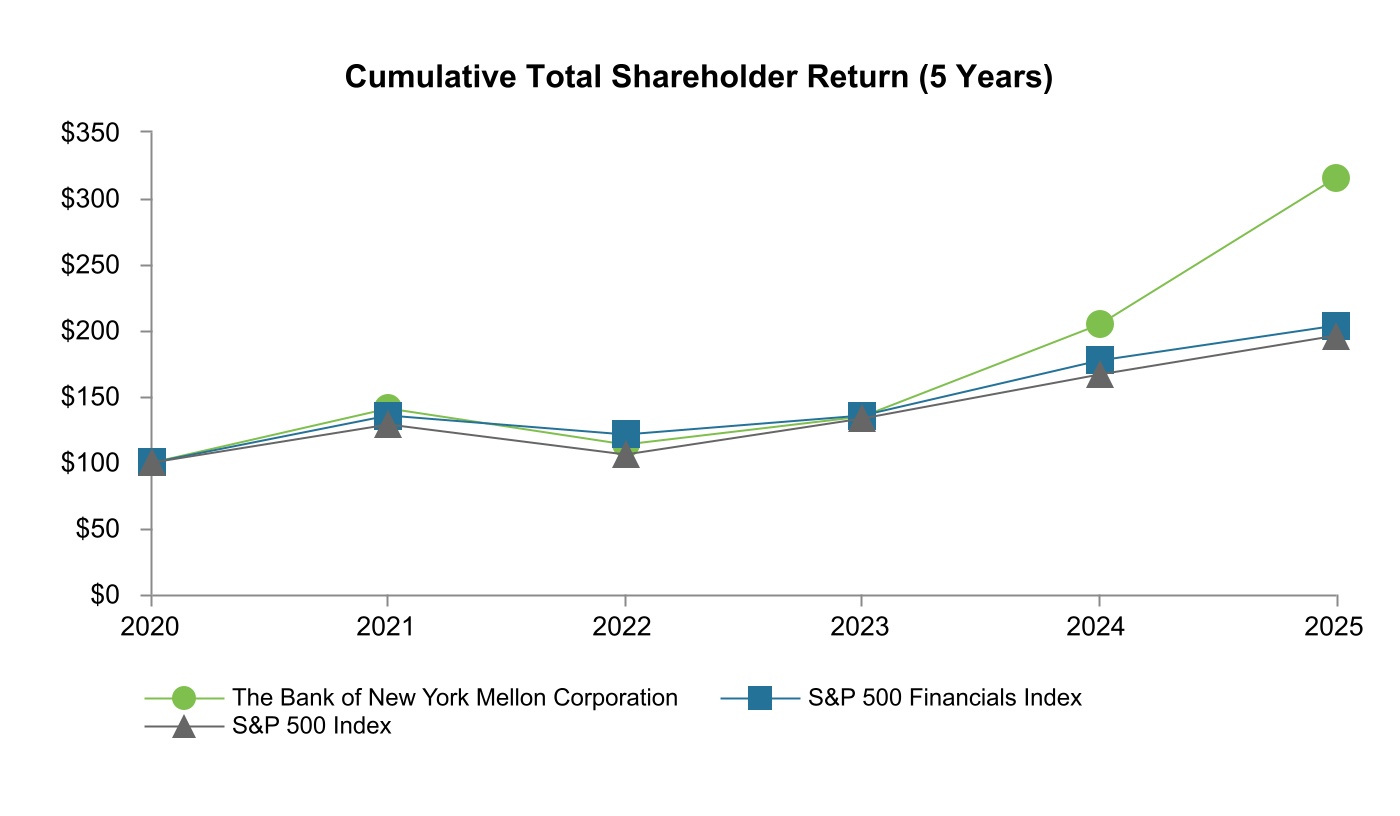
The Bank of New York Mellon Corporation (and its subsidiaries)
Financial Summary
(dollars in millions, except per share amounts and unless otherwise noted)
2025
2024
2023
Selected income statement information:
Fee and other revenue
$
15,136
$
14,307
$
13,352
Net interest income
4,944
4,312
4,345
Total revenue
20,080
18,619
17,697
Provision for credit losses
(32)
70
119
Noninterest expense
13,054
12,701
13,295
Income before income taxes
7,058
5,848
4,283
Provision for income taxes
1,475
1,305
979
Net income
5,583
4,543
3,304
Net (income) attributable to noncontrolling interests related to consolidated investment
management funds
(34)
(13)
(2)
Preferred stock dividends
(243)
(194)
(235)
Net income applicable to common shareholders of The Bank of New York
Mellon Corporation
$
5,306
$
4,336
$
3,067
Earnings per share applicable to common shareholders of The Bank of New York
Mellon Corporation:
Basic
$
7.47
$
5.84
$
3.91
Diluted
$
7.40
$
5.80
$
3.89
Average common shares and equivalents outstanding (in thousands):
Basic
710,177
742,588
784,069
Diluted
716,718
748,101
787,798
At Dec. 31
Assets under custody and/or administration (“AUC/A”) (in trillions) (a)
$
59.3
$
52.1
$
47.8
Assets under management (“AUM”) (in trillions) (b)
2.2
2.0
2.0
Selected ratios:
Return on common shareholders’ equity
13.9
%
11.9
%
8.6
%
Return on tangible common shareholders’ equity – Non-GAAP (c)
26.1
22.8
16.8
Pre-tax operating margin
35
31
24
Net interest margin
1.33
1.22
1.25
Cash dividends per common share
$
2.00
$
1.78
$
1.58
Common dividend payout ratio
27
%
31
%
41
%
Common dividend yield
1.7
%
2.3
%
3.0
%
At Dec. 31
Closing stock price per common share
$
116.09
$
76.83
$
52.05
Market capitalization
$
79,897
$
55,139
$
39,524
Book value per common share
$
57.36
$
51.52
$
47.97
Tangible book value per common share – Non-GAAP (c)
$
31.64
$
27.05
$
25.25
Full-time employees (d)
48,100
51,800
53,400
Common shares outstanding (in thousands)
688,236
717,680
759,344
Regulatory capital ratios(e)
Common Equity Tier 1 (“CET1”) ratio
11.9
%
11.2
%
11.5
%
Tier 1 capital ratio
14.6
13.7
14.2
Total capital ratio
15.4
14.8
14.9
Tier 1 leverage ratio
6.0
5.7
6.0
Supplementary leverage ratio (“SLR”)
6.7
6.5
7.3
(a) Consists of AUC/A primarily from the Asset Servicing line of business and, to a lesser extent, the Clearance and Collateral Management, Issuer Services, Pershing and Wealth Management lines of business. Includes the AUC/A of CIBC Mellon Trust Company (“CIBC Mellon”), a joint venture with the Canadian Imperial Bank of Commerce, of $2.2 trillion at Dec. 31, 2025, $1.8 trillion at Dec. 31, 2024 and $1.7 trillion at Dec. 31, 2023.
(b) Represents assets managed in the Investment and Wealth Management business segment.
(c) Return on tangible common shareholders’ equity and tangible book value per common share, both Non-GAAP measures, exclude goodwill and intangible assets, net of deferred tax liabilities. See “Supplemental Information – Explanation of GAAP and Non-GAAP financial measures” beginning on page 111 for the reconciliation of these Non-GAAP measures.
(d) Beginning in 2024, the number of full-time employees excludes interns.
(e) For our CET1, Tier 1 and Total capital ratios, our effective capital ratios under U.S. capital rules are the lower of the ratios as calculated under the Standardized and Advanced Approaches. For additional information on our regulatory capital ratios, see “Capital” beginning on page 38.
2 BNY
Management’s Discussion and Analysis of Financial Condition and Results of Operations
Results of Operations
General
In this Annual Report, references to “our,” “we,” “us,” “BNY,” the “Company” and similar terms refer to The Bank of New York Mellon Corporation and its consolidated subsidiaries. The term “Parent” refers to The Bank of New York Mellon Corporation but not its subsidiaries.
The following should be read in conjunction with the Consolidated Financial Statements included in this report. BNY’s actual results of future operations may differ from those estimated or anticipated in certain forward-looking statements contained herein due to the factors described under the headings “Forward-looking Statements” and “Risk Factors,” both of which investors should read.
Certain business terms used in this Annual Report are defined under the heading Glossary and Acronyms.
This Annual Report generally discusses 2025 and 2024 items and comparisons between 2025 and 2024. Discussions of 2023 items and comparisons between 2024 and 2023 that are not included in this Annual Report can be found in our 2024 Annual Report, which was filed as an exhibit to our Form 10-K for the year ended Dec. 31, 2024.
Overview
BNY is a global financial services platforms company at the heart of the world’s capital markets. For more than 240 years BNY has partnered alongside clients, using its expertise and platforms to help them operate more efficiently and accelerate growth. Today BNY serves over 90% of Fortune 100 companies and nearly all the top 100 banks globally. BNY supports governments in funding local projects and works with over 90% of the top 100 pension plans to safeguard investments for millions of individuals. As of Dec. 31, 2025, BNY oversees $59.3 trillion in assets under custody and/or administration and $2.2 trillion in assets under management.
BNY is the corporate brand of The Bank of New York Mellon Corporation (NYSE: BK). Headquartered in New York City, BNY has been named among Fortune’s World’s Most Admired Companies and Fast Company’s Best Workplaces for Innovators. Additional information is available on
www.bny.com. Follow on LinkedIn or visit the BNY Newsroom for the latest company news.
BNY has three business segments, Securities Services, Market and Wealth Services and Investment and Wealth Management, which offer a comprehensive set of capabilities and deep expertise across the investment life cycle, enabling the Company to provide solutions to buy-side and sell-side market participants, as well as leading institutional and wealth management clients globally.
The diagram below presents our three business segments and lines of business, with the remaining operations in the Other segment.
The Bank of New York Mellon Corporation
Securities Services
Market and Wealth Services
Investment and Wealth Management
Asset Servicing
Pershing
Investment Management
Issuer Services
Payments and
Trade (a)
Wealth Management
Clearance and Collateral Management
(a) Formerly Treasury Services.
For additional information on our business segments, see “Review of business segments” and Note 23 of the Notes to Consolidated Financial Statements.
Summary of financial highlights
We reported net income applicable to common shareholders of $5.3 billion, or $7.40 per diluted common share, in 2025, including the net negative impact of notable items. Notable items in 2025 include disposal gains, severance expense, litigation reserves and the net impact of adjustments for the Federal Deposit Insurance Corporation (“FDIC”) special assessment. Excluding notable items, net income applicable to common shareholders was $5.4 billion (Non-GAAP), or $7.50 (Non-GAAP) per diluted common share, in 2025. In 2024, net income applicable to common shareholders was $4.3 billion, or $5.80 per diluted common share, including the negative impact of notable items. Notable items in
BNY 3
Results of Operations (continued)
2024 include severance expense, litigation reserves and the net impact of adjustments for the FDIC special assessment. Excluding notable items, net income applicable to common shareholders was $4.5 billion (Non-GAAP), or $6.03 (Non-GAAP) per diluted common share, in 2024.
The highlights below are based on 2025 compared with 2024, unless otherwise noted.
•Fee revenue increased 6%, primarily reflecting net new business and higher client activity, higher market values and the favorable impact of a weaker U.S. dollar, partially offset by the mix of AUM flows. (See “Fee and other revenue” beginning on page 5.)
•Investment and other revenue increased primarily reflecting disposal gains and net gains on other investments. (See “Fee and other revenue” beginning on page 5.)
•Net interest income increased 15%, primarily reflecting the reinvestment of maturing investment securities at higher yields and balance sheet growth, partially offset by deposit margin compression. (See “Net interest income” beginning on page 7.)
•The provision for credit losses was a benefit of $32 million, primarily driven by improvements in commercial real estate exposure and changes in the macroeconomic forecast. (See “Consolidated balance sheet review – Allowance for credit losses” beginning on page 32.)
•Noninterest expense increased 3%, primarily reflecting higher investments, employee merit increases, higher revenue-related expenses and the unfavorable impact of the weaker U.S. dollar, partially offset by efficiency savings. Excluding notable items, noninterest expense also increased 3% (Non-GAAP). (See “Noninterest expense” on page 10.)
•Effective tax rate of 20.9% in 2025. (See “Income taxes” on page 10.)
•Return on common shareholders’ equity (“ROE”) was 13.9% for 2025. Excluding notable items,
the adjusted ROE was 14.1% (Non-GAAP) for 2025.
•Return on tangible common shareholders’ equity (“ROTCE”) was 26.1% (Non-GAAP) for 2025. Excluding notable items, the adjusted ROTCE was 26.4% (Non-GAAP) for 2025.
See “Supplemental Information – Explanation of GAAP and Non-GAAP financial measures” beginning on page 111 for reconciliations of the Non-GAAP measures.
Metrics
•AUC/A totaled $59.3 trillion at Dec. 31, 2025 compared with $52.1 trillion at Dec. 31, 2024. The 14% increase primarily reflects client inflows, higher market values and the favorable impact of the weaker U.S. dollar. (See “Fee and other revenue” beginning on page 5.)
•AUM totaled $2.18 trillion at Dec. 31, 2025 compared with $2.03 trillion at Dec. 31, 2024. The 7% increase primarily reflects higher market values and the favorable impact of the weaker U.S. dollar, partially offset by cumulative net outflows. (See “Review of business segments – Investment and Wealth Management business segment” beginning on page 16.)
Capital and liquidity
•Our CET1 ratio calculated under the Standardized Approach was 11.9% at Dec. 31, 2025 and 11.2% at Dec. 31, 2024. The increase was primarily driven by capital generated through earnings and a net increase in accumulated other comprehensive income, partially offset by capital returned through common stock repurchases and dividends and higher risk-weighted assets (“RWAs”). (See “Capital” beginning on page 38.)
•Our Tier 1 leverage ratio was 6.0% at Dec. 31, 2025, compared with 5.7% at Dec. 31, 2024. The increase was driven by an increase in capital, partially offset by higher average assets. (See “Capital” beginning on page 38.)
4 BNY
Results of Operations (continued)
Fee and other revenue
Fee and other revenue
2025 vs.
2024 vs.
(dollars in millions, unless otherwise noted)
2025
2024
2023
2024
2023
Investment services fees
$
10,211
$
9,419
$
8,843
8
%
7
%
Investment management and performance fees (a)(b)
3,085
3,139
3,058
(2)
3
Foreign exchange revenue
706
688
631
3
9
Financing-related fees
231
216
192
7
13
Distribution and servicing fees
146
158
148
(8)
7
Total fee revenue
14,379
13,620
12,872
6
6
Investment and other revenue
757
687
480
N/M
N/M
Total fee and other revenue
$
15,136
$
14,307
$
13,352
6
%
7
%
Fee revenue as a percentage of total revenue
72
%
73
%
73
%
AUC/A at period end (in trillions) (c)
$
59.3
$
52.1
$
47.8
14
%
9
%
AUM at period end (in billions) (d)
$
2,178
$
2,029
$
1,974
7
%
3
%
(a) Effective 2025, certain rebates, which were previously recorded as distribution and servicing expense, began to be reflected as a reduction of investment management fees. These amounts totaled approximately $80 million for all periods presented and impacted the variances for investment management and performance fees and related revenue subtotals in the table above.
(b) Excludes seed capital gains (losses) related to consolidated investment management funds.
(c) Consists of AUC/A primarily from the Asset Servicing line of business and, to a lesser extent, the Clearance and Collateral Management, Issuer Services, Pershing and Wealth Management lines of business. Includes the AUC/A of CIBC Mellon of $2.2 trillion at Dec. 31, 2025, $1.8 trillion at Dec. 31, 2024 and $1.7 trillion at Dec. 31, 2023.
(d) Represents assets managed in the Investment and Wealth Management business segment.
N/M – Not meaningful.
Fee revenue increased 6% compared with 2024, primarily reflecting higher investment services fees and foreign exchange revenue, partially offset by lower investment management and performance fees.
Investment and other revenue increased $70 million in 2025 compared with 2024, primarily reflecting disposal gains and net gains on investments.
Investment services fees
Investment services fees increased 8% compared with 2024, primarily reflecting higher client activity and net new business, higher market values and Depositary Receipts revenue.
AUC/A totaled $59.3 trillion at Dec. 31, 2025, an increase of 14% compared with Dec. 31, 2024, primarily reflecting client inflows, higher market values and the favorable impact of the weaker U.S. dollar. AUC/A consisted of 38% equity securities and 62% fixed-income securities at Dec. 31, 2025 and 37% equity securities and 63% fixed-income securities at Dec. 31, 2024.
See “Securities Services business segment” and “Market and Wealth Services business segment” in “Review of business segments” for additional details.
Investment management and performance fees
Investment management and performance fees decreased 2% compared with 2024, primarily reflecting the mix of AUM flows and the adjustment for certain rebates (offset in noninterest expense), partially offset by higher market values and the favorable impact of a weaker U.S. dollar. Performance fees were $35 million in 2025 and $51 million in 2024. On a constant currency basis (Non-GAAP), investment management and performance fees decreased 2% compared with 2024. See “Supplemental Information – Explanation of GAAP and Non-GAAP financial measures” beginning on page 111 for the reconciliation of Non-GAAP measures.
AUM was $2.2 trillion at Dec. 31, 2025, an increase of 7% compared with Dec. 31, 2024, primarily reflecting higher market values and the favorable impact of the weaker U.S. dollar, partially offset by cumulative net outflows.
See “Investment and Wealth Management business segment” in “Review of business segments” for additional details regarding the drivers of investment management and performance fees, AUM and AUM flows.
BNY 5
Results of Operations (continued)
Foreign exchange revenue
Foreign exchange revenue is primarily driven by the volume of client transactions and the spread realized on these transactions, both of which are impacted by market volatility, the impact of foreign currency hedging activities and foreign currency remeasurement gain (loss). In 2025, foreign exchange revenue increased 3% compared with 2024, primarily reflecting higher volatility and volumes. Foreign exchange revenue is primarily reported in the Securities Services business segment and, to a lesser extent, the Market and Wealth Services and Investment and Wealth Management business segments and the Other segment.
Financing-related fees
Financing-related fees, which are primarily reported in the Market and Wealth Services and Securities Services business segments, include capital market fees, loan commitment fees and credit-related fees. Financing-related fees increased 7% compared with 2024, primarily reflecting higher underwriting and loan fees.
Distribution and servicing fees
Distribution and servicing fees earned from mutual funds are primarily based on average assets in the funds and the sales of funds that we manage or administer, and are primarily reported in the Investment Management line of business. These fees, which include 12b-1 fees, fluctuate with the overall level of net sales, the relative mix of sales between share classes, the funds’ market values and money market fee waivers.
Distribution and servicing fees were $146 million in 2025 compared with $158 million in 2024, driven by
higher fees paid to introducing brokers. The impact of distribution and servicing fees on income in any one period is partially offset by distribution and servicing expense paid to other financial intermediaries to cover their costs for distribution and servicing of mutual funds. Distribution and servicing expense is recorded as noninterest expense on the income statement.
Investment and other revenue
Investment and other revenue includes income or loss from consolidated investment management funds, seed capital gains or losses, other trading revenue or loss, renewable energy investments gains, income from corporate and bank-owned life insurance contracts, other investment gains or losses, gains or losses from disposals, expense reimbursements from our CIBC Mellon joint venture, other income or loss and net securities gains or losses. The income or loss from consolidated investment management funds should be considered together with the net income or loss attributable to noncontrolling interests, which reflects the portion of the consolidated funds for which we do not have an economic interest and is reflected below net income as a separate line item on the consolidated income statement. Other trading revenue or loss primarily includes the impact of market-risk hedging activity related to our seed capital investments in investment management funds, non-foreign currency derivative and fixed income trading, and other hedging activity. Other investment gains or losses includes fair value changes of non-readily marketable strategic equity, private equity and other investments. Expense reimbursements from our CIBC Mellon joint venture relate to expenses incurred by BNY on behalf of the CIBC Mellon joint venture. Other income includes various miscellaneous revenues.
6 BNY
Results of Operations (continued)
The following table provides the components of investment and other revenue.
Investment and other revenue
(in millions)
2025
2024
2023
Income from consolidated investment management funds
$
83
$
46
$
30
Seed capital gains (a)
14
20
29
Other trading revenue
279
314
231
Renewable energy investment gains
55
25
28
Corporate/bank-owned life insurance
165
137
118
Other investment gains (b)
14
67
47
Disposal gains (losses)
52
—
(6)
Expense reimbursements from joint venture
136
118
117
Other income (loss)
39
45
(46)
Net securities (losses)
(80)
(85)
(68)
Total investment and other revenue
$
757
$
687
$
480
(a) Includes gains (losses) on investments in BNY funds which hedge deferred incentive awards.
(b) Includes strategic equity, private equity and other investments.
Investment and other revenue was $757 million in 2025 compared with $687 million in 2024. The increase primarily reflects disposal gains and net gains on investments.
Net interest income
Net interest income
2025 vs.
2024 vs.
(dollars in millions)
2025
2024
2023
2024
2023
Net interest income
$
4,944
$
4,312
$
4,345
15%
(1)%
Add: Tax equivalent adjustment
1
2
2
N/M
N/M
Net interest income on a fully taxable equivalent (“FTE”) basis – Non-GAAP (a)
$
4,945
$
4,314
$
4,347
15%
(1)%
Average interest-earning assets
$
373,096
$
353,744
$
348,160
5
%
2%
Net interest margin
1.33
%
1.22
%
1.25
%
11
bps
(3)
bps
Net interest margin (FTE) – Non-GAAP (a)
1.33
%
1.22
%
1.25
%
11
bps
(3)
bps
(a) Net interest income (FTE) – Non-GAAP and net interest margin (FTE) – Non-GAAP include the tax equivalent adjustments on tax-exempt income, which allows for comparisons of amounts arising from both taxable and tax-exempt sources and is consistent with industry practice. The adjustment to an FTE basis has no impact on net income.
N/M – Not meaningful.
bps – basis points.
Net interest income increased 15% compared with 2024, primarily reflecting the reinvestment of maturing investment securities at higher yields and balance sheet growth, partially offset by deposit margin compression.
Net interest margin increased 11 basis points compared with 2024. The increase primarily reflects the factors mentioned above.
Average interest-earning assets increased 5% compared with 2024. The increase primarily reflects
higher federal funds sold and securities purchased under resale agreements and securities balances, partially offset by lower interest-bearing deposits with the Federal Reserve and other central banks.
Average non-U.S. dollar deposits comprised approximately 25% of our average total deposits in 2025 and 2024. Approximately 50% of the average non-U.S. dollar deposits in 2025 and 2024 were euro-denominated.
BNY 7
Results of Operations (continued)
Average balances and interest rates
2025
2024
(dollars in millions)
Average balance
Interest
Average rate
Average balance
Interest
Average rate
Assets
Interest-earning assets:
Interest-bearing deposits with the Federal Reserve and other central banks:
Domestic offices
$
61,180
$
2,649
4.33
%
$
59,432
$
3,148
5.30
%
Foreign offices
33,223
847
2.55
40,554
1,467
3.62
Total interest-bearing deposits with the Federal Reserve and other central banks
94,403
3,496
3.70
99,986
4,615
4.62
Interest-bearing deposits with banks
10,929
325
2.98
10,991
434
3.94
Federal funds sold and securities purchased under resale agreements (a)
41,239
12,208
29.60
31,306
10,915
34.86
Loans:
Domestic offices
67,748
3,916
5.78
63,108
4,107
6.51
Foreign offices
4,848
230
4.74
5,033
287
5.70
Total loans (b)
72,596
4,146
5.71
68,141
4,394
6.45
Securities:
U.S. government obligations
30,367
1,078
3.55
27,826
1,022
3.67
U.S. government agency obligations
62,277
2,075
3.33
62,855
2,058
3.27
Other securities:
Domestic offices
15,923
815
5.12
17,560
951
5.42
Foreign offices
38,119
1,123
2.94
29,620
911
3.07
Total other securities
54,042
1,938
3.59
47,180
1,862
3.95
Total investment securities
146,686
5,091
3.47
137,861
4,942
3.58
Trading securities (primarily domestic) (c)
7,243
361
4.98
5,459
309
5.66
Total securities (c)
153,929
5,452
3.54
143,320
5,251
3.66
Total interest-earning assets (c)
$
373,096
$
25,627
6.87
%
$
353,744
$
25,609
7.24
%
Noninterest-earning assets
62,795
59,590
Total assets
$
435,891
$
413,334
Liabilities and equity
Interest-bearing liabilities:
Interest-bearing deposits:
Domestic offices
$
149,978
$
4,886
3.26
%
$
141,279
$
5,791
4.10
%
Foreign offices
98,023
2,174
2.22
92,926
2,856
3.07
Total interest-bearing deposits
248,001
7,060
2.85
234,205
8,647
3.69
Federal funds purchased and securities sold under repurchase agreements (a)
17,348
10,946
63.09
17,007
9,974
58.64
Trading liabilities
2,768
124
4.47
1,768
88
4.98
Other borrowed funds
325
16
5.04
439
18
4.10
Commercial paper
2,348
106
4.52
1,197
62
5.18
Payables to customers and broker-dealers
15,964
669
4.19
12,726
640
5.03
Long-term debt
31,919
1,761
5.52
31,816
1,866
5.87
Total interest-bearing liabilities
$
318,673
$
20,682
6.49
%
$
299,158
$
21,295
7.12
%
Total noninterest-bearing deposits
50,239
49,521
Other noninterest-bearing liabilities
23,349
23,694
Total liabilities
392,261
372,373
Total The Bank of New York Mellon Corporation shareholders’ equity
43,188
40,756
Noncontrolling interests
442
205
Total liabilities and equity
$
435,891
$
413,334
Net interest income (FTE) – Non-GAAP (c)(d)
$
4,945
$
4,314
Net interest margin (FTE) – Non-GAAP (c)(d)
1.33
%
1.22
%
Less: Tax equivalent adjustment
1
2
Net interest income – GAAP
$
4,944
$
4,312
Net interest margin – GAAP
1.33
%
1.22
%
Percentage of assets attributable to foreign offices
22
%
23
%
Percentage of liabilities attributable to foreign offices
28
%
28
%
(a)Includes the average impact of offsetting under enforceable netting agreements of approximately $239 billion in 2025 and $176 billion in 2024. On a Non-GAAP basis, excluding the impact of offsetting, the yield on federal funds sold and securities purchased under resale agreements would have been 4.36% for 2025 and 5.28% for 2024, and the rate on federal funds purchased and securities sold under repurchase agreements would have been 4.28% for 2025 and 5.18% for 2024. We believe providing the rates excluding the impact of netting is useful to investors as it is more reflective of the actual rates earned and paid.
(b) Interest income includes fees of $4 million in 2025 and $3 million in 2024. Nonaccrual loans are included in average loans; the associated income, which was recognized on a cash basis, is included in interest income.
(c) Average rates were calculated on an FTE basis, at tax rates of approximately 21% for both 2025 and 2024.
(d)See “Net interest income” on page 7 for the reconciliation of this Non-GAAP measure.
8 BNY
Results of Operations (continued)
Average balances and interest rates
2023
(dollars in millions)
Average balance
Interest
Average rate
Assets
Interest-earning assets:
Interest-bearing deposits with the Federal Reserve and other central banks:
Domestic offices
$
59,492
$
3,085
5.19
%
Foreign offices
44,412
1,456
3.28
Total interest-bearing deposits with the Federal Reserve and other central banks
103,904
4,541
4.37
Interest-bearing deposits with banks
13,620
523
3.84
Federal funds sold and securities purchased under resale agreements (a)
26,077
7,141
27.38
Loans:
Domestic offices
59,487
3,663
6.16
Foreign offices
4,609
253
5.49
Total loans (b)
64,096
3,916
6.11
Securities:
U.S. government obligations
33,434
1,021
3.05
U.S. government agency obligations
60,586
1,695
2.80
Other securities:
Domestic offices
17,168
803
4.68
Foreign offices
23,505
695
2.96
Total other securities
40,673
1,498
3.68
Total investment securities
134,693
4,214
3.13
Trading securities (primarily domestic) (c)
5,770
315
5.46
Total securities (c)
140,463
4,529
3.22
Total interest-earning assets (c)
$
348,160
$
20,650
5.93
%
Noninterest-earning assets
58,582
Total assets
$
406,742
Liabilities and equity
Interest-bearing liabilities:
Interest-bearing deposits:
Domestic offices
$
123,513
$
4,703
3.81
%
Foreign offices
88,829
2,421
2.73
Total interest-bearing deposits
212,342
7,124
3.35
Federal funds purchased and securities sold under repurchase agreements (a)
20,540
6,699
32.62
Trading liabilities
3,396
156
4.60
Other borrowed funds
1,102
47
4.27
Commercial paper
5
—
4.81
Payables to customers and broker-dealers
14,449
566
3.91
Long-term debt
31,021
1,711
5.51
Total interest-bearing liabilities
$
282,855
$
16,303
5.76
%
Total noninterest-bearing deposits
59,227
Other noninterest-bearing liabilities
24,011
Total liabilities
366,093
Total The Bank of New York Mellon Corporation shareholders’ equity
40,588
Noncontrolling interests
61
Total liabilities and equity
$
406,742
Net interest income (FTE) – Non-GAAP (c)(d)
$
4,347
Net interest margin (FTE) – Non-GAAP (c)(d)
1.25
%
Less: Tax equivalent adjustment
2
Net interest income – GAAP
$
4,345
Net interest margin – GAAP
1.25
%
Percentage of assets attributable to foreign offices
24
%
Percentage of liabilities attributable to foreign offices
27
%
(a) Includes the average impact of offsetting under enforceable netting agreements of approximately $111 billion in 2023. On a Non-GAAP basis, excluding the impact of offsetting, the yield on federal funds sold and securities purchased under resale agreements would have been 5.22%, and the rate on federal funds purchased and securities sold under repurchase agreements would have been 5.10% for 2023. We believe providing the rates excluding the impact of netting is useful to investors as it is more reflective of the actual rates earned and paid.
(b) Interest income includes fees of $1 million in 2023. Nonaccrual loans are included in average loans; the associated income, which was recognized on a cash basis, is included in interest income.
(c)Average rates were calculated on an FTE basis, at tax rates of approximately 21% in 2023.
(d)See “Net interest income” on page 7 for the reconciliation of this Non-GAAP measure.
BNY 9
Results of Operations (continued)
Noninterest expense
Noninterest expense
2025 vs.
2024 vs.
(dollars in millions)
2025
2024
2023
2024
2023
Staff
$
7,159
$
7,130
$
7,095
—
%
—
%
Software and equipment
2,147
1,962
1,817
9
8
Professional, legal and other purchased services
1,587
1,503
1,527
6
(2)
Sub-custodian and clearing
561
498
475
13
5
Net occupancy
551
537
542
3
(1)
Distribution and servicing
269
361
353
(25)
2
Business development
217
188
183
15
3
Amortization of intangible assets
45
50
57
(10)
(12)
Bank assessment charges
44
36
788
N/M
N/M
Other
474
436
458
9
(5)
Total noninterest expense
$
13,054
$
12,701
$
13,295
3
%
(4)
%
Full-time employees at year-end (a)
48,100
51,800
53,400
(7)
%
(3)
%
(a) Beginning in 2024, the number of full-time employees excludes interns.
N/M – Not meaningful.
Total noninterest expense increased 3% compared with 2024, primarily reflecting higher investments, employee merit increases, higher revenue-related expenses and the unfavorable impact of a weaker U.S. dollar, partially offset by efficiency savings. Excluding notable items, noninterest expense also increased 3% (Non-GAAP). See “Supervision and Regulation – FDIC Deposit Insurance” beginning on page 66 for information on the FDIC special assessment. See “Supplemental Information – Explanation of GAAP and Non-GAAP financial measures” beginning on page 111 for the reconciliation of the Non-GAAP measure.
Income taxes
BNY recorded an income tax provision of $1.5 billion (20.9% effective tax rate) in 2025. The income tax provision was $1.3 billion (22.3% effective tax rate) in 2024.
For additional information on income taxes, see Notes 2, 11 and 25 of the Notes to Consolidated Financial Statements.
Review of business segments
We have an internal information system that produces performance data along product and service lines for our three principal business segments: Securities Services, Market and Wealth Services and Investment and Wealth Management, and the Other segment.
Business segment accounting principles
Our business segment data has been determined on an internal management basis of accounting, rather than the generally accepted accounting principles (“GAAP”) used for consolidated financial reporting. These measurement principles are designed so that reported results of the businesses will track their economic performance.
Our business segments are consistent with the structure used by the President and Chief Executive Officer, our Chief Operating Decision Maker (“CODM”), to make key operating decisions and assess performance. Our CODM evaluates the business segments’ operating performance primarily based on fee and other revenue, total revenue, income before income taxes, and pre-tax operating margin. The significant expense information regularly provided to and reviewed by the CODM is total noninterest expense. The CODM considers this information when evaluating the performance of each business segment and making decisions about allocating capital and other resources to each business segment.
For information on the accounting principles of our business segments, the primary products and services in each line of business, the primary types of revenue by line of business and how our business segments are presented and analyzed, see Note 23 of the Notes to Consolidated Financial Statements.
10 BNY
Results of Operations (continued)
Business segment results are subject to reclassification when organizational changes are made, or for refinements in revenue and expense allocation methodologies. Refinements are typically reflected on a prospective basis. In 2025, the prior periods total revenue by line of business for Investment Management and Wealth Management was revised for comparability to reflect the movement of certain fixed income investment management business from Wealth Management to Investment Management. There was no impact to total revenue reported for the Investment and Wealth Management business segment or on a consolidated basis.
The results of our business segments may be influenced by client and other activities that vary by quarter. In the first quarter, staff expense typically increases, reflecting the vesting of long-term stock awards for retirement-eligible employees. The timing of our annual employee merit increases also impacts staff expense. In 2024 and 2025, the merit increase was effective in March and in 2023, the merit increase was effective in April, thus partially impacting the full-year staff expense variances. In the third quarter, volume-related fees may decline due to reduced client activity. In the fourth quarter, we typically incur higher business development and marketing expenses. In our Investment and Wealth Management business segment, performance fees are typically higher in the fourth quarter, as that quarter represents the end of the measurement period for many of the performance fee-eligible relationships.
The results of our business segments may also be impacted by the translation of financial results denominated in foreign currencies to the U.S. dollar. We are primarily impacted by activities denominated in the British pound and the euro. On a consolidated basis and in our Securities Services and Market and Wealth Services business segments, we typically have more foreign currency-denominated expenses than revenues. However, our Investment and Wealth Management business segment typically has more foreign currency-denominated revenues than expenses. Overall, currency fluctuations impact the year-over-year growth rate in the Investment and Wealth Management business segment more than the Securities Services and Market and Wealth Services business segments. However, currency fluctuations, in isolation, are not expected to significantly impact net income on a consolidated basis.
Fee revenue in the Investment and Wealth Management business segment, and to a lesser extent, the Securities Services and Market and Wealth Services business segments, is impacted by global market fluctuations. At Dec. 31, 2025, we estimated that a 5% change in global equity markets, spread evenly throughout the year, would impact fee revenue by less than 1% and diluted earnings per common share by $0.05 to $0.08.
See Note 23 of the Notes to Consolidated Financial Statements for the consolidating schedules which show the contribution of our business segments to our overall profitability.
BNY 11
Results of Operations (continued)
Securities Services business segment
2025 vs.
2024 vs.
(dollars in millions, unless otherwise noted)
2025
2024
2023
2024
2023
Revenue:
Investment services fees:
Asset Servicing
$
4,456
$
4,094
$
3,872
9
%
6
%
Issuer Services
1,287
1,163
1,121
11
4
Total investment services fees
5,743
5,257
4,993
9
5
Foreign exchange revenue
596
552
488
8
13
Other fees (a)
266
234
215
14
9
Total fee revenue
6,605
6,043
5,696
9
6
Investment and other revenue
415
405
333
N/M
N/M
Total fee and other revenue
7,020
6,448
6,029
9
7
Net interest income
2,710
2,468
2,569
10
(4)
Total revenue
9,730
8,916
8,598
9
4
Provision for credit losses
(21)
38
99
N/M
N/M
Noninterest expense (excluding amortization of intangible assets)
6,505
6,286
6,327
3
(1)
Amortization of intangible assets
27
28
31
(4)
(10)
Total noninterest expense
6,532
6,314
6,358
3
(1)
Income before income taxes
$
3,219
$
2,564
$
2,141
26
%
20
%
Pre-tax operating margin
33
%
29
%
25
%
Securities lending revenue (b)
$
239
$
191
$
189
25
%
1
%
Total revenue by line of business:
Asset Servicing
$
7,516
$
6,872
$
6,612
9
%
4
%
Issuer Services
2,214
2,044
1,986
8
3
Total revenue by line of business
$
9,730
$
8,916
$
8,598
9
%
4
%
Selected average balances:
Average loans
$
11,204
$
11,235
$
11,207
—
%
—
%
Average deposits
$
184,433
$
178,643
$
168,411
3
%
6
%
Selected metrics:
AUC/A at period end (in trillions) (c)
$
43.0
$
37.7
$
34.2
14
%
10
%
Market value of securities on loan at period end (in billions) (d)
$
604
$
488
$
450
24
%
8
%
Issuer Services:
Total debt serviced at period end (in trillions)
$
14.8
$
14.1
$
14.0
5
%
1
%
Number of Depositary Receipts programs at period end
1,614
1,576
1,645
2
%
(4)
%
(a) Other fees primarily include financing-related fees.
(b) Included in investment services fees reported in the Asset Servicing line of business.
(c) Consists of AUC/A primarily from the Asset Servicing line of business and, to a lesser extent, the Issuer Services line of business. Includes the AUC/A of CIBC Mellon of $2.2 trillion at Dec. 31, 2025, $1.8 trillion at Dec. 31, 2024 and $1.7 trillion at Dec. 31, 2023.
(d) Represents the total amount of securities on loan in our agency securities lending program. Excludes securities for which BNY acts as agent on behalf of CIBC Mellon clients, which totaled $74 billion at Dec. 31, 2025, $60 billion at Dec. 31, 2024 and $63 billion at Dec. 31, 2023.
N/M – Not meaningful.
12 BNY
Results of Operations (continued)
Business segment description
The Securities Services business segment consists of two distinct lines of business, Asset Servicing and Issuer Services, which provide business solutions across the transaction lifecycle to our global asset owner, asset manager and corporate clients. We are one of the leading global investment services providers with $43.0 trillion of AUC/A at Dec. 31, 2025. For information on the drivers of the Securities Services fee revenue, see Note 9 of the Notes to Consolidated Financial Statements.
The Asset Servicing business provides a comprehensive suite of solutions. We are one of the largest global custody, fund administrator and front-to-back outsourcing service providers. We offer services for the safekeeping of assets in capital markets globally as well as fund accounting services, exchange-traded funds servicing, transfer agency, trust and depository, front-to-back capabilities, data and analytics solutions and digital asset custody and administration services for our clients. We deliver foreign exchange, and securities lending and financing solutions, on both an agency and principal basis. Our agency securities lending program is one of the largest lenders of U.S. and non-U.S. securities, servicing a lendable asset pool of approximately $6.1 trillion in 35 markets. Our market-leading liquidity services portal enables cash investments for institutional clients and includes fund research and analytics.
The Issuer Services business includes Corporate Trust and Depositary Receipts. Our Corporate Trust business delivers a full range of issuer and related investor services, including trustee, paying agency, fiduciary, escrow and other financial services. We are a leading provider to the debt capital markets, providing customized and market-driven solutions to investors, bondholders and lenders. Our Depositary Receipts business drives global investing by providing servicing and value-
added solutions that enable, facilitate and enhance cross-border trading, clearing, settlement and ownership. We are one of the largest providers of depositary receipts services in the world, partnering with leading companies from more than 50 countries.
Review of financial results
AUC/A of $43.0 trillion increased 14% compared with Dec. 31, 2024, primarily reflecting higher market values, client inflows and the favorable impact of a weaker U.S. dollar.
Total revenue of $9.7 billion increased 9% compared with 2024. The drivers of total revenue by line of business are indicated below.
Asset Servicing revenue of $7.5 billion increased 9% compared with 2024, primarily reflecting higher net interest income, client activity, market values, net new business and a disposal gain, partially offset by an investment loss.
Issuer Services revenue of $2.2 billion increased 8% compared with 2024, primarily reflecting higher Depositary Receipts revenue and a disposal gain.
Market and regulatory trends are driving investable assets toward lower fee asset management products at reduced margins for our clients. These dynamics are also negatively impacting our investment services fees. However, at the same time, these trends are providing additional outsourcing opportunities as clients and other market participants seek to comply with regulations and reduce their operating costs.
Noninterest expense of $6.5 billion increased 3% compared with 2024, primarily reflecting higher investments, revenue-related expenses, employee merit increases and the unfavorable impact of the weaker U.S. dollar, partially offset by efficiency savings.
BNY 13
Results of Operations (continued)
Market and Wealth Services business segment
2025 vs.
2024 vs.
(dollars in millions, unless otherwise noted)
2025
2024
2023
2024
2023
Revenue:
Investment services fees:
Pershing
$
2,029
$
1,947
$
1,885
4
%
3
%
Payments and Trade (a)
844
792
717
7
10
Clearance and Collateral Management
1,562
1,385
1,212
13
14
Total investment services fees
4,435
4,124
3,814
8
8
Foreign exchange revenue
118
97
81
22
20
Other fees (b)
263
235
202
12
16
Total fee revenue
4,816
4,456
4,097
8
9
Investment and other revenue
88
79
63
N/M
N/M
Total fee and other revenue
4,904
4,535
4,160
8
9
Net interest income
2,096
1,729
1,710
21
1
Total revenue
7,000
6,264
5,870
12
7
Provision for credit losses
(12)
19
41
N/M
N/M
Noninterest expense (excluding amortization of intangible assets)
3,585
3,349
3,199
7
5
Amortization of intangible assets
3
4
6
(25)
(33)
Total noninterest expense
3,588
3,353
3,205
7
5
Income before income taxes
$
3,424
$
2,892
$
2,624
18
%
10
%
Pre-tax operating margin
49
%
46
%
45
%
Total revenue by line of business:
Pershing
$
2,928
$
2,687
$
2,616
9
%
3
%
Payments and Trade (a)
2,001
1,737
1,637
15
6
Clearance and Collateral Management
2,071
1,840
1,617
13
14
Total revenue by line of business
$
7,000
$
6,264
$
5,870
12
%
7
%
Selected average balances:
Average loans
$
45,804
$
41,533
$
37,502
10
%
11
%
Average deposits
$
96,958
$
90,185
$
85,785
8
%
5
%
Selected metrics:
AUC/A at period end (in trillions) (c)
$
15.9
$
14.1
$
13.3
13
%
6
%
Pershing:
AUC/A at period end (in trillions)
$
3.0
$
2.7
$
2.5
11
%
8
%
Net new assets (U.S. platform) (in billions) (d)
$
55
$
(6)
$
22
N/M
N/M
Daily average revenue trades (“DARTs”) (U.S. platform) (in thousands)
296
269
234
10
%
15
%
Average active clearing accounts (in thousands)
8,421
8,098
7,946
4
%
2
%
Payments and Trade: (a)
Average daily U.S. dollar payment volumes
248,808
242,997
236,696
2
%
3
%
Clearance and Collateral Management:
Average collateral balances (in billions)
$
7,091
$
6,217
$
6,343
14
%
(2)
%
(a) Formerly Treasury Services.
(b) Other fees primarily include financing-related fees.
(c) Consists of AUC/A from the Clearance and Collateral Management and Pershing businesses.
(d) Net new assets represent net flows of assets (e.g., net cash deposits and net securities transfers, including dividends and interest) in customer accounts in Pershing LLC, a U.S. broker-dealer.
N/M – Not meaningful.
14 BNY
Results of Operations (continued)
Business segment description
The Market and Wealth Services business segment consists of three distinct lines of business, Pershing, Payments and Trade and Clearance and Collateral Management, which provide business services and technology solutions to entities including financial institutions, corporations, foundations and endowments, public funds and government agencies. For information on the drivers of the Market and Wealth Services fee revenue, see Note 9 of the Notes to Consolidated Financial Statements.
Pershing provides execution, clearing, custody and technology solutions, delivering operational support to broker-dealers, wealth managers and registered investment advisors (“RIAs”) globally.
Our Payments and Trade business is a leading provider of global payments, liquidity management and trade finance services for financial institutions, corporations and the public sector.
Our Clearance and Collateral Management business clears and settles equity and fixed-income transactions globally and serves as custodian for tri-party repo collateral worldwide. We are the primary provider of U.S. government securities clearance and a provider of non-U.S. government securities clearance. Our collateral services include collateral management, administration and segregation. We offer innovative solutions and industry expertise that help financial institutions and institutional investors with their financing, risk and balance sheet opportunities.
Review of financial results
AUC/A of $15.9 trillion increased 13% compared with Dec. 31, 2024, primarily reflecting client inflows and higher market values.
Total revenue of $7.0 billion increased 12% compared with 2024. The drivers of total revenue by line of business are indicated below.
Pershing revenue of $2.9 billion increased 9% compared with 2024, primarily reflecting higher net interest income, market values and client activity.
Payments and Trade, formerly Treasury Services, revenue of $2.0 billion increased 15% compared with 2024, primarily reflecting higher net interest income and net new business, partially offset by an investment loss.
Clearance and Collateral Management revenue of $2.1 billion increased 13% compared with 2024, primarily reflecting higher collateral management balances, clearance volumes and net interest income.
Noninterest expense of $3.6 billion increased 7% compared with 2024, primarily reflecting higher investments, employee merit increases, revenue-related expenses, and higher litigation reserves and severance expense, partially offset by efficiency savings.
BNY 15
Results of Operations (continued)
Investment and Wealth Management business segment
2025 vs.
2024 vs.
(dollars in millions)
2025
2024
2023
2024
2023
Revenue:
Investment management fees (a)
$
3,052
$
3,093
$
2,981
(1)
%
4
%
Performance fees
35
51
81
N/M
N/M
Investment management and performance fees (b)
3,087
3,144
3,062
(2)
3
Distribution and servicing fees
275
275
241
—
14
Other fees (c)
(313)
(256)
(214)
N/M
N/M
Total fee revenue
3,049
3,163
3,089
(4)
2
Investment and other revenue (d)
35
50
(102)
N/M
N/M
Total fee and other revenue (d)
3,084
3,213
2,987
(4)
8
Net interest income
174
176
168
(1)
5
Total revenue
3,258
3,389
3,155
(4)
7
Provision for credit losses
5
4
(4)
N/M
N/M
Noninterest expense (excluding amortization of intangible assets) (a)
2,695
2,762
2,756
(2)
—
Amortization of intangible assets
15
18
20
(17)
(10)
Total noninterest expense
2,710
2,780
2,776
(3)
—
Income before income taxes
$
543
$
605
$
383
(10)
%
58
%
Pre-tax operating margin
17
%
18
%
12
%
Total revenue by line of business:
Investment Management (e)
$
2,197
$
2,330
$
2,148
(6)
%
8
%
Wealth Management (e)
1,061
1,059
1,007
—
5
Total revenue by line of business
$
3,258
$
3,389
$
3,155
(4)
%
7
%
Selected average balances:
Average loans
$
13,902
$
13,610
$
13,718
2
%
(1)
%
Average deposits
$
9,445
$
10,589
$
14,280
(11)
%
(26)
%
(a) Effective 2025, certain rebates, which were previously recorded as distribution and servicing expense, began to be reflected as a reduction of investment management fees. These amounts totaled approximately $80 million for all periods presented and impacted the variance for investment management fees and related revenue subtotals, noninterest expense and Investment Management total revenue in the table above.
(b) On a constant currency basis, investment management and performance fees decreased 3% (Non-GAAP) compared with 2024. See “Supplemental Information – Explanation of GAAP and Non-GAAP financial measures” beginning on page 111 for the reconciliation of this Non-GAAP measure.
(c) Other fees primarily include investment services fees.
(d) Investment and other revenue and total fee and other revenue are net of income (loss) attributable to noncontrolling interests related to consolidated investment management funds.
(e) In 2025, prior periods total revenue by line of business for Investment Management and Wealth Management was revised for comparability to reflect the movement of certain fixed income investment management business from Wealth Management to Investment Management. There was no impact to total revenue reported for the Investment and Wealth Management business segment or on a consolidated basis.
N/M – Not meaningful.
16 BNY
Results of Operations (continued)
AUM trends
(in billions)
2025
2024
2023
AUM by product type: (a)
Equity
$
179
$
162
$
145
Fixed income
262
221
205
Index
517
491
459
Liability-driven investments
539
548
605
Multi-asset and alternative investments
186
171
170
Cash
495
436
390
Total AUM
$
2,178
$
2,029
$
1,974
Changes in AUM (a):
Beginning balance of AUM
$
2,029
$
1,974
$
1,836
Net inflows (outflows):
Long-term strategies:
Equity
(18)
(15)
(12)
Fixed income
19
18
(4)
Liability-driven investments
(37)
2
12
Multi-asset and alternative investments
(8)
(15)
(9)
Total long-term active strategies (outflows)
(44)
(10)
(13)
Index
(49)
(42)
(12)
Total long-term strategies (outflows)
(93)
(52)
(25)
Short-term strategies:
Cash
56
45
5
Total net (outflows)
(37)
(7)
(20)
Net market impact
115
69
121
Net currency impact
56
(25)
37
Other (b)
15
18
—
Ending balance of AUM
$
2,178
$
2,029
$
1,974
Wealth Management client
assets (c)
$
350
$
327
$
312
(a) Represents assets managed in the Investment and Wealth Management business segment.
(b) Activity in 2025 reflects a change in methodology to include assets under advisement. Activity in 2024 reflects the realignment of similar products and services within our lines of business.
(c) Includes AUM and AUC/A in the Wealth Management line of business.
Business segment description
The Investment and Wealth Management business segment consists of Investment Management and Wealth Management lines of business, and has a combined AUM of $2.2 trillion as of Dec. 31, 2025.
Our Investment Management business is a multi-asset portfolio solutions provider offering products and investments for institutional and retail clients globally. This includes a global distribution platform and seven specialized investment firms: BNY Investments Dreyfus, a liquidity solutions provider; BNY Investments Mellon, an index provider; Insight Investment, our fixed income franchise; BNY
Investments Newton, an equity and multi-asset manager; Walter Scott, a specialized equity manager; and Brazilian equity manager ARX. BNY also owns a noncontrolling interest in Siguler Gulf, a multi-strategy private equity investment firm. Each highly experienced investment team has its own proprietary investment process and approach.
Investment Management also delivers integrated portfolio solutions, including models and Outsourced Chief Investment Officer services. Our multi-asset investment expertise also powers our sub-advisory services for ETFs, separately managed accounts, digital assets and model portfolios.
Wealth Management provides investment management, custody, wealth and estate planning, private banking services, investment servicing and information management. Wealth Management has $350 billion in client assets as of Dec. 31, 2025, and more than 30 offices in the U.S. and internationally.
Wealth Management clients include individuals, families and institutions, such as family offices, charitable gift programs, endowments and foundations. We work with clients to build, manage and sustain wealth across generations and market cycles.
Wealth Management differentiates itself with a comprehensive wealth management framework called Active Wealth that seeks to empower clients to build and sustain long-term wealth.
The results of the Investment and Wealth Management business segment are driven by a blend of daily, monthly and quarterly AUM by product type. The overall level of AUM for a given period is determined by:
•the beginning level of AUM;
•the net flows of new assets during the period resulting from new business wins and existing client inflows, reduced by the loss of clients and existing client outflows; and
•the impact of market price appreciation or depreciation, foreign exchange rates and investment firm acquisitions or divestitures.
The mix of AUM is a result of the historical growth rates of equity and fixed income markets and the cumulative net flows of our investment firms as a result of client asset allocation decisions. Actively
BNY 17
Results of Operations (continued)
managed equity, multi-asset and alternative assets typically generate higher percentage fees than fixed-income and liability-driven investments and cash. Also, actively managed assets typically generate higher management fees than indexed or passively managed assets of the same type. Market and regulatory trends have resulted in increased demand for lower fee asset management products and for performance-based fees.
Investment management fees are dependent on the overall level and mix of AUM and the management fees expressed in basis points (one-hundredth of one percent) charged for managing those assets. Management fees are typically subject to fee schedules based on the overall level of assets managed for a single client or by individual asset class and style. This is most common for institutional clients where we typically manage substantial assets for individual accounts.
Performance fees are generally calculated as a percentage of a portfolio’s performance in excess of a benchmark index or a peer group’s performance.
A key driver of growth in investment management and performance fees is the amount of net new AUM flows. Overall market conditions are also key drivers, with a significant long-term economic driver being growth of global financial assets.
Net interest income is determined by loan and deposit volumes and the interest rate spread between customer rates and internal funds transfer rates on loans and deposits. Expenses in the Investment and Wealth Management business segment are mainly driven by staff and distribution and servicing expenses.
Review of financial results
AUM of $2.2 trillion increased 7% compared with Dec. 31, 2024, primarily reflecting higher market
values and the favorable impact of a weaker U.S. dollar, partially offset by cumulative net outflows.
Net long-term strategy outflows were $93 billion in 2025, primarily driven by outflows of index, liability-driven investments and equity investments, partially offset by inflows of fixed income investments. Short-term strategy inflows were $56 billion in 2025.
Total revenue of $3.3 billion decreased 4% compared with 2024. The drivers of total revenue by line of business are indicated below.
Investment Management revenue of $2.2 billion decreased 6% compared with 2024, primarily reflecting the mix of AUM flows and the adjustment for certain rebates (offset in noninterest expense) (refer to note (a) on page 16), partially offset by higher market values and the favorable impact of the weaker U.S. dollar.
Wealth Management revenue of $1.1 billion was flat compared with 2024, primarily reflecting higher market values, partially offset by changes in product mix.
Revenue generated in the Investment and Wealth Management business segment included 28% from non-U.S. sources in 2025, compared with 30% in 2024.
Noninterest expense of $2.7 billion decreased 3% compared with 2024, primarily reflecting lower revenue-related expenses (including the adjustment for certain rebates) (refer to note (a) on page 16) and efficiency savings, partially offset by higher investments, employee merit increases and the unfavorable impact of the weaker U.S. dollar.
18 BNY
Results of Operations (continued)
Other segment
(in millions)
2025
2024
2023
Fee revenue
$
(91)
$
(42)
$
(10)
Investment and other revenue
185
140
184
Total fee and other revenue
94
98
174
Net interest expense
(36)
(61)
(102)
Total revenue
58
37
72
Provision for credit losses
(4)
9
(17)
Noninterest expense
224
254
956
(Loss) before income taxes
$
(162)
$
(226)
$
(867)
Average loans
$
1,686
$
1,763
$
1,669
Segment description
The Other segment primarily includes:
•corporate treasury activities, including our securities portfolio;
•tax credit investments and other corporate investments;
•corporate and bank-owned life insurance;
•derivatives and other trading activity; and
•certain business exits.
Revenue primarily reflects:
•net interest income (expense) and derivatives and other corporate treasury activities;
•investment and other revenue from corporate and bank-owned life insurance, gains (losses) associated with investment securities and other assets;
•other revenue from certain business exits; and
•fee revenue from the elimination of the results of certain services provided between segments, which are also provided to third parties.
Expenses include:
•direct expenses supporting investing and funding activities; and
•expenses not directly attributable to Securities Services, Market and Wealth Services and Investment and Wealth Management operations.
Review of financial results
Loss before taxes was $162 million in 2025 compared with $226 million in 2024.
Total revenue increased $21 million compared with 2024, primarily reflecting other investment gains.
Noninterest expense decreased $30 million compared with 2024, primarily driven by lower severance expense and litigation reserves.
International operations
Our primary international activities consist of asset servicing in our Securities Services business segment, global payment services in our Market and Wealth Services business segment and investment management in our Investment and Wealth Management business segment.
Our clients include central banks and sovereigns, financial institutions, asset managers, insurance companies, corporations, local authorities and high-net-worth individuals and family offices. Through our global network of offices, we have developed a deep understanding of local requirements and cultural needs, and we pride ourselves on providing dedicated service through our multilingual sales, marketing and client service teams.
At Dec. 31, 2025, approximately 60% of our total employees (full-time and part-time employees) were based outside the U.S., with approximately 10,100 employees in Europe, the Middle East and Africa, approximately 18,000 employees in the Asia-Pacific region and approximately 700 employees in other global locations, primarily Brazil.
We are a leading global asset manager. Our international operations managed 46% of BNY’s AUM at Dec. 31, 2025 and 47% at Dec. 31, 2024.
We offer a full range of tailored solutions for investment companies, financial institutions and institutional investors across most European markets.
BNY 19
Results of Operations (continued)
We are a provider of non-U.S. government securities, fixed income and equities clearance, settling securities transactions directly in European markets, and using a high-quality and established network of local agents in non-European markets.
We have extensive experience providing trade and cash services to financial institutions and central banks outside of the U.S. In addition, we offer a broad range of servicing and fiduciary products to financial institutions, corporations and central banks. In emerging markets, we lead with custody, global payments and issuer services, introducing other products as the markets mature. For more established markets, our focus is on global investment services.
We are also a full-service global provider of foreign exchange services, actively trading in over 100 of the world’s currencies. We serve clients from trading desks located in Europe, Asia and North America.
Our financial results, as well as our levels of AUC/A and AUM, are impacted by translation from foreign
currencies to the U.S. dollar. We are primarily impacted by activities denominated in the British pound and the euro. If the U.S. dollar depreciates against these currencies, the translation impact is a higher level of fee revenue, net interest income, noninterest expense and AUC/A and AUM. Conversely, if the U.S. dollar appreciates, the translated levels of fee revenue, net interest income, noninterest expense and AUC/A and AUM will be lower.
International clients accounted for 35% of revenues in 2025 and 35% in 2024. Net income from international operations was $2.4 billion in 2025, compared with $2.3 billion in 2024.
For additional information regarding our international operations, including certain key subjective assumptions used in determining the results, see Note 24 of the Notes to Consolidated Financial Statements.
20 BNY
Results of Operations (continued)
Country risk exposure
The following table presents BNY’s top 10 exposures by country (excluding the U.S.) as of Dec. 31, 2025, as well as certain countries with higher-risk profiles. The exposure is presented on an internal risk management basis and has not been reduced by the allowance for credit losses. We monitor our exposure to these and other countries as part of our internal country risk management process.
The country risk exposure below reflects the Company’s risk to an immediate default of the
counterparty or obligor based on the country of residence of the entity which incurs the liability. If there is credit risk mitigation, the country of residence of the entity providing the risk mitigation is the country of risk. The country of risk for securities is generally based on the domicile of the issuer of the security. The country risk exposure below does not reflect exposure that might arise from certain commitments and contingent liabilities set forth in Note 21 of the Notes to Financial Statements.
Country risk exposure at Dec. 31, 2025
Interest-bearing deposits
Total exposure
(in billions)
Central banks
Banks
Lending (a)
Securities (b)
Other (c)
Top 10 country exposure:
United Kingdom (“UK”)
$
9.5
$
0.3
$
1.2
$
7.1
$
2.4
$
20.5
Germany
14.4
0.3
0.7
3.6
0.3
19.3
Canada
—
0.9
0.1
4.1
1.5
6.6
Netherlands
1.3
—
0.4
3.6
0.2
5.5
Luxembourg
0.2
0.3
1.3
0.1
1.8
3.7
France
—
0.1
0.1
3.0
0.3
3.5
Belgium
1.5
0.6
0.1
1.2
0.1
3.5
South Korea
0.2
0.1
2.1
0.2
0.8
3.4
Australia
—
1.3
0.3
0.9
0.6
3.1
Japan
1.5
0.7
—
0.5
0.3
3.0
Total Top 10 country exposure
$
28.6
$
4.6
$
6.3
$
24.3
$
8.3
$
72.1
(d)
Select country exposure:
Brazil
$
—
$
0.1
$
1.2
$
0.1
$
0.1
$
1.5
Russia
—
1.3
(e)
—
—
—
1.3
(a)Lending includes loans, acceptances, issued letters of credit, net of participations, and lending-related commitments.
(b)Securities include both the available-for-sale and held-to-maturity portfolios.
(c)Other exposure includes over-the-counter (“OTC”) derivative and securities financing transactions, net of collateral.
(d)The top 10 country exposure comprises approximately 65% of our total non-U.S. exposure.
(e) Represents cash balances with exposure to Russia.
We have exposure to certain countries with higher risk profiles. The country risk exposure to Brazil is primarily short-term trade finance loans extended to large financial institutions. We also have operations in Brazil providing investment services and investment management services.
The war in Ukraine has increased our focus on Russia. The country risk exposure to Russia consists of cash balances related to our Securities Services businesses and may increase in the future to the extent cash is allocated for the benefit of our clients that is subject to distribution restrictions. BNY has ceased new banking business in Russia and suspended investment management purchases of Russian securities.
Russian securities included in our AUC/A and AUM at Dec. 31, 2025, continue to be insignificant as a percentage of the total AUC/A and AUM, respectively. We will continue to work with multinational clients that depend on our custody and recordkeeping services to manage their exposures.
Critical accounting estimates
Our significant accounting policies are described in Note 1 of the Notes to Consolidated Financial Statements. Certain of these policies include critical accounting estimates which require management to make subjective or complex judgments about the effect of matters that are inherently uncertain and may change in subsequent periods. Our critical accounting estimates are those related to the
BNY 21
Results of Operations (continued)
allowance for credit losses, goodwill and other intangibles and litigation and regulatory contingencies. Management has discussed the development and selection of the critical accounting estimates with the Company’s Audit Committee.
Allowance for credit losses
The allowance for credit losses covers financial assets subject to credit losses and measured at amortized cost, including loans and lending-related commitments, held-to-maturity securities, certain securities financing transactions and deposits with banks. The allowance for credit losses is intended to adjust the carrying value of these assets by an estimated amount of credit losses that we expect to incur over the life of the asset. Similarly, the allowance for credit losses on lending-related commitments and other off-balance sheet financial instruments is meant to capture the credit losses that we expect to recognize in these portfolios as of the balance sheet date.
A quantitative methodology and qualitative framework is used to estimate the allowance for credit losses.
The quantitative component of our estimate uses models and methodologies that categorize financial assets based on product type, collateral type, and other credit trends and risk characteristics, including relevant information about past events, current conditions and reasonable and supportable forecasts of future economic conditions that affect the collectability of the recorded amounts. For the quantitative component, we segment portfolios into various major components including commercial, commercial real estate, financial institutions, residential mortgages and other loans. The segmentation of our debt securities portfolios is by major asset class and is influenced by whether the security is structured or non-structured (i.e., direct obligation), as well as the issuer type. The components of the credit loss calculation for each major portfolio or asset class include a probability of default, loss given default and exposure at default, as applicable, and their values depend on the forecast behavior of variables in the macroeconomic environment. We utilize a multi-scenario macroeconomic forecast which includes a weighting of three scenarios: a baseline and upside and downside scenarios and allows us to develop our estimate using a wide span of economic variables.
Our baseline scenario reflects a view on likely performance of each global region and the other two scenarios are designed relative to the baseline scenario. This approach incorporates a reasonable and supportable forecast period spanning the life of the asset, and includes both an initial estimated economic outlook component as well as a reversion component for each economic input variable. The length of each of the two components depends on the underlying financial instrument, scenario, and underlying economic input variable. In general, the initial economic outlook period for each economic input variable under each scenario ranges between several months and two years. The speed at which the scenario-specific forecasts revert to long-term historical mean is based on observed historical patterns of mean reversion at the economic variable input level that are reflected in our model parameter estimates. Certain macroeconomic variables such as unemployment or home prices take longer to revert after a contraction, though specific recovery times are scenario-specific. Reversion will usually take longer the further away the scenario-specific forecast is from the historical mean. On a quarterly basis, and within a developed governance structure, we update these scenarios for current economic conditions and may adjust the scenario weighting based on our economic outlook. The Company uses judgment to assess these economic conditions and loss data in determining the best estimate of the allowance for credit losses and these estimates are subject to periodic refinement based on changes to underlying external or Company-specific historical data.
In the quantitative component of our estimate, we measure expected credit losses using an individual evaluation method if the risk characteristics of the asset is no longer consistent with the portfolio or class of asset. For these assets, we do not employ the macroeconomic model calculation but consider factors such as payment status, collateral value, the obligor’s financial condition, guarantor support, the probability of collecting scheduled principal and interest payments when due, and recovery expectations if they can be reasonably estimated. For loans, we measure the expected credit loss as the difference between the amortized cost basis of the loan and the present value of the expected future cash flows from the borrower which is generally discounted at the loan’s effective interest rate, or the fair value of the collateral, if the loan is collateral-dependent. We generally individually evaluate
22 BNY
Results of Operations (continued)
nonperforming loans as well as loans that have been modified given the risk characteristics of such loans.
Available-for-sale debt securities are recorded at fair value. When an available-for-sale debt security is in an unrealized loss position, we employ a methodology to identify and estimate the credit loss portion of the unrealized loss position. The measurement of expected credit losses is performed at the security level and is based on our best single estimate of cash flows, on a discounted basis; however, we do not specifically employ the macroeconomic forecasting models and scenarios summarized above.
The qualitative component of our estimate for the allowance for credit losses is intended to capture expected losses that may not have been fully captured in the quantitative component. Through an established governance structure, management determines the qualitative allowance each period based on an evaluation of various internal and environmental factors that include: scenario weighting and sensitivity risk, credit concentration risk, economic conditions and other considerations. We have made and may continue to make adjustments for idiosyncratic risks.
To the extent actual results differ from forecasts or management’s judgment, the allowance for credit losses may be greater or less than future charge-offs and recoveries.
Our allowance for credit losses is sensitive to a number of inputs, most notably the macroeconomic forecast assumptions that are incorporated into our estimate of credit losses through the expected life of the loan portfolio, as well as credit ratings assigned to each borrower. As the macroeconomic environment and related forecasts change, the allowance for credit losses may change materially. The following sensitivity analyses do not represent management’s expectations of the deterioration of our portfolios or the economic environment, but are provided as hypothetical scenarios to assess the sensitivity of the allowance for credit losses to changes in key inputs. If commercial real estate property values were increased 10% and all other credits were rated one grade better, the quantitative allowance would have decreased by $40 million, and if commercial real estate property values were decreased 10% and all other credits were rated one grade worse, the quantitative allowance would have increased by $74
million. Our multi-scenario macroeconomic forecast used in determining the Dec. 31, 2025 allowance for credit losses consisted of three scenarios. The baseline scenario reflects gross domestic product (“GDP”) growth through mid-2026 before moderating for the remainder of 2026, slightly increasing unemployment through 2026 and stable commercial real estate prices through 2026. The upside scenario reflects higher GDP growth through mid-2026 before moderating for the remainder of 2026, declining unemployment through mid-2026 before stabilizing for the remainder of 2026 and slightly increasing commercial real estate prices through 2026 compared with the baseline. The downside scenario contemplates negative GDP growth through mid-2026, rapidly increasing unemployment through 2026 and sharply lower commercial real estate prices through 2026 compared with the baseline. At Dec. 31, 2025, we placed the largest weighting on our baseline scenario, followed by the downside scenario, with the remaining weighting placed on the upside scenario. From a sensitivity perspective, at Dec. 31, 2025, if we had applied 100% weighting to the downside scenario, the quantitative allowance for credit losses would have been approximately $99 million higher.
See Notes 1 and 4 of the Notes to Consolidated Financial Statements for additional information regarding the allowance for credit losses.
Goodwill and other intangibles
We initially record all assets and liabilities acquired in purchase acquisitions, including goodwill, indefinite-lived intangibles and other intangibles, in accordance with Accounting Standards Codification (“ASC”) 805, Business Combinations. Goodwill, indefinite-lived intangibles and other intangibles are subsequently accounted for in accordance with ASC 350, Intangibles – Goodwill and Other. The initial measurement of goodwill and intangibles requires judgment concerning estimates of the fair value of the acquired assets and liabilities. Goodwill ($16.8 billion at Dec. 31, 2025) and indefinite-lived intangible assets ($2.6 billion at Dec. 31, 2025) are not amortized but are subject to tests for impairment annually or more often if events or circumstances indicate it is more likely than not they may be impaired. Other intangible assets are amortized over their estimated useful lives and are subject to impairment if events or circumstances indicate a possible inability to realize the carrying value.
BNY 23
Results of Operations (continued)
Goodwill
BNY’s business segments include seven reporting units for which goodwill impairment testing is performed on an annual basis. An interim goodwill impairment test is performed when events or circumstances occur that may indicate that it is more likely than not that the fair value of any reporting unit may be less than its carrying value.
The goodwill impairment test compares the estimated fair value of the reporting unit with its carrying amount, including goodwill. If the estimated fair value of the reporting unit exceeds its carrying amount, goodwill of the reporting unit is considered not impaired. However, if the carrying amount of the reporting unit were to exceed its estimated fair value, an impairment loss would be recorded for the difference.
In each quarter of 2025, we completed an interim goodwill impairment test of the Investment Management reporting unit, which had $6.3 billion of allocated goodwill as of Dec. 31, 2025. In all cases, we determined the fair value of the Investment Management reporting unit exceeded its carrying value and no goodwill impairment was recorded.
For the Dec. 31, 2025 interim goodwill impairment test, the fair value of the Investment Management reporting unit exceeded its carrying value by approximately 10%. We determined the fair value of the Investment Management reporting unit using an income approach based on management’s projections as of Dec. 31, 2025. The discount rate applied to these cash flows was 10%.
As of Dec. 31, 2025, if the discount rate applied to the estimated cash flows was increased or decreased by 25 basis points, the fair value of the Investment Management reporting unit would decrease or increase by approximately 4%, respectively. Similarly, if the long-term growth rate was increased or decreased by 10 basis points, the fair value of the Investment Management reporting unit would increase or decrease by approximately 1%, respectively.
In the second quarter of 2025, we performed our annual goodwill impairment test on the remaining six reporting units using an income approach to estimate the fair values of each reporting unit. Estimated cash flows used in the income approach were based on
management’s projections as of April 1, 2025. The discount rate applied to these cash flows was 10%.
As a result of the annual goodwill impairment test, no goodwill impairment was recognized. The fair values of the Company’s remaining six reporting units were substantially in excess of the respective reporting units’ carrying value.
Intangible assets
Key judgments in accounting for intangible assets include determining the useful life and classification between goodwill and indefinite-lived intangible assets or other amortizing intangible assets.
Indefinite-lived intangible assets ($2.6 billion at Dec. 31, 2025) are evaluated for impairment at least annually by comparing their fair values, estimated using discounted cash flow analyses, to their carrying values. As a result of the annual evaluation, no impairment was recognized.
Other amortizing intangible assets ($234 million at Dec. 31, 2025) are evaluated for impairment if events and circumstances indicate a possible impairment. Such evaluation of other intangible assets would be initially based on undiscounted cash flow projections.
Determining the fair value of a reporting unit or indefinite-lived intangible assets is subject to uncertainty as it is reliant on estimates of cash flows that extend far into the future, and, by their nature, are difficult to estimate over such an extended time frame. In the future, changes in the assumptions or the discount rate could produce a material non-cash goodwill or intangible asset impairment.
See Notes 1 and 6 of the Notes to Consolidated Financial Statements for additional information regarding goodwill, intangible assets and the annual and interim impairment testing.
Litigation and regulatory contingencies
Significant estimates and judgments are required in establishing an accrued liability for litigation and regulatory contingencies. For additional information on our policy, see “Legal proceedings” in Note 21 of the Notes to Consolidated Financial Statements.
24 BNY
Results of Operations (continued)
Consolidated balance sheet review
One of our key risk management objectives is to maintain a balance sheet that remains strong throughout market cycles to meet the expectations of our major stakeholders, including our shareholders, clients, creditors and regulators.
We also seek to undertake overall liquidity risk, including intraday liquidity risk, that stays within our risk appetite. The objective of our balance sheet management strategy is to maintain a balance sheet that is characterized by strong liquidity and asset quality, ready access to external funding sources at competitive rates and a strong capital structure that supports our risk-taking activities and is adequate to absorb potential losses. In managing the balance sheet, appropriate consideration is given to balancing the competing needs of maintaining sufficient levels of liquidity and complying with applicable regulations and supervisory expectations while optimizing profitability.
At Dec. 31, 2025, total assets were $472 billion, compared with $416 billion at Dec. 31, 2024. The increase in total assets was primarily driven by higher interest-bearing deposits with the Federal Reserve and other central banks, securities and loans. Deposits totaled $332 billion at Dec. 31, 2025, compared with $290 billion at Dec. 31, 2024. The increase primarily reflects higher interest-bearing deposits. Total interest-bearing deposit liabilities as a percentage of total interest-earning assets were 66% at Dec. 31, 2025 and 65% at Dec. 31, 2024.
At Dec. 31, 2025, available funds totaled $176 billion and include cash and due from banks, interest-bearing deposits with the Federal Reserve and other central banks, interest-bearing deposits with banks and federal funds sold and securities purchased under
resale agreements. This compares with available funds of $144 billion at Dec. 31, 2024. Total available funds as a percentage of total assets were 37% at Dec. 31, 2025 and 35% at Dec. 31, 2024. For additional information on our available funds, see “Liquidity and dividends.”
Securities were $150 billion, or 32% of total assets, at Dec. 31, 2025, compared with $137 billion, or 33% of total assets, at Dec. 31, 2024. The increase primarily reflects higher U.S. Treasury and non-U.S. government securities and unrealized pre-tax gains in 2025, partially offset by lower U.S. government agency securities. For additional information on our securities portfolio, see “Securities” and Note 3 of the Notes to Consolidated Financial Statements.
Loans were $81 billion, or 17% of total assets, at Dec. 31, 2025, compared with $72 billion, or 17% of total assets, at Dec. 31, 2024. The increase was driven by higher margin loans, other loans and wealth management loans, partially offset by lower overdrafts. For additional information on our loan portfolio, see “Loans” and Note 4 of the Notes to Consolidated Financial Statements.
Long-term debt totaled $31.9 billion at Dec. 31, 2025 and $30.9 billion at Dec. 31, 2024. The increase primarily reflects issuances and an increase in the fair value of hedged long-term debt partially offset by maturities and redemptions. For additional information on long-term debt, see “Liquidity and dividends” and Note 12 of the Notes to Consolidated Financial Statements.
The Bank of New York Mellon Corporation total shareholders’ equity totaled $44 billion at Dec. 31, 2025 and $41 billion at Dec. 31, 2024. For additional information, see “Capital” and Note 14 of the Notes to Consolidated Financial Statements.
BNY 25
Results of Operations (continued)
Securities
In the discussion of our securities portfolio, we have included certain credit ratings information because the information can indicate the degree of credit risk to which we are exposed. Significant changes in ratings classifications could indicate increased credit risk for us and could be accompanied by an increase in the allowance for credit losses and/or a reduction in the fair value of our securities portfolio.
The following table shows the distribution of our total securities portfolio.
(a) Amortized cost includes the impact of hedged item basis adjustments, which was a net decrease of $910 million, and is net of the allowance for credit losses.
(b) Includes the impact of hedges.
(c) Represents ratings by Standard & Poor’s (“S&P”) or the equivalent.
(d) Includes supranational securities. Primarily consists of exposure to the UK, France, Germany, the Netherlands and Canada.
(e) Primarily consists of exposure to Canada, the UK, Germany, Australia, the Netherlands and Singapore.
(f) At Dec. 31, 2025, includes a pre-tax net unrealized loss of $316 million related to available-for-sale securities, net of hedges, and $2,717 million related to held-to-maturity securities. The after-tax unrealized loss, net of hedges, related to available-for-sale securities was $241 million and the after-tax unrealized loss related to held-to-maturity securities was $2,072 million.
The fair value of our securities portfolio was $147.5 billion at Dec. 31, 2025, compared with $132.1 billion at Dec. 31, 2024. The increase primarily reflects higher U.S. Treasury and non-U.S. government securities and unrealized pre-tax gains in 2025, partially offset by lower U.S. government agency securities.
At Dec. 31, 2025, the securities portfolio had a net unrealized loss, including the impact of related hedges, of $3.0 billion, compared with $6.2 billion at Dec. 31, 2024. The improvement in the net unrealized loss, including the impact of related hedges, was primarily driven by the impact of lower interest rates.
The fair value of the available-for-sale securities totaled $102.1 billion at Dec. 31, 2025, or 69% of the securities portfolio. The fair value of the held-to-
maturity securities totaled $45.4 billion at Dec. 31, 2025, or 31% of the securities portfolio.
The unrealized loss (after-tax) on our available-for-sale securities portfolio, net of hedges, included in accumulated other comprehensive income was $241 million at Dec. 31, 2025, compared with $1.2 billion at Dec. 31, 2024. The improvement in the net unrealized loss, including the impact of related hedges, was primarily driven by the impact of lower interest rates.
At Dec. 31, 2025, 96% of the securities in our portfolio were rated AAA/AA-, compared with 99% at Dec. 31, 2024.
See Note 3 of the Notes to Consolidated Financial Statements for the pre-tax net securities gains (losses) by security type. See Note 19 of the Notes to
26 BNY
Results of Operations (continued)
Consolidated Financial Statements for securities by level in the fair value hierarchy.
The following table presents the net premium (discount) and net amortization (accretion) related to the securities portfolio.
Net premium (discount) and net amortization (accretion) related to the securities portfolio (a)
(in millions)
2025
2024
2023
Net purchase premium (discount) that is amortizable (accretable)
$
(1,979)
$
(57)
$
821
Net amortization (accretion) (b)
$
(188)
$
26
$
167
(a) Amortization of purchase premium decreases net interest income while accretion of discount increases net interest income. Both are recorded on a level yield basis.
(b) Including the impact of the accretion of discontinued hedges, net amortization (accretion) was $(409) million in 2025, $(149) million in 2024 and $104 million in 2023.
Equity investments
We have several equity investments recorded in other assets. These include tax credit investments, equity method investments, Federal Reserve Bank stock, other investments, seed capital and Federal Home Loan Bank stock. The following table presents the carrying values at Dec. 31, 2025 and Dec. 31, 2024.
Equity investments
Dec. 31,
(in millions)
2025
2024
Tax credit investments
$
3,151
$
2,821
Equity method investments:
CIBC Mellon
678
583
Siguler Guff
227
228
Other
48
41
Total equity method investments
953
852
Federal Reserve Bank stock
484
478
Other equity investments (a)
701
679
Seed capital (b)
207
196
Federal Home Loan Bank stock
57
57
Total equity investments
$
5,553
$
5,083
(a) Includes strategic equity, private equity and other investments.
(b) Includes investments in BNY funds that hedge deferred incentive awards.
For additional information on tax credit investments, see “Tax credit investments” in Note 7 of the Notes to Consolidated Financial Statements. For additional information on certain seed capital investments and our private equity investments, see “Investments valued using net asset value (“NAV”) per share” in Note 7 of the Notes to Consolidated Financial Statements.
BNY 27
Results of Operations (continued)
Loans
Total exposure – consolidated
Dec. 31, 2025
Dec. 31, 2024
(in billions)
Loans
Unfunded commitments
Total exposure
Loans
Unfunded commitments
Total exposure
Financial institutions
$
13.3
$
30.3
$
43.6
$
13.2
$
35.2
$
48.4
Commercial
1.7
12.9
14.6
1.4
11.9
13.3
Wealth management loans
9.5
0.8
10.3
8.7
0.7
9.4
Wealth management mortgages
8.6
0.2
8.8
8.9
0.2
9.1
Commercial real estate
6.7
3.2
9.9
6.8
3.1
9.9
Other residential mortgages
1.8
—
1.8
1.1
—
1.1
Overdrafts
2.8
—
2.8
3.5
—
3.5
Capital call financing
5.3
3.5
8.8
5.2
3.1
8.3
Other (a)
4.6
—
4.6
3.7
—
3.7
Margin loans
26.3
0.3
26.6
19.1
—
19.1
Total
$
80.6
$
51.2
$
131.8
$
71.6
$
54.2
$
125.8
(a) Beginning in 2025, lease financings are included in Other. Prior period has been conformed to current presentation.
At Dec. 31, 2025, our total lending-related exposure was $131.8 billion, an increase of 5% compared with Dec. 31, 2024, primarily reflecting higher margin loans, other loans and exposure in the commercial portfolio, partially offset by lower exposure in the financial institutions portfolio.
Our financial institutions and commercial portfolios comprise our largest concentrated risk. These portfolios comprised 44% of our total exposure at Dec. 31, 2025 and 49% at Dec. 31, 2024. Additionally, most of our overdrafts relate to financial institutions.
Financial institutions
The financial institutions portfolio is shown below.
Financial institutions
portfolio exposure
(dollars in billions)
Dec. 31, 2025
Dec. 31, 2024
Loans
Unfunded commitments
Total exposure
% Inv. grade
% due <1 yr.
Loans
Unfunded commitments
Total exposure
Securities industry
$
3.5
$
15.1
$
18.6
100
%
98
%
$
2.3
$
20.3
$
22.6
Asset managers
1.8
7.6
9.4
98
72
1.8
8.4
10.2
Banks
7.7
1.6
9.3
83
93
8.9
1.4
10.3
Insurance
—
4.5
4.5
100
14
—
4.2
4.2
Government
—
0.6
0.6
100
25
—
0.4
0.4
Other
0.3
0.9
1.2
100
16
0.2
0.5
0.7
Total
$
13.3
$
30.3
$
43.6
96
%
79
%
$
13.2
$
35.2
$
48.4
The financial institutions portfolio exposure was $43.6 billion at Dec. 31, 2025, a decrease of 10% compared with Dec. 31, 2024, primarily reflecting lower exposure in the securities industry and banks portfolios.
Financial institution exposures are high-quality, with 96% of the exposures meeting the investment grade equivalent criteria of our internal credit rating classification at Dec. 31, 2025. Each customer is assigned an internal credit rating, which is mapped to an equivalent external rating agency grade based upon a number of dimensions, which are continually
evaluated and may change over time. For ratings of non-U.S. counterparties, our internal credit rating is generally capped at a rating equivalent to the sovereign rating of the country where the counterparty resides, regardless of the internal credit rating assigned to the counterparty or the underlying collateral.
The exposure to financial institutions is generally short-term, with 79% of the exposures expiring within one year. At Dec. 31, 2025, 19% of the exposure to financial institutions had an expiration within 90 days, compared with 18% at Dec. 31, 2024.
28 BNY
Results of Operations (continued)
In addition, 64% of the financial institutions exposure is secured at Dec. 31, 2025. For example, securities industry clients and asset managers often borrow against marketable securities held in custody.
At Dec. 31, 2025, the secured intraday credit provided to dealers in connection with their tri-party repo activity totaled $9.3 billion and was included in the securities industry portfolio. Dealers secure the outstanding intraday credit with high-quality liquid collateral having a market value in excess of the amount of the outstanding credit. Secured intraday credit facilities represent 21% of the exposure in the financial institutions portfolio and are reviewed and reapproved annually.
The asset managers portfolio exposure is high-quality, with 98% of the exposures meeting our investment grade equivalent ratings criteria as of Dec. 31, 2025. These exposures are generally short-term liquidity facilities, with the majority to regulated mutual funds.
Our banks portfolio exposure primarily relates to our global trade finance. These exposures are short-term in nature, with 93% due in less than one year. The investment grade percentage of our banks exposure was 83% at Dec. 31, 2025, compared with 85% at Dec. 31, 2024. Our non-investment grade exposures are primarily trade finance loans in Brazil.
Commercial
The commercial portfolio is presented below.
Commercial portfolio exposure
Dec. 31, 2025
Dec. 31, 2024
(dollars in billions)
Loans
Unfunded commitments
Total exposure
% Inv. grade
% due <1 yr.
Loans
Unfunded commitments
Total exposure
Services and other
$
0.8
$
4.0
$
4.8
99
%
27
%
$
0.7
$
3.5
$
4.2
Manufacturing
0.7
4.0
4.7
99
26
0.5
3.5
4.0
Energy and utilities
0.2
4.1
4.3
96
7
0.2
4.1
4.3
Media and telecom
—
0.8
0.8
86
27
—
0.8
0.8
Total
$
1.7
$
12.9
$
14.6
97
%
21
%
$
1.4
$
11.9
$
13.3
The commercial portfolio exposure was $14.6 billion at Dec. 31, 2025, an increase of 10% compared with Dec. 31, 2024, primarily driven by higher exposure in the manufacturing and services and other portfolios.
Our credit strategy is to focus on investment grade clients that are active users of our non-credit services. The following table summarizes the percentage of the financial institutions and commercial portfolio exposures that are investment grade.
Investment grade percentages
Dec. 31,
2025
2024
2023
Financial institutions
96
%
96
%
92
%
Commercial
97
%
96
%
94
%
Wealth management loans
Our wealth management loan exposure was $10.3 billion at Dec. 31, 2025, compared with $9.4 billion at Dec. 31, 2024. Wealth management loans primarily consist of loans to high-net-worth
individuals, a majority of which are secured by the customers’ investment management accounts or custody accounts.
Wealth management mortgages
Our wealth management mortgage exposure was $8.8 billion at Dec. 31, 2025, compared with $9.1 billion at Dec. 31, 2024. Wealth management mortgages primarily consist of loans to high-net-worth individuals, which are secured by residential property. Wealth management mortgages are primarily interest-only, adjustable-rate mortgages with a weighted-average loan-to-value ratio of 61% at origination. Less than 1% of the mortgages were past due at Dec. 31, 2025.
At Dec. 31, 2025, the wealth management mortgage portfolio consisted of the following geographic concentrations: California – 20%; New York – 14%; Florida – 11%; Massachusetts – 8%; and other – 47%.
BNY 29
Results of Operations (continued)
Commercial real estate
The composition of the commercial real estate portfolio by asset class, including percentage secured, is presented below.
Composition of commercial real estate portfolio by asset class
Dec. 31, 2025
Dec. 31, 2024
Total exposure
Percentage
secured (a)
Total exposure
Percentage
secured (a)
(dollars in billions)
Residential
$
4.2
87
%
$
4.2
88
%
Office
2.4
74
2.4
75
Retail
0.8
55
0.7
58
Mixed-use
0.8
28
0.7
32
Hotels
0.6
38
0.6
33
Healthcare
0.6
35
0.7
43
Other
0.5
63
0.6
65
Total commercial real estate
$
9.9
69
%
$
9.9
71
%
(a) Represents the percentage of secured exposure in each asset class.
Our commercial real estate exposure totaled $9.9 billion at Dec. 31, 2025 and Dec. 31, 2024. Our income-producing commercial real estate facilities are focused on experienced owners and are structured with moderate leverage based on existing cash flows. Our commercial real estate lending activities also include construction and renovation facilities. Our client base consists of experienced developers and long-term holders of real estate assets. Loans are approved on the basis of existing or projected cash flows and supported by appraisals and knowledge of local market conditions. Development loans are structured with moderate leverage, and in many instances, involve some level of recourse to the developer.
At Dec. 31, 2025, the unsecured portfolio consisted of real estate investment trusts (“REITs”) and real estate operating companies, which are both primarily investment grade.
At Dec. 31, 2025, our commercial real estate portfolio consisted of the following concentrations: New York metro – 33%; REITs and real estate operating companies – 31%; and other – 36%.
Other residential mortgages
The other residential mortgages portfolio primarily consists of 1-4 family residential mortgage loans and totaled $1.8 billion at Dec. 31, 2025 and $1.1 billion at Dec. 31, 2024.
Overdrafts
Overdrafts primarily relate to custody and securities clearance clients and are generally repaid within two business days.
Capital call financing
Capital call financing includes loans to private equity funds that are secured by the fund investors’ capital commitments and the funds’ right to call capital.
Other loans
Other loans primarily include loans to consumers that are fully collateralized with equities, mutual funds and fixed-income securities.
Margin loans
Margin loan exposure of $26.6 billion at Dec. 31, 2025 and $19.1 billion at Dec. 31, 2024 was collateralized with marketable securities. Borrowers are required to maintain a daily collateral margin in excess of 100% of the value of the loan. Margin loans included $12 billion at Dec. 31, 2025 and $8 billion at Dec. 31, 2024 related to a term loan program that offers fully collateralized loans to broker-dealers.
30 BNY
Results of Operations (continued)
Maturity of loan portfolio
The following table shows the maturity structure of our loan portfolio.
Maturity of loan portfolio at Dec. 31, 2025
Within 1 year
Between 1 and 5 years
Between 5 and 15 years
After 15 years
Total
(in millions)
Commercial
$
1,143
$
506
$
99
$
—
$
1,748
Commercial real estate
1,900
4,106
704
—
6,710
Financial institutions
10,742
2,567
—
—
13,309
Wealth management loans
8,908
391
221
—
9,520
Wealth management mortgages
1
27
351
8,207
8,586
Other residential mortgages
—
18
127
1,675
1,820
Overdrafts
2,800
—
—
—
2,800
Capital call financing
1,958
3,378
—
—
5,336
Other
4,440
12
81
—
4,533
Margin loans
25,753
500
—
—
26,253
Total
$
57,645
$
11,505
$
1,583
$
9,882
$
80,615
Interest rate characteristic
The following table shows the interest rate characteristic of loans maturing after one year.
Interest rate characteristic of loan portfolio maturing > 1 year at Dec. 31, 2025
(in millions)
Fixed rates
Floating rates
Total
Commercial
$
50
$
555
$
605
Commercial real estate
124
4,686
4,810
Financial institutions
—
2,567
2,567
Wealth management loans
100
512
612
Wealth management mortgages
3,546
5,039
8,585
Other residential mortgages
1,641
179
1,820
Capital call financing
—
3,378
3,378
Other
91
2
93
Margin Loans
—
500
500
Total
$
5,552
$
17,418
$
22,970
BNY 31
Results of Operations (continued)
Allowance for credit losses
Our credit strategy is to focus on investment grade clients who are active users of our non-credit services. Our primary exposure to the credit risk of a customer consists of funded loans, unfunded contractual commitments to lend, standby letters of credit and overdrafts associated with our custody and securities clearance businesses.
The following table presents the changes in our allowance for credit losses.
Allowance for credit losses activity
2025
2024
(dollars in millions)
Beginning balance of allowance for credit losses
$
392
$
414
Provision for credit losses
(32)
70
Charge-offs:
Loans:
Commercial real estate
(25)
(82)
Wealth management mortgages
—
(1)
Other residential mortgages
—
(1)
Other financial instruments
—
(9)
Total charge-offs
(25)
(93)
Recoveries:
Loans:
Commercial real estate
6
—
Other residential mortgages
3
1
Total recoveries
9
1
Net (charge-offs)
(16)
(92)
Ending balance of allowance for credit losses
$
344
$
392
Allowance for loan losses
$
245
$
294
Allowance for lending-related commitments
74
72
Allowance for financial instruments (a)
25
26
Total allowance for credit losses
$
344
$
392
Total loans
$
80,615
$
71,570
Average loans outstanding
$
72,596
$
68,141
Net (charge-offs) recoveries of loans to average loans outstanding
(0.02)
%
(0.14)
%
Net (charge-offs) recoveries of loans to total allowance for loan losses and lending-related commitments
(5.02)
(25.14)
Allowance for loan losses as a percentage of total loans
0.30
0.41
Allowance for loan losses and lending-related commitments as a percentage of total loans
0.40
0.51
Net (charge-offs) to average loans by loan category (b):
Commercial real estate
(0.28)
%
(1.19)
%
Net (charge-offs) during the year
$
(19)
$
(82)
Average loans outstanding
$
6,804
$
6,915
Wealth management mortgages
N/A
(0.01)
%
Net (charge-offs) during the year
N/A
$
(1)
Average loans outstanding (b)
N/A
$
9,062
(a) Includes allowance for credit losses on federal funds sold and securities purchased under resale agreements, available-for-sale securities, held-to-maturity securities, accounts receivable, cash and due from banks and interest-bearing deposits with banks.
(b) Average loans based on month-end balances.
N/A – Not applicable.
The provision for credit losses was a benefit of $32 million in 2025, primarily driven by improvements in commercial real estate exposure and changes in the macroeconomic forecast.
The allowance for loan losses and allowance for lending-related commitments represent management’s estimate of lifetime expected losses in our credit portfolio. This evaluation process is
subject to numerous estimates and judgments. To the extent actual results differ from forecasts or management’s judgment, the allowance for credit losses may be greater or less than future charge-offs.
Based on an evaluation of the allowance for credit losses as discussed in “Critical accounting estimates” and Note 1 of the Notes to Consolidated Financial Statements, we have allocated our allowance for
32 BNY
Results of Operations (continued)
loans and lending-related commitments as presented below.
Allocation of allowance for loan losses and lending-related commitments (a)
Dec. 31,
2025
2024
(dollars in millions)
$
%
$
%
Commercial real estate
$
262
82
%
$
315
86
%
Financial institutions
25
8
19
5
Commercial
10
3
20
5
Capital call financing
8
2
3
1
Wealth management mortgages
7
2
6
1
Wealth management loans
5
2
1
1
Other residential mortgages
2
1
2
1
Total
$
319
100
%
$
366
100
%
(a) The allowance allocated to margins loans, overdrafts and other loans was insignificant at both Dec. 31, 2025 and Dec. 31, 2024. We have rarely suffered a loss on these types of loans.
The allocation of the allowance for credit losses is inherently judgmental, and the entire allowance for credit losses is available to absorb credit losses regardless of the nature of the losses.
Nonperforming assets
The table below presents our nonperforming assets.
Nonperforming assets
Dec. 31,
(dollars in millions)
2025
2024
Nonperforming loans:
Commercial real estate
$
106
$
143
Other residential mortgages
17
19
Wealth management mortgages
17
15
Total nonperforming loans
140
177
Other assets owned
3
2
Total nonperforming assets
$
143
$
179
Nonperforming assets ratio
0.18
%
0.25
%
Allowance for loan losses/nonperforming loans
175.0
166.1
Allowance for loan losses/nonperforming assets
171.3
164.2
Allowance for loan losses and lending-related commitments/nonperforming loans
227.9
206.8
Allowance for loan losses and lending-related commitments/nonperforming assets
223.1
204.5
Nonperforming assets decreased $36 million compared with Dec. 31, 2024, primarily driven by lower nonperforming commercial real estate loans.
See “Nonperforming assets” in Note 1 of the Notes to Consolidated Financial Statements for our policy for placing loans on nonaccrual status.
Deposits
We receive client deposits through the businesses in the Securities Services, Market and Wealth Services and Investment and Wealth Management segments and we rely on those deposits as a low-cost and stable source of funding.
Total deposits were $331.9 billion at Dec. 31, 2025, an increase of 15%, compared with $289.5 billion at Dec. 31, 2024. The increase primarily reflects higher interest-bearing deposits.
Noninterest-bearing deposits were $60.0 billion at Dec. 31, 2025 and $58.3 billion at Dec. 31, 2024. Interest-bearing deposits were primarily demand deposits and totaled $271.9 billion at Dec. 31, 2025, compared with $231.3 billion at Dec. 31, 2024.
The aggregate amount of deposits by foreign customers in domestic offices was $54.9 billion at Dec. 31, 2025 and $58.8 billion at Dec. 31, 2024.
Deposits in non-U.S. offices totaled $110.0 billion at Dec. 31, 2025 and $95.6 billion at Dec. 31, 2024. These deposits were primarily overnight deposits.
Uninsured deposits are the portion of U.S. office deposits accounts that exceed the FDIC insurance limit. Uninsured deposits in U.S. office deposit accounts are generally demand deposits and totaled $185.9 billion at Dec. 31, 2025 and $168.9 billion at Dec. 31, 2024. Our uninsured U.S. office deposits accounts reflect the amounts disclosed in our regulatory reports, adjusted to exclude intercompany deposit balances.
BNY 33
Results of Operations (continued)
The following table presents the amount of uninsured U.S. and Non-U.S. office time deposits disaggregated by time remaining until maturity.
Uninsured time deposits at Dec. 31, 2025
(in millions)
U.S.
Non-U.S.
Less than 3 months
$
393
$
1,373
3 to 6 months
104
5
6 to 12 months
110
28
Over 12 months
9
—
Total
$
616
$
1,406
Short-term borrowings
We fund our operations primarily through deposits and, to a lesser extent, other short-term borrowings and long-term debt. Short-term borrowings consist of federal funds purchased and securities sold under repurchase agreements, payables to customers and broker-dealers, commercial paper and other borrowed funds. Certain short-term borrowings, for example, securities sold under repurchase agreements, require the delivery of securities as collateral.
Federal funds purchased and securities sold under repurchase agreements include repurchase agreement activity with the Fixed Income Clearing Corporation (“FICC”), where we record interest expense on a gross basis, but the ending and average balances reflect the impact of offsetting under enforceable netting agreements. This activity primarily relates to government securities collateralized resale and repurchase agreements executed with clients that are novated to and settle with the FICC.
Payables to customers and broker-dealers represent funds awaiting reinvestment and short sale proceeds payable on demand. Payables to customers and broker-dealers are driven by customer trading activity and market volatility.
The Bank of New York Mellon issues commercial paper that matures within 397 days from the date of issue and is not redeemable prior to maturity or subject to voluntary prepayment.
Other borrowed funds primarily include overdrafts of sub-custodian account balances in our Securities Services businesses, borrowings under lines of credit by our Pershing subsidiaries and borrowings from the
Federal Home Loan Bank. Overdrafts typically relate to timing differences for settlements.
Liquidity and dividends
BNY defines liquidity as the ability of the Parent and its subsidiaries to access funding or convert assets to cash quickly and efficiently, or to roll over or issue new debt, especially during periods of market stress, at a reasonable cost, and in order to meet its short-term (up to one year) obligations. Funding liquidity risk is the risk that BNY cannot meet its cash and collateral obligations at a reasonable cost for both expected and unexpected cash flow and collateral needs without adversely affecting daily operations or our financial condition. Funding liquidity risk can arise from funding mismatches, market constraints from the inability to convert assets into cash, the inability to hold or raise cash, low overnight deposits, deposit run-off or contingent liquidity events.
Changes in economic conditions or exposure to credit, market, operational, legal and reputational risks also can affect BNY’s liquidity risk profile and are considered in our liquidity risk framework. For additional information, see “Risk Management – Liquidity Risk.”
The Parent’s policy is to have access to sufficient unencumbered cash and cash equivalents at each quarter-end to cover maturities and other forecasted debt redemptions, net interest payments and net tax payments for the following 18-month period, and to provide sufficient collateral to satisfy transactions subject to Section 23A of the Federal Reserve Act.
We monitor and control liquidity exposures and funding needs within and across significant legal entities, branches, currencies and business lines, taking into account, among other factors, any applicable restrictions on the transfer of liquidity among entities.
BNY also manages potential intraday liquidity risks. We monitor and manage intraday liquidity against existing and expected intraday liquid resources (such as cash balances, remaining intraday credit capacity, intraday contingency funding and available collateral) to enable BNY to meet its intraday obligations under normal and reasonably severe stressed conditions.
34 BNY
Results of Operations (continued)
We define available funds for internal liquidity management purposes as cash and due from banks, interest-bearing deposits with the Federal Reserve and other central banks, interest-bearing deposits with banks and federal funds sold and securities purchased under resale agreements. The following table presents our total available funds at period end and on an average basis.
Available funds
Dec. 31, 2025
Dec. 31, 2024
Average
(dollars in millions)
2025
2024
2023
Cash and due from banks
$
5,111
$
4,178
$
4,942
$
5,383
$
5,287
Interest-bearing deposits with the Federal Reserve and other central banks
116,009
89,546
94,403
99,986
103,904
Interest-bearing deposits with banks
10,397
9,612
10,929
10,991
13,620
Federal funds sold and securities purchased under resale agreements
44,892
41,146
41,239
31,306
26,077
Total available funds
$
176,409
$
144,482
$
151,513
$
147,666
$
148,888
Total available funds as a percentage of total assets
37
%
35
%
35
%
36
%
37
%
Total available funds were $176.4 billion at Dec. 31, 2025, compared with $144.5 billion at Dec. 31, 2024. The increase was primarily due to higher interest-bearing deposits with the Federal Reserve and other central banks.
Average non-core sources of funds, such as federal funds purchased and securities sold under repurchase agreements, trading liabilities, other borrowed funds and commercial paper, were $22.8 billion for 2025 and $20.4 billion for 2024. The increase primarily reflects higher commercial paper and trading liabilities.
Average interest-bearing domestic deposits were $150.0 billion for 2025 and $141.3 billion for 2024. Average foreign deposits, primarily from our European-based businesses included in the Securities Services and Market and Wealth Services segments, were $98.0 billion for 2025, compared with $92.9 billion for 2024. The changes primarily reflect client activity.
Average payables to customers and broker-dealers were $16.0 billion for 2025 and $12.7 billion for 2024. Payables to customers and broker-dealers are
driven by customer trading activity and market volatility.
Average long-term debt was $31.9 billion for 2025 and $31.8 billion for 2024.
Average noninterest-bearing deposits increased to $50.2 billion for 2025 from $49.5 billion for 2024, primarily reflecting client activity.
A significant reduction of client activity in our Securities Services and Market and Wealth Services business segments would reduce our access to deposits. See “Asset/liability management” for additional factors that could impact our deposit balances.
Sources of liquidity
The Parent’s major sources of liquidity are access to the debt and equity markets, dividends from its subsidiaries, and cash on hand and cash otherwise made available in business-as-usual circumstances to the Parent through a committed credit facility with our intermediate holding company (“IHC”).
BNY 35
Results of Operations (continued)
Our ability to access the capital markets on favorable terms, or at all, is partially dependent on our credit ratings, which are as follows:
Credit ratings at Dec. 31, 2025
Moody’s
S&P
Fitch
Morningstar DBRS
Parent:
Long-term senior debt
Aa3
A
AA-
AA
Subordinated debt
A2
A-
A
AA (low)
Preferred stock
Baa1
BBB
BBB+
A
Outlook – Parent
Stable
Stable
Stable
Stable
The Bank of New York Mellon:
Long-term senior debt
Aa2
AA-
AA
AA (high)
Subordinated debt
NR
A
NR
NR
Long-term deposits
Aa1
AA-
AA+
AA (high)
Short-term deposits
P-1
A-1+
F1+
R-1 (high)
Commercial paper
P-1
A-1+
F1+
R-1 (high)
BNY Mellon, N.A.:
Long-term senior debt
Aa2
(a)
AA-
AA
(a)
AA (high)
Long-term deposits
Aa1
AA-
AA+
AA (high)
Short-term deposits
P-1
A-1+
F1+
R-1 (high)
Outlook – Banks
Stable
Stable
Stable
Stable
(a) Represents senior debt issuer default rating.
NR – Not rated.
Long-term debt totaled $31.9 billion at Dec. 31, 2025 and $30.9 billion at Dec. 31, 2024. Issuances totaling $5.8 billion and an increase in the fair value of hedged long-term debt were partially offset by maturities and redemptions of $5.5 billion. The Parent has $2.7 billion of long-term debt that will mature in 2026.
The following table presents the long-term debt issued in 2025.
Debt issuances
(in millions)
2025
4.942% fixed-to-floating callable senior notes due 2031
$
1,250
4.729% fixed-to-floating callable senior bank notes due 2029
1,250
4.587% fixed-to-floating callable senior bank notes due 2027
750
4.441% fixed-to-floating callable senior notes due 2028
750
5.316% fixed-to-floating callable senior notes due 2036
750
SOFR + 71 bps callable senior bank notes due 2027
500
SOFR + 68 bps callable senior notes due 2028
500
Total debt issuances
$
5,750
In January 2026, the Parent issued $1.25 billion of fixed-to-floating rate callable senior notes maturing in 2030 with an annual fixed rate interest rate of 4.026% from issuance to, but excluding, Jan. 22, 2029, and then an annual interest rate of the compounded secured overnight financing rate (“SOFR”) plus 63.4 basis points. The Parent also issued $300 million of
floating rate callable senior notes maturing in 2030 at annual interest rate of compounded SOFR plus 63 basis points.
The Bank of New York Mellon may issue notes and CDs. At Dec. 31, 2025 and Dec. 31, 2024, $2.5 billion and $1.0 billion, respectively, of notes were outstanding. At Dec. 31, 2025 and Dec. 31, 2024, $4.9 billion and $1.1 billion of CDs were outstanding, respectively.
The Bank of New York Mellon also issues commercial paper that matures within 397 days from the date of issue and is not redeemable prior to maturity or subject to voluntary prepayment. There was $2.0 billion and $301 million of commercial paper outstanding at Dec. 31, 2025 and Dec. 31, 2024, respectively. The average commercial paper outstanding was $2.3 billion and $1.2 billion for 2025 and 2024, respectively.
Subsequent to Dec. 31, 2025, our U.S. bank subsidiaries could declare dividends to the Parent of approximately $101 million, without the need for a regulatory waiver. In addition, at Dec. 31, 2025, non-bank subsidiaries of the Parent had liquid assets of approximately $4.4 billion. Restrictions on our ability to obtain funds from our subsidiaries are
36 BNY
Results of Operations (continued)
discussed in more detail in “Supervision and Regulation – Capital Planning and Stress Testing – Payment of Dividends, Stock Repurchases and Other Capital Distributions” and in Note 18 of the Notes to Consolidated Financial Statements.
Pershing LLC has one uncommitted line of credit in place for funding purposes that is guaranteed by the Parent for $300 million. Average borrowings under this line were less than $1 million in 2025. Pershing Limited, an indirect UK-based subsidiary of BNY, has one line of credit amounting to $150 million and Pershing Securities Limited, whose parent is Pershing Limited, has one line of credit amounting to $100 million. Both of these lines are guaranteed by the Parent. Average borrowings across these lines were less than $1 million in 2025.
The double leverage ratio is the ratio of our equity investment in subsidiaries divided by our consolidated Parent company equity, which includes our noncumulative perpetual preferred stock. In short, the double leverage ratio measures the extent to which equity in subsidiaries is financed by Parent company debt. As the double leverage ratio increases, this can reflect greater demands on a company’s cash flows in order to service interest payments and debt maturities. BNY’s double leverage ratio is managed in a range considering the high level of unencumbered available liquid assets held in its principal subsidiaries (such as central bank deposit placements and government securities), the Company’s cash-generating fee-based business model, with fee revenue representing 72% of total revenue in 2025, and the dividend capacity of our banking subsidiaries. Our double leverage ratio was 118.6% at Dec. 31, 2025 and 119.7% at Dec. 31, 2024, and within the range targeted by management.
Uses of funds
The Parent’s major uses of funds are repurchases of common stock, payment of dividends, principal and interest payments on its borrowings, acquisitions and additional investments in its subsidiaries.
In July 2025, our Board of Directors approved a 13% increase in the quarterly cash dividend on our common stock, from $0.47 to $0.53 per share. We began paying the increased quarterly cash dividend in the third quarter of 2025. In 2025, we paid $1.7 billion in dividends on our common and preferred
stock. Our common stock dividend payout ratio was 27% for 2025.
In 2025, we repurchased 36.8 million common shares at an average price of $96.12 per common share for a total cost of $3.5 billion.
Liquidity coverage ratio (“LCR”)
U.S. regulators have established an LCR that requires certain banking organizations, including BNY, to maintain a minimum amount of unencumbered high-quality liquid assets (“HQLA”) sufficient to withstand the net cash outflow under a hypothetical standardized acute liquidity stress scenario for a 30-day time horizon.
The following table presents BNY’s consolidated HQLA, the average HQLA and average LCR.
Consolidated HQLA and LCR
Dec. 31, 2025
Sept. 30, 2025
(dollars in billions)
Cash (a)
$
115
$
105
Securities (b)
113
108
Total consolidated HQLA (c)
$
228
$
213
Total consolidated HQLA – average (c)
$
209
$
200
Average consolidated LCR
112
%
112
%
(a) Primarily includes cash on deposit with central banks.
(b) Primarily includes securities of U.S. government-sponsored enterprises, U.S. Treasury, sovereigns and U.S. agencies.
(c) Consolidated HQLA presented before adjustments. After haircuts and the impact of trapped liquidity, consolidated HQLA totaled $165 billion at Dec. 31, 2025 and $145 billion at Sept. 30, 2025, and averaged $147 billion for the fourth quarter of 2025 and $135 billion for the third quarter of 2025.
BNY and each of our affected domestic bank subsidiaries were compliant with the U.S. LCR requirements of at least 100% throughout the fourth quarter of 2025.
Net stable funding ratio (“NSFR”)
The NSFR is a liquidity requirement applicable to large U.S. banking organizations, including BNY. The NSFR is expressed as a ratio of the available stable funding to the required stable funding amount over a one-year horizon. Our average consolidated NSFR was 130% for the fourth quarter of 2025 and third quarter of 2025.
BNY and each of our affected domestic bank subsidiaries were compliant with the NSFR
BNY 37
Results of Operations (continued)
requirement of at least 100% throughout the fourth quarter of 2025.
Statement of cash flows
The following summarizes the activity reflected on the consolidated statement of cash flows. While this information may be helpful to highlight certain macro trends and business strategies, the cash flow analysis may not be as relevant when analyzing changes in our net earnings and net assets. We believe that in addition to the traditional cash flow analysis, the discussion related to liquidity and dividends and asset/liability management herein may provide more useful context in evaluating our liquidity position and related activity.
Net cash provided by operating activities was $6.7 billion in 2025, compared with $687 million in 2024. In 2025, net cash provided by operating activities primarily resulted from earnings, partially offset by changes in accruals and other, net. In 2024, net cash provided by operating activities primarily resulted from earnings, partially offset by changes in trading assets and liabilities.
Net cash used for investing activities was $44.3 billion in 2025, compared with $9.5 billion in 2024. In 2025, net cash used for investing activities primarily reflects changes in interest-bearing deposits with the Federal Reserve and other central banks, a net change in loans and a net increase in the securities portfolio. In 2024, net cash used for investing activities primarily reflects changes in federal funds sold and securities purchased under resale agreements, a net increase in the securities portfolio and a net change in loans, partially offset by changes in interest-bearing deposits with the Federal Reserve and other central banks.
Net cash provided by financing activities was $39.7 billion in 2025, compared with $6.3 billion in 2024. In 2025, net cash provided by financing activities primarily reflects changes in deposits and issuances of long-term debt, partially offset by repayments of long-term debt. In 2024, net cash provided by financing activities primarily reflects changes in deposits and issuances of long-term debt, partially offset by repayments of long-term debt and common stock repurchases.
Capital
Capital data
(dollars in millions, except per share amounts; common shares in thousands)
2025
2024
At Dec. 31:
BNY shareholders’ equity to total assets ratio
9.4
%
9.9
%
BNY common shareholders’ equity to total assets ratio
8.4
%
8.9
%
Total BNY shareholders’ equity
$
44,313
$
41,318
Total BNY common shareholders’ equity
$
39,477
$
36,975
BNY tangible common shareholders’ equity – Non-GAAP (a)
$
21,777
$
19,412
Book value per common share
$
57.36
$
51.52
Tangible book value per common share – Non-GAAP (a)
$
31.64
$
27.05
Closing stock price per common share
$
116.09
$
76.83
Market capitalization
$
79,897
$
55,139
Common shares outstanding
688,236
717,680
Full-year:
Cash dividends per common share
$
2.00
$
1.78
Common dividend payout ratio
27
%
31
%
Common dividend yield
1.7
%
2.3
%
(a) See “Supplemental Information – Explanation of GAAP and Non-GAAP financial measures” beginning on page 111 for the reconciliation of these Non-GAAP measures.
The Bank of New York Mellon Corporation’s total shareholders’ equity increased to $44.3 billion at Dec. 31, 2025 from $41.3 billion at Dec. 31, 2024. The increase primarily reflects capital generated through earnings, improvements in accumulated other comprehensive income and an increase in additional
paid-in capital, partially offset by capital returned through common stock repurchases and dividends.
The unrealized loss (after-tax) on our available-for-sale securities portfolio, net of hedges, included in accumulated other comprehensive income was $241 million at Dec. 31, 2025, compared with $1.2 billion
38 BNY
Results of Operations (continued)
at Dec. 31, 2024. The improvement in the net unrealized loss, including the impact of related hedges, was primarily driven by the impact of lower interest rates.
In March 2025, the Parent issued 500,000 depositary shares, each representing a 1/100th interest in a share of the Parent’s Series J Noncumulative Perpetual Preferred Stock. Holders of the Series J preferred stock are entitled to receive dividends, if declared by the Parent’s Board of Directors, on March 20 and September 20 of each year, commencing Sept. 20, 2025. The Parent also issued 20,000,000 depositary shares, each representing a 1/4,000th interest in a share of the Parent’s Series K Noncumulative Perpetual Preferred Stock. Holders of the Series K preferred stock are entitled to receive dividends, if declared by the Parent’s Board of Directors, on March 20, June 20, September 20 and December 20 of each year, commencing June 20, 2025.
In September 2025, the Parent redeemed all outstanding shares of its Series G preferred stock. Also in September 2025, the Parent issued 500,000 depositary shares, each representing a 1/100th interest in a share of the Parent’s Series L Noncumulative Perpetual Preferred Stock. Holders of the Series L preferred stock are entitled to receive dividends, if declared by the Parent’s Board of Directors, on June 20 and December 20 of each year, commencing Dec. 20, 2025. See Note 14 of the Notes to Consolidated Financial Statements for additional information on the Parent’s preferred stock.
We repurchased 36.8 million common shares at an average price of $96.12 per common share for a total of $3.5 billion in 2025.
In January 2023, we announced a share repurchase program approved by our Board of Directors providing for the repurchase of up to $5.0 billion of common shares beginning Jan. 1, 2023. This share repurchase plan replaced all previously authorized share repurchase plans.
In April 2024, we announced a new authorization providing for the repurchase of $6.0 billion of common shares in addition to any remaining capacity under the existing January 2023 authorization.
In July 2025, our Board of Directors approved a 13% increase in the quarterly cash dividend on common stock, from $0.47 to $0.53 per share. We began paying the increased quarterly cash dividend in the third quarter of 2025.
Capital adequacy
Regulators establish certain levels of capital for bank holding companies (“BHCs”) and banks, including BNY and our bank subsidiaries, in accordance with established quantitative measurements. For the Parent to maintain its status as a financial holding company (“FHC”), our U.S. bank subsidiaries and BNY must, among other things, qualify as “well capitalized.” As of Dec. 31, 2025 and Dec. 31, 2024, BNY and our U.S. bank subsidiaries were “well capitalized.”
Failure to satisfy regulatory standards, including “well capitalized” status or capital adequacy rules more generally, could result in limitations on our activities and adversely affect our financial condition. See the discussion of these matters in “Supervision and Regulation – Regulated Entities of BNY and Ancillary Regulatory Requirements” and “Risk Factors – Capital and Liquidity Risk – Failure to satisfy regulatory standards, including “well capitalized” and “well managed” status or capital adequacy and liquidity rules more generally, could result in limitations on our activities and adversely affect our business and financial condition.”
The U.S. banking agencies’ capital rules are based on the framework adopted by the Basel Committee on Banking Supervision (“BCBS”), as amended from time to time. For additional information on these capital requirements, see “Supervision and Regulation.”
BNY 39
Results of Operations (continued)
The table below presents our consolidated and largest bank subsidiary regulatory capital ratios.
Consolidated and largest bank subsidiary regulatory capital ratios
Dec. 31, 2025
Dec. 31, 2024
Well capitalized
Minimum required
Capital ratios
Capital ratios
(a)
Consolidated regulatory capital ratios:(b)
Advanced Approaches:
CET1 ratio
N/A
(c)
8.5
%
13.0
%
11.7
%
Tier 1 capital ratio
6
%
10
16.0
14.4
Total capital ratio
10
12
16.7
15.3
Standardized Approach:
CET1 ratio
N/A
(c)
8.5
%
11.9
%
11.2
%
Tier 1 capital ratio
6
%
10
14.6
13.7
Total capital ratio
10
12
15.4
14.8
Tier 1 leverage ratio
N/A
(c)
4
6.0
5.7
SLR (d)
N/A
(c)
5
6.7
6.5
The Bank of New York Mellon regulatory capital ratios:(b)(e)
CET1 ratio
6.5
%
7
%
16.3
%
16.1
%
Tier 1 capital ratio
8
8.5
16.3
16.1
Total capital ratio
10
10.5
16.6
16.3
Tier 1 leverage ratio
5
4
6.5
6.3
SLR (d)
6
3
7.7
7.6
(a) Minimum requirements for Dec. 31, 2025 include minimum thresholds plus currently applicable buffers. The U.S. global systemically important banks (“G-SIB”) surcharge of 1.5% is subject to change. The countercyclical capital buffer is currently set to 0%. The stress capital buffer (“SCB”) requirement is 2.5%, equal to the regulatory minimum for Standardized Approach capital ratios.
(b) For our CET1, Tier 1 capital and Total capital ratios, our effective capital ratios under U.S. capital rules are the lower of the ratios as calculated under the Standardized and Advanced Approaches. The Tier 1 leverage ratio is based on Tier 1 capital and quarterly average total assets.
(c) The Federal Reserve’s regulations do not establish well capitalized thresholds for these measures for BHCs.
(d) The SLR is based on Tier 1 capital and total leverage exposure, which includes certain off-balance sheet exposures.
(e) The Bank of New York Mellon’s effective capital ratios under the U.S. capital rules are the lower of the ratios as calculated under the Standardized and Advanced Approaches, which for Dec 31, 2025 was the Standardized Approach, and for Dec. 31, 2024 was the Standardized Approach for the CET1 and Tier 1 capital ratios and the Advanced Approaches for the Total capital ratio.
N/A - Not applicable.
Our CET1 ratio determined under the Standardized Approach was 11.9% at Dec. 31, 2025 and 11.2% at Dec. 31, 2024. The increase was primarily driven by capital generated through earnings and a net increase in accumulated other comprehensive income, partially offset by capital returned through common stock repurchases and dividends and higher RWAs.
The Tier 1 leverage ratio was 6.0% at Dec. 31, 2025, compared with 5.7% at Dec. 31, 2024. The increase was driven by an increase in capital, partially offset by higher average assets.
Risk-based capital ratios vary depending on the size of the balance sheet at period end and the levels and types of investments in assets, and leverage ratios vary based on the average size of the balance sheet over the quarter. The balance sheet size fluctuates from period to period based on levels of customer and market activity. In general, when servicing clients are more actively trading securities, deposit balances
and the balance sheet as a whole are higher. In addition, when markets experience significant volatility or stress, our balance sheet size may increase considerably as client deposit levels increase.
Our capital ratios are necessarily subject to, among other things, anticipated compliance with all necessary enhancements to model calibration, approval by regulators of certain models used as part of RWA calculations, other refinements, further implementation guidance from regulators, market practices and standards and any changes BNY may make to its businesses. As a consequence of these factors, our capital ratios may materially change, and may be volatile over time and from period to period.
Under the Advanced Approaches, our operational loss risk model is informed by external losses, including fines and penalties levied against institutions in the financial services industry, particularly those that relate to businesses in which we operate, and as a
40 BNY
Results of Operations (continued)
result external losses have impacted and could in the future impact the amount of capital that we are required to hold.
The following table presents our capital components and RWAs, the average assets used for leverage capital purposes and leverage exposure used for SLR purposes.
Capital components and risk-weighted assets
Dec. 31,
(in millions)
2025
2024
CET1:
Common shareholders’ equity
$
39,477
$
36,975
Adjustments for:
Goodwill and intangible assets (a)
(17,700)
(17,563)
Net pension fund assets
(375)
(333)
Embedded goodwill
(258)
(254)
Deferred tax assets
(54)
(62)
Other
(4)
(4)
Total CET1
21,086
18,759
Other Tier 1 capital:
Preferred stock
4,836
4,343
Other
(13)
(63)
Total Tier 1 capital
$
25,909
$
23,039
Tier 2 capital:
Subordinated debt
$
1,148
$
1,398
Allowance for credit losses
344
392
Other
(11)
(11)
Total Tier 2 capital – Standardized Approach
1,481
1,779
Excess of expected credit losses
—
109
Less: Allowance for credit losses
344
392
Total Tier 2 capital – Advanced Approaches
$
1,137
$
1,496
Total capital:
Standardized Approach
$
27,390
$
24,818
Advanced Approaches
$
27,046
$
24,535
Risk-weighted assets:
Standardized Approach
$
177,677
$
167,786
Advanced Approaches:
Credit Risk
$
91,942
$
90,076
Market Risk
4,201
4,808
Operational Risk
66,275
65,588
Total Advanced Approaches
$
162,418
$
160,472
Average assets for Tier 1 leverage ratio
$
432,803
$
402,069
Total leverage exposure for SLR
$
388,529
$
353,523
(a) Reduced by deferred tax liabilities associated with intangible assets and tax-deductible goodwill.
The table below presents the factors that impacted CET1 capital.
CET1 generation
2025
(in millions)
CET1 – Beginning of period
$
18,759
Net income applicable to common shareholders of The Bank of New York Mellon Corporation
5,306
Goodwill and intangible assets, net of related deferred tax liabilities
(137)
Gross CET1 generated
5,169
Capital deployed:
Common stock repurchases
(3,535)
Common stock dividends (a)
(1,447)
Total capital returned
(4,982)
Other comprehensive gain (loss):
Unrealized gain on assets available-for-sale
999
Foreign currency translation
580
Unrealized (loss) on cash flow hedges
(8)
Defined benefit plans
50
Total other comprehensive gain
1,621
Additional paid-in capital (b)
586
Other additions (deductions):
Net pension fund assets
(42)
Embedded goodwill
(4)
Deferred tax assets
8
Other
(29)
Total other (deductions)
(67)
Net CET1 generated
2,327
CET1 – End of period
$
21,086
(a) Includes dividend-equivalents on share-based awards.
(b) Primarily related to stock awards and stock issued for employee benefit plans.
The following table shows the impact on the consolidated capital ratios at Dec. 31, 2025 of a $100 million increase or decrease in common equity, or a $1 billion increase or decrease in RWAs, quarterly average assets or total leverage exposure.
Sensitivity of consolidated capital ratios at Dec. 31, 2025
Increase or decrease of
(in basis points)
$100 million in common equity
$1 billion in RWA, quarterly average assets or total leverage exposure
CET1:
Standardized Approach
6
bps
7
bps
Advanced Approaches
6
8
Tier 1 capital:
Standardized Approach
6
8
Advanced Approaches
6
10
Total capital:
Standardized Approach
6
9
Advanced Approaches
6
10
Tier 1 leverage
2
1
SLR
3
2
BNY 41
Results of Operations (continued)
Stress capital buffer
In August 2024, the Federal Reserve announced that BNY’s SCB requirement would remain at 2.5%, equal to the regulatory floor, for the period from Oct. 1, 2024 through Sept. 30, 2025. In August 2025, the Federal Reserve announced that BNY’s SCB requirement would remain at 2.5%, equal to the regulatory floor, effective on Oct. 1, 2025, under the current capital plan rule. See “Supervision and Regulation” for additional information.
Total Loss-Absorbing Capacity (“TLAC”)
The following summarizes the minimum requirements for BNY’s external TLAC and external long-term debt (“LTD”) ratios, plus currently applicable buffers.
As a % of RWAs (a)
As a % of total leverage exposure
Eligible external TLAC ratios
Regulatory minimum of 18% plus a buffer (b) equal to the sum of 2.5%, the method 1
G-SIB surcharge (currently 1%), and the countercyclical capital buffer, if any
Regulatory minimum of 7.5% plus a buffer (c) equal to 2%
Eligible external LTD ratios
Regulatory minimum of 6% plus the greater of the method 1 or method 2 G-SIB surcharge (currently 1.5%)
4.5%
(a) RWA is the greater of the Standardized Approach and Advanced Approaches.
(b) Buffer to be met using only CET1.
(c) Buffer to be met using only Tier 1 capital.
External TLAC consists of the Parent’s Tier 1 capital and eligible unsecured LTD issued by it that has a remaining term to maturity of at least one year and satisfies certain other conditions. Eligible LTD consists of the unpaid principal balance of eligible unsecured debt securities, subject to haircuts for amounts due to be paid within two years, that satisfy certain other conditions. Debt issued prior to Dec. 31, 2016 has been permanently grandfathered to the extent these instruments otherwise would be ineligible only due to containing impermissible acceleration rights or being governed by foreign law.
The following table presents our external TLAC and external LTD ratios.
TLAC and LTD ratios
Dec. 31, 2025
Minimum required
Minimum ratios with buffers
Ratios
Eligible external TLAC:
As a percentage of RWA
18.0
%
21.5
%
29.7
%
As a percentage of total leverage exposure
7.5
%
9.5
%
13.6
%
Eligible external LTD:
As a percentage of RWA
7.5
%
N/A
14.3
%
As a percentage of total leverage exposure
4.5
%
N/A
6.5
%
N/A – Not applicable.
If BNY maintains risk-based ratio or leverage TLAC measures above the minimum required level, but with a risk-based ratio or leverage below the minimum level with buffers, we will face constraints on dividends, equity repurchases and discretionary executive compensation based on the amount of the shortfall and eligible retained income.
Issuer purchases of equity securities
Share repurchases – fourth quarter of 2025
Total shares repurchased as part of a publicly announced plan or program
Maximum approximate dollar value of shares that may yet be purchased under the publicly announced plans or programs at Dec. 31, 2025
(dollars in millions, except per share amounts; common shares in thousands)
Total shares repurchased
Average price per share
October 2025
2,125
$
107.45
2,125
$
2,614
November 2025
4,410
109.07
4,410
2,133
December 2025
2,915
115.04
2,915
1,797
Fourth quarter of 2025 (a)
9,450
$
110.54
9,450
$
1,797
(b)
(a) Includes 113 thousand shares repurchased at a purchase price of $12 million from employees, primarily in connection with the employees’ payment of taxes upon the vesting of restricted stock. The average price of open market share repurchases was $110.56.
(b) Represents the maximum value of the shares to be repurchased under the share repurchase plan and includes shares repurchased in connection with employee benefit plans.
42 BNY
Results of Operations (continued)
In January 2023, we announced a share repurchase program approved by our Board of Directors providing for the repurchase of up to $5.0 billion of common shares beginning Jan. 1, 2023. This share repurchase plan replaced all previously authorized share repurchase plans.
In April 2024, we announced a new authorization providing for the repurchase of $6.0 billion of common shares. Share repurchases may be executed through open market repurchases, in privately negotiated transactions or by other means, including through repurchase plans designed to comply with Rule 10b5-1 and other derivative, accelerated share repurchase and other structured transactions. The timing and exact amount of any common stock repurchases will depend on various factors, including market conditions and the common stock trading price; the Company’s capital position, liquidity and financial performance; alternative uses of capital; and legal and regulatory limitations and considerations.
Trading activities and risk management
Our trading activities are focused on acting as a market-maker for our customers, facilitating customer trades and risk-mitigating hedging in compliance with the Volcker Rule. The risk from market-making activities for customers is managed by our traders and limited in total exposure through a system of position limits, value-at-risk (“VaR”) methodology and other market sensitivity measures. VaR is the potential loss in value due to adverse market movements over a defined time horizon with a specified confidence level. The calculation of our VaR used by management and presented below assumes a one-day holding period, utilizes a 99% confidence level and incorporates non-linear product characteristics. VaR facilitates comparisons across portfolios of different risk characteristics. VaR also captures the diversification of aggregated risk at the firm-wide level.
VaR represents a key risk management measure and it is important to note the inherent limitations to VaR, which include:
•VaR does not estimate potential losses over longer time horizons where moves may be extreme;
•VaR does not take into account the potential variability of market liquidity; and
•Previous moves in market risk factors may not produce accurate predictions of all future market moves.
See Note 22 of the Notes to Consolidated Financial Statements for additional information on the VaR methodology.
The following tables indicate the calculated VaR amounts for the trading portfolio for the designated periods using the historical simulation VaR model.
VaR(a)
2025
Dec. 31, 2025
(in millions)
Average
Minimum
Maximum
Interest rate
$
7.3
$
2.1
$
17.9
$
15.3
Foreign exchange
7.7
1.6
21.2
16.6
Equity
0.1
—
1.6
0.1
Credit
1.0
0.5
2.4
0.5
Diversification
(14.2)
N/M
N/M
(31.2)
Overall portfolio
1.9
1.0
4.5
1.3
VaR(a)
2024
Dec. 31, 2024
(in millions)
Average
Minimum
Maximum
Interest rate
$
2.7
$
1.9
$
4.6
$
2.6
Foreign exchange
2.2
1.6
3.0
2.0
Equity
0.1
—
1.0
0.1
Credit
1.3
0.9
1.9
1.5
Diversification
(4.4)
N/M
N/M
(4.8)
Overall portfolio
1.9
1.4
3.0
1.4
(a)VaR exposure does not include the impact of the Company’s consolidated investment management funds and seed capital investments.
N/M – Because the minimum and maximum may occur on different days for different risk components, it is not meaningful to compute a minimum and maximum portfolio diversification effect.
The interest rate component of VaR represents instruments whose values are predominantly driven by interest rate levels. These instruments include, but are not limited to, U.S. Treasury securities, swaps, swaptions, forward rate agreements, exchange-traded futures and options, and other interest rate derivative products.
The foreign exchange component of VaR represents instruments whose values predominantly vary with the level or volatility of currency exchange rates or interest rates. These instruments include, but are not limited to, currency balances, spot and forward transactions, currency options and other currency derivative products.
BNY 43
Results of Operations (continued)
The equity component of VaR consists of instruments that represent an ownership interest in the form of domestic and foreign common stock or other equity-linked instruments. These instruments include, but are not limited to, common stock, exchange-traded funds, preferred stock, listed equity options (puts and calls), OTC equity options, equity total return swaps, equity index futures and other equity derivative products.
The credit component of VaR represents instruments whose values are predominantly driven by credit spread levels, i.e., idiosyncratic default risk. These instruments include, but are not limited to, single issuer credit default swaps, and securities with exposures from corporate and municipal credit spreads.
The diversification component of VaR is the risk reduction benefit that occurs when combining portfolios and offsetting positions, and from the correlated behavior of risk factor movements.
During 2025, interest rate risk generated 45% of average gross VaR, foreign exchange risk generated 48% of average gross VaR, equity risk generated 1% of average gross VaR and credit risk generated 6% of average gross VaR. During 2025, our daily trading loss exceeded our calculated VaR amount of the overall portfolio on three occasions.
The following table of total daily trading revenue or loss illustrates the number of trading days in which our trading revenue or loss fell within particular ranges during the past five quarters.
Distribution of trading revenue (loss) (a)
Quarter ended
(dollars in millions)
Dec. 31, 2025
Sept. 30, 2025
June 30, 2025
March 31, 2025
Dec. 31, 2024
Revenue range:
Number of days
Less than $(2.5)
—
—
1
1
—
$(2.5) – $0
—
2
2
4
2
$0 – $2.5
16
15
10
16
12
$2.5 – $5.0
32
31
28
17
26
More than $5.0
16
16
22
23
24
(a) Trading revenue (loss) includes realized and unrealized gains and losses primarily related to spot and forward foreign exchange transactions, derivatives and securities trades for our customers and excludes any associated commissions, underwriting fees and net interest income.
Trading assets include debt and equity instruments and derivative assets, primarily foreign exchange and interest rate contracts, not designated as hedging
instruments. Trading assets were $14.3 billion at Dec. 31, 2025 and $14.0 billion at Dec. 31, 2024.
Trading liabilities include debt and equity instruments and derivative liabilities, primarily foreign exchange and interest rate contracts, not designated as hedging instruments. Trading liabilities were $6.1 billion at Dec. 31, 2025 and $4.9 billion at Dec. 31, 2024.
Under our fair value methodology for derivative contracts, an initial “risk-neutral” valuation is performed on each position assuming time discounting based on a AA credit curve. In addition, we consider credit risk in arriving at the fair value of our derivatives.
We reflect external credit ratings as well as observable credit default swap spreads for both ourselves and our counterparties when measuring the fair value of our derivative positions. Accordingly, the valuation of our derivative positions is sensitive to the current changes in our own credit spreads, as well as those of our counterparties.
At Dec. 31, 2025, our OTC derivative assets, including those in hedging relationships, of $1.4 billion included a credit valuation adjustment (“CVA”) deduction of $9 million. Our OTC derivative liabilities, including those in hedging relationships, of $2.6 billion included a debit valuation adjustment (“DVA”) of $7 million related to our own credit spread. Net of hedges, the CVA decreased by $3 million and the DVA increased by $3 million in 2025, which decreased other trading revenue by $1 million in 2025. During 2025, no realized losses were charged off against CVA reserves.
At Dec. 31, 2024, our OTC derivative assets, including those in hedging relationships, of $3.7 billion included a CVA deduction of $11 million. Our OTC derivative liabilities, including those in hedging relationships, of $2.9 billion included a DVA of $7 million related to our own credit spread. Net of hedges, the CVA increased by less than $1 million and the DVA decreased by less than $1 million in 2024, which decreased other trading revenue by $1 million in 2024. During 2024, no realized loss was charged off against CVA reserves.
The table below summarizes our exposure, net of collateral related to our derivative counterparties, as determined on an internal risk management basis.
44 BNY
Results of Operations (continued)
Significant changes in counterparty credit ratings could alter the level of credit risk faced by BNY.
Foreign exchange and other trading
counterparty risk rating profile
Dec. 31, 2025
Dec. 31, 2024
(dollars in millions)
Exposure, net of collateral
Percentage of exposure, net of collateral
Exposure, net of collateral
Percentage of exposure, net of collateral
Investment grade
$
1,078
95
%
$
3,201
98
%
Non-investment grade
62
5
%
76
2
%
Total
$
1,140
100
%
$
3,277
100
%
Asset/liability management
Our diversified business activities include processing securities, accepting deposits, investing in securities, lending, raising money as needed to fund assets and other transactions. The market risks from these activities include interest rate risk and foreign exchange risk. Our primary market risk is exposure to movements in U.S. dollar interest rates and certain foreign currency interest rates. We actively manage interest rate sensitivity and use earnings simulation and discounted cash flow models to identify interest rate exposures.
An earnings simulation model is the primary tool used to assess changes in pre-tax net interest income between a baseline scenario and hypothetical interest rate scenarios. Interest rate sensitivity is quantified by calculating the change in pre-tax net interest income between the scenarios over a 12-month measurement period.
The baseline scenario incorporates the market’s forward rate expectations and management’s assumptions regarding client deposit rates, credit spreads, changes in the prepayment behavior of loans and securities and the impact of derivative financial instruments used for interest rate risk management purposes as of each respective quarter-end. These assumptions have been developed through a combination of historical analysis and future expected pricing behavior and are inherently uncertain. Actual results may differ materially from projected results due to timing, magnitude and frequency of interest rate changes, and changes in market conditions and management’s strategies, among other factors. Client deposit levels and mix are key assumptions impacting net interest income in the baseline as well as the hypothetical interest rate scenarios. The earnings
simulation model assumes static deposit levels and mix, and it also assumes that no management actions will be taken to mitigate the effects of interest rate changes. Typically, the baseline scenario uses the average deposit balances of the quarter.
In the table below, we use the earnings simulation model to assess the impact of various hypothetical interest rate scenarios compared to the baseline scenario. In each of the scenarios, all currencies’ interest rates are instantaneously shifted higher or lower at the start of the forecast. Long-term interest rates are defined as all tenors equal to or greater than three years and short-term interest rates are defined as all tenors equal to or less than three months. Interim term points are interpolated where applicable. The impact of interest rate shifts may not be linear. The results of this earnings simulation should therefore not be extrapolated for more severe interest rate scenarios than those presented in the table below.
The following table shows net interest income sensitivity for BNY.
Estimated changes in net interest income
(in millions)
Dec. 31, 2025
Sept. 30, 2025
Dec. 31, 2024
Up 200 bps rate shock vs. baseline
$
(19)
$
(19)
$
134
Up 100 bps rate shock vs. baseline
30
20
125
Long-term up 100 bps, short-term unchanged
116
102
88
Short-term up 100 bps, long-term unchanged
(86)
(82)
37
Long-term down 100 bps, short-term unchanged
(126)
(109)
(90)
Short-term down 100 bps, long-term unchanged
(5)
(8)
(104)
Down 100 bps rate shock vs. baseline
(131)
(117)
(194)
Down 200 bps rate shock vs. baseline
(372)
(309)
(471)
At Dec. 31, 2025, the changes in the impacts of a 100 and 200 basis points upward or downward shift in rates on net interest income compared with Sept. 30, 2025 were primarily driven by an increase in floating-rate assets.
While the net interest income sensitivity scenario calculations assume static deposit balances to facilitate consistent period-over-period comparisons, net interest income is impacted by changes in deposit balances and interest rate trajectory. Noninterest-
BNY 45
Results of Operations (continued)
bearing deposits are particularly sensitive to changes in short-term rates.
To illustrate the net interest income sensitivity to non-interest-bearing deposits, we estimate that a $5 billion instantaneous reduction/increase in U.S. dollar-denominated noninterest-bearing deposits would reduce/increase the net interest income sensitivity results in the up 100 basis point rate shock scenario in the table above by approximately $220 million, and in the down 100 basis point rate shock scenario by approximately $120 million. The impact would be smaller if the reduction/increase was assumed to be a mixture of interest-bearing and noninterest-bearing deposits.
Additionally, during periods of low short-term interest rates, money market mutual fund fees and other similar fees are typically waived to protect investors from negative returns.
For a discussion of factors impacting the growth or contraction of deposits, see “Risk Factors – Capital and Liquidity Risk – Our business, financial condition and results of operations could be adversely affected if we do not effectively manage our liquidity.”
We also project future cash flows from our assets and liabilities over a long-term horizon and then discount these cash flows using instantaneous parallel shocks to prevailing interest rates. This measure reflects the structural balance sheet interest rate sensitivity by discounting all future cash flows. The aggregation of these discounted cash flows is the economic value of equity (“EVE”).
The following table shows how EVE would change in response to changes in interest rates.
Estimated changes in EVE
Dec. 31, 2025
Rate change:
Up 200 bps vs. baseline
(2.3)
%
Up 100 bps vs. baseline
(0.2)
%
Down 100 bps vs. baseline
(0.7)
%
Down 200 bps vs. baseline
(2.1)
%
The asymmetrical accounting treatment of the impact of a change in interest rates on our balance sheet may create a situation in which an increase in interest rates can adversely affect reported equity and regulatory capital, even though economically there may be no impact on our economic capital position. For example, an increase in rates will result in a decline in the value of our available-for-sale securities portfolio. In this example, there is no corresponding change on our fixed liabilities, even though economically these liabilities are more valuable as rates rise.
These results do not reflect strategies that management could employ to limit the impact as interest rate expectations change.
To manage foreign exchange risk, we fund foreign currency-denominated assets with liability instruments denominated in the same currency. We utilize various foreign exchange contracts if a liability denominated in the same currency is not available or desired, and to minimize the earnings impact of translation gains or losses created by investments in foreign markets. We use forward foreign exchange contracts to protect the value of our net investment in foreign operations. At Dec. 31, 2025, net investments in foreign operations totaled $16 billion and were spread across 18 foreign currencies.
46 BNY
Risk Management
Overview
BNY plays a vital role in the global financial markets, and effective risk management is critical to our success. BNY operates under the Enterprise Risk Management Framework (“risk management framework”) which is the foundation of our risk management approach. Risk management begins with a strong risk culture, and we reinforce our culture through principle-based policies including the Code of Conduct, which are grounded in our core values of passion for excellence, integrity, strength in diversity and courage to lead.
These values are critical to our success. They not only explain what we stand for and our shared culture, but also help us to think and act globally. They serve as a representation of the promises we have made to our clients, communities, shareholders and each other.
BNY’s Risk Identification process is a core component of BNY’s risk framework and is the foundation for understanding and managing risk. We utilize a common risk language, our Risk Taxonomy, to identify risks across our primary risk categories: Operational Risk, Market Risk, Credit Risk, Liquidity Risk, Capital Risk, Model Risk and Strategic Risk. Quarterly, the Company engages in a process designed to document identification and assessment of its risks, and to determine the set of risks material to BNY. Outputs from the Risk Identification process inform elements of our risk framework such as our Risk Appetite as well as Enterprise-wide Stress Testing and Capital Planning.
BNY’s Risk Appetite expresses the level of risk we are willing to tolerate to meet our strategic objectives in a manner that balances risk and reward while considering our risk capacity and maintaining a balance sheet that remains resilient throughout market cycles. This guides BNY’s risk-taking activities and informs key decision-making processes, including the manner by which we pursue our business strategy and the methods by which we manage risk. The Risk Appetite Statement and associated key risk metrics to monitor our risk profile are updated and approved by the Risk Committee of the Board at least annually.
BNY conducts Enterprise-wide Stress Testing as part of its Internal Capital Adequacy Assessment Process in accordance with the Company’s Comprehensive Capital Analysis and Review (“CCAR”), and as required by the enhanced prudential standards issued pursuant to the Dodd-Frank Wall Street Reform and
Consumer Protection Act (the “Dodd-Frank Act”). Enterprise-wide Stress Testing considers the Company’s lines of business, products, geographic areas and risk types incorporating the results from underlying models and projections for a range of stress scenarios. Additional details on Capital Planning and Stress Testing are included in “Supervision and Regulation.”
Three Lines of Defense
BNY’s three lines of defense model is a critical component of our risk management framework to clarify roles and responsibilities across the organization.
BNY’s first line of defense includes senior management and business and corporate staff, excluding management and employees in Risk Management, Compliance and Internal Audit. Senior management in the first line is responsible for maintaining and implementing an effective risk management framework and appropriately managing risk consistent with its strategy and risk tolerance, including establishing clear responsibilities and accountability for the identification, measurement, management and control of risk.
Risk and Compliance is the independent second line of defense, reporting to the Chief Risk Officer. The Chief Risk Officer reports to both the Chief Executive Officer and the Risk Committee of the Board. Risk and Compliance is responsible for establishing policies, expectations and guidance for managing risk at BNY while also independently monitoring, reviewing and challenging the first line. To facilitate the comprehensive global application of consistent standards for each risk or compliance topic, independent oversight is provided by Risk and Compliance across our risk categories, businesses and legal entities.
Internal Audit is BNY’s third line of defense and serves as an independent, objective assurance function that reports directly to the Audit Committee of the Board. It assists the Company in accomplishing its objectives by bringing a systematic, disciplined, risk-based approach to evaluate and improve the effectiveness of the Company’s risk management, control and governance processes. The scope of Internal Audit’s work includes the review and evaluation of the adequacy, effectiveness and sustainability of risk management procedures, internal control systems, information systems and governance processes.
BNY 47
Risk Management (continued)
Governance
BNY’s management is responsible for execution of the Company’s risk management framework and the governance structure that supports it, with oversight provided by BNY’s Board of Directors through two key Board committees: the Risk Committee and the Audit Committee.
A summary of the governance structure is provided below.
BNY Board of Directors
Risk Committee
Audit Committee
Enterprise Risk Committee (“ERC”)
•Anti-Money Laundering Oversight Committee
•Asset Liability Committee
•Compliance & Ethics Oversight Committee
•Consumer Risk & Compliance Committee
•Financial Risk Committee
•Legal Oversight Committee
•New Product & Activity Committee
•Operational Risk Committee
•Platforms Risk Committee
•Regulatory Oversight Committee
•Resolvability Steering Committee
•Technology Risk Committee
The Risk Committee is comprised entirely of independent directors and meets on a regular basis to oversee the risk management policies and practices of the Company’s global operations and oversee the Company’s global risk management framework. The roles and responsibilities of the Risk Committee are described in more detail in its charter, a copy of which is available on our website, www.bny.com.
The Audit Committee is also comprised entirely of independent directors. The Audit Committee meets on a regular basis to perform an oversight review of the integrity of the financial statements and financial reporting process, compliance with legal and regulatory requirements, the Company’s independent registered public accountant’s qualifications and independence, and the performance of our internal audit function and the independent registered public accountant. The Audit Committee also reviews management’s assessment of the adequacy of internal controls. The functions of the Audit Committee are described in more detail in its charter, a copy of which is available on our website, www.bny.com.
The ERC is the most senior risk committee at the management level and oversees the Company’s risk profile, monitors top and emerging risks, and evaluates significant risk/reward trade-offs. The committee is chaired by the Chief Risk Officer, and its members include the Chief Financial Officer,
Chief Information Officer and Global Head of Engineering, Chief Commercial Officer and General Counsel.
Subcommittees of the ERC include:
•Anti-Money Laundering Oversight Committee: Oversees the systems and controls related to all aspects of Financial Crimes Compliance, including Anti-Money Laundering, Anti-Bribery & Corruption, Anti-Tax Evasion, Data & Analytics oversight, Know Your Customer, Compliance Testing and Risk Assessment, Economic Sanctions and Quality Assurance.
•Asset Liability Committee (“ALCO”): Provides balance sheet oversight, including capital, liquidity and interest rate risk management.
•Compliance and Ethics Oversight Committee: Provides governance and oversight of the operations of the Compliance and Ethics function and the management and reporting of compliance risk-related issues, as well as Compliance and Ethics processes, policies, procedures and standards.
•Consumer Risk & Compliance Committee: Provides oversight of the Company’s consumer risk profile and related compliance with applicable laws, regulations and company policies.
48 BNY
Risk Management (continued)
•Financial Risk Committee: Reviews key financial risk topics including market risk, credit risk, capital management, investment portfolio, liquidity risk, and interest rate risk in the banking book, ensuring alignment with risk appetite and regulatory requirements.
•Legal Oversight Committee: Oversees significant legal and regulatory matters, including internal investigation-related issues and sensitive employment-related matters.
•New Product & Activity Committee: Reviews and approves proposals that seek to introduce, modify, or retire products and activities.
•Operational Risk Committee: Oversees the operational risk profile and is responsible for monitoring and managing the appropriateness of the operational risk framework, policy design, adherence tracking and mitigating controls.
•Platforms Risk Committee: Takes a holistic cross-platform view of risks manifesting within and between platforms, enhancing transparency of the key risk and control issues and aligning cross-platform risk reduction efforts.
•Regulatory Oversight Committee: Provides strategic direction, oversight, challenge, and coordination across regulatory remediation initiatives.
•Resolvability Steering Committee: Establishes program governance and oversight framework for BNY Recovery and Resolution Plans and associated activities.
•Technology Risk Committee: Oversees the technology risk profile and is responsible for identifying, assessing, adjudicating, and mitigating risks stemming from technology practices.
Risk Types Overview
The understanding, identification, measurement and mitigation of risk are essential elements for the successful management of BNY. We leverage a comprehensive risk taxonomy to support consistent language for defining and understanding risks. The primary categories in our risk taxonomy are:
Type of risk
Description
Operational
The risk of loss and/or regulatory, legal or reputational impact resulting from inadequate or failed internal processes, people and systems or from external events. Operational risk includes risks, such as data, fraud, third party, compliance and financial crimes, and technology.
Market
The risk of financial loss or adverse change to the economic condition of BNY resulting from movements in market risk factors. Market risk factors include, but are not limited to, interest rates, credit spreads, foreign exchanges rates, commodity prices, and equity prices.
Credit
The risk of adverse financial outcomes arising from credit events (default, bankruptcy, ratings migration) associated with obligor/counterparty not meeting (inability/unwilling) its contractual obligations. Credit risk is present in the majority of our assets, but primarily concentrated in the loan and securities portfolios, as well as foreign exchange and off-balance sheet exposures such as lending commitments, letters of credit and securities lending indemnifications.
Liquidity
The risk arising from an inability to access funding, convert assets to cash quickly and efficiently, or to roll over or issue new debt, especially during periods of market stress. Liquidity risk includes the inability to access funding sources or manage fluctuations in funding levels. Liquidity risk can arise from cash flow mismatches, market constraints from the inability to convert assets to cash, the inability to raise cash in the markets, deposit run-off or contingent liquidity events.
Capital
The risk to capital adequacy arising from adverse changes in leverage and risk-based asset exposures as well as capital adjustments, capital deductions, composition of capital, and legal entity dynamics.
Model
The risk of adverse consequences from business processes and/or decisions based on incorrect or misuse of model outputs and related reports. Adverse consequences could include financial loss, poor business and strategic decision-making, and/or damage to BNY’s reputation.
Strategic
The risk arising from the flawed design, decision or implementation of a business strategy, and potential disruption to business strategy by external factors and/or internal decisions. More specifically, the risks arising from adverse business decisions, poor implementation of business decisions or lack of responsiveness to changes in the financial industry and operating environment. Strategic risks may also arise from the acceptance of new businesses, the introduction or modification of products, strategic finance and risk management decisions, business process changes, complex transactions, acquisitions/divestitures/joint ventures and major capital expenditures/investments.
BNY 49
Risk Management (continued)
Operational risk
In providing a comprehensive array of products and services, we are exposed to operational risk. Operational risk may result from, but is not limited to, errors related to transaction processing, failure of internal control systems and meeting compliance requirements, fraud by employees or persons outside BNY or business interruption due to system failures or other events. Operational risk may also include breaches of our technology and information systems resulting in unauthorized access to confidential information or from internal or external threats, such as cyberattacks. Operational risk also includes potential legal or regulatory actions that could arise. In the case of an operational event, we could suffer financial losses as well as reputational damage.
To address these risks, we maintain comprehensive policies and procedures and an internal control framework designed to provide a sound operational environment. These controls have been designed to manage operational risk at appropriate levels given our financial strength, the business environment and markets in which we operate, and the nature of our businesses, and considering factors such as competition and regulation.
The organizational framework for operational risk is based upon a strong risk culture that incorporates both governance and risk management activities.
Businesses are responsible for maintaining an effective system of internal controls commensurate with the business risk profiles and in accordance with BNY policies and procedures.
Operational Risk Management is the independent second line function responsible for developing risk management policies and tools for assessing, measuring, monitoring and managing operational risk for BNY. The primary objectives of the Operational Risk Management Framework are to promote effective risk management, identify emerging risks and drive improvement in controls and to reduce operational risk. The Operational Risk Management function includes independent operational risk oversight of all lines of business and functions, as well as specialist oversight of areas such as data management risk, fraud risk, and third party risk.
•Data management risk: Data management risk arises when we fail to consistently manage and
control our data assets through the entire lifecycle, including managing the production, confidentiality, quality, integrity, availability, and retention of data information.
Our risk management approach considers data risks within our business activities. Our Data Management Framework and supporting policies address management of data in key areas of data architecture, data governance, data quality management, data protection, data usage and ethics.
Emphasis is placed on data quality through data policies, regular quality assessments, and continuous improvement programs aimed at enhancing data integrity. The data architecture must be resilient and scalable to support the complex and evolving needs of the business. Efforts are made to strengthen the control environment in mitigating data management risks, aiming to achieve a higher data maturity level which enables the integration of innovative data solutions.
We also consider data-related risks in the execution of our business objectives and processes, including the development of new products and services, including artificial intelligence applications. We remain committed to increasing the effectiveness of our data management practices which are designed to enable us to deliver products and services to our clients across the investment lifecycle.
•Fraud risk: Fraud risk, the risk associated with an internal or external party deliberately performing an activity that relies on deception to achieve financial gain to the detriment of BNY or its clients or affiliated or related parties, is an inherent risk as part of our business. As part fraud prevention, we utilize tools which include culture and awareness campaigns, risk identification, risk assessment and risk mitigation which help us understand key fraud risks and controls and to educate employees about the expectations of identifying and reporting fraud attempts in order to protect assets of BNY and its clients.
•Third party risk: Third party risk is the risk of an adverse impact on the Company due to reliance on third parties, including vendors, that provide
50 BNY
Risk Management (continued)
goods or perform services or other benefits on our behalf or on behalf of our clients. As part of our third-party risk management framework, we identify, evaluate, measure, mitigate, monitor and re-assess risks in an attempt to reduce the likelihood of, and negative impacts from, operational failures throughout the lifecycle of an engagement with a third party.
Compliance and financial crimes risk is a subset of operational risk with second line Compliance and Ethics and Financial Crime Compliance teams. Compliance and financial crimes risk is defined as the risk of legal or regulatory sanctions, material financial loss, or a financial institution’s reputational harm as a result of its failure to comply with laws, regulations, rules, related self-regulatory organizational standards, and codes of conduct or organizational standards of practice. We seek to comply with all obligations through a comprehensive, integrated Compliance and Ethics Management Framework.
Technology risk is also a subset of operational risk. Technology Risk Management is part of the second line of defense risk function providing oversight over technology risks in an effort to improve the likelihood that technology risks are identified, considered, and managed effectively against the stated risk appetite of the Company. Technology Risk Management is responsible for developing risk management policies and tools in an effort to identify and manage risks across cyber, infrastructure, applications, and resiliency and is responsible for confirming such policies and tools are well understood by the first line of defense. Further, Technology Risk Management oversees the risk reporting process through our governance and that the risks are managed within our defined risk appetite and risk management framework. Technology Risk Management uses its expertise in engaging in centralized activities and capabilities, and data-driven methodologies. Additionally, Technology Risk Management acts as a catalyst to drive the development of global technology policies, key controls, and methods to assess, measure, and monitor information and technology risk for BNY. The function also conducts integrated independent assessments on multiple cyber and digital initiatives within the Company and works to drive better understanding and a more accurate assessment of technology risks.
Operational resiliency is a strategic priority for the Company. Foundational to our enterprise resiliency strategy is the Business Services Framework, governed by the first line Enterprise Resiliency Office, with second line oversight from Resiliency Risk Management. First line business management is accountable for maintaining effective resiliency capabilities under this framework, while Engineering and Operations are responsible for successful execution in coordination with the business. Elements of the resiliency strategy include the Business Services Framework, management of technology assets, Incident and Crisis Management, as well as Disaster Recovery Testing and Business Continuity capabilities. We are also focused on the resiliency capabilities of our third-party service providers. These processes are intended to position the Company to continuously deliver services to our clients through our ability to prevent, respond to and recover from business disruptions and threats.
Market risk
Our business activity tends to minimize our direct exposure to market risk, with such risk primarily limited to market volatility from trading activity in support of clients. More significant market risk is assumed in the form of interest rate and credit spread risk within the investment portfolio as a means for asset/liability management and net interest income generation, and also through the interest rate risk associated with BNY’s balance sheet position which is sensitive to adverse movements in interest rates.
The Company has indirect market risk exposure associated with the change in the value of financial collateral underlying securities financing and derivatives positions. The Collateral Margin Review Committee reviews and approves the standards for collateral received or paid in respect of collateralized derivative agreements and securities financing transactions. The Markets business monitors its market risk through a variety of metrics including trading VaR and trading stressed VaR. Finally, the Risk Quantification Review Group reviews back-testing results for the Company’s VaR model.
Credit risk
We extend direct credit in order to foster client relationships and as a method by which to generate interest income from the deposits that result from business activity. We extend and incur intraday
BNY 51
Risk Management (continued)
credit exposure in order to facilitate our various processing activities.
To balance the value of our activities with the credit risk incurred in pursuing them, we set and monitor internal credit limits for activities that entail credit risk, most often on the size of the exposure and the quality of the counterparty. For credit exposures driven by changing market rates and prices, exposure measures include an add-on for such potential changes.
We manage credit risk exposure at a counterparty, industry, country and portfolio level. Credit risk exposure at the counterparty level is managed through our credit approval framework and involves four approval levels up to and including the Chief Risk Officer of the Company. The requisite approvals are based upon the size and relative risk of the aggregate exposure under consideration. The Credit Risk Group is responsible for approving the size, terms and maturity of all credit exposures proposed by the business, as well as the ongoing monitoring of the creditworthiness of the counterparty. In addition, it is responsible for challenging and approving the internal risk ratings on each exposure.
The calculation of a fundamental credit measure is based on a projection of a statistically probable credit loss, used to help determine the appropriate loan loss reserve and to measure customer profitability. Credit loss considers three basic components: the estimated size of the exposure whenever default might occur, the probability of default before maturity and the severity of the loss we would incur, commonly called “loss given default.” Borrowers/counterparties are assigned ratings by the business and reviewed, challenged and approved by the Credit Portfolio Managers on an 18-grade scale, which translate to a scaled probability of default. Additionally, transactions are assigned loss given default ratings (on a 5-grade scale) that reflect the transactions’ structures, including the effects of guarantees, collateral and relative seniority of position.
The Risk Modeling and Analytics Group is responsible for the calculation methodologies and the estimates of the inputs used in those methodologies for the determination of expected loss. These methodologies and input estimates are regularly evaluated for appropriateness and accuracy. As new techniques and data become available, the Risk
Modeling and Analytics Group incorporates, where appropriate, those techniques or data.
BNY seeks to limit both on- and off-balance sheet credit risk through prudent underwriting and the use of capital only where risk-adjusted returns warrant. We seek to manage risk and improve our portfolio diversification through syndications, asset sales, credit enhancements and active collateralization and netting agreements. In addition, we have a separate Credit Risk Review Group composed of experienced loan review officers who perform timely reviews of the loan files and credit ratings assigned to the loans.
Liquidity risk
Adequate liquidity is vital to BNY’s ability to process payments as well as settle and clear transactions on behalf of clients. The Company’s liquidity position can be affected by multiple factors, including funding mismatches, market conditions that impact our ability to convert our investment portfolio to cash, inability to issue debt or roll over funding, run-off of core deposits, and contingent liquidity events such as additional collateral posting requirements. Additionally, a downgrade in our credit rating cannot only lead to an outflow of deposits, which are a major source of our funding, but also increase our margin requirements on secured transactions and have a broader adverse impact on our overall brand that may further impair our ability to refinance maturing liabilities. Changes in economic conditions or exposure to other risks can also affect our liquidity.
The Board of Directors approves liquidity risk tolerance and is responsible for oversight of liquidity risk management of the Company. ALCO provides governance for the appropriate execution of Board-approved strategies, policies and procedures for managing liquidity. Senior management is responsible for executing those Board-approved strategies, policies and procedures for managing liquidity which ALCO oversees, as well as regularly reporting the liquidity position of the Company to the Board of Directors. The Financial Risk Committee provides governance over independent risk oversight of financial risks, including liquidity risks, and oversees the establishment of control frameworks.
BNY actively manages and monitors its cash position, quality of the investment portfolio, intraday liquidity positions and potential liquidity needs in order to support the timely payment and settlement of
52 BNY
Risk Management (continued)
obligations under both normal and stressed conditions. The Company uses a range of stress testing measures in connection with its efforts to maintain sufficient liquidity relative to risk appetite, including the Liquidity Coverage Ratio and Internal Liquidity Stress Testing.
Capital risk
Capital risk is the risk that the firm’s capital position becomes insufficient to absorb losses, support ongoing operations, and pursue strategic objectives due to adverse market conditions, losses and impairments, model errors, regulatory changes, or poor strategic planning. The Company operates under a capital management framework that is designed to ensure we have enough capital to operate under a range of conditions, meet our regulatory requirements, remain resilient to economic stress, and deploy capital in a prudent manner to optimize shareholder value.
Each of the Company’s primary risks can ultimately affect capital by influencing profits and losses or through changes in Other Comprehensive Income. As capital is assessed relative to the Company’s underlying exposures through the use of capital ratios, fluctuations in leverage and risk-based exposures may lead to volatility in capital ratios.
Oversight of capital management encompasses several key activities, including capital adequacy assessment, capital planning, stress testing, managing risk-weighted assets, and maintaining robust capital measurement practices. These responsibilities are carried out by independent risk management within the second line of defense. Capital oversight also includes monitoring critical programs such as the Company’s CCAR and Dodd-Frank Act Stress Test (“DFAST”) processes and review and challenge of regulatory capital requirements interpretations.
Model risk
Models support management of risk, our internal business processes more broadly, and our product and service offerings to clients. Among their many functions, models help us value securities, rate the quality of an obligor’s credit, establish capital needs and monitor liquidity trends. Models can have flaws in their design, underlying methodology, and implementation. Further, misuse or inappropriate application of models can also lead to model risk
through a misunderstanding of model limitations/assumptions or reliance on model outputs without adequate controls or context. When this happens, the Company could be exposed to adverse consequences including financial loss, poor business decisions, and reputational harm. We aim to maintain a low-risk environment with respect to model risk.
Model Risk Management is a function within our second line of defense and is responsible for developing and managing the frameworks and processes through which models are initiated, documented, validated, monitored, and governed throughout their useful life from development to retirement. These processes include enforcement of standards for developing models, risk assessment and validation of models, change control, and monitoring the ongoing performance of models. The function is independent of model developers and users. Model Risk Management’s framework includes use cases employing artificial intelligence, including large language models, and Model Risk Management is among the functions integrated into the Company’s broader, cross-functional artificial intelligence risk management framework. Model Risk Management is responsible for maintaining an active inventory of models, and models must be declared to Model Risk Management for evaluation by the Company’s staff.
Strategic risk
Our strategy includes, but is not limited to, improving organic growth across our businesses, delivering quality solutions and evolving our operating model. Successful realization of our strategy requires that we provide expertise, insight and market-leading and technology-enabled products and services that drive economies of scale. Additionally, it requires attracting, developing and retaining highly talented people capable of executing our strategy, while safeguarding our financial profile. Failure to achieve these objectives may negatively impact both our growth strategy and our ability to service our existing clients, resulting in potential financial loss or litigation.
The markets in which we and our clients operate can evolve quickly. The introduction of new or disruptive technologies, geopolitical events and economic slowdowns are examples of factors that can create market uncertainty. Failure to anticipate or participate in transformational change within a given market or appropriately and promptly react to market
BNY 53
Risk Management (continued)
conditions or client preferences could result in poor strategic positioning and potential negative financial impact. While it is essential that we continue to innovate and respond to changing markets and client demand, we strive to do so in a manner that does not adversely affect our financial position or compromise our fundamental business strategy.
Other Risk Considerations
In addition to the primary risk categories and sub-categories noted above, we consider risks that have significance and may manifest across multiple categories of risk. These risk considerations include sustainability, reputational, and geopolitical and country risk.
Sustainability risk
We are exposed to sustainability risk factors that may lead to increased risk levels across one or more enterprise risk categories and may impact our risk management frameworks. For example, climate risks include physical risks from acute and chronic weather-related effects as well as transition risks from changes such as fiscal policy, legislation and regulation, technological development, and investor and customer preference changes.
These effects may be wide-ranging with potential financial and operational resilience implications that could negatively impact the Company’s strategic objectives and financial performance, reputation, business operations, ability to service clients and broad stakeholder relationships. Potential risk outcomes include, but are not limited to, adverse publicity, loss of business, financial loss, litigation, employee impacts, and other operational impacts. For example, sustainability-related impacts have been identified across our credit portfolios, strategic positioning, operational resiliency, and the pace and volume of regulatory change, with the potential for
reputational impacts across these areas. Thus, these risk factors are considered when managing risk within appetite and limits across the enterprise risk categories.
Our reputation
We are exposed to potential reputational harm as a result of negative stakeholder perception which may result from any decision, action, or inaction by BNY, any of our employees, or through other associated parties, such as clients, strategic partners, and third parties. Reputational harm could impact current or anticipated earnings, capital, liquidity, brand, and enterprise value, and can stem from any line of business, corporate function, legal entity, product, or service.
Geopolitical and country risk
We are exposed to the effects of geopolitical events, including tensions between nations and/or regions that may disrupt the stability of international relations, economies or markets. Geopolitical event risks include wars, trade or territorial disputes, sanctions, cybersecurity conflicts, nuclear advancements, the imposition of tariffs and retaliatory measures, shifts in alliances and government policy changes that impact global systems and stakeholders. These events can affect macroeconomic factors and financial markets which could result in losses to BNY or its clients. We are also exposed to the risks associated with maintaining commercial relationships within or connected to sovereign jurisdictions which, among other things, may not possess: an independent judiciary, a history of political pluralism, robust protections for private property (including intellectual property), traditions of free enterprise or the rule of law, or similar attributes. We monitor geopolitical events to assess and measure the potential impact on BNY.
54 BNY
Cybersecurity
BNY maintains a broad range of defenses aimed at remaining abreast of and responding to evolving cybersecurity threats impacting the Company, its operations, its clients, its third-party service providers and the broader financial services sector. During 2025, cybersecurity threats did not have a material effect on the Company’s business strategy or operations. However, the financial services sector is prone to cybersecurity threats, and there can be no assurance that the Company will be able to successfully protect its information systems against material cybersecurity incidents in the future. Given the increasing prevalence and severity of cybersecurity incidents affecting financial institutions, other companies and governmental agencies as well as the evolving and adaptive nature of cybersecurity threats, cybersecurity risk management is a priority for the Company that impacts its allocation of resources, operations and risk management strategy. For a further discussion of the various risks related to cybersecurity threats and the potential impact on the Company’s business strategy, results of operations or financial condition, see “Risk Factors – Operational Risk.”
Risk management strategy and procedures
BNY has implemented policies and procedures designed to detect, prevent and respond to malicious and accidental disruptions to the delivery of critical technology services. BNY’s cybersecurity risk management program is embedded in the Company’s three lines of defense model.
As part of its first line of defense, the Company maintains a dedicated Cybersecurity organization, led by the Chief Information Security Officer (the “CISO”), that is responsible for the day-to-day management of risks from cybersecurity threats. Cybersecurity’s responsibilities include cybersecurity threat intelligence, incident response and other cybersecurity operations aimed at enabling the Company to identify, assess and manage existing and emerging cybersecurity threats. Cybersecurity monitors for potential threats and communicates relevant risks to the CISO and other members of executive management. Additionally, Cybersecurity maintains a cybersecurity incident response and reporting process pursuant to which cybersecurity incidents are classified according to their severity based upon an assessment of multiple factors. Certain cybersecurity incidents may activate enterprise-wide resiliency processes, which include,
among other things, escalation through the management and Board committee structures described below. In addition, the Company maintains a preparedness program designed to reinforce cybersecurity risk management practices and compliance with the Company’s policies and procedures. The preparedness program includes mandatory training for all employees, contractors and consultants, enhanced training for those in roles presenting higher risk, calibrated phishing email simulations, distribution of information security awareness materials and cybersecurity event simulation exercises. In addition, the Company leverages both internal and external assessments and engages with third-party assessors, consultants and auditors to evaluate and test its cybersecurity controls and provide guidance on potential improvements, including design and operating effectiveness. BNY’s information security management system is certified to the ISO 27001 standard by an independent, accredited certification body, and the Company maintains this certification through periodic external audits and ongoing monitoring.
The Company has standing arrangements with third parties to assist the Company in identifying, assessing and managing cybersecurity threats, including in connection with risk assessments, penetration testing, legal advice and other aspects of the Company’s cybersecurity risk management and incident response processes. As a global financial institution, BNY is subject to supervisory oversight across multiple jurisdictions, where regulators conduct periodic reviews of the Company’s cybersecurity controls for compliance with applicable laws and alignment with regulatory expectations. Insights from these independent assessments and regulatory examinations inform the ongoing enhancement of BNY’s cybersecurity program.
BNY has a defined third-party governance framework to help manage the risk posed to the Company by the use of third-party service providers. The Company evaluates the risk posed by third-party service engagements based on multiple factors. The Company has protocols that seek to mitigate cybersecurity risks associated with third-party service providers based on the risk level assigned to such third party, which may include mandatory contractual obligations or the implementation of additional controls by the Company and/or the applicable service provider.
BNY 55
Cybersecurity (continued)
Cybersecurity is subject to ongoing review and challenge from Technology Risk Management, which is a part of the independent second line of defense risk function. Technology Risk Management, together with the broader Risk & Compliance group, is responsible for and manages the Company’s risk management framework and establishes guidance for Cybersecurity and management designed to help identify, assess and manage cybersecurity risk. For more information on how we monitor and manage our risk management framework, see “Risk Management – Overview.”
Internal Audit serves as the third line of defense and provides an independent view on how effectively the organization as a whole manages cybersecurity risk.
For a further discussion of BNY’s three lines of defense model, see “Risk Management – Three Lines of Defense.”
Risk management oversight and governance
The Company’s management is responsible for assessing and managing the Company’s material risks from cybersecurity threats with oversight provided by the Parent’s Board of Directors and the Board committees. The Risk Committee of the Board has primary responsibility for oversight of the overall operation of the Company’s risk management framework, including policies and practices addressing cybersecurity risk, and is responsible for the oversight of the second line of defense with respect to its cybersecurity risk management responsibilities. The Technology Committee of the Board and the full Board regularly receive reports and briefings from management concerning cybersecurity matters, including any significant changes to the Company’s cybersecurity program. The Company also has protocols for escalating cybersecurity threats and incidents to the Technology Committee of the Board and the full Board of Directors. In addition, the Audit Committee monitors and oversees the performance of Internal Audit, including with respect to its cybersecurity risk management responsibilities.
At the management level, the Technology Oversight Committee, which is the senior management committee responsible for the governance and oversight of the Company’s significant technology projects and initiatives, reviews reports from
management concerning Cybersecurity and is responsible for, among other things, escalating issues, including significant cybersecurity threats and incidents, to the Technology Committee of the Board and the full Board of Directors. The Technology Oversight Committee is chaired by the Chief Information Officer and Global Head of Engineering (the “CIO”).
The Technology Risk Committee is the most senior governance committee primarily focused on cybersecurity and technology risk issues and is a part of the second line of defense risk function. It is responsible for, among other things, overseeing and reviewing emerging cybersecurity risks, significant cybersecurity incidents and remediation plans.The Technology Risk Committee receives reports from management and has protocols for escalating certain issues and risks to the ERC and the Risk Committee of the Board of Directors. The Technology Risk Committee is chaired by the Chief Technology Risk Officer. Members include key leaders from the first line of defense, including the CISO.
BNY’s CIO, CISO and Chief Technology Risk Officer each have extensive experience in assessing and managing risks from cybersecurity threats. The Company’s CIO joined BNY in 2024 from a large multinational company, where she was responsible for overseeing information technology and cybersecurity operations. The Company’s CISO joined BNY in 2025 and previously led the global assurance function for cybersecurity and technology controls at a global systemically important financial institution. The Company’s Chief Technology Risk Officer joined BNY in 2024 and has previous experience as Global Head of Cyber, Technology and Information Security Risk Management at a global systemically important financial institution and over a decade of experience serving the U.S. intelligence community in a variety of cybersecurity-related positions. The Company believes that refreshing leadership in the CIO, CISO, and Chief Technology Risk Officer roles brings new perspectives and specialized expertise to enhance cybersecurity practices, while continuity is safeguarded through disciplined succession and transition planning.
For a further discussion of BNY’s risk management governance structure, see “Risk Management – Governance.”
56 BNY
Supervision and Regulation
Evolving Regulatory Environment
BNY engages in banking, investment advisory and other financial activities across the globe and is subject to extensive regulation in the jurisdictions in which it operates. Global supervisory authorities generally are charged with ensuring the safety and soundness of financial institutions, protecting the interests of customers, including depositors in banking entities and investors in mutual funds and other pooled vehicles, safeguarding the integrity of securities and other financial markets and promoting systemic resiliency and financial stability in the relevant country. They are not, however, generally charged with protecting the interests of our shareholders or non-depositor creditors. This discussion outlines the material elements of selected laws and regulations applicable to us. The impact of certain other laws and regulations, such as tax law, is discussed elsewhere in this Annual Report. Changes in these standards, or in their application, cannot be predicted, but may have a material effect on our businesses and results of operations.
Since 2008, the financial services industry has been the subject of enhanced regulatory oversight. Our businesses have been subject to a significant number of global reform measures. Moreover, global political developments, including in the United States, have resulted and may continue to result in legislative and regulatory changes to key aspects of laws and regulations affecting large banking and financial institutions and in laws or regulations relating to sustainability matters.
The current U.S. presidential administration has issued executive orders associated with, among other things, federal policy concerning tariffs, artificial intelligence, and digital assets. As the federal government’s posture on these and other matters continues to evolve, BNY is reviewing the impacts of these orders on its business and operations.
Enhanced Prudential Standards
The Federal Reserve has adopted rules (“SIFI Rules”) to implement liquidity requirements, capital stress testing and overall risk management requirements affecting U.S. systemically important financial institutions (“SIFIs”). BNY must comply with enhanced liquidity and overall risk management standards, which include maintenance of a buffer of highly liquid assets based on projected funding needs
for 30 days. The liquidity buffer is in addition to the rules regarding the LCR and NSFR, discussed below, and is described by the Federal Reserve as being “complementary” to these liquidity standards.
Capital Planning and Stress Testing
Payment of Dividends, Stock Repurchases and Other Capital Distributions
The Parent is a legal entity separate and distinct from its banks and other subsidiaries. Therefore, the Parent primarily relies on dividends, interest, distributions and other payments from its subsidiaries, including extensions of credit from the IHC, to meet its obligations, including its obligations with respect to its securities, and to provide funds for share repurchases and payment of common and preferred dividends to its stockholders, to the extent declared by the Board of Directors. Various federal and state laws and regulations limit the amount of dividends that may be paid to the Parent by our U.S. bank subsidiaries without regulatory consent. If, in the opinion of the applicable federal regulatory agency, a depository institution under its jurisdiction is engaged in or is about to engage in an unsafe or unsound practice (which, depending on the financial condition of the bank, could include the payment of dividends), the regulator may require, after notice and hearing, that the bank cease and desist from such practice. The Federal Reserve, the FDIC and the Office of the Comptroller of the Currency (“OCC,” and together, the “Agencies”) have indicated that the payment of dividends would constitute an unsafe and unsound practice if the payment would reduce a depository institution’s capital to an inadequate level. Moreover, under the Federal Deposit Insurance Act, as amended (the “FDI Act”), an insured depository institution (“IDI”) may not pay any dividends if the institution is undercapitalized or if the payment of the dividend would cause the institution to become undercapitalized. In addition, the Agencies have issued policy statements which provide that FDIC-insured depository institutions and their holding companies should generally pay dividends only out of their current operating earnings.
In general, the amount of dividends that may be paid by our U.S. banking subsidiaries, including to the Parent, is limited to the lesser of the amounts calculated under a “recent earnings” test and an “undivided profits” test. Under the recent earnings test, a dividend may not be paid if the total of all
BNY 57
Supervision and Regulation (continued)
dividends declared and paid by the entity in any calendar year exceeds the current year’s net income combined with the retained net income of the two preceding years, unless the entity obtains prior regulatory approval. Under the undivided profits test, a dividend may not be paid in excess of the entity’s “undivided profits” (generally, accumulated net profits that have not been paid out as dividends or transferred to surplus). The ability of our U.S. bank subsidiaries to pay dividends to the Parent may also be affected by the capital adequacy standards applicable to those subsidiaries, which include minimum requirements and buffers.
There are also limitations specific to the IHC’s ability to make distributions or extend credit to the Parent. The IHC is not permitted to pay dividends to the Parent if certain key capital or liquidity indicators are breached. Additionally, if our projected financial resources deteriorate so severely that resolution of the Parent becomes imminent, the committed lines of credit provided by the IHC to the Parent will automatically terminate, with all outstanding amounts becoming due.
BNY’s capital distributions are subject to Federal Reserve oversight. The major component of that oversight is the Federal Reserve’s CCAR, implementing its capital plan rule. That rule requires BNY to submit annually a capital plan to the Federal Reserve. We are also required to collect and report certain related data on a quarterly basis to allow the Federal Reserve to monitor progress against the annual capital plan.
On March 4, 2020, the Federal Reserve finalized an SCB rule, which made changes to the capital plan rule. The SCB rule eliminated the quantitative grounds for objection to a firm’s CCAR capital plan and introduced an SCB that became part of quarterly capital requirements of CCAR firms on Oct. 1, 2020. The final rule replaced the 2.5% capital conservation buffer with an SCB requirement for capital ratios under the U.S. capital rules’ standardized approach risk-weightings framework (“Standardized Approach”) that is based on the largest projected decrease in a firm’s CET1 ratio in the nine-quarter CCAR supervisory severely adverse scenario plus four quarters of planned common stock dividends as percentage of RWAs. The SCB is subject to a 2.5% floor. Each CCAR firm, including BNY, will be notified of its SCB by August 31, and the SCB will become effective on October 1 of the applicable
calendar year. In June 2025, the Federal Reserve notified BNY that its preliminary SCB requirement would remain at 2.5%, which equals the regulatory floor. The SCB requirement was confirmed via an announcement from the Federal Reserve in August 2025 and the 2.5% requirement remains in effect. The SCB rule requires that firms reduce their planned capital actions if those distributions would cause the firm to fall below applicable buffer requirements based on the firm’s own baseline scenario projections and allows firms to increase certain planned capital distributions if they are forecasted to be above capital buffer constraints. The SCB rule also eliminates the requirement for prior approval of capital distributions in excess of the distributions in a firm’s capital plan, provided that such distributions do not cause a breach of the firm’s capital ratios, including applicable buffers. In addition, the SCB rule provides that a firm must receive prior approval for any dividend, stock repurchase or other capital distribution, other than a capital distribution on a newly issued capital instrument, if a firm is required to resubmit its capital plan. See “MD&A – Results of Operations – Capital” for information about our share repurchase program.
To the extent a banking organization’s capital buffer is less than 100% of its applicable buffer requirements, its distributions and discretionary bonus payments are constrained by the amount of the shortfall and its eligible retained income. Under the final rule, eligible retained income is defined as the greater of (i) a banking organization’s net income for the four preceding calendar quarters, net of any distributions and associated tax effects not already reflected in net income, and (ii) the average of a banking organization’s net income over the preceding four quarters. The Federal Reserve made corresponding changes to the definition of “eligible retained income” in the TLAC buffer requirements. For more information on TLAC, see “Total Loss-Absorbing Capacity” below.
On April 17, 2025, the Federal Reserve proposed to revise its capital plan rule to (1) measure the SCB as the average of the CET1 capital ratio declines in the Supervisory Severely Adverse scenario, as calculated by the Federal Reserve, from the two most recent supervisory stress tests, plus four quarters of planned common stock dividends as a percentage of risk-weighted assets, subject to a 2.5% floor, and (2) extend the annual effective date of the SCB by one quarter, from October 1 to January 1, so that,
58 BNY
Supervision and Regulation (continued)
following the supervisory stress test in a calendar year, new SCBs would generally be effective from January 1 through December 31 of the following calendar year.
Although the proposal has not yet been finalized, the Company currently anticipates that the proposal will not have an impact on the Company’s SCB requirement.
On Feb. 4, 2026, the Federal Reserve announced that firms will continue to be subject to their current SCB until they receive new SCBs in 2027 that can be calculated based on models that take public feedback into consideration in connection with the Oct. 24, 2025 proposal discussed under “Regulatory Stress-Testing Requirements” below. As a result, unless the Federal Reserve determines otherwise, our current SCB will remain in effect until Oct. 1, 2027.
Regulatory Stress-Testing Requirements
In addition to the CCAR stress testing requirements, Federal Reserve regulations also include complementary DFAST requirements. The CCAR and DFAST requirements substantially overlap, and the Federal Reserve implements them at the BHC level on a coordinated basis. Under these DFAST regulations, we are required to undergo an annual regulatory stress test conducted by the Federal Reserve. The BHC is required to conduct an annual company-run stress test. In addition, The Bank of New York Mellon is required to conduct an annual company-run stress test (although the bank is permitted to combine certain reporting and disclosure of its stress test results with the results of BNY). Results from our annual company-run stress tests are reported to the appropriate regulators and published.
On Oct. 24, 2025, the Federal Reserve proposed to revise its stress testing framework to increase transparency through an enhanced disclosure and feedback process for models and scenarios used in stress testing. The Federal Reserve’s proposal includes: (1) disclosing details of and soliciting comments on the models themselves, including proposed assumptions for credit losses and operational risk, and (2) publishing the 2026 stress test scenarios for comment. In February 2026, the Federal Reserve largely adopted the 2026 stress test scenarios as proposed. BNY is assessing the outstanding proposals.
Capital Requirements – Generally
As a BHC, we are subject to U.S. capital rules, administered by the Federal Reserve. Our bank subsidiaries are subject to similar capital requirements administered by the Federal Reserve in the case of The Bank of New York Mellon and by the OCC in the case of our national bank subsidiaries, BNY Mellon, National Association (“BNY Mellon, N.A.”) and The Bank of New York Mellon Trust Company, National Association. These requirements are intended to ensure that banking organizations have adequate capital given the risk levels of their assets and off-balance sheet exposures.
Notwithstanding the detailed U.S. capital rules, the Agencies retain significant discretion to set higher capital requirements for categories of BHCs or banks or for an individual BHC or bank as warranted.
U.S. Capital Rules – Minimum Risk-Based Capital Ratios and Capital Buffers
The U.S. capital rules require banking organizations subject to the advanced approaches risk-weighting framework (the “Advanced Approaches”), such as BNY, to satisfy minimum risk-based capital ratios using both the Standardized Approach and the Advanced Approaches. See “MD&A – Results of Operations – Capital” for details on these requirements. In addition, for CCAR firms, these minimum ratios are supplemented by (i) the SCB (which, for BNY, is 2.5%, as noted), in the case of a firm’s Standardized Approach capital ratios, and (ii) a capital conservation buffer of 2.5%, in the case of a firm’s Advanced Approaches capital ratios. The capital conservation buffer can only be satisfied with CET1 capital.
When systemic vulnerabilities are meaningfully above normal, the SCB and capital conservation buffer may be expanded up to an additional 2.5% through the imposition of a countercyclical capital buffer. For internationally active banks such as BNY, the countercyclical capital buffer required threshold is a weighted average of the countercyclical capital buffers deployed in each of the jurisdictions in which the bank has private sector credit exposures. The Federal Reserve, in consultation with the OCC and FDIC, has affirmed the current countercyclical capital buffer level for U.S. exposures of 0% and noted that any future modifications to the buffer would generally be subject to a 12-month phase-in period.
BNY 59
Supervision and Regulation (continued)
Any countercyclical capital buffer required threshold arising from exposures outside the U.S. will also generally be subject to a 12-month phase-in period.
For G-SIBs like BNY, the U.S. capital rules’ buffers are also supplemented by a G-SIB risk-based capital surcharge, which is the higher of the surcharges calculated under two methods (referred to as “method 1” and “method 2”). Method 1 is based on the BCBS framework and considers a G-SIB’s size, interconnectedness, cross-jurisdictional activity, substitutability and complexity. Method 2 uses similar inputs but is calibrated to result in significantly higher surcharges and replaces substitutability with a measure of reliance on short-term wholesale funding. The G-SIB surcharge applicable to BNY for 2025 was 1.5%.
U.S. Capital Rules – Deductions from and Adjustments to Capital Elements
The U.S. capital rules provide for a number of deductions from and adjustments to CET1 capital. These include, for example, providing that unrealized gains and losses on all available-for-sale debt securities may not be filtered out for regulatory capital purposes, and the requirement that deferred tax assets dependent upon future taxable income and significant investments in non-consolidated financial entities be deducted from CET1 to the extent that any one such category exceeds 10% of CET1 or all such categories in the aggregate exceed 15% of CET1.
In addition, certain Advanced Approaches banking organizations, including BNY, are generally required to deduct from Tier 2 capital, subject to certain exceptions, direct, indirect and synthetic exposures to covered debt instruments, including TLAC instruments.
U.S. Capital Rules – Advanced Approaches Risk-Based Capital Rules
Under the U.S. capital rules’ Advanced Approaches framework, credit risk-weightings are generally based on risk-sensitive approaches that largely rely on the use of internal credit models and parameters, whereas, under the Standardized Approach, credit risk-weightings are generally based on supervisory risk-weightings which vary primarily by counterparty type and asset class. BNY is required to comply with Advanced Approaches reporting and public disclosures. For purposes of determining whether we
meet minimum risk-based capital requirements under the U.S. capital rules, our CET1 ratio, Tier 1 capital ratio, and total capital ratio is the lower of each ratio as calculated under the Standardized Approach and under the Advanced Approaches framework (based on currently applicable buffers).
U.S. Capital Rules – Standardized Approach
The Standardized Approach calculates risk-weighted assets in the denominator of capital ratios using a broad array of risk-weighting categories that are intended to be risk sensitive. The risk-weights for the Standardized Approach generally range from 0% to 1,250%. Higher risk-weights under the Standardized Approach apply to a variety of exposures, including certain securitization exposures, equity exposures, claims on securities firms and exposures to counterparties on OTC derivatives.
Securities finance transactions, including transactions in which we serve as agent and provide securities replacement indemnification to a securities lender, are treated as repo-style transactions under the U.S. capital rules. The rules do not permit a banking organization to use a simple VaR approach to calculate exposure amounts for repo-style transactions or to use internal models to calculate the exposure amount for the counterparty credit exposure for repo-style transactions under the Standardized Approach (although these methodologies are allowed in the Advanced Approaches). Under the Standardized Approach, a banking organization may use a collateral haircut approach to recognize the credit risk mitigation benefits of financial collateral that secures a repo-style transaction, including an agented securities lending transaction, among other transactions. To apply the collateral haircut approach, a banking organization must determine the exposure amount and the relevant risk-weight for the counterparty and collateral posted.
U.S. Capital Rules – Standardized Approach for Measuring Counterparty Credit Risk Exposures for Derivatives
The Agencies jointly issued the Standardized Approach for Counterparty Credit Risk (“SA-CCR”) in January 2020 amending the U.S. capital rules to implement a modified approach for calculating the exposure amount for derivative contracts. The final rule also incorporates SA-CCR into the determination of exposure amount of derivatives for total leverage
60 BNY
Supervision and Regulation (continued)
exposure under the SLR and the cleared transaction framework under the U.S. capital rules. SA-CCR was implemented in the first quarter of 2022.
U.S. Capital Rules – Leverage Ratios
The U.S. capital rules require a minimum 4% leverage ratio for all banking organizations, as well as a 3% Basel III-based SLR for Advanced Approaches banking organizations, including BNY. Unlike the Tier 1 leverage ratio, the SLR includes certain off-balance sheet exposures in the denominator, including the potential future credit exposure of derivative contracts and 10% of the notional amount of unconditionally cancelable commitments.
The U.S. G-SIBs (including BNY) are subject to an enhanced SLR, which requires us to maintain an SLR of greater than 5% (composed of the current minimum requirement of 3% plus a greater than 2% buffer) and requires bank subsidiaries of those BHCs to maintain at least a 6% SLR in order to qualify as “well capitalized” under the prompt corrective action regulations discussed below.
The Agencies adopted a final rule to exclude certain central bank deposits from the total leverage exposure, the SLR denominator, and related TLAC and LTD measures of custody banks, including BNY and The Bank of New York Mellon. Under the final rule, qualifying central banks include a Federal Reserve Bank, the European Central Bank or a central bank of a member country of the Organisation for Economic Co-operation and Development (“OECD”), provided that an exposure to the OECD member country receives a 0% risk-weighting and the sovereign debt of such country is not, and has not been, in default in the past five years. The central bank deposit exclusion from the SLR denominator equals the average daily balance over the applicable quarter of all deposits placed with a qualifying central bank up to an amount equal to the on-balance sheet deposit liabilities that are linked to fiduciary or custodial and safekeeping accounts.
On Nov. 25, 2025, the Federal Reserve, Office of the Comptroller of the Currency, and the Federal Deposit Insurance Corporation jointly issued a final rule: (i) recalibrating the Enhanced Supplementary Leverage Ratio (“eSLR”) for G-SIBs from 2% to a buffer equal to 50% of a G-SIB’s method 1 surcharge calculated under the risk-based G-SIB surcharge framework; (ii) changing the eSLR for G-SIB depository institution
subsidiaries from the 6% “well capitalized” threshold under the prompt corrective action framework to a buffer equal 50% of the G-SIB parent’s method 1 surcharge calculation, capped at 1%; (iii) removing the eSLR threshold as a consideration for being “well capitalized” under the prompt corrective action framework; (iv) amending the minimum leverage-based LTD requirement for G-SIBs to the sum of the total leverage exposure multiplied by 2.5% and the recalibrated eSLR buffer standard; and (v) replacing the 2% TLAC leverage buffer with a TLAC leverage buffer equal to the recalibrated eSLR buffer standard. The compliance date is April 1, 2026.
BCBS Revisions to Components of Basel III and U.S. Implementation
In December 2017, the BCBS released revisions to Basel III intended to reduce variability of RWA and improve the comparability of banks’ risk-based capital ratios. In January 2019, the BCBS released revised minimum capital requirements for market risk.
On July 27, 2023, the Federal Reserve, the OCC, and the FDIC proposed for comment substantial revisions to the capital requirements applicable to large banking organizations and to banking organizations with significant trading activity, including BNY, to implement the international capital standards issued by the BCBS. We will continue to monitor developments.
Risk-Based Capital Surcharges for Global Systemically Important Bank Holding Companies
On July 27, 2023, the Federal Reserve proposed amendments to its rule regarding risk-based capital surcharges for G-SIBs, including BNY, to revise certain systemic indicators and measures for G-SIB surcharges. We will continue to monitor developments.
Total Loss-Absorbing Capacity
The Federal Reserve imposes external TLAC and related requirements for U.S. G-SIBs, including BNY, at the top-tier holding company.
U.S. G-SIBs are required to maintain a minimum eligible external TLAC equal to the greater of (i) 18% of RWAs plus a buffer (to be met using only CET1) equal to the sum of 2.5% of RWAs, the G-SIB
BNY 61
Supervision and Regulation (continued)
surcharge calculated under method 1 and any applicable countercyclical buffer; and (ii) 7.5% of their total leverage exposure (the denominator of the SLR) plus a buffer (to be met using only Tier 1 Capital) equal to 2%.
U.S. G-SIBs are also required to maintain minimum external eligible LTD equal to the greater of (i) 6% of RWAs plus the G-SIB surcharge (calculated using the greater of method 1 and method 2), and (ii) 4.5% of total leverage exposure. In order to be deemed eligible LTD, debt instruments must, among other requirements, be unsecured, not be structured notes, and have a maturity of at least one year from the date of issuance. In addition, LTD issued on or after Dec. 31, 2016 must (i) not have acceleration rights, other than in the event of non-payment or the bankruptcy or insolvency of the issuer and (ii) be governed by U.S. law. However, debt issued by a U.S. G-SIB prior to Dec. 31, 2016 is permanently grandfathered to the extent these securities would be ineligible only due to containing impermissible acceleration rights or being governed by foreign law.
Further, the top-tier holding companies of U.S. G-SIBs are not permitted to issue certain guarantees of subsidiary liabilities, incur liabilities guaranteed by subsidiaries, issue short-term debt to third parties, or enter into derivatives and certain other financial contracts with external counterparties. Certain liabilities are capped at 5% of the value of the U.S. G-SIB’s eligible external TLAC instruments.
On Aug. 29, 2023, the Federal Reserve proposed for comment amendments to the TLAC rule applicable to U.S. G-SIBs, including BNY. The proposal would: (i) require a $400,000 minimum denomination for newly issued long-term debt of G-SIBs used to satisfy TLAC and LTD requirements; (ii) allow only 50% of the amount of eligible long-term debt with a maturity of one year or more but less than two years to count towards TLAC requirements; and (iii) exempt certain agreements from the scope of the TLAC rule’s clean holding company prohibitions with respect to qualified financial contracts with third parties. We will continue to monitor developments.
Regulators in the UK and the European Union (“EU”) impose internal TLAC requirements on the foreign subsidiaries of U.S. G-SIBs. The EU’s Capital Requirements Regulation 2 (“EU CRR2”) requires EU material subsidiaries of non-EU G-SIBs (including BNY) to maintain a minimum level of
internal loss absorbing capacity; this requirement continues under the EU’s proposed Capital Requirements Regulation 3 (“EU CRR3”). The BNY SA/NV is considered a material subsidiary for purposes of this regulation and is, therefore, subject to an internal TLAC requirement.
Prompt Corrective Action Regarding IDI Capital Requirements
The FDI Act, as amended by the Federal Deposit Insurance Corporation Improvement Act of 1991 (“FDICIA”), requires the Agencies to take “prompt corrective action” in respect of IDIs that do not meet specified capital requirements. FDICIA establishes five capital categories for FDIC-insured banks: “well capitalized,” “adequately capitalized,” “undercapitalized,” “significantly undercapitalized” and “critically undercapitalized.” The FDI Act imposes progressively more restrictive constraints on operations, management and capital distributions the less capital the institution holds. While these regulations apply only to banks, such as The Bank of New York Mellon and BNY Mellon, N.A., the Federal Reserve is authorized to take appropriate action against the parent BHC, such as the Parent, based on the undercapitalized status of any banking subsidiary. In certain circumstances, the Parent would be required to guarantee the performance of the capital restoration plan if one of our banking subsidiaries were undercapitalized.
The Agencies’ prompt corrective action framework contains “well capitalized” thresholds for IDIs. Under these rules, an IDI must have the capital ratios as detailed in the “Capital” disclosure in order to satisfy the quantitative ratio requirements to be deemed “well capitalized.”
Liquidity Standards – Basel III and U.S. Rules
BNY is subject to the U.S. LCR Rule, which is designed to ensure that BNY and certain domestic bank subsidiaries maintain an adequate level of unencumbered HQLA equal to their expected net cash outflow for a 30-day time horizon under an acute liquidity stress scenario. As of Dec. 31, 2025, the Parent and its domestic bank subsidiaries were in compliance with applicable LCR requirements.
The Agencies have issued a final NSFR rule that implements a quantitative long-term liquidity requirement applicable to large and internationally
62 BNY
Supervision and Regulation (continued)
active banking organizations, including BNY. Under the final rule, BNY’s NSFR is expressed as a ratio of its available stable funding to its required stable funding amount, and BNY is required to maintain an NSFR of 1.0. As of Dec. 31, 2025, BNY was in compliance with the NSFR rule.
Separately, as noted above, the SIFI Rules impose additional liquidity requirements for BHCs with $100 billion or more in total assets, including BNY, including an independent review of liquidity risk management; establishment of cash flow projections; a contingency funding plan and liquidity risk limits; liquidity stress testing under multiple stress scenarios and time horizons tailored to the specific products and profile of the company; and maintenance of a liquidity buffer of unencumbered highly liquid assets sufficient to meet projected net cash outflows over 30 days under a range of stress scenarios.
Volcker Rule
The provisions of the Dodd-Frank Act commonly referred to as the “Volcker Rule” prohibit “banking entities,” including BNY, from engaging in proprietary trading and limit our sponsorship of, and investments in, private equity and hedge funds (“covered funds”), including our ability to own or provide seed capital to covered funds. In addition, the Volcker Rule restricts us from engaging in certain transactions with covered funds (including, without limitation, certain U.S. funds for which BNY acts as both sponsor/manager and custodian). These restrictions are subject to certain exceptions.
The restrictions concerning proprietary trading contain limited exceptions for, among other things, bona fide liquidity risk management and risk-mitigating hedging activities, as well as certain classes of exempted instruments, including government securities. Ownership interests in covered funds are generally limited to 3% of the total number or value of the outstanding ownership interests of any individual fund at any time more than one year after the date of its establishment. The aggregate value of all such ownership interests in covered funds is limited to 3% of the banking organization’s Tier 1 capital, and such interests are subject to a deduction from its Tier 1 capital. The 2019 amendments to the Volcker Rule (discussed below) remove the requirements that ownership interests in third-party covered funds held under the underwriting and market-making exemptions be
subject to the aggregate limit and capital deduction but preserve these requirements for ownership interests in covered funds sponsored or organized by BNY.
The Volcker Rule regulations also require us to develop and maintain a compliance program. In 2019, the Agencies, the Commodity Futures Trading Commission (“CFTC”) and the SEC modified the regulations implementing the Volcker Rule. The most impactful aspects of the revisions with respect to BNY concern the compliance requirements applicable to institutions with moderate exposure to trading assets and trading liabilities, which are institutions with less than $20 billion and more than $1 billion of trading assets and trading liabilities. Specifically, among other revisions, such “moderate trading” banks are no longer required to file an annual CEO attestation and quantitative metrics. Furthermore, the comprehensive six-pillar compliance program associated with the Volcker Rule no longer applies to “moderate trading” banks; rather, such banks are permitted to tailor their compliance programs to the size and nature of their activities. BNY is treated as a “moderate trading” bank under the revised Volcker Rule. The final revisions also clarified and amended certain definitions, requirements and exemptions.
On June 25, 2020, a second set of amendments to the Volcker Rule was released, which is principally focused on the restrictions on banking entities’ investments in, sponsorship of, and other relationships with covered funds. Generally, the changes establish new exclusions from the covered fund definition for certain types of investment vehicles, modify the eligibility criteria for certain existing exclusions, and clarify and modify other provisions with respect to investment in, sponsoring of, and transactions with, covered funds.
Derivatives Trading and Margining
Title VII of the Dodd-Frank Act imposes a comprehensive regulatory structure on the OTC derivatives markets in which BNY operates, including requirements relating to the business conduct of dealers, trade reporting, margin and recordkeeping. Title VII also requires persons acting as swap dealers, including The Bank of New York Mellon, to register with the CFTC and become subject to the CFTC’s supervisory, examination and enforcement powers. Additionally, Title VII requires
BNY 63
Supervision and Regulation (continued)
persons acting as security-based swap dealers to register with the SEC. The Bank of New York Mellon is registered as a security-based swap dealer.
In addition, because BNY is subject to supervision by the Federal Reserve, we must comply with the U.S. prudential margin rules for variation and initial margin with respect to its OTC swap transactions. Furthermore, various BNY subsidiaries are also subject to OTC derivatives regulation by local authorities in Europe and Asia.
Single Counterparty Credit Limits
The Federal Reserve adopted a rule in June 2018 imposing single-counterparty credit limits (“SCCLs”) on, among other organizations, domestic BHCs, including BNY, that are G-SIBs. The SCCLs apply to the credit exposure of a covered firm and all of its subsidiaries to a single counterparty and all of its affiliates and connected entities.
The rule established two primary credit exposure limits: (i) a covered domestic BHC may not have aggregate net credit exposure to any unaffiliated counterparty in excess of 25% of its Tier 1 capital; and (ii) a U.S. G-SIB is further prohibited from having aggregate net credit exposure in excess of 15% of its Tier 1 capital to any “major counterparty” (defined as a G-SIB or a non-bank SIFI). The rule provides a cure period of 90 days (or, with prior notice from the Federal Reserve, a longer or shorter period) for breaches of the SCCL rule. During the cure period, a company may not engage in additional credit transactions with the particular counterparty unless the covered company has obtained a temporary credit exposure limit increase from the Federal Reserve.
Recovery and Resolution Planning
As required by the Dodd-Frank Act, large domestic financial institutions, such as BNY, are required to submit periodically to the Federal Reserve and the FDIC a plan – referred to as the 165(d) resolution plan – for their rapid and orderly resolution in the event of material financial distress or failure. In addition, certain large IDIs, such as The Bank of New York Mellon, are required to submit periodically to the FDIC a separate plan for resolution in the event of the institution’s failure. The public portions of these resolution plans are available on the Federal Reserve’s and FDIC’s websites. BNY also maintains
a comprehensive recovery plan, which describes actions it could take to seek to avoid failure if faced with financial stress.
On June 20, 2024, the FDIC issued a final rule amending its resolution planning rule applicable to covered IDIs. The amended rule: (i) adjusts the frequency of resolution plan submissions by IDIs affiliated with a U.S. G-SIB, including The Bank of New York Mellon, from a 3-year cycle to a 2-year cycle; (ii) expands resolution plan content requirements; (iii) requires IDIs to provide the FDIC with notice within 45 days of certain “extraordinary events”; and (iv) revises certain definitions to be more consistent with similar concepts and approaches under the Dodd-Frank Act. The final rule became effective on Oct. 1, 2024 and was subsequently modified through a series of FAQs issued by the FDIC in 2025. On Dec. 31, 2025, the FDIC announced an update to IDI resolution planning requirements for FDIC-insured depository institutions with $50 billion or more in assets. The FDIC stated that covered IDI subsidiaries of G-SIBs that are scheduled to file full resolution submissions on or before July 1, 2026 (such as The Bank of New York Mellon) will instead be required to submit content equivalent to an interim supplement by that date. The Bank of New York Mellon submitted its last IDI resolution plan to the FDIC on Dec. 1, 2023.
In 2019, the Federal Reserve and FDIC issued a final rule modifying certain requirements for the 165(d) resolution plan. The final rule requires U.S. G-SIBs, such as BNY, to file alternating full and more limited, targeted resolution plans every two years. The final rule does not materially modify the components or informational requirements of full resolution plans. The Federal Reserve and FDIC found no deficiencies or shortcomings in BNY’s 2023 full resolution plan submission. BNY submitted a targeted resolution plan on July 1, 2025, and the next full resolution plan submission is due on or before July 1, 2027.
If the Federal Reserve and FDIC jointly determine that our 165(d) resolution plan is not credible, and we fail to address the deficiencies in a timely manner, the FDIC and the Federal Reserve may jointly impose more stringent capital, leverage or liquidity requirements or restrictions on our growth, activities or operations. If we continue to fail to adequately remedy any deficiencies, we could be required to divest assets or operations that the regulators
64 BNY
Supervision and Regulation (continued)
determine necessary to facilitate our orderly resolution.
The resolution strategy set out in our 165(d) resolution plan is a single point of entry strategy, whereby certain key operating subsidiaries would be provided with sufficient capital and liquidity to operate in the event of material financial stress or failure, and only our parent holding company would file for bankruptcy. In connection with our single point of entry resolution strategy, we have established the IHC to facilitate the provision of capital and liquidity resources to certain key subsidiaries in the event of material financial distress or failure. These resources are incremental to resources already pre-positioned at the key subsidiaries. In addition, we have a binding support agreement in place that requires the IHC to provide that support. The support agreement required the Parent to transfer its intercompany loans and most of its cash to the IHC and requires the Parent to continue to transfer cash and other liquid financial assets to the IHC on an ongoing basis.
BNY and the other U.S. G-SIBs are also subject to heightened supervisory expectations for recovery and resolution preparedness under Federal Reserve rules and guidance. The Federal Reserve incorporates reviews of our capabilities in respect of recovery and resolution preparedness as part of its ongoing supervision of BNY.
In the European Economic Area (“EEA”) and in the UK, the Bank Recovery and Resolution Directive, as amended by the Bank Recovery and Resolution Directive II (“BRRD”), provides the legal framework for recovery and resolution planning, including a set of harmonized powers to resolve or implement recovery of in-scope institutions, such as EEA and UK subsidiaries of third-country banks. The UK transposed the BRRD into local legislation and regulation before the UK exit from the EU on Dec. 31, 2020, and this continues to be effective under the UK regulatory framework as “retained EU law.”
The BRRD, as implemented in local law, gives relevant EEA and UK regulators various powers, including: (i) powers to intervene pre-resolution to require an institution to take remedial steps to avoid the need for resolution; (ii) resolution tools and powers to facilitate the resolution of failing entities, such as the power to “bail-in” the debt of an institution (including certain deposit obligations); (iii)
the power to require a firm to change its structure to remove impediments to resolvability; and (iv) powers to require in-scope institutions to prepare recovery plans. Under the BRRD, resolution authorities (rather than the institutions themselves) are responsible for drawing up resolution plans based on information provided by relevant institutions.
Under applicable rules, in-scope institutions are required to maintain a minimum requirement for their own funds (defined as regulatory capital) and eligible liabilities (“MREL”) that can be written down or bailed-in to absorb losses. MREL is set on a case-by-case basis for each institution and is applicable to certain EU- and UK-domiciled credit institutions and certain foreign subsidiaries subject to recovery and resolution planning. As a material subsidiary, BNY SA/NV is also subject to internal MREL.
Rules on Resolution Stays for Qualified Financial Contracts
The Agencies’ regulations require U.S. G-SIBs (and their subsidiaries and controlled entities) and the U.S. operations of foreign G-SIBs to amend their covered qualified financial contracts (“QFCs”), thereby facilitating the application of U.S. special resolution regimes as necessary.
The regulations allow these G-SIBs to comply by amending covered QFCs (with the consent of relevant counterparties) using the International Swaps and Derivatives Association (“ISDA”) 2018 U.S. Resolution Stay Protocol, ISDA 2015 Universal Stay Protocol or by executing appropriate bilateral amendments to the covered QFCs. BNY entities, which have been confirmed to engage in covered QFC activities, have adhered to the Protocol and, where necessary, have executed bilateral amendments to cover QFCs.
Insolvency of an Insured Depository Institution or a Bank Holding Company; Orderly Liquidation Authority
Under the FDI Act, if the FDIC is appointed as conservator or receiver for an IDI, such as The Bank of New York Mellon or BNY Mellon, N.A., upon its insolvency or in certain other circumstances, the FDIC has the power to:
•Transfer any of the depository institution’s assets and liabilities to a new obligor, including a newly
BNY 65
Supervision and Regulation (continued)
formed “bridge” bank without the approval of the depository institution’s creditors;
•Enforce the terms of the depository institution’s contracts pursuant to their terms without regard to any provisions triggered by the appointment of the FDIC in that capacity; or
•Repudiate or disaffirm any contract or lease to which the depository institution is a party, the performance of which is determined by the FDIC to be burdensome, and the disaffirmance or repudiation of which is determined by the FDIC to promote the orderly administration of the depository institution.
In addition, under federal law, the claims of holders of domestic deposit liabilities and certain claims for administrative expenses against an IDI would be afforded a priority over other general unsecured claims, including claims of debt holders, in the “liquidation or other resolution” of such an institution by any receiver. As a result, regardless of whether the FDIC repudiates any debt obligations of The Bank of New York Mellon or BNY Mellon, N.A., the debt holders would be treated differently from, and could receive, if anything, substantially less than, the depositors of the bank.
The Dodd-Frank Act created a resolution regime (known as the “orderly liquidation authority”) applicable to domestic systemically important financial companies that are not IDIs, including BHCs, such as the Parent, and their non-bank affiliates. Under the orderly liquidation authority, the FDIC may be appointed as receiver for the systemically important institution, and its failed non-bank subsidiaries, for purposes of liquidating the entity if, among other conditions, it is determined that the institution is in default or in danger of default, and the failure poses a risk to the stability of the U.S. financial system.
In liquidations of failing financial institutions where the Dodd-Frank orderly liquidation authority applies, the orderly liquidation authority supplants the U.S. Bankruptcy Code and sets forth the powers of the FDIC as receiver and the rights and obligations of creditors and other parties who have dealt with the financial institution. The powers of the FDIC as receiver under the orderly liquidation authority were based on the powers of the FDIC as receiver for IDIs under the FDI Act. However, the provisions governing the rights of creditors under the orderly
liquidation authority were modified in certain respects to reduce disparities with the treatment of creditors’ claims under the U.S. Bankruptcy Code. Nonetheless, substantial differences in the rights of creditors exist between these two regimes, including the right of the FDIC to disregard the strict priority of creditor claims in some circumstances, the use of an administrative claims procedure to determine creditors’ claims (as opposed to the judicial procedure utilized in bankruptcy proceedings), and the right of the FDIC to transfer assets or liabilities of the institution to a third party or a “bridge” entity.
Depositor Preference in Bank Resolutions
The FDIC applies a priority regime (“depositor preference”) for the distribution of receivership assets of a failed bank. Under the depositor preference regime, when a U.S. bank fails, the claims of a receiver of an IDI for administrative expenses and claims of holders of U.S. deposit liabilities (including foreign deposits that are payable in the U.S. as well as in a foreign branch of the depository institution) are afforded priority over claims of other unsecured creditors of the institution, including depositors in non-U.S. branches. As a result, such depositors could receive, if anything, substantially less than the depositors in U.S. offices of the depository institution.
FDIC Deposit Insurance
Our U.S. banking subsidiaries, including The Bank of New York Mellon and BNY Mellon, N.A., accept deposits, and those deposits have the benefit of FDIC insurance up to the applicable limit. The current limit for FDIC insurance for deposit accounts is $250,000 per depositor at each insured bank. Under the FDI Act, insurance of deposits may be terminated by the FDIC upon a finding that the IDI has engaged in unsafe and unsound practices, is in an unsafe or unsound condition to continue operations or has violated any applicable law, regulation, rule, order, condition imposed by the FDIC, or written agreement between the IDI and the FDIC.
The FDIC’s Deposit Insurance Fund (“DIF”) is funded by assessments on IDIs. The FDIC assesses DIF premiums based on an IDI’s average consolidated total assets, less the average tangible equity of the IDI during the assessment period. For larger institutions, such as The Bank of New York Mellon and BNY Mellon, N.A., assessments are
66 BNY
Supervision and Regulation (continued)
determined based on CAMELS ratings and forward-looking financial measures to calculate the assessment rate, which is subject to adjustments by the FDIC, and the assessment base.
Under the FDIC’s regulations, a custody bank, including The Bank of New York Mellon and BNY Mellon, N.A., may deduct from its assessment base 100% of cash and balances due from depository institutions, securities, federal funds sold, and securities purchased under agreement to resell with a Standardized Approach risk-weight of 0% and may deduct 50% of such asset types with a Standardized Approach risk-weight of greater than 0% and up to and including 20%. This assessment base deduction may not exceed the average value of deposits that are classified as transaction accounts and are identified by the bank as being directly linked to a fiduciary or custodial and safekeeping account.
Following the bank failures in March 2023, the FDIC announced that, as required by the FDI Act, any losses to the DIF to support uninsured depositors would be recovered by a special assessment prescribed through regulation. Under the FDI Act, the FDIC has discretion with respect to the design and timeframe for any special assessment, which may be on IDIs, depository institution holding companies (with the concurrence of the Treasury Secretary), or both, as the FDIC determines to be appropriate. The FDIC may consider the types of entities that benefit from the action taken, economic conditions, the effects on the industry, and such other factors as the FDIC deems appropriate.
On Nov. 16, 2023, the FDIC adopted a final rule, effective April 1, 2024, implementing a special assessment on IDIs to recover losses to the DIF associated with the 2023 closures of Silicon Valley Bank and Signature Bank. Under the rule, the FDIC will collect from each IDI a special assessment, based on the IDI’s estimated uninsured deposits (excluding the first $5 billion of estimated uninsured deposits applied at the banking organization level) as of Dec. 31, 2022, during an initial special assessment period of eight quarters that began in the first quarter of 2024. The special assessment is subject to periodic adjustment by the FDIC, including early cessation, extension or a potential one-time final special assessment for any shortfall to the DIF. On Dec. 16, 2025, the FDIC proposed an interim final rule, effective Dec. 19, 2025, reducing the special assessment, and providing for offsets to regular
quarterly deposit insurance assessments for banks subject to the special assessment if the amount collected exceeds losses following (i) the resolution of litigation between the FDIC and SVB Financial Trust and (ii) the termination of the receiverships. We have recorded accruals and related adjustments for the estimate of the special assessment to noninterest expense starting in the fourth quarter of 2023 and through 2025.
BHC as Source of Strength and Liability of Commonly Controlled Depository Institutions
The Federal Reserve requires BHCs to act as a source of financial and managerial strength to their bank subsidiaries. BNY has a statutory obligation to commit resources to its bank subsidiaries in times of financial distress. In addition, any loans by BNY to its bank subsidiaries would be subordinate in right of payment to depositors and to certain other indebtedness of its banks. In the event of a BHC’s reorganization under the U.S. Bankruptcy Code, any commitment by the BHC to a federal bank regulator to maintain the capital of a subsidiary IDI will be deemed assumed by the bankruptcy trustee and entitled to priority of payment of the unsecured claim resulting from such commitment. Further, in certain circumstances, BNY’s IDI subsidiaries could be held liable for losses incurred by another BNY IDI subsidiary. In the event of impairment of the capital stock of one of BNY’s national bank subsidiaries or The Bank of New York Mellon, BNY, as the banks’ stockholder, could be required to pay such deficiency.
Bank Transactions with Non-bank Affiliates
Transactions between BNY’s banking subsidiaries, on the one hand, and the Parent and its non-bank subsidiaries and affiliates, on the other, are subject to certain restrictions, limitations and requirements, which include limits on the types and amounts of transactions (including extensions of credit and asset purchases by our banking subsidiaries) that may take place and generally require those transactions to be in good faith, at arm’s-length, and on market terms. In general, extensions of credit by a BNY banking subsidiary to any non-bank affiliate, including the Parent, must be secured by designated amounts of specified collateral and are limited in the aggregate to 10% of the relevant bank’s capital and surplus for transactions with a single affiliate and to 20% of the relevant bank’s capital and surplus for transactions with all affiliates. There are also limitations on
BNY 67
Supervision and Regulation (continued)
affiliate credit exposures arising from derivative transactions and securities lending and borrowing transactions.
Acquisitions/Transactions by Banks or BHCs
Federal and state laws impose notice and approval requirements for mergers and acquisitions involving depository institutions or BHCs. The Bank Holding Company Act of 1956, as amended by the Gramm-Leach-Bliley Act and by the Dodd-Frank Act (the “BHC Act”), requires the prior approval of the Federal Reserve for the direct or indirect acquisition by a BHC of more than 5% of any class of the voting shares or all or substantially all of the assets of a commercial bank, savings and loan association or BHC. In reviewing bank acquisition and merger applications, the bank regulatory authorities will consider, among other things, the competitive effect of the transaction, financial and managerial resources, including the capital position of the combined organization, convenience and needs of the community factors, including the applicant’s record under the Community Reinvestment Act of 1977 (the “CRA”), the effectiveness of the subject organizations in combating money laundering activities and the risk to the stability of the U.S. banking or financial system. In addition, prior Federal Reserve approval would be required for BNY to acquire direct or indirect ownership or control of any voting shares of a company with assets of $10 billion or more that is engaged in activities that are “financial in nature.”
Anti-Money Laundering (“AML”) and the USA PATRIOT Act
A major focus of governmental policy on financial institutions has been aimed at combating money laundering and terrorist financing. The USA PATRIOT Act of 2001 contains numerous AML requirements for financial institutions that are applicable to BNY’s bank, broker-dealer and investment adviser subsidiaries and mutual funds and private investment companies advised or sponsored by our subsidiaries. Those regulations impose obligations on financial institutions to maintain a broad AML program that includes internal controls, independent testing, compliance management personnel, training, and customer due diligence processes, as well as appropriate policies, procedures and controls to detect, prevent and report money laundering, terrorist financing and other suspicious
activity, and to verify the identity of their customers. Certain of those regulations impose specific due diligence requirements on financial institutions that maintain correspondent or private banking relationships with non-U.S. financial institutions or persons.
The Anti-Money Laundering Act of 2020 (“AMLA”), which amends the Bank Secrecy Act (“BSA”), was enacted to comprehensively reform and modernize U.S. AML laws. Among other things, the AMLA codifies a risk-based approach to AML compliance for financial institutions; requires the development of standards by the U.S. Department of the Treasury for evaluating technology and internal processes for BSA compliance; and expands enforcement- and investigation-related authority, including a significant expansion in the available sanctions for certain BSA violations and instituting BSA whistleblower incentives and protections.
Financial Crimes Enforcement Network (“FinCEN”)
FinCEN, a bureau of the U.S. Department of the Treasury, issued rules under the BSA that apply to covered financial institutions, including The Bank of New York Mellon and BNY Mellon, N.A., setting forth five pillars of an effective AML program: development of internal policies, procedures and related controls; designation of a compliance officer; a thorough and ongoing training program; independent review for compliance; and customer due diligence (“CDD”). CDD requires a covered financial institution to implement and maintain risk-based procedures for conducting CDD that include the identification and verification of any beneficial owner(s) of each legal entity customer at the time a new account is opened.
Bank Secrecy Act Extended to Investment Advisers
On Aug. 28, 2024, FinCEN adopted a final rule requiring certain investment advisers to establish anti-money laundering/countering the financing of terrorism (“AML/CFT”) programs pursuant to the BSA and to monitor for, and report, suspicious activity and currency transactions to FinCEN. Investment advisers will be required to apply their AML/CFT programs to all advisory services provided to all customers, except that they will be permitted to exclude mutual funds, certain bank- and trust company-sponsored collective investment funds, and other investment advisers subject to the rule. Among
68 BNY
Supervision and Regulation (continued)
other requirements, the AML/CFT program must (i) be risk-based, (ii) be reasonably designed to prevent the investment adviser from being used for money laundering, terrorist financing, or other illicit finance activities and to achieve compliance with applicable provisions of the BSA and regulations thereunder, (iii) provide for independent compliance testing, and (iv) designate responsible persons and ongoing training. The effective date has been extended to Jan. 1, 2028 and BNY will implement a program designed to meet the applicable regulatory requirements.
NYSDFS Anti-Money Laundering and Anti-Terrorism Regulations
The New York State Department of Financial Services (“NYSDFS”) issued regulations requiring regulated institutions, including The Bank of New York Mellon, to maintain a transaction monitoring program to monitor transactions for potential BSA and AML violations and suspicious activity reporting, and a watch list filtering program to interdict transactions prohibited by applicable sanctions programs.
The regulations require a regulated institution to maintain programs to monitor and filter transactions for potential BSA and AML violations and prevent transactions with sanctioned entities. The regulations also require institutions to submit annually a board resolution or senior officer compliance finding confirming steps taken to ascertain compliance with the regulation.
Privacy and Data Protection
The privacy provisions of the Gramm-Leach-Bliley Act generally prohibit financial institutions, including BNY, from disclosing nonpublic personal financial information of consumer customers to third parties for certain purposes (primarily marketing) unless customers have the opportunity to “opt out” of the disclosure. The Fair Credit Reporting Act restricts information sharing among affiliates for marketing purposes.
In the EU, privacy law is primarily regulated by the General Data Protection Regulation (“GDPR”). The GDPR contains enhanced compliance obligations and penalties for non-compliance.
EU Artificial Intelligence Act
On July 12, 2024, the EU’s Regulation on Artificial Intelligence (“AI Act”) was published in the Official Journal of the EU and came into force on Aug. 1, 2024. The AI Act will apply extraterritorially, impacting both EU and non-EU entities providing or deploying artificial intelligence systems in the EU or placing General-Purpose artificial intelligence models on the EU Market, and will impact BNY. The AI Act creates pan-EU regulation to manage the risks associated with the use of artificial intelligence, including with respect to financial services. The AI Act requires categorization of artificial intelligence systems into four risk levels depending on their potential to harm individuals or society (unacceptable risk, high risk, limited risk, and minimal risk) and imposes obligations depending on the risk categorization, which may include data governance, documentation and recordkeeping, human oversight, testing, cybersecurity, disclosure, regulatory notification or reporting, or training. In addition, the AI Act prohibits artificial intelligence that pose unacceptable risks that are abusive or contradict EU values, including artificial intelligence that may be manipulative, exploitive, or discriminatory. The individual provisions of the AI Act apply on a rolling basis from Feb. 2, 2025 to Aug. 2, 2027. BNY has evaluated the impact of the AI Act and has established an implementation program designed to operationalize the regulatory requirements.
Cybersecurity Regulation
The NYSDFS requires financial institutions regulated by NYSDFS, including The Bank of New York Mellon, to establish a cybersecurity program, adopt a written cybersecurity policy, designate a chief information security officer, address artificial intelligence risks related to cybersecurity, and have policies and procedures in place to ensure the security of information systems and non-public information accessible to, or held by, third parties. The NYSDFS rule also includes a variety of other requirements to protect the confidentiality, integrity and availability of information systems, including the annual delivery of a certificate of compliance.
The Agencies have adopted a final rule imposing notification requirements for significant computer-security incidents on banking organizations. Under the final rule, a BHC, state member bank or national bank, including the Parent, The Bank of New York
BNY 69
Supervision and Regulation (continued)
Mellon and BNY Mellon, N.A., is required to notify the Federal Reserve or OCC, as applicable, within 36 hours after a computer-security incident that could: (i) result in the banking organization’s inability to deliver services to a material portion of its customer base, (ii) disrupt the banking organization’s lines of businesses the failure of which would result in material losses, or (iii) disrupt operations the failure of which would threaten the financial stability of the U.S.
On July 26, 2023, the SEC adopted rules, effective on Sept. 5, 2023, requiring public companies, including the Parent, to disclose material cybersecurity incidents and details regarding their cybersecurity risk management, strategy and governance. Under the rules, public companies must disclose material cybersecurity incidents on Form 8-K. Disclosure of material incidents generally is due within four business days after a public company determines that a cybersecurity incident is material. On an annual basis, public companies must describe in their annual report on Form 10-K their processes for assessing, identifying, and managing, and management’s role and expertise in assessing and managing, material cybersecurity risks; whether any cybersecurity risks have materially affected or are reasonably likely to material affect the company; and the board of directors’ oversight of cybersecurity risks.
SEC Amendments to Regulation S-P for Safeguarding of Customer Information
On May 16, 2024, the SEC adopted amendments (the “S-P Amendments”) to Regulation S-P, which governs the safeguarding, treatment and disposal of customer records and information by certain financial institutions, to enhance the protection of customer financial information and establish a federal minimum standard for data breach notifications to affected individuals by brokers, dealers, investment companies, registered investment advisers and transfer agents (“S-P covered institutions”). The S-P Amendments: (i) extend certain requirements of Regulation S-P to transfer agents registered with the SEC or another appropriate regulatory agency; (ii) require S-P covered institutions to develop, implement, and maintain written policies and procedures for an incident response program that is reasonably designed to detect, respond to, and recover from unauthorized access to or use of customer information; (iii) set forth a data breach notification requirement that requires S-P covered institutions to
notify affected individuals whose customer information was, or is reasonably likely to have been, accessed or used without authorization (subject to certain exceptions) within 30 days after the S-P covered institution becomes aware that unauthorized access to or use of customer information has, or is reasonably likely to have, occurred; (iv) broaden the group of customers whose information is protected; (v) address the use of service providers by S-P covered institutions; and (vi) codify an existing statutory exemption to the requirement to provide annual privacy notices to customers. The S-P Amendments became effective as of Aug. 2, 2024, and the compliance date for BNY was in December 2025. BNY evaluated the S-P Amendments and implemented a program designed to meet the applicable regulatory requirements.
Sustainability
A number of governments have proposed or enacted laws and regulations addressing climate disclosure. Published guidance from our regulators globally, including the NYSDFS, has focused on climate-related financial risk management, including with respect to, among other things, governance, policies and procedures, strategy, risk management, data and reporting, and scenario analysis. Conversely, the OCC, on March 31, 2025, and the FDIC and Federal Reserve, on Oct. 16, 2025, rescinded their respective previously issued guidance regarding climate-related risk. As the global regulatory framework for climate and sustainability-related disclosure and risk management practices continues to evolve, including potential expansion, contraction or streamlining of regulations, we continue to monitor developments and evaluate the potential impacts on our business and operations.
For example, California enacted three statutes imposing extensive new climate-related disclosure obligations on certain companies doing business in California, which became effective on Jan. 1, 2024. The California Voluntary Carbon Markets Disclosure Act requires annual disclosure around the use and sale of voluntary carbon offsets, including to make emissions-related claims. The Climate Corporate Data Accountability Act (as updated in 2024, “SB 253”), which requires annual disclosure of greenhouse gas emissions beginning in August 2026, and the Climate-Related Financial Risk Act (as updated in 2024, “SB 261”), which requires publication of biennial reports disclosing climate-
70 BNY
Supervision and Regulation (continued)
related financial risks and the measures adopted to mitigate the disclosed risks beginning on Jan. 1, 2026. On Dec. 1, 2025, the California Air Resources Board (“CARB”) issued initial proposed regulations for SB 253 and SB 261, and set Feb. 26, 2026 as the date for a public hearing to consider the proposed regulations. However, the Ninth Circuit Court of Appeals stayed enforcement of SB 261 on Nov. 18, 2025.
In the EU, 2025 marked the first reporting cycle under the Corporate Sustainability Reporting Directive (“CSRD”) requiring companies to disclose information about impacts, risks, and opportunities related to sustainability matters in accordance with the European Sustainability Reporting Standards (“ESRS”). BNY SA/NV published its first CSRD report in 2025 as part of its 2024 annual report.
During 2025, the focus was on simplifying EU sustainability rules, including CSRD and the Corporate Sustainability Due Diligence Directive (“CSDDD”), which focuses on sustainability-related due diligence obligations. Directive (EU) 2025/794, published in April 16, 2025, and the provisionally agreed Directive simplifying certain corporate sustainability reporting and due diligence requirements (together, the so called “Omnibus” package), which will directly impact BNY’s sustainability obligations in the EU. The Omnibus package amends the applicability criteria to reduce the scope of companies subject to CSRD and CSDDD, simplifies firms’ obligations and extends the compliance dates. BNY is assessing the impact of the Omnibus package changes and expects that the changes will result in a reduction of BNY companies required to comply with CSRD and CSDDD obligations.
Additionally, reporting under Regulation (EU) 2020/852 (the “Taxonomy Regulation”) has been simplified. Amending Delegated Regulation (EU) 2026/73, published Jan. 8, 2026, simplifies Taxonomy reporting templates, reduces data requirements and provides a conditional two-year reporting relief. BNY SA/NV has been reporting under the Taxonomy Regulation since 2022 and will apply the simplification for its 2025 financial year reporting.
Our UK supervisory authorities have adopted disclosure requirements and supervisory expectations that currently apply or will apply to our subsidiaries
and branches that are regulated by the UK Financial Conduct Authority (“FCA”) and the UK Prudential Regulation Authority (“PRA”). For example, since the end of 2021 our PRA regulated branch and banking subsidiary have been subject to the PRA’s supervisory expectations for the management of climate-related financial risks, including as regards governance, risk management, scenario analysis and disclosure.
On Dec. 3, 2025, the PRA updated its 2021 supervisory expectations regarding climate-related risk disclosure in Supervisory Statement 5/25, Enhancing banks’ and insurers’ approaches to managing climate-related risks. Further, FCA rules on anti-greenwashing, applicable from May 31, 2024, require that any sustainability-related claims made about our products and services by our FCA regulated entities are consistent with the sustainability characteristics of such products or services and are fair, clear and not misleading.
On Nov. 20, 2025, the European Commission published its proposals for the Sustainable Finance Disclosures Regulation (“SFDR”) 2 which will replace the current SFDR and, as proposed, will significantly change the current SFDR regime. SFDR is an EU regulatory regime which requires financial market participants in the EU to make certain mandatory disclosures around how sustainability is integrated into their investment process and requires additional disclosures for certain financial products depending on their sustainability credentials. These new categories will be subject to specific requirements including in relation to minimum investment commitment and mandatory exclusions. The proposal is progressing through the EU legislative process and is subject to change. SFDR 2 is anticipated to come into force in 2027 or 2028. BNY is assessing the impact of the changes.
Certain governments or regulators have enacted or implemented, or have proposed to enact or implement, statutes, regulations or policies that prohibit financial institutions from denying or canceling products or services to a person, or otherwise discriminating against a person in making available products or services, on the basis of social credit scores and certain other sustainability factors.
On Oct. 7, 2025, the OCC and FDIC issued proposed rules to codify the elimination of reputation risk from their supervisory programs. That same day, those
BNY 71
Supervision and Regulation (continued)
agencies also issued proposed rules to establish a uniform definition for the term “unsafe or unsound practice” for the purposes of such agencies’ enforcement and supervisory authority.
Incentive Compensation Arrangements
Section 956 of the Dodd-Frank Act requires six federal regulators to jointly prescribe regulations or guidelines regarding incentive-based compensation practices at certain financial institutions, including BNY. The timeframe for a joint proposal and implementation of a final rule, if any, is currently unknown.
Regulated Entities of BNY and Ancillary Regulatory Requirements
BHC and Bank Entities
BNY is registered as an FHC under the BHC Act and subject to supervision by the Federal Reserve. In general, the BHC Act limits an FHC’s business activities to banking, managing or controlling banks, performing certain servicing activities for subsidiaries, engaging in activities incidental to banking, and engaging in any activity, or acquiring and retaining the shares of any company engaged in any activity, that is either financial in nature or complementary to a financial activity and does not pose a substantial risk to the safety and soundness of depository institutions or the financial system generally.
A BHC’s ability to maintain FHC status is dependent on: (i) its U.S. IDI subsidiaries qualifying on an ongoing basis as “well capitalized” and “well managed” under the prompt corrective action regulations of the appropriate regulatory agency (discussed above under “Prompt Corrective Action”); (ii) the BHC itself qualifying on an ongoing basis as “well capitalized” and “well managed” under applicable Federal Reserve regulations; and (iii) its U.S. IDI subsidiaries’ continuing to maintain at least a “satisfactory” rating under the CRA.
The Federal Reserve’s rating system for the supervision of large financial institutions (“LFIs”) applies to, among other entities, all BHCs with total consolidated assets of $100 billion or more, including BNY. The LFI rating system includes a four-level rating scale and three component ratings. The four levels are: Broadly Meets Expectations; Conditionally
Meets Expectations; Deficient-1; and Deficient-2. The component ratings are assigned for: Capital Planning and Positions; Liquidity Risk Management and Positions; and Governance and Controls. A firm must be rated “Broadly Meets Expectations” or “Conditionally Meets Expectations” for each of its component ratings to be considered “well managed.” On Nov. 5, 2025, the Federal Reserve finalized changes to its supervisory rating framework for LFIs. The recent changes modify the “well managed” determination: a firm may be considered “well managed” even if one component is rated Deficient-1, provided the other two components are rated Broadly Meets Expectations or Conditionally Meets Expectations; however, a Deficient-2 rating in any component disqualifies a firm from being considered “well managed.” Statutes and regulations promulgated by the Federal Reserve permit additional activities and prescribe expedited procedures, or provide other benefits for “well managed” firms. See “U.S. Capital Rules – Leverage Ratios” and “Prompt Corrective Action Regarding IDI Capital Requirements” above for details on qualifying as “well capitalized”.
An FHC that does not continue to meet all the requirements for FHC status will, depending on which requirements it fails to meet, lose the ability to undertake new activities, continue current activities, or make acquisitions that are not generally permissible for BHCs without FHC status. As of Dec. 31, 2025, BNY and our U.S. bank subsidiaries were “well capitalized” based on the ratios and rules applicable to them.
On Nov. 18, 2025, the Federal Reserve released a memorandum outlining a revised Statement of Supervisory Principles. The Statement emphasized the Federal Reserve’s focus on material financial risks to firms, as opposed to processes, procedures, and documentation that do not pose a material risk to safety and soundness.
The Bank of New York Mellon, BNY’s largest banking subsidiary, is a New York state-chartered bank, a member of the Federal Reserve and subject to regulation, supervision and examination by the Federal Reserve, the FDIC and the NYSDFS. BNY’s national bank subsidiaries, BNY Mellon, N.A. and The Bank of New York Mellon Trust Company, National Association, are chartered as national banking associations subject to primary regulation, supervision and examination by the OCC.
72 BNY
Supervision and Regulation (continued)
Digital Assets
The regulatory environment for digital assets continues to evolve. In the U.S., recent federal developments support the responsible use of digital assets, including the OCC’s and FDIC’s guidance that a range of crypto-related activities are permissible in the federal banking system. In both the EU and the UK, public authorities are taking initiatives to amend legal and regulatory frameworks in order to facilitate the development of markets in digital assets.
BNY continues to evaluate the impacts of regulators’ guidance applicable to its digital asset capabilities, including the SEC, Federal Reserve, OCC, FDIC and NYSDFS.
Securities Markets
We operate a number of broker-dealers that engage in securities underwriting and other broker-dealer activities in the U.S. These companies are SEC-registered broker-dealers and members of Financial Industry Regulatory Authority, Inc. (“FINRA”), a securities industry self-regulatory organization. BNY’s non-bank subsidiaries engaged in securities-related activities are regulated by supervisory agencies in the countries in which they conduct business, where required.
Certain of BNY’s public finance and advisory activities are regulated by the Municipal Securities Rulemaking Board.
Certain of BNY’s subsidiaries are registered with the CFTC as commodity pool operators, introducing brokers and/or commodity trading advisors and, as such, are subject to CFTC regulation. The Bank of New York Mellon is registered as a swap dealer (as defined in the Dodd-Frank Act) with the CFTC and is a member of the National Futures Association (“NFA”) in that same capacity. As a swap dealer, The Bank of New York Mellon is subject to regulation, supervision and examination by the CFTC and NFA.
On Dec. 13, 2023, the SEC approved a final rule requiring covered clearing agencies that clear transactions in U.S. Treasuries (“CCPs”) to establish policies requiring their direct participants, including BNY, to submit for clearing all “eligible secondary market transactions” in U.S. Treasuries to which such direct participant is a counterparty, which include all
repurchase and reverse repurchase agreements (“repo”) collateralized by U.S. Treasuries and certain cash transactions in U.S. Treasuries engaging specific institutions, including inter-dealer brokers, registered broker-dealers, government securities brokers and government securities dealers. Eligible secondary market transactions, however, exclude (i) repo transactions with affiliates (under certain conditions), central banks, sovereign entities, international financial institutions, natural persons and CCPs and (ii) securities lending transactions involving U.S. Treasuries. The compliance date for all eligible cash market transactions is Dec. 31, 2026 and the compliance date for all eligible repo market transactions is June 30, 2027.
SEC Rules Impacting Investment and Wealth Management
SEC regulations impose requirements on mutual funds, exchange-traded funds and other registered investment companies (“RICs”) under the 1940 Act. Among other things, these rules require mutual funds (other than money market funds) to provide portfolio-wide and position-level holdings data to the SEC on a monthly basis.
The regulations also impose liquidity risk management requirements that are intended to reduce the risk that funds will not be able to meet shareholder redemptions and to minimize the impact of redemptions on remaining shareholders.
On Sept. 20, 2023, the SEC adopted amendments expanding the scope of terms that the SEC considers materially deceptive and misleading in a fund’s name without a corresponding policy and related controls to invest at least 80% of the fund’s net asset value (plus certain borrowings) in the manner suggested by the fund’s name (“80% Policy”), including names that reference “growth” or “value,” or a name indicating that investment decisions incorporate any environmental, social and governance factors. The SEC extended the compliance dates and fund groups have until June 11, 2026 or Dec. 11, 2026 to come into compliance, depending upon their net asset size.
SEC Rule 6c-11 (the “ETF Rule”) under the 1940 Act permits exchange traded funds (“ETFs”) that satisfy certain conditions to organize and operate without first obtaining an exemptive order from the SEC and requires an ETF to make certain disclosures, including historical data on an ETF’s premiums,
BNY 73
Supervision and Regulation (continued)
discounts and bid-ask spread information, as well as the ETF’s daily portfolio holdings. The ETF Rule also requires ETFs using custom baskets to put written policies and procedures in place establishing that the custom baskets are in the best interests of the ETF and its shareholders. Pursuant to the ETF Rule, BNY has launched a number of ETFs.
Certain of our subsidiaries are RIAs, and as such are supervised by the SEC. They are also subject to various U.S. federal and state laws and regulations and to the laws and regulations of any countries in which they conduct business. Our subsidiaries advise both RICs, including the BNY Mellon Family of Funds and BNY Mellon ETF Funds, and private investment companies which are not registered under the 1940 Act.
Certain of our investment management, trust and custody operations provide services to employee benefit plans that are subject to the Employee Retirement Income Security Act of 1974, as amended (“ERISA”), administered by the U.S. Department of Labor. ERISA imposes certain statutory duties, liabilities, disclosure obligations and restrictions on fiduciaries, as applicable, related to the services being performed and fees being paid.
SEC Regulation Best Interest (“Reg BI”) requires a broker-dealer to act in the “best interest” of a retail customer when making a recommendation of any securities transaction or investment strategy to any such customer. The Form CRS Relationship Summary (“Form CRS”) requires RIAs and broker-dealers to provide retail investors with a brief summary about the nature of their relationship with their investment professional and supplements other more detailed disclosures.
Operations and Regulations Outside the U.S.
We maintain a presence in the UK through the London branch of The Bank of New York Mellon, The Bank of New York Mellon (International) Limited (a credit institution incorporated and authorized in the UK), and a number of our investment firms. We maintain a presence in the EU through the Frankfurt branch of The Bank of New York Mellon, BNY SA/NV, which is headquartered in Belgium and has a branch network in a number of other EU countries, and through certain of our investment firms.
BNY SA/NV is a public limited liability company incorporated under the laws of Belgium, holds a banking license issued by the National Bank of Belgium and is authorized to carry out all banking and savings activities as a credit institution. The European Central Bank (the “ECB”) has responsibility for the direct supervision of significant banks and banking groups in the Euro area, including BNY SA/NV. The ECB’s supervision is carried out in conjunction with the relevant national prudential regulator (the National Bank of Belgium in BNY SA/NV’s case), as part of the Single Supervisory Mechanism. BNY SA/NV conducts its activities in Belgium as well as through its branch offices in Denmark, France, Germany, Ireland, Italy, Luxembourg, the Netherlands, Poland and Spain. In Europe, branches of The Bank of New York Mellon are subject to regulation in the countries in which they are established, in addition to being subject to oversight by BNY’s U.S. regulators.
Certain of our financial services operations in the UK are subject to regulation and supervision by the FCA and the PRA. The PRA is responsible for the authorization and prudential regulation of firms that carry on PRA-regulated activities, including banks. PRA-authorized firms are also subject to regulation by the FCA for conduct purposes. In contrast, FCA-authorized firms (such as investment management firms) have the FCA as their sole regulator for both prudential and conduct purposes. As a result, FCA-authorized firms must comply with FCA prudential and conduct rules and the FCA’s Principles for Businesses, while dual-regulated firms must comply with the FCA conduct rules and FCA Principles, as well as the applicable PRA prudential rules and the PRA’s Principles for Businesses.
The PRA regulates The Bank of New York Mellon (International) Limited, our UK-incorporated bank, as well as the London branch of The Bank of New York Mellon. Certain of BNY’s UK-incorporated subsidiaries are authorized to conduct investment business in the UK. Their investment management advisory activities and their sale and marketing of retail investment products are regulated by the FCA. Certain UK investment funds, including investment funds of BNY, are registered with the FCA and are offered for sale to retail investors in the UK.
The types of activities in which the foreign branches of our banking subsidiaries and our international subsidiaries may engage are subject to various
74 BNY
Supervision and Regulation (continued)
restrictions imposed by the Federal Reserve. Those foreign branches and international subsidiaries are also subject to the laws and regulatory authorities of the countries in which they operate and, in the case of banking subsidiaries, may be subject to regulatory capital requirements in the jurisdictions in which they operate.
The primary prudential framework in the EU is provided by the Capital Requirements Directive (“EU CRD”) and Capital Requirements Regulation (“EU CRR”), both of which implement many elements of the Basel III framework. On July 9, 2024, the texts of the EU Capital Requirements Regulation 3 (“CRR3”) and Capital Requirements Directive 6 (“CRD6”) came into effect and will be implemented in phases through to January 2027. Through these regulations, the EU will implement the Basel 3.1 standards via amendments to EU CRD and CRR. These changes will affect the operations of BNY SA/NV (including capital and liquidity requirements) and the Frankfurt branch of The Bank of New York Mellon (including a capital endowment requirement and additional governance, reporting and supervisory obligations). In addition, Article 21c of CRD6 will restrict the provision of prescribed core banking services by non-EU entities to EU clients, except where these services are provided through an authorized EU branch or where an exemption applies. BNY is monitoring EU Member State transposition of the text of Article 21c into national law and will continue to assess the impact of the restriction on its operations as further clarity on Member State implementation, regulatory guidance, and supervisory expectations develop.
The UK’s version of the EU Capital Requirements Regulation (“UK CRR”) provides the prudential framework for credit institutions in the UK. Aspects of UK CRR are currently proposed to be amended as part of the PRA’s plans to implement the Basel 3.1 standards in the UK. The amended rules, which will be relevant to the operations of The Bank of New York Mellon (International) Limited, are set to apply from Jan. 1, 2027.
In the EU, the Investment Firms Directive/Investment Firms Regulation (“IFD/IFR”) is the EU’s prudential regime for investment firms. The UK has implemented its version of the IFD/IFR via the UK Investment Firms Prudential Regime (“UK IFPR”). Under both IFD/IFR and UK IFPR, the capital requirements for most investment firms are based on factors that are more tailored to the risks that
investment firms face, rather than Basel standards for banks such as credit risk, market risk or operational risk. BNY has several EU- and UK-domiciled investment firms that are subject to IFD/IFR and UK IFPR, respectively.
In addition, various proposed changes to regulations in both the EU and the UK may impact our business. In the EU, the European Commission has announced a number of initiatives, such as the Market Integration Package, the Retail Investments Strategy, and the Savings and Investments Union, which may result in regulatory changes.
In the UK the Government’s Mansion House Reforms and Leeds Reforms packages, aimed at increasing investment in, and the competitiveness of, the UK economy, will continue to result in changes to regulations affecting BNY’s operations. Under the UK’s Smarter Regulatory Framework, the UK Government continues to migrate EU-derived financial services laws into the UK’s Financial Services and Markets Act (“FSMA”) based regime.
On Feb. 12, 2025, the European Commission proposed a framework to facilitate a coordinated EU/EEA transition to a T+1 settlement cycle on Oct. 11, 2027. On Oct. 14, 2025, Regulation (EU) 2025/2075 of the European Parliament and Council was published in the Official Journal of the EU, amending the Central Securities Depositories Regulation (Regulation (EU) No 909/2014) to shorten the settlement cycle for EU transactions in transferable securities from two business days (T+2) to one business day after the trade date (T+1) from Oct. 11, 2027.
On Feb. 19, 2025, the UK government confirmed that the UK will transition to a T+1 standard for settling securities on Oct. 11, 2027. On Nov. 20, 2025, the UK Government published a draft of The Central Securities Depositaries (Amendment) (Intended Settlement Date) Regulations 2026, alongside a policy note mandating the UK’s transition to a T+1 standard for settling securities on Oct. 11, 2027.
The proposals in the UK, EU, and EEA remain subject to final legislation and regulation. As a result of the transition to T+1 settlement across European jurisdictions, BNY will be required to implement a range of technical and operational updates. BNY continues to assess the impact of these transitions on its business and operations.
BNY 75
Supervision and Regulation (continued)
The lines of business included in our Securities Services, Market and Wealth Services and Investment and Wealth Management business segments are subject to significant regulation in numerous jurisdictions around the world relating to, among other things, the safeguarding, administration and management of client assets and client funds.
BNY continues to assess the impact of the forthcoming changes outlined above on its operations.
Operational Resilience in Europe
The EU’s Digital Operational Resilience Act (“DORA”)’s compliance date was Jan. 17, 2025 and harmonizes operational resiliency requirements across the EU. DORA is broadly aligned with the BCBS’s Principles for Operational Resilience, with a focus on reducing risk of failure of information and communication technology and the risk related to financial entities’ dependencies on these items. DORA requires financial entities operating in the EU, including BNY SA/NV and the Frankfurt branch of The Bank of New York Mellon to establish an information and communications technology risk management framework, including monitoring and testing, incident response, business continuity, and third-party risk management.
The UK’s operational resilience regime requires in-scope firms to identify “important business services” critical to operations, map necessary resources, processes and information to deliver the critical services, establish maximum disruption impact tolerances and related testing, maintain a communication strategy, and document the processes in policies and procedures. Banks and branches operating in the UK, including the London branch of The Bank of New York Mellon and The Bank of New York Mellon (International) Limited, were required to finalize implementation of PRA and FCA
requirements on operational resilience by March 31, 2025.
Funds Regulation in Europe
The Alternative Investment Fund Managers Directive (the “AIFMD”) has a direct effect on our alternative fund manager clients and our depository business and other products offered across Europe as well as upon our Investment Management business. AIFMD imposes heightened obligations upon depositories, which have operational effects.
Our businesses servicing regulated funds in Europe and our Investment Management businesses in Europe are also affected by the revised directive governing the Directive on Undertakings for Collective Investment in Transferable Securities (“UCITS V”).
Under the regulations for depositary safekeeping duties under the AIFMD and UCITS V, the European Commission recognizes the use of omnibus account structures when accounting for assets in a chain of custody, but requires that depositaries and trustees, such as BNY, maintain their own books and records.
On April 15, 2024, an EU directive amending the AIFMD and UCITS V entered into force (known as “AIFMD II” or the “Omnibus Directive”). The revised AIFMD II regime introduces updated rules for depositaries, a new loan origination framework, and liquidity management rules for alternative investment funds (“AIFs”). The Omnibus Directive also provides a new framework governing the use of liquidity management tools for UCITS. EU Member States have until April 2026 to implement the relevant changes under AIFMD II/the Omnibus Directive into their national laws. BNY is assessing the impact of the changes on its business.
76 BNY
Risk Factors
An investment in securities issued by us involves certain risks that you should carefully consider and evaluate both at the time of initial purchase and throughout the holding period of such securities. The following discussion sets forth the most material risk factors that could affect our business, financial condition or results of operations. Some of these risks are interrelated and the occurrence of one may exacerbate the effect of others. Additionally, factors other than those discussed below or in our other reports filed with or furnished to the SEC could also adversely affect our business, financial condition or results of operations. We cannot assure you that the risk factors described below or elsewhere in our reports address all potential risks that we may face. These risk factors also serve to describe considerations which may cause our results to differ materially from those described in forward-looking statements included herein or in other documents or statements that make reference to this Annual Report. See “Forward-looking Statements.”
Summary
Investing in our securities and in the securities of banks and financial services companies more broadly is inherently risky. Our business, financial condition and results of operations may be materially and adversely affected by various risk types and considerations, including operational risk, market risk, credit risk, capital and liquidity risk, strategic risk and additional risks, including as a result of the following:
Operational Risk
•Errors or delays in our operational and transaction processing, or those of third parties.
•A communications or technology disruption or failure within our infrastructure or the infrastructure of third parties that results in a loss of information, delays our ability to access information or impacts our ability to provide services to our clients.
•A cybersecurity incident directed at us or a third party resulting in the theft, loss, disclosure, use or alteration of information, unauthorized or loss of access to information, or system or network failures.
•The development and use of artificial intelligence.
•Our risk management framework, policies and processes not being effective in identifying or mitigating risk and reducing the potential for losses and any inadequacy or lapse in our risk management framework, policies and processes exposing us to unexpected losses.
•Limitations of the models we use to measure, monitor and manage risk.
•Extensive government rulemaking, policies, regulation and supervision that impact our operations, and changes to and introduction of new rules and regulations compelling us to change how we manage our businesses.
•Regulatory or enforcement actions or litigation.
•Failure to attract, retain, develop and motivate employees.
•Failure or circumvention of our controls, policies and procedures.
Market Risk
•Weakness and volatility in financial markets and the economy generally.
•Dependence on fee-based business and fee-based revenues, which could be adversely affected by slowing market activity, weak financial markets, underperformance and/or negative trends in savings rates or in investment preferences.
•Levels of and changes in interest rates impacting our profitability and capital levels.
•Unrealized or realized losses on securities related to volatile and illiquid market conditions, reducing our capital levels and/or earnings.
Credit Risk
•Failure or perceived weakness of any of our significant clients or counterparties, and our assumption of credit, counterparty and concentration risk.
•Inadequacy in our allowance for credit losses, including loan and lending-related commitment reserves and a deterioration in our expectations of future economic conditions.
Capital and Liquidity Risk
•Failure to effectively manage our liquidity.
•Failure to satisfy regulatory standards, including “well capitalized” and “well managed” status or
BNY 77
Risk Factors (continued)
capital adequacy and liquidity rules more generally.
•The Parent’s dependence on dividends from its subsidiaries and extensions of credit from the IHC to meet its obligations, including with respect to its securities, and to provide funds for share repurchases, payment of income taxes and payment of dividends to its stockholders.
•Ability to return capital to shareholders, which is subject to the discretion of our Board of Directors and may be limited by U.S. banking laws and regulations, including those governing capital and capital planning, applicable provisions of Delaware law and our failure to pay full and timely dividends on our preferred stock.
•Any material reduction in our credit ratings or the credit ratings of our principal bank subsidiaries, The Bank of New York Mellon, BNY Mellon, N.A. or The Bank of New York Mellon SA/NV, which could increase the cost of funding and borrowing to us and our rated subsidiaries.
•The application of our Title I preferred resolution strategy or resolution under the Title II orderly liquidation authority.
Strategic Risk
•New lines of business, new products and services or transformational or strategic project initiatives, and the failure to implement these initiatives.
•Our strategic transactions.
•Failure to realize some or all of the expected benefits of our transition to a platforms operating model.
•Competition in all aspects of our business.
Additional Risks
•Adverse events, publicity, government scrutiny or other reputational harm.
•Impacts from geopolitical events, acts of terrorism, war, extreme weather and other natural disasters, pandemics and other similar events.
•Differing expectations for sustainability-related initiatives across client segments and local markets.
•Tax law changes or challenges to our tax positions with respect to historical transactions.
•Changes in accounting standards governing the preparation of our financial statements and future events.
Operational Risk
Errors or delays in our operational and transaction processing, or those of third parties, may materially adversely affect our business, financial condition, results of operations and reputation.
We are required to accurately process large numbers of transactions each day on a timely basis. The transactions we process or execute are operationally complex and can involve numerous parties, jurisdictions, regulations and systems, and, therefore, are subject to execution and processing errors and failures. In addition, we utilize certain manual processes, which are subject to increased risks of human and other processing error, malfeasance, fraud and other misconduct than automated processes. When errors or delays do occur, they may be difficult to detect and remediate in a timely manner. The use of automation, artificial intelligence and other emerging technologies in connection with automated processes may amplify the impact of any such error or delay, as the failure to timely discover and respond to an operational error can have dramatic consequences. These risks are heightened in connection with automated processes and from the implementation of new products, systems or processes, which may present new risks that may not be adequately identified, or for which we may not have adequate controls. Furthermore, the risks resulting from an operational error may be heightened with respect to certain asset classes, such as some digital assets, with respect to which it may be impossible to retrieve wrongfully or erroneously transferred digital assets.
Our business, financial, accounting, data processing and other operating systems may stop operating properly, become insufficient or become disabled or damaged as a result of a number of factors, including events that are wholly or partially beyond our control. We have experienced, and in the future expect to continue to experience, operational errors and delays and disruptions to our transaction processing systems. Such operational errors, disruptions or delays could have a material and negative impact on our ability to conduct our business or service our clients, which could adversely affect our financial position, results of operations and reputation. We also recognize that
78 BNY
Risk Factors (continued)
service reliability and systems resilience are essential components to processing transactions and safeguarding financial assets, and an operational error impacting a large number of transactions could have unfavorable ripple effects in the financial markets, which could exacerbate the adverse effects of the error on us. There can be no assurance that our business continuity response plans will effectively mitigate our operational risks, and any backup systems or processes may not sufficiently replace our primary systems.
Affiliates or third parties (including their downstream service providers) with which we do business or that facilitate our business activities, including by providing data, information, technology, security or infrastructure services, have been, and could in the future continue to be, sources of execution and processing errors, breaches or loss, failures or significant operational delays. See “– A communications or technology disruption or failure within our infrastructure or the infrastructure of third parties that results in a loss of information, delays our ability to access information or impacts our ability to provide services to our clients may materially adversely affect our business, financial condition and results of operations.”
Our operations must comply with complex and evolving laws and regulations, including heightened regulatory and supervisory expectations with respect to operational and information security systems. In certain jurisdictions, we may be deemed to be statutorily or criminally liable for operational errors, fraud, breakdowns or delays by affiliates or third parties with which we do business or that facilitate our business activities. Additionally, as a result of regulations, including the Alternative Investment Fund Managers Directive and the Undertakings for Collective Investment in Transferable Securities V, when we act as depositary in the European Economic Area, we could be exposed to restitution risk for, among other things, acts perpetrated by a sub-custodian resulting in a loss or delay in return of a client’s securities. When we are not acting as a European Economic Area depositary, we may accept similar liabilities to that of a European Economic Area depositary as a matter of contract in connection with our custody services.
A communications or technology disruption or failure within our infrastructure or the infrastructure of third parties that results in a loss
of information, delays our ability to access information or impacts our ability to provide services to our clients may materially adversely affect our business, financial condition and results of operations.
We extensively rely on communications and information systems to conduct our business. Our businesses are highly dependent on our ability to process large volumes of data in an accurate, complete and timely manner, which requires global capabilities and scale from our technology platforms. If our technology or communications fail, or those of industry utilities or our service providers fail, we have experienced, and could in the future experience, production and system outages or failures, or other significant operational delays. In addition, any technology disruption or failure could result in the loss of confidential or customer data, as a result of which we could incur losses, suffer reputational damage, face significant remediation expenses or find ourselves out of compliance with applicable regulatory or contractual mandates or supervisory expectations with respect to the preservation of confidential information. Any such disruption, outage, failure or delay could adversely affect our ability to effect transactions or service our clients, which could expose us to liability for damages, result in the loss of business, damage our reputation, subject us to regulatory scrutiny or sanctions or expose us to litigation, any of which could have a material adverse effect on our business, financial condition and results of operations. Our reliance on remote access systems and digital communication technologies, accelerated by our workforce distribution and evolving client expectations, further amplifies these risks. Security or technology disruptions, failures or delays that impact our communications or information systems could also adversely affect our ability to manage our exposure to risk or expand our business. These incidents are unpredictable and can arise from numerous sources, not all of which we control, including, among others, human error, malfeasance and other misconduct, as well as operational disruptions at a third party or third party’s downstream service provider.
Upgrading our computer systems, software and networks may be time-consuming and may subject us to the risk of disruptions, failures or delays due to the complexity and interconnectedness of our computer systems, software and networks. The failure to properly upgrade or maintain these computer systems,
BNY 79
Risk Factors (continued)
software and networks could result in greater susceptibility to cyberattacks, particularly in light of the greater frequency and severity of cyberattacks in recent years, as well as the growing prevalence of cyberattacks affecting third-party software and information service providers. Additionally, emerging technologies such as artificial intelligence and cloud computing are becoming increasingly critical to the operation of our systems and platforms, and, as our reliance on these technologies continues to grow, we will continue to be increasingly subject to evolving risks associated with their use. Our new product initiatives, including in connection with digital asset services, may further expose us to new and evolving technology risks and may lead to dependencies on, and compatibility issues with, decentralized or third-party blockchains and their protocols, which we do not control. Although we have programs and processes to identify such risks, there can be no assurance that any such disruptions, failures or delays will not occur or, if they do occur, that actions taken to mitigate their impact will be timely or adequate. Although we maintain insurance covering certain technology infrastructure losses and intend to maintain such insurance coverage if it is available to us on commercially reasonable terms, there can be no assurance that liabilities or losses we may incur, including as a result of a cybersecurity incident, will be covered under such policies or that the amount of insurance will be adequate. In addition, although we evaluate and seek opportunities to strengthen our business continuity and operational resiliency capabilities, there can be no guarantee that a technology outage will not occur, including as a result of failures related to upgrades and maintenance, that our incident response processes will be effective to efficiently identify and respond to an adverse event, or that our business continuity and operational resiliency capabilities will enable us to maintain our operations and appropriately respond to events.
Third parties with which we do business or that facilitate our business activities, including exchanges, clearing houses, financial intermediaries or vendors that provide services or security solutions for our operations, have been, and could in the future also be, sources of operational or technology risk to us, including from breakdowns, capacity constraints, attacks (including cyberattacks targeted at downstream service providers), failures or delays of their own systems or other services that impede their ability to provide products or services to us, which, in turn, could impair our ability to process and settle
transactions and communicate with customers and counterparties, which could, in turn, increase our counterparty credit and other exposures. This risk may be intensified to the extent there is a limited number of third parties offering a unique product or service, if there is concentration in third parties from a single geographic area or due to the nature of the third party’s industry and operations (e.g., firms that may have less robust scale, financial and operational resiliency standards with which to defend against a cyberattack), as well as to the extent third parties (including their downstream service providers) with which we do business have adopted artificial intelligence and other emerging technologies. As financial entities and technology systems globally become more complex and interconnected, a technology disruption or other operational event that significantly degrades, deletes or compromises the systems or data at one institution or vendor could disrupt the functioning of the overall financial system. Such a disruptive event has in the past impaired, and could in the future impair, our ability to settle transactions. Further, we may not be able to effectively monitor or mitigate operational risks impacting our vendors or relating to the use of common and other vendors by third-party service providers, which could result in potential liability to clients and customers, regulatory fines, penalties or other sanctions, increased operational costs or harm to our reputation.
As our business areas evolve, our technological systems have become increasingly complex and rely on the continued effectiveness of the programming code and integrity of the input data. Rapid technological changes and competitive pressures require us to make significant and ongoing investments in technology not only to develop competitive new products and services or adopt new technologies, but to sustain our current businesses. Our financial performance depends in part on our ability to develop and market these new products and services in a timely manner at a competitive price and adopt or develop new technologies that differentiate our products or provide cost efficiencies. The failure to adequately review and consider critical business changes prior to and during introduction and deployment of key technological systems, or the failure to adequately align operational capabilities with evolving client commitments and expectations, subjects us to the risk of an adverse impact on our ability to service and retain customers and on our operations. The costs we incur in enhancing our
80 BNY
Risk Factors (continued)
technology could be substantial and may not ultimately improve our competitiveness or profitability.
A cybersecurity incident directed at us or a third party could result in the theft, loss, disclosure, use or alteration of information, unauthorized or loss of access to information, or system or network failures. Any such incident could adversely impact our ability to conduct our businesses, damage our reputation and cause losses.
We have been, and we expect to continue to be, the target of varying degrees of attempted cyberattacks and information security threats. These threats include computer viruses and other malicious software, distributed denial-of-service attacks, phishing schemes, deepfake-enabled attacks, penetration attempts and other threats aimed at gaining unauthorized access to our systems or data.
Additionally, we face risks from cyberattacks targeted at third-party service providers and their downstream service providers, which could impact our operations. Our reliance on third-party service providers, as well as our increasing adoption of artificial intelligence solutions, employees’ usage of mobile and cloud technologies and our remote access systems, leave our networks susceptible to greater access points for attackers to exploit. This further increases the risk of unauthorized access to our networks and results in greater amounts of information being available for access, all of which heightens risks relating to the frequency and severity of cyberattacks against us and our third-party service providers and their downstream service providers.
Cybersecurity incidents may occur through or as a result of system errors, lack of adequate policies and procedures, human error, software vulnerabilities (which may be unknown), potential lapses in information security practices or other irregularities, and intentional or unintentional acts by individuals or groups having authorized or unauthorized access to our systems, data-bearing devices or facilities as well as the systems, devices or facilities of our clients, counterparties or third-party service providers. Attacks can originate from a wide variety of sources, including employees, vendors and customers, as well as others who are involved with organized crime or who may be linked to terrorist organizations or state or quasi-state actors, or from cross-contamination of legitimate parties (including vendors and their service
providers, clients, financial market utilities and other financial institutions). Malicious actors, who are becoming increasingly sophisticated and may see their effectiveness enhanced by the use of artificial intelligence, quantum computing and other novel methods, may also attempt to place individuals within BNY or fraudulently induce employees, vendors, clients or other users of our systems through social engineering, such as phishing or deepfake-enabled attacks, to disclose sensitive information in order to gain access to our data or that of our clients, or to send funds or authorize the sending of funds.
Cyberattacks are expected to continue to accelerate on a global basis in both frequency and magnitude as threat actors become increasingly sophisticated. The risk of an occurrence of a cybersecurity incident is inherent to a decision to invest in our company and the financial services sector as a whole. These impacts could be costly and time-consuming and could materially adversely affect our business, financial condition and results of operations. The threat of cybersecurity incidents could impede our productivity and growth, which could cause our earnings to decline or could impact our ability to comply with regulatory obligations, leading to regulatory fines and sanctions. Disruptions to market connectivity or the loss of trading venue access resulting from a cybersecurity incident experienced by us or others in the financial services sector could materially affect our ability to conduct business. A cybersecurity incident that results in the theft, loss, disclosure, use or alteration of information (which may include confidential, sensitive or proprietary information), or unauthorized access or loss of access to information, may require us to reconstruct lost data (which may not be possible) or reimburse clients for data and credit monitoring services, or result in the loss of customer business or damage to our systems or networks and those of our customers and counterparties. Further, vulnerabilities or other weaknesses in the application of distributed ledger technology could result in the loss of customer assets, including customer funds or custodied digital assets. Losses of certain types of assets, such as digital assets, may be distinctly difficult to recover and could subject us to customer disputes, claims for reimbursement, losses, negative publicity, reputational damage and governmental and regulatory scrutiny, investigations and enforcement actions.
Although we deploy a broad range of defenses and continue to evolve our cybersecurity capabilities to
BNY 81
Risk Factors (continued)
bolster these protections, there can be no assurance that these security measures will provide absolute security or prevent breaches and attacks, including because the techniques used change, develop and evolve frequently or are not recognized until after they are launched. Addressing exposures resulting from changes to the type, size and complexity of our operations, markets and products may require us to expend significant additional resources, including through the use of third parties. It is also possible that our employees or third-party service providers may not follow our policies and procedures intended to identify and mitigate the impact of cybersecurity risks and incidents. Third parties with which we do business or that facilitate our business activities are also subject to the foregoing risks, and we cannot guarantee that they will maintain effective systems and controls to mitigate and respond to these threats, or that they will properly implement and execute the policies and processes in the manner described to us. The failure of any third-party service provider to promptly detect, respond to or report cybersecurity incidents may adversely affect our ability to effectively respond to or report cybersecurity incidents in a timely manner.
A cybersecurity incident, including one resulting from a successful cyberattack, could occur and persist for an extended period before being detected. Even after detection, we may not be able to identify and fully assess the impact of a cybersecurity incident in a timely manner. An investigation of a cybersecurity incident is inherently complex, and the source, nature and extent of the breach and harm may not be immediately clear. While such an investigation is ongoing, we may not necessarily know how best to contain the harm and remediate it, certain errors or actions could be repeated or compounded before they are discovered and remediated, and communication to the public, clients, regulators and other stakeholders may not be sufficiently timely or accurate, any or all of which could further increase the costs and consequences of a cybersecurity incident. Moreover, as a public company subject to Exchange Act reporting requirements, we are required to publicly disclose certain information about a material cybersecurity event, including the impact or reasonably likely impact. Disclosure may be required before the incident has been resolved or fully investigated. As with the determination of materiality of any other type of event, the determination regarding the materiality of any particular cybersecurity incident or series of related incidents
entails a facts-and-circumstances test that takes a number of quantitative and qualitative factors into account. As a result, our management may determine that certain cybersecurity incidents are immaterial and not subject to disclosure under applicable cybersecurity regulations. As a result, investors should not assume that the absence of disclosure under the regulations means that we have not been impacted by a cyberattack directed at us or our third-party service providers.
The development and use of artificial intelligence present risks and challenges that may materially adversely impact our business.
The deployment of artificial intelligence, including generative artificial intelligence and other advanced machine learning technologies, by us, our third-party vendors, clients, counterparties and other market participants, combined with rapid advances in this emerging technology, present risks and challenges that may fundamentally alter the competitive landscape and the markets in which we operate. Artificial intelligence has the potential to transform economic and societal structures in ways that are difficult to predict or control, potentially threatening the viability of our company and the broader financial system. These risks may occur as a result of enhanced governmental or regulatory scrutiny, litigation, ethical concerns, confidentiality or other security risks, intellectual property concerns over data rights and protection, increased exposure to copyright infringement or intellectual property misappropriation claims, heightened susceptibility to cyberattacks, increased frequency and severity of cyberattacks, inaccurate or biased algorithms or underlying datasets, misuse or misappropriation as well as other factors that could adversely affect our business, reputation and financial results. In addition, poor implementation of artificial intelligence by us or our third-party service providers could subject us to additional risks that we may not adequately predict or mitigate.
The failure to strategically embrace the potential of artificial intelligence or to achieve the expected effectiveness, productivity or cost-reduction from our adoption of artificial intelligence may result in a competitive disadvantage for us. If we cannot offer new artificial intelligence-facilitated technologies as quickly as our competitors, if our competitors develop more cost-effective solutions or other product offerings, if our employees do not adopt such
82 BNY
Risk Factors (continued)
technologies expediently or if we are not able to source components we may require, such as artificial intelligence chips due to a supply chain shortage amid rising geopolitical uncertainty, we could experience a material adverse effect on our operating results, customer relationships and growth opportunities. Our use and deployment of artificial intelligence, for example digital engineers and other digital employees, has introduced operational and control risks, including the risk of potential errors in automated decision-making, challenges in oversight and accountability, increased vulnerability to system failures or cyber incidents, and the risk that these digital employees may not perform as intended under complex or unforeseen circumstances, which could materially disrupt our business operations and adversely affect our financial condition and reputation.
The evolving legal, regulatory and compliance framework for artificial intelligence both in the U.S. and internationally may impact our ability to protect our own data and intellectual property against infringing use and could require changes in our implementation of artificial intelligence technology and increase our compliance costs and the risk of non-compliance. Further, our efforts to evolve our governance, risk management and control frameworks to manage the novel and amplified risks from our use of artificial intelligence may be insufficient or ineffective, which could expose us to operational disruptions, legal and regulatory sanctions, reputational harm and adverse financial impacts. Additionally, we may not be able to control how third-party artificial intelligence that we choose to use is developed or maintained including the source and quality of the data on which such models are trained or the frequency and nature of model updates. We may also be unable to govern or protect the integrity of the data we input into such tools, with respect to how such data is retained, reused, co-mingled with other data or disclosed, even where we have sought protections with respect to these matters.
Our risk management framework, policies and processes may not be effective in identifying or mitigating risk and reducing the potential for lossesand any inadequacy or lapse in our risk management framework, policies and processes could expose us to unexpected losses that could
materially adversely affect our results of operations and financial condition.
Our risk management framework seeks to identify and mitigate risk and loss to us. We have established comprehensive policies and procedures and an internal control framework designed to provide a sound operational environment for the types of risk to which we are subject, including operational risk, credit risk, market risk, liquidity risk, model risk and strategic risk. We have also established frameworks designed to mitigate risk and loss to us as a result of the actions of affiliates or third parties with which we do business (including their common and downstream service providers) or that facilitate our business activities. However, as with any risk management framework, there are inherent limitations to our current and future risk management strategies, including risks that we may not have appropriately anticipated, identified or monitored.
Our regulators remain focused on ensuring that financial institutions build and maintain robust risk management policies. Regulators’ views of the quality of our risk practices and framework affect our regulators’ evaluations of us, and we are exposed to the risk of adverse regulatory and supervisory developments, including enforcement actions and increased costs in connection with remediation efforts, if our regulators view our risk practices and framework to be insufficient or if remediation is not completed in a timely manner. If our risk management framework or governance structure proves ineffective or if our enterprise-wide management information is incomplete or inaccurate, we could suffer unexpected losses, which could materially adversely affect our results of operations and financial condition.
In addition, our businesses, technology and the markets in which we operate are continuously evolving. We may fail to fully understand the implications of changes in our businesses, technology, including the impacts of artificial intelligence, our industry or the financial markets or fail to adequately or timely enhance our risk framework to address those changes. Further, if our risk framework is ineffective because it fails to keep pace with changes in the industry, technology, financial markets, regulatory requirements, our businesses, our counterparties, clients or service providers or for other reasons, we could incur losses, suffer reputational damage, face significant
BNY 83
Risk Factors (continued)
remediation expenses or find ourselves out of compliance with applicable regulatory or contractual mandates or supervisory expectations.
Our control environment and related systems, from time to time, have not sufficiently detected, and may in the future not sufficiently detect, each error, omission or other mistake made by us. These have included, and may in the future include, calculation errors, errors in software or model development or implementation, data or informational errors or incompleteness, or errors in judgment. Human errors, malfeasance, failure to follow applicable policies, laws, rules or procedures and other misconduct in connection with our risk management framework, policies and processes, even if promptly discovered and remediated, have resulted, and could in the future result, in inaccurate reporting to regulatory bodies, reputational damage and losses and liabilities for us.
If we fail to create the appropriate environment that sensitizes our employees to managing risk, our business could be adversely impacted. For more information on how we monitor and manage our risk management framework, see “Risk Management – Overview.”
Limitations of the models we use to measure, monitor and manage risk could lead to unexpected losses and adverse business impacts.
We rely on quantitative and qualitative models, analytical techniques and judgment-based estimations to measure, monitor and manage various risks, including credit, market, liquidity and operational risks. These models are also used for financial and other regulatory reporting, capital planning and other critical functions. While essential for decision-making, models are inherently limited and subject to inaccuracies stemming from flawed assumptions, inaccurate data, design issues or evolving market conditions. Further, even absent flawed or inadequate model assumptions, design issues and data inaccuracies, there can be no assurance that the models we utilize will adequately mitigate risk or loss to us under all circumstances.
In addition, we rely on models to measure, monitor and predict risks, including as part of our overall asset/liability management. Our models depend on historical data, trends, correlations between various asset classes and other market indicators, assumptions, estimates and judgments, all of which
may be incomplete, or inaccurate. These models may not accurately predict future conditions, particularly during periods of extreme or unanticipated market movement, severe economic downturns, geopolitical events, or other stress events such as those experienced during the 2008 financial crisis, the COVID-19 pandemic or in connection with the insolvencies of Silicon Valley Bank and Signature Bank in 2023. More specifically, in times of market stress, previously uncorrelated indicators may become correlated, or previously correlated indicators may move in different directions, while sudden illiquidity in markets or declines in prices of certain assets may make it more difficult to value certain financial instruments. These types of market movements have at times limited the effectiveness of our hedging strategies and have caused us to incur significant losses, and they may do so in the future.
Weaknesses in model design, implementation or governance, issues with data quality, and the failure of our models to fully capture interdependencies among risk factors may result in incomplete, misleading or flawed outputs. To the extent that our models utilize data provided by third parties, deficiencies in the accuracy, timeliness or completeness of third-party data or the effectiveness in our controls and validation processes could further amplify these risks. Models utilizing artificial intelligence, machine learning or other emerging technologies present additional challenges, including biases in algorithms or datasets and limitations in the transparency into the generation of outputs, potentially leading to ineffective decision-making, reporting errors or other unintended consequences.
Weaknesses in model risk management practices, including lapses in oversight, monitoring, validation and application, could negatively impact business operations and regulatory compliance. If our models fail to measure, monitor or predict risks appropriately, or if we fail to promptly identify or address deficiencies in our models, we could face financial losses, reputational harm, regulatory actions and material impacts on our business and financial results.
We are subject to extensive government rulemaking, policies, regulation and supervision that impact our operations. Changes to and introduction of new rules and regulations have compelled, and in the future may compel, us to change how we manage our businesses, which could have a material adverse
84 BNY
Risk Factors (continued)
effect on our business, financial condition and results of operations.
As a large, global financial services platforms company, we operate in a highly regulated environment, and are subject to a comprehensive statutory and regulatory regime affecting all aspects of our business and operations, including oversight by governmental agencies both inside and outside the U.S. Regulations and related regulatory guidance and supervisory oversight impact how we analyze certain business opportunities, our capital and liquidity requirements, the revenue profile of certain of our core activities, the products and services we provide, how we manage our balance sheet, how we return capital to shareholders, how we monitor and manage risk and how we promote a sound governance and control environment. Any changes to the regulatory frameworks and environment in which we operate, including the enactment of new laws, rules and regulations as well as changes to the interpretation or enforcement of existing laws, rules and regulations, including as a result of political uncertainty and developments, and the significant management attention and resources necessary to address those changes could materially adversely affect our business, financial condition and results of operations and have other negative consequences.
Due to shifting political priorities and novel focus areas of regulators and other governmental authorities, we could become subject to additional laws, rules, regulations and scrutiny relating to cybersecurity and data protection, digital assets, artificial intelligence and other emerging technologies, and financial market access.
The evolving regulatory environment and uncertainty about the timing and scope of future regulations may contribute to decisions we may make to suspend, reduce or withdraw from existing businesses, activities or initiatives, which may result in potential lost revenue or significant restructuring or related costs or exposures. We also face the risk of becoming subject to new or more stringent requirements in connection with the introduction of new regulations or modification of existing regulations, which could require us to hold more capital or liquidity, limit our ability to make distributions, restrict the development or distribution of new products and services or have other adverse effects on our businesses or profitability. In addition, regulatory responses in connection with severe
market downturns or unforeseen stress events may lead to new rules and regulations, all of which may increase our operational costs and alter or disrupt our planned future strategies and actions. We are also exposed to the risk of a special assessment, including under the FDI Act, in the event of the failure of a bank or non-bank financial institution, which has in the past adversely affected, and may in the future adversely affect, our results of operations. See “Supervision and Regulation – FDIC Deposit Insurance” for additional information.
The monetary, tax and other policies of various governments, agencies and regulatory authorities both in the U.S. and globally have a significant impact on interest rates, currencies, commodity pricing, international trade and overall financial market performance, which can impact our business, results of operations and capital. Changes in these policies, which may be rapid and may involve uncertainty with respect to implementation by the regulator, are beyond our control, can be difficult to predict, and we cannot determine the ultimate effect that any such factors would have on our business, financial condition or results of operations. For example, the outcome of the 2024 elections in the U.S. have resulted in significant changes to the operations, policies and priorities of governmental agencies in the U.S. and have given rise, and may in the future give rise, to uncertainty in the economic and regulatory landscape, as well as growing divergence among U.S. federal, state, city and non-U.S. regulatory priorities. Overlapping and/or conflicting regulatory initiatives within and outside of the U.S. and fragmented policy implementation subjects us to additional compliance costs and regulatory risk. For example, we have faced actual and threatened litigation in Russia with respect to payments that we cannot make and are contractually excused from paying under applicable international sanctions laws. For more information, see “Legal proceedings – Lawsuits in the Russian Federation” in Note 21 of the Notes to Consolidated Financial Statements.
The regulatory and supervisory focus of U.S. banking agencies is primarily intended to protect the safety and soundness of the banking system and federally insured deposits, and not to protect investors in our securities. Regulatory and supervisory standards and expectations both within jurisdictions (in relation to national versus non-national financial services providers) and across jurisdictions may be divergent and otherwise may not be applied in a manner that is
BNY 85
Risk Factors (continued)
consistent and harmonized. Additionally, banking regulators have wide supervisory discretion in the ongoing examination and enforcement of applicable banking statutes, regulations and guidelines, and may restrict our ability to engage in certain activities or acquisitions or may require us to limit our capital distributions, maintain more capital or hold more highly liquid assets.
The U.S. capital rules, which may be changed from time to time, subject us and our U.S. banking subsidiaries to stringent capital requirements, which could restrict growth, activities or operations, trigger divestiture of assets or operations or limit our ability to return capital to shareholders.
The LCR and NSFR require us to maintain significant holdings of high-quality and generally lower-yielding liquid assets. In calculating the LCR and NSFR, we must also determine which deposits should be considered stable deposits. Stable deposits must meet a series of requirements and typically receive favorable treatment under the LCR and NSFR. We use qualitative and quantitative analysis to identify core stable deposits. It is possible that our LCR and NSFR could fall below applicable regulatory requirements as a consequence of the inherent uncertainties associated with this analysis, including as a result of regulatory changes or additional guidance from our regulators. In addition to facing potential regulatory consequences, which could be significant, we may be required to remedy this shortfall by liquidating assets in our investment portfolio or raising additional debt, each of which could have a material negative impact on our net interest income.
We develop and submit plans for our rapid and orderly resolution in the event of material financial distress or failure to the Federal Reserve and the FDIC. If the agencies determine that our submissions are not credible or would not facilitate an orderly resolution under the U.S. Bankruptcy Code, and we fail to address any such deficiencies in a timely manner, we may be subject to more stringent capital or liquidity requirements or restrictions on our growth, activities or operations, or may be required to divest assets or operations, which could adversely affect our business, financial condition and results of operations.
Our global activities are also subject to extensive regulation and supervision by various non-U.S.
regulators, including governments, securities exchanges, central banks and other regulatory bodies in the jurisdictions in which we operate, relating to, among other things, the safeguarding, administration and management of client assets and client funds, regulation of markets, recovery and resolution planning and payments and financial market infrastructure.
Various laws, regulations, rules and directives effective in the jurisdictions in which we operate have an impact on our provision of many products and services. Implementation of, and revisions to, these laws, regulations, rules and directives have affected our operations and risk profile. Furthermore, we conduct business in various jurisdictions that may not have comparable levels of protection for intellectual property and proprietary information as the U.S. The protection afforded in those jurisdictions may be less established and/or predictable. As a result, there may also be heightened risks associated with the potential theft of data, proprietary information, technology and intellectual property in those jurisdictions by domestic or foreign actors, including private parties and those affiliated with or controlled by state actors.
In addition, we are subject in our global operations to rules and regulations relating to corrupt and illegal payments and money laundering, economic sanctions and embargo programs administered by the U.S. Office of Foreign Assets Control and similar bodies and governmental agencies worldwide, and laws relating to doing business with certain individuals, groups and countries, such as the U.S. Foreign Corrupt Practices Act, the Bank Secrecy Act, as amended by the USA PATRIOT Act, the Iran Threat Reduction and Syria Human Rights Act of 2012 and the UK Bribery Act. While we have invested and continue to invest significant resources in training and in compliance monitoring, the geographical diversity of our operations, employees, clients and customers, as well as the vendors and other third parties that we deal with, presents the risk that we may be found in violation of such rules, regulations or laws and any such violation could subject us to significant penalties or adversely affect our reputation. In addition, such rules could impact our ability to engage in business with certain individuals, entities, groups and countries, which could materially adversely affect certain of our businesses and results of operations. Government sanctions and our actions in response to them have had, and in the future could continue to have, a negative impact on our revenue and business.
86 BNY
Risk Factors (continued)
We are also subject to laws and regulations relating to the protection and privacy of the information of clients, employees and others, and any failure to comply with these laws and regulations could expose us to liability, increased regulatory oversight and/or reputational damage. We continue to allocate additional time and resources to comply with such laws and regulations, as our potential liability for non-compliance and reporting obligations in the case of data breaches could be significant. In addition, our businesses are increasingly subject to laws and regulations relating to privacy, surveillance, encryption and data localization in the jurisdictions in which we operate. Compliance with these laws and regulations has required us to change our policies, procedures and technology for information security and segregation of data, which, among other things, makes us more vulnerable to operational failures, and to monetary penalties for breach of such laws and regulations.
Failure to comply with laws, regulations or policies, or meet supervisory expectations, applicable to us and our businesses could result in civil or criminal sanctions or enforcement proceedings by regulatory or governmental authorities, money penalties and reputational damage, which could have a material adverse effect on our business, financial condition and results of operations. If violations of legal or regulatory requirements do occur, they could damage our reputation, increase our legal and compliance costs, including requiring us to devote substantial resources towards remediation efforts, and ultimately adversely impact our results of operations. Laws, regulations or policies currently affecting us and our subsidiaries, supervisory expectations, or regulatory and governmental authorities’ interpretation of statutes and regulations may change at any time, which may adversely impact our business and results of operations. See “Supervision and Regulation” for additional information regarding the potential impact of the regulatory environment on our business.
Regulatory or enforcement actions or litigation could materially adversely affect our results of operations or harm our businesses or reputation.
Like many major financial institutions, we and our affiliates are the subject of inquiries, investigations, lawsuits and proceedings by counterparties, clients, other third parties, tax authorities and regulatory and other governmental agencies in the U.S. and abroad, as well as the Department of Justice and state
attorneys general. See “Legal proceedings” in Note 21 of the Notes to Consolidated Financial Statements for a discussion of material legal and regulatory proceedings in which we are involved. The number of these investigations and proceedings, as well as the amount of penalties and fines sought, has remained elevated for many firms in the financial services industry, including us. We have been, and may in the future become, subject to heightened regulatory scrutiny, inquiries or investigations, and potentially client-related inquiries or claims, relating to broad, industry-wide concerns that could lead to increased expenses or reputational damage. Regulators and other governmental authorities may also be more likely to pursue enforcement actions, or seek admissions of wrongdoing or guilty pleas, in connection with the resolution of an inquiry or investigation to the extent a firm has previously been subject to other governmental investigations or enforcement actions. Previous high-profile settlements by other financial institutions with governmental entities may adversely affect the outcomes in future similar actions, especially where governmental officials have announced that large settlements will be used as the basis or a template for other settlements. Separately, policymakers globally continue to focus on enforcement actions related to the protection of client assets, cybersecurity and data protection, as well as tax avoidance and evasion.
The complexity of the federal and state regulatory and enforcement regimes in the U.S., coupled with the global scope of our operations and the increased aggressiveness of the tax and regulatory environment worldwide, also means that a single event may give rise to a large number of overlapping investigations and regulatory proceedings, either by multiple federal and state agencies in the U.S. or by multiple regulators and other governmental entities or tax authorities in different jurisdictions. Responding to inquiries, investigations, lawsuits and proceedings, regardless of the ultimate outcome of the matter, is time consuming and expensive and can divert the attention of our senior management from our business. The outcome of such proceedings may be difficult to predict or estimate until late in the proceedings, which may last a number of years.
Certain of our subsidiaries are subject to periodic examination, special inquiries and potential proceedings by regulatory authorities. If compliance failures or other violations are found during an examination, inquiry or proceeding, a regulatory
BNY 87
Risk Factors (continued)
agency could initiate actions and impose sanctions for violations, including, for example, regulatory agreements, remediation undertakings, cease and desist orders, civil monetary penalties or termination of a license and could lead to litigation by investors or clients, any of which could cause our earnings to decline. Further, we are subject to regulatory settlements, orders and feedback that have in the past contained, and in the future may continue to contain, requirements for us to undertake certain remedial measures, including enhancements to existing controls, systems and procedures. Failure to implement these remedial measures in a timely manner could result in further adverse consequences, such as further investigations or proceedings or additional penalties, fines, judgments or additional remedial actions.
Our businesses involve the risk that clients or others may sue us, claiming that we or third parties for whom they say we are responsible have failed to perform under a contract or otherwise failed to carry out a duty perceived to be owed to them, including perceived fiduciary or contractual duties. This risk may be heightened during periods when credit, equity or other financial markets are deteriorating in value or are particularly volatile, when clients or investors are experiencing losses or as public attention on a particular issue intensifies. In some cases, additional third parties that would otherwise be defendants in such cases, or that have agreed to indemnify for such losses, may be bankrupt or in financial distress, or may not honor their obligations. As a publicly held company, we are also subject to the risk of claims under the federal securities laws. Volatility in our stock price increases this risk.
Increasingly, regulators, tax authorities, congressional bodies, private plaintiffs and courts have sought to hold financial institutions liable or otherwise accountable for the misconduct of their clients where such actors have determined that the financial institution should have detected that the client was engaged in wrongdoing, even though the financial institution had no direct knowledge of the wrongdoing.
Actions brought against us may result in lawsuits, enforcement actions, injunctions, settlements, damages, fines or penalties, which could have a material adverse effect on our results of operations and financial condition or require changes to our business. Claims for significant monetary damages
are asserted in many of these legal actions, while claims for disgorgement, penalties and/or other remedial sanctions may be sought in regulatory matters. These risks may be more acute when operating in foreign jurisdictions or in instances where adversaries to such disputes are government or quasi-government actors otherwise motivated in whole or in part by non-commercial incentives. Although we establish accruals for our litigation and regulatory matters in accordance with applicable accounting guidance, our exposure to such litigation and regulatory matters can be unpredictable, and when those matters proceed to a stage where they present loss contingencies that are both probable and reasonably estimable, there may be a material exposure to loss in excess of any amounts accrued, or in excess of any loss contingencies disclosed as reasonably possible. Such loss contingencies may not be probable and reasonably estimable until the proceedings have progressed significantly, which could take several years and occur close to resolution of the matter.
Each of the risks outlined above could result in increased regulatory supervision and affect our ability to attract and retain customers or maintain access to the capital markets.
Our business may be adversely affected if we are unable to attract, retain, develop and motivate employees.
Our success depends, in large part, on our ability to attract new employees, retain, develop and motivate our existing employees, have a diverse and inclusive workplace and continue to compensate our employees competitively amid heightened regulatory restrictions. Competition for the most skilled employees in most activities in which we engage can be intense, especially in critical strategic locations, and we may not be able to recruit and retain key personnel. In addition, third-party suppliers and service providers on which we rely may face challenges in attracting and retaining their employees, which may have a negative impact on our operations and our resiliency capabilities.
We rely on certain employees with subject matter expertise to assist in the implementation of important initiatives and to support the development of new products and services, including in connection with our deployment of artificial intelligence and other technology initiatives. As focus on technology and
88 BNY
Risk Factors (continued)
risk management increases in the financial industry, competition for technologists, artificial intelligence engineers and risk personnel has intensified, which could constrain our ability to execute on certain of our strategic initiatives.
Our ability to attract, retain and motivate key executives and other highly qualified employees may be negatively impacted by the level and composition of our compensation and benefits programs and by continuous changes to immigration policies and other restrictions applicable to incentive and other compensation programs, including deferral, clawback requirements and other limits on incentive compensation. Some of these restrictions may not apply to some of our competitors and to other institutions with which we compete for talent, in particular as we are more often competing for personnel with financial technology providers and other entities that may not be publicly traded or regulated banking organizations and, in either case, may not have the same limitations on compensation as we do. Furthermore, because a portion of our annual incentive compensation paid to some of our employees is deferred equity that is subject to the value of our common stock, declines in our profitability or outlook could adversely affect the ability to attract and retain employees. Additionally, changes to our executive management may create uncertainty, divert resources, be disruptive to our daily operations or impact public or market perception, any of which could result in an adverse impact on our business.
Advances in technology, such as artificial intelligence driven automation, may lead to changes in the composition of our workforce. This could require us to invest in reskilling programs and to manage impacts on morale and retention as well as employment-related litigation. Relatedly, the loss of critical employees’ skills, market knowledge and industry experience, and the cost of finding replacements, particularly in competitive labor markets, have led, and may continue to lead, to an increase in labor costs, which may hurt our business. In addition, our current or future approach to in-office and remote-work arrangements may not meet the needs or expectations of our current or prospective employees, may not be perceived as favorable as compared to the arrangements offered by competitors and may not be conducive to a collaborative working environment, which could adversely affect our ability to attract, retain, develop and motivate employees. If
we are unable to continue to attract, retain, develop and motivate highly qualified employees, or manage the workforce implications of our deployment of artificial intelligence, our performance, including our competitive position, could be adversely affected.
A failure or circumvention of our controls, policies and procedures could have a material adverse effect on our business, financial condition, results of operations and reputation.
Management regularly reviews and updates our internal controls, disclosure controls and procedures, and corporate policies and procedures. Any system of controls, however well designed and operated, is based in part on certain assumptions and can provide only reasonable, not absolute, assurances that the objectives of the system will be met. Any failure or circumvention of our controls and procedures or failure to comply with regulations related to controls and procedures could have a material adverse effect on our business, reputation, results of operations and financial condition. Moreover, if we identify material weaknesses in our internal control over financial reporting or are otherwise required to restate our financial statements, we could be required to implement expensive and time-consuming remedial measures and could lose investor confidence in the accuracy and completeness of our financial reports. In addition, there are risks that individuals, either employees or contractors, may circumvent established control mechanisms in order to, for example, exceed exposure, liquidity, trading or investment management limitations, or commit fraud. We are also subject to additional risks if third parties with which we do business fail to comply with our policies and procedures or fail to notify us promptly of any noncompliance.
Additionally, although we prohibit the use of unauthorized personal devices and applications by our employees and contractors, we are subject to inquiries by regulators with respect to recordkeeping and reporting obligations and are subject to additional risks related to the use of personal devices and non-approved platforms, applications and tools by our employees or by third parties with which we do business for work-related activities. Any failure to comply with our policies and procedures could adversely affect our business.
BNY 89
Risk Factors (continued)
Market Risk
Weakness and volatility in financial markets and the economy generally may materially adversely affect our business, financial condition and results of operations.
As a financial institution, our businesses are particularly sensitive to economic and market conditions, including in the capital and credit markets. Further, when these markets are volatile or disruptive, we have experienced declines in our fair valued assets, including in our securities portfolio and seed capital, as well as a fair value reduction in the portfolios that we manage that generate investment and wealth management fees. Conditions in the financial markets and the economy generally, both in the U.S. and elsewhere around the world have materially affected, and may continue to affect, our results of operations, including investment management fees.
Foreign exchange trading that we execute for clients generates revenues which are primarily driven by the volume of client transactions and the spread realized on these transactions, both of which are impacted by market volatility and the impact of foreign exchange hedging activities. Our clients’ cross-border investing activity could decrease in reaction to economic and political uncertainties, including changes in laws or regulations governing cross-border transactions, such as currency controls or tariffs, as well as shifts in the global monetary system. Volumes and/or spreads in some of our products tend to benefit from currency volatility and are likely to decrease during times of lower currency volatility. Such revenues also depend on our ability to manage the risk associated with the currency transactions we execute and program pricing.
A variety of factors impact global economies and financial markets, including interest rates and their associated yield curves, commodity pricing, market and political instabilities, volatile debt and equity market values, inflation, expectations relating to inflation trends and monetary policy actions taken by central banks, the strength of the U.S. dollar, geopolitical tensions, the imposition of tariffs, counter tariffs or other limitations on international trade or travel, including changes to international trade and investment policies by the U.S., the EU or other large economies (which could disrupt world trade, lead to trade retaliation and other supply chain
complications), unemployment levels, labor strikes, declining business, investor and consumer confidence, recessionary fears, the impact of volatility in digital asset markets on the broader market, governmental budget deficits (including, in the U.S., at the federal, state and municipal levels), partial or full government shutdowns (including concerns about the stability of funding for the U.S. federal government) and contagion risk from possible default on sovereign debt. More specifically, in recent years, the U.S. government has approached its statutory debt limit, which required specific measures taken by the U.S. Treasury Department to prevent the U.S. government’s default on its payment obligations. In the future, delays to raise or suspend the federal debt ceiling in similar circumstances could have severe repercussions within the U.S. and to global credit and financial markets and could result in a variety of adverse effects for our business, results of operations, liquidity and financial condition. Additionally, global economies and financial markets may be adversely affected by widespread health emergencies, pandemics, natural disasters, climate-related incidents, conflicts, acts of war or political instability (such as in Ukraine, the Middle East and Latin America), terrorism as well as economic sanctions.
In particular, we face the following risks in connection with these factors, some of which are discussed at greater length in separate risk factors:
•Geopolitical tension and economic instability in countries around the world can at times increase the demand for low-risk investments, particularly in U.S. Treasuries and the dollar. A “flight to safety” has historically increased our balance sheet, which has negatively impacted, and could continue to negatively impact, our leverage-based regulatory capital measures. During such periods of market uncertainty, our level of client deposits has in recent years tended to increase; however, because these deposits have high potential run-off rates, we have historically deposited these so-called excess deposits with central banks and in other highly liquid and low-yielding instruments, with a negative impact on our net interest income. A sustained “flight to safety” has historically triggered a decline in trading, capital markets and cross-border activity which would likely decrease our revenue, negatively impacting our results of operations, financial condition and, if sustained in the long term, our business.
90 BNY
Risk Factors (continued)
•The fees earned by our Investment Management and Wealth Management businesses are higher as assets under management and/or investment performance increase. Those fees are also impacted by the composition of the assets under management, with higher fees for some asset categories as compared to others. Uncertain and volatile capital markets, particularly declines, could result in movements from higher to lower fee products and/or reductions in our assets under management because of investors’ decisions to withdraw assets or from simple declines in the value of assets under management as markets decline.
•Market conditions resulting in lower transaction volumes could have an adverse effect on the revenues and profitability of certain of our businesses such as clearing, settlement, payments and trading.
•The discontinuation of an interest rate benchmark, and the adoption and implementation of alternative reference rates, could adversely impact our business activities and our underlying operations. We utilize reference rates in a variety of agreements and instruments and are responsible for the use of reference rates in a variety of capacities, as well as in our operational functions. We could be subject to claims from customers, counterparties, investors or regulators alleging that we did not correctly discharge our responsibilities in interpreting and implementing contractual interest rate provisions or in selecting new alternative reference rates.
•Uncertain and volatile capital markets, particularly declines in equity prices, could reduce the value of our investments in securities, including pension and other post-retirement plan assets and produce downward pressure on our stock price and credit availability without regard to our underlying financial strength.
•Derivative instruments we hold for our own account to hedge and manage our exposure to market risks, including interest rate risk, equity price risk, foreign currency risk and credit risk associated with our products and businesses might not perform as intended or expected, resulting in higher realized losses and unforeseen stresses on liquidity. Our derivatives-based hedging strategies also rely on the performance of counterparties to such derivatives. These counterparties may fail to perform for various
reasons resulting in losses on under-collateralized positions.
•The process we use to estimate our expected credit losses is subject to uncertainty in that it requires use of statistical models and difficult, subjective and complex judgments, including forecasts of economic conditions and how these conditions might impair the ability of our borrowers and others to meet their obligations. In uncertain and volatile economic environments, and especially in environments that differ significantly from the historical environments upon which the models we use to estimate our expected credit losses were developed, our ability to estimate our expected credit losses may be impaired, which could adversely affect our overall profitability and results of operations.
For a discussion of our management of market risk, see “Risk Management – Risk Types Overview – Market Risk.”
We are dependent on fee-based business for a substantial majority of our revenue and our fee-based revenues could be adversely affected by slowing market activity, weak financial markets, underperformance and/or negative trends in savings rates or in investment preferences.
Our principal commercial focus is on fee-based business, which is distinct from commercial banking institutions that earn most of their revenues from loans and other traditional interest-generating products and services. For the year ended Dec. 31, 2025, 72% of our total revenue was fee-based. Our fee-based businesses include investment and wealth management, custody, corporate trust, depositary receipts, clearing, collateral management and treasury services, which are highly competitive businesses.
Fees for many of our products and services are based on the volume of transactions processed, the market value of assets managed and/or administered, securities lending volume and spreads, and fees for other services rendered. Corporate actions, cross-border investing, global mergers and acquisitions activity, new debt and equity issuances, and secondary trading volumes, among other things, all affect the level of our fee revenue. As the volume of these activities decreases due to low client activity, weak financial markets or otherwise, our fee-based
BNY 91
Risk Factors (continued)
revenues also decrease, which negatively impacts our results of operations.
If our Investment and Wealth Management businesses experience poor investment returns due to weak market conditions or underperformance (relative to competitors or benchmarks), the market values of the portfolios that we manage will be lower (on a relative basis) and our ability to retain existing assets and/or attract new client assets may be impacted. Market and regulatory trends have also resulted in increased demand for lower fee investment and wealth management products and services, and lower performance-fee structures, both of which have impacted and may continue to impact our fee revenue. Some of these dynamics have also negatively impacted fees in our Market and Wealth Services and Securities Services businesses and any of these dynamics may also occur in the future. Significant declines in the volume of capital markets activity would reduce the number of transactions we process and the amount of securities we lend and therefore would also have an adverse effect on our results of operations. Our business may be adversely impacted by decreases in the rate at which individuals invest in mutual funds and other collective funds, unit investment trusts or exchange-traded funds, or contribute to defined contribution plans. Changes in economic and market conditions, including as a result of higher market volatility, inflationary pressures, recessionary conditions or declines in equity values, could result in changes in the investment patterns of our clients or negatively impact the market value of client portfolios, each of which could have a negative impact on our results of operations.
When our investment management revenues decline, interest rates rise or other market factors affect the value of our investment management business, we have had, and may in the future have, declines in the fair value in our Investment Management reporting unit, one of the two reporting units in our Investment and Wealth Management segment. If the fair value of the Investment Management reporting unit declines below its carrying value, we would be required to take, and have previously taken, an impairment charge.
Levels of and changes in interest rates have impacted, and will in the future continue to impact,
our profitability and capital levels, at times adversely.
We earn revenue, known as “net interest income,” on the difference between the interest income earned on our interest-earning assets, such as the loans we make and the securities we hold in our investment securities portfolio, and the interest expense incurred on our interest-bearing liabilities, such as deposits and borrowed money. Additionally, we earn net interest income on other activities relating to interest-earning assets and interest-bearing liabilities, such as reverse repurchase agreements and repurchase agreements, respectively. Our net interest margin is sensitive to the shape of the yield curve and whether the interest rate paid or received is fixed or moves with changes in market interest rates.
Global economic challenges present uncertainties regarding monetary policy and future interest rate movements. High and rising debt levels in the U.S. and globally may contribute to interest rate volatility. Actions taken by the Federal Reserve and central banks in other jurisdictions, including changes in target rates, balance sheet management and lending facilities, are beyond our control and difficult to predict. The continued prevalence of higher rates, including unexpectedly precipitous rate increases, could adversely impact our business, financial condition and results of operations, due to:
•higher market volatility, recessionary conditions and declines in equity values, resulting in a decline in the valuation of assets under management;
•reduced liquidity in bonds and fixed-income funds, resulting in lower performance and fees;
•increased number of delinquencies, bankruptcies or defaults and more nonperforming assets and net charge-offs, as borrowers may have more difficulty making higher interest payments;
•higher redemptions from our fixed-income funds or separate accounts, as clients move funds into investments with higher rates of return;
•lower net interest income and net interest margin due to lower non-interest bearing deposit levels, as non-interest bearing deposits leave or shift to interest-bearing deposits;
•declines in deposit levels, resulting in reduced internal and regulatory liquidity buffers and lower revenues;
92 BNY
Risk Factors (continued)
•reductions in the value of our fixed-income securities held for liquidity purposes;
•further increases in accumulated other comprehensive loss in our shareholders’ equity and therefore our tangible common equity due to the impact of rising long-term rates on the available-for-sale securities in our investment portfolio, which would negatively affect our risk-based and leverage based regulatory capital ratios; or
•higher funding cost.
Conversely, a material decline in the short-term rate environment, and/or a flat or inverted yield curve has adversely impacted, and in the future could adversely impact, our net interest income and results of operations due to:
•compression of our net interest margin, depending on our balance sheet position and the speed and size of the interest rate decline;
•sustained weakness of our spread-based revenues, resulting in continued voluntary waiving of fees on certain money market mutual funds and related distribution fees, in order to prevent the yields on such funds from becoming uneconomic; or
•adverse impacts on the value of our fixed-rate mortgage-backed securities, driven by higher mortgage prepayment speeds.
Our business activities involve investing in interest-bearing assets and incurring interest-bearing liabilities with varying durations. Changes in the direction and levels of interest rates, the relationship between short-and long-term rates and the speed of interest rate changes have impacted, and in the future are expected to continue to impact, our net interest margin, capital ratios and overall financial position. Changes in the direction and level of interest rates may also have adverse impacts on our clients and counterparties, which could adversely impact multiple aspects of our business, including our fee revenue, allowance for credit losses and deposit mix. Although we have policies and procedures in place to assess and mitigate the potential impacts of changes in the direction and level of interest rates, these policies and procedures may fail to effectively mitigate these risks.
A more detailed discussion of the interest rate and market risks we face is contained in “Risk Management – Risk Types Overview – Market Risk.”
We have experienced, and may continue to experience, unrealized or realized losses on securities related to volatile and illiquid market conditions, reducing our capital levels and/or earnings.
We maintain an investment securities portfolio of various holdings, types and maturities. At Dec. 31, 2025, approximately 68% of these securities were classified as available-for-sale, which are recorded on our balance sheet at fair value with unrealized gains or losses reported as a component of accumulated other comprehensive income, net of tax. The securities in our held-to-maturity portfolio, recorded on our balance sheet at amortized cost, were approximately 32% of our securities portfolio at Dec. 31, 2025. Our available-for-sale securities portfolio, to the extent unhedged, may result in increased volatility in our accumulated other comprehensive income or earnings relative to a loan portfolio that is accounted for at amortized cost.
Our investment securities portfolio represents a greater proportion of our consolidated total assets (approximately 32% at Dec. 31, 2025), in comparison to many other major U.S. financial institutions due to our custody and trust bank business model. Accordingly, our capital levels and results of operations and financial condition are materially exposed to the risks associated with our investment securities portfolio, including interest rate-related risks.
We reserve for current expected credit losses with respect to our available-for-sale and held-to-maturity securities. Credit losses in excess of our allowance for credit losses would impact our results of operations.
Under the U.S. capital rules, after-tax changes in the fair value of available-for-sale investment securities are included in CET1 capital. Since held-to-maturity securities are not subject to fair-value accounting, changes in the fair value of these instruments (other than expected credit losses) are not similarly included in the determination of CET1 capital. As a result, we may experience increased variability in our CET1 capital relative to those major financial institutions who maintain a lower proportion of their consolidated
BNY 93
Risk Factors (continued)
total assets in an available-for-sale accounting classification.
Generally, the fair value of available-for-sale securities is determined based on market prices available from third-party sources. During periods of market disruption, it may be difficult to value certain of our investment securities if trading becomes less frequent and/or market data becomes less observable. As a result, valuations may include inputs and assumptions that are less observable or require greater estimation and judgment as well as valuation methods which are more complex. These values may not be ultimately realizable in a market transaction, and such values may change very rapidly as market conditions change and valuation assumptions are modified. Decreases in value may have a material adverse effect on our results of operations and financial condition. The estimate of expected credit losses is determined in part by management’s assessment of the financial condition and prospects of a particular issuer, projections of future cash flows and recoverability of the particular security. Management’s conclusions on such assessments are highly judgmental and include assumptions and projections of future cash flows which may ultimately prove to be incorrect as assumptions, facts and circumstances change. On the other hand, we are limited in the actions we can take related to our held-to-maturity securities absent a significant deterioration in the issuer’s creditworthiness. Therefore, we may be constrained in our ability to liquidate a held-to-maturity security that is deteriorating in value. If our determinations change about our intention or ability to not sell available-for-sale securities that have experienced a reduction in fair value below their amortized cost, we could be required to recognize a loss in earnings for the entire difference between fair value and amortized cost.
For information regarding our investment securities portfolio, refer to “Results of Operations – Consolidated balance sheet review – Securities.”
Credit Risk
The failure or perceived weakness of any of our significant clients or counterparties, many of whom are major financial institutions or sovereign entities, and our assumption of credit, counterparty and
concentration risk, could expose us to credit losses and adversely affect our business.
We have credit exposure to clients and counterparties in many different industries, particularly financial institutions, as a result of trading, clearing and financing, providing custody services, securities lending services or other relationships. Our direct credit exposure consists of extensions of secured and unsecured credit to clients and use of our balance sheet. In addition to traditional credit activities, we also extend intraday credit in order to facilitate our various processing, settlement and intermediation activities. We could be adversely affected by the actions and commercial soundness of organizations to whom we have lent funds, as defaults or non-performance (or even uncertainty concerning such default or non-performance) by one or more of these institutions, or the markets generally, have led to market-wide liquidity problems and could lead to losses or defaults by us or by other institutions (including our counterparties and/or clients) in the future.
As a result of our membership in several industry clearing or settlement exchanges and central counterparty clearinghouses, we may be required to guarantee obligations and liabilities or provide financial support in the event that other members do not honor their obligations or default. These obligations may be limited to members that dealt with the defaulting member or to the amount (or a multiple of the amount) of our contribution to a clearing or settlement exchange guarantee fund, or, in a few cases, the obligation may be unlimited. Additionally, we are exposed to settlement risks, particularly in our payments and foreign exchange activities. Those activities may lead to extensions of credit and consequent losses in the event of a counterparty breach or an operational error, including the failure to provide credit. We are exposed to risk of short-term credit extensions to, or overdrafts by, our clients in connection with the process to facilitate settlement of trades and related foreign exchange activities, particularly when contractual settlement has been agreed with our clients. The occurrence of overdrafts at peak volatility could create significant credit exposure to our clients depending upon the value of such clients’ collateral pledged to us at the time. This risk may be heightened during periods of market volatility, during which collateral values may decrease suddenly.
94 BNY
Risk Factors (continued)
When we provide credit to clients in connection with providing cash management, clearing, custodial and other services, we are exposed to potential loss if the client experiences credit difficulties. Higher market volatility, inflationary pressures, tariffs, recessionary conditions or declines in equity values could negatively affect the creditworthiness of our clients, which, in turn, would increase our credit risk. As a growing number of our clients are active in more than one of our products and services, credit difficulties experienced by a small number of clients, or a loss of their business, could lead to larger losses across multiple lines of business. We are also generally not able to net exposures across affiliated clients or counterparties and may not be able to net exposures to the same legal entity across multiple products. In addition, we may incur a loss in relation to one entity or product even though our exposure to one of the entity’s affiliates is over-collateralized. Moreover, not all of our client or counterparty credit exposure is secured.
In our agency securities lending program, we act as agent on behalf of our clients, the lenders of securities, in securities lending transactions with our clients’ counterparties (including broker-dealers), acting as borrowers, wherein securities are lent by our clients and the securities loans are collateralized by cash or securities posted by such counterparties. Typically, in the case of cash collateral, our clients authorize us as their agent to invest the cash collateral in approved investments pursuant to each client’s investment guidelines and instructions. Such approved investments may include reverse repurchase transactions with repo counterparties. In many cases, in the securities loans we enter into on behalf of our clients, we agree to replace the client’s loaned securities that the borrower fails to return due to certain defaults by the borrower, mainly the borrower’s insolvency. Therefore, in situations where the market value of the loaned securities that the borrower fails to return to a client (which loaned securities we are obligated to replace and return to the client) exceeds the amount of proceeds resulting from the liquidation of the client’s approved investments and cash and non-cash collateral of such client, we may be responsible for the shortfall amount necessary to purchase any replacement securities. In addition, in certain cases, we may also assume the risk of loss related to approved investments that are reverse repurchase transactions as described above. In these two scenarios, we, rather than our clients, are exposed to the risks of the defaulting counterparty in the
securities lending transactions and, where applicable, in the reverse repurchase transactions. For further discussion on our securities lending indemnifications, see “Commitments and contingent liabilities – Off-balance sheet arrangements” in Note 21 of the Notes to Consolidated Financial Statements.
From time to time, we assume concentrated credit risk at the individual obligor, counterparty or group level, potentially exposing us to a single market or political event or a correlated set of events. For example, we may be exposed to defaults by companies located in countries with deteriorating economic conditions or by companies in certain industries. Our commercial real estate portfolio also exposes us to concentrated credit risk, including to the New York metro market. Such concentrations may be material. Our counterparty exposures change daily, and the counterparties or groups of related counterparties to which our risk exposure is material also vary during any reported period; however, our largest exposures tend to be to other financial institutions, clearing organizations and governmental entities, both inside and outside the U.S. Concentration of counterparty exposure presents significant risks to us and to our clients because the failure or perceived weakness of our counterparties (or in some cases of our clients’ counterparties) has the potential to expose us to risk of financial loss. Changes in market perception of the financial strength of particular financial institutions or sovereign issuers can occur rapidly, are often based on a variety of factors and are difficult to predict.
Although our overall business is subject to these interdependencies, several of our businesses are particularly sensitive to them, including our currency and other trading activities, our securities lending and securities finance businesses and our investment management business. If we experience any of the losses described above, it may materially and adversely affect our results of operations.
We are also subject to the risk that our contractual rights against third parties may not be enforceable in all circumstances. In addition, deterioration in the credit quality of third parties whose securities or obligations we hold, including a deterioration in the value of collateral posted by third parties to secure their obligations to us under derivatives contracts and other agreements, could result in losses and/or adversely affect our ability to rehypothecate or otherwise use those securities or obligations for
BNY 95
Risk Factors (continued)
liquidity purposes. Disputes with clients and counterparties as to the valuation of collateral can significantly increase in times of market stress and illiquidity. In addition, disruptions in the liquidity or transparency of the financial markets may result in our inability to sell, syndicate or realize the value of our positions, thereby leading to increased concentrations. An inability to reduce our positions may not only increase the market and credit risks associated with such positions but may also increase the level of RWA on our balance sheet, thereby increasing our capital requirements and funding costs, all of which could adversely affect the operations and profitability of our businesses.
Under U.S. regulatory restrictions on credit exposure, which include a broadening of the measure of credit exposure, we are required to limit our exposures to specific obligors or groups, including financial institutions. These regulatory credit exposure restrictions may adversely affect our businesses and may require us to modify our operating models or the policies and practices we use.
Further, we maintain sub-custodian relationships in certain jurisdictions, including emerging and other underdeveloped markets. Our use of sub-custodians exposes us to operational, reputational and regulatory risk, as we are dependent upon such sub-custodians to perform certain services to clients in those markets. The risks of maintaining custody services in such markets are amplified due to evolving regulatory and sanctions requirements, which may increase our financial exposures, in the event those sub-custodians, or we, are unable to return, transfer or reinvest clients’ assets. Under certain regulatory regimes, we may be held responsible for resulting losses suffered by our clients, and we may agree to similar or more stringent standards with clients that are not subject to such regulations. Where we have client deposit liabilities related to non-U.S. currencies in jurisdictions where we maintain sub-custodian relationships, we generally maintain a corresponding amount of cash on deposit with the relevant sub-custodian or clearing agency, which increases our credit exposure to that entity and can accumulate over time based upon distributions on, or other activities related to, our clients’ assets. If the sub-custodian or clearing agency were to become insolvent in circumstances not involving expropriation of assets or other circumstances that may excuse performance under relevant client agreements, the risk of loss on
such cash on deposit could be ours rather than the clients’.
We could incur losses if our allowance for credit losses, including loan and lending-related commitment reserves, is inadequate or if our expectations of future economic conditions deteriorate.
When we loan money, commit to loan money or provide credit or enter into another contract with a counterparty, we incur credit risk, or the risk of loss if our borrowers do not repay their loans or our counterparties fail to perform according to the terms of their agreements. Our profitability is adversely affected when our borrowers default, in whole or in part, on their loan obligations to us or when there is a significant deterioration in the credit quality of our loan portfolio. We reserve for potential future credit losses by recording a provision for credit losses through earnings. The allowance for loan losses and allowance for lending-related commitments represents management’s estimate of current expected credit losses over the lifetime of the related credit exposure taking into account relevant information about past events, current conditions and reasonable and supportable forecasts of future economic conditions that affect the collectability of our loans and lending commitments. We use a quantitative methodology and qualitative framework for determining the allowance for loan losses and the allowance for lending-related commitments. Within this qualitative framework, management applies judgment when assessing internal risk factors and environmental factors to compute an additional allowance for each component of the loan portfolio. As is the case with any such judgments, we could fail to identify these factors or accurately estimate their impact. We cannot provide any assurance as to whether charge-offs related to our credit exposure may occur in the future. Current and future market and economic developments may increase default and delinquency rates and negatively impact the quality of our credit portfolio, which may impact our charge-offs. Although our estimates contemplate current conditions and how we expect them to change over the life of the portfolio, it is reasonably possible that actual conditions could be worse than anticipated in those estimates, which could materially adversely affect our results of operations and financial condition. See “Results of Operations – Critical accounting estimates.”
96 BNY
Risk Factors (continued)
Capital and Liquidity Risk
Our business, financial condition and results of operations could be adversely affected if we do not effectively manage our liquidity.
Our operating model and overall strategy rely heavily on our access to financial market utilities and global capital markets. Without such access, it would be difficult to process payments and settle and clear transactions on behalf of our clients. Deterioration in our liquidity position, whether actual or perceived, can impact our market access by affecting participants’ willingness to transact with us. Changes to our liquidity can be caused by various factors, such as funding mismatches, a failure in our asset/liability management, market constraints disabling asset to cash conversion, inability to issue debt on terms acceptable to us, run-offs of core deposits and contingent liquidity events such as additional collateral posting. Changes in economic conditions or exposure to credit, market, reputational, operational and legal risks can also affect our liquidity.
Our business is dependent in part on our ability to meet our cash and collateral obligations at a reasonable cost for both expected and unexpected cash flows. We also must manage liquidity risks on an intraday basis, in a manner designed to ensure that we can access required funds during the business day to make payments or settle immediate obligations, often in real time. We receive client deposits through a variety of investment management and investment servicing businesses and we rely on those deposits as a low-cost and stable source of funding. Our ability to continue to receive those deposits, and other short-term funding sources, is subject to variability based on a number of factors, including volume and volatility in the global securities markets, the relative interest rates that we are prepared to pay for those deposits and the perception of the safety of those deposits or other short-term obligations relative to alternative short-term investments available to our clients. We could lose deposits if we suffer a significant decline in the level of our business activity, our credit ratings are materially downgraded, interest rates rise or remain at elevated levels, or if we or our peers become subject to significant negative press or significant regulatory action or litigation, among other reasons. Our liquidity could also be adversely affected by clients’ withdrawal of deposits in response to volatility and disruptions in the
financial markets or a stress event. Such stress events may impact certain industries in which our depositors may be concentrated or correlated and may consequently disproportionally affect our liquidity. Further, deposit outflows could increase if our clients with uninsured or nonoperational deposits look for alternative placements for their funds amidst market and financial industry volatility. A perceived loss of confidence in BNY as a depository institution may be additionally exacerbated by the speed and pervasiveness with which information, which may be inaccurate or incomplete, is disseminated through social media or other internet forums. If we were to lose a significant amount of deposits, we may need to replace such funding with more expensive funding and/or reduce assets, which would reduce our net interest income.
The degree of client demand for short-term credit tends to increase during periods of market turbulence, which, for example, may result in us extending intraday credit to our fund clients to facilitate their ability to pay increased redemptions. In addition, during periods of market turbulence, draws under committed revolving credit facilities that we provide to our institutional clients have increased, and may in the future increase, substantially. Such client demand may negatively impact our leverage-based capital ratios, and in times of sustained market volatility, may result in significant leverage-based ratio declines.
In addition, our access to the debt and equity capital markets and credit markets is a significant source of liquidity. Events or circumstances often outside of our control could limit our access to capital markets and credit markets, increase our cost of borrowing, adversely affect our liquidity or impair our ability to execute our business plan. The factors include, among others: market disruptions; lack of liquidity in the markets; changes in government fiscal and monetary policies; uncertainty related to U.S. sovereign funding (including sustained fiscal deficits, debt ceiling constraints or downgrades of U.S. government credit ratings); a sustained decline in demand for U.S. Treasuries; and loss of confidence by securities purchasers or counterparties in us or in the funds markets. In addition, clearing organizations, regulators, clients and financial institutions with which we interact may exercise the right to require additional collateral based on market perceptions or market conditions, which could further impair our access to and cost of funding. Market
BNY 97
Risk Factors (continued)
perception of sovereign default risks can also lead to inefficient money markets and capital markets, which could further impact our funding availability and cost. Conversely, excess liquidity inflows could increase our interest expense, limit our financial flexibility and increase our total assets in a manner that could negatively impact our capital ratios.
Under the U.S. capital rules, the size of the capital surcharge that applies to a U.S. G-SIB is based in part on its reliance on short-term wholesale funding, including certain types of deposit funding, which may increase the cost of such funding. Furthermore, certain non-U.S. authorities require large banks to incorporate a separate subsidiary in countries in which they operate and to maintain independent capital and liquidity at foreign subsidiaries. These requirements could hinder our ability to efficiently manage our funding and liquidity in a centralized manner, requiring us to hold more capital and liquidity overall.
In addition, our cost of funding could be affected by actions that we may take in order to satisfy applicable LCR and NSFR requirements, to lower our G-SIB score, to satisfy the amount of eligible long-term debt outstanding under the TLAC rule, to address obligations under our resolution plan or to satisfy regulatory requirements in non-U.S. jurisdictions relating to the pre-positioning of liquidity in certain subsidiaries. Further, the regulatory or stress test liquidity value associated with the securities we hold subject to a held-to-maturity accounting designation could be reduced in the future through regulatory or supervisory action, exposing us to relatively greater capital ratio volatility attributable to interest rate movements to the extent we designate a relatively larger percentage of our securities portfolio as available-for-sale going forward in response to such regulatory or supervisory changes.
If we are unable to raise funds using the methods described above, we would likely need to finance, reduce or liquidate unencumbered assets, such as our central bank deposits and bank placements, or securities in our investment portfolio to meet funding needs. We may be unable to sell some of our assets, or we may have to sell assets at a discount from market value, either of which could adversely affect our business, financial condition and results of operations. Further, our ability to sell assets may be impaired if other market participants are seeking to sell similar assets at the same time, which could occur
in a liquidity or other market crisis. Additionally, if we experience cash flow mismatches, deposit run-off or market constraints resulting from our inability to convert assets to cash or access capital markets, our liquidity could be severely impacted.
If we are unable to continue to fund our assets through deposits or access capital markets on favorable terms or if we suffer an increase in our borrowing costs or otherwise fail to manage our liquidity effectively, our liquidity, net interest margin, financial results and condition may be materially adversely affected. In certain cases, this could require us to raise additional capital through the issuance of preferred or common stock, which could dilute the ownership of existing stockholders, and/or reduce common stock repurchases or our common stock dividend to preserve capital. For a further discussion of our liquidity, see “Results of Operations – Liquidity and dividends.”
Failure to satisfy regulatory standards, including “well capitalized” and “well managed” status or capital adequacy and liquidity rules more generally, could result in limitations on our activities and adversely affect our business and financial condition.
Under U.S. and international regulatory capital adequacy rules and other regulatory requirements, we and our subsidiary banks must meet or exceed thresholds that include quantitative measures of assets, liabilities and certain off-balance sheet items, subject to qualitative judgments by regulators about components, risk weightings and other factors. As discussed in “Supervision and Regulation,” BNY is registered with the Federal Reserve as a BHC and an FHC. An FHC’s ability to maintain its status as an FHC is dependent upon a number of factors, including its U.S. bank subsidiaries qualifying on an ongoing basis as “well capitalized” and “well managed” under the banking agencies’ prompt corrective action regulations as well as applicable Federal Reserve regulations. Failure by an FHC or one of its U.S. bank subsidiaries to qualify as “well capitalized” and “well managed,” if unremedied over a period, would cause it to lose its status as an FHC and could affect the confidence of clients in it, compromising its competitive position. Additionally, an FHC that does not continue to meet all the requirements for FHC status could lose the ability to undertake new activities or make acquisitions that are
98 BNY
Risk Factors (continued)
not generally permissible without FHC status or to continue such activities.
The failure by one of our U.S. bank subsidiaries to maintain its status as “well capitalized” could lead to, among other things, higher FDIC assessments and could have reputational and associated business consequences.
If we or our subsidiary banks fail to meet U.S. and international minimum capital rules and other regulatory requirements, we may not be able to deploy capital in the operation of our business or distribute capital to stockholders.
Failure to meet any current or future capital or liquidity requirements, including those imposed by the U.S. capital rules, the LCR or the NSFR, or by regulators in implementing other portions of the Basel III framework, could materially adversely affect our financial condition. Compliance with U.S. and international regulatory capital and liquidity requirements may impact our ability to return capital to shareholders and may impact our operations by requiring us to liquidate assets, increase borrowings, issue additional equity or other securities, or cease or alter certain operations, which may adversely affect our results of operations.
Finally, our regulatory capital ratios, liquidity metrics and related components are based on our current interpretation, expectations and understanding of the applicable rules and are subject to, among other things, ongoing regulatory review, regulatory approval of certain statistical models, additional refinements, modifications or enhancements (whether required or otherwise) to our models and further implementation guidance. Any modifications resulting from these ongoing reviews, the adoption of new or heightened prudential regulatory requirements, or the continued implementation of the U.S. capital rules (such as the implementation of Basel III reforms), the LCR, the NSFR, the resolution planning process and related amendments, could result in changes in our RWAs, capital components, liquidity inflows and outflows, HQLA, or other elements involved in the calculation of these measures, which could impact regulatory capital and liquidity ratios. Further, because operational risk is currently measured based not only upon our historical operational loss experience but also upon ongoing events in the banking industry generally, our level of operational RWAs could significantly increase or
otherwise remain elevated and may potentially be subject to significant volatility, negatively impacting our capital ratios. The uncertainty caused by these factors could ultimately impact our ability to meet our goals, supervisory requirements and regulatory standards.
The Parent is a non-operating holding company and, as a result, is dependent on dividends from its subsidiaries and extensions of credit from the IHC to meet its obligations, including with respect to its securities, and to provide funds for share repurchases, payment of income taxes and payment of dividends to its stockholders.
The Parent is a non-operating holding company, whose principal assets and sources of income are its principal U.S. bank subsidiaries—The Bank of New York Mellon and BNY Mellon, N.A.—and its other subsidiaries, including Pershing and the IHC. The Parent is a legal entity separate and distinct from its banks, the IHC and other subsidiaries. Therefore, the Parent primarily relies on dividends, interest, distributions and other payments from its subsidiaries, including extensions of credit from the IHC, to meet its payment obligations, including with respect to its securities, and to provide funds for share repurchases, the payment of income taxes and payment of common and preferred dividends to its stockholders, to the extent declared by the Board of Directors.
There are various limitations on the extent to which our banks and other subsidiaries can finance or otherwise supply funds to the Parent (by dividend or otherwise) and certain of our affiliates. Each of these restrictions can reduce the amount of funds available to meet the Parent’s obligations. Many of our subsidiaries, including our bank subsidiaries, are subject to laws and regulations that restrict dividend payments or authorize regulatory bodies to block or reduce the flow of funds from those subsidiaries to the Parent or other subsidiaries. In addition, our bank subsidiaries would not be permitted to distribute a dividend if doing so would constitute an unsafe and unsound practice or if the payment would reduce their capital to an inadequate level. Our subsidiaries may also choose to restrict dividend payments to the Parent in order to increase their own capital or liquidity levels. Our bank subsidiaries are also subject to restrictions on their ability to lend to or transact with non-bank affiliates, minimum regulatory capital and liquidity requirements, and restrictions on their ability to use funds deposited with them in bank
BNY 99
Risk Factors (continued)
or brokerage accounts to fund their businesses. See “Supervision and Regulation” and “Results of Operations – Liquidity and dividends,” as well as Note 18 of the Notes to Consolidated Financial Statements. Further, we evaluate and manage liquidity on a legal entity basis, which may place legal and other limitations on our ability to utilize liquidity from one legal entity to satisfy the liquidity requirements of another, including the Parent.
There are also limitations specific to the IHC’s ability to make distributions or extend credit to the Parent. The IHC is not permitted to make distributions to the Parent if certain key capital and liquidity indicators are breached, and if the resolution of the Parent is imminent, the committed lines of credit provided by the IHC to the Parent will automatically terminate, with all outstanding amounts becoming due.
Because the Parent is a holding company, its rights and the rights of its creditors, including the holders of its securities, to a share of the assets of any subsidiary upon the liquidation or recapitalization of the subsidiary, will be subject to the prior claims of the subsidiary’s creditors (including, in the case of our banking subsidiaries, their depositors) except to the extent that the Parent may itself be a creditor with recognized claims against the subsidiary. The rights of holders of securities issued by the Parent to benefit from those distributions will also be junior to those prior claims. Consequently, securities issued by the Parent will be effectively subordinated to all existing and future liabilities of our subsidiaries.
Our ability to return capital to shareholders is subject to the discretion of our Board of Directors and may be limited by U.S. banking laws and regulations, including those governing capital and capital planning, applicable provisions of Delaware law and our failure to pay full and timely dividends on our preferred stock.
Holders of our common and preferred stock are only entitled to receive such dividends or other distributions of capital as our Board of Directors may declare out of funds legally available for such payments. Although we have historically declared cash dividends on our common and preferred stock, we are not required to do so. In addition to the Board of Directors’ approval, our ability to take certain actions, including our ability to declare dividends or repurchase our common stock, may be subject to the buffers under the Federal Reserve’s capital and
TLAC rules, including the firm-specific SCB. The buffers and our ongoing capital requirements under the capital rules are affected by the results of CCAR and any required changes to or resubmissions of our capital plan. The Federal Reserve is also able, outside the CCAR process, to restrict our ability to make capital distributions and subject us to other supervisory or enforcement actions. A Federal Reserve determination that our capital planning processes were weak or otherwise fail to meet supervisory expectations could have a variety of adverse consequences, including, without limitation, ratings downgrades, ongoing heightened supervisory scrutiny, expenses associated with remediation activities and potentially an enforcement action. In addition, regulatory capital rules, which are subject to change, may limit or otherwise restrict how we utilize our capital, including common stock dividends and stock repurchases, and may require us to increase or alter the mix of our outstanding regulatory capital instruments. Changes in the composition of our balance sheet, including as a result of changing economic conditions and market values, may further require us to increase or alter the mix of our outstanding regulatory capital, which in turn could impact our ability to return capital to shareholders. Any requirement to increase our regulatory capital ratios or alter the composition of our capital could require us to liquidate assets or otherwise change our business and/or investment plans, which may negatively affect our financial results.
A failure or inability to increase dividends along with our competitors, or any reduction of, or elimination of, our common stock dividend would likely adversely affect the market price of our common stock, our return on equity and market perceptions of BNY.
Our ability to declare or pay dividends on, or purchase, redeem or otherwise acquire, shares of our common stock will be prohibited, subject to certain exceptions, in the event that we do not declare and pay in full dividends as required on our outstanding preferred stock.
Any material reduction in our credit ratings or the credit ratings of our principal bank subsidiaries, The Bank of New York Mellon, BNY Mellon, N.A. or The Bank of New York Mellon SA/NV, could increase the cost of funding and borrowing to us and our rated subsidiaries and have a material adverse effect on our business, financial condition
100 BNY
Risk Factors (continued)
and results of operations and on the value of the securities we issue.
Our debt and preferred stock and the debt and deposits of our principal bank subsidiaries, The Bank of New York Mellon, BNY Mellon, N.A. and The Bank of New York Mellon SA/NV, are currently rated investment grade by the major rating agencies. These rating agencies regularly evaluate us and our rated subsidiaries. Their credit ratings are based on several factors, including our financial strength, performance, prospects and operations, as well as factors not entirely within our control, including conditions affecting the financial services industry generally and the U.S. government. Rating agencies employ different models and formulas to assess the financial strength of a rated company, and from time to time rating agencies have, in their discretion, altered these models. Changes to rating agency models, general economic conditions, regulatory developments or other circumstances outside our control could negatively impact a rating agency’s judgment of the rating or outlook it assigns to us or our rated subsidiaries. As a result, we or our rated subsidiaries may not be able to maintain our respective credit ratings or outlook on our securities. For further discussion of our and our principal bank subsidiaries’ credit ratings, see “Results of Operations – Liquidity and dividends.”
A material reduction in our credit ratings or the credit ratings of our rated subsidiaries, which can occur at any time without notice, could have a material adverse effect on our access to credit markets, the related cost of funding and borrowing, our credit spreads, our liquidity and certain trading revenues, particularly in those businesses where counterparty creditworthiness is critical. In addition, in connection with certain over-the-counter derivatives contracts and other trading agreements, counterparties may require us or our rated subsidiaries to provide additional collateral or to terminate these contracts and agreements and collateral financing arrangements in the event of a credit ratings downgrade below certain ratings levels, which could impair our liquidity. A downgrade by one rating agency, depending on the agency’s relative ratings of the entity at the time of the downgrade, may have an impact comparable to the impact of a downgrade by all rating agencies. In addition, if a rating agency downgrade or a review for downgrade were to occur during broader market instability, our options for responding to events may be more limited and more
expensive, possibly significantly. A material reduction in our credit ratings also could decrease the number of investors and counterparties willing or permitted to do business with or lend to us and adversely affect the value of the securities we have issued or may issue in the future.
We cannot predict what actions rating agencies may take, or what actions we may elect or be required to take in response thereto, which may adversely affect us. For further discussion on the impact of a credit rating downgrade, see “Disclosure of contingent features in OTC derivative instruments” in Note 22 of the Notes to Consolidated Financial Statements.
The application of our Title I preferred resolution strategy or resolution under the Title II orderly liquidation authority could adversely affect the Parent’s liquidity and financial condition and the Parent’s security holders.
In connection with our single point of entry resolution strategy under Title I of the Dodd-Frank Act, the Parent has entered into a binding support agreement with certain key subsidiaries to facilitate the provision of capital and liquidity resources to them in the event of material financial distress or failure. The support agreement requires the Parent to transfer cash and other liquid financial assets to the IHC on an ongoing basis, subject to certain amounts retained by the Parent to meet its near-term cash needs, in exchange for unsecured subordinated funding notes issued by the IHC as well as a committed line of credit to the Parent to service its near-term obligations. The Parent’s and the IHC’s obligations under the support agreement are secured.
If our projected liquidity resources deteriorate so severely that resolution of the Parent becomes imminent, the committed line of credit the IHC provided to the Parent will automatically terminate, with all amounts outstanding becoming due and payable, and the support agreement will require the Parent to transfer most of its remaining assets (other than stock in subsidiaries and a cash reserve to fund bankruptcy expenses) to the IHC. As a result, during a period of severe financial stress, the Parent could become unable to meet its debt and payment obligations (including with respect to its securities), causing the Parent to seek protection under bankruptcy laws earlier than it otherwise would have.
BNY 101
Risk Factors (continued)
If the Parent were to become subject to a bankruptcy proceeding and our single point of entry strategy is successful, our material entities will not be subject to insolvency proceedings and their creditors would not be expected to suffer losses, while the Parent’s security holders, including unsecured debt holders, could face significant losses, potentially including the loss of their entire investment. The single point of entry strategy, in which the Parent would be the only legal entity to enter resolution proceedings, may result in greater risk of loss to holders of the Parent’s unsecured senior debt securities and certain other securities than would be the case under a different resolution strategy.
In addition, Title II of the Dodd-Frank Act established an orderly liquidation process in the event of the failure of a large systemically important financial institution, such as BNY, in order to avoid or mitigate serious adverse effects on the U.S. financial system. Specifically, if the Parent is in default or danger of default and certain specified conditions are met, the FDIC may be appointed receiver under the orderly liquidation authority, and we would be resolved under that authority instead of the U.S. Bankruptcy Code.
U.S. supervisors have indicated that a single point of entry strategy may be a desirable strategy to resolve a large financial institution such as BNY under Title II in a manner that would, similar to our preferred strategy under our Title I resolution plan, impose losses on shareholders, unsecured debt holders and other unsecured creditors of the Parent, while permitting the holding company’s subsidiaries to continue to operate and remain solvent. Under such a strategy, assuming the Parent entered resolution proceedings and its subsidiaries remained solvent, losses at the subsidiary level would be absorbed by the Parent and ultimately borne by the Parent’s security holders (including holders of the Parent’s unsecured debt securities), while third-party creditors of the Parent’s subsidiaries would not be expected to suffer losses. Accordingly, the Parent’s security holders (including holders of unsecured debt securities and other unsecured creditors) could face losses in excess of what otherwise would have been the case.
Strategic Risk
New lines of business, new products and services or transformational or strategic project initiatives
subject us to new or additional risks, and the failure to implement these initiatives could affect our results of operations.
From time to time, we have launched new lines of business, offered new products and services within existing lines of business or undertaken transformational or strategic projects. There are substantial risks and uncertainties associated with these efforts, including with respect to projects that involve the adoption of new and evolving technologies such as artificial intelligence. For example, we have devoted significant resources to building and integrating artificial intelligence solutions into our daily operations, as well as developing new technology solutions for our clients, including our initiatives related to real-time electronic payments and global collateral management, as well as Wove, our integrative wealth management advisory platform. If these technology solutions do not operate or perform as expected, are not successful, or do not produce the anticipated efficiencies, it could adversely impact our reputation, business and results of operations. Developing and providing new products and services, including those relating to digital assets, increases our operational risk exposures. These risks are often heightened for projects that rely on third-party service providers, or in connection with new technologies and asset classes, such as digital assets, that are not only new for BNY but also relatively new to the financial markets more broadly. Compared with our activities involving traditional assets, digital asset-related products or services may introduce incremental or unique risks, particularly those associated with cybersecurity exposures and third-party dependencies, as well as reputational, technology, legal and regulatory risks.
Regulatory requirements can affect whether initiatives are able to be brought to market in a manner that is timely and attractive to our customers. Initial timetables for the development and introduction of new lines of business or new products or services and price and profitability targets may not be met. Furthermore, our revenues and costs may fluctuate because new businesses or products and services generally require startup costs while revenues may take time to develop, which may adversely impact our results of operations. The introduction of new accounting or regulatory requirements, or changes in those requirements, can
102 BNY
Risk Factors (continued)
also limit our ability to pursue strategic initiatives or result in significant costs.
Significant effort and resources are necessary to manage and oversee the successful completion of transformational or strategic project initiatives. If management makes choices about these initiatives that prove to be incorrect, are based on incomplete, inaccurate or fraudulent information, fail to accurately assess the competitive landscape and industry trends or are unable to address the expectations of various stakeholders, then the value and growth prospects of our business may be affected. Further, these initiatives often place significant demands on management and a limited number of employees with subject matter expertise and may involve significant costs to implement, as well as increase operational risk as we develop and implement related controls, processes and procedures and employees learn to operate under new systems, controls, processes and procedures. The failure to successfully execute or monitor these transformational or strategic initiatives could adversely impact our business, reputation and results of operations.
In addition, the successful implementation of our products, lines of business and processes is supported by our ability to protect our intellectual property assets. We rely on a variety of measures to protect our intellectual property and proprietary information, including copyrights, trademarks, patents, trade secrets and controls on access and distribution. However, these measures may not prevent misappropriation or infringement of our intellectual property or proprietary information and a resulting loss of competitive advantage. Furthermore, if a third party were to assert a claim of infringement or misappropriation of its proprietary rights, obtained through patents or otherwise, against us, we could be required to spend a significant amount of resources to defend such claims, develop alternative methods of operations, pay substantial money damages, obtain a license from the third party or possibly stop providing one or more products or services.
Legal, reputational and regulatory risks may also exist in connection with dealing with new products, technologies or markets, or clients and customers whose businesses focus on such products, technologies or markets, where there is regulatory uncertainty or different or conflicting regulations depending on the regulator or the jurisdiction. We
may invest significant time and resources into the expansion of existing or creation of new compliance and risk management systems with respect to new products, technologies or markets.
Our strategic transactions present risks and uncertainties and could have an adverse effect on our business, financial condition and results of operations.
From time to time, to achieve our strategic objectives, we have acquired, disposed of or invested in (including through joint venture relationships) companies and businesses and have entered into strategic alliances or other collaborations with third-party service providers to deliver products and services to clients, and may do so in the future. Our ability to pursue or complete strategic transactions is in certain instances subject to regulatory approval and we cannot be certain when or if, or on what terms and conditions, any required regulatory approvals would be granted. Moreover, to the extent we pursue a strategic transaction, there can be no guarantee that the transaction will close when anticipated, or at all. If a strategic transaction does not close (including due to failure to obtain regulatory approval), or if the strategic transaction fails to deliver anticipated results, it could have an adverse effect on our business, financial condition and results of operations. Anticipated challenges in obtaining any required governmental approvals, or uncertainty as to the prospects for obtaining such approvals, could also prevent us from pursuing a strategic transaction we may otherwise view as attractive. In certain circumstances, governmental authorities could seek to acquire ownership interests in the Company, or influence over its operations, including, for example, in connection with regulatory approvals, which could materially affect our governance, operations and shareholder interests.
Each acquisition poses integration challenges, including successfully retaining and assimilating clients and key employees, capitalizing on certain revenue synergies and integrating the acquired company’s employees, culture, control functions, systems and technology. These risks may be heightened if we are unable to, or fail to, conduct sufficient or appropriate due diligence in connection with a potential acquisition. In some cases, acquisitions involve entry into new businesses or new geographic or other markets, and these situations also present risks and uncertainties in instances where we
BNY 103
Risk Factors (continued)
may be inexperienced in these new areas. We may be required to spend a significant amount of time and resources to integrate these acquisitions. The anticipated integration benefits may take longer to achieve than projected and the time and cost needed to consolidate control functions, platforms and systems may significantly exceed our estimates. If we fail to successfully integrate strategic acquisitions, including doing so in a timely and cost-effective manner, we may not realize the expected benefits, which could have an adverse impact on our business, financial condition and results of operations. In addition, we may incur expenses, costs, losses, penalties, taxes and other liabilities related to the conduct of the acquired businesses prior to the date of our ownership (including in connection with the defense and/or settlement of legal and regulatory claims, investigations and proceedings) which may not be recoverable through insurance, indemnification or otherwise.
Each disposition also poses challenges, including separating the disposed businesses, products and systems in a way that is cost-effective and is not disruptive to us or our clients. The inherent uncertainty involved in the process of evaluating, negotiating or executing a potential sale of one of our companies or businesses may cause the loss of key clients, employees, vendors and other business partners, which could have an adverse impact on our business, financial condition and results of operations. In addition, a portion of the purchase price we expect to receive in a disposition may be contingent or based on an earnout (e.g., dependent on the profitability or results of operations of the business over a period of time after the sale is completed). In such cases, we may not realize all, or any, contingent or earnout payments we anticipate receiving if the future performance of the business does not meet our expectations or if other contingent payment conditions are not satisfied.
Joint ventures, noncontrolling investments, strategic alliances and other collaborations contain potentially increased financial, legal, reputational, operational, regulatory and/or compliance risks. We may be dependent on joint venture partners, firms with which we collaborate, controlling shareholders or management who may have business interests, strategies or goals that are inconsistent with ours. Such dependencies, particularly in the case of establishing de novo joint ventures, may delay the launch of a new venture and result in the loss of a
market opportunity. Business decisions or other actions or omissions of the joint venture partner, the firms with which we collaborate, controlling shareholders or management may adversely affect the value of our investment (or, in the case of strategic alliances or other collaborations, the value of our products or services), impact our results of operations, result in litigation or regulatory action against us and otherwise damage our reputation and brand.
We may not realize some or all of the expected benefits of our transition to a platforms operating model.
We are executing on a plan to transition our organization to a platforms operating model. We expect such transition to lead to operating efficiencies, process simplification, cost savings, an increased focus on clients and improvements to the client experience, and infrastructure improvements to technology and other systems, among other benefits. Implementing these changes to our operating model involves various execution challenges, complexities and uncertainties, may be costly and disruptive to our business, may result in litigation, regulatory scrutiny, or other negative financial, strategic or reputational impacts. Projections regarding the benefits of the transition are based on current business operations, market conditions and management expectations, among other factors, and are subject to change. We may not be able to obtain the anticipated benefits, cost savings and operational improvements within the projected timing or at all. Additionally, we may experience unintended and unforeseen consequences as a result of such transition, including a loss of continuity, increased complexity, issues concerning employee retention, labor disputes, decreased employee morale and loss of institutional knowledge and expertise of departing employees. Such unintended consequences may increase as the final phase of our transition is implemented or if we are unsuccessful in executing organizational change management. If we are unable to successfully implement our transition to a platforms operating model, or fail to successfully operate under the new model, our business, financial condition and results of operations could be adversely affected.
104 BNY
Risk Factors (continued)
We are subject to competition in all aspects of our business, which could negatively affect our ability to maintain or increase our profitability.
The businesses in which we operate are intensely competitive around the world. Larger and more geographically diverse companies, and financial technology firms that invest substantial resources in developing and designing new technology and that are not subject to the same level of regulation, may be able to offer financial products and services at more competitive prices than we are able to offer. We have also experienced, and anticipate that we will continue to experience, pricing and other competitive pressures in several of our businesses. Pricing pressures, as a result of the willingness of competitors to offer comparable or improved products or services at a lower price, may result in a reduction in the price we can charge for our products and services, which could, and in some cases has negatively affected our ability to maintain or increase our profitability.
In addition, technological advances have made it possible for other types of non-depository institutions, such as financial technology firms, stablecoin issuers, outsourcing companies and data processing companies, to offer a variety of products and services competitive with certain areas of our business, including with respect to our clearing, settlement, payments and trading activities. In the future, financial technology firms may be able to provide traditional banking products and services by obtaining a bank-like charter or offering stablecoins or cryptocurrencies.
Moreover, new or disruptive technologies, such as blockchain and other distributed ledgers, as well as the introduction of new financial products such as stablecoins or advances in artificial intelligence, automation and quantum computing, may quickly impact markets and the manner in which our clients interact and transact within markets. Increased competition in any of these areas may require us to make additional capital investments in our businesses in order to remain competitive. Our failure to either anticipate, or participate in, the transformational change within a given market or adapt these technologies as successfully as our peers could make us less competitive and result in potential negative financial impact.
Furthermore, regulations could impact our ability to conduct certain of our businesses in a cost-effective
manner or at all. The more restrictive laws and regulations applicable to the largest U.S. financial services institutions, including the U.S. capital rules, can put us at a competitive disadvantage relative to both our non-U.S. competitors and our U.S. competitors not subject to the same laws and regulations. See “Supervision and Regulation.”
Additional Risks
Our businesses may be negatively affected by adverse events, publicity, government scrutiny or other reputational harm.
We are subject to reputational, legal, compliance and regulatory risk in the ordinary course of our business. Damage to our reputation could affect the confidence of clients, rating agencies, regulators, employees, stockholders and other stakeholders and could in turn have an adverse impact on our business and results of operations.
Reputational harm may arise from numerous sources such as: events occurring at BNY, other financial institutions or in the financial markets; the perceived failure to comply with legal and regulatory requirements or deliver appropriate standards of service and quality; the failure to appropriately describe our products and services; the way we address sustainability concerns in our business activities or in our relationships with clients; public commentary or scrutiny against us; the purported inappropriate or unlawful actions of our employees or the use of social media by our employees; the consequences of using emerging technologies, such as blockchain technology or generative artificial intelligence; alleged financial reporting irregularities involving ourselves or other large and well-known companies; perceived or actual conflicts of interest; any cybersecurity event impacting us or our customers’ data and our cybersecurity defenses and business continuity and resiliency capabilities; our association with third-party service providers that attract heightened public attention; and the failure of an affiliate, joint venture, vendor or other third party with which we do business or that facilitates our business activities to comply with laws or regulations.
Adverse publicity, speculation or negative information about us, whether or not true, may be published or broadcast by the media or posted on social media, non-mainstream news services or other internet forums. The speed and pervasiveness with
BNY 105
Risk Factors (continued)
which information, misinformation or rumors can be disseminated through such channels, in particular social media, may magnify the risks relating to negative publicity or media scrutiny.
Additionally, governmental scrutiny from regulators, tax authorities, legislative bodies and law enforcement agencies with respect to financial services companies has remained at elevated levels. Press coverage and other public statements, including information posted on social media or other internet forums, that allege some form of wrongdoing (including, in some cases, press coverage and public statements that do not directly involve BNY) often result in some type of investigation or in lawsuits. Certain enforcement authorities have recently required admissions of wrongdoing, and in some cases, criminal pleas, as part of the resolution of matters brought by them against financial institutions. Any such resolution of a matter involving BNY could lead to increased exposure to civil litigation, could adversely affect our reputation and ability to do business in certain products and in certain jurisdictions and could have other negative effects.
Impacts from geopolitical events, acts of terrorism, war, extreme weather and other natural disasters, pandemics and other similar events may have a negative impact on our business and operations.
In conducting our business and maintaining and supporting our global operations, we are subject to risks of loss from the outbreak of war, escalation or continuation of hostilities, global conflicts, acts of terrorism, extreme weather and other natural disasters, pandemics and other similar unpredictable or catastrophic events that could have a negative impact on our business and operations. We may also be impacted by unfavorable political, economic, legal or other developments, in addition to social or political instability, changes in governmental policies or policies of central banks, sanctions, expropriation, nationalization, confiscation of assets, price, capital and exchange controls, taxes, the imposition of tariffs, counter tariffs or other limitations on international trade and travel, which could disrupt world trade and lead to trade retaliation and other supply chain complications, and changes in laws and regulations. These risks may be heightened as a result of uncertainties about changing rules, regulations and policies during periods of transition between political administrations following elections. An escalation or continuation of hostilities, the
imposition of additional sanctions or other laws prohibiting or limiting operations in certain jurisdictions or an elevated volume and complexity of cyberattacks as a result of geopolitical conflicts or tensions, could lead to unexpected disruptions to our businesses and could adversely affect the global economy and financial markets generally, diminish levels of economic activity and increase volatility in commodity prices, credit and capital markets. The extent and duration of any such military action, and the responses to such action by governments, central banks and the markets, are difficult to predict and may magnify the impact of other risks described in this section.
Our operations, business, clients, supply chain and other stakeholders, as well as the finance sector and the global economy, could be adversely affected by climate-related physical risks. Those risks include the increased frequency or severity of acute weather events, such as hurricanes, floods, heatwaves and wildfires, and shifts in the climate, such as increases in average global temperatures, rising sea levels, persistent changes in precipitation levels, prolonged drought, food and water insecurity, and any resulting population migration. Such changes could have adverse financial, operational and other impacts on us, both directly on our business, operations and employees, and indirectly as a result of impacts to our clients, vendors and other third parties on which we rely or as a result of market volatility. These risks, and the impact on our business and the business of our clients and counterparties, are often difficult to predict or quantify. Climate-related physical and transitions risks can also lead to a deterioration in our credit risk exposures. Further, the location of our headquarters near the Hudson River waterfront in New York and the location of our other properties may subject us to more frequent or severe weather events, which could lead to declines in the asset values of our properties and the reduced availability or increased cost of insurance.
While we have business continuity and disaster recovery plans in place, catastrophic events could damage our facilities, disrupt or delay for prolonged periods normal business operations (including communications, technology and physical access to our facilities) or result in harm to or cause travel limitations on our employees, with a similar impact on our clients, suppliers and counterparties. Notwithstanding our efforts to maintain business continuity and disaster recovery plans, to the extent a
106 BNY
Risk Factors (continued)
catastrophic event occurs and our business continuity and disaster recovery plans fail or are otherwise impaired, for example, because of an internal or external failure of our information technology infrastructure or increased rates of employee illness or unavailability, our business continuity status would be adversely impacted, our ability to service and interact with our clients may suffer and there would be a disruption to our businesses.
Catastrophic events could also negatively impact the purchase of our products and services if those events result in reduced capital markets activity, lower asset price levels or disruptions in general economic activity or in financial market settlement functions, which could negatively impact our business and results of operations. In addition, such catastrophic events may lead, and in some cases have led, to higher market volatility, reduced availability or increased cost of insurance for our clients, as well as an increase in delinquencies, bankruptcies or defaults that could result in our experiencing higher levels of nonperforming assets, net charge-offs and provisions for credit losses, negatively impacting our business and operations.
Differing expectations for sustainability-related initiatives across client segments and local markets could adversely affect our business, affect client activity levels, subject us to additional regulatory requirements and damage our reputation.
Efforts across certain jurisdictions to address climate-related physical and transition risks, slow the loss of biodiverse natural ecosystems and promote other sustainability causes and standards have led and are likely to continue to lead to new legislative and regulatory requirements, heightened expectations among regulators and supervisors, and changes in consumers’ and businesses’ behaviors and business preferences in those jurisdictions. Conversely, there has been increasing sentiment against these types of initiatives in certain jurisdictions, leading to new policies, requirements and public pressure discouraging or prohibiting these initiatives. In particular, financial institutions have come under increased scrutiny in certain jurisdictions regarding the management and disclosure of climate risks, both directly and indirectly. On the other hand, certain other jurisdictions in which we operate have enacted, or have proposed to enact, statutes that prohibit financial institutions from denying or canceling products or services to a person, or otherwise
discriminating against a person in making available products or services, on the basis of social credit scores and certain other factors. This divergence has resulted and may continue to result in our becoming subject to new, differing or heightened legislative or regulatory requirements or supervisory guidance in the various jurisdictions in which we operate that may impact our ability to conduct certain business within those jurisdictions.
Our Investment Management line of business offers a range of solutions and advice for professional and personal investors designed to manage risk-adjusted returns and, where applicable, achieve their sustainable investment goals. Certain lawmakers and public officials have suggested that sustainability-related investing practices may result in violations of antitrust laws and breaches of fiduciary duty. In addition, we may face compliance risks presented by regulations that are intended to address “greenwashing”, including the EU’s SFDR and other regulations that may be promulgated in the future. We have been, and may in the future become, subject to enforcement actions and investigations by regulators and government officials, including state Attorneys General, regarding our sustainability-related investing practices. Governmental enforcement action could also lead to civil litigation claims by clients, fund shareholders and other third parties asserting violations of law or breaches of fiduciary duties and contractual obligations.
Further, as some regulators seek to mandate additional disclosure of sustainability-related information, our ability to comply with such requirements and to conduct more robust risk-related analyses may be hampered by lack of information and reliable data. Various factors could cause results to differ materially from those expressed in the estimates and beliefs made by third parties and by us, which could also impact our management of risk in this area and adversely affect us.
Views about sustainability are diverse, complex and changing, and our business, reputation and ability to attract and retain clients and employees may be harmed because of our actual or perceived actions or inactions with respect to sustainability matters. For example, clients are increasingly requesting information about our sustainability initiatives as part of their procurement and sourcing processes, and we may suffer reputational harm, lose business opportunities and face challenges in certain markets if
BNY 107
Risk Factors (continued)
our sustainability initiatives are perceived to be ineffective or inappropriate, or if we are unable to achieve our stated objectives and commitments. Moreover, our reputation may be damaged as a result of our association, whether actual or perceived, with, among others, certain industries, companies, individuals or products perceived to be contributing to sustainability issues. We are exposed to the risk of damage to our reputation and business resulting from potential allegations of discrimination against companies in certain sectors, as well as any decisions we may make to continue to conduct or change our activities. At the same time, certain industries, financial institutions and public sector entities have also been subject to criticism and negative publicity as a result of their decisions to reduce their involvement in certain industries or projects perceived to be contributing to sustainability issues. Further, governmental clients may choose not to use certain providers, such as us, if the legislators or governmental officials in such jurisdictions believe our positions are not consistent with the views of such legislators or officials. The continuously evolving societal, policy and political perspectives on sustainability make the ultimate impact on us difficult to predict, identify and monitor and may be detrimental to us.
Tax law changes or challenges to our tax positions with respect to historical transactions may adversely affect our net income, effective tax rate and our overall results of operations and financial condition.
In the course of our business, we receive inquiries and challenges from both U.S. and non-U.S. tax authorities on the amount of taxes we owe. If we are not successful in defending these inquiries and challenges, we may be required to adjust the timing or amount of taxable income or deductions, adjust the allocation of income among tax jurisdictions, or pay additional taxes, penalties or interest, any of which can require a greater provision for taxes or otherwise negatively affect earnings. Reserves may prove inadequate because we cannot necessarily accurately predict the outcome of any challenge, settlement or litigation or the extent to which it will negatively affect us or our business.
Future tax laws or the expiration of or changes in existing tax laws or the interpretation of those laws worldwide, including those governing withholding, stamp, service, and other non‑income taxes, could also have a material impact on our business or net
income and may reduce certain tax benefits, or require adjustments to amounts previously recorded. Further, recent political developments globally, including at the local level, have added additional uncertainty with respect to new tax laws and regulations. Our actions taken in response to, or reliance upon, such changes in the tax laws may impact our tax position in a manner that may result in lower earnings and could adversely affect our results of operations. In addition, upon any change in income tax law, we must recognize the effect of the change on our deferred tax assets and liabilities. Increases in the U.S. tax rate would likely result in increases in our net deferred tax liabilities and a reduction in our net income in the period of enactment of the change. In addition, changes in tax rates or tax law could also impact the method and amount of capital that we return to shareholders. See Note 11 of the Notes to Consolidated Financial Statements for further information.
Additionally, the Company makes tax‑advantaged investments designed to generate after-tax returns primarily through federal and state income tax credits and other tax benefits over specified time periods. The Company is subject to the risk that previously recorded tax credits, some of which remain subject to recapture by taxing authorities based on compliance features required to be met at the project level, may not be realized. The inability to realize these tax credits and other tax benefits could negatively impact the Company’s financial results. The risk of non‑realization depends on certain factors outside of the Company’s control, including changes in the applicable tax code, or the interpretation of the tax code, and the performance of the investments.
Changes in accounting standards governing the preparation of our financial statements and future events could have a material impact on our reported financial condition, results of operations, cash flows and other financial data.
From time to time, the Financial Accounting Standards Board (“FASB”), the SEC and bank regulators change the financial accounting and reporting standards governing the preparation of our financial statements or the interpretation of those standards. These changes are difficult to predict and can materially impact how we record and report our financial condition, results of operations, cash flows and other financial data. In some cases, the FASB, the SEC and bank regulators may change financial
108 BNY
Risk Factors (continued)
accounting and reporting standards governing the preparation of our financial statements or the interpretation of those standards that may require us to apply a new or revised standard retrospectively, potentially resulting in the restatement of our prior period financial statements and our related disclosures.
Additionally, our accounting policies and methods are fundamental to how we record and report our financial condition and results of operations. The preparation of financial statements in conformity with U.S. GAAP requires management to make estimates based upon assumptions and use judgments and models about future economic and market conditions, which affect reported amounts and related disclosures in our financial statements. Amounts subject to estimates are items such as the allowance for credit losses, goodwill and other intangibles and litigation and regulatory contingencies. Among other effects, such changes in estimates could result in further impairments of goodwill and intangible assets and establishment of allowances for credit losses as well as litigation and regulatory contingencies. In performing our annual and interim goodwill
impairment tests, we may use an income approach to estimate the fair values of each reporting unit. Estimated cash flows used in the income approach are based on management’s projections. Estimated cash flows extend far into the future, and, by their nature, are difficult to estimate over such an extended time frame. Factors that may significantly affect the cash flow estimates include, among others, market values of assets we manage, the level and mix of those assets, customer behaviors and attrition, operating margins, changes in revenue growth trends, certain money market fee waiver practices, cost structures and technology, regulatory and legislative changes, specific industry or market sector conditions, competition and changes in interest rates. In the future, small changes in the assumptions, such as changes in the cash flow estimates, discount rate or long-term growth rate, or a prolonged macroeconomic downturn may produce a material non-cash goodwill impairment. If actual or subsequent events occur that are materially different than the assumptions, judgments and estimates we used, our results of operations may be materially and negatively impacted.
BNY 109
Recent Accounting Developments
The following accounting guidance issued by the FASB has not yet been adopted as of Dec. 31, 2025.
Accounting Standards Update (“ASU”) 2024-03, Income Statement - Reporting Comprehensive Income - Expense Disaggregation Disclosures (Subtopic 220-40): Disaggregation of Income Statement Expenses
In November 2024, the FASB issued ASU 2024-03, Income Statement - Reporting Comprehensive Income - Expense Disaggregation Disclosures (Subtopic 220-40): Disaggregation of Income Statement Expenses, which requires the disaggregation of specific types of expenses, including, but not limited to, employee compensation, depreciation and intangible asset amortization, to be presented in the Notes to the Consolidated Financial Statements. This ASU also requires the disclosure of the total amount of selling expenses, and on an annual basis, the definition of selling expenses.
This ASU is effective for annual reporting periods beginning after Dec. 15, 2026 and interim reporting periods beginning after Dec. 15, 2027 with early adoption is permitted. BNY is currently evaluating this guidance and the impact on the expense disclosures.
ASU 2025-06, Intangibles—Goodwill and Other—Internal-Use Software (Subtopic 350-40): Targeted Improvements to the Accounting for Internal-Use Software
In September 2025, the FASB issued ASU 2025-06, Intangibles—Goodwill and Other—Internal-Use
Software (Subtopic 350-40): Targeted Improvements to the Accounting for Internal-Use Software,which amends certain aspects of the accounting for, and disclosure of, software costs. This ASU provides guidance on how to evaluate whether it is probable that a project will be completed and the software will be used to perform the function intended (referred to as the ‘probable-to-complete recognition threshold’).
This ASU is effective for annual reporting periods beginning after Dec. 15, 2027, and interim reporting periods within those annual reporting periods, with early adoption permitted. The guidance allows for either prospective, retrospective or a modified prospective application. BNY is currently evaluating this guidance.
ASU 2025-09—Derivatives and Hedging (Topic 815): Hedge Accounting Improvements
In November 2025, the FASB issued ASU 2025-09, Derivatives and Hedging (Topic 815): Hedge Accounting Improvements, which addresses five hedge accounting issues by providing additional guidance that is expected to enable entities to achieve and maintain hedge accounting for highly effective economic hedges and more closing aligning hedge accounting with risk management activities.
This ASU is effective for annual reporting periods beginning after Dec. 15, 2026, with early adoption permitted. Guidance is to be applied on prospective basis, however certain changes to existing cash flow hedges is permitted as of adoption. BNY is currently evaluating this guidance and expects to early adopt in the first quarter of 2026.
110 BNY
Supplemental Information (unaudited)
Explanation of GAAP and Non-GAAP financial measures
BNY has included in this Annual Report certain Non-GAAP financial measures on a tangible basis as a supplement to GAAP information, which exclude goodwill and intangible assets, net of deferred tax liabilities. We believe that the return on tangible common shareholders’ equity – Non-GAAP is additional useful information for investors because it presents a measure of those assets that can generate income, and the tangible book value per common share – Non-GAAP is additional useful information because it presents the level of tangible assets in relation to shares of common stock outstanding.
BNY included revenue measures excluding notable items, including disposal gains and losses. Expense measures, excluding notable items, including severance expense, litigation reserves and the FDIC special assessment, are also presented. Litigation reserves represent accruals for loss contingencies that are both probable and reasonably estimable, but exclude standard business-related legal fees. Income before taxes, net income applicable to common shareholders of The Bank of New York Mellon Corporation, diluted earnings per share, return on common shareholders’ equity, return on tangible common shareholders’ equity and pre-tax operating margin, excluding the notable items mentioned above, are also provided. These measures are
provided to permit investors to view the financial measures on a basis consistent with how management views the businesses.
The presentation of the growth rates of investment management and performance fees on a constant currency basis permits investors to assess the significance of changes in foreign currency exchange rates. Growth rates on a constant currency basis were determined by applying the current period foreign currency exchange rates to the prior period revenue. We believe that this presentation, as a supplement to GAAP information, gives investors a clearer picture of the related revenue results without the variability caused by fluctuations in foreign currency exchange rates.
Forward-looking Non-GAAP financial measures
From time to time we may present or discuss forward-looking Non-GAAP financial measures, such as targets for expenses excluding notable items. We are unable to provide a reconciliation of forward-looking Non-GAAP financial measures to the comparable GAAP financial measures because we are unable to provide, without unreasonable effort, a meaningful or accurate estimation of amounts that would be necessary for the reconciliation due to the inherent difficulty of quantifying future amounts or when they may occur. Such unavailable information could be significant to future results.
BNY 111
Supplemental Information (unaudited) (continued)
Reconciliation of Non-GAAP measures, excluding notable items
2025 vs.
(dollars in millions, except per share amounts)
2025
2024
2024
Total revenue – GAAP
$
20,080
$
18,619
8
%
Less: Disposal gain (a)
52
—
Adjusted total revenue – Non-GAAP
$
20,028
$
18,619
8
%
Total noninterest expense – GAAP
$
13,054
$
12,701
3
%
Less: Severance expense (b)
214
240
Litigation reserves (b)
(8)
44
FDIC special assessment (b)
(64)
(63)
Adjusted total noninterest expense – Non-GAAP
$
12,912
$
12,480
3
%
Net income applicable to common shareholders of The Bank of New York Mellon Corporation – GAAP
$
5,306
$
4,336
22
%
Less: Disposal gain (a)
41
—
Severance expense (b)
(165)
(183)
Litigation reserves (b)
7
(41)
FDIC special assessment (b)
48
48
Adjusted net income applicable to common shareholders of The Bank of New York Mellon Corporation – Non-GAAP
$
5,375
$
4,512
19
%
Diluted earnings per share – GAAP
$
7.40
$
5.80
28
%
Less: Disposal gain (a)
0.06
—
Severance expense (b)
(0.23)
(0.24)
Litigation reserves (b)
0.01
(0.05)
FDIC special assessment (b)
0.07
0.06
Total diluted earnings per common share impact of notable items
$
(0.10)
(c)
$
(0.23)
Adjusted diluted earnings per share – Non-GAAP
$
7.50
$
6.03
24
%
(a) Reflected in investment and other revenue.
(b) Severance expense is reflected in staff expense, litigation reserves in other expense, and FDIC special assessment in bank assessment charges, respectively.
(c) Does not foot due to rounding.
The following table presents the reconciliation of the pre-tax operating margin.
Pre-tax operating margin reconciliation
(dollars in millions)
2025
2024
Income before income taxes – GAAP
$
7,058
$
5,848
Less: Impact of notable items (a)
(90)
(221)
Adjusted income before income taxes, excluding notable items – Non-GAAP
$
7,148
$
6,069
Total revenue – GAAP
$
20,080
$
18,619
Less: Impact of notable items (a)
52
—
Adjusted total revenue, excluding notable items – Non-GAAP
$
20,028
$
18,619
Pre-tax operating margin – GAAP (b)
35
%
31
%
Adjusted pre-tax operating margin – Non-GAAP (b)
36
%
33
%
(a) See table above for details of notable items and line items impacted.
(b) Income before taxes divided by total revenue.
112 BNY
Supplemental Information (unaudited) (continued)
The following table presents the reconciliation of the return on common shareholders’ equity and tangible common shareholders’ equity.
Return on common equity and tangible common equity reconciliation
2025
2024
2023
(dollars in millions)
Net income applicable to common shareholders of The Bank of New York Mellon
Corporation – GAAP
$
5,306
$
4,336
$
3,067
Add: Amortization of intangible assets
45
50
57
Less: Tax impact of amortization of intangible assets
11
12
14
Adjusted net income applicable to common shareholders of The Bank of New York Mellon Corporation, excluding amortization of intangible assets – Non-GAAP
$
5,340
$
4,374
$
3,110
Less: Impact of notable items (a)
(69)
(176)
(927)
Adjusted net income applicable to common shareholders of The Bank of New York Mellon Corporation, excluding amortization of intangible assets and notable items – Non-GAAP
Average tangible common shareholders’ equity – Non-GAAP
$
20,481
$
19,144
$
18,545
Return on common shareholders’ equity – GAAP
13.9
%
11.9
%
8.6
%
Adjusted return on common shareholders’ equity – Non-GAAP
14.1
%
12.4
%
11.2
%
Return on tangible common shareholders’ equity – Non-GAAP
26.1
%
22.8
%
16.8
%
Adjusted return on tangible common shareholders’ equity – Non-GAAP
26.4
%
23.8
%
21.8
%
(a) See page 112 for details of notable items and line items impacted in 2025 and 2024. Notable items in 2023 include FDIC special assessment, severance expense, litigation reserves, a reduction in the fair value of a contingent consideration receivable (reflected in investment and other revenue) and losses on disposals (reflected in investment and other revenue).
The following table presents the reconciliation of book value and tangible book value per common share.
Book value and tangible book value per common share reconciliation
Dec. 31,
(dollars in millions, except per share amounts and unless otherwise noted)
2025
2024
2023
The Bank of New York Mellon Corporation shareholders’ equity at year end – GAAP
$
44,313
$
41,318
$
40,770
Less: Preferred stock
4,836
4,343
4,343
The Bank of New York Mellon Corporation common shareholders’ equity at year end – GAAP
The Bank of New York Mellon Corporation tangible common shareholders’ equity at year end – Non-GAAP
$
21,777
$
19,412
$
19,174
Year-end common shares outstanding (in thousands)
688,236
717,680
759,344
Book value per common share – GAAP
$
57.36
$
51.52
$
47.97
Tangible book value per common share – Non-GAAP
$
31.64
$
27.05
$
25.25
The following table presents the impact of changes in foreign currency exchange rates on our consolidated investment management and performance fees.
Constant currency reconciliation – Consolidated
2025 vs.
(dollars in millions)
2025
2024
2024
Investment management and performance fees – GAAP
$
3,085
$
3,139
(2)
%
Impact of changes in foreign currency exchange rates
—
24
Adjusted investment management and performance fees – Non-GAAP
$
3,085
$
3,163
(2)
%
BNY 113
Supplemental Information (unaudited) (continued)
The following table presents the impact of changes in foreign currency exchange rates on investment management and performance fees reported in the Investment and Wealth Management business segment.
Constant currency reconciliation – Investment and Wealth Management business segment
2025 vs.
(dollars in millions)
2025
2024
2024
Investment management and performance fees – GAAP
$
3,087
$
3,144
(2)
%
Impact of changes in foreign currency exchange rates
—
24
Adjusted investment management and performance fees – Non-GAAP
$
3,087
$
3,168
(3)
%
Rate/volume analysis
Rate/volume analysis(a)
2025 over (under) 2024
2024 over (under) 2023
Due to change in
Due to change in
(in millions)
Average balance
Average rate
Net change
Average balance
Average rate
Net change
Interest income
Interest-earning assets:
Interest-bearing deposits with the Federal Reserve and other central banks:
Domestic offices
$
90
$
(589)
$
(499)
$
(3)
$
66
$
63
Foreign offices
(236)
(384)
(620)
(133)
144
11
Total interest-bearing deposits with the Federal Reserve and other central banks
(146)
(973)
(1,119)
(136)
210
74
Interest-bearing deposits with banks
(3)
(106)
(109)
(103)
14
(89)
Federal funds sold and securities purchased under resale agreements
3,109
(1,816)
1,293
1,597
2,177
3,774
Loans:
Domestic offices
289
(480)
(191)
230
214
444
Foreign offices
(10)
(47)
(57)
24
10
34
Total loans
279
(527)
(248)
254
224
478
Securities:
U.S. government obligations
91
(35)
56
(188)
189
1
U.S. government agency obligations
(19)
36
17
65
298
363
Other securities:
Domestic offices
(86)
(50)
(136)
19
129
148
Foreign offices
252
(40)
212
187
29
216
Total other securities
166
(90)
76
206
158
364
Total investment securities
238
(89)
149
83
645
728
Trading securities (primarily domestic) (b)
92
(40)
52
(17)
11
(6)
Total securities (b)
330
(129)
201
66
656
722
Total interest income (b)
$
3,569
$
(3,551)
$
18
$
1,678
$
3,281
$
4,959
Interest expense
Interest-bearing liabilities:
Interest-bearing deposits:
Domestic offices
$
340
$
(1,245)
$
(905)
$
710
$
378
$
1,088
Foreign offices
150
(832)
(682)
115
320
435
Total interest-bearing deposits
490
(2,077)
(1,587)
825
698
1,523
Federal funds purchased and securities sold under repurchase agreements
203
769
972
(1,315)
4,590
3,275
Trading liabilities
46
(10)
36
(80)
12
(68)
Other borrowed funds
(5)
3
(2)
(46)
17
(29)
Commercial paper
53
(9)
44
62
—
62
Payables to customers and broker-dealers
146
(117)
29
(73)
147
74
Long-term debt
6
(111)
(105)
44
111
155
Total interest expense
$
939
$
(1,552)
$
(613)
$
(583)
$
5,575
$
4,992
Changes in net interest income (b)
$
2,630
$
(1,999)
$
631
$
2,261
$
(2,294)
$
(33)
(a) Changes which are solely due to balance changes or rate changes are allocated to such categories on the basis of the respective percentage changes in average balances and average rates. Changes in interest income or interest expense arising from the combination of rate and volume variances are allocated proportionately to rate and volume based on their relative absolute magnitudes.
(b) Presented on an FTE basis.
114 BNY
Forward-looking Statements
Some statements in this Annual Report are forward-looking. These include statements about the usefulness of Non-GAAP measures, the future results of BNY, our businesses, financial, liquidity and capital condition, results of operations, capital plans including dividends and repurchases, liquidity, risk and capital management and processes, human capital management (including related ambitions, objectives, aims and goals), strategic priorities and initiatives, innovation in products and services, artificial intelligence, acquisitions, related integration and divestiture activity, transition to a platforms operating model, efficiency savings, estimates (including those regarding expenses, interest rate and net interest income sensitivities, losses inherent in our credit portfolios and capital ratios), intentions (including those regarding our capital returns and expenses, including our investments in technology and pension expense), outlook (including those regarding our performance results, revenue, expenses, impacts of currency fluctuations, operating leverage, pre-tax margin, capital ratios and effective tax rate) and expectations (including those regarding products, nonperforming assets, legal proceedings and other contingencies, impacts of trends on our businesses, regulatory, technology, market, economic or accounting developments and the impacts of such developments on our businesses).
In this report, any other report, any press release or any written or oral statement that BNY or its executives may make, words, such as “estimate,” “forecast,” “project,” “anticipate,” “likely,” “target,” “expect,” “intend,” “continue,” “seek,” “believe,” “plan,” “goal,” “could,” “should,” “would,” “may,” “might,” “will,” “strategy,” “synergies,” “opportunities,” “trends,” “momentum,” “ambition,” “aspiration,” “objective,” “aim,” “future,” “potentially,” “outlook” and words of similar meaning, may signify forward-looking statements.
These forward-looking statements, and other forward-looking statements contained in other public disclosures of BNY, are not guarantees of future results or occurrences, are inherently uncertain and are based upon current beliefs and expectations of future events, many of which are, by their nature, difficult to predict, outside of our control and subject to change. By identifying these statements in this manner, we are alerting investors to the possibility that our actual results may differ, possibly materially, from the anticipated results expressed or implied in these forward-looking statements as a result of a
number of important factors, including those factors described in “Risk Factors,” such as:
•errors or delays in our operational and transaction processing, or those of third parties, may materially adversely affect our business, financial condition, results of operations and reputation;
•a communications or technology disruption or failure within our infrastructure or the infrastructure of third parties that results in a loss of information, delays our ability to access information or impacts our ability to provide services to our clients may materially adversely affect our business, financial condition and results of operations;
•a cybersecurity incident directed at us or a third party could result in the theft, loss, disclosure, use or alteration of information, unauthorized or loss of access to information, or system or network failures. Any such incident could adversely impact our ability to conduct our businesses, damage our reputation and cause losses;
•the development and use of artificial intelligence present risks and challenges that may materially adversely impact our business;
•our risk management framework, policies and processes may not be effective in identifying or mitigating risk and reducing the potential for losses and any inadequacy or lapse in our risk management framework, policies and processes could expose us to unexpected losses that could materially adversely affect our results of operations and financial condition;
•limitations of the models we use to measure, monitor and manage risk could lead to unexpected losses and adverse business impacts;
•we are subject to extensive government rulemaking, policies, regulation and supervision that impact our operations. Changes to and introduction of new rules and regulations have compelled, and in the future may compel, us to change how we manage our businesses, which could have a material adverse effect on our business, financial condition and results of operations;
•regulatory or enforcement actions or litigation could materially adversely affect our results of operations or harm our businesses or reputation;
BNY 115
Forward-looking Statements (continued)
•our business may be adversely affected if we are unable to attract, retain, develop and motivate employees;
•a failure or circumvention of our controls, policies and procedures could have a material adverse effect on our business, financial condition, results of operations and reputation;
•weakness and volatility in financial markets and the economy generally may materially adversely affect our business, financial condition and results of operations;
•we are dependent on fee-based business for a substantial majority of our revenue and our fee-based revenues could be adversely affected by slowing market activity, weak financial markets, underperformance and/or negative trends in savings rates or in investment preferences;
•levels of and changes in interest rates have impacted, and will in the future continue to impact, our profitability and capital levels, at times adversely;
•we have experienced, and may continue to experience, unrealized or realized losses on securities related to volatile and illiquid market conditions, reducing our capital levels and/or earnings;
•the failure or perceived weakness of any of our significant clients or counterparties, many of whom are major financial institutions or sovereign entities, and our assumption of credit, counterparty and concentration risk, could expose us to credit losses and adversely affect our business;
•we could incur losses if our allowance for credit losses, including loan and lending-related commitment reserves, is inadequate or if our expectations of future economic conditions deteriorate;
•our business, financial condition and results of operations could be adversely affected if we do not effectively manage our liquidity;
•failure to satisfy regulatory standards, including “well capitalized” and “well managed” status or capital adequacy and liquidity rules more generally, could result in limitations on our activities and adversely affect our business and financial condition;
•the Parent is a non-operating holding company and, as a result, is dependent on dividends from its subsidiaries and extensions of credit from the IHC to meet its obligations, including with respect to its securities, and to provide funds for share repurchases, payment of income taxes and payment of dividends to its stockholders;
•our ability to return capital to shareholders is subject to the discretion of our Board of Directors and may be limited by U.S. banking laws and regulations, including those governing capital and capital planning, applicable provisions of Delaware law and our failure to pay full and timely dividends on our preferred stock;
•any material reduction in our credit ratings or the credit ratings of our principal bank subsidiaries, The Bank of New York Mellon, BNY Mellon, N.A. or The Bank of New York Mellon SA/NV, could increase the cost of funding and borrowing to us and our rated subsidiaries and have a material adverse effect on our business, financial condition and results of operations and on the value of the securities we issue;
•the application of our Title I preferred resolution strategy or resolution under the Title II orderly liquidation authority could adversely affect the Parent’s liquidity and financial condition and the Parent’s security holders;
•new lines of business, new products and services or transformational or strategic project initiatives subject us to new or additional risks, and the failure to implement these initiatives could affect our results of operations;
•our strategic transactions present risks and uncertainties and could have an adverse effect on our business, financial condition and results of operations;
•we may not realize some or all of the expected benefits of our transition to a platforms operating model;
•we are subject to competition in all aspects of our business, which could negatively affect our ability to maintain or increase our profitability;
•our businesses may be negatively affected by adverse events, publicity, government scrutiny or other reputational harm;
•impacts from geopolitical events, acts of terrorism, war, extreme weather and other natural disasters, pandemics and other similar events may
116 BNY
Forward-looking Statements (continued)
have a negative impact on our business and operations;
•differing expectations for sustainability-related initiatives across client segments and local markets could adversely affect our business, affect client activity levels, subject us to additional regulatory requirements and damage our reputation;
•tax law changes or challenges to our tax positions with respect to historical transactions may adversely affect our net income, effective tax rate and our overall results of operations and financial condition; and
•changes in accounting standards governing the preparation of our financial statements and future events could have a material impact on our reported financial condition, results of operations, cash flows and other financial data.
Investors should not place undue reliance on any forward-looking statement and should consider all risk factors discussed in the 2025 Annual Report and any subsequent reports filed with the SEC by BNY pursuant to the Exchange Act. All forward-looking statements speak only as of the date on which such statements are made, and BNY undertakes no obligation to update any statement to reflect events or circumstances after the date on which such forward-looking statement is made or to reflect the occurrence of unanticipated events. The contents of BNY’s website or any other website referenced herein are not part of this report.
BNY 117
Report of Management on Internal Control Over Financial Reporting
Management of BNY is responsible for establishing and maintaining adequate internal control over financial reporting for BNY, as such term is defined in Rule 13a-15(f) under the Exchange Act.
BNY’s management, including its principal executive officer and principal financial officer, has assessed the effectiveness of BNY’s internal control over financial reporting as of December 31, 2025. In making this assessment, management used the criteria set forth by the Committee of Sponsoring Organizations of the Treadway Commission in Internal Control – Integrated Framework (2013). Based upon such assessment, management believes that, as of December 31, 2025, BNY’s internal control over financial reporting is effective based upon those criteria.
KPMG LLP, the independent registered public accounting firm that audited BNY’s 2025 financial statements included in this Annual Report under “Financial Statements” and “Notes to Consolidated Financial Statements,” has issued a report with respect to the effectiveness of BNY’s internal control over financial reporting. This report begins on page 119.
118 BNY
Report of Independent Registered Public Accounting Firm
To the Shareholders and Board of Directors
The Bank of New York Mellon Corporation:
Opinion on Internal Control Over Financial Reporting
We have audited The Bank of New York Mellon Corporation and subsidiaries’ (BNY) internal control over financial reporting as of December 31, 2025, based on criteria established in Internal Control – Integrated Framework (2013) issued by the Committee of Sponsoring Organizations of the Treadway Commission. In our opinion, BNY maintained, in all material respects, effective internal control over financial reporting as of December 31, 2025, based on criteria established in Internal Control – Integrated Framework (2013) issued by the Committee of Sponsoring Organizations of the Treadway Commission.
We also have audited, in accordance with the standards of the Public Company Accounting Oversight Board (United States) (PCAOB), the consolidated balance sheets of BNY as of December 31, 2025 and 2024, the related consolidated statements of income, comprehensive income, cash flows, and changes in equity for each of the years in the three-year period ended December 31, 2025, and the related notes (collectively, the consolidated financial statements), and our report dated February 25, 2026 expressed an unqualified opinion on those consolidated financial statements.
Basis for Opinion
BNY’s management is responsible for maintaining effective internal control over financial reporting and for its assessment of the effectiveness of internal control over financial reporting, included in the accompanying Report of Management on Internal Control Over Financial Reporting. Our responsibility is to express an opinion on BNY’s internal control over financial reporting based on our audit. We are a public accounting firm registered with the PCAOB and are required to be independent with respect to BNY in accordance with the U.S. federal securities laws and the applicable rules and regulations of the Securities and Exchange Commission and the PCAOB.
We conducted our audit in accordance with the standards of the PCAOB. Those standards require that we plan and perform the audit to obtain reasonable assurance about whether effective internal control over financial reporting was maintained in all material respects. Our audit of internal control over financial reporting included obtaining an understanding of internal control over financial reporting, assessing the risk that a material weakness exists, and testing and evaluating the design and operating effectiveness of internal control based on the assessed risk. Our audit also included performing such other procedures as we considered necessary in the circumstances. We believe that our audit provides a reasonable basis for our opinion.
Definition and Limitations of Internal Control Over Financial Reporting
A company’s internal control over financial reporting is a process designed to provide reasonable assurance regarding the reliability of financial reporting and the preparation of financial statements for external purposes in accordance with generally accepted accounting principles. A company’s internal control over financial reporting includes those policies and procedures that (1) pertain to the maintenance of records that, in reasonable detail, accurately and fairly reflect the transactions and dispositions of the assets of the company; (2) provide reasonable assurance that transactions are recorded as necessary to permit preparation of financial statements in accordance with generally accepted accounting principles, and that receipts and expenditures of the company are being made only in accordance with authorizations of management and directors of the company; and (3) provide reasonable assurance regarding prevention or timely detection of unauthorized acquisition, use, or disposition of the company’s assets that could have a material effect on the financial statements.
BNY 119
Because of its inherent limitations, internal control over financial reporting may not prevent or detect misstatements. Also, projections of any evaluation of effectiveness to future periods are subject to the risk that controls may become inadequate because of changes in conditions, or that the degree of compliance with the policies or procedures may deteriorate.
/s/ KPMG LLP
New York, New York
February 25, 2026
120 BNY
The Bank of New York Mellon Corporation (and its subsidiaries)
Consolidated Income Statement
Year ended Dec. 31,
(in millions)
2025
2024
2023
Fee and other revenue
Investment services fees
$
10,211
$
9,419
$
8,843
Investment management and performance fees
3,085
3,139
3,058
Foreign exchange revenue
706
688
631
Financing-related fees
231
216
192
Distribution and servicing fees
146
158
148
Total fee revenue
14,379
13,620
12,872
Investment and other revenue
757
687
480
Total fee and other revenue
15,136
14,307
13,352
Net interest income
Interest income
25,626
25,607
20,648
Interest expense
20,682
21,295
16,303
Net interest income
4,944
4,312
4,345
Total revenue
20,080
18,619
17,697
Provision for credit losses
(32)
70
119
Noninterest expense
Staff
7,159
7,130
7,095
Software and equipment
2,147
1,962
1,817
Professional, legal and other purchased services
1,587
1,503
1,527
Sub-custodian and clearing
561
498
475
Net occupancy
551
537
542
Distribution and servicing
269
361
353
Business development
217
188
183
Amortization of intangible assets
45
50
57
Bank assessment charges
44
36
788
Other
474
436
458
Total noninterest expense
13,054
12,701
13,295
Income
Income before income taxes
7,058
5,848
4,283
Provision for income taxes
1,475
1,305
979
Net income
5,583
4,543
3,304
Net (income) attributable to noncontrolling interests related to consolidated investment
management funds
(34)
(13)
(2)
Net income applicable to shareholders of The Bank of New York Mellon Corporation
5,549
4,530
3,302
Preferred stock dividends
(243)
(194)
(235)
Net income applicable to common shareholders of The Bank of New York
Mellon Corporation
$
5,306
$
4,336
$
3,067
BNY 121
The Bank of New York Mellon Corporation (and its subsidiaries)
Consolidated Income Statement (continued)
Net income applicable to common shareholders of The Bank of New York Mellon
Corporation used for the earnings per share calculation
Year ended Dec. 31,
(in millions)
2025
2024
2023
Net income applicable to common shareholders of The Bank of New York Mellon Corporation
$
5,306
$
4,336
$
3,067
Less: Earnings allocated to participating securities
—
—
—
Net income applicable to common shareholders of The Bank of New York Mellon Corporation after required adjustment for the calculation of basic and diluted earnings per common share
$
5,306
$
4,336
$
3,067
Average common shares and equivalents outstanding of The Bank of New York
Mellon Corporation
Year ended Dec. 31,
(in thousands)
2025
2024
2023
Basic
710,177
742,588
784,069
Common stock equivalents
6,541
5,513
3,821
Less: Participating securities
—
—
(92)
Diluted
716,718
748,101
787,798
Anti-dilutive securities (a)
187
288
1,334
(a) Represents restricted stock, restricted stock units, stock options and participating securities outstanding but not included in the computation of diluted average common shares because their effect would be anti-dilutive.
Earnings per share applicable to common shareholders of The Bank of New York
Mellon Corporation
Year ended Dec. 31,
(in dollars)
2025
2024
2023
Basic
$
7.47
$
5.84
$
3.91
Diluted
$
7.40
$
5.80
$
3.89
See accompanying Notes to Consolidated Financial Statements.
122 BNY
The Bank of New York Mellon Corporation (and its subsidiaries)
Consolidated Comprehensive Income Statement
Year ended Dec. 31,
(in millions)
2025
2024
2023
Net income
$
5,583
$
4,543
$
3,304
Other comprehensive income (loss), net of tax:
Foreign currency translation adjustments
586
(191)
272
Unrealized gain on assets available-for-sale:
Unrealized gain arising during the period
940
365
829
Reclassification adjustment
59
64
52
Total unrealized gain on assets available-for-sale
999
429
881
Defined benefit plans:
Prior service cost arising during the period
(31)
—
—
Net gain (loss) arising during the period
59
(9)
(75)
Foreign exchange adjustment
—
—
(1)
Amortization of prior service credit, net loss and initial obligation included in net periodic benefit cost
22
12
(10)
Total defined benefit plans
50
3
(86)
Net unrealized (loss) gain on cash flow hedges
(8)
(6)
6
Total other comprehensive income, net of tax (a)
1,627
235
1,073
Total comprehensive income
7,210
4,778
4,377
Net (income) attributable to noncontrolling interests
(34)
(13)
(2)
Other comprehensive loss attributable to noncontrolling interests
(6)
2
—
Comprehensive income applicable to shareholders of The Bank of New York Mellon Corporation
$
7,170
$
4,767
$
4,375
(a) Other comprehensive income (loss) attributable to The Bank of New York Mellon Corporation shareholders was $1,621 million for the year ended Dec. 31, 2025, $237 million for the year ended Dec. 31, 2024 and $1,073 million for the year ended Dec. 31, 2023.
See accompanying Notes to Consolidated Financial Statements.
BNY 123
The Bank of New York Mellon Corporation (and its subsidiaries)
Consolidated Balance Sheet
Dec. 31,
(dollars in millions, except per share amounts)
2025
2024
Assets
Cash and due from banks, net of allowance for credit losses of $19 and $23
$
5,111
$
4,178
Interest-bearing deposits with the Federal Reserve and other central banks
116,009
89,546
Interest-bearing deposits with banks, net of allowance for credit losses of $3 and $1 (includes restricted of $2,848 and $1,399)
10,397
9,612
Federal funds sold and securities purchased under resale agreements
44,892
41,146
Securities:
Held-to-maturity, at amortized cost, net of allowance for credit losses of less than $1 and less than $1 (fair value of $45,377 and $44,020)
48,094
48,596
Available-for-sale, at fair value (amortized cost of $102,422 and $89,627, net of allowance for credit losses of $— and $—)
102,106
88,031
Total securities
150,200
136,627
Trading assets
14,276
13,981
Loans
80,615
71,570
Allowance for credit losses
(245)
(294)
Net loans
80,370
71,276
Premises and equipment
3,581
3,266
Accrued interest receivable
1,435
1,293
Goodwill
16,767
16,598
Intangible assets
2,822
2,851
Other assets, net of allowance for credit losses on accounts receivable of $3 and $2 (includes $1,666 and $2,151, at fair value)
26,440
25,690
Total assets
$
472,300
$
416,064
Liabilities
Deposits:
Noninterest-bearing deposits (principally U.S. offices)
$
59,979
$
58,267
Interest-bearing deposits in U.S. offices
169,125
139,109
Interest-bearing deposits in non-U.S. offices
102,790
92,148
Total deposits
331,894
289,524
Federal funds purchased and securities sold under repurchase agreements
18,992
14,064
Trading liabilities
6,135
4,865
Payables to customers and broker-dealers
21,872
20,073
Commercial paper
2,003
301
Other borrowed funds
422
225
Accrued taxes and other expenses
5,544
5,270
Other liabilities (including allowance for credit losses on lending-related commitments of $74 and $72, also includes $617 and $422, at fair value)
8,757
9,124
Long-term debt
31,873
30,854
Total liabilities
427,492
374,300
Temporary equity
Redeemable noncontrolling interests
87
87
Permanent equity
Preferred stock – par value $0.01 per share; authorized 100,000,000 shares; issued 48,826 and 43,826 shares
4,836
4,343
Common stock – par value $0.01 per share; authorized 3,500,000,000 shares; issued 1,416,966,905 and 1,409,633,842 shares
14
14
Additional paid-in capital
29,907
29,321
Retained earnings
46,396
42,537
Accumulated other comprehensive loss, net of tax
(3,035)
(4,656)
Less: Treasury stock of 728,730,568 and 691,953,574 common shares, at cost
(33,805)
(30,241)
Total The Bank of New York Mellon Corporation shareholders’ equity
44,313
41,318
Nonredeemable noncontrolling interests of consolidated investment management funds
408
359
Total permanent equity
44,721
41,677
Total liabilities, temporary equity and permanent equity
$
472,300
$
416,064
See accompanying Notes to Consolidated Financial Statements.
124 BNY
The Bank of New York Mellon Corporation (and its subsidiaries)
Consolidated Statement of Cash Flows
Year ended Dec. 31,
(in millions)
2025
2024
2023
Operating activities
Net income
$
5,583
$
4,543
$
3,304
Net (income) attributable to noncontrolling interests
(34)
(13)
(2)
Net income applicable to shareholders of The Bank of New York Mellon Corporation
5,549
4,530
3,302
Adjustments to reconcile net income to net cash provided by (used for) operating activities:
Provision for credit losses
(32)
70
119
Pension plan contributions
(5)
(5)
(6)
Depreciation and amortization
1,852
1,803
1,887
Deferred tax expense (benefit)
99
(345)
(383)
Net securities losses
80
85
68
Change in trading assets and liabilities
984
(5,639)
436
Change in accruals and other, net
(1,797)
188
489
Net cash provided by operating activities
6,730
687
5,912
Investing activities
Change in interest-bearing deposits with banks
1,341
(91)
1,943
Change in interest-bearing deposits with the Federal Reserve and other central banks
(23,196)
20,056
(18,730)
Purchases of securities held-to-maturity
(5,201)
(4,525)
(341)
Paydowns of securities held-to-maturity
5,030
4,400
4,675
Maturities of securities held-to-maturity
2,979
4,775
1,766
Purchases of securities available-for-sale
(37,549)
(43,621)
(23,422)
Sales of securities available-for-sale
11,094
6,812
11,229
Paydowns of securities available-for-sale
8,138
7,573
3,898
Maturities of securities available-for-sale
7,696
15,239
19,748
Net change in loans
(8,897)
(4,888)
(801)
Change in federal funds sold and securities purchased under resale agreements
(3,714)
(12,282)
(4,597)
Purchases of premises and equipment/capitalized software
(1,553)
(1,469)
(1,220)
Other, net
(451)
(1,458)
42
Net cash (used for) provided by investing activities
(44,283)
(9,479)
(5,810)
Financing activities
Change in deposits
35,688
9,895
3,456
Change in federal funds purchased and securities sold under repurchase agreements
4,844
(481)
2,148
Change in payables to customers and broker-dealers
1,799
1,678
(5,030)
Change in other borrowed funds
171
(242)
73
Change in commercial paper
1,702
301
—
Net proceeds from the issuance of long-term debt
5,737
5,737
6,487
Repayments, redemptions and repurchases of long-term debt
(5,509)
(5,963)
(6,059)
Issuance of common stock
19
17
16
Issuance of preferred stock
1,483
—
—
Treasury stock acquired
(3,535)
(3,064)
(2,604)
Preferred stock redemption
(1,000)
—
(500)
Common cash dividends paid
(1,447)
(1,348)
(1,262)
Preferred cash dividends paid
(238)
(194)
(225)
Other, net
—
2
(19)
Net cash provided by (used for) financing activities
39,714
6,338
(3,519)
Effect of exchange rate changes on cash
221
(311)
230
Change in cash and due from banks and restricted cash
Change in cash and due from banks and restricted cash
2,382
(2,765)
(3,187)
Cash and due from banks and restricted cash at beginning of period
5,577
8,342
11,529
Cash and due from banks and restricted cash at end of period
$
7,959
$
5,577
$
8,342
Cash and due from banks and restricted cash
Cash and due from banks at end of period (unrestricted cash)
$
5,111
$
4,178
$
4,922
Restricted cash at end of period
2,848
1,399
3,420
Cash and due from banks and restricted cash at end of period
$
7,959
$
5,577
$
8,342
Supplemental disclosures
Interest paid
$
20,629
$
21,374
$
16,021
See accompanying Notes to Consolidated Financial Statements.
BNY 125
The Bank of New York Mellon Corporation (and its subsidiaries)
Consolidated Statement of Changes in Equity
Year ended Dec. 31,
(in millions, except per share amounts)
2025
2024
2023
Preferred stock
Balance at beginning of period
$
4,343
$
4,343
$
4,838
Issuance
1,483
—
—
Redemption
(1,000)
—
(500)
Amortization of preferred stock discount
10
—
5
Balance at end of period
$
4,836
$
4,343
$
4,343
Common stock
Balance at beginning and end of period
$
14
$
14
$
14
Additional paid-in capital
Balance at beginning of period
$
29,321
$
28,908
$
28,508
Stock-based compensation
562
423
364
Common stock issued under employee benefit plans
24
22
20
Other net changes in noncontrolling interests
—
(9)
16
Other
—
(23)
—
Balance at end of period
$
29,907
$
29,321
$
28,908
Retained earnings
Balance at beginning of period
$
42,537
$
39,549
$
37,743
Net income
5,549
4,530
3,302
Common stock dividends ($2.00, $1.78 and $1.58 per share) (a)
(1,447)
(1,348)
(1,262)
Preferred stock dividends
(238)
(194)
(225)
Amortization of preferred stock discount
(10)
—
(5)
Excise tax on preferred stock redemption
5
—
(5)
Other
—
—
1
Balance at end of period
$
46,396
$
42,537
$
39,549
Accumulated other comprehensive (loss), net of tax
Balance at beginning of period
$
(4,656)
$
(4,893)
$
(5,966)
Other comprehensive income
1,621
237
1,073
Balance at end of period
$
(3,035)
$
(4,656)
$
(4,893)
Treasury stock
Balance at beginning of period
$
(30,241)
$
(27,151)
$
(24,524)
Repurchase of common stock
(3,535)
(3,064)
(2,604)
Excise tax on share repurchases
(29)
(26)
(23)
Balance at end of period
$
(33,805)
$
(30,241)
$
(27,151)
Total The Bank of New York Mellon Corporation shareholders’ equity(b)
$
44,313
$
41,318
$
40,770
Nonredeemable noncontrolling interests of consolidated investment management funds
(a) Includes dividend equivalents on share-based awards.
(b) Includes total The Bank of New York Mellon Corporation common shareholders’ equity of $39,477 million at Dec. 31, 2025, $36,975 million at Dec. 31, 2024 and $36,427 million at Dec. 31, 2023.
See accompanying Notes to Consolidated Financial Statements.
126 BNY
Notes to Consolidated Financial Statements
Note 1–Summary of significant accounting policies
In this Annual Report, references to “our,” “we,” “us,” “BNY,” the “Company” and similar terms refer to The Bank of New York Mellon Corporation and its consolidated subsidiaries. The term “Parent” refers to The Bank of New York Mellon Corporation but not its subsidiaries.
Nature of operations
BNY is a global leader in providing a broad range of financial products and services in domestic and international markets. Through our three principal business segments, Securities Services, Market and Wealth Services and Investment and Wealth Management, we serve institutions, corporations and high-net-worth individuals. See Note 23 for the primary products and services of our lines of business and other information.
Basis of presentation
The accounting and financial reporting policies of BNY, a global financial services company, conform to U.S. generally accepted accounting principles (“GAAP”) and prevailing industry practices.
In the opinion of management, all adjustments necessary for a fair presentation of financial position, results of operations and cash flows for the periods presented have been made.
Use of estimates
The preparation of financial statements in conformity with U.S. GAAP requires management to make estimates based upon assumptions about future economic and market conditions which affect reported amounts and related disclosures in our financial statements. Our most significant estimates pertain to our allowance for credit losses, goodwill and other intangibles and litigation and regulatory contingencies. Although our current estimates contemplate current conditions and how we expect them to change in the future, it is reasonably possible that actual conditions could be worse than anticipated in those estimates, which could materially affect our results of operations and financial condition.
Foreign currency translation
Assets and liabilities denominated in foreign currencies are translated to U.S. dollars at the rate of exchange on the balance sheet date. Translation gains and losses on investments in foreign entities with functional currencies that are not the U.S. dollar are recorded as foreign currency translation adjustments in other comprehensive income (“OCI”). Revenue and expense transactions are translated at the applicable daily rate or the weighted average monthly exchange rate when applying the daily rate is not practical. For transactions that are denominated in a currency other than the functional currency, the effects of exchange rate changes are included in foreign exchange revenue in the income statement.
Consolidation
We evaluate an entity for possible consolidation in accordance with ASC 810, Consolidation. We first determine whether or not we have variable interests in the entity, which are investments or other interests that absorb portions of an entity’s expected losses or receive portions of the entity’s expected returns. Our variable interests may include decision-maker or service provider fees, direct and indirect investments and investments made by related parties, including related parties under common control. If it is determined that we do not have a variable interest in the entity, no further analysis is required and the entity is not consolidated.
If we hold a variable interest in the entity, further analysis is performed to determine if the entity is a variable interest entity (“VIE”) or a voting model entity (“VME”).
We consider the underlying facts and circumstances of individual entities when assessing whether or not an entity is a VIE. An entity is determined to be a VIE if the equity investors:
• do not have sufficient equity at risk for the entity to finance its activities without additional subordinated financial support; or
• lack one or more of the following characteristics of a controlling financial interest:
• the power, through voting rights or similar rights, to direct the activities of an entity that most significantly impact the entity’s economic performance;
BNY 127
Notes to Consolidated Financial Statements (continued)
• the obligation to absorb the expected losses of the entity; and
• the right to receive the expected residual returns of the entity.
We reconsider and reassess whether or not we are the primary beneficiary of a VIE when governing documents or contractual arrangements are changed that would reallocate the obligation to absorb expected losses or receive expected residual returns between BNY and the other investors. This could occur when BNY disposes of any portion of its variable interests in the VIE, when we acquire additional variable interests in the VIE, when additional variable interests are issued to other investors or when other investors liquidate their variable interest in the VIE.
We consolidate a VIE if it is determined that we have a controlling financial interest in the entity. We have a controlling financial interest in a VIE when we have both (1) the power to direct the activities of the VIE that most significantly impact the VIE’s economic performance and (2) the obligation to absorb losses or the right to receive benefits of the VIE that could potentially be significant to that VIE.
For entities that do not meet the definition of a VIE, the entity is considered a VME. We consolidate these entities if we can exert control over the financial and operating policies of an investee, which typically occurs if we have a 50% or more voting interest in the entity.
See Note 13 for additional disclosures related to our variable interests.
Equity method investments
Equity investments of less than a majority but at least 20% ownership or where we are deemed to have significant influence are accounted for by the equity method and included in other assets. Earnings on these investments are reflected as investment services fees, investment management and performance fees or investment and other revenue, as appropriate, in the period earned.
A loss in value of an equity investment that is determined to be other-than-temporary is recognized by reducing the carrying value of the equity investment to its fair value.
Effective in 2024, but applied retrospectively, the Company’s investments in renewable energy projects through limited liability companies are accounted for using the proportional amortization method, when certain established criteria are met. Previously, these investments were accounted for as equity method investments utilizing the hypothetical liquidation at book value approach. See “Tax credit investments” below for information on the proportional amortization method.
Below are our most significant equity method investments.
Equity method investments at Dec. 31, 2025
(dollars in millions)
Percentage ownership
Book value
CIBC Mellon Trust Company (“CIBC Mellon”)
50
%
$
678
Siguler Guff
20
%
$
227
Restricted cash and securities
Cash and securities may be segregated under federal and other regulatory requirements and primarily consists of excess client funds held by our broker-dealer entities. Restricted cash is included in interest-bearing deposits with banks on the balance sheet and with cash and due from banks when reconciling the beginning and end-of-period balances on the consolidated statement of cash flows.
Securities purchased under resale agreements and securities sold under repurchase agreements
Securities purchased under resale agreements and securities sold under repurchase agreements are accounted for as collateralized financings. Generally, these agreements are recorded at the amounts at which the securities will be subsequently resold or repurchased, plus accrued interest.
Securities purchased under resale agreements are fully collateralized with high-quality liquid securities. Collateral requirements are monitored and additional collateral is received or provided, as required. As such, these transactions carry minimal credit risk and are generally not allocated an allowance for credit losses.
Where an enforceable netting agreement exists, resale and repurchase agreements executed with the same
128 BNY
Notes to Consolidated Financial Statements (continued)
counterparty and the same maturity date are reported on a net basis on the balance sheet.
Securities – Debt
Debt securities are classified as available-for-sale, held-to-maturity or trading securities when they are purchased. Debt securities are classified as available-for-sale when we intend to hold them for an indefinite period of time or when they may be used for tactical asset/liability purposes and may be sold from time to time to effectively manage interest rate exposure, prepayment risk and liquidity needs. Debt securities are classified as held-to-maturity when we intend and have the ability to hold them until maturity. Debt securities are classified as trading when we intend to resell them.
Available-for-sale securities are measured at fair value. The difference between fair value and amortized cost representing unrealized gains or losses is recorded net of tax as an addition to, or deduction from, OCI, unless an expected credit loss is recognized. Realized gains and losses on sales of available-for-sale securities are reported in investment and other revenue on the income statement. The cost of debt securities sold is determined on a specific identification method. Held-to-maturity securities are measured at amortized cost, net of expected credit loss, if any.
From time to time our intention to hold available-for-sale securities has changed such that we intend, and have the ability, to hold the securities to maturity. Transfers of securities from available-for-sale to held-to-maturity are accounted for at fair value and create a new cost basis. The unrealized gains or losses at date of transfer continue to be recorded in accumulated OCI and are subsequently amortized into net interest income over the contractual lives of the securities.
The Company’s policy for recognition of expected credit losses for securities available-for-sale and securities held-to-maturity is contained within “Allowance for credit losses – Securities – Debt” and “Allowance for credit losses – Other” below.
Trading securities are measured at fair value and included in trading assets on the balance sheet. Trading revenue, which is reflected in investment and other revenue, includes both realized and unrealized gains and losses. The liability incurred on short-sale
transactions, representing the obligation to deliver securities, is included in trading liabilities at fair value.
Income on securities purchased is adjusted for amortization of premium and accretion of discount on a level yield basis, generally over their contractual life.
Debt securities that are beneficial interests in securitized financial assets and are not high credit quality are discounted at the current yield used to accrete the beneficial interest. A credit loss is recognized when there is an adverse change in expected cash flows.
If we intend to sell a debt security or it is more likely than not that we will be required to sell a debt security prior to recovery of its cost basis, the security is written down to fair value and the credit and non-credit components of the unrealized loss are recognized in earnings and subsequently accreted to interest income on an effective yield basis over the life of the security. Subsequent increases in the fair value of the security after the write-down are included in OCI.
Securities – Equity
Investments in equity securities that do not result in consolidation and are not accounted for under the equity method are measured at fair value with changes in the fair value recognized through earnings, unless one of two available exceptions applies. The first exception, a scope exception, allows Federal Reserve Bank stock, Federal Home Loan Bank stock and exchange memberships to remain accounted for at cost, less impairment. The second practicability exception is an election available for equity investments that do not have readily determinable fair values. For certain investments where the Company has chosen the practicability exception, such investments are accounted for in other assets on the balance sheet at cost adjusted for impairment, if any, plus or minus observable price changes in orderly transactions for an identical or similar investment of the same issuer with any such changes reflected in investment and other revenue. Equity securities with readily determinable fair values are classified in trading assets with changes in fair value reflected in other trading revenue, which is included in investment and other revenue in the consolidated income statement.
BNY 129
Notes to Consolidated Financial Statements (continued)
Loans
Loans are reported at amortized cost, net of any unearned income and deferred fees and costs. Certain loan origination and upfront commitment fees, as well as certain direct loan origination and commitment costs, are deferred and amortized as a yield adjustment over the lives of the related loans. Loans held for sale are carried at the lower of cost or fair value.
Loan modifications
A loan may be modified if the debtor is experiencing financial difficulties and the modification results in more than an insignificant delay in payment. A determination of whether a debtor is experiencing financial difficulty is based on payment status, and for commercial borrowers, the determination also considers debtor risk ratings. The determination of whether the modification results in more than an insignificant delay in payment is based on analysis of the payment amount subject to delay, the time span of the modified terms, as well as a review of modification activity in the previous 12-month period.
Credit losses related to modified loans are generally accounted for under an individual evaluation methodology (see “Allowance for credit losses” below).
Nonperforming assets
Commercial loans are placed on nonaccrual status when principal or interest is past due 90 days or more, or when there is reasonable doubt that interest or principal will be collected.
When a first or second lien residential mortgage loan reaches 90 days delinquent, it is subject to an individual evaluation of credit loss and placed on nonaccrual status.
When a loan is placed on nonaccrual status, previously accrued and uncollected interest is reversed against current period interest income. Interest receipts on nonaccrual loans are recognized as interest income or are applied to principal when we believe the ultimate collectability of principal is in doubt. Nonaccrual loans generally are restored to an accrual basis when principal and interest become current and remain current for a specified period.
“Allowance for credit losses” below provides additional information regarding the individual evaluation of credit losses for nonperforming loans.
Allowance for credit losses
The accounting policy for determining the allowances has been identified as a “critical accounting estimate” as it requires us to make numerous complex and subjective estimates and assumptions relating to amounts which are judgmental and inherently uncertain.
The allowance for credit losses represents management’s estimate of expected credit losses over the expected contractual life of the financial instruments as of the balance sheet date. The allowance methodology is designed to provide procedural discipline in assessing the appropriateness of the allowance.
A quantitative methodology and qualitative framework is used to estimate the allowance for credit losses. The qualitative framework is described in further detail within “Allowance for credit losses – Other” below. The quantitative component of our estimate uses models and methodologies that categorize financial assets based on product type, collateral type, and other credit trends and risk characteristics, including relevant information about past events, current conditions and reasonable and supportable forecasts of future economic conditions that affect the collectability of the recorded amounts. The allowance may be determined using various methods, including discounted cash flow methods, loss-rate methods, probability of default methods or other methods that we determine to be appropriate. We estimate our expected credit losses using the probability of default method for the majority of our financial assets. We measure expected credit losses of financial assets on a collective (pool) basis when similar risk characteristics exist. For a financial asset that does not share risk characteristics with other assets, expected credit losses are measured based on an individual evaluation method.
In our estimate, with the exception of our home equity line of credit portfolio, for available-for-sale non-structured debt securities and individually evaluated financial assets, we utilize a multi-scenario macroeconomic forecast which includes a weighting of three scenarios: a baseline and upside and downside scenarios and allows us to develop our
130 BNY
Notes to Consolidated Financial Statements (continued)
estimate using a wide span of economic variables. Our baseline scenario reflects a view on likely performance of each global region and the other two scenarios are designed relative to the baseline scenario. This approach incorporates a reasonable and supportable forecast period spanning the life of the asset, and this period includes both an initial estimated economic outlook component as well as a reversion component for each economic input variable. The length of each of the two components depends on the underlying financial instrument, scenario and underlying economic input variable. In general, the initial economic outlook period for each economic input variable under each scenario ranges between several months and two years. The speed at which the scenario-specific forecasts revert to long-term historical mean is based on observed historical patterns of mean reversion at the economic variable input level that are reflected in our model parameter estimates. Certain macroeconomic variables such as unemployment or home prices take longer to revert after a contraction, though specific recovery times are scenario-specific. Reversion will usually take longer the further away the scenario-specific forecast is from the historical mean. On a quarterly basis, within a developed governance structure, we update these scenarios for current economic conditions and may adjust the scenario weighting based on our economic outlook.
Allowance for credit losses – Loans and lending-related commitments
The allowance for credit losses on loans is presented as a valuation allowance to loans, and the allowance for credit losses on lending-related commitments is recorded in other liabilities. The components of the allowance for credit losses on loans and lending-related commitments consist of the following three elements:
•a pooled allowance component for commercial and institutional credits and loans secured by commercial real estate;
•a pooled allowance component for residential mortgage loans; and
•an asset-specific allowance component involving individually evaluated credits of $1 million or greater which no longer share risk characteristics with other loans.
The first element, a pooled allowance component for higher risk-rated and pass-rated commercial and
institutional credits and loans secured by commercial real estate, is based on our expected credit loss model using the probability of default method, which has been adjusted for the forecast of economic conditions. Individual credit analyses are performed on such loans before being assigned a credit rating. Segmentation is established based on risk characteristics of the loans and how risk is monitored. In estimating the terms of the exposures and resulting effect on the measurement of expected credit loss, we consider the impact of potential prepayments as well as the effect of borrower extension options. Borrower ratings are reviewed at least annually and are mapped to third-party databases, including rating agency and default and recovery databases, to support ongoing consistency and validity. Higher risk-rated loans and lending-related commitments are reviewed quarterly.
For the commercial and institutional credits, the loss expected in each loan incorporates the borrower’s credit rating, facility rating and maturity. The loss given default, derived from the facility rating, incorporates a recovery expectation, and for unfunded lending exposures, an estimate of the use of the facility at default (usage given default). The borrower’s probability of default is derived from the associated credit rating. The probability of default and the loss given default are applied to the estimated facility amount at default to determine the quantitative component of the allowance. For each of the different parameters, specific credit models are developed for each segment of our portfolio, including commercial, financial institutions and other loans. We use both internal and external data in the development of these parameters.
For loans secured by commercial real estate, a separate modeled approach is used that considers collateral specific data and loan maturity, as well as commercial real estate market factors by geographical region and property type under different macroeconomic scenarios. A statistical method is used to simulate the property value and income of each property, and to estimate the probability of default, loss given default and expected credit loss for each loan. The model outputs are established by using a baseline, upside and downside macroeconomic scenario to generate projected property values and incomes.
The second element, a pooled allowance component for residential mortgage loans, is determined by first segregating our mortgage pools into two categories:
BNY 131
Notes to Consolidated Financial Statements (continued)
(i) our wealth management mortgages and other residential mortgages purchased and (ii) our legacy mortgage portfolio disclosed as other residential mortgages. We then apply models to each portfolio to predict prepayments, default rates and loss severity. We consider historical loss experience and use a loan-level, multi-period default model which further segments each portfolio by product type, including first lien fixed rate mortgages, first lien adjustable rate mortgages, second lien mortgages and interest-only mortgages. We calculate the mortgage loss up to loan contractual maturity and embed a reasonable and supportable forecast and macroeconomic variable inputs which are described above. For home equity lines of credit, probability of default and loss given default are based on external data from third-party databases due to the small size of the portfolio and limited internal data. Our legacy mortgage portfolio and home equity line of credit portfolios represent small sub-segments of our mortgage loans.
The third element, individually evaluated credits, is based on individual analysis of loans of $1 million and greater which no longer share risk characteristics with other loans. Factors we consider in measuring the extent of expected credit loss include the payment status, collateral value, the borrower’s financial condition, guarantor support, the probability of collecting scheduled principal and interest payments when due, modifications of payment structure or term for troubled borrowers, and recoveries if they can be reasonably estimated. We measure the expected credit loss as the difference between the amortized cost basis of the loan and the present value of the expected future cash flows from the borrower which is generally discounted at the loan’s effective interest rate, or the fair value of the collateral, if the loan is collateral dependent. We generally individually evaluate nonperforming loans as well as loans that have been modified given the risk characteristics of such loans.
Allowance for credit losses – Securities – Debt
When estimating expected credit losses, we segment our available-for-sale and held-to-maturity debt securities portfolios by major asset class. This is influenced by whether the security is structured or non-structured (i.e., direct obligation), as well as the issuer type.
Available-for-sale securities are considered impaired if the fair value is less than the amortized cost. The Company recognizes impairment losses in earnings when the Company has the intent to sell the debt security, or if it is more likely than not that the Company will be required to sell the security before recovery of its amortized cost.
For impaired debt securities that the Company has the intent and ability to hold, the securities are evaluated to determine if a credit loss exists. For available-for-sale debt securities with credit losses, the loss is recognized as an allowance for credit losses in securities – available-for-sale, with a corresponding adjustment to the provision for credit losses, limited by the amount of impairment. In our determination of whether an expected credit loss exists for a non-structured security, we routinely conduct periodic reviews and examine various quantitative and qualitative factors that are unique to each portfolio, including the severity of the unrealized loss position, agency rating, credit enhancement, cash flow deterioration and other factors. Generally, cash flows are discounted at the effective interest rate implicit in the debt security. The difference is reflected in the allowance for credit losses, and changes in the present value of cash flows due to the passage of time are recognized within the allowance for credit losses. We estimate expected credit losses for our available-for-sale structured debt securities in an unrealized loss position similar to our held-to-maturity structured debt securities as described below, including use of a multi-scenario macroeconomic forecast.
We estimate expected credit losses for held-to-maturity debt securities using a similar multi-scenario macroeconomic forecast methodology as described in “Allowance for credit losses” above. The allowance for credit losses on held-to-maturity debt securities is recorded in securities – held-to-maturity. The components of the modeled credit loss calculation for each major portfolio or asset class include a probability of default and loss given default and their values depend on the forecast behavior of variables in the macroeconomic environment. For structured debt securities, we estimated expected credit losses at the individual security level and use a cash flow model to project principal losses. Generally, cash flows are discounted at the effective interest rate implicit in the debt security. The difference is reflected in the allowance for credit losses, and changes to the present value of cash flows due to the passage of time are recognized within the allowance for credit losses.
132 BNY
Notes to Consolidated Financial Statements (continued)
We currently do not require an estimate of expected credit losses to be measured and recorded for U.S. Treasury securities, agency debt securities, and other debt securities that meet certain conditions that are based on a combination of factors such as guarantees, credit ratings and other credit quality factors. These assets are monitored within our established governance structure on a recurring basis to determine if any changes are warranted.
Allowance for credit losses – Other financial instruments
We also estimate expected credit losses associated with margin loans, reverse repurchase agreements, security lending indemnifications, and deposits with third-party financial institutions using a similar risk rating-based modeling approach as described in the first allowance element within “Allowance for credit losses – Loans and lending-related commitments” above. The allowance for credit losses on reverse repurchase agreements is recorded in federal funds sold and securities purchased under resale agreements; the allowance for credit losses on securities lending indemnifications is recorded in other liabilities and the allowance for credit losses on deposits with third-party financial institutions is recorded in cash and due from banks or interest-bearing deposits with banks. Our reverse repurchase agreements are short term and subject to continuous over-collateralization by our counterparties and timely collateral replenishment, when necessary. As a result, we estimate the expected credit loss related to the uncollateralized portion of the asset at the balance sheet date, if any, and when there is a reasonable expectation that the counterparty will not replenish the collateral in compliance with the terms of the repurchase agreement. This method is also applied to margin lending arrangements and securities lending indemnifications.
Allowance for credit losses – Other
We do not apply our credit loss measurement methodologies to accrued interest receivable balances related to our loan, debt securities and deposits with third-party financial institution assets given our nonaccrual policy that requires charge-off of interest receivable when deemed uncollectible. Accrued interest receivable related to these instruments, along with other interest-bearing instruments, is included on the consolidated balance sheet. Accrued interest
receivable related to each major loan class is disclosed in our credit quality disclosure in Note 4.
Our policy for credit losses related to purchased financial assets requires an evaluation to be performed prior to the effective purchase date to determine if more than an insignificant decline in credit quality has occurred during the period between the origination and purchase date, or, in the case of debt securities, the period between the issuance and purchase date. If we purchase a financial asset with more than insignificant deterioration in credit quality, the measurement of expected credit loss is performed using the methodologies described above, and the credit loss is recorded as an allowance for credit losses on the purchase date. Subsequent to purchase, changes (favorable and unfavorable) in expected cash flows are recognized immediately in net income by adjusting the allowance. We evaluate various factors in the determination of whether a more than an insignificant decline in credit quality has occurred and these factors vary depending upon the type of asset purchased. Such factors include changes in risk rating and/or agency rating, collateral deterioration, payment status, purchase price, credit spreads and other factors. We did not purchase any such assets in 2025 or 2024 and did not own such assets as of Dec. 31, 2025 or Dec. 31, 2024.
We apply a separate credit loss methodology to accounts receivables to estimate the expected credit losses associated with these short-term receivables which historically have not resulted in significant credit losses. The allowance for credit losses on accounts receivables is reflected in other assets.
The qualitative component of our estimate for the allowance for credit losses is intended to capture expected losses that may not have been fully captured in the quantitative component. Through an established governance structure, management determines the qualitative allowance each period based on an evaluation of various internal and environmental factors that include: scenario weighting and sensitivity risk, credit concentration risk, economic conditions and other considerations. We may also make adjustments for idiosyncratic risks. Once determined in the aggregate, our qualitative allowance is then allocated to each of our financial instrument portfolios except for debt securities and those instruments carried in other assets based on the respective instruments’ quantitative allowance balances. The allocation of this additional
BNY 133
Notes to Consolidated Financial Statements (continued)
allowance for credit losses is inherently judgmental, and the entire allowance for credit losses is available to absorb credit losses regardless of the nature of the loss.
The credit quality of our financial assets is assessed on an ongoing basis. Write-offs of financial assets, which may be full or partial, are deducted from the allowance for credit losses and are recorded in the period in which the financial asset(s) are deemed uncollectible.
Premises and equipment
Premises and equipment are carried at cost less accumulated depreciation and amortization. Depreciation and amortization is computed using the straight-line method over the estimated useful life of the owned asset and, for leasehold improvements, over the lesser of the remaining term of the leased facility or the estimated economic life of the improvement. For owned and capitalized assets, estimated useful lives range from two to 40 years. Maintenance and repairs are charged to expense as incurred, while major improvements are capitalized and amortized to operating expense over their identified useful lives.
Leasing
We determine if an arrangement is a lease at inception. Right-of-use (“ROU”) assets represent our right to use an underlying asset for the lease term and lease liabilities represent our obligation to make lease payments. The ROU assets and lease liabilities are recognized based on the present value of the future minimum lease payments over the lease term at commencement date or at lease modification date for certain lease modifications. For all leases, we use a discount rate that represents a collateralized borrowing rate based on similar terms and information available at lease commencement date or at the modification date for certain lease modifications in determining the present value of lease payments. In addition to the lease payments, the determination of an ROU asset may also include certain adjustments related to lease incentives and initial direct costs incurred. Options to extend or terminate a lease are included in the determination of the ROU asset and lease liability only when it is reasonably certain that we will exercise that option.
Lease expense for operating leases is recognized on a straight-line basis over the lease term, while the lease expense for finance leases is recognized using the effective interest method. ROU assets are reviewed for impairment when events or circumstances indicate that the carrying amount may not be recoverable. For operating leases, if deemed impaired, the ROU asset is written down and the remaining balance is subsequently amortized on a straight-line basis which results in lease expense recognition that is similar to finance leases.
For all leases, we have elected to account for the contractual lease and non-lease components as a single lease component and include them in the calculation of the lease liability. The non-lease variable components, such as maintenance expense and other variable costs, including non-index or rate escalations, have been excluded from the calculation and disclosed separately. Additionally, for certain equipment leases, we apply a portfolio approach to account for the operating lease ROU assets and liabilities.
For subleasing activities, the rental income is reported as part of net occupancy expense, as this activity is not a significant business activity and is part of the Company’s customary business practice.
Software
We capitalize costs relating to acquired software and internal-use software development projects that provide new or significantly improved functionality. We capitalize projects that are expected to result in longer-term operational benefits, such as replacement systems or new applications that result in significantly increased operational efficiencies or functionality. All other costs incurred in connection with an internal-use software project are expensed as incurred. Capitalized software is recorded in other assets on the balance sheet. We record amortization of capitalized software in software and equipment expense on the income statement.
Identified intangible assets and goodwill
Identified intangible assets with estimable lives are amortized in a pattern consistent with the assets’ identifiable cash flows or using a straight-line method over their remaining estimated benefit periods if the pattern of cash flows is not estimable. Intangible assets with estimable lives are reviewed for possible
134 BNY
Notes to Consolidated Financial Statements (continued)
impairment when events or changed circumstances may affect the underlying basis of the asset. Goodwill and intangibles with indefinite lives are not amortized, but are assessed annually for impairment, or more often if events and circumstances indicate it is more likely than not they may be impaired and to determine if the lives are no longer indefinite and should be amortized. The amount of goodwill impairment, if any, is determined by the excess of the carrying value of the reporting unit over its fair value. The accounting policy for valuing and impairment testing of identified intangible assets and goodwill has been identified as a “critical accounting estimate” as it requires us to make numerous complex and subjective estimates.
Tax credit investments
Investments in renewable energy projects and investments in qualified affordable housing projects through a limited liability entity are accounted for utilizing the proportional amortization method. Under the proportional amortization method, the initial cost of the investment is amortized to the provision for income taxes in proportion to the tax credits and other tax benefits received. The net investment performance, including tax credits and other benefits received, is recognized in the income statement as a component of the provision for income taxes. Additionally, the value of the commitments to fund renewable energy projects and qualified affordable housing projects is included in other assets on the balance sheet and a liability is recorded for the unfunded portion.
Seed capital
Seed capital investments are generally classified as other assets and carried at fair value unless we are required to consolidate the investee due to having a controlling financial interest. Unrealized gains and losses on seed capital investments are recorded in investment and other revenue.
Noncontrolling interests
Noncontrolling interests represent the portion of consolidated entities that are owned by parties other than BNY. Noncontrolling interests included in permanent equity are adjusted for the income or loss attributable to the noncontrolling interest holders and any distributions to those shareholders. Redeemable noncontrolling interests are reported as temporary
equity and represent the redemption value resulting from equity-classified share-based payment arrangements that are currently redeemable or are expected to become redeemable. We recognize changes in the redemption value of the redeemable noncontrolling interests as they occur and adjust the carrying value to be equal to the redemption value.
Fair value measurement
Fair value is defined as the price that would be received to sell an asset, or paid to transfer a liability, in an orderly transaction between market participants at the measurement date. A three-level hierarchy for fair value measurements is utilized based upon the transparency of inputs to the valuation of an asset or liability as of the measurement date. BNY’s own creditworthiness is considered when valuing liabilities.
Fair value focuses on exit price in an orderly transaction (that is, not a forced liquidation or distressed sale) between market participants at the measurement date under current market conditions. If there has been a significant decrease in the volume and level of activity for the asset or liability, a change in valuation technique or the use of multiple valuation techniques may be appropriate. In such instances, determining the price at which willing market participants would transact at the measurement date under current market conditions depends on the facts and circumstances and requires the use of significant judgment. The objective is to determine from weighted indicators of fair value a reasonable point within the range that is most representative of fair value under current market conditions.
We have established processes for determining fair values. Fair value is based upon quoted market prices in active markets, where available. For financial instruments where quotes from recent exchange transactions are not available, we determine fair value based on discounted cash flow analysis, comparison to similar instruments and the use of financial models. Discounted cash flow analysis is dependent upon estimated future cash flows and the level of interest rates. Model-based pricing uses inputs of observable prices, where available, for interest rates, foreign exchange rates, option volatilities and other factors. Models are benchmarked and validated by an independent internal risk management function. Our valuation process takes into consideration factors such as counterparty credit quality, liquidity,
BNY 135
Notes to Consolidated Financial Statements (continued)
concentration concerns and observability of model parameters. Valuation adjustments may be made to record financial instruments at fair value.
Most derivative contracts are valued using models which are calibrated to observable market data and employ standard market pricing theory for their valuations. Valuation models incorporate counterparty credit risk by discounting each trade’s expected exposures to the counterparty using the counterparty’s credit spreads, as implied by the credit default swap market. We also adjust expected liabilities to the counterparty using BNY’sown credit spreads, as implied by the credit default swap market. Accordingly, the valuation of our derivative positions is sensitive to the current changes in our own credit spreads, as well as those of our counterparties.
In certain cases, recent prices may not be observable for instruments that trade in inactive or less active markets. Upon evaluating the uncertainty in valuing financial instruments subject to liquidity issues, we make an adjustment to their value. The determination of the liquidity adjustment includes the availability of external quotes, the time since the latest available quote and the price volatility of the instrument.
Certain parameters in some financial models are not directly observable and, therefore, are based on management’s estimates and judgments. These financial instruments are normally traded less actively. We apply valuation adjustments to mitigate the possibility of error and revision in the model-based estimate value. Examples include products where parameters such as correlation and recovery rates are unobservable.
The methods described above for instruments that trade in inactive or less active markets may produce a current fair value calculation that may not be indicative of net realizable value or reflective of future fair values. We believe our methods of determining fair value are appropriate and consistent with other market participants. However, the use of different methodologies or different assumptions to value certain financial instruments could result in a different estimate of fair value.
A three-level valuation hierarchy is used for disclosure of fair value measurements based upon the transparency of inputs to the valuation of an asset or
liability as of the measurement date. The three levels are described below.
Level 1: Inputs to the valuation methodology are quoted prices (unadjusted) for identical assets or liabilities in active markets. Level 1 assets and liabilities include certain debt and equity securities, derivative financial instruments actively traded on exchanges and highly liquid government bonds.
Level 2: Observable inputs other than Level 1 prices, for example, quoted prices for similar assets and liabilities in active markets, quoted prices for identical or similar assets or liabilities in markets that are not active, and inputs that are observable or can be corroborated, either directly or indirectly, for substantially the full term of the financial instrument. Level 2 assets and liabilities include debt instruments that are traded less frequently than exchange-traded securities and derivative financial instruments whose model inputs are observable in the market or can be corroborated by market-observable data.
Level 3: Inputs to the valuation methodology are unobservable and significant to the fair value measurement.
A financial instrument’s categorization within the valuation hierarchy is based upon the lowest level of input that is significant to the fair value measurement.
Valuation methodologies used for instruments measured at fair value, as well as the general classification of such instruments pursuant to the valuation hierarchy as are as follow:
•Securities - We determine fair value primarily based on pricing sources with reasonable levels of price transparency. Where quoted prices are available in an active market, we classify the securities within Level 1 of the valuation hierarchy. Securities include both long and short positions. Level 1 securities include U.S. Treasury and certain non-U.S. government debt securities that are actively traded in highly liquid over-the-counter (“OTC”) markets, money market funds and exchange-traded equities.
If quoted market prices are not available, fair values are primarily determined using pricing models using observable trade data, market data, quoted prices of securities with similar characteristics or discounted cash flows. Examples of such instruments, which would
136 BNY
Notes to Consolidated Financial Statements (continued)
generally be classified within Level 2 of the valuation hierarchy, include agency residential mortgage-backed securities (“RMBS”), agency commercial mortgage-backed securities (“MBS”), certain non-U.S. government debt, foreign covered bonds and collateralized loan obligations (“CLOs”).
Specifically, the pricing sources obtain recent transactions for similar types of securities (e.g., vintage, position in the securitization structure) and ascertain variables such as discount rate and speed of prepayment for the types of transaction and apply such variables to similar types of bonds. We view these as observable transactions in the current marketplace and classify such securities as Level 2. Pricing sources discontinue pricing any specific security whenever they determine there is insufficient observable data to provide a good-faith opinion on price.
At Dec. 31, 2025, approximately 99% of our securities were valued by pricing sources with reasonable levels of price transparency. The remaining securities were generally valued using observable inputs. Additional disclosures of securities are provided in Note 3.
In certain cases where there is limited activity or less transparency around inputs to the valuation, we classify those securities in Level 3 of the valuation hierarchy. As of Dec. 31, 2025, we have no instruments included in Level 3 of the valuation hierarchy.
•Derivative financial instruments - We classify exchange-traded derivative financial instruments valued using quoted prices in Level 1 of the valuation hierarchy. Examples include exchange-traded equity options and interest rate futures and options. Since few other classes of derivative contracts are listed on an exchange, most of our derivative positions are valued using models that use as their basis readily observable market parameters, and we classify them in Level 2 of the valuation hierarchy. Such derivative financial instruments include swaps and options, foreign exchange spot and forward contracts and credit default swaps.
Derivatives valued using models with significant unobservable market parameters in markets that lack two-way flow are classified in Level 3 of the valuation hierarchy. Examples may include long-dated swaps and options, where parameters may be unobservable for longer maturities; and certain
highly structured products, where correlation risk is unobservable. As of Dec. 31, 2025, we have no Level 3 derivatives. Additional disclosures of derivative instruments are provided in Note 22.
•Seed capital - In our Investment and Wealth Management business segment, we make seed capital investments in certain funds we manage. Seed capital is generally included in other assets on the consolidated balance sheet. When applicable, we value seed capital based on the published net asset value (“NAV”) of the fund.
For other types of investments in funds, we consider all of the rights and obligations inherent in our ownership interest, including the reported NAV as well as other factors that affect the fair value of our interest in the fund.
•Other assets measured at NAV - We hold private equity investments, primarily small business investment companies (“SBICs”), which are compliant with the Volcker Rule. There are no readily available market quotations for these investment partnerships. The fair value of the SBICs is based on our ownership percentage of the fair value of the underlying investments as provided by the partnership managers. These investments are typically valued on a quarterly basis. Our SBIC private equity investments are valued at NAV as a practical expedient for fair value.
Fee revenue
Investment services fee revenue and investment management and performance fee revenue are based on terms specified in a contract with a customer and are shown net of fee waivers and exclude any amounts collected on behalf of third parties. Revenue is recognized when, or as, a performance obligation is satisfied by transferring control of a good or service to a customer. A performance obligation may be satisfied over time or at a point in time. Revenue from a performance obligation satisfied over time is recognized by measuring our progress in satisfying the performance obligation in a manner that reflects the transfer of goods and services to the customer. Revenue from a performance obligation satisfied at a point in time is recognized at the point in time the customer obtains control of the promised good or service. The amount of revenue recognized reflects the consideration we expect to be entitled to in exchange for the promised goods and services. Taxes assessed by a governmental authority, that are both
BNY 137
Notes to Consolidated Financial Statements (continued)
imposed on, and concurrent with, a specific revenue-producing transaction, are collected from a customer and are excluded from revenue.
Performance fees are recognized in the period in which the performance fees are earned and become determinable. Performance fees are constrained until all uncertainties are resolved and reversal of previously recorded amounts is not probable. Performance fees are generally calculated as a percentage of the applicable portfolio’s performance in excess of a benchmark index or a peer group’s performance. When a portfolio underperforms its benchmark or fails to generate positive performance, subsequent years’ performance must generally exceed this shortfall prior to fees being earned. Amounts billable, which are subject to a clawback if future performance thresholds in current or future years are not met, are not recognized since the fees are potentially uncollectible. These fees are recognized when it is determined that they will be collected. When a multi-year performance contract provides that fees earned are billed ratably over the performance period, only the portion of the fees earned that are non-refundable are recognized.
Additionally, we recognize revenue from non-refundable, implementation fees under outsourcing contracts using a straight-line method, commencing in the period the ongoing services are performed through the expected term of the contractual relationship. Incremental direct set-up costs of implementation, up to the related customer margin or minimum fee revenue amount, are deferred and amortized over the same period that the related implementation fees are recognized. If a client terminates an outsourcing contract prematurely, the unamortized deferred incremental direct set-up costs and the unamortized deferred implementation fees related to that contract are recognized in the period the contract is terminated.
We record foreign exchange revenue, financing-related fees and other revenue when the services are provided and earned based on contractual terms, when amounts are determined and collectability is reasonably assured.
Net interest income
Revenue on interest-earning assets and expense on interest-bearing liabilities are recognized based on the effective yield of the related financial instrument.
The amortization of premiums and accretion of discounts are included in interest income and are adjusted for prepayments when they occur, such that the effective yield remains constant throughout the contractual life of the security. Negative interest incurred on assets or charged on liabilities is presented as contra interest income and contra interest expense, respectively.
Pension
The measurement date for BNY’s pension plans is December 31. Plan assets are determined based on fair value generally representing observable market prices. The projected benefit obligation is determined based on the present value of projected benefit distributions at an assumed discount rate. The discount rate utilized is based on the yield curves of high-quality corporate bonds available in the marketplace. The net periodic pension expense or credit includes service costs (if applicable), interest costs based on an assumed discount rate, an expected return on plan assets based on an actuarially derived market-related value, amortization of prior service cost and amortization of prior years’ actuarial gains and losses.
Actuarial gains and losses include gains or losses related to changes in the amount of the projected benefit obligation or plan assets resulting from demographic or investment experience different than assumed, changes in the discount rate or other assumptions. To the extent an actuarial gain or loss exceeds 10% of the greater of the projected benefit obligation or the market-related value of plan assets, the excess is generally recognized over the future service periods of active employees. Benefit accruals under the U.S. pension plans and the largest foreign pension plan in the UK are frozen. Future unrecognized actuarial gains and losses for these frozen plans that exceed a threshold amount are amortized over the average future life expectancy of plan participants with a maximum of 15 years.
Our expected long-term rate of return on plan assets is based on anticipated returns for each applicable asset class. Anticipated returns are weighted for the expected allocation for each asset class and are based on forecasts for prospective returns in the equity and fixed-income markets, which should track the long-term historical returns for these markets. We also consider the growth outlook for U.S. and global
138 BNY
Notes to Consolidated Financial Statements (continued)
economies, as well as current and prospective interest rates.
The market-related value utilized to determine the expected return on plan assets is based on the fair value of plan assets adjusted for the difference between expected returns and actual performance of plan assets. The difference between actual experience and expected returns on plan assets is included as an adjustment in the market-related value over a five-year period.
Stock-based compensation
Compensation expense relating to share-based payments is generally recognized in staff expense on the income statement, on a straight-line basis, over the applicable vesting period.
Certain stock compensation grants vest when the employee retires. New grants with this feature are expensed by the first date the employee is eligible to retire. We estimate forfeitures when recording compensation cost related to share-based payment awards.
A portion of performance share unit awards are granted with performance conditions and for which the ultimate payout is subject to the discretion of the Human Resources and Compensation Committee. These awards are classified as equity and marked-to-market to earnings over the vesting period due to this discretion. A portion of performance share unit awards contain market conditions. The grant date fair value of this portion of the awards is recognized on a straight-line basis to staff expense unless the requisite service period is not rendered.
Severance
BNY provides separation benefits to eligible employees separated from their jobs for business reasons not related to individual performance. Basic separation benefits are generally based on the employee’s years of continuous benefited service. Severance expense for employees based outside of the U.S. is determined in accordance with local agreements and legal requirements. Severance expense is recorded when management commits to an action that will result in separation and the amount of the liability can be reasonably estimated.
Income taxes
We record current tax liabilities or assets through charges or credits to the current tax provision for the estimated taxes payable or refundable for the current year. Deferred tax assets and liabilities are recorded for future tax consequences attributable to differences between the financial statement carrying amounts of assets and liabilities and their respective tax bases. Deferred tax assets and liabilities are measured using enacted tax rates expected to apply to taxable income in the years in which those temporary differences are expected to be recovered or settled. A deferred tax valuation allowance is established if it is more likely than not that all or a portion of the deferred tax assets will not be realized. A tax position that fails to meet a more-likely-than-not recognition threshold will result in either reduction of current or deferred tax assets, and/or recording of current or deferred tax liabilities. Interest and penalties related to income taxes are recorded as income tax expense.
Derivative financial instruments
Derivatives are recorded on the balance sheet at fair value and include futures, forwards, interest rate swaps, foreign currency swaps, options and similar products. Derivatives in an unrealized gain position are recognized as assets while derivatives in an unrealized loss position are recognized as liabilities. Derivatives are reported net by counterparty and after consideration of cash collateral, to the extent subject to legally enforceable netting agreements. Derivatives designated and effective in qualifying hedging relationships are classified in other assets or other liabilities on the balance sheet. All other derivatives are classified within trading assets or trading liabilities on the balance sheet. Gains and losses on trading derivatives are generally included in foreign exchange revenue or investment and other revenue, as applicable.
We enter into various derivative financial instruments for non-trading purposes primarily as part of our asset/liability management process. These non-trading derivatives are designated as one of three types of hedge activities: fair value, cash flow or net investment hedges.
To qualify for hedge accounting, each hedge relationship is required to be highly effective at reducing the risk associated with the exposure being hedged, both prospectively and retrospectively. We
BNY 139
Notes to Consolidated Financial Statements (continued)
formally document all relationships, including hedging instruments and hedged items, as well as our risk management objectives and strategy for undertaking each hedging transaction. At inception, the potential cause of ineffectiveness related to each of our hedges is assessed to determine if we can expect the hedge to be highly effective over the life of the hedging relationship. At hedge inception, we document the methodology to be utilized for evaluating effectiveness on an ongoing basis, and we monitor ongoing hedge effectiveness at least quarterly.
For qualifying fair value hedges, changes in the fair value of the derivative, and changes in the value of the hedged item associated with the designated risks being hedged, are recognized in earnings. Certain amounts excluded from the assessment of effectiveness are recorded in OCI and recognized in earnings through an amortization approach over the life of the derivative. We discontinue hedge accounting prospectively when we determine that the hedge is no longer effective or the derivative expires, is sold, or management discontinues the derivative’s hedge designation. Subsequent gains and losses on these derivatives are included in foreign exchange revenue or other trading revenue, as applicable. For discontinued fair value hedges, the accumulated gain or loss on the hedged item is amortized on a yield basis over the remaining life of the hedged item.
For qualifying cash flow hedges, changes in the fair value of the derivative are recorded in OCI, until reclassified into earnings in the same period the hedged item impacts earnings. If the hedge relationship is terminated, then the change in value will be reclassified from OCI to earnings when the cash flows that were previously hedged affect earnings. If cash flow hedge accounting is discontinued as a result of a forecasted transaction no longer being probable to occur, then the amount reported in OCI is immediately reclassified to current earnings.
Derivative amounts affecting earnings are recognized in the same income statement line as the hedged item affects earnings, principally interest income, interest expense and staff expense.
Foreign currency transaction gains and losses related to qualifying hedges of net investments in a foreign
operation are recorded with cumulative foreign currency translation adjustments within OCI net of their tax effect. We evaluate the effectiveness of foreign currency derivatives designated as hedges of net investments utilizing the forward rate method.
Earnings per common share
Basic earnings per common share is calculated by dividing net income allocated to common shareholders of BNY by the weighted average common shares outstanding and vested stock-based compensation awards where recipients have satisfied either the explicit vesting terms or retirement-eligibility requirements.
Diluted earnings per common share is computed under the treasury stock method by dividing net income allocated to common shareholders of BNY by the weighted average number of common shares outstanding for the period plus the shares representing the dilutive effect of equity-based awards.
Prior to 2024, we had stock-based awards that were considered participating securities. As a result, earnings per common share was calculated using the two-class method under which earnings are allocated to common shareholders and holders of participating securities. Unvested stock-based compensation awards that contain non-forfeitable rights to dividends or dividend equivalents are considered participating securities under the two-class method.
Under the two-class method, the diluted earnings per share was calculated by dividing net income allocated to common shareholders of BNY by the average number of common shares outstanding and dilutive impact of non-participating equity-based awards using the treasury stock method.
Statement of cash flows
We have defined cash as cash and due from banks. Distributions received from equity method investees are classified as cash inflows from operating activities on the statement of cash flows. Excess returns on investments of equity method investments are classified as cash flows from investing activities on the statement of cash flows.
140 BNY
Notes to Consolidated Financial Statements(continued)
Note 2–Accounting changes and new accounting guidance
The following accounting guidance was adopted in 2025.
ASU 2023-09, Income Taxes (Topic 740): Improvements to Income Tax Disclosures
In December 2023, the Financial Accounting Standards Board issued ASU 2023-09, Income Taxes (Topic 740):Improvements to Income Tax Disclosures, which requires a company to disclose, on an annual basis, additional disaggregated information related to the existing disclosures for the effective income tax rate reconciliation and income taxes paid.
We adopted this guidance on Jan. 1, 2025 on a retrospective basis. The required disclosures are included in Note 11 and Note 25.
Note 3–Securities
The following tables present the amortized cost, the gross unrealized gains and losses and the fair value of securities at Dec. 31, 2025 and Dec. 31, 2024.
Securities at Dec. 31, 2025
Gross unrealized
Fair value
Amortized cost
(in millions)
Gains
Losses
Available-for-sale:
Non-U.S. government (a)
$
28,593
$
122
$
147
$
28,568
U.S. Treasury
25,621
115
25
25,711
Agency RMBS
21,261
202
243
21,220
Foreign covered bonds
8,088
37
57
8,068
Agency commercial MBS
6,891
12
123
6,780
CLOs
6,117
4
3
6,118
Non-agency commercial MBS
2,280
1
85
2,196
U.S. government agencies
1,542
12
—
1,554
Non-agency RMBS
1,631
2
118
1,515
Other asset-backed securities (“ABS”)
397
1
22
376
Total available-for-sale securities excluding portfolio level basis adjustments
102,421
508
823
102,106
Portfolio level basis adjustments (b)
1
(1)
—
—
Total available-for-sale securities
$
102,422
$
507
$
823
$
102,106
Held-to-maturity:
Agency RMBS
$
26,432
$
48
$
2,317
$
24,163
U.S. Treasury
7,830
18
173
7,675
Non-U.S. government (a)
5,654
22
20
5,656
Agency commercial MBS
2,937
3
120
2,820
U.S. government agencies
2,653
—
178
2,475
CLOs
1,841
2
3
1,840
Foreign covered bonds
736
2
—
738
Other debt securities
11
—
1
10
Total held-to-maturity securities
$
48,094
$
95
$
2,812
$
45,377
Total securities
$
150,516
$
602
$
3,635
$
147,483
(a) Includes supranational securities.
(b) Represents fair value hedge basis adjustments related to active portfolio layer method hedges of available-for-sale securities, which are not allocated to individual securities in the portfolio. See Note 22 for additional information on our hedging activities.
BNY 141
Notes to Consolidated Financial Statements(continued)
Securities at Dec. 31, 2024
Gross unrealized
Amortized cost
Fair value
(in millions)
Gains
Losses
Available-for-sale:
Non-U.S. government (a)
$
25,042
$
61
$
356
$
24,747
Agency RMBS
20,459
16
575
19,900
U.S. Treasury
16,575
9
181
16,403
Agency commercial MBS
7,467
5
247
7,225
Foreign covered bonds
7,129
33
94
7,068
CLOs
5,809
10
—
5,819
Non-agency commercial MBS
2,641
2
156
2,487
U.S. government agencies
2,304
4
19
2,289
Non-agency RMBS
1,639
2
163
1,478
Other ABS
654
1
40
615
Total available-for-sale securities excluding portfolio level basis adjustments
89,719
143
1,831
88,031
Portfolio level basis adjustments (b)
(92)
—
(92)
—
Total available-for-sale securities
$
89,627
$
143
$
1,739
$
88,031
Held-to-maturity:
Agency RMBS
$
25,824
$
4
$
3,545
$
22,283
U.S. Treasury
8,833
—
443
8,390
Non-U.S. government (a)
4,479
8
36
4,451
U.S. government agencies
3,669
—
322
3,347
Agency commercial MBS
3,395
—
243
3,152
CLOs
1,816
2
—
1,818
Foreign covered bonds
555
1
1
555
Non-agency RMBS
14
—
—
14
Other debt securities
11
—
1
10
Total held-to-maturity securities
$
48,596
$
15
$
4,591
$
44,020
Total securities
$
138,223
$
158
$
6,330
$
132,051
(a) Includes supranational securities.
(b) Represents fair value hedge basis adjustments related to active portfolio layer method hedges of available-for-sale securities, which are not allocated to individual securities in the portfolio. See Note 22 for additional information on our hedging activities.
The following table presents the realized gains and losses, on a gross basis.
Net securities gains (losses)
(in millions)
2025
2024
2023
Realized gross gains
$
19
$
44
$
20
Realized gross losses
(99)
(129)
(88)
Total net securities (losses)
$
(80)
$
(85)
$
(68)
The following table presents pre-tax net securities gains (losses) by type.
Net securities gains (losses)
(in millions)
2025
2024
2023
U.S. Treasury
$
—
$
(24)
$
(76)
Other ABS
—
(13)
—
Non-agency RMBS
(3)
24
2
Non-U.S. government
(54)
(46)
2
Other
(23)
(26)
4
Total net securities (losses)
$
(80)
$
(85)
$
(68)
In 2025, agency RMBS with an aggregate amortized cost of $1.5 billion and fair value of $1.5 billion were transferred from available-for-sale securities to held-to-maturity securities. In 2024, U.S. Treasury securities and CLOs with an aggregate amortized cost of $4.0 billion and fair value of $3.7 billion were transferred from available-for-sale securities to held-to-maturity securities. These transfers reduced the impact of changes in interest rates on accumulated OCI.
Allowance for credit losses – Securities
The amortized cost of available-for-sale and held-to-maturity securities is net of allowance for credit losses. The allowance for credit losses related to securities was less than $1 million at Dec. 31, 2025 and Dec. 31, 2024 and related to other debt securities.
Credit quality indicators – Securities
At Dec. 31, 2025, the gross unrealized losses on the securities portfolio were primarily attributable to an increase in interest rates from the date of purchase, and for certain securities that were transferred from available-for-sale to held-to-maturity, an increase in interest rates through the date they were transferred. As the transfers created a new cost basis for the securities, if these securities have experienced unrealized losses since the date of transfer, the corresponding unrealized losses would be reflected in the held-to-maturity securities portfolio in the following tables.
142 BNY
Notes to Consolidated Financial Statements(continued)
The following tables show the aggregate fair value of available-for-sale securities with a continuous unrealized loss position for less than 12 months and those that have been in a continuous unrealized loss position for 12 months or more without an allowance for credit losses.
Available-for-sale securities in an unrealized loss position without an allowance for credit losses at Dec. 31, 2025
Less than 12 months
12 months or more
Total
Fair value
Unrealized losses
Fair value
Unrealized losses
Fair value
Unrealized losses
(in millions)
Agency RMBS
$
3,614
$
26
$
5,818
$
217
$
9,432
$
243
Non-U.S. government (a)
4,120
17
3,195
130
7,315
147
Agency commercial MBS
420
1
4,303
122
4,723
123
Foreign covered bonds
1,191
5
1,338
52
2,529
57
CLOs
2,280
3
—
—
2,280
3
U.S. Treasury
378
1
1,671
24
2,049
25
Non-agency commercial MBS
78
—
1,881
85
1,959
85
Non-agency RMBS
267
2
807
116
1,074
118
Other ABS
14
—
294
22
308
22
Total securities available-for-sale
$
12,362
$
55
$
19,307
$
768
$
31,669
$
823
(a) Includes supranational securities.
Available-for-sale securities in an unrealized loss position without an allowance for credit losses at Dec. 31, 2024
Less than 12 months
12 months or more
Total
Fair value
Unrealized losses
Fair value
Unrealized losses
Fair value
Unrealized losses
(in millions)
Agency RMBS
$
10,469
$
249
$
7,003
$
326
$
17,472
$
575
Non-U.S. government (a)
7,283
59
7,305
297
14,588
356
U.S. Treasury
4,154
15
8,334
166
12,488
181
Agency commercial MBS
554
5
5,841
242
6,395
247
Foreign covered bonds
892
2
2,287
92
3,179
94
Non-agency commercial MBS
58
—
2,127
156
2,185
156
U.S. government agencies
576
9
905
10
1,481
19
Non-agency RMBS
139
2
995
161
1,134
163
Other ABS
3
—
536
40
539
40
Total securities available-for-sale
$
24,128
$
341
$
35,333
$
1,490
$
59,461
$
1,831
(a) Includes supranational securities.
The following tables show the credit quality of the held-to-maturity securities. We have included certain credit ratings information because the information can indicate the degree of credit risk to which we are exposed. Significant changes in ratings classifications could indicate increased credit risk for us and could be accompanied by an increase in the allowance for credit losses and/or a reduction in the fair value of our securities portfolio.
Held-to-maturity securities portfolio at Dec. 31, 2025
Ratings (a)
Net unrealized gain (loss)
BB+ and lower
(dollars in millions)
Amortized cost
AAA/ AA-
A+/ A-
BBB+/ BBB-
Not rated
Agency RMBS
$
26,432
$
(2,269)
100
%
—
%
—
%
—
%
—
%
U.S. Treasury
7,830
(155)
100
—
—
—
—
Non-U.S. government (b)(c)
5,654
2
86
14
—
—
—
Agency commercial MBS
2,937
(117)
100
—
—
—
—
U.S. government agencies
2,653
(178)
100
—
—
—
—
CLOs
1,841
(1)
100
—
—
—
—
Foreign covered bonds
736
2
100
—
—
—
—
Other debt securities
11
(1)
—
—
—
—
100
Total held-to-maturity securities
$
48,094
$
(2,717)
98
%
2
%
—
%
—
%
—
%
(a) Represents ratings by Standard & Poor’s (“S&P”) or the equivalent.
(b) Includes supranational securities.
(c) Primarily consists of exposure to the UK, the Netherlands and France.
BNY 143
Notes to Consolidated Financial Statements(continued)
Held-to-maturity securities portfolio at Dec. 31, 2024
Ratings (a)
Net unrealized gain (loss)
BB+ and lower
(dollars in millions)
Amortized cost
AAA/ AA-
A+/ A-
BBB+/ BBB-
Not rated
Agency RMBS
$
25,824
$
(3,541)
100
%
—
%
—
%
—
%
—
%
U.S. Treasury
8,833
(443)
100
—
—
—
—
Non-U.S. government (b)(c)
4,479
(28)
100
—
—
—
—
U.S. government agencies
3,669
(322)
100
—
—
—
—
Agency commercial MBS
3,395
(243)
100
—
—
—
—
CLOs
1,816
2
100
—
—
—
—
Foreign covered bonds
555
—
100
—
—
—
—
Non-agency RMBS
14
—
23
77
—
—
—
Other debt securities
11
(1)
—
—
—
—
100
Total held-to-maturity securities
$
48,596
$
(4,576)
100
%
—
%
—
%
—
%
—
%
(a) Represents ratings by S&P or the equivalent.
(b) Includes supranational securities.
(c) Primarily consists of exposure to the UK, Germany, the Netherlands, Austria and France.
Maturity distribution
The following table shows the maturity distribution by carrying amount and yield (on a tax equivalent basis) of our securities portfolio.
Maturity distribution and yields on securities at Dec. 31, 2025
Within 1 year
1-5 years
5-10 years
After 10 years
Total
(dollars in millions)
Amount
Yield (a)
Amount
Yield (a)
Amount
Yield (a)
Amount
Yield (a)
Amount
Yield (a)
Available-for-sale:
Non-U.S. government (b)
$
3,329
3.54
%
$
21,547
3.29
%
$
3,600
3.29
%
$
92
3.17
%
$
28,568
3.32
%
U.S. Treasury
1,244
2.58
22,391
3.19
149
4.54
1,927
2.94
25,711
3.15
Foreign covered bonds
1,631
3.33
5,832
3.01
605
3.05
—
—
8,068
3.08
U.S. government agencies
—
—
987
3.51
567
2.61
—
—
1,554
3.18
Mortgage-backed securities:
Agency RMBS
21,220
4.11
Agency commercial MBS
6,780
3.05
Non-agency commercial MBS
2,196
2.83
Non-agency RMBS
1,515
3.42
CLOs
6,118
5.08
Other ABS
376
2.51
Total securities available-for-sale
$
6,204
3.29
%
$
50,757
3.22
%
$
4,921
3.22
%
$
2,019
2.95
%
$
102,106
3.50
%
Held-to-maturity:
U.S. Treasury
$
3,508
1.28
%
$
4,104
1.14
%
$
218
1.49
%
$
—
—
%
$
7,830
1.21
%
Non-U.S. government (b)
716
2.04
4,903
2.71
35
2.65
—
—
5,654
2.62
U.S. government agencies
461
1.24
1,858
1.58
308
1.85
26
2.22
2,653
1.56
Foreign covered bonds
191
2.50
545
2.59
—
—
—
—
736
2.57
Other debt securities
—
—
—
—
11
4.75
—
—
11
4.75
Mortgage-backed securities:
Agency RMBS
26,432
2.57
Agency commercial MBS
2,937
2.70
CLOs
1,841
5.29
Total securities held-to-maturity
$
4,876
1.44
%
$
11,410
1.95
%
$
572
1.82
%
$
26
2.22
%
$
48,094
2.41
%
Total securities
$
11,080
2.48
%
$
62,167
2.99
%
$
5,493
3.08
%
$
2,045
2.94
%
$
150,200
3.15
%
(a) Yields are based upon the amortized cost of securities and consider the contractual coupon, amortization of premiums and accretion of discounts, excluding the effect of related hedging derivatives.
(b) Includes supranational securities.
144 BNY
Notes to Consolidated Financial Statements(continued)
Pledged assets
At Dec. 31, 2025, BNY had pledged assets of $147 billion, including $90 billion pledged as collateral for potential borrowing at the Federal Reserve Discount Window and $10 billion pledged as collateral for borrowing at the Federal Home Loan Bank. The components of the assets pledged at Dec. 31, 2025 included $122 billion of securities, $17 billion of loans, $7 billion of trading assets and $1 billion of interest-bearing deposits with banks.
If there has been no borrowing at the Federal Reserve Discount Window, the Federal Reserve generally allows banks to freely move assets in and out of their pledged assets account to sell or repledge the assets for other purposes. BNY regularly moves assets in and out of its pledged assets account at the Federal Reserve as there have been no borrowings.
At Dec. 31, 2024, BNY had pledged assets of $138 billion, including $88 billion pledged as collateral for potential borrowing at the Federal Reserve Discount Window and $10 billion pledged as collateral for borrowing at the Federal Home Loan Bank. The components of the assets pledged at Dec. 31, 2024 included $117 billion of securities, $15 billion of loans, $5 billion of trading assets and $1 billion of interest-bearing deposits with banks.
At Dec. 31, 2025 and Dec. 31, 2024, pledged assets included $24 billion and $23 billion, respectively, for which the recipients were permitted to sell or repledge the assets delivered.
We also obtain securities as collateral, including receipts under resale agreements, securities borrowed, derivative contracts and custody agreements, on terms which permit us to sell or repledge the securities to others. At Dec. 31, 2025 and Dec. 31, 2024, the market value of the securities received that can be sold or repledged was $349 billion and $300 billion, respectively. We routinely sell or repledge these securities through delivery to third parties. As of Dec. 31, 2025 and Dec. 31, 2024, the market value of securities collateral sold or repledged was $306 billion and $264 billion, respectively.
Restricted cash and securities
Cash and securities may be segregated under federal and other regulations or requirements. At Dec. 31, 2025 and Dec. 31, 2024, cash segregated under
federal and other regulations or requirements was $3 billion and $1 billion, respectively. Restricted cash is primarily included in interest-bearing deposits with banks on the consolidated balance sheet. Securities segregated under federal and other regulations or requirements were $3 billion at Dec. 31, 2025 and $5 billion at Dec. 31, 2024. Restricted securities were sourced from securities purchased under resale agreements and securities borrowings and are included in federal funds sold and securities purchased under resale agreements on the consolidated balance sheet.
Note 4–Loans and asset quality
Loans
The table below provides the details of our loan portfolio.
Loans
Dec. 31,
(in millions)
2025
2024
Commercial
$
1,748
$
1,420
Commercial real estate
6,710
6,782
Financial institutions
13,309
13,167
Wealth management loans
9,520
8,698
Wealth management mortgages
8,586
8,950
Other residential mortgages
1,820
1,068
Capital call financing
5,336
5,163
Other (a)
4,533
3,666
Overdrafts
2,800
3,519
Margin loans
26,253
19,137
Total loans (b)
$
80,615
$
71,570
(a) Beginning in 2025, lease financings are included in Other. Prior period has been conformed to current presentation.
(b) Net of unearned income of $86 million at Dec. 31, 2025 and $230 million at Dec. 31, 2024, primarily related to other loans.
We disclose information related to our loans and asset quality by the class of financing receivable in the following tables.
Allowance for credit losses
Activity in the allowance for credit losses on loans and lending-related commitments is presented below. This does not include activity in the allowance for credit losses related to other financial instruments, including cash and due from banks, interest-bearing deposits with banks, federal funds sold and securities purchased under resale agreements, held-to-maturity securities, available-for-sale securities and accounts receivable.
BNY 145
Notes to Consolidated Financial Statements(continued)
Allowance for credit losses activity for the year ended Dec. 31, 2025 (a)
Wealth management loans
Wealth management mortgages
Other residential mortgages
Capital call financing
Total
(in millions)
Commercial
Commercial real estate
Financial institutions
Beginning balance
$
20
$
315
$
19
$
1
$
6
$
2
$
3
$
366
Charge-offs
—
(25)
—
—
—
—
—
(25)
Recoveries
—
6
—
—
—
3
—
9
Net recoveries (charge-offs)
—
(19)
—
—
—
3
—
(16)
Provision (b)
(10)
(34)
6
4
1
(3)
5
(31)
Ending balance
$
10
$
262
$
25
$
5
$
7
$
2
$
8
$
319
Allowance for:
Loan losses
$
2
$
214
$
11
$
4
$
6
$
2
$
6
$
245
Lending-related commitments
8
48
14
1
1
—
2
74
Individually evaluated for impairment:
Loan balance (c)
$
—
$
148
$
—
$
—
$
8
$
1
$
—
$
157
Allowance for loan losses
—
30
—
—
—
—
—
30
(a) There was no activity in the other loan portfolios.
(b) Does not include provision for credit losses benefit related to other financial instruments of $1 million for the year ended Dec. 31, 2025.
(c) Includes collateral dependent loans of $157 million with $158 million of collateral value.
Allowance for credit losses activity for the year ended Dec. 31, 2024
Wealth management loans
Wealth management mortgages
Other residential mortgages
Capital call financing
Other
Total
(in millions)
Commercial
Commercial real estate
Financial institutions
Beginning balance
$
27
$
325
$
19
$
1
$
9
$
4
$
4
$
1
$
390
Charge-offs
—
(82)
—
—
(1)
(1)
—
—
(84)
Recoveries
—
—
—
—
—
1
—
—
1
Net (charge-offs)
—
(82)
—
—
(1)
—
—
—
(83)
Provision (a)
(7)
72
—
—
(2)
(2)
(1)
(1)
59
Ending balance
$
20
$
315
$
19
$
1
$
6
$
2
$
3
$
—
$
366
Allowance for:
Loan losses
$
7
$
265
$
11
$
1
$
6
$
2
$
2
$
—
$
294
Lending-related commitments
13
50
8
—
—
—
1
—
72
Individually evaluated for impairment:
Loan balance (b)
$
—
$
237
$
—
$
—
$
9
$
1
$
—
$
—
$
247
Allowance for loan losses
—
49
—
—
—
—
—
—
49
(a) Does not include provision for credit losses related to other financial instruments of $11 million for the year ended Dec. 31, 2024.
(b) Includes collateral dependent loans of $247 million with $258 million of collateral value.
Allowance for credit losses activity for the year ended Dec. 31, 2023
Wealth management loans
Wealth management mortgages
Other residential mortgages
Capital call financing
Other
Total
(in millions)
Commercial
Commercial real estate
Financial institutions
Beginning balance
$
18
$
184
$
24
$
1
$
12
$
8
$
6
$
1
$
254
Charge-offs
—
—
—
—
—
(3)
—
—
(3)
Recoveries
1
—
—
—
—
2
—
5
8
Net recoveries (charge-offs)
1
—
—
—
—
(1)
—
5
5
Provision (a)
8
141
(5)
—
(3)
(3)
(2)
(5)
131
Ending balance
$
27
$
325
$
19
$
1
$
9
$
4
$
4
$
1
$
390
Allowance for:
Loan losses
$
12
$
266
$
9
$
1
$
8
$
4
$
2
$
1
$
303
Lending-related commitments
15
59
10
—
1
—
2
—
87
Individually evaluated for impairment:
Loan balance (b)
$
—
$
290
$
—
$
—
$
12
$
1
$
—
$
—
$
303
Allowance for loan losses
—
76
—
—
—
—
—
—
76
(a) Does not include provision for credit losses benefit related to other financial instruments of $12 million for the year ended Dec. 31, 2023.
(b) Includes collateral dependent loans of $303 million with $348 million of collateral at fair value.
146 BNY
Notes to Consolidated Financial Statements(continued)
Nonperforming assets
The table below presents our nonperforming assets.
Nonperforming assets
Dec. 31, 2025
Dec. 31, 2024
Recorded investment
Recorded investment
With an allowance
Without an allowance
With an allowance
Without an allowance
(in millions)
Total
Total
Nonperforming loans:
Commercial real estate
$
106
$
—
$
106
$
104
$
39
$
143
Other residential mortgages
16
1
17
18
1
19
Wealth management mortgages
9
8
17
6
9
15
Total nonperforming loans
131
9
140
128
49
177
Other assets owned
—
3
3
—
2
2
Total nonperforming assets
$
131
$
12
$
143
$
128
$
51
$
179
Past due loans
The table below presents our past due loans.
Past due loans and still accruing interest
Dec. 31, 2025
Dec. 31, 2024
Days past due
Total past due
Days past due
Total past due
(in millions)
30-59
60-89
≥90
30-59
60-89
≥90
Wealth management loans
$
63
$
8
$
—
$
71
$
47
$
—
$
—
$
47
Wealth management mortgages
49
2
—
51
34
2
—
36
Other residential mortgages
23
4
—
27
7
1
—
8
Commercial real estate
7
3
—
10
15
—
—
15
Total past due loans
$
142
$
17
$
—
$
159
$
103
$
3
$
—
$
106
Loan modifications
Modified loans are evaluated to determine whether a modification or restructuring with a borrower experiencing financial difficulty results in principal forgiveness, an interest rate reduction, an other-than-insignificant payment delay, or a term extension. The modification could result in a new loan or a continuation of the existing loan.
In 2025, we modified two commercial real estate loans, with an aggregate recorded investment of $165 million, by extending the maturity dates. Also in 2025, we modified two residential mortgage loans, with an aggregate recorded investment of less than $1 million, by providing payment modifications.
At Dec. 31, 2025, none of the loans that were modified in the previous 12 months are past due by more than 90 days.
In 2024, we modified five commercial real estate exposures, with an aggregate recorded investment of
$212 million and an unfunded lending commitment of $20 million, by extending the maturity dates, and, in certain instances, changing the interest rate or providing other payment modifications. Commercial real estate loans of $118 million were repaid prior to Dec. 31, 2024, and unfunded lending commitments of $16 million were canceled prior to Dec. 31, 2024. Also in 2024, we modified four residential mortgage loans, with an aggregate recorded investment of $1 million, by providing payment modifications.
In 2023, we modified two commercial real estate exposures, with an aggregate recorded investment of $71 million and an unfunded lending commitment of $15 million, by extending the maturity dates. One of the commercial real estate loans matured in 2023 after the modification. Also in 2023, we modified six other residential mortgage loans, with an aggregate recorded investment of $2 million, by providing payment modifications, extending maturity dates, reducing the interest rate, or a combination of these modifications.
BNY 147
Notes to Consolidated Financial Statements(continued)
Credit quality indicators
Our credit strategy is to focus on investment-grade clients that are active users of our non-credit services. Each customer is assigned an internal credit rating, which is mapped to an external rating agency grade equivalent, if possible, based upon a number of dimensions, which are continually evaluated and may change over time.
The tables below provide information about the credit profile of the loan portfolio by the period of origination.
Credit profile of the loan portfolio
Dec. 31, 2025
Revolving loans
Originated, at amortized cost
Amortized cost
Converted to term loans – Amortized cost
Accrued interest receivable
(in millions)
2025
2024
2023
2022
2021
Prior to 2021
Total (a)
Commercial:
Investment grade
$
55
$
55
$
45
$
16
$
49
$
104
$
1,357
$
—
$
1,681
Non-investment grade
—
11
—
—
—
—
56
—
67
Total commercial
55
66
45
16
49
104
1,413
—
1,748
$
1
Commercial real estate: (b)
Investment grade
989
412
499
617
343
1,280
156
—
4,296
Non-investment grade
262
287
166
707
219
720
53
—
2,414
Total commercial real estate
1,251
699
665
1,324
562
2,000
209
—
6,710
25
Financial institutions:
Investment grade
686
373
75
10
24
—
10,552
—
11,720
Non-investment grade
119
—
—
—
—
—
1,470
—
1,589
Total financial institutions
805
373
75
10
24
—
12,022
—
13,309
112
Wealth management loans:
Investment grade
14
—
28
27
52
93
9,003
175
9,392
Non-investment grade
—
—
—
—
—
—
128
—
128
Total wealth management loans
14
—
28
27
52
93
9,131
175
9,520
49
Wealth management mortgages (b)
633
270
647
1,486
1,724
3,812
14
—
8,586
24
Other residential mortgages (b)
416
324
242
492
171
175
—
—
1,820
6
Capital call financing
230
130
—
—
—
—
4,976
—
5,336
24
Other loans
—
—
—
—
7
85
4,441
—
4,533
8
Margin loans
12,457
—
—
—
—
—
13,796
—
26,253
37
Total loans
$
15,861
$
1,862
$
1,702
$
3,355
$
2,589
$
6,269
$
46,002
$
175
$
77,815
$
286
(a) Excludes overdrafts of $2,800 million. Overdrafts occur on a daily basis primarily in the custody and securities clearance business and are generally repaid within two business days.
(b) The gross write-offs related to commercial real estate loans were $25 million, wealth management mortgage loans were $1 million and other residential mortgage loans were less than $1 million in 2025.
148 BNY
Notes to Consolidated Financial Statements(continued)
Credit profile of the loan portfolio
Dec. 31, 2024
Revolving loans
Originated, at amortized cost
Amortized cost
Converted to term loans – Amortized cost
Accrued interest receivable
(in millions)
2024
2023
2022
2021
2020
Prior to 2020
Total (a)
Commercial:
Investment grade
$
41
$
69
$
20
$
55
$
—
$
116
$
1,010
$
—
$
1,311
Non-investment grade
14
29
—
17
—
—
49
—
109
Total commercial
55
98
20
72
—
116
1,059
—
1,420
$
2
Commercial real estate: (b)
Investment grade
396
567
762
392
460
1,384
126
—
4,087
Non-investment grade
335
315
751
351
214
617
94
18
2,695
Total commercial real estate
731
882
1,513
743
674
2,001
220
18
6,782
28
Financial institutions:
Investment grade
491
370
20
26
42
—
10,363
—
11,312
Non-investment grade
131
—
10
—
—
—
1,714
—
1,855
Total financial institutions
622
370
30
26
42
—
12,077
—
13,167
157
Wealth management loans:
Investment grade
3
29
33
110
33
109
8,261
100
8,678
Non-investment grade
—
—
—
—
—
—
20
—
20
Total wealth management loans
3
29
33
110
33
109
8,281
100
8,698
50
Wealth management mortgages (b)
495
798
1,585
1,812
818
3,423
19
—
8,950
23
Other residential mortgages (b)
15
148
529
184
5
187
—
—
1,068
4
Capital call financing
91
—
—
—
—
—
5,072
—
5,163
28
Other loans
—
—
—
10
31
562
3,063
—
3,666
6
Margin loans
7,732
—
—
—
—
—
11,405
—
19,137
38
Total loans
$
9,744
$
2,325
$
3,710
$
2,957
$
1,603
$
6,398
$
41,196
$
118
$
68,051
$
336
(a) Excludes overdrafts of $3,519 million. Overdrafts occur on a daily basis primarily in the custody and securities clearance business and are generally repaid within two business days.
(b) The gross write-offs related to commercial real estate loans were $82 million, other residential mortgage loans were $1 million and wealth management mortgage loans were less than $1 million in 2024.
Commercial loans
The commercial loan portfolio is divided into investment grade and non-investment grade categories based on the assigned internal credit ratings, which are generally consistent with those of the public rating agencies. Customers with ratings consistent with BBB- (S&P)/Baa3 (Moody’s) or better are considered to be investment grade. Those clients with ratings lower than this threshold are considered to be non-investment grade.
Commercial real estate
Our income-producing commercial real estate facilities are focused on experienced owners and are structured with moderate leverage based on existing cash flows. Our commercial real estate lending activities also include construction and renovation facilities.
Financial institutions
Financial institution exposures are high-quality, with 96% of the exposures meeting the investment grade equivalent criteria of our internal credit rating classification at Dec. 31, 2025. In addition, 64% of the financial institutions exposure is secured. For example, securities industry clients and asset managers often borrow against marketable securities held in custody. The exposure to financial institutions is generally short-term, with 79% expiring within one year.
Wealth management loans
Wealth management loans are not typically rated by external rating agencies. A majority of the wealth management loans are secured by the customers’ investment management accounts or custody accounts. Eligible assets pledged for these loans are typically investment grade fixed-income securities, equities and/or mutual funds. Internal ratings for this portion of the wealth management loan portfolio,
BNY 149
Notes to Consolidated Financial Statements(continued)
therefore, would equate to investment grade external ratings. Wealth management loans are provided to select customers based on the pledge of other types of assets. For the loans collateralized by other assets, the credit quality of the obligor is carefully analyzed, but we do not consider this portion of wealth management loan portfolio to be investment grade.
Wealth management mortgages
Credit quality indicators for wealth management mortgages are not correlated to external ratings. Wealth management mortgages are typically loans to high-net-worth individuals, which are secured primarily by residential property. These loans are primarily interest-only, adjustable rate mortgages with a weighted-average loan-to-value ratio of 61% at origination. Delinquency rate is a key indicator of credit quality in the wealth management portfolio. At Dec. 31, 2025, less than 1% of the mortgages were past due.
At Dec. 31, 2025, the wealth management mortgage portfolio consisted of the following geographic concentrations: California –20%; New York –14%; Florida –11%; Massachusetts –8%; and other –47%.
Other residential mortgages
The other residential mortgage portfolio primarily consists of 1-4 family residential mortgage loans and totaled $1.8 billion at Dec. 31, 2025 and $1.1 billion at Dec. 31, 2024. These loans are not typically correlated to external ratings.
Capital call financing
Capital call financing includes loans to private equity funds that are secured by the fund investors’ capital commitments and the funds’ right to call capital.
Other loans
Other loans primarily include loans to consumers that are fully collateralized with equities, mutual funds and fixed-income securities.
Margin loans
We had $26.3 billion of secured margin loans at Dec. 31, 2025, compared with $19.1 billion at Dec. 31, 2024. Margin loans are collateralized with
marketable securities, and borrowers are required to maintain a daily collateral margin in excess of 100% of the value of the loan. We have rarely suffered a loss on these types of loans.
Overdrafts
Overdrafts primarily relate to custody and securities clearance clients and totaled $2.8 billion at Dec. 31, 2025 and $3.5 billion at Dec. 31, 2024. Overdrafts occur on a daily basis and are generally repaid within two business days.
Reverse repurchase agreements
Reverse repurchase agreements at Dec. 31, 2025 and Dec. 31, 2024 were fully secured with high-quality collateral. As a result, there was no allowance for credit losses related to these assets at Dec. 31, 2025 and Dec. 31, 2024.
Note 5–Leasing
We have operating leases for corporate offices, data centers and certain equipment. Our leases have remaining lease terms up to 15 years, some of which include options to extend or terminate the lease. In some of our corporate office locations, we may enter into sublease arrangements for portions or all of the space and/or lease term.
The table below presents the consolidated balance sheet information related to operating leases.
Operating leases
Dec. 31,
(dollars in millions)
2025
2024
ROU assets (a)
$
1,126
$
1,076
Lease liability (b)
$
1,443
$
1,321
Weighted average:
Remaining lease term
9.4 years
9.0 years
Discount rate (annualized)
3.68
%
3.50
%
(a) Included in premises and equipment on the consolidated balance sheet.
(b) Operating lease liabilities are included in other liabilities on the consolidated balance sheet.
150 BNY
Notes to Consolidated Financial Statements(continued)
The table below presents the components of lease expense.
Lease expense
Year ended Dec. 31,
(in millions)
2025
2024
2023
Operating lease expense
$
231
$
229
$
215
Variable lease expense
43
44
43
Sublease income
(29)
(31)
(34)
Total lease expense
$
245
$
242
$
224
Operating cash flows from operating leases totaled $225 million for year ended Dec. 31, 2025, $217 million for year ended Dec. 31, 2024 and $224 million for year ended Dec. 31, 2023.
See Note 25 for information on non-cash operating lease transactions.
The table below presents the maturities of our operating lease liabilities.
Maturities of operating lease liabilities
(in millions)
For the year ended Dec. 31,
2026
$
214
2027
202
2028
186
2029
174
2030
152
2031 and thereafter
784
Total lease payments
1,712
Less: Imputed interest
269
Total
$
1,443
Note 6–Goodwill and intangible assets
Goodwill
The table below provides a breakdown of goodwill by business segment.
Goodwill by business segment
(in millions)
Securities Services
Market and Wealth Services
Investment and Wealth Management
Consolidated
Balance at Dec. 31, 2024
Goodwill
$
7,331
$
1,475
$
8,472
$
17,278
Accumulated impairment losses
—
—
(680)
(680)
Net goodwill
$
7,331
$
1,475
$
7,792
$
16,598
Dispositions
(18)
—
—
(18)
Foreign currency translation
88
6
106
200
Other
(13)
—
—
(13)
Balance at Dec. 31, 2025
Goodwill
$
7,388
$
1,481
$
8,578
$
17,447
Accumulated impairment losses
—
—
(680)
(680)
Net goodwill
$
7,388
$
1,481
$
7,898
$
16,767
Goodwill by business segment
(in millions)
Securities Services
Market and Wealth Services
Investment and Wealth Management
Consolidated
Balance at Dec. 31, 2023
Goodwill
$
7,004
$
1,429
$
8,508
$
16,941
Accumulated impairment losses
—
—
(680)
(680)
Net goodwill
$
7,004
$
1,429
$
7,828
$
16,261
Business realignment (a)
(51)
48
3
—
Acquisition
426
—
—
426
Foreign currency translation
(48)
(2)
(39)
(89)
Balance at Dec. 31, 2024
Goodwill
$
7,331
$
1,475
$
8,472
$
17,278
Accumulated impairment losses
—
—
(680)
(680)
Net goodwill
$
7,331
$
1,475
$
7,792
$
16,598
(a) In 2024, we made certain realignments of similar products and services within our lines of business.
BNY 151
Notes to Consolidated Financial Statements(continued)
Goodwill impairment testing
The goodwill impairment test is performed at least annually at the reporting unit level. BNY’s business segments include seven reporting units for which goodwill impairment testing is performed. An interim goodwill impairment test is performed when events or circumstances occur that may indicate that it is more likely than not that the fair value of any reporting unit may be less than its carrying value.
In each quarter of 2025, we completed an interim goodwill impairment test of the Investment Management reporting unit, which had $6.3 billion of allocated goodwill as of Dec. 31, 2025. In all cases, we determined the fair value of the Investment Management reporting unit exceeded its carrying value and no goodwill impairment was recorded.
For the Dec. 31, 2025 interim goodwill impairment test, the fair value of the Investment Management reporting unit exceeded its carrying value by approximately 10%. We determined the fair value of the Investment Management reporting unit using an income approach based on management’s projections as of Dec. 31, 2025. The discount rate applied to these cash flows was 10%.
The cash flow estimates for the Investment Management reporting unit are impacted by projections of the level and mix of assets under management, market values, operating margins and long-term growth rates.
In the second quarter of 2025, we performed our annual goodwill impairment test on the remaining six reporting units using an income approach to estimate the fair values of each reporting unit. Estimated cash flows used in the income approach were based on management’s projections as of April 1, 2025. The discount rate applied to these cash flows was 10%.
As a result of the annual goodwill impairment test, no goodwill impairment was recognized. The fair values of the Company’s remaining six reporting units were substantially in excess of the respective reporting units’ carrying value.
Determining the fair value of a reporting unit is subject to uncertainty as it is reliant on estimates of cash flows that extend far into the future, and, by their nature, are difficult to estimate over such an extended time frame. In the future, changes in the assumptions or the discount rate could produce a material non-cash goodwill impairment.
Intangible assets
The table below provides a breakdown of intangible assets by business segment.
Intangible assets – net carrying amount by
business segment
(in millions)
Securities Services
Market and Wealth Services
Investment and Wealth Management
Other
Consolidated
Balance at Dec. 31, 2023
$
164
$
378
$
1,463
$
849
$
2,854
Acquisition
53
—
—
—
53
Amortization
(28)
(4)
(18)
—
(50)
Foreign currency translation
(3)
—
(3)
—
(6)
Balance at Dec. 31, 2024
$
186
$
374
$
1,442
$
849
$
2,851
Amortization
(27)
(3)
(15)
—
(45)
Foreign currency translation
5
—
11
—
16
Balance at Dec. 31, 2025
$
164
$
371
$
1,438
$
849
$
2,822
152 BNY
Notes to Consolidated Financial Statements(continued)
The table below provides a breakdown of intangible assets by type.
Intangible assets
Dec. 31, 2025
Dec. 31, 2024
(dollars in millions)
Gross carrying amount
Accumulated amortization
Net carrying amount
Gross carrying amount
Accumulated amortization
Net carrying amount
Subject to amortization (a):
Customer contracts—Securities Services
$
779
$
(616)
$
163
$
779
$
(593)
$
186
Customer contracts—Market and Wealth Services
269
(268)
1
269
(266)
3
Customer relationships—Investment and Wealth Management
512
(467)
45
553
(495)
58
Other
40
(15)
25
42
(14)
28
Total subject to amortization
$
1,600
$
(1,366)
$
234
$
1,643
$
(1,368)
$
275
Not subject to amortization (b):
Tradenames
$
1,294
N/A
$
1,294
$
1,291
N/A
$
1,291
Customer relationships
1,294
N/A
1,294
1,285
N/A
1,285
Total not subject to amortization
$
2,588
N/A
$
2,588
$
2,576
N/A
$
2,576
Total intangible assets
$
4,188
$
(1,366)
$
2,822
$
4,219
$
(1,368)
$
2,851
(a) Excludes fully amortized intangible assets.
(b)Intangible assets not subject to amortization have an indefinite life.
N/A – Not applicable.
Estimated annual amortization expense for current intangibles for the next five years is as follows:
For the year ended Dec. 31,
Estimated amortization expense
(in millions)
2026
$
37
2027
31
2028
27
2029
24
2030
19
Intangible asset impairment testing
Intangible assets not subject to amortization are tested for impairment annually or more often if events or circumstances indicate they may be impaired.
Note 7–Other assets
The following table provides the components of other assets presented on the consolidated balance sheet.
Other assets
Dec. 31,
(in millions)
2025
2024
Corporate/bank-owned life insurance
$
5,647
$
5,552
Accounts receivable (a)
4,829
4,931
Tax credit investments
3,151
2,821
Software
2,707
2,676
Prepaid pension assets
2,361
2,035
Fails to deliver
1,197
1,292
Equity method investments
953
852
Assets of consolidated investment management funds
864
891
Prepaid expense
854
736
Other equity investments (b)
701
679
Income taxes receivable
554
255
Federal Reserve Bank stock
484
478
Cash collateral receivable on derivative transactions
474
292
Fair value of hedging derivatives
358
781
Seed capital (c)
207
196
Other (d)
1,099
1,223
Total other assets
$
26,440
$
25,690
(a) Includes receivables for securities sold or matured that have not yet settled.
(b) Includes strategic equity, private equity and other investments.
(c) Includes investments in BNY funds that hedge deferred incentive awards.
(d) At Dec. 31, 2025 and Dec. 31, 2024, other assets include $57 million and $57 million, respectively, of Federal Home Loan Bank stock, at cost.
BNY 153
Notes to Consolidated Financial Statements(continued)
Non-readily marketable equity securities
Non-readily marketable equity securities do not have readily determinable fair values. These investments are valued using a measurement alternative where the investments are carried at cost, less any impairment, and plus or minus changes resulting from observable price changes in orderly transactions for an identical or similar investment of the same issuer. The observable price changes are recorded in investment and other revenue on the consolidated income statement. Our non-readily marketable equity securities totaled $438 million at Dec. 31, 2025 and $413 million at Dec. 31, 2024, and are included in other equity investments in the table above.
The following table presents the adjustments on the non-readily marketable equity securities.
Adjustments on non-readily marketable equity securities
Life-to-date
(in millions)
2025
2024
2023
Upward adjustments
$
32
$
1
$
52
$
368
Downward adjustments
(47)
(2)
(41)
(102)
Net adjustments
$
(15)
$
(1)
$
11
$
266
Tax credit investments
BNY invests in or provides funding to affordable housing and renewable energy projects, that are designed to generate an after-tax return, primarily through the realization of income tax credits and other income tax benefits, and in certain cases, cash distributions based on the operations of the project. Using the proportional amortization method, the cost of these investments is amortized in proportion to the income tax credits and other income tax benefits received. The net amortization and income tax
credits and other income tax benefits are recognized in the consolidated income statement as a component of the provision of income taxes. Our tax credit investments totaled $3.2 billion at Dec. 31, 2025 and $2.8 billion at Dec. 31, 2024 and are included in other assets on the consolidated balance sheet.
Commitments to fund future investments totaled $946 million at Dec. 31, 2025 and $951 million at Dec. 31, 2024 and are recorded in other liabilities on the consolidated balance sheet. At Dec. 31, 2025, a majority of the commitments are expected to be funded over the next five years.
The table below presents the amortization and income tax credits and other income tax benefits related to our tax credit investments.
(in millions)
2025
2024
2023
Tax credits and other tax benefits
$
682
$
418
$
373
Amortization expense
$
590
$
343
$
293
Investments valued using NAV per share
In our Investment and Wealth Management business segment, we make seed capital investments in certain funds we manage. We also hold private equity investments, primarily SBICs, which are compliant with the Volcker Rule, and certain other corporate investments. Seed capital, private equity and other corporate investments are included in other assets on the consolidated balance sheet. The fair value of certain of these investments was estimated using the NAV per share for our ownership interest in the funds.
The table below presents information on our investments valued using NAV.
Investments valued using NAV
Dec. 31, 2025
Dec. 31, 2024
(in millions)
Fair value
Unfunded commitments
Fair value
Unfunded commitments
Seed capital (a)
$
6
$
—
$
7
$
—
Private equity investments (b)
139
75
137
59
Other
10
—
8
—
Total
$
155
$
75
$
152
$
59
(a)Seed capital investments at Dec. 31, 2025 are generally redeemable on request. Distributions are received as the underlying investments in the funds, which have redemption notice periods of up to seven days, are liquidated.
(b) Private equity investments primarily include Volcker Rule-compliant investments in SBICs that invest in various sectors of the economy. Private equity investments do not have redemption rights. Distributions from such investments will be received as the underlying investments in the private equity investments, which have a life of 10 years, are liquidated.
154 BNY
Notes to Consolidated Financial Statements(continued)
Note 8–Deposits
Time deposits in denominations of $250,000 or more totaled $2.2 billion at Dec. 31, 2025 and $2.1 billion at Dec. 31, 2024.
At Dec. 31, 2025, the scheduled maturities of total time deposits are $7.9 billion in 2026, $966 million in 2027, $702 million in 2028, $524 million in 2029 and $256 million in 2030. No time deposits are scheduled to mature after 2030.
Note 9–Contract revenue
Fee and other revenue in the Securities Services, Market and Wealth Services and Investment and Wealth Management business segments is primarily variable, based on levels of assets under custody and/or administration (“AUC/A”), assets under management (“AUM”) and the level of client-driven transactions, as specified in fee schedules.
Investment services fees are based primarily on the market value of AUC/A; client accounts, balances and the volume of transactions; securities lending volume and spreads; and fees for other services. Certain fees based on the market value of assets are calculated in arrears on a monthly or quarterly basis. Investment services fees also include transaction-based fees, which are driven by customer actions and are delivered at a point-in-time. These transaction-based fees are generally recognized on trade date. Other contractual investment services fees are driven by the amount of AUC/A or the number of accounts
or securities positions and are billed on a monthly or quarterly basis.
Substantially all services within the Securities Services and Market and Wealth Services business segments are provided over time. Revenue on these services is recognized using the time elapsed method, equal to the expected invoice amount, which typically represents the value provided to the customer for our performance completed to date.
Investment management fees are dependent on the overall level and mix of AUM. The management fees, expressed in basis points, are charged for managing those assets. Management fees are typically subject to fee schedules contained in an investment management agreement or fund
documents based on the overall level of assets managed and products in which those assets are invested.
Investment management fee revenue also includes transactional- and account-based fees. These fees, along with distribution and servicing fees, are recognized when the services have been completed. Clients are generally billed for services performed on a monthly or quarterly basis.
See Note 23 for additional information on our principal business segments, Securities Services, Market and Wealth Services and Investment and Wealth Management, and the primary services provided.
BNY 155
Notes to Consolidated Financial Statements(continued)
Disaggregation of contract revenue
Contract revenue is included in fee and other revenue on the consolidated income statement. The following tables present fee and other revenue related to contracts with customers, disaggregated by type of fee revenue, for each business segment. Business segment data has been determined on an internal management basis of accounting, rather than GAAP which is used for consolidated financial reporting.
Disaggregation of contract revenue by business segment
Year ended Dec. 31,
2025
2024
(in millions)
Securities Services
Market and Wealth Services
Investment and Wealth Management
Other
Total
Securities Services
Market and Wealth Services
Investment and Wealth Management
Other
Total
Fee and other revenue – contract revenue:
Investment services fees
$
5,671
$
4,393
$
103
$
(70)
$
10,097
$
5,204
$
4,103
$
105
$
(68)
$
9,344
Investment management and performance fees
—
11
3,086
(14)
3,083
—
7
3,149
(13)
3,143
Financing-related fees
55
27
1
—
83
51
24
1
—
76
Distribution and servicing fees
4
(133)
275
—
146
4
(123)
275
2
158
Investment and other revenue
291
278
(429)
(6)
134
248
251
(379)
4
124
Total fee and other revenue – contract revenue
6,021
4,576
3,036
(90)
13,543
5,507
4,262
3,151
(75)
12,845
Fee and other revenue – not in scope of ASC 606 (a)(b)
999
328
48
184
1,559
941
273
62
173
1,449
Total fee and other revenue
$
7,020
$
4,904
$
3,084
$
94
$
15,102
$
6,448
$
4,535
$
3,213
$
98
$
14,294
(a) Primarily includes investment services fees, foreign exchange revenue, financing-related fees and investment and other revenue, all of which are accounted for using other accounting guidance.
(b) The Investment and Wealth Management business segment is net of income attributable to noncontrolling interests related to consolidated investment management funds of $34 million in 2025 and $13 million in 2024.
Disaggregation of contract revenue by business segment
Year ended Dec. 31, 2023
(in millions)
Securities Services
Market and Wealth Services
Investment and Wealth Management
Other
Total
Fee and other revenue – contract revenue:
Investment services fees
$
4,959
$
3,805
$
99
$
(63)
$
8,800
Investment management and performance fees
—
8
3,067
(12)
3,063
Financing-related fees
37
14
1
—
52
Distribution and servicing fees
6
(98)
241
—
149
Investment and other revenue
236
207
(323)
1
121
Total fee and other revenue – contract revenue
5,238
3,936
3,085
(74)
12,185
Fee and other revenue – not in scope of ASC 606 (a)(b)
791
224
(98)
248
1,165
Total fee and other revenue
$
6,029
$
4,160
$
2,987
$
174
$
13,350
(a) Primarily includes investment services fees, foreign exchange revenue, financing-related fees and investment and other revenue, all of which are accounted for using other accounting guidance.
(b) The Investment and Wealth Management business segment is net of income attributable to noncontrolling interests related to consolidated investment management funds of $2 million in 2023.
Contract balances
Our clients are billed based on fee schedules that are agreed upon in each customer contract. Receivables from customers were $2.9 billion at Dec. 31, 2025 and $2.5 billion at Dec. 31, 2024.
Contract assets represent accrued revenues that have not yet been billed to the customers due to certain contractual terms other than the passage of time and
were $37 million at Dec. 31, 2025 and $34 million at Dec. 31, 2024. Accrued revenues recorded as contract assets are usually billed on an annual basis.
Both receivables from customers and contract assets are included in other assets on the consolidated balance sheet.
Contract liabilities represent payments received in advance of providing services under certain contracts
156 BNY
Notes to Consolidated Financial Statements(continued)
and were $180 million at Dec. 31, 2025 and $171 million at Dec. 31, 2024. Contract liabilities are included in other liabilities on the consolidated balance sheet. Revenue recognized in 2025 relating to contract liabilities as of Dec. 31, 2024 was $114 million.
Changes in contract assets and liabilities primarily relate to either party’s performance under the contracts.
Contract costs
Incremental costs for obtaining contracts that are deemed recoverable are capitalized as contract costs. Such costs result from the payment of sales incentives, primarily in the Wealth Management business, and totaled $47 million at Dec. 31, 2025 and $44 million at Dec. 31, 2024. Capitalized sales incentives are amortized based on the transfer of goods or services to which the assets relate. The amortization of capitalized sales incentives, which is included in staff expense on the consolidated income statement, totaled $13 million in 2025, $14 million in 2024 and $16 million in 2023.
Costs to fulfill a contract are capitalized when they relate directly to an existing contract or a specific anticipated contract, generate or enhance resources that will be used to fulfill performance obligations, and are recoverable. Such costs generally represent set-up costs, which include any direct cost incurred at the inception of a contract which enables the fulfillment of the performance obligation, and totaled $128 million at Dec. 31, 2025 and $98 million at Dec. 31, 2024. These capitalized costs are amortized on a straight-line basis over the expected contract period.
Unsatisfied performance obligations
We do not have any unsatisfied performance obligations other than those that are subject to a
practical expedient election under ASC 606, Revenue From Contracts With Customers. The practical expedient election applies to (i) contracts with an original expected length of one year or less, and (ii) contracts for which we recognize revenue at the amount to which we have the right to invoice for services performed.
Note 10–Net interest income
The following table provides the components of net interest income presented on the consolidated income statement.
Net interest income
Year ended Dec. 31,
(in millions)
2025
2024
2023
Interest income
Deposits with the Federal Reserve and other central banks
$
3,496
$
4,615
$
4,541
Deposits with banks
325
434
523
Federal funds sold and securities purchased under resale agreements
12,208
10,915
7,141
Loans
4,146
4,394
3,916
Securities:
Taxable
5,091
4,941
4,213
Exempt from federal income taxes
—
1
1
Total securities
5,091
4,942
4,214
Trading securities
360
307
313
Total interest income
25,626
25,607
20,648
Interest expense
Deposits in domestic offices
4,886
5,791
4,703
Deposits in foreign offices
2,174
2,856
2,421
Federal funds purchased and securities sold under repurchase agreements
10,946
9,974
6,699
Trading liabilities
124
88
156
Other borrowed funds
16
18
47
Commercial paper
106
62
—
Customer payables
669
640
566
Long-term debt
1,761
1,866
1,711
Total interest expense
20,682
21,295
16,303
Net interest income
4,944
4,312
4,345
Provision for credit losses
(32)
70
119
Net interest income after provision for credit losses
$
4,976
$
4,242
$
4,226
BNY 157
Notes to Consolidated Financial Statements(continued)
Note 11–Income taxes
The components of the income tax provision are as follows:
Provision for income taxes
Year ended Dec. 31,
(in millions)
2025
2024
2023
Current tax expense:
Federal
$
654
$
902
$
727
Foreign
641
595
443
State and local
81
153
192
Total current tax expense
$
1,376
$
1,650
$
1,362
Deferred tax expense (benefit):
Federal
$
92
$
(277)
$
(344)
Foreign
(6)
(30)
31
State and local
13
(38)
(70)
Total deferred tax expense (benefit)
$
99
$
(345)
$
(383)
Total provision for income taxes:
Federal
$
746
$
625
$
383
Foreign
635
565
474
State and local
94
115
122
Provision for income taxes
$
1,475
$
1,305
$
979
The components of income before taxes are as follows:
Income before taxes
Year ended Dec. 31,
(in millions)
2025
2024
2023
Domestic
$
4,431
$
3,462
$
2,196
Foreign
2,627
2,386
2,087
Income before taxes
$
7,058
$
5,848
$
4,283
The components of our net deferred tax liability are as follows:
Net deferred tax liability
Dec. 31,
(in millions)
2025
2024
Depreciation and amortization
$
1,549
$
1,700
Pension obligation
476
421
Other liabilities
215
189
Securities valuation
159
(39)
Equity investments
54
55
Other assets
(43)
(62)
Leasing
(53)
(41)
Credit losses on loans
(88)
(98)
Reserves not deducted for tax
(152)
(236)
Employee benefits
(279)
(269)
U.S. foreign tax credits
(114)
(101)
Valuation allowance
127
135
Net deferred tax liability
$
1,851
$
1,654
As of Dec. 31, 2025, we had $114 million of U.S. foreign tax credit carryforwards which will begin to expire in 2029. In addition, we have an unrealized capital loss of $13 million. We believe it is more likely than not that the benefit from these items will not be realized. Accordingly, we have recorded a valuation allowance of $127 million. We believe it is more likely than not that we will fully realize our remaining deferred tax assets. This conclusion is based on historical financial results and profit forecasts.
As of Dec. 31, 2025, we had approximately $1.6 billion of earnings attributable to foreign subsidiaries that have been permanently reinvested abroad and for which no local distribution tax provision has been recorded.
The statutory federal income tax rate is reconciled to our effective income tax rate below:
Effective tax rate
Year ended Dec. 31,
2025
2024
2023
$
%
$
%
$
%
Federal rate
$
1,482
21.0
%
$
1,228
21.0
%
$
899
21.0
%
State and local income taxes, net of federal income tax benefit (a)
104
1.5
94
1.6
98
2.3
Foreign tax effects:
United Kingdom
55
0.8
62
1.1
44
1.0
Other
32
0.4
31
0.5
15
0.3
Effects of cross-border tax laws
10
0.1
2
—
15
0.4
Tax credits:
Tax credit investments
(101)
(1.4)
(83)
(1.4)
(91)
(2.1)
Other
(24)
(0.3)
(19)
(0.3)
(14)
(0.3)
Valuation allowances
(13)
(0.2)
(1)
—
34
0.8
Nontaxable or nondeductible items
(66)
(0.9)
(11)
(0.2)
(29)
(0.7)
Changes in unrecognized tax benefits
(4)
(0.1)
2
—
8
0.2
Effective tax rate
$
1,475
20.9
%
$
1,305
22.3
%
$
979
22.9
%
(a) Primarily New York state and New York City.
158 BNY
Notes to Consolidated Financial Statements(continued)
Unrecognized tax positions
(in millions)
2025
2024
2023
Beginning balance at Jan. 1, – gross
$
109
$
109
$
106
Prior period tax positions:
Increases
15
2
—
Decreases
(5)
(2)
(5)
Current period tax positions
14
8
8
Settlements
(8)
—
—
Statute expiration
(13)
(8)
—
Ending balance at Dec. 31, – gross
$
112
$
109
$
109
Our total tax reserves as of Dec. 31, 2025 were $112 million compared with $109 million at Dec. 31, 2024. If these tax reserves were unnecessary, $112 million would affect the effective tax rate in future periods.
We recognize accrued interest and penalties, if applicable, related to income taxes in income tax expense. Included in the balance sheet at Dec. 31, 2025 is accrued interest, where applicable, of $36 million. The tax benefit related to interest for the year ended Dec. 31, 2025 was $5 million, compared with $2 million of tax expense for the year ended Dec. 31, 2024.
Our federal income tax returns are open to examination from 2017 through 2019 and 2022 and forward. Our New York State and New York City income tax returns are open to examination after 2015. Our UK income tax returns are open to examination after 2021.
Note 12–Long-term debt
The table below presents information on our long-term debt.
Long-term debt
Dec. 31, 2025
Dec. 31, 2024
(dollars in millions)
Rate
Maturity
Amount
Rate
Amount
Senior debt:
Fixed rate
0.75 - 6.47%
2026 - 2036
$
28,863
0.75 - 6.47%
$
28,006
Floating rate
3.71 - 4.70%
2027 - 2038
1,325
4.94 - 5.32%
1,226
Subordinated debt (a)
3.00 - 5.61%
2028 - 2039
1,685
3.00 - 5.61%
1,622
Total
$
31,873
$
30,854
(a)Fixed rate.
Total long-term debt maturing during the next five years is as follows: 2026 – $2.7 billion; 2027 – $4.4 billion; 2028 – $7.3 billion; 2029 – $4.4 billion; and 2030 – $1.5 billion.
Note 13–Variable interest entities
We have variable interests in VIEs, which include investments in retail, institutional and alternative investment funds.
We earn management fees from these funds, as well as performance fees in certain funds, and may also provide start-up capital for new funds. The funds are primarily financed by our customers’ investments in the funds’ equity or debt.
Additionally, we invest in qualified affordable housing and renewable energy projects, which are designed to generate a return primarily through the realization of tax credits. The projects, which are structured as limited partnerships and limited liability companies, are also VIEs, but are not consolidated.
BNY 159
Notes to Consolidated Financial Statements(continued)
The following table presents the incremental assets and liabilities included on the consolidated balance sheet as of Dec. 31, 2025 and Dec. 31, 2024. The net assets of any consolidated VIE are solely available to settle the liabilities of the VIE and to settle any investors’ ownership liquidation requests, including any seed capital we invested in the VIE.
Consolidated investment management funds
Dec. 31,
(in millions)
2025
2024
Trading assets
$
841
$
846
Other assets
23
45
Total assets (a)
$
864
$
891
Other liabilities
$
1
$
5
Total liabilities (a)
$
1
$
5
Nonredeemable noncontrolling
interests (a)
$
408
$
359
(a) There were no VMEs at Dec. 31, 2025. Includes VMEs with assets of $43 million, liabilities of less than $1 million and nonredeemable noncontrolling interests of $7 million at Dec. 31, 2024.
We have not provided financial or other support that was not otherwise contractually required to be provided to our VIEs. Additionally, creditors of any consolidated VIEs do not have any recourse to the general credit of BNY.
Non-consolidated VIEs
As of Dec. 31, 2025 and Dec. 31, 2024, assets and liabilities related to the VIEs where we are not the primary beneficiary were included in other assets and other liabilities on the consolidated balance sheet and primarily related to accounting for our tax credit investments.
The maximum loss exposure indicated in the following table relates solely to our investments in, and unfunded commitments to, the VIEs.
Non-consolidated VIEs
Dec. 31, 2025
Dec. 31, 2024
(in millions)
Other assets
$
3,258
$
2,905
Other liabilities
946
951
Maximum loss exposure
4,205
3,856
Note 14–Shareholders’ equity
Common stock
BNY has 3.5 billion authorized shares of common stock with a par value of $0.01 per share. At Dec. 31, 2025, 688,236,337 shares of common stock were outstanding.
In July 2025, our Board of Directors approved a 13% increase in the quarterly cash dividend on common stock, from $0.47 to $0.53 per share. We began paying the increased quarterly cash dividend in the third quarter of 2025.
Common stock repurchase program
In January 2023, we announced a share repurchase program approved by our Board of Directors providing for the repurchase of up to $5.0 billion of common shares beginning Jan. 1, 2023. This share repurchase plan replaced all previously authorized share repurchase plans.
In April 2024, we announced a new authorization providing for the repurchase of $6.0 billion of common shares in addition to any remaining capacity under the existing January 2023 authorization.
In 2025, we repurchased 36.8 million common shares at an average price of $96.12 per common share for a total of $3.5 billion.
Share repurchases may be executed through open market repurchases, in privately negotiated transactions or by other means, including through repurchase plans designed to comply with Rule 10b5-1 and other derivative, accelerated share repurchase and other structured transactions. The timing and exact amount of any common stock repurchases will depend on various factors, including market conditions and the common stock trading price; the Company’s capital position, liquidity and financial performance; alternative uses of capital; and legal and regulatory limitations and considerations.
160 BNY
Notes to Consolidated Financial Statements(continued)
Preferred stock
The Parent has 100 million authorized shares of preferred stock with a par value of $0.01 per share. The following table summarizes the Parent’s preferred stock issued and outstanding at Dec. 31, 2025 and Dec. 31, 2024.
Preferred stock summary (a)
Total shares issued and outstanding
Carrying value (b)
(in millions)
Dec. 31, 2025
Dec. 31, 2024
Dec. 31, 2025
Dec. 31, 2024
Per annum dividend rate (c)
Series A
Greater of (i) SOFR plus 0.565% and (ii) 4.000%
5,001
5,001
$
500
$
500
Series F
4.625% to but excluding Sept. 20, 2026, then SOFR plus 3.131%
10,000
10,000
990
990
Series G
4.700% to but excluding Sept. 20, 2025, then a floating rate equal to the five-year treasury rate plus 4.358%
—
10,000
—
990
Series H
3.700% to but excluding March 20, 2026, then a floating rate equal to the five-year treasury rate plus 3.352%
5,825
5,825
576
576
Series I
3.750% to but excluding Dec. 20, 2026, then a floating rate equal to the five-year treasury rate plus 2.630%
13,000
13,000
1,287
1,287
Series J
6.300% to but excluding March 20, 2030, then a floating rate equal to the five-year treasury rate plus 2.297%
5,000
—
494
—
Series K
6.150% to but excluding March 20, 2030, then a floating rate equal to the five-year treasury rate plus 2.161%
5,000
—
494
—
Series L
5.950% to but excluding Dec. 20, 2030, then a floating rate equal to the five-year treasury rate plus 2.271%
5,000
—
495
—
Total
48,826
43,826
$
4,836
$
4,343
(a) All outstanding preferred stock is noncumulative perpetual preferred stock with a liquidation preference of $100,000 per share.
(b) The carrying value of the Series F, Series G, Series H, Series I, Series J, Series K and Series L preferred stock is recorded net of issuance costs.
(c) References to SOFR are to a floating rate equal to the three-month CME Term SOFR (plus a spread adjustment of 0.26161% per annum).
Holders of the Series A preferred stock are entitled to receive dividends, if declared by the Parent’s Board of Directors, on each March 20, June 20, September 20 and December 20. Holders of the Series F preferred stock are entitled to receive dividends, if declared by the Parent’s Board of Directors, on each March 20 and September 20, to and including Sept. 20, 2026; and on each March 20, June 20, September 20 and December 20, from and including Dec. 20, 2026. Holders of the Series H preferred stock are entitled to receive dividends, if declared by the Parent’s Board of Directors, on each March 20, June 20, September 20 and December 20. Holders of the Series I preferred stock are entitled to receive dividends, if declared by the Parent’s Board of Directors, on each March 20, June 20, September 20 and December 20. Holders of the Series J preferred stock are entitled to receive dividends, if declared by the Parent’s Board of Directors, on each March 20 and September 20, commencing on Sept. 20, 2025. Holders of the Series K preferred stock are entitled to receive dividends, if declared by the Parent’s Board of Directors, on each March 20, June 20, September 20 and December 20, commencing on June 20, 2025. Holders of the Series L preferred stock are entitled to receive dividends, if declared by
the Parent’s Board of Directors, on each June 20 and December 20, commencing on Dec. 20, 2025.
BNY’s ability to declare or pay dividends on, or purchase, redeem or otherwise acquire, shares of our common stock or any of our shares that rank junior to the preferred stock as to the payment of dividends and/or the distribution of any assets on any liquidation, dissolution or winding-up of the Parent will be prohibited, subject to certain exceptions, in the event that we do not declare and pay in full preferred dividends for the then-current dividend period (in the case of dividends) or most recently completed dividend period (in the case of repurchases) of the Series A preferred stock or the last preceding dividend period (in the case of dividends) or most recently completed dividend period (in the case of repurchases) of the Series F, Series H, Series I, Series J, Series K and Series L preferred stock.
All of the outstanding shares of the Series A preferred stock are owned by Mellon Capital IV, a 100% owned financing subsidiary of the Parent, which will pass through any dividend on the Series A preferred stock to the holders of its Normal Preferred Capital
BNY 161
Notes to Consolidated Financial Statements(continued)
Securities. The Parent’s obligations under the trust and other agreements relating to Mellon Capital IV have the effect of providing a full and unconditional guarantee, on a subordinated basis, of payments due on the Normal Preferred Capital Securities. No other subsidiary of the Parent guarantees the securities of Mellon Capital IV. All of the outstanding shares of the Series F, Series H, Series I, Series J, Series K and Series L preferred stock are held by the depositary of the depositary shares, which will pass through the applicable portion of any dividend on the Series F, Series H, Series I, Series J, Series K and Series L preferred stock to the holders of record of their respective depositary shares.
In September 2025, the Parent redeemed all outstanding shares of its Series G preferred stock, $100,000 liquidation preference per share. Deferred fees of approximately $10 million were realized as preferred stock dividends upon redemption.
In December 2023, the Parent redeemed all outstanding shares of its Series D preferred stock, $100,000 liquidation preference per share. Deferred fees of approximately $10 million were realized as preferred stock dividends upon redemption. In 2025, we recorded a reduction in deferred fees of $5 million related to excise tax on the Series D preferred stock redemption.
The table below presents the Parent’s preferred dividends.
Preferred dividends
(dollars in millions, except per share amounts)
Depositary shares per share
2025
2024
2023
Per share
Total dividend
Per share
Total dividend
Per share
Total dividend
Series A
100
(a)
$
5,172.19
$
26
$
6,143.97
$
30
$
5,866.23
$
29
Series D
100
N/A
(5)
(b)
N/A
N/A
6,339.20
42
(b)
Series F
100
4,625.00
46
4,625.00
46
4,625.00
46
Series G
100
4,700.00
58
(c)
4,700.00
47
4,700.00
47
Series H
100
3,700.00
22
3,700.00
22
3,700.00
22
Series I
100
3,750.00
49
3,750.00
49
3,750.00
49
Series J
100
3,325.00
16
N/A
N/A
N/A
N/A
Series K
4,000
4,715.00
23
N/A
N/A
N/A
N/A
Series L
100
1,652.78
8
N/A
N/A
N/A
N/A
Total
$
243
$
194
$
235
(a) Represents Normal Preferred Capital Securities.
(b) In 2023, total dividends include deferred fees of approximately $10 million related to the redemption of the Series D preferred stock. In 2025, total dividends include a reduction in the previously deferred fees.
(c) Includes deferred fees of approximately $10 million related to the redemption of the Series G preferred stock.
N/A – Not applicable.
The preferred stock is not subject to the operation of a sinking fund and is not convertible into, or exchangeable for, shares of our common stock or any other class or series of our other securities. We may redeem the Series A preferred stock, in whole or in part, at our option. We may also, at our option, redeem the shares of the Series F preferred stock on any dividend payment date, in whole or in part, on or after the dividend payment date in September 2026, the Series H preferred stock on any dividend payment date, in whole or in part, on or after the dividend payment date in March 2026, the Series I preferred stock on any dividend payment date, in whole or in part, on or after the dividend payment date in December 2026, the Series J and Series K preferred stock on any dividend payment date, in whole or in part, on or after the dividend payment date in March
2030 and the Series L preferred stock on any dividend payment date, in whole or in part, on or after the dividend payment date in December 2030. The Series F, Series H, Series I, Series J, Series K and Series L preferred stock can be redeemed, in whole but not in part, at any time within 90 days following a regulatory capital treatment event. Redemption of the preferred stock is subject to the prior approval of the Federal Reserve.
Temporary equity
Temporary equity was $87 million at Dec. 31, 2025 and $87 million at Dec. 31, 2024. Temporary equity represents the redemption value recorded for redeemable noncontrolling interests resulting from equity-classified share-based payment arrangements
162 BNY
Notes to Consolidated Financial Statements(continued)
that are currently redeemable or are expected to become redeemable.
Capital adequacy
Regulators establish certain levels of capital for bank holding companies (“BHCs”) and banks, including BNY and our bank subsidiaries, in accordance with established quantitative measurements. For the Parent to maintain its status as a financial holding company, our U.S. bank subsidiaries and BNY must, among other things, qualify as “well capitalized.” As of Dec. 31, 2025 and Dec. 31, 2024, BNY and our U.S. bank subsidiaries were “well capitalized.”
The regulatory capital ratios of our consolidated and largest bank subsidiary, The Bank of New York Mellon, are shown below.
Consolidated and largest bank subsidiary regulatory capital ratios (a)
Dec. 31,
2025
2024
Consolidated regulatory capital
ratios: (b)
Common Equity Tier 1 (“CET1”) ratio
11.9
%
11.2
%
Tier 1 capital ratio
14.6
13.7
Total capital ratio
15.4
14.8
Tier 1 leverage ratio
6.0
5.7
Supplementary leverage ratio (“SLR”) (c)
6.7
6.5
The Bank of New York Mellon regulatory capital ratios: (d)
CET1 ratio
16.3
%
16.1
%
Tier 1 capital ratio
16.3
16.1
Total capital ratio
16.6
16.3
Tier 1 leverage ratio
6.5
6.3
SLR (c)
7.7
7.6
(a) For our CET1, Tier 1 capital and Total capital ratios, our effective capital ratios under U.S. capital rules are the lower of the ratios as calculated under the Standardized and Advanced Approaches. The Tier 1 leverage ratio is based on Tier 1 capital and quarterly average total assets. For BNY to qualify as “well capitalized,” its Tier 1 capital and Total capital ratios must be at least 6% and 10%, respectively. For The Bank of New York Mellon, our largest bank subsidiary, to qualify as “well capitalized,” its CET1, Tier 1 capital, Total capital and Tier 1 leverage ratios must be at least 6.5%, 8%, 10% and 5%, respectively.
(b) The effective capital ratios for Dec. 31, 2025 and Dec. 31, 2024 were calculated under the Standardized Approach.
(c) The SLR is based on Tier 1 capital and total leverage exposure, which includes certain off-balance sheet exposures. For The Bank of New York Mellon to qualify as “well capitalized,” its SLR must be at least 6%.
(d) The Bank of New York Mellon’s effective capital ratios for Dec. 31, 2025 were calculated under the Standardized Approach, and for Dec. 31, 2024 were calculated under the Standardized Approach for the CET1 and Tier 1 capital ratios and the Advanced Approaches for the Total capital ratio.
Failure to satisfy regulatory standards, including “well capitalized” status or capital adequacy rules more generally, could result in limitations on our activities and adversely affect our financial condition. If a BHC such as BNY, or a bank such as The Bank of New York Mellon or BNY Mellon, N.A., fails to satisfy minimum capital requirements or qualify as “adequately capitalized,” regulatory sanctions and limitations will be imposed.
The following table presents our capital components and risk-weighted assets determined under the Standardized and Advanced Approaches, the average assets used for leverage capital purposes and leverage exposure used for SLR purposes.
Capital components and risk-weighted assets
Dec. 31,
(in millions)
2025
2024
CET1:
Common shareholders’ equity
$
39,477
$
36,975
Adjustments for:
Goodwill and intangible assets (a)
(17,700)
(17,563)
Net pension fund assets
(375)
(333)
Embedded goodwill
(258)
(254)
Deferred tax assets
(54)
(62)
Other
(4)
(4)
Total CET1
21,086
18,759
Other Tier 1 capital:
Preferred stock
4,836
4,343
Other
(13)
(63)
Total Tier 1 capital
$
25,909
$
23,039
Tier 2 capital:
Subordinated debt
$
1,148
$
1,398
Allowance for credit losses
344
392
Other
(11)
(11)
Total Tier 2 capital – Standardized Approach
1,481
1,779
Excess of expected credit losses
—
109
Less: Allowance for credit losses
344
392
Total Tier 2 capital – Advanced Approaches
$
1,137
$
1,496
Total capital:
Standardized Approach
$
27,390
$
24,818
Advanced Approaches
$
27,046
$
24,535
Risk-weighted assets:
Standardized Approach
$
177,677
$
167,786
Advanced Approaches:
Credit Risk
$
91,942
$
90,076
Market Risk
4,201
4,808
Operational Risk
66,275
65,588
Total Advanced Approaches
$
162,418
$
160,472
Average assets for Tier 1 leverage ratio
$
432,803
$
402,069
Total leverage exposure for SLR
$
388,529
$
353,523
(a) Reduced by deferred tax liabilities associated with intangible assets and tax deductible goodwill.
BNY 163
Notes to Consolidated Financial Statements(continued)
The following table presents the amount of capital by which BNY and our largest bank subsidiary, The Bank of New York Mellon, exceeded the capital thresholds determined under U.S. capital rules.
Capital above thresholds at Dec. 31, 2025
(in millions)
Consolidated
(a)
The Bank of New York Mellon
CET1
$
5,983
$
13,053
(a)
Tier 1 capital
8,141
10,955
(a)
Total capital
6,069
8,476
(a)
Tier 1 leverage ratio
8,597
5,171
(b)
SLR
6,483
4,963
(b)
(a) Based on minimum required standards, with applicable buffers.
(b) Based on well capitalized standards.
Note 15–Other comprehensive income (loss)
Components of other comprehensive
income (loss)
Year ended Dec. 31,
2025
2024
2023
(in millions)
Pre-tax amount
Tax (expense) benefit
After-tax amount
Pre-tax amount
Tax (expense) benefit
After-tax amount
Pre-tax amount
Tax (expense) benefit
After-tax amount
Foreign currency translation:
Foreign currency translation adjustments arising during the period (a)
$
381
$
205
$
586
$
(29)
$
(162)
$
(191)
$
204
$
68
$
272
Total foreign currency translation
381
205
586
(29)
(162)
(191)
204
68
272
Unrealized gain on assets available-for-sale:
Unrealized gain arising during the period
1,242
(302)
940
489
(124)
365
1,100
(271)
829
Reclassification adjustment (b)
80
(21)
59
85
(21)
64
68
(16)
52
Net unrealized gain on assets available-for-sale
1,322
(323)
999
574
(145)
429
1,168
(287)
881
Defined benefit plans:
Prior service cost arising during the period
(42)
11
(31)
—
—
—
—
—
—
Net gain (loss) arising during the period
73
(14)
59
(15)
6
(9)
(107)
32
(75)
Foreign exchange adjustment
—
—
—
—
—
—
(1)
—
(1)
Amortization of prior service credit, net loss and initial obligation included in net periodic benefit cost (b)
30
(8)
22
14
(2)
12
(18)
8
(10)
Total defined benefit plans
61
(11)
50
(1)
4
3
(126)
40
(86)
Unrealized gain (loss) on cash flow hedges:
Unrealized hedge (loss) gain arising during the period
(24)
6
(18)
(1)
—
(1)
7
(2)
5
Reclassification of net (gain) loss to net income:
Foreign exchange (“FX”) contracts – investment and other revenue
6
(1)
5
(2)
1
(1)
2
(1)
1
FX contracts – staff expense
7
(2)
5
(5)
1
(4)
—
—
—
Total reclassifications to net income
13
(3)
10
(7)
2
(5)
2
(1)
1
Net unrealized (loss) gain on cash flow hedges
(11)
3
(8)
(8)
2
(6)
9
(3)
6
Total other comprehensive income
$
1,753
$
(126)
$
1,627
$
536
$
(301)
$
235
$
1,255
$
(182)
$
1,073
(a) Includes the impact of hedges of net investments in foreign subsidiaries. See Note 22 for additional information.
(b) The reclassification adjustment related to the unrealized gain (loss) on assets available-for-sale is recorded as net securities gains (losses) in investment and other revenue on the consolidated income statement. The amortization of prior service credit, net loss and initial obligation included in net periodic benefit cost is recorded as other expense on the consolidated income statement.
164 BNY
Notes to Consolidated Financial Statements(continued)
Changes in accumulated other comprehensive income (loss) attributable to The Bank of New York Mellon Corporation shareholders
Unrealized gain (loss) on assets available-for-sale (a)
Unrealized gain (loss) on cash flow hedges
Total accumulated other comprehensive (loss) income, net of tax
(in millions)
Foreign currency translation
Pensions
Other post-retirement benefits
2022 ending balance
$
(2,114)
$
(1,256)
$
(41)
$
(2,550)
$
(5)
$
(5,966)
Change in 2023
272
(87)
1
881
6
1,073
2023 ending balance
(1,842)
(1,343)
(40)
(1,669)
1
(4,893)
Change in 2024
(189)
(1)
4
429
(6)
237
2024 ending balance
(2,031)
(1,344)
(36)
(1,240)
(5)
(4,656)
Change in 2025
580
49
1
999
(8)
1,621
2025 ending balance
$
(1,451)
$
(1,295)
$
(35)
$
(241)
$
(13)
$
(3,035)
(a) Held-to-maturity securities transferred from available-for-sale securities are initially recorded at fair value as of the date of transfer. On an after-tax basis, accumulated OCI (loss) includes $(6) million at Dec. 31, 2025, $(4) million at Dec. 31, 2024 and $42 million at Dec. 31, 2023, associated with available-for-sale securities that were transferred to held-to-maturity securities inclusive of hedges. These amounts are subsequently amortized into earnings over the same period as the related unamortized premiums and discounts.
Note 16–Stock-based compensation
Our Long-Term Incentive Plans provide for the issuance of restricted stock, restricted stock units (“RSUs”) and other stock-based awards to employees and directors of BNY. At Dec. 31, 2025, under the Long-Term Incentive Plan approved in April 2023, we may issue 30,399,477 new stock-based awards. Stock-based compensation expense related to retirement eligibility vesting totaled $108 million in 2025, $77 million in 2024 and $81 million in 2023.
RSUs and Performance share units
RSUs are granted under our long-term incentive plans at no cost to the recipient. These awards are subject to forfeiture until certain restrictions have lapsed, including continued employment, for a specified period. An RSU entitles the recipient to receive a share of common stock after the applicable restrictions lapse. The recipient generally is entitled to receive cash payments equivalent to any dividends paid on the underlying common stock during the period the RSU is outstanding but does not receive voting rights. The cash dividends are paid at the time of vesting.
The fair value of RSUs is equal to the fair market value of our common stock on the date of grant. The expense is recognized over the vesting period, which is generally zero to four years. The total compensation expense recognized for RSUs was $508 million in 2025, $386 million in 2024 and $332
million in 2023. The total income tax benefit recognized in the consolidated income statement related to compensation costs was $102 million in 2025, $92 million in 2024 and $79 million in 2023.
BNY’s Executive Committee members were granted a target award of 795,306 performance share units (“PSUs”) in 2025, 851,939 in 2024 and 577,549 in 2023. The Executive Committee PSUs will vest based on two separate and distinct measurements, a performance condition and a market condition split 70% based on return on tangible common shareholders’ equity (“ROTCE”) and 30% on Total Shareholder Return (“TSR”). The ROTCE portion was measured based on the fair market value on the date of the grant, while the TSR portion was valued using a Monte Carlo simulation method. Each condition only impacts its applicable portion (70%/30%) of the total PSU award. The performance and market conditions are measured after three years to determine the final percentage of the total PSUs to vest. The final total amount of vested PSUs will be the sum of the two separate and distinct performance and market-based portions of the PSU awards, but will be capped at 150% of the total PSUs awarded. The ultimate payout is subject to the discretion of the Human Resources and Compensation Committee. These awards are classified as equity and the ROTCE portion is marked-to-market to earnings as a result of this discretion. The TSR portion of the award contains a market condition, and as a result the grant date fair value is recognized over the service period unless the requisite service is not rendered.
BNY 165
Notes to Consolidated Financial Statements(continued)
The following table summarizes our non-vested PSU and RSU activity for 2025.
Non-vested PSU and RSU activity
Number of
shares (a)
Weighted-average fair value at grant date
Non-vested PSUs and RSUs at
Dec. 31, 2024
17,460,278
$
54.49
Granted
6,473,919
86.80
Vested
(6,983,868)
54.28
Forfeited
(655,109)
66.08
Non-vested PSUs and RSUs at Dec. 31, 2025
16,295,220
$
66.95
(a) Includes dividend shares earned on the Executive Committee PSUs and Board of Director’s stock awards.
As of Dec. 31, 2025, $502 million of total unrecognized compensation costs related to non-vested PSUs and RSUs is expected to be recognized over a weighted-average period of 2.2 years.
The total fair value of RSUs and PSUs that vested was $402 million in 2025, $347 million in 2024 and $305 million in 2023. The actual excess tax benefit realized for the tax deductions from shares vested totaled $47 million in 2025, $7 million in 2024 and $3 million in 2023. The tax impacts were recognized in the provision for income taxes.
Subsidiary Long-Term Incentive Plans
BNY also has several subsidiary Long-Term Incentive Plans which have issued restricted subsidiary shares to certain employees. These share awards are subject to forfeiture until certain restrictions have lapsed, including continued employment for a specified period of time. The shares are generally non-voting and non-dividend paying. Once the restrictions lapse, which generally occurs in three to five years, the shares can only be sold, at the option of the employee, to BNY at a price based generally on the fair value of the subsidiary at the time of repurchase. In certain instances, BNY has an election to call the shares.
Stock options
Our Long-Term Incentive Plans provide for the issuance of stock options at fair market value at the date of grant to officers and employees of BNY. Stock options of 869,263 and an exercise price of $115.93 were granted in 2025 with exercise dates of five and six years after the date of the grant. No stock
options were granted in 2024 or 2023. Stock options of 869,263 were outstanding at Dec. 31, 2025. No stock options were outstanding at Dec. 31, 2024 or Dec. 31, 2023.
The Black-Scholes valuation model was used to calculate a fair value of $28.76 for our options as of the grant date. The model requires the use of subjective assumptions including expected volatility and expected lives of the options. BNY calculated an expected volatility of 30.23% based on the historical volatility, expected life of six years, risk-free rate of 3.83% and dividend yield of 1.83%.
The total grant date fair value of stock options granted during 2025 was $25 million and had an aggregate intrinsic value of less than $1 million as of Dec. 31, 2025. As of Dec. 31, 2025, $25 million of total unrecognized compensation cost is expected to be recognized over a weighted average period of six years.
Compensation costs for stock options recorded to income were less than $1 million in 2025. There was no income tax benefit recognized in the consolidated income statement related to compensation costs for stock options in 2025. There were no compensation costs in 2024 or 2023.
Note 17–Employee benefit plans
BNY has defined benefit and/or defined contribution retirement plans and other post-retirement plans providing healthcare benefits. The defined benefit pension plans cover approximately 5,400 U.S. employees and approximately 17,500 non-U.S. employees.
BNY has one qualified and several non-qualified defined benefit pension plans in the U.S. and several pension plans overseas.
Effective June 30, 2015, the benefit accruals under the U.S. qualified and non-qualified defined benefit plans were frozen. This change resulted in no additional benefits being earned by participants in those plans based on service or pay after June 30, 2015. These plans were previously closed to new participants effective Dec. 31, 2010.
Effective Dec. 31, 2018, the benefit accruals were frozen under our largest foreign plan, which covers certain UK employees. This change resulted in no
166 BNY
Notes to Consolidated Financial Statements(continued)
additional benefits being earned by participants in that plan based on service or pay after Dec. 31, 2018. Most UK employees currently earn benefits only on a
defined contribution basis. UK employees impacted by the pension plan freeze began earning benefits on a defined contribution basis on Jan. 1, 2019.
Pension and post-retirement healthcare plans
The following tables report the combined data for our domestic and foreign defined benefit pension and post-retirement healthcare plans.
Pension Benefits
Healthcare
Domestic
Foreign
Benefits
(dollars in millions)
2025
2024
2025
2024
2025
2024
Weighted-average assumptions used to determine benefit obligations
Discount rate
5.47
%
5.72
%
5.50
%
5.15
%
5.47
%
5.72
%
Rate of compensation increase
N/A
N/A
4.35
3.83
0.85
3.00
Cash balance interest crediting rate
4.71
4.00
N/A
N/A
N/A
N/A
Change in benefit obligation(a)
Benefit obligation at beginning of period
$
(3,371)
$
(3,602)
$
(769)
$
(889)
$
(94)
$
(94)
Service cost
—
—
(11)
(11)
—
—
Interest cost
(185)
(182)
(41)
(39)
(6)
(5)
Amendments, curtailments and settlements
—
—
(39)
—
—
—
Actuarial (loss) gain
(75)
178
27
111
(9)
1
Benefits paid
230
235
27
31
5
4
Foreign exchange adjustment
N/A
N/A
(62)
28
—
—
Benefit obligation at end of period
(3,401)
(3,371)
(868)
(769)
(104)
(94)
Change in fair value of plan assets
Fair value at beginning of period
5,046
5,089
971
1,052
151
135
Actual return on plan assets
536
179
27
(29)
15
16
Employer contributions
12
13
8
9
5
4
Amendments, curtailments and settlements
—
—
(2)
—
—
—
Benefit payments
(230)
(235)
(27)
(31)
(5)
(4)
Foreign exchange adjustment
N/A
N/A
85
(30)
—
—
Fair value at end of period
5,364
5,046
1,062
971
166
151
Funded status at end of period
$
1,963
$
1,675
$
194
$
202
$
62
$
57
Amounts recognized in accumulated other comprehensive loss (income) consist of:
Net loss
$
1,506
$
1,637
$
272
$
245
$
31
$
31
Prior service cost (credit)
—
—
41
(1)
—
—
Total loss (gain) (before tax effects)
$
1,506
$
1,637
$
313
$
244
$
31
$
31
(a)The benefit obligation for pension benefits is the projected benefit obligation, and for healthcare benefits, it is the accumulated benefit obligation.
N/A – Not applicable.
A number of key assumptions and measurement date values determine pension expense. The key elements include the long-term rate of return on plan assets, the discount rate, the market-related value of plan assets and the price used to value stock in the Employee Stock Ownership Plan (“ESOP”).
The discount rate for U.S. pension plans was determined after reviewing equivalent rates obtained by discounting the pension plans’ expected cash flows using various high-quality, long-term corporate bond yield curves. We also reviewed the results of
several models that matched bonds to our pension cash flows. After reviewing the various indices and models, we selected a discount rate of 5.47% as of Dec. 31, 2025.
The discount rates for foreign pension plans are based on high-quality corporate bond rates in countries that have an active corporate bond market. In those countries with no active corporate bond market, discount rates are based on local government bond rates plus a credit spread.
BNY 167
Notes to Consolidated Financial Statements(continued)
Net periodic benefit (credit) cost
Pension Benefits
Healthcare
Domestic
Foreign
Benefits
(dollars in millions)
2025
2024
2023
2025
2024
2023
2025
2024
2023
Weighted-average assumptions as of Jan. 1:
Discount rate
5.72
%
5.25
%
5.61
%
5.15
%
4.44
%
4.62
%
5.72
%
5.25
%
5.61
%
Expected rate of return on plan assets
6.56
6.75
6.75
5.46
5.64
6.38
6.56
6.75
6.75
Rate of compensation increase
N/A
N/A
N/A
3.83
3.74
3.72
3.00
3.00
3.00
Cash balance interest crediting rate
4.00
4.00
4.00
N/A
N/A
N/A
N/A
N/A
N/A
Components of net periodic benefit (credit) cost:
Service cost
$
—
$
—
$
—
$
11
$
11
$
10
$
—
$
—
$
1
Interest cost
185
182
190
41
39
36
6
5
5
Expected return on assets
(362)
(381)
(380)
(76)
(80)
(89)
(10)
(10)
(9)
Amortization of:
Prior service (credit)
—
—
—
—
—
—
—
(6)
(7)
Net actuarial loss (gain)
31
25
8
(4)
(4)
(14)
4
(1)
(5)
Settlement loss (gain)
—
—
1
—
—
(1)
—
—
—
Curtailment (gain)
—
—
—
(2)
—
(1)
—
—
—
Net periodic benefit (credit) cost
$
(146)
$
(174)
$
(181)
$
(30)
$
(34)
$
(59)
$
—
$
(12)
$
(15)
N/A – Not applicable.
Changes in other comprehensive (income) loss in 2025
Pension Benefits
Healthcare
(in millions)
Domestic
Foreign
Benefits
Net loss (gain) arising during period
$
(99)
$
22
$
4
Recognition of prior years’ net (loss) gain
(31)
5
(4)
Prior service cost arising during the period
—
42
—
Total recognized in other comprehensive (income) loss (before tax effects)
$
(130)
$
69
$
—
Plans with obligations in excess of plan assets
Pension Benefits
Healthcare
Domestic
Foreign
Benefits
(in millions)
2025
2024
2025
2024
2025
2024
Projected benefit obligation
$
98
$
102
$
113
$
68
N/A
N/A
Fair value of plan assets
—
—
9
11
N/A
N/A
Accumulated benefit obligation
98
102
77
47
$
69
$
67
Fair value of plan assets
—
—
9
11
—
—
N/A – Not applicable.
Assumed healthcare cost trend
The assumed healthcare cost trend rate used in determining domestic benefit expense for 2026 is 8.05%, decreasing to 4.50% in 2036 for pre-Medicare costs and 12.20% decreasing to 4.50% in 2036 for Medicare costs. The initial trend rate assumption represents an estimate of short-term cost increases based on recent health care marketplace experience, and taking into consideration the cost characteristics of plans available to retirees. Over the long term, we
expect that health care costs will be constrained by the public’s ability and willingness to pay the higher cost of health care coverage. This assumption implies that the ultimate trend rate should be related to the expected long-term growth in the economy. Therefore, we assume the ultimate rate to be comprised of real growth in per capita GDP, long- term growth attributable to technology innovations, and the assumed long-term inflation rate. The initial trend is assumed to decrease to this ultimate rate over time.
168 BNY
Notes to Consolidated Financial Statements(continued)
The following benefit payments for the pension and healthcare plans, which reflect expected future service as appropriate, are expected to be paid over the next 10 years:
Expected benefit payments
Healthcare benefits
Pension benefits
(in millions)
Domestic
Foreign
Year:
2026
$
288
$
39
$
9
2027
284
43
9
2028
283
51
9
2029
284
52
9
2030
281
48
9
2031-2035
1,306
268
41
Total expected payments
$
2,726
$
501
$
86
Plan contributions
We expect to make cash contributions to fund our defined benefit pension plans in 2026 of $11 million for the domestic plans and $6 million for the foreign plans. We expect to make cash contributions to fund our post-retirement healthcare plans in 2026 of $9 million.
Investment strategy and asset allocation
We are responsible for the administration of various employee pension and healthcare post-retirement benefits plans, both domestically and internationally. The domestic plans are administered by BNY’s Benefits Administration Committee, a named fiduciary. Subject to the following, at all relevant times, BNY’s Benefits Investment Committee, another named fiduciary to the domestic plans, is responsible for the investment of plan assets. The Benefits Investment Committee’s responsibilities include the investment of all domestic defined benefit plan assets, as well as the determination of investment options offered to participants in all domestic defined contribution plans. The Benefits Investment Committee conducts periodic reviews of investment performance, asset allocation and investment manager suitability. In addition, the Benefits Investment Committee has oversight of the Regional Governance Committees for the foreign defined benefit plans.
Our investment objective for U.S. and foreign plans is to maximize total return while maintaining a broadly diversified portfolio for the primary purpose of satisfying obligations for future benefit payments.
Our plans are primarily invested in fixed income and equity securities. In general, for the domestic plan’s portfolio, fixed income securities can range from 35% to 100% of plan assets, equity securities and alternative investments can range from 0% to 65% of plan assets and cash equivalents can be held in amounts ranging from 0% to 10% of plan assets. Actual asset allocation within the approved ranges varies from time to time based on economic conditions (both current and forecast), the timing of transitional reallocations and the advice of professional advisors.
Our pension assets were invested as follows:
Asset allocations
Domestic
Foreign
2025
2024
2025
2024
Fixed income
58
%
59
%
73
%
75
%
Equities
37
36
16
14
Alternative investments
4
4
9
9
Cash
1
1
2
2
Total pension assets
100
%
100
%
100
%
100
%
We held no The Bank of New York Mellon Corporation stock in our pension plans at Dec. 31, 2025 and Dec. 31, 2024. Assets of the U.S. postretirement healthcare plan are invested in an insurance contract.
Fair value measurement of plan assets
We have established a three-level hierarchy for fair value measurements of our pension plan assets based upon the transparency of inputs to the valuation of an asset as of the measurement date.
The following is a description of the valuation methodologies used for assets measured at fair value, as well as the general classification of such assets pursuant to the valuation hierarchy.
Cash and currency
This category consists primarily of foreign currency balances and is included in Level 1 of the valuation hierarchy. Foreign currency is translated monthly based on current foreign exchange rates.
Common and preferred stock and exchange-traded funds
These investments include equities and are valued at the closing price reported in the active market in
BNY 169
Notes to Consolidated Financial Statements(continued)
which the individual securities are traded, if available. Common and preferred stock and exchange-traded funds are included in Level 1 of the valuation hierarchy.
Collective trust funds
Collective trust funds include commingled and U.S. equity funds that have no readily available market quotations. The fair value of the funds is based on the securities in the portfolio, which typically are the amount that the fund might reasonably expect to receive for the securities upon a sale. These funds are valued using observable inputs on either a daily or monthly basis. Collective trust funds are included in Level 2 of the valuation hierarchy.
Fixed-income investments
Fixed-income investments include U.S. Treasury securities, U.S. government agencies, non-U.S. government securities, sovereign government obligations, state and political subdivisions, U.S. corporate bonds and foreign corporate debt funds. U.S. Treasury and certain non-U.S. government securities that are actively traded in highly liquid OTC markets are valued at the closing price reported in the active market in which the individual security is traded and included as Level 1 of the valuation hierarchy. U.S. government agencies, non-U.S. government securities, sovereign government obligations, state and political subdivisions, U.S. corporate bonds and foreign corporate debt funds are valued based on quoted prices for comparable securities with similar yields and credit ratings. When quoted prices are not available for identical or similar bonds, the bonds are valued using discounted cash flows that maximize observable inputs, such as current yields of similar instruments, but includes adjustments for certain risks that may not be observable, such as credit and liquidity risks. U.S. government agencies, non-U.S. government securities, sovereign government obligations, state and political subdivisions, U.S. corporate bonds and foreign corporate debt funds are primarily included in Level 2 of the valuation hierarchy.
Other assets measured at NAV per share, as a practical expedient
Other assets measured at NAV, as a practical expedient, include funds of funds, venture capital and partnership interests and other funds. There are no readily available market quotations for these funds. The fair value of the funds of funds is based on NAVs of the funds in the portfolio, which reflect the value of the underlying investments held by the fund, less its liabilities. The fair value of the underlying investments is typically the amount that the fund might reasonably expect to receive upon selling those hard to value or illiquid investments within the portfolios. These funds are either valued on a daily or monthly basis. The fair value of the venture capital and partnership interests is based on the pension plan’s ownership percentage of the fair value of the underlying funds as provided by the fund managers. These funds are typically valued on a quarterly basis.
The following tables present the fair value of each major category of plan assets as of Dec. 31, 2025 and Dec. 31, 2024, by captions and by ASC 820, Fair Value Measurement, valuation hierarchy.
Plan assets measured at fair value on a recurring basis—
domestic plans at Dec. 31, 2025
(in millions)
Level 1
Level 2
Level 3
Total fair value
Common and preferred stock:
U.S. equity
$
986
$
—
$
—
$
986
Non-U.S. equity
515
—
—
515
Collective trust funds:
U.S. equity
—
128
—
128
Commingled
—
635
—
635
Fixed income:
U.S. corporate bonds
—
2,520
—
2,520
U.S. Treasury securities
181
3
—
184
State and political subdivisions
—
61
—
61
U.S. government agencies
—
34
—
34
Non-U.S. government
—
26
—
26
Other
—
43
—
43
Exchange-traded funds
9
—
—
9
Total domestic plan assets in the fair value hierarchy
$
1,691
$
3,450
$
—
$
5,141
Other assets measured at NAV:
Funds of funds (a)
220
Venture capital and partnership interests
3
Total domestic plan assets, at fair value
$
5,364
(a) Funds of funds includes multi-strategy hedge funds that utilize investment strategies that invest over both long-term investment and short-term investment horizons. The redemption frequency is monthly and the redemption notice period is 30 days.
170 BNY
Notes to Consolidated Financial Statements(continued)
Plan assets measured at fair value on a recurring basis—
foreign plans at Dec. 31, 2025
(in millions)
Level 1
Level 2
Level 3
Total fair value
Corporate debt funds
$
—
$
637
$
—
$
637
Equity funds
—
179
—
179
Sovereign/government obligation funds
—
137
—
137
Cash and currency
19
—
—
19
Total foreign plan assets in the fair value hierarchy
$
19
$
953
$
—
$
972
Other assets measured at NAV
90
Total foreign plan assets, at fair value
$
1,062
Plan assets measured at fair value on a recurring basis—
domestic plans at Dec. 31, 2024
(in millions)
Level 1
Level 2
Level 3
Total fair value
Common and preferred stock:
U.S. equity
$
936
$
—
$
—
$
936
Non-U.S. equity
392
—
—
392
Collective trust funds:
U.S. equity
—
141
—
141
Commingled
—
535
—
535
Fixed income:
U.S. corporate bonds
—
2,456
—
2,456
U.S. Treasury securities
184
—
—
184
State and political subdivisions
—
65
—
65
U.S. government agencies
—
33
—
33
Non-U.S. government
1
20
—
21
Other
—
40
—
40
Exchange-traded funds
7
—
—
7
Total domestic plan assets in the fair value hierarchy
$
1,520
$
3,290
$
—
$
4,810
Other assets measured at NAV:
Funds of funds (a)
232
Venture capital and partnership interests
4
Total domestic plan assets, at fair value
$
5,046
(a) Funds of funds includes multi-strategy hedge funds that utilize investment strategies that invest over both long-term investment and short-term investment horizons. The redemption frequency is monthly and the redemption notice period is 30-45 days.
Plan assets measured at fair value on a recurring basis—
foreign plans at Dec. 31, 2024
(in millions)
Level 1
Level 2
Level 3
Total fair value
Corporate debt funds
$
—
$
588
$
—
$
588
Equity funds
—
144
—
144
Sovereign/government obligation funds
—
139
—
139
Cash and currency
17
—
—
17
Total foreign plan assets in the fair value hierarchy
$
17
$
871
$
—
$
888
Other assets measured at NAV
83
Total foreign plan assets, at fair value
$
971
Defined contribution plans
We sponsor defined contribution plans in the U.S. and in certain non-U.S. locations, all of which are administered in accordance with local laws. The most significant defined contribution plan is The Bank of New York Mellon Corporation 401(k) Savings Plan sponsored by the Company in the U.S. and covers substantially all U.S. employees.
Under The Bank of New York Mellon Corporation 401(k) Savings Plan for 2025, 2024 and 2023, the Company matched 100% of participant contributions up to 7% of an employee’s eligible base pay with a monetary limit of $16,000 per participant. In addition, an annual non-elective contribution of $750 was made in 2025, 2024 and 2023 to each participant with eligible base pay of less than $100,000 a year and who are credited with at least one year of service.
At Dec. 31, 2025 and Dec. 31, 2024, The Bank of New York Mellon Corporation 401(k) Savings Plan owned 7.3 million and 7.8 million shares of our common stock, respectively. The fair value of total assets was $10.9 billion at Dec. 31, 2025 and $10.0 billion at Dec. 31, 2024. We recorded expenses of $263 million in 2025, $264 million in 2024 and $282 million in 2023, primarily for contributions to our defined contribution plans.
We also have an ESOP covering certain domestic full-time employees hired on or before July 1, 2008. The ESOP works in conjunction with the defined benefit pension plan. Employees are entitled to the higher of their benefit under the ESOP or such defined benefit pension plan at retirement. Benefits payable under the defined benefit pension plan are offset by the equivalent value of benefits earned under the ESOP.
At Dec. 31, 2025 and Dec. 31, 2024, the ESOP owned 2.7 million and 3.1 million shares of our common stock, respectively. The fair value of total ESOP assets was $314 million at Dec. 31, 2025 and $244 million at Dec. 31, 2024. The Company is not permitted to make contributions to the ESOP.
The Benefits Investment Committee appointed Fiduciary Counselors Inc. to serve as the independent fiduciary to (i) make all fiduciary decisions related to the continued prudence of offering the common stock of BNY or its affiliates as an investment option under the plans, other than plan sponsor decisions, and (ii)
BNY 171
Notes to Consolidated Financial Statements(continued)
select and monitor any actively or passively managed investments that are managed by BNY or its affiliates to be offered to participants as investment options under the plans, excluding self-directed accounts.
Note 18–Company financial information (Parent Corporation)
In connection with our single point of entry resolution strategy, we have established an intermediate holding company (“IHC”) to facilitate the provision of capital and liquidity resources to certain key subsidiaries in the event of material financial distress or failure. In 2017, we entered into a binding support agreement with those key subsidiaries and other related entities that requires the IHC to provide that support. The support agreement requires the Parent to transfer cash and other liquid financial assets to the IHC on an ongoing basis, subject to certain amounts retained by the Parent to meet its near-term cash needs. The Parent’s and the IHC’s obligations under the support agreement are secured. The IHC has provided unsecured subordinated funding notes to the Parent as well as a committed line of credit that allows the Parent to draw funds necessary to service near-term obligations. As a result, during business-as-usual circumstances, the Parent is expected to continue to have access to the funds necessary to pay dividends, repurchase common stock, service its debt and satisfy its other obligations. If our projected financial resources deteriorate so severely that resolution of the Parent becomes imminent, the committed line of credit the IHC provided to the Parent will automatically terminate, with all amounts outstanding becoming due and payable, and the support agreement will require the Parent to transfer most of its remaining assets (other than stock in subsidiaries and a cash reserve to fund bankruptcy expenses) to the IHC. As a result, during a period of severe financial stress, the Parent could become unable to meet its debt and payment obligations (including with respect to its securities), causing the Parent to seek protection under bankruptcy laws earlier than it otherwise would have.
Our bank subsidiaries are subject to dividend limitations under the federal and state banking laws. Under these statutes, prior regulatory consent is required for dividends in any year that would exceed the bank’s net profits for such year combined with retained net profits for the prior two years. Additionally, such bank subsidiaries may not declare dividends in excess of net profits on hand, as defined,
after deducting the amount by which the principal amount of all loans, on which interest is past due for a period of six months or more, exceeds the allowance for credit losses.
The payment of dividends also is limited by minimum capital requirements and buffers imposed on banks. As of Dec. 31, 2025, our bank subsidiaries exceeded these requirements.
Subsequent to Dec. 31, 2025, our U.S. bank subsidiaries could declare dividends to the Parent of approximately $101 million, without the need for a regulatory waiver. In addition, at Dec. 31, 2025, non-bank subsidiaries of the Parent had liquid assets of approximately $4.4 billion.
The bank subsidiaries declared dividends of $5.3 billion in 2025, $4.3 billion in 2024 and $3.5 billion in 2023. The Federal Reserve and the Office of the Comptroller of the Currency have issued additional guidelines that require BHCs and national banks to continually evaluate the level of cash dividends in relation to their respective operating income, capital needs, asset quality and overall financial condition.
The Federal Reserve policy with respect to the payment of cash dividends by BHCs provides that, as a matter of prudent banking, a BHC should not maintain a rate of cash dividends unless its net income available to common shareholders has been sufficient to fully fund the dividends, and the prospective rate of earnings retention appears to be consistent with the holding company’s capital needs, asset quality and overall financial condition. The Federal Reserve can also prohibit a dividend if payment would constitute an unsafe or unsound banking practice.
In January 2023, we announced a share repurchase program approved by our Board of Directors providing for the repurchase of up to $5.0 billion of common shares beginning Jan. 1, 2023. This share repurchase plan replaced all previously authorized share repurchase plans.
In April 2024, we announced a new authorization providing for the repurchase of $6.0 billion of common shares in addition to any remaining capacity under the existing January 2023 authorization.
The Federal Reserve Act limits, and requires collateral for, extensions of credit by our insured
172 BNY
Notes to Consolidated Financial Statements(continued)
subsidiary banks to the Parent and certain of its non-bank affiliates. Also, there are restrictions on the amounts of investments by such banks in stock and other securities of BNY and such affiliates, and restrictions on the acceptance of their securities as collateral for loans by such banks. Extensions of credit by the banks to each of our affiliates are limited to 10% of such bank’s regulatory capital, and in the aggregate for BNY and all such affiliates to 20%, and collateral must be between 100% and 130% of the amount of the credit, depending on the type of collateral.
In the event of impairment of the capital stock of one of the Parent’s national banks or The Bank of New York Mellon, the Parent, as the banks’ stockholder, could be required to pay such deficiency.
The Parent guarantees the uncommitted lines of credit of Pershing LLC and Pershing Limited subsidiaries. The Parent guarantees described above are full and unconditional and contain the standard provisions relating to parent guarantees of subsidiary debt. Additionally, the Parent guarantees or indemnifies obligations of its consolidated subsidiaries as needed. Generally, there are no stated notional amounts included in these indemnifications and the contingencies triggering the obligation for indemnification are not expected to occur. As a result, we are unable to develop an estimate of the maximum payout under these indemnifications. However, we believe the possibility is remote that we will have to make any material payment under these guarantees and indemnifications.
The Parent’s condensed financial statements are as follows:
Condensed Income Statement—The Bank of New York Mellon Corporation (Parent Corporation)
Year ended Dec. 31,
(in millions)
2025
2024
2023
Dividends from bank subsidiaries
$
5,259
$
4,256
$
3,472
Dividends from non-bank subsidiaries
715
1,616
1,070
Interest income from bank subsidiaries
29
53
71
Interest income from non-bank subsidiaries
38
70
64
(Loss) on securities held for sale
(3)
(2)
(1)
Other revenue
58
51
83
Total revenue
6,096
6,044
4,759
Interest expense (including $2, $20 and $23, to subsidiaries, respectively)
1,677
1,838
1,716
Other expense
235
200
291
Total expense
1,912
2,038
2,007
Income before income taxes and equity in undistributed net income of subsidiaries
4,184
4,006
2,752
(Benefit) for income taxes
(420)
(438)
(258)
Equity in undistributed net income:
Bank subsidiaries
93
(131)
(295)
Non-bank subsidiaries
852
217
587
Net income
5,549
4,530
3,302
Preferred stock dividends and redemption charge
(243)
(194)
(235)
Net income applicable to common shareholders of The Bank of New York Mellon Corporation
$
5,306
$
4,336
$
3,067
Condensed Balance Sheet—The Bank of New York Mellon Corporation (Parent Corporation)
Dec. 31,
(in millions)
2025
2024
Assets:
Cash and due from banks
$
209
$
117
Investment in and advances to subsidiaries and associated companies:
Banks
35,400
34,315
Other
39,155
39,712
Subtotal
74,555
74,027
Corporate-owned life insurance
816
809
Other assets
509
436
Total assets
$
76,089
$
75,389
Liabilities:
Deferred compensation
$
379
$
369
Affiliate borrowings
615
1,850
Other liabilities
1,440
2,025
Long-term debt
29,342
29,827
Total liabilities
31,776
34,071
Shareholders’ equity
44,313
41,318
Total liabilities and shareholders’ equity
$
76,089
$
75,389
BNY 173
Notes to Consolidated Financial Statements(continued)
Condensed Statement of Cash Flows—The Bank of New York Mellon Corporation (Parent Corporation)
Year ended Dec. 31,
(in millions)
2025
2024
2023
Operating activities:
Net income
$
5,549
$
4,530
$
3,302
Adjustments to reconcile net income to net cash provided by (used for) operating activities:
Equity in undistributed net (income) of subsidiaries
(945)
(86)
(292)
Deferred tax expense (benefit)
46
(18)
119
Change in accrued interest receivable
(54)
(30)
24
Change in accrued interest payable
(18)
54
24
Change in taxes payable (a)
(76)
15
276
Other, net
(121)
(67)
86
Net cash provided by operating activities
4,381
4,398
3,539
Investing activities:
Acquisitions of, investments in, and advances to subsidiaries (b)
2,927
(497)
592
Other, net
4
(4)
—
Net cash provided (used for) by investing activities
2,931
(501)
592
Financing activities:
Proceeds from issuance of long-term debt
3,242
5,237
5,988
Repayments of long-term debt
(4,509)
(5,213)
(6,055)
Change in advances from subsidiaries
(1,235)
556
364
Issuance of common stock
19
17
16
Issuance of preferred stock
1,483
—
—
Treasury stock acquired
(3,535)
(3,064)
(2,604)
Redemption of preferred stock
(1,000)
—
(500)
Cash dividends paid
(1,685)
(1,542)
(1,487)
Net cash (used for) financing activities
(7,220)
(4,009)
(4,278)
Change in cash and due from banks
92
(112)
(147)
Cash and due from banks at beginning of year
117
229
376
Cash and due from banks at end of year
$
209
$
117
$
229
Supplemental disclosures
Interest paid
$
1,695
$
1,783
$
1,693
Income taxes refunded
—
—
2
(a)Includes payments received from subsidiaries for taxes of $810 million in 2025, $1,075 million in 2024 and $986 million in 2023.
(b) Includes $40 million of cash outflows, net of $2,967 million of cash inflows in 2025, $1,456 million of cash outflows, net of $959 million of cash inflows in 2024 and $1,963 million of cash outflows, net of $2,555 million of cash inflows in 2023.
Note 19–Fair value measurement
Fair value is defined as the price that would be received to sell an asset, or paid to transfer a liability, in an orderly transaction between market participants at the measurement date. A three-level hierarchy for fair value measurements is utilized based upon the transparency of inputs to the valuation of an asset or liability as of the measurement date. BNY’s own creditworthiness is considered when valuing liabilities.
The following tables present the financial instruments carried at fair value at Dec. 31, 2025 and Dec. 31, 2024, by caption on the consolidated balance sheet and by the three-level valuation hierarchy. We have included credit ratings information in certain of the tables because the information indicates the degree of credit risk to which we are exposed, and significant changes in ratings classifications could result in increased risk for us.
174 BNY
Notes to Consolidated Financial Statements(continued)
Assets and liabilities measured at fair value on a recurring basis at Dec. 31, 2025
Total carrying value
(dollars in millions)
Level 1
Level 2
Level 3
Netting (a)
Assets:
Available-for-sale securities:
Non-U.S. government (b)
$
7,196
$
21,372
$
—
$
—
$
28,568
U.S. Treasury
24,755
956
—
—
25,711
Agency RMBS
—
21,220
—
—
21,220
Foreign covered bonds
—
8,068
—
—
8,068
Agency commercial MBS
—
6,780
—
—
6,780
CLOs
—
6,118
—
—
6,118
Non-agency commercial MBS
—
2,196
—
—
2,196
U.S. government agencies
—
1,554
—
—
1,554
Non-agency RMBS
—
1,515
—
—
1,515
Other ABS
—
376
—
—
376
Total available-for-sale securities
31,951
70,155
—
—
102,106
Trading assets:
Debt instruments
2,426
3,778
—
—
6,204
Equity instruments
7,040
—
—
—
7,040
Derivative assets not designated as hedging:
Interest rate
5
713
—
—
718
Foreign exchange
—
5,517
—
—
5,517
Equity and other contracts
—
21
—
—
21
Netting agreements
(5,224)
(5,224)
Total derivative assets not designated as hedging
5
6,251
—
(5,224)
1,032
Total trading assets
9,471
10,029
—
(5,224)
14,276
Other assets:
Derivative assets designated as hedging:
Interest rate
—
305
—
—
305
Foreign exchange
—
53
—
—
53
Total derivative assets designated as hedging
—
358
—
—
358
Other assets (c)
575
578
—
—
1,153
Total other assets
575
936
—
—
1,511
Assets measured at NAV (c)
155
Total assets
$
41,997
$
81,120
$
—
$
(5,224)
$
118,048
Percentage of total assets prior to netting
34
%
66
%
—
%
Liabilities:
Trading liabilities:
Debt instruments
$
3,303
$
41
$
—
$
—
$
3,344
Equity instruments
241
—
—
—
241
Derivative liabilities not designated as hedging:
Interest rate
3
970
—
—
973
Foreign exchange
—
5,351
—
—
5,351
Equity and other contracts
1
56
—
—
57
Netting agreements
(3,831)
(3,831)
Total derivative liabilities not designated as hedging
4
6,377
—
(3,831)
2,550
Total trading liabilities
3,548
6,418
—
(3,831)
6,135
Other liabilities:
Derivative liabilities designated as hedging:
Foreign exchange
—
81
—
—
81
Total derivative liabilities designated as hedging
—
81
—
—
81
Other liabilities
535
1
—
—
536
Total other liabilities
535
82
—
—
617
Total liabilities
$
4,083
$
6,500
$
—
$
(3,831)
$
6,752
Percentage of total liabilities prior to netting
39
%
61
%
—
%
(a)ASC 815, Derivatives and Hedging, permits the netting of derivative receivables and derivative payables under legally enforceable master netting agreements and permits the netting of cash collateral. Netting is applicable to derivatives not designated as hedging instruments included in trading assets or trading liabilities and derivatives designated as hedging instruments included in other assets or other liabilities. Netting is allocated to the derivative products based on the net fair value of each product.
(b) Includes supranational securities.
(c)Includes seed capital, private equity investments and other assets.
BNY 175
Notes to Consolidated Financial Statements(continued)
Assets and liabilities measured at fair value on a recurring basis at Dec. 31, 2024
Total carrying value
(dollars in millions)
Level 1
Level 2
Level 3
Netting (a)
Assets:
Available-for-sale securities:
Non-U.S. government (b)
$
4,780
$
19,967
$
—
$
—
$
24,747
Agency RMBS
—
19,900
—
—
19,900
U.S. Treasury
16,403
—
—
—
16,403
Agency commercial MBS
—
7,225
—
—
7,225
Foreign covered bonds
—
7,068
—
—
7,068
CLOs
—
5,819
—
—
5,819
Non-agency commercial MBS
—
2,487
—
—
2,487
U.S. government agencies
—
2,289
—
—
2,289
Non-agency RMBS
—
1,478
—
—
1,478
Other ABS
—
615
—
—
615
Total available-for-sale securities
21,183
66,848
—
—
88,031
Trading assets:
Debt instruments
2,268
3,007
—
—
5,275
Equity instruments
5,781
—
—
—
5,781
Derivative assets not designated as hedging:
Interest rate
2
833
—
—
835
Foreign exchange
—
10,559
—
—
10,559
Equity and other contracts
6
137
—
—
143
Netting agreements
(8,612)
(8,612)
Total derivative assets not designated as hedging
8
11,529
—
(8,612)
2,925
Total trading assets
8,057
14,536
—
(8,612)
13,981
Other assets:
Derivative assets designated as hedging:
Interest rate
—
326
—
—
326
Foreign exchange
—
455
—
—
455
Total derivative assets designated as hedging
—
781
—
—
781
Other assets (c)
532
686
—
—
1,218
Total other assets
532
1,467
—
—
1,999
Assets measured at NAV (c)
152
Total assets
$
29,772
$
82,851
$
—
$
(8,612)
$
104,163
Percentage of total assets prior to netting
26
%
74
%
—
%
Liabilities:
Trading liabilities:
Debt instruments
$
1,931
$
18
$
—
$
—
$
1,949
Equity instruments
52
—
—
—
52
Derivative liabilities not designated as hedging:
Interest rate
9
1,201
—
—
1,210
Foreign exchange
—
10,636
—
—
10,636
Equity and other contracts
—
51
—
—
51
Netting agreements
(9,033)
(9,033)
Total derivative liabilities not designated as hedging
9
11,888
—
(9,033)
2,864
Total trading liabilities
1,992
11,906
—
(9,033)
4,865
Other liabilities:
Derivative liabilities designated as hedging:
Foreign exchange
—
12
—
—
12
Total derivative liabilities designated as hedging
—
12
—
—
12
Other liabilities
400
10
—
—
410
Total other liabilities
400
22
—
—
422
Total liabilities
$
2,392
$
11,928
$
—
$
(9,033)
$
5,287
Percentage of total liabilities prior to netting
17
%
83
%
—
%
(a)ASC 815, Derivatives and Hedging, permits the netting of derivative receivables and derivative payables under legally enforceable master netting agreements and permits the netting of cash collateral. Netting is applicable to derivatives not designated as hedging instruments included in trading assets or trading liabilities and derivatives designated as hedging instruments included in other assets or other liabilities. Netting is allocated to the derivative products based on the net fair value of each product.
(b) Includes supranational securities.
(c)Includes seed capital, private equity investments and other assets.
176 BNY
Notes to Consolidated Financial Statements(continued)
Details of certain available-for-sale securities measured at fair value on a recurring basis
Dec. 31, 2025
Dec. 31, 2024
Total
carrying
value (b)
Ratings (a)
Total
carrying
value (b)
Ratings (a)
AAA/ AA-
A+/ A-
BBB+/ BBB-
BB+ and lower
Not rated
AAA/ AA-
A+/ A-
BBB+/ BBB-
BB+ and lower
Not rated
(dollars in millions)
Non-agency RMBS, originated in:
2008-2025
$
1,509
100
%
—
%
—
%
—
%
—
%
$
1,453
98
%
2
%
—
%
—
%
—
%
2007 and earlier
6
—
100
—
—
—
25
—
100
—
—
—
Total non-agency RMBS
$
1,515
100
%
—
%
—
%
—
%
—
%
$
1,478
98
%
2
%
—
%
—
%
—
%
Non-agency commercial MBS
originated in:
2009-2025
$
2,196
100
%
—
%
—
%
—
%
—
%
$
2,487
100
%
—
%
—
%
—
%
—
%
Foreign covered bonds:
Canada
$
1,923
100
%
—
%
—
%
—
%
—
%
$
2,113
100
%
—
%
—
%
—
%
—
%
UK
1,057
100
—
—
—
—
911
100
—
—
—
—
Australia
882
100
—
—
—
—
574
100
—
—
—
—
Germany
793
100
—
—
—
—
598
100
—
—
—
—
Singapore
607
100
—
—
—
—
554
100
—
—
—
—
Netherlands
531
100
—
—
—
—
465
100
—
—
—
—
Other
2,275
100
—
—
—
—
1,853
100
—
—
—
—
Total foreign covered bonds
$
8,068
100
%
—
%
—
%
—
%
—
%
$
7,068
100
%
—
%
—
%
—
%
—
%
Non-U.S. government:
UK
$
4,702
100
%
—
%
—
%
—
%
—
%
$
3,383
100
%
—
%
—
%
—
%
—
%
Germany
2,045
100
—
—
—
—
2,308
100
—
—
—
—
France
2,037
31
69
—
—
—
1,732
100
—
—
—
—
Canada
1,835
90
10
—
—
—
1,463
100
—
—
—
—
Netherlands
1,825
100
—
—
—
—
705
100
—
—
—
—
Austria
742
100
—
—
—
—
388
100
—
—
—
—
Finland
688
100
—
—
—
—
527
100
—
—
—
—
Spain
628
—
100
—
—
—
617
—
2
98
—
—
Japan
470
—
100
—
—
—
377
—
100
—
—
—
Belgium
371
100
—
—
—
—
728
100
—
—
—
—
Other (c)
1,490
56
33
3
8
—
1,536
68
19
4
9
—
Supranational
11,735
87
13
—
—
—
10,983
100
—
—
—
—
Total non-U.S. government
$
28,568
83
%
17
%
—
%
—
%
—
%
$
24,747
94
%
3
%
3
%
—
%
—
%
(a)Represents ratings by S&P or the equivalent.
(b) At Dec. 31, 2025 and Dec. 31, 2024, non-U.S. government securities were included in Level 1 and Level 2 in the valuation hierarchy. All other assets in the table are Level 2 assets in the valuation hierarchy.
(c) Includes non-investment grade non-U.S. government securities related to Brazil of $112 million at Dec. 31, 2025 and $135 million at Dec. 31, 2024.
Assets and liabilities measured at fair value on a nonrecurring basis
Under certain circumstances, we make adjustments to the fair value of our assets, liabilities and unfunded lending-related commitments, although they are not measured at fair value on an ongoing basis. The following table presents the carrying value as of Dec. 31, 2025 and Dec. 31, 2024 of financial instruments for which nonrecurring adjustments to fair value have been recorded during 2025 and/or 2024 and all non-readily marketable equity securities carried at cost with upward or downward adjustments by balance sheet caption and level in the fair value hierarchy.
Assets measured at fair value on a nonrecurring basis
Dec. 31, 2025
Dec. 31, 2024
Total carrying value
Total carrying value
(in millions)
Level 1
Level 2
Level 3
Level 1
Level 2
Level 3
Loans (a)
$
—
$
21
$
—
$
21
$
—
$
25
$
—
$
25
Other assets (b)
—
440
—
440
—
414
—
414
Total assets at fair value on a nonrecurring basis
$
—
$
461
$
—
$
461
$
—
$
439
$
—
$
439
(a) The fair value of these loans decreased less than $1 million in 2025 and $1 million in 2024, based on the fair value of the underlying collateral, as required by guidance in ASC 326, Financial Instruments – Credit Losses, with an offset to the allowance for credit losses.
(b) Includes non-readily marketable equity securities carried at cost with upward or downward adjustments and other assets received in satisfaction of debt.
BNY 177
Notes to Consolidated Financial Statements(continued)
Estimated fair value of financial instruments
The following tables present the estimated fair value and the carrying amount of financial instruments not carried at fair value on the consolidated balance sheet at Dec. 31, 2025 and Dec. 31, 2024, by caption on the consolidated balance sheet and by the valuation hierarchy.
Summary of financial instruments
Dec. 31, 2025
(in millions)
Level 1
Level 2
Level 3
Total estimated fair value
Carrying amount
Assets:
Interest-bearing deposits with the Federal Reserve and other central banks
$
—
$
116,009
$
—
$
116,009
$
116,009
Interest-bearing deposits with banks
—
10,398
—
10,398
10,397
Federal funds sold and securities purchased under resale agreements
—
44,892
—
44,892
44,892
Securities held-to-maturity
10,014
35,363
—
45,377
48,094
Loans (a)
—
79,418
—
79,418
80,278
Other financial assets
5,111
2,449
—
7,560
7,560
Total
$
15,125
$
288,529
$
—
$
303,654
$
307,230
Liabilities:
Noninterest-bearing deposits
$
—
$
59,979
$
—
$
59,979
$
59,979
Interest-bearing deposits
—
265,730
—
265,730
271,915
Federal funds purchased and securities sold under repurchase agreements
—
18,992
—
18,992
18,992
Payables to customers and broker-dealers
—
21,872
—
21,872
21,872
Commercial paper
—
2,003
—
2,003
2,003
Borrowings
—
1,191
—
1,191
1,191
Long-term debt
—
32,256
—
32,256
31,873
Total
$
—
$
402,023
$
—
$
402,023
$
407,825
(a) Does not include the leasing portfolio.
Summary of financial instruments
Dec. 31, 2024
(in millions)
Level 1
Level 2
Level 3
Total estimated fair value
Carrying amount
Assets:
Interest-bearing deposits with the Federal Reserve and other central banks
$
—
$
89,546
$
—
$
89,546
$
89,546
Interest-bearing deposits with banks
—
9,617
—
9,617
9,612
Federal funds sold and securities purchased under resale agreements
—
41,146
—
41,146
41,146
Securities held-to-maturity
10,016
34,004
—
44,020
48,596
Loans (a)
—
69,738
—
69,738
70,673
Other financial assets
4,178
2,271
—
6,449
6,449
Total
$
14,194
$
246,322
$
—
$
260,516
$
266,022
Liabilities:
Noninterest-bearing deposits
$
—
$
58,267
$
—
$
58,267
$
58,267
Interest-bearing deposits
—
226,799
—
226,799
231,257
Federal funds purchased and securities sold under repurchase agreements
—
14,064
—
14,064
14,064
Payables to customers and broker-dealers
—
20,073
—
20,073
20,073
Commercial paper
—
301
—
301
301
Borrowings
—
941
—
941
941
Long-term debt
—
30,351
—
30,351
30,854
Total
$
—
$
350,796
$
—
$
350,796
$
355,757
(a) Does not include the leasing portfolio.
178 BNY
Notes to Consolidated Financial Statements(continued)
Note 20–Fair value option
We elected fair value as an alternative measurement for selected financial assets and liabilities that are not otherwise required to be measured at fair value, including the assets and liabilities of consolidated investment management funds and subordinated notes associated with certain equity investments.
The following table presents the assets and liabilities of consolidated investment management funds, at fair value.
Assets and liabilities of consolidated investment
management funds, at fair value
Dec. 31,
(in millions)
2025
2024
Assets of consolidated investment management funds:
Trading assets
$
841
$
846
Other assets
23
45
Total assets of consolidated investment management funds
$
864
$
891
Liabilities of consolidated investment management funds:
Other liabilities
$
1
$
5
Total liabilities of consolidated investment management funds
$
1
$
5
The assets and liabilities of the consolidated investment management funds are included in other assets and other liabilities, respectively, on the consolidated balance sheet. We value the assets and liabilities of consolidated investment management funds using quoted prices for identical assets or liabilities in active markets or observable inputs such as quoted prices for similar assets or liabilities. Quoted prices for either identical or similar assets or liabilities in inactive markets may also be used. Accordingly, fair value best reflects the interests BNY holds in the economic performance of the consolidated investment management funds. Changes in the fair value of the assets and liabilities are recorded as income (loss) from consolidated investment management funds, which is included in investment and other revenue in the consolidated income statement.
We elected the fair value option on subordinated notes associated with certain equity investments. The fair value of these subordinated notes was $9 million at Dec. 31, 2025 and $26 million at Dec. 31, 2024, and are included in other assets on the consolidated balance sheet. The subordinated notes were valued
using observable market inputs and included in Level 2 of the valuation hierarchy.
Note 21–Commitments and contingent liabilities
Off-balance sheet arrangements
In the normal course of business, various commitments and contingent liabilities are outstanding that are not reflected in the accompanying consolidated balance sheets.
Our significant trading and off-balance sheet risks are securities, foreign currency and interest rate risk management products, commercial lending commitments, letters of credit and securities lending indemnifications. We assume these risks to reduce interest rate and foreign currency risks, to provide customers with the ability to meet credit and liquidity needs and to hedge foreign currency and interest rate risks. These items involve, to varying degrees, credit, foreign currency and interest rate risks not recognized on the balance sheet. Our off-balance sheet risks are managed and monitored in manners similar to those used for on-balance sheet risks.
The following table presents a summary of our off-balance sheet credit risks.
Off-balance sheet credit risks
Dec. 31, 2025
Dec. 31, 2024
(in millions)
Lending commitments
$
49,443
$
52,581
Standby letters of credit (“SBLC”) (a)
1,659
1,641
Commercial letters of credit
78
24
Securities lending indemnifications (b)(c)
666,395
544,601
(a)Net of participations totaling $111 million at Dec. 31, 2025 and $192 million at Dec. 31, 2024.
(b)Excludes the indemnification for securities for which BNY acts as an agent on behalf of CIBC Mellon clients, which totaled $74 billion at Dec. 31, 2025 and $60 billion at Dec. 31, 2024.
(c)Includes cash collateral, invested in indemnified repurchase agreements, held by us as securities lending agent of $65 billion at Dec. 31, 2025 and $59 billion at Dec. 31, 2024.
The total potential loss on undrawn lending commitments, standby and commercial letters of credit, and securities lending indemnifications is equal to the total notional amount if drawn upon, which does not consider the value of any collateral.
Since many of the lending commitments are expected to expire without being drawn upon, the total amount
BNY 179
Notes to Consolidated Financial Statements(continued)
does not necessarily represent future cash requirements. A summary of lending commitment maturities is as follows: $27.9 billion in less than one year, $21.2 billion in one to five years and $343 million over five years.
SBLCs principally support obligations of corporate clients and were collateralized with cash and securities of $212 million at Dec. 31, 2025 and $173 million at Dec. 31, 2024. At Dec. 31, 2025, $1.2 billion of the SBLCs will expire within one year and $472 million in one to five years. No SBLCs expire in over five years.
We must recognize, at the inception of an SBLC and foreign and other guarantees, a liability for the fair value of the obligation undertaken in issuing the guarantee. The fair value of the liability, which was recorded with a corresponding asset in other assets, was estimated as the present value of contractual customer fees. The estimated liability for losses related to SBLCs and foreign and other guarantees, if any, is included in the allowance for lending-related commitments.
Payment/performance risk of SBLCs is monitored using both historical performance and internal ratings criteria. BNY’s historical experience is that SBLCs typically expire without being funded. SBLCs below investment grade are monitored closely for payment/performance risk. The table below shows SBLCs by investment grade:
Standby letters of credit
Dec. 31, 2025
Dec. 31, 2024
Investment grade
78
%
67
%
Non-investment grade
22
%
33
%
A commercial letter of credit is normally a short-term instrument used to finance a commercial contract for the shipment of goods from a seller to a buyer. Although the commercial letter of credit is contingent upon the satisfaction of specified conditions, it represents a credit exposure if the buyer defaults on the underlying transaction. As a result, the total contractual amounts do not necessarily represent future cash requirements. Commercial letters of credit totaled $78 million at Dec. 31, 2025 and $24 million at Dec. 31, 2024.
We expect many of the lending commitments and letters of credit to expire without the need to advance
any cash. The revenue associated with guarantees frequently depends on the credit rating of the obligor and the structure of the transaction, including collateral, if any. The allowance for lending-related commitments was $74 million at Dec. 31, 2025 and $72 million at Dec. 31, 2024.
A securities lending transaction is a fully collateralized transaction in which the owner of a security agrees to lend the security (typically through an agent, in our case, The Bank of New York Mellon) to a borrower, usually a broker-dealer or bank, on an open, overnight or term basis, under the terms of a prearranged contract.
We typically lend securities with indemnification against borrower default. We generally require the borrower to provide collateral with a minimum value of 102% of the fair value of the securities borrowed, which is monitored on a daily basis, thus reducing credit risk. Market risk can also arise in securities lending transactions. These risks are controlled through policies limiting the level of risk that can be undertaken. Securities lending transactions are generally entered into only with highly rated counterparties. Securities lending indemnifications were secured by collateral of $706 billion at Dec. 31, 2025 and $574 billion at Dec. 31, 2024.
CIBC Mellon, a joint venture between BNY and the Canadian Imperial Bank of Commerce (“CIBC”), engages in securities lending activities. BNY and CIBC severally indemnify securities lenders against specific types of borrower default. Previously, BNY, CIBC and CIBC Mellon jointly and severally indemnified securities lenders against specific types of borrower default. At Dec. 31, 2025 and Dec. 31, 2024, $74 billion and $60 billion, respectively, of borrowings at CIBC Mellon, for which BNY acts as agent on behalf of CIBC Mellon clients, were secured by collateral of $78 billion and $64 billion, respectively. If, upon a default, a borrower’s collateral was not sufficient to cover its related obligations, certain losses related to the indemnification could be covered by the indemnitors.
Unsettled repurchase and reverse repurchase agreements
In the normal course of business, we enter into repurchase agreements and reverse repurchase agreements that settle at a future date. In repurchase agreements, BNY receives cash from and provides
180 BNY
Notes to Consolidated Financial Statements(continued)
securities as collateral to a counterparty at settlement. In reverse repurchase agreements, BNY advances cash to and receives securities as collateral from the counterparty at settlement. These transactions are recorded on the consolidated balance sheet on the settlement date. At Dec. 31, 2025, we had no unsettled repurchase agreements and $71.9 billion of unsettled reverse repurchase agreements. At Dec. 31, 2024, we had no unsettled repurchase agreements and $96.1 billion of unsettled reverse repurchase agreements.
Industry concentrations
We have significant industry concentrations related to credit exposure at Dec. 31, 2025. The tables below present our credit exposure in the financial institutions and commercial portfolios.
Financial institutions
portfolio exposure
(in billions)
Dec. 31, 2025
Loans
Unfunded commitments
Total exposure
Securities industry
$
3.5
$
15.1
$
18.6
Asset managers
1.8
7.6
9.4
Banks
7.7
1.6
9.3
Insurance
—
4.5
4.5
Government
—
0.6
0.6
Other
0.3
0.9
1.2
Total
$
13.3
$
30.3
$
43.6
Commercial portfolio
exposure
(in billions)
Dec. 31, 2025
Loans
Unfunded commitments
Total exposure
Services and other
$
0.8
$
4.0
$
4.8
Manufacturing
0.7
4.0
4.7
Energy and utilities
0.2
4.1
4.3
Media and telecom
—
0.8
0.8
Total
$
1.7
$
12.9
$
14.6
Major concentrations in securities lending are primarily to broker-dealers and are generally collateralized with cash and/or securities.
Sponsored member repo program
BNY is a sponsoring member in the Fixed Income Clearing Corporation (“FICC”) sponsored member program, where we submit eligible repurchase and reverse repurchase transactions in U.S. Treasury and agency securities (“Sponsored Member Transactions”) between BNY and our sponsored member clients for novation and clearing through FICC pursuant to the FICC Government Securities
Division rulebook (the “FICC Rules”). We also guarantee to FICC the prompt and full payment and performance of our sponsored member clients’ respective obligations under the FICC Rules in connection with such clients’ Sponsored Member Transactions. We minimize our credit exposure under this guaranty by obtaining a security interest in our sponsored member clients’ collateral and rights under Sponsored Member Transactions. See “Offsetting assets and liabilities” in Note 22 for additional information on our repurchase and reverse repurchase agreements.
Indemnification arrangements
We have provided standard representations for underwriting agreements, acquisition and divestiture agreements, sales of loans and commitments, and other similar types of arrangements and customary indemnification for claims and legal proceedings related to providing financial services that are not otherwise included above. Insurance has been purchased to mitigate certain of these risks. Generally, there are no stated or notional amounts included in these indemnifications and the contingencies triggering the obligation for indemnification are not expected to occur. Furthermore, often counterparties to these transactions provide us with comparable indemnifications. We are unable to develop an estimate of the maximum payout under these indemnifications for several reasons. In addition to the lack of a stated or notional amount in a majority of such indemnifications, we are unable to predict the nature of events that would trigger indemnification or the level of indemnification for a certain event. We believe, however, that the possibility that we will have to make any material payments for these indemnifications is remote. At Dec. 31, 2025 and Dec. 31, 2024, we have not recorded any material liabilities under these arrangements.
Clearing and settlement exchanges
We are a noncontrolling equity investor in, and/or member of, several industry clearing or settlement exchanges through which foreign exchange, securities, derivatives or other transactions settle. Certain of these industry clearing and settlement exchanges require their members to guarantee their obligations and liabilities and/or to provide liquidity support in the event other members do not honor their obligations. We believe the likelihood that a clearing
BNY 181
Notes to Consolidated Financial Statements(continued)
or settlement exchange (of which we are a member) would become insolvent is remote. Additionally, certain settlement exchanges have implemented loss allocation policies that enable the exchange to allocate settlement losses to the members of the exchange. It is not possible to quantify such mark-to-market loss until the loss occurs. Any ancillary costs that occur as a result of any mark-to-market loss cannot be quantified. In addition, we also sponsor clients as members on clearing and settlement exchanges and guarantee their obligations. At Dec. 31, 2025 and Dec. 31, 2024, we did not record any material liabilities under these arrangements.
Legal proceedings
In the ordinary course of business, The Bank of New York Mellon Corporation and its subsidiaries are routinely named as defendants in or made parties to pending and potential legal actions. We also are subject to governmental and regulatory examinations, information-gathering requests, investigations and proceedings (both formal and informal). Claims for significant monetary damages are often asserted in many of these legal actions, while claims for disgorgement, restitution, penalties and/or other remedial actions or sanctions may be sought in governmental and regulatory matters. It is inherently difficult to predict the eventual outcomes of such matters given their complexity and the particular facts and circumstances at issue in each of these matters. However, on the basis of our current knowledge and understanding, we do not believe that judgments, settlements or orders, if any, arising from these matters (either individually or in the aggregate, after giving effect to applicable reserves and insurance coverage) will have a material adverse effect on the consolidated financial position or liquidity of BNY, although they could have a material effect on our results of operations in a given period.
In view of the inherent unpredictability of outcomes in litigation and regulatory matters, particularly where (i) the damages sought are substantial or indeterminate, (ii) the proceedings are in the early stages, or (iii) the matters involve novel legal theories or a large number of parties, as a matter of course there is considerable uncertainty surrounding the timing or ultimate resolution of litigation and regulatory matters, including a possible eventual loss, fine, penalty or business impact, if any, associated with each such matter. In accordance with applicable accounting guidance, we establish accruals for
litigation and regulatory matters when those matters proceed to a stage where they present loss contingencies that are both probable and reasonably estimable. In such cases, there may be a possible exposure to loss in excess of any amounts accrued. We regularly monitor such matters for developments that could affect the amount of the accrual, and will adjust the accrual amount as appropriate. If the loss contingency in question is not both probable and reasonably estimable, we do not establish an accrual and the matter continues to be monitored for any developments that would make the loss contingency both probable and reasonably estimable. We believe that our accruals for legal proceedings are appropriate and, in the aggregate, are not material to the consolidated financial position of BNY, although future accruals could have a material effect on the results of operations in a given period. In addition, if we have the potential to recover a portion of an estimated loss from a third party, we record a receivable up to the amount of the accrual that is probable of recovery.
For certain of those matters described here for which a loss contingency may, in the future, be reasonably possible (whether in excess of a related accrued liability or where there is no accrued liability), BNY is currently unable to estimate a range of reasonably possible loss. For those matters described here where BNY is able to estimate a reasonably possible loss, the aggregate range of such reasonably possible loss is up to $700 million in excess of the accrued liability (if any) related to those matters. For matters where a reasonably possible loss is denominated in a foreign currency, our estimate is adjusted quarterly based on prevailing exchange rates. We do not consider potential recoveries when estimating reasonably possible losses.
The following describes certain judicial, regulatory and arbitration proceedings involving BNY:
Mortgage-Securitization Trusts Proceedings
BNY has been named as a defendant in a number of legal actions brought by MBS investors alleging that the trustee has expansive duties under the governing agreements, including the duty to investigate and pursue breach of representation and warranty claims against other parties to the MBS transactions. Two actions commenced in December 2015 and February 2017 are pending in New York federal court. In New York state court, three actions are pending: two related cases commenced in September 2021 and
182 BNY
Notes to Consolidated Financial Statements(continued)
October 2022, and one case commenced in December 2021.
Matters Related to R. Allen Stanford
In late December 2005, Pershing LLC became a clearing firm for Stanford Group Co. (“SGC”), a registered broker-dealer that was part of a group of entities ultimately controlled by R. Allen Stanford (“Stanford”). Stanford International Bank, also controlled by Stanford, issued certificates of deposit (“CDs”). Some investors allegedly wired funds from their SGC accounts to purchase CDs. In 2009, the Securities and Exchange Commission charged Stanford with operating a Ponzi scheme in connection with the sale of CDs, and SGC was placed into receivership. Alleged purchasers of CDs have filed two putative class action proceedings against Pershing LLC: one in November 2009 in Texas federal court, and one in May 2016 in New Jersey federal court. On Nov. 5, 2021, the court dismissed the class action filed in New Jersey. Both matters have concluded. Three lawsuits remain against Pershing LLC in Louisiana and New Jersey federal courts, which were filed in January 2010, October 2015 and May 2016. The purchasers allege that Pershing LLC, as SGC’s clearing firm, assisted Stanford in a fraudulent scheme and assert contractual, statutory and common law claims. In March 2019, a group of investors filed a putative class action against The Bank of New York Mellon in New Jersey federal court, making the same allegations as in the prior actions brought against Pershing LLC. On Nov. 12, 2021, the court dismissed the class action against The Bank of New York Mellon; on Dec. 15, 2022, an appeals court reversed the dismissal and returned the case to the trial court for further proceedings. On Aug. 5, 2025, the trial court denied plaintiffs’ motion for class certification. On June 28, 2024, an unincorporated association that claims to represent the interests of Stanford investors filed a lawsuit in New Jersey federal court against The Bank of New York Mellon, making the same allegations as prior cases. All of the cases that have been brought in federal court have been consolidated in Texas federal court for discovery purposes. Various alleged Stanford CD purchasers asserted similar claims in Financial Industry Regulatory Authority, Inc. (“FINRA”) arbitration proceedings.
Brazilian Postalis Litigation
BNY Servicos Financeiros DTVM S.A. (“DTVM”), a subsidiary that provides asset services in Brazil, acts as administrator for certain investment funds in which a public pension fund for postal workers called Postalis-Instituto de Seguridade Social dos Correios e Telégrafos (“Postalis”) invested. On Aug. 22, 2014, Postalis sued DTVM in Rio de Janeiro, Brazil for losses related to a Postalis fund for which DTVM is administrator. Postalis alleges that DTVM failed to properly perform duties, including to conduct due diligence of and exert control over the manager. On March 12, 2015, Postalis filed a lawsuit in Rio de Janeiro against DTVM and BNY Administração de Ativos Ltda. (“Ativos”) alleging failure to properly perform duties relating to another fund of which DTVM is administrator and Ativos is manager. On April 7, 2025, the court found DTVM, Ativos and two other defendants jointly and severally liable for approximately $3 million. DTVM and Ativos appealed on Sept. 9, 2025. On Dec. 14, 2015, Associacão dos Profissionais dos Correios (“ADCAP”), a Brazilian postal workers association, filed a lawsuit in São Paulo against DTVM and other defendants alleging that DTVM improperly contributed to Postalis investment losses. On March 20, 2017, the lawsuit was dismissed without prejudice, and ADCAP appealed. On Aug. 4, 2021, the appellate court overturned the dismissal and sent the lawsuit to a state lower court. On March 2, 2023, DTVM appealed the August 4 decision to Brazil’s Superior Court of Justice. On Feb. 26, 2025, ADCAP filed a lawsuit in New York state court against The Bank of New York Mellon Corporation, claiming that it is also liable for Postalis investment losses.On Feb. 27, 2025, we removed the lawsuit to New York federal court. On Dec. 17, 2015, Postalis filed three lawsuits in Rio de Janeiro against DTVM and Ativos alleging failure to properly perform duties with respect to investments in several other funds. On May 20, 2021, the court in one of those lawsuits entered a judgment of approximately $3 million against DTVM and Ativos. DTVM appealed and, on June 7, 2022, the appellate court partially granted and partially denied the appeal, reducing the judgment to approximately $2 million. On July 13, 2023, DTVM and Ativos filed a further appeal to Brazil’s Superior Court of Justice, which was denied on Sept. 20, 2024. DTVM and Ativos further appealed, but their appeal was denied on Dec. 3, 2024. On Aug. 24, 2022, the court dismissed one of the other lawsuits. Postalis appealed that decision, but Postalis’s appeal was denied on Oct. 24, 2023. Postalis further appealed;
BNY 183
Notes to Consolidated Financial Statements(continued)
that further appeal was denied on Oct. 22, 2024. On Feb. 4, 2016, Postalis filed a lawsuit in Brasilia against DTVM, Ativos and BNY Alocação de Patrimônio Ltda. (“Alocação de Patrimônio”), an investment management subsidiary, alleging failure to properly perform duties and liability for losses with respect to investments in various funds of which the defendants were administrator and/or manager. On Jan. 16, 2018, the Brazilian Federal Prosecution Service filed a civil lawsuit in São Paulo against DTVM alleging liability for Postalis losses based on alleged failures to properly perform certain duties as administrator to certain funds in which Postalis invested or as controller of Postalis’s own investment portfolio. On April 18, 2018, the court dismissed the lawsuit without prejudice. On Aug. 4, 2021, the appellate court overturned the dismissal and returned the lawsuit to the lower court. DTVM appealed, but that appeal was denied on Aug. 21, 2023. In addition, the Tribunal de Contas da União (“TCU”), an administrative tribunal, has initiated proceedings with the purpose of determining liability for losses to four investment funds administered by DTVM in which Postalis was an investor. On Sept. 9, 2020, TCU rendered a decision in one of the proceedings, finding DTVM and two former Postalis directors jointly and severally liable for approximately $50 million. TCU also imposed on DTVM a fine of approximately $2 million. DTVM’s administrative appeal of the decision was denied. On Feb. 25, 2022, DTVM filed a lawsuit in Brazil federal court in Brasilia seeking annulment of TCU’s decision and an injunction preventing TCU from enforcing the judgment. On Aug. 24, 2022, the Brazilian Federal Attorneys filed an action in Rio de Janeiro court seeking to enforce the fine portion of the judgment. On Nov. 8, 2022, the Brasilia federal court in the annulment action granted DTVM’s request for an injunction, suspending the Sept. 9, 2020, TCU decision until the annulment action is decided. On July 30, 2025, TCU rendered a decision in another of the proceedings, finding DTVM, Ativos and former Postalis directors jointly and severally liable for approximately $185 million. On Sept. 15, 2025, DTVM and Ativos filed an administrative appeal. On Oct. 4, 2019, Postalis and another pension fund filed a request for arbitration in São Paulo against DTVM and Ativos alleging liability for losses to an investment fund for which DTVM was administrator and Ativos was manager. On March 26, 2021, DTVM and Ativos filed a lawsuit in São Paulo challenging the Arbitration Court’s jurisdiction over the case. On Feb. 24, 2023, the São Paulo court annulled the
Arbitration Court’s decision that it had jurisdiction, and Postalis and the other pension fund appealed. On April 8, 2024, the appellate court reversed the São Paulo court’s decision and found that the Arbitration Court did have jurisdiction. DTVM and Ativos appealed; that appeal was denied on April 8, 2024. DTVM and Ativos have further appealed. The arbitration continued during the further appeal, and on Sept. 29, 2025, the panel found DTVM and Ativos partially liable. On Oct. 25, 2019, Postalis filed a lawsuit in Rio de Janeiro against DTVM and Alocação de Patrimônio, alleging liability for losses in another fund for which DTVM was administrator and Alocação de Patrimônio and Ativos were managers. On May 9, 2022, the court found DTVM and Alocação de Patrimônio jointly and severally liable for approximately $20 million. On Aug. 12, 2022, DTVM and Alocação de Patrimônio appealed the decision. On April 30, 2024, the appeals court reversed the finding against DTVM and Alocação de Patrimônio. Postalis appealed that reversal and, on Oct. 3, 2024, its appeal was denied. Postalis has filed a further appeal. On June 19, 2020, a lawsuit was filed in federal court in Rio de Janeiro against DTVM, Postalis, and various other defendants alleging liability against DTVM for certain Postalis losses in an investment fund of which DTVM was administrator. On Feb. 10, 2021, Postalis and another pension fund served DTVM in a lawsuit filed in Rio de Janeiro, alleging liability for losses in another investment fund for which DTVM was administrator and the other defendant was manager.
German Tax Matters
German authorities are investigating past “cum/ex” trading, which involved the purchase of equity securities on or shortly before the dividend date, but settled after that date, potentially resulting in an unwarranted refund of withholding tax. German authorities have taken the view that past cum/ex trading may have resulted in tax avoidance or evasion. European subsidiaries of BNY have been informed by German authorities about investigations into potential cum/ex trading by certain third-party investment funds, where one of the subsidiaries had acquired entities that served as depositary and/or fund manager for those third-party investment funds. We have received information requests from the authorities relating to pre-acquisition activity and are cooperating fully with those requests. In August 2019, the District Court of Bonn ordered that one of these subsidiaries be joined as a secondary party in connection with the prosecution of unrelated
184 BNY
Notes to Consolidated Financial Statements(continued)
individual defendants. Trial commenced in September 2019. In March 2020, the court stated that it would refrain from taking action against the subsidiary in order to expedite the conclusion of the trial. The court convicted the unrelated individual defendants, and determined that the cum/ex trading activities of the relevant third-party investment funds were unlawful. In November and December 2020 and February 2023, we received secondary liability notices from the German tax authorities totaling approximately $150 million (at then-prevailing exchange rates) related to pre-acquisition activity in various funds for which the entities we acquired were depositary and/or fund manager. We have appealed the notices. In connection with the acquisition of the subject entities, we obtained an indemnity for liabilities from the sellers that we have pursued as necessary.
Off-Channel Business-Related Communications
The Company responded to requests for information from the SEC and the Commodity Futures Trading Commission concerning compliance with recordkeeping obligations relating to business communications transmitted on unapproved electronic communication platforms. SEC and CFTC have been conducting similar inquiries into recordkeeping practices at other financial institutions. On Aug. 14, 2024, the SEC issued an order under which the Company agreed to pay a $40 million penalty and to certain undertakings to resolve the SEC matter. The fine has been paid, and the Company is complying with the other settlement terms. On Sept. 4, 2025, the CFTC issued an order under which the Company agreed to pay $500,000. The fine has been paid, and the Company is complying with the other settlement terms.
Pershing LLC Rule 15c3-3 Matter
The Company has been responding to investigative requests for information and records from the SEC concerning Pershing LLC’s compliance with its obligations under SEC Rule 15c3-3, among other regulatory rules and statutes. The Company continues to cooperate with the inquiry.
Lawsuits in the Russian Federation
The Company is defending various lawsuits in Russian courts seeking to recover assets held by BNY but blocked by international sanctions laws. The Company also is a co-defendant in a lawsuit by the Deputy Prosecutor General of the Russian Federation seeking to recover $251 million that allegedly was
improperly seized by Ukraine from BNY accounts in Ukraine for a subsidiary of PJSC Sberbank, a Russian bank. The Russian court issued a judgment against BNY and its co-defendants on Sept. 11, 2025, which BNY appealed on Oct. 13, 2025. In a related matter, a Russian bailiff has applied to a Russian court to collect from BNY part of a $513 million judgment that PJSC Sberbank obtained against its former subsidiary and various Ukraine agencies due to the seizure.
Note 22–Derivative instruments
We use derivatives to manage exposure to market risk, including interest rate risk, equity price risk and foreign currency risk, as well as credit risk. Our trading activities are focused on acting as a market-maker for our customers and facilitating customer trades in compliance with the Volcker Rule.
The notional amounts for derivative financial instruments express the dollar volume of the transactions; however, credit risk is much smaller. We perform credit reviews and enter into netting agreements and collateral arrangements to minimize the credit risk of derivative financial instruments. We enter into offsetting positions to reduce exposure to foreign currency, interest rate and equity price risk.
Use of derivative financial instruments involves reliance on counterparties. Failure of a counterparty to honor its obligation under a derivative contract is a risk we assume whenever we engage in a derivative contract. There were no counterparty default losses recorded in 2025.
Hedging derivatives
We utilize interest rate swap agreements, including forward starting swaps, to manage our exposure to interest rate fluctuations. We enter into fair value hedges as an interest rate risk management strategy to reduce fair value variability by converting certain fixed rate interest payments associated with available-for-sale securities, loans and long-term debt to floating interest rates. We also utilize interest rate swaps and forward exchange contracts as cash flow hedges to manage our exposure to interest rate and foreign exchange rate changes. In designating interest rate swaps as hedges, we utilize both partial-term and full-term hedge strategies. In addition, the Company utilizes portfolio layer method hedge strategies to manage interest rate risk of certain
BNY 185
Notes to Consolidated Financial Statements(continued)
closed portfolios of fixed rate securities and loans. Throughout the period of a portfolio layer method hedge, basis adjustments are maintained at the portfolio level and are only allocated to individual assets in certain circumstances. These include instances in which the hedged portfolio amount falls below the designated hedged layer notional amount, or in instances of voluntary de-designation.
The available-for-sale securities hedged consist of U.S. Treasury, U.S. government agency, agency and non-agency commercial MBS, agency and non-agency RMBS, non-U.S. government and foreign covered bonds. At Dec. 31, 2025, $44.3 billion par value of available-for-sale securities were hedged with interest rate swaps designated as fair value hedges that had notional values of $44.1 billion.
At Dec. 31, 2025, $1.4 billion of interest rate swaps were designated as portfolio layer method fair value hedges of loans against a closed portfolio of fixed rate loans of $2.9 billion, essentially converting $1.4 billion of fixed rate loans to floating rates.
At Dec. 31, 2025, $400 million of interest rate swaps were designated as cash flow hedges of variable-rate loans, with a forecasted hedge period of less than two years. For qualifying cash flow hedges, changes in the derivative fair value are recorded in OCI and then transferred to earnings in the period in which the hedged forecasted transaction impacts earnings. The Company did not experience any forecasted transactions that failed to occur for the years ended 2025, 2024, and 2023. Over the next 12 months, we expect that less than $1 million of net after-tax losses in OCI will be reclassified to net interest income associated with cash flow hedges.
The fixed rate long-term debt instruments hedged generally have original maturities of five to 30 years.
In fair value hedging relationships, fixed rate debt is hedged with “receive fixed rate, pay variable rate” swaps. At Dec. 31, 2025, $28.7 billion par value of debt was hedged with interest rate swaps designated as fair value hedges that had notional values of $28.7 billion.
In addition, we utilize forward foreign exchange contracts as hedges to mitigate foreign exchange exposures. We use forward foreign exchange contracts as cash flow hedges to convert certain forecasted non-U.S. dollar revenue and expenses into U.S. dollars. We use forward foreign exchange contracts with maturities of 15 months or less as cash flow hedges to hedge our foreign exchange exposure to currencies such as the Indian rupee, euro, Polish zloty, British pound, Singapore dollar and Hong Kong dollar used in revenue and expense transactions for entities that have the U.S. dollar as their functional currency. As of Dec. 31, 2025, the hedged forecasted foreign currency transactions and designated forward foreign exchange contract hedges were $734 million (notional), with a pre-tax loss of $15 million recorded in accumulated OCI. Over the next 12 months, a loss of $15 million will be reclassified into earnings.
Forward foreign exchange contracts are also used to hedge the value of our net investments in foreign subsidiaries. These forward foreign exchange contracts have maturities of less than two years. The derivatives employed are designated as hedges of changes in value of our foreign investments due to exchange rates. The change in fair market value of these forward foreign exchange contracts is reported within foreign currency translation adjustments in shareholders’ equity, net of tax. At Dec. 31, 2025, forward foreign exchange contracts with notional amounts totaling $11.1 billion were designated as net investment hedges.
186 BNY
Notes to Consolidated Financial Statements(continued)
The following table presents the pre-tax gains (losses) related to our fair value hedging activities recognized in the consolidated income statement.
Income statement impact of fair value hedges
(in millions)
Location of gains (losses)
2025
2024
2023
Interest rate fair value hedges of available-for-sale securities
Derivative
Interest income
$
(546)
$
311
$
(631)
Hedged item
Interest income
547
(311)
629
Interest rate fair value hedges of long-term debt
Derivative
Interest expense
762
(218)
366
Hedged item
Interest expense
(762)
218
(365)
Interest rate fair value hedges of loans
Derivative
Interest income
2
7
—
Hedged item
Interest income
(2)
(7)
—
Gain (loss) recognized in the consolidated income statement due to fair value hedging relationships
$
1
$
—
$
(1)
The following table presents the pre-tax impact of hedging derivatives used in net investment and cash flow hedging relationships.
Impact of derivative instruments used in net investment and cash flow hedging relationships
(in millions)
Gain or (loss) recognized in accumulated OCI on derivatives Year ended Dec. 31,
Location of gain or (loss) reclassified from accumulated OCI into income
Gain or (loss) reclassified from accumulated OCI into income Year ended Dec. 31,
2025
2024
2023
2025
2024
2023
Net investment hedges
FX contracts
$
(918)
$
684
$
(285)
Investment and other revenue
$
21
$
—
$
—
Cash flow hedges
FX contracts
$
(24)
$
(1)
$
7
Staff expense and investment and other revenue
$
(13)
$
7
$
(2)
Interest rate contracts
—
—
—
Net interest income
—
—
—
Total
$
(24)
$
(1)
$
7
$
(13)
$
7
$
(2)
The following table presents information on the hedged items in fair value hedging relationships.
(a) Includes $332 million and $474 million of basis adjustment decreases on discontinued hedges associated with available-for-sale securities at Dec. 31, 2025 and Dec. 31, 2024, respectively, and $10 million of basis adjustment increases and $5 million of basis adjustment decreases on discontinued hedges associated with long-term debt at Dec. 31, 2025 and Dec. 31, 2024, respectively.
(b) At Dec. 31, 2025 and Dec. 31, 2024, the amortized cost of the available-for-sale securities included in closed portfolios subject to portfolio layer method hedging was $15.1 billion and $12.1 billion, respectively, of which the notional amount hedged was $8.9 billion and $6.2 billion, respectively. The cumulative basis adjustments for active hedging relationships associated with such hedges as of Dec. 31, 2025 and Dec. 31, 2024 were an increase of $1 million and a decrease of $92 million, respectively.
(c) At Dec. 31, 2025 and Dec. 31, 2024, loans included in closed portfolios subject to portfolio layer method hedging were $2.9 billion and $3.2 billion, respectively, of which $1.4 billion and $1.4 billionwas designated as hedged, respectively. The cumulative basis adjustments for active hedging relationships associated with such hedges as of Dec. 31, 2025 and Dec. 31, 2024 were a decrease of $9 million and a decrease of $7 million, respectively.
BNY 187
Notes to Consolidated Financial Statements(continued)
The following table summarizes the notional amount and carrying values of our total derivatives portfolio.
Impact of derivative instruments on the balance sheet
Notional value
Asset derivatives fair value
Liability derivatives fair value
Dec. 31, 2025
Dec. 31, 2024
Dec. 31, 2025
Dec. 31, 2024
Dec. 31, 2025
Dec. 31, 2024
(in millions)
Derivatives designated as hedging instruments:(a)(b)
Interest rate contracts
$
74,525
$
66,805
$
305
$
326
$
—
$
—
Foreign exchange contracts
11,817
12,048
53
455
81
12
Total derivatives designated as hedging instruments
$
358
$
781
$
81
$
12
Derivatives not designated as hedging instruments: (b)(c)
Interest rate contracts
$
202,299
$
169,523
$
718
$
835
$
973
$
1,210
Foreign exchange contracts
1,131,252
919,690
5,517
10,559
5,351
10,636
Equity contracts
6,366
5,321
21
143
44
34
Credit contracts
279
324
—
—
13
17
Total derivatives not designated as hedging instruments
$
6,256
$
11,537
$
6,381
$
11,897
Total derivatives fair value (d)
$
6,614
$
12,318
$
6,462
$
11,909
Effect of master netting agreements (e)
(5,224)
(8,612)
(3,831)
(9,033)
Fair value after effect of master netting agreements
$
1,390
$
3,706
$
2,631
$
2,876
(a)The fair value of asset derivatives and liability derivatives designated as hedging instruments is recorded as other assets and other liabilities, respectively, on the consolidated balance sheet.
(b) For settled-to-market derivatives at clearing organizations, cash collateral exchanged is deemed a settlement of the derivative on a daily basis. The gross fair value of derivative assets and liabilities has been reduced by these cash settlements.
(c) The fair value of asset derivatives and liability derivatives not designated as hedging instruments is recorded as trading assets and trading liabilities, respectively, on the consolidated balance sheet.
(d)Fair values are on a gross basis, before consideration of master netting agreements, as required by ASC 815, Derivatives and Hedging.
(e) Effect of master netting agreements includes cash collateral received and paid of $2,107 million and $714 million, respectively, at Dec. 31, 2025, and $1,953 million and $2,374 million, respectively, at Dec. 31, 2024.
Our trading activities are focused on acting as a market-maker for our customers, facilitating customer trades and risk-mitigating economic hedging in compliance with the Volcker Rule. The change in the fair value of the derivatives utilized in our trading activities is recorded in foreign exchange revenue and investment and other revenue on the consolidated income statement.
The following table presents our foreign exchange revenue and other trading revenue.
Foreign exchange revenue and other trading revenue
Year ended Dec. 31,
(in millions)
2025
2024
2023
Foreign exchange revenue
$
706
$
688
$
631
Other trading revenue
279
314
231
Foreign exchange revenue includes income from purchasing and selling foreign currencies, currency forwards, futures and options, as well as foreign currency remeasurement. Other trading revenue reflects results from trading in cash instruments, including fixed income and equity securities, and
trading and economic hedging activity with non-foreign exchange derivatives.
We also use derivative financial instruments as risk-mitigating economic hedges, which are not formally designated as accounting hedges. This includes hedging the foreign currency, interest rate or market risks inherent in some of our balance sheet exposures, such as seed capital investments and deposits, as well as certain investment management fee revenue streams. We also use total return swaps to economically hedge obligations arising from the Company’s deferred compensation plan whereby the participants defer compensation and earn a return linked to the performance of investments they select. The gains or losses on these total return swaps are recorded in staff expense on the consolidated income statement. We recorded a gain of $22 million in 2025, $18 million in 2024 and $22 million in 2023.
We manage trading risk through a system of position limits, a value-at-risk (“VaR”) methodology based on historical simulation and other market sensitivity measures. Risk is monitored and reported to senior management by a separate unit, independent from trading, on a daily basis. Based on certain assumptions, the VaR methodology is designed to
188 BNY
Notes to Consolidated Financial Statements(continued)
capture the potential overnight pre-tax dollar loss from adverse changes in fair values of all trading positions. The calculation assumes a one-day holding period, utilizes a 99% confidence level and incorporates non-linear product characteristics. The VaR model is one of several statistical models used to develop economic capital results, which are allocated to lines of business for computing risk-adjusted performance.
VaR methodology does not evaluate risk attributable to extraordinary financial, economic or other occurrences. As a result, the risk assessment process includes a number of stress scenarios based upon the risk factors in the portfolio and management’s assessment of market conditions. Additional stress scenarios based upon historical market events are also performed. Stress tests may incorporate the impact of reduced market liquidity and the breakdown of historically observed correlations and extreme scenarios. VaR and other statistical measures, stress testing and sensitivity analysis are incorporated into other risk management materials.
Counterparty credit risk and collateral
We assess the credit risk of our counterparties through regular examination of their financial statements, confidential communication with the management of those counterparties and regular monitoring of publicly available credit rating information. This and other information is used to develop proprietary credit rating metrics used to assess credit quality.
Collateral requirements are determined after a comprehensive review of the credit quality of each counterparty. Collateral is generally held or pledged in the form of cash and/or highly liquid government securities. Collateral requirements are monitored and adjusted daily.
Additional disclosures concerning derivative financial instruments are provided in Note 19.
Disclosure of contingent features in OTC derivative instruments
Certain OTC derivative contracts and/or collateral agreements contain credit risk-contingent features triggered upon a rating downgrade in which the counterparty has the right to request additional
collateral or the right to terminate the contracts in a net liability position.
The following table shows the aggregate fair value of OTC derivative contracts in net liability positions that contained credit risk-contingent features and the value of collateral that has been posted.
Dec. 31, 2025
Dec. 31, 2024
(in millions)
Aggregate fair value of OTC derivatives in net liability positions (a)
$
381
$
2,163
Collateral posted
$
1,009
$
1,940
(a) Before consideration of cash collateral.
The aggregate fair value of OTC derivative contracts containing credit risk-contingent features can fluctuate from quarter to quarter due to changes in market conditions, composition of counterparty trades, new business or changes to the contingent features.
The Bank of New York Mellon, our largest banking subsidiary, enters into the substantial majority of our OTC derivative contracts and/or collateral agreements. As such, the contingent features may be triggered if The Bank of New York Mellon’s long-term issuer rating were downgraded.
The following table shows the fair value of contracts falling under early termination provisions that were in net liability positions for three key ratings triggers.
Potential close-out exposures (fair value) (a)
Dec. 31, 2025
Dec. 31, 2024
(in millions)
If The Bank of New York Mellon’s rating changed to: (b)
A3/A-
$
61
$
40
Baa2/BBB
$
252
$
646
Ba1/BB+
$
714
$
2,710
(a) The amounts represent potential total close-out values if The Bank of New York Mellon’s long-term issuer rating were to immediately drop to the indicated levels, and do not reflect collateral posted.
(b) Represents ratings by Moody’s/S&P.
If The Bank of New York Mellon’s debt rating had fallen below investment grade on Dec. 31, 2025 and Dec. 31, 2024, existing collateral arrangements would have required us to post additional collateral of $76 million and $351 million, respectively.
BNY 189
Notes to Consolidated Financial Statements(continued)
The following tables present derivative and financial instruments and their related offsets. There were no derivative instruments or financial instruments subject to a legally enforceable netting agreement for which we are not currently netting.
Offsetting of derivative assets and financial assets at Dec. 31, 2025
Net assets recognized in the balance sheet
Gross amount of securities and cash received not offset in the balance sheet
Gross assets recognized
Gross amounts offset in the balance sheet
(in millions)
(a)
Net amount
Derivatives subject to netting arrangements:
Interest rate contracts
$
874
$
685
$
189
$
68
$
121
Foreign exchange contracts
5,218
4,523
695
102
593
Equity and other contracts
17
16
1
1
—
Total derivatives subject to netting arrangements
6,109
5,224
885
171
714
Total derivatives not subject to netting arrangements
505
—
505
—
505
Total derivatives
6,614
5,224
1,390
171
1,219
Reverse repurchase agreements
281,361
254,532
(b)
26,829
26,807
22
Securities borrowing
26,731
8,668
18,063
17,381
682
Total
$
314,706
$
268,424
$
46,282
$
44,359
$
1,923
(a)Includes the effect of netting agreements and net cash collateral received. The offset related to the OTC derivatives was allocated to the various types of derivatives based on the net positions.
(b)Offsetting of reverse repurchase agreements relates to our involvement in the FICC, where we settle government securities transactions on a net basis for payment and delivery through the Fedwire system.
Offsetting of derivative assets and financial assets at Dec. 31, 2024
Net assets recognized in the balance sheet
Gross amount of securities and cash received not offset in the balance sheet
Gross assets recognized
Gross amounts offset in the balance sheet
(in millions)
(a)
Net amount
Derivatives subject to netting arrangements:
Interest rate contracts
$
1,032
$
835
$
197
$
46
$
151
Foreign exchange contracts
10,210
7,698
2,512
132
2,380
Equity and other contracts
131
79
52
—
52
Total derivatives subject to netting arrangements
11,373
8,612
2,761
178
2,583
Total derivatives not subject to netting arrangements
945
—
945
—
945
Total derivatives
12,318
8,612
3,706
178
3,528
Reverse repurchase agreements
252,941
228,386
(b)
24,555
24,524
31
Securities borrowing
18,144
1,553
16,591
15,777
814
Total
$
283,403
$
238,551
$
44,852
$
40,479
$
4,373
(a)Includes the effect of netting agreements and net cash collateral received. The offset related to the OTC derivatives was allocated to the various types of derivatives based on the net positions.
(b)Offsetting of reverse repurchase agreements relates to our involvement in the FICC, where we settle government securities transactions on a net basis for payment and delivery through the Fedwire system.
190 BNY
Notes to Consolidated Financial Statements(continued)
Offsetting of derivative liabilities and financial liabilities at Dec. 31, 2025
Net liabilities recognized in the balance sheet
Gross amount of securities and cash pledged not offset in the balance sheet
Gross liabilities recognized
Gross amounts offset in the balance sheet
(in millions)
(a)
Net amount
Derivatives subject to netting arrangements:
Interest rate contracts
$
740
$
456
$
284
$
44
$
240
Foreign exchange contracts
5,040
3,348
1,692
79
1,613
Equity and other contracts
31
27
4
3
1
Total derivatives subject to netting arrangements
5,811
3,831
1,980
126
1,854
Total derivatives not subject to netting arrangements
651
—
651
—
651
Total derivatives
6,462
3,831
2,631
126
2,505
Repurchase agreements
269,352
254,532
(b)
14,820
14,820
—
Securities lending
12,840
8,668
4,172
4,005
167
Total
$
288,654
$
267,031
$
21,623
$
18,951
$
2,672
(a)Includes the effect of netting agreements and net cash collateral paid. The offset related to the OTC derivatives was allocated to the various types of derivatives based on the net positions.
(b)Offsetting of repurchase agreements relates to our involvement in the FICC, where we settle government securities transactions on a net basis for payment and delivery through the Fedwire system.
Offsetting of derivative liabilities and financial liabilities at Dec. 31, 2024
Net liabilities recognized in the balance sheet
Gross amount of securities and cash pledged not offset in the balance sheet
Gross liabilities recognized
Gross amounts offset in the balance sheet
(in millions)
(a)
Net amount
Derivatives subject to netting arrangements:
Interest rate contracts
$
875
$
475
$
400
$
42
$
358
Foreign exchange contracts
9,938
8,533
1,405
208
1,197
Equity and other contracts
34
25
9
—
9
Total derivatives subject to netting arrangements
10,847
9,033
1,814
250
1,564
Total derivatives not subject to netting arrangements
1,062
—
1,062
—
1,062
Total derivatives
11,909
9,033
2,876
250
2,626
Repurchase agreements
239,957
228,386
(b)
11,571
11,558
13
Securities lending
4,046
1,553
2,493
2,277
216
Total
$
255,912
$
238,972
$
16,940
$
14,085
$
2,855
(a)Includes the effect of netting agreements and net cash collateral paid. The offset related to the OTC derivatives was allocated to the various types of derivatives based on the net positions.
(b)Offsetting of repurchase agreements relates to our involvement in the FICC, where we settle government securities transactions on a net basis for payment and delivery through the Fedwire system.
BNY 191
Notes to Consolidated Financial Statements(continued)
Secured borrowings
The following table presents the contract value of repurchase agreements and securities lending transactions accounted for as secured borrowings by the type of collateral provided to counterparties.
Repurchase agreements and securities lending transactions accounted for as secured borrowings
Dec. 31, 2025
Dec. 31, 2024
Remaining contractual maturity
Total
Remaining contractual maturity
Total
(in millions)
Overnight and continuous
Up to 30 days
30-90 days
Over 90 days
Overnight and continuous
Up to 30 days
30-90 days
Over 90 days
Repurchase agreements:
U.S. Treasury
$
207,600
$
475
$
1,420
$
2,101
$
211,596
$
187,227
$
196
$
739
$
742
$
188,904
Agency RMBS
51,130
136
237
441
51,944
44,774
71
288
295
45,428
Corporate bonds
119
55
1,256
557
1,987
84
81
1,341
741
2,247
Sovereign debt/sovereign guaranteed
541
416
—
—
957
123
655
17
—
795
State and political subdivisions
17
25
361
328
731
37
14
414
302
767
U.S. government agencies
72
4
3
61
140
131
—
64
115
310
Other debt securities
71
370
246
136
823
19
278
287
12
596
Equity securities
—
15
628
531
1,174
—
4
592
314
910
Total
$
259,550
$
1,496
$
4,151
$
4,155
$
269,352
$
232,395
$
1,299
$
3,742
$
2,521
$
239,957
Securities lending:
Corporate bonds
$
783
$
—
$
—
$
—
$
783
$
222
$
—
$
—
$
—
$
222
U.S. Treasury
754
—
—
—
754
31
—
—
—
31
Agency RMBS
102
—
—
—
102
98
—
—
—
98
U.S. government agencies
2
—
—
—
2
—
—
—
—
—
Equity securities
11,199
—
—
—
11,199
3,695
—
—
—
3,695
Total
$
12,840
$
—
$
—
$
—
$
12,840
$
4,046
$
—
$
—
$
—
$
4,046
Total secured borrowings
$
272,390
$
1,496
$
4,151
$
4,155
$
282,192
$
236,441
$
1,299
$
3,742
$
2,521
$
244,003
BNY’s repurchase agreements and securities lending transactions primarily encounter risk associated with liquidity. We are required to pledge collateral based on predetermined terms within the agreements. If we were to experience a decline in the fair value of the collateral pledged for these transactions, we could be required to provide additional collateral to the counterparty, therefore decreasing the amount of assets available for other liquidity needs that may arise. BNY also offers tri-party collateral agency services in the tri-party repo market where we are exposed to credit risk. In order to mitigate this risk, we require dealers to fully secure intraday credit.
Note 23–Business segments
We have an internal information system that produces performance data along product and service lines for our three principal business segments and the Other segment.
The primary products and services and types of revenue in each line of business and a description of the Other segment are presented below.
192 BNY
Notes to Consolidated Financial Statements(continued)
Securities Services business segment
Line of business
Primary products and services
Primary types of revenue
Asset Servicing
Custody, Trust & Depositary, accounting, ETF services, middle-office solutions, transfer agency, services for private equity and real estate funds, foreign exchange, securities lending, liquidity/lending services and data analytics
Corporate Trust (trustee, paying agency, fiduciary, escrow and other financial services) and Depositary Receipts (issuer services and support for brokers and investors)
– Investment services fees – Net interest income – Foreign exchange revenue
Market and Wealth Services business segment
Line of business
Primary products and services
Primary types of revenue
Pershing
Clearing and custody, investment, wealth and retirement solutions, technology and enterprise data management, trading services and prime brokerage
– Investment services fees – Net interest income
Payments and Trade (a)
Integrated cash management solutions including payments, foreign exchange, liquidity management, receivables processing, payables management and trade finance
– Investment services fees – Net interest income – Foreign exchange revenue
Clearance and Collateral Management
Clearance (including U.S. government and global clearing services) and Global Collateral Management (including tri-party services)
– Investment services fees – Net interest income
Investment and Wealth Management business segment
Line of business
Primary products and services
Primary types of revenue
Investment Management
Diversified investment management strategies and distribution of investment products and solutions
– Investment management fees – Performance fees – Distribution and servicing fees
Wealth Management
Investment management, custody, wealth and estate planning, private banking services, investment services and information management
– Investment management fees – Net interest income
Other segment
Description
Primary types of revenue
Includes corporate treasury activities including our securities portfolio, tax credit investments and other corporate investments, corporate and bank-owned life insurance, derivatives and other trading activity, and certain business exits
– Foreign exchange revenue
– Investment and other revenue
– Other trading revenue
– Net gain (loss) on securities
– Net interest income (expense)
(a) Formerly Treasury Services.
BNY 193
Notes to Consolidated Financial Statements(continued)
Business accounting principles
Our business segment data has been determined on an internal management basis of accounting, rather than GAAP, which is used for consolidated financial reporting. These measurement principles are designed so that reported results of the businesses will track their economic performance.
Our business segments are consistent with the structure used by the President and Chief Executive Officer, our Chief Operating Decision Maker (“CODM”), to make key operating decisions and assess performance. Our CODM evaluates the business segments’ operating performance primarily based on fee and other revenue, total revenue, income before income taxes, and pre-tax operating margin. The significant expense information regularly provided to and reviewed by the CODM is total noninterest expense. The CODM considers this information when evaluating the performance of each business segment and making decisions about allocating capital and other resources to each business segment.
Business segment results are subject to reclassification when organizational changes are made, or for refinements in revenue and expense allocation methodologies. Refinements are typically reflected on a prospective basis. In 2025, the prior periods total revenue by line of business for Investment Management and Wealth Management was revised for comparability to reflect the movement of certain fixed income investment management business from Wealth Management to Investment Management. There was no impact to total revenue reported for the Investment and Wealth Management business segment or on a consolidated basis.
The accounting policies of the businesses are the same as those described in Note 1.
The results of our business segments are presented and analyzed on an internal management reporting basis.
•Revenue amounts reflect fee and other revenue generated by each business and include revenue for services provided between the segments that are also provided to third parties. Fee and other revenue transferred between businesses under revenue transfer agreements is included within other fees in each segment.
•Revenues and expenses associated with specific client bases are included in those businesses. For example, foreign exchange activity associated with clients using custody products is included in the Securities Services segment.
•Net interest income is allocated to businesses based on the yields on the assets and liabilities generated by each business. We employ a funds transfer pricing system that matches funds with the specific assets and liabilities of each business based on their interest sensitivity and maturity characteristics.
•The provision for credit losses associated with the respective credit portfolios is reflected in each segment.
•Incentives expense related to restricted stock and RSUs is allocated to the segments.
•Support and other indirect expenses, including services provided between segments that are not provided to third parties or not subject to a revenue transfer agreement, are allocated to businesses based on internally developed methodologies and reflected in noninterest expense.
•Recurring FDIC expense is allocated to the businesses based on average deposits generated within each business.
•Severance expense is recorded in the segments based on the business or function the impacted employees reside.
•Litigation expense is generally recorded in the business in which the charge occurs.
•Management of the securities portfolio is a shared service contained in the Other segment. As a result, gains and losses associated with the valuation of the securities portfolio are generally included in the Other segment.
•Client deposits serve as the primary funding source for our securities portfolio. We typically allocate all interest income to the businesses generating the deposits.
•Balance sheet assets and liabilities and their related income or expense are specifically assigned to each business. Segments with a net liability position have been allocated assets.
•Goodwill and intangible assets are reflected within individual businesses.
194 BNY
Notes to Consolidated Financial Statements(continued)
The following consolidating schedules present the contribution of our segments to our overall profitability.
For the year ended Dec. 31, 2025
Securities Services
Market and Wealth Services
Investment and Wealth Management
Other
Consolidated
(dollars in millions)
Total fee and other revenue
$
7,020
$
4,904
$
3,084
(a)
$
94
$
15,102
(a)
Net interest income (expense)
2,710
2,096
174
(36)
4,944
Total revenue
9,730
7,000
3,258
(a)
58
20,046
(a)
Provision for credit losses
(21)
(12)
5
(4)
(32)
Noninterest expense
6,532
3,588
2,710
224
13,054
Income (loss) before income taxes
$
3,219
$
3,424
$
543
(a)
$
(162)
$
7,024
(a)
Pre-tax operating margin (b)
33
%
49
%
17
%
N/M
35
%
Average assets
$
204,077
$
136,561
$
26,930
$
68,323
$
435,891
(a)Total fee and other revenue, total revenue and income before taxes are net of income attributable to noncontrolling interests related to consolidated investment management funds of $34 million.
(b) Income before income taxes divided by total revenue.
N/M – Not meaningful.
For the year ended Dec. 31, 2024
Securities Services
Market and Wealth Services
Investment and Wealth Management
Other
Consolidated
(dollars in millions)
Total fee and other revenue
$
6,448
$
4,535
$
3,213
(a)
$
98
$
14,294
(a)
Net interest income (expense)
2,468
1,729
176
(61)
4,312
Total revenue
8,916
6,264
3,389
(a)
37
18,606
(a)
Provision for credit losses
38
19
4
9
70
Noninterest expense
6,314
3,353
2,780
254
12,701
Income (loss) before income taxes
$
2,564
$
2,892
$
605
(a)
$
(226)
$
5,835
(a)
Pre-tax operating margin (b)
29
%
46
%
18
%
N/M
31
%
Average assets
$
196,740
$
124,448
$
26,385
$
65,761
$
413,334
(a) Total fee and other revenue, total revenue and income before taxes are net of income attributable to noncontrolling interests related to consolidated investment management funds of $13 million.
(b) Income before income taxes divided by total revenue.
N/M – Not meaningful.
For the year ended Dec. 31, 2023
Securities Services
Market and Wealth Services
Investment and Wealth Management
Other
Consolidated
(dollars in millions)
Total fee and other revenue
$
6,029
$
4,160
$
2,987
(a)
$
174
$
13,350
(a)
Net interest income (expense)
2,569
1,710
168
(102)
4,345
Total revenue (loss)
8,598
5,870
3,155
(a)
72
17,695
(a)
Provision for credit losses
99
41
(4)
(17)
119
Noninterest expense
6,358
3,205
2,776
956
13,295
Income (loss) before income taxes
$
2,141
$
2,624
$
383
(a)
$
(867)
$
4,281
(a)
Pre-tax operating margin (b)
25
%
45
%
12
%
N/M
24
%
Average assets
$
197,434
$
131,383
$
26,714
$
51,211
$
406,742
(a) Total fee and other revenue, total revenue and income before taxes are net of income attributable to noncontrolling interests related to consolidated investment management funds of $2 million.
(b) Income before taxes divided by total revenue.
N/M – Not meaningful.
BNY 195
Notes to Consolidated Financial Statements(continued)
Note 24–International operations
International activity includes investment services fee revenue and investment management and performance fee revenue-generating businesses, foreign exchange trading activity, loans and other revenue producing assets and transactions in which the customer is domiciled outside of the U.S. and/or the international activity is resident at an international entity. Due to the nature of our international and domestic activities, it is not possible to precisely distinguish our international operations between
internationally and domestically domiciled customers. As a result, it is necessary to make certain subjective assumptions such as:
•Income from international operations is determined after internal allocations for interest income, taxes, expenses and provision for credit losses.
•Expense charges to international operations include those directly incurred in connection with such activities, as well as an allocable share of general support and overhead charges.
Total assets, total revenue, income before income taxes and net income of our international operations are shown in the table below.
International operations
International
Total International
Total Domestic
(in millions)
Europe, the Middle East and Africa
Asia-Pacific region
Other
Total
2025
Total assets at period end (a)
$
84,535
(b)
$
8,044
$
1,714
$
94,293
$
378,007
$
472,300
Total revenue
4,565
(b)
1,393
1,126
7,084
12,996
20,080
Income before income taxes
1,686
746
705
3,137
3,921
7,058
Net income
1,281
567
536
2,384
3,199
5,583
2024
Total assets at period end (a)
$
73,111
(b)
$
8,665
$
1,732
$
83,508
$
332,556
$
416,064
Total revenue
4,272
(b)
1,272
1,006
6,550
12,069
18,619
Income before income taxes
1,664
710
645
3,019
2,829
5,848
Net income
1,270
542
492
2,304
2,239
4,543
2023
Total assets at period end (a)
$
76,297
(b)
$
9,617
$
1,687
$
87,601
$
322,276
$
409,877
Total revenue
4,112
(b)
1,281
893
6,286
11,411
17,697
Income before income taxes
1,367
707
569
2,643
1,640
4,283
Net income
1,057
547
440
2,044
1,260
3,304
(a) Total assets include long-lived assets, which are not considered by management to be significant in relation to total assets. Long-lived assets are primarily located in the U.S.
(b) Includes assets of approximately $36.2 billion, $30.3 billion and $29.1 billion and revenue of approximately $2.8 billion, $2.7 billion and $2.4 billion in 2025, 2024 and 2023, respectively, of international operations domiciled in the UK, which is 8%, 7% and 7% of total assets and 14%, 14% and 14% of total revenue, respectively.
196 BNY
Notes to Consolidated Financial Statements(continued)
Note 25–Supplemental information to the Consolidated Statement of Cash Flows
In 2025, the Company paid income taxes, net of refunds, totaling $991 million, comprising $305 million in U.S. federal taxes, $120 million in U.S. state and local taxes and $566 million in foreign taxes. Of the foreign taxes paid in 2025, $237 million was paid in the UK, $71 million was paid in Luxembourg and $57 million was paid in Belgium.
In 2024, the Company paid income taxes, net of refunds, of $1.2 billion, consisting of $468 million in U.S. federal taxes, $221 million in U.S. state and local taxes (including $62 million in New York State) and $526 million in foreign taxes. Of the foreign taxes paid in 2024, $306 million was paid in the UK.
In 2023, the Company paid income taxes, net of refunds, of $865 million, comprising $240 million in U.S. federal taxes, $131 million in U.S. state and local taxes (including $43 million in New York City) and $494 million in foreign taxes. Of the foreign taxes paid in 2023, $286 million was paid in the UK.
Non-cash investing and financing transactions that, appropriately, are not reflected in the consolidated statement of cash flows are listed below.
Non-cash investing and financing transactions
Year ended Dec. 31,
(in millions)
2025
2024
2023
Transfers from loans to other assets for other real estate owned
$
1
$
2
$
2
Change in assets of consolidated investment management funds
27
365
317
Change in liabilities of consolidated investment management funds
4
4
—
Change in nonredeemable noncontrolling interests of consolidated investment management funds
49
309
43
Securities purchased not settled
219
170
174
Securities matured not settled
—
—
1,840
Available-for-sale securities transferred to held-to-maturity
1,497
3,691
—
Premises and equipment/operating lease obligations
239
203
251
Excise tax on share repurchases
24
26
28
Amortization of preferred stock discount
10
—
—
BNY 197
Report of Independent Registered Public Accounting Firm
To the Shareholders and Board of Directors
The Bank of New York Mellon Corporation:
Opinion on the Consolidated Financial Statements
We have audited the accompanying consolidated balance sheets of The Bank of New York Mellon Corporation and subsidiaries (BNY) as of December 31, 2025 and 2024, the related consolidated statements of income, comprehensive income, cash flows, and changes in equity for each of the years in the three-year period ended December 31, 2025, and the related notes (collectively, the consolidated financial statements). In our opinion, the consolidated financial statements present fairly, in all material respects, the financial position of BNY as of December 31, 2025 and 2024, and the results of its operations and its cash flows for each of the years in the three-year period ended December 31, 2025, in conformity with U.S. generally accepted accounting principles.
We also have audited, in accordance with the standards of the Public Company Accounting Oversight Board (United States) (PCAOB), BNY’s internal control over financial reporting as of December 31, 2025, based on criteria established in Internal Control – Integrated Framework (2013) issued by the Committee of Sponsoring Organizations of the Treadway Commission, and our report dated February 25, 2026, expressed an unqualified opinion on the effectiveness of BNY’s internal control over financial reporting.
Basis for Opinion
These consolidated financial statements are the responsibility of BNY’s management. Our responsibility is to express an opinion on these consolidated financial statements based on our audits. We are a public accounting firm registered with the PCAOB and are required to be independent with respect to BNY in accordance with the U.S. federal securities laws and the applicable rules and regulations of the Securities and Exchange Commission and the PCAOB.
We conducted our audits in accordance with the standards of the PCAOB. Those standards require that we plan and perform the audit to obtain reasonable assurance about whether the consolidated financial statements are free of material misstatement, whether due to error or fraud. Our audits included performing procedures to assess the risks of material misstatement of the consolidated financial statements, whether due to error or fraud, and performing procedures that respond to those risks. Such procedures included examining, on a test basis, evidence regarding the amounts and disclosures in the consolidated financial statements. Our audits also included evaluating the accounting principles used and significant estimates made by management, as well as evaluating the overall presentation of the consolidated financial statements. We believe that our audits provide a reasonable basis for our opinion.
Critical Audit Matters
The critical audit matters communicated below are matters arising from the current period audit of the consolidated financial statements that were communicated or required to be communicated to the audit committee and that: (1) relate to accounts or disclosures that are material to the consolidated financial statements and (2) involved our especially challenging, subjective, or complex judgments. The communication of critical audit matters does not alter in any way our opinion on the consolidated financial statements, taken as a whole, and we are not, by communicating the critical audit matters below, providing separate opinions on the critical audit matters or on the accounts or disclosures to which they relate.
198 BNY
Quantitative component of BNY’s pooled allowance for credit losses for loans and lending-related commitments related to commercial and institutional credits and loans secured by commercial real estate
As discussed in Notes 1 and 4 to the consolidated financial statements, BNY’s allowance for credit losses for loans and lending-related commitments (ACL), is presented as a valuation allowance to loans and is recorded in other liabilities for lending-related commitments. At December 31, 2025, BNY had an allowance for loan losses of $245 million and an allowance for lending-related commitments of $74 million. BNY utilizes a quantitative methodology and qualitative framework for determining the ACL for loans and lending-related commitments that share similar risk characteristics (pooled allowance). In estimating the quantitative component, BNY uses models and methodologies that categorize financial assets based on product type, collateral type, and other credit trends and risk characteristics, including relevant information about past events, current conditions and reasonable and supportable forecasts of future economic conditions that affect the collectability of the recorded amounts. The quantitative component of the ACL for loans and lending-related commitments consists of the following three elements: (1) a pooled allowance for commercial and institutional credits and loans secured by commercial real estate; (2) a pooled allowance for residential mortgage loans; and (3) an asset-specific allowance involving individually evaluated credits of $1 million or greater. In estimating the quantitative component of the pooled allowance for commercial and institutional credits and loans secured by commercial real estate, BNY uses a methodology that applies the probability of default (PD) and loss given default (LGD) to the estimated facility amount at default. In order to capture the unique risks of the portfolios within the PD and LGD models, and the model used to estimate the facility amount at default, BNY segments the portfolio into major components based on risk characteristics of the loans and how risk is monitored. For each commercial and institutional credit, the expected loss considers the credit’s risk rating. For each loan secured by commercial real estate, the expected loss considers collateral specific data and loan maturity, as well as commercial real estate market factors by geographical region and property type. The methodology incorporates a multi-scenario macroeconomic forecast of economic input variables over a reasonable and supportable forecast period spanning the life of the asset. The reasonable and supportable forecast period includes both an initial estimated economic outlook component as well as a reversion component for each economic input variable. A portion of the ACL is comprised of qualitative adjustments, based on various internal and external factors, intended to capture expected losses not reflected in the quantitative models but are likely to impact the measurement of estimated credit losses.
We identified the assessment of the quantitative component of the pooled allowance for commercial and institutional credits and loans secured by commercial real estate as a critical audit matter. A high degree of audit effort, including specialized skills and knowledge, and subjective and complex auditor judgment was involved in the assessment of the pooled allowance for commercial and institutional credits and loans secured by commercial real estate due to significant measurement uncertainty. Specifically, the assessment encompassed the evaluation of the methodology, including the methods and models used to estimate the PD and LGD, and the macroeconomic forecast scenarios and weighting of each scenario used in the reasonable and supportable forecast. The assessment also included an evaluation of the conceptual soundness and performance of the PD and LGD models as well as the macroeconomic forecast assumptions. In addition, auditor judgment was required to evaluate the sufficiency of audit evidence obtained.
The following are the primary procedures we performed to address this critical audit matter. We evaluated the design and tested the operating effectiveness of certain internal controls related to BNY’s measurement of the quantitative component of the pooled allowance for commercial and institutional credits and loans secured by commercial real estate, including controls related to the:
•development and approval of the ACL methodology
•development of certain PD and LGD models
•continued use and appropriateness of certain PD and LGD models and macroeconomic forecasts
BNY 199
•performance monitoring of the PD and LGD models and macroeconomic forecast methodology
•determination and measurement of the significant factors and assumptions used in the PD and LGD models and macroeconomic forecasts
•determination of the multi-scenario macroeconomic forecasts and their respective weights
•computation, analysis, and approval of the ACL results, trends, and ratios.
We evaluated BNY’s process to develop the quantitative component of the pooled allowance for commercial and institutional credits and loans secured by commercial real estate by testing certain sources of data, factors, and assumptions that BNY used, and considered the relevance and reliability of such data, factors, and assumptions. In addition, we involved credit risk professionals with specialized skills and knowledge, who assisted in:
•evaluating the quantitative component of BNY’s pooled allowance for commercial and institutional credits and loans secured by commercial real estate for compliance with U.S. generally accepted accounting principles
•evaluating judgments made by BNY relative to the development and performance monitoring of the PD and LGD models and macroeconomic forecasts by comparing them to relevant company-specific metrics and trends and the applicable industry and regulatory practices
•assessing the conceptual soundness and performance testing of the PD and LGD models and macroeconomic forecast methodology by inspecting the model documentation to determine whether they are suitable for their intended use
•testing the reasonable and supportable forecast period to evaluate the length of the period by comparing to specific portfolio risk characteristics and trends.
We also assessed the sufficiency of the audit evidence obtained related to the quantitative component of the pooled allowance for commercial and institutional credits and loans secured by commercial real estate by evaluating the:
•Cumulative results of the audit procedures
•Qualitative aspects of BNY’s accounting practices
•Potential bias in the accounting estimate.
Identification and measurement of accruals for litigation and regulatory contingencies
As discussed in Note 21 to the consolidated financial statements, BNY establishes accruals for litigation and regulatory matters when those matters present loss contingencies that are both probable and reasonably estimable. BNY has disclosed that for those matters described where BNY is able to estimate reasonably possible losses, the aggregate range of such reasonably possible losses at December 31, 2025, is up to $700 million in excess of the accrued liability (if any) related to those matters.
We identified the assessment of the identification and measurement of BNY’s accruals for litigation and regulatory contingencies as a critical audit matter. Due to the measurement uncertainty, subjective and complex auditor judgment was required to evaluate the sufficiency of audit evidence obtained. Specifically, this assessment included the evaluation of the subjective estimates used to determine the range of possible exposure and the probability of the predicted outcome based on the particular facts and circumstances at issue in each of the matters.
200 BNY
The following are the primary procedures we performed to address this critical audit matter. We evaluated the design and tested the operating effectiveness of certain internal controls related to BNY’s process to identify, evaluate and measure accruals for litigation and regulatory contingencies and the reasonably possible losses. We performed inquiries of BNY to gain an understanding of any asserted or unasserted litigation, claims and assessments, and significant changes in individual accruals for litigation and regulatory contingencies. We performed inquiries of BNY’s regulators and examined regulatory reports to gain an understanding of developments of regulatory activity and related matters that may result in the assessment of regulatory fines or penalties. We obtained and read letters received directly from BNY’s internal legal counsel and a selection of external legal counsel that identified and described BNY’s potential exposure to certain legal or regulatory proceedings. For cases that have settled, we performed back-testing analyses of BNY’s litigation and regulatory contingency accruals recorded compared to amounts paid. We assessed the accrual for litigation and regulatory contingencies and evaluated the cumulative results of the procedures performed to assess the sufficiency of audit evidence obtained. We also evaluated the information included within the disclosures.
Valuation of goodwill for the Investment Management reporting unit
As discussed in Notes 1 and 6 to the consolidated financial statements, the goodwill balance as of December 31, 2025, was $16.8 billion, of which $6.3 billion is allocated to the Investment Management reporting unit. BNY performs goodwill impairment testing on an annual basis and an interim test is performed when events or circumstances occur that may indicate that it is more likely than not that the fair value of any reporting unit may be less than its carrying value. This involves estimating the fair value of the reporting units using an income approach which discounts estimated future cash flows that incorporate various assumptions including a long-term growth rate.
We identified the assessment of the valuation of goodwill for the Investment Management reporting unit as a critical audit matter. A high degree of audit effort, including specialized skills and knowledge, and subjective and complex auditor judgment was involved in the evaluation of goodwill and determination of fair value for the Investment Management reporting unit due to significant measurement uncertainty relating to specific assumptions used in the valuation. Specifically, these assumptions included the discount rate and the long-term growth rate.
The following are the primary procedures we performed to address this critical audit matter. We evaluated the design and tested the operating effectiveness of certain internal controls related to BNY’s determination of the discount rate and long-term growth rate assumptions for the Investment Management reporting unit.
We evaluated the reasonableness of BNY’s long-term growth rate for the Investment Management reporting unit, by comparing BNY’s growth rates within historical revenue forecasts to actual results to assess BNY’s ability to accurately forecast. In addition, we involved valuation professionals with specialized skills and knowledge, who assisted in:
•Assessing the reasonableness of the valuation approach including the discount rate and long-term growth rate assumptions used by BNY to calculate the fair value of the Investment Management reporting unit for compliance with U.S. generally accepted accounting principles
•Evaluating the discount rate by developing an independent range for the discount rate used in the valuation utilizing publicly available data for certain inputs and comparing it to BNY’s assumption
BNY 201
•Testing the long-term growth rate by developing an independent assumption of the long-term growth rate by reviewing publicly available data and comparing it to BNY’s assumption.
/s/ KPMG LLP
We have served as BNY’s auditor since 2007.
New York, New York
February 25, 2026
202 BNY
Glossary and Acronyms
ABS – Asset-backed securities
ASC – Accounting Standards Codification
ASU – Accounting Standards Update
Assets under custody and/or administration (“AUC/A”) – Assets that we hold directly or indirectly on behalf of clients under a safekeeping or custody arrangement or for which we provide administrative services for clients. The following types of assets under administration are not and historically have not been included in AUC/A: performance and risk analytics, transfer agency and asset aggregation services. To the extent that we provide more than one AUC/A service for a client’s assets, the value of the asset is only counted once in the total amount of AUC/A.
Assets under management (“AUM”) – Includes assets beneficially owned by our clients that we hold in various capacities in which we have discretionary investment management responsibility or are providing non‑discretionary advice, on which we earn fees, as well as the value of hedging instruments that support client liabilities. These assets and associated liabilities are not reflected on our balance sheet.
BCBS – Basel Committee on Banking Supervision
BHC – Bank holding company
CCAR – Comprehensive Capital Analysis and Review
CDs – Certificates of deposit
CET1 – Common Equity Tier 1
CIBC Mellon – CIBC Mellon Trust Company
CLOs – Collateralized loan obligations
CODM – Chief operating decision-maker
Collateral management – A comprehensive program designed to simplify collateralization and expedite securities transfers for buyers and sellers.
Credit valuation adjustment (“CVA”) – The market value of counterparty credit risk on OTC derivative transactions.
DARTs – Daily average revenue trades
Debit valuation adjustment (“DVA”) – The market value of our credit risk on OTC derivative transactions.
Depositary receipt – A negotiable security that generally represents a non-U.S. company’s publicly traded equity.
Dividend payout ratio – Common dividends declared divided by net income applicable to common shareholders.
Economic capital –The amount of capital required to absorb potential losses and reflects the probability of remaining solvent with a target debt rating over a one-year time horizon.
ESOP – Employee Stock Ownership Plan
EVE – Economic value of equity
Expense categories:
•Revenue-related expenses generally correlate with changes in client balances, transaction volume or revenue. Examples include sub-custodian and clearing expense, distribution and servicing expenses, bank assessments and incentive compensation.
•Investments in growth, infrastructure and efficiency initiatives are primarily included in staff, software and equipment, and professional, legal and other purchased services expenses.
•Employee merit expenses include the annual assessment of employee salaries and benefits which enable us to attract and retain top industry talent and early talent.
•Efficiency savings include the benefits associated with running the company better and can impact all expense categories. Examples include workforce initiatives and vendor management.
FASB – Financial Accounting Standards Board
FDIC – Federal Deposit Insurance Corporation
FHC – Financial holding company
FICC – Fixed Income Clearing Corporation
BNY 203
Glossary and Acronyms (continued)
FTE – Fully taxable equivalent
FX – Foreign exchange
GDP – Gross domestic product
Global systemically important bank (“G-SIB”) – A financial institution, designated by regulators, as one whose distress or disorderly failure, because of its size, complexity and systemic interconnectedness, would cause significant disruption to the wider financial system and economic activity.
High-quality liquid assets (“HQLA”) – Unencumbered assets of the types identified in the U.S. LCR rule, which the U.S. banking agencies describe as able to be convertible into cash with little or no expected loss of value during a period of liquidity stress.
IHC – Intermediate holding company
Investment grade – Represents Moody’s long-term rating of Baa3 or better; and/or a Standard & Poor’s, Fitch or Morningstar DBRS long-term rating of BBB- or better; or if unrated, an equivalent rating using our internal risk ratings. Instruments that fall below these levels are considered to be non-investment grade.
LCR – Liquidity coverage ratio
MBS – Mortgage-backed securities
NAV – Net asset value
NSFR –Net stable funding ratio
OTC – Over-the-counter
PSU – Performance share units
Real estate investment trust (“REIT”) – An investor-owned corporation, trust or association that sells shares to investors and invests in income-producing property.
RIAs – Registered investment advisors
Risk-weighted assets (“RWA”) – Calculated by assigning a degree of risk expressed as a percentage (risk weight) to an exposure in accordance with the applicable Basel III Standardized Approach or Advanced Approaches capital rules.
RMBS – Residential mortgage-backed securities
RSU – Restricted stock unit
SBIC – Small business investment company
SCB – Stress capital buffer
SLR – Supplementary leverage ratio
SOFR – Secured overnight financing rate
Sub-custodian – A local provider (e.g., a bank) contracted to provide specific custodial-related services in a selected country or geographic area.
TLAC – Total loss-absorbing capacity
Variable interest entity (“VIE”) – Investments or other interests that absorb portions of an entity’s expected losses or receive portions of the entity’s expected returns.
VME – Voting model entity
204 BNY
Directors, Executive Committee and Other Executive Officers
Effective February 25, 2026
Directors
Linda Z. Cook
Jeffrey A. Goldstein
Sandra E. (Sandie) O’Connor
Chief Executive Officer and Board member,
Senior Advisor and member of the Investment
Retired Chief Regulatory Affairs Officer,
Harbour Energy plc, a global independent oil and
Committee, Canapi Ventures, a venture capital
JPMorgan Chase, a financial holding company
gas company
fund; and Advisor Emeritus, Hellman &
Friedman LLC, a private equity firm
Elizabeth E. Robinson
Joseph J. Echevarria
Retired Global Treasurer, The Goldman Sachs
Lead Director, The Bank of New York Mellon
K. Guru Gowrappan
Group, Inc., a global financial services company
Corporation
CEO, Asurion, a global tech care company
Retired Chief Executive Officer, Deloitte LLP,
Rakefet Russak-Aminoach
a global provider of professional services
Ralph Izzo
Managing Partner, Team8, a venture group
Retired Chairman, President and Chief Executive
M. Amy Gilliland
Officer, Public Service Enterprise Group
Robin Vince
President, General Dynamics Information
Incorporated, a diversified energy holding
Chief Executive Officer and
Technology, a global technology and professional
company
Chairman of the Board,
services company that is a business unit of
The Bank of New York Mellon Corporation
General Dynamics Corporation
Charles F. Lowrey
Executive Chairman and Retired Chief Executive
Alfred W. (Al) Zollar
Officer of Prudential Financial, Inc.,
Retired Executive Partner, Siris Capital
a global financial services leader
Group, LLC, a private equity firm
Executive Committee and Other Executive Officers
Jennifer Barker
Laide Majiyagbe
Brian Ruane
Global Head of Payments & Trade and
Global Head of Markets
Global Head of Clearance and Collateral
Depositary Receipts, Head of Europe
Management, Credit Services and Corporate Trust
J. Kevin McCarthy *
James T. Crowley
General Counsel
Leigh-Ann Russell
Executive Vice Chair
Chief Information Officer and Global Head of
Dermot McDonogh *
Engineering
Rajashree Datta *
Chief Financial Officer
Chief Risk Officer
Robin Vince *
Jose Minaya *
Chief Executive Officer and
Shannon Hobbs *
Global Head of BNY Investments and Wealth
Chairman of the Board
Chief People Officer
Alejandro Perez
Adam Vos
Hani Kablawi
Chief Operating Officer
Global Head of Wealth Solutions
Executive Vice Chair, Head of Middle East,
Africa and Asia Pacific
Joseph Pizzuto
Cathinka Wahlstrom
Chief Auditor
Chief Commercial Officer
Jayee Koffey *
Chief Global Affairs Officer
Emily Portney
Carolyn Weinberg
Global Head of Asset Servicing
Chief Product and Innovation Officer
Kurtis R. Kurimsky *
Corporate Controller
* Designated as an Executive Officer.
BNY 205
Performance Graph
Cumulative shareholder returns
Dec. 31,
(in dollars)
2020
2021
2022
2023
2024
2025
The Bank of New York Mellon Corporation
$
100.0
$
140.5
$
113.6
$
134.6
$
204.4
$
315.7
S&P 500 Financials Index (a)
100.0
135.0
120.8
135.5
176.9
203.5
S&P 500 Index (a)
100.0
128.7
105.4
133.1
166.4
196.2
(a) Returns are weighted by market capitalization at the beginning of the measurement period.
This graph shows The Bank of New York Mellon Corporation’s cumulative total shareholder returns over the five-year period from Dec. 31, 2020 to Dec. 31, 2025. We utilize the S&P 500 Financials Index as a benchmark against our performance. The graph shows the cumulative total returns for the same five-year period of the S&P 500 Financials Index and the S&P 500 Index. The comparison assumes a $100 investment on Dec. 31, 2020 in The Bank of New York Mellon Corporation common stock, in the S&P 500 Financials Index and in the S&P 500 Index and assumes that all dividends were reinvested.