Advancing medicines. Solving problems. Improving lives. September 2024 Fourth Quarter and Full Year 2025 Earnings Supplemental Materials March 4, 2026
© 2026 Aquestive Therapeutics, Inc. 2 Disclaimer Certain statements in this press release include “forward-looking statements” within the meaning of the Private Securities Litigation Reform Act of 1995. Words such as “believe,” “anticipate,” “plan,” “expect,” “estimate,” “intend,” “may,” “will,” or the negative of those terms, and similar expressions, are intended to identify forward-looking statements. These forward-looking statements include, but are not limited to, statements regarding the advancement and related timing of our product candidate Anaphylm (dibutepinephrine) sublingual film through clinical development and approval by the FDA, including our ability to address the concerns raised by the FDA in the CRL dated January 30, 2026, the timing of our resubmission of the NDA and a Type A meeting with the FDA and expedited review for Anaphylm; the advancement and related timing of potential international regulatory filings and marketing authorization of Anaphylm outside of the U.S.; that Anaphylm will be the first and only oral administration of epinephrine, if Anaphylm is approved by the FDA; that the Company’s commercialization plans and programs for Anaphylm will enable the Company to effectively compete in the market, if approved by the FDA; the advancement, growth and related timing of our AdrenaVerse pipeline epinephrine prodrug product candidates, including AQST-108 (epinephrine) topical gel, through clinical development and FDA regulatory approval process, including design and timing of clinical studies including those necessary to support the targeted indication of alopecia areata, and potential other treatment indications for AQST-108; that the Company is sufficiently capitalized with sufficient cash in 2026 to perform the necessary clinical work and provide the additional information required to address the concerns of the FDA outlined in the CRL; our cash requirements, cash funding and cash burn; short-term and longer term liquidity and the ability to fund our business operations; our growth and future financial and operating results and financial position, including with respect to our 2026 financial outlook; and business strategies, market opportunities, and other statements that are not historical facts. These forward-looking statements are based on our current expectations and beliefs and are subject to a number of risks and uncertainties that could cause actual results to differ materially from those described in the forward-looking statements. Such risks and uncertainties include, but are not limited to, risks associated with our development work, including any delays or changes to the timing, cost and success of our product development activities and clinical trials and plans for Anaphylm and AQST-108; risk of delays in advancement of the regulatory approval process through the FDA of our product candidates Anaphylm, Libervant and AQST-108, or failure to receive FDA approval at all of any or all of these product candidates; risk of FDA inspections of manufacturing and clinical study sites for any of our product candidates, including Anaphylm, Libervant and AQST-108; risk of government shutdowns or actions to reduce government workforces on the ability of the FDA to act on the approval of our product candidates, including Anaphylm, Libervant and AQST-108; risk of the Company’s ability to generate sufficient clinical and other human factor data, including with respect to our submission of pharmacokinetic and pharmacodynamic (PK/PD) comparability data for FDA approval of Anaphylm; risks associated with our ability to address the FDA’s comments on and identified deficiencies in our NDA, including the concerns raised by the FDA in the CRL for Anaphylm and whether the FDA may request further information from us (including additional clinical studies), disagree with our findings or otherwise undertake a lengthy review of the resubmission of our NDA, and challenges regarding the following commercial launch of Anaphylm, if approved by the FDA; risks associated with the success of any competing products, including generics; risks and uncertainties inherent in commercializing a new product (including technology risks, financial risks, market risks and implementation risks and regulatory limitations); risk of development of a sales and marketing capability for commercialization of our product candidates, including Anaphylm, Libervant and AQST-108, if these product candidates are approved by the FDA; risks associated with the potential impact on the value of the Company of the sale or outlicensing of our product candidates, including Anaphylm, Libervant and AQST-108; risk of sufficient capital and cash resources, including sufficient access to available debt and equity financing, including under our ATM facility, and revenues from operations, to satisfy all of our short-term and longer-term liquidity and cash requirements to support our growth strategy, and other cash needs, at the times and in the amounts needed, including to commence principal payments on our 13.5% Senior Secured Notes in 2026, and to fund future clinical development and commercial activities for our product candidates, including Anaphylm, Libervant and AQST-108, should these product candidates be approved by the FDA; risk of the impact of our obligations under the Company's Purchase Agreement and the Royalty Rights Agreement with third parties, each of which agreements requires the Company to make payments to each counterparty thereof, respectively, of a portion of our revenues, on our ability to contribute to the funding of our operations and the payment of principal and interest on our debt; the risk of our obligations under such Purchase Agreement and Royalty Rights Agreement impacting our ability to refinance our 13.5% Senior Secured Notes; risk that our manufacturing capabilities will be sufficient to support demand of our product candidates in the U.S. and abroad, including Anaphylm and Libervant, if such product candidates should be approved by the FDA and other regulatory authorities, and our licensed products in the U.S. and abroad; risk of eroding market share for Suboxone® as a sunsetting product, which accounts for a substantial part of our current operating revenue; risk of default of our debt instruments; risks related to the outsourcing of certain sales, marketing and other operational and staff functions to third parties; risk of the rate and degree of market acceptance in the U.S. and abroad of our product candidates, including Anaphylm and Libervant, should these product candidates be approved by the FDA and other regulatory authorities, and for our licensed products in the U.S. and abroad; risk associated with the size and growth of our product markets and expected related revenues and sales; risk associated with our compliance with all FDA and other governmental and customer requirements for our manufacturing facilities; risks associated with intellectual property rights and infringement claims relating to our products; risk that our patent applications for our product candidates, including for Anaphylm, will not be timely issued, or issued at all, by the U.S. Patent and Trademark Office or, if issued, will be sufficient to provide long-term commercial success of these product candidates; risk of unexpected patent developments; risk of legislation and regulatory actions and changes in laws or regulations affecting our business, including relating to our products and product candidates and product pricing, reimbursement or access therefor; risk of loss of significant customers; risks related to claims and legal proceedings against us including patent infringement, securities, business torts, investigative, product safety or efficacy and antitrust litigation matters; risk of product recalls and withdrawals; risks related to any disruptions in our information technology networks and systems, including the impact of cybersecurity attacks; risk of increased cybersecurity attacks and data accessibility disruptions due to remote working arrangements; risk of adverse developments affecting the financial services industry; risks related to inflation and changing interest rates; risks related to the impact of pandemic diseases on our business; risks and uncertainties related to general economic, political (including the Ukraine and Israel wars and other acts of war and terrorism), business, industry, regulatory, financial and market conditions and other unusual items; risks related to uncertainty about presidential administration initiatives and their impact on our business, including imposition of government tariffs and other trade restrictions; and other uncertainties affecting the Company including those described in the "Risk Factors" section and in other sections included in the Company’s Annual Report on 10- K, Quarterly Reports on Form 10-Q, and Current Reports on Form 8-K filed with the U.S. Securities and Exchange Commission. Given those uncertainties, you should not place undue reliance on these forward-looking statements, which speak only as of the date made. All subsequent forward-looking statements attributable to the Company or any person acting on its behalf are expressly qualified in their entirety by this cautionary statement. The Company assumes no obligation to update forward-looking statements or outlook or guidance after the date of this presentation whether as a result of new information, future events or otherwise, except as may be required by applicable law. This presentation shall not constitute an offer to sell or the solicitation of an offer to buy any of the Company’s securities, nor shall there be any sale of these securities in any state or other jurisdiction in which such offer, solicitation or sale would be unlawful prior to registration or qualification under the securities laws of any such state or other jurisdiction. PharmFilm®, Libervant® and the Aquestive logo are registered trademarks of Aquestive Therapeutics, Inc. The trade name “Anaphylm” for AQST-109 has been conditionally approved by the FDA. Final approval of the Anaphylm proprietary name is conditioned on FDA approval of the product candidate, AQST-109. All other registered trademarks referenced herein are the property of their respective owners.
3 Q4 and Full Year 2025 Earnings Key Messages Anaphylm (dibutepinephrine) sublingual film for severe allergic reactions, including anaphylaxis • Received a Complete Response Letter (CRL) from the U.S. Food and Drug Administration (FDA) on January 30, 2026 • CRL was focused on packaging and administration • Continue to focus on global expansion • Preparing for a U.S. launch as soon as possible, if approved by FDA AQST-108 (epinephrine) topical gel and the expansion of AdrenaVerse platform • Opened an Investigational New Drug application for AQST-108 with FDA in Q4 2025 • Completed dosing in Phase 1 study and expect data readout in Q2 2026 Strengthened balance sheet provides needed cash to complete Anaphylm approval and progress Anaphylm ex-US • Ended 2025 with approximately $121 million in cash and cash equivalents

Human Factors
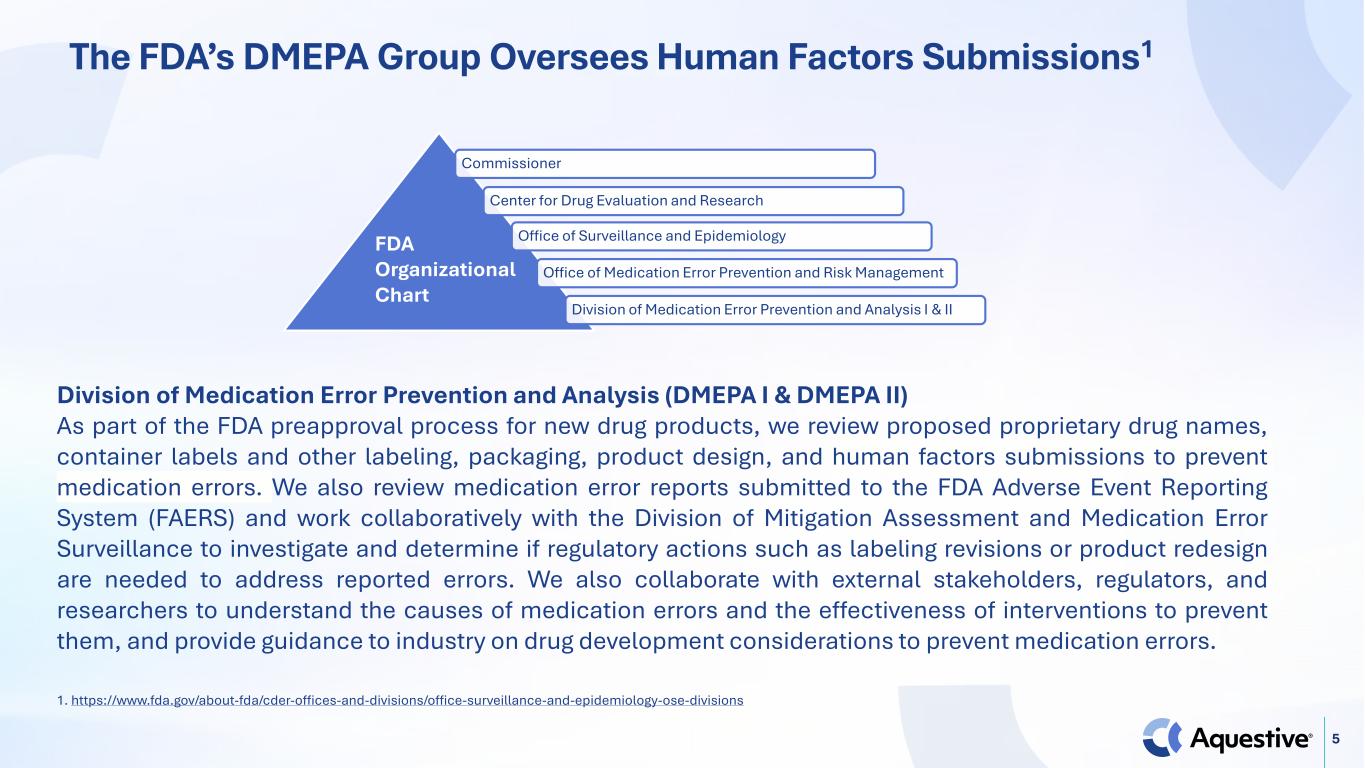
5 The FDA’s DMEPA Group Oversees Human Factors Submissions1 Commissioner Center for Drug Evaluation and Research Office of Surveillance and Epidemiology Office of Medication Error Prevention and Risk Management Division of Medication Error Prevention and Analysis I & II Division of Medication Error Prevention and Analysis (DMEPA I & DMEPA II) As part of the FDA preapproval process for new drug products, we review proposed proprietary drug names, container labels and other labeling, packaging, product design, and human factors submissions to prevent medication errors. We also review medication error reports submitted to the FDA Adverse Event Reporting System (FAERS) and work collaboratively with the Division of Mitigation Assessment and Medication Error Surveillance to investigate and determine if regulatory actions such as labeling revisions or product redesign are needed to address reported errors. We also collaborate with external stakeholders, regulators, and researchers to understand the causes of medication errors and the effectiveness of interventions to prevent them, and provide guidance to industry on drug development considerations to prevent medication errors. 1. https://www.fda.gov/about-fda/cder-offices-and-divisions/office-surveillance-and-epidemiology-ose-divisions FDA Organizational Chart
6 Human Factors Validation Testing Is Designed To Identify Potential “use errors”1 FDA definition of a use error User action or lack of action that was different from that expected by the manufacturer and caused a result that (1) was different from the result expected by the user and (2) was not caused solely by device failure and (3) did or could result in harm. Human factors validation testing is conducted to demonstrate that the device can be used by the intended users without serious use errors or problems, for the intended uses and under the expected use conditions. The testing should be comprehensive in scope, adequately sensitive to capture use errors caused by the design of the user interface and should be performed such that the results can be generalized to actual use. 1. https://www.fda.gov/media/80481/download
7 From the Anaphylm CRL, DMEPA Is Concerned About Specific Potential “human use errors”: 1. Difficulty opening the Anaphylm primary pouch 2. Potential for tearing the film while opening the pouch 3. Misplacement of the film on top of the tongue (instead of sublingually) 4. Premature removal of film 5. Improvements to Instructions for Use and other labeling
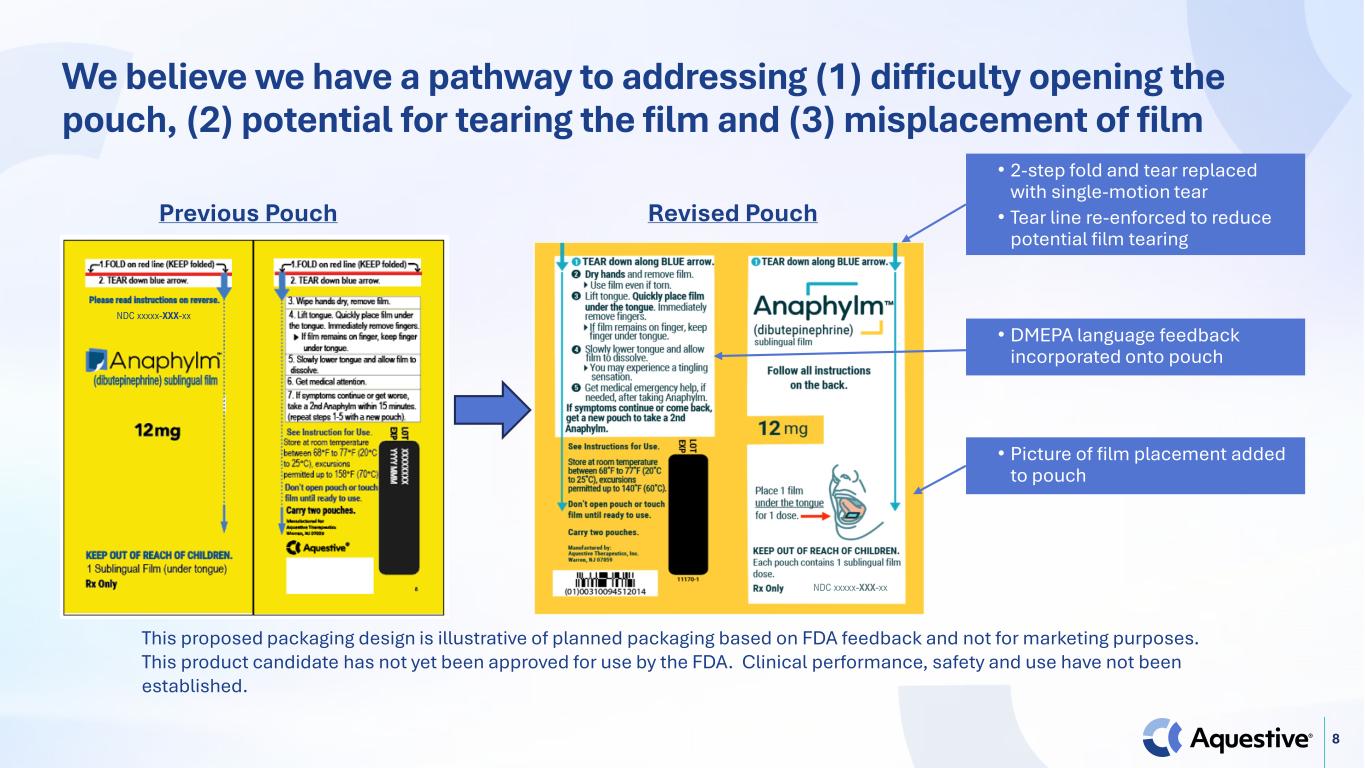
8 We believe we have a pathway to addressing (1) difficulty opening the pouch, (2) potential for tearing the film and (3) misplacement of film Previous Pouch Revised Pouch • 2-step fold and tear replaced with single-motion tear • Tear line re-enforced to reduce potential film tearing • Picture of film placement added to pouch • DMEPA language feedback incorporated onto pouch NDC xxxxx-XXX-xx NDC xxxxx-XXX-xx This proposed packaging design is illustrative of planned packaging based on FDA feedback and not for marketing purposes. This product candidate has not yet been approved for use by the FDA. Clinical performance, safety and use have not been established.
9 The remaining items (4) premature removal of film and (5) improvements to instructions for use will be covered through language revisions • Addition of “Do not remove Anaphylm” language • Confirmation via human factors validation study • Availability of practice demonstration strips to allow patients the opportunity to experience the product and flavor ahead of actual emergency use, if Anaphylm is approved by the FDA
10 DMEPA also indicated we should “(a)ddress potential tolerability use issues in your resubmission.” • Tolerability “use issues” in the human factors study were limited to 4 individuals (out of 166) in a low-risk, simulated use setting • 1 of the 4 participants noted, unprompted, that he “d[id] not like mint taste, but if I had to save my life, I would stick it there for like 10 minutes” • In a clinical setting, no individuals removed the film during dosing • Resubmission will include overview of tolerability issues associated with currently approved medical device epinephrine products
Pharmacokinetics Study
12 Given the potential “use errors”, FDA requested an additional pharmacokinetic (PK) study to understand the potential impact to PK under several scenarios The FDA requested 5 scenarios: 1. Chewing the film (both swallowing and no swallowing) 2. Alternate sites (i.e., top of tongue) 3. Self-administered with new instructions 4. Healthcare Provider-administered 5. Existing epinephrine injection product We believe scenarios #1 and #2 are informative and not approvability issues given this is off-label data Scenarios #3, #4, and #5 are repetitive to previous data generated by Aquestive which was in the original NDA submission
13 All subjects will be required to receive: • An FDA approved epinephrine injection product • Anaphylm administration by trained study staff Some subjects will also: • Use alternate Anaphylm site administration consistent with the CRL • Self-administer Anaphylm using updated product labeling • Using information from the HF validation study • Only Period 4 will incorporate self-administration Study Size: 48 to 60 Subjects Expected PK Study Design Period 1 Study Day 1 Randomized Anaphylm Administration Period 2 Study Day 2 Injectable Epi Administration Period 3 Study Day 15 Randomized Anaphylm Administration Period 4 Study Day 29 Randomized Anaphylm Administration
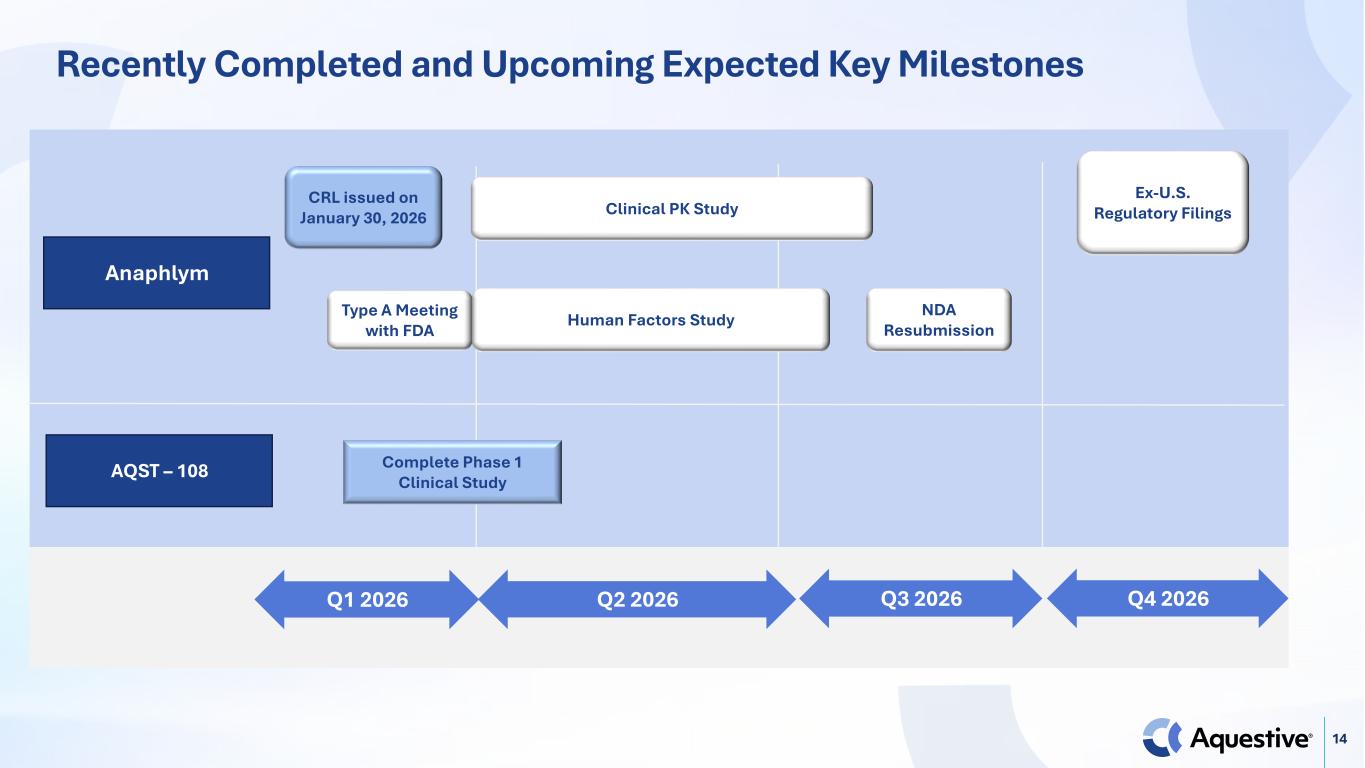
14 Recently Completed and Upcoming Expected Key Milestones AQST – 108 Q4 2026Q1 2026 Q2 2026 Q3 2026 Anaphlym CRL issued on January 30, 2026 Ex-U.S. Regulatory Filings Complete Phase 1 Clinical Study Type A Meeting with FDA NDA ResubmissionHuman Factors Study Clinical PK Study
Fourth Quarter 2025 Results
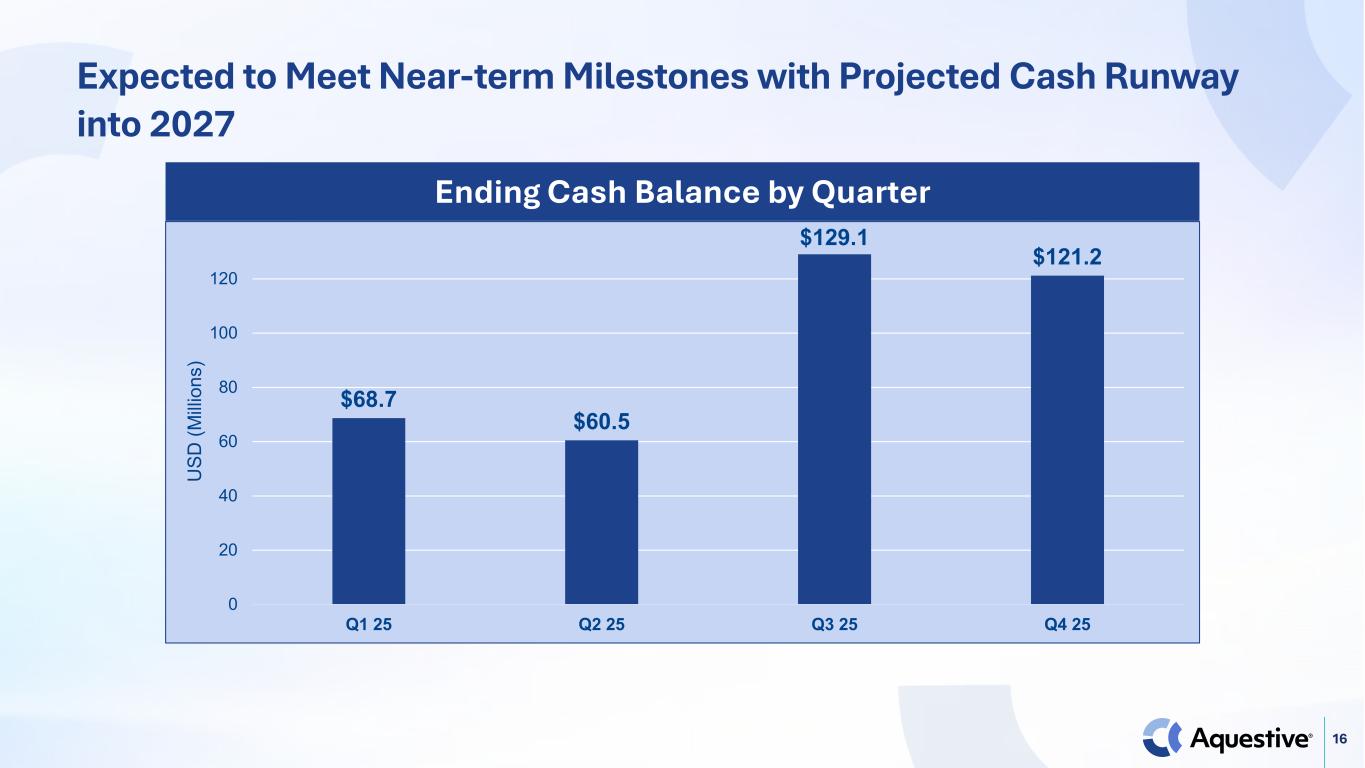
16 Expected to Meet Near-term Milestones with Projected Cash Runway into 2027 $68.7 $60.5 $129.1 $121.2 0 20 40 60 80 100 120 Q1 25 Q2 25 Q3 25 Q4 25 U SD (M illi on s) Ending Cash Balance by Quarter
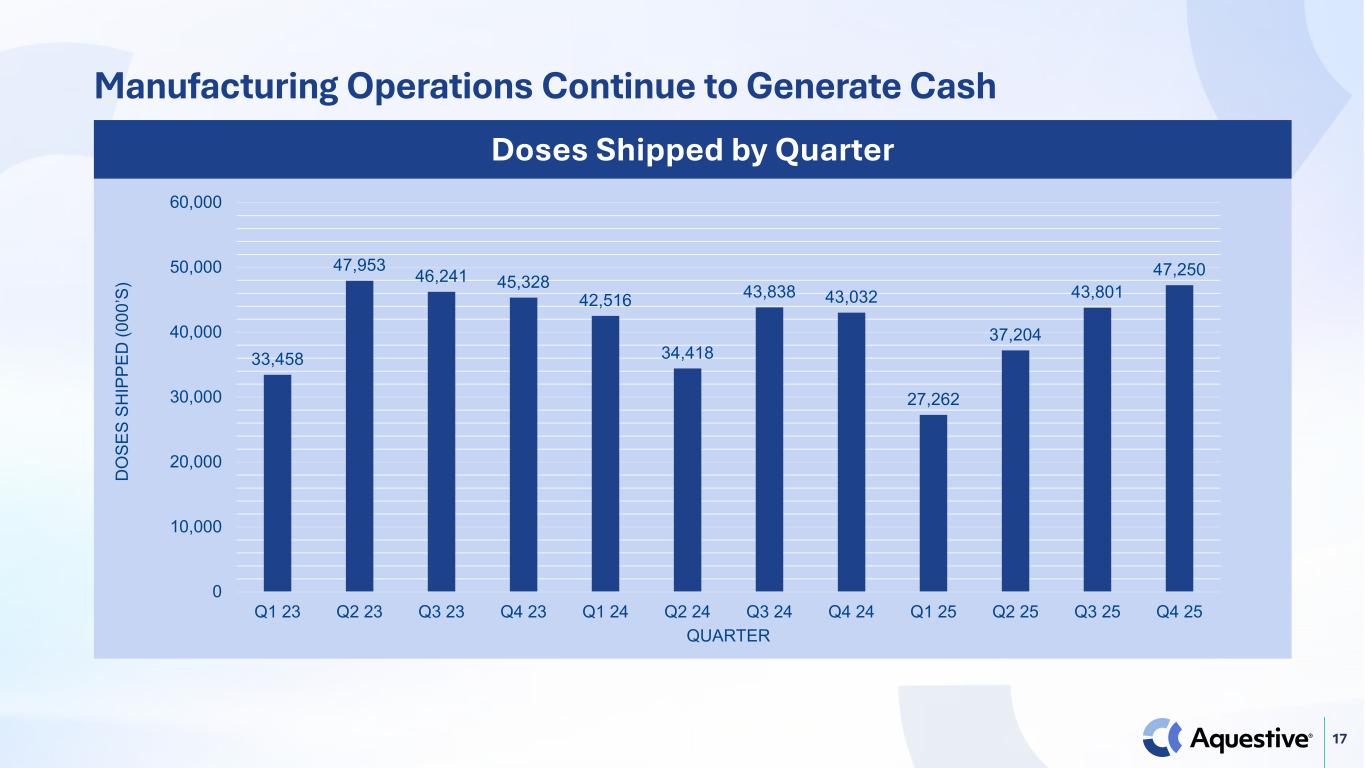
17 33,458 47,953 46,241 45,328 42,516 34,418 43,838 43,032 27,262 37,204 43,801 47,250 0 10,000 20,000 30,000 40,000 50,000 60,000 Q1 23 Q2 23 Q3 23 Q4 23 Q1 24 Q2 24 Q3 24 Q4 24 Q1 25 Q2 25 Q3 25 Q4 25 D O SE S SH IP PE D (0 00 ’S ) QUARTER Doses Shipped by Quarter Manufacturing Operations Continue to Generate Cash
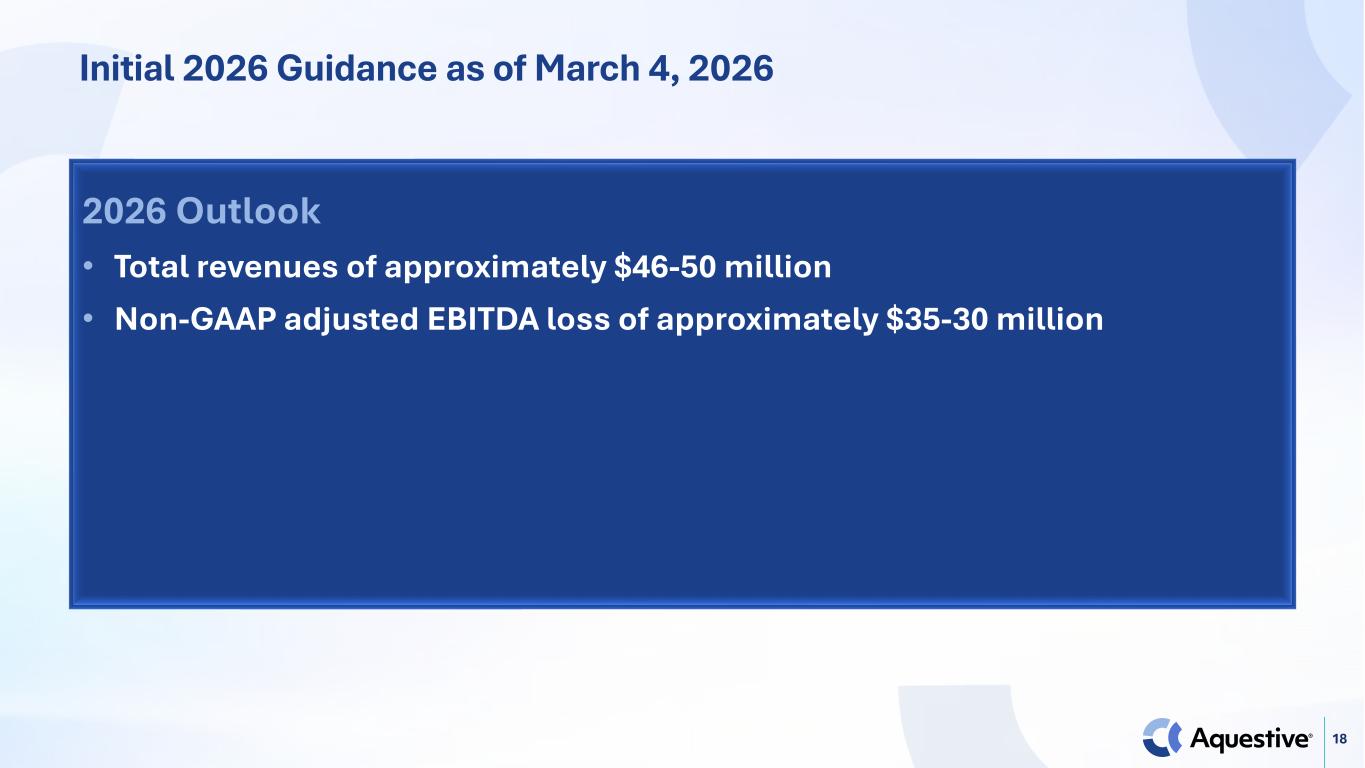
18 Initial 2026 Guidance as of March 4, 2026 2026 Outlook • Total revenues of approximately $46-50 million • Non-GAAP adjusted EBITDA loss of approximately $35-30 million

Thank You