West Fraser 2025 Annual Report YEARS
2025 Annual Report | 1 Contents Message From Our President and CEO: Navigating Today, Building Tomorrow 2 Welcome to West Fraser 4 About West Fraser 5 Business Strategy 5 West Fraser at 70: Built to Last 6 Our Operations 8 Mill Feature: Henderson, Texas 10 Our Products 12 Our Logistics 14 Financial Performance 16 Management’s Discussion and Analysis 18 2025 Audited Statements 90 Consolidated Financial Statements 91 Appendix 136 Directors and Officers 137 Glossary of Key Terms 138 Forward-Looking Statements 138 Corporate Information 139 Offices and Operations 139
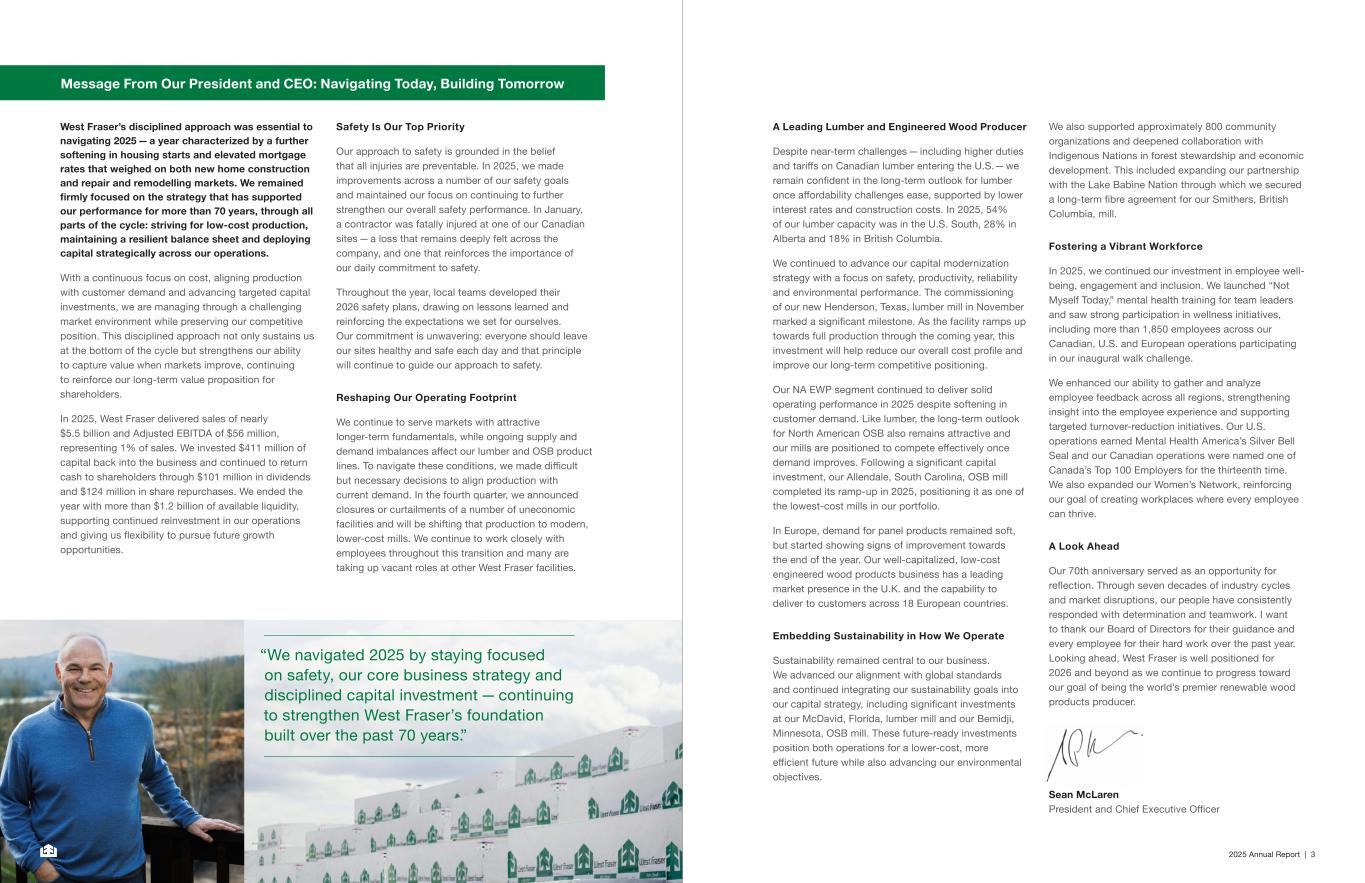
2025 Annual Report | 3 A Leading Lumber and Engineered Wood Producer Despite near-term challenges — including higher duties and tariffs on Canadian lumber entering the U.S. — we remain confident in the long-term outlook for lumber once affordability challenges ease, supported by lower interest rates and construction costs. In 2025, 54% of our lumber capacity was in the U.S. South, 28% in Alberta and 18% in British Columbia. We continued to advance our capital modernization strategy with a focus on safety, productivity, reliability and environmental performance. The commissioning of our new Henderson, Texas, lumber mill in November marked a significant milestone. As the facility ramps up towards full production through the coming year, this investment will help reduce our overall cost profile and improve our long-term competitive positioning. Our NA EWP segment continued to deliver solid operating performance in 2025 despite softening in customer demand. Like lumber, the long-term outlook for North American OSB also remains attractive and our mills are positioned to compete effectively once demand improves. Following a significant capital investment, our Allendale, South Carolina, OSB mill completed its ramp-up in 2025, positioning it as one of the lowest-cost mills in our portfolio. In Europe, demand for panel products remained soft, but started showing signs of improvement towards the end of the year. Our well-capitalized, low‑cost engineered wood products business has a leading market presence in the U.K. and the capability to deliver to customers across 18 European countries. Embedding Sustainability in How We Operate Sustainability remained central to our business. We advanced our alignment with global standards and continued integrating our sustainability goals into our capital strategy, including significant investments at our McDavid, Florida, lumber mill and our Bemidji, Minnesota, OSB mill. These future-ready investments position both operations for a lower-cost, more efficient future while also advancing our environmental objectives. We also supported approximately 800 community organizations and deepened collaboration with Indigenous Nations in forest stewardship and economic development. This included expanding our partnership with the Lake Babine Nation through which we secured a long-term fibre agreement for our Smithers, British Columbia, mill. Fostering a Vibrant Workforce In 2025, we continued our investment in employee well- being, engagement and inclusion. We launched “Not Myself Today,” mental health training for team leaders and saw strong participation in wellness initiatives, including more than 1,850 employees across our Canadian, U.S. and European operations participating in our inaugural walk challenge. We enhanced our ability to gather and analyze employee feedback across all regions, strengthening insight into the employee experience and supporting targeted turnover-reduction initiatives. Our U.S. operations earned Mental Health America’s Silver Bell Seal and our Canadian operations were named one of Canada’s Top 100 Employers for the thirteenth time. We also expanded our Women’s Network, reinforcing our goal of creating workplaces where every employee can thrive. A Look Ahead Our 70th anniversary served as an opportunity for reflection. Through seven decades of industry cycles and market disruptions, our people have consistently responded with determination and teamwork. I want to thank our Board of Directors for their guidance and every employee for their hard work over the past year. Looking ahead, West Fraser is well positioned for 2026 and beyond as we continue to progress toward our goal of being the world’s premier renewable wood products producer. Sean McLaren President and Chief Executive Officer West Fraser’s disciplined approach was essential to navigating 2025 — a year characterized by a further softening in housing starts and elevated mortgage rates that weighed on both new home construction and repair and remodelling markets. We remained firmly focused on the strategy that has supported our performance for more than 70 years, through all parts of the cycle: striving for low-cost production, maintaining a resilient balance sheet and deploying capital strategically across our operations. With a continuous focus on cost, aligning production with customer demand and advancing targeted capital investments, we are managing through a challenging market environment while preserving our competitive position. This disciplined approach not only sustains us at the bottom of the cycle but strengthens our ability to capture value when markets improve, continuing to reinforce our long-term value proposition for shareholders. In 2025, West Fraser delivered sales of nearly $5.5 billion and Adjusted EBITDA of $56 million, representing 1% of sales. We invested $411 million of capital back into the business and continued to return cash to shareholders through $101 million in dividends and $124 million in share repurchases. We ended the year with more than $1.2 billion of available liquidity, supporting continued reinvestment in our operations and giving us flexibility to pursue future growth opportunities. Safety Is Our Top Priority Our approach to safety is grounded in the belief that all injuries are preventable. In 2025, we made improvements across a number of our safety goals and maintained our focus on continuing to further strengthen our overall safety performance. In January, a contractor was fatally injured at one of our Canadian sites — a loss that remains deeply felt across the company, and one that reinforces the importance of our daily commitment to safety. Throughout the year, local teams developed their 2026 safety plans, drawing on lessons learned and reinforcing the expectations we set for ourselves. Our commitment is unwavering: everyone should leave our sites healthy and safe each day and that principle will continue to guide our approach to safety. Reshaping Our Operating Footprint We continue to serve markets with attractive longer‑term fundamentals, while ongoing supply and demand imbalances affect our lumber and OSB product lines. To navigate these conditions, we made difficult but necessary decisions to align production with current demand. In the fourth quarter, we announced closures or curtailments of a number of uneconomic facilities and will be shifting that production to modern, lower‑cost mills. We continue to work closely with employees throughout this transition and many are taking up vacant roles at other West Fraser facilities. Message From Our President and CEO: Navigating Today, Building Tomorrow “We navigated 2025 by staying focused on safety, our core business strategy and disciplined capital investment — continuing to strengthen West Fraser’s foundation built over the past 70 years.”
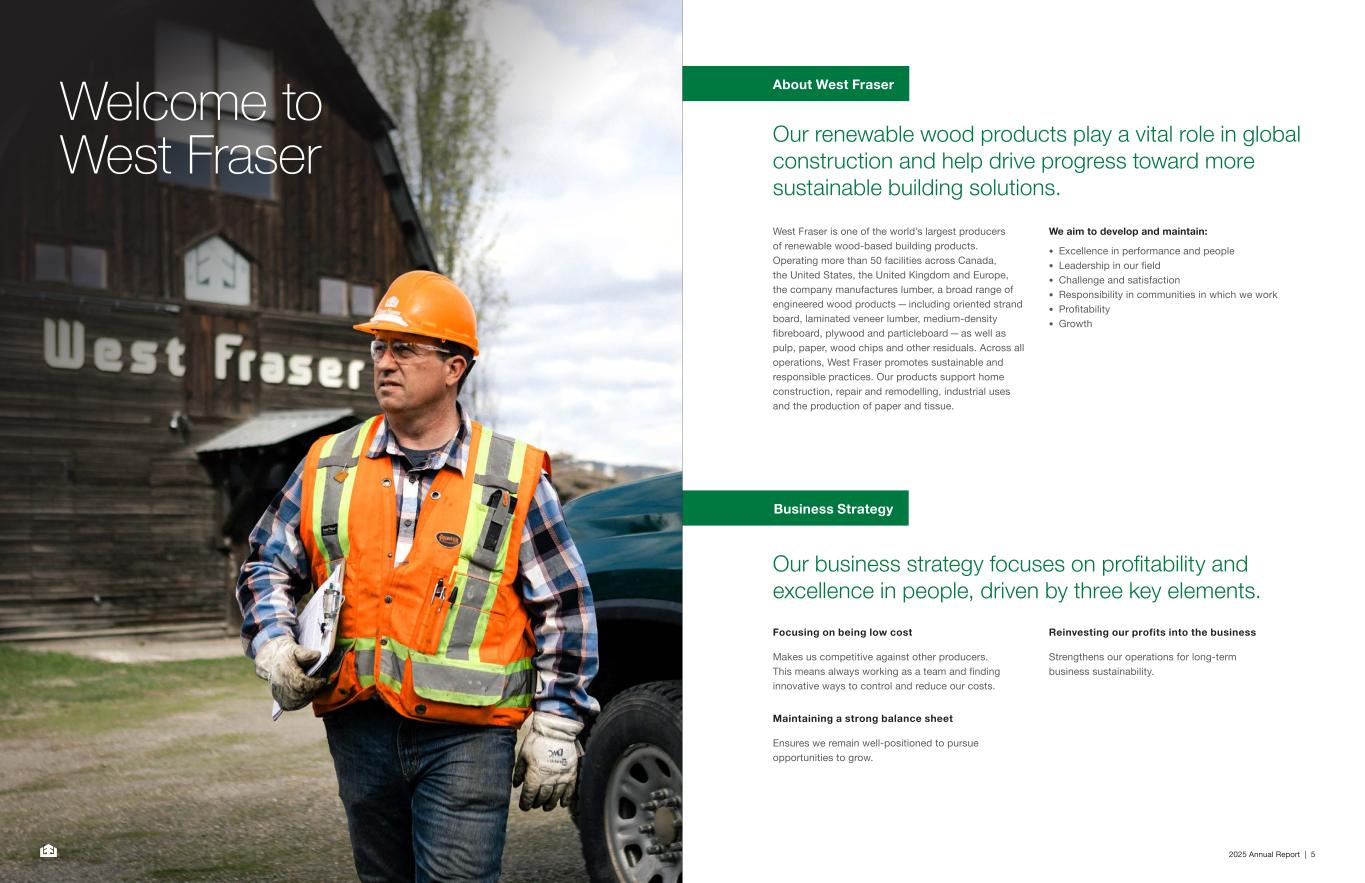
2025 Annual Report | 5 Our renewable wood products play a vital role in global construction and help drive progress toward more sustainable building solutions. West Fraser is one of the world’s largest producers of renewable wood-based building products. Operating more than 50 facilities across Canada, the United States, the United Kingdom and Europe, the company manufactures lumber, a broad range of engineered wood products — including oriented strand board, laminated veneer lumber, medium-density fibreboard, plywood and particleboard — as well as pulp, paper, wood chips and other residuals. Across all operations, West Fraser promotes sustainable and responsible practices. Our products support home construction, repair and remodelling, industrial uses and the production of paper and tissue. We aim to develop and maintain: • Excellence in performance and people • Leadership in our field • Challenge and satisfaction • Responsibility in communities in which we work • Profitability • Growth Our business strategy focuses on profitability and excellence in people, driven by three key elements. Focusing on being low cost Makes us competitive against other producers. This means always working as a team and finding innovative ways to control and reduce our costs. Maintaining a strong balance sheet Ensures we remain well‑positioned to pursue opportunities to grow. Reinvesting our profits into the business Strengthens our operations for long-term business sustainability. About West FraserWelcome to West Fraser Business Strategy
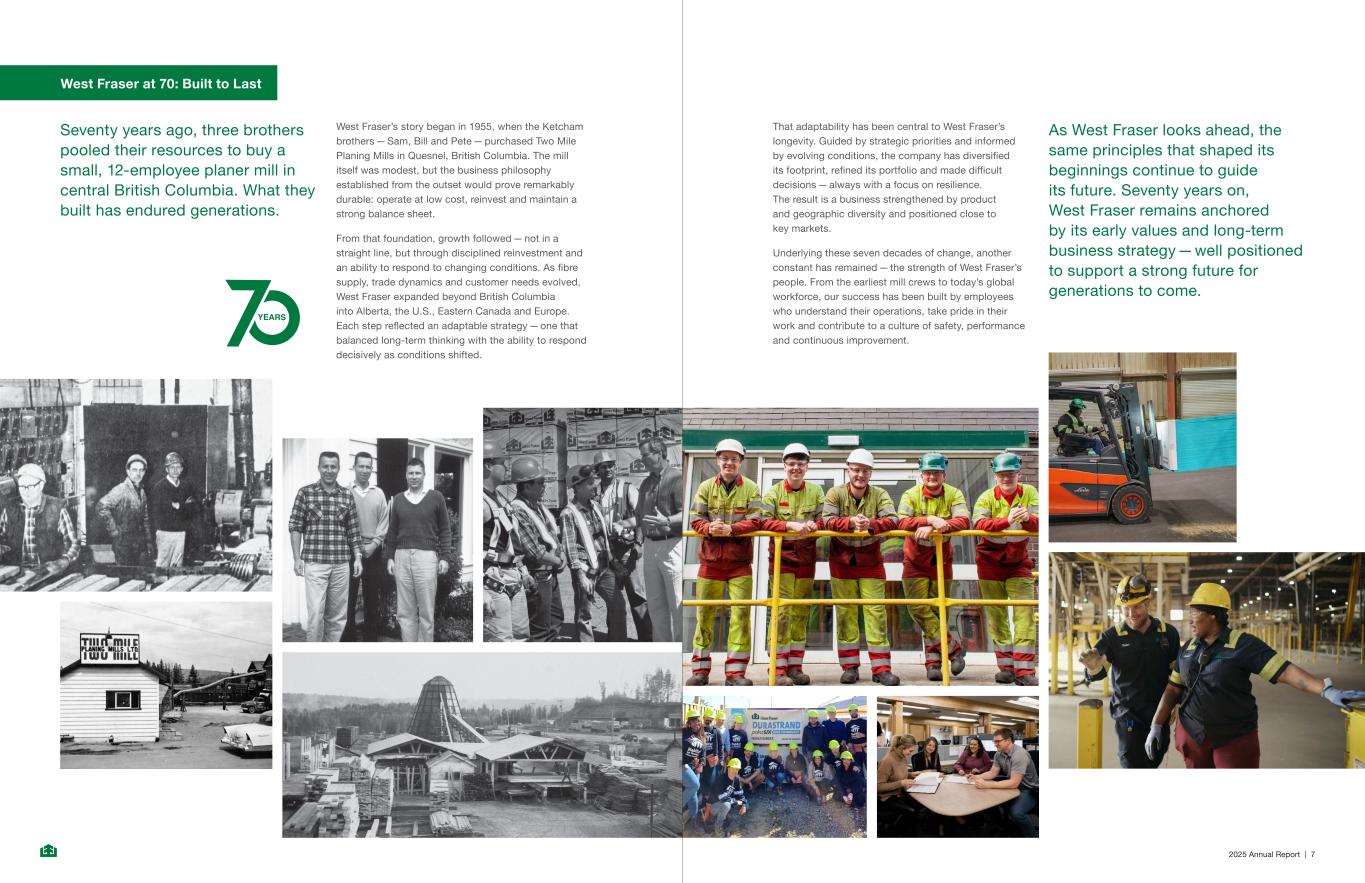
YEARS 2025 Annual Report | 7 West Fraser at 70: Built to Last Seventy years ago, three brothers pooled their resources to buy a small, 12-employee planer mill in central British Columbia. What they built has endured generations. West Fraser’s story began in 1955, when the Ketcham brothers — Sam, Bill and Pete — purchased Two Mile Planing Mills in Quesnel, British Columbia. The mill itself was modest, but the business philosophy established from the outset would prove remarkably durable: operate at low cost, reinvest and maintain a strong balance sheet. From that foundation, growth followed — not in a straight line, but through disciplined reinvestment and an ability to respond to changing conditions. As fibre supply, trade dynamics and customer needs evolved, West Fraser expanded beyond British Columbia into Alberta, the U.S., Eastern Canada and Europe. Each step reflected an adaptable strategy — one that balanced long-term thinking with the ability to respond decisively as conditions shifted. That adaptability has been central to West Fraser’s longevity. Guided by strategic priorities and informed by evolving conditions, the company has diversified its footprint, refined its portfolio and made difficult decisions — always with a focus on resilience. The result is a business strengthened by product and geographic diversity and positioned close to key markets. Underlying these seven decades of change, another constant has remained — the strength of West Fraser’s people. From the earliest mill crews to today’s global workforce, our success has been built by employees who understand their operations, take pride in their work and contribute to a culture of safety, performance and continuous improvement. As West Fraser looks ahead, the same principles that shaped its beginnings continue to guide its future. Seventy years on, West Fraser remains anchored by its early values and long‑term business strategy — well positioned to support a strong future for generations to come.
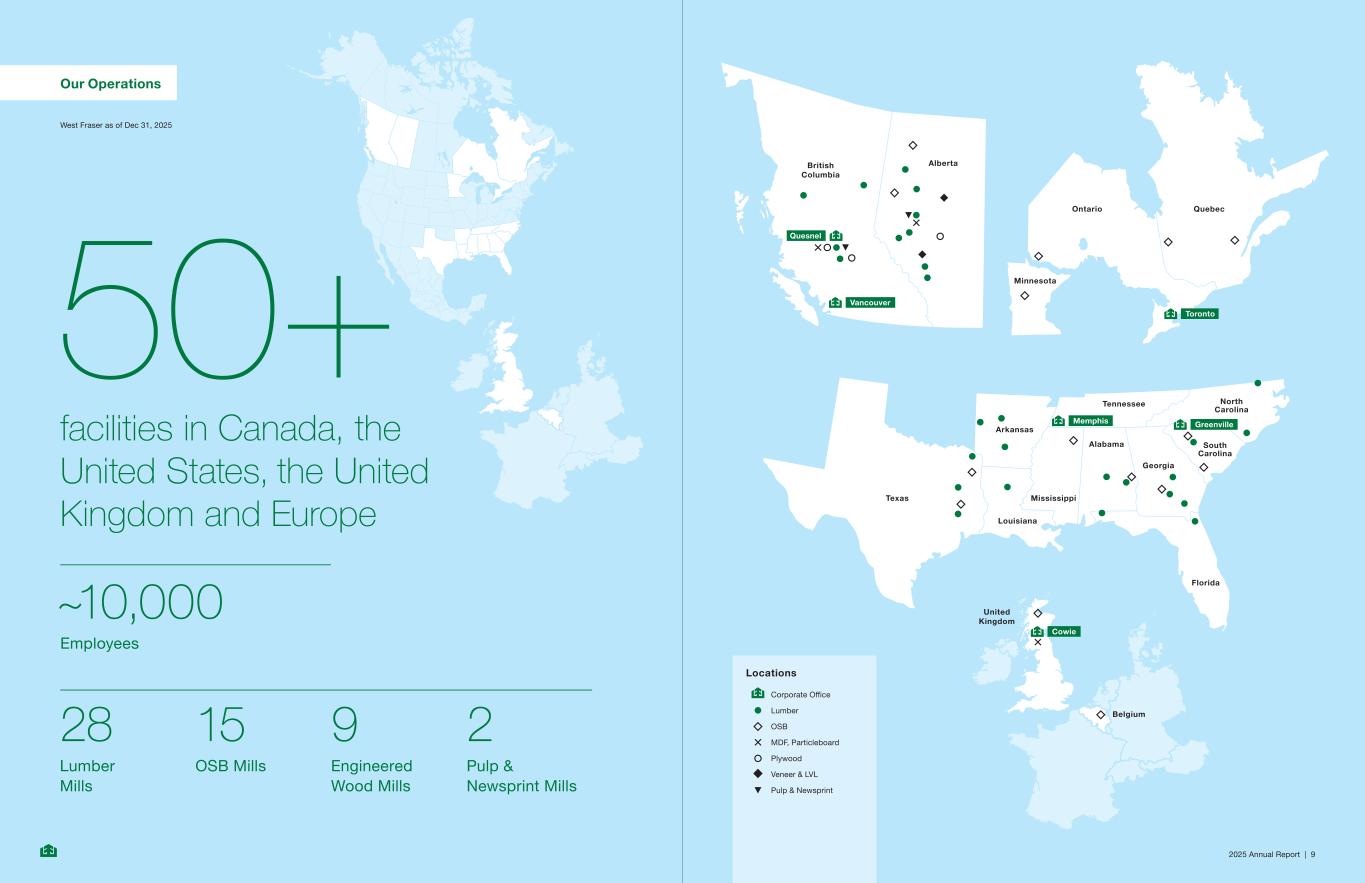
2025 Annual Report | 9 Quesnel Vancouver British Columbia Alberta Toronto Ontario Minnesota Quebec Memphis Greenville Texas Arkansas Louisiana Mississippi Tennessee Alabama Florida Georgia South Carolina North Carolina Cowie United Kingdom Belgium Locations Corporate Office Lumber OSB MDF, Particleboard Plywood Veneer & LVL Pulp & Newsprint 28 Lumber Mills 15 OSB Mills 9 Engineered Wood Mills 2 Pulp & Newsprint Mills ~10,000 Employees Our Operations 50+ facilities in Canada, the United States, the United Kingdom and Europe West Fraser as of Dec 31, 2025
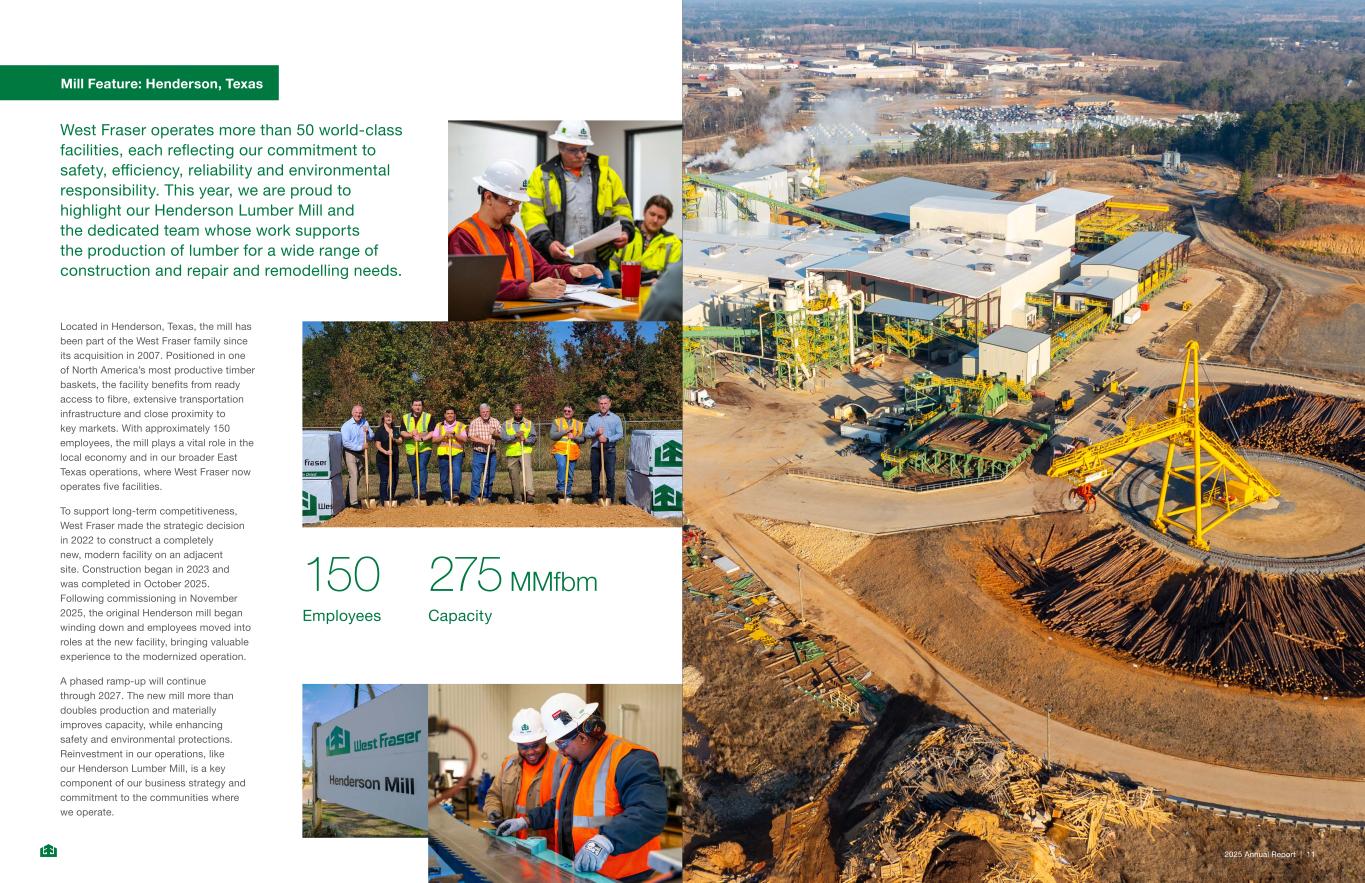
2025 Annual Report | 11 Mill Feature: Henderson, Texas West Fraser operates more than 50 world-class facilities, each reflecting our commitment to safety, efficiency, reliability and environmental responsibility. This year, we are proud to highlight our Henderson Lumber Mill and the dedicated team whose work supports the production of lumber for a wide range of construction and repair and remodelling needs. Located in Henderson, Texas, the mill has been part of the West Fraser family since its acquisition in 2007. Positioned in one of North America’s most productive timber baskets, the facility benefits from ready access to fibre, extensive transportation infrastructure and close proximity to key markets. With approximately 150 employees, the mill plays a vital role in the local economy and in our broader East Texas operations, where West Fraser now operates five facilities. To support long-term competitiveness, West Fraser made the strategic decision in 2022 to construct a completely new, modern facility on an adjacent site. Construction began in 2023 and was completed in October 2025. Following commissioning in November 2025, the original Henderson mill began winding down and employees moved into roles at the new facility, bringing valuable experience to the modernized operation. A phased ramp-up will continue through 2027. The new mill more than doubles production and materially improves capacity, while enhancing safety and environmental protections. Reinvestment in our operations, like our Henderson Lumber Mill, is a key component of our business strategy and commitment to the communities where we operate. 150 Employees 275 MMfbm Capacity
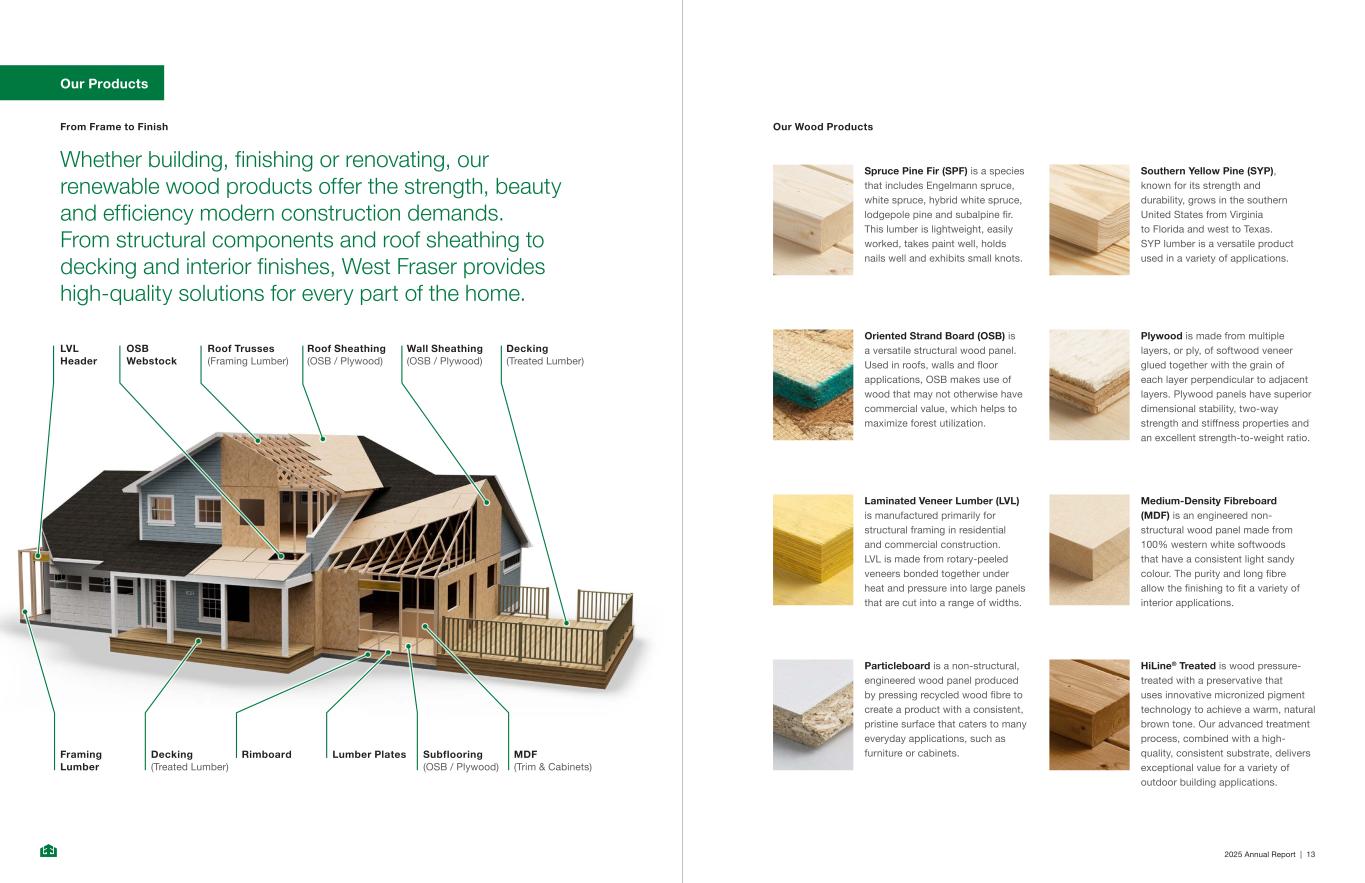
LVL Header Framing Lumber OSB Webstock Decking (Treated Lumber) Roof Trusses (Framing Lumber) Rimboard Roof Sheathing (OSB / Plywood) Lumber Plates Wall Sheathing (OSB / Plywood) Decking (Treated Lumber) Subflooring (OSB / Plywood) MDF (Trim & Cabinets) 2025 Annual Report | 13 Our Wood Products Spruce Pine Fir (SPF) is a species that includes Engelmann spruce, white spruce, hybrid white spruce, lodgepole pine and subalpine fir. This lumber is lightweight, easily worked, takes paint well, holds nails well and exhibits small knots. Plywood is made from multiple layers, or ply, of softwood veneer glued together with the grain of each layer perpendicular to adjacent layers. Plywood panels have superior dimensional stability, two-way strength and stiffness properties and an excellent strength-to-weight ratio. Particleboard is a non-structural, engineered wood panel produced by pressing recycled wood fibre to create a product with a consistent, pristine surface that caters to many everyday applications, such as furniture or cabinets. HiLine® Treated is wood pressure- treated with a preservative that uses innovative micronized pigment technology to achieve a warm, natural brown tone. Our advanced treatment process, combined with a high- quality, consistent substrate, delivers exceptional value for a variety of outdoor building applications. Oriented Strand Board (OSB) is a versatile structural wood panel. Used in roofs, walls and floor applications, OSB makes use of wood that may not otherwise have commercial value, which helps to maximize forest utilization. Medium-Density Fibreboard (MDF) is an engineered non- structural wood panel made from 100% western white softwoods that have a consistent light sandy colour. The purity and long fibre allow the finishing to fit a variety of interior applications. Southern Yellow Pine (SYP), known for its strength and durability, grows in the southern United States from Virginia to Florida and west to Texas. SYP lumber is a versatile product used in a variety of applications. Laminated Veneer Lumber (LVL) is manufactured primarily for structural framing in residential and commercial construction. LVL is made from rotary-peeled veneers bonded together under heat and pressure into large panels that are cut into a range of widths. From Frame to Finish Whether building, finishing or renovating, our renewable wood products offer the strength, beauty and efficiency modern construction demands. From structural components and roof sheathing to decking and interior finishes, West Fraser provides high‑quality solutions for every part of the home. Our Products
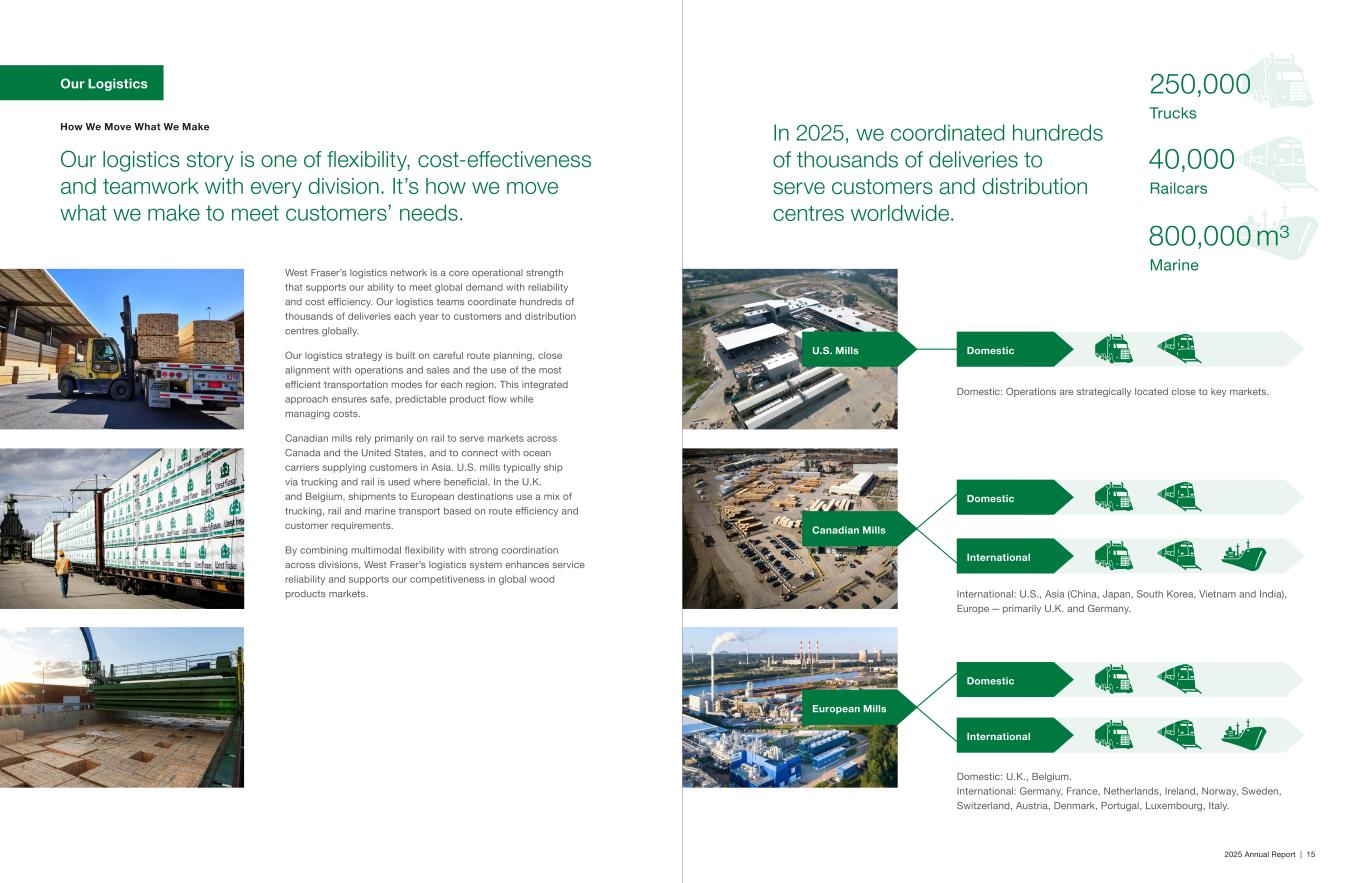
2025 Annual Report | 15 How We Move What We Make Our logistics story is one of flexibility, cost‑effectiveness and teamwork with every division. It’s how we move what we make to meet customers’ needs. In 2025, we coordinated hundreds of thousands of deliveries to serve customers and distribution centres worldwide. West Fraser’s logistics network is a core operational strength that supports our ability to meet global demand with reliability and cost efficiency. Our logistics teams coordinate hundreds of thousands of deliveries each year to customers and distribution centres globally. Our logistics strategy is built on careful route planning, close alignment with operations and sales and the use of the most efficient transportation modes for each region. This integrated approach ensures safe, predictable product flow while managing costs. Canadian mills rely primarily on rail to serve markets across Canada and the United States, and to connect with ocean carriers supplying customers in Asia. U.S. mills typically ship via trucking and rail is used where beneficial. In the U.K. and Belgium, shipments to European destinations use a mix of trucking, rail and marine transport based on route efficiency and customer requirements. By combining multimodal flexibility with strong coordination across divisions, West Fraser’s logistics system enhances service reliability and supports our competitiveness in global wood products markets. 250,000 Trucks 40,000 Railcars 800,000 m³ Marine Domestic International Domestic International Domestic Domestic: Operations are strategically located close to key markets. International: U.S., Asia (China, Japan, South Korea, Vietnam and India), Europe — primarily U.K. and Germany. Domestic: U.K., Belgium. International: Germany, France, Netherlands, Ireland, Norway, Sweden, Switzerland, Austria, Denmark, Portugal, Luxembourg, Italy. Our Logistics U.S. Mills Canadian Mills European Mills
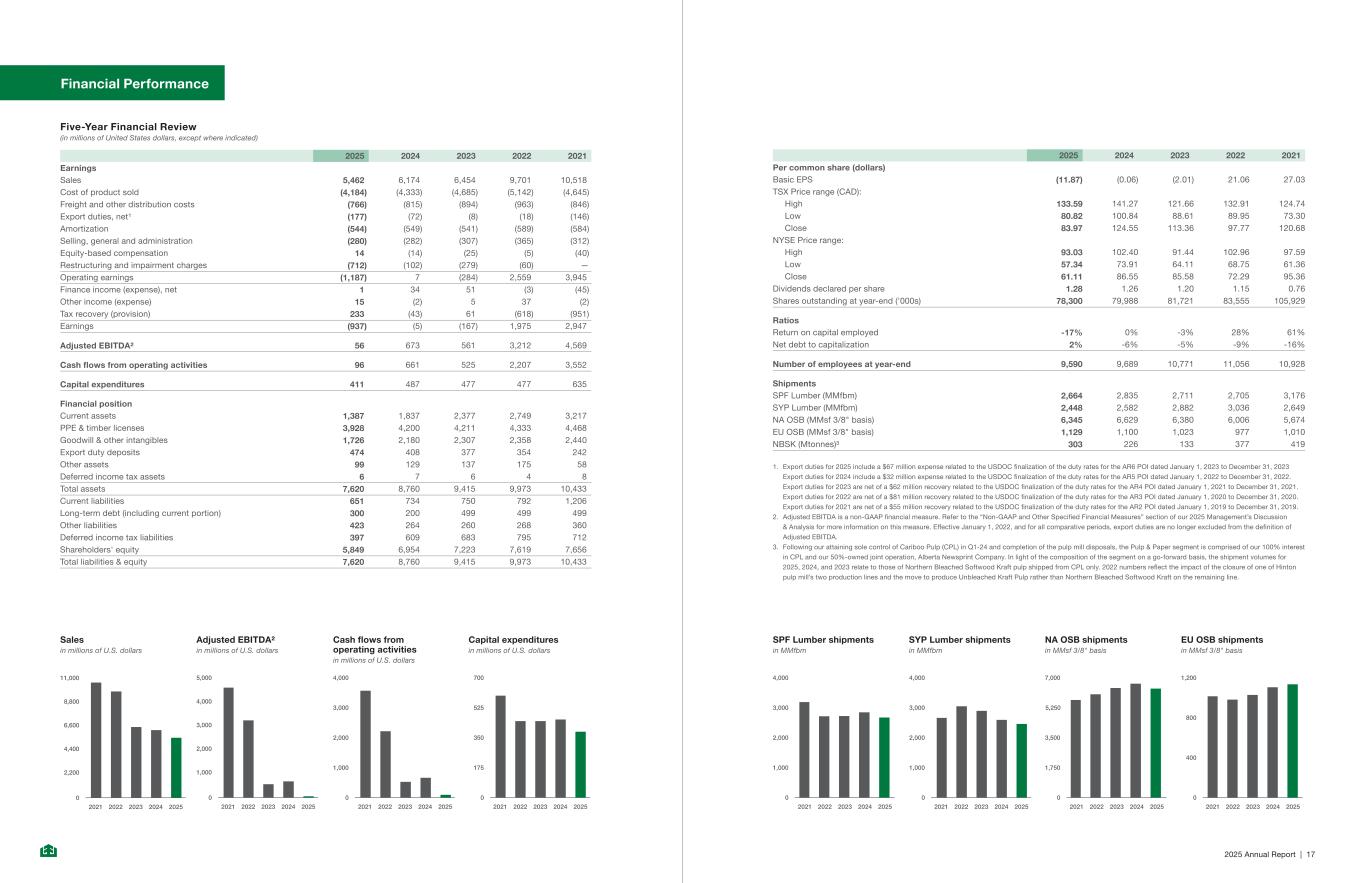
2025 Annual Report | 17 2025 2024 2023 2022 2021 Per common share (dollars) Basic EPS (11.87) (0.06) (2.01) 21.06 27.03 TSX Price range (CAD): High 133.59 141.27 121.66 132.91 124.74 Low 80.82 100.84 88.61 89.95 73.30 Close 83.97 124.55 113.36 97.77 120.68 NYSE Price range: High 93.03 102.40 91.44 102.96 97.59 Low 57.34 73.91 64.11 68.75 61.36 Close 61.11 86.55 85.58 72.29 95.36 Dividends declared per share 1.28 1.26 1.20 1.15 0.76 Shares outstanding at year-end ('000s) 78,300 79,988 81,721 83,555 105,929 Ratios Return on capital employed -17% 0% -3% 28% 61% Net debt to capitalization 2% -6% -5% -9% -16% Number of employees at year-end 9,590 9,689 10,771 11,056 10,928 Shipments SPF Lumber (MMfbm) 2,664 2,835 2,711 2,705 3,176 SYP Lumber (MMfbm) 2,448 2,582 2,882 3,036 2,649 NA OSB (MMsf 3/8" basis) 6,345 6,629 6,380 6,006 5,674 EU OSB (MMsf 3/8" basis) 1,129 1,100 1,023 977 1,010 NBSK (Mtonnes)³ 303 226 133 377 419 1. Export duties for 2025 include a $67 million expense related to the USDOC finalization of the duty rates for the AR6 POI dated January 1, 2023 to December 31, 2023 Export duties for 2024 include a $32 million expense related to the USDOC finalization of the duty rates for the AR5 POI dated January 1, 2022 to December 31, 2022. Export duties for 2023 are net of a $62 million recovery related to the USDOC finalization of the duty rates for the AR4 POI dated January 1, 2021 to December 31, 2021. Export duties for 2022 are net of a $81 million recovery related to the USDOC finalization of the duty rates for the AR3 POI dated January 1, 2020 to December 31, 2020. Export duties for 2021 are net of a $55 million recovery related to the USDOC finalization of the duty rates for the AR2 POI dated January 1, 2019 to December 31, 2019. 2. Adjusted EBITDA is a non-GAAP financial measure. Refer to the “Non-GAAP and Other Specified Financial Measures” section of our 2025 Management’s Discussion & Analysis for more information on this measure. Effective January 1, 2022, and for all comparative periods, export duties are no longer excluded from the definition of Adjusted EBITDA. 3. Following our attaining sole control of Cariboo Pulp (CPL) in Q1-24 and completion of the pulp mill disposals, the Pulp & Paper segment is comprised of our 100% interest in CPL and our 50%-owned joint operation, Alberta Newsprint Company. In light of the composition of the segment on a go-forward basis, the shipment volumes for 2025, 2024, and 2023 relate to those of Northern Bleached Softwood Kraft pulp shipped from CPL only. 2022 numbers reflect the impact of the closure of one of Hinton pulp mill’s two production lines and the move to produce Unbleached Kraft Pulp rather than Northern Bleached Softwood Kraft on the remaining line. SPF Lumber shipments in MMfbm SYP Lumber shipments in MMfbm NA OSB shipments in MMsf 3/8" basis EU OSB shipments in MMsf 3/8" basis 4,000 3,000 5,250 2,000 1,000 0 2021 2022 2023 2024 2025 4,000 3,000 2,000 1,000 0 2021 2022 2023 2024 2025 7,000 3,500 1,750 0 2021 2022 2023 2024 2025 1,200 800 400 0 2021 2022 2023 2024 2025 Financial Performance Five-Year Financial Review (in millions of United States dollars, except where indicated) 2025 2024 2023 2022 2021 Earnings Sales 5,462 6,174 6,454 9,701 10,518 Cost of product sold (4,184) (4,333) (4,685) (5,142) (4,645) Freight and other distribution costs (766) (815) (894) (963) (846) Export duties, net¹ (177) (72) (8) (18) (146) Amortization (544) (549) (541) (589) (584) Selling, general and administration (280) (282) (307) (365) (312) Equity-based compensation 14 (14) (25) (5) (40) Restructuring and impairment charges (712) (102) (279) (60) — Operating earnings (1,187) 7 (284) 2,559 3,945 Finance income (expense), net 1 34 51 (3) (45) Other income (expense) 15 (2) 5 37 (2) Tax recovery (provision) 233 (43) 61 (618) (951) Earnings (937) (5) (167) 1,975 2,947 Adjusted EBITDA² 56 673 561 3,212 4,569 Cash flows from operating activities 96 661 525 2,207 3,552 Capital expenditures 411 487 477 477 635 Financial position Current assets 1,387 1,837 2,377 2,749 3,217 PPE & timber licenses 3,928 4,200 4,211 4,333 4,468 Goodwill & other intangibles 1,726 2,180 2,307 2,358 2,440 Export duty deposits 474 408 377 354 242 Other assets 99 129 137 175 58 Deferred income tax assets 6 7 6 4 8 Total assets 7,620 8,760 9,415 9,973 10,433 Current liabilities 651 734 750 792 1,206 Long-term debt (including current portion) 300 200 499 499 499 Other liabilities 423 264 260 268 360 Deferred income tax liabilities 397 609 683 795 712 Shareholders' equity 5,849 6,954 7,223 7,619 7,656 Total liabilities & equity 7,620 8,760 9,415 9,973 10,433 Adjusted EBITDA² in millions of U.S. dollars Capital expenditures in millions of U.S. dollars Sales in millions of U.S. dollars Cash flows from operating activities in millions of U.S. dollars 5,000 70011,000 4,000 525 8,800 4,000 3,000 350 6,600 3,000 2,000 175 4,400 2,000 1,0002,200 1,000 0 00 0 2021 20212021 20212022 20222022 20222023 20232023 20232024 20242024 20242025 20252025 2025
2025 Annual Report | 19 Management’s Discussion and Analysis
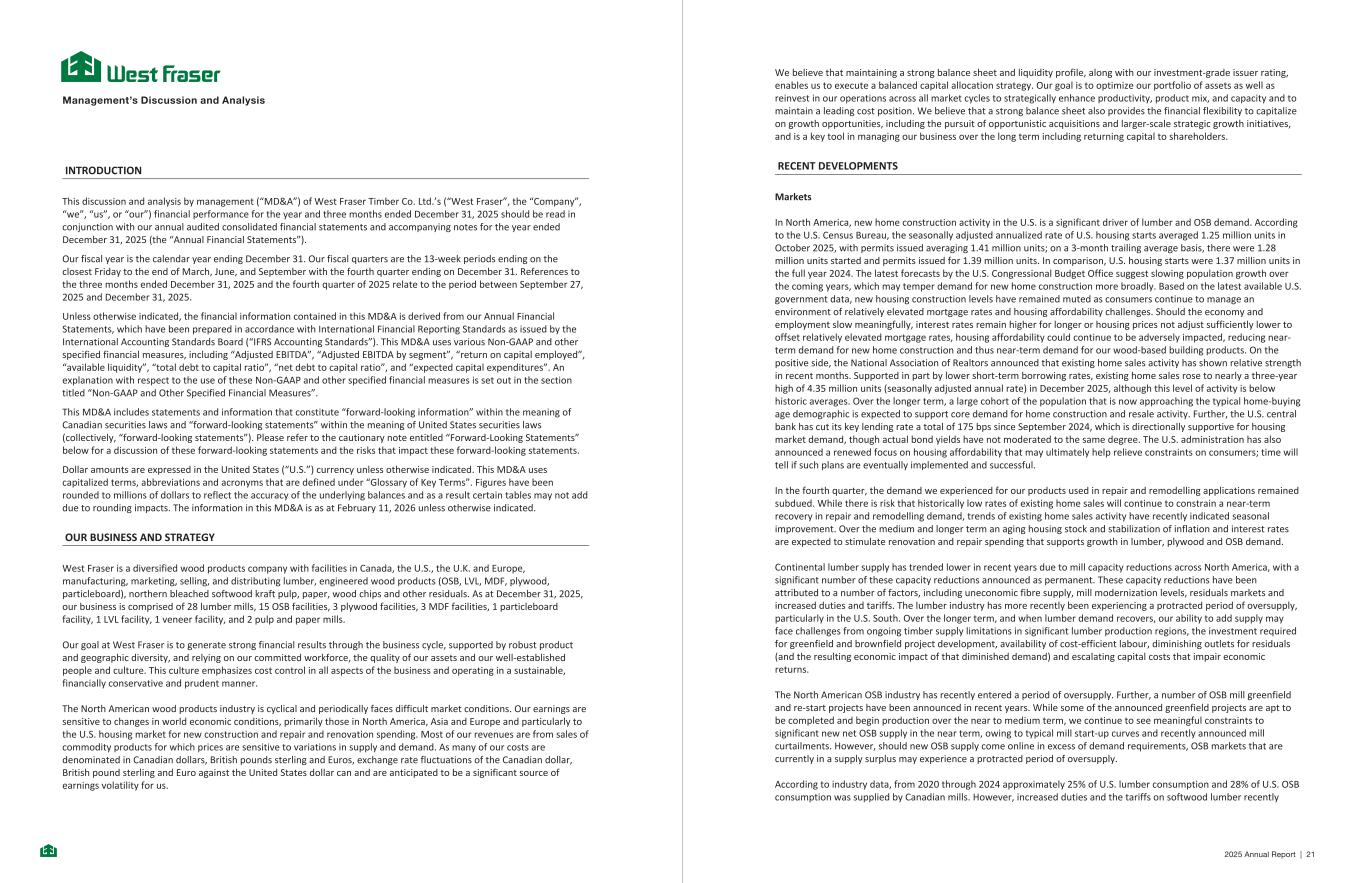
MANAGEMENT’S DISCUSSION & ANALYSIS INTRODUCTION This discussion and analysis by management (“MD&A”) of West Fraser Timber Co. Ltd.’s (“West Fraser”, the “Company”, “we”, “us”, or “our”) financial performance for the year and three months ended December 31, 2025 should be read in conjunction with our annual audited consolidated financial statements and accompanying notes for the year ended December 31, 2025 (the “Annual Financial Statements”). Our fiscal year is the calendar year ending December 31. Our fiscal quarters are the 13-week periods ending on the closest Friday to the end of March, June, and September with the fourth quarter ending on December 31. References to the three months ended December 31, 2025 and the fourth quarter of 2025 relate to the period between September 27, 2025 and December 31, 2025. Unless otherwise indicated, the financial information contained in this MD&A is derived from our Annual Financial Statements, which have been prepared in accordance with International Financial Reporting Standards as issued by the International Accounting Standards Board (“IFRS Accounting Standards”). This MD&A uses various Non-GAAP and other specified financial measures, including “Adjusted EBITDA”, “Adjusted EBITDA by segment”, “return on capital employed”, “available liquidity”, “total debt to capital ratio”, “net debt to capital ratio”, and “expected capital expenditures”. An explanation with respect to the use of these Non-GAAP and other specified financial measures is set out in the section titled “Non-GAAP and Other Specified Financial Measures”. This MD&A includes statements and information that constitute “forward-looking information” within the meaning of Canadian securities laws and “forward-looking statements” within the meaning of United States securities laws (collectively, “forward-looking statements”). Please refer to the cautionary note entitled “Forward-Looking Statements” below for a discussion of these forward-looking statements and the risks that impact these forward-looking statements. Dollar amounts are expressed in the United States (“U.S.”) currency unless otherwise indicated. This MD&A uses capitalized terms, abbreviations and acronyms that are defined under “Glossary of Key Terms”. Figures have been rounded to millions of dollars to reflect the accuracy of the underlying balances and as a result certain tables may not add due to rounding impacts. The information in this MD&A is as at February 11, 2026 unless otherwise indicated. OUR BUSINESS AND STRATEGY West Fraser is a diversified wood products company with facilities in Canada, the U.S., the U.K. and Europe, manufacturing, marketing, selling, and distributing lumber, engineered wood products (OSB, LVL, MDF, plywood, particleboard), northern bleached softwood kraft pulp, paper, wood chips and other residuals. As at December 31, 2025, our business is comprised of 28 lumber mills, 15 OSB facilities, 3 plywood facilities, 3 MDF facilities, 1 particleboard facility, 1 LVL facility, 1 veneer facility, and 2 pulp and paper mills. Our goal at West Fraser is to generate strong financial results through the business cycle, supported by robust product and geographic diversity, and relying on our committed workforce, the quality of our assets and our well-established people and culture. This culture emphasizes cost control in all aspects of the business and operating in a sustainable, financially conservative and prudent manner. The North American wood products industry is cyclical and periodically faces difficult market conditions. Our earnings are sensitive to changes in world economic conditions, primarily those in North America, Asia and Europe and particularly to the U.S. housing market for new construction and repair and renovation spending. Most of our revenues are from sales of commodity products for which prices are sensitive to variations in supply and demand. As many of our costs are denominated in Canadian dollars, British pounds sterling and Euros, exchange rate fluctuations of the Canadian dollar, British pound sterling and Euro against the United States dollar can and are anticipated to be a significant source of earnings volatility for us. - 1 - We believe that maintaining a strong balance sheet and liquidity profile, along with our investment-grade issuer rating, enables us to execute a balanced capital allocation strategy. Our goal is to optimize our portfolio of assets as well as reinvest in our operations across all market cycles to strategically enhance productivity, product mix, and capacity and to maintain a leading cost position. We believe that a strong balance sheet also provides the financial flexibility to capitalize on growth opportunities, including the pursuit of opportunistic acquisitions and larger-scale strategic growth initiatives, and is a key tool in managing our business over the long term including returning capital to shareholders. RECENT DEVELOPMENTS Markets In North America, new home construction activity in the U.S. is a significant driver of lumber and OSB demand. According to the U.S. Census Bureau, the seasonally adjusted annualized rate of U.S. housing starts averaged 1.25 million units in October 2025, with permits issued averaging 1.41 million units; on a 3-month trailing average basis, there were 1.28 million units started and permits issued for 1.39 million units. In comparison, U.S. housing starts were 1.37 million units in the full year 2024. The latest forecasts by the U.S. Congressional Budget Office suggest slowing population growth over the coming years, which may temper demand for new home construction more broadly. Based on the latest available U.S. government data, new housing construction levels have remained muted as consumers continue to manage an environment of relatively elevated mortgage rates and housing affordability challenges. Should the economy and employment slow meaningfully, interest rates remain higher for longer or housing prices not adjust sufficiently lower to offset relatively elevated mortgage rates, housing affordability could continue to be adversely impacted, reducing near- term demand for new home construction and thus near-term demand for our wood-based building products. On the positive side, the National Association of Realtors announced that existing home sales activity has shown relative strength in recent months. Supported in part by lower short-term borrowing rates, existing home sales rose to nearly a three-year high of 4.35 million units (seasonally adjusted annual rate) in December 2025, although this level of activity is below historic averages. Over the longer term, a large cohort of the population that is now approaching the typical home-buying age demographic is expected to support core demand for home construction and resale activity. Further, the U.S. central bank has cut its key lending rate a total of 175 bps since September 2024, which is directionally supportive for housing market demand, though actual bond yields have not moderated to the same degree. The U.S. administration has also announced a renewed focus on housing affordability that may ultimately help relieve constraints on consumers; time will tell if such plans are eventually implemented and successful. In the fourth quarter, the demand we experienced for our products used in repair and remodelling applications remained subdued. While there is risk that historically low rates of existing home sales will continue to constrain a near-term recovery in repair and remodelling demand, trends of existing home sales activity have recently indicated seasonal improvement. Over the medium and longer term an aging housing stock and stabilization of inflation and interest rates are expected to stimulate renovation and repair spending that supports growth in lumber, plywood and OSB demand. Continental lumber supply has trended lower in recent years due to mill capacity reductions across North America, with a significant number of these capacity reductions announced as permanent. These capacity reductions have been attributed to a number of factors, including uneconomic fibre supply, mill modernization levels, residuals markets and increased duties and tariffs. The lumber industry has more recently been experiencing a protracted period of oversupply, particularly in the U.S. South. Over the longer term, and when lumber demand recovers, our ability to add supply may face challenges from ongoing timber supply limitations in significant lumber production regions, the investment required for greenfield and brownfield project development, availability of cost-efficient labour, diminishing outlets for residuals (and the resulting economic impact of that diminished demand) and escalating capital costs that impair economic returns. The North American OSB industry has recently entered a period of oversupply. Further, a number of OSB mill greenfield and re-start projects have been announced in recent years. While some of the announced greenfield projects are apt to be completed and begin production over the near to medium term, we continue to see meaningful constraints to significant new net OSB supply in the near term, owing to typical mill start-up curves and recently announced mill curtailments. However, should new OSB supply come online in excess of demand requirements, OSB markets that are currently in a supply surplus may experience a protracted period of oversupply. According to industry data, from 2020 through 2024 approximately 25% of U.S. lumber consumption and 28% of U.S. OSB consumption was supplied by Canadian mills. However, increased duties and the tariffs on softwood lumber recently - 2 - 2025 Annual Report | 21 Management’s Discussion and Analysis
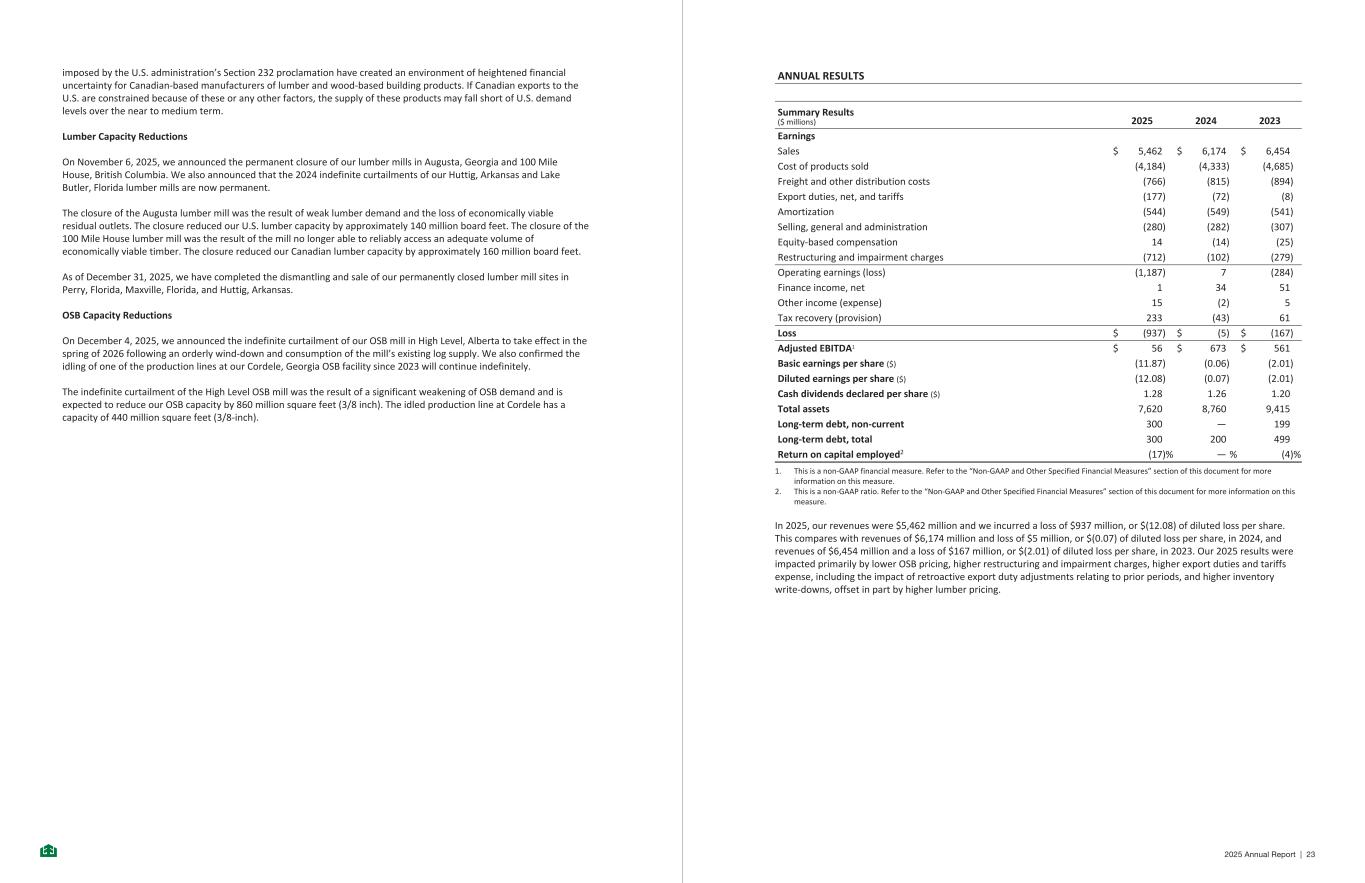
imposed by the U.S. administration’s Section 232 proclamation have created an environment of heightened financial uncertainty for Canadian-based manufacturers of lumber and wood-based building products. If Canadian exports to the U.S. are constrained because of these or any other factors, the supply of these products may fall short of U.S. demand levels over the near to medium term. Lumber Capacity Reductions On November 6, 2025, we announced the permanent closure of our lumber mills in Augusta, Georgia and 100 Mile House, British Columbia. We also announced that the 2024 indefinite curtailments of our Huttig, Arkansas and Lake Butler, Florida lumber mills are now permanent. The closure of the Augusta lumber mill was the result of weak lumber demand and the loss of economically viable residual outlets. The closure reduced our U.S. lumber capacity by approximately 140 million board feet. The closure of the 100 Mile House lumber mill was the result of the mill no longer able to reliably access an adequate volume of economically viable timber. The closure reduced our Canadian lumber capacity by approximately 160 million board feet. As of December 31, 2025, we have completed the dismantling and sale of our permanently closed lumber mill sites in Perry, Florida, Maxville, Florida, and Huttig, Arkansas. OSB Capacity Reductions On December 4, 2025, we announced the indefinite curtailment of our OSB mill in High Level, Alberta to take effect in the spring of 2026 following an orderly wind-down and consumption of the mill’s existing log supply. We also confirmed the idling of one of the production lines at our Cordele, Georgia OSB facility since 2023 will continue indefinitely. The indefinite curtailment of the High Level OSB mill was the result of a significant weakening of OSB demand and is expected to reduce our OSB capacity by 860 million square feet (3/8 inch). The idled production line at Cordele has a capacity of 440 million square feet (3/8-inch). - 3 - ANNUAL RESULTS Summary Results ($ millions) 2025 2024 2023 Earnings Sales $ 5,462 $ 6,174 $ 6,454 Cost of products sold (4,184) (4,333) (4,685) Freight and other distribution costs (766) (815) (894) Export duties, net, and tariffs (177) (72) (8) Amortization (544) (549) (541) Selling, general and administration (280) (282) (307) Equity-based compensation 14 (14) (25) Restructuring and impairment charges (712) (102) (279) Operating earnings (loss) (1,187) 7 (284) Finance income, net 1 34 51 Other income (expense) 15 (2) 5 Tax recovery (provision) 233 (43) 61 Loss $ (937) $ (5) $ (167) Adjusted EBITDA1 $ 56 $ 673 $ 561 Basic earnings per share ($) (11.87) (0.06) (2.01) Diluted earnings per share ($) (12.08) (0.07) (2.01) Cash dividends declared per share ($) 1.28 1.26 1.20 Total assets 7,620 8,760 9,415 Long-term debt, non-current 300 — 199 Long-term debt, total 300 200 499 Return on capital employed2 (17) % — % (4) % 1. This is a non-GAAP financial measure. Refer to the “Non-GAAP and Other Specified Financial Measures” section of this document for more information on this measure. 2. This is a non-GAAP ratio. Refer to the “Non-GAAP and Other Specified Financial Measures” section of this document for more information on this measure. In 2025, our revenues were $5,462 million and we incurred a loss of $937 million, or $(12.08) of diluted loss per share. This compares with revenues of $6,174 million and loss of $5 million, or $(0.07) of diluted loss per share, in 2024, and revenues of $6,454 million and a loss of $167 million, or $(2.01) of diluted loss per share, in 2023. Our 2025 results were impacted primarily by lower OSB pricing, higher restructuring and impairment charges, higher export duties and tariffs expense, including the impact of retroactive export duty adjustments relating to prior periods, and higher inventory write-downs, offset in part by higher lumber pricing. - 4 - 2025 Annual Report | 23
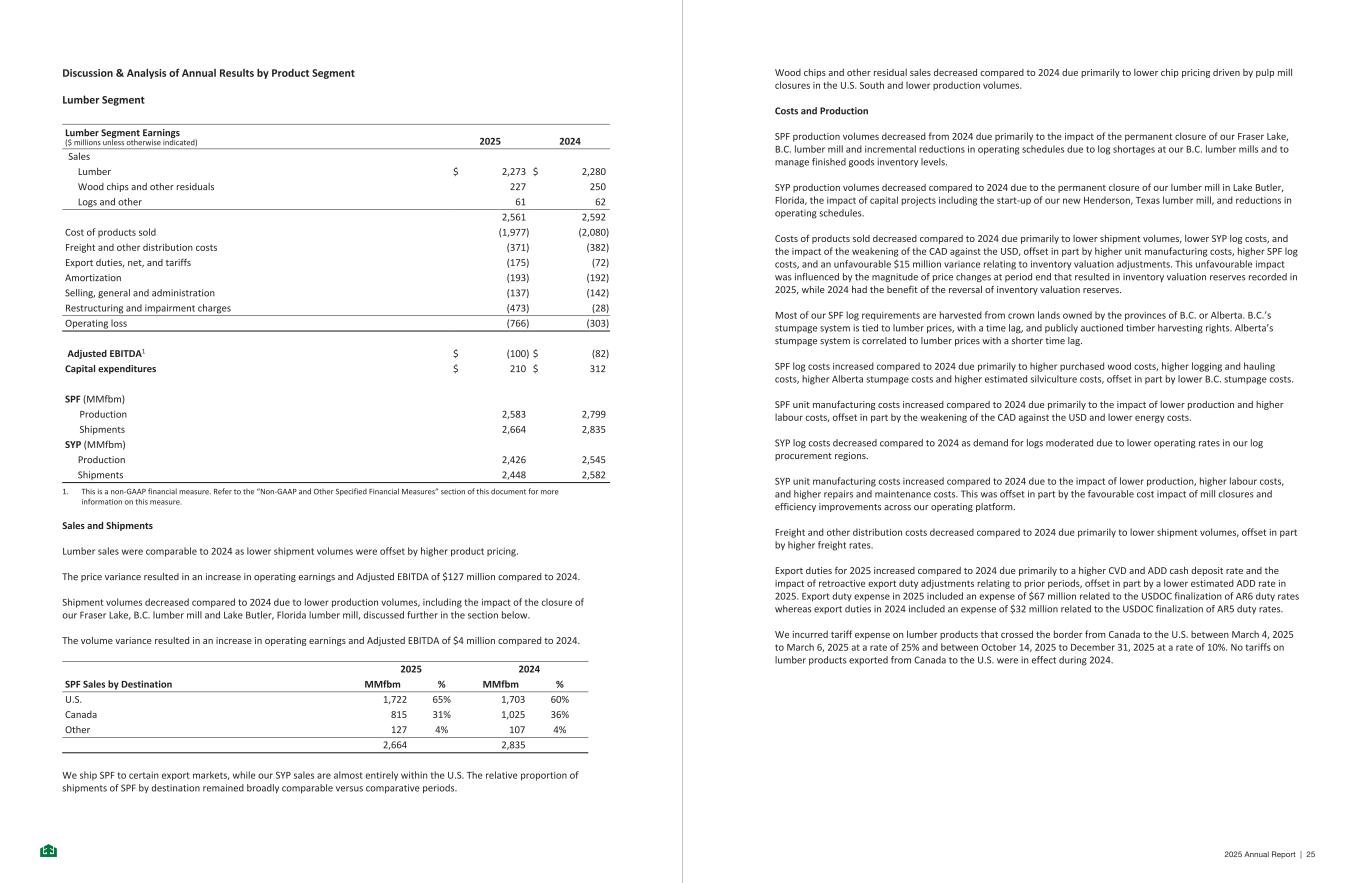
Discussion & Analysis of Annual Results by Product Segment Lumber Segment Lumber Segment Earnings ($ millions unless otherwise indicated) 2025 2024 Sales Lumber $ 2,273 $ 2,280 Wood chips and other residuals 227 250 Logs and other 61 62 2,561 2,592 Cost of products sold (1,977) (2,080) Freight and other distribution costs (371) (382) Export duties, net, and tariffs (175) (72) Amortization (193) (192) Selling, general and administration (137) (142) Restructuring and impairment charges (473) (28) Operating loss (766) (303) Adjusted EBITDA1 $ (100) $ (82) Capital expenditures $ 210 $ 312 SPF (MMfbm) Production 2,583 2,799 Shipments 2,664 2,835 SYP (MMfbm) Production 2,426 2,545 Shipments 2,448 2,582 1. This is a non-GAAP financial measure. Refer to the “Non-GAAP and Other Specified Financial Measures” section of this document for more information on this measure. Sales and Shipments Lumber sales were comparable to 2024 as lower shipment volumes were offset by higher product pricing. The price variance resulted in an increase in operating earnings and Adjusted EBITDA of $127 million compared to 2024. Shipment volumes decreased compared to 2024 due to lower production volumes, including the impact of the closure of our Fraser Lake, B.C. lumber mill and Lake Butler, Florida lumber mill, discussed further in the section below. The volume variance resulted in an increase in operating earnings and Adjusted EBITDA of $4 million compared to 2024. SPF Sales by Destination 2025 2024 MMfbm % MMfbm % U.S. 1,722 65% 1,703 60% Canada 815 31% 1,025 36% Other 127 4% 107 4% 2,664 2,835 We ship SPF to certain export markets, while our SYP sales are almost entirely within the U.S. The relative proportion of shipments of SPF by destination remained broadly comparable versus comparative periods. - 5 - Wood chips and other residual sales decreased compared to 2024 due primarily to lower chip pricing driven by pulp mill closures in the U.S. South and lower production volumes. Costs and Production SPF production volumes decreased from 2024 due primarily to the impact of the permanent closure of our Fraser Lake, B.C. lumber mill and incremental reductions in operating schedules due to log shortages at our B.C. lumber mills and to manage finished goods inventory levels. SYP production volumes decreased compared to 2024 due to the permanent closure of our lumber mill in Lake Butler, Florida, the impact of capital projects including the start-up of our new Henderson, Texas lumber mill, and reductions in operating schedules. Costs of products sold decreased compared to 2024 due primarily to lower shipment volumes, lower SYP log costs, and the impact of the weakening of the CAD against the USD, offset in part by higher unit manufacturing costs, higher SPF log costs, and an unfavourable $15 million variance relating to inventory valuation adjustments. This unfavourable impact was influenced by the magnitude of price changes at period end that resulted in inventory valuation reserves recorded in 2025, while 2024 had the benefit of the reversal of inventory valuation reserves. Most of our SPF log requirements are harvested from crown lands owned by the provinces of B.C. or Alberta. B.C.’s stumpage system is tied to lumber prices, with a time lag, and publicly auctioned timber harvesting rights. Alberta’s stumpage system is correlated to lumber prices with a shorter time lag. SPF log costs increased compared to 2024 due primarily to higher purchased wood costs, higher logging and hauling costs, higher Alberta stumpage costs and higher estimated silviculture costs, offset in part by lower B.C. stumpage costs. SPF unit manufacturing costs increased compared to 2024 due primarily to the impact of lower production and higher labour costs, offset in part by the weakening of the CAD against the USD and lower energy costs. SYP log costs decreased compared to 2024 as demand for logs moderated due to lower operating rates in our log procurement regions. SYP unit manufacturing costs increased compared to 2024 due to the impact of lower production, higher labour costs, and higher repairs and maintenance costs. This was offset in part by the favourable cost impact of mill closures and efficiency improvements across our operating platform. Freight and other distribution costs decreased compared to 2024 due primarily to lower shipment volumes, offset in part by higher freight rates. Export duties for 2025 increased compared to 2024 due primarily to a higher CVD and ADD cash deposit rate and the impact of retroactive export duty adjustments relating to prior periods, offset in part by a lower estimated ADD rate in 2025. Export duty expense in 2025 included an expense of $67 million related to the USDOC finalization of AR6 duty rates whereas export duties in 2024 included an expense of $32 million related to the USDOC finalization of AR5 duty rates. We incurred tariff expense on lumber products that crossed the border from Canada to the U.S. between March 4, 2025 to March 6, 2025 at a rate of 25% and between October 14, 2025 to December 31, 2025 at a rate of 10%. No tariffs on lumber products exported from Canada to the U.S. were in effect during 2024. - 6 - 2025 Annual Report | 25
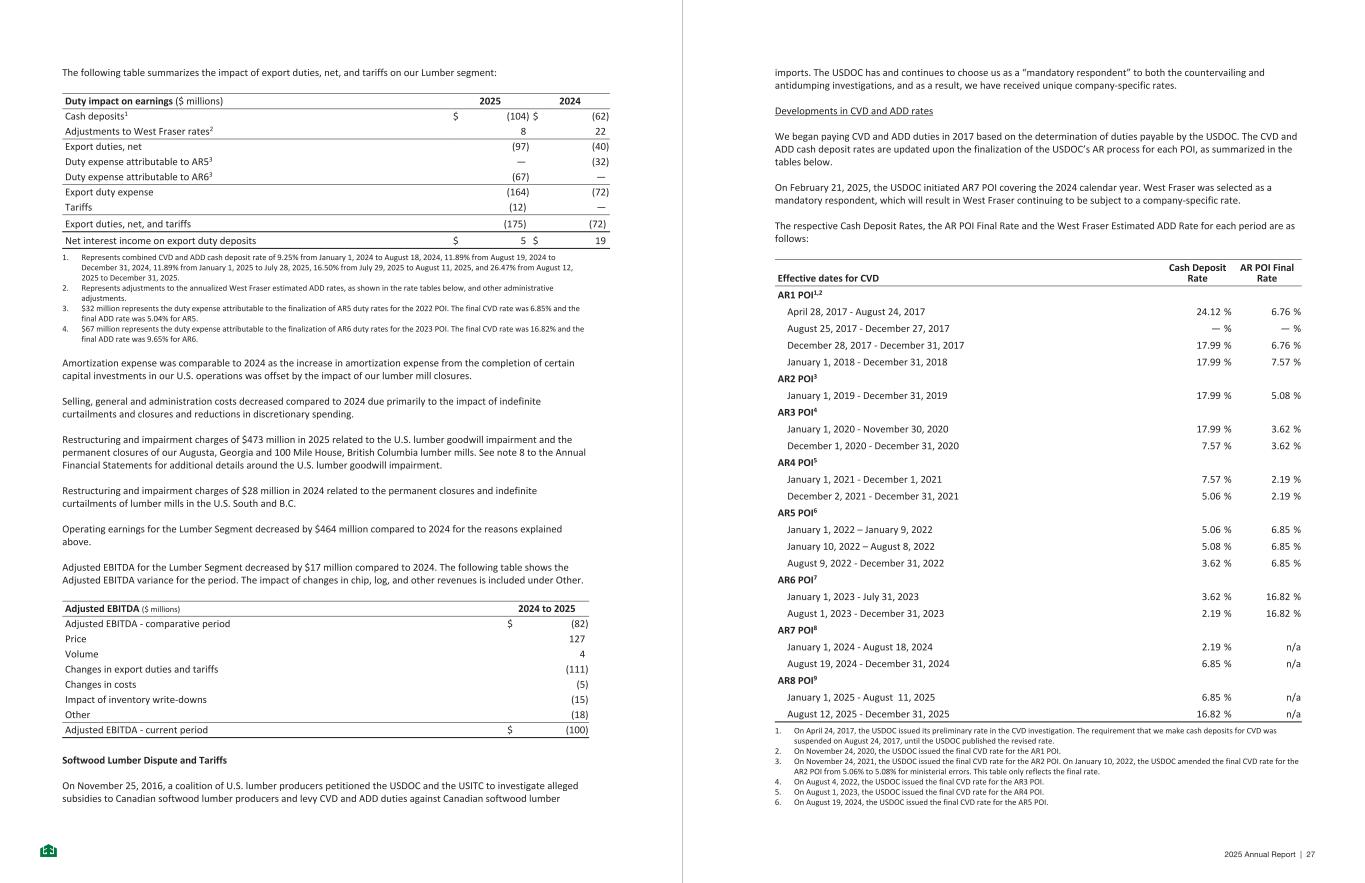
The following table summarizes the impact of export duties, net, and tariffs on our Lumber segment: Duty impact on earnings ($ millions) 2025 2024 Cash deposits1 $ (104) $ (62) Adjustments to West Fraser rates2 8 22 Export duties, net (97) (40) Duty expense attributable to AR53 — (32) Duty expense attributable to AR63 (67) — Export duty expense (164) (72) Tariffs (12) — Export duties, net, and tariffs (175) (72) Net interest income on export duty deposits $ 5 $ 19 1. Represents combined CVD and ADD cash deposit rate of 9.25% from January 1, 2024 to August 18, 2024, 11.89% from August 19, 2024 to December 31, 2024, 11.89% from January 1, 2025 to July 28, 2025, 16.50% from July 29, 2025 to August 11, 2025, and 26.47% from August 12, 2025 to December 31, 2025. 2. Represents adjustments to the annualized West Fraser estimated ADD rates, as shown in the rate tables below, and other administrative adjustments. 3. $32 million represents the duty expense attributable to the finalization of AR5 duty rates for the 2022 POI. The final CVD rate was 6.85% and the final ADD rate was 5.04% for AR5. 4. $67 million represents the duty expense attributable to the finalization of AR6 duty rates for the 2023 POI. The final CVD rate was 16.82% and the final ADD rate was 9.65% for AR6. Amortization expense was comparable to 2024 as the increase in amortization expense from the completion of certain capital investments in our U.S. operations was offset by the impact of our lumber mill closures. Selling, general and administration costs decreased compared to 2024 due primarily to the impact of indefinite curtailments and closures and reductions in discretionary spending. Restructuring and impairment charges of $473 million in 2025 related to the U.S. lumber goodwill impairment and the permanent closures of our Augusta, Georgia and 100 Mile House, British Columbia lumber mills. See note 8 to the Annual Financial Statements for additional details around the U.S. lumber goodwill impairment. Restructuring and impairment charges of $28 million in 2024 related to the permanent closures and indefinite curtailments of lumber mills in the U.S. South and B.C. Operating earnings for the Lumber Segment decreased by $464 million compared to 2024 for the reasons explained above. Adjusted EBITDA for the Lumber Segment decreased by $17 million compared to 2024. The following table shows the Adjusted EBITDA variance for the period. The impact of changes in chip, log, and other revenues is included under Other. Adjusted EBITDA ($ millions) 2024 to 2025 Adjusted EBITDA - comparative period $ (82) Price 127 Volume 4 Changes in export duties and tariffs (111) Changes in costs (5) Impact of inventory write-downs (15) Other (18) Adjusted EBITDA - current period $ (100) Softwood Lumber Dispute and Tariffs On November 25, 2016, a coalition of U.S. lumber producers petitioned the USDOC and the USITC to investigate alleged subsidies to Canadian softwood lumber producers and levy CVD and ADD duties against Canadian softwood lumber - 7 - imports. The USDOC has and continues to choose us as a “mandatory respondent” to both the countervailing and antidumping investigations, and as a result, we have received unique company-specific rates. Developments in CVD and ADD rates We began paying CVD and ADD duties in 2017 based on the determination of duties payable by the USDOC. The CVD and ADD cash deposit rates are updated upon the finalization of the USDOC’s AR process for each POI, as summarized in the tables below. On February 21, 2025, the USDOC initiated AR7 POI covering the 2024 calendar year. West Fraser was selected as a mandatory respondent, which will result in West Fraser continuing to be subject to a company-specific rate. The respective Cash Deposit Rates, the AR POI Final Rate and the West Fraser Estimated ADD Rate for each period are as follows: Effective dates for CVD Cash Deposit Rate AR POI Final Rate AR1 POI1,2 April 28, 2017 - August 24, 2017 24.12 % 6.76 % August 25, 2017 - December 27, 2017 — % — % December 28, 2017 - December 31, 2017 17.99 % 6.76 % January 1, 2018 - December 31, 2018 17.99 % 7.57 % AR2 POI3 January 1, 2019 - December 31, 2019 17.99 % 5.08 % AR3 POI4 January 1, 2020 - November 30, 2020 17.99 % 3.62 % December 1, 2020 - December 31, 2020 7.57 % 3.62 % AR4 POI5 January 1, 2021 - December 1, 2021 7.57 % 2.19 % December 2, 2021 - December 31, 2021 5.06 % 2.19 % AR5 POI6 January 1, 2022 – January 9, 2022 5.06 % 6.85 % January 10, 2022 – August 8, 2022 5.08 % 6.85 % August 9, 2022 - December 31, 2022 3.62 % 6.85 % AR6 POI7 January 1, 2023 - July 31, 2023 3.62 % 16.82 % August 1, 2023 - December 31, 2023 2.19 % 16.82 % AR7 POI8 January 1, 2024 - August 18, 2024 2.19 % n/a August 19, 2024 - December 31, 2024 6.85 % n/a AR8 POI9 January 1, 2025 - August 11, 2025 6.85 % n/a August 12, 2025 - December 31, 2025 16.82 % n/a 1. On April 24, 2017, the USDOC issued its preliminary rate in the CVD investigation. The requirement that we make cash deposits for CVD was suspended on August 24, 2017, until the USDOC published the revised rate. 2. On November 24, 2020, the USDOC issued the final CVD rate for the AR1 POI. 3. On November 24, 2021, the USDOC issued the final CVD rate for the AR2 POI. On January 10, 2022, the USDOC amended the final CVD rate for the AR2 POI from 5.06% to 5.08% for ministerial errors. This table only reflects the final rate. 4. On August 4, 2022, the USDOC issued the final CVD rate for the AR3 POI. 5. On August 1, 2023, the USDOC issued the final CVD rate for the AR4 POI. 6. On August 19, 2024, the USDOC issued the final CVD rate for the AR5 POI. - 8 - 2025 Annual Report | 27
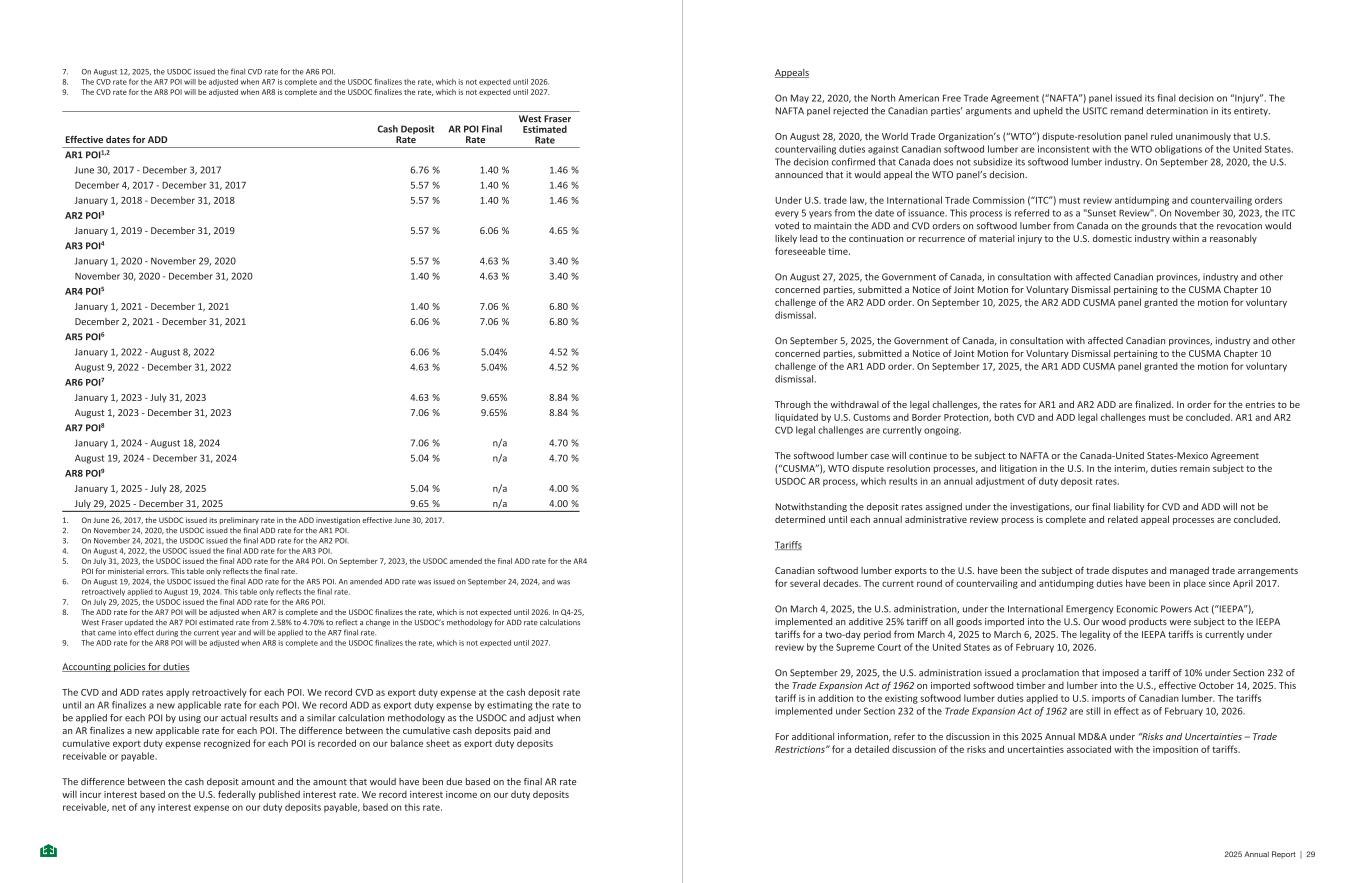
7. On August 12, 2025, the USDOC issued the final CVD rate for the AR6 POI. 8. The CVD rate for the AR7 POI will be adjusted when AR7 is complete and the USDOC finalizes the rate, which is not expected until 2026. 9. The CVD rate for the AR8 POI will be adjusted when AR8 is complete and the USDOC finalizes the rate, which is not expected until 2027. Effective dates for ADD Cash Deposit Rate AR POI Final Rate West Fraser Estimated Rate AR1 POI1,2 June 30, 2017 - December 3, 2017 6.76 % 1.40 % 1.46 % December 4, 2017 - December 31, 2017 5.57 % 1.40 % 1.46 % January 1, 2018 - December 31, 2018 5.57 % 1.40 % 1.46 % AR2 POI3 January 1, 2019 - December 31, 2019 5.57 % 6.06 % 4.65 % AR3 POI4 January 1, 2020 - November 29, 2020 5.57 % 4.63 % 3.40 % November 30, 2020 - December 31, 2020 1.40 % 4.63 % 3.40 % AR4 POI5 January 1, 2021 - December 1, 2021 1.40 % 7.06 % 6.80 % December 2, 2021 - December 31, 2021 6.06 % 7.06 % 6.80 % AR5 POI6 January 1, 2022 - August 8, 2022 6.06 % 5.04% 4.52 % August 9, 2022 - December 31, 2022 4.63 % 5.04% 4.52 % AR6 POI7 January 1, 2023 - July 31, 2023 4.63 % 9.65% 8.84 % August 1, 2023 - December 31, 2023 7.06 % 9.65% 8.84 % AR7 POI8 January 1, 2024 - August 18, 2024 7.06 % n/a 4.70 % August 19, 2024 - December 31, 2024 5.04 % n/a 4.70 % AR8 POI9 January 1, 2025 - July 28, 2025 5.04 % n/a 4.00 % July 29, 2025 - December 31, 2025 9.65 % n/a 4.00 % 1. On June 26, 2017, the USDOC issued its preliminary rate in the ADD investigation effective June 30, 2017. 2. On November 24, 2020, the USDOC issued the final ADD rate for the AR1 POI. 3. On November 24, 2021, the USDOC issued the final ADD rate for the AR2 POI. 4. On August 4, 2022, the USDOC issued the final ADD rate for the AR3 POI. 5. On July 31, 2023, the USDOC issued the final ADD rate for the AR4 POI. On September 7, 2023, the USDOC amended the final ADD rate for the AR4 POI for ministerial errors. This table only reflects the final rate. 6. On August 19, 2024, the USDOC issued the final ADD rate for the AR5 POI. An amended ADD rate was issued on September 24, 2024, and was retroactively applied to August 19, 2024. This table only reflects the final rate. 7. On July 29, 2025, the USDOC issued the final ADD rate for the AR6 POI. 8. The ADD rate for the AR7 POI will be adjusted when AR7 is complete and the USDOC finalizes the rate, which is not expected until 2026. In Q4-25, West Fraser updated the AR7 POI estimated rate from 2.58% to 4.70% to reflect a change in the USDOC’s methodology for ADD rate calculations that came into effect during the current year and will be applied to the AR7 final rate. 9. The ADD rate for the AR8 POI will be adjusted when AR8 is complete and the USDOC finalizes the rate, which is not expected until 2027. Accounting policies for duties The CVD and ADD rates apply retroactively for each POI. We record CVD as export duty expense at the cash deposit rate until an AR finalizes a new applicable rate for each POI. We record ADD as export duty expense by estimating the rate to be applied for each POI by using our actual results and a similar calculation methodology as the USDOC and adjust when an AR finalizes a new applicable rate for each POI. The difference between the cumulative cash deposits paid and cumulative export duty expense recognized for each POI is recorded on our balance sheet as export duty deposits receivable or payable. The difference between the cash deposit amount and the amount that would have been due based on the final AR rate will incur interest based on the U.S. federally published interest rate. We record interest income on our duty deposits receivable, net of any interest expense on our duty deposits payable, based on this rate. - 9 - Appeals On May 22, 2020, the North American Free Trade Agreement (“NAFTA”) panel issued its final decision on “Injury”. The NAFTA panel rejected the Canadian parties’ arguments and upheld the USITC remand determination in its entirety. On August 28, 2020, the World Trade Organization’s (“WTO”) dispute-resolution panel ruled unanimously that U.S. countervailing duties against Canadian softwood lumber are inconsistent with the WTO obligations of the United States. The decision confirmed that Canada does not subsidize its softwood lumber industry. On September 28, 2020, the U.S. announced that it would appeal the WTO panel’s decision. Under U.S. trade law, the International Trade Commission (“ITC”) must review antidumping and countervailing orders every 5 years from the date of issuance. This process is referred to as a "Sunset Review". On November 30, 2023, the ITC voted to maintain the ADD and CVD orders on softwood lumber from Canada on the grounds that the revocation would likely lead to the continuation or recurrence of material injury to the U.S. domestic industry within a reasonably foreseeable time. On August 27, 2025, the Government of Canada, in consultation with affected Canadian provinces, industry and other concerned parties, submitted a Notice of Joint Motion for Voluntary Dismissal pertaining to the CUSMA Chapter 10 challenge of the AR2 ADD order. On September 10, 2025, the AR2 ADD CUSMA panel granted the motion for voluntary dismissal. On September 5, 2025, the Government of Canada, in consultation with affected Canadian provinces, industry and other concerned parties, submitted a Notice of Joint Motion for Voluntary Dismissal pertaining to the CUSMA Chapter 10 challenge of the AR1 ADD order. On September 17, 2025, the AR1 ADD CUSMA panel granted the motion for voluntary dismissal. Through the withdrawal of the legal challenges, the rates for AR1 and AR2 ADD are finalized. In order for the entries to be liquidated by U.S. Customs and Border Protection, both CVD and ADD legal challenges must be concluded. AR1 and AR2 CVD legal challenges are currently ongoing. The softwood lumber case will continue to be subject to NAFTA or the Canada-United States-Mexico Agreement (“CUSMA”), WTO dispute resolution processes, and litigation in the U.S. In the interim, duties remain subject to the USDOC AR process, which results in an annual adjustment of duty deposit rates. Notwithstanding the deposit rates assigned under the investigations, our final liability for CVD and ADD will not be determined until each annual administrative review process is complete and related appeal processes are concluded. Tariffs Canadian softwood lumber exports to the U.S. have been the subject of trade disputes and managed trade arrangements for several decades. The current round of countervailing and antidumping duties have been in place since April 2017. On March 4, 2025, the U.S. administration, under the International Emergency Economic Powers Act (“IEEPA”), implemented an additive 25% tariff on all goods imported into the U.S. Our wood products were subject to the IEEPA tariffs for a two-day period from March 4, 2025 to March 6, 2025. The legality of the IEEPA tariffs is currently under review by the Supreme Court of the United States as of February 10, 2026. On September 29, 2025, the U.S. administration issued a proclamation that imposed a tariff of 10% under Section 232 of the Trade Expansion Act of 1962 on imported softwood timber and lumber into the U.S., effective October 14, 2025. This tariff is in addition to the existing softwood lumber duties applied to U.S. imports of Canadian lumber. The tariffs implemented under Section 232 of the Trade Expansion Act of 1962 are still in effect as of February 10, 2026. For additional information, refer to the discussion in this 2025 Annual MD&A under “Risks and Uncertainties – Trade Restrictions” for a detailed discussion of the risks and uncertainties associated with the imposition of tariffs. - 10 - 2025 Annual Report | 29
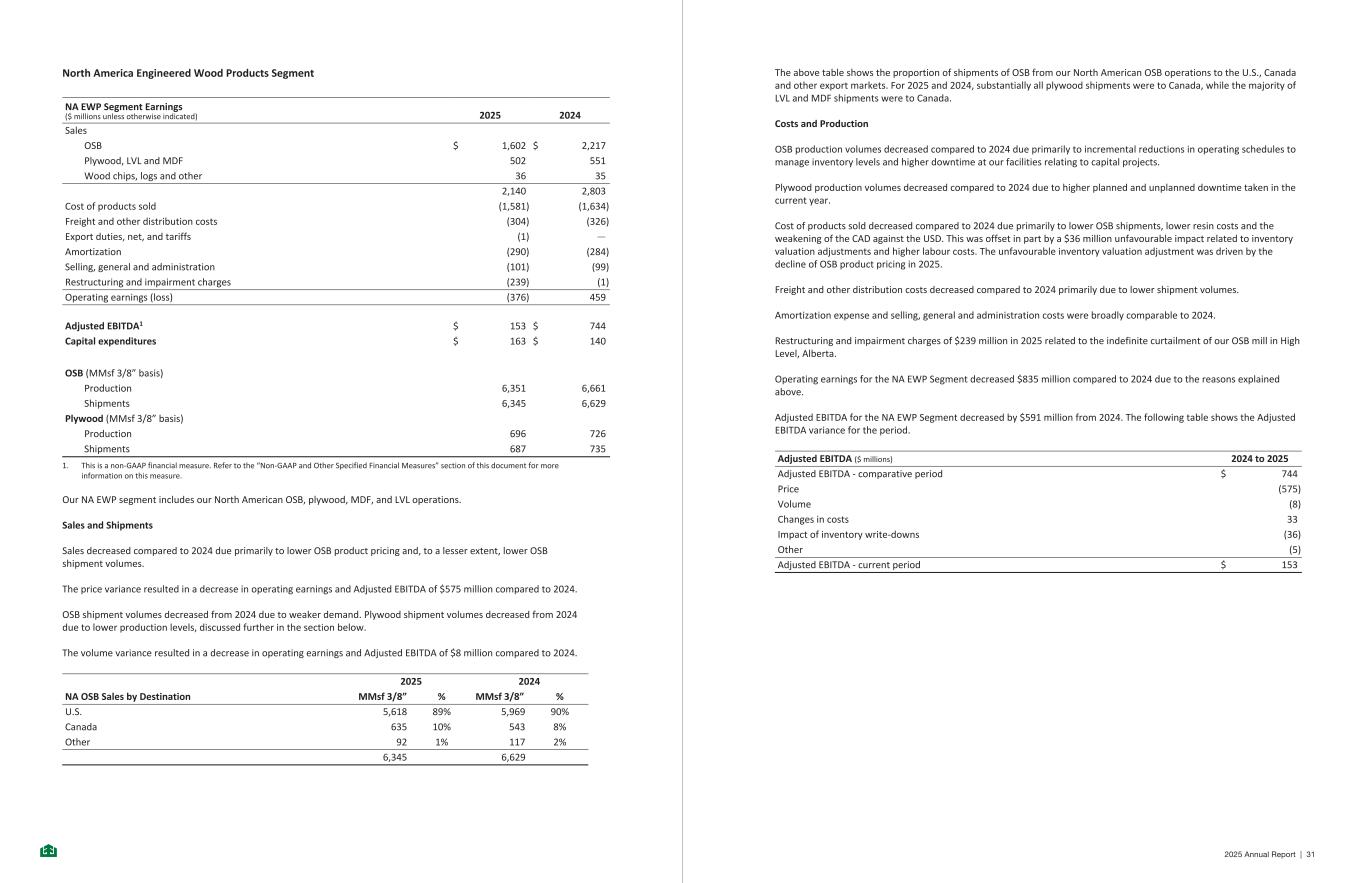
North America Engineered Wood Products Segment NA EWP Segment Earnings ($ millions unless otherwise indicated) 2025 2024 Sales OSB $ 1,602 $ 2,217 Plywood, LVL and MDF 502 551 Wood chips, logs and other 36 35 2,140 2,803 Cost of products sold (1,581) (1,634) Freight and other distribution costs (304) (326) Export duties, net, and tariffs (1) — Amortization (290) (284) Selling, general and administration (101) (99) Restructuring and impairment charges (239) (1) Operating earnings (loss) (376) 459 Adjusted EBITDA1 $ 153 $ 744 Capital expenditures $ 163 $ 140 OSB (MMsf 3/8” basis) Production 6,351 6,661 Shipments 6,345 6,629 Plywood (MMsf 3/8” basis) Production 696 726 Shipments 687 735 1. This is a non-GAAP financial measure. Refer to the “Non-GAAP and Other Specified Financial Measures” section of this document for more information on this measure. Our NA EWP segment includes our North American OSB, plywood, MDF, and LVL operations. Sales and Shipments Sales decreased compared to 2024 due primarily to lower OSB product pricing and, to a lesser extent, lower OSB shipment volumes. The price variance resulted in a decrease in operating earnings and Adjusted EBITDA of $575 million compared to 2024. OSB shipment volumes decreased from 2024 due to weaker demand. Plywood shipment volumes decreased from 2024 due to lower production levels, discussed further in the section below. The volume variance resulted in a decrease in operating earnings and Adjusted EBITDA of $8 million compared to 2024. NA OSB Sales by Destination 2025 2024 MMsf 3/8” % MMsf 3/8” % U.S. 5,618 89% 5,969 90% Canada 635 10% 543 8% Other 92 1% 117 2% 6,345 6,629 - 11 - The above table shows the proportion of shipments of OSB from our North American OSB operations to the U.S., Canada and other export markets. For 2025 and 2024, substantially all plywood shipments were to Canada, while the majority of LVL and MDF shipments were to Canada. Costs and Production OSB production volumes decreased compared to 2024 due primarily to incremental reductions in operating schedules to manage inventory levels and higher downtime at our facilities relating to capital projects. Plywood production volumes decreased compared to 2024 due to higher planned and unplanned downtime taken in the current year. Cost of products sold decreased compared to 2024 due primarily to lower OSB shipments, lower resin costs and the weakening of the CAD against the USD. This was offset in part by a $36 million unfavourable impact related to inventory valuation adjustments and higher labour costs. The unfavourable inventory valuation adjustment was driven by the decline of OSB product pricing in 2025. Freight and other distribution costs decreased compared to 2024 primarily due to lower shipment volumes. Amortization expense and selling, general and administration costs were broadly comparable to 2024. Restructuring and impairment charges of $239 million in 2025 related to the indefinite curtailment of our OSB mill in High Level, Alberta. Operating earnings for the NA EWP Segment decreased $835 million compared to 2024 due to the reasons explained above. Adjusted EBITDA for the NA EWP Segment decreased by $591 million from 2024. The following table shows the Adjusted EBITDA variance for the period. Adjusted EBITDA ($ millions) 2024 to 2025 Adjusted EBITDA - comparative period $ 744 Price (575) Volume (8) Changes in costs 33 Impact of inventory write-downs (36) Other (5) Adjusted EBITDA - current period $ 153 - 12 - 2025 Annual Report | 31
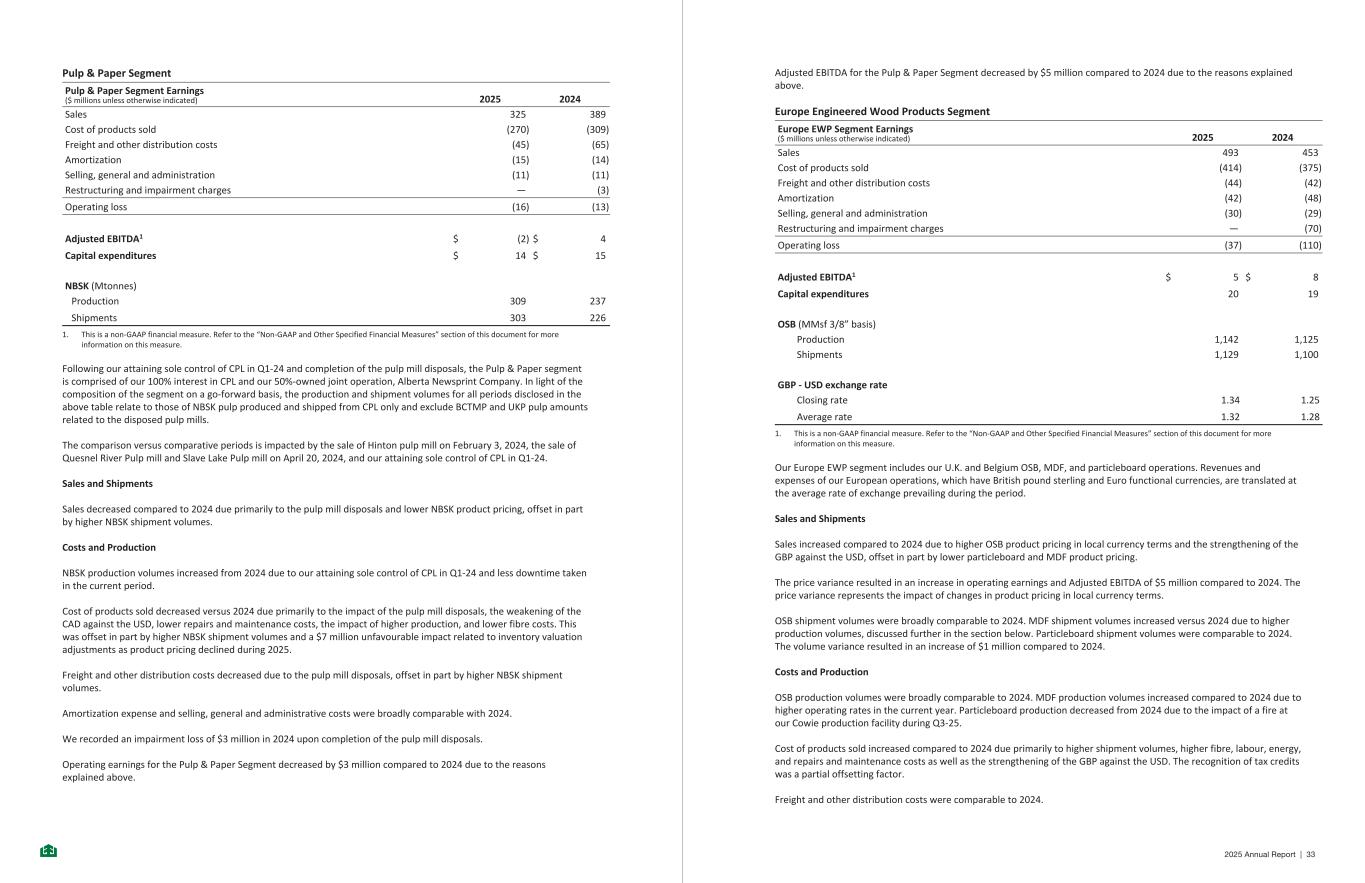
Pulp & Paper Segment Pulp & Paper Segment Earnings ($ millions unless otherwise indicated) 2025 2024 Sales 325 389 Cost of products sold (270) (309) Freight and other distribution costs (45) (65) Amortization (15) (14) Selling, general and administration (11) (11) Restructuring and impairment charges — (3) Operating loss (16) (13) Adjusted EBITDA1 $ (2) $ 4 Capital expenditures $ 14 $ 15 NBSK (Mtonnes) Production 309 237 Shipments 303 226 1. This is a non-GAAP financial measure. Refer to the “Non-GAAP and Other Specified Financial Measures” section of this document for more information on this measure. Following our attaining sole control of CPL in Q1-24 and completion of the pulp mill disposals, the Pulp & Paper segment is comprised of our 100% interest in CPL and our 50%-owned joint operation, Alberta Newsprint Company. In light of the composition of the segment on a go-forward basis, the production and shipment volumes for all periods disclosed in the above table relate to those of NBSK pulp produced and shipped from CPL only and exclude BCTMP and UKP pulp amounts related to the disposed pulp mills. The comparison versus comparative periods is impacted by the sale of Hinton pulp mill on February 3, 2024, the sale of Quesnel River Pulp mill and Slave Lake Pulp mill on April 20, 2024, and our attaining sole control of CPL in Q1-24. Sales and Shipments Sales decreased compared to 2024 due primarily to the pulp mill disposals and lower NBSK product pricing, offset in part by higher NBSK shipment volumes. Costs and Production NBSK production volumes increased from 2024 due to our attaining sole control of CPL in Q1-24 and less downtime taken in the current period. Cost of products sold decreased versus 2024 due primarily to the impact of the pulp mill disposals, the weakening of the CAD against the USD, lower repairs and maintenance costs, the impact of higher production, and lower fibre costs. This was offset in part by higher NBSK shipment volumes and a $7 million unfavourable impact related to inventory valuation adjustments as product pricing declined during 2025. Freight and other distribution costs decreased due to the pulp mill disposals, offset in part by higher NBSK shipment volumes. Amortization expense and selling, general and administrative costs were broadly comparable with 2024. We recorded an impairment loss of $3 million in 2024 upon completion of the pulp mill disposals. Operating earnings for the Pulp & Paper Segment decreased by $3 million compared to 2024 due to the reasons explained above. - 13 - Adjusted EBITDA for the Pulp & Paper Segment decreased by $5 million compared to 2024 due to the reasons explained above. Europe Engineered Wood Products Segment Europe EWP Segment Earnings ($ millions unless otherwise indicated) 2025 2024 Sales 493 453 Cost of products sold (414) (375) Freight and other distribution costs (44) (42) Amortization (42) (48) Selling, general and administration (30) (29) Restructuring and impairment charges — (70) Operating loss (37) (110) Adjusted EBITDA1 $ 5 $ 8 Capital expenditures 20 19 OSB (MMsf 3/8” basis) Production 1,142 1,125 Shipments 1,129 1,100 GBP - USD exchange rate Closing rate 1.34 1.25 Average rate 1.32 1.28 1. This is a non-GAAP financial measure. Refer to the “Non-GAAP and Other Specified Financial Measures” section of this document for more information on this measure. Our Europe EWP segment includes our U.K. and Belgium OSB, MDF, and particleboard operations. Revenues and expenses of our European operations, which have British pound sterling and Euro functional currencies, are translated at the average rate of exchange prevailing during the period. Sales and Shipments Sales increased compared to 2024 due to higher OSB product pricing in local currency terms and the strengthening of the GBP against the USD, offset in part by lower particleboard and MDF product pricing. The price variance resulted in an increase in operating earnings and Adjusted EBITDA of $5 million compared to 2024. The price variance represents the impact of changes in product pricing in local currency terms. OSB shipment volumes were broadly comparable to 2024. MDF shipment volumes increased versus 2024 due to higher production volumes, discussed further in the section below. Particleboard shipment volumes were comparable to 2024. The volume variance resulted in an increase of $1 million compared to 2024. Costs and Production OSB production volumes were broadly comparable to 2024. MDF production volumes increased compared to 2024 due to higher operating rates in the current year. Particleboard production decreased from 2024 due to the impact of a fire at our Cowie production facility during Q3-25. Cost of products sold increased compared to 2024 due primarily to higher shipment volumes, higher fibre, labour, energy, and repairs and maintenance costs as well as the strengthening of the GBP against the USD. The recognition of tax credits was a partial offsetting factor. Freight and other distribution costs were comparable to 2024. - 14 - 2025 Annual Report | 33
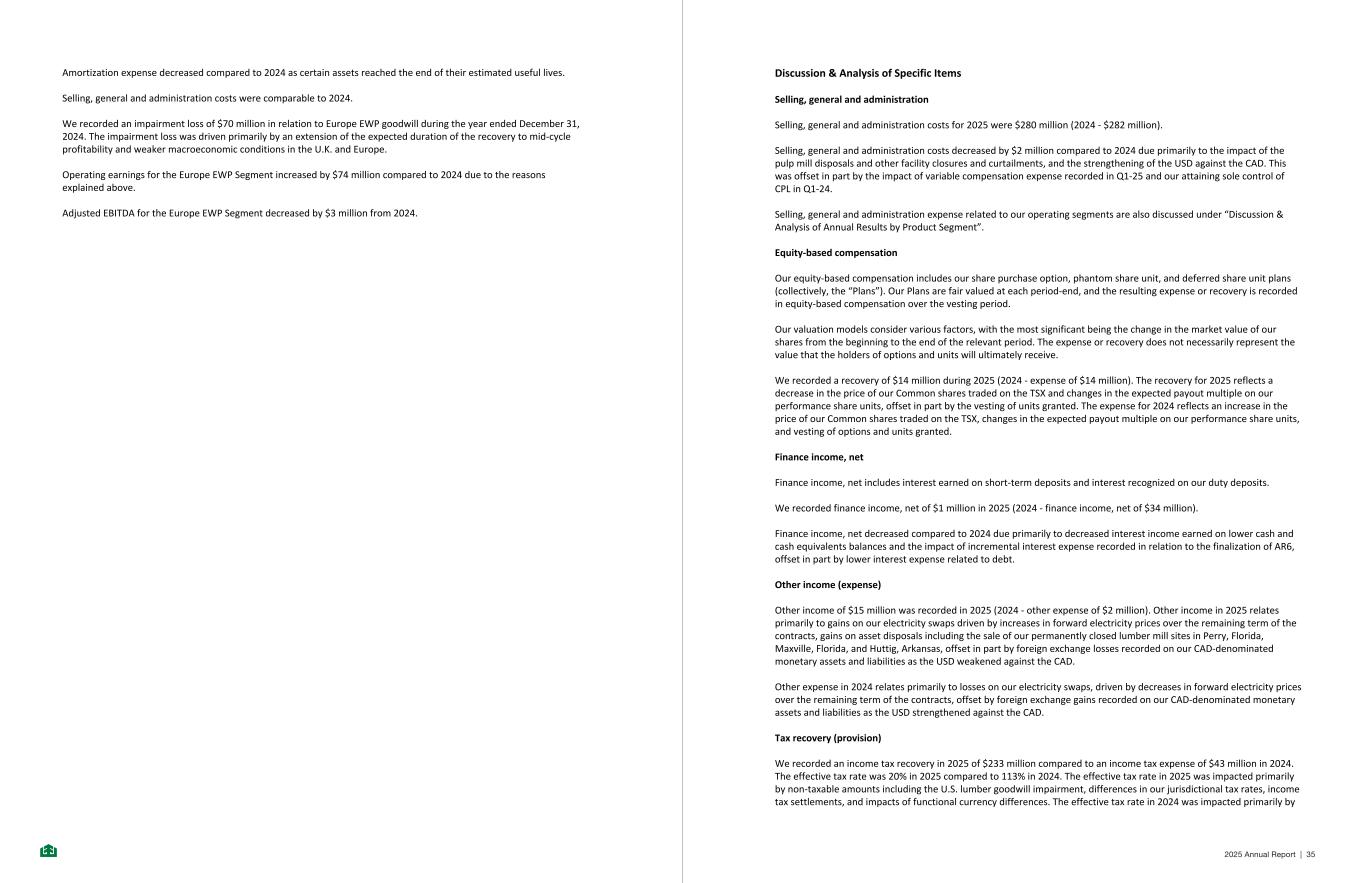
Amortization expense decreased compared to 2024 as certain assets reached the end of their estimated useful lives. Selling, general and administration costs were comparable to 2024. We recorded an impairment loss of $70 million in relation to Europe EWP goodwill during the year ended December 31, 2024. The impairment loss was driven primarily by an extension of the expected duration of the recovery to mid-cycle profitability and weaker macroeconomic conditions in the U.K. and Europe. Operating earnings for the Europe EWP Segment increased by $74 million compared to 2024 due to the reasons explained above. Adjusted EBITDA for the Europe EWP Segment decreased by $3 million from 2024. - 15 - Discussion & Analysis of Specific Items Selling, general and administration Selling, general and administration costs for 2025 were $280 million (2024 - $282 million). Selling, general and administration costs decreased by $2 million compared to 2024 due primarily to the impact of the pulp mill disposals and other facility closures and curtailments, and the strengthening of the USD against the CAD. This was offset in part by the impact of variable compensation expense recorded in Q1-25 and our attaining sole control of CPL in Q1-24. Selling, general and administration expense related to our operating segments are also discussed under “Discussion & Analysis of Annual Results by Product Segment”. Equity-based compensation Our equity-based compensation includes our share purchase option, phantom share unit, and deferred share unit plans (collectively, the “Plans”). Our Plans are fair valued at each period-end, and the resulting expense or recovery is recorded in equity-based compensation over the vesting period. Our valuation models consider various factors, with the most significant being the change in the market value of our shares from the beginning to the end of the relevant period. The expense or recovery does not necessarily represent the value that the holders of options and units will ultimately receive. We recorded a recovery of $14 million during 2025 (2024 - expense of $14 million). The recovery for 2025 reflects a decrease in the price of our Common shares traded on the TSX and changes in the expected payout multiple on our performance share units, offset in part by the vesting of units granted. The expense for 2024 reflects an increase in the price of our Common shares traded on the TSX, changes in the expected payout multiple on our performance share units, and vesting of options and units granted. Finance income, net Finance income, net includes interest earned on short-term deposits and interest recognized on our duty deposits. We recorded finance income, net of $1 million in 2025 (2024 - finance income, net of $34 million). Finance income, net decreased compared to 2024 due primarily to decreased interest income earned on lower cash and cash equivalents balances and the impact of incremental interest expense recorded in relation to the finalization of AR6, offset in part by lower interest expense related to debt. Other income (expense) Other income of $15 million was recorded in 2025 (2024 - other expense of $2 million). Other income in 2025 relates primarily to gains on our electricity swaps driven by increases in forward electricity prices over the remaining term of the contracts, gains on asset disposals including the sale of our permanently closed lumber mill sites in Perry, Florida, Maxville, Florida, and Huttig, Arkansas, offset in part by foreign exchange losses recorded on our CAD-denominated monetary assets and liabilities as the USD weakened against the CAD. Other expense in 2024 relates primarily to losses on our electricity swaps, driven by decreases in forward electricity prices over the remaining term of the contracts, offset by foreign exchange gains recorded on our CAD-denominated monetary assets and liabilities as the USD strengthened against the CAD. Tax recovery (provision) We recorded an income tax recovery in 2025 of $233 million compared to an income tax expense of $43 million in 2024. The effective tax rate was 20% in 2025 compared to 113% in 2024. The effective tax rate in 2025 was impacted primarily by non-taxable amounts including the U.S. lumber goodwill impairment, differences in our jurisdictional tax rates, income tax settlements, and impacts of functional currency differences. The effective tax rate in 2024 was impacted primarily by - 16 - 2025 Annual Report | 35
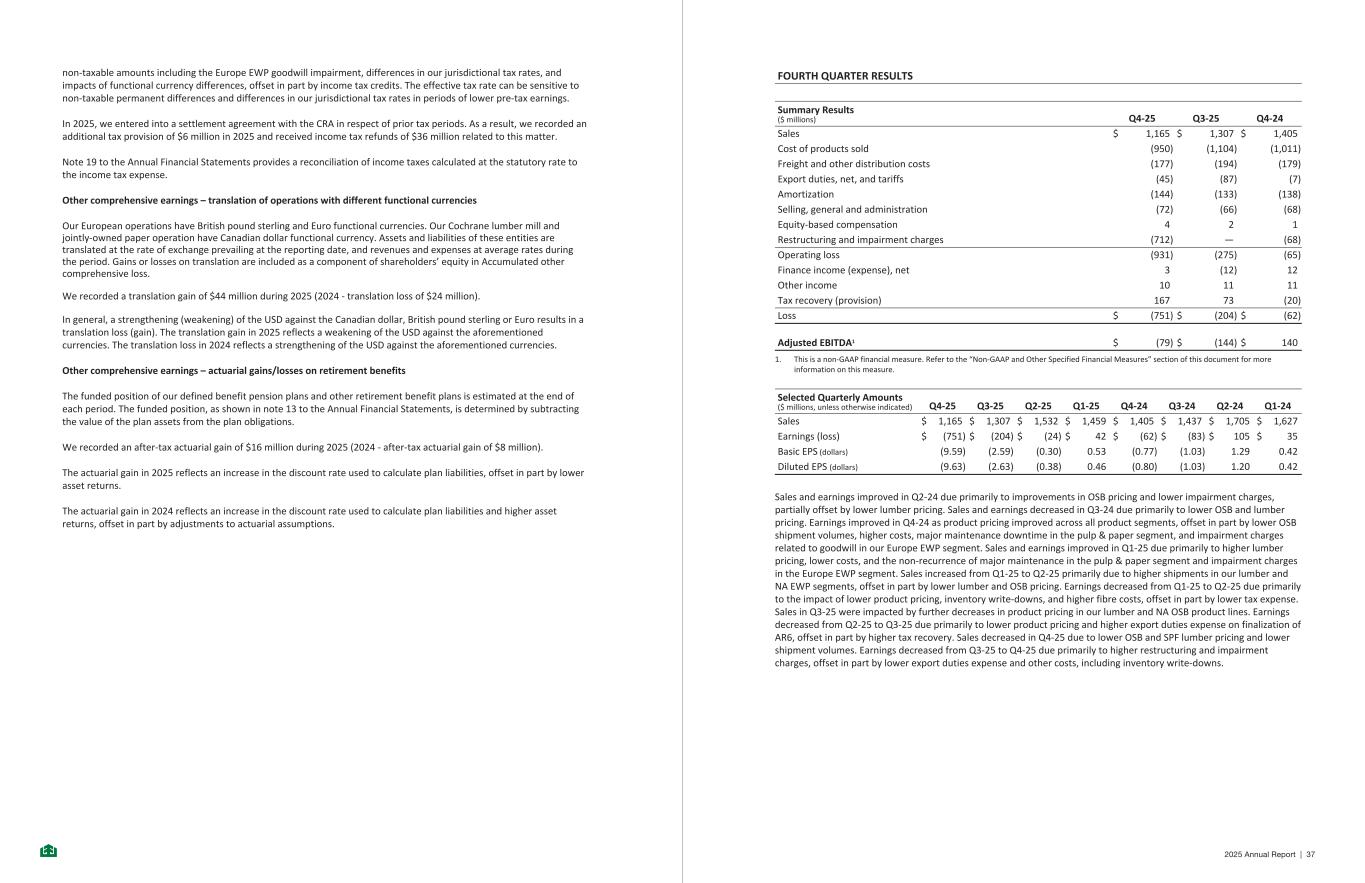
non-taxable amounts including the Europe EWP goodwill impairment, differences in our jurisdictional tax rates, and impacts of functional currency differences, offset in part by income tax credits. The effective tax rate can be sensitive to non-taxable permanent differences and differences in our jurisdictional tax rates in periods of lower pre-tax earnings. In 2025, we entered into a settlement agreement with the CRA in respect of prior tax periods. As a result, we recorded an additional tax provision of $6 million in 2025 and received income tax refunds of $36 million related to this matter. Note 19 to the Annual Financial Statements provides a reconciliation of income taxes calculated at the statutory rate to the income tax expense. Other comprehensive earnings – translation of operations with different functional currencies Our European operations have British pound sterling and Euro functional currencies. Our Cochrane lumber mill and jointly-owned paper operation have Canadian dollar functional currency. Assets and liabilities of these entities are translated at the rate of exchange prevailing at the reporting date, and revenues and expenses at average rates during the period. Gains or losses on translation are included as a component of shareholders’ equity in Accumulated other comprehensive loss. We recorded a translation gain of $44 million during 2025 (2024 - translation loss of $24 million). In general, a strengthening (weakening) of the USD against the Canadian dollar, British pound sterling or Euro results in a translation loss (gain). The translation gain in 2025 reflects a weakening of the USD against the aforementioned currencies. The translation loss in 2024 reflects a strengthening of the USD against the aforementioned currencies. Other comprehensive earnings – actuarial gains/losses on retirement benefits The funded position of our defined benefit pension plans and other retirement benefit plans is estimated at the end of each period. The funded position, as shown in note 13 to the Annual Financial Statements, is determined by subtracting the value of the plan assets from the plan obligations. We recorded an after-tax actuarial gain of $16 million during 2025 (2024 - after-tax actuarial gain of $8 million). The actuarial gain in 2025 reflects an increase in the discount rate used to calculate plan liabilities, offset in part by lower asset returns. The actuarial gain in 2024 reflects an increase in the discount rate used to calculate plan liabilities and higher asset returns, offset in part by adjustments to actuarial assumptions. - 17 - FOURTH QUARTER RESULTS Summary Results ($ millions) Q4-25 Q3-25 Q4-24 Sales $ 1,165 $ 1,307 $ 1,405 Cost of products sold (950) (1,104) (1,011) Freight and other distribution costs (177) (194) (179) Export duties, net, and tariffs (45) (87) (7) Amortization (144) (133) (138) Selling, general and administration (72) (66) (68) Equity-based compensation 4 2 1 Restructuring and impairment charges (712) — (68) Operating loss (931) (275) (65) Finance income (expense), net 3 (12) 12 Other income 10 11 11 Tax recovery (provision) 167 73 (20) Loss $ (751) $ (204) $ (62) Adjusted EBITDA1 $ (79) $ (144) $ 140 1. This is a non-GAAP financial measure. Refer to the “Non-GAAP and Other Specified Financial Measures” section of this document for more information on this measure. Selected Quarterly Amounts ($ millions, unless otherwise indicated) Q4-25 Q3-25 Q2-25 Q1-25 Q4-24 Q3-24 Q2-24 Q1-24 Sales $ 1,165 $ 1,307 $ 1,532 $ 1,459 $ 1,405 $ 1,437 $ 1,705 $ 1,627 Earnings (loss) $ (751) $ (204) $ (24) $ 42 $ (62) $ (83) $ 105 $ 35 Basic EPS (dollars) (9.59) (2.59) (0.30) 0.53 (0.77) (1.03) 1.29 0.42 Diluted EPS (dollars) (9.63) (2.63) (0.38) 0.46 (0.80) (1.03) 1.20 0.42 Sales and earnings improved in Q2-24 due primarily to improvements in OSB pricing and lower impairment charges, partially offset by lower lumber pricing. Sales and earnings decreased in Q3-24 due primarily to lower OSB and lumber pricing. Earnings improved in Q4-24 as product pricing improved across all product segments, offset in part by lower OSB shipment volumes, higher costs, major maintenance downtime in the pulp & paper segment, and impairment charges related to goodwill in our Europe EWP segment. Sales and earnings improved in Q1-25 due primarily to higher lumber pricing, lower costs, and the non-recurrence of major maintenance in the pulp & paper segment and impairment charges in the Europe EWP segment. Sales increased from Q1-25 to Q2-25 primarily due to higher shipments in our lumber and NA EWP segments, offset in part by lower lumber and OSB pricing. Earnings decreased from Q1-25 to Q2-25 due primarily to the impact of lower product pricing, inventory write-downs, and higher fibre costs, offset in part by lower tax expense. Sales in Q3-25 were impacted by further decreases in product pricing in our lumber and NA OSB product lines. Earnings decreased from Q2-25 to Q3-25 due primarily to lower product pricing and higher export duties expense on finalization of AR6, offset in part by higher tax recovery. Sales decreased in Q4-25 due to lower OSB and SPF lumber pricing and lower shipment volumes. Earnings decreased from Q3-25 to Q4-25 due primarily to higher restructuring and impairment charges, offset in part by lower export duties expense and other costs, including inventory write-downs. - 18 - 2025 Annual Report | 37
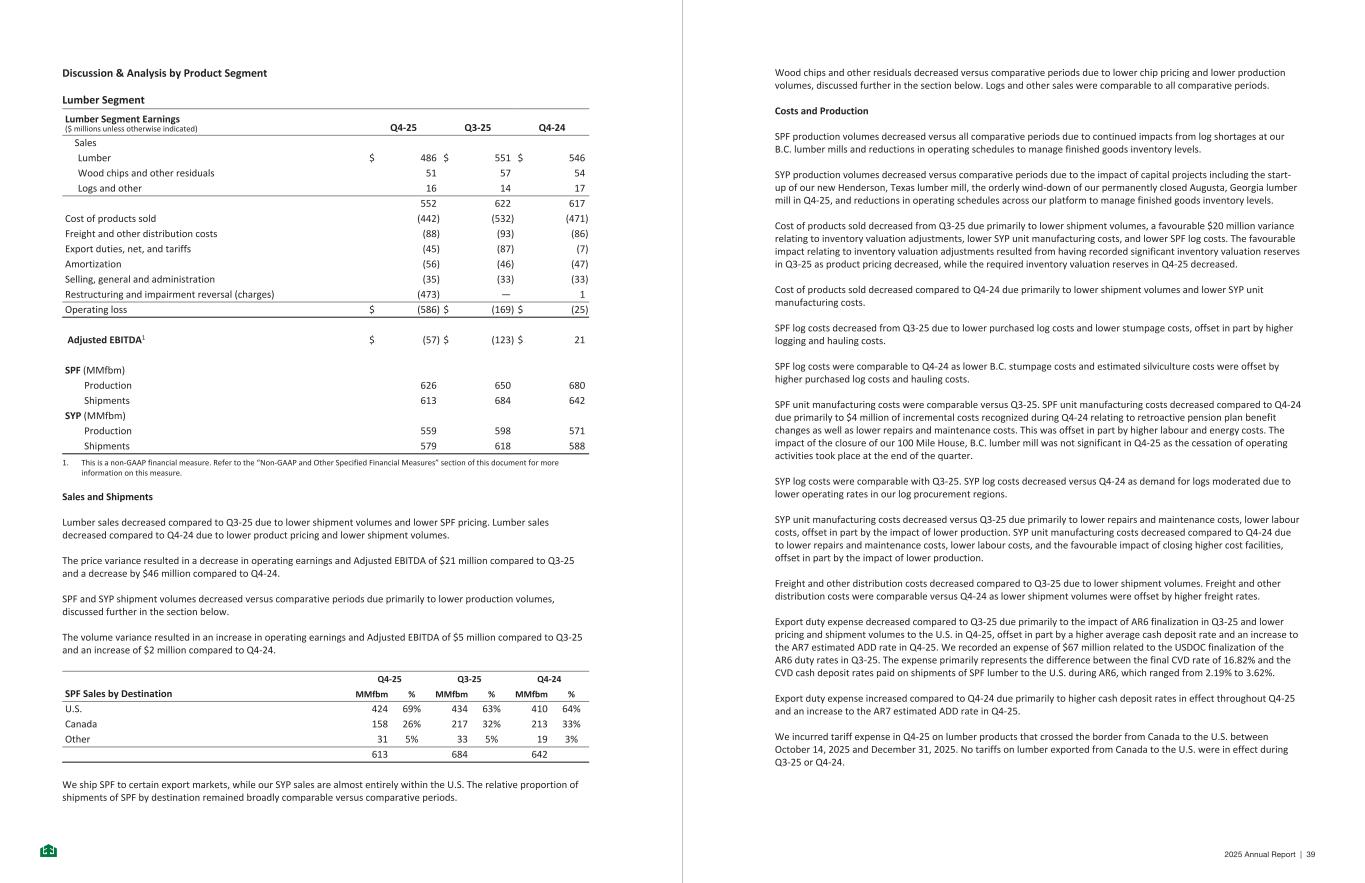
Discussion & Analysis by Product Segment Lumber Segment Lumber Segment Earnings ($ millions unless otherwise indicated) Q4-25 Q3-25 Q4-24 Sales Lumber $ 486 $ 551 $ 546 Wood chips and other residuals 51 57 54 Logs and other 16 14 17 552 622 617 Cost of products sold (442) (532) (471) Freight and other distribution costs (88) (93) (86) Export duties, net, and tariffs (45) (87) (7) Amortization (56) (46) (47) Selling, general and administration (35) (33) (33) Restructuring and impairment reversal (charges) (473) — 1 Operating loss $ (586) $ (169) $ (25) Adjusted EBITDA1 $ (57) $ (123) $ 21 SPF (MMfbm) Production 626 650 680 Shipments 613 684 642 SYP (MMfbm) Production 559 598 571 Shipments 579 618 588 1. This is a non-GAAP financial measure. Refer to the “Non-GAAP and Other Specified Financial Measures” section of this document for more information on this measure. Sales and Shipments Lumber sales decreased compared to Q3-25 due to lower shipment volumes and lower SPF pricing. Lumber sales decreased compared to Q4-24 due to lower product pricing and lower shipment volumes. The price variance resulted in a decrease in operating earnings and Adjusted EBITDA of $21 million compared to Q3-25 and a decrease by $46 million compared to Q4-24. SPF and SYP shipment volumes decreased versus comparative periods due primarily to lower production volumes, discussed further in the section below. The volume variance resulted in an increase in operating earnings and Adjusted EBITDA of $5 million compared to Q3-25 and an increase of $2 million compared to Q4-24. SPF Sales by Destination Q4-25 Q3-25 Q4-24 MMfbm % MMfbm % MMfbm % U.S. 424 69% 434 63% 410 64% Canada 158 26% 217 32% 213 33% Other 31 5% 33 5% 19 3% 613 684 642 We ship SPF to certain export markets, while our SYP sales are almost entirely within the U.S. The relative proportion of shipments of SPF by destination remained broadly comparable versus comparative periods. - 19 - Wood chips and other residuals decreased versus comparative periods due to lower chip pricing and lower production volumes, discussed further in the section below. Logs and other sales were comparable to all comparative periods. Costs and Production SPF production volumes decreased versus all comparative periods due to continued impacts from log shortages at our B.C. lumber mills and reductions in operating schedules to manage finished goods inventory levels. SYP production volumes decreased versus comparative periods due to the impact of capital projects including the start- up of our new Henderson, Texas lumber mill, the orderly wind-down of our permanently closed Augusta, Georgia lumber mill in Q4-25, and reductions in operating schedules across our platform to manage finished goods inventory levels. Cost of products sold decreased from Q3-25 due primarily to lower shipment volumes, a favourable $20 million variance relating to inventory valuation adjustments, lower SYP unit manufacturing costs, and lower SPF log costs. The favourable impact relating to inventory valuation adjustments resulted from having recorded significant inventory valuation reserves in Q3-25 as product pricing decreased, while the required inventory valuation reserves in Q4-25 decreased. Cost of products sold decreased compared to Q4-24 due primarily to lower shipment volumes and lower SYP unit manufacturing costs. SPF log costs decreased from Q3-25 due to lower purchased log costs and lower stumpage costs, offset in part by higher logging and hauling costs. SPF log costs were comparable to Q4-24 as lower B.C. stumpage costs and estimated silviculture costs were offset by higher purchased log costs and hauling costs. SPF unit manufacturing costs were comparable versus Q3-25. SPF unit manufacturing costs decreased compared to Q4-24 due primarily to $4 million of incremental costs recognized during Q4-24 relating to retroactive pension plan benefit changes as well as lower repairs and maintenance costs. This was offset in part by higher labour and energy costs. The impact of the closure of our 100 Mile House, B.C. lumber mill was not significant in Q4-25 as the cessation of operating activities took place at the end of the quarter. SYP log costs were comparable with Q3-25. SYP log costs decreased versus Q4-24 as demand for logs moderated due to lower operating rates in our log procurement regions. SYP unit manufacturing costs decreased versus Q3-25 due primarily to lower repairs and maintenance costs, lower labour costs, offset in part by the impact of lower production. SYP unit manufacturing costs decreased compared to Q4-24 due to lower repairs and maintenance costs, lower labour costs, and the favourable impact of closing higher cost facilities, offset in part by the impact of lower production. Freight and other distribution costs decreased compared to Q3-25 due to lower shipment volumes. Freight and other distribution costs were comparable versus Q4-24 as lower shipment volumes were offset by higher freight rates. Export duty expense decreased compared to Q3-25 due primarily to the impact of AR6 finalization in Q3-25 and lower pricing and shipment volumes to the U.S. in Q4-25, offset in part by a higher average cash deposit rate and an increase to the AR7 estimated ADD rate in Q4-25. We recorded an expense of $67 million related to the USDOC finalization of the AR6 duty rates in Q3-25. The expense primarily represents the difference between the final CVD rate of 16.82% and the CVD cash deposit rates paid on shipments of SPF lumber to the U.S. during AR6, which ranged from 2.19% to 3.62%. Export duty expense increased compared to Q4-24 due primarily to higher cash deposit rates in effect throughout Q4-25 and an increase to the AR7 estimated ADD rate in Q4-25. We incurred tariff expense in Q4-25 on lumber products that crossed the border from Canada to the U.S. between October 14, 2025 and December 31, 2025. No tariffs on lumber exported from Canada to the U.S. were in effect during Q3-25 or Q4-24. - 20 - 2025 Annual Report | 39
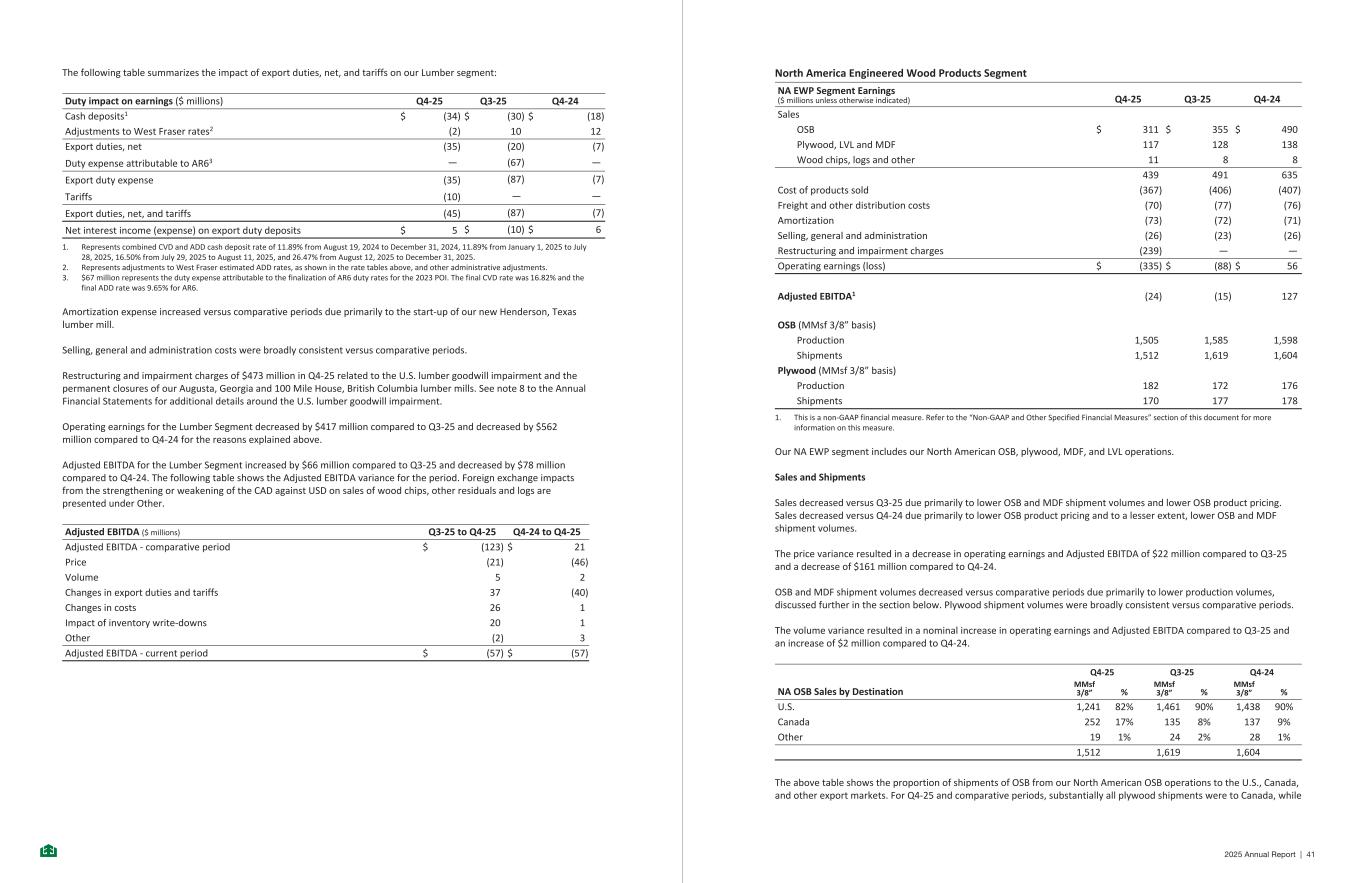
The following table summarizes the impact of export duties, net, and tariffs on our Lumber segment: Duty impact on earnings ($ millions) Q4-25 Q3-25 Q4-24 Cash deposits1 $ (34) $ (30) $ (18) Adjustments to West Fraser rates2 (2) 10 12 Export duties, net (35) (20) (7) Duty expense attributable to AR63 — (67) — Export duty expense (35) (87) (7) Tariffs (10) — — Export duties, net, and tariffs (45) (87) (7) Net interest income (expense) on export duty deposits $ 5 $ (10) $ 6 1. Represents combined CVD and ADD cash deposit rate of 11.89% from August 19, 2024 to December 31, 2024, 11.89% from January 1, 2025 to July 28, 2025, 16.50% from July 29, 2025 to August 11, 2025, and 26.47% from August 12, 2025 to December 31, 2025. 2. Represents adjustments to West Fraser estimated ADD rates, as shown in the rate tables above, and other administrative adjustments. 3. $67 million represents the duty expense attributable to the finalization of AR6 duty rates for the 2023 POI. The final CVD rate was 16.82% and the final ADD rate was 9.65% for AR6. Amortization expense increased versus comparative periods due primarily to the start-up of our new Henderson, Texas lumber mill. Selling, general and administration costs were broadly consistent versus comparative periods. Restructuring and impairment charges of $473 million in Q4-25 related to the U.S. lumber goodwill impairment and the permanent closures of our Augusta, Georgia and 100 Mile House, British Columbia lumber mills. See note 8 to the Annual Financial Statements for additional details around the U.S. lumber goodwill impairment. Operating earnings for the Lumber Segment decreased by $417 million compared to Q3-25 and decreased by $562 million compared to Q4-24 for the reasons explained above. Adjusted EBITDA for the Lumber Segment increased by $66 million compared to Q3-25 and decreased by $78 million compared to Q4-24. The following table shows the Adjusted EBITDA variance for the period. Foreign exchange impacts from the strengthening or weakening of the CAD against USD on sales of wood chips, other residuals and logs are presented under Other. Adjusted EBITDA ($ millions) Q3-25 to Q4-25 Q4-24 to Q4-25 Adjusted EBITDA - comparative period $ (123) $ 21 Price (21) (46) Volume 5 2 Changes in export duties and tariffs 37 (40) Changes in costs 26 1 Impact of inventory write-downs 20 1 Other (2) 3 Adjusted EBITDA - current period $ (57) $ (57) - 21 - North America Engineered Wood Products Segment NA EWP Segment Earnings ($ millions unless otherwise indicated) Q4-25 Q3-25 Q4-24 Sales OSB $ 311 $ 355 $ 490 Plywood, LVL and MDF 117 128 138 Wood chips, logs and other 11 8 8 439 491 635 Cost of products sold (367) (406) (407) Freight and other distribution costs (70) (77) (76) Amortization (73) (72) (71) Selling, general and administration (26) (23) (26) Restructuring and impairment charges (239) — — Operating earnings (loss) $ (335) $ (88) $ 56 Adjusted EBITDA1 (24) (15) 127 OSB (MMsf 3/8” basis) Production 1,505 1,585 1,598 Shipments 1,512 1,619 1,604 Plywood (MMsf 3/8” basis) Production 182 172 176 Shipments 170 177 178 1. This is a non-GAAP financial measure. Refer to the “Non-GAAP and Other Specified Financial Measures” section of this document for more information on this measure. Our NA EWP segment includes our North American OSB, plywood, MDF, and LVL operations. Sales and Shipments Sales decreased versus Q3-25 due primarily to lower OSB and MDF shipment volumes and lower OSB product pricing. Sales decreased versus Q4-24 due primarily to lower OSB product pricing and to a lesser extent, lower OSB and MDF shipment volumes. The price variance resulted in a decrease in operating earnings and Adjusted EBITDA of $22 million compared to Q3-25 and a decrease of $161 million compared to Q4-24. OSB and MDF shipment volumes decreased versus comparative periods due primarily to lower production volumes, discussed further in the section below. Plywood shipment volumes were broadly consistent versus comparative periods. The volume variance resulted in a nominal increase in operating earnings and Adjusted EBITDA compared to Q3-25 and an increase of $2 million compared to Q4-24. NA OSB Sales by Destination Q4-25 Q3-25 Q4-24 MMsf 3/8” % MMsf 3/8” % MMsf 3/8” % U.S. 1,241 82% 1,461 90% 1,438 90% Canada 252 17% 135 8% 137 9% Other 19 1% 24 2% 28 1% 1,512 1,619 1,604 The above table shows the proportion of shipments of OSB from our North American OSB operations to the U.S., Canada, and other export markets. For Q4-25 and comparative periods, substantially all plywood shipments were to Canada, while - 22 - 2025 Annual Report | 41
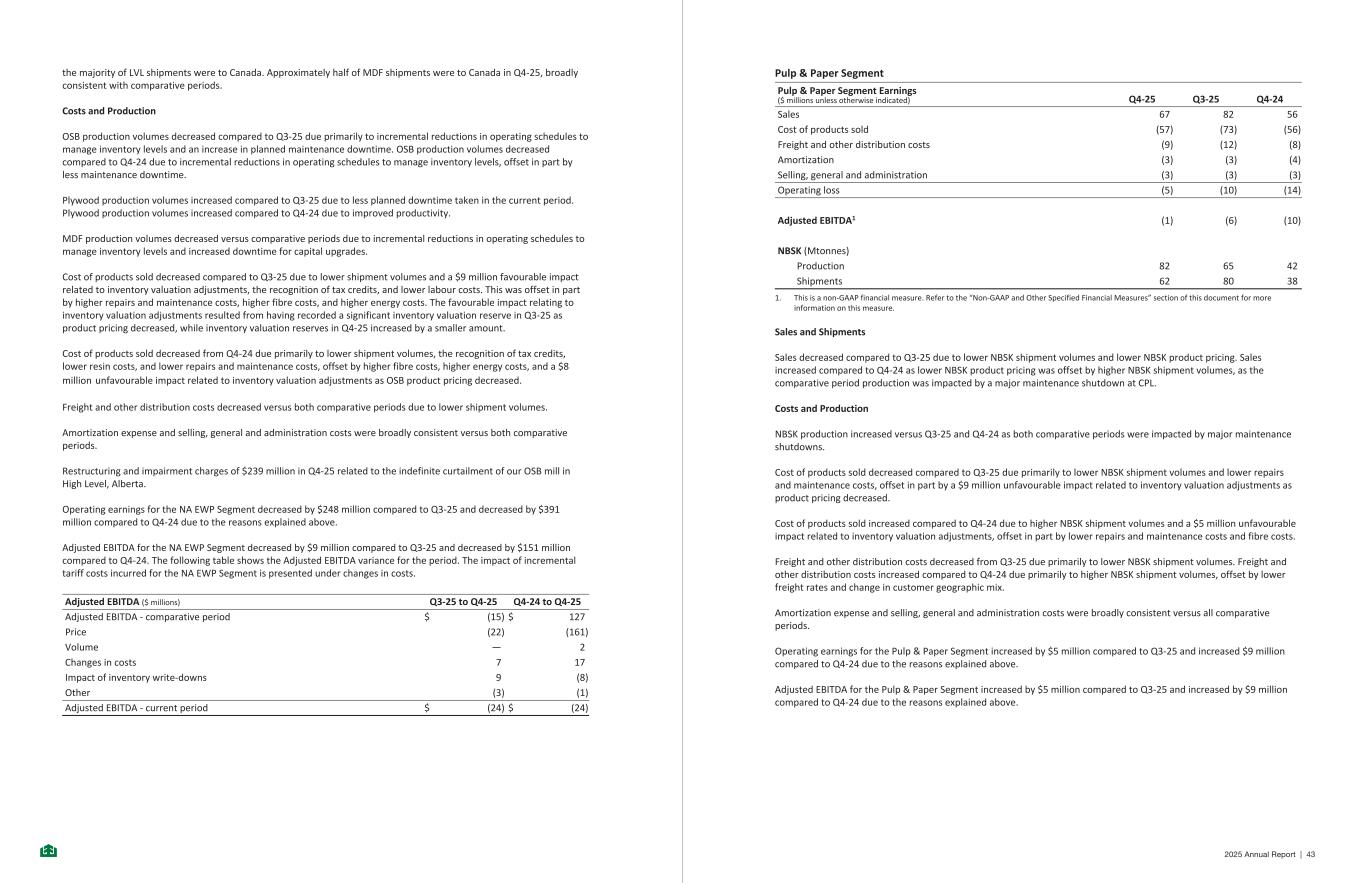
the majority of LVL shipments were to Canada. Approximately half of MDF shipments were to Canada in Q4-25, broadly consistent with comparative periods. Costs and Production OSB production volumes decreased compared to Q3-25 due primarily to incremental reductions in operating schedules to manage inventory levels and an increase in planned maintenance downtime. OSB production volumes decreased compared to Q4-24 due to incremental reductions in operating schedules to manage inventory levels, offset in part by less maintenance downtime. Plywood production volumes increased compared to Q3-25 due to less planned downtime taken in the current period. Plywood production volumes increased compared to Q4-24 due to improved productivity. MDF production volumes decreased versus comparative periods due to incremental reductions in operating schedules to manage inventory levels and increased downtime for capital upgrades. Cost of products sold decreased compared to Q3-25 due to lower shipment volumes and a $9 million favourable impact related to inventory valuation adjustments, the recognition of tax credits, and lower labour costs. This was offset in part by higher repairs and maintenance costs, higher fibre costs, and higher energy costs. The favourable impact relating to inventory valuation adjustments resulted from having recorded a significant inventory valuation reserve in Q3-25 as product pricing decreased, while inventory valuation reserves in Q4-25 increased by a smaller amount. Cost of products sold decreased from Q4-24 due primarily to lower shipment volumes, the recognition of tax credits, lower resin costs, and lower repairs and maintenance costs, offset by higher fibre costs, higher energy costs, and a $8 million unfavourable impact related to inventory valuation adjustments as OSB product pricing decreased. Freight and other distribution costs decreased versus both comparative periods due to lower shipment volumes. Amortization expense and selling, general and administration costs were broadly consistent versus both comparative periods. Restructuring and impairment charges of $239 million in Q4-25 related to the indefinite curtailment of our OSB mill in High Level, Alberta. Operating earnings for the NA EWP Segment decreased by $248 million compared to Q3-25 and decreased by $391 million compared to Q4-24 due to the reasons explained above. Adjusted EBITDA for the NA EWP Segment decreased by $9 million compared to Q3-25 and decreased by $151 million compared to Q4-24. The following table shows the Adjusted EBITDA variance for the period. The impact of incremental tariff costs incurred for the NA EWP Segment is presented under changes in costs. Adjusted EBITDA ($ millions) Q3-25 to Q4-25 Q4-24 to Q4-25 Adjusted EBITDA - comparative period $ (15) $ 127 Price (22) (161) Volume — 2 Changes in costs 7 17 Impact of inventory write-downs 9 (8) Other (3) (1) Adjusted EBITDA - current period $ (24) $ (24) - 23 - Pulp & Paper Segment Pulp & Paper Segment Earnings ($ millions unless otherwise indicated) Q4-25 Q3-25 Q4-24 Sales 67 82 56 Cost of products sold (57) (73) (56) Freight and other distribution costs (9) (12) (8) Amortization (3) (3) (4) Selling, general and administration (3) (3) (3) Operating loss (5) (10) (14) Adjusted EBITDA1 (1) (6) (10) NBSK (Mtonnes) Production 82 65 42 Shipments 62 80 38 1. This is a non-GAAP financial measure. Refer to the “Non-GAAP and Other Specified Financial Measures” section of this document for more information on this measure. Sales and Shipments Sales decreased compared to Q3-25 due to lower NBSK shipment volumes and lower NBSK product pricing. Sales increased compared to Q4-24 as lower NBSK product pricing was offset by higher NBSK shipment volumes, as the comparative period production was impacted by a major maintenance shutdown at CPL. Costs and Production NBSK production increased versus Q3-25 and Q4-24 as both comparative periods were impacted by major maintenance shutdowns. Cost of products sold decreased compared to Q3-25 due primarily to lower NBSK shipment volumes and lower repairs and maintenance costs, offset in part by a $9 million unfavourable impact related to inventory valuation adjustments as product pricing decreased. Cost of products sold increased compared to Q4-24 due to higher NBSK shipment volumes and a $5 million unfavourable impact related to inventory valuation adjustments, offset in part by lower repairs and maintenance costs and fibre costs. Freight and other distribution costs decreased from Q3-25 due primarily to lower NBSK shipment volumes. Freight and other distribution costs increased compared to Q4-24 due primarily to higher NBSK shipment volumes, offset by lower freight rates and change in customer geographic mix. Amortization expense and selling, general and administration costs were broadly consistent versus all comparative periods. Operating earnings for the Pulp & Paper Segment increased by $5 million compared to Q3-25 and increased $9 million compared to Q4-24 due to the reasons explained above. Adjusted EBITDA for the Pulp & Paper Segment increased by $5 million compared to Q3-25 and increased by $9 million compared to Q4-24 due to the reasons explained above. - 24 - 2025 Annual Report | 43
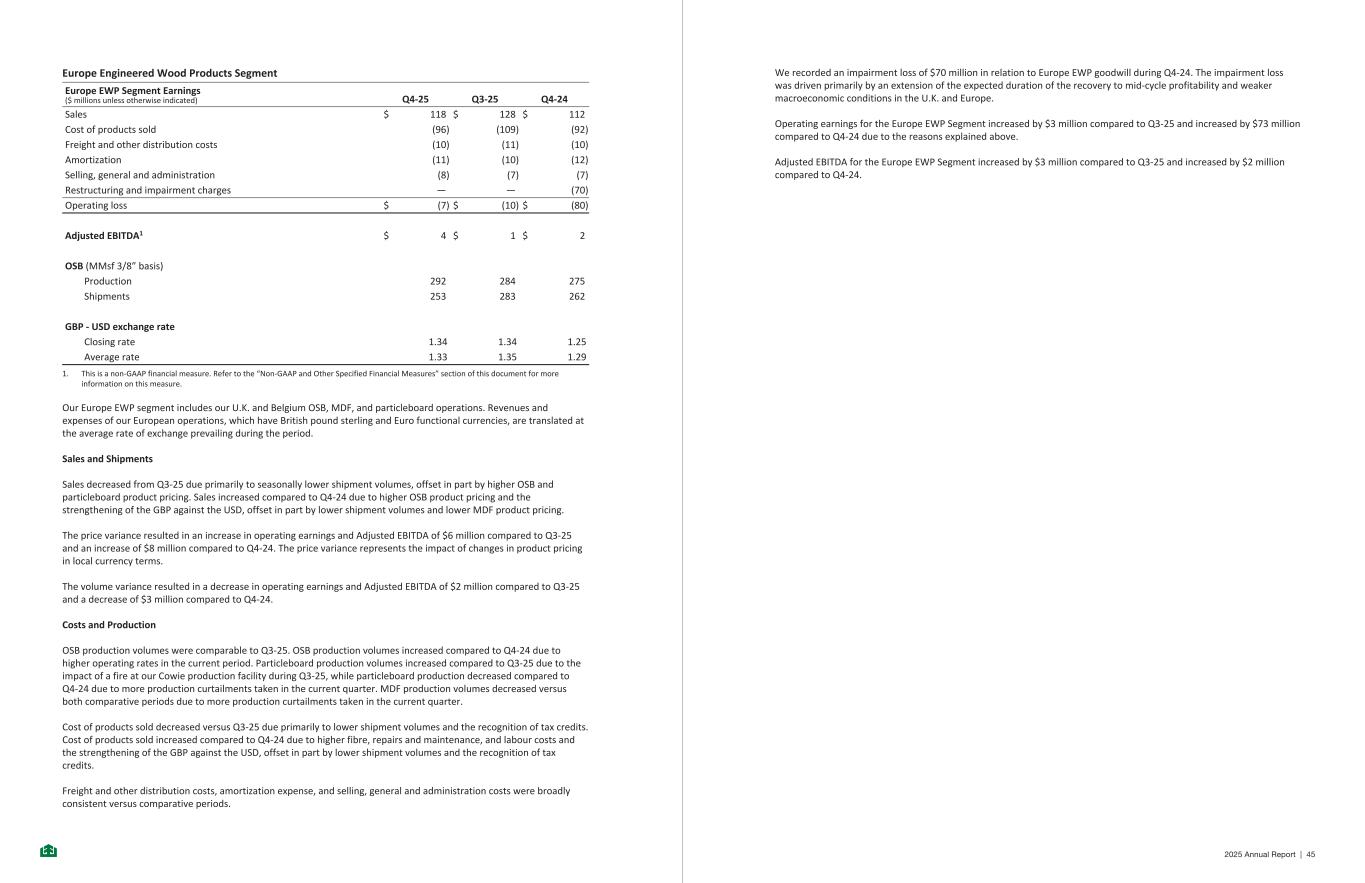
Europe Engineered Wood Products Segment Europe EWP Segment Earnings ($ millions unless otherwise indicated) Q4-25 Q3-25 Q4-24 Sales $ 118 $ 128 $ 112 Cost of products sold (96) (109) (92) Freight and other distribution costs (10) (11) (10) Amortization (11) (10) (12) Selling, general and administration (8) (7) (7) Restructuring and impairment charges — — (70) Operating loss $ (7) $ (10) $ (80) Adjusted EBITDA1 $ 4 $ 1 $ 2 OSB (MMsf 3/8” basis) Production 292 284 275 Shipments 253 283 262 GBP - USD exchange rate Closing rate 1.34 1.34 1.25 Average rate 1.33 1.35 1.29 1. This is a non-GAAP financial measure. Refer to the “Non-GAAP and Other Specified Financial Measures” section of this document for more information on this measure. Our Europe EWP segment includes our U.K. and Belgium OSB, MDF, and particleboard operations. Revenues and expenses of our European operations, which have British pound sterling and Euro functional currencies, are translated at the average rate of exchange prevailing during the period. Sales and Shipments Sales decreased from Q3-25 due primarily to seasonally lower shipment volumes, offset in part by higher OSB and particleboard product pricing. Sales increased compared to Q4-24 due to higher OSB product pricing and the strengthening of the GBP against the USD, offset in part by lower shipment volumes and lower MDF product pricing. The price variance resulted in an increase in operating earnings and Adjusted EBITDA of $6 million compared to Q3-25 and an increase of $8 million compared to Q4-24. The price variance represents the impact of changes in product pricing in local currency terms. The volume variance resulted in a decrease in operating earnings and Adjusted EBITDA of $2 million compared to Q3-25 and a decrease of $3 million compared to Q4-24. Costs and Production OSB production volumes were comparable to Q3-25. OSB production volumes increased compared to Q4-24 due to higher operating rates in the current period. Particleboard production volumes increased compared to Q3-25 due to the impact of a fire at our Cowie production facility during Q3-25, while particleboard production decreased compared to Q4-24 due to more production curtailments taken in the current quarter. MDF production volumes decreased versus both comparative periods due to more production curtailments taken in the current quarter. Cost of products sold decreased versus Q3-25 due primarily to lower shipment volumes and the recognition of tax credits. Cost of products sold increased compared to Q4-24 due to higher fibre, repairs and maintenance, and labour costs and the strengthening of the GBP against the USD, offset in part by lower shipment volumes and the recognition of tax credits. Freight and other distribution costs, amortization expense, and selling, general and administration costs were broadly consistent versus comparative periods. - 25 - We recorded an impairment loss of $70 million in relation to Europe EWP goodwill during Q4-24. The impairment loss was driven primarily by an extension of the expected duration of the recovery to mid-cycle profitability and weaker macroeconomic conditions in the U.K. and Europe. Operating earnings for the Europe EWP Segment increased by $3 million compared to Q3-25 and increased by $73 million compared to Q4-24 due to the reasons explained above. Adjusted EBITDA for the Europe EWP Segment increased by $3 million compared to Q3-25 and increased by $2 million compared to Q4-24. - 26 - 2025 Annual Report | 45
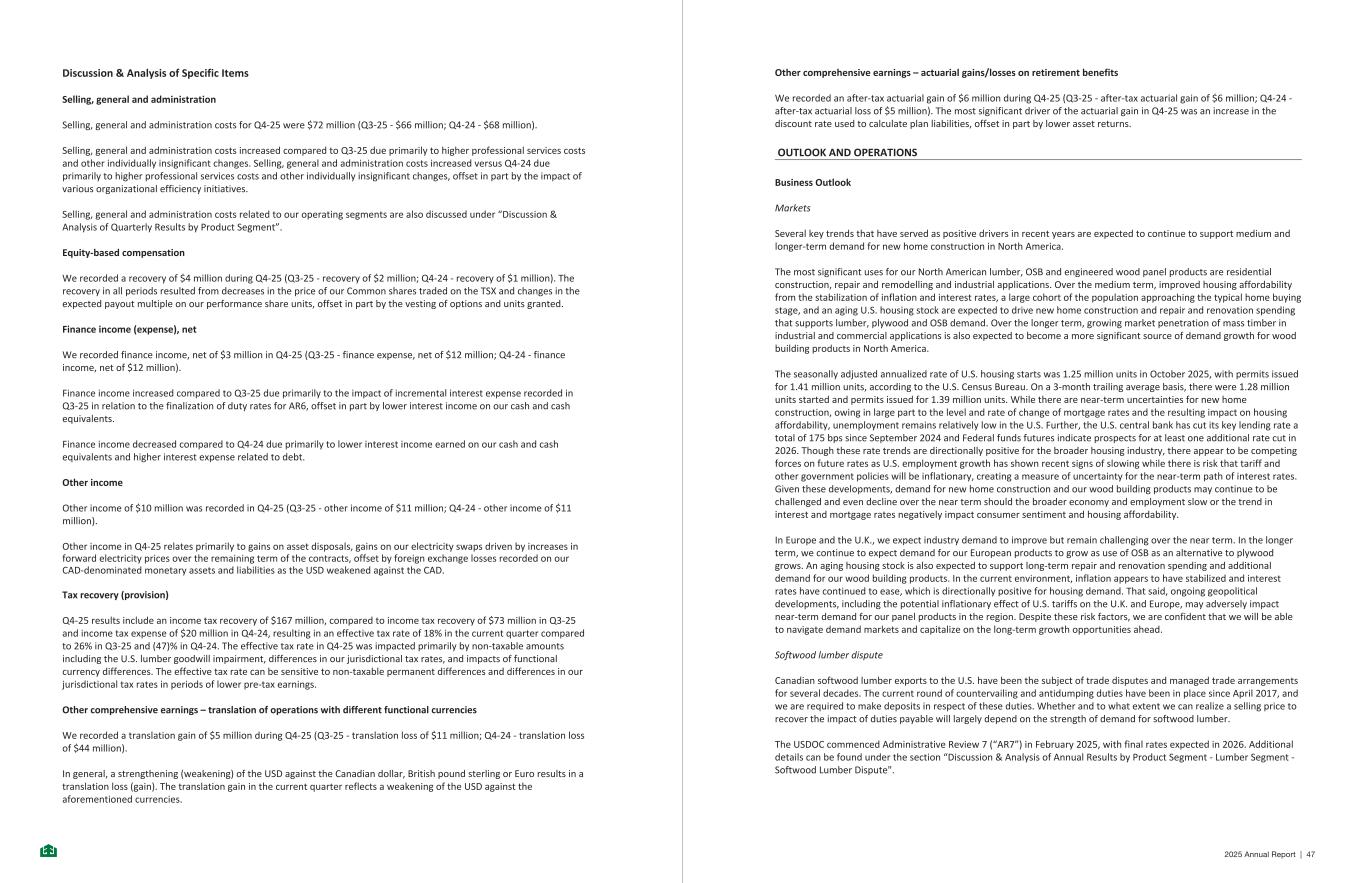
Discussion & Analysis of Specific Items Selling, general and administration Selling, general and administration costs for Q4-25 were $72 million (Q3-25 - $66 million; Q4-24 - $68 million). Selling, general and administration costs increased compared to Q3-25 due primarily to higher professional services costs and other individually insignificant changes. Selling, general and administration costs increased versus Q4-24 due primarily to higher professional services costs and other individually insignificant changes, offset in part by the impact of various organizational efficiency initiatives. Selling, general and administration costs related to our operating segments are also discussed under “Discussion & Analysis of Quarterly Results by Product Segment”. Equity-based compensation We recorded a recovery of $4 million during Q4-25 (Q3-25 - recovery of $2 million; Q4-24 - recovery of $1 million). The recovery in all periods resulted from decreases in the price of our Common shares traded on the TSX and changes in the expected payout multiple on our performance share units, offset in part by the vesting of options and units granted. Finance income (expense), net We recorded finance income, net of $3 million in Q4-25 (Q3-25 - finance expense, net of $12 million; Q4-24 - finance income, net of $12 million). Finance income increased compared to Q3-25 due primarily to the impact of incremental interest expense recorded in Q3-25 in relation to the finalization of duty rates for AR6, offset in part by lower interest income on our cash and cash equivalents. Finance income decreased compared to Q4-24 due primarily to lower interest income earned on our cash and cash equivalents and higher interest expense related to debt. Other income Other income of $10 million was recorded in Q4-25 (Q3-25 - other income of $11 million; Q4-24 - other income of $11 million). Other income in Q4-25 relates primarily to gains on asset disposals, gains on our electricity swaps driven by increases in forward electricity prices over the remaining term of the contracts, offset by foreign exchange losses recorded on our CAD-denominated monetary assets and liabilities as the USD weakened against the CAD. Tax recovery (provision) Q4-25 results include an income tax recovery of $167 million, compared to income tax recovery of $73 million in Q3-25 and income tax expense of $20 million in Q4-24, resulting in an effective tax rate of 18% in the current quarter compared to 26% in Q3-25 and (47)% in Q4-24. The effective tax rate in Q4-25 was impacted primarily by non-taxable amounts including the U.S. lumber goodwill impairment, differences in our jurisdictional tax rates, and impacts of functional currency differences. The effective tax rate can be sensitive to non-taxable permanent differences and differences in our jurisdictional tax rates in periods of lower pre-tax earnings. Other comprehensive earnings – translation of operations with different functional currencies We recorded a translation gain of $5 million during Q4-25 (Q3-25 - translation loss of $11 million; Q4-24 - translation loss of $44 million). In general, a strengthening (weakening) of the USD against the Canadian dollar, British pound sterling or Euro results in a translation loss (gain). The translation gain in the current quarter reflects a weakening of the USD against the aforementioned currencies. - 27 - Other comprehensive earnings – actuarial gains/losses on retirement benefits We recorded an after-tax actuarial gain of $6 million during Q4-25 (Q3-25 - after-tax actuarial gain of $6 million; Q4-24 - after-tax actuarial loss of $5 million). The most significant driver of the actuarial gain in Q4-25 was an increase in the discount rate used to calculate plan liabilities, offset in part by lower asset returns. OUTLOOK AND OPERATIONS Business Outlook Markets Several key trends that have served as positive drivers in recent years are expected to continue to support medium and longer-term demand for new home construction in North America. The most significant uses for our North American lumber, OSB and engineered wood panel products are residential construction, repair and remodelling and industrial applications. Over the medium term, improved housing affordability from the stabilization of inflation and interest rates, a large cohort of the population approaching the typical home buying stage, and an aging U.S. housing stock are expected to drive new home construction and repair and renovation spending that supports lumber, plywood and OSB demand. Over the longer term, growing market penetration of mass timber in industrial and commercial applications is also expected to become a more significant source of demand growth for wood building products in North America. The seasonally adjusted annualized rate of U.S. housing starts was 1.25 million units in October 2025, with permits issued for 1.41 million units, according to the U.S. Census Bureau. On a 3-month trailing average basis, there were 1.28 million units started and permits issued for 1.39 million units. While there are near-term uncertainties for new home construction, owing in large part to the level and rate of change of mortgage rates and the resulting impact on housing affordability, unemployment remains relatively low in the U.S. Further, the U.S. central bank has cut its key lending rate a total of 175 bps since September 2024 and Federal funds futures indicate prospects for at least one additional rate cut in 2026. Though these rate trends are directionally positive for the broader housing industry, there appear to be competing forces on future rates as U.S. employment growth has shown recent signs of slowing while there is risk that tariff and other government policies will be inflationary, creating a measure of uncertainty for the near-term path of interest rates. Given these developments, demand for new home construction and our wood building products may continue to be challenged and even decline over the near term should the broader economy and employment slow or the trend in interest and mortgage rates negatively impact consumer sentiment and housing affordability. In Europe and the U.K., we expect industry demand to improve but remain challenging over the near term. In the longer term, we continue to expect demand for our European products to grow as use of OSB as an alternative to plywood grows. An aging housing stock is also expected to support long-term repair and renovation spending and additional demand for our wood building products. In the current environment, inflation appears to have stabilized and interest rates have continued to ease, which is directionally positive for housing demand. That said, ongoing geopolitical developments, including the potential inflationary effect of U.S. tariffs on the U.K. and Europe, may adversely impact near-term demand for our panel products in the region. Despite these risk factors, we are confident that we will be able to navigate demand markets and capitalize on the long-term growth opportunities ahead. Softwood lumber dispute Canadian softwood lumber exports to the U.S. have been the subject of trade disputes and managed trade arrangements for several decades. The current round of countervailing and antidumping duties have been in place since April 2017, and we are required to make deposits in respect of these duties. Whether and to what extent we can realize a selling price to recover the impact of duties payable will largely depend on the strength of demand for softwood lumber. The USDOC commenced Administrative Review 7 (“AR7”) in February 2025, with final rates expected in 2026. Additional details can be found under the section “Discussion & Analysis of Annual Results by Product Segment - Lumber Segment - Softwood Lumber Dispute". - 28 - 2025 Annual Report | 47
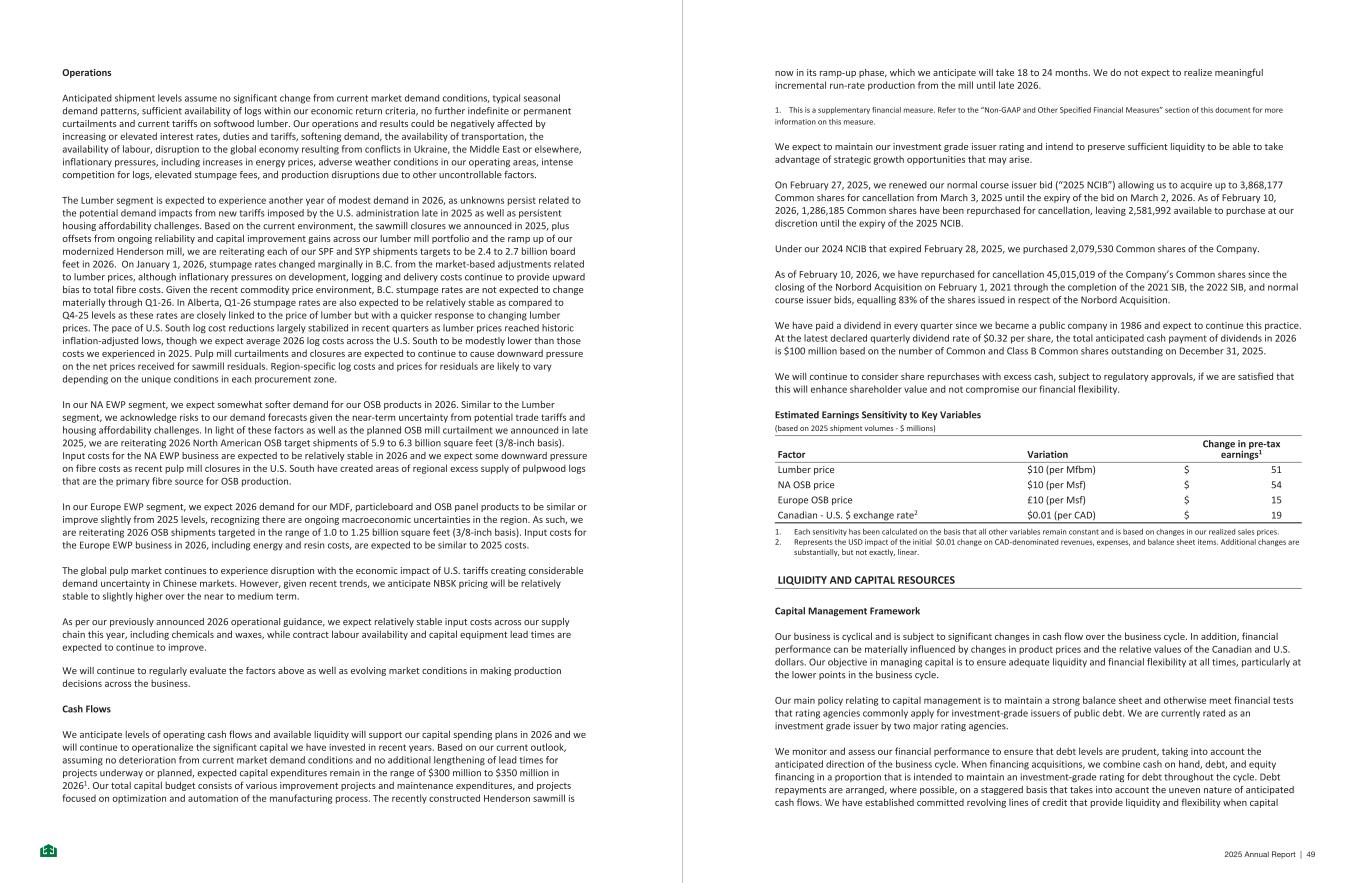
Operations Anticipated shipment levels assume no significant change from current market demand conditions, typical seasonal demand patterns, sufficient availability of logs within our economic return criteria, no further indefinite or permanent curtailments and current tariffs on softwood lumber. Our operations and results could be negatively affected by increasing or elevated interest rates, duties and tariffs, softening demand, the availability of transportation, the availability of labour, disruption to the global economy resulting from conflicts in Ukraine, the Middle East or elsewhere, inflationary pressures, including increases in energy prices, adverse weather conditions in our operating areas, intense competition for logs, elevated stumpage fees, and production disruptions due to other uncontrollable factors. The Lumber segment is expected to experience another year of modest demand in 2026, as unknowns persist related to the potential demand impacts from new tariffs imposed by the U.S. administration late in 2025 as well as persistent housing affordability challenges. Based on the current environment, the sawmill closures we announced in 2025, plus offsets from ongoing reliability and capital improvement gains across our lumber mill portfolio and the ramp up of our modernized Henderson mill, we are reiterating each of our SPF and SYP shipments targets to be 2.4 to 2.7 billion board feet in 2026. On January 1, 2026, stumpage rates changed marginally in B.C. from the market-based adjustments related to lumber prices, although inflationary pressures on development, logging and delivery costs continue to provide upward bias to total fibre costs. Given the recent commodity price environment, B.C. stumpage rates are not expected to change materially through Q1-26. In Alberta, Q1-26 stumpage rates are also expected to be relatively stable as compared to Q4-25 levels as these rates are closely linked to the price of lumber but with a quicker response to changing lumber prices. The pace of U.S. South log cost reductions largely stabilized in recent quarters as lumber prices reached historic inflation-adjusted lows, though we expect average 2026 log costs across the U.S. South to be modestly lower than those costs we experienced in 2025. Pulp mill curtailments and closures are expected to continue to cause downward pressure on the net prices received for sawmill residuals. Region-specific log costs and prices for residuals are likely to vary depending on the unique conditions in each procurement zone. In our NA EWP segment, we expect somewhat softer demand for our OSB products in 2026. Similar to the Lumber segment, we acknowledge risks to our demand forecasts given the near-term uncertainty from potential trade tariffs and housing affordability challenges. In light of these factors as well as the planned OSB mill curtailment we announced in late 2025, we are reiterating 2026 North American OSB target shipments of 5.9 to 6.3 billion square feet (3/8-inch basis). Input costs for the NA EWP business are expected to be relatively stable in 2026 and we expect some downward pressure on fibre costs as recent pulp mill closures in the U.S. South have created areas of regional excess supply of pulpwood logs that are the primary fibre source for OSB production. In our Europe EWP segment, we expect 2026 demand for our MDF, particleboard and OSB panel products to be similar or improve slightly from 2025 levels, recognizing there are ongoing macroeconomic uncertainties in the region. As such, we are reiterating 2026 OSB shipments targeted in the range of 1.0 to 1.25 billion square feet (3/8-inch basis). Input costs for the Europe EWP business in 2026, including energy and resin costs, are expected to be similar to 2025 costs. The global pulp market continues to experience disruption with the economic impact of U.S. tariffs creating considerable demand uncertainty in Chinese markets. However, given recent trends, we anticipate NBSK pricing will be relatively stable to slightly higher over the near to medium term. As per our previously announced 2026 operational guidance, we expect relatively stable input costs across our supply chain this year, including chemicals and waxes, while contract labour availability and capital equipment lead times are expected to continue to improve. We will continue to regularly evaluate the factors above as well as evolving market conditions in making production decisions across the business. Cash Flows We anticipate levels of operating cash flows and available liquidity will support our capital spending plans in 2026 and we will continue to operationalize the significant capital we have invested in recent years. Based on our current outlook, assuming no deterioration from current market demand conditions and no additional lengthening of lead times for projects underway or planned, expected capital expenditures remain in the range of $300 million to $350 million in 20261. Our total capital budget consists of various improvement projects and maintenance expenditures, and projects focused on optimization and automation of the manufacturing process. The recently constructed Henderson sawmill is - 29 - now in its ramp-up phase, which we anticipate will take 18 to 24 months. We do not expect to realize meaningful incremental run-rate production from the mill until late 2026. 1. This is a supplementary financial measure. Refer to the “Non-GAAP and Other Specified Financial Measures” section of this document for more information on this measure. We expect to maintain our investment grade issuer rating and intend to preserve sufficient liquidity to be able to take advantage of strategic growth opportunities that may arise. On February 27, 2025, we renewed our normal course issuer bid (“2025 NCIB”) allowing us to acquire up to 3,868,177 Common shares for cancellation from March 3, 2025 until the expiry of the bid on March 2, 2026. As of February 10, 2026, 1,286,185 Common shares have been repurchased for cancellation, leaving 2,581,992 available to purchase at our discretion until the expiry of the 2025 NCIB. Under our 2024 NCIB that expired February 28, 2025, we purchased 2,079,530 Common shares of the Company. As of February 10, 2026, we have repurchased for cancellation 45,015,019 of the Company’s Common shares since the closing of the Norbord Acquisition on February 1, 2021 through the completion of the 2021 SIB, the 2022 SIB, and normal course issuer bids, equalling 83% of the shares issued in respect of the Norbord Acquisition. We have paid a dividend in every quarter since we became a public company in 1986 and expect to continue this practice. At the latest declared quarterly dividend rate of $0.32 per share, the total anticipated cash payment of dividends in 2026 is $100 million based on the number of Common and Class B Common shares outstanding on December 31, 2025. We will continue to consider share repurchases with excess cash, subject to regulatory approvals, if we are satisfied that this will enhance shareholder value and not compromise our financial flexibility. Estimated Earnings Sensitivity to Key Variables (based on 2025 shipment volumes - $ millions) Factor Variation Change in pre-tax earnings1 Lumber price $10 (per Mfbm) $ 51 NA OSB price $10 (per Msf) $ 54 Europe OSB price £10 (per Msf) $ 15 Canadian - U.S. $ exchange rate2 $0.01 (per CAD) $ 19 1. Each sensitivity has been calculated on the basis that all other variables remain constant and is based on changes in our realized sales prices. 2. Represents the USD impact of the initial $0.01 change on CAD-denominated revenues, expenses, and balance sheet items. Additional changes are substantially, but not exactly, linear. LIQUIDITY AND CAPITAL RESOURCES Capital Management Framework Our business is cyclical and is subject to significant changes in cash flow over the business cycle. In addition, financial performance can be materially influenced by changes in product prices and the relative values of the Canadian and U.S. dollars. Our objective in managing capital is to ensure adequate liquidity and financial flexibility at all times, particularly at the lower points in the business cycle. Our main policy relating to capital management is to maintain a strong balance sheet and otherwise meet financial tests that rating agencies commonly apply for investment-grade issuers of public debt. We are currently rated as an investment grade issuer by two major rating agencies. We monitor and assess our financial performance to ensure that debt levels are prudent, taking into account the anticipated direction of the business cycle. When financing acquisitions, we combine cash on hand, debt, and equity financing in a proportion that is intended to maintain an investment-grade rating for debt throughout the cycle. Debt repayments are arranged, where possible, on a staggered basis that takes into account the uneven nature of anticipated cash flows. We have established committed revolving lines of credit that provide liquidity and flexibility when capital - 30 - 2025 Annual Report | 49
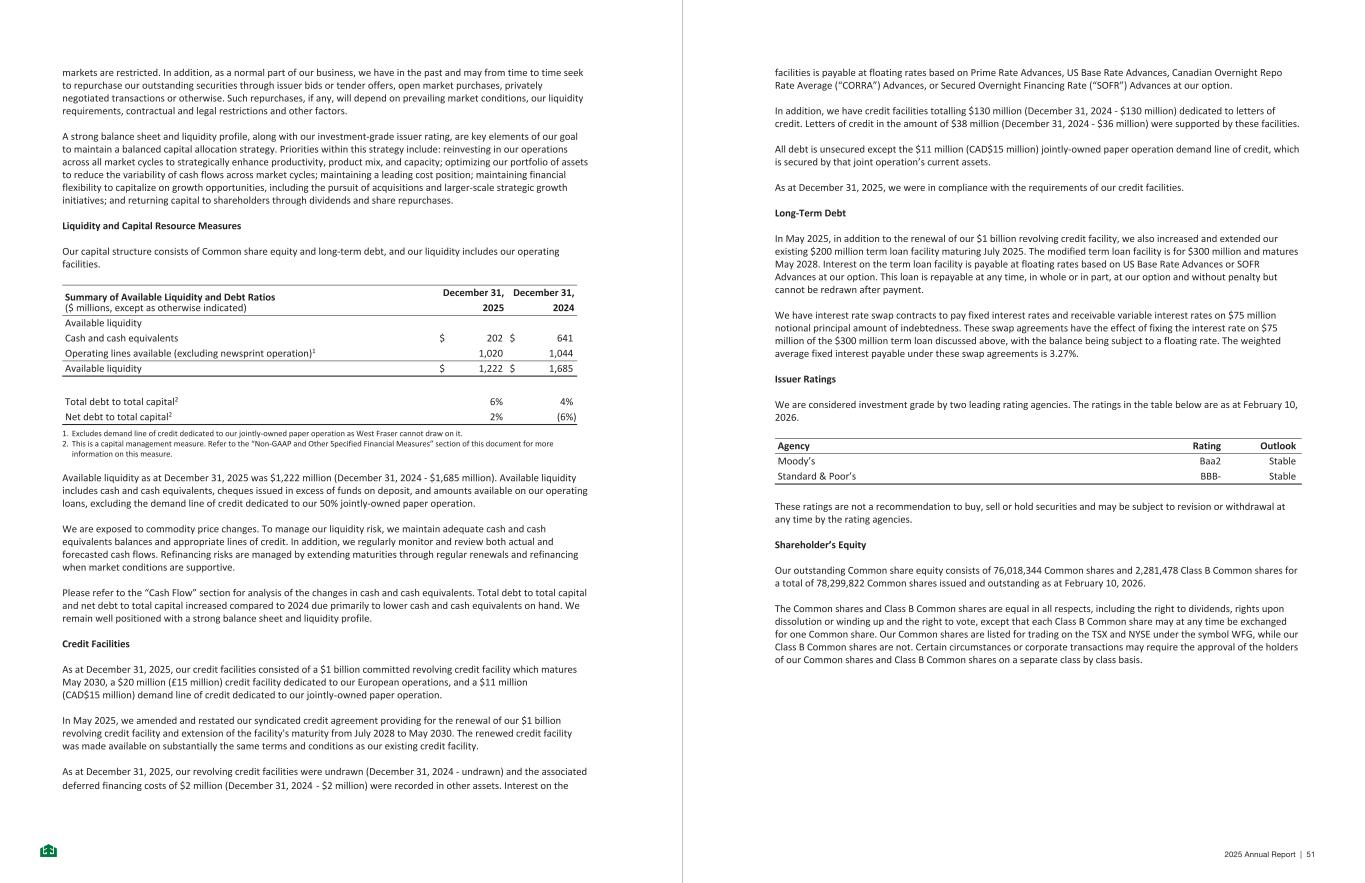
markets are restricted. In addition, as a normal part of our business, we have in the past and may from time to time seek to repurchase our outstanding securities through issuer bids or tender offers, open market purchases, privately negotiated transactions or otherwise. Such repurchases, if any, will depend on prevailing market conditions, our liquidity requirements, contractual and legal restrictions and other factors. A strong balance sheet and liquidity profile, along with our investment-grade issuer rating, are key elements of our goal to maintain a balanced capital allocation strategy. Priorities within this strategy include: reinvesting in our operations across all market cycles to strategically enhance productivity, product mix, and capacity; optimizing our portfolio of assets to reduce the variability of cash flows across market cycles; maintaining a leading cost position; maintaining financial flexibility to capitalize on growth opportunities, including the pursuit of acquisitions and larger-scale strategic growth initiatives; and returning capital to shareholders through dividends and share repurchases. Liquidity and Capital Resource Measures Our capital structure consists of Common share equity and long-term debt, and our liquidity includes our operating facilities. Summary of Available Liquidity and Debt Ratios ($ millions, except as otherwise indicated) December 31, December 31, 2025 2024 Available liquidity Cash and cash equivalents $ 202 $ 641 Operating lines available (excluding newsprint operation)1 1,020 1,044 Available liquidity $ 1,222 $ 1,685 Total debt to total capital2 6% 4% Net debt to total capital2 2% (6%) 1. Excludes demand line of credit dedicated to our jointly-owned paper operation as West Fraser cannot draw on it. 2. This is a capital management measure. Refer to the “Non-GAAP and Other Specified Financial Measures” section of this document for more information on this measure. Available liquidity as at December 31, 2025 was $1,222 million (December 31, 2024 - $1,685 million). Available liquidity includes cash and cash equivalents, cheques issued in excess of funds on deposit, and amounts available on our operating loans, excluding the demand line of credit dedicated to our 50% jointly-owned paper operation. We are exposed to commodity price changes. To manage our liquidity risk, we maintain adequate cash and cash equivalents balances and appropriate lines of credit. In addition, we regularly monitor and review both actual and forecasted cash flows. Refinancing risks are managed by extending maturities through regular renewals and refinancing when market conditions are supportive. Please refer to the “Cash Flow” section for analysis of the changes in cash and cash equivalents. Total debt to total capital and net debt to total capital increased compared to 2024 due primarily to lower cash and cash equivalents on hand. We remain well positioned with a strong balance sheet and liquidity profile. Credit Facilities As at December 31, 2025, our credit facilities consisted of a $1 billion committed revolving credit facility which matures May 2030, a $20 million (£15 million) credit facility dedicated to our European operations, and a $11 million (CAD$15 million) demand line of credit dedicated to our jointly-owned paper operation. In May 2025, we amended and restated our syndicated credit agreement providing for the renewal of our $1 billion revolving credit facility and extension of the facility's maturity from July 2028 to May 2030. The renewed credit facility was made available on substantially the same terms and conditions as our existing credit facility. As at December 31, 2025, our revolving credit facilities were undrawn (December 31, 2024 - undrawn) and the associated deferred financing costs of $2 million (December 31, 2024 - $2 million) were recorded in other assets. Interest on the - 31 - facilities is payable at floating rates based on Prime Rate Advances, US Base Rate Advances, Canadian Overnight Repo Rate Average (“CORRA”) Advances, or Secured Overnight Financing Rate (“SOFR”) Advances at our option. In addition, we have credit facilities totalling $130 million (December 31, 2024 - $130 million) dedicated to letters of credit. Letters of credit in the amount of $38 million (December 31, 2024 - $36 million) were supported by these facilities. All debt is unsecured except the $11 million (CAD$15 million) jointly-owned paper operation demand line of credit, which is secured by that joint operation’s current assets. As at December 31, 2025, we were in compliance with the requirements of our credit facilities. Long-Term Debt In May 2025, in addition to the renewal of our $1 billion revolving credit facility, we also increased and extended our existing $200 million term loan facility maturing July 2025. The modified term loan facility is for $300 million and matures May 2028. Interest on the term loan facility is payable at floating rates based on US Base Rate Advances or SOFR Advances at our option. This loan is repayable at any time, in whole or in part, at our option and without penalty but cannot be redrawn after payment. We have interest rate swap contracts to pay fixed interest rates and receivable variable interest rates on $75 million notional principal amount of indebtedness. These swap agreements have the effect of fixing the interest rate on $75 million of the $300 million term loan discussed above, with the balance being subject to a floating rate. The weighted average fixed interest payable under these swap agreements is 3.27%. Issuer Ratings We are considered investment grade by two leading rating agencies. The ratings in the table below are as at February 10, 2026. Agency Rating Outlook Moody’s Baa2 Stable Standard & Poor’s BBB- Stable These ratings are not a recommendation to buy, sell or hold securities and may be subject to revision or withdrawal at any time by the rating agencies. Shareholder’s Equity Our outstanding Common share equity consists of 76,018,344 Common shares and 2,281,478 Class B Common shares for a total of 78,299,822 Common shares issued and outstanding as at February 10, 2026. The Common shares and Class B Common shares are equal in all respects, including the right to dividends, rights upon dissolution or winding up and the right to vote, except that each Class B Common share may at any time be exchanged for one Common share. Our Common shares are listed for trading on the TSX and NYSE under the symbol WFG, while our Class B Common shares are not. Certain circumstances or corporate transactions may require the approval of the holders of our Common shares and Class B Common shares on a separate class by class basis. - 32 - 2025 Annual Report | 51
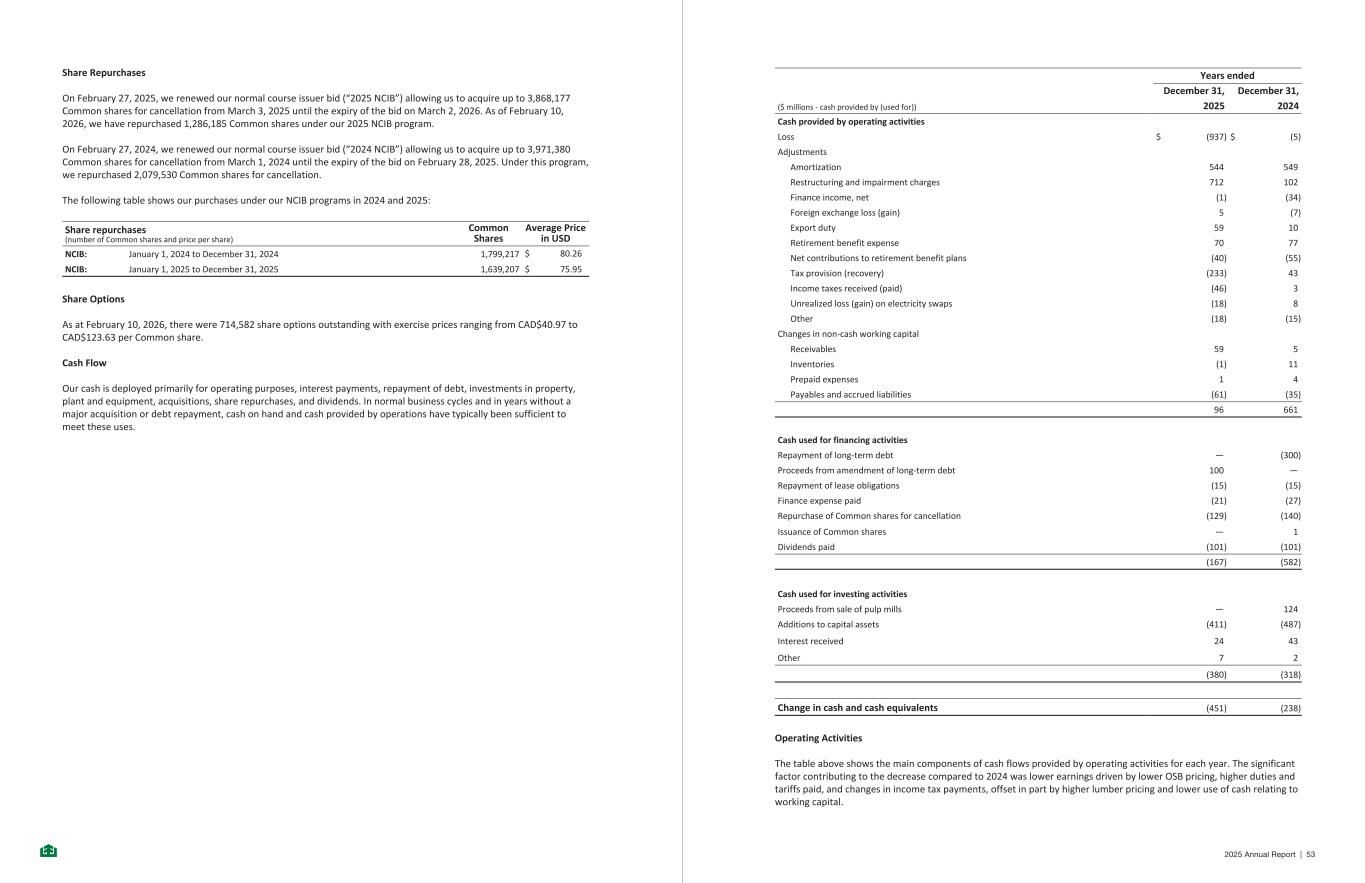
Share Repurchases On February 27, 2025, we renewed our normal course issuer bid (“2025 NCIB”) allowing us to acquire up to 3,868,177 Common shares for cancellation from March 3, 2025 until the expiry of the bid on March 2, 2026. As of February 10, 2026, we have repurchased 1,286,185 Common shares under our 2025 NCIB program. On February 27, 2024, we renewed our normal course issuer bid (“2024 NCIB”) allowing us to acquire up to 3,971,380 Common shares for cancellation from March 1, 2024 until the expiry of the bid on February 28, 2025. Under this program, we repurchased 2,079,530 Common shares for cancellation. The following table shows our purchases under our NCIB programs in 2024 and 2025: Share repurchases (number of Common shares and price per share) Common Shares Average Price in USD NCIB: January 1, 2024 to December 31, 2024 1,799,217 $ 80.26 NCIB: January 1, 2025 to December 31, 2025 1,639,207 $ 75.95 Share Options As at February 10, 2026, there were 714,582 share options outstanding with exercise prices ranging from CAD$40.97 to CAD$123.63 per Common share. Cash Flow Our cash is deployed primarily for operating purposes, interest payments, repayment of debt, investments in property, plant and equipment, acquisitions, share repurchases, and dividends. In normal business cycles and in years without a major acquisition or debt repayment, cash on hand and cash provided by operations have typically been sufficient to meet these uses. - 33 - Years ended December 31, December 31, ($ millions - cash provided by (used for)) 2025 2024 Cash provided by operating activities Loss $ (937) $ (5) Adjustments Amortization 544 549 Restructuring and impairment charges 712 102 Finance income, net (1) (34) Foreign exchange loss (gain) 5 (7) Export duty 59 10 Retirement benefit expense 70 77 Net contributions to retirement benefit plans (40) (55) Tax provision (recovery) (233) 43 Income taxes received (paid) (46) 3 Unrealized loss (gain) on electricity swaps (18) 8 Other (18) (15) Changes in non-cash working capital Receivables 59 5 Inventories (1) 11 Prepaid expenses 1 4 Payables and accrued liabilities (61) (35) 96 661 Cash used for financing activities Repayment of long-term debt — (300) Proceeds from amendment of long-term debt 100 — Repayment of lease obligations (15) (15) Finance expense paid (21) (27) Repurchase of Common shares for cancellation (129) (140) Issuance of Common shares — 1 Dividends paid (101) (101) (167) (582) Cash used for investing activities Proceeds from sale of pulp mills — 124 Additions to capital assets (411) (487) Interest received 24 43 Other 7 2 (380) (318) Change in cash and cash equivalents (451) (238) Operating Activities The table above shows the main components of cash flows provided by operating activities for each year. The significant factor contributing to the decrease compared to 2024 was lower earnings driven by lower OSB pricing, higher duties and tariffs paid, and changes in income tax payments, offset in part by higher lumber pricing and lower use of cash relating to working capital. - 34 - 2025 Annual Report | 53
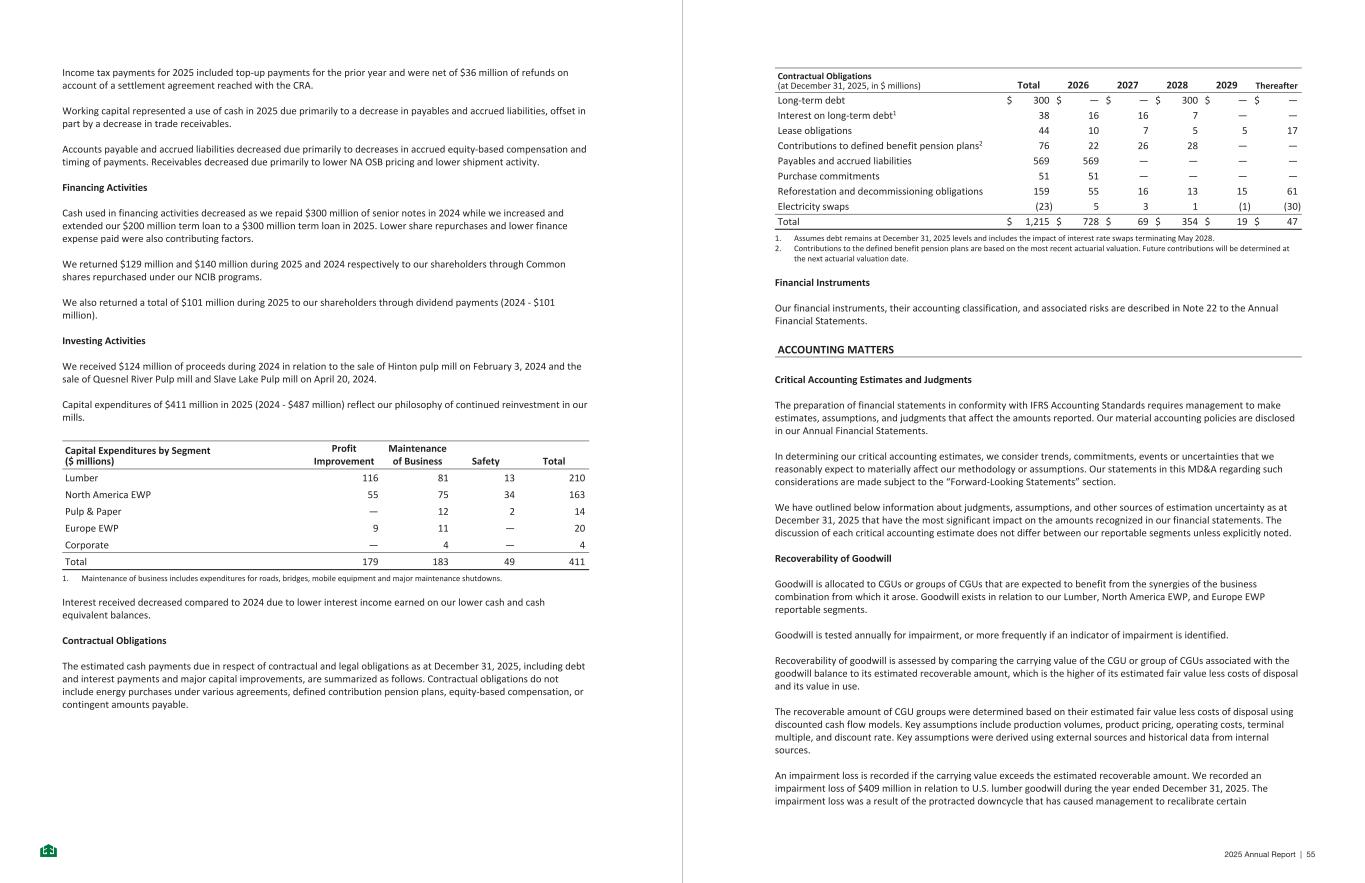
Income tax payments for 2025 included top-up payments for the prior year and were net of $36 million of refunds on account of a settlement agreement reached with the CRA. Working capital represented a use of cash in 2025 due primarily to a decrease in payables and accrued liabilities, offset in part by a decrease in trade receivables. Accounts payable and accrued liabilities decreased due primarily to decreases in accrued equity-based compensation and timing of payments. Receivables decreased due primarily to lower NA OSB pricing and lower shipment activity. Financing Activities Cash used in financing activities decreased as we repaid $300 million of senior notes in 2024 while we increased and extended our $200 million term loan to a $300 million term loan in 2025. Lower share repurchases and lower finance expense paid were also contributing factors. We returned $129 million and $140 million during 2025 and 2024 respectively to our shareholders through Common shares repurchased under our NCIB programs. We also returned a total of $101 million during 2025 to our shareholders through dividend payments (2024 - $101 million). Investing Activities We received $124 million of proceeds during 2024 in relation to the sale of Hinton pulp mill on February 3, 2024 and the sale of Quesnel River Pulp mill and Slave Lake Pulp mill on April 20, 2024. Capital expenditures of $411 million in 2025 (2024 - $487 million) reflect our philosophy of continued reinvestment in our mills. Capital Expenditures by Segment ($ millions) Profit Improvement Maintenance of Business Safety Total Lumber 116 81 13 210 North America EWP 55 75 34 163 Pulp & Paper — 12 2 14 Europe EWP 9 11 — 20 Corporate — 4 — 4 Total 179 183 49 411 1. Maintenance of business includes expenditures for roads, bridges, mobile equipment and major maintenance shutdowns. Interest received decreased compared to 2024 due to lower interest income earned on our lower cash and cash equivalent balances. Contractual Obligations The estimated cash payments due in respect of contractual and legal obligations as at December 31, 2025, including debt and interest payments and major capital improvements, are summarized as follows. Contractual obligations do not include energy purchases under various agreements, defined contribution pension plans, equity-based compensation, or contingent amounts payable. - 35 - Contractual Obligations (at December 31, 2025, in $ millions) Total 2026 2027 2028 2029 Thereafter Long-term debt $ 300 $ — $ — $ 300 $ — $ — Interest on long-term debt1 38 16 16 7 — — Lease obligations 44 10 7 5 5 17 Contributions to defined benefit pension plans2 76 22 26 28 — — Payables and accrued liabilities 569 569 — — — — Purchase commitments 51 51 — — — — Reforestation and decommissioning obligations 159 55 16 13 15 61 Electricity swaps (23) 5 3 1 (1) (30) Total $ 1,215 $ 728 $ 69 $ 354 $ 19 $ 47 1. Assumes debt remains at December 31, 2025 levels and includes the impact of interest rate swaps terminating May 2028. 2. Contributions to the defined benefit pension plans are based on the most recent actuarial valuation. Future contributions will be determined at the next actuarial valuation date. Financial Instruments Our financial instruments, their accounting classification, and associated risks are described in Note 22 to the Annual Financial Statements. ACCOUNTING MATTERS Critical Accounting Estimates and Judgments The preparation of financial statements in conformity with IFRS Accounting Standards requires management to make estimates, assumptions, and judgments that affect the amounts reported. Our material accounting policies are disclosed in our Annual Financial Statements. In determining our critical accounting estimates, we consider trends, commitments, events or uncertainties that we reasonably expect to materially affect our methodology or assumptions. Our statements in this MD&A regarding such considerations are made subject to the “Forward-Looking Statements” section. We have outlined below information about judgments, assumptions, and other sources of estimation uncertainty as at December 31, 2025 that have the most significant impact on the amounts recognized in our financial statements. The discussion of each critical accounting estimate does not differ between our reportable segments unless explicitly noted. Recoverability of Goodwill Goodwill is allocated to CGUs or groups of CGUs that are expected to benefit from the synergies of the business combination from which it arose. Goodwill exists in relation to our Lumber, North America EWP, and Europe EWP reportable segments. Goodwill is tested annually for impairment, or more frequently if an indicator of impairment is identified. Recoverability of goodwill is assessed by comparing the carrying value of the CGU or group of CGUs associated with the goodwill balance to its estimated recoverable amount, which is the higher of its estimated fair value less costs of disposal and its value in use. The recoverable amount of CGU groups were determined based on their estimated fair value less costs of disposal using discounted cash flow models. Key assumptions include production volumes, product pricing, operating costs, terminal multiple, and discount rate. Key assumptions were derived using external sources and historical data from internal sources. An impairment loss is recorded if the carrying value exceeds the estimated recoverable amount. We recorded an impairment loss of $409 million in relation to U.S. lumber goodwill during the year ended December 31, 2025. The impairment loss was a result of the protracted downcycle that has caused management to recalibrate certain - 36 - 2025 Annual Report | 55
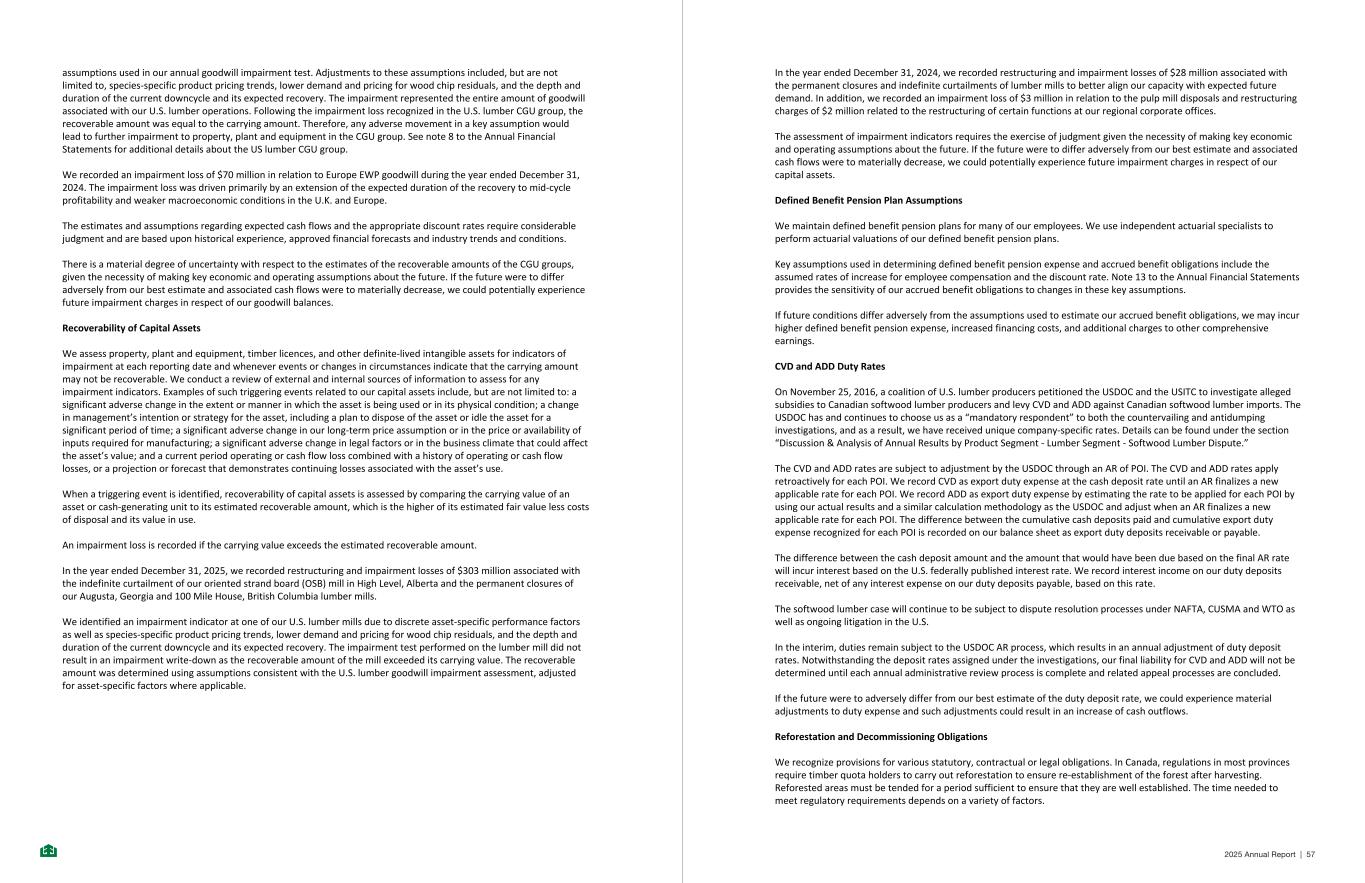
assumptions used in our annual goodwill impairment test. Adjustments to these assumptions included, but are not limited to, species-specific product pricing trends, lower demand and pricing for wood chip residuals, and the depth and duration of the current downcycle and its expected recovery. The impairment represented the entire amount of goodwill associated with our U.S. lumber operations. Following the impairment loss recognized in the U.S. lumber CGU group, the recoverable amount was equal to the carrying amount. Therefore, any adverse movement in a key assumption would lead to further impairment to property, plant and equipment in the CGU group. See note 8 to the Annual Financial Statements for additional details about the US lumber CGU group. We recorded an impairment loss of $70 million in relation to Europe EWP goodwill during the year ended December 31, 2024. The impairment loss was driven primarily by an extension of the expected duration of the recovery to mid-cycle profitability and weaker macroeconomic conditions in the U.K. and Europe. The estimates and assumptions regarding expected cash flows and the appropriate discount rates require considerable judgment and are based upon historical experience, approved financial forecasts and industry trends and conditions. There is a material degree of uncertainty with respect to the estimates of the recoverable amounts of the CGU groups, given the necessity of making key economic and operating assumptions about the future. If the future were to differ adversely from our best estimate and associated cash flows were to materially decrease, we could potentially experience future impairment charges in respect of our goodwill balances. Recoverability of Capital Assets We assess property, plant and equipment, timber licences, and other definite-lived intangible assets for indicators of impairment at each reporting date and whenever events or changes in circumstances indicate that the carrying amount may not be recoverable. We conduct a review of external and internal sources of information to assess for any impairment indicators. Examples of such triggering events related to our capital assets include, but are not limited to: a significant adverse change in the extent or manner in which the asset is being used or in its physical condition; a change in management’s intention or strategy for the asset, including a plan to dispose of the asset or idle the asset for a significant period of time; a significant adverse change in our long-term price assumption or in the price or availability of inputs required for manufacturing; a significant adverse change in legal factors or in the business climate that could affect the asset’s value; and a current period operating or cash flow loss combined with a history of operating or cash flow losses, or a projection or forecast that demonstrates continuing losses associated with the asset’s use. When a triggering event is identified, recoverability of capital assets is assessed by comparing the carrying value of an asset or cash-generating unit to its estimated recoverable amount, which is the higher of its estimated fair value less costs of disposal and its value in use. An impairment loss is recorded if the carrying value exceeds the estimated recoverable amount. In the year ended December 31, 2025, we recorded restructuring and impairment losses of $303 million associated with the indefinite curtailment of our oriented strand board (OSB) mill in High Level, Alberta and the permanent closures of our Augusta, Georgia and 100 Mile House, British Columbia lumber mills. We identified an impairment indicator at one of our U.S. lumber mills due to discrete asset-specific performance factors as well as species-specific product pricing trends, lower demand and pricing for wood chip residuals, and the depth and duration of the current downcycle and its expected recovery. The impairment test performed on the lumber mill did not result in an impairment write-down as the recoverable amount of the mill exceeded its carrying value. The recoverable amount was determined using assumptions consistent with the U.S. lumber goodwill impairment assessment, adjusted for asset-specific factors where applicable. - 37 - In the year ended December 31, 2024, we recorded restructuring and impairment losses of $28 million associated with the permanent closures and indefinite curtailments of lumber mills to better align our capacity with expected future demand. In addition, we recorded an impairment loss of $3 million in relation to the pulp mill disposals and restructuring charges of $2 million related to the restructuring of certain functions at our regional corporate offices. The assessment of impairment indicators requires the exercise of judgment given the necessity of making key economic and operating assumptions about the future. If the future were to differ adversely from our best estimate and associated cash flows were to materially decrease, we could potentially experience future impairment charges in respect of our capital assets. Defined Benefit Pension Plan Assumptions We maintain defined benefit pension plans for many of our employees. We use independent actuarial specialists to perform actuarial valuations of our defined benefit pension plans. Key assumptions used in determining defined benefit pension expense and accrued benefit obligations include the assumed rates of increase for employee compensation and the discount rate. Note 13 to the Annual Financial Statements provides the sensitivity of our accrued benefit obligations to changes in these key assumptions. If future conditions differ adversely from the assumptions used to estimate our accrued benefit obligations, we may incur higher defined benefit pension expense, increased financing costs, and additional charges to other comprehensive earnings. CVD and ADD Duty Rates On November 25, 2016, a coalition of U.S. lumber producers petitioned the USDOC and the USITC to investigate alleged subsidies to Canadian softwood lumber producers and levy CVD and ADD against Canadian softwood lumber imports. The USDOC has and continues to choose us as a “mandatory respondent” to both the countervailing and antidumping investigations, and as a result, we have received unique company-specific rates. Details can be found under the section “Discussion & Analysis of Annual Results by Product Segment - Lumber Segment - Softwood Lumber Dispute.” The CVD and ADD rates are subject to adjustment by the USDOC through an AR of POI. The CVD and ADD rates apply retroactively for each POI. We record CVD as export duty expense at the cash deposit rate until an AR finalizes a new applicable rate for each POI. We record ADD as export duty expense by estimating the rate to be applied for each POI by using our actual results and a similar calculation methodology as the USDOC and adjust when an AR finalizes a new applicable rate for each POI. The difference between the cumulative cash deposits paid and cumulative export duty expense recognized for each POI is recorded on our balance sheet as export duty deposits receivable or payable. The difference between the cash deposit amount and the amount that would have been due based on the final AR rate will incur interest based on the U.S. federally published interest rate. We record interest income on our duty deposits receivable, net of any interest expense on our duty deposits payable, based on this rate. The softwood lumber case will continue to be subject to dispute resolution processes under NAFTA, CUSMA and WTO as well as ongoing litigation in the U.S. In the interim, duties remain subject to the USDOC AR process, which results in an annual adjustment of duty deposit rates. Notwithstanding the deposit rates assigned under the investigations, our final liability for CVD and ADD will not be determined until each annual administrative review process is complete and related appeal processes are concluded. If the future were to adversely differ from our best estimate of the duty deposit rate, we could experience material adjustments to duty expense and such adjustments could result in an increase of cash outflows. Reforestation and Decommissioning Obligations We recognize provisions for various statutory, contractual or legal obligations. In Canada, regulations in most provinces require timber quota holders to carry out reforestation to ensure re-establishment of the forest after harvesting. Reforested areas must be tended for a period sufficient to ensure that they are well established. The time needed to meet regulatory requirements depends on a variety of factors. - 38 - 2025 Annual Report | 57
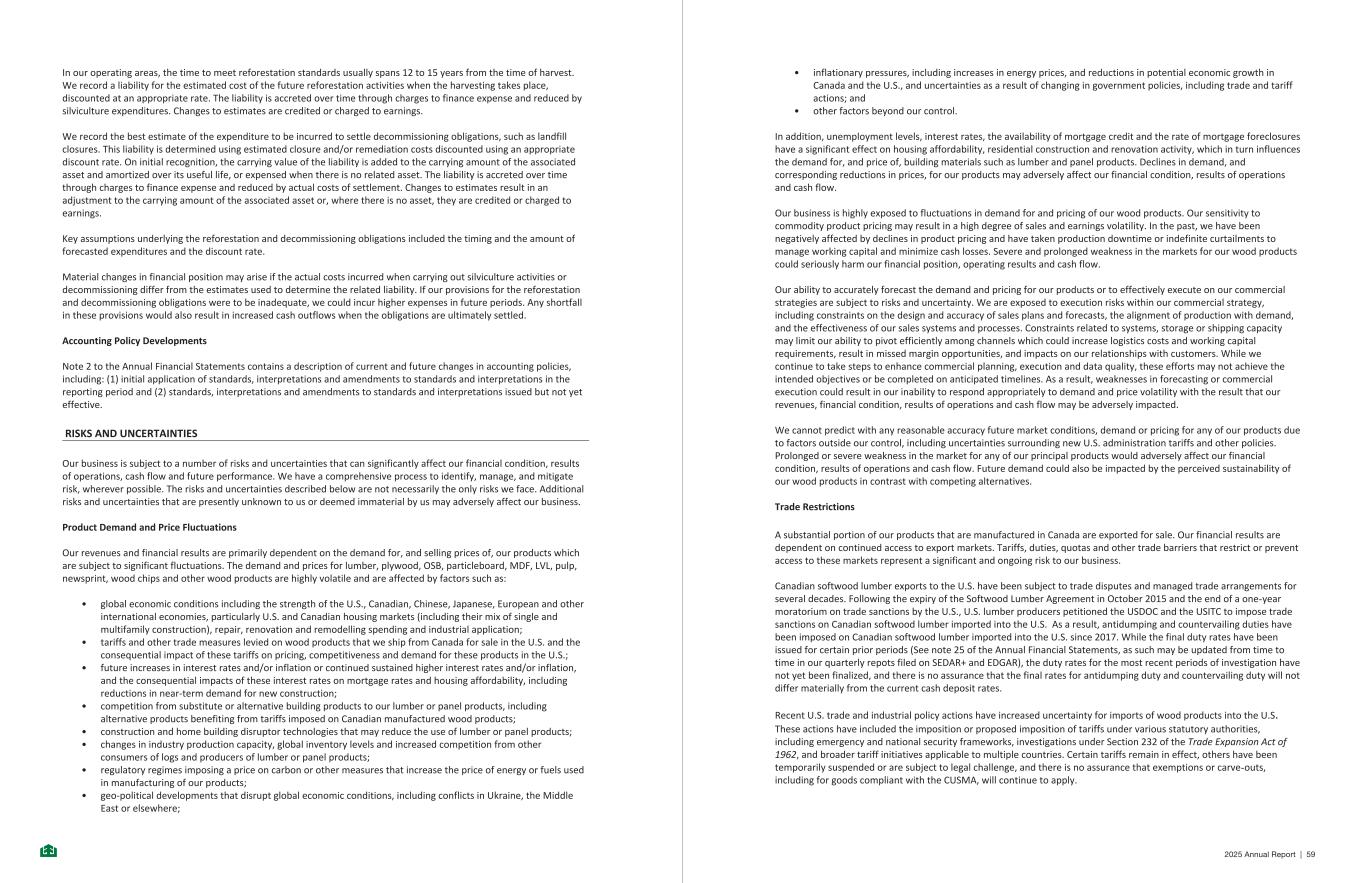
In our operating areas, the time to meet reforestation standards usually spans 12 to 15 years from the time of harvest. We record a liability for the estimated cost of the future reforestation activities when the harvesting takes place, discounted at an appropriate rate. The liability is accreted over time through charges to finance expense and reduced by silviculture expenditures. Changes to estimates are credited or charged to earnings. We record the best estimate of the expenditure to be incurred to settle decommissioning obligations, such as landfill closures. This liability is determined using estimated closure and/or remediation costs discounted using an appropriate discount rate. On initial recognition, the carrying value of the liability is added to the carrying amount of the associated asset and amortized over its useful life, or expensed when there is no related asset. The liability is accreted over time through charges to finance expense and reduced by actual costs of settlement. Changes to estimates result in an adjustment to the carrying amount of the associated asset or, where there is no asset, they are credited or charged to earnings. Key assumptions underlying the reforestation and decommissioning obligations included the timing and the amount of forecasted expenditures and the discount rate. Material changes in financial position may arise if the actual costs incurred when carrying out silviculture activities or decommissioning differ from the estimates used to determine the related liability. If our provisions for the reforestation and decommissioning obligations were to be inadequate, we could incur higher expenses in future periods. Any shortfall in these provisions would also result in increased cash outflows when the obligations are ultimately settled. Accounting Policy Developments Note 2 to the Annual Financial Statements contains a description of current and future changes in accounting policies, including: (1) initial application of standards, interpretations and amendments to standards and interpretations in the reporting period and (2) standards, interpretations and amendments to standards and interpretations issued but not yet effective. RISKS AND UNCERTAINTIES Our business is subject to a number of risks and uncertainties that can significantly affect our financial condition, results of operations, cash flow and future performance. We have a comprehensive process to identify, manage, and mitigate risk, wherever possible. The risks and uncertainties described below are not necessarily the only risks we face. Additional risks and uncertainties that are presently unknown to us or deemed immaterial by us may adversely affect our business. Product Demand and Price Fluctuations Our revenues and financial results are primarily dependent on the demand for, and selling prices of, our products which are subject to significant fluctuations. The demand and prices for lumber, plywood, OSB, particleboard, MDF, LVL, pulp, newsprint, wood chips and other wood products are highly volatile and are affected by factors such as: • global economic conditions including the strength of the U.S., Canadian, Chinese, Japanese, European and other international economies, particularly U.S. and Canadian housing markets (including their mix of single and multifamily construction), repair, renovation and remodelling spending and industrial application; • tariffs and other trade measures levied on wood products that we ship from Canada for sale in the U.S. and the consequential impact of these tariffs on pricing, competitiveness and demand for these products in the U.S.; • future increases in interest rates and/or inflation or continued sustained higher interest rates and/or inflation, and the consequential impacts of these interest rates on mortgage rates and housing affordability, including reductions in near-term demand for new construction; • competition from substitute or alternative building products to our lumber or panel products, including alternative products benefiting from tariffs imposed on Canadian manufactured wood products; • construction and home building disruptor technologies that may reduce the use of lumber or panel products; • changes in industry production capacity, global inventory levels and increased competition from other consumers of logs and producers of lumber or panel products; • regulatory regimes imposing a price on carbon or other measures that increase the price of energy or fuels used in manufacturing of our products; • geo-political developments that disrupt global economic conditions, including conflicts in Ukraine, the Middle East or elsewhere; - 39 - • inflationary pressures, including increases in energy prices, and reductions in potential economic growth in Canada and the U.S., and uncertainties as a result of changing in government policies, including trade and tariff actions; and • other factors beyond our control. In addition, unemployment levels, interest rates, the availability of mortgage credit and the rate of mortgage foreclosures have a significant effect on housing affordability, residential construction and renovation activity, which in turn influences the demand for, and price of, building materials such as lumber and panel products. Declines in demand, and corresponding reductions in prices, for our products may adversely affect our financial condition, results of operations and cash flow. Our business is highly exposed to fluctuations in demand for and pricing of our wood products. Our sensitivity to commodity product pricing may result in a high degree of sales and earnings volatility. In the past, we have been negatively affected by declines in product pricing and have taken production downtime or indefinite curtailments to manage working capital and minimize cash losses. Severe and prolonged weakness in the markets for our wood products could seriously harm our financial position, operating results and cash flow. Our ability to accurately forecast the demand and pricing for our products or to effectively execute on our commercial strategies are subject to risks and uncertainty. We are exposed to execution risks within our commercial strategy, including constraints on the design and accuracy of sales plans and forecasts, the alignment of production with demand, and the effectiveness of our sales systems and processes. Constraints related to systems, storage or shipping capacity may limit our ability to pivot efficiently among channels which could increase logistics costs and working capital requirements, result in missed margin opportunities, and impacts on our relationships with customers. While we continue to take steps to enhance commercial planning, execution and data quality, these efforts may not achieve the intended objectives or be completed on anticipated timelines. As a result, weaknesses in forecasting or commercial execution could result in our inability to respond appropriately to demand and price volatility with the result that our revenues, financial condition, results of operations and cash flow may be adversely impacted. We cannot predict with any reasonable accuracy future market conditions, demand or pricing for any of our products due to factors outside our control, including uncertainties surrounding new U.S. administration tariffs and other policies. Prolonged or severe weakness in the market for any of our principal products would adversely affect our financial condition, results of operations and cash flow. Future demand could also be impacted by the perceived sustainability of our wood products in contrast with competing alternatives. Trade Restrictions A substantial portion of our products that are manufactured in Canada are exported for sale. Our financial results are dependent on continued access to export markets. Tariffs, duties, quotas and other trade barriers that restrict or prevent access to these markets represent a significant and ongoing risk to our business. Canadian softwood lumber exports to the U.S. have been subject to trade disputes and managed trade arrangements for several decades. Following the expiry of the Softwood Lumber Agreement in October 2015 and the end of a one-year moratorium on trade sanctions by the U.S., U.S. lumber producers petitioned the USDOC and the USITC to impose trade sanctions on Canadian softwood lumber imported into the U.S. As a result, antidumping and countervailing duties have been imposed on Canadian softwood lumber imported into the U.S. since 2017. While the final duty rates have been issued for certain prior periods (See note 25 of the Annual Financial Statements, as such may be updated from time to time in our quarterly repots filed on SEDAR+ and EDGAR), the duty rates for the most recent periods of investigation have not yet been finalized, and there is no assurance that the final rates for antidumping duty and countervailing duty will not differ materially from the current cash deposit rates. Recent U.S. trade and industrial policy actions have increased uncertainty for imports of wood products into the U.S. These actions have included the imposition or proposed imposition of tariffs under various statutory authorities, including emergency and national security frameworks, investigations under Section 232 of the Trade Expansion Act of 1962, and broader tariff initiatives applicable to multiple countries. Certain tariffs remain in effect, others have been temporarily suspended or are subject to legal challenge, and there is no assurance that exemptions or carve-outs, including for goods compliant with the CUSMA, will continue to apply. - 40 - 2025 Annual Report | 59
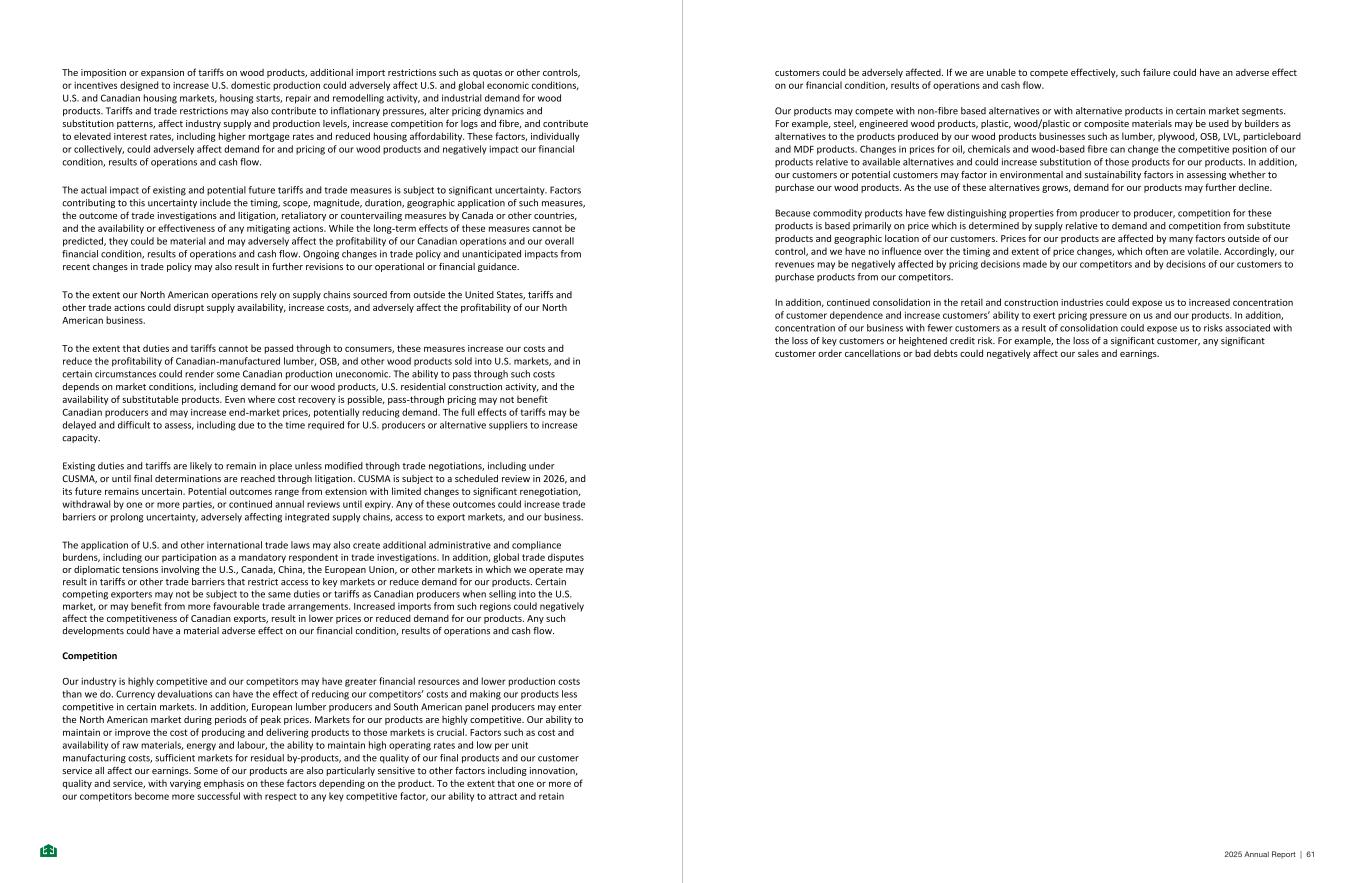
The imposition or expansion of tariffs on wood products, additional import restrictions such as quotas or other controls, or incentives designed to increase U.S. domestic production could adversely affect U.S. and global economic conditions, U.S. and Canadian housing markets, housing starts, repair and remodelling activity, and industrial demand for wood products. Tariffs and trade restrictions may also contribute to inflationary pressures, alter pricing dynamics and substitution patterns, affect industry supply and production levels, increase competition for logs and fibre, and contribute to elevated interest rates, including higher mortgage rates and reduced housing affordability. These factors, individually or collectively, could adversely affect demand for and pricing of our wood products and negatively impact our financial condition, results of operations and cash flow. The actual impact of existing and potential future tariffs and trade measures is subject to significant uncertainty. Factors contributing to this uncertainty include the timing, scope, magnitude, duration, geographic application of such measures, the outcome of trade investigations and litigation, retaliatory or countervailing measures by Canada or other countries, and the availability or effectiveness of any mitigating actions. While the long-term effects of these measures cannot be predicted, they could be material and may adversely affect the profitability of our Canadian operations and our overall financial condition, results of operations and cash flow. Ongoing changes in trade policy and unanticipated impacts from recent changes in trade policy may also result in further revisions to our operational or financial guidance. To the extent our North American operations rely on supply chains sourced from outside the United States, tariffs and other trade actions could disrupt supply availability, increase costs, and adversely affect the profitability of our North American business. To the extent that duties and tariffs cannot be passed through to consumers, these measures increase our costs and reduce the profitability of Canadian-manufactured lumber, OSB, and other wood products sold into U.S. markets, and in certain circumstances could render some Canadian production uneconomic. The ability to pass through such costs depends on market conditions, including demand for our wood products, U.S. residential construction activity, and the availability of substitutable products. Even where cost recovery is possible, pass-through pricing may not benefit Canadian producers and may increase end-market prices, potentially reducing demand. The full effects of tariffs may be delayed and difficult to assess, including due to the time required for U.S. producers or alternative suppliers to increase capacity. Existing duties and tariffs are likely to remain in place unless modified through trade negotiations, including under CUSMA, or until final determinations are reached through litigation. CUSMA is subject to a scheduled review in 2026, and its future remains uncertain. Potential outcomes range from extension with limited changes to significant renegotiation, withdrawal by one or more parties, or continued annual reviews until expiry. Any of these outcomes could increase trade barriers or prolong uncertainty, adversely affecting integrated supply chains, access to export markets, and our business. The application of U.S. and other international trade laws may also create additional administrative and compliance burdens, including our participation as a mandatory respondent in trade investigations. In addition, global trade disputes or diplomatic tensions involving the U.S., Canada, China, the European Union, or other markets in which we operate may result in tariffs or other trade barriers that restrict access to key markets or reduce demand for our products. Certain competing exporters may not be subject to the same duties or tariffs as Canadian producers when selling into the U.S. market, or may benefit from more favourable trade arrangements. Increased imports from such regions could negatively affect the competitiveness of Canadian exports, result in lower prices or reduced demand for our products. Any such developments could have a material adverse effect on our financial condition, results of operations and cash flow. Competition Our industry is highly competitive and our competitors may have greater financial resources and lower production costs than we do. Currency devaluations can have the effect of reducing our competitors’ costs and making our products less competitive in certain markets. In addition, European lumber producers and South American panel producers may enter the North American market during periods of peak prices. Markets for our products are highly competitive. Our ability to maintain or improve the cost of producing and delivering products to those markets is crucial. Factors such as cost and availability of raw materials, energy and labour, the ability to maintain high operating rates and low per unit manufacturing costs, sufficient markets for residual by-products, and the quality of our final products and our customer service all affect our earnings. Some of our products are also particularly sensitive to other factors including innovation, quality and service, with varying emphasis on these factors depending on the product. To the extent that one or more of our competitors become more successful with respect to any key competitive factor, our ability to attract and retain - 41 - customers could be adversely affected. If we are unable to compete effectively, such failure could have an adverse effect on our financial condition, results of operations and cash flow. Our products may compete with non-fibre based alternatives or with alternative products in certain market segments. For example, steel, engineered wood products, plastic, wood/plastic or composite materials may be used by builders as alternatives to the products produced by our wood products businesses such as lumber, plywood, OSB, LVL, particleboard and MDF products. Changes in prices for oil, chemicals and wood-based fibre can change the competitive position of our products relative to available alternatives and could increase substitution of those products for our products. In addition, our customers or potential customers may factor in environmental and sustainability factors in assessing whether to purchase our wood products. As the use of these alternatives grows, demand for our products may further decline. Because commodity products have few distinguishing properties from producer to producer, competition for these products is based primarily on price which is determined by supply relative to demand and competition from substitute products and geographic location of our customers. Prices for our products are affected by many factors outside of our control, and we have no influence over the timing and extent of price changes, which often are volatile. Accordingly, our revenues may be negatively affected by pricing decisions made by our competitors and by decisions of our customers to purchase products from our competitors. In addition, continued consolidation in the retail and construction industries could expose us to increased concentration of customer dependence and increase customers’ ability to exert pricing pressure on us and our products. In addition, concentration of our business with fewer customers as a result of consolidation could expose us to risks associated with the loss of key customers or heightened credit risk. For example, the loss of a significant customer, any significant customer order cancellations or bad debts could negatively affect our sales and earnings. - 42 - 2025 Annual Report | 61
Availability of Fibre Canada A significant majority of our Canadian log requirements are harvested from lands owned by a provincial government. Provincial governments control the volumes that may be harvested under provincially-granted tenures and regulate the availability of Crown timber for harvest. As a result, our access to the Crown timber is subject to decisions and processes involving provincial and federal governments, and Indigenous governments. The policy landscape continues to shift in ways that are dynamic and difficult to predict, potentially affecting both our short-term access to fibre, our operating costs, and long-term AAC confidence. The United Nations Declaration on the Rights of Indigenous Peoples (UNDRIP) has been endorsed by Government of Canada and the Province of B.C. B.C. has also enacted the Declaration of the Rights of Indigenous Peoples Act (DRIPA) to advance implementation of these commitments through ongoing modernization of provincial legislation and decision- making frameworks. Amendments to the forestry legislation, including the Forest Act, have introduced enhanced Indigenous participation and shared decision making in certain forest governance processes. These evolving frameworks may involve multiple authorities and extended timelines and may result in increased complexity and uncertainty in forest tenure administration, permitting and access to timber supply and unclear and more complicated outcomes compared to prior well understood, aligned, and straight forward processes. Provincial governments may make determinations or impose restrictions affecting forest tenure administration and timber supply, including decisions or restrictions relating to harvest volumes, the issuance, renewal, suspension or amendments of operating permits, areas available for harvesting, tenure transfers or acquisitions, the reallocation of harvesting rights to Indigenous Nations or communities, processing requirements, contractor regulation, land use planning, reconciliation initiatives, and stumpage methodologies. Such determinations may reduce the availability of log or residual fibre supply, increase log acquisition and harvesting costs, affect product recovery and grade, or require reductions in operating rates at our facilities These determinations may be made in furtherance of environmental protection objectives, species at risk management, critical habitat protection and land and species conservation plans, wildlife mitigation, pest management (including mountain pine beetle response), land use planning or Indigenous rights and reconciliation initiatives. As a result, government actions may reduce AAC or otherwise constrain timber supply which could adversely affect our access to fibre and increase operating costs at our Canadian operations. In Alberta, for example, accelerated AAC levels implemented following the mountain pine beetle infestation are expected to normalize post mountain pine beetle over time, which may reduce available timber supply. Constraints on secure, economical and sustainable fibre supply have resulted in permanent curtailments at certain of our Canadian operations and may result in additional curtailments in the future. In Alberta, forest management decisions are influenced by provincial forest management planning requirements, wildlife and species-at-risk recovery strategies (including caribou range planning), cumulative effects management frameworks, wildfire risk considerations, and post-infestation forest recovery strategies. Accelerated AAC levels implemented in response to the mountain pine beetle infestation are expected to normalize over time, which may reduce available timber supply. Changes to forest management plans, operating ground rules, or regulatory requirements may also affect harvest timing, volumes, or costs. Ongoing forest policy reviews and legislative changes in British Columbia have introduced additional uncertainty with respect to timber supply, permitting processes, and the timing and volume of harvesting approvals. During periods of policy transition, volumes offered through B.C. Timber Sales (“BCTS”) have been below historical levels. As many of our mills rely on BCTS as a source of log supply, reduced availability of BCTS volumes may increase our reliance on other supply sources, which could increase operating costs. Amendments to permitting processes may also result in delays or reduced volumes available under our tenures. The development and implementation of updated forest policy remains ongoing, and the full impact on timber supply and allowable annual cut levels may not be fully understood for some time. We have entered into joint development agreements with Indigenous Nations in B.C. to support continued fibre supply for certain of our mills however, there can be no assurance that these arrangements will secure the long-term supply of fibre. In both B.C. and Alberta, increased Indigenous participation in forest governance, consultation processes, and land- use planning may influence tenure administration, permitting, and harvesting outcomes. - 43 - We also rely on third party contractors to harvest timber under our tenures and increases in contractor rates, limited contractor availability or regulatory changes affecting requirements may increase harvesting costs. In addition, we purchase logs through open-market purchases and private supply and log exchange agreements, and increased competition for logs, or log shortages, may result in higher log purchase costs. Weather conditions, including unusually warm or cold temperatures, may also affect our ability to conduct logging activities, accumulate log inventories, constrain our ability to manufacture and ship SPF lumber or necessitate reduced operating schedules. For example, unusually warm winter conditions in prior periods have constrained logging at certain of our operations. Any combination of these factors could adversely affect our fibre supply, operating costs, shipment guidance, and as a result our financial condition, results of operation and cash flow. United States We rely on log supply agreements in the U.S. which are subject to log availability and based on market prices. The majority of the aggregate log requirements for our U.S. mills is purchased on the open market. Open market purchases come from timber real estate investment trusts, timberland investment management organizations and private land owners. Changes in the log markets in which we operate may reduce the supply of logs available to us and may increase the costs of log purchases, each of which could adversely affect our results. In addition, changes in the market for residuals may reduce the demand and selling price for the residuals produced by our operations and increase the disposal costs, which could adversely affect our results. We may experience higher competition for sustainable log supply sourcing as supply is limited by alternative demand for forests in carbon sequestration and through the increase in conversion to forest plantations or non-forest use where there is significant regional forest area decline. While the U.S. South remains a critical area of lumber supply growth and a key region for West Fraser’s growth strategy, it is important to note that this region’s economic fibre supply, cost profile and access to end-use markets for sawmill residuals are not homogenous, and that all of these factors could limit our growth opportunities. Our ability to source log supply and log costs may be impacted by regulatory changes impacting our business and the counterparts we do business with, including as a result of regulatory changes like the European Union Deforestation Regulation. U.K. and Europe Wood fibre for our U.K. and Belgium OSB, particleboard and MDF operations is purchased from government and private landowners. Changes in the log markets in which we operate and regulatory changes, like the European Union Deforestation Regulation, may reduce the supply of logs available to us and may increase the costs of log purchases, each of which could adversely affect our results. Residuals We rely on fibre off-take agreements for certain of our Canadian solid wood operations under which we supply to third parties wood chips and other residuals generated from our lumber operations. While certain of these fibre supply agreements are long-term take-or-pay arrangements, we face counterparty risk in the event that the purchasers of our wood chips and other residuals default on their obligations. Default by our counterparties could result in us having no market for our wood chips or other residuals or force us to sell our wood chips and other residuals at then prevailing market prices which may be less than the prices under our fibre supply agreements. We rely on third party consumers of wood chips, including pulp mills and paper mills, to purchase wood chips and other residuals generated at our U.S. lumber mills. Recent pulp and paper mill closures in the U.S. South have reduced market demand for wood chips and other residuals in the areas where we operate. In addition, wood chip and residuals supply has increased as a result in regional increases in lumber production. These demand and supply factors can both decrease the price that we can obtain for our residuals in the U.S. market and require us to seek alternate means of sale or disposal of residuals, each of which could decrease revenues and/or increase the overall costs of our U.S. operations. Alternative markets for wood chips and other residuals are currently limited in scope, scale, and geographic availability, and may not be able to absorb significant volumes on commercially acceptable terms. While we are focused on renegotiating expiring long-term residual fibre agreements and partnering with new and emerging markets to consume residuals, there is no certainty that we will be successful in such negotiations or partnership opportunities and this may adversely impact our financial condition, results of operations and cash flow. - 44 - 2025 Annual Report | 63
If our residuals do not meet the specifications required by consumers or the specifications for such consumers change, including as a result of regulatory changes like the European Union Deforestation Regulation, we may be subject to increased costs to our operations or adverse contractual risks, including termination rights which may result in us needing to find new purchasers for our wood chips or other residuals, financial penalties and other unknown consequences, including potential lost opportunities. Additional Risks to Availability of Fibre When timber, wood chips, other residual fibre and wood recycled materials are purchased on the open market, we are in competition with other uses of such resources, where prices and the availability of supply are influenced by factors beyond our control. Fibre supply can also be influenced by natural events, such as forest fires, severe weather conditions, insect epidemics and other natural disasters, which may increase wood fibre costs, restrict access to wood fibre or force production curtailments. Transportation Requirements Our business depends on our ability to transport a high volume of products and raw materials to and from our production facilities and onto both domestic and international markets at cost effective rates. We rely primarily on third-party transportation providers for both the delivery of raw materials to our production facilities and the transportation of our products to market. These third-party transportation providers include truckers, bulk and container shippers and railways. Our ability to obtain transportation services from these transportation service providers is subject to risks which include, without limitation, availability of equipment and operators, disruptions due to weather, natural disasters and labour disputes. To the extent that climate change results in more frequent severe weather occurrences, we may experience increased frequency of transportation disruptions in future years which may again result in a disruption of our ability to ship lumber and other products that we manufacture, including significant transportation disruptions from severe flooding, hurricanes, and other natural disasters. In addition, the potential of increased frequency of severe weather events may ultimately result in increased transportation costs as transportation providers, including railways, undertake capital expenditures to improve the ability of the transportation infrastructure to withstand severe weather events or to repair damage from severe weather events in order to maintain services. Transportation services may also be impacted by seasonal factors, which could impact the timely delivery of raw materials and distribution of products to customers. As a result of rail and truck capacity constraints, access to adequate transportation capacity has at times been strained and could affect our ability to transport our products to markets and could result in increased product inventories. Any failure of third-party transportation providers to deliver finished goods or raw materials in a timely manner, including failure caused by adverse weather conditions or work stoppages, could harm our reputation, negatively affect customer relationships or disrupt production at our mills. We may also experience labour disruptions and other additional costs in connection with the export of our product, including disruptions at the various ports and terminals from which we ship. Transportation costs are also subject to risks that include, without limitation, increased rates due to competition, increased fuel costs and increased capital expenditures related to repair, maintenance and upgrading of transportation infrastructure. Increases in transportation costs will increase our operating costs and adversely impact our profitability. If we are unable to obtain transportation services or if our transportation costs increase, our revenues may decrease due to our inability to deliver products to market and our operating expenses may increase, each of which would adversely affect our financial condition, results of operations and cash flow. Costs and Availability of Materials and Energy We rely heavily on certain raw materials, including logs, wood chips and other fibre sources, chemicals, and energy sources, including natural gas and electricity, in our manufacturing processes. Competition from our industry and other industries, as well as supply disruptions may result in increased demand and costs for these raw materials and energy sources. We have experienced significant cost inflation across a number of our inputs including supplies and materials and energy. Increases in the costs of these raw materials and energy sources will increase our operating costs and will reduce our operating margins. There is no assurance that we will be able to fully offset the effects of higher raw material or energy costs through hedging arrangements, price increases, productivity improvements or cost-reduction programs. From time to time, we enter into arrangements with renewable power generators to purchase environmental attributes and receive settlements by reference to generation volumes and the spot price for electricity and pay settlements by reference to generation volumes and a fixed contractual price. These agreements act as a partial hedge against future - 45 - electricity price increases. Fair values of our electricity swaps may be volatile and sensitive to fluctuations in forward electricity prices and counterparty credit risk. Our operations depend on an uninterrupted supply of resins and chemicals, production inputs, and other supplies and resources such as skilled personnel. Supply may be interrupted due to a shortage or the scarce nature of inputs, especially with regard to chemicals. Supply might also be interrupted due to transportation and logistics associated with the remote location of some of our operations, and government restrictions or regulations which delay importation of necessary items. Our business is sensitive to global supply chain events, which impact our ability to source supplies required for our operations and could result in the increase in costs of those supplies. Any interruptions to the procurement and supply of resins, chemicals, production inputs and other supplies, or the availability of skilled personnel, as well as continued increased rates of inflation, could have an adverse impact on our financial condition, results of operations and cash flow. Operational Curtailments From time to time, we suspend or curtail operations at one or more of our facilities in response to market conditions, environmental risks, or other operational issues, including, but not limited to scheduled and unscheduled maintenance, temporary periods of high electricity prices, power failures, equipment breakdowns, adverse weather conditions, labour disruptions, transportation disruptions, unavailability of staff, fire hazards, and the availability or cost of raw materials including logs, wood chips, resins and chemicals. In addition, the potential increased frequency of extreme weather events associated with climate change may result in operational curtailments becoming more frequent than we have experienced historically. In addition, our ability to operate at full capacity may be affected by ongoing capital projects. As a result, our facilities may from time to time operate at less than full capacity. These operational suspensions could have a material adverse effect on our financial condition, results of operations and cash flow as a result of decreased revenues and lower operating margins. In Canada, a portion of the wood chip requirements of our Canadian pulp and paper operations are provided by our Canadian sawmills and plywood plants. We also need to source from third parties wood chips. If wood chip availability is reduced because of production curtailments, improved manufacturing efficiencies, inability to source from third parties, profitably or at all, or any other reason, our pulp and paper operations may incur additional costs to acquire or produce additional wood chips or be forced to reduce production. Conversely, pulp and paper mill production curtailments may require our sawmills and panel mills to find other ways to dispose of residual wood fibre and may result in curtailment or suspension of lumber, plywood or LVL production and increased costs. In Canada, a substantial portion of the sawdust requirements of our Canadian MDF operations are provided by our Canadian sawmills and plywood and LVL plants. If sawdust is reduced because of production curtailments, improved manufacturing efficiencies or any other reason, our MDF operations may incur additional costs to acquire or produce additional sawdust or be forced to reduce production. Conversely, MDF mill production curtailments may require our sawmills and panel mills to find other ways to dispose of residual wood fibre and may result in curtailment or suspension of lumber, plywood or LVL production and increased costs. People Resources Our operations depend on the availability, retention and effective succession of experienced local and regional management, and skilled and unskilled employees and as third party service providers, including logging and transportation and capital project contractors. Many of our facilities are located away from major urban centers, which can limit the available labour pool and intensify competition for qualified personnel from our industry and others, including oil and gas, mining and manufacturing. A significant portion of our workforce and management team has specialized technical expertise and operational experience that is developed over many years. We face ongoing challenges related to an aging workforce, including anticipated retirements, the loss of institutional knowledge, and the need to identify, develop, and retain successors for key leadership, technical, and operational roles. Our ability to execute effective succession planning may be constrained by labour availability, internal development timelines, and competition for experienced talent. If we are unable to successfully manage workforce transitions or replace retiring personnel on a timely basis, our operational continuity, efficiency, safety performance, and strategic execution could be adversely affected. - 46 - 2025 Annual Report | 65
We also experience labour market pressures that may contribute to increased employee turnover, particularly in skilled trades, technical roles, and remote operating locations. Elevated turnover can result in higher recruitment, training, and onboarding costs, reduced productivity, and greater reliance on less-experienced personnel or third-party contractors. High turnover may also disrupt operational performance, inhibit the transfer of institutional knowledge, and place additional demands on remaining employees and management resources. Labour availability challenges, including shortages of qualified personnel, succession gaps, and turnover, may increase our operating and capital costs through higher wages, benefits, incentives, overtime, and contractor expenses. These challenges could impair our ability to maintain production levels, execute maintenance activities, or complete capital projects on schedule and within budget, and may adversely impact our financial results. Approximately 29% of our employees are covered by collective agreements. There was one expired collective agreement covering 2% of our employees as at December 31, 2025 under which the bargaining process is ongoing. Collective agreements representing 8% and 12% of our unionized employees expire in 2026 and 2027, respectively. All of our U.K. and Belgian union contracts are evergreen. If we are unable to renew the expired collective agreement in the near term or successfully negotiate renewals of collective agreements upon their expiry, we could experience strikes, work stoppages or other labour disruptions at the impacted facilities. Such disruptions could result in lost production and sales, increased operating costs, supply constraints and delays to maintenance or capital projects, any of which could adversely affect our business and financial results. More broadly, we are subject to risks associated with collective bargaining, labour negotiations, and labour relations. Collective bargaining negotiations may be prolonged, may not result in agreements on commercially acceptable terms, or may give rise to labour actions, including strikes, lockouts, or coordinated industry-wide labour disruptions. Labour relations challenges, including changes to work rules, compensation, benefit arrangements, or pension obligations, may increase labour and operating costs, reduce operational flexibility or productivity, and require significant management attention In addition, we rely on third-party service providers that employ unionized and non-unionized workforces to deliver critical services. Labour shortages, workforce turnover, labour disputes, or financial difficulties experienced by these third parties could disrupt service availability, limit alternative sourcing options, and adversely affect the timing, cost, and execution of our operations and capital projects. Acquisitions We may evaluate and complete potential acquisitions from time to time and have in the past grown through acquisitions. However, there is no assurance that we in the future will be able to successfully identify potential acquisitions or efficiently and cost-effectively integrate any assets or business that we acquire without disrupting existing operations. Our inability to identify accretive acquisition targets and complete acquisitions may negatively impact our ability to grow our business operations and deploy our capital. Acquisitions are subject to a range of inherent risks, including the assumption of incremental regulatory/compliance, pricing, labour relations, litigation, environmental, tax and other risks. There is no assurance that the due diligence that we undertake, including accounting, tax, regulatory and business due diligence, will be sufficient to identify all risks associated with any prospective acquisition that we undertake. Further, we may not be able to successfully integrate or achieve anticipated synergies from those acquisitions which we do complete and/or such acquisitions may be dilutive in the short to medium term. Specifically, there is no assurance that we will achieve the anticipated growth opportunities, synergies, efficiencies and costs savings from the combined business in respect of any acquisition that we undertake. Any of these adverse outcomes could result in us not achieving the financial benefits of prospective acquisitions and have a material adverse effect on our profitability. Safety We are subject to risks relating to the health and safety of our employees, contractors and third parties at our operating sites. While we strive to maintain health and safety policies, training programs, hazard identification processes, - 47 - inspections and preventative maintenance practices, there can be no assurance that these measures will be effective in preventing incidents. Due to the nature of our operations, our employees, contractors and business invitees may be exposed to a range of hazards, including, fires (including forest fires), wood dust, heavy machinery, chemicals, explosions, blow-outs, power outages, extreme weather conditions, natural disasters, equipment failures, manufacturing and engineering defects, pollution and other environmental risks, and operational risks, any of which could result in serious personal injury, illness or death. Health and safety incidents may result in significant regulatory scrutiny, investigations, enforcement actions, fines, penalties, stop-work orders, or civil and, in certain circumstances, criminal liability. Such incidents could also lead to increased insurance premiums, coverage limitations, unplanned capital expenditures, and extended business interruptions. Our reliance on contractors and third-party service providers exposes us to additional health and safety risks, as we do not have direct control over their safety practices, training, or compliance with applicable laws. Safety incidents involving contractors may nevertheless materially impact our operations, reputation, and financial results. In addition, changing climate conditions, including the increasing frequency and severity of extreme weather events such as forest fires, flooding, and heat events, may heighten safety risks to personnel, disrupt operations, and impair access to worksites or critical infrastructure. Labour availability challenges, workforce turnover, fatigue, and the need to onboard and train new or less-experienced personnel may further increase the likelihood of safety incidents. A significant health and safety failure could adversely affect employee morale, result in labour disruptions or shortages, damage relationships with regulators, customers, and communities, harm our reputation, and have a material adverse effect on our financial condition, results of operations and cash flow. Environment We are subject to regulation by federal, provincial, state, municipal and local environmental authorities, including, among other matters, environmental regulations relating to air emissions and pollutants, wastewater (effluent) discharges, solid and hazardous waste, landfill operations, forestry practices, permitting obligations, site remediation and the protection of threatened or endangered species and critical habitat. Concerns over climate change, carbon emissions, water and land- use practices and the protection of threatened or endangered species and critical habitat could also lead governments to enact additional or more stringent environmental laws and regulations that may require us to incur significant capital expenditures, pay higher taxes or fees, including carbon related taxes or otherwise could adversely affect our financial condition, results of operations and cash flow, including significantly impairing our ability to access and operate within regions of threatened or endangered species and critical habitat. We have incurred, and will continue to incur, capital expenditures and operating costs to comply with environmental laws and regulations, including the U.S. Environmental Protection Agency’s Boiler MACT (maximum achievable control technology) regulations and subject to successful court challenges, the National Ambient Air Quality Standards for Particulate Matter (PM) for PM2.5. These regulations include environmental laws and regulations relating to air emissions, wastewater discharges, solid and hazardous waste management, plant and wildlife protection and site remediation, as well as workplace safety. These laws, regulations and restrictions may be expanded to require us to take measures to protect or enhance the environment in which we operate, including measures to protect biodiversity, conserve habitats and reduce risk of invasive transportation of species to new ecosystems. In addition, changes in the regulatory environment respecting climate change have and may lead governments and regulatory bodies to enact additional or more stringent laws and regulations and impose operational restrictions or incremental levies and taxes applicable to our Company which could require us to incur increased capital expenditures, including further Best Available Control Technology or result in increased operating expenses or limit or constrain our ability to obtain permits and authorizations to advance our business and capital/modernization plans. In addition, we may incur additional capital expenditures in connection with capital projects that we plan to undertake in order to achieve our targeted greenhouse gas emission objectives. These capital expenditures may be greater than initially projected, and changes in environmental laws could impose more stringent requirements than our targeted objectives and result in increased capital expenditures or acceleration of the time for completion of the capital projects or delays in our ability to obtain permitting or execute on our new capital and modernization plans. No assurance can be given that changes in these laws and regulations or their application will not have a material adverse effect on our financial condition, results of operations and cash flow. Similarly, no assurance can be given that capital - 48 - 2025 Annual Report | 67
expenditures necessary for future compliance with existing and new environmental laws and regulations could be financed from our available cash flow. Failure to comply with applicable laws and regulations could result in fines, penalties or other enforcement actions that could impact our production capacity or increase our production costs or negatively impair our ability to access and operate within regions of threatened or endangered species and critical habitat. In addition, laws and regulations could become more stringent or subject to different interpretation in the future. We may discover currently unknown environmental problems, contamination, or conditions relating to our past or present operations. This or any failure to comply with environmental laws and regulations may require site or other remediation costs or result in governmental or private claims for damage to person, property, natural resources or the environmental or governmental sanctions, including fines or the curtailment or suspension of our operations, which could have a material adverse effect on our financial condition, results of operations and cash flow. We are currently involved in investigation and remediation activities and maintain accruals for certain environmental matters or obligations, as set out in the notes to the Annual Financial Statements. Changing weather patterns and climatic conditions due to natural and man-made causes, including temperature shifts and changes to seasonal norms for winter and summer, can adversely impact our ability to meet our reforestation obligations and the expected cost to settle these liabilities. There can be no assurance that any costs associated with such obligations or other environmental matters will not exceed our accruals. Our Canadian woodland operations, and the harvesting operations of our many key U.S. log and European wood fibre suppliers, in addition to being subject to various environmental protection laws, are subject to third-party certification as to compliance with internationally recognized, sustainable forest management standards. Demand for our products may be reduced if we are unable to achieve compliance or are perceived by the public as failing to comply, with these applicable environmental protection laws and sustainable forest management standards, or if our customers require compliance with alternate forest management standards for which our operations are not certified. In addition, changes in sustainable forest management standards or our determination to seek certification for compliance with alternate sustainable forest management standards may increase our costs of wood fibre and operations. Climate Change, Environmental and Social We face direct risks associated with climate change and the environment, as well as indirect risks arising from global focus on climate change, environmental and social matters and environmental, social and governance (“ESG”) performance. Specifically, there has been a scrutiny of the timing and ability of organizations to transition to a lower- carbon economy and to demonstrate credible commitment to ESG objectives. Governments, financial institutions, insurers, environmental and governance organizations, institutional investors, non-governmental organizations, social and environmental activists, and other stakeholders are pursuing regulatory developments, policy initiatives and investment practices that, individually or collectively, may have financial or operational implications for us and our stakeholders, including our customers, suppliers, shareholders. Physical climate and environment risks Our operations are subject to physical risks associated with climate change and environmental conditions, including: • reduced access to fibre for our operations due to increased tree mortality or damage, including as a result of wildfire, extreme weather events, drought and insect infestation; • transportation disruption due to extreme weather events, including flooding and forest fires; • reduced availability of timber supply as a result of forest fires, and reduced forest access; • unplanned mill curtailments or production interruptions due to extreme weather events or fire damage or power disruption. Transition and regulatory risks We also face transition risks attributable to climate change including those arising from regulatory developments, policy changes and market responses associated with the transition to a lower-carbon economy. These risks include: • increased energy costs; • changes in land-use and forest conservation practices; - 49 - • increased capital expenditures required to improve energy efficiency and meeting decarbonization or emissions- reduction objectives; • increased operating expenses associated with carbon pricing and emissions regulation; • our inability to successfully transition to low-carbon technologies and operations. Climate-related regulatory and transition risks may also amplify other risks identified in this Risk and Uncertainties section of this MD&A, including those related to asset impairment, operating costs, capital allocation and liquidity. Financial, strategic and reputational impacts Overall, we continue to assess the degree to which climate change related regulatory, climatic conditions, and climate- related transition risks could impact our financial and operating results. Our financial condition, results of operations, cash flow, reputation, access to capital, access to insurance, cost of borrowing, access to liquidity, ability to fund dividend payments and/or business plans may, in particular, without limitation, be adversely impacted as a result of climate change and its associated impacts. We have initiated a climate change scenario analysis, informed by the Task Force on Climate-related Disclosures (TCFD) recommendations, to evaluate potential climate-related risks and opportunities using different scenarios. This analysis is intended to support our strategic planning, supply planning, risk management and resiliency efforts. ESG, legal and disclosure risks We also face potential strategic, reputational, business, legal and regulatory risks related to our actual or perceived actions, or inaction, on climate change and other environmental and social matters, our progress against stated ESG commitments, and our related disclosures. Investors and other stakeholders may assess and compare companies based on ESG performance and a perception that our ESG initiatives, including the forestry industry’s sustainability initiatives, are insufficient, could adversely affect our reputation and our ability to attract investors and capital. In addition, we may be exposed to legal and regulatory risks, including potential “greenwashing” claims under amendments to the Competition Act (Canada) related to statements we make relating to the environmental benefits of our products, operations or strategies. Emissions reduction targets and commitments In 2022, we joined the Science-Based Targets Initiative, which included setting specific science-based targets to achieve GHG emissions reduction across all our operations by 2030. There is a risk that we may not meet our GHG emissions reduction targets, that some or all of the expected benefits and opportunities of achieving our various GHG and sustainability targets may fail to materialize, and that achieving the targets may cost more to achieve than projected or may not occur within anticipated time periods. Our failure to achieve our GHG or our sustainability targets, or a perception by key stakeholders, including our customers and our investors, that our GHG targets or other ESG initiatives are insufficient, could adversely affect our reputation and our ability to attract investors, capital and insurance availability and financing terms. Further, actions taken by us to meet our GHG targets and achieve our sustainability objectives may ultimately increase our projected capital expenditures and our costs of operations. In addition, our ability to access capital or the costs of available capital may be adversely affected in the event that financial institutions, investors, rating agencies and/or lenders adopt more restrictive sustainability policies than we have committed to. Indigenous Groups Issues relating to Indigenous groups, including Indigenous Nations, Métis and others, have the potential to materially impact resource companies operating in Canada including West Fraser. Our operations depend on access on timber harvesting rights granted by governments, and such access may be delayed, constrained or adversely affected by governmental decisions relating to the grant, renewal, transfer, or authorization of Canadian Crown timber harvesting rights. These decisions may be influenced by the Crown’s duty to consult and, where appropriate, accommodate Indigenous groups in respect of asserted or established Aboriginal rights or treaty rights. Government actions may also be affected by agreements entered into with Indigenous groups, evolving consultation and accommodation practices, steps governments may take in favour of Indigenous interests even where not strictly required by law, and the terms and conditions imposed on harvesting authorizations. In addition, recent Canadian jurisprudence (presently subject to appeal) has raised the prospect that Aboriginal rights, including claims to Aboriginal title, may - 50 - 2025 Annual Report | 69
continue to exist on lands subject to Crown grants and other tenures. Finding or assertions of Aboriginal title over lands on which we operate could result in additional consultation, accommodation or consent requirements, delays, restrictions or changes to harvesting rights and operational plans. British Columbia has enacted DRIPA and the federal government has enacted and endorsed legislation aligning with UNDRIP. These frameworks contemplate enhanced Indigenous participation in decision-making and, in certain circumstances, joint decision-making or consent-based agreements. In the forestry context, this includes potential Indigenous joint decision-making and consent arrangements relating to land use planning, forest management, permitting, and tenure administration. The imposition of these arrangements could result in additional consultation, accommodation or consent requirements, delays, restrictions or changes to harvesting rights and operational plans. We participate, as requested by governments, in consultation processes intended to support fulfillment of the Crown’s duty to consult and accommodate. We also seek to develop and maintain constructive relationships and, where possible, agreements with Indigenous groups that may be affected by our activities. However, as jurisprudence and government policy and legislative frameworks respecting Indigenous rights and title continue to evolve, as treaty and non-treaty negotiations continue to advance, and as governments continue to implement or expand Indigenous-focused policy and legislative initiatives, we cannot assure that Indigenous claims or evolving governance frameworks will not have a material adverse effect on our ability to obtain, exercise, amend or renew timber harvesting rights or secure additional fibre supply on acceptable terms. Evolving forest policy, coupled together with increased Indigenous consultation, involvement and participation in land use planning and forest governance processes is expected to reduce the availability of, increase the timelines for, and add uncertainty to the issuance of cutting permits and may restrict volume available for harvest. These developments may increase costs, reduce operational flexibility, and impair long-term confidence in AAC determinations, and could have a material adverse effect on our financial condition, results of operations and cash flow. Indigenous groups raise concerns regarding the cumulative environmental, cultural, and socio-economic effects of forestry operations and other land uses within their asserted or established traditional territories. These concerns may extend beyond the impacts of individual harvesting authorizations and focus on the aggregate effects of historical, existing, and reasonably foreseeable forestry activities and other industrial development on lands, resources, and Indigenous rights and interests. Consideration of cumulative effects may influence government decision-making relating to forest management, land use planning, timber harvesting approvals, and allowable annual cut determinations. Governments may respond to these concerns by imposing additional conditions on authorizations, reducing harvest levels, delaying or suspending the issuance of permits, requiring enhanced planning processes, or prioritizing broader landscape-level or regional assessments. Indigenous groups may also seek expanded consultation, accommodation, or consent-based arrangements based on cumulative effects considerations, which could add complexity, time, and uncertainty to regulatory processes. As cumulative effects assessment methodologies and expectations continue to evolve, including through policy development, legislative reform, and judicial interpretation, there remains uncertainty regarding the standards that may be applied to forestry operations and tenure holders. Increased scrutiny or restrictive approaches to cumulative effects could adversely affect our ability to obtain or maintain timber harvesting rights, increase compliance and planning costs, reduce operational flexibility, and constrain fibre availability. The impacts of the issues described above, whether arising from government action, Indigenous engagement processes, or legal challenges, could have a material adverse effect on our financial condition, results of operations, and cash flow. Recoverability of Capital Assets and Goodwill Our capital assets and goodwill could become impaired, which could have a material non-cash adverse effect on our results of operations. We review our operations for events and circumstances that could indicate that the carrying value of our long-lived assets and goodwill may not be recoverable. If indicators of impairment are determined to exist, we review the recoverability of the carrying value of long-lived assets by estimating the recoverable amount of the asset, which is the higher of its estimated fair value less costs of disposal and its value in use. We also review our goodwill for impairment annually and when events or changes in circumstances indicate that the carrying value of the CGU or group of CGUs associated with the goodwill balance is not recoverable. We determine the recoverable amount of assets and - 51 - cash-generating units using discounted cash flow models applied to forecasted financial and operating results. We make multiple assumptions in estimating future cash flows. Key assumptions include production volumes, product pricing, operating costs, terminal multiple, and discount rate. Key assumptions were derived using external sources and historical data from internal sources and are outlined in note 8 to the Annual Financial Statements. There are numerous uncertainties and sensitivities inherent in making these forecasts and estimates, including many factors beyond our control, that could cause actual results to differ materially from forecasted financial and operating results. If management’s estimates of forecasted results deteriorate, we may be required to recognize material non-cash charges relating to impairments of capital assets and/or goodwill. If a goodwill impairment charge is incurred, such charges are not reversible at a later date even if the events and circumstances that caused the impairment loss are favourably resolved. As a result of these uncertainties and the significant amount of goodwill ($1,471 million at December 31, 2025), our operating results may be significantly impacted from both the impairment and the underlying trends in the business that triggered the impairment, and actual results may be less favourable than estimated returns and initial financial outlook. We recorded an impairment loss of $409 million in relation to U.S. lumber goodwill during the year ended December 31, 2025 as a result of the protracted downcycle that has caused management to recalibrate certain assumptions used in our annual goodwill impairment test. Adjustments to these assumptions included, but are not limited to, species-specific product pricing trends, lower demand and pricing for wood chip residuals, and the depth and duration of the current downcycle and its expected recovery. Following the impairment loss recognized in the U.S. lumber CGU group, the recoverable amount was equal to the carrying amount. The estimated recoverable amount of the CGU group is sensitive to minor changes in key assumptions, in particular, product pricing, production volumes and operating costs. Therefore, any adverse movement in a key assumption would lead to further impairment to property, plant and equipment in the CGU group. As it relates to the Europe EWP CGU group, a reasonably possible change in certain key assumptions could cause the carrying amount to exceed the recoverable amount. The estimated recoverable amount of the Europe EWP CGU group exceeded its carrying amount by approximately $73 million. A 2% change in product pricing, an 11% change in production volumes, or a 3% change in operating costs would result in the recoverable amount equaling the carrying amount. For additional information regarding goodwill, see note 8 to the Annual Financial Statements. Regulatory Our operations are subject to extensive general and industry-specific federal, provincial, state, municipal and other local laws and regulations and other requirements, including those governing forestry, exports, taxes (including, but not limited to, income, sales and carbon taxes), employees, labour standards, occupational health and safety, waste disposal, environmental protection and remediation, protection of endangered and protected species and land use and expropriation. We are required to obtain approvals, permits and licences for our operations, which may require advance consultation with potentially affected stakeholders including Indigenous groups and impose conditions that must be complied with. If we are unable to obtain, maintain, extend or renew, or are delayed in extending or renewing, a material approval, permit or license, our financial condition, results of operations and cash flow could be adversely affected. There is no assurance that these laws, regulations or government requirements, or the administrative interpretation or enforcement of existing laws and regulations, will not change in the future in a manner that may require us to incur significant capital expenditures, pay higher taxes or otherwise could adversely affect our financial condition, results of operations and cash flow. Failure to comply with applicable laws or regulations, including approvals, permits and licences, could result in fines, penalties or enforcement actions, including orders suspending or curtailing our operations or requiring corrective measures or remedial actions. Natural and Man-Made Disasters and Climate Change Adaptation Our operations are subject to adverse natural or man-made events such as forest fires, flooding, drought, hurricanes and other severe weather conditions, climate change, timber diseases and insect infestations including those that may be associated with warmer climate conditions, and earthquake activity. Over the past several years, changing weather patterns and climatic conditions due to natural and man-made causes, including temperature shifts and changes to seasonal norms for winter and summer, have added to the unpredictability and frequency of natural events such as severe weather, hurricanes, flooding, hailstorms, wildfires, mudslides, road washouts, snow, ice storms, and the spread of disease and insect infestations. These conditions have hampered, and may hamper in the future, our ability to conduct logging activities, constrain our ability to manufacture and ship our products or necessitate reduced operating schedules. Trends towards heavier precipitation patterns, changes to water quality and water storage on the land base can result in the overall degradation of water quality and reduced water supply levels. These events could damage or destroy or adversely affect the operations at our physical facilities or the cost, availability, and quality of our timber supply, and similar events could also affect the facilities of our suppliers or customers. Any such damage or destruction could - 52 - 2025 Annual Report | 71
adversely affect our financial results as a result of the reduced availability of timber, decreased production output, increased operating costs or the reduced availability of transportation. We have limited insurance arrangements in place to cover such incidents related to damage or destruction, there can be no assurance that these arrangements will be sufficient to protect us against such losses, if at all. As is common in the industry, we do not insure loss of standing timber for any cause. In addition, government action to address climate change, carbon emissions, water and land use and the protection of threatened or endangered species and critical habitat may result in the enactment of additional or more stringent laws and regulations that may require us to incur significant capital expenditures, pay higher taxes or fees, including carbon related taxes, or otherwise could adversely affect our financial condition, results of operations and cash flow. Information Technology We are reliant on our information and operations technology systems to operate our manufacturing facilities, access fibre, communicate internally and with suppliers and customers, to sell our products and to process payments and payroll as well as for other corporate purposes and financial reporting. An interruption or failure or unsuccessful implementation and integration of our information and operations technology systems could result in a material adverse effect on our financial condition, results of operations and cash flow. In order to optimize performance, we regularly implement business process improvement initiatives and invest capital to upgrade our information technology infrastructure. These initiatives may involve risks to the operations and we may experience difficulties during the transition to these new or upgraded systems and processes. Difficulties in implementing new or upgraded information systems or significant system failures could disrupt operations and have a material adverse effect on the business. In addition, the history of our operations has resulted in multiple information technology platforms and applications across our business operations which complicates our business controls and processes, including our internal controls over financial reporting. Our strategy is to integrate and unify these information technology systems in order to gain efficiencies in our operations and to optimize our finance, sales, inventory management, maintenance and business intelligence functions. Our inability to integrate these systems, or delay in completing this integration, could result in impediments to our growth and profitability and increase our costs of operations and regulatory compliance. In the ordinary course of our business, we collect and store sensitive data, including intellectual property, proprietary business and confidential financial information and identifiable personal information of our employees and customers. We rely on industry accepted security measures and technology to protect our information systems and confidential and proprietary information. If our security measures and technology are not effective in ensuring unauthorized access to personally identifiable information, we may be subject to fines and/or penalties under privacy laws and regulations and our reputation with our customers, suppliers and employees may be adversely impacted. Cyber Security Our information and operations technology systems, including process control systems, are subject to heightened cyber security risks and are vulnerable to natural disasters, fires, power outages, vandalism, attacks by hackers or others or breaches due to employee error or other disruptions. While we have information and cyber security programs in place, the measures, controls and technology on which West Fraser relies may not be adequate due to the increasing volumes, sophistication and rapidly evolving nature of cyber threats. We have had in the past, and may in the future, experience cyber security incidents. Any such incident, attack on or breach of our systems including through exposure to potential computer viruses or malware could compromise our systems and stored information may be accessed, publicly disclosed, lost or compromised, which could result in legal claims or proceedings, liability under laws that protect the privacy of personal information, regulatory penalties, disruptions to our operations, decreased performance and production, increased costs, and damage to our reputation, which could have a material adverse effect on our financial condition, results of operations and cash flow. As cyber security threats continue to evolve, we may be required to expend additional resources to continue to modify or enhance protective measures or to investigate and remediate any security vulnerabilities. Our exposure to these risks cannot be fully mitigated due to the nature of these threats. Our inability to adequately address risks from cyber security attacks could result in significant disruption to our information technology infrastructure and business applications, stoppage to our major operating, sales and financial processes and harm to our reputation and relationships with our customers and suppliers. Further, disruptions resulting from cyber security breaches could expose us to potential liability or other proceedings by affected individuals, business partners and/or - 53 - regulators. As a result, we could face increased costs as a result of cyber security incidents for which we do not have insurance coverage. In order to mitigate against the impact of potential cyber security breaches, we will be reliant on our disaster recovery and business continuity plans in order to continue our business operations with minimal disruption in the event of a cyber security breach. The success of these disaster recovery and business continuity plans will be contingent upon our ability to design and maintain effective plans that are resilient and will enable us to protect our information technology systems and data without disruption to our business. Our inability to design and maintain effective recovery systems may adversely impact our ability to manage a cyber security breach without disruption to our operations with the result that our reputation may be harmed, we may be subject to regulatory reporting risk, our relationships with our customers and suppliers may be harmed and our result of operations may be adversely impacted. In addition to risks we face from cyber security incidents directed at our systems, we also face risks from cyber security incidents impacting third parties, including but not limited to contractors, customers, consultants and suppliers, directly or indirectly involved in our business and operations. We are vulnerable to damage and interruptions from incidents involving these third parties, and may be exposed to consequences that could have a material adverse effect on our financial condition, results of operations and cash flow. Artificial Intelligence (AI) Adoption, Utilization and Governance Artificial intelligence technologies are rapidly transforming business operations, competitive dynamics, and customer expectations. Our ability to effectively adopt, integrate, and govern AI systems presents both significant opportunities and risks, including strategic, operational, compliance, security, financial, and reputational. Failure to leverage AI appropriately, or to do so responsibly, could adversely affect our performance, efficiency, competitiveness, and compliance posture. Failure to adopt AI at a pace consistent with industry developments, deploy AI effectively relative to competitors, or align AI initiatives with business objectives could adversely affect our competitiveness, efficiency, and ability to realize expected benefits. AI adoption requires specialized skills and capabilities in areas such as data analytics, cyber security, and AI governance. Our current workforce may not have all of the skills required to support effective AI deployment, which may require additional training, hiring, or changes to how work is organized. Resistance to change or limited digital literacy may slow adoption or reduce the effectiveness of AI-enabled processes. Competition for specialized AI talent may also increase costs or limit our ability to implement AI initiatives as planned. Effective AI deployment depends on robust data infrastructure, process integration, and appropriate management of data throughout its lifecycle. Deficiencies in data quality, lawful sourcing, accuracy, completeness, privacy controls, provenance, or retention may impair model performance and result in inaccurate or biased outputs, which could adversely affect decision-making and outcomes. The use of AI is subject to evolving legal, regulatory, and industry standards relating to privacy, automated decision-making, transparency, intellectual property, consumer protection, and cross-border data transfers. Inconsistent or changing requirements across jurisdictions may increase compliance costs, restrict or condition the use of AI, or require modifications to systems, processes, or offerings. Non-compliance, or misuse or unauthorized use of AI by employees or contractors, may result in privacy breaches, disclosure of confidential information, regulatory enforcement, litigation, contractual risks, or reputational harm. In addition, AI-generated or AI-assisted outputs may give rise to third-party claims or additional contractual obligations. AI systems also introduce cyber security, operational resilience, and third-party dependency risks, including the potential for model or data manipulation, theft of models or datasets, and unintended disclosure of confidential information. Reliance on third-party AI models, tools, and cloud service providers may increase exposure to service disruptions, changes in commercial terms, higher costs, or vendor lock-in. Constraints on computing infrastructure or access to hardware or cloud capacity may further increase costs or limit deployment. If AI is used in business-critical processes without appropriate controls and human oversight, errors or system failures could disrupt operations, reduce service quality, or create legal, regulatory, or contractual exposure. - 54 - 2025 Annual Report | 73
Individually or collectively, these risks may limit the benefits we expect from AI and could result in increased costs, delays in implementation, operational disruptions, loss of customers or partners, regulatory action, reputational harm, or litigation, any of which could materially and adversely affect our financial condition, results of operations, cash flow and long-term strategy. Legal Proceedings The Company is subject to various investigations, claims and legal, regulatory and tax proceedings covering a wide range of matters, including civil claims and lawsuits, regulatory examinations, investigations, audits and requests for information by various governmental regulatory agencies and law enforcement authorities in various jurisdictions. Each of these matters is subject to various uncertainties and it is possible that some of these matters may be resolved unfavourably. We establish provisions for matters that are probable and can be reasonably estimated in accordance with our accounting policies, however there is no assurance that our estimates will be accurate. We also carry liability insurance coverage, however such insurance does not cover all risks to which we might be exposed and in other cases, may only partially cover losses incurred by us. In addition, we may be involved in disputes with other parties in the future that may result in litigation, which may result in a material adverse effect on our financial position, cash flow and results of operations. We produce a variety of wood-based panels that are used in new home construction, repair and remodelling of existing homes, furniture and fixtures, and industrial applications. In the normal course of business, the end users of our products have made, and could in the future make, claims with respect to the fitness for use of its products or claims related to product quality or performance issues. In addition, we have been and may in the future be, involved in legal proceedings related to antitrust, negligence, personal injury, property damage, environmental matters, and labour and other claims against us or our predecessors. Tax Exposures In the normal course of business, we take various positions in the filing of our tax returns, and there can be no assurance that tax authorities will not challenge such filing positions. In addition, we are subject to further uncertainties concerning the interpretation and application of tax laws in various operating jurisdictions. We provide for known estimated tax exposures in all jurisdictions. These exposures are settled primarily through the closure of audits with the jurisdictional taxing authorities. However, future settlements could differ materially from our estimated liabilities. Capital Intensity Our business and the production of wood-based products is capital intensive. There can be no assurance that key manufacturing facilities and pieces of equipment will not need to be updated, modernized, repaired or replaced, or that operation of our manufacturing facilities could not otherwise be disrupted unexpectedly, for example by adverse weather, labour disputes, information technology disruptions, power outages, fire, explosion or other hazards including combustible wood dust. In certain circumstances, the costs of repairing or replacing equipment, and the associated downtime of the affected production line, may not be insurable. Potential Future Changes in Tax Laws, including Tax Rates Our corporate structure is based on prevailing taxation law, regulations and practice in the local jurisdictions in which we operate. We are aware that new taxation rules could be enacted or that existing rules could be applied in a manner that subjects our profits to additional taxation or otherwise has a material adverse effect on our financial condition, results of operations, cash flow, deferred tax assets and liabilities, or the trading price of our securities, including without limitation the Pillar Two model rules and other tax reforms. Our management is continually monitoring changes in tax policy, tax legislation (including in relation to taxation rates), and the interpretation of tax policy or legislation or practice that could have such an effect. At any given time, we may face tax exposures arising out of changes in tax or transfer pricing laws, tax reassessments or otherwise. Governments around the world are increasingly seeking to regulate multinational companies and their use of differential tax rates between jurisdictions. This effort includes a greater emphasis by various nations to coordinate and share information regarding companies and the taxes they pay. Changes in governmental taxation policies and practices could adversely affect us or result in negative media coverage and, depending on the nature of such policies and practices, could have a greater impact on the Company than on other companies. - 55 - Foreign Currency Exchange Rates Our Canadian operations sell the majority of their products at prices denominated in U.S. dollars or based on prevailing U.S. dollar prices while a significant portion of their operational costs and expenses are incurred in Canadian dollars. Our U.K. operations sell a portion of their products at prices denominated in Euros while the majority of their costs are incurred in British pounds sterling. Accordingly, exchange rate fluctuations will result in exchange gains or losses recorded in earnings and other comprehensive earnings. This results in significant earnings sensitivity to changes in the relative value of the United States dollar in comparison to the value of the Canadian dollar, British pound sterling and Euro. These exchange rates are affected by a broad range of factors which makes future rates difficult to accurately predict. Significant fluctuations in relative currency values may also negatively affect the cost competitiveness of our facilities, the value of our foreign investments, our financial condition, results of our operations and cash flow. Financial Capital Plans Our capital plans will include, from time to time, expansion, productivity improvement, technology upgrades, operating efficiency optimization and maintenance, repair or replacement of our existing facilities and equipment. In addition, we will from time to time undertake the acquisition of facilities or the rebuilding or modernization of existing facilities, including the rebuilding and modernization of existing and newly acquired facilities and the incorporation of new technologies in our production facilities to improve operating efficiencies and reduce costs. We may also in the future be required to undertake capital projects to (i) address or mitigate the impacts of climate change and extreme weather events at our facilities, (ii) comply with new government regulation directed at reducing the impacts of climate change; (iii) reduce the carbon intensity or footprint of our existing operations by reducing or eliminating fossil fuel usage, or (iv) comply with new government regulation directed at improving environmental protection. If the capital expenditures associated with these capital projects are greater than we have projected or if construction timelines are longer than anticipated, or if we fail to achieve the intended efficiencies, our financial condition, results of operations and cash flow may be adversely affected. In addition, our ability to expand production and improve operational efficiencies will be contingent on our ability to execute on our capital plans. Our capital plans, our ability to execute on such plans and our ability to deliver on the expected returns of our investment may be adversely affected by availability of, and competition for, qualified workers and contractors, machinery and equipment lead times, changes in government regulations, market volatility, incorrect assumptions, unexpected delays and increases in costs of completing capital projects including due to increased materials, machinery and equipment costs resulting from trade disputes and increased tariffs and duties. In addition, our ability to achieve our capital plans on budget and within the projected time frames will be contingent on our ability to build accurate business plans, budget and forecasts based on sound business assumptions. Our inability to develop accurate business plans, budgets and forecasts could result in increased costs of completion and our inability to realize the planned economic benefits of our capital plans. Our inability to modernize and incorporate new technologies into our existing production facilities could result in increased or high operating expenses or less than optimum operational capacities which may result in our facilities not being competitive with the production facilities of our competitors. Capital Resources We believe our capital resources will be adequate to meet our current projected operating needs, capital expenditures and other cash requirements. Factors that could adversely affect our capital resources include prolonged and sustained declines in the demand and prices for our products, unanticipated significant increases in our operating expenses and unanticipated capital expenditures. If for any reason we are unable to provide for our operating needs, capital expenditures and other cash requirements on commercially reasonable terms, we could experience a material adverse effect to our financial condition, results of operations and cash flow. - 56 - 2025 Annual Report | 75
Availability of Credit We rely on long-term borrowings and access to revolving credit in order to finance our ongoing operations. Our ability to refinance or renew such facilities and to access additional sources of funding will be dependent upon our financial condition, results of operations, cash flow and credit ratings, covenant compliance and prevailing bank and financial market conditions. Any change in availability of credit in the market, as could happen during an economic downturn, could affect our ability to access credit markets on commercially reasonable terms. In the future we may need to access public or private debt markets to issue new debt. Deteriorations or volatility in the credit markets could also adversely affect: • our ability to secure financing to proceed with capital expenditures for the repair, replacement or expansion of our existing facilities and equipment; • our ability to comply with covenants under our existing credit or debt agreements; • the ability of our customers to purchase our products; and • our ability to take advantage of growth, expansion or acquisition opportunities. In addition, deteriorations or volatility in the credit market could result in increases in the interest rates that we pay on our outstanding non-fixed rate debt, which would increase our costs of borrowing and adversely affect our results. We have a Term Facility maturing in May 2030. There is no assurance that financing will be available to us when required or available to us on commercially favourable or otherwise satisfactory terms in the future to re-finance this borrowing when it becomes due. Credit Ratings Credit rating agencies assess our issuer credit rating based on a range of factors, including our financial condition, results of operations, liquidity, capital structure, management actions, their view of the general outlook for our industry and the broader economy. Although as at December 31, 2025, we do not have publicly issued debt securities outstanding, rating agencies may take actions with respect to our issuer credit rating, including maintaining, upgrading or downgrading the current rating or placing us on a watch list for possible future downgrading. A downgrading of our issuer credit rating or placement of us on a watch list for possible future downgrading could adversely affect our access to existing or future sources of financing, increase borrowing costs, reduce financial flexibility and have an adverse effect on our financial condition, results of operation and cash flow. Such outcomes may be influenced by factors described elsewhere in this MD&A, including earnings volatility, capital allocation decisions, market conditions, and other business and financial risks. Wood Dust Our operations generate wood dust which has been recognized for many years as a potential health and safety hazard and operational issue. The potential risks associated with wood dust have been increased in those of our B.C. and Alberta facilities that have been processing mountain pine beetle-killed logs and fire damaged logs as the wood dust generated from these logs tends to be drier, lighter and finer than wood dust typically generated. We have adopted a variety of measures to reduce or eliminate the risks and operational challenges posed by the presence of wood dust in our facilities and we continue to work with industry and regulators to develop and adopt best mitigation practices. Any explosion, fire or similar event at any of our facilities or any third-party facility could result in significant loss, increases in expenses and disruption of operations, increases in insurance costs, exposure to litigation, regulatory fines and/or penalties and damage to our reputation as an employer, each of which would have a material adverse effect on our business. International Sales A portion of our products are exported to customers in China, Japan and in developing markets. International sales present a number of risks and challenges, including but not limited to the effective marketing of our products in foreign countries, collectability of accounts receivable, tariffs and other barriers to trade and recessionary environments in foreign economies. - 57 - Strategic Initiatives Our future success may in part be dependent on the performance of strategic initiatives, which could include growth in certain segments or markets and acquisitions. There can be no assurance that we will be able to successfully implement important strategic initiatives in accordance with our expectations, which may adversely affect our business, financial results and future growth prospects. Return of Capital to Shareholders We have returned capital to our shareholders in 2025 through a combination of dividends and share repurchases, both through our normal course issuer bid and in 2021 and 2022 through substantial issuer bids. There is no assurance that we will continue to return capital to shareholders in future years, or as to the amount of capital that will be returned. Further, decisions to return capital to shareholders remain at the discretion of our board of directors and shareholders may not agree with the manner and the amounts of capital that are returned to shareholders. The declaration and payment of cash dividends remains within the discretion of our board of directors. Historically, cash dividends have been declared on a quarterly basis payable after the end of each quarter. There is no assurance that our board of directors will continue to maintain our dividend at the current rate. Our board of directors has the power to declare dividends at its discretion and in any manner and at any time as it may deem necessary or appropriate in the future. For these reasons, as well as others, there can be no assurance that dividends that we pay in the future will be equal or similar to the dividends historically paid by West Fraser or that our board of directors will not decide to suspend or discontinue the payment of cash dividends in the future. Risks Associated with the NYSE Listing and Litigation The West Fraser Common shares are listed on the NYSE. Our continued listing on the NYSE may expose us to additional regulatory proceedings, litigation (including class actions), mediation, and/or arbitration from time to time, which could adversely affect our financial condition, results of operations and cash flow. Monitoring and defending against legal actions, with or without merit, can be time-consuming, may divert management’s attention and resources and can cause us to incur significant expenses. In addition, legal fees and costs incurred in connection with such activities may be significant and we may, in the future, be subject to judgments or enter into settlements of claims for significant monetary damages. While we have insurance that may cover the costs and awards of certain types of litigation, the amount of insurance may not be sufficient to cover any costs or awards. Substantial litigation costs or an adverse result in any litigation may adversely impact our financial condition, results of operations and cash flow. Litigation, and any decision resulting therefrom, may also create a negative perception of West Fraser. Pension Plan Funding We are the sponsor of several defined benefit pension plans which exposes us to market risks related to plan assets and liabilities. Funding requirements for these plans are based on regulatory requirements, actuarial assumptions concerning expected return on plan assets, future salary increases, life expectancy and interest rates. If any of these assumptions differs from actual outcomes such that a funding deficiency occurs or increases, we would be required to increase cash funding contributions which would in turn reduce the availability of capital for other purposes. We are also subject to regulatory changes regarding these plans which may increase the funding requirements which would in turn reduce the availability of capital for other purposes. We also have a number of supplemental executive pension plans that have no funding requirement and as such are largely unfunded. Risk Associated with Internal Controls We are required to maintain and evaluate the effectiveness of our internal control over financial reporting under National Instrument 52-109 - Certification of Disclosure in Issuers’ Annual and Interim Filings in Canada and under the Securities Exchange Act of 1934 in the United States. Effective internal controls are required for us to provide reasonable assurance regarding the reliability of financial reporting and the preparation of our financial statements for external purposes in accordance with IFRS Accounting Standards. Management assesses the effectiveness of our internal control over financial reporting based on the criteria set forth in the Internal Control – Integrated Framework (2013) issued by the Committee of Sponsoring Organizations of the Treadway Commission. We also engage an independent registered public accounting firm to audit and provide an independent opinion on the effectiveness of our internal control over financial reporting. - 58 - 2025 Annual Report | 77
There is no assurance that we will be able to achieve and maintain the adequacy of our internal control over financial reporting as such standards are modified, supplemented, or amended from time to time, and we may not be able to ensure that we can conclude on an ongoing basis that our internal control over financial reporting are effective. Also, projections of any evaluation of the effectiveness of internal control over financial reporting to future periods are subject to the risk that the controls may become inadequate because of changes in conditions, or that the degree of compliance with the policies or procedures may deteriorate. No evaluation can provide complete assurance that our internal control over financial reporting will prevent or detect misstatements on a timely basis, or detect or uncover all failures of persons employed by us to disclose material information otherwise required to be reported. The effectiveness of our controls and procedures could also be limited by simple errors or faulty judgments. In addition, as we continue to expand, the challenges involved in implementing appropriate internal control over financial reporting will increase and will require that we continue to improve our internal control over financial reporting. Our failure to satisfy these requirements on a timely basis could result in the loss of investor confidence in the accuracy and reliability of our financial statements, which in turn could harm our business, expose us to legal or regulatory actions and negatively impact the trading price of our Common shares. In addition, any failure to implement required new or improved controls, or difficulties encountered in their implementation, could harm our operating results or cause us to fail to meet our reporting obligations. There can be no assurance that we will be able to remediate material weaknesses, if any, identified in future periods, or maintain all of the controls necessary for continued compliance, and there can be no assurance that we will be able to retain sufficient skilled finance and accounting personnel, especially in light of the increased demand for such personnel among publicly traded companies. Future acquisitions of companies may provide us with challenges in implementing the required processes, procedures and controls in our acquired operations. Acquired companies may not have disclosure controls and procedures or internal control over financial reporting that are as thorough or effective as those required by securities laws currently applicable to us. Contagious Disease Pandemics, epidemics and other outbreaks of contagious diseases could cause interruptions to our business and operations and otherwise have an adverse effect on our financial condition, results of operations and cash flow, including as a result of the effects on: (i) global economic activity, (ii) the financial condition, results of operations and solvency of our customers caused by operating shutdowns or disruptions or financial or liquidity issues, (iii) the demand for and price of our products, (iv) the health of our employees and the impact on their ability to work or travel, (v) our ability to operate our manufacturing facilities, (vi) our supply chain and the ability of third party suppliers, service providers and/or transportation carriers to supply goods or services on which we rely on to transport our products to market, and (vii) our revenues, cash flow, liquidity and ability to maintain compliance with the covenants in our credit agreements. In addition, our future business may be impacted by the local, regional, national or international outbreak or escalation of other contagious diseases, viruses or other illnesses. Our Common Shares May be Subject to Trading Volatility Our Common shares will be subject to material fluctuations in trading prices and volumes which may increase or decrease in response to a number of events and factors, which will include: • changes in the market price of the commodities that we sell and purchase; • current events affecting the economic situation in North America, Europe and the international markets in which our products are sold; • the impact of tariffs or the perceived impact of tariffs on the wood products that we export to the U.S.; • trends in the lumber and OSB industries and other industries in which we operate; • regulatory and/or government actions; • changes in financial estimates and recommendations by securities analysts; • future acquisitions and financings; • the economics of current and future projects undertaken by us; • variations in our financial condition, results of operations and cash flow or dividend policies; • the operating and share price performance of other companies, including those that investors may deem comparable to West Fraser; • the issuance of additional equity securities by us; and • the occurrence of any of the risks and uncertainties described above. - 59 - In addition to factors directly affecting West Fraser, our Common shares may also experience volatility that is attributable to the overall state of the stock markets in which wide price swings may occur as a result of a variety of financial, economic and market perception factors. This overall market volatility may adversely affect the price of our Common shares, regardless of our own relative operating performance. CONTROLS AND PROCEDURES West Fraser is responsible for establishing and maintaining disclosure controls and procedures and internal control over financial reporting, each as defined in NI 52-109 in Canada and under the Securities Exchange Act of 1934, as amended, in the United States. Disclosure Controls and Procedures We have designed our disclosure controls and procedures to provide reasonable assurance that information that is required to be disclosed by us in our annual filings, interim filings and other reports that we file or submit under securities legislation is recorded, processed, summarized, and reported within the time periods specified in the securities legislation. These include controls and procedures designed to ensure that information that we are required to disclose under securities legislation is accumulated and communicated to our management, including our President and Chief Executive Officer (“CEO”) and the Executive Vice-President and Chief Financial Officer (“CFO”), as appropriate to allow timely decisions regarding required disclosure. Our management, under the supervision and with the participation of our CEO and CFO, has conducted an evaluation of our disclosure controls and procedures as of December 31, 2025. Based on this evaluation, management, under the supervision of our CEO and CFO, has concluded that our disclosure controls and procedures were effective as of December 31, 2025. Management’s Report on Internal Control Over Financial Reporting Management, under the supervision of the CEO and CFO, is responsible for establishing and maintaining adequate internal control over financial reporting, as defined under NI 52-109 in Canada and the Securities Exchange Act of 1934, as amended, in the United States, to provide reasonable assurance regarding the reliability of financial reporting and the preparation of consolidated financial statements for external reporting purposes in accordance with IFRS Accounting Standards. There has been no change in our internal control over financial reporting during the year ended December 31, 2025 that has materially affected, or is reasonably likely to materially affect, our internal control over financial reporting. Management, under the supervision of the CEO and CFO, has assessed the effectiveness of the Company’s internal control over financial reporting as of December 31, 2025 based on the criteria set forth in Internal Control - Integrated Framework (2013) issued by the Committee of Sponsoring Organizations of the Treadway Commission (“COSO”). Based on this assessment, management has concluded that the Company’s internal control over financial reporting was effective as of December 31, 2025. The effectiveness of the Company’s internal control over financial reporting as of December 31, 2025 has been audited by PricewaterhouseCoopers LLP, the Company’s independent registered public accounting firm, as stated in their report included with our annual audited consolidated financial statements and accompanying notes for the year ended December 31, 2025. Due to its inherent limitations, internal control over financial reporting may not prevent or detect misstatements on a timely basis. Additionally, projections of any evaluation of the effectiveness of internal control over financial reporting to future periods are subject to the risk that the controls may become inadequate because of changes in conditions, or that the degree of compliance with the policies or procedures may deteriorate. - 60 - 2025 Annual Report | 79
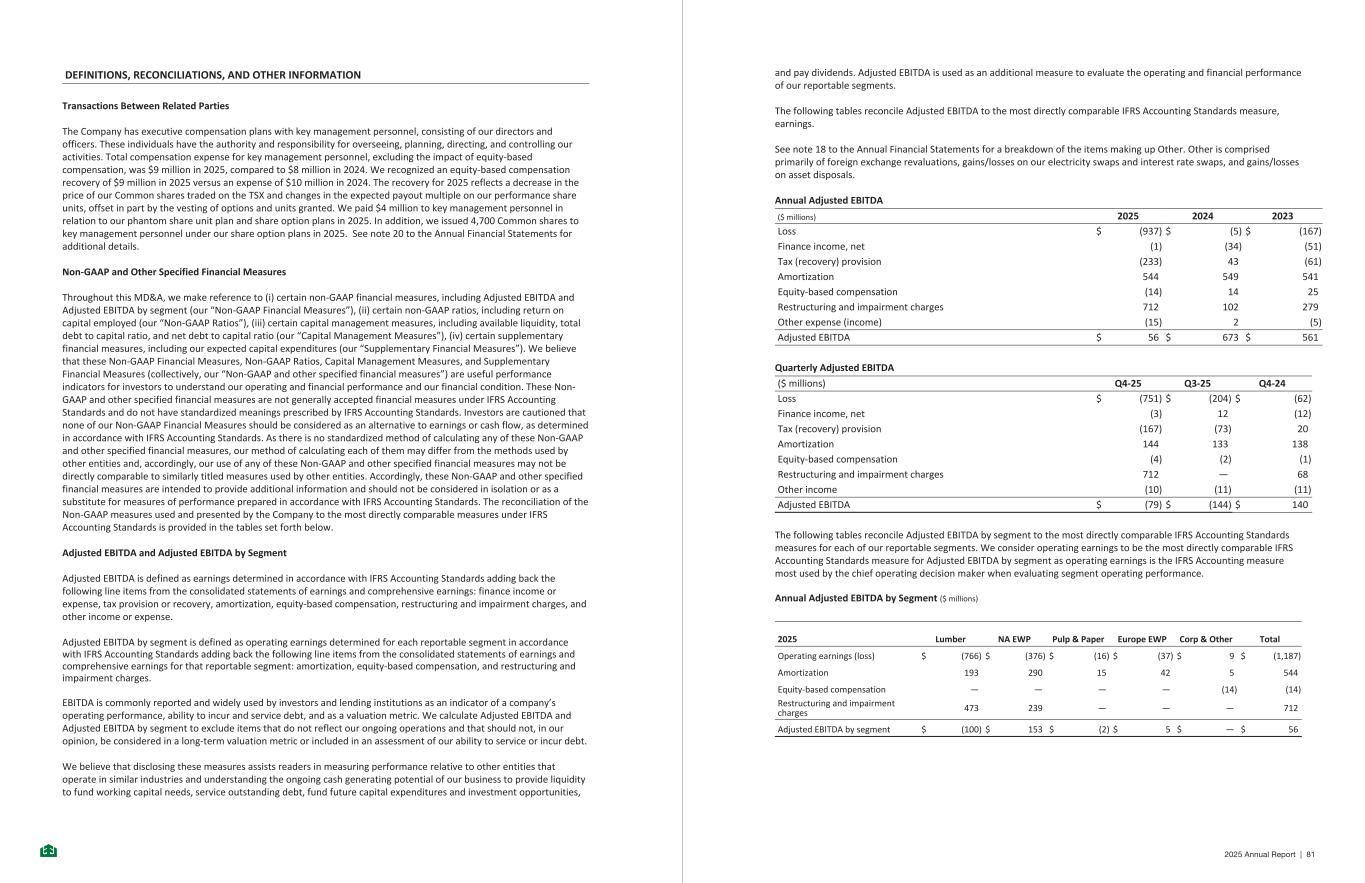
DEFINITIONS, RECONCILIATIONS, AND OTHER INFORMATION Transactions Between Related Parties The Company has executive compensation plans with key management personnel, consisting of our directors and officers. These individuals have the authority and responsibility for overseeing, planning, directing, and controlling our activities. Total compensation expense for key management personnel, excluding the impact of equity-based compensation, was $9 million in 2025, compared to $8 million in 2024. We recognized an equity-based compensation recovery of $9 million in 2025 versus an expense of $10 million in 2024. The recovery for 2025 reflects a decrease in the price of our Common shares traded on the TSX and changes in the expected payout multiple on our performance share units, offset in part by the vesting of options and units granted. We paid $4 million to key management personnel in relation to our phantom share unit plan and share option plans in 2025. In addition, we issued 4,700 Common shares to key management personnel under our share option plans in 2025. See note 20 to the Annual Financial Statements for additional details. Non-GAAP and Other Specified Financial Measures Throughout this MD&A, we make reference to (i) certain non-GAAP financial measures, including Adjusted EBITDA and Adjusted EBITDA by segment (our “Non-GAAP Financial Measures”), (ii) certain non-GAAP ratios, including return on capital employed (our “Non-GAAP Ratios”), (iii) certain capital management measures, including available liquidity, total debt to capital ratio, and net debt to capital ratio (our “Capital Management Measures”), (iv) certain supplementary financial measures, including our expected capital expenditures (our “Supplementary Financial Measures”). We believe that these Non-GAAP Financial Measures, Non-GAAP Ratios, Capital Management Measures, and Supplementary Financial Measures (collectively, our “Non-GAAP and other specified financial measures”) are useful performance indicators for investors to understand our operating and financial performance and our financial condition. These Non- GAAP and other specified financial measures are not generally accepted financial measures under IFRS Accounting Standards and do not have standardized meanings prescribed by IFRS Accounting Standards. Investors are cautioned that none of our Non-GAAP Financial Measures should be considered as an alternative to earnings or cash flow, as determined in accordance with IFRS Accounting Standards. As there is no standardized method of calculating any of these Non-GAAP and other specified financial measures, our method of calculating each of them may differ from the methods used by other entities and, accordingly, our use of any of these Non-GAAP and other specified financial measures may not be directly comparable to similarly titled measures used by other entities. Accordingly, these Non-GAAP and other specified financial measures are intended to provide additional information and should not be considered in isolation or as a substitute for measures of performance prepared in accordance with IFRS Accounting Standards. The reconciliation of the Non-GAAP measures used and presented by the Company to the most directly comparable measures under IFRS Accounting Standards is provided in the tables set forth below. Adjusted EBITDA and Adjusted EBITDA by Segment Adjusted EBITDA is defined as earnings determined in accordance with IFRS Accounting Standards adding back the following line items from the consolidated statements of earnings and comprehensive earnings: finance income or expense, tax provision or recovery, amortization, equity-based compensation, restructuring and impairment charges, and other income or expense. Adjusted EBITDA by segment is defined as operating earnings determined for each reportable segment in accordance with IFRS Accounting Standards adding back the following line items from the consolidated statements of earnings and comprehensive earnings for that reportable segment: amortization, equity-based compensation, and restructuring and impairment charges. EBITDA is commonly reported and widely used by investors and lending institutions as an indicator of a company’s operating performance, ability to incur and service debt, and as a valuation metric. We calculate Adjusted EBITDA and Adjusted EBITDA by segment to exclude items that do not reflect our ongoing operations and that should not, in our opinion, be considered in a long-term valuation metric or included in an assessment of our ability to service or incur debt. We believe that disclosing these measures assists readers in measuring performance relative to other entities that operate in similar industries and understanding the ongoing cash generating potential of our business to provide liquidity to fund working capital needs, service outstanding debt, fund future capital expenditures and investment opportunities, - 61 - and pay dividends. Adjusted EBITDA is used as an additional measure to evaluate the operating and financial performance of our reportable segments. The following tables reconcile Adjusted EBITDA to the most directly comparable IFRS Accounting Standards measure, earnings. See note 18 to the Annual Financial Statements for a breakdown of the items making up Other. Other is comprised primarily of foreign exchange revaluations, gains/losses on our electricity swaps and interest rate swaps, and gains/losses on asset disposals. Annual Adjusted EBITDA ($ millions) 2025 2024 2023 Loss $ (937) $ (5) $ (167) Finance income, net (1) (34) (51) Tax (recovery) provision (233) 43 (61) Amortization 544 549 541 Equity-based compensation (14) 14 25 Restructuring and impairment charges 712 102 279 Other expense (income) (15) 2 (5) Adjusted EBITDA $ 56 $ 673 $ 561 Quarterly Adjusted EBITDA ($ millions) Q4-25 Q3-25 Q4-24 Loss $ (751) $ (204) $ (62) Finance income, net (3) 12 (12) Tax (recovery) provision (167) (73) 20 Amortization 144 133 138 Equity-based compensation (4) (2) (1) Restructuring and impairment charges 712 — 68 Other income (10) (11) (11) Adjusted EBITDA $ (79) $ (144) $ 140 The following tables reconcile Adjusted EBITDA by segment to the most directly comparable IFRS Accounting Standards measures for each of our reportable segments. We consider operating earnings to be the most directly comparable IFRS Accounting Standards measure for Adjusted EBITDA by segment as operating earnings is the IFRS Accounting measure most used by the chief operating decision maker when evaluating segment operating performance. Annual Adjusted EBITDA by Segment ($ millions) 2025 Lumber NA EWP Pulp & Paper Europe EWP Corp & Other Total Operating earnings (loss) $ (766) $ (376) $ (16) $ (37) $ 9 $ (1,187) Amortization 193 290 15 42 5 544 Equity-based compensation — — — — (14) (14) Restructuring and impairment charges 473 239 — — — 712 Adjusted EBITDA by segment $ (100) $ 153 $ (2) $ 5 $ — $ 56 - 62 - 2025 Annual Report | 81
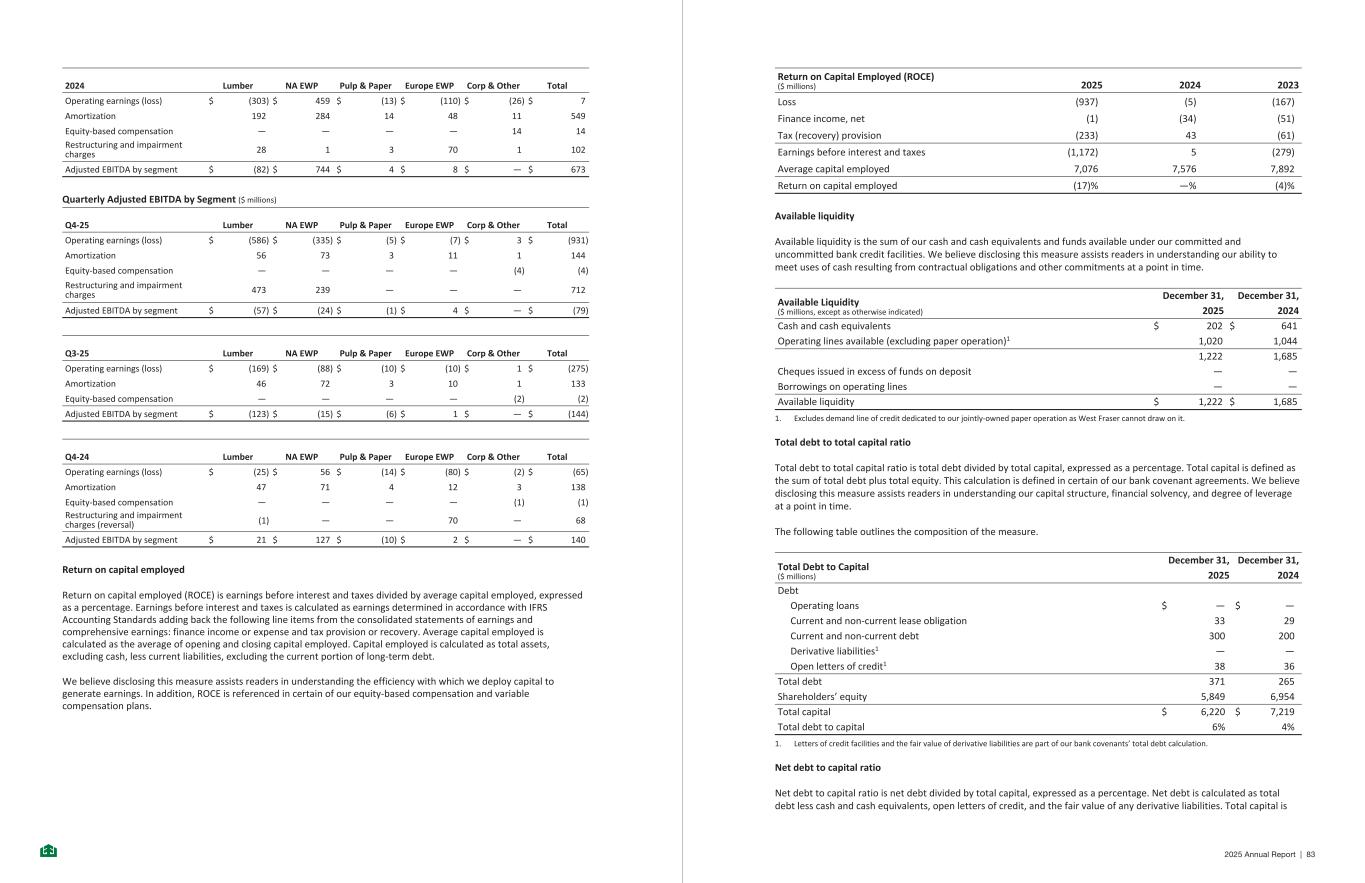
2024 Lumber NA EWP Pulp & Paper Europe EWP Corp & Other Total Operating earnings (loss) $ (303) $ 459 $ (13) $ (110) $ (26) $ 7 Amortization 192 284 14 48 11 549 Equity-based compensation — — — — 14 14 Restructuring and impairment charges 28 1 3 70 1 102 Adjusted EBITDA by segment $ (82) $ 744 $ 4 $ 8 $ — $ 673 Quarterly Adjusted EBITDA by Segment ($ millions) Q4-25 Lumber NA EWP Pulp & Paper Europe EWP Corp & Other Total Operating earnings (loss) $ (586) $ (335) $ (5) $ (7) $ 3 $ (931) Amortization 56 73 3 11 1 144 Equity-based compensation — — — — (4) (4) Restructuring and impairment charges 473 239 — — — 712 Adjusted EBITDA by segment $ (57) $ (24) $ (1) $ 4 $ — $ (79) Q3-25 Lumber NA EWP Pulp & Paper Europe EWP Corp & Other Total Operating earnings (loss) $ (169) $ (88) $ (10) $ (10) $ 1 $ (275) Amortization 46 72 3 10 1 133 Equity-based compensation — — — — (2) (2) Adjusted EBITDA by segment $ (123) $ (15) $ (6) $ 1 $ — $ (144) Q4-24 Lumber NA EWP Pulp & Paper Europe EWP Corp & Other Total Operating earnings (loss) $ (25) $ 56 $ (14) $ (80) $ (2) $ (65) Amortization 47 71 4 12 3 138 Equity-based compensation — — — — (1) (1) Restructuring and impairment charges (reversal) (1) — — 70 — 68 Adjusted EBITDA by segment $ 21 $ 127 $ (10) $ 2 $ — $ 140 Return on capital employed Return on capital employed (ROCE) is earnings before interest and taxes divided by average capital employed, expressed as a percentage. Earnings before interest and taxes is calculated as earnings determined in accordance with IFRS Accounting Standards adding back the following line items from the consolidated statements of earnings and comprehensive earnings: finance income or expense and tax provision or recovery. Average capital employed is calculated as the average of opening and closing capital employed. Capital employed is calculated as total assets, excluding cash, less current liabilities, excluding the current portion of long-term debt. We believe disclosing this measure assists readers in understanding the efficiency with which we deploy capital to generate earnings. In addition, ROCE is referenced in certain of our equity-based compensation and variable compensation plans. - 63 - Return on Capital Employed (ROCE) ($ millions) 2025 2024 2023 Loss (937) (5) (167) Finance income, net (1) (34) (51) Tax (recovery) provision (233) 43 (61) Earnings before interest and taxes (1,172) 5 (279) Average capital employed 7,076 7,576 7,892 Return on capital employed (17) % — % (4) % Available liquidity Available liquidity is the sum of our cash and cash equivalents and funds available under our committed and uncommitted bank credit facilities. We believe disclosing this measure assists readers in understanding our ability to meet uses of cash resulting from contractual obligations and other commitments at a point in time. Available Liquidity ($ millions, except as otherwise indicated) December 31, December 31, 2025 2024 Cash and cash equivalents $ 202 $ 641 Operating lines available (excluding paper operation)1 1,020 1,044 1,222 1,685 Cheques issued in excess of funds on deposit — — Borrowings on operating lines — — Available liquidity $ 1,222 $ 1,685 1. Excludes demand line of credit dedicated to our jointly-owned paper operation as West Fraser cannot draw on it. Total debt to total capital ratio Total debt to total capital ratio is total debt divided by total capital, expressed as a percentage. Total capital is defined as the sum of total debt plus total equity. This calculation is defined in certain of our bank covenant agreements. We believe disclosing this measure assists readers in understanding our capital structure, financial solvency, and degree of leverage at a point in time. The following table outlines the composition of the measure. Total Debt to Capital ($ millions) December 31, December 31, 2025 2024 Debt Operating loans $ — $ — Current and non-current lease obligation 33 29 Current and non-current debt 300 200 Derivative liabilities1 — — Open letters of credit1 38 36 Total debt 371 265 Shareholders’ equity 5,849 6,954 Total capital $ 6,220 $ 7,219 Total debt to capital 6 % 4 % 1. Letters of credit facilities and the fair value of derivative liabilities are part of our bank covenants’ total debt calculation. Net debt to capital ratio Net debt to capital ratio is net debt divided by total capital, expressed as a percentage. Net debt is calculated as total debt less cash and cash equivalents, open letters of credit, and the fair value of any derivative liabilities. Total capital is - 64 - 2025 Annual Report | 83
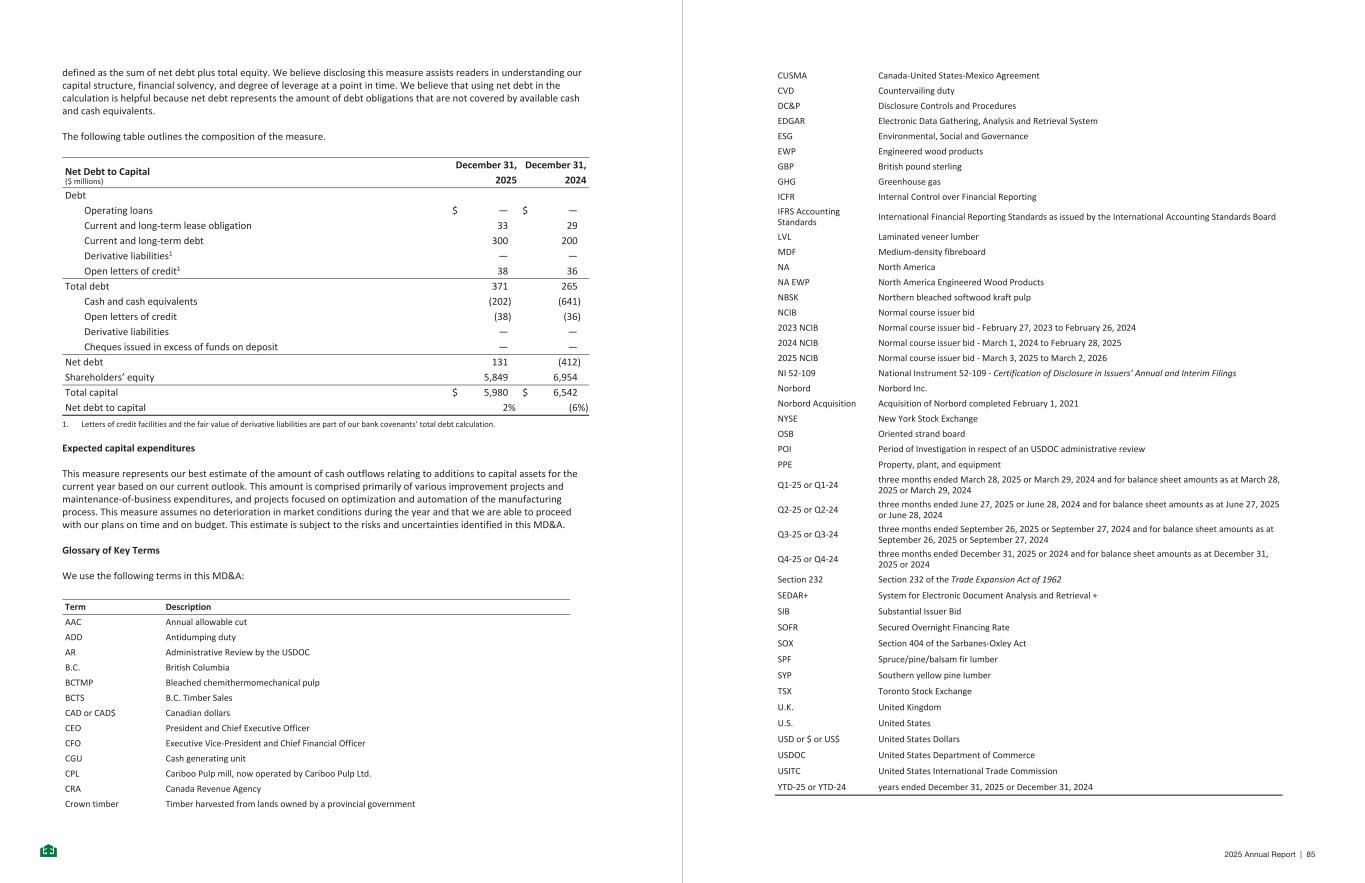
defined as the sum of net debt plus total equity. We believe disclosing this measure assists readers in understanding our capital structure, financial solvency, and degree of leverage at a point in time. We believe that using net debt in the calculation is helpful because net debt represents the amount of debt obligations that are not covered by available cash and cash equivalents. The following table outlines the composition of the measure. Net Debt to Capital ($ millions) December 31, December 31, 2025 2024 Debt Operating loans $ — $ — Current and long-term lease obligation 33 29 Current and long-term debt 300 200 Derivative liabilities1 — — Open letters of credit1 38 36 Total debt 371 265 Cash and cash equivalents (202) (641) Open letters of credit (38) (36) Derivative liabilities — — Cheques issued in excess of funds on deposit — — Net debt 131 (412) Shareholders’ equity 5,849 6,954 Total capital $ 5,980 $ 6,542 Net debt to capital 2% (6%) 1. Letters of credit facilities and the fair value of derivative liabilities are part of our bank covenants’ total debt calculation. Expected capital expenditures This measure represents our best estimate of the amount of cash outflows relating to additions to capital assets for the current year based on our current outlook. This amount is comprised primarily of various improvement projects and maintenance-of-business expenditures, and projects focused on optimization and automation of the manufacturing process. This measure assumes no deterioration in market conditions during the year and that we are able to proceed with our plans on time and on budget. This estimate is subject to the risks and uncertainties identified in this MD&A. Glossary of Key Terms We use the following terms in this MD&A: Term Description AAC Annual allowable cut ADD Antidumping duty AR Administrative Review by the USDOC B.C. British Columbia BCTMP Bleached chemithermomechanical pulp BCTS B.C. Timber Sales CAD or CAD$ Canadian dollars CEO President and Chief Executive Officer CFO Executive Vice-President and Chief Financial Officer CGU Cash generating unit CPL Cariboo Pulp mill, now operated by Cariboo Pulp Ltd. CRA Canada Revenue Agency Crown timber Timber harvested from lands owned by a provincial government - 65 - CUSMA Canada-United States-Mexico Agreement CVD Countervailing duty DC&P Disclosure Controls and Procedures EDGAR Electronic Data Gathering, Analysis and Retrieval System ESG Environmental, Social and Governance EWP Engineered wood products GBP British pound sterling GHG Greenhouse gas ICFR Internal Control over Financial Reporting IFRS Accounting Standards International Financial Reporting Standards as issued by the International Accounting Standards Board LVL Laminated veneer lumber MDF Medium-density fibreboard NA North America NA EWP North America Engineered Wood Products NBSK Northern bleached softwood kraft pulp NCIB Normal course issuer bid 2023 NCIB Normal course issuer bid - February 27, 2023 to February 26, 2024 2024 NCIB Normal course issuer bid - March 1, 2024 to February 28, 2025 2025 NCIB Normal course issuer bid - March 3, 2025 to March 2, 2026 NI 52-109 National Instrument 52-109 - Certification of Disclosure in Issuers’ Annual and Interim Filings Norbord Norbord Inc. Norbord Acquisition Acquisition of Norbord completed February 1, 2021 NYSE New York Stock Exchange OSB Oriented strand board POI Period of Investigation in respect of an USDOC administrative review PPE Property, plant, and equipment Q1-25 or Q1-24 three months ended March 28, 2025 or March 29, 2024 and for balance sheet amounts as at March 28, 2025 or March 29, 2024 Q2-25 or Q2-24 three months ended June 27, 2025 or June 28, 2024 and for balance sheet amounts as at June 27, 2025 or June 28, 2024 Q3-25 or Q3-24 three months ended September 26, 2025 or September 27, 2024 and for balance sheet amounts as at September 26, 2025 or September 27, 2024 Q4-25 or Q4-24 three months ended December 31, 2025 or 2024 and for balance sheet amounts as at December 31, 2025 or 2024 Section 232 Section 232 of the Trade Expansion Act of 1962 SEDAR+ System for Electronic Document Analysis and Retrieval + SIB Substantial Issuer Bid SOFR Secured Overnight Financing Rate SOX Section 404 of the Sarbanes-Oxley Act SPF Spruce/pine/balsam fir lumber SYP Southern yellow pine lumber TSX Toronto Stock Exchange U.K. United Kingdom U.S. United States USD or $ or US$ United States Dollars USDOC United States Department of Commerce USITC United States International Trade Commission YTD-25 or YTD-24 years ended December 31, 2025 or December 31, 2024 - 66 - 2025 Annual Report | 85
Forward-Looking Statements This MD&A includes statements and information that constitutes “forward-looking information” within the meaning of Canadian securities laws and “forward-looking statements” within the meaning of United States securities laws (collectively, “forward-looking statements”). Forward-looking statements include statements that are forward-looking or predictive in nature and are dependent upon or refer to future events or conditions. We use words such as “expects,” “anticipates,” “plans,” “believes,” “estimates,” “seeks,” “intends,” “targets,” “projects,” “forecasts,” or negative versions thereof and other similar expressions, or future or conditional verbs such as “may,” “will,” “should,” “would,” and “could,” to identify these forward-looking statements. These forward-looking statements generally include statements which reflect management’s expectations regarding the operations, business, financial condition, results of operations expected financial results, performance, prospects, opportunities, priorities, targets, goals, ongoing objectives, strategies and outlook of West Fraser and its subsidiaries, as well as the outlook for North American and international economies for the current fiscal year and subsequent periods. Forward-looking statements included in this MD&A include references to: Discussion Forward-Looking Statements Our Business and Strategy our corporate strategy and objectives to generate strong financial results through the business cycle, supported by robust product and geographic diversity, to rely on our committed workforce, the quality of our assets and our well-established people and culture, to execute a balanced capital allocation strategy by maintaining a strong balance sheet and liquidity profile along with an investment-grade issuer rating, to maintain a leading cost position, to maintain financial flexibility through a strong balance sheet and to return capital to shareholders, reinvest in operations across all market cycles to enhance productivity, product mix and capacity, and pursuit of opportunistic acquisitions and larger-scale growth initiatives Recent Developments – Markets impact of new home construction activity, existing home sales, interest rates, mortgage rates, housing supply and demand, housing affordability, housing starts, housing prices, unemployment rates, repair and remodelling demand, inflationary pressures, changes in population growth and demographics on demand for our lumber and OSB products; expectations regarding near, medium and longer-term core demand, future interest rates, government policies on affordability and inflation; contraction in the North American lumber mill capacity and continuation of a period of oversupply in the North American lumber industry, particularly in the U.S. South; constraints on new lumber capacity when lumber demand recovers due to various factors, including ongoing timber supply limitations in significant lumber regions; continuation of a period of oversupply in the North American OSB industry; impact of new or reduced lumber and OSB production capacity on market supply and pricing; constraints on Canadian exports due to Section 232 tariffs or other factors resulting in a potential shortfall in the supply of lumber and OSB products required to meet U.S. market demand levels Recent Developments - OSB Capacity Reductions continuation of our OSB capacity reductions, including indefinite curtailment of our High Level, Alberta OSB mill and the idled production line at our Cordele, Georgia OSB mill Discussion & Analysis of Quarterly Results by Product Segment - Lumber Segment - Softwood Lumber Dispute administrative review commencement, adjustment of export duty rates, proceedings related to duty rates, and timing of finalization of AR7 and AR8 duty rates Business Outlook – Markets the impact of market conditions, housing affordability, interest rates, mortgage rates, U.S. housing starts and inflationary pressures on demand for our wood products over the near, medium and longer term; the potential growing market penetration of mass timber; our ability to capitalize on long-term growth opportunities; our expectations as to future interest rates due to the impact of competing forces on interest rates, including the impact of broader economy, the slowing of employment, growth and the potential price inflation impact of U.S. tariffs and other government policies Business Outlook – Softwood lumber dispute the timing and finalization of the AR7 and AR8 duty rates and their impact on our financial position - 67 - Business Outlook – Operations the assumptions underlying our anticipated shipment levels, including the continued availability of timber supply, our projected SPF and SYP lumber shipments, and related modest demand expectations due to the impact of tariffs and housing affordability challenges on SPF and SYP lumber demand and consequential impact on shipments of SPF lumber into the U.S. from Canada, expectations of stable B.C. and Alberta stumpage rates, U.S. South log costs stabilizing at rates modestly lower than 2025 costs, with region-specific log costs varying; our projected OSB shipments and related softening of OSB demand forecasts due to tariff and policy uncertainty, and housing affordability challenges; the anticipated stability of OSB input costs continuing in the near term, with the projected downward pressure on fibre costs in the U.S. South due to a regional excess supply of pulp logs as a result of recent sawmill curtailments, expectations as to continued stabilization of input costs across our supply chain in 2026, with expectations as to improved labour availability and capital equipment lead times Business Outlook – Cash Flows projected cash flows from operations and available liquidity, the sufficiency of operations and available liquidity to support projected capital expenditures, and the amount of these capital expenditures, our plan to continue to operationalize capital invested in recent years, total estimated capital costs, completion dates and ramp-up periods (including with respect to the ramp-up of the modernized Henderson, Texas lumber manufacturing facility), expected results of capital expenditures, including improvements, maintenance, optimization and automation projects and maintenance of our investment grade issuer rating, strategic growth opportunities, expected continuity of dividends and share repurchases Liquidity and Capital Resources available liquidity, the availability of our revolving credit facility, our policy on capital management, maintenance of investment grade issuer rating, our policy on interest rate swaps and our goal to maintain a balanced capital allocation strategy By their nature, these forward-looking statements involve numerous assumptions, inherent risks and uncertainties, both general and specific, which contribute to the possibility that the predictions, forecasts, and other forward-looking statements will not occur. Factors that could cause actual results to differ materially from those contemplated or implied by forward-looking statements include, but are not limited to: • assumptions in connection with the economic and financial conditions in the U.S., Canada, U.K., Europe and globally and consequential demand for our products, including the ability to meet our shipment guidance, and variability of operating schedules and the impact of the conflicts in Ukraine and the Middle East or elsewhere; • future increases in interest rates and inflation or continued sustained higher interest rates and rates of inflation could impact housing affordability and repair and remodelling demand, which could reduce demand for our products; • near and long-term impacts and uncertainties of U.S. administration tariffs and other government policies on the demand and prices of our wood products in the U.S. and the consequential impact on the profitability of our Canadian business, financial condition, results of operations and cash flow and ability to meet our shipment guidance; • risks associated with international trade and trade restrictions, including impact of tariff actions and possible further actions from the Section 232 investigation such as potential tariffs, export controls, including quotas, or incentives to increase domestic production, future cross border trade rulings, agreements and duty rates, including the renegotiation of CUSMA and/or the failure to renew or replace CUSMA as well as the impact of other government policies; • global supply chain issues may result in increases to our costs and may contribute to a reduction in near-term demand for our products; • continued governmental approvals and authorizations to access timber supply, and the impact of forest fires, infestations, environmental protection measures and actions taken and legislation adopted by government respecting Indigenous rights, title and/or reconciliation efforts on these approvals and authorizations, and evolving jurisprudence in Canada on aboriginal rights and title; • risks inherent in our product concentration and cyclicality; • effects of competition for logs, availability of fibre and fibre resources and product pricing pressures, including continued access to log supply and fibre resources at competitive prices and the impact of third-party certification standards; including reliance on fibre off-take agreements and third party consumers of wood chips; • effects of variations in the price and availability of manufacturing inputs, including energy, employee wages, resin and other input costs, and the impact of inflationary pressures on the costs of these manufacturing costs, including increases in stumpage fees and log costs; - 68 - 2025 Annual Report | 87
• availability and costs of transportation services, including truck and rail services, and port facilities, and impacts on transportation services of wildfires and severe weather events, and the impact of increased energy prices on the costs of transportation services; • the recoverability of property, plant and equipment ($3,593 million), goodwill and intangibles ($1,726 million), both as at December 31, 2025, is based on numerous key assumptions which are inherently uncertain, including production volume, product pricing, operating costs, terminal multiple, and discount rate. Adverse changes in these assumptions could lead to a change in financial outlook which may result in carrying amounts exceeding their recoverable amounts and as a consequence an impairment, which could have a material non-cash adverse effect on our results of operations; • transportation constraints, including the impact of labour disruptions, may negatively impact our ability to meet projected shipment volumes; • the timing of our planned capital investments may be delayed, the ultimate costs of these investments may be increased as a result of inflation, and the projected rates of return may not be achieved; • various events that could disrupt operations, including natural, man-made or catastrophic events including drought, wildfires, fires, explosions, mechanical failures, cyber security incidents, any state of emergency and/or evacuation orders issued by governments, and ongoing relations with employees; • risks inherent to customer dependence; • implementation of important strategic initiatives and identification, completion and integration of acquisitions; • impact of changes to, or non-compliance with, environmental or other regulations; • government restrictions, standards or regulations intended to reduce greenhouse gas emissions and our inability to achieve our SBTi commitment for the reduction of greenhouse gases as planned; • the costs and timeline to achieve our greenhouse gas emissions objectives may be greater and take longer than anticipated; • changes in government policy and regulation, including actions taken by the Government of British Columbia pursuant to recent amendments to forestry legislation and initiatives to defer logging of forests deemed “old growth” and the impact of these actions on our timber supply; • impact of weather and climate change on our operations or the operations or demand of our suppliers and customers; • ability to implement new or upgraded information technology infrastructure; • impact of information technology service disruptions or failures or cyber-security breaches or attacks; • impact of any product, property or general liability claims in excess of insurance coverage; • risks inherent to a capital intensive industry; • impact of future outcomes of tax exposures; • potential future changes in tax laws, including tax rates; • risks associated with investigations, claims and legal, regulatory and tax proceedings covering matters which if resolved unfavourably may result in a loss to and/or reputational issues for the Company; • effects of currency exposures and exchange rate fluctuations; • fair values of our electricity swaps may be volatile and sensitive to fluctuations in forward electricity prices and changes in government policy and regulation; • future operating costs; • availability of financing, bank lines, securitization programs and/or other means of liquidity; • continued access to timber supply in the traditional territories of Indigenous Nations and our ability to work with Indigenous Nations in B.C. to secure continued fibre supply for our lumber mills through various commercial agreements and joint ventures; • our ability to continue to maintain effective internal control over financial reporting; • the risks and uncertainties described in this document; and • other risks detailed from time to time in our annual information forms, annual reports, MD&A, quarterly reports and material change reports filed with and furnished to securities regulators. In addition, actual outcomes and results of these statements will depend on a number of factors including those matters described under “Risks and Uncertainties” in this MD&A and may differ materially from those anticipated or projected. This list of important factors affecting forward-looking statements is not exhaustive and reference should be made to the other factors discussed in public filings with securities regulatory authorities. Accordingly, readers should exercise caution in relying upon forward-looking statements and we undertake no obligation to publicly update or revise any forward-looking statements, whether written or oral, to reflect subsequent events or circumstances except as required by applicable securities laws. - 69 - Additional Information Additional information on West Fraser, including our Annual Information Form and other publicly filed documents, is available on the Company’s website at www.westfraser.com, on SEDAR+ at www.sedarplus.ca and on the EDGAR section of the SEC website at www.sec.gov/edgar. Where this MD&A includes information from third parties, we believe that such information (including information from industry and general publications and surveys) is generally reliable. However, we have not independently verified any such third-party information and cannot assure you of its accuracy or completeness. - 70 - 2025 Annual Report | 89
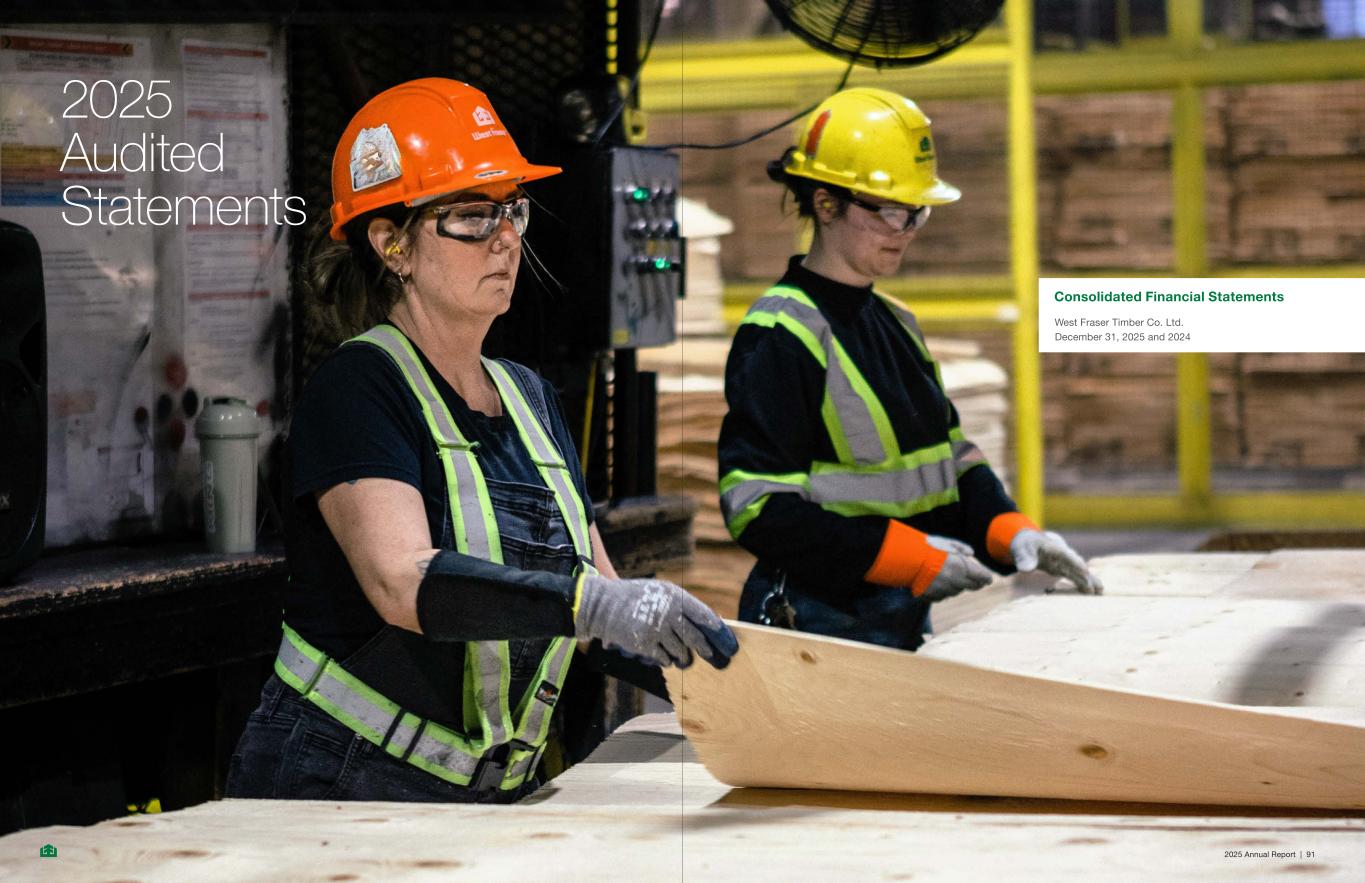
2025 Annual Report | 91 2025 Audited Statements Consolidated Financial Statements West Fraser Timber Co. Ltd. December 31, 2025 and 2024
RESPONSIBILITY OF MANAGEMENT Management’s Report on the Consolidated Financial Statements The accompanying consolidated financial statements and related notes are the responsibility of the management of West Fraser Timber Co. Ltd. (the “Company”). They have been prepared in accordance with International Financial Reporting Standards as issued by the International Accounting Standards Board (“IFRS Accounting Standards”) and include amounts based on estimates and judgments. Financial information included elsewhere in this report is consistent with the consolidated financial statements. The consolidated financial statements are approved by the Board of Directors on the recommendation of the Audit Committee. The Audit Committee, appointed by the Board of Directors, is composed entirely of independent directors. The Audit Committee reviews the Company’s consolidated financial statements and reports its findings to the Board of Directors for consideration before the consolidated financial statements are approved for issuance to shareholders and submitted to securities commissions and/or other regulatory authorities. The Audit Committee’s duties also include reviewing critical accounting policies and significant estimates and judgments underlying the consolidated financial statements as presented by management and approving the fees of the Company’s independent registered public accounting firm. The Company’s independent registered public accounting firm, PricewaterhouseCoopers LLP, performed an audit of the consolidated financial statements, the results of which are reflected in their Report of Independent Registered Public Accounting Firm for 2025. PricewaterhouseCoopers LLP has full and independent access to the Audit Committee to discuss their audit and related matters. Management’s Report on Internal Control over Financial Reporting Under our supervision, management is responsible for establishing and maintaining adequate internal control over financial reporting, as defined under National Instrument 52-109 – Certification of Disclosure in Issuers’ Annual and Interim Filings in Canada and Rules 13a-15(f) and 15d-15(f) of the Securities Exchange Act of 1934, as amended, to provide reasonable assurance regarding the reliability of financial reporting and the preparation of consolidated financial statements for external reporting purposes in accordance with IFRS Accounting Standards. Under our supervision, management has assessed the effectiveness of the Company’s internal control over financial reporting as of December 31, 2025 based on the criteria set forth in Internal Control - Integrated Framework (2013) issued by the Committee of Sponsoring Organizations of the Treadway Commission (“COSO”). Based on this assessment, management has concluded that the Company’s internal control over financial reporting was effective as of December 31, 2025. The effectiveness of the Company’s internal control over financial reporting as of December 31, 2025 has been audited by PricewaterhouseCoopers LLP, the Company’s independent registered public accounting firm, as stated in their report which appears herein. Due to its inherent limitations, internal control over financial reporting may not prevent or detect misstatements on a timely basis. Additionally, projections of any evaluation of the effectiveness of internal control over financial reporting to future periods are subject to the risk that the controls may become inadequate because of changes in conditions, or that the degree of compliance with the policies or procedures may deteriorate. /s/ Sean McLaren /s/ Chris Virostek Sean McLaren Chris Virostek President and Chief Executive Officer Executive Vice-President and Chief Financial Officer February 11, 2026 -2- PricewaterhouseCoopers LLP PwC Place, 250 Howe Street, Suite 1400 Vancouver, British Columbia, Canada V6C 3S7 T.: +1 604 806 7000, F.: +1 604 806 7806 Fax to mail: ca_vancouver_main_fax@pwc.com “PwC” refers to PricewaterhouseCoopers LLP, an Ontario limited liability partnership. Report of Independent Registered Public Accounting Firm To the Board of Directors and Shareholders of West Fraser Timber Co. Ltd. Opinions on the Financial Statements and Internal Control over Financial Reporting We have audited the accompanying consolidated balance sheets of West Fraser Timber Co. Ltd. and its subsidiaries (the Company) as of December 31, 2025 and 2024, and the related consolidated statements of loss and comprehensive loss, of changes in shareholders’ equity and of cash flows for the years then ended, including the related notes (collectively referred to as the consolidated financial statements). We also have audited the Company’s internal control over financial reporting as of December 31, 2025, based on criteria established in Internal Control ‒ Integrated Framework (2013) issued by the Committee of Sponsoring Organizations of the Treadway Commission (COSO). In our opinion, the consolidated financial statements referred to above present fairly, in all material respects, the financial position of the Company as of December 31, 2025 and 2024, and its financial performance and its cash flows for the years then ended in conformity with International Financial Reporting Standards as issued by the International Accounting Standards Board. Also in our opinion, the Company maintained, in all material respects, effective internal control over financial reporting as of December 31, 2025, based on criteria established in Internal Control ‒ Integrated Framework (2013) issued by the COSO. Basis for Opinions The Company’s management is responsible for these consolidated financial statements, for maintaining effective internal control over financial reporting, and for its assessment of the effectiveness of internal control over financial reporting, included in the accompanying Management’s Report on Internal Control over Financial Reporting. Our responsibility is to express opinions on the Company’s consolidated financial statements and on the Company’s internal control over financial reporting based on our audits. We are a public accounting firm registered with the Public Company Accounting Oversight Board (United States) (PCAOB) and are required to be independent with respect to the Company in accordance with the U.S. federal securities laws and the applicable rules and regulations of the Securities and Exchange Commission and the PCAOB. We conducted our audits in accordance with the standards of the PCAOB. Those standards require that we plan and perform the audits to obtain reasonable assurance about whether the consolidated financial statements are free of material misstatement, whether due to error or fraud, and whether effective internal control over financial reporting was maintained in all material respects. 2025 Annual Report | 93
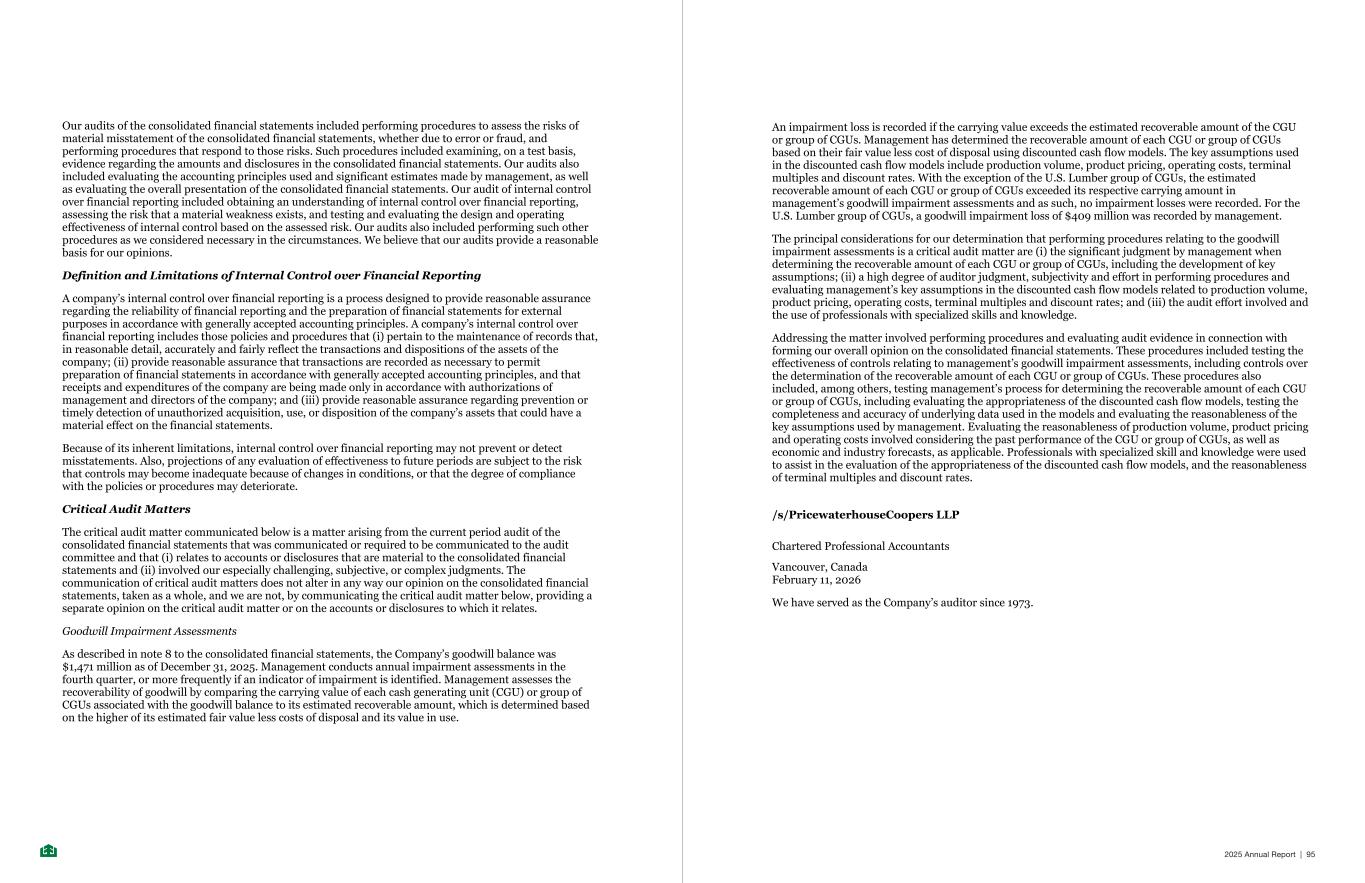
Our audits of the consolidated financial statements included performing procedures to assess the risks of material misstatement of the consolidated financial statements, whether due to error or fraud, and performing procedures that respond to those risks. Such procedures included examining, on a test basis, evidence regarding the amounts and disclosures in the consolidated financial statements. Our audits also included evaluating the accounting principles used and significant estimates made by management, as well as evaluating the overall presentation of the consolidated financial statements. Our audit of internal control over financial reporting included obtaining an understanding of internal control over financial reporting, assessing the risk that a material weakness exists, and testing and evaluating the design and operating effectiveness of internal control based on the assessed risk. Our audits also included performing such other procedures as we considered necessary in the circumstances. We believe that our audits provide a reasonable basis for our opinions. Definition and Limitations of Internal Control over Financial Reporting A company’s internal control over financial reporting is a process designed to provide reasonable assurance regarding the reliability of financial reporting and the preparation of financial statements for external purposes in accordance with generally accepted accounting principles. A company’s internal control over financial reporting includes those policies and procedures that (i) pertain to the maintenance of records that, in reasonable detail, accurately and fairly reflect the transactions and dispositions of the assets of the company; (ii) provide reasonable assurance that transactions are recorded as necessary to permit preparation of financial statements in accordance with generally accepted accounting principles, and that receipts and expenditures of the company are being made only in accordance with authorizations of management and directors of the company; and (iii) provide reasonable assurance regarding prevention or timely detection of unauthorized acquisition, use, or disposition of the company’s assets that could have a material effect on the financial statements. Because of its inherent limitations, internal control over financial reporting may not prevent or detect misstatements. Also, projections of any evaluation of effectiveness to future periods are subject to the risk that controls may become inadequate because of changes in conditions, or that the degree of compliance with the policies or procedures may deteriorate. Critical Audit Matters The critical audit matter communicated below is a matter arising from the current period audit of the consolidated financial statements that was communicated or required to be communicated to the audit committee and that (i) relates to accounts or disclosures that are material to the consolidated financial statements and (ii) involved our especially challenging, subjective, or complex judgments. The communication of critical audit matters does not alter in any way our opinion on the consolidated financial statements, taken as a whole, and we are not, by communicating the critical audit matter below, providing a separate opinion on the critical audit matter or on the accounts or disclosures to which it relates. Goodwill Impairment Assessments As described in note 8 to the consolidated financial statements, the Company’s goodwill balance was $1,471 million as of December 31, 2025. Management conducts annual impairment assessments in the fourth quarter, or more frequently if an indicator of impairment is identified. Management assesses the recoverability of goodwill by comparing the carrying value of each cash generating unit (CGU) or group of CGUs associated with the goodwill balance to its estimated recoverable amount, which is determined based on the higher of its estimated fair value less costs of disposal and its value in use. An impairment loss is recorded if the carrying value exceeds the estimated recoverable amount of the CGU or group of CGUs. Management has determined the recoverable amount of each CGU or group of CGUs based on their fair value less cost of disposal using discounted cash flow models. The key assumptions used in the discounted cash flow models include production volume, product pricing, operating costs, terminal multiples and discount rates. With the exception of the U.S. Lumber group of CGUs, the estimated recoverable amount of each CGU or group of CGUs exceeded its respective carrying amount in management’s goodwill impairment assessments and as such, no impairment losses were recorded. For the U.S. Lumber group of CGUs, a goodwill impairment loss of $409 million was recorded by management. The principal considerations for our determination that performing procedures relating to the goodwill impairment assessments is a critical audit matter are (i) the significant judgment by management when determining the recoverable amount of each CGU or group of CGUs, including the development of key assumptions; (ii) a high degree of auditor judgment, subjectivity and effort in performing procedures and evaluating management’s key assumptions in the discounted cash flow models related to production volume, product pricing, operating costs, terminal multiples and discount rates; and (iii) the audit effort involved and the use of professionals with specialized skills and knowledge. Addressing the matter involved performing procedures and evaluating audit evidence in connection with forming our overall opinion on the consolidated financial statements. These procedures included testing the effectiveness of controls relating to management’s goodwill impairment assessments, including controls over the determination of the recoverable amount of each CGU or group of CGUs. These procedures also included, among others, testing management’s process for determining the recoverable amount of each CGU or group of CGUs, including evaluating the appropriateness of the discounted cash flow models, testing the completeness and accuracy of underlying data used in the models and evaluating the reasonableness of the key assumptions used by management. Evaluating the reasonableness of production volume, product pricing and operating costs involved considering the past performance of the CGU or group of CGUs, as well as economic and industry forecasts, as applicable. Professionals with specialized skill and knowledge were used to assist in the evaluation of the appropriateness of the discounted cash flow models, and the reasonableness of terminal multiples and discount rates. Chartered Professional Accountants Vancouver, Canada February 11, 2026 We have served as the Company’s auditor since 1973. /s/PricewaterhouseCoopers LLP 2025 Annual Report | 95
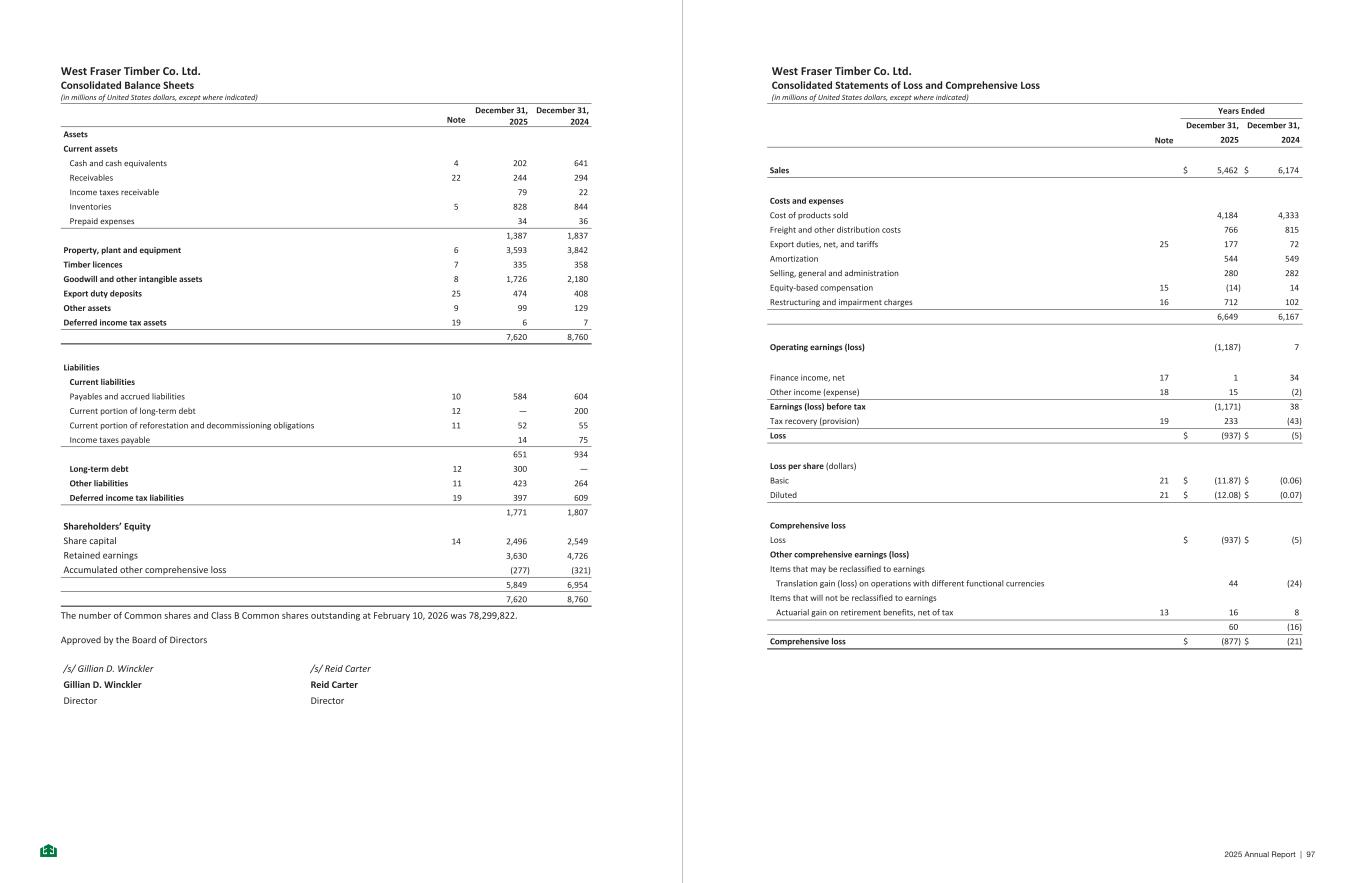
West Fraser Timber Co. Ltd. Consolidated Balance Sheets (in millions of United States dollars, except where indicated) December 31, December 31, Note 2025 2024 Assets Current assets Cash and cash equivalents 4 202 641 Receivables 22 244 294 Income taxes receivable 79 22 Inventories 5 828 844 Prepaid expenses 34 36 1,387 1,837 Property, plant and equipment 6 3,593 3,842 Timber licences 7 335 358 Goodwill and other intangible assets 8 1,726 2,180 Export duty deposits 25 474 408 Other assets 9 99 129 Deferred income tax assets 19 6 7 7,620 8,760 Liabilities Current liabilities Payables and accrued liabilities 10 584 604 Current portion of long-term debt 12 — 200 Current portion of reforestation and decommissioning obligations 11 52 55 Income taxes payable 14 75 651 934 Long-term debt 12 300 — Other liabilities 11 423 264 Deferred income tax liabilities 19 397 609 1,771 1,807 Shareholders’ Equity Share capital 14 2,496 2,549 Retained earnings 3,630 4,726 Accumulated other comprehensive loss (277) (321) 5,849 6,954 7,620 8,760 The number of Common shares and Class B Common shares outstanding at February 10, 2026 was 78,299,822. Approved by the Board of Directors /s/ Gillian D. Winckler /s/ Reid Carter Gillian D. Winckler Reid Carter Director Director -6- West Fraser Timber Co. Ltd. Consolidated Statements of Loss and Comprehensive Loss (in millions of United States dollars, except where indicated) Years Ended December 31, December 31, Note 2025 2024 Sales $ 5,462 $ 6,174 Costs and expenses Cost of products sold 4,184 4,333 Freight and other distribution costs 766 815 Export duties, net, and tariffs 25 177 72 Amortization 544 549 Selling, general and administration 280 282 Equity-based compensation 15 (14) 14 Restructuring and impairment charges 16 712 102 6,649 6,167 Operating earnings (loss) (1,187) 7 Finance income, net 17 1 34 Other income (expense) 18 15 (2) Earnings (loss) before tax (1,171) 38 Tax recovery (provision) 19 233 (43) Loss $ (937) $ (5) Loss per share (dollars) Basic 21 $ (11.87) $ (0.06) Diluted 21 $ (12.08) $ (0.07) Comprehensive loss Loss $ (937) $ (5) Other comprehensive earnings (loss) Items that may be reclassified to earnings Translation gain (loss) on operations with different functional currencies 44 (24) Items that will not be reclassified to earnings Actuarial gain on retirement benefits, net of tax 13 16 8 60 (16) Comprehensive loss $ (877) $ (21) -7- 2025 Annual Report | 97
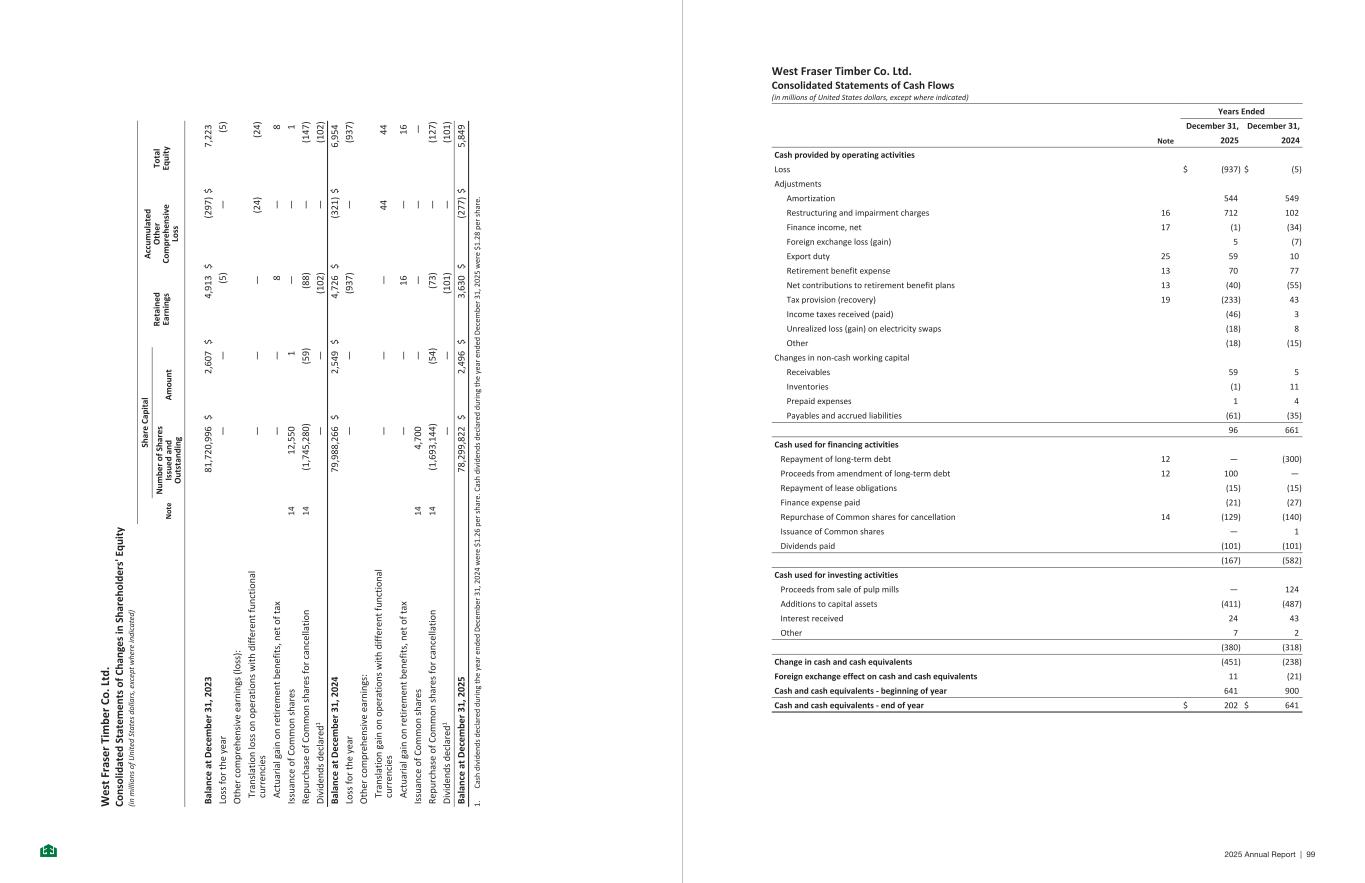
W es t Fr as er T im be r Co . L td . Co ns ol id at ed S ta te m en ts o f C ha ng es in S ha re ho ld er s' E qu it y (in m ill io ns o f U ni te d St at es d ol la rs , e xc ep t w he re in di ca te d) Sh ar e Ca pi ta l Re ta in ed Ea rn in gs A cc um ul at ed O th er Co m pr eh en si ve Lo ss To ta l Eq ui ty N ot e N um be r of S ha re s Is su ed a nd O ut st an di ng A m ou nt Ba la nc e at D ec em be r 31 , 2 02 3 81 ,7 20 ,9 96 $ 2, 60 7 $ 4, 91 3 $ (2 97 ) $ 7, 22 3 Lo ss fo r th e ye ar — — (5 ) — (5 ) O th er c om pr eh en si ve e ar ni ng s (lo ss ): Tr an sl at io n lo ss o n op er at io ns w ith d iff er en t f un ct io na l cu rr en ci es — — — (2 4) (2 4) A ct ua ri al g ai n on r et ir em en t b en ef its , n et o f t ax — — 8 — 8 Is su an ce o f C om m on s ha re s 14 12 ,5 50 1 — — 1 Re pu rc ha se o f C om m on s ha re s fo r ca nc el la tio n 14 (1 ,7 45 ,2 80 ) (5 9) (8 8) — (1 47 ) D iv id en ds d ec la re d1 — — (1 02 ) — (1 02 ) Ba la nc e at D ec em be r 31 , 2 02 4 79 ,9 88 ,2 66 $ 2, 54 9 $ 4, 72 6 $ (3 21 ) $ 6, 95 4 Lo ss fo r th e ye ar — — (9 37 ) — (9 37 ) O th er c om pr eh en si ve e ar ni ng s: Tr an sl at io n ga in o n op er at io ns w ith d iff er en t f un ct io na l cu rr en ci es — — — 44 44 A ct ua ri al g ai n on r et ir em en t b en ef its , n et o f t ax — — 16 — 16 Is su an ce o f C om m on s ha re s 14 4, 70 0 — — — — Re pu rc ha se o f C om m on s ha re s fo r ca nc el la tio n 14 (1 ,6 93 ,1 44 ) (5 4) (7 3) — (1 27 ) D iv id en ds d ec la re d1 — — (1 01 ) — (1 01 ) Ba la nc e at D ec em be r 31 , 2 02 5 78 ,2 99 ,8 22 $ 2, 49 6 $ 3, 63 0 $ (2 77 ) $ 5, 84 9 1. Ca sh d iv id en ds d ec la re d du ri ng th e ye ar e nd ed D ec em be r 3 1, 2 02 4 w er e $1 .2 6 pe r s ha re . C as h di vi de nd s de cl ar ed d ur in g th e ye ar e nd ed D ec em be r 3 1, 2 02 5 w er e $1 .2 8 pe r s ha re . -8 - West Fraser Timber Co. Ltd. Consolidated Statements of Cash Flows (in millions of United States dollars, except where indicated) Years Ended December 31, December 31, Note 2025 2024 Cash provided by operating activities Loss S E $ (937) $ (5) Adjustments Amortization S E 544 549 Restructuring and impairment charges 16 S E 712 102 Finance income, net 17 S E (1) (34) Foreign exchange loss (gain) S E 5 (7) Export duty 25 S E 59 10 Retirement benefit expense 13 S E 70 77 Net contributions to retirement benefit plans 13 S E (40) (55) Tax provision (recovery) 19 S E (233) 43 Income taxes received (paid) S E (46) 3 Unrealized loss (gain) on electricity swaps S E (18) 8 Other S E (18) (15) Changes in non-cash working capital Receivables S E 59 5 Inventories S E (1) 11 Prepaid expenses S E 1 4 Payables and accrued liabilities S E (61) (35) 96 661 Cash used for financing activities Repayment of long-term debt 12 — (300) Proceeds from amendment of long-term debt 12 S E 100 — Repayment of lease obligations S E (15) (15) Finance expense paid S E (21) (27) Repurchase of Common shares for cancellation 14 S E (129) (140) Issuance of Common shares S E — 1 Dividends paid S E (101) (101) (167) (582) Cash used for investing activities Proceeds from sale of pulp mills S E — 124 Additions to capital assets S E (411) (487) Interest received S E 24 43 Other S E 7 2 (380) (318) Change in cash and cash equivalents — (451) (238) Foreign exchange effect on cash and cash equivalents — 11 (21) Cash and cash equivalents - beginning of year — 641 900 Cash and cash equivalents - end of year $ 202 $ 641 -9- 2025 Annual Report | 99
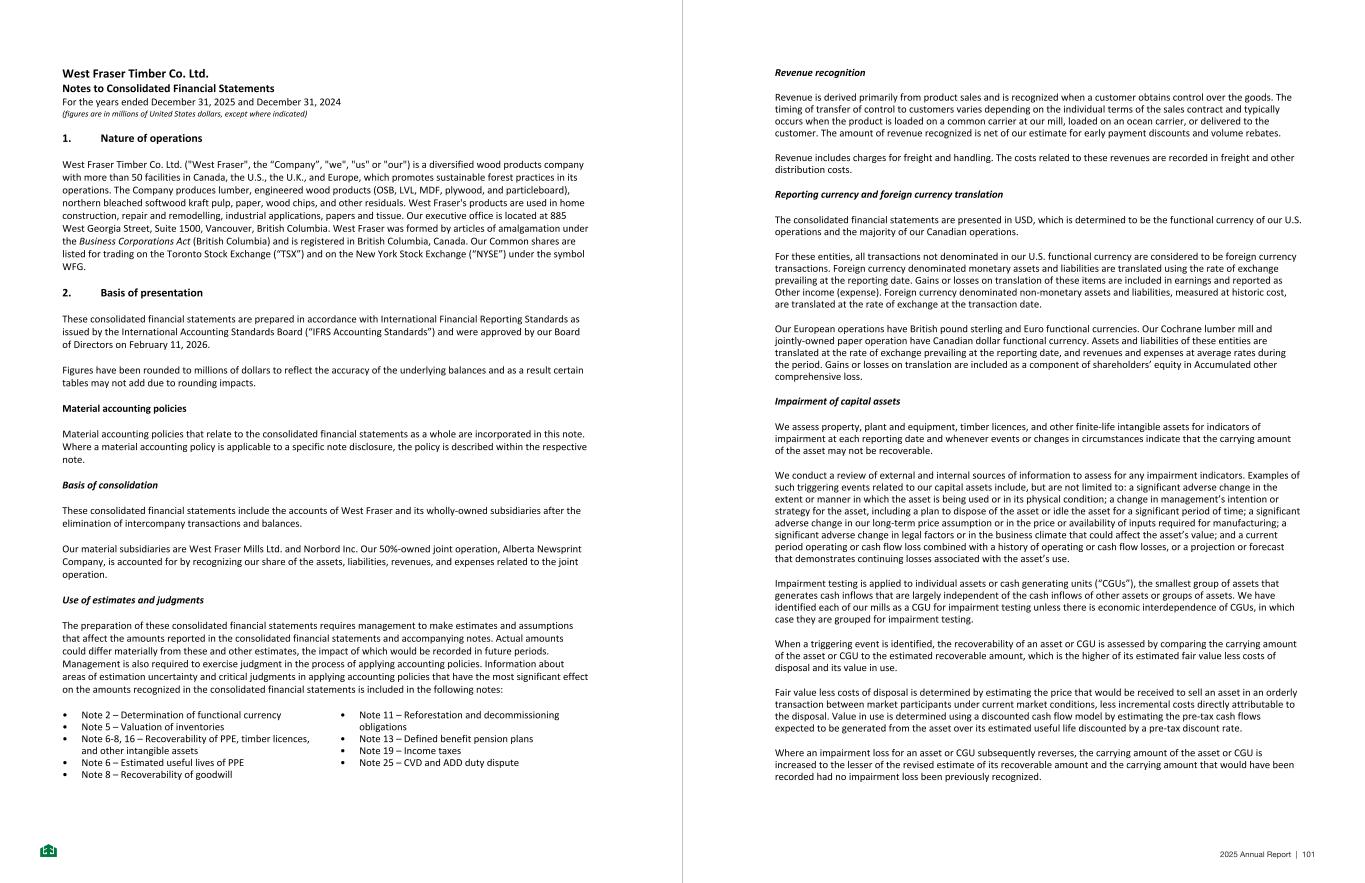
West Fraser Timber Co. Ltd. Notes to Consolidated Financial Statements For the years ended December 31, 2025 and December 31, 2024 (figures are in millions of United States dollars, except where indicated) 1. Nature of operations West Fraser Timber Co. Ltd. ("West Fraser", the “Company”, "we", "us" or "our") is a diversified wood products company with more than 50 facilities in Canada, the U.S., the U.K., and Europe, which promotes sustainable forest practices in its operations. The Company produces lumber, engineered wood products (OSB, LVL, MDF, plywood, and particleboard), northern bleached softwood kraft pulp, paper, wood chips, and other residuals. West Fraser's products are used in home construction, repair and remodelling, industrial applications, papers and tissue. Our executive office is located at 885 West Georgia Street, Suite 1500, Vancouver, British Columbia. West Fraser was formed by articles of amalgamation under the Business Corporations Act (British Columbia) and is registered in British Columbia, Canada. Our Common shares are listed for trading on the Toronto Stock Exchange (“TSX”) and on the New York Stock Exchange (“NYSE”) under the symbol WFG. 2. Basis of presentation These consolidated financial statements are prepared in accordance with International Financial Reporting Standards as issued by the International Accounting Standards Board (“IFRS Accounting Standards”) and were approved by our Board of Directors on February 11, 2026. Figures have been rounded to millions of dollars to reflect the accuracy of the underlying balances and as a result certain tables may not add due to rounding impacts. Material accounting policies Material accounting policies that relate to the consolidated financial statements as a whole are incorporated in this note. Where a material accounting policy is applicable to a specific note disclosure, the policy is described within the respective note. Basis of consolidation These consolidated financial statements include the accounts of West Fraser and its wholly-owned subsidiaries after the elimination of intercompany transactions and balances. Our material subsidiaries are West Fraser Mills Ltd. and Norbord Inc. Our 50%-owned joint operation, Alberta Newsprint Company, is accounted for by recognizing our share of the assets, liabilities, revenues, and expenses related to the joint operation. Use of estimates and judgments The preparation of these consolidated financial statements requires management to make estimates and assumptions that affect the amounts reported in the consolidated financial statements and accompanying notes. Actual amounts could differ materially from these and other estimates, the impact of which would be recorded in future periods. Management is also required to exercise judgment in the process of applying accounting policies. Information about areas of estimation uncertainty and critical judgments in applying accounting policies that have the most significant effect on the amounts recognized in the consolidated financial statements is included in the following notes: • Note 2 – Determination of functional currency • Note 5 – Valuation of inventories • Note 6-8, 16 – Recoverability of PPE, timber licences, and other intangible assets • Note 6 – Estimated useful lives of PPE • Note 8 – Recoverability of goodwill • Note 11 – Reforestation and decommissioning obligations • Note 13 – Defined benefit pension plans • Note 19 – Income taxes • Note 25 – CVD and ADD duty dispute -10- Revenue recognition Revenue is derived primarily from product sales and is recognized when a customer obtains control over the goods. The timing of transfer of control to customers varies depending on the individual terms of the sales contract and typically occurs when the product is loaded on a common carrier at our mill, loaded on an ocean carrier, or delivered to the customer. The amount of revenue recognized is net of our estimate for early payment discounts and volume rebates. Revenue includes charges for freight and handling. The costs related to these revenues are recorded in freight and other distribution costs. Reporting currency and foreign currency translation The consolidated financial statements are presented in USD, which is determined to be the functional currency of our U.S. operations and the majority of our Canadian operations. For these entities, all transactions not denominated in our U.S. functional currency are considered to be foreign currency transactions. Foreign currency denominated monetary assets and liabilities are translated using the rate of exchange prevailing at the reporting date. Gains or losses on translation of these items are included in earnings and reported as Other income (expense). Foreign currency denominated non-monetary assets and liabilities, measured at historic cost, are translated at the rate of exchange at the transaction date. Our European operations have British pound sterling and Euro functional currencies. Our Cochrane lumber mill and jointly-owned paper operation have Canadian dollar functional currency. Assets and liabilities of these entities are translated at the rate of exchange prevailing at the reporting date, and revenues and expenses at average rates during the period. Gains or losses on translation are included as a component of shareholders’ equity in Accumulated other comprehensive loss. Impairment of capital assets We assess property, plant and equipment, timber licences, and other finite-life intangible assets for indicators of impairment at each reporting date and whenever events or changes in circumstances indicate that the carrying amount of the asset may not be recoverable. We conduct a review of external and internal sources of information to assess for any impairment indicators. Examples of such triggering events related to our capital assets include, but are not limited to: a significant adverse change in the extent or manner in which the asset is being used or in its physical condition; a change in management’s intention or strategy for the asset, including a plan to dispose of the asset or idle the asset for a significant period of time; a significant adverse change in our long-term price assumption or in the price or availability of inputs required for manufacturing; a significant adverse change in legal factors or in the business climate that could affect the asset’s value; and a current period operating or cash flow loss combined with a history of operating or cash flow losses, or a projection or forecast that demonstrates continuing losses associated with the asset’s use. Impairment testing is applied to individual assets or cash generating units (“CGUs”), the smallest group of assets that generates cash inflows that are largely independent of the cash inflows of other assets or groups of assets. We have identified each of our mills as a CGU for impairment testing unless there is economic interdependence of CGUs, in which case they are grouped for impairment testing. When a triggering event is identified, the recoverability of an asset or CGU is assessed by comparing the carrying amount of the asset or CGU to the estimated recoverable amount, which is the higher of its estimated fair value less costs of disposal and its value in use. Fair value less costs of disposal is determined by estimating the price that would be received to sell an asset in an orderly transaction between market participants under current market conditions, less incremental costs directly attributable to the disposal. Value in use is determined using a discounted cash flow model by estimating the pre-tax cash flows expected to be generated from the asset over its estimated useful life discounted by a pre-tax discount rate. Where an impairment loss for an asset or CGU subsequently reverses, the carrying amount of the asset or CGU is increased to the lesser of the revised estimate of its recoverable amount and the carrying amount that would have been recorded had no impairment loss been previously recognized. -11- 2025 Annual Report | 101
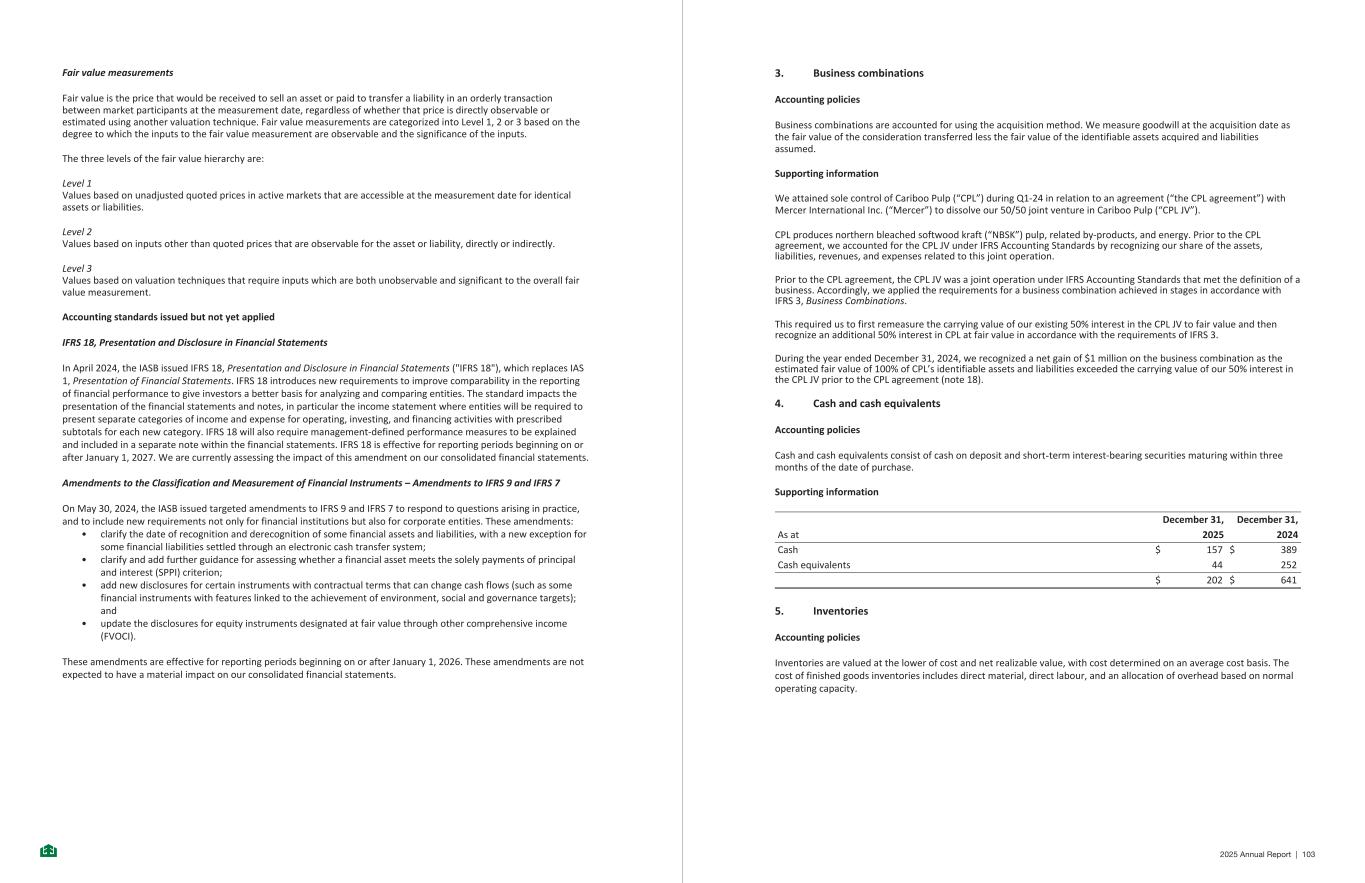
Fair value measurements Fair value is the price that would be received to sell an asset or paid to transfer a liability in an orderly transaction between market participants at the measurement date, regardless of whether that price is directly observable or estimated using another valuation technique. Fair value measurements are categorized into Level 1, 2 or 3 based on the degree to which the inputs to the fair value measurement are observable and the significance of the inputs. The three levels of the fair value hierarchy are: Level 1 Values based on unadjusted quoted prices in active markets that are accessible at the measurement date for identical assets or liabilities. Level 2 Values based on inputs other than quoted prices that are observable for the asset or liability, directly or indirectly. Level 3 Values based on valuation techniques that require inputs which are both unobservable and significant to the overall fair value measurement. Accounting standards issued but not yet applied IFRS 18, Presentation and Disclosure in Financial Statements In April 2024, the IASB issued IFRS 18, Presentation and Disclosure in Financial Statements ("IFRS 18"), which replaces IAS 1, Presentation of Financial Statements. IFRS 18 introduces new requirements to improve comparability in the reporting of financial performance to give investors a better basis for analyzing and comparing entities. The standard impacts the presentation of the financial statements and notes, in particular the income statement where entities will be required to present separate categories of income and expense for operating, investing, and financing activities with prescribed subtotals for each new category. IFRS 18 will also require management-defined performance measures to be explained and included in a separate note within the financial statements. IFRS 18 is effective for reporting periods beginning on or after January 1, 2027. We are currently assessing the impact of this amendment on our consolidated financial statements. Amendments to the Classification and Measurement of Financial Instruments – Amendments to IFRS 9 and IFRS 7 On May 30, 2024, the IASB issued targeted amendments to IFRS 9 and IFRS 7 to respond to questions arising in practice, and to include new requirements not only for financial institutions but also for corporate entities. These amendments: • clarify the date of recognition and derecognition of some financial assets and liabilities, with a new exception for some financial liabilities settled through an electronic cash transfer system; • clarify and add further guidance for assessing whether a financial asset meets the solely payments of principal and interest (SPPI) criterion; • add new disclosures for certain instruments with contractual terms that can change cash flows (such as some financial instruments with features linked to the achievement of environment, social and governance targets); and • update the disclosures for equity instruments designated at fair value through other comprehensive income (FVOCI). These amendments are effective for reporting periods beginning on or after January 1, 2026. These amendments are not expected to have a material impact on our consolidated financial statements. -12- 3. Business combinations Accounting policies Business combinations are accounted for using the acquisition method. We measure goodwill at the acquisition date as the fair value of the consideration transferred less the fair value of the identifiable assets acquired and liabilities assumed. Supporting information We attained sole control of Cariboo Pulp (“CPL”) during Q1-24 in relation to an agreement (“the CPL agreement”) with Mercer International Inc. (“Mercer”) to dissolve our 50/50 joint venture in Cariboo Pulp (“CPL JV”). CPL produces northern bleached softwood kraft (“NBSK”) pulp, related by-products, and energy. Prior to the CPL agreement, we accounted for the CPL JV under IFRS Accounting Standards by recognizing our share of the assets, liabilities, revenues, and expenses related to this joint operation. Prior to the CPL agreement, the CPL JV was a joint operation under IFRS Accounting Standards that met the definition of a business. Accordingly, we applied the requirements for a business combination achieved in stages in accordance with IFRS 3, Business Combinations. This required us to first remeasure the carrying value of our existing 50% interest in the CPL JV to fair value and then recognize an additional 50% interest in CPL at fair value in accordance with the requirements of IFRS 3. During the year ended December 31, 2024, we recognized a net gain of $1 million on the business combination as the estimated fair value of 100% of CPL’s identifiable assets and liabilities exceeded the carrying value of our 50% interest in the CPL JV prior to the CPL agreement (note 18). 4. Cash and cash equivalents Accounting policies Cash and cash equivalents consist of cash on deposit and short-term interest-bearing securities maturing within three months of the date of purchase. Supporting information December 31, December 31, As at 2025 2024 Cash $ 157 $ 389 Cash equivalents 44 252 $ 202 $ 641 5. Inventories Accounting policies Inventories are valued at the lower of cost and net realizable value, with cost determined on an average cost basis. The cost of finished goods inventories includes direct material, direct labour, and an allocation of overhead based on normal operating capacity. -13- 2025 Annual Report | 103
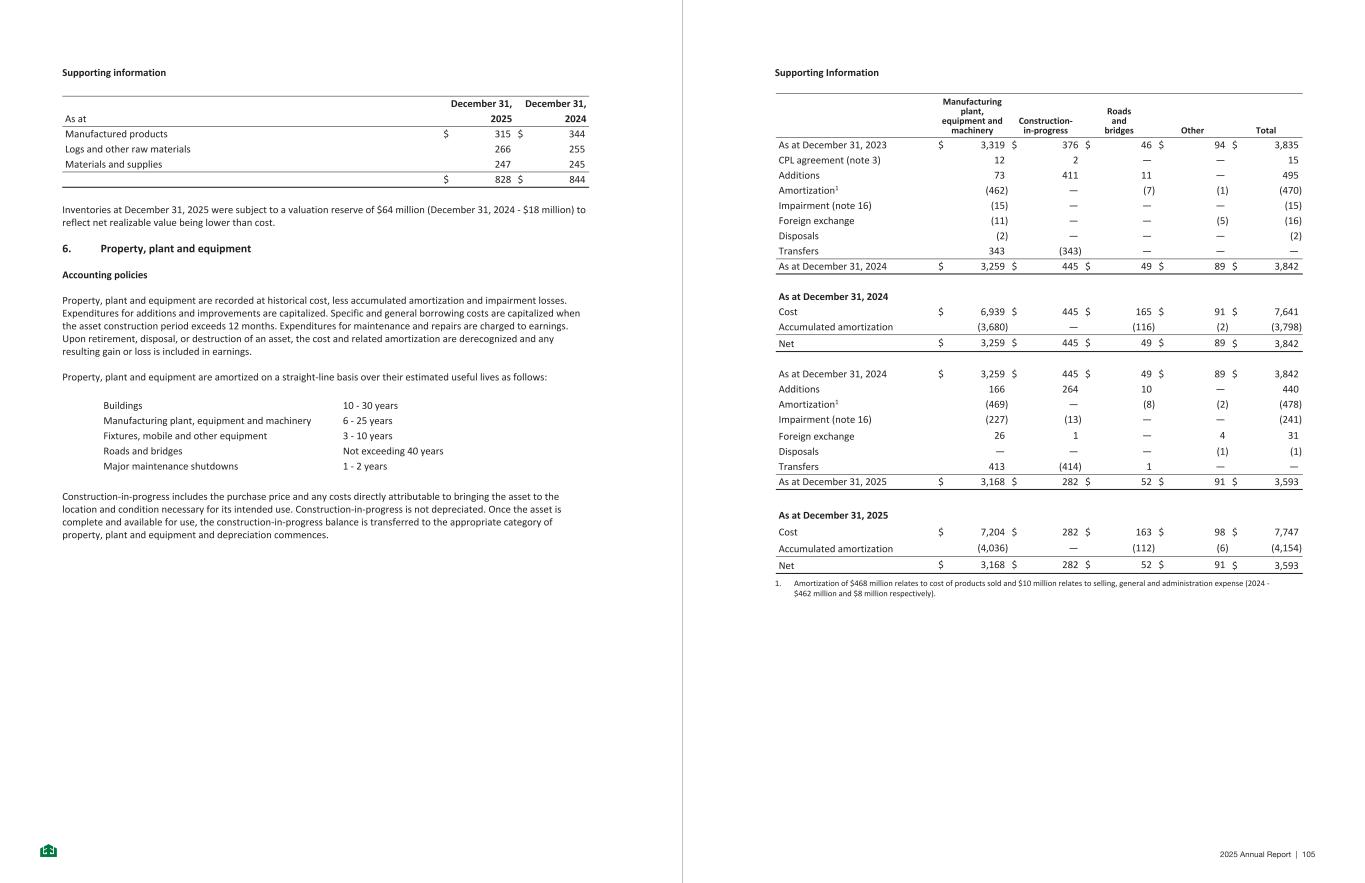
Supporting information December 31, December 31, As at 2025 2024 Manufactured products $ 315 $ 344 Logs and other raw materials 266 255 Materials and supplies 247 245 $ 828 $ 844 Inventories at December 31, 2025 were subject to a valuation reserve of $64 million (December 31, 2024 - $18 million) to reflect net realizable value being lower than cost. 6. Property, plant and equipment Accounting policies Property, plant and equipment are recorded at historical cost, less accumulated amortization and impairment losses. Expenditures for additions and improvements are capitalized. Specific and general borrowing costs are capitalized when the asset construction period exceeds 12 months. Expenditures for maintenance and repairs are charged to earnings. Upon retirement, disposal, or destruction of an asset, the cost and related amortization are derecognized and any resulting gain or loss is included in earnings. Property, plant and equipment are amortized on a straight-line basis over their estimated useful lives as follows: Buildings 10 - 30 years Manufacturing plant, equipment and machinery 6 - 25 years Fixtures, mobile and other equipment 3 - 10 years Roads and bridges Not exceeding 40 years Major maintenance shutdowns 1 - 2 years Construction-in-progress includes the purchase price and any costs directly attributable to bringing the asset to the location and condition necessary for its intended use. Construction-in-progress is not depreciated. Once the asset is complete and available for use, the construction-in-progress balance is transferred to the appropriate category of property, plant and equipment and depreciation commences. -14- Supporting Information Manufacturing plant, equipment and machinery Construction- in-progress Roads and bridges Other Total As at December 31, 2023 $ 3,319 $ 376 $ 46 $ 94 $ 3,835 CPL agreement (note 3) 12 2 — — 15 Additions 73 411 11 — 495 Amortization1 (462) — (7) (1) (470) Impairment (note 16) (15) — — — (15) Foreign exchange (11) — — (5) (16) Disposals (2) — — — (2) Transfers 343 (343) — — — As at December 31, 2024 $ 3,259 $ 445 $ 49 $ 89 $ 3,842 As at December 31, 2024 Cost $ 6,939 $ 445 $ 165 $ 91 $ 7,641 Accumulated amortization (3,680) — (116) (2) (3,798) Net $ 3,259 $ 445 $ 49 $ 89 $ 3,842 As at December 31, 2024 $ 3,259 $ 445 $ 49 $ 89 $ 3,842 Additions 166 264 10 — 440 Amortization1 (469) — (8) (2) (478) Impairment (note 16) (227) (13) — — (241) Foreign exchange 26 1 — 4 31 Disposals — — — (1) (1) Transfers 413 (414) 1 — — As at December 31, 2025 $ 3,168 $ 282 $ 52 $ 91 $ 3,593 As at December 31, 2025 Cost $ 7,204 $ 282 $ 163 $ 98 $ 7,747 Accumulated amortization (4,036) — (112) (6) (4,154) Net $ 3,168 $ 282 $ 52 $ 91 $ 3,593 1. Amortization of $468 million relates to cost of products sold and $10 million relates to selling, general and administration expense (2024 - $462 million and $8 million respectively). -15- 2025 Annual Report | 105
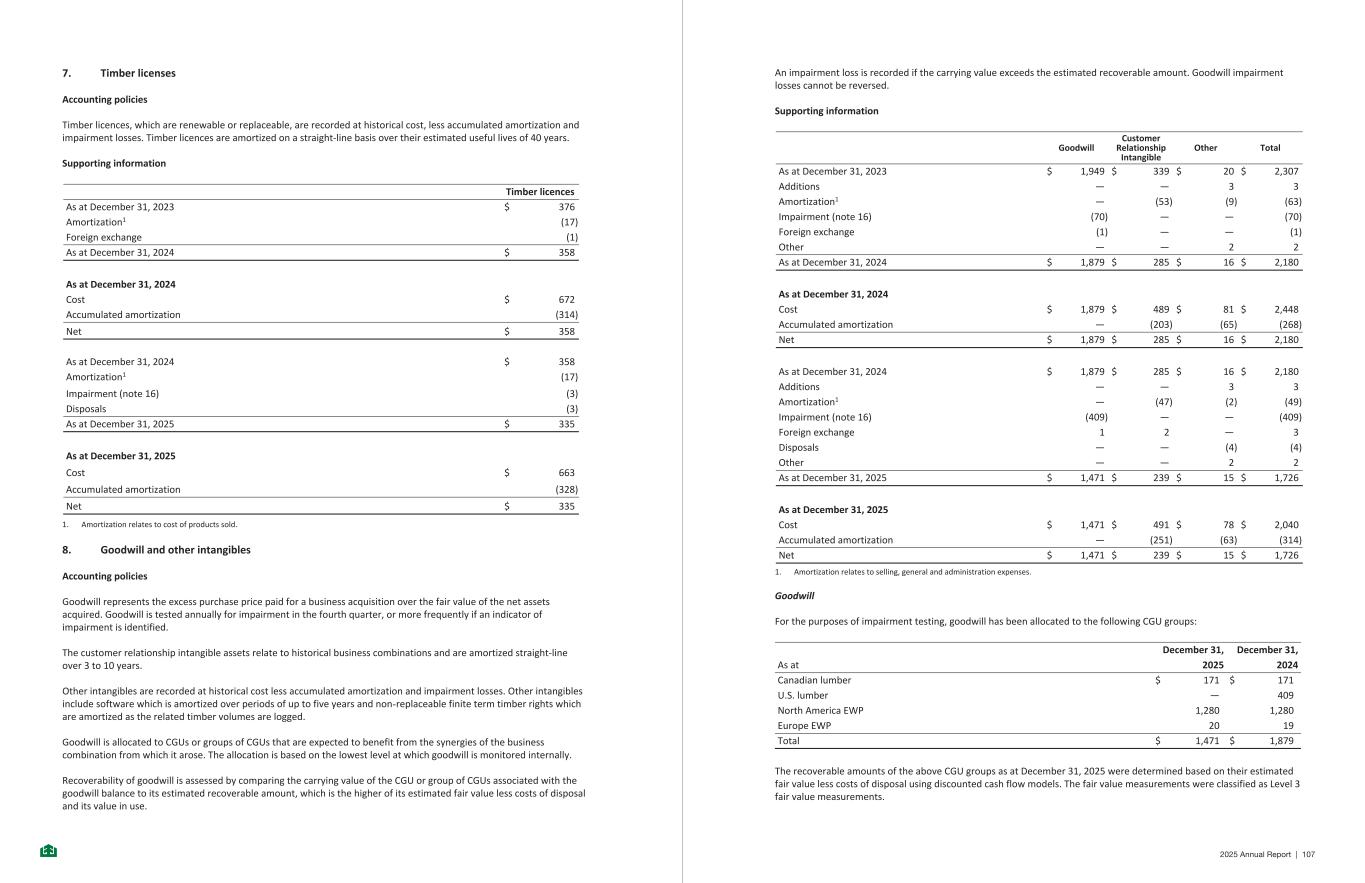
7. Timber licenses Accounting policies Timber licences, which are renewable or replaceable, are recorded at historical cost, less accumulated amortization and impairment losses. Timber licences are amortized on a straight-line basis over their estimated useful lives of 40 years. Supporting information Timber licences As at December 31, 2023 $ 376 Amortization1 (17) Foreign exchange (1) As at December 31, 2024 $ 358 As at December 31, 2024 Cost $ 672 Accumulated amortization (314) Net $ 358 As at December 31, 2024 $ 358 Amortization1 (17) Impairment (note 16) (3) Disposals (3) As at December 31, 2025 $ 335 As at December 31, 2025 Cost $ 663 Accumulated amortization (328) Net $ 335 1. Amortization relates to cost of products sold. 8. Goodwill and other intangibles Accounting policies Goodwill represents the excess purchase price paid for a business acquisition over the fair value of the net assets acquired. Goodwill is tested annually for impairment in the fourth quarter, or more frequently if an indicator of impairment is identified. The customer relationship intangible assets relate to historical business combinations and are amortized straight-line over 3 to 10 years. Other intangibles are recorded at historical cost less accumulated amortization and impairment losses. Other intangibles include software which is amortized over periods of up to five years and non-replaceable finite term timber rights which are amortized as the related timber volumes are logged. Goodwill is allocated to CGUs or groups of CGUs that are expected to benefit from the synergies of the business combination from which it arose. The allocation is based on the lowest level at which goodwill is monitored internally. Recoverability of goodwill is assessed by comparing the carrying value of the CGU or group of CGUs associated with the goodwill balance to its estimated recoverable amount, which is the higher of its estimated fair value less costs of disposal and its value in use. -16- An impairment loss is recorded if the carrying value exceeds the estimated recoverable amount. Goodwill impairment losses cannot be reversed. Supporting information Goodwill Customer Relationship Intangible Other Total As at December 31, 2023 $ 1,949 $ 339 $ 20 $ 2,307 Additions — — 3 3 Amortization1 — (53) (9) (63) Impairment (note 16) (70) — — (70) Foreign exchange (1) — — (1) Other — — 2 2 As at December 31, 2024 $ 1,879 $ 285 $ 16 $ 2,180 As at December 31, 2024 Cost $ 1,879 $ 489 $ 81 $ 2,448 Accumulated amortization — (203) (65) (268) Net $ 1,879 $ 285 $ 16 $ 2,180 As at December 31, 2024 $ 1,879 $ 285 $ 16 $ 2,180 Additions — — 3 3 Amortization1 — (47) (2) (49) Impairment (note 16) (409) — — (409) Foreign exchange 1 2 — 3 Disposals — — (4) (4) Other — — 2 2 As at December 31, 2025 $ 1,471 $ 239 $ 15 $ 1,726 As at December 31, 2025 Cost $ 1,471 $ 491 $ 78 $ 2,040 Accumulated amortization — (251) (63) (314) Net $ 1,471 $ 239 $ 15 $ 1,726 1. Amortization relates to selling, general and administration expenses. Goodwill For the purposes of impairment testing, goodwill has been allocated to the following CGU groups: December 31, December 31, As at 2025 2024 Canadian lumber $ 171 $ 171 U.S. lumber — 409 North America EWP 1,280 1,280 Europe EWP 20 19 Total $ 1,471 $ 1,879 The recoverable amounts of the above CGU groups as at December 31, 2025 were determined based on their estimated fair value less costs of disposal using discounted cash flow models. The fair value measurements were classified as Level 3 fair value measurements. -17- 2025 Annual Report | 107
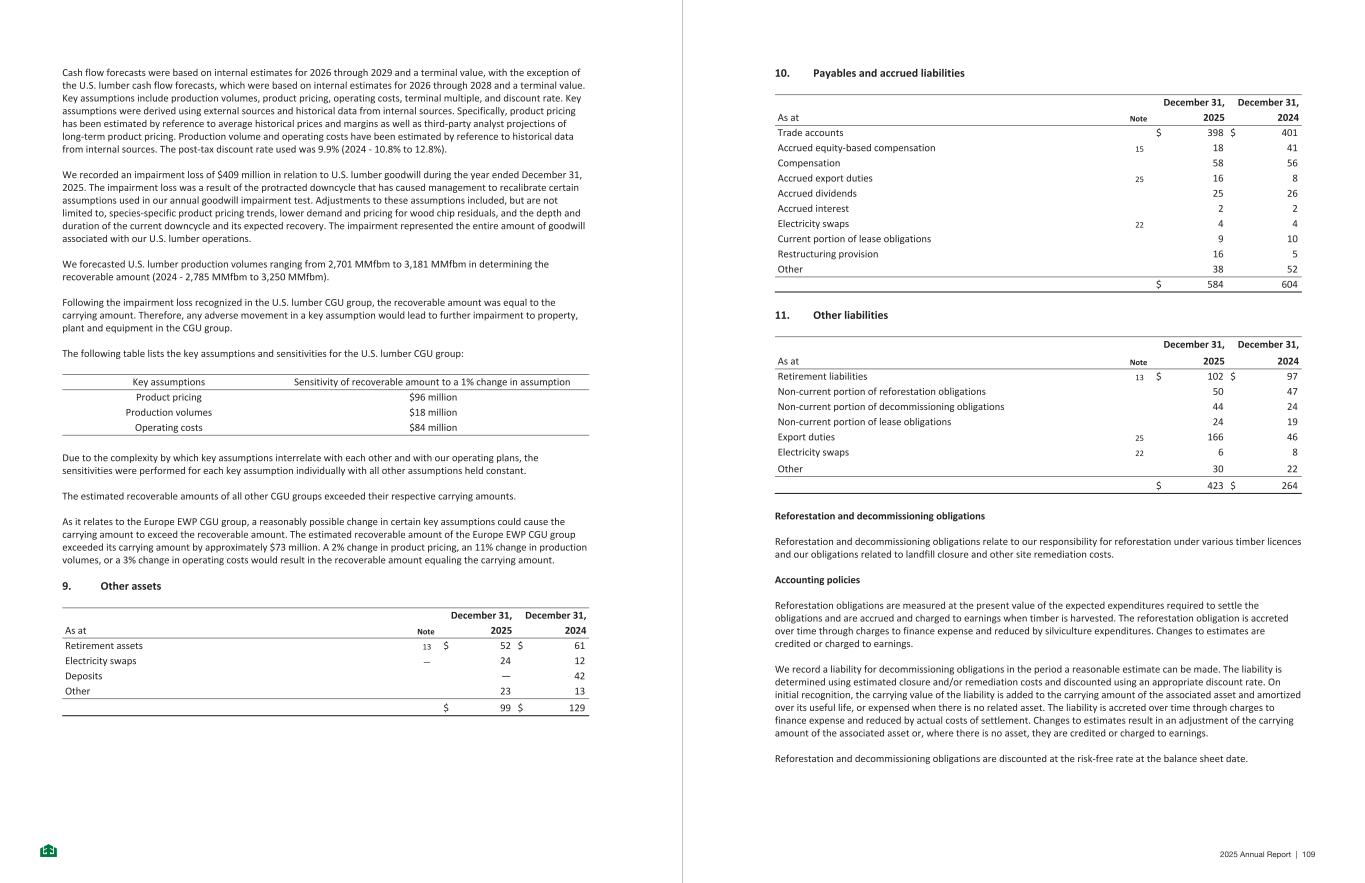
Cash flow forecasts were based on internal estimates for 2026 through 2029 and a terminal value, with the exception of the U.S. lumber cash flow forecasts, which were based on internal estimates for 2026 through 2028 and a terminal value. Key assumptions include production volumes, product pricing, operating costs, terminal multiple, and discount rate. Key assumptions were derived using external sources and historical data from internal sources. Specifically, product pricing has been estimated by reference to average historical prices and margins as well as third-party analyst projections of long-term product pricing. Production volume and operating costs have been estimated by reference to historical data from internal sources. The post-tax discount rate used was 9.9% (2024 - 10.8% to 12.8%). We recorded an impairment loss of $409 million in relation to U.S. lumber goodwill during the year ended December 31, 2025. The impairment loss was a result of the protracted downcycle that has caused management to recalibrate certain assumptions used in our annual goodwill impairment test. Adjustments to these assumptions included, but are not limited to, species-specific product pricing trends, lower demand and pricing for wood chip residuals, and the depth and duration of the current downcycle and its expected recovery. The impairment represented the entire amount of goodwill associated with our U.S. lumber operations. We forecasted U.S. lumber production volumes ranging from 2,701 MMfbm to 3,181 MMfbm in determining the recoverable amount (2024 - 2,785 MMfbm to 3,250 MMfbm). Following the impairment loss recognized in the U.S. lumber CGU group, the recoverable amount was equal to the carrying amount. Therefore, any adverse movement in a key assumption would lead to further impairment to property, plant and equipment in the CGU group. The following table lists the key assumptions and sensitivities for the U.S. lumber CGU group: Key assumptions Sensitivity of recoverable amount to a 1% change in assumption Product pricing $96 million Production volumes $18 million Operating costs $84 million Due to the complexity by which key assumptions interrelate with each other and with our operating plans, the sensitivities were performed for each key assumption individually with all other assumptions held constant. The estimated recoverable amounts of all other CGU groups exceeded their respective carrying amounts. As it relates to the Europe EWP CGU group, a reasonably possible change in certain key assumptions could cause the carrying amount to exceed the recoverable amount. The estimated recoverable amount of the Europe EWP CGU group exceeded its carrying amount by approximately $73 million. A 2% change in product pricing, an 11% change in production volumes, or a 3% change in operating costs would result in the recoverable amount equaling the carrying amount. 9. Other assets December 31, December 31, As at Note 2025 2024 Retirement assets 13 $ 52 $ 61 Electricity swaps — 24 12 Deposits — 42 Other 23 13 $ 99 $ 129 -18- 10. Payables and accrued liabilities December 31, December 31, As at Note 2025 2024 Trade accounts $ 398 $ 401 Accrued equity-based compensation 15 18 41 Compensation 58 56 Accrued export duties 25 16 8 Accrued dividends 25 26 Accrued interest 2 2 Electricity swaps 22 4 4 Current portion of lease obligations 9 10 Restructuring provision 16 5 Other 38 52 $ 584 604 11. Other liabilities December 31, December 31, As at Note 2025 2024 Retirement liabilities 13 $ 102 $ 97 Non-current portion of reforestation obligations 50 47 Non-current portion of decommissioning obligations 44 24 Non-current portion of lease obligations 24 19 Export duties 25 166 46 Electricity swaps 22 6 8 Other 30 22 $ 423 $ 264 Reforestation and decommissioning obligations Reforestation and decommissioning obligations relate to our responsibility for reforestation under various timber licences and our obligations related to landfill closure and other site remediation costs. Accounting policies Reforestation obligations are measured at the present value of the expected expenditures required to settle the obligations and are accrued and charged to earnings when timber is harvested. The reforestation obligation is accreted over time through charges to finance expense and reduced by silviculture expenditures. Changes to estimates are credited or charged to earnings. We record a liability for decommissioning obligations in the period a reasonable estimate can be made. The liability is determined using estimated closure and/or remediation costs and discounted using an appropriate discount rate. On initial recognition, the carrying value of the liability is added to the carrying amount of the associated asset and amortized over its useful life, or expensed when there is no related asset. The liability is accreted over time through charges to finance expense and reduced by actual costs of settlement. Changes to estimates result in an adjustment of the carrying amount of the associated asset or, where there is no asset, they are credited or charged to earnings. Reforestation and decommissioning obligations are discounted at the risk-free rate at the balance sheet date. -19- 2025 Annual Report | 109
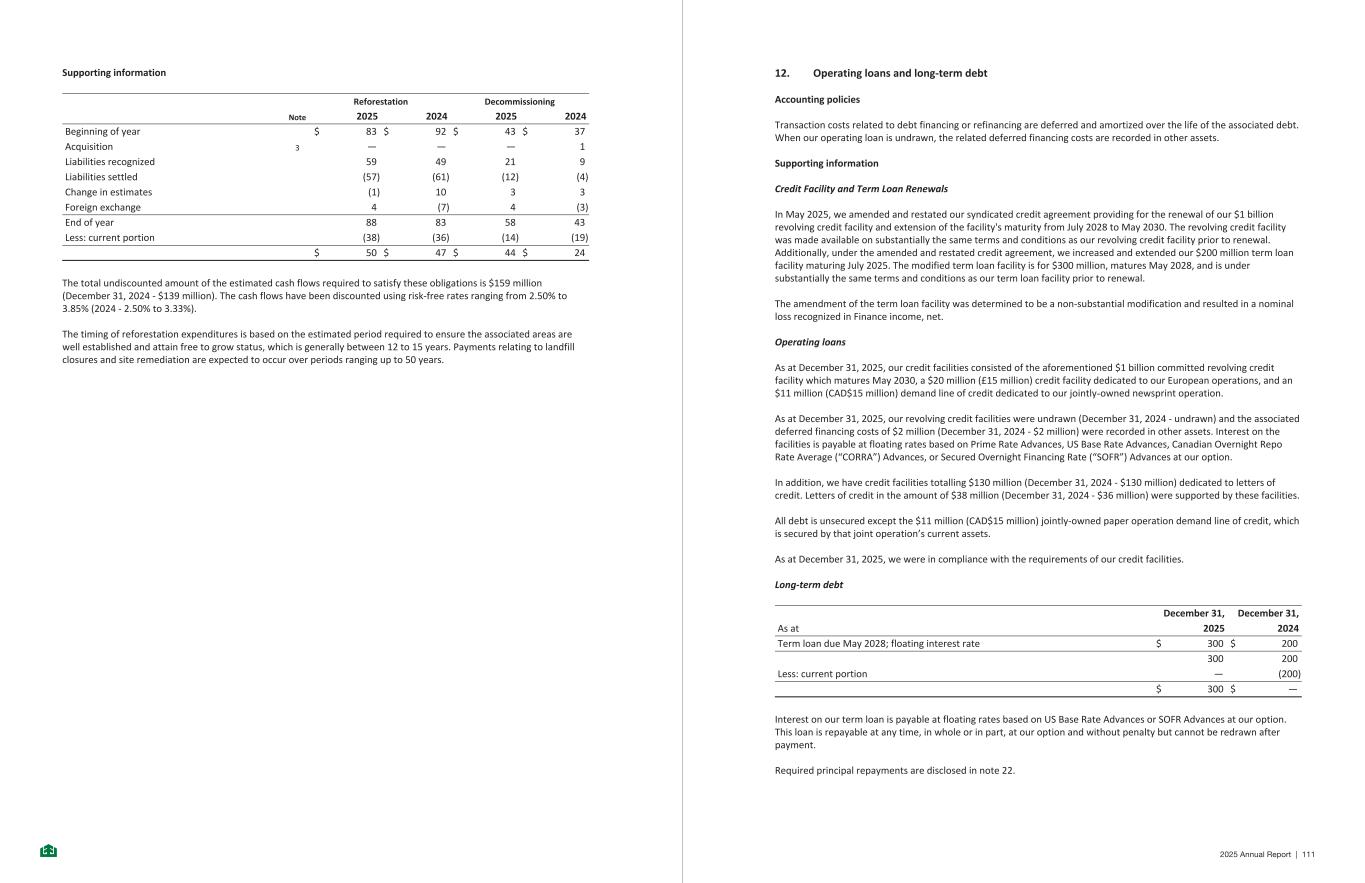
Supporting information Reforestation Decommissioning Note 2025 2024 2025 2024 Beginning of year $ 83 $ 92 $ 43 $ 37 Acquisition 3 — — — 1 Liabilities recognized 59 49 21 9 Liabilities settled (57) (61) (12) (4) Change in estimates (1) 10 3 3 Foreign exchange 4 (7) 4 (3) End of year 88 83 58 43 Less: current portion (38) (36) (14) (19) $ 50 $ 47 $ 44 $ 24 The total undiscounted amount of the estimated cash flows required to satisfy these obligations is $159 million (December 31, 2024 - $139 million). The cash flows have been discounted using risk-free rates ranging from 2.50% to 3.85% (2024 - 2.50% to 3.33%). The timing of reforestation expenditures is based on the estimated period required to ensure the associated areas are well established and attain free to grow status, which is generally between 12 to 15 years. Payments relating to landfill closures and site remediation are expected to occur over periods ranging up to 50 years. -20- 12. Operating loans and long-term debt Accounting policies Transaction costs related to debt financing or refinancing are deferred and amortized over the life of the associated debt. When our operating loan is undrawn, the related deferred financing costs are recorded in other assets. Supporting information Credit Facility and Term Loan Renewals In May 2025, we amended and restated our syndicated credit agreement providing for the renewal of our $1 billion revolving credit facility and extension of the facility's maturity from July 2028 to May 2030. The revolving credit facility was made available on substantially the same terms and conditions as our revolving credit facility prior to renewal. Additionally, under the amended and restated credit agreement, we increased and extended our $200 million term loan facility maturing July 2025. The modified term loan facility is for $300 million, matures May 2028, and is under substantially the same terms and conditions as our term loan facility prior to renewal. The amendment of the term loan facility was determined to be a non-substantial modification and resulted in a nominal loss recognized in Finance income, net. Operating loans As at December 31, 2025, our credit facilities consisted of the aforementioned $1 billion committed revolving credit facility which matures May 2030, a $20 million (£15 million) credit facility dedicated to our European operations, and an $11 million (CAD$15 million) demand line of credit dedicated to our jointly-owned newsprint operation. As at December 31, 2025, our revolving credit facilities were undrawn (December 31, 2024 - undrawn) and the associated deferred financing costs of $2 million (December 31, 2024 - $2 million) were recorded in other assets. Interest on the facilities is payable at floating rates based on Prime Rate Advances, US Base Rate Advances, Canadian Overnight Repo Rate Average (“CORRA”) Advances, or Secured Overnight Financing Rate (“SOFR”) Advances at our option. In addition, we have credit facilities totalling $130 million (December 31, 2024 - $130 million) dedicated to letters of credit. Letters of credit in the amount of $38 million (December 31, 2024 - $36 million) were supported by these facilities. All debt is unsecured except the $11 million (CAD$15 million) jointly-owned paper operation demand line of credit, which is secured by that joint operation’s current assets. As at December 31, 2025, we were in compliance with the requirements of our credit facilities. Long-term debt December 31, December 31, As at 2025 2024 Term loan due May 2028; floating interest rate $ 300 $ 200 300 200 Less: current portion — (200) $ 300 $ — Interest on our term loan is payable at floating rates based on US Base Rate Advances or SOFR Advances at our option. This loan is repayable at any time, in whole or in part, at our option and without penalty but cannot be redrawn after payment. Required principal repayments are disclosed in note 22. -21- 2025 Annual Report | 111
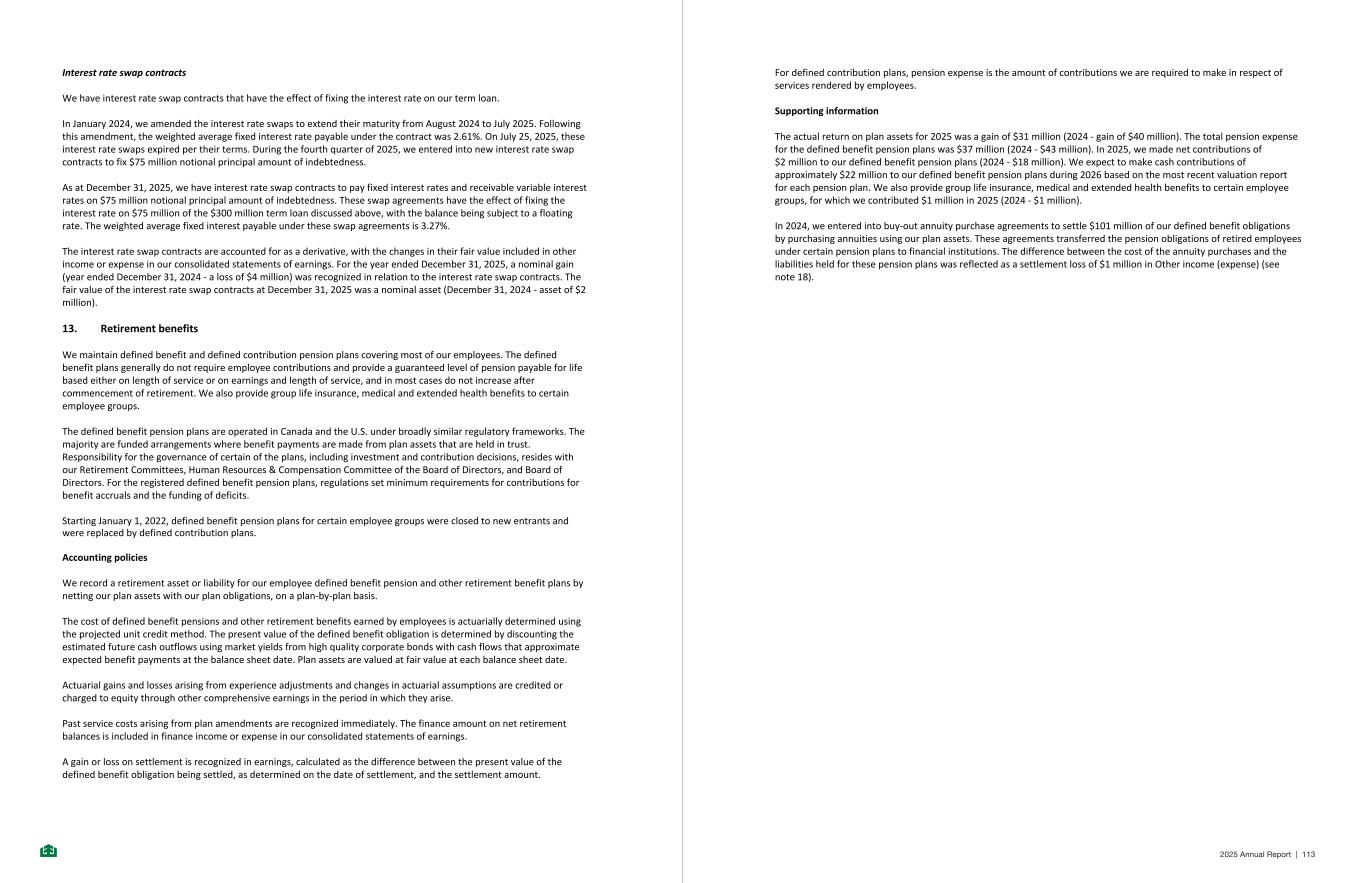
Interest rate swap contracts We have interest rate swap contracts that have the effect of fixing the interest rate on our term loan. In January 2024, we amended the interest rate swaps to extend their maturity from August 2024 to July 2025. Following this amendment, the weighted average fixed interest rate payable under the contract was 2.61%. On July 25, 2025, these interest rate swaps expired per their terms. During the fourth quarter of 2025, we entered into new interest rate swap contracts to fix $75 million notional principal amount of indebtedness. As at December 31, 2025, we have interest rate swap contracts to pay fixed interest rates and receivable variable interest rates on $75 million notional principal amount of indebtedness. These swap agreements have the effect of fixing the interest rate on $75 million of the $300 million term loan discussed above, with the balance being subject to a floating rate. The weighted average fixed interest payable under these swap agreements is 3.27%. The interest rate swap contracts are accounted for as a derivative, with the changes in their fair value included in other income or expense in our consolidated statements of earnings. For the year ended December 31, 2025, a nominal gain (year ended December 31, 2024 - a loss of $4 million) was recognized in relation to the interest rate swap contracts. The fair value of the interest rate swap contracts at December 31, 2025 was a nominal asset (December 31, 2024 - asset of $2 million). 13. Retirement benefits We maintain defined benefit and defined contribution pension plans covering most of our employees. The defined benefit plans generally do not require employee contributions and provide a guaranteed level of pension payable for life based either on length of service or on earnings and length of service, and in most cases do not increase after commencement of retirement. We also provide group life insurance, medical and extended health benefits to certain employee groups. The defined benefit pension plans are operated in Canada and the U.S. under broadly similar regulatory frameworks. The majority are funded arrangements where benefit payments are made from plan assets that are held in trust. Responsibility for the governance of certain of the plans, including investment and contribution decisions, resides with our Retirement Committees, Human Resources & Compensation Committee of the Board of Directors, and Board of Directors. For the registered defined benefit pension plans, regulations set minimum requirements for contributions for benefit accruals and the funding of deficits. Starting January 1, 2022, defined benefit pension plans for certain employee groups were closed to new entrants and were replaced by defined contribution plans. Accounting policies We record a retirement asset or liability for our employee defined benefit pension and other retirement benefit plans by netting our plan assets with our plan obligations, on a plan-by-plan basis. The cost of defined benefit pensions and other retirement benefits earned by employees is actuarially determined using the projected unit credit method. The present value of the defined benefit obligation is determined by discounting the estimated future cash outflows using market yields from high quality corporate bonds with cash flows that approximate expected benefit payments at the balance sheet date. Plan assets are valued at fair value at each balance sheet date. Actuarial gains and losses arising from experience adjustments and changes in actuarial assumptions are credited or charged to equity through other comprehensive earnings in the period in which they arise. Past service costs arising from plan amendments are recognized immediately. The finance amount on net retirement balances is included in finance income or expense in our consolidated statements of earnings. A gain or loss on settlement is recognized in earnings, calculated as the difference between the present value of the defined benefit obligation being settled, as determined on the date of settlement, and the settlement amount. -22- For defined contribution plans, pension expense is the amount of contributions we are required to make in respect of services rendered by employees. Supporting information The actual return on plan assets for 2025 was a gain of $31 million (2024 - gain of $40 million). The total pension expense for the defined benefit pension plans was $37 million (2024 - $43 million). In 2025, we made net contributions of $2 million to our defined benefit pension plans (2024 - $18 million). We expect to make cash contributions of approximately $22 million to our defined benefit pension plans during 2026 based on the most recent valuation report for each pension plan. We also provide group life insurance, medical and extended health benefits to certain employee groups, for which we contributed $1 million in 2025 (2024 - $1 million). In 2024, we entered into buy-out annuity purchase agreements to settle $101 million of our defined benefit obligations by purchasing annuities using our plan assets. These agreements transferred the pension obligations of retired employees under certain pension plans to financial institutions. The difference between the cost of the annuity purchases and the liabilities held for these pension plans was reflected as a settlement loss of $1 million in Other income (expense) (see note 18). -23- 2025 Annual Report | 113
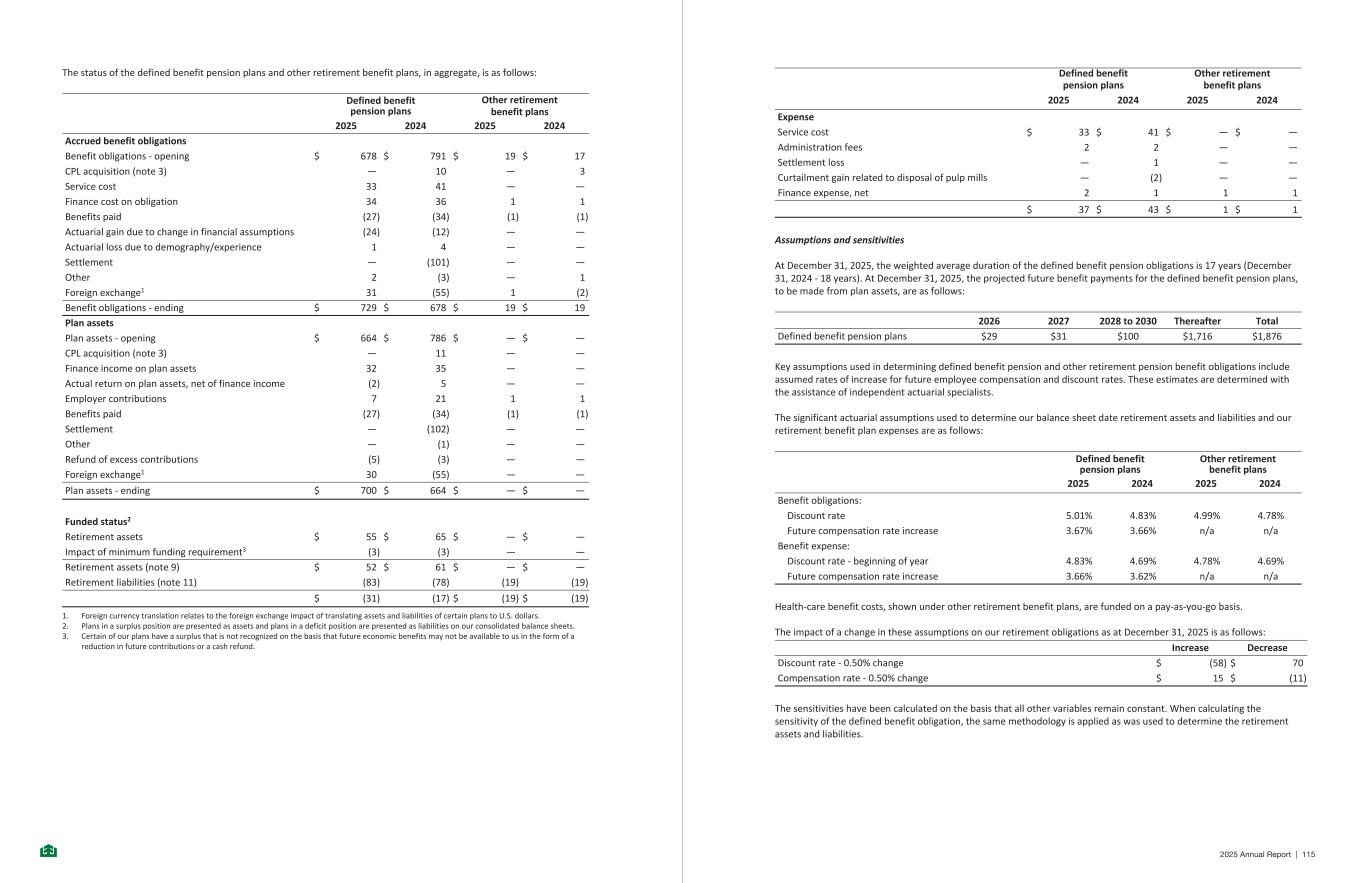
The status of the defined benefit pension plans and other retirement benefit plans, in aggregate, is as follows: Defined benefit pension plans Other retirement benefit plans 2025 2024 2025 2024 Accrued benefit obligations Benefit obligations - opening $ 678 $ 791 $ 19 $ 17 CPL acquisition (note 3) — 10 — 3 Service cost 33 41 — — Finance cost on obligation 34 36 1 1 Benefits paid (27) (34) (1) (1) Actuarial gain due to change in financial assumptions (24) (12) — — Actuarial loss due to demography/experience 1 4 — — Settlement — (101) — — Other 2 (3) — 1 Foreign exchange1 31 (55) 1 (2) Benefit obligations - ending $ 729 $ 678 $ 19 $ 19 Plan assets Plan assets - opening $ 664 $ 786 $ — $ — CPL acquisition (note 3) — 11 — — Finance income on plan assets 32 35 — — Actual return on plan assets, net of finance income (2) 5 — — Employer contributions 7 21 1 1 Benefits paid (27) (34) (1) (1) Settlement — (102) — — Other — (1) — — Refund of excess contributions (5) (3) — — Foreign exchange1 30 (55) — — Plan assets - ending $ 700 $ 664 $ — $ — Funded status2 Retirement assets $ 55 $ 65 $ — $ — Impact of minimum funding requirement3 (3) (3) — — Retirement assets (note 9) $ 52 $ 61 $ — $ — Retirement liabilities (note 11) (83) (78) (19) (19) $ (31) (17) $ (19) $ (19) 1. Foreign currency translation relates to the foreign exchange impact of translating assets and liabilities of certain plans to U.S. dollars. 2. Plans in a surplus position are presented as assets and plans in a deficit position are presented as liabilities on our consolidated balance sheets. 3. Certain of our plans have a surplus that is not recognized on the basis that future economic benefits may not be available to us in the form of a reduction in future contributions or a cash refund. -24- Defined benefit pension plans Other retirement benefit plans 2025 2024 2025 2024 Expense Service cost $ 33 $ 41 $ — $ — Administration fees 2 2 — — Settlement loss — 1 — — Curtailment gain related to disposal of pulp mills — (2) — — Finance expense, net 2 1 1 1 $ 37 $ 43 $ 1 $ 1 Assumptions and sensitivities At December 31, 2025, the weighted average duration of the defined benefit pension obligations is 17 years (December 31, 2024 - 18 years). At December 31, 2025, the projected future benefit payments for the defined benefit pension plans, to be made from plan assets, are as follows: 2026 2027 2028 to 2030 Thereafter Total Defined benefit pension plans $29 $31 $100 $1,716 $1,876 Key assumptions used in determining defined benefit pension and other retirement pension benefit obligations include assumed rates of increase for future employee compensation and discount rates. These estimates are determined with the assistance of independent actuarial specialists. The significant actuarial assumptions used to determine our balance sheet date retirement assets and liabilities and our retirement benefit plan expenses are as follows: Defined benefit pension plans Other retirement benefit plans 2025 2024 2025 2024 Benefit obligations: Discount rate 5.01% 4.83% 4.99% 4.78% Future compensation rate increase 3.67% 3.66% n/a n/a Benefit expense: Discount rate - beginning of year 4.83% 4.69% 4.78% 4.69% Future compensation rate increase 3.66% 3.62% n/a n/a Health-care benefit costs, shown under other retirement benefit plans, are funded on a pay-as-you-go basis. The impact of a change in these assumptions on our retirement obligations as at December 31, 2025 is as follows: Increase Decrease Discount rate - 0.50% change $ (58) $ 70 Compensation rate - 0.50% change $ 15 $ (11) The sensitivities have been calculated on the basis that all other variables remain constant. When calculating the sensitivity of the defined benefit obligation, the same methodology is applied as was used to determine the retirement assets and liabilities. -25- 2025 Annual Report | 115
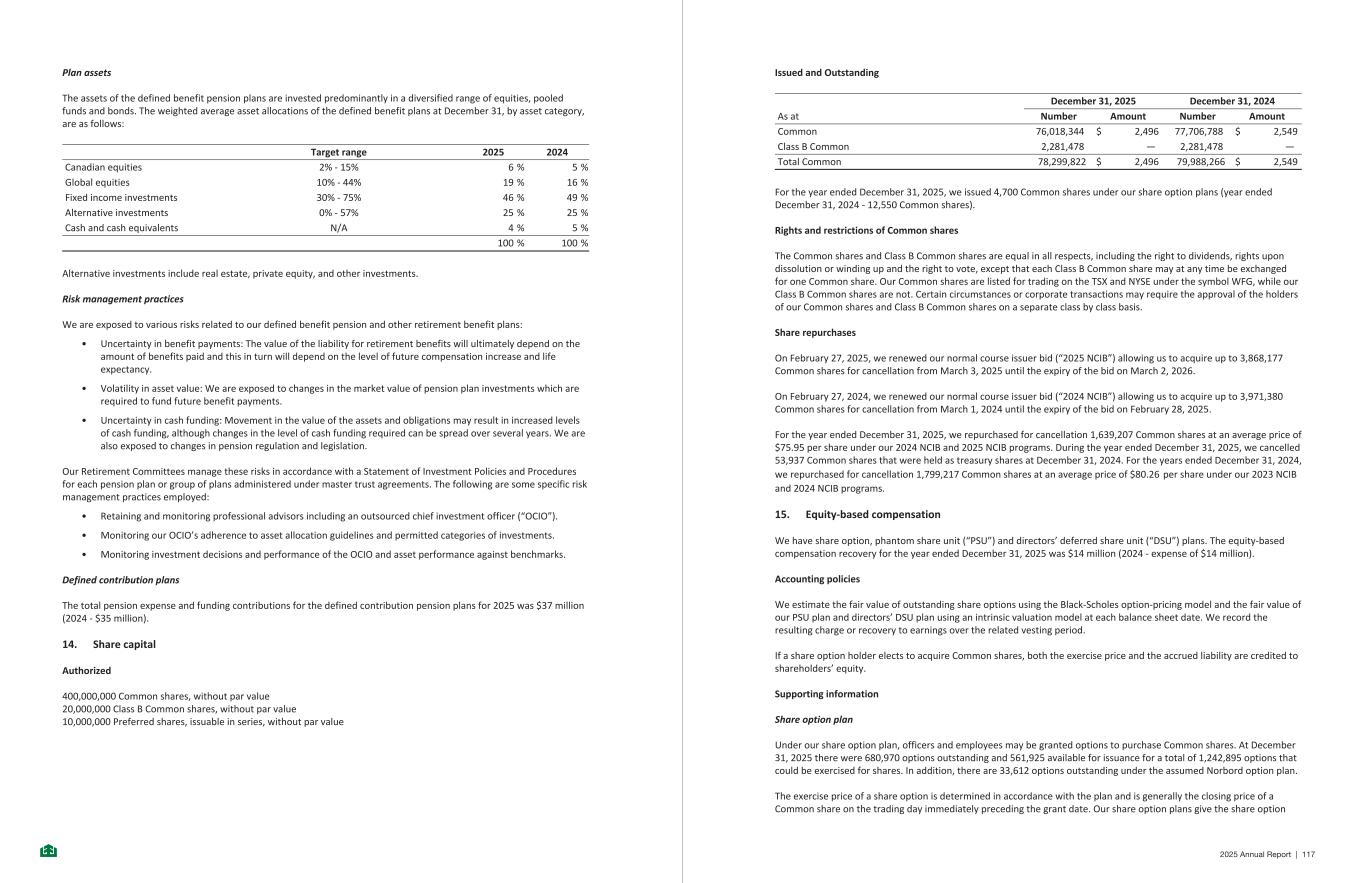
Plan assets The assets of the defined benefit pension plans are invested predominantly in a diversified range of equities, pooled funds and bonds. The weighted average asset allocations of the defined benefit plans at December 31, by asset category, are as follows: Target range 2025 2024 Canadian equities 2% - 15% 6 % 5 % Global equities 10% - 44% 19 % 16 % Fixed income investments 30% - 75% 46 % 49 % Alternative investments 0% - 57% 25 % 25 % Cash and cash equivalents N/A 4 % 5 % 100 % 100 % Alternative investments include real estate, private equity, and other investments. Risk management practices We are exposed to various risks related to our defined benefit pension and other retirement benefit plans: • Uncertainty in benefit payments: The value of the liability for retirement benefits will ultimately depend on the amount of benefits paid and this in turn will depend on the level of future compensation increase and life expectancy. • Volatility in asset value: We are exposed to changes in the market value of pension plan investments which are required to fund future benefit payments. • Uncertainty in cash funding: Movement in the value of the assets and obligations may result in increased levels of cash funding, although changes in the level of cash funding required can be spread over several years. We are also exposed to changes in pension regulation and legislation. Our Retirement Committees manage these risks in accordance with a Statement of Investment Policies and Procedures for each pension plan or group of plans administered under master trust agreements. The following are some specific risk management practices employed: • Retaining and monitoring professional advisors including an outsourced chief investment officer (“OCIO”). • Monitoring our OCIO’s adherence to asset allocation guidelines and permitted categories of investments. • Monitoring investment decisions and performance of the OCIO and asset performance against benchmarks. Defined contribution plans The total pension expense and funding contributions for the defined contribution pension plans for 2025 was $37 million (2024 - $35 million). 14. Share capital Authorized 400,000,000 Common shares, without par value 20,000,000 Class B Common shares, without par value 10,000,000 Preferred shares, issuable in series, without par value -26- Issued and Outstanding December 31, 2025 December 31, 2024 As at Number Amount Number Amount Common 76,018,344 $ 2,496 77,706,788 $ 2,549 Class B Common 2,281,478 — 2,281,478 — Total Common 78,299,822 $ 2,496 79,988,266 $ 2,549 For the year ended December 31, 2025, we issued 4,700 Common shares under our share option plans (year ended December 31, 2024 - 12,550 Common shares). Rights and restrictions of Common shares The Common shares and Class B Common shares are equal in all respects, including the right to dividends, rights upon dissolution or winding up and the right to vote, except that each Class B Common share may at any time be exchanged for one Common share. Our Common shares are listed for trading on the TSX and NYSE under the symbol WFG, while our Class B Common shares are not. Certain circumstances or corporate transactions may require the approval of the holders of our Common shares and Class B Common shares on a separate class by class basis. Share repurchases On February 27, 2025, we renewed our normal course issuer bid (“2025 NCIB”) allowing us to acquire up to 3,868,177 Common shares for cancellation from March 3, 2025 until the expiry of the bid on March 2, 2026. On February 27, 2024, we renewed our normal course issuer bid (“2024 NCIB”) allowing us to acquire up to 3,971,380 Common shares for cancellation from March 1, 2024 until the expiry of the bid on February 28, 2025. For the year ended December 31, 2025, we repurchased for cancellation 1,639,207 Common shares at an average price of $75.95 per share under our 2024 NCIB and 2025 NCIB programs. During the year ended December 31, 2025, we cancelled 53,937 Common shares that were held as treasury shares at December 31, 2024. For the years ended December 31, 2024, we repurchased for cancellation 1,799,217 Common shares at an average price of $80.26 per share under our 2023 NCIB and 2024 NCIB programs. 15. Equity-based compensation We have share option, phantom share unit (“PSU”) and directors’ deferred share unit (“DSU”) plans. The equity-based compensation recovery for the year ended December 31, 2025 was $14 million (2024 - expense of $14 million). Accounting policies We estimate the fair value of outstanding share options using the Black-Scholes option-pricing model and the fair value of our PSU plan and directors’ DSU plan using an intrinsic valuation model at each balance sheet date. We record the resulting charge or recovery to earnings over the related vesting period. If a share option holder elects to acquire Common shares, both the exercise price and the accrued liability are credited to shareholders’ equity. Supporting information Share option plan Under our share option plan, officers and employees may be granted options to purchase Common shares. At December 31, 2025 there were 680,970 options outstanding and 561,925 available for issuance for a total of 1,242,895 options that could be exercised for shares. In addition, there are 33,612 options outstanding under the assumed Norbord option plan. The exercise price of a share option is determined in accordance with the plan and is generally the closing price of a Common share on the trading day immediately preceding the grant date. Our share option plans give the share option -27- 2025 Annual Report | 117
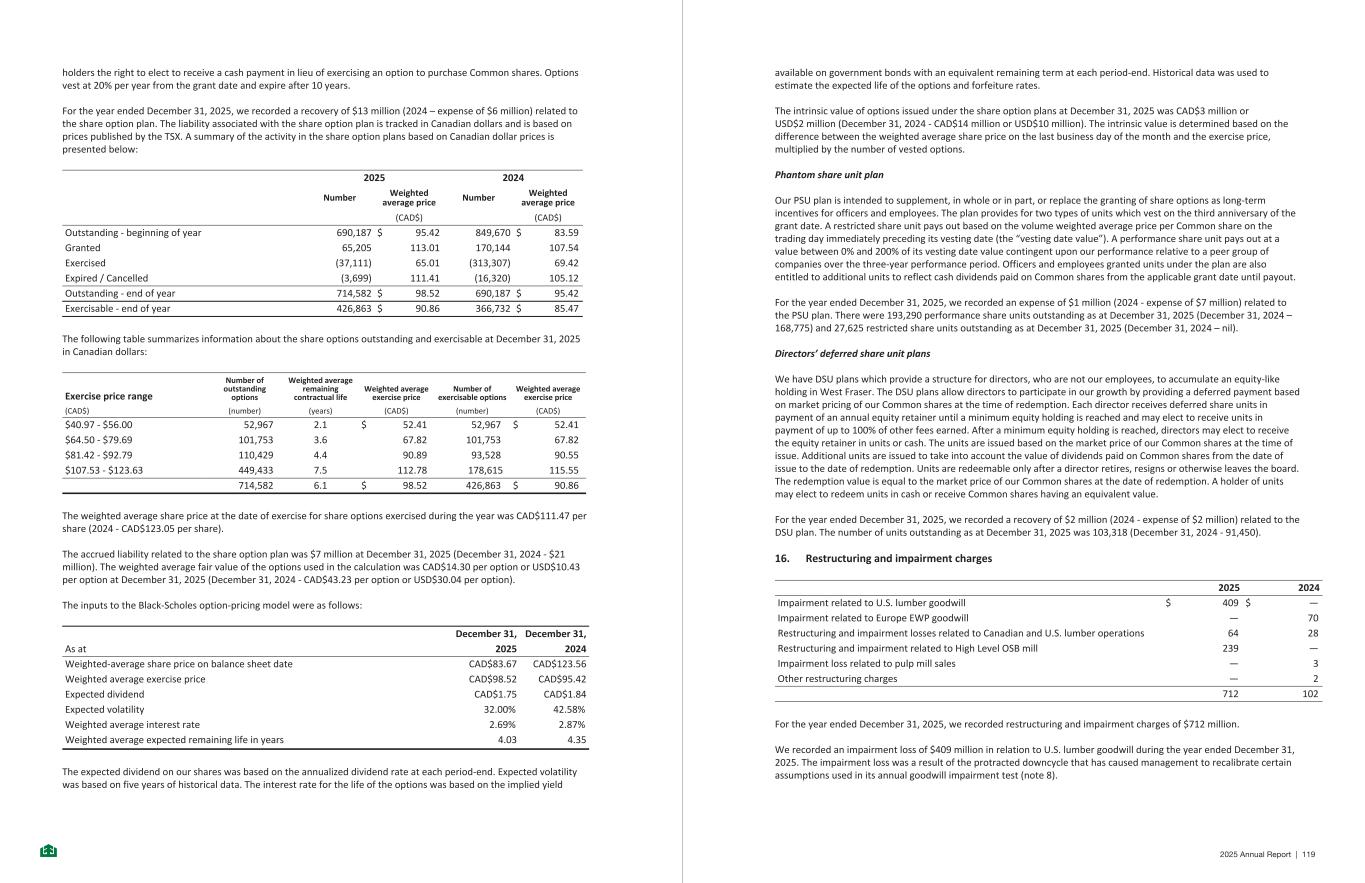
holders the right to elect to receive a cash payment in lieu of exercising an option to purchase Common shares. Options vest at 20% per year from the grant date and expire after 10 years. For the year ended December 31, 2025, we recorded a recovery of $13 million (2024 – expense of $6 million) related to the share option plan. The liability associated with the share option plan is tracked in Canadian dollars and is based on prices published by the TSX. A summary of the activity in the share option plans based on Canadian dollar prices is presented below: 2025 2024 Number Weighted average price Number Weighted average price (CAD$) (CAD$) Outstanding - beginning of year 690,187 $ 95.42 849,670 $ 83.59 Granted 65,205 113.01 170,144 107.54 Exercised (37,111) 65.01 (313,307) 69.42 Expired / Cancelled (3,699) 111.41 (16,320) 105.12 Outstanding - end of year 714,582 $ 98.52 690,187 $ 95.42 Exercisable - end of year 426,863 $ 90.86 366,732 $ 85.47 The following table summarizes information about the share options outstanding and exercisable at December 31, 2025 in Canadian dollars: $40.97 - $56.00 52,967 2.1 $ 52.41 52,967 $ 52.41 $64.50 - $79.69 101,753 3.6 67.82 101,753 67.82 $81.42 - $92.79 110,429 4.4 90.89 93,528 90.55 $107.53 - $123.63 449,433 7.5 112.78 178,615 115.55 714,582 6.1 $ 98.52 426,863 $ 90.86 Exercise price range Number of outstanding options Weighted average remaining contractual life Weighted average exercise price Number of exercisable options Weighted average exercise price (CAD$) (number) (years) (CAD$) (number) (CAD$) The weighted average share price at the date of exercise for share options exercised during the year was CAD$111.47 per share (2024 - CAD$123.05 per share). The accrued liability related to the share option plan was $7 million at December 31, 2025 (December 31, 2024 - $21 million). The weighted average fair value of the options used in the calculation was CAD$14.30 per option or USD$10.43 per option at December 31, 2025 (December 31, 2024 - CAD$43.23 per option or USD$30.04 per option). The inputs to the Black-Scholes option-pricing model were as follows: December 31, December 31, As at 2025 2024 Weighted-average share price on balance sheet date CAD$83.67 CAD$123.56 Weighted average exercise price CAD$98.52 CAD$95.42 Expected dividend CAD$1.75 CAD$1.84 Expected volatility 32.00% 42.58% Weighted average interest rate 2.69% 2.87% Weighted average expected remaining life in years 4.03 4.35 The expected dividend on our shares was based on the annualized dividend rate at each period-end. Expected volatility was based on five years of historical data. The interest rate for the life of the options was based on the implied yield -28- available on government bonds with an equivalent remaining term at each period-end. Historical data was used to estimate the expected life of the options and forfeiture rates. The intrinsic value of options issued under the share option plans at December 31, 2025 was CAD$3 million or USD$2 million (December 31, 2024 - CAD$14 million or USD$10 million). The intrinsic value is determined based on the difference between the weighted average share price on the last business day of the month and the exercise price, multiplied by the number of vested options. Phantom share unit plan Our PSU plan is intended to supplement, in whole or in part, or replace the granting of share options as long-term incentives for officers and employees. The plan provides for two types of units which vest on the third anniversary of the grant date. A restricted share unit pays out based on the volume weighted average price per Common share on the trading day immediately preceding its vesting date (the “vesting date value”). A performance share unit pays out at a value between 0% and 200% of its vesting date value contingent upon our performance relative to a peer group of companies over the three-year performance period. Officers and employees granted units under the plan are also entitled to additional units to reflect cash dividends paid on Common shares from the applicable grant date until payout. For the year ended December 31, 2025, we recorded an expense of $1 million (2024 - expense of $7 million) related to the PSU plan. There were 193,290 performance share units outstanding as at December 31, 2025 (December 31, 2024 – 168,775) and 27,625 restricted share units outstanding as at December 31, 2025 (December 31, 2024 – nil). Directors’ deferred share unit plans We have DSU plans which provide a structure for directors, who are not our employees, to accumulate an equity-like holding in West Fraser. The DSU plans allow directors to participate in our growth by providing a deferred payment based on market pricing of our Common shares at the time of redemption. Each director receives deferred share units in payment of an annual equity retainer until a minimum equity holding is reached and may elect to receive units in payment of up to 100% of other fees earned. After a minimum equity holding is reached, directors may elect to receive the equity retainer in units or cash. The units are issued based on the market price of our Common shares at the time of issue. Additional units are issued to take into account the value of dividends paid on Common shares from the date of issue to the date of redemption. Units are redeemable only after a director retires, resigns or otherwise leaves the board. The redemption value is equal to the market price of our Common shares at the date of redemption. A holder of units may elect to redeem units in cash or receive Common shares having an equivalent value. For the year ended December 31, 2025, we recorded a recovery of $2 million (2024 - expense of $2 million) related to the DSU plan. The number of units outstanding as at December 31, 2025 was 103,318 (December 31, 2024 - 91,450). 16. Restructuring and impairment charges 2025 2024 Impairment related to U.S. lumber goodwill $ 409 $ — Impairment related to Europe EWP goodwill — 70 Restructuring and impairment losses related to Canadian and U.S. lumber operations 64 28 Restructuring and impairment related to High Level OSB mill 239 — Impairment loss related to pulp mill sales — 3 Other restructuring charges — 2 712 102 For the year ended December 31, 2025, we recorded restructuring and impairment charges of $712 million. We recorded an impairment loss of $409 million in relation to U.S. lumber goodwill during the year ended December 31, 2025. The impairment loss was a result of the protracted downcycle that has caused management to recalibrate certain assumptions used in its annual goodwill impairment test (note 8). -29- 2025 Annual Report | 119
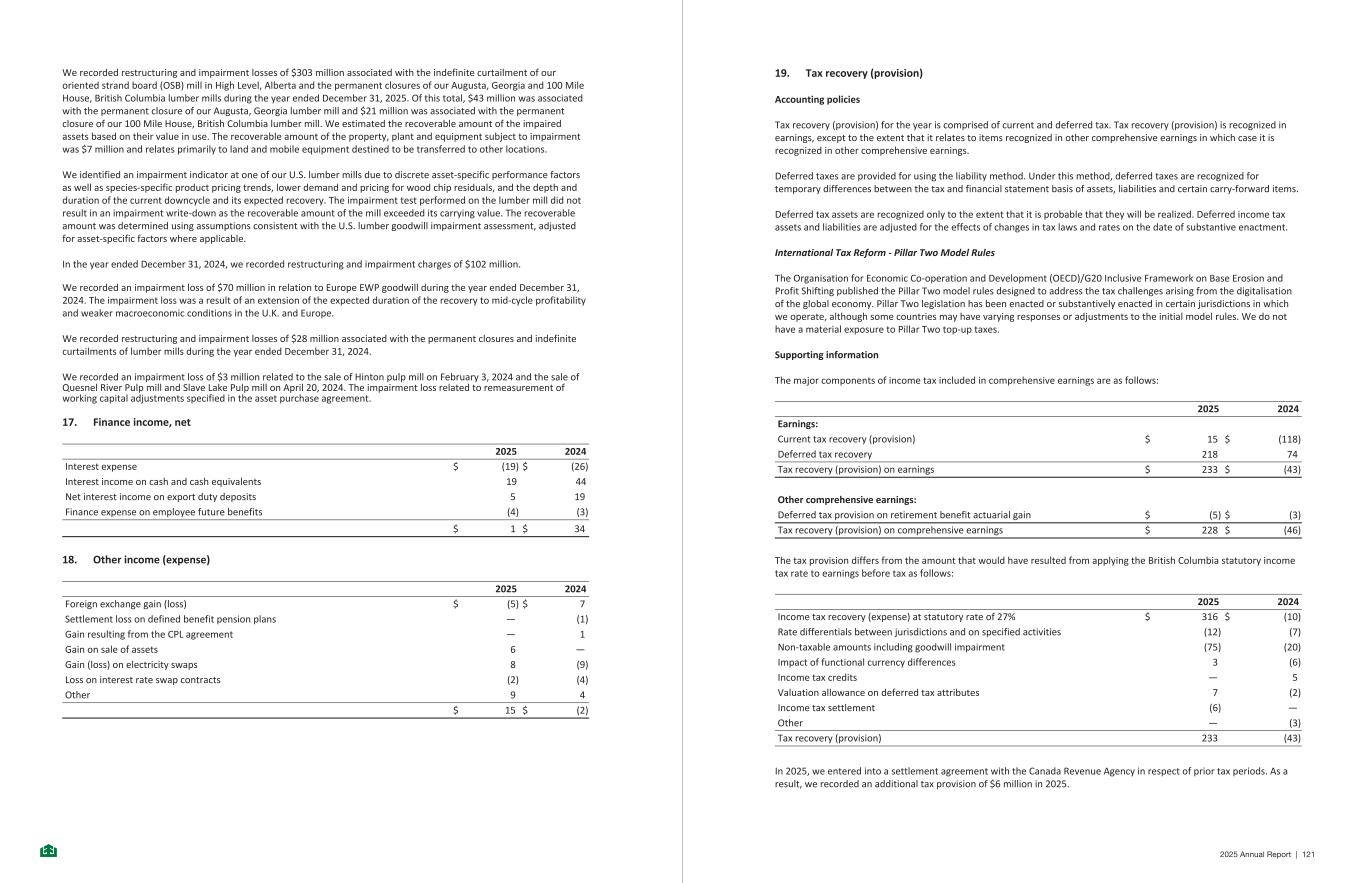
We recorded restructuring and impairment losses of $303 million associated with the indefinite curtailment of our oriented strand board (OSB) mill in High Level, Alberta and the permanent closures of our Augusta, Georgia and 100 Mile House, British Columbia lumber mills during the year ended December 31, 2025. Of this total, $43 million was associated with the permanent closure of our Augusta, Georgia lumber mill and $21 million was associated with the permanent closure of our 100 Mile House, British Columbia lumber mill. We estimated the recoverable amount of the impaired assets based on their value in use. The recoverable amount of the property, plant and equipment subject to impairment was $7 million and relates primarily to land and mobile equipment destined to be transferred to other locations. We identified an impairment indicator at one of our U.S. lumber mills due to discrete asset-specific performance factors as well as species-specific product pricing trends, lower demand and pricing for wood chip residuals, and the depth and duration of the current downcycle and its expected recovery. The impairment test performed on the lumber mill did not result in an impairment write-down as the recoverable amount of the mill exceeded its carrying value. The recoverable amount was determined using assumptions consistent with the U.S. lumber goodwill impairment assessment, adjusted for asset-specific factors where applicable. In the year ended December 31, 2024, we recorded restructuring and impairment charges of $102 million. We recorded an impairment loss of $70 million in relation to Europe EWP goodwill during the year ended December 31, 2024. The impairment loss was a result of an extension of the expected duration of the recovery to mid-cycle profitability and weaker macroeconomic conditions in the U.K. and Europe. We recorded restructuring and impairment losses of $28 million associated with the permanent closures and indefinite curtailments of lumber mills during the year ended December 31, 2024. We recorded an impairment loss of $3 million related to the sale of Hinton pulp mill on February 3, 2024 and the sale of Quesnel River Pulp mill and Slave Lake Pulp mill on April 20, 2024. The impairment loss related to remeasurement of working capital adjustments specified in the asset purchase agreement. 17. Finance income, net 2025 2024 Interest expense $ (19) $ (26) Interest income on cash and cash equivalents 19 44 Net interest income on export duty deposits 5 19 Finance expense on employee future benefits (4) (3) $ 1 $ 34 18. Other income (expense) 2025 2024 Foreign exchange gain (loss) $ (5) $ 7 Settlement loss on defined benefit pension plans — (1) Gain resulting from the CPL agreement — 1 Gain on sale of assets 6 — Gain (loss) on electricity swaps 8 (9) Loss on interest rate swap contracts (2) (4) Other 9 4 $ 15 $ (2) -30- 19. Tax recovery (provision) Accounting policies Tax recovery (provision) for the year is comprised of current and deferred tax. Tax recovery (provision) is recognized in earnings, except to the extent that it relates to items recognized in other comprehensive earnings in which case it is recognized in other comprehensive earnings. Deferred taxes are provided for using the liability method. Under this method, deferred taxes are recognized for temporary differences between the tax and financial statement basis of assets, liabilities and certain carry-forward items. Deferred tax assets are recognized only to the extent that it is probable that they will be realized. Deferred income tax assets and liabilities are adjusted for the effects of changes in tax laws and rates on the date of substantive enactment. International Tax Reform - Pillar Two Model Rules The Organisation for Economic Co-operation and Development (OECD)/G20 Inclusive Framework on Base Erosion and Profit Shifting published the Pillar Two model rules designed to address the tax challenges arising from the digitalisation of the global economy. Pillar Two legislation has been enacted or substantively enacted in certain jurisdictions in which we operate, although some countries may have varying responses or adjustments to the initial model rules. We do not have a material exposure to Pillar Two top-up taxes. Supporting information The major components of income tax included in comprehensive earnings are as follows: 2025 2024 Earnings: Current tax recovery (provision) $ 15 $ (118) Deferred tax recovery 218 74 Tax recovery (provision) on earnings $ 233 $ (43) Other comprehensive earnings: Deferred tax provision on retirement benefit actuarial gain $ (5) $ (3) Tax recovery (provision) on comprehensive earnings $ 228 $ (46) The tax provision differs from the amount that would have resulted from applying the British Columbia statutory income tax rate to earnings before tax as follows: 2025 2024 Income tax recovery (expense) at statutory rate of 27% $ 316 $ (10) Rate differentials between jurisdictions and on specified activities (12) (7) Non-taxable amounts including goodwill impairment (75) (20) Impact of functional currency differences 3 (6) Income tax credits — 5 Valuation allowance on deferred tax attributes 7 (2) Income tax settlement (6) — Other — (3) Tax recovery (provision) 233 (43) In 2025, we entered into a settlement agreement with the Canada Revenue Agency in respect of prior tax periods. As a result, we recorded an additional tax provision of $6 million in 2025. -31- 2025 Annual Report | 121
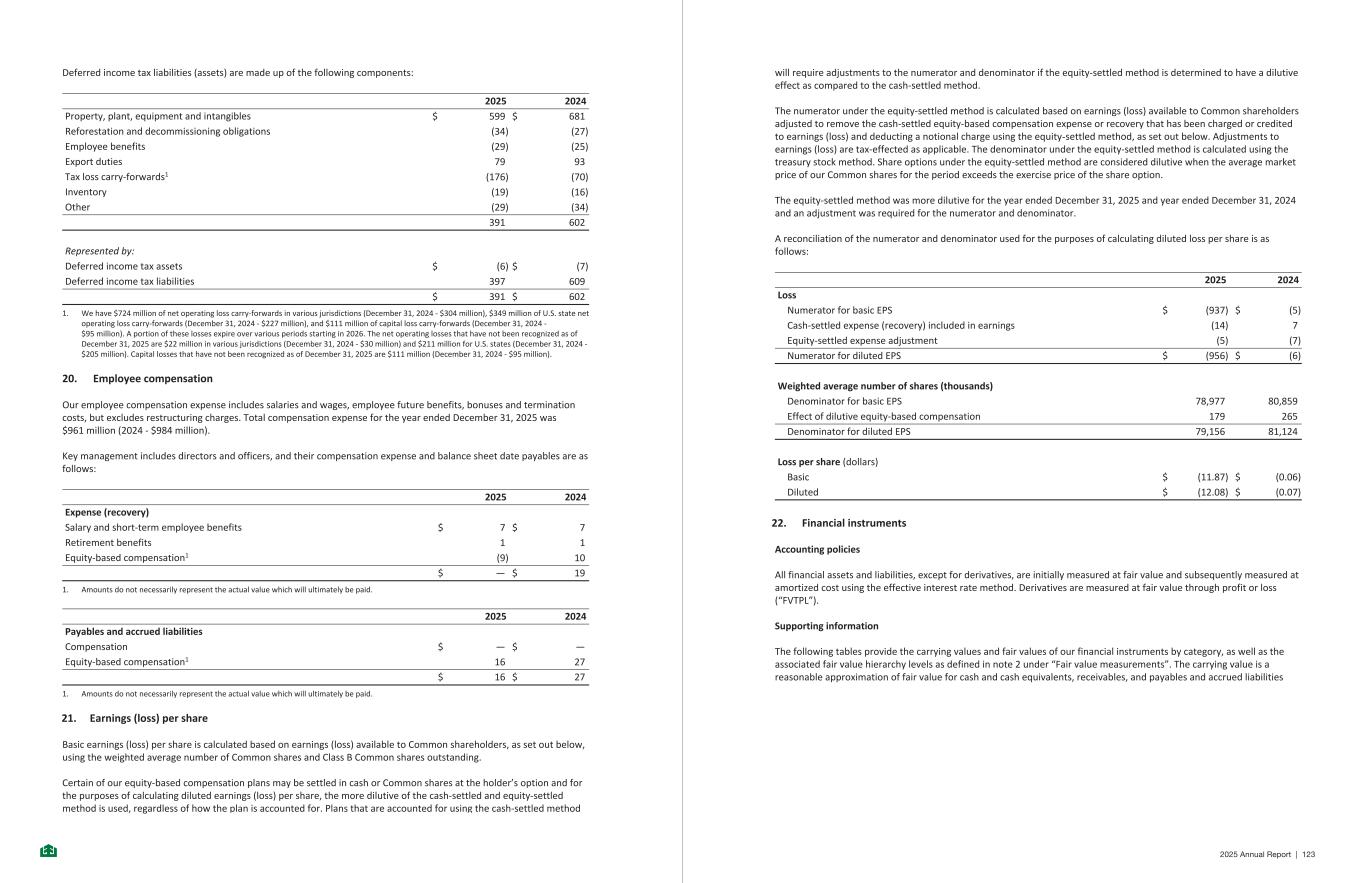
Deferred income tax liabilities (assets) are made up of the following components: 2025 2024 Property, plant, equipment and intangibles $ 599 $ 681 Reforestation and decommissioning obligations (34) (27) Employee benefits (29) (25) Export duties 79 93 Tax loss carry-forwards1 (176) (70) Inventory (19) (16) Other (29) (34) 391 602 Represented by: Deferred income tax assets $ (6) $ (7) Deferred income tax liabilities 397 609 $ 391 $ 602 1. We have $724 million of net operating loss carry-forwards in various jurisdictions (December 31, 2024 - $304 million), $349 million of U.S. state net operating loss carry-forwards (December 31, 2024 - $227 million), and $111 million of capital loss carry-forwards (December 31, 2024 - $95 million). A portion of these losses expire over various periods starting in 2026. The net operating losses that have not been recognized as of December 31, 2025 are $22 million in various jurisdictions (December 31, 2024 - $30 million) and $211 million for U.S. states (December 31, 2024 - $205 million). Capital losses that have not been recognized as of December 31, 2025 are $111 million (December 31, 2024 - $95 million). 20. Employee compensation Our employee compensation expense includes salaries and wages, employee future benefits, bonuses and termination costs, but excludes restructuring charges. Total compensation expense for the year ended December 31, 2025 was $961 million (2024 - $984 million). Key management includes directors and officers, and their compensation expense and balance sheet date payables are as follows: 2025 2024 Expense (recovery) Salary and short-term employee benefits $ 7 $ 7 Retirement benefits 1 1 Equity-based compensation1 (9) 10 $ — $ 19 1. Amounts do not necessarily represent the actual value which will ultimately be paid. 2025 2024 Payables and accrued liabilities Compensation $ — $ — Equity-based compensation1 16 27 $ 16 $ 27 1. Amounts do not necessarily represent the actual value which will ultimately be paid. 21. Earnings (loss) per share Basic earnings (loss) per share is calculated based on earnings (loss) available to Common shareholders, as set out below, using the weighted average number of Common shares and Class B Common shares outstanding. Certain of our equity-based compensation plans may be settled in cash or Common shares at the holder’s option and for the purposes of calculating diluted earnings (loss) per share, the more dilutive of the cash-settled and equity-settled method is used, regardless of how the plan is accounted for. Plans that are accounted for using the cash-settled method -32- will require adjustments to the numerator and denominator if the equity-settled method is determined to have a dilutive effect as compared to the cash-settled method. The numerator under the equity-settled method is calculated based on earnings (loss) available to Common shareholders adjusted to remove the cash-settled equity-based compensation expense or recovery that has been charged or credited to earnings (loss) and deducting a notional charge using the equity-settled method, as set out below. Adjustments to earnings (loss) are tax-effected as applicable. The denominator under the equity-settled method is calculated using the treasury stock method. Share options under the equity-settled method are considered dilutive when the average market price of our Common shares for the period exceeds the exercise price of the share option. The equity-settled method was more dilutive for the year ended December 31, 2025 and year ended December 31, 2024 and an adjustment was required for the numerator and denominator. A reconciliation of the numerator and denominator used for the purposes of calculating diluted loss per share is as follows: 2025 2024 Loss Numerator for basic EPS $ (937) $ (5) Cash-settled expense (recovery) included in earnings (14) 7 Equity-settled expense adjustment (5) (7) Numerator for diluted EPS $ (956) $ (6) Weighted average number of shares (thousands) Denominator for basic EPS 78,977 80,859 Effect of dilutive equity-based compensation 179 265 Denominator for diluted EPS 79,156 81,124 Loss per share (dollars) Basic $ (11.87) $ (0.06) Diluted $ (12.08) $ (0.07) 22. Financial instruments Accounting policies All financial assets and liabilities, except for derivatives, are initially measured at fair value and subsequently measured at amortized cost using the effective interest rate method. Derivatives are measured at fair value through profit or loss (“FVTPL”). Supporting information The following tables provide the carrying values and fair values of our financial instruments by category, as well as the associated fair value hierarchy levels as defined in note 2 under “Fair value measurements”. The carrying value is a reasonable approximation of fair value for cash and cash equivalents, receivables, and payables and accrued liabilities -33- 2025 Annual Report | 123
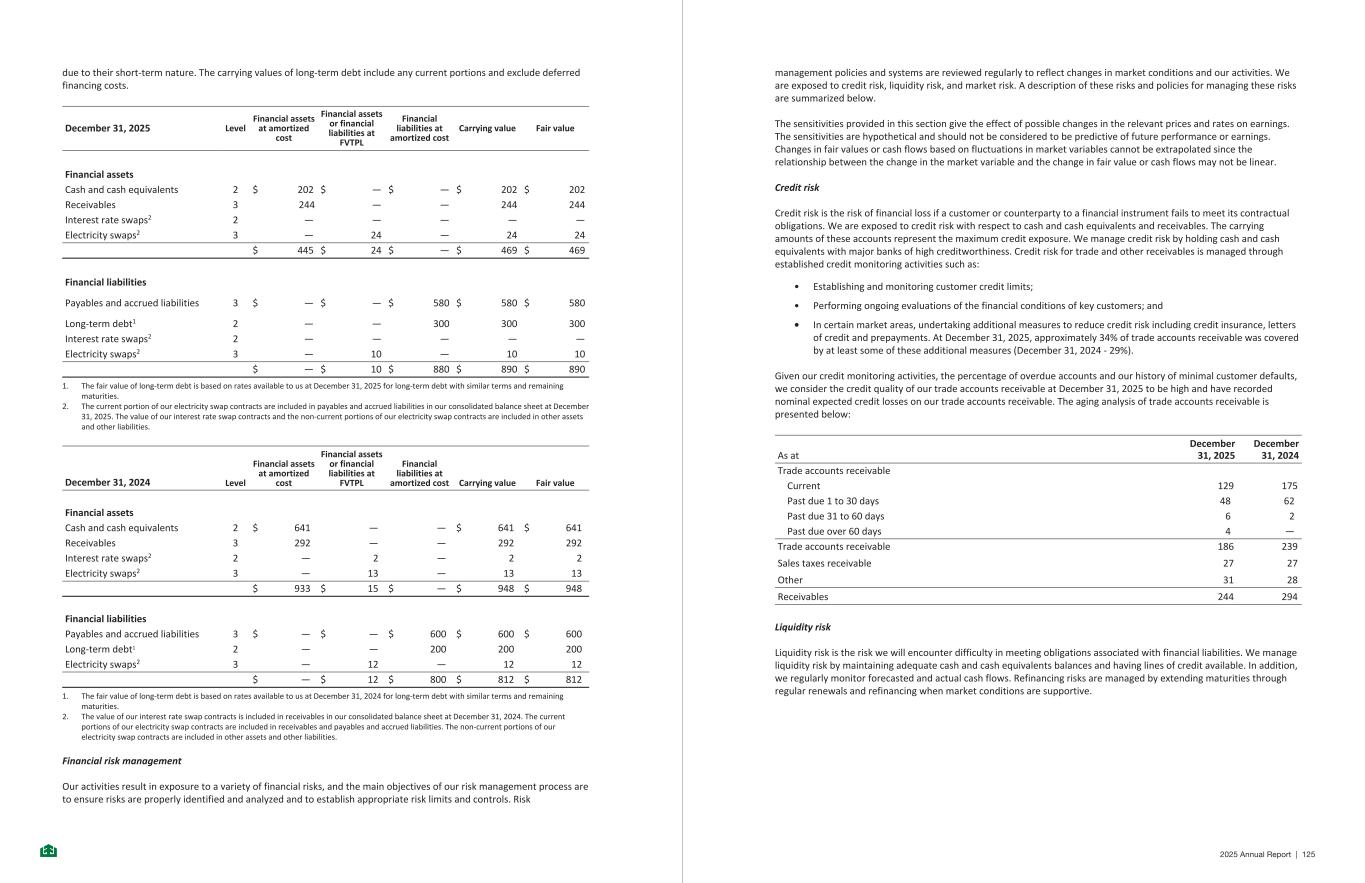
due to their short-term nature. The carrying values of long-term debt include any current portions and exclude deferred financing costs. December 31, 2025 Level Financial assets at amortized cost Financial assets or financial liabilities at FVTPL Financial liabilities at amortized cost Carrying value Fair value Financial assets Cash and cash equivalents 2 $ 202 $ — $ — $ 202 $ 202 Receivables 3 244 — — 244 244 Interest rate swaps2 2 — — — — — Electricity swaps2 3 — 24 — 24 24 $ 445 $ 24 $ — $ 469 $ 469 Financial liabilities Payables and accrued liabilities 3 $ — $ — $ 580 $ 580 $ 580 Long-term debt1 2 — — 300 300 300 Interest rate swaps2 2 — — — — — Electricity swaps2 3 — 10 — 10 10 $ — $ 10 $ 880 $ 890 $ 890 1. The fair value of long-term debt is based on rates available to us at December 31, 2025 for long-term debt with similar terms and remaining maturities. 2. The current portion of our electricity swap contracts are included in payables and accrued liabilities in our consolidated balance sheet at December 31, 2025. The value of our interest rate swap contracts and the non-current portions of our electricity swap contracts are included in other assets and other liabilities. December 31, 2024 Level Financial assets at amortized cost Financial assets or financial liabilities at FVTPL Financial liabilities at amortized cost Carrying value Fair value Financial assets Cash and cash equivalents 2 $ 641 — — $ 641 $ 641 Receivables 3 292 — — 292 292 Interest rate swaps2 2 — 2 — 2 2 Electricity swaps2 3 — 13 — 13 13 $ 933 $ 15 $ — $ 948 $ 948 Financial liabilities Payables and accrued liabilities 3 $ — $ — $ 600 $ 600 $ 600 Long-term debt1 2 — — 200 200 200 Electricity swaps2 3 — 12 — 12 12 $ — $ 12 $ 800 $ 812 $ 812 1. The fair value of long-term debt is based on rates available to us at December 31, 2024 for long-term debt with similar terms and remaining maturities. 2. The value of our interest rate swap contracts is included in receivables in our consolidated balance sheet at December 31, 2024. The current portions of our electricity swap contracts are included in receivables and payables and accrued liabilities. The non-current portions of our electricity swap contracts are included in other assets and other liabilities. Financial risk management Our activities result in exposure to a variety of financial risks, and the main objectives of our risk management process are to ensure risks are properly identified and analyzed and to establish appropriate risk limits and controls. Risk -34- management policies and systems are reviewed regularly to reflect changes in market conditions and our activities. We are exposed to credit risk, liquidity risk, and market risk. A description of these risks and policies for managing these risks are summarized below. The sensitivities provided in this section give the effect of possible changes in the relevant prices and rates on earnings. The sensitivities are hypothetical and should not be considered to be predictive of future performance or earnings. Changes in fair values or cash flows based on fluctuations in market variables cannot be extrapolated since the relationship between the change in the market variable and the change in fair value or cash flows may not be linear. Credit risk Credit risk is the risk of financial loss if a customer or counterparty to a financial instrument fails to meet its contractual obligations. We are exposed to credit risk with respect to cash and cash equivalents and receivables. The carrying amounts of these accounts represent the maximum credit exposure. We manage credit risk by holding cash and cash equivalents with major banks of high creditworthiness. Credit risk for trade and other receivables is managed through established credit monitoring activities such as: • Establishing and monitoring customer credit limits; • Performing ongoing evaluations of the financial conditions of key customers; and • In certain market areas, undertaking additional measures to reduce credit risk including credit insurance, letters of credit and prepayments. At December 31, 2025, approximately 34% of trade accounts receivable was covered by at least some of these additional measures (December 31, 2024 - 29%). Given our credit monitoring activities, the percentage of overdue accounts and our history of minimal customer defaults, we consider the credit quality of our trade accounts receivable at December 31, 2025 to be high and have recorded nominal expected credit losses on our trade accounts receivable. The aging analysis of trade accounts receivable is presented below: As at December 31, 2025 December 31, 2024 Trade accounts receivable Current 129 175 Past due 1 to 30 days 48 62 Past due 31 to 60 days 6 2 Past due over 60 days 4 — Trade accounts receivable 186 239 Sales taxes receivable 27 27 Other 31 28 Receivables 244 294 Liquidity risk Liquidity risk is the risk we will encounter difficulty in meeting obligations associated with financial liabilities. We manage liquidity risk by maintaining adequate cash and cash equivalents balances and having lines of credit available. In addition, we regularly monitor forecasted and actual cash flows. Refinancing risks are managed by extending maturities through regular renewals and refinancing when market conditions are supportive. -35- 2025 Annual Report | 125
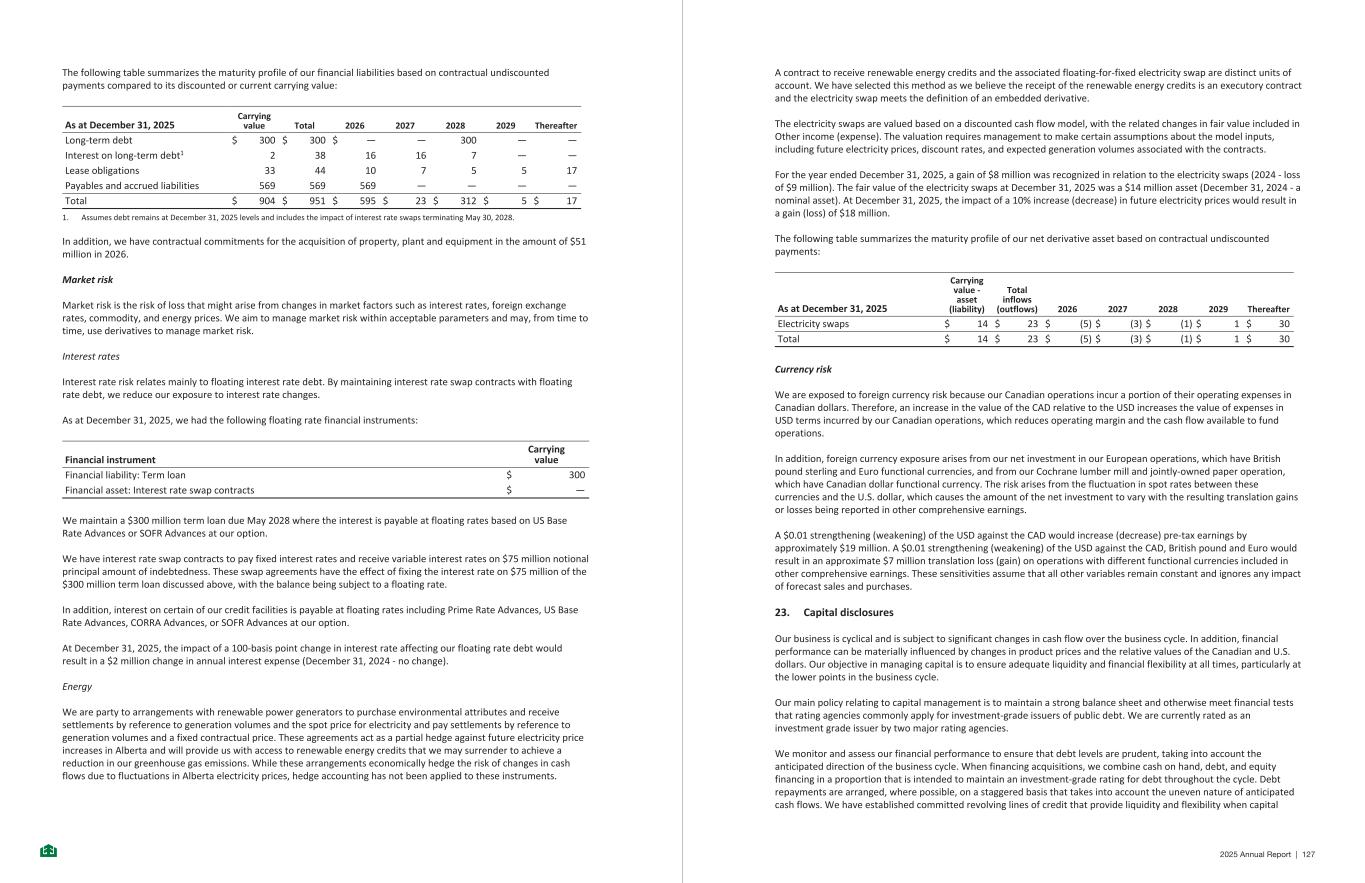
The following table summarizes the maturity profile of our financial liabilities based on contractual undiscounted payments compared to its discounted or current carrying value: As at December 31, 2025 Carrying value Total 2026 2027 2028 2029 Thereafter Long-term debt $ 300 $ 300 $ — — 300 — — Interest on long-term debt1 2 38 16 16 7 — — Lease obligations 33 44 10 7 5 5 17 Payables and accrued liabilities 569 569 569 — — — — Total $ 904 $ 951 $ 595 $ 23 $ 312 $ 5 $ 17 1. Assumes debt remains at December 31, 2025 levels and includes the impact of interest rate swaps terminating May 30, 2028. In addition, we have contractual commitments for the acquisition of property, plant and equipment in the amount of $51 million in 2026. Market risk Market risk is the risk of loss that might arise from changes in market factors such as interest rates, foreign exchange rates, commodity, and energy prices. We aim to manage market risk within acceptable parameters and may, from time to time, use derivatives to manage market risk. Interest rates Interest rate risk relates mainly to floating interest rate debt. By maintaining interest rate swap contracts with floating rate debt, we reduce our exposure to interest rate changes. As at December 31, 2025, we had the following floating rate financial instruments: Financial instrument Carrying value Financial liability: Term loan $ 300 Financial asset: Interest rate swap contracts $ — We maintain a $300 million term loan due May 2028 where the interest is payable at floating rates based on US Base Rate Advances or SOFR Advances at our option. We have interest rate swap contracts to pay fixed interest rates and receive variable interest rates on $75 million notional principal amount of indebtedness. These swap agreements have the effect of fixing the interest rate on $75 million of the $300 million term loan discussed above, with the balance being subject to a floating rate. In addition, interest on certain of our credit facilities is payable at floating rates including Prime Rate Advances, US Base Rate Advances, CORRA Advances, or SOFR Advances at our option. At December 31, 2025, the impact of a 100-basis point change in interest rate affecting our floating rate debt would result in a $2 million change in annual interest expense (December 31, 2024 - no change). Energy We are party to arrangements with renewable power generators to purchase environmental attributes and receive settlements by reference to generation volumes and the spot price for electricity and pay settlements by reference to generation volumes and a fixed contractual price. These agreements act as a partial hedge against future electricity price increases in Alberta and will provide us with access to renewable energy credits that we may surrender to achieve a reduction in our greenhouse gas emissions. While these arrangements economically hedge the risk of changes in cash flows due to fluctuations in Alberta electricity prices, hedge accounting has not been applied to these instruments. -36- A contract to receive renewable energy credits and the associated floating-for-fixed electricity swap are distinct units of account. We have selected this method as we believe the receipt of the renewable energy credits is an executory contract and the electricity swap meets the definition of an embedded derivative. The electricity swaps are valued based on a discounted cash flow model, with the related changes in fair value included in Other income (expense). The valuation requires management to make certain assumptions about the model inputs, including future electricity prices, discount rates, and expected generation volumes associated with the contracts. For the year ended December 31, 2025, a gain of $8 million was recognized in relation to the electricity swaps (2024 - loss of $9 million). The fair value of the electricity swaps at December 31, 2025 was a $14 million asset (December 31, 2024 - a nominal asset). At December 31, 2025, the impact of a 10% increase (decrease) in future electricity prices would result in a gain (loss) of $18 million. The following table summarizes the maturity profile of our net derivative asset based on contractual undiscounted payments: As at December 31, 2025 Carrying value - asset (liability) Total inflows (outflows) 2026 2027 2028 2029 Thereafter Electricity swaps $ 14 $ 23 $ (5) $ (3) $ (1) $ 1 $ 30 Total $ 14 $ 23 $ (5) $ (3) $ (1) $ 1 $ 30 Currency risk We are exposed to foreign currency risk because our Canadian operations incur a portion of their operating expenses in Canadian dollars. Therefore, an increase in the value of the CAD relative to the USD increases the value of expenses in USD terms incurred by our Canadian operations, which reduces operating margin and the cash flow available to fund operations. In addition, foreign currency exposure arises from our net investment in our European operations, which have British pound sterling and Euro functional currencies, and from our Cochrane lumber mill and jointly-owned paper operation, which have Canadian dollar functional currency. The risk arises from the fluctuation in spot rates between these currencies and the U.S. dollar, which causes the amount of the net investment to vary with the resulting translation gains or losses being reported in other comprehensive earnings. A $0.01 strengthening (weakening) of the USD against the CAD would increase (decrease) pre-tax earnings by approximately $19 million. A $0.01 strengthening (weakening) of the USD against the CAD, British pound and Euro would result in an approximate $7 million translation loss (gain) on operations with different functional currencies included in other comprehensive earnings. These sensitivities assume that all other variables remain constant and ignores any impact of forecast sales and purchases. 23. Capital disclosures Our business is cyclical and is subject to significant changes in cash flow over the business cycle. In addition, financial performance can be materially influenced by changes in product prices and the relative values of the Canadian and U.S. dollars. Our objective in managing capital is to ensure adequate liquidity and financial flexibility at all times, particularly at the lower points in the business cycle. Our main policy relating to capital management is to maintain a strong balance sheet and otherwise meet financial tests that rating agencies commonly apply for investment-grade issuers of public debt. We are currently rated as an investment grade issuer by two major rating agencies. We monitor and assess our financial performance to ensure that debt levels are prudent, taking into account the anticipated direction of the business cycle. When financing acquisitions, we combine cash on hand, debt, and equity financing in a proportion that is intended to maintain an investment-grade rating for debt throughout the cycle. Debt repayments are arranged, where possible, on a staggered basis that takes into account the uneven nature of anticipated cash flows. We have established committed revolving lines of credit that provide liquidity and flexibility when capital -37- 2025 Annual Report | 127
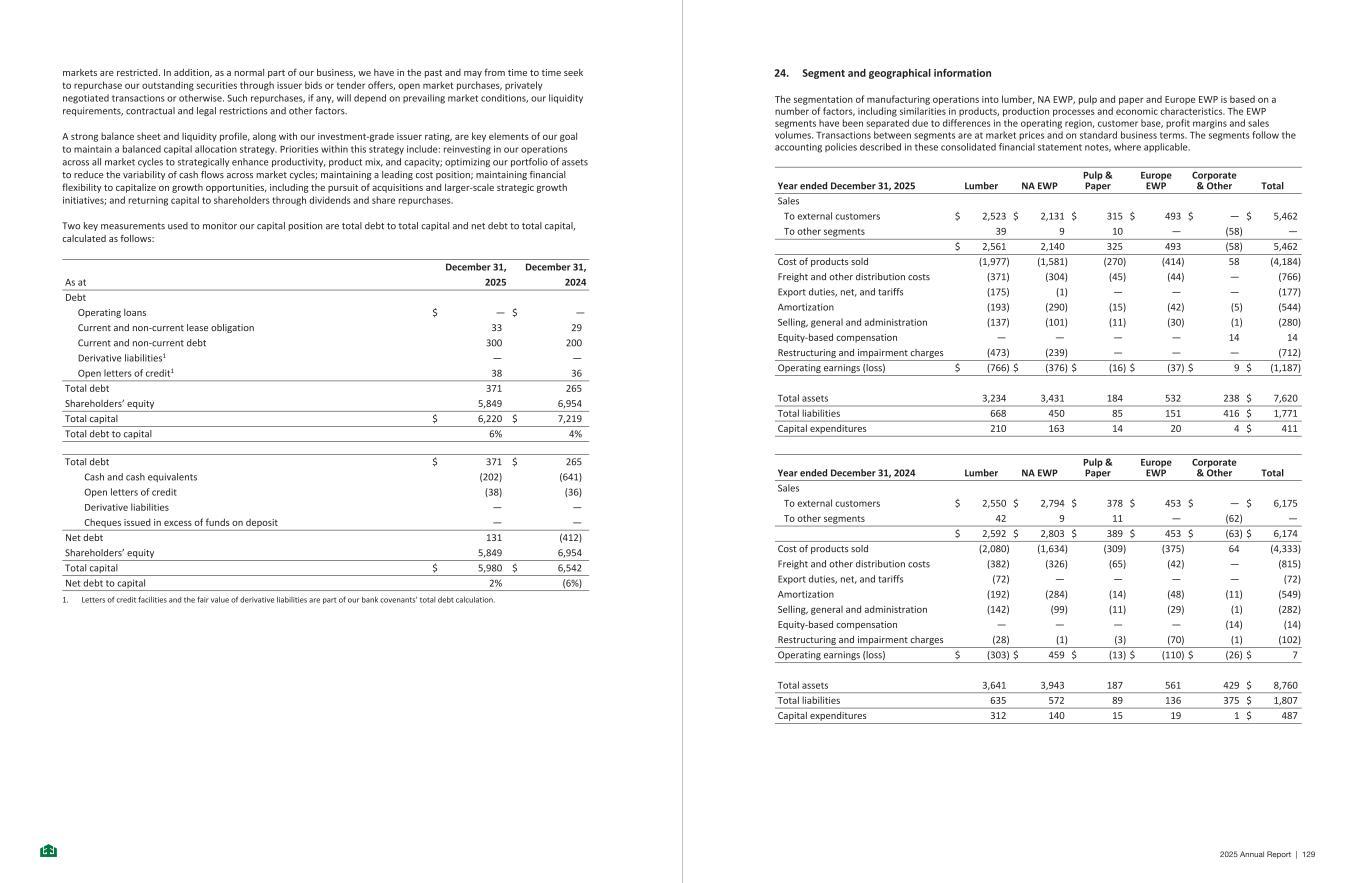
markets are restricted. In addition, as a normal part of our business, we have in the past and may from time to time seek to repurchase our outstanding securities through issuer bids or tender offers, open market purchases, privately negotiated transactions or otherwise. Such repurchases, if any, will depend on prevailing market conditions, our liquidity requirements, contractual and legal restrictions and other factors. A strong balance sheet and liquidity profile, along with our investment-grade issuer rating, are key elements of our goal to maintain a balanced capital allocation strategy. Priorities within this strategy include: reinvesting in our operations across all market cycles to strategically enhance productivity, product mix, and capacity; optimizing our portfolio of assets to reduce the variability of cash flows across market cycles; maintaining a leading cost position; maintaining financial flexibility to capitalize on growth opportunities, including the pursuit of acquisitions and larger-scale strategic growth initiatives; and returning capital to shareholders through dividends and share repurchases. Two key measurements used to monitor our capital position are total debt to total capital and net debt to total capital, calculated as follows: December 31, December 31, As at 2025 2024 Debt Operating loans $ — $ — Current and non-current lease obligation 33 29 Current and non-current debt 300 200 Derivative liabilities1 — — Open letters of credit1 38 36 Total debt 371 265 Shareholders’ equity 5,849 6,954 Total capital $ 6,220 $ 7,219 Total debt to capital 6% 4% Total debt $ 371 $ 265 Cash and cash equivalents (202) (641) Open letters of credit (38) (36) Derivative liabilities — — Cheques issued in excess of funds on deposit — — Net debt 131 (412) Shareholders’ equity 5,849 6,954 Total capital $ 5,980 $ 6,542 Net debt to capital 2% (6%) 1. Letters of credit facilities and the fair value of derivative liabilities are part of our bank covenants’ total debt calculation. -38- 24. Segment and geographical information The segmentation of manufacturing operations into lumber, NA EWP, pulp and paper and Europe EWP is based on a number of factors, including similarities in products, production processes and economic characteristics. The EWP segments have been separated due to differences in the operating region, customer base, profit margins and sales volumes. Transactions between segments are at market prices and on standard business terms. The segments follow the accounting policies described in these consolidated financial statement notes, where applicable. Year ended December 31, 2025 Lumber NA EWP Pulp & Paper Europe EWP Corporate & Other Total Sales To external customers $ 2,523 $ 2,131 $ 315 $ 493 $ — $ 5,462 To other segments 39 9 10 — (58) — $ 2,561 2,140 325 493 (58) 5,462 Cost of products sold (1,977) (1,581) (270) (414) 58 (4,184) Freight and other distribution costs (371) (304) (45) (44) — (766) Export duties, net, and tariffs (175) (1) — — — (177) Amortization (193) (290) (15) (42) (5) (544) Selling, general and administration (137) (101) (11) (30) (1) (280) Equity-based compensation — — — — 14 14 Restructuring and impairment charges (473) (239) — — — (712) Operating earnings (loss) $ (766) $ (376) $ (16) $ (37) $ 9 $ (1,187) Total assets 3,234 3,431 184 532 238 $ 7,620 Total liabilities 668 450 85 151 416 $ 1,771 Capital expenditures 210 163 14 20 4 $ 411 Lumber NA EWP Pulp & Paper Europe EWP Corporate & Other TotalYear ended December 31, 2024 Sales To external customers $ 2,550 $ 2,794 $ 378 $ 453 $ — $ 6,175 To other segments 42 9 11 — (62) — $ 2,592 $ 2,803 $ 389 $ 453 $ (63) $ 6,174 Cost of products sold (2,080) (1,634) (309) (375) 64 (4,333) Freight and other distribution costs (382) (326) (65) (42) — (815) Export duties, net, and tariffs (72) — — — — (72) Amortization (192) (284) (14) (48) (11) (549) Selling, general and administration (142) (99) (11) (29) (1) (282) Equity-based compensation — — — — (14) (14) Restructuring and impairment charges (28) (1) (3) (70) (1) (102) Operating earnings (loss) $ (303) $ 459 $ (13) $ (110) $ (26) $ 7 Total assets 3,641 3,943 187 561 429 $ 8,760 Total liabilities 635 572 89 136 375 $ 1,807 Capital expenditures 312 140 15 19 1 $ 487 -39- 2025 Annual Report | 129
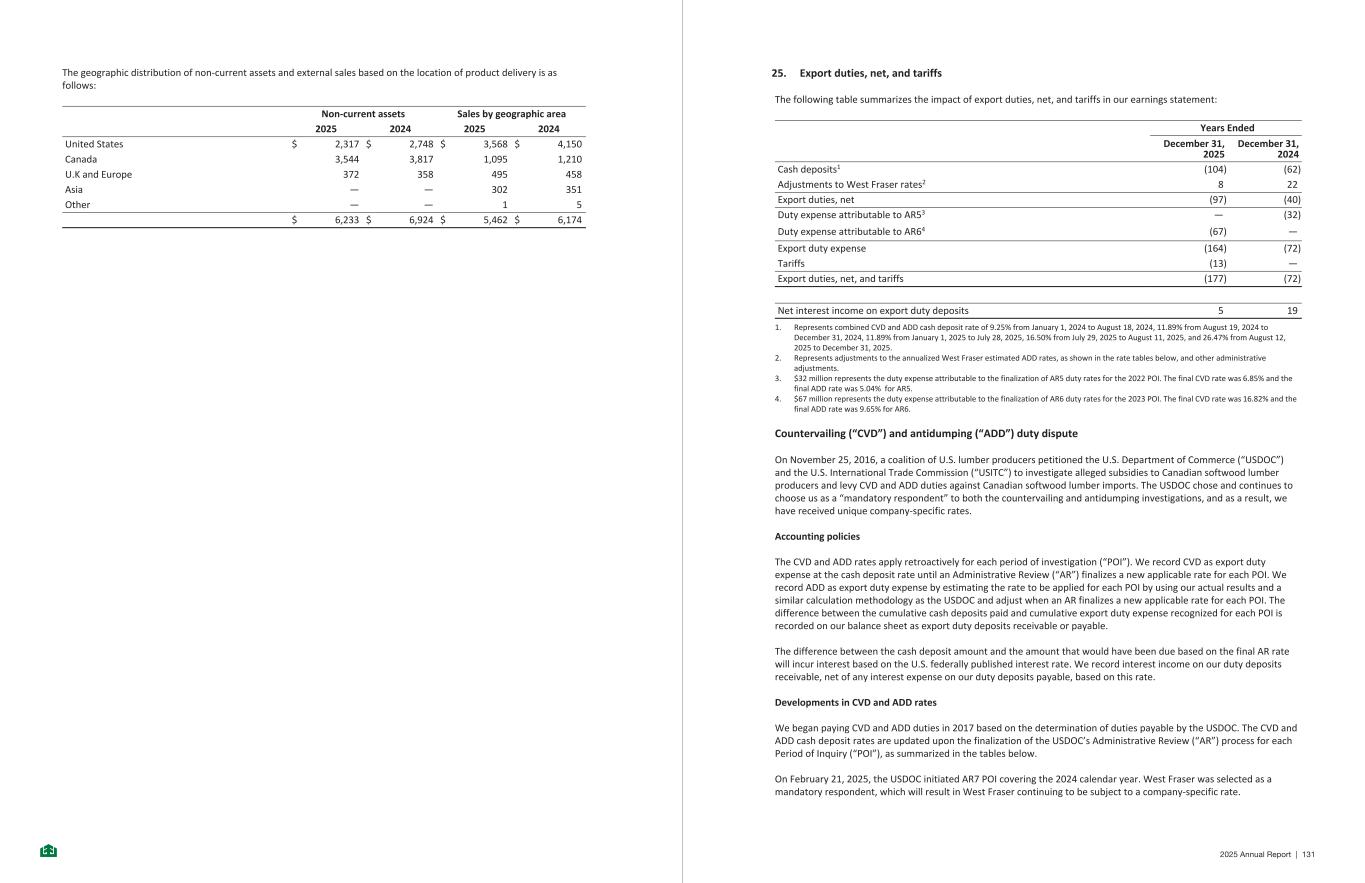
The geographic distribution of non-current assets and external sales based on the location of product delivery is as follows: Non-current assets Sales by geographic area 2025 2024 2025 2024 United States $ 2,317 $ 2,748 $ 3,568 $ 4,150 Canada 3,544 3,817 1,095 1,210 U.K and Europe 372 358 495 458 Asia — — 302 351 Other — — 1 5 $ 6,233 $ 6,924 $ 5,462 $ 6,174 -40- 25. Export duties, net, and tariffs The following table summarizes the impact of export duties, net, and tariffs in our earnings statement: Years Ended December 31, 2025 December 31, 2024 Cash deposits1 (104) (62) Adjustments to West Fraser rates2 8 22 Export duties, net (97) (40) Duty expense attributable to AR53 — (32) Duty expense attributable to AR64 (67) — Export duty expense (164) (72) Tariffs (13) — Export duties, net, and tariffs (177) (72) Net interest income on export duty deposits 5 19 1. Represents combined CVD and ADD cash deposit rate of 9.25% from January 1, 2024 to August 18, 2024, 11.89% from August 19, 2024 to December 31, 2024, 11.89% from January 1, 2025 to July 28, 2025, 16.50% from July 29, 2025 to August 11, 2025, and 26.47% from August 12, 2025 to December 31, 2025. 2. Represents adjustments to the annualized West Fraser estimated ADD rates, as shown in the rate tables below, and other administrative adjustments. 3. $32 million represents the duty expense attributable to the finalization of AR5 duty rates for the 2022 POI. The final CVD rate was 6.85% and the final ADD rate was 5.04% for AR5. 4. $67 million represents the duty expense attributable to the finalization of AR6 duty rates for the 2023 POI. The final CVD rate was 16.82% and the final ADD rate was 9.65% for AR6. Countervailing (“CVD”) and antidumping (“ADD”) duty dispute On November 25, 2016, a coalition of U.S. lumber producers petitioned the U.S. Department of Commerce (“USDOC”) and the U.S. International Trade Commission (“USITC”) to investigate alleged subsidies to Canadian softwood lumber producers and levy CVD and ADD duties against Canadian softwood lumber imports. The USDOC chose and continues to choose us as a “mandatory respondent” to both the countervailing and antidumping investigations, and as a result, we have received unique company-specific rates. Accounting policies The CVD and ADD rates apply retroactively for each period of investigation (“POI”). We record CVD as export duty expense at the cash deposit rate until an Administrative Review (“AR”) finalizes a new applicable rate for each POI. We record ADD as export duty expense by estimating the rate to be applied for each POI by using our actual results and a similar calculation methodology as the USDOC and adjust when an AR finalizes a new applicable rate for each POI. The difference between the cumulative cash deposits paid and cumulative export duty expense recognized for each POI is recorded on our balance sheet as export duty deposits receivable or payable. The difference between the cash deposit amount and the amount that would have been due based on the final AR rate will incur interest based on the U.S. federally published interest rate. We record interest income on our duty deposits receivable, net of any interest expense on our duty deposits payable, based on this rate. Developments in CVD and ADD rates We began paying CVD and ADD duties in 2017 based on the determination of duties payable by the USDOC. The CVD and ADD cash deposit rates are updated upon the finalization of the USDOC’s Administrative Review (“AR”) process for each Period of Inquiry (“POI”), as summarized in the tables below. On February 21, 2025, the USDOC initiated AR7 POI covering the 2024 calendar year. West Fraser was selected as a mandatory respondent, which will result in West Fraser continuing to be subject to a company-specific rate. -41- 2025 Annual Report | 131
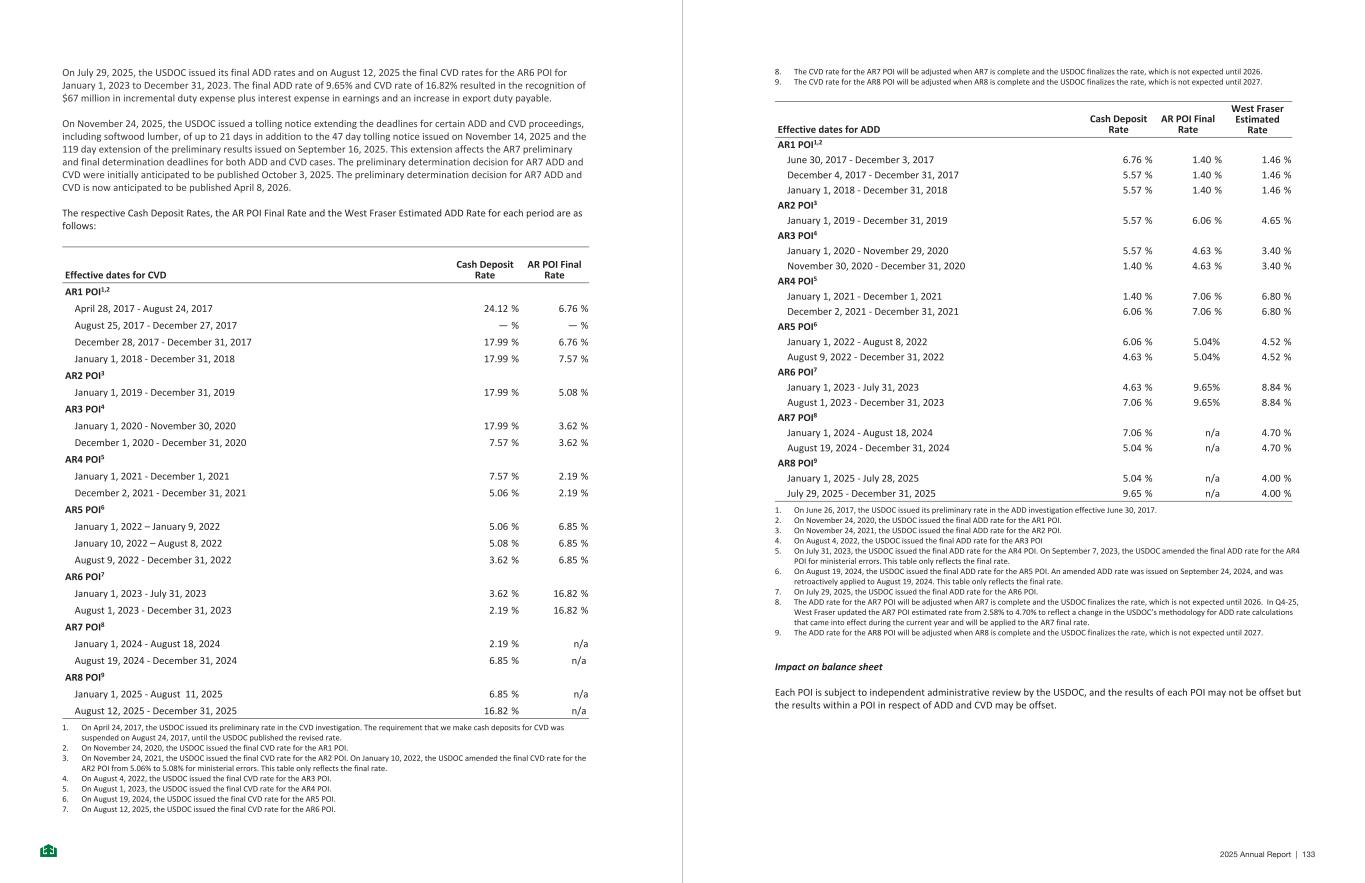
On July 29, 2025, the USDOC issued its final ADD rates and on August 12, 2025 the final CVD rates for the AR6 POI for January 1, 2023 to December 31, 2023. The final ADD rate of 9.65% and CVD rate of 16.82% resulted in the recognition of $67 million in incremental duty expense plus interest expense in earnings and an increase in export duty payable. On November 24, 2025, the USDOC issued a tolling notice extending the deadlines for certain ADD and CVD proceedings, including softwood lumber, of up to 21 days in addition to the 47 day tolling notice issued on November 14, 2025 and the 119 day extension of the preliminary results issued on September 16, 2025. This extension affects the AR7 preliminary and final determination deadlines for both ADD and CVD cases. The preliminary determination decision for AR7 ADD and CVD were initially anticipated to be published October 3, 2025. The preliminary determination decision for AR7 ADD and CVD is now anticipated to be published April 8, 2026. The respective Cash Deposit Rates, the AR POI Final Rate and the West Fraser Estimated ADD Rate for each period are as follows: Effective dates for CVD Cash Deposit Rate AR POI Final Rate AR1 POI1,2 April 28, 2017 - August 24, 2017 24.12 % 6.76 % August 25, 2017 - December 27, 2017 — % — % December 28, 2017 - December 31, 2017 17.99 % 6.76 % January 1, 2018 - December 31, 2018 17.99 % 7.57 % AR2 POI3 January 1, 2019 - December 31, 2019 17.99 % 5.08 % AR3 POI4 January 1, 2020 - November 30, 2020 17.99 % 3.62 % December 1, 2020 - December 31, 2020 7.57 % 3.62 % AR4 POI5 January 1, 2021 - December 1, 2021 7.57 % 2.19 % December 2, 2021 - December 31, 2021 5.06 % 2.19 % AR5 POI6 January 1, 2022 – January 9, 2022 5.06 % 6.85 % January 10, 2022 – August 8, 2022 5.08 % 6.85 % August 9, 2022 - December 31, 2022 3.62 % 6.85 % AR6 POI7 January 1, 2023 - July 31, 2023 3.62 % 16.82 % August 1, 2023 - December 31, 2023 2.19 % 16.82 % AR7 POI8 January 1, 2024 - August 18, 2024 2.19 % n/a August 19, 2024 - December 31, 2024 6.85 % n/a AR8 POI9 January 1, 2025 - August 11, 2025 6.85 % n/a August 12, 2025 - December 31, 2025 16.82 % n/a 1. On April 24, 2017, the USDOC issued its preliminary rate in the CVD investigation. The requirement that we make cash deposits for CVD was suspended on August 24, 2017, until the USDOC published the revised rate. 2. On November 24, 2020, the USDOC issued the final CVD rate for the AR1 POI. 3. On November 24, 2021, the USDOC issued the final CVD rate for the AR2 POI. On January 10, 2022, the USDOC amended the final CVD rate for the AR2 POI from 5.06% to 5.08% for ministerial errors. This table only reflects the final rate. 4. On August 4, 2022, the USDOC issued the final CVD rate for the AR3 POI. 5. On August 1, 2023, the USDOC issued the final CVD rate for the AR4 POI. 6. On August 19, 2024, the USDOC issued the final CVD rate for the AR5 POI. 7. On August 12, 2025, the USDOC issued the final CVD rate for the AR6 POI. -42- 8. The CVD rate for the AR7 POI will be adjusted when AR7 is complete and the USDOC finalizes the rate, which is not expected until 2026. 9. The CVD rate for the AR8 POI will be adjusted when AR8 is complete and the USDOC finalizes the rate, which is not expected until 2027. Effective dates for ADD Cash Deposit Rate AR POI Final Rate West Fraser Estimated Rate AR1 POI1,2 June 30, 2017 - December 3, 2017 6.76 % 1.40 % 1.46 % December 4, 2017 - December 31, 2017 5.57 % 1.40 % 1.46 % January 1, 2018 - December 31, 2018 5.57 % 1.40 % 1.46 % AR2 POI3 January 1, 2019 - December 31, 2019 5.57 % 6.06 % 4.65 % AR3 POI4 January 1, 2020 - November 29, 2020 5.57 % 4.63 % 3.40 % November 30, 2020 - December 31, 2020 1.40 % 4.63 % 3.40 % AR4 POI5 January 1, 2021 - December 1, 2021 1.40 % 7.06 % 6.80 % December 2, 2021 - December 31, 2021 6.06 % 7.06 % 6.80 % AR5 POI6 January 1, 2022 - August 8, 2022 6.06 % 5.04% 4.52 % August 9, 2022 - December 31, 2022 4.63 % 5.04% 4.52 % AR6 POI7 January 1, 2023 - July 31, 2023 4.63 % 9.65% 8.84 % August 1, 2023 - December 31, 2023 7.06 % 9.65% 8.84 % AR7 POI8 January 1, 2024 - August 18, 2024 7.06 % n/a 4.70 % August 19, 2024 - December 31, 2024 5.04 % n/a 4.70 % AR8 POI9 January 1, 2025 - July 28, 2025 5.04 % n/a 4.00 % July 29, 2025 - December 31, 2025 9.65 % n/a 4.00 % 1. On June 26, 2017, the USDOC issued its preliminary rate in the ADD investigation effective June 30, 2017. 2. On November 24, 2020, the USDOC issued the final ADD rate for the AR1 POI. 3. On November 24, 2021, the USDOC issued the final ADD rate for the AR2 POI. 4. On August 4, 2022, the USDOC issued the final ADD rate for the AR3 POI 5. On July 31, 2023, the USDOC issued the final ADD rate for the AR4 POI. On September 7, 2023, the USDOC amended the final ADD rate for the AR4 POI for ministerial errors. This table only reflects the final rate. 6. On August 19, 2024, the USDOC issued the final ADD rate for the AR5 POI. An amended ADD rate was issued on September 24, 2024, and was retroactively applied to August 19, 2024. This table only reflects the final rate. 7. On July 29, 2025, the USDOC issued the final ADD rate for the AR6 POI. 8. The ADD rate for the AR7 POI will be adjusted when AR7 is complete and the USDOC finalizes the rate, which is not expected until 2026. In Q4-25, West Fraser updated the AR7 POI estimated rate from 2.58% to 4.70% to reflect a change in the USDOC’s methodology for ADD rate calculations that came into effect during the current year and will be applied to the AR7 final rate. 9. The ADD rate for the AR8 POI will be adjusted when AR8 is complete and the USDOC finalizes the rate, which is not expected until 2027. Impact on balance sheet Each POI is subject to independent administrative review by the USDOC, and the results of each POI may not be offset but the results within a POI in respect of ADD and CVD may be offset. -43- 2025 Annual Report | 133
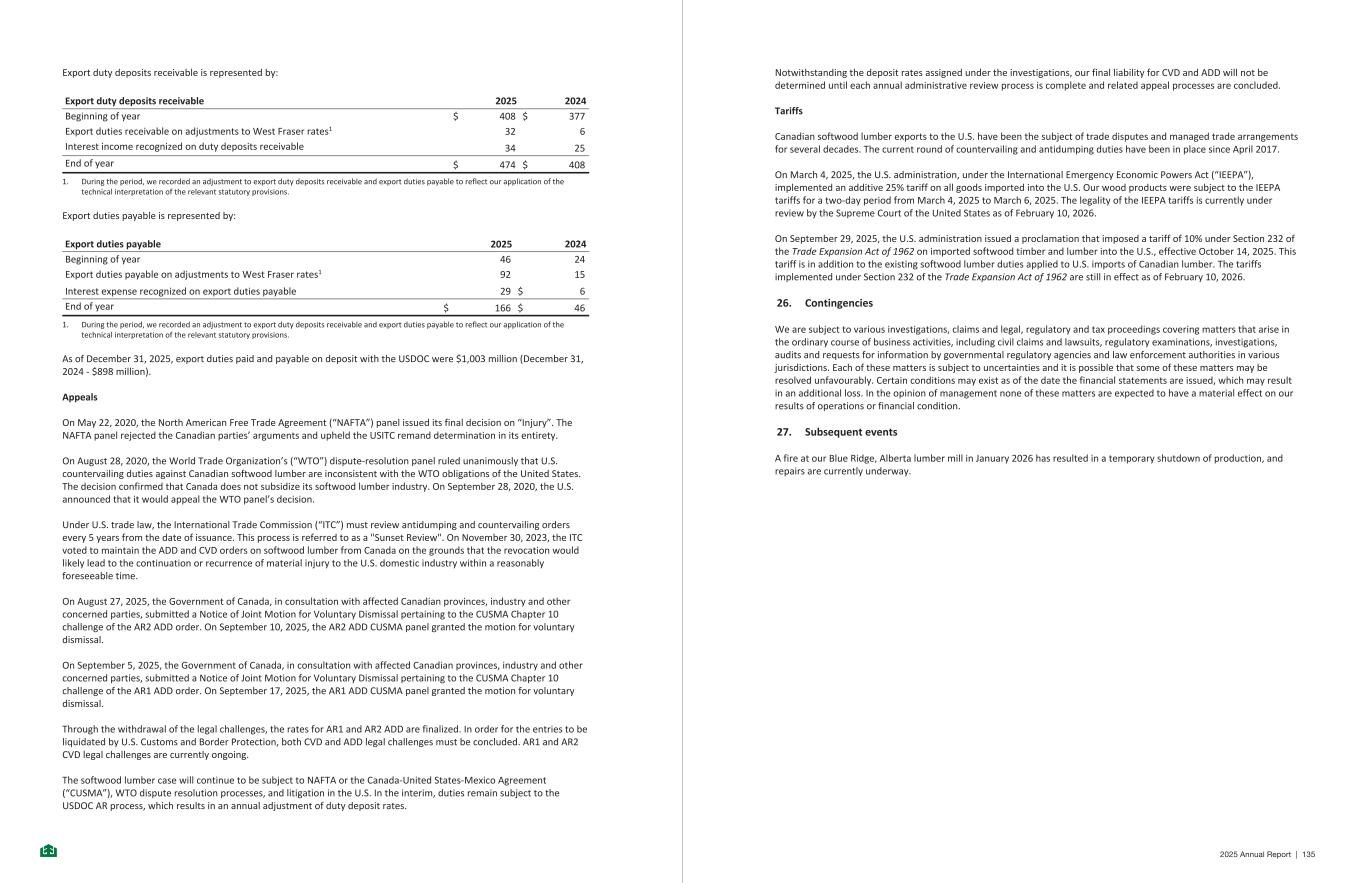
Export duty deposits receivable is represented by: Export duty deposits receivable 2025 2024 Beginning of year $ 408 $ 377 Export duties receivable on adjustments to West Fraser rates1 32 6 Interest income recognized on duty deposits receivable 34 25 End of year $ 474 $ 408 1. During the period, we recorded an adjustment to export duty deposits receivable and export duties payable to reflect our application of the technical interpretation of the relevant statutory provisions. Export duties payable is represented by: Export duties payable 2025 2024 Beginning of year 46 24 Export duties payable on adjustments to West Fraser rates1 92 15 Interest expense recognized on export duties payable 29 $ 6 End of year $ 166 $ 46 1. During the period, we recorded an adjustment to export duty deposits receivable and export duties payable to reflect our application of the technical interpretation of the relevant statutory provisions. As of December 31, 2025, export duties paid and payable on deposit with the USDOC were $1,003 million (December 31, 2024 - $898 million). Appeals On May 22, 2020, the North American Free Trade Agreement (“NAFTA”) panel issued its final decision on “Injury”. The NAFTA panel rejected the Canadian parties’ arguments and upheld the USITC remand determination in its entirety. On August 28, 2020, the World Trade Organization’s (“WTO”) dispute-resolution panel ruled unanimously that U.S. countervailing duties against Canadian softwood lumber are inconsistent with the WTO obligations of the United States. The decision confirmed that Canada does not subsidize its softwood lumber industry. On September 28, 2020, the U.S. announced that it would appeal the WTO panel’s decision. Under U.S. trade law, the International Trade Commission (“ITC”) must review antidumping and countervailing orders every 5 years from the date of issuance. This process is referred to as a "Sunset Review". On November 30, 2023, the ITC voted to maintain the ADD and CVD orders on softwood lumber from Canada on the grounds that the revocation would likely lead to the continuation or recurrence of material injury to the U.S. domestic industry within a reasonably foreseeable time. On August 27, 2025, the Government of Canada, in consultation with affected Canadian provinces, industry and other concerned parties, submitted a Notice of Joint Motion for Voluntary Dismissal pertaining to the CUSMA Chapter 10 challenge of the AR2 ADD order. On September 10, 2025, the AR2 ADD CUSMA panel granted the motion for voluntary dismissal. On September 5, 2025, the Government of Canada, in consultation with affected Canadian provinces, industry and other concerned parties, submitted a Notice of Joint Motion for Voluntary Dismissal pertaining to the CUSMA Chapter 10 challenge of the AR1 ADD order. On September 17, 2025, the AR1 ADD CUSMA panel granted the motion for voluntary dismissal. Through the withdrawal of the legal challenges, the rates for AR1 and AR2 ADD are finalized. In order for the entries to be liquidated by U.S. Customs and Border Protection, both CVD and ADD legal challenges must be concluded. AR1 and AR2 CVD legal challenges are currently ongoing. The softwood lumber case will continue to be subject to NAFTA or the Canada-United States-Mexico Agreement (“CUSMA”), WTO dispute resolution processes, and litigation in the U.S. In the interim, duties remain subject to the USDOC AR process, which results in an annual adjustment of duty deposit rates. -44- Notwithstanding the deposit rates assigned under the investigations, our final liability for CVD and ADD will not be determined until each annual administrative review process is complete and related appeal processes are concluded. Tariffs Canadian softwood lumber exports to the U.S. have been the subject of trade disputes and managed trade arrangements for several decades. The current round of countervailing and antidumping duties have been in place since April 2017. On March 4, 2025, the U.S. administration, under the International Emergency Economic Powers Act (“IEEPA”), implemented an additive 25% tariff on all goods imported into the U.S. Our wood products were subject to the IEEPA tariffs for a two-day period from March 4, 2025 to March 6, 2025. The legality of the IEEPA tariffs is currently under review by the Supreme Court of the United States as of February 10, 2026. On September 29, 2025, the U.S. administration issued a proclamation that imposed a tariff of 10% under Section 232 of the Trade Expansion Act of 1962 on imported softwood timber and lumber into the U.S., effective October 14, 2025. This tariff is in addition to the existing softwood lumber duties applied to U.S. imports of Canadian lumber. The tariffs implemented under Section 232 of the Trade Expansion Act of 1962 are still in effect as of February 10, 2026. 26. Contingencies We are subject to various investigations, claims and legal, regulatory and tax proceedings covering matters that arise in the ordinary course of business activities, including civil claims and lawsuits, regulatory examinations, investigations, audits and requests for information by governmental regulatory agencies and law enforcement authorities in various jurisdictions. Each of these matters is subject to uncertainties and it is possible that some of these matters may be resolved unfavourably. Certain conditions may exist as of the date the financial statements are issued, which may result in an additional loss. In the opinion of management none of these matters are expected to have a material effect on our results of operations or financial condition. 27. Subsequent events A fire at our Blue Ridge, Alberta lumber mill in January 2026 has resulted in a temporary shutdown of production, and repairs are currently underway. -45- 2025 Annual Report | 135
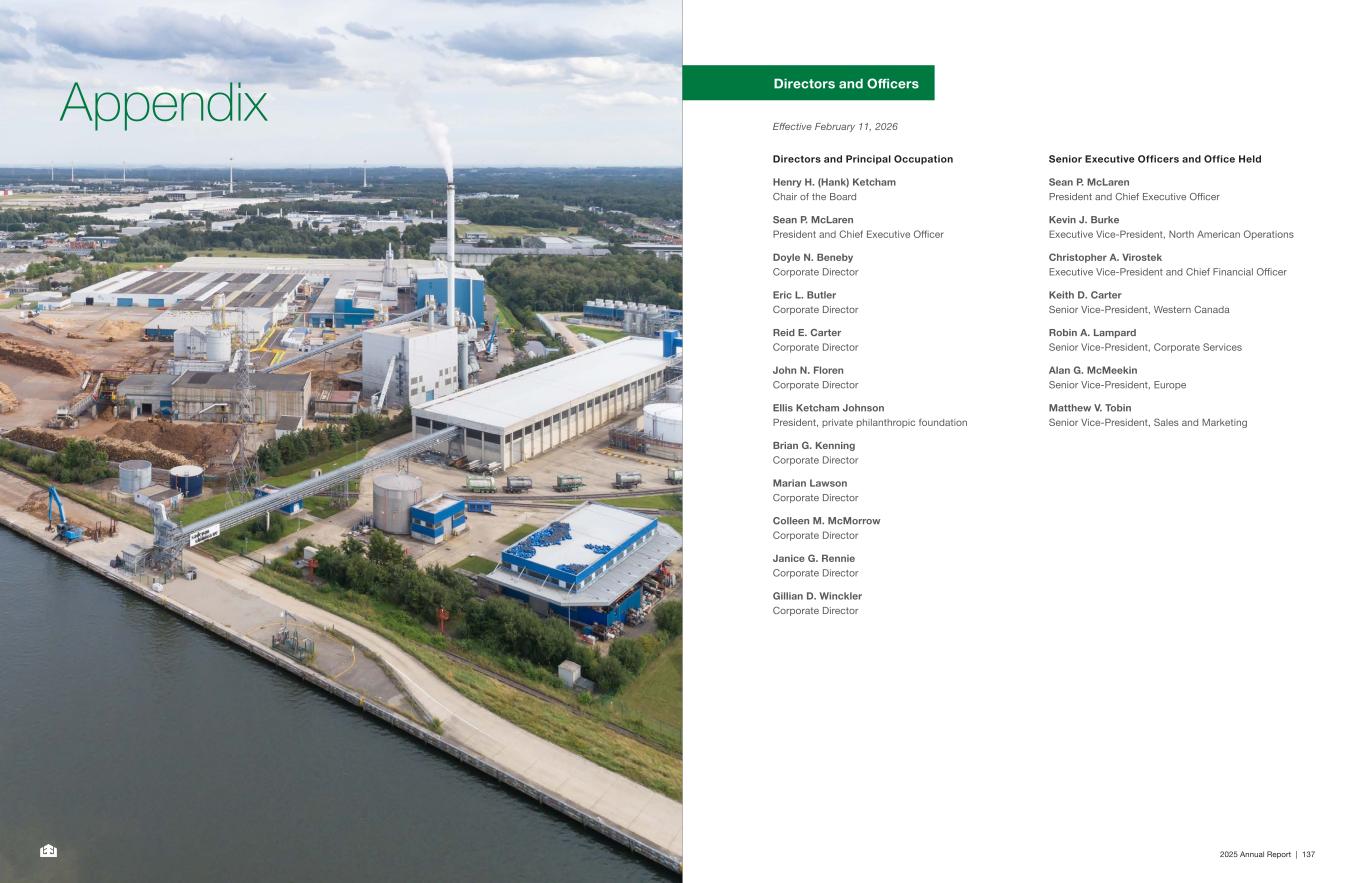
2025 Annual Report | 137 Appendix Directors and Officers Effective February 11, 2026 Directors and Principal Occupation Henry H. (Hank) Ketcham Chair of the Board Sean P. McLaren President and Chief Executive Officer Doyle N. Beneby Corporate Director Eric L. Butler Corporate Director Reid E. Carter Corporate Director John N. Floren Corporate Director Ellis Ketcham Johnson President, private philanthropic foundation Brian G. Kenning Corporate Director Marian Lawson Corporate Director Colleen M. McMorrow Corporate Director Janice G. Rennie Corporate Director Gillian D. Winckler Corporate Director Senior Executive Officers and Office Held Sean P. McLaren President and Chief Executive Officer Kevin J. Burke Executive Vice-President, North American Operations Christopher A. Virostek Executive Vice-President and Chief Financial Officer Keith D. Carter Senior Vice-President, Western Canada Robin A. Lampard Senior Vice-President, Corporate Services Alan G. McMeekin Senior Vice-President, Europe Matthew V. Tobin Senior Vice-President, Sales and Marketing
2025 Annual Report | 139 Glossary of Key Terms This Annual Report uses capitalized terms, abbreviations and acronyms that, unless otherwise defined, are defined in the “Glossary of Key Terms” section of our Management’s Discussion and Analysis for the year ended December 31, 2025, which is incorporated into this Annual Report beginning on page 84. The following key terms are included below for ease of reference: AAC Annual allowable cut. The volume of timber that may be harvested annually from a specific timber tenure. Adjusted EBITDA Non-GAAP financial measure defined in the “Non-GAAP and Other Specified Financial Measures” section of the 2025 MD&A included in this Annual Report. B.C. British Columbia CAD or CAD$ Canadian dollars Crown timber Timber harvested from lands owned by a provincial government EBITDA Earnings before interest, taxes, depreciation and amortization EDGAR Electronic Data Gathering, Analysis, and Retrieval system EPS Earnings per share EU Europe EU OSB Oriented strand board from the U.K. and Europe EWP Engineered wood products GHG Greenhouse gas LIBOR London Interbank Offered Rate M³ A solid cubic metre. A unit of measure for timber, equal to approximately 35 cubic feet. Mcf One thousand cubic feet. A unit of measure for laminated veneer lumber. 2025 MD&A Management’s Discussion & Analysis for the year ended December 31, 2025. Mfbm One thousand board feet (equivalent to one thousand square feet of lumber, one inch thick) MMfbm One million board feet (equivalent to one million square feet of lumber, one inch thick) Msf One thousand square feet. A unit of measure for panel products such as OSB, MDF and plywood equal to one thousand square feet on a 3/4‑inch basis for MDF, a 3/8‑inch basis for plywood and either a 3/8‑inch or 7/16‑inch thick basis for OSB. MMsf One million square feet Mtonne One thousand tonnes NA North America NA EWP North America engineered wood products NA OSB Oriented strand board from Canada and the U.S. NCIB Normal course issuer bid NYSE New York Stock Exchange OSB Oriented strand board. An engineered structural wood panel produced by chemically bonding wood strands in a uniform direction under heat and pressure. SEDAR+ System for Electronic Document Analysis and Retrieval+ SPF Spruce/Pine/Fir lumber SYP Southern yellow pine lumber Tonne A unit of weight in the metric system equal to one thousand kilograms or approximately 2,204 pounds TSX Toronto Stock Exchange U.K. United Kingdom U.S. United States USD or $ or US$ United States dollars This Annual contains forward-looking information or forward-looking statements (collectively, “forward-looking statements”) within the meaning of applicable securities laws, including those relating to our outlook for our markets, our business strategy and our ability to execute on such strategy, including our strategy of striving for low cost production, maintaining a resilient balance sheet, and deploying capital, our ability to preserve our competitive position at the bottom of the cycle and when markets improve, ability to maintain financial flexibility to pursue future growth opportunities, the results and outlook of our focus on improving our safety performance and implementation of our 2026 safety plans, our mill modernization strategy and the expected improvements from the optimization of our portfolio, including cost, efficiency and performance, long‑term outlook for demand for our products and our ability to compete once demand improves, timing for the Henderson and Allendale ramp‑ups, our ability to secure long‑term fibre supply through agreements with Indigenous Nations, our goal to be the world’s premier, low‑cost, sustainable wood products producer, and the expected attributes of wood products, including any ability to reduce climate impact. Any such forward‑looking statements are based on information currently available to us and are based on assumptions and analyses made by us considering our experience and our perception of historical trends and current conditions and are subject to inherent risks and uncertainties. Readers should also refer to the “Forward-Looking Statements” and “Risks and Uncertainties” section set forth in West Fraser’s 2025 MD&A included in this Annual Report. There can be no assurance that the plans, intentions, or expectations upon which forward-looking statements are based will be realized. Actual results may differ, and the difference may be material and adverse to West Fraser and its shareholders. Except as may be required by law, West Fraser undertakes no obligation to publicly update or revise any forward-looking statements. Corporate Information Effective February 20, 2026 Annual General and Special Meeting The Annual General and Special Meeting of the shareholders of the company will be held on April 22, 2026, at 11:00 a.m. at West Fraser’s Corporate headquarters at 885 West Georgia Street, Suite 1500, Vancouver, BC, Canada, V6C 3E8 Auditors PricewaterhouseCoopers LLP Vancouver, BC Canada Legal Counsel McMillan LLP Vancouver, BC Canada Transfer Agent Computershare Investor Services Inc. Tel: 1 (800) 564-6253 Canada/USA Tel: (514) 982-7555 International Filings www.sedarplus.ca www.sec.gov/edgar Shares are listed on the TSX and NYSE under the symbol: WFG Investor Contact Anil Aggarwala Treasurer Tel: (604) 895-2700 E: shareholder@westfraser.com Website WestFraser.com Offices and Operations Canada Vancouver Corporate headquarters and sales office Sales support for all offshore export product 885 West Georgia Street, Suite 1500 Vancouver, BC V6C 3E8 Tel: (604) 895-2700 Quesnel Operations and sales office Sales support for MDF and lumber 1250 Brownmiller Road Quesnel, BC V2J 6P5 Tel: (250) 992-9244 Fax: (250) 992-9233 Toronto Sales office Sales support for OSB, plywood and LVL 110 Yonge Street, 7th Floor Toronto, ON M5C 1T4 Tel: (416) 365-0705 United States Cordova Operations and sales office Sales support for SYP lumber 57 Germantown Ct., Suite 300 Cordova, TN 38018-4274 Tel: (901) 620-4200 Fax: (901) 620-4204 Europe Cowie Regional and operations office Station Road Cowie, Stirlingshire FK7 7BQ Scotland Tel: +44 (0) 1786 812921 Fax: +44 (0) 1786 817143 Forward-Looking Statements
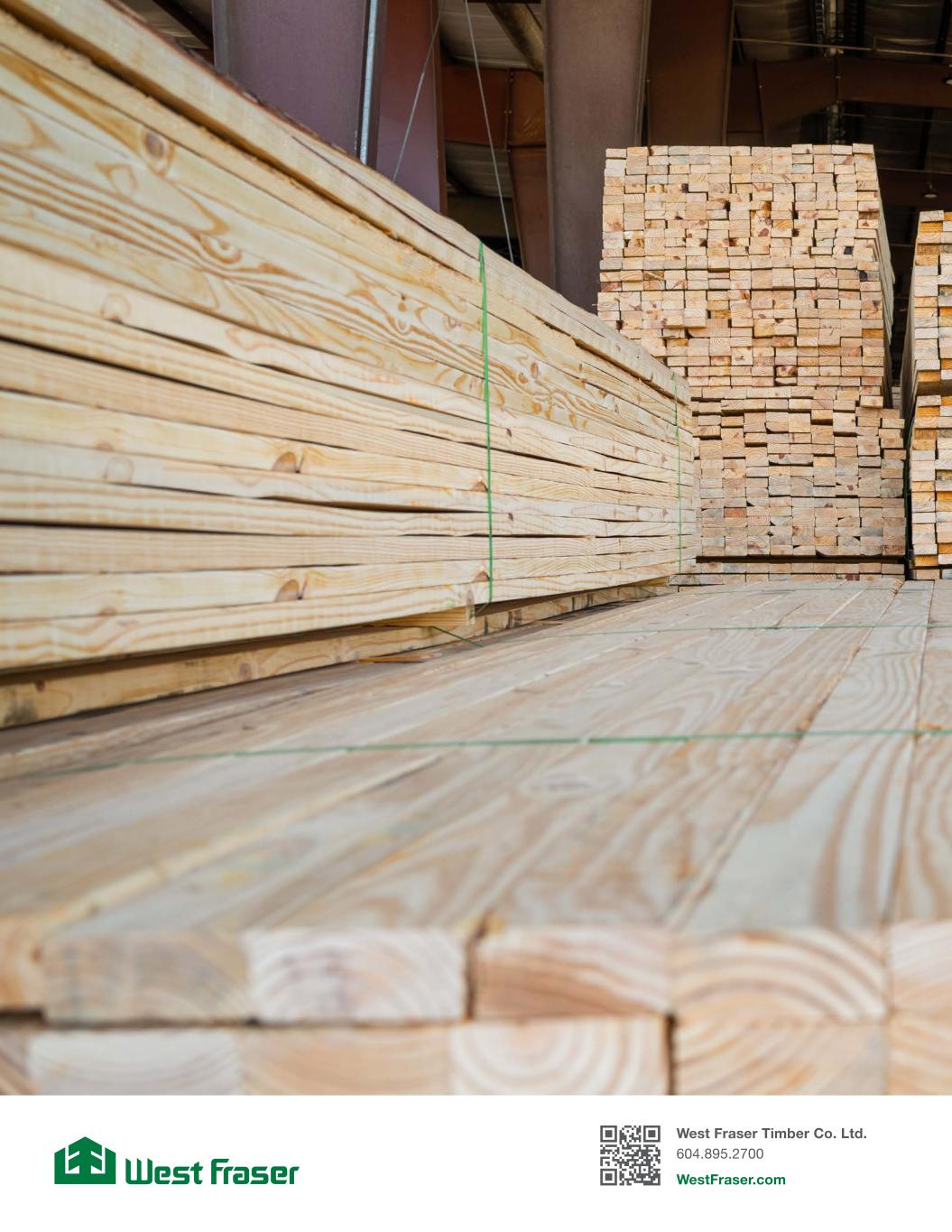
West Fraser Timber Co. Ltd. 604.895.2700 WestFraser.com