Please wait
0001403568falsePRE 14A0001403568ulta:KeciaL.SteelmanMember2025-02-022026-01-310001403568ulta:KeciaL.SteelmanMember2024-02-042025-02-010001403568ulta:Davidc.KimbellMember2024-02-042025-02-010001403568ulta:Davidc.KimbellMember2023-01-292024-02-030001403568ulta:Davidc.KimbellMember2022-01-302023-01-280001403568ulta:MaryN.DillonMember2021-01-312022-01-290001403568ulta:Davidc.KimbellMember2021-01-312022-01-29000140356832025-02-022026-01-31000140356822025-02-022026-01-31000140356812025-02-022026-01-3100014035682024-02-042025-02-0100014035682023-01-292024-02-0300014035682022-01-302023-01-2800014035682021-01-312022-01-290001403568ecd:YrEndFrValOfEqtyAwrdsGrntdInCvrdYrOutsdngAndUnvstdMemberecd:PeoMemberulta:KeciaL.SteelmanMember2025-02-022026-01-310001403568ecd:EqtyAwrdsAdjsMemberecd:PeoMemberulta:KeciaL.SteelmanMember2025-02-022026-01-310001403568ecd:EqtyAwrdsAdjsExclgValRprtdInSummryCompstnTblMemberecd:PeoMemberulta:KeciaL.SteelmanMember2025-02-022026-01-310001403568ecd:ChngInFrValOfOutsdngAndUnvstdEqtyAwrdsGrntdInPrrYrsMemberecd:PeoMemberulta:KeciaL.SteelmanMember2025-02-022026-01-310001403568ecd:ChngInFrValAsOfVstngDtOfPrrYrEqtyAwrdsVstdInCvrdYrMemberecd:PeoMemberulta:KeciaL.SteelmanMember2025-02-022026-01-310001403568ecd:YrEndFrValOfEqtyAwrdsGrntdInCvrdYrOutsdngAndUnvstdMemberecd:NonPeoNeoMember2025-02-022026-01-310001403568ecd:FrValAsOfPrrYrEndOfEqtyAwrdsGrntdInPrrYrsFldVstngCondsDrngCvrdYrMemberecd:NonPeoNeoMember2025-02-022026-01-310001403568ecd:EqtyAwrdsAdjsMemberecd:NonPeoNeoMember2025-02-022026-01-310001403568ecd:ChngInFrValOfOutsdngAndUnvstdEqtyAwrdsGrntdInPrrYrsMemberecd:NonPeoNeoMember2025-02-022026-01-310001403568ecd:ChngInFrValAsOfVstngDtOfPrrYrEqtyAwrdsVstdInCvrdYrMemberecd:NonPeoNeoMember2025-02-022026-01-310001403568ecd:EqtyAwrdsAdjsMember2025-02-022026-01-310001403568ecd:EqtyAwrdsAdjsExclgValRprtdInSummryCompstnTblMember2025-02-022026-01-3100014035682025-02-022026-01-31iso4217:USD

Table of Contents

UNITED STATES

SECURITIES AND EXCHANGE COMMISSION

Washington, D.C. 20549

SCHEDULE 14A INFORMATION

Proxy Statement Pursuant to Section 14(a) of the
Securities Exchange Act of 1934

(Amendment No. )

Filed by the Registrant

Filed by a Party other than the Registrant

Check the appropriate box:

Preliminary Proxy Statement

Confidential, For Use of the Commission Only (as permitted by Rule 14a-6(e)(2))

Definitive Proxy Statement

Definitive Additional Materials

Soliciting Material Under §240.14a-12

ULTA BEAUTY, INC.

(Name of Registrant as Specified In Its Charter)

Not applicable

(Name of Person(s) Filing Proxy Statement, if other than the Registrant)


Payment of Filing Fee (Check all boxes that apply):

No fee required

Fee paid previously with preliminary materials

Fee computed on table in exhibit required by Item 25(b) per Exchange Act Rules 14a6(i)(1) and 0-11

Table of Contents

PRELIMINARY PROXY STATEMENT, DATED APRIL 3, 2026, SUBJECT TO COMPLETION

Notice of Annual Meeting of Stockholders

Graphic

Graphic

When

Graphic

Where

Graphic

Who

10:00 a.m. CDT
on Tuesday,
June 9, 2026

Virtual meeting at
www.virtualshareholdermeeting.com/ULTA2026

Stockholders of
Record as of
[●], 2026

Meeting Agenda

Proposals

  ​ ​

Board
Recommendation

  ​ ​

For more
information

1

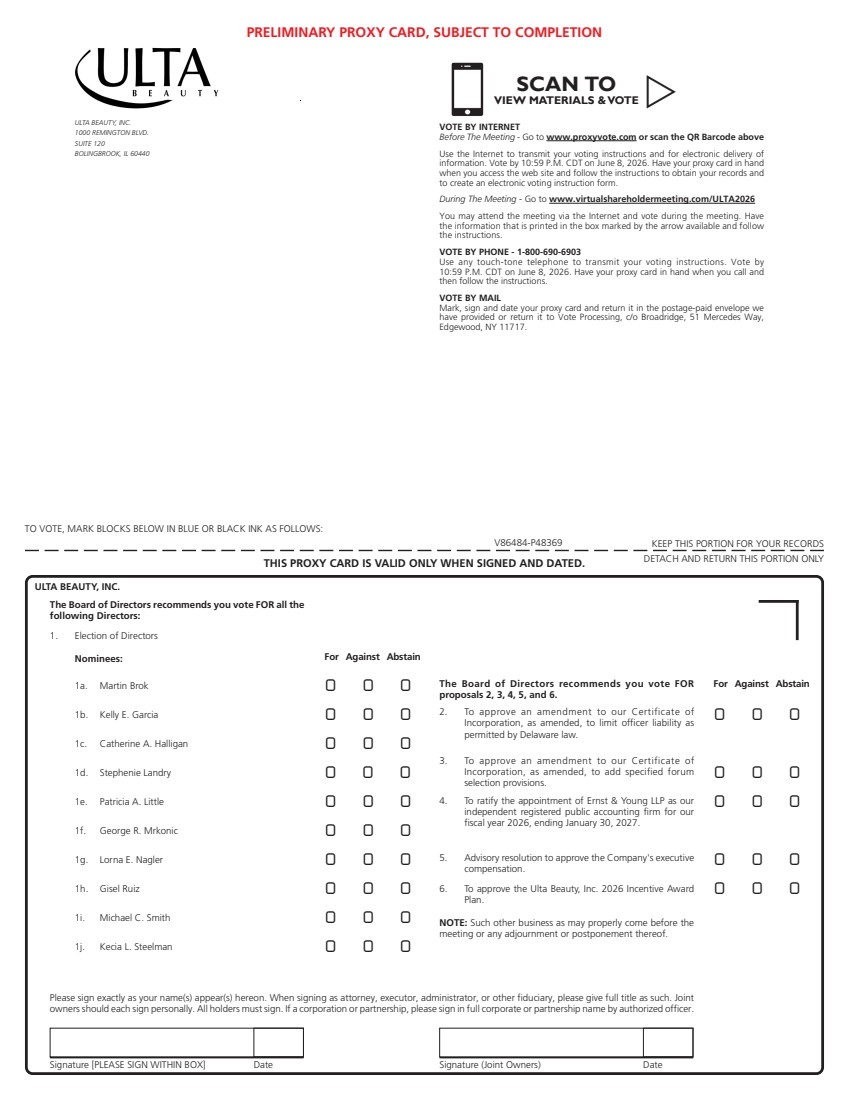
To elect each of Martin Brok, Kelly E. Garcia, Catherine A. Halligan, Stephenie Landry, Patricia A. Little, George R. Mrkonic, Lorna E. Nagler, Gisel Ruiz, Michael C. Smith, and Kecia L. Steelman as directors to hold office until the 2027 Annual Meeting of Stockholders

FOR
(all nominees)

Page 10

2

To approve an amendment to our Certificate of Incorporation, as amended, to limit officer liability as permitted by Delaware law

FOR

Page 19

3

To approve an amendment to our Certificate of Incorporation, as amended, to add specified forum selection provisions

FOR

Page 21

4

To ratify the appointment of Ernst & Young LLP as our independent registered public accounting firm for our fiscal year 2026, ending January 30, 2027

FOR

Page 24

5

To vote on an advisory resolution to approve the Company’s executive compensation

FOR

Page 56

6

To approve the Ulta Beauty, Inc. 2026 Incentive Award Plan

FOR

Page 65

We will also consider any other matters that may properly be brought before the meeting or any adjournment or postponement thereof.

Virtual Meeting

We are holding the 2026 annual meeting of stockholders online, in a virtual meeting (via live webcast) format. You will not be able to attend the meeting physically. You or your proxyholder can participate, vote, and examine our stockholder list at the meeting by visiting www.virtualshareholdermeeting.com/ULTA2026 and using the control number found on your proxy card. We believe that a virtual format provides improved communication and the opportunity for participation by a broader group of our stockholders, while reducing costs associated with planning, holding, and arranging logistics for an in-person meeting. In addition, hosting a virtual annual meeting reduces the environmental impact of our meeting.

Table of Contents

Voting

Stockholders of Ulta Beauty, Inc. as of the record date are entitled to vote, as follows:

Graphic

Graphic

Graphic

Internet

Telephone

Mail

www.proxyvote.com
for beneficial ownership

1-800-690-6903
for beneficial ownership

Mark, sign, and date your proxy card and return it in the pre-addressed postage paid envelope we have provided or return it to:

www.proxyvote.com
for registered ownership up until
10:59 pm CDT on June 8, 2026

or
1-800-690-6903
for registered ownership up until
10:59 pm CDT on June 8, 2026

For beneficial ownership:
Vote Processing
c/o Broadridge
51 Mercedes Way
Edgewood, NY 11717

For registered ownership:
Proxy Services
C/O Equiniti Trust Company, LLC
48 Wall Street, Floor 23
New York, NY 10005

Your vote is important. Whether or not you plan to attend the meeting, we encourage you to read this proxy statement and submit your proxy or voting instructions as soon as possible. For specific instructions on how to vote your shares, please refer to the instructions on the notice of internet availability of proxy materials you received in the mail. If you received paper copies of the proxy materials, kindly vote by internet or telephone by following the instructions set forth on the enclosed proxy card or mark, sign, and date the enclosed proxy card and return it promptly in the enclosed envelope (which is postage prepaid, if mailed within the United States). Even if you have submitted your proxy, you may still revoke your proxy and vote by attending the virtual meeting online. Please note, however, that if your shares are held by a broker, bank, or other nominee and you wish to vote at the meeting, you must obtain, from your broker, bank, or other nominee, the record holder, and submit a legal proxy issued in your name. For specific instructions on voting, please refer to the section “Questions and Answers — Voting Information,” beginning on page 75.

If you have any questions or need assistance voting, please contact our proxy solicitor:

Innisfree M&A Incorporated
501 Madison Avenue, 20th Floor
New York, New York 10022
Stockholders, banks, and brokers may call: (212) 750-5833

Proxy Materials

This Notice of Annual Meeting, proxy statement, and form of proxy are being distributed and made available around [], 2026.

By order of the Board of Directors.


General Counsel, Chief Risk & Compliance Officer and
Corporate Secretary

Graphic

Graphic

Rene G. Cásares
Chief Legal Officer and Corporate Secretary

Table of Contents

TABLE OF CONTENTS

CORPORATE GOVERNANCE

1

Proposal One — Election of Directors

10

Information About Our Director Nominees

11

Non-Employee Director Compensation for Fiscal 2025

17

Proposal Two — Amendment to our Certificate of Incorporation, as amended, to limit officer liability

19

Proposal Three — Amendment to our Certificate of Incorporation, as amended, to add forum selection provisions

21

Proposal Four — Ratification of Appointment of Independent Registered Public Accounting Firm

24

Fees to Independent Registered Public Accounting Firm

25

Report of the Audit Committee of the Board of Directors

26

Compensation Committee

27

Report of the Compensation Committee of the Board of Directors

29

COMPENSATION DISCUSSION AND ANALYSIS

30

CEO Pay Ratio

55

Proposal Five — Advisory Resolution on Executive Compensation

56

Pay Versus Performance

57

STOCK OWNERSHIP

62

Proposal Six — Approval of the 2026 Ulta Beauty, Inc. Incentive Award Plan

65

CERTAIN RELATIONSHIPS AND TRANSACTIONS

74

QUESTIONS AND ANSWERS ABOUT THE PROXY MATERIALS AND THE ANNUAL MEETING

75

MISCELLANEOUS

81

APPENDIX A: Proposed Amendment to our Certificate of Incorporation, as amended, to limit officer liability

A-1

APPENDIX B: Proposed Amendment to our Certificate of Incorporation, as amended, to add forum selection provisions

B-1

APPENDIX C: 2026 Ulta Beauty, Inc. Incentive Award Plan]

C-1

Important notice regarding the availability of proxy materials for the annual meeting of stockholders to be held on June 9, 2026. The proxy statement and Annual Report to Stockholders for the fiscal year ended January 31, 2026 are available at https://ulta.com/investor. Brokers cannot vote for Proposals 1, 2, 3, 5, or 6 without your instructions.

Table of Contents

Table of Contents  

We are furnishing proxy materials to our stockholders primarily via the internet. Internet distribution of our proxy materials is designed to expedite receipt by stockholders, lower the cost of the 2026 Annual Meeting of Stockholders (sometimes referred to as the “Annual Meeting”), and conserve natural resources. However, if you would prefer to receive paper copies of proxy materials, please follow the instructions included in the Notice of Internet Availability of Proxy Materials.

Table of Contents

C

orporate Governance

The Board of Directors (sometimes referred to as the “Board”) of Ulta Beauty, Inc. (“Ulta Beauty,” the “Company,” “we,” “us,” or “our”) is committed to excellence in governance. As part of this commitment and in the spirit of improving always (which is one of Ulta Beauty’s values), over the last several years the Board has enhanced our corporate governance practices, policies, structures, and functioning, taking into account ongoing corporate governance trends, peer practices, and the views and perspectives of our stakeholders. These enhancements include:

Declassifying the Board and providing for the annual election of all directors for one-year terms;
Providing that directors may be removed with or without cause by the holders of a majority of the shares then entitled to vote at an election of directors;
Replacing all supermajority voting standards for amendments to our Certificate of Incorporation with a majority standard;
Replacing all supermajority voting standards for amendments to our Bylaws with a majority standard;
Adopting a director resignation policy for uncontested director elections;
Implementing an age limit (75) for our directors to encourage board refreshment;
Updating the charters of our Board committees and other governance documents to clarify and streamline Board and committee responsibilities and reflect the latest governance best practices, including with regard to senior management evaluation, succession planning, and compensation review;
Refreshing our Board by adding six new directors in the last four years, expanding our expertise, and enhancing our diversity in multiple dimensions;
Enhancing the Company’s policy prohibiting the use of corporate funds to support political campaigns and publishing the updated policy on our website for more convenient access to stockholders and others;
Publishing our annual corporate responsibility reports since 2020 and providing expanded disclosures across our four key pillars: People, Product, Environment, and Community, including key connections to our business, in successive reports;
Proactively engaging with stockholders representing over 60% of our outstanding shares to seek feedback on our governance practices relating to Board composition, compensation metrics, and corporate responsibility reporting and related disclosures; and
Establishing an artificial intelligence (“AI”) advisory group of the Board to provide oversight and advice relating to the Company’s AI strategies, opportunities, and risks.

Graphic

1

Table of Contents

Corporate Governance  

GOVERNANCE AT A GLANCE

The Board recognizes that strong corporate governance contributes to long-term stockholder value and is committed to sound governance practices, including the following:

INDEPENDENCE

All of our director nominees, except our President and CEO, are independent
Our non-executive Board Chair ensures strong Board independence and management accountability
All standing Board committees are composed entirely of independent directors
Independent directors meet regularly in executive session without management present

BEST PRACTICES

Directors may not stand for re-election after their 75th birthdays absent Board approval
Directors may not serve on more than three other public company boards, and the Company’s CEO may not serve on more than one other public company board
Members of the Audit Committee may not serve on the audit committees of more than two other public companies
Directors and executives are subject to stock ownership requirements
Directors and executives are prohibited from hedging or pledging their Company stock

ACCOUNTABILITY

All of our directors are elected annually
In uncontested elections, directors are elected by majority vote
The Board and each standing Board committee conducts an annual performance self-evaluation
Stockholders have the ability to include nominees in our proxy statement (so-called “proxy access” rights)

RISK OVERSIGHT

The Board oversees the Company’s overall risk management structure
Individual Board committees oversee certain risks related to their specific areas of responsibility
The Company maintains a robust enterprise risk management program

Board Leadership Structure

The Company’s Corporate Governance Guidelines provide that the offices of the Chief Executive Officer (“CEO”) and the Chair of the Board (“Chair”) may be either combined or separated at the discretion of the Board. We currently separate the roles of CEO and Chair, and our Board is led by an independent, non-executive Chair. We believe separating the roles of CEO and Chair enhances the accountability of the CEO to the Board, strengthens the Board’s independence from management, and ensures a greater role for the independent directors in their oversight of the Company. In addition, it allows our CEO to focus her efforts on running our business and managing the Company in the best interests of our stockholders, while the Chair provides guidance to the CEO and, in consultation with management, helps to set the agenda for Board meetings and establish priorities and procedures for the work of the Board. The Chair presides over meetings of the Board as well as executive sessions (without management), which the Board generally holds at each regularly scheduled Board meeting.

Our Corporate Governance Guidelines also provide that a majority of the independent directors will select a lead independent director when the Chair does not qualify as an independent director. In the event that a lead independent director is designated, his or her duties would include: assisting the Chair and the Board in assuring compliance with and implementation of the Company’s Corporate Governance Guidelines; coordinating agendas for and moderating sessions of the Board’s non-management directors; and facilitating communications between the non-management directors and the other members of the Board and the Company’s management.

The Board believes that the current Board leadership structure with separate CEO and Chair roles is in the best interests of the Company and its stockholders at this time. The Board recognizes that no single leadership model is

2

Graphic

Table of Contents

  ​Corporate Governance

right for all companies and at all times and that, depending on the circumstances, other leadership models, such as combining the Chair and CEO roles, may be appropriate at certain times. Accordingly, the Board periodically reviews its leadership structure. Our Corporate Governance Guidelines provide the flexibility for the Board to modify or continue its leadership structure in the future, as it deems appropriate.

Independence

Board member independence is an essential element of Ulta Beauty’s corporate governance. The Board has determined that each current non-employee director is free of any relationship that would interfere with his or her ability to exercise independent judgment with regard to Ulta Beauty. Each member of, and nominee for, the Board is independent, other than our CEO. Each member of the Audit, Compensation, and Nominating & Corporate Governance Committees of the Board satisfies the independence requirements of the NASDAQ Stock Market LLC (“NASDAQ”) and the Securities and Exchange Commission (the “SEC”).

Board of Directors Meetings and Committees

During the fiscal year ended January 31, 2026 (“fiscal 2025”), the Board held seven meetings. The Board has established and delegated certain of its authority to three committees: the Audit Committee, the Compensation Committee, and the Nominating & Corporate Governance Committee. During fiscal 2025, no incumbent director attended less than 75% of the aggregate meetings of the Board and of the committees on which they served that were held during the period for which they were a director or committee member, respectively. Directors are invited and expected to attend the Annual Meeting, and all our directors then in office attended our 2025 Annual Meeting of Stockholders with the exception of Michael R. MacDonald, who was not standing for reelection at the meeting.

The following table provides the composition of each of our committees as of [], 2026:

Director

  ​

  ​

Audit
Committee

  ​

  ​

Compensation
Committee

  ​

  ​

Nominating &
Corporate Governance
Committee

Lorna E. Nagler*

Martin Brok

Graphic

Graphic

Michelle L. Collins

Graphic

Kelly E. Garcia

Graphic

Graphic

Catherine A. Halligan

Graphic

Graphic

Stephenie Landry

Graphic

Graphic

Patricia A. Little

Graphic

George R. Mrkonic

Graphic

Graphic

Heidi G. Petz

Graphic

Gisel Ruiz

Graphic

Michael C. Smith

Graphic

Graphic

Kecia L. Steelman, CEO

Graphic Committee Chair

Graphic Member

* Non-Executive Board Chair

Each of our Board committees has adopted a charter that has been approved by the Board, is reviewed regularly, and complies with current NASDAQ rules relating to corporate governance matters. Copies of the committee charters are available under “Governance” in the Investor Relations section of the Ulta Beauty website at https://ulta.com/investor. Each committee is composed solely of independent directors and regularly reports on its activities to the full Board.

Graphic

3

Table of Contents

Corporate Governance  

Audit Committee

Meetings in FY25: 10

Members:

Responsibilities and Qualifications:

Patricia A. Little (chair)

Martin Brok

Kelly E. Garcia

Stephenie Landry

Heidi G. Petz

Michael C. Smith

Assisting the Board in monitoring the integrity of our financial statements and compliance with legal and regulatory requirements
Overseeing the independent registered public accounting firm’s qualifications, independence, and performance, with direct responsibility for the appointment, compensation, retention (including termination), and oversight of the independent registered public accounting firm
Overseeing the performance of our internal audit function, including maintaining a direct reporting line with the Company’s head of internal audit
Overseeing the enterprise risk assessment and management program, including data privacy, cybersecurity, AI, and technology risks
Pre-approving all audit and allowable non-audit services by the independent registered public accounting firm
Overseeing the Company’s compliance program, including monitoring compliance with the Code of Business Conduct and related policies and providing oversight of the Company’s whistleblower reporting program

All members have been determined to be independent and financially literate under current NASDAQ listing standards, including those standards applicable specifically to audit committee members.

The Board has determined that Ms. Little and Mr. Smith are “audit committee financial experts” as defined by the SEC based a qualitative assessment of each member’s level of knowledge and experience.

Compensation Committee

Meetings in FY25: 7

Members:

Responsibilities:

Gisel Ruiz (chair)

Martin Brok

Michelle L. Collins

Catherine A. Halligan

Stephenie Landry

George R. Mrkonic

Overseeing and approving the Company’s compensation philosophy
Reviewing and approving the compensation of the CEO and each of the Company’s other “executive officers” as defined by Rule 3b-7 under the Securities Exchange Act of 1934, as amended (the “Exchange Act”), and “officers” as defined by Rule 16a-1(f) under the Exchange Act (collectively, the “Covered Officers”)
Reviewing and recommending to the Board the compensation of non-employee directors
Overseeing, establishing, and reviewing compensation policies for all associates, including reviewing compensation structures, policies, and procedures
Establishing, amending, and terminating compensation and benefits plans and administering such plans, including the Company’s executive compensation clawback policy
Periodically reviewing and discussing with management the Company’s human capital management strategies and policies
Overseeing and reviewing succession plans for Covered Officers

4

Graphic

Table of Contents

  ​Corporate Governance

Nominating & corporate governance Committee

Meetings in FY25: 7

Members:

Responsibilities:

George R. Mrkonic (chair)

Kelly E. Garcia

Catherine A. Halligan

Michael C. Smith

Identifying and evaluating qualified candidates to become Board members
Selecting candidates for recommendation to the Board as nominees for election as directors at annual meetings of stockholders (or special meetings of stockholders at which directors are to be elected)
Selecting candidates for recommendation to the Board to fill any vacancies on the Board
Reviewing the performance and independence of each director, and in appropriate circumstances, recommending the removal of a director
Overseeing and reviewing the composition of the committees of the Board, making recommendations to the Board regarding the selection of the members and chairs of the committees, and considering related Board succession planning matters
Overseeing the implementation of and monitoring compliance with Ulta Beauty’s Political Activity Policy
Overseeing and periodically reviewing the Company’s strategies, policies, practices, goals, and programs relating to corporate responsibility and sustainability, including through the Company’s annual Corporate Responsibility Report, except where delegated to other Board committees
Reviewing director and officer indemnification matters, overseeing director orientation and continuing education, and overseeing the Company’s engagement with external stakeholders as it pertains to governance and related matters
Overseeing Board, committee, and director evaluations
Periodically reviewing the Company’s Corporate Governance Guidelines and other governance policies

AI Advisory Group

To assist the Board and its committees in their supervision of the Company’s strategy, opportunities, and risks relating to AI, the Board in February 2026 established an informal AI advisory group composed of directors. The group’s role is strictly advisory in nature, with all matters of formal oversight, approval, and policy adoption remaining with the Board and its committees. The group’s primary activities consist of meeting from time to time with Company management and external experts to (i) survey AI developments, (ii) assess and advise on potential strategic opportunities and risk controls, and (iii) prepare non-binding recommendations and briefing materials for the Board and/or its committees to support their oversight duties with respect to AI. Mr. Garcia, Ms. Halligan, Ms. Landry, and Mr. Smith are the initial members of the group, with Mr. Garcia having been selected as its leader. No directors receive additional compensation for their participation in the group.

Graphic

5

Table of Contents

Corporate Governance  

Board Role in Risk Oversight

Our Board oversees an enterprise-wide approach to risk management, designed to support the achievement of organizational objectives, including strategic objectives, improve long-term organizational performance, and enhance stockholder value. Management is responsible for the Company’s day-to-day risk management activities and processes, and our Board’s role is to engage in informed oversight of, and provide guidance with respect to, such risk management activities and processes. The Board recognizes that a fundamental part of risk management is not only understanding the risks the Company faces and the steps management is taking to manage those risks, but also understanding what level of risk is appropriate for the Company. As such, the Board focuses on understanding the nature of our enterprise risks, including operational, financial, legal and regulatory, technology (including AI), cybersecurity, strategic, competitive, and reputational risks, as well as climate related and environmental risks. The Board also focuses on understanding the adequacy of our risk assessment and risk management processes. To facilitate this understanding, the Board and its committees receive regular management and advisory committee updates on our business operations, financial results, and strategy, and the Board discusses and provides guidance with respect to risks related to those topics.

While the Board has the ultimate oversight responsibility for the risk management process, each Board committee also has responsibility for overseeing certain risks within the scope of such committee’s remit.

The Audit Committee oversees risks associated with financial accounting and audits, internal control over financial reporting, as well as data privacy, cybersecurity, AI, and other technology risks. The Audit Committee also oversees the implementation of the Company’s Code of Business Conduct and monitors compliance therewith. In addition to its oversight of these and other substantive risks, the Audit Committee also oversees the Company’s enterprise risk management program, through which it assists the Board in its risk oversight function by discussing with management the Company’s risk assessment and management policies, major and emerging risk exposures, including significant financial risk exposures, and the actions taken by management to limit, monitor, and/or mitigate such exposures.

The Compensation Committee oversees risks relating to the Company’s compensation policies and practices. In setting compensation, the Compensation Committee strives to create incentives that encourage a level of risk-taking behavior consistent with the Company’s risk appetite and business strategy. The Compensation Committee oversees risks relating to the Company’s development and implementation of human capital development plans and succession planning practices to ensure that the Company has sufficient management depth to support its continued growth and the executive talent needed to execute long-term strategies. In addition, the Compensation Committee is responsible for reviewing with management the Company’s policies, practices, and strategies relating to human capital management as they relate to the Company’s workforce generally, including policies and strategies regarding recruiting, selection, talent development, progression and retention, succession planning, workplace health and safety, and culture, including engagement, inclusion, and belonging.

The Nominating & Corporate Governance Committee oversees risks relating to the Company’s governance structures and practices, including ensuring that the Board membership maintains an appropriate mix of skills, experiences, and capabilities to appropriately exercise its responsibilities. In furtherance of these responsibilities, the Nominating & Corporate Governance Committee oversees implementation of the Company’s Corporate Governance Guidelines, the Board evaluation process, and the process for recommending candidates to the Board for nomination as directors and membership on Board committees. The Nominating & Corporate Governance Committee also monitors compliance with the Company’s policy prohibiting use of corporate funds to support political campaigns and oversees the Company’s engagement with stockholders, proxy advisory firms, and other stakeholders concerning governance and related matters.

Director Age Limit

Our Corporate Governance Guidelines provide that any director who reaches the age of 75 years will not be eligible to stand for election at the next annual meeting unless the Nominating & Corporate Governance Committee, after evaluation of the continued appropriateness of Board membership in light of all relevant circumstances, decides to recommend to the Board that an exception be made and the Board approves such exception.

6

Graphic

Table of Contents

  ​Corporate Governance

MAJORITY VOTE STANDARD FOR ELECTION OF DIRECTORS AND DIRECTOR RESIGNATION POLICY

Our Bylaws require that, in an uncontested election, each director be elected by a majority of the votes cast by the shares present virtually or represented by proxy and entitled to vote at in such election, such that the number of shares voted “for” a director nominee must exceed the number of shares voted “against” that nominee. A plurality voting standard is applicable to any contested election of directors. A “contested election of directors” is one in which the number of nominees for director is greater than the number of directors to be elected.

Our Corporate Governance Guidelines require that, following any election of directors other than a contested election, any incumbent director who was a nominee and who did not receive a majority of the votes cast by the shares present virtually or represented by proxy and entitled to vote at the meeting must promptly tender his or her resignation to the Board.

Our Corporate Governance Guidelines further provide that a recommendation on whether or not to accept such a resignation will then be made by the Nominating & Corporate Governance Committee or, if each member of the Nominating & Corporate Governance Committee did not receive the required majority vote or the Nominating & Corporate Governance Committee is otherwise unable to act, a majority of the Board will appoint a special committee of independent directors for the purpose of making a recommendation to the Board (the committee with authority to act is referred to as the “Nominating Committee”). If no independent directors receive the required majority vote, our Corporate Governance Guidelines require that the Board act on the resignations. Within 60 days following certification of the stockholder vote, the Nominating Committee will recommend to the Board the action to be taken. Any director who tenders his or her resignation will not participate in the Nominating Committee recommendation or Board action regarding whether to accept the resignation. The Board will determine whether to accept the resignation within 90 days following certification of the stockholder vote in accordance with the procedures and factors set forth in our Corporate Governance Guidelines.

Nomination Process — Qualifications

Pursuant to its charter, the Nominating & Corporate Governance Committee annually evaluates the composition of the Board to assess whether the skills, experiences, characteristics, and other criteria for Board membership approved by the Board and set forth in the Corporate Governance Guidelines are currently represented on the Board as a whole and in individual directors and considers these factors when evaluating director candidates.

What We Do:

We review the skills and experiences of the Board members

The Nominating & Corporate Governance Committee is responsible for reviewing the appropriate skills and experiences in the context of prevailing business conditions and the unique needs of Ulta Beauty and, in its nominating committee capacity, for making recommendations regarding the size, composition, and desired complementary skill sets of the Board.

Graphic

Graphic

7

Table of Contents

Corporate Governance  

We search for appropriate candidates based on recommendations

We consider potential director candidates recommended by current directors, officers, associates (i.e., employees), and others. We also consider any stockholder recommendations for candidates for the Board. Stockholders who want to suggest a candidate for consideration should send a written notice addressed to the Corporate Secretary. We have periodically engaged search firms to help provide us with candidates, especially when we are looking for a candidate with a particular expertise, quality, skill, or background.

Graphic

We interview candidates and deliberate

The Nominating & Corporate Governance Committee screens all potential candidates in the same manner, regardless of the source of the recommendation. The review is typically based on any written materials provided with respect to potential candidates as well as appropriate due diligence, and the committee reviews such materials to determine the qualifications, experiences, and background of the candidates. Final candidates are typically interviewed by members of the committee and other members of the Board, as appropriate. After review of and deliberation regarding all feedback and data, the committee makes a recommendation to the full Board regarding who should be nominated by the Board.

Key Objectives and Considerations:

The objective of the Nominating & Corporate Governance Committee is to create and sustain a Board that brings to Ulta Beauty a variety of perspectives and skills derived from high-quality business and professional experience and that has the appropriate skills and experience to oversee execution of our strategic plans. Both the Board and the Nominating & Corporate Governance Committee believe that it is essential for Board members to represent diverse viewpoints, backgrounds, experiences, expertise, and skill sets, including diversity of age, gender, nationality, race, ethnicity, and sexual orientation, as well as differences in professional experience, education, skill, and other individual qualities and attributes that contribute to an active, effective Board.

We value our stockholders’ input and encourage them to nominate candidates. To submit a candidate, please follow the process outlined under the “Nomination of Directors” header in the Questions and Answers section of this proxy statement.

The Nominating & Corporate Governance Committee evaluates each individual in the context of our Board as a whole with the objective of assembling a group that can best perpetuate the success of our Company and represent stockholder interests through the exercise of sound judgment. The Nominating & Corporate Governance Committee recommends those candidates who possess the highest personal and professional integrity, have prior experience in corporate management and relevant industries, maintain academic or operational expertise in an area of our business, and demonstrate practical and mature business judgment. All Board membership nominations and recommendations are based upon the merit of the individual being evaluated or nominated.

Our Board has also adopted proxy access for director nominees. Proxy access means that any stockholder or group of up to 20 stockholders owning 3% or more of our common stock continuously for at least three years may nominate and include in our proxy materials director nominees totaling up to the greater of two directors or 20% of the Board. For more information about proxy access, see the “Nomination of Directors” header in the Questions and Answers section of this proxy statement.

Insider Trading Policy

The Board has adopted an Insider Trading Policy that governs the purchase, sale, and other acquisition or disposition of our stock by our directors, officers, and associates. This policy is designed to promote compliance with

8

Graphic

Table of Contents

  ​Corporate Governance

insider trading laws, related SEC rules and regulations, and NASDAQ listing standards. In addition, it is our policy that the Company will not trade in its stock when it is aware of material nonpublic information.

Code of Business Conduct

All Ulta Beauty associates, officers, and Board members must always act ethically and in accordance with the Ulta Beauty Code of Business Conduct (the “Code”). All corporate associates, officers, and Board members have signed a certificate acknowledging that they have read, understand, and will continue to comply with the Code, and all corporate associates and officers are required to read and acknowledge the Code on an annual basis. Ulta Beauty includes the Code in new hire materials for all corporate associates. The Code is published under “Governance” in the Investor Relations section of the Ulta Beauty website located at https://ulta.com/investor.

Corporate Governance Guidelines

Our Board adopted the Corporate Governance Guidelines to assist the Board in the exercise of its responsibilities. The Corporate Governance Guidelines are published under “Governance” in the Investor Relations section of the Ulta Beauty website located at https://ulta.com/investor.

Director Ownership Guidelines

Our Board has adopted share ownership guidelines requiring each non-employee director to hold shares of our common stock or restricted stock units with a value equal to at least five times the annual cash retainer paid to non-employee directors by the fifth anniversary of the date that such director joins the Board. As of January 31, 2026, each non-employee director serving for at least five years met or exceeded the ownership guideline.

Stockholder Outreach

We believe that effective corporate governance includes ongoing dialogue between the Company and our stockholders. Throughout the year, members of Company management engage with stockholders on a regular basis to discuss matters such as the Company’s performance, outlook, and strategic initiatives. In addition, in the period leading up to our annual meeting of stockholders, we may engage with stockholders regarding the proposals that are presented in our proxy statement.

In fiscal 2025, we established a cross-functional stockholder engagement team that included our Chief Legal Officer, Senior Vice President of Investor Relations, and other members of our investor relations, legal, and compensation teams to conduct additional stockholder engagement outside of our regular quarterly and proxy season engagements. The objective of this program is to establish and maintain annual engagement (typically during the fall of each year) with our stockholders to gather their feedback and perspectives regarding our Board’s composition and refreshment, its oversight of key areas including company strategy, growth, and risk management, sustainability-related considerations, Board and other corporate governance matters, and executive compensation, as well as to identify opportunities for potential improvement in these areas. In fiscal 2025, the Company discussed these and other matters with stockholders representing over 60% of the Company’s outstanding shares. Feedback from these discussions is communicated to the Board and its committees for review and consideration and helps guide our governance, compensation, and corporate responsibility practices.

Stockholder Communication

We welcome communication from our stockholders. Any stockholder can communicate in writing with the Board on matters pertaining to Ulta Beauty by addressing their comments to the Board of Directors, c/o Corporate Secretary, Ulta Beauty, Inc., 1000 Remington Blvd., Suite 120, Bolingbrook, IL 60440, or by e-mail at InvestorRelations@ulta.com. Our Corporate Secretary will review all correspondence addressed to our Board or any individual director and will forward appropriate stockholder communications to the Board prior to its next regularly scheduled meeting following the receipt of such communication. Our Corporate Secretary will also forward any stockholder correspondence that is more suitably directed to management to the appropriate member(s) of the management team. In addition, upon request of the Board, our Corporate Secretary will summarize all correspondence not forwarded to the Board and make such correspondence available to the Board for its review.

Graphic

9

Table of Contents

Corporate Governance  

PROPOSAL ONE: ELECTION OF DIRECTORS

What are you voting on?

You are being asked to elect each of Martin Brok, Kelly E. Garcia, Catherine A. Halligan, Stephenie Landry, Patricia A. Little, George R. Mrkonic, Lorna E. Nagler, Gisel Ruiz, Michael C. Smith, and Kecia L. Steelman, as directors to hold office until the 2027 Annual Meeting of Stockholders.

The Board is currently composed of twelve members, eleven of whom are non-employee, independent directors. Each director is elected to the Board to serve a term that expires at the next Annual Meeting of Stockholders or until a successor is duly elected and qualified or until his or her resignation, removal, or death. Michelle L. Collins, a director since 2014, and Heidi G. Petz, a director since 2022, have opted to retire from the Board as of the date of the Annual Meeting and will not be standing for re-election. The Board will accordingly reduce its size from twelve to ten directors effective immediately following the Annual Meeting. We thank Ms. Collins and Ms. Petz for their service on the Board.

Vacancies on our Board may be filled by persons elected by a majority of the remaining directors. A director elected by the Board to fill a vacancy, including a vacancy created by an increase in size of the Board, will serve for the remainder of the annual term and until that director’s successor is elected.

THE BOARD OF DIRECTORS RECOMMENDS A VOTE “FOR” EACH DIRECTOR NOMINEE

The affirmative vote of the holders of a majority of the votes cast by the shares present virtually or represented by proxy and entitled to vote at the Annual Meeting will be required to approve the nominees for election, assuming the election is uncontested (a plurality voting standard applies in contested elections). For this purpose, a majority of the votes cast means that the number of shares voted “for” a director’s election must exceed the number of shares voted “against” that director’s election. Abstentions and broker non-votes will be counted towards a quorum but will not be counted for any purpose in determining whether the nominees have been elected. For additional information on our majority voting in uncontested elections of directors policy and our policy on incumbent director resignation in an uncontested election, please see “Corporate Governance — Majority Vote Standard for Election of Directors and Director Resignation Policy” above.

Summary of Qualifications and Experience of Director Nominees

The following table highlights the most relevant areas of specific skills, qualifications, attributes, and professional experiences that the Board considered for each director nominee. In addition to executive leadership, which all our directors possess, a particular director may possess additional experiences, qualifications, attributes, or skills, even if not expressly indicated as one of the most relevant below.

Director Skills Matrix

  ​

CEO Experience

  ​

  ​

Governance

  ​

  ​

Finance

  ​

  ​

Retail

  ​

  ​

E-commerce &
Digital/Technology

  ​

  ​

Distribution

  ​

  ​

Marketing

  ​

  ​

Strategy

  ​

Operations

  ​

Cybersecurity/
Privacy  

International

  ​

Lorna E. Nagler

Graphic

Graphic

Graphic

Graphic

Graphic

Graphic

Graphic

Martin Brok

Graphic

Graphic

Graphic

Graphic

Graphic

Graphic

Graphic

Graphic

Graphic

Kelly E. Garcia

Graphic

Graphic

Graphic

Graphic

Graphic

Graphic

Graphic

Catherine A. Halligan

Graphic

Graphic

Graphic

Graphic

Graphic

Graphic

Graphic

Stephenie Landry

Graphic

Graphic

Graphic

Graphic

Graphic

Graphic

Graphic

Graphic

Patricia A. Little

Graphic

Graphic

Graphic

Graphic

Graphic

Graphic

George R. Mrkonic

Graphic

Graphic

Graphic

Graphic

Graphic

Graphic

Graphic

Graphic

Graphic

Graphic

Graphic

Gisel Ruiz

Graphic

Graphic

Graphic

Graphic

Michael C. Smith

Graphic

Graphic

Graphic

Graphic

Graphic

Kecia L. Steelman

Graphic

Graphic

Graphic

Graphic

Graphic

Graphic

Graphic  ​ ​ ​Top-3 Skill or Experience

Graphic  ​ ​Other Key Skill or Experience

10

Graphic

Table of Contents

  ​Corporate Governance

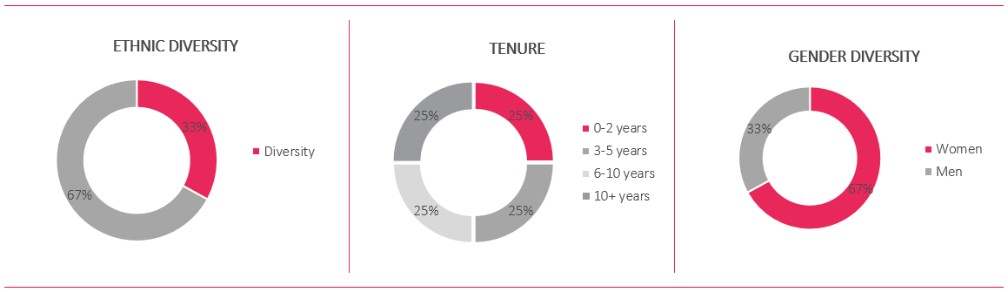
The below table provides background information regarding our Board, including with respect to tenure and ethnic and gender diversity, as of January 31, 2026.

Board member demographics

Graphic

INFORMATION ABOUT OUR DIRECTOR NOMINEES

What are you voting on?

You are being asked to elect each of Martin Brok, Kelly E. Garcia, Catherine A. Halligan, Stephenie Landry, Patricia A. Little, George R. Mrkonic, Lorna E. Nagler, Gisel Ruiz, Michael C. Smith, and Kecia L. Steelman as directors to hold office until our 2027 Annual Meeting of Stockholders and until their successors are elected and qualified or until their resignation, removal, or death.

THE BOARD OF DIRECTORS RECOMMENDS A VOTE IN FAVOR OF EACH NAMED NOMINEE

Graphic

11

Table of Contents

Corporate Governance  

Nominees For Election:

Martin Brok

  ​ ​ ​

Kelly E. Garcia

INDEPENDENT DIRECTOR

COMMITTEES

ñ

Audit

ñ

Compensation

Director Since: 2025

Age: 59

Graphic

INDEPENDENT DIRECTOR

COMMITTEES

ñ

Audit

ñ Nominating & Corporate Governance

Director Since: 2022

Age: 51

Graphic

DIRECTOR QUALIFICATIONS

Mr. Brok brings to the Board deep experience in the areas of retailing, merchandising, and brand strategy gained over more than 35 years of leadership in consumer-facing businesses. The breadth of his global experience, his strategic and financial acumen, and his track record of leading omnichannel innovation and integration position him well to contribute to the Board’s oversight of the Company’s strategic initiatives.

KEY SKILLS AND EXPERTISE

ñ

Strategy: Demonstrated keen strategic mindset throughout career, driving disruptive innovation, leading significant business transformations, and unlocking international and digital growth.

ñ

Retail: Developed significant expertise in digital commerce and consumer analytics in roles at global retailers. Skilled at building and scaling brands. Led initiatives at Sephora to rebuild internal technology infrastructure, enhance digital and personalization capabilities, and focus on seamless customer experiences.

ñ

International: Gained from his leadership of business units across Europe, the Middle East, Africa, and North America as well as board service on companies in diverse industries in the U.S. and Europe.

CAREER HIGHLIGHTS

MB CAPITAL ADVISORS – global investment and advisory services firm

ñ

Founder and CEO (since 2022)

ADVENT INTERNATIONAL – global private equity firm

ñ

Operating Partner (since 2022)

SEPHORA SA – global omnichannel prestige beauty retailer

ñ

CEO and President (2020-2022)

STARBUCKS CORPORATION (NASDAQ: SBUX) – multinational roaster, marketer, and retailer of specialty coffee products

ñ

President, Europe, Middle East, and Africa (2016-2020)

ñ

SVP, Strategic Partnerships (2016)

Previous consumer products experience with NIKE, INC. (NYSE: NKE), BURGER KING CORPORATION, and THE COCA-COLA CORPORATION (NYSE: KO).

OTHER PUBLIC BOARD DIRECTORSHIPS

ñ

Oatly Group AB (NASDAQ: OTLY) (since 2023)

EDUCATION

ñ

B.B.A., Georgia State University, Marketing

ñ

P.M.D., Harvard Business School

DIRECTOR QUALIFICATIONS

Mr. Garcia contributes to the Board his industry-leading expertise developing and implementing strategic technology initiatives to support and improve business operations, with a proven track record of revolutionizing online consumer experience with global reach. His qualifications include over 25 years of professional technology and leadership experience, including roles with responsibility for digital innovation, development of global commercial software products, e-commerce analytics, and customer loyalty, cybersecurity, and data privacy.

KEY SKILLS AND EXPERTISE

ñ

E-commerce & Digital/Technology: Acquired while serving in a number of senior leadership roles, including as Chief Technology Officer at Domino’s, where he transformed the online customer experience and continues to earn industry recognition for adopting leading technological innovation tools that elevate the customer experience, including the development of multiple global software platforms integral to Domino’s e-commerce strategy with the integration of mobile ordering and GPS capabilities.

ñ

Cybersecurity/Privacy: Developed through his experience leading multifunctional teams responsible for building out Domino’s suite of global software platforms and integrations with other service and hardware providers, with special focus on the adoption of cybersecurity and data privacy protocols to ensure the protection of enterprise platforms and consumer information.

ñ

International: Obtained through executive leadership roles where he was responsible for scaling technology platforms to support Domino’s international operations and various leadership roles overseeing global business and strategic marketing intelligence for international stakeholders at prior employers.

CAREER HIGHLIGHTS

DOMINO’S PIZZA, INC. (NYSE: DPZ) – multinational pizza restaurant chain

ñ

Chief Technology Officer (since 2020)

ñ

SVP, eCommerce Development and Emerging Technologies (2016–2020)

ñ

VP, eCommerce Development (2012–2016)

Previous information technology and analytics experience with R.L. POLK & COMPANY (acquired by IHS Inc. in 2013).

EDUCATION

ñ

B.S., The Ohio State University, Computer Science Engineering

12

Graphic

Table of Contents

  ​Corporate Governance

Catherine A. Halligan

  ​ ​

Stephenie Landry

INDEPENDENT DIRECTOR

COMMITTEES

ñ

Compensation

ñ

Nominating & Corporate Governance

Director Since: 2012

Age: 63

Graphic

INDEPENDENT DIRECTOR

COMMITTEES

ñ

Audit

ñ

Compensation

Director Since: 2025

Age: 48

Graphic

DIRECTOR QUALIFICATIONS

Ms. Halligan contributes to the Board over 20 years of experience in digital transformation, disruptive technology, marketing, omnichannel business capabilities, and e-commerce in the retail and software-as-a-service (“SaaS”) industries. She has a proven track record of developing high growth online platforms and strategic brand and marketing strategies to drive exceptional customer experience and contributes to the Board her extensive public company board expertise.

KEY SKILLS AND EXPERTISE

ñ

E-Commerce & Digital/Technology: Developed from her experiences leading e-commerce and digital sales growth and transformation and technological disruption strategies for prominent retailers, including Walmart.com, Williams-Sonoma, and Blue Nile, in addition to her leadership and strategic advisory experience with SaaS companies.

ñ

Retail: Obtained through multiple executive leadership and public board roles across domestic and international retailers with store and digital operations.

ñ

Strategy: Gained from her extensive experience in marketing and e-commerce leadership roles and her tenure as an associate partner at a management consulting firm advising multinational corporations on growth, transformation, branding, and marketing.

CAREER HIGHLIGHTS

POWERREVIEWS INC. (acquired by 1WorldSync in 2023) – leading social commerce network

ñ

SVP, Sales and Marketing (2010–2012)

WALMART INC. (NYSE: WMT) – multinational retail corporation operating general merchandise and grocery stores

ñ VP Market Development, Global eCommerce, Walmart Inc. (2009–2010)

ñ

Chief Marketing Officer, Walmart.com (2007–2009)

ñ

VP, Product Management and Multi-Channel Integration (2006–2007)

ñ

Strategic Advisor, Walmart.com (2005-2006)

Previous retail experience with BLUE NILE, WILLIAMS-SONOMA, and GYMBOREE.

OTHER PUBLIC BOARD DIRECTORSHIPS

ñ

JELD-WEN Holding, Inc. (NYSE: JELD) (since 2022)

ñ

Driven Brands Holdings Inc. (NASDAQ: DRVN) (since 2020)

ñ

Ferguson Plc (NYSE: FERG) (since 2019)

EDUCATION

ñ

B.S., Northern Illinois University, Finance

DIRECTOR QUALIFICATIONS

Ms. Landry brings to the Board over 20 years of leadership in consumer technology, retail operations, and strategic transformation. Her deep experience leading complex global operations, driving product innovations, and leading strategic initiatives that helped to transform grocery shopping and logistics enables her to contribute invaluable insights to Board discussions. In addition to her operational and digital innovation expertise, Ms. Landry contributes sustainability leadership gained from her experience leading Amazon’s net-zero initiative as its Vice President of Sustainability.

KEY SKILLS AND EXPERTISE

ñ

E-Commerce & Digital/Technology: Developed through extensive experience blending cutting-edge technology with a disciplined operational approach to create disruptive products and services.

ñ

Operations: Proven track record of scaling global operations and delivering consistent business growth and profitability improvement, including through her leadership of Amazon’s grocery business during the COVID-19 pandemic.

ñ

Strategy: Significant experience driving large-scale changes and fostering innovation within complex organizations, including through conceptualizing and launching Amazon’s Prime Now delivery service in only 111 days.

CAREER HIGHLIGHTS

HONOR TECHNOLOGY – eldercare services company

ñ

Chief Operating Officer (2024-2025)

AMAZON.COM INC. (NASDAQ: AMZN) – global e-commerce, cloud computing, and technology leader

ñ

Vice President, Sustainability (2023-2024)

ñ

Vice President, Worldwide Grocery (2020-2023)

ñ

Vice President, Amazon Fresh & Whole Foods Online (2017-2020)

ñ

Vice President, Prime Now (2014-2017)

EDUCATION

ñ

B.A., Wellesley College

ñ

M.B.A., University of Michigan

Graphic

13

Table of Contents

Corporate Governance  

Patricia A. Little

  ​ ​

George R. Mrkonic

INDEPENDENT DIRECTOR

COMMITTEES

ñ

Audit (Chair since 2024)

Director Since: 2019

Age: 65

Graphic

INDEPENDENT DIRECTOR

COMMITTEES

ñ

Nominating & Corporate Governance (Chair since 2022)

ñ

Compensation

Director Since: 2015

Age: 73

Graphic

DIRECTOR QUALIFICATIONS

Ms. Little contributes deep financial and leadership expertise to the Board developed over a career of more than 30 years in finance, accounting, and treasury roles with multinational companies, along with a strong track record of supporting the development of profitable, sustainable international business models through strategic capital allocation and disciplined enterprise cost management.

KEY SKILLS AND EXPERTISE

ñ

Finance: Developed throughout her extensive executive leadership career in corporate finance, including serving as CFO of The Hershey Company and Kelly Services Inc. In these positions Ms. Little oversaw enterprise financial systems, strategic capital allocation strategies, enterprise risk management functions, and financial reporting.

ñ

International: Obtained through leadership roles at multinational organizations, including at Ford Motor Company, Kelly Services Inc., and The Hershey Company, where she managed an internationally based finance organization.

ñ

Marketing: Gained through her leadership experiences at consumer-oriented and brand-driven companies, developed through cross-functional corporate partnerships to develop effective marketing capital allocation strategies that supported top-line growth.

CAREER HIGHLIGHTS

THE HERSHEY COMPANY (NYSE: HSY) – US multinational confectionary company

ñ

Chief Financial Officer (2015–2019)

KELLY SERVICES, INC. (NYSE: MKC) – leading provider of staffing and workforce solutions

ñ

Chief Financial Officer (2008–2015)

FORD MOTOR COMPANY (NYSE: F) – US multinational automobile manufacturer

ñ

General Auditor (2006–2008)

ñ

Senior leadership roles in accounting and corporate finance (1984–2006)

OTHER PUBLIC BOARD DIRECTORSHIPS

ñ

McCormick & Company, Inc. (NYSE: MKC) (2010-2025)

EDUCATION

ñ

B.S., Drake University, Accounting

ñ

M.S.I.A., Carnegie Mellon University

DIRECTOR QUALIFICATIONS

Mr. Mrkonic contributes to the Board his deep expertise in corporate strategy, finance, governance, and industry leadership stemming from his more than 40 years of experience in the retail and manufacturing sectors as a senior executive and director of large public retail companies, providing him with a broad understanding of the complex strategic issues facing retail companies.

KEY SKILLS AND EXPERTISE

ñ

Governance: Attained from service on multiple public company boards, including North American and UK retail companies.

ñ

Strategy: Developed through his leadership roles with national retailers, overseeing strategy development and implementation across large retail operations.

ñ

Finance: Gained from his experience serving in senior financial leadership roles at complex retail organizations, where he was responsible for financial reporting, development and implementation of capital allocation strategies, and internal audit.

CAREER HIGHLIGHTS

BORDERS GROUP, INC. – former book and music retail chain

ñ

Director (1994–2004)

ñ

Vice Chair (1994–2002)

ñ

President (1994–1997)

KMART SPECIALTY RETAILING GROUP – group under the nationwide retail chain Kmart Corporation

ñ

President (1990–1994)

Previous retail experience with EYELAB, INC., HERMAN’S WORLD OF SPORTING GOODS, and W.R. GRACE & COMPANY.

OTHER PUBLIC BOARD DIRECTORSHIPS

ñ

AutoZone, Inc. (NYSE: AZO) (since 2006)

ñ

Brinker International Inc. (NYSE: EAT) (2003–2022)

EDUCATION

ñ

B.A., Stanford University, Economics

ñ

M.A., Stanford University, Economics

ñ

M.B.A., Harvard Business School

14

Graphic

Table of Contents

  ​Corporate Governance

Lorna E. Nagler

  ​ ​

Gisel Ruiz

INDEPENDENT CHAIR OF THE BOARD (since 2022)

COMMITTEES

ñ

None

Director Since: 2009

Age: 69

Graphic

INDEPENDENT DIRECTOR

COMMITTEES

ñ

Compensation (Chair since 2024)

Director Since: 2022

Age: 55

Graphic

DIRECTOR QUALIFICATIONS

Ms. Nagler contributes to the Board nearly 40 years of retail expertise, including first-hand experience leading a wide variety of retail companies. She brings an extensive understanding of merchandising and operations strategies, as well as in-depth knowledge and capabilities in customer loyalty programs with multi-faceted customer bases.

KEY SKILLS AND EXPERTISE

ñ

Retail: Developed through extensive senior leadership experiences serving at a variety of national retail companies with a strong track record of successfully introducing new national brands and transforming customer relations management capabilities.

ñ

Operations: Attained expertise through overseeing all aspects of retail operations, including global supply chain management, merchandizing, marketing, risk and reputation management, and talent engagement.

ñ

Governance: Acquired through service on other public company boards, which enhanced her governance expertise and enables her to strengthen our Board’s oversight capabilities.

CAREER HIGHLIGHTS

BEALLS DEPARTMENT STORES, INC. – department store specializing in home goods, apparel, and accessories

ñ

President (2011–2016)

CHRISTOPHER & BANKS CORPORATION (acquired by iMedia Brands, Inc. in 2021) – specialty retailer of women’s clothing

ñ

President and Chief Executive Officer (2007–2010)

Previous retail experience with CHARMING SHOPPES, INC., KMART CORPORATION, KIDS “R” US, MONTGOMERY WARD, and MAIN STREET DEPARTMENT STORES.

OTHER PUBLIC BOARD DIRECTORSHIPS

ñ

Leslie’s, Inc. (NASDAQ: LESL) (since 2024)

ñ Hibbett, Inc. (acquired by JD Sports Fashion plc in 2024) (2019 - 2024)

EDUCATION

ñ

B.S., University of Wisconsin, Retail

DIRECTOR QUALIFICATIONS

Ms. Ruiz contributes to the Board over 25 years of professional retail and leadership experience, including executive and senior management positions with oversight responsibilities spanning across cost optimization, real estate operations, in-store innovation, sustainability, and human capital. Her successful track record of leading digital and multi-channel transformation, enabling large scale growth, and driving innovative tech-enabled consumer experiences further enhances the Board’s oversight capabilities.

KEY SKILLS AND EXPERTISE

ñ

Retail: Acquired from her deep retail executive leadership experience at Walmart, where she was responsible for the oversight of over 4,100 U.S. Walmart stores, 1.3 million employees, and P&L responsibility for the organization’s $279 billion in revenue.

ñ

Operations: Gained from her experience leading complex operations and human resources functions in senior and executive level leadership positions for Walmart U.S. and Sam’s Club, where she served as COO overseeing operations, real estate, territory sales, food service operation, and in-store innovation.

ñ

International: Obtained from her unique directorships on multinational company boards, including Walmart de Mexico, S.A.B. de CB, and leadership role responsible for Walmart’s international human resources function across 27 countries.

CAREER HIGHLIGHTS

SAM’S CLUB – leading membership warehouse retail division of Walmart

ñ

EVP, Chief Operating Officer (2017–2019)

WALMART INC. (NYSE: WMT) – multinational retail corporation operating general merchandise and grocery stores

ñ

EVP, International Human Resources (2015–2017)

ñ

EVP, Chief Operating Officer (2012–2015)

ñ

Various other leadership roles (1992–2012)

OTHER BOARD DIRECTORSHIPS

ñ

Cracker Barrel Old Country Store, Inc. (NASDAQ: CBRL) (since 2020)

ñ

Vital Farms, Inc. (NASDAQ: VITL) (since 2020)

ñ

TelevisaUnivision (since 2020)

EDUCATION

ñ B.S., Santa Clara University, Marketing

Graphic

15

Table of Contents

Corporate Governance  

Michael C. Smith

  ​ ​

Kecia L. Steelman

INDEPENDENT DIRECTOR

COMMITTEES

ñ

Audit

ñ

Nominating & Corporate Governance

Director Since: 2019

Age: 56

Graphic

PRESIDENT & CEO

COMMITTEES

ñ

None

Director Since: 2025

Age: 55

Graphic

DIRECTOR QUALIFICATIONS

Mr. Smith contributes over 25 years of professional retail experience and a strong understanding of data analytics and logistics through a customer-centric lens. He additionally brings differentiated operational leadership expertise in the financial services, technology, and retail industries as well as deep financial acumen gained from leading complex businesses, serving as Stitch Fix’s interim CFO, and extensive venture capital experience.

KEY SKILLS AND EXPERTISE

ñ

E-commerce & Digital/Technology: Acquired from his leadership roles at Stitch Fix and Walmart, where he led one of the most successful omnichannel offerings in retail through the site-to store-launch of over 3,500 stores.

ñ

Distribution: As an expert in operations, logistics, and driving growth in retail, his distribution leadership has included responsibilities for inbound and outbound transportation, reverse logistics, customer service, customer experience, and order management, as well as managing retailer relationships with national logistics and shipping companies.

ñ

Retail: Developed during his tenure as an innovative consumer sector leader, including as President & Chief Operating Officer at Stitch Fix, where he was instrumental in scaling the business to a public company and where he oversaw client experience and merchandising.

CAREER HIGHLIGHTS

FOOTWORK – early-stage focused venture capital firm

ñ

Co-Founder and General Partner (since 2021)

STITCH FIX, INC. (NASDAQ: SFIX) – online personal styling service and retailer

ñ

President and Chief Operating Officer (2018–2021, COO from 2012–2016 and 2017–2021)

ñ

Interim Chief Financial Officer (2019–2021)

ñ

General Manager, Stitch Fix Men (2016–2017)

WALMART INC. (NYSE: WMT) – multinational retail corporation operating general merchandise and grocery stores

ñ

VP and Chief Operations Officer, Walmart.com (2008–2012)

ñ

Sr. Manager and Director (2003–2008)

OTHER PUBLIC BOARD DIRECTORSHIPS

ñ

MillerKnoll, Inc. (NASDAQ: MLKN) (since 2019)

ñ

Stitch Fix, Inc. (NASDAQ: SFIX) (2020–2022)

EDUCATION

ñ

B.A., University of Virginia, Interdisciplinary Studies

ñ

M.B.A., University of California, Berkeley, Haas School of Business

DIRECTOR QUALIFICATIONS

As the Company’s President and Chief Executive Officer, Ms. Steelman contributes valuable insight to the Board regarding the Company’s strategy, operations, technology, leadership team, and associates. With more than 30 years of experience at high-growth retailers across industries, she has developed a deep understanding of retail and the strategies needed to succeed in a fast-evolving environment. She also has a proven record of leading and transforming top retail brands to create positive impact across multiple stakeholder communities.

KEY SKILLS AND EXPERTISE

ñ

Retail: Acquired deep functional knowledge of all aspects of retail during her 30+ years in retail leadership roles across companies and industries. Prior to her appointment as CEO, she served as the Company’s President & Chief Operating Officer, with responsibility for operations, supply chain, IT, and strategy and transformation.

ñ

Operations: Developed deep operational expertise in retail store operations throughout her career in retail. Led operations for the Company for 10 years prior to becoming CEO, among other things overseeing the opening of more than 700 stores, launching Ulta Beauty @ Target, and initiating international store expansion.

ñ

Strategy: Stemming from her experience across retailers, she served as strategic advisor for the respective areas she led, contributing to overall organizational success. She led the Company’s strategy team from 2021 to 2024, launching the Ulta Beauty Unleashed strategy and spearheading the Company’s international growth and launch of new go-to-market capabilities.

CAREER HIGHLIGHTS

ULTA BEAUTY, INC. (NASDAQ: ULTA)

ñ President and Chief Executive Officer (since 2025)

ñ President and Chief Operating Officer (2023-2025)

ñ Chief Operating Officer (2021–2023)

ñ Chief Store Operations Officer (2015-2021)

ñ Senior Vice President, Store Operations (2014-2015)

Previous retail experience with FAMILY DOLLAR (NASDAQ: FDO), HOME DEPOT (NASDAQ: HD), and TARGET CORPORATION (NASDAQ: TGT).

OTHER PUBLIC BOARD DIRECTORSHIPS

ñ Pinterest, Inc. (NYSE: PINS) (since February 2026)

EDUCATION

ñ B.S., Kennedy Western University, Business Management

16

Graphic

Table of Contents

  ​Corporate Governance

NON-EMPLOYEE DIRECTOR COMPENSATION FOR FISCAL 2025

We strive to promote an ownership mentality among our key leadership and Board members.

The Company utilizes equity compensation to encourage our directors to maintain meaningful stock ownership in the Company, aligning our directors’ interests with those of our stockholders. As a result, each non-employee director is granted an annual equity retainer equal to $175,000 in the form of restricted stock units (“RSUs”) (rounded up to the nearest whole share), valued using the share price of our common stock on the grant date, which typically occurs on the date of our annual meeting of stockholders. For fiscal 2025, each non-employee director then in office received a grant of 383 RSUs on the date of our last annual meeting (June 11, 2025) that will vest on June 9, 2026.

In addition to receiving equity compensation, each of our non-employee directors is also paid an annual cash retainer. Additionally, the Non-Executive Chair and each Board committee chair receives an additional cash retainer for serving in those roles. Cash payments are paid pro-rata in quarterly installments at the end of each fiscal quarter. The Compensation Committee reviews on a regular basis market data for the same peer group as it uses to evaluate executive compensation gathered by the Compensation Committee’s independent advisor for purposes of evaluating non-employee director compensation.

The following table sets forth the annual cash retainer amounts, by role, as of June 9, 2026:

Role

Cash Retainer
($)

Non-Employee Director

125,000

Non-Executive Chair

200,000

Audit Committee Chair

40,000

Compensation Committee Chair

35,000

Nominating & Corporate Governance Committee Chair

25,000

The following table provides information related to non-employee director compensation earned for fiscal 2025:

Fees Earned or

Stock

Paid in Cash

Awards (1)

Total

Name

  ​

  ​

($)

  ​

  ​

($)

  ​

  ​

($)

  ​

Lorna E. Nagler

325,000

175,020

500,020

Martin Brok (2)

52,500

136,486

188,986

Michelle L. Collins

125,000

175,020

300,020

Kelly E. Garcia

125,000

175,020

300,020

Catherine A. Halligan

125,000

175,020

300,020

Stephenie Landry (2)

52,500

136,486

188,986

Patricia A. Little

165,000

175,020

340,020

Michael R. MacDonald (3)

44,688

44,688

George R. Mrkonic

150,000

175,020

325,020

Heidi G. Petz

125,000

175,020

300,020

Gisel Ruiz

160,000

175,020

335,020

Michael C. Smith

125,000

175,020

300,020

1.Amounts shown represent the grant date fair value as computed in accordance with Financial Accounting Standards Board Accounting Standards Codification Topic 718, Compensation — Stock Compensation (“ASC 718”). For a discussion of the assumptions made in the valuation reflected in this column, see Note 15 to the consolidated financial statements for fiscal 2025 contained in our Annual Report on Form 10-K filed on March 26, 2026.
2.Represents pro-rated compensation for the portion of fiscal 2025 in which Mr. Brok and Ms. Landry, each of whom was appointed to the Board on September 1, 2025, served as directors.

Graphic

17

Table of Contents

Corporate Governance  

3.Represents pro-rated compensation for the portion of fiscal 2025 in which Mr. MacDonald, who retired from the Board effective June 11, 2025, served as a director.

The following table sets forth the outstanding RSUs held by our non-employee directors as of January 31, 2026:

Restricted Stock

Name

  ​

  ​

Units (#)

  ​

Lorna E. Nagler


383

Martin Brok

277

Michelle L. Collins (1)


383

Kelly E. Garcia

383

Catherine A. Halligan


383

Stephenie Landry

277

Patricia A. Little

383

George R. Mrkonic


383

Heidi G. Petz

383

Gisel Ruiz (1)

383

Michael C. Smith


383

1.Pursuant to the Company’s Nonqualified Deferred Compensation Plan (the “Deferred Plan”), non-employee directors may elect to defer all of their cash retainer and/or equity retainer until the director’s departure from the Board. Participants may direct the investment of their cash contributions to the Deferred Plan among several mutual funds, similar to those available to executives participating in the Deferred Plan. RSUs are held in a retirement account and any corresponding dividend equivalents that become payable are credited in additional RSUs. Ms. Collins and Ms. Ruiz elected to defer their RSUs received in fiscal 2025 until retirement or termination from the Board in accordance with the Deferred Plan. 

18

Graphic

Table of Contents

  ​Corporate Governance

PROPOSAL TWO:
APPROVAL OF THE PROPOSED AMENDMENT TO OUR CERTIFICATE OF INCORPORATION TO INCORPORATE DELAWARE LAW PROVISIONS REGARDING OFFICER EXCULPATION

What are you voting on?

You are being asked to approve an amendment to our Certificate of Incorporation, as amended, to provide for exculpation of certain officers of the Company as permitted by amendments to Delaware law.

Ulta Beauty is asking stockholders to approve an amendment to our Certificate of Incorporation, as amended (the “Certificate of Incorporation”), to provide for exculpation of certain officers of the Company as permitted by amendments to Delaware law (the “Exculpation Amendment”). This proposal is a result of the Board’s continuous effort to improve and enhance our corporate governance practices, policies, structures, and functioning, taking into account ongoing corporate governance trends, peer practices, and the views and perspectives of our stakeholders. The Board has determined that it is in the best interests of the Company and its stockholders to amend our Certificate of Incorporation to provide for exculpation of certain officers of the Company. Accordingly, our Board has approved, and recommends that our stockholders approve, the proposed Exculpation Amendment as provided below.

THE BOARD OF DIRECTORS RECOMMENDS A VOTE “FOR” PROPOSAL TWO

PROPOSED Amendment

In August 2022, the State of Delaware, the Company’s state of incorporation, enacted legislation that permits Delaware corporations to limit the liability of certain of their officers in limited circumstances. Specifically, Section 102(b)(7) of the General Corporation Law of the State of Delaware (“DGCL”) was amended to authorize corporations to adopt a provision in their certificates of incorporation to eliminate or limit monetary liability of certain corporate officers (or “exculpate” them) for breaches of the fiduciary duty of care. Previously, the DGCL allowed only exculpation of directors under these circumstances. As amended, Section 102(b)(7) of the DGCL authorizes corporations to provide for exculpation of the following officers: (i) the president, chief executive officer, chief operating officer, chief financial officer, chief legal officer, controller, treasurer, and chief accounting officer; (ii) “named executive officers” identified in the corporation’s SEC filings; and (iii) other individuals who have, by written agreement, consented to be identified as an officer of the corporation. ARTICLE TWELVE of our Certificate of Incorporation currently provides for the exculpation of directors, but it does not include a provision that allows for the exculpation of officers.

Section 102(b)(7) of the DGCL, as amended, only permits, and the Exculpation Amendment would only permit, the exculpation of the applicable officers in connection with direct claims brought by stockholders, including class actions, but would not eliminate such officers’ monetary liability for breach of fiduciary duty claims brought by the Company itself or for derivative claims brought by stockholders in the name of the Company. In addition, as is currently the case with directors under our Certificate of Incorporation, the Exculpation Amendment would not limit the liability of officers for any breach of the duty of loyalty to the Company or its stockholders, any acts or omissions not in good faith or which involve intentional misconduct or a knowing violation of the law, and any transaction from which the officer derived an improper personal benefit.

The Board believes that it is important to provide protection from certain liabilities and expenses that may discourage prospective or current officers from accepting or continuing service with us or from taking appropriate risks in furtherance of the Company’s interests. As with directors, officers frequently must make decisions in response to time-sensitive opportunities and challenges, which can create substantial risk of investigations, claims, actions, suits, or proceedings seeking to impose liability on the basis of hindsight.

The Board also believes the Exculpation Amendment would better position the Company to attract exceptional officer candidates. In the absence of this exculpatory protection, candidates might be deterred from serving as officers due to exposure to personal liability and the risk that substantial expense will be incurred in defending lawsuits, regardless of merit. The Board has noted that a number of companies have adopted exculpation clauses similar to the Exculpation Amendment, and failing to adopt the Exculpation Amendment could impact our recruitment and retention of exceptional officer candidates.

Graphic

19

Table of Contents

Corporate Governance  

In considering the Exculpation Amendment, the Board also took into account the narrow class and type of claims from which such officers would be exculpated from liability, the limited number of our officers that would be impacted, and the benefits the Board believes would accrue to the Company by providing exculpation in accordance with Section 102(b)(7) of the DGCL, including the ability to further enable our officers to best exercise their business judgment in furtherance of stockholder interests.

After weighing these considerations, the Board approved and declared it advisable to adopt, subject to stockholder approval, the Exculpation Amendment to provide for exculpation of certain officers of the Company as permitted by amendments to Delaware law.

Additional Information

Approval of Proposal Two will constitute approval of the Exculpation Amendment, as set forth in Appendix A to this Proxy Statement. If Proposal Two is approved, the Company intends to file a Certificate of Amendment to the Certificate of Incorporation with the Secretary of State of the State of Delaware promptly following the Annual Meeting, to be effective at the time of that filing. In addition, if the stockholders approve the Exculpation Amendment and the Certificate of Amendment setting forth the Exculpation Amendment is filed with the Secretary of State of the State of Delaware, we intend to file a Restated Certificate of Incorporation to integrate the Certificate of Incorporation, the Exculpation Amendment, the Forum Selection Amendment described below in Proposal Three (if approved by stockholders), and any other previously adopted amendments to the Certificate of Incorporation into a single document. The Board may, at any time prior to the effectiveness of the Exculpation Amendment, abandon the Exculpation Amendment without further action by the stockholders or the Board (even if the requisite stockholder vote is obtained).

REQUIRED VOTE

For the Exculpation Amendment to become effective, this proposal must receive the affirmative vote of the holders of a majority of the outstanding shares of common stock. If the Exculpation Amendment does not receive this level of stockholder approval, ARTICLE TWELVE of our Certificate of Incorporation will remain unchanged, our officers will not be entitled to exculpation under the DGCL, and no Certificate of Amendment setting forth the Exculpation Amendment will be filed with the Secretary of State of the State of Delaware. Approval of the Exculpation Amendment is not conditioned on the approval of the Forum Selection Amendment described in Proposal Three. Abstentions and broker non-votes will be counted toward a quorum and will have the same effect as a vote against this proposal.

20

Graphic

Table of Contents

  ​Corporate Governance

PROPOSAL THREE:
Approval of the Proposed Amendment to Our Certificate of Incorporation to DESIGNATE AN EXCLUSIVE FORUM FOR THE ADJUDICATION OF CERTAIN LEGAL MATTERS

What are you voting on?

You are being asked to approve an amendment to our Certificate of Incorporation to provide for courts located in Delaware to be the exclusive forum for certain legal actions and for federal district courts of the United States of America to be the exclusive forum for Securities Act claims.

Ulta Beauty is asking stockholders to approve an amendment to our Certificate of Incorporation (the “Forum Selection Amendment”) to add an exclusive forum provision that would designate that courts located in Delaware will be the exclusive forum for certain legal actions, as specified below, and that the federal district courts of the United States of America will be the exclusive forum for the resolution of any complaint asserting a cause of action arising under the Securities Act of 1933, as amended (the “Securities Act”). This proposal is a result of the Board’s continuous effort to improve and enhance our corporate governance practices, policies, structures, and functioning, taking into account ongoing corporate governance trends, peer practices, and the views and perspectives of our stakeholders. The Board has determined that it is in the best interests of the Company and its stockholders to amend our Certificate of Incorporation to provide for courts located in Delaware to be the exclusive forum for certain legal actions and for federal district courts of the United States of America to be the exclusive forum for Securities Act claims. Accordingly, our Board has approved, and recommends that our stockholders approve, the proposed Forum Selection Amendment as provided below.

THE BOARD OF DIRECTORS RECOMMENDS A VOTE “FOR” PROPOSAL THREE

PROPOSED Amendment

Our Board has unanimously adopted and declared advisable, and resolved to recommend to the Company’s stockholders that they approve and adopt, an amendment adding a new ARTICLE FIFTEEN to our Certificate of Incorporation to add a forum selection provision. The following description of the Forum Selection Amendment is a summary only and is qualified in its entirety by reference to Appendix B to this proxy statement.

The Forum Selection Amendment provides that, unless the Company, in writing, selects or consents to the selection of an alternative forum:

the Court of Chancery of the State of Delaware (or, if the Court of Chancery does not have jurisdiction, another state or federal court located within the State of Delaware) shall be the sole and exclusive forum for the following types of actions or proceedings under Delaware statutory or common law: (a) any derivative action or proceeding brought on behalf of the Company, (b) any action asserting a claim of breach of a fiduciary duty owed by any director, officer, or other employee of the Company to the Company or its stockholders, (c) any action asserting a claim arising under any provision of the DGCL, or (d) any action asserting a claim governed by the internal affairs doctrine (collectively, the “Delaware Forum Selection Provision”); and
the federal district courts of the United States of America shall be the sole and exclusive forum for any complaint asserting a cause of action arising under the Securities Act, to the fullest extent permitted by law (the “Federal Forum Selection Provision”).

Anyone who acquires or holds any interest in shares of capital stock of the Company will be deemed to consent to these terms.

The Delaware Forum Selection Provision, in accordance with the requirements of the DGCL, provides that claims that would otherwise fall within the Delaware Forum Selection Provision, but for which the Delaware Court of Chancery does not have subject matter jurisdiction (such as derivative claims under the Exchange Act), may be

Graphic

21

Table of Contents

Corporate Governance  

brought in any court in Delaware that would have subject matter jurisdiction (such as, in the case of derivative claims under the Exchange Act, the federal district court in Delaware).

Our Board believes that the Delaware Forum Selection Provision is in the best interests of the Company and will help maximize stockholder value by allowing us to ensure we are able to rely upon Delaware’s well-established principles of corporate governance in making business and legal decisions. The Delaware legislature is sensitive to issues of corporate law and responsive to developments in modern corporate law. Delaware’s specialized Chancery Court deals almost exclusively with corporate law and has streamlined procedures and processes to provide relatively quick decisions. In addition, the Delaware Supreme Court, the only Delaware appeals court, is highly regarded. These courts have considerable expertise in dealing with corporate issues and have developed a substantial and influential body of corporate case law. Further, we believe that stockholders and the Company will benefit from the responsiveness of the Delaware courts. Therefore, the prominence, predictability, and proactivity of the Delaware courts provide a reliable forum where our governance decisions can be based and litigated.

The Federal Forum Selection Provision would regulate only the forum in which our stockholders may assert claims arising under the Securities Act; it would not impair the ability of stockholders to bring such claims nor affect the remedies available if such claims were ultimately successful. Moreover, the Federal Forum Selection Provision does not specify any particular U.S. federal district court as the exclusive forum for claims under the Securities Act, so a plaintiff could select, on the basis of convenience or for other reasons, subject to personal jurisdiction, the U.S. federal district court in any state as the forum for any such claim.

Our Board believes that we and our stockholders will benefit from having causes of action arising under the Securities Act being litigated in the federal district courts of the United States. The Federal Forum Selection Provision is intended to provide a streamlined, efficient, and organized process for resolution of such disputes. The Federal Forum Selection Provision is intended to prevent plaintiff forum shopping and the related practice of filing parallel lawsuits in multiple state courts. In determining whether to adopt the Federal Forum Selection Provision, the Board considered a number of factors, including the following:

potentially enabling the Company to avoid litigating actions on the same topic in both state and federal courts, with the associated duplication of litigation expenses and potential for inconsistent outcomes;
limiting forum shopping by plaintiffs’ lawyers in state courts and potentially discouraging illegitimate claims;
retaining the Company’s ability to consent to an alternative forum, if desired;
facilitating the submission of Securities Act claims for resolution by federal courts, which have experience and expertise in adjudicating such claims; and
the increasing trend toward adopting forum selection clauses in response to multi-forum litigation.

The Forum Selection Amendment is not being proposed in reaction to any specific litigation, claim, or threat confronting the Company and is being proposed on a prospective basis to help mitigate potential future harm to the Company and its stockholders from multi-forum litigation. Under the Forum Selection Amendment, the Company would retain the ability to consent to an alternative forum in appropriate circumstances where it determines that its interests and those of the Company’s stockholders are best served by permitting a particular lawsuit to proceed in a forum other than the courts designated by the Forum Selection Amendment.

Additional Information

Approval of Proposal Three will constitute approval of the Forum Selection Amendment, as set forth in Appendix B to this Proxy Statement. If Proposal Three is approved, the Company intends to file a Certificate of Amendment to the Certificate of Incorporation with the Secretary of State of the State of Delaware promptly following the Annual Meeting, to be effective at the time of that filing. In addition, if the stockholders approve the Forum Selection Amendment and the Certificate of Amendment setting forth the Forum Selection Amendment is filed with the Secretary of State of the State of Delaware, we intend to file a Restated Certificate of Incorporation to integrate the Certificate of Incorporation, the Exculpation Amendment described above in Proposal Two (if approved), the

22

Graphic

Table of Contents

  ​Corporate Governance

Forum Selection Amendment, and any other previously adopted amendments to the Certificate of Incorporation into a single document. The Board may, at any time prior to the effectiveness of the Forum Selection Amendment, abandon the Forum Selection Amendment without further action by the stockholders or the Board (even if the requisite stockholder vote is obtained).

REQUIRED VOTE

For the Forum Selection Amendment to become effective, this proposal must receive the affirmative vote of the holders of a majority of the outstanding shares of common stock. If the Forum Selection Amendment does not receive this level of stockholder approval, no Certificate of Amendment setting forth the Forum Selection Amendment will be filed with the Secretary of State of the State of Delaware and the proposed ARTICLE FIFTEEN will not be included in our Certificate of Incorporation. Approval of the Forum Selection Amendment is not conditioned on the approval of the Exculpation Amendment described in Proposal Two. Abstentions and broker non-votes will be counted toward a quorum and will have the same effect as a vote against this proposal.

Graphic

23

Table of Contents

Corporate Governance  

PROPOSAL FOUR:
RATIFICATION OF APPOINTMENT OF INDEPENDENT REGISTERED PUBLIC ACCOUNTING FIRM

What are you voting on?

You are being asked to ratify the appointment of Ernst & Young LLP as our independent registered public accounting firm for our fiscal year 2026, ending January 30, 2027.

The Audit Committee of the Board has appointed Ernst & Young LLP (“EY”) as our independent registered public accounting firm for fiscal 2026, ending January 30, 2027. Services provided to Ulta Beauty by EY in fiscal 2025 are described under “Fees to Independent Registered Public Accounting Firm” below. Additional information regarding the Audit Committee is provided in the “Corporate Governance” section above. EY has audited the financial statements of Ulta Beauty since 1997. The Audit Committee believes that the tenure of EY is a benefit to the Company because of EY’s institutional knowledge of our business as well as the avoidance of the distraction, costs, and time that would be associated with transitioning to a new auditor. EY rotates the assurance engagement partner on the audit engagement every five years, consistent with U.S. independence requirements. A new assurance engagement partner was appointed in fiscal 2025. Representatives of EY will be available at the Annual Meeting to respond to appropriate questions and to make such statements as they may desire.

THE BOARD OF DIRECTORS RECOMMENDS A VOTE “FOR” PROPOSAL FOUR

Stockholder ratification of the selection of EY as our independent registered public accounting firm is not required by our Bylaws or otherwise. However, the Board is submitting the selection of EY to the stockholders for ratification as a matter of good corporate governance practice. If the stockholders fail to ratify the selection, the Audit Committee will reconsider whether to retain EY. Even if the selection is ratified, the Audit Committee, in its discretion, may direct the appointment of a different independent registered public accounting firm at any time during the year if it determines that such a change would be in the best interests of Ulta Beauty and our stockholders.

The affirmative vote of the holders of a majority of the shares present virtually online or represented by proxy and entitled to vote at the Annual Meeting will be required to ratify the appointment of EY. Abstentions will be counted toward the tabulation of votes cast on proposals presented to the stockholders and will have the same effect as votes against this proposal. Broker non-votes, if any, will be counted towards a quorum, but will not be counted for any purpose in determining whether this proposal has been ratified.

24

Graphic

Table of Contents

  ​Corporate Governance

FEES TO INDEPENDENT REGISTERED PUBLIC ACCOUNTING FIRM

The following table sets forth the aggregate fees billed by EY for professional services rendered for fiscal 2025 and 2024:

  ​

  ​

2025

  ​

  ​

2024

  ​

Audit Fees (1)

$

2,795,000

$

2,800,000

Audit-Related Fees (2)


795,000


Tax Fees (3)


611,000


690,000

All Other Fees (4)


142,000

Total

$

4,201,000

$

3,632,000

1.Audit fees consist of fees and expenses for the annual audit of our consolidated financial statements included in the Annual Report on Form 10-K, the annual audit of our internal control over financial reporting, the quarterly reviews of our consolidated financial statements included in Quarterly Reports on Form 10-Q, accounting consultations, and services related to other regulatory filings made with the SEC.
2.Audit-related fees consist of assurance and related services that are reasonably related to the performance of the audit or interim financial statement review and are not reported under Audit Fees. These services include audit services for acquisitions, which are in addition to the scope of the financial statement audits.
3.Tax fees and expenses in fiscal 2025 consisted of $74,000 for tax planning, advisory, and consulting services and $537,000 for tax compliance and preparation services. Tax fees and expenses in fiscal 2024 consisted of $690,000 for tax compliance and preparation services.
4.All other fees consist of fees for access to online research software as well as advisory services associated with information technology systems.

The Audit Committee approved all professional fees paid to EY in fiscal 2025.

The Audit Committee has established procedures for the pre-approval of all audit and non-audit-related services provided by our independent registered public accounting firm. The procedures provide, in part, that: (i) the Audit Committee, on an annual basis, will pre-approve the independent registered public accounting firm’s engagement letter/annual service plan; (ii) the Audit Committee must pre-approve any permitted service not included in the annual service plan; (iii) the Audit Committee chair may pre-approve any permitted service up to a pre-determined amount between regularly scheduled meetings of the Audit Committee and a report of such services and related fees must be disclosed to the full Audit Committee at its next scheduled meeting; and (iv) the Audit Committee will review a summary of the services provided and the fees paid on an annual basis.

Graphic

25

Table of Contents

Corporate Governance  

REPORT OF THE AUDIT COMMITTEE OF THE BOARD OF DIRECTORS1

The Audit Committee assists the Board in fulfilling its responsibility for oversight of the quality and integrity of the accounting, auditing, and financial reporting processes and practices of Ulta Beauty. In addition, the Audit Committee oversees mitigation efforts related to data privacy, cybersecurity, AI, and other technology risks.

The Audit Committee oversees Ulta Beauty’s financial process on behalf of the Board. Management has the primary responsibility for the financial statements and the reporting process, including the systems of internal controls. Ulta Beauty has an Internal Audit department that is actively involved in examining and evaluating Ulta Beauty’s financial, operational, and information systems activities and reports functionally to the Audit Committee and administratively to management. In fulfilling its oversight responsibilities, the Audit Committee reviewed and discussed with management the periodic reports, including the audited financial statements in our Annual Report on Form 10-K. This included a discussion of the quality, not just the acceptability, of the accounting principles, the reasonableness of significant judgments, and the clarity of disclosures in the financial statements.

The Audit Committee reviewed with the independent registered public accounting firm, which is responsible for expressing an opinion on the conformity of those audited financial statements with accounting principles generally accepted in the United States, its judgments as to the quality, not just the acceptability, of Ulta Beauty’s accounting principles and such other matters as are required to be discussed with the Audit Committee under generally accepted auditing standards, including the Public Company Accounting Oversight Board Standard No. 1301, Communications with Audit Committees (AS 1301). In addition, the Audit Committee has discussed with the independent registered public accounting firm the firm’s independence from management and Ulta Beauty, including the matters in the written disclosures and the Letter from the Independent Registered Public Accounting Firm required by applicable requirements of the Public Company Accounting Oversight Board regarding the firm’s communications with the Audit Committee concerning independence.

The Audit Committee discussed with Ulta Beauty’s independent registered public accounting firm the overall scope and plans for their audit and developed a pre-approval process for all independent registered public accounting firm services. The Audit Committee meets with the independent registered public accounting firm, with and without management present, to discuss the results of their examination, their evaluation of Ulta Beauty’s internal and disclosure controls, and the overall quality of Ulta Beauty’s financial reporting. The Audit Committee held ten meetings during fiscal 2025.

In reliance on the reviews and discussions referred to above, the Audit Committee recommended to the Board, and the Board approved, that the audited financial statements be included in Ulta Beauty’s Annual Report on Form 10-K for fiscal 2025, ended January 31, 2026, for filing with the SEC. The Audit Committee has appointed Ernst & Young LLP to be Ulta Beauty’s independent registered public accounting firm for fiscal 2026, ending January 30, 2027.

Audit Committee of the Board of Directors

Patricia A. Little (Chair)
Martin Brok
Kelly E. Garcia
Stephenie Landry
Heidi G. Petz
Michael C. Smith

1

This report is not “soliciting material,” is not deemed filed with the SEC, and is not to be incorporated by reference into any Ulta Beauty filing under the Securities Act or the Exchange Act, whether made before or after the date hereof and irrespective of any general incorporation language contained in such filing.

26

Graphic

Table of Contents

  ​Corporate Governance

COMPENSATION COMMITTEE

The Compensation Committee assists the Board in the discharge of its responsibilities relating to (a) the establishment and maintenance of compensation and benefit policies designed to attract, motivate, and retain personnel with the requisite skills and abilities to enable the Company to achieve superior operating results; (b) the compensation of the Company’s executives and non-management directors; and (c) oversight of the development and implementation of human capital development plans as well as executive succession planning practices to foster sufficient management depth at the Company to support its continued growth and talent needed to execute long-term strategies. Additional information regarding the Compensation Committee is provided in the “Corporate Governance” section above.

The Compensation Committee may under its charter delegate certain of its responsibilities to a subcommittee, but only to the extent consistent with our Bylaws, Certificate of Incorporation, and NASDAQ rules. The Compensation Committee may also delegate to one or more officers of the Company the authority to make grants and awards of cash or options or other equity securities to any non-Covered Officer under the Company’s incentive compensation plans.

Compensation Consultant

During fiscal 2025, the Compensation Committee engaged Pay Governance LLC (“Pay Governance”) as its outside consultant to assist the Compensation Committee with executive and non-employee director compensation program design, to advise and consult with the Compensation Committee on general compensation issues, and to keep the Compensation Committee apprised of regulatory, legislative, and accounting developments and competitive practices related to executive and director compensation. In those capacities, Pay Governance was engaged directly by the Compensation Committee. During fiscal 2025, Pay Governance provided no services to the Company other than the consulting services provided to the Compensation Committee. Pay Governance is an independent executive compensation consulting firm and does not determine or recommend the exact amount or form of executive compensation for any executive officers. Pay Governance reports directly to the Compensation Committee, and a representative of Pay Governance, when requested, attends meetings of the Compensation Committee, is available to participate in executive sessions, and communicates directly with the chair of the Compensation Committee or its members outside of meetings. The Compensation Committee has reviewed the nature and extent of the relationship between the Compensation Committee, the Company, and Pay Governance with respect to any potential conflicts of interest or similar concerns. Based on that review, the Compensation Committee believes that there are no conflicts of interest or potential conflicts of interest that would unduly influence Pay Governance’s provision of advice that is independent of management to the Compensation Committee.

Compensation Risk

The Company reviewed its compensation plans, practices, and policies and determined that it does not have any such plans, practices, or policies that create risks that are reasonably likely to have a material adverse effect on the Company based on, but not limited to, the following:

the Company’s variable compensation programs are linked to specific performance goals set and approved by the Compensation Committee for executive officers and for other associates by supervisors consistent with the Company’s compensation philosophy and business goals;
the performance periods for the pay programs are designed to match the period for which the associate has influence on the results and incorporate incentives of a longer-term nature to tie the associate to the actual results;
payments under the incentives are capped and subject to potential clawback;
earned award levels are reviewed and certified by the Compensation Committee, management, payroll, and human resources;

Graphic

27

Table of Contents

Corporate Governance  

the mix between fixed and variable pay is balanced so as to neither discourage proper risk taking nor encourage excessive risk taking;
participants cannot approve their own performance goals nor their own payouts; and
the Compensation Committee actively oversees the executive compensation program and has flexibility to use its judgment in assessing performance and pay, including oversight over clawback of executive compensation.

Compensation Committee Interlocks and Insider Participation

During fiscal 2025, none of the members of our Compensation Committee had at any time been one of our officers or associates. None of our executive officers currently serves, or in the past year has served, as a member of the Compensation Committee, or other committee serving an equivalent function. Other than our CEO, none of our executive officers currently serves, or in the past year has served, as a member of the Board. See also “Certain Relationships and Transactions” below.

28

Graphic

Table of Contents

  ​Corporate Governance

REPORT OF THE COMPENSATION COMMITTEE OF THE BOARD OF DIRECTORS2

The Compensation Committee has reviewed and discussed the following Compensation Discussion and Analysis (“CD&A”) with management. Based on this review and discussion, the Compensation Committee recommended to the Board, and the Board approved, that the CD&A be included in Ulta Beauty’s fiscal 2025 Annual Report on Form 10-K and this proxy statement.

Compensation Committee of the Board of Directors

Gisel Ruiz (Chair)
Martin Brok
Michelle L. Collins
Catherine A. Halligan
Stephenie Landry
George R. Mrkonic

2

This report is not “soliciting material,” is not deemed filed with the SEC, and is not to be incorporated by reference into any Ulta Beauty filing under the Securities Act or the Exchange Act, whether made before or after the date hereof and irrespective of any general incorporation language contained in such filing.

Graphic

29

Table of Contents

C

ompensation Discussion and Analysis

Our Company

The Company is an international specialty beauty retailer and a premier destination for cosmetics, fragrances, skin care products, hair care products, wellness products, and salon services. The Company’s U.S. operations make it the largest specialty beauty retailer in the U.S. In addition, the Company has expanded its international presence through its subsidiary, Space NK Limited (“Space NK”), a luxury beauty retailer operating in the U.K. and Ireland, its joint venture in Mexico, and its franchise in the Middle East. Key aspects of our business include:

Differentiated Assortment. Guests are offered a differentiated assortment of established and emerging brands across a variety of categories and price points. The Company’s wide selection of beauty and wellness categories, from entry-level to luxury price points, spans across cosmetics, fragrances, skincare, bath and body products, haircare, salon styling tools, and wellness products.

Convenient Omnichannel Footprint. Products are offered through the Company’s stores, digital platforms, and partnerships. The Company believes that sales in one channel are not independent of the others and seeks to provide its guests with seamless omnichannel shopping experiences that enable channels to complement one another. With a bright and open store environment, the Company makes it easy for guests to discover new products and services in-person. The store design, fixtures, and open layout provide the flexibility to respond to consumer trends and changes in our merchandising strategy. Through the Company’s websites and mobile applications, guests are offered convenient, immersive, and personalized digital experiences. The Company’s digital channels enable always-on shopping and discovery, and our diverse fulfillment options, including buy online pick-up in store, buy online pick-up curbside, ship from store, ship from distribution center, and same-day delivery, provide guests with value and convenience.

Best-in-Class Loyalty Program. The Company’s best-in-class loyalty programs offer members unique benefits, including exclusive gifts, and enable guests in many locations to earn points for product and beauty services purchases. Additionally, the loyalty programs provide a deep understanding of our guests and their preferences, enabling us to personalize experiences, recommendations, and promotions.

Great Guest Experiences. The Company cultivates human connection with warm and welcoming guest experiences across all of our channels. Our knowledgeable and approachable store associates, differentiated service offerings, and efforts to create relevant, compelling digital content are competitive advantages and enable us to build strong engagement with guests.

We were founded in 1990 as a beauty retailer at a time when prestige, mass, and salon products were sold through distinct channels — department stores for prestige products; drug stores and mass merchandisers for mass products; and salons and authorized retail outlets for professional hair care products. We developed a unique specialty retail concept that offers a broad range of brands and price points, select beauty services, and a convenient and welcoming shopping environment. Our target consumer is defined as a beauty enthusiast, a consumer who is

30

Graphic

Table of Contents

  ​Compensation Discussion and Analysis

passionate about the beauty category, uses beauty for self-expression, experimentation, and self-investment, and has high expectations for their shopping experience.

Executive Summary

This Compensation Discussion and Analysis (“CD&A”) describes the material elements of our executive compensation program during fiscal 2025. It also provides an overview of how and why the Compensation Committee arrived at specific compensation decisions for our named executive officers for fiscal 2025 (our “NEOs”), including the key factors that the Compensation Committee considered in determining NEO compensation. Below is an overview of some of these key factors:

We had a transformative year of investment for our future. Fiscal 2025 was a year of deliberate, transformative change for the Company, during which, through the execution of our Ulta Beauty Unleashed plan, we sharpened our focus, strengthened our capabilities, expanded internationally, and positioned ourselves for sustainable, profitable growth in the competitive and rapidly evolving beauty market.

We continued to perform, growing sales and diluted earnings per share. The Company delivered solid results for the year. Net sales increased by $1.1 billion to $12.4 billion, 9.7% over fiscal 2024. Operating income was 12.4% of sales and diluted earnings per share increased 1.2%.
We are now an international company. In July 2025, we acquired Space NK, a luxury beauty retailer operating more than 80 stores in the U.K. and Ireland. In addition, we opened stores in Mexico as part of our joint venture with Grupo Axo and developed a store presence in the Middle East through our franchise partnership with Alshaya Group.
We engaged with guests across all platforms. We increased the number of members in our Ulta Beauty Rewards loyalty program by 5% to a record 46.7 million members as of year-end. We reversed trends and gained market share in both mass and prestige beauty. We delivered strong app engagement with our guests with approximately 60% of online sales for the year made through our app and drove active application users up 15% year-over -year. We enhanced our assortment through the launch of more than 100 new brands. Additionally, we expanded our accessibility through the opening of 60 net new Ulta Beauty stores, the relocation of four Ulta Beauty stores, the remodeling of 42 Ulta Beauty stores, and the addition of more than 80 Space NK stores in the U.K. and Ireland.
We implemented our Ulta Beauty Unleashed strategy, designed to accelerate our performance and drive long-term profitable growth. In fiscal 2025, Ulta Beauty Unleashed focused on driving core business growth, scaling new accretive businesses, and realigning our foundation for success.
We continued to invest to protect and cultivate our world class culture and talent. Our focus on creating a working environment where every associate can be their authentic self and where they can grow their careers is reflected in our associate recruiting, retention, and engagement. Associate retention rates improved across our business in 2025, and our 2025 culture survey results reinforced that our overall associate engagement remains strong.
We delivered long-term results for our stockholders. In a dynamic and competitive operating environment, our five-year total stockholder return (“TSR”) covering fiscal years 2021-2025 was +131%. Reflecting the impact of our Ulta Beauty Unleashed strategy, our one-year TSR for fiscal 2025 was +57%. We maintained balance sheet strength throughout the period, ending fiscal 2025 with $494 million of cash and cash equivalents. Since 2014 through the end of fiscal 2025, Ulta Beauty has purchased 22.9 million shares of its common stock for $7.7 billion while continuing to make strategic growth investments.
We have a new CEO and a high caliber executive team. Kecia L. Steelman was appointed by the Board as our President and CEO on January 6, 2025. She has reinvigorated our workforce, set key strategies, and assembled a market-leading team of executives to lead and execute the Company’s strategies.

Graphic

31

Table of Contents

Compensation Discussion and Analysis  

Compensation Overview

This CD&A describes the Company’s executive compensation program and explains how the Compensation Committee made compensation decisions for the following NEOs related to fiscal 2025:

Named Executive Officer

  ​

  ​

Title

Kecia L. Steelman


President and Chief Executive Officer

Christopher J. DelOrefice (1)


Chief Financial Officer

Rene G. Cásares (2)


Chief Legal Officer

Anita J. Ryan


Chief Human Resources Officer

Paula M. Oyibo (3)


Former Chief Financial Officer

Christopher Lialios (4)


Former Interim Chief Financial Officer

Jodi J. Caro (5)

Former General Counsel and Chief Risk and Compliance Officer

1.Mr. DelOrefice was appointed as Chief Financial Officer effective December 5, 2025.
2.Mr. Cásares was appointed as Chief Legal Officer effective April 7, 2025.
3.Ms. Oyibo ceased to be Chief Financial Officer effective June 24, 2025.
4.Mr. Lialios served as Interim Chief Financial Officer from June 24, 2025 to December 4, 2025.
5.Ms. Caro retired as General Counsel and Chief Risk and Compliance Officer effective April 28, 2025.

The alignment of performance and pay in fiscal 2025 reflects our compensation philosophy.

Executive pay is delivered through a performance-based compensation program that provides the opportunity to earn meaningful compensation upon achievement of superior performance and limits earnings opportunities when results are not satisfactory. Annual incentive opportunity is directly tied to one quantifiable, objective performance target: Incentive EBT (as defined below). No awards are paid under the program if a threshold level of Incentive EBT is not achieved.

Our compensation programs for fiscal 2025 are summarized below.

Fixed Pay: Salaries are approved by the Compensation Committee early in each fiscal year and reflect competitive market data, Company and individual performance, succession planning, and internal equity, among other factors. Salary represents the smallest and only fixed portion of NEO pay.
Annual Incentive Award: Awards under the annual incentive plan are tied solely to the Company’s performance relative to a full-year Earnings Before Taxes (“EBT”) metric. When calculating EBT performance for purposes of the annual incentive plan (“Incentive EBT”), the Compensation Committee may make adjustments to the Company’s consolidated EBT performance pursuant to a list of previously approved criteria. During fiscal 2025, the Compensation Committee approved adjustments to operating income consistent with these criteria by (1) excluding expenses related to the acquisition of Space NK as well as EBT associated with Space NK’s results after its acquisition and (2) excluding expenses related to executive talent acquisition.
Long-Term Incentive Plan (“LTIP”): Our LTIP is designed to focus the NEOs on our strategy to drive long-term profitable growth. Our new CEO was appointed in January 2025 and, as fiscal 2025 began, was working with the Board to redefine the Company’s strategy and articulate a transformative vision for future growth. In connection with this work, the Compensation Committee made the following changes to the LTIP design in 2025 intended to better align equity incentives with the Company’s ongoing transformation:
oDiscontinuing the use of performance-based share (“PBS”) awards: The Compensation Committee chose to discontinue the use of PBS awards because the Compensation Committee did not want to establish goals and long-term incentive opportunities that were not clearly aligned with the Company’s strategy and both near- and long-term objectives.
oIncreasing the weighting of stock options to 50% of the LTIP award: The Compensation Committee strongly believes that stock price growth is the most appropriate measure of Company

32

Graphic

Table of Contents

  ​Compensation Discussion and Analysis

performance for long-term incentive compensation for our executives. As such, the Compensation Committee determined to deliver 50% of the annual LTIP grant in the form of stock options, which have no value unless share price increases. The Compensation Committee and many investors view stock options as performance-based and aligned with long-term shareholder value creation. In addition, the 10-year term of stock options necessarily incents management to focus on a longer performance period (e.g., 7 to 10 years). during which options may reach their greatest value, in contrast to PBS awards, which measured performance over a 3-year period.
oIncreasing the weighting of restricted stock units (“RSUs”) to 50% of the LTIP award: The Compensation Committee believes that RSUs further align the interests of executives and stockholders by tying realizable compensation to stock price performance in addition to serving as a meaningful retention tool over the course of their three-year cliff vesting period. The use of cliff vesting is a more restrictive approach than that employed by many of our peers, who typically use ratable vesting for RSUs granted to their executives.

We value stockholder engagement and consider the results of our say-on-pay votes.

At our 2025 Annual Meeting of Stockholders, approximately 90% of our stockholders indicated their approval of the compensation paid to our NEOs through the advisory vote to approve executive compensation (“say-on-pay”). The Compensation Committee believes that this vote affirms stockholder support of the Company’s approach to executive compensation. Our stockholders have consistently supported our say-on-pay proposals. The Compensation Committee will continue to consider the outcome of the Company’s say-on-pay votes when making future compensation decisions for our NEOs. We regularly review and assess our compensation programs to ensure that they are aligned with our business strategies and that the type and mix of short-term and long-term incentive vehicles used continue to align management with stockholders’ interests and reward for high performance.

Feedback from stockholders is an important consideration that the Compensation Committee uses when formulating future compensation programs. The Company actively solicits feedback on a wide range of topics, including executive compensation, corporate governance, and corporate responsibility issues. In fiscal 2025, the Company discussed these and other matters with stockholders representing over 60% of the Company’s outstanding shares. Topics of these discussions included metrics used in our executive compensation programs, our mix of equity award vehicles, and our compensation philosophy. Feedback from the Company’s stockholder engagement efforts is routinely shared with the Board and its standing committees, including the Compensation Committee.

Philosophy

OUR PHILOSOPHY

  ​ ​ ​

HOW WE EXECUTE OUR PHILOSOPHY

Our executive compensation philosophy is to provide compensation opportunities that attract, retain, and motivate talented key executives.

Graphic

We annually evaluate the competitiveness and effectiveness of our compensation programs against other comparable businesses based on industry, size, and other relevant factors.

Graphic

We link annual incentive compensation to our performance on a key measurable financial goal – EBT – that drives stockholder value.

Graphic

We focus a significant portion of our NEOs’ compensation on equity-based incentives to align their interests closely with those of stockholders.

Graphic

We manage “pay for performance” such that pay is clearly linked to business, individual, and stock price performance.

Graphic

33

Table of Contents

Compensation Discussion and Analysis  

Executive Compensation Policies and Practices

The Compensation Committee and management seek to ensure that our executive compensation and benefits programs align with our core compensation philosophy. We maintain the following policies and practices that serve as the foundation for the compensation program for our NEOs:

What We Do

  ​ ​ ​

What We Don’t Do

Graphic

Pay-for-Performance: A significant portion of our compensation is performance-based and not guaranteed.

Graphic

No Excise Tax Gross-Ups: The Company does not provide excise tax gross-up payments in connection with a change in control.

Graphic

Close Alignment Between Metrics and Value: Awards under our (1) annual incentive plan are 100% dependent upon quantifiable enterprise performance (EBT) and (2) equity plan are directly tied to long-term stockholder value creation.

Graphic

No Hedging, Derivatives, Pledging, or Margin Accounts: NEOs are prohibited from trading in derivatives, engaging in hedging transactions, holding Company stock in margin accounts, and pledging Company stock as collateral.

Graphic

Challenging Performance Objective: We set a challenging performance objective for our annual incentive awards.

Graphic

No Tax Gross-ups for Perquisites: The Company does not provide tax gross-ups to NEOs for the limited perquisites we provide except in cases of approved relocation expenses.

Graphic

Peer Group: We annually evaluate our compensation peer group to ensure appropriate market alignment.

Graphic

No Repricing or Buyouts of Stock Options: The Company’s equity plan prohibits repricing or buyouts of underwater stock options.

Graphic

Double-Trigger Change in Control: We include “double-trigger” change in control provisions for the vesting of equity awards and the receipt of severance.

Graphic

No Off-Market Stock Option Practices: We don’t grant stock options with an exercise price less than grant date fair market value or include reload provisions in any stock option grant.

Graphic

Share Ownership Guidelines: Our NEOs must comply with share ownership requirements to ensure that their interests are aligned with those of our stockholders.

Graphic

No Dividends on Unearned PBSs and RSUs: No dividends or dividend equivalents are paid on PBS awards or RSUs until such PBSs or RSUs become vested and earned.

Graphic

Clawback Policy: We have adopted a clawback policy that provides for the mandatory recovery of incentive compensation in the event of a financial restatement and permits the recovery of incentive compensation in the event of other misconduct not involving financial restatements and for breaches of non-compete and other restrictive covenants.

Graphic

No Employment Agreements: We do not have employment contracts with our NEOs with multi-year guaranteed compensation arrangements.

Graphic

Executive Severance Plans: We maintain severance plans for officers that clearly predetermine benefits upon a qualifying involuntary termination outside of a change in control and upon an involuntary termination in connection with a change in control.

Graphic

Use of Independent Consultant: The Compensation Committee has retained an independent compensation consultant that performs no other consulting services for the Company and has no conflicts of interest.

Graphic

Annual Compensation Risk Review: We annually assess risk in our compensation programs.

34

Graphic

Table of Contents

  ​Compensation Discussion and Analysis

Overview of 2025 Compensation

Our fiscal 2025 compensation program consisted of a base salary, an annual incentive plan, and a long-term incentive plan. This mix of compensation is intended to ensure that total compensation reflects our overall intent to motivate executive officers to meet appropriate performance measures, to align management with stockholders’ long-term interests, and to provide a competitive compensation opportunity.

Components of Compensation

The majority of NEO target compensation is delivered in variable, performance-based elements.

The material components of our executive compensation program design and their purposes and key characteristics are summarized in the following table:

Reward Element

  ​

  ​

Purpose

  ​

  ​

Form

  ​

  ​

Type

  ​

  ​

Duration

Fixed

Base Salary

Compensation for duties and responsibilities

Cash

Fixed

  ​

One-year

At Risk

Annual Incentive Plan

Rewards achievement of company-wide EBT goal

Cash

Performance Based

One-year

Long-Term Incentive Plan

Rewards creation of long-term stockholder value

Stock Options (50% of award value)

Restricted Stock Units (50% of award value)

Performance Based

Three- to four-year

As part of our continued emphasis on creating stockholder value, we utilize Incentive EBT as the single performance measure for the corporate annual incentive for all officers. This focus on a single financial performance objective reflects the Company’s strong linkage between stockholder value creation and management incentives. In fiscal 2025, the Compensation Committee approved an Incentive EBT target goal at the beginning of the year. This target reflected a rigorous goal setting process in which management and the Compensation Committee worked collaboratively to set stretch targets reflective of our ambitious growth targets, which are tied to the Company’s operating plans. The Compensation Committee then approved the threshold and maximum performance against the target.

Graphic

35

Table of Contents

Compensation Discussion and Analysis  

Under the LTIP, we use stock options and RSUs as a means of providing long-term incentives for our NEOs. The stock options are granted at fair market value (“FMV”) and have a four-year 25% ratable annual vesting schedule. The RSUs cliff vest 100% after 3 years. The first chart below shows the mix of our CEO’s fiscal 2025 target compensation by component and the portion of total compensation that is performance based. The second chart shows this same data for our other NEOs’ fiscal 2025 target compensation.

Graphic Graphic

The use of stock options and RSUs emphasizes long-term alignment with stockholder value, as stock options will not have any value unless our share price increases and RSUs will not vest unless the executive is still employed by the Company upon the 3-year cliff vesting of the award.

1.Chart is based on Ms. Steelman’s target compensation for fiscal 2025.
2.“Other NEOs” consist of Ms. Oyibo, Mr. Cásares, and Ms. Ryan. Mr. DelOrefice is excluded as he was not employed by the Company until December 5, 2025 and was not eligible for a 2025 annual incentive or LTIP award. Mr. Lialios is excluded due to the interim nature of his service as CFO in 2025. Ms. Caro is excluded as she retired from the Company effective April 28, 2025.

36

Graphic

Table of Contents

  ​Compensation Discussion and Analysis

2025 Executive Compensation Process

What We Do:

Objectives and Considerations:

Compensation Committee Reviews Comparative Pay Levels

The Compensation Committee reviews competitive pay levels among a peer group of retailers with revenues similar to ours, compensation survey data for similarly sized retail companies from the Willis Towers Watson Retail Executive Survey report, and compensation survey data for similarly sized general industry companies from the Willis Towers Watson CDB General Industry Survey report.

Our CEO Provides Input for Other Executives

Our CEO, with input from our human resources department on competitive market positions, recommends to the Compensation Committee the compensation of the Company’s other executives based on each executive’s performance and internal pay equity among the executive team, as well as talent and succession planning considerations. The CEO does not participate in the discussion or setting of her own compensation.

Compensation Committee Makes Final Determination

The Compensation Committee approves executive compensation after deliberation, taking into account such factors as talent planning, succession, and Company performance. In addition, the Compensation Committee considers such factors as total compensation philosophy, individual performance, and the positioning of the Company’s executive total compensation levels relative to market.

We consider the nature and job scope of each NEO.

We consider internal pay positioning, taking into account each NEO’s pay components and levels relative to other executives with respect to role, length of time in current position, seniority, and level of responsibility.

We consider the accounting and tax implications of each element of compensation.

We consider competitive pay levels and practices for similar positions among identified data sets.

ULTA BEAUTY 2025 COMPENSATION PEER GROUP

AutoZone Inc.

Gap, Inc.

Ross Stores, Inc.

Bath & Body Works, Inc.

Lululemon Athletica Inc.

Tractor Supply Company

Burlington Stores, Inc.

O’Reilly Auto Parts

V.F. Corporation

Dick’s Sporting Goods, Inc.

PVH Corp.

Williams-Sonoma, Inc.

Foot Locker, Inc.

The Compensation Committee selected a peer group of companies that are generally within 0.5x to 3.0x of the Company’s revenues and/or 0.2x to 4.0x the Company’s market capitalization and with whom we may compete for talent. The Compensation Committee assesses the peer group annually to ensure that it remains relevant from an industry, size, and performance perspective for use in benchmarking pay to inform its decisions. Following the Compensation Committee’s assessment of the peer group used to evaluate executive compensation for fiscal

Graphic

37

Table of Contents

Compensation Discussion and Analysis  

2025, Under Armour, Inc. was removed because its revenues and market capitalization had declined below the screening criteria while Gap, Inc. was added in order to maintain a sufficiently robust peer group.

2025 Compensation Components

COMPENSATION COMPONENTS

Base Salary

Annual Incentives

Long-Term Incentive Plan

Base Salary

Base salaries are reviewed annually and set based on competitiveness versus the external market, talent planning, internal merit increase budgets, individual and Company performance, and internal equity considerations.

The NEO base salaries for fiscal 2025 were:

2025

Base Salary

Named Executive Officer

  ​

  ​

($)

  ​

Kecia L. Steelman (1)


1,350,003

Christopher J. DelOrefice (2)

980,013

Rene G. Cásares (2)


725,005

Anita J. Ryan (3)


725,005

Paula M. Oyibo (2)


754,000

Christopher Lialios (2)


488,493

Jodi J. Caro (2)


690,955

1.Ms. Steelman did not receive a salary increase in March 2025 as she was appointed CEO only two months earlier, in January 2025.
2.The salaries of Mr. DelOrefice, Mr. Cásares, Ms. Oyibo, Mr. Lialios, and Ms. Caro as presented in the above table represent their full year rates. Prorated salary information based on time spent in their respective roles during the fiscal year is presented in the Summary Compensation Table below.
3.Ms. Ryan received a 4% merit increase and 8% market adjustment as the Committee continued to migrate her pay to a more market-competitive level.

These base salary levels are competitive with peer and survey data and reflect the Compensation Committee’s assessment of the executives’ performance and criticality to the organization.

38

Graphic

Table of Contents

  ​Compensation Discussion and Analysis

Annual Incentives

The NEOs’ target annual incentives for fiscal 2025, shown as a percentage of base salary, were as follows:

2025

Annual Incentive

Named Executive Officer

  ​

  ​

Target

  ​

Kecia L. Steelman

180

%

Christopher J. DelOrefice (1)

n/a

%

Rene G. Cásares (2)

100

%

Anita J. Ryan (3)

75

%

Paula M. Oyibo (4)

100

%

Christopher Lialios (5)

72

%

Jodi J. Caro (6)

n/a

%

1.Mr. DelOrefice was not eligible for an annual incentive in 2025 based on the date of his appointment as CFO in December 2025.
2.Mr. Cásares’s annual incentive target was 100%. His annual incentive award was prorated based on his hire date.
3.Ms. Ryan’s annual incentive target was increased from 65% of salary for fiscal 2024 to 75% of salary for fiscal 2025 in line with market-competitive levels and her performance.
4.Ms. Oyibo was paid an annual incentive award at target in connection with her separation.
5.Mr. Lialios’s bonus target was blended based on the amount of time he spent in various roles throughout the fiscal year, as he served as the Company’s Senior Vice President and Controller both before and after his service as Interim CFO from June 24, 2025 to December 4, 2025.
6.Ms. Caro did not receive an annual incentive award for fiscal 2025 due to her retirement effective April 28, 2025.

In fiscal 2025, target EBT under the annual incentive program was $1.415 billion. This target reflected a rigorous goal-setting process in which management and the Compensation Committee worked collaboratively to set targets reflective of our growth expectations. When approving the fiscal 2025 EBT goal, the Compensation Committee determined the goal was appropriate due to the challenging economic environment, increasing competition from both traditional and non-traditional competitors, and the substantial capital investments in enterprise systems the Company anticipated making in 2025.

The fiscal 2025 annual incentive performance/payout range was as follows:

Annual Incentive

Performance as a %

Payout as a % of

  ​

  ​

of Target

  ​

Target

Threshold


87

%

40

%

Target


100

%

100

%

Maximum


110

%

200

%

When calculating EBT performance for purposes of the annual incentive plan, the Compensation Committee may make adjustments to the Company’s consolidated EBT performance pursuant to a list of previously approved criteria to arrive at Incentive EBT. During fiscal 2025, the Compensation Committee approved adjustments to operating income consistent with these criteria by (1) excluding expenses related to the acquisition of Space NK as well as EBT associated with Space NK’s results after its acquisition and (2) excluding expenses related to executive talent acquisition. Incentive EBT performance for fiscal 2025 was $1.528 billion, or 108.04% of target, which resulted in an annual incentive payout equal to 180.41% of target. The Compensation Committee has the ability to use negative discretion to reduce calculated annual incentive payouts but did not apply any negative discretion in fiscal 2025.

Graphic

39

Table of Contents

Compensation Discussion and Analysis  

Long-Term Incentive Plan

As highlighted above, in fiscal 2025, we provided long-term incentive awards through grants of stock options and RSUs to our NEOs and certain other associates. Under the LTIP, each eligible associate may receive an award with a value that is targeted to a percentage of base salary, with the ultimate realizable value dependent upon continued employment and Company performance.

The LTIP awards for fiscal 2025, shown as a percentage of base salary, were as follows:

2025

LTIP Target

Named Executive Officer

  ​

  ​

Percentage

Kecia L. Steelman

710

%

Christopher J. DelOrefice (1)

n/a

%

Rene G. Cásares

175

%

Anita J. Ryan (2)

200

%

Paula M. Oyibo (3)

210

%

Christopher Lialios (4)

65

%

Jodi J. Caro (5)

n/a

%

1.

Mr. DelOrefice was not eligible to receive an LTIP award in 2025 based on the date of his appointment as CFO in December 2025.

2.

Ms. Ryan’s LTIP target percentage was increased from 125% of salary for fiscal 2024 to 200% of salary for fiscal 2025 to better position her relative to the competitive market and internal peers. The Compensation Committee also awarded Ms. Ryan an additional LTIP award equal to $1 million comprised of 50% stock options and 50% time-based RSUs for retention purposes as well as to incentivize her to continue to drive organizational performance throughout a period of significant transformation of the executive leadership team.

3.

Ms. Oyibo’s LTIP award was forfeited as a result of her separation from the Company.

4.

Mr. Lialios’s target LTIP target was determined based on his role at the time of grant as Senior Vice President and Controller and was not changed during his tenure as Interim Chief Financial Officer. In addition, his award mix consisted of 70% RSUs and 30% stock options, which was consistent with the equity award mix of other associates at the Senior Vice President level.

5.

Ms. Caro did not receive an LTIP award in fiscal 2025 due to her retirement effective April 28, 2025.

Consistent with our pay-for-performance philosophy, the Compensation Committee granted the annual LTIP award with the following mix:

Stock Options 

RSUs

Stock options granted under the LTIP generally have the following characteristics:

RSUs granted under the LTIP generally have the following characteristics:

Graphic  ​exercise price equal to the fair market value of our common stock on the date of grant (based on closing stock price)

Graphic  ​ratable vesting on an annual basis over a four-year period

Graphic  ​must be exercised within ten years of grant date

Graphic  ​entitle the holder to receive an equal number of shares of common stock at settlement

Graphic  ​cliff vest three years from grant date

PBS Awards granted prior to FY2025

As discussed above, in 2025 the Compensation Committee determined to change the mix of vehicles used to deliver equity compensation to our NEOs, discontinuing the use of PBS awards for the 2025 equity grant cycle as well as future cycles. However, PBS awards granted to NEOs in fiscal 2023 (vesting in 2026) and fiscal 2024 (vesting in

40

Graphic

Table of Contents

  ​Compensation Discussion and Analysis

2027), representing 50% of the total target LTIP values for the relevant executives for those years, remained outstanding.

As described in our proxy statement filed in 2024, the PBS awards granted in 2023 were eligible to be earned based on two one-year cumulative revenue and EBT targets for fiscal 2023 and 2024, with EBT and revenue being weighted equally at 50% of the target PBS award and with each performance metric and its resulting payout operating independently of the other. The awards were also subject to a third year of service vesting and a three-year TSR modifier such that the award would be paid at no higher than 100% of target if the Company’s TSR for the performance period was negative 10% or more, regardless of revenue and/or EBT performance. Conversely, if TSR for the performance period was 10% or greater relative to the grant date share price and the EBT or revenue metric was below target, the payout for such below-target metric would be increased to 50% of the total target award (and if both metrics were below target, the total amount of the award would be increased to 100% of target).

Revenue – 50% of PBS Value

EBT – 50% of PBS Value

  ​

  ​

Performance as a % of Target

  ​

Payout as a % of Target

  ​

Performance as a % of Target

  ​

Payout as a % of Target

Threshold


95

%

50

%

85

%

50

%

Target


100

%

100

%

100

%

100

%

Maximum


105

%

200

%

110

%

200

%

For the PBS awards granted in 2023, the two-year cumulative revenue and EBT targets were $22.7 billion and $3.4 billion, respectively. The Company’s actual performance relative to these targets was $22.5 billion and $3.3 billion, respectively, resulting in attainment of 84% of the revenue target and 83.8% of the EBT target, for a weighted average achievement of 83.9% of target. However, based on the average closing stock price for the 20 trading days ended February 1, 2026 of $657.76, the three-year TSR increased by approximately 20% relative to the grant date stock price of $545.67, well above the 10% TSR modifier requirement, and the total payout was increased to 100% of target. The PBS awards vested at 100% of target on March 15, 2026.

As described in our proxy statement filed in 2025, the Company also previously issued PBS awards to NEOs in 2024 that vest in 2027. These in-flight PBS awards are structured the same as the 2023 awards and may be earned based on attainment of two-year revenue and EBT growth goals, with the EBT and revenue metrics being weighted equally at 50%, and the overall payout being subject to a three-year vesting period and TSR modifier.

CHANGE IN CONTROL AND SEVERANCE BENEFITS

Ms. Oyibo

In connection with Ms. Oyibo’s involuntary separation from the Company, she and the Company entered into a Separation and Release Agreement dated July 21, 2025 (the “Separation Agreement”), pursuant to which the Company agreed to provide Ms. Oyibo with severance benefits consisting of twenty-four (24) months of base salary continuance, payable in bi-weekly installments, as well as an annual bonus at target for fiscal 2025 in the amount of $754,000, payable within 21 days of the effective date of her separation. The Company additionally agreed to pay monthly COBRA premiums for health insurance continuation coverage for a period of up to eighteen (18) months and provide her with twelve (12) months of outplacement benefits. All of Ms. Oyibo’s unvested equity awards were forfeited at the time of her separation in accordance with the terms of the award agreements. The receipt of severance benefits is conditioned upon Ms. Oyibo’s non-revocation of a general release of claims and continued compliance with certain restrictive covenants, including non-competition and non-solicitation covenants, for a period of 24 months following the end of her employment. The Compensation Committee determined that these severance benefits were consistent with peer group and broader industry-prevalent practices.

Executive Severance Plan

Prior to Ms. Oyibo’s separation, all NEO departures from the Company were due to voluntary terminations and retirements. Although the Compensation Committee had been evaluating competitive practices and alternatives related to severance policies, the Company did not, at the time of Ms. Oyibo’s separation, have a formal

Graphic

41

Table of Contents

Compensation Discussion and Analysis  

severance plan in place for executives for involuntary terminations of employment occurring outside of a change in control. Subsequently, effective December 15, 2025, the Compensation Committee approved the Ulta Beauty, Inc. Executive Severance Plan (the “Severance Plan”), which provides “officers” (as defined in Rule 3b-7 under the Exchange Act) of the Company with certain severance pay and benefits in the event they experience a qualifying termination under the Severance Plan. We adopted the Severance Plan to support effective executive succession and talent management and align our executive compensation program more closely with market practices, as well as to provide uniformity and internal equity with respect to severance benefits among similarly situated executives and avoid protracted negotiations with departing executives. The benefits provided to Ms. Oyibo were consistent with those ultimately incorporated into the Severance Plan, which aligned with the Compensation Committee’s desire for equitable application of such benefits. See “Potential Payments upon Termination or Change in Control” below for additional details.

Change in Control and Severance Plan

The Company also maintains the Executive Change in Control and Severance Plan (“CIC Plan”), which provides severance and other benefits in the event that an executive is involuntarily terminated in connection with a change in control. We adopted the CIC Plan as a market-based plan that is intended to minimize distraction to our executives by providing financial security in the event of a loss of employment following a change in control. See “Potential Payments upon Termination or Change in Control” below for additional details.

Share Ownership Guidelines

The Compensation Committee has established the following share ownership guidelines to strengthen the focus of our senior officers on our long-term goals and further align their interests with those of our stockholders:

Position

  ​

  ​

Required Amount

CEO

6X Base Salary

Other NEOs

3X Base Salary

Non-NEO Chief-level officers

2X Base Salary

In addition to shares held directly, shares of common stock held in brokerage accounts for the executive’s benefit in trust, through tax qualified retirement plans, PBSs (which have been earned based on performance, but which are still subject to time vesting and the TSR modifier), and RSUs are included in determining whether the ownership requirement has been met and sustained. Unexercised stock options do not count towards meeting the share ownership guidelines. Executives subject to the guidelines are required to retain at least 50% of the net after-tax shares awarded until they have achieved the required ownership levels. Executives have five years from the time they begin an applicable role to meet the share ownership guidelines. All NEOs who have been in role for at least five years are in compliance with our share ownership guidelines.

42

Graphic

Table of Contents

  ​Compensation Discussion and Analysis

Clawback Provisions

We maintain a robust compensation recovery policy applicable to all Section 16 officers as well as other associates who receive equity grants or are otherwise selected for coverage. Effective as of October 2, 2023, our Senior Leadership Clawback Policy (the “Clawback Policy”) is intended to comply with the NASDAQ listing standards adopted pursuant to Rule 10D-1 under the Exchange Act. Under the Clawback Policy, if the Company is required to prepare an accounting restatement due to material noncompliance with financial reporting requirements under the securities laws, we will be required to recover from current and former executive officers any excess of (1) the amount of any incentive compensation received during the three years preceding the date that the Company is required to prepare such restatement over (2) the amount of any such incentive compensation that would have been received had it been determined based on the restated amounts, computed without regard to any taxes paid, unless the Compensation Committee determines that such recovery would be impracticable.

In addition, under the Clawback Policy, the Compensation Committee may recover incentive compensation in the event of (a) fraud or misconduct (regardless of whether the fraud or misconduct is related to a restatement), (b) a violation of the Company’s Code of Business Conduct, or (c) a violation of any applicable non-compete, non-solicitation, or confidentiality covenants.

For purposes of the Clawback Policy, incentive compensation includes annual and long-term incentives that were paid or vested under any plan or agreement whether paid or payable in cash and/or shares, including any annual bonus, options, SARs, restricted stock, RSUs (including time-based equity awards), or PBSs (including recovery of gains realized upon the exercise or sale thereof); outstanding incentive awards that have not been earned or vested; and any other compensation that is granted, earned, or vested based wholly or in part upon the attainment of a financial reporting measure.

No Hedging, Derivatives, Pledging, or Margin Accounts

Our Insider Trading Policy prohibits trading in puts, calls, and other derivative securities on our stock and also prohibits the purchase of financial instruments (including prepaid variable forward contracts, equity swaps, collars, and exchange funds) or otherwise engaging in transactions that are designed to or have the effect of hedging or offsetting any decrease in the market value of our stock by officers, directors, and associates. In addition, our Insider Trading Policy prohibits our executive officers, directors, and other designated insiders from holding Company stock in a margin account or pledging our stock as collateral for a loan.

Long-Term Incentive Granting Policy

We have a general policy of making interim LTIP grants for executive officers and NEOs once our trading window opens on or after the third business day following the filing of our Quarterly Report on Form 10-Q for the relevant quarter. The annual LTIP grants are generally made in the open trading window on or after the third business day following the filing of our Annual Report on Form 10-K. The trading window generally remains open for 30 days (except it only remains open for 10 days following the date of the earnings announcement for our third fiscal quarter). This timing is therefore generally consistent with when our executives and directors would be allowed to trade in our common stock under our insider trading policy. The Compensation Committee determined that granting stock compensation subject to this timing is prudent because it allows the market to process all reported public information prior to establishing the appropriate closing stock price as of the grant date. Such a practice thereby eliminates any potential manipulation regarding the timing of stock option grants. All equity grants for executives and NEOs are approved in advance by the Compensation Committee.

During fiscal 2025, we did not grant stock options, SARs, or similar optionlike instruments to our NEOs during the four business days prior to or the two business days following the filing of our periodic reports or the filing or furnishing of a Form 8-K that disclosed material nonpublic information.

Benefits and Perquisites

We offer our NEOs various, limited perquisites that the Compensation Committee believes are reasonable in order to remain competitive. These perquisites, which are described in footnote (2) to the Fiscal 2025 Summary

Graphic

43

Table of Contents

Compensation Discussion and Analysis  

Compensation Table below, constitute a small percentage of the NEOs’ total compensation. The Compensation Committee conducts an annual review of the perquisites offered to the NEOs. Executives can defer cash compensation under our non-qualified deferred compensation plan with matching contributions equal to 100% of contributions made up to 3% of eligible deferred compensation, which is more fully described in the narrative to the Fiscal 2025 Non-Qualified Deferred Compensation table below. For all eligible associates, we offer a 401(k) plan with matching contributions equal to 100% of the contributions for the first 3% of eligible salary and 50% of the contributions on the next 2% of eligible salary. Certain executives are also eligible for certain health screening, wealth management, and long-term disability benefits. In addition, we offer group health, life, accident, and disability insurance to all eligible associates. Our associates are also entitled to a discount on purchases at our stores.

Accounting and Tax Considerations

Historically, our incentive compensation programs have been designed and administered in a manner generally intended to preserve federal income tax deductions. However, the Compensation Committee considers the tax and accounting consequences of utilizing various forms of compensation and retains the discretion to pay compensation that is not tax deductible or could have adverse accounting consequences for the Company.

44

Graphic

Table of Contents

  ​Compensation Discussion and Analysis

Summary Compensation Table

The following table sets forth the compensation of our NEOs for fiscal years 2025, 2024, and 2023:

Non-Equity

Stock

Incentive

Stock

Option

Plan

All Other


Salary

Bonus

Awards

Awards

Compensation

Compensation

Total

Name and Principal Position

  ​

  ​

Year

  ​

  ​

($)

  ​

  ​

($)

  ​

  ​

($)

  ​

  ​

($) (1)

  ​

  ​

($)

  ​

  ​

($) (2)

  ​

  ​

($)

  ​

Kecia L. Steelman


2025

1,350,003

4,792,877

4,792,556

4,383,972

84,255

15,403,663

President Chief Executive Officer


2024

1,136,115

2,975,187

1,274,996

836,236

77,860

6,300,394

(Principal Executive Officer)

2023

1,065,022

2,609,940

1,118,334

1,198,320

64,187

6,055,803


Christopher J. DelOrefice (3)


2025


154,540

1,000,000

3,300,658

13,900


4,469,098

Chief Financial Officer


(Principal Financial Officer)


Rene G. Cásares (3)


2025


599,523


1,250,000


634,421


634,377


1,078,007

14,500


4,210,828

Chief Legal Officer


Anita J. Ryan


2025


715,928


1,225,343


1,225,131


980,987


40,092


4,187,481

Chief Human Resources Officer


2024


646,339


566,279


242,481


255,685


41,123


1,751,907

2023


562,016


492,194


210,904


357,419


46,964


1,669,497

Paula M. Oyibo


2025


315,190


791,726

791,766


1,227,032


3,125,714

Former Chief Financial Officer


2024


690,390


1,015,433

435,142

396,763


48,322


2,586,050


Christopher Lialios


2025


488,493


204,529


87,590


651,417


23,040


1,455,069

Former Interim Chief Financial Officer


Jodi J. Caro


2025


171,692


20,978


192,670

Former General Counsel and


2024

690,955

726,280

311,063

273,335

57,390

2,059,023

Chief Risk and Compliance Officer

2023

658,050

691,364

296,189

418,494

55,369

2,119,466


1.Amounts shown represent the grant date fair value of stock options granted in the year indicated as computed in accordance with ASC 718. For a discussion of the assumptions made in the valuation reflected in these columns, see Note 15 to the consolidated financial statements for fiscal 2025 contained in the Company’s Annual Report on Form 10-K filed on March 26, 2026.
2.All other compensation includes 401(k) plan match, deferred compensation match, long-term disability premiums, and other perquisites, including health screenings, wealth management services, and life insurance premiums, as indicated in the table below for fiscal 2025. In addition, for Ms. Oyibo all other compensation includes cash and non-cash benefits provided in connection with her separation from service.

Deferred

Executive LT

Bonus per

401(k)

Compensation

Disability

Other

Separation Agreement

Severance

COBRA

Match

Match

Premium

Perquisites

Name

  ​

  ​

($)

  ​

($)

  ​

($)

  ​

($)

  ​

  ​

($)

  ​

  ​

($)

  ​

  ​

($)

  ​

Kecia L. Steelman


12,248


40,233


31,174

600

Christopher J. DelOrefice


13,800


100

Rene G. Cásares


14,000


500

Anita J. Ryan

1,690

21,206

16,599

597

Paula M. Oyibo


754,000


438,810


15,162


14,000


4,760

300

Christopher Lialios


14,000


8,440

600

Jodi J. Caro


11,938


8,440

600

3.For additional information concerning the fiscal 2025 compensation of Messrs. DelOrefice and Cásares see “Narrative to Summary Compensation Table and Grants of Plan-Based Awards Table.”

Graphic

45

Table of Contents

Compensation Discussion and Analysis  

Grants of Plan-Based Awards

The following table sets forth certain information with respect to grants of plan-based awards to the NEOs for fiscal 2025:

All Other

All Other

Option Awards:

Stock Awards:

Number

Exercise or

Grant Date

Estimated Future Payouts

Number

of

Base

Fair Value of

Under NonEquity Incentive

of

Securities

Price of

Stock and

Plan Awards

Shares

Underlying

Option

Option

Grant

Grant

Threshold

Target

Maximum

of Stock

Options

Awards

Awards

Name

Type

  ​

  ​

Date

  ​

($) (1)

  ​

  ​

($)

  ​

  ​

($) (2)

  ​

  ​

(#)

  ​

  ​

(#) (3)

  ​

  ​

($)

  ​

  ​

($) (4)

  ​

Kecia L. Steelman

Annual Incentive

972,002


2,430,005


4,860,010

LTIP - NQ


3/31/2025


44,429


366.54


4,792,556

LTIP - RSU


3/31/2025


13,076


4,792,877

Christopher J. DelOrefice

Annual Incentive


New Hire 1 - RSU


12/9/2025


1,825


1,100,420

New Hire 2 - RSU


12/9/2025


3,649


2,200,238

Rene G. Cásares

Annual Incentive

239,013


597,532


1,195,063

New Hire - NQ


4/7/2025


6,333


342.93


634,377

New Hire - RSU


4/7/2025


1,850


634,421

Anita J. Ryan

Annual Incentive

217,502


543,754

1,087,508

LTIP - NQ


3/31/2025


6,722


366.54


725,102

Special Award - NQ

3/31/2025

4,438

366.54

500,029

LTIP - RSU


3/31/2025


1,978


725,016

Special Award - RSU


3/31/2025


1,365


500,327

Paula M. Oyibo (5)

Annual Incentive

301,600


754,000


1,508,000

LTIP - NQ


3/31/2025


7,340


366.54


791,766

LTIP - RSU

3/31/2025


2,160


791,726

Christopher Lialios

Annual Incentive

144,430


361,076


722,152

LTIP - NQ


3/31/2025


812


366.54


87,590

LTIP - RSU


3/31/2025


558


204,529

Jodi J. Caro

1.Threshold assumes performance equals 87% of the Incentive EBT performance target, resulting in a payout of 40% of the target bonus.
2.Maximum assumes performance equals or exceeds 110% of the Incentive EBT performance target, resulting in a payout of 200% of the target bonus.
3.Stock options vest in 25% annual increments beginning March 15, 2026 and each anniversary thereafter through March 15, 2029, subject to continued service through the vesting date except in the case of certain earlier terminations or in connection with a change in control, as described in “Potential Payments Upon a Termination or Change in Control” below.
4.Represents the grant date fair value of RSUs and stock options granted as computed in accordance with ASC 718. For a discussion of the assumptions made in the valuation reflected in these columns, see Note 15 to the consolidated financial statements for fiscal 2025 contained in the Company’s Annual Report on Form 10-K filed on March 26, 2026. RSUs cliff vest on March 15, 2028, except for the New Hire 1 – RSU and New Hire 2 – RSU awards of Mr. DelOrefice, which will cliff vest on December 9, 2026 and December 9, 2027, respectively. The vesting of each RSU award is subject to continued service through the vesting date except in the case of certain earlier terminations or in connection with a change in control, as described in “Potential Payments Upon a Termination or Change in Control” below.
5.As discussed above, Ms. Oyibo received the target amount of the annual incentive award as severance and all unvested equity awards were forfeited at the time of her separation in accordance with the terms of the award agreements.

46

Graphic

Table of Contents

  ​Compensation Discussion and Analysis

Narrative to Summary Compensation Table and Grants of Plan-Based Awards Table

The Company experienced several executive officer transitions in fiscal 2025 that are relevant to its executive compensation disclosures.

CFO Transition

Ms. Oyibo, the Company’s CFO at the beginning of fiscal 2025, was involuntarily separated from the Company on June 24, 2025. In connection with her separation, the Company and Ms. Oyibo entered into the Separation Agreement as described above.

Upon Ms. Oyibo’s departure, Mr. Lialios was appointed as the Company’s Interim CFO until a permanent CFO could be appointed. His compensation arrangements as Interim CFO are described more fully in the CD&A and in the Summary Compensation Table and other compensation tables.

Effective December 5, 2025, Mr. DelOrefice was appointed as the Company’s permanent CFO, with Mr. Lialios returning to his former role as Senior Vice President and Controller. Mr. DelOrefice’s annual salary is $980,000 and beginning in fiscal year 2026 he is eligible for (i) an annual target bonus opportunity equal to 125% of his base salary and (ii) a target long-term incentive award equal to 450% of his base salary. In addition, as part of his employment offer, Mr. DelOrefice was provided compensation to replace a portion of the compensation he forfeited by leaving his prior employer consisting of (A) a cash payment of $1,000,000, which replaced a portion of equity value that was scheduled to vest within sixty days of the announcement of his departure from his prior employer, and (B) two equity awards in replacement of a portion of his forfeited equity compensation, consisting of (i) RSUs with a grant value of $1,100,000 that are eligible to vest one year from the date of grant and (ii) RSUs with a grant value of $2,200,000 that are eligible to vest two years from the date of grant. Mr. DelOrefice did not receive PBS awards upon his hire because no NEOs were granted such awards in 2025. The vesting schedules for the replacement equity awards were determined based on the vesting schedules of equity he forfeited at his prior employer. The cash payment is subject to repayment if Mr. DelOrefice voluntarily resigns or is terminated for cause within one year of his employment start date, and the RSU awards will similarly be forfeited upon a voluntary resignation, termination for cause, or termination without cause prior to vesting (other than in connection with a change in control). The Compensation Committee determined that Mr. DelOrefice’s go-forward grants, including the March 2026 grant, would utilize the same equity incentive mix as for the other NEOs.

Chief Legal Officer Transition

Mr. Cásares was appointed as the Company’s Chief Legal Officer on April 7, 2025, replacing Ms. Caro, who elected to retire. Mr. Cásares’s annual salary is $725,000 and he is eligible for an annual target bonus opportunity equal to 100% of his base salary. His cash bonus for fiscal 2025 was prorated based on the portion of the year he served in his role. He received an LTIP award upon his hire date with a grant value equal to 175% of his salary, 50% of which was provided in the form of stock options that vest ratably over four years and 50% in the form of RSUs that are eligible to cliff vest at the end of three years – the same equity mix as was provided to the other NEOs. As part of his employment offer and to offset the value of compensation forfeited upon leaving his former employer, Mr. Cásares was awarded a cash payment of $250,000 to offset the value of a cash bonus forfeited upon departure from his prior employer and a cash payment of $1,000,000 to offset a portion of the value of unvested equity awards that were also forfeited upon departure. The forfeited equity awards were solely time-based and were scheduled to vest within twelve (12) months of Mr. Cásares’s departure.

Graphic

47

Table of Contents

Compensation Discussion and Analysis  

Outstanding Equity Awards as of JANUARY 31, 2026

The following table presents information concerning stock options, PBSs, and RSUs held by the NEOs as of January 31, 2026:

Stock Option Awards

Stock Awards

  ​

Equity

Equity

Incentive

Incentive

Plan Awards:

Number of

Number of

Number of

Market

Plan Awards:

Market or

Securities

Securities

Shares of

Value of

Number of

Payout Value of

Underlying

Underlying

Stock

Shares of

Unearned

Unearned

Unexercised

Unexercised

Option

that

Stock that

Shares

Shares

Options

Options

Exercise

Option

have not

have not

that have not

that have not

Exercisable

Unexercisable

Price

Expiration

Vested

Vested

Vested

Vested

Name

  ​

  ​

(#)

  ​

  ​

(#)

  ​

  ​

($)

  ​

  ​

Date

  ​

  ​

(#)

  ​

  ​

($)

  ​

  ​

(#) (1)

  ​

  ​

($)

  ​

Kecia L. Steelman (2)


19,485


12,613,810

4,064


2,630,871


1,577

306.59

3/25/2031

1,761

1,761

395.84

3/24/2032

2,786

2,787

545.67

3/31/2033

2,021

6,066

522.88

3/29/2034

44,429

366.54

3/31/2035

Christopher J. DelOrefice (3)


5,474


3,543,649


Rene G. Cásares (4)


1,850


1,197,616


6,333

342.93

4/7/2035

Anita J. Ryan (5)


4,555


2,948,725

773


500,409


501

306.59

3/25/2031


642

214

395.84

3/24/2032


525

526

545.67

3/31/2033

384

1,154

522.88

3/29/2034


11,160

366.54

3/31/2035

Paula M. Oyibo


Christopher Lialios (6)

266

348.73

3/29/2029


1,192


771,653

271


175,435


1,138

174.45

3/27/2030

354

306.59

3/25/2031


262

88

395.84

3/24/2032


136

137

545.67

3/31/2033

89

270

522.88

3/29/2034

812

366.54

3/31/2035

Jodi J. Caro (7)


1,664


1,077,207

992


642,181


469

395.84

3/24/2032

738

545.67

3/31/2033

1,480

522.88

3/29/2034

1.Amounts represent the target payout of LTIP PBS awards granted in fiscal 2024. There are currently outstanding under these awards 4,064 PBSs for Ms. Steelman, 773 for Ms. Ryan, 271 for Mr. Lialios, and 992 for Ms. Caro for which the three-year vesting and TSR performance period has not ended. These awards will not be certified until the end of the performance period and will vest in March 2027.
2.The vesting schedule for Ms. Steelman’s outstanding stock options, PBSs, and RSUs as of January 31, 2026 is as follows:

Type of

Expiration

Name

  ​

  ​

Award

  ​

  ​

date

  ​

  ​

3/15/26

  ​

  ​

3/15/27

  ​

3/15/28

  ​

  ​

3/15/29

Kecia L. Steelman


NQ


3/24/2032

1,761


NQ


3/31/2033

1,393

1,394


NQ


3/29/2034

2,022

2,022

2,022


NQ


3/31/2035

11,107

11,107

11,107

11,108


PBS

4,064


RSU

4,783

1,626

13,076

48

Graphic

Table of Contents

  ​Compensation Discussion and Analysis

3.The vesting schedule for Mr. DelOrefice’s outstanding RSUs as of January 31, 2026 is as follows:

Type of

Expiration

Name

  ​

  ​

Award

  ​

  ​

date

  ​

  ​

12/9/26

  ​

  ​

12/9/27

  ​

Christopher J. DelOrefice


RSU

1,825

3,649

4.The vesting schedule for Mr. Cásares’s outstanding stock options and RSUs as of January 31, 2026 is as follows:

Type of

Expiration

Name

  ​

  ​

Award

  ​

  ​

date

  ​

  ​

3/15/26

  ​

  ​

3/15/27

  ​

3/15/28

  ​

  ​

3/15/29

Rene G. Cásares


NQ


4/7/2035

1,583

1,583

1,583

1,584


RSU

1,850

5.The vesting schedule for Ms. Ryan’s outstanding stock options, PBSs, and RSUs as of January 31, 2026 is as follows:

Type of

Expiration

Name

  ​

  ​

Award

  ​

  ​

date

  ​

  ​

3/15/26

  ​

  ​

3/15/27

  ​

3/15/28

  ​

  ​

3/15/29

Anita J. Ryan


NQ


3/24/2032


214


NQ


3/31/2033


263

263


NQ


3/29/2034


385

384

385


NQ


3/31/2035


1,680

3,146

3,145

3,189


PBS

773


RSU


902

992

2,661

6.The vesting schedule for Mr. Lialios’s outstanding stock options, PBSs, and RSUs as of January 31, 2026 is as follows:

Type of

Expiration

Name

  ​

  ​

Award

  ​

  ​

date

  ​

  ​

3/15/26

  ​

  ​

3/15/27

  ​

3/15/28

  ​

  ​

3/15/29

Christopher Lialios


NQ


3/24/2032


88


NQ


3/31/2033


68

69

NQ


3/29/2034


90

90

90

NQ

3/31/2035

203

203

203

203


PBS

271


RSU


436

198

558

7.The vesting schedule for Ms. Caro’s outstanding stock options, PBSs, and RSUs as of January 31, 2026 is as follows:

Type of

Expiration

Name

  ​

  ​

Award

  ​

  ​

date

  ​

  ​

3/15/26

  ​

  ​

3/15/27

  ​

3/15/28

  ​

  ​

3/15/29

Jodi J. Caro


NQ


3/24/2032


469


NQ


3/31/2033


369

369

NQ


3/29/2034


493

493

494


PBS

992


RSU


1,267

397

Graphic

49

Table of Contents

Compensation Discussion and Analysis  

Option Exercises and Stock Vested

The following table presents information concerning exercises of stock options and vesting of RSUs during fiscal 2025:

Option Awards

Stock Awards

Number of

Number of

Shares

Value

Shares

Value

Acquired on

Realized on

Acquired on

Realized on

Exercise

Exercise

Vesting

Vesting

Name

  ​

  ​

(#)

  ​

  ​

($) (1)

  ​

  ​

(#)

  ​

  ​

($) (2)

  ​

Kecia L. Steelman

13,138

4,696,572

Christopher J. DelOrefice

Rene G. Cásares


Anita J. Ryan


2,178

778,591

Paula M. Oyibo


2,215

450,613

842

300,998

Christopher Lialios


893

319,230

Jodi J. Caro


6,913

1,046,751

3,836

1,371,293

1.The value realized on exercise of stock options is based on the difference between the weighted average sales price of our common stock on the transaction date as reported on the relevant Form 4 and the exercise price of the options. The value realized was determined without considering any taxes that may have been owed or withheld.
2.The value realized on vesting of stock awards is based on the closing share price of our common stock on the vesting date as reported on the NASDAQ Global Select Market. The value realized was determined without considering any taxes that may have been owed or withheld.

50

Graphic

Table of Contents

  ​Compensation Discussion and Analysis

FISCAL 2025 Non-Qualified Deferred Compensation

The Ulta Beauty Non-qualified Deferred Compensation Plan allows participants to defer up to 75% of their base salary and 100% of their annual cash bonus. We match 100% of the contributions up to 3% of salary deferred. We do not match or make any other contributions to the plan with regard to bonus or long-term compensation. Participants may direct the investment of their contributions to the plan among several mutual funds, similar to those available under our 401(k) plan. Distributions are made based on the participant’s election of a specified date or dates (at least 5 years from the year of such election) or as a lump sum distribution during the February following certain terminations of employment, in accordance with the Internal Revenue Code of 1986, as amended.

The table below sets forth certain information with respect to the non-qualified deferred compensation plans in which our NEOs may participate as of January 31, 2026:

Aggregate

Executive

Registrant

Aggregate

Aggregate

Balance at

Contributions in

Contributions in

Earnings in

Withdrawals/

Last Fiscal

Last Fiscal Year

Last Fiscal Year

Last Fiscal Year

Distributions

Year End

Name

  ​

  ​

($) (1)(2)

  ​

  ​

($)

  ​

  ​

($)

  ​

  ​

($)

  ​

  ​

($)

  ​

Kecia L. Steelman


54,000


40,233


210,796


1,602,273

(3)

Christopher J. DelOrefice

2,262


2,262

Rene G. Cásares


1,673


7


1,680

Anita J. Ryan

109,374

21,206

148,219

1,217,991

(4)

Paula M. Oyibo


85,768


156,352


(1,082,584)


279,268

(5)

Christopher Lialios

Jodi J. Caro

5,581

25,104

219,301

(6)

1.Included in the amount listed under the “Salary” and “Non-Equity Incentive Plan Compensation” columns in the Summary Compensation Table above.
2.Contributions include salary and annual cash incentive deferrals, including annual cash incentive awards earned in fiscal 2025 but paid in fiscal 2026.
3.$1,297,244 was previously reported as compensation to Ms. Steelman in the Summary Compensation Table for prior years.
4.$939,192 was previously reported as compensation to Ms. Ryan in the Summary Compensation Table for prior years.
5.$1,119,732 was previously reported as compensation to Ms. Oyibo in the Summary Compensation Table for prior years.
6.$188,616 was previously reported as compensation to Ms. Caro in the Summary Compensation Table for prior years.

Graphic

51

Table of Contents

Compensation Discussion and Analysis  

Potential Payments Upon a Termination or Change in Control

Executive Change in Control and Severance Plan

Our CIC Plan provides severance protections to all of our executive officers, including all of our NEOs, in the event of an involuntary termination in connection with a change in control. Under the CIC Plan, an executive who is involuntarily terminated is eligible to receive the following severance payments and benefits as well as accelerated vesting of equity awards, subject to the execution of an effective release of claims in favor of the Company and continued compliance with their restrictive covenants:

a lump-sum cash payment equal to (A) 3.0 for the CEO and 2.0 for all other NEOs, multiplied by (B) the sum of (1) the executive’s salary (where “salary” is an amount equal to the greater of the executive’s salary (a) on the date of termination or (b) upon the consummation of the change in control) plus (2) the executive’s bonus (where “bonus” is an amount equal to the greater of the executive’s (i) target bonus on the date of termination, (ii) target bonus upon the consummation of the change in control, or (iii) actual anticipated bonus they would receive based on performance as of the date of the change in control);
payment of a pro-rated portion of the executive’s annual cash bonus award for the year of termination (with the bonus calculated based on actual performance);
accelerated vesting of all outstanding equity awards held by the executive that vest solely based on the passage of time; and
Company-paid COBRA premium payments for up to 18 months following the termination date.

Also, upon a change in control, without regard to any employment loss, all outstanding performance-based equity will vest at the greater of (a) target performance levels or (b) the amount that would have been earned for performance through the date of the change in control, subject to any applicable TSR modifier.

To the extent that any change in control payment or benefit would be subject to an excise tax imposed in connection with Section 4999 of the Internal Revenue Code of 1986, as amended, such payments and/or benefits may be subject to a “best net” reduction to the extent necessary so that the executive receives the greater of the (i) net amount of the change in control payments and benefits reduced such that such payments and benefits will not be subject to the excise tax and (ii) net amount of the change in control payments and benefits without such reduction.

Executive Severance Plan

The Severance Plan provides for the payment of severance and other benefits to “executive officers” (as defined in Rule 3b-7 under the Exchange Act) in the event of an involuntary termination of employment without “cause” (as defined in the Severance Plan), other than a termination (i) in connection with a change in control or (ii) due to death or disability, and subject to certain further exceptions as set forth in the Severance Plan. The CIC Plan continues to apply with respect to eligible terminations of employment in connection with a change in control.

In the event of a qualifying termination under the Severance Plan, the executive officer will be entitled to receive:

salary continuation equal to two (2) times the executive officer’s base salary in effect at the time of termination, payable in bi-weekly installments over a period of twenty-four (24) months;
one (1) times the lower of (i) the executive officer’s target annual bonus in effect at the time of termination and (ii) the actual bonus for the fiscal year in which the termination occurs, as determined by the Compensation Committee, payable in a cash lump sum when annual bonuses for such fiscal year are paid to the Company’s employees generally; and
Company-paid COBRA premium payments for up to 12 months following the termination date.

The executive’s right to receive the severance payments and benefits described above is subject to his or her delivery and non-revocation of an effective general release of claims in favor of the Company and continued

52

Graphic

Table of Contents

  ​Compensation Discussion and Analysis

compliance with applicable restrictive covenants during the executive’s employment and for a period of twenty-four (24) months following termination of employment.

Outstanding equity awards held by the executive officer as of the date of termination will be treated in accordance with the terms and conditions of the applicable Company equity compensation plan and award agreement(s).

Equity Vesting Upon a Termination Due to Death or Disability

In accordance with the terms of the applicable award agreements, unvested stock options and RSUs will vest in full upon a termination due to death or disability. A pro-rated portion of the target 2024 PBS awards will vest based on the number of days elapsed in the performance period through the date of disability or death, subject to the TSR modifier.

Graphic

53

Table of Contents

Compensation Discussion and Analysis  

Continued Equity Vesting Upon a Qualified Retirement

Beginning with the PBS awards, RSUs, and stock options granted in 2022, equity awards became eligible for continued vesting upon a qualified retirement. The award agreements provide that a qualified retirement occurs when the award holder has reached the age of 55 and the sum of such individual’s age and the number of years of service with the Company is equal to or greater than 70, provided that the award holder provides requisite notice of his/her intent to retire. Ms. Caro was retirement-eligible as of her departure from the Company and as of January 31, 2026, Ms. Ryan and Mr. Lialios were retirement-eligible based upon their age and years of service with the Company. As a result, their RSUs and option awards granted under the LTIP in 2022 or later will continue to vest and become exercisable following retirement, subject to forfeiture only in case of the violation of certain restrictive covenants following retirement. Additionally, their PBS awards will remain outstanding and eligible to vest based on actual performance through the end of the performance period.

The following table sets forth the amounts that the NEOs would receive in the event of the following termination of employment events: (i) involuntary termination in connection with a change in control; (ii) termination without cause other than in connection with a change in control; (iii) death or disability; and (iv) qualified retirement, in each case as if such event had occurred on January 31, 2026. These amounts do not include any value for amounts payable under retirement plans or insurance policies applicable to associates in general.

Involuntary

Termination in


Connection with

Total

Termination


Change in

Change in

Change in

without

Death/


Control

Control

Control

Cause

Disability


Retirement


Name

  ​

($) (1)

  ​

  ​

($) (2)

  ​

  ​

($) (3)

  ​

  ​

($) (3)

  ​

  ​

($) (4)

  ​

  ​

($) (5)

  ​

Kecia L. Steelman


2,630,871


37,940,960


40,571,831


35,711,821


28,209,615

Christopher J. DelOrefice

5,542,897

5,542,897

5,542,897

3,543,649

Rene G. Cásares

5,814,186

5,814,186

5,216,655

3,125,571

Anita J. Ryan

500,409

8,900,300

9,400,709

8,856,955

6,645,020

6,834,049

Paula M. Oyibo (6)


2,313,984


Christopher Lialios


175,435


2,811,800


2,987,235


2,626,159


1,178,758

1,069,356

Jodi J. Caro


1,370,942

1.Includes the market value of the unvested 2024 PBS awards, for which the performance period has ended, at the target payout level based on actual performance through the end of fiscal 2025.
2.Includes amounts related to severance, health care costs, pro-rated bonus payouts (as applicable), and the market value of all unvested stock options and RSUs.
3.Includes amounts related to severance, health care costs, pro-rated or actual bonus payouts (as applicable), and the market value of all unvested stock options, RSUs, and fiscal 2024 PBS awards, for which the performance period has not ended, at the target payout level based on actual performance through the end of fiscal 2025.
4.Includes the market value of all unvested stock options, RSUs, and the pro-rated 2024 PBS awards, for which the performance period has not ended, at the target payout level based on actual performance through the end of fiscal 2025.
5.Includes the market value of all unvested stock options, RSUs, and the 2024 PBS awards, for which the performance period has not ended, at the target payout level based on actual performance through the end of fiscal 2025.
6.Includes amounts payable to Ms. Oyibo pursuant to the Separation Agreement, which is inclusive of the amounts reported in the Summary Compensation Table, and subject to her continued compliance with certain restrictive covenants for a period of 24 months following the end of her employment.

54

Graphic

Table of Contents

  ​Compensation Discussion and Analysis

CEO PAY RATIO

The SEC requires companies to disclose the ratio of the total annual compensation paid to their CEO to the median of the total annual compensation of their employees, other than the CEO.

We explain below how we made reasonable efforts to identify our median associate and calculate both the median associate’s total annual compensation and the total annual compensation of our CEO. As permitted by the SEC, we have used reasonable estimates, assumptions, and methodologies to prepare this disclosure.

The SEC provides companies with flexibility to calculate their CEO pay ratio in a manner that best suits the relevant facts and circumstances. Our CEO pay ratio is specific to Ulta Beauty, Inc. and should not be used as a basis for comparison with the CEO pay ratios disclosed by other companies.

The Company acquired Space NK Limited (“Space NK”) on July 10, 2025. As permitted by SEC rules, approximately 1,800 Space NK employees were excluded from the employee population for purposes of the CEO pay ratio calculation for fiscal 2025. Other than the Space NK acquisition, we determined that there were no significant changes to our associate population or to our associate compensation arrangements in fiscal 2025 that we believe would significantly impact the CEO pay ratio disclosure, and thus we have opted to use the same median associate identified in our proxy statement filed in 2025. As disclosed in last year’s proxy statement, as of November 6, 2024, we had 61,223 associates globally. As permitted by SEC rules, we excluded from this population 24 associates from Uruguay, who represented less than 5% of our workforce. After excluding the associates described above, we determined the identity of our median associate from a population of 61,199 U.S. associates. We identified our median associate by (1) calculating each associate’s cash compensation (salary, wages, bonuses, and commissions) earned through that date and (2) ranking the relevant associates by compensation from high to low and selecting the associate who had the median cash compensation. As the median associate identified last year is no longer employed by the Company, we substituted a different associate whose compensation is substantially similar to the prior median associate’s.

We calculated the median associate’s total annual compensation for fiscal 2025 according to the same methodology we used to calculate Ms. Steelman’s total annual compensation as reported in the Summary Compensation Table.

Using this methodology for fiscal 2025, our median associate’s total annual compensation was $11,883 and our CEO’s total annual compensation was $15,403,663. The resulting ratio of our CEO’s total annual compensation to the total annual compensation of our median associate was approximately 1,296:1.

Graphic

55

Table of Contents

Compensation Discussion and Analysis  

PROPOSAL FIVE
ADVISORY RESOLUTION ON EXECUTIVE COMPENSATION

What are you voting on?

An advisory resolution to approve the compensation of the Company’s NEOs as disclosed in this proxy statement.

The Board is committed to excellence in governance. As part of that commitment, the Company is asking stockholders to vote on a resolution to approve the compensation of our NEOs as disclosed in this proxy statement. This advisory resolution, commonly referred to as a “say-on-pay” resolution, is non-binding on the Company and the Board. However, the Board and the Compensation Committee value the opinions of our stockholders and will carefully consider the outcome of the vote when making future compensation decisions. In accordance with the results of the non-binding advisory vote at our 2023 Annual Meeting of Stockholders concerning the frequency of an advisory vote on the compensation paid to our NEOs, this non-binding advisory vote will be held on an annual basis until the Board elects to implement a different frequency or until the next required non-binding advisory vote on frequency at the 2029 Annual Meeting of Stockholders.

THE BOARD OF DIRECTORS RECOMMENDS A VOTE “FOR” PROPOSAL FIVE

As described more fully above, our executive compensation program is structured to provide compensation opportunities that:

Graphic

reflect the competitive marketplace in which the Company operates;

Graphic

link annual incentive compensation to Company performance goals that support stockholder value;

Graphic

focus a significant portion of an executive’s compensation on equity-based incentives to align their interests closely with those of our stockholders; and

Graphic

attract, motivate, and retain key executives who are critical to our long-term success. A significant portion of the Company’s executive compensation is performance-based, and we emphasize such incentives to ensure that total compensation reflects our overall success or failure and to motivate executive officers to meet appropriate performance measures.

We believe that the fiscal 2025 compensation of our NEOs was appropriate and aligned with the Company’s performance. We urge stockholders to read the CD&A section of this proxy statement, as well as the Summary Compensation Table and the related tables and disclosures, for a more complete understanding of how our executive compensation policies and procedures operate.

As required by Section 14A of the Exchange Act, the Company is asking stockholders to approve the following advisory resolution at the Annual Meeting:

RESOLVED, that the stockholders of Ulta Beauty, Inc. (the “Company”) approve, on an advisory basis, the compensation of the Company’s NEOs as disclosed in this proxy statement pursuant to Item 402 of Regulation S-K, including the Compensation Discussion and Analysis, compensation tables, and narrative discussion thereto.

Because the vote is advisory, it will not be binding upon the Board or the Compensation Committee. However, the Compensation Committee will consider the outcome of the vote in determining future compensation policies and decisions.

The affirmative vote of the holders of a majority of the shares present virtually or represented by proxy and entitled to vote at the Annual Meeting will be required to approve the advisory resolution on executive compensation. Abstentions will be counted toward the tabulation of votes cast on proposals presented to the stockholders and will have the same effect as a vote against this proposal. Broker non-votes will be counted towards a quorum but will not be counted for any purpose in determining whether this advisory proposal has been approved.

56

Graphic

Table of Contents

  ​Compensation Discussion and Analysis

PAY VERSUS PERFORMANCE

In accordance with rules adopted by the SEC pursuant to the Dodd-Frank Wall Street Reform and Consumer Protection Act of 2010, we provide the following disclosure regarding executive compensation for our principal executive officers (“PEOs”) and Non-PEO NEOs and Company performance for the fiscal years listed below. The Compensation Committee did not consider the pay versus performance disclosure below in making its pay decisions for any of the years shown.

Value of Initial Fixed $100

Investment based on: (4)

Year

Summary
Compensation
Table Total
for Mary N.
Dillon
($) (1)

Compensation
Actually Paid
to Mary N. Dillon
($) (1), (2), (3)

Summary
Compensation
Table Total
for 
David C. Kimbell
 ($) (1)

Compensation
Actually Paid
to David C. 
Kimbell
($) (1), (2), (3)

Summary
Compensation
Table Total
for Kecia L.
Steelman
($) (1)

Compensation
Actually Paid
to Kecia L.
Steelman
($) (1), (2), (3)

Average
Summary
Compensation
Table Total for
Non-PEO
NEOs
($) (1)

Average
Compensation
Actually Paid to
Non-PEO
NEOs
($) (1), (2), (3)

TSR
($)

Peer Group
TSR
($)

Net Income
($ Millions)

Earnings Before
Taxes (EBT)
($ Millions) (5)

2025

15,403,663

33,853,098

2,864,481

3,687,629

231.40

158.51

1,153

1,527

2024

12,518,429

9,140,017

6,300,394

3,696,443

1,643,892

1,128,091

160.19

213.18

1,201

1,581

2023

12,663,880

12,283,344

3,340,676

3,164,007

188.62

174.14

1,291

1,696

2022

13,512,384

31,234,457

4,506,950

8,156,948

188.75

123.99

1,242

1,644

2021

6,968,391

22,560,792

8,539,767

19,890,765

2,961,167

5,266,028

133.94

149.72

986

1,296

1.Kecia L. Steelman has served as our PEO since January 6, 2025. David C. Kimbell served as our PEO from June 2021 to January 6, 2025. Mary N. Dillon was our PEO from July 2013 to June 2021. The individuals comprising the Non-PEO NEOs for each year presented are listed below.

2025

2024

2023

  ​ ​ ​

2022

  ​ ​ ​

2021

Christopher J. DelOrefice

Paula M. Oyibo

Scott M. Settersten


Scott M. Settersten


Scott M. Settersten

Rene G. Cásares

Scott M. Settersten

Jodi J. Caro


Jodi J. Caro


Jodi J. Caro

Anita J. Ryan

Jodi J. Caro

Anita J. Ryan


Anita J. Ryan


Jeffrey J. Childs

Paula M. Oyibo

Anita J. Ryan

Kecia L. Steelman


Kecia L. Steelman


Kecia L. Steelman

Christopher Lialios

Jodi J. Caro

2.The amounts shown for Compensation Actually Paid have been calculated in accordance with Item 402(v) of Regulation S-K and do not reflect compensation actually earned, realized, or received by the Company’s NEOs. These amounts reflect the Summary Compensation Table Total with certain adjustments as described in footnote 3 below.

3.Compensation Actually Paid reflects the exclusions and inclusions of certain amounts for the PEOs and the Non-PEO NEOs as set forth below. Equity values are calculated in accordance with FASB ASC Topic 718. Amounts in the Exclusion of Stock Awards and Option Awards column are the totals from the Stock Awards and Option Awards columns set forth in the Summary Compensation Table.

Summary Compensation Table

Exclusion of Stock Awards and

Inclusion of Equity Values for

Compensation Actually Paid to

Total for Kecia L. Steelman

Option Awards for Kecia L. Steelman

Kecia L. Steelman

Kecia L. Steelman

Year

($)

($)

($)

($)

2025

15,403,663

(9,585,433)

28,034,868

33,853,098

Average Summary Compensation
Table Total for Non-PEO NEOs

Average Exclusion of Stock Awards
and Option Awards for Non-PEO NEOs

Average Inclusion of Equity Values 
for Non-PEO NEOs

Average Compensation Actually
Paid to Non-PEO NEOs

Year

($)

($)

($)

($)

2025

2,864,481

(1,482,590)

2,305,738

3,687,629

Graphic

57

Table of Contents

Compensation Discussion and Analysis  

The amounts in the Inclusion of Equity Values in the tables above are derived from the amounts set forth in the following tables:

Year-End Fair Value
of Equity Awards
Granted During Year
That Remained
Unvested as of Last
Day of Year for
Kecia L. Steelman

Change in Fair Value
from Last Day of
Prior Year to Last
Day of Year of
Unvested Equity
Awards for
Kecia L. Steelman

Vesting-Date Fair
Value of Equity
Awards Granted
During Year that
Vested During Year
for Kecia L. Steelman

Change in Fair Value
from Last Day of
Prior Year to Vesting
Date of Unvested
Equity Awards that
Vested During Year
for Kecia L. Steelman

Fair Value at Last
Day of Prior Year of
Equity Awards
Forfeited During
Year for
Kecia L. Steelman

Value of Dividends or
Other Earnings Paid
on Equity Awards
Not Otherwise
Included for
Kecia L. Steelman

Total - Inclusion of
Equity Values for
Kecia L. Steelman

Year

($)

($)

($)

($)

($)

($)

($)

2025

24,317,975

4,667,262

(950,369)

28,034,868

Average Year-End
Fair Value of Equity
Awards Granted
During Year That
Remained Unvested
as of Last Day of
Year for Non-PEO
NEOs

Average Change in
Fair Value from Last
Day of Prior Year to
Last Day of Year of
Unvested Equity
Awards for Non-PEO
NEOs

Average Vesting-
Date Fair Value of
Equity Awards
Granted During Year
that Vested During
Year for Non-PEO
NEOs

Average Change in
Fair Value from Last
Day of Prior Year to
Vesting Date of
Unvested Equity
Awards that Vested
During Year for Non-
PEO NEOs

Average Fair Value
at Last Day of Prior
Year of Equity
Awards Forfeited
During Year for Non-
PEO NEOs

Average Value of
Dividends or Other
Earnings Paid on
Equity Awards Not
Otherwise Included
for Non-PEO NEOs

Total - Average
Inclusion of
Equity Values for
Non-PEO NEOs

Year

($)

($)

($)

($)

($)

($)

($)

2025

2,228,299

396,618

(98,865)

(220,314)

2,305,738

The fair values of RSUs, PBSs, and stock options included in the Compensation Actually Paid to our PEOs and the Average Compensation Actually Paid to our non-PEO NEOs are calculated at the required measurement dates, consistent with the approach used to value the awards at the grant date as described in this proxy statement and our Annual Report on Form 10-K for the year ended January 31, 2026. Any changes to the RSU fair values from the grant date (for current year grants) and from prior year-end (for prior year grants) are based on our updated stock price at the respective measurement dates. Changes to the PBS fair values are based on the updated stock price at the respective measurement dates, in addition to expected volatility, risk-free interest rate assumptions, and TSR. Changes to the stock option fair values are based on the updated stock price at the respective measurement dates, in addition to updated expected life, expected volatility, and risk-free interest rate assumptions. For all years presented, the meaningful increases or decreases in the year-end PBS fair value and stock option fair value from the fair value on the grant date were primarily driven by changes in the stock price.

4.The Peer Group TSR set forth in this table utilizes the S&P 500 Retailing (Industry Group, SP500-2550) (“S&P 500 Retailing”), which we also utilize in the stock performance graph required by Item 201(e) of Regulation S-K included in our Annual Report for the year ended January 31, 2026. The comparison assumes $100 was invested for the period beginning January 30, 2021, through the end of the listed year in the Company’s common stock and in the S&P 500 Retailing, respectively. Historical stock performance is not necessarily indicative of future stock performance.

5.We determined Earnings Before Taxes (“EBT”) to be the most important financial performance measure used to link Company performance to Compensation Actually Paid to our PEO and Non-PEO NEOs in fiscal 2025. This performance measure may not have been the most important financial performance measure for years 2024, 2023, 2022, and 2021 and we may determine a different financial performance measure to be the most important financial performance measure in future years.

58

Graphic

Table of Contents

  ​Compensation Discussion and Analysis

Description of Relationship Between PEO and Other NEO Compensation Actually Paid and Company TSR and Peer Group TSR

The following chart sets forth the relationship between Compensation Actually Paid to our PEOs, the average of Compensation Actually Paid to our other NEOs, the Company’s cumulative TSR, and the TSR of the S&P 500 Retailing over the five most recently completed fiscal years:

Graphic

Graphic

59

Table of Contents

Compensation Discussion and Analysis  

Description of Relationship BETWEEN PEO and Other NEO Compensation Actually Paid and Net Income

The following chart sets forth the relationship between Compensation Actually Paid to our PEOs, the average of Compensation Actually Paid to our other NEOs, and our net income during the five most recently completed fiscal years:

Graphic

60

Graphic

Table of Contents

  ​Compensation Discussion and Analysis

Description of Relationship Between PEO and Other NEO Compensation Actually Paid and Company-Selected Measure

The following chart sets forth the relationship between Compensation Actually Paid to our PEOs, the average of Compensation Actually Paid to our other NEOs, and our EBT during the five most recently completed fiscal years:

Graphic

Tabular List of Most Important Financial Performance Measures

The following table presents the financial performance measures that the Company considers to have been the most important in linking Compensation Actually Paid to our PEO and other NEOs for fiscal 2025 to Company performance. The measures in this table are not ranked.

Financial Performance Measures

Earnings Before Tax (EBT)

Revenue

Total Stockholder Return (TSR)

Graphic

61

Table of Contents

S

tock Ownership

Security Ownership of Certain Beneficial Owners and Management

The following table presents information concerning the beneficial ownership of the shares of our common stock as of [●], 2026 by:

each person we know to be the beneficial owner of 5% or more of our outstanding shares of common stock;
each of our NEOs, directors, and nominees; and
all of our executive officers, directors, and nominees as a group.

Beneficial ownership is determined in accordance with the rules of the SEC and generally includes voting or investment power with respect to securities. Unless otherwise indicated below, to our knowledge, the persons and entities named in the table have sole voting and sole investment power with respect to all shares beneficially owned by them, subject to community property laws where applicable. Shares of our common stock subject to stock options that are currently exercisable or exercisable within 60 days of [●], 2026, and shares of common stock underlying RSUs (whether or not deferred) that could vest within 60 days of [●], 2026, are deemed to be outstanding and to be beneficially owned by the person holding the stock options or RSUs for the purpose of computing the percentage ownership of that person, but are not treated as outstanding for the purpose of computing the percentage ownership of any other person.

62

Graphic

Table of Contents

  ​Stock Ownership

The following table lists applicable percentage ownership based on [●] shares of common stock outstanding as of [●], 2026. Unless otherwise indicated, the address for each of the beneficial owners in the table below is c/o Ulta Beauty, Inc., 1000 Remington Blvd., Suite 120, Bolingbrook, IL 60440.

Number of Shares

Percentage


Name and Address of Beneficial Owner

  ​

  ​

Beneficially Owned

  ​

  ​

Beneficially Owned

  ​

5% stockholders:

BlackRock Inc. (1)
50 Hudson Yards
New York, New York 10001


3,884,229


[●]

%

State Street Corporation (2)
One Congress Street, Suite 1
Boston, Massachusetts 02114

1,996,453

[●]

%  

NEOs, directors and nominees:

Kecia L. Steelman (3)

41,326

*

Christopher J. DelOrefice


*

Rene G. Casares (4)


1,586


*

Anita J. Ryan (5)


15,945


*

Martin Brok

1,000

*

Michelle L. Collins (6)


6,475


*

Kelly E. Garcia (6)


1,746


*

Catherine A. Halligan (6)


2,400


*

Stephenie Landry

*

Patricia A. Little (6)

3,031

*

George R. Mrkonic (6)


2,835


*

Lorna E. Nagler (6)


7,364


*

Heidi G. Petz (6)

1,395

*

Gisel Ruiz (6)

1,746

*

Michael C. Smith (6)

2,263

*

Paula M. Oyibo (7)


2,058


*

Christopher Lialios (8)


4,969


*

Jodi J. Caro (9)

9,088

*

All current directors and executive officers as a group (15 persons) (6) (10)


89,112


*

*Less than 1%
1.Based solely on the Schedule 13G filed by BlackRock, Inc. with the SEC on July 17, 2025. This holder reports sole voting power with respect to 3,504,531 shares and sole dispositive power with respect to 3,884,229 shares.
2.Based solely on the Schedule 13G filed by State Street Corporation with the SEC on May 9, 2025. This holder reports shared voting power with respect to 1,139,511 shares, shared dispositive power with respect to 1,996,268 shares, and sole voting and dispositive power over no shares.
3.Includes stock options to purchase 1,577 shares of common stock exercisable at $306.59 per share, stock options to purchase 3,522 shares of common stock exercisable at $395.84 per share, stock options to purchase 4,179 shares of common stock exercisable at $545.67 per share, stock options to purchase 4,043 shares of common stock exercisable at $522.88 per share, and stock options to purchase 11,107 shares of common stock exercisable at $366.54 per share.
4.Includes stock options to purchase 1,583 shares of common stock exercisable at $342.93 per share.

c

Graphic

63

Table of Contents

Stock Ownership  

5.Includes stock options to purchase 501 shares of common stock exercisable at $306.59 per share, stock options to purchase 856 shares of common stock exercisable at $395.84 per share, stock options to purchase 788 shares of common stock exercisable at $545.67 per share, stock options to purchase 769 shares of common stock exercisable at $522.88 per share, and stock options to purchase 1,680 shares of common stock exercisable at $366.54 per share.
6.Includes 383 shares of common stock underlying non-employee director restricted stock units for each of Ms. Collins, Mr. Garcia, Ms. Halligan, Ms. Little, Mr. Mrkonic, Ms. Nagler, Ms. Petz, Ms. Ruiz, and Mr. Smith; and 3,447 shares for all current directors and executive officers as a group.
7.Beneficial ownership for Ms. Oyibo is as of April 2, 2025, the most recent date for which information is available.
8.Includes stock options to purchase 266 shares of common stock exercisable at $348.73 per share, stock options to purchase 1,138 shares of common stock exercisable at $174.45 per share, stock options to purchase 354 shares of common stock exercisable at $306.59 per share, stock options to purchase 350 shares of common stock exercisable at $395.84 per share, stock options to purchase 204 shares of common stock exercisable at $545.67 per share, stock options to purchase 179 shares of common stock exercisable at $522.88 per share, and stock options to purchase 203 shares of common stock exercisable at $366.54 per share.
9.Includes stock options to purchase 469 shares of common stock exercisable at $395.84 per share, stock options to purchase 369 shares of common stock exercisable at $545.67 per share, and stock options to purchase 493 shares of common stock exercisable at $522.88 per share. Beneficial ownership for Ms. Caro is as of April 2, 2025, the most recent date for which information is available.
10.Total percentage equals the quotient of total holdings over the sum of shares outstanding and the stock options and RSUs referenced in the footnotes above.

Delinquent Section 16(a) Reports

Section 16(a) of the Exchange Act requires our directors and executive officers and owners of greater than 10% of our common stock to file reports of beneficial ownership and changes in beneficial ownership with the SEC. To our knowledge, based solely on a review of the copies of such forms furnished to us and written representations that no other forms were required during the fiscal year ended January 31, 2026, our directors, executive officers, and greater than 10% beneficial owners complied with all applicable Section 16(a) filing requirements, except for one transaction for Ms. Oyibo reporting the withholding of shares upon the vesting of an RSU award, which was filed late due to administrative error.

64

Graphic

Table of Contents

PROPOSAL SIX

APPROVAL OF THE ULTA BEAUTY, INC. 2026 INCENTIVE AWARD PLAN

What are you voting on?

You are being asked to approve the Ulta Beauty, Inc. 2026 Incentive Award Plan, a long-term equity and cash incentive compensation plan for associates and directors.

The Company is seeking stockholder approval of the Ulta Beauty, Inc. 2026 Incentive Award Plan (the “2026 Plan”), which will allow us to grant long-term equity and cash incentive compensation to our associates and directors. The Board adopted the 2026 Plan on March 26, 2026, subject to stockholder approval. The 2026 Plan will become effective on the day of the Annual Meeting if this proposal is approved by our stockholders.

THE BOARD OF DIRECTORS RECOMMENDS A VOTE “FOR” PROPOSAL SIX

Background for 2026 Plan

The 2026 Plan is intended to replace the existing Amended and Restated Ulta Beauty, Inc. 2011 Incentive Award Plan (the “Existing Plan”). Pursuant to its terms, no awards may be granted under the Existing Plan after April 13, 2026, despite the availability of shares for issuance under the Existing Plan. If the 2026 Plan is not approved by our stockholders, it will not become effective. Outstanding awards under the Existing Plan will continue to be governed by the Existing Plan and the agreements under which they were granted.

At the time of the adoption of the 2026 Plan by the Board, the proposed share reserve consisted of 5,281,273 shares of our common stock, which was comprised of 3,500,000 newly authorized shares and 1,781,273 shares remaining under the Existing Plan as of March 26, 2026, subject to adjustment based on the share recycling provisions in the 2026 Plan. As further discussed below, any shares subject to awards under the Existing Plan that were granted after March 26, 2026 and before April 13, 2026 are required to be deducted from the share reserve of the 2026 Plan as adopted by the Board. Based on grants of [●] RSUs and [●] options to purchase common stock after March 26, 2026 and prior to April 13, 2026, the proposed share reserve as of April 13, 2026 consisted of [●] shares of our common stock, which is comprised of 3,500,000 newly-authorized shares and [●] shares remaining under the Existing Plan, subject to adjustment based on the share recycling provisions in the 2026 Plan.

We believe our future success depends on our ability to attract, motivate, and retain high quality talent and that the ability to continue to provide stock-based awards is critical to achieving this success as we compete for talent in an industry in which equity compensation is market practice and is expected by many existing associates and prospective candidates. As such, in determining to approve the 2026 Plan, the Board was primarily motivated by a desire to ensure the Company has an available pool of shares from which to grant long-term equity incentive awards in future years. By maintaining a long-term incentive plan such as the 2026 Plan, the Compensation Committee will be able to design and implement compensation programs that retain our key associates, compensate those associates based on the performance of the Company and other individual performance factors, align the goals and objectives of our associates with the interests of our stockholders, and promote a focus on long-term value creation.

This proposal provides more detail on the key features of the 2026 Plan, as well as the rationale behind the Board’s determination of the 2026 Plan share reserve. Stockholders should understand that our executive officers and non-employee directors may be considered to have an interest in the approval of the 2026 Plan because they may in the future receive awards under it. Nevertheless, the Board believes that it is important to provide incentives and rewards to attract, motivate, and retain high quality talent by implementing the 2026 Plan. We expect to register the shares authorized under the 2026 Plan on a Registration Statement on Form S-8 within a reasonable period of time following stockholder approval and prior to the issuance of any such shares.

65

Graphic

Table of Contents

Stock Ownership  

Key Features of 2026 Plan

The 2026 Plan contains a number of provisions that we believe are consistent with best practices in equity compensation and which protect our stockholders’ interests, some of which are design variations from the terms of the Existing Plan:

Prohibitions Against Various “Liberal” Share Recycling Practices. Shares tendered by participants to satisfy the exercise price of options or stock appreciation rights (“SARs”) or tax withholding obligations with respect to options or SARs will not be added back to the shares available for issuance under the 2026 Plan.
Minimum Vesting Conditions. With certain limited exceptions, awards or portions of awards granted under the 2026 Plan may vest no earlier than the first anniversary of the award’s grant date.
No Payment of Dividends on Unvested Awards. Dividends and dividend equivalents may be paid on awards subject to vesting conditions only to the extent such conditions are met.
No Repricing of Awards. Awards may not be repriced, replaced, or regranted through cancellation or modification without stockholder approval if the effect would be to reduce the exercise price for the shares under the award.
No Tax Gross-Ups. The 2026 Plan does not provide for any tax gross-ups.
Non-Employee Director Compensation Limit. The 2026 Plan includes an annual limit of $900,000 per calendar year that applies to the sum of all cash and other compensation and the value of all equity, cash-based, and other awards granted to a non-employee director with respect to services as a member of the Board for such year.
Clawback. The 2026 Plan provides that all awards will be subject to the Company’s Clawback Policy.
Stockholder Approval is Required for Additional Shares. The 2026 Plan does not contain an annual “evergreen” provision. Instead, the 2026 Plan authorizes a limited number of shares, so that stockholder approval is required to increase the maximum number of shares of common stock that may be issued under the 2026 Plan.

Background for Determination of 2026 Plan Share Reserve

In determining the number of shares to reserve under the 2026 Plan, the Board reviewed the Compensation Committee’s recommendations, which were informed by analyses prepared by Pay Governance, the Compensation Committee’s independent compensation consultant. These analyses focused on the total potential dilution from outstanding and future potential equity awards (“overhang”), historical granting practices, and projections around the expected number of shares needed to provide ongoing competitive compensation opportunities to the Company’s key associates.

Key considerations for the Board in determining the share reserve under the 2026 Plan included:

As of March 26, 2026, our diluted overhang rate attributable to the number of shares subject to equity compensation awards outstanding was approximately 1.5%.
The remaining reserve under the Existing Plan as of March 26, 2026 was 1,781,273 shares, representing a 3.5% diluted overhang rate, and resulting in total diluted overhang of 5.0%.
If the 2026 Plan is approved, the issuance of the shares to be reserved under the 2026 Plan would increase our diluted overhang by approximately an additional 8.0% and total diluted overhang (including outstanding awards) would be approximately 13.0% of our fully diluted common shares outstanding as of

66

Graphic

Table of Contents

  ​Stock Ownership

March 26, 2026. If the 2026 Plan is approved, it will represent the only equity plan under which the Company will be able to grant future equity awards.
If the 2026 Plan is approved, we estimate that the shares reserved for issuance under the 2026 Plan would be sufficient for approximately 10 years of awards, assuming we grant awards consistent with our projections. However, future circumstances may result in the proposed share reserve lasting for a shorter or longer period of time, such as might be the case if we experience unexpected levels/amounts and hiring activity during the next few years, if we modify our long-term incentive mix, design, or granting practices, or if our stock price changes materially.

Outstanding Awards

After April 13, 2026, no further grants may be made under the Existing Plan. The shares remaining available under the Existing Plan for future issuance as of such date are included in the share reserve under the 2026 Plan. The table below outlines key information regarding all of the Company’s outstanding equity awards and capital structure as of April 13, 2026:


  ​


  ​

Equity Details
(all as of April 13, 2026)


Shares currently available under the Existing Plan(1)

  ​

 [●]


Full value shares outstanding(1)

  ​

 [●]


Stock options outstanding

  ​

 [●]


Weighted average exercise price of outstanding stock options

  ​

 $[●]


Weighted average remaining contractual life of outstanding stock options

  ​

 [●] years


Total common stock outstanding

  ​

 [●]


Shares available for future issuance, assuming approval of the 2026 Plan

  ​

 [●]


1.For purposes of these figures, performance-based awards were counted assuming the target number of shares of common stock issuable under such awards.

The per share market value of our common stock on April 13, 2026 was $[●].

Burn Rate

Our three-year average burn rate was approximately 0.4%, as shown in the following table:

2023

2024

2025

Three-Year Average

Stock options granted

41,999

55,634

144,396

81,009

Restricted Stock Units (“RSUs”) granted

49,827

53,510

121,350

74,896

Performance-Based Share Awards (“PBSs”) vested

98,124

73,884

60,706

77,571

Total shares(1)

189,950

183,028

326,452

233,476

PBSs granted(2)

33,226

36,839

2,668

24,244

Weighted average shares outstanding - Basic

49,303,626

47,206,905

44,990,968

47,167,166

1.Reflects the aggregate amount of options and RSUs granted and PBSs vested in the applicable year.
2.Reflects PBS awards granted in the applicable year based on the achievement of target performance goals.

Both the Existing Plan and the 2026 Plan contain a fungible share reserve feature. Under this feature, a distinction is made between the number of shares in the reserve attributable to “full value” awards (i.e., restricted stock, RSUs, and other share-denominated awards for which no payment is required) and “non-full value” awards (i.e., stock options, SARs, and similar awards). Under the Existing Plan, full value awards count as 1.5 shares for every one share of common stock subject to the award, while non-full value awards count as one share for every one share of

c

Graphic

67

Table of Contents

Stock Ownership  

common stock subject to the award. For awards granted after the effective date of the 2026 Plan, full value awards will count as 3.0 shares for every one share of common stock subject to the award, while non-full value awards count as one share for every one share of common stock subject to the award. Inclusion of a fungible share counting mechanism enables us to use our share reserve more efficiently. Though the award types count differently against the share limit, in no event will the actual number of shares issued under the 2026 Plan exceed the share limit.

In light of the factors described above, the Board approved a share reserve under the 2026 Plan equal to 5,281,273 shares of our common stock, which was comprised of 3,500,000 newly authorized shares and 1,781,273 shares remaining under the Existing Plan as of March 26, 2026. As further discussed below, with respect to awards granted under the Existing Plan after March 26, 2026 (the date of Board approval of the 2026 Plan) and prior to April 13, 2026, the 2026 Plan’s share reserve was reduced by 1.5 shares of common stock for every one share of common stock subject to a full value award and one share of common stock for every one share of common stock subject to a non-full value award.

Stockholder Approval Requirement

In general, stockholder approval of the 2026 Plan is necessary in order for our Company to meet the stockholder approval requirements of the principal securities market on which shares of its common stock are traded and grant stock options that qualify as incentive stock options (“ISOs”) as defined under Section 422 of the Internal Revenue Code of 1986, as amended (the “Tax Code”). Therefore, we are asking stockholders to approve the terms of the 2026 Plan for purposes of complying with the requirements of Nasdaq and satisfying the stockholder-approval requirements of Section 422 of the Tax Code.

Description of the 2026 Plan

Summary of the 2026 Plan

This section summarizes certain principal features of the 2026 Plan. The summary is qualified in its entirety by reference to the complete text of the 2026 Plan, which is set forth in Appendix C to this Proxy Statement.

Eligibility and Administration

Our associates, consultants, and directors, and associates and consultants of our subsidiaries, will be eligible to receive awards under the 2026 Plan. As of January 31, 2026, we had approximately 66,800 associates and 11 non-employee directors who would be eligible to receive awards under the 2026 Plan.

The 2026 Plan will be administered by the Compensation Committee, which may delegate its duties and responsibilities to one or more committees of our directors and/or officers (referred to collectively as the “plan administrator”), subject to the limitations imposed under the 2026 Plan and applicable law. The plan administrator will have the authority to take all actions and make all determinations under the 2026 Plan, to interpret the 2026 Plan and related award agreements, and to adopt, amend, and repeal rules for the administration of the 2026 Plan as it deems advisable. The plan administrator will also have the authority to determine which eligible service providers receive awards, grant awards, and set the terms and conditions of all awards under the 2026 Plan, including any vesting and vesting acceleration provisions, subject to the conditions and limitations in the 2026 Plan.

Shares Available for Awards

As adopted by the Board on March 26, 2026, the aggregate number of shares of our common stock that could be issued pursuant to awards granted under the 2026 Plan was equal to 5,281,273, subject to adjustment as described in the following paragraph. For awards granted after the effective date of the 2026 Plan, full value awards will count as 3.0 shares for every one share of common stock subject to the award, while non-full value awards count as one share for every one share of common stock subject to the award. With respect to awards granted under the Existing Plan after March 26, 2026 (the date of Board approval of the 2026 Plan) and prior to April 13, 2026, the 2026 Plan’s share reserve was reduced by 1.5 shares of common stock for every one share of common stock subject to a

68

Graphic

Table of Contents

  ​Stock Ownership

full value award and one share of common stock for every one share of common stock subject to a non-full value award. Based on grants of [●] RSUs and [●] options to purchase common stock after March 26, 2026 and prior to April 13, 2026, the proposed share reserve as of April 13, 2026, consisted of [●] shares of our common stock, subject to adjustment as described in the following paragraph. The maximum number of shares of common stock that may be issued pursuant to the exercise of ISOs granted under the 2026 Plan will be [●].

If an award under the 2026 Plan or the Existing Plan is forfeited, expires, is settled for cash, or is repurchased at or below the price paid by the participant for such shares, any shares subject to such award may, to the extent of such forfeiture, expiration, cash settlement, or repurchase, be used again for new grants under the 2026 Plan. Further, shares delivered to us to satisfy any applicable tax withholding obligations with respect to a full value award (including shares retained by us from the award under the 2026 Plan or the Existing Plan creating the tax obligation) will become or again be available for award grants under the 2026 Plan. To the extent that shares become or again are available for awards under the 2026 Plan, the number of shares available for awards under the 2026 Plan will increase by the number of shares that were originally debited from the share reserve with respect to such award (or award under the Existing Plan). However, the following shares may not be used again for grant under the 2026 Plan: (i) shares subject to SARs that are not issued in connection with the stock settlement of the SAR upon exercise, (ii) shares purchased on the open market with the cash proceeds from the exercise of options, and (iii) shares tendered or withheld to satisfy the exercise price or tax withholding obligation for any option or SAR (including any such award under the Existing Plan). The payment of dividend equivalents in cash in conjunction with any awards under the 2026 Plan will not reduce the shares available for grant under the 2026 Plan.

Awards granted under the 2026 Plan upon the assumption of, or in substitution for, awards authorized or outstanding under a qualifying equity plan maintained by an entity with which we enter into a merger or similar corporate transaction will not reduce the shares available for grant under the 2026 Plan but will count against the maximum number of shares that may be issued upon the exercise of ISOs.

The 2026 Plan provides that the sum of any cash compensation and the aggregate grant date fair value (determined as of the date of grant under ASC Topic 718, or any successor thereto) of all awards granted to a non-employee director as compensation for services as a non-employee director with respect to any fiscal year, or director limit, may not exceed an amount equal to $900,000.

Types of Awards

The 2026 Plan provides for the grant of stock options, including ISOs and nonqualified stock options (“NSOs”), SARs, restricted stock, dividend equivalents, RSUs, and other stock or cash based awards. Certain awards under the 2026 Plan may constitute or provide for payment of “nonqualified deferred compensation” under Section 409A of the Tax Code, which may impose additional requirements on the terms and conditions of such awards. All awards under the 2026 Plan will be evidenced by award agreements, which will detail the terms and conditions of awards, including any applicable vesting (including performance-based vesting) and payment terms and post-termination exercise limitations. Awards other than cash awards generally will be settled in shares of our common stock, but the applicable award agreement may provide for cash settlement of any award. A brief description of each award type follows.

Stock Options and SARs. Stock options provide for the purchase of shares of our common stock in the future at an exercise price set on the grant date. ISOs, in contrast to NSOs, may provide tax deferral beyond exercise and favorable capital gains tax treatment to their holders if certain holding period and other requirements of the Tax Code are satisfied. SARs entitle their holder, upon exercise, to receive from us an amount equal to the appreciation of the shares subject to the award between the grant date and the exercise date. The exercise price of a stock option or SAR may not be less than 100% of the fair market value of the underlying share on the grant date (or 110% in the case of ISOs granted to certain significant stockholders), except with respect to certain substitute awards granted in connection with a corporate transaction. The term of a stock option or SAR may not be longer than ten years (or five years in the case of ISOs granted to certain significant stockholders).

c

Graphic

69

Table of Contents

Stock Ownership  

Restricted Stock. Restricted stock is an award of nontransferable shares of our common stock that are subject to certain vesting conditions and other restrictions. Dividends with respect to restricted stock will only be paid to the extent that the vesting conditions of the underlying award are satisfied.
RSUs. RSUs are contractual promises to deliver shares of our common stock in the future, which may also remain forfeitable unless and until specified conditions are met and may be accompanied by the right to receive the equivalent value of dividends paid on shares of common stock prior to the delivery of the underlying shares (i.e., dividend equivalent rights). The plan administrator may provide that the delivery of the shares underlying RSUs will be deferred on a mandatory basis or at the election of the participant. The terms and conditions applicable to RSUs will be determined by the plan administrator, subject to the conditions and limitations contained in the 2026 Plan.
Other Stock or Cash Based Awards. Other stock or cash-based awards are awards of cash, fully vested shares of our common stock, and other awards valued wholly or partially by referring to, or otherwise based on, shares of our common stock. Other stock or cash based awards may be granted to participants and may also be available as a payment form in the settlement of other awards, as standalone payments, and as payment in lieu of compensation to which a participant is otherwise entitled.
Dividend Equivalents. Dividend equivalents represent the right to receive the equivalent value of dividends paid on shares of our common stock and may be granted alone or in tandem with awards other than stock options or SARs. Dividend equivalents are credited as of the dividend record dates during the period between the date an award is granted and the date such award vests, is exercised, is distributed, or expires, as determined by the plan administrator. Dividend equivalents will only be paid to the extent that the vesting conditions of the underlying award are satisfied.

Certain Transactions

The plan administrator has broad discretion to take action under the 2026 Plan, as well as make adjustments to the terms and conditions of existing and future awards, to prevent the dilution or enlargement of intended benefits and facilitate necessary or desirable changes in the event of certain transactions and events affecting our common stock, such as stock dividends, stock splits, mergers, acquisitions, consolidations, and other corporate transactions. In addition, in the event of certain non-reciprocal transactions with our stockholders known as “equity restructurings,” the plan administrator will make equitable adjustments to the 2026 Plan and outstanding awards. In the event of a change in control (as defined in the 2026 Plan), to the extent that the surviving entity declines to continue, convert, assume, or replace outstanding awards, then all such awards will become fully vested and exercisable in connection with the transaction.

Minimum Vesting

The 2026 Plan contains a minimum vesting requirement, subject to limited exceptions, that awards made pursuant to the 2026 Plan may not vest earlier than the date that is one year following the grant date of the award. The limited exceptions allow the issuance of awards in an aggregate of up to 5% of the shares available to be granted without minimum vesting provisions, as well as the issuance of (i) awards delivered to non-employee directors in lieu of cash compensation, (ii) certain annual equity grants to non-employee directors that vest at the following annual meeting of stockholders, and (iii) substitute awards. The plan administrator has the authority to waive the one-year vesting restrictions upon the participant’s termination of service or in connection with a change in control.

No Repricing

Except in connection with certain changes in our capital structure, stockholder approval will be required for any amendment that reduces the exercise price of any stock option or SAR or cancels any stock option or SAR in exchange for cash, other awards, or stock options or SARs with an exercise price per share that is less than the exercise price per share of the original stock options or SARs.

70

Graphic

Table of Contents

  ​Stock Ownership

Plan Amendment and Termination

Our Board may amend or terminate the 2026 Plan at any time; however, generally no amendment, other than an amendment that increases the number of shares available under the 2026 Plan, may materially and adversely affect an award outstanding under the 2026 Plan without the consent of the affected participant, and stockholder approval will be obtained for any amendment to the extent necessary to comply with applicable laws or stock exchange requirements. An ISO may not be granted after the tenth anniversary of the date on which the 2026 Plan was adopted.

Foreign Participants, Clawback Provisions, Transferability, and Participant Payments

The plan administrator may modify award terms, establish subplans, and/or adjust other terms and conditions of awards, subject to the share limits described above, in order to facilitate grants of awards subject to the laws and/or stock exchange rules of countries outside of the United States. All awards will be subject to any company clawback policy implemented by the Company, including the Clawback Policy, any other clawback policy as set forth in such clawback policy, or the applicable award agreement. Awards under the 2026 Plan are generally non-transferrable, except by will or the laws of descent and distribution or, subject to the plan administrator’s consent, pursuant to a domestic relations order or to certain family members or trusts for the benefit of family members, and are generally exercisable only by the participant. With regard to tax withholding, exercise price, and purchase price obligations arising in connection with awards under the 2026 Plan, the plan administrator may, in its discretion, accept cash or check, shares of our common stock that meet specified conditions, a “market sell order,” or such other consideration as it deems suitable.

Material U.S. Federal Income Tax Consequences

The following is a general summary under current law of the principal U.S. federal income tax consequences related to awards under the 2026 Plan. This summary deals with the general federal income tax principles that apply and is provided only for general information. Some kinds of taxes, such as state, local, and foreign income taxes and federal employment taxes, are not discussed. This summary is not intended as tax advice to participants, who should consult their own tax advisors.

Non-Qualified Stock Options. If an optionee is granted an NSO under the 2026 Plan, the optionee should not have taxable income on the grant of the option. Generally, the optionee should recognize ordinary income at the time of exercise in an amount equal to the fair market value of the shares acquired on the date of exercise, less the exercise price paid for the shares. The optionee’s basis in the common stock for purposes of determining gain or loss on a subsequent sale or disposition of such shares generally will be the fair market value of our common stock on the date the optionee exercises such option. Any subsequent gain or loss will be taxable as a long-term or short-term capital gain or loss. We or our subsidiaries or affiliates generally should be entitled to a federal income tax deduction at the time and for the same amount as the optionee recognizes ordinary income.
Incentive Stock Options. A participant receiving ISOs should not recognize taxable income upon grant. Additionally, if applicable holding period requirements are met, the participant should not recognize taxable income at the time of exercise. However, the excess of the fair market value of the shares of our common stock received over the option exercise price is an item of tax preference income potentially subject to the alternative minimum tax. If stock acquired upon exercise of an ISO is held for a minimum of two years from the date of grant and one year from the date of exercise and otherwise satisfies the ISO requirements, the gain or loss (in an amount equal to the difference between the fair market value on the date of disposition and the exercise price) upon disposition of the stock will be treated as a long-term capital gain or loss, and we will not be entitled to any deduction. If the holding period requirements are not met, the ISO will be treated as one that does not meet the requirements of the Tax Code for ISOs and the participant will recognize ordinary income at the time of the disposition equal to the excess of the amount realized over the exercise price, but not more than the excess of the fair market value of the shares on the date the ISO is exercised over the exercise price, with any remaining gain or loss being treated as capital gain or capital loss. We or our subsidiaries or affiliates generally are not entitled to a federal income tax

c

Graphic

71

Table of Contents

Stock Ownership  

deduction upon either the exercise of an ISO or upon disposition of the shares acquired pursuant to such exercise, except to the extent that the participant recognizes ordinary income on disposition of the shares.
Other Awards. The current federal income tax consequences of other awards authorized under the 2026 Plan generally follow certain basic patterns: SARs are taxed and deductible in substantially the same manner as NSOs; restricted stock subject to a substantial risk of forfeiture results in income recognition equal to the excess of the fair market value over the price paid, if any, only at the time the restrictions lapse (unless the recipient elects to accelerate recognition as of the date of grant through a Section 83(b) election); RSUs, dividend equivalents, and other stock or cash based awards are generally subject to tax at the time of payment. We or our subsidiaries or affiliates generally should be entitled to a federal income tax deduction at the time and for the same amount as the optionee recognizes ordinary income.

Section 409A of the Tax Code

Certain types of awards under the 2026 Plan may constitute, or provide for, a deferral of compensation subject to Section 409A of the Tax Code. Unless certain requirements set forth in Section 409A of the Tax Code are complied with, holders of such awards may be taxed earlier than would otherwise be the case (e.g., at the time of vesting instead of the time of payment) and may be subject to an additional 20% penalty tax (and, potentially, certain interest, penalties, and additional state taxes). To the extent applicable, the 2026 Plan and awards granted under the 2026 Plan are intended to be structured and interpreted in a manner intended to either comply with or be exempt from Section 409A of the Tax Code and the Department of Treasury regulations and other interpretive guidance that may be issued under Section 409A of the Tax Code. To the extent determined necessary or appropriate by the plan administrator, the 2026 Plan and applicable award agreements may be amended to further comply with Section 409A of the Tax Code or to exempt the applicable awards from Section 409A of the Tax Code.

Plan Benefits

Other than with respect to annual grants of RSUs to our non-employee directors that will be made on the date of the Annual Meeting (reflected in the table below), all future awards under the 2026 Plan (assuming it is approved by stockholders) are subject to the discretion of the plan administrator and are not currently determinable, and therefore it is not possible to determine the benefits that will be received in the future by other participants in the 2026 Plan.


  ​Name and Position


Dollar Value ($)

Number of Shares


Named Executive Officers

  ​


Kecia L. Steelman, President and Chief Executive Officer

  ​—

 —


Christopher J. DelOrefice, Chief Financial Officer

  ​—

 —


Rene G. Cásares, Chief Legal Officer

  ​—

 —


Anita J. Ryan, Chief Human Resources Officer

  ​—

 —


Paula M. Oyibo, Former Chief Financial Officer

  ​—

 —


Christopher Lialios, Former Interim Chief Financial Officer

  ​—

 —


Jodi J. Caro, Former General Counsel and Chief Risk and Compliance Officer

All current executive officers as a group

All current directors who are not executive officers as a group

1,575,000(1)

(2)

All employees who are not executive officers as a group

(1)

Each non-employee director serving on our Board will be awarded RSUs on the date of our Annual Meeting having a value on the date of grant equal to $175,000 (based on the per share closing price of our common stock on the date of the Annual Meeting).

(2)

The aggregate number of RSUs to be granted to non-employee directors is not included in the table above because the number of shares subject to their awards will depend on the per share closing price of our common stock on the date of the Annual Meeting.

72

Graphic

Table of Contents

  ​Stock Ownership

The benefits or amounts that may be received or allocated to participants under the 2026 Plan will be determined at the discretion of the plan administrator and are not currently determinable, and no awards have been made under the 2026 Plan.

Securities authorized for issuance under equity compensation plans

The following table provides information about common stock that may be issued under our equity compensation plans as of January 31, 2026:

Number of securities

Number of securities

remaining available

to be issued upon

Weighted-average

for future issuance

exercise of outstanding

exercise price of

under equity

options, warrants

outstanding options,

compensation

Plan category

  ​ ​

and rights (2)

  ​ ​

warrants and rights (3)

  ​ ​

plans (4)

Equity compensation plans approved by security holders (1)


530,019

$

405.98


1,781,045

Equity compensation plans not approved by security holders


Total


530,019

$

405.98


1,781,045

(1)Includes options issued and available for exercise and shares available for issuance in connection with past awards under the Existing Plan and predecessor equity incentive plans. We currently grant awards only under the Existing Plan.
(2)Includes 291,198 shares issuable pursuant to the exercise of outstanding stock options, 179,806 shares issuable pursuant to RSUs, and 59,015 shares issuable pursuant to PBS awards.
(3)Calculation of weighted-average exercise price of outstanding awards includes stock options but does not include shares of RSUs or PBS awards that convert to shares of common stock for no consideration.
(4)Represents shares that are available for issuance pursuant to the Existing Plan. The shares available under the plan are reduced by 1.0 for each stock option awarded and by 1.5 for each RSU and performance-based unit awarded.

Required Vote

The affirmative vote of the holders of a majority of the shares present virtually or represented by proxy and entitled to vote at the Annual Meeting will be required to approve the 2026 Plan. Abstentions will be counted toward the tabulation of votes case on proposals presented to the stockholders and will have the same effect as votes against this proposal. Broker non-votes will be counted towards a quorum, but will not be counted for any purpose in determining whether this proposal has been approved.

c

Graphic

73

Table of Contents

C

ertain Relationships and Transactions

Related Person Transaction Approval Policy AND TRANSACTIONS

Our Board has adopted written policies and procedures regarding the review, approval, or ratification of any “related person transaction.” For purposes of these policies and procedures:

a “related person” means any of the Company’s directors, executive officers, nominees for director, 5% or greater stockholders, or any of their immediate family members; and
a “related person transaction” generally means a transaction (including any indebtedness or guarantee of indebtedness) in which we were or are to be a participant and the amount involved exceeds $120,000, and in which a related person had or will have a direct or indirect material interest.

Each executive officer, director, and nominee for director is required to disclose to the Audit Committee certain information relating to related person transactions for review and approval or ratification by the Audit Committee. The Audit Committee is required to disclose any material related person transactions to the full Board.

Disclosure to the Audit Committee is required to be made before, if possible, or as soon as practicable after the related person transaction is effected, but in any event as soon as practicable after the executive officer, director, or nominee for director becomes aware of the transaction or of a material change to such a transaction. Under the policy, the Audit Committee’s decision to approve or ratify a related person transaction is to be based on the Audit Committee’s determination that consummation of the transaction is in, or was not contrary to, the best interests of the Company. There were no related person transactions during fiscal 2025.

74

Graphic

Table of Contents

Q

uestions and Answers

PROXY MATERIALS AND ANNUAL MEETING

General — Why am I receiving these materials?

On or about [●], 2026, we sent a Notice of Internet Availability of Proxy Materials (the “Notice”) to you, and to all stockholders of record as of the close of business on [●], 2026, because the Board of Ulta Beauty is soliciting your proxy to vote at the 2026 Annual Meeting of Stockholders. Our Board has made these proxy materials available to you on the internet, or upon your request has delivered printed proxy materials to you in connection with the solicitation of proxies for use at the 2026 Annual Meeting of Stockholders. Our 2025 Annual Report, which includes our Form 10-K for the fiscal year ended January 31, 2026, along with this proxy statement and all other relevant corporate governance materials, is also available at the Investor Relations section of our website at https://ulta.com/investor. Other than the text of our 2025 Annual Report, our Corporate Governance Guidelines, the charters of our Audit, Compensation, and Nominating & Corporate Governance Committees, and our Code of Business Conduct, we are not including the information contained on or available through our website as a part of, or incorporating such information by reference into, this proxy statement.

Delivery of Materials — Why did I receive a notice in the mail regarding the internet availability of proxy materials instead of a full set of proxy materials?

In accordance with rules adopted by the SEC, we may furnish proxy materials, including this proxy statement and our 2025 Annual Report, to our stockholders by providing access to such documents on the internet instead of mailing printed copies. Most stockholders will not receive printed copies of the proxy materials unless they request them. Instead, the Notice, which was mailed to most of our stockholders, will instruct you as to how you may access and review all of the proxy materials on the internet. The Notice also instructs you as to how you may submit your proxy on the internet or telephone. If you would like to receive a paper or email copy of our proxy materials, you should follow the instructions for requesting such materials in the Notice.

Date, Time, and Place — When and where is the 2026 Annual Meeting of Stockholders?

The 2026 Annual Meeting will be held on Tuesday, June 9, 2026, at 10:00 A.M., Central Daylight Time, online at www.virtualshareholdermeeting.com/ULTA2026. The Annual Meeting will be accessible only through the internet. We have worked to offer the same participation opportunities as were provided at the in-person portion of our past meetings while further enhancing the online experience available to all stockholders regardless of their location. In future years, we intend to use annual meeting formats which allow for the most optimal stockholder participation and experience, which may include virtual, in-person, or a combination of formats.

Purpose — What is the purpose of the Annual Meeting of Stockholders?

At our Annual Meeting, stockholders will act upon the matters outlined in this proxy statement and in the Notice of Annual Meeting accompanying it.

c

Graphic

75

Table of Contents

Questions and Answers  

Attending the Annual Meeting — How can I attend the Annual Meeting by virtual presence?

You may attend the Annual Meeting by virtual presence if you were an Ulta Beauty stockholder or joint holder as of the close of business on [●], 2026, or you hold a valid proxy for the Annual Meeting. To attend the Annual Meeting by virtual presence, go to www.virtualshareholdermeeting.com/ULTA2026. If you are a stockholder of record, you will also need to provide your control number found on your proxy card. If you are not a stockholder of record but hold shares through a broker, trustee, or nominee, you will also need to obtain and submit a “legal proxy” from the broker, trustee, or nominee that holds your shares, or otherwise provide proof of beneficial ownership on the record date, such as your most recent account statement prior to [●], 2026, a copy of the voting instruction form provided by your broker, trustee, or nominee, or other similar evidence of ownership, and provide your control number found on the voting instruction form provided by such broker, trustee, or nominee. If a stockholder is an entity and not a natural person, the authorized representative must comply with the procedures outlined above and must also present evidence of authority to represent such entity. If a stockholder is a natural person and not an entity, such stockholder and his/her immediate family members will be admitted to the online Annual Meeting, provided they comply with the above procedures.

Participating in the Annual Meeting — How can I participate in the Annual Meeting?

You are entitled to participate in the Annual Meeting if you were a stockholder as of the close of business on [●], 2026. The Annual Meeting will begin promptly at 10:00 a.m. Central Daylight Time. Online check-in will begin at 9:45 a.m. Central Daylight Time, and you should allow ample time for the online check-in procedures. If you have difficulty accessing the meeting, call the telephone number provided on the login page at www.virtualshareholdermeeting.com/ULTA2026. We will have technicians available to assist you.

Whether or not you participate in the Annual Meeting, it is important that your shares be part of the voting process. The other methods by which you may vote are described in the Notice and elsewhere in this proxy statement.

This year’s stockholder question and answer session will include questions submitted in advance of, and questions submitted live during, the Annual Meeting. You may submit a question in advance of the meeting at www.proxyvote.com after logging in with your control number. Questions may be submitted during the Annual Meeting through www.virtualshareholdermeeting.com/ULTA2026.

Multiple Sets of Proxy Materials — What should I do if I receive more than one set of voting materials?

You may receive more than one set of voting materials, including multiple copies of this proxy statement and multiple proxy cards, or voting instruction forms. For example, if you hold your shares in more than one brokerage account, you may receive a separate voting instruction form for each brokerage account. If you are a stockholder of record and your shares are registered in more than one name, you will receive more than one proxy card. Please vote each proxy card and voting instruction form that you receive to ensure all your shares are voted at the meeting.

76

Graphic

Table of Contents

  ​Questions and Answers

Record Holders and Beneficial Owners — What is the difference between holding shares as a Record Holder versus a Beneficial Owner?

Most Ulta Beauty stockholders hold their shares through a broker or other nominee rather than directly in their own name. There are some distinctions between shares held of record and those owned beneficially:

Record Holders — If your shares are registered directly in your name with our Transfer Agent, Equiniti Trust Company, LLC, you are considered, with respect to those shares, the stockholder of record or Record Holder and the Notice was sent directly to you by Ulta Beauty. As the stockholder of record, you have the right to grant your voting proxy directly to Ulta Beauty or to vote by attending the Annual Meeting online.

Beneficial Owner — If your shares are held in a brokerage account or by another nominee, you are considered the Beneficial Owner of shares held in street name, and the Notice was forwarded to you from your broker, trustee, or nominee. As a Beneficial Owner, you have the right to direct your broker, trustee, or nominee how to vote and are also invited to attend the Annual Meeting by virtual presence. Since a Beneficial Owner is not the stockholder of record, you may not vote these shares at the meeting unless you obtain a “legal proxy” from the broker, trustee, or nominee that holds your shares, giving you the right to vote the shares at the meeting. Your broker, trustee, or nominee has enclosed or provided voting instructions for you to use in directing how to vote your shares. If you do not provide specific voting instructions to your broker, your broker can only vote your shares with respect to “discretionary” items and may not vote your shares with respect to “non-discretionary” items. All of the proposals on which stockholders are being asked to vote on at the Annual Meeting, with the exception of Proposal 4, the ratification of the appointment of our independent registered public accounting firm, are considered non-discretionary items. On non-discretionary items for which you do not give your broker instructions, the shares will be treated as broker non-votes.

Voting — Who can vote and how do I vote?

Only holders of our common stock at the close of business on [●], 2026 will be entitled to notice of and to vote at the Annual Meeting. At the close of business on [●], 2026, we had outstanding and entitled to vote [●] shares of common stock. Each holder of our common stock on such date will be entitled to one vote for each share held on all matters to be voted upon at the Annual Meeting.

To ensure that your vote is recorded promptly, please vote as soon as possible, even if you plan to attend the Annual Meeting by virtual presence online. Whether you hold shares directly as the stockholder of record or beneficially in street name, you may direct how your shares are voted without attending the Annual Meeting. If you are a stockholder of record, you may vote by proxy. You can vote by proxy over the internet or by telephone by following the instructions provided in the Notice, or if you requested to receive printed proxy materials, you can also vote by mail pursuant to instructions provided on the proxy card. If you hold shares beneficially in street name, you may also vote by proxy over the internet or by telephone (as applicable) by following the instructions provided in the Notice, or if you requested to receive printed proxy materials, you can also vote by mail, via the internet, or by telephone (as applicable) by following the voting instructions provided to you by your broker, bank, trustee, or nominee.

If you attend the Annual Meeting online, you may also submit your vote at www.virtualshareholdermeeting.com/ULTA2026 at the meeting, and any previous votes that you submitted will be superseded by the vote that you cast at the Annual Meeting. Please note, however, that if your shares are held of record by a broker, bank, or other nominee and you wish to vote at the Annual Meeting, you must obtain from the Record Holder and submit a legal proxy issued in your name.

If you have any questions or need assistance voting, please contact our proxy solicitor:

Innisfree M&A Incorporated
501 Madison Avenue, 20th Floor
New York, New York 10022
Stockholders, banks, and brokers may call: (212) 750-5833

Graphic

77

Table of Contents

Questions and Answers  

Revocation of Proxy — May I change my vote after I return my proxy?

Yes. Even after you have submitted your proxy/vote, you may revoke or change your vote at any time before the proxy is exercised by (i) the timely delivery of a valid, later-dated proxy, or a timely written notice of revocation with our Corporate Secretary at our principal executive offices at 1000 Remington Blvd., Suite 120, Bolingbrook, IL 60440; or (ii) by attending the Annual Meeting virtually and voting at the meeting. Attendance at the Annual Meeting by virtual presence will not, in itself, revoke a proxy.

Quorum — What constitutes a quorum?

Presence at the Annual Meeting, by virtual presence or by proxy, of the holders of a majority of the common stock outstanding on [●], 2026 will constitute a quorum, permitting the Annual Meeting to proceed and business to be conducted. As of [●], 2026, [●] shares of common stock were outstanding. Thus, the presence, virtually at the meeting or by proxy, of the holders of common stock representing at least [●] shares will be required to establish a quorum. Proxies received but marked as abstentions and broker non-votes will be included in the calculation of the number of shares considered to be present at the meeting.

Voting Results — Where can I find the voting results of the Annual Meeting?

We will publish final voting results in a Current Report on Form 8-K that will be filed with the SEC within four business days of the Annual Meeting.

Solicitation — Who will pay the costs of soliciting these proxies?

We will bear the entire cost of solicitation of proxies, including preparation, assembly, printing, and distribution of this proxy statement and any additional information furnished to stockholders. If you choose to access the proxy materials and/or vote over the internet, you are responsible for any internet access charges you may incur. If you choose to vote by telephone, you are responsible for any telephone charges you may incur. Copies of solicitation materials will be furnished to banks, brokerage houses, fiduciaries, and custodians holding shares of common stock beneficially owned by others to forward to such Beneficial Owners. We may reimburse persons representing Beneficial Owners of common stock for their reasonable costs of forwarding solicitation materials to such Beneficial Owners. Original solicitation of proxies may be supplemented by electronic means, mail, facsimile, telephone, or personal solicitation by our directors, officers, or other associates. No additional compensation will be paid to our directors, officers, or other regular associates for such services.

We have retained Innisfree M&A Incorporated to assist in the solicitation of proxies for a fee of $30,000.

78

Graphic

Table of Contents

  ​Questions and Answers

Additional Matters at the Annual Meeting — What happens if additional matters are presented at the Annual Meeting?

Other than the six proposals described in this proxy statement, we are not aware of any other properly submitted business to be acted upon at the Annual Meeting. If you grant a proxy, the persons named as proxy holders, Kecia L. Steelman, our President and Chief Executive Officer, and Rene G. Cásares, our Chief Legal Officer and Corporate Secretary, will have the discretion to vote your shares on any additional matters properly presented for a vote at the meeting. If, for any unforeseen reason, any of our nominees are not available to serve as a director, the persons named as proxy holders will vote your proxy for such other candidate or candidates as may be nominated by the Board.

Stockholder Proposals — What is the deadline to propose actions for consideration at next year’s Annual Meeting of Stockholders?

Proposals by stockholders that are submitted for inclusion in our proxy materials for our 2027 Annual Meeting of Stockholders must follow the procedures provided in Rule 14a-8 under the Exchange Act. To be timely under Rule 14a-8, they must be received by our Corporate Secretary by [●], 2026.

Under our Bylaws, if a stockholder does not submit a proposal for inclusion in our proxy materials but does wish to propose an item of business to be considered at our 2027 Annual Meeting of Stockholders, that stockholder must provide specified information to us no earlier than February 9, 2027 and no later than March 11, 2027. Stockholders are also advised to review our Bylaws, which contain additional requirements with respect to advance notice of stockholder proposals.

Proposals by stockholders must be mailed to our Corporate Secretary at our principal executive offices at 1000 Remington Blvd., Suite 120, Bolingbrook, IL 60440.

We intend to file a proxy statement and WHITE proxy card with the SEC in connection with our solicitation of proxies for our 2026 Annual Meeting of Stockholders. Stockholders may obtain our proxy statement (and any amendments and supplements thereto) and other documents as and when filed by us with the SEC without charge from the SEC’s website at: www.sec.gov.

Graphic

79

Table of Contents

Questions and Answers  

Nomination of Directors — How do I submit a proposed director nominee to the Board for consideration or use the proxy access provisions of Ulta Beauty’s Bylaws to nominate a director candidate for the 2027 Annual Meeting of Stockholders?

Any stockholder may propose director nominees for consideration by the Board’s Nominating & Corporate Governance Committee. Any such recommendation should include the nominee’s name and qualifications for membership on the Board and should be directed to our Corporate Secretary at the address of our principal executive offices set forth above. Such recommendation should disclose all relationships that could give rise to a lack of independence and also contain a statement signed by the nominee acknowledging that he or she will owe a fiduciary obligation to Ulta Beauty and our stockholders. The section titled “Corporate Governance – Nomination Process – Qualifications” above provides additional information on the nomination process. In addition, please review our Bylaws in connection with nominating a director, as our Bylaws require a stockholder to provide certain information about the nominee, the stockholder, and the shares of Ulta Beauty held directly or indirectly by the stockholder and nominee (including through any derivative instruments) to us in a timely notice (which, for the 2027 Annual Meeting of Stockholders, means notice to us no earlier than February 9, 2027 and no later than March 11, 2027).

In addition to satisfying the foregoing requirements under our Bylaws, to comply with the SEC’s universal proxy rules, stockholders who intend to solicit proxies in support of director nominees other than the Company’s nominees must provide notice that sets forth the additional information required by Rule 14a-19 under the Exchange Act no earlier than February 9, 2027 and no later than March 11, 2027.

Our Bylaws also provide that, under certain circumstances, a stockholder or group of stockholders may include director candidates that they have nominated in our proxy materials for an Annual Meeting of Stockholders. These proxy access provisions of our Bylaws provide, among other things, that a stockholder or group of no more than 20 stockholders seeking to include their director candidates in our proxy materials must own 3% or more of Ulta Beauty’s outstanding common stock continuously for at least the previous three years. The number of stockholder-nominated candidates appearing in any of our proxy materials cannot exceed the greater of two or 20% of the number of directors then serving on the Board. If 20% is not a whole number, the maximum number of stockholder-nominated candidates would be the closest whole number below 20%. Based on the current Board size of twelve directors, and the Board size of ten directors as of the Annual Meeting, the maximum number of proxy access candidates that we would be required to include in our proxy materials is two. Nominees submitted under the proxy access procedures that are later withdrawn or are included in the proxy materials as Board-nominated candidates will be counted in determining whether the 20% maximum has been reached. If the number of stockholder nominated candidates exceeds 20%, each nominating stockholder or group of stockholders may select one nominee for inclusion in the proxy materials until the maximum number is reached. The order of selection would be determined by the amount (largest to smallest) of shares of Ulta Beauty common stock held by each nominating stockholder or group of stockholders. Requests to include stockholder-nominated candidates in our proxy materials for our 2027 Annual Meeting of Stockholders must be received by our Corporate Secretary, at the address of our principal executive offices set forth above, no earlier than [●], 2026 and no later than [●], 2026. The nominating stockholder or group of stockholders also must deliver the information required by our Bylaws, and each nominee must meet the qualifications required by our Bylaws, so we advise stockholders to review our Bylaws.

80

Graphic

Table of Contents

M

iscellaneous

Other Matters

The Board knows of no other matters that will be presented for consideration at the 2026 Annual Meeting of Stockholders. If any other matters are properly brought before the Annual Meeting, it is the intention of the proxy holders, Kecia L. Steelman, our President and Chief Executive Officer, and Rene G. Cásares, our Chief Legal Officer and Corporate Secretary, to vote on such matters in accordance with their best judgment.

Your vote is important. Whether or not you plan to attend the Annual Meeting by virtual presence, we hope you will vote as soon as possible. You may vote over the internet, as well as by telephone, or, if you requested to receive printed proxy materials, by mailing a proxy card or voting instruction form. Please review the instructions on each of your voting options described in this proxy statement, as well as in the Notice you received in the mail.

By Order of the Board of Directors

Graphic

Rene G. Cásares
Chief Legal Officer and Corporate Secretary

[●], 2026

A COPY OF ULTA BEAUTY’S ANNUAL REPORT TO THE SEC ON FORM 10-K FOR THE FISCAL YEAR ENDED JANUARY 31, 2026 IS AVAILABLE WITHOUT CHARGE THROUGH THE INVESTOR RELATIONS SECTION OF OUR WEBSITE AT HTTPS://WWW.ULTA.COM/INVESTOR, AND UPON WRITTEN REQUEST TO: INVESTOR RELATIONS, ULTA BEAUTY, INC., 1000 REMINGTON BLVD., SUITE 120, BOLINGBROOK, IL 60440.

Graphic

81

Table of Contents

E

-Delivery

HELP US HELP THE ENVIRONMENT

We encourage all stockholders to voluntarily elect to receive all proxy materials electronically. This helps reduce the paper mailed to you and supports our goal of minimizing our environmental footprint.


control number available.

Graphic

  ​ ​ ​

SIGN UP FOR E-DELIVERY AT
PROXYVOTE.COM.

Please have your 16-digit
control number available.

  ​ ​ ​

BENEFITS OF E-DELIVERY:

immediate and convenient access to the materials
helps us reduce our impact on the environment
helps us reduce our printing and mailing costs

OUR ENVIRONMENTAL IMPACT

In 2025, our E-Delivery initiative eliminated 148,054 sets of proxy materials from being produced and mailed. The estimated 120,294 pounds of paper being saved in this process represents the following:

Graphic

240 tons of wood saved or the equivalent of 1,440 trees spared

22.4 acres of forest spared

  ​ ​ ​ ​ ​

Graphic

1.29 million gallons of water saved or the equivalent of 59 swimming pools operating for one year

Graphic

1.53 million BTUs eliminated equivalent to that of 1,830 residential refrigerators operating for a year

Graphic

67,000 pounds of solid waste saved

Graphic

842,000 pounds of CO2 emissions saved or the equivalent of 76.4 automobiles operating for one year

Graphic

96 pounds of hazardous air pollutants saved

Environmental impact estimates are calculated using the Environmental Paper Network Paper Calculator. For more information, visit www.papercalculator.org.

82

Graphic

Table of Contents

Appendix A

ULTA BEAUTY, INC.

PROPOSED AMENDMENT

to the

Certificate of Incorporation, as amended

to limit officer liability

Set forth below is the text of the provision of our Certificate of Incorporation, as amended, proposed to be amended by Proposal Two. Additions are indicated with bolded and underlined text.

ARTICLE 12

No director or officer of the Corporation shall be liable to the Corporation or its stockholders for monetary damages for breach of fiduciary duty as a director or officer, as applicable, except to the extent such exemption from liability or limitation thereof is not permitted under the DGCL, as the same exists or may hereafter be amended. Any amendment, modification, or repeal of the foregoing sentence shall not adversely affect any right or protection of a director or officer of the Corporation existing at the time of, or increase the liability of any director or officer of the Corporation with respect to any acts or omissions of such director or officer occurring prior to, such amendment, modification or repeal. For purposes of this ARTICLE TWELVE, “officer” shall have the meaning provided in Section 102(b)(7) of the DGCL.

Graphic

A-1

Table of Contents

Appendix B

ULTA BEAUTY, INC.

PROPOSED AMENDMENT

to the

Certificate of Incorporation, as amended

to add form selection provisions

Set forth below is the text of the provision of our Certificate of Incorporation, as amended, proposed to be added as a new Article 15 pursuant to Proposal Three. Additions are indicated with bolded and underlined text.

ARTICLE 15

Unless the Corporation, in writing, selects or consents to the selection of an alternative forum, the Court of Chancery of the State of Delaware (or, if the Court of Chancery does not have jurisdiction, another state court or a federal court located within the State of Delaware) shall be the sole and exclusive forum for (a) any derivative action or proceeding brought on behalf of the Corporation, (b) any action asserting a claim of breach of a fiduciary duty owed by any director, officer, or other employee of the Corporation to the Corporation or the Corporation’s stockholders, (c) any action asserting a claim arising under any provision of the DGCL, or (d) any action asserting a claim governed by the internal affairs doctrine. In addition, unless the Corporation, in writing, selects or consents to the selection of an alternative forum, the federal district courts of the United States shall be the exclusive forum for any complaint asserting a claim or cause of action arising under the Securities Act of 1933, as amended, to the fullest extent permitted by law. Any person or entity purchasing or otherwise acquiring any interest in shares of capital stock of the Corporation shall be deemed to have notice of and consented to the provisions of this ARTICLE FIFTEEN.

Graphic

B-1

Table of Contents

Appendix C

ulta beauty, Inc.

2026 INCENTIVE AWARD PLAN

ARTICLE I.

Purpose

The Plan’s purpose is to enhance the Company’s ability to attract, retain, and motivate persons who make (or are expected to make) important contributions to the Company by providing these individuals with equity ownership opportunities and/or equity-linked compensatory opportunities. Capitalized terms used in the Plan are defined in Article XI.

ARTICLE II.

Eligibility

Service Providers are eligible to be granted Awards under the Plan, subject to the limitations described herein.

ARTICLE III.

Administration and Delegation

3.1Administration.  The Plan is administered by the Administrator. The Administrator has authority to determine which Service Providers receive Awards, grant Awards, and set Award terms and conditions, subject to the conditions and limitations in the Plan. The Administrator also has the authority to take all actions and make all determinations under the Plan, to interpret the Plan and Award Agreements, and to adopt, amend, and repeal Plan administrative rules, guidelines, and practices as it deems advisable.  The Administrator may correct defects and ambiguities, supply omissions, and reconcile inconsistencies in the Plan or any Award Agreement as it deems necessary or appropriate to administer the Plan and any Awards. The Administrator’s determinations under the Plan are in its sole discretion and will be final and binding on all persons having or claiming any interest in the Plan or any Award.

3.2Appointment of Committees.  To the extent Applicable Laws permit, the Board or the Administrator may delegate any or all of its powers under the Plan to one or more Committees or committees of one or more officers of the Company or any of its Subsidiaries; provided, however, that in no event shall an officer of the Company or any Subsidiary be delegated the authority to grant awards to, or amend awards held by, any individuals who are subject to Section 16 of the Exchange Act or officers of the Company or Subsidiaries (or Directors) to whom authority to grant or amend Awards has been delegated hereunder. Any delegation hereunder shall be subject to the restrictions and limits that the Board or the Administrator specifies at the time of such delegation, and the Board or the Administrator, as applicable, may rescind any such delegation, appoint a new delegee, abolish any such committee or Committee, and/or re-vest in itself any previously delegated authority at any time.

ARTICLE IV.

Stock Available for Awards

Graphic

C-1

Table of Contents

4.1Number of Shares; Prior Plan.  Subject to adjustment under Article VIII and the terms of this Article IV, Awards may be made under the Plan covering up to the Overall Share Limit.  For purposes of Awards granted hereunder after the Effective Date, (x) Awards that are not Full Value Awards shall count against the Overall Share Limit as one (1) Share for every one (1) Share subject to such non-Full Value Award, and (y) Full Value Awards shall count against the Overall Share Limit as three (3) Shares for every one (1) Share subject to such Full Value Award. Shares issued under the Plan may consist of authorized but unissued Shares, Shares purchased on the open market, or treasury Shares. As of the Effective Date, the Company will cease granting awards under the Prior Plan; however, Prior Plan Awards will remain subject to the terms of the Prior Plan.

4.2Share Recycling.  If all or any part of an Award or a Prior Plan Award expires, lapses or is terminated, exchanged for, or settled in cash, surrendered, repurchased, canceled without having been fully exercised ,or forfeited, in any case, in a manner that results in the Company acquiring Shares covered by the Award or Prior Plan Award at a price not greater than the price (as adjusted to reflect any Equity Restructuring) paid by the Holder for such Shares or not issuing any Shares covered by the Award or Prior Plan Award, the unused Shares covered by the Award will, as applicable, become or again be available for Award grants under the Plan. Further, Shares delivered (either by actual delivery or attestation) to the Company by a Holder to satisfy any applicable tax withholding obligation with respect to an Award or Prior Plan Award, in either case, that is a Full Value Award (including Shares retained by the Company from the Award or Prior Plan Award being purchased and/or creating the tax obligation) will, as applicable, become or again be available for Award grants under the Plan. To the extent that Shares become or again are available for Awards under the Plan in accordance with this Section 4.2, then the number of Shares available for Awards under the Plan shall increase by the number of Shares that were originally debited from the share reserve with respect to such Award (or award under a Prior Plan). The payment of Dividend Equivalents in cash in conjunction with any outstanding Awards shall not count against the Overall Share Limit. Notwithstanding anything to the contrary contained herein, the following Shares shall not be added to the Shares authorized for grant under Section 4.1 and shall not be available for future grants of Awards: (i) Shares subject to a Stock Appreciation Right that are not issued in connection with the stock settlement of the Stock Appreciation Right on exercise thereof; (ii) Shares purchased on the open market with the cash proceeds from the exercise of Options; and (iii) Shares delivered (either by actual delivery or attestation) to the Company by a Holder to satisfy the applicable exercise price of an Option or Stock Appreciation Right or a Prior Plan Award that is an Option or Stock Appreciation Right and/or to satisfy any applicable tax withholding obligation with respect to any such Award (including Shares retained by the Company from such Award being exercised and/or creating the tax obligation).

4.3Incentive Stock Option Limitations.  Notwithstanding anything to the contrary herein, no more than [•] Shares may be issued pursuant to the exercise of Incentive Stock Options.

4.4Substitute Awards.  In connection with an entity’s merger or consolidation with the Company or any Subsidiary or the Company’s or any Subsidiary’s acquisition of an entity’s property or stock, the Administrator may grant Awards in substitution for any options or other stock or stock-based awards granted before such merger or consolidation by such entity or its affiliate. Substitute Awards may be granted on such terms as the Administrator deems appropriate, notwithstanding limitations on Awards in the Plan. Substitute Awards will not count against the Overall Share Limit (nor shall Shares subject to a Substitute Award be added to the Shares available for Awards under the Plan as provided above), except that Shares acquired by exercise of substitute Incentive Stock Options will count against the maximum number of Shares that may be issued pursuant to the exercise of Incentive Stock Options under the Plan. Additionally, in the event that a company acquired by the Company or any Subsidiary or with which the Company or any Subsidiary combines has shares available under a pre-existing plan approved by stockholders and not adopted in contemplation of such acquisition or combination, the shares available for grant pursuant to the terms of such pre-existing plan (as adjusted, to the extent appropriate, using the exchange ratio or other adjustment or valuation ratio or formula used in such acquisition or combination to determine the consideration payable to the holders of common stock of the entities party to such acquisition or combination) may be used for Awards under the Plan and shall not reduce the Shares authorized for grant under the Plan (and Shares

C-2

Graphic

Table of Contents

subject to such Awards shall not be added to the Shares available for Awards under the Plan as provided above); provided that Awards using such available shares shall not be made after the date awards or grants could have been made under the terms of the pre-existing plan, absent the acquisition or combination, and shall only be made to individuals who were not Service Providers prior to such acquisition or combination.

4.5Non-Employee Director Compensation.  Notwithstanding any provision to the contrary in the Plan, the Administrator may establish compensation for non-employee Directors from time to time, subject to the limitations in the Plan. The Administrator will from time to time determine the terms, conditions, and amounts of all such non-employee Director compensation in its discretion and pursuant to the exercise of its business judgment, taking into account such factors, circumstances, and considerations as it shall deem relevant from time to time; provided that the sum of any cash  or other compensation and the value (determined as of the grant date in accordance with Financial Accounting Standards Board Accounting Standards Codification Topic 718, or any successor thereto) of Awards granted to a non-employee Director as compensation for services as a non-employee Director with respect to any fiscal year of the Company may not exceed $900,000. For purposes of clarity, if a non-employee Director makes an election to receive an Award representing more than one fiscal year of compensation for services as a non-employee Director, then the value of such Award shall be calculated for purposes of this Section 4.5 as an Award for services over the applicable service period with respect to which such election was made (rather than solely for services in the fiscal year of grant).

ARTICLE V.

Stock Options and Stock Appreciation Rights

5.1General.  The Administrator may grant Options or Stock Appreciation Rights to Service Providers subject to the limitations in the Plan, including any limitations in the Plan that apply to Incentive Stock Options. A Stock Appreciation Right will entitle the Holder (or other person entitled to exercise the Stock Appreciation Right) to receive from the Company upon exercise of the exercisable portion of the Stock Appreciation Right an amount determined by multiplying the excess, if any, of the Fair Market Value of one Share on the date of exercise over the exercise price per Share of the Stock Appreciation Right by the number of Shares with respect to which the Stock Appreciation Right is exercised, subject to any limitations of the Plan or that the Administrator may impose and payable in cash, Shares valued at Fair Market Value, or a combination of the two as the Administrator may determine or provide in the Award Agreement.

5.2Exercise Price.  The Administrator will establish each Option’s and Stock Appreciation Right’s exercise price and specify the exercise price in the Award Agreement. The exercise price will not be less than 100% of the Fair Market Value on the grant date of the Option or Stock Appreciation Right.   Notwithstanding the foregoing, in the case of an Option or a Stock Appreciation Right that is a Substitute Award, the exercise price per share of the Shares subject to such Option or Stock Appreciation Right, as applicable, may be less than the Fair Market Value per share on the date of grant; provided that the exercise price of any Substitute Award shall be determined in accordance with the applicable requirements of Sections 424 and 409A of the Code.

5.3Duration.  Each Option or Stock Appreciation Right will be exercisable at such times and as specified in the Award Agreement, provided that the term of an Option or Stock Appreciation Right will not exceed ten years. Notwithstanding the foregoing and unless determined otherwise by the Company, in the event that on the last business day of the term of an Option or Stock Appreciation Right (other than an Incentive Stock Option) (i) the exercise of the Option or Stock Appreciation Right is prohibited by Applicable Law, as determined by the Company, or (ii) Shares may not be purchased or sold by the applicable Holder due to any Company insider trading policy (including blackout periods) or a “lock-up” agreement undertaken in connection with an issuance of securities by the Company, the term of the Option or Stock Appreciation Right shall be automatically extended until the date that is 30 days after the end of the legal prohibition, black-out period, or lock-up agreement, as determined

Graphic

C-3

Table of Contents

by the Company; provided, however, in no event shall the extension last beyond the ten year term (or any shorter maximum, if applicable) of the applicable Option or Stock Appreciation Right.

5.4Exercise.  Options and Stock Appreciation Rights may be exercised by delivering to the Company a written notice of exercise, in a form the Administrator approves, signed by the person authorized to exercise the Option or Stock Appreciation Right, together with, as applicable, payment in full (i) as specified in Section 5.5 for the number of Shares for which the Award is exercised and (ii) as specified in Section 9.5 for any applicable taxes. Unless the Administrator otherwise determines, an Option or Stock Appreciation Right may not be exercised for a fraction of a Share.

5.5Payment Upon Exercise.  Subject to Section 10.8, any Company insider trading policy (including blackout periods), and Applicable Laws, the exercise price of an Option must be paid by:

(a)cash, wire transfer of immediately available funds, or by check payable to the order of the Company, provided that the Company may limit the use of one of the foregoing payment forms if one or more of the payment forms below is permitted;

(b)if there is a public market for Shares at the time of exercise, unless the Company otherwise determines, (A) delivery (including electronically or telephonically to the extent permitted by the Company) of an irrevocable and unconditional undertaking by a broker acceptable to the Company to deliver promptly to the Company sufficient funds to pay the exercise price, or (B) the Holder’s delivery to the Company of a copy of irrevocable and unconditional instructions to a broker acceptable to the Company to deliver promptly to the Company cash or a check sufficient to pay the exercise price; provided that such amount is paid to the Company at such time as may be required by the Administrator;

(c)to the extent permitted by the Administrator, delivery (either by actual delivery or attestation) of Shares owned by the Holder valued at their Fair Market Value;

(d)to the extent permitted by the Administrator, surrendering Shares then issuable upon the Option’s exercise valued at their Fair Market Value on the exercise date;

(e)to the extent permitted by the Administrator, delivery of a promissory note or any other property that the Administrator determines is good and valuable consideration; or

(f)to the extent permitted by the Company, any combination of the above payment forms approved by the Administrator.

5.6Additional Terms of Incentive Stock Options.  The Administrator may grant Incentive Stock Options only to employees of the Company, any of its present or future parent or subsidiary corporations, as defined in Sections 424(e) or (f) of the Code, respectively, and any other entities the employees of which are eligible to receive Incentive Stock Options under the Code. If an Incentive Stock Option is granted to a Greater Than 10% Stockholder, the exercise price will not be less than 110% of the Fair Market Value on the Option’s grant date, and the term of the Option will not exceed five years. All Incentive Stock Options will be subject to and construed consistently with Section 422 of the Code. By accepting an Incentive Stock Option, the Holder agrees to give prompt notice to the Company of dispositions or other transfers (other than in connection with a Change in Control) of Shares acquired under the Option made within (i) two years from the grant date of the Option or (ii) one year after the transfer of such Shares to the Holder, specifying the date of the disposition or other transfer and the amount the Holder realized, in cash, other property, assumption of indebtedness, or other consideration, in such disposition or other transfer. Neither the Company nor the Administrator will be liable to a Holder, or any other party, if an Incentive Stock Option fails or ceases to qualify as an “incentive stock option” under Section 422 of the Code. Any

C-4

Graphic

Table of Contents

Incentive Stock Option or portion thereof that fails to qualify as an “incentive stock option” under Section 422 of the Code for any reason, including becoming exercisable with respect to Shares having a fair market value exceeding the $100,000 limitation under Treasury Regulation Section 1.422-4, will be considered a Non-Qualified Stock Option hereunder.

ARTICLE VI.

Restricted Stock; Restricted Stock Units

6.1General.  The Administrator may grant Restricted Stock, or the right to purchase Restricted Stock, to any Service Provider, subject to the Company’s right to repurchase all or part of such Shares at their issue price or other stated or formula price from the Holder (or to require forfeiture of such Shares) if conditions the Administrator specifies in the Award Agreement are not satisfied before the end of the applicable restriction period or periods that the Administrator establishes for such Award. In addition, the Administrator may grant to Service Providers Restricted Stock Units, which may be subject to vesting and forfeiture conditions during the applicable restriction period or periods, as set forth in an Award Agreement.

6.2Restricted Stock.

(a)Dividends.  Holders holding Shares of Restricted Stock will be entitled to all ordinary cash dividends paid with respect to such Shares, unless the Administrator provides otherwise in the Award Agreement. In addition, unless the Administrator provides otherwise, if any dividends or distributions are paid in Shares, or consist of a dividend or distribution to holders of Common Stock of property other than an ordinary cash dividend, the Shares or other property will be subject to the same restrictions on transferability and forfeitability as the Shares of Restricted Stock with respect to which they were paid. Notwithstanding anything to the contrary herein, with respect to any award of Restricted Stock, dividends which are paid to holders of Common Stock prior to vesting shall only be paid out to the Holder holding such Restricted Stock to the extent that the vesting conditions are subsequently satisfied.

(b)Stock Certificates.  The Company may require that the Holder deposit in escrow with the Company (or its designee) any stock certificates issued in respect of Shares of Restricted Stock, together with a stock power endorsed in blank.

6.3Restricted Stock Units.

(a)Settlement.  The Administrator may provide that settlement of Restricted Stock Units will occur upon or as soon as reasonably practicable after the Restricted Stock Units vest or will instead be deferred, on a mandatory basis or at the Holder’s election, in a manner intended to comply with Section 409A.

(b)Stockholder Rights. A Holder will have no rights of a stockholder with respect to Shares subject to any Restricted Stock Unit unless and until the Shares are delivered in settlement of the Restricted Stock Unit.

ARTICLE VII.

Other Stock or Cash Based Awards; DIVIDEND EQUIVALENTS

7.1Other Stock or Cash Based Awards.  Other Stock or Cash Based Awards may be granted to Holders, including Awards entitling Holders to receive Shares to be delivered in the future and including annual or other periodic or long-term cash bonus awards (whether based on specified Performance Criteria or otherwise), in each case subject to any conditions and limitations in the Plan. Such Other Stock or Cash Based Awards will also be available as a payment form in the settlement of other Awards, as standalone payments, and as payment in lieu

Graphic

C-5

Table of Contents

of compensation to which a Holder is otherwise entitled.  Other Stock or Cash Based Awards may be paid in Shares, cash, or other property, or any combination of the foregoing, as the Administrator determines.

7.2Dividend Equivalents.  A grant of Restricted Stock Units or Other Stock or Cash Based Award may provide a Holder with the right to receive Dividend Equivalents, and no Dividend Equivalents shall be payable with respect to Options or Stock Appreciation Rights. Dividend Equivalents may be paid currently or credited to an account for the Holder, settled in cash or Shares, and subject to the same restrictions on transferability and forfeitability as the Award with to which the Dividend Equivalents are paid and subject to other terms and conditions as set forth in the Award Agreement. Notwithstanding anything to the contrary herein, Dividend Equivalents with respect to an Award shall only be paid out to the Holder to the extent that the vesting conditions applicable to the underlying Award are satisfied.

ARTICLE VIII.

Adjustments for Changes in Common Stock

and Certain Other Events

8.1Equity Restructuring(a).  In connection with any Equity Restructuring, notwithstanding anything to the contrary in this Article VIII, the Administrator will equitably adjust each outstanding Award as it deems appropriate to reflect the Equity Restructuring, which may include adjusting the number and type of securities subject to each outstanding Award and/or the Award’s exercise price or grant price (if applicable), granting new Awards to Holders, and/or making a cash payment to Holders. The adjustments provided under this Section 8.1 will be nondiscretionary and final and binding on the affected Holder and the Company; provided that the Administrator will determine whether an adjustment is equitable.

8.2Corporate Transactions.  In the event of any dividend or other distribution (whether in the form of cash, Common Stock, other securities, or other property), reorganization, merger, consolidation, combination, amalgamation, repurchase, recapitalization, liquidation, dissolution, or sale, transfer, exchange, or other disposition of all or substantially all of the assets of the Company, or sale or exchange of Common Stock or other securities of the Company, issuance of warrants or other rights to purchase Common Stock or other securities of the Company, other similar corporate transaction or event, other unusual or nonrecurring transaction or event affecting the Company or its financial statements, or any change in any Applicable Laws or accounting principles, the Administrator, on such terms and conditions as it deems appropriate, either by the terms of the Award or by action taken prior to the occurrence of such transaction or event (except that action to give effect to a change in Applicable Law or accounting principles may be made within a reasonable period of time after such change), is hereby authorized to take any one or more of the following actions whenever the Administrator determines that such action is appropriate in order to (x) prevent dilution or enlargement of the benefits or potential benefits intended by the Company to be made available under the Plan or with respect to any Award granted or issued under the Plan, (y) to facilitate such transaction or event, or (z) give effect to such changes in Applicable Laws or accounting principles:

(a)To provide for the cancellation of any such Award in exchange for either an amount of cash or other property with a value equal to the amount that could have been obtained upon the exercise or settlement of the vested portion of such Award or realization of the Holder’s rights under the vested portion of such Award, as applicable; provided that, if the amount that could have been obtained upon the exercise or settlement of the vested portion of such Award or realization of the Holder’s rights, in any case, is equal to or less than zero, then the Award may be terminated without payment; provided, further, that Awards held by members of the Board will be settled in Shares on or immediately prior to the applicable event if the Administrator takes action under this clause (a);

(b)To provide that such Award shall vest and, to the extent applicable, be exercisable as to all Shares covered thereby, notwithstanding anything to the contrary in the Plan or the provisions of such Award;

C-6

Graphic

Table of Contents

(c)To provide that such Award be assumed by the successor or survivor corporation, or a parent or subsidiary thereof, or shall be substituted for by awards covering the stock of the successor or survivor corporation, or a parent or subsidiary thereof, with appropriate adjustments as to the number and kind of shares and/or applicable exercise or purchase price, in all cases, as determined by the Administrator;

(d)To make adjustments in the number and type of Shares (or other securities or property) subject to outstanding Awards and/or with respect to which Awards may be granted under the Plan (including, but not limited to, adjustments of the limitations in Article IV hereof on the maximum number and kind of shares which may be issued) and/or in the terms and conditions of (including the grant or exercise price or applicable performance goals), and the criteria included in, outstanding Awards;

(e)To replace such Award with other rights or property selected by the Administrator; and/or

(f)To provide that the Award will terminate and cannot vest, be exercised, or become payable after the applicable event.

8.3Effect of Non-Assumption in a Change in Control.  Notwithstanding the provisions of Section 8.2, if a Change in Control occurs and a Holder’s Award is not continued, converted, assumed, or replaced with a substantially similar award by (a) the Company or (b) a successor entity or its parent or subsidiary (an “Assumption”), and provided that the Holder has not had a Termination of Service, then, immediately prior to the Change in Control, such Award shall become fully vested, exercisable and/or payable, as applicable, and all forfeiture, repurchase, and other restrictions on such Award shall lapse, in which case such Award shall be canceled upon the consummation of the Change in Control in exchange for the right to receive the Change in Control consideration payable to other holders of Common Stock (i) which may be on such terms and conditions as apply generally to holders of Common Stock under the Change in Control documents (including, without limitation, any escrow, earn-out, or other deferred consideration provisions) or such other terms and conditions as the Administrator may provide, and (ii) determined by reference to the number of Shares subject to such Award and net of any applicable exercise price; provided that to the extent that any Award constitutes “nonqualified deferred compensation” that may not be paid upon the Change in Control under Section 409A (to the extent applicable to such Award) without the imposition of taxes thereon under Section 409A, the timing of such payments shall be governed by the applicable Award Agreement (subject to any deferred consideration provisions applicable under the Change in Control documents); and provided, further, that if the amount to which the Holder would be entitled upon the settlement or exercise of such Award at the time of the Change in Control is equal to or less than zero, then such Award may be terminated without payment. The Administrator shall determine whether an Assumption of an Award has occurred in connection with a Change in Control.

8.4Administrative Stand Still.  In the event of any pending stock dividend, stock split, combination or exchange of shares, merger, consolidation, or other distribution (other than normal cash dividends) of Company assets to stockholders, or any other extraordinary transaction or change affecting the Shares or the share price of Common Stock, including any Equity Restructuring or any securities offering or other similar transaction, for administrative convenience, the Administrator may refuse to permit the exercise of any Award for up to 60 days before or after such transaction.

8.5General.  Except as expressly provided in the Plan or the Administrator’s action under the Plan, no Holder will have any rights due to any subdivision or consolidation of Shares of any class, dividend payment, increase or decrease in the number of Shares of any class, or dissolution, liquidation, merger, or consolidation of the Company or other corporation.  Except as expressly provided with respect to an Equity Restructuring under Section 8.1 or the Administrator’s action under the Plan, no issuance by the Company of Shares of any class, or securities convertible into Shares of any class, will affect, and no adjustment will be made regarding, the number of Shares subject to an Award or the Award’s grant or exercise price. The existence of the Plan, any Award

Graphic

C-7

Table of Contents

Agreements, and the Awards granted hereunder will not affect or restrict in any way the Company’s right or power to make or authorize (i) any adjustment, recapitalization, reorganization, or other change in the Company’s capital structure or its business, (ii) any merger, consolidation, dissolution, or liquidation of the Company or sale of Company assets, or (iii) any sale or issuance of securities, including securities with rights superior to those of the Shares or securities convertible into or exchangeable for Shares. The Administrator may treat Holders and Awards (or portions thereof) differently under this Article VIII.

ARTICLE IX.

General Provisions Applicable to Awards

9.1Transferability.

(a)Except as the Administrator may determine or provide in an Award Agreement or otherwise for Awards other than Incentive Stock Options, Awards may not be sold, assigned, transferred, pledged, or otherwise encumbered, either voluntarily or by operation of law, except for certain beneficiary designations, by will or the laws of descent and distribution, or, subject to the Administrator’s consent, pursuant to a domestic relations order or to any one or more Permitted Transferees, and, during the life of the Holder, will be exercisable only by the Holder. Any permitted transfer of an Award hereunder shall be without consideration, except as required by Applicable Law. References to a Holder, to the extent relevant in the context, will include references to a Holder’s authorized transferee that the Administrator specifically approves.

9.2Documentation.  Each Award will be evidenced in an Award Agreement, which may be written or electronic, as the Administrator determines. The Award Agreement will contain the terms and conditions applicable to an Award.  Each Award may contain terms and conditions in addition to those set forth in the Plan.

9.3Discretion.  Except as the Plan otherwise provides, each Award may be made alone or in addition or in relation to any other Award.  The terms of each Award to a Holder need not be identical, and the Administrator need not treat Holders or Awards (or portions thereof) uniformly.

9.4Termination of Status.  The Administrator will determine how a Holder’s Disability, death, retirement, or an authorized leave of absence or any other change or purported change in a Holder’s Service Provider status affects an Award (including whether and when a Termination of Service has occurred) and the extent to which, and the period during which, the Holder, the Holder’s legal representative, conservator, guardian, or Designated Beneficiary may exercise rights under the Award, if applicable.

9.5Withholding.  Each Holder must pay the Company, or make provision satisfactory to the Administrator for payment of, any taxes required by Applicable Law to be withheld in connection with such Holder’s Awards by the date of the event creating the tax liability. The Company or one of its Subsidiaries may deduct an amount sufficient to satisfy such tax obligations based on the applicable statutory withholding rates (or such other rate as may be determined by the Company after considering any accounting consequences or costs) from any payment of any kind otherwise due to a Holder. Subject to Section 10.8 and any Company insider trading policy (including blackout periods), Holders may satisfy such tax obligations (i) in cash, by wire transfer of immediately available funds, or check made payable to the order of the Company, provided that the Company may limit the use of the foregoing payment forms in its discretion, (ii) to the extent permitted by the Administrator, in whole or in part by delivery of Shares, including Shares delivered by attestation and Shares retained from the Award creating the tax obligation, valued at their Fair Market Value on the date of delivery, (iii) if there is a public market for Shares at the time the tax obligations are satisfied, unless the Company otherwise determines, (A) delivery (including electronically or telephonically to the extent permitted by the Company) of an irrevocable and unconditional undertaking by a broker acceptable to the Company to deliver promptly to the Company sufficient funds to satisfy the tax obligations, or (B) delivery by the Holder to the Company of a copy of irrevocable and

C-8

Graphic

Table of Contents

unconditional instructions to a broker acceptable to the Company to deliver promptly to the Company cash or a check sufficient to satisfy the tax withholding; provided that such amount is paid to the Company at such time as may be required by the Administrator, or (iv) to the extent permitted by the Company, any combination of the foregoing payment forms approved by the Administrator. Notwithstanding any other provision of the Plan, the number of Shares which may be so delivered or retained pursuant to clause (ii) of the immediately preceding sentence shall be limited to the number of Shares which have a Fair Market Value on the date of delivery or retention no greater than the aggregate amount of such liabilities based on the maximum individual statutory tax rate in the applicable jurisdiction at the time of such withholding (or such other rate as may be required to avoid the liability classification of the applicable award under generally accepted accounting principles in the United States of America).  If any tax withholding obligation will be satisfied under clause (ii) above by the Company’s retention of Shares from the Award creating the tax obligation and there is a public market for Shares at the time the tax obligation is satisfied, the Company may elect to instruct any brokerage firm determined acceptable to the Company for such purpose to sell on the applicable Holder’s behalf some or all of the Shares retained and to remit the proceeds of the sale to the Company or its designee, and each Holder’s acceptance of an Award under the Plan will constitute the Holder’s authorization to the Company and instruction and authorization to such brokerage firm to complete the transactions described in this sentence.

9.6Amendment of Award; Prohibition on Repricing.  The Administrator may amend, modify, or terminate any outstanding Award, including by substituting another Award of the same or a different type, changing the exercise or settlement date, and converting an Incentive Stock Option to a Non-Qualified Stock Option. The Holder’s consent to such action will be required unless (i) the action, taking into account any related action, does not materially and adversely affect the Holder’s rights under the Award, or (ii) the change is permitted under Article VIII or pursuant to Section 10.6. Notwithstanding anything to the contrary contained herein, except in connection with a corporate transaction involving the Company (including, without limitation, any stock dividend, stock split, extraordinary cash dividend, recapitalization, reorganization, merger, consolidation, split-up, spin-off, combination, or exchange of shares), the terms of outstanding Awards may not be amended to reduce the exercise price per Share of outstanding Options or Stock Appreciation Rights or cancel outstanding Options or Stock Appreciation Rights in exchange for cash, other Awards, or Options or Stock Appreciation Rights with an exercise price per Share that is less than the exercise price per Share of the original Options or Stock Appreciation Rights without the approval of the stockholders of the Company.

9.7Conditions on Delivery of Stock.  The Company will not be obligated to deliver any Shares under the Plan or remove restrictions from Shares previously delivered under the Plan until (i) all Award conditions have been met or removed to the Company’s satisfaction, (ii) as determined by the Company, all other legal matters regarding the issuance and delivery of such Shares have been satisfied, including any applicable securities laws and stock exchange or stock market rules and regulations, and (iii) the Holder has executed and delivered to the Company such representations or agreements as the Administrator deems necessary or appropriate to satisfy any Applicable Laws. The Company’s inability to obtain authority from any regulatory body having jurisdiction, which the Administrator determines is necessary to the lawful issuance and sale of any securities, will relieve the Company of any liability for failing to issue or sell such Shares as to which such requisite authority has not been obtained.

9.8Acceleration.  The Administrator may at any time provide that any Award will become immediately vested and fully or partially exercisable, free of some or all restrictions or conditions, or otherwise fully or partially realizable.

9.9Cash Settlement.  Without limiting the generality of any other provision of the Plan, the Administrator may provide, in an Award Agreement or subsequent to the grant of an Award, in its discretion, that any Award may be settled in cash, Shares. or a combination thereof.

Graphic

C-9

Table of Contents

9.10Broker-Assisted Sales.  In the event of a broker-assisted sale of Shares in connection with the payment of amounts owed by a Holder under or with respect to the Plan or Awards, including amounts to be paid under the final sentence of Section 9.5: (i) any Shares to be sold through the broker-assisted sale will be sold on the day the payment first becomes due, or as soon thereafter as practicable; (ii) such Shares may be sold as part of a block trade with other Holders in the Plan in which all Holders receive an average price; (iii) the applicable Holder will be responsible for all broker’s fees and other costs of sale, and by accepting an Award, each Holder agrees to indemnify and hold the Company and its Subsidiaries harmless from any losses, costs, damages, or expenses relating to any such sale; (iv) to the extent the Company, its Subsidiaries or their designee receives proceeds of such sale that exceed the amount owed, the Company or its Subsidiary will pay such excess in cash to the applicable Holder as soon as reasonably practicable; (v) the Company, its Subsidiaries, and their designees are under no obligation to arrange for such sale at any particular price; and (vi) in the event the proceeds of such sale are insufficient to satisfy the Holder’s applicable obligation, the Holder may be required to pay immediately upon demand to the Company or its designee an amount in cash sufficient to satisfy any remaining portion of the Holder’s obligation.

9.11Vesting Limitations. Notwithstanding any other provision of the Plan to the contrary, no Award (or portion thereof) granted hereunder shall vest earlier than the first anniversary of the date the Award is granted; provided, however, that the foregoing shall not apply to: (i) Substitute Awards; (ii) Awards delivered in lieu of fully-vested cash awards or payments; (iii) Awards delivered in lieu of cash compensation otherwise payable to a non-employee Director, where such Director has elected to receive an Award in lieu of such cash compensation; (iv) Awards granted to non-employee Directors for which the vesting period runs from the date of one annual meeting of the Company’s stockholders to the next annual meeting of the Company’s stockholders and which is at least 50 weeks after the immediately preceding year’s annual meeting; or (v) any other Awards that result in the issuance of an aggregate of up to 5% of the Overall Share Limit.  In addition, the Administrator may provide that such one-year vesting restrictions may lapse or be waived upon the Holder’s Termination of Service and/or in connection with a Change in Control.

ARTICLE X.

Miscellaneous

10.1No Right to Employment or Other Status.  No person will have any claim or right to be granted an Award, and the grant of an Award will not be construed as giving a Holder the right to continued employment or any other relationship with the Company or any of its Subsidiaries. The Company and its Subsidiaries expressly reserve the right at any time to dismiss or otherwise terminate their respective relationships with a Holder free from any liability or claim under the Plan or any Award, except as expressly provided in an Award Agreement.

10.2No Rights as Stockholder; Certificates.  Subject to the Award Agreement, no Holder or Designated Beneficiary will have any rights as a stockholder with respect to any Shares to be distributed under an Award until becoming the record holder of such Shares. Notwithstanding any other provision of the Plan, unless the Administrator otherwise determines or Applicable Laws require, the Company will not be required to deliver to any Holder certificates evidencing Shares issued in connection with any Award and instead such Shares may be recorded in the books of the Company (or, as applicable, its transfer agent or stock plan administrator). The Company may place legends on stock certificates issued under the Plan that the Administrator deems necessary or appropriate to comply with Applicable Laws.

10.3Effective Date and Term of Plan.  The Board approved the Plan on March 26, 2026, subject to the approval of the Company’s stockholders. The Plan will become effective on the date it is approved by the Company’s stockholders (the “Effective Date”). If the Plan is not approved by the Company’s stockholders on or before March 26, 2027, the Plan will not become effective. No Incentive Stock Option may be granted pursuant to the Plan after the tenth anniversary of the date the Plan was approved by the Board.

C-10

Graphic

Table of Contents

10.4Amendment of Plan.  The Administrator may amend, suspend, or terminate the Plan at any time; provided that no amendment, other than (a) as permitted by the applicable Award Agreement, (b) as provided under Sections 10.6 and 10.15 hereof, or (c) an amendment to an increase to the Overall Share Limit, may materially and adversely affect any Award outstanding at the time of such amendment without the affected Holder’s consent. No Awards may be granted under the Plan during any suspension period or after the Plan’s termination. Awards outstanding at the time of any Plan suspension or termination will continue to be governed by the Plan and the Award Agreement, as in effect before such suspension or termination. The Board will obtain stockholder approval of any Plan amendment to the extent necessary to comply with Applicable Laws.

10.5Provisions for Foreign Holders.  The Administrator may modify Awards granted to Holders who are foreign nationals or employed outside the United States or establish subplans or procedures under the Plan to address differences in laws, rules, regulations, or customs of such foreign jurisdictions with respect to tax, securities, currency, employee benefit, or other matters.

10.6Section 409A.

(a)General.  The Company intends that all Awards be structured to comply with, or be exempt from, Section 409A, such that no adverse tax consequences, interest, or penalties under Section 409A apply. Notwithstanding anything in the Plan or any Award Agreement to the contrary, the Administrator may, without a Holder’s consent, amend this Plan or Awards, adopt policies and procedures, or take any other actions (including amendments, policies, procedures, and retroactive actions) as are necessary or appropriate to preserve the intended tax treatment of Awards, including any such actions intended to (A) exempt this Plan or any Award from Section 409A or (B) comply with Section 409A, including regulations, guidance, compliance programs, and other interpretative authority that may be issued after an Award’s grant date. The Company makes no representations or warranties as to an Award’s tax treatment under Section 409A or otherwise. The Company will have no obligation under this Section 10.6 or otherwise to avoid the taxes, penalties, or interest under Section 409A with respect to any Award and will have no liability to any Holder or any other person if any Award, compensation, or other benefits under the Plan are determined to constitute noncompliant “nonqualified deferred compensation” subject to taxes, penalties, or interest under Section 409A.

(b)Separation from Service.  If an Award constitutes “nonqualified deferred compensation” under Section 409A, any payment or settlement of such Award upon a termination of a Holder’s Service Provider relationship will, to the extent necessary to avoid taxes under Section 409A, be made only upon the Holder’s “separation from service” (within the meaning of Section 409A), whether such “separation from service” occurs upon or after the termination of the Holder’s Service Provider relationship.  For purposes of this Plan or any Award Agreement relating to any such payments or benefits, references to a “termination,” “termination of employment,” or like terms means a “separation from service.”

(c)Payments to Specified Employees.  Notwithstanding any contrary provision in the Plan or any Award Agreement, any payment(s) of “nonqualified deferred compensation” required to be made under an Award subject to Section 409A to a “specified employee” (as defined under Section 409A and as the Administrator determines) due to his or her “separation from service” will, to the extent necessary to avoid taxes under Section 409A(a)(2)(B)(i) of the Code, be delayed for the six-month period immediately following such “separation from service” (or, if earlier, until the specified employee’s death) and will instead be paid (as set forth in the Award Agreement) on the day immediately following such six-month period or as soon as administratively practicable thereafter (without interest). Any payments of “nonqualified deferred compensation” under such Award payable more than six months following the Holder’s “separation from service” will be paid at the time or times the payments are otherwise scheduled to be made.

Graphic

C-11

Table of Contents

10.7Limitations on Liability.  Notwithstanding any other provisions of the Plan, and to the extent allowable pursuant to Applicable Law and the Company’s certificate of incorporation and bylaws, no individual acting as a Director, officer, other employee, or agent of the Company or any Subsidiary will be liable to any Holder, former Holder, spouse, beneficiary, or any other person for any claim, loss, liability, or expense incurred in connection with the Plan or any Award, and such individual will not be personally liable with respect to the Plan because of any contract or other instrument executed in his or her capacity as an Administrator, Director, officer, other employee, or agent of the Company or any Subsidiary. The Company will indemnify and hold harmless each Director, officer, other employee, and agent of the Company or any Subsidiary that has been or will be granted or delegated any duty or power relating to the Plan’s administration or interpretation against any cost or expense (including attorneys’ fees) or liability (including any sum paid in settlement of a claim with the Administrator’s approval) arising from any act or omission concerning this Plan unless arising from such person’s own fraud or bad faith.

10.8Lock-Up Period.  The Company may, at the request of any underwriter representative or otherwise, in connection with registering the offering of any Company securities under the Securities Act, prohibit Holders from, directly or indirectly, selling or otherwise transferring any Shares or other Company securities during a period of up to 180 days following the effective date of a Company registration statement filed under the Securities Act, or such longer period as determined by the underwriter.

10.9Data Privacy.  As a condition for receiving any Award, each Holder explicitly and unambiguously consents to the collection, use, and transfer, in electronic or other form, of personal data as described in this section by and among the Company and its Subsidiaries and affiliates exclusively for implementing, administering, and managing the Holder’s participation in the Plan. The Company and its Subsidiaries and affiliates may hold certain personal information about a Holder, including the Holder’s name, address, and telephone number; birthdate; social security number, insurance number, or other identification number; salary; nationality; job title(s); any Shares held in the Company or its Subsidiaries and affiliates; and Award details, to implement, manage, and administer the Plan and Awards (the “Data”).  The Company and its Subsidiaries and affiliates may transfer the Data amongst themselves as necessary to implement, administer, and manage a Holder’s participation in the Plan, and the Company and its Subsidiaries and affiliates may transfer the Data to third parties assisting the Company with Plan implementation, administration, and management. These recipients may be located in the Holder’s country, or elsewhere, and the Holder’s country may have different data privacy laws and protections than the recipients’ country. By accepting an Award, each Holder authorizes such recipients to receive, possess, use, retain, and transfer the Data, in electronic or other form, to implement, administer, and manage the Holder’s participation in the Plan, including any required Data transfer to a broker or other third party with whom the Company or the Holder may elect to deposit any Shares. The Data related to a Holder will be held only as long as necessary to implement, administer, and manage the Holder’s participation in the Plan.  A Holder may, at any time, view the Data that the Company and its Subsidiaries and affiliates holds regarding such Holder, request additional information about the storage and processing of the Data regarding such Holder, recommend any necessary corrections to the Data regarding the Holder, or refuse or withdraw the consents in this Section 10.9 in writing, without cost, by contacting the local human resources representative. If the Holder refuses or withdraws the consents in this Section 10.9, the Company may cancel Holder’s ability to participate in the Plan and, in the Administrator’s discretion, the Holder may forfeit any outstanding Awards. For more information on the consequences of refusing or withdrawing consent, Holders may contact their local human resources representative.

10.10Severability.  If any portion of the Plan or any action taken under it is held illegal or invalid for any reason, the illegality or invalidity will not affect the remaining parts of the Plan, and the Plan will be construed and enforced as if the illegal or invalid provisions had been excluded, and the illegal or invalid action will be null and void.

C-12

Graphic

Table of Contents

10.11Governing Documents.  If any contradiction occurs between the Plan and any Award Agreement or other written agreement between a Holder and the Company (or any Subsidiary) that the Administrator has approved, the Plan will govern, unless it is expressly specified in such Award Agreement or other written document that the specific provision of the Plan will not apply. For clarity, the foregoing sentence shall not limit the applicability of any additive language contained in an Award Agreement or other written agreement which provides supplemental or additional terms not inconsistent with the Plan.

10.12Governing Law.  The Plan and all Awards will be governed by and interpreted in accordance with the laws of the State of Delaware, disregarding any state’s choice-of-law principles requiring the application of a jurisdiction’s laws other than the State of Delaware.

10.13Claw-back Provisions.  All Awards (including, without limitation, any proceeds, gains, or other economic benefits actually or constructively received by a Holder upon any receipt or exercise of any Award or upon the receipt or resale of any Shares underlying the Award) shall be subject to the provisions of any claw-back policy implemented by the Company, including, without limitation, the Company’s Senior Leadership Clawback Policy and any other claw-back policy adopted to comply with Applicable Laws (including the Dodd-Frank Wall Street Reform and Consumer Protection Act and any rules or regulations promulgated thereunder) as and to the extent set forth in such claw-back policy or the Award Agreement.

10.14Titles and Headings.  The titles and headings in the Plan are for convenience of reference only and, if any conflict, the Plan’s text, rather than such titles or headings, will control.

10.15Conformity to Applicable Laws.  Holder acknowledges that the Plan is intended to conform to the extent necessary with Applicable Laws. Notwithstanding anything herein to the contrary, the Plan and all Awards will be administered only in conformance with Applicable Laws. To the extent Applicable Laws permit, the Plan and all Award Agreements will be deemed amended as necessary to conform to Applicable Laws.

10.16Relationship to Other Benefits.  No payment under the Plan will be taken into account in determining any benefits under any pension, retirement, savings, profit sharing, group insurance, welfare, or other benefit plan of the Company or any Subsidiary except as expressly provided in writing in such other plan or an agreement thereunder.

ARTICLE XI.

Definitions

As used in the Plan, the following words and phrases have the following meanings:

11.1Administrator” means the Compensation Committee of the Board or another Committee to the extent that the Board’s powers or authority under the Plan have been delegated to such Committee.

11.2Applicable Laws” include, without limitation: (a) provisions of the Code, the Securities Act, the Exchange Act, and any rules or regulations thereunder; (b) corporate, securities, tax, or other laws, statutes, rules, requirements, or regulations, whether U.S. or non-U.S. federal, state, or local; and (c) rules of any securities exchange or automated quotation system on which the Shares are listed, quoted, or traded.

11.3Award” means, individually or collectively, a grant under the Plan of Options, Stock Appreciation Rights, Restricted Stock, Restricted Stock Units, Dividend Equivalents, or Other Stock or Cash Based Awards.

Graphic

C-13

Table of Contents

11.4Award Agreement” means a written agreement evidencing an Award, which may be electronic, that contains such terms and conditions as the Administrator determines, consistent with and subject to the terms and conditions of the Plan.

11.5Board” means the Board of Directors of the Company.

11.6Change in Control” shall be deemed to have occurred for purposes of the Plan if an event set forth in any one of the following paragraphs shall have occurred:

(a)A transaction or series of transactions (other than an offering of the common stock of the Company to the general public through a registration statement filed with the Securities and Exchange Commission) whereby any “person” or related “group” of “persons” (as such terms are used in Sections 13(d) and 14(d)(2) of the Exchange Act) (other than the Company, any of its Subsidiaries, an employee benefit plan maintained by the Company or any of its Subsidiaries, or a “person” that, prior to such transaction, directly or indirectly controls, is controlled by, or is under common control with, the Company) directly or indirectly acquires beneficial ownership (within the meaning of Rule 13d-3 under the Exchange Act) of securities of the Company possessing more than 50% of the total combined voting power of the Company’s securities outstanding immediately after such acquisition; or

(b)Within a 24-month period, individuals who were Directors immediately before such period (“Incumbent Directors”) cease to constitute at least a majority of the members of the Board; provided, however, that any individual who was not a Director at the beginning of such period shall be deemed to be an Incumbent Director if the election or nomination for election of such individual was approved by the vote of at least two-thirds of the Directors then still in office (i) who were in office at the beginning of the 24-month period or (ii) whose election or nomination for election was so approved, in each case, unless such individual was elected or nominated as a result of an actual or threatened election contest or as a result of an actual or threatened solicitation of proxies or consents by or on behalf of anyone other than a Director; or

(c)The consummation by the Company (whether directly involving the Company or indirectly involving the Company through one or more intermediaries) of (x) a merger, consolidation, reorganization, or business combination, (y) a sale or other disposition of all or substantially all of the Company’s assets in any single transaction or series of related transactions, or (z) the acquisition of assets or stock of another entity, in each case other than a transaction:

(i)Which results in the Company’s voting securities outstanding immediately before the transaction continuing to represent (either by remaining outstanding or by being converted into voting securities of the Company or the person that, as a result of the transaction, controls, directly or indirectly, the Company or owns, directly or indirectly, all or substantially all of the Company’s assets or otherwise succeeds to the business of the Company (the Company or such person, the “Successor Entity”)) directly or indirectly, at least a majority of the combined voting power of the Successor Entity’s outstanding voting securities immediately after the transaction, and

(ii)After which no person or group beneficially owns voting securities representing 50% or more of the combined voting power of the Successor Entity; provided, however, that no person or group shall be treated for purposes of this Section 11.6(c)(ii) as beneficially owning 50% or more of combined voting power of the Successor Entity solely as a result of the voting power held in the Company prior to the consummation of the transaction; or

(d)A complete liquidation or dissolution of the Company;

C-14

Graphic

Table of Contents

provided, however, that a Change in Control must also constitute a “change in control event,” as defined in Treasury Regulation 1.409A-3(i)(5) to the extent required by Section 409A.

Notwithstanding the foregoing, a “Change in Control” shall not be deemed to have occurred by virtue of the consummation of any transaction or series of integrated transactions immediately following which the record holders of the common stock of the Company immediately prior to such transaction or series of transactions continue to have substantially the same proportionate ownership in an entity which owns all or substantially all of the assets of the Company immediately following such transaction or series of transactions. The Administrator shall have full and final authority, which shall be exercised in its discretion, to determine conclusively whether a Change in Control has occurred pursuant to the above definition, the date of the occurrence of such Change in Control, and any incidental matters relating thereto; provided that any exercise of authority in conjunction with a determination of whether a Change in Control is a “change in control event” as defined in Treasury Regulation Section 1.409A-3(i)(5) shall be consistent with such regulation.

11.7Code” means the Internal Revenue Code of 1986, as amended, and the regulations issued thereunder.

11.8Committee” means one or more committees or subcommittees of the Board, which may include one or more Company directors or executive officers, to the extent Applicable Laws permit. To the extent required to comply with the provisions of Rule 16b-3, it is intended that each member of the Committee will be, at the time the Committee takes any action with respect to an Award that is subject to Rule 16b-3, a “non-employee director” within the meaning of Rule 16b-3; however, a Committee member’s failure to qualify as a “non-employee director” within the meaning of Rule 16b-3 will not invalidate any Award granted by the Committee that is otherwise validly granted under the Plan.

11.9Common Stock” means the common stock of the Company.

11.10Company” means Ulta Beauty, Inc., a Delaware corporation, or any successor thereto.

11.11Consultant” means any person or entity, including any adviser, engaged by the Company or any of its Subsidiaries to render services to such entity that qualifies as a consultant or advisor under the applicable rules of a Form S-8 Registration Statement.

11.12Designated Beneficiary” means the beneficiary or beneficiaries the Holder designates, in a manner the Administrator determines, to receive amounts due or exercise the Holder’s rights if the Holder dies or becomes incapacitated. Without a Holder’s effective designation, “Designated Beneficiary” will mean the Holder’s estate.

11.13Director” means a Board member.

11.14Dividend Equivalents” means a right granted to a Holder under the Plan to receive the equivalent value (in cash or Shares) of dividends paid on Shares.

11.15Effective Date” has the meaning given such term in Section 10.3.

11.16Employee” means any employee of the Company or its Subsidiaries.

11.17Equity Restructuring” means, as determined by the Administrator, a non-reciprocal transaction between the Company and its stockholders, such as a stock dividend, stock split, spin-off or recapitalization through a large, nonrecurring cash dividend, or other large, nonrecurring cash dividend, that affects the Shares (or other

Graphic

C-15

Table of Contents

securities of the Company) or the share price of Common Stock (or other securities of the Company) and causes a change in the per share value of the Common Stock underlying outstanding Awards.

11.18Exchange Act” means the Securities Exchange Act of 1934, as amended, and all regulations, guidance, and other interpretative authority issued thereunder.

11.19Fair Market Value” means, as of any date, the value of a share of Common Stock determined as follows: (a) if the Common Stock is listed on any established stock exchange, its Fair Market Value will be the closing sales price for such Common Stock as quoted on such exchange for such date, or if no sale occurred on such date, the last day preceding such date during which a sale occurred, as reported in The Wall Street Journal or another source the Administrator deems reliable; (b) if the Common Stock is not traded on a stock exchange but is quoted on a national market or other quotation system, the closing sales price on such date, or if no sales occurred on such date, then on the last date preceding such date during which a sale occurred, as reported in The Wall Street Journal or another source the Administrator deems reliable; or (c) if the Common Stock is not traded in any established market, the Administrator will determine the Fair Market Value in its discretion.

11.20Full Value Award” shall mean any Award that is settled in Shares other than: (a) an Option, (b) a Stock Appreciation Right, or (c) any other Award for which the Holder pays the Fair Market Value as of the date of grant (whether directly or by forgoing a right to receive a payment from the Company or any Subsidiary).

11.21Greater Than 10% Stockholder” means an individual then owning (within the meaning of Section 424(d) of the Code) more than 10% of the total combined voting power of all classes of stock of the Company or its parent or subsidiary corporation, as defined in Section 424(e) and (f) of the Code, respectively.

11.22Holder” means a Service Provider who has been granted an Award.

11.23Incentive Stock Option” means an Option intended to qualify as an “incentive stock option” as defined in Section 422 of the Code.

11.24Non-Qualified Stock Option” means an Option, or portion thereof, not intended or not qualifying as an Incentive Stock Option.

11.25Option” means an option to purchase Shares, which will either be an Incentive Stock Option or a Non-Qualified Stock Option.

11.26Other Stock or Cash Based Awards” means cash awards, awards of Shares, and other awards valued wholly or partially by referring to, or are otherwise based on, Shares or other property awarded to a Holder under Article VII.

11.27Overall Share Limit” means the sum of (a) 3,500,000 Shares plus (b) any Shares that are subject to Prior Plan Awards which become available for issuance under the Plan pursuant to Article IV minus (c) any Shares subject to awards under the Prior Plan that are granted after March 26, 2026 and before April 13, 2026.

11.28Performance Criteria” means the criteria (and adjustments) that the Administrator may select for an Award to establish performance goals for a performance period, which may include, but are not limited to, the following: net earnings or losses (either before or after one or more of interest, taxes, depreciation, amortization, and non-cash equity-based compensation expense); gross or net sales or revenue or sales or revenue growth; net income (either before or after taxes) or adjusted net income; profits (including but not limited to gross profits, net profits, profit growth, net operation profit, or economic profit), profit return ratios, or operating margin; budget or operating earnings (either before or after taxes or before or after allocation of corporate overhead and bonus); cash

C-16

Graphic

Table of Contents

flow (including operating cash flow and free cash flow or cash flow return on capital); return on assets; return on capital or invested capital; cost of capital; return on stockholders’ equity; total stockholder return; return on sales; costs, reductions in costs, and cost control measures; expenses; working capital; earnings or loss per share; adjusted earnings or loss per share; price per share or dividends per share (or appreciation in or maintenance of such price or dividends); regulatory achievements or compliance; implementation, completion, or attainment of objectives relating to research, development, regulatory, commercial, or strategic milestones or developments; market share; economic value or economic value added models; division, group, or corporate financial goals; customer satisfaction/growth; customer service; employee satisfaction; recruitment and maintenance of personnel; human resources management; supervision of litigation and other legal matters; strategic partnerships and transactions; financial ratios (including those measuring liquidity, activity, profitability, or leverage); debt levels or reductions; sales-related goals; financing and other capital raising transactions; cash on hand; acquisition activity; investment sourcing activity; human capital management; environmental, social, or governance; and marketing initiatives, any of which may be measured in absolute terms or as compared to any incremental increase or decrease. Such performance goals also may be based solely by reference to the Company’s performance or the performance of a Subsidiary, division, business segment, or business unit of the Company or a Subsidiary, or based upon performance relative to performance of other companies or upon comparisons of any of the indicators of performance relative to performance of other companies.

11.29Permitted Transferee” shall mean, with respect to a Holder, any “family member” of the Holder, as defined under the instructions to use of the Form S-8 Registration Statement under the Securities Act, after taking into account any state, federal, local, or foreign tax and securities laws applicable to transferable Awards.

11.30Plan” means this 2026 Incentive Award Plan.

11.31Prior Plan” means the Amended and Restated Ulta Beauty, Inc. 2011 Incentive Award Plan.

11.32Prior Plan Award” means an award outstanding under the Prior Plan as of March 26, 2026 or granted under the Prior Plan following such date and prior to April 13, 2026.

11.33Restricted Stock” means Shares awarded to a Holder under Article VI subject to certain vesting conditions and other restrictions.

11.34Restricted Stock Unit” means an unfunded, unsecured right to receive, on the applicable settlement date, one Share or an amount in cash or other consideration determined by the Administrator to be of equal value as of such settlement date awarded to a Holder under Article VI subject to certain vesting conditions and other restrictions.

11.35Rule 16b-3” means Rule 16b-3 promulgated under the Exchange Act.

11.36Section 409A” means Section 409A of the Code and all regulations, guidance, compliance programs, and other interpretative authority thereunder.

11.37Securities Act” means the Securities Act of 1933, as amended, and all regulations, guidance, and other interpretative authority issued thereunder.

11.38Service Provider” means an Employee, Consultant, or Director.

11.39Shares” means shares of Common Stock.

11.40Stock Appreciation Right” means a stock appreciation right granted under Article V.

Graphic

C-17

Table of Contents

11.41Subsidiary” means any entity (other than the Company), whether domestic or foreign, in an unbroken chain of entities beginning with the Company if each of the entities other than the last entity in the unbroken chain beneficially owns, at the time of the determination, securities or interests representing at least 50% of the total combined voting power of all classes of securities or interests in one of the other entities in such chain.

11.42Substitute Awards” means Awards granted or Shares issued by the Company in assumption of, or in substitution or exchange for, awards previously granted, or the right or obligation to make future awards, in each case by a company acquired by the Company or any Subsidiary or with which the Company or any Subsidiary combines.

11.43Termination of Service” means the date the Holder ceases to be a Service Provider. The Company, in its sole discretion, shall determine the effect of all matters and questions relating to Terminations of Service, including, without limitation, whether a Termination of Service has occurred, the question of whether a Termination of Service resulted from a discharge for cause, and all questions of whether particular leaves of absence constitute a Termination of Service. For purposes of the Plan, a Holder’s employee-employer relationship or consultancy relations shall be deemed to be terminated in the event that the Subsidiary employing or contracting with such Holder ceases to remain a Subsidiary following any merger, sale of stock, or other corporate transaction or event (including, without limitation, a spin-off), even though the Holder may subsequently continue to perform services for that entity.

* * * * *

C-18

Graphic

GRAPHIC

Signature [PLEASE SIGN WITHIN BOX] Date Signature (Joint Owners) Date TO VOTE, MARK BLOCKS BELOW IN BLUE OR BLACK INK AS FOLLOWS: KEEP THIS PORTION FOR YOUR RECORDS DETACH AND RETURN THIS PORTION ONLY THIS PROXY CARD IS VALID ONLY WHEN SIGNED AND DATED. For Against Abstain For Against Abstain VOTE BY INTERNET Before The Meeting - Go to www.proxyvote.com or scan the QR Barcode above Use the Internet to transmit your voting instructions and for electronic delivery of information. Vote by 10:59 P.M. CDT on June 8, 2026. Have your proxy card in hand when you access the web site and follow the instructions to obtain your records and to create an electronic voting instruction form. During The Meeting - Go to www.virtualshareholdermeeting.com/ULTA2026 You may attend the meeting via the Internet and vote during the meeting. Have the information that is printed in the box marked by the arrow available and follow the instructions. VOTE BY PHONE - 1-800-690-6903 Use any touch-tone telephone to transmit your voting instructions. Vote by 10:59 P.M. CDT on June 8, 2026. Have your proxy card in hand when you call and then follow the instructions. VOTE BY MAIL Mark, sign and date your proxy card and return it in the postage-paid envelope we have provided or return it to Vote Processing, c/o Broadridge, 51 Mercedes Way, Edgewood, NY 11717. ULTA BEAUTY, INC. 1000 REMINGTON BLVD. SUITE 120 BOLINGBROOK, IL 60440 PRELIMINARY PROXY CARD, SUBJECT TO COMPLETION V86484-P48369 ! ! ! ! ! ! ! ! ! ! ! ! ! ! ! ! ! ! ! ! ! ! ! ! ! ! ! ! ! ! ! ! ! ! ! ! ! ! ! ! ! ! ! ! ! The Board of Directors recommends you vote FOR proposals 2, 3, 4, 5, and 6. 2. To approve an amendment to our Certificate of Incorporation, as amended, to limit officer liability as permitted by Delaware law. 3. To approve an amendment to our Certificate of Incorporation, as amended, to add specified forum selection provisions. 4. To ratify the appointment of Ernst & Young LLP as our independent registered public accounting firm for our fiscal year 2026, ending January 30, 2027. 5. Advisory resolution to approve the Company's executive compensation. 6. To approve the Ulta Beauty, Inc. 2026 Incentive Award Plan. NOTE: Such other business as may properly come before the meeting or any adjournment or postponement thereof. ULTA BEAUTY, INC. 1. Election of Directors Nominees: The Board of Directors recommends you vote FOR all the following Directors: 1a. Martin Brok 1b. Kelly E. Garcia 1c. Catherine A. Halligan 1d. Stephenie Landry 1e. Patricia A. Little 1f. George R. Mrkonic 1g. Lorna E. Nagler 1h. Gisel Ruiz 1i. Michael C. Smith 1j. Kecia L. Steelman Please sign exactly as your name(s) appear(s) hereon. When signing as attorney, executor, administrator, or other fiduciary, please give full title as such. Joint owners should each sign personally. All holders must sign. If a corporation or partnership, please sign in full corporate or partnership name by authorized officer. SCAN TO VIEW MATERIALS & VOTEw

GRAPHIC

V86485-P48369 ULTA BEAUTY, INC. Annual Meeting of Stockholders June 9, 2026 10:00 AM CDT This proxy is solicited on behalf of the Board of Directors The undersigned hereby appoints Kecia L. Steelman and Rene G. Casares as proxies, with full power of substitution, to represent and vote as designated on the reverse side, all the shares of Common Stock of Ulta Beauty, Inc. held of record by the undersigned on [•], 2026, at the Annual Meeting of Stockholders to be held virtually at www.virtualshareholdermeeting.com/ULTA2026 on June 9, 2026, or any adjournment or postponement thereof. This proxy, when properly executed, will be voted in the manner directed herein. If no such direction is made, this proxy will be voted in accordance with the Board of Directors' recommendations. Continued and to be signed on reverse side The Company's Proxy Statement and Annual Report to Stockholders for the year ended January 31, 2026 are available at www.proxyvote.com.