
Quarterly Stakeholder Letter FOURTH QUARTER | FISCAL YEAR 2026
QUARTERLY STAKEHOLDER LETTER | FOURTH QUARTER 2026 | 1 Dear Phreesia stakeholders, As we reflect on our fiscal year 2026, we made many important decisions that we believe will set us up for success over the next several years. We achieved several critical financial milestones ahead of our internal targets, including achieving positive GAAP net income ($2.3 million) and crossing $100 million of Adjusted EBITDA1 and $50 million of free cash flow2 ($78.8 million net cash from operating activities) for fiscal year 2026. Phreesia’s platform enables more than 1 in 6 patient visits in the U.S. to improve access, affordability and health outcomes. In fiscal year 2026, we extended our reach in the payment and network solutions areas, increasing our addressable market and overall value proposition to existing and new clients. As our business continues to evolve and diversify, we want to ensure that we continue to be surrounded by high-caliber independent directors who complement our existing Board composition. To that end, we were pleased to announce the appointment of Jon Kessler to our Board of Directors, effective April 6, 2026. Jon is a seasoned public company CEO and director who will bring his experience with two companies that, like Phreesia, operate at the intersection of the consumer, financial and healthcare industries. Jon’s knowledge and background make him a strong addition to our Board as we work to drive value for shareholders. Our team continues to be critical to our success. I'm proud to recognize Tiffany McGee, Assistant General Counsel, Commercial Contracts, who was included in The Software Report's 2025 list of the Top Women Leaders in Software, an honor based on demonstrated leadership capabilities and contributions to the software industry. This is the eighth consecutive year that a Phreesia leader has been named to this list. We were also named one of Becker’s 2026 Top Places to Work in Healthcare, a list honoring hospitals, health systems and healthcare companies that are setting the standard for what it means to be an exceptional workplace. Our experienced team entered the new fiscal year with a strong financial profile and several key initiatives including positioning AccessOne for growth, a successful launch of our healthcare provider (HCP) marketing offerings and infusing AI into the Phreesia operating model. We look forward to updating you on our progress in fiscal 2027. MARCH 30, 2026 1 Adjusted EBITDA is a non-GAAP measure. We calculate Adjusted EBITDA as net (loss) income before interest expense, interest income, income tax expense (benefit), depreciation and amortization, stock-based compensation expense, loss on extinguishment of debt, other expense (income), net and certain other items that are not considered to reflect our operating activities and performance within the ordinary course of business, such as acquisition- and restructuring-related costs. The calculation of Adjusted EBITDA was updated beginning in Q3 of fiscal 2026 to include an adjustment for acquisition-related costs. Prior periods have not been retroactively adjusted. See “Non-GAAP Financial Measures” for more information and a reconciliation of Adjusted EBITDA to the closest GAAP measure. 2 Free cash flow is a non-GAAP measure. We calculate free cash flow as net cash (used in) provided by operating activities less capitalized internal-use software development costs and purchases of property and equipment. See the "Non-GAAP Financial Measures" section for a reconciliation of free cash flow to the closest GAAP measure. Chaim Indig Chief Executive Officer and Co-Founder
QUARTERLY STAKEHOLDER LETTER | FOURTH QUARTER 2026 | 2 Fiscal 2026 Fourth Quarter Highlights3 Revenue Total revenue was up 16% year-over-year to $127.1 million in the fourth fiscal quarter. Year-over-year growth was led by payment solutions4 at 45% (which was significantly boosted by the addition of AccessOne revenue in the quarter), followed by subscription and related services at 8% and network solutions at 7%5. Subscription and related services revenue for the fourth quarter of fiscal 2026 grew 8% compared to the fourth quarter of the prior fiscal year. As we have noted in recent quarters, we expect subscription growth to be slower than payment solutions and network solutions growth, reflecting a deliberate move on our part to moderate subscription pricing to optimize client retention and adoption and to optimize downstream revenue from payment solutions and network solutions. Payment solutions revenue, which includes our legacy payment processing revenue and the new financing fees revenue associated with AccessOne, increased 45% compared to the fourth quarter of the prior fiscal year, consisting of 39% from AccessOne and 6% from legacy Phreesia solutions. Payment processing volume was slightly lower than our expectation, mostly attributable to severe weather across the country in late January 2026. Network solutions revenue increased 7% in the fourth quarter of fiscal 2026 compared to the fourth quarter of the prior fiscal year. As we discussed on our fiscal third quarter 2026 earnings call in early December, we had less visibility into spending commitments from certain pharmaceutical manufacturers, which we reflected in our revenue outlook for network solutions for the remainder of fiscal year 2026. See “Business and Financial Outlook” section for additional developments and our anticipated impact on fiscal year 2027. 3 The fiscal year and fiscal quarter that ended January 31, 2026 should be considered “unaudited.” 4 During the fourth quarter of the fiscal year ended January 31, 2026, the revenue line previously labeled “Payment processing fees” has been relabeled “Payment solutions” to reflect the expanded scope of our payments offerings following the acquisition (the “AccessOne Acquisition”) of AccessOne Parent Holdings, Inc. and its subsidiaries (collectively, “AccessOne”), which closed on November 12, 2025. “Payment solutions” includes all revenue previously presented as “Payment processing fees” and all revenue from the operations acquired in the AccessOne Acquisition. Additionally, “Payment processing expense” has been relabeled “Payment solutions expense” and includes all expenses previously presented as “Payment processing expense” and direct costs of revenue related to the operations acquired in the AccessOne Acquisition. Prior period amounts have not been reclassified, as the Company did not own the acquired operations in prior periods and the change in presentation did not affect any previously reported amounts. 5 References to network solutions, subscription and related services, payment solutions and total revenue throughout this letter refer to revenue categories in our consolidated statements of operations: network solutions, subscription and related services, payment solutions, and total revenue, respectively.
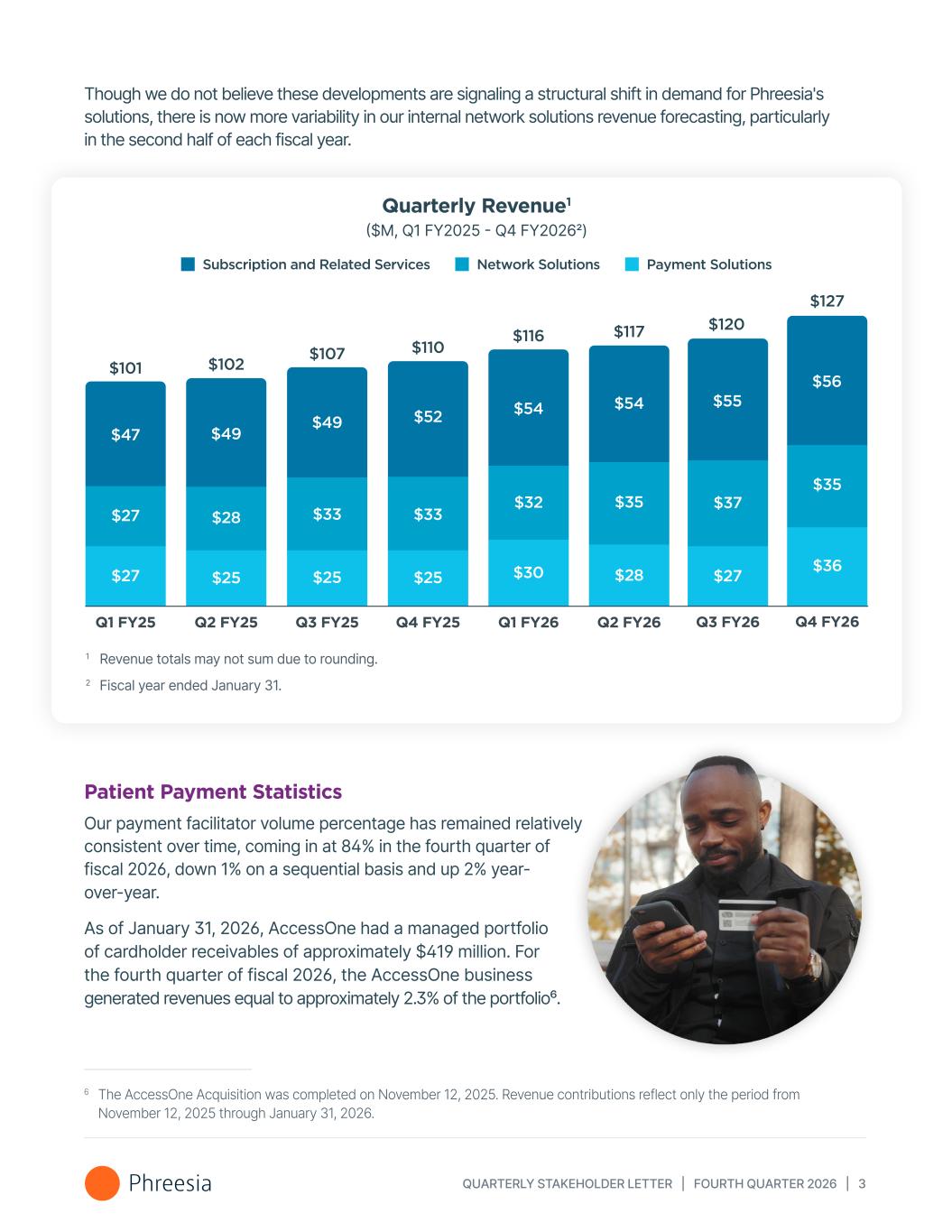
QUARTERLY STAKEHOLDER LETTER | FOURTH QUARTER 2026 | 3 Patient Payment Statistics Our payment facilitator volume percentage has remained relatively consistent over time, coming in at 84% in the fourth quarter of fiscal 2026, down 1% on a sequential basis and up 2% year- over-year. As of January 31, 2026, AccessOne had a managed portfolio of cardholder receivables of approximately $419 million. For the fourth quarter of fiscal 2026, the AccessOne business generated revenues equal to approximately 2.3% of the portfolio⁶. Quarterly Revenue1 ($M, Q1 FY2025 - Q4 FY20262) 1 Revenue totals may not sum due to rounding. 2 Fiscal year ended January 31. Subscription and Related Services Payment SolutionsNetwork Solutions Q3 FY26 $55 $37 $27 $120 $47 $27 $27 $49 $28 $25 $49 $33 $25 $52 $33 $25 $54 $32 $30 $101 $102 $107 $110 $116 Q1 FY25 Q2 FY25 Q3 FY25 Q4 FY25 Q1 FY26 Q2 FY26 $54 $35 $28 $117 Q4 FY26 $56 $35 $36 $127 6 The AccessOne Acquisition was completed on November 12, 2025. Revenue contributions reflect only the period from November 12, 2025 through January 31, 2026. Though we do not believe these developments are signaling a structural shift in demand for Phreesia's solutions, there is now more variability in our internal network solutions revenue forecasting, particularly in the second half of each fiscal year.
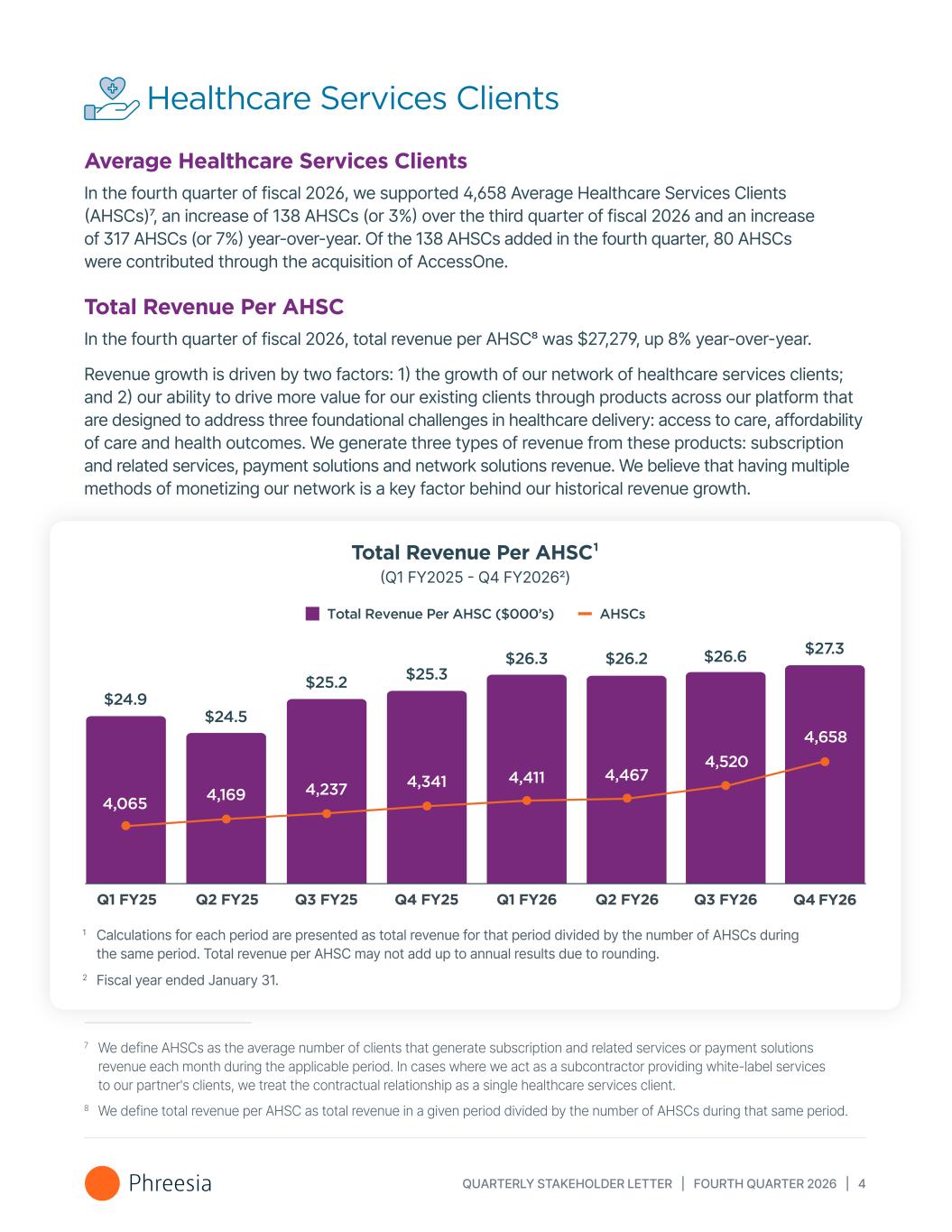
QUARTERLY STAKEHOLDER LETTER | FOURTH QUARTER 2026 | 4 Healthcare Services Clients Average Healthcare Services Clients In the fourth quarter of fiscal 2026, we supported 4,658 Average Healthcare Services Clients (AHSCs)7, an increase of 138 AHSCs (or 3%) over the third quarter of fiscal 2026 and an increase of 317 AHSCs (or 7%) year-over-year. Of the 138 AHSCs added in the fourth quarter, 80 AHSCs were contributed through the acquisition of AccessOne. Total Revenue Per AHSC In the fourth quarter of fiscal 2026, total revenue per AHSC8 was $27,279, up 8% year-over-year. Revenue growth is driven by two factors: 1) the growth of our network of healthcare services clients; and 2) our ability to drive more value for our existing clients through products across our platform that are designed to address three foundational challenges in healthcare delivery: access to care, affordability of care and health outcomes. We generate three types of revenue from these products: subscription and related services, payment solutions and network solutions revenue. We believe that having multiple methods of monetizing our network is a key factor behind our historical revenue growth. 7 We define AHSCs as the average number of clients that generate subscription and related services or payment solutions revenue each month during the applicable period. In cases where we act as a subcontractor providing white-label services to our partner's clients, we treat the contractual relationship as a single healthcare services client. 8 We define total revenue per AHSC as total revenue in a given period divided by the number of AHSCs during that same period. Total Revenue Per AHSC ($000’s) AHSCs 6 4,658 $27.3 Q4 FY2 4,520 $26.6 Q3 FY26 4,065 4,169 4,237 4,341 4,411 $24.9 $24.5 $25.2 $25.3 $26.3 Q1 FY25 Q2 FY25 Q3 FY25 Q4 FY25 Q1 FY26 Q2 FY26 $26.2 4,467 Total Revenue Per AHSC¹ (Q1 FY2025 - Q4 FY20262) 1 Calculations for each period are presented as total revenue for that period divided by the number of AHSCs during the same period. Total revenue per AHSC may not add up to annual results due to rounding. 2 Fiscal year ended January 31.
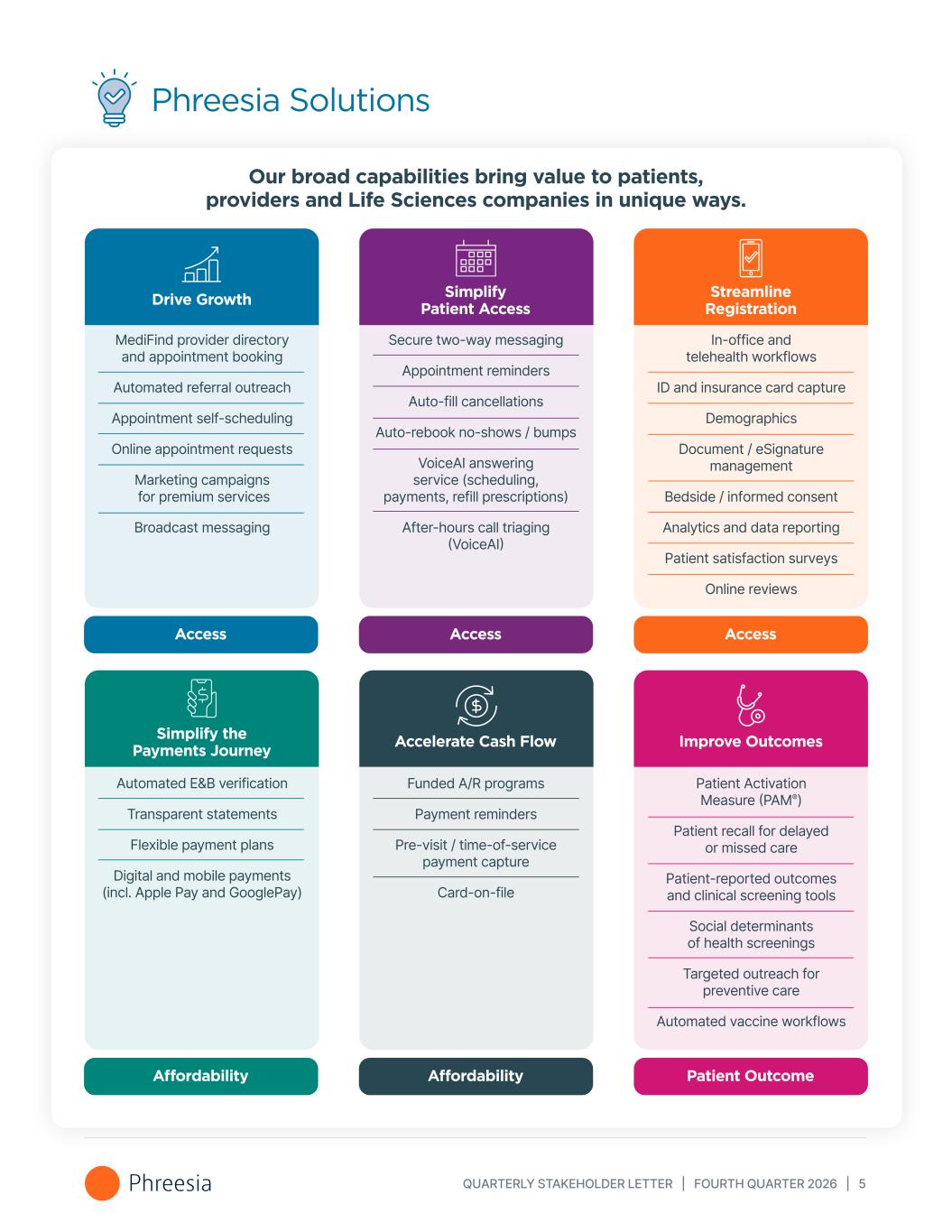
QUARTERLY STAKEHOLDER LETTER | FOURTH QUARTER 2026 | 5 Phreesia Solutions Our broad capabilities bring value to patients, providers and Life Sciences companies in unique ways. Streamline Registration In-office and telehealth workflows ID and insurance card capture Demographics Document / eSignature management Bedside / informed consent Analytics and data reporting Patient satisfaction surveys Online reviews Simplify Patient Access Secure two-way messaging Appointment reminders Auto-fill cancellations Auto-rebook no-shows / bumps VoiceAI answering service (scheduling, payments, refill prescriptions) After-hours call triaging (VoiceAI) Drive Growth MediFind provider directory and appointment booking Automated referral outreach Appointment self-scheduling Online appointment requests Marketing campaigns for premium services Broadcast messaging Improve Outcomes Patient Activation Measure (PAM®) Patient recall for delayed or missed care Patient-reported outcomes and clinical screening tools Social determinants of health screenings Targeted outreach for preventive care Automated vaccine workflows Accelerate Cash Flow Funded A/R programs Payment reminders Pre-visit / time-of-service payment capture Card-on-file Simplify the Payments Journey Automated E&B verification Transparent statements Flexible payment plans Digital and mobile payments (incl. Apple Pay and GooglePay) Access Access Access Affordability Affordability Patient Outcome
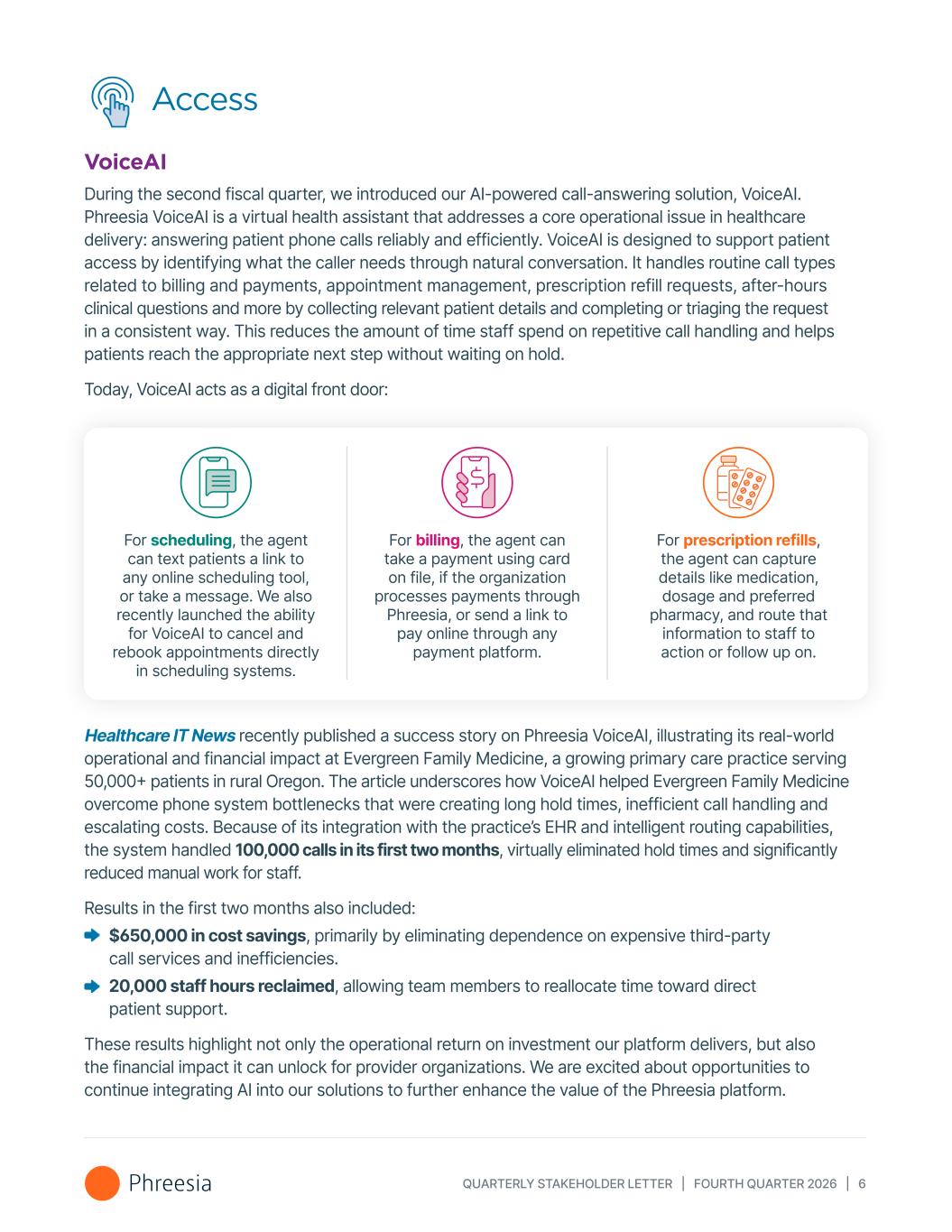
QUARTERLY STAKEHOLDER LETTER | FOURTH QUARTER 2026 | 6 Access VoiceAI During the second fiscal quarter, we introduced our AI-powered call-answering solution, VoiceAI. Phreesia VoiceAI is a virtual health assistant that addresses a core operational issue in healthcare delivery: answering patient phone calls reliably and efficiently. VoiceAI is designed to support patient access by identifying what the caller needs through natural conversation. It handles routine call types related to billing and payments, appointment management, prescription refill requests, after-hours clinical questions and more by collecting relevant patient details and completing or triaging the request in a consistent way. This reduces the amount of time staff spend on repetitive call handling and helps patients reach the appropriate next step without waiting on hold. Today, VoiceAI acts as a digital front door: For scheduling, the agent can text patients a link to any online scheduling tool, or take a message. We also recently launched the ability for VoiceAI to cancel and rebook appointments directly in scheduling systems. For billing, the agent can take a payment using card on file, if the organization processes payments through Phreesia, or send a link to pay online through any payment platform. For prescription refills, the agent can capture details like medication, dosage and preferred pharmacy, and route that information to staff to action or follow up on. Healthcare IT News recently published a success story on Phreesia VoiceAI, illustrating its real-world operational and financial impact at Evergreen Family Medicine, a growing primary care practice serving 50,000+ patients in rural Oregon. The article underscores how VoiceAI helped Evergreen Family Medicine overcome phone system bottlenecks that were creating long hold times, inefficient call handling and escalating costs. Because of its integration with the practice’s EHR and intelligent routing capabilities, the system handled 100,000 calls in its first two months, virtually eliminated hold times and significantly reduced manual work for staff. Results in the first two months also included: $650,000 in cost savings, primarily by eliminating dependence on expensive third-party call services and inefficiencies. 20,000 staff hours reclaimed, allowing team members to reallocate time toward direct patient support. These results highlight not only the operational return on investment our platform delivers, but also the financial impact it can unlock for provider organizations. We are excited about opportunities to continue integrating AI into our solutions to further enhance the value of the Phreesia platform.
QUARTERLY STAKEHOLDER LETTER | FOURTH QUARTER 2026 | 7 Affordability & Cash Flow AccessOne Our investment thesis on AccessOne has been reinforced over the past several months since we closed the acquisition, and we are encouraged by the stability and execution we’ve seen. AccessOne continues to operate at enterprise scale, serving 80 AHSCs and delivering strong collection performance. Since closing, our focus has been on client continuity, operational alignment and integration planning, and the business is performing in line with our expectations. Our strategy includes augmenting our current access to capital in order to offer AccessOne’s solutions to a greater portion of our addressable market of healthcare providers. We look forward to updating you on our progress in bringing this solution to our base clients by unlocking capital on their balance sheets to help support their growth. GoodRx Partnership During fiscal year 2026, Phreesia also saw impactful results from an innovative partnership with GoodRx, the leading platform for medication savings. Aimed at educating patients about medication adherence at the point of care and streamlining access to cost-saving resources, the partnership combines GoodRx’s deep expertise in improving medication affordability with the scale of Phreesia’s network and its ability to reach patients at key moments in their healthcare journey. Patients may see relevant messages about medication cost savings before checking in on the Phreesia platform for their doctor’s appointment, as well as after their visit. Over a 10-month period ending November 30, 2025, our analysis shows Phreesia delivered more than 19 million engagements, resulting in over 1.6 million requests for GoodRx coupon savings. Those engagements resulted in more than 476,000 claims using GoodRx coupons and estimated patient savings of $9.5 to $12 million. Poor medication adherence has profound impacts, including worsening symptoms, hospitalizations, increased mortality and higher healthcare costs. According to a GoodRx survey, more than a quarter of U.S. patients who left a prescription unfilled said it was due to cost. Only 37% of Americans report talking about medication affordability with their healthcare professionals, according to the survey, underscoring the value of providing cost-savings information to patients before their visit. More than one in three patients who saw GoodRx messages on the Phreesia platform said they were very likely to talk to their healthcare provider or a pharmacist about GoodRx after viewing the content, and almost half said they were very likely to use GoodRx, according to a Phreesia analysis.
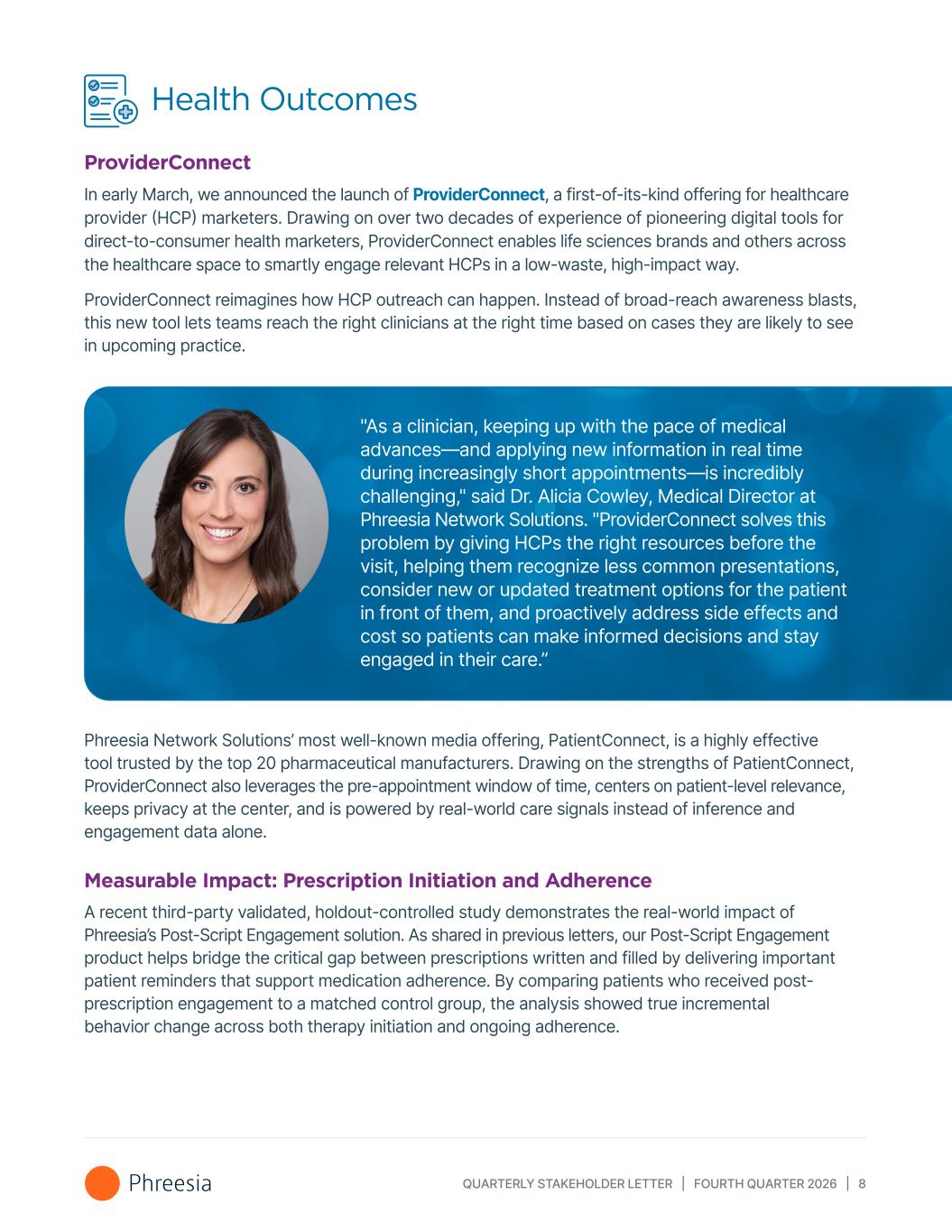
QUARTERLY STAKEHOLDER LETTER | FOURTH QUARTER 2026 | 8 Phreesia Network Solutions’ most well-known media offering, PatientConnect, is a highly effective tool trusted by the top 20 pharmaceutical manufacturers. Drawing on the strengths of PatientConnect, ProviderConnect also leverages the pre-appointment window of time, centers on patient-level relevance, keeps privacy at the center, and is powered by real-world care signals instead of inference and engagement data alone. Measurable Impact: Prescription Initiation and Adherence A recent third-party validated, holdout-controlled study demonstrates the real-world impact of Phreesia’s Post-Script Engagement solution. As shared in previous letters, our Post-Script Engagement product helps bridge the critical gap between prescriptions written and filled by delivering important patient reminders that support medication adherence. By comparing patients who received post- prescription engagement to a matched control group, the analysis showed true incremental behavior change across both therapy initiation and ongoing adherence. "As a clinician, keeping up with the pace of medical advances—and applying new information in real time during increasingly short appointments—is incredibly challenging," said Dr. Alicia Cowley, Medical Director at Phreesia Network Solutions. "ProviderConnect solves this problem by giving HCPs the right resources before the visit, helping them recognize less common presentations, consider new or updated treatment options for the patient in front of them, and proactively address side effects and cost so patients can make informed decisions and stay engaged in their care.” Health Outcomes ProviderConnect In early March, we announced the launch of ProviderConnect, a first-of-its-kind offering for healthcare provider (HCP) marketers. Drawing on over two decades of experience of pioneering digital tools for direct-to-consumer health marketers, ProviderConnect enables life sciences brands and others across the healthcare space to smartly engage relevant HCPs in a low-waste, high-impact way. ProviderConnect reimagines how HCP outreach can happen. Instead of broad-reach awareness blasts, this new tool lets teams reach the right clinicians at the right time based on cases they are likely to see in upcoming practice.
QUARTERLY STAKEHOLDER LETTER | FOURTH QUARTER 2026 | 9 The results included: 25% lift in first fills compared to the control 8% lift in refills compared to the control 105 incremental first fills generated 89 incremental refills generated Nearly $1 million in total value driven, evenly split between: ~$511,000 from new starts ~$481,000 from retention These findings show that targeted engagement immediately after prescribing can influence both initial conversion and continued adherence. By extending activation beyond the patient-provider encounter, Post-Script Engagement translates clinical intent into measurable treatment starts and sustained therapy continuation, demonstrating the tangible outcomes delivered through our network solutions platform. ‘What is Lp(a) Testing?’ Campaign with Novartis Phreesia and Novartis Pharmaceuticals Corporation developed a ‘What Is Lp(a) Testing?’ PatientConnect campaign to address a significant awareness gap around high lipoprotein(a) (Lp(a)), an inherited cardiovascular disease risk factor that can increase the likelihood of cardiovascular events, including heart attack and stroke, and which was recognized by only 3% of high-risk patients prior to the initiative. Unbranded, evidence-based education was delivered during digital check-in to clinically defined high- risk patients, positioning the information immediately before provider visits when blood testing for high Lp(a) could be ordered if necessary. Results demonstrated strong engagement and meaningful intent lift against Phreesia benchmarks: Doctor Discussion Guides were requested at 4x cardiovascular benchmark rates For patients with a history of premature cardiovascular events, these guides were requested at 5.4x benchmark rates 40% of patients with premature cardiovascular events indicated they were very likely to speak with their physician about high Lp(a) (50% lift compared to the control) 37% of patients with premature cardiovascular events said they were likely to discuss Lp(a) testing (50% lift compared to the control) For patients with a family history of cardiovascular events, 26% were very likely to ask for an Lp(a) test (40% lift compared to the control) These outcomes show that delivering unbranded point-of-care education, right before the exam, moved many high-risk patients from near-zero Lp(a) awareness to Phreesia benchmark-beating discussion guide uptake and strong stated intent to initiate testing conversations with their providers.
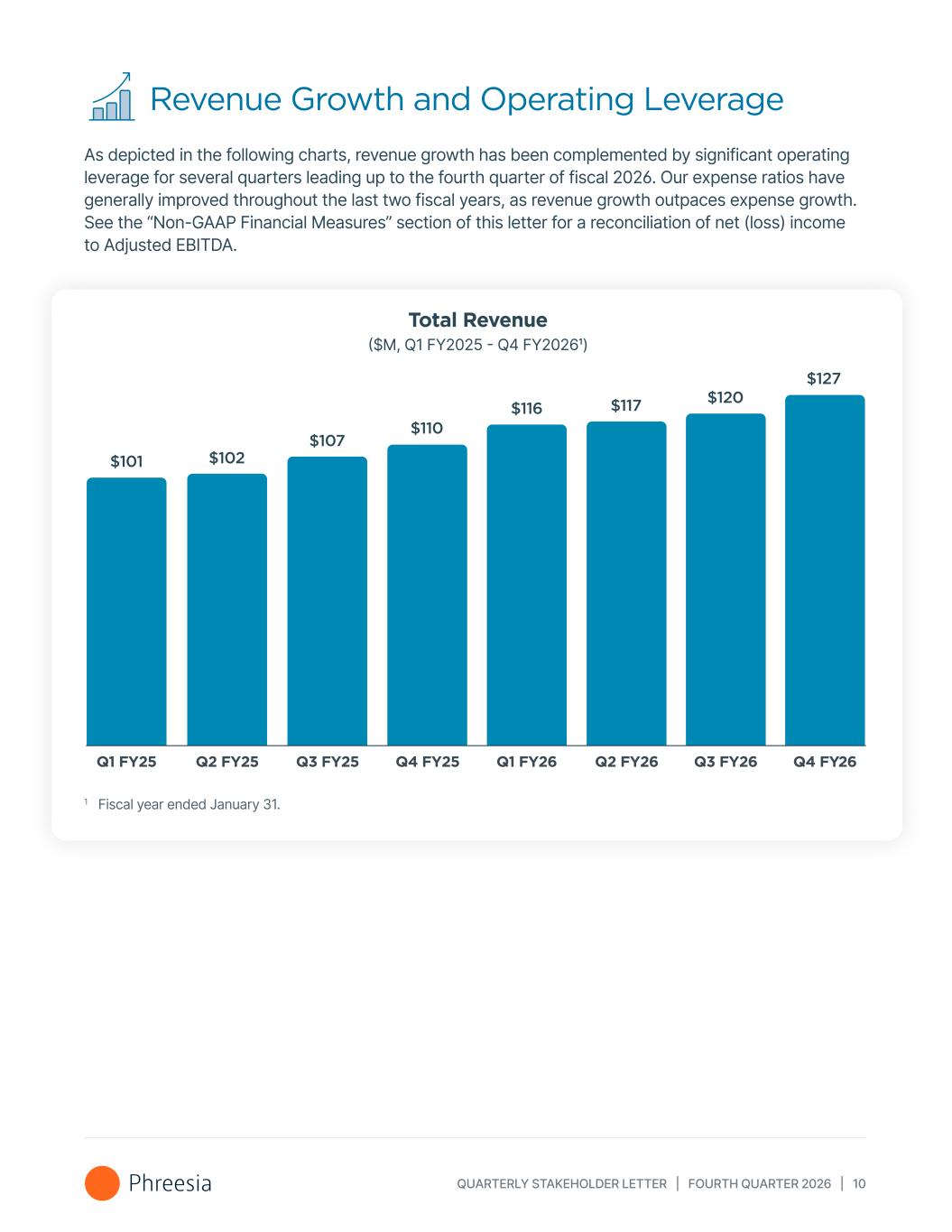
QUARTERLY STAKEHOLDER LETTER | FOURTH QUARTER 2026 | 10 Revenue Growth and Operating Leverage As depicted in the following charts, revenue growth has been complemented by significant operating leverage for several quarters leading up to the fourth quarter of fiscal 2026. Our expense ratios have generally improved throughout the last two fiscal years, as revenue growth outpaces expense growth. See the “Non-GAAP Financial Measures” section of this letter for a reconciliation of net (loss) income to Adjusted EBITDA. Total Revenue ($M, Q1 FY2025 - Q4 FY20261) $127 Q4 FY26 $101 $102 $107 $110 Q1 FY25 Q2 FY25 Q3 FY25 Q4 FY25 Q1 FY26 $116 Q2 FY26 $117 $120 Q3 FY26 1 Fiscal year ended January 31.
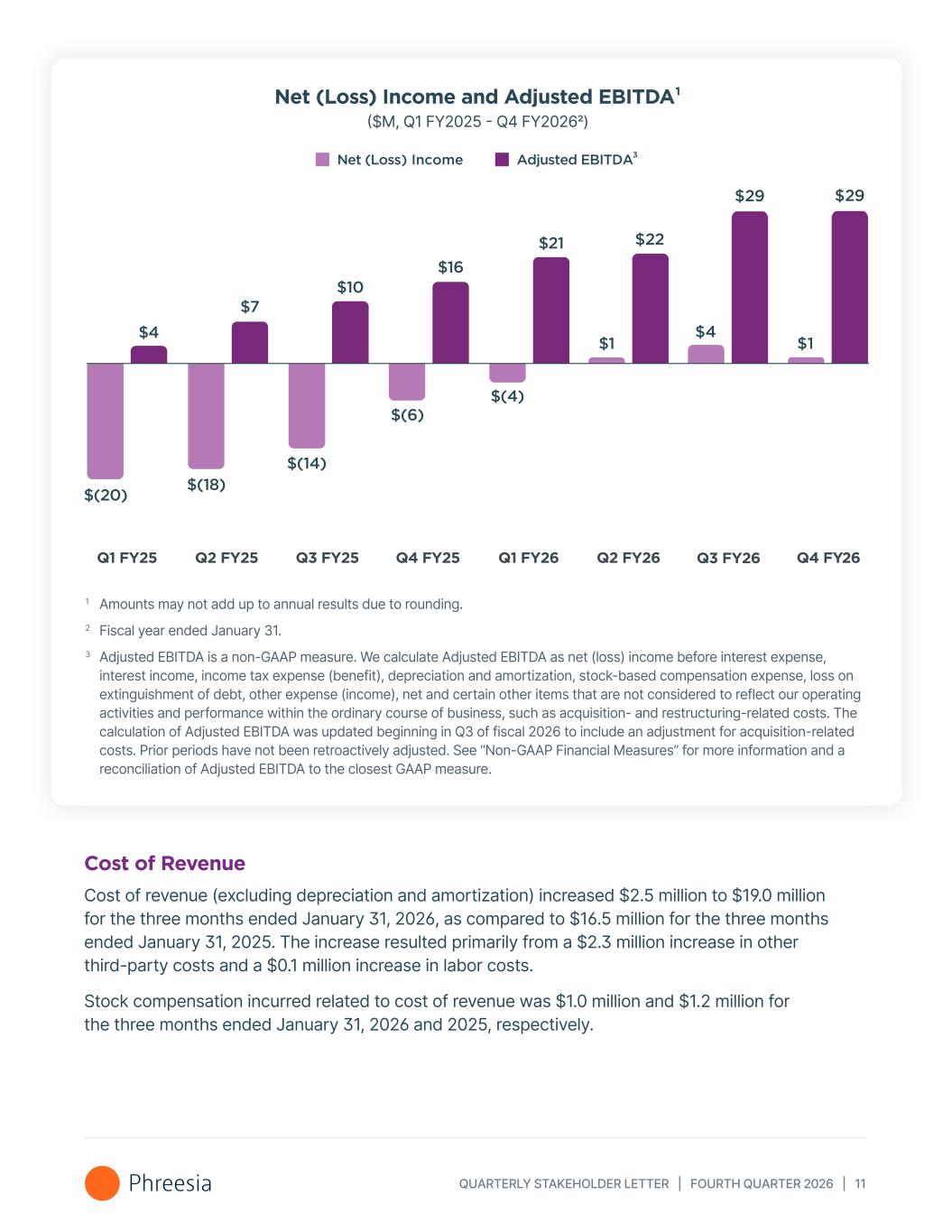
QUARTERLY STAKEHOLDER LETTER | FOURTH QUARTER 2026 | 11 1 Amounts may not add up to annual results due to rounding. 2 Fiscal year ended January 31. 3 Adjusted EBITDA is a non-GAAP measure. We calculate Adjusted EBITDA as net (loss) income before interest expense, interest income, income tax expense (benefit), depreciation and amortization, stock-based compensation expense, loss on extinguishment of debt, other expense (income), net and certain other items that are not considered to reflect our operating activities and performance within the ordinary course of business, such as acquisition- and restructuring-related costs. The calculation of Adjusted EBITDA was updated beginning in Q3 of fiscal 2026 to include an adjustment for acquisition-related costs. Prior periods have not been retroactively adjusted. See “Non-GAAP Financial Measures” for more information and a reconciliation of Adjusted EBITDA to the closest GAAP measure. Net (Loss) Income and Adjusted EBITDA¹ ($M, Q1 FY2025 - Q4 FY20262) Net (Loss) Income Adjusted EBITDA Q2 FY26Q1 FY25 Q2 FY25 Q3 FY25 Q4 FY25 Q1 FY26 $(20) $(18) $(14) $(6) $4 $7 $10 $16 $21 $(4) $ $1 $4 22 $29 Q3 FY26 $1 $29 Q4 FY26 Cost of Revenue Cost of revenue (excluding depreciation and amortization) increased $2.5 million to $19.0 million for the three months ended January 31, 2026, as compared to $16.5 million for the three months ended January 31, 2025. The increase resulted primarily from a $2.3 million increase in other third-party costs and a $0.1 million increase in labor costs. Stock compensation incurred related to cost of revenue was $1.0 million and $1.2 million for the three months ended January 31, 2026 and 2025, respectively.
QUARTERLY STAKEHOLDER LETTER | FOURTH QUARTER 2026 | 12 Payment Solutions Expense9 Payment solutions expense increased $4.3 million to $21.4 million for the three months ended January 31, 2026, as compared to $17.1 million for the three months ended January 31, 2025. The increase resulted primarily from the increase in payment processing fees revenue and patient payments processed through our solutions, each driven by an increase in patient visits over the prior year, as well as additional payment solutions expense recognized for AccessOne. It is also worth noting that payment solutions expense as a percentage of payment solutions revenue declined because AccessOne's financing fees revenue carries lower direct costs than interchange-based payment processing fees revenue. Our payment solutions expense as a percentage of payment solutions revenue was 60% in the fourth quarter of fiscal 2026, compared to 72% and 69% in the third quarter of fiscal 2026 and the fourth quarter of fiscal 2025, respectively. The decrease in payment solutions expense as a percentage of payment solutions revenue was primarily driven by the addition of AccessOne, which typically produces higher margins. Sales & Marketing Sales and marketing expense decreased $4.2 million to $24.7 million for the three months ended January 31, 2026, as compared to $28.9 million for the three months ended January 31, 2025. The decrease resulted primarily from a $4.0 million decrease in labor costs and a $0.2 million decrease in other third-party sales and marketing costs. Stock compensation incurred related to sales and marketing expense was $5.4 million and $5.5 million for the three months ended January 31, 2026 and 2025, respectively. Research & Development Research and development expense increased $1.3 million to $30.9 million for the three months ended January 31, 2026, as compared to $29.6 million for the three months ended January 31, 2025. The increase resulted primarily from a $0.6 million increase in software costs, a $0.4 million increase in labor costs and a $0.3 million increase in other third-party research and development costs. Stock compensation incurred related to research and development expense was $4.5 million and $4.2 million for the three months ended January 31, 2026 and 2025, respectively. General & Administrative General and administrative expense increased $8.6 million to $27.0 million for the three months ended January 31, 2026, as compared to $18.4 million for the three months ended January 31, 2025. The increase primarily resulted from a $7.3 million increase in acquisition-related and restructuring costs, a $1.2 million increase in labor costs, partially offset by a $0.1 million increase in other third-party costs. Stock compensation incurred related to general and administrative expense was $7.1 million and $6.3 million for the three months ended January 31, 2026 and 2025, respectively. 9 During the fourth quarter of the fiscal year ended January 31, 2026, “Payment processing expense” has been relabeled “Payment solutions expense” and includes all expenses previously presented as “Payment processing expense” and direct costs of revenue related to the operations acquired in the AccessOne Acquisition. Prior period amounts have not been reclassified, as the Company did not own the acquired operations in prior periods and the change in presentation did not affect any previously reported amounts.
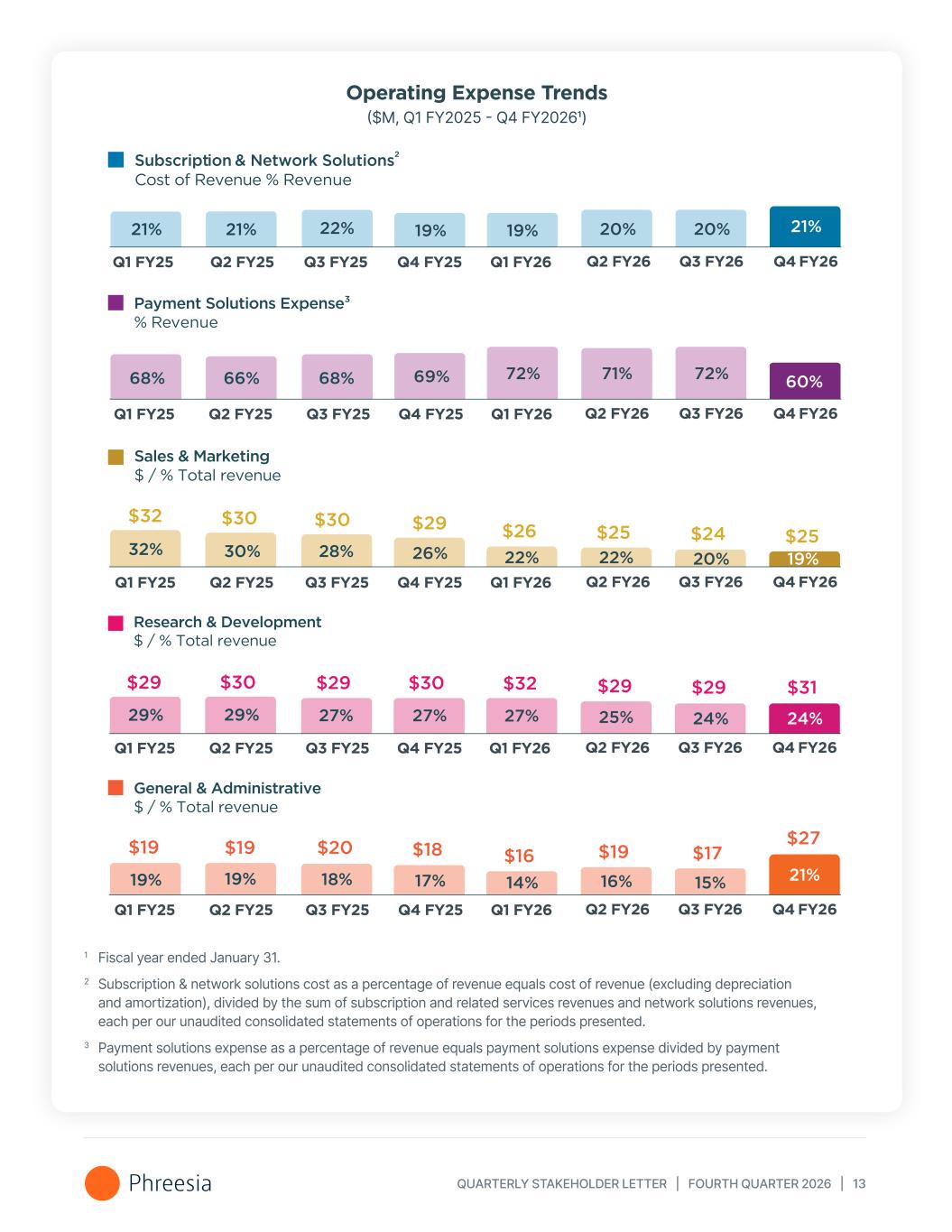
QUARTERLY STAKEHOLDER LETTER | FOURTH QUARTER 2026 | 13 Operating Expense Trends ($M, Q1 FY2025 - Q4 FY20261) 1 Fiscal year ended January 31. 2 Subscription & network solutions cost as a percentage of revenue equals cost of revenue (excluding depreciation and amortization), divided by the sum of subscription and related services revenues and network solutions revenues, each per our unaudited consolidated statements of operations for the periods presented. 3 Payment solutions expense as a percentage of revenue equals payment solutions expense divided by payment solutions revenues, each per our unaudited consolidated statements of operations for the periods presented. Q3 FY26 Q3 FY26 Q3 FY26 Q3 FY26 Q3 FY26 20% 20% $24 24% $29 15% $17 72% 19% Sales & Marketing $ / % Total revenue 22% $26 32% $32 Research & Development $ / % Total revenue 27% $32 29% $29 General & Administrative $ / % Total revenue 14% $16 19% $19 Payment Solutions Expense3 % Revenue 72%68% Subscription & Network Solutions Cost of Revenue % Revenue 21% 21% 66% 30% $30 29% $30 19% $19 22% 68% 28% $30 27% $29 18% $20 19% 69% 26% $29 27% $30 17% $18 Q2 FY26Q1 FY25 Q2 FY25 Q3 FY25 Q4 FY25 Q1 FY26 Q2 FY26Q1 FY25 Q2 FY25 Q3 FY25 Q4 FY25 Q1 FY26 Q2 FY26Q1 FY25 Q2 FY25 Q3 FY25 Q4 FY25 Q1 FY26 Q2 FY26Q1 FY25 Q2 FY25 Q3 FY25 Q4 FY25 Q1 FY26 Q2 FY26Q1 FY25 Q2 FY25 Q3 FY25 Q4 FY25 Q1 FY26 20% 22% $25 25% $29 16% $19 71% Q4 FY26 Q4 FY26 Q4 FY26 Q4 FY26 Q4 FY26 21% 19% $25 24% $31 21% $27 60%
QUARTERLY STAKEHOLDER LETTER | FOURTH QUARTER 2026 | 14 Balance Sheet and Liquidity As of January 31, 2026 and January 31, 2025, we had cash, cash equivalents and restricted cash of $73.8 million and $84.2 million, respectively. Cash, cash equivalents and restricted cash consist of money market funds and cash on deposit at various financial institutions. AccessOne Acquisition On November 12, 2025 (the “Closing Date”), we acquired AccessOne for consideration transferred of approximately $164 million, including post-closing adjustments. The purchase price was funded with a combination of cash and the net proceeds from a new, 364-day $110 million secured term loan (the “Bridge Loan”) entered into on the Closing Date. Also on the Closing Date, we entered into an amendment (the “Credit Facility Amendment”) to our senior ABL facility with Capital One, National Association (as amended, the “Existing Capital One Credit Facility”). The Credit Facility Amendment amended certain terms of the Existing Capital One Credit Facility to permit the acquisition of AccessOne and to accommodate the existence of the Bridge Loan. During the fourth quarter of fiscal 2026, we repaid $20 million of the outstanding principal balance of the Bridge Loan. As of January 31, 2026, a balance of $90 million was outstanding under the Bridge Loan. For more information regarding the AccessOne Acquisition, the Bridge Loan and the Credit Facility Amendment, please see our Current Reports on Form 8-K and Form 8-K/A filed with the SEC on September 4, 2025, November 12, 2025 and January 28, 2026. New Capital One Credit Facility and Refinancing On March 13, 2026, subsequent to the end of the fiscal year, we completed a refinancing pursuant to which we repaid all outstanding indebtedness and obligations under the Bridge Loan with $92 million of borrowings from a new 5-year $275 million senior secured revolving credit facility (the “New Capital One Credit Facility”) maturing on March 13, 2031. The New Capital One Credit Facility also replaces the Existing Capital One Credit Facility, which had no outstanding borrowings and was terminated on the same date. The unused borrowing capacity on the New Capital One Credit Facility is available to the Company for working capital, capital expenditures, permitted acquisitions and general corporate purposes. As the January 31, 2026 outstanding principal balance of the Bridge Loan was refinanced onto long- term debt prior to the issuance of this letter and accompanying earnings release, we classified the outstanding principal balance of the Bridge Loan as long-term debt in the accompanying consolidated balance sheet as of January 31, 2026. With the refinancing of our debt complete, we intend to prioritize allocation of capital to areas that we believe can enhance long-term shareholder value. These priorities may include the paydown of our long- term debt, investment to support revenue growth acceleration and share repurchases, as appropriate. For more information regarding the New Capital One Credit Facility and the and the termination of the Bridge Loan and the Existing Capital One Credit Facility, please see our Current Report on Form 8-K filed with the SEC on March 16, 2026.
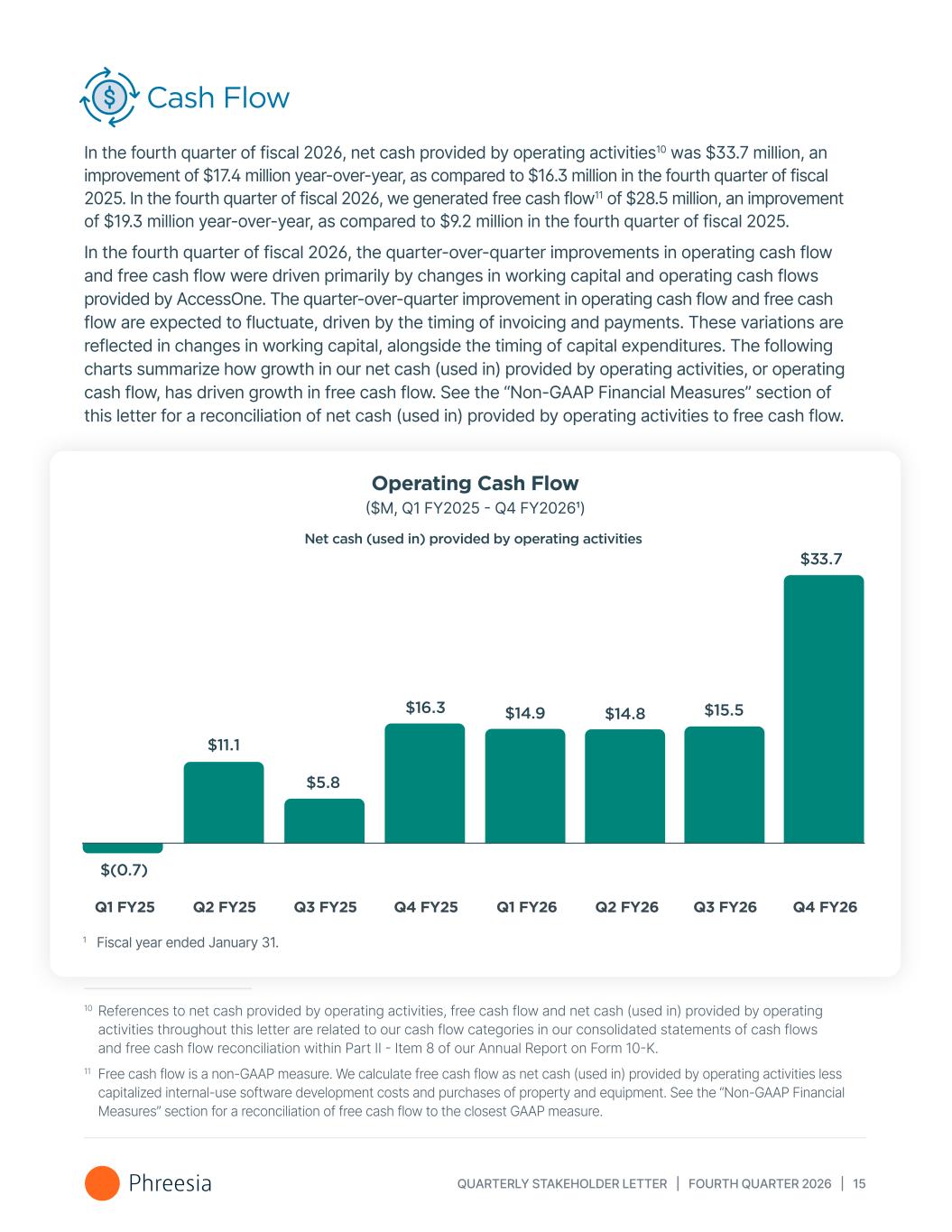
QUARTERLY STAKEHOLDER LETTER | FOURTH QUARTER 2026 | 15 Cash Flow In the fourth quarter of fiscal 2026, net cash provided by operating activities10 was $33.7 million, an improvement of $17.4 million year-over-year, as compared to $16.3 million in the fourth quarter of fiscal 2025. In the fourth quarter of fiscal 2026, we generated free cash flow11 of $28.5 million, an improvement of $19.3 million year-over-year, as compared to $9.2 million in the fourth quarter of fiscal 2025. In the fourth quarter of fiscal 2026, the quarter-over-quarter improvements in operating cash flow and free cash flow were driven primarily by changes in working capital and operating cash flows provided by AccessOne. The quarter-over-quarter improvement in operating cash flow and free cash flow are expected to fluctuate, driven by the timing of invoicing and payments. These variations are reflected in changes in working capital, alongside the timing of capital expenditures. The following charts summarize how growth in our net cash (used in) provided by operating activities, or operating cash flow, has driven growth in free cash flow. See the “Non-GAAP Financial Measures” section of this letter for a reconciliation of net cash (used in) provided by operating activities to free cash flow. 10 References to net cash provided by operating activities, free cash flow and net cash (used in) provided by operating activities throughout this letter are related to our cash flow categories in our consolidated statements of cash flows and free cash flow reconciliation within Part II - Item 8 of our Annual Report on Form 10-K. 11 Free cash flow is a non-GAAP measure. We calculate free cash flow as net cash (used in) provided by operating activities less capitalized internal-use software development costs and purchases of property and equipment. See the “Non-GAAP Financial Measures” section for a reconciliation of free cash flow to the closest GAAP measure. Operating Cash Flow ($M, Q1 FY2025 - Q4 FY20261) 1 Fiscal year ended January 31. Net cash (used in) provided by operating activities Q4 FY26 $15.5$14.8 $11.1 $5.8 $16.3 Q2 FY26Q1 FY25 Q2 FY25 Q3 FY25 Q4 FY25 Q1 FY26 $(0.7) $14.9 Q3 FY26 $33.7
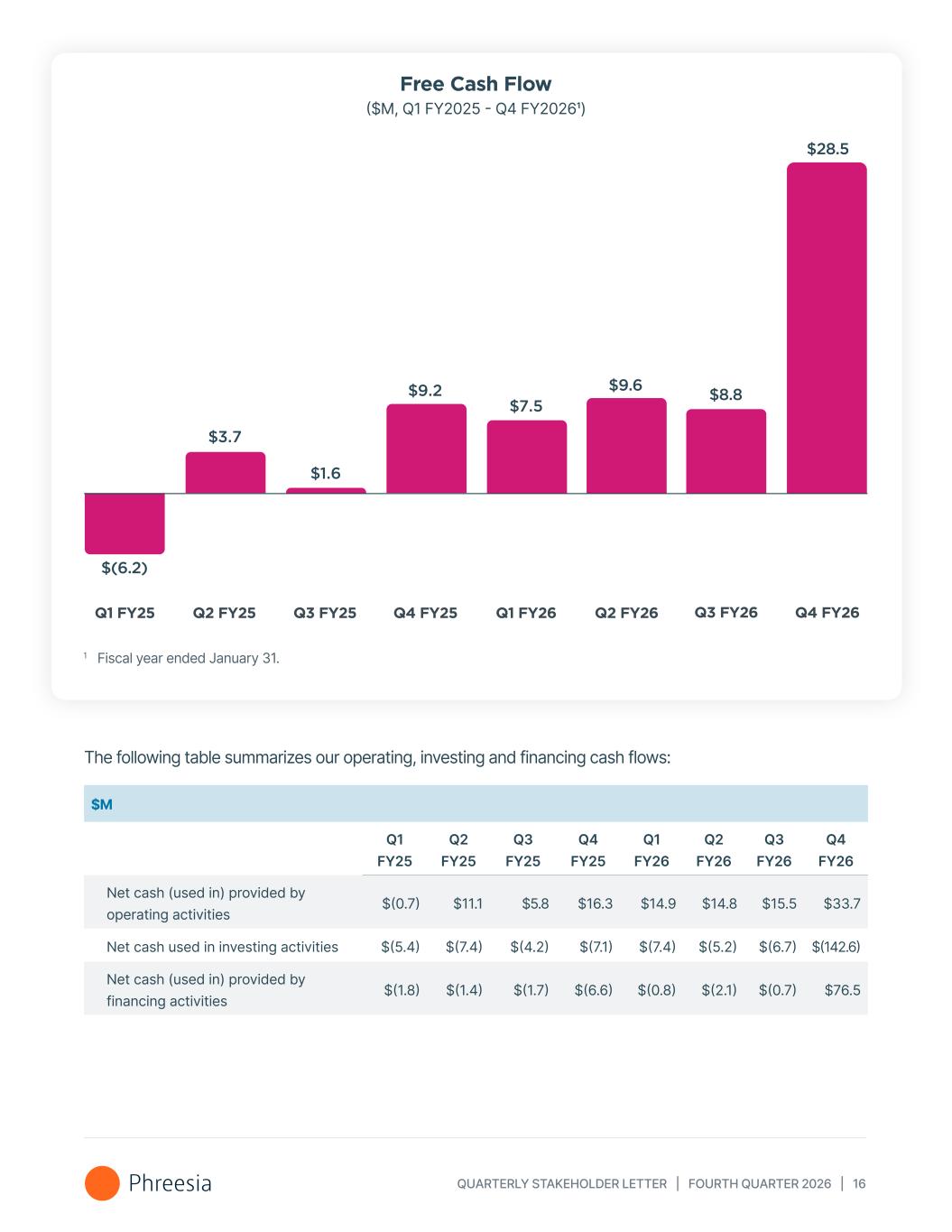
QUARTERLY STAKEHOLDER LETTER | FOURTH QUARTER 2026 | 16 Q3 FY26 $8.8 $3.7 $1.6 $9.2 Q2 FY26Q1 FY25 Q2 FY25 Q3 FY25 Q4 FY25 Q1 FY26 $(6.2) $7.5 $9.6 Q4 FY26 $28.5 Free Cash Flow ($M, Q1 FY2025 - Q4 FY20261) 1 Fiscal year ended January 31. The following table summarizes our operating, investing and financing cash flows: $M Q1 FY25 Q2 FY25 Q3 FY25 Q4 FY25 Q1 FY26 Q2 FY26 Q3 FY26 Q4 FY26 Net cash (used in) provided by operating activities $(0.7) $11.1 $5.8 $16.3 $14.9 $14.8 $15.5 $33.7 Net cash used in investing activities $(5.4) $(7.4) $(4.2) $(7.1) $(7.4) $(5.2) $(6.7) $(142.6) Net cash (used in) provided by financing activities $(1.8) $(1.4) $(1.7) $(6.6) $(0.8) $(2.1) $(0.7) $76.5
QUARTERLY STAKEHOLDER LETTER | FOURTH QUARTER 2026 | 17 Business and Financial Outlook We are lowering our revenue outlook for fiscal 2027. We expect revenue to be in the range of $510 million to $520 million from a previous range of $545 million to $559 million. As we discussed on our last earnings call in December 2025, we are experiencing shorter visibility into spending commitments by certain pharmaceutical manufacturers. As we enter fiscal 2027, network solutions clients are committing lower spend levels for the second half of fiscal 2027 than we had anticipated last December. Certain clients are committing fewer dollars due to brand-specific dynamics including the impact of regulatory policies. Though we do not believe these developments are signaling a structural shift in demand for Phreesia's solutions, there is now more variability in our internal network solutions revenue forecasting, particularly in the second half of each fiscal year. Our visibility into revenue across the other parts of our business is generally consistent with our views in December 2025. The revenue range provided for fiscal 2027 assumes approximately $37 million of contribution from AccessOne and no additional revenue from potential future acquisitions completed between now and January 31, 2027. We are maintaining our Adjusted EBITDA outlook for fiscal 2027. We expect Adjusted EBITDA to be in the range of $125 million to $135 million. Our Adjusted EBITDA outlook implies that we will absorb much of the reduction in our revenue outlook. In addition to our continued confidence in the operating leverage embedded in our model, we have more recently identified significant opportunities to reduce our reliance on manual processes across Phreesia through the adoption of artificial intelligence. Initially, we expect to see efficiencies in our utilization of outsourced resources. We continue to expect improvement in operating leverage across the Company through a focus on efficiency. We are maintaining our expectation for AHSC growth in the mid-single-digit percentage range, and we are lowering our outlook for total revenue per AHSC to the low-single-digit percentage range for fiscal 2027, compared to low double-digit growth previously. About Phreesia Phreesia is a trusted leader in patient activation, giving healthcare providers, life sciences companies and other organizations tools to help patients take a more active role in their care. Founded in 2005, Phreesia enabled more than 180 million patient visits in 2025—1 in 6 visits across the U.S. This scale allows Phreesia to make meaningful impact across the healthcare ecosystem. Offering patient-driven digital solutions for intake, outreach, education and more, Phreesia enhances the patient experience, drives operational efficiency and improves healthcare outcomes. To learn more, visit phreesia.com. Media contact: Nicole Gist nicole.gist@phreesia.com Investor contact: Balaji Gandhi investors@phreesia.com
QUARTERLY STAKEHOLDER LETTER | FOURTH QUARTER 2026 | 18 Non-GAAP Financial Measures This stakeholder letter and statements made during the webcast referenced below may include certain non-GAAP financial measures as defined by SEC rules. Adjusted EBITDA is a supplemental measure of our performance that is not required by, or presented in accordance with, GAAP. Adjusted EBITDA is not a measurement of our financial performance under GAAP and should not be considered as an alternative to net income or loss or any other performance measure derived in accordance with GAAP, or as an alternative to cash flows from operating activities as a measure of our liquidity. We calculate Adjusted EBITDA as net income or loss before interest expense, interest income, income tax expense (benefit), depreciation and amortization, stock-based compensation expense, loss on extinguishment of debt, other expense (income), net and certain other items that are not considered to reflect our operating activities and performance within the ordinary course of business, such as acquisition- and restructuring-related costs. The calculation of Adjusted EBITDA was updated beginning in the three months ended October 31, 2025 to include an adjustment for acquisition-related costs, which consist primarily of legal, advisory and other professional fees and integration costs related to acquisitions. Management believes adjusting for these acquisition-related costs provides investors with a more consistent period-to-period comparison of our core operating performance and trends. For periods prior to the three months ended October 31, 2025, the calculation of Adjusted EBITDA did not adjust for acquisition-related costs, and prior periods have not been retroactively adjusted. We have provided below a reconciliation of Adjusted EBITDA to net (loss) income, the most directly comparable GAAP financial measure. We have also presented Adjusted EBITDA in the press release accompanying this letter and in our Annual Report on Form 10-K to be filed after this letter because it is a key measure used by our management and board of directors to understand and evaluate our core operating performance and trends, to prepare and approve our annual budget, and to develop short and long-term operational plans. In particular, we believe that the exclusion of the amounts eliminated in calculating Adjusted EBITDA can provide a useful measure for period-to-period comparisons of our core business. Accordingly, we believe that Adjusted EBITDA provides useful information to investors and others in understanding and evaluating our operating results in the same manner as our management and board of directors. We have not reconciled our Adjusted EBITDA outlook to GAAP net (loss) income because we do not provide an outlook for GAAP net (loss) income due to the uncertainty and potential variability of other expense (income), net, income tax expense (benefit), which are reconciling items between Adjusted EBITDA and GAAP net (loss) income. Because we cannot reasonably predict such items, a reconciliation of the non-GAAP financial measure outlook to the corresponding GAAP measure is not available without unreasonable effort. We caution, however, that such items could have a significant impact on the calculation of GAAP net (loss) income. Our use of Adjusted EBITDA has limitations as an analytical tool, and should not be considered in isolation or as a substitute for analysis of our financial results as reported under GAAP. Some of these limitations are as follows:
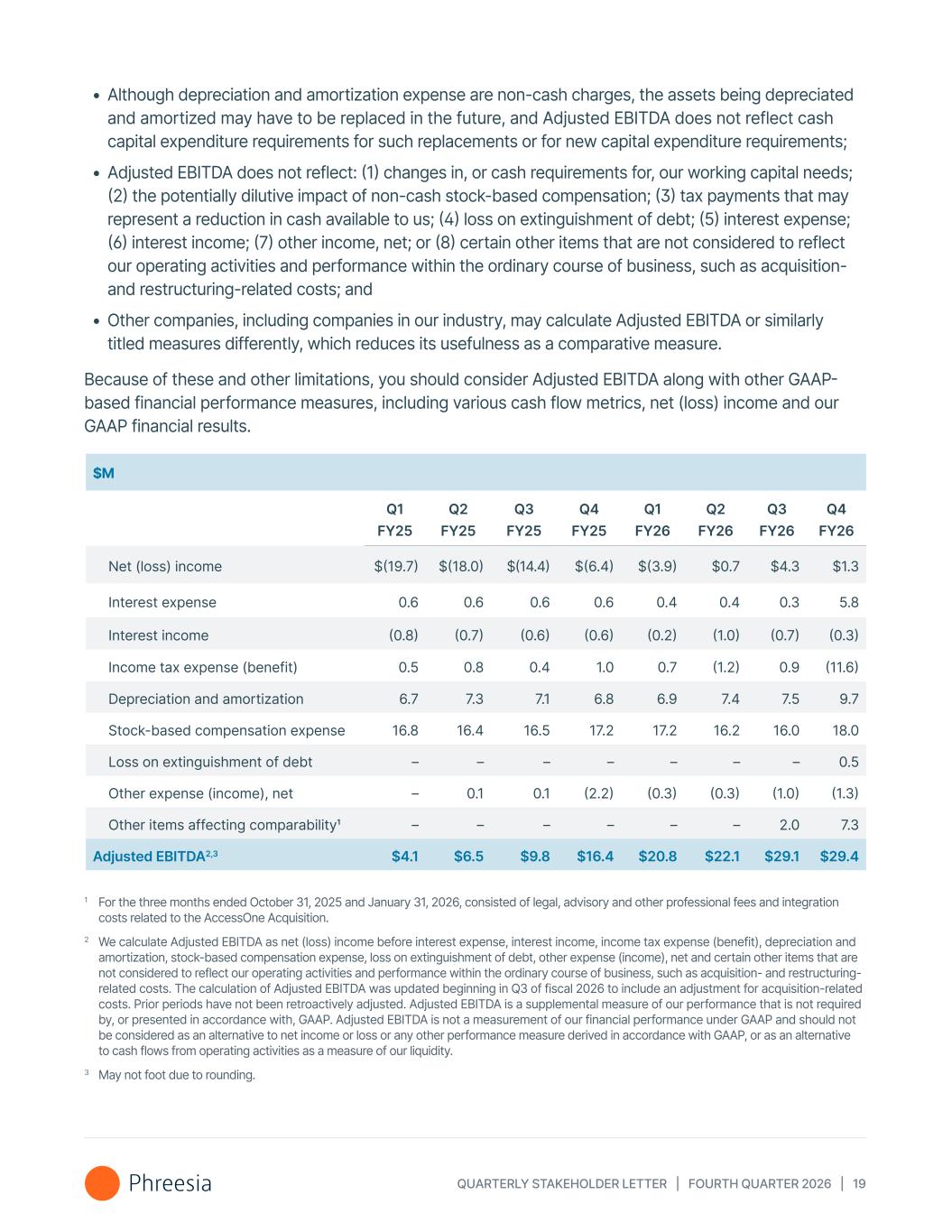
QUARTERLY STAKEHOLDER LETTER | FOURTH QUARTER 2026 | 19 • Although depreciation and amortization expense are non-cash charges, the assets being depreciated and amortized may have to be replaced in the future, and Adjusted EBITDA does not reflect cash capital expenditure requirements for such replacements or for new capital expenditure requirements; • Adjusted EBITDA does not reflect: (1) changes in, or cash requirements for, our working capital needs; (2) the potentially dilutive impact of non-cash stock-based compensation; (3) tax payments that may represent a reduction in cash available to us; (4) loss on extinguishment of debt; (5) interest expense; (6) interest income; (7) other income, net; or (8) certain other items that are not considered to reflect our operating activities and performance within the ordinary course of business, such as acquisition- and restructuring-related costs; and • Other companies, including companies in our industry, may calculate Adjusted EBITDA or similarly titled measures differently, which reduces its usefulness as a comparative measure. Because of these and other limitations, you should consider Adjusted EBITDA along with other GAAP- based financial performance measures, including various cash flow metrics, net (loss) income and our GAAP financial results. $M Q1 FY25 Q2 FY25 Q3 FY25 Q4 FY25 Q1 FY26 Q2 FY26 Q3 FY26 Q4 FY26 Net (loss) income $(19.7) $(18.0) $(14.4) $(6.4) $(3.9) $0.7 $4.3 $1.3 Interest expense 0.6 0.6 0.6 0.6 0.4 0.4 0.3 5.8 Interest income (0.8) (0.7) (0.6) (0.6) (0.2) (1.0) (0.7) (0.3) Income tax expense (benefit) 0.5 0.8 0.4 1.0 0.7 (1.2) 0.9 (11.6) Depreciation and amortization 6.7 7.3 7.1 6.8 6.9 7.4 7.5 9.7 Stock-based compensation expense 16.8 16.4 16.5 17.2 17.2 16.2 16.0 18.0 Loss on extinguishment of debt – – – – – – – 0.5 Other expense (income), net – 0.1 0.1 (2.2) (0.3) (0.3) (1.0) (1.3) Other items affecting comparability1 – – – – – – 2.0 7.3 Adjusted EBITDA2,3 $4.1 $6.5 $9.8 $16.4 $20.8 $22.1 $29.1 $29.4 1 For the three months ended October 31, 2025 and January 31, 2026, consisted of legal, advisory and other professional fees and integration costs related to the AccessOne Acquisition. 2 We calculate Adjusted EBITDA as net (loss) income before interest expense, interest income, income tax expense (benefit), depreciation and amortization, stock-based compensation expense, loss on extinguishment of debt, other expense (income), net and certain other items that are not considered to reflect our operating activities and performance within the ordinary course of business, such as acquisition- and restructuring- related costs. The calculation of Adjusted EBITDA was updated beginning in Q3 of fiscal 2026 to include an adjustment for acquisition-related costs. Prior periods have not been retroactively adjusted. Adjusted EBITDA is a supplemental measure of our performance that is not required by, or presented in accordance with, GAAP. Adjusted EBITDA is not a measurement of our financial performance under GAAP and should not be considered as an alternative to net income or loss or any other performance measure derived in accordance with GAAP, or as an alternative to cash flows from operating activities as a measure of our liquidity. 3 May not foot due to rounding.
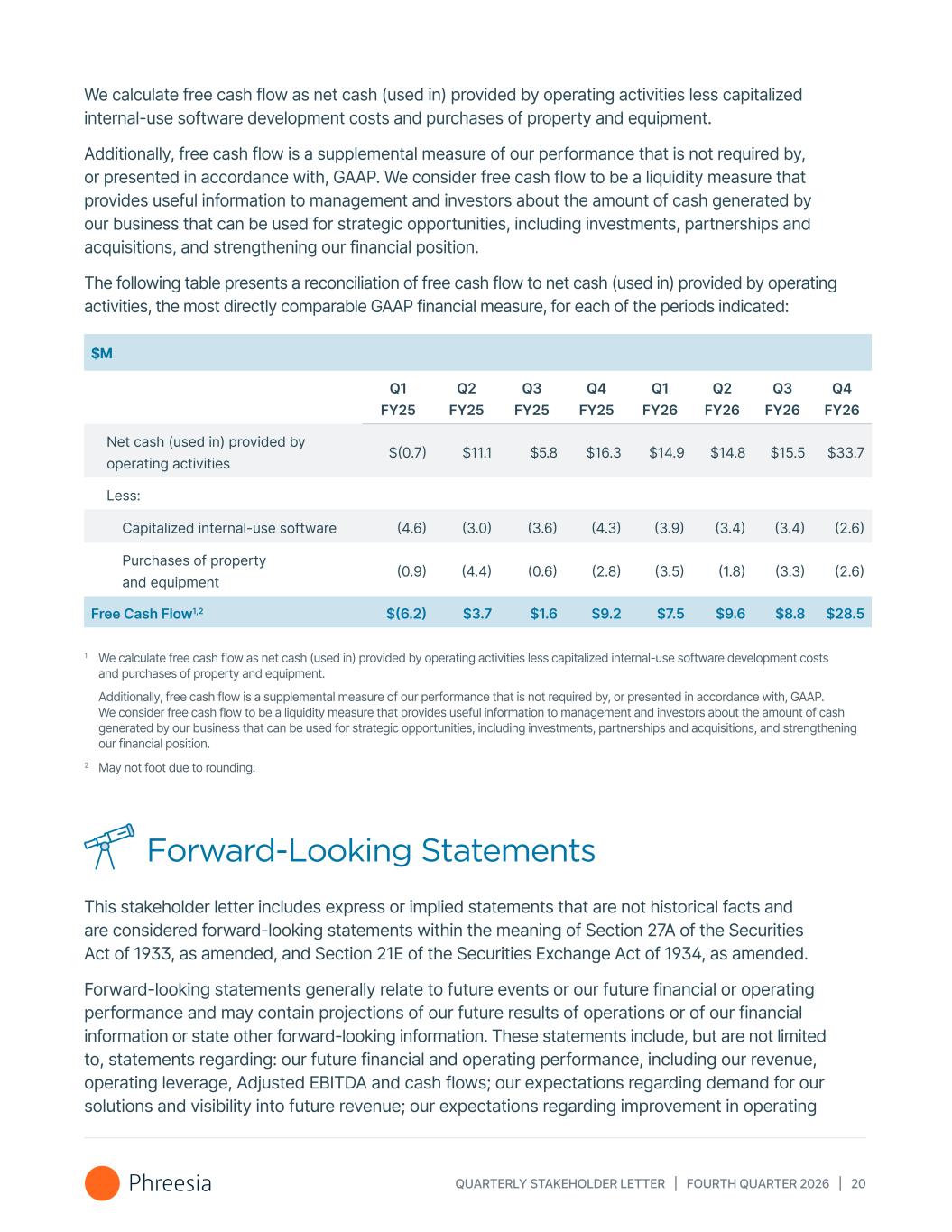
QUARTERLY STAKEHOLDER LETTER | FOURTH QUARTER 2026 | 20 We calculate free cash flow as net cash (used in) provided by operating activities less capitalized internal-use software development costs and purchases of property and equipment. Additionally, free cash flow is a supplemental measure of our performance that is not required by, or presented in accordance with, GAAP. We consider free cash flow to be a liquidity measure that provides useful information to management and investors about the amount of cash generated by our business that can be used for strategic opportunities, including investments, partnerships and acquisitions, and strengthening our financial position. The following table presents a reconciliation of free cash flow to net cash (used in) provided by operating activities, the most directly comparable GAAP financial measure, for each of the periods indicated: $M Q1 FY25 Q2 FY25 Q3 FY25 Q4 FY25 Q1 FY26 Q2 FY26 Q3 FY26 Q4 FY26 Net cash (used in) provided by operating activities $(0.7) $11.1 $5.8 $16.3 $14.9 $14.8 $15.5 $33.7 Less: Capitalized internal-use software (4.6) (3.0) (3.6) (4.3) (3.9) (3.4) (3.4) (2.6) Purchases of property and equipment (0.9) (4.4) (0.6) (2.8) (3.5) (1.8) (3.3) (2.6) Free Cash Flow1,2 $(6.2) $3.7 $1.6 $9.2 $7.5 $9.6 $8.8 $28.5 1 We calculate free cash flow as net cash (used in) provided by operating activities less capitalized internal-use software development costs and purchases of property and equipment. Additionally, free cash flow is a supplemental measure of our performance that is not required by, or presented in accordance with, GAAP. We consider free cash flow to be a liquidity measure that provides useful information to management and investors about the amount of cash generated by our business that can be used for strategic opportunities, including investments, partnerships and acquisitions, and strengthening our financial position. 2 May not foot due to rounding. Forward-Looking Statements This stakeholder letter includes express or implied statements that are not historical facts and are considered forward-looking statements within the meaning of Section 27A of the Securities Act of 1933, as amended, and Section 21E of the Securities Exchange Act of 1934, as amended. Forward-looking statements generally relate to future events or our future financial or operating performance and may contain projections of our future results of operations or of our financial information or state other forward-looking information. These statements include, but are not limited to, statements regarding: our future financial and operating performance, including our revenue, operating leverage, Adjusted EBITDA and cash flows; our expectations regarding demand for our solutions and visibility into future revenue; our expectations regarding improvement in operating
QUARTERLY STAKEHOLDER LETTER | FOURTH QUARTER 2026 | 21 leverage across the Company through a focus on efficiency; the expected results of the AccessOne Acquisition discussed herein, including anticipated additional revenue, Adjusted EBITDA and AHSCs; our estimated addressable market; our outlook for fiscal 2027, including with respect to revenue, Adjusted EBITDA and our expectations on AHSCs, total revenue per AHSC, and our plans to achieve our revenue and Adjusted EBITDA targets in fiscal 2027; our ability to continue generating positive net income and free cash flow; our expectations regarding growth in subscription and related services revenue over the long term; our ability to finance our plans to achieve our fiscal 2027 outlook with our current cash balance along with cash generated in the normal course of business; our business strategy and operating plans; our capital allocation priorities; industry trends and predictions; our anticipated growth and operating leverage; the factors that drive our revenue growth; our expectations regarding new solutions and solutions under development and the use of artificial intelligence in our solutions; our growth strategies for the AccessOne business, our ability to offer the AccessOne solution to additional clients and our plans to augment our access to capital; and our expectations regarding the growth of our network of clients and partners. In some cases, you can identify forward-looking statements by the following words: “may,” “will,” “could,” “would,” “should,” “expect,” “intend,” “plan,” “anticipate,” “believe,” “estimate,” “predict,” “project,” “potential,” “continue,” “ongoing,” or the negative of these terms or other comparable terminology, although not all forward-looking statements contain these words. Although we believe that the expectations reflected in these forward-looking statements are reasonable, these statements relate to future events or our future operational or financial performance and involve known and unknown risks, uncertainties and other factors that may cause our actual results, performance or achievements to be materially different from any future results, performance or achievements expressed or implied by these forward-looking statements. Furthermore, actual results may differ materially from those described in the forward-looking statements and will be affected by a variety of risks and factors that are beyond our control, including, without limitation, risks associated with: the ability to integrate operations or realize any operational or corporate synergies and other benefits from the AccessOne Acquisition; our ability to effectively manage our growth and meet our growth objectives; our focus on the long-term and our investments in growth; the competitive environment in which we operate; our ability to comply with the covenants in the New Capital One Credit Facility; changes in market conditions and receptivity to our products and services; our ability to develop and release new products and services and successful enhancements, features and modifications to our existing products and services; our ability to maintain the security and availability of our platform; the impact of cyberattacks, security incidents or breaches impacting our business; changes in laws and regulations applicable to our business model; our ability to make accurate predictions about our industry and addressable market; our ability to attract, retain and cross-sell to healthcare services clients; our ability to continue to operate effectively with a primarily remote workforce and attract and retain key talent; our ability to realize the intended benefits of our acquisitions and partnerships; difficulties in integrating our acquisitions and investments; artificial intelligence that can impact our business, including by posing security risks to our confidential information, proprietary information and personal data, increasing our regulatory and compliance burden and increasing competition; and other general market, political, economic and business conditions (including from the U.S. federal government, tariff and trade issues, and the warfare and/or political and economic instability in Ukraine, the Middle East or elsewhere). The forward-looking statements contained in this letter are also subject to other risks and uncertainties, including those listed or described in our filings with the SEC, including in our Annual Report on Form 10-K for the fiscal year ended January 31, 2026 that
QUARTERLY STAKEHOLDER LETTER | FOURTH QUARTER 2026 | 22 will be filed with the SEC after this letter. The forward-looking statements in this letter speak only as of the date on which the statements are made. We undertake no obligation to update, and expressly disclaim the obligation to update, any forward-looking statements made in this letter to reflect events or circumstances after the date of this letter or to reflect new information or the occurrence of unanticipated events, except as required by law. This letter also includes statistical data, estimates and forecasts that are based on industry publications or other publicly available information, as well as other information based on our internal sources. This information may be based on many assumptions and limitations, and you are cautioned not to give undue weight to such information. We have not independently verified the accuracy or completeness of the information contained in these industry publications and other publicly available information. Conference Call Information We will hold a conference call on Monday, March 30, 2026 at 5:00 PM ET to review our fiscal 2026 fourth quarter and fiscal 2026 financial results. To participate in our live conference call and webcast, please dial (800) 715-9871 (or (646) 307-1963 for international participants) using conference code number 7404611 or visit the “Events & Presentations” section of our Investor Relations website at ir.phreesia.com. A replay of the call will be available via webcast for on-demand listening shortly after the completion of the call, at the same web link, and will remain available for approximately 90 days.