UNITED STATES
SECURITIES AND EXCHANGE COMMISSION
Washington, D.C. 20549
FORM
QUARTERLY REPORT PURSUANT TO SECTION 13 OR 15(d) OF THE SECURITIES EXCHANGE ACT OF 1934 |
For the quarterly period ended
OR
TRANSITION REPORT PURSUANT TO SECTION 13 OR 15(d) OF THE SECURITIES EXCHANGE ACT OF 1934 |
For the transition period from ___ to ___
Commission File Number
(Exact name of registrant as specified in its charter)
| ||
(State or other jurisdiction of incorporation or organization) |
| (I.R.S. Employer Identification No.) |
|
|
|
| ||
(Address of principal executive offices) |
| (Zip Code) |
(
(Registrant’s telephone number, including area code)
(Former name, former address and former fiscal year, if changed since last report)
Securities registered pursuant to Section 12(b) of the Act:
Title of each class |
| Trading symbol(s) |
| Name of each exchange on which registered |
|
|
Indicate by check mark whether the registrant (1) has filed all reports required to be filed by Section 13 or 15(d) of the Securities Exchange Act of 1934 during the preceding 12 months (or for such shorter period that the registrant was required to file such reports), and (2) has been subject to such filing requirements for the past 90 days.
Indicate by check mark whether the registrant has submitted electronically every Interactive Data File required to be submitted pursuant to Rule 405 of Regulation S-T (§232.405 of this chapter) during the preceding 12 months (or for such shorter period that the registrant was required to submit such files).
Indicate by check mark whether the registrant is a large, accelerated filer, an accelerated filer, a non-accelerated filer, a smaller reporting company or an emerging growth company. See the definitions of “large, accelerated filer,” “accelerated filer” “smaller reporting company” and “emerging growth company” in Rule 12b-2 of the Exchange Act.
Large accelerated Filer ☐ |
|
|
| Accelerated Filer ☐ | ||
Smaller reporting company | ||||||
|
|
|
|
|
| Emerging growth company |
If an emerging growth company, indicate by check mark if the registrant has elected not to use the extended transition period for complying with any new or revised financial accounting standards provided pursuant to Section 13(a) of the Exchange Act. ◻
Indicate by check mark whether the registrant is a shell company (as defined in Rule 12b-2 of the Exchange Act).
Yes
Shares of Common Stock outstanding as of February 9, 2026:
iBio, Inc.
TABLE OF CONTENTS
2
PART I - FINANCIAL INFORMATION
Item 1. Condensed Consolidated Financial Statements (Unaudited).
iBio, Inc. and Subsidiaries
Condensed Consolidated Balance Sheets
(In thousands, except share and per share amounts)
December 31, | June 30, | |||||
2025 | 2025 | |||||
(Unaudited) | ||||||
Assets | ||||||
Current assets: | ||||||
Cash and cash equivalents | $ | | $ | | ||
Accounts receivable - trade, net of allowance for credit losses of $ |
| — |
| — | ||
Investments in debt securities (adjusted cost $ |
| |
| — | ||
Subscription receivable | — | | ||||
Prepaid expenses and other current assets |
| |
| | ||
Total Current Assets |
| |
| | ||
|
|
|
| |||
Restricted cash | | | ||||
Promissory note receivable | | | ||||
Finance lease right-of-use assets, net of accumulated amortization |
| — |
| | ||
Operating lease right-of-use asset | | | ||||
Fixed assets, net of accumulated depreciation |
| |
| | ||
Intangible assets, net of accumulated amortization | | | ||||
Security deposits | | | ||||
Total Assets | $ | | $ | | ||
|
|
|
| |||
Liabilities and Stockholders' Equity |
|
|
|
| ||
Current liabilities: |
|
|
|
| ||
Accounts payable | $ | | $ | | ||
Accrued expenses |
| |
| | ||
Finance lease obligations | — | | ||||
Operating lease obligation - current portion | | | ||||
Equipment financing payable - current portion | — | | ||||
Term promissory note | — | | ||||
Contract liabilities | | | ||||
Total Current Liabilities |
| |
| | ||
|
|
|
| |||
Operating lease obligation - net of current portion | | | ||||
Total Liabilities |
| |
| | ||
|
|
|
| |||
Stockholders' Equity |
|
|
|
| ||
Series 2022 Convertible Preferred Stock - $ |
|
| ||||
Common Stock - $ |
| | | |||
Additional paid-in capital |
| | | |||
Accumulated other comprehensive loss |
| | — | |||
Accumulated deficit | ( | ( | ||||
Total Stockholders’ Equity |
| |
| | ||
Total Liabilities and Stockholders' Equity | $ | | $ | | ||
The accompanying notes are an integral part of these unaudited condensed consolidated financial statements.
3
iBio, Inc. and Subsidiaries
Condensed Consolidated Statements of Operations and Comprehensive Loss
(Unaudited; in thousands, except per share amounts)
| | Three Months Ended | Six Months Ended | |||||||||
| December 31, | December 31, | ||||||||||
| | 2025 | | 2024 | 2025 | | 2024 | |||||
| ||||||||||||
Revenue | $ | — | $ | | $ | | $ | | ||||
|
|
|
|
|
| |||||||
Operating expenses: |
|
|
| |||||||||
Research and development |
| | |
| |
| | |||||
General and administrative |
| | |
| |
| | |||||
Total operating expenses |
| |
| |
| |
| | ||||
|
|
|
|
|
|
|
|
| ||||
Operating loss |
| ( |
| ( |
| ( |
| ( | ||||
|
|
|
|
|
| |||||||
Other income (expense): |
|
|
|
|
|
| ||||||
Interest income | | | | | ||||||||
Interest expense |
| ( | ( | ( | ( | |||||||
Total other income |
| |
| | |
| | |||||
|
|
|
|
|
|
| ||||||
Net loss | $ | ( | $ | ( | $ | ( | $ | ( | ||||
Comprehensive loss: |
|
|
|
|
|
| ||||||
Net loss | $ | ( | $ | ( | $ | ( | $ | ( | ||||
Other comprehensive gain - unrealized gain on debt securities |
| |
| — |
| |
| — | ||||
|
|
|
|
|
|
|
|
| ||||
Comprehensive loss | $ | ( | $ | ( | $ | ( | $ | ( | ||||
|
|
|
|
|
|
|
|
| ||||
Loss per common share - basic and diluted | $ | ( | $ | ( | $ | ( | $ | ( | ||||
|
|
|
|
|
|
|
|
| ||||
Weighted-average common shares outstanding - basic and diluted - see Note 16 |
| |
| |
| | | |||||
The accompanying notes are an integral part of these unaudited condensed consolidated financial statements.
4
iBio, Inc. and Subsidiaries
Condensed Consolidated Statements of Stockholders’ Equity
(Unaudited; in thousands)
Six Months Ended December 31, 2025
| Accumulated | |||||||||||||||||
| Additional | Other | ||||||||||||||||
| Common Stock | Paid-In | Comprehensive | Accumulated | ||||||||||||||
|
| Shares |
| Amount |
| Capital |
| Gain/(Loss) |
| Deficit |
| Total | ||||||
Balance as of July 1, 2025 | | $ | | $ | | $ | — | $ | ( | $ | | |||||||
Common stock issued | | | | — | — | | ||||||||||||
Vesting of RSUs | — | — | — | |||||||||||||||
Share-based compensation | — | — | | — | — | | ||||||||||||
Issuance of pre-funded warrants | — | — | | — | — | | ||||||||||||
Unrealized loss on available-for-sale debt securities | — | — | — | ( | — | ( | ||||||||||||
Net loss | — | — |
| — |
| — |
| ( |
| ( | ||||||||
Balance as of September 30, 2025 | | $ | | $ | | $ | ( | $ | ( | $ | | |||||||
Common stock issued | | | | — | — |
| | |||||||||||
Share-based compensation | — | — | | — | — |
| | |||||||||||
Issuance of pre-funded warrants | — | — | | — | — | | ||||||||||||
Unrealized gain on available-for-sale debt securities | — | — | — | | — | | ||||||||||||
Net loss | — | — | — | — | ( | ( | ||||||||||||
Balance as of December 31, 2025 | | $ | | $ | | $ | | $ | ( | $ | | |||||||
* | ||||||||||||||||||
Six Months Ended December 31, 2024
| ||||||||||||||
| Additional | |||||||||||||
| Common Stock | Paid-In | Accumulated | |||||||||||
|
| Shares |
| Amount |
| Capital |
| Deficit |
| Total | ||||
Balance as of July 1, 2024 | | $ | | $ | | $ | ( | $ | | |||||
Common stock issued | | | — | | ||||||||||
Vesting of RSUs | | — | — | — | ||||||||||
Share-based compensation | | — | | | — | | | | | | — | | | |
Net loss | — |
| — |
| — |
| ( |
| ( | |||||
Balance as of September 30, 2024 | | | | $ | | | $ | | | $ | ( | | $ | |
Common stock issued | | ( | — |
| ( | |||||||||
Exercise of stock options | | | — |
| | |||||||||
Vesting of RSUs | | — | — |
| — | |||||||||
Share-based compensation | — | — | | — | | |||||||||
Net loss | — | — | — | ( |
| ( | ||||||||
Balance as of December 31, 2024 | | $ | | $ | | $ | ( | $ | | |||||
* Represents amount less than 0.5 thousand. | ||||||||||||||
The accompanying notes are an integral part of these unaudited condensed consolidated financial statements.
5
iBio, Inc. and Subsidiaries
Condensed Consolidated Statements of Cash Flows
(Unaudited; in thousands)
| | Six Months Ended | ||||
| December 31, | |||||
| | 2025 | | 2024 | ||
Cash flows from operating activities: | ||||||
Net loss | $ | ( | $ | ( | ||
Adjustments to reconcile consolidated net loss to net cash used in operating activities: |
|
| ||||
Share-based compensation |
| |
| | ||
Amortization of intangible assets |
| |
| | ||
Amortization of finance lease right-of-use assets | | | ||||
Amortization of operating lease right-of-use assets | | | ||||
Depreciation of fixed assets |
| |
| | ||
Accrued interest receivable on promissory note receivable | ( | ( | ||||
Amortization of premiums/(accretion of discounts) on debt securities | ( | | ||||
Provision for credit losses | | | ||||
Impairment of intangible assets | | | ||||
Changes in operating assets and liabilities: |
|
| ||||
Accounts receivable - trade |
| ( |
| | ||
Prepaid expenses and other current assets |
| |
| ( | ||
Prepaid expenses - noncurrent | — | ( | ||||
Security deposit |
| |
| | ||
Accounts payable |
| |
| | ||
Accrued expenses |
| ( |
| ( | ||
Operating lease obligations |
| ( |
| ( | ||
Contract liabilities |
| ( |
| | ||
Net cash used in operating activities |
| ( |
| ( | ||
|
|
| ||||
Cash flows from investing activities: |
|
| ||||
Purchases of debt securities | ( | | ||||
Payment received for interest and principal on promissory note receivable | — | | ||||
Purchases of fixed assets |
| ( | ( | |||
Net cash (used in) provided by investing activities |
| ( |
| | ||
|
| |||||
Cash flows from financing activities: |
|
| ||||
Proceeds from sales of common stock | | | ||||
Proceeds from sales of pre-funded warrants | | | ||||
Proceeds from the exercise of warrants | | | ||||
Payments made for costs to acquire capital | ( | | ||||
Payments for fractional shares after reverse stock split | — | | ||||
Proceeds from the exercise of stock options | — | | ||||
Subscription receivable | | | ||||
Payment of equipment financing loan | ( | ( | ||||
Payment of term promissory note | ( | ( | ||||
Payment of finance lease obligation |
| ( | ( | |||
Net cash provided by (used in) financing activities |
| |
| ( | ||
|
|
| ||||
Net increase (decrease) in cash, cash equivalents and restricted cash |
| |
| ( | ||
Cash, cash equivalents and restricted cash - beginning |
| |
| | ||
Cash, cash equivalents and restricted cash - end | $ | | $ | | ||
Schedule of non-cash activities: |
|
| ||||
Costs to raise capital included in accrued expenses | $ | | $ | | ||
Reserves related to term promissory note included in prepaid expenses | $ | ( | $ | | ||
Supplemental cash flow information: |
|
| ||||
Cash paid during the year for interest | $ | | $ | | ||
The accompanying notes are an integral part of these unaudited condensed consolidated financial statements.
6
iBio, Inc. and Subsidiaries
Notes to Condensed Consolidated Financial Statements
(Unaudited)
1. Nature of Business
iBio, Inc. (the “Company” or “iBio”) is a preclinical stage biotechnology company leveraging the power of Artificial Intelligence (“AI”) for the development of hard-to-drug precision antibodies in the cardiometabolic and obesity space. The Company’s core mission is to harness the potential of AI and machine learning (“ML”) to unveil novel biologics which other scientists have been unable to develop. Through the Company’s innovative AI Drug Discovery Platform, it has been able to identify differentiated molecules aimed to address unmet needs by current approved interverional therapies.
The Company believes the future of treatment for obesity lies not just in overall weight loss—but in targeted weight loss. Current interventional therapies, such as glucagon-like peptide-1 (“GLP-1”) receptor agonists have ushered in a breakthrough era, yet challenges remain: muscle loss, fat regain after treatment cessation, and long-term tolerability. The Company is developing second-generation therapies to meet these unmet needs, using the power of AI-guided antibody design and advanced screening technologies.
iBio’s obesity strategy is built on three key principles. First, the Company is aiming to develop next-generation antibody therapeutics addressing limitations of currently approved treatments, offering options with a goal to preserve muscle mass, target fat selectively, and provide durable weight loss with improved tolerability. Second, the Company is focusing on targets with strong human validation, which it believes both helps reduce development risk and increase the likelihood of clinical success. Lastly, the Company is applying its integrated AI Drug Discovery Platform and deep scientific expertise to rapidly generate development-ready biologics, enabling it to move with speed and precision in a competitive and fast-evolving field.
Pre-Clinical Pipeline
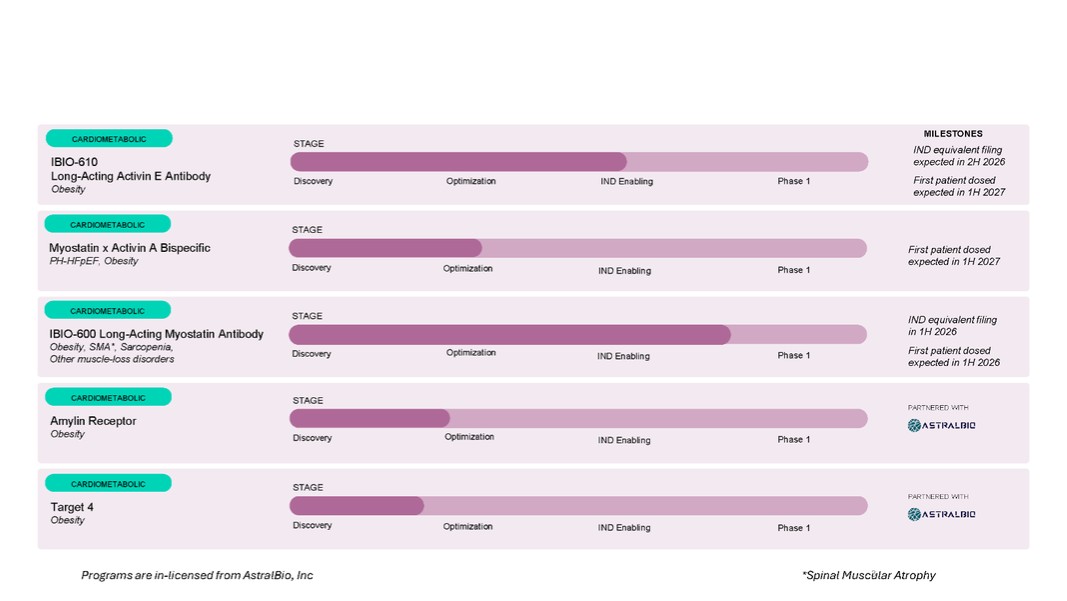
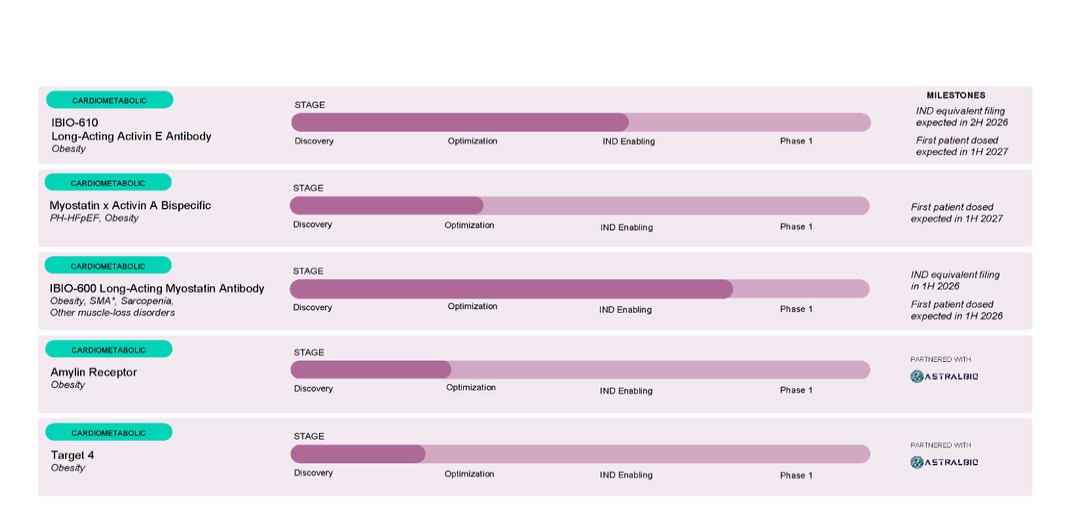
iBio’s current therapeutics are all in preclinical development and it has not completed any clinical trials in humans for any therapeutic protein product candidate produced using its technology and there is a risk that the Company will be unsuccessful in developing or commercializing any product candidates. iBio anticipates IBIO-600 will enter Phase 1a clinical trials in the first half of calendar 2026, marking a pivotal milestone for iBio as the first molecule generated from iBio’s AI Drug Discovery Platform to advance into clinical development. In parallel, with iBio shifting its focus to IBIO-610, potentially the first long-acting antibody inhibiting Activin E, it has accelerated the development of IBIO-610 and anticipates the commencement of first human clinical trials in early calendar 2027.
The Company’s current pre-clinical product candidate pipeline is set forth below.
7

Artificial Intelligence in Antibody Discovery and Development
Through the Company’s innovative AI Drug Discovery Platform, iBio champions a culture of innovation by identifying novel targets, forging strategic collaborations to enhance efficiency, diversify pipelines, with the goal of accelerating preclinical processes. The Company’s proprietary technology stack is designed to minimize downstream development risks by employing AI-guided epitope-steering and monoclonal antibody (“mAb”) optimization.
iBio’s discovery and development work is conducted at the Company’s San Diego research and development laboratory space, where its AI and ML scientists and biopharma researchers operate side by side. This close integration of disciplines enables rapid iteration between in silico design and wet-lab validation, compressing the timeline from hypothesis to lead selection. With the Company’s AI Drug Discovery Platform, focused pre-clinical pipeline, and growing scientific and leadership team, it is aiming to build a durable and differentiated position in obesity therapeutics—one designed to outlast the first wave and define what comes next.
8
2. Basis of Presentation
Interim Condensed Consolidated Financial Statements
The accompanying unaudited condensed consolidated financial statements have been prepared from the books and records of the Company and include all normal and recurring adjustments which are necessary for a fair presentation in accordance with accounting principles generally accepted in the United States (“U.S. GAAP”) for interim consolidated financial information and Rule 8-03 of Regulation S-X promulgated by the U.S. Securities and Exchange Commission (the “SEC”). Accordingly, these interim financial statements do not include all of the information and footnotes required for complete annual consolidated financial statements. Interim results are not necessarily indicative of the results that may be expected for the full year. Interim unaudited condensed consolidated financial statements should be read in conjunction with the audited financial statements and the notes thereto included in the Company’s Annual Report on Form 10-K for the prior year ended June 30, 2025, filed with the SEC on September 5, 2025 (the “Annual Report”), from which the accompanying condensed consolidated balance sheet dated June 30, 2025 was derived.
In the opinion of management, the accompanying unaudited condensed consolidated financial statements contain all adjustments necessary to present fairly the financial position of the Company as of December 31, 2025 and the results of its operations and its cash flows for the periods presented. The results of operations for the three and six months ended December 31, 2025 are not necessarily indicative of the results that may be achieved for a full fiscal year and cannot be used to indicate financial performance for the entire year.
Principles of Consolidation
The condensed consolidated financial statements include the accounts of the Company and its wholly-owned subsidiaries. All intercompany balances and transactions have been eliminated as part of the consolidation.
Liquidity
In accordance with Accounting Standards Update (“ASU”) 2014-15, “Disclosure of Uncertainties about an Entity’s Ability to Continue as a Going Concern (Subtopic 205-40)”, the Company has evaluated whether there are conditions and events, considered in the aggregate, that raise substantial doubt about its ability to continue as a going concern within one year after the date that the condensed consolidated financial statements are issued.
The Company has incurred net losses and generated negative cash flows from operations for many years. For the six months ended December 31, 2025, the Company incurred a net loss of approximately $
The history of significant losses, the negative cash flow from operations, and the dependence by the Company on its ability to obtain additional financing to fund its operations in the past raised substantial doubt about the Company's ability to continue as a going concern. In August 2025, the Company closed on an underwritten public offering raising gross proceeds of approximately $
3. Summary of Significant Accounting Policies
The Company’s significant accounting policies are described in Note 4 of the Notes to Consolidated Financial Statements in the Annual Report.
Use of Estimates
The preparation of consolidated financial statements in conformity with U.S. GAAP requires management to make estimates and assumptions that affect reported amounts of assets and liabilities, disclosures of contingent assets and liabilities at the date of the
9
consolidated financial statements, and the reported amounts of revenues and expenses during the reporting period. These estimates include liquidity assertions, the valuation of intellectual property, the incremental borrowing rate utilized in the finance and operating lease calculations, legal and contractual contingencies, the valuation of the pre-funded warrants issued related to the extinguishment of a secured term loan, the valuation of the warrant issued as partial consideration related to a purchase and sale agreement, and share-based compensation. Although management bases its estimates on historical experience and various other assumptions that are believed to be reasonable under the circumstances, actual results could differ from these estimates.
Accounts Receivable
Accounts receivable are reported at their outstanding unpaid principal balances net of allowances for credit losses. The Company provides for allowances for credit losses based on its estimate of uncollectible amounts considering age, collection history, and any other factors considered appropriate. Management’s policy is to write off accounts receivable against the allowance for credit losses when a balance is determined to be uncollectible. The Company held an allowance for credit losses of approximately $
Subscription Receivable
The Company accounts for any subscription receivable as a current asset. Subscription receivables represent funds related to the sale of Common Stock in which the funds have not yet been delivered to the Company. The funds are generally held in escrow on behalf of the Company and are delivered within a few days.
Revenue Recognition
The Company accounts for its revenue recognition under Accounting Standards Codification (“ASC”) 606, “Revenue from Contracts with Customers” (“ASC 606”). A contract with a customer exists only when: (i) the parties to the contract have approved it and are committed to perform their respective obligations, (ii) the Company can identify each party’s rights regarding the distinct goods or services to be transferred (“performance obligations”), (iii) the Company can determine the transaction price for the goods or services to be transferred, (iv) the contract has commercial substance and (v) it is probable that the Company will collect the consideration to which it will be entitled in exchange for the goods or services that will be transferred to the customer. The Company recognizes revenue when it satisfies its performance obligations by transferring control of a promised good or service to the customer. In addition, the standard requires disclosure of the nature, amount, timing, and uncertainty of revenue and cash flows arising from customer contracts.
The Company analyzes its contracts to determine whether the elements can be separately identifiable and accounted for individually or as a bundle of goods or services. Allocation of revenue to individual elements that qualify for performance obligations is based on the separate selling prices determined for each component, and total contract consideration is then allocated pro rata across the components of the arrangement. If separate selling prices are not available, the Company will use its best estimate of such selling prices, consistent with the overall pricing strategy and after consideration of relevant market factors.
If a loss on a contract is anticipated, such loss is recognized in its entirety when the loss becomes evident. When the current estimates of the amount of consideration that is expected to be received in exchange for transferring promised goods or services to the customer indicate a loss will be incurred, a provision for the entire loss on the contract is made. At December 31, 2025 and June 30, 2025, the Company had
The Company generates contract revenue under the following types of contracts:
Fixed-Fee
Under a fixed-fee contract, the Company charges a fixed agreed upon amount for a deliverable. Fixed-fee contracts have fixed deliverables upon completion of the project. Typically, the Company recognizes revenue for fixed-fee contracts after projects are completed, delivery is made and title transfers to the customer, and collection is reasonably assured.
Revenue can be recognized either 1) over time or 2) at a point in time.
Collaborations/Partnerships
The Company may enter into research and discovery collaborations with third parties that involve a joint operating activity, typically a research and/or development effort, where both parties are active participants in the activity and are exposed to the significant risks and rewards of the activity. The Company’s rights and obligations under its collaboration agreements vary and typically include milestone payments, contingent upon the occurrence of certain future events linked to the success of the asset in development, as well as expense reimbursements from or payments to the collaboration partner.
10
The Company considers the nature and contractual terms of agreements and assesses whether an agreement involves a joint operating activity pursuant to which the Company is an active participant and is exposed to significant risks and rewards dependent on the commercial success of the activity as described under ASC 808, “Collaborative Arrangements” (“ASC 808”). For arrangements determined to be within the scope of ASC 808 where a collaborative partner is not a customer for certain research and development activities, the Company accounts for payments received for the reimbursement of research and development costs as a contra-expense in the period such expenses are incurred. If payments from the collaborative partner to the Company represent consideration from a customer in exchange for distinct goods and services provided, then the Company accounts for those payments within the scope of ASC 606.
Collaborative revenues generated typically include payment to the Company related to one or more of the following: non-refundable upfront license fees, development and commercial milestones, and partial or complete reimbursement of research and development costs.
For the three and six months ended December 31, 2025, revenue in the amount $
Contract Assets
A contract asset is an entity’s right to payment for goods and services already transferred to a customer if that right to payment is conditional on something other than the passage of time. Generally, an entity will recognize a contract asset when it has fulfilled a contract obligation but must perform other obligations before being entitled to payment.
Contract assets consist primarily of the cost of project contract work performed by third parties whereby the Company expects to recognize any related revenue at a later date, upon satisfaction of the contract obligations. At December 31, 2025, June 30, 2025 and June 30, 2024, contract assets were $
Contract Liabilities
A contract liability is an entity’s obligation to transfer goods or services to a customer at the earlier of (1) when the customer prepays consideration or (2) the time that the customer’s consideration is due for goods and services the entity will yet provide. Generally, an entity will recognize a contract liability when it receives prepayment.
Contract liabilities consist primarily of consideration received, usually in the form of payment, on project work to be performed whereby the Company expects to recognize any related revenue at a later date, upon satisfaction of the contract obligations. At December 31, 2025, June 30, 2025 and June 30, 2024 contract liabilities were $
Leases
The Company accounts for leases under the guidance of ASC 842, “Leases” (“ASC 842”). The standard established a right-of-use (“ROU”) model requiring a lessee to record a ROU asset and a lease liability on the balance sheet for all leases with terms longer than 12 months and classified as either an operating or finance lease. The adoption of ASC 842 had a significant effect on the Company’s balance sheet, resulting in an increase in noncurrent assets and both current and noncurrent liabilities.
In accordance with ASC 842, at the inception of an arrangement, the Company determines whether the arrangement is or contains a lease based on the unique facts and circumstances present and the classification of the lease including whether the contract involves the use of a distinct identified asset, whether the Company obtains the right to substantially all the economic benefit from the use of the asset, and whether the Company has the right to direct the use of the asset. Leases with a term greater than one year are recognized on the balance sheet as ROU assets, lease liabilities and, if applicable, long-term lease liabilities. The Company has elected not to recognize on the balance sheet leases with terms of one year or less under practical expedient in paragraph ASC 842-20-25-2. For contracts with lease and non-lease components, the Company has elected not to allocate the contract consideration and to account for the lease and non-lease components as a single lease component.
The lease liability and the corresponding ROU assets are recorded based on the present value of lease payments over the expected remaining lease term. The implicit rate within the Company’s existing finance (capital) lease was determinable and, therefore, used at the adoption date of ASC 842 to determine the present value of lease payments under the finance lease. The implicit rate within the Company’s operating lease was not determinable and, therefore, the Company used the incremental borrowing rate at the lease commencement date to determine the present value of lease payments. The determination of the Company’s incremental borrowing rate
11
requires judgement. The Company will determine the incremental borrowing rate for each new lease using its estimated borrowing rate.
An option to extend the lease is considered in connection with determining the ROU asset and lease liability when it is reasonably certain the Company will exercise that option. An option to terminate is considered unless it is reasonably certain the Company will not exercise the option.
Cash, Cash Equivalents and Restricted Cash
The Company considers all highly liquid instruments purchased with an original maturity of three months or less to be cash equivalents. Cash equivalents at December 31, 2025 and June 30, 2025 consisted of money market accounts and debt securities purchased with original maturities of three months or less. Debt securities classified as cash equivalents were approximately $
The following table summarizes the components of total cash, cash equivalents and restricted cash in the condensed consolidated statements of cash flows (in thousands):
December 31, | June 30, | |||||
2025 | 2025 | |||||
Cash and cash equivalents | | $ | | $ | | |
Collateral held for letter of credit - San Diego lease | | | ||||
Collateral held for Company purchasing card | | | | |||
Total cash, cash equivalents and restricted cash | | $ | | $ | | |
The collateral held for the letter of credit for the San Diego lease and the Company purchasing card are classified as noncurrent on the condensed consolidated balance sheets at December 31, 2025 and June 30, 2025.
Investments in Debt Securities
Investments in debt securities, which consist of government issued treasury bills, treasury notes and government sponsored discount notes, are classified as available-for-sale. These debt securities are classified as available-for-sale securities at the time of purchase as they represent funds readily available for current operations, and the Company has the ability to liquidate them at any time to meet operating cash needs, if necessary. Discounts and premiums paid when the debt securities are acquired are accreted/amortized to interest income over the terms of the debt securities.
Available-for-sale debt securities are recorded at fair value based on publicly available market information, with changes in fair value recognized as unrealized gains or losses in accumulated other comprehensive income. For available-for-sale debt securities in an unrealized loss position, the Company evaluates whether a current expected credit loss exists based on publicly available market information. Expected credit losses are recorded in interest expense on the condensed consolidated statements of income and comprehensive loss. There were no credit losses on available-for-sale debt securities recognized for the three and six months ended December 31, 2025 or the year ended June 30, 2025.
Research and Development
Internal research and development costs are expensed as incurred. Third-party research and development costs are expensed when the contracted work has been performed or as milestone results have been achieved.
12
Right-of-Use Assets
Assets held under the terms of finance (capital) leases are amortized on a straight-line basis over the terms of the leases or the economic lives of the assets. Obligations for future lease payments under finance (capital) leases are shown within liabilities and are analyzed between the amounts falling due within and after one year. See Note 8 – Finance Lease ROU Assets and Note 13 – Finance Lease Obligations for additional information.
Fixed Assets
Fixed assets are stated at cost net of accumulated depreciation. Depreciation is calculated using the straight-line method over the estimated useful lives of the assets ranging from to
The Company monitors fixed assets for impairment indicators throughout the year. When necessary, charges for impairments of long-lived assets are recorded for the amount by which the fair value is less than the carrying value of these assets. Changes in the Company’s business strategy or adverse changes in market conditions could impact impairment analyses and require the recognition of an impairment charge. Although management bases its estimates on historical experience and various other assumptions that are believed to be reasonable under the circumstances, actual results could differ from these estimates.
See Note 10 – Fixed Assets for additional information.
Intangible Assets
Identifiable intangible assets are comprised of definite life intangible assets and indefinite life intangible assets.
The Company accounts for definite life intangible assets at either their historical cost or allocated purchase price at asset acquisition and records amortization utilizing the straight-line method based upon their estimated useful lives. Intellectual property is amortized over
For indefinite life intangible assets, the Company performs an impairment test annually and whenever events or changes in circumstances indicate the carrying value of an asset may not be recoverable. The Company determines the fair value of the asset annually or when triggering events are present, based on discounted cash flows and records an impairment loss if book value exceeds fair value.
Evaluating impairment requires judgment, including the estimation of future cash flows, future growth rates and profitability and the expected life over which cash flows will occur. Changes in the Company’s business strategy or adverse changes in market conditions could impact impairment analyses and require the recognition of an impairment charge. Although management bases its estimates on historical experience and various other assumptions that are believed to be reasonable under the circumstances, actual results could differ from these estimates.
See Note 11 – Intangible Assets for additional information.
Share-based Compensation
The Company recognizes the cost of all share-based payment transactions at fair value. Compensation cost, measured by the fair value of the equity instruments issued, adjusted for estimated forfeitures, is recognized in the financial statements as the respective awards are earned over the performance period. The Company uses historical data to estimate forfeiture rates.
The impact that share-based payment awards will have on the Company’s results of operations is a function of the number of shares awarded, the trading price of the Company’s stock at the date of grant or modification, the vesting schedule and forfeitures. Furthermore, the application of the option pricing model employs weighted-average assumptions for expected volatility of the Company’s stock, expected term until exercise of the options, the risk-free interest rate, and dividends, if any, to determine fair value.
Expected volatility is based on historical volatility of the Common Stock; the expected term until exercise represents the weighted-average period of time that options granted are expected to be outstanding giving consideration to vesting schedules and the Company’s historical exercise patterns; and the risk-free interest rate is based on the U.S. Treasury yield curve in effect at the time of grant for periods corresponding with the expected life of the option. The Company has not paid any dividends since its inception and does not anticipate paying any dividends for the foreseeable future, so the dividend yield is assumed to be
13
estimates forfeitures at each reporting period, rather than electing to record the impact of such forfeitures as they occur. See Note 17 – Share-Based Compensation for additional information.
Concentrations of Credit Risk
Cash and Cash Equivalents
The Company maintains principally all cash balances in three financial institutions which, at times, may exceed the amount insured by the Federal Deposit Insurance Corporation. The exposure to the Company is solely dependent upon daily bank balances and the strength of the financial institution. The Company has not incurred any losses on these accounts. At December 31, 2025 and June 30, 2025, amounts in excess of insured limits were approximately $
Revenue
During the three months ended December 31, 2025, the Company reported
Segment Reporting
Effective July 1, 2024, the Company adopted ASU 2023-07, “Segment Reporting (Topic 280): Improvements to Reportable Segment Disclosures” (“ASU 2023-07”) to update reportable segment disclosure requirements, primarily through enhanced disclosures about significant segment expenses and information used to assess segment performance. The adoption of ASU 2023-07 did not have a significant impact on the Company’s condensed consolidated financial statements.
The Company operates as
Recently Issued Accounting Pronouncements
In October 2023, the FASB issued ASU 2023-06, “Disclosure Improvements: Codification Amendments in Response to the SEC’s Disclosure Update and Simplification Initiative” (“ASU 2023-06”). This ASU incorporates certain SEC disclosure requirements into the FASB ASC. The amendments in the ASU are expected to clarify or improve disclosure and presentation requirements of a variety of ASC Topics, allow users to more easily compare entities subject to the SEC’s existing disclosures with those entities that were not previously subject to the requirements, and align the requirements in the ASC with the SEC’s regulations. The ASU has an unusual effective date and transition requirements since it is contingent on future SEC rule setting. If the SEC fails to enact the required changes by June 30, 2027, this ASU is not effective for any entities. Early adoption is not permitted. The Company is currently evaluating the impact that the adoption of this standard will have on its consolidated financial statements.
In December 2023, the FASB issued ASU 2023-09, “Improvements to Income Tax Disclosures” (“ASU 2023-09”) to enhance the transparency and decision-usefulness of income tax disclosures, particularly in the rate reconciliation table and disclosures about income taxes paid. This ASU applies to all entities subject to income taxes. This ASU will be effective for public companies for annual periods beginning after December 15, 2024 (Fiscal 2026 for the Company). The Company does not expect the adoption of ASU 2023-09 to have a significant impact on its consolidated financial statements for the annual period ending June 30, 2026.
In November 2024, the FASB issued ASU 2024-03, “Income Statement: Reporting Comprehensive Income— Expense Disaggregation Disclosures,” which requires more detailed information about specified categories of expenses (purchases of inventory, employee compensation, depreciation, amortization, and depletion) included in certain expense captions presented on the face of the income statement, as well as disclosures about selling expenses. This ASU is effective for fiscal years beginning after December 15, 2026 (year ended June 30, 2027 for the Company) and for interim periods within fiscal years beginning after December 15, 2027 (quarter ended September 30, 2027 for the Company). Early adoption is permitted. The amendments may be applied either (1) prospectively to financial statements issued for reporting periods after the effective date of this ASU or (2) retrospectively to all prior periods presented in the
14
financial statements. The Company is currently evaluating this guidance to determine the impact it may have on its consolidated financial statements disclosures.
In July 2025, the FASB issued ASU 2025-05, “Financial Instruments—Credit Losses (Topic 326): Measurement of Credit Losses for Accounts Receivable and Contract Assets”, which introduces a practical expedient that allows entities to assume that current conditions at the balance sheet date remain unchanged for the remaining life of the asset when developing reasonable and supportable forecasts. This eliminates the need to incorporate macroeconomic forecasts for short term receivables. The ASU is effective for fiscal years beginning after December 15, 2025 (Fiscal 2027 for the Company), but early adoption is permitted. The Company does not expect the adoption of ASU 2025-05 to have a significant impact on its consolidated financial statements for the annual period ending June 30, 2027.
Management does not believe that any other recently issued, but not yet effective, accounting standard if currently adopted would have a material effect on the accompanying condensed consolidated financial statements.
4. Financial Instruments and Fair Value Measurement
The carrying values of cash and cash equivalents, restricted cash, subscription receivable, accounts receivable, and accounts payable in the Company’s condensed consolidated balance sheets approximated their fair values as of December 31, 2025 and June 30, 2025 due to their short-term nature. The carrying value of the promissory note receivable, term promissory note, equipment financing payable and finance lease obligations approximated fair value as of December 31, 2025 and June 30, 2025 as the interest rates related to the financial instruments approximated market.
The Company accounts for its investments in debt securities at fair value using Level 1 inputs (see Note 6 – Investments in Debt Securities for additional information). The following provides a description of the three levels of inputs that may be used to measure fair value under the standard, the types of plan investments that fall under each category, and the valuation methodologies used to measure these investments at fair value:
| • | Level 1 – Quoted prices in active markets for identical assets or liabilities. |
| • | Level 2 – Quoted prices for similar assets and liabilities in active markets or inputs that are observable. |
| • | Level 3 – Inputs that are unobservable (for example, cash flow modeling inputs based on assumptions). |
5. Significant Transactions
AstralBio License Agreements
Exclusive License Agreement (Myostatin Target): As a result of a collaboration between the Company and AstralBio, Inc. (“AstralBio”), on December 31, 2024, the Company exercised its first option and entered into an exclusive agreement related to myostatin (the “Myostatin License Agreement”) with AstralBio, pursuant to which AstralBio licensed to the Company, on an worldwide exclusive basis and with the right to grant sublicenses, the AstralBio Licensed Patents (as defined in the Myostatin License Agreement) and AstralBio Licensed Know-How (as defined in the Myostatin License Agreement) to develop, manufacture and commercialize and otherwise exploit any product directed to growth differentiation factor 8 (“GDF8”) (myostatin) that contains the licensed antibody targeting myostatin, now named IBIO-600, for research, diagnosis, treatment, prevention, or management of any disease or medical condition. (See Note 11 – Intangible Assets for additional information.) The Company is solely responsible for all decisions related to the launch, sales and marketing and promotion of IBIO-600 in its discretion, subject to the terms of the License Agreement, and for all costs for all activities related to the development, manufacture and commercialization of IBIO-600 worldwide. IBIO-600 was identified by AstralBio using iBio’s proprietary technology stack and was designed for subcutaneous administration with the potential for an extended half-life.
In consideration for the rights and licenses granted by AstralBio to the Company in the Myostatin License Agreement, the Company paid AstralBio (i) an upfront license fee in the amount of $
15
the Company will pay AstralBio a sublicense fee, which fee is a range of a low to mid-single-digit percentage based on the proceeds of the sublicense fees to a third party.
Exclusive License Agreement (Activin E): On April 21, 2025, the Company entered into an exclusive agreement related to Activin E (the “Activin E License Agreement”) with AstralBio, pursuant to which AstralBio licensed to the Company, on an worldwide exclusive basis and with the right to grant sublicenses, under the AstralBio Licensed Patents (as defined in the Activin E License Agreement) and AstralBio Licensed Know-How (as defined in the Activin E License Agreement) to develop, manufacture and commercialize and otherwise exploit any product directed to Activin E that contains the licensed antibody targeting Activin E, now named IBIO-610, for research, diagnosis, treatment, prevention, or management of any disease or medical condition. (See Note 11 – Intangible Assets for additional information.) IBIO-610 was identified by AstralBio using the Company’s proprietary technology stack and was designed for subcutaneous administration with the potential for an extended half-life.
The Company is solely responsible for all decisions related to the launch, sales and marketing and promotion of IBIO-610 in its discretion, subject to the terms of the Activin E License Agreement, and for all costs for all activities related to, the development, manufacture and commercialization of IBIO-610 worldwide. In consideration for the rights and licenses granted by AstralBio to the Company in the Activin E License Agreement, the Company paid AstralBio (i) an upfront license fee in the amount of $
Otsuka
On February 25, 2024, the Company entered into an asset purchase agreement (the “PD-1 Purchase Agreement”) with Otsuka Pharmaceutical Co., Ltd. (“Otsuka”) pursuant to which the Company sold and assigned to Otsuka, and Otsuka purchased and assumed, all intellectual property rights directly related to the Company’s PD-1 Assets (as defined in the PD-1 Purchase Agreement) developed or held for development. The Company received an upfront payment of $
Affiliates of Eastern Capital Limited
On November 1, 2021, the Company and its subsidiary, iBio CDMO LLC (“iBio CDMO”, and collectively with the Company, the “Purchaser”) entered into a series of agreements (the “Transaction”) with College Station Investors LLC (“College Station”), and Bryan Capital Investors LLC (“Bryan Capital” and, collectively with College Station, “Seller”), each affiliates of Eastern Capital Limited (“Eastern,” a former significant stockholder of the Company) described in more detail below whereby in exchange for a certain cash payment and a warrant the Company:
| (i) | acquired both the manufacturing facility (the “Facility”) where iBio CDMO at that time and currently conducts business and also the rights as the tenant in the Facility’s ground lease; |
| (ii) | acquired all of the equity owned by one of the affiliates of Eastern in the Company and iBio CDMO; and |
| (iii) | otherwise terminated all agreements between the Company and the affiliates of Eastern. |
16
The Facility is a life sciences building located on land owned by the Board of Regents of the Texas A&M University System (“Texas A&M”) and is designed and equipped for the manufacture of plant-made biopharmaceuticals. iBio CDMO had held a sublease for the Facility through 2050, subject to extension until 2060 (the “Sublease”) until the consummation of the sale of the Facility.
The Purchase and Sale Agreement
On November 1, 2021, the Purchaser entered into a purchase and sale agreement (the “PSA”) with the Seller pursuant to which: (i) the Seller sold to Purchaser all of its rights, title and interest as the tenant in the Ground Lease Agreement that it entered into with Texas A&M (the “Landlord”) related to the land at which the Facility is located together with all improvements pertaining thereto (the “Ground Lease Property”), which previously had been the subject of the Sublease; (ii) the Seller sold to Purchaser all of its rights, title and interest to any tangible personal property owned by Seller and located on the Ground Lease Property including the Facility; (iii) the Seller sold to Purchaser all of its rights, title and interest to all licensed, permits and authorization for use of the Ground Lease Property; and (iv) College Station and iBio CDMO terminated the Sublease. The total purchase price for the Ground Lease Property, the termination of the Sublease and other agreements among the parties, and the equity described below is $
In the fiscal year ended June 30, 2024, the assets acquired were sold and the Ground Lease Agreement was terminated.
The Credit Agreement
In connection with the PSA, iBio CDMO entered into a Credit Agreement, dated November 1, 2021, with Woodforest pursuant to which Woodforest provided iBio CDMO a $
The Warrant
As part of the consideration for the purchase and sale of the rights set forth above, the Company issued Bryan Capital a Warrant to purchase
RubrYc
On August 23, 2021, the Company entered into a series of agreements with RubrYc Therapeutics, Inc. (“RubrYc”) described in more detail below:
Collaboration and License Agreement
The Company entered into a collaboration and licensing agreement (the “RTX-003 License Agreement”) with RubrYc to further develop RubrYc’s immune-oncology antibodies in its RTX-003 campaign. The RTX-003 License Agreement was terminated when the Company acquired substantially all of the assets of RubrYc in September 2022.
Collaboration, Option and License Agreement
The Company entered into an agreement with RubrYc (the “Collaboration, Option and License Agreement”) to collaborate for up to
17
Stock Purchase Agreement
In connection with the entry into the Collaboration, Option and License Agreement and RTX-003 License Agreement, the Company also entered into a Stock Purchase Agreement (“Stock Purchase Agreement”) with RubrYc whereby the Company purchased a total of
The Company accounted for the agreements as an asset purchase and allocated the purchase price of $
Preferred stock | | $ | |
Intangible assets | | ||
Prepaid expenses | | | |
| $ | |
On September 16, 2022, the Company entered an asset purchase agreement with RubrYc (the “Asset Purchase Agreement”) pursuant to which it acquired substantially all of the assets of RubrYc. The Company issued
Subsequently after the Company acquired substantially all of the assets of RubrYc in September 2022, RubrYc ceased its operations in June 2023. The Company recorded an impairment of the investment in the amount of $
The Company accounted for the agreements as an asset purchase and allocated the purchase price of approximately $
Intangible assets | | $ | |
Fixed assets | | | |
| $ | |
In addition, the Company assumed
6. Investments in Debt Securities
Investments in debt securities consist of AA and A rated government issued treasury bills, treasury notes and government sponsored discount notes bearing interest at rates from
December 31, | June 30, | |||||
2025 | 2025 | |||||
Adjusted cost | | $ | | $ | ||
Gross unrealized losses | | | ||||
Fair value | | $ | | $ | ||
18
The fair value of available-for-sale debt securities, by contractual maturity, as of December 31, 2025, was as follows (in thousands):
December 31, | June 30, | |||||
Fiscal period ending: | | 2025 | 2025 | |||
2026 | | $ | | $ | ||
2027 | | |||||
| $ | | $ | |||
Net accretion of discounts on the debt securities purchased amounted to approximately $
7. Promissory Note Receivable
On June 19, 2023, the Company was issued a promissory note (the “Note”) by Safi Biotherapeutics, Inc. (“Safi”) in the principal amount of $
On August 29, 2024, the Company received a payment from Safi of approximately $
On June 17, 2025, the Company and Safi agreed to extend the maturity date of the Note to June 19, 2026. Safi paid the Company approximately $
For the three months ended December 31, 2025 and 2024, interest income amounted to $
8. Finance Lease ROU Assets
The Company assumed
The following table summarizes by category the gross carrying value and accumulated amortization of finance lease ROU (in thousands):
| December 31, | | June 30, | |||
2025 | 2025 | |||||
ROU - Equipment | $ | $ | | |||
Accumulated amortization |
|
| ( | |||
Net finance lease ROU assets | $ | $ | | |||
Amortization of finance lease ROU assets was approximately $
19
9. Operating Lease ROU Asset
San Diego, California
On September 10, 2021, the Company entered into a lease for approximately
10. Fixed Assets
The following table summarizes by category the gross carrying value and accumulated depreciation of fixed assets (in thousands):
| December 31, | | June 30, | |||
2025 | 2025 | |||||
Building and improvements | $ | | $ | | ||
Machinery and equipment |
| |
| | ||
Office equipment and software | | | ||||
Construction in progress |
| |
| — | ||
| | |||||
Accumulated depreciation | ( | ( | ||||
Net fixed assets | $ | | $ | | ||
Depreciation expense reported was approximately $
11. Intangible Assets
On August 23, 2021, the Company entered into a series of agreements with RubrYc (see Note 5 – Significant Transactions for additional information) whereby the Company, in exchange for a $
On September 16, 2022, the Company entered into an Asset Purchase Agreement with RubrYc pursuant to which it acquired substantially all of the assets of RubrYc. The assets acquired included the patented AI drug discovery platform, all rights with no future milestone payments or royalty obligations, to IBIO-101, in addition to CCR8, EGFRvIII, MUC16, CD3, and one additional immuno-oncology candidate.
On December 31, 2024, the Company entered into the Myostatin License Agreement with AstralBio (see Note 5 – Significant Transactions for additional information) pursuant to which AstralBio licensed to the Company, on an worldwide exclusive basis and with the right to grant sublicenses, under the AstralBio Licensed Patents and AstralBio Licensed Know-How to Develop, Manufacture and Commercialize and otherwise exploit IBIO-600 for research, diagnosis, treatment, prevention, or management of any disease or medical condition. The Myostatin License Agreement will remain in effect at all times and thereafter, unless and until terminated earlier pursuant to the Myostatin License Agreement. The Company accounted for this license as an indefinite-lived intangible asset.
On April 21, 2025, the Company entered into the Activin E License Agreement with AstralBio (see Note 5 – Significant Transactions for additional information) pursuant to which AstralBio licensed to the Company, on an worldwide exclusive basis and with the right to grant sublicenses, under the AstralBio Licensed Patents and AstralBio Licensed Know-How to Develop, Manufacture and Commercialize and otherwise exploit IBIO-610 for research, diagnosis, treatment, prevention, or management of any disease or medical condition. The Activin E License Agreement will remain in effect at all times and thereafter, unless and until terminated earlier pursuant to the Activin E License Agreement. The Company accounted for this license as an indefinite-lived intangible asset.
20
During the second quarter of fiscal year 2026, the Company began to actively market and identify partners for IBIO-101 and the other oncology programs acquired from RubrYc due to the Company’s therapeutic focus shift to precision antibodies in the cardiometabolic and obesity space. The market data collected indicated the full carrying value of IBIO-101 may not be recoverable. Accordingly, the Company engaged a third party to perform a valuation and concluded the fair value to be approximately $
The following table summarizes by category the gross carrying value and accumulated amortization of intangible assets (in thousands):
| | June 30, | | | | | December 31, | ||||||||
2025 | Amortization | Additions | Impairments | 2025 | |||||||||||
Intellectual property – gross carrying value | $ | | $ | — | $ | — | $ | — | $ | | |||||
Intellectual property – accumulated amortization |
| ( |
| ( |
| — |
| — |
| ( | |||||
Total definite lived intangible assets | | $ | ( | — | $ | — | | ||||||||
Intellectual property – indefinite lived | | — | ( | | |||||||||||
Licenses – indefinite lived | | — | — | | |||||||||||
Total net intangibles | $ | | $ | — | $ | | |||||||||
Amortization expense was approximately $
See Note 3 - Summary of Significant Accounting Policies and Note 4 – Financial Instruments and Fair Value Measurement for additional information.
12. Debt
Equipment Financing
On October 12, 2022, the Company entered into an equipment financing master lease agreement and a lease supplement whereby $
Credit and Security Agreement
On January 16, 2024, the Company entered into a credit and security agreement (the “Credit and Security Agreement”) with Loeb Term Solutions LLC (“Lender”), for a term loan or equipment line of credit loan (the “Loan”) pursuant to which the Company issued to Lender a term promissory note in the principal amount of $
The 2024 Term Note provided for monthly payments of principal and interest based on a four-year amortization period, with a balloon payment of all principal, accrued interest and any other amounts due on the two-year anniversary of the 2024 Term Note. The Credit and Security Agreement granted to Lender a security interest in substantially all of the Company’s assets other than any intellectual property related to any of the Company’s filed patents (the “Loeb Collateral”) to secure the Company’s obligations under the 2024 Term Note. The 2024 Term Note was subject to a prepayment fee of:
The Company’s obligations to Lender under the 2024 Term Note and Credit Security Agreement were further secured by a validity guarantee, dated January 16, 2024 (the “Validity Guarantee”), executed by Dr. Martin Brenner and Felipe Duran in their individual capacity (the “Indemnitors”) for the benefit of Lender. The Validity Guarantee provides that the Indemnitors will indemnify the Lender from any loss or damage, including any actual, consequential or incidental loss or damage, suffered by Lender as a result of, or arising out of, among other things, any willful or intentional misrepresentation or gross negligence by the Company in connection with the Loan
21
and any acts of fraud, conversion, misappropriation or misapplication of funds or proceeds of any Loeb Collateral by the Company or the Indemnitors.
The Credit and Security Agreement contained customary events of default. If an event of default occurred, the 2024 Term Note provided that regardless of whether the Lender elects to accelerate the maturity of the 2024 Term Note, the entire principal remaining unpaid hereunder shall thereafter bear interest at the rate equal to the
The financing was payable in
13. Finance Lease Obligations
Equipment
The Company assumed
The following tables present the components of lease expense and supplemental balance sheet information related to the finance lease obligation (in thousands).
| Three Months Ended | Three Months Ended | ||||
December 31, | December 31, | |||||
2025 | 2024 | |||||
Finance lease cost: |
| | | |||
Amortization of ROU assets | $ | | $ | | ||
Interest on lease liabilities |
| |
| | ||
Total lease cost | $ | | $ | | ||
| |
| | |||
Other information: |
| |
| | ||
Cash paid for amounts included in the measurement lease liabilities: |
| |
| | ||
Financing cash flows from finance lease obligations | $ | | $ | | ||
| Six Months Ended | Six Months Ended | ||||
December 31, | December 31, | |||||
2025 | 2024 | |||||
Finance lease cost: |
| | | |||
Amortization of ROU assets | $ | | $ | | ||
Interest on lease liabilities |
| |
| | ||
Total lease cost | $ | | $ | | ||
| |
| | |||
Other information: |
| |
| | ||
Cash paid for amounts included in the measurement lease liabilities: |
|
| | |||
Financing cash flows from finance lease obligations | $ | | $ | | ||
December 31, | June 30, | |||||||
2025 | 2025 | |||||||
Finance lease ROU assets | $ | $ | | |||||
Finance lease obligation - current portion | $ | $ | | |||||
Finance lease obligation - noncurrent portion | $ | $ | — | |||||
Weighted-average remaining lease term - finance lease |
| — | years |
| years | |||
Weighted-average discount rate - finance lease obligation |
| % |
| | % | |||
22
14. Operating Lease Obligations
San Diego
On September 10, 2021, the Company entered into a lease for
| ● | The length of term of the lease is |
| ● | The lease commencement date is September 16, 2022. |
| ● | The monthly rent for the first year of the lease is $ |
| ● | The lease provides for a base rent abatement for months two through five in the first year of the lease. |
| ● | The landlord provided a tenant improvement allowance of $ |
| ● | The Company is responsible for other expenses such as electric, janitorial, etc. |
| ● | The Company opened an irrevocable letter of credit in the amount of $ |
As discussed above, the lease provides for scheduled increases in base rent and scheduled rent abatements. Rent expense is charged to operations using the straight-line method over the term of the lease which results in rent expense being charged to operations at inception of the lease in excess of required lease payments. This excess (formerly classified as deferred rent) is shown as a reduction of the operating lease ROU asset in the accompanying condensed consolidated balance sheets. Rent expense for the San Diego facility commenced in fiscal year 2022, when the Company began making improvements to the San Diego facility.
The following tables present the components of lease expense and supplemental balance sheet information related to the operating lease obligation (in thousands).
Three Months Ended | Three Months Ended | |||||
December 31, | December 31, | |||||
2025 | 2024 | |||||
Operating lease cost: | $ | | $ | | ||
Total lease cost | $ | | $ | | ||
| |
| | |||
Other information: |
| |
| | ||
Cash paid for amounts included in the measurement lease liability: |
| |
| | ||
Operating cash flows from operating lease | $ | | $ | | ||
Operating cash flows from operating lease obligation | $ | | $ | | ||
Six Months Ended | Six Months Ended | |||||
December 31, | December 31, | |||||
2025 | 2024 | |||||
Operating lease cost: | $ | | $ | | ||
Total lease cost | $ | | $ | | ||
|
| |||||
Other information: |
| |
| |||
Cash paid for amounts included in the measurement lease liability: |
| |
| | ||
Operating cash flows from operating lease | $ | | $ | | ||
Operating cash flows from operating lease obligation | $ | | $ | | ||
23
Future minimum payments under the operating lease obligation are as follows (in thousands):
Fiscal year ending on December 31: | | Principal | | Imputed Interest | | Total | |||
2026 | $ | | $ | | $ | | |||
2027 | | | | ||||||
2028 |
| |
| |
| | |||
2029 |
| |
| |
| | |||
2030 |
|
|
| — | |||||
| |
| |
| | ||||
Total minimum lease payments |
| | $ | | $ | | |||
Less: current portion |
| ( |
| |
| | |||
Long-term portion of minimum lease obligation | $ | |
| |
| | |||
15. Stockholders’ Equity
Preferred Stock
The Company’s Board is authorized to issue, at any time, without further stockholder approval, up to
Series 2022 Convertible Preferred Stock (“Series 2022 Preferred”)
On May 9, 2022, the Company’s Board created the Series 2022 Preferred, par value $
Common Stock
The number of authorized shares of the Company’s Common Stock is
Recent issuances of Common Stock include the following:
Wainwright Underwriting
On December 6, 2022, the Company entered into an underwriting agreement (the “Underwriting Agreement”) with H.C. Wainwright & Co., LLC (“Wainwright”). Pursuant to the Underwriting Agreement, the Company agreed to sell to Wainwright, in a firm commitment underwritten offering (the “2022 Offering”) (i)
Wainwright acted as the sole book-running manager for the 2022 Offering. The Company paid Wainwright an underwriting discount equal to
On December 6, 2024, all Series B Warrants that were not exercised prior to such date expired.
The Company also agreed to issue to Wainwright, as the representative of the underwriters, warrants (the “Representative’s Warrants”) to purchase a number of shares of Common Stock equal to
24
The Company received net proceeds of approximately $
2023 Securities Purchase Agreement
On December 7, 2023, the Company closed a public offering (the “2023 Offering”) after it entered into a securities purchase agreement, dated December 5, 2023 (the “2023 Securities Purchase Agreement”) with certain purchasers identified on the signature pages of the 2023 Securities Purchase Agreement, pursuant to which the Company sold, in the 2023 Offering, (i)
The Company paid the Placement Agents an aggregate cash fee equal to
The Company received net proceeds of approximately $
On December 7, 2025, all Series C Common Warrants that were not exercised prior to such date expired.
2024 Securities Purchase Agreement
On March 26, 2024, the Company entered into a securities purchase agreement (the “2024 Securities Purchase Agreement”) with several institutional investors and an accredited investor (the “Securities Purchasers”) for the issuance and sale in a private placement (the “Private Placement”) of the following securities for gross proceeds of approximately $
A holder of the 2024 Pre-Funded Warrants and the Series E Warrants may not exercise any portion of such holder’s 2024 Pre-Funded Warrants or the Series E Warrants to the extent that the holder, together with its affiliates, would beneficially own more than
The 2024 Pre-Funded Warrants are exercisable at any time after their original issuance, subject to the beneficial ownership limitation (as described above) and will not expire until exercised in full. The exercise price and number of shares of Common Stock issuable upon exercise of the 2024 Pre-Funded Warrants and Series E Warrants are subject to appropriate adjustment in the event of stock dividends, stock splits, reorganizations or similar events affecting the Company’s Common Stock and the exercise price.
If at the time of exercise on a date that is after the Initial Exercise Date, there is no effective registration statement or the prospectus contained therein is not available for the issuance of shares of Common Stock to the holders of the Series E Warrants, the Series E Warrants may be exercised, in whole or in part, at such time by means of a “cashless exercise.” If at the time of exercise on a date that is after the 60th day anniversary of the Initial Exercise Date, there is no effective registration statement or the prospectus contained
25
therein is not available for the issuance of shares of Common Stock to the holders of 2024 Pre-Funded Warrants, the 2024 Pre-Funded Warrants may also be exercised, in whole or in part, at such time by means of a “cashless exercise.”
Pursuant to the 2024 Securities Purchase Agreement, the Company agreed to prepare and file a registration statement with the SEC registering the resale of the shares of Common Stock issued to the Securities Purchasers in the Private Placement and the shares underlying the 2024 Pre-Funded Warrants and the Series E Warrants no later than
The Private Placement closed on April 1, 2024 at which time the Company received net proceeds of approximately $
Chardan Capital Markets, LLC served as the exclusive placement agent in connection with the Private Placement and was paid (i) a cash fee equal to
ATM Agreement
On July 3, 2024, the Company entered into an At Market Issuance Sales Agreement (the “ATM Agreement”) with Chardan Capital Markets, LLC (“Chardan”) and Craig-Hallum Capital Group LLC (“Craig-Hallum,” together with Chardan, the “Sales Agents”) providing for the issuance and sale by the Company of its Common Stock, from time to time, through the Sales Agents, with certain limitations on the amount of Common Stock that may be offered and sold by the Company as set forth in the ATM Agreement. Offers and sales of shares of Common Stock by the Company, if any, under the ATM Agreement, are subject to the effectiveness of the Company’s shelf registration statement on Form S-3, filed with the SEC on July 3, 2024 which became effective on August 6, 2024. The aggregate market value of the shares of Common Stock eligible for sale under the ATM prospectus supplement included in the Registration Statement is currently $
Under the ATM Agreement, the Sales Agents for the Company sold
2025 Securities Purchase Agreement
On January 10, 2025, the Company entered into a securities purchase agreement (the “2025 Purchase Agreement”) with certain of the Company’s officers and directors (the “Investors”), pursuant to which the Company issued and sold to the Investors an aggregate of
The 2025 Private Placement closed on January 10, 2025. The Company received aggregate gross proceeds from the 2025 Private Placement of approximately $
AstralBio Myostatin License Agreement
Pursuant to the License Agreement with AstralBio,
Inducement of Existing Warrants
On April 29, 2025, the Company entered into an inducement agreement (the “Inducement Agreement”) with holders (the “Holders”) of certain existing warrants (the “Existing Warrants), wherein the Holders agreed to exercise certain Existing Warrants to purchase up
26
The Inducement Warrants have an exercise price of $
The Company may not effect the exercise of certain Inducement Warrants, and the applicable holder will not be entitled to exercise any portion of any such Inducement Warrant, which, upon giving effect to such exercise, would cause the aggregate number of shares of Common Stock beneficially owned by the holder of such Inducement Warrant (together with its affiliates) to exceed
Leerink Underwriting
On August 19, 2025, the Company entered into an underwriting agreement (the “2025 Underwriting Agreement”) with Leerink Partners LLC (“Leerink”), as representative of the underwriters, relating to the offering, issuance and sale of pre-funded warrants (the “2025 Pre-Funded Warrants”) to purchase an aggregate of up to
Each 2025 Pre-Funded Warrant and the pre-funded warrants issuable upon exercise of the Series G Warrants or Series H Warrants have an exercise price per share of Common Stock equal to $
27
The Company evaluated the 2025 Offering under both ASC 480 and ASC 815-40 to determine if the warrants issued met all of the conditions for equity classification. The Company determined that the 2025 Offering met all of the conditions as the warrants issued were indexed to the Company’s own stock and met the fixed-for-fixed criteria. As such, the 2025 Offering was classified in additional paid-in capital and is not subject to re-measurement.
The aggregate proceeds from the 2025 Offering were approximately $
See Note 21 – Subsequent Events for additional information.
Vesting of Restricted Stock Units “RSUs”
During the first quarter of fiscal year 2026, RSUs for
Warrants
Bryan Capital
On November 1, 2021, the Company issued Bryan Capital a Warrant to purchase up to
Wainwright
As discussed above, the Company issued various warrants with the following terms:
| ● | 2022 Pre-Funded Warrants – Immediately exercisable at an exercise price of $ |
| ● | Series A Warrants – Immediately exercisable at an exercise price of $ |
| ● | Series B Warrants – Immediately exercisable at an exercise price of $ |
| ● | Representative’s Warrants – Immediately exercisable at an exercise price of $ |
During fiscal year 2023,
On August 4, 2023, the Company agreed to amend the exercise price with certain holders of the Series A Warrants and Series B Warrants that were acquired from the Company in the underwritten public offering that was completed in December 2022. Under the amended warrants, the Company agreed to amend existing Series A Warrants to purchase up to
On December 6, 2024, all Series B Warrants that were not exercised prior to such date expired.
On April 29, 2025, the Company entered into an Inducement Agreement with Holders of certain Existing Warrants, which included
28
A.G.P./Alliance Global Partners
On December 7, 2023, the Company completed the 2023 Offering. Each share of Common Stock and 2023 Pre-Funded Warrants, as applicable, was sold together with one Series C Common Warrant to purchase one share of Common Stock and one Series D Common Warrant to purchase one share of Common Stock. A total of
The combined purchase price of each share of Common Stock and the accompanying Common Warrants was $
During the fiscal year ended June 30, 2024,
During fiscal year ended June 30, 2025,
On April 29, 2025, the Company entered into an Inducement Agreement with Holders of certain Existing Warrants, which included
On December 7, 2025, all Series C Common Warrants that were not exercised prior to such date expired.
Chardan Capital Markets
On April 1, 2024, the Company completed the Private Placement of (i)
During the fiscal year ended June 30, 2025,
On April 29, 2025, the Company entered into an Inducement Agreement with Holders of certain Existing Warrants, which included
During the first quarter of fiscal year 2026,
Settlement Agreement
In connection with the PSA, iBio CDMO entered into a Credit Agreement, dated November 1, 2021, with Woodforest pursuant to which Woodforest provided iBio CDMO a $
29
the term of the Term Loan, the Company and Woodforest entered into amendments which, among other things, amended the maturity date, interest rate and liquidity covenant. (Refer to the Company’s Annual Report for more information.)
On May 17, 2024, iBio CDMO, the Company and Woodforest entered into the Settlement Agreement which provided that iBio CDMO pay to Woodforest the proceeds of the sale of the Property under the purchase and sale agreement that iBio CDMO entered into with Texas A&M, pursuant to which iBio CDMO agreed to terminate the Ground Lease Agreement (the “2024 Purchase and Sale Agreement”) when received and determined in consultation with Woodforest the remaining balance due under the Credit Agreement (the “Indebtedness Deficiency Amount”). Thereafter, the Company issued to Woodforest upon receipt of NYSE American LLC approval a Pre-Funded Warrant to purchase up to
On May 31, 2024, in accordance with the terms of the Settlement Agreement entered into on May 17, 2024 with Woodforest in consideration of the payment in full of all Obligations (as such term is defined under the Credit Agreement) (a) iBio CDMO paid to Woodforest (i) $
During the first quarter of fiscal year 2026, Lynx1 elected a cashless exercise of
Inducement Agreement
On April 29, 2025, the Company entered into the Inducement Agreement with Holders of Existing Warrants wherein the Holders agreed to exercise certain Existing Warrants to purchase up to
During the second quarter of fiscal year 2026,
Leerink Partners
On August 19, 2025, the Company entered into the 2025 Underwriting Agreement with Leerink, as representative of the underwriters, relating to the offering, issuance and sale of the 2025 Pre-Funded Warrants to purchase an aggregate of
Each 2025 Pre-Funded Warrant and the pre-funded warrants issuable upon exercise of the Series G Warrants or Series H Warrants have an exercise price per share of Common Stock equal to $
30
exercisable from their date of issuance and have an exercise price equal to $
During the second quarter of fiscal year 2026,
In conjunction with 2025 Underwriting Agreement, the Company agreed to pay the placement agents a fee equal to
See Note 21 – Subsequent Events for additional information.
16. Earnings (Loss) Per Common Share
Basic earnings (loss) per common share is computed by dividing the net income (loss) allocated to common stockholders by the weighted-average number of shares of Common Stock outstanding during the period. For the purposes of calculating basic earnings per share, the weighted-average number of outstanding shares of Common Stock included pre-funded warrants as if they had been exercised as such pre-funded warrants are exercisable for little to no consideration (see Note 15 – Stockholders’ Equity for additional information).
For purposes of calculating diluted earnings (loss) per common share, the denominator includes both the weighted-average number of shares of Common Stock outstanding during the period and the number of common stock equivalents if the inclusion of such common stock equivalents is dilutive. Dilutive common stock equivalents potentially include stock options and warrants using the treasury stock method.
Three Months Ended | Six Months Ended | |||||||||||
December 31, | December 31, | |||||||||||
| | 2025 | | 2024 | 2025 | | 2024 | |||||
Basic and diluted numerator: | ||||||||||||
Net loss - total | $ | ( | $ | ( | $ | ( | $ | ( | ||||
Basic and diluted denominator: | ||||||||||||
Weighted-average common shares outstanding |
| |
| |
| |
| | ||||
Weighted average pre-funded warrants assumed exercised | | — | | — | ||||||||
Total weighted-average common shares outstanding | | | | | ||||||||
|
|
|
| |||||||||
Per share amount - total | $ | ( | $ | ( | $ | ( | $ | ( | ||||
31
In Fiscal 2026 and Fiscal 2025, the Company incurred net losses which cannot be diluted; therefore, basic and diluted loss per common share is the same. As of December 31, 2025 and 2024, shares issuable which could potentially dilute future earnings were as follows:
December 31, | ||||
| | 2025 | | 2024 |
| (in thousands) | |||
Stock options |
| |
| |
Restricted stock units | | — | | |
Warrants | | | ||
AstralBio Exclusive License Agreement | — | | ||
Shares excluded from the calculation of diluted loss per share |
| |
| |
The December 31, 2025 data in the chart above does not include pre-funded warrants issuable upon exercise of the Series G Warrants (Series H Warrants) which have the potential to increase shares issuable by
17. Share-Based Compensation
The following table summarizes the components of share-based compensation expense in the condensed consolidated statements of operations and comprehensive loss (in thousands):
| | Three Months Ended | Six Months Ended | |||||||||
December 31, | December 31, | |||||||||||
| 2025 | | 2024 | 2025 | | 2024 | ||||||
Research and development | $ | | $ | | $ | | $ | | ||||
General and administrative |
| |
| |
| |
| | ||||
Total | $ | | $ | | $ | | $ | | ||||
Stock Options
iBio, Inc. 2023 Omnibus Equity Incentive Plan (the “2023 Plan”)
On December 9, 2023, the Company adopted the 2023 Plan for employees, officers, directors and external service providers which is the successor to the 2020 Omnibus Equity Incentive Plan (the “2020 Plan”) and once approved became effective on January 1, 2024. The maximum number of shares of Common Stock reserved and available for issuance under the 2023 Plan is
Vesting of service awards are determined by the Board and stated in the award agreements. In general, vesting occurs ratably on the anniversary of the grant date over the service period, generally or
In accordance with the provisions of the 2023 Plan, the Limit increased on January 1, 2025 by
32
Under the 2023 Plan,
iBio, Inc. 2020 Omnibus Equity Incentive Plan (the “2020 Plan”)
On December 9, 2020, the Company adopted the 2020 Plan for employees, officers, directors and external service providers. The total number of shares of Common Stock reserved under the 2020 Plan was
Vesting of service awards are determined by the Board of Directors and stated in the award agreements. In general, vesting occurs ratably on the anniversary of the grant date over the service period, generally or
Under the 2020 Plan,
Stock Option Issuances - 2023 Plan
Issuances of stock options during the six months ended December 31, 2025 were as follows:
Grantee | Plan | # of Options | Exercise Price | Vesting | Term | |||||
Employee | 2023 Plan | | $ | |||||||
Directors | 2023 Plan | | $ | Monthly over | ||||||
Executive Officers |
| 2023 Plan |
| |
| $ |
|
| ||
Total | |
See Note 21 – Subsequent Events for additional information.
The Company estimated the fair value of options granted during the six months ended December 31, 2025 using the Black-Scholes option pricing model with the following assumptions:
| | | |
Weighted-average risk-free interest rate | % | ||
Dividend yield |
| % | |
Volatility |
| % | |
Expected term (in years) |
|
|
RSUs
18. Income Taxes
The Company recorded
33
19. Commitments and Contingencies
CRO Agreements
In fiscal year 2025 and 2026, the Company entered into agreements with five contract research organizations (“CROs”) for chemistry, manufacturing, and controls (CMC) development, non-clinical toxicology and related studies to advance IBIO-600 and IBIO-610 towards clinical testing. The Company incurred costs of approximately $
20. Employee 401(k) Plan
Commencing January 1, 2018, the Company established the iBio, Inc. 401(k) Plan (the “Plan”). Eligible employees of the Company may participate in the Plan, whereby they may elect to make elective deferral contributions pursuant to a salary deduction agreement and receive matching contributions upon meeting age and length-of-service requirements. The Company will make a
21. Subsequent Events
The Company has evaluated all events subsequent to the balance sheet date through the date of filing this Quarterly Report. During this period, there were no material subsequent events requiring disclosure except as discussed below.
2023 Plan
In accordance with the provisions of the 2023 Plan, the Limit increased on January 1, 2026 by
Stock Options
During the first quarter of fiscal year 2026, the Board approved stock option awards under the 2023 Plan to various employees to purchase an aggregate of up to
2025 Pre-Funded Warrants
In January 2026,
2026 PIPE
On January 8, 2026, the Company entered into a securities purchase agreement (the “2026 Purchase Agreement”) with certain institutional investors (the “2026 Investors”), pursuant to which the Company agreed to issue and sell to the 2026 Investors, in a Private Placement priced at-the-market consistent with the rules of Nasdaq (the “2026 Private Placement”) an aggregate of
The 2026 Private Placement closed on January 13, 2026 (the “Closing Date”). The Company received aggregate gross proceeds from the 2026 Private Placement of approximately $
34
The pre-funded warrants have an exercise price equal to $
The 2026 Purchase Agreement prohibits the Company, with certain limited exceptions, from issuing any shares of Common Stock or Common Stock Equivalents (as defined in the 2026 Purchase Agreement), effecting a reverse stock split, recapitalization, share consolidation reclassification or similar transaction, or filing any registration statement (other than the Resale Registration Statement (defined below) as required pursuant to the Registration Rights Agreement, discussed below, or a registration statement on Form S-8), until the earlier of: (i) 60 days after the Closing Date; and (ii) the business day immediately following the effective date of the 2026 Resale Registration Statement (defined below).
In connection with the 2026 Private Placement, the Company entered into a registration rights agreement (the “Registration Rights Agreement”) with the 2026 Investors, dated January 8, 2026, pursuant to which the Company agreed to register for resale the shares of Common Stock issued in the 2026 Private Placement and the Pre-Funded Warrant Shares held by the 2026 Investors (the “Registrable Securities”). Under the Registration Rights Agreement, the Company has agreed to file a registration statement (the “2026 Resale Registration Statement”) covering the resale of the Registrable Securities as promptly as reasonably practicable and in any event no later than 60 days after the Closing Date. The Company has agreed to use its commercially reasonable efforts to cause the 2026 Resale Registration Statement to become effective at the earliest possible date but no later than the earlier of: (a) the 75th calendar day following the initial filing date of the 2026 Resale Registration Statement if the SEC notifies the Company that it will “review” the 2026 Resale Registration Statement and (b) the fifth business say after the date the Company is notified (orally or in writing, whichever is earlier) by the SEC that the 2026 Resale Registration Statement will not be “reviewed” or will not be subject to further review. The Company has agreed to use reasonable best efforts to keep the 2026 Resale Registration Statement continuously effective pursuant to Rule 415 promulgated under the Securities Act of 1933, as amended, and available for the resale by the 2026 Investors of all of the Registrable Securities covered thereby at all times until the earliest to occur of the following events: (i) the date on which the 2026 Investors have resold all the Registrable Securities covered thereby; and (ii) the date on which the Registrable Securities may be resold by the 2026 Investors pursuant to Rule 144 without restriction. The Company has agreed to be responsible for all fees and expenses incurred in connection with the registration of the Registrable Securities. The Company filed the 2026 Resale Registration Statement with the SEC on January 30, 2026.
Inducement Warrants
In February 2026,
35
Item 2. Management’s Discussion and Analysis of Financial Condition and Results of Operations.
The following information should be read together with the consolidated financial statements and the notes thereto and other information included elsewhere in this Quarterly Report on Form 10-Q for the quarterly period ended December 31, 2025 (this “Quarterly Report”) and in our annual report on Form 10-K for the year ended June 30, 2025 (the “Annual Report”), as filed with the Securities and Exchange Commission (the “SEC”) on September 5, 2025. Unless the context requires otherwise, references in this Quarterly Report to “iBio,” the “Company,” “we,” “us,” or “our” and similar terms mean iBio, Inc.
Forward-Looking Statements
This Quarterly Report contains “forward-looking statements” within the meaning of Section 27A of the Securities Act of 1933, as amended (the “Securities Act”), and Section 21E of the Securities Exchange Act of 1934, as amended (the “Exchange Act”). For this purpose, any statements contained herein regarding our strategy, future operations, financial position, future revenues, projected costs and expenses, prospects, plans and objectives of management, other than statements of historical facts, are forward-looking statements. The words “anticipate,” “believe,” “estimate,” “may,” “plan,” “will,” “would” and similar expressions are intended to identify forward-looking statements, although not all forward-looking statements contain these identifying words. Such statements reflect our current views with respect to future events. Because these forward-looking statements involve known and unknown risks and uncertainties, actual results, performance or achievements could differ materially from those expressed or implied by these forward-looking statements for a number of important reasons, including those discussed in this “Management’s Discussion and Analysis of Financial Condition and Results of Operations” and elsewhere in this Quarterly Report, as well as in the section titled “Risk Factors” in our Annual Report. We cannot guarantee any future results, levels of activity, performance or achievements. Should one or more of these risks or uncertainties materialize, or should underlying assumptions prove incorrect, actual results may vary materially from those described in this Quarterly Report as anticipated, believed, estimated or expected. The forward-looking statements contained in this Quarterly Report represent our estimates as of the date of this Quarterly Report (unless another date is indicated) and should not be relied upon as representing our expectations as of any other date. While we may elect to update these forward-looking statements, we specifically disclaim any obligation to do so unless otherwise required by securities laws.
Overview
iBio, Inc. (the “Company” or “iBio”) is a preclinical stage biotechnology company leveraging the power of Artificial Intelligence (“AI”) for the development of hard-to-drug precision antibodies in the cardiometabolic and obesity space. Our core mission is to harness the potential of AI and machine learning (“ML”) to unveil novel biologics which other scientists have been unable to develop. Through our innovative AI Drug Discovery Platform, we have been able to identify differentiated molecules aimed to address unmet needs by current approved interverional therapies.
We believe the future treatment for obesity lies not just in overall weight loss—but in targeted weight loss. Current interventional therapies, such as glucagon-like peptide-1 (“GLP-1”) receptor agonists have ushered in a breakthrough era, yet challenges remain: muscle loss, fat regain after treatment cessation, and long-term tolerability. We are developing second-generation therapies aimed to meet these unmet needs, using the power of AI-guided antibody design and advanced screening technologies.
Our obesity strategy is built on three key principles. First, we aim to develop next-generation antibody therapeutics addressing limitations of currently approved treatments, offering options with a goal to preserve muscle mass, target fat selectively, and provide durable weight loss with improved tolerability. Second, we are focusing on targets with strong human validation, which we believe both helps reduce development risk and increase the likelihood of clinical success. Lastly, we are applying our integrated AI Drug Discovery Platform and deep scientific expertise to rapidly generate development-ready biologics, enabling it to move with speed and precision in a competitive and fast-evolving field. Our current therapeutics are all in preclinical development and we have not completed any clinical trials in humans for any therapeutic protein product candidate produced using our technology and there is a risk we will be unsuccessful in developing or commercializing any product candidates. We anticipate IBIO-600 will enter Phase 1a clinical trials in the first half of calendar 2026, marking a pivotal milestone for us as the first molecule generated from our technology platform to advance into clinical development. In parallel, with shifting our focus to IBIO-610, potentially the first long-acting antibody inhibiting Activin E, we have accelerated the development of IBIO-610 and anticipate the commencement of first human clinical trials in early calendar 2027.
Our discovery and development work is conducted at our San Diego research and development (“R&D”) laboratory space, where our AI and ML scientists and biopharma researchers operate side by side. This close integration of disciplines enables rapid iteration between in silico design and wet-lab validation, compressing the timeline from hypothesis to lead selection. With our AI Drug Discovery Platform, focused pre-clinical pipeline, and growing scientific and leadership team, we are building a durable and differentiated position in obesity therapeutics—one designed to outlast the first wave and define what comes next.
36
Our approach to the evolving needs in obesity treatment is facilitated by our fully integrated antibody discovery platform, designed from the ground up for precision, speed and developability. At the core of our AI Drug Discovery Platform is an AI-enabled epitope steering engine enabling us to precisely direct antibodies to functional hotspots on even the most challenging targets—often considered "undruggable." When combined with our antibody optimization platform, which deeply integrates generative AI tools with mammalian display technology, we can progress from concept to development-ready antibody in as little as seven months.
Our strategic approach to fulfilling our mission is outlined as follows:
| ● | Disease area strategy rests on three pillars: |
| o | Therapeutic Focus: Develop potential therapies that either complement or follow GLP-1 treatment, or provide well-tolerated monotherapy alternatives for patients unable or unwilling to remain on GLP-1s. |
| o | Target Selection: Prioritize targets with strong human validation – genetic or pharmacologic – to reduce development risk and increase the likelihood of achieving first- or best-in-class outcomes. |
| o | Competitive Edge: Leverage the integration of our AI-driven discovery platform, domain expertise, experienced personnel and advancing preclinical pipeline to accelerate differentiation and unlock targets others cannot. |
| ● | Capital efficient business approach: Our strategic business approach is structured around the following pillars of value creation: |
| o | Developing and Advancing our In-house Preclinical Programs Cost Effectively: Drug discovery and clinical advancement of our pipeline remain central to our success. We continue to advance programs in obesity and cardiometabolic diseases with the goal of becoming a clinical-stage company, while also evaluating potential partnerships around select obesity assets to maximize their value and accelerate development timelines. |
| o | Strategic Collaborations: We continue to pursue selective strategic collaborations using our existing portfolio of obesity and immuno-oncology assets, in order to accelerate our preclinical programs efficiently. |
| o | Out-Licensing in Diverse Therapeutic Areas: We are evaluating opportunities for out-licensing our AI Drug Discovery Platform to broaden the use of our platform technologies beyond our core focus areas of obesity and cardiometabolic disease. These opportunities include potential partnerships in therapeutic areas such as immunology, inflammation, pain, and vaccines. Through such arrangements, we aim to provide partners with access to our AI-based discovery and screening technologies while generating potential revenue streams and maintaining operational focus on our internal research and development priorities. |
In essence, we believe we are sculpting a future where cutting-edge AI-driven biotechnology propels the discovery of intricate biologics, fostering partnerships, accelerating innovation, and propelling the advancement of science.
37
Our current pre-clinical product candidate pipeline is set forth below.

IBIO-610
By leveraging our AI Drug Discovery Platform, we believe we have successfully identified the first long-acting antibody inhibiting Activin E. Preclinical data from multiple in vitro cell-based assays, including one on a human adipocyte cell line, demonstrated robust blockade of Activin E-mediated signaling. The antibody has been evaluated in multiple pre-clinical studies in a model of diet-induced obesity (DIO) in mice, both alone with biweekly dosing and in combination with semaglutide dosed daily. These results suggest IBIO-610 may induce fat-selective weight loss.
In a DIO mouse model, IBIO-610 was administered biweekly at 10 mg/kg for four weeks to evaluate its effects as a monotherapy. Treated mice were observed to have a 8.9% reduction in body weight compared to baseline and placebo, with body composition analysis revealing a 26% reduction in fat mass and no measurable loss of lean mass. Outlier non-responder mice were excluded.
To test potential combination therapy with incretin treatments, IBIO-610 was dosed biweekly alongside daily semaglutide. While semaglutide alone produced a 27.8% reduction in body weight (baseline and placebo adjusted), the combination resulted in a more pronounced 35.3% weight loss, without any additive effect on food intake. The combination also led to a greater reduction in visceral fat compared to semaglutide alone, suggesting complementary mechanisms that enhance metabolic benefit.
IBIO-610 was also tested as a maintenance therapy following cessation of semaglutide treatment. In this model, DIO mice were first dosed with semaglutide for two weeks, leading to approximately 18% weight loss. Upon stopping semaglutide, control mice regained 71% of the lost weight within three weeks, with fat mass levels returning to those of untreated animals. In contrast, mice receiving IBIO-610 at the time of semaglutide discontinuation regained only 28% of the lost weight and retained significantly lower fat mass at study termination, highlighting the potential of IBIO-610 to prevent rebound weight gain.
IBIO-610 was evaluated in a pharmacokinetic (“PK”) preclinical study in obese, mature non-human primates (“NHPs”) to characterize systemic exposure and clearance following a single intravenous administration. Serum concentrations were measured at defined intervals post-dose to generate a time-concentration profile. PK analysis demonstrated IBIO-610 exhibited a terminal half-life of approximately 33.2 days in NHPs, consistent with expectations for a half-life extended antibody of this class. Using multiple allometric scaling approaches, the projected half-life in humans is estimated to fall within a range of 47 up to 100 days, supporting the potential for infrequent, long-acting dosing in clinical settings. Following the NHP pharmacokinetic study, we initiated CMC and nonclinical toxicology activities to support the advancement of IBIO-610 toward clinical development. Stable cell line development is ongoing, with process development proceeding in parallel. Dose range finding toxicology studies have been initiated in parallel in relevant species.
38
Myostatin x Activin A Bispecific Antibody
We initiated a program to develop a bispecific antibody targeting both myostatin and Activin A. Leveraging our StableHu™ platform and mammalian display, this program is in late discovery, where multiple parameters, such as binding affinity, expression levels, and stability, are being optimized. Early in vitro findings in human muscle progenitor cells suggest that the bispecific candidate induces a stronger differentiation of progenitor cells into mature muscle cells compared to antibodies targeting only myostatin or Activin A alone.
IBIO-600
In April 2024, as result of the collaboration with AstralBio, we initiated a program to discover and develop a long-acting anti-myostatin antibody. Using our StableHu platform coupled with mammalian display, we optimized hit antibodies across multiple parameters, including affinity for myostatin, binding to the FcRn receptor, expression levels in mammalian cells, and resistance to poly-reactivity and aggregation. The final candidate, IBIO-600, was also observed to have a beneficial profile between thermostability and resistance to stress conditions during initial testing.
In vitro, IBIO-600 was evaluated in human muscle progenitor cells, where it potently inhibited myostatin. This inhibition facilitated the differentiation of progenitor cells into mature human muscle cells. In interim data from a preclinical study in obese mice, we observed that IBIO-600 dose-dependently prevented lean mass loss when administered in combination with a GLP-1 receptor agonist.
In November 2024, we initiated a study in obese and elderly NHP for IBIO-600. The primary goal of the study was to assess the PK profile of IBIO-600. The study consisted of two dose levels, a low dose of 5 mg/kg and a high dose of 50 mg/kg, with a single subcutaneous injection in each case. In addition to monitoring PK in serum, the study analyzed body composition changes over time by employing DEXA scans, measuring lean and fat mass.
The study consisted of six NHPs, sorted randomly into the low and high dose groups. IBIO-600 promoted an increase in lean mass and a reduction in fat mass from baseline values. Standard PK calculations indicated the half-life of IBIO-600 in NHPs was approximately 52.4 days. By using multiple allometric scaling approaches, we estimated the half-life in humans of IBIO-600 as falling with a range of 74-147 days.
Following the NHP pharmacokinetic study, we initiated CMC and nonclinical toxicology activities to support the advancement of IBIO-600 toward clinical development. We have completed manufacturing and fill/finish of a GMP batch of IBIO-600, with long term stability testing ongoing. To continue development of IBIO-600 after the completion of CMC and nonclinical toxicology testing, we have contracted with a CRO to advance IBIO-600 into first-in-human clinical testing. In parallel, we launched a nonclinical toxicology program, initiating both rat and NHP dose range-finding studies, as well as rat and NHP GLP studies. All studies are progressing as planned.
As we continue developing IBIO-600, we are actively seeking a development partner to help accelerate its clinical progression in sarcopenia, muscle loss disorders, and obesity, maximizing the therapeutic and commercial potential of this unique, long-acting anti-myostatin/GDF11 antibody.
Partnered Programs
Amylin Receptor Agonist Engineered Antibody
In collaboration with AstralBio, we are working to develop an amylin receptor antibody, a potentially highly promising mechanism in obesity treatment. Along with AstralBio, we are discovering and optimizing both dual amylin and calcitonin receptor (DACRA)-like engineered antibodies, and selective amylin receptor agonist antibodies while avoiding engagement of the calcitonin receptor. Improved selectivity may translate into tolerability and efficacy advantages. Leveraging the AI Drug Discovery Platform, combining soluble G protein-coupled receptor (“GPCR”) analogues with mammalian display, we have engineered agonists with tailored activity across specific amylin receptor subtypes, showcasing the ability to address complex membrane protein targets with precision.
39
Early preclinical results to date show the promise of the approach. In a proof-of-concept study in DIO mice, an early DACRA-like agonist antibody delivered approximately a ~60% reduction in acute food intake (p<0.05), nearly matching the 67% reduction seen with a benchmark DACRA peptide. These data affirm that antibody-based approaches targeting amylin receptor are promising and can access the parts of the brain containing amylin receptor. As the third obesity program from our AstralBio partnership, this achievement marks a significant validation of our integrated AI Drug Discovery Platform and sets the stage for advancing this differentiated modality into the next stages of development.
AI Drug Discovery Platform
Overview
Our technology stack is a multi-layered, AI-powered system designed to significantly enhance the probability of success in discovering and developing antibodies against hard-to-drug, pathophysiologically relevant proteins. The platform comprises four integrated layers, each contributing a distinct capability to the discovery, engineering, and optimization of precision antibodies. By seamlessly combining advanced computational design with cutting-edge biological technologies, iBio’s AI-driven discovery platform enables the rapid generation of antibody therapeutics characterized by high specificity, optimized developability, and accelerated progression from concept to clinic.
The first layer, epitope engineering, leverages the patented AI-engine to target specific regions of proteins, allowing us to engineer antibodies with high specificity and efficacy. Pursuing specific epitopes that elicit a specific biological function allows us to create antibodies with complex modes of action, like agonistic or cell activating antibodies. The second layer involves the proprietary antibody library, which is built on clinically validated frameworks and offers a rich diversity of human antibodies. The third layer of the technology stack is the antibody optimizing StableHu AI technology, coupled with mammalian display technology. This combination has been shown to speed up the Lead Optimization process and potentially minimizes downstream risks, with the goal of making the overall development process more efficient and cost-effective.
Building on this foundation, the fourth layer is our EngageTx™ and ShieldTx™ technologies expanding the platform’s reach into multi-specific and conditionally active antibody formats. EngageTx delivers an optimized, next-generation CD3 T-cell engager antibody panel with a wide range of potencies, NHP cross-reactivity, enhanced humanness, and strong tumor-killing activity with reduced cytokine release. In parallel, ShieldTx provides an antibody masking technology that enables the creation of conditionally activated antibodies. These conditionally activated antibodies can broaden the therapeutic window by improving efficacy and safety, enable drug
40
combinations that would otherwise be too toxic, and open the door to pursuing targets whose expression across multiple tissues would normally raise safety concerns.
AI Epitope Steering Technology
Epitopes—the small regions on large target proteins—are critical to eliciting desired biological effects when targeted with antibodies. Traditional epitope-specific discovery methods often struggle with dominant-epitope antibodies that lack efficacy yet overwhelm screening, obscuring antibodies against more therapeutically valuable sites. These approaches also tend to yield few or no hits against complex, hard-to-drug epitopes due to structural challenges and the limited availability of stable scaffolds needed to maintain epitope integrity during discovery.
Our Epitope Steering technology directly addresses these limitations by guiding antibody generation toward predefined regions of a target protein. Using AI, we design engineered epitopes—precisely modeled and optimized fragments of the target—to improve structural fidelity, solubility, and stability. These engineered epitopes enable efficient antibody selection from naïve or immunized libraries, significantly increasing discovery success, especially for agonistic or functionally active antibodies.
This approach is broadly applicable across complex protein classes and holds promise in unlocking new targets in cardiometabolic disease, immuno-oncology, immunology, and pain. Moreover, it has potential applications in vaccine design, offering new opportunities for disease prevention.
Naïve Human Antibody Library
The fully human antibody library is built upon clinically validated, entirely human antibody frameworks. By leveraging public databases, we have extracted a diverse array of Complementarity-Determining Region (CDR) sequences. Subsequently, we have meticulously eliminated a range of sequence liabilities. Such careful curation process could potentially significantly reduce the development risk for antibodies identified from our library.
StableHu AI Antibody-Optimizing Technology
Antibody optimization is a pivotal step in the development of therapeutic antibodies. It refines an antibody's properties to enhance its efficacy, safety, and manufacturability. This process includes humanization, which alters non-human antibodies to mimic human antibodies, thereby reducing the risk of immune reactions when used in therapy.
Our proprietary StableHu technology is instrumental in this optimization process. StableHu is an AI-powered tool designed to predict a library of antibodies with fully human CDR variants based on an input antibody. This input can range from an early, unoptimized molecule to an approved drug. The model has been trained utilizing a set of over 1 billion human antibodies, progressively masking known amino acids within CDRs until the algorithm could predict the correct human sequence.
While phage display libraries are often used in antibody optimization due to their vast diversity, they can increase developability risks such as low expression, instability, or aggregation of antibodies. Mammalian display libraries, on the other hand, offer significantly improved developability but reduced diversity due to the smaller library size they can handle. StableHu overcomes this limitation by utilizing a machine learning algorithm generating focused library diversity within the capacity of mammalian display.
Mammalian display is a technology that presents antibodies on the surface of mammalian cells, allowing for the direct screening and selection of antibodies in a mammalian cell environment. This approach is advantageous as antibodies that express well on the mammalian cells used in the display are more likely to express well in the production cell line. Moreover, single-cell sorting of antibody-displaying cells allows rapid selection of desired antibodies based on multiple dimensions, such as potency, selectivity, and cross-species selectivity.
When paired with mammalian display technology, StableHu enables antibody optimization with fewer iterative optimization steps, lower immunogenicity risk, and improved developability.
EngageTx CD3-Based T-Cell Engager Panel
CD3-based T-cell engagers can drive powerful anti-tumor responses by recruiting and activating the body’s own T cells. However, first-generation bispecifics have faced major challenges—namely, cytokine release syndrome, limited specificity, and poor non-human primate (NHP) cross-reactivity, which complicates safety testing.
41
To address these limitations, we applied StableHu technology to antibodies derived from an epitope steering campaign and a first-generation T-cell engager. This approach generated a diverse CD3 antibody panel with a wide potency range, enabling flexible pairing with various tumor-targeting antibodies. The resulting molecules retained potent tumor-killing activity while significantly reducing cytokine release, potentially lowering the risk of cytokine release syndrome.
StableHu also increased antibody humanness, reducing immunogenicity risk, and introduced NHP cross-reactivity—allowing for robust preclinical safety assessments ahead of clinical trials.
ShieldTx Antibody Masking Technology
Many potential drug targets are expressed across both healthy and diseased tissues, making selective targeting a major safety challenge. Antibodies that kill target-expressing cells can damage healthy tissues if the target is not disease-restricted.
Antibody masking offers a solution. Masked, or conditionally activated, antibodies remain inactive in circulation through a temporary “mask” linked to the binding site. Once the antibody reaches diseased tissue, disease-specific enzymes cleave the linker, removing the mask and activating the antibody precisely where it is needed. This targeted activation broadens the therapeutic window, improves safety, and enables the pursuit of targets and drug combinations otherwise considered too toxic.
Our ShieldTx platform integrates antibody masking directly into the antibody discovery process, increasing the probability of success. Using our epitope engineering engine, we design small, accurate replicas of target epitopes to raise antibodies; these same engineered epitopes can then serve as optimized masks—making mask design an inherent part of discovery.
Through StableHu multi-dimensional optimization, we simultaneously refine the antibody, mask, and linker components—reducing development time compared to traditional sequential approaches. The result is a faster, more integrated path to conditionally active antibodies with enhanced efficacy and safety potential.
Programs Available for Partnering Outside the Cardiometabolic Area
There have been notable advances in the field of oncology in recent years, and arguably none more important than the advent of immunotherapies. We have a pipeline of pre-clinical programs with differentiated profiles and high potential impact, including IBIO-101, our second-generation anti-CD25 monoclonal antibody, a TROP-2 x CD3 bispecific antibody, an antibody that binds to a non-shed, non-glycosylated region of MUC16, an antibody that binds to an epitope on EGFRvIII without binding wildtype EGFR, and an anti-CCR8 antibody. With our therapeutic focus shifting to precision antibodies in the cardiometabolic and obesity space, we are exploring the best path forward for our immune-oncology programs, with a focus on identifying partners who bring complementary capabilities and a shared vision for patient impact.
Collaborations and Partnerships
As noted above, one of the three pillars of value creation that structures of our strategic business approach are strategic collaborations and partnerships. At the center of such pillar is our AI Drug Discovery Platform.
In March 2024, we entered into a collaboration with AstralBio to discover and develop novel antibodies for obesity and other cardiometabolic diseases. As part of the collaboration, we granted an exclusive license to AstralBio of our AI-powered technology to identify and engineer four (4) targets for the treatment of obesity and cardiometabolic diseases, of which AstralBio may continue the pre-clinical development and deploy its proven drug development expertise to advance candidates to an IND application. We have the exclusive option to license three (3) obesity and cardiometabolic targets from AstralBio and as a result, we will receive the right to develop, manufacture and commercialize those targets upon exercise. Upon mutual consent with AstralBio, we may also expand the collaboration to include additional targets in other fields.
As a result of this collaboration with AstralBio, we exercised our first option and entered into the Myostatin License Agreement with AstralBio, pursuant to which AstralBio licensed to us, on an worldwide exclusive basis and with the right to grant sublicenses, under the AstralBio Licensed Patents (as defined in the Myostatin License Agreement) and AstralBio Licensed Know-How (as defined in the Myostatin License Agreement) to develop, manufacture and commercialize and otherwise exploit IBIO-600 for research, diagnosis, treatment, prevention, or management of any disease or medical condition. We are solely responsible for all decisions related to the launch, sales and marketing and promotion of IBIO-600 in our discretion, subject to the terms of the License Agreement, and for all costs for all activities related to the development, manufacture and commercialization of IBIO-600 worldwide. IBIO-600 was identified by AstralBio using our proprietary technology stack and was designed for subcutaneous administration with the potential for an extended half-life. In parallel, we initiated a bispecific antibody program targeting myostatin/activin A to treat obesity and cardiometabolic disorders, leveraging our proprietary technology stack as well as the technology of IBIO-600.
42
In April 2025, we exercised our second option and entered into the Activin E License Agreement with AstralBio, pursuant to which AstralBio licensed to us, on an worldwide exclusive basis and with the right to grant sublicenses, under the AstralBio Licensed Patents (as defined in the Activin E License Agreement) and AstralBio Licensed Know-How (as defined in the Activin E License Agreement) to develop, manufacture and commercialize and otherwise exploit IBIO-610 for research, diagnosis, treatment, prevention, or management of any disease or medical condition. We are solely responsible for all decisions related to the launch, sales and marketing and promotion of IBIO-610 in our discretion, subject to the terms of the Activin E License Agreement, and for all costs for all activities related to, the development, manufacture and commercialization of IBIO-610 worldwide.
We continue to seek to advance of our preclinical immune-oncology candidates with potential as standalone or combination therapies while seeking partnerships for IBIO-600 in the most competitive areas that will likely require combination therapy. Further, we continue to seek out opportunities for future collaborations using our AI Drug Discovery Platform.
Recent Developments
Private Placement
On January 13, 2026 (the “Closing Date”), pursuant to the terms of the securities purchase agreement (the “2026 Purchase Agreement”) that we entered into on January 8, 2026 with certain investors (the “2026 Investors”), we issued and sold to the 2026 Investors in a private placement (the “2026 Private Placement”) an aggregate of 1,408,481 shares of our common stock, par value $0.001 per share (the “Common Stock”) and, in lieu of shares, pre-funded warrants (the “2026 Pre-Funded Warrants”) to purchase up to an aggregate of 9,653,257 shares of Common Stock (the “2026 Pre-Funded Warrant Shares”). The purchase price per share was $2.35. The purchase price per pre-funded warrant was $2.349, which is equal to the purchase price per share, minus the exercise price of $0.001 for each pre-funded warrant.
We received aggregate gross proceeds from the 2026 Private Placement of approximately $26 million, before deducting the placement agent commissions and estimated offering expenses payable by us.
The 2026 Pre-Funded Warrants have an exercise price equal to $0.001 per share, are exercisable at any time after their date of issuance and will not expire until exercised in full. The 2026 Pre-Funded Warrants provide that a holder of the 2026 Pre-Funded Warrants will not have the right to exercise any portion of its 2026 Pre-Funded Warrants if such holder, together with its affiliates, and any other party whose holdings would be aggregated with those of the holder for purposes of Section 13(d) of the Exchange Act, would beneficially own in excess of 4.99%, or, at the option of each 2026 Investor, 9.99%, of the number of shares of Common Stock outstanding immediately after giving effect to such exercise (the “Beneficial Ownership Limitation”); provided, however, that the holder may increase or decrease the Beneficial Ownership Limitation by giving notice to us, with any such increase not taking effect until the sixty-first day after such notice is delivered to us but not to any percentage in excess of 9.99%. The 2026 Pre-Funded Warrants may be exercised on a cashless basis if, at the time of exercise, there is no effective registration statement or the prospectus contained therein is not available for the issuance of the 2026 Pre-Funded Warrant Shares. The exercise price and number of 2026 Pre-Funded Warrant Shares are subject to appropriate adjustment in the event of stock dividends, stock splits, reorganizations or similar events.
The 2026 Purchase Agreement prohibits us, with certain limited exceptions, from issuing any shares of Common Stock or Common Stock Equivalents (as defined in the 2026 Purchase Agreement), effecting a reverse stock split, recapitalization, share consolidation reclassification or similar transaction, or filing any registration statement (other than the 2026 Resale Registration Statement (defined below) as required pursuant to the Registration Rights Agreement, discussed below, or a registration statement on Form S-8), until the earlier of: (i) 60 days after the Closing Date; and (ii) the business day immediately following the effective date of the 2026 Resale Registration Statement (defined below).
In connection with the 2026 Private Placement, we entered into a registration rights agreement (the “Registration Rights Agreement”) with the 2026 Investors, dated January 8, 2026, pursuant to which we agreed to register for resale the shares of Common Stock issued in the 2026 Private Placement and the Pre-Funded Warrant Shares held by the 2026 Investors (the “Registrable Securities”). Under the Registration Rights Agreement, we agreed to file a registration statement (the “2026 Resale Registration Statement”) covering the resale of the Registrable Securities as promptly as reasonably practicable and in any event no later than 60 days after the Closing Date. We agreed to use commercially reasonable efforts to cause the 2026 Resale Registration Statement to become effective at the earliest possible date but no later than the earlier of: (a) the 75th calendar day following the initial filing date of the 2026 Resale Registration Statement if the SEC notifies us that it will “review” the 2026 Resale Registration Statement and (b) the fifth business say after the date we are notified (orally or in writing, whichever is earlier) by the SEC that the 2026 Resale Registration Statement will not be “reviewed” or will not be subject to further review. We agreed to use reasonable best efforts to keep the 2026 Resale Registration Statement continuously effective pursuant to Rule 415 promulgated under the Securities Act, and available for the resale by the 2026 Investors of all of the Registrable Securities covered thereby at all times until the earliest to occur of the following events: (i) the date on which the 2026 Investors have resold all the Registrable Securities covered thereby; and (ii) the date on which the Registrable Securities may be
43
resold by the 2026 Investors pursuant to Rule 144 without restriction. We agreed to be responsible for all fees and expenses incurred in connection with the registration of the Registrable Securities. We filed the 2026 Resale Registration Statement with the SEC on January 30, 2026 and declared effective by the SEC on February 9, 2026.
Liquidity and Capital Resources
We have incurred net losses and generated negative cash flows from operations for many years. For the six months ended December 31, 2025, we incurred a net loss of approximately $14.7 million and had negative cash flows from operations of approximately $10.9 million. Historically, our liquidity needs have been met by the sale and issuances of securities and the issuances of shares of Common Stock through the exercise of warrants. As of December 31, 2025, we had total current assets of approximately $53.4 million, of which approximately $28.7 million was cash and cash equivalents and approximately $24.0 million was investments in debt securities. For the six months ended December 31, 2025, we had an operating capital deficit of $10.9 million which compares to the $7.6 million operating capital deficit we maintained for the six months ended December 31, 2024.
Based on the total cash and cash equivalents, and investments in debt securities of approximately $52.7 million at December 31, 2025, we believe that our current cash position is sufficient to fund our operations for at least 12 months from the date of filing this Quarterly Report.
Despite this liquidity position, the history of significant losses, the negative cash flow from operations, and the dependence by us on our ability to obtain additional financing to fund our operations raised substantial doubt about our ability to continue as a going concern. In August 2025, we closed on an underwritten public offering raising gross proceeds of approximately $50 million and in January 2026, we closed 2026 Private Placement raising gross proceeds of approximately $26 million. Our ability to generate future revenue is dependent on the successful development, regulatory approval, and commercialization of our product candidates, which are subject to significant risks and uncertainties, including clinical trial outcomes, review timelines of the U.S. Food and Drug Administration (the “FDA”), and market acceptance.
Results of Operations – Comparison of the three months ended December 31, 2025 and 2024
Revenue
Our ongoing business is primarily focused on i) development of our pipeline for which we do not expect revenue for many years, if at all, and ii) on advancing our AI-driven discovery platform to develop molecules against hard to drug targets. To date this platform has not generated any material revenue, though we may realize revenue from it in the future. No revenue was recognized during the three months ended December 31, 2025. Revenue in the amount of $0.2 million was recognized for services provided to a collaborative partner during the three months ended December 31, 2024.
Research and Development Expenses (“R&D”)
R&D expenses for the three months ended December 31, 2025 and 2024 were $4.3 million and $1.9 million, respectively, an increase of approximately $2.4 million. The increase in R&D expenses is mainly due to increased spending on consultants and outside services supporting the Company’s R&D efforts, including NHP studies and CMC activities, and an increase in people costs as a result of advancing research activities for our IBIO-600 and IBIO-610 programs and other preclinical pipeline assets. The increased spend was partially offset by decreased spending on consumable supplies.
General and Administrative Expenses (“G&A”)
G&A expenses for the three months ended December 31, 2025 and 2024 were approximately $5.2 million and $2.7 million, respectively, an increase of approximately $2.5 million. The increase is primarily attributable to the impairment of the Company’s indefinite lived intangible asset IBIO-101.
Total Operating Expenses
Total operating expenses, consisting primarily of G&A expenses and R&D expenses, for the three months ended December 31, 2025 were approximately $9.4 million, compared to approximately $4.6 million in the same period of fiscal year 2025.
Net Loss
Our net loss for the three months ended December 31, 2025 was $9.0 million, or $0.09 per share of Common Stock, compared to our net loss of approximately $4.4 million, or $0.48 per share of Common Stock for the three months ended December 31, 2024.
44
Results of Operations – Comparison of the six months ended December 31, 2025 and 2024
Revenue
Our ongoing business is primarily focused on i) development of our pipeline for which we do not expect revenue for many years, if at all, and ii) on advancing our AI-driven discovery platform to develop molecules against hard to drug targets. To date this platform has not generated any material revenue, though we may realize revenue from it in the future. Revenue in the amount of $0.1 million was recognized for services provided to a collaborative partner during the six months ended December 31, 2025. Revenue in the amount of $0.2 million was recognized for services provided to a collaborative partner during the six months ended December 31, 2024.
R&D
R&D expenses for the six months ended December 31, 2025 and 2024 were $7.8 million and $3.2 million, respectively, an increase of approximately $4.6 million. The increase in R&D expenses is mainly due to increased spending on consultants and outside services supporting the Company’s R&D efforts, including NHP studies and CMC activities, for our IBIO-600 and IBIO-610 programs and other preclinical pipeline assets.
G&A
G&A expenses for the six months ended December 31, 2025 and 2024 were approximately $7.7 million and $5.5 million, respectively, an increase of approximately $2.2 million. The increase is primarily attributable to the impairment of the Company’s indefinite lived intangible asset, IBIO-101, offset by a reduction in consulting expense and accounting fees.
Total Operating Expenses
Total operating expenses, consisting of R&D expenses and G&A expenses, for the six months ended December 31, 2025 were approximately $15.5 million, compared to approximately $8.7 million in the same period of fiscal year 2025.
Net Loss
Our net loss for the six months ended December 31, 2025 was $14.7 million, or $0.19 per share of Common Stock, compared to our net loss of approximately $8.4 million, or $0.94 per share of Common Stock for the six months ended December 31, 2024.
Uses of Cash and Funding Requirements
Net Cash Used in Operating Activities
Net cash used in operating activities was approximately $10.9 million for the six months ended December 31, 2025, compared to $7.6 million for the six months ended December 31, 2024. The use of cash was primarily attributable to funding our net loss for the period.
Net Cash (Used in) Provided by Investing Activities
Net cash used in investing activities of approximately $24.5 million for the six months ended December 31, 2025 was due to the purchase of debt securities and the purchase of fixed assets. Net cash provided by investing activities was approximately $0.7 million for the six months ended December 31, 2024.
Net Cash Provided by (Used in) Financing Activities
Net cash provided by financing activities during the six months ended December 31, 2025, was approximately $55.5 million and was primarily attributable to the net proceeds from the sale of securities primarily from the underwritten public offering that we consummated in August 2025, pursuant to which we received net proceeds of approximately $46.4 million, and warrant exercise proceeds of approximately $9.5 million, partially offset by payments towards debt, including the term promissory note, equipment financing loan, and finance lease obligations. Net cash used in financing activities was approximately $0.3 million for the six months ended December 31, 2024.
Funding Requirements
We have incurred significant losses and negative cash flows from operations since our spin-off from Integrated BioPharma in August 2008. As of December 31, 2025, our accumulated deficit was approximately $346.9 million and we used approximately $10.9
45
million of cash for operating activities during the six months ended December 31, 2025. As of December 31, 2024, our accumulated deficit was approximately $322.2 million and we used approximately $7.6 million of cash for operating activities during the six months ended December 31, 2024. Our current cash, cash equivalents and investments in debt securities of approximately $52.7 million as of December 31, 2025 in addition to the net proceeds of approximately $24.4 million from the 2026 Private Placement, is anticipated to be sufficient to support operations into the third quarter of fiscal year 2028.
We plan to fund our future business operations using cash on hand, through proceeds realized in connection with the commercialization of our technologies, through potential proceeds from the sale or out-licensing of assets, collaborations, and through proceeds from the sale of additional equity or other securities and exercise of outstanding warrants. However, there can be no assurance that we will be successful in implementing these plans, many of which will take several years before we realize proceeds. We cannot be certain that such funding will be available on favorable terms or available at all. If we are unable to raise funds when required or on favorable terms, this assumption may no longer be operative, and we may have to: a) significantly delay, scale back, or discontinue the product application and/or commercialization of our proprietary technologies; b) seek collaborators for our technology and product candidates on terms that are less favorable than might otherwise be available; c) relinquish or otherwise dispose of rights to technologies, product candidates, or products that we would otherwise seek to develop or commercialize; or d) possibly cease operations.
Off-Balance Sheet Arrangements
As part of our ongoing business, we do not participate in transactions that generate relationships with unconsolidated entities or financial partnerships, such as entities often referred to as structured finance or special purpose entities (“SPE”s), which would have been established for the purpose of facilitating off-balance sheet arrangements or other contractually limited purposes. As of December 31, 2025, we were not involved in any SPE transactions.
Critical Accounting Estimates
Our condensed consolidated financial statements are presented in accordance with U.S. GAAP, and all applicable U.S. GAAP accounting standards effective as of December 31, 2025, have been taken into consideration in preparing the condensed consolidated financial statements. The preparation of condensed consolidated financial statements requires estimates and assumptions that affect the reported amounts of assets, liabilities, revenues, expenses and related disclosures. Some of those estimates are subjective and complex, and, consequently, actual results could differ from those estimates. We base our estimates, to the extent possible, on historical experience. Historical information is modified as appropriate based on current business factors and various assumptions that we believe are necessary to form a basis for making judgments about the carrying value of assets and liabilities. We evaluate our estimates on an ongoing basis and make changes when necessary. Actual results could differ from our estimates.
Critical accounting estimates are those estimates made in accordance with U.S. GAAP that involve a significant level of estimation uncertainty and have had or are reasonably likely to have a material impact on our financial condition or results of operations. The following accounting estimate had a material impact on our results of operations for the three and six months ended December 31, 2025.
Impairment of Indefinite-Lived Intangible Assets
For indefinite life intangible assets, we perform an impairment test annually and whenever events or changes in circumstances indicate the carrying value of an asset may not be recoverable.
Evaluating impairment requires judgment, including the estimation of future cash flows, future growth rates and profitability and the expected life over which cash flows will occur. Changes in our business strategy or adverse changes in market conditions could impact impairment analyses and require the recognition of an impairment charge. Although we base our estimates on historical experience and various other assumptions that are believed to be reasonable under the circumstances, actual results could differ from these estimates.
During the fourth quarter of the fiscal year ended June 30, 2025, we performed our annual impairment testing of the IBIO-101 therapeutic technology (or “IP”), classified as an indefinite-lived intangible asset, which had a carrying amount of $5 million on June 30, 2025. We engaged a third party to perform valuation assistance with estimating the fair value of IBIO-101 and preparing a market capitalization reconciliation. The Multi-Period Excess Earnings Method (“MPEEM”) under the income approach was utilized to value the indefinite-lived asset. The MPEEM determines the value of a specified asset by calculating the present value of future earnings attributed to the asset. Since IBIO-101 is currently in its pre-clinical development phase, a probability of success was applied to the cash flows to account for the probability of reaching each step of development. The MPEEM requires that charges for the use of other contributory assets be subtracted under the theory that the owner of the subject asset does not own the other contributory assets and would have to rent/lease them in order to earn the cash flows related to the subject asset.
46
The resulting probability of success adjusted “excess earnings” were discounted to the present value using a 15% discount rate, which was based on iBio’s weighted average cost of capital. The sum of the discounted excess earnings and the present value of the tax benefit related to amortization of the IBIO-101 indefinite-lived intangible indicated that the fair value was $5.9 million as of the June 30, 2025 valuation date. Given that the carrying amount of the asset was $5 million on June 30, 2025, it was concluded that no impairment existed.
No triggering events were identified during the three months ended September 30, 2025.
During the second quarter of fiscal year 2026, we retained a global advisory firm to market and actively identify partners for IBIO-101 and the other oncology programs we acquired from RubrYc due to our therapeutic focus shift to precision antibodies in the cardiometabolic and obesity space. The market data collected indicated the full carrying value of IBIO-101 may not be recoverable. We engaged a third party to perform a valuation of IBIO-101, utilizing the MPEEM under the income approach to value the indefinite-lived asset. The resulting probability of success adjusted “excess earnings” were discounted to the present value using a 16% discount rate, which was based on iBio’s weighted average cost of capital. The sum of the discounted excess earnings and the present value of the tax benefit related to amortization of the IBIO-101 indefinite-lived intangible indicated that the fair value was approximately $2.5 million as of the December 31, 2025 valuation date. The carrying amount of the asset was $5 million at the time of the valuation, it was concluded that a $2.5 million impairment existed. We recorded an impairment charge in general and administrative expenses of approximately $2.5 million for the three and six months ended December 31, 2025.
We will continue to monitor the value of the IP as part of our annual accounting policy for impairment of long-lived assets. The primary impairment indicators that may arise in the near future are (1) any sustained decline in our common stock market price and (2) FDA decisions on similar competing technologies that are applying for Phase 1 approval.
We continue to operate in a highly competitive environment, rising cost of capital and experience liquidity challenges. Accordingly, we may have to adjust our cash flow projections and valuation assumptions in the near future to account for market trends and any changes to our research and development plans. Any such future adjustments may lead to material future impairments in the IP and other related assets.
Our remaining critical accounting estimates remain consistent with the information disclosed in the same section in our last annual report on Form 10-K for the year ended June 30, 2025.
In addition to the aforementioned critical accounting estimates, the following accounting policies and estimates have been highlighted as significant because changes to certain judgments and assumptions inherent in these policies could affect our consolidated financial statements:
| • | revenue recognition; |
| • | legal and contractual contingencies; |
| • | research and development expenses; and |
| • | share-based compensation expenses. |
We base our estimates, to the extent possible, on historical experience. Historical information is modified as appropriate based on current business factors and various assumptions that we believe are necessary to form a basis for making judgments about the carrying value of assets and liabilities. We evaluate our estimates on an ongoing basis and make changes when necessary. Actual results could differ from our estimates. See Note 3 – Summary of Significant Accounting Policies - for a complete discussion of our significant accounting policies and estimates.
Item 3. Quantitative and Qualitative Disclosures About Market Risk.
As a smaller reporting company, we are not required to provide the information required by this Item 3.
Item 4. Controls and Procedures.
Evaluation of Disclosure Controls and Procedures
Our management, under the direction of our Chief Executive Officer (our Principal Executive Officer) and Chief Financial Officer (our Principal Financial Officer) have evaluated the effectiveness of our disclosure controls and procedures (as defined in Rules 13a-15(e) and 15d-15(e) under the Exchange Act, as of December 31, 2025. The term “disclosure controls and procedures,” as defined in Rules 13a-15(e) and 15d-15(e) under the Exchange Act, means controls and other procedures of a company that are designed to ensure that information required to be disclosed by a company in the reports that it files or submits under the Exchange Act is recorded,
47
processed, summarized and reported, within the time periods specified in the SEC’s rules and forms. Disclosure controls and procedures include, without limitation, controls and procedures designed to ensure that information required to be disclosed by a company in the reports that it files or submits under the Exchange Act is accumulated and communicated to our management, including its principal executive and principal financial officers, or persons performing similar functions, as appropriate to allow timely decisions regarding required disclosure. Our disclosure controls and procedures are also designed to ensure that such information is accumulated and communicated to management to allow timely decisions regarding required disclosure. Management recognizes that any controls and procedures, no matter how well designed and operated, can provide only reasonable assurance of achieving their objectives and management necessarily applies its judgment in evaluating the cost-benefit relationship of possible controls and procedures.
Based on our evaluation, our Principal Executive Officer and Principal Financial Officer concluded that our disclosure controls and procedures were effective as of December 31, 2025.
Changes in Internal Control over Financial Reporting
There were no changes in our internal control over financial reporting, as such term is defined in Rules 13a-15(f) and 15d-15(f) under the Exchange Act, during the quarter ended December 31, 2025, that have materially affected, or are reasonably likely to materially affect, our internal control over financial reporting.
PART II. OTHER INFORMATION
Item 1. Legal Proceedings
We are not currently subject to any material legal proceedings. From time to time, we may be subject to various legal proceedings and claims that arise in the ordinary course of its business activities. Litigation, regardless of the outcome, could have an adverse impact on us because of defense and settlement costs, diversion of management resources and other factors.
Item 1A. Risk Factors
Our business is subject to risks and events that, if they occur, could adversely affect our financial condition and results of operations and the trading price of our securities. The following information updates, and should be read in conjunction with, the information disclosed in Part I, Item 1A, “Risk Factors,” contained in the Annual Report. Except as described below, our risk factors as of the date of this Quarterly Report have not changed materially from those described in “Part I, Item 1A. Risk Factors” of our Annual Report.
We have incurred significant losses since our inception. We expect to incur losses during our next Fiscal year, we do not anticipate generating significant revenue for several years and may never achieve or maintain profitability.
Since our 2008 spinoff from Integrated BioPharma, we have incurred operating losses and negative cash flows from operations. Our net loss was approximately $9.0 million and $4.4 million for the three months ended December 31, 2025 and 2024, respectively. As of December 31, 2025, we had an accumulated deficit of approximately $346.9 million. Based on the total cash and cash equivalents, and investments in debt securities of approximately $52.7 million at December 31, 2025, we believe that our current cash position is sufficient to fund our operations for at least 12 months from the date of filing this Quarterly Report. Despite this liquidity position, the history of significant losses, the negative cash flow from operations, and the dependence by us on our ability to obtain additional financing to fund our operations raised substantial doubt about our ability to continue as a going concern. In January 2026, we closed on the 2026 Private Placement raising gross proceeds of approximately $26 million. Our ability to generate future revenue is dependent on the successful development, regulatory approval, and commercialization of our product candidates, which are subject to significant risks and uncertainties, including clinical trial outcomes, FDA review timelines, and market acceptance.
To date, we have financed our operations primarily through the sale of common stock, preferred stock and warrants and the exercise of warrants. We are devoting substantially all of our efforts to research and development, including the development and validation of our technologies, and the development of proprietary therapeutic products against oncology. We have not completed development of or commercialized any vaccine or therapeutic product candidates. We expect to continue to incur significant expenses and may incur operating losses for at least the next year. We anticipate that our expenses and losses will increase substantially if we:
| ● | initiate clinical trials of our product candidates which we plan to commence in the first half of calendar year 2026; |
| ● | continue the research and development of our product candidates; |
| ● | seek to discover or license in additional candidates; and |
| ● | add operational, financial and management information systems and personnel, including personnel to support our product development and manufacturing efforts. |
48
Our future profitability and cash flow in large part depends on our research and development programs, including our AI platform, and our ability to successfully develop, partner or commercialize our product candidates and to a lesser extent, which is not anticipated for several years. Our cash position is expected to limit the number of product candidates that we seek to develop. This will require us, alone or with our licensees and collaborators, to be successful in a range of challenging activities, including completing preclinical testing and clinical trials of our product candidates, obtaining regulatory approval for these product candidates and manufacturing, marketing and selling those products for which regulatory approval is obtained or establishing collaborations with parties willing and able to provide necessary capital or other value. We may never succeed in these activities. We may never generate revenues that are significant or large enough to achieve profitability.
There can be no assurance that our collaboration with AstralBio will be successful or we will be able to enter into agreements for the sale or out-licensing of any of our product candidates on favorable terms or that the exploration of potential options will result in any agreements or transactions, or that, if completed, any agreements or transactions will be successful or on attractive terms. If we determine to change our business strategy, our future business, prospects, financial position and operating results could be significantly different than those in historical periods or projected by our management. Because of the significant uncertainty regarding our future plans, we are not able to accurately predict the impact of a potential change in our business strategy and future funding requirements.
All of our existing product candidates are in various early stages of development and will require extensive additional research and development, clinical evaluation, regulatory review and approval, significant marketing efforts and substantial investment before they could provide us with any revenue. As a result, even if we successfully develop, achieve regulatory approval and commercialize our products, we will be unable to generate revenue for many years, if at all. We do not anticipate that we will generate revenue from product sales for at least several years, if at all. If we are unable to generate revenue from product sales, we will not become profitable, and we may be unable to continue our operations.
We may not be able to generate revenue or achieve profitability in the future. Our failure to achieve or maintain profitability would likely negatively impact the value of our securities and could prevent us from continuing as a going concern. Even if we do achieve profitability, we may not be able to sustain or increase profitability on a quarterly or annual basis. Our failure to become and remain profitable would diminish the value of our company and could impair our ability to raise capital, expand our business, diversify our product offerings or continue our operations. A decline in the value of our company could also cause you to lose all or part of your investment.
We will need additional funding to fully execute our business plan, which funding may not be available on commercially acceptable terms or at all. If we are unable to raise capital when needed, we may be forced to delay, reduce or eliminate the commercialization of our development and manufacturing services and efforts for our product development programs.
Despite our receipt of net proceeds approximately $46.4 million in connection with the 2025 Offering and $24.4 million in connection with the 2026 Private Placement, we will need additional capital to fully implement our long-term business, operating and development plans as we expect to commence clinical trials in the next few months and do not anticipate that any of our product candidates will generate revenue in the next few years, if at all. To the extent that we initiate or continue clinical development without securing collaborator or licensee funding, our research and development expenses could increase substantially.
When we elect to raise additional funds or additional funds are required, we may raise such funds from time to time through public or private equity offerings, debt financings, corporate collaboration and licensing arrangements or other financing alternatives. Additional equity or debt financing or corporate collaboration and licensing arrangements may not be available on acceptable terms, if at all. We currently have no committed sources of funding. The ATM Agreement with Chardan Capital Markets, LLC (“Chardan”) and Craig-Hallum Capital Group LLC (“Craig-Hallum”) that we entered into with Chardan and Craig-Hallum on July 3, 2024, also has certain requirements that we must meet in order to sell securities pursuant to the ATM Agreement. There can be no assurance that we will meet the requirements to be able to sell securities pursuant to the ATM Agreement, of if we meet the requirements that we will be able to raise sufficient funds on favorable terms. There can be no assurances that we will be able to raise the funds needed. Although we are no longer limited in our ability to sell securities registered on our registration statement on Form S-3 because the market value of our voting securities held by non-affiliates exceeded $75 million, we could in the future be subject to such limitations if the price of our stock should drop at certain measurement times. If we are unable to raise capital in sufficient amounts when needed or on attractive terms, we would be forced to delay, reduce or eliminate our research and development programs or commercialization efforts and our ability to generate revenues and achieve or sustain profitability will be substantially harmed.
If we are unable to raise funds when required or on favorable terms, this assumption may no longer be operative, and we may have to: a) significantly delay, scale back, or discontinue the product application and/or commercialization of our proprietary technologies; b) seek collaborators for our technology and product candidates on terms that are less favorable than might otherwise be available; c) relinquish or otherwise dispose of rights to technologies, product candidates, or products that we would otherwise seek to develop or commercialize; or d) possibly liquidate assets or cease operations.
49
A future shutdown of the U.S. federal government may adversely affect our business.
A recurring shutdown of the U.S. federal government may adversely affect our business operations and regulatory compliance. During such shutdowns, while the SEC’s EDGAR system remains operational, the unavailability of SEC staff to review filings, issue comments, or declare registration statements effective may delay our ability to complete public offerings, respond to comment letters, or obtain timely regulatory approvals. These delays could impact access to capital markets, hinder strategic transactions, and create uncertainty around our disclosure obligations. Additionally, the lack of interpretive guidance or exemptive relief during a shutdown may increase legal and compliance risks. Failure to adapt to or comply with evolving regulatory requirements or investor or stakeholder expectations and standards could negatively impact our reputation, ability to do business with certain partners, access to capital and our stock price.
Changes or disruptions at the FDA and other government agencies caused by funding cuts, government shutdowns, personnel reductions, substantial changes in leadership and policy, or other changes or disruptions to these agencies’ operations could prevent these agencies from performing functions on which the operation of our business relies, including the timely review of filings, and any such disruptions and changes could negatively impact our business.
The ability of the FDA and foreign regulatory authorities to review and or approve new products can be affected by a variety of factors, including government budget and funding levels, staffing levels, and statutory, regulatory, and policy changes, the FDA’s and foreign regulatory authorities’ ability to hire and retain key personnel and accept the payment of user fees, and other events that may otherwise affect the FDA’s ability to perform routine functions. Average review times at the FDA and foreign regulatory authorities have fluctuated in recent years as a result. Disruptions at the FDA and other agencies, including substantial leadership, personnel, and policy changes, may also slow the time necessary for new drugs to be reviewed and/or approved by necessary government agencies, which would adversely affect our business. For example, in the first several months of 2025, the U.S. government, among other measures, issued executive orders and undertaken reductions in force that could adversely impact FDA staffing and resources. Such changes could significantly impact the ability of the FDA to timely review and take action on our regulatory submissions, which could have a material adverse effect on our business.
Inadequate funding for the FDA, the SEC and other government agencies, including from government shutdowns, or other disruptions to these agencies’ staffing and operations, could hinder their ability to hire and retain key leadership and other personnel, prevent new products and services from being developed or commercialized in a timely manner or otherwise prevent those agencies from performing normal business functions on which the operation of our business may rely, which could negatively impact our business.
The current U.S. administration is focused on reducing costs of the federal government generally, including significantly reducing the number of government employees. Without appropriation of additional funding to federal agencies, our business operations related to our product development activities for the U.S. market could be impacted. The ability of the FDA to review and approve new products can be affected by a variety of factors, including government budget and funding levels, the ability to hire and retain key personnel and accept the payment of user fees, and statutory, regulatory and policy changes. Average review times at the agency have fluctuated in recent years as a result. In addition, government funding of the SEC and other government agencies on which our operations may rely is subject to the political process, which is inherently fluid and unpredictable.
Our business depends on timely interactions with the FDA, including the review of regulatory submissions, scheduling of formal meetings, and oversight of clinical trials. Disruptions at the FDA and other federal agencies, including substantial leadership departures, personnel cuts, policy changes and those related to the federal government shutdown, may result in reduced staffing or suspension of non-essential FDA operations, which could delay or cancel meetings with the FDA, hinder regulatory guidance, delay the implementation or enforcement of regulatory requirements in a timely fashion or at all, and postpone the review of IND applications, New Drug Applications (NDAs), and Biologics License Applications (BLAs). These disruptions may also affect the initiation, conduct, and monitoring of clinical trials, particularly those requiring FDA authorization or ongoing regulatory engagement. Interruptions in FDA activities could materially delay our development timelines, increase operational costs, and adversely impact our ability to complete our ongoing and planned clinical trials and to advance product candidates toward approval and commercialization. Any such delays or uncertainties may have a significant negative effect on our business, financial condition, and results of operations.
If the FDA, National Institutes of Health (“NIH”), SEC or the United States Patent and Trademark Office (“USPTO”) experiences significant decreases in funding or personnel, it could significantly impact the ability of the FDA to issue licenses needed for conduct of our clinical trials, the NIH to conduct research or provide grants, and the abilities of the FDA and the USPTO to timely review and process our regulatory submissions, which could have a material adverse effect on our business. Further, future government shutdowns could impact our ability to access the public markets and obtain necessary capital in order to properly capitalize and continue our operations.
50
We have previously applied for government grants to support some of our research and development activities for our product candidates. A lapse in appropriations resulting in a government shutdown could materially disrupt the timing and availability of these funds. During such shutdowns, federal agencies may suspend the processing of new grant applications, delay reimbursements, or pause disbursements for existing awards. These interruptions could adversely affect our ability to complete our planned research and development activities. If federal funding continues to be delayed, reduced or canceled, we may need to seek alternative sources of financing, scale back research efforts, or defer planned initiatives, any of which could have a material adverse effect on our financial condition and results of operations. If we resume applying for government grants and do not obtain the grants we apply for we may not have sufficient funds to develop certain of our product candidates. Even if we obtain grant funding, the terms of the grant funding may be restrictive. Often government grants include provisions that reflect the government’s substantial rights and remedies, many of which are not typically found in commercial contracts, including powers of the government to potentially require repayment of all or a portion of the grant award proceeds, in certain cases with interest, in the event we violate certain covenants pertaining to various matters.
There is substantial uncertainty as to whether and how the new administration will seek to modify or revise the requirements and policies of the FDA and other regulatory agencies with jurisdiction over our product candidates and any products for which we obtain approval. Additionally, the new administration could also issue or promulgate executive orders, regulations, policies or guidance that adversely affect us or create a more challenging or costly environment to pursue the development of new therapeutic candidates. Complying with any new legislation and regulatory requirements could be time-intensive and expensive.
51
Item 2. Unregistered Sales of Equity Securities and Use of Proceeds
Except as previously disclosed in a Current Report on Form 8-K, the Company has not sold any unregistered securities during the second quarter of fiscal year 2026.
Item 3. Defaults Upon Senior Securities
Not applicable.
Item 4. Mine Safety Disclosures
Not applicable.
Item 5. Other Information
Rule 10b5-1 Trading Arrangement
During the three months ended December 31, 2025, no director or officer of the Company
52
Item 6. Exhibits.
Exhibit No. | | Description |
3.1 | ||
3.2 |
| |
3.3 | ||
3.4 | ||
3.5 | ||
3.6 | ||
3.7 | ||
3.8 | ||
3.9 | ||
3.10 | ||
4.1 | ||
10.1 | ||
10.2 | ||
31.1* |
| |
31.2* |
| |
32.1* |
| |
32.2* | ||
101.INS |
| Inline XBRL Instance* |
101.SCH |
| Inline XBRL Taxonomy Extension Schema* |
101.CAL |
| Inline XBRL Taxonomy Extension Calculation* |
101.DEF |
| Inline XBRL Taxonomy Extension Definition* |
101.LAB |
| Inline XBRL Taxonomy Extension Labeled* |
101.PRE |
| Inline XBRL Taxonomy Extension Presentation* |
104 | Cover page Interactive Data File (embedded within the Inline XBRL document) |
* Filed herewith.
53
SIGNATURES
Pursuant to the requirements of the Securities Exchange Act of 1934, the registrant has duly caused this report to be signed on its behalf by the undersigned thereunto duly authorized.
| iBio, Inc. |
| (Registrant) |
|
|
Date: February 10, 2026 | /s/ Martin Brenner |
| Martin Brenner |
| Chief Executive Officer and Chief Scientific Officer |
| |
Date: February 10, 2026 | /s/ Felipe Duran |
| Felipe Duran |
| Chief Financial Officer |
| Principal Financial Officer and Principal Accounting Officer |
54