
ANNUAL INFORMATION FORM
of
B2GOLD CORP.
March 30, 2022
TABLE OF CONTENTS
- 2 -
B2GOLD CORP.
ANNUAL INFORMATION FORM
INTRODUCTORY NOTES
Date of Information
In this Annual Information Form ("Annual Information Form"), B2Gold Corp., together with its subsidiaries, as the context requires, is referred to as "we", "our", "us", the "Company" or "B2Gold". All information contained in this Annual Information Form is as at December 31, 2021, unless otherwise stated, being the date of our most recently completed financial year, and the use of the present tense and of the words "is", "are", "current", "currently", "presently", "now" and similar expressions in this Annual Information Form is to be construed as referring to information given as of that date. Readers are also encouraged to review our annual financial statements and management's discussion and analysis of the Company for the year ended December 31, 2021.
Cautionary Note Regarding Forward-Looking Information
Capitalized terms used but not defined in this Cautionary Note have the meaning given to them in this Annual Information Form.
This Annual Information Form includes certain "forward-looking information" and "forward-looking statements" (collectively "forward-looking statements") within the meaning of applicable Canadian and United States securities legislation, including, but not limited to: objectives, strategies, intentions and expectations; projections; forecasts; estimates; outlook; guidance; schedules; plans; designs; and other statements regarding future or estimated financial and operational performance, gold production and sales, revenues and cash flows, capital costs (sustaining and non-sustaining) and operating costs; budgets on a consolidated and mine by mine basis; closure and reclamation costs; our planned capital and exploration expenditures; future or estimated mine life, metal price assumptions, ore grades or sources, gold recovery and mining rates, stripping ratios, throughput, ore processing; statements regarding anticipated exploration, drilling, development, construction, permitting and other activities or achievements of B2Gold; and including, but not limited to: the impact of the novel coronavirus COVID-19 that was designated as a pandemic by the World Health Organisation on March 11, 2020 and its related variants ("COVID-19") on our operations, including our ability to manage and respond to the evolving risks associated with COVID-19; the performance and impact of the Fekola Solar Plant; the completion of the Masbate Gold Project HSE audit; our dividend obligations with respect to the Fekola Mine, including dividends payable to the Government of Mali; the further advancement of our pipeline of development and exploration projects; operating and design practices at the Cardinal Zone being similar to the Fekola Mine; the delivery of material from the Cardinal Zone and Anaconda Area to the Fekola mill in 2022, including the nature, amount and timing of any such deliveries; projected gold production, including production being weighted heavily to the second half of 2022, Fekola's annualized throughput rate averaging 9.0 Mtpa over the long-term, gold production at the Fekola Mine of between 570,000 and 600,000 ounces in 2022, gold production at the Masbate Gold Project of between 205,000 and 215,000 ounces in 2022, and gold production at the Otjikoto Mine of between 175,000 and 185,000 ounces in 2022; the development of the Wolfshag underground mine at Otjikoto, including the results of such development and the costs and timing thereof; ore production at the Wolfshag underground mine at Otjikoto commencing in the first half of 2022; the potential to improve the economics of the Gramalote Project, including the timing and completion of a feasibility study and a mineral resource update, and the results therein; the Gramalote Project benefiting from anticipated key operational advantages; the potential payment of future dividends, including the timing and amount of any such dividends, and the expectation that quarterly dividends will be maintained at the same level; the availability of our revolving credit facility for future draw downs; our attributable share of Calibre's production; and the expected impact of any tax or regulatory changes in the countries in which we operate, including Mali, the Philippines and Namibia. Estimates of mineral resources and reserves are also forward-looking statements because they constitute projections regarding the amount of minerals that may be encountered in the future and/or the anticipated economics of production, should a production decision be made. All statements in this Annual Information Form that address events or developments that we expect to occur in the future are forward-looking statements. Forward-looking statements are statements that are not historical facts and are generally, although not always, identified by words such as "expect", "plan", "anticipate", "project", "target", "potential", "schedule", "forecast", "budget", "estimate", "intend" or "believe" and similar expressions or their negative connotations, or that events or conditions "will", "would", "may", "could", "should" or "might" occur. All such forward-looking statements are based on the opinions and estimates of management as of the date such statements are made.
- 3 -
Forward-looking statements are inherently subject to known and unknown risks, uncertainties and other factors, many of which are beyond our ability to control, that may cause our actual results, level of activity, performance or achievements to be materially different from those expressed or implied by such forward-looking information. Such risks include, without limitation, the risks, uncertainties and other factors referred to in this Annual Information Form including under "Risk Factors" and elsewhere herein.
Forward-looking statements are based on the applicable assumptions and factors management considers reasonable as of the date hereof, based on the information available to management at such time. These assumptions and factors include, but are not limited to, assumptions and factors related to our ability to carry on current and future operations, including: the duration and effects of COVID-19 on our operations and workforce; development and exploration activities; the timing, extent, duration and economic viability of such operations, including any mineral resources or reserves identified thereby; the accuracy and reliability of estimates, projections, forecasts, studies and assessments, including geotechnical, mining and metallurgical recovery assumptions and interpretations of mineralization geometry and grade continuity; stockpiling assumptions, including the amount and grade of stockpile material; our ability to meet or achieve estimates, projections and forecasts; the availability and cost of inputs; the price and market for outputs, including gold; foreign exchange rates; taxation levels; the timely receipt of necessary approvals or permits; laws and regulations applicable to our operations, including our continued ability to retain mineral and surface rights titles; the continued health, availability and cost of labour; the continued availability and use of infrastructure; the ability to meet current and future obligations; the ability to obtain timely financing on reasonable terms when required; the current and future social, economic and political conditions; the continued ability to access our sites; the ability to maintain the social license to operate; and other assumptions and factors described herein or that are generally associated with the mining industry.
Forward-looking statements are based on the opinions and estimates of our management and reflect their current expectations regarding future events and operating performance. We do not assume any obligation to update forward-looking statements if circumstances or management's beliefs, expectations or opinions should change other than as required by applicable law. Although we have attempted to identify important factors that could cause actual results to differ materially from those contained in the forward-looking statements, there may be other factors that cause actual results to differ materially from those which are anticipated, estimated, or intended. There can be no assurance that forward-looking statements will prove to be accurate, and actual results, performance or achievements could differ materially from those expressed in, or implied by, these forward-looking statements. Accordingly, no assurance can be given that any events anticipated by the forward-looking statements will transpire or occur, or if any of them do, what benefits or liabilities we will derive therefrom. For the reasons set forth above, undue reliance should not be placed on forward-looking statements. All the forward-looking statements contained in this Annual Information Form are qualified by these cautionary statements.
Currency and Exchange Rate Information
Our financial statements are reported in U.S. dollars. All dollar amounts referenced in this Annual Information Form, unless otherwise indicated, are expressed in U.S. dollars. A reference in this Annual Information Form to:
"C$" or "Canadian dollar" is to the lawful currency of Canada;
"N$" or "Namibian dollar" is to the lawful currency of Namibia;
"Philippine peso" is to the lawful currency of the Philippines;
"West African CFA franc" is to the lawful currency of Mali;
"Colombian peso" is to the lawful currency of Colombia;
"Euro" is to the lawful currency of the European Union; and
- 4 -
The high, low, average and closing exchange rates for Canadian dollars in terms of U.S. dollars, as quoted by the Bank of Canada, for each of the three years in the period ended December 31, 2021, were as follows:
|
|
Fiscal Year Ended December 31, |
||
|
2019 |
2020 |
2021 |
|
|
Highest rate during period |
US$0.7710 |
US$0.7863 |
US$0.8306 |
|
Lowest rate during period |
US$0.7393 |
US$0.6898 |
US$0.7727 |
|
Average rate during period |
US$0.7543 |
US$0.7461 |
US$0.7980 |
|
Rate at the end of period |
US$0.7699 |
US$0.7854 |
US$0.7888 |
On March 29, 2022, the daily average rate of exchange for one Canadian dollar in U.S. dollars, as quoted by the Bank of Canada, was C$1.00 = US$0.7994.
Production Results, Technical Information and Cautionary Note for United States Readers
Actual and projected production results presented in this Annual Information Form reflect total production at the mines we operate on a 100% project basis. As further discussed in this Annual Information Form, a wholly-owned B2Gold subsidiary has a direct ownership interest of 80% in the Fekola Mine, 90% in the Otjikoto Mine and the right to purchase all ore from the Masbate Gold Project (each mine and project are as defined herein). In respect of La Libertad and El Limon, production is presented on an approximately 33% basis for the period up to January 11, 2022 and subsequently on a 25% basis, reflecting our approximate equity interest in Calibre Mining Corp. ("Calibre") (subject to reduction if our interest in Calibre dilutes further).
The disclosure included in this Annual Information Form uses Mineral Reserve and Mineral Resource classification terms that comply with reporting standards in Canada and the Mineral Reserve and Mineral Resource estimates are made in accordance with the Canadian Institute of Mining, Metallurgy and Petroleum ("CIM") Council - Definition Standards for Mineral Resources & Mineral Reserves adopted by CIM Council on May 19, 2014 (the "CIM Standards"), which were adopted by the Canadian Securities Administrators' (the "CSA") National Instrument 43-101 Standards of Disclosure for Mineral Projects ("NI 43-101"). NI 43-101 is a rule developed by the CSA that establishes standards for all public disclosure an issuer makes of scientific and technical information concerning mineral projects. The following definitions are reproduced from the CIM Standards:
A Modifying Factor or Modifying Factors are considerations used to convert Mineral Resources to Mineral Reserves. These include, but are not restricted to, mining, processing, metallurgical, infrastructure, economic, marketing, legal, environmental, social and governmental factors.
A Mineral Resource is a concentration or occurrence of solid material of economic interest in or on the earth's crust in such form, grade or quality and quantity that there are reasonable prospects for eventual economic extraction. The location, quantity, grade or quality, continuity and other geological characteristics of a Mineral Resource are known, estimated or interpreted from specific geological evidence and knowledge, including sampling. Mineral Resources are sub-divided, in order of increasing geological confidence, into Inferred, Indicated and Measured categories.
An Inferred Mineral Resource is that part of a Mineral Resource for which quantity and grade or quality are estimated on the basis of limited geological evidence and sampling. Geological evidence is sufficient to imply but not verify geological and grade or quality continuity. An Inferred Mineral Resource has a lower level of confidence than that applying to an Indicated Mineral Resource and must not be converted to a Mineral Reserve. It is reasonably expected that the majority of Inferred Mineral Resources could be upgraded to Indicated Mineral Resources with continued exploration.
- 5 -
An Indicated Mineral Resource is that part of a Mineral Resource for which quantity, grade or quality, densities, shape and physical characteristics are estimated with sufficient confidence to allow the application of Modifying Factors in sufficient detail to support mine planning and evaluation of the economic viability of the deposit. Geological evidence is derived from adequately detailed and reliable exploration, sampling and testing and is sufficient to assume geological and grade or quality continuity between points of observation. An Indicated Mineral Resource has a lower level of confidence than that applying to a Measured Mineral Resource and may only be converted to a Probable Mineral Reserve.
A Measured Mineral Resource is that part of a Mineral Resource for which quantity, grade or quality, densities, shape, and physical characteristics are estimated with confidence sufficient to allow the application of Modifying Factors to support detailed mine planning and final evaluation of the economic viability of the deposit. Geological evidence is derived from detailed and reliable exploration, sampling and testing and is sufficient to confirm geological and grade or quality continuity between points of observation. A Measured Mineral Resource has a higher level of confidence than that applying to either an Indicated Mineral Resource or an Inferred Mineral Resource. It may be converted to a Proven Mineral Reserve or to a Probable Mineral Reserve.
A Mineral Reserve is the economically mineable part of a Measured and/or Indicated Mineral Resource. It includes diluting materials and allowances for losses, which may occur when the material is mined or extracted and is defined by studies at pre-feasibility or feasibility level as appropriate that include application of Modifying Factors. Such studies demonstrate that, at the time of reporting, extraction could reasonably be justified. The reference point at which Mineral Reserves are defined, usually the point where the ore is delivered to the processing plant, must be stated. It is important that, in all situations where the reference point is different, such as for a saleable product, a clarifying statement is included to ensure that the reader is fully informed as to what is being reported. The public disclosure of a Mineral Reserve must be demonstrated by a pre-feasibility study or feasibility study.
A Probable Mineral Reserve is the economically mineable part of an Indicated, and in some circumstances, a Measured Mineral Resource. The confidence in the Modifying Factors applying to a Probable Mineral Reserve is lower than that applying to a Proven Mineral Reserve.
A Proven Mineral Reserve is the economically mineable part of a Measured Mineral Resource. A Proven Mineral Reserve implies a high degree of confidence in the Modifying Factors.
Unless otherwise indicated, the scientific and technical disclosure in this Annual Information Form was prepared in accordance with NI 43-101, which differs significantly from the requirements of the United States Securities and Exchange Commission (the "SEC"). Accordingly, mineral resource and mineral reserve information and other scientific and technical information contained or referenced in this Annual Information Form may not be comparable to similar information disclosed by public companies subject to the technical disclosure requirements of the SEC.
The term "Qualified Person" as used in this Annual Information Form means a Qualified Person as that term is defined in NI 43-101. Except where otherwise disclosed:
William Lytle, P.E., Senior Vice President and Chief Operating Officer of B2Gold, a Qualified Person, has approved the scientific and technical information related to operations matters contained in this Annual Information Form.
Tom Garagan, P. Geo., Senior Vice President, Exploration of B2Gold, a Qualified Person, has approved the scientific and technical information regarding exploration matters contained in this Annual Information Form.
- 6 -
CORPORATE STRUCTURE
Name, Address and Incorporation
We were incorporated under the Business Corporations Act (British Columbia) (the "BCBCA") on November 30, 2006. Our head office is located at Suite 3400, Park Place, 666 Burrard Street, Vancouver, British Columbia, Canada V6C 2X8 and our registered office is located at 1600-925 West Georgia Street, Vancouver, British Columbia, Canada V6C 3L2.
Intercorporate Relationships
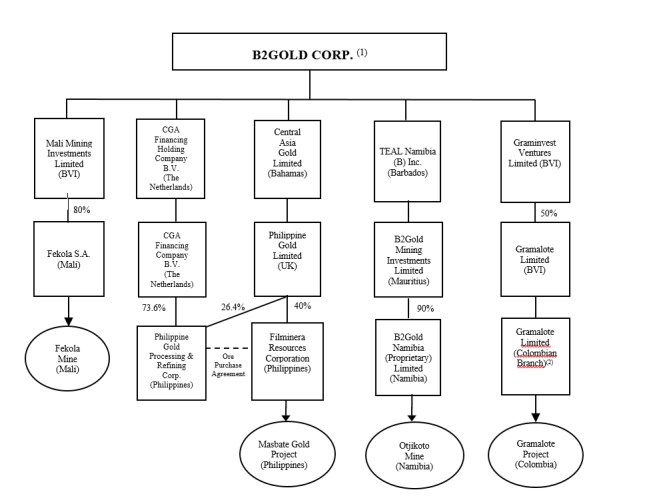
A significant portion of our business is carried on through our subsidiaries. The chart below includes the name and jurisdiction of incorporation of our material subsidiaries and certain subsidiaries holding an interest in mineral projects that we consider significant as described in this Annual Information Form.
Notes:
(1) All ownership of subsidiaries is 100% unless otherwise indicated. Certain subsidiaries are indirectly owned by us through wholly-owned subsidiaries not reflected above.
(2) Colombian branch is not a separate legal entity.
- 7 -
GENERAL DEVELOPMENT OF THE BUSINESS
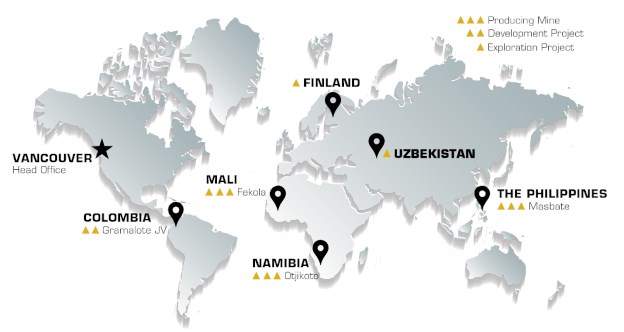
We are an international, low-cost senior gold producer based in Vancouver, Canada with three operating mines (one mine in each of Mali, Namibia and the Philippines). In addition, we have a portfolio of other development and exploration projects in several countries including Mali, Colombia, Namibia, Finland and Uzbekistan. Our material properties consist of the following three mines:
Fekola mine (80% ownership), an open pit gold mine located approximately 40 kilometres ("km") south of the city of Kéniéba, Mali (the "Fekola Mine");
Otjikoto mine (90% ownership), an open pit gold mine (and underground mine under development) located approximately 300 km north of Windhoek, the capital of Namibia (the "Otjikoto Mine"); and
Masbate gold project (ownership as described under "Material Properties - Masbate Gold Project" below), an open pit gold mine, located near the northern tip of the island of Masbate, 360 km southeast of Manila, the capital of the Philippines (the "Masbate Gold Project").
Our other significant asset is the Gramalote project (50% ownership), a gold development project located 230 km northwest of Bogota, the capital of Colombia (the "Gramalote Project").
Three Year History
Over the three most recently completed financial years, the significant events described below contributed to the development of our business.
2019 Developments
On March 26, 2019, we announced positive results from the Expansion Study Preliminary Economic Assessment for the Fekola Mine (the "Fekola PEA"). Based on the Fekola PEA results, we proceeded with an expansion project to increase processing throughput by 1.5 million tonnes per annum ("Mtpa") to 7.5 Mtpa, from an assumed base rate of 6 Mtpa.
- 8 -
On May 10, 2019, we amended and restated our revolving credit facility (the "Credit Facility") with our existing syndicate of banks plus one new lender to upsize the Credit Facility from $500 million to an aggregate amount of $600 million, and to increase the accordion feature from $100 million to $200 million.
In June 2019, the Fadougou village relocation was completed. The village of Fadougou was originally located adjacent to the main Fekola Mine open pit. Construction of the new planned urban town commenced in late 2017 and was completed in February 2019. This involved building over 700 new structures, including solar panel lighting and latrines for all homes.
On October 15, 2019, we completed the sale of the El Limon and La Libertad gold mines, the Pavon gold project and additional mineral concessions in Nicaragua to Calibre (the "Calibre Transaction"). Pursuant to the terms of the share purchase agreement, we received on closing (i) an aggregate of 87,986,666 common shares of Calibre ("Calibre Shares"), representing approximately 28.35% of the then issued and outstanding Calibre Shares on closing, (ii) $40 million in cash (plus a working capital adjustment), and (iii) a $10 million convertible debenture (the "Debenture"). On November 5, 2019, we received an additional $12,833,047, representing a portion of the working capital adjustment. On November 18, 2019, Calibre exercised its right to redeem the outstanding principal amount owing under the Debenture, increasing our equity interest in Calibre to approximately 34% of the then issued and outstanding Calibre Shares (as at the date of this Annual Information Form we hold approximately 25% of the issued and outstanding Calibre Shares, following the completion of Calibre's acquisition of Fiore Gold Ltd. ("Fiore Gold")). In October 2020, Calibre paid to us the balance of the consideration in connection with the Calibre Transaction (a total of $15,525,099, representing $10 million in deferred consideration and the balance of the working capital adjustment).
On November 5, 2019, the Board declared our inaugural quarterly dividend of $0.01 per Common Share, which was paid on December 13, 2019 to shareholders of record as at the close of business on November 27, 2019.
On December 23, 2019, we entered into an amended and restated shareholders agreement (the "Shareholders' Agreement") with AngloGold Ashanti Limited ("AngloGold") relating to the ownership and management of the Gramalote Project. On January 1, 2020, we assumed the role of operator of the Gramalote Project. Pursuant to the Shareholders' Agreement, we sole-funded the first $13.9 million of expenditures in 2020 on the Gramalote Project, and as a result now hold a 50% ownership interest in the Gramalote Project.
2020 Developments
Effective January 1, 2020, Ms. Liane Kelly was appointed to our Board.
On January 16, 2020, we announced an updated Fekola Mineral Resource estimate, including a substantial increase in Indicated Mineral Resources at the Fekola Mine following a successful infill drill program in 2019. The updated Fekola Indicated Mineral Resource estimate as at December 31, 2019 provided the basis for an updated design pit and new Fekola Probable Mineral Reserve estimate.
On January 21, 2020, we announced positive results from the updated Preliminary Economic Assessment for the Gramalote Ridge deposit at the Gramalote Project (the "Gramalote PEA"). See "Other Properties - Gramalote Project" below for additional details on the Gramalote Project.
For the second quarter of 2020 dividend, we increased our dividend rate by 100%, and we again raised our dividend rate by another 100% in the third quarter of 2020.
On September 10, 2020, we announced the successful commissioning of the Fekola mill expansion to 7.5 Mtpa (an increase of 1.5 Mtpa from an assumed base rate of 6 Mtpa). Commissioning included completion of all major construction activities associated with the expansion, as well as the successful execution of a five-day mill performance test. In addition, all of the Fekola Mine fleet expansion equipment has arrived on site and is operational, with the overall mine expansion now complete.
- 9 -
On September 29, 2020, we entered into a new term equipment facility (the "New Equipment Facility") with Caterpillar Financial Services Corporation for an aggregate principal amount of up to $40 million. The New Equipment Facility is available to our majority-owned subsidiary, Fekola S.A., to finance or refinance up to 75% of the cost of mining fleet and other mining equipment at the Fekola Mine. On October 26, 2020, Fekola S.A. drew down the entire amount under the New Equipment Facility. Each equipment loan is repayable in 20 equal quarterly installments. The final repayment date is five years from the first disbursement under each equipment loan. The interest rate on each loan is a rate per annum equal to EURIBOR plus a margin of 4.25%. A commitment fee of 0.85% per annum on the undrawn balance on the New Equipment Facility for the term of the facility is also due, payable quarterly commencing 12 months from the date of the agreement. We and our wholly-owned subsidiary, Mali Mining Investments Limited, have guaranteed the New Equipment Facility and security is given over the equipment of Fekola S.A.
2021 Developments
The COVID-19 pandemic continued to have a wide ranging and global impact during 2021. Despite some of the challenges that the current COVID-19 pandemic has created worldwide and in each of the locations where we operate or are head-quartered, we continued to operate virtually unimpeded. Our executive team is very proud of our employees' dedication and resilience in these challenging times. We continue to address the COVID-19 pandemic and minimize its potential impact at our operations. We place the safety and well-being of our workforce and all stakeholders as our highest priority and continue to encourage input from all our stakeholders as the COVID-19 situation evolves. We continue to implement measures and precautionary steps to manage and respond to the evolving risks associated with COVID-19 to ensure the safety of our employees, contractors, suppliers and surrounding communities where we work while continuing to operate. We are continually updating these plans and response measures based on the safety and well-being of our workforce, the severity of the pandemic in areas where we operate, global response measures, government restrictions and extensive community consultation. We are working closely with national and local authorities and continue to closely monitor each site's situation, including public and employee sentiment to ensure that stakeholders are in alignment with continued safe operation of our mines.
In 2021, we commenced the Gramalote feasibility study (the "Gramalote Feasibility Study") to evaluate recovery of gold from an open pit mining operation with an 11.0 Mtpa processing plant that includes crushing, grinding, flotation and a carbon-in-pulp recovery process to produce doré bullion. The Gramalote Feasibility Study approach focused solely on a production scenario based on the Indicated Mineral Resource estimate from the Gramalote Ridge deposit of 173,400,000 tonnes grading 0.73 grams per tonne ("g/t") gold for a total of 4,060,000 ounces of gold, and did not include any potential production from the nearby Trinidad deposit, which has a current Inferred Mineral Resource estimate, or the Monjas West zone. We expect that the results of the Gramalote Feasibility Study will be available by the end of the second quarter of 2022 with the final Gramalote Feasibility Study delivered in the third quarter of 2022.
In July 2021, the heavy fuel oil ("HFO") hybrid-solar plant at the Fekola Mine (the "Fekola Solar Plant") reached full production capacity. The Fekola Solar Plant is expected to reduce the Fekola Mine's HFO consumption by over 13 million litres per year and lower carbon dioxide emissions by an estimated 39,000 tonnes per year. During 2021, 14.6% of total electricity on site at the Fekola Mine was produced by the Fekola Solar Plant, reducing fuel consumption by over 10 million litres and reducing carbon dioxide emissions by 31,500 tonnes.
On November 30, 2021, we completed the sale of our 81% interest in the Kiaka gold project located in Burkina Faso (the "Kiaka Project") to West African Resources Limited ("WAF") (the "Kiaka Transaction"). Pursuant to the terms of the Kiaka Transaction, on closing we received a cash payment of US$22.5 million (in addition to the US$450,000 already received), 22,190,508 ordinary shares of WAF ("WAF Shares"), and a 2.7% net smelter return ("NSR") royalty interest on the first 2,500,000 ounces of gold produced at the Kiaka Project and thereafter a 0.45% NSR royalty interest on the next 1,500,000 ounces of gold produced. We will also receive an additional payment of US$45 million (the "Additional Payment") payable on the earlier of (i) commencement of construction at the Kiaka Project (provided such date will be no earlier than April 25, 2022), (ii) completion of a positive feasibility study at the Kiaka Project, and (iii) October 25, 2022. The Additional Payment will be paid in cash or WAF Shares, at our option but subject to any required WAF shareholder approval to issue the WAF Shares.
- 10 -
Concurrently with the closing of the Kiaka Project, we also completed the sale of our 90% interest in the Toega gold project located in Burkina Faso (the "Toega Project") to WAF (the "Toega Transaction"). Pursuant to the terms of the Toega Transaction, on closing we received a cash payment of US$9 million (in addition to the US$9 million already received), and a 2.7% NSR royalty interest on the first 1,500,000 ounces of gold produced at the Toega Project until such time as the royalty payments total US$22.5 million and thereafter a 0.45% NSR royalty interest.
On December 16, 2021, we amended and restated our Credit Facility with our existing syndicate of banks to extend the maturity date to December 16, 2025. The maximum available for drawdown under the Credit Facility remains $600 million with an accordion feature, available on the receipt of additional binding commitments, for a further $200 million. The interest rates and commitment fees have been reduced. The Credit Facility now bears interest on a sliding scale of between LIBOR plus 2.0 % to 2.50% based on our consolidated net leverage ratio. Commitment fees for the undrawn portion of the facility are also on a similar sliding scale basis of between 0.45% and 0.563%. The Credit Facility continues to be secured by a general security interest over our assets and pledges creating a charge over the shares of certain of our direct and indirect subsidiaries. In connection with the Credit Facility, we must also maintain certain ratios for leverage and interest coverage. As at the date of this Annual Information Form, the full amount of the Credit Facility was undrawn and available.
In December 2021, we reached an agreement in principle with the Government of Mali, pursuant to which the Government agreed that it would grant a new exploration permit covering the same perimeter as the Menankoto exploration permit (the "Menankoto Permit") to a new Malian subsidiary of B2Gold, and we would withdraw the international arbitration proceedings that our Malian subsidiary Menankoto SARL ("Menankoto") had previously commenced. On February 2, 2022, we announced that a Malian subsidiary of B2Gold had received the new Menankoto Permit, issued by the Government in compliance with the procedures and requirements set out under the 2019 Mining Code (Mali) (the "2019 Mining Code") (the previous permit had been issued under the 2012 Mining Code (Mali) (the "2012 Mining Code")), which provides for an initial term of three years and is renewable for two additional three year periods. Menankoto has now withdrawn the related international arbitration proceedings against the Republic of Mali.
DESCRIPTION OF THE BUSINESS
General
We are an international, low-cost senior gold producer based in Vancouver, British Columbia, with a strategic focus on acquiring and developing interests in mineral properties with demonstrated potential for hosting economic mineral deposits, with gold deposits as the primary focus. We conduct gold mining operations and exploration and drilling campaigns to define and develop Mineral Resources and Mineral Reserves on our properties with an intention of developing, constructing and operating mines on such properties.
Our corporate objective is to continue to maximize profitable production from our mines, grow as a profitable and responsible gold producer through further advancement of our pipeline of development and exploration projects, evaluate new exploration, development and production opportunities, make accretive acquisitions, irrespective of the gold price, and continue to pay an industry leading dividend yield.
Principal Product
Our principal product is gold, with gold production forming all our revenues. There is a global market into which we sell our gold and, as a result, we are not dependent on a particular purchaser with respect to the sale of the gold that we produce.
Special Skills and Knowledge
Various aspects of our business require specialized skills and knowledge, certain of which are in high demand and in limited supply. Such skills and knowledge include the areas of permitting, engineering, geology, metallurgy, logistical planning, implementation of exploration programs, mine construction and development, mine operation, as well as legal compliance, finance, accounting, risk management, safety and security, community relations and human resources. We have highly qualified management personnel and staff, an active recruitment program, and believe that persons having the necessary skills are generally available. We have found that we can locate and retain competent employees and consultants in such fields and have maintained a high retention rate of highly skilled employees. We do not anticipate having significant difficulty in recruiting other personnel as needed. Training programs are in place for workers that are recruited locally.
- 11 -
Competitive Conditions
The gold exploration and mining business is a competitive business. We compete with numerous other companies (including, as a senior gold producer, some of the largest mining companies in the world) and individuals in the search for and the acquisition of quality gold properties, mineral claims, permits, concessions and other mineral interests, as well as recruiting and retaining qualified employees. Our ability to acquire and develop gold properties in the future will depend not only on our ability to develop and operate our present properties, but also on our ability to select and acquire suitable producing properties or prospects for development or mineral exploration.
Cycles
The mineral exploration, development and production business is subject to mineral and commodity price cycles. The marketability of minerals is also affected by worldwide economic cycles.
Employees
Our business is administered principally from our head office in Vancouver, British Columbia, Canada. We also have offices in Bamako, Mali; Manila, Philippines; Windhoek, Namibia; and Medellin, Colombia. As at December 31, 2021, we, including our subsidiaries, employ a total of 3,263 permanent employees and 1,426 fixed-term (temporary) employees for a total of 4,689 employees.
Production at our mining operations is dependent upon the efforts of our employees and our relations with our unionized and non-unionized employees. Some of our employees are represented by labour unions under various collective labour agreements. The collective bargaining agreement covering the workers at the Otjikoto Mine has historically been negotiated annually, however, the current collective bargaining agreement was valid for a two-year term, which expired on February 28, 2022. The collective bargaining agreement remains in place until the negotiations relating to the next subsequent agreement are complete. In addition, our employees at the Fekola Mine are part of a union that governs the entire mining industry in Mali and the Fekola delegates have created an executive office, affiliated with the Section of Trade, Mines and Industry in Mali and the National Workers Union in Mali. Currently, all labour discussions are managed through union delegates that are elected during site-wide elections. Labour relations are currently positive at the Otjikoto Mine and the Fekola Mine.
International Operations
Our principal operations and assets are located in Mali, Namibia, the Philippines and Colombia. In addition, we have an approximate 25% indirect ownership interest in Calibre's assets in Nicaragua and the United States through our equity interest in Calibre. Our operations are exposed to various levels of political, economic and other risks and uncertainties. These risks and uncertainties vary from country to country and include, but are not limited to, government regulations (or changes to such regulations) with respect to restrictions on production, export controls, income taxes, royalties, excise and other taxes, expropriation of property, repatriation of profits, environmental legislation, land use, water use, local ownership requirements and land claims of local people, regional and national instability and security, mine safety, corruption and sanctions. The effect of these factors cannot be accurately predicted. See "Risk Factors" below.
- 12 -
Environmental Protection
Our activities are subject to extensive laws and regulations governing the protection of the environment, natural resources and human health. These laws address, among other things: emissions into the air; discharges into water; management of waste and hazardous substances; protection of natural resources, cultural heritage and endangered species; and reclamation of lands disturbed by mining operations. We are required to obtain governmental permits and, in some instances, provide bonding requirements under federal, state, or provincial air, water quality, and mine reclamation rules and permits. Violations of environmental and health and safety laws are subject to civil sanctions and, in some cases, criminal sanctions, including the suspension or revocation of permits. The failure to comply with environmental laws and regulations or liabilities related to hazardous substance contamination could result in project development delays, material financial impacts or other material impacts to our projects and activities, fines, penalties, lawsuits by the government or private parties, or material capital expenditures.
Additionally, environmental laws in some of the countries in which we operate, as well as certain organizations that we are members of, require that we periodically perform audits and environmental impact studies at our mines. These studies could reveal presently unknown environmental impacts that would require us to make significant capital outlays or cause material changes or delays in our intended activities.
Our current estimated aggregate closure and reclamation cost at the Fekola Mine, the Masbate Gold Project and the Otjikoto Mine is approximately $103 million on an undiscounted basis. These estimates are generally based on conceptual level engineering and will be updated periodically to reflect changes in site conditions and the life of mine ("LoM") plans. See "Environmental, Occupational Health and Safety, Social and Regulatory" below and the disclosure regarding environmental matters under the respective descriptions of our material properties for further details regarding environmental matters.
Environmental, Occupational Health and Safety, Social and Regulatory
Our Board has a Health, Safety, Environment, Social and Security Committee (the "HSESS Committee") that assists the Board in overseeing our health, safety, environmental, corporate social responsibility and security policies and programs, and our health, safety, environmental, corporate social responsibility and security risk management and performance, including cybersecurity. The HSESS Committee, comprised of five directors, four of which are independent directors, meets quarterly with management to review current and emerging issues, evaluate performance and risk management, and to evaluate and update policies and procedures.
HSE Management Systems
We have implemented Health, Safety and Environmental ("HSE") Management System and Performance Standards and Occupational Health and Safety Standards at the corporate level that define the requirements for the development and implementation of both corporate and site HSE management systems. Our HSE Management System and Performance Standards are based on international standards including compliance with in-country regulations, relevant International Organization for Standardization ("ISO") and occupational health and safety standards, and reliance on the International Finance Corporation (the "IFC") Performance Standards and international best practices in cases where national regulatory systems are not sufficiently stringent. These management systems enable us to mitigate and manage the potential risks and impacts of our operations.
We implement the HSE management systems and manage HSE and social performance with dedicated HSE and social personnel at both the corporate and site levels. The following is a brief summary of HSE management systems in place across our different projects:
- 13 -
Masbate Gold Project: The Masbate Gold Project maintains an HSE management system based on our HSE Management System and Performance Standards, which is audited biannually by independent experts. The Masbate Gold Project recently completed the recertification audit by SGS Philippines, Inc. and was able to maintain its ISO 14001:2015 certification. The external audit program has been temporarily suspended since 2020 due to COVID-19 travel restrictions, which continued into 2021. As a result, we have conducted internal reviews at the Masbate Gold Project to ensure their management system processes remain robust. We expect the external audit will be conducted shortly after the Philippine Government reinstates foreign travel into the country.
Otjikoto Mine: The Otjikoto Mine maintains an HSE management system based on our HSE Management System and Performance Standards, which is audited annually by independent experts. Following a suspension in 2021 due to COVID-19 travel restrictions, the external audit program of the HSE management system at the Otjikoto Mine was completed in the fourth quarter of 2021. The results of the external audit confirm that the Otjikoto Mine has improved its HSE management system and performance standard processes and now maintains safety systems and processes in alignment with our standards. Improvement plans based on auditor recommendations for standards needing further improvement and/or refinement are being developed for implementation in 2022.
Gramalote Project: The Gramalote Project remains in the development stage of the mine lifecycle, but also maintains a comprehensive HSE and social management system. The Gramalote Project continues the process of adapting its systems to our HSE Management System and Performance Standards (following our transition to operational manager in 2020). The Gramalote Project maintains ISO 45001 certification for its occupational health and safety management system. The Gramalote Project will implement an external audit program of its HSE and social management systems and performance as it progresses into construction and operations.
Regional Exploration Projects: Regional exploration projects adhere to the same HSE Management System and Performance Standards as the rest of our projects, and apply specific standards, procedures, and processes as are relevant and applicable to each site.
Reclamation and Care and Maintenance Sites: Reclamation and care and maintenance sites adhere to the same HSE Management System and Performance Standards as the rest of our projects, and apply specific standards, procedures, and processes as are relevant and applicable to each site.
In addition, we work with occupational health, safety, and environmental regulatory agencies to ensure that the performance of our operations is at a level that is acceptable to regulatory authorities. We have adopted occupational health and safety policies designed to ensure the protection and promotion of the safety, human health and welfare of our employees. We encourage open dialogue and have prepared procedures for responding to concerns of all entities with respect to HSE issues.
We have implemented measures and introduced best practice steps in accordance with the Centers for Disease Control and Prevention ("CDC"), the World Health Organization ("WHO") and national health agencies to manage and respond to the risks associated with COVID-19 to ensure the safety of our employees, contractors, suppliers and surrounding communities. For the last two years, corporate travel to our operations has been restricted to absolute minimum requirements and employees have been encouraged to work remotely. At each of our three mining operations in Mali, the Philippines and Namibia, and at the Gramalote Project in Colombia, we have implemented many control measures for dealing with the outbreak of COVID-19 in line with CDC and WHO guidelines. These include: pre-screening for symptoms and travel history with possible COVID-19 exposure of any employees, visitors and contractors (site personnel) prior to any travel to or from a site and isolation, where necessary, from the general site population; pretests (PCR and Rapid Antigen); operational protocols; aggressive contact tracing; and close work with local health authorities. Each site has implemented restrictions and isolation procedures that are particular to each region's situation and response capabilities. We also introduced a mandatory vaccination policy at the corporate level and have supported each of our operations and national governments with vaccinations of employees and the communities in which we operate. In 2022, we will continue to monitor COVID-19 with medical experts and support and encourage workers and their families to be vaccinated.
- 14 -
Environmental
We comprehensively updated our Environmental and Biodiversity Standards in 2018 and our Environmental and Biodiversity Policies in 2021 to incorporate recent developments and improvements in industry standards, as well as our growth. In 2019, we developed a comprehensive Environmental Strategic Plan for 2020 to 2023. This Strategic Plan identifies key environmental aspects and defines specific objectives and targets for our operations, providing a road map for improved environmental risk management and performance in line with our overall company strategy. The Strategic Plan is currently defined through 2023 but will be extended and updated at regular intervals. Two critical areas that have come to the forefront in recent years are tailings stewardship and climate change risk, and both of these aspects are integral to our environmental management strategies.
Community
Our Social Responsibility and Human Rights Policy, updated in 2020, defines our commitment to facilitate a positive and sustainable legacy by understanding and managing the social and economic impacts and opportunities resulting from our presence. We are committed to open and respectful engagement with our stakeholders. We respect community rights, interests and culture, and where Indigenous Peoples are identified we work to obtain their free, prior and informed consent. We recognize human rights, as defined in the International Bill of Human Rights, and align our approach to human rights risk management with the United Nations Guiding Principles on Business and Human Rights (the "UNGPs") and the Voluntary Principles on Security and Human Rights (the "VPSHR").
We have also adopted a set of Social Performance Standards at the corporate level to provide minimum requirements for the social practices and performance of our operations. Our Social Performance Standards align with international best practices, including those of the IFC, the International Council on Mining and Metals (the "ICMM") and the UNGPs. Our Social Performance Standards manage key issues including stakeholder engagement, grievance management, community investment, land acquisition and resettlement, local content, human rights, artisanal and small-scale mining ("ASM"), social closure, security and human rights, and social baseline and impact assessment and management.
We conducted internal audits of these Social Performance Standards at all our operations by the end of 2019, with results reported to the Senior Vice President, Operations and site general managers. In 2021, we conducted third-party audits of these Social Performance Standards at our Fekola and Otjikoto mines. Due to restrictions associated with entering the Philippines in 2021 as a result of the COVID-19 pandemic, our third-party audits at the Masbate Gold Project were postponed to 2022. With the support of external experts, we also conduct human rights assessments and security risk assessments in accordance with the VPSHR. These assessments, including recommendations to address salient risks and impacts, are discussed and confirmed with our executives and reported to the HSESS Committee. In 2021, we carried out a VPSHR risk assessment at the Fekola Mine and Masbate Gold Project and conducted a VPSHR risk assessment and a human rights impact assessment at our Gramalote Project.
We have also implemented a Supplier Code of Conduct as part of our commitment to human rights and ongoing efforts to improve supplier management. It outlines our expectations that suppliers act in accordance with our corporate commitments in their management of health and safety, labour and human rights, the environment, business conduct and ethics, and socio-economic development.
Our Community Investment Standard, which aligns with the IFC Performance Standards and ICMM guidance on community development, defines how we focus on sustainable contributions to the communities where we operate. The following is a brief summary of our community development efforts in 2021:
- 15 -
Fekola Mine: We continued the implementation of planned community investment programs in the areas of education, health, water and sanitation, child protection and alternative livelihoods. Community investment programs are implemented pursuant to a multi-year Community Development Plan developed in consultation with local stakeholders (the "CDP"), which provides for decision-making driven by local stakeholders. Under the CDP, 10 projects were presented by communities in 2021 and approved by the CDP steering committee for implementation. Six projects were completed in 2021 and four were still in progress as of December 31, 2021, including the construction of a school fence and teachers' accommodation, construction of a water supply project and construction of a community market.
Masbate Gold Project: Philippine regulations mandate that a social development expenditure equal to 1.5% of the annual operational costs is invested in support of socio-economic development in the areas impacted by a mining operation, resulting in a significant community investment budget managed separately by Filminera Resources Corporation ("Filminera") and Philippine Gold Processing & Refining Corp. ("PGPRC") in consultation with local stakeholders through an annual Social Development and Management Program (the "SDMP"). Over 300 SDMP projects, programs and activities were identified for implementation in 2021, including procurement of equipment and farm machinery to support agricultural livelihoods, provision of scholarships for 2,198 students, provision of medical services and supplies for local residents, and various infrastructure improvements to support connectivity, electrification, and water supply. The 2021 expenditure for community development utilizing the SDMP fund amounted to US$2.58 million.
Otjikoto Mine: Our community investment in Namibia is focused on education, health, environment, small business development and arts and culture. In 2021, we supported programs in early childhood development, primary and secondary schools, vocational education, and teacher skills development. Healthcare programs provided mobile services to reach remote communities and informal settlements in Windhoek.
Gramalote Project: The Gramalote Project continued the implementation of four projects for the formalization of informal ASM in line with applicable national policies and regulations. We supported ASM miners in preparing and obtaining environmental permits and complementary work plans, along with technical training and analysis for best gold processing alternatives. Other social investment activities supported in 2021 included educational support programs to rural schools, small-scale agricultural programs and training initiatives to improve local capacity in technical skills.
Vancouver, Canada: As a Canadian company, we are also committed to supporting community initiatives at home through our Canadian Corporate Social Responsibility Fund. In 2021, we provided C$1 million in financial support to community organizations in Metro Vancouver, Canada, including C$100,000 to the Red Cross to support those affected by the British Columbia floods.
Diversity and Inclusion
In 2020, we implemented a three-year Equitable, Diversity and Inclusivity ("EDI") Strategy. As part of this work, in late 2021, the EDI Workplace Policy was implemented, as well as a new Diversity Policy for Board and Management-level positions.
In our EDI Workplace Policy, we recognize the value of diversity and strive to eliminate employment barriers that interfere with the establishment of equal opportunities. We are dedicated to equitable treatment of all persons, irrespective of gender, race, ethnicity, nationality, religion and sexual orientation, as well as reasonable and safe accommodation of people with disabilities. We promote diversity through: global and regional leadership that is active, committed and accountable; strategies and plans to identify and remove barriers; policies that are fair, call for equal access and treatment, and inform principled decision-making and behaviour, including with respect to pay equity; training and development that support growth in the Company, providing career advancement opportunities and building talent pipelines; engagement that stimulates dialogue, awareness, education and collaboration; change by way of actionable measures that is informed by and assessed through metrics; and grievance mechanisms with remedial action in cases of proven discrimination and harassment.
- 16 -
Our Diversity Policy defines our approach to diversity with respect to Board and Management positions, including the identification, nomination and appointment of Board members, as well as our succession plan. "Management" is defined as appointed directors, officers, heads of department and other managers who support the Executive in carrying out our strategy and plans, assist in managing governance and risk, oversee people and/or resources and ensure our standards are implemented, maintained and reported on. This includes engineering and mining departments, but also legal, governance, sustainability, external relations, human resources, health and safety, environment, finance and accounting, information technology ("IT") and other essential business functions. The Diversity Policy sets targets of 30% for female representation on our Board and in Management-level positions.
Our annual Responsible Mining Report, a copy of which is available on our website at www.b2gold.com, provides an expanded discussion of our environmental, social and governance risk management and performance.
SUMMARY OF MINERAL RESERVE AND MINERAL RESOURCE ESTIMATES
Mineral Reserves are reported from pit designs and underground stope designs based on Indicated Mineral Resources. Mineral Resources are reported inclusive of those Mineral Resources that have been converted to Mineral Reserves.
Economic parameters such as mining costs, processing costs, metallurgical recoveries and geotechnical considerations have been applied to determine economic viability of the Mineral Reserves based on a gold price of US$1,500 per ounce ("/oz") (unless otherwise stated). Mineral Reserves contained in stockpiles that meet the project-specific Mineral Reserve cut-off grades are also included for the Fekola Mine, the Masbate Gold Project and the Otjikoto Mine.
Mineral Resources amenable to open pit mining are constrained with conceptual pit shells defined by economic parameters and using a gold price of US$1,800/oz. Mineral Resources amenable to underground mining methods are reported above cut-off grades defined by site operating costs and using a gold price of US$1,800/oz. Mineral Resources contained in stockpiles that meet the project-specific cut-off grades are also included for the Fekola Mine, the Masbate Gold Project and the Otjikoto Mine. Gold grades are expressed in grams per tonne of gold ("g/t Au").
Mineral Reserve and Mineral Resource estimates for our operating mines have been updated to account for mining depletion, using topographic surfaces as of December 31, 2021. These Mineral Reserve and Mineral Resource estimates are reported by project/mine on both a 100% project basis reflecting the total Mineral Resources and Mineral Reserves and the applicable project/mine specific attributable basis reflecting our ownership interest (details in table footnotes below).
- 17 -
Probable Mineral Reserves Statement
|
Country |
Mine or Project |
100% Project Basis |
Attributable Ownership Basis |
|||||
|
Tonnes (x 1,000) |
Gold Grade (g/t Au) |
Contained Gold Ounces |
Attributable Percentage |
Tonnes (x 1,000) |
Gold Grade (g/t Au) |
Contained Gold Ounces |
||
|
Mali |
Fekola Mine and Cardinal Zone |
62,000 |
1.86 |
3,710 |
80 |
49,600 |
1.86 |
2,960 |
|
Philippines |
Masbate Gold Project |
73,500 |
0.80 |
1,890 |
1003 |
73,500 |
0.80 |
1,890 |
|
Namibia |
Otjikoto Mine and Wolfshag Deposit |
11,600 |
1.66 |
620 |
90 |
10,400 |
1.66 |
560 |
|
Total Probable Mineral Reserves (includes stockpiles) |
6,210 |
|
5,410 |
|||||
Notes:
1. Mineral Reserves have been classified using the CIM Standards. All tonnage, grade and contained metal content estimates have been rounded; rounding may result in apparent summation differences between tonnes, grade, and contained metal content.
2. Fekola Mine: Mineral Reserves are reported on a 100% project and an 80% attributable basis, the remaining 20% interest is held by the State of Mali. The Mineral Reserves have an effective date of December 31, 2021 and have been prepared by Peter Montano, P.E., our Vice President, Projects, and a Qualified Person under NI 43-101. Mineral Reserves of the Fekola Mine are based on a conventional open pit mining method, gold price of US$1,500/oz, metallurgical recovery of 94%, selling costs of US$126.38/oz including royalties, average mining cost of US$2.42/t mined, average processing cost of US$15.24/t processed, and site general costs of US$6.93/t processed. Reserve model dilution and ore loss for Fekola was applied through whole block averaging such that at a 0.65 g/t cut-off grade there is a 0.3% increase in tonnes, a 1.3% reduction in grade, and 1.0% reduction in ounces when compared to the Mineral Resource model. Mineral Reserves are reported above a cut-off grade of 0.65 g/t Au. Mineral Reserves of the Cardinal Zone (defined below) are based on a conventional open pit mining method, gold price of US$1,500/oz, metallurgical recovery of 94%, selling costs of US$126.38/oz including royalties, mining costs ranging from US$1.90/t mined for saprolite to US$2.40 for fresh rock, processing costs ranging from US$8.87/t processed for saprolite to US$13.61/t processed for fresh rock, and site general costs of US$0.44/t processed. Reserve model dilution and ore loss for the Cardinal Zone was applied through whole block averaging such that at a 0.40g/t cut-off grade there is a 26% increase in tonnes, a -24% reduction in grade, and 5.0% reduction in ounces when compared to the subcell model. Mineral Reserves are reported above a cut-off grade of 0.65 g/t Au.
3. Masbate Gold Project: Mineral Reserves are reported on a 100% project and attributable basis. Pursuant to the ore sales and purchase agreement between Filminera and PGPRC, our wholly-owned subsidiary, PGPRC has the right to purchase all ore from the Masbate Gold Project. We have a 40% interest in Filminera, which owns the majority of the Masbate Gold Project tenements, and the remaining 60% is owned by Zoom Mineral Holdings Inc. ("Zoom"), a Philippine shareholder company. Please see "Material Properties - Masbate Gold Project" below for a further discussion of the foregoing. The Mineral Reserves have an effective date of December 31, 2021. The Qualified Person for the estimate is Peter Montano, P.E., our Vice President, Projects, and a Qualified Person under NI 43-101. Mineral Reserves are based on a conventional open pit mining method, gold price of US$1,500/oz, modeled metallurgical recovery (resulting in average LOM metallurgical recoveries by pit that range from 64% to 89%), and average base operating cost estimates of US$1.60-$1.90/t mined (mining), US$12.95/t processed (processing) and US$4.22/t processed (general and administrative). Dilution and ore loss were applied through whole block averaging such that at a cut-off grade of 0.45 g/t Au, there is a 5.8% increase in tonnes, a 5.5% reduction in grade and 0.1% increase in ounces when compared to the Mineral Resource model. Mineral Reserves are reported at cut-off grades that range from 0.36-0.38 g/t Au.
4. Otjikoto Mine: Otjikoto Mineral Reserves are reported on a 100% project and a 90% attributable basis, the remaining 10% interest is held by EVI Mining (Proprietary) Ltd. ("EVI"), a Namibian empowerment company. The Otjikoto Mine Mineral Reserves within the open pits and stockpiles have an effective date of December 31, 2021 and have been prepared by Peter Montano, P.E., our Vice President, Projects, and a Qualified Person under NI 43-101. Mineral Reserves to be mined using open pit methods or in stockpiles are based on a conventional open pit mining method, gold price of US$1,500/oz, metallurgical recovery of 98%, selling costs of US$63.61/oz Au including royalties and levies, average mining cost of US$2.55/t mined, average processing cost of US$12.60/t processed, and site general costs of US$3.36/t processed. Reserve model dilution and ore loss was applied through whole block averaging such that at a 0.45 g/t Au cut-off grade there is a 2.3% decrease in tonnes, a 2.2% reduction in grade, and a 4.4% reduction in ounces when compared to the Mineral Resource model. Mineral Reserves to be mined using open pit methods or in stockpiles are reported above a cut-off grade of 0.45 g/t Au. Mineral Reserves to be mined using underground methods at Wolfshag have an effective date of December 31, 2021, and have been prepared Randy Reichert, P. Eng, our Vice President, Operations, and a Qualified Person under NI 43-101. Mineral Reserves to be mined using underground methods are based on a modified transverse longhole stoping mining method, gold price of US$1,350/oz, metallurgical recovery of 98%, selling costs of US$63.49/oz including royalties and levies, average mining cost of US$84.83/t mined, average processing cost of US$12.06/t processed, general costs of US$3.07/t processed, 10% dilution, and 90% mining recovery. Mineral Reserves to be mined using underground methods are reported above a cut-off grade of 2.68 g/t Au.
- 18 -
5. Stockpiles: Mineral Reserves in stockpiled material are reported in the totals for the Fekola Mine, the Masbate Gold Project and the Otjikoto Mine, and were prepared by mine site personnel at each operation. Ore stockpile balances are derived from mining truck movements to individual stockpiles or detailed surveys, with grade estimated from routine grade control ("GC") methods. Stockpile cut-off grades vary by deposit, from 0.40 - 0.65 g/t Au.
Indicated Mineral Resource Statement
|
Country |
Mine or Project |
100% Project Basis |
Attributable Ownership Basis |
|||||
|
Tonnes (x 1,000) |
Gold Grade (g/t Au) |
Contained Gold Ounces |
Attributable Percentage |
Tonnes (x 1,000) |
Gold Grade (g/t Au) |
Contained Gold Ounces |
||
|
Mali |
Fekola Mine |
102,800 |
1.51 |
4,980 |
80 |
82,200 |
1.51 |
3,980 |
|
Anaconda Area |
32,400 |
1.08 |
1,130 |
80 and 85 |
27,100 |
1.08 |
940 |
|
|
Cardinal Zone |
8,000 |
1.67 |
430 |
80 |
6,400 |
1.67 |
340 |
|
|
Philippines |
Masbate Gold Project |
126,500 |
0.78 |
3,180 |
1005 |
126,500 |
0.78 |
3,180 |
|
Namibia |
Otjikoto Mine and Wolfshag Deposit |
48,200 |
0.88 |
1,370 |
90 |
43,400 |
0.88 |
1,230 |
|
Colombia |
Gramalote Project |
173,400 |
0.73 |
4,060 |
50 |
86,700 |
0.73 |
2,030 |
|
Total Indicated Mineral Resources (includes Stockpiles) |
15,140 |
|
11,700 |
|||||
Inferred Mineral Resource Statement
| Country | Mine or Project | 100% Project Basis | Attributable Ownership Basis | |||||
| Tonnes (x 1,000) |
Gold Grade (g/t Au) |
Contained Gold Ounces (x 1,000) |
Attributable Percentage (%) |
Tonnes (x 1,000) |
Gold Grade (g/t Au) |
Contained Gold Ounces (x 1,000) |
||
| Mali | Fekola Mine | 10,100 | 1.23 | 400 | 80 | 8,100 | 1.23 | 320 |
| Anaconda Area | 63,700 | 1.12 | 2,280 | 80 and 85 | 53,100 | 1.12 | 1,890 | |
| Cardinal Zone | 19,000 | 1.21 | 740 | 80 | 15,200 | 1.21 | 590 | |
| Philippines | Masbate Gold Project | 27,800 | 0.77 | 690 | 1005 | 27,800 | 0.77 | 690 |
| Namibia | Otjikoto Mine and Wolfshag Deposit | 6,600 | 1.80 | 380 | 90 | 6,000 | 1.80 | 340 |
| Colombia | Gramalote Project | 58,200 | 0.59 | 1,100 | 50 | 29,100 | 0.59 | 550 |
| Total Inferred Mineral Resources | 5,590 | 4,390 | ||||||
- 19 -
Notes:
1. Mineral Resources have been classified using the CIM Standards. Mineral Resources are reported inclusive of those Mineral Resources that have been modified to Mineral Reserves. Mineral Resources that are not Mineral Reserves do not have demonstrated economic viability. All tonnage, grade and contained metal content estimates have been rounded; rounding may result in apparent summation differences between tonnes, grade, and contained metal content.
2. Fekola Mine: Mineral Resources are reported on a 100% project and an 80% attributable basis, the remaining 20% interest is held by the State of Mali. Mineral Resources have an effective date of December 31, 2021. The Qualified Person for the resource estimate is Tom Garagan, P.Geo., our Senior Vice President, Exploration. The Qualified Person for the stockpile estimate is Peter Montano, P.E., Vice President, Projects. Mineral Resource estimates are reported within a conceptual open pit based on a gold price of US$1,800/oz, metallurgical recovery of 94%, selling costs of US$151.13/oz including royalties, average mining cost of US$2.42/t mined, average processing cost of US$15.24/t processed, and site general costs of US$6.93/t processed. Mineral Resources are reported at a cut-off grade of 0.40 g/t Au.
3. Cardinal Zone: Mineral Resources are reported on a 100% project and an 80% attributable basis, the remaining 20% interest is held by the State of Mali (as part of the Médinandi Exploitation Licence). Mineral Resources have an effective date of December 31, 2021. The Qualified Person for the resource estimate is Tom Garagan, P.Geo., our Senior Vice President, Exploration. Mineral Resource estimates are reported within a conceptual open pit based on a gold price of US$1,800/oz, metallurgical recovery of 94%, selling costs of US$151.00/oz including royalties, and operating cost estimates of US$1.90-US$2.40/t mined (mining), US$8.37-US$13.11/t processed (processing), US$0.50/t processed (haulage), and US$0.44/t processed (general and administrative). Mineral Resources are reported at a cut-off grade of 0.25 g/t Au for oxide and 0.40 g/t Au for sulphide.
4. Anaconda Area (as defined below): Mineral Resources are reported on a 100% project and an 85% attributable basis for the Menankoto Permit. Under the applicable Malian mining legislation, the State of Mali has a 10% free-carried interest with an option to acquire an additional 10% participating interest (which option has not been exercised to date), and 5% is held by a Malian third party. Mineral Resources are reported on an 80% attributable basis for the Bantako Nord Permit (as defined below)]. Under the applicable Malian mining legislation, the State of Mali has a 10% free-carried interest with an option to acquire an additional 10% participating interest (which option has not been exercised to date), and 10% is held by a Malian third party. Mineral Resources have an effective date of January 11, 2022. The Qualified Person for the resource estimate is Tom Garagan, P.Geo., our Senior Vice President, Exploration. Mineral Resource estimates are reported within a conceptual open pit based on a gold price of US$1,800/oz, metallurgical recovery of 94%, selling costs of US$151.00/oz including royalties, and operating costs of US$0.97-US$2.00/t mined (mining at surface) plus a sinking rate of US$0.035 per 10 metres ("m") depth, US$8.37-US$13.11/t processed (processing), US$3.50/t processed (haulage), and US$2.33/t processed (general and administrative). Mineral Resources are reported at a cut-off grade of 0.30 g/t Au for oxide and a cut-off grade of 0.40 g/t Au for sulphide.
5. Masbate Gold Project: Mineral Resources are reported on a 100% project and attributable basis. Pursuant to the ore sales and purchase agreement between Filminera and PGPRC, our wholly-owned subsidiary, PGPRC has the right to purchase all ore from the Masbate Gold Project. We have a 40% interest in Filminera, which owns the majority of the Masbate Gold Project tenements, and the remaining 60% is owned by Zoom, a Philippine shareholder company. Please see "Material Properties - Masbate Gold Project" below for a further discussion of the foregoing. Mineral Resources have an effective date of December 31, 2021. The Qualified Person for the resource estimate is Tom Garagan, P.Geo., our Senior Vice President, Exploration. The Qualified Person for the stockpile estimate is Peter Montano, P.E., our Vice President, Projects. Mineral Resource estimates are reported within a conceptual open pit based on a gold price of US$1,800/oz, modeled metallurgical recovery (resulting in average metallurgical recoveries by resource area that range from 59% to 89%), and operating cost estimates of US$1.60-US$1.92/t mined (mining), US$11.87/t processed (processing) and US$2.53-US$4.22/t processed (general and administrative). Mineral Resources are reported at an average cut-off grade of 0.34 g/t Au.
6. Otjikoto Mine: Mineral Resources are reported on a 100% project and a 90% attributable basis, the remaining 10% interest is held by EVI, a Namibian empowerment company. Mineral Resources have an effective date of December 31, 2021. The Qualified Person for the resource estimate is Tom Garagan, P.Geo., our Senior Vice President, Exploration. The Qualified Person for the stockpile estimate is Peter Montano, P.E., our Vice President, Projects. Mineral Resource estimates that are amenable to open pit mining methods are reported within a conceptual open pit based on a gold price of US$1,800/oz, metallurgical recovery of 98%, selling costs of US$75.49/oz including royalties and levies, and operating cost estimates of US$2.55/t mined (mining), US$12.60/t processed (processing) and US$3.36/t processed (general and administrative). Mineral Resources that are amenable to open pit mining are reported at a cut-off grade of 0.27 g/t Au. Mineral Resources that are amenable to underground mining are reported at cut-off grades of 1.5, 2.25 or 3.25 g/t Au and a minimum thickness of 1.5 m.
7. Gramalote Project: Mineral Resources are reported on a 100% project and a 50% attributable basis, the remaining 50% interest is held by a subsidiary of AngloGold. The Mineral Resource estimate has an effective date of December 31, 2020. The Qualified Person for the estimate is Tom Garagan, P.Geo., our Senior Vice President, Exploration. Mineral Resources assume an open pit mining method and are reported within a conceptual pit based on a gold price of US$1,800/oz., metallurgical recovery of 81.7% to 84% for oxide and 90.9% to 97.6% for sulphide, and operating cost estimates of US$1.99-US$2.36/t mined (average mining cost), US$4.79-US$4.89 for oxide, US$7.45-US$7.55/t for sulphide processed (processing) and US$2.10/t processed (general and administrative). Mineral Resources are reported at cut-off grades of 0.15 g/t Au for oxide and 0.18 g/t Au for sulphide.
8. Stockpiles: Mineral Resources in stockpiled material are reported in the totals for the Fekola Mine, the Masbate Gold Project and the Otjikoto Mine and were prepared by mine site personnel at each operation. Ore stockpile balances are derived from mining truck movements to individual stockpiles or detailed surveys, with grade estimated from routine GC methods.
- 20 -
MATERIAL PROPERTIES
Fekola Mine
Certain portions of the following information are derived from and based on the technical report entitled "Fekola Gold Mine, Mali, NI 43-101 Technical Report" that has an effective date of December 31, 2019, and was prepared by Tom Garagan, P.Geo., Peter Montano, P.E., John Rajala, P.E., our Vice President, Metallurgy, and Ken Jones, P.E., our Director, Sustainability (the "Fekola Report"), and is based on the assumptions, qualifications and procedures set out therein. For a more detailed overview of the Fekola Mine, please refer to the Fekola Report, which is available on SEDAR at www.sedar.com. Information that post-dates the Fekola Report is provided by B2Gold.
Property Description, Location, and Access
The Fekola Mine is located in southwestern Mali on the border between Mali and Senegal, about 210 km south of Kayes and approximately 40 km south of the city of Kéniéba. The Fekola Mine is accessible by road from Dakar or by road or air from Bamako. From Bamako to Kéniéba, it is approximately 480 km along the Millennium Highway, then 40 km on unsealed roads to the mine site. The main access to the mine is by air. We constructed a gravel airstrip adjacent to the mine and operate regularly scheduled flights from Bamako to the mine site.
Permit number 2014/0070 PM-RM (the "Médinandi Exploitation Licence"), which has an area of 75 square kilometers ("km2") was granted on February 13, 2014, and is valid to February 13, 2044, a 30-year term, which is renewable by successive periods of 10 years until the exhaustion of the Mineral Reserves. The Médinandi Exploitation Licence hosts the Fekola Mine and Cardinal zone, which is a conventional open pit owner-operated mine located within 500 m of the Fekola Mine open pit, and includes the Cardinal and FMZ deposits (the "Cardinal Zone").
The Médinandi Exploitation Licence was initially held in the name of Songhoi Resources SARL ("Songhoi"). In October 2014, we acquired a 90% interest in Songhoi through the acquisition of Papillon Resources Pty. Ltd. ("Papillon"), and in January 2015 we purchased the remaining 10% non-controlling interest in Songhoi held by Mani SARL.
Fekola S.A., our Malian exploitation company, was incorporated on March 17, 2016 and merged with Songhoi in December 2016 to become the holder of the Médinandi Exploitation Licence. As required under the 2012 Mining Code, we were required to contribute a 10% free carried non-dilutable interest in Fekola S.A. to the State of Mali, and the State of Mali also had the option to purchase an additional 10% participating interest in Fekola S.A., which it exercised as described below. As a result, the State of Mali holds a 20% interest in Fekola S.A., and we hold the remaining 80% interest.
Subsequently we entered into a mining convention with the State of Mali in the form required under the 2012 Mining Code that relates to, among other things, the ownership, permitting, reclamation bond requirements, development, operation and taxation applicable to the Fekola Mine (as amended, the "Fekola Convention"). In August 2017, we finalized certain additional agreements with the State of Mali including a shareholders agreement (the "Fekola Shareholders Agreement"), the share purchase agreement pursuant to which the State of Mali exercised its right to acquire its additional 10% ownership interest in Fekola S.A. (the "Share Purchase Agreement") and an amendment to the Fekola Convention to address and clarify certain issues under the 2012 Mining Code. The Fekola Convention governs the procedural and economic parameters under which we operate the Fekola Mine. In August 2017, the Fekola Shareholders Agreement and the Share Purchase Agreement were signed by the relevant Malian government ministers. In August 2018, the participation of the State of Mali in Fekola S.A. for a total of 20% was approved by the Malian Council of Ministers, through an ordinance and a decree of the Council of Ministers and signed by the President of Mali. In light of such approval, we transferred ownership of 20% of Fekola S.A. to the State of Mali. The first non-participating 10% of the State of Mali's ownership entitles it to an annual priority dividend equivalent to 10% of calendar net income of Fekola S.A. The second fully participating 10% of the State of Mali's interest entitles it to ordinary dividends payable on the same basis as any ordinary dividends declared and payable to us.
- 21 -
In September 2019, the 2019 Mining Code was enacted. The 2019 Mining Code expressly states that mining titles that are valid at the time the 2019 Mining Code came into force remain valid for their term and for the substance for which they have been issued. In addition, the mining conventions in force at the date of the 2019 Mining Code, including the Fekola Convention, remain valid for their term and benefit from the stabilization of their tax and customs regime provided under such conventions. As a result of the Fekola Convention, the tax regime applicable to the Fekola Mine is not changed as a result of the 2019 Mining Code.
The State of Mali owns all surface rights in the Fekola Mine and Cardinal Zone area, and no surface rights have been registered to a private entity. Land has been designated for exclusive surface use by the Fekola Mine through the establishment of "No-Go Zones". These areas are established by formal, regulatory decision according to Malian law. An initial "No-Go Zone" was established for the construction and operation of the Fekola Mine (the "Médinandi No-Go Zone"). The Médinandi No-Go Zone was expanded in 2021 to include land required for the mining of the Cardinal Zone.
In June 2019, we completed the relocation of the Fadougou village. While the village relocation was not a requirement in the construction permit, after extensive stakeholder engagement with the local population, we decided to proceed with relocation due to the near proximity of the village to the mine site. There are no expected future payments or liabilities associated with the completed relocation effort.
We hold four additional exploration licences in the Fekola area.
The Menankoto Permit and the Bantako Nord exploration permit (the "Bantako Nord Permit") are located approximately 20-25 km to the north of the Fekola Mine, and host the Anaconda, Adder, Cobra, Cascabel, Mamba and Boomslang zones (collectively, the "Anaconda Area").
On February 2, 2022 we announced that our new Malian subsidiary had received the new Menankoto Permit, issued by the Government of Mali in compliance with the procedures and requirements set out under the 2019 Mining Code, which provides for an initial term of three years and is renewable for two additional three year periods. The Menankoto Permit is held by B2Gold Mali Resources SARL, in which we hold a 95% interest, and a Malian company holds the remaining 5%.
The Bantako Nord Permit is held by Dampan Ressources, in which we hold a 90% interest, and a Malian company, Dioula Ressources SARL, which holds the remaining 10%. The Bantako Nord Permit has an area of 10 km2 and was renewed under the 2019 Mining Code in late 2021 for a term of three years. The Bantako Nord Permit will be renewable for one additional three-year period.
The Kolomba exploration licence (62 km2) (the "Kolomba Exploration Licence") and the Batale exploration licence (35 km2) (the "Batale Exploration Licence") are located 22 km northeast of the Fekola Mine.
Priority dividends are based on 10% of the Fekola Mine's annual net income each year and are accounted for as an income tax. Priority dividend payments are due and payable in the second quarter following the year in which the obligation was generated. In addition to the priority dividends payable annually to the State of Mali, the second 10% tranche of the State's interest in the Fekola Mine also attracts ordinary dividends for which the first distribution commenced in December 2020. Ordinary dividends are now expected to be declared at least annually and will be based on free cash flows generated from the Fekola Mine's operations after funding its capital expenditures and working capital requirements. Ordinary dividends will be allocated 8/9ths to our account and 1/9th to the State of Mali based on the Company's and the State's respective ordinary shareholdings. Ordinary dividend distributions are subject to a 10% withholding tax.
A 1.65% NSR royalty on production from the Fekola Mine is payable to a local Malian company.
The 2012 Mining Code introduced an ad valorem tax applicable to all substances, the taxable basis of which is the square-mine value of extracted substances, exported or not, minus intermediary fees and expenses. The tax rate is based on specified mining groups. Gold and other precious metals are levied at a 3% royalty rate. Value-added tax ("VAT") is also payable in Mali. The Industrial and Commercial Profits tax or company tax is 30%.
- 22 -
Under the 2012 Mining Code, for exploitation licence holders, there is a 15-year period from the start of production where the corporate income tax is reduced to 25%. Holders of an exploitation licence that produce, in one year, more than 10% of the expected quantity fixed in the annual production program approved by their shareholders' general assembly are liable for additional taxes. This consists of standard taxes and rights applying to operations and results relating to overproduction.
In addition, a special tax on certain products (Impôt Spécial sur Certains Produits or "ISCP"), calculated on the basis of turnover exclusive of VAT, applies and is based on the specified mining group assignment. Under the Fekola Convention, the applicable ISCP rate is 3%. Fekola S.A. is also subject to a stamp duty of 0.6% of its revenue.
To the extent known, there are no other significant factors or risks that might affect access or title to, or the right or ability to perform work on, the Fekola Mine, including permitting and environmental liabilities which the Fekola Mine is subject to, that have not been discussed in this Annual Information Form.
History
A number of companies have completed exploration activities in the general Fekola area, including Société Nationale de Recherches et d'Exploitation des Ressources Minières de Mali, Bureau de Recherches Géologiques et Minières, the Guefest Company, Western African Gold and Exploration S.A., Randgold Resources Ltd., Central African Gold plc and Papillon.
The work programs included geological reconnaissance, interpretation of Landsat and aeromagnetic data, regional geological and regolith mapping, ground induced polarization ("IP") geophysical surveys, airborne magnetic and electromagnetic surveys, soil, rock, and termite geochemical sampling, trenching, auger, rotary air blast ("RAB"), air core ("AC"), reverse circulation ("RC") and core drilling, Mineral Resource and Mineral Reserve estimates and updates to those estimates, environmental studies to support environmental permit applications, geotechnical and hydrological surveys and water sampling, topographic surveys, metallurgical sampling, upgrading of access roads and the accommodation camp, and mining and technical studies. There are no historical estimates that are relevant to the current Mineral Resources and Mineral Reserves.
Using assumptions and allowances in the 2004 Australasian JORC Code, Papillon completed a scoping-level study on the Fekola deposit in 2012, and a pre-feasibility study in 2013; both studies indicated positive project economics. We completed the Fekola feasibility study in 2015 (the "2015 Feasibility Study"), and subsequently commenced mine development activities.
Fekola Mine construction was successfully completed in late September 2017, and the mine achieved commercial production on November 30, 2017. The plant throughput was expanded from the 4 Mtpa envisaged in the 2015 Feasibility Study to a nameplate 5 Mtpa as constructed. In 2018, as a result of comminution studies, the throughput rate was expanded, with no plant modifications, to 5.5 Mtpa and the plant was confirmed to be able to process 6 Mtpa with no modifications to existing plant and equipment. The Fekola PEA indicated that a further plant expansion to 7.5 Mtpa would have positive economics. The plant expansion commenced in late 2019 and was commissioned several weeks ahead of schedule in September 2020. For 2021, mill throughput capacity was 9.14 Mtpa.
Mineral Resources for the Cardinal Zone were initially reported as at December 31, 2020, with the additional exploration and close spaced drilling, the Mineral Resource estimate was updated in late 2021. Approximately 60,000 ounces of oxide mineralization from Cardinal Zone is scheduled to be delivered to the Fekola mill in 2022.
We discovered the Anaconda Area in 2014, announced an initial Mineral Resource estimate for the zone in 2017, and updated the Mineral Resource estimate in 2022. Preliminary planning has demonstrated that an Anaconda Area pit could provide saprolite feed to the Fekola mill commencing in late 2022, subject to obtaining all necessary permits and completion of a final mine plan.
- 23 -
There are known zones of artisanal mining activity within the Fekola Mine and Cardinal Zone areas, as well as the Anaconda Area.
Geological Setting, Mineralization, and Deposit Types
The Fekola deposit, Cardinal Zone and Anaconda Area are hosted in Birimian Supergroup rocks within the eastern portion of the Paleo-Proterozoic Kédougou-Kéniéba inlier, which covers eastern Senegal and western Mali. They are considered examples of orogenic-style gold deposits.
The Fekola deposit is hosted by a moderate to steeply west dipping, folded sequence of marine meta-sediments of the Kofi group. The deposit has been subjected to greenschist facies metamorphism. Gold mineralization is associated with fine-grained disseminated pyrite and local pyrite veinlets. The Fekola deposit, including the Fekola North Extension, has been outlined along strike for approximately 3.5 km, up to 200 m in width and extending, based on current drilling, to at least 440 m in depth. The greatest continuity is observed within a high-grade ("HG") shoot (>2 g/t Au) which plunges approximately 14° to the north-northwest in the south end of the Fekola deposit, flattening to about 5º around the Fekola North extension area. The deposit remains open along strike and down plunge.
The Cardinal Zone is hosted in southwest-striking mudstones, siltstones and diorite intrusions with bedding dipping 35-50to the west. The host stratigraphy is intruded by late feldspar-porphyritic dykes. All rocks are metamorphosed to greenschist facies. Mineralization is hosted in a series of west-dipping, brittle-ductile shears that are moderately to strongly discordant to lithology contacts. A halo of pervasive silicification locally accompanies these veins within the mineralized portion of the shear zone. Gold is spatially associated with the quartz-carbonate veins and is strongly associated with the coarse grained pyrite (± pyrrhotite in mudstone host) in the wallrock to veins. Rare visible gold has been noted within the quartz-carbonate veins. Gold mineralization at the Cardinal Zone extends over 3.5 km along strike and up to 350 m vertically below surface, with the northern portion of the Cardinal Zone passing within 500 m of the Fekola resource pit. Mineralization is open at depth and along strike.
The Anaconda Area is hosted by both deeply weathered and unweathered Kofi group meta-sediments. Mineralized zones within saprolite and saprock can locally be traced into bedrock. Anaconda, Mamba, Boomslang and Cobra zones have sulfide mineralization potential at depth. The Anaconda-Adder saprolite/saprock zone extends over 7,000 m along strike and up to 700 m wide at Anaconda and up to 275 m wide at Adder, with thickness ranging from 2 to >40 m thick, averaging 25 m true thickness. Saprolite/saprock mineralization at the Mamba Main and Mamba North zones extend 3,2000 m along strike, up to 200m wide and ranging from 20 to >120 m in thickness and averaging approximately 45 m true thickness.
Exploration
Exploration activities include: a light detection and ranging survey; regolith and geological mapping; geochemical soil, termite mound, rock chip and grab sampling; ground geophysical surveys (IP, gradient, resistivity, pole-dipole, gravimetric); airborne geophysical surveys (aeromagnetic); and pitting and trenching.
Geochemical sampling was used as a first-pass tool to define areas of gold anomalism. Geophysical data have been used to develop the broad lithological and structural framework for the project area.
In addition to the Fekola deposit and Anaconda Area, exploration activities undertaken to date have identified the following targets:
- 24 -
The Kolomba and Batale Exploration Licences are located 22 km northeast of the Fekola Mine. Geological mapping has identified numerous artisanal gold workings.
Our current and planned exploration activities are discussed under the heading "– Production, Development and Exploration" below.
Drilling
Drilling has been completed in support of exploration evaluations, Mineral Resource and Mineral Reserve estimates, mine planning, geotechnical and hydrogeological evaluations, and infrastructure site sterilization (condemnation drilling).
Drilling includes auger, RAB, AC, RC, and core drilling methods. Drilling completed as of December 31, 2021 on the licences in Mali includes 2,966 auger drill holes (24,349 m), 1,166 RAB drill holes (24,064 m), 4,488 AC drill holes (181,595 m), 3,345 RC drill holes (401,588 m), 284 holes pre-collared with RC and completed with a core tail drill holes (104,483 m), and 764 core drill holes (185,235 m) for a total of 13,013 drill holes (921,315 m).
Drilling that supports the Fekola Mine Mineral Resource estimate was completed from February 2008 to October 2019. There is a total of 1,124 drill holes (240,309 m) including 287 core holes (81,553 m), 637 RC holes (80,565 m), and 200 holes that are RC pre-collared and completed with core (78,190 m) used in the Mineral Resource estimate. There are 212 AC drill holes (6,839 m) and 13 auger holes (129 m) in the database that were used for regolith models only.
The exploration drill data cut-off for the Mineral Resource estimate for the Cardinal Zone was December 31, 2021 and the drill data cut-off date for RC drilled by the Fekola Mine was December 18, 2021. A total of 1,193 drill holes (130,794 m) were used in the estimate including 146 core holes (37,577 m), 415 exploration RC holes (49,988 m), 33 holes (10,074 m) that are pre-collared with RC and completed with core, and 599 RC holes (33,155 m) drilled by the Fekola Mine.
The drill data cut-off date of the Mineral Resource estimate for the Anaconda Area was January 11, 2022. Drilling includes 302 diamond drill holes (60,565 m), 1,435 RC holes (178,147 m) and 2,769 AC holes (120,524 m) for a total of 4,506 drill holes (359,236 m).
Drill core is photographed, logged and recoveries are recorded. For RC and AC samples, moisture content and sample weight are recorded to ensure adherence to optimum drill recovery practices. Drill hole collar locations are surveyed using global positioning system ("GPS") instruments. Down-hole surveys are performed at regular down-hole intervals using Reflex instrumentation. Most of the drill holes at the Fekola Mine and Cardinal Zone are drilled at -50º to -55º to the east (N90 E) which intersects the main mineralized zone at a high angle. In general, true thicknesses are 70% to 80% of the sampled length. Anaconda Area drilling is mostly drilled at -60º (to the east) to -90º which intersects higher grade mineralization at a high angle. In general, true thicknesses are 90-100% of the sampled length.
Drilling in the Fekola area during 2021 included drilling the down-plunge extension of the Fekola deposit and infill and extension drilling at Cardinal and FMZ zones which allowed for reporting Indicated Mineral Resources and expanded Inferred Mineral Resources.
Drilling in the Anaconda Area continued in 2021 and was focused on delineating additional mineralization at the Adder, Mamba and Cascabel zones to support resource estimation.
Sampling, Analysis, and Data Verification
RC and AC samples are collected at 1 m intervals in plastic bags using a cyclone, and split using a cone or riffle splitter and a three-tier split. Core is typically sampled on 1 m intervals with breaks at lithological contacts and alteration boundaries. Following cutting with a diamond saw, core samples are organized into shipments. The primary laboratory takes possession of the samples at site and transports them to Bamako for preparation and analysis.
- 25 -
The primary assay laboratories for exploration samples were SGS Laboratories in Bamako, Mali, and the Fekola Mine laboratory. Samples from RC drilling completed by the Fekola Mine geology department are assayed at the Fekola Mine laboratory. SGS Bamako is accredited by the South African National Accreditation System under ISO/IEC17025 for selected analytical techniques and is independent from B2Gold. The Fekola Mine laboratory is not independent and does not hold accreditations.
Samples are dried, crushed to 75% passing 2 millimetres ("mm"), and pulverized to 85% passing 75 micrometers ("µm"). Gold analysis consists of a 50 gram fire assay with an atomic absorption spectrometer ("AAS") and/or gravimetric finish, a method which is within industry norms.
Density determinations are performed by site personnel on dried whole core samples, using the water displacement method.
Quality assurance and quality control ("QA/QC") measures include regular insertion of certified reference standards, field duplicate and blank sample materials prior to submission of samples to the laboratory to monitor laboratory accuracy, precision and sample sequencing. Data imported into the project database is subject to validation, which includes checks on surveys, collar coordinates, lithology data and assay data. The checks are appropriate and consistent with industry norms.
Sample security measures practiced include moving RC samples and core from the drill site to the Fekola camp yard at the end of each drill shift, and tracking sample shipments using industry-standard procedures. We are of the opinion that the core storage is secure because the Fekola camp is remote, access is strictly controlled and a B2Gold representative has always been present in the camp.
No material issues with the project database including sampling protocols, flowsheets, check analysis program or data storage have been identified to date from the checks performed. The project database is acceptable for use in Mineral Resource and Mineral Reserve estimation and can be used to support mine planning.
Mineral Processing and Metallurgical Testing
Metallurgical testwork in support of plant design was completed as part of the 2015 Feasibility Study primarily by SGS Canada in Lakefield, Ontario ("SGS Lakefield"), with support from Jenike & Johanson, Metso, SGS Beckley, Dawson Metallurgical Laboratory, Process Research Ortech, and FLSmidth.
Testwork comprised mineralogy, comminution, gravity concentration, grind/recovery, preg-robbing assessment, whole ore leach optimisation, whole ore cyanidation of variability samples at optimized leach conditions, bulk cyanidation, cyanide destruction, oxygen uptake, carbon modelling, slurry rheology, thickening and flocculation, and materials handling.
Based on analysis of results from the 2015 Feasibility Study, the following conclusions can be drawn from the metallurgical and comminution test work programs:
- 26 -
In 2018, similar testwork to that conducted for the 2015 Feasibility Study was completed on selected Fekola North Extension drill core samples at SGS Lakefield. Fekola North Extension testwork showed the existing Fekola comminution and leaching circuits are suitable for the Fekola North Extension area mineralization.
Based on the metallurgical testwork, at a gold head grade of 2.50 g/t Au, the estimated gold extraction for the Fekola deposit is 93.7%. After predicting the gold residue grade for a gold head grade of 2.50 g/t Au, the estimated gold extraction is 93.6% for the Fekola North Extension material.
SGS Lakefield performed leach optimization and recovery test work on mineralization from the Anaconda Area. These tests indicate an average gold recovery of 95.3% can be achieved using conventional leach/CIP technology. SO2/air cyanide destruction was also evaluated in the Anaconda metallurgical test program. The cyanide destruction product would be thickened in a similar manner to that used at the Fekola Mine prior to disposal in a lined storage impoundment.
In August 2018, three composite samples from the Anaconda Area, totaling about 450 kilograms ("kg") each, were collected from RC sample splitter rejects for agglomeration testing at McClelland Laboratories, Nevada, USA ("McClelland"). The test work at McClelland showed that very high cement additions, in the range of 15-20 kg per tonne ("kg/t"), were required for optimum agglomeration in two of the three samples. Agglomerated column testing on a master composite prepared from the original three composites produced a gold recovery of 92.2% after a 62-day leach/rinse cycle. Results of additional testing on the Anaconda saprolite composite samples at SGS Lakefield indicated gold recoveries of approximately 90% to 96% were achievable using conventional leach/CIP processing and a 12-hour leach residence time.
In 2020, three master composites and five variability samples from the Cardinal deposit were submitted to SGS Lakefield for metallurgical testing confirming the samples were amenable to the Fekola plant operating conditions. The average gold extraction under these conditions was approximately 93%. The average cyanide and lime consumptions were 0.50 kg/t NaCN and 0.89 kg/t calcium oxide. The results were in line with previous testwork and plant results.
There are no known deleterious elements that incur penalties in the doré. There are also no known elements in the material to be treated that may cause plant processing issues.
Mineral Resource and Mineral Reserve Estimates
Mineral Resources
Fekola Deposit
The Mineral Resource estimate for the Fekola Mine was built using implicitly modeled mineralization domains set at three nominal grade thresholds. The overall interpretation and dimensions of the mineralization domains were controlled by the lithology model, regional folding, faulting, and shear zones. Assays were capped by mineralization and regolith domains (fresh rock or saprolite) prior to compositing to 2 m downhole intervals. Average density by mineralization domain and an assumed density for overburden and saprolite were used for tonnage estimates.
- 27 -
Regolith surfaces for base of overburden and base of saprolite (includes laterite and saprock) were also modeled. Most (>99%) of the Mineral Resource is hosted in fresh rock.
Gold grades were estimated using ordinary kriging ("OK") with hard boundaries for each mineralization domain. Block grade estimates were validated by visual comparison to composite grades, comparison of global block statistics to the nearest-neighbour ("NN") model, swath plots to check for local bias, and reconciliation to GC models.
Indicated Mineral Resource classification is supported by an approximate drill spacing of 55 x 55 m and Inferred Mineral Resource classification is supported by an approximate drill spacing of 100 x 100 m. Stockpiles are classified as Indicated Mineral Resources.
Mineral Resources are confined within pit shells that used a gold price of US$1,800/oz. Mineral Resources are reported at a cut-off grade of 0.40 g/t Au for the Fekola Mine.
Cardinal Zone
Lithology in the Cardinal Zone area is dominantly interbedded mudstones, siltstones and diorite intrusions, with bedding dipping 35-50 to the west. Shear zones associated with mineralization at the main Cardinal deposit trend north-northeast, dipping moderately to the west; shear zones associated with FMZ structures trend north-northeast, with most dipping steeply to the west. Three-dimensional mineralization domain models used to control gold grade estimates, are supported by pyrite content, alteration, stratigraphy, and shear zone structures. There are 23 mineralization domains modeled. Laterite, saprolite and saprock surfaces were also modeled.
Assays were capped by mineralization domain, or groups of domains with capping levels ranging from 3 g/t to 30 g/t Au. Capping was applied prior to compositing to 2 m lengths. Gold grades were estimated into the block model using OK with searches dynamically controlled along mineralization zone directions.
More than 10,000 bulk density measurements using the water-displacement method on air-dried core samples were used to assign density in the Cardinal Zone area. Density was assigned to the block model based on averages by mineralization domain and regolith.
Nominal targeted drill hole spacing for Indicated Mineral Resources is 40 x 40 m, and 80 x 80 m for Inferred Mineral Resources.
The block model estimates were validated by visual comparison to composite grades, comparison of global block statistics to declustered composites, swath plots by domain and comparison to change of support distributions.
Mineral Resources are confined within pit shells that used a gold price of US$1,800/oz. Mineral Resources are reported at a cut-off grade of 0.25 g/t Au for oxide (saprolite and saprock) and 0.40 g/t Au for sulphide.
Anaconda Area
The Mineral Resource estimate is based on mineralization and weathering domains modeled in three-dimensions with mineralization domains used to control estimation of gold grades. Laterite, saprolite and saprock were modeled using logged weathering and lithology codes. Mineralization within the weathered profile is interpreted as an extension to underlying sulphide mineralization. The main controls on sulphide mineralization are west-dipping shear zones with an underlying lithological and alteration component.
Assays were capped by mineralization domain, then composited to 2 m. Grades were estimated into the block models using Ordinary Kriging with searches dynamically controlled along main mineralization zone directions. Density was assigned to the block model based on averages by weathering domain.
- 28 -
Approximate drill hole spacing for saprolite and saprock Indicated Mineral Resources is AC drilling at 40 x 40 m and RC or core drilling at 80 x 80 m, and for Inferred Mineral Resources drill hole spacing is approximately 80 x 80 m.
The block model estimates were validated by visual comparison to composite grades, comparison of global block statistics to declustered composite distributions and swath plots by domain.
Mineral Resources are confined within pit shells that used a gold price of US$1,800/oz. Anaconda Area Mineral Resources are reported at a cut-off grade of 0.30 g/t Au for oxide and 0.40 g/t Au for sulphide.
Mineral Resource Statements
Mineral Resource estimates for the Fekola deposit, Cardinal Zone and the Anaconda Area are reported from our Mineral Resource models within economically constrained pit shells. The Mineral Resource estimates for the Fekola Mine and Cardinal Zone account for mining depletion as of December 31, 2021 and have an effective date of December 31, 2021. The Mineral Resource estimate for the Anaconda Area was prepared in early 2022 and has an effective date of January 11, 2022.
Factors that may affect the Mineral Resource estimates include changes to or in: metal price assumptions; assumptions used to generate the gold grade cut-off grade; local interpretations of mineralization geometry and continuity of mineralized zones; geological and mineralization shape and geological and grade continuity assumptions; density and domain assignments; geotechnical, mining and metallurgical recovery assumptions; the input and design parameter assumptions that pertain to the conceptual pit constraining the estimates; and our assumptions as to the continued ability to access the site, retain mineral and surface rights titles, and maintain the social license to operate.
Fekola Mine, Cardinal Zone, and Anaconda Area Indicated Mineral Resources Statement
|
|
100% Project Basis |
Attributable Ownership Basis |
|||||
|
Area |
Tonnes |
Gold Grade |
Contained Gold |
Ownership Percentage |
Tonnes |
Gold Grade |
Contained Gold Ounces |
|
Fekola Mine |
94,300 |
1.55 |
4,710 |
80 |
75,400 |
1.55 |
3,770 |
|
Anaconda Area |
32,400 |
1.08 |
1,130 |
80 and 85 |
27,100 |
1.08 |
940 |
|
Cardinal Zone |
8,000 |
1.67 |
430 |
80 |
6,400 |
1.67 |
340 |
|
Fekola Mine Stockpiles |
8,500 |
0.99 |
270 |
80 |
6,800 |
0.99 |
220 |
|
Total Indicated Mineral Resources |
143,200 |
1.42 |
6,540 |
|
115,800 |
1.42 |
5,270 |
- 29 -
Fekola Mine, Cardinal Zone, and Anaconda Area Inferred Mineral Resources Statement
|
|
100% Project Basis |
Attributable Ownership Basis |
|||||
|
Area |
Tonnes (x 1,000) |
Gold Grade (g/t Au) |
Contained Gold Ounces |
Ownership Percentage |
Tonnes (x 1,000) |
Gold Grade (g/t Au) |
Contained Gold Ounces |
|
Fekola Mine |
10,100 |
1.23 |
400 |
80 |
8,100 |
1.23 |
320 |
|
Anaconda Area |
63,700 |
1.12 |
2,280 |
80 and 85 |
53,100 |
1.12 |
1,890 |
|
Cardinal Zone |
19,000 |
1.21 |
740 |
80 |
15,200 |
1.21 |
590 |
|
Total Inferred Mineral Resources |
92,800 |
1.15 |
3,420 |
|
76,400 |
1.15 |
2,800 |
Notes:
1. Mineral Resources have been classified using the CIM Standards. Mineral Resources are reported inclusive of those Mineral Resources that have been modified to Mineral Reserves. Mineral Resources that are not Mineral Reserves do not have demonstrated economic viability.
2. All tonnage, grade and contained metal content estimates have been rounded; rounding may result in apparent summation differences between tonnes, grade, and contained metal content.
3. Mineral Resources at the Fekola Mine and Cardinal Zone are reported on a 100% project and an 80% attributable basis, the remaining 20% interest is held by the State of Mali.
4. For the Anaconda Area, Mineral Resources are reported on a 100% project and an 85% attributable basis for the Menankoto Permit. Under the applicable Malian mining legislation, the State of Mali has a 10% free-carried interest with an option to acquire an additional 10% participating interest (which option has not been exercised to date), and 5% is held by a Malian third party. Mineral Resources are reported on an 80% attributable basis for the Bantako Nord Permit. Under the applicable Malian mining legislation, the State of Mali has a 10% free-carried interest with an option to acquire an additional 10% participating interest (which option has not been exercised to date), and 10% is held by a Malian third party.
5. The Qualified Person for the resource estimate is Tom Garagan, P.Geo., our Senior Vice President, Exploration.
6. The Qualified Person for the stockpile estimate is Peter Montano, P.E., our Vice President, Projects.
7. The Mineral Resource estimates for the Fekola Mine, Cardinal Zone and Anaconda Area assume an open pit mining method.
8. For the Fekola Mine, a gold price of US$1,800/oz, a metallurgical recovery of 94%, selling costs of US$151.13/oz including royalties, average operating cost estimates of US$2.42/t mined (mining), US$15.24/t processed (processing) and US$6.93/t processed (general and administrative) were used for pit shell generation.
9. For the Cardinal Zone, a gold price of $1,800/oz, a metallurgical recovery of 94%, selling costs of US$151.00/oz including royalties, and operating cost estimates of US$1.90-US$2.40/t mined (mining), US$8.37-US$13.11/t processed (processing), US$0.50/t processed (haulage), and US$0.44/t processed (general and administrative) were used for pit shell generation.
10. For the Anaconda Area, a gold price of US$1,800/oz, a metallurgical recovery of 94%, selling costs of US$151.00/oz including royalties and operating cost estimates of US$0.97-US$2.00/t mined (mining at surface) plus a sinking rate of $0.035 per 10 m depth, US$8.37-US$13.11/t processed (processing), US$3.50/t processed (haulage), and US$2.33/t processed (general and administrative) were used for pit shell generation.
11. Mineral Resources are reported at a cut-off grade of 0.40 g/t Au for the Fekola Mine, at a cut-off grade of 0.25 g/t Au for oxide and a cut-off grade of 0.40 g/t Au for sulphide for the Cardinal Zone, and at a cut-off grade of 0.30 g/t Au for oxide and a cut-off grade of 0.40 g/t for sulphide for the Anaconda Area.
Mineral Reserves
Indicated Mineral Resources at the Fekola Mine were converted to Probable Mineral Reserves based on the November 2019 resource model and Indicated Mineral Resources at Cardinal were converted to Probable Mineral Reserves based on the December 2021 resource model following consideration of the following Modifying Factors.
The mining cost estimates include GC drilling and sampling costs to achieve sufficient data resolution for the delineation of the ore outlines. The owner mining cost estimates were derived from the initial mining equipment productivity and cost estimates, then adjusted based on actual Fekola Mine operating costs and longer-term cost data for similar B2Gold projects.
- 30 -
The ultimate pit and internal phase designs are based on the optimum shells and are constrained by geotechnical parameters, minimum mining widths, and other operational parameters. Mineral Reserves include stockpiled ore as accounted for by mine staff and are based on GC estimations and surveyed stockpile volumes.
The Mineral Reserve estimates for the Fekola Mine and Cardinal Zone account for mining depletion as of December 31, 2021, and costs based on the 2021 LoM plan and 2022 budgeted costs. The Mineral Reserve estimate has an effective date of December 31, 2021 and has been modified from the Indicated Mineral Resources. No Proven Mineral Reserves have been reported.
Factors that may affect the Mineral Reserve estimates include changes to: gold price, pit slope and geotechnical, hydrogeological and pit dewatering assumptions; inputs to capital and operating cost estimates; operating cost assumptions used in the constraining pit shell; pit designs from those currently envisaged; modifying factor assumptions, including environmental, permitting and social licence to operate; and stockpiling assumptions as to the amount and grade of stockpile material.
Fekola Mine Probable Mineral Reserves Statement
|
|
100% Project Basis |
Attributable Ownership Basis |
|||||
|
Area |
Tonnes |
Gold Grade |
Contained Gold |
Ownership Percentage |
Tonnes |
Gold Grade |
Contained Gold Ounces |
|
Fekola Mine |
52,800 |
1.99 |
3,380 |
80 |
42,300 |
1.99 |
2,700 |
|
Cardinal Zone |
700 |
2.59 |
60 |
80 |
600 |
2.59 |
50 |
|
Stockpiles |
8,500 |
0.99 |
270 |
80 |
6,800 |
0.99 |
220 |
|
Total Probable Mineral Reserves |
62,000 |
1.86 |
3,710 |
80 |
49,600 |
1.86 |
2,960 |
Notes:
1. Mineral Reserves have been classified using the CIM Standards.
2. All tonnage, grade and contained metal content estimates have been rounded; rounding may result in apparent summation differences between tonnes, grade, and contained metal content.
3. Mineral Reserves are reported on a 100% project and an 80% attributable basis, the remaining 20% interest is held by the State of Mali.
4. The Qualified Person for the reserve estimate is Peter Montano, P.E., our Vice President, Projects.
5. Mineral Reserves for the Fekola Mine are based on a conventional open pit mining method, gold price of US$1,500/oz, metallurgical recovery of 94%, selling costs of US$126.38/oz including royalties, average mining cost of US$2.42/t mined, average processing cost of US$15.24/t processed, and site general costs of US$6.93/t processed.
6. Mineral Reserves for the Cardinal Zone are based on a conventional open pit mining method, gold price of US$1,500/oz, metallurgical recovery of 94%, selling costs of US$126.38/oz including royalties, mining costs ranging from US$1.90/t mined for saprolite to US$2.40 for fresh rock, processing costs ranging from US$8.87/t processed for saprolite to US$13.61/t processed for fresh rock, and site general costs of US$0.44/t processed.
7. Reserve model dilution and ore loss was applied through whole block averaging such that at a 0.65 g/t Au cut-off grade there is a 0.3% increase in tonnes, a 1.3% reduction in grade, and 1.0% reduction in ounces when compared to the Mineral Resource model. Reserve model dilution and ore loss for the Cardinal Zone was applied through whole block averaging such that at a 0.40g/t cut-off grade there is a 26% increase in tonnes, a -24% reduction in grade, and 5.0% reduction in ounces when compared to the subcell model.
8. Mineral Reserves are reported above a cut-off grade of 0.65 g/t Au.
Mining Operations
The Fekola Mine is a conventional open pit owner-operated mine and plant. Higher-grade material is sent to the plant and lower-grade material is stockpiled which will be processed later in the mine life. The project plan assumes seven years of mining and eight years of processing, including 2022. The ultimate pit is planned for development in a sequence of nine pit phases. The ultimate pit will be approximately 2.7 km long, 1.0 km wide and 430 m deep, with an overall strip ratio (waste to ore) of 9 to 1. Overall pit slopes vary by geotechnical domain, between 22-34º in saprolite and transition zones near surface, and between 41-47º in fresh rock.
- 31 -
The Cardinal Zone is a conventional open pit owner-operated mine located within 500 m of the Fekola open pit. Long term planning studies of the Cardinal Zone are ongoing. Preliminary studies indicate the potential to add approximately 60,000 ounces per year over the next six to eight years, providing an ore supplement to the Fekola mill, based on existing Mineral Resources. Operating and design practices at the Cardinal Zone are expected to be similar to the Fekola Mine. Mineral Resources that are not Mineral Reserves do not have demonstrated economic viability. The Cardinal Zone as currently defined is approximately 3.5 km long, and 0.6 km wide, and the current Mineral Reserve estimate is contained within a single small pit, approximately 900 m long and 300 m wide.
The base case mine production schedule includes combined Fekola Mine and Cardinal Zone mining up to a capacity of 92 Mtpa, tapering down as the pre-stripping of the last pit stages is completed. HG, medium-grade and low-grade (“LG”) ore from both pits will be blended throughout the mine life, with high- and medium-grade ore being prioritized to increase produced ounces and project value. The processed grade over the last years of the mine life is slightly lower than the mined grade due to blending with the LG stockpiles. Our mine life estimate is based on our current Fekola Mine and Cardinal Zone Mineral Reserves, with the addition of Cardinal Zone Mineral Resources including Indicated Mineral Resources of 3,600,000 t at 2.02 g/t for 236,000 ounces and potentially up to 3,000,000 t of Inferred Mineral Resource material if processing capacity is available and economic viability is demonstrated at the time of mining. Mineral resources that are not mineral reserves do not have demonstrated economic viability. We conduct ongoing exploration and drilling with the objective of identifying new Mineral Resources and converting Mineral Resources into additional Mineral Reserves. If and to the extent that we are successful in identifying new Mineral Reserves, our mine life estimate may be updated.
Mining operations are scheduled to work 365 days a year with reduced productivity during the rainy season, although it is assumed that mining operations will take place under wet conditions with borehole and in-pit de-watering programs in place. The equipment fleet is conventional for the industry (90 t and 180 t capacity rigid haul trucks and 150 t, 180 t, and 400 t class excavators) and provides relative flexibility as up to three pit stages will be mined simultaneously to mine waste and ore at different levels. Ore is transported from open pits to the run-of-mine ("ROM") pad for direct tipping or stockpiling.
There are three waste rock storage facilities ("WRSF") at the Fekola Mine, two located to the west and east of the open pit, and one located to the northwest of the Fekola pit, north of the existing tailings storage facility ("TSF"). Suitable mine waste is used for raises on the TSF which is located to the northeast of the pit. Location considerations were based on minimising haulage costs, surface water drainage, and area availability. An overall slope angle of 18° was used in the design of the WRSF faces, with 30 m berms located at 15 m vertical intervals.
Processing and Recovery Operations
Design assumptions were based on the metallurgical test work described under "Fekola Mine - Mineral Processing and Metallurgical Testing" above.
The optimum leaching conditions identified were 24-hour cyanidation with 350 ppm NaCN, initial lead nitrate addition of 100 g/t, pH 10.3-10.5, dissolved oxygen levels of approximately 15 ppm and a pulp density of 45% solids (weight by weight). The addition of lead nitrate and dissolved oxygen levels of 15 ppm was found to be beneficial in leach kinetics and overall recovery.
The mill uses a conventional flowsheet, consisting of: single-stage primary crushing; a SABC grinding circuit; leach feed thickening with thickener overflow treated through a carbon in column circuit; leaching followed by CIP adsorption; elution and gold recovery to doré; and cyanide destruction, tailings thickening and disposal circuits. The primary gyratory crusher and SABC grinding circuit include a ball mill in closed circuit with cyclones to achieve the final product size. The cyclone overflow stream flows by gravity to three linear trash screens operating in parallel ahead of a leach thickener. NaCN and lead nitrate are added to the SAG mill feed to start the gold leaching process. The leach thickener overflow solution is pumped to carbon columns to recover gold already dissolved in the grinding circuit. The thickened slurry is pumped to a leach circuit and then additional NaCN along with lead nitrate and oxygen are added for further gold leaching. A CIP circuit will adsorb dissolved gold onto activated carbon. A pressure Zadra elution circuit is used to recover gold from loaded carbon to produce doré. A cyanide destruction circuit using SO2 and air reduces the weak acid dissociable cyanide level in the tailings stream to an environmentally acceptable level. The tailings stream is thickened to recover water before being pumped to the TSF. Key consumables include reagents, water, and air services.
- 32 -
The LoM plans are based on a nominal plant throughput rate of 7.5 Mtpa, which can support a planned throughput rate of 9.0 Mtpa including saprolite processing.
No market studies are currently relevant as the Fekola Mine and Cardinal Zone mine are operating and producing a readily saleable commodity in the form of doré. Doré produced is exported to Metalor Refining in Switzerland.
Infrastructure, Permitting, and Compliance Activities
Infrastructure constructed on site includes the process plant, TSF, accommodation camp, roads, airstrip, mine services area, open pit, ore stockpiles and WRSFs.
Power supply to the site is from a combination HFO and diesel-fueled power station that is located adjacent to the process plant. The power station has a total installed power capacity of 64 MW, sufficient to handle the plant expansion which has an estimated power demand of approximately 40 MW. In July 2021, the Fekola Solar Plant reached full production capacity. The Fekola Solar Plant is expected to reduce processing costs by approximately 7% over a full calendar year.
The TSF is located to the north of the process plant and pit, and adjacent to the eastern WRSF. As designed, the TSF will store a total of 58-62 million tonnes ("Mt") of tailings, depending on final achievable tailings densities. The crest elevation was raised 15.2m during the stage 3 construction completed in 2020. The final stage 4 raise started construction in November 2021 and is expected to be completed in the third quarter of 2022. The final stage will raise the crest an additional 9.1 m from the stage 3 elevation. Additional tailings storage capacity will be required for the LoM plan and studies for this added capacity are underway, including maximizing the current facility and construction of an additional facility. In addition to the Mineral Reserves of 62.0 Mt, the mine plan may require additional storage if non-Reserve stockpile materials are processed in the future. Such non-Reserve stockpiles, currently classified as Indicated Mineral Resources but not converted to Mineral Reserves, may be fed to the process plant if supported by gold price and costs at the time of processing. Mineral Resources that are not Mineral Reserves do not have demonstrated economic viability. Alternative locations for the TSF have been identified and will be developed as needed, with significant studies planned in 2022.
The Fekola pit footprint is in an existing natural drainage course, with an upstream catchment of 9 km2, which is diverted around the pit. Water for the Fekola Mine is sourced from pit groundwater, surface water (direct precipitation and rainfall runoff) storage, dedicated bore holes for potable water use at both the process plant and the accommodation camp, and water pumps at the Falémé River in the event that site water quantity or quality requirements are not met as anticipated by the pit dewatering bore holes and surface water (direct precipitation and run-off) storage.
An Environmental and Social Impact Assessment ("ESIA") was completed for the Fekola Mine in 2013 and approved by the Ministry of Environment and Sanitation on April 29, 2013 (the "2013 ESIA"). Subsequent to the completion of the 2015 Feasibility Study, the 2013 ESIA was updated to fill gaps identified in the previous 2013 ESIA, to reflect improvements and modifications to the Fekola Mine design and to align the assessment with international standards. As part of the 2013 ESIA update, a detailed assessment of potential environmental and social impacts from the development of the Fekola Mine was conducted. Following the implementation of proposed mitigation measures and under normal operating conditions, identified potential impacts are not estimated to cause significant long-term, adverse impacts on receptors or the receiving environment. The 2015 ESIA Update was submitted to regulators in early 2019 and approval of the 2015 ESIA Update was received in November 2019. The 2015 ESIA Update now serves as the documentation of record for the Fekola Mine.
- 33 -
An environmental permit was granted on April 29, 2013 and a mining permit was granted on February 13, 2014. After review of an Environmental and Social Impact Assessment by the Malian authorities, the existing Médinandi Exploitation Licence was updated to include the Cardinal Zone in mid-2021. We currently have all required approvals and permits to operate the Fekola Mine.
An update to the Malian Feasibility Study, and Rehabilitation and Mine Closure plan are planned to be submitted to the Direction Nationale de la Géologie et des Mines in early 2022.
The final closure costs, which include all closure costs once mining activities have ceased, for the Fekola Mine site, including the Cardinal Zone, have been estimated at approximately US$35.3 million. In this regard, we have entered into an escrow agreement with the Malian Government pursuant to which an escrow account is being funded by Fekola S.A. on a unit of production basis to be used for reclamation and closure purposes of the Fekola Mine. Under the terms of the agreement, the funds will be released from escrow from time to time for Fekola Mine rehabilitation and closure purposes, in accordance with the Fekola Convention and the mine closure plan.
Capital and Operating Costs
Capital Costs
Capital costs are based on operational experience, feasibility study results, and LoM projections. The table below presents the 2022 budgeted costs and estimated costs for the LoM, excluding 2022.
Capital Cost Estimate
|
Area |
2022 Budget |
LoM Estimated Cost |
|
Site General and Infrastructure |
10.5 |
24.1 |
|
Mining and Processing |
43.6 |
228.0 |
|
Land Purchase and TSF Related |
18.2 |
64.2 |
|
Closure and Rehabilitation |
1.3 |
35.3 |
|
Total |
73.7 |
351.7 |
Notes:
1. Totals may not sum due to rounding.
2. The projected LoM for the Fekola Mine is approximately seven years of mining and eight years of processing, including 2022.
Capital cost estimates include mining fleet replacement, major rebuilds and TSF stage raises. Deferred stripping costs are excluded from capital cost estimates.
Operating Costs
Budgeted 2021 and estimated LoM operating costs, excluding 2022, are provided in the table below.
Operating Cost Forecast
|
Area |
Units |
2022 Budget |
LoM Estimated Cost |
|
Mining |
US$/t mined |
2.03 |
2.04 |
|
Processing |
US$/t processed |
13.27 |
14.51 |
|
Site General |
US$/t processed |
7.32 |
7.00 |
- 34 -
Note:
1. The projected LoM for the Fekola Mine is approximately seven years of mining and eight years of processing, including 2022.
Operating costs include all mining, processing and general and administration costs including pre-stripping.
The cost estimates are based on our current budget and LoM plans for the Fekola Mine, using the assumptions listed above. Costs in subsequent years may vary significantly from the 2022 budget and LoM cost estimates as a result of current or future year non-recurring expenditures, changes to input cost and exchange rates, and changes to our current operations and/or production plans. Our current LoM plan is based on existing Mineral Reserves. We conduct ongoing exploration and analysis at our operating mines to improve project value, which may change the capital and operating costs in the future.
Production, Development and Exploration
In 2021, the Fekola Mine produced 567,795 ounces of gold, within its revised guidance range of between 560,000 and 570,000 ounces and exceeding its original guidance range of between 530,000 and 560,000 ounces. This increase is a result of significantly higher than budgeted mill throughput. The high mill throughput was partially offset by lower processed grade delivered from Fekola's low-grade stockpiles which were used to supplement the additional unbudgeted mill feed. The Fekola Mine has produced 2.2 million ounces of gold since mining started in September 2017 (284,000 ounces more than originally forecast over this period in the 2015 Feasibility Study).
As expected, compared to the previous year of 2020, gold production in 2021 was lower by 9% (54,723 ounces) as a result of the higher planned pre-stripping and lower mined ore grades in the first half of 2021, as Phases 5 and 6 of the Fekola pit were developed. In the fourth quarter of 2021, the Fekola Mine produced 163,539 ounces of gold, 2% above budget (3,539 ounces), and 3% (4,991 ounces) higher compared to the fourth quarter of 2020, mainly due to the higher mill throughput. In September 2021, the Fekola Mine produced its two-millionth ounce of gold, four years after the commencement of production.
Mill throughput for 2021 was 9.14 Mt at an average gold grade of 2.05 g/t with an average gold recovery of 94.2%, as compared to mill throughput in 2020 at 6.87 Mt at an average grade of 2.99 g/t Au, with an average recovery of 94.3%. Throughout 2021, Fekola's processing facilities continued to significantly outperform (following the successful completion of the Fekola mill expansion in September 2020) resulting in record annual throughput of 9.14 million tonnes for 2021, 18% above budget and 33% higher than 2020, and record quarterly throughput of 2.41 million tonnes in the fourth quarter of 2021, 23% above budget and 20% higher than the fourth quarter of 2020. The higher than budgeted mill throughput for 2021 was due to favourable ore fragmentation and hardness, as well as optimization of the grinding circuit. Based on the positive results noted throughout 2021, Fekola's annualized throughput rate is now expected to average approximately 9.0 Mtpa (over the long-term), based on an ore blend including fresh rock and oxide material (saprolite).
For 2022, the Fekola Mine is budgeted to process a total of 9.00 million tonnes of ore, at an average grade of 2.15 g/t and process gold recovery of 94.7%. Ore is scheduled to be mined from Phase 6 of the Fekola pit and the Cardinal Zone, together with existing stockpiles. As a result of the planned waste stripping and lower mined ore grades in the first half of 2022, as Phase 6 of the Fekola pit continues to be developed and the Cardinal Zone comes online, production is expected to be weighted to the second half of 2022 (when mining reaches the higher grade portion of Phase 6 of the Fekola pit, and the Cardinal Zone operations are at full capacity). For the first half of 2022, the Fekola Mine's gold production is expected to be between 220,000 and 230,000 ounces, which is expected to increase significantly to between 350,000 and 370,000 ounces during the second half of 2022.
The potential to truck material from the nearby Anaconda Area to the Fekola mill will be studied in more detail in 2022. Preliminary planning demonstrated that oxide material from this area could provide at least 1.5 to two years feed to the Fekola mill subject to obtaining all necessary permits and completion of a final mine plan. This additional feed to the Fekola mill would benefit all stakeholders, including the State of Mali, which holds a 20% interest in the Médinandi Exploitation Licence.
- 35 -
Drilling in the Fekola area during 2021 was focused on the down-plunge, northern extension to the Fekola deposit as well as infill and extensions to the mineralization at the Cardinal Zone.
In 2021, drilling on the Bantako Nord Permit focused on delineating strike extensions of the Adder, Mamba, Cascabel and Viper zones, and first pass auger and limited follow up AC drilling was completed on the Kolomba Exploration Licence.
In January 2022, drilling recommenced in Mali with a 2022 exploration budget of approximately $28 million. The plan is to focus on expanding the main Fekola deposit to the north, further define near-mine open pit targets such as the Cardinal Zone, and test conceptual targets with an allocation of approximately 35,000 m of drilling. Exploration drilling will continue on the Bantako Nord and Menankoto Permits, located 20-25 km north of the Fekola Mine, with the goal of delineating additional oxide and sulphide resources with the allocation of approximately 75,000 m of drilling. Geological mapping, geochemical sampling (auger drilling), and follow up drilling will continue on the Kolomba and Batale Exploration Licences.
Masbate Gold Project
Certain portions of the following information are derived from and based on the technical report entitled "Masbate Gold Operation, Republic of the Philippines, NI 43-101 Technical Report on Operations" that has an effective date of December 31, 2016, and was prepared by Tom Garagan, P. Geo., Kevin Pemberton, P.E., John Rajala, P.E. and Ken Jones, P.E. (the "Masbate Report") and is based on the assumptions, qualifications and procedures set out therein. For a more detailed overview of the Masbate Gold Project, please refer to the Masbate Report, which is available on SEDAR at www.sedar.com. Information that post-dates the Masbate Report is provided by B2Gold.
Property Description, Location, and Access
The Masbate Gold Project is located on Masbate Island in the Republic of the Philippines. The mine is situated about 360 km southeast of Manila, the capital of the Philippines, within the municipality of Aroroy, Masbate Province, Region V. The mine site can be accessed by a commercial airline service, which flies daily to Masbate City, after which it is a 70 km drive on a partially sealed road to the mine site. The mine is equipped with a barge loading jetty where heavy equipment and consumables are delivered and offloaded.
We hold our interest in the Masbate Gold Project through indirectly owned subsidiaries. We have a 40% interest in Filminera and a 100% interest in PGPRC. The remaining 60% interest in Filminera is held by a Philippines-registered company, Zoom, which is owned by a Philippine shareholder company. Filminera owns the majority of the Masbate Gold Project tenements and is responsible for the mining, environmental, social and community relations on the Masbate Gold Project site. PGPRC developed and owns the process plant on the island of Masbate and is responsible for the sale of all gold. PGPRC and Filminera have a contractual relationship, which includes PGPRC purchasing all of the ore production from Filminera at a price equal to the cost for the ore plus a predetermined percentage, while maintaining joint financial and legal liability for the social and environmental obligations under Philippine laws.
At the end of 2021, Filminera held 29 patented mineral claims, three Mineral Production Sharing Agreements ("MPSAs"), including one MPSA assigned by Vicar Mining Corporation ("VMC") to Filminera on January 29, 2018 and approved on June 22, 2019, and one exploration permit ("EP"). On November 14, 2019, the Philippine Department of Environment and Natural Resources (the "DENR") approved the consolidation of the three MPSAs and one EP of Filminera, which resulted in an increase of the contract area by about 3,938 hectares ("ha"). Notwithstanding the assignment of the MPSA, the Operating Agreement between VMC and Filminera continues to be in effect, along with the royalty entitlement of VMC. Collectively, these patented claims, MPSAs, and the EP cover an area of about 6,098.12 ha. The majority of the Mineral Resources and Mineral Reserves are within the patented mineral claims that have perpetual rights with no expiry date. There are also several MPSA and EP applications, with the MPSA applications covering approximately 1,356 ha and the EP applications an additional 7,484 ha. However, grant of these applications may be subject to delays in the administration of the Philippine permitting process. MPSA No. 095-97-V, which is set to expire in November 2022, is in the renewal process and has been approved by the Secretary of the DENR. The renewed MPSA is now at the Region V offices where it will be formally registered and issued to Filminera. Once registered, MPSA No. 095-97-V will be valid for a period of 25 years (until 2047).
- 36 -
Filminera holds the surface rights to all current open pits, WRSFs and stockpiles, the Masbate Gold Project process plant, TSF and associated infrastructure facilities, such as the causeway, port, airstrip, and housing areas. Additional surface rights will need to be acquired in the areas where the satellite pits are planned.
There is no royalty payable to the Philippines government on the Masbate Gold Project; however, a 4% excise tax on gross gold and silver sales is payable on a quarterly basis to the Philippine government under the MPSA regulatory framework. A further 1.5% tax is payable on operating costs as a required expenditure for the social development of host communities. Additionally, on January 1, 2018, an excise tax on petroleum purchases came into effect, which charges excise tax on diesel fuel and bunker fuel. See "Risk Factors" below for a discussion regarding recent and potential tax amendments in the Philippines.
Filminera has an interest in the Pajo property through the Operating Agreement with VMC, which holds an approved MPSA that covers an area of approximately 786 ha and expires in 2030. Filminera has the right, at its expense, to explore and, if warranted, develop and operate any mine in the Pajo property. VMC would receive a royalty share equivalent to 2% of the gross receipts (less certain expenses) of the mineral products realized from the MPSA.
To the extent known, there are no other significant factors or risks that might affect access or title to, or the right or ability to perform work on, the Masbate Gold Project, including permitting and environmental liabilities which the Masbate Gold Project is subject to, that have not been discussed in this Annual Information Form.
History
Several companies have completed exploration activities in the general Masbate area prior to Filminera, including Atlas Consolidated Mining & Development Corporation ("Atlas"), Philippines Gold PLC (formerly London Fiduciary Trust), Thistle Mining Inc. and CGA Mining Limited ("CGA"). In 1997, Filminera became the in-country operating entity for the Masbate Gold Project.
Work programs completed have included geological mapping, mapping of artisanal workings, geochemical sampling (stream sediment, rock chip, grab, channel and trench, and soil auger), helicopter geophysical surveys (magnetics and radiometrics), an orientation IP survey, core and RC drilling, metallurgical test work, environmental studies, and mining and technical studies.
Early mining activity was halted by the advent of World War II. Atlas undertook open pit and underground mining operations from 1980 to 1994, and reportedly produced about 1.4 million ounces of gold. CGA recommenced mining from open pit sources in 2009, and open pit mining is ongoing.
Artisanal miners have also been active in the Masbate Gold Project area however production from these sources is unknown.
Geological Setting, Mineralization, and Deposit Types
Masbate is considered to be an example of a low sulphidation epithermal deposit. The Masbate gold deposits that are currently being mined are centred on a 5-7 km wide northwest- to southeast-oriented mineralised volcanic block which is bounded by two interpreted northwest-trending fault zones. The mineralizing system being mined in the open pit operations has a strike length of about 10 km, from Balete in the south to Pajo in the north. Mineralization has been tested to about 400 m depth.
The principal host rock to the gold mineralisation is a fractured andesitic-dacitic, tuffaceous agglomerate. Mineralisation occurs within quartz veins and associated altered and quartz-stockwork wall rocks and breccias. Gold is typically hosted in grey to white crystalline to chalcedonic quartz and is frequently associated with pyrite, marcasite, and minor amounts of chalcopyrite and sphalerite. HG veins are generally narrow (<1 m) but some may reach 20 m in width; sheeted stockwork zones can be up to 75 m in width.
- 37 -
Exploration
Exploration activities completed by B2Gold/Filminera have included: geological mapping; pit mapping; and stream sediment, rock chip, grab, channel, trench and soil auger sampling. The mapping programs identified alteration zones, fault traces, and quartz veins and quartz breccia zones. Geochemical sampling is used as a first-pass tool to define areas of gold anomalism, and has identified a number of prospects considered to warrant follow-up exploration activity. Geophysical data have been used to develop the broad lithological and structural framework for the project area. In many examples of known mineralization, magnetic lows are located along the margins of magnetic highs interpreted as unaltered rocks of andesitic composition.
Exploration in 2021 comprised diamond drilling on multiple targets across the mine site. The aim was to infill areas in proximity to existing and planned mining where drill density was insufficient to support Indicated Mineral Resources. Extensions down dip of defined mineralized zones and within pit shells based on higher gold prices than design pits were also tested.
Our current and planned exploration activities are discussed under the heading "– Production, Development and Exploration" below.
Drilling
The exploration drill hole database, as of December 31, 2020, contains 4,167 core and RC drill holes totalling 518,966 m. Drilling completed in 2021 consisted of 81 core holes (16,638 m).
The Mineral Resource estimate is based on data from RC and core exploration surface and underground drill holes, exploration trenches, and RC GC drill holes. The exploration drill hole database cut-off date for the Mineral Resource estimate was May 1, 2020 and the GC database cut-off was April 18, 2020. Data used include a total of 3,424 core and RC drill holes (430,039 m) and 1,008 trenches (24,334 m) from the exploration database and 93,733 holes (2,023,323 m) from the GC RC drilling database.
All core to date has been photographed as a record. RC chips and core are logged for geological and geotechnical information. Geological information collected includes lithologies, alteration types, vein percentages, sulphides and sulphide content, and structure. Geotechnical information collected includes weathering condition, type of structures, joint spacing, joint condition, and type of joint filling (e.g., gouge, mylonite, breccia, or vein). Core recoveries are recorded.
Methods used to survey drill hole collar locations have included theodolite, total station, and GPS instruments. Down-hole surveys have been performed at regular down-hole intervals using a number of different instrument types, including Tropari, Ausmine, Eastman, Proshot and Reflex instrumentation.
Due to the subvertical dip of most mineralized zones, the majority of the drill holes intersected them at low angles. As a result, the mineralized thickness observed in drill holes does not correspond to the true thickness, which should be determined on a case-by-case basis.
For 2021, Masbate exploration drilling concentrated largely on following lateral and vertical extensions of veins inside the mining area, with the goal of expanding the mine and deepening the pit limits. This was partly directed by travel restrictions for most of the year due to the COVID-19 pandemic. Drilling tested vein offshoots at Grandview and Boston Porphyry, extensions to mineralization at Dabu and Main Vein North, provided samples for metallugical testwork at Old Lady prospect and Blue Quartz area, and included condemnation drilling for in waste dump locations.
Sampling, Analysis, and Data Verification
Depending on the drill program and drill type, sample lengths have varied from 1-1.5 m. Current sampling is typically conducted on 1 m intervals for RC, core and GC drilling. Core is cut in half using a rock saw. RC and GC samples are riffle split and sampled using a rig-mounted Metzke cone splitter.
- 38 -
Sample preparation has used crush and pulverization criteria that were in line with industry norms at the time. Current protocols are crushing to 75% passing -2 mm and pulverising to 85% passing 75 µm.
Sample preparation and analytical laboratories used have included the following independent laboratories: McPhar Laboratories (accredited to ISO 9001:2000 for selected techniques), SGS Philippines (unknown), SGS Taiwan (ISO 9001 and ISO/IEC 17025), SGS Masbate (not accredited), Intertek, Manila (ISO/IEC 17025), and ACME/Bureau Veritas Vancouver (ISO/IEC 17025). The early sampling campaigns used the Atlas laboratory in Cebu and the Masbate onsite mine laboratory, neither of which were accredited or independent.
Gold assay methods have included AAS and fire assays, and these methods are still in use. All of the 2021 primary assays were performed by SGS Masbate with Bureau Veritas Vancouver used for umpire assays.
In total, the exploration department has collected density measurements using a range of techniques, including water immersion, waxed-sample water immersion, direct measurement of whole core and direct measurement of half core.
Modern QA/QC programs have been in place since at least 2000, and include submission of blank, standard reference and duplicate materials. Current insertion rates are approximately one standard, one duplicate, and one blank for each 39 samples submitted.
Data imported into the project database are subject to validation, which includes checks on surveys, collar co-ordinates, lithology data, and assay data. The checks are considered to be appropriate, and consistent with industry norms.
Sample security practices were in line with industry norms prevailing at the time the sample was collected. Samples are currently stored in a secure facility prior to being shipped to the preparation and analytical laboratories.
A reasonable level of verification has been completed during the work conducted to date, and no material issues were identified from the verification programs undertaken. No problems with the database, sampling protocols, flowsheets, check analysis program, or data storage were identified that were sufficient to preclude the use of the database for estimation purposes.
Mineral Processing and Metallurgical Testing
Metallurgical test work was performed by Atlas prior to commencing operations, and in support of feasibility studies that were undertaken in 1998 and 2006 respectively. These studies supported that the Masbate ores were amenable to conventional cyanidation processes.
At our request, SGS Minerals Services, which is independent from B2Gold, undertook a metallurgical variability test program from 2013-2015 to examine the response of samples from a number of mineralized zones to cyanide leaching using the CIL process. Additional test work was conducted to sufficiently characterize ores to be processed through the plant for the LoM. The metallurgical test work completed to date is based on samples that adequately represent the variability of the proposed mine plan.
Average LoM gold recoveries are based on a metallurgical model generated from metallurgical test work, gold grade, material type, and other parameters. Recovery forecasts within the Mineral Reserve pits range from 64% to 89%. Stockpiled materials are assigned an average metallurgical recovery of 75% for mine planning purposes.
There are no known deleterious elements that incur penalties in the doré. There are also no known elements in the material to be treated that may cause plant processing issues.
- 39 -
Mineral Resource and Mineral Reserve Estimates
Mineral Resources
Mineralization domains including vein and halo (stockwork), voids and backfilled historic mining shapes, oxidation surfaces, metallurgical recovery domains, and topographic surfaces were modeled as 3D solids or surfaces as appropriate and applied to the block model.
Grade capping, ranging from 1-30 g/t Au was applied by domain prior to compositing to 3 m intervals.
Average densities based on measurements done at site were applied to the block for in situ zones by oxidation state. Assumed densities were applied to historically mined-out workings, eluvial/alluvial deposits, and modern and historic dumps.
Estimation is completed for five types of domains: vein; halo (stockwork); surficial (eluvial/alluvial); dump; and mined-out/void/backfilled stopes. For each domain type, estimation is completed using OK with inverse distance weighting to the second power and NN interpolation methods used for model checking. For the halo domains, an indicator kriged ("IK") estimate, consisting of a single indicator at 0.35 g/t Au, is used for reporting.
Block model grades were validated by visual comparison to composite grades, swath plots to check for local bias and global domain checks comparing NN estimates at a zero gold cut-off grade, comparison to change-of-support distributions and reconciliation to GC models. Overall, the block grade estimates reasonably match the input data.
For vein-coded blocks, Indicated Mineral Resources are supported by an approximate drill spacing of 40-50 m and Inferred Mineral Resources are supported by an approximate drill spacing of 80-100 m. For stockwork/halo zones, the Indicated drill hole spacing is approximately 35 x 35 m, and for Inferred it is approximately 80 x 80 m. All stockpiles are classified as Indicated, and surficial deposits (eluvial/alluvial) are assigned the Inferred confidence category.
Mineral Resources are confined within pit shells that used a gold price of US$1,800/oz and reported above an average gold cut-off grade of 0.34 g/t Au.
The Mineral Resource estimate for the Masbate Gold Project accounts for mining depletion as of December 31, 2021. The Mineral Resource estimate has an effective date of December 31, 2021. No Measured Mineral Resources were estimated.
Factors that may affect the Mineral Resource estimates include changes to or in: metal price assumptions; assumptions used to generate the gold grade cut-off grade; local interpretations of mineralization geometry and continuity of mineralized zones; geological and mineralization shape and geological and grade continuity assumptions; density and domain assignments; geotechnical, mining and metallurgical recovery assumptions; the input and design parameter assumptions that pertain to the conceptual pit constraining the estimates; and our assumptions as to the continued ability to access the site, retain mineral and surface rights titles, and maintain the social license to operate.
- 40 -
Masbate Indicated Mineral Resources Statement
|
|
100% Project Basis |
||
|
Area |
Tonnes (x 1,000) |
Gold Grade (g/t Au) |
Contained Gold Ounces |
|
North |
18,500 |
0.78 |
460 |
|
South |
76,900 |
0.86 |
2,130 |
|
Stockpiles |
31,100 |
0.58 |
580 |
|
Total Indicated Mineral Resources |
126,500 |
0.78 |
3,180 |
Masbate Inferred Mineral Resources Statement
|
|
100% Project Basis |
||
|
Area |
Tonnes (x 1,000) |
Gold Grade (g/t Au) |
Contained Gold Ounces |
|
North |
4,600 |
0.76 |
110 |
|
South |
23,200 |
0.78 |
580 |
|
Total Inferred Mineral Resources |
27,800 |
0.77 |
690 |
Notes:
1. Mineral Resources have been classified using the CIM Standards. Mineral Resources are reported inclusive of those Mineral Resources that have been modified to Mineral Reserves. Mineral Resources that are not Mineral Reserves do not have demonstrated economic viability.
2. All tonnage, grade and contained metal content estimates have been rounded; rounding may result in apparent summation differences between tonnes, grade, and contained metal content.
3. Mineral Resources are reported on a 100% project and attributable basis. Pursuant to the ore sales and purchase agreement between Filminera and PGPRC, our wholly-owned subsidiary, PGPRC has the right to purchase all ore from the Masbate Gold Project. We have a 40% interest in Filminera, which owns the majority of the Masbate Gold Project tenements, and the remaining 60% is owned by Zoom, a Philippine shareholder company. Please see heading "– Property Description, Location, and Access" above for a further discussion of the foregoing.
4. The Qualified Person for the resource estimate is Tom Garagan, P.Geo., our Senior Vice President, Exploration.
5. The Qualified Person for the stockpile estimate is Peter Montano, our Vice President, Projects.
6. Mineral Resource estimates assume an open pit mining method.
7. Mineral Resources are reported with conceptual pit shells based on a gold price of US$1,800/oz, modeled metallurgical recovery (resulting in average metallurgical recoveries by resource area that range from 59% to 89%), and operating cost estimates of US$1.60-US$1.92/t mined (mining), US$11.87/t processed (processing) and US$2.53-US$4.22/t processed (general and administrative).
8. Mineral Resources are reported at an average cut-off grade of 0.34 g/t Au.
9. North and South designations refer to locations north and south of the Guinobatan River, respectively.
Mineral Reserves
An economic analysis was completed on the Mineral Resource block model to establish an estimate of economically extractable Mineral Reserves. Dilution, ore loss and metallurgical recovery factors were applied to the Mineral Resource model to create a diluted Mineral Reserve model which includes "recoverable" grade estimates.
Open pit optimization was completed on the recoverable grade estimates in the Mineral Reserve block model using commercially-available optimization software using physical and economic parameters including geotechnical characteristics, pit wall and ramp designs, pit access elevations, mining, processing, general and administrative, and sustaining capital costs. Only blocks classified as Indicated Mineral Resources were included in the pit optimizations. The economic parameters used for open pit optimization were used to create cut-off grades for reporting of Mineral Reserves. Final pit designs were completed by personnel at the mine site.
- 41 -
Mineral Reserves include stockpiled ore which is derived by mine staff from detailed survey pickup for volume calculation of individual stockpiles, with grade estimated from GC. Mineral Reserves are contained within five main open pits with the Main Vein pit being the largest.
The Mineral Reserve estimate for the Masbate Gold Project accounts for mining depletion as of December 31, 2021 and costs based on the LoM plan and 2022 budget. The Mineral Reserve estimate has an effective date of December 31, 2021. Mineral Reserve estimates for the Masbate Gold Project have been modified from the Indicated Mineral Resources. No Proven Mineral Reserves have been reported.
Factors that may affect the Mineral Reserve estimates include changes to: gold price, pit slope and geotechnical, hydrogeological and pit dewatering assumptions; inputs to capital and operating cost estimates; operating cost assumptions used in the constraining pit shell; pit designs from those currently envisaged; modifying factor assumptions, including environmental, permitting and social licence to operate; and stockpiling assumptions as to the amount and grade of stockpile material.
Masbate Probable Mineral Reserves Statement
|
|
100% Project Basis |
||
|
Area |
Tonnes (x 1,000) |
Gold Grade (g/t Au) |
Contained |
|
North |
6,700 |
0.93 |
200 |
|
South |
35,700 |
0.97 |
1,110 |
|
Stockpiles |
31,100 |
0.58 |
580 |
|
Total Probable Mineral Reserves |
73,500 |
0.80 |
1,890 |
Notes:
1. Mineral Reserves have been classified using the CIM Standards.
2. All tonnage, grade and contained metal content estimates have been rounded; rounding may result in apparent summation differences between tonnes, grade, and contained metal content.
3. Mineral Reserves are reported on a 100% project and attributable basis. Pursuant to the ore sales and purchase agreement between Filminera and PGPRC, our wholly-owned subsidiary, PGPRC has the right to purchase all ore from the Masbate Gold Project. We have a 40% interest in Filminera, which owns the majority of the Masbate Gold Project tenements, and the remaining 60% is owned by Zoom, a Philippine shareholder company. Please see heading "– Property Description, Location, and Access" above for a further discussion of the foregoing.
4. The Qualified Person for the reserve estimate is Peter Montano, our Vice President, Projects and a Qualified Person under NI 43-101.
5. Mineral Reserves are based on a conventional open pit mining method, gold price of US$1,500/oz, modeled metallurgical recovery (resulting in average LOM metallurgical recoveries by pit that range from 64% to 89%), and average base operating cost estimates of US$1.60-US$1.90/t mined (mining), US$12.95/t processed (processing) and US$4.22/t processed (general and administrative).
6. Dilution and ore loss were applied through whole block averaging such that at a cut-off grade of 0.45 g/t Au, there is a 5.8% increase in tonnes, a 5.5% reduction in grade and 0.1% increase in ounces when compared to the Mineral Resource model. Mineral Reserves are reported at cut-off grades that range from 0.36-0.38 g/t Au.
7. North and South designations refer to locations north and south of the Guinobatan River, respectively.
Mining Operations
The mine is a conventional open pit operation. Mineral Reserve mining activities are expected to end in 2025 while Mineral Reserve stockpile processing is expected to continue into early 2031. The mine plan assumes that all necessary permits will be granted in support of the mining operations, and that all the required surface rights can be obtained. The open pit mining sequence involves: GC drilling; drill and blast operations; and excavation and hauling of materials to the process plant ROM pad, temporary LG ore stockpiles or WRSF. Mining operations are conducted under an owner-operator model, and activities are scheduled on a 24-hour, seven days per week basis. Our mine life estimate is based on our current Mineral Reserves only. We conduct ongoing exploration and drilling with the objective of identifying new Mineral Resources and converting Mineral Resources into additional Mineral Reserves. If and to the extent that we are successful in identifying new Mineral Reserves, our mine life estimate may be updated.
- 42 -
Information derived from geotechnical and exploration drilling carried out at the various deposits, together with hydrogeological assessments (where available) and subsequent wall stability analyses and assessments, have been used to prepare "base case" wall design parameters at the feasibility level, which are considered suitable for use for mining purposes. The pit slope design recommendations were provided for the operation by third-party consultants George, Orr and Associates.
Hydrogeological assessments have been performed for the Main Vein and Montana open pits. Water management practices envisage use of depressurization holes where necessary, and the potential use of vibrating wire piezometers. No hydrogeological information is currently available for the areas of the satellite pits, and the projected mine plans for these areas should allow for wall depressurisation drilling.
An average of 34 Mtpa of ore and waste will be mined from seven different open pits. Production in 2021 was mostly from the Main Vein and Montana pits. The primary ore sources in 2022 will also be from the Main Vein and Montana pits and low-grade stockpiles.
The mining and support equipment fleet was expanded in 2017 and is currently capable of annual total movement of 35 Mtpa, to meet the rate proposed in the LoM plan.
Processing and Recovery Operations
Design assumptions were based on the metallurgical test work described under the heading "– Mineral Processing and Metallurgical Testing" above.
The process plant is a conventional CIL type facility consisting of: primary crushing, two-stage SAG/ball mill grinding with pebble crushing, leaching, carbon adsorption; elution, electrowinning and smelting gold recovery stages; and a cyanide detoxification stage treating process plant tails before disposal in a TSF. Material is ground to 150 µm, and the leach residence time is 27 hours at the 8.0 Mtpa throughput rate.
Materials handling within the plant consists of 13 conveyor belts that are used to transport ore from the primary and supplementary crushing plants to the grinding and classification area. A 2.1 km long, 630 mm diameter high-density polyethylene tailings line runs from the process plant to the TSF.
The plant underwent an upgrade to 8.0 Mtpa in 2019. Currently, using the hardest ore types, the plant can treat 8.0 Mtpa consistently for the LoM. This expansion primarily consisted of adding a third ball mill and upgrading the existing crushing circuit.
No market studies are currently relevant as the Masbate Gold Project is an operating mine producing a readily saleable commodity in the form of doré. Doré produced by PGPRC typically contains 60% gold and 40% silver and is exported to Switzerland.
Infrastructure, Permitting, and Compliance Activities
The mine area is fully serviced with roads that currently connect the open pit mines, process plant area, and accommodations areas. The mine airstrip is suitable for daylight operations and is used to transport critical personnel and spare parts, but had limited use during 2021 due to COVID-19 restrictions. The causeway at Port Barrera is used for barge transport of heavy equipment, reagents (lime, cyanide), bulk materials, spare parts, and other oversized items. A 30 MW HFO- and diesel-fueled power plant provides power to the operations, and this plant will be expanded in 2022 with the addition of a 9.3 MW generator.
The TSF was formed by cross-valley type earth-fill embankments. The Stage 11 lift from 54 m reduced level ("mRL") to 59 mRL was completed in late 2019. Construction to a final height of 71 mRL will be achieved by a continuation of progressive uplifts (Stage 12 to Stage 14) and will include an additional saddle dam. Water storage and water management is currently performed through construction and progressive improvement of sediment ponds, silt traps, silt fence, drainage systems, re-vegetation works and appropriate bund walls along haul/access roads, and operations of a number of water storage weirs.
- 43 -
Filminera's environmental protection and management programs have been carried out since the commencement of operations. This was guided by the conditions stipulated in the issued Environmental Compliance Certificate ("ECC") and outlined/described in the approved Environmental Protection and Enhancement Program ("EPEP"), including the Environmental Impact Assessment ("EIA") documents of the Masbate Gold Project to meet all the necessary regulatory and company standards. PGPRC has its own EPEP pursuant to its Mineral Processing Permit, based on conditions stipulated in the same ECC and related documents of the Masbate Gold Project. On January 22, 2019, the Environment Management Bureau approved the amendment to the ECC for the implementation of the Montana expansion project. On December 18, 2019, the Environmental Management Bureau approved further amendment to the ECC to expand the capacity of the gold processing plant to 9 Mtpa.
Environmental risk assessments, together with a formal environmental audit and review of ECC conditions are also performed periodically through initiatives by Filminera. Independent consultants have also been used to externally validate environmental compliance and program implementation.
Filminera has maintained ISO14001 certification since 2016, and has implemented various environmental monitoring programs, construction/installation of environmental control measures and other initiatives. ISO certification status is maintained on an ongoing basis.
PGPRC holds a Mineral Processing Permit which was scheduled to expire in September 2022. PGPRC has applied for and received the third renewal of this permit for an additional five-year period.
Filminera maintains a comprehensive listing of permitting requirements and key operational documents. The key permits are the MPSAs. Two additional permits, a Special Forest Land Use Permit and Special Land Use Permit, were granted for infrastructure construction and operation outside the MPSA areas, including the TSF, WRSFs and airstrip. Additional permits will be required in support of mining operations at the planned satellite open pits. Permitting activities were underway when the following regulations were issued:
1. Department Memorandum Order 2016-1 dated July 8, 2016 ("Memorandum #1") issued by the DENR, imposing a moratorium on the approval of all new mining projects including acceptance, processing and/or approval of applications for mining permits. Memorandum #1 was issued in connection with the audit of existing mines in the Philippines conducted by the DENR in 2016. In a subsequent Memorandum dated December 22, 2017, the DENR clarified that the following activities are not covered by the moratorium:
a. enhancement/modification of the existing mining operations, including its processing to attain maximum production efficiency;
b. increase in the extraction rate and/or production capacity within the same area covered by the existing ECC; and
c. any additional component(s) deemed necessary in the mining/processing operation not specified in the EIA Study/ECC which will be located or constructed in the area covered by the MPSA.
2. Executive Order #79 issued on July 6, 2012, which provides that no new MPSAs shall be entered into until legislation rationalizing revenue sharing is in effect. In 2014, the moratorium on new MPSAs was modified to allow expansion of contract areas of operating mines with available Mineral Resources/Reserves. In 2017, a law was passed increasing the government's share in the MPSA (the excise tax on all non-metallic and metallic minerals and quarry resources) from 2% to 4% based on the actual market value of the gross output.
- 44 -
Filminera has secured the DENR approval for the consolidation of its and VMC's MPSAs to qualify the planned and future satellite pits as expansion areas for the Masbate Gold Project. All the necessary permits from the Mines and Geosciences Bureau for the Montana area were also secured and mining activities commenced in mid-February 2020.
Renewal of permitting and operational documents is an ongoing process, depending on the circumstances of the operation and individual permit requirements. The Masbate Gold Project is also subject to periodic audit by the DENR.
The community relations group is responsible for the establishment and strengthening of relationships with the various stakeholders to obtain and maintain social acceptability of the operations in the area. Stakeholders include the residents of the host and neighboring communities, local government units (provincial, municipal and barangays), national and regional government agencies, media groups, various churches, non-governmental organisations ("NGOs"), educational institutions, and the Philippine National Police and Military.
Closure costs, including a 10-year post-closure monitoring program, are estimated at approximately US$37.5 million. These costs are revised annually as part of our mine restoration provision.
Capital and Operating Costs
Capital Costs
Capital costs are based on operational experience and LoM projections. The table below presents the 2022 budgeted costs and the estimated capital costs for the LoM, excluding 2022.
Capital Cost Estimate
|
Area |
2022 Budget |
LoM Estimated Cost |
|
Site General and Infrastructure |
1.8 |
3.7 |
|
Mining and Processing |
39.9 |
63.1 |
|
Closure and Rehabilitation |
- |
37.5 |
|
Land Acquisition |
9.6 |
2.6 |
|
Total |
51.2 |
106.8 |
Notes:
1. Totals may not sum due to rounding.
2. The projected LoM for the Masbate Gold Project is approximately three years of mining and approximately 10 years of processing, including 2022.
The capital cost estimates include tailings dam expansions, power plant expansion, mining fleet additions, and standard sustaining costs for mining, processing and general and administration costs. Deferred stripping costs are excluded from the capital cost estimates.
Operating Costs
Budgeted 2022, and estimated LoM operating costs, excluding 2022, are provided in the table below.
- 45 -
Operating Cost Forecast
|
Area |
Units |
2022 Budget |
LoM Estimated Cost |
|
Mining |
US$/t mined |
1.31 |
1.64 |
|
Processing |
US$/t processed |
12.64 |
10.59 |
|
Site General |
US$/t processed |
4.22 |
2.86 |
Notes:
1. Costs are variable depending on whether ore is classified as LG or HG, and whether the mill feed is classified as oxide or fresh (primary). Costs are based on whether the material being processed is stockpiled or in situ material.
2. The processing costs include the ore load and haul costs and some road maintenance costs.
3. The cut-off grade calculations and optimizations for these costs are not included with the process costs.
4. The projected LoM for the Masbate Gold Project is approximately four years of mining and approximately 10 years of processing, including 2022.
Operating costs include all mining, processing and general and administration costs including pre-stripping.
The capital cost estimates and operating cost estimates in the tables above are based on our current estimates and mine plan for the Masbate Gold Project. Costs in subsequent years may vary significantly from 2022 and LoM cost estimates as a result of, among other things, current or future non-recurring expenditures, changes to input costs and exchange rates and changes to our current mining operations or mine plan. The current mine plan for the Masbate Gold Project is based on existing Mineral Reserves. Ongoing exploration and analyses at operating mines are conducted with a view to identifying new Mineral Resources and upgrading existing Mineral Resources to higher confidence levels and potentially into new Mineral Reserves. If new Mineral Reserves are successfully identified it may alter the current mine plan and potentially extend the mine life.
Production, Development, and Exploration
The Masbate Gold Project had a record year in 2021, producing 222,227 ounces of gold, near the top end of its revised guidance range (of between 215,000 and 225,000 ounces) and exceeding the upper end of its original guidance range (of between 200,000 and 210,000 ounces), due to higher than budgeted mill recoveries (11% above budget) which were partially offset by lower than budgeted mill throughput (5% below budget). In addition, the Masbate Gold Project's 2021 annual gold production was 9% (17,528 ounces) higher compared to 2020, mainly due to higher mined ore grades as a result of mining through higher-grade zones of the Main Vein and Montana pits in 2021.
For full-year 2021, mill feed grade was 1.11 g/t Au compared to the budget grades of 1.10 g/t Au and 1.00 g/t Au in 2020; mill throughput was 7.60 million tonnes compared to budget of 8.00 million tonnes and 7.76 million tonnes in 2020; and gold recovery averaged 81.6% compared to budget of 73.4% and 82.3% in 2020. Average gold recoveries were above budget in 2021 due to higher metallurgical recoveries than modelled and to mining a higher proportion of oxide ore than budgeted. Masbate's mill throughput was below budget in 2021 due to unplanned maintenance and repairs occurring mostly in the third quarter of 2021.
The Masbate Gold Project continued its remarkable safety performance in 2021, achieving three years and 20 million LTI-free work hours as at December 31, 2021.
Gold production at the Masbate Gold Project in 2022 is expected to be between 205,000 and 215,000 ounces. For 2022, Masbate is budgeted to process a total of 7.68 million tonnes of ore at an average grade of 1.09 g/t with process gold recovery of 77.5%. Mill feed is budgeted to consist primarily of fresh ore (98.5%), sourced from the Main Vein pit (Stages 4, 6, and 7) and the Montana pit (which is expected to be completed in the first half of 2022). Masbate's gold production is scheduled to be relatively consistent throughout 2022.
The Masbate exploration budget for 2022 is approximately $6 million, including approximately 10,200 m of drilling. The 2022 exploration program will be mainly focused on the Dabu and Main Vein zones at Masbate, potentially converting Inferred Mineral Resource areas below existing design pits to support expanding the existing open pits. Several grassroot greenfield targets will be further tested as well.
- 46 -
Otjikoto Mine
Certain portions of the following information is derived from and based on the technical report entitled "Otjikoto Gold Mine, Namibia, NI 43-101 Technical Report" dated effective December 31, 2018, prepared by the following Qualified Persons: Tom Garagan, P. Geo., Peter Montano, P.E., John Rajala, P.E. and Ken Jones, P.E. (the "Otjikoto Report") and is based on the assumptions, qualifications and procedures set out therein. For a more detailed overview of the Otjikoto Mine, please refer to the Otjikoto Report, which is available on SEDAR at www.sedar.com. Information that post-dates the Otjikoto Report is provided by B2Gold.
Property Description, Location, and Access
The Otjikoto Mine is located in the north-central part of the Republic of Namibia. It is situated approximately 300 km north of Windhoek, the country's capital, within the Otjozondjupa Region. The Otjikoto Mine can be accessed off the main B1 road, a primary paved road, from the towns of Otjiwarongo or Otavi located approximately 70 km to the southwest and 50 km to the northeast of the Otjikoto Mine, respectively.
Mining Licence 169 ("ML169"), covering an area of 6,933.99 ha, was granted for a 20-year term, expiring in December 2032, and renewable for further periods, each term not exceeding 15 years. Maintaining ML169 requires payment of an annual fee of N$5,000 and filing of bi-annual environmental reports with the Ministry of Environment and Tourism ("MET"), development of a work program, environmental compliance, commitment to seek local suppliers for fuel and lubricants, approval of the product take-off agreement, and payment of taxes by permanent employees in Namibia.
Surrounding ML169 is Exclusive Prospecting Licence 2410 ("EPL 2410") with a total area of 35,662.71 ha, which remains valid until May 5, 2023. Maintaining EPL 2410 requires payment of an annual fee of N$20,000, filing of quarterly exploration reports with the Ministry of Mines and Energy and bi-annual environmental reports with the MET.
Exploration on the area of the ML169 is conducted under the terms of an Environmental Clearance Certificate to be issued by the MET. Exploration on the area of EPL 2410 is conducted under the terms of an Environmental Clearance Certificate issued by the MET on August 14, 2019 and remains valid for three years. The application for renewal of the Environmental Clearance Certificate will be submitted in May 2022.
B2Gold Namibia Property (Proprietary) Limited ("B2Gold Namibia"), the holder of ML169 and operator of the Otjikoto Mine, is 90% owned, indirectly, by us and 10% by EVI, a Namibian empowerment company.
In addition, we have purchased and consolidated a number of farms into B2Gold Namibia, including the Wolfshag, Otjikoto, Gerhardshausen, Felsenquelle, and Erhardtshof farms. We hold the surface rights through these farms, and all mine infrastructure and the Otjikoto Mine itself are situated within property owned by B2Gold Namibia. No additional surface rights are required to support our mining operations.
The Agricultural and Commercial Land Reform Act (Namibia) levies a land tax, with the rates of such tax determined by reference to the nationality, size of the farm, classifications of the land for agricultural use, activities and number of farms by a particular owner, as determined by the Ministry of Land Reform. Where exploration activities are conducted on private land owned by third parties, we typically enter into compensation agreements (within the meaning of section 52 of the Namibian Minerals Act (Namibia)) for any land disturbance or inconvenience with such owner.
We hold water permit #10971, allowing for 4.0 million cubic mm per annum water extraction from selected groundwater wells subject to certain monitoring and reporting conditions, which has been renewed until November 2022.
- 47 -
The Namibian Minerals Act (Namibia) levies a royalty of 3% on the net sales of gold and silver. A VAT of 15% applies to domestic goods and services and 16.5% to imported goods and services. A refund on the 15% VAT on domestic goods and services is available. The Income Tax Amendment Act, 2015 (Namibia), which inserted a section 35B into the Income Tax Act, 1981 (Namibia), has introduced a 10% withholding tax on interest payable to non-resident lenders.
The Export Levy Act (Namibia) levies an export levy of 1% on the commercial value of the invoice for gold bullion exported.
To the extent known, there are no other significant factors or risks that might affect access or title to, or the right or ability to perform work on, the Otjikoto Mine, including permitting and environmental liabilities which the Otjikoto Mine is subject to, that have not been discussed in this Annual Information Form.
History
All of the early exploration activity from the 1960s to the late 1990s focused on base metals. Companies involved included Kennecott Exploration Company, Falconbridge Ltd., Tsumeb Corporation, Anglo American plc, and Gold Fields Prospecting. However, only a limited portion of the current licences were held and explored by these companies.
Due to the thickness of cover material, the primary exploration tool was geophysics. Completed surveys included ground magnetics, IP, time domain EM, controlled source audio magnetotellurics, natural source audio magnetotellurics, and frequency domain EM.
During 1998-1999, Avdale Namibia (Proprietary) Limited, which was originally incorporated as a subsidiary of Anglo American plc, and was subsequently purchased by B2Gold Namibia, drill tested an intense 9 km long linear magnetic feature centered on the Otjikoto farm, and observed visible gold at the base of some RAB drill holes.
There is no known gold or base metals production prior to our development of the mine. Several small-scale amethyst quarries are present on the property but not in the immediate area of the main deposit. There are no historical estimates that are relevant to the current Mineral Resources and Mineral Reserves.
Geological Setting, Mineralization, and Deposit Types
The Otjikoto deposit is located within the Damara Mobile Belt, within the northern portion of the northeasterly-striking "Intracratonic Branch" of the belt and is an example of an orogenic-style gold deposit.
The Otjikoto area is predominantly underlain by lithologies belonging to the Neoproterozoic Swakop Group. The Okonguarri Formation hosts the gold mineralization and is overlain and underlain by glacial diamictite horizons of the Ghaub and Chuos Formations, respectively. The Okonguarri Formation consists primarily of thick units of dark grey carbonaceous marble, biotite-schist, graphitic schist and calc-silicate horizons. The schist units are derived from semi-pelitic, pelitic, marl and psammitic units in a turbiditic sedimentary package. The rocks in the Otjikoto area have experienced at least three phases of moderate to tight folding and some thrust faulting. They have also been affected by extensive metasomatism, followed by prograde regional metamorphism that has reached upper greenschist to lower amphibolite facies.
Mineralization in the main Otjikoto deposit is hosted by a north-northeast striking sheeted sulphide (+ magnetite)-quartz + carbonate vein system that has a strike length of about 2.6 km and extends at depth to at least 475 m below surface. The gold occurs in a series of thin (commonly <10 cm) sheeted veins in the Upper and Middle Okonguarri Formation. The veins and associated mineralization form a series of en-echelon zones oriented at approximately 010-020° north-northeast and plunging at 10-15° (average 12°) to the south-southwest. Vein concentrations range from one to 30 veins per metre, with a higher vein concentration within the Central and West shoots. Gold occurs within the vein system as coarse native gold particles that can vary from 5-400 µm, averaging about 100 µm in size. Mineralization remains open down plunge as presently tested.
- 48 -
Mineralization in the adjacent Wolfshag deposit occurs as a series of south-southwest-plunging shoots of mineralization coincident with the hinge zones of the tight folding of several marble and metasedimentary horizons. Mineralization is associated with generally concordant (bedding parallel) vein zones that are principally hosted within an altered meta-sandstone unit. The mineralized zone is about 2.1 km long and has been followed with drilling for about 2,000 m down plunge to a depth of 750 m below surface. The deposit consists of a series of fold-duplicated mineralized zones alphabetically subdivided from WA to WE into either west-northwest or east-southeast-verging fold closure zones. HG shoots within the mineralised zones are associated with parasitic folds occurring within the larger fold structure. The shoots plunge at 15° to 20° to the south-southwest, sub-parallel to the Otjikoto deposit shoots.
Gold mineralization can be vein-hosted or represent replacement or disseminated styles. Mineralization at both Otjikoto and Wolfshag zones remains open at depth down plunge to the southwest.
The OTG shoot was identified as a down dip extension of the Otjikoto OTC Zone, which hosts the Otjikoto deposit. The geometry, continuity and grade potential of the OTG shoot was tested with several core drill holes in 2021. Gold is associated with pyrrhotite, pyrite and magnetite and hosted in chlorite- and garnet-bearing quartz-carbonate veins. The geometry is similar to that of the high-grade shoots of Otjikoto and Wolfshag and is associated with parasitic folds. Continuity was proven over 800m strike length. The shoot occurs within 150 m of the Wolfshag underground development. In 2022, the underground mining potential will be investigated, and exploration will test the down-plunge continuity of the OTG shoot.
Exploration
Exploration activities completed by us include geological mapping, geochemical soil sampling, airborne geophysical surveys (Aster satellite imagery, electromagnetics, magnetics and radiometrics), and ground geophysical surveys (magnetics, IP).
Regional exploration work is ongoing with geophysics used as the principal tool to define targets under the extensive calcrete cover. Exploration programs proximal to the Otjikoto Mine are focused on the Okonguarri Formation, where it is situated between the Footwall Marble and Karibib Formation marble.
Our current and planned exploration activities are discussed under the heading "– Production, Development and Exploration" below.
Drilling
Drilling has been completed in support of exploration evaluations, Mineral Resource and Mineral Reserve estimates, mine planning, geotechnical and hydrogeological evaluations, and infrastructure site sterilization (condemnation drilling). Drilling as of December 31, 2021 near the Otjikoto Mine consists of 3,462 core, RC, and RAB drill holes (397,199 m).
Drilling used to support the August 2021 update of the Otjikoto Mineral Resource model includes 1,219 core holes (281,064 m) and 456 RC holes (38,654 m). Drilling used to support the Wolfshag Mineral Resource model (built in 2018) includes 447 core holes (121,248 m) and 24 RC holes (1,596 m). No RAB drilling is used in estimation.
Sieved RAB samples, RC chips, and core are logged. Core is photographed, and recoveries are recorded. Drill hole collar locations are surveyed by a contract professional land surveyor. Down-hole surveys are performed at regular down-hole intervals using Reflex Ez-shot instrumentation.
Exploration drilling in 2021 mainly took place in close proximity to the Otjikoto Mine, testing the up-plunge and down-plunge extents of known gold mineralisation. Drilling extended the OTG shoot, which is in close proximity to the Wolfshag underground development. The down-plunge continuity of the Main Magnetite Zone south of the Otjikoto pit on the farm Gerhardshausen was drilled for potential low-grade near-surface mineralisation. Other geophysical and surface gold anomalies identified within the Otjikoto Mine were also drill tested.
- 49 -
Sampling, Analysis, and Data Verification
RC samples are collected at 1 m intervals in plastic bags using a cyclone and split at the drill site using a riffle splitter. The split samples are transported to the core yard, where they are further split to produce an assay sample, a field duplicate, and a reference sample. RC GC samples are collected on 2 m intervals. The majority of the sampling on the project was done at 1 m sample intervals.
For current exploration programs, ALS Minerals Okahandja, Namibia or ALS Johannesburg are used for sample preparation, ALS Johannesburg for primary analysis and the Otjikoto Mine laboratory or ALS Chemex in Vancouver, Canada as the check laboratories. All laboratories except the mine laboratory have accreditations for selected analytical techniques and are independent from B2Gold. The ALS Minerals sample preparation laboratory in Okahandja is visited about once a month to confirm samples are being prepared to the set specifications. The ALS Johannesburg laboratory is annually audited by an external consultant.
Early sample preparation consisted of drying, crushing to -2 mm, and pulverizing to 106 μm. The protocol was modified due to the nuggety nature of the gold mineralization to capture both the +106 μm and -106 μm fractions for analysis. Gold grades are determined using a screen fire assay methodology with either an atomic absorption (<10ppm gold) or gravimetric finish (>10 ppm gold). In addition to gold assays, a multi-element suite of 22 elements can be requested for exploration assays. Sulphur and carbon are also assayed for, using either a LECO or similar carbon and sulphur analyzer.
Density determinations are regularly performed by site personnel on whole core samples using the water displacement method. Very early in the project, specific gravity measurements were made by pycnometer testing; these measurements are not used for tonnage reporting.
QA/QC measures include regular insertion of certified reference materials, field duplicates, and blank sample materials prior to submission of samples to the laboratory to monitor laboratory accuracy, precision and sample sequencing. QA/QC sample insertion rates are typically at the rate of 1:20 but can be at 1:38 for selected sample types. QA/QC data are reviewed on a continuous basis.
Sample security measures practiced included moving RC and core samples from the drill site to our secure core yard in Otjiwarongo. Sample shipments are tracked using industry-standard procedures. We are of the opinion that the core storage is secure because access to the Otjiwarongo core yard is strictly controlled and a B2Gold representative has always been present in the core yard. Much of the core is now stored in an open-sided shed built on the mine property.
Data imported into the project database are subject to validation, which includes checks on surveys, collar co-ordinates, lithology data, and assay data. The checks are appropriate, and consistent with industry norms. No material issues with the project database including sampling protocols, flowsheets, check analysis program or data storage have been identified to date from the checks performed. The project database is acceptable for use in Mineral Resource and Mineral Reserve estimation and can be used to support mine planning.
Mineral Processing and Metallurgical Testing
Metallurgical test work for the Otjikoto deposit has been primarily performed by SGS Lakefield. Additional testing facilities included Jenike & Johanson (materials handling), Rocklab (unconfined compressive strength tests), CANMET (leach optimization), FLS-Knelson (gravity concentration and intensive leach tests). Laboratories performing test work on the Wolfshag deposit include SGS Lakefield (gravity/leaching recovery, comminution, mineralogy/gold deportment, rheology, cyanide destruction, tailings characterization), SGS Beckley (unconfined compressive strength tests), and FLSmidth (Bond low-energy impact test).
Completed test work included materials handling, comminution, grind circuit modelling, unconfined compressive strength tests, bulk mineralogy, chemical composition and mineralogy, leach and gravity tests, leach optimization, leach variability tests, carbon adsorption test work and modelling, cyanide destruction test work, gravity concentration and intensive leach test work, sedimentation and rheological tests, tailings characterization, bench scale sedimentation tests, and environmental and geotechnical testing.
- 50 -
Samples selected for metallurgical testing were representative of the various types and styles of mineralization within the different zones. Average LoM gold recoveries were initially estimated to be 95.6%. During operations, the process plant has been optimized, and is reliably achieving recoveries >98%. The Wolfshag and Otjikoto ores are therefore expected to support average LoM gold metallurgical recoveries of 98%.
There are no known deleterious elements that incur penalties in the doré. There are also no known elements in the material to be treated that may cause plant processing issues.
Mineral Resource and Mineral Reserve Estimates
Mineral Resources
Mineral Resource estimates are reported from two block models, the combined Otjikoto and Wolfshag open pit model and the Wolfshag underground model. The Otjikoto and Wolfshag open pit models were built in 2021 and 2018, respectively, and combined into one model for Mineral Resource and Mineral Reserve pit shell runs and reporting.
Otjikoto Model
For the Otjikoto deposit, mineralized zones were created using lithology, vein percent, sulphide abundance and gold grade at a nominal 0.3 g/t Au cut-off. Mineralized zone wireframes were identified by the thrust block in which they occur. Using logged rock type and oxidation from exploration drill holes, surfaces were created for the base of calcrete, transition, oxide and mixed. The bottom of calcrete surface was used as a top to the thrust and mineralized zone wireframes. Metallurgical domains are defined by oxidation state and dominant sulphide composition (pyrite/pyrrhotite). Bulk densities applied to the Otjikoto block model vary by lithology, mineralization, and oxidation state, ranging from 2.43 in hardpan to 2.84 in sulphide-mineralized albitite.
For the Otjikoto LG domains, capping ranged from 4-6 g/t Au and for the HG domains capping ranged from 5-40 g/t Au. Down-hole composites were set at 2 m lengths. Otjikoto gold grade estimates are based on a combination of OK of an indicator (at 0.8-0.9 g/t Au) and OK of the HG and LG components of the indicator. Model validation was performed using visual and software checks and reconciliation to GC models. No Measured Mineral Resources were classified. For Otjikoto, drill spacing for Indicated Mineral Resources is nominally 25 x 50 m and for Inferred Mineral Resources is up to 100 x 100 m.
Wolfshag Model
For the Wolfshag deposit, two nested shells were created based on a combination of grade and vein intensity. These were a LG domain at a nominal 0.2 g/t Au, and a HG domain at a nominal 1 g/t Au. For the open pit model, only the LG domain was used as a boundary in the gold grade estimate. A stratigraphic/structural model was created based on all available geological data. Within each of the modeled stratigraphic units, lithology was assigned by interpolating indicators for each major rock type. Weathering and oxidation surfaces were created from simplified drill logs. Metallurgical domains are defined by oxidation state and dominant sulphide composition. For Wolfshag, densities were interpolated where sufficient data was available. Bulk densities range from 1.9 in soil to 2.98 in some of the Wolfshag HG zones.
For Wolfshag, capping values ranged from no cap applied to 1 g/t Au in marble/waste, and 2-50 g/t Au in HG zones. Down-hole composites were set at 2 m lengths. Wolfshag grades for the open pit model were estimated using OK. Model validation was performed using visual and software checks and reconciliation to GC models. No Measured Mineral Resources were classified. For Wolfshag, drill spacing for Indicated Mineral Resources is generally 25 x 25 m (with some 25 x 50 m spacing) and for Inferred Mineral Resources drill spacing is generally 50 x 100 m.
- 51 -
Combined Otjikoto and Wolfshag Open Pit Model
The Otjikoto and Wolfshag open pit sub-cell models were combined into one sub-celled model which was reblocked to a single block size of 6 x 12 x 3.3333 m using whole-block averaging. The combined re-blocked model was used for pit generation and mine planning work.
Wolfshag Underground Model
The down-plunge extension of Wolfshag mineralization is the area from which underground Mineral Resources and Mineral Reserves are reported. The model uses the HG and LG domains as recorded for the Wolfshag open pit model. Gold grades were estimated using inverse distance weighting to the third power with the HG and LG domains used as hard boundaries for grade estimation. Block model checks included visual review of block grades relative to composite grades, comparison of block model grades to the declustered composites and swath plots. No Measured Mineral Resources are reported. Indicated Mineral Resources were classified based on a maximum drill spacing of 25 x 25 m and Inferred Mineral Resources were classified based on a maximum drill spacing of 50 x 100 m.
Otjikoto and Wolfshag Reporting
Mineral Resources considered potentially amenable to open pit mining methods were constrained within a conceptual pit shell and are stated above a cut-off of 0.27 g/t Au. Mineral Resources are reported above a cut-off grade that is supported by estimated LoM cost data and a higher gold price assumption (US$1,800/oz).
Mineral Resources considered amenable to underground mining methods are located outside the pits used for reporting open pit Mineral Reserves, and any block above a cut-off of 1.5 g/t Au that is within the underground design used for reporting underground reserves. Additional underground resources are reported from blocks outside the underground design within the WA zone and above a cut-off grade of 2.25 g/t Au or within the other mineralized zones and above a cut-off grade of 3.25 g/t Au. The cut-off grades are based on underground engineering and cost studies.
The Mineral Resource estimate for Otjikoto accounts for mining depletion as of December 31, 2021. The Mineral Resource estimate has an effective date of December 31, 2021. No Measured Mineral Resources were estimated.
Factors that may affect the Mineral Resource estimates include changes to or in: metal price assumptions; assumptions used to generate the gold grade cut-off grade; local interpretations of mineralization geometry and continuity of mineralized zones; geological and mineralization shape and geological and grade continuity assumptions; density and domain assignments; geotechnical, mining and metallurgical recovery assumptions; the input and design parameter assumptions that pertain to the conceptual pit constraining the estimates; and our assumptions as to the continued ability to access the site, retain mineral and surface rights titles, and maintain the social license to operate.
- 52 -
Otjikoto Mine Indicated Mineral Resources Statement
| 100% Project Basis | Attributable Ownership Basis | ||||||
| Area | Tonnes (x 1,000) |
Gold Grade (g/t Au) |
Contained Gold Ounces (x 1,000) |
Ownership Percentage (%) |
Tonnes (x 1,000) |
Gold Grade (g/t Au) |
Contained Gold Ounces (x 1,000) |
| Otjikoto Open Pit | 29,600 | 0.84 | 800 | 90 | 26,600 | 0.84 | 720 |
| Wolfshag Open Pit | 800 | 1.15 | 30 | 90 | 700 | 1.15 | 30 |
| Wolfshag Underground | 1,100 | 8.22 | 290 | 90 | 1,000 | 8.22 | 260 |
| ROM Stockpiles | 1,200 | 0.96 | 40 | 90 | 1,100 | 0.96 | 30 |
| LG Stockpile | 15,500 | 0.42 | 210 | 90 | 14,000 | 0.42 | 190 |
| Total Indicated Mineral Resources | 48,200 | 0.88 | 1,370 | 90 | 43,400 | 0.88 | 1,230 |
Otjikoto Mine Inferred Mineral Resources Statement
| 100% Project Basis | Attributable Ownership Basis | ||||||
| Area | Tonnes (x 1,000) |
Gold Grade (g/t Au) |
Contained Gold Ounces (x 1,000) |
Ownership Percentage (%) |
Tonnes (x 1,000) |
Gold Grade (g/t Au) |
Contained Gold Ounces (x 1,000) |
| Otjikoto Open Pit | 3,900 | 0.60 | 80 | 90 | 3,500 | 0.60 | 70 |
| Wolfshag Open Pit | 1,300 | 0.80 | 30 | 90 | 1,200 | 0.80 | 30 |
| Wolfshag Underground | 1,300 | 6.31 | 270 | 90 | 1,200 | 6.31 | 250 |
| Total Inferred Mineral Resources | 6,600 | 1.80 | 380 | 90 | 6,000 | 1.80 | 340 |
Notes:
1. Mineral Resources have been classified using the CIM Standards. Mineral Resources are reported inclusive of those Mineral Resources that have been modified to Mineral Reserves. Mineral Resources that are not Mineral Reserves do not have demonstrated economic viability.
2. All tonnage, grade and contained metal content estimates have been rounded; rounding may result in apparent summation differences between tonnes, grade, and contained metal content.
3. Mineral Resources are reported on a 100% project and a 90% attributable basis, the remaining 10% interest is held by EVI, a Namibian empowerment company.
4. The Qualified Person for the resource estimate is Tom Garagan, P.Geo., our Senior Vice President, Exploration.
5. The Qualified Person for the stockpile estimates is Peter Montano, our Vice President, Projects.
6. Mineral Resource estimates that are amenable to open pit mining methods are reported within a conceptual open pit shell based on a gold price of US$1,800/oz, metallurgical recovery of 98%, selling costs of US$75.49/oz including royalties and levies, and operating cost estimates of US$2.55/t mined (mining), US$12.60/t processed (processing) and US$3.36/t processed (general and administrative).
7. Mineral Resources that are potentially amenable to open pit mining are reported at a cut-off grade of 0.27 g/t Au. Mineral Resources that are potentially amenable to underground mining are reported at cut-off grades of 1.5, 2.25 or 3.25 g/t Au and a minimum thickness of 1.5 m.
- 53 -
Mineral Reserves
Indicated Mineral Resources were converted to Probable Mineral Reserves following consideration of relevant Modifying Factors. Mineral Reserve estimation was based on the LoM pit, underground mine, and WRSF designs and mine and mill production schedules.
The Mineral Reserve estimate for Otjikoto accounts for mining depletion as of December 31, 2021 and costs based on the LoM plan and 2022 budget. The Mineral Reserve estimate has an effective date of December 31, 2021. Mineral Reserve estimates for the Otjikoto Mine have been modified from the Indicated Mineral Resources. No Proven Mineral Reserves have been reported.
Factors that may affect the Mineral Reserve estimates include changes to: gold price, pit slope and geotechnical, hydrogeological and pit dewatering assumptions; inputs to capital and operating cost estimates; operating cost assumptions used in the constraining pit shell; pit designs from those currently envisaged; modifying factor assumptions, including environmental, permitting and social licence to operate; and stockpiling assumptions as to the amount and grade of stockpile material.
Otjikoto Mine Probable Mineral Reserves Statement
|
|
100% Project Basis |
Attributable Ownership Basis |
|||||
|
Area |
Tonnes (x 1,000) |
Gold Grade (g/t Au) |
Contained Gold Ounces |
Ownership Percentage |
Tonnes (x 1,000) |
Gold Grade (g/t Au) |
Contained Gold Ounces |
|
Otjikoto Open Pit |
8,800 |
1.23 |
350 |
90 |
8,000 |
1.23 |
310 |
|
Wolfshag Open Pit |
300 |
1.63 |
20 |
90 |
300 |
1.63 |
20 |
|
Wolfshag Underground |
1,200 |
5.57 |
210 |
90 |
1,100 |
5.57 |
190 |
|
ROM Stockpiles |
1,200 |
0.96 |
40 |
90 |
1,100 |
0.96 |
30 |
|
Total Probable Mineral Reserves |
11,600 |
1.66 |
620 |
90 |
10,400 |
1.66 |
560 |
Notes:
1. Mineral Reserves have been classified using the CIM Standards and have an effective date of December 31, 2021.
2. All tonnage, grade and contained metal content estimates have been rounded; rounding may result in apparent summation differences between tonnes, grade, and contained metal content.
3. Mineral Reserves are reported on a 100% project and a 90% attributable basis, the remaining 10% interest is held by EVI, a Namibian empowerment company.
4. The Qualified Person for the Mineral Reserve estimate within open pits and stockpiles is Peter Montano, our Vice President, Projects. The Qualified Person for the Mineral Reserve estimate that will be mined using underground methods is Randy Reichert, P. Eng., our Vice President, Operations.
5. Mineral Reserves to be mined using open pit methods or in stockpiles are based on a conventional open pit mining method, gold price of US$1,500/oz, metallurgical recovery of 98%, selling costs of US$63.61/oz including royalties and levies, average mining cost of US$2.55/t mined, average processing cost of US$12.60/t processed, and site general costs of US$3.36/t processed. Reserve model dilution and ore loss was applied through whole block averaging such that at a 0.45 g/t Au cut-off grade there is a 2.3% decrease in tonnes, a 2.2% reduction in grade, and a 4.4% reduction in ounces when compared to the Mineral Resource model. Mineral Reserves that will be mined by open pit methods or are in stockpiles are reported above a cut-off grade of 0.45 g/t Au.
6. Mineral Reserves that will be mined by underground methods assume a modified transverse longhole stoping mining method, gold price of US$1,350/oz, metallurgical recovery of 98%, selling costs of US$63.49/oz including royalties and levies, average mining cost of US$84.83/t mined, average processing cost of US$12.06/t processed, general costs of US$3.07/t processed, 10% dilution, and 90% mining recovery. Mineral Reserves that will be mined by underground methods are reported above a cut-off grade of 2.68 g/t Au.
- 54 -
Mining Operations
The Otjikoto Mine is currently an owner-operated conventional open pit operation. Development of the Wolfshag underground mine commenced in late 2020, and ore production is scheduled for the first half of 2022. Mining is based on a phased approach with stockpiling to bring HG material forward and provide operational flexibility.
Open pit Mineral Reserves will be mined from the Otjikoto and Wolfshag pits for three years, including 2022. The current underground mine plan projects that Mineral Reserves will be mined from the Wolfshag deposit for approximately four years starting in 2022. Mill production is scheduled for a total of five years, including 2022. Development is based on the Otjikoto deposit being mined in four or five phases and the Wolfshag deposit being mined in four phases (three open pit phases, and an underground mine targeting the lower levels of the Wolfshag deposit). The ultimate pit will be 2.8-3.0 km in length and will have separate pit bottoms for the Otjikoto and Wolfshag deposits. Our mine life estimate is based on current Mineral Reserves, with the addition of non-Reserve mining from a planned fifth phase of the Otjikoto pit if supported by mining costs and gold prices at the time. This fifth phase contains approximately 90,000 ounces of Indicated Mineral Resources that have not been converted to Mineral Reserves, which would be mined and processed at the end of the three year mine life. Mineral Resources in LG stockpiles may be processed at the end of mine life, or when higher grade tonnage is not available, depending on current costs and gold prices. Mineral Resources that are not Mineral Reserves do not have demonstrated economic viability.
Pit slopes vary by geotechnical domain, with inter-ramp slope angles ranging from 30-60º. Bench heights also vary by geotechnical domain, from 10-20 m. Reserve model dilution and ore loss were applied through whole block averaging such that both dilution and ore losses are variable. A nominal ramp and road width of 27 m, including drainage and safety windrow, was used for dual lane truck operation in the mine design. Ramp widths were reduced to 20 m in the lower levels of the phase designs to allow for single lane haulage on the final benches. Ramp grades were designed to a maximum of 10%.
The Wolfshag underground mine is accessed via a single 930 m long decline at a maximum gradient of 15%, that was collared from the east wall of the Otjikoto pit in the third quarter of 2020. The ventilation system will rely on a 4.0 m diameter raisebored ventilation raise and surface fans to supply 175 m3/s of fresh air to the underground workings. The mining method used will be a modified transverse longhole stoping with cemented rock fill and uncemented rock fill. Planned stope dimensions are 18 m and 14 m wide by 16-25 m high by 15-35 m long, depending on orebody geometry and geotechnical conditions. Underground dewatering will be accomplished using both surface dewatering borehole(s) and underground pumping infrastructure.
A total lateral development quantity of 2,108 m is estimated in 2022 before underground stoping production will commence in the second half of 2022, with a producing life of approximately four years thereafter, based on Mineral Reserves. Steady-state underground production of 1,100 stope ore tonnes per day will be achieved in the second half of 2022. Total lateral development rates will peak in 2022 at 12 m per day. Mine production will rely on conventional mechanized trackless mining equipment. Haul trucks will be used for material transport and used to transport mine backfill on the back-haul. Waste dilution is estimated at 10% with a mining recovery of 90%.
The base case open pit mine production schedule involves movement of up to 36 Mtpa of material to sustain processing of 3.4 Mtpa for the period from 2021 to 2025. The current LoM plan assumes processing of up to 19.6 Mt from the Indicated Mineral Resource LG stockpile when higher-grade feed is not available, with an average gold grade of 0.42 g/t Au. This stockpile has similar grades to the break-even processing cut-off grade, so processing of this stockpile will be determined when processing capacity is available. The LG stockpile has been classified as Indicated Mineral Resources but has not been converted to Mineral Reserves. Mineral Resources that are not Mineral Reserves do not have demonstrated economic viability.
The mining operations are scheduled to work 365 days a year, with reduced production rates during the rainy season. The open pit equipment fleet is based on 90 t capacity haul trucks that are conventional for the industry, providing relative flexibility in the utilisation as several pit stages will be mined simultaneously to mine waste and ore at different levels. The mill feed ore is transported from open pits to the ROM pad for direct tipping or stockpiling. It is assumed that up to 75% of the ROM feed will be stockpiled to regulate the mine production and crusher feed rates.
- 55 -
A large WRSF is located west of the Otjikoto and Wolfshag open pits. Location considerations were based on minimizing haulage, surface water drainage and area availability. The facility is being progressively rehabilitated to the extent practical during operations, with lower bench perimeter slopes being constructed to their final, closure configuration. The overall slope design of the WRSF consists of a concave slope with a slope angle of 14° for the bottom half and a slope angle of 18° for the upper half of the overall slope.
Processing and Recovery Operations
Design assumptions were based on the metallurgical test work described under the heading "– Mineral Processing and Metallurgical Testing" above.
The mill uses a conventional flowsheet whereby gold is recovered by gravity concentration/intensive leaching and by a cyanide leach/CIP process for treatment of gravity tailings. The process flowsheet consists of: crushing; grinding; gravity concentration and intensive cyanidation; cyanide leaching of gravity tailings; CIP; cyanide destruction; tailings disposal; acid wash and elution; electrowinning and gold room; carbon regeneration; reagents make-up and distribution; and air services and plant water services.
No market studies are currently relevant as the Otjikoto Mine is an operating mine producing a readily saleable commodity in the form of doré. Doré produced is exported to the Rand Refinery in South Africa.
Infrastructure, Permitting, and Compliance Activities
The infrastructure established at the Otjikoto Mine is described in the Otjikoto Report, and includes the process plant, TSF, accommodation camp, roads, airstrip, mine services area, open pits, stockpiles, and WRSFs.
Tailings are deposited in the TSF using the upstream method. The TSF was originally designed to contain at least 36 Mt of tailings at a deposition rate of 3.0 Mtpa. Subsequent analysis and design have expanded the capacity of the TSF to approximately 50 Mt, which will support operations to the end of mine life.
All water falling directly on the industrial areas (contact water) or otherwise in contact with the mining operations (water within the open pit, water return, and storm water from the TSF) is captured, stored, and used in the mining and processing facilities. The storm water dam is designed to hold all water falling on the processing facility terrace during a 24-hour, 1:50 year rainfall event. Two water storage dams have been constructed. One is the reclaim process water dam, which receives water from the TSF and supplies this water to the process plant; the second is the pit dewatering dam that provides water for dust suppression and the process plant.
Power is produced on site by the Otjikoto Solar Plant. HFO generators supply 15 MW (plus backup units and load balancing capability) of electricity, complemented by electricity from a 6 MW solar power facility.
Materials and consumables are transported to site via the B1 national highway. Within the mine, gravel or dirt roads are used for internal site access.
An ESIA that included an Environmental Management Plan ("EMP") and Mine Closure Framework was completed for the Otjikoto Mine. A draft Mine Closure Plan ("MCP") was developed in 2018 and submitted to regulatory authorities. The MCP was subsequently approved on August 2, 2019. B2Gold Namibia received environmental clearance for the Wolfshag open pit operations on January 26, 2015, based on an EIA. The ECC expired in August 2021. A renewal application was submitted and is pending. A consolidated EMP (EMP-2021) of all existing activities and associated impacts related to the operational and decommissioning phases of the Otjikoto Mine operations has been submitted with the 2021 ECC renewal application. The EMP and its supporting individual Management Plans are "living documents" that will continue to be amended periodically throughout the life of the project to reflect changes in parameters such as procedures, practices, and project phases.
- 56 -
We hold all required permits to conduct the open pit operations. A mining Accessory Works permit was granted by the Ministry of Mines and Energy on March 24, 2020 to include underground operations on the area of the ML169. ECC and approval for underground mining operations was granted by the Ministry of Environment, Tourism and Forestry on July 24, 2020, and the underground project commenced thereafter.
Closure and reclamation costs are estimated and updated annually. Closure and reclamation costs at the end of 2021 were estimated at US$27.8 million on an undiscounted basis.
Capital and Operating Costs
Capital Costs
Capital costs are based on operational experience and LoM projections. The table below presents the 2022 budgeted costs and the estimated capital costs for the LoM, excluding 2022.
Capital Cost Estimate
| Area | 2022 Budget (US$ million) |
LoM Estimated Cost excluding 2022 (US$ million) |
| Site General and Infrastructure | 5.8 | 6.2 |
| Mining and Processing | 10.4 | 5.1 |
| Underground Development | 22.2 | - |
| Closure and Rehabilitation | - | 27.8 |
| Total | 38.4 | 39.1 |
Notes:
1. Totals may not sum due to rounding.
2. The projected LoM for the Otjikoto Mine is three years of open pit mining, four years of underground mining, and five years of processing, including 2022.
Capital cost estimates include underground pre-production costs, mining fleet replacement and rebuilds, closure costs, and standard rebuild and other capital projects for mining, processing, and site general costs. Deferred stripping costs are excluded from capital cost estimates.
Operating Costs
Budgeted 2022 and estimated LoM operating costs, excluding 2022, are provided in the table below.
Operating Cost Forecast
| Area | Units | 2022 Budget (US$) |
LoM Estimated Cost excluding 2022 (US$) |
| Mining (Open Pit) | US$/t mined | 2.48 | 2.83 |
| Mining (Underground) | US$/t mined | 68.07 | 71.89 |
| Processing | US$/t processed | 13.32 | 11.28 |
| Site General | US$/t processed | 4.34 | 2.59 |
Note:
1. The projected LoM for the Otjikoto Mine is three years of open pit mining, four years of underground mining, and five years of processing, including 2022.
Operating costs include all mining, processing and site general costs including pre-stripping and development.
- 57 -
We conduct ongoing exploration and analyses at our operating mines with a view to identifying new Mineral Resources and upgrading existing Mineral Resources to higher confidence levels and potentially into new Mineral Reserves. If new Mineral Reserves are successfully identified it may alter the current mine plan and potentially extend the mine life.
Wolfshag Underground Mine
Remaining pre-production capital of US$22 million is estimated for the underground mine to be incurred in 2022, including capitalized operating expenses. Operating costs are estimated at US$74.45/ore tonne processed and sustaining capital is estimated at US$15.02/ore tonne processed. Development cost estimates for capital and operating development are US$6,400/m and US$5,900/m respectively and are based on contractual proposal for development and production, and average LOM owner's costs. At steady state, the underground mine is expected to produce 80,000 ounces of gold per year. Pre-production capital and operating costs for the Wolfshag underground mine are summarized in the following tables.
Capital Cost Estimate, Wolfshag Underground Mine Phase
|
Capital Cost Area |
Pre-production Capital |
|
Development |
11.0 |
|
Vertical development |
1.8 |
|
Dewatering |
2.8 |
|
Owner's costs |
2.2 |
|
Project support |
0.3 |
|
Backfill/shotcrete |
0.2 |
|
Infrastructure and services |
2.5 |
|
Core drilling |
1.3 |
|
Total |
22.2 |
Operating Cost Estimate, Wolfshag Underground Mine Phase
|
Operating Cost Area |
US$/tonne processed |
|
Contractor stoping |
29.4 |
|
Contractor operational development |
28.2 |
|
Labour |
1.1 |
|
Equipment |
2.0 |
|
Consumables |
7.0 |
|
Dewatering |
1.6 |
|
Ventilation |
1.5 |
|
Services |
0.3 |
|
Waste/ore rehandling |
1.2 |
|
Core drilling |
0.7 |
|
Cemented rock fill costs |
0.0 |
|
Other |
1.5 |
|
Total |
74.5 |
The capital cost estimates and operating cost estimates in the tables above under the heading " – Capital and Operating Costs" are based on our current estimates and mine plan for the Otjikoto Mine. Our costs in subsequent years may vary significantly from our 2022 and LoM cost estimates as a result of, among other things, current or future non-recurring expenditures, changes to input costs and exchange rates and changes to our current mining operations or mine plan.
- 58 -
Production, Development, and Exploration
The Otjikoto Mine produced a record 197,573 ounces of gold in 2021, near the top end of its guidance range of between 190,000 and 200,000 ounces. Mill throughput for 2021 was 3.54 Mt at an average grade of 1.76 g/t Au, with an average gold recovery of 98.6%, compared to production in 2020 of 3.51 Mt at an average grade of 1.52 g/t Au and an average gold recovery of 98.4%.
The Otjikoto Mine is forecast to produce between 175,000 and 185,000 ounces of gold in 2022 from the Otjikoto and Wolfshag pits, and the Wolfshag underground mine. For 2022, the Otjikoto Mine is budgeted to process a total of 3.4 Mt of ore at an average grade of 1.68 g/t Au with process gold recovery of 98%. In the first half of 2022, processed ore is expected to be sourced from Phase 3 of the Wolfshag pit (scheduled to be completed in the first quarter of 2022) and Phase 3 of the Otjikoto pit, supplemented by medium- and high-grade ore stockpiles, expected to result in an average head grade of approximately 1.26 g/t. In the second half of 2022, head grade is expected to increase and average approximately 2.10 g/t, when mining is scheduled to reach the higher-grade portions of Phase 3 of the Otjikoto pit and high-grade ore production ramps up at the Wolfshag underground mine. Development of the Wolfshag underground mine continues to progress with ore production expected to begin in the first half of 2022. As a result of this timing of high-grade ore mining, the Otjikoto Mine's gold production is expected to be significantly weighted to the second half of 2022. For the first half of 2022, the Otjikoto Mine's gold production is expected to be between 65,000-70,000 ounces, which is expected to increase significantly to between 110,000-115,000 ounces during the second half of 2022.
The Otjikoto Mine's gold production level of between 180,000 and 220,000 ounces is expected to continue through 2024; production sources will include the Wolfshag underground mine, Otjikoto open pit as well as medium-grade and LG stockpiles.
The Wolfshag underground mine, approved by the Board in December 2019, will bring forward production of HG mill feed from the Wolfshag zone, and reduce production costs relative to an all open pit option. The mine development will also provide access for down-plunge and parallel exploration and has been designed to support future expansions.
In 2021, most of the exploration drilling was close to the Otjikoto Mine, testing the up-plunge and down-plunge extents of known gold mineralisation. Drilling extended the OTG Shoot, which is in proximity to the Wolfshag underground development. The down-plunge continuity of the Main Magnetite Zone (Mag Zone) south of the Otjikoto pit on the farm Gerhardshausen was drilled for potential low-grade near-surface mineralisation. Other geophysical and surface gold anomalies identified within the Otjikoto Mine were also drill tested with mixed results.
The 2022 exploration budget for Namibia is $4.0 million and includes 12,400 m of core drilling and 5,400 m of RAB drilling on the Otjikoto Project and surrounding area. The majority of the core drilling will be allocated towards proving extensions to the Wolfshag zone, the OTG Shoot and the Mag zone.
OTHER PROPERTIES
Gramalote Project
On December 23, 2019, we entered into an amended and restated agreement with AngloGold with respect to the Gramalote Project, and on January 1, 2020, we assumed the role of the operator of the project. The in-country operating entity is Gramalote Colombia Limited ("Gramalote Colombia"). Each of B2Gold and AngloGold holds a 50% interest in the Gramalote Project and funds its share of expenditures pro rata, with equal representation on the Gramalote Project management committee.
- 59 -
The Gramalote Project is located approximately 230 km northwest of the Colombian capital of Bogota and approximately 100 km northeast of Medellin, the regional capital of the Department of Antioquia. Gramalote Colombia holds 11,013.50 ha in two registered concession contracts, namely integrated mining permit 14292, totalling 8,720.71 ha (referred to as the Gramalote Ridge permit), and concession title 4894, totalling 2,292.81 ha (referred to as the Trinidad permit). In addition, there are three applications for mineral title, LJC-0812, QHQ-16081, and SF9-09031, which collectively total 11,845.03 ha. Once in production, state royalties on the gold and silver will be payable at approximately 3.2% of the gross metal value at the plant site.
On January 21, 2020, we announced positive results from the Gramalote PEA. For additional information, please refer to the "Gramalote Project, Colombia, NI 43-101 Technical Report" (the "Gramalote Report"), which was voluntarily filed on SEDAR on March 2, 2020, and available at www.sedar.com.
The Environmental Impact Study and Project Implementation Plans for the Gramalote Project have been fully approved by the National Authority of Environmental Licences of Colombia. Due to the desired modifications to the processing plant and infrastructure locations, a Modified Environment Impact Study and a Modified Project Implementation plan were also approved in 2019.
Subsequent to the completion of the Gramalote PEA, we, in our capacity as operator of the Gramalote Project, commenced work on the Gramalote Feasibility Study. As a continuation of the Gramalote PEA, the Gramalote Feasibility Study approach focused on applying most of the same assumptions and parameters, with the material changes being the updated Indicated Mineral Resource estimate, as well as updated cost assumptions for fuel, electricity, labour, equipment, and construction materials. By design, there was no material change to the project construction or operating parameters apart from refinement of the designs to feasibility levels of confidence.
Following a review of the Gramalote Feasibility Study work completed up to May 2021, we believed that there was strong potential to improve the economics of the Gramalote Project, which could be developed by revisiting the original Gramalote Project design parameters included in the existing mining permit (as applied in the Gramalote PEA in January 2020 and historical AngloGold studies) and further optimizing project design. Review of the updated Gramalote Ridge Mineral Resource also shows that further value can be created through additional drilling of the Inferred portions of the Mineral Resource area, both within and adjacent to the designed pit, with 34,014.93 m of drilling completed in 2021 and a mineral resource update expected in the second quarter of 2022.
The Gramalote Project team continues to advance work on different project optimization opportunities to potentially reduce capital costs and operating costs, and improve the operability and sustainability of the project. These activities include road optimization and layout, pit design and phasing, blast design optimization, river deviation changes, improved infrastructure layout and further optimization of the plant design. Optimization efforts also include continuing exploration drilling at the Gramalote Ridge deposit with additional drilling at the Trinidad deposit. The Gramalote Project continues to benefit from strong federal and local government support as well as continuing support from local communities.
Drilling in 2021 included 132 core holes (41,542 m) including 110 core holes (34,015 m) in Gramalote Ridge, 18 core holes (6,488 m) in the Trinidad satellite deposit, and four core holes (1,039 m) in the San Antonio area. During 2020-2021, infill resource drilling in Gramalote Ridge totalled 74,923 m (220 holes) with the purpose of confirming and converting the Inferred Mineral Resources to Indicated status to provide the basis for the Gramalote Feasibility Study to be completed in 2022.
Feasibility stage metallurgical studies and process plant design were completed by the end of 2020 and infrastructure design work continues.
Currently under review by B2Gold and AngloGold is the 2022 budget for the Gramalote Project in Colombia which will fund the Gramalote Feasibility Study optimization, exploration, community support, continued advancement of key social initiatives and compliance with regulatory and Environmental Impact Assessment requirements. A separate construction budget is expected to be developed subsequently upon a positive (optimized) Gramalote Feasibility Study and construction decision. We expect that the results of the Gramalote Feasibility Study will be available by the end of the second quarter of 2022 with the final Gramalote Feasibility Study delivered in the third quarter of 2022.
- 60 -
If the final economics of the Gramalote Feasibility Study are positive and a construction decision is made to develop the Gramalote Project as an open pit gold mine, we would utilize our proven internal mine construction team to build the mine and mill facilities and operate the mine on behalf of us and AngloGold. The Gramalote Project has several key infrastructure advantages, including: reliable water supply (high rainfall region and located next to the Nus River); adjacent to a national highway, which connects directly to Medellin, and to a major river with port facilities capable of bringing supplies by barge to within 70 km of the site; proximity to the national electricity grid with ample low-cost power and a stable record of hydroelectric power; and a skilled labour workforce within Colombia. In addition, we expect the Gramalote Project to benefit from several key operational advantages, including: excellent metallurgical characteristics of the ore, which results in high recovery rates at low processing costs; relatively low strip ratio in the mine; low power costs and the ability to mine and process higher grade ore in the initial years of the mine life resulting in improved project economics. The Gramalote Project will continue to advance resettlement programs, establish coexistence programs for small miners, work on health, safety and environmental projects and continue to work with government and local communities on social programs.
Calibre Operations
On October 15, 2019, we completed the sale of the El Limon and La Libertad gold mines, the Pavon gold project and additional mineral concessions in Nicaragua to Calibre, pursuant to which we acquired an approximate 33% equity interest in Calibre. Following the completion of the acquisition of Fiore Gold by Calibre on January 12, 2022, as at the date of this Annual Information Form, we hold approximately 25% of the total issued and outstanding Calibre Shares. In connection with the Calibre Transaction, B2Gold and Calibre entered into an Investor Rights Agreement pursuant to which, provided we hold 5% or more of the issued and outstanding Calibre Shares, we are entitled to designate one individual to serve as a director of Calibre. In addition, provided we hold 10% or more of the issued and outstanding Calibre Shares, we have the right to participate in any equity or convertible debt financings by Calibre, in order to maintain our pro rata ownership in Calibre at the time of any such financing, and we have pro rata top up rights in the event Calibre issues Calibre Shares in connection with a transaction, other than an equity financing, which would result in the dilution of our holdings by more than 1%.
Based on our equity interest in Calibre, in 2021 our attributable share of gold production from Calibre's La Libertad and El Limon Mines was 59,819 ounces.
In 2022, we estimate that, based on maintaining a 25% equity interest in Calibre, we would have an attributable share of Calibre's projected gold production of between 40,000 and 50,000 ounces.
RISK FACTORS
The exploration, development and mining of natural resources are highly speculative in nature and are subject to significant risks. The following risk factors could materially adversely affect our future business, operations and financial condition, and could cause actual events to differ materially from those described in our forward-looking statements. The risks factors noted below do not necessarily comprise all risks faced by us. Additional risks and uncertainties not presently known to us or that we currently consider immaterial may also impair our business, operations and future prospects. If any such risks actually occur, our business may be harmed and our results of operations and financial condition may be adversely affected.
- 61 -
Mining is inherently dangerous and subject to conditions or events beyond our control, including problems related to weather and climate in remote areas in which certain of our operations are located, which could have a material adverse effect on our business.
Mining operations generally involve a high degree of risk. Our operations are subject to all the hazards and risks normally encountered in the exploration, development and production of gold, including: unusual and unexpected geologic formations; seismic activity; rock bursts; cave-ins or slides; flooding; pit wall failure; periodic interruption due to inclement or hazardous weather conditions; and other conditions involved in the drilling and removal of material, any of which could result in damage to, or destruction of, mines and other producing facilities, personal injury or death, damage to property, environmental damage and possible legal liability. Milling operations are subject to hazards such as fire, flooding, equipment failure or failure of retaining dams around tailings disposal areas, which may result in environmental pollution and consequent liability. The occurrence of any of these events could result in a prolonged interruption of our operations, affect the profitability of our operations, lead to a loss of licences, damage community relations and affect our reputation.
Certain of our operations are located in remote areas and are affected by severe weather events and climate issues, resulting in technical challenges for conducting both geological exploration and mining operations. Although we benefit from modern mining technology, we may sometimes be unable to overcome problems related to weather and climate, either expeditiously or at a commercially reasonable cost, which could have a material adverse effect on our business, results of operations and financial condition.
Changes in the price of gold and other metals in the world markets, which can fluctuate widely, significantly affect the profitability of our operations, our financial condition and our ability to develop new mines.
The profitability of our operations is significantly affected by changes in the market price of gold and other mineral commodities. Mineral prices fluctuate widely and are affected by numerous factors beyond our control, including: interest rates; the rate and anticipated rate of inflation; world supply of mineral commodities; consumption patterns; purchases and sales of gold by central banks; forward sales by producers; production costs; demand from the jewelry industry; speculative activities; stability of exchange rates; the relative strength of the U.S. dollar and other currencies; changes in international investment patterns; monetary systems; and political and economic events.
The price of gold decreased by approximately 7% over the most recently completed fiscal year, from $1,943.20/oz on January 4, 2021 to $1,805.85/oz on December 30, 2021.1 Future price declines could cause commercial production or the development of new mines to be impracticable or unpredictable. If gold prices decline significantly, or decline for an extended period of time, we may be unable to continue our operations, develop our properties, fulfill our obligations under our permits and licences or under our agreements with our partners, or continue to pay dividends at the current rate or at all. As a result, we could be forced to discontinue our operations or development activities, or to abandon or sell our interest in some or all of our properties, which could have a negative effect on our profitability and cash flow.
Our failure to achieve production, cost and other estimates could have a material adverse effect on our future cash flows, profitability, results of operations and financial condition.
This Annual Information Form and our other public disclosure contain guidance and estimates of future production, operating costs, capital costs and other economic and financial measures with respect to our existing mines and certain of our exploration and development stage projects. The estimates can change, or we may be unable to achieve them. Actual production, costs, returns and other economic and financial performance may vary from the estimates depending on a variety of factors, many of which are not within our control. These factors include, but are not limited to: actual ore mined varying from estimates of grade, tonnage, dilution, and metallurgical and other characteristics; short-term operating factors such as the need for sequential development of ore bodies and the processing of new or different ore grades from those planned; mine failures, slope failures or equipment failures; accidents; natural phenomena such as inclement weather conditions, floods, droughts, rock slides and earthquakes; encountering unusual or unexpected geological conditions; regional epidemic or pandemic of disease, including the spread of COVID-19; changes in power costs and potential power shortages; exchange rate and commodity price fluctuations; price changes or shortages of principal supplies needed for operations, including explosives, fuels, water and equipment parts; labour shortages or strikes; litigation; regional or national instability, imposition of sanctions, insurrection, war or acts of terrorism; suspensions or closures imposed by governmental authorities; civil disobedience and protests; failure to comply with applicable regulations, or new restrictions or regulations, imposed by governmental or regulatory authorities; permitting or licensing issues; difficulties in resettlement processes, when required; claims by landowners; overlapping with other activities declared as activities for the public benefit; issues arising from the presence of illegal miners; obstacles and requisites imposed by local financial entities; shipping interruptions or delays; or other risks described herein.
____________________________________
1Source: London Bullion Market Association (http://www.lbma.org.uk/precious-metal-prices#/).
- 62 -
Our operations across several different countries subject us to various political, economic and other risks that could negatively impact our operations and financial condition.
Our exploration, development and production activities are conducted in various countries, including the Philippines, Namibia, Mali, Colombia, Uzbekistan and Finland. As a result, our operations are exposed to various levels of political, economic and other risks and uncertainties. These risks and uncertainties vary from country to country and include, but are not limited to: the existence or possibility of political or economic instability; conflict; terrorism; hostage taking; military repression; extreme fluctuations in currency exchange rates; high rates of inflation; labour unrest; war or civil unrest; expropriation and nationalization; governmental legislation and regulations relating to foreign investment and the mining industry; changes in taxation laws or policies or changes in the interpretation of such taxation laws or policies; changes in COVID-19 regulations; uncertainty as to the outcome of any litigation in foreign jurisdictions; uncertainty as to enforcement of local laws; environmental controls and permitting; restrictions on the use of land and natural resources; renegotiation or nullification of existing concessions, licences, permits and contracts; illegal mining; imposition of sanctions; restrictions on foreign exchange and repatriation; corruption; unstable legal systems; changing political conditions; changes in mining and social policies; social unrest on account of poverty or unequal income distribution; economic empowerment or local ownership legislation; disease; currency controls and governmental regulations that favor or require the awarding of contracts to local contractors or require foreign contractors to employ citizens of, or purchase supplies from, a particular jurisdiction or require equity participation by local citizens; and other risks arising out of foreign sovereignty issues.
We have interests in exploration and development properties that are located in developing countries, including Mali, the Philippines, Namibia and Colombia, and our mineral exploration and mining activities may be affected to varying degrees by political instability and governmental legislation and regulations relating to foreign investment and the mining industry. Many of these countries have experienced, or are currently experiencing, varying degrees of civil unrest and instability. Changes, if any, in mining or investment laws or policies, political attitude or the level of stability in such countries may adversely affect our operations or profitability.
Moreover, governments throughout the world are continuing to target the mining and metals sector to raise government revenue. Numerous countries, including certain of those in which we operate, have introduced changes to their respective mining regimes that reflect increased government control or participation in the mining sector, including, but not limited to: changes of laws or governmental regulations affecting foreign ownership; mandatory state participation; citizenship participation in decisions related to mining activities; delegating to municipal authorities to determine the use of soil; taxation and royalties; exchange controls; permitting and licensing of exploration, development and production; land use restrictions; price controls, export controls, and export and import duties; restrictions on repatriation of income or return of capital; requirements for local processing of mineral products; environmental protection; requirements for employment of local staff or contractors; and requirements for contributions to infrastructure and social support systems. The impact of resource nationalization can have a material adverse effect on us, our business and our operations.
- 63 -
There can be no assurance that the countries in which we operate that have yet to adopt resource nationalization frameworks or regimes will not do so in the future. There can also be no assurance that the terms and obligations of resource nationalization regimes to which our operations are subject will not increase or become more onerous. Government policy is beyond our control, may change without warning, and could have the effect of discouraging further investment in our operations or limit the economic value we may derive therefrom.
Furthermore, there can be no assurance that our assets will not be subject to specific nationalization or expropriation measures, whether legitimate or not, by any authority or body, whether state sanctioned or otherwise. While there are often frameworks and mechanisms to seek compensation and reimbursement for losses in these kinds of circumstances, there is no assurance that such measures will effectively or sufficiently compensate us (and our investors), nor is there any assurance that such compensation would occur in a timely fashion.
Our operations in the following jurisdictions are subject to certain additional risks including the following:
(a) Mali
Mali continues to suffer from political instability and civil unrest. The situation in Mali deteriorated significantly amid widespread protests following legislative elections in March and April 2020, culminating in a coup d'état in August 2020. Following the coup, the Economic Community of West African States ("ECOWAS") suspended Mali's membership and imposed sanctions against the country. On October 5, 2020, the military junta responsible for the coup conceded power to an interim government promising to hold elections by February 2022, after which ECOWAS lifted the previously imposed sanctions. However, a second coup d'état in May 2021 resulted in the army assuming full control of the country's governing institutions, and the previously promised elections were cancelled. In response, ECOWAS reinstated sanctions against Mali, which included the closure of land and air borders and the suspension of commercial and financial transactions between Mali and ECOWAS member states. The European Union has also recently imposed targeted sanctions against designated government officials. The fallout of this military struggle and the diplomatic row has precipitated the end of Operation Barkhane and the withdrawal of French forces, which had provided security and counter-terrorism assistance in Mali. The military junta in Mali has since turned to Russian armed forces and a Russian private military contractor, who has been tasked with training the Malian military and providing protection for senior officials. As the situation in Mali continues to unfold, there can be no assurance that the political and security situation in Mali will not have a material adverse effect on our business, operations and financial condition.
In September 2019, the Government of Mali enacted the 2019 Mining Code, which was published in the Official Gazette on October 20, 2019. The 2019 Mining Code amended a number of critical provisions of the former 2012 Mining Code, including the term of the exploitation licence and tax stabilization, which it limited to 12 years, and the taxes and tax rates applicable to future projects. We continue to believe that these changes will not affect our operations at the Fekola Mine area as the 2019 Mining Code expressly states that mining titles that are valid at the time the 2019 Mining Code came into force, including the Médinandi Exploitation Licence, remain valid for their term and for the substance for which they have been issued. In addition, the mining conventions in force at the date of the 2019 Mining Code, including the Fekola Convention, remain valid for their term and benefit from the stabilization of their tax and customs regime provided under such conventions. As a result, we do not expect that the tax regime applicable to the Fekola Mine will be changed as a result of the 2019 Mining Code.
(b) Namibia
Namibia is a member of the Southern African Customs Union ("SACU"), which provides for a common external tariff and guarantees free movement of goods between its member states. A high proportion of Namibia's trade is conducted with SACU members. The Namibian Government is highly dependent on SACU revenue, but Namibia's share of the SACU revenue is expected to decline in the foreseeable future, and as a result the Namibian government may introduce additional taxes or increase current tax rates, which in turn could have a material adverse effect on our business.
In 2015/2016, Namibia released two versions of the Namibia Equitable Economic Empowerment Framework bill (the "NEEEF Bill"), a controversial bill which proposed, in effect, the forced transfer of 25% of the shares or economic interest in any business enterprise conducting business in Namibia to certain designated persons, being persons of colour, women and disabled persons ("Designated Persons"). While the NEEEF Bill contained various controversial provisions, which may ultimately render it unconstitutional, it caused considerable uncertainty in the Namibian business community and the investor community, and as a result it remains under discussion and revision. During March 2018, the President of Namibia, in his State of the Nation Address, announced that the controversial 25% ownership pillar would be abolished. In February 2020, the latest version of the NEEEF Bill was presented to the Cabinet Committee on Legislation (the "2020 NEEEF Bill"). While the 2020 NEEEF Bill removed many of the controversial provisions contained in the previous versions, it creates additional uncertainty in that its application appears to be dependant on the promulgation of what is referred to as "Standards" by the Minister who administers the 2020 NEEEF Bill, and the ambit of such "Standards" has not been set. The 2020 NEEEF Bill may likewise be unconstitutional. It is not clear whether there will be a further round of consultation on the bill, and regulations and "Standards" would need to be promulgated before the bill, in whatever revised form, becomes operative. While the 2020 NEEEF Bill is not publicly available, there is a document in circulation which has been referred to in a recent speech by the Prime Minister as the National Equitable Economic Empowerment Act, 2021, which appears to contain the substantive principles of the 2020 NEEEF Bill. At the date of this Annual Information Form, no further drafts of the NEEEF Bill have been circulated to the public.
- 64 -
In 2016, the Namibian parliament passed a new investment law termed the Namibia Investment Promotion Act, 2016 (Namibia) (the "Namibia Investment Promotion Act"), which has not yet come into force. If it were to come into force, the Namibia Investment Promotion Act would materially change the legal basis upon which foreign investments are to be made, maintained and withdrawn from Namibia. The law provides for reservation of certain businesses to Namibians and requires approval of the Minister of Trade and Industrialisation, on essentially a discretionary basis, in connection with making an investment, expanding an investment and disinvesting. The law would also abolish the recourse of foreign investors to international tribunals by insisting that any disputes be exclusively dealt with under Namibian law and by Namibian courts. Further, the Namibia Investment Promotion Act may have a negative effect on investor security and new investments into Namibia. In the absence of regulations or guidelines with respect to the approval process, it is entirely at the discretion of the Minister to determine what type of foreign investments, changes to current investments or disinvestments will be allowed, and it is difficult at this stage to anticipate the extent to which the Namibia Investment Promotion Act would affect the Otjikoto Mine in practice. Towards the end of 2021, the Minister of Trade and Industrialisation re-introduced a further version of the Namibia Investment Promotion Act, which version, following public outcry, was quickly withdrawn on November 30, 2021 and is currently not before parliament. Any of the aforementioned legislation, upon becoming operative, would introduce changes to the foreign investment regime which could have a material adverse effect on our business, operations and financial condition.
(c) Philippines
The Philippines has and continues to experience certain degrees of instability due to terrorism. Security in certain areas of the country has deteriorated as a result of attacks, including bombings, by militant insurgents. There can be no assurance that the security situation in the Philippines will not deteriorate further, or that terrorist activities in the country will not increase, thereby disrupting the ability of the Masbate Gold Project to continue its gold production. Any such impact on our operations in the Philippines could have a material adverse effect on our business, operations and financial condition.
The Constitution of the Philippines provides that all natural resources are owned by the State, which may enter into a coproduction, joint venture or production sharing agreement with citizens of the Philippines, corporations or associations whose capital is at least 60% owned by Philippine citizens. Commonwealth Act No. 108, as amended (the "Anti-Dummy Act") provides penalties for, among others, (i) Filipinos who permit aliens to use them as nominees or dummies so that the aliens could enjoy privileges otherwise reserved for Filipinos or Filipino corporations, and (ii) aliens or foreigners who profit from the adoption of these dummy relationships. It also penalizes the act of falsely simulating the existence of minimum stock or capital as owned by citizens of the Philippines or any other country in cases in which a constitutional or legal provision requires that before a corporation or association may exercise or enjoy a right, franchise or privilege, not less than a certain percentage of its capital must be owned by such citizens. The Anti-Dummy Act likewise prohibits aliens from intervening in the management, operation, administration or control of nationalized businesses or enterprises, whether as officers, employees or labourers, with or without remuneration, except that aliens may take part in technical aspects only, provided (y) no Filipino can do such technical work, and (z) it is with express authority from the Secretary of Justice. The Anti-Dummy Act also allows the election of aliens as members of the boards of directors or the governing bodies of corporations or associations engaged in partially nationalised activities in proportion to their allowable participation or share in the capital of such entities. There is the risk that, given the limited precedents to date in the country, the structure through which we hold the Masbate Gold Project could be challenged or require changes. The imposition of, or a failure to comply with, Philippine regulations could have a material adverse effect on our business, operations and financial condition.
- 65 -
(d) Colombia
While security conditions have improved in Colombia, security issues persist, and the peace agreement signed with the Revolutionary Armed Forces of Colombia, the largest and oldest rebel group, has created other security issues and has helped to strengthen criminal gangs and other small rebel groups. The potential for security conditions to deteriorate and the development of new types of terrorism remains a risk with respect to our exploration and development at the Gramalote Project.
In addition, Colombia has a history of corruption, drug trafficking and illegal exploitation of minerals. Antioquia department, where the Gramalote Project is located, has been reported as the department that has the most concentrated illegal gold mining activities in Colombia. These circumstances could negatively impact our operations if they are not adequately addressed by authorities.
While Colombia has a steady legal system and independent judges and courts, inconsistencies in legal interpretation of laws applicable to mining, and sudden changes of the judges' and courts' positions, create risks and uncertainties for mining companies in Colombia. Further, judges and courts in Colombia are highly influenced by the opinions of NGOs, academics and communities, which are frequently openly opposed to large-scale mining as they consider it to be a threat to the environment and to social organization. Social movements have also had a significant impact in legal decisions aimed to protect the environment, the Indigenous and Afro-Colombian communities, and the people of areas affected by extractive projects. It is likely that social movements will continue as an influential factor with respect to Colombian political and legal decisions related to the mining industry. Such decisions can be unpredictable and could cause us to incur additional expense and restrict or delay the exploration and development of the Gramalote Project.
Fluctuations in the price and availability of infrastructure and energy and other commodities could impact our profitability and development of projects.
Mining, processing, development and exploration activities depend on adequate infrastructure. Reliable roads, bridges, power sources and water supply are important determinants which affect capital and operating costs. Our inability to secure adequate water and power resources as well as other events outside of our control, such as unusual or infrequent weather phenomena, sabotage, terrorism, community or government or other interference in the maintenance or provision of such infrastructure, including in connection with COVID-19, or failure to maintain or extend such infrastructure, could adversely affect our operations, financial condition and results of operations.
Profitability is affected by the market prices and availability of commodities that we use or consume for our operations and development projects. Prices for commodities like HFO, diesel fuel, electricity, steel, concrete, and chemicals (including cyanide) can be volatile, and in certain circumstances may be fixed by governments, and changes can be material, occur over short periods of time and be affected by factors beyond our control, including war or civil unrest. Our operations use a significant amount of energy and depend on suppliers to meet those needs. Higher costs for such required commodities and construction materials, including as a result of increased taxes on such commodities or construction materials or tighter supplies thereof, can affect the timing and cost of our development projects, and we may decide that it is not economically feasible to continue some or all of our commercial production and development activities, which could have an adverse effect on our profitability.
Higher worldwide demand for critical resources like input commodities, drilling equipment, tires and skilled labour could affect our ability to acquire them and lead to delays in delivery and unanticipated cost increases, which in turn could have an effect on our operating costs, capital expenditures and production schedules.
- 66 -
We are subject to taxation in several different jurisdictions, and adverse changes to the taxation laws of such jurisdictions or unanticipated tax consequences of corporate reorganizations could have a material adverse effect on our performance and profitability.
We are subject to the taxation laws of several different jurisdictions. These taxation laws are complicated and subject to change, review and assessment in the ordinary course. Any changes in taxation law, as well as reviews or assessments, could result in us paying higher taxes, which in turn could adversely affect our performance and profitability. Taxes may also adversely affect our ability to repatriate earnings and otherwise deploy our assets.
As noted above, governments have used new or increased taxes, including taxes specific to the mining industry, such as income taxes, excise taxes and royalties to raise government revenue. For example, in Colombia, the tax amendment known as the "Economic Growth Law" (Law 2010 of 2019), increased the income tax withholding rate for dividends or participations received by foreign entities without domicile in Colombia from 7.5% to 10%. In addition, the last Colombian tax amendment known as the "Social Investment Law" (Law 2151 of 2021) increased the Colombian corporate income tax rate from 30% to 35%.
While we have implemented initiatives to assess the impact of new and potential tax changes or reforms on our business and operations, we have no control over the adoption or implementation of such proposed legislative amendments, or the final form of any such tax changes which may or may not be as anticipated. In addition, governments have proposed tax amendments in the past and ultimately not followed through with them or adopted significant amendments. Accordingly, the timing and impact of any tax changes or reforms (including those described above), if adopted, and the extent to which they may have an impact on us, which may be material and adverse, is not presently known. Further, there can be no assurance that we will be able to undertake steps to mitigate the effects of such tax changes in an effort to preserve or promote our economic performance.
We may complete intercorporate transactions, corporate reorganizations and reorganizations of the entities holding our projects. If such transactions and/or reorganizations result in the imposition of an unanticipated tax or penalty, it may have a material adverse effect on our business. We are also subject to ongoing tax audits from time to time. Adverse results of such tax audits may have a negative effect on our business.
Fluctuations in foreign currency exchange rates could materially affect our business, financial condition, results of operations and liquidity.
Our principal assets and operations are located in Canada, Mali, the Philippines, Namibia and Colombia. As a result, we have foreign currency exposure with respect to items not denominated in U.S. dollars. The three main types of foreign exchange risk we face can be categorized as follows:
Transaction exposure: our operations sell commodities and incur costs in different currencies. This creates exposure at the operational level, which may affect our profitability as exchange rates fluctuate;
Exposure to currency risk: we are exposed to currency risk through a portion of the following assets and liabilities denominated in currencies other than the U.S. dollar: cash and cash equivalents, trade and other receivables, trade, income tax and other payables, equipment loan facilities, reclamation and closure costs obligations, warrants and gross balance exposure; and
Translation exposure: our functional and reporting currency of all consolidated entities is U.S. dollars. Our other operations may have assets and liabilities denominated in currencies other than the U.S. dollar, with translation foreign exchange gains and losses included from these balances in the determination of profit or loss. Therefore, as the exchange rates between the Canadian dollar, Philippine peso, Colombian peso, Namibian dollar, West African CFA franc (which is pegged to the Euro) and the Euro fluctuate against the U.S. dollar, we will experience foreign exchange gains and losses, which can have a significant impact on our consolidated operating results.
As a result, fluctuations in currency exchange rates could significantly affect our business, financial condition, results of operations and liquidity.
- 67 -
Our operations are subject to stringent laws and regulations, which could significantly limit our ability to conduct our business.
Our activities are subject to stringent laws and regulations governing, among other things: prospecting, development and production; imports and exports; taxes; labour standards and occupational health and mine safety, including in relation to COVID-19; mineral tenure, land title and land use; environmental protection, including protection of endangered and protected species; social legislation; and other matters. Failure to comply with applicable laws and regulations may result in enforcement actions or other liabilities, including orders issued by regulatory or judicial authorities suspending or curtailing operations, or requiring corrective measures, installation of additional equipment, or remedial actions, any of which could result in significant expenditures, loss of permits, reduced or suspended production and damage to our reputation. There can be no assurance that we have been or will be at all times in compliance with all applicable laws and regulations, that compliance will not be challenged, or that the costs of complying with current and future laws and regulations will not materially or adversely affect our business, operations or results. New laws and regulations, amendments to existing laws and regulations, administrative interpretation, or more stringent enforcement of existing laws and regulations, whether in response to changes in the political or social environment we operate in or otherwise, could have a material and adverse effect on our ability to operate successfully, including our ability to continue our operations, results of operations, future cash flow and financial condition.
Mineral rights or surface rights to our properties may be subject to renewal or extension requirements which may not be granted or such rights could be challenged, and, if a renewal or extension is not granted or a challenge is successful, it could have a material adverse effect on our production and results of operations.
Our ability to carry out successful mineral exploration, development activities and mining operations will depend on several factors including compliance with our obligations with respect to acquiring and maintaining title to our interest in certain properties. The acquisition of title to mineral properties is a very detailed and time-consuming process. No guarantee can be given that we will be able to comply with all such conditions and obligations, or to require third parties to comply with their obligations with respect to such properties. Furthermore, while it is common practice that permits and licences may be renewed, extended or transferred into other forms of licences appropriate for ongoing operations, no guarantee can be given that a renewal, extension or transfer will be granted to us or, if they are granted, that we will be in a position to comply with all conditions that are imposed. Several of our interests are the subject of pending applications to register assignments, extend the term, and increase the area, or to convert licences to concession contracts or exploitation permits, and there is no assurance that such applications will be approved as submitted.
Further, the interests in our properties may not be free from defects, and the material contracts between us and the entities owned or controlled by a foreign government may be unilaterally altered or revoked. There can be no assurances that our rights and title interests will not be significantly challenged, altered or revoked, whether by state authorities, third parties or otherwise, to our detriment. Our interests in properties may be subject to prior unregistered liens, agreements, claims or transfers and title may be affected by, among other things, undetected defects or governmental actions.
Undue reliance should not be placed on estimates of Mineral Reserves and Mineral Resources, since these estimates are subject to numerous uncertainties. Our actual Mineral Reserves could be lower than Mineral Reserve estimates and Mineral Resources may never be converted into Mineral Reserves, which could adversely affect our operating results and financial condition.
We must continually replace and expand our Mineral Reserves and any necessary associated surface rights as our mines produce gold. The LoM estimate for each of our operating mines is based on our best estimate in respect of Mineral Reserves and Mineral Resources given the information available to us.
Actual ore mined may vary from estimates of grade, tonnage, dilution and metallurgical and other characteristics, and there is no assurance that the indicated level of recovery will be realized or that Mineral Reserves could be mined or processed profitably. There are numerous uncertainties inherent in estimating Mineral Reserves and Mineral Resources, including many factors beyond our control. Such estimation is a subjective process, and the accuracy of any Mineral Reserve or Mineral Resource estimate is a function of the quantity and quality of available data and of the assumptions made and judgments used in engineering and geological interpretation. Short-term operating factors relating to the Mineral Reserves, such as the need for orderly development of the ore bodies or the processing of new or different ore grades, may cause the mining operation to be unprofitable in any particular accounting period. In addition, there can be no assurance that gold recoveries in small scale laboratory tests will be duplicated in larger scale tests under on-site conditions or during production.
- 68 -
In addition, fluctuation in gold prices, results of drilling, metallurgical testing and production, increases in capital and operating costs, including the cost of labour, equipment, fuel and other required inputs and the evaluation of mine plans after the date of any estimate may require revision of such estimate. Any material reductions in estimates of Mineral Reserves and Mineral Resources, or of our ability to extract these Mineral Reserves, could have a material adverse effect on our results of operations and financial condition.
Mineral Resources that are not Mineral Reserves do not have demonstrated economic viability. Our LoM estimates and production schedule at the Otjikoto Mine assumes blending production from low-grade stockpile material that has been classified as Indicated Mineral Resources and not Mineral Reserves. Our LoM estimates at Fekola also include Indicated Mineral Resources that have not been classified as Mineral Reserves. Although we have been successful in converting Mineral Resources to Mineral Reserves in the past, there is no certainty of converting Mineral Resources to Mineral Reserves and it may not be successful in the future. Due to uncertainty that may attach to Inferred Mineral Resources, there is no certainty that Inferred Mineral Resources will be upgraded to Measured and Indicated Mineral Resources or Proven and Probable Reserves as a result of continued exploration.
We require licences, permits and approvals from various governmental authorities to conduct our operations, the failure to obtain or loss of which could have a material adverse effect on our business.
Our mining operations in Mali, the Philippines and Namibia, and our various exploration and development projects, are subject to receiving and maintaining licences, permits and approvals from appropriate governmental authorities. Although our mining operations currently have all required licences, permits and approvals that we believe are necessary for operations as currently conducted, no assurance can be provided that we will be able to maintain and renew such permits or obtain any other permits that may be required.
In Namibia, certain new mineral licences or renewals of existing mineral licences may be subject to certain terms and conditions relating to "Namibianisation", that is, transferring a portion (commonly 5%) of the shareholding in the respective licence holder to Namibian citizens, Namibian controlled companies, Designated Persons or companies held by Designated Persons, and undertaking social welfare or community upliftment obligations, specifically in respect of women and youth as well as the poor. It may also be subject to the licence holder appointing a certain percentage of its management (currently 20%) from Namibian citizens, specifically also Designated Persons. As of 2020, the aforesaid Namibianisation conditions are generally no longer applied by the Minister of Mines and Energy to new exclusive prospecting licences, but they are applied to new mining licences and, presumably, also to renewals of mining licences.
There have been challenges to permits that were temporarily successful and delays in the renewal of certain permits. There is no assurance that delays will not occur in connection with obtaining necessary renewals of authorizations for existing operations, additional licences, permits and approvals for future operations, or additional licences, permits and approvals associated with new legislation. An inability to obtain, or to conduct our mining operations pursuant to, applicable authorizations would materially reduce our production and cash flow and could negatively impact our profitability.
We are subject to risks relating to environmental regulations and our properties may be subject to environmental hazards, which may have a material adverse effect on our business, operations and financial condition.
Our operations are subject to local laws and regulations regarding environmental matters, including, without limitation, the renewal of environmental clearance certificates, the use or abstraction of water, land use and reclamation, air quality, and the discharge of mining wastes and materials. Any changes in these laws could affect our operations and economics. Amendments or modifications to current environmental laws, regulations and permits governing operations and activities of exploration companies, or more stringent implementation thereof, could have a material adverse impact on us and cause increases in expenditures and costs or require abandonment or delays in developing new mining properties. We cannot predict how agencies or courts in foreign countries will interpret existing laws and regulations or the effect that these adoptions and interpretations may have on our business or financial condition. Parties engaged in exploration operations may be required to compensate those suffering loss or damage by reason of the exploration activities, and may have civil or criminal fines or penalties imposed for violations of applicable laws or regulations, in particular, environmental laws. In addition, our Masbate Gold Project is subject to periodic audit by the DENR. Any adverse outcome as a result of such audits may have a material and adverse effect on our business, operations, production estimates and financial condition.
- 69 -
We may be required to make significant expenditures to comply with governmental laws and regulations. Any significant mining operations will have some environmental impact, including land and habitat impact, arising from the use of land for mining and related activities, and certain impact on water resources near the project sites, resulting from water use, rock disposal and drainage run-off. We may also acquire properties with known or undiscovered environmental risks. Any claim against or indemnification from the entity from whom we have acquired such properties may not be adequate to pay all the fines, penalties and costs (such as clean-up and restoration costs) incurred related to such properties.
Some of our properties were used for mining and related operations for many years before we acquired them and were acquired as is or with assumed environmental liabilities from previous owners or operators. We have been required to address contamination at our properties in the past and may need to continue to do so in the future, either for existing environmental conditions or for leaks or discharges that may arise from our ongoing operations or other contingencies. Contamination from hazardous substances, either at our own properties or other locations for which we may be responsible, may subject us to liability for the investigation or remediation of contamination, as well as for claims seeking to recover for related property damage, personal injury or damage to natural resources. The occurrence of any of these adverse events could have a material adverse effect on our future growth, results of operations and financial position.
Production at certain of our mines involves the use of NaCN, which is a toxic material. Should NaCN leak or otherwise be discharged from the containment system, we may become subject to liability for clean-up work that may not be insured. While appropriate steps will be taken to prevent discharge of pollutants into the ground water and the environment, we may become subject to liability for hazards that we may not be insured against and such liability could be material.
We do not believe that we currently have any material unrecognized risks related to environmental obligations, however, exploration, development and mining activities may give rise in the future to significant liabilities on our part to government and/or third parties, and may require us to incur substantial costs of remediation. Additionally, we do not maintain insurance against environmental risks. As a result, any claims against us may result in liabilities that we will not be able to afford, resulting in the failure of our business.
In some jurisdictions, forms of financial assurance are required as security for reclamation activities. The cost of our reclamation activities may materially exceed our provisions for them, or regulatory developments or changes in the assessment of conditions at closed operations may cause these costs to vary substantially from prior estimates of reclamation liabilities.
Public Health Crises, including COVID-19, could adversely affect our business.
Our business, operations and financial condition could be materially adversely affected by the outbreak of epidemics, pandemics or other health crises, including the COVID-19 pandemic. The international response to COVID-19 has led to significant restrictions on travel, temporary business closures, quarantines, global stock market volatility and a general reduction in consumer activity. Such public health crises can result in operating, supply chain and project development delays and disruptions, global stock market and financial market volatility, declining trade and market sentiment, reduced movement of people and labour shortages, and travel and shipping disruption and shutdowns, including as a result of government regulation and prevention measures, or a fear of any of the foregoing, all of which could affect commodity prices, interest rates, credit ratings, credit risk and inflation.
- 70 -
We may experience business interruptions, including suspended or reduced operations at our mines, expenses and delays, relating to COVID-19 and other such events outside of our control, which could have a material adverse impact on our business, operating results, financial condition and the market for our securities. We did not experience any temporary shutdowns at any of our operations in 2021, however, there can be no assurance that we will be able to effectively prevent or mitigate against future shutdowns. As at the date of this Annual Information Form, the duration of the business disruptions internationally and related financial impact of COVID-19 cannot be reasonably estimated, including the duration and extent of the COVID-19 pandemic, the effectiveness of COVID-19 vaccines, the effectiveness of our preventative measures and contingency plans put in place to respond to the COVID-19 pandemic (including but not limited to social distancing, a non-essential travel ban, business continuity plans and efforts to mitigate supply chain disruptions), escalation of travel restrictions on people or productions and reductions in our ability to transport and refine doré. It is unknown whether and how we may be affected if such a pandemic persists for an extended period. An impacted country or region in which we operate may not have sufficient public infrastructure to adequately respond or efficiently and quickly recover from such event, which could have a materially adverse effect on our operations. Our exposure to such public health crises also includes risks to employee health and safety. Our operations are located in relatively remote and isolated areas and represent a concentration of personnel working and residing in close proximity to one another. Should an employee or visitor become infected with a serious illness that has the potential to spread rapidly, this could place our workforce at risk and negatively impact our operations.
Mineral exploration and development is speculative involves significant risks and uncertainties, which could have a material adverse effect on our business, results of operations and financial condition.
Our business plans and projections rely significantly on the planned development of our non-producing properties. The development of mineral deposits involves significant risks that even a combination of careful evaluation, experience and knowledge may not eliminate. Few properties that are explored are ultimately developed into producing mines and no assurance can be given that minerals will be discovered in sufficient quantities, with sufficient grade to justify commercial operations, or that funds required for development can be obtained on a timely basis. Major expenses may be required to locate and establish Mineral Reserves, to develop metallurgical processes and to construct mining and processing facilities at a particular site. It is impossible to ensure that the exploration or development programs we or any of our joint venture partners plan will result in a profitable commercial mining operation.
Properties not yet in production, starting production, or slated for expansion are subject to higher risks as new mining operations often experience unexpected problems during the start-up phase, and production delays and cost adjustments can often happen. Further, feasibility studies, pre-feasibility studies, and preliminary economic assessments contain project-specific estimates of future production, which are based on a variety of factors and assumptions. There is no assurance that such estimates will be achieved and the failure to achieve production or cost estimates or material increases in costs could have a material adverse effect on our future cash flows, profitability, operations, financial condition and our share price.
In addition, developments are prone to material cost overruns versus budget. The capital expenditures and time required to develop new mines, including building mining and processing facilities for new properties, are considerable, and changes in cost or construction schedules can significantly increase both the time and capital required to build the mine. The project development schedules are also dependent on obtaining the governmental approvals and permits necessary for the operation of a mine which is often beyond our control. It is not unusual in the mining industry for new mining operations to experience unexpected problems during the start-up phase, resulting in delays and requiring more capital than anticipated. There is no assurance that there will be sufficient availability of funds to finance construction and development activities, particularly if unexpected problems arise.
Other risks associated with mineral exploration and development include but are not limited to: the availability and costs of skilled labour and the ability of key contractors to perform services in the manner contracted for; unanticipated changes in grade and tonnage of ore to be mined and processed; unanticipated adverse geotechnical and geological conditions; incorrect data on which engineering assumptions are made; potential increases in construction and operating costs due to shortages of and/or changes in the cost of fuel, power, materials, security and supplies; adequate access to the site and unanticipated transportation costs or disruptions; potential opposition or obstruction from NGOs, environmental groups or local groups, which may delay or prevent development activities; equipment failures; natural phenomena; exchange rate and commodity price fluctuations; high rates of inflation; civil disobedience, protests and acts of civil unrest or terrorism; applicable taxes and restrictions or regulations imposed by governmental or regulatory authorities or other changes in the regulatory environments; and other risks associated with mining described herein.
- 71 -
The combination of these factors may result in our inability to develop our non-producing properties, to achieve or maintain historical or estimated production, revenue or cost levels, or to receive an adequate return on invested capital, which could have a material adverse effect on our business, operations and financial condition.
Climate change, including the potential for extreme weather events and shifts in climate patterns, may have an adverse effect on our operations.
The physical effects of climate change, which may include extreme weather events, resource shortages, changes in rainfall and storm patterns, water shortages, changing sea levels and temperatures and higher temperatures may have an adverse effect on our operations. Events or conditions such as flooding or inadequate water supplies could disrupt mining and transport operations or mineral processing and rehabilitation efforts, create resource shortages, damage our property or equipment and/or could increase health and safety risks on mining sites. Such events or conditions could also have other adverse effects on our operations, our workforce and on the local communities surrounding our mines, including an increased risk of food insecurity, water scarcity, civil unrest and the prevalence of disease.
Furthermore, our operations throughout the globe depend on consistent supplies of essential commodities and other essential inputs to operate efficiently. In the event that the effects of climate change, including extreme weather events, cause prolonged disruptions to the delivery of essential commodities and other essential inputs, or affect the prices or availability thereof, our production at our operations may be reduced, delayed or halted, and as a result the profitability of our business may be materially affected.
The key sources for direct greenhouse gas ("GHG") emissions at our operations are from electricity to operate our processing plants (from crushing and grinding to leaching, electrowinning and smelting) and the fuel for mobile equipment. Other than the electricity generated by our Otjikoto Solar Plant and Fekola Solar Plant, our Masbate, Otjikoto and Fekola operations currently generate 100% of their electricity on site via HFO power plants with diesel powered back-up. The level of GHG emissions emitted by our operations fluctuates and varies from operation to operation. Furthermore, one-off projects or endeavours, such as the construction of a new mine, may result in an acute increase in GHG emissions above those generally emitted during our ongoing and regular operations.
Our operations are energy intensive and use large amounts of diesel fuel and electric power. Currently, a number of governments or governmental bodies throughout the globe have introduced or are contemplating regulatory changes in response to the potential impacts of climate change in an effort to curb GHG emissions. Additionally, ongoing international negotiations may result in the introduction of climate change regulations or frameworks on an international scale. These developments, and the costs associated with complying with such kind of measures, may have an adverse impact on our operations and the profitability of our business.
We are subject to risks related to community relations and community action, including Indigenous and local community title claims and rights to consultation and accommodation, which may affect our existing operations and development projects.
As a mining business, we come under pressure in the jurisdictions in which we operate, or will operate in the future, to demonstrate that other stakeholders (including employees, communities surrounding operations and the countries in which they operate) benefit and will continue to benefit from our commercial activities, and/or that we operate in a manner that will minimize any potential damage or disruption to the interests of those stakeholders. We may face opposition with respect to our current and future development, exploration and mining projects which could materially adversely affect our business, operations and financial condition.
- 72 -
Governments in many jurisdictions must consult with Indigenous Peoples and local communities with respect to grants of mineral rights and the issuance or amendment of project authorizations. Consultation and other rights of Indigenous People and local communities frequently require accommodations, including undertakings regarding employment, royalty payments and other matters. This may affect our ability to acquire within a reasonable time frame effective mineral titles, permits or licences in these jurisdictions, and may affect the timetable and costs of development of mineral properties.
Further, certain NGOs, some of which oppose globalization and/or resource development, are often vocal critics of the mining industry and its practices, including the use of hazardous substances in processing activities. Adverse publicity generated by such NGOs or others related to extractive industries generally, or our operations specifically, could have an adverse effect on our reputation and financial condition and may impact our relationship with the communities in which we operate. They may also attempt to disrupt our operations.
We may encounter conflicts with small scale miners in certain countries which could have a material adverse effect on our operations.
Certain of our development and mining properties, including the Masbate Gold Project, the Gramalote Project and certain of our properties in Mali, are subject to significant ASM mining activity. The number of artisanal miners has increased as the price of gold has increased. There is a risk of conflict with the artisanal miners, which could materially adversely affect our operations. Further development of our mining activities may require the relocation and physical resettlement of artisanal miners and development plans may be impacted as a result. Any delays as a result of potential relocation or resettlement could negatively impact us and may result in additional expenses or prevent further development.
ASM may use (among others) NaCN or mercury which are toxic materials. Should an artisanal miner's NaCN or mercury leak or otherwise be discharged into our mineral properties, we may become subject to liability for clean-up work that may not be insured. Related clean-up work may have a material adverse effect on our operations.
Small scale miners have been operating in Aroroy, Masbate Province since 1979 without obtaining valid mining or processing permits issued by the government. Some of these mining and processing operations are within the property of Filminera, and there has been evidence of contamination from tailing and effluent discharges within the Masbate property boundary. Although Filminera is not legally liable for their contamination, Filminera has attempted to limit the activities of these miners and inform the public about the risk of contamination. There is also a natural conflict in objectives between small scale miners and Filminera, as the small-scale miners have no legal rights to mine and are keen to access as much ore as possible. In contrast, Filminera has a stated position of allowing some level of ASM activity; however, Filminera requires it to be contained to nominated areas only and subject to the law governing small scale mining in the country. Accordingly, there are risks that conflict can arise that could materially adversely affect the operations of Filminera.
ASM is a traditional activity in Mali. ASM occurs on various sites on our Médinandi Exploitation Licence and the Menankoto and Bantako Nord Permits. Sites generally have between 5-100 ASM miners, varying over time and with the rainy/dry seasons. On a few occasions, the number of ASM miners has increased rapidly to over 1,000 miners. We have established the Médinandi No-Go Zone around the Fekola Mine and where ASM is explicitly forbidden by regulatory decision, although some ASM activity is still informally permitted within the "No-Go Zones" at low levels.
We are subject to various anti-corruption laws and regulations and carry on business in jurisdictions which may be subject to sanctions or other similar kinds of measures. Our failure to comply with such laws, regulations, sanctions and measures may have a material adverse impact on our business, financial condition and results of operations.
We are subject to various Canadian and foreign anti-corruption laws and regulations such as the Canadian Corruption of Foreign Public Officials Act. In general, these laws prohibit a company and its employees and intermediaries from bribing or making other prohibited payments to foreign officials or other persons to obtain or retain business or gain some other business advantage. According to Transparency International, Mali, the Philippines and Namibia are perceived as having fairly high levels of corruption relative to Canada. We cannot predict the nature, scope or effect of future regulatory requirements to which our operations might be subject, or the way existing laws might be administered or interpreted. Failure by us, our predecessors or other persons or entities with whom we do business to comply with the applicable legislation and other similar foreign laws could expose us and our senior management to civil and/or criminal penalties, other sanctions and remedial measures, and legal expenses and reputational damage, all of which could materially and adversely affect our business, financial condition and results of operations. Likewise, any investigation of any alleged violations of the applicable anti-corruption legislation by Canadian or foreign authorities could also have an adverse impact on our business, financial condition and results of operations.
- 73 -
Certain jurisdictions in which we carry on business, or certain nationals of those jurisdictions, are or may become subject to sanctions or other similar measures imposed by individual countries, such as Canada, the United States or the European Union or through United Nations ("UN") sanctions that Canada implements. In addition, there is the risk that individuals or entities with which we currently engage or do business with could be designated or identified under such sanctions or measures. Our failure to comply with such sanctions or measures, whether inadvertent or otherwise, could expose us and our senior management to civil and/or criminal penalties, becoming implicated or designated under such sanctions, becoming subject to additional remedial processes (including limitations on our ability to carry on our business or operations in a given jurisdiction), legal expenses, or reputational damage, all of which could materially and adversely affect our business, operations and financial condition, at both our specific operations and our Company as a whole. We are strongly committed to fully complying with all sanctions and other similar measures that affect our business and the jurisdictions in which we operate. Additional or expanded sanctions may have other impacts on us and our operations.
As at the date of this Annual Information Form, the United Nations, ECOWAS, the European Union, the United States and Canada have each imposed sanctions against Mali. Certain of these sanctions target individuals and groups, including Mali's transition authorities and other transition institutions. As these situations remain in flux, there is the risk that individuals or entities with which we currently engage or do business could be designated under these sanctions or become subject to other similar measures, or that critical supply routes may be disrupted. Such developments could have a material adverse impact on our Malian operations and our Company as a whole.
Market price of our Common Shares.
Our Common Shares are publicly traded and are subject to various factors that have historically made our Common Share price volatile. The market price of our Common Shares has experienced, and may continue to experience, significant volatility, which may result in losses to investors. The market price of our Common Shares may increase or decrease in response to a number of events and factors, including as a result of the risk factors described herein.
In addition, the global stock markets and prices for mining company shares have experienced volatility that often has been unrelated to the operating performance of such companies. These market and industry fluctuations may adversely affect the market price of our Common Shares, regardless of our operating performance.
Our operations would be adversely affected if we fail to maintain satisfactory labour relations.
Production at our mining operations is dependent upon the efforts of our employees and our relations with our unionized and non-unionized employees. Some of our employees are represented by labour unions under various collective labour agreements. We may not be able to satisfactorily renegotiate our collective labour agreements, including in Namibia or Mali, and may face tougher negotiations or higher wage demands than would be the case for non-unionized labour, which could negatively impact our operations and profitability. Negotiations are ongoing with respect to a collective bargaining agreement covering the workers at the Otjikoto Mine and the Fekola Mine. In addition, existing labour agreements may not prevent a strike or work stoppage at our facilities in the future. Relations between us and our employees may also be affected by changes in the scheme of labour relations that may be introduced by the relevant governmental authorities in those jurisdictions in which we carry on business. Changes in such legislation or in the relationship between us and our employees may have a material adverse effect on our business, operations and financial condition.
In Namibia, due to high levels of unemployment and restrictive immigration policies applied by the Ministry of Home Affairs and Immigration, it may be difficult for us to obtain employment permits for skilled personnel that may be required in exploration or mining operations. In addition, Namibia suffers from high levels of poverty. Although the Namibian government spends a significant proportion on education (the highest single budget amount), education initiatives and programs may take time to take effect. Currently, a significant proportion of the Namibian workforce can be classified as unskilled or semi-skilled labourers, as a result of which it may be difficult for employers to find skilled personnel for specialized tasks. Shortages of suitably qualified personnel in Namibia could have a material adverse effect on our business, financial condition and results of operations.
- 74 -
We may fail to maintain the adequacy of internal control over financial reporting as required by the Sarbanes-Oxley Act.
Our Common Shares are registered under the United States Securities Exchange Act of 1934, as amended (the "Exchange Act") and listed on the NYSE American LLC (the "NYSE American") and, accordingly, we are subject to the reporting and other requirements of the United States federal securities laws that apply to foreign private issuers, including the requirement to maintain effective internal control over financial reporting pursuant to Section 404 of the Sarbanes-Oxley Act ("SOX"). SOX requires management to perform an annual assessment of our internal control over financial reporting, and for our external auditors to conduct an independent assessment of their effectiveness.
Our internal control over financial reporting may not be adequate, or we may not be able to maintain it as required by SOX. We also may not be able to maintain effective internal control over financial reporting on an ongoing basis, if standards are modified, supplemented or amended from time to time.
If we do not satisfy the SOX requirements on an ongoing and timely basis, investors could lose confidence in the reliability of our financial statements, and this could harm our business and have a negative effect on the trading price of our Common Shares or the market value of our other securities.
The ability to pay dividends will be dependent on our financial condition.
Payment of dividends on our Common Shares is within the sole and absolute discretion of our Board, taking into account, among other things, economic conditions, business performance, financial condition, growth plans, expected capital requirements, compliance with our constating documents, all applicable laws, including the rules and policies of any applicable stock exchange, as well as any contractual restrictions on such dividends, including any agreements entered into with our lenders, and any other factors that the Board deems appropriate at the relevant time. Although our current policy is to pay a quarterly dividend, there can be no assurance that we will be in a position to declare any future dividends or the amount of any future dividends, including due to the occurrence of one or more of the risks described in this Annual Information Form.
Our insurance does not cover all potential losses, liabilities and damages related to our business and certain risks are uninsured or uninsurable.
Although we maintain insurance to protect against certain risks, including information security and cybersecurity risks, in such amounts as we consider to be reasonable, our insurance will not cover all the potential risks associated with our operations and insurance coverage may not continue to be available or may not be adequate to cover any resulting liability. It is not always possible to obtain insurance against all risks and we may decide not to insure against certain risks because of high premiums or other reasons. Moreover, insurance against risks such as loss of title to mineral property, environmental pollution or other hazards as a result of exploration and production is not generally available to us or to other companies in the mining industry on acceptable terms. Losses from these events may cause us to incur significant costs that could have a material adverse effect upon our financial performance and results of operations.
We may not be able to obtain additional financing on acceptable terms, or at all.
Future exploration, development, mining, and processing of minerals from our properties, or repayment of current or future indebtedness, could require substantial additional financing. No assurances can be given that we will be able to raise the additional funding that may be required for such activities, or repayment of indebtedness, should such funding not be fully generated from operations. To meet such funding requirements, we may be required to undertake additional equity financing, which would be dilutive to shareholders. There is no assurance that such equity or debt financing will be available to us or that they would be obtained on terms favourable to us, if at all, which may adversely affect our business and financial position. Failure to obtain sufficient financing may result in delaying or indefinite postponement of exploration, development, or production on any or all of our properties, or even a loss of property interests.
- 75 -
We are subject to a variety of risks associated with partial ownership or joint ventures, which could result in a material adverse effect on our future growth, results of operations and financial position.
A number of the properties in which we have an interest, including the Gramalote Project, are not wholly owned by us or are the subject of joint venture arrangements with other mining companies and will be subject to the risks normally associated with the conduct of jointly-held projects and joint ventures. The existence or occurrence of one or more of the following circumstances and events could have a material adverse effect on the viability of our interests held through joint ventures, which could have a material adverse effect on our future growth, results of operations and financial conditions:
Our investments in the Masbate Gold Project may be adversely affected by our lack of sole decision-making authority and disputes between us and the majority owner of Filminera.
We, through our subsidiaries, are a minority shareholder in Filminera, which owns the Masbate Gold Project. Zoom is the majority shareholder. As the minority shareholder, we are not in a position to exercise sole decision-making authority regarding the Masbate Gold Project. We may be unable to cause Filminera to take, or refrain from taking, actions consistent with our business strategies and objectives. Any change in the identity, management, ownership or strategic direction of Zoom, or any disagreement with Zoom or its owners, could materially adversely affect our business and results of operations. If a dispute arises between us and Zoom or its owners that cannot be resolved amicably, we may be unable to further our business strategies and objectives, may not realize the anticipated benefits of our investment in the Masbate Gold Project and associated processing facilities (in which we hold a 100% interest), and may be involved in lengthy and costly proceedings to resolve the dispute, which could materially and adversely affect our business and results of operations.
In addition, pursuant to the ore purchase agreement between PGPRC and Filminera, PGPRC has agreed to purchase all ore from the Masbate Gold Project at a price equal to the production cost for the ore plus a predetermined percentage. Decreases in the market price of gold, increases in production costs at the Masbate Gold Project or a combination of both may make performance by PGPRC under the agreement not economically desirable or feasible. In such a circumstance, we would seek to curtail production at the Masbate Gold Project or negotiate another mutually agreeable resolution with the Philippine shareholder of Filminera; however, we may not be successful in such efforts. Our interest in the Pajo concession is on a similar basis and is subject to similar risks.
We may be unable to generate sufficient cash to service our debt, the terms of the agreements governing our debt may restrict our current or future operations, and the indebtedness may have a material adverse effect on our financial condition and results of operations.
Our ability to make scheduled payments on any balance under the Credit Facility and any other indebtedness will depend on our financial condition and operating performance, which in turn are subject to prevailing economic and competitive conditions and to certain financial, business, legislative, regulatory and other factors beyond our control. If our cash flows and capital resources are insufficient to fund our debt service obligations, we could face substantial liquidity problems and could be forced to reduce or delay investments and capital expenditures, dispose of material assets or operations, seek additional debt or equity capital or restructure or refinance our indebtedness, including any indebtedness under the Credit Facility. We may not be able to implement any such alternative measures on commercially reasonable terms or at all and, even if successful, those alternatives may not allow us to meet our scheduled debt service obligations.
- 76 -
In addition, a breach of the covenants, including the financial covenants under the Credit Facility or our other debt instruments from time to time, could result in an event of default under the applicable indebtedness. Such a default may allow the creditors to impose default interest rates or accelerate the related debt, which may result in the acceleration of any other debt to which a cross acceleration or cross default provision applies. In the event a lender accelerates the repayment of our borrowings, we may not have sufficient assets to repay our indebtedness.
The Credit Facility contains several covenants that impose significant operating and financial restrictions and may limit our ability to engage in acts that may be in our long-term best interest. In particular, the Credit Facility restricts our ability to dispose of assets, to make dividends or distributions, and to incur additional indebtedness and grant security interests or encumbrances. As a result of these restrictions, we may be limited in how we conduct our business, unable to raise additional debt or equity financing, or unable to compete effectively or to take advantage of new business opportunities, each of which may affect our ability to grow in accordance with our strategy.
Further, maintenance of our debt could adversely affect our financial condition and results of operations and could adversely affect our flexibility to take advantage of corporate opportunities. Our indebtedness could have important consequences, including:
Market fluctuations could adversely affect the market price of our equity interest in a number of companies and the value we could realize on such investments.
Our equity interest in a number of publicly traded companies is subject to volatility in the market price of their respective shares. We cannot provide any assurance that an active trading market for any of such shares is sustainable. The trading prices of the shares could be subject to wide fluctuations in response to various factors beyond our control, including quarterly variations in results of operations, exploration results, changes in earnings (if any), estimates by analysts, conditions in the industry of such companies and macroeconomic developments in North America and globally, currency fluctuations and market perceptions of the attractiveness of particular industries. The lack of a liquid market could adversely affect the value that we could ultimately realize on our ownership interests.
We may be unable to identify appropriate acquisition targets or complete desirable acquisitions, and we may be unsuccessful in integrating businesses and assets that we have acquired or may acquire in the future.
As part of our business strategy, we have sought and will continue to seek new operating and development opportunities in the mining industry. In pursuit of such opportunities, we may fail to select appropriate acquisition candidates or negotiate acceptable arrangements, including arrangements to finance acquisitions, or integrate the acquired businesses and their personnel into our operations. There can be no assurance that we can complete any acquisition or business arrangement that we pursue, or are pursuing, on favorable terms, if at all, or that any acquisitions or business arrangements completed will ultimately benefit our business.
- 77 -
Acquisitions are accompanied by risks, such as: a significant decline in the relevant metal price after we commit to completing an acquisition on certain terms; mining operations not meeting production or cost estimates; the quality of the mineral deposit acquired proving to be lower than expected; the difficulty of assimilating the operations and personnel of any acquired companies; the potential disruption of our ongoing business; the inability of management to realize anticipated synergies and maximize our financial and strategic position; the failure to maintain uniform standards, controls, procedures and policies; the impairment of relationships with employees, customers and contractors as a result of any integration of new management personnel; and the potential for unknown or unanticipated liabilities associated with acquired assets and businesses, including tax, environmental or other liabilities. There can be no assurance that acquired businesses or assets will be profitable, that we will be able to integrate the acquired businesses or assets successfully or that we will identify all potential liabilities during the course of due diligence. Any of these factors could have a material adverse effect on our business, expansion, results of operations and financial condition.
We may be unable to compete successfully with other mining companies.
The mining industry is intensely competitive in all of its phases, and we compete with senior companies that may possess greater financial resources and technical facilities in certain circumstances, including with respect to the discovery and acquisition of interests in mineral properties, and the recruitment and retention of qualified employees and other persons to carry out our mineral production and exploration activities. Competition in the mining industry could adversely affect our prospects for mineral exploration and development in the future, which could have a material adverse effect on our revenues, operations and financial condition.
We are subject to litigation risks which could have a material adverse effect on our business, results of operations and financial position.
All industries, including the mining industry, are subject to legal claims, with and without merit. We are, from time to time, involved in various claims, legal proceedings and complaints arising in the ordinary course of business. In addition, companies like ours that have experienced volatility in their share price have been subjected to class action securities litigation by shareholders. Defense and settlement costs can be substantial, even for claims that are without merit. Due to the inherent uncertainty of the litigation process, the resolution of any particular legal proceeding to which we may become subject could take away from the time and effort management would otherwise devote to our business, and could have a material adverse effect on our business, results of operations and financial position.
Furthermore, in the event of a dispute arising from our activities, we may be subject to the exclusive jurisdiction of courts or arbitral proceedings outside of North America or may not be successful in subjecting persons to the jurisdiction of courts in North America, either of which could unexpectedly and adversely affect the outcome of a dispute.
We depend on key personnel and if we are unable to attract and retain such persons in the future it could have an adverse effect on our operations.
Our success will be largely dependent upon the performance of our key officers, employees, outside contractors and consultants. Locating and developing mineral deposits depends on a number of factors, including the technical skill of the exploration, development and production personnel involved. Failure to retain key personnel or to attract or retain additional key individuals with necessary skills could have a materially adverse impact upon our success. We have not purchased any "key-person" insurance with respect to any of our directors, officers or key employees and have no current plans to do so.
- 78 -
Failure of information systems or a component of information systems could, depending on the nature of any such failure, adversely impact our reputation and results of operations.
Our operations, and those of our third-party service providers and vendors, depend in part on the proper functioning and availability of IT systems, networks, equipment, and software, and the security of those systems. These systems are vulnerable to an increasing threat of continually evolving cybersecurity risks. These risks may take the form of malware, viruses, cyber threats, extortion, employee error, malfeasance, system errors or other types of risks, and may occur from inside or outside of our organization. Cybersecurity risk is increasingly difficult to identify and quantify and cannot be fully mitigated because of the rapid evolving nature of the threats, targets and consequences. Additionally, unauthorized parties may attempt to gain access to these systems or our information through fraud or other means of deceiving our third-party service providers, employees or vendors. A significant breach of, disruption or damage to, or failure to maintain, upgrade or replace our IT systems and software could result in IT system failures, delays, the corruption and destruction of our data, misuse of data, extensive personal injury, property damage, loss of confidential information and significant cost increases. The failure of information systems or a component of information systems could, depending on the nature and extent of any such failure, adversely impact our reputation and results of operations. There can be no assurance that our ability to monitor for or mitigate cybersecurity risks will be fully effective, and we may fail to identify cybersecurity breaches or discover them in a timely way.
Although to date we have not experienced any known material losses or interruptions to our day-to-day operations, and have not experienced any known security breach in the past five years, there can be no assurance that we will not experience any such breach, loss or interruption in the future.
In addition, as the regulatory environment related to information security, data collection and use, and privacy becomes increasingly rigorous, with new and constantly changing requirements applicable to our business, compliance with those requirements could also result in additional costs. As cyber threats continue to evolve, we may be required to expend additional resources to continue to modify or enhance protective measures or to investigate and remediate any security vulnerabilities.
Our reputation may be negatively affected by social media and other web-based applications, which are beyond our control.
As a result of the increased usage and the speed and the global reach of social media and other web-based applications used to generate, publish and discuss user-generated content and to connect with others, we are at a much greater risk of losing control over how we are perceived by the public. Damage to our reputation can be the result of the actual or perceived occurrence of any number of events, and could include any negative publicity, whether credible, factual, true or not. While we place a great emphasis on protecting and nurturing our strong reputation, we do not ultimately have direct control over how we are perceived by others, including how we are viewed on social media and other web-based applications. Harm to our reputation, which could be promulgated through social media and other web-based applications, may lead to increased challenges in developing and maintaining investor confidence and stakeholder relations, and could act as an obstacle to our overall ability to maintain our current operations, to advance our projects, and to procure capital from investors, which could have a material adverse effect on us and our business.
DIVIDENDS
On November 5, 2019, the Board declared our inaugural quarterly dividend of $0.01 per Common Share, which was payable on December 13, 2019 to shareholders of record as at the close of business on November 27, 2019. In 2020, the dividend payable increased from $0.01 to $0.04 per Common Share over the course of the year.
In 2021, the Board declared four quarterly dividends, with the quarterly dividend payable being $0.04 per Common Share.
The Board declared a dividend for the first quarter of 2022 of $0.04 per Common Share on February 22, 2022, payable on March 17, 2022 to shareholders of record as at the close of business on March 9, 2022.
- 79 -
The following table sets forth the dividends we have paid to date:
|
Year |
Dividend Payment Date |
Per Common Share ($) |
|
2019 |
December 13, 2019 |
0.01 |
|
2020 |
March 23, 2020 |
0.01 |
|
July 7, 2020 |
0.02 |
|
|
September 30, 2020 |
0.04 |
|
|
December 18, 2020 |
0.04 |
|
|
2021 |
March 16, 2021 |
0.04 |
|
June 30, 2021 |
0.04 |
|
|
September 30, 2021 |
0.04 |
|
|
December 17, 2021 |
0.04 |
|
|
2022 |
March 17, 2022 |
0.04 |
Our current policy is to pay a quarterly dividend on our Common Shares. The Board expects to declare future dividends quarterly at the same level, in the amount of $0.04 per Common Share (which on an annualized basis would amount to $0.16 per Common Share), and has determined that this anticipated level of quarterly dividend is appropriate based on our current financial performance, liquidity and outlook. Subject to authorization by the Board and compliance with all applicable laws, the record date for future dividends is anticipated to be set in March, June, September and December in each year and the payment date in each case is anticipated to be approximately two weeks from such record date. The exact record date and other details of future dividends, if any, will be announced by us separately at such time any dividend is declared and authorized by the Board.
The declaration and payment of future dividends and the amount of any such dividends will be subject to the determination of the Board, in its sole and absolute discretion, taking into account, among other things, economic conditions, business performance, financial condition, growth plans, expected capital requirements, compliance with our constating documents, all applicable laws, including the rules and policies of any applicable stock exchange, as well as any contractual restrictions on such dividends, including any agreements entered into with our lenders, and any other factors that the Board deems appropriate at the relevant time. There can be no assurance that any dividends will be paid at the intended rate or at all in the future.
DESCRIPTION OF CAPITAL STRUCTURE
Our authorized share capital consists of an unlimited number of Common Shares and an unlimited number of preferred shares. As at March 29, 2022, 1,057,841,556 Common Shares and no preferred shares are issued and outstanding.
Common Shares
Registered holders of Common Shares are entitled to receive notice of and attend all shareholder meetings of shareholders and to one vote for each Common Share held. In addition, holders of Common Shares are entitled to receive on a pro rata basis dividends if, as and when declared by the Board and, upon liquidation, dissolution or winding-up, are entitled to receive on a pro rata basis our net assets after payment of debts and other liabilities, in each case subject to the rights, privileges, restrictions and conditions attaching to any other series or class of shares, including preferred shares, ranking in priority to, or equal with, the holders of the Common Shares. Any alteration of the rights attached to Common Shares must be approved by at least two-thirds of the Common Shares voted at a meeting of our shareholders.
- 80 -
Preferred Shares
Preferred shares without par value may at any time and from time to time be issued in one or more series. The Board may from time to time by resolution determine the maximum number of preferred shares of any such series or determine there is no maximum, determine the designation of the preferred shares of that series and amend our articles to create, define and attach, and if permitted by the BCBCA, alter, vary or abrogate, any special rights and restrictions to be attached to the preferred shares of that series. Except as provided in the special rights and restrictions attaching to the preferred shares, the holders of preferred shares will not be entitled to receive notice of, attend or vote any meeting of our shareholders. Holders of preferred shares will be entitled to preference with respect to payment of dividends on such shares over the Common Shares, and over any other of our shares ranking junior to the preferred shares with respect to payment of dividends. In the event of our liquidation, dissolution or winding-up, holders of preferred shares will be entitled to preference with respect to distribution of our property or assets over the Common Shares and over any of our other shares ranking junior to the preferred shares with respect to the repayment of capital paid up on, and the payment of any or all accrued and unpaid cumulative dividends whether or not earned or declared, or any or all declared and unpaid non-cumulative dividends, on the preferred shares.
MARKET FOR SECURITIES
Trading Price and Volume
Our Common Shares are listed for trading on the TSX under the symbol "BTO". The following table sets out the market price range and trading volumes of our Common Shares on the TSX for the periods indicated.(1)
|
Year |
|
High |
Low |
Volume |
|
|
March 1 - 29 |
5.92 |
5.16 |
94,031,135 |
|
|
February |
5.54 |
4.44 |
86,319,136 |
|
2022 |
January |
4.98 |
4.34 |
75,269,747 |
|
|
December |
5.16 |
4.52 |
78,880,059 |
|
|
November |
5.93 |
4.95 |
170,470,561 |
|
|
October |
5.58 |
4.26 |
90,501,430 |
|
|
September |
5.07 |
4.21 |
73,989,377 |
|
|
August |
5.35 |
4.65 |
54,717,010 |
|
|
July |
5.35 |
4.90 |
57,223,630 |
|
|
June |
6.26 |
5.07 |
64,659,623 |
|
|
May |
6.47 |
5.87 |
70,784,577 |
|
|
April |
6.63 |
5.48 |
66,516,253 |
|
|
March |
6.04 |
5.25 |
88,095,364 |
|
|
February |
6.57 |
5.52 |
75,977,752 |
|
2021 |
January |
7.67 |
6.21 |
80,281,076 |
(1) Source: TMX Money (https://money.tmx.com/en).
On March 29, 2022, the closing price of our Common Shares on the TSX was C$5.74 per share.
Our Common Shares are listed for trading on the NYSE American under the symbol "BTG". The following table sets out the market price range and trading volumes of our Common Shares on the NYSE American for the periods indicated.(2)
- 81 -
|
Year |
|
High |
Low |
Volume |
|
|
March 1 – 29 |
4.68 |
4.05 |
295,036,989 |
|
|
February |
4.33 |
3.50 |
205,387,169 |
|
2022 |
January |
3.94 |
3.39 |
203,555,494 |
|
|
December |
4.05 |
3.50 |
217,592,879 |
|
|
November |
4.71 |
3.94 |
164,358,480 |
|
|
October |
4.50 |
3.36 |
150,255,252 |
|
|
September |
4.06 |
3.30 |
161,802,194 |
|
|
August |
4.26 |
3.65 |
132,221,820 |
|
|
July |
4.32 |
3.87 |
188,976,897 |
|
|
June |
5.22 |
4.10 |
137,706,490 |
|
|
May |
5.37 |
4.86 |
135,181,379 |
|
|
April |
5.28 |
4.35 |
123,977,398 |
|
|
March |
4.87 |
4.16 |
170,928,344 |
|
|
February |
5.16 |
4.34 |
158,561,230 |
|
2021 |
January |
6.04 |
4.85 |
165,145,066 |
(2) Source: TMX Money (https://money.tmx.com/en).
On March 29, 2022, the closing price of our Common Shares on the NYSE American was US$4.58 per share.
DIRECTORS AND EXECUTIVE OFFICERS
The following table sets forth the name, municipality, province or state of residence, position held with us, the date of appointment of each of our current directors and executive officers, principal occupation within the immediately preceding five years and the shareholdings of each director and executive officer as at the date of this Annual Information Form. The statement as to Common Shares beneficially owned, or controlled or directed, directly or indirectly, by the directors and executive officers named below is in each instance based upon information furnished by the person concerned and is as at the date of this Annual Information Form. Our directors hold office until the next annual general meeting of the shareholders or until their successors are duly elected or appointed
| Name and Place of Residence |
Position with B2Gold | Principal Occupation During Past Five Years |
Director/Officer Since |
Number and Percentage of Voting Securities(1) |
| Clive Johnson British Columbia, Canada |
President, Chief Executive Officer and Director | President, Chief Executive Officer of B2Gold | December 17, 2006 | 3,632,602 (2) (0.343%) |
| Robert Cross(4)(5) British Columbia, Canada |
Chair and Director | Serves as independent director and, in some cases, non-executive Chairman of public companies, principally in the resource sector | October 22, 2007 | 97,160 (0.009%) |
| Kevin Bullock(3) Ontario, Canada |
Director | President, CEO and Director of Anaconda Mining Inc., formerly Chief Executive Officer and director of Mako Mining Corp., public resource companies | December 20, 2013 | 72,133 (0.007%) |
| Robert Gayton(3)(4)(5) British Columbia, Canada |
Director | Consultant to various public companies since 1987 | October 22, 2007 | 170,000 (0.016%) |
| George Johnson(6) Washington, USA |
Director | Director of several public natural resource companies | March 15, 2016 | 500,000 (0.047%) |
- 82 -
| Name and Place of Residence |
Position with B2Gold | Principal Occupation During Past Five Years |
Director/Officer Since | Number and Percentage of Voting Securities(1) |
| Liane Kelly(6) Ontario, Canada |
Director | Corporate Social Responsibility consultant to B2Gold until June 2020; formerly Director of Geosoft Inc. | January 1, 2020 | - |
| Jerry Korpan(3)(5)(6) London, England |
Director | Director of several public natural resource companies | November 20, 2007 | 2,800,000 (0.265%) |
| Bongani Mtshisi(4)(6) Gauteng, South Africa |
Director | CEO of BSC Resources Ltd. from October 2005 to present, a company that is involved in the exploration and development of copper and nickel commodities in South Africa | December 22, 2011 | 22,800 (0.002%) |
| Robin Weisman(5)(6) Virginia, USA |
Director | Principal investment officer of the IFC until 2017. Non-Executive Director of several companies in the natural resource sector since 2017. | October 23, 2017 | 2,107 (0.000%) |
| Roger Richer British Columbia, Canada |
Executive Vice President, General Counsel and Secretary | Executive Vice President, General Counsel and Secretary of B2Gold | December 17, 2006 | 350,002(2) (0.033%) |
| Michael Cinnamond British Columbia, Canada |
Senior Vice President of Finance and Chief Financial Officer | Senior Vice President of Finance, Chief Financial Officer | July 1, 2013 | 83,758 (0.008%) |
| Tom Garagan British Columbia, Canada |
Senior Vice President of Exploration | Senior Vice President of Exploration of B2Gold | March 8, 2007 | 1,670,663(2) (0.158%) |
| Dennis Stansbury Nevada, USA |
Senior Vice President of Engineering and Project Evaluations |
Senior Vice President of Engineering and Project Evaluations of B2Gold; formerly Senior Vice President of Development and Production of B2Gold | March 8, 2007 | 3,124,047 (0.295%) |
| William Lytle Colorado, USA |
Senior Vice President and Chief Operating Officer | Senior Vice President and Chief Operating Officer of B2Gold, formerly Senior Vice President of Operations of B2Gold; Vice President, Africa of B2Gold | December 1, 2010 | - |
Notes:
(1) The information as to the nature of Common Shares beneficially owned, or controlled or directed, directly or indirectly, by the directors and executive officers, not being within our knowledge, has been furnished by such directors and officers.
(2) Messrs. C. Johnson, R. Richer and T. Garagan are trustees of the Incentive Trust (the "Trustees") that holds 1,705,000 Common Shares. The number of Common Shares beneficially owned, or controlled or directed, directly or indirectly by each of Messrs. C. Johnson, R. Richer and T. Garagan as set forth in the table above excludes 426,250 Common Shares that are held pursuant to a declaration of trust dated June 29, 2007 between us and the Trustees, which was established to hold options and shares to be allocated to our directors, officers, employees and service providers as determined by the Trustees.
(3) Member of the Audit Committee.
(4) Member of the Compensation Committee.
(5) Member of the Corporate Governance and Nominating Committee.
(6) Member of Health, Safety, Environment, Social and Security Committee.
Shareholdings of Directors and Executive Officers
As at March 29, 2022, our directors and executive officers, as a group, beneficially owned, or controlled or directed, directly or indirectly, 12,525,272 Common Shares, representing approximately 1.18% of the issued and outstanding Common Shares.
- 83 -
Cease Trade Orders or Bankruptcies
None of our directors or executive officers is, as at the date of this Annual Information Form, or was within 10 years before the date of this Annual Information Form, a director, chief executive officer or chief financial officer of any company (including B2Gold) that:
(a) was subject to an order that was issued while the director or executive officer was acting in the capacity as director, chief executive officer or chief financial officer; or
(b) was subject to an order that was issued after the director or executive officer ceased to be a director, chief executive officer or chief financial officer and which resulted from an event that occurred while that person was acting in the capacity as director, chief executive officer or chief financial officer.
For the purposes of subsections (a) and (b), "order" means a cease trade order, an order similar to a cease trade order or an order that denied the relevant company access to any exemption under securities legislation, and in each case that was in effect for a period of more than 30 consecutive days.
None of our directors or executive officers, or a shareholder holding a sufficient number of our securities to affect materially the control of B2Gold:
(a) is, as at the date of this Annual Information Form, or has been within the 10 years before the date of this Annual Information Form, a director or executive officer of any company (including B2Gold) that, while that person was acting in that capacity, or within a year of that person ceasing to act in that capacity, became bankrupt, made a proposal under any legislation relating to bankruptcy or insolvency or was subject to or instituted any proceedings, arrangement or compromise with creditors or had a receiver, receiver manager or trustee appointed to hold its assets; or
(b) has, within the 10 years before the date of this Annual Information Form, become bankrupt, made a proposal under any legislation relating to bankruptcy or insolvency, or was subject to or instituted any proceedings, arrangement or compromise with creditors, or had a receiver, receiver manager or trustee appointed to hold the assets of the director, executive officer or shareholder.
The foregoing information, not being within our knowledge, has been furnished by the respective directors, executive officers and shareholders holding a sufficient number of our securities to affect materially control of B2Gold.
Penalties or Sanctions
None of our directors or executive officers, or a shareholder holding a sufficient number of our securities to affect materially the control of B2Gold, has been subject to:
(a) any penalties or sanctions imposed by a court relating to securities legislation or by a securities regulatory authority or has entered into a settlement agreement with a securities regulatory authority; or
(b) any other penalties or sanctions imposed by a court or regulatory body that would likely be considered important to a reasonable investor in making an investment decision regarding B2Gold.
The foregoing information, not being within our knowledge, has been furnished by the respective directors, officers and shareholders holding a sufficient number of our securities to affect materially control of B2Gold.
Conflicts of Interest
Our directors and officers may serve as directors or officers of other companies or have significant shareholdings in other resource companies and, to the extent that such other companies may participate in ventures in which we may participate, our directors may have a conflict of interest in negotiating and concluding terms respecting the extent of such participation. If such conflict of interest arises at a meeting of the Board, a director who has such a conflict will abstain from voting for or against the approval of such participation or such terms. From time to time several companies may participate in the acquisition, exploration and development of natural resource properties thereby allowing for the participation in larger programs, permitting involvement in a greater number of programs and reducing financial exposure in respect of any one program. It may also occur that a particular company will assign all or a portion of its interest in a particular program to another of these companies due to the financial position of the company making the assignment. In accordance with the BCBCA, our directors are required to act honestly, in good faith and in our best interests. In determining whether or not we will participate in a particular program and the interest therein to be acquired by it, the directors will primarily consider the degree of risk to which we may be exposed and our financial position at that time.
- 84 -
Our directors and officers are aware of the existence of laws governing the accountability of directors and officers for corporate opportunity and requiring disclosures by the directors of conflicts of interest, and we will rely upon such laws in respect of any directors' and officers' conflicts of interest or in respect of any breaches of duty by any of our directors and officers. All such conflicts will be disclosed by such directors or officers in accordance with our code of ethics and the BCBCA, and they will govern themselves in respect thereof to the best of their ability in accordance with the obligations imposed upon them by our code of ethics and applicable laws. Our directors and officers are not aware of any such conflicts of interests.
Code of Ethics
We have adopted a code of business conduct and ethics, which is applicable to all directors, officers, employees and contractors. A copy of the code can be obtained from our website at www.b2gold.com.
AUDIT COMMITTEE
We have established an Audit Committee, comprised of three independent directors, which operates under a charter approved by the Board. A copy of the Audit Committee Charter is set out in full in Schedule A to this Annual Information Form. It is the Board's responsibility to ensure that we have an effective internal control framework. The Audit Committee's primary function is to assist the Board to meet our oversight responsibilities in relation to our financial reporting and external audit function, internal control structure and risk management procedures. In doing so, it will be the responsibility of the Audit Committee to maintain free and open communication between the Audit Committee, the external auditors and our management.
The Audit Committee reviews the effectiveness of our financial reporting and internal control policies and our procedures for the identification, assessment, reporting and management of risks. The Audit Committee oversees and appraises the quality of the external audit and internal control procedures, including financial reporting and practices, business ethics, policies and practices, accounting policies, and management and internal controls.
Composition of the Audit Committee
Our Audit Committee is currently comprised of Messrs. Robert Gayton (Chairman), Kevin Bullock and Jerry Korpan. All members of the Audit Committee are: (i) independent within the meaning of National Instrument 52-110 - Audit Committees ("NI 52-110"), which provides that a member shall not have a direct or indirect material relationship with us which could, in the view of the Board, reasonably interfere with the exercise of a member's independent judgment; (ii) independent within the meaning of Rule 10A-3 under the Exchange Act and the applicable rules of the NYSE American; and (iii) considered to be financially literate under NI 52-110 and the applicable rules of the NYSE American. The Board has determined that Mr. Gayton qualifies as an "audit committee financial expert" within the meaning of the applicable United States securities laws.
The education and experience of each Audit Committee member that is relevant to the performance of his responsibilities as a member of the Audit Committee are as follows:
- 85 -
Kevin Bullock
Mr. Bullock graduated from Laurentian University (Sudbury) in 1987 with a B.Eng and has been a registered Professional Mining Engineer in the province of Ontario since 1992. Mr. Bullock is currently President and CEO of Anaconda Mining Inc. He was previously Mako Mining Corp.'s CEO and prior to that was Volta Resources Inc.'s President and CEO and was the founding President and CEO of Goldcrest (a Volta predecessor company) since its inception in 2002. Mr. Bullock has over 30 years of experience, at senior levels, in mining exploration, mine development and mine operations and has been reviewing financial reports for over 20 years. Mr. Bullock has appropriate financial knowledge and experience and has a comprehensive understanding of financial reporting.
Robert J. Gayton
Dr. Gayton is a Chartered Professional Accountant and obtained a Ph.D. in accounting/finance from the University of California, Berkeley in 1973. Dr. Gayton was a member of the business school faculties at Berkeley and the University of British Columbia from 1965 to 1974. In 1974, Dr. Gayton left academia to join Peat Marwick Mitchell (now KPMG LLP) and established their professional development program. He became a partner in 1976 and transferred to the audit practice in 1979. In 1987, Dr. Gayton left the firm to join a client and since that time has acted as financial advisor/officer to various resource-based companies. Mr. Gayton has appropriate financial knowledge and experience and has a comprehensive understanding of financial reporting.
Jerry Korpan
Mr. Korpan has worked in the securities industry since 1978 and was Managing Director of Yorkton Securities, London until December 1999. Mr. Korpan completed financial executive education courses at the City of London Business School in 1996 where he studied accounting and financial analysis and project and infrastructure finance, among other things. From 2011 to 2015, Mr. Korpan served as a director and a member of the audit committee of Midas Gold Corporation. Mr. Korpan has appropriate financial knowledge and experience and has a comprehensive understanding of financial reporting.
Audit Committee Oversight
At no time since the commencement of our most recently completed financial year was a recommendation of the Audit Committee to nominate or compensate an external auditor not adopted by the Board.
Reliance on Certain Exemptions
At no time since the commencement of our most recently completed financial year has B2Gold relied on any exemption from NI 52-110.
Pre-Approval Policies and Procedures
The Audit Committee pre-approves all audit services to be provided to us by our independent auditors. The Audit Committee's policy regarding the pre-approval of non-audit services to be provided to us by our independent auditors is that all such services shall be pre-approved by the Audit Committee. Non-audit services that are prohibited to be provided to us by our independent auditors may not be pre-approved. In addition, prior to the granting of any pre-approval, the Audit Committee must be satisfied that the performance of the services in question will not compromise the independence of the independent auditors. All non-audit services performed by our auditor for the fiscal year ended December 31, 2021 have been pre-approved by our Audit Committee. No non-audit services were approved pursuant to the de minimis exemption to the pre-approval requirement.
External Auditor Service Fees
The aggregate fees billed by our external auditors, PricewaterhouseCoopers LLP, in each of the last two financial years are as follows:
- 86 -
|
Financial Year Ending |
Audit Fees(1) |
Audit-Related Fees(2) |
Tax Fees(3) |
All Other Fees(4) |
|
2021 |
$1,228,985 |
$Nil |
$208,798 |
$943 |
|
2020 |
$1,254,345 |
$Nil |
$166,780 |
$15,556 |
Notes:
(1) The aggregate audit and review fees billed (including audit of internal control over financial reporting).
(2) The aggregate fees billed for assurance and related services that are reasonably related to the performance of the audit or review of our financial statements which are not included under the heading Audit Fees.
(3) The aggregate fees billed for tax compliance, tax advice and tax planning services.
(4) The aggregate fees billed for products and services other than as set out under the headings Audit Fees, Audit Related Fees and Tax Fees.
LEGAL PROCEEDINGS
We are, from time to time, involved in various claims, legal proceedings and complaints arising in the ordinary course of business. We cannot reasonably predict the likelihood or outcome of these actions. There are no pending or contemplated legal proceedings to which we are a party or of which any of our material properties are the subject that would reasonably be expected to have a material effect on our financial condition or future results of operations. During the last financial year, we have not been subject to any penalties or sanctions imposed by a regulatory body in respect of securities legislation or regulatory requirements or any penalty or sanction that would likely be considered important to a reasonable investor in making an investment decision. We have not entered into any settlement agreement in respect of securities legislation or regulatory requirements.
INTEREST OF MANAGEMENT AND OTHERS IN MATERIAL TRANSACTIONS
No director, executive officer, person or company that beneficially owns, or controls or directs, directly or indirectly, more than 10% of our issued Common Shares, or any of their respective associates or affiliates, has any material interest, direct or indirect, in any transaction in which we have participated prior to the date of this Annual Information Form, or in any proposed transaction, which has materially affected or will materially affect us.
TRANSFER AGENT AND REGISTRAR
The transfer agent and registrar for the Common Shares is Computershare Investor Services Inc. at its offices in Toronto, Ontario and Vancouver, British Columbia.
MATERIAL CONTRACTS
Except for contracts entered into in the ordinary course of business, there are no material contracts that we have entered in the financial year ended December 31, 2021 or before the last financial year but are still in effect.
INTEREST OF EXPERTS
The following persons have been named as having prepared or certified a report, valuation, statement or opinion described or included in a filing, or referred to in a filing, made under National Instrument 51-102 - Continuous Disclosure Obligations during, or relating to, our financial year ended December 31, 2021: William Lytle, P.E.; Tom Garagan, P. Geo.; Randy Reichert, P. Eng.; Ken Jones, P.E.; Peter Montano, P.E.; Kevin Pemberton, P.E.; and John Rajala, P.E.
Each of the persons above, at the time of or after such person prepared or certified the applicable report, valuation, statement or opinion, (a) held registered or beneficial interests, direct or indirect, in certain of our securities or other property (or securities or other property of one of our associates or affiliates), representing less than one percent of our outstanding securities, and (b) was, or was expected to be, elected, appointed or employed as a director, officer or employee of B2Gold (or of one of our associates or affiliates).
- 87 -
Our independent auditors are PricewaterhouseCoopers LLP, Chartered Professional Accountants, who have issued a report of independent registered public accounting firm dated February 22, 2022 in respect of our consolidated financial statements as at December 31, 2021 and 2020 and for each of the years ended December 31, 2021 and 2020, and our internal control over financial reporting as at December 31, 2021. PricewaterhouseCoopers LLP has advised us that they are independent with respect to B2Gold in accordance with the Chartered Professional Accountants of British Columbia Code of Professional Conduct and the rules of the Public Company Accounting Oversight Board.
ADDITIONAL INFORMATION
Additional information, including that relating to directors' and officers' remuneration and indebtedness, principal holders of our securities and securities authorized for issuance under equity compensation plans, is contained in our management information circular for the annual general meeting of shareholders held on June 11, 2021.
Additional financial information is provided in our comparative financial statements and management's discussion and analysis for the year ended December 31, 2021, which is available under our profile on the SEDAR website at www.sedar.com.
Additional information relating to us is available under our profile on the SEDAR website at www.sedar.com.
Dated March 30, 2022.
BY ORDER OF THE BOARD OF DIRECTORS
"Clive Johnson"
Clive Johnson
President & Chief Executive Officer
A-1
SCHEDULE A
AUDIT COMMITTEE CHARTER
Effective May 13, 2013
(as amended March 13, 2018 and February 23, 2021)
1. Overall Purpose/Objectives
The Audit Committee (the "Committee") of B2Gold Corp. (the "Company") will assist the Board of Directors of the Company (the "Board") in fulfilling its responsibilities. The Committee will assist the Board in the oversight of: (1) the integrity of the Company's financial statements and other periodic public disclosure documents, (2) the Company's compliance with legal and regulatory requirements, (3) the external auditor's qualifications and independence, and (4) the performance and work of the Company's internal audit function and external auditor. The Committee will also oversee the financial reporting process, the system of internal control and management of financial risks, the audit process, and the Company's process for monitoring compliance with laws and regulations and its own Code of Business Conduct and Ethics (the "Code") and policies. In performing its duties, the Committee will maintain effective working relationships with the Board, management, and the external auditors and monitor the independence of those auditors. To perform his or her role effectively, each Committee member will obtain an understanding of the responsibilities of Committee membership as well as the Company's business, operations and risks.
The Committee's function is one of oversight. The fundamental responsibility for the Company's financial statements and disclosure rests with management. It is not the duty of the Committee to plan or conduct audits or to certify that the Company's financial statements are complete and accurate and are in accordance with applicable accounting principles and standards. This is the responsibility of management (with respect to whom the Committee performs an oversight function) and the external auditors.
2. Authority
2.1. The Board authorizes the Committee, within the scope of its responsibilities, to seek and have access to any information, including Company books and records, it requires from any employee and from external parties, to obtain outside legal or professional advice and to ensure the attendance of Company officers at meetings, as the Committee deems appropriate.
2.2. The Committee shall receive appropriate funding from the Company, as determined by the Committee, for payment of compensation to the external auditors and to any legal or other advisers employed by the Committee, and for payment of ordinary administrative expenses of the Committee that are necessary or appropriate in carrying out its duties.
3. Composition, Procedures and Organization
3.1. The Committee will be comprised of at least three members of the Board.
3.2. Except as permitted by all applicable legal and regulatory requirements:
(a) each member of the Committee shall be "independent" as defined in accordance with Canadian National Instrument 52-110 - Audit Committee, U.S. securities laws and regulations and applicable stock exchange rules;
(b) each member of the Committee will be "financially literate" with the ability to read and understand a set of financial statements that present a breadth and level of complexity of accounting issues that are generally comparable to the breadth and complexity of the issues that can reasonably be expected to be raised by the Company's financial statements. Additionally, at least one member of the Committee shall have accounting or related financial management expertise and be considered an "audit committee financial expert" within the meaning of the rules of the U.S. Securities and Exchange Commission; and
A-2
(c) none of the members of the Committee may have participated in the preparation of the financial statements of the Company or any current subsidiary of the Company during the past three years.
3.3. No member of the Committee shall serve on more than two audit committees of publicly traded companies, other than the Company, at the same time such member serves on this Committee, unless the Board determines that such simultaneous service would not impair the ability of such member to effectively serve on this Committee. Such a determination shall be disclosed by the Company in the manner required by applicable laws, regulations and listing standards.
3.4. The Board, at its organizational meeting held in conjunction with each annual general meeting of the shareholders, will appoint a Chair and the other members of the Committee for the ensuing year. The Board may at any time remove or replace any member of the Committee and may fill any vacancy in the Committee.
3.5. The Secretary of the Committee shall be elected by its members, or shall be the Secretary, or the Assistant or Associate Secretary, of the Company or any other individual appointed by the Committee.
3.6. A member shall cease to be a member of the Committee upon ceasing to be a director of the Company.
3.7. Meetings shall be held not less than quarterly. Special meetings shall be convened as required. External auditors may convene a meeting if they consider that it is necessary.
3.8. The times and places where meetings of the Committee shall be held and the procedures at such meetings shall be as determined, from time to time, by the Committee.
3.9. Notice of each meeting of the Committee shall be given to each member of the Committee. Subject to the following, notice of a meeting shall be given orally or by letter, electronic mail, telephone facsimile transmission or telephone not less than 48 hours before the time fixed for the meeting. Notice of regular meetings need state only the day of the week or month, the place and the hour at which such meetings will be held and need not be given for each meeting. Members may waive notice of any meeting.
3.10. The Committee will invite the external auditors, management and such other persons to its meetings as it deems appropriate. However, any such invited persons may not vote at any meetings of the Committee.
3.11. The Committee will have an in camera session without the presence of management at each meeting (unless such members of the Committee present determine that such a session is not required).
3.12. A meeting of the Committee may be held by means of such telephonic, electronic or other communications facilities as permit all persons participating in the meeting to communicate adequately with each other during the meeting.
A-3
3.13. The majority of the Committee shall constitute a quorum for the purposes of conducting the business of the Committee. Notwithstanding any vacancy on the Committee, a quorum may exercise all of the powers of the Committee.
3.14. Any decision made by the Committee shall be determined by a majority vote of the members of the Committee present or by consent resolution in writing signed by each member of the Committee. A member will be deemed to have consented to any resolution passed or action taken at a meeting of the Committee unless the member votes against such resolution or dissents.
3.15. A record of the minutes of, and the attendance at, each meeting of the Committee shall be kept. The approved minutes of the Committee shall be circulated to the Board forthwith.
3.16. The Committee shall report to the Board on all proceedings and deliberations of the Committee at the first subsequent meeting of the Board, or at such other times and in such manner as the Board or the articles of the Company may require or as the Committee in its discretion may consider advisable.
3.17. The Committee will have access to such officers and employees of the Company and to such information respecting the Company, as it considers to be necessary or advisable in order to perform its duties and responsibilities.
3.18. The internal accounting and compliance staff, any external accounting consultant(s) and the external auditors of the Company will have a direct line of communication to the Committee and may bypass management if deemed necessary. The external auditors will report directly to the Committee.
4. Roles and Responsibilities
The roles and responsibilities of the Committee are as follows:
4.1. Oversee the accounting and financial reporting processes of the Company and the audits of the financial statements of the Company.
4.2. Review with management its philosophy with respect to controlling corporate assets and information systems, the staffing of key functions and its plans for enhancements.
4.3. Review the terms of reference and effectiveness of the Company's internal audit function, and the working relationship between internal financial personnel and the external auditor, understanding that the purpose of the internal audit function is to provide management and the Committee with ongoing assessments of the Company's risk management processes and system of internal control.
4.4. Gain an understanding of the current areas of greatest financial risk and whether management is managing these effectively.
4.5. Review significant accounting and reporting issues, including recent professional and regulatory pronouncements, and understand their impact on the financial statements, reviewing with management and the external auditor where appropriate.
4.6. Review any legal matters which could significantly impact the financial statements as reported on by the General Counsel and meet with outside counsel whenever deemed appropriate.
4.7. Review and discuss the annual financial statements and annual management's discussion and analysis, and the results of the audit with management and the external auditors prior to the submission to the Board for approval and release or distribution of such statements, and obtain an explanation from management of all significant variances between comparative reporting periods. Such review must occur at a meeting, and not merely by polling or written consent.
A-4
4.8. Review and discuss the interim financial statements and interim management's discussion and analysis with management and the external auditors prior to the submission to the Board for approval and release or distribution of such statements, and obtain an explanation from management of all significant variances between comparative reporting periods. Such review must occur at a meeting, and not merely by polling or written consent.
Prior to their submission to the Board and public release, review and discuss all public disclosure concerning audited or unaudited financial information where such disclosures are required to be approved by the Board (including, without limitation, annual financial statements, interim financial statements, annual or interim management's discussion and analysis, any annual or interim earnings press release, as well as financial information and earnings guidance provided to analysts, any financial outlook or future-oriented financial information, and financial information contained in any prospectus, private placement offering document, annual report, annual information form or takeover bid circular) and approve such disclosures for recommendation to the Board.
4.9. Prepare any reports of the Committee that are required by applicable laws, regulations or stock exchange rules.
4.10. Review disclosures made to the Committee by the Chief Executive Officer and the Chief Financial Officer during their certification process for any statutory documents about any significant deficiencies in the design or operation of internal controls or material weakness therein and any fraud involving management or other employees who have a significant role in internal controls.
4.11. Assess the fairness of the financial statements and disclosures, and obtain explanations from management on whether:
(a) actual financial results for the financial period varied significantly from budgeted or projected results;
(b) generally accepted accounting principles have been consistently applied;
(c) there are any actual or proposed changes in accounting or financial reporting practices; and
(d) there are any significant, complex and/or unusual events or transactions such as related party transactions or those involving derivative instruments and consider the adequacy of disclosure thereof.
4.12. Determine whether the auditors are satisfied that the financial statements have been prepared in accordance with generally accepted accounting principles.
4.13. Focus on judgmental areas, for example those involving valuation of assets and liabilities and other commitments and contingencies.
4.14. Review audit issues related to the Company's material associated and affiliated companies that may have a significant impact on the Company's equity investment.
4.15. Ascertain whether any significant financial reporting issues were discussed by management and the external auditor during the fiscal period and the method of resolution.
A-5
4.16. Review with the external auditors any audit problems or difficulties and management's response, including any restrictions on the scope of the external auditor's activities or access to required information and any significant disagreements with management.
4.17. Review and resolve any significant disagreement among management and the external auditors in connection with the preparation of the financial statements.
4.18. Be directly responsible for:
(a) the selection of the firm of external auditors to be proposed for election by the shareholders as the external auditors of the Company;
(b) the oversight of the work of the Company's external auditors; and
(c) subject to the grant by the shareholders of the authority to do so, if required, fixing the compensation to be paid to the external auditors.
4.19. Review and approve the proposed audit plan and the external auditors' proposed audit scope and approach with the external auditor and management and ensure no unjustifiable restriction or limitations have been placed on the scope.
4.20. Explicitly approve, in advance, all audit and non-audit engagements of the external auditors by the Company or its subsidiaries; provided, however, that non-audit engagements may be approved pursuant to a pre-approval policy established by the Committee that (i) is detailed as to the services that may be pre-approved, (ii) does not permit delegation of approval authority to the Company's management, and (iii) requires that the delegatee or management inform the Committee of each service approved and performed under the policy. Approval for minor non-audit services is subject to applicable securities laws.
4.21. If it so elects, delegate to one or more members of the Committee the authority to grant such pre-approvals. The delegatee's decisions regarding approval of services shall be reported by such delegatee to the full Committee at each regular Committee meeting.
4.22. Review and evaluate, at least annually, and oversee the qualifications, independence and performance of the external auditors and the lead audit partner. Take into account, in such evaluation, the opinions of the Company's management and the Company's internal auditors or other personnel serving the internal audit function. Obtain from the external auditors a formal written statement delineating all relationships between the external auditors and the Company, consistent with the Public Company Accounting Oversight Board Rule 3526. Actively engage in a dialogue with the external auditors with respect to any disclosed relationships or services that impact the objectivity and independence of the external auditor. Assure the regular rotation of the lead audit partner as may be required by law. Consider whether, in order to assure continuing external auditor independence, there should be regular rotation of the audit firm itself. The Committee should present its conclusions to the full Board.
4.23. At least annually, obtain, review and discuss a report by the external auditor describing the external auditor's internal quality control procedures; any material issues raised by the most recent internal quality control review, or peer review, of the external auditor, or by any inquiry or investigation by governmental or professional authorities, within the preceding five years, relating to one or more audits carried out by the external auditor, and any steps taken to deal with any such issues.
4.24. Review and approve the Company's hiring policies regarding partners, employees and former partners and employees of the present and former external auditors of the Company.
A-6
4.25. Recommend to the Board any change of the external auditors, and in the event of a proposed change of auditor, review all issues relating to the change, including the information to be included in any notice of change of auditor as required under applicable securities laws, and the planned steps for an orderly transition.
4.26. Review the post-audit or management letter, containing the recommendations of the external auditor, and management's response and subsequent follow-up to any identified weakness.
4.27. Review the evaluation of internal controls and management information systems by the external auditor, and the Company's internal audit process, together with management's response to any identified weaknesses and obtain reasonable assurance that the accounting systems are reliable and that the system of internal controls is effectively designed and implemented.
4.28. Gain an understanding of whether internal control recommendations made by external auditors have been implemented by management.
4.29. Be satisfied that adequate procedures are in place for the review of the Company's public disclosure of financial information extracted or derived from the Company's financial statements and periodically assess the adequacy of those procedures.
4.30. Review the process under which the Chief Executive Officer and the Chief Financial Officer evaluate and report on the effectiveness of the Company's design of internal control over financial reporting and disclosure controls and procedures.
4.31. Obtain regular updates from management and the Company's legal counsel regarding compliance matters, as well as certificates from the Chief Financial Officer as to required statutory payments and bank covenant compliance and from senior operating personnel as to permit compliance.
4.32. Obtain updates from the Disclosure Committee of the Company from time to time regarding the operation of the Company's Disclosure, Confidentiality and Insider Trading Policy.
4.33. Establish a procedure with regards to:
(a) confidential, anonymous submission by employees of the Company of concerns regarding questionable accounting or auditing matters; and
(b) receipt, retention and treatment of complaints received by the Company regarding accounting, internal accounting controls, or auditing matters.
4.34. Meet separately, as required, with management, with the internal auditors or other personnel responsible for the Company's internal audit function, and with the external auditors to discuss any matters that the Committee believes should be discussed privately.
4.35. Endeavour to cause the receipt and discussion on a timely basis of any significant findings and recommendations made by the external auditors.
4.36. Ensure that the Board is aware of matters which may significantly impact the financial condition or affairs of the business.
4.37. Review and assess the adequacy of insurance coverage for the Company, including directors' and officers' liability coverage.
A-7
4.38. In accordance with the Code, if circumstances arise, review, institute investigations of and oversee the resolution of reported violations of the Code.
4.39. Review, institute investigations of and oversee the resolution of reported violations of or reported complaints under, and administer such other matters as required pursuant to, the Company's Anti-Corruption Policy and Whistleblower Policy.
4.40. Perform other functions as requested by the Board.
4.41. If it deems necessary, institute special investigations and, if it deems appropriate, hire special counsel or other experts or advisors (at the Company's expense) to assist or advise the Committee independently on any matter within its mandate. The Committee shall have the sole authority to retain and terminate any such special counsel, consultant or advisors, including the sole authority to set the compensation to be paid to such special counsel or other experts or advisors and other retention terms for such persons.
4.42. Review and approve for recommendation to the Board, together with the Health, Safety, Environment, Social and Security Committee (as it relates to health, safety, environmental, social and security risks), the risk management sections of the annual report to shareholders, the annual information form, prospectuses and other public reports or documents requiring approval by the Board, and report to the Board with respect thereto.
4.43. Coordinate with the Health, Safety, Environment, Social and Security Committee (as it relates to health, safety, environmental, social and security risks) and the Compensation Committee (as it relates to compensation risks) and regularly review and discuss, and also discuss with management the following, with a view to ensuring that the Company's risks and exposures are being effectively managed, monitored or controlled:
(a) the Company's risk philosophy as set forth by management and the Board;
(b) the effectiveness of the Corporation's policies and procedures with respect to risk identification, assessment and management;
(c) the Corporation's major risk exposures;
(d) the steps management has taken and management's plans and programs to monitor and control such exposures; and
(e) the effect of relevant regulatory initiatives and trends.
5. General
In addition to the foregoing, the Committee will:
(a) report regularly to the Board on any significant matters arising from the Committee's activities, including, to the extent the Committee deems appropriate, any issues that arise with respect to the quality and integrity of the Company's financial statements and related disclosure documents, the Company's compliance with legal or regulatory requirements, the qualification and independence of the external auditor and the performance of the internal audit function and external auditor;
A-8
(b) at least annually, assess the Committee's performance of the duties specified in this charter and report its finding(s) to the Board;
(c) review and assess the adequacy of this charter annually and recommend any proposed changes to the Board for approval; and
(d) perform such other duties as may be assigned to it by the Board from time to time or as may be required by any applicable stock exchanges, regulatory authorities or legislation.