April 27, 2026
Global Ship Lease, Inc. (the “Company”) is a leading independent owner of containerships with a diversified fleet of mid-sized and smaller containerships. We commenced operations in December 2007, with a business of owning and chartering out containerships under fixed-rate charters to top tier container liner companies. As of March 16, 2026, we owned 71 containerships, ranging from 2,207 to 11,040 TEU, with an aggregate capacity of 423,003 TEU.
It is our pleasure to invite you to attend the Company’s 2026 Annual Meeting of Shareholders (the “Meeting”), which will be held at our office at 9 Irodou Attikou Street, Kifisia, Athens, Greece 14561 on June 17, 2026 at 5:00 PM local time.
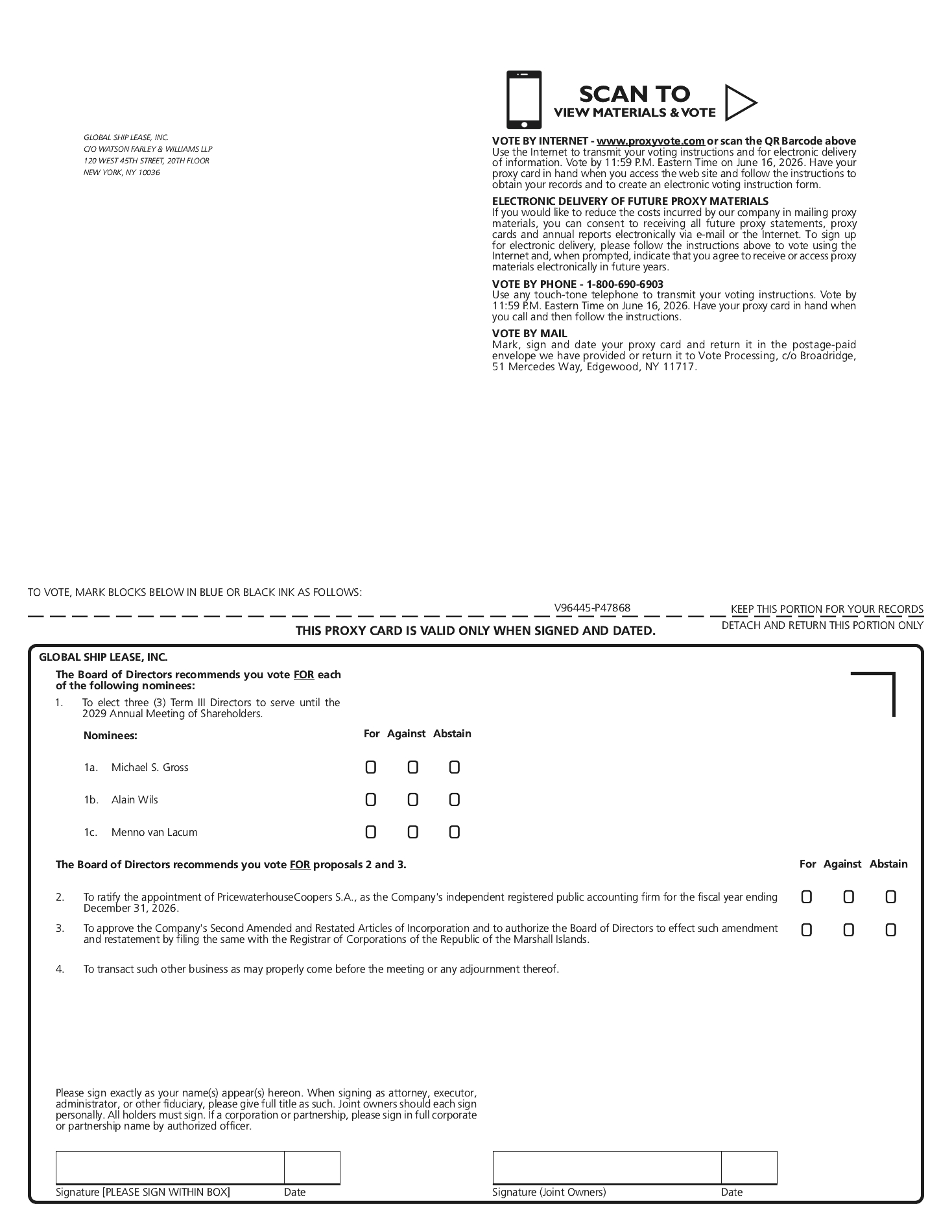
At the Meeting, our shareholders will consider and vote upon the following proposals:
1. | to elect three Term III Directors to serve until the 2029 Annual Meeting of Shareholders; |
2. | to ratify the appointment of PricewaterhouseCoopers S.A. as our independent registered public accounting firm for the fiscal year ending December 31, 2026; |
3. | to approve the Company’s Second Amended and Restated Articles of Incorporation and to authorize the Board of Directors to effect such amendment and restatement by filing the same with the Registrar of Corporations of the Republic of the Marshall Islands; and |
4. | to transact such other business as may properly come before the Meeting or any adjournment thereof. |
These proposals are described in detail in the proxy materials.
For the Meeting, we will use the internet as our primary means of furnishing proxy materials to shareholders. Accordingly, you will not necessarily receive paper copies of all of our proxy materials unless you request or have requested them. We have mailed the enclosed notice with instructions for accessing all of the proxy materials and for voting via the internet and information on how shareholders may obtain paper copies of our proxy materials if they so choose. The enclosed notice also explains how you can consent to receive future proxy materials by e-mail or the internet, which will save us the cost of printing and mailing documents to you and will reduce the impact of our shareholder meetings on the environment.
You are cordially invited to attend the Meeting in person. Your shares may alternatively be voted via the internet, by telephone or, if you receive a paper proxy card in the mail, by mailing the completed proxy card. If you nevertheless attend the Meeting, you may vote your shares in person, even if you have previously voted by proxy.
Your vote is very important to us. Whether or not you plan to attend the Meeting, please take a moment to review the proxy materials and vote as soon as possible to ensure that your shares will be represented and voted at the Meeting.
Yours faithfully, | |||
 | |||
Thomas Lister Chief Executive Officer | |||