
Report of Independent Registered Public Accounting Firm
To the Shareholders and Board of Directors of Osisko Development Corp.
Opinion on the Financial Statements
We have audited the accompanying consolidated statements of financial position of Osisko Development Corp. and its subsidiaries (together, the Company) as of December 31, 2022 and 2021, and the related consolidated statements of loss, comprehensive loss, changes in equity and cash flows for the years then ended, including the related notes (collectively referred to as the consolidated financial statements). In our opinion, the consolidated financial statements present fairly, in all material respects, the financial position of the Company as of December 31, 2022 and 2021, and its financial performance and its cash flows for the years then ended in conformity with International Financial Reporting Standards as issued by the International Accounting Standards Board.
Basis for Opinion
These consolidated financial statements are the responsibility of the Company’s management. Our responsibility is to express an opinion on the Company’s consolidated financial statements based on our audits. We are a public accounting firm registered with the Public Company Accounting Oversight Board (United States) (PCAOB) and are required to be independent with respect to the Company in accordance with the U.S. federal securities laws and the applicable rules and regulations of the Securities and Exchange Commission and the PCAOB.
We conducted our audits of these consolidated financial statements in accordance with the standards of the PCAOB. Those standards require that we plan and perform the audits to obtain reasonable assurance about whether the consolidated financial statements are free of material misstatement, whether due to error or fraud. The Company is not required to have, nor were we engaged to perform, an audit of its internal control over financial reporting. As part of our audits, we are required to obtain an understanding of internal control over financial reporting but not for the purpose of expressing an opinion on the effectiveness of the Company’s internal control over financial reporting. Accordingly, we express no such opinion.
PricewaterhouseCoopers LLP
1250 René-Lévesque Boulevard West, Suite 2500, Montréal, Quebec, Canada H3B 4Y1
T: +1 514 205 5000, F: +1 514 876 1502
“PwC” refers to PricewaterhouseCoopers LLP, an Ontario limited liability partnership.
Our audits included performing procedures to assess the risks of material misstatement of the consolidated financial statements, whether due to error or fraud, and performing procedures that respond to those risks. Such procedures included examining, on a test basis, evidence regarding the amounts and disclosures in the consolidated financial statements. Our audits also included evaluating the accounting principles used and significant estimates made by management, as well as evaluating the overall presentation of the consolidated financial statements. We believe that our audits provide a reasonable basis for our opinion.
/s/PricewaterhouseCoopers LLP
Montréal, Canada
March 24, 2023
We have served as the Company’s auditor since 2020.
Osisko Development Corp.
Consolidated Statements of Financial Position
As at December 31, 2022 and 2021
(Expressed in thousands of Canadian dollars)
| December 31, |
| December 31, | |||
2022 | 2021 | |||||
| Notes |
| $ |
| $ | |
Assets |
|
|
|
| ||
Current assets |
|
|
|
| ||
Cash |
| 7 | | | ||
Amounts receivable |
| 8 | | | ||
Inventories |
| 9 | | | ||
Other current assets |
| | | |||
| | |||||
Non-current assets |
|
|
|
| ||
Investments in associates |
| 10 | | | ||
Other investments |
| 10 | | | ||
Mining interests |
| 6,11 | | | ||
Property, plant and equipment |
| 6,12 | | | ||
Exploration and evaluation |
| 6,13 | | | ||
Other assets | 14 | | | |||
| | |||||
Liabilities |
|
|
|
| ||
Current liabilities |
|
|
|
| ||
Accounts payable and accrued liabilities |
| 15 | | | ||
Deferred premium on flow-through shares |
| 19 | — | | ||
Lease liabilities |
| 17 | | | ||
Contract liability |
| 18 | | | ||
Current Portion of long-term debt |
| 16,33 | | | ||
Environmental rehabilitation provision |
| 20 | | | ||
Deferred Consideration and contingent payments |
| 6 | | — | ||
| | |||||
Non-current liabilities |
|
|
|
| ||
Long term debt |
| 16,33 | | | ||
Lease liabilities |
| 17 | | | ||
Contract liability |
| 18 | | | ||
Environmental rehabilitation provision |
| 20 | | | ||
Warrant liability | 21 | | — | |||
Deferred Consideration and contingent payments |
| 6 | | — | ||
Deferred income taxes |
| 6,23 | | | ||
| | |||||
Equity |
|
|
|
| ||
Share capital |
| 21 | | | ||
Warrants |
| 21 | | — | ||
Contributed surplus | | | ||||
Accumulated other comprehensive income | | | ||||
Deficit | ( | ( | ||||
| | |||||
| |
APPROVED ON BEHALF OF THE BOARD | |
(signed) Sean Roosen, Director | (signed), Charles Page, Director |
The notes are an integral part of these consolidated financial statements.
2
Osisko Development Corp.
Consolidated Statements of Loss
For the years ended December 31, 2022 and 2021
(Expressed in thousands of Canadian dollars, except per share amounts)
2022 | 2021 | |||||
| Notes |
| $ |
| $ | |
Revenues |
| | | |||
Operating expenses |
|
|
|
| ||
Cost of sales |
| 24 | ( | ( | ||
Other operating cost |
| 24 | ( | ( | ||
General and administrative |
| 25 | ( | ( | ||
Exploration and evaluation, net of tax credits |
| ( | ( | |||
Impairment of assets |
| 11 | ( | ( | ||
Operating loss |
| ( | ( | |||
Accretion expense |
| ( | ( | |||
Share of loss of associates |
| ( | ( | |||
Gain on change in fair value of warrant liability |
| 21 | | — | ||
Other income, net |
| 26 | | | ||
Loss before income taxes |
| ( | ( | |||
Income tax recovery (expense) |
| 23 | ( | | ||
Net loss |
| ( | ( | |||
Basic and diluted loss per share |
| 27 | ( | ( | ||
Weighted average number of shares outstanding-basic and diluted |
| | |
The notes are an integral part of these consolidated financial statements.
3
Osisko Development Corp.
Consolidated Statements of Comprehensive Loss
For the years ended December 31, 2022 and 2021
(Expressed in thousands of Canadian dollars)
2022 | 2021 | |||
| $ |
| $ | |
Net loss | ( | ( | ||
Other comprehensive income (loss), net of tax |
|
| ||
Items that will not be reclassified to the consolidated statements of loss |
|
| ||
Changes in fair value of financial assets at fair value through comprehensive income | ( | ( | ||
Income tax effect | ( | | ||
Share of other comprehensive loss of associates | ( | — | ||
Items that may be reclassified to the consolidated statements of loss |
|
| ||
Currency translation adjustments | | ( | ||
Other comprehensive income (loss), net of tax | | ( | ||
Comprehensive loss | ( | ( |
The notes are an integral part of these consolidated financial statements.
4
Osisko Development Corp.
Consolidated Statements of Cash Flows
For the years ended December 31, 2022 and 2021
(Expressed in thousands of Canadian dollars)
| 2022 | 2021 | ||||
| Notes |
| $ |
| $ | |
Operating activities |
|
|
|
| ||
Net loss |
| ( | ( | |||
Adjustments for: |
|
|
| |||
Share-based compensation |
| | | |||
Depreciation |
| 2,425 | | | ||
Accretion |
| | | |||
Gain on disposal of investments |
| 26 | ( | ( | ||
Share of loss of associates |
| 10 | | | ||
Net gain on acquisition of investments |
| — | ( | |||
Change in fair value of financial assets and liabilities at fair value through profit and loss |
| 10 | | | ||
Gain on change in fair value of warrant liability | ( | — | ||||
Unrealized gain on dilution |
| — | ( | |||
Unrealized Foreign exchange loss |
| — | | |||
Deferred income tax expense (recovery) |
| | ( | |||
Impairment of assets |
| 11 | | | ||
Premium on flow-through shares |
| 19 | ( | ( | ||
Cumulative catch-up adjustment on contract liability | 18 | ( | — | |||
Gain on re-evaluation of Sapuchi provisions |
| — | ( | |||
Proceeds from Contract liability |
| 18 | | | ||
Other |
| | | |||
Net cash flows used in operating activities before changes in non-cash working capital items |
| ( | ( | |||
Changes in non-cash working capital items |
| 29 | ( | ( | ||
Net cash flows used in operating activities |
| ( | ( | |||
Investing activities |
|
|
|
| ||
Mining interests |
| ( | ( | |||
Property, plant and equipment |
| 12 | ( | ( | ||
Exploration and evaluation expenses |
| ( | ( | |||
Proceeds on disposals of investments |
| 10 | | | ||
Acquisition of investments in associates |
| — | ( | |||
Acquisition of other investments |
| ( | ( | |||
Acquisition of Tintic, net of cash acquired |
| 6 | ( | — | ||
Reclamation deposit |
| ( | — | |||
Other |
| ( | ( | |||
Net cash flows used in investing activities |
| ( | ( | |||
Financing activities |
|
|
|
| ||
Private placements |
| 21 | | | ||
Issuance of common shares |
| | — | |||
Share issue expense |
| 21 | ( | ( | ||
Exercise of warrants |
| — | | |||
Capital payments on lease liabilities |
| 17 | ( | ( | ||
Long-term debt |
| 16 | | | ||
Repayment of long-term debt |
| 16 | ( | ( | ||
Net cash flows provided from (used in) financing activities |
| | | |||
Increase (decrease) in cash before impact of exchange rate |
| | ( | |||
Effects of exchange rate changes on cash |
| | ( | |||
Increase (decrease) in cash |
| | ( | |||
Cash – Beginning of year |
| | | |||
Cash – end of year |
| | |
The notes are an integral part of these consolidated financial statements.
5
Osisko Development Corp.
Consolidated Statements of Changes in Equity
For the year ended December 31, 2022
(Expressed in thousands of Canadian dollars except number of shares)
Number of | Accumulated | |||||||||||||||
common | other | |||||||||||||||
shares | Share | Contributed | comprehensive | |||||||||||||
| Notes |
| Outstanding(i) |
| capital |
| Warrants |
| surplus |
| income (loss) |
| (Deficit) |
| Total | |
($) | ($) | ($) | ($) | ($) | ($) | |||||||||||
Balance – January 1, 2022 |
| 21 |
| |
| | — |
| |
| | ( |
| | ||
Net loss |
| — | — | — | — | — | ( | ( | ||||||||
Other comprehensive loss, net |
| — | — | — | — | | — | | ||||||||
Comprehensive loss |
| — | — | — | — | | ( | ( | ||||||||
Transfer of realized loss on financial assets at fair value through other comprehensive income, net of taxes |
| — | — | — | — | ( | | — | ||||||||
Private placements – Brokered |
| 21 | | | | — | — | — | | |||||||
Private placements – Non-Brokered |
| 21 | | | — | — | — | — | | |||||||
Share-issue costs |
| — | ( | ( | — | — | — | ( | ||||||||
Share options - Share-based compensation |
| — | — | — | | — | — | | ||||||||
Equity-settled compensation plan |
| — | — | — | | — | | | ||||||||
Shares issued - employee share purchase plan |
| | | — | — | — | — | | ||||||||
Shares issued on Acquisition of Tintic |
| 6 | | | — | — | — | — | | |||||||
Share issued from RSU/DSU Redemption |
| | | — | — | — | — | | ||||||||
Balance – December 31, 2022 |
| | | | | ( | |
| (i) | The common shares outstanding presented have been adjusted to reflect the effect of the |
The notes are an integral part of these consolidated financial statements.
6
Osisko Development Corp.
Consolidated Statements of Changes in Equity
For the year ended December 31, 2021
(Expressed in thousands of Canadian dollars except number of shares)
|
| Number of |
|
|
|
|
| Accumulated |
|
| ||||
common | other | |||||||||||||
shares | Share | Contributed | comprehensive | |||||||||||
Notes | Outstanding | capital | surplus | income (loss) | (Deficit) | Total | ||||||||
($) | ($) | ($) | ($) | ($) | ||||||||||
Balance – January 1, 2021 |
| |
| |
| |
| |
| ( |
| | ||
Net loss |
| — |
| — |
| — |
| — |
| ( |
| ( | ||
Other comprehensive loss, net |
| — |
| — |
| — |
| ( |
| — |
| ( | ||
Comprehensive loss |
| — |
| — |
| — |
| ( |
| ( |
| ( | ||
Transfer of realized loss on financial assets at fair value through other comprehensive income, net of taxes |
| — |
| — |
| — |
| |
| ( |
| — | ||
Private placements – Non-brokered |
| 21 |
| |
| |
| — |
| — |
| — |
| |
Private placements – Flow-through |
| 21 |
| |
| |
| — |
| — |
| — |
| |
Issue costs on financings |
|
| — |
| ( |
| — |
| — |
| — |
| ( | |
De-recognition of tax benefit on issue costs |
| — |
| ( |
| — |
| — |
| — |
| ( | ||
Share options - Share-based compensation |
| — |
| — |
| |
| — |
| — |
| | ||
Exercise of warrants |
| |
| |
| — |
| — |
| — |
| | ||
Restricted share units (including from Parent Company) Share-based compensation |
| — |
| — |
| |
| — |
| — |
| | ||
Deferred share units to be settled in common shares - Share-based compensation |
|
|
|
|
|
|
|
|
|
|
| |||
| — |
| — |
| |
| — |
| — |
| | |||
Income tax impact |
| — |
| — |
| |
| — |
| — |
| | ||
Balance – December 31, 2021 |
| |
| |
| |
|
| ( |
| |
| (i) | The common shares outstanding presented have been adjusted to reflect the effect of the |
The notes are an integral part of these consolidated financial statements.
7
Osisko Development Corp.
Notes to the Consolidated Financial Statements
For the years ended December 31, 2022 and 2021
(Tabular amounts expressed in thousands of Canadian dollars, except per share amounts)
1. | Nature of operations |
Osisko Development Corp. (“Osisko Development” or the “Company”) is a mineral exploration and development company focused on the acquisition, exploration and development of precious metals resource properties in North America. The common shares of Osisko Development began trading under the symbol ODV on the TSX Venture Exchange (“TSX-V”) on December 2, 2020 and on the New York Stock Exchange (“NYSE”) on May 27, 2022. The Company’s registered and business address is 1100, avenue des Canadiens-de-Montréal, suite 300, Montreal, Québec. The common shares outstanding presented have been retroactively adjusted to reflect the effect of the
On December 31, 2022, the former parent Company, Osisko Gold Royalties (OGR) held an interest of
The principal subsidiaries of the Company and their geographic locations at December 31, 2022 were as follows:
Entity |
| Jurisdiction |
| % ownership |
|
Barkerville Gold Mines Ltd. (“Barkerville”) |
| British Columbia |
| | % |
Sapuchi Minera, S. de R.L. de C.V. (“Sapuchi”) |
| Mexico |
| | % |
Tintic Consolidated Metals LLC (“Tintic”) |
| USA |
| | % |
Osisko Development is focused on exploring and developing its mining assets, including the Cariboo Gold Project in British Columbia, the San Antonio gold project in Mexico and the Trixie test mine in the USA.
As at December 31, 2022, the Company’s working capital was $
2. | Basis of presentation |
These consolidated financial statements have been prepared in accordance with the International Financial Reporting Standards (“IFRS”) as issued by the International Accounting Standards Board (“IASB”). The accounting policies, methods of computation and presentation applied in these consolidated financial statements are consistent with those of the previous financial year, unless otherwise noted.
The Board of Directors approved these consolidated financial statements on March 24, 2023.
8
Osisko Development Corp.
Notes to the Consolidated Financial Statements
For the years ended December 31, 2022 and 2021
(Tabular amounts expressed in thousands of Canadian dollars, except per share amounts)
3. | Significant Accounting Policies |
The significant accounting policies applied in the preparation of the consolidated financial statements are described below.
a)Basis of measurement
The consolidated financial statements are prepared under the historical cost convention, except for the revaluation of certain financial assets and financial liabilities at fair value (including derivative instruments), as described in Note 3(e) below.
b)Business combinations
On the acquisition of a business, the acquisition method of accounting is used whereby the identifiable assets, liabilities and contingent liabilities (identifiable net assets) of the business are measured at fair value at the date of acquisition. Provisional fair values estimated at a reporting date are finalized as soon as the relevant information is available, which period shall not exceed twelve months from the acquisition date and are adjusted to reflect the transaction as of the acquisition date. Any excess of the consideration paid is treated as goodwill, and any bargain gain is immediately recognized in the statement of loss and comprehensive loss. If control is lost as a result of a transaction, the participation retained is recognized on the statement of financial position at fair value and the difference between the fair value recognized and the carrying value as at the date of the transaction is recognized in the statement of loss. Acquisition costs are expensed as incurred.
The Company recognizes any non-controlling interest in the acquiree on an acquisition-by-acquisition basis, either at fair value or at the non-controlling interest’s proportionate share of the recognized amounts of acquiree’s identifiable net assets.
The results of businesses acquired during the year are consolidated into the consolidated financial statements from the date on which control commences (generally at the closing date when the acquirer legally transfers the consideration).
c)Consolidation
The Company’s financial statements consolidate the accounts of Osisko Development and its subsidiaries. All intercompany transactions, balances and unrealized gains or losses from intercompany transactions are eliminated on consolidation. Subsidiaries are defined as all entities over which the Company has the ability to exercise control. The Company controls an entity when the group is exposed to, or has rights to, variable returns from its involvement with the entity and has the ability to affect those returns through its power over the entity. Subsidiaries are fully consolidated from the date on which control is transferred to the Company and are de-consolidated from the date that control ceases. Accounting policies of subsidiaries are consistent with the policies adopted by the Company.
d)Foreign currency translation
(i) | Functional and presentation currency |
Items included in the financial statements of each consolidated entity and associate of the Company are measured using the currency of the primary economic environment in which the entity operates (the “Functional Currency”). The consolidated financial statements are presented in Canadian dollars, which is the functional currency of the parent Company and some of its subsidiaries.
Assets and liabilities of the subsidiaries that have a Functional Currency other than the Canadian dollar are translated into Canadian dollars at the exchange rate in effect on the consolidated statement of financial position date and
9
Osisko Development Corp.
Notes to the Consolidated Financial Statements
For the years ended December 31, 2022 and 2021
(Tabular amounts expressed in thousands of Canadian dollars, except per share amounts)
3. | Significant Accounting Policies (continued) |
revenues and expenses are translated at the average exchange rate over the reporting period. Gains and losses from these translations are recognized as currency translation adjustment in other comprehensive income or loss.
(ii) | Transactions and balances |
Foreign currency transactions, including revenues and expenses, are translated into the Functional Currency at the rate of exchange prevailing on the date of each transaction or valuation when items are re-measured. Monetary assets and liabilities denominated in currencies other than the operation’s functional currencies are translated into the Functional Currency at exchange rates in effect at the statement of financial position date. Foreign exchange gains and losses resulting from the settlement of those transactions and from period-end translations are recognized in the consolidated statement of loss.
Non-monetary assets and liabilities are translated at historical rates, unless such assets and liabilities are carried at fair value, in which case, they are translated at the exchange rate in effect at the date of the fair value measurement. Changes in fair value attributable to currency fluctuations of non-monetary financial assets and liabilities such as equities held at fair value through profit or loss are recognized in the consolidated statement of loss as part of the fair value gain or loss. Such changes in fair value of non-monetary financial assets, such as equities classified at fair value through other comprehensive income, are included in other comprehensive income or loss.
e)Financial instruments
Financial assets and financial liabilities are recognized when the Company becomes a party to the contractual provisions of the instrument. Financial assets are derecognized when the rights to receive cash flows from the assets have expired or have been transferred and the Company has transferred substantially all risks and rewards of ownership. A financial liability is derecognized when it is extinguished, discharged, cancelled or expires.
Financial assets and liabilities are offset, and the net amount is reported in the statement of financial position when there is an unconditional and legally enforceable right to offset the recognized amounts and there is an intention to settle on a net basis or realize the asset and settle the liability simultaneously.
All financial instruments are required to be measured at fair value on initial recognition. The fair value is based on quoted market prices unless the financial instruments are not traded in an active market. In this case, the fair value is determined by using valuation techniques like the Black-Scholes option pricing model or other valuation techniques.
Measurement after initial recognition depends on the classification of the financial instrument. The Company has classified its financial instruments in the following categories depending on the purpose for which the instruments were acquired and their characteristics.
10
Osisko Development Corp.
Notes to the Consolidated Financial Statements
For the years ended December 31, 2022 and 2021
(Tabular amounts expressed in thousands of Canadian dollars, except per share amounts)
3. | Significant Accounting Policies (continued) |
(i) | Financial assets |
Debt instruments
Investments in debt instruments are subsequently measured at amortized cost when the asset is held within a business model whose objective is to hold assets in order to collect contractual cash flows and when the contractual terms of the financial asset give rise on specified dates to cash flows that are solely payments of principal and interest on the principal amount outstanding.
Investments in debt instruments are subsequently measured at fair value when they do not qualify for measurement at amortized cost. Financial instruments subsequently measured at fair value, including derivatives that are assets, are carried at fair value with changes in fair value recorded in net income or loss unless they are held within a business model whose objective is to hold assets in order to collect contractual cash flows or sell the assets and when the contractual terms of the financial asset give rise on specified dates to cash flows that are solely payments of principal and interest on the principal amount outstanding, in which case unrealized gains and losses are initially recognized in other comprehensive income or loss for subsequent reclassification to net income or loss through amortization of premiums and discounts, impairment or de-recognition.
Equity instruments
Investments in equity instruments are subsequently measured at fair value with changes recorded in net income or loss. Equity instruments that are not held for trading can be irrevocably designated at fair value through other comprehensive income or loss on initial recognition without subsequent reclassification to net income or loss. Cumulative gains and losses are transferred from accumulated other comprehensive income (loss) to retained earnings (deficit) upon derecognition of the investment.
Dividend income on equity instruments measured at fair value through other comprehensive income or loss is recognized in the statement of loss on the ex-dividend date.
(ii) | Financial Liabilities |
Financial liabilities are subsequently measured at amortized cost using the effective interest method, except for financial liabilities at fair value through profit or loss. Such liabilities, including derivatives that are liabilities, are subsequently measured at fair value.
11
Osisko Development Corp.
Notes to the Consolidated Financial Statements
For the years ended December 31, 2022 and 2021
(Tabular amounts expressed in thousands of Canadian dollars, except per share amounts)
3. | Significant Accounting Policies (continued) |
The Company has classified its financial instruments as follows:
Category |
| Financial instrument |
Financial assets at amortized cost | Bank balances | |
Short-term debt securities | ||
Reclamation deposits | ||
Trade receivables | ||
Interest income receivable | ||
Amounts receivable from associates and other receivables | ||
Financial assets at fair value through profit or loss | Investments and warrants or other investments | |
Financial assets at fair value through other comprehensive income or loss | Investments in shares and equity instruments, other than in warrants | |
Financial liabilities at amortized cost | Accounts payable and accrued liabilities Borrowings under loan facilities | |
Financial liabilities at fair value through profit or loss | Warrants liability |
f)Impairment of financial assets
At each reporting date, the Company assesses, on a forward-looking basis, the expected credit losses associated with its financial assets carried at amortized cost. The impairment methodology applied depends on whether there has been a significant increase in the credit risk or if a simplified approach has been selected.
The Company has two principal types of financial assets subject to the expected credit loss model:
| ● | Trade receivables; and |
| ● | Amounts receivable |
The Company applies the simplified approach permitted by IFRS 9 for trade receivables (including amounts receivable from associates and other receivables), which requires lifetime expected credit losses to be recognized from initial recognition of the receivables.
g)Cash
Cash includes demand deposits held with banks and cash.
h)Refundable tax credits for mining exploration expenses
The Company is entitled to refundable tax credits on qualified mining exploration and evaluation expenses incurred in the provinces of Québec and British-Columbia. The credits are accounted for against the exploration and evaluation expenses incurred.
12
Osisko Development Corp.
Notes to the Consolidated Financial Statements
For the years ended December 31, 2022 and 2021
(Tabular amounts expressed in thousands of Canadian dollars, except per share amounts)
3. | Significant Accounting Policies (continued) |
i)Inventories
Supplies inventory consists of mining supplies and consumables used in the operations and is valued at the lower of average cost and net realizable value. Provisions are recorded to reflect present intentions for the use of slow moving and obsolete parts and supplies inventory.
Inventories of stockpile, in-circuit and refined precious metals are measured and valued at the lower of average production cost and net realizable value. Net realizable value is the estimated selling price of the equivalent metals in the ordinary course of business based on the prevailing metal prices on the reporting date, less estimated costs to complete production and to bring the finished goods to sale. Production costs that are inventoried include the costs directly related to bringing the inventory to its current condition and location, such as materials, labour, other direct costs (including external services and depreciation, depletion and amortization) and production related overheads.
j)Investments in associates
Associates are entities over which the Company has significant influence, but not control. The financial results of the Company’s investments in its associates are included in the Company’s results according to the equity method. Under the equity method, the investment is initially recognized at cost, and the carrying amount is increased or decreased to recognize the Company’s share of profits or losses of associates after the date of acquisition. The Company’s share of profits or losses is recognized in the consolidated statement of loss and its share of other comprehensive income or loss of associates is included in other comprehensive loss.
Unrealized gains on transactions between the Company and an associate are eliminated to the extent of the Company’s interest in the associate. Unrealized losses are also eliminated unless the transaction provides evidence of an impairment of the asset transferred. Dilution gains and losses arising from changes in interests in investments in associates are recognized in the consolidated statement of loss.
The Company assesses at each reporting date whether there is any objective evidence that its investments in associates are impaired. If impaired, the carrying value of the Company’s share of the underlying assets of associates is written down to its estimated recoverable amount (being the higher of fair value less costs of disposal and value-in-use) and charged to the consolidated statement of loss.
k)Property and equipment
Property and equipment are stated at cost less accumulated depreciation and accumulated impairment losses. Cost includes expenditures that are directly attributable to the acquisition of an asset. Subsequent costs are included in the asset’s carrying amount or recognized as a separate asset, as appropriate, only when it is probable that future economic benefit associated with the item will flow to the Company and the cost can be measured reliably. The carrying amount of a replaced asset is derecognized when replaced.
Depreciation is calculated to amortize the cost of the property and equipment less their residual values over their estimated useful lives using the straight-line method over the following periods by major categories:
Leasehold improvements |
| Lease term |
Furniture and office equipment |
| |
Exploration equipment and facilities |
| |
Mining plant and equipment (development) |
| |
Right-of-use assets |
| Lesser of useful life and term lease |
Residual values, method of depreciation and useful lives of the assets are reviewed annually and adjusted if appropriate.
13
Osisko Development Corp.
Notes to the Consolidated Financial Statements
For the years ended December 31, 2022 and 2021
(Tabular amounts expressed in thousands of Canadian dollars, except per share amounts)
3. | Significant Accounting Policies (continued) |
Gains and losses on disposals of property and equipment are determined by comparing the proceeds with the carrying amount of the asset and are included as part of other gains or losses, net in the consolidated statement of loss.
l)Mining interests
Development assets are interests in projects that are under development, in permitting or feasibility stage and that in management’s view, can be reasonably expected to generate steady-state revenue for the Company in the near future. Subsequent to completion of a positive economic analysis on a mineral property, capitalized exploration and evaluation assets are transferred into mining interests, or as an item of property and equipment, based on the nature of the underlying asset.
Mining interests are stated at cost less accumulated depreciation and accumulated impairment losses. Cost includes expenditures that are directly attributable to the acquisition of an asset, including the purchase price and all expenditures undertaken in the development, construction, installation and/or completion of mine production facilities. All expenditures related to the construction of mine declines and orebody access, including mine shafts and ventilation raises, are considered to be capital development and are capitalized. The development and commissioning phase ceases upon the commencement of commercial production.
Subsequent to the commencement of commercial production, further development expenditures incurred with respect to a mining interest are capitalized as part of the mining interest, when it is probable that additional future economic benefits associated with the expenditure will flow to the Company. Otherwise, such expenditures are classified as other operating costs. Mining interest assets are subject to periodic review for impairment when events or changes in circumstances indicate the project’s carrying value may not be recoverable.
Upon commencement of commercial production, mining interests are depleted over the life of the mine using the unit-of production method based on the economic life of the related deposit.
Determination of commencement of commercial production is a complex process and requires significant assumptions and estimates. The commencement of commercial production is defined as the date when the mine is capable of operating in the manner intended by management. The Company considers primarily the following factors, among others, when determining the commencement of commercial production:
| ● | All major capital expenditures to achieve a consistent level of production and desired capacity have been incurred; |
| ● | A reasonable period of testing of the mine plant and equipment has been completed; |
| ● | A predetermined percentage of design capacity of the mine and mill has been reached; and |
| ● | Required production levels, grades and recoveries have been achieved. |
m)Exploration and evaluation expenditures
Exploration and evaluation assets are comprised of exploration and evaluation expenditures and acquisition costs for exploration and evaluation assets. Expenditures incurred on activities that precede exploration and evaluation, being all expenditures incurred prior to securing the legal rights to explore an area, are expensed immediately. Exploration and evaluation assets include rights in mining properties, paid or acquired through a business combination or an acquisition of assets, and costs related to the initial search for mineral deposits with economic potential or to obtain more information about existing mineral deposits. Mining rights are recorded at acquisition cost less accumulated impairment losses. Mining rights and options to acquire undivided interests in mining rights are depreciated only as these properties are put into commercial production.
14
Osisko Development Corp.
Notes to the Consolidated Financial Statements
For the years ended December 31, 2022 and 2021
(Tabular amounts expressed in thousands of Canadian dollars, except per share amounts)
3. | Significant Accounting Policies (continued) |
Exploration and evaluation expenditures for each separate area of interest are capitalized and include costs associated with prospecting, sampling, trenching, drilling and other work involved in searching for ore like topographical, geological, geochemical and geophysical studies. They also reflect costs related to establishing the technical and commercial viability of extracting a mineral resource identified through exploration and evaluation or acquired through a business combination or asset acquisition.
Exploration and evaluation expenditures include the cost of:
| (i) | establishing the volume and grade of deposits through drilling of core samples, trenching and sampling activities; |
| (ii) | determining the optimal methods of extraction and metallurgical and treatment processes; |
| (iii) | studies related to surveying, transportation and infrastructure requirements; |
| (iv) | permitting activities; and |
| (v) | economic evaluations to determine whether development of the mineralized material is commercially justified, including scoping, prefeasibility and final feasibility studies. |
Exploration and evaluation expenditures include overhead expenses directly attributable to the related activities. Exploration and evaluation assets are subject to periodic review for impairment when events or changes in circumstances indicate the project’s carrying value may not be recoverable.
Cash flows attributable to capitalized exploration and evaluation costs are classified as investing activities in the consolidated statement of cash flows under the heading exploration and evaluation.
n)Provision for environmental rehabilitation
Provision for environmental rehabilitation, restructuring costs and legal claims, where applicable, is recognized when:
| (i) | The Company has a present legal or constructive obligation as a result of past events. |
| (ii) | It is probable that an outflow of resources will be required to settle the obligation. |
| (iii) | The amount can be reliably estimated. |
The provision is measured at management’s best estimate of the expenditure required to settle the obligation at the end of the reporting period and is discounted to present value where the effect is material. The increase in the provision due to passage of time is recognized as finance costs. Changes in assumptions or estimates are reflected in the period in which they occur. Provision for environmental rehabilitation represents the legal and constructive obligations associated with the eventual closure of the Company’s property, plant and equipment. These obligations consist of costs associated with reclamation and monitoring of activities and the removal of tangible assets. The discount rate used is based on a pre-tax rate that reflects current market assessments of the time value of money and the risks specific to the obligation, excluding the risks for which future cash flow estimates have already been adjusted.
Reclamation deposits
Reclamation deposits are term deposits held on behalf of the government of the province of British Columbia as collateral for possible rehabilitation activities on the Company’s mineral properties in connection with permits required for exploration activities. It also includes the same nature deposit for Utah operations. Reclamation deposits are released once the property is restored to satisfactory condition, or as released under the surety bond agreement. As they are restricted from general use, they are included under other assets on the consolidated statements of financial position.
15
Osisko Development Corp.
Notes to the Consolidated Financial Statements
For the years ended December 31, 2022 and 2021
(Tabular amounts expressed in thousands of Canadian dollars, except per share amounts)
3. | Significant Accounting Policies (continued) |
o)Current and deferred income tax
The tax expense for the period comprises current and deferred tax. Tax is recognized in the consolidated statements of loss, except to the extent that it relates to items recognized in other comprehensive income or loss or directly in equity. In this case, the tax is also recognized in other comprehensive income or loss or directly in equity, respectively.
Current income taxes
The current income tax charge is the expected tax payable on the taxable income for the year, using the tax laws enacted or substantively enacted at the statement of financial position date in the jurisdictions where the Company and its subsidiaries operate and generate taxable income. Management periodically evaluates positions taken in tax returns with respect to situations in which applicable tax regulation is subject to interpretation. It establishes provisions where appropriate on the basis of amounts expected to be paid to the tax authorities.
Deferred income taxes
The Company uses the asset and liability method of accounting for income taxes. Under this method, deferred income tax assets and liabilities are recognized for future tax consequences attributable to temporary differences between the financial statement carrying amounts of existing assets and liabilities and their respective tax bases. However, the deferred income tax is not accounted for if it arises from initial recognition of an asset or liability in a transaction other than a business combination that at the time of the transaction affects neither accounting nor taxable profit or loss. Deferred income tax assets and liabilities are measured using enacted or substantively enacted tax rates (and laws) that apply to taxable income in the years in which those temporary differences are expected to be recovered or settled.
Deferred income tax assets are recognized only to the extent that it is probable that future taxable profit will be available against which the temporary differences can be utilized.
Deferred income tax is provided on temporary differences arising on investments in subsidiaries and associates, except where the timing of the reversal of the temporary difference is controlled by the Company and it is probable that the temporary difference will not reverse in the foreseeable future.
Deferred income tax assets and liabilities are presented as non-current and are offset when there is a legally enforceable right to offset current tax assets against current tax liabilities and when deferred tax assets and liabilities relate to income taxes levied by the same taxation authority on either the same taxable entity or different taxable entities where there is an intention to settle the balances on a net basis.
p)Share capital
Common shares are classified as equity. Incremental costs directly attributable to the issuance of shares are recognized as a deduction from the proceeds in equity in the period where the transaction occurs.
q)Warrants
When warrants are classified as equity, incremental costs directly attributable to the issuance of warrants are recognized as a deduction from the proceeds in equity in the period where the transaction occurs.
16
Osisko Development Corp.
Notes to the Consolidated Financial Statements
For the years ended December 31, 2022 and 2021
(Tabular amounts expressed in thousands of Canadian dollars, except per share amounts)
3. | Significant Accounting Policies (continued) |
r)Leases
The Company is committed to long-term lease agreements, mainly for office space and mining equipment.
Leases are recognized as a right-of-use asset (presented under property, plant and equipment on the consolidated statement of financial position) and a corresponding liability at the date at which the leased asset is available for use by the Company. Each lease payment is allocated between the liability and finance cost. The finance cost is charged to profit or loss over the lease term so as to produce a constant periodic rate of interest on the remaining balance of the liability for each period. The right-of-use asset is depreciated over the shorter of the asset’s useful life and the lease term on a straight-line basis.
Assets and liabilities arising from a lease are initially measured on a present value basis. The lease payments are discounted utilizing the implicit interest rate of the specific lease. If that rate cannot be readily determined, the Company’s incremental borrowing rate is used, being the rate that the Company would have to pay to borrow the funds necessary to obtain an asset of similar value in a similar economic environment with similar terms and conditions.
Payments associated with short-term leases (12 months or less) and leases of low-value assets are recognized on a straight-line basis as an expense in profit or loss.
s)Share-based compensation
Share option plan
The Company offers a share option plan to its directors, officers, employees and consultants. Each tranche in an award is considered a separate award with its own vesting period and grant date fair value. Fair value of each tranche is measured at the date of grant using the Black-Scholes option pricing model. Compensation expense is recognized over the tranche’s vesting period by increasing contributed surplus based on the number of awards expected to vest. The number of awards expected to vest is reviewed at least annually, with any impact being recognized immediately.
Any consideration paid on exercise of share options is credited to share capital. The contributed surplus resulting from share-based compensation is transferred to share capital when the options are exercised.
Deferred and restricted share units
The Company offers a deferred share units (“DSU”) plan to its directors and a restricted share units (“RSU”) plan to its officers and employees. DSU may be granted to directors and RSU may be granted to employees and officers as part of their respective long-term compensation package, entitling them to receive a payment in the form of common shares, cash (based on the Company’s share price at the relevant time) or a combination of common shares and cash, at the sole discretion of the Company. The fair value of the DSU and RSU granted to be settled in common shares is measured on the grant date and is recognized over the vesting period under contributed surplus with a corresponding charge to share-based compensation. A liability for the DSU and RSU to be settled in cash is measured at fair value on the grant date and is subsequently adjusted at each statement of financial position date for changes in fair value. The liability is recognized over the vesting period with a corresponding charge to share-based compensation.
t)Revenue recognition
Revenues generated from sale of metals is recognized when the Company satisfies the performance obligations associated with the sale. Typically, this is accomplished when control over the metals are passed from the Company to the buyer. Primary factors that indicate the point in time when control has passed to the buyer includes but is not limited to (a) the Company has transferred physical possession and legal title of the asset to the purchaser and (b) the Company has present right to payment.
17
Osisko Development Corp.
Notes to the Consolidated Financial Statements
For the years ended December 31, 2022 and 2021
(Tabular amounts expressed in thousands of Canadian dollars, except per share amounts)
3. | Significant Accounting Policies (continued) |
u)Contract Liability
Deferred revenue arises on upfront payments received by the Company in consideration for future commitments as specified in its streaming agreements (the “Contract Liability”).
The accounting for a streaming arrangement is dependent on the facts and terms of each agreement. The Company identified significant financing components related to its streaming agreements resulting from the difference in the timing of the upfront consideration received and the promised goods delivered. Interest expense on the Contract Liability (Note 18) is recognized in Mining interests and plant and equipment. The interest rate is determined based on the implicit rate in the streaming agreement at the date of inception. The initial consideration received from the streaming arrangements is considered variable, subject to changes in the total gold and silver ounces to be delivered in the future. Changes to variable consideration will be reflected in the consolidated statement of loss.
At each financial reporting date, the Company accrues interest on the financing component of the Contract Liability. The interest accrued increases the balance of the Contract Liability with an offset charged to borrowing costs as part of Mining interests and plant and equipment. This interest accrual is not a contractual obligation but is intended to allocate the cost of the streaming agreements over the period it is outstanding. This accrual is a non-cash item and as such is not reported on the consolidated statement of cash flows. Upon commencement of production, the Contract Liability will be brought into revenue over the life of mine. Incremental costs directly attributable to obtaining a contract with a customer are capitalized as other non-current assets. Upon commencement of production, the other non-current assets will be expensed over the life of mine. Such costs are subject to impairment when the remaining amount of consideration to be received exceeds the costs that relate directly to providing the goods that have not been recognized as expenses.
v)Earnings per share
The calculation of earnings per share (“EPS”) is based on the weighted average number of shares outstanding for each period. The basic EPS is calculated by dividing the profit or loss attributable to the equity owners of the Company by the weighted average number of common shares outstanding during the period.
The computation of diluted EPS assumes the conversion, exercise or contingent issuance of securities only when such conversion, exercise or issuance would have a dilutive effect on the income per share. The treasury stock method is used to determine the dilutive effect of the warrants, share options, DSU and RSU. When the Company reports a loss, the diluted net loss per common share is equal to the basic net loss per common share due to the anti-dilutive effect of the outstanding warrants, share options, DSU and RSU.
w)Segment reporting
The operating segments are reported in a manner consistent with the internal reporting provided to the Chief Executive Officer (“CEO”) who fulfills the role of the chief decision-maker. The CEO is responsible for allocating resources and assessing performance of the Company’s operating segments. The Company manages its business by the exploration, evaluation and development activities of its projects.
18
Osisko Development Corp.
Notes to the Consolidated Financial Statements
For the years ended December 31, 2022 and 2021
(Tabular amounts expressed in thousands of Canadian dollars, except per share amounts)
4.New accounting standards and amendments
Certain new accounting standards and interpretations have been published that are not mandatory for the current period and have not been early adopted. The Company is currently evaluating the impact of these standards and does not expected the impact to be material on the Company's current or future reporting periods.
5. | Critical accounting estimates and judgements |
The preparation of financial statements in conformity with IFRS requires the Company to make estimates and assumptions that affect the reported amounts of assets and liabilities and disclosure of contingent assets and liabilities at the date of the financial statements and the reported amounts of revenues and expenses during the reporting period. The Company also makes estimates and assumptions concerning the future. The determination of estimates requires the exercise of judgement based on various assumptions and other factors such as historical experience and current and expected economic conditions. Actual results could differ from those estimates.
Estimates and assumptions are continually evaluated and are based on historical experience and other factors, including expectations of future events that are believed to be reasonable under the circumstances.
Critical accounting estimates and assumptions
Mineral reserves and resources
Mineral reserves are estimates of the amount of minable ore that can be economically and legally extracted from the Company’s mining properties. The Company estimates its mineral reserve and mineral resources based on information compiled by Qualified Persons as defined by Canadian Securities Administrators National Instrument 43-101, Standards for Disclosure of Mineral Projects. Such information includes geological data on the size, depth and shape of the mineral deposit, and requires complex geological judgments to interpret the data. The estimation of recoverable reserves or resources is based upon factors such as estimates of commodity prices, future capital requirements, and production costs along with geological assumptions and judgments made in estimating the size and grade that comprise the mineral reserves or resources. Changes in the mineral reserve or mineral resource estimates may impact the carrying value of mineral properties and deferred development costs, property, plant and equipment, provision for site reclamation and closure, recognition of deferred income tax assets and depreciation and amortization charges.
Impairment of exploration and evaluation assets, mining interests and plant and equipment
The Company’s accounting policy for exploration and evaluation expenditure results in certain items being capitalized. This policy requires management to make certain estimates and assumptions as to future events and circumstances, in particular whether an economically viable extraction operation can be established. Any such estimates and assumptions may change as new information becomes available. If, after having capitalized the expenditure, a judgement is made that recovery of the expenditure is unlikely, the relevant capitalized amount will be written off to the consolidated statement of loss.
19
Osisko Development Corp.
Notes to the Consolidated Financial Statements
For the years ended December 31, 2022 and 2021
(Tabular amounts expressed in thousands of Canadian dollars, except per share amounts)
5. | Critical accounting estimates and judgements (continued) |
Development activities commence after project sanctioning by senior management. Judgement is applied by management in determining when a project has reached a stage at which economically recoverable reserves or resources exist such that development may be sanctioned. In exercising this judgement, management is required to make certain estimates and assumptions similar to those described above for capitalized exploration and evaluation expenditure. Such estimates and assumptions may change as new information becomes available. If, after having started the development activity, a judgement is made that a development asset is impaired, the appropriate amount will be written off to the consolidated statement of loss.
The Company’s recoverability of its recorded value of its exploration and evaluation assets, mining interests and plant and equipment is based on market conditions for metals, underlying mineral resources associated with the properties and future costs that may be required for ultimate realization through mining operations or by sale.
At each reporting date, the Company evaluates each mining property and project on results to date to determine the nature of exploration, other assessment and development work that is warranted in the future. If there is little prospect of future work on a property or project being carried out within a prolonged period from completion of previous activities, the deferred expenditures related to that property or project are written off or written down to the estimated amount recoverable unless there is persuasive evidence that an impairment allowance is not required.
The recoverable amounts of exploration and evaluation assets, mining interests and plant and equipment are determined using the higher of value in use or fair value less costs of disposal. Value in use consists of the net present value of future cash flows expected to be derived from the asset in its current condition based on observable data. The calculations use cash flow projections based on financial budgets approved by management. These cash flow projections are based on expected recoverable ore reserves, grade per ounce, recovery rates, selling prices of metals and operating costs. Fair value less costs of disposal consist of the expected sale price (the amount that a market participant would pay for the asset) of the asset net of transaction costs.
The Company may use other approaches in determining the fair value which may include estimates related to (i) dollar value per ounce of mineral reserve/resource; (ii) cash-flow multiples; (iii) market capitalization of comparable assets; and (iv) comparable sales transactions. Any changes in the quality and quantity of recoverable ore reserves, expected selling prices and operating costs could materially affect the estimated fair value of mining interests, which could result in material write-downs or write-offs in the future.
The recent market conditions, industry cost pressures and current inflationary environment are considered as indicators of impairment, among other facts and circumstances and, accordingly, management of Osisko Development performed an impairment assessment on all its projects. The Company tested its Cash Generating Units (CGU), for impairment, and determined the recoverable amounts exceeded the carrying amounts. The Company’s assessments reflected a number of significant management assumptions and estimates relating to future cash flows projections and discount rate. Changes in these assumptions could impact the Company’s conclusion in future reporting.
Provision for environmental rehabilitation
Provision for environmental rehabilitation is based on management best estimates and assumptions, which management believes are a reasonable basis upon which to estimate the future liability, based on the current economic environment. These estimates take into account any material changes to the assumptions that occur when reviewed regularly by management and are based on current regulatory requirements. Significant changes in estimates of discount rate, contamination, rehabilitation standards and techniques will result in changes to the provision from period to period. Actual reclamation and closure costs will ultimately depend on future market prices for the costs which will reflect the market condition at the time the costs are actually incurred. The final cost of the rehabilitation provision may be higher or lower than currently provided for.
20
Osisko Development Corp.
Notes to the Consolidated Financial Statements
For the years ended December 31, 2022 and 2021
(Tabular amounts expressed in thousands of Canadian dollars, except per share amounts)
5. | Critical accounting estimates and judgements (continued) |
Accounting for streaming arrangements
The Company entered into stream agreements on November 20, 2020 and September 26, 2022 (Note 18). The classification of the deposit as a contract liability is a key judgment and is based on the expected delivery of the Company’s future production. Management exercised judgment in applying the accounting standard IFRS 15 Revenue from contracts with customers. To determine the transaction price for the stream agreement, the Company made estimates with respect to the estimated timing and value of future deliveries in order to determine the interest implicit rate for each agreement.
Inventory measurement - stockpiles
Management’s experts use judgment to determine the quantity of metal contained in stockpiles by estimating the ore grade and volume. The stockpiles inventory value is management’s best estimate given the information obtained by independent experts at the balance sheet date. Significant changes in the grade or volume of the stockpile could materially affect the estimated value of the stockpiles, which could result in material write-offs in the future.
Critical judgements in applying the Company’s accounting policies
Going Concern
The assessment of the Company’s ability to continue as a going concern involves judgment as it relies on the company’s estimation of future cash flows for the 12 month period from the financial statement date, and the availability of funds to meet those cash flow requirements. Estimates and assumptions are continually evaluated and are based on historical experience and other factors, including expectations of future events and budgeted expenditures (approved by the Board) that are believed to be reasonable under the circumstances.
Business combinations
The assessment of whether an acquisition meets the definition of a business, or whether assets are acquired is an area of key judgement. The assumptions and estimates with respect to determining the fair value of assets acquired and liabilities assumed, and exploration and evaluation properties, generally requires a high degree of judgement. Changes in the judgements made could impact the amounts assigned to assets and liabilities.
Investee – significant influence
The assessment of whether the Company has a significant influence over an investee requires the use of judgements when assessing factors that could give rise to a significant influence. Factors which could lead to the conclusion of having a significant influence over an investee include, but are not limited to, ownership percentage; representation on the board of directors; participation in the policy-making process; material transactions between the investor and the investee; interchange of managerial personnel; provision of essential technical information; and potential voting rights.
Changes in the judgements used in determining if the Company has a significant influence over an investee would impact the accounting treatment of the investment in the investee.
21
Osisko Development Corp.
Notes to the Consolidated Financial Statements
For the years ended December 31, 2022 and 2021
(Tabular amounts expressed in thousands of Canadian dollars, except per share amounts)
5. | Critical accounting estimates and judgements (continued) |
Impairment of investments in associates
The Company follows the guidance of IAS 28 Investments in Associates and Joint Ventures to assess whether there are impairment indicators which may lead to the recognition of an impairment loss with respect to its net investment in an associate. This determination requires significant judgement in evaluating if a decline in fair value is significant or prolonged, which triggers a formal impairment test. In making this judgement, the Company’s management evaluates, among other factors, the duration and extent to which the fair value of an investment is less than its carrying amount, the volatility of the investment and the financial health and business outlook for the investee, including factors such as the current and expected status of the investee’s exploration projects and changes in financing cash flows.
Impairment of exploration and evaluation assets
Assessment of impairment of exploration and evaluation assets (including exploration and evaluation assets under a farm-out agreement) requires the use of judgements when assessing whether there are any indicators that could give rise to the requirement to conduct a formal impairment test on the Company’s exploration and evaluation assets. Factors which could trigger an impairment review include, but are not limited to, an expiry of the right to explore in the specific area during the period or will expire in the near future, and is not expected to be renewed; substantive exploration and evaluation expenditures in a specific area is neither budgeted nor planned; exploration for and evaluation of mineral resources in a specific area have not led to the discovery of commercially viable quantities of mineral resources and the Company has decided to discontinue such activities in the specific area; sufficient data exists to indicate that, although a development in a specific area is likely to proceed, the carrying amount of the assets is unlikely to be recovered in full from successful development or by sale; significant negative industry or economic trends; interruptions in exploration and evaluation activities by the Company; and a significant change in current or forecast commodity prices.
Changes in the judgements used in determining the fair value of the exploration and evaluation assets could impact the impairment analysis.
Taxes recoverable
The Company incurs significant expenditures on which sales and indirect taxes (Canada and USA) and value-added taxes (Mexico) is paid. The Company can claim a
As a result of the Company’s limited operating history, management currently estimates
Deferred income tax assets
Management continually evaluates the likelihood that it is probable that its deferred tax assets will be realized. This requires management to assess whether it is probable that sufficient taxable income will exist in the future to utilize these losses within the carry-forward period. By its nature, this assessment requires significant judgement.
6. | Acquisition of Tintic Consolidated Metals LLC |
On May 27, 2022, the Company completed its previously announced acquisition of Tintic Consolidated Metals LLC, which owns the producing Trixie test mine, as well as mineral claims in central Utah’s historic Tintic Mining District (the “Tintic Transaction”).
22
Osisko Development Corp.
Notes to the Consolidated Financial Statements
For the years ended December 31, 2022 and 2021
(Tabular amounts expressed in thousands of Canadian dollars, except per share amounts)
6. | Acquisition of Tintic Consolidated Metals LLC (continued) |
Under the terms of the Tintic Transaction, the Company funded the acquisition through:
| (i) | the issuance of |
| (ii) | aggregate cash payments of approximately US$ |
| (iii) | the issuance of an aggregate of |
| (iv) | US$ |
| (v) | the granting of certain other contingent payments, rights and obligations. |
23
Osisko Development Corp.
Notes to the Consolidated Financial Statements
For the years ended December 31, 2022 and 2021
(Tabular amounts expressed in thousands of Canadian dollars, except per share amounts)
6. | Acquisition of Tintic Consolidated Metals LLC (continued) |
During the year ended December 31, 2022, transaction costs related to the acquisition were expensed under general and administrative expenses and amounted to approximately $
In accordance with IFRS 3, Business Combinations, a business combination is a transaction in which an acquirer obtains control of a business which is defined as an integrated set of activities and assets that is capable of being conducted and managed to provide a return to investors. For an integrated set of activities and assets to be considered a business, the set needs to contain inputs, and processes. The acquisition of Tintic meets the definition of a business combination as Tintic generates revenues and has processes. Consequently, the transaction has been recorded as a business combination.
The table below presents the purchase price allocation for the acquisition:
Consideration paid |
| $ |
Issuance of | | |
Cash | | |
Convertible instruments (i) | | |
Fair value of deferred consideration of US$ | | |
Fair value of other contingent payments, rights and obligations | | |
|
Net assets acquired |
| $ |
Cash | | |
Other current assets | | |
Mining assets | | |
Plant and equipment | | |
Exploration and evaluation | | |
Other non-current assets | | |
Current liabilities | ( | |
Non-current liabilities | ( | |
Deferred income tax liability | ( | |
|
(i)Represents the convertible instruments amounting to US$
For the year ended December 31, 2022, the revenues and net earnings (losses) of the acquiree included in the consolidated statement of loss amounted respectively to $
24
Osisko Development Corp.
Notes to the Consolidated Financial Statements
For the years ended December 31, 2022 and 2021
(Tabular amounts expressed in thousands of Canadian dollars, except per share amounts)
7. | Cash |
As at December 31, 2022 and 2021, the consolidated cash position was as follows:
| 2022 |
| 2021 | |
| $ |
| $ | |
Cash held in Canadian dollars | | | ||
Cash held in U.S. dollars | | | ||
Cash held in U.S. dollars (Canadian equivalent) | | | ||
Cash held in Mexican Pesos | | | ||
Cash held in Mexican Pesos (Canadian equivalent) | | | ||
Total cash | | |
8. | Amounts receivable |
| 2022 |
| 2021 | |
| $ |
| $ | |
Trade receivables | | | ||
Exploration tax credits | | | ||
Sales taxes | | | ||
Other | | | ||
| |
9. | Inventories |
| 2022 |
| 2021 | |
| $ |
| $ | |
Ore in stockpiles | | | ||
Tailings | | — | ||
Gold-in-circuit inventory | | | ||
Refined precious metals | | | ||
Supplies and other | | | ||
Total inventories | | |
Refined precious metals, gold-in-circuit and ore in stockpiles are measured at the lower of weighted average production cost and net realizable value. Net realizable value is calculated as the difference between the estimated selling price and estimated costs to complete processing into a saleable form plus variable selling expenses. Production costs include the cost of materials, labour, mine site production overheads and depreciation to the applicable stage of processing
25
Osisko Development Corp.
Notes to the Consolidated Financial Statements
For the years ended December 31, 2022 and 2021
(Tabular amounts expressed in thousands of Canadian dollars, except per share amounts)
10. | Investments in associates & other investments |
Investments in associates
| 2022 |
| 2021 | |
| $ |
| $ | |
Balance – Beginning of year | | | ||
Acquisitions | — | | ||
Exercise of warrants | — | | ||
Transfer to Other investments | ( | — | ||
Share of loss and comprehensive loss, net | ( | ( | ||
Net gain on ownership dilution | — | | ||
Gain on deemed disposal(i) | | — | ||
Balance – End of year | | |
| (i) | In 2022, the gain on deemed disposal is related to an investment in an associate that was transferred to other assets as the Company has considered that it has lost its significant influence over the investee. |
Other investments
| 2022 |
| 2021 | |
| $ |
| $ | |
Fair value through profit or loss (warrants & convertible loan) |
|
| ||
Balance – Beginning of year | | | ||
Acquisitions | | | ||
Exercises | ( | ( | ||
Acquisition of Tintic (Note 6) | ( | — | ||
Change in fair value | ( | ( | ||
Foreign exchange | | — | ||
Balance – End of year | | | ||
Fair value through other comprehensive income (shares) |
|
| ||
Balance – Beginning of year | | | ||
Acquisitions | | | ||
Disposals | ( | ( | ||
Change in fair value | ( | ( | ||
Transfer from associates | | — | ||
Balance – End of year | | | ||
Total | | |
Other investments comprise of common shares and warrants, almost exclusively from Canadian publicly traded companies.
11. | Mining interests |
26
Osisko Development Corp.
Notes to the Consolidated Financial Statements
For the years ended December 31, 2022 and 2021
(Tabular amounts expressed in thousands of Canadian dollars, except per share amounts)
| 2022 |
| 2021 | |
| $ |
| $ | |
Cost – Beginning of year | | | ||
Acquisition of Tintic | | — | ||
Additions | | | ||
Mining tax credit | ( | ( | ||
Asset retirement obligation | | | ||
Depreciation capitalized | | | ||
Share-based compensation capitalized | | | ||
Transfers | — | ( | ||
Impairment | ( | ( | ||
Other adjustments | | | ||
Currency translation adjustments | | ( | ||
Cost – End of year | | | ||
Accumulated depreciation – Beginning of year | — | — | ||
Depreciation | | — | ||
Currency translation adjustments | | — | ||
Accumulated depreciation – End of year | | — | ||
Cost | | | ||
Accumulated depreciation | ( | — | ||
Net book value | | |
Osisko Gold Royalties Ltd (former parent) holds a
The recent market conditions, industry cost pressures and current inflationary environment were considered as indicators of impairment, among other facts and circumstances and, accordingly, management of Osisko Development performed an impairment assessment on all its projects. The Company tested its Cash Generating Units (CGU), for impairment, and two impairments were recorded during the year. The Company’s assessments reflected a number of significant management assumptions and estimates relating to future cash flows projections and discount rate. Changes in these assumptions could impact the Company’s conclusion in future reporting.
On September 30, 2022, an impairment charge of $
27
Osisko Development Corp.
Notes to the Consolidated Financial Statements
For the years ended December 31, 2022 and 2021
(Tabular amounts expressed in thousands of Canadian dollars, except per share amounts)
11. | Mining interests (continued) |
On December 31, 2022, an impairment charge of $
12. | Property, plant and equipment |
|
| Machinery |
|
|
|
|
| |||
Land and | and | Construction- |
| |||||||
Buildings | Equipment | in-progress | 2022 | 2021 | ||||||
| $ |
| $ |
| $ |
| $ |
| $ | |
Cost– Beginning of year | | | | | | |||||
Acquisition of Tintic | | | — | | — | |||||
Additions | | | | | | |||||
Disposals | — | ( | — | ( | ( | |||||
Write-off | ( | ( | ( | ( | ( | |||||
Other adjustments | ( | — | — | ( | | |||||
Transfers | — | | ( | — | | |||||
Currency translation adjustments | | | | | | |||||
Cost – End of year | | | | | | |||||
Accumulated depreciation – Beginning of year | | | — | | | |||||
Depreciation | | | — | | | |||||
Disposal | — | ( | — | ( | — | |||||
Other adjustments | — | — | — | — | | |||||
Write-off | — | ( | — | ( | ( | |||||
Currency translation adjustments | ( | | — | | — | |||||
Accumulated depreciation – End of year | | | — | | | |||||
Cost | | | | | | |||||
Accumulated depreciation | ( | ( | — | ( | ( | |||||
Net book value | | | | | |
Property, plant and equipment includes right-of-use assets with a net carrying value of $
13. | Exploration and evaluation |
28
Osisko Development Corp.
Notes to the Consolidated Financial Statements
For the years ended December 31, 2022 and 2021
(Tabular amounts expressed in thousands of Canadian dollars, except per share amounts)
2022 | 2021 | |||
| $ |
| $ | |
Net book value - Beginning of year |
| |
| |
Acquisition of Tintic |
| |
| — |
Additions |
| |
| |
Depreciation capitalized |
| |
| — |
Impairment |
| — |
| ( |
Other adjustments |
| ( |
| — |
Currency translation adjustments |
| |
| — |
Net book value – End of year |
| |
| |
Cost |
| |
| |
Accumulated impairment |
| ( |
| ( |
Net book value – End of year |
| |
| |
14. | Other assets |
| 2022 |
| 2021 | |
| $ |
| $ | |
Taxes recoverable1 |
| |
| |
Reclamation Deposits |
| |
| |
Other |
| |
| |
| |
| |
1Relates to value-added tax recoverable generated from the Company’s operations in Mexico. These amounts are non-interest bearing and are generally settled within 36 months from the date the refunds are submitted to the authorities. For the year ended December 31, 2022,
15. | Accounts payable and accrued liabilities |
| 2022 | 2021 | ||
| $ |
| $ | |
Trade payables |
| |
| |
Other payables |
| |
| |
Income taxes payable |
| |
| |
Accrued liabilities |
| |
| |
| |
| |
16. | Long-term debt |
29
Osisko Development Corp.
Notes to the Consolidated Financial Statements
For the years ended December 31, 2022 and 2021
(Tabular amounts expressed in thousands of Canadian dollars, except per share amounts)
| 2022 |
| 2021 | |
| ($) |
| ($) | |
Balance – Beginning of year |
| |
| — |
Additions- mining equipment financing |
| |
| |
Repayment of liabilities |
| ( |
| ( |
Currency translation adjustments |
| |
| — |
Balance – End of year |
| |
| |
Current long–term debt |
| |
| |
Non-current long–term debt |
| |
| |
| |
| |
The Company financed a portion of the mining equipment acquisitions with third parties. The loans are guaranteed by the mining equipment and are payable in monthly instalments over the following periods:
| Less than 1 year |
| 1-2 years |
| 3-4 years | |
| $ |
| $ |
| $ | |
Total payments |
| |
| |
| |
17. | Lease liabilities |
| 2022 |
| 2021 | |
| ($) |
| ($) | |
Balance – Beginning of year |
| |
| |
Acquisition of Tintic |
| |
| — |
Additions |
| |
| |
Repayment of liabilities |
| ( |
| ( |
Lease modifications and extinguishment |
| ( |
| — |
Currency translation adjustments |
| |
| — |
Balance – End of year |
| |
| |
Current liabilities |
| |
| |
Non-current liabilities |
| |
| |
| |
| |
18. | Contract liability |
On November 20, 2020, the Company’s wholly owned subsidiary Sapuchi completed a gold and silver stream agreement with Osisko Bermuda Ltd, a subsidiary of Osisko Gold Royalties for US$
Under the terms of the stream agreement, Osisko Bermuda Ltd will purchase
30
Osisko Development Corp.
Notes to the Consolidated Financial Statements
For the years ended December 31, 2022 and 2021
(Tabular amounts expressed in thousands of Canadian dollars, except per share amounts)
18. | Contract liability (continued) |
On September 26, 2022, Tintic completed a metals stream agreement with Osisko Bermuda Ltd, for US$
Under the terms of the stream agreement, Osisko Bermuda Ltd will receive
The movement of the contract liability is as follows:
| 2022 |
| 2021 | |
| ($) |
| ($) | |
Balance – Beginning of year |
| |
| |
Deposits |
| |
| |
Amortization of the contract | ( | — | ||
Accretion on the contract liability’s financing component |
| |
| |
Cumulative catch-up adjustment |
| ( |
| |
Currency translation adjustment |
| |
| ( |
Balance – End of year |
| |
| |
Current liabilities |
| |
| |
Non-current liabilities |
| |
| |
| |
| |
Under IFRS 15, the stream agreements are considered to have a significant financing component. The Company therefore records notional non-cash interest, which is subject to capitalization into Mining interests, as borrowing costs.
19. | Flow-through shares liability |
| 2022 | 2021 | ||
| $ |
| $ | |
Balance – Beginning of year | |
| — | |
Deferred premium on flow-through shares issued, net of share issue costs | — |
| | |
Recognition of deferred premium on flow-through share | ( |
| ( | |
Balance – End of year | — |
| |
As at December 31, 2022, the balance remaining of qualified Canadian exploration expenses to be spent is $
31
Osisko Development Corp.
Notes to the Consolidated Financial Statements
For the years ended December 31, 2022 and 2021
(Tabular amounts expressed in thousands of Canadian dollars, except per share amounts)
20. | Environmental rehabilitation provision |
| 2022 |
| 2021 | |
| ($) |
| ($) | |
Balance – Beginning of year |
| |
| |
Acquisition of Tintic |
| |
| — |
New liabilities |
| |
| |
Revision of estimates |
| ( |
| ( |
Accretion expense |
| |
| |
Settlement of liabilities / payment of liabilities |
| ( |
| ( |
Currency translation adjustment |
| |
| ( |
Balance – End of year |
| |
| |
Current liabilities |
| |
| |
Non-current liabilities |
| |
| |
| |
| |
The environmental rehabilitation provision represents the legal and contractual obligations associated with the eventual closure of the Company’s mining interests, property, plant and equipment and exploration and evaluation assets. As at December 31, 2022, the estimated inflation-adjusted undiscounted cash flows required to settle the environmental rehabilitation amounts to $
21. | Share capital and warrants |
Shares
Authorized: unlimited number of common shares, without par value
Issued and fully paid:
The common shares outstanding presented have been adjusted to reflect the effect of the
2022 Brokered private placement
On March 2, 2022, the Company completed a brokered private placement issuing
32
Osisko Development Corp.
Notes to the Consolidated Financial Statements
For the years ended December 31, 2022 and 2021
(Tabular amounts expressed in thousands of Canadian dollars, except per share amounts)
21. | Share capital and warrants (continued) |
2022 Non-Brokered private placements
The Company completed
On May 27, 2022, each Non-Brokered Subscription Receipt holder received
These warrants include an embedded derivative as they are exercisable in U.S. dollars and, therefore, fail the “fixed for fixed” requirements prescribed in IAS 32 Financial Instruments: presentation. As a result, they are classified as a liability and measured at fair value. Their value was estimated at $
For the year ended December 31, 2022, the Company recognized an unrealized gain of $
In absence of quoted market prices, the valuation of the warrants exercisable in USD, when granted and re-measured at fair value is determined by the Black-Scholes option pricing model based on the following range of assumptions:
May 27, |
| December 31, |
| ||
| 2022 |
| 2022 | ||
Dividend per share | — | — | |||
Expected volatility | | % | | % | |
Risk-free interest rate | | % | | % | |
Expected life | |||||
Share price USD | $ | $ |
33
Osisko Development Corp.
Notes to the Consolidated Financial Statements
For the years ended December 31, 2022 and 2021
(Tabular amounts expressed in thousands of Canadian dollars, except per share amounts)
21. | Share capital and warrants (continued) |
2021 Non-brokered private placement
In January and February 2021, Osisko Development closed the first and final tranches respectively of a non-brokered private placement for
2021 Flow-Through and Charity Flow-Through financing
In March 2021, the Company closed a bought deal private placement of: (i)
Employee Share Purchase Plan
The Company offers an employee share purchase plan to its employees. Under the terms of the plan, the Company contributes an amount equal to
Warrants
The following table summarizes the Company’s movements for the warrants outstanding:
December 31, 2022 | December 31, 2021 | |||||||
Weighted | Weighted | |||||||
Number of | average | Number of | average | |||||
| Warrants(i) |
| exercise price |
| Warrants(i) |
| exercise price | |
| $ |
| $ | |||||
Balance – Beginning of period |
| |
| | |
| | |
Issued – Brokered private placement |
| | | — | — | |||
Issued – Non-brokered private placement(ii) |
| | | | | |||
Warrants Expired | ( | | — | — | ||||
Balance – End of period |
| | | | | |||
The warrants have a maturity date of March 2, 2027.
| (i) | The number of warrants presented have been adjusted to reflect the effect of the |
| (ii) | Exercise price of warrants issued in non-brokered private placement is in USD. |
34
Osisko Development Corp.
Notes to the Consolidated Financial Statements
For the years ended December 31, 2022 and 2021
(Tabular amounts expressed in thousands of Canadian dollars, except per share amounts)
22. | Share-based compensation |
Share options
The Company offers a share option plan to directors, officers, management, employees and consultants.
The following table summarizes information about the movement of the share options outstanding under the Company’s plan:
December 31, 2022 |
| December 31, 2021 |
| ||||||
Weighted | Weighted |
| |||||||
average | average |
| |||||||
Number of | exercise | Number of | exercise |
| |||||
| options(i) |
| price |
| options(i) |
| price | ||
$ |
| $ | |||||||
Balance – Beginning of period |
| | |
| | ||||
Granted |
| | |
| | ||||
Forfeited |
| ( | |
| ( | ||||
Balance – End of period |
| | |
| | ||||
Options exercisable – End of period |
| | |
| — | — | |||
| (i) | The number of options presented have been adjusted to reflect the effect of the |
The following table summarizes the share options outstanding as at December 31, 2022:
|
|
| Options outstanding | |||
Weighted | ||||||
average | ||||||
Exercise | remaining contractual | |||||
Grant date |
| Number(i) |
| price |
| life (years) |
|
| $ |
|
| ||
December 22, 2020 |
| | |
| ||
February 5, 2021 |
| | |
| ||
June 23, 2021 |
| | |
| ||
August 16, 2021 |
| | |
| ||
November 12, 2021 |
| | |
| ||
June 30, 2022 |
| | |
| ||
November 18, 2022 |
| | |
| ||
| | |
|
The number of options presented have been adjusted to reflect the effect of the
35
Osisko Development Corp.
Notes to the Consolidated Financial Statements
For the years ended December 31, 2022 and 2021
(Tabular amounts expressed in thousands of Canadian dollars, except per share amounts)
22. | Share-based compensation (continued) |
The options, when granted, are accounted for at their fair value determined by the Black-Scholes option pricing model based on the vesting period and on the following weighted average assumptions:
| December 31, 2022 |
| December 31, 2021 | ||||
Dividend per share |
| — |
| — | |||
Expected volatility |
| | % | | % | ||
Risk-free interest rate |
| | % | | % | ||
Expected life |
|
| |||||
Weighted average share price | $ | | $ | | |||
Weighted average fair value of options granted | $ | | $ | | |||
The expected volatility is estimated by benchmarking with companies having businesses similar to Osisko Development. The historical volatility of the common share price of these companies was used for benchmarking back from the date of grant and for a period corresponding to the expected life of the options.
The fair value of the share options is recognized as compensation expense over the vesting period. During the year ended December 31, 2022, the total share-based compensation related to share options granted under the Osisko Development’s plan amounted to $
36
Osisko Development Corp.
Notes to the Consolidated Financial Statements
For the years ended December 31, 2022 and 2021
(Tabular amounts expressed in thousands of Canadian dollars, except per share amounts)
22. | Share-based compensation (continued) |
Deferred and restricted share units (“DSU” and “RSU”)
The following table summarizes information about the DSU and RSU movements:
December 31, 2022 | December 31, 2021 | |||||||
| DSU(i) |
| RSU |
| DSU(i) |
| RSU | |
|
|
|
|
|
|
|
| |
Balance – Beginning of period |
| |
| |
| |
| — |
Granted |
| |
| |
| |
| |
Replacement RSU granted(ii) |
| — |
| — |
| — |
| |
Settled |
| ( |
| ( |
| — |
| — |
Forfeited |
| — |
| ( |
| — |
| ( |
Balance – End of period(iii) |
| |
| |
| |
| |
Balance – Vested |
| |
| — |
| — |
| — |
| (i) | Unless otherwise decided by the board of directors of the Company, the DSU vest the day prior to the next annual general meeting and are payable in common shares, cash or a combination of common shares and cash, at the sole discretion of the Company, to each director when he or she leaves the board or is not re-elected. The value of the payout is determined by multiplying the number of DSU expected to be vested at the payout date by the closing price of the Company’s shares on the day prior to the grant date. The fair value is recognized over the vesting period. On the settlement date, |
| (ii) | Following the launch of Osisko Development, Osisko Gold Royalties and Osisko Development mutually agreed that a pro-rata portion of the outstanding long-term equity incentive compensation awarded by Osisko Gold Royalties to their employees that transferred to Osisko Development would be exchanged for restricted shares units of Osisko Development (“Replacement RSU”) and the related Osisko Gold Royalties RSUs would be cancelled. Accordingly, on June 1, 2021, |
| (iii) | The number of DSU/RSU presented have been adjusted to reflect the effect of the |
The total share-based compensation expense related to the Osisko Development’s DSU and RSU plans for the year ended December 31, 2022 amounted to $
Based on the closing price of the common shares at December 31, 2022 ($
37
Osisko Development Corp.
Notes to the Consolidated Financial Statements
For the years ended December 31, 2022 and 2021
(Tabular amounts expressed in thousands of Canadian dollars, except per share amounts)
23. | Income taxes |
| (a) | Income tax expense |
The income tax recorded in the consolidated statements of loss for the years ended December 31, 2022 and 2021 is presented as follows:
2022 | 2021 | |||
| $ |
| $ | |
Current income tax | ||||
Expense for the year | — | — | ||
Current income tax expense | — | — | ||
Deferred income tax |
|
| ||
Origination and reversal of temporary differences | ( | ( | ||
Change in unrecognized deductible temporary differences | | | ||
Other | | ( | ||
Deferred income tax (expense) recovery | ( | ( | ||
Income tax (expense) recovery | ( |
The provision for income taxes presented in the consolidated statements of loss differs from the amount that would arise using the statutory income tax rate applicable to income of the entities, as a result of the following:
| 2022 |
| 2021 | |
$ | $ | |||
Loss before income taxes | ( |
| ( | |
Income tax provision calculated using the Canadian federal and provincial statutory income tax rate | ( |
| ( | |
Increase in income taxes resulting from: |
|
| ||
Non-deductible expenses, net | ( |
| | |
(Non-deductible) non-taxable portion of capital losses, net | ( |
| ( | |
Share of equity associate loss | | | ||
Change in unrecognized deferred tax assets | |
| | |
Differences in foreign statutory tax rates | ( |
| ( | |
Deferred premium on flow-through shares | |
| ( | |
Effect of flow-through shares renunciation | ( |
| | |
Other | |
| ( | |
Total income tax expense (recovery) | |
| ( |
The 2022 and 2021 Canadian federal and provincial statutory income tax rate is
38
Osisko Development Corp.
Notes to the Consolidated Financial Statements
For the years ended December 31, 2022 and 2021
(Tabular amounts expressed in thousands of Canadian dollars, except per share amounts)
23. | Income Taxes (continued) |
| (b) | Deferred income taxes |
The components that give rise to deferred income tax assets and liabilities are as follows:
| 2022 | 2021 | ||
| $ |
| $ | |
Deferred tax assets: |
|
| ||
Non-capital losses | | — | ||
Deferred and restricted share units | | — | ||
Other | | — | ||
Deferred tax assets | | — | ||
Deferred tax liabilities: |
|
| ||
Property, Plant & Equipment | ( | — | ||
Stream Interest | ( | — | ||
Investments | — | ( | ||
Other | ( | — | ||
Deferred tax liability | ( | ( | ||
Deferred tax liability, net | ( | ( |
The 2022 movement for deferred tax assets and deferred tax liabilities may be summarized as follows:
Statement | Other | |||||||||||
Dec. 31, | of income | comprehensive | Translation | Business | Dec. 31, | |||||||
2021 | (loss) | income | adjustment | combination | 2022 | |||||||
| $ |
| $ |
|
|
| $ |
| $ | |||
Deferred tax assets: |
|
|
|
|
|
| ||||||
Non-capital losses | — | | — |
| ( | — | | |||||
Deferred and restricted share units | — | | — | ( | ( | | ||||||
Other assets | — | | — |
| | | | |||||
| ||||||||||||
Deferred tax liabilities: |
|
|
| |||||||||
Investments | ( | | — |
| — | — | — | |||||
Stream interests | — | ( | — | ( | ( | ( | ||||||
Property, Plant, & Equipment | — | ( | — | ( | ( | ( | ||||||
Other Liabilities | — | — | — |
| ( | ( | ( | |||||
( | ( | — |
| ( | ( | ( |
39
Osisko Development Corp.
Notes to the Consolidated Financial Statements
For the years ended December 31, 2022 and 2021
(Tabular amounts expressed in thousands of Canadian dollars, except per share amounts)
23. | Income Taxes (continued) |
The 2021 movement for deferred tax assets and deferred tax liabilities may be summarized as follows:
Statement | Other | |||||||||
Dec. 31, | Of income | comprehensive | Dec. 31, | |||||||
2020 | (loss) | Equity | income | 2021 | ||||||
| $ |
| $ |
| $ |
| $ |
| $ | |
Deferred tax assets: |
|
|
|
|
|
| ||||
Non-capital losses | | ( |
| — | — | — | ||||
Share and debt issue expenses | | |
| ( | — | — | ||||
Deferred tax liabilities: |
|
|
|
|
|
| ||||
Exploration and evaluation assets | ( | |
| — | — | — | ||||
Investments | ( | |
| — | | ( | ||||
( | |
| ( | | ( |
| (c) | Unrecognized deferred tax liabilities |
The aggregate amount of taxable temporary differences associated with investments in subsidiaries, for which deferred tax liabilities have not been recognized as at December 31, 2022 is $
| (d) | Unrecognized deferred tax assets |
As at December 31, 2022, the Company had temporary difference with a tax benefit of million (2021 - million) which are not recognized as deferred tax assets. The Company recognizes the benefit of tax attributes only to the extent of anticipated future taxable income that can be reduced by these tax attributes.
| 2022 |
| 2021 | |
| $ | $ | ||
Non-capital losses carried forward | | | ||
Mineral stream interests – Mexico | | | ||
Unrealized losses on investments in associates | | | ||
Other | | | ||
| |
40
Osisko Development Corp.
Notes to the Consolidated Financial Statements
For the years ended December 31, 2022 and 2021
(Tabular amounts expressed in thousands of Canadian dollars, except per share amounts)
24. | Cost of sales and other operating costs |
| 2022 |
| 2021 | |
| $ |
| $ | |
Salaries and benefits | | | ||
Share-based compensation |
| |
| — |
Royalties |
| |
| |
Contract Services |
| |
| |
Raw materials and consumables |
| |
| |
Operational overhead and write-downs |
| |
| |
Depreciation |
| |
| |
| |
| |
25. | General and administrative expenses |
| 2022 |
| 2021 | |
$ | $ | |||
Salaries and benefits | | | ||
Share-based compensation |
| |
| |
Insurance |
| |
| |
Depreciation |
| |
| |
Transaction costs (Note 6) |
| |
| — |
Legal and other consulting fees | | | ||
Other administrative expenses |
| |
| |
| |
| |
26. | Other income, net |
| 2022 |
| 2021 | |
$ | $ | |||
Interest income, net |
| |
| |
Foreign exchange gain (loss) |
| |
| ( |
Premium on flow-through shares |
| |
| |
Gain on disposal of assets |
| — |
| |
Gain on disposal of investments (Note 10) |
| |
| — |
Revision of estimated provisions |
| — |
| |
Other |
| |
| |
| |
| |
41
Osisko Development Corp.
Notes to the Consolidated Financial Statements
For the years ended December 31, 2022 and 2021
(Tabular amounts expressed in thousands of Canadian dollars, except per share amounts)
27. | Loss per share |
| 2022 |
| 2021 | |
$ | $ | |||
Net loss attributable to shareholders of the Company | ( | ( | ||
Basic and diluted weighted average number of common shares outstanding | | | ||
Net loss per share, basic and diluted | ( | ( |
The weighted average basic and diluted shares outstanding for all the periods presented have been adjusted to reflect the effect of the
Excluded from the calculation of the diluted loss per share are all common share purchase warrants and stock options, as their effect would be anti-dilutive.
28. | Key Management |
Key management includes directors (executive and non-executive) and the executive management team. The compensation paid or payable to key management for employee services is presented below:
| 2022 |
| 2021 | |
$ | $ | |||
Salaries and short-term employee benefits | | | ||
Share-based compensation | | | ||
Cost recoveries from associates | ( | ( | ||
| |
Key management employees are subject to employment agreements which provide for payments on termination of employment without cause or following a change of control providing for payments of between once to twice base salary and bonus and certain vesting acceleration clauses on restricted share units and share options.
29. | Supplementary cash flows information |
| 2022 |
| 2021 | |
$ | $ | |||
Changes in non-cash working capital items |
|
|
|
|
Decrease in amounts receivable |
| |
| |
Decrease (Increase) in inventory |
| |
| ( |
Increase in other current assets |
| ( |
| ( |
Increase (Decrease) in accounts payable and accrued liabilities |
| ( |
| ( |
| ( |
| ( |
42
Osisko Development Corp.
Notes to the Consolidated Financial Statements
For the years ended December 31, 2022 and 2021
(Tabular amounts expressed in thousands of Canadian dollars, except per share amounts)
30. | Financial risks |
The Company’s activities expose it to a variety of financial risks: market risks (including interest rate risk, foreign currency risk and other price risk), credit risk and liquidity risk. The Company’s overall risk management program focuses on the unpredictability of financial markets and seeks to minimize potential adverse effects on the Company’s performance.
Risk management is carried out under policies approved by the Board of Directors. The Board of Directors provides principles for overall risk management, as well as policies covering specific areas, such as foreign exchange risk, interest rate risk, and credit risk, the use of derivative financial instruments and non-derivative financial instruments, and investment in excess liquidities.
(a) Market risks
| (i) | Interest rate risk |
Interest rate risk is the risk that the fair value of future cash flows of a financial instrument will fluctuate as a result of changes in market interest rates.
The Company’s interest rate risk on financial assets is primarily related to cash, which bear interest at variable rates. However, as these investments come to maturity within a short period of time, the impact would likely be not significant.
Financial liabilities are not exposed to interest rate risk since they are non interest-bearing liabilities or bear interest at a fixed rate.
| (ii) | Foreign exchange risk |
The Company is exposed to foreign exchange risk arising from currency volatility, primarily with respect to the US dollar. The Company holds balances in cash denominated in U.S. dollars and is therefore exposed to gains or losses on foreign exchange.
As at December 31, 2022 and 2021, the balances in U.S. dollars held by entities with a different functional currency were as follows:
| December 31 | |||
2022 | 2021 | |||
$ | $ | |||
Cash | |
| | |
Accounts receivable | | | ||
Accounts payable | ( | ( | ||
net exposure, in US dollars | | | ||
Equivalent in Canadian dollars | |
| | |
Based on the balances as at December 31, 2022, a
43
Osisko Development Corp.
Notes to the Consolidated Financial Statements
For the years ended December 31, 2022 and 2021
(Tabular amounts expressed in thousands of Canadian dollars, except per share amounts)
30. | Financial risks (continued) |
| (iii) | Commodity price risk |
The price of gold has a significant influence on the Company’s business, results of operations and financial condition. Movements in the spot price of gold have a direct impact on the Company’s consolidated financial statements, as refined precious metals are sold at prevailing market prices. For the year ended December 31, 2022, the Company recognized $
| (iv) | Other price risk |
The Company is exposed to equity price risk as a result of holding long-term investments in other exploration and development mining companies. The equity prices of long-term investments are impacted by various underlying factors including commodity prices. Based on the Company’s long-term investments held as at December 31, 2022, a
(b) Credit risk
Credit risk is the risk that one party to a financial instrument will fail to discharge its obligation and cause the other party to incur a financial loss. Financial instruments that potentially subject the Company to credit risk consist of cash, amounts receivable and reclamation deposits. The Company reduces its credit risk by investing its cash in high interest savings accounts with Canadian regulated financial institutions and its reclamation deposits in guaranteed investments certificates issued by Canadian chartered banks.
The maximum credit exposure of the Company corresponds to the respective instrument’s carrying amount.
(c) Liquidity risk
Liquidity risk is the risk that the Company will not be able to meet the obligations associated with its financial liabilities. The Company manages the liquidity risk by continuously monitoring actual and projected cash flows, taking into account the requirements related to its investment commitments, mining properties and exploration and evaluation assets and matching the maturity profile of financial assets and liabilities. The Board of Directors of the Company reviews and approves any material transaction out of the ordinary course of business, including proposals on mergers, acquisitions or other major investment or divestitures. As at December 31, 2022, cash is invested in interest savings accounts held with Canadian recognized financial institutions. As at December 31, 2022, all financial liabilities to be settled in cash or by the transfer of other financial assets are expected to be settled within 90 days, except for lease liabilities and long-term debt (note 16). For subsequent financings closed to support planned activities of the Company refer to note 35.
44
Osisko Development Corp.
Notes to the Consolidated Financial Statements
For the years ended December 31, 2022 and 2021
(Tabular amounts expressed in thousands of Canadian dollars, except per share amounts)
31. | Fair value of financial instruments |
The following table provides information about financial assets and liabilities measured at fair value in the consolidated statements of financial position and categorized by level according to the significance of the inputs used in making the measurements.
Level 1– Unadjusted quoted prices in active markets for identical assets or liabilities;
Level 2– Inputs other than quoted prices included in Level 1 that are observable for the asset or liability, either directly (that is, as prices) or indirectly (that is, derived from prices); and
Level 3–Inputs for the asset or liability that are not based on observable market data (that is, unobservable inputs).
December 31, 2022 | ||||||||
Level 1 | Level 2 | Level 3 | Total | |||||
| $ | $ | $ | $ | ||||
Recurring measurements |
|
|
|
|
|
|
| |
Financial assets at fair value through profit or loss |
|
|
|
|
|
|
| |
Convertible loan receivable | — |
| — |
| — |
| — | |
Warrants on equity securities |
|
|
|
|
|
|
| |
Publicly traded mining exploration and development companies |
|
|
|
|
|
|
| |
Precious metals | — |
| — |
| |
| | |
Other minerals | — |
| — |
| — |
| — | |
Financial assets at fair value through other comprehensive loss |
|
|
|
|
|
|
| |
Equity securities |
|
|
|
|
|
|
| |
Publicly traded mining exploration and development companies |
|
|
|
|
|
|
| |
Precious metals | |
| — |
| — |
| | |
Other minerals | |
| — |
| — |
| | |
|
| — |
| |
| | ||
December 31, 2021 | ||||||||
Level 1 | Level 2 | Level 3 | Total | |||||
| $ |
| $ |
| $ |
| $ | |
Recurring measurements |
|
|
|
| ||||
Financial assets at fair value through profit or loss |
|
|
|
|
|
|
| |
Convertible loan receivable | — |
| — |
| |
| | |
Warrants on equity securities |
|
|
|
|
|
|
| |
Publicly traded mining exploration and development companies |
|
|
|
|
|
|
| |
Precious metals | — |
| — |
| |
| | |
Other minerals | — |
| — |
| |
| | |
Financial assets at fair value through other comprehensive loss |
|
|
|
|
|
|
| |
Equity securities |
|
|
|
|
|
|
| |
Publicly traded mining exploration and development companies |
|
|
|
|
|
|
| |
Precious metals | |
| — |
| — |
| | |
Other minerals | |
| — |
| — |
| | |
|
| — |
| |
| | ||
During the period ended December 31, 2022 and 2021 there were no transfers among Level 1, Level 2 and Level 3.
45
Osisko Development Corp.
Notes to the Consolidated Financial Statements
For the years ended December 31, 2022 and 2021
(Tabular amounts expressed in thousands of Canadian dollars, except per share amounts)
31. | Fair value of financial instruments (continued) |
Financial instruments in Level 1
The fair value of financial instruments traded in active markets is based on quoted market prices on a recognized securities exchange at the statement of financial position dates. The quoted market price used for financial assets held by the Company is the last transaction price. Instruments included in Level 1 consist primarily of common shares trading on recognized securities exchanges, such as the TSX or the TSX Venture.
Financial instruments in Level 2
The fair value of financial instruments that are not traded in an active market is determined by using valuation techniques. These valuation techniques maximize the use of observable market data where it is available and rely as little as possible on the Company’ specific estimates. If all significant inputs required to measure the fair value of an instrument are observable, the instrument is included in Level 2. If one or more of the significant inputs are not based on observable market data, the instrument is included in Level 3.
Financial instruments in Level 3
Financial instruments classified in Level 3 include investments in private companies and warrants held by the Company that are not traded on a recognized securities exchange. At each statement of financial position date, the fair value of investments held in private companies is evaluated using a discounted cash-flows approach. The main valuation inputs used in the cash-flows models being significant unobservable inputs, these investments are classified in Level 3. The fair value of the investments in warrants is determined using the Black-Scholes option pricing model which includes significant inputs not based on observable market data. Therefore, investments in warrants are included in Level 3.
The following table presents the changes in the Level 3 investments (warrants and convertible loan) for the nine months ended December 31, 2022 and 2021:
| 2022 | 2021 | ||
$ | $ | |||
Balance – Beginning of year | |
| | |
Acquisitions | |
| | |
Warrants exercised | ( |
| ( | |
Acquisition of Tintic (note 6) | ( |
| — | |
Change in fair value – warrants exercised (i) | |
| | |
Change in fair value – expired (i) | ( |
| ( | |
Change in fair value – held at the end of the year (i) | ( |
| ( | |
Foreign exchange | |
| — | |
Balance – End of year | |
| |
The fair value of the financial instruments classified as Level 3 depends on the nature of the financial instruments.
The fair value of the warrants on equity securities of publicly traded mining exploration and development companies and the convertible debentures, classified as Level 3, is determined using the Black-Scholes option pricing model or discounted cash flows. The main non-observable input used in the model is the expected volatility. An increase/decrease in the expected volatility used in the models of 10% would lead to an insignificant variation in the fair value of the warrants as at December 31, 2022 and December 31, 2021.
46
Osisko Development Corp.
Notes to the Consolidated Financial Statements
For the years ended December 31, 2022 and 2021
(Tabular amounts expressed in thousands of Canadian dollars, except per share amounts)
31. | Fair value of financial instruments (continued) |
Financial instruments not measured at fair value on the consolidated statements of financial position
Financial instruments that are not measured at fair value on the consolidated statement of financial position are represented by cash, trade receivables, amounts receivable from associates and other receivables, notes receivable, accounts payable and accrued liabilities and long-term debt. The fair values of cash, trade receivables, amounts receivable from associates and other receivables, accounts payable and accrued liabilities and short-term debt approximate their carrying values due to their short-term nature. The carrying value of the long-term debt approximates its fair value given that its interest rates are similar to the rates the Company would obtain under similar conditions at the reporting date.
32. | Related party transactions |
During year ended December 31, 2022, the Company incurred expenses of $
During the year end December 31, 2022, the Company contributed a donation of $
As of December 31, 2022, amounts receivable from associates amounted to $
On August 12, 2022, Tintic entered into a metals stream agreement with OBL, a subsidiary of Osisko Gold Royalties for total cash consideration of US$
On December 31, 2022, the former parent Company, Osisko Gold Royalties (“OGR”) held an interest of
47
Osisko Development Corp.
Notes to the Consolidated Financial Statements
For the years ended December 31, 2022 and 2021
(Tabular amounts expressed in thousands of Canadian dollars, except per share amounts)
33. | Segmented information |
The chief operating decision-maker organizes and manages the business under geographic segments, being the acquisition, exploration and development of mineral properties.
The assets related to the exploration, evaluation and development of mining projects are located in Canada, in Mexico, and in the USA and are detailed as follows as at December 31, 2022 and 2021:
December 31, 2022 | ||||||||
Canada | Mexico | USA | Total | |||||
| $ |
| $ |
| $ |
| $ | |
Other assets (non-current) | | | | | ||||
Mining interest | | | | | ||||
Property, plant and equipment | | | | | ||||
Exploration and evaluation assets | | — | | | ||||
Total non-current assets | | | | | ||||
December 31, 2021 | ||||||||
Canada | Mexico | USA | Total | |||||
| $ |
| $ |
| $ |
| $ | |
Other assets (non-current) | |
| |
| — |
| | |
Mining interest | |
| |
| — |
| | |
Property, plant and equipment | |
| |
| — |
| | |
Exploration and evaluation assets | |
| — |
| — |
| | |
Total non-current assets | |
| |
| — |
| | |
| Canada |
| Mexico |
| USA |
| Total | |
$ | $ | $ | $ | |||||
For the year ended December 31, 2022 |
|
|
|
|
|
|
| |
Revenues | |
| |
| |
| | |
Cost of sales | ( |
| ( |
| ( |
| ( | |
Other operating costs | ( |
| ( |
| ( |
| ( | |
General and administrative expenses | ( |
| ( |
| ( |
| ( | |
Exploration and evaluation | ( |
| — |
| — |
| ( | |
Impairment of assets | ( |
| ( |
| — |
| ( | |
Segment operating loss | ( |
| ( |
| |
| ( | |
For the year ended December 31, 2021 | ||||||||
Revenues | | — | — | | ||||
Cost of sales | ( | — | — | ( | ||||
Other operating costs | ( | — | — | ( | ||||
General and administrative expenses | ( | ( | — | ( | ||||
Exploration and evaluation | ( | ( | — | ( | ||||
Impairment of assets | ( | ( | — | ( | ||||
Segment operating loss | ( | ( | — | ( |
48
Osisko Development Corp.
Notes to the Consolidated Financial Statements
For the years ended December 31, 2022 and 2021
(Tabular amounts expressed in thousands of Canadian dollars, except per share amounts)
34. | Commitments |
The Company has the following commitments as of December 31, 2022:
| Total1 |
| less than 1 year |
| 1‑ 2 years |
| 3‑4 years | |
Purchase obligations |
| |
| |
| — |
| — |
Capital commitments |
| |
| |
| |
| — |
Total |
| |
| |
| |
| — |
1 - The timing of certain capital payments are estimated based on the forecasted timeline of the projects. The majority of the commitments can be canceled at the discretion of the Company with little or no financial impact.
35. | Subsequent events |
On March 2, 2023, the Company completed its previously announced bought deal public offering of an aggregate of
On March 14, 2023, the Company announced that it has received the required approvals of the Company's Board of Directors and made an application to the TSX Venture Exchange to reduce the exercise price of the common share purchase warrants issued in 2022 (the "Warrants") under the following brokered and non-brokered private placements:
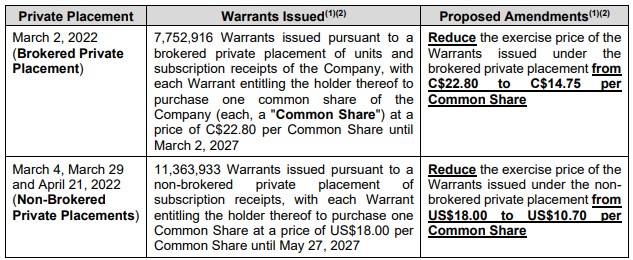
The warrant amendment was completed on March 17, 2023.
49