Please wait
FALSE2025FY0001432364NoneNone0.01333333333333330.00000666666666666667xbrli:sharesiso4217:BRLiso4217:BRLxbrli:sharesxbrli:pureazul:brazilianRealiso4217:EURazul:aircraftazul:flightiso4217:USDazul:multiplierazul:planazul:shareiso4217:USDutr:galutr:Rateazul:series00014323642025-01-012025-12-310001432364dei:BusinessContactMember2025-01-012025-12-310001432364ifrs-full:OrdinarySharesMember2025-01-012025-12-310001432364dei:AdrMember2025-01-012025-12-310001432364ifrs-full:OrdinarySharesMember2025-12-310001432364ifrs-full:PreferenceSharesMember2025-12-310001432364ifrs-full:OrdinarySharesMember2026-04-0200014323642024-01-012024-12-3100014323642025-12-3100014323642024-12-3100014323642023-01-012023-12-310001432364ifrs-full:OrdinarySharesMember2024-01-012024-12-310001432364ifrs-full:OrdinarySharesMember2023-01-012023-12-310001432364ifrs-full:IssuedCapitalMember2022-12-310001432364azul:UnpaidCapitalMember2022-12-310001432364azul:AdvanceForFutureCapitalIncreaseMember2022-12-310001432364ifrs-full:TreasurySharesMember2022-12-310001432364ifrs-full:CapitalReserveMember2022-12-310001432364ifrs-full:AccumulatedOtherComprehensiveIncomeMember2022-12-310001432364ifrs-full:RetainedEarningsMember2022-12-3100014323642022-12-310001432364ifrs-full:RetainedEarningsMember2023-01-012023-12-310001432364ifrs-full:AccumulatedOtherComprehensiveIncomeMember2023-01-012023-12-310001432364ifrs-full:TreasurySharesMember2023-01-012023-12-310001432364ifrs-full:IssuedCapitalMember2023-01-012023-12-310001432364azul:AdvanceForFutureCapitalIncreaseMember2023-01-012023-12-310001432364ifrs-full:CapitalReserveMember2023-01-012023-12-310001432364ifrs-full:IssuedCapitalMember2023-12-310001432364azul:UnpaidCapitalMember2023-12-310001432364azul:AdvanceForFutureCapitalIncreaseMember2023-12-310001432364ifrs-full:TreasurySharesMember2023-12-310001432364ifrs-full:CapitalReserveMember2023-12-310001432364ifrs-full:AccumulatedOtherComprehensiveIncomeMember2023-12-310001432364ifrs-full:RetainedEarningsMember2023-12-3100014323642023-12-310001432364ifrs-full:RetainedEarningsMember2024-01-012024-12-310001432364ifrs-full:AccumulatedOtherComprehensiveIncomeMember2024-01-012024-12-310001432364ifrs-full:TreasurySharesMember2024-01-012024-12-310001432364ifrs-full:CapitalReserveMember2024-01-012024-12-310001432364ifrs-full:IssuedCapitalMember2024-01-012024-12-310001432364azul:AdvanceForFutureCapitalIncreaseMember2024-01-012024-12-310001432364ifrs-full:IssuedCapitalMember2024-12-310001432364azul:UnpaidCapitalMember2024-12-310001432364azul:AdvanceForFutureCapitalIncreaseMember2024-12-310001432364ifrs-full:TreasurySharesMember2024-12-310001432364ifrs-full:CapitalReserveMember2024-12-310001432364ifrs-full:AccumulatedOtherComprehensiveIncomeMember2024-12-310001432364ifrs-full:RetainedEarningsMember2024-12-310001432364ifrs-full:RetainedEarningsMember2025-01-012025-12-310001432364ifrs-full:AccumulatedOtherComprehensiveIncomeMember2025-01-012025-12-310001432364ifrs-full:IssuedCapitalMember2025-01-012025-12-310001432364azul:UnpaidCapitalMember2025-01-012025-12-310001432364ifrs-full:CapitalReserveMember2025-01-012025-12-310001432364ifrs-full:TreasurySharesMember2025-01-012025-12-310001432364ifrs-full:IssuedCapitalMember2025-12-310001432364azul:UnpaidCapitalMember2025-12-310001432364azul:AdvanceForFutureCapitalIncreaseMember2025-12-310001432364ifrs-full:TreasurySharesMember2025-12-310001432364ifrs-full:CapitalReserveMember2025-12-310001432364ifrs-full:AccumulatedOtherComprehensiveIncomeMember2025-12-310001432364ifrs-full:RetainedEarningsMember2025-12-310001432364azul:AzulIPCaymanHoldcoLtdMember2025-01-012025-12-310001432364azul:AzulIPCaymanHoldcoLtdMember2024-01-012024-12-310001432364azul:AzulIPCaymanLtdMember2025-01-012025-12-310001432364azul:AzulIPCaymanLtdMember2024-01-012024-12-310001432364azul:IntelAzulSAMember2025-01-012025-12-310001432364azul:IntelAzulSAMember2024-01-012024-12-310001432364azul:AzulIPCaymanHoldcoLtd2Member2025-01-012025-12-310001432364azul:AzulIPCaymanHoldcoLtd2Member2024-01-012024-12-310001432364azul:AzulLinhasAereasBrasileirasSAMember2025-01-012025-12-310001432364azul:AzulLinhasAereasBrasileirasSAMember2024-01-012024-12-310001432364azul:AzulIPCaymanHoldcoLtd3Member2025-01-012025-12-310001432364azul:AzulIPCaymanHoldcoLtd3Member2024-01-012024-12-310001432364azul:AzulConectaLtdaMember2025-01-012025-12-310001432364azul:AzulConectaLtdaMember2024-01-012024-12-310001432364azul:AtsViagensETurismoLtdaMember2025-01-012025-12-310001432364azul:AtsViagensETurismoLtdaMember2024-01-012024-12-310001432364azul:ATSVPViagensPortugalMember2025-01-012025-12-310001432364azul:ATSVPViagensPortugalMember2024-01-012024-12-310001432364azul:AzulIPCaymanHoldcoLtd4Member2025-01-012025-12-310001432364azul:AzulIPCaymanHoldcoLtd4Member2024-01-012024-12-310001432364azul:CruzeiroParticipacoesSAMember2025-01-012025-12-310001432364azul:CruzeiroParticipacoesSAMember2024-01-012024-12-310001432364azul:AzulInvestmentLLPMember2025-01-012025-12-310001432364azul:AzulInvestmentLLPMember2024-01-012024-12-310001432364azul:AzulSOLLLCMember2025-01-012025-12-310001432364azul:AzulSOLLLCMember2024-01-012024-12-310001432364azul:AzulFinanceLLCMember2025-01-012025-12-310001432364azul:AzulFinanceLLCMember2024-01-012024-12-310001432364azul:AzulFinance2LLCMember2025-01-012025-12-310001432364azul:AzulFinance2LLCMember2024-01-012024-12-310001432364azul:BlueSabiaLLCMember2025-01-012025-12-310001432364azul:BlueSabiaLLCMember2024-01-012024-12-310001432364azul:CanelaInvestmentsLLCMember2025-01-012025-12-310001432364azul:CanelaInvestmentsLLCMember2024-01-012024-12-310001432364azul:CanelaTurboThreeLLCMember2025-01-012025-12-310001432364azul:CanelaTurboThreeLLCMember2024-01-012024-12-310001432364azul:Canela336LLCMember2025-01-012025-12-310001432364azul:Canela336LLCMember2024-01-012024-12-310001432364azul:AzulSairaLLCMember2025-01-012025-12-310001432364azul:AzulSairaLLCMember2024-01-012024-12-310001432364azul:AzulSecuredFinanceLLPMember2025-01-012025-12-310001432364azul:AzulSecuredFinanceLLPMember2024-01-012024-12-310001432364azul:AzulSecuredFinance2LLPAzulSecured2Member2025-01-012025-12-310001432364azul:AzulSecuredFinance2LLPAzulSecured2Member2024-01-012024-12-310001432364azul:IAS21Member2025-01-012025-12-310001432364azul:IAS28Member2025-01-012025-12-310001432364azul:IFRS9MemberMember2025-01-012025-12-310001432364azul:IFRS18Member2025-01-012025-12-310001432364ifrs-full:IFRS19Member2025-01-012025-12-310001432364azul:IAS7AndIFRS7Member2025-01-012025-12-310001432364currency:USD2025-12-310001432364currency:USD2024-12-310001432364currency:USD2025-01-012025-12-310001432364currency:USD2024-01-012024-12-310001432364currency:EUR2025-12-310001432364currency:EUR2024-12-310001432364currency:EUR2025-01-012025-12-310001432364currency:EUR2024-01-012024-12-310001432364azul:AirTransportMember2025-01-012025-12-310001432364azul:AirTransportMember2024-01-012024-12-310001432364azul:AncillaryRevenuesMember2025-01-012025-12-310001432364azul:AncillaryRevenuesMember2024-01-012024-12-310001432364azul:TapBondsMember2016-03-140001432364azul:TapBondsMember2016-03-142016-03-140001432364azul:TapBondsMembersrt:MinimumMember2016-03-142016-09-200001432364azul:TapBondsMembersrt:MaximumMember2016-09-212016-09-210001432364azul:TapBondsMember2025-12-310001432364azul:TapBondsMember2025-01-012025-12-310001432364azul:TapBondsMember2024-12-310001432364azul:InvestmentFundsShortAndLongTermMember2025-12-310001432364azul:InvestmentFundsShortAndLongTermMember2025-01-012025-12-310001432364azul:InvestmentFundsShortAndLongTermMember2024-12-310001432364azul:FinancialAssetsAtFairValueThroughProfitOrLossAndHeldToMaturityInvestmentsMember2025-12-310001432364azul:FinancialAssetsAtFairValueThroughProfitOrLossAndHeldToMaturityInvestmentsMember2024-12-310001432364ifrs-full:TradeReceivablesMemberazul:CreditCardCompaniesMember2025-12-310001432364ifrs-full:TradeReceivablesMemberazul:CreditCardCompaniesMember2024-12-310001432364ifrs-full:TradeReceivablesMemberazul:CargoAndTravelAgenciesMember2025-12-310001432364ifrs-full:TradeReceivablesMemberazul:CargoAndTravelAgenciesMember2024-12-310001432364ifrs-full:TradeReceivablesMemberazul:LoyaltyProgramPartnersMember2025-12-310001432364ifrs-full:TradeReceivablesMemberazul:LoyaltyProgramPartnersMember2024-12-310001432364ifrs-full:TradeReceivablesMemberazul:OtherTradeReceivablesMember2025-12-310001432364ifrs-full:TradeReceivablesMemberazul:OtherTradeReceivablesMember2024-12-310001432364ifrs-full:TradeReceivablesMember2025-12-310001432364ifrs-full:TradeReceivablesMember2024-12-310001432364ifrs-full:TradeReceivablesMemberazul:ContractualGuaranteesReceivableMember2025-12-310001432364ifrs-full:TradeReceivablesMemberazul:ContractualGuaranteesReceivableMember2024-12-310001432364ifrs-full:TradeReceivablesMemberazul:ClearinghouseMember2025-12-310001432364ifrs-full:TradeReceivablesMemberazul:ClearinghouseMember2024-12-310001432364ifrs-full:TradeReceivablesMemberazul:MaintenanceReserveReceivableMember2025-12-310001432364ifrs-full:TradeReceivablesMemberazul:MaintenanceReserveReceivableMember2024-12-310001432364ifrs-full:GrossCarryingAmountMemberifrs-full:TradeReceivablesMember2025-12-310001432364ifrs-full:GrossCarryingAmountMemberifrs-full:TradeReceivablesMember2024-12-310001432364ifrs-full:FinancialAssetsNeitherPastDueNorImpairedMemberifrs-full:NotLaterThanThreeMonthsMember2025-12-310001432364ifrs-full:FinancialAssetsNeitherPastDueNorImpairedMemberifrs-full:NotLaterThanThreeMonthsMember2024-12-310001432364ifrs-full:FinancialAssetsNeitherPastDueNorImpairedMemberifrs-full:LaterThanThreeMonthsAndNotLaterThanSixMonthsMember2025-12-310001432364ifrs-full:FinancialAssetsNeitherPastDueNorImpairedMemberifrs-full:LaterThanThreeMonthsAndNotLaterThanSixMonthsMember2024-12-310001432364ifrs-full:FinancialAssetsNeitherPastDueNorImpairedMemberifrs-full:LaterThanSixMonthsAndNotLaterThanOneYearMember2025-12-310001432364ifrs-full:FinancialAssetsNeitherPastDueNorImpairedMemberifrs-full:LaterThanSixMonthsAndNotLaterThanOneYearMember2024-12-310001432364ifrs-full:FinancialAssetsNeitherPastDueNorImpairedMemberifrs-full:LaterThanOneYearMember2025-12-310001432364ifrs-full:FinancialAssetsNeitherPastDueNorImpairedMemberifrs-full:LaterThanOneYearMember2024-12-310001432364ifrs-full:FinancialAssetsNeitherPastDueNorImpairedMember2025-12-310001432364ifrs-full:FinancialAssetsNeitherPastDueNorImpairedMember2024-12-310001432364ifrs-full:FinancialAssetsPastDueButNotImpairedMemberifrs-full:NotLaterThanThreeMonthsMember2025-12-310001432364ifrs-full:FinancialAssetsPastDueButNotImpairedMemberifrs-full:NotLaterThanThreeMonthsMember2024-12-310001432364ifrs-full:FinancialAssetsPastDueButNotImpairedMemberifrs-full:LaterThanThreeMonthsAndNotLaterThanSixMonthsMember2025-12-310001432364ifrs-full:FinancialAssetsPastDueButNotImpairedMemberifrs-full:LaterThanThreeMonthsAndNotLaterThanSixMonthsMember2024-12-310001432364ifrs-full:FinancialAssetsPastDueButNotImpairedMemberifrs-full:LaterThanSixMonthsAndNotLaterThanOneYearMember2025-12-310001432364ifrs-full:FinancialAssetsPastDueButNotImpairedMemberifrs-full:LaterThanSixMonthsAndNotLaterThanOneYearMember2024-12-310001432364ifrs-full:FinancialAssetsPastDueButNotImpairedMemberifrs-full:LaterThanOneYearMember2025-12-310001432364ifrs-full:FinancialAssetsPastDueButNotImpairedMemberifrs-full:LaterThanOneYearMember2024-12-310001432364ifrs-full:FinancialAssetsPastDueButNotImpairedMember2025-12-310001432364ifrs-full:FinancialAssetsPastDueButNotImpairedMember2024-12-310001432364azul:SettlementOfOutstandingReceivableMemberazul:UpTo90DaysMember2026-03-200001432364ifrs-full:TradeReceivablesMember2023-12-310001432364ifrs-full:TradeReceivablesMember2025-01-012025-12-310001432364ifrs-full:TradeReceivablesMember2024-01-012024-12-310001432364azul:SecurityDepositsAndMaintenanceReservesExcludingImpairmentLossMemberazul:SecurityDepositsMember2025-12-310001432364azul:SecurityDepositsAndMaintenanceReservesExcludingImpairmentLossMemberazul:SecurityDepositsMember2024-12-310001432364azul:SecurityDepositsAndMaintenanceReservesExcludingImpairmentLossMemberazul:MaintenanceReserveDepositsMember2025-12-310001432364azul:SecurityDepositsAndMaintenanceReservesExcludingImpairmentLossMemberazul:MaintenanceReserveDepositsMember2024-12-310001432364azul:SecurityDepositsAndMaintenanceReservesExcludingImpairmentLossMember2025-12-310001432364azul:SecurityDepositsAndMaintenanceReservesExcludingImpairmentLossMember2024-12-310001432364azul:SecurityDepositsMember2023-12-310001432364azul:MaintenanceReserveDepositsMember2023-12-310001432364azul:SecurityDepositsMember2024-01-012024-12-310001432364azul:MaintenanceReserveDepositsMember2024-01-012024-12-310001432364azul:SecurityDepositsMember2024-12-310001432364azul:MaintenanceReserveDepositsMember2024-12-310001432364azul:SecurityDepositsMember2025-01-012025-12-310001432364azul:MaintenanceReserveDepositsMember2025-01-012025-12-310001432364azul:SecurityDepositsMember2025-12-310001432364azul:MaintenanceReserveDepositsMember2025-12-310001432364azul:AdvancesLocalCurrencyMember2025-12-310001432364azul:AdvancesLocalCurrencyMember2024-12-310001432364azul:AdvancesForeignCurrencyMember2025-12-310001432364azul:AdvancesForeignCurrencyMember2024-12-310001432364azul:DefferedLiabilitiesMemberazul:BreakageMember2024-12-310001432364azul:DefferedLiabilitiesMemberazul:BreakageMember2025-01-012025-12-310001432364azul:DefferedLiabilitiesMemberazul:BreakageMember2025-12-310001432364azul:DefferedLiabilitiesMemberazul:ForeignCurrencyExchangeMember2024-12-310001432364azul:DefferedLiabilitiesMemberazul:ForeignCurrencyExchangeMember2025-01-012025-12-310001432364azul:DefferedLiabilitiesMemberazul:ForeignCurrencyExchangeMember2025-12-310001432364azul:DefferedLiabilitiesMemberazul:LeasesMember2024-12-310001432364azul:DefferedLiabilitiesMemberazul:LeasesMember2025-01-012025-12-310001432364azul:DefferedLiabilitiesMemberazul:LeasesMember2025-12-310001432364azul:DefferedLiabilitiesMemberazul:FairValueOfOtherInvestmentsMember2024-12-310001432364azul:DefferedLiabilitiesMemberazul:FairValueOfOtherInvestmentsMember2025-01-012025-12-310001432364azul:DefferedLiabilitiesMemberazul:FairValueOfOtherInvestmentsMember2025-12-310001432364azul:DefferedLiabilitiesMemberazul:TemporaryDifferencesLiabilitiesMember2024-12-310001432364azul:DefferedLiabilitiesMemberazul:TemporaryDifferencesLiabilitiesMember2025-01-012025-12-310001432364azul:DefferedLiabilitiesMemberazul:TemporaryDifferencesLiabilitiesMember2025-12-310001432364azul:DefferedAssetsMemberazul:DerivativeFinancialInstrumentsMember2024-12-310001432364azul:DefferedAssetsMemberazul:DerivativeFinancialInstrumentsMember2025-01-012025-12-310001432364azul:DefferedAssetsMemberazul:DerivativeFinancialInstrumentsMember2025-12-310001432364azul:DefferedAssetsMemberazul:ForeignCurrencyExchangeDefferedAssetsMember2024-12-310001432364azul:DefferedAssetsMemberazul:ForeignCurrencyExchangeDefferedAssetsMember2025-01-012025-12-310001432364azul:DefferedAssetsMemberazul:ForeignCurrencyExchangeDefferedAssetsMember2025-12-310001432364azul:DefferedAssetsMemberazul:LeasesMember2024-12-310001432364azul:DefferedAssetsMemberazul:LeasesMember2025-01-012025-12-310001432364azul:DefferedAssetsMemberazul:LeasesMember2025-12-310001432364azul:DefferedAssetsMemberazul:TemporaryProvisionsMember2024-12-310001432364azul:DefferedAssetsMemberazul:TemporaryProvisionsMember2025-01-012025-12-310001432364azul:DefferedAssetsMemberazul:TemporaryProvisionsMember2025-12-310001432364azul:DefferedAssetsMemberazul:TaxLossCarryforwardsAndNegativeSocialContributionBaseMember2024-12-310001432364azul:DefferedAssetsMemberazul:TaxLossCarryforwardsAndNegativeSocialContributionBaseMember2025-01-012025-12-310001432364azul:DefferedAssetsMemberazul:TaxLossCarryforwardsAndNegativeSocialContributionBaseMember2025-12-310001432364azul:DefferedAssetsMemberazul:FairValueOfOtherInvestmentsMember2024-12-310001432364azul:DefferedAssetsMemberazul:FairValueOfOtherInvestmentsMember2025-01-012025-12-310001432364azul:DefferedAssetsMemberazul:FairValueOfOtherInvestmentsMember2025-12-310001432364azul:DefferedAssetsMemberazul:ReconciliationOfChangesInDeferredTaxLiabilityAssetsMember2024-12-310001432364azul:DefferedAssetsMemberazul:ReconciliationOfChangesInDeferredTaxLiabilityAssetsMember2025-01-012025-12-310001432364azul:DefferedAssetsMemberazul:ReconciliationOfChangesInDeferredTaxLiabilityAssetsMember2025-12-310001432364azul:DefferedAssetsMemberazul:DefferedTaxAssetReducerMember2024-12-310001432364azul:DefferedAssetsMemberazul:DefferedTaxAssetReducerMember2025-01-012025-12-310001432364azul:DefferedAssetsMemberazul:DefferedTaxAssetReducerMember2025-12-310001432364azul:DefferedAssetsMemberazul:DiferrendLiabilitiesAssetsMember2024-12-310001432364azul:DefferedAssetsMemberazul:DiferrendLiabilitiesAssetsMember2025-01-012025-12-310001432364azul:DefferedAssetsMemberazul:DiferrendLiabilitiesAssetsMember2025-12-310001432364azul:IncomeTaxAndDeferredSocialContributionMember2024-12-310001432364azul:IncomeTaxAndDeferredSocialContributionMember2025-01-012025-12-310001432364azul:IncomeTaxAndDeferredSocialContributionMember2025-12-310001432364ifrs-full:GrossCarryingAmountMemberazul:PropertyPlantAndEquipmentExcludingRightOfUseAssetsMemberazul:AircraftPartsAndEquipmentMember2024-12-310001432364ifrs-full:GrossCarryingAmountMemberazul:PropertyPlantAndEquipmentExcludingRightOfUseAssetsMemberazul:AircraftPartsAndEquipmentMember2025-01-012025-12-310001432364ifrs-full:GrossCarryingAmountMemberazul:PropertyPlantAndEquipmentExcludingRightOfUseAssetsMemberazul:AircraftPartsAndEquipmentMember2025-12-310001432364ifrs-full:GrossCarryingAmountMemberazul:PropertyPlantAndEquipmentExcludingRightOfUseAssetsMemberazul:NonaircraftEquipmentMember2024-12-310001432364ifrs-full:GrossCarryingAmountMemberazul:PropertyPlantAndEquipmentExcludingRightOfUseAssetsMemberazul:NonaircraftEquipmentMember2025-01-012025-12-310001432364ifrs-full:GrossCarryingAmountMemberazul:PropertyPlantAndEquipmentExcludingRightOfUseAssetsMemberazul:NonaircraftEquipmentMember2025-12-310001432364ifrs-full:GrossCarryingAmountMemberazul:PropertyPlantAndEquipmentExcludingRightOfUseAssetsMemberazul:AircraftEnginesAndSimulatorsMember2024-12-310001432364ifrs-full:GrossCarryingAmountMemberazul:PropertyPlantAndEquipmentExcludingRightOfUseAssetsMemberazul:AircraftEnginesAndSimulatorsMember2025-01-012025-12-310001432364ifrs-full:GrossCarryingAmountMemberazul:PropertyPlantAndEquipmentExcludingRightOfUseAssetsMemberazul:AircraftEnginesAndSimulatorsMember2025-12-310001432364ifrs-full:GrossCarryingAmountMemberazul:PropertyPlantAndEquipmentExcludingRightOfUseAssetsMemberazul:BuildingsAndLeaseholdImprovementsMember2024-12-310001432364ifrs-full:GrossCarryingAmountMemberazul:PropertyPlantAndEquipmentExcludingRightOfUseAssetsMemberazul:BuildingsAndLeaseholdImprovementsMember2025-01-012025-12-310001432364ifrs-full:GrossCarryingAmountMemberazul:PropertyPlantAndEquipmentExcludingRightOfUseAssetsMemberazul:BuildingsAndLeaseholdImprovementsMember2025-12-310001432364ifrs-full:GrossCarryingAmountMemberazul:PropertyPlantAndEquipmentExcludingRightOfUseAssetsMemberazul:Maintenance1Member2024-12-310001432364ifrs-full:GrossCarryingAmountMemberazul:PropertyPlantAndEquipmentExcludingRightOfUseAssetsMemberazul:Maintenance1Member2025-01-012025-12-310001432364ifrs-full:GrossCarryingAmountMemberazul:PropertyPlantAndEquipmentExcludingRightOfUseAssetsMemberazul:Maintenance1Member2025-12-310001432364ifrs-full:GrossCarryingAmountMemberazul:PropertyPlantAndEquipmentExcludingRightOfUseAssetsMemberifrs-full:OtherPropertyPlantAndEquipmentMember2024-12-310001432364ifrs-full:GrossCarryingAmountMemberazul:PropertyPlantAndEquipmentExcludingRightOfUseAssetsMemberifrs-full:OtherPropertyPlantAndEquipmentMember2025-01-012025-12-310001432364ifrs-full:GrossCarryingAmountMemberazul:PropertyPlantAndEquipmentExcludingRightOfUseAssetsMemberifrs-full:OtherPropertyPlantAndEquipmentMember2025-12-310001432364ifrs-full:GrossCarryingAmountMemberazul:PropertyPlantAndEquipmentExcludingRightOfUseAssetsMemberifrs-full:ConstructionInProgressMember2024-12-310001432364ifrs-full:GrossCarryingAmountMemberazul:PropertyPlantAndEquipmentExcludingRightOfUseAssetsMemberifrs-full:ConstructionInProgressMember2025-01-012025-12-310001432364ifrs-full:GrossCarryingAmountMemberazul:PropertyPlantAndEquipmentExcludingRightOfUseAssetsMemberifrs-full:ConstructionInProgressMember2025-12-310001432364ifrs-full:GrossCarryingAmountMemberazul:PropertyPlantAndEquipmentExcludingRightOfUseAssetsMemberazul:AircraftAcquisitionAdvancePaymentsMember2024-12-310001432364ifrs-full:GrossCarryingAmountMemberazul:PropertyPlantAndEquipmentExcludingRightOfUseAssetsMemberazul:AircraftAcquisitionAdvancePaymentsMember2025-01-012025-12-310001432364ifrs-full:GrossCarryingAmountMemberazul:PropertyPlantAndEquipmentExcludingRightOfUseAssetsMemberazul:AircraftAcquisitionAdvancePaymentsMember2025-12-310001432364ifrs-full:GrossCarryingAmountMemberazul:PropertyPlantAndEquipmentExcludingRightOfUseAssetsMember2024-12-310001432364ifrs-full:GrossCarryingAmountMemberazul:PropertyPlantAndEquipmentExcludingRightOfUseAssetsMember2025-01-012025-12-310001432364ifrs-full:GrossCarryingAmountMemberazul:PropertyPlantAndEquipmentExcludingRightOfUseAssetsMember2025-12-310001432364ifrs-full:AccumulatedDepreciationAndAmortisationMemberazul:PropertyPlantAndEquipmentExcludingRightOfUseAssetsMemberazul:AircraftPartsAndEquipmentMembersrt:WeightedAverageMember2025-01-012025-12-310001432364ifrs-full:AccumulatedDepreciationAndAmortisationMemberazul:PropertyPlantAndEquipmentExcludingRightOfUseAssetsMemberazul:AircraftPartsAndEquipmentMember2024-12-310001432364ifrs-full:AccumulatedDepreciationAndAmortisationMemberazul:PropertyPlantAndEquipmentExcludingRightOfUseAssetsMemberazul:AircraftPartsAndEquipmentMember2025-01-012025-12-310001432364ifrs-full:AccumulatedDepreciationAndAmortisationMemberazul:PropertyPlantAndEquipmentExcludingRightOfUseAssetsMemberazul:AircraftPartsAndEquipmentMember2025-12-310001432364ifrs-full:AccumulatedDepreciationAndAmortisationMemberazul:PropertyPlantAndEquipmentExcludingRightOfUseAssetsMemberazul:NonaircraftEquipmentMembersrt:WeightedAverageMember2025-01-012025-12-310001432364ifrs-full:AccumulatedDepreciationAndAmortisationMemberazul:PropertyPlantAndEquipmentExcludingRightOfUseAssetsMemberazul:NonaircraftEquipmentMember2024-12-310001432364ifrs-full:AccumulatedDepreciationAndAmortisationMemberazul:PropertyPlantAndEquipmentExcludingRightOfUseAssetsMemberazul:NonaircraftEquipmentMember2025-01-012025-12-310001432364ifrs-full:AccumulatedDepreciationAndAmortisationMemberazul:PropertyPlantAndEquipmentExcludingRightOfUseAssetsMemberazul:NonaircraftEquipmentMember2025-12-310001432364ifrs-full:AccumulatedDepreciationAndAmortisationMemberazul:PropertyPlantAndEquipmentExcludingRightOfUseAssetsMemberazul:AircraftEnginesAndSimulatorsMembersrt:WeightedAverageMember2025-01-012025-12-310001432364ifrs-full:AccumulatedDepreciationAndAmortisationMemberazul:PropertyPlantAndEquipmentExcludingRightOfUseAssetsMemberazul:AircraftEnginesAndSimulatorsMember2024-12-310001432364ifrs-full:AccumulatedDepreciationAndAmortisationMemberazul:PropertyPlantAndEquipmentExcludingRightOfUseAssetsMemberazul:AircraftEnginesAndSimulatorsMember2025-01-012025-12-310001432364ifrs-full:AccumulatedDepreciationAndAmortisationMemberazul:PropertyPlantAndEquipmentExcludingRightOfUseAssetsMemberazul:AircraftEnginesAndSimulatorsMember2025-12-310001432364ifrs-full:AccumulatedDepreciationAndAmortisationMemberazul:PropertyPlantAndEquipmentExcludingRightOfUseAssetsMemberazul:BuildingsAndLeaseholdImprovementsMembersrt:WeightedAverageMember2025-01-012025-12-310001432364ifrs-full:AccumulatedDepreciationAndAmortisationMemberazul:PropertyPlantAndEquipmentExcludingRightOfUseAssetsMemberazul:BuildingsAndLeaseholdImprovementsMember2024-12-310001432364ifrs-full:AccumulatedDepreciationAndAmortisationMemberazul:PropertyPlantAndEquipmentExcludingRightOfUseAssetsMemberazul:BuildingsAndLeaseholdImprovementsMember2025-01-012025-12-310001432364ifrs-full:AccumulatedDepreciationAndAmortisationMemberazul:PropertyPlantAndEquipmentExcludingRightOfUseAssetsMemberazul:BuildingsAndLeaseholdImprovementsMember2025-12-310001432364ifrs-full:AccumulatedDepreciationAndAmortisationMemberazul:PropertyPlantAndEquipmentExcludingRightOfUseAssetsMemberazul:Maintenance1Membersrt:WeightedAverageMember2025-01-012025-12-310001432364ifrs-full:AccumulatedDepreciationAndAmortisationMemberazul:PropertyPlantAndEquipmentExcludingRightOfUseAssetsMemberazul:Maintenance1Member2024-12-310001432364ifrs-full:AccumulatedDepreciationAndAmortisationMemberazul:PropertyPlantAndEquipmentExcludingRightOfUseAssetsMemberazul:Maintenance1Member2025-01-012025-12-310001432364ifrs-full:AccumulatedDepreciationAndAmortisationMemberazul:PropertyPlantAndEquipmentExcludingRightOfUseAssetsMemberazul:Maintenance1Member2025-12-310001432364ifrs-full:AccumulatedDepreciationAndAmortisationMemberazul:PropertyPlantAndEquipmentExcludingRightOfUseAssetsMemberifrs-full:OtherPropertyPlantAndEquipmentMembersrt:WeightedAverageMember2025-01-012025-12-310001432364ifrs-full:AccumulatedDepreciationAndAmortisationMemberazul:PropertyPlantAndEquipmentExcludingRightOfUseAssetsMemberifrs-full:OtherPropertyPlantAndEquipmentMember2024-12-310001432364ifrs-full:AccumulatedDepreciationAndAmortisationMemberazul:PropertyPlantAndEquipmentExcludingRightOfUseAssetsMemberifrs-full:OtherPropertyPlantAndEquipmentMember2025-01-012025-12-310001432364ifrs-full:AccumulatedDepreciationAndAmortisationMemberazul:PropertyPlantAndEquipmentExcludingRightOfUseAssetsMemberifrs-full:OtherPropertyPlantAndEquipmentMember2025-12-310001432364ifrs-full:AccumulatedDepreciationAndAmortisationMemberazul:PropertyPlantAndEquipmentExcludingRightOfUseAssetsMember2024-12-310001432364ifrs-full:AccumulatedDepreciationAndAmortisationMemberazul:PropertyPlantAndEquipmentExcludingRightOfUseAssetsMember2025-01-012025-12-310001432364ifrs-full:AccumulatedDepreciationAndAmortisationMemberazul:PropertyPlantAndEquipmentExcludingRightOfUseAssetsMember2025-12-310001432364azul:PropertyPlantAndEquipmentExcludingRightOfUseAssetsMember2024-12-310001432364azul:PropertyPlantAndEquipmentExcludingRightOfUseAssetsMember2025-01-012025-12-310001432364azul:PropertyPlantAndEquipmentExcludingRightOfUseAssetsMember2025-12-310001432364ifrs-full:GrossCarryingAmountMemberazul:PropertyPlantAndEquipmentExcludingRightOfUseAssetsMemberazul:MaintenanceMaterialsAndPartsMember2023-12-310001432364ifrs-full:GrossCarryingAmountMemberazul:PropertyPlantAndEquipmentExcludingRightOfUseAssetsMemberazul:MaintenanceMaterialsAndPartsMember2024-01-012024-12-310001432364ifrs-full:GrossCarryingAmountMemberazul:PropertyPlantAndEquipmentExcludingRightOfUseAssetsMemberazul:MaintenanceMaterialsAndPartsMember2024-12-310001432364ifrs-full:GrossCarryingAmountMemberazul:PropertyPlantAndEquipmentExcludingRightOfUseAssetsMemberazul:Equipment1Member2023-12-310001432364ifrs-full:GrossCarryingAmountMemberazul:PropertyPlantAndEquipmentExcludingRightOfUseAssetsMemberazul:Equipment1Member2024-01-012024-12-310001432364ifrs-full:GrossCarryingAmountMemberazul:PropertyPlantAndEquipmentExcludingRightOfUseAssetsMemberazul:Equipment1Member2024-12-310001432364ifrs-full:GrossCarryingAmountMemberazul:PropertyPlantAndEquipmentExcludingRightOfUseAssetsMemberazul:AircraftEnginesAndSimulatorsMember2023-12-310001432364ifrs-full:GrossCarryingAmountMemberazul:PropertyPlantAndEquipmentExcludingRightOfUseAssetsMemberazul:AircraftEnginesAndSimulatorsMember2024-01-012024-12-310001432364ifrs-full:GrossCarryingAmountMemberazul:PropertyPlantAndEquipmentExcludingRightOfUseAssetsMemberazul:BuildingsAndLeaseholdImprovementsMember2023-12-310001432364ifrs-full:GrossCarryingAmountMemberazul:PropertyPlantAndEquipmentExcludingRightOfUseAssetsMemberazul:BuildingsAndLeaseholdImprovementsMember2024-01-012024-12-310001432364ifrs-full:GrossCarryingAmountMemberazul:PropertyPlantAndEquipmentExcludingRightOfUseAssetsMemberazul:Maintenance1Member2023-12-310001432364ifrs-full:GrossCarryingAmountMemberazul:PropertyPlantAndEquipmentExcludingRightOfUseAssetsMemberazul:Maintenance1Member2024-01-012024-12-310001432364ifrs-full:GrossCarryingAmountMemberazul:PropertyPlantAndEquipmentExcludingRightOfUseAssetsMemberifrs-full:OtherPropertyPlantAndEquipmentMember2023-12-310001432364ifrs-full:GrossCarryingAmountMemberazul:PropertyPlantAndEquipmentExcludingRightOfUseAssetsMemberifrs-full:OtherPropertyPlantAndEquipmentMember2024-01-012024-12-310001432364ifrs-full:GrossCarryingAmountMemberazul:PropertyPlantAndEquipmentExcludingRightOfUseAssetsMemberifrs-full:ConstructionInProgressMember2023-12-310001432364ifrs-full:GrossCarryingAmountMemberazul:PropertyPlantAndEquipmentExcludingRightOfUseAssetsMemberifrs-full:ConstructionInProgressMember2024-01-012024-12-310001432364ifrs-full:GrossCarryingAmountMemberazul:PropertyPlantAndEquipmentExcludingRightOfUseAssetsMemberazul:AircraftAcquisitionAdvancePaymentsMember2023-12-310001432364ifrs-full:GrossCarryingAmountMemberazul:PropertyPlantAndEquipmentExcludingRightOfUseAssetsMemberazul:AircraftAcquisitionAdvancePaymentsMember2024-01-012024-12-310001432364ifrs-full:GrossCarryingAmountMemberazul:PropertyPlantAndEquipmentExcludingRightOfUseAssetsMember2023-12-310001432364ifrs-full:GrossCarryingAmountMemberazul:PropertyPlantAndEquipmentExcludingRightOfUseAssetsMember2024-01-012024-12-310001432364ifrs-full:AccumulatedDepreciationAndAmortisationMemberazul:PropertyPlantAndEquipmentExcludingRightOfUseAssetsMemberazul:MaintenanceMaterialsAndPartsMembersrt:WeightedAverageMember2024-01-012024-12-310001432364ifrs-full:AccumulatedDepreciationAndAmortisationMemberazul:PropertyPlantAndEquipmentExcludingRightOfUseAssetsMemberazul:MaintenanceMaterialsAndPartsMember2023-12-310001432364ifrs-full:AccumulatedDepreciationAndAmortisationMemberazul:PropertyPlantAndEquipmentExcludingRightOfUseAssetsMemberazul:MaintenanceMaterialsAndPartsMember2024-01-012024-12-310001432364ifrs-full:AccumulatedDepreciationAndAmortisationMemberazul:PropertyPlantAndEquipmentExcludingRightOfUseAssetsMemberazul:MaintenanceMaterialsAndPartsMember2024-12-310001432364ifrs-full:AccumulatedDepreciationAndAmortisationMemberazul:PropertyPlantAndEquipmentExcludingRightOfUseAssetsMemberazul:Equipment1Membersrt:WeightedAverageMember2024-01-012024-12-310001432364ifrs-full:AccumulatedDepreciationAndAmortisationMemberazul:PropertyPlantAndEquipmentExcludingRightOfUseAssetsMemberazul:Equipment1Member2023-12-310001432364ifrs-full:AccumulatedDepreciationAndAmortisationMemberazul:PropertyPlantAndEquipmentExcludingRightOfUseAssetsMemberazul:Equipment1Member2024-01-012024-12-310001432364ifrs-full:AccumulatedDepreciationAndAmortisationMemberazul:PropertyPlantAndEquipmentExcludingRightOfUseAssetsMemberazul:Equipment1Member2024-12-310001432364ifrs-full:AccumulatedDepreciationAndAmortisationMemberazul:PropertyPlantAndEquipmentExcludingRightOfUseAssetsMemberazul:AircraftEnginesAndSimulatorsMembersrt:WeightedAverageMember2024-01-012024-12-310001432364ifrs-full:AccumulatedDepreciationAndAmortisationMemberazul:PropertyPlantAndEquipmentExcludingRightOfUseAssetsMemberazul:AircraftEnginesAndSimulatorsMember2023-12-310001432364ifrs-full:AccumulatedDepreciationAndAmortisationMemberazul:PropertyPlantAndEquipmentExcludingRightOfUseAssetsMemberazul:AircraftEnginesAndSimulatorsMember2024-01-012024-12-310001432364ifrs-full:AccumulatedDepreciationAndAmortisationMemberazul:PropertyPlantAndEquipmentExcludingRightOfUseAssetsMemberazul:BuildingsAndLeaseholdImprovementsMembersrt:WeightedAverageMember2024-01-012024-12-310001432364ifrs-full:AccumulatedDepreciationAndAmortisationMemberazul:PropertyPlantAndEquipmentExcludingRightOfUseAssetsMemberazul:BuildingsAndLeaseholdImprovementsMember2023-12-310001432364ifrs-full:AccumulatedDepreciationAndAmortisationMemberazul:PropertyPlantAndEquipmentExcludingRightOfUseAssetsMemberazul:BuildingsAndLeaseholdImprovementsMember2024-01-012024-12-310001432364ifrs-full:AccumulatedDepreciationAndAmortisationMemberazul:PropertyPlantAndEquipmentExcludingRightOfUseAssetsMemberazul:Maintenance1Membersrt:WeightedAverageMember2024-01-012024-12-310001432364ifrs-full:AccumulatedDepreciationAndAmortisationMemberazul:PropertyPlantAndEquipmentExcludingRightOfUseAssetsMemberazul:Maintenance1Member2023-12-310001432364ifrs-full:AccumulatedDepreciationAndAmortisationMemberazul:PropertyPlantAndEquipmentExcludingRightOfUseAssetsMemberazul:Maintenance1Member2024-01-012024-12-310001432364ifrs-full:AccumulatedDepreciationAndAmortisationMemberazul:PropertyPlantAndEquipmentExcludingRightOfUseAssetsMemberifrs-full:OtherPropertyPlantAndEquipmentMembersrt:WeightedAverageMember2024-01-012024-12-310001432364ifrs-full:AccumulatedDepreciationAndAmortisationMemberazul:PropertyPlantAndEquipmentExcludingRightOfUseAssetsMemberifrs-full:OtherPropertyPlantAndEquipmentMember2023-12-310001432364ifrs-full:AccumulatedDepreciationAndAmortisationMemberazul:PropertyPlantAndEquipmentExcludingRightOfUseAssetsMemberifrs-full:OtherPropertyPlantAndEquipmentMember2024-01-012024-12-310001432364ifrs-full:AccumulatedDepreciationAndAmortisationMemberazul:PropertyPlantAndEquipmentExcludingRightOfUseAssetsMember2023-12-310001432364ifrs-full:AccumulatedDepreciationAndAmortisationMemberazul:PropertyPlantAndEquipmentExcludingRightOfUseAssetsMember2024-01-012024-12-310001432364azul:GrossCarryingAmountNetOfAccumulatedDepreciationAndAmortisationMemberazul:PropertyPlantAndEquipmentExcludingRightOfUseAssetsMember2023-12-310001432364azul:GrossCarryingAmountNetOfAccumulatedDepreciationAndAmortisationMemberazul:PropertyPlantAndEquipmentExcludingRightOfUseAssetsMember2024-01-012024-12-310001432364azul:GrossCarryingAmountNetOfAccumulatedDepreciationAndAmortisationMemberazul:PropertyPlantAndEquipmentExcludingRightOfUseAssetsMember2024-12-310001432364ifrs-full:AccumulatedImpairmentMemberazul:PropertyPlantAndEquipmentExcludingRightOfUseAssetsMember2023-12-310001432364ifrs-full:AccumulatedImpairmentMemberazul:PropertyPlantAndEquipmentExcludingRightOfUseAssetsMember2024-01-012024-12-310001432364ifrs-full:AccumulatedImpairmentMemberazul:PropertyPlantAndEquipmentExcludingRightOfUseAssetsMember2024-12-310001432364azul:PropertyPlantAndEquipmentExcludingRightOfUseAssetsMember2023-12-310001432364azul:PropertyPlantAndEquipmentExcludingRightOfUseAssetsMember2024-01-012024-12-310001432364sic:Z37242025-01-012025-12-310001432364ifrs-full:GrossCarryingAmountMemberifrs-full:RightofuseAssetsMemberazul:AircraftEnginesAndSimulatorsMember2024-12-310001432364ifrs-full:GrossCarryingAmountMemberifrs-full:RightofuseAssetsMemberazul:AircraftEnginesAndSimulatorsMember2025-01-012025-12-310001432364ifrs-full:GrossCarryingAmountMemberifrs-full:RightofuseAssetsMemberazul:AircraftEnginesAndSimulatorsMember2025-12-310001432364ifrs-full:GrossCarryingAmountMemberifrs-full:RightofuseAssetsMemberazul:Maintenance1Member2024-12-310001432364ifrs-full:GrossCarryingAmountMemberifrs-full:RightofuseAssetsMemberazul:Maintenance1Member2025-01-012025-12-310001432364ifrs-full:GrossCarryingAmountMemberifrs-full:RightofuseAssetsMemberazul:Maintenance1Member2025-12-310001432364ifrs-full:GrossCarryingAmountMemberifrs-full:RightofuseAssetsMemberazul:RestorationMember2024-12-310001432364ifrs-full:GrossCarryingAmountMemberifrs-full:RightofuseAssetsMemberazul:RestorationMember2025-01-012025-12-310001432364ifrs-full:GrossCarryingAmountMemberifrs-full:RightofuseAssetsMemberazul:RestorationMember2025-12-310001432364ifrs-full:GrossCarryingAmountMemberifrs-full:RightofuseAssetsMemberifrs-full:OtherPropertyPlantAndEquipmentMember2024-12-310001432364ifrs-full:GrossCarryingAmountMemberifrs-full:RightofuseAssetsMemberifrs-full:OtherPropertyPlantAndEquipmentMember2025-01-012025-12-310001432364ifrs-full:GrossCarryingAmountMemberifrs-full:RightofuseAssetsMemberifrs-full:OtherPropertyPlantAndEquipmentMember2025-12-310001432364ifrs-full:GrossCarryingAmountMemberifrs-full:RightofuseAssetsMember2024-12-310001432364ifrs-full:GrossCarryingAmountMemberifrs-full:RightofuseAssetsMember2025-01-012025-12-310001432364ifrs-full:GrossCarryingAmountMemberifrs-full:RightofuseAssetsMember2025-12-310001432364ifrs-full:AccumulatedDepreciationAndAmortisationMemberifrs-full:RightofuseAssetsMemberazul:AircraftEnginesAndSimulatorsMembersrt:WeightedAverageMember2025-01-012025-12-310001432364ifrs-full:AccumulatedDepreciationAndAmortisationMemberifrs-full:RightofuseAssetsMemberazul:AircraftEnginesAndSimulatorsMember2024-12-310001432364ifrs-full:AccumulatedDepreciationAndAmortisationMemberifrs-full:RightofuseAssetsMemberazul:AircraftEnginesAndSimulatorsMember2025-01-012025-12-310001432364ifrs-full:AccumulatedDepreciationAndAmortisationMemberifrs-full:RightofuseAssetsMemberazul:AircraftEnginesAndSimulatorsMember2025-12-310001432364ifrs-full:AccumulatedDepreciationAndAmortisationMemberifrs-full:RightofuseAssetsMemberazul:Maintenance1Membersrt:WeightedAverageMember2025-01-012025-12-310001432364ifrs-full:AccumulatedDepreciationAndAmortisationMemberifrs-full:RightofuseAssetsMemberazul:Maintenance1Member2024-12-310001432364ifrs-full:AccumulatedDepreciationAndAmortisationMemberifrs-full:RightofuseAssetsMemberazul:Maintenance1Member2025-01-012025-12-310001432364ifrs-full:AccumulatedDepreciationAndAmortisationMemberifrs-full:RightofuseAssetsMemberazul:Maintenance1Member2025-12-310001432364ifrs-full:AccumulatedDepreciationAndAmortisationMemberifrs-full:RightofuseAssetsMemberazul:RestorationMembersrt:WeightedAverageMember2025-01-012025-12-310001432364ifrs-full:AccumulatedDepreciationAndAmortisationMemberifrs-full:RightofuseAssetsMemberazul:RestorationMember2024-12-310001432364ifrs-full:AccumulatedDepreciationAndAmortisationMemberifrs-full:RightofuseAssetsMemberazul:RestorationMember2025-01-012025-12-310001432364ifrs-full:AccumulatedDepreciationAndAmortisationMemberifrs-full:RightofuseAssetsMemberazul:RestorationMember2025-12-310001432364ifrs-full:AccumulatedDepreciationAndAmortisationMemberifrs-full:RightofuseAssetsMemberifrs-full:OtherPropertyPlantAndEquipmentMembersrt:WeightedAverageMember2025-01-012025-12-310001432364ifrs-full:AccumulatedDepreciationAndAmortisationMemberifrs-full:RightofuseAssetsMemberifrs-full:OtherPropertyPlantAndEquipmentMember2024-12-310001432364ifrs-full:AccumulatedDepreciationAndAmortisationMemberifrs-full:RightofuseAssetsMemberifrs-full:OtherPropertyPlantAndEquipmentMember2025-01-012025-12-310001432364ifrs-full:AccumulatedDepreciationAndAmortisationMemberifrs-full:RightofuseAssetsMemberifrs-full:OtherPropertyPlantAndEquipmentMember2025-12-310001432364ifrs-full:AccumulatedDepreciationAndAmortisationMemberifrs-full:RightofuseAssetsMember2024-12-310001432364ifrs-full:AccumulatedDepreciationAndAmortisationMemberifrs-full:RightofuseAssetsMember2025-01-012025-12-310001432364ifrs-full:AccumulatedDepreciationAndAmortisationMemberifrs-full:RightofuseAssetsMember2025-12-310001432364azul:GrossCarryingAmountNetOfAccumulatedDepreciationAndAmortisationMemberifrs-full:RightofuseAssetsMember2024-12-310001432364azul:GrossCarryingAmountNetOfAccumulatedDepreciationAndAmortisationMemberifrs-full:RightofuseAssetsMember2025-01-012025-12-310001432364azul:GrossCarryingAmountNetOfAccumulatedDepreciationAndAmortisationMemberifrs-full:RightofuseAssetsMember2025-12-310001432364ifrs-full:GrossCarryingAmountMemberifrs-full:RightofuseAssetsMemberazul:AircraftEnginesAndSimulatorsMember2023-12-310001432364ifrs-full:GrossCarryingAmountMemberifrs-full:RightofuseAssetsMemberazul:AircraftEnginesAndSimulatorsMember2024-01-012024-12-310001432364ifrs-full:GrossCarryingAmountMemberifrs-full:RightofuseAssetsMemberazul:Maintenance1Member2023-12-310001432364ifrs-full:GrossCarryingAmountMemberifrs-full:RightofuseAssetsMemberazul:Maintenance1Member2024-01-012024-12-310001432364ifrs-full:GrossCarryingAmountMemberifrs-full:RightofuseAssetsMemberazul:RestorationMember2023-12-310001432364ifrs-full:GrossCarryingAmountMemberifrs-full:RightofuseAssetsMemberazul:RestorationMember2024-01-012024-12-310001432364ifrs-full:GrossCarryingAmountMemberifrs-full:RightofuseAssetsMemberifrs-full:OtherPropertyPlantAndEquipmentMember2023-12-310001432364ifrs-full:GrossCarryingAmountMemberifrs-full:RightofuseAssetsMemberifrs-full:OtherPropertyPlantAndEquipmentMember2024-01-012024-12-310001432364ifrs-full:GrossCarryingAmountMemberifrs-full:RightofuseAssetsMember2023-12-310001432364ifrs-full:GrossCarryingAmountMemberifrs-full:RightofuseAssetsMember2024-01-012024-12-310001432364ifrs-full:AccumulatedDepreciationAndAmortisationMemberifrs-full:RightofuseAssetsMemberazul:AircraftEnginesAndSimulatorsMembersrt:WeightedAverageMember2024-01-012024-12-310001432364ifrs-full:AccumulatedDepreciationAndAmortisationMemberifrs-full:RightofuseAssetsMemberazul:AircraftEnginesAndSimulatorsMember2023-12-310001432364ifrs-full:AccumulatedDepreciationAndAmortisationMemberifrs-full:RightofuseAssetsMemberazul:AircraftEnginesAndSimulatorsMember2024-01-012024-12-310001432364ifrs-full:AccumulatedDepreciationAndAmortisationMemberifrs-full:RightofuseAssetsMemberazul:Maintenance1Membersrt:WeightedAverageMember2024-01-012024-12-310001432364ifrs-full:AccumulatedDepreciationAndAmortisationMemberifrs-full:RightofuseAssetsMemberazul:Maintenance1Member2023-12-310001432364ifrs-full:AccumulatedDepreciationAndAmortisationMemberifrs-full:RightofuseAssetsMemberazul:Maintenance1Member2024-01-012024-12-310001432364ifrs-full:AccumulatedDepreciationAndAmortisationMemberifrs-full:RightofuseAssetsMemberazul:RestorationMembersrt:WeightedAverageMember2024-01-012024-12-310001432364ifrs-full:AccumulatedDepreciationAndAmortisationMemberifrs-full:RightofuseAssetsMemberazul:RestorationMember2023-12-310001432364ifrs-full:AccumulatedDepreciationAndAmortisationMemberifrs-full:RightofuseAssetsMemberazul:RestorationMember2024-01-012024-12-310001432364ifrs-full:AccumulatedDepreciationAndAmortisationMemberifrs-full:RightofuseAssetsMemberifrs-full:OtherPropertyPlantAndEquipmentMembersrt:WeightedAverageMember2024-01-012024-12-310001432364ifrs-full:AccumulatedDepreciationAndAmortisationMemberifrs-full:RightofuseAssetsMemberifrs-full:OtherPropertyPlantAndEquipmentMember2023-12-310001432364ifrs-full:AccumulatedDepreciationAndAmortisationMemberifrs-full:RightofuseAssetsMemberifrs-full:OtherPropertyPlantAndEquipmentMember2024-01-012024-12-310001432364ifrs-full:AccumulatedDepreciationAndAmortisationMemberifrs-full:RightofuseAssetsMember2023-12-310001432364ifrs-full:AccumulatedDepreciationAndAmortisationMemberifrs-full:RightofuseAssetsMember2024-01-012024-12-310001432364azul:GrossCarryingAmountNetOfAccumulatedDepreciationAndAmortisationMemberifrs-full:RightofuseAssetsMember2023-12-310001432364azul:GrossCarryingAmountNetOfAccumulatedDepreciationAndAmortisationMemberifrs-full:RightofuseAssetsMember2024-01-012024-12-310001432364ifrs-full:GrossCarryingAmountMemberifrs-full:GoodwillMember2024-12-310001432364ifrs-full:GrossCarryingAmountMemberifrs-full:GoodwillMember2025-01-012025-12-310001432364ifrs-full:GrossCarryingAmountMemberifrs-full:GoodwillMember2025-12-310001432364ifrs-full:GrossCarryingAmountMemberazul:AirportOperatingLicensesMember2024-12-310001432364ifrs-full:GrossCarryingAmountMemberazul:AirportOperatingLicensesMember2025-01-012025-12-310001432364ifrs-full:GrossCarryingAmountMemberazul:AirportOperatingLicensesMember2025-12-310001432364ifrs-full:GrossCarryingAmountMemberifrs-full:ComputerSoftwareMember2024-12-310001432364ifrs-full:GrossCarryingAmountMemberifrs-full:ComputerSoftwareMember2025-01-012025-12-310001432364ifrs-full:GrossCarryingAmountMemberifrs-full:ComputerSoftwareMember2025-12-310001432364ifrs-full:GrossCarryingAmountMember2024-12-310001432364ifrs-full:GrossCarryingAmountMember2025-01-012025-12-310001432364ifrs-full:GrossCarryingAmountMember2025-12-310001432364ifrs-full:AccumulatedDepreciationAmortisationAndImpairmentMemberifrs-full:ComputerSoftwareMembersrt:WeightedAverageMember2025-01-012025-12-310001432364ifrs-full:AccumulatedDepreciationAmortisationAndImpairmentMemberifrs-full:ComputerSoftwareMember2024-12-310001432364ifrs-full:AccumulatedDepreciationAmortisationAndImpairmentMemberifrs-full:ComputerSoftwareMember2025-01-012025-12-310001432364ifrs-full:AccumulatedDepreciationAmortisationAndImpairmentMemberifrs-full:ComputerSoftwareMember2025-12-310001432364ifrs-full:AccumulatedDepreciationAmortisationAndImpairmentMember2024-12-310001432364ifrs-full:AccumulatedDepreciationAmortisationAndImpairmentMember2025-01-012025-12-310001432364ifrs-full:AccumulatedDepreciationAmortisationAndImpairmentMember2025-12-310001432364ifrs-full:GrossCarryingAmountMemberifrs-full:GoodwillMember2023-12-310001432364ifrs-full:GrossCarryingAmountMemberifrs-full:GoodwillMember2024-01-012024-12-310001432364ifrs-full:GrossCarryingAmountMemberazul:AirportOperatingLicensesMember2023-12-310001432364ifrs-full:GrossCarryingAmountMemberazul:AirportOperatingLicensesMember2024-01-012024-12-310001432364ifrs-full:GrossCarryingAmountMemberifrs-full:ComputerSoftwareMember2023-12-310001432364ifrs-full:GrossCarryingAmountMemberifrs-full:ComputerSoftwareMember2024-01-012024-12-310001432364ifrs-full:GrossCarryingAmountMember2023-12-310001432364ifrs-full:GrossCarryingAmountMember2024-01-012024-12-310001432364ifrs-full:AccumulatedDepreciationAmortisationAndImpairmentMemberifrs-full:ComputerSoftwareMembersrt:WeightedAverageMember2024-01-012024-12-310001432364ifrs-full:AccumulatedDepreciationAmortisationAndImpairmentMemberifrs-full:ComputerSoftwareMember2023-12-310001432364ifrs-full:AccumulatedDepreciationAmortisationAndImpairmentMemberifrs-full:ComputerSoftwareMember2024-01-012024-12-310001432364ifrs-full:AccumulatedDepreciationAmortisationAndImpairmentMember2023-12-310001432364ifrs-full:AccumulatedDepreciationAmortisationAndImpairmentMember2024-01-012024-12-310001432364ifrs-full:GoodwillMemberifrs-full:GrossCarryingAmountMember2025-12-310001432364ifrs-full:GoodwillMemberifrs-full:GrossCarryingAmountMember2024-12-310001432364ifrs-full:GoodwillMemberifrs-full:GrossCarryingAmountMemberazul:SensitivityTest10VariationMember2025-12-310001432364ifrs-full:GoodwillMemberifrs-full:GrossCarryingAmountMemberazul:SensitivityTest10VariationMember2024-12-310001432364ifrs-full:GoodwillMemberifrs-full:GrossCarryingAmountMemberazul:SensitivityTest25VariationMember2025-12-310001432364ifrs-full:GoodwillMemberifrs-full:GrossCarryingAmountMemberazul:SensitivityTest25VariationMember2024-12-310001432364currency:USDazul:SeniorNotes2026Memberazul:June2026Member2025-12-310001432364currency:USDazul:SeniorNotes2026Memberazul:June2026Member2024-12-310001432364currency:USDazul:SeniorNotes2026Memberazul:June2026Member2025-01-012025-12-310001432364currency:USDazul:SeniorNotes2028Memberazul:August2028Member2025-12-310001432364currency:USDazul:SeniorNotes2028Memberazul:August2028Member2024-12-310001432364currency:USDazul:SeniorNotes2028Memberazul:August2028Member2025-01-012025-12-310001432364currency:USDazul:SeniorNotes2029Memberazul:May2029Member2025-12-310001432364currency:USDazul:SeniorNotes2029Memberazul:May2029Member2024-12-310001432364currency:USDazul:SeniorNotes2029Memberazul:May2029Member2025-01-012025-12-310001432364currency:USDazul:SeniorNotes2029Memberazul:May2030Member2025-12-310001432364currency:USDazul:SeniorNotes2029Memberazul:May2030Member2024-12-310001432364currency:USDazul:SeniorNotes2029Memberazul:May2030Member2025-01-012025-12-310001432364currency:USDazul:SeniorNotes1LDue2028Memberazul:August2028Member2025-12-310001432364currency:USDazul:SeniorNotes1LDue2028Memberazul:August2028Member2024-12-310001432364currency:USDazul:SeniorNotes1LDue2028Memberazul:August2028Member2025-01-012025-12-310001432364currency:USDazul:SeniorNotes2LDue2029Memberazul:May2029Member2025-12-310001432364currency:USDazul:SeniorNotes2LDue2029Memberazul:May2029Member2024-12-310001432364currency:USDazul:SeniorNotes2LDue2029Memberazul:May2029Member2025-01-012025-12-310001432364currency:USDazul:SeniorNotes2LDue2030Memberazul:May2030Member2025-12-310001432364currency:USDazul:SeniorNotes2LDue2030Memberazul:May2030Member2024-12-310001432364currency:USDazul:SeniorNotes2LDue2030Memberazul:May2030Member2025-01-012025-12-310001432364currency:USDazul:BridgeNotesMember2024-12-310001432364currency:USDazul:BridgeNotesMember2025-01-012025-12-310001432364currency:USDazul:BridgeNotesMember2025-12-310001432364currency:USDazul:NewBridgeNotesMember2024-12-310001432364currency:USDazul:NewBridgeNotesMember2025-01-012025-12-310001432364currency:USDazul:NewBridgeNotesMember2025-12-310001432364currency:USDazul:InterestRateReferringToTheDIPMemberazul:February2026Member2025-12-310001432364currency:USDazul:InterestRateReferringToTheDIPMemberazul:February2026Member2024-12-310001432364currency:USDazul:InterestRateReferringToTheDIPMemberazul:February2026Member2025-01-012025-12-310001432364currency:USDazul:SuperpriorityNotesMember2024-12-310001432364currency:USDazul:SuperpriorityNotesMember2025-01-012025-12-310001432364currency:USDazul:SuperpriorityNotesMember2025-12-310001432364currency:USDazul:AircraftEnginesAndOthersMemberazul:May2026Member2025-12-310001432364currency:USDazul:AircraftEnginesAndOthersMemberazul:May2026Member2024-12-310001432364currency:USDazul:AircraftEnginesAndOthersMemberazul:May2026Member2025-01-012025-12-310001432364currency:USDazul:AircraftEnginesAndOthersMemberazul:December2027Member2025-12-310001432364currency:USDazul:AircraftEnginesAndOthersMemberazul:December2027Member2024-12-310001432364currency:USDazul:AircraftEnginesAndOthersMemberazul:December2027Member2025-01-012025-12-310001432364currency:USDazul:AircraftEnginesAndOthersMember2025-12-310001432364currency:USDazul:AircraftEnginesAndOthersMember2024-12-310001432364currency:USDazul:AircraftEnginesAndOthersMember2025-01-012025-12-310001432364currency:USDazul:AircraftEnginesAndOthersMemberazul:June2025Member2025-12-310001432364currency:USDazul:AircraftEnginesAndOthersMemberazul:June2025Member2024-12-310001432364currency:USDazul:AircraftEnginesAndOthersMemberazul:June2025Member2025-01-012025-12-310001432364currency:USDazul:ExecutedLettersOfCreditMember2025-12-310001432364currency:USDazul:ExecutedLettersOfCreditMember2024-12-310001432364currency:USDazul:ExecutedLettersOfCreditMember2025-01-012025-12-310001432364currency:BRLazul:DebenturesMemberazul:February2031Member2025-12-310001432364currency:BRLazul:DebenturesMemberazul:February2031Member2024-12-310001432364currency:BRLazul:DebenturesMemberazul:February2031Member2025-01-012025-12-310001432364currency:BRLazul:ExecutedDerivativesMember2025-12-310001432364currency:BRLazul:ExecutedDerivativesMember2024-12-310001432364currency:BRLazul:ExecutedDerivativesMember2025-01-012025-12-310001432364currency:BRLazul:ExecutedLettersOfCreditMember2025-12-310001432364currency:BRLazul:ExecutedLettersOfCreditMember2024-12-310001432364currency:BRLazul:ExecutedLettersOfCreditMember2025-01-012025-12-310001432364currency:BRLazul:ExecutedOthersMember2024-12-310001432364currency:BRLazul:ExecutedOthersMember2025-01-012025-12-310001432364currency:BRLazul:ExecutedOthersMember2025-12-310001432364currency:BRL2024-12-310001432364currency:BRL2025-01-012025-12-310001432364currency:BRL2025-12-310001432364currency:USDazul:SeniorNotes2024Memberazul:October2024Member2024-12-310001432364currency:USDazul:SeniorNotes2024Memberazul:October2024Member2023-12-310001432364currency:USDazul:SeniorNotes2024Memberazul:October2024Member2024-01-012024-12-310001432364currency:USDazul:SeniorNotes2026Memberazul:June2026Member2023-12-310001432364currency:USDazul:SeniorNotes2026Memberazul:June2026Member2024-01-012024-12-310001432364currency:USDazul:SeniorNotes2028Memberazul:August2028Member2023-12-310001432364currency:USDazul:SeniorNotes2028Memberazul:August2028Member2024-01-012024-12-310001432364currency:USDazul:SeniorNotes2029Memberazul:May2029Member2023-12-310001432364currency:USDazul:SeniorNotes2029Memberazul:May2029Member2024-01-012024-12-310001432364currency:USDazul:SeniorNotes2030Memberazul:May2030Member2024-12-310001432364currency:USDazul:SeniorNotes2030Memberazul:May2030Member2023-12-310001432364currency:USDazul:SeniorNotes2030Memberazul:May2030Member2024-01-012024-12-310001432364currency:USDazul:BridgeNotesDue2025Memberazul:January2025Memberifrs-full:BottomOfRangeMember2024-12-310001432364currency:USDazul:BridgeNotesDue2025Memberazul:January2025Memberifrs-full:TopOfRangeMember2024-12-310001432364currency:USDazul:BridgeNotesDue2025Memberazul:January2025Member2024-12-310001432364currency:USDazul:BridgeNotesDue2025Memberazul:January2025Member2023-12-310001432364currency:USDazul:BridgeNotesDue2025Memberazul:January2025Member2024-01-012024-12-310001432364currency:USDazul:AircraftEnginesAndOthersMemberazul:May2026Member2023-12-310001432364currency:USDazul:AircraftEnginesAndOthersMemberazul:May2026Member2024-01-012024-12-310001432364currency:USDazul:AircraftEnginesAndOthersMemberazul:June2027Member2024-12-310001432364currency:USDazul:AircraftEnginesAndOthersMemberazul:June2027Member2023-12-310001432364currency:USDazul:AircraftEnginesAndOthersMemberazul:June2027Member2024-01-012024-12-310001432364currency:USDazul:AircraftEnginesAndOthersMemberazul:March2029Member2024-12-310001432364currency:USDazul:AircraftEnginesAndOthersMemberazul:March2029Member2023-12-310001432364currency:USDazul:AircraftEnginesAndOthersMemberazul:March2029Member2024-01-012024-12-310001432364currency:USD2023-12-310001432364currency:BRLazul:WorkingCapitalLoansMemberazul:January2025Member2024-12-310001432364currency:BRLazul:WorkingCapitalLoansMemberazul:January2025Member2023-12-310001432364currency:BRLazul:WorkingCapitalLoansMemberazul:January2025Member2024-01-012024-12-310001432364currency:BRLazul:DebenturesMemberazul:December2028Member2024-12-310001432364currency:BRLazul:December2028Member2023-12-310001432364currency:BRLazul:DebenturesMemberazul:December2028Member2024-01-012024-12-310001432364currency:BRLazul:AircraftEnginesAndOthersMemberazul:May2025Member2024-12-310001432364currency:BRLazul:May2025Member2023-12-310001432364currency:BRLazul:AircraftEnginesAndOthersMemberazul:May2025Member2024-01-012024-12-310001432364currency:BRLazul:AircraftEnginesAndOthersMemberazul:March2027Member2024-12-310001432364currency:BRLazul:AircraftEnginesAndOthersMemberazul:March2027Member2023-12-310001432364currency:BRLazul:AircraftEnginesAndOthersMemberazul:March2027Member2024-01-012024-12-310001432364currency:BRL2023-12-310001432364currency:BRL2024-01-012024-12-310001432364ifrs-full:LaterThanOneYearMember2025-12-310001432364ifrs-full:LaterThanOneYearMember2024-12-310001432364ifrs-full:LaterThanOneYearAndNotLaterThanTwoYearsMember2025-12-310001432364ifrs-full:LaterThanOneYearAndNotLaterThanTwoYearsMember2024-12-310001432364ifrs-full:LaterThanTwoYearsAndNotLaterThanThreeYearsMember2025-12-310001432364ifrs-full:LaterThanTwoYearsAndNotLaterThanThreeYearsMember2024-12-310001432364ifrs-full:LaterThanThreeYearsAndNotLaterThanFourYearsMember2025-12-310001432364ifrs-full:LaterThanThreeYearsAndNotLaterThanFourYearsMember2024-12-310001432364ifrs-full:LaterThanFourYearsAndNotLaterThanFiveYearsMember2025-12-310001432364ifrs-full:LaterThanFourYearsAndNotLaterThanFiveYearsMember2024-12-310001432364azul:LaterThanSixYearsMember2025-12-310001432364azul:LaterThanSixYearsMember2024-12-310001432364azul:AzulSecuredMemberazul:SeniorNotes1L2028Member2025-03-310001432364azul:AzulSecuredMemberazul:SeniorNotes2L2029Member2025-03-310001432364azul:AzulSecuredMemberazul:SeniorNotes2L2030Member2025-03-310001432364azul:AzulSecuredMemberazul:SeniorNotes2L2029Member2025-06-300001432364azul:AzulSecuredMemberazul:SeniorNotes2L2030Member2025-06-300001432364azul:AzulSecuredMember2025-04-012025-06-300001432364azul:AzulSecuredMemberazul:SeniorNotes2L2030Member2025-04-012025-06-300001432364azul:DebenturesMember2025-09-300001432364azul:AzulSecuredMemberazul:SuperpriorityNotesMember2025-03-310001432364azul:AzulSecuredMemberazul:SuperpriorityNotesMemberifrs-full:BottomOfRangeMember2025-03-310001432364azul:AzulSecuredMemberazul:SuperpriorityNotesMemberifrs-full:TopOfRangeMember2025-03-310001432364azul:AzulSecuredMemberazul:SuperpriorityNotesMember2025-01-012025-03-310001432364azul:AzulSecuredMemberazul:NewBridgeNotesMemberazul:October2025Member2025-04-300001432364azul:AzulSecuredMemberazul:NewBridgeNotesMember2025-04-012025-04-300001432364azul:AzulSecuredMemberazul:DebtorInPossessionMemberazul:February2026Member2025-05-012025-05-310001432364azul:AzulSecuredMemberazul:DebtorInPossessionMemberazul:February2026Member2025-05-310001432364azul:AzulSecuredMemberazul:DebtorInPossessionMember2025-05-012025-05-310001432364azul:AzulSecuredMemberazul:LettersOfCreditMember2025-01-012025-12-310001432364azul:A9thAnd10thIssueOfDebenturesMemberazul:FinancialCovenantsFrequencyOfMeasurementAnnualMember2025-12-310001432364azul:A9thAnd10thIssueOfDebenturesMemberazul:FinancialCovenantsFrequencyOfMeasurementAnnualMember2023-12-310001432364azul:A9thAnd10thIssueOfDebenturesMemberazul:FinancialCovenantsFrequencyOfMeasurementAnnualMember2024-12-310001432364azul:A9thAnd10thIssueOfDebenturesMemberazul:FinancialCovenantsFrequencyOfMeasurementAnnualMemberazul:A2026Member2025-12-310001432364azul:AircraftFinancingMemberazul:FinancialCovenantsFrequencyOfMeasurementQuarterlyMember2025-12-310001432364azul:AircraftFinancingMemberazul:FinancialCovenantsFrequencyOfMeasurementAnnualMember2025-12-310001432364azul:SeniorNotes1L2LMemberazul:FinancialCovenantsFrequencyOfMeasurementQuarterlyMember2025-03-310001432364azul:SeniorNotes1L2LMemberazul:FinancialCovenantsFrequencyOfMeasurementQuarterlyMember2025-06-300001432364azul:DebtorInPossessionDIPMemberazul:FinancialCovenantsFrequencyOfMeasurementBiweeklyMember2025-06-130001432364azul:LeaseRenegotiationMember2025-12-310001432364azul:LeaseRenegotiationMember2024-12-310001432364azul:LeaseRenegotiationNotesInTheEquivalentValueMember2025-12-310001432364azul:LeaseRenegotiationNotesInTheEquivalentValueMember2024-12-310001432364azul:LeaseRenegotiationEquityEquivalenceInTheTotalValueMember2025-12-310001432364azul:LeaseRenegotiationEquityEquivalenceInTheTotalValueMember2024-12-310001432364azul:ObligationToLessorMember2025-03-310001432364azul:LeaseAgreements1Member2025-01-012025-12-310001432364azul:LeaseWithoutPurchaseOptionAircraftEnginesAndSimulatorsMemberifrs-full:LeaseLiabilitiesMember2025-01-012025-12-310001432364azul:LeaseWithoutPurchaseOptionAircraftEnginesAndSimulatorsMemberifrs-full:LeaseLiabilitiesMember2025-12-310001432364azul:LeaseWithoutPurchaseOptionAircraftEnginesAndSimulatorsMemberifrs-full:LeaseLiabilitiesMember2024-12-310001432364azul:LeaseWithoutPurchaseOptionOthersMemberifrs-full:LeaseLiabilitiesMember2025-01-012025-12-310001432364azul:LeaseWithoutPurchaseOptionOthersMemberifrs-full:LeaseLiabilitiesMember2025-12-310001432364azul:LeaseWithoutPurchaseOptionOthersMemberifrs-full:LeaseLiabilitiesMember2024-12-310001432364azul:LeaseWithPurchaseOptionAircraftEnginesAndSimulatorsMemberifrs-full:LeaseLiabilitiesMember2025-01-012025-12-310001432364azul:LeaseWithPurchaseOptionAircraftEnginesAndSimulatorsMemberifrs-full:LeaseLiabilitiesMember2025-12-310001432364azul:LeaseWithPurchaseOptionAircraftEnginesAndSimulatorsMemberifrs-full:LeaseLiabilitiesMember2024-12-310001432364ifrs-full:LeaseLiabilitiesMember2024-12-310001432364ifrs-full:LeaseLiabilitiesMember2025-01-012025-12-310001432364ifrs-full:LeaseLiabilitiesMember2025-12-310001432364azul:LeaseWithoutPurchaseOptionAircraftEnginesAndSimulatorsMemberifrs-full:LeaseLiabilitiesMember2024-01-012024-12-310001432364azul:LeaseWithoutPurchaseOptionAircraftEnginesAndSimulatorsMemberifrs-full:LeaseLiabilitiesMember2023-12-310001432364azul:LeaseWithoutPurchaseOptionOthersMemberifrs-full:LeaseLiabilitiesMember2024-01-012024-12-310001432364azul:LeaseWithoutPurchaseOptionOthersMemberifrs-full:LeaseLiabilitiesMember2023-12-310001432364azul:LeaseWithPurchaseOptionAircraftEnginesAndSimulatorsMemberifrs-full:LeaseLiabilitiesMember2024-01-012024-12-310001432364azul:LeaseWithPurchaseOptionAircraftEnginesAndSimulatorsMemberifrs-full:LeaseLiabilitiesMember2023-12-310001432364ifrs-full:LeaseLiabilitiesMember2023-12-310001432364ifrs-full:LeaseLiabilitiesMember2024-01-012024-12-310001432364azul:FinancingWithLessorsMemberazul:LeaseRenegotiationNotesInTheEquivalentValueMember2025-01-012025-12-310001432364azul:FinancingWithLessorsMemberazul:LeaseRenegotiationNotesInTheEquivalentValueMember2025-12-310001432364azul:FinancingWithLessorsMemberazul:LeaseRenegotiationNotesInTheEquivalentValueMember2024-12-310001432364azul:LeaseRenegotiationNotesInTheEquivalentValueMember2025-01-012025-12-310001432364azul:FinancingWithLessorsMemberazul:LeaseRenegotiationNotesInTheEquivalentValueMember2024-01-012024-12-310001432364azul:FinancingWithLessorsMemberazul:LeaseRenegotiationNotesInTheEquivalentValueMember2023-12-310001432364azul:LeaseRenegotiationNotesInTheEquivalentValueMember2023-12-310001432364azul:LeaseRenegotiationNotesInTheEquivalentValueMember2024-01-012024-12-310001432364azul:FinancingWithLessorsMemberazul:LeaseRenegotiationEquityEquivalenceInTheTotalValueMember2025-01-012025-12-310001432364azul:FinancingWithLessorsMemberazul:LeaseRenegotiationEquityEquivalenceInTheTotalValueMember2025-12-310001432364azul:FinancingWithLessorsMemberazul:LeaseRenegotiationEquityEquivalenceInTheTotalValueMember2024-12-310001432364azul:LeaseRenegotiationEquityEquivalenceInTheTotalValueMember2025-01-012025-12-310001432364azul:FinancingWithLessorsMemberazul:LeaseRenegotiationEquityEquivalenceInTheTotalValueMember2024-01-012024-12-310001432364azul:FinancingWithLessorsMemberazul:LeaseRenegotiationEquityEquivalenceInTheTotalValueMember2023-12-310001432364azul:LeaseRenegotiationEquityEquivalenceInTheTotalValueMember2023-12-310001432364azul:LeaseRenegotiationEquityEquivalenceInTheTotalValueMember2024-01-012024-12-310001432364ifrs-full:LeaseLiabilitiesMemberifrs-full:NotLaterThanOneYearMember2025-12-310001432364ifrs-full:LeaseLiabilitiesMemberifrs-full:NotLaterThanOneYearMember2024-12-310001432364ifrs-full:LeaseLiabilitiesMemberifrs-full:LaterThanOneYearAndNotLaterThanTwoYearsMember2025-12-310001432364ifrs-full:LeaseLiabilitiesMemberifrs-full:LaterThanOneYearAndNotLaterThanTwoYearsMember2024-12-310001432364ifrs-full:LeaseLiabilitiesMemberifrs-full:LaterThanTwoYearsAndNotLaterThanThreeYearsMember2025-12-310001432364ifrs-full:LeaseLiabilitiesMemberifrs-full:LaterThanTwoYearsAndNotLaterThanThreeYearsMember2024-12-310001432364ifrs-full:LeaseLiabilitiesMemberifrs-full:LaterThanThreeYearsAndNotLaterThanFourYearsMember2025-12-310001432364ifrs-full:LeaseLiabilitiesMemberifrs-full:LaterThanThreeYearsAndNotLaterThanFourYearsMember2024-12-310001432364ifrs-full:LeaseLiabilitiesMemberifrs-full:LaterThanFourYearsAndNotLaterThanFiveYearsMember2025-12-310001432364ifrs-full:LeaseLiabilitiesMemberifrs-full:LaterThanFourYearsAndNotLaterThanFiveYearsMember2024-12-310001432364ifrs-full:LeaseLiabilitiesMemberifrs-full:LaterThanFiveYearsMember2025-12-310001432364ifrs-full:LeaseLiabilitiesMemberifrs-full:LaterThanFiveYearsMember2024-12-310001432364azul:LeaseRenegotiationNotesInTheEquivalentValueMemberifrs-full:NotLaterThanOneYearMember2025-12-310001432364azul:LeaseRenegotiationNotesInTheEquivalentValueMemberifrs-full:NotLaterThanOneYearMember2024-12-310001432364azul:LeaseRenegotiationNotesInTheEquivalentValueMemberifrs-full:LaterThanOneYearAndNotLaterThanTwoYearsMember2025-12-310001432364azul:LeaseRenegotiationNotesInTheEquivalentValueMemberifrs-full:LaterThanOneYearAndNotLaterThanTwoYearsMember2024-12-310001432364azul:LeaseRenegotiationNotesInTheEquivalentValueMemberifrs-full:LaterThanTwoYearsAndNotLaterThanThreeYearsMember2025-12-310001432364azul:LeaseRenegotiationNotesInTheEquivalentValueMemberifrs-full:LaterThanTwoYearsAndNotLaterThanThreeYearsMember2024-12-310001432364azul:LeaseRenegotiationNotesInTheEquivalentValueMemberifrs-full:LaterThanThreeYearsAndNotLaterThanFourYearsMember2025-12-310001432364azul:LeaseRenegotiationNotesInTheEquivalentValueMemberifrs-full:LaterThanThreeYearsAndNotLaterThanFourYearsMember2024-12-310001432364azul:LeaseRenegotiationNotesInTheEquivalentValueMemberifrs-full:LaterThanFourYearsAndNotLaterThanFiveYearsMember2025-12-310001432364azul:LeaseRenegotiationNotesInTheEquivalentValueMemberifrs-full:LaterThanFourYearsAndNotLaterThanFiveYearsMember2024-12-310001432364azul:LeaseRenegotiationNotesInTheEquivalentValueMemberifrs-full:LaterThanFiveYearsMember2025-12-310001432364azul:LeaseRenegotiationNotesInTheEquivalentValueMemberifrs-full:LaterThanFiveYearsMember2024-12-310001432364azul:LeaseRenegotiationEquityEquivalenceInTheTotalValueMemberifrs-full:NotLaterThanOneYearMember2025-12-310001432364azul:LeaseRenegotiationEquityEquivalenceInTheTotalValueMemberifrs-full:NotLaterThanOneYearMember2024-12-310001432364azul:LeaseRenegotiationEquityEquivalenceInTheTotalValueMemberifrs-full:LaterThanOneYearAndNotLaterThanTwoYearsMember2025-12-310001432364azul:LeaseRenegotiationEquityEquivalenceInTheTotalValueMemberifrs-full:LaterThanOneYearAndNotLaterThanTwoYearsMember2024-12-310001432364azul:LeaseRenegotiationEquityEquivalenceInTheTotalValueMemberifrs-full:LaterThanTwoYearsAndNotLaterThanThreeYearsMember2025-12-310001432364azul:LeaseRenegotiationEquityEquivalenceInTheTotalValueMemberifrs-full:LaterThanTwoYearsAndNotLaterThanThreeYearsMember2024-12-310001432364azul:ConvertibleDebentureInstrumentMember2025-12-310001432364azul:ConvertibleDebentureInstrumentMember2025-01-012025-12-310001432364currency:USDazul:ConvertibleDebentureInstrumentMember2024-12-310001432364currency:USDazul:ConvertibleDebentureInstrumentMember2025-01-012025-12-310001432364currency:USDazul:ConvertibleDebentureInstrumentMember2025-12-310001432364azul:ConvertibleDebentureInstrumentMember2024-12-310001432364azul:NotDesignatedAsHedgingInstrument1Member2025-01-012025-12-310001432364azul:ConvertibleDebentureInstrumentMember2024-01-012024-12-310001432364currency:USDazul:ConvertibleDebentureInstrumentMember2023-12-310001432364currency:USDazul:ConvertibleDebentureInstrumentMember2024-01-012024-12-310001432364azul:ConvertibleDebentureInstrumentMember2023-12-310001432364azul:ConvertibleDebentureInstrumentMember2025-01-012025-03-310001432364azul:ConvertibleDebentureInstrumentMember2025-03-310001432364azul:ConvertibleDebentureInstrumentMemberifrs-full:NotLaterThanOneYearMember2025-12-310001432364azul:ConvertibleDebentureInstrumentMemberifrs-full:NotLaterThanOneYearMember2024-12-310001432364azul:ConvertibleDebentureInstrumentMemberifrs-full:LaterThanOneYearMember2025-12-310001432364azul:ConvertibleDebentureInstrumentMemberifrs-full:LaterThanOneYearMember2024-12-310001432364azul:ConvertibleDebentureInstrumentMemberifrs-full:LaterThanThreeYearsAndNotLaterThanFourYearsMember2025-12-310001432364azul:ConvertibleDebentureInstrumentMemberifrs-full:LaterThanThreeYearsAndNotLaterThanFourYearsMember2024-12-310001432364azul:AccountsPayable1Member2025-12-310001432364azul:AccountsPayable1Member2024-12-310001432364azul:AccountsPayableNotesMember2025-12-310001432364azul:AccountsPayableNotesMember2024-12-310001432364azul:AccountsPayableEquityMember2025-12-310001432364azul:AccountsPayableEquityMember2024-12-310001432364azul:GeneralUnsecuredClaimsMember2025-12-310001432364azul:GeneralUnsecuredClaimsMember2024-12-310001432364azul:GeneralUnsecuredClaimsBreakageMember2025-12-310001432364azul:GeneralUnsecuredClaimsBreakageMember2024-12-310001432364azul:ObligationsToSuppliersMember2025-12-310001432364azul:NotDesignatedAsHedgingInstrument1Memberazul:ForwardFuelMember2023-12-310001432364azul:NotDesignatedAsHedgingInstrument1Memberazul:OptionFuelMember2023-12-310001432364azul:NotDesignatedAsHedgingInstrument1Memberazul:ConversionRightDebenturesMember2023-12-310001432364azul:NotDesignatedAsHedgingInstrument1Member2023-12-310001432364azul:NotDesignatedAsHedgingInstrument1Memberazul:ForwardFuelMember2024-01-012024-12-310001432364azul:NotDesignatedAsHedgingInstrument1Memberazul:OptionFuelMember2024-01-012024-12-310001432364azul:NotDesignatedAsHedgingInstrument1Memberazul:ConversionRightDebenturesMember2024-01-012024-12-310001432364azul:NotDesignatedAsHedgingInstrument1Member2024-01-012024-12-310001432364azul:NotDesignatedAsHedgingInstrument1Memberazul:ForwardFuelMember2024-12-310001432364azul:NotDesignatedAsHedgingInstrument1Memberazul:OptionFuelMember2024-12-310001432364azul:NotDesignatedAsHedgingInstrument1Memberazul:ConversionRightDebenturesMember2024-12-310001432364azul:NotDesignatedAsHedgingInstrument1Member2024-12-310001432364azul:NotDesignatedAsHedgingInstrument1Memberazul:ForwardFuelMember2025-01-012025-12-310001432364azul:NotDesignatedAsHedgingInstrument1Memberazul:OptionFuelMember2025-01-012025-12-310001432364azul:NotDesignatedAsHedgingInstrument1Memberazul:ConversionRightDebenturesMember2025-01-012025-12-310001432364azul:NotDesignatedAsHedgingInstrument1Memberazul:ForwardFuelMember2025-12-310001432364azul:NotDesignatedAsHedgingInstrument1Memberazul:OptionFuelMember2025-12-310001432364azul:NotDesignatedAsHedgingInstrument1Memberazul:ConversionRightDebenturesMember2025-12-310001432364azul:NotDesignatedAsHedgingInstrument1Member2025-12-310001432364azul:NotDesignatedAsHedgingInstrument1Memberazul:ConversionIntoSharesMember2025-12-310001432364azul:AirTrafficLiabilityToBeExecutedMember2025-12-310001432364azul:AirTrafficLiabilityToBeExecutedMember2024-12-310001432364azul:LoyaltyProgramToBeExecutedMember2025-12-310001432364azul:LoyaltyProgramToBeExecutedMember2024-12-310001432364azul:TravelPackagesToBeExecutedMember2025-12-310001432364azul:TravelPackagesToBeExecutedMember2024-12-310001432364azul:AirTrafficCargoToBeExecutedMember2025-12-310001432364azul:AirTrafficCargoToBeExecutedMember2024-12-310001432364azul:BreakageMember2025-12-310001432364azul:BreakageMember2024-12-310001432364azul:TaxTransactionMember2025-12-310001432364azul:TaxTransactionMember2024-12-310001432364azul:WithholdingIncomeTaxMember2025-12-310001432364azul:WithholdingIncomeTaxMember2024-12-310001432364azul:ImportTaxesMember2025-12-310001432364azul:ImportTaxesMember2024-12-310001432364azul:OtherTaxesPayableMember2025-12-310001432364azul:OtherTaxesPayableMember2024-12-310001432364azul:ReturnOfAircraftsAndEnginesMember2023-12-310001432364azul:ProvisionForTaxesCivilAndLaborRisksMember2023-12-310001432364azul:ProvisionsForPostEmploymentBenefitMember2023-12-310001432364azul:ReturnOfAircraftsAndEnginesMember2024-01-012024-12-310001432364azul:ProvisionForTaxesCivilAndLaborRisksMember2024-01-012024-12-310001432364azul:ProvisionsForPostEmploymentBenefitMember2024-01-012024-12-310001432364azul:ReturnOfAircraftsAndEnginesMember2024-12-310001432364azul:ProvisionForTaxesCivilAndLaborRisksMember2024-12-310001432364azul:ProvisionsForPostEmploymentBenefitMember2024-12-310001432364azul:ReturnOfAircraftsAndEnginesMember2025-01-012025-12-310001432364azul:ProvisionForTaxesCivilAndLaborRisksMember2025-01-012025-12-310001432364azul:ProvisionsForPostEmploymentBenefitMember2025-01-012025-12-310001432364azul:ReturnOfAircraftsAndEnginesMember2025-12-310001432364azul:ProvisionForTaxesCivilAndLaborRisksMember2025-12-310001432364azul:ProvisionsForPostEmploymentBenefitMember2025-12-310001432364ifrs-full:ProvisionForTaxesOtherThanIncomeTaxMember2025-12-310001432364ifrs-full:ProvisionForTaxesOtherThanIncomeTaxMember2024-12-310001432364ifrs-full:LegalProceedingsProvisionMember2025-12-310001432364ifrs-full:LegalProceedingsProvisionMember2024-12-310001432364azul:LaborProvisionsMember2025-12-310001432364azul:LaborProvisionsMember2024-12-310001432364azul:IncomeAndOtherTaxesMember2025-12-310001432364azul:ActuarialAssumptionOfNominalDiscountRatesMember2025-12-310001432364azul:ActuarialAssumptionOfNominalDiscountRatesMember2024-12-310001432364ifrs-full:ActuarialAssumptionOfDiscountRatesMember2025-12-310001432364ifrs-full:ActuarialAssumptionOfDiscountRatesMember2024-12-310001432364ifrs-full:ActuarialAssumptionOfExpectedRatesOfInflationMember2025-12-310001432364ifrs-full:ActuarialAssumptionOfExpectedRatesOfInflationMember2024-12-310001432364azul:ActuarialAssumptionOfAverageNominalInflationRateMember2025-12-310001432364azul:ActuarialAssumptionOfAverageNominalInflationRateMember2024-12-310001432364azul:ActuarialAssumptionOfActualNominalInflationRateMember2025-12-310001432364azul:ActuarialAssumptionOfActualNominalInflationRateMember2024-12-310001432364ifrs-full:ActuarialAssumptionOfMortalityRatesMember2025-12-310001432364ifrs-full:ActuarialAssumptionOfMortalityRatesMember2024-12-310001432364ifrs-full:KeyManagementPersonnelOfEntityOrParentMember2025-01-012025-12-310001432364ifrs-full:KeyManagementPersonnelOfEntityOrParentMember2024-01-012024-12-310001432364ifrs-full:KeyManagementPersonnelOfEntityOrParentMember2023-01-012023-12-310001432364azul:BreezeAviationGroupMember2020-03-310001432364azul:BreezeAviationGroupMember2025-12-310001432364azul:BreezeAviationGroupMember2024-12-310001432364azul:AzulLinhasAereasBrasileirasSAMember2025-12-310001432364azul:AzulLinhasAereasBrasileirasSAMember2024-12-310001432364azul:BreezeAviationGroupMember2025-01-012025-12-310001432364azul:BreezeAviationGroupMember2024-01-012024-12-310001432364azul:BreezeAviationGroupMember2023-01-012023-12-310001432364azul:AzorraMember2025-12-310001432364azul:AzorraMember2024-12-310001432364azul:AzulInvestmentsMember2025-12-310001432364azul:AzulInvestmentsMember2024-12-310001432364azul:AzulMember2025-12-310001432364azul:AzulMember2024-12-310001432364azul:AzulLinhasAereasBrasileirasSAMember2025-01-012025-12-310001432364azul:AzulLinhasAereasBrasileirasSAMember2024-01-012024-12-310001432364azul:AzulLinhasAereasBrasileirasSAMember2023-01-012023-12-310001432364ifrs-full:LeaseLiabilitiesMember2025-12-310001432364ifrs-full:LeaseLiabilitiesMember2024-12-310001432364azul:AccountsPayable1Member2025-12-310001432364azul:AccountsPayable1Member2024-12-310001432364azul:InvestmentInSubsidiaryMember2025-12-310001432364azul:InvestmentInSubsidiaryMember2024-12-310001432364azul:OtherLiabilities1Member2025-12-310001432364azul:OtherLiabilities1Member2024-12-310001432364azul:AFACMember2023-12-310001432364ifrs-full:OrdinarySharesMember2023-12-310001432364ifrs-full:PreferenceSharesMember2023-12-310001432364azul:AFACMember2024-01-012024-12-310001432364ifrs-full:PreferenceSharesMember2024-01-012024-12-310001432364azul:AFACMember2024-12-310001432364ifrs-full:OrdinarySharesMember2024-12-310001432364ifrs-full:PreferenceSharesMember2024-12-310001432364azul:AFACMember2025-01-012025-12-310001432364ifrs-full:PreferenceSharesMember2025-01-012025-12-310001432364azul:ControllingShareholdersMemberifrs-full:IssuedCapitalMember2025-01-012025-12-310001432364azul:ControllingShareholdersMemberazul:AFACMember2025-01-012025-12-310001432364azul:ControllingShareholdersMemberifrs-full:OrdinarySharesMember2025-01-012025-12-310001432364azul:ControllingShareholdersMemberifrs-full:PreferenceSharesMember2025-01-012025-12-310001432364azul:PublicOfferingMemberifrs-full:IssuedCapitalMember2025-01-012025-12-310001432364azul:PublicOfferingMemberazul:AFACMember2025-01-012025-12-310001432364azul:PublicOfferingMemberifrs-full:OrdinarySharesMember2025-01-012025-12-310001432364azul:PublicOfferingMemberifrs-full:PreferenceSharesMember2025-01-012025-12-310001432364azul:PreemptiveRightMemberifrs-full:IssuedCapitalMember2025-01-012025-12-310001432364azul:PreemptiveRightMemberazul:AFACMember2025-01-012025-12-310001432364azul:PreemptiveRightMemberifrs-full:OrdinarySharesMember2025-01-012025-12-310001432364azul:PreemptiveRightMemberifrs-full:PreferenceSharesMember2025-01-012025-12-310001432364azul:AFACMember2025-12-310001432364ifrs-full:PreferenceSharesMemberazul:LeasesMember2025-01-012025-12-310001432364ifrs-full:PreferenceSharesMemberazul:LeasesMember2025-12-310001432364azul:LeasesMember2025-01-012025-12-310001432364ifrs-full:PreferenceSharesMemberazul:LoansAndFinancingMember2025-01-012025-12-310001432364ifrs-full:PreferenceSharesMemberazul:LoansAndFinancingMember2025-12-310001432364azul:LoansAndFinancingMember2025-01-012025-12-310001432364ifrs-full:OrdinarySharesMemberazul:DavidNeelemanMember2025-12-310001432364ifrs-full:PreferenceSharesMemberazul:DavidNeelemanMember2025-12-310001432364azul:DavidNeelemanMember2025-12-310001432364ifrs-full:OrdinarySharesMemberazul:DavidNeelemanMember2024-12-310001432364ifrs-full:PreferenceSharesMemberazul:DavidNeelemanMember2024-12-310001432364azul:DavidNeelemanMember2024-12-310001432364ifrs-full:OrdinarySharesMemberazul:ShareholdersTripMember2025-12-310001432364ifrs-full:PreferenceSharesMemberazul:ShareholdersTripMember2025-12-310001432364azul:ShareholdersTripMember2025-12-310001432364ifrs-full:OrdinarySharesMemberazul:ShareholdersTripMember2024-12-310001432364ifrs-full:PreferenceSharesMemberazul:ShareholdersTripMember2024-12-310001432364azul:ShareholdersTripMember2024-12-310001432364ifrs-full:OrdinarySharesMemberazul:BallyfinAviationIIMember2025-12-310001432364ifrs-full:PreferenceSharesMemberazul:BallyfinAviationIIMember2025-12-310001432364azul:BallyfinAviationIIMember2025-12-310001432364ifrs-full:OrdinarySharesMemberazul:BallyfinAviationIIMember2024-12-310001432364ifrs-full:PreferenceSharesMemberazul:BallyfinAviationIIMember2024-12-310001432364azul:BallyfinAviationIIMember2024-12-310001432364ifrs-full:OrdinarySharesMemberazul:UnitedAirlinesIncMember2025-12-310001432364ifrs-full:PreferenceSharesMemberazul:UnitedAirlinesIncMember2025-12-310001432364azul:UnitedAirlinesIncMember2025-12-310001432364ifrs-full:OrdinarySharesMemberazul:UnitedAirlinesIncMember2024-12-310001432364ifrs-full:PreferenceSharesMemberazul:UnitedAirlinesIncMember2024-12-310001432364azul:UnitedAirlinesIncMember2024-12-310001432364ifrs-full:OrdinarySharesMemberazul:OtherShareholdersMember2025-12-310001432364ifrs-full:PreferenceSharesMemberazul:OtherShareholdersMember2025-12-310001432364azul:OtherShareholdersMember2025-12-310001432364ifrs-full:OrdinarySharesMemberazul:OtherShareholdersMember2024-12-310001432364ifrs-full:PreferenceSharesMemberazul:OtherShareholdersMember2024-12-310001432364azul:OtherShareholdersMember2024-12-310001432364ifrs-full:OrdinarySharesMemberazul:TreasuryShareholderMember2025-12-310001432364ifrs-full:PreferenceSharesMemberazul:TreasuryShareholderMember2025-12-310001432364azul:TreasuryShareholderMember2025-12-310001432364ifrs-full:OrdinarySharesMemberazul:TreasuryShareholderMember2024-12-310001432364ifrs-full:PreferenceSharesMemberazul:TreasuryShareholderMember2024-12-310001432364azul:TreasuryShareholderMember2024-12-310001432364ifrs-full:PreferenceSharesMember2023-01-012023-12-310001432364azul:OrdinarySharesPriorToReverseStockSplitMember2024-01-012024-12-310001432364azul:OrdinarySharesPriorToReverseStockSplitMember2023-01-012023-12-310001432364azul:PreferredSharesPriorToReverseStockSplitMember2024-01-012024-12-310001432364azul:PreferredSharesPriorToReverseStockSplitMember2023-01-012023-12-3100014323642025-01-012025-03-310001432364azul:StockOptionPlanMember2023-12-310001432364azul:RestrictedStockOptionPlanMember2023-12-310001432364azul:PhantomSharesMember2023-12-310001432364azul:StockOptionPlanMember2024-01-012024-12-310001432364azul:RestrictedStockOptionPlanMember2024-01-012024-12-310001432364azul:PhantomSharesMember2024-01-012024-12-310001432364azul:StockOptionPlanMember2024-12-310001432364azul:RestrictedStockOptionPlanMember2024-12-310001432364azul:PhantomSharesMember2024-12-310001432364azul:StockOptionPlanMember2025-01-012025-12-310001432364azul:RestrictedStockOptionPlanMember2025-01-012025-12-310001432364azul:PhantomSharesMember2025-01-012025-12-310001432364azul:StockOptionPlanMember2025-12-310001432364azul:RestrictedStockOptionPlanMember2025-12-310001432364azul:PhantomSharesMember2025-12-310001432364azul:StockOptionPlanMember2023-01-012023-12-310001432364azul:RestrictedStockOptionPlanMember2023-01-012023-12-310001432364azul:PhantomSharesMember2023-01-012023-12-310001432364azul:StockOptionPlanMemberazul:December112009Member2009-12-112009-12-110001432364azul:StockOptionPlanMemberazul:December112009Member2025-12-310001432364azul:StockOptionPlanMemberazul:December112009Member2025-01-012025-12-310001432364azul:StockOptionPlanMemberazul:March242011Member2011-03-242011-03-240001432364azul:StockOptionPlanMemberazul:March242011Member2025-12-310001432364azul:StockOptionPlanMemberazul:March242011Member2025-01-012025-12-310001432364azul:StockOptionPlanMemberazul:April52011Member2011-04-052011-04-050001432364azul:StockOptionPlanMemberazul:April52011Member2025-12-310001432364azul:StockOptionPlanMemberazul:April52011Member2025-01-012025-12-310001432364azul:StockOptionPlanMemberazul:June302014Member2014-06-302014-06-300001432364azul:StockOptionPlanMemberazul:June302014Member2025-12-310001432364azul:StockOptionPlanMemberazul:June302014Member2025-01-012025-12-310001432364azul:StockOptionPlanMemberazul:July12015Member2015-07-012015-07-010001432364azul:StockOptionPlanMemberazul:July12015Member2025-12-310001432364azul:StockOptionPlanMemberazul:July12015Member2025-01-012025-12-310001432364azul:StockOptionPlanMemberazul:July12016Member2016-07-012016-07-010001432364azul:StockOptionPlanMemberazul:July12016Member2025-12-310001432364azul:StockOptionPlanMemberazul:July12016Member2025-01-012025-12-310001432364azul:StockOptionPlanMemberazul:July62017Member2017-07-062017-07-060001432364azul:StockOptionPlanMemberazul:July62017Member2025-12-310001432364azul:StockOptionPlanMemberazul:July62017Member2025-01-012025-12-310001432364azul:StockOptionPlanMemberazul:August82022Member2022-08-082022-08-080001432364azul:StockOptionPlanMemberazul:August82022Member2025-12-310001432364azul:StockOptionPlanMemberazul:August82022Member2025-01-012025-12-310001432364azul:StockOptionPlanMemberazul:August82022TwoMember2022-08-082022-08-080001432364azul:StockOptionPlanMemberazul:August82022TwoMember2025-12-310001432364azul:StockOptionPlanMemberazul:August82022TwoMember2025-01-012025-12-310001432364azul:StockOptionPlanMemberazul:August192022OneMember2022-08-192022-08-190001432364azul:StockOptionPlanMemberazul:August192022OneMember2025-12-310001432364azul:StockOptionPlanMemberazul:August192022OneMember2025-01-012025-12-310001432364azul:StockOptionPlanMemberazul:August192022TwoMember2022-08-192022-08-190001432364azul:StockOptionPlanMemberazul:August192022TwoMember2025-12-310001432364azul:StockOptionPlanMemberazul:August192022TwoMember2025-01-012025-12-310001432364azul:StockOptionPlanMemberazul:July72023MemberMember2023-07-072023-07-070001432364azul:StockOptionPlanMemberazul:July72023MemberMember2025-12-310001432364azul:StockOptionPlanMemberazul:July72023MemberMember2025-01-012025-12-310001432364azul:StockOptionPlanMemberazul:October232024Member2024-10-232024-10-230001432364azul:StockOptionPlanMemberazul:October232024Member2025-12-310001432364azul:StockOptionPlanMemberazul:October232024Member2025-01-012025-12-310001432364azul:StockOptionPlanMemberazul:December142024Member2024-12-142024-12-140001432364azul:StockOptionPlanMemberazul:December142024Member2025-12-310001432364azul:StockOptionPlanMemberazul:December142024Member2025-01-012025-12-310001432364azul:StockOptionPlanMember2009-12-112024-12-310001432364azul:RestrictedStockOptionPlanMemberazul:July072021Member2021-07-072021-07-070001432364azul:RestrictedStockOptionPlanMemberazul:July072021Member2025-12-310001432364azul:RestrictedStockOptionPlanMemberazul:July72022Member2022-07-072022-07-070001432364azul:RestrictedStockOptionPlanMemberazul:July72022Member2025-12-310001432364azul:RestrictedStockOptionPlanMemberazul:July72022TwoMember2022-07-072022-07-070001432364azul:RestrictedStockOptionPlanMemberazul:July72022TwoMember2025-12-310001432364azul:RestrictedStockOptionPlanMemberazul:July72023MemberMember2023-07-072023-07-070001432364azul:RestrictedStockOptionPlanMemberazul:July72023MemberMember2024-10-232024-10-230001432364azul:RestrictedStockOptionPlanMemberazul:July72023MemberMember2025-12-310001432364azul:RestrictedStockOptionPlanMemberazul:October232024Member2024-10-232024-10-230001432364azul:RestrictedStockOptionPlanMemberazul:October232024Member2023-07-072023-07-070001432364azul:RestrictedStockOptionPlanMemberazul:October232024Member2025-12-310001432364azul:RestrictedStockOptionPlanMemberazul:December132024Member2024-12-132024-12-130001432364azul:RestrictedStockOptionPlanMemberazul:December132024Member2025-12-310001432364azul:RestrictedStockOptionPlanMember2021-07-072024-12-130001432364azul:StockPurchasePlanPhantomSharesMemberazul:August72018Member2018-08-072018-08-070001432364azul:StockPurchasePlanPhantomSharesMemberazul:August72018Member2025-12-310001432364azul:StockPurchasePlanPhantomSharesMemberazul:April302020FirstAwardMember2020-04-302020-04-300001432364azul:StockPurchasePlanPhantomSharesMemberazul:April302020FirstAwardMember2025-12-310001432364azul:StockPurchasePlanPhantomSharesMemberazul:April302020SecondAwardMember2020-04-302020-04-300001432364azul:StockPurchasePlanPhantomSharesMemberazul:April302020SecondAwardMember2025-12-310001432364azul:StockPurchasePlanPhantomSharesMemberazul:August172021Member2021-08-172021-08-170001432364azul:StockPurchasePlanPhantomSharesMemberazul:August172021Member2025-12-310001432364azul:StockPurchasePlanPhantomSharesMember2018-08-072021-08-170001432364azul:StockPurchasePlanPhantomSharesMember2025-12-310001432364azul:LongTermInvestmentMemberifrs-full:Level2OfFairValueHierarchyMemberifrs-full:CarryingAmountMember2025-12-310001432364azul:LongTermInvestmentMemberifrs-full:Level2OfFairValueHierarchyMemberifrs-full:CarryingAmountMember2024-12-310001432364azul:LongTermInvestmentMemberifrs-full:Level2OfFairValueHierarchyMemberifrs-full:AtFairValueMember2025-12-310001432364azul:LongTermInvestmentMemberifrs-full:Level2OfFairValueHierarchyMemberifrs-full:AtFairValueMember2024-12-310001432364azul:DerivativeFinancialInstrumentsMemberifrs-full:Level2OfFairValueHierarchyMemberifrs-full:CarryingAmountMember2025-12-310001432364azul:DerivativeFinancialInstrumentsMemberifrs-full:Level2OfFairValueHierarchyMemberifrs-full:CarryingAmountMember2024-12-310001432364azul:DerivativeFinancialInstrumentsMemberifrs-full:Level2OfFairValueHierarchyMemberifrs-full:AtFairValueMember2025-12-310001432364azul:DerivativeFinancialInstrumentsMemberifrs-full:Level2OfFairValueHierarchyMemberifrs-full:AtFairValueMember2024-12-310001432364ifrs-full:CarryingAmountMemberazul:LoansAndFinancingMember2025-12-310001432364ifrs-full:CarryingAmountMemberazul:LoansAndFinancingMember2024-12-310001432364ifrs-full:AtFairValueMemberazul:LoansAndFinancingMember2025-12-310001432364ifrs-full:AtFairValueMemberazul:LoansAndFinancingMember2024-12-310001432364azul:ConvertibleDebtInstrumentsConversionRightMemberifrs-full:Level2OfFairValueHierarchyMemberifrs-full:CarryingAmountMember2025-12-310001432364azul:ConvertibleDebtInstrumentsConversionRightMemberifrs-full:Level2OfFairValueHierarchyMemberifrs-full:CarryingAmountMember2024-12-310001432364azul:ConvertibleDebtInstrumentsConversionRightMemberifrs-full:Level2OfFairValueHierarchyMemberifrs-full:AtFairValueMember2025-12-310001432364azul:ConvertibleDebtInstrumentsConversionRightMemberifrs-full:Level2OfFairValueHierarchyMemberifrs-full:AtFairValueMember2024-12-310001432364azul:DerivativeFinancialInstrumentsMemberifrs-full:Level2OfFairValueHierarchyMemberifrs-full:CarryingAmountMember2025-12-310001432364azul:DerivativeFinancialInstrumentsMemberifrs-full:Level2OfFairValueHierarchyMemberifrs-full:CarryingAmountMember2024-12-310001432364azul:DerivativeFinancialInstrumentsMemberifrs-full:Level2OfFairValueHierarchyMemberifrs-full:AtFairValueMember2025-12-310001432364azul:DerivativeFinancialInstrumentsMemberifrs-full:Level2OfFairValueHierarchyMemberifrs-full:AtFairValueMember2024-12-310001432364azul:LocalInterbankDepositCertificatesRateCDIMemberifrs-full:InterestRateRiskMember2025-12-310001432364azul:SOFRMemberifrs-full:InterestRateRiskMember2025-12-310001432364azul:LocalInterbankDepositCertificatesRateCDIMemberifrs-full:InterestRateRiskMemberazul:DevaluationBy10Member2025-12-310001432364azul:SOFRMemberifrs-full:InterestRateRiskMemberazul:DevaluationBy10Member2025-12-310001432364azul:LocalInterbankDepositCertificatesRateCDIMemberifrs-full:InterestRateRiskMemberazul:DevaluationBy25Member2025-12-310001432364azul:SOFRMemberifrs-full:InterestRateRiskMemberazul:DevaluationBy25Member2025-12-310001432364azul:LocalInterbankDepositCertificatesRateCDIMemberifrs-full:InterestRateRiskMemberazul:AppreciationBy10Member2025-12-310001432364azul:SOFRMemberifrs-full:InterestRateRiskMemberazul:AppreciationBy10Member2025-12-310001432364azul:LocalInterbankDepositCertificatesRateCDIMemberifrs-full:InterestRateRiskMemberazul:AppreciationBy25Member2025-12-310001432364azul:SOFRMemberifrs-full:InterestRateRiskMemberazul:AppreciationBy25Member2025-12-310001432364ifrs-full:CommodityPriceRiskMemberifrs-full:DerivativesMember2025-12-310001432364ifrs-full:DerivativesMemberifrs-full:CommodityPriceRiskMemberazul:DevaluationBy10Member2025-12-310001432364ifrs-full:DerivativesMemberifrs-full:CommodityPriceRiskMemberazul:DevaluationBy10Member2025-01-012025-12-310001432364ifrs-full:DerivativesMemberifrs-full:CommodityPriceRiskMemberazul:DevaluationBy25Member2025-12-310001432364ifrs-full:DerivativesMemberifrs-full:CommodityPriceRiskMemberazul:DevaluationBy25Member2025-01-012025-12-310001432364ifrs-full:DerivativesMemberifrs-full:CommodityPriceRiskMemberazul:AppreciationBy10Member2025-12-310001432364ifrs-full:DerivativesMemberifrs-full:CommodityPriceRiskMemberazul:AppreciationBy10Member2025-01-012025-12-310001432364ifrs-full:DerivativesMemberifrs-full:CommodityPriceRiskMemberazul:AppreciationBy25Member2025-12-310001432364ifrs-full:DerivativesMemberifrs-full:CommodityPriceRiskMemberazul:AppreciationBy25Member2025-01-012025-12-310001432364currency:USDazul:CashCashEquivalentsAndShortTermInvestmentsMemberifrs-full:CurrencyRiskMember2025-12-310001432364currency:USDazul:CashCashEquivalentsAndShortTermInvestmentsMemberifrs-full:CurrencyRiskMember2024-12-310001432364currency:EURazul:CashCashEquivalentsAndShortTermInvestmentsMemberifrs-full:CurrencyRiskMember2025-12-310001432364currency:EURazul:CashCashEquivalentsAndShortTermInvestmentsMemberifrs-full:CurrencyRiskMember2024-12-310001432364currency:USDazul:LongTermInvestmentMemberifrs-full:CurrencyRiskMember2025-12-310001432364currency:USDazul:LongTermInvestmentMemberifrs-full:CurrencyRiskMember2024-12-310001432364currency:EURazul:LongTermInvestmentMemberifrs-full:CurrencyRiskMember2025-12-310001432364currency:EURazul:LongTermInvestmentMemberifrs-full:CurrencyRiskMember2024-12-310001432364currency:USDifrs-full:TradeReceivablesMemberifrs-full:CurrencyRiskMember2025-12-310001432364currency:USDifrs-full:TradeReceivablesMemberifrs-full:CurrencyRiskMember2024-12-310001432364currency:EURifrs-full:TradeReceivablesMemberifrs-full:CurrencyRiskMember2025-12-310001432364currency:EURifrs-full:TradeReceivablesMemberifrs-full:CurrencyRiskMember2024-12-310001432364currency:USDazul:SecurityDepositsAndMaintenanceReservesMemberifrs-full:CurrencyRiskMember2025-12-310001432364currency:USDazul:SecurityDepositsAndMaintenanceReservesMemberifrs-full:CurrencyRiskMember2024-12-310001432364currency:EURazul:SecurityDepositsAndMaintenanceReservesMemberifrs-full:CurrencyRiskMember2025-12-310001432364currency:EURazul:SecurityDepositsAndMaintenanceReservesMemberifrs-full:CurrencyRiskMember2024-12-310001432364currency:USDifrs-full:OtherAssetsMemberifrs-full:CurrencyRiskMember2025-12-310001432364currency:USDifrs-full:OtherAssetsMemberifrs-full:CurrencyRiskMember2024-12-310001432364currency:EURifrs-full:OtherAssetsMemberifrs-full:CurrencyRiskMember2025-12-310001432364currency:EURifrs-full:OtherAssetsMemberifrs-full:CurrencyRiskMember2024-12-310001432364ifrs-full:CurrencyRiskMembercurrency:USD2025-12-310001432364ifrs-full:CurrencyRiskMembercurrency:USD2024-12-310001432364ifrs-full:CurrencyRiskMembercurrency:EUR2025-12-310001432364ifrs-full:CurrencyRiskMembercurrency:EUR2024-12-310001432364currency:USDazul:LoansAndFinancingMemberifrs-full:CurrencyRiskMember2025-12-310001432364currency:USDazul:LoansAndFinancingMemberifrs-full:CurrencyRiskMember2024-12-310001432364currency:EURazul:LoansAndFinancingMemberifrs-full:CurrencyRiskMember2025-12-310001432364currency:EURazul:LoansAndFinancingMemberifrs-full:CurrencyRiskMember2024-12-310001432364currency:USDifrs-full:LeaseLiabilitiesMemberifrs-full:CurrencyRiskMember2025-12-310001432364currency:USDifrs-full:LeaseLiabilitiesMemberifrs-full:CurrencyRiskMember2024-12-310001432364currency:EURifrs-full:LeaseLiabilitiesMemberifrs-full:CurrencyRiskMember2025-12-310001432364currency:EURifrs-full:LeaseLiabilitiesMemberifrs-full:CurrencyRiskMember2024-12-310001432364currency:USDifrs-full:ConvertibleInstrumentsMemberifrs-full:CurrencyRiskMember2025-12-310001432364currency:USDifrs-full:ConvertibleInstrumentsMemberifrs-full:CurrencyRiskMember2024-12-310001432364currency:EURifrs-full:ConvertibleInstrumentsMemberifrs-full:CurrencyRiskMember2025-12-310001432364currency:EURifrs-full:ConvertibleInstrumentsMemberifrs-full:CurrencyRiskMember2024-12-310001432364currency:USDazul:TradePayablesMemberifrs-full:CurrencyRiskMember2025-12-310001432364currency:USDazul:TradePayablesMemberifrs-full:CurrencyRiskMember2024-12-310001432364currency:EURazul:TradePayablesMemberifrs-full:CurrencyRiskMember2025-12-310001432364currency:EURazul:TradePayablesMemberifrs-full:CurrencyRiskMember2024-12-310001432364currency:USDazul:AirportTaxesAndFeesMemberifrs-full:CurrencyRiskMember2025-12-310001432364currency:USDazul:AirportTaxesAndFeesMemberifrs-full:CurrencyRiskMember2024-12-310001432364currency:EURazul:AirportTaxesAndFeesMemberifrs-full:CurrencyRiskMember2025-12-310001432364currency:EURazul:AirportTaxesAndFeesMemberifrs-full:CurrencyRiskMember2024-12-310001432364currency:USDazul:ProvisionsMemberifrs-full:CurrencyRiskMember2025-12-310001432364currency:USDazul:ProvisionsMemberifrs-full:CurrencyRiskMember2024-12-310001432364currency:EURazul:ProvisionsMemberifrs-full:CurrencyRiskMember2025-12-310001432364currency:EURazul:ProvisionsMemberifrs-full:CurrencyRiskMember2024-12-310001432364currency:USDazul:OtherLiabilityMemberifrs-full:CurrencyRiskMember2025-12-310001432364currency:USDazul:OtherLiabilityMemberifrs-full:CurrencyRiskMember2024-12-310001432364currency:EURazul:OtherLiabilityMemberifrs-full:CurrencyRiskMember2025-12-310001432364currency:EURazul:OtherLiabilityMemberifrs-full:CurrencyRiskMember2024-12-310001432364currency:USDifrs-full:CurrencyRiskMemberazul:DevaluationBy10Member2025-12-310001432364currency:USDifrs-full:CurrencyRiskMemberazul:DevaluationBy10Member2025-01-012025-12-310001432364currency:EURifrs-full:CurrencyRiskMemberazul:DevaluationBy10Member2025-12-310001432364currency:EURifrs-full:CurrencyRiskMemberazul:DevaluationBy10Member2025-01-012025-12-310001432364currency:USDifrs-full:CurrencyRiskMemberazul:DevaluationBy25Member2025-12-310001432364currency:USDifrs-full:CurrencyRiskMemberazul:DevaluationBy25Member2025-01-012025-12-310001432364currency:EURifrs-full:CurrencyRiskMemberazul:DevaluationBy25Member2025-12-310001432364currency:EURifrs-full:CurrencyRiskMemberazul:DevaluationBy25Member2025-01-012025-12-310001432364currency:USDifrs-full:CurrencyRiskMemberazul:AppreciationBy10Member2025-12-310001432364currency:USDifrs-full:CurrencyRiskMemberazul:AppreciationBy10Member2025-01-012025-12-310001432364currency:EURifrs-full:CurrencyRiskMemberazul:AppreciationBy10Member2025-12-310001432364currency:EURifrs-full:CurrencyRiskMemberazul:AppreciationBy10Member2025-01-012025-12-310001432364currency:USDifrs-full:CurrencyRiskMemberazul:AppreciationBy25Member2025-12-310001432364currency:USDifrs-full:CurrencyRiskMemberazul:AppreciationBy25Member2025-01-012025-12-310001432364currency:EURifrs-full:CurrencyRiskMemberazul:AppreciationBy25Member2025-12-310001432364currency:EURifrs-full:CurrencyRiskMemberazul:AppreciationBy25Member2025-01-012025-12-310001432364ifrs-full:LiquidityRiskMemberazul:LoansAndFinancingMember2025-12-310001432364azul:LoansAndFinancingMemberifrs-full:LiquidityRiskMemberifrs-full:LaterThanOneYearAndNotLaterThanTwoYearsMember2025-12-310001432364azul:LoansAndFinancingMemberifrs-full:LiquidityRiskMemberifrs-full:LaterThanTwoYearsAndNotLaterThanFiveYearsMember2025-12-310001432364azul:LoansAndFinancingMemberifrs-full:LiquidityRiskMemberifrs-full:LaterThanFiveYearsMember2025-12-310001432364ifrs-full:LiquidityRiskMemberifrs-full:LeaseLiabilitiesMember2025-12-310001432364ifrs-full:LeaseLiabilitiesMemberifrs-full:LiquidityRiskMemberifrs-full:LaterThanOneYearAndNotLaterThanTwoYearsMember2025-12-310001432364ifrs-full:LeaseLiabilitiesMemberifrs-full:LiquidityRiskMemberifrs-full:LaterThanTwoYearsAndNotLaterThanFiveYearsMember2025-12-310001432364ifrs-full:LeaseLiabilitiesMemberifrs-full:LiquidityRiskMemberifrs-full:LaterThanFiveYearsMember2025-12-310001432364ifrs-full:LiquidityRiskMemberifrs-full:DerivativesMember2025-12-310001432364ifrs-full:DerivativesMemberifrs-full:LiquidityRiskMemberifrs-full:LaterThanOneYearAndNotLaterThanTwoYearsMember2025-12-310001432364ifrs-full:DerivativesMemberifrs-full:LiquidityRiskMemberifrs-full:LaterThanTwoYearsAndNotLaterThanFiveYearsMember2025-12-310001432364ifrs-full:DerivativesMemberifrs-full:LiquidityRiskMemberifrs-full:LaterThanFiveYearsMember2025-12-310001432364ifrs-full:LiquidityRiskMemberazul:TradePayablesMember2025-12-310001432364azul:TradePayablesMemberifrs-full:LiquidityRiskMemberifrs-full:LaterThanOneYearAndNotLaterThanTwoYearsMember2025-12-310001432364azul:TradePayablesMemberifrs-full:LiquidityRiskMemberifrs-full:LaterThanTwoYearsAndNotLaterThanFiveYearsMember2025-12-310001432364azul:TradePayablesMemberifrs-full:LiquidityRiskMemberifrs-full:LaterThanFiveYearsMember2025-12-310001432364ifrs-full:LiquidityRiskMemberazul:AirportTaxesAndFeesMember2025-12-310001432364azul:AirportTaxesAndFeesMemberifrs-full:LiquidityRiskMemberifrs-full:LaterThanOneYearAndNotLaterThanTwoYearsMember2025-12-310001432364azul:AirportTaxesAndFeesMemberifrs-full:LiquidityRiskMemberifrs-full:LaterThanTwoYearsAndNotLaterThanFiveYearsMember2025-12-310001432364azul:AirportTaxesAndFeesMemberifrs-full:LiquidityRiskMemberifrs-full:LaterThanFiveYearsMember2025-12-310001432364ifrs-full:LiquidityRiskMember2025-12-310001432364ifrs-full:LiquidityRiskMemberifrs-full:LaterThanOneYearAndNotLaterThanTwoYearsMember2025-12-310001432364ifrs-full:LiquidityRiskMemberifrs-full:LaterThanTwoYearsAndNotLaterThanFiveYearsMember2025-12-310001432364ifrs-full:LiquidityRiskMemberifrs-full:LaterThanFiveYearsMember2025-12-310001432364azul:PassengerRevenueMember2025-01-012025-12-310001432364azul:PassengerRevenueMember2024-01-012024-12-310001432364azul:PassengerRevenueMember2023-01-012023-12-310001432364azul:CargoTransportAndOtherRevenueMember2025-01-012025-12-310001432364azul:CargoTransportAndOtherRevenueMember2024-01-012024-12-310001432364azul:CargoTransportAndOtherRevenueMember2023-01-012023-12-310001432364ifrs-full:CountryOfDomicileMember2025-01-012025-12-310001432364ifrs-full:CountryOfDomicileMember2024-01-012024-12-310001432364ifrs-full:CountryOfDomicileMember2023-01-012023-12-310001432364ifrs-full:ForeignCountriesMember2025-01-012025-12-310001432364ifrs-full:ForeignCountriesMember2024-01-012024-12-310001432364ifrs-full:ForeignCountriesMember2023-01-012023-12-310001432364ifrs-full:TradeReceivablesMember2025-01-012025-12-310001432364azul:InventoryMember2025-01-012025-12-310001432364ifrs-full:PropertyPlantAndEquipmentMember2025-01-012025-12-310001432364ifrs-full:RightofuseAssetsMember2025-01-012025-12-310001432364ifrs-full:IntangibleAssetsOtherThanGoodwillMember2025-01-012025-12-310001432364ifrs-full:OtherAssetsMember2025-01-012025-12-310001432364ifrs-full:LongtermBorrowingsMember2025-01-012025-12-310001432364ifrs-full:LeaseLiabilitiesMember2025-01-012025-12-310001432364azul:ConvertibleDebtInstrumentsMember2025-01-012025-12-310001432364azul:AccountsPayable1Member2025-01-012025-12-310001432364ifrs-full:DerivativesMember2025-01-012025-12-310001432364azul:ProvisionsMember2025-01-012025-12-310001432364ifrs-full:EquityAttributableToOwnersOfParentMember2025-01-012025-12-310001432364ifrs-full:TradeReceivablesMember2024-01-012024-12-310001432364azul:AircraftSubleaseReceivablesMember2024-01-012024-12-310001432364azul:InventoryMember2024-01-012024-12-310001432364ifrs-full:PropertyPlantAndEquipmentMember2024-01-012024-12-310001432364ifrs-full:RightofuseAssetsMember2024-01-012024-12-310001432364ifrs-full:IntangibleAssetsOtherThanGoodwillMember2024-01-012024-12-310001432364ifrs-full:OtherAssetsMember2024-01-012024-12-310001432364ifrs-full:LongtermBorrowingsMember2024-01-012024-12-310001432364ifrs-full:LeaseLiabilitiesMember2024-01-012024-12-310001432364azul:AccountsPayable1Member2024-01-012024-12-310001432364azul:ReverseFactoringMember2024-01-012024-12-310001432364azul:ProvisionsMember2024-01-012024-12-310001432364azul:OtherLiabilities.Member2024-01-012024-12-310001432364ifrs-full:TradeReceivablesMember2023-01-012023-12-310001432364azul:AircraftSubleaseReceivablesMember2023-01-012023-12-310001432364azul:InventoryMember2023-01-012023-12-310001432364azul:SecurityDepositsMember2023-01-012023-12-310001432364azul:AdvancesToSuppliersMember2023-01-012023-12-310001432364ifrs-full:PropertyPlantAndEquipmentMember2023-01-012023-12-310001432364ifrs-full:RightofuseAssetsMember2023-01-012023-12-310001432364ifrs-full:IntangibleAssetsOtherThanGoodwillMember2023-01-012023-12-310001432364ifrs-full:LongtermBorrowingsMember2023-01-012023-12-310001432364ifrs-full:LeaseLiabilitiesMember2023-01-012023-12-310001432364azul:AccountsPayable1Member2023-01-012023-12-310001432364azul:ReverseFactoringMember2023-01-012023-12-310001432364azul:ProvisionsMember2023-01-012023-12-310001432364azul:OtherLiabilities.Member2023-01-012023-12-310001432364azul:AircraftROUMember2025-12-310001432364azul:AircraftROUMember2024-12-310001432364azul:AircraftAcquisitionMember2025-12-310001432364azul:AircraftAcquisitionMember2024-12-310001432364ifrs-full:AircraftMember2025-12-310001432364ifrs-full:AircraftMember2024-12-310001432364ifrs-full:NotLaterThanOneYearMember2025-12-310001432364ifrs-full:NotLaterThanOneYearMember2024-12-310001432364azul:LaterThanYearFourAndNotLaterThanFiveYearsMember2025-12-310001432364azul:LaterThanYearFourAndNotLaterThanFiveYearsMember2024-12-310001432364azul:AfterYearFourMember2025-12-310001432364azul:AfterYearFourMember2024-12-310001432364azul:SecurityDepositsAndMaintenanceReservesMember2025-12-310001432364azul:SecurityDepositsAndMaintenanceReservesMember2024-12-310001432364azul:BankGuaranteesMember2025-12-310001432364azul:BankGuaranteesMember2024-12-310001432364azul:NonAdjustingEventsAfterReportingPeriodMember2026-01-060001432364ifrs-full:OrdinarySharesMemberazul:NonAdjustingEventsAfterReportingPeriodMember2026-01-122026-01-120001432364azul:NonAdjustingEventsAfterReportingPeriodMember2026-01-142026-01-140001432364azul:NonAdjustingEventsAfterReportingPeriodMember2026-01-192026-01-190001432364azul:NonAdjustingEventsAfterReportingPeriodMember2026-01-232026-02-060001432364azul:NonAdjustingEventsAfterReportingPeriodMember2026-02-112026-02-110001432364azul:NonAdjustingEventsAfterReportingPeriodMember2026-02-182026-02-180001432364azul:NonAdjustingEventsAfterReportingPeriodMember2026-02-190001432364azul:NonAdjustingEventsAfterReportingPeriodMember2026-02-192026-02-190001432364azul:NonAdjustingEventsAfterReportingPeriodMember2026-02-202026-02-200001432364azul:NonAdjustingEventsAfterReportingPeriodMember2026-03-252026-03-250001432364azul:NonAdjustingEventsAfterReportingPeriodMember2026-03-032026-03-03
As submitted to the Securities and Exchange Commission on April 2, 2026
UNITED STATES
SECURITIES AND EXCHANGE COMMISSION
WASHINGTON, D.C. 20549
FORM 20-F
☐ REGISTRATION STATEMENT PURSUANT TO SECTION 12(b) OR (g) OF THE SECURITIES EXCHANGE ACT OF 1934
OR
☒ ANNUAL REPORT PURSUANT TO SECTION 13 OR 15(d) OF THE SECURITIES EXCHANGE ACT OF 1934
For the fiscal year ended December 31, 2025
OR
☐ TRANSITION REPORT PURSUANT TO SECTION 13 OR 15(d) OF THE SECURITIES EXCHANGE ACT OF 1934
OR
☐ SHELL COMPANY REPORT PURSUANT TO SECTION 13 OR 15(d) OF THE SECURITIES EXCHANGE ACT OF 1934
Date of event requiring this shell company report
For the transition period from _______________ to _______________
Commission file number: 001-38049
AZUL SA
(Exact name of Registrant as specified in its charter)
N/A
(Translation of Registrant’s name into English)
Federative Republic of Brazil
(Jurisdiction of incorporation or organization)
Avenida Marcos Penteado de Ulhôa Rodrigues, n. 939, 8th floor
Edifício Jatobá, Condomínio Castelo Branco Office Park
Tamboré, Barueri, State of São Paulo, Zip Code 06460-040
Federative Republic of Brazil
(Address of principal executive offices)
Alexandre Wagner Malfitani (Chief Financial Officer and Investor Relations Officer)
E-mail: invest@voeazul.com.br
Telephone: +55 (11) 4831-2880
(Name, Telephone, E-mail and/or Facsimile number and Address of Company Contact Person)
Securities registered or to be registered pursuant to Section 12(b) of the Act:
None
Securities registered or to be registered pursuant to Section 12(g) of the Act:
Common Shares without par value
American Depositary Shares (as evidenced by American Depositary Receipts), each representing 500,000 Common Shares
Securities for which there is a reporting obligation pursuant to Section 15 (d) of the Act:
None
Indicate the number of outstanding shares of each of the issuer’s classes of capital or common stock as of the close of the period covered by the annual report.
2,128,965,121 Common Shares and 896,039,753 Preferred Shares (as of December 31, 2025)
(As of the date of this annual report the issuer’s outstanding share capital comprises 54,913,287,951,407 Common Shares)
Indicate by check mark if the registrant is a well-known seasoned issuer, as defined in Rule 405 of the Securities Act.
Yes ☐ No ☒
If this report is an annual or transition report, indicate by check mark if the registrant is not required to file reports pursuant to Section 13 or 15 (d) of the Securities Exchange Act of 1934.
Yes ☐ No ☒
Indicate by check mark whether the registrant (1) has filed all reports required to be filed by Section 13 or 15(d) of the Securities Exchange Act of 1934 during the preceding 12 months (or for such shorter period that the registrant was required to file such reports), and (2) has been subject to such filing requirements for the past 90 days.
Yes ☒ No ☐
Indicate by check mark whether the registrant has submitted electronically every Interactive Data File required to be submitted pursuant to Rule 405 of Regulation S-T (§232.405 of this chapter) during the preceding 12 months (or for such shorter period that the registrant was required to submit such files).
Yes ☒ No ☐
Indicate by check mark whether the registrant is a large accelerated filer, an accelerated filer, a non-accelerated filer, or an emerging growth company. See definition of “large accelerated filer,” “accelerated filer,” and “emerging growth company” in Rule 12b-2 of the Exchange Act.
Large accelerated filer ☐
Emerging growth company ☐
If an emerging growth company that prepares its financial statements in accordance with U.S. GAAP, indicate by check mark if the registrant has elected not to use the extended transition period for complying with any new or revised financial accounting standards provided pursuant to Section 13 (a) of the Exchange Act. ☐
† The term “new or revised financial accounting standard” refers to any update issued by the Financial Accounting Standards Board to its Accounting Standards Codification after April 5, 2012.
Indicate by check mark whether the registrant has filed a report on and attestation to its management’s assessment of the effectiveness of its internal control over financial reporting under Section 404 (b) of the Sarbanes-Oxley Act (15 U.S.C. 7262 (b)) by the registered public accounting firm that prepared or issued its audit report.
Yes ☒ No ☐
If securities are registered pursuant to Section 12(b) of the Act, indicate by check mark whether the financial statements of the registrant included in the filing reflect the correction of an error to previously issued financial statements. ☐
Indicate by check mark whether any of those error corrections are restatements that required a recovery analysis of incentive based compensation received by any of the registrant’s executive officers during the relevant recovery period pursuant to §240.10D-1(b). ☐
Indicate by check mark which basis of accounting the registrant has used to prepare the financial statements included in this filing:
International Financial Reporting Standards as issued by
the International Accounting Standards Board ☒
If “Other” has been checked in response to the previous question, indicate by check mark which financial statement item the registrant has elected to follow:
Item 17 ☐ Item 18 ☐
If this is an annual report, indicate by check mark whether the registrant is a shell company (as defined in Rule 12b-2 of the Exchange Act).
Yes ☐ No ☒
(APPLICABLE ONLY TO ISSUERS INVOLVED IN BANKRUPTCY PROCEEDINGS DURING THE PAST FIVE YEARS)
Indicate by check mark whether the registrant has filed all documents and reports required to be filed by Sections 12, 13 or 15 (d) of the Securities Exchange Act of 1934 subsequent to the distribution of securities under a plan confirmed by a court:
Yes ☒ No ☐
TABLE OF CONTENTS
INTRODUCTION
In this annual report, the discussion of our business includes the business of Azul S.A. and its direct and indirect subsidiaries. Unless otherwise indicated or the context otherwise requires, “Azul” “we,” “us,” “our” or the “Company” refer to Azul S.A. and its consolidated subsidiaries. The term “Brazil” refers to the Federative Republic of Brazil and the phrase “Brazilian government” refers to the federal government of Brazil. “Central Bank” refers to the Brazilian Central Bank (Banco Central do Brasil). References in the annual report to “real,” “reais” or “R$” refer to the Brazilian real, the official currency of Brazil and references to “U.S. dollar,” “U.S. dollars” or “US$” refer to U.S. dollars, the official currency of the United States of America.
GLOSSARY OF AIRLINE AND OTHER TERMS:
The following is a glossary of industry and other defined terms used in this annual report:
•“ABEAR” means the Brazilian Association of Airline Companies (Associação Brasileira das Empresas Aéreas).
•“Abra” means Abra Group Limited, the controlling holding company of Gol.
•“ABRACORP” means the Brazilian Corporate Agencies Association (Associação Brasileira de Agências Corporativas).
•“ADR” means American depositary receipts.
•“ADS” means American depositary shares.
•“Additional Investment Warrants” means the warrants (bônus de subscrição) to purchase common shares (or ADSs representing such common shares) issued by us to United and the Additional Investment Holders (as defined below) in connection with the Voluntary Reorganization. See “Item 10.B Additional Information—Memorandum and Articles of Association—Warrants.”
•“AerCap” means AerCap Ireland Limited, together with its applicable affiliates.
•“Aeroportos Brasil,” a private consortium that operates Viracopos airport jointly with INFRAERO.
•“Airbus” means Airbus S.A.S.
•“aircraft utilization” represents the average number of block hours operated per day per aircraft for our operating fleet, excluding spare aircraft and aircraft in maintenance.
•“ALAB” refers to the main operating subsidiary of the Company, namely Azul Linhas Aéreas Brasileiras S.A.
•“American” means American Airlines, Inc.
•“American Warrants” means the warrants (bônus de subscrição) to purchase common shares (or ADSs representing such common shares) issued by us to American in connection with the Voluntary Reorganization. See “Item 10.B Additional Information—Memorandum and Articles of Association—Warrants.”
•“ANBIMA” means the Brazilian Financial and Capital Markets Association (Associação Brasileira das Entidades dos Mercados Financeiro e de Capitais).
•“ANAC” refers to the Brazilian National Civil Aviation Agency (Agência Nacional de Aviação Civil).
•“ATR” means aircraft with turboprop propulsion manufactured by Avions de Transport Régional G.I.E.
•“audited consolidated financial statements” means our audited consolidated financial statements as of December 31, 2025 and 2024 and for the years ended December 31, 2025, 2024 and 2023.
•“ATS” means ATS Viagens e Turismo Ltda.
•“available seat kilometers,” or “ASKs,” represents aircraft seating capacity multiplied by the number of kilometers the aircraft is flown.
•“average fare” means total passenger revenue divided by passenger flight segments.
•“average ticket revenue per booked passenger” means total passenger revenue divided by booked passengers.
•“Avianca Brasil” means Oceanair Linhas Aéreas S.A.
•“Azul Investments” means Azul Investments LLP.
•“Azul Secured Finance” means Azul Secured Finance LLP.
•“Azul Secured Finance II” means Azul Secured Finance II LLP.
•“Azul Viagens” means ATS Viagens e Turismo Ltda.
•“Bankruptcy Code” means title 11 of the United States Code, 11 U.S.C. §§ 101–1532.
•“Bankruptcy Court” means the United States Bankruptcy Court for the Southern District of New York.
•“B3” means the Brazilian Stock Exchange (B3 S.A. – Brasil, Bolsa, Balcão).
•“block hours” means the number of hours during which the aircraft is in revenue service, measured from the time it closes the door at the departure of a revenue flight until the time it opens the door at the arrival on the gate at destination.
•“Boeing” means The Boeing Company.
•“booked passengers” means the total number of passengers booked on all passenger flight segments.
•“Brazilian Corporations Law” means Law No. 6,404/1976.
•“CADE” refers to the Brazilian Administrative Council for Economic Defense (Conselho Administrativo de Defesa Econômica), the Brazilian antitrust authority.
•“Calfinco” means Calfinco, Inc., a wholly-owned subsidiary of United Airlines, Inc.
•“CAPA” means the Centre for Aviation, a provider of independent aviation market intelligence, analysis and data services.
•“Cape Town Convention” means the Convention on International Interests in Mobile Equipment and its protocol on Matters Specific to Aircraft Equipment, concluded in Cape Town on November 16, 2001.
•“CASK” represents total operating cost divided by available seat kilometers.
•“CBP” means United States Customs and Border Protection.
•“Chapter 11 Cases” means our Voluntary Reorganization proceedings jointly administered under the caption In re Azul S.A., et al., Case No. 25-11176.
•“Cirium” means a real-time provider of data for analyzing route dynamics, passenger demand and operational performance.
•“Claim” means any “claim,” as defined in section 101(5) of the Bankruptcy Code.
•“CMN” means the Brazilian National Monetary Council (Conselho Monetário Nacional).
•“common shares” means common shares of Azul S.A., without par value.
•“completion rate” means the percentage of completion of our scheduled flights that were operated by us, whether or not delayed (i.e., not cancelled).
•“Convertible Debentures” means the convertible debentures issued by the Company and guaranteed by the other Secured Debt Obligors issued pursuant to the Private Instrument of Indenture for the First Issuance of Debentures Convertible Into Preferred Shares Guaranteed by Shared Collateral with Additional Guarantee of Azul S.A. (Instrumento Particular de Escritura de Emissão de Debêntures Conversíveis em Ações Preferenciais, da Espécie com Garantia Real, com Garantia Fidejussória Adicional, da Primeira Emissão de Azul S.A.) dated October 26, 2020 (as amended from time to time). For the avoidance of doubt, the Convertible Debentures are no longer outstanding.
•“Convertible Debenture Claims” means any Claim in respect of the Convertible Debentures.
•“Conversion” means the conversion of all of our preferred shares into a single class of common shares, effective as of January 15, 2026, which was required to implement the transactions under our Voluntary Reorganization. See “Item 10.B Additional Information—Memorandum and Articles of Association—Conversion and First Reverse Share Split.”
•“COVID-19” means the novel coronavirus that surfaced in the city of Wuhan, China in December 2019.
•“CPPI” means the Council of the Brazilian Investment Partnership Program (Conselho do Programa de Parceria de Investimentos).
•“Creditors’ Entities” means (i) Azul 1L Creditors’ Entity Ltd., and (ii) Azul 2L Creditors’ Entity Ltd., each of which is an exempted company incorporated in the Cayman Islands and is a special purpose vehicle formed for the purposes of the Equitization of 1L/2L Claims.
•“Crewmembers” is a term we use to refer to all our employees, including aircraft crew, airport ground, call center, maintenance and administrative personnel.
•“CVM” means the Brazilian Securities Commission (Comissão de Valores Mobiliários).
•“DECEA” means the Brazilian Department of Airspace Control (Departamento de Controle do Espaço Aéreo).
•“departure” means a revenue flight segment.
•“DOT” means the United States Department of Transportation.
•“EASA” means the European Union Aviation Safety Agency.
•“Effective Date” means February 20, 2026, which is the date on which the Plan became effective and we emerged from the Chapter 11 Cases.
•“E-Jets” refer to narrow-body jets manufactured by Embraer S.A.
•“Embraer” means Embraer S.A.
•“ESG” means Environmental, Social and Governance practices.
•“Exchange Act” means the U.S. Securities Exchange Act of 1934, as amended.
•“Exit Notes” means our US$ 1.375 billion of 9.875% senior secured notes due 2031 issued on February 6, 2026.
•“Exit Notes Obligors” means the obligors under the Exit Notes, which comprise (i) Azul Secured Finance, (ii) the Company, (iii) ALAB, (iv) IntelAzul S.A., (v) ATS, (vi) Azul IP Cayman HoldCo Ltd., (vii) Azul IP Cayman Ltd., and (viii) Azul Conecta Ltda.
•“FAA” means the United States Federal Aviation Administration.
•“FGV” refers to the Getúlio Vargas Foundation (Fundação Getúlio Vargas), a Brazilian higher education institution that was founded in December 1944.
•“financial statements” refers to our audited consolidated financial statements.
•“flight hours” means the number of hours during which the aircraft is in revenue service, measured from the time it takes off until the time it lands at the destination.
•“First Reverse Share Split” means the reverse share split of all of our common shares, effective as of February 18, 2026, which was required to implement the transactions under our Voluntary Reorganization. See “Item 10.B Additional Information—Memorandum and Articles of Association—Conversion and First Reverse Share Split.”
•“FNAC” means the National Civil Aviation Fund (Fundo Nacional de Aviação Civil).
•“focus-city” means a destination from which an airline operates several point-to-point routes. A focus-city may also function as a smaller scale hub.
•“founder” means David Gary Neeleman, or simply David Neeleman.
•“FTEs” means full-time equivalent employees.
•“FTEs per aircraft” means the number of FTEs divided by the number of operating aircraft.
•“Global Distribution System” or “GDS” means a system that enables automated transactions between airlines and travel agencies. Travel agencies traditionally rely on GDS for services, products and rates in order to provide travel-related services to end consumers. GDS can link services, rates and bookings consolidating products and services across different travel sectors including airline reservations, hotel reservations and car rental. GDS charges participant airlines a booking fee per passenger and segment sold, typically applying additional charges for ticketing, credit card authorizations, real time connectivity, information pages and other ancillary services.
•“Gol” means Gol Linhas Aéreas Inteligentes S.A., or its operating subsidiary Gol Linhas Aéreas S.A.
•“gross billings” means the result of the sale of points to commercial partners and the cash portion of points plus money transactions. It is not an accounting measurement. This revenue may affect the current period or may be recognized as revenue in future periods, depending on the time of redemption on the part of program participants.
•“GUC Warrants” means the warrants (bônus de subscrição) to purchase common shares (or ADSs representing such common shares) issued by the Company to the GUC Trust in connection with the Voluntary Reorganization. See “Item 10.B Additional Information—Memorandum and Articles of Association—Warrants.”
•“Hainan” means Hainan Airlines Holding Co., Ltd.
•“IATA” means the International Air Transport Association.
•“IBGE” means the Brazilian Institute of Geography and Statistics (Instituto Brasileiro de Geografia e Estatística).
•“ICAO” means the International Civil Aviation Organization.
•“IFRS” means IFRS Accounting Standards, as issued by the International Accounting Standards Board.
•“INFRAERO” means Empresa Brasileira de Infraestrutura Aeroportuária—INFRAERO, a Brazilian state-controlled corporation reporting to the Ministry of Infrastructure that is in charge of managing, operating and controlling federal airports, including control towers and airport safety operations.
•“INPI” means the Brazilian Institute of Industrial Property (Instituto Nacional da Propriedade Industrial).
•“IntelAzul S.A." or “IntelAzul” means the entity formerly known as TRIP Linhas Aéreas S.A. and Tudo Azul S.A., which was acquired by Azul, in 2012, and subsequently changed its corporate name to “IntelAzul S.A.”
•“IP Co” means Azul IP Cayman Ltd.
•“IP HoldCo” means Azul IP Cayman Holdco Ltd.
•“JetBlue” means JetBlue Airways Corporation.
•“LATAM” means Latam Airlines Group S.A. including all of its subsidiaries. LATAM was formed in 2012, through the acquisition of TAM S.A., or TAM Linhas Aéreas S.A., by Lan Airlines S.A.
•“load factor” means the percentage of aircraft seats actually occupied on a flight (RPKs divided by ASKs).
•“main competitors” refers to Gol and LATAM, our competitors in the Brazilian market that have a market share larger than ours and publicly disclose their results of operations from time to time. When used in the singular, the term “main competitor” refers to Gol, our only direct competitor for which stand-alone information is publicly available.
•“LATAM Pass” is LATAM’s loyalty program.
•“MIP” means the Company’s restricted share granting plan (plano de outorga de ações restritas da companhia) which was approved in an extraordinary general meeting of shareholders (assembleia geral extraordinária) held on February 12, 2026, which has a maximum limit of 7.0% of the Company’s share capital on a fully-diluted basis.
•“Net promoter score or NPS” means a customer loyalty metric that we use to measure how willing a customer is to recommend our service.
•“NYSE” means the New York Stock Exchange LLC.
•“NYSE American” means NYSE American, LLC.
•“OEM” means original equipment manufacturers which, for example, includes aircraft manufacturers and engine manufacturers.
•“on-time performance” refers to the percentage of an airline’s scheduled flights that were operated and that arrived within 15 minutes of the scheduled time.
•“operating fleet” means aircraft in service, spare aircraft and aircraft undergoing maintenance.
•“passenger flight segments” means the total number of revenue passengers flown on all revenue flight segments.
•“Petrobras” means Petróleo Brasileiro S.A., a mixed economy corporation in the oil and gas industry that is majority owned by the Brazilian government.
•“pitch” means the distance between a point on one seat and the same point on the seat in front of it.
•“Plan” means the Joint Chapter 11 Plan of Reorganization of Azul S.A. and its Debtor Affiliates filed within the Chapter 11 Cases.
•“PRASK” means passenger revenue divided by ASKs.
•“PRASK premium” refers to the positive difference between an airline’s PRASK and its main competitor’s PRASK over a given time period.
•“preferred shares” means the preferred shares of Azul S.A., without par value, that existed prior to the Conversion of the preferred shares into common shares, which was effective on January 15, 2026. See “Item 10.B Additional Information—Memorandum and Articles of Association—Conversion and First Reverse Share Split.”
•“RAB” means the Brazilian Aeronautical Registry (Registro Aeronáutico Brasileiro).
•“RASK” or “unit revenue” means operating revenue divided by ASKs.
•“revenue passenger kilometers” or “RPKs” means one-fare paying passenger transported per kilometer. RPK is calculated by multiplying the number of revenue passengers by the number of kilometers flown.
•“Rio Novo” means Rio Novo Locações Ltda.
•“route” means a segment between a pair of cities.
•“Second Reverse Share Split” means the reverse share split of all of our common shares, which was approved at an extraordinary general meeting of shareholders (assembleia geral extraordinária) held on March 25, 2026, at a ratio of 150,000 pre-split common shares to form one post-split common share, which us currently expected to be effective as of April 20, 2026.
•“Secured Debt Obligors” means the obligors under the 1L Notes, the 2L Notes, the Convertible Debentures, which comprise (i) the Company, (ii) Azul Secured Finance, (iii) ALAB, (iv) IntelAzul S.A., (v) ATS, (vi) Azul IP Cayman HoldCo Ltd., (vii) Azul IP Cayman Ltd., (viii) Azul Investments, (ix) Azul Conecta Ltda., and (x) Azul Secured Finance II.
•“Securities Act” means the U.S. Securities Act of 1933, as amended.
•“Smiles” means Smiles, Gol’s loyalty program.
•“stage length” means the average number of kilometers flown per flight.
•“Strategic Investors” means American and United.
•“TAP” means Transportes Aéreos Portugueses, S.A.
•“TAP Bonds” means Tranche A 7.5% bonds due March 2026 issued by the TAP Bond Issuer.
•“TAP Bonds Issuer” means SIAVILO - SGPS, S.A. (previously named Transportes Aéreos Portugueses, SGPS, S.A.).
•“TMF” means TMF Brasil Administracao e Gestao de Ativos Ltda.
•“TRIP” means the entity formerly known as TRIP Linhas Aéreas S.A. and Tudo Azul S.A., which was acquired by Azul in 2012 and subsequently changed its corporate name to "IntelAzul S.A.”
•“TRIP acquisition” means our 2012 acquisition of TRIP.
•“trip cost” represents operating expenses adjusted for non-recurring events divided by departures.
•“Trip Investimentos” means Trip Investimentos Ltda.
•“Trip Participações” means Trip Participações S.A.
•“TSA” means the United States Transportation Security Administration.
• “TwoFlex” means Azul Conecta Ltda. (“Azul Conecta”) previously known as Two Táxi Aéreo Ltda.
•“United” means United Airlines Inc.
•“UMB Bank” means UMB Bank, National Association.
•“Vibra Energia” means Vibra Energia S.A., an energy company, formerly known as “BR Distribuidora”.
•“Viracopos” means the main airport of Campinas, located approximately 100 km from the city of São Paulo, State of São Paulo.
•“Voluntary Reorganization” means the reorganization proceedings under Chapter 11 of Title 11 of the United States Code voluntarily commenced by us and certain of our subsidiaries on May 28, 2025, and the related restructuring transactions implemented thereunder.
•“yield” represents the average amount one passenger pays to fly one kilometer.
•“Warrants” means the GUC Warrants, the Additional Investment Warrants and the American Warrants, collectively.
•“1L Notes” means the 11.930% senior secured first out notes due 2028 issued by Azul Secured Finance and guaranteed by the other Secured Debt Obligors issued pursuant an indenture dated as of January 28, 2025. For the avoidance of doubt, the 1L Notes are no longer outstanding.
•“1L Notes Claims” means any Claim in respect of the 1L Notes.
•“2L Notes” means, collectively, the 2029 Notes and the 2030 Notes.
•“2L Notes Claims” means any Claim in respect of the 2L Notes.
•“2029 Notes” means the 11.500% senior secured second out notes due 2029 issued by Azul Secured Finance and guaranteed by the other Secured Debt Obligors issued pursuant to an indenture dated as of January 28, 2025. For the avoidance of doubt, the 2029 Notes are no longer outstanding.
•“2030 Notes” means the 10.875% senior secured second out notes due 2030 issued by Azul Secured Finance and guaranteed by the other Secured Debt Obligors issued pursuant to an indenture dated as of January 28, 2025. For the avoidance of doubt, the 2030 Notes are no longer outstanding.
Summary of Risk Factors
An investment in our common shares or ADSs is subject to a number of risks, including risks relating to our business and the Brazilian civil aviation industry, risk relating to the Voluntary Reorganization, risks relating to Brazil and risks relating to our common shares, including in the form of ADSs. The following list summarizes some, but not all, of these risks. Please read the information in the section entitled “Risk Factors” for a more thorough description of these and other risks.
Risks Relating to Our Business and the Brazilian Civil Aviation Industry
•Substantial fluctuations in fuel costs or fuel unavailability, primarily sourced from a single supplier, could have an adverse effect on us. Ongoing conflicts and heightened geopolitical tensions in various regions of the world (including conflicts between Russia and Ukraine, among the United States, Israel and Iran, and between the United States and Venezuela) have contributed to increases in fuel prices and heightened volatility in fuel prices.
•We have significant levels of indebtedness and other financial obligations and insufficient liquidity could materially adversely affect our financial condition and business.
•The affirmative and negative covenants in our financing agreements impose significant operating and financial restrictions on us, which limits our flexibility to respond to changing business and economic conditions, to complete certain transactions and to take advantage of business opportunities. Failure to comply with the terms of our debt and other obligations may result in the acceleration of debt and enforcement action being taken against collateral.
•We, as the airline industry as a whole, are particularly sensitive to changes in economic conditions, and prolonged negative economic conditions that would likely continue to adversely affect our business and limit our ability to secure financing on favorable terms.
•The airline industry is characterized by with high fixed costs and relatively elastic revenues, making it challenging to quickly reduce expenses (including debt service costs and obligations owed to lessors and OEMs) in response to revenue shortfalls, which may harm our ability to achieve our strategic goals.
•We are highly dependent on our three hubs at Viracopos airport, Confins airport and Recife airport for a large portion of our business and as such, a material disruption at any of our hubs could adversely affect us.
•We operate in a highly competitive industry, and actions by our competitors could adversely affect us.
•Delays or failures by original equipment manufacturers, lessors, suppliers, or maintenance providers to fulfill their obligations may adversely affect us.
•We are particularly reliant on Embraer, ATR and Airbus aircraft for our operations, and our business could be adversely if deliveries from these companies are affected, if aircraft from these companies become unavailable or if these aircraft are subject to significant maintenance events or if the public has a negative perception of these aircraft.
•We could be adversely affected by expenses or disruptions associated with planned or unplanned maintenance on our aircraft, as well as any inability to obtain spare parts in a timely manner.
•We rely significantly on automated systems, and any cyberattacks, breakdown, hacking, or changes in these systems may adversely affect us.
•Our business, reputation, and the trading price of our common shares, including in the form of ADSs, could be adversely affected by events beyond our control, including accidents or incidents involving our aircraft, adverse weather conditions, natural disasters, epidemics, terrorist attacks, war, or political and social instability.
•We depend on our senior management team, and the loss of any member of this team, including our Chairman and key executives, could adversely affect us.
Risks Relating to the Voluntary Reorganization
•The Voluntary Reorganization is based in large part upon assumptions and analyses developed by us, which may be incorrect.
•Our actual financial results may vary significantly from the financial projections relied upon in the Voluntary Reorganization.
•Our historical financial information may not be indicative of our future financial performance.
•We may be subject to claims that will not be discharged in the Voluntary Reorganization or that must be repaid in full under the Plan, which could have a material adverse effect on our financial condition and results of operations.
Risks Relating to Brazil
•The Brazilian government has exercised, and continues to exercise, significant influence over the Brazilian economy, which, combined with Brazil’s political and economic conditions, could adversely affect our operations and the price of our common shares, including in the form of ADSs.
•Economic, health, political, and environmental crises, or any other kind of crisis that could impact the Brazilian economy, may affect the purchasing power of the Brazilian population, which may result in a decrease in demand for air travel and, consequently, affect our business.
•Developments and the perceptions of risks in other countries, including in other emerging markets, the United States, and Europe, as well as developments relating to the Russia-Ukraine conflict, the conflict between Israel and militant groups in the Middle East (including Hamas), rising tensions between the United States and Venezuela, between the United States and Cuba, and the conflict among the United States, Israel and Iran, may adversely affect the Brazilian economy and the price of Brazilian securities, including the trading price of our common shares, including those in the form of ADSs.
•We cannot predict which policies the President of Brazil may adopt or change during his remainder of his mandate, or the effect that any such policies may have on our business and on the Brazilian economy, and political uncertainty may increase as we approach the next presidential elections in October 2026.
•Exchange rate instability may have adverse effects on the Brazilian economy, our business, and the trading price of our common shares, including in the form of ADSs.
•Inflation and the Brazilian government’s measures to curb inflation have historically adversely affected the Brazilian economy and Brazilian capital markets. If inflation remains high in the future, it could adversely affect us and the trading price of our common shares, including in the form of ADSs.
Risks Relating to Our Common Shares, Including in the Form of ADSs
•Trading of our ADSs and common shares in the securities markets is limited and could experience further illiquidity and price volatility; the delisting of our ADS from NYSE may continue to have a material adverse effect on the trading and price of our ADSs, and we cannot assure you that our ADSs will be relisted on NYSE American or the NYSE, or will be listed on any other internationally recognized stock exchange, or that if they are ever relisted, they will remain listed.
•An active and liquid trading market for our common shares, including in the form of ADSs, may not be maintained, which could adversely affect the price our common shares, including in the form of ADSs.
•The sale of a significant number of our common shares, including in the form of ADSs, may negatively affect the trading price of our common shares, including in the form of ADSs.
Market Share and Other Information
This annual report contains data related to economic conditions in the market in which we operate. The information contained in this annual report concerning economic conditions is based on publicly available information from third-party sources that we believe to be reasonable. Data and statistics regarding the Brazilian civil aviation market are based on publicly available data published by ANAC, INFRAERO, ABRACORP, Ministry of Transportation, Ports and Civil Aviation and Aeroportos Brasil, among others. Data and statistics regarding international civil aviation markets are based on publicly available data published by ICAO or IATA. We also make statements in this annual report about our competitive position and market share in, and the market size of, the Brazilian airline industry. We have made these statements on the basis of statistics and other information from third-party sources that we believe to be reasonable, such as Cirium, ANAC and Dados Comparativos Avançados (Advanced Comparative Data, a monthly report issued by ANAC that contains preliminary information on the number of ASKs and RPKs recorded in the Brazilian civil aviation market), and ABEAR. In addition, we include additional operating and financial information about Gol, LATAM, Smiles and LATAM Pass, which is derived from the information released publicly by them, including disclosure filed with or furnished to the SEC and other information made available on their respective websites. Although we have no reason to believe any of this information or these reports are inaccurate in any material respect and believe and act as if they are reliable, we have not independently verified it. Governmental publications and other market sources, including those referred to above, generally state that their information was obtained from recognized and reliable sources, but the accuracy and completeness of that information is not guaranteed. In addition, the data that we compile internally and our estimates have not been verified by an independent source.
Presentation of Financial and Other Information
Our audited consolidated financial statements, as of December 31, 2025 and 2024 and for the years ended December 31, 2025, 2024 and 2023 are included in this annual report. Our financial statements were prepared in accordance with the IFRS Accounting Standards, or IFRS, as issued by the International Accounting Standards Board, or IASB.
The financial information presented in this annual report should be read in conjunction with our financial statements, the related notes included elsewhere in this annual report and the section of this annual report entitled “Item 5. Operating and Financial Review and Prospects.”
Convenience Translations
This annual report contains conversions of certain Brazilian real amounts into U.S. dollar amounts at specified rates solely for the convenience of the reader. These conversions should not be construed as representations that the Brazilian real amounts actually represent such U.S. dollar amounts or could be converted into U.S. dollars at the rate or any other exchange rate as of that or any other date. Unless we indicate otherwise, the U.S. dollar equivalent for information in Brazilian reais is based on the commercial selling rate published by the Central Bank on December 31, 2025, which was R$5.5024 per US$1.00. The Federal Reserve Bank of New York does not report a noon buying rate for Brazilian reais.
Rounding
Certain amounts and percentages included in this annual report, including in the section entitled “Item 5. Operating and Financial Review and Prospects,” have been rounded for ease of presentation. Percentage figures included in this annual report have not been calculated in all cases on the basis of the rounded figures but on the basis of the original amounts prior to rounding. For this reason, certain percentage amounts in this annual report may vary from those obtained by performing the same calculations using the figures in our financial statements. Certain other amounts that appear in this annual report may not add up due to rounding.
Outstanding Common Shares
On March 25, 2026, an extraordinary general meeting of shareholders (assembleia geral extraordinária) approved a reverse share split of the Company’s common shares, at a ratio of 150,000 pre-split common shares to form one post-split common share (which we refer to herein as the Second Reverse Share Split). Unless otherwise stated, references in this annual report to numbers or percentages of our outstanding common shares do not reflect the impact of the Second Reverse Share Split.
Unless otherwise stated, references in this annual report to numbers or percentages of our outstanding common shares do not take into account any common shares that could be issued pursuant to the exercise of any Warrants, any grants under the MIP or the exercise of any other previously-granted share options.
Note Regarding Operating Data
The following operating data are often provided, and utilized by the Company’s management, analysts, and investors to enhance comparability of year-over-year results, as well as to compare results to other airlines: Available seat kilometers (ASKs); Passenger revenue per ASK (PRASKs); Operating revenue per ASK (RASK); and total operating cost divided by ASK (CASK) amongst others.
Operating Data
| | | | | | | | | | | | | | | | | | | | | | | |
| As of and For the Years Ended December 31, |
| 2025(1) | | 2025 | | 2024 | | 2023 |
| | | | | | | |
| | | | | | | |
| Operating Statistics (unaudited) | | | | | | | |
| Operating passenger aircraft at end of period | 176 | | | 176 | | | 181 | | | 183 | |
| Contractual passenger aircraft at end of period | 227 | | | 227 | | | 185 | | | 189 | |
| Cities served at end of period | 144 | | | 144 | | | 152 | | | 162 | |
| Average daily aircraft utilization (hours) | 11.8 | | | 11.8 | | | 11.5 | | | 10.0 | |
| Stage length (km) | 1,288 | | | 1,288 | | | 1,182 | | | 1,159 | |
| Number of departures | 310,713 | | | 310,713 | | | 322,082 | | | 316,896 | |
| Block hours | 575,448 | | | 575,448 | | | 567,774 | | | 550,843 | |
| Passenger flight segments | 31,913,872 | | | 31,913,872 | | | 30,870,989 | | | 29,277,728 | |
| Revenue passenger kilometers (RPKs) (million) | US$7,694 | | | R$42,336 | | | R$37,778 | | | R$35,399 | |
| Available seat kilometers (ASKs) (millions) | 50,908 | | | 50,908 | | | 46,292 | | | 44,006 | |
| Load Factor (%) | 83.2 | % | | 83.2 | % | | 81.6 | % | | 80.4 | % |
| Passenger revenue (in thousands) | US$3,634,364 | | | R$19,997,726 | | | R$18,123,135 | | | R$17,227,728 | |
Passenger revenue adjusted (in thousands)(2) | US$3,676,760 | | | R$20,231,002 | | | R$18,123,135 | | | R$17,362,896 | |
PRASK adjusted (cents)(2) | US$7.22 | | | R$39.74 | | | R$39.15 | | | R$39.46 | |
RASK adjusted (cents)(2) | US$7.81 | | | R$42.97 | | | R$42.18 | | | R$42.48 | |
Yield per ASK adjusted (cents)(2) | US$8.68 | | | R$47.79 | | | R$47.97 | | | R$49.05 | |
Trip cost adjusted(3) | US$10,664.34 | | | R$58,679.49 | | | R$49,734.28 | | | R$49,841.79 | |
| End-of-period FTEs per aircraft | 84 | | | 84 | | | 85 | | | 83 | |
CASK adjusted (cents)(3) | US$6.51 | | | R$35.81 | | | R$34.60 | | | R$35.89 | |
CASK ex-fuel adjusted (cents)(3) | US$4.47 | | | R$24.60 | | | R$22.54 | | | R$22.51 | |
| Fuel liters consumed (thousands) | 1,428 | | | 1,428 | | | 1,325 | | | 1,291 | |
| Average fuel cost per liter | US$0.73 | | | R$4.00 | | | R$4.21 | | | R$4.56 | |
| | | | | |
| (1) | For convenience purposes only, the amounts in reais as of December 31, 2025 have been translated to U.S. dollars using the rate of R$5.5024, which corresponds to the commercial selling rate for US$1.00 as of December 31, 2025, as reported by the Central Bank. These translations should not be considered representations that any such amounts have been, could have been or could be converted into U.S. dollars at that or at any other exchange rate. |
| (2) | Passenger revenue adjusted, PRASK adjusted, RASK adjusted and Yield per ASK adjusted for non-recurring items. |
| (3) | Trip cost adjusted, CASK adjusted and CASK excluding all fuel costs adjusted for non-recurring items and impairment. |
FORWARD-LOOKING STATEMENTS
This annual report includes estimates and forward-looking statements principally under the captions “Item 3. Key Information” and “Item 5. Operating and Financial Review and Prospects.”
These estimates and forward-looking statements are based mainly on our current expectations and estimates of future events and trends that affect or may affect our business, financial condition, results of operations, cash flow, liquidity, prospects and the trading price of our common shares, including in the form of ADSs. Although we believe that these estimates and forward-looking statements are based upon reasonable assumptions, they are subject to many significant risks, uncertainties and assumptions and are made in light of information currently available to us.
These statements appear throughout this annual report and include statements regarding our intent, belief or current expectations in connection with:
•our recent emergence from the Voluntary Reorganization and the transactions entered into in connection with this;
•inflation, appreciation, depreciation and devaluation of the Brazilian real, as well as interest rates and exchange rates in Brazil and the other markets in which we operate, which have been particularly volatile as a result of, among other factors, monetary stimulus in response to the COVID-19 pandemic, supply chain disruptions, natural disasters (such as the significant floods experienced in the state of Rio Grande do Sul in April and May 2024) and geopolitical tensions (such as tensions as a result of the Russia-Ukraine conflict, rising tensions between the United States and Venezuela, the United States and Cuba, and among the United States, Israel and Iran);
•our level of debt and other fixed obligations, including obligations owed to lessors and OEMs, as well as our ability to obtain additional financing and to refinance our existing debt and other obligations;
•the economic, financial and other effects of pandemics, epidemics, diseases, public health threats and similar crises (including the coronavirus, or COVID-19, pandemic), and natural disasters (such as the significant floods experienced in the state of Rio Grande do Sul in April and May 2024), and governmental responses thereto, particularly as such factors impact or may impact Brazil and the other markets in which we operate, thus adversely affecting our results of operations and financial condition, and heightening many of the other risks described in the “Risk Factors” section of this annual report;
•developments and the perception of risks in connection with laws, regulations and policies the President of Brazil, may adopt or change during his term in office, including economic, healthcare and fiscal reforms, any of which may negatively affect growth prospects in the Brazilian economy as a whole;
•our ability to implement in a timely and efficient manner, any measure necessary to respond to or reduce the impacts of developments related to pandemics, epidemics, diseases, public health threats and similar crises (including the COVID-19 pandemic) and natural disasters (such as the significant floods experienced in the state of Rio Grande do Sul in April and May 2024), on our business, operations, cash flow, prospects, liquidity and financial conditions;
•changes in market prices, customer demand and preferences and competitive conditions;
•general economic, political and business conditions in Brazil, particularly in the geographic markets we serve as well as any other countries where we currently operate and may operate in the future, including developments and the perception of risks in connection with volatility from the heightened political and social tensions following the presidential elections in Brazil;
•our ability to keep costs low;
•risks associated with our lessors and aircraft and engine suppliers and maintenance providers, and our commercial relationship with them, including expected aircraft delivery schedules and availability of spare parts and the provision of maintenance services;
•existing and future governmental regulations;
•increases in maintenance costs, fuel costs and insurance premiums, especially in light of the Russia-Ukraine conflict, rising tensions between the United States and Venezuela, the United States and Cuba, and the escalation of conflicts in the Middle East, including among the United States, Israel and Iran;
•our ability to maintain landing rights in the airports where we operate;
•air travel substitutes;
•labor disputes, employee strikes and other labor-related disruptions, including in connection with negotiations with unions;
•our ability to attract and retain qualified personnel;
•our aircraft utilization rate;
•defects or mechanical problems with our aircraft, as well as availability of spare parts and maintenance services;
•our ability to successfully implement our growth strategy, including our expected fleet growth, passenger growth, our capital expenditure plans, our future joint venture and partnership plans, our ability to enter new airports (including certain international airports), that match our operating criteria;
•management’s expectations and estimates concerning our future financial performance and our financing, plans and programs, as well as our plans for refinancing or amending our financial obligations;
•our reliance on third parties, including changes in the availability or increased cost of air transport infrastructure and airport facilities;
•risks associated with cybersecurity incidents and privacy, including potential disruptions to our information technology systems, and information security breaches;
•impact of global climate change and legal, regulatory or market response to such change;
•increasing attention to, and evolving expectations regarding ESG matters; and
•other factors or trends affecting our financial condition or results of operations, including those factors identified or discussed as set forth under “Item 3.D. Risk Factors.”
The words “believe,” “understand,” “may,” “will,” “aim,” “estimate,” “continue,” “anticipate,” “seek,” “intend,” “expect,” “should,” “could,” “forecast” and similar words are intended to identify forward-looking statements. You should not place undue reliance on such statements, which speak only as of the date they were made. We do not undertake any obligation to update publicly or to revise any forward-looking statements after we file this annual report because of new information, future events or other factors. Our independent auditors have neither examined nor compiled the forward-looking statements and, accordingly, do not provide any assurance with respect to such statements. In light of the risks and uncertainties described above, the future events and circumstances discussed in this annual report might not occur and are not guarantees of future performance. Because of these uncertainties, you should not make any investment decision based upon these estimates and forward-looking statements.
PART I
ITEM 1. IDENTITY OF DIRECTORS, SENIOR MANAGEMENT AND ADVISERS
Not applicable.
ITEM 2. OFFER STATISTICS AND EXPECTED TIMETABLE
Not applicable.
ITEM 3. KEY INFORMATION
A.[Reserved]
B.Capitalization and Indebtedness
Not applicable.
C.Reasons for the Offer and Use of Proceeds
Not applicable.
D.Risk Factors
The risks described below are those we consider material to our business and to investments in our securities. In general, investing in securities of issuers in emerging markets countries such as Brazil involves risks that are different from the risks associated with investing in securities of U.S. companies and companies located in other countries with more developed capital markets. You should carefully evaluate the risks described below. We believe we could be materially adversely affected by any of these risks. Other risks that we currently deem immaterial or that are currently not known to us may also adversely affect us.
To the extent that information relates to or is derived from sources related to the Brazilian government, Brazilian macroeconomic data, industry data, or other third parties, the following information has been extracted from official publications of the Brazilian government or other reliable third-party sources and has not been independently verified by us.
Risks Relating to the Voluntary Reorganization
The Voluntary Reorganization is based in large part upon assumptions and analyses developed by us, which may be incorrect.
The Voluntary Reorganization affected our capital structure and the ownership, structure and operation of the business. See “Item 4. Information on the Company—Business Overview—Voluntary Reorganization.” The outcome of the Voluntary Reorganization reflects assumptions and analyses based on our experience and perception of historical trends, current conditions and expected future developments, as well as other factors that we considered appropriate under the circumstances. Whether actual future results and developments will be consistent with our expectations and assumptions depends on a number of factors, including but not limited to: (i) the factors described throughout these risk factors, (ii) our ability to obtain adequate liquidity and access financing sources, (iii) our ability to maintain customers’ confidence in the viability of our business, (iv) our ability to retain key employees and (v) the overall strength and stability of general macroeconomic conditions, including factors that impact fuel prices such as geopolitical tensions and conflicts, as described in these risk factors.
Our actual financial results may vary significantly from the financial projections relied upon in the Voluntary Reorganization.
The Voluntary Reorganization relied upon financial projections that are necessarily speculative, and it is possible that one or more of the assumptions and estimates that are the basis of these financial forecasts will not result as expected. In our case, the forecasts may be even more speculative than normal because of the many uncertainties we face relating to, among others, macroeconomic conditions. Accordingly, our actual financial condition and results of operations could differ, perhaps materially, from what we have anticipated. Such financial projections were not audited or reviewed by our independent auditors and should not be relied upon. Consequently, the results or developments contemplated by the Voluntary Reorganization may not occur or, even if they do occur, they may not have the anticipated effects on us or our business or operations. The failure of any such results or developments to materialize as anticipated could materially and adversely affect us.
Our historical financial information may not be indicative of our future financial performance.
Our capital structure was significantly altered under the Voluntary Reorganization, with existing shareholders being substantially diluted, and certain of our then-current creditors acquiring significant share ownership. See “Item 4. Information on the Company—Business Overview—Voluntary Reorganization.” We expect that our financial condition and results of operations following our emergence from the Chapter 11 Cases will not be comparable to the financial condition and results of operations reflected in our historical financial statements.
In connection with our emergence from Chapter 11 Cases, it is also possible that additional restructuring and related charges may be identified and recorded in future periods. Any such charges could be material to our financial condition, results of operations, liquidity and cash flows and could have a material impact on our results of operations.
“Fresh-start” accounting was not applied upon emergence from the Chapter 11 Cases and the Voluntary Reorganization because we report under IFRS, which may limit comparability and may cause our post-emergence financial statements to differ from what investors may expect for a reorganized company.
Following our emergence from the Chapter 11 Cases and the consummation of the Voluntary Reorganization, our financial statements have been prepared in accordance with IFRS as issued by the IASB. IFRS does not provide for, and generally does not permit, “fresh-start” accounting of the type applied by certain companies reporting under U.S. GAAP in connection with an emergence from bankruptcy (which can involve remeasuring assets and liabilities to reorganization value and resetting opening equity balances). As a result, we have not “reset” our balance sheet to the reorganization value implied by the Plan or otherwise presented our post-emergence financial statements on a fresh-start basis.
Accordingly, our post-emergence financial statements may not be comparable to (i) the financial statements of other companies that emerged from bankruptcy and applied fresh-start accounting under U.S. GAAP or (ii) financial information that may be presented by other reorganized companies on a “successor” basis. This could make period-to-period comparisons (including comparisons to peers) less meaningful for investors and could affect how investors evaluate our financial condition and results of operations following emergence.
We may not be able to achieve our stated goals.
Following the Voluntary Reorganization, we will continue to face a number of risks, including challenging macroeconomic conditions, geopolitical circumstances or otherwise. Accordingly, the Voluntary Reorganization may not achieve our stated goals and may not permit us to effectively implement our strategy. Furthermore, even though our levels of indebtedness have been reduced through the Voluntary Reorganization, we may need to raise additional funds through public or private debt or equity financing or other various means to fund the group’s business after the completion of the Chapter 11 Cases. Our access to additional financing for the foreseeable future will likely continue to be limited, if it is available at all. Therefore, adequate funds may not be available when needed or may not be available on favorable terms
We may be subject to claims that will not be discharged in the Voluntary Reorganization or that must be repaid in full under the Plan, which could have a material adverse effect on our financial condition and results of operations.
The Bankruptcy Code provides that the confirmation of a Chapter 11 plan of reorganization discharges a debtor from substantially all debts arising prior to confirmation. With few exceptions, all claims that arose prior to confirmation of the Plan: (i) would be subject to compromise and/or treatment under the Plan and (ii) would be discharged in accordance with the Bankruptcy Code and the terms of the Plan. Any claims not ultimately discharged through the Voluntary Reorganization or that are not impaired could be asserted against us and may have an adverse effect on our business and financial condition and results of operations on a post-reorganization basis.
The Voluntary Reorganization may adversely affect our ability to maintain important relationships with creditors, customers, suppliers, employees, financing sources and other personnel and counterparties, which could materially and adversely affect us.
The Voluntary Reorganization may adversely affect our commercial relationships and our ability to negotiate favorable terms with important stakeholders and counterparties, including potential sources of financing. Further, public perception of our continued viability may also adversely affect our relationships with customers and their loyalty to us. Strains in any of these relationships could materially and adversely affect us. In particular, critical suppliers, credit and debit card processors and acquirers, banks, export credit agencies, providers of letters of credit, surety bonds or similar instruments, vendors, lessors and customers may determine not to do business with us due to the Voluntary Reorganization.
The Voluntary Reorganization has consumed a substantial portion of the time and attention of our management, which may have an adverse effect on our business and results of operations, and we may face increased levels of employee attrition.
Our management has spent a significant amount of time and effort focusing on the Voluntary Reorganization. This diversion of attention may have a material adverse effect on the conduct of our business, and, as a result, on our financial condition and results of operations. During the Voluntary Reorganization, our employees faced considerable distraction and uncertainty and we have experienced, and may continue to experience, increased levels of employee attrition. A loss of key personnel or material erosion of employee morale could have a materially adverse effect on our ability to meet customer expectations, thereby adversely affecting our business and results of operations. The failure to retain or attract members of our management team and other key personnel could impair our ability to execute our strategy and implement operational initiatives, thereby having a material adverse effect on our financial condition and results of operations. Likewise, we could experience losses of suppliers and other business partners, who may be concerned about our ongoing long-term viability.
Upon emergence from bankruptcy and the adoption of new governance arrangements, including the creation of the Strategy Committee, our corporate governance structure and decision-making processes changed significantly, which may affect our future strategy and operations.
Upon our emergence from bankruptcy, our corporate governance structure and decision-making processes changed significantly. As part of the governance arrangements adopted in connection with the Voluntary Reorganization, our bylaws established an autonomous and independent statutory Strategy Committee with defined authority over key strategic matters (the “Strategy Committee”).
Our new governance structure introduces a different allocation of authority among our shareholders, board of directors, and the Strategy Committee. While there has been an orderly transition process as we integrate newly appointed directors and Strategy Committee members, these governance changes may result in shifts in perspectives on strategic priorities, capital allocation, growth initiatives, risk tolerance, and other matters that are critical to our business. In particular, the Strategy Committee has exclusive authority to approve, among other matters, our annual operating and capital budgets, business plans, certain indebtedness and capital expenditures, aircraft acquisitions and leases above specified thresholds, strategic partnerships, and other significant transactions, and plays a central role in the nomination of directors and executive officers.
As a result of these changes, decisions affecting our strategy and operations may be made through processes and by bodies that differ materially from those in place prior to our emergence from bankruptcy. Our future strategy, policies, and plans may therefore differ materially from those pursued in the past, and there can be no assurance that the decisions made under this new governance framework will be successful or aligned with the expectations of all stakeholders. See “Item 6.A. Directors and Senior Management—Strategy Committee.”
Risks Relating to Brazil
The Brazilian government has exercised, and continues to exercise significant influence over the national economy, which, combined with Brazil’s political and economic conditions, could adversely affect our operations and the price of our common shares, including in the form of ADSs.
The Brazilian government regularly exerts significant influence over the country’s economy and occasionally makes significant changes in monetary, credit, fiscal, and other policies and regulations. In its efforts to control inflation and address other economic challenges, the Brazilian government has often resorted to measures such as changes in monetary and tax policies, price controls, foreign exchange rate controls, currency devaluations, capital controls and important restrictions, among other measures. We have no control over, nor can we predict, the actions or policies the Brazilian government may adopt in the future. We and the market price of our securities may be adversely affected by changes in Brazilian government policies, as well as broader economic factors, including, but not limited to:
•growth or downturn of the Brazilian economy;
•interest rates and monetary policies;
•exchange rates and currency fluctuations;
•inflation;
•liquidity of the domestic capital and lending markets;
•import and export controls;
•exchange controls and restrictions on remittances abroad and dividend payments;
•changes to laws, regulations, and policies based on political, social and economic interests;
•fiscal policy and changes in tax laws, including related interpretations by tax authorities;
•economic, political and social instability, including general strikes and mass demonstrations;
•increases in unemployment;
•labor and social security regulations;
•changes in environmental, health and safety laws and regulations;
•energy and water shortages and rationing;
•public health issues, including epidemics and pandemics, such as the COVID-19 pandemic;
•intervention by the Brazilian government in the modification of or rescission, of existing concessions;
•Brazilian government control over, or influence on, certain oil producing and refining companies; and
•other political, social and economic developments in or affecting Brazil.
From 2014 to 2016, Brazil experienced a recession, and from 2017 to 2019, its economy grew slowly. Brazil’s Gross Domestic Product (“GDP”) grew by 1.1% in 2019, but as a result of the COVID-19 pandemic and its economic impact, it declined by 4.1% in 2020, and then rebounded with a 4.6% in 2021, surpassing the losses caused by the effects of the COVID-19 pandemic in 2020. GDP grew by 3.2% in 2023, 3.4% in 2024 and 2.5% in 2025, according to IBGE. The trade war initiated by the United States in the beginning of 2025 against great part of the world, including Brazil, together with heightened geopolitical tensions involving the United States and Venezuela in early 2026, has created uncertainty, which might lead to a contraction in the global economy and affect negatively Brazil’s GDP for the next few years. We cannot predict the impacts of this trade war in the global economy and in Brazil, but an eventual recession can negatively affect the Company.
Furthermore, the Brazilian government is under increasing pressures from the population to implement economic reforms. We cannot predict what measures the Brazilian government will take in response to growing macroeconomic pressures or otherwise.
Developments in Brazil’s political landscape may also impact us. Uncertainty regarding political developments and over whether the current government of President Luis Inácio Lula da Silva, or future Brazilian governments, will implement changes in policy or regulatory that might affect these or other factors in the future, military conflicts, the current turmoil in the global banking industry, other internal or external factors sustaining persistent inflation, among other factors – could affect economic performance and contribute to economic uncertainty in Brazil, which may have an adverse effect on us and our common shares, including in the form of ADSs. Recent economic and political instability in Brazil has negatively impacted public perception of the Brazilian economy, contributing to increased volatility in the Brazilian securities markets, which may also adversely affect us and the trading price of our common shares, including in the form of ADSs. We cannot predict what future policies will be adopted by current or future Brazilian governments, or whether these policies will have adverse consequences for the Brazilian economy or adversely affect us. See “—Economic uncertainty and political instability in Brazil may adversely affect us and the trading price of our common shares, including in the form of ADSs.”
Economic, health, political, and environmental crises, or any other kind of crisis that could impact the Brazilian economy, may affect the purchasing power of the Brazilian population, which may result in a decrease in demand for air travel and, consequently, affect our business.
Economic, health, political, and environmental crises, or any other type of crisis that could impact the Brazilian economy, may affect the purchasing power of the Brazilian population, which may result in a decrease in sales of our products and services. Between 2014 and 2016, for example, when Brazil faced one of the worst recessions in its history, the country's GDP declined by 3.5% in 2015 and 3.3% in 2016. However, for the year ended December 31, 2025, due to the sustainable competitive advantages of our business model, Azul achieved a record operating revenue of R$21.6 billion, representing an increase of 10.8% compared to the year ended December 31, 2024. This clearly demonstrates the strength of our business model.
Economic uncertainty and political instability in Brazil may adversely affect us and the trading price of our common shares, including in the form of ADSs.
Brazil has experienced economic instability due to various political and economic events in recent years, with the slowdown in GDP growth and impacts on supply factors, including levels of investment and the use of technology in production, and demand factors, including employment rates and income levels. Consequently, uncertainty about whether the Brazilian government will be able to approve the economic reforms needed to address the deterioration of public accounts and the economy has led to a decline in market confidence in the Brazilian economy. Brazil’s economy remains subject to government policies and actions, which, if unsuccessful or not implemented, could affect the operations and financial performance of companies, including ours. Recent economic and political instability in Brazil has contributed to a decline in market confidence in the Brazilian economy and increasing uncertainty.
In recent years, the Brazilian political scenario has experienced intense instability, mainly due to the unfolding of a corruption scheme involving several politicians, including high-ranking members of the government. This led to the impeachment of a Brazilian President and lawsuits filed against her successor and team. Various investigations into allegations of money laundering and corruption, conducted by the Office of the Brazilian Federal Prosecutor, have had a negative impact on the country’s economy, political environment, and capital markets, and damaged the image and reputation of the companies involved. The largest of these investigations was known as Lava Jato. Members of the Brazilian government, as well as senior officers of large state-owned companies, have faced allegations or convictions of political corruption and money laundering or entered into plea bargains or leniency agreements. Although the task force in connection with Lava Jato was wound up in February 2021, we cannot assure that new investigations will not be launched or that additional persons will not become subject to investigation.
We have no control over, and cannot predict, whether such investigations, allegations, convictions, plea bargains, and agreements will lead to further political and economic instability or whether new allegations, convictions, plea bargaining, or agreements against or with government officials, officers and/or companies will arise in the future. In addition, we cannot predict the outcome of any such allegations, convictions, plea bargains and agreements, nor their effect on the Brazilian economy.
Political demonstrations in Brazil in recent years, including following the 2022 presidential election, have also affected the development of the Brazilian economy and investors’ perceptions of Brazil. Any difficulty of the federal government on reaching the majority of the seats in the congress may result on an impasse, political agitation and massive demonstrations and/or strikes that may adversely affect our operations. Uncertainties regarding monetary and fiscal policies, as well as applicable legislation, may contribute to economic instability and increase the volatility in the Brazilian securities market.
We cannot assure you that the unfolding of these events will not lead to additional adverse impacts on Brazil's political and economic situation. Furthermore, we cannot assure you that other current or future political events, including new allegations against former or current government officials, may not come to cause even more instability in the Brazilian economy, in capital markets, or in the listing of our shares.
Moreover, the policies President Luiz Inácio Lula da Silva may adopt or alter may have material adverse effects on the macroeconomic environment in Brazil, as well as on businesses operating in Brazil, including ours. See “—We cannot predict which policies the President of Brazil may adopt or change during the remainder of his mandate, or the effect that any such policies may have on our business and on the Brazilian economy, and political uncertainty may increase as we approach the next presidential elections in October 2026.”
Any of the above factors may create additional political uncertainty, which could have a material adverse effect on the Brazilian economy and, consequently, on us and the trading price of our common shares, including in the form of ADSs.
We cannot predict which policies the President of Brazil may adopt or change during the remainder of his mandate, or the effect that any such policies may have on our business and on the Brazilian economy, and political uncertainty may increase as we approach the next presidential elections in October 2026.
Luiz Inácio Lula da Silva was elected president in October 2022 for a four-year term that began in January 2023. Uncertainties regarding the implementation of policies by the new government, especially considering that the majority of the members elected to the congress are from opposition parties to the elected president, changes in monetary and fiscal policies, as well as the political climate after the elections and may contribute to an economic instability and increase the volatility of the Brazilian securities market.
The president of Brazil has the power to determine monetary and fiscal policies and to issue government measures related to the conduction of the Brazilian economy, which can consequently affect the operations and financial performance of companies, including the performance of the Company. We cannot predict which policies will be maintained, which may be adopted or changed during the term, or the effect such policies may have on our business and on the Brazilian economy. Furthermore, the uncertainty as to whether the current Brazilian government will implement policy or regulatory changes in the future may contribute to economic uncertainty in Brazil and to increased volatility of securities issued abroad by Brazilian companies.
Brazil will hold its next presidential election in October 2026, an event that has historically been associated with heightened political and economic uncertainty. Electoral periods in Brazil often lead to increased volatility in financial markets, shifts in economic policy and changes in regulatory priorities, which may adversely affect macroeconomic conditions and investor confidence. Any resulting instability could negatively impact consumer spending, credit availability and overall business activity in the country and, as a result, may affect our financial condition, results of operations and the trading price of our common shares, including in the form of ADSs.
In addition, any new policies or changes to current policies, as well as any specific legislation applicable to our business under the administration beginning on January 1, 2027, may have a material adverse effect on us or on the trading price of our common shares, including in the form of ADRs.
Exchange rate instability may have adverse effects on the Brazilian economy, our business, and the trading price of our common shares, including in the form of ADSs.
The Brazilian currency has historically been volatile, experiencing frequent devaluations over the past three decades. Throughout this period, the Brazilian government has implemented various economic plans and used various exchange rate policies, including sudden devaluations, periodic mini-devaluations (with adjustments ranging from daily to monthly), exchange controls, dual exchange rate markets and a floating exchange rate system. While the long-term depreciation of the real is generally linked to Brazil’s inflation rate, short-term depreciation has led to significant fluctuations in the exchange rate between the real, the U.S. dollar, and other currencies. In 2021, the real depreciated against the U.S. dollar and, as of December 31, 2021, the U.S. dollar selling rate reported by the Central Bank was R$5.58 per US$1.00. In 2022, the real appreciated against the U.S. dollar and, as of December 31, 2022, the U.S. dollar selling rate reported by the Central Bank was R$5.22 per US$1.00. In 2023, the real further appreciated against the U.S. dollar and, as of December 31, 2023, the U.S. dollar selling rate reported by the Central Bank was R$4.84 per US$1.00. In 2024, the real depreciated against the U.S., as of December 31, 2024, the U.S. dollar selling rate reported by the Central Bank was R$6.19 per US$1.00, and as of December 31, 2025, the U.S. dollar selling rate reported by the Central Bank was R$5.50 per US$1.00. There can be no assurance as to whether the real will appreciate or depreciate against the U.S. dollar or other currencies in the future.
A devaluation of the real relative to the U.S. dollar could create inflationary pressures in Brazil, which may prompt the Brazilian government to increase interest rates, among other measures. Depreciation of the real may also limit access to the international capital markets and decrease the U.S. dollar value of our results. Restrictive macroeconomic policies intended to address these issues could reduce the stability of the Brazilian economy and adversely affect our operations and profitability. In addition, domestic and international reactions to restrictive economic policies could have a negative impact on the Brazilian economy. These policies and any reactions to them may adversely affect us by curtailing access to foreign financial markets and leading to further government intervention. A devaluation of the real relative to the U.S. dollar, particularly amid an economic slowdown, may also reduce consumer spending, increase deflationary pressures, and hinder economic growth.
On the other hand, an appreciation of the real relative to the U.S. dollar and other foreign currencies could negatively impact Brazil’s foreign exchange current accounts. We, along with some of our suppliers, purchase goods and services from countries outside Brazil. Therefore, fluctuations in the value of the U.S. dollar against other currencies may affect the costs of goods and services that we purchase. Depending on the situation, either a devaluation or appreciation of the real relative to the U.S. dollar and other foreign currencies could restrict the growth of the Brazilian economy, and negatively affect our business, results of operations and profitability.
In recent periods, the Brazilian real has experienced significant depreciation against the U.S. dollar, accompanied by pronounced volatility in both magnitude and speed. This rapid depreciation may have an adverse effect on us, as the pace of these developments leaves limited time to adjust our fares and other revenue streams to offset rising costs.
Most of our revenues are linked to the Brazilian real, and a significant portion of our operations – including fuel costs, certain aircraft lease agreements, flight-hour maintenance contracts, and aircraft insurance – are denominated in or linked to foreign currencies. In addition, we have, and may incur, substantial amounts of U.S. dollar-denominated lease or financial obligations, fuel costs linked to the U.S. dollar, and U.S. dollar-denominated indebtedness, or similar exposures to other foreign currencies. As of December 31, 2025, 2024 and 2023, 45.5%, 43.6% and 45.5% of our operating expenses, respectively, were denominated in or linked to, foreign currencies. These operating expenses are therefore subject to fluctuations in exchange rates and may result in us incurring substantial additional expenses as the Brazilian real depreciates, which may adversely affect us. Historically, we have been able to increase our fares and revenues to offset the impact from U.S. dollar appreciation on our expenses, but there is no assurance that we will continue to be able to do so.
Furthermore, largely due to the Russia-Ukraine conflict, Brent oil prices sharply increased from around US$75 per barrel at the end of 2021 to US$128 per barrel on March 8, 2022. As of December 31, 2025, 2024 and 2023, the Brent oil prices were US$60.85 per barrel, US$73.98 per barrel and US$77.04 per barrel, respectively. There was significant volatility in Brent oil prices during 2022 and, to a lesser extent in 2023 and 2024, with heightened volatility in 2025. There is no certainty that Brent oil prices will not rise in the future. In 2025, our U.S. dollar denominated operating expenses increased by 1.9 percentage points, compared to 2024, mainly due the need to hire aircraft under the ACMI agreement.
We are not always fully hedged against fluctuations of the real. Given the above factors, no assurance can be given that we will be able to protect ourselves against the effects of fluctuations in the real. Depreciation of the real could led to inflationary pressures in Brazil, higher interest rates, and negative impacts on the Brazilian economy, which could harm us, restrict access to financial markets and prompt government intervention, including the implementation of recessionary governmental policies. Additionally, depreciation of the real may reduce consumer spending and reduce the growth of the economy as a whole.
Any depreciation of the real against the U.S. dollar may adversely affect us, potentially leading to lower profit margins or to operating losses. These losses could result from increased U.S. dollar-denominated costs (including fuel costs), higher interest expenses, or exchange losses on unhedged fixed obligations and foreign currency-denominated debt.
Inflation and the Brazilian government’s measures to curb inflation have historically adversely affected the Brazilian economy and Brazilian capital markets. If inflation remains high in the future, it could adversely affect us and the trading price of our common shares, including in the form of ADSs.
Brazil has experienced periods of extremely high rates of inflation. Inflationary pressures, along with the Brazilian government’s efforts to control inflation, have caused significant negative effects on the Brazilian economy generally. These factors, combined with uncertainties regarding potential future governmental interventions, have contributed to economic instability and increased volatility in the Brazilian capital markets.
According to the National Consumer Price Index (Índice Nacional de Preços ao Consumidor Amplo), or IPCA, Brazil’s inflation rates were 4.3%, 4.8% and 4.6% for the years 2025, 2024 and 2023, respectively. There is a risk that Brazil may experience high levels of inflation again in the future. Such inflationary pressures could prompt the Brazilian government to intervene in the economy, potentially introducing policies that may adversely affect us and the trading price of our common shares, including in the form of ADSs. In the past, the Brazilian government’s interventions included maintaining restrictive monetary policies with high interest rates that restricted access to credit, reduced economic growth, and led to volatility in interest rates.
For example, the Monetary Policy Committee (Comitê de Política Monetária do Banco Central do Brasil), or COPOM, has frequently adjusted interest rates during periods of economic uncertainty to meet the targets of Brazil’s economy policy. The SELIC (Sistema Especial de Liquidação e Custódia), the Central Bank’s overnight rate, as established by the COPOM, increased from 10.00% at the beginning of 2014 to 14.25% in 2016. It was then reduced in subsequent years, bringing the SELIC rate down to 7.00% as of December 31, 2017, 6.50% as of December 31, 2018, 4.50% as of December 31, 2019 and 2.00% as of December 31, 2020. Starting in March 2021, inflationary pressures began to rise due to global supply chain disruptions, higher commodity prices, and domestic factors. To address these pressures and anchor inflation expectations, COPOM progressively raised the SELIC rate, which reached 9.25% by December 31, 2021. As of December 31, 2025, 2024, 2023 and 2022, the SELIC rate was 15.0%, 12.25%, 11.75% and 12.37% respectively.
Conversely, more lenient government and Central Bank policies, along with interest rate reductions, have contributed to rising inflation in the past. This may continue, triggering growth volatility and the need for sudden significant interest rate increases, which could negatively affect us and increase our indebtedness.
We cannot guarantee that we will be able to implement effective measures to offset inflation in our operations, which might lead in a decrease in our net income, adversely affecting us. Inflationary pressures could also negatively affect our capacity to access foreign financial markets.
Developments and the perceptions of risks in other countries, including in other emerging markets, the United States, and Europe, as well as developments relating to the Russia-Ukraine conflict, the conflict between Israel and militant groups in the Middle East (including Hamas), rising tensions between the United States and Venezuela, between the United States and Cuba, and the conflict among the United States, Israel and Iran, may adversely affect the Brazilian economy and the price of Brazilian securities, including the trading price of our common shares, including those in the form of ADSs.
The market for securities issued by Brazilian companies is influenced by economic and market conditions in Brazil and, to varying degrees, market conditions in other Latin American and emerging markets, as well as the United States, Europe and other countries. If global market conditions or economic environments deteriorate, Brazilian companies may face adverse impacts on their businesses. Weakness in the global economy in recent years has been characterized by factors such as lower levels of consumer and corporate confidence, decreased business investment, reduced consumer spending, higher unemployment, declining income and asset values, reduced global growth, bank failures, persistent inflation, currency volatility, and limited availability of credit and access to capital. Economic and market conditions in other countries, including the United States, European countries, and emerging markets, may affect credit availability and the volume of foreign investment in Brazil and other countries in which we do business, to varying degrees. For example, the turmoil caused by bank failures in the United States in March 2023 and the forced sale of Credit Suisse highlight the international financial risks we are exposed to. Developments or economic conditions in other emerging market countries have, at times, significantly affected the availability of credit to Brazilian companies, leading to substantial outflows of capital from Brazil and a decrease in foreign investment, which affected Brazil’s economic growth prospects. Any of these factors could have a material adverse effect on our results of operations and financial condition.
Furthermore, global developments relating to Russia’s invasion of Ukraine have (i) contributed to increases in the prices of energy, oil and other commodities, (ii) generated uncertainty in global capital markets, which led to increased price volatility in the United States and European stock markets, and (iii) reshaped international sanctions policies. Russian military actions and the subsequent sanctions could adversely affect the global economy and financial markets, potentially leading to instability and liquidity shortages in capital markets, particularly if sanctions persist for an extended period of time or if geopolitical tensions result into broader military operations on a global scale. In addition, the Russia-Ukraine conflict, along with the impact of sanctions on Russia and the possibility of retaliatory actions, could result in increased cyberattacks.
In addition, the recent global tensions arising from the conflict between Israel and militant groups in the Middle East (including Hamas, Hezbollah and Houthis), as well as the conflict among the United States, Israel and Iran, have disrupted, and may continue to disrupt, the broader regional or global economic environment. In late February 2026, the United States and Israel launched significant military operations against Iran, and Iran responded with retaliatory missile and drone attacks on Israel, U.S. military assets and Gulf states, including the United Arab Emirates, Saudi Arabia, Qatar, Kuwait and Bahrain. This conflict has caused significant casualties in the region, disrupted commercial air travel, damaged critical infrastructure, effectively suspended shipping through the Strait of Hormuz and led to severe volatility in global oil and natural gas markets. The duration and ultimate scope of this conflict remain highly uncertain. A prolonged or expanding conflict could result in sustained disruptions to regional and global economic conditions, continued volatility in energy markets and further deterioration of commercial and financial activity across the Middle East and globally. While we do not operate in the Middle East, the effects on our business, as well as the duration and severity of these effects on the global economy (including global supply chain disruptions, inflation, rising interest rates, and the imposition of sanctions) are inherently unpredictable.
Political risks persist, primarily from the ongoing war in Ukraine, the conflict among Israel and militant groups in the Middle East, medium-term relationship between the United States and China, uncertainty over government instabilities in Europe, and other regional geopolitical risks, as well as trends such as increasing economic protectionism, onshoring and nearshoring. Additionally, with Donald J. Trump assuming the U.S. presidency again in 2025, shifts occurred in U.S. economic, trade and fiscal policies and foreign relations which further influenced global and regional economies and market dynamics.
Since the first quarter of 2025, the U.S. government has announced and implemented additional tariffs on a broad range of imports, from numerous countries, including Brazil, and expanded the use of trade remedies and enhanced customs enforcement. Other jurisdictions have responded with reciprocal tariffs and trade restrictions, and additional measures may be imposed in the future. These developments and additional changes in U.S. or international trade policies, including evolving export controls, sanctions and other trade-related policies, along with continued uncertainty surrounding such policies, could lead to further weakened business conditions for the airline industry, which may adversely impact our operations through increased supply chain challenges, commodity price volatility and a decline in discretionary spending and consumer confidence, among others. Any of the foregoing could harm our business, results of operations and financial condition, and we cannot anticipate all of the ways in which such conditions could adversely affect our business, results of operations and financial condition.
Concerns about the potential for armed conflict are relevant to the evolving security situation in and around Venezuela and across Latin America. During the past months, the United States has increased political and military pressure on the leadership of that country, including by stationing naval resources on its maritime borders and publicly declaring that the airspace above Venezuela should be considered closed. On January 3, 2026, the United States conducted a joint U.S. Justice Department and military operation to apprehend and arrest Nicolás Maduro and his wife and bring them to trial in New York, which included airstrikes against certain targets in Venezuela, and President Donald Trump has indicated that the U.S. will oversee a transition of the Venezuelan government. It is difficult to predict the development of the security, political and economic situation in Venezuela and the region, and further developments, including the escalation of military conflict and the potential for civil and social unrest, could adversely impact our business.
The materialization of these risks may affect global economic growth, increase volatility in the Brazilian economy and reduce investor interest in assets from Brazil and other countries in which we do business. Any of the foregoing factors may materially adversely affect the trading price of our common shares, including in the form of ADSs, making it more difficult for us to access capital markets and, as a result, to finance our operations in the future. While it is difficult to predict how these global events will unfold, their potential impact on Brazilian capital markets and our business operations remains a significant risk.
Any further downgrading of Brazil’s credit rating could adversely affect the trading price of our common shares, including in the form of ADSs.
Brazil’s sovereign credit rating is currently rated below investment grade by the three main credit rating agencies. Consequently, the prices of securities issued by Brazilian companies have been adversely impacted. A new Brazilian recession, continued political uncertainty, or other factors could lead to further ratings downgrades.
We can be adversely affected by investors’ perceptions of risks related to Brazil’s sovereign debt credit rating. Rating agencies regularly evaluate Brazil’s sovereign ratings based on a number of factors, including macroeconomic trends, fiscal and budgetary conditions, indebtedness levels, and potential changes to these factors. Brazil lost its investment grade sovereign debt credit rating by the three main U.S. based credit rating agencies, Standard & Poor’s, Moody’s and Fitch in 2015. Standard & Poor’s reaffirmed Brazil’s sovereign credit rating at BB- with a stable outlook in November 2021. On April 12, 2022, Moody’s reaffirmed Brazil’s Ba2 rating with a stable outlook. On June 14, 2022, Standard & Poor’s reaffirmed Brazil’s sovereign credit rating at BB- with a stable outlook. On July 14, 2022, Fitch reaffirmed Brazil’s sovereign credit rating at BB- and upgraded its outlook to stable, which it reaffirmed on December 20, 2022. On December 15, 2023, Fitch upgraded Brazil’s sovereign rating to BB with a stable outlook. On December 19, 2023, Standard & Poor’s upgraded Brazil’s sovereign rating to BB with a stable outlook, where it has remained since then. As of the date of the filing of this form, Brazil’s sovereign debt credit rating were BB with a stable outlook, Ba1 with a stable outlook and BB with a positive outlook by Standard & Poor’s, Moody’s and Fitch, respectively.
Any future downgrades of Brazil’s sovereign credit ratings could increase investor perceptions of risk, which may adversely affect the trading price of our common shares, including in the form of ADSs.
Variations in interest rates may have adverse effects on us.
We are exposed to the risk of interest rate variations, primarily in relation to (i) the Secured Overnight Financing Rate, or SOFR, and (ii) the Interbank Deposit Rate, or CDI Rate. For the years ended December 31, 2025, 2024 and 2023, (i) the annual average SOFR index was 4.24%, 4.99% and 5.01%, respectively, and (ii) the average CDI Rate index was 14.32%, 10.08% and 13.04%, respectively.
If market interest rates continue rising, our variable-rate indebtedness and other obligations will result in higher debt service and payment requirements. This could adversely affect our cash flow, our ability to comply with covenants, and our obligations under our existing indebtedness and leases. Additionally, we may not be able to adjust the prices we charge to offset increased payments. Although we may enter into agreements to limit exposure to higher market interest rates, these agreements may not provide complete protection from this risk.
Significant increases in consumption, inflation or other macroeconomic pressures could lead to further increases in interest rates. For example, stock prices on the B3 S.A. – Brasil, Bolsa, Balcão, or the B3, are highly sensitive to variations in U.S. interest rates and by the performance of major U.S. national securities exchanges. An increase in interest rates in other countries, especially the United States, could reduce overall liquidity and investor interest in Brazilian capital markets.
In addition, while tight monetary policies in Brazil with high interest rates may restrict Brazil’s growth and the availability of credit, more lenient government and Central Bank policies and interest rate reductions could lead to higher inflation, increased economic volatility, and the need for sudden and significant interest rate increases. These developments could adversely affect our business.
See “Item 5. Operating and Financial Review and Prospect—Operating Results—Principal Factors Affecting Our Financial Condition and Results of Operations—Effects of Exchange Rates, Interest Rates and Inflation” for further information regarding our exposure to the risk of interest rate variations.
Deficiencies in Brazilian infrastructure, particularly in airports and ports, may adversely affect us.
We offer products and services that depend on the performance and reliability of the infrastructure in Brazil and abroad. Historically, public investment in the construction and development of airports, ports, highways and railroads has been relatively low, which affects demand for domestic tourism and may also affect our ability to carry out our operations, limiting our expansion plans, causing delays, and increasing operational costs. For example, in 2007, Brazil faced a significant crisis in its air traffic control system, which negatively impacted air travel and the tourism industry as a whole. Insufficient public and/or private investment in the expansion of Brazilian infrastructure, particularly airports, ports and other travel hubs, could result in lower sales or growth rates than expected, which may adversely affect us and growth prospects. In particular, a lack of insufficient investment in the maintenance at our main hub in Campinas could impact the general activity and airport operations, which would adversely impact us.
The lack or insufficient investments in the maintenance of our main hub in Campinas may affect its activities and the operation of the airport, which would affect us negatively. In 2018, Aeroportos Brasil, which holds the concession for operating Viracopos airport from ANAC, filed for bankruptcy protection due to its failure to meet contractual obligations related to the construction of a new terminal. On February 14, 2020 creditors approved Aeroportos Brasil’s debt restructuring plan, which involves returning the concession for Viracopos airport to ANAC to initiate a re-bidding process for a new operator. On February 18, 2020, the court overseeing the debt restructuring approved the judicial recovery plan. On March 19, 2020, Aeroportos Brasil filed an application with ANAC for the rebidding of Viracopos airport, in accordance with the judicial recovery plan. On July 17, 2020, Brazil’s federal government enacted Decree No. 10.427/2020, authorizing the rebidding process for Viracopos airport. On June 14, 2022 CPPI Resolution 232 extended the deadline for completing the licensing process for Viracopos airport to July 16, 2024 and for the auction. On July 12, 2022 the CCPI Resolution 243 revoked the second article of the previous CPPI resolution, nonetheless, the deadline for completing the licensing process for Viracopos airport remained unchanged.
In April 2021, the Grupo de Consultores em Aeroportos, or GCA, a consortium of various private companies and a potential bidder in the auction, submitted a feasibility study to the Brazilian government for a new bidding process for the Viracopos airport concession. A public consultation on the feasibility study was held in October 2021. After ANAC approved the feasibility study on March 8, 2022, it was sent to the Federal Court of Accounts (Tribunal de Contas da União), or TCU. At the beginning of 2022, the process was suspended due to discussions between the concessionaire and ANAC regarding the indemnification for non-depreciated assets. However, on December 12, 2022, the minister of the Tribunal de Contas da União authorized the resumption of the process. In August 2023, however, Aeroportos Brasil formally requested to Brazil’s federal government that the rebidding process be ended, allowing the company to retain control of the terminal concession.
In December 2023, the Ministry of Ports and Airports asked the TCU for a consensual solution, with the subsequent cancellation of the re-bidding and the continuation of the concession as signaled by the operator of Viracopos (Aeroportos Brasil).
The request was accepted by the TCU presidency in March 2024. However, in October 2024 the consensual solution procedure was shelved by the court, given the impossibility of finding a consensus solution to resume the original concession. There was no agreement between the government and the airport operator regarding compensation and the amounts owed by the two parties.
Negotiations were then resumed for the re-bidding of Viracopos airport, with 2 June 2025 set as the deadline for the conclusion of the re-bidding process, with the contract only being extended in the cases provided for by law, such as the lack of interested parties in the re-bidding process.
As the agreement is not extended or the bidding is unsuccessful, the lack of maintenance of our main hub in Campinas might affect its activities and the operation of the airport, resulting in deficiencies in the provision of our services. These deficiencies and its outcomes may adversely affect our business.
See “Item 4.B. Business Overview—Airports and Other Facilities and Properties—Airports” and “Item 8.A. Consolidated Statements and Other Financial Information—Legal Proceedings.”
Failure to adhere to the LGPD or other privacy laws enacted in Brazil and/or other jurisdictions may adversely affect our reputation, business, financial condition, or results.
We are subject to personal data protection legislation, including the Internet Civil Framework (Law No. 12,965/2014) and the General Data Protection Law (Lei Geral de Proteção de Dados, Law No. 13,709/2018), or the LGPD. The LGPD established a comprehensive framework of principles and obligations governing data protection across multiple economic sectors and contractual relationships, which framework is complemented by related regulations including those published by the National Data Protection Authority (Autoridade Nacional de Proteção de Dados), or the ANPD.
The LGPD came into effect on September 18, 2020, following the enactment of Provisional Measure 959/2020 by former President Jair Bolsonaro pursuant to Article 62, §12 of the Federal Constitution. Administrative sanctions under the LGPD have been enforceable since August 2021. The LGPD establishes a new legal framework for processing personal data, covering rights of data subjects, legal bases for processing of personal data, consent requirements, obligations for handling security incidents and leaks, regulations for domestic and international data transfers, and the authorization for the creation of the ANPD.
Since the LGPD sanctions took effect, non-compliance by us or by any of our subsidiaries may result in judicial actions initiated by data subjects, as provided for in the LGPD, or judicial or extrajudicial actions by consumer protection authorities. In addition, we and our subsidiaries could face sanctions, in an isolated or cumulative manner, or may, separately or cumulatively, be subject to (i) warnings with deadlines for the adoption of corrective measures, (ii) obligations to disclose incidents, (iii) partial suspension of database operations for up to six months, renewable for an equal period, until compliance is achieve (in cases of recurrence); (iv) partial suspension of data processing activities for up to six months, renewable for an equal period, until compliance is achieved (in cases of recurrence); (v) temporary blocking or deletion of personal data; (vi) partial or total prohibition of data processing activities; and (vii) a fine of up to 2% of our revenue in Brazil for the previous fiscal year, excluding taxes, capped at R$50,000,000 per infraction. We may also be held liable for material, moral, individual or collective damages resulting from our non-compliance with the obligations established by the LGPD.
Failures in the protection of the personal data processed by us, or failure to comply with applicable legislation, could result in significant fines, disclosure of the incident to the market, the obligation to delete the personal data from the relevant database, suspension of access to our databases, and prohibition of data processing activities related to the compromised data. These outcomes could adversely affect our reputation, business, financial condition or results. Accordingly, any inability to safeguard personal data or to implement appropriate data protection measures in accordance with applicable legislation may subject us to additional costs. These costs could include fines, indemnities, remedial measures, loss of business, and civil penalties, all of which may adversely affect our reputation and results.
See “Item 4.B. Business Overview—Data Protection.”
Risks Relating to our Business and the Brazilian Civil Aviation Industry
Substantial fluctuations in fuel costs or the unavailability of fuel, which we primarily source from a single supplier, could have an adverse effect on us.
Historically, international and local fuel prices have experienced significant fluctuations driven by geopolitical issues and supply-demand dynamics. Fuel expenses represent a significant portion of our total operating expenses, accounting for 33.0% for the year ended December 31, 2025, 34.6% for the year ended December 31, 2024 and 34.9% for the year ended December 31, 2023. Fuel availability is also subject to market conditions, including periods of surplus and shortage, influenced by demand for heating oil and gasoline. Geopolitical events, such as prolonged instability in the Middle East or disruptions in production by major oil producers, could lead to substantial price increases and/or make it challenging to secure adequate fuel supplies, which may adversely affect us. Natural disasters or other unexpected large-scale disruptions in regions that normally consume significant amounts of alternative energy sources could have comparable effects.
As Russia is one of the world’s largest oil exporters, global developments stemming from Russia’s invasion of Ukraine in February 2022 and the resulting export restrictions, have caused aircraft fuel shortages, particularly due to targeted sanctions and export control measures imposed by the United States and other governments. Furthermore, ongoing conflicts between Israel and militant groups in the Middle East (including Hamas), together with heightened geopolitical tensions involving the United States and Venezuela in the beginning of 2026, as well as conflicts among the United States, Israel and Iran in early 2026 have contributed to increased volatility in oil prices. This volatility has been, and could continue to be, exacerbated by disruptions to key maritime trade routes in the region. For example, since late February 2026, shipping through the Strait of Hormuz has been effectively suspended, and led to supply shortages and severe volatility in global oil and natural gas markets. The duration and ultimate scope of these conflicts and their impact on oil prices remains highly uncertain. There is no guarantee that oil supply shortages and disruptions will not become more severe. The continued impact of sanctions, export control measures, trade disruptions, and potential retaliatory measures by governments also remains uncertain. Shortages in the availability, or an increase in demand, of crude oil and its derivatives and aircraft fuel in particular, have led – and could continue to lead – to higher fuel prices.
We cannot predict the price and future availability of fuel with any degree of certainty, and significant increases in fuel prices could harm our business.
Our fuel purchases are sourced from distributors in Brazil. In 2025, from the majority of our fuel – approximately 61% - was supplied by Raízen Combustíveis Ltda, with additional fuel provided by Air BP Brasil Ltda, Vibra Energia and others. Fuel supply contracts can be terminated for many reasons, including non-compliance with some contractual obligations, non-payment of invoices, or the occurrence of judicial or extrajudicial liquidation. Distributors may also face challenges in guaranteeing supply, such as difficulties with fuel importation or distribution. If we were unable to obtain fuel on similar terms from alternative suppliers, our business could be adversely affected.
We have significant levels of indebtedness and other financial obligations and insufficient liquidity could materially adversely affect our financial condition and business.
We have a significant amount of indebtedness and other financial obligations, including aircraft lease agreements, debt financings, and other material cash obligations. See “Item 5. Operations and Financial Review and Prospects—Loans and Financings” for further information on our loans and financings. In addition, we have substantial capital expenditure commitments, including obligations related to future aircraft financings. Historically, our operating cash flows and available capital were generally sufficient to meet our financial obligations and commitments. However, extraordinary market conditions and other factors affecting the airline industry adversely affected our liquidity, capital structure including the impacts of the COVID-19 Pandemic, significant changes in foreign exchange rates, global inflation, OEM disruptions, the effects of customer litigation, and the temporary closure of Porto Alegre airport, one of our strategic airports, due to severe flooding. These and other factors ultimately led us to implement the Voluntary Reorganization described further under “Item 4.B. Business Overview—Voluntary Reorganization.” Following our emergence from the Chapter 11 Cases and the completion of transactions negotiated in connection with our Voluntary Reorganization to address our capital structure and liquidity needs, our liquidity remains subject to, and may continue to be adversely affected by, the risks outlined in this annual report. See “—We, as the airline industry as a whole, are particularly sensitive to changes in economic conditions, and prolonged negative economic conditions that would likely continue to adversely affect our business and limit our ability to secure financing on favorable terms”.
If our liquidity is significantly reduced and we are unable to raise funding as and when required, we may not be able to meet our lease and debt obligations or comply with the operating and financial covenants under our financing and other agreements. See “—The affirmative and negative covenants in our financing agreements impose significant operating and financial restrictions on us, which limits our flexibility to respond to changing business and economic conditions, to complete certain transactions and to take advantage of business opportunities. Failure to comply with the terms of our debt and other obligations may result in the acceleration of debt and enforcement action being taken against collateral.” In addition, the covenants and restrictions contained in our debt securities, loans, aircraft leases and aircraft debt financing agreements may limit our access to new credit facilities to support our investment plans or maintain sufficient cash reserves. This could adversely affect our business and results of operations.
Our substantial level of indebtedness, non-investment grade credit rating, as well as market conditions and the availability of unencumbered assets to serve as collateral for any additional financings, may hinder our ability to raise additional capital on acceptable terms, or at all, if needed to meet liquidity requirements. Our ability to raise additional capital to meet our liquidity needs on acceptable terms or at all may be further challenged by the effects that exchange rate volatility, high inflation, supply chain issues, natural disasters, geopolitical events and tensions and other factors influencing the global economy generally and on us and the air transportation industry specifically, may make it difficult for us to raise additional capital if needed to meet our liquidity needs on acceptable terms, or at all.
Despite our efforts to address our liquidity and capital structure challenges, including the Voluntary Reorganization, we cannot assure that we will not require further restructuring of our indebtedness and our Fleet and other obligations. If we are required to seek additional short-term liquidity or long-term financing, or to pursue refinancing and/or liability management transactions or further restructurings of our indebtedness and obligations, there is no assurance that such financing or other transactions will be available or, if available, that its terms will be acceptable.
The affirmative and negative covenants in our financing agreements impose significant operating and financial restrictions on us, which limits our flexibility to respond to changing business and economic conditions, to complete certain transactions and to take advantage of business opportunities. Failure to comply with the terms of our debt and other obligations may result in the acceleration of debt and enforcement action being taken against collateral.
Our debt securities, loans, aircraft leases, and aircraft debt financing, contain certain affirmative and negative covenants and other restrictions, which vary depending on the terms of each financing and which are subject to certain limitations and exceptions. Such covenants include, among other provisions (i) restrictions on the incurrence of debt and other obligations, the granting of liens, the making of restricted payments and investments, entering into certain business activities, entering into mergers, consolidations or certain other transactions and the disposal of assets (including the disposal of collateral securing financings), (ii) obligations to deliver financial statements and certain certificates, including relating to compliance with financial covenants and restrictions, and (iii) obligations to redeem or offer to repurchase the relevant debt in certain circumstances, and to provide and perfect additional collateral in certain circumstances. See “Item 5. Operations and Financial Review and Prospects—Loans and Financings” for further information on these covenants and restrictions.
In particular, the terms of the Exit Notes and our other debt instruments impose incurrence-based restrictions on our ability to incur additional indebtedness, grant liens on collateral securing the Exit Notes, make restricted payments and investments, and engage in certain transactions. Although the indenture governing the Exit Notes include a number of fixed dollar- and ratio-based baskets that permit the incurrence of additional debt (including first lien, junior lien and unsecured debt subject to specified leverage ratio thresholds) and allow certain restricted payments and investments subject to leverage and other conditions, these limitations may restrict our ability to raise additional financing for working capital, capital expenditures, strategic investments or acquisitions, restrict our ability to respond to changing business or economic conditions, and restrict our ability to take advantages of other corporate opportunities . In addition, while certain transactions may be permitted under the terms of the Exit Notes, they may require satisfaction of specified financial tests, compliance with other covenants and procedural requirements, which could limit our financial flexibility or delay the execution of such transactions.
Limitations such as these may prevent or delay, or result in additional costs from, the implementation of certain business or operational transactions or actions that we would be permitted to undertake but for the terms of such debt. As a result, we are subject to significant limits on our flexibility to respond to changing business and economic conditions, to complete certain transactions and to take advantage of business opportunities.
Our ability to comply with the covenants and restrictions to which we are subject may also be affected by events beyond our control, including changes in economic, financial and industry-related conditions, and we cannot assure you that we will be able to comply with such provisions. See “—We, as the airline industry as a whole, are particularly sensitive to changes in economic conditions, and prolonged negative economic conditions that would likely continue to adversely affect our business and limit our ability to secure financing on favorable terms.” Failure to comply with any of the covenants, restrictions or payment obligations under our debt securities, loans, aircraft leases, and aircraft debt financing could trigger an event of default under these agreements, as well as under other agreements due to cross-default provisions. If we were unable to comply with the covenants and restrictions to which we are subject, we need to seek waivers from our creditors, such as waivers that we obtained on a number of occasions in the recent years from local and international financing sources relating to financial covenants such as debt service coverage ratio and our net debt to EBITDA ratio.
In 2025, as a result of the economic distress and travel disruptions that resulted from the COVID-19 pandemic and a catastrophic flood in 2024 which forced the temporary closure of Porto Alegre airport (one of our strategic airports), combined with the effects of customer litigation, a difficult macroeconomic environment, including the effect of global inflation, as well as OEM disruptions, we sought the Voluntary Reorganization under the Chapter 11 Cases. Following extensive negotiations with our key financial stakeholders, the Bankruptcy Court entered the Confirmation Order confirming the Plan and we emerged from the Chapter 11 Cases on February 20, 2026, (which we refer to herein as the Effective Date). Upon our emergence from the Chapter 11 Cases, we concluded the Voluntary Reorganization contemplated by the Plan, which effected a comprehensive transformation of our capital structure, liquidity profile and operational framework. The Plan provided for the equitization of a substantial portion of our funded indebtedness, new equity investments and the adoption of a streamlined and more cost-efficient fleet structure, among other significant changes to our capital structure that impacted our creditors. See “Item 4.B. Business Overview—Voluntary Reorganization.”
As of the date hereof we are in compliance with the covenants outlined in our long-term indebtedness agreements. However, we cannot assure you that we will continue to comply with these covenants or that we will be successful in obtaining or renewing any necessary waivers.
We, as the airline industry as a whole, are particularly sensitive to changes in economic conditions, and prolonged negative economic conditions that would likely continue to adversely affect our business and limit our ability to secure financing on favorable terms.
Our operations, and the airline industry as a whole, are particularly sensitive to changes in economic conditions. Adverse economic conditions such as high unemployment rates, restricted credit markets, low or negative GDP growth, unfavorable exchange rates, increased business operating expenses, reduced consumer confidence and purchasing power can lead to decreased spending on both leisure and business travel. For many consumers, leisure travel is a discretionary expense, and short-haul travelers, in particular, may opt for surface travel as an alternative to air travel. The COVID-19 pandemic further exacerbated these trends, with businesses and other travelers increasingly substituting air travel with virtual communication tools such as videoconferencing and business communication platforms. There is no guarantee that business travel will recover to pre-COVID-19 levels. See “—The outbreak of highly contagious diseases worldwide, such as the COVID-19 pandemic, has had, and may in the future cause, a material adverse effect on our business, financial condition, liquidity and results of operations” for further information on risks related to the COVID-19 pandemic.
The recent recession in Brazil, coupled with political instability, has adversely affected industries with significant travel expenditures, such as government, oil and gas, mining, and construction. In addition to decreases in load factors, reduced spending on business travel also affects the quality of demand, affecting our ability to sell as many high-yield tickets.
We cannot predict macroeconomic developments or their impact on us, including exchange rate volatility and rising fuel prices, particularly given the Russia-Ukraine conflict, the conflict between Israel and militant groups in the Middle East (including Hamas), rising tensions between the United States and Venezuela, between the United States and Cuba, and the conflict among the United States, Israel and Iran, as well as the continued political and social tensions following Brazil’s 2022 presidential election, but we continue to expect to face inflationary pressures and these price increases may affect significantly and adversely our business, financial conditions and operations results.
Any material change to the global financial markets or the Brazilian economy, caused by any factor, including pandemics, regional or international conflicts, military conflicts, market turmoil associated with bank failures, internal or external factors sustaining persistent inflation, among other factors, may increase short- and long-term local interest rates. Such disruptions may limit our access to new favorable financing terms and issuances of securities, negatively impacting our growth and investment plans. An increasingly adverse economic environment could adversely affect us. In addition, significant instability in credit, capital, and financial markets may lead to higher borrowing costs, adversely affecting us.
We may face challenges in securing financing on acceptable terms or at all. If we are unable to obtain such financing, we may need to modify our aircraft acquisition plans or incur higher financing costs than anticipated, which could hinder our growth strategy and overall operations. These conditions could also adversely affect our liquidity.
The airline industry is characterized by high fixed costs and relatively elastic revenues, making it challenging to quickly reduce expenses (including debt service costs and obligations owed to lessors and OEMs) in response to revenue shortfalls, which may harm our ability to achieve our strategic goals.
The airline industry is characterized by low gross profit margins, high fixed costs – including aircraft ownership and leasing, facilities, personnel, information technology system licenses, training, and insurance expenses – and revenues that generally exhibit substantially greater elasticity than costs. The operating expenses for each flight remain largely unchanged regardless of the number of passengers flown, so even if there is a small change in the number of passengers, fare pricing, or traffic mix could have a significant impact on finance and operational results.
We expect to incur additional fixed costs, including contractual debt, as we lease or acquire new aircraft and other equipment to support our growth strategy or other needs. Currently, we have contractually assumed the commitment to acquire 61 aircraft, 52 directly from manufactures and nine from lessors.
Given our fixed cost structure, we may (i) have limited ability to secure additional financing; (ii) be required to dedicate a significant part of our cash flow to cover leases and other debt obligations for aircraft; (iii) incur higher interest or leasing expenses if interest rates increase; or (iv) have limited ability to plan for, or react to, changes in our business operations, the civil aviation sector, or broader macroeconomic conditions. In addition, volatility in global financial markets could make it difficult for us to secure financing for managing fixed costs on favorable terms, or at all.
As a result, we may be unable to quickly adjust fixed costs in response to revenue fluctuations. A shortfall from expected revenue levels could have a material adverse effect on us.
Changes to the Brazilian civil aviation regulatory framework or other policies of the Brazilian government related to the aviation industry may adversely affect us.
Brazilian aviation authorities, such as the National Civil Aviation Agency (Agência Nacional de Aviação Civil), or ANAC, play a significant role in monitoring and influencing the developments in Brazil’s airline market. For example, in June 2022, ANAC introduced new rules for allocating slots at major Brazilian airports, prioritizing operational efficiency (such as on-time performance and regularity) as the main criteria for the allocation of take-off and landing slots. Policies implemented by ANAC and other aviation authorities may adversely affect us and our operations.
In December 2018, the former Brazilian president approved Provisional Measure MP 863/2018, lifting restrictions on foreign ownership of voting shares in Brazilian airlines. This measure was converted into Law No. 13,842/2019 on June 17, 2019, amending the Brazilian Aeronautical Code to allow 100% foreign ownership of voting shares in Brazilian airlines. For further information, see “Item 4.B. Business Overview—Restrictions on the Ownership of Shares in Air Transportation Service Providers.”
For a description of recent changes to the Brazilian civil aviation regulatory framework, see “Item 4.B. Business Overview—Regulation.”
Changes to the Brazilian civil aviation regulatory framework, including the policies of ANAC and/or INFRAERO, as well as other aviation supervisory authorities, including the Brazilian Aeronautical Code, may lead to increased costs alter the competitive dynamics of our industry, which may adversely affect us. In addition, other Brazilian government policies concerning the aviation industry, may adversely affect us. There is no guarantee that the Brazilian government will not impose further restrictions on airfares, and any such measures could have a material impact on our business, financial condition and results of operations. Furthermore, we cannot ensure the renewal of our existing operating concessions or the acquisition of new ones. Regulatory changes requiring significant resources for compliance with new aviation regulations, for example, could lead to additional expenditures, thereby adversely affecting us.
We operate in a highly competitive industry, and actions by our competitors could adversely affect us.
We face intense competition on certain routes within Brazil, both from established scheduled airlines, charter airlines, and potential new market entrants, as well as from our own business units – Azul Fidelidade, Azul Cargo and Azul Viagens. In particular, competition is strong on a limited number of routes and markets where our network overlaps with that of our main competitors. As of December 31, 2025, 16% of our domestic network routes overlapped with that of Gol, while 14% overlapped with LATAM. Airlines.
Decisions by our competitors that increase overall industry capacity, or to expand capacity in specific regions, markets, or routes, as well as any other strategic moves that increase a competitor’s market share, could have a material adverse impact on us. Our growth and the success of our business model may prompt competitors to adopt similar strategies, intensifying competition in our markets. If these competitors adopt and successfully execute similar business models, we could be adversely affected.
We may face increased competition from existing and new participants in the Brazilian market. In addition, any consolidation of airlines within Brazil and Latin America could adversely impact our business, financial condition and results of operations. The air transportation sector is highly sensitive to price discounting and the use of aggressive pricing policies. Changes in practices, including with respect to change and cancellation fees as a result of the COVID-19 pandemic, have already led to further pricing adjustments among our competitors. Other factors, such as flight frequency, schedule availability, brand recognition, and quality of offered services (such as loyalty programs, VIP airport lounges, in-flight entertainment and other amenities) also have a significant impact on market competitiveness. In addition, the barriers to entry in the domestic market are relatively low, and we cannot assure that existing or new competitors in our markets will not offer lower prices, more attractive services, or expanded route capacity to gain a greater market share. We may also face competition from international airlines as they introduce and expand their services to Brazil. In addition to competition among scheduled airlines and charter operators, the Brazilian airline industry faces competition from ground transportation alternatives, such as interstate buses and automobiles. Finally, the Brazilian government and regulators could favor new entrants or support our competitors, such as by granting new or current slots, as previously occurred with respect to new slots at Congonhas airport.
In addition, technological advancements may reduce demand for air travel. For instance, new developments in video teleconferencing and other electronic communication methods may reduce the need for in-person meetings, thereby introducing a new form of competition to the industry as travelers seek more affordable substitutes for air travel.
Our Azul Fidelidade program faces significant competition from the loyalty programs of other major airlines, as well as from frequent traveler programs offered by other airlines and credit card companies. Potential members have many frequent flyer program alternatives to choose from, and they select based on factors such as accrual and redemption rates, airline and co-branding partners, benefits, and reputation. Other loyalty programs, along with travel-centric proprietary credit cards, may offer more favorable point earning rates or enhanced redemption opportunities, leading customers to perceive these alternatives as providing better value than the Azul Fidelidade program and its branded credit cards. In addition, new competitors may target Azul Fidelidade’s business partners and members or enter the loyalty marketing industry.
Our Azul Viagens business faces significant competition, including from travel agencies, tour operators, online travel agencies and marketplaces, and business-to-business (B2B) travel agencies. The success of the Azul Viagens business depends on the attractiveness of its business model of the intermediation of tourism services provided to customers. The performance and growth prospects of the Azul Viagens business could be adversely affected if it fails to anticipate and respond to changes in market trends and customer preferences. Our Azul Viagens business is also subject to risks of disintermediation in the tourism sector, where customers may purchase the travel packages directly from suppliers, such as hotel chains, car rental companies, cruise operators, and insurance providers.
We cannot assure that an increase in competition faced by Azul Fidelidade or by Azul Viagens will not have an adverse effect on the growth of our business, either within these specific segments or more generally. If we are unable to adjust rapidly to the evolving competitive landscape in our markets, it could adversely affect us.
Further consolidation in the Brazilian, regional and global airline industry may adversely affect us.
As a result of the competitive environment in which we operate, there may be further consolidation in the Brazilian, regional and global airline industry, whether by means of acquisitions, joint ventures, partnerships or strategic alliances. We cannot predict the effects of further consolidation on the industry. Our competitors could increase their scale, diversity and financial strength and may have a competitive advantage over us, which would adversely affect us. Any consolidation within the airline industry and changes in international alliances may affect the competitive landscape in the industry, which could lead to the formation of new airlines and alliances with increased financial resources, more extensive global networks and reduced cost structures than us.
We routinely engage analyze and engage in discussions regarding our own strategic position, including alliances, codeshare arrangements, investments, acquisitions, interline arrangements and loyalty program enhancements, and may have future discussions with other airlines regarding similar arrangements. For example, on January 15, 2025, we entered into a non-binding memorandum of understanding with Abra, the controlling holding company of Gol, to explore the possibility of a business combination between Azul and Gol, and on May 23, 2024, we entered into a commercial cooperation agreement (codeshare) to connect ours and Gol’s flight network in Brazil through a codeshare agreement. However, on September 25, 2025, we announced that we had terminated the commercial discussions with Abra in relation to this potential transaction, as well as the commercial cooperation agreement we had entered into with Gol. To the extent we enter into any mergers, acquisitions or business combinations, we may not be able to successfully integrate the business and operations of companies acquired, governmental approvals may be delayed, costs of integration and fleet renovation may be greater than anticipated, synergies may not meet our expectations, our costs may increase and our operational efficiency may be reduced, all of which would negatively affect us. To the extent we do not engage in any such transactions, our competitors may increase their scale, diversity and financial strength and may have a competitive advantage over us, which would negatively affect us, including our ability to realize expected benefits from our own strategic partnerships.
We are subject to costs and risks associated with changing laws and regulations that affect our business, including those relating to the sale of consumer products. Specifically, developments in data protection and privacy laws could harm our business, financial condition or results of operations.
We operate in a complex regulatory and legal environment, exposing us to compliance and litigation risks that could materially affect our results of operations. These laws may change, sometimes significantly, due to political, economic or social events. Some of the key federal, state or local laws and regulations in Brazil that affect us include those relating to consumer products, product liability, and consumer protection; those relating to advertising, marketing, and sales practices; labor and employment laws, including wage and hour laws; tax laws or interpretations thereof; data protection and privacy laws and regulations; and securities and exchange laws and regulations.
For instance, data protection and privacy laws are developing to reflect changing cultural and consumer attitudes towards the protection of personal data. These laws may be interpreted in ways that could harm our operations. We cannot assure that we will have sufficient financial resources to comply with new regulations or to successfully compete in a shifting regulatory environment.
Any new laws or regulations enacted or approved in Brazil or in other jurisdictions where we operate could impose unforeseen regulatory obligations. This may require us to incur additional costs to implement operational and systemic changes or controls within the required deadlines. If we are unable to comply, we could face restrictions on our operations.
We rely significantly on automated systems, and any cyberattacks, breakdown, hacking, or changes in these systems may adversely affect us.
Our business operations depend on automated systems, including our sales system, automated seat reservation system, fleet and network management system, telecommunications system, and website. Significant or repeated breakdowns of our automated systems may impede our passengers and travel agencies from accessing our products and services, potentially causing them to purchase tickets from other airlines, adversely affecting our net revenues. Our website and ticket sales system must handle a high volume of traffic and deliver important flight information. The increase in work-from-home arrangements since the onset of the COVID-19 pandemic has heightened cybersecurity risks. Substantial or repeated website, ticket sales, scheduling or telecommunication systems failures (including misconfigurations, bugs, and other vulnerabilities in software and hardware that support our operations) could reduce the attractiveness of our services and could cause our customers to purchase tickets from other airlines. Any disruption in these systems or their underlying infrastructure could result in data loss, increased costs, and overall harm to our business.
These interruptions may include but are not limited to telecommunications failures, computer hacking incidents, computer viruses, employee misconduct, malware, or other disruptive software or malicious activities. In particular, both unsuccessful and successful cyberattacks on companies have increased in frequency, scope, and potential harm in recent years.
We and our business partners have been the target of cybersecurity attacks and data breaches in the past, and we expect that we will continue to be in the future. We cannot assure that our responses will be sufficient to prevent or mitigate the potential adverse impacts of such incidents, which may be material. Furthermore, we cannot ensure that our cybersecurity risk management program and processes, including our policies, controls or procedures, will be fully implemented, complied with or effective in protecting our systems and information. Despite efforts to maintain and improve the security of digital information, individuals – whether employees or contractors – we may find ways to circumvent the security measures we have in place. Furthermore, we may be unable to anticipate new techniques used in cyberattacks and intrusions, or to implement adequate preventative measures.
The costs associated with a major cyberattack could include expensive incentives to retain existing customers, increased spending on cyber security measures, lost revenue due to business interruptions, litigation expenses, and damage to our reputation. In addition, as cyber security incidents become more frequent, severe, and sophisticated, the costs of implementing proactive defensive measures may increase. If we fail to prevent the theft of valuable information or to protect the privacy of customer and employee confidential data against breaches of network or IT security, it could impact our brand and damage our reputation, which could adversely impact customer and investor confidence. We may also implement certain changes to our systems that could lead to breakdowns, reduced sales, mismanagement of our fleet and network or telecommunications disruptions, all of which would negatively affect us.
We are also subject to evolving global privacy and security regulatory obligations, including reporting obligations for significant cybersecurity incidents, and increasing customer focus on privacy issues and data security. See “—The failure to adhere to LGPD or other privacy laws enacted in Brazil and/or other jurisdictions may adversely affect our reputation, business, financial condition, or results.” A significant number of recent privacy and data security incidents, including those involving other large airlines, have led to substantial adverse financial consequences for those companies. If our technology systems are compromised, resulting in the loss, disclosure, misappropriation of, or access to customers’, employees’ or business partners’ information could result in legal claims or proceedings, liability, fines, damages, sanctions or other regulatory penalties under laws protecting the privacy of personal information, or disruption to our operations. A significant number of recent privacy and data security incidents, including those involving other large airlines, have resulted in very substantial adverse financial consequences for those companies.
In recent years, there has been a global increase in security threats, including, but not limited to, phishing, malware, ransomware campaigns, and the exploitation of vulnerabilities in video collaboration, among other issues. These security threats are expected to escalate even more in both frequency and magnitude as threat actors become increasingly sophisticated in leveraging techniques and tools that circumvent security controls, evade detection, and even erase forensic evidence. In addition, the rise in remote work, prompted by the COVID-19 pandemic and the ongoing shift toward hybrid or remote work arrangements, may amplify cybersecurity risks due to vulnerabilities associated with these work environments.
Any of these events could result in a material adverse effect on us.
We, our reputation, and the trading price of our common shares, including in the form of ADSs, could be adversely affected by events beyond our control.
Accidents or incidents involving our aircraft could lead to significant claims by injured passengers and others, as well as significant costs associated with the repair or replacement of damaged aircraft and its temporary or permanent removal from service. We are required by ANAC and lessors of our aircraft, under our lease agreements, to maintain liability insurance. However, the amount of liability insurance we maintain may not be sufficient, and events outside the scope of our coverage could occur, leaving us to bear substantial losses in the event of an accident. Significant claims exceeding our insurance coverage may harm our business and financial results. Moreover, any accident or incident involving our aircraft – or even those involving the aircraft of other major airlines – could lead to negative public perceptions about us, our aircraft, or the air transport system, due to concerns over safety or other issues, whether real or perceived. This could harm our reputation, financial results and the trading price of our common shares, including in the form of ADSs.
We may also be affected by other factors that influence travel behavior or increase costs, such as epidemics or acts of terrorism. These events are beyond our control and may affect us even if occurring in markets where we do not operate and/or involve other airlines. Uncertainty surrounding the Russia-Ukraine conflict, the ongoing escalation of conflict in the Middle East, or other sustained geopolitical tensions could affect our operations in unpredictable ways. Any future terrorist attacks or threats of attacks, whether or not involving commercial aircraft, or any increase in hostilities relating to reprisals against terrorist organizations, including an escalation of military involvement in the Middle East, or otherwise, and any related economic impact, could result in decreased passenger traffic and materially adversely affect us.
Demand for air travel may be adversely impacted by events beyond our control, such as adverse weather conditions, natural disasters, terrorist attacks, war, or political and social instability. Epidemics and outbreaks – such as the COVID-19 pandemic, Zika virus, Ebola, avian flu, foot-and-mouth disease, swine flu, Middle East Respiratory Syndrome, or MERS, and Severe Acute Respiratory Syndrome, or SARS – may also result in quarantines of our personnel or prevent access to facilities or our aircraft, harming our business, reputation, and the trading price of our common shares, including in the form of ADSs. Outbreak of diseases such as COVID-19 could lead to a significant decline in passenger traffic, the imposition of government restrictions on services, and a material adverse impact on the airline industry. Situations like these, or other conditions beyond our control in any of the markets where we operate, could substantially affect our business, financial condition, and results of operations, and the effects of such public health developments could have a widespread and prolonged effect on air travel demand.
Natural disasters, severe weather conditions and other events beyond our control may affect and disrupt our operations. For instance, in 2018, a truckers’ strike in Brazil led to fuel distribution disruptions, affecting flights and passengers’ ability to commute to and from airports for a period of approximately 10 days. About 37 airports where Azul operates ran out of fuel, and some airports remained closed for three days. Recently, the effect of the severe flooding in the state of Rio Grande do Sul in April and May 2024 led to cancellations and impacted operations in the region.
Severe weather conditions can result in flight cancellations or significant delays that may result in increased costs and reduced revenue. Any natural disaster or similar event that affects air travel in the regions where we operate could have a material adverse impact on us. See also “—We are subject to risks associated with climate change, including increased regulation of our CO2 emissions, changing consumer preferences and the potential for more frequent or severe weather events that could impact our operations and infrastructure.”
The outbreak of highly contagious diseases worldwide, such as the COVID-19 pandemic, has had, and may in the future cause, a material adverse effect on our business, financial condition, liquidity and results of operations.
Disease outbreaks, such as the COVID-19 pandemic, or potential disease outbreaks, along with governmental responses thereto, have had and may in the future cause significant impacts on global and Brazilian macro-economic and financial conditions. This includes disruptions to supply chains, closure and interruption of many business, loss of revenue, increased unemployment, and economic stagnation and contraction.
The COVID-19 pandemic also resulted in materially increased volatility in both Brazilian and international financial markets and economic indicators, including exchange rates, interest rates and credit spreads. For example, in March 2020, as a result of heightened volatility, the value of assets on the B3 stock exchange decreased significantly and quickly, triggering their circuit breaker eight times. Sudden or unexpected movements in these market factors have resulted, and may in the future result, in financial losses associated with our trading portfolio or financial assets, which could deteriorate our financial condition. Measures taken by governmental authorities worldwide, including Brazil, to stabilize markets and support economic growth may not be sufficient to control high volatility or to prevent serious and prolonged reductions in economic activity. Furthermore, as a result of the COVID-19 pandemic, access to credit lines became restricted, negatively impacting, and potentially continuing to impact, our financial expenses and ability to finance our operations.
In addition, the social distancing measures imposed by governmental authorities to contain the spread of the COVID-19 pandemic, such as quarantine measures, travel restrictions, and the cancellation of business conventions and concerts, among others, resulted in a sharp decline in air travel in 2020 and 2021. We experienced a significant decline in passenger demand and bookings for both business and leisure travel. Such measures, combined with the market downturn caused by the COVID-19 pandemic, had negative impacts on our business performance and results of operations. While cases have declined globally and many of these restrictions have since been lifted, there is no way to predict whether new patterns of contagion, increasing disease severity, or other factors related to the COVID-19 pandemic or other disease outbreaks, such as the accessibility or efficacy of any vaccines developed in response to any pandemic, could lead to renewed tightening of these policies or the imposition of new and different restrictions.
In April 2020, in response to the uncertainty caused by the COVID-19 pandemic, which severely impacted air traffic demand, we operated just 70 non-stop flights per day to 25 cities, representing a 90% reduction of our consolidated planned capacity in terms of ASKs for that month. As a result, we significantly reduced capacity from the original plan in 2020.
As air travel demand rebounded more quickly than anticipated following the global decline in COVID-19 cases and the lifting of travel restrictions, suppliers and many of the airports we work with experienced acute personnel shortages. This led to increased delays, flight cancellations, and, in certain cases, restrictions on passenger capacity or the number of flights to or from certain airports. Further, we encountered challenges in recruiting and retaining sufficient personnel to manage significantly expanded schedules, which required offering substantial increases in pay and other benefits to attract and retain pilots and other personnel. We cannot assure that ongoing or future supply chain disruptions or staffing shortages will not impede our operations or those of our third-party partners and the airports we serve. Similarly, we cannot ensure timely procurement of all necessary products and services we require in the course of our business, or the successful identification of suitable alternatives.
The ability to attract and retain passengers also depends, in part, on our reputation and on the public perception and concerns regarding the health and safety of travel generally, particularly airline travel. Actual or perceived risks of infection on our flights have had, and could continue to have, a material adverse effect on public confidence in air travel, potentially harming our reputation and business. We expect to continue incurring COVID-19-related costs related to sanitizing airplane, implementing enhanced hygiene protocols, and taking additional measures to limit infections among employees and passengers. In addition, the industry may remain subject to enhanced health and hygiene requirements aimed at addressing future outbreaks. Implementing these measures could be costly and time-consuming.
Disease outbreaks, such as the COVID-19 pandemic, may also exacerbate other risks described in this “Risk Factors” section, including, but not limited to, our competitiveness, fluctuations in demand for our services, shifting consumer preferences, and our substantial amount of outstanding indebtedness.
Changes in the credit ratings issued by credit rating agencies could adversely affect our ability to raise funding, our financing costs and the trading prices of our securities.
Credit rating agencies rate our securities based on factors that include operating results, actions taken by us and our subsidiaries, their view of the airline industry’s general outlook, and their view of broader economic conditions. Rating agencies may take actions including (i) maintaining, upgrading or downgrading our rating, or (ii) placing us on a watch list for possible future downgrade.
Our credit rating was: (i) downgraded by S&P to B (in March 2020), to CCC+ (in March 2021, reaffirmed in February 2023 with a negative outlook), upgraded to B- (in July 2023 with stable outlook), downgraded to CCC+ (in September 2024 with negative outlook), further downgraded to CC (in October 2024 with a negative outlook), and further downgraded to D (in May 2025 with negative outlook); (ii) downgraded by Fitch to B (in March 2020), to CCC+ (in March 2021), to CCC- (in February 2023), upgraded to B- (in July 2023 with stable outlook, reaffirmed in July 2024 with a negative outlook), downgraded to CCC (in September 2024), further downgraded to CC (in October 2024), further downgraded to C (in December 2024), and further downgraded to D (in May 2025 with negative outlook); (iii) downgraded by Moody’s to B1 (in March 2020), to CCC+ (in March 2021), and Caa2 (in February 2023), upgraded to Caa1 (in July 2023 with a positive outlook), downgraded to Caa2 (in September 2024 with a negative outlook), and further downgraded to Ca (in June 2025 with negative outlook). The downgrades of our ratings were based on a number of factors, including liquidity risks and our currently highly leveraged balance sheet. Any further downgrades in our credit ratings or market perceptions assigning higher risk to our ratings, the airline industry, or us, could adversely affect our business, financial condition and results of operations.
Ratings are limited in scope and do not address all material risks relating to any debt securities, but instead represent the views of the rating agencies at the time the ratings are issued.
Our ability to access the capital markets is partially influenced by our credit ratings. Any downgrade in the credit rating of our securities or the placement of Azul on a watch list for potential future downgrades could, among other things: (i) limit our access to capital markets or otherwise hinder our ability to secure new financing on favorable terms, or at all; (ii) lead to more restrictive covenants in agreements governing the terms of any future indebtedness we may incur; (iii) increase our financing costs; and (iv) adversely affect the trading price and liquidity of our outstanding securities.
There is no guarantee that such ratings or outlooks will remain unchanged over a period of time. Rating agencies may lower, suspend, or withdraw entirely if they determine that circumstances warrant such actions. Any of these changes could have a material adverse effect on us.
Our insurance expenses may increase significantly due to events such as terrorist attacks, wars, aircraft accidents, seizures, or similar incidents, adversely affecting us.
Insurance providers may substantially increase premiums for airlines to reduce the scope of coverage available for civil liability resulting from acts of terrorism, war, aircraft accident, seizures, or similar incidents. This occurred, for instance, after the September 11, 2001 terrorist attacks in the United States.
Following those attacks, insurance premiums for terrorism-related risks rose sharply, prompting the Brazilian government to enact Law No. 10,744, of October 9, 2003. This legislation authorized the Brazilian government to assume civil liability for third-party damages, including harm to property or individuals (whether passengers or not), caused by terrorist acts or acts of war involving Brazilian aircraft operated domestically or internationally. However, the Brazilian government retains the right, at its sole discretion, to suspend or terminate this assumption of liability. If this occurs, Brazilian airlines would need to assume liability once more and secure insurance coverage independently from the market.
In the event of new terrorist attacks, wars, aircraft accidents, seizures, or the Brazilian government’s withdrawal of its liability assumption, or other events affecting civil aviation in Brazil or abroad, airline insurers could further reduce coverage or increase premiums. Any significant reduction in insurance coverage would substantially elevate our liability exposure. Similarly, significant increases in insurance premiums would raise our operating expenses, adversely affecting us.
Consistent with global industry practices, we do not insure against certain business risks, such as business interruptions, loss of profit or revenue, and consequential losses resulting from mechanical breakdown. To the extent that uninsured risks materialize, we could be materially adversely affected. In addition, there is no guarantee that our insurance coverage will address all potential risks associated with our operations and activities. If actual losses exceed the coverage provided by our insurance, we may have to bear substantial losses, which would have an adverse impact on us.
Technical and operational problems within Brazil’s civil aviation infrastructure, including air traffic control systems, airspace and airport infrastructure, may have a material adverse effect on our strategy and, consequently, on us.
Our success depends on improvements in the coordination and development of Brazilian airspace control and airport infrastructure. The rapid growth of civil aviation in Brazil in recent years has highlighted the need for substantial improvements and government investments in these areas. Past technical and operational problems in Brazil’s air traffic control systems have caused widespread flight delays, higher than usual flight cancellations, and increased airport congestion. Although the Brazilian government and air traffic control authorities have taken measures to improve the Brazilian air traffic control systems, there is no guarantee that these efforts will be successful. If these challenges persist or worsen, they could materially adversely affect us and our growth strategy.
Certain airports that are significant to our operations face significant limitations. For example, slots at Congonhas airport in São Paulo are fully utilized, while Santos Dumont airport in Rio de Janeiro operates under restrictions, including a cap of 6.5 million passengers annually, imposed by the Brazilian government in January 2024. Other key airports, for example Brasília, Salvador, Belo Horizonte (Confins), São Paulo (Guarulhos and Viracopos) and Rio de Janeiro (Galeão), have limited the number of landing rights per day due to infrastructural constraints. Any condition that delays or prevents our access to airports or routes that are vital to our strategy, or that restricts our ability to maintain existing landing rights, slots, and destinations, or secure additional ones, could have a material and adverse effect on us.
New operational and technical restrictions imposed by Brazilian authorities at current or prospective airports we operate may also adversely affect us. There is no assurance that the Brazilian government will invest in the Brazilian aviation infrastructure to increase capacity at congested airports, which would allow for additional slot allocations.
Similarly, we cannot assure that the holders of concessions to operate the airports which we serve will make the necessary investments. See “Item 4.B. Business Overview—Airports and Other Facilities and Properties—Airports” and “Item 8.A. Consolidated Statements and Other Financial Information—Legal Proceedings.”
Increases in labor benefits, union disputes, strikes, and other worker-related disturbances may adversely affect us.
Our business is labor intensive, with workforce expenses (salaries and benefits) accounting for 15.6%, 16.9% and 14.3% of our total operating expenses for the years ended December 31, 2025, 2024 and 2023, respectively. All Brazilian airline employees, including ours, are represented by regional aviation unions and by two national labor unions: (i) the National Pilots’ and Flight Attendants’ Union (Sindicato Nacional dos Aeronautas) and (ii) the National Aviation Union (Sindicato Nacional dos Aeroviários). Salary adjustments and cost-of-living increases are negotiated annually between those unions and the National Union of Airline Companies (Sindicato Nacional das Empresas Aeroviárias), or SNEA, which represents all Brazilian airline companies. Work conditions and maximum work hours are regulated by federal legislation and are not subject to labor negotiations. Future terms and conditions of collective agreements could become more costly for us due to increasing threats of strikes binding negotiations between the unions and SNEA. Additionally, certain employee groups, such as pilots, mechanics, and airport personnel, possess highly specialized skills and cannot be easily replaced, which could further increase our labor costs as our business expands. Any labor disputes or proceedings involving unionized employees could adversely affect us or interfere with our ability to conduct normal business operations.
We are also subject to periodic and regular investigations by labor authorities, including the Brazilian Ministry of Labor and the Public Prosecutor’s Office, or the Labor Prosecution Office, to ensure compliance with labor rules and regulations, including those relating to occupational health and safety. These investigations could result in fines and proceedings that may materially adversely affect us. For instance, in February 2017, the Public Labor Prosecutor’s Office filed a lawsuit against us alleging violations of labor regulations, including limits on daily working hours and resting periods. The Public Labor Prosecutor’s Office claimed approximately R$66 million in punitive damages.
A failure to implement our growth strategy may adversely affect us.
Our growth strategy and the consolidation of our leadership in the markets we serve, among other objectives, includes increasing the number of markets we serve and the frequency of our flights. Achieving these objectives depends on obtaining regulatory approvals for operating new routes and securing adequate access to necessary airport facilities. Some airports we serve or that we may want to serve in the future face capacity constraints and impose landing rights and slot restrictions during certain periods of the day. Examples include Santos Dumont airport in Rio de Janeiro and the Juscelino Kubitschek airport in Brasília. We cannot assure that we will be able to maintain our current landing rights, slots and permitted destinations, and secure sufficient number of landing rights and slots, gates, and other airport facilities to support our planned expansion. Airports that currently have no capacity constraints or operational restrictions may implement such measures in the future. Airlines must also utilize their allocated slots regularly and punctually to avoid the risk of reallocation to other airlines. If landing rights, slots, or airport resources are unavailable or restricted, we may need to adjust our schedules, change routes, or reduce aircraft utilization.
Some of the airports we serve impose various restrictions, such as limits on aircraft noise levels, limits on the number of average daily departures, or curfews on runway usage. We cannot assure that airports without such restrictions will not introduce restrictions in the future or that existing restrictions will not become more stringent. These limitations may affect our ability to provide or expand our services at these airports, which may adversely affect us.
We cannot assure that we will successfully execute of our growth strategy or success in consolidation of our leadership position in terms of markets served. Any factors that prevent or delay our access to airports or routes which are vital to our growth strategy, including our ability to maintain our current slots and obtain additional landing rights and slots at certain airports, may restrict our operations or expansion plans, which may adversely affect us, our financial results and our growth strategy.
Our current business plan contemplates the continued addition of Airbus and Embraer aircraft to replace older generation aircraft and serve high-density markets. Disruptions or changes in the delivery schedules of manufacturers for new Embraer and Airbus aircraft have affected and may continue to affect our operations. Such delays may limit our ability to meet increasing passenger demand, achieve our growth plans and maximize our use of next generation fuel efficient aircraft, which may adversely affect our business and financial results.
The successful execution of our strategy depends in part on the maintenance of a high daily aircraft utilization rate, making us especially vulnerable to delays that could adversely affect us.
Maintaining a high daily aircraft utilization rate is essential to the successful execution of our strategy. High aircraft utilization enables us to maximize the amount of revenue per aircraft and spread fixed costs. Achieving this requires reducing turnaround times at airports and developing schedules that enable us to fly more hours per day on average. Our ability to maintain aircraft utilization rates can be adversely affected by factors beyond our control, such as air traffic and airport congestion, disruptions in air traffic control services, adverse weather conditions, and delays by third-party service providers, including fueling and ground handling operations. Such delays could result in a disruption in our operating performance, resulting in reduced daily aircraft utilization rates. This, in turn, could lead to customer dissatisfaction due to delays or missed connections, which could adversely affect us.
Any expansion of our business activities will require us to incur additional and possible expenses, and we may be unsuccessful in generating profits from any such new activities, potentially adversely affecting us.
We intend to expand our business activities by introducing new products and services if we believe this expansion will increase our profitability or strengthen our market position. As part of our growth strategy, we periodically acquire additional aircraft, including different types of aircraft than the ones we currently operate or have operated in the past, and enter into commitments for additional aircraft based on anticipated traffic growth, given the significant time frames for ordering and delivery of these assets. We cannot assure you that we will successfully integrate these new aircraft into our operations and maintain our historical levels of operational performance.
As the international and domestic markets develop and expand in Brazil, our expansion plans may also include acquiring additional existing service-related businesses, aircraft hangars, and other assets that are complementary to our core and ancillary operations and help us compete more effectively. We cannot assure that we will be successful in executing these plans as they depend on several factors, including obtaining necessary regulatory approvals, if required, securing additional facilities or rights, recruiting personnel and arranging adequate insurance. Activities like these may require us to incur material costs and expenses, including capital expenditures, increased personnel, training, advertising, maintenance, fuel costs, and costs related to management oversight of any new or expanded activities. We may face substantial expenses related to the integration of these assets and activities into our existing businesses that may require significant ancillary expenditures for the integration and expansion of systems, financial modeling and development of pricing, traffic monitoring and other management tools, all aimed at achieving profitability from these ventures.
Unless and until any such new activities generate profits, the associated costs and changes in management oversight may adversely affect our results and financial condition. Given the current and expected competitive landscape of the airline industry in general, particularly in Brazil, and other market factors and conditions, there may be a significant delay before these new or existing activities become profitable. In some cases, we may not achieve profitability at all, which may adversely affect us.
We may not be able to grow our operations to or within the United States and Europe and may be adversely affected if Brazil fails to maintain a favorable safety assessment or if we fail to comply with the United States and European civil aviation regulatory frameworks.
We cannot assure that the laws and regulations of the jurisdictions of the countries where we operate (including, without limitation, immigration and security regulations, which directly affect passengers) will remain unchanged or that new laws adverse to us will not be enacted. Any such events may adversely affect us and our ability to sustain or expand our international operations.
For example, the Federal Aviation Administration, or FAA, periodically audits the aviation regulatory authorities of other countries, assigning each rating under the International Aviation Safety Assessment, or IASA, program. Brazil currently holds a “Category 1,” rating, which means that Brazil complies with the International Civil Aviation Organization, or ICAO, safety standards. This enables us to maintain regular service from our hubs in Brazil to the United States in a normal manner and participate in reciprocal code-sharing arrangements with U.S. carriers. However, we cannot guarantee that Brazil will continue to meet international safety standards, and we have no direct control over the country’s compliance with IASA guidelines.
If Brazil does not maintain a favorable safety assessment or if we fail to comply with the United States and European civil aviation regulatory frameworks, our ability to maintain or expand services to or in the United States and Europe could be restricted, which could, in turn, adversely affect us.
We are highly dependent on our three hubs at Viracopos airport, Confins airport and Recife airport for a large portion of our business and as such, a material disruption at any of our hubs could adversely affect us.
Our business is heavily dependent on our operations at our three hubs at Viracopos airport, Confins airport and Recife airport. Many of our routes operate through these hubs, and account for a large portion of our daily arrivals and departures. Like other airlines, we are susceptible to delays caused by factors beyond our control, which could affect one or more of our hubs or other airports in any of the regions we serve. For instance, in 2018, an incident involving a LATAM led to the closure of a runway at Confins airport, one of our main hubs, for 21 hours which negatively impacted our operations and forced us to re-accommodate our passengers on new flights. Due to this geographical capacity concentration, we may not be able to respond as quickly or efficiently as our competitors to any delays, service interruptions, or fuel shortages at any one or more of our hubs, which could have a material adverse impact on us. Furthermore, ANAC has granted concessions for the operation of Viracopos and Confins airports. We have no control over these concessions and cannot predict how the current concessions, any future concessions or the termination of any concessions could affect these airports.
For example, Aeroportos Brasil, which holds a concession for the operation of Viracopos airport from ANAC, filed for bankruptcy protection in 2018 due to its failure to meet its contractual obligations relating to the construction of a new terminal. On February 14, 2020, creditors approved Aeroportos Brasil’s debt restructuring plan, which included returning the Viracopos airport concession to ANAC to initiate a new bidding process of the concession for a new operator. On February 18, 2020, the debt restructuring court approved the judicial recovery plan and on March 19, 2020, Aeroportos Brasil submitted an application to ANAC for the rebidding of Viracopos airport, in compliance with the judicial recovery plan.
See “Item 4.B. Business Overview—Airports and Other Facilities and Properties—Airports” and “Item 8.A. Consolidated Statements and Other Financial Information—Legal Proceedings.” Any changes to these concessions could have a material adverse impact on us.
Delays or failures by original equipment manufacturers, lessors, suppliers, or maintenance providers to fulfill their obligations may adversely affect us.
We rely on OEMs and lessors, aircraft and engine suppliers, and maintenance providers to meet our operational needs, including the timely delivery of aircraft, spare parts, and maintenance services. Delays or failures by these parties to meet their contractual obligations can significantly impact our operations and financial performance. For instance, we may experience delays in the receipt of spare parts, deferred aircraft delivery schedules, and disruptions in maintenance services. These challenges could lead to an increased number of grounded aircraft, reduced fleet availability, and adjustments to our operational schedules, all of which may adversely affect us.
We cannot assure that these third parties will fulfill their contractual commitments on time or at all. If delays or non-performance occur, we may need to make adjustments to our operational schedules, including the postponement or cancellation of flights, which could result in customer dissatisfaction, reduced revenues, increased passenger reaccommodation costs and other expenses. In some cases, we may incur unexpected expenses to lease replacement aircraft, source alternative spare parts, or address unforeseen maintenance needs. Additionally, we may need to make unplanned investments to mitigate the operational impact of grounded aircraft, which could adversely affect us. Delays in the delivery of new aircraft may also hinder our ability to expand our fleet, replace older aircraft and successfully execute our growth plans. Prolonged issues with OEMs, lessors, suppliers, or maintenance providers, particularly with those providers on whom we more heavily rely, could adversely affect our operations, our business and our financial performance.
General Electric is the sole manufacturer and supplier of the CF34 engines on our Embraer E-Jets, and, together with Safran through CFM International, of the LEAP engines on our next-generation Airbus A320neos. Pratt & Whitney is the sole manufacturer and supplier of the PW 127M engines on our ATR 72 aircraft and engines for our Embraer E2s aircraft, while Rolls Royce is the sole manufacturer of the Trent 700 and Trent 7000 engines for our A330 aircraft. Since the prices for these engines and parts are payable in U.S. dollars, they are subject to fluctuations in exchange rates, which may lead to us incurring substantial additional expenses in the event that the U.S. dollar appreciates. We have also outsourced all engine maintenance for our Embraer E-Jet and next-generation Airbus A320neo fleet to General Electric, for our ATR fleet to Pratt & Whitney, and the engine maintenance of our A330 fleet to Rolls Royce. If General Electric, Rolls Royce or Pratt & Whitney are unable to perform their contractual obligations or if we are unable to acquire engines from alternative suppliers on acceptable terms, we could lose the benefits we derive from our current agreements with General Electric, Pratt & Whitney and Rolls Royce. This could result in substantial transition costs or the suspension of certain aircraft operations due to the need for unscheduled or unplanned maintenance, during the period in which these contractual obligations are not being performed.
We are particularly reliant on Embraer, ATR and Airbus aircraft for our operations, and our business could be adversely if deliveries from these companies are affected, if aircraft from these companies become unavailable or if these aircraft are subject to significant maintenance events or if the public has a negative perception of these aircraft.
As of December 31, 2025, our passenger operating fleet consisted of 61 Embraer E-Jets, 27 ATR aircraft, 60 Airbus narrowbody aircraft, and 5 Airbus widebody aircraft. Additionally, we operate 23 Cessna Cavarans aircraft, each with 9 passenger seats.
Risks associated with Embraer, ATR and Airbus include (i) our failure or inability to obtain Embraer, ATR or Airbus aircraft parts or related support services in a timely manner due to high demand or other factors, (ii) directives issued by the aviation authorities restricting or prohibiting the use of Embraer, ATR or Airbus aircraft, (iii) negative public perception of a manufacturer as a result of an accident or other adverse publicity, or (iv) delays between the time we determine the need for new aircraft and the time it takes us to arrange for Embraer, ATR and Airbus or from a third-party provider to deliver the aircraft.
Our ability to obtain new aircraft from Embraer, ATR and Airbus may be affected by several factors, including (i) Embraer, ATR or Airbus refusing or being financially unable to fulfill the obligations it assumed under the aircraft delivery contracts, (ii) events such as fires or strikes or other events affecting Embraer’s, ATR’s or Airbus’s ability to fulfill its contractual obligations in a complete and timely manner, and (iii) our inability to secure aircraft financing or any refusal by Embraer, ATR or Airbus to provide financial support. We have been and may continue to be affected by any failure or inability of Embraer, ATR, Airbus or other suppliers to supply sufficient replacement parts in a timely manner, which could to unscheduled or unplanned maintenance and result in the temporary withdrawal of the relevant aircraft from our operation. Any such unavailability of aircraft or suspension of operations would decrease passenger revenue, increase passenger reaccommodation costs, and adversely affect our business, financial results and our ability to successfully execute our growth strategy.
We could be adversely affected by expenses or disruptions associated with planned or unplanned maintenance on our aircraft, as well as any inability to obtain spare parts in a timely manner.
As of December 31, 2025, Azul operated a passenger fleet of 176 aircraft and had a passenger contractual fleet of 227 aircraft, with an average aircraft age of 7.2 years, excluding Cessna aircraft.
As our fleet ages, it will require more maintenance, and our repair costs for each aircraft will be incurred at approximately the same intervals. If we are unable to renew our fleet, scheduled and unscheduled maintenance expenses will increase as a percentage of our revenue in the coming years. Any significant rise in maintenance and repair expenses would have a materially adverse impact on us.
Our business would be significantly harmed by unplanned stoppages or suspensions of operations associated with planned or unplanned maintenance due to mechanical issues. For example, if a design defect or mechanical issue were discovered in our aircraft, these aircraft may be grounded until the defect or mechanical problem was corrected. We cannot assure that we would be able to obtain the necessary aircraft and parts to solve such defect or mechanical problem, or if we would obtain such parts in a timely manner, or that we would succeed in solving such defect or mechanical problem even if the parts were available. This could result in prolonged suspension of operations for certain aircraft, while we attempted to obtain such parts and solve such defect or mechanical problem, which could have a materially adverse effect on us. See also “—Delays or failures by original equipment manufacturers, lessors, suppliers, or maintenance providers to fulfill their obligations may adversely affect us.”
We rely on agreements with third parties to provide us and our customers with facilities and services that are integral to our business and the termination or non-performance of these agreements could affect us.
We have entered into agreements with third-party contractors to provide certain facilities and services required for our operations, such as aircraft maintenance, ground handling, baggage handling and in-flight television and internet services. All of these agreements are subject to termination on short notice. The loss or expiration of, or inability to renew, these agreements, or our inability to negotiate new agreements with other providers on comparable terms and conditions or at all, could harm our business and results of operations. Further, our reliance on third parties to provide essential services on our behalf gives us less control over the costs, efficiency, timeliness and quality of those services. Any third party may fail to meet its service performance commitments, experience system disruptions that hinder its ability to fulfill obligations, or face termination of its contract. Any third party may fail to meet its service commitments, experience system disruptions that hinder its ability to fulfill obligations owed to us, or face the termination of its contract. If any third-party contractor fails to perform adequately, or if services are interrupted, we could experience reduced revenues, increased expenses, or even be prevented from operating flights or offering other services to customers. In addition, our reputation could be materially adversely affected if our customers believe that our services or facilities are unreliable or unsatisfactory.
We rely on partner airlines for codeshare and loyalty marketing arrangements, and the loss of a significant partner, whether through bankruptcy, consolidation, or otherwise, could adversely affect us.
Azul has codeshare agreements with several international carriers, including United, TAP, JetBlue and Emirates, among others. These agreements allow certain flight segments operated by us to be marketed and sold as United, TAP, JetBlue or Emirates flights, and vice versa. In addition, these agreements provide that our Azul Fidelidade members can earn points on or redeem points for flights with United or TAP flights, and vice versa.
We generate revenue from flights sold under codeshare agreements and we believe that frequent flyer arrangements are a key component of our Azul Fidelidade program. The loss of a significant partner, whether through bankruptcy, consolidation, or otherwise, could adversely affect us. We may also be adversely affected by the actions of one of our significant partners, such as a failure to meet their material obligations or any misconduct. These issues could expose us to liabilities, or lead to poor service delivery, which could damage our brand.
We may be adversely affected if Azul Fidelidade loses business partners or if these business partners change their policies in relation to the granting of benefits to their clients, or take other decisions or actions that are beyond our control.
Azul Fidelidade relies on key business partners for a significant portion of its gross billings. The current business partners include (i) financial institutions such as Caixa, Itaú, Livelo (Banco do Brasil’s and Bradesco’s loyalty joint venture) Inter, Nubank, C6 Bank, BTG Pactual and Santander; (ii) retailers such as Via Varejo, Magazine Luiza, KMV and Satelital Brazil; and (iii) travel partners such as Accor, Airport Park and Assistcard.
A decrease in the volume of points sold to any one of the significant partners of Azul Fidelidade for any reason, whether due to a temporary or permanent downturn in their business, financial condition, reduced activity, or their decision to adopt new loyalty strategies for their clients, could adversely affect the Azul Fidelidade business and therefore our business, results of operations and financial condition. In addition, a decision by any one of these partners not to participate in the Azul Fidelidade program could have a negative effect on our business, results of operations and financial condition.
Most agreements with the business partners of Azul Fidelidade are relatively short-term, and may be terminated or renewed under different terms when they expire or are renewed prior to expiry. In addition, some of these agreements may be terminated early due to breaches by one of the parties. The termination or failure to renew agreements with business partners of Azul Fidelidade could have a material adverse effect on the business and results of Azul Fidelidade.
The success of Azul Fidelidade also depends in part on decisions or actions of our partners that are beyond our control. Many of the business partners of Azul Fidelidade have the ability to change their policies regarding accumulation, transfer, and redemption of points, as well as develop their own platforms for clients to exchange points for rewards, including airline tickets issued by other airlines. Such changes could reduce the gross billings of Azul Fidelidade and demand for points. Changes in these policies may (i) make Azul Fidelidade less attractive or efficient for its partners’ clients; and (ii) increase competition in the loyalty sector, which may further reduce the demand for points, increase downward pressure on the average price of points and harm the business of Azul Fidelidade. If the loyalty program sector does not expand enough to accommodate new participants, or if Azul Fidelidade does not adequately respond to the market changes or to the partners’ policies, the business of Azul Fidelidade may be adversely affected.
In addition, financial institution business partners of Azul Fidelidade may change the terms and conditions of their customers’ credit card accounts, including finance charges, fees, and required minimum monthly payments, in order to maintain their competitive position in the credit card industry or to comply with, among other things, regulatory guidelines, relevant law or prudent business practices. Changes in the terms of these credit card accounts may lead to fewer new accounts, reduced credit card spending, or lower account retention, all of which could decrease the number of points accrued and sold or impact Azul Fidelidade, any of which could in turn negatively affect the revenue generated from these partnerships.
No assurance can be given that Azul Fidelidade’s business partners will not take actions that adversely affect the success of Azul Fidelidade.
If actual redemptions by Azul Fidelidade members are greater than expected, or if the costs related to redemption of reward points increase, we could be adversely affected.
Most of Azul Fidelidade’s revenue comes from selling points to business partners. However, the earnings process is not complete when points are sold, as we incur most of our costs related to Azul Fidelidade when the points are actually redeemed by Azul Fidelidade members. Based on historical data, the estimated period between the issuance and redemption of Azul Fidelidade points is approximately nine months. However, we cannot control the timing of the point redemptions or the number of points ultimately redeemed. Since we do not incur redemption-related costs for points that are not redeemed, our profitability is partly dependent on the number of accumulated Azul Fidelidade points that remain unredeemed by Azul Fidelidade members, known as “breakage.” Breakage occurs when points are not redeemed for various reasons.
Our estimate of breakage is based on historical trends. We expect that breakage will decrease from historical amounts as Azul Fidelidade expands its network of business partners and offers a wider range of rewards to our Azul Fidelidade members. To offset the anticipated decrease in breakage, we adjust our pricing policy for points sold. If we fail to adequately price our points, or if actual redemptions exceed our expectations, Azul Fidelidade’s profitability, and consequently our own profitability, could be adversely affected. Furthermore, if actual redemptions exceed our expectations, we may not have sufficient cash on hand to cover all actual redemption costs, which could materially adversely affect us.
We depend on our senior management team, and the loss of any member of this team, including our Chairman and key executives, could adversely affect us.
Our business depends upon the efforts and skill of our senior management team, including our Chairman, who has played a key role in establishing our corporate culture, and our key executives. Our future success is dependent on the continued service of our senior management team, who are critical to the development and the execution of our business strategies. Any member of our senior management team may leave us to establish or join a competing business. While we have established compensation arrangements and non-competition agreements with our senior management team, there is no guarantee that these agreements will be sufficient to prevent them from resigning to work for or establish a competitor, nor can we be certain that these agreements would be enforceable in court. In the event that our Chairman or a number of our senior management team leave our company, we may face challenges in finding suitable replacements, which could have a material adverse effect on us.
We may be unable to maintain our culture and to retain and/or hire skilled personnel as our business grows, including pilots, which could have an adverse impact on us.
We believe that our growth potential and ability to maintain strong results are closely tied to our ability to attract and retain the best professionals in the Brazilian airline industry while preserving our customer-focused company culture. As we expand, we may be unable to identify, hire, train, and retain individuals who align with our company culture and who bring diverse skill sets. Furthermore, we may face difficulties in maintaining our culture as our business grows in size.
The airline industry has periodically experienced a shortage of skilled personnel, particularly pilots. We compete with other airlines, both within Brazil and internationally, for these highly qualified professionals. To attract and retain top talent, we may need to increase salaries and benefits, or risk significant employee turnover. Our culture is crucial to our business plan, and failure to maintain that culture and/or retain skilled personnel could have an adverse impact on us.
The airline industry is subject to increasingly stringent environmental regulations and non-compliance with these regulations may adversely affect us.
The airline industry is subject to an increasingly stringent body of federal, state, local and foreign laws, regulations and ordinances (including those in the United States and Europe) that regulate environmental protection. These laws, regulations and ordinances address issues such as air emissions, noise levels, discharges into surface and groundwater, safe drinking water, and the management of hazardous substances, oils, and waste materials.
Brazilian environmental laws, in particular, adopt a strict and joint liability approach when it comes to civil liabilities. These laws and regulations are enforced by various governmental authorities. Non-compliance with such laws and regulations may subject the violator to administrative and criminal sanctions, in addition to the obligation to repair or to pay damages caused to the environment and third parties. Pursuant to Brazilian environmental laws and regulations, the corporate veil may be pierced to help provide sufficient financial resources are available for environment damage recovery.
We could be held liable for violations by third parties hired to dispose of our waste, among other activities. Also, we may not hold all valid environmental licenses deemed necessary by the environmental authorities to perform our activities, which could subject us to financial fines. Depending on the degree of irregularity, these fines may be up to R$50 million, or may lead to the total or partial suspension of our operations, in accordance with Federal Decree No. 6,514/2008, in addition to indemnity fines. State and municipal laws and regulations may impose distinct administrative sanctions at lower or higher values than stated above.
We are subject to risks associated with climate change, including increased regulation of our CO2 emissions, changing consumer preferences and the potential for more frequent or severe whether events that could impact our operations and infrastructure.
Efforts to transition to a low-carbon future have increased the focus of global, regional and national regulators on climate change and greenhouse gas emissions, including CO2 emissions.
In 2016, the ICAO adopted a resolution establishing the Carbon Offsetting and Reduction Scheme for International Aviation, or CORSIA, providing a framework for a global market-based measure to stabilize carbon dioxide emissions in international civil aviation, i.e., flights that depart from one country and arrive in another. CORSIA is being implemented in phases, starting with the participation of ICAO member states on a voluntary basis during a pilot phase (from 2021 through 2023), followed by a first phase (from 2024 through 2026) and a second phase (from 2027 through 2035). ICAO member states have agreed that 2019 emissions would be used as the baseline for the CORSIA pilot phase (2021-2023) and that 85% of 2019 emissions would be used as the baseline for the remainder of CORSIA’s phases (2024-2035). Accordingly, ICAO member countries further agreed to a long-term aspirational goal of reaching net zero aviation emissions by 2050. Certain CORSIA program details remain to be developed and may be influenced by political developments in participating countries or the results of the program. In 2020, we began reporting our emissions to Brazilian authorities. Brazil is expected to become a signatory of CORSIA in 2027.
To the extent most of the countries in which we operate remain members of the ICAO, we may be affected by regulations adopted under the CORSIA framework. In addition, CORSIA is expected to increase operating costs for airlines operating internationally. At this time, the costs of complying with our future obligations under CORSIA are uncertain. The potential impact of such costs would ultimately depend on a number of factors, including baseline emissions, the price of emission allowances or offsets that we would need to acquire, the efficiency of our fleet and the number of flights subject to these requirements. There is also considerable uncertainty regarding the future availability and price of carbon offset credits and sustainable or lower-carbon aircraft fuels, which could help us reduce our CO2 emissions. Due to the competitive nature of the airline industry and unpredictability of the market for air travel, we cannot assure you that we may be able to increase our fares, impose surcharges, or otherwise increase revenues or decrease other operating costs sufficiently to offset our CORSIA-related expenses. If CORSIA is not implemented as expected, we and other airlines may face an unpredictable and inconsistent set of national or regional emissions regulations, leading to a complex regulatory landscape that could affect global competitors differently, without delivering significant environmental benefits for aviation.
In addition, the proliferation of national regulations and taxes on carbon emissions in the countries where we operate domestically, including environmental regulations that the airline industry is facing in Brazil, may also affect our operational costs and margins.
Concerns about climate change and greenhouse gas emissions may result in additional regulations (including corporate reporting requirements) or taxes on aircraft emissions in Brazil, the United States or Europe. Any such changes could be difficult to implement and could require us to incur significant additional costs to comply, including by imposing significant additional measurements and internal controls processes and procedures regarding matters that have not been subject to measurement, reporting and managerial oversight. Moreover, certain airports have adopted, and others could in the future adopt, greenhouse gas, or GHG, emission or climate-related goals that could impact our operations or require us to make changes or investments in our infrastructure. Reporting expectations are also increasing, with a variety of commercial counterparties, including finance providers.
The European Union has proposed a directive to extend the existing emissions trading scheme, or ETS, in each European Union member state to all airlines. In June 2022, both the European Parliament and European Council adopted their respective positions on a set of measures to reform the ETS as part of the European Union’s “Fit for 55” program, an initiative published by the European Commission in July 2021. On December 6, 2022, the European Parliament and European Council reached a provisional political agreement on the revision of the ETS rules applying to the aviation sector. Under the provisional agreement, the ETS would have a narrow scope, applying only to intra-European flights, including departures to the United Kingdom and Switzerland, while CORSIA would apply to extra-European flights to and from third countries participating in CORSIA from 2022 to 2027. In 2023, the European Union adopted new legislation extending this narrow scope of the ETS until 2027, but requires a review of CORSIA’s effectiveness in 2026. If CORSIA is not deemed sufficiently effective, this could potentially lead to the expansion of the ETS to include all flights departing the European Union and the European Economic Area. Further, in 2023, the European Union adopted legislation that will impose a sustainable aviation fuel, or SAF, mandate on fuel supplied at European Union airports. Under this mandate, 2% of the jet fuel supplied in the European Union must be SAF starting in 2025, with the percentage increasing incrementally to 70% in 2050. This mandate is expected to increase the cost of SAF in the European Union. Individual European Union member states have been developing their own requirements, such as the SAF mandate in France that came into force on January 1, 2022. We currently operate three routes to and from Europe (Lisbon, Porto and Madrid) and service additional destinations in Europe through our code-sharing agreements.
All such climate change-related regulatory activity and developments may adversely affect our business and financial results. They could require us to reduce our emissions before cost-effective reduction technologies become available, potentially forcing us to make capital investments in specific equipment or technologies, purchase carbon offset credits, or incur other costs related to our emissions. Such activity may also impact us indirectly by increasing our operating costs, including fuel costs. As consumers become more aware of the dangers of climate change, some may choose to fly less frequently or opt for airlines they perceive as operating more sustainably. Business customers may also shift to alternatives to travel, such as virtual meetings and workspaces. The expansion of high-speed rail in markets currently served by short-haul flights could offer passengers lower-carbon alternatives to flying with us. Our collateral for securing loans, including aircraft, spare parts, and airport slots, could lose value as customer demand shifts and economies move to low-carbon alternatives, which may increase our financing cost.
Finally, the potential acute and chronic physical effects of climate change, such as increased frequency and severity of storms, floods, fires, rising sea levels, wildfires, excessive heat, longer-term changes in weather patterns and other climate-related events, could affect our operations, infrastructure and financial results.
Operational impacts of acute and chronic physical effects of climate change, such as delays, diversions or cancellation of flights, required us, and could further require us in the future, to incur additional operating or capital expenditures, reduce the demand for certain of our flight offerings, or otherwise adversely impact our business, financial condition, or results of operations. We could incur significant costs to improve the climate resiliency of our infrastructure and otherwise prepare for, respond to, and mitigate such physical effects of climate change. The long-term implications of such events, particularly in key operating areas, emphasize the importance of proactive measures to address these challenges.
We may incur financial losses and damages to our reputation from ESG risks.
Environmental and social risks are considered material issues for our business since they can affect the creation of shared value in the short, medium and long term, both from our organization’s perceptive and that of our key stakeholders. Further, we understand environmental and social risk as the potential for losses resulting from environmental and social events arising from our activities. We also recognize climate risk as an emerging environmental and social risk. Climate change poses a risk to our clients, suppliers and our operations, including property and equipment. See “—We are subject to risks associated with climate change, including increased regulation of our CO2 emissions, changing consumer preferences and the potential for more frequent or severe weather events that could impact our operations and infrastructure” for further information on risks associated with climate change.
In addition to regulatory and compliance risks associated with environmental laws and climate policy frameworks, evolving consumer preferences and societal attitudes could, over time, influence demand for air travel. Some consumers, particularly in certain markets, may express greater concern about the environmental impact of aviation and show increased interest in alternative or lower-emission travel options, as well as regarding diversity, inclusion, health and safety and human rights initiatives and governance standards, which could, over the long term, influence travel patterns and demand for air transportation services. Although global air travel demand has continued to grow overall and there is not yet clear evidence of a material decline in demand directly attributable to such trends, these developments could negatively impact our revenues and results of operations.
As a result, we may face increasing pressure to improve our ESG practices and disclosures. We may also be unable to complete certain initiatives or targets, either on the timelines initially announced or at all, due to technological, legal, cost, or other constraints, whether within or outside our control. Furthermore, actions or statements that we may take, based on expectations, assumptions, or third-party information we believe to be reasonable, may later be found to be inaccurate or subject to misinterpretation.
Our reputation and brand image could be adversely affected by any actual or perceived failure to maintain satisfactory practices relating to our environmental, safety, diversity, equity and inclusion or other social and governance goals. This risk includes (i) any failure to comply with applicable federal, state and international binding or non-binding legislation, standards and accords, including voluntary commitments, such as Equator Principles, Principles for Responsible Investment and National Pact for the Eradication of Slave Labor, among others; (ii) customer perceptions of our advertising campaigns, sponsorship arrangements or marketing programs, including greenwashing concerns regarding our advertising campaigns and marketing programs related to our sustainability initiatives; and (iii) customer reactions to statements made by us, our employees and executives, agents or other third parties. Damage to our reputation or brand image, or loss of customer confidence in our services, could adversely affect our business and financial results, as well as require additional resources to rebuild our reputation.
If we fail, or are perceived to fail, in advancing or complying with ESG initiatives, we may be subject to various other adverse consequences, including potential stakeholder engagement and/or litigation, even if such initiatives are currently voluntary. For example, there have been increasing allegations of greenwashing against companies making significant ESG claims, often citing perceived deficiencies in their actions, statements, or methodologies, especially as stakeholder perceptions of sustainability continue to evolve. the risk is particularly pronounced in the airline industry, where claims regarding the use of “sustainable aviation fuel” and carbon offsets have been subject to intense scrutiny and associated liabilities.
In addition, new government regulations may impose new or more stringent forms of ESG oversight and expanded reporting, due diligence, and disclosure, both mandatory and voluntary. These change could lead to increased ESG-related compliance costs, including, but not limited to, increased costs related to compliance, stakeholder engagement, contracting, and insurance, thereby raising our overall operational expenses. Such increases could have a material adverse effect on our business, results of operations and financial condition.
We benefit from tax incentives on our purchases of jet fuel in Brazil, and these tax incentives may be suspended, changed, cancelled, revoked or not renewed at any time adversely affecting us.
The price of the jet fuel we purchase in most Brazilian states is subsidized through tax incentives provided to us by those states. Depending on the type of agreement, failure to comply with our obligations in the tax incentive agreements that we have executed with those states could lead to suspension, revocation, or non-renewal of these tax incentives by governmental authorities. However, even if we fully comply with the terms, authorities may still choose to do so if, for instance, they are no longer committed to the agreement.
To maintain these incentives, we are required to comply with various tax, labor, social and environmental obligations. These requirements may be challenged, either administratively or judicially, by third parties such as the Federal Public Prosecutor (Ministério Público Federal), other Brazilian States, or even other public authorities.
We cannot assure that the laws and regulations governing these tax incentives will remain unchanged or that the incentives will be maintained under the same favorable conditions until their expiration. Furthermore, we cannot ensure that we will be able to renew these incentives on similar terms once their current agreements expire.
Also, we cannot ensure that new tax incentives will be introduced after the expiration of tax incentives that we currently benefit from, nor that we would qualify for their terms if they are created. Furthermore, there is no assurance that any new tax incentives would offer terms and conditions equivalent to or more favorable than those currently in effect. If existing tax incentives change, expire, or we are unable to renew them, or if new tax incentives are introduced after the expiry of those in effect, or if the terms and conditions of new incentives provide less favorable terms, we could also be adversely affected.
New tax incentive agreements entered between Azul and Brazilian states shall comply with the general rules established under Complementary Law No. 160, dated August 7, 2017. Tax regimes granted before the enactment of Complementary Law No. 160/17 were validated by the National Council of Treasury Policy (Confaz) and, as a result, are not subject to cancellation. While tax agreements that fail to comply with these procedures may be revoked or have their legality challenged, Brazilian states generally do not grant new tax incentives without adhering to the rules set forth in Complementary Law No. 160/17. However, if any of these tax incentives are canceled, revoked, suspended, or not renewed, jet fuel prices would increase, potentially forcing us to reduce the number of flights we operate. Such outcomes could lead to a significant impact on our results and adversely affect us.
On December 20, 2023, the Brazilian congress approved the Constitutional Amendment No. 132/23 enacting a comprehensive tax reform on consumption. The amendment provides for the phase-out of: (i) three federal taxes: Tax over Industrialized Products (except for goods manufactured in the Manaus Free Trade Zone) Social Contribution to the Social Integration Program, or PIS, and the Social Contribution to Social Security Financing, or Cofins; (ii) one State tax, the Tax on Circulation of Goods and Services, or ICMS; and (iii) one Municipal tax, the Tax on Services, or ISS. In their place, the Constitutional Amendment No. 132/23 approved the creation of (i) the Social Contribution on Goods and Services, or CBS; and (ii) the Tax over Goods and Services, or IBS.
According to Complementary Law no. 214/25, which provides for the general rules of IBS and CBS, regional aviation services will be subject to a specific tax regime of IBS and CBS that grants a 40% reduction of the standard applicable tax rate. Although the combined IBS and CBS rate has not yet been determined, it is expected to be approximately 28%.
The Tax Reform on Consumption will be implemented as of 2027, with a transition period extending through 2032, and will become fully effective as of 2033. There are certain aspects of the Tax Reform on Consumption that are still pending regulation and, therefore, it is not yet possible to determine the full effect of these changes.
In addition to the Tax Reform on Consumption, as of 2026, Law no. 15,270, dated November 26, 2025, revoked the tax exemption on dividends and provided for the levy of withholding income tax at a 10% rate on dividends paid to shareholders that are (i) individuals resident and domiciled in Brazil in amounts exceeding BRL50,000.00 per month; or (ii) non-resident in Brazil for tax purposes. Non-resident shareholders may be granted a tax credit in connection with such withholding tax; however, the procedures for claiming this credit are still pending regulation by the Brazilian federal government. See “Item 10. Additional Information—Taxation—Dividends”.
Additionally, Complementary Law No. 224, dated December 26, 2025, increased the withholding income tax rate applicable to interest on shareholders’ equity (juros sobre o capital próprio) from 15% to 17.5% and provided for the reduction of certain tax incentives or benefits granted under applicable legislation. The Brazilian federal government has also enacted tax decrees increasing the IOF rates applicable to certain transactions, including foreign exchange transactions and loans.
We cannot assure you that the Brazilian government will not change other taxes or implement new taxes that may adversely affect our operations.
In addition, certain tax laws may be subject to varying interpretations the tax authorities. Any increase in the amount of taxation resulting from challenges to our tax positions could adversely affect our business, financial condition and results of operations. We are also subject to inspections by tax authorities at the federal, state, and local government levels. During such inspections, our tax positions may be challenged by the tax authorities, on grounds similar to those underlying our existing disputes. There is no assurance that the provisions for such proceedings, if any, are adequate, that no additional tax exposures shall be identified, or that further tax reserves shall be required for any tax exposure. The Brazilian tax authorities have been intensifying the frequency of inspections. Any judicial or administrative proceedings related to tax matters before the courts, including the Administrative Council for Tax Appeals (Conselho Administrativo de Recursos Fiscais) and state and municipal administrative courts, may adversely affect us.
Unfavorable decisions in judicial or administrative proceedings could adversely affect us.
We and our subsidiaries are parties to various judicial and administrative proceedings, including civil, labor, social security, tax, consumer protection, civil, regulatory actions and environmental matters. We cannot assure that these lawsuits will be ruled in our favor and/or our subsidiaries, or that the amounts provisioned are sufficient to cover amounts from adverse rulings. Any decisions that are unfavorable to us or our subsidiaries, resulting in significant financial payments, damaging our reputation or the reputation of our subsidiaries, or hindering our ability to execute our business plans, could have a material adverse effect on our business, the business of our subsidiaries, financial condition, and results of operations.
We are subject to tax surveillance by tax authorities in the federal, state and municipal levels.
As a result of tax surveillance, our finances may be questioned by tax authorities. We cannot guarantee that provisions made for these investigations will be sufficient, that no additional tax exposures will arise, and that no additional tax reserves will be required to cover any identified tax exposures. Any increase taxes due as result of inquiries into our taxes matters may adversely affect our business, results of operations and financial condition.
The Brazilian tax authorities have recently intensified the number of audits they conduct. There are several fiscal issues of concern to the Brazilian authorities, including inventory control, premium amortization expenses, corporate restructuring, and tax planning, among others, which are regularly monitored. Any judicial and administrative proceedings related to fiscal matters before the courts, including the Administrative Board of Tax Resources (Conselho Administrativo de Recursos Fiscais), or CARF, and state and municipal administrative courts, may adversely affect us.
We are subject to certain tax legislation due to the registration of tax debts in specific payment programs overseen by tax authorities. If we fail to comply with any of the requirements of applicable legislation, the programs may be terminated and the benefits derived from them revoked.
We are registered in certain payment programs administered by competent tax authorities concerning various federal, state and municipal tax debts.
The federal, state and municipal payment programs we are party to require us to meet specific conditions, including the timely payments of debts subject to installment agreements. Failure to comply with these conditions would result in the termination of the programs and the revocation of their benefits. In such a case, the full outstanding debt would become immediately enforceable, along with any additional charges applicable under the relevant legislation at that time. This could negatively impact our operational and financial results by reinstating the debt on our liabilities.
Any violation or alleged violation of anti-corruption, anti-bribery and anti-money laundering laws, or the failure to detect such violations, could adversely affect us, including our brand and reputation.
We cannot assure that our employees, agents, or third-party contractors will not engage in actions that violate anti-corruption, anti-bribery, and anti-money laundering policies, for which we may be ultimately held responsible. We are subject to the United States Foreign Corrupt Practices Act of 1977, or the FCPA, by virtue of having operations in the United States and the listing of our ADRs on a United State stock exchange. We are also subject to the U.K. Bribery Act of 2010, Federal Law No. 8,429, of June 2, 1992, and Law No. 12,846 of August 1, 2013, as well as other national and international anti-fraud, anti-corruption, anti-money laundering, antitrust laws and other laws and regulations.
In addition, our corporate governance, policy, risk management, and compliance processes may not be able to prevent or detect: (i) violations of Federal Law No. 8,429, of June 2, 1992, Law No. 12,846 of August 1, 2013, or other violations related to other applicable laws and regulations; (ii) improper, fraudulent, and unfair conduct by our employees, shareholders, management and third parties that represent us; or (iii) conduct that is inconsistent with our ethical principles. Such violations or misconduct could adversely affect our reputation, business, financial condition and results of operations, as well as the trading price of our common shares.
Failure to comply with anti-corruption laws, anti-money laundering laws, and other laws governing business conduct with government entities, including under the FCPA and other United States and local laws, could result in criminal and civil penalties, as well as other remedial actions. Such violations could harm our brand and reputation, and have a material adverse impact on our business, financial condition, results of operations and prospects. Any investigation into actual or alleged violations of such laws could also adversely affect us, including our brand and reputation. In addition, we may be held liable for corrupt actions committed by third parties. The likelihood of these risks materializing may be heightened due to the absence of consolidated policies for identifying and monitoring politically exposed persons, or for conducting due diligence with third parties.
We are a holding company and do not have any material assets other than the shares of our subsidiaries.
We are a holding company that conducts its operations through a series of operating subsidiaries, and we provide technical and administrative services to these subsidiaries through our other subsidiaries. All the assets we use to perform administrative and technical services, as well as to operate the concessions and authorizations, are held at the subsidiary level. As a result, we do not possess any material assets other than the shares of our subsidiaries. Any dividends or payments that we may be required to make will depend on the availability of cash provided by our subsidiaries. Transfers of cash from our subsidiaries to us may be restricted by corporate and legal requirements, or by the terms of the agreements governing our indebtedness. If a shareholder were to assert a claim against us, the enforcement of any related judgment would be limited to our available assets, rather than our assets and those of our combined subsidiaries.
Any inability to obtain or renew a material portion, or all, of the licenses, permits and authorizations necessary to conduct our business could have an adverse effect on us.
We are continually in the process obtaining and renewing federal, state, and municipal licenses, permits and authorizations required for our operations. If we fail to obtain or renew a material portion or these licenses, permits and authorizations in a timely manner, or if such licenses, permits and authorizations are suspended or revoked, this could have an adverse effect on us.
Risks Relating to Our Common Shares, Including in the Form of ADSs
Investors in our common shares, including in the form of ADSs, may experience book value dilution in the future.
As part of the Voluntary Reorganization contemplated by the Plan, we issued (i) the GUC Warrants, which entitle the GUC Trust to subscribe for 2.2% of our total outstanding common shares (or ADSs representing such common shares) on a fully-diluted basis as of the Effective Date, (ii) the American Warrants, which entitle American to subscribe for up to approximately 8.7% of our common shares (including in the form of ADSs) outstanding on the date of this annual report, and (iii) the Additional Investment Warrants, which entitle United and the Additional Investment Holders to subscribe for up to approximately 1.3% and 0.9%, respectively, of our common shares (including in the form of ADSs) outstanding on the date of this annual report. Furthermore, in connection with the implementation of the Voluntary Reorganization, we agreed to the terms of the MIP, which was approved at our extraordinary shareholders’ meeting (assembleia geral extraordinária) held on February 12, 2026. The MIP provides for equity-based awards representing up to 7.0% of our common shares on a fully-diluted basis. We have also previously established stock option and restricted share plans for key personnel, including our officers, certain managers, and other key Crewmembers.
The exercise of the Warrants and vested options by the holders could result in substantial dilution of book value for investors if the public offering price for our common shares (including in the form of ADSs) is lower than the book value of these shares when the Warrants or stock options are exercised.
In addition, if we need to raise capital for our operations by issuing new shares in the future, the issuance may occur at a price below the book value of our common shares on the relevant date. In such a case, holders of our ADSs and common shares at that time would experience immediate and significant dilution of their investment.
Trading of our ADSs and common shares in the securities markets is limited and could experience further illiquidity and price volatility; the delisting of our ADS from NYSE may continue to have a material adverse effect on the trading and price of our ADSs, and we cannot assure you that our ADSs will become listed on NYSE American or the NYSE, or will be listed on any other internationally recognized stock exchange, or that if they are ever relisted, they will remain listed.
As a result of our Voluntary Reorganization, on May 25, 2025, the NYSE notified the SEC of its intention to remove the ADSs from listing and registration on the NYSE, which delisting came into effect at the opening of business on June 10, 2025. As of the date of this annual report, the ADSs are quoted on the OTC Pink Limited Market.
The OTC Pink Limited Market is an unorganized, inter-dealer, over-the-counter market which provides significantly less liquidity than the NYSE or other national securities exchange, designed for companies that do not qualify for, or have not applied to, higher OTC market tiers, such as OTCQX, OTCQB or OTCID. Securities quoted on the OTC Pink Limited Market are subject to reduced issuer disclosure and oversight, may have limited or no current public information available, and are often followed by fewer market participants, which may depress the trading price of our ADSs and could have a long-term adverse impact on our ability to raise capital in the future.
In addition, there can be no assurance that the ADSs will continue to be quoted on the OTC Pink Limited Market or that any public market for the ADSs will exist in the future, whether broker-dealers will continue to provide public quotes of the ADSs, whether the trading volume of the ADSs will be sufficient to provide for an efficient trading market, whether quotes for the ADSs may be blocked in the future or that we will be able to relist the ADSs on a securities exchange.
As described under “Item 9A. The Offer and Listing—Offering and Listing Details” we currently expect to seek a listing on NYSE American and thereafter to seek an uplisting to the NYSE, in each case, as soon as possible following satisfaction of the relevant requirements and conditions to listing. There can be no assurance that our common shares and ADSs will be listed on NYSE American or the NYSE, or if any such listing is obtained, that our common shares and ADS will continue to be listed thereon.
Our common shares are listed on the B3. The price per common share on the B3 is currently lower than the minimum share price required by the B3. The B3 has granted our request for an extension to the deadline to regain compliance with this requirement to April 30, 2026. Based on our current market capitalization, we expect to regain compliance with this requirement upon effectiveness of the Second Reverse Share Split (which we currently expect to be effective as of April 20, 2026), However, there can be no assurance that our common shares will continue to be listed on the B3.
The Brazilian securities market is substantially smaller, less liquid and more volatile than major securities markets in the United States. In addition, Brazilian securities markets may be materially affected by developments in other emerging markets, particularly other countries in Latin America. Accordingly, although you are entitled to withdraw the common shares underlying the ADSs from the depositary at any time, your ability to sell the common shares underlying ADSs in the amount and at the price and time of your choice may be substantially limited. This limited trading market may also increase the price volatility of the ADSs or the common shares underlying the ADSs, which could also result in price disparity between the trading prices of the two trading markets.
An active and liquid trading market for our common shares, including in the form of ADSs, may not be maintained, which could adversely affect the price our common shares, including in the form of ADSs.
An active and liquid public trading market for our common shares, including in the form of ADSs, may not be maintained. While our common shares currently remain listed on the B3, the ADSs were delisted from the NYSE in June 2025, and are currently quoted on the OTC Pink Limited Market. Active, liquid trading markets generally result in lower price volatility and more efficient purchases and sales of shares. If an active trading market is not maintained, the liquidity and price of our common shares, including in the form of ADSs, could be seriously harmed.
The investment in marketable securities traded in emerging countries, such as Brazil, typically carries higher levels of risk as compared to investments in securities issued in countries with more stable political and economic conditions. These investments are generally considered speculative. The Brazilian capital market is substantially smaller, less liquid, more volatile, and more concentrated than major international capital markets. As of December 31, 2025, companies listed on the B3 exchange had an aggregate market capitalization of R$4.8 trillion and a daily average trading volume of R$29.1 billion as of November 2025, according to the B3.
In addition, Brazilian investments, such as investments in our common shares, including in the form of ADSs, are subject to economic and political risks, involving, among other factors, changes in the Brazilian regulatory, tax, economic and political environment that may affect the ability of investors to receive payment, in whole or in part, in respect of their investments, as well as restrictions on foreign investment and on repatriation of capital invested.
These market characteristics may substantially limit the ability of holders of our common shares to sell them at their desired price and time, and this may have an adverse effect on the trading price of our common shares.
Furthermore, in 2023, 2024 and 2025, additional volatility was driven by extreme weather events in Brazil, including droughts and floods, which affected key sectors of the economy, as well as renewed geopolitical tensions and persistent inflationary pressures. These developments disrupted agricultural output, energy generation and transportation infrastructure, contributing to increased price volatility, supply chain pressures and heightened uncertainty regarding Brazil’s short-term growth prospects. These factors, together with uncertainty surrounding Brazil’s fiscal policies and global monetary tightening cycles, have contributed to fluctuations in the trading price of our common shares.
Finally, the prices of shares in the global airline industry are relatively volatile and numerous factors, including many over which we have no control, may have a significant impact on the market price of our common shares, including in the form of ADSs. These risks include those described or referred to in this "Risk Factors" section, as well as, among other things:
•our operating and financial performance and prospects;
•our ability to repay our debt;
•our access to financial and capital markets to obtain additional financing or refinance our debt;
•investor perceptions of us and the industry and markets in which we operate;
•our dividend policy and capital allocation;
•future sales of equity or equity-related securities; and
•announcements by third parties of significant claims or proceedings against us.
As a result of the foregoing, investors’ perception of the market value of our shares, including our common shares in the form of ADSs, may be further impacted by increased volatility and decreases in the price of our ADSs and common shares.
Holders of our common shares, including in the form of ADSs, may not receive any dividends or interest on shareholders’ equity or may be subject to taxation as a result of such receipts.
According to our bylaws, as long as we record a net income and there are no accumulated losses, we must pay our common shareholders at least 0.1% of our annual adjusted net income as dividends or interest on shareholders’ equity, as determined and adjusted under the Brazilian Corporations Law. Interim dividends and interest on our shareholders’ equity declared for each fiscal year may be attributed toward our minimum obligatory dividend for the year in which they are declared. See “Item 8. Financial Information—Consolidated Statements and Other Financial Information—Dividend Policy.” This adjusted net income may be capitalized, used to absorb losses or otherwise retained as allowed under the Brazilian Corporations Law and may not be made available for payment as dividends or interest on shareholders’ equity.
Additionally, the Brazilian Corporations Law allows a company like ours to suspend the mandatory distribution of dividends in any particular fiscal year if our board of directors informs our shareholders that such distribution would be inadvisable in view of our financial condition. If these events were to occur, the holders of our common shares, including in the form of ADSs, may not receive dividends or interest on shareholders’ equity.
As part of the ongoing tax reform, Law No. 15,270/25 revoked the income tax exemption on dividends as of 2026 and introduced a 10% withholding income tax on dividends paid by Brazilian companies to (i) individuals resident in Brazil, to the extent monthly payments exceed R$50,000, and (ii) non-resident shareholders. With regard to interest on shareholders' equity (juros sobre capital próprio), Complementary Law No. 224/25 increased the applicable withholding income tax rate from 15% to 17.5%. See “Item 10. Additional Information—Taxation—Dividends”.
The sale of a significant number of our common shares, including in the form of ADSs, may negatively affect the trading price of our common shares, including those in the form of ADSs.
As part of the Voluntary Reorganization, we issued (i) the equivalent of approximately 9.2 trillion common shares in the Equitization Offering, and (ii) approximately 45.5 trillion common shares in the Equity Rights Offering. See “Item 4.B. Business Overview—Voluntary Reorganization.”. Therefore, we have issued a significant amount of common shares in a short period of time, and we may issue further common shares from time to time, and the holders of such common shares may seek to sell their common shares from time to time.
In addition, we have entered into the Registration Rights Agreement (as defined in “Item 7.A. Major Shareholders—Registration Rights Agreement”) on February 20, 2026, as part of the Voluntary Reorganization. Pursuant to such agreement, we are required to register under the Securities Act the resale of common shares, including in the form of ADSs, held by the RRA Holders named therein. See “Item 7.A. Major Shareholders—Registration Rights Agreement.”
Sales of our common shares, including in the form of ADSs, made by any shareholders referred to above, by our affiliates, including those effected by our directors, or executive officers, or otherwise involving a large number of common shares or ADSs, or market perception of an intention to any of such sales, may negatively affect the trading price of our common shares, including in the form of ADSs.
Changes in Brazilian tax laws may have an adverse impact on the taxes applicable to the disposition of our common shares, including in the form of ADSs.
Under Law No. 10,833, of December 29, 2003, the disposition of assets located in Brazil by a non-resident holder to either a resident or a non-resident of Brazil is subject to taxation in Brazil, regardless of whether the disposition takes place inside or outside the country. This means that withholding income tax may be imposed on the gains arising from a disposition of our common shares by a non-resident of Brazil to either a resident or a non-resident of Brazil. However, there is no judicial guidance determining whether ADSs are considered assets located in Brazil, we cannot predict whether Brazilian courts will rule that withholding income tax under Law No. 10,833 applies to gains from dispositions of our ADSs. In the event that the disposition of assets is interpreted to include the disposition of our ADSs, this tax law would result in the imposition of withholding taxes on the sale of our ADSs by a non-resident of Brazil to either a resident or a nonresident of Brazil. Because any gain or loss recognized by a U.S. Holder (as defined in “Item 10.E. Taxation—Material U.S. Federal Income Tax Considerations”) on the disposition of common shares or ADSs will generally be treated as U.S.-source gain or loss for purposes of the U.S. foreign tax credit, the U.S. Holder may not be able to benefit from a U.S. foreign tax credit for Brazilian income tax imposed on the disposition of common shares or ADSs. See “Item 10.E. Taxation—Material U.S. Federal Income Tax Considerations —Sale or Other Taxable Disposition of Common Shares, Including in the Form of ADSs.”
The Brazilian government may impose exchange controls and significant restrictions on remittances of reais abroad, which would adversely affect your ability to convert and remit dividends or other distributions or the proceeds from the sale of our common shares. It could also impact our capacity to make dividend payments or other distributions to non-Brazilian investors and would reduce the trading price of our common shares, including in the form of ADSs, and our capacity to comply with payment obligations in foreign currency.
In the event of severe economic imbalances, the Brazilian government may impose restrictions on the remittance of proceeds of investments in Brazil and the conversion of the real into foreign currencies. The Brazilian government last imposed such remittance restrictions for a brief period in 1989 and early 1990. While we cannot predict whether such measures by Brazilian government will be reintroduced, if they are, it could hinder or prevent your ability to convert dividends or other distributions or the proceeds from any sale of our common shares into U.S. dollars and to remit those U.S. dollars abroad. It would also affect our capacity to make dividend payments or other distributions to non-Brazilian investors and to meet payment obligations in foreign currency. The imposition of any such restrictions would have a material adverse effect on the trading price of our common shares, including in the form of ADSs, and on our capacity to access foreign capital markets.
If you surrender your ADSs and withdraw common shares, you risk losing the ability to remit foreign currency abroad and certain Brazilian tax advantages.
As an ADS holder, you benefit from the electronic certificate of foreign capital registration obtained by the custodian for our common shares underlying the ADSs in Brazil, which permits the custodian to convert dividends and other distributions with respect to our common shares into non-Brazilian currency and remit the proceeds abroad. If you surrender your ADSs and withdraw common shares, you will be entitled to continue to rely on the custodian’s electronic certificate of foreign capital registration for only five business days from the date of withdrawal. Thereafter, upon the disposition of distributions relating to the common shares, unless you obtain your own electronic certificate of foreign capital registration, or qualify under Brazilian foreign investment regulations that allow some foreign investors to buy and sell shares on Brazilian stock exchanges without needing a separate electronic certificates of foreign capital registration, you would not be able to remit non-Brazilian currency abroad. In addition, if you do not qualify under the foreign investment regulations, you will generally be subject to less favorable tax treatment of dividends and distributions on, and the proceeds from any sale of, our common shares.
If you attempt to obtain your own electronic certificate of foreign capital registration, you may incur expenses or may suffer delays in the application process, which could delay your ability to receive dividends or distributions relating to our common shares or the return of your capital in a timely manner. The depositary’s electronic certificate of foreign capital registration may also be adversely affected by future legislative changes.
If we do not maintain a registration statement and no exemption from the Securities Act is available, U.S. Holders of ADSs will be unable to exercise preemptive rights with respect to our common shares.
From time to time, we may offer common shares, other securities, or preemptive rights to acquire additional common shares or other securities to our shareholders, including as required under the Brazilian Corporations Law. We will not be able to offer such securities or rights to holders of ADSs unless a registration statement under the Securities Act is effective for those common shares and preemptive rights, or an exemption from the registration requirements of the Securities Act is available. We are not obligated to file such registration statement, and we cannot guarantee that we will do so. If a registration statement is not filed and no exemption exists, Citibank, N.A., as depositary, will attempt to sell such preemptive rights or securities, and you will be entitled to receive the proceeds of the sale. However, if the depositary is unable to sell these preemptive rights or securities, U.S. holders of ADSs will not receive any value in connection with such distribution.
If you are not entitled to preemptive rights or are unable or unwilling to exercise preemptive rights in connection with the common shares, including in the form of ADSs or other securities, your investment may be subject to dilution.
The requirements of being a public company in Brazil subject to reporting requirements in the United States may strain our resources, divert management’s attention and affect our ability to attract and retain qualified board members or executive officers.
As a public company in Brazil, we face significant legal, accounting, and other expenses that we did not incur as a private company, including costs associated with public company reporting requirements in Brazil. In addition, as a foreign private issuer with ADSs traded in the United States, we remain subject to certain reporting and disclosure requirements under the Exchange Act and the Sarbanes-Oxley Act of 2002, as amended, and related rules implemented by the SEC. The costs of reporting and corporate governance for public companies in Brazil and for our reporting obligations in the United States have been increasing, and we expect these rules and regulations to further increase our legal and financial compliance expenses, making certain activities more time-consuming and expensive. However, we are currently unable to estimate these costs with any certainty. These laws and regulations could also make it more difficult or costly for us to obtain certain types of insurance, including director and officer liability insurance. We may be forced to accept reduced policy limits and coverage or incur substantially higher costs to for the same or similar coverage. These laws and regulations could also make it harder for us to attract and retain qualified individuals to serve on our board of directors, our board committees, or as our executive officers, and may divert management’s attention. While our common shares remain listed on the B3, our ADSs were delisted from the NYSE on June 10, 2025, and are currently quoted on the OTC Pink Limited Market. If we fail to meet our obligations as a public company in Brazil or to maintain required reporting in the United States, we could face consequences such as the delisting of our common shares from the B3, restrictions or removal of our ADSs quotations on the OTC Pink Limited Market or delisting from NYSE American or NYSE (in each case if and when listed on such stock exchanges as described herein), fines, sanctions, and other regulatory actions, and potentially civil litigation, all of which may adversely affect us.
If securities or industry analysts do not publish research or reports about our business, or if they publish negative reports, the trading price and volume of our common shares, including in the form of ADSs, could decline.
The trading market for our common shares, including in the form of ADSs, depends in part on the research and reports that securities or industry analysts publish about us or our business. If one or more of the analysts who cover us downgrade our stock or publish inaccurate or unfavorable research about our business, our stock price may be negatively impacted. If one or more of these analysts cease coverage of our company or fail to publish regular reposts, demand for our common shares, including in the form of ADSs, could decline, potentially leading to a decline in both the trading price and volume of our common shares, including in the form of ADSs.
Our status as a foreign private issuer allows us to follow alternative corporate governance standards to those that apply to U.S. domestic reporting companies, which may limit the protections afforded to investors.
We qualify as a “foreign private issuer” under U.S. Securities laws. These rules (and those of any U.S. national securities exchange on which we may be listed from time to time) allow foreign private issuers to elect to comply with the practices of their home country, rather than complying with certain corporate governance requirements applicable to U.S. companies with securities listed on U.S. national security exchanges. We currently adhere to certain Brazilian corporate governance practices and intent to continue doing so.
As a result of our Voluntary Reorganization, on May 25, 2025, the NYSE notified the SEC of its intention to remove the ADSs from listing and registration on the NYSE, which delisting came into effect at the opening of business on June 10, 2025. However, as described under “Item 9A. The Offer and Listing—Offering and Listing Details” we currently expect to seek a listing on NYSE American and thereafter to seek an uplisting to the NYSE, in each case, as soon as possible following satisfaction of the relevant requirements and conditions to listing. There can be no assurance that our common shares and ADSs will be listed on NYSE American or the NYSE, or if any such listing is obtained, that our common shares and ADS will continue to be listed thereon.
As a foreign private issuer, we intend to rely on certain exemptions from the relevant stock exchange’s corporate governance rules, to the extent applicable if and when listed on any such stock exchange. For example, the NYSE rules requires that a majority of the board of directors be independent. Independence is defined by various criteria, including the affirmative determination by the board of directors that the director does not have a material relationship with the listed company. Under the listing standards of Level 2 segment of the B3, our board of directors must have at least five members, with at least 20% of them being independent. Also, the Brazilian Corporations Law and the CVM establish rules that require directors and executive officers, as well as the restrictions applicable to them. While our directors meet the qualification requirements under the Brazilian Corporations Law and the CVM regulations, we cannot guarantee that a majority of our directors would be considered independent under the rules of NYSE American and NYSE, as the case may be.
Pursuant to the Brazilian Corporations Law and CVM Resolution No. 23, dated February 25, 2021, currently in force (which replaced CVM Instruction No. 308), the statutory audit committee, if established, serves as an advisory body to the board of directors. It must be composed of independent members appointed by the board of directors, with at least one of them also being a member of the board of directors. This differs from the rules of NYSE American and the NYSE , which require all audit committee members to be a member of the board of directors. While the composition of our Audit Committee will comply with the applicable requirements of NYSE American and the NYSE (in each case, if, when and for so long as we are listed on such stock exchange), our Audit Committee may not always meet all of the NYSE’s rules for domestic reporting companies.
In addition, we do not have a nominating committee as required for U.S. issuers under the NYSE rules. While we do have a compensation committee and a corporate governance committee, if we relist on NYSE, we will not be required to comply with the NYSE standards applicable to compensation or corporate governance committees of listed companies.
Furthermore, the corporate disclosure requirements that apply to us may not be equivalent to the disclosure requirements that apply to a U.S. company and, as a result, you may receive less information about us than you would receive from a comparable U.S. company. We are subject to the reporting requirements of the Exchange Act. The disclosure requirements applicable to foreign private issuers under the Exchange Act are more limited than the disclosure requirements applicable to U.S. issuers. Publicly available information about issuers of securities listed on the B3 also provides less detail in certain respects than the information regularly published by listed companies in the United States or in certain other countries.
Accordingly, holders of our ADSs do not have the same protections afforded to shareholders of companies that are subject to all of the corporate governance requirements of any U.S. national securities exchange on which we may be listed from time to time. For a comparison of the foregoing requirements, see “Item 16.G. Corporate Governance”.
ITEM 4. INFORMATION ON THE COMPANY
A.History and Development of the Company
We are incorporated as a Brazilian sociedade por ações under the corporate name Azul S.A. Our headquarters are at Avenida Marcos Penteado de Ulhôa Rodrigues, n. 939, 8th floor, Edifício Jatobá, Condomínio Castelo Branco Office Park, Tamboré, Zip Code 06460-040, in the city of Barueri, State of São Paulo – Brazil. Our telephone number is +55 11 4134-9800 and our website is https://ri.voeazul.com.br/en. In addition, the SEC maintains a website at www.sec.gov that contains information filed electronically by us. The information contained on our website, any website mentioned in this annual report or any website directly or indirectly linked to these websites, is not part of, and is not incorporated by reference in, this annual report and you should not rely on such information. We are registered with the Board of Trade of the state of São Paulo under corporate registration number, or NIRE, number 35.300.361.130. We have been registered with the CVM as a publicly held corporation since April 7, 2017.
We were founded on January 3, 2008 by entrepreneur David Neeleman and began operations on December 15, 2008. Backed by Mr. Neeleman and other strategic shareholders, we have benefited from our partnerships and have invested in a robust and scalable operating platform. We have a management team that effectively combines local market expertise with diversified international experience and knowledge of best practices from the United States, the largest aviation market in the world, according to IATA (International Air Transport Association).
Our start-up capital in 2008 of R$400.7 million enabled us to invest up-front in a scalable operating platform and efficient young fleet. After less than six months of operations, we became Brazil’s third-largest airline in terms of domestic market share in May 2009, according to ANAC. Our passenger operating fleet has grown from three Embraer E-Jets in December 2008 to a total of 176 aircraft in our passenger operating fleet as of December 31, 2025, consisting of 61 Embraer E-Jets, 27 ATR aircraft, 60 Airbus narrowbody aircraft, 5 Airbus widebody aircraft and 23 Cessna Caravan aircraft.
In August 2012, we acquired TRIP, which at the time was the largest regional carrier in South America by number of destinations. The fleet similarity between the two airlines allowed us to integrate all of TRIP’s activities by June 2014. The TRIP acquisition substantially increased our network connectivity, enabling us to serve 106 destinations upon completion of the acquisition and to become the leading carrier in terms of departures in that year as well as to consolidate our position as a leader in Brazil’s fast-growing regional aviation market, according to ANAC (Brazil’s National Civil Aviation Agency). As of December 31, 2025 we had the largest airline network in Brazil in terms of departures and cities served, with around 970 daily departures spanning 160 destinations, creating a network of more than 390 non-stop routes.
Leveraging the strength of the network we built over the previous years, in December 2014 we started operating international flights with Airbus A330 aircraft, gaining the ability to serve millions of passengers that connected throughout our network.
As part of our plans to expand globally, we have also established codeshare agreements with carriers such as United and TAP, giving our passengers the ability to connect to more than 400 destinations worldwide in addition to the 160 destinations we currently serve.
On February 21, 2020, our wholly-owned subsidiary, ALAB, and TwoFlex (rebranded Azul Conecta), announced that they entered into a Quota Purchase Agreement under which we agreed to acquire the Brazilian regional carrier TwoFlex for the total purchase price of R$123 million. Azul Conecta is a domestic airline based in Jundiaí, Brazil, founded in 2013, that offers, currently, regular passenger service more than 60 destinations in Brazil, of which only three regional destinations were previously served by Azul. Azul Conecta’s fleet is composed of 23 owned Cessna Caravan aircraft, a regional turboprop with a 9-passenger capacity.
In October 2021, we entered into a strategic partnership with Disney to offer a unique experience to our customers through our “magical fleet”. The initial steps of the partnership consisted of the new A320neo airplane with a Mickey Mouse-inspired painting and the A321neo airplane with a Minnie-inspired painting. During 2022, the new A320neo airplane with a Donald Duck-inspired painting and the A320neo with a Daisy-inspired painting also joined the magic fleet of Azul. In 2024, Disney's Goofy was the theme the new A320neo airplane, the fifth plane within Azul's magical fleet.
In 2025, Azul Cargo, our logistics business reached R$1.3 billion in net revenues, a 12.9% increase over 2024. In 2022, we announced the launch of the Embraer Class-F freighter, a cargo aircraft that can provide competitive advantages for our clients. Azul Cargo currently serves more than 5,100 cities and communities across the country, 2,300 of which we can deliver to in 48 hours or less.
Azul Fidelidade, our wholly-owned loyalty program, had more than 20 million members as of December 31, 2025. Azul Viagens, our vacations business, is another important driver of margin expansion. In 2025, we sold 56.6% more travel packages compared to 2024, mainly by leveraging the uniqueness of our network and the flexibility of our fleet. During weekends, for example, when utilization is normally low for airlines, we dedicated 13% of our capacity to fly exclusive non-stop leisure routes, which are ideal for Azul Viagens.
In 2025, the economic distress and travel disruptions that resulted from the COVID-19 pandemic and a catastrophic flood in 2024 which forced the temporary closure of Porto Alegre airport (one of our strategic airports), combined with a difficult macroeconomic environment led us to seek relief under the Voluntary Reorganization. Following confirmation of the Plan and our emergence from the Chapter 11 Cases on February 20, 2026, we implemented the principal restructuring measures contemplated by the Plan, which strengthened our capital structure and enhanced our liquidity position. See “Item 5. Operating and Financial Review and Prospects—Operating Results—Impact of the Voluntary Reorganization on our Results of Operations” and “Item 4.B Business Overview—Voluntary Reorganization.”
B.Business Overview
General
We are the largest airline in Brazil in terms of cities served, according to ANAC (Brazil’s National Civil Aviation Agency), with around 970 daily departures to 160 destinations, creating a network of more than 390 non-stop routes as of December 31, 2025. As the sole airline on 80% of our routes, we are the leading airline in 115 Brazilian cities in terms of departures according to ANAC, and carried about to 30 million passengers in the year ended December 31, 2025. In addition to having an extensive network, optimized fleet, and a high-quality product, we also have strategic revenue generating business units including our wholly-owned loyalty program Azul Fidelidade, our logistics solutions business Azul Cargo and Azul Viagens, our tourism travel business.
Brazil is geographically similar in size to the continental United States and is currently the fifth largest market for domestic airline passengers in the world, according to Cirium. Since 2008, the number of domestic airline passengers carried in Brazil has increased by 102% to 101 million in 2025, according to ANAC.
We have the most extensive route network in Brazil, serving 160 domestic destinations, about twice as many as our main competitors Gol and LATAM, which served 65 and 59 destinations respectively as of December 31, 2025, according to data from those companies. We are the only provider of scheduled service to 80 of our domestic destinations and hold the leading position in four out of the 10 largest domestic airports in which we operate in terms of departures, according to ANAC. Through our network, we connect travelers to destinations exclusively served by us from our three hubs, which cater to the São Paulo, Belo Horizonte and Recife markets, all among the largest metropolitan areas in the country. Notably, we are the leading airline at Viracopos airport, one of the principal airports in the São Paulo area and the largest domestic hub in South America in terms of non-stop destinations served, with a 96% share of its 140 domestic daily departures as of December 31, 2025, according to data from ANAC.
We operate a young, fuel-efficient fleet that we believe is better tailored for Brazil than those of our main competitors, as it allows us to serve markets with different demographics, ranging from large capitals to smaller cities. As of December 31, 2025, our passenger operating fleet in service totaled 155 aircraft. with an average age of 7.2 years (excluding Cessna aircraft), which is significantly younger than that of our main competitors. We believe that our diversified fleet is optimized to efficiently match capacity to demand. This enables us to offer superior connectivity as well as more convenient and frequent non-stop service to more airports than our main competitors, Gol and LATAM, which mainly operate larger aircraft.
A key driver of our profitability is our management team’s extensive experience in implementing a disciplined, low-cost operating model. Our optimized fleet yields lower trip costs than our main competitor, according to data published by the relevant company. With the recovery and the increase in the number of next-generation Airbus A320neos and Embraer E2s in our fleet in the coming years, we expect to maintain our market-leading low trip cost advantage. In addition, we believe our FTEs per aircraft were the lowest in Brazil as of December 31, 2025. We have built a strong brand by offering what we believe is a superior travel experience, based on a culture of customer service provided by a highly-motivated and well-trained team of Crewmembers. Our service features include advance seat assignment, leather seats, individual entertainment screens with free live television at every seat in all our Embraer jets and most of our A320neos, extensive legroom with a pitch of 30 inches or more, complimentary beverage and snack services, and free bus service to key airports we serve. In addition, we offer Wi-Fi service in some of our A320neo and E2 fleet and are currently installing it in additional aircraft. As a result of our strong focus on customer service, our NPS (Net Promoter Score) average in 2025 totaled 38.5. In 2020, Azul was awarded best airline in the world by TripAdvisor, the first time a Brazilian Flag Carrier ranked number one in the Traveler’s Choice Awards. We were also recognized as the 4th most on time airline in 2025, the 6th most on time airline in 2024 and the 2nd most on time airline in 2023, with on time rates of 85.2%, 82.4% and 85.7%, respectively, according to Cirium.
We continue to invest in and expand our loyalty program Azul Fidelidade, which had more than 20 million members as of December 31, 2025. Azul Fidelidade has been the fastest growing loyalty program in terms of members in Brazil for the past nine years compared to Smiles and LATAM Pass, the loyalty programs of Gol and LATAM respectively, according to information made publicly available by such companies. We believe that the Azul Itaucard Infinite is the best positioned co-branded credit card in the Itaucard portfolio, which was awarded the “Best credit card from Brazilian airlines” by Melhores Destinos in 2025. Given our network strength and the expected growth of passenger air travel, credit card penetration and usage and customer loyalty in Brazil, we believe that Azul Fidelidade is a key strategic asset for us. Given our network strength and the expected growth of passenger air travel, credit card penetration and usage and customer loyalty in Brazil, we believe that Azul Fidelidade is a key strategic asset for us.
In the year ended December 31, 2025, we generated net revenue of R$21.6 billion and a gain for the year of R$124.9 million.
Strengths and Opportunities
Our Competitive Strengths
We believe the following business strengths allow us to compete successfully:
Largest Network in Brazil
We have the largest network in Brazil in terms of departures and cities served, with around 970 daily departures to 160 destinations, creating a network of more than 390 non-stop routes as of December 31, 2025, according to ANAC. We believe our connectivity at large hubs allows us to consolidate traffic, serving larger and medium-sized markets as well as smaller cities that do not generate sufficient demand for point-to-point service. We believe that our extensive network coverage allows us to connect more passengers than our competitors, who serve significantly fewer destinations. As of December 31, 2025, we served 160 destinations in Brazil, compared to 65 for Gol and 59 for LATAM. In addition, we were market leader in 88% of our routes as of December 31, 2025. By comparison, as of December 31, 2025, Gol and LATAM were leading carriers in 13 and 21 cities in Brazil, respectively. In addition, the routes in which we hold a leadership position represent approximately 82% of our total ASKs.
Our Optimized Fleet Enables us to Efficiently Serve our Target Markets
Our fleet strategy is based on optimizing the type of aircraft for the different markets we serve. Our diversified fleet of ATR, E-Jets and Airbus aircraft enables us to serve markets that we believe our main competitors, who fly mainly larger narrow-body aircraft, cannot serve profitably. We believe our current fleet of aircraft allows us to match capacity to demand, achieve high load factors, provide greater convenience and frequency, and serve low and medium density routes and markets in Brazil that are not served by our main competitors. Our domestic fleet consists of Embraer E-Jets which seat up to 136 passengers, fuel-efficient ATR aircraft which seat 70 passengers, next-generation Airbus A320neos which seat 174 passengers and Cessna Caravan which seat 9 passengers, while the narrow-body aircraft used by Gol and LATAM in Brazil have between 138 and 220 seats. We also operate Airbus A330s to serve international markets, E-Jets converted to dedicated freighters and two Airbus A321 freighter aircraft to support our cargo business.
Our fleet plan focuses on maintaining a trip cost advantage relative to our main competitors while also providing us with flexibility for growth into new markets both domestically and internationally. Based on our current firm orders, we expect to continuously transform our fleet adding next-generation E2 aircraft and A320neo aircraft mainly for domestic market and improving our international fleet with A330neo aircraft replacing older generation aircraft. These new generation aircraft are more fuel-efficient than older generation aircraft, and therefore we expect that our fleet plan will allow us to maintain market-leading trip costs and to reduce our CASK, both in absolute terms and relative to our main competitors.
Optimized Passenger Yields
We utilize a proprietary yield management system that is key to our strategy of optimizing yield through dynamic fare segmentation and demand stimulation. We target both business travelers, to whom we offer convenient flight options, and cost-conscious leisure travelers, to whom we offer low fares to stimulate air travel and to encourage advanced purchases. This segmentation model has enabled us to achieve a PRASK of R$39.28 cents in the year ended December 31, 2025, and R$39.15 in December 31, 2024. We believe our superior network and product offering allows us to attract high-yield and frequent business travelers.
According to ABRACORP, in 2025, we held a 31.5% share in terms of Brazilian revenue share.
Most Efficient Cost Structure in the Brazilian Market
We have leveraged our management team’s experience by implementing a disciplined, low-cost operating model to achieve our operational efficiencies. We believe we have achieved these operational efficiencies primarily through:
•optimized aircraft for markets and routes served;
•low cost of sales, distribution and marketing through direct-to-consumer marketing, e-commerce and associated use of social networking tools;
•lower costs due to single-class cabin configuration for our domestic flights;
•operation of a modern fleet with better fuel-efficiency and lower maintenance costs than previous generation aircraft;
•innovative and beneficial financial arrangements for our aircraft, as a result of being one of the largest customers for Embraer and ATR aircraft;
•investment in check-in technology to increase operating efficiencies; and
•creation of a company-wide business culture focused on driving down costs.
As a result, on December 31, 2025 our average cost per flight of our fleet was R$55,739.
We have a scalable operating platform that features advanced technology such as ticketless reservations, an Oracle financial system, a mobile app, and electronic check-in kiosks at our main destination airports. We believe that our scalable platform provides superior reliability and safety and will generate economies of scale as we continue to expand.
High-Quality Customer Experience Through Product and Service-Focused Culture
We believe we provide a high-quality, differentiated travel experience and have a strong culture focused on customer service. Our Crewmembers are trained to be service-oriented, focusing on providing the customer with a travel experience that we believe is unique among Brazilian airlines. We provide extensive training for our Crewmembers that emphasizes the importance of both safety and customer service. We strive to hold our employees accountable to maintain the quality of our crew and customer service.
Our service features include advance seat assignment, leather seats, individual entertainment screens with free live television at every seat in all our jets, extensive legroom with a pitch of 30 inches or more, complimentary beverage and snack service, free bus service to key airports we serve (including between the city of São Paulo and Viracopos airport) and a fleet younger than that of our competitors. We also offer Wi-Fi services in most of our A320 neo and E2 fleet.
We focus on meeting our customers’ needs and in 2025 Azul was elected the fourth most on-time airline in the world, according to Cirium. We were the first Brazilian airline to achieve this recognition in 2022, awarded by Cirium, the world's leading reference for operational data in the airline industry. An airline is considered punctual when its flights land up to 14 minutes after the planned arrival time, and Azul has been recognized for meeting this goal in most of its almost 1,000 daily flights. We are very proud to show the world the excellence of Brazilian work.
Well-Recognized Brand
We believe we have been successful in building a strong brand by using innovative marketing and advertising techniques with low expenditures that focus on social networking tools to generate word-of-mouth recognition of our high-quality service. As a result of our strong focus on customer service, surveys that we have conducted indicate that, as of December 31, 2025, 71% of our customers would recommend or strongly recommend Azul to a friend or relative. In addition, we use the NPS (Net Promoter Score) metric to measure customer satisfaction and in 2025, our average score totaled 38.5. The strength of our brand has been recognized in a number of awards, most recently being named the “Best Domestic Airline” by Melhores Destinos’s Awards 2025 for the seventh consecutive year, named the “Best Brazilian Airline” by the Consumidor Moderno’s Award 2025 for the fourth consecutive year, being named “Best Regional Airline of South America” by SkyTrax’s World Airline Awards 2025 and being named “Mais Brasil Airline” by Secretaria Nacional de Aviação Civil’s Aviação Mais Brasil 2025 Awards.
In addition, as a result of our strong brand awareness and focus on customer service, our Azul Fidelidade loyalty program had more than 20 million members as of December 31, 2025 and has been recognized with various awards, including being named “Best National Loyalty Program” for fifth time by Melhores Destinos 2024 and winning the “Points and Advantage Club Programs” category by Reclame Aqui Awards 2024.
Experienced Management Team
We believe we benefit from our knowledgeable and experienced management team. Our senior management, which has senior airline experience both in Brazil and in the United States, includes:
•our Chairman and Founder David Gary Neeleman, a dual Brazilian and U.S. citizen, who has founded five airlines in three different countries, including JetBlue Airways and Breeze;
•our Chief Executive Officer, John Peter Rodgerson, who previously served as our Chief Financial Officer and our Investor Relations Officer, where he was responsible for implementing our financial strategy and cost structure since our inception. Mr. Rodgerson also served as Director of Planning and Financial Analysis at JetBlue Airways for five years, and as President of our main operating subsidiary – ALAB, from August 2019 to October 2022;
•our Chief Financial Officer and Investor Relations Officer, Alexandre Wagner Malfitani, who previously served as the Head of our Azul Fidelidade loyalty program, and our Director of Finance and Treasurer. Before joining Azul, Mr. Malfitani held the position of Managing Director of Treasury at United Airlines, having also worked in the finance industry, including as a fund manager at Deutsche Bank and as a trader at Credit Agricole Indosuez;
•our Chief Revenue Officer, Abhi Manoj Shah, who has nearly 20 years of experience in the aviation industry and has previously held executive positions at JetBlue Airways and Boeing. He was responsible for developing our yield management, network planning and revenue structure. Mr. Shah also serves as President of our main operating subsidiary – ALAB, since October 2022; and
•our Chief Technical Officer, Daniel Tkacz, who has been part of the Azul crewmember team since 2009 and has over 20 years of experience in the airline industry. Throughout his career at Azul, he has served as a director of Planning and as Chief Commercial Officer.
Most of our senior management team has worked together for almost ten years and has been with us since our launch. All non-Brazilian individuals on the team are residents in Barueri, State of São Paulo, with permanent work visas. Certain of our principal directors and officers are or may be equityholders in our company, and all are motivated by participation in our stock-based incentive plans, which we believe aligns shareholders’ and management’s interests. Our management team has focused on establishing a successful working environment and employee culture. We believe the experience and commitment of our senior management team have been a critical component in our growth, as well as in the continuing enhancement of our operating and financial performance.
To align senior management interests with our results of operations, we provide a leadership incentive plan based on the achievement of pre-defined company performance targets including operating margin, customer satisfaction, Crewmember satisfaction, and on-time performance. Upon emergence from our Voluntary Reorganization, we also established a stock option plan for our leadership designed to reward performance and align the incentives of our executive management team, non-management members of our board of directors, other holders of our common shares and certain employees with our long-term strategic objectives, pursuant to which equity awards of up to 7% of our outstanding capital can be granted. See “Item 6.B. Management Compensation—MIP Approved on February 12, 2026.”
Principal Strategies
Adding Larger, More Fuel Efficient, Next-Generation Aircraft to our Fleet
We intend to continue adding next-generation, more fuel-efficient aircraft to our fleet replacing older generation aircraft. In addition to providing us with leading low seat costs, these aircraft have more seats contributing to an increase in revenue generated from connecting traffic, our loyalty business, our cargo business, and our travel package business. Based on our current firm orders, we expect to continuously transform our fleet adding next-generation E2 aircraft and A320neo aircraft mainly for our domestic routes and improving our international fleet with A330neo aircraft replacing older generation aircraft.
We have begun to introduce next-generation Airbus A320neos, which have 56 more seats than our current E-Jets for longer-haul leisure service in December 2016. At that time, we started flying between our main hub in Campinas and our other hub in Recife with our next-generation Airbus A320neos. This approximately three-hour flight provides us with a 29% lower seat cost than our current E-Jets and provides sufficient seat capacity to connect customers between both hubs.
We started to introduce the Embraer E2 to replace current generation E-Jets starting in the second half of 2019. The E2s have 18 additional seats and a 25% lower cost per seat and a 14% lower cost per trip compared to the E-Jets.
We believe that by applying this strategy we will continue improving our profitability going forward by reducing our cost per seat while expanding revenue.
Implementing Capacity Discipline Through Network Optimization and Selective Growth
Our growth plan for the next five years has been modified as a result of our Voluntary Reorganization. However, we will continue to replace old-generation with next generation narrowbody aircraft. There is still capacity in underserved domestic markets and we intend to continue identifying and entering those with high growth potential based on profitability performance. We also are concentrating our flights in our hubs. We will continue to optimize connectivity within our hub structure by selectively increasing frequencies and deploying the appropriate gauge where demand supports it, but we expect growth to be selective and evidence-based, prioritizing route economics and network contribution. Fleet deployment remains a key lever because we expect a meaningful portion of our capacity evolution to come from upgauging (including replacement of smaller aircraft with larger next-generation aircraft where appropriate), while maintaining a balanced aircraft mix and slowing new deliveries as needed to align capacity with demand and profitability. We also intend to retain and utilize cost-efficient Embraer E-Jets (E1s) where they provide attractive unit economics and schedule flexibility in our network.
We also plan to pursue selective international growth that leverages our strongest domestic feed through our core hubs (including Campinas, Belo Horizonte and Recife) and focuses on high-demand international and leisure flows, supported by our partnership ecosystem. In addition, the strategic equity investments by United Airlines and American are expected to provide not only capital, but also industry expertise and commercial support as we execute this lower-risk plan focused on disciplined capacity deployment and improved financial performance.
Continue to Unlock Value from our Azul Fidelidade Loyalty Program
As a result of the growth of our network, we believe there is an opportunity to further unlock value from our Azul Fidelidade loyalty program. With more than 20 million members as of December 31, 2025, Azul Fidelidade sells loyalty points to business partners as well as directly to program members. Our current business partners include financial institutions such as Itaú, Santander, Livelo (Banco do Brasil’s and Bradesco’s loyalty joint venture), Inter, Caixa, Nubank, BTG Pactual and C6 Bank, and retailers (includingVia Varejo, Magazine Luiza, KMV and Satelital Brazil), and travel partners (including All Accor Cross Rewards as an exclusive partner in Latin America, Airport Park and AssistCard).
In September 2014, we launched an Azul-branded credit card in partnership with Banco Itaucard S.A. In addition, in December 2015, we launched Clube Azul Fidelidade, an innovative, subscription-based product through which members pay a fixed recurring amount per month in exchange for Azul Fidelidade points, access to promotions and other benefits. We also offer members the ability to buy points to complete the amount required for a reward, or pay a fee to renew expired points or transfer points to a different member’s account. We believe that our international flights and strategic partnerships with international carriers, including United and TAP, provide our Azul Fidelidade members with a broad range of attractive redemption options.
In October 2020, we also launched an Azul co-branded credit card, the Azul Itaucard Visa Infinite, which is the best positioned card in Itaú portfolio and offers the best benefit of any airline credit card in Brazil.
We offer last-seat availability to Azul Fidelidade members and have significant flexibility to price redemptions in a way that is competitive with other loyalty programs, thus helping to maximize Azul Fidelidade’s attractiveness. We actively manage the price of our redemptions, offering very competitive fares in points when seat availability is high and optimizing margin in peak, high-demand flights. We have also developed an exclusive, proprietary pricing system, which provides ample flexibility to price redemptions within a given flight. This allows us to sell seats using several combinations of points and money. It also allows us to customize pricing using a number of different factors, such as a member’s elite tier, membership in Clube Azul Fidelidade. We are confident that this proprietary system offers more flexibility than those of our main competitors, therefore allowing us to create promotions, stimulate cross-sell of other Azul Fidelidade products, and more accurately price redemptions to maximize profitability.
In an effort to maximize the value creation potential of Azul Fidelidade, we have been managing the program through a dedicated team since mid-2015. On a standalone basis, Azul Fidelidade’s gross billings ex-airline totaled R$3,644.0 million in the year ended in December 31, 2025. Given the number of exclusive destinations we operate, our network strength, and the expected growth of passenger air travel, credit card penetration and usage and member loyalty in Brazil, we believe that Azul Fidelidade is a strategic business for us. As Azul Fidelidade is our wholly-owned subsidiary, all of the cash flows generated by this high-growth, high-margin business accrue to our shareholders in a tax-efficient manner. We plan to continue investing in Azul Fidelidade’s expansion and evaluating opportunities to unlock value for this strategic asset.
Continue to Increase Ancillary, Cargo and Other Revenue
We intend to continue growing our ancillary, cargo and other revenue, by both leveraging our existing products and introducing new ones. We intend to focus on deriving further value from our existing ancillary and other revenue streams, which represented R$51.47 per passenger as of December 31, 2025 and included revenue from bag fees, upgrades, other passenger related fees, cargo services, sales of advertising space in our various customer-facing formats, and commissions on travel insurance sales. As a result of the introduction of larger next-generation aircraft to our fleet, we expect to have more seat availability for our Azul Fidelidade loyalty program and our Azul Viagens travel package business as well as additional cargo capacity.
Other revenue streams are expected to be mostly driven by our logistics solutions business, Azul Cargo. In 2025, Azul Cargo net revenues increased by 12.9% when compared to 2024, reaching R$1.3 billion, mainly due an increase in international cargo revenue and the expansion of our diversified customer base with retailers, manufacturers, and e-commerce operators in Brazil. We ended 2025 with a 25.1% share of cargo volume transported in Brazil, resulting from our unique network and the capillarity support it provides to our cargo business. In addition, we intend to continue growing our ancillary services and other revenue streams, including Azul Viagens, our travel package business.
Continue to Establish and Extend Strategic Partnerships
As of December 31, 2025, we had codeshare agreements with United, TAP, JetBlue, Turkish Airlines, Ethiopian Airlines, Emirates, Air Canada, Copa Airlines, ITA Airways, Avianca Colombia and Air Europa as well as 31 interline agreements with a number of other international airlines, including Etihad Airways, Lufthansa, Swiss and Aerolineas Argentinas, allowing us to handle passengers traveling on itineraries that require multiple flights on multiple airlines, thereby widening our network. As part of our plans to expand globally, we have established strategic partnerships with United and TAP.
United is a Strategic Investor and a fundamental party in the transactions contemplated by the Voluntary Reorganization. As of the date hereof, United holds, directly and indirectly, 8.7% of our common shares outstanding on the date of this annual report. See “Item 4.B. Business Overview—Voluntary Reorganization.”
As part of TAP’s privatization process in 2016, a consortium of private investors (including our founder) acquired a stake in TAP, and we invested €90 million in exchange for bonds issued by a TAP bonds issuer that were convertible into a 41.25% economic interest in TAP. On March 14, 2019, we further acquired a fully-diluted economic stake of approximately 6.1% in TAP from Hainan Airlines (Hong Kong) Co. Limited for a purchase price of US$25 million.
On August 10, 2020, as informed at TAP’s extraordinary shareholders’ meeting, in light of the crisis caused by the COVID-19 pandemic, the Portuguese government negotiated a €1.2 billion aid package for TAP with the European Commission, conditioned upon, among other factors, the elimination of the right to convert the senior bonds into equity so that they would not be diluted by the Portuguese government’s financial contribution. On October 2, 2020, we concluded the sale of our equity participation in TAP as part of the restructuring effort led by the Portuguese government, raising approximately R$70 million in cash.
Notwithstanding the foregoing, we continue to maintain commercial partnerships with TAP and United through our interline and codeshare agreements. As a result of our existing interline and codeshare agreements with United and TAP, our customers have access to more than 400 additional destinations worldwide.
We view these and possible future relationships with other airlines as strategic ways of allowing us to expand our network with connectivity throughout the United States, Europe and Asia without having to commit the full resources on our own. We believe that our existing and future customer base are increasingly taking advantage of the ability to fly internationally, and we aim to be able to offer our Brazilian customers a seamless ability to do so, whether by purchasing tickets on partner airlines on our website or through connected and complimentary schedules facilitating onward travel outside of Brazil. In addition to facilitating a more global network for us through these partnerships, we are exploring a variety of cooperative arrangements, including additional interline agreements, code-sharing, access to partner airlines’ frequent flyer programs and possible cobranding efforts. We believe that our strategic partnerships with United and TAP provide our Azul Fidelidade members with a broad range of attractive redemption options and enhance the overall value proposition of our loyalty program. We also see opportunities to leverage these relationships to facilitate greater operating efficiencies by utilizing partner expertise in maintenance, cargo transport and even possible pilot and crew training and redeployment, as well as redeployment of redundant or unneeded aircraft. We continuously explore opportunities with our partners to determine the most effective and beneficial ways to leverage these relationships for all parties.
We view our partnerships as critical to our global connectivity but also as a way to addressing macroeconomic pressures in Brazil. By working with our partners, we believe we have and can continue to adapt to changing economic conditions and do so swiftly in areas involving our fleet, crews and operating expenses. We expect to continue evaluating strategic partnership opportunities, including investments and acquisitions, that allow us to improve our network, offer more attractive benefits to our Azul Fidelidade members, enhance our brand and build loyalty and revenue.
Description of Our Products and Services
Our principal product is the scheduled air transportation of customers, which generates passenger ticket and non-ticket revenue. In addition, we generate revenue through our wholly-owned Azul Fidelidade loyalty program, our cargo transportation operations, and our travel and tourism operations.
Scheduled Air Transportation
We target business travelers by offering convenient and frequent service to numerous destinations, 85 of which we served exclusively as of December 31, 2025. We also target leisure travelers with our extensive route network and our segmented pricing model, offering low fares for advance purchases. In connection with our scheduled air transportation services, we generate passenger ticket revenue and other revenue, such as passenger related ancillary revenue, cargo revenue through our Azul Cargo business, and the sale of travel packages, through our Azul Viagens business.
Passenger Revenue
We believe our extensive network and our range of product offerings allow us to attract high-yield business travelers, who we believe make up the largest component of our ticket revenue and customers. According to ABRACORP, we held a 31.5% share in terms of Brazilian business-focused travel agency revenue and our average business-focused travel agency ticket price was the highest compared to our main competitors in the year ended December 31, 2025. We attribute this to our network connectivity, which provides business passengers with several connection options allowing them to more easily and conveniently reach their destinations, as well as to the fact that we are the only player in certain markets that are attractive to business travelers. Leisure travelers, by contrast, are typically more price sensitive than business travelers, but tend to be more flexible regarding flight schedules.
Passenger revenue also includes revenue derived from the sale of Azul Fidelidade points to third parties. For more information, see “Item 4.B. Business Overview—Azul Fidelidade Loyalty Program.”
In the year ended December 31, 2025, passenger revenue was R$19,997.7 million, representing 92.4% of our net revenue. Ancillary items such as bags, upgrades, itinerary changes and other air travel-related fees are recognized in passenger revenue.
In addition to generating passenger revenue derived from the sale of tickets and Azul Fidelidade points, we generate ancillary revenue by selling travel insurance and by charging fees for certain services, such as checked baggage fees, cancellation fees, change fees, no-show fees, call center booking fees, online booking fees.
Other Revenue
Other revenue streams are expected to be mostly driven by our logistics solutions business, Azul Cargo. In 2025, Azul Cargo net revenues increased by 12.9%, reaching R$1.3 billion, due to the business growth in the fourth quarter, expanding our diversified customer base with retailers, manufacturers, and e-commerce operators in Brazil. We ended 2025 with a 25.1% share of cargo volume transported in Brazil.
We replaced two 737-400 freighter aircraft with two Airbus A321 freighters. We offer cargo transportation services to over 5,100 cities and communities, more than 2,300 of which we can deliver to in 48 hours, and we have around 350 cargo stores across Brazil that offer our cargo transportation services. We transport cargo by air and hire independent third parties to transport and deliver cargo to its final destination by ground transportation. While we are liable to our customers for proper cargo delivery, our agreements with such independent third parties provide for our right of recourse against them if any losses occur during the ground transportation.
We also derive revenue streams from our travel and tourism operations, Azul Viagens, which combine airfare, ground transportation and lodging options. The travel packages we offer are either pre-built or flexible and customized and can be purchased through our website or, as of December 31, 2025, at one of the 6,765 travel agencies that offer our travel products or at one of our more than 129 free-standing stores.
Other revenue was R$1.6 billion in 2025, representing 7.6% of our net revenue, respectively. Non-passenger related items including cargo, travel packages, and revenue from aircraft subleases are recognized under other revenue.
Route Network
We offer flights to every region in Brazil and to select international destinations. The map below shows the destinations and routes we currently serve.
As of December 31, 2025, we served 160 destinations, including 144 cities across every region in Brazil, the largest number of destinations offered by a Brazilian airline and our flights represented 35.5% of the total domestic departures in the country, according to ANAC. Our main hub is in Campinas at Viracopos airport, approximately 100 kilometers (62 miles) from the city of São Paulo. From Viracopos airport, we provided non-stop service to 72 Brazilian cities accounting for 96% of that airport’s 140 daily domestic departures as of December 31, 2025.
The increase in flights from Campinas, our main hub, illustrates the success of our demand stimulation model. Throughout Brazil, our Campinas hub offers superior connectivity for passenger connections, with the highest number of non-stop services of any airport in the country, for the year ended December 31, 2025. As a result of our focus on underserved markets, we have been able to establish a successful platform that has seen a significant increase in demand at Viracopos airport over the last 15 years.
Our second largest hub is located at Belo Horizonte’s main airport, where we served 61 non-stop domestic destinations and had a 74% share of that airport’s 113 daily departures as of December 31, 2025. This hub serves Belo Horizonte, which is the capital city of Minas Gerais, the third wealthiest state in Brazil according to IBGE.
We also have a hub in Recife, which serves 42 non-stop destinations. We had a 70% share of Recife’s airport’s 66 daily domestic departures as of December 31, 2025. Recife is one of the largest cities in the Northeast of Brazil, and this hub allows us to increase flight connectivity within the Northeast region to other parts of Brazil.
Our diversified network allows us to connect not only our main hubs but also strategic airports throughout Brazil located in, among other places, São Paulo (Guarulhos and Congonhas airports), Rio de Janeiro (Santos Dumont and Galeão airports), Porto Alegre, Cuiabá, Belém and Manaus.
Domestic Routes
The table below shows the number of non-stop domestic destinations offered by us and by our main competitors at select airports as of December 31, 2025:
Non-stop Domestic Destinations by Airport (December 31, 2025)
| | | | | | | | | | | | | | | | | | | | | | | |
Airport | Azul | | Gol | | Latam | | Azul Ranking |
| | | | | | | |
| Campinas | 72 | | 3 | | 1 | | 1 |
| Belo Horizonte | 61 | | 8 | | 5 | | 1 |
| Recife | 42 | | 6 | | 6 | | 1 |
| Rio de Janeiro (SDU+GIG) | 11 | | 30 | | 22 | | 3 |
| Cuiabá | 18 | | 5 | | 3 | | 1 |
| Porto Alegre | 11 | | 6 | | 7 | | 1 |
| Curitiba | 20 | | 6 | | 6 | | 1 |
| São Paulo (CGH) | 18 | | 42 | | 30 | | 3 |
| São Paulo (GRU) | 10 | | 38 | | 54 | | 3 |
| Belém | 21 | | 8 | | 6 | | 1 |
Source: ANAC and Azul
The table below shows our top ten cities served by average number of departures per day as of December 31, 2025.
| | | | | | | | | | | | | | |
| Airport | | Azul Average Number of Departures per Day | | Azul Leadership Position (departures) |
| | | | |
| Campinas | | 140 | | 1 |
| Belo Horizonte (Confins) | | 113 | | 1 |
| Recife | | 66 | | 1 |
| Rio de Janeiro (Santos Dumont+GIG) | | 43 | | 3 |
| Curitiba | | 32 | | 1 |
| Porto Alegre | | 28 | | 1 |
| Cuiabá | | 15 | | 1 |
| São Paulo (Guarulhos) | | 26 | | 3 |
| São Paulo (Congonhas) | | 37 | | 3 |
| Belém | | 25 | | 1 |
Source: Azul
Our focus on providing a large route network with convenient service has enabled us to become the market leader in 115 cities and 88% of our routes in terms of departures, being the only operating airline in 85 cities and the leader on 88% of our routes as of December 31, 2025. By comparison, as of December 31, 2025, Gol and LATAM were leading carriers in 13 and 21 cities in Brazil, respectively. In addition, the routes in which we hold a leadership position represent approximately 82% of our total ASKs and 86% of our total passenger revenue.
The table below shows the number of cities we serve and the number of cities in which we are a market leader in terms of departures by cities served in comparison with Gol and LATAM, as of December 31, 2025.
| | | | | | | | | | | | | | | | | | | | |
Azul Route Position (Domestic, Dec 2025) | | Domestic Cities Served | | Cities where #1* | | Number of Daily Departures |
| | | | | | |
| Azul | | 144 | | 115 | | 819 |
| Gol | | 65 | | 12 | | 626 |
| Latam | | 58 | | 22 | | 749 |
Source: ANAC and Azul
* Considers leadership in terms of number of departures
Our extensive network coverage allows us to offer more itineraries and connections than our competitors, which serve a lower number of destinations.
We believe our optimized fleet is uniquely tailored to the Brazilian market and to our growth strategy, allowing us to serve cities with different demographics ranging from large capitals to smaller cities throughout Brazil. For more information on our fleet, see “Item 4.B. Business Overview—Fleet.” As a result, we believe we effectively match capacity to demand by offering more convenient and frequent non-stop service than Gol and LATAM, which mainly fly larger aircraft within Brazil, and we believe are limited to serving only a subset of cities profitably due to infrastructure restrictions that do not affect certain of our aircraft. We believe we are effective in adjusting our capacity to meet demand by timing aircraft deliveries and maintenance schedules accordingly. We intend to continue to grow sustainably and profitably by further adding new domestic and international destinations, interconnecting the cities that we already serve and increasing frequency in existing markets.
International Routes
Our international expansion strategy is based on connecting our strong presence in various cities in Brazil through our hubs in Campinas, Belo Horizonte and Recife with our current long distance international destinations, including Fort Lauderdale, Orlando, Lisbon, Porto and Madrid, as well as selected destinations in South America. In addition, we serve other international destinations according to seasonal demand.
We believe our main hub in Campinas, which offers non-stop flights to 70 domestic destinations and is the largest domestic hub in South America in terms of destinations served is uniquely suited to serve our international routes due to our focused domestic route structure, both in terms of passengers and overall connectivity throughout Brazil. Once in Campinas, our international passengers are able to take advantage of our full domestic route structure to connect to every region in Brazil. In the United States, we already serve Fort Lauderdale and Orlando, Florida from Viracopos, Belo Horizonte and Recife.
To enhance our connectivity outside of Brazil, we have entered into codeshare and frequent flyer reciprocity agreements with United and TAP and other airlines and 31 interline agreements with several other international carriers. For more information on our codeshare arrangements and strategic partnerships, see “Item 4.B. Business Overview—Strategic Partnerships, Alliances and Commercial Agreements.”
In March 2016, we established a strategic partnership with TAP, further supporting our plans to expand globally. For more information regarding our investment in TAP, see “Item 4.B. Business Overview—Strategic Partnerships, Alliances and Commercial Agreements—TAP.” As a result of this strategic partnership, in June 2016, we successfully launched a non-stop codeshare flight between our and TAP’s main hubs, Campinas and Lisbon, respectively. As of December 31, 2025, TAP served over 80 destinations, including more than 10 destinations in Brazil, and therefore was the number one European carrier serving Brazil in terms of number of seats and flights. We believe our flight to Lisbon enhances our passenger connectivity between Brazil and Europe and allows our business and leisure passengers to take advantage of TAP’s network to access key destinations in Europe. Furthermore, we expect to continue taking advantage of our network connectivity by adding select destinations in South America to be served by our narrow-body aircraft.
Customer Service
We believe that a high-quality product and exceptional service significantly enhance customer loyalty and brand recognition through word-of-mouth, as satisfied customers communicate their positive experience to others. Based on this principle, we have built a strong company culture focused on customer service that serves as the foundation of a differentiated travel experience. According to surveys we have conducted, as of December 31, 2025, 71% of our customers would recommend or strongly recommend Azul to a friend or relative. In addition, we use NPS (Net Promoter Score) to measure customer satisfaction, and in 2025 our score totaled 38.5.
Our service features include advance seat assignment, leather seats, individual entertainment screens with free live television at every seat in all our jets, extensive legroom with a pitch of 30 inches or more, complimentary beverage and snack service, free bus service to key airports we serve (including between the city of São Paulo and Viracopos airport). We also offer Wi-Fi services in most of our A320 neo and E2 fleet.
Crewmembers
Our Crewmembers are specifically trained to implement our values in their interactions with our customers, particularly through being service-oriented and taking individual initiatives, focusing on providing customers with a travel experience that we believe is unique among Brazilian airlines. We strive to instill our “customer comes first” and “can do” approach in all our Crewmembers, which is reflective of how we manage our business.
Product Features
We endeavor to provide our passengers with a differentiated travel experience focused on convenience and comfort. To serve this goal, we offer customers the following features:
•advance seat assignment;
•leather seats;
•individual entertainment screens with free live television at every seat in all our jets;
•extensive legroom with a pitch of 30 inches or more;
•complimentary beverage and snack service on domestic flights;
•free bus service to certain key airports we serve (including between the city of São Paulo and Viracopos airport); and
•four-seat “SkySofas,” offering full-length beds in certain economy class cabins.
On December 31, 2025, our bus transportation services between São Paulo and Viracopos airport had more than seven departures daily distributed through a single bus line leaving Congonhas airport in São Paulo, transporting an average of more than 8,000 passengers monthly.
On-Time Performance
Our commitment to operating an on-time airline with a high-quality customer experience, which we believe is unique among Brazilian airlines, has resulted in us been ranked among the top ten most on-time low-cost carriers in the world since 2016.
The following table sets forth certain performance-related customer service measures for the periods indicated:
| | | | | | | | | | | | | | | | | | | | | | | | | |
| | For the year ended December 31, |
| | 2025 | | 2024 | | 2023 | | | | | | | | |
| | | | | | | | | | | | | |
On-Time Performance(1) | 85.2 | % | | 82.4 | % | | 85.7 | % | | | | | | | | |
Completion Rate(2) | 99.1 | % | | 98.5 | % | | 98.6 | % | | | | | | | | |
Mishandled Bag Rates(3) | 5.13 | | 4.99 | | 3.83 | | | | | | | | |
| | | | | |
Source: Cirium and Azul |
| (1) | Percentage of our scheduled flights that were operated by us and that arrived on time (within 15 minutes). |
| (2) | Percentage of our scheduled flights that were operated by us, whether or not delayed (i.e., not cancelled). |
| (3) | Number of bags mishandled per 1,000 passengers. |
Strategic Partnerships, Alliances and Commercial Agreements
As part of our plans to expand globally, we have established strategic partnerships that allow us to improve our overall network, expand our international connectivity, offer more attractive benefits to our Azul Fidelidade customers, enhance our brand and build customer loyalty and revenue. These strategic partnerships provide for expanded cooperation through commercial cooperation agreements, codeshare and interline arrangements, as well as marketing initiatives, loyalty program reciprocity or benefit sharing, enhanced service levels at airports and equity and debt investments in us by our partners, or by us in our partners.
Our commercial cooperation agreements establish broad frameworks for cooperation in such areas as code-sharing, interlining, marketing, service and aircraft and engine maintenance, among other areas. Interline agreements are entered into among individual airlines to handle passengers traveling on itineraries that require multiple airlines, allowing passengers to utilize a single ticket and to check their baggage through to their final destination. Code-share agreements differ from interline arrangements in that they allow airlines to identify a flight with an airline’s code even though the flight is operated by another airline, which enhances marketing and customer recognition.
We have entered into a commercial cooperation, a codeshare and frequent flyer reciprocity agreements with United and TAP and have entered into another nine codeshare and 31 interline agreements with several other international carriers, including Etihad Airways, Lufthansa, Swiss and Aerolíneas Argentinas. We believe these strategic relationships allow us to increase our load factor on flights departing from Brazilian airports operated by our partners and expand our brand exposure internationally for our Brazil-based and international customers. Our codeshare agreements with United, TAP, JetBlue, Turkish Airlines, Ethiopian Airlines, Emirates, Air Canada, Copa Airlines, ITA Airways, Avianca Colombia and Air Europa allow us to sell flights to the main destinations served by these carriers, contributing to the growth of our international operations and offering our passengers additional connectivity beyond Brazil. Furthermore, our relationships with other carriers allow us to expand our cargo operations by offering these services beyond the locations served by our own aircraft.
As a result of these arrangements and relationships, our customers have access to more than 400 additional destinations worldwide. We believe that our strategic relationships with our partner airlines provide our Azul Fidelidade members with a broad range of attractive redemption options and allow us to leverage our Azul Fidelidade program beyond our own network. We continue exploring joint ventures and other arrangements with our strategic partners to determine the most effective and beneficial ways to expand our business and increase profitability through these relationships.
United
Our alliance with United enhances the reach of our network and creates additional connecting traffic, as both we and United cross-sell each other’s flights on our websites. This arrangement provides customers flying on both airlines with a seamless reservation and ticketing process, including boarding pass and baggage check-in to their final or any other destination. United is a principal member of StarAlliance, but Azul currently has no plans to join such alliance.
In addition, United is a Strategic Investor and a fundamental party in the transactions contemplated by the Voluntary Reorganization. As of the date hereof, United holds, directly and indirectly, 8.7% of our common shares outstanding on the date of this annual report. See “Item 4.B. Business Overview—Voluntary Reorganization.”
We expect that our overall relationship with United, including the code-sharing, commercial and other arrangements that are either in place or being discussed by us, will increase international travel by Azul customers to the United States and other international destinations that we do not serve but which are served by United. We also expect that such relationship will increase traffic of United customers to and across Brazil via our network of domestic locations beyond the limited airports served by United in Brazil.
TAP
TAP is the national carrier of Portugal and is a leading carrier between Europe and Brazil. We have had a long relationship with TAP since our inception.
TAP was wholly-owned and operated by the Portuguese government until June 2015, when it was privatized. At that time, Atlantic Gateway, SPGS, Lda. (an entity that was jointly owned by our founder, Hainan and another European investor) owned 45% of TAP’s voting shares, employees held a 5% interest, and the Portuguese government had an ownership of 50% of the voting shares. On March 14, 2019, we acquired a 6.1% economic stake in TAP for US$25 million.
In connection with TAP’s privatization process, we invested €90 million in 7.5% bonds due March 2026, secured by an interest in TAP’s loyalty program, convertible at our option into newly issued TAP equity securities without any further payment by us.
On July 3, 2020, TAP announced an agreement with the Portuguese government in exchange for financial support in the amount of €1.2 billion. The agreement consists of the sale of Azul's indirect stake in TAP of 6.1%, for approximately R$65 million, and elimination of the right to convert the TAP Bonds held by the Company in an aggregate principal amount of €90 million maturing in 2026, according to the terms and conditions of the transaction, which was approved by Azul shareholders at an extraordinary general meeting held on August 10, 2020. All other contractual conditions of the senior bonds were required to be maintained, including the status of senior creditor, annual interest rate of 7.5%, the right to the constitution of guarantees agreed on the respective terms and conditions, such as TAP's loyalty program. As of the date hereof, the TAP Bonds are unsecured.
TwoFlex
On February 21, 2020, our wholly-owned subsidiary ALAB and TwoFlex announced that they have entered into a certain Quota Purchase Agreement under which Azul agreed to acquire the Brazilian regional carrier TwoFlex for the total purchase price of R$123 million. TwoFlex, rebranded “Azul Conecta” is a domestic airline based in Jundiaí, Brazil, founded in 2013, and currently offers regular passenger and cargo service to more than 70 destinations in Brazil, of which only three regional destinations were previously served by Azul. Azul Conecta’s fleet is composed of 23 owned Cessna Caravan aircraft, a regional turboprop with a capacity of 9 passengers. The transaction was approved without restrictions by the Administrative Council for Economic Defense (CADE) on March 27, 2020 and on May 14, 2020, Azul announced the completion of the acquisition process of TwoFlex and the purchase price payments were completed in 2022.
Revenue Management
Our revenue management model is focused on effective pricing and yield management, which are closely linked to our route planning, and our sales and distribution methods.
The fares and the number of seats we offer at each fare are determined by our internally developed, proprietary, proactive yield management system and are based on a continuous process of analysis and forecasting. Past booking history, load factors, seasonality, the effects of competition and current booking trends are used to forecast demand. Current fares and knowledge of upcoming events at destinations that will affect traffic volumes are also included in our forecasting model to arrive at optimal seat allocations for our fares on specific routes. We use a combination of approaches, taking into account yields and flight load factors, depending on the characteristics of the markets served, to design a strategy to achieve the maximum revenue by balancing the average fare charged against the corresponding effect on our load factors.
Our model of fare segmentation seeks to maximize revenue per seat through dynamic inventory adjustment depending on demand. By increasing price segmentation, we are able to ensure that we continue to attract and retain high-yield business traffic including last-minute seat availability for late-booking business travelers, which is integral to our revenue management, as well as leisure travelers who usually pay lower fares for tickets purchased in advance.
Utilizing the appropriate aircraft for a specific market enables us to better match capacity to demand. As a result, we believe we are able to enter new markets, cater to underserved destinations with high growth potential and provide greater flight frequency than our main competitors. With this model, we optimize revenue through dynamic fare segmentation, targeting both business travelers, who appreciate the convenience of our frequent non-stop service, and cost conscious leisure travelers, many of whom are first-time or low-frequency flyers, and for whom we offer low fares to stimulate air travel and encourage advance purchases.
We utilize a proprietary yield management system that is key to our strategy of optimizing yield through dynamic fare segmentation and demand stimulation. We target both business travelers, to whom we offer convenient flight options, and cost-conscious leisure travelers, to whom we offer low fares to stimulate air travel and to encourage advanced purchases. We believe our superior network and product offering allows us to attract high-yield and frequent business travelers.
Azul Fidelidade Loyalty Program
Our wholly-owned loyalty program Azul Fidelidade, which was launched in May 2009, aims to enhance customer loyalty and brand recognition. Azul Fidelidade had more than 20 million members as of December 31, 2025. Azul Fidelidade members earn at least one point and up to four points per each real spent in tickets on Azul.
Redemptions of points for one-way tickets start at 3,000 points and go up for more expensive flights. Azul Fidelidade also offers a points plus cash option, in which tickets can be purchased using a combination of cash and Azul Fidelidade points. Periodically, as a promotional tool, we may offer awards for fewer than 3,000 points. We believe that with a system that awards at least as many points as Brazilian reais spent, customers perceive they are also receiving a higher reward for their purchases. At the same time, we believe that the variable amount of points required to redeem awards gives us flexibility in exercising discretion over the costs we incur in relation to these redemptions.
We offer last-seat availability to Azul Fidelidade members and have significant flexibility to price redemptions in a way that is competitive with other loyalty programs, thus helping to maximize Azul Fidelidade’s attractiveness. We actively manage the price of our redemptions, offering very competitive fares in points when seat availability is high and optimizing margins in peak, high-demand flights. We have also developed an exclusive, proprietary pricing system, which provides ample flexibility to price redemptions within a given flight. This allows us to sell seats using several combinations of points and money. It also allows us to customize pricing using a number of different factors, such as a member’s elite tier, membership in Clube Azul Fidelidade. We are confident that this proprietary system offers more flexibility than those of our main competitors, therefore allowing us to create promotions, stimulate cross-sell of other Azul Fidelidade products, and more accurately price redemptions to maximize profitability.
Most Azul Fidelidade points expire two years after issuance. Frequent flyers achieve “Azul Fidelidade Topázio” (Topaz) status when they accumulate 6,000 qualifying points or 6 segments, “Azul Fidelidade Safira” (Sapphire) status once they accumulate 10,000 qualifying points or 10 segments, “Azul Fidelidade Diamante” (Diamond) status once they accumulate 12,000 qualifying points and 12 segments during a given calendar year or spend R$25 thousand on air fares or other air related expenses such as upgrades and additional baggage, pet fees and seat assignment. There is also the newest tier “Azul Fidelidade Diamante Unique” (Unique Diamond) that can be achieved by accumulating 26,000 qualifying points and 26 segments or R$50 thousand on air fares or other air related expenses. Topázio, Safira, Diamante or Diamante Unique status is valid during the rest of the year of qualification and the entire following year, and provides the following benefits, among others: bonus points, check-in privileges at major airports like Viracopos, Santos Dumont, Confins, Brasília and others, priority boarding, higher baggage allowances, and dedicated telephone and e-mail services.
We have also created a new group of Azul Fidelidade customers by invite only, Azul One, through which the members have access to exclusive benefits, differentiated customer service and customized experiences. Invitations will be made at the Company’s discretion, once a year based on the customer’s flight history and frequency, their preference for premium products and other aspects of their relationship with Azul.
Since the program’s inception, Azul Fidelidade members have generally demonstrated a willingness to pay higher average fares than those paid by non-members. We believe this is in part because of high customer satisfaction, increased passenger loyalty and because many of our business travelers, who frequently purchase more expensive, last-minute tickets, are typically also Azul Fidelidade members.
Our current Azul Fidelidade business partners, which offer Azul Fidelidade members options to accrue and redeem points, include financial institutions such as Itaú, Santander, Livelo (Banco do Brasil’s and Bradesco’s loyalty joint venture), Inter, Caixa, Nubank, BTG Pactual and C6 Bank, and retailers (Via Varejo, Magazine Luiza, KVM and Satelital Brazil), and travel partners (including All Accor Cross Rewards as an exclusive partner in Latin America, Airport Park and Assist Card).
In September 2014, we also launched an Azul-branded credit card in partnership with Banco Itaucard S.A. In addition, in December 2015, we launched Clube Azul Fidelidade, an innovative subscription-based product through which members pay a fixed recurring amount per month in exchange for Azul Fidelidade points, access to promotions and other benefits. We also offer members the ability to buy points to complete the amount required for a reward, or pay a fee to renew expired points or transfer points to a different member’s account. Finally, we believe that our international flights and loyalty program partnerships with international carriers, including United, TAP, Emirates and Copa provide our Azul Fidelidade members with a broad range of attractive redemption options.
To maximize the value creation potential of Azul Fidelidade, we have been managing the program through a separate, dedicated team since mid-2015. On a standalone basis, Azul Fidelidade’s gross billings excluding the airline totaled R$3,644 million for the year ended December 31, 2025, R$3,427 million for the year ended December 31, 2024 and R$2,692 million for the year ended December 31, 2023. We believe Azul Fidelidade has significant growth potential.
Given the number of exclusive destinations we operate, our network strength, the expected growth of passenger air travel, credit card penetration and usage and member loyalty in Brazil, we believe that Azul Fidelidade is a key strategic asset for us. We plan to continue investing in Azul Fidelidade’s expansion and evaluating opportunities to unlock value for this strategic asset.
A sample of the key operating statistics demonstrating Azul Fidelidade’s growth are set forth below:
| | | | | | | | | | | | | | | | | |
| 2025 | | 2024 | | 2023 |
| | | | | |
Gross billings ex-airline (in millions of reais) | 3,644 | | | 3,427 | | | 2,692 | |
Total members (in millions) | 20.1 | | | 18.2 | | | 16.6 | |
Total partners | 80 | | | 102 | | | 103 | |
Marketing
A core pillar of our strategy is celebrating and investing in Brazilian culture. Through sponsorship of major cultural events such as the Festival Folclórico de Parintins (city of Parintins’ folk festival), São João festivities and Carnival, we actively support traditions that define the country’s identity. These initiatives position us not only as an airline, but as a company that contributes to Brazil’s development and cultural vitality.
We also introduced a dedicated campaign for our loyalty program Azul Fidelidade, designed to educate customers on how to better use their points and maximize benefits. By simplifying communication, encouraging smarter redemption and increasing engagement, we strengthened long-term relationships and expanded customer loyalty.
In addition, our strategic partnership with Disney, launched in 2021, created a unique experience for our customers through our “magical fleet,” featuring aircraft inspired by beloved characters such as Mickey, Minnie, Donald, Daisy and Goofy. Beyond brand visibility, this collaboration significantly strengthened our tourism ecosystem and positioned our tour operator Azul Viagens as one of the largest sellers of Disney vacation packages in Brazil.
Across all initiatives, we pursue high marketing impact with efficiency, leveraging digital platforms, onboard media, experiential activations and strategic partnerships. Together, these strategies position our brand as the leader in emotional connection with people - combining national pride, world-class collaborations and meaningful customer engagement to build lasting relationships.
Sales and Distribution
We currently sell our products through six primary distribution channels: (i) our website, (ii) our mobile app, (iii) our call center, (iv) airport stations, (v) Azul Viagens freestanding stores, and (vi) third parties such as travel agents, including through their websites. Direct internet bookings by our customers represent our lowest cost distribution channel.
We intend to continue working to increase sales through online channels, in particular sales through our website and our mobile app, as these sales are more cost-efficient and involve lower distribution costs than sales through travel agencies. In conjunction with Navitaire, a provider of host reservation services and other ancillary services, including data center implementation services, network configuration and design services, we developed a direct connection to travel agencies using online portals that bypass expensive distribution through GDS, resulting in a considerably lower indirect distribution cost. This allows travel agencies to use common internet programming schemes, which have almost fixed low costs that do not vary by sales, to develop their front end, mobile and internet applications with a direct connection to our reservation system. In connection with sales booked through travel agents, we pay incentive commissions to travel agents who attain our sales targets rather than upfront commissions.
We maintain a high-quality call center, staffed solely with our Crewmembers, as we believe that having a high-quality call center is crucial to our culture focused on customer service. We charge a fee for reservations made through our website and call center to offset its operating costs.
Fleet
As of December 31, 2025, Azul had a passenger operating fleet of 153 aircraft and a passenger contractual fleet of 199 aircraft, with an average aircraft age of 7.2 years excluding Cessna aircraft.
Our operating fleet excluding Cessna Caravan aircraft has an average age of 7.2 years, which is significantly younger than the average of our main competitor. We believe operating a young fleet leads to better reliability, greater fuel efficiency and lower maintenance costs. Our Embraer E-Jets seat up to 118 customers, our next-generation Airbus A320neos accommodate 174 passengers and our fuel-efficient ATR aircraft seat 70 customers, while the aircraft used by our two principal competitors in Brazil have between 144 and 220 seats. As of December 31, 2025, the average trip cost of our fleet was R$55,739.
In addition to leveraging the strength of our domestic network and maximizing the growth potential of our loyalty program and cargo operations, in December 2016, we began adding next-generation Airbus A320neo aircraft to our fleet with lower seat and trip costs to serve longer-haul leisure and peak hour focus-city to focus-city service. For example, on long-haul flights such as a flight between Campinas and Salvador, the trip cost flying a next-generation Airbus A320neo is approximately only 5% higher than the trip cost of an E-195. However, as the next-generation Airbus A320neo has 56 more seats than the E-195, its CASK is 29% lower. As a result, by adding next-generation aircraft to our fleet, we expect to maintain market-leading trip costs and to reduce our CASK, both in absolute terms and relative to our main competitors.
The following tables set forth the composition of (i) our contractual fleet, which consists of aircraft that are contractually leased or owned by us and; (ii) our operating fleet, which consists of aircraft that are being operated by us, including spare aircraft, for the periods indicated.
| | | | | | | | | | | | | | | | | | | | | | | | | | | | | | | | | | | | | | | | | | | | | | | | | | |
| Total Contractual Fleet | | Number
of seats | | As of December 31, |
| | 2025 | | 2024 | | 2023 | | 2022 | | 2021 | | 2020 | | 2019 |
| | | | | | | | | | | | | | | | |
| Embraer aircraft | | | | | | | | | | | | | | | | |
| E-190/195 | | 106-118 | | 40 | | | 45 | | | 47 | | | 55 | | | 57 | | | 67 | | | 70 | |
| E-195-E2 | | 136 | | 46 | | | 32 | | | 20 | | | 14 | | | 9 | | | 9 | | | 4 | |
| ATR aircraft | | | | | | | | | | | | | | | | |
| ATR 72 | | 68-70 | | 42 | | | 40 | | | 44 | | | 44 | | | 42 | | | 39 | | | 33 | |
| Airbus aircraft | | | | | | | | | | | | | | | | |
| Airbus narrowbody | | 174-214 | | 64 | | | 59 | | | 55 | | | 52 | | | 49 | | | 45 | | | 41 | |
| Airbus widebody | | 242-298 | | 7 | | | 13 | | | 12 | | | 16 | | | 14 | | | 13 | | | 10 | |
| Cessna Caravan | | 9 | | 26 | | | 27 | | | 27 | | | 27 | | | 17 | | | 17 | | | — |
| Boeing 737 (Freighter) | | — | | 2 | | | 2 | | | 2 | | | 2 | | | 2 | | | 2 | | | 2 | |
| Total Contractual Fleet | | | | 227 | | | 218 | | | 207 | | | 210 | | | 190 | | | 192 | | | 160 | |
| | | | | | | | | | | | | | | | | | | | | | | | | | | | | | | | | | | | | | | | | | | | | | | | | | |
| Total Operating Fleet | | Number
of seats | | As of December 31, |
| | 2025 | | 2024 | | 2023 | | 2022 | | 2021 | | 2020 | | 2019 |
| | | | | | | | | | | | | | | | |
| Embraer aircraft | | | | | | | | | | | | | | | | |
| E-190/195 | | 106-118 | | 43 | | | 30 | | | 42 | | | 43 | | | 47 | | | 53 | | | 55 | |
| E-195-E2 | | 136 | | 18 | | | 28 | | | 20 | | | 14 | | | 9 | | | 7 | | | 4 | |
| ATR aircraft | | | | | | | | | | | | | | | | |
| ATR 72 | | 68-70 | | 27 | | | 32 | | | 39 | | | 40 | | | 33 | | | 33 | | | 33 | |
| Airbus aircraft | | | | | | | | | | | | | | | | |
| Airbus narrowbody | | 174-214 | | 60 | | | 58 | | | 55 | | | 52 | | | 47 | | | 45 | | | 38 | |
| Airbus widebody | | 242-298 | | 5 | | | 12 | | | 11 | | | 12 | | | 11 | | | 11 | | | 10 | |
| Cessna Caravan | | 9 | | 23 | | | 23 | | | 24 | | | 19 | | | 17 | | | 17 | | | — | |
| Boeing 737 (Freighter) | | — | | 2 | | | 2 | | | — | | | 2 | | | 2 | | | 2 | | | 2 | |
| Total Operating Fleet | | | | 178 | | | 185 | | | 191 | | | 182 | | | 166 | | | 168 | | | 142 | |
As of December 31, 2025, 39 aircraft of our fleet were owned or debt-financed and 188 were financed under leases. Our owned aircraft and debt-financed aircraft were financed through credit facilities with different creditors, almost all of which was denominated in U.S. dollars as of December 31, 2025.
Based on our current firm orders, we have contractually assumed the commitment to acquire 61 aircraft, 52 directly from manufactures and nine from lessors.
Embraer
We were the first and currently are the only airline in Brazil to operate Embraer E-Jets. We believe that our successful launch of the Embraer E-Jets in the Brazilian market is a result of the significant experience of most of our senior management team, who were trained in operating and maintaining E-Jet aircraft in the United States. We believe this experience provides us with a significant advantage over any competitor that may intend to reproduce our model.
We have a strong and close partnership with Embraer, which is headquartered in São José dos Campos, São Paulo, approximately 100 km from our headquarters in the city of Barueri, state of São Paulo, and approximately 150 km from our main hub in Campinas, São Paulo. Our Embraer E-Jets have a two-by-two cabin layout with no middle seats, and our aircraft are configured to offer standard seats with 31 inches of legroom and premium seats called “Espaço Azul” with 34 inches of legroom. Our over-wing exit seats (four per aircraft) offer a spacious 39 inches of legroom. Our first generation of Embraer E-Jets (the “E1s”) are fuel-efficient, with fuel consumption averaging approximately 20% less than a Boeing 737 series, according to Embraer, and thus offering significantly lower trip costs than larger narrow-body aircraft. Embraer E-Jets continue to feature state-of the-art fly-by-wire technology, which continues to provide operating safety while reducing pilot workload and fuel consumption.
The new generation of Embraer E-Jets (the “E2s”) have 18 additional seats, accommodating up to 136 passengers, and offering 26% lower cost per seat and 14% lower trip cost compared to the E1s.
ATR
We are one of the largest ATR operators in the world and ATR is the world’s largest manufacturer of 50-to-70-seat turboprop aircraft. ATR turboprop aircraft provide significantly lower operating costs than jets, with fuel consumption averaging approximately 45% per trip less than a comparably sized jet. The ATR 72-600 is the newest member of the ATR family known for its high efficiency, dispatch reliability and low fuel burn. It features a new glass cockpit, communications and flight management system. Like Embraer E-Jets, ATR aircraft have a two-by-two layout with no middle seats, and our aircraft are configured to offer 30 inches of legroom, which is comparable to our Embraer E-Jets. We began operating ATR aircraft in March 2011 for two strategic purposes: to serve short-haul direct routes between smaller destinations where jet aircraft would be less profitable, and to feed customer traffic from secondary markets into our main hubs. As of December 31, 2025, we had 27 ATRs in our existing network.
Airbus
As part of our strategy to maintain a young and efficient fleet, we expect to progressively add next-generation Airbus 320neo family aircraft to our fleet up to 2029. The next-generation Airbus A320neo family replaces the current A320ceo family, featuring a new engine option and other improvements such as aerodynamic refinements, large curved winglets (sharklets), weight savings, and a rearranged cabin that accommodates up to 174 passengers with larger luggage spaces, and an improved air purification system. Our A320neos are equipped with CFM International LEAP-1A engines and have approximately 15% less fuel consumption and less noise production when compared to the A320ceos, as well as an increase in range of approximately 500 nautical miles.
We began operating the Airbus A330-200 aircraft (the “A330ceo”), configured up to 272 seats, in December 2014, and currently serving Fort Lauderdale, Orlando, Lisbon, Porto and Madrid with these aircraft. According to Airbus, the A330 aircraft delivers better economics than competing aircraft, meets higher environmental standards, and provides greater passenger comfort. We also have Airbus A330-900neo aircraft (the “A330neo”). This aircraft comes with 298 seats in a high-density configuration. The cabin interior is divided into 34 business class, 108 “Economy Extra,” and 156 economy seats. The A330neo has the most advanced passenger cabin today dubbed “Air Space by Airbus,” bringing together an enhanced experience for passengers and optimum performance based on comfort, ambience, service and design. Moreover, the A330neo reduces fuel consumption by 14% per seat compared to the A330ceo, making it the most cost-efficient, medium range widebody aircraft in the market.
We expect to add next-generation E2 aircraft replacing older generation aircraft, bringing much more comfort to our customers and more efficiency in terms of fuel consumption and CO₂ emission, resulting in a reduction in the cost per seat and helping us to achieve carbon neutrality by 2045.
Fuel
Fuel costs are our largest operating expense. Fuel accounted for 33.0%, 34.6% and 34.9% of our total operating expenses for the years ended December 31, 2025, 2024 and 2023, respectively. Aircraft fuel prices are composed of a variable and a fixed component. The variable component is set by the refinery and reflects international price fluctuations for oil and the Brazilian real/U.S. dollar exchange rate. This variable component is re-set monthly in the Brazilian market, as opposed to daily in North America and Europe. The fixed component is a spread charged by the supplier and is usually a fixed cost per liter during the term of the contract.
We purchase fuel from a number of distributors in Brazil, principally from Raízen Combustíveis Ltda., Air BP Brasil Ltda. and Vibra Energia (formerly BR Distribuidora). All such companies are authorized by the National Petroleum Agency (Agência Nacional do Petróleo), or ANP, to market products derived from oil for aviation throughout Brazil, with whom we have agreements to purchase all of our jet fuel needs in certain locations, usually under long term contracts. For our international flights departing from outside of Brazil, we purchase fuel from local providers.
International oil prices, which are denominated in U.S. dollars, are volatile and cannot be predicted with any degree of certainty as they are subject to many global and geopolitical factors. For more information on the fuel-related risks we face, see “Item 3.D. Risk Factors—Risks Relating to our Business and the Brazilian Civil Aviation Industry—Substantial fluctuations in fuel costs or the unavailability of fuel, which we primarily source from a single supplier, could have an adverse effect on us”.
Airlines often use West Texas Intermediate, or WTI, crude or heating oil future contracts to protect their exposure to jet fuel prices. In order to protect us against volatile oil prices, we have entered into derivative future contracts in the past and may do so from time to time. We also have the possibility of negotiating customized hedging products directly with fuel distributors, with the purpose of locking in the cost of the jet fuel we will consume in the future, and protect ourselves against any fuel price or exchange rate risk.
Moreover, building on our operations team’s significant experience with the E-Jet and Airbus aircrafts, we operate an active fuel conservation program involving reducing taxi times, taxiing using a single engine, and managing the aircraft’s load balance, angle of attack and cruising airspeed for optimal fuel-efficiency. We have a robust program to reduce the auxiliary power unit (APU) utilization during transit time and we are working together with the relevant authorities to optimize the air space to reduce our flown distance.
The following chart summarizes our fuel consumption and our fuel costs for the periods indicated.
| | | | | | | | | | | | | | | | | |
| For the Year Ended December 31, |
| 2025 | | 2024 | | 2023 |
| | | | | |
| Liters consumed (in thousands) | 1,427,847 | | | 1,324,982 | | | 1,291,297 | |
| Aircraft fuel (R$ in thousands) | 5,710,291 | | | 5,583,503 | | | 5,890,485 | |
| Average price per liter (R$) | 4.00 | | | 4.21 | | | 4.56 | |
| Percent increase (decrease) in price per liter | (5.10) | % | | (7.68) | % | | (16.18) | % |
| Percent of operating expenses | 33.0 | % | | 34.6 | % | | 34.9 | % |
Airports and Other Facilities and Properties
Airports
Currently, a significant number of Brazil’s public airports are currently managed by INFRAERO, an airport operator wholly-owned by the Brazilian government, or by private concession holders. Brazil’s airline industry has grown significantly over the past years and, as a result, some of Brazil’s airports face significant capacity constraints.
Airlines and service providers may lease areas within federal, state or municipal airports, such as hangars and check-in counters, cargo terminals, ticket counters and back offices, subject to concessions or authorizations granted by the authority that operates the airport – which may be federal, the state, the municipality or a private concession holder, as the case may be. No public bid is required for leases of spaces in passenger terminal, although federal typically conducts processes similar to a public bidding process if there is more than one applicant, for cargo terminals or hangars. In other cases, the use may be granted by a simple authorization or permission issued by the authority that operates the airport. In the case of airports operated by private entities, the use of concession areas is subject to a commercial agreement between the airline and the airport operator.
With respect to our international facilities, we have entered into lease agreements or other occupancy agreements directly with the applicable local airport authority on varying terms dependent on prevailing practice at each airport. It is customary in the airline industry to have agreements that automatically renew. Our terminal passenger service facilities of ticket counters, gate space, operations support area and baggage service offices generally have agreement terms ranging from less than one year to five years. These agreements can contain provisions for periodic adjustments of rental rates, landing fees and other charges applicable under the type of lease and the extension of the concession term. Under these agreements, we are responsible for the maintenance, insurance, utilities and certain other facility-related expenses and services.
In 2011, the Brazilian government started to grant the operation of certain airports in Brazil by way of concessions following public bids. Between 2011 and 2019, 22 airports have been privatized after bidding procedures, including our three hubs, Viracopos, Confins and Recife airports. The concessions for these airports have terms of between 20 and 30 years. In April 2021, the Brazilian government auctioned off another 22 airports located in the Southern, Mid and Northern regions of the country.
Following the concession for the operation of Viracopos airport, our largest hub, in February 2012, a series of new investments for Viracopos airport have been made by Aeroportos Brasil, a private consortium that won the bid to operate Viracopos airport. In April 2016, Aeroportos Brasil transferred all operations to a new passenger terminal, which is approximately six times larger than the old terminal. Total investments at Viracopos airport totaled approximately R$3.0 billion between 2012 and 2016.
As a result of the transfer of our operations to the new passenger terminal at Viracopos airport, we signed a “Terminal Transfer Incentive Agreement” with Aeroportos Brasil which established a detailed construction schedule for this new terminal and gave us certain rights to impose penalties in the event of noncompliance. Due to the fact that Aeroportos Brasil has not complied with certain contractual obligations under this agreement, we have retained 40% of the airport landing fees from February 2017 until May 2018. As a result of this retention, Aeroportos Brasil filed a collection action against us, which was settled in May 2018 and, consequently, the retention of airport landing fees was resolved. Pursuant to the settlement agreement, we agreed to finish some certain areas of the construction of the new terminal at Viracopos Airport using the airport landing tariffs retained from Aeroportos Brasil. For more information on this proceeding, see “Item 8.A. Consolidated Statements and Other Financial Information —Legal Proceedings.”
On March 19, 2020, Aeroportos Brasil applied to ANAC for the rebidding of Viracopos airport as part of its judicial recovery plan. The Brazilian government authorized the rebidding process on July 17, 2020, and deadlines for completing the licensing process and auction were subsequently extended to July 16, 2024. In April 2021, a consortium named GCA submitted a feasibility study for the new bidding process, which was approved by ANAC and forwarded to the Brazilian Federal Court of Accounts (Tribunal de Contas da União). The process was suspended in early 2022 but resumed in December 2022. In August 2023, Aeroportos Brasil requested to discontinue the rebidding process and retain control of the terminal. The Ministry of Ports and Airports proposed a consensual solution in December 2023, which was initially accepted but discontinued in October 2024 due to lack of agreement on compensation terms. Negotiations resumed with a new deadline of June 2, 2025, as established by the Brazilian Federal Court of Accounts. The rebidding process was not concluded by this deadline, and the Brazilian Federal Court of Accounts subsequently declared the deadline lapsed. As a result, ANAC may resume all proceedings and measures that had been stayed, including potential forfeiture of the concession agreement. As of the date of this annual report, we have no further updates on this matter.
Our second largest hub is Confins airport, the main airport in Belo Horizonte, whose concession was granted to private operators in 2013. In 2016, this concession concluded the construction of a new passenger terminal increasing Confins airport’s capacity to up to 22 million passengers per year. We are the leading carrier at Confins airport with a 74% share of its domestic departures to 61 destinations in 113 domestic daily flights as of December 31, 2025.
In July 2014, ANAC enacted a resolution establishing new procedures to allocate slots in airports operating at full capacity. Through such allocation, we received 26 new slots at Congonhas airport. In November 2014, we started operating 13 daily flights from Congonhas airport to some of our most profitable markets including Belo Horizonte, Porto Alegre, and Curitiba, leveraging the connectivity we have in these cities and expanding our flights available to São Paulo passengers. In August 2019 ANAC announced a temporary distribution of 41 slots in Congonhas airport previously operated by Avianca Brasil, of which 15 slots were allocated to us. As a result, we adjusted our flight schedules at Congonhas airport and since September 2019, we started operating a shuttle service between Congonhas and Rio de Janeiro and between Congonhas and Belo Horizonte ceasing to operate flights to Porto Alegre and Curitiba. In 2022, Azul achieved an important advance in its presence in Congonhas. With the new rules for slot distribution defined in Resolution No. 682/2022 and the increased capacity in Congonhas operations, Azul increased its number of slots at this airport from 26 to 84. As a result, Azul started to offer more scheduled flights from Congonhas to important destinations such as Brasília, Porto Alegre, Curitiba, Belo Horizonte, Recife and Rio de Janeiro as of March 26, 2023.
We built a hub in Recife to increase flight connectivity within the Northeast region of Brazil. Recife has the largest GDP of Brazil’s Northeast region according to IBGE and is our closest Latin American hub for non-stop flights to both Europe and the United States. Our Recife hub serves 42 destinations. We had a 70% share of Recife’s airport, and 66 daily domestic departures as of December 31, 2025. Our diversified network allows us to connect not only our main hubs but also strategic destinations throughout Brazil such as São Paulo (Guarulhos and Congonhas airports), Rio de Janeiro (Santos Dumont and Galeão airports), Porto Alegre, Cuiabá and Manaus.
Other Facilities and Properties
Our principal corporate offices and headquarters are located in the city of Barueri, state of São Paulo, where we lease 9,241.43 square meters under three lease agreements that expire in December of 2035. We also lease a 900 square foot office complex in Fort Lauderdale, United States.
We also lease four hangars totaling 29,560.64 square meters for our full capacity maintenance center in Belo Horizonte, with lease expirations up to 2035. We also lease a hangar in Manaus totaling 3,133.20 square meters and one in Cuiabá totaling 2,535.71 square meters for line maintenance of E-Jets and ATR with leases expiring in 2028 and an indefinite period, respectively. We also lease a hangar in Campinas totaling 92,219.86 square meters, with the lease expiring in 2042. Our pilot and cabin crew training facility, UniAzul, located at Viracopos Airport has 14,576 square meteres is under a lease that expires in 2027. UniAzul is located less than one mile from Viracopos Airport, our main hub. This facility provides training services to both our own Crewmembers, including pilots, and third parties on a commercial basis. At UniAzul, we train all of our Crewmembers, including pilots, flight attendants and maintenance technicians. As part of our extensive training program at UniAzul, we operate two E-Jet flight simulators, one ATR flight simulator and two A320 flight simulators, which are fully flight capable, a technology that we believe none of our main competitors have. We also provide training and grant access to our on-site flight simulators to third parties, including TAP, Embraer and the Brazilian Air Force. We have plans to expand the training programs offered at UniAzul through partnerships with technical schools and universities.
Competition
Domestic
Airlines in Brazil mainly compete based on routes, fares, flight frequency, capacity, airport presence and operating rights, service reliability, brand awareness, loyalty programs and customer service.
Air travel in Brazil historically has been concentrated in a limited number of hubs located in the country's largest cities.
Additionally, we believe that markets with a history of underserved demand, typically located in less populated areas of the country, cannot be profitably served by the larger aircraft in the Boeing 737 and Airbus A320 families—which make up the core fleets of our main competitors—and are better served by the smaller, lower-cost aircraft we operate, such as Embraer E-Jets and ATRs.
With the growth of the Brazilian airline sector, we may face increased competition from our main competitors and from charter airlines, as well as new market entrants who lower their fares to attract passengers in some of our markets.
The two largest airlines in Brazil in terms of RPK (Revenue Passenger Kilometers) are Gol and LATAM. Both Gol and LATAM operate similar hub-and-spoke networks that require passengers on many of their routes to connect through São Paulo, Rio de Janeiro, or Brasília. The main competitive factors on routes served by more than one airline include: ticket fares, total cost, flight availability, aircraft type, passenger amenities, number of destinations served from a city, customer service, punctuality, reputation and safety record, codeshare agreements and frequent flyer programs.
The table below shows the historical market shares on domestic routes based on the number of departures:
| | | | | | | | | | | | | | | | | | | | |
| Domestic Market Share — Number of Departures | | 2025 | | 2024 | | 2023 |
| | | | | | |
| Latam | | 32.8 | % | | 30.5 | % | | 30.0 | % |
| Gol | | 28.5 | % | | 26.1 | % | | 27.4 | % |
| Azul | | 35.5 | % | | 37.0 | % | | 36.2 | % |
| | | | | | |
Source: ANAC
Due to our business model, which is based on stimulating demand in underserved markets, we believe we are less susceptible to the effects of fare competition involving our main competitors that operate out of São Paulo airports. As of December 31, 2025, 16% and 14% of our domestic network overlapped with that of Gol and LATAM, respectively. In Campinas, our main hub, only 3 out of 71 domestic destinations had direct overlap with Gol or LATAM as of December 31, 2025.
While Gol, LATAM, or any other airline may enter markets we currently serve exclusively or in which we hold a large share, we believe our comprehensive connectivity allows us to avoid competition in several markets in which we operate, especially from competitors operating larger aircraft like Gol and LATAM, since serving these markets profitably with larger aircraft is more difficult.
Before we began operations, Gol and LATAM controlled more than 90% of the Brazilian aviation market. From 2008 to 2015, the market grew significantly, partly due to (i) our entry, which stimulated demand, and (ii) organic market growth, with more people using air travel. As a result, although Gol and LATAM lost market share after our entry, the number of passengers transported by both companies increased after that time. In December 2025, we held a 29.1% share of the domestic RPK market, according to ANAC.
The table below shows the number of domestic destinations served by the main Brazilian airlines on the indicated dates:
| | | | | | | | | | | | | | | | | |
| Number of Domestic Destinations Served For the year ended on 31 December |
| 2025 | | 2024 | | 2023 |
Azul | 160 | | 160 | | 160 |
Gol | 65 | | 65 | | 68 |
LATAM | 59 | | 59 | | 53 |
In the domestic market, in addition to other airlines, we also compete with other forms of transportation, primarily interstate bus services. Due to the absence of rail transportation in Brazil, bus services have traditionally been the most economical option for long-distance travel for a large portion of the Brazilian population. We believe our low-cost business model has given us the flexibility to price fares in a way that stimulates demand for air travel among passengers who previously traveled long distances primarily by bus. In particular, we believe many of our fares are competitive with the cost of road travel on many of our routes, sometimes comparable to or even cheaper than bus fares to the same destination. Additionally, promotional fares for certain flights during specific periods or when booked in advance directly compete with interstate bus fares on those routes.
International
We currently are the only carrier in Viracopos airport that offers non-stop service to the United States and Europe. As we expand our international services to select international destinations, our pool of competitors may increase and we may face competition from Brazilian, North American, South American and other foreign airlines that are already established in the international market and that participate in strategic alliances and codeshare arrangements. In addition, non-Brazilian airlines may decide to enter or increase their schedules in the market for routes between Brazil and other international destinations, which would also drive up competition.
In 2010, ANAC approved regulations regarding international fares for flights departing from Brazil to the United States and Europe, which gradually removes the previous minimum fares. In 2010, ANAC approved the continuity of bilateral agreements providing for open skies policies with other South American countries, as well as a new open skies policy with the United States. The open skies policy with the United States was approved by the Brazilian National Congress in March 2018. In March 2011, Brazil also signed an open skies agreement with Europe, which was initially expected to come into force in 2014 but still lacks the necessary approvals from the Brazilian executive branch in order to be considered and ratified by the Brazilian National Congress. These new regulations should increase the number of passengers in South America and may enable the expansion of our international services.
During 2025, our market share on international operations of Brazilian airlines in routes to/from Brazil based on RPKs:
| | | | | | | | | | | | | | |
| International Market Share—Airline | | RPK | | Market Share |
| | | | |
| LATAM | | 31,826,027,150 | | | 65.32 | % |
| Azul | | 10,065,507,436 | | | 20.66 | % |
| GOL | | 6,818,237,262 | | | 13.99 | % |
| Other | | 11,595,219 | | | 0.03 | % |
| Total | | 48,721,367,067 | | | 100.0 | % |
Source: ANAC
Maintenance
Safety is our core value. Aircraft maintenance, repair and overhaul are critical to the safety and comfort of our customers and the optimization of our fleet utilization. Our maintenance policies and procedures are regulated by FAA, EASA and ANAC requirements, and our aircraft maintenance programs are approved by ANAC and are based on manufacturers’ maintenance planning documents and recommendations. We employ our own experienced qualified technicians to perform line maintenance services rather than relying on third-party service providers. All technicians are certified by ANAC and meet stringent qualification requirements. Our maintenance technicians undergo extensive initial and ongoing training provided by UniAzul and by our aircraft and engine manufacturers to ensure the safety and continued airworthiness of our aircraft. Our training programs are all approved by ANAC.
We have developed a technical operations organization structure and a Continuous Analysis and Surveillance System, or CASS, aimed at achieving the highest level of safety, airworthiness, customer-worthiness, dependability, quality and cost efficiencies of our aircraft fleet.
With this in mind, we have established an engineering and quality assurance department that oversees the compliance of all airworthiness requirements, and provides oversight of all maintenance activities in accordance with ANAC regulations and our CASS. Our engineering technical services set the standards and specifications for maintaining our aircraft and engines, monitor the performance reliability of the aircraft systems, engine and components, perform root-cause analyses of defects, and forecast long-term and short-term maintenance activities. We have also implemented aircraft and engine health monitoring programs to determine preventative or corrective actions. The newer generation aircraft and engines are able to transmit over ten times more performance data to the airline and aircraft manufacturer engineers, contributing to a higher reliability performance and improved safety. Our engineering and quality assurance Crewmembers are trained and qualified in technical and airworthiness management with relevant aircraft type training and certification.
Aircraft maintenance and repair consists of routine and non-routine maintenance work and is divided into two general categories: line maintenance and base maintenance.
Line maintenance consists of routine, scheduled daily and weekly maintenance checks on our aircraft, including pre-flight, daily and overnight checks, any diagnostics and routine repairs and any unscheduled items on an as needed basis. All of our line maintenance is currently performed by our own experienced and certified technicians, primarily in Campinas, Porto Alegre and Belo Horizonte, in addition to other airports we serve.
Base maintenance consists of more complex tasks that cannot be accomplished during an overnight visit and require well-equipped facilities, such as hangars. Base maintenance checks are performed following a pre-scheduled agenda and work scope for major checks. The scheduled interval for such major checks is set forth in the ANAC Approved Maintenance Program, and is based on the number of hours flown, landings and/or calendar time. Base airframe maintenance checks (which do not cover engine performance and overhaul shop visits) may normally take from one week to one month to be accomplished, depending on the manpower requirements of the work package, and typically are required approximately every 18 months. Engine performance and overhaul shop visits are performed approximately every three years.
We currently perform all base airframe maintenance checks for our ATR aircraft and most of the E-Jets base airframe maintenance at our full-capability maintenance facility in Belo Horizonte and outsource certain base airframe maintenance checks for our E-Jets, Airbus A320neos and A330s to FAA, EASA and ANAC certified maintenance, repair and overhaul providers. Since April 2020, we are performing maintenance checks for our Airbus and E-Jet aircraft at our new full-capability maintenance facility in Campinas.
We hold concessions for three hangars at our ATR full-capability maintenance center in Belo Horizonte, where we perform airframe heavy checks, line maintenance, painting and interior refurbishment of our ATR aircraft. We also have one hangar in Manaus and Cuiabá for E-Jets and ATR line maintenance.
Our current strategy is to outsource all engine repair, performance restoration and overhaul shop visit maintenance to qualified third parties. As such, we have entered into the following long-term flight hour agreements with the following parties; most of such agreements require us to make monthly payments based on utilization and, in turn, these agreements transfer certain risks to the third party provider:
a)Rolls-Royce, the manufacturer of the Trent 700 and Trent 7000 engines installed on our A330 and A330neo wide-body aircraft fleet, respectively—Separate power-by-the-hour agreements, or Total Care, each effective throughout the period in which we operate each engine part of the agreement, which provides for comprehensive engine repair, performance restoration, overhaul, engine condition monitoring and diagnostics management of Trent 700 and Trent 7000 engines fleet.
b)CFM International, a joint venture between GE and Safran Aircraft Engines, the manufacturer of the Leap 1A engines installed on our next-generation Airbus A320neo family fleet—A power-by-the-hour twelve year agreement, which provides for the repair, performance restoration, overhaul, engine conditioning monitoring and diagnostics management of each Leap 1A engine fleet. Under this agreement, GE had the obligation to develop its GE Celma plant in Petrópolis near Rio de Janeiro to perform our engine maintenance with full capability by 2020, which it has fulfilled. This will result in significant reduction in turnaround time and engine spares inventory, and will avoid the cost of shipping engines to the United States for maintenance.
c)Pratt & Whitney, the manufacturer of the PW1900G engines installed on the E2 aircraft fleet—A power-by-the-hour twelve year agreement for each engine effective from the delivery date of the first aircraft and covering the repair, performance restoration, overhaul, engine conditioning monitoring and diagnostics management of the engine fleet.
To support the maintenance of our aircraft, we have entered into component flight hour services program agreements with various industry-leading specialists in the supply, exchange, repair, and lease of commercial aircraft repairable spares. These programs provide us with comprehensive inventory solutions for component repair, on-site inventory and access to spare parts exchange pools for our ATR, E-Jets, and Airbus aircraft fleets. Such programs allow us to optimize our component maintenance costs, improve our cash flow forecasting and achieve the high standards of component reliability required to maximize our aircraft availability. These agreements require us to make monthly payments based on flight hours, and in turn, the agreements transfer certain risks related to the supply and repair of component parts to the third-party service provider.
We have entered into the following long-term component flight hour agreements with the following parties:
a)ATR — An agreement expiring in 2033 which covers the component repair, on-site inventory and access to a spare parts exchange pool for our ATR72-600 aircraft fleet.
b)Embraer — E2 aircraft fleet is supported by an agreement expiring in 2033 which covers the component repair, on-site inventory and access to a spare parts exchange pool.
c)Airbus — Separate agreements for both the A320neo and A330 fleet expiring in 2028 and 2036, respectively, which cover the component repair, on-site inventory and access to a spare parts exchange pool.
Safety and Quality
We are committed to the safety and security of our customers and Crewmembers as well as certified by the IATA Operational Safety Audit – IOSA, an internationally recognized quality and safety evaluation system designed to assess the operational management and control systems of an airline. We maintain an Operational Safety Team, divided into four departments that report to a General Manager: (i) Operational Safety, (ii) Maintenance and Occupational Safety, (iii) Ground Operations Safety, and (iv) Crisis and Emergency Response. The General Manager itself reports directly to the Director of Quality and Safety. Other three areas report directly to the Director of Quality and Safety: (i) Safety Promotion and Training, (ii) Quality and Safety Performance, (iii) Security. All our safety and quality team members have significant experience in the aviation industry and some of them have previously worked for international airlines and aircraft manufacturers, which provides them not only knowledge of airline safety and quality systems, but also familiarity with the fleet we operate.
The Operational Safety and Safety Promotion and Training departments are responsible for safety programs such as managing Safety Reports (voluntary and mandatory), Human Factors, the Flight Data Monitoring – FDM, and Line Oriented Safety Audit – LOSA, which maximizes reactive, proactive, and predictive actions to achieve high levels of safety in our operations.
The Quality and Performance department conducts audits and inspections in all operational areas in accordance with the Quality Management System. These stringent standards and requirements are key to assuring the very highest levels of safety and quality throughout the operational areas.
Maintenance and Occupational Safety strictly adheres to all activities related to the Safety Management System, or SMS, including the SMS standards established by ANAC, which follows the highest recognized safety standards in the world. The International Civil Aviation Organization ranks Brazil as Category 1 in flight safety standards, the same classification held by the United States and Canada. See “Regulation.” The area also guarantees the safety levels required by labor regulations.
The Security department focuses on the protection of aviation operations against acts of unlawful interference in compliance with TSA and ANAC security protocols, being also responsible for the security of executives and VIP customers, as well as physical and electronic security at administrative and operational facilities.
Ground Operations Safety is responsible for preventing incidents during transportation of all different goods we carry in our passenger flights and in our freighter fleet. The department is also in charge of setting rules and procedures for the safe transportation of goods, being dangerous goods or regular cargo, as well as keeping track of all safety related procedures regarding ground handling suppliers and their operations.
The Crisis and Emergency Response department is responsible for training and maintaining a Special Assistance Team – SAT, composed of volunteers that are trained for emergency responses. This department also conducts regular drills, trainings and relevant media training along with our Communications Office.
Together with all the major safety programs currently in place, all of our fleet is equipped with electronic flight bags, an information management device that helps flight crew to perform flight management tasks safely. We are also the only airline in Brazil with ownership of full flight simulators. We maintain our aircraft in strict adherence to the manufacturer’s specifications and all applicable safety regulations, performing routine daily line maintenance as well as other proactive maintenance practices. We are also part of Embraer’s and Airbus’ Aircraft Integrity Monitoring Program, which provides close monitoring of malfunction trends in aircraft’s systems and components. We also strive to comply with or to exceed most health and safety standards. In pursuing these goals, we maintain an active aviation safety program, in which all our personnel is expected to participate and take an active role in the identification, reduction and elimination of hazards and threats.
We also operate the largest maintenance facility in Latin America: our MRO hangar, built in our home base and major hub, Campinas – Viracopos Airport (VCP). We are capable of carrying out most of our major maintenance procedures there, following the most up to date maintenance standards, along with state of the art equipment to maintain and improve several aircraft systems. Together with our main hangar, we operate another maintenance facility at Belo Horizonte’s Pampulha Airport, which serves our ATR-72 and E-Jets fleet. We are also investing on a second location in Belo Horizonte located at the international airport for future development and expansion of our maintenance services capabilities.
Our ongoing focus on safety and quality is reflected in the training of our Crewmembers, who are provided with the appropriate tools and equipment required to perform their job functions in a safe and efficient manner. Safety in the workplace targets several areas of our operations, including flight operations, maintenance, flight dispatch and station operations.
Employees
We believe that the quality of our employees, whom we refer to as Crewmembers, promotes our success and growth potential. We believe we have created a strong service-oriented company culture, which is built around our values of safety, consideration, integrity, passion, innovation and excellence. We are dedicated to carefully select, train and maintain a highly productive workforce of considerate, passionate and friendly people who serve our customers and provide them with what we believe is the best flying experience possible. We reinforce our culture by providing an extensive orientation program for new Crewmembers and instill in them the importance of customer service and the need to remain productive and cost efficient. Our Crewmembers are empowered to not only meet our customers’ needs and say “yes” to a customer, but to also listen to our customers and solve problems.
We communicate regularly with all of our Crewmembers, keeping them informed about events at our offices through town hall meetings and question and answer sessions and soliciting feedback for ways to improve cooperation and their work environment. We conduct an annual Crewmember survey and provide training for our leadership that focuses on Crewmember engagement and empowerment. In addition, each of our executives adopts a city and is responsible for meeting with Crewmembers on a periodic basis to be an additional source of corporate communication and assistance. Our executives also interact directly with our customers when traveling to obtain feedback and suggestions about the Azul experience.
We aspire to be the best customer service company in Brazil and, as a result, we believe our Crewmembers are more likely to recommend us as a place to work to a friend or relative. We have good relations with our Crewmembers and we have never experienced labor strikes or work stoppages.
We are focused on increasing the efficiency and productivity of our Crewmembers. As of December 31, 2025, we had 81 FTEs per aircraft. The following table sets forth the number of our Crewmembers per category and the number of FTEs per aircraft at the end of the periods indicated:
| | | | | | | | | | | | | | | | | |
| At December 31, |
| 2025 | | 2024 | | 2023 |
| | | | | |
| Crewmembers | | | | | |
| Pilots | 2,054 | | 2,298 | | 2,219 |
| Flight attendants | 3,667 | | 3,622 | | 3,526 |
| Airport personnel | 3,302 | | 3,643 | | 3,706 |
| Maintenance personnel | 1,376 | | 2,345 | | 2,566 |
| Call center personnel | 937 | | 991 | | 1,017 |
| Others | 4,211 | | 3,274 | | 2,976 |
| Total | 15,547 | | 16,173 | | 16,010 |
| End-of-period FTEs per aircraft | 81 | | 70 | | 79 |
We provide extensive training for our Crewmembers that emphasizes the importance of safety. In compliance with Brazilian and international IATA safety standards, we provide training to our pilots, flight attendants, maintenance technicians, managers and administrators and customer service (airport and call center) Crewmembers. We have implemented employee accountability initiatives both at the time of hiring and on an ongoing basis in order to maintain the quality of our crew and customer service. We currently operate four flight simulators and have an extensive training program at UniAzul, our training facility adjacent to Viracopos airport. See “—Airports and Other Facilities and Properties—Other Facilities and Properties” and “—Safety and Quality.”
A national union represents all airline employees in Brazil. However, we do not have a direct collective bargaining agreement with any labor unions. Binding negotiations in respect of cost of living and salary increases are conducted annually between the national union and an association representing all of Brazil’s airlines. Work conditions and maximum work hours are regulated by federal legislation and are not the subject of labor negotiations. In addition, we have no seniority pay escalation. Since our FTEs per aircraft is lower than that of our main competitor, any wage increases have a lower impact on us, thus making labor costs less significant to our operations. As a result, we believe our results of operations are less affected by labor costs than those of our main competitor.
Our compensation strategy is competitive and meant to retain talented and motivated Crewmembers and align the interests of our Crewmembers with our own. Salaries and benefits paid to our Crewmembers, include, among others, health care, dental care, child care reimbursement, life insurance, funeral assistance, psychosocial assistance under our Anjo Azul program, school aid (granted to expatriate executive officers only), housing allowance (granted to expatriate executive officers only), salary-deduction loans, bonuses, pension plans, transportation tickets, food allowances and meal vouchers. We believe that we have a cost advantage compared to industry peers in salaries and benefits expenses due to high employee productivity measured by the average number of employees per aircraft. We also benefit from generally lower labor costs in Brazil, when compared to other countries, which is somewhat offset by lower productivity due to government requirements over employee labor conditions and taxes on payroll.
To motivate our Crewmembers and align their interests with our results of operations, we provide a leadership incentive plan based on the achievement of pre-defined company performance targets (Programa de Recompensa). In connection with the implementation of the Voluntary Reorganization, we have agreed to the terms of the MIP, which was approved at our extraordinary shareholders’ meeting (assembleia geral extraordinária) held on February 12, 2026. The MIP is designed to reward performance and align the incentives of our executive management team, non-management members of our board of directors, other holders of our common shares and certain employees with our long-term strategic objectives. . See “Item 6.B. Management Compensation—MIP Approved on February 12, 2026.”
Insurance
We maintain insurance policies as required by law and the terms of our aircraft leasing agreements. Our insurance coverage for third party and passenger liability is consistent with general airline industry standards in Brazil and we insure our aircraft against physical loss and damage on an “all risks” basis. We maintain all mandatory insurances coverage for each of our aircraft and additional insurances coverage required by lessors, although liability for war and associated acts, including terrorism, is covered by the Brazilian government.
Environmental and Sustainability Practices
We are the first airline in the world to have its decarbonization target approved by the Science Based Targets initiative (SBTi) in August 2024. This milestone not only reflects our commitment to significantly reducing our carbon emissions, with the long-term ambition of achieving carbon neutrality by 2045, in line with sustainability efforts currently pursued by our peers in the global aviation industry. Our long-term target demonstrates our alignment with the Paris Agreement, and underscores our goal of driving measurable and impactful climate action.
In addition, Azul has been recognized in the S&P Global Sustainability Yearbook 2025 as an Industry Mover, achieving the highest improvement in sustainability scores among airlines globally. This recognition underscores our continuous efforts to enhance our environmental and sustainability performance and drive meaningful change within the sector.
Emissions efficiency remains a central focus for our sector. Our initiatives, which target to achieve net-zero emissions in the long-term, include operating the youngest and most fuel-efficient fleet in Brazil, implementing route optimization, and investing in next-generation aircraft models that significantly reduce fuel consumption and emissions. Our ongoing fleet transformation—replacing older aircraft with advanced, eco-efficient models—plays a vital role in these efforts, reducing our environmental footprint both per flight and on a passenger basis.
Our commitment to sustainability extends beyond environmental stewardship. Through Movimento Ara, our transformational project for connectivity, we provide freight discounts to entrepreneurs and cooperatives that work to preserve the Amazon rainforest. This initiative highlights the essential role aviation plays in enabling socio-economic development in Brazil and Latin America, particularly in remote regions. By connecting these communities to broader markets, we support sustainable economic growth while contributing to the preservation of one of the world’s most critical ecosystems.
Seasonality
Our operating revenue and results of operations are substantially dependent on overall passenger traffic volume, which is subject to seasonal and other changes in traffic patterns. Therefore, our operating revenue and results of operations for any interim period are not necessarily indicative of those for the entire year. We generally expect demand to be greater in the first, third and fourth quarters of each calendar year compared to the second quarter of each year.
This demand increase occurs due to an increase in business travel during the second half of the year, as well as the Christmas season, Carnival and the Brazilian school summer vacation. Although business travel can be cyclical depending on the general state of the economy, it tends to be less seasonal than leisure travel, which peaks during vacation season and around certain holidays in Brazil.
The table below shows our average fare in reais for the periods indicated, reflecting our total passenger revenue divided by passenger flight segments for such periods:
| | | | | | | | | | | | | | | | | | | | | | | | | | |
| | Average Fare (R$) |
| Year Ended December 31, | | First Quarter | | Second Quarter | | Third Quarter | | Fourth Quarter |
| | | | | | | | |
| 2023 | | 590.8 | | | 550.1 | | | 587.6 | | | 643.6 | |
| 2024 | | 604.4 | | | 521.2 | | | 588.6 | | | 629.9 | |
| 2025 | | 633.8 | | | 574.1 | | | 656.3 | | | 671.4 | |
Intellectual Property
Brands
We have registered, or applied for registration or renewed licenses for approximately 100 trademarks with the INPI including, among others, the trademarks “AZUL,” “TUDO AZUL,” “AZUL LINHAS AÉREAS BRASILEIRAS,” “AZUL FLEX,” “AZUL PROMO,” “AZUL VIAGENS,” “VOE AZUL,” and “AZUL CARGO EXPRESS.”. We have also registered / applied for approximately 20 trademarks outside Brazil, such as the European Union, Argentina, Chile and China.
Most of these trademarks are pledged as collateral to secure the Exit Notes.
We operate software products under licenses from our vendors, including Oracle, Trax, Sabre, Navitaire, Amadeus, Comarch, Lufthansa, Sita, Jeppesen, SmartKargo, Juniper, Adobe, Service Now, Microsoft and OneTrust. Under our agreements with Embraer, ATR and Airbus we use their knowledge and proprietary information to maintain our aircraft.
Patents
We possess no patents registered with or granted by the INPI.
Domain Names
We have also registered several domain names with NIC.br, Brazil’s internet domain name registry, and other domain registrars. The registered domains are, among others, “voeazul.com.br,” “flyazul.com,” “azulcargoexpress.com,” “azulviagens.com.br” and “tudoazul.com”, which are also pledged as collateral to secure the Exit Notes.
Regulation
Overview
Under the Brazilian Constitution, air transportation is a public service. It is therefore subject to extensive governmental regulation and monitoring by several federal agencies and entities. The sector is regulated by the Brazilian Aeronautical Code, which covers air service concessions; airport infrastructure and operations; flight safety; airline certification; leasing, taking security, disposal, registration and licensing of aircraft; crew training; inspection and control of airlines; public and private air carrier services; civil liability; and penalties for infringement.
Brazil has signed and ratified the Warsaw Convention in 1929, the Chicago Convention of 1944, the Geneva Convention of 1948, the Montreal Convention of 1999 and the Cape Town Convention of 2001, the leading international conventions relating to worldwide commercial air transportation activities.
The National Civil Aviation Policy (Política Nacional de Aviação Civil), or PNAC, which was adopted in 2009, sets out the main governmental guidelines and policies that apply to the Brazilian civil aviation system. The PNAC encourages all regulatory bodies to issue regulations on strategic matters such as safety, competition, environmental and consumer issues, and to inspect, review and evaluate the activities of all operating companies.
Regulatory Bodies
The chart below illustrates the main regulatory bodies together with their responsibilities and reporting lines:
The Ministry of Ports and Airports (Ministério dos Portos e Aeroportos) supervises civil aviation services and activities in Brazil and is responsible for issuing governmental policies for the sector. The Ministry of Infrastructure reports directly to the President of Brazil and is responsible for the oversight of ANAC and INFRAERO.
ANAC, which was created in 2005, has full regulatory powers regarding the following:
•guiding, planning, stimulating and supporting the activities of public and private civil aviation companies in Brazil;
•regulating flight operations; and
•regulating economic issues affecting air transportation and airports, including air safety, certification and fitness, insurance, consumer protection and competitive practices.
INFRAERO is a state-controlled airport operator that reports to the Ministry of Ports and Airports. It is responsible for managing, operating and controlling all government-operated federal airports (i.e., whose operations have not been delegated to private parties), including safety, operational conditions and infrastructure. With respect to specific privatized airports (Natal, Galeão, Confins, Guarulhos, Viracopos and Brasília), although INFRAERO still holds a minority stake in each of them, INFRAERO is no longer in charge of operations, which are now handled by their respective private operators.
The National Commission of Airport Authorities (Comissão Nacional de Autoridades Aeroportuárias), or CONAERO, which was created in 2011, is a consultative and deliberative forum composed of representatives from nine federal government agencies directly involved in the management of the country's airports, under the coordination of the Civil Aviation Secretariat. Its role is to coordinate the activities of the different entities and public agencies with respect to airport efficiency and safety.
The Department of Airspace Control (Departamento de Controle do Espaço Aéreo), or DECEA, reports indirectly to the Brazilian Minister of Defense. It is responsible for planning, administrating and controlling activities related to airspace, aeronautical telecommunications and technology, as well as military aviation. Its functions include approving and overseeing the implementation of equipment and navigation, meteorological and radar systems. The DECEA also controls and supervises the Brazilian Airspace Control.
The Brazilian Civil Aviation Council (Conselho de Aviação Civil), or CONAC, which was created in 2000, is an advisory body to the President of Brazil with authority to establish national civil aviation policies, to be adopted and enforced by the Aeronautics High Command and ANAC. CONAC establishes guidelines relating to following:
•the representation of Brazil in conventions, treaties and other activities related to international air transportation;
•airport infrastructure;
•the provision of funds to airlines and airports to further strategic, economic or tourism interests;
•the coordination of civil aviation;
•air safety; and
•the granting of air routes, concessions and permissions for commercial air transportation services.
Airport Infrastructure
Brazil currently has more than 3,900 private and public airfields. Airlines that operate regularly scheduled flights primarily use public airport infrastructure, with 98% of total passenger traffic passing through a network consisting of 52 airports.
A number of smaller regional airports in Brazil are under the control of state or municipal governments and are managed by local governmental entities or private players. INFRAERO is responsible for safety and security activities at the largest airports, including passenger and baggage screening, cargo security measures and airport security.
In 2011, the Brazilian government started to grant concessions for the operation of certain airports in Brazil through public biddings. Between 2011 and 2023, 59 airports have been privatized after bid concessions, including our three hubs, Viracopos, Confins and Recife. The concessions for these airports have terms of between 20 to 30 years.
Aeroportos Brasil, the holder of the concession to operate Viracopos airport, has announced its intention to return this concession to ANAC. Aeroportos Brasil’s judicial reorganization plan was approved by its creditors on February 14, 2020, provided that Aeroportos Brasil present its request for rebidding of Viracopos airport concession to the Brazilian federal government.
On February 18, 2020, the debt restructuring court approved the judicial recovery plan and on March 19, 2020, Aeroportos Brasil filed an application to ANAC for the rebidding of Viracopos airport, in compliance with the judicial recovery plan. On July 17, 2020, the Federal Government enacted Decree No 10.427/2020, authorizing the rebidding of Viracopos airport. On June 14, 2022 CPPI Resolution 232 extended the deadline for completion of the Viracopos airport licensing process to July 16, 2024. On July 12, 2022, CPPI Resolution 243 revoked the second article of the previous CPPI Resolution, but the deadline for completing the Viracopos Airport licensing process remained unchanged.
In April 2021, the Grupo de Consultores em Aeroportos (GCA), a consortium made up of various private companies and a potential bidder in the auction, filed a feasibility study with the Brazilian government for a new bidding process for the concession at Viracopos airport. Public consultation on the feasibility study was held in October 2021. After ANAC approval of the feasibility study on March 8, 2022, it was sent to the Tribunal de Contas da União (TCU). At the beginning of 2022 the process was suspended due to discussions between the concessionaire and ANAC about the non-depreciated assets to be indemnified, but on December 12, 2022 the minister of the court authorized the resumption of the process.
In March 2019, the Brazilian government concluded an auction for the concession of 12 airports grouped into three regional blocks – Northeast, Midwest, and Southeast, including our third largest hub in Recife. In April 2021, the Brazilian government auctioned another 22 airports located in the Southern, Mid and Northern region of the country, concluding the 6th concession round. In August 2022, the Brazilian government auctioned another 15 airports located in the North, Southeast and Central West region of Brazil. This auction is the most important one because includes Congonhas airport.
Resolution No. 682, of June 2022 regulates airport coordination and defines rules for slot allocation at coordinated airports. Under this resolution, airports operating at a high level of occupancy of their capacity are deemed by ANAC “coordinated airports.” The following airports are currently deemed to be “coordinated airports” by ANAC: Congonhas, Guarulhos, Recife and Santos Dumont.
In July of 2014, ANAC enacted a resolution establishing new procedures to allocate slots in airports operating at full capacity. Through such allocation, we received 26 new slots at Congonhas airport. In November 2014, we started operating 13 daily flights from Congonhas airport to some of our most profitable markets including Belo Horizonte, Porto Alegre, and Curitiba, leveraging the connectivity we have in these cities and expanding our flights available to São Paulo passengers. In August 2019 ANAC announced a temporary distribution of 41 slots in Congonhas airport previously operated by Avianca Brasil, of which 15 slots were allocated to us. As a result, we adjusted our flight schedules at Congonhas airport and since September 2019, we started operating a shuttle service between Congonhas and Rio de Janeiro and between Congonhas and Belo Horizonte ceasing to operate flights to Porto Alegre and Curitiba. In 2023, Azul achieved an important advance in its presence in Congonhas. With the new rules for slot distribution defined in Resolution No. 682/2022 and the increased capacity in Congonhas operations, Azul increased its number of slots at this airport from 26 to 84. As a result, Azul offers scheduled flights from Congonhas to important destinations such as Brasília, Porto Alegre, Curitiba, Belo Horizonte, Recife and Rio de Janeiro.
Due to the exceptional Avianca situation, ANAC amended Resolution No. 682 in June 2022 to increase the competition in congested airports. The new rules were used for the definitive distribution of the 41 slots used by Avianca Brasil at Congonhas airport, which were allocated provisionally in 2019, as well as the slots that may arise from increased airport capacity. In addition, the secondary slot market was also created, through the possibility of slot assignments between airlines from different economic groups, which reduces access and exit barriers for airlines at airports with scarce infrastructure, allows for dynamic market solutions among the players themselves, which can promote increased efficiency in the use of slots.
Additionally, the Federal Senate Resolution No. 32 of November 16, 2023, authorized the Brazilian Development Bank (BNDES) to contract an external credit operation with the New Development Bank (NDB), with the guarantee of the Federative Republic of Brazil, in the amount of up to US$500 million, which we expect it may facilitate the financing of airport infrastructure projects and air services, contributing to the growth and modernization of the sector.
Airlines and service providers may lease areas within federal, state or municipal airports, such as hangars and check-in counters, subject to concessions or authorizations granted by the authority that operates the airport—which may be INFRAERO, the state, the municipality or a private concession holder, as the case may be. No public bid is required for leases of spaces within airports, although INFRAERO may conduct a public bidding process if there is more than one applicant. In other cases, the use may be granted by a simple authorization or permission issued by the authority that operates the airport. In the case of airports operated by private entities, the use of concession areas is subject to a commercial agreement between the airline and the airport operator.
We have renewable concessions with terms varying from one to five years from INFRAERO and other granting authorities to use and operate all of our facilities at each of the major airports that we serve. Most of our concession agreements for passenger service facilities at our terminals, which include check-in counters and ticket offices, operational support areas and baggage service offices, contain provisions for periodic adjustments of the lease rates and the extension of the concession term. We have airport areas under concession and certain areas which concessions are being duly formalized in order to be renewed.
Air Transportation Service Concessions
With the "Voo Simples" (Simple Flight) program, the sector was made less bureaucratic with changes in Brazilian legislation and air services are no longer public services but are now considered economic activities of public interest subject to regulation by the civil aviation authority, in the form of specific legislation. Airports can be private or public, which can be operated directly by the government, by specialized companies of the Federal Public Administration, through agreements with states or municipalities, or by concession or authorization for third parties.
ANAC requires companies interested in operating air services to meet certain economic, financial, technical, operational and administrative requirements. The applicant must: (i) have a valid Airline Operating Certificate (Certificado de Operador Aéreo – “COA”); and (ii) comply with the ownership restrictions discussed below. ANAC has the authority to revoke a concession if the airline fails to comply with the Brazilian Aeronautical Code and any other relevant laws or regulations, including if the airline fails to meet specified service levels, ceases operations or declares bankruptcy.
ALAB’s first concession was granted on November 26, 2008 by ANAC and had a term of ten years. Therefore, on November 21, 2018, ALAB made a formal request to renew the concession. On December 6, 2018, ANAC published the renewal of concession contract for another 10 years. With the legislative changes made as part of the “Voo Simples” (Simple Flight) program, it is no longer necessary to obtain a concession to operate air services, but the regulatory requirements of ANAC and the maintenance of the COA remain. Azul's updated COA was issued on July 23, 2020, with unlimited validity, except in case of cancellation, suspension, or revocation for non-compliance with ANAC requirements. On December 23, 2022 ANAC certified Azul's compliance with all requirements for air service operation, after the agency's evaluation process.
Route Rights
Domestic routes
ANAC Resolution 682/2022, which came into effect on July 1, 2022, divided Brazilian airports into three levels: undeclared (level 1), facilitated (level 2), and coordinated (level 3). This new level division brought greater flexibility to airlines through the creation of the secondary slot market, respecting the norms and parameters established by ANAC, reducing access and exit barriers to airports with infrastructure scarcity, and facilitating the dynamics among the players themselves. In the case of coordinated airports, such as Congonhas, Guarulhos, Santos Dumont and Recife, the objective of this resolution was to align with international practices within the scope of the Worldwide Airport Slot Guidelines (WASG).
International Routes
In accordance with Resolution No. 491, of September 10, 2018, rights regarding international routes and the corresponding transit rights depend on the bilateral air transport treaties between Brazil and the foreign government. Under these treaties, each government grants to the other the right to designate one or more domestic airlines to operate scheduled services between certain destinations in each country. Airlines are only entitled to apply for new international routes when they are made available under these agreements.
ANAC has the authority to grant Brazilian airlines approval to operate a new international route or change an existing route, subject to the airline having filed satisfactory studies to ANAC demonstrating the viability of the routes and fulfilling certain conditions with respect to the concession for the routes. A Brazilian airline that received ANAC approval to provide international services may address a request for approval of a new or changed route to the Air Services Superintendence of ANAC (SAS – Superintendência de Acompanhamento de Serviços Aéreos da ANAC). The Superintendence submits a non-binding recommendation to the president or ANAC, who may decide whether to approve the request.
An airline’s international route frequency rights may be terminated if the airline fails to maintain an Index of Frequency Utilization (Índice de Utilização de Freqüência), or IUF, of at least 66% of flights for any 180-day period, or if the airline does not initiate operations within a period of 180 days from the grant of the new route.
Resolution No. 491 also established that, after March 2019, low frequency international routes may be reallocated to different operators if an allocation request is made by another company and there are no other available frequencies to the country of destination. Low frequency routes are those with less than 50% of usage in the period of evaluation of 26 consecutive weeks.
In 2010, ANAC approved regulations regarding international fares for flights departing from Brazil to the United States and Europe, which gradually removes the previous minimum fares. In 2010, ANAC approved the continuity of bilateral agreements providing for open skies policies with other South American countries.
In 2011, United States and Brazil reached an open-skies aviation agreement to liberalize the air services and traffic between both countries, including, among other things, removal of restrictions on pricing and additional scheduled and charter services to the congested airports of São Paulo and Rio de Janeiro. Both countries agreed to a transition period of five years; however, the agreement was only approved by the Brazilian National Congress in March 2018 and sanctioned by the President in office (Michel Temer) in June 2018.In addition, Brazil and United Kingdom reached a similar agreement in December 2018 that includes unlimited flight numbers, no restriction of routes, freedom of tariffs and of codeshare between airlines.
In 2022, ANAC signed a Memorandum of Understanding with Switzerland and Suriname for the exchange of 7th freedom of air traffic rights for cargo-only services. Open Skies type agreements have been obtained with Republic of Guinea, Suriname and Kenya and agreements are under negotiation with Saudi Arabia, Bahamas, Ethiopia, Morocco, India and Benin.
In December 2023, during an event held in Saudi Arabia, ANAC signed two new air services agreements, with Antigua and Barbuda and Uganda, as well as revising the agreements with Austria, Saudi Arabia, Italy and Iceland. Agreements with the Czech Republic and Oman were also discussed, as well as improvements to agreements with Turkey, Qatar and the United Arab Emirates.
In 2024, ANAC signed an ‘open skies’ agreement with its Argentinian counterpart, which provides for easier approval of cargo flights and the end of weekly frequency limits for flights between the two countries.
Domestic Slots Policy
A slot is a predetermined period of time during which the airline is allowed to take off or land at a specific airport. To obtain domestic slots, the airline must submit a request to ANAC, and ANAC will, in turn, distribute slots to the requesting airlines in accordance with the number of new slots available as per the slot allocation calendar defined by Resolution No. 682. Airlines may transfer slots with ANAC’s prior approval. An airline may lose its rights to its slots where service provision is below the quality determined by ANAC. In these cases, the slots are distributed to other airline companies by public tender.
Currently, there are a four Brazilian ANAC “coordinated airports,” where slots are necessary to perform scheduled flights: Congonhas, Guarulhos, Santos Dumont and Recife. Other ten airports are subject to slot coordination procedures (coordination performed by their respective airport operators instead of ANAC).
Congonhas airport, which is the busiest domestic airport in Brazil, has a shortage of slots due to the lack of airport infrastructure to meet current demand. As a result, the number of new slots granted by ANAC at this airport is limited. New slots are awarded by public tender and generally only become available when they are taken from existing airlines as a result of disciplinary proceedings, or when airport capacity is increased. In the most recent distribution of slots, ANAC opened the public tender to all airlines that were qualified to bid. Airports in smaller and medium-sized markets, which are the focus of our growth strategy, do not require slots, which allows us greater flexibility in establishing our timetable when building out our route network.
In July of 2014, ANAC enacted a resolution establishing new procedures to allocate slots in airports operating at full capacity. Through such allocation, we received 26 new slots at Congonhas airport. In November 2014, we started operating 13 daily flights from Congonhas airport to some of our most profitable markets including Belo Horizonte, Porto Alegre, and Curitiba, leveraging the connectivity we have in these cities and expanding our flights available to São Paulo passengers. In August 2019 ANAC announced a temporary distribution of 41 slots in Congonhas airport previously operated by Avianca Brasil, of which 15 slots were allocated to us. As a result, we adjusted our flight schedules at Congonhas airport and since September 2019, we started operating a shuttle service between Congonhas and Rio de Janeiro and between Congonhas and Belo Horizonte ceasing to operate flights to Porto Alegre and Curitiba. As a result of the new rules for slot distribution defined in Resolution No. 682/2022 and the increased capacity in Congonhas operations, in 2023 Azul increased its number of slots at Congonhas airport from 26 to 84. As a result, Azul offers scheduled flights from Congonhas to important destinations such as Brasília, Porto Alegre, Curitiba, Belo Horizonte, Recife and Rio de Janeiro.
Import of Aircraft into Brazil
Any civil or commercial aircraft must be certified in advance by ANAC before being imported into Brazil. Once certified, the aircraft may be imported in the same way as other goods. Following import, the importer must register the aircraft with the Brazilian Aeronautical Registry (Registro Aeronáutico Brasileiro, “RAB”).
Registration of Aircraft
Brazilian aircraft must have a certificate of registration (certificado de matrícula) and a valid certificate of airworthiness (certificado de aeronavegabilidade), both of which are issued by the RAB after technical inspection of the aircraft by ANAC. The certificate of registration establishes that the aircraft has Brazilian nationality and serves as proof of its enrollment with the aviation authority. The certificate of airworthiness, which is generally valid for 15 years from the date of ANAC’s initial inspection, authorizes the aircraft to fly in Brazilian airspace, subject to continuing compliance with certain technical requirements and conditions. An aircraft’s registration may be cancelled if the aircraft is not in compliance with the requirements for registration and, in particular, if it has failed to comply with any applicable safety requirements specified by ANAC or the Brazilian Aeronautical Code.
All information relating to the contractual status of an aircraft, including title documents, leases and mortgages, must be filed with the RAB in order to update public records.
Fares
Brazilian regulations allow airlines to establish their own domestic fares without prior approval from the Brazilian government or any other authority. However, ANAC regularly monitors domestic fares. In particular, under regulations published in 2010, Brazilian airlines must report their monthly prices to ANAC by the last business day of each month.
Baggage Charge
According to ANAC’s Resolution 400 of December 13, 2016 (General Conditions of Air Transport), which became effective on March 14, 2017 (but had its applicability and effects suspended until April 29, 2017) airlines are allowed to charge for checked baggage. On June 1, 2017, we started charging our passengers a fee for checked baggage and believe this will be an important source of revenue going forward. The legality of charging for checked baggage was confirmed by the Presidential veto of Provisional Measure MP 863/2018, which intended to prohibit charging for checked baggage.
During the legislative process to convert Provisional Measure No. 1,089/2021 into Federal Law No. 14,368/2022, the Brazilian Congress included a provision requiring airlines to offer free checked baggage to passengers. This provision was subject to a presidential veto, which remains pending review by the National Congress. The veto may be overturned by an absolute majority vote in a joint session of the Chamber of Deputies and the Federal Senate. If the veto is overturned, airlines would be required to provide free checked baggage allowance to passengers
General Conditions Applicable to Air Transportation
On December 14, 2016, ANAC approved Resolution No. 400, of December 2016, which sets forth certain general conditions applicable to air transportation. Resolution No. 400 became effective on March 14, 2017 for all flight tickets purchased on and after this date. This resolution establishes boarding documentation requirements, provides customers with a 24 hour post-purchase period to cancel a flight ticket without charge (as long as the flight is at least 7 days in advance), reduces repayment periods, increases the baggage allowance, allows for free passenger name corrections on flight tickets, guarantees return tickets in the event a one-way cancellation is made in advance for a domestic flight and simplifies the return and compensation process for lost baggage.
Restrictions on the Ownership of Shares in Air Transportation Service Providers
On December 13, 2018, the Brazilian Federal government issued Provisional Measure MP 863/2018, a new rule amending the Brazilian Aeronautical Code, which established that at least 80% of the voting stock of a company that holds a concession to provide scheduled air transportation services must be held directly or indirectly by Brazilian citizens, and the company must be managed exclusively by Brazilian citizens. MP 863/2018 allows foreign shareholders to hold up to 100% of the voting stock of Brazilian airlines companies and lifts the restriction on foreign management of domestic carriers. Thus, regardless of the company’s capital origin, as long as the legal entity is incorporated under Brazilian law, there are no restrictions on the foreign capital interest in such entities.
On June 17, 2019, Provisional Measure MP 863/2018 was converted into Law No. 13,842/2019, amending the Brazilian Aeronautical Code, and allowed 100% of the voting stock of a company that holds a concession to provide scheduled air transportation services to be owned by foreigners, which completely opened up the market to non-Brazilian citizens. Besides that, the leadership of companies that hold a concession to provide scheduled air transportation services can now be carried by foreigners and ANAC will not need to approve any acts of formation or changes to the corporate governance structure of such companies.
Environmental Regulation
Brazilian airlines are subject to various federal, state, and municipal laws and regulations related to the protection of the environment, including the disposal of waste, the use of chemical substances, air emissions and sound pollution, among others. These laws and regulations are enforced by various governmental authorities. If an airline fails to comply with these laws and regulations it may be subject to administrative and criminal sanctions, in addition to the obligation to remediate and/or compensate any environmental damage and/or to pay damages to third parties.
In addition, under Brazilian law civil liability for environmental damage is strict (i.e., irrespective of fault or negligence), joint and several, meaning that we may be held liable for environmental damages caused by any third parties whom we hire, for example, to dispose of waste. Brazilian environmental law also provides for the “piercing of the corporate veil,” which imposes liability on a corporation’s controlling shareholders to reach the corporate assets if the liable legal entity lacks funds to repair the environmental damage. Accordingly, our corporate veil may be pierced for any environmental damage caused, directly or indirectly (e.g.: by means of a service provider), by ALAB and TRIP.
We seek to comply with all environmental legislation and all requirements of public authorities to avoid liabilities and limit additional expenses.
Environmental Licenses, Permits and Authorizations
Environmental licensing is the procedure through which activities that use natural resources, are potentially polluting, or may cause environmental degradation must obtain the appropriate licenses (preliminary license - LP, installation license - LI and operating license - LO) from Brazilian federal, state, or municipal authorities. This procedure contemplates the location, construction, installation, expansion, and operation of projects to ensure compliance with Environmental regulations.
Under Brazilian law, the authority to grant environmental licenses for facilities or activities within a state, among other activities, belongs to the state environmental authorities, unless the environmental impact would extend beyond the state border or impact any federal area, in which case the Brazilian federal environmental agency has jurisdiction. Municipal authorities have jurisdiction over the licensing of facilities or activities that have a local impact. Each state has the power to establish specific regulations regarding environmental licensing procedures, within the scope of general guidelines established by the Brazilian government.
Most of the requests for renewal of an environmental license must be filed at least 120 days before its expiration date. Provided that this deadline is complied with, the license is automatically extended until the environmental authority issues its decision.
The construction, implementation, operation, or expansion of any facility or activity that uses natural resources, is potentially polluting, or may cause environmental degradation – without the required license – or conducting such activities in violation of existing licenses, permits and authorizations, subjects the violator to administrative, criminal, and civil liability (in case of any environmental damage). Therefore, we may be held liable if we carry out any potentially polluting activity without a valid permit or in violation of the permit requirements.
We exercise caution in environmental matters and reserve the right to reject goods and services from companies that do not comply with our environmental protection standards.
Federal Technical Register
Federal Law No. 6,938/1981, along with IBAMA’s Instruction No. 13/2021 and IBAMA’s Instruction No. 6/2022 (and others), issued by the Brazilian Institute for the Environment and Renewable Natural Resources (Instituto Brasileiro do Meio Ambiente e dos Recursos Naturais Renováveis, “IBAMA”), require that all legal entities engaged in potentially polluting activities be registered with the IBAMA’s Federal Technical Register of Potentially Polluting Activities and/or Users of Natural Resources (“CTF/APP”).
Under IBAMA’s Ordinance No. 149/2022, registration with the CTF/APP is mandatory for airlines that import new tires, have temporary storage facility for the collection of used or contaminated lubricating oil, transport radioactive material or waste, import motor vehicles for their own use, or perform air transport of forestry products that are subject to the issuance of a Forestry Origin Document (“DOF”).
Potentially polluting activities and activities that use natural resources, such as the manufacture and assembly of aircraft, besides being subject to the CTF/APP, are also subject to the quarterly payment of the Environmental Control and Inspection Fee (“TCFA”), to IBAMA, and are required to submit an annual report on the activities conducted by March 31 every year.
The Federal Decree No. 6,514/2008 subjects entities with no CTF/APP registration to fines that range from R$50.00 to R$9,000.00, depending on the size of the enterprise and the economic capability of the offender. Failure to pay TCFA entails up to 20% (twenty percent) on the amount owed, as well as default interest of 1% (one percent) per month. Furthermore, failure to submit that annual report on the activities conducted subjects the company to fines of up to 20% (twenty percent) of the TCFA.
Currently, all our activities are subject to registration with IBAMA’s CTF/APP and are duly regular.
Waste
Federal Law 12.305/2010 sets forth the principles, objectives, and instruments of the National Solid Waste Policy (“PNRS”), as well as the guidelines, targets, and actions related to integrated and the environmentally sound management of solid waste, except for radioactive waste, which is governed by its own specific legislation. Brazilian legislation regulates the segregation, collection, storage, transportation, treatment, and final disposal of waste, and provides that whoever hires third parties for the waste management and its final disposal is jointly and severally liable with the service provider.
The PNRS provides for shared accountability throughout the product life cycle among manufacturers, importers, distributors, retailers, and consumers, to minimize the volume of solid waste and tailings generated, as well as reducing the impact on human health and environmental quality.
Therefore, manufacturers of some products shall implement a reverse logistics (logística reversa) system, which involves creating and implementing actions and procedures to ensure the collection and recovery of solid waste. This process is designed to facilitate the reuse of materials within manufacturing cycles or to guarantee their final environmentally responsible disposal. Such obligation applies to the Company as a consumer of lubricating oil, tires, etc. The reverse logistics systems of these products are currently being implemented in Brazil. Each part of the consumer chain has specific obligations with the goal of reducing the volume of the solid waste and mitigating adverse impacts on human health and the environment. Due to this obligation, the costs for proper waste management will probably increase in the coming years, because of the implementation of sectorial agreements and greater regulation.
Proper transportation, treatment, and final discharge of waste depend on the waste classification according to the applicable technical instructions. The Waste Management Plans describe management of solid waste and is part of the environmental licensing procedure.
The administrative penalties applicable to the improper discharge of solid, liquid, and gas waste, whether resulting in effective contamination, include, among others, an embargo of the activity or civil work and fines up to R$50,000,000. Furthermore, improper disposal of solid waste may impose obstacles for obtaining other environmental licenses, permits and authorizations, as well as criminal and civil liability.
Environmental Liability
The Brazilian Federal Constitution provides for three different types of environmental liabilities: (i) civil, (ii) administrative, and (iii) criminal. These liabilities may be applied separately and cumulatively. Any individual or legal entity (public or private) that directly or indirectly causes, by action or omission, any damage to the environment may be held liable for such damage, as well as for any violation of environmental regulation.
As regards civil liability for environmental damage, Brazil’s National Environmental Policy (Federal Law 6.938/1981) provides for strict, joint and several liability for damages caused to the environment, irrespective of who directly or indirectly caused the damage or whether there was fault or negligence. This means that we can be held liable for any damage irrespective of fault, simply by demonstrating a cause-effect relationship between our activity (or our service provider’s) and the resulting damage. Public Attorneys’ offices, federal, state or municipal government, foundations, state-owned companies, and environmental or social protection associations are empowered to file public civil actions seeking compensation for environmental damages. The National Environmental Policy establishes joint liability among all the parties involved in polluting activity and that benefits directly or indirectly from it. Accordingly, the affected party or any of the other parties entitled to sue may choose to seek damages against any single responsible party, and the defendant is entitled to seek a right of recourse against all other parties involved in polluting activity. According to Brazilian Supreme Court, there is no statute of limitations for claims seeking compensation for environmental damages. Furthermore, based on the principle of “full reparation”, our corporate veil may be pierced to reach the corporate assets if the Brazilian legal entities lack funds to repair environmental damage for which they are liable.
Brazilian Federal Decree 6.514/2008 sets forth the infractions and administrative sanctions regarding environmental matters and the federal administrative procedure to investigate these infractions, which serves as a guideline for the state’s administrative procedure. Administrative sanctions include: (i) warnings; (ii) fines ranging from R$50.00 to R$50,000,000.00; (iii) daily fines; (iv) seizure of the animals, products, and subproducts of fauna and flora; (v) product destruction; (vi) product sales and manufacturing suspension; (vii) closure of the plant or construction; (viii) construction demolition; (ix) full or partial suspension of the activities; and (ix) restriction of rights.
Moreover, under the Environmental Crimes Act (Federal Law No. 9605/1998), criminal liability for environmental matters in Brazil extends to corporations as well as to individuals. Criminal liability requires proof of intent, and if a corporation is found criminally liable for an environmental violation, its officers, directors, managers, agents, or proxies may also be subject to criminal penalties. With respect to legal entities, Brazilian regulations relating to environmental crimes contemplate the following potential penalties, which can be cumulative: (i) fine; (ii) partial or total suspension of activities; (iii) temporary closure/interruption of a facility, work or activity; (iv) prohibition on bidding on government contracts or obtaining government subsidies, grants or donations from them; and (v) community service (such as funding of environmental programs and projects; execution of works to recover affected areas; maintenance of public spaces; and contributions to public environmental or cultural entities). The settlement of a civil or administrative lawsuit does not prevent criminal prosecution for the same violation.
Greenhouse Gas Emissions
Federal Law No. 15,042/2024 establishes the Brazilian Greenhouse Gas (“GHG”) Emissions Trading System (“SBCE”). The SBCE provides obligations for operators of facilities and GHG sources that emit more than 10,000 tCO2e (Tonnes of carbon dioxide equivalent) per year, and include (i) submitting a monitoring plan to the SBCE management body; (ii) submitting a report on GHG emissions and removals, in accordance with the approved monitoring plan; (iii) submitting a report on the periodic reconciliation of obligations set forth within the system; and others.
On May 15, 2024, Resolution 743/2024 was sanctioned in Brazil by the National Civil Aviation Agency, which regulates the monitoring and compensation of GHG emissions related to international operations, within the scope of CORSIA - Carbon Offsetting and Reduction Scheme for International Aviation, in order to comply with Volume IV of Annex 16 of the Convention on International Civil Aviation.
Brazil has signed the commitment to reduce CO2 emissions in international air transport, which aims to ensure carbon-neutral growth in Brazilian aviation as of 2027 and 100% offsetting of CO2 emissions by 2050. As far as climate change management is concerned, we are working on three fronts: monitoring, reduction and compensation.
Federal Law No. 14.993/ 2024 provides for the promotion of sustainable low-carbon mobility and the capture and storage of CO2, having established, among other things, the National Sustainable Aviation Fuel Program (ProBioQAV), also known as SAF - Sustainable Aviation Fuel. The law stipulates that airline operators must reduce GHG emissions by at least 1%, starting in 2027, on domestic flights, through the use of SAF and other alternative means, with a gradual increase in this percentage until it reaches 10% in 2037.
Personal Data Protection
In Brazil, the rights to intimacy, private life, and the protection of personal data are safeguarded by the Federal Constitution of 1988 and the Brazilian Civil Code (Law No. 10,406/2002). Sector-specific laws also contain provisions on the subject, such as the Consumer Protection Code (Law No. 8,078/1990) and the Brazilian Civil Rights Framework for the Internet (Law No. 12,965/2014, regulated by Decree No. 8,771/2016). It is worth noting that the Brazilian Civil Rights Framework for the Internet applies to application and connection providers and aims at ensuring Internet neutrality and the confidentiality of private communications and of connection and access records. It also sets forth certain principles and rules regarding the privacy and protection of users’ personal data. The failure to comply with the provisions of the Brazilian Civil Rights Framework for the Internet may subject Azul, our subsidiaries and affiliates to sanctions and penalties, including compensation, which will be determined based on the severity of the violation and the economic condition of the offender, among other factors.
Laws on privacy and personal data protection have evolved in recent years to establish more objective rules on how the personal data of natural persons may be used by organizations.
Thus, until the enactment of the Brazilian General Data Protection Law (Lei Geral de Proteção de Dados Pessoais, Law No. 13,709/2018), or the LGPD, there was no general statute establishing detailed rules on the processing of personal data, regardless of the medium in which the data is stored or the sector responsible for its use. The LGPD was published in the Federal Official Gazette on August 15, 2018 and was amended by Provisional Measure MP 869, issued by the President of Brazil in December 2018. The LGPD came into force in a staggered manner, (i) in December 2018, the articles relating to the creation of the Brazilian Data Protection Agency (Agência Nacional de Proteção de Dados), or the ANPD, and the Brazilian Council for the Protection of Personal Data and Privacy (Conselho Nacional de Proteção de Dados Pessoais e da Privacidade), or the CNPD – Article 55-A to Article 58-B; (ii) in September 2020, the other articles of the law, except those relating to the application of administrative sanctions; (iii) in August 2021, the articles dealing with administrative sanctions (Article 52 to Article 54). Furthermore, since the LGPD’s effectiveness, several regulations, directives and guidelines have been issued by the ANPD, including those concerning procedures in the event of data breaches affecting personal data and international data transfers.
The LGPD brings about major changes in activities involving personal data processing, with guiding principles and a set of rules to be observed in the collection, processing, storage, use, transfer, sharing and erasure of information concerning identified or identifiable natural persons.
The LGPD has a broad scope of application and extends to natural persons (provided the processing is for economic purposes) as well as to public and private entities, regardless of the country in which they are headquartered or where the data is hosted, provided that: (i) the data processing takes place in Brazil; (ii) the data processing activity aims to offer or provide goods or services to, or process data of, individuals located in Brazil; or (iii) the data subjects are located in Brazil at the time their personal data is collected.
The LGPD encompasses all operations that involve personal data, regardless of industry or business sector, and it is not limited to data processing activities carried out through digital media and/or the internet. In this context, the LGPD introduced a range of principles and obligations that require institutions to adopt governance and organizational measures to ensure compliance. For instance, organizations must appoint a data protection officer, conduct data mapping of all processing activities, carry out legitimate interest assessments, and adopt an effective privacy governance structure with policies on privacy, information security, data disposal and retention, among others. Furthermore, as required by the LGPD, organizations must only process personal data under an adequate legal basis and for legitimate purposes.
The ANPD, was created in 2018, which will have equivalent activities to the European data protection authorities, exercising the triple role of (i) oversight, being able to issue norms and procedures, deliberate on the interpretation of the LGPD and request information to controllers and processors; (ii) supervisory and enforcement, in cases of noncompliance with the law, through an administrative process; (iii) regulatory, by issuing rules and procedures that detail its interpretation of the LGPD; and (iv) education, disseminating knowledge about the Act and security measures, stimulating standards for services and products that facilitate control of data subjects, and elaborating studies on national and international practices for the protection of personal data and privacy, amongst others.
In September 2025, the Provisional Measure No. 1,317/2025 was enacted to formally convert the ANPD into an autonomous regulatory agency linked to the Ministry of Justice and Public Security (MJSP). Since 2022, the ANPD had been operating under the special autarchy regime but was, during that period, institutionally linked to the Presidency of the Republic. Independent functional, technical, administrative, and financial authority had already been guaranteed under its former status, but now the ANPD has a governance structure consistent with Law No. 13,848/2019, the federal regulatory framework applicable to Brazilian agencies. This enhanced institutional structure is expected to increase the Agency’s capacity, promote greater predictability, and reinforce the enforcement environment applicable to entities that process personal data within the country.
In order to strengthen privacy controls and protect personal data in accordance with the LGPD and GDPR (European Union General Data Protection Regulation), Azul implemented the OneTrust platform in 2021. The OneTrust platform is designed to ensure the proper application of adequate processes and enhanced controls for managing data processing activities. Azul has also appointed a Data Protection Officer (DPO) and established a dedicated team focused on privacy and data protection matters. Additionally, an exclusive channel was made available on Azul’s official website to address data subjects requests and a privacy notice disclosed in compliance with the LGPD’s principles.
Concerning international data transfers, in January 2026, Brazil and the European Union mutually recognized that both jurisdictions provide an essentially equivalent level of protection for personal data. Under Article 45 of the GDPR and Article 33(I) of Brazil’s LGPD, countries may concurrently issue adequacy decisions allowing the free flow of personal data without the need for additional safeguards, such as Standard Contractual Clauses or Binding Corporate Rules, thereby streamlining cross border transfers between the two regions. In Brazil, the mechanism is further regulated by ANPD Resolution CD/ANPD No. 19/2024, which also outlines the other mechanisms approved to safeguard international data transfers and their respective rules. This mutual recognition enhances legal certainty, reduces compliance burdens for Azul, and strengthens bilateral cooperation in data protection by ensuring that transfers occur within a framework supported by robust regulatory guarantees.
Noncompliance with the LGPD or related regulations by Azul or any third parties processing personal data on our behalf, could result in the following administrative sanctions: (i) a warning, with an indication of a deadline for adopting corrective measures; (ii) a simple fine of up to 2% of the revenue in the previous fiscal year and daily fines, both limited to a total of BRL 50,000,000.00 (fifty million Brazilian reais) per violation; (iii) public disclosure of the violation, once duly investigated and confirmed, which may result in significant and immeasurable reputational damage; (iv) blocking of the personal data related to the violation until the situation is remedied; (v) deletion of the personal data related to the violation; (vi) partial suspension of the database related to the violation for up to six months, extendable for an equal period; (vii) suspension of the data processing activity related to the violation for up to six months, extendable for an equal period; and (viii) partial or full prohibition of activities related to the processing of personal data.
Simplification of bureaucracy affecting the industry
On June 14, 2022, Law No. 14,368/2022 was published, resulting from the conversion of Provisional Measure No. 1,089/2021. The regulation restructured the aviation sector aiming to modernize and reduce bureaucracy in processes and procedures, promoting greater efficiency in service delivery and encouraging market development.
Among the main highlights of Law No. 14,368/2022 are the elimination of the differentiation between public and private air services, as well as the waiver of concession contracts for airlines. Additionally, it is no longer necessary to obtain authorization for the operation of foreign companies, nor is there a prior obligation for the construction of aerodromes. The regulation also simplified the registration of less complex aircraft in the RAB and facilitated the recognition of certifications issued by foreign authorities for imported aircraft.
Aircraft Repossession
On March 1, 2012, Brazil ratified the Cape Town Convention, which created a system of international registration of legal interests in aircraft and engines. This convention has been ratified and published by Presidential Decree 8008, dated May 15, 2013, and was regulated by ANAC through Resolution No. 309, of March 18, 2014.
The Cape Town Convention is intended to standardize transactions involving movable property. The treaty creates international standards for registration of ownership, security interests (liens), leases and conditional sales contracts, as well as various legal remedies for default in financing agreements, including repossession and provisions regarding how the insolvency laws of the signatory states will apply to registered aircraft and engines. The Convention provides specific remedies such as the Irrevocable Deregistration and Export Request Authorization, which allows recovery of the aircraft in case of default and insolvency. The Brazilian Aeronautical Registry (Registro Aeronáutico Brasileiro – RAB) has been appointed as the responsible authority regarding the international registry in Brazil.
Although the Cape Town Convention has been duly internalized into the Brazilian legal system with the status of an ordinary law, further specific rules relating to the export of aircraft in accordance with the Cape Town Convention, especially upon enforcement of an Irrevocable Deregistration and Export Request Authorization in an event of default under financing or lease agreements, are pending further regulations to be issued by the Government of Brazil. The lack of regulations, at this state, is not likely to prevent export of aircraft in accordance with the Cape Town Convention entirely, but may represent an increase in the time required for actual export of aircraft.
Government Insurance
In response to substantial increases in insurance premiums to cover risks related to terrorist attacks following the events of September 11, 2001 in the United States, the Brazilian government enacted Law No, 10,744/2003, authorizing the government to assume civil liability to third parties for any injury to goods or persons, whether or not passengers, caused by terrorist attacks or acts of war against Brazilian aircraft operated by Brazilian airlines in Brazil or abroad. This statutory coverage is limited to an amount of US$1 billion. In addition, under the above mentioned legislation, the Brazilian government may, at its sole discretion, suspend this assumption of liability at any time, provided that it gives seven days’ notice of the suspension. Brazil is currently the sole jurisdiction worldwide still providing such statutory coverage to its registered fleet.
We maintain all other mandatory insurance coverage for each of our aircraft and additional insurance coverage as required by lessors. See “Item 4.B. Business Overview—Insurance.”
U.S. and International Regulation
Operational Regulation
The airline industry is heavily regulated by the U.S. government. Two of the primary regulatory authorities overseeing air transportation in the United States are the DOT and the FAA. The DOT has jurisdiction over economic issues affecting air transportation, such as unfair or deceptive competition, advertising, baggage liability and disabled passenger transportation. The DOT has authority to issue permits required for airlines to provide air transportation. We hold an open skies foreign air carrier DOT permit authorizing us to engage in scheduled air transportation of passengers, property and mail to and from certain destinations in the United States.
The FAA is responsible for regulating and overseeing matters relating to air carrier flight operations, including airline operating certificates, aircraft certification and maintenance and other matters affecting air safety. The FAA requires each commercial airline to obtain and hold an FAA air carrier certificate and to comply with Federal Aviation Regulations 129 and 145. This certificate, in combination with operations specifications issued to the airline by the FAA, authorizes the airline to operate at specific airports using aircraft approved by the FAA. As of December 31, 2017 ALAB has FAA operations specifications approved as Part 129 to use Airbus A330-200 in scheduled flights to the U.S. We have also obtained the necessary FAA authorization to fly to Fort Lauderdale and Orlando. We hold all necessary operating and airworthiness authorizations, certificates and licenses and are operating in compliance with applicable DOT, FAA and applicable international regulations, interpretations and policies.
Customs and Border Protection
Our service to the U.S. is also subject to U.S. Customs and Border Protection, or CBP (a law enforcement agency that is part of the U.S. Department of Homeland Security), immigration and agriculture requirements and the requirements of equivalent foreign governmental agencies. Like other airlines flying international routes, from time to time we may be subject to civil fines and penalties imposed by CBP if unmanifested or illegal cargo, such as illegal narcotics, is found on our aircraft. These fines and penalties, which in the case of narcotics are based upon the retail value of the seizure, may be substantial. We have implemented a comprehensive security program at our airports to reduce the risk of illegal cargo being placed on our aircraft, and we seek to cooperate actively with CBP and other U.S. and foreign law enforcement agencies in investigating incidents or attempts to introduce illegal cargo.
Security Regulation
The TSA was created in 2001 with the responsibility and authority to oversee the implementation, and ensure the adequacy, of security measures at airports and other transportation facilities in the United States. Since the creation of the TSA, airport security has seen significant changes including enhancement of flight deck security, the deployment of federal air marshals onboard flights, increased airport perimeter access security, increased airline crew security training, enhanced security screening of passengers, baggage, cargo and employees, training of security screening personnel, increased passenger data to CBP and background checks. Funding for passenger security is provided in part by a per enplanement ticket tax (passenger security fee) of $5.60 per one-way trip in air transportation that originates at an airport in the U.S., except that the fee imposed per round trip shall not exceed $11.20. The TSA was granted authority to impose additional fees on air carriers if necessary to cover additional federal aviation security costs. Pursuant to its authority, the TSA may revise the way it assesses this fee, which could result in increased costs for passengers and/or us. We cannot forecast what additional security and safety requirements may be imposed in the future in the United States or in the EU, or the costs or revenue impact that would be associated with complying with such requirements. The TSA also assess an Aviation Security Infrastructure Fee on each airline.
Voluntary Reorganization
Prior to the Chapter 11 Cases, our capital structure included a combination of bonds and other indebtedness issued in the international capital markets and the local Brazilian debt markets, as well as obligations owed to lessors and OEMs. These obligations spanned various maturities, currencies, priority levels and collateral packages, and involved a broad range of financial institutions, capital markets investors and lessors.
We operate in a highly capital-intensive industry and rely on financing and working capital to acquire aircraft and support operations. This business model makes us sensitive to changes in macroeconomic conditions and market demand. In addition, our cost and revenue profile heightens our exposure to currency volatility: while we generate a significant portion of our cash flows in Brazilian reais, we incur substantial expenses and liabilities—such as interest expense and aircraft lease obligations—primarily denominated in U.S. dollars. In the years preceding the COVID-19 pandemic, we experienced significant growth and expanded our route network and operations. Since 2020, however, like other airlines, we have faced a combination of demand shocks and broader macroeconomic and industry-specific headwinds that have strained liquidity and operating performance.
Beginning in 2020, the COVID-19 pandemic had a significant adverse effect on the global aviation industry, including us. The pandemic resulted in travel restrictions, reduced passenger demand and periods of market disruption. In April 2020, we reduced planned capacity by approximately 93% compared to pre-pandemic levels. The pandemic also contributed to significant volatility in Brazilian and international financial markets, including with respect to exchange rates and interest rates, which in turn affected our costs and financing profile.
In 2024, we faced heightened volatility in commodity prices and foreign exchange markets, including significant depreciation of the Brazilian real against the U.S. dollar. At the same time, elevated inflation, higher interest rates and supply chain disruptions—particularly those affecting aircraft and engine maintenance—contributed to increased operating and financing pressures. Our total indebtedness increased significantly compared to 2019 levels, reflecting the financing requirements of the post-pandemic operating environment. In addition, Brazil’s broader political and economic uncertainty contributed to fluctuations in inflation expectations and interest rates, which impacted consumer demand and our cost of capital.
During this period, aircraft and engine manufacturers and their suppliers also experienced disruptions that affected aircraft and engine availability globally, including delivery delays, manufacturing constraints, maintenance backlogs and performance issues across certain aircraft and engine platforms. These disruptions limited fleet growth and replacement options, increased competition for available aircraft and engines and contributed to higher leasing and maintenance costs. We estimate that OEM- and supply-chain-related disruptions resulted in an adverse total revenue impact of approximately R$3,700.0 million in 2024.
In April and May 2024, severe flooding in the State of Rio Grande do Sul disrupted economic activity and transportation infrastructure in the region. The event affected a significant number of municipalities and resulted in operational disruptions for airlines serving the area, including us. During the disruption, we suspended service on more than 12 routes and adjusted our network and operations in response to reduced demand and infrastructure constraints. We estimate that these disruptions affected approximately 10% of our operations during the relevant period and contributed to increased costs and operational complexity, including with respect to customer claims and other contingencies.
Customer litigation in Brazil represents an ongoing operating consideration for Brazilian airlines, including us, due to the volume and frequency of legal and administrative claims relating to consumer protection and passenger rights. As is common for companies operating in Brazil, we face a significant number of lawsuits and administrative proceedings initiated by individual plaintiffs. As of the commencement of the Chapter 11 Cases, approximately 85,000 litigation claims were pending against us and our subsidiaries that filed for the Chapter 11 Cases (the “Debtors”). The volume of such claims increased our costs, required management attention and contributed to uncertainty in forecasting and liquidity planning.
In response to the economic and operating pressures described above, we pursued a series of restructuring and capital-raising initiatives between 2020 and 2025. In addition to accessing the Brazilian and international capital markets, we negotiated with lessors, suppliers, vendors and airport operators to obtain concessions and other commercial accommodations. We also sought to enhance network economics through route and capacity adjustments and, where applicable, renegotiated certain commercial terms with counterparties, including through changes in service levels, passenger volumes and equipment deployment.
While these efforts provided incremental liquidity and temporary relief, they were undertaken amid continued operating pressures and a highly leveraged balance sheet. Ultimately, the cumulative effect of these challenges, together with the limitations of out-of-court solutions, led us, on May 28, 2025, to commence the Chapter 11 Cases as a comprehensive in-court Voluntary Reorganization to implement a broader recapitalization and deleveraging transaction, with the support of our key stakeholders, including a group of supporting bondholders (the “Backstop Commitment Parties”), AerCap, our largest aircraft lessor (representing the majority of our lease liabilities) and the Strategic Partners. The Bankruptcy Court entered an order (the “Confirmation Order”) confirming the Plan on December 19, 2025 (the “Confirmation Date”). On February 20, 2026 (which we refer to herein as the Effective Date), the Plan became effective and we emerged from the Chapter 11 Cases.
The Voluntary Reorganization contemplated by the Plan significantly strengthened our financial position and enhanced our long-term competitiveness. Upon emergence from the Chapter 11 Cases, we reduced total funded debt by approximately US$1.1 billion and reduced aircraft lease liabilities by nearly 40%, resulting in an estimated reduction of more than 50% in annual interest expense compared to pre-Chapter 11 levels and an approximately one-third reduction in recurring aircraft leasing obligations.
The Voluntary Reorganization process was completed in less than nine months — a substantially shorter timeframe than many other airline restructurings — and we continued operating approximately 800 flights per day throughout the Chapter 11 Cases without operational disruption.
Despite the Voluntary Reorganization, we achieved our 2025 operational targets and delivered record performance, carrying 32 million customers in 2025, the highest number in our history. We were recognized as the fourth most on-time airline in the world in 2025 according to Cirium. As of December 31, 2025, we served around 160 destinations through more than 390 non-stop routes and operated a fleet of almost 180 aircraft.
With our emergence from the Chapter 11 Cases, we remain focused on delivering high-quality service to our customers and generating sustainable returns for our investors. Our business is supported by a highly diversified operating model — including Azul Cargo, Azul Viagens and the Azul Fidelidade loyalty program — a modern and fuel-efficient fleet comprised of approximately 80% next-generation aircraft, strong brand recognition in Brazil, and international strategic partnerships.
The Voluntary Reorganization was implemented through a series of coordinated steps designed to strengthen our balance sheet, streamline our fleet and reposition our capital structure, including: (i) a comprehensive global settlement with AerCap and its affiliates, our largest aircraft lessor counterparty (the “AerCap Global Settlement”); (ii) the assumption, amendment or rejection of selected aircraft lease agreements to improve commercial terms and enhance operational flexibility (the “Fleet Restructuring”); (iii) a US$671 million senior, secured, superpriority, priming debtor-in-possession credit facility (the “DIP Facility”) and subsequent refinance thereof through the issuance of the Exit Notes; (iv) the conversion of approximately US$1.8 billion of 1L Notes Claims, Convertible Debentures Claims and 2L Notes Claims into Equity (the “Equitization of 1L/2L Claims”); (v) a new governance structure; (vi) the establishment of a trust for the benefit of certain holders of general unsecured claims (the “GUC Trust”), which received, holds and administers assets including cash holdings, GUC Warrants and contingent value rights (together, the “GUC Assets”) on behalf of the beneficiaries of the GUC Trust; (vii) a US$850 million equity issuance, including US$650 million backstopped by the Backstop Commitment Parties, US$100 million provided by United and US$100 million provided by additional committed investors (the “Additional Investment Holders”) pursuant to an equity offering in Brazil (the “Equity Rights Offering”), as well as a US$100 million investment to be provided by American upon the exercise of the American Warrants; (viii) the Additional Investment Warrants; and (iv) the adoption of a new governance structure, including the Conversion. Each of these elements is summarized below.
AerCap Global Settlement
As part of the Plan, we entered into the AerCap Global Settlement on August 13, 2025. The AerCap Global Settlement resolved substantially all pre-petition disputes, amended or reaffirmed our aircraft and engine lease obligations with AerCap, provided for AerCap’s participation in our DIP Facility, and established the treatment of AerCap’s claims under the Plan.
Under the AerCap Global Settlement, approximately US$46 million of AerCap’s existing secured debt was rolled into our DIP Facility, and AerCap received DIP Facility liens, and super-priority administrative claims on a pari passu basis with other rolled-up DIP Facility claims, subject to customary voting and consent rights. In addition, AerCap received full access to DIP Facility reporting, budgets, business and fleet plans prepared in connection with the Plan process, subject to applicable confidentiality restrictions. Upon our emergence from the Chapter 11 Cases, AerCap’s rolled-up DIP Facility claim received the same treatment as other DIP Facility claims under the Plan.
AerCap was further granted a general unsecured claim against each of us and ALAB in the aggregate amount of US$541.9 million with treatment substantially similar to the treatment provided to our other general unsecured creditors under the Plan.
The AerCap Global Settlement established the treatment of AerCap’s leases and related agreements. All aircraft and engine leases beneficially owned or managed by AerCap were either assumed or assumed as amended pursuant to section 365 of the U.S. Bankruptcy Code. With respect to leases that were amended, we agreed to incorporate a customary covenant restricting the incurrence of certain first-lien secured indebtedness, consistent with market practice and the terms of our Exit Notes.
The AerCap Global Settlement further provides AerCap with the right to designate a non-voting observer to our board of directors (the “Board Observer”) for so long as AerCap or its affiliates remain a lessor or lease manager for any aircraft we lease from AerCap. The Board Observer may be reviewed by our board every two years following nomination, has no voting rights, and does not participate in deliberations in which Aercap may have an actual or potential conflict of interest.
The AerCap Global Settlement includes broad mutual releases. AerCap released us from all claims relating to pre-petition periods, subject to customary carve-outs for post-petition obligations, and we released AerCap from all pre-petition claims and disputes relating to aircraft, leases and related documents, in each case subject to customary carve-outs. Collectively, these arrangements provided stability to our post-emergence fleet structure and materially contributed to the successful implementation of the Plan.
Fleet Restructuring
As part of the Plan, we implemented the Fleet Restructuring, which aligned our fleet composition and lease profile with our post-emergence network and profitability objectives, reduced above-market lease rates, extended or re-balanced aircraft tenors where appropriate, and removed underperforming or sub-scale aircraft types from our fleet. These measures allowed us to normalize our lease cost structure relative to current market conditions, simplify maintenance and parts inventories, and position our fleet for more efficient capacity deployment across our domestic and international operations. The resulting fleet profile provides greater flexibility to adjust utilization and aircraft rotations in response to demand, fuel prices and broader macroeconomic conditions.
DIP Facility and Exit Notes
As part of the Plan, the Debtors obtained Bankruptcy Court approval for a senior, secured, superpriority, priming debtor-in-possession credit facility (which we refer to herein as the DIP Facility) in an aggregate original principal amount of up to US$1,571.0 million, which provided post-petition liquidity to support operations during the Chapter 11 process and to fund certain restructuring-related transactions.
The DIP Facility was structured to include (i) up to US$1,460.0 million of new-money commitments and (ii) up to US$111.0 million of “roll-up” amounts. The new-money commitments consisted of (x) up to US$671.0 million of new-money working capital financing, (y) US$676.0 million of new-money financing to repay US$525.0 million aggregate principal amount of Azul Secured Finance floating-rate superpriority notes due 2030; and (z) US$113.0 million of new-money financing to repay R$600.0 million aggregate principal amount of Azul Secured Finance II 13.5% Brazilian real-denominated secured notes due 2025 (in each case, as set forth in the DIP Facility documentation and the initial approved budget). The roll-up amounts consisted of (x) up to US$46.0 million of AerCap secured obligations and (y) up to US$65.0 million of Convertible Debentures secured obligations, in each case rolled into the DIP Facility pursuant to the terms of the DIP Facility documentation and the applicable Bankruptcy Court orders.
On February 6, 2026, Azul Secured Finance issued the Exit Notes at an issue price to investors of 99.028% of the principal amount thereof. The Exit Notes are guaranteed by the other Exit Notes Obligors. The Exit Notes are secured by first‑priority liens on a collateral package comprising certain receivables generated by Azul Fidelidade (our loyalty program), Azul Viagens (our travel package business) and Azul Cargo (our cargo business), as well as certain brands, domain names and other intellectual property used by our airline business, Azul Fidelidade, Azul Viagens and Azul Cargo, as well as shares and/or quotas (as applicable) of certain of our subsidiaries. We used the proceeds of the offering of the Exit Notes to repay the outstanding principal amount under the DIP Facility notes, and to support the implementation of the Plan, optimize our capital structure and enhance our liquidity position.
The offering of the Exit Notes and the related guarantees was not registered under the Securities Act or under any other federal or state securities laws of the United States and was conducted pursuant to exemptions from, or through transactions not subject to, the registration requirements of the Securities Act, including pursuant to Rule 144A under the Securities Act and Regulation S under the Securities Act (“Regulation S”).
On February 20, 2026, we prepaid in full US$1,443,879,142.17 in aggregate principal amount of its DIP Facility notes at a mandatory prepayment price of approximately 100.8% of the principal amount thereof, plus accrued and unpaid interest thereon.
Equitization of 1L/2L Claims
Prior to the Confirmation Date, the holders of 1L Notes Claims and 2L Notes Claims assigned their claims to the relevant Creditors’ Entity in exchange for equity interests therein. These assignments were deemed effective upon entry of the Confirmation Order, resulting in each Creditors’ Entity becoming the sole holders of the applicable claims, with each creditor’s interest in the relevant Creditors’ Entity proportional to the principal amount contributed.
On January 6, 2026, our shareholders approved amendments to our bylaws at an extraordinary general shareholders’ meeting (assembleia geral extraordinária) to increase our authorized capital. These amendments removed limitations on the number of common shares issuable within our authorized capital and enabled the issuance of the common shares and preferred shares required to be issued for the purposes of the Equitization of 1L/2L Claims.
In order to implement the Equitization of 1L/2L Claims Pursuant to the Plan, the Company conducted a primary public offering of common shares and preferred shares pursuant to the automatic registration procedure under Resolution 160 of the CVM (the “Equitization Offering”). The claims subject to the Equitization of 1L/2L Claims were used to subscribe for the common shares and preferred shares issued in the Equitization Offering. The Equitization Offering was conducted with priority subscription rights granted to existing shareholders of the Company.
The Equitization Offering was launched on December 22, 2025 and closed on January 9, 2026. Pursuant to the Equitization Offering, the Company issued 723,861,340,715 common shares and 723,861,340,715 preferred shares at a price of approximately R$0.00013527 per common share and a price of R$0.01014509 per preferred share. The Equity Offering was also accompanied by the issuance of warrants to subscribe for common shares and preferred shares of Azul to subscribers who subscribed for shares in the Equitization Offering. On January 14, 2026, the Company issued 7,018,994,185,085 preferred shares and 10,390,846,154,360 common shares in satisfaction of the warrant exercises at an exercise price of approximately R$0.00006655 per preferred share or common shares. Any unexercised warrants issued in connection with the Equitization Offering have expired worthless and are no longer outstanding. As a result of the Equitization Offering, approximately US$1.6 billion of first lien and second lien secured claims against the Debtors were converted into equity of the Company. In aggregate, the common shares and preferred shares issued by us as described in this paragraph, after giving effect to the Conversion, represent approximately 14.4% of our outstanding common shares on the date of this annual report.
The Equitization Offering was not registered under the Securities Act or under any other federal or state securities laws of the United States and was conducted pursuant to exemptions from, or through transactions not subject to, the registration requirements of the Securities Act, including pursuant to Section 1145 of the Bankruptcy Code and Regulation S.
Approximately US$200 million of first lien secured claims against the Debtors arose from Convertible Debentures Claims. On January 7, 2026, at a debentureholders’ meeting, holders of the Convertible Debentures approved the mandatory conversion of the Convertible Debentures (the “Debenture Conversion”) as contemplated by the Plan. On January 19, 2026, the Company issued 102,087,603,241,650 common shares pursuant to the Debenture Conversion, which number of common shares was calculated to reflect the impact of the Conversion and the First Reverse Share Split, which is the equivalent of 1,361,168,043,222 common shares following the First Reverse Share Split (or approximately 2.5% of our outstanding common shares on the date of this annual report).
The number of shares issued pursuant in the Equitization Offering was calculated to deliver the Plan-mandated allocations: (i) 97% of the common shares to holders of 1L Notes Claims and Convertible Debentures Claims; and (ii) 3% to holders of 2L Notes Claims, in each case, subject to dilution upon the Equity Rights Offering. Only principal amounts were considered for allocation purposes.
Following completion of the Equitization Offering and subsequent steps, the common shares held by the Creditors’ Entities were registered directly in the names of the underlying holders of 1L Notes Claims and 2L Notes Claims. After giving effect to the Conversion and the First Reverse Share Split (i) the holders of the 1L Notes Claims and the 2L Notes Claims (other than the Convertible Debentures Claims) held 7,891,051,625,734 common shares (or approximately 14.4% of our outstanding common shares as of the date hereof), and (ii) the holders of Convertible Debentures Claims held 1,361,168,043,222 common shares (or approximately 2.5% of our outstanding common shares as of the date hereof).
Governance Changes
As part of our Voluntary Reorganization, we implemented a new corporate governance framework designed to strengthen oversight, enhance strategic decision-making and better align the interests of our stakeholders with our long-term performance. The new governance structure includes revised bylaws, amended board composition, enhanced roles and responsibilities for our board of directors and executive officers, the establishment of an autonomous and independent statutory Strategy Committee, updated shareholder rights provisions, and a management incentive plan aligned with our post-emergence objectives.
In addition, as part of the governance and capital structure simplification implemented pursuant to the Plan, we transitioned to a single-class share structure. Prior to completion of the Voluntary Reorganization, our share capital consisted of common shares (which were primarily held by our founder and Chairman of the Board) and non-voting preferred shares (except for certain limited matters), with preferred shares convertible into common shares at a ratio of 75 common shares for one preferred share. At an extraordinary general meeting (assembleia geral extraordinária) held on January 12, 2026, our shareholders approved the Conversion, which became effective on January 15, 2026. As a result, our entire issued share capital now consists solely of common shares, each carrying one vote, and only common shares are listed on the B3.
To further rationalize our capital structure and reduce the number of outstanding shares following the Conversion, we effected the First Reverse Share Split at a ratio of 75 pre-split common shares for one post-split common share, which was approved at an extraordinary general meeting (assembleia geral extraordinária) held on February 12, 2026 and became effective on February 18, 2026. The First Reverse Share Split did not change the amount of our share capital. A corresponding reverse share split of our ADSs was implemented as a result of the First Reverse Share Split (the “ADS Reverse Share Split”).
These changes are intended to support our capital structure, improve accountability and transparency, and position us to execute our business plan following our emergence from the Chapter 11 Cases. The principal elements of this new governance framework are described in more detail under “Item 6.A. Directors and Senior Management—Board of Directors,” “—Board of Executive Officers” and “—Strategy Committee,” “Item 6.B. Management Compensation —Management Incentive Plan” and “Item 10.B. Memorandum and Articles of Association.”
General Unsecured Creditors
The treatment of general unsecured creditors in the Chapter 11 Cases varied based on the size of their claims. Creditors with general unsecured claims equal to or less than US$12.5 million were entitled to receive a pro rata share of a US$3.0 million cash pool. In contrast, general unsecured creditors with claims greater than US$12.5 million (the “Eligible Unsecured Holders”) were entitled by default to receive a pro rata share of a US$20.0 million cash pool (the “Cash-Out Pool”). However, Eligible Unsecured Holders had the option to elect participation in the GUC Trust, which was established on February 19, 2026 for their benefit, by selecting this option in their ballot when voting on the Plan. Eligible Unsecured Holders who elected to participate in the GUC Trust received their pro rata interest in the assets held by the GUC Trust. For those Eligible Unsecured Holders who did not elect to participate in the GUC Trust, their entitlement was limited to a distribution from the Cash-Out Pool, in accordance with the terms set forth in the Plan.
The GUC Trust received, and now holds and administers, the following assets:
•US$2.5 million in cash holdings;
•1,231,164,424,677 GUC Warrants to purchase 1,231,164,424,677 common shares (or ADSs representing such common shares), which number of common shares is equal to 2.2% of our total outstanding common shares on the Effective Date (taking into account all common shares issued as part of the Voluntary Reorganization, including those issued through the Equitization Offering and the Equity Rights Offering, and any shares issued upon the exercise of preemptive rights under these offerings, but excluding shares issued under our MIP). The GUC Warrants are exercisable at any time during the five-year period following the Effective Date, with an exercise price equal to the Brazilian reais equivalent on the exercise date to US$0.0000694306713902942 per common share set based on an equity valuation of US$3.8 billion, such exercise price being subject to certain adjustment events; and
•a non-transferable contingent value note providing for annual payments of US$6.5 million for each of the fiscal years ending December 31, 2027, 2028 and 2029, subject satisfying the following financial metrics for the relevant fiscal year:
◦generating consolidated EBITDAR (i.e., EBITDA adjusted according to our business plan following emergence from the Chapter 11 Cases) of at least R$8,549.0 million for 2027, R$9,160.0 million for 2028, and R$9,537.0 million for 2029;
◦having unrestricted cash and cash equivalents of at least R$3,238.0 million as of December 31, 2027, R$5,122.0 million as of December 31, 2028, and R$6,967.0 million as of December 31, 2029 (with such amounts increased by the amount of any proceeds received by us from the TAP Bonds at any time prior to the end of the relevant fiscal year); and
◦having a maximum net debt to EBITDAR ratio of 2.48x in 2027, 2.00x in 2028, and 1.68x in 2029 (with such ratio being adjusted to reflect the amount of any proceeds received by us from the TAP Bonds at any time prior to the end of the relevant fiscal year),
provided that
◦on the date upon which there are no disputed Claims remaining in class 6 of the Plan, which shall be no later than April 20, 2026, the Annual CVR payment shall be reduced on a pro rata basis to the extent not all the Eligible Unsecured Holders elect to participate in the GUC Trust, provided that such reduction shall be made in consultation with the US Bank, National Association (the “GUC Trustee”); and
◦if any annual payment is not made with respect to any fiscal year as a result of the failure to satisfy the minimum cash test and/or the maximum net debt to EBITDA ratio test (i.e. the EBITDAR test for the relevant annual payment was satisfied), then we shall be required to re-test the minimum cash test and the maximum net debt to EBITDA test as of the end of each fiscal year through to and including the fiscal year ending December 31, 2030 (with the conditions tested using the 2029 thresholds specified above), except that if the 2027 annual payment is not made, then the catch-up obligation only applies until December 31, 2029. If all the conditions are satisfied, we shall be required to make a catch-up annual payment in addition to the annual payment for the most recently ended fiscal year.
The GUC Trust has the sole authority and power to distribute its net assets to its beneficiaries based on their pro rata interests in the GUC Trust. The Trust will make these distributions in accordance with the Plan, the Confirmation Order, and the GUC Trust agreement. All payments will be made only to the extent that the GUC Trust has sufficient assets to do so, after accounting for any reserves the GUC Trustee may establish as necessary under the Plan.
The GUC Trust will manage its reserves and make distributions from the net assets of the Trust. Any reserve accounts that the GUC Trustee establishes will be used to ensure that future liabilities are met, including potential adjustments to the distribution amounts as required by the Plan. Once the GUC Trust has completed its distributions and resolved all outstanding claims, it will enter a process of liquidation and dissolution. This process will be overseen by the GUC Trust trustee, who will ensure that any remaining assets of the GUC Trust are appropriately distributed and that all legal obligations are satisfied. Once all assets have been distributed and all necessary administrative tasks are completed, the GUC Trust will be formally dissolved.
Following the expiry of the preemptive rights exercise period, around the date of this annual report, we will issue the relevant GUC Warrants to the GUC Trust and issue GUC Warrants to any existing shareholders that validly exercised their preemption rights to subscribe for GUC Warrants.
Equity Rights Offering
The Equity Rights Offering was launched on February 3, 2026 and closed on February 20, 2026 pursuant to the Plan and related agreements, including the backstop commitment agreement, dated July 31, 2025, as amended and restated on November 4, 2025 and February 17, 2025 (the “Backstop Commitment Agreement”), the equity investment agreements dated November 7, 2025, as amended and restated on February 17, 2025 (the “Equity Investment Agreements”), and the additional investment agreement dated February 17, 2026 (the “Additional Investment Agreement”). See “—Backstop Commitment Agreement—Equity Investment Agreements—Additional Investment Agreements.”
In total, the Equity Rights Offering generated cash proceeds of R$4,987,045,576.68, funded by the Backstop Commitment Parties, United, and other participants, upon the issuance of 45,477,707,683,900 common shares (or approximately 82.8% of our outstanding common shares on the date of this annual report) at a price of R$0.000109656646388772000 per common share.
As detailed below, the investment of American into Azul is expected to be made pursuant to the American Warrants. See “—Equity Investment Agreements—American Warrants.”
Common shares were required to be subscribed for cash or, for certain lenders and noteholders under our DIP Facility, by delivering DIP Facility notes. Settlement of common shares subscribed through the exchange of claims occurred outside the B3 settlement systems via procedures administered by our share registrar. Cash subscribers settled through the B3’s systems.
As part of the aforementioned number of common shares issued in the Equity Rights Offering, (i) United acquired 4,775,816,000,000 common shares (or approximately 8.7% of our outstanding common shares as of the date hereof) for a subscription price equivalent to US$100 million pursuant to Equity Investment Agreement entered with United, (ii) the Additional Investment Holders acquired 4,847,450,307,051 common shares (or approximately 8.8% of our outstanding common shares on the date of this annual report) for a subscription price equivalent to US$100 million pursuant to the Additional Investment Agreement, and (iii) R$44.1 million of gross proceeds was provided to the Company through the exercise of preemption rights by existing shareholders). As described below, the investment by American into the Company is to be made pursuant to the American Warrants. See “Equity Investment Agreements—Additional Investment Agreements—American Warrants.”
The offering was conducted under CVM Resolution 160, the Level 2 rules of B3 and applicable ANBIMA standards, with concurrent ADS offerings to non-Brazilian investors under U.S. securities laws. It comprised a priority tranche for shareholders of record and an institutional tranche for professional and foreign investors. Following the Equitization of 1L/2L Cliams, former holders of 1L Notes Claims, Convertible Debentures and 2L Notes Claims became shareholders and received priority rights in the Equity Rights Offering. As required by the Plan, such holders waived those rights as needed to permit the guaranteed institutional allocations, but could participate in the institutional tranche.
The Equity Rights Offering was not registered under the Securities Act or under any other federal or state securities laws of the United States and was conducted pursuant to exemptions from, or through transactions not subject to, the registration requirements of the Securities Act, including pursuant to Section 4(a)(2) of the Securities Act and Regulation S.
In connection with the settlement of the Equity Rights Offering, the Company established two series of restricted ADSs pursuant to a restricted ADS letter agreement (common shares), dated as of January 5, 2026 (the “Restricted ADS Letter Agreement”), that was entered into in connection with the deposit agreement (as defined below). Common shares that were offered and sold in the Equity Rights Offering (i) outside the United States to certain investors that were not U.S. persons pursuant to Regulation S are represented by Regulation S restricted ADSs (“Regulation S Restricted ADSs”), and (ii) to certain professional investors in the United States in reliance on Section 4(a)(2) of the Securities Act are represented by Rule 144A restricted ADSs (“Rule 144A Restricted ADSs”). The terms of the Restricted ADS Letter Agreement provide for customary transfer restrictions in connection with the Regulation S Restricted ADSs and the Rule 144A Restricted ADSs (together, the “Restricted ADSs”) that the restrict the circumstances in which common shares underlying the Regulation ADSs can be withdrawn from the ADS program. The Regulation S Restricted ADSs (and the common shares represented thereby) shall cease to be restricted securities within the meaning of Rule 144(a)(3) under the Securities Act with effect from April 1, 2026 (which date is 40 days following the settlement of the Equity Rights Offering). Neither the Rule 144A Restricted ADSs nor the common shares represented thereby were, when issued, of the same class as securities listed on a national securities exchange registered under section 6 of the Exchange Act or quoted in a U.S. automated inter-dealer quotation system.
Backstop Commitment Agreement
In connection with the Plan and to ensure the successful execution of the Equity Rights Offering, we entered into the Backstop Commitment Agreement with the Backstop Commitment Parties on July 31, 2025, which was amended and restated on November 4, 2025 and February 17, 2026. Under the Backstop Commitment Agreement, the Backstop Commitment Parties committed, on a firm-commitment basis, to purchase up to US$650 million of common shares to ensure full subscription of the Equity Rights Offering. As consideration, the Backstop Commitment Parties received a 14% backstop fee payable in common shares at a 30% discount to the Plan equity value.
In the aggregate, the Backstop Commitment Parties subscribed for US$650 million of common shares in the Equity Rights Offering. See “—Equity Rights Offering.”
Equity Investment Agreements
On November 7, 2025, we entered into separate Equity Investment Agreements each of the Strategic Investors, which were amended and restated on February 17, 2026, pursuant to which the Strategic Investors committed to make an aggregate US$200 million equity investment in us.
Pursuant to the amended and restated Equity Investment Agreement with United, United funded its US$100 million equity commitment in connection with the Equity Rights Offering. United subscribed for US$100 million of common shares, corresponding to 4,775,816,632,216 common shares issued in the Equity Rights Offering. See “—Equity Rights Offering.”
Pursuant to the amended and restated Equity Investment Agreement with American, American’s US$100 million equity commitment is expected to be funded through the exercise of the American Warrants. See “—American Warrants.”
The Equity Investment Agreements, as amended and restated, contain provisions customary for transactions of this type, including representations and warranties, covenants and mutual indemnifications.
Additional Investment Agreement
On February 17, 2026, we entered into the Additional Investment Agreement with the Additional Investment Holders, pursuant to which such parties agreed to make incremental equity investments in connection with the Equity Rights Offering. In the aggregate, the Additional Investment Holders subscribed for US$100 million of common shares, corresponding to 4,847,450,307,051 common shares issued in the Equity Rights Offering. See “—Equity Rights Offering.”
The Additional Investment Agreement contain provisions customary for transactions of this type, including representations and warranties, covenants and mutual indemnifications.
American Warrants
On February 17, 2026, we and American entered into a warrant agreement, pursuant to which American agreed to subscribe for the American Warrants for an aggregate subscription price of R$1.00, subject to the satisfaction or waiver of certain conditions. Brazilian Corporations Law requires us to grant preemptive rights to its existing shareholders which, upon exercise, will entitle each shareholder the right to purchase a certain number of additional warrants, based on their pro rata equity stake in our share capital
We agreed to issue the American Warrants to American no later than two business days following the conclusion of the statutory preemptive rights period (and in any event not more than 50 days following the Effective Date). The American Warrants shall entitle American to subscribe for up to an aggregate of 4,775,816,307,051 common shares (or up to 8.7% of our common shares outstanding on the date of this annual report) for an aggregate exercise price of up to US$100 million, subject to the terms and conditions of the aforementioned agreements. The terms of the warrant agreement provide that American shall be mandatorily required to exercise the American Warrants within 15 business days upon receipt of the approval of the investment by CADE, subject to the terms and conditions of the warrant agreement.
Following the expiry of the preemptive rights exercise period, around the date of this annual report, we will issue the relevant American Warrants to American and issue American Warrants to any existing shareholders that validly exercised their preemption rights to subscribe for American Warrants.
Additional Investment Warrants
On February 17, 2026, we, United and certain of our existing creditors (the “Additional Investment Warrant Holders”) entered into entered into a warrant agreement, pursuant to which United Airlines and the Additional Investment Warrant Holders agreed to subscribe for the Additional Investment Warrants for an aggregate subscription price of R$1.00 per initial holder, subject to the satisfaction or waiver of certain conditions. Brazilian Corporations Law requires us to grant preemptive rights to its existing shareholders which, upon exercise, will entitle each shareholder the right to purchase a certain number of additional warrants, based on their pro rata equity stake in our share capital.
We agreed to issue the Additional Investment Warrants to United and the Additional Investment Warrant Holders no later than two business days following the conclusion of the statutory preemptive rights period (and in any event not more than 50 days following the Effective Date). The Additional Investment Warrants shall entitle (i) United to subscribe for an aggregate of up to 716,372,446,058 common shares (or up to 1.3% of our common shares outstanding on the date of this annual report) for an aggregate exercise price of up to US$15 million, and (ii) the Additional Investment Warrant Holders to subscribe for an aggregate of up to 477,581,630,701 common shares (or up to 0.9% of our common shares outstanding on the date of this annual report) for an aggregate exercise price of up to US$10 million (which is equivalent to approximately US$0.00002094 per common share), in each case subject to the terms and conditions of the aforementioned warrant agreement. The Additional Investment Warrants shall be exercisable, in whole or in part, by United and the Additional Investment Warrant Holders during the exercise period which commences on the issue date and ends on the date that is one year from the date that the Additional Investment Warrants are issued by us.
Following the expiry of the preemptive rights exercise period, around the date of this annual report, we will issue the relevant Additional Investment Warrants to United, issue the relevant Additional Investment Warrants to the Additional Investment Holders and issue Additional Investment Warrants to any existing shareholders that validly exercised their preemption rights to subscribe for Additional Investment Warrants.
C.Organizational Structure
Following the implementation of our Voluntary Reorganization, our shareholding structure became more dispersed and, as a result of the Conversion, we no longer have a controlling shareholder. As of the date of this annual report, our principal shareholders are set forth under “Item 7.A. Major Shareholders and Related Party Transactions—Major Shareholders”.
We operate as a holding company and own 100% of our two principal subsidiaries: (i) ALAB; and (ii) IntelAzul S.A. (formerly Tudo Azul S.A.). The following organizational chart sets forth, in summary form, our shareholding structure and our material direct or indirect subsidiaries as of the date of this annual report:
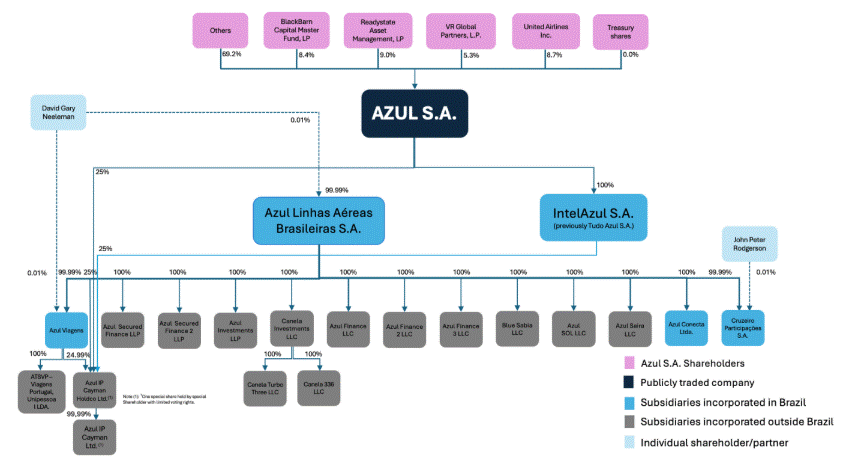
ALAB is our original operating subsidiary through which we operate all of our flight activities. ALAB wholly owns Azul Finance LLC and Azul Finance 2 LLC, subsidiaries incorporated in Delaware for the purpose of acquiring next-generation Airbus A320neos from Airbus and E-Jets from Embraer, as well as Azul Finance 3, LLC, a subsidiary incorporated in Delaware in connection with our engine maintenance finance entered into with AerCap. ALAB also wholly owns Azul SOL LLC, a subsidiary incorporated in Delaware, through which ALAB holds the option to purchase six E-Jets under a lease structure, and Blue Sabia LLC, a wholly-owned subsidiary incorporated in Delaware, which subleased certain aircraft to Portugalia – Companhia Portuguesa de Transportes Aéreos, S.A., a subsidiary of TAP.
In addition, ALAB wholly owns Azul Viagens, a subsidiary organized in Brazil, which sells travel packages offered by our Azul Viagens business unit. Azul Viagens., since March 2023, wholly owns ATSVP – Viagens Portugal, Unipessoal LDA., an entity incorporated in Portugal, which is currently in the regularization stage to enable the expansion of the activities of the Azul Viagens business unit in Europe.
ALAB wholly owns TwoFlex (rebranded Azul Conecta Ltda.), a domestic airline based in the city of Jundiaí, State of São Paulo, Brazil, which offers sub-regional domestic passenger and cargo service in Brazil, increasing our connectivity. ALAB is also the Managing Partner of Azul Investments, Azul Secured Finance and Azul Secured Finance 2, limited liability partnerships incorporated in Delaware for the issuance of debt securities in the United States. ALAB also wholly owns a non-operating subsidiary, Cruzeiro Participações S.A., located in Brazil.
ALAB wholly owns Canela Investments, a limited liability company incorporated in Delaware, which is the parent company of our aircraft operating companies that finance aircraft in U.S. dollars. Canela Investments wholly owns Canela Turbo Three and Canela 336 LLC, limited liability companies incorporated in Delaware.
We either acquire aircraft using financing obtained in the United States in U.S. dollars, or in Brazil, in reais, or lease them from third parties. Each aircraft that we purchase through financing in U.S. dollars is owned by a separate subsidiary of Canela Investments. Each subsidiary of Canela Investments owns one such aircraft and leases it to ALAB, whereas aircraft that we purchase through financing in Brazilian reais are held directly by ALAB. Aircraft that we lease from third parties under leases are owned by our relevant counterparty and leased to ALAB.
Azul Saira LLC., a wholly-owned subsidiary of ALAB and a co-lessor in the sublease contract entered with Breeze Airways, was established on December 7, 2020, in the United States.
We, ALAB, IntelAzul and Azul Viagens, own 100% of the issued ordinary shares in the capital of Azul IP Cayman HoldCo, an exempted company incorporated with limited liability under the laws of the Cayman Islands, except for a single special share by a special shareholder with limited voting rights. Azul IP Cayman HoldCo owns 100% of the issued ordinary shares in the capital of Azul IP Cayman Co, an exempted company incorporated with limited liability under the laws of the Cayman Islands, except for a single special share by a special shareholder with limited voting rights.
D.Property, Plant and Equipment
We lease all of our facilities at each of the airports we serve. Our leases for our terminal passenger service facilities, which include ticket counter and gate space, operations and maintenance support area, baggage service offices, generally have terms ranging from one to three years and contain provisions for periodic adjustments of lease rates. We expect to either renew these leases or find alternative space that would permit us to continue providing our services. We also are responsible for maintenance, insurance and other facility-related expenses and services. We have also entered into use agreements at each of the airports we serve that provide for the non-exclusive use of runways, taxiways and other facilities. Landing fees under these agreements are based on the number of landings and weight of the aircraft.
Our primary corporate offices and headquarters are located in the city of Barueri, state of São Paulo, where we lease 9,241.43 square meters under three lease agreements that expire in December of 2035.
We also lease four hangars totaling 29,560.64 square meters for our full capability maintenance center in Belo Horizonte, with expirations up to 2035. We also lease one hangar in Manaus totaling 3,133.20 square meters and one in Cuiabá totaling 2,535.71 square meters for E-Jets and ATR line maintenance with leases expiring in 2026 and an undetermined period, respectively. We also lease one hangar in São Paulo, Congonhas Airport totaling 13,657.43 square meters with leases expiring in 2026. We also lease one hangar in Campinas totaling 92,219.86 square meters, with the lease expiring in 2042. Our training facility for pilot and cabin crew education, UniAzul, located at Viracopos airport has 14,576 square meter is under a lease agreement that expires in 2027. We also lease a 900 square foot office complex, located in Fort Lauderdale within the airport area.
We also lease 9 cargo terminals in Brazil. We lease one cargo terminal in São Paulo, Congonhas Airport totaling 251,475 square meters with the lease expiring in 2026. We lease one cargo terminal in Belo Horizonte, Confins Airport totaling 61,470 square meters with the lease expiring in 2028. We also lease a cargo terminal in Fortaleza, totaling 133,664 square meters with the lease expiring in 2026. We also lease one cargo terminal in Manaus, totaling 83,740 square meters with the lease expiring in 2027. We also lease one cargo terminal in Ribeirão Preto totaling 136,591 square meters with the lease expiring in 2028. We also lease a cargo terminal in Recife, totaling 433,873 square meters with a lease expiring in 2028. We also lease 3 cargo terminals in Campinas, totaling 644,675 square meters with leases expiring in 2028.
We have also entered into a lease agreement for an office complex in Fort Lauderdale, United States.
Property and equipment are recorded at acquisition or construction cost (which include interest and other financial charges) and are depreciated to estimated residual values over their estimated useful lives using the straight-line method. Under International Accounting Standard, or IAS 16 “Property, Plant and Equipment,” major engine overhauls are treated as a separate asset component with the cost capitalized and depreciated over the period to the next overhaul. In estimating the lives and expected residual values of our airframes and engines, we primarily have relied upon actual experience with the same or similar aircraft types and recommendations from third parties. Subsequent revisions to these estimates, which can be significant, could be caused by changes to our maintenance program, changes in utilization of the aircraft, governmental regulations related to aging aircraft.
We evaluate annually whether there is an indication that our property and equipment may be impaired. Factors that would indicate potential impairment may include, but are not limited to, significant decreases in the market value of long-lived assets, a significant change in the long-lived asset’s physical condition, and operating or cash flow losses associated with the use of long-lived assets. An impairment loss exists when the book value of an asset unit exceeds its recoverable amount, which is the higher of fair value less selling costs and value in use. The calculation of fair value less selling costs is based on information available of sales transactions regarding similar assets or market prices less additional costs for disposing of assets.
ITEM 4A. UNRESOLVED STAFF COMMENTS
None.
ITEM 5. OPERATING AND FINANCIAL REVIEW AND PROSPECTS
A.Operating Results
You should read the following discussion of our financial condition and results of operations in conjunction with the financial statements and the notes thereto included elsewhere in this annual report, as well as the data set forth in “Item 3.A. Selected Financial Data.” The following discussion contains forward-looking statements that reflect our plans, estimates and beliefs. Our actual results could differ materially from those discussed in the forward-looking statements. Factors that could cause or contribute to these differences include those discussed below and elsewhere in this annual report particularly in “Item 3.D. Risk Factors.”
Principal Factors Affecting Our Financial Condition and Results of Operations
We believe our operating and business performance is driven by various factors that affect the global and Brazilian economy, the Brazilian airline industry, trends affecting the broader Brazilian travel industry, and trends affecting the specific markets and customer base that we target. The following key factors may affect our future performance. In 2025, we continued to experience some challenges as the weakening Brazilian real, significant OEM and supply chain issues, and higher-than-expected fuel prices. However, despite the challenges, we grew as an airline during 2025, kept our reach to 160 destinations, improved our punctuality from being the 10th most punctual airline in the world to being the 4th, according to Cirium. In 2025 the demand for our products and services remained extremely strong, our capacity and traffic increased 10% and 12% respectively. Through our strong operations, we now have the ability to focus on our growth and margin expansion for the next several years. We continue to see exciting opportunities in our passenger, loyalty, vacations and logistics businesses.
Financial markets have been negatively impacted by the current macroeconomic trends, including high interest rates, rising inflation, and more recently, the imposition of tariffs by the United States on foreign countries, and concerns regarding the escalation of geopolitical tensions and armed conflicts. Uncertainty remains and potential impacts on the broader economy, and our business, our business partners, and/or industry as a whole may be adversely impacted in ways that we cannot predict at this time.
Brazilian Economic Environment
As most of our flight operations are within Brazil, our revenues and profitability are affected by conditions in the Brazilian economy. Our operations and the airline industry in general are particularly sensitive to changes in economic conditions. Unfavorable economic conditions, such as high unemployment rates and a constrained credit market, can reduce spending for both leisure and business travel. Unfavorable economic conditions can also impact our ability to raise fares to counteract increased fuel, labor, and other expenses, and generally increase our credit rank, particularly with respect to our trade receivables.
The following table shows data for real GDP, inflation and interest rates in Brazil, the Brazilian real/U.S. dollar exchange rate and crude oil prices for and as of the periods indicated.
| | | | | | | | | | | | | | | | | |
| As of and for the Years ended December 31, |
| 2025 | | 2024 | | 2023 |
| | | | | |
Real growth in gross domestic product | 2.5 | % | | 3.4 | % | | 2.9 | % |
Inflation (IGP-M)(1) | (1.05) | % | | 6.54 | % | | (3.18) | % |
Inflation (IPCA)(2) | 4.26 | % | | 4.83 | % | | 4.46 | % |
Long-term rates – TLP (average)(3) | 8.66 | % | | 5.30 | % | | 6.55 | % |
CDI Rate (average)(4) | 14.33 | % | | 10.88 | % | | 13.04 | % |
SOFR 3-month (average) | 4.2 | % | | 3.4 | % | | 5.5 | % |
Period-end exchange rate—reais per US$ 1.00 | 5.50 | | | 6.19 | | | 4.90 | |
Average exchange rate—reais per US$ 1.00(5) | 5.58 | | | 5.39 | | | 5.00 | |
Average depreciation of the real vs. US$ | (3.5) | % | | (7.8) | % | | (3.3) | % |
WTI crude price (average US$ per barrel during period) | 65.39 | | | 94.53 | | | 77.66 | |
Unemployment rate(6) | 5.1 | % | | 6.6 | % | | 7.8 | % |
| | | | | |
Source: FGV, IBGE, Central Bank, Bloomberg and Energy information administration |
| (1) | Inflation (IGP-M) is the general market price index measured by the FGV. |
| (2) | Inflation (IPCA) is a broad consumer price index measured by the IBGE. |
| (3) | TJLP was replaced by TLP and is the Brazilian long-term interest rate (average of monthly rates for the year). |
| (4) | The CDI Rate is an average of inter-bank overnight rates in Brazil (daily average for the period). |
(5) | Average of the exchange rate on each business day of the year. |
(6) | Average unemployment rate for year as measured by IBGE. |
According to IBGE, the Brazilian economy grew 2.5% in 2025 mainly due to the recovery of the agricultural sector, followed by an increase in the services and industry. In comparison, GDP grew by 3.4% in 2024 and 2.9% in 2023, representing a continued recovery from the impacts of the COVID-19 pandemic which contributed to a 3.3% decrease in GDP in 2020.
In terms of passenger demand as measured by RPKs, according to ANAC, grew by 10.8% compared to 2024, while the supply ASK (Available Seat Kilometers) increased by 10%. In the comparison between December 2025 and December 2024, demand grew by 11.7%, while supply increased by 10.1%.
Impact of Airline Industry Competition
The airline industry is highly competitive. The principal competitive factors in the airline industry are fare pricing, flight schedules, flight times, aircraft type, passenger amenities, number of routes served from a city, customer service, safety record and reputation, brand recognition, code-sharing relationships, and loyalty programs and redemption opportunities. Price competition occurs on a market-by-market, route-by-route and flight schedule basis through price discounts, changes in pricing structures, fare matching, target promotions and loyalty program initiatives.
As of December 31, 2025, 16% and 14% of our domestic network overlapped with that of Gol and LATAM, respectively. At Viracopos airport, our primary hub, only 3 out of 71 domestic destinations faced direct competition from Gol or LATAM as of December 31, 2025.
In addition, we were the sole airline on 80% of our routes, we are the leading airline in 115 Brazilian cities in terms of departures and carried approximately 32 million passengers in the year ended December 31, 2025.
Effects of Aviation Fuel Costs
Aviation fuel costs have been subject to wide fluctuations in recent years. Fuel availability and pricing are also subject to refining capacity, periods of market surplus and shortage, and demand for heating oil, gasoline and other petroleum products, as well as meteorological, economic and political factors and events occurring throughout the world, which we can neither control nor accurately predict. We attempt to mitigate fuel price volatility through commodity forward agreements with banks or a fixed price agreement with Vibra Energia (formerly BR Distribuidora). See “Item 5.A. Operating Results —Principal Components of Our Results of Operations—Operating Expenses.” Our fuel hedging practices are dependent upon many factors, including our assessment of market conditions for fuel, the pricing of hedges and other derivative products in the market and applicable regulatory policies. Petrobras, the leading player in the Brazilian oil industry and the parent company of Vibra Energia, has a strategy to equalize aviation fuel prices to international fuel prices every month. There are also regional differences based on logistical issues and different regional taxes.
Seasonality
Our operating revenue and results of operations are substantially dependent on overall passenger traffic volume, which is subject to seasonal and other changes in traffic patterns. Therefore, our operating revenue and results of operations for any interim period are not necessarily indicative of those for the entire year. We generally expect demand to be greater in the first, third and fourth quarters of each calendar year compared to the second quarter of each year. This demand increase occurs due to an increase in business travel during the second half of the year, as well as the Christmas season, Carnival and the Brazilian school summer vacation. Although business travel can be cyclical depending on the general state of the economy, it tends to be less seasonal than leisure travel, which peaks during vacation season and around certain holidays in Brazil.
The table below shows our average fare in reais for the periods indicated, reflecting our total passenger revenue divided by passenger flight segments for such periods:
| | | | | | | | | | | | | | | | | | | | | | | | | | |
| | Average Fare (R$) |
| Year Ended December 31, | | First Quarter | | Second Quarter | | Third Quarter | | Fourth Quarter |
| | | | | | | | |
| 2023 | | 590.80 | | | 550.10 | | | 587.60 | | | 643.63 | |
| 2024 | | 604.40 | | | 521.20 | | | 588.60 | | | 629.90 | |
| 2025 | | 633.80 | | | 574.08 | | | 656.25 | | | 671.41 | |
Effects of Exchange Rates, Interest Rates and Inflation
Our results of operations are affected by currency fluctuations. For the year ended December 31, 2025, 79.3% of our revenue was domestic and therefore denominated in reais while 45.2% of our operating expenses were either payable in or affected by the U.S. dollar, such as aviation fuel, certain flight hour maintenance contract payments and aircraft insurance. We also have certain aircraft debt denominated in U.S. dollars, see “Item 5.B. Liquidity and Capital Resources—Loans and Financings.” We use short-term arrangement to hedge against exchange rate exposure related to our aircraft lease and other rent payment obligations.
We also have assets denominated in foreign currency, including security deposits, maintenance reserves, cash and equivalents, among other assets, providing us with a natural hedge against our U.S. dollar denominated liabilities to the extent that such assets are denominated in U.S. dollars. In addition, our aircraft, engines, and spare parts are commercialized in U.S. dollars.
Inflation also had, and may continue to have, effects on our financial condition and results of operations. For the year ended December 31, 2025, approximately, 21.1% of our operating expenses, including salaries, catering and ground handling expenses were impacted by changes in inflation.
The Central Bank determines the base interest rate in order to manage inflation. Variations in interest rate affect primarily our long-term obligations subject to variable interest rates, including our loans and financing. As of December 31, 2025, we had R$23,059.6 million in current and noncurrent loans and financing of which 2.9% were indexed by the CDI rate, or interbank interest rate. In addition, interest rates also affect our financial income to the extent that we have investments indexed to the CDI Rate. The Central Bank has changed the base interest rate several times over the past years in order to keep inflation within its targets.
Principal Components of Our Results of Operations
Operating Revenue
Our operating gross revenue is primarily derived from transporting customers in our aircraft. For the year ended December 31, 2025, 92.4% of our gross revenue was derived from passenger revenue, and 7.6% was derived from other revenue.
For the year ended December 31, 2025, 79.3% of our revenue was domestic and therefore denominated in Brazilian reais. Passenger revenue is recognized either upon departure of the scheduled flight or when a purchased ticket expires unused, including revenue related to the redemption of Azul Fidelidade points for Azul flights. Cargo revenue is recognized when transportation is provided. Passenger revenue depends on our capacity, load factor and yield. Capacity is measured in terms of ASKs, which represents the number of seats we make available on our aircraft multiplied by the number of kilometers these seats are flown. Load factor, or the percentage of our capacity that is actually used by paying customers, is calculated by dividing RPKs, which represents the number of kilometers flown by revenue passengers, by ASKs. Yield is the average amount that one passenger pays to fly one kilometer. We use RASK, or revenue divided by ASKs, and PRASK, or passenger revenue divided by ASKs, as our key performance indicators, because we believe they enable us to evaluate the balance between load factor and yield. Since our first year of operations, we have maintained a significant RASK and PRASK premium compared to our competitors given our higher load factors and yields. We expect that our strategy will enable us to maintain that premium in the future.
Our revenues are net of certain taxes, including state-value added tax, the Tax on Circulation of Goods and Services (Imposto sobre Circulação de Mercadorias e Serviços), or ICMS; federal social contribution taxes, including the Social Integration Program (Programa de Integração Social), or PIS; and the Social Contribution to Social Security Financing (Contribuição Social para o Financiamento da Seguridade Social), or COFINS. ICMS does not apply to passenger revenue. The average rate of ICMS on cargo revenues varies by state and ranges from 4% to 19%. In respect of passenger transportation revenues, the applicable rates of PIS and COFINS are 0.65% and 3%, respectively, due to a specific rule which enforces the use of the cumulative system of PIS and COFINS on these revenues. The remaining revenue related to air transportation activity is levied at rates of 1.65% and 7.60%, respectively. The Municipal Tax on Services (Imposto Sobre Serviços), or ISS, is a municipal tax assessed at rates varying from 2% to 5% of our service rendered revenues.
The air transportation business is volatile and highly affected by economic cycles and trends. Fluctuations in aviation fuel prices, customer discretionary spending, fare initiatives, labor actions, pandemics such as COVID-19, weather and other factors have resulted in significant fluctuations in revenues and results of operations in the past.
ANAC, the Brazilian civil aviation agency, may adopt regulations that influence our ability to generate revenue as it is responsible for approving the concession of landing rights slots, entry of new companies, launch of new routes, increases in route frequencies and lease or acquisition of new aircraft. Our ability to grow and to increase our revenues is dependent on approvals for new routes, increased frequencies and additional aircraft by ANAC.
Operating Expenses
We are committed to maintaining a low-cost operating structure, and we seek to keep our expenses low by operating a young and efficient fleet with a single-class of service on domestic routes, maintaining high employee productivity, investing significantly in technology, utilizing our fleet efficiently and deploying low-cost distribution processes.
Our largest operating expense is aviation fuel, which represented 33.0% of our total operating expenses in 2025, 34.6% of our total operating expenses in 2024 and 34.9% in 2023. Aircraft fuel prices in Brazil are much higher than in the United States, as the Brazilian infrastructure needed to produce, transport and store fuel is expensive and aviation fuel prices are controlled by a concentrated number of suppliers. Our aviation fuel expenses are variable and fluctuate based on global oil prices. Since global prices are denominated in U.S. dollars, our aviation fuel costs are also subject to exchange rate fluctuations between the real and U.S. dollar.
During the year ended December 31, 2025, the fuel price per liter decreased 5.1%, from R$4.21 per liter for the year ended December 31, 2024 to R$4.00 per liter for the year ended December 31, 2025.
We attempt to mitigate fuel price volatility related to global changes in fuel prices through commodity forward agreements with banks and also have the option to enter into hedge agreements with Petrobras. The Petrobras hedging product available to us enables us to lock in the cost of the jet fuel we will consume in the future, thereby offering a more tailored hedge than WTI or heating oil futures, which are not perfectly correlated to jet fuel. In addition, Petrobras offers us the option to lock the jet fuel price in reais, thereby hedging our exposure not only to fuel prices, but also to the Brazilian real/U.S. dollar exchange rates.
In addition, local taxes applicable to the sale of jet fuel are high, ranging from —% to 18.0%. Different states in Brazil apply different rates of value-added tax to fuel, requiring us to continually adjust our fuel prices to optimize fuel uplift. Several states in Brazil offer a value-added fuel tax relief or subsidy to airlines that provide better connectivity between cities within the state and other domestic or international destinations. Given the size of our network and diversified fleet, we believe we pay lower value-added fuel tax rates compared to our main competitors.
Salaries and benefits paid to our Crewmembers, include, among others, health care, dental care, child care reimbursement, life insurance, funeral assistance, school aid (granted to expatriate executive officers only), housing allowance (granted to expatriate executive officers only), bonuses, pension plans, transportation tickets, food allowances and meal vouchers. We believe that we have a cost advantage compared to industry peers in salaries and benefits expenses due to high employee productivity measured by the average number of employees per aircraft. We had 81 FTEs per aircraft as of December 31, 2025. We also benefit from generally lower labor costs in Brazil, when compared to other countries, which is somewhat offset by lower productivity due to government requirements over employee labor conditions and taxes on payroll.
Landing fees include airport charges for each landing and aircraft parking, connecting fees as well as aeronautical and navigation fees. Most of these fees vary based on our level of operations and the rates are set by INFRAERO, DECEA and private airports.
Traffic and customer servicing includes the cost of airport facilities, ground handling expenses, customer bus service and inflight services and supplies. During the pandemic, due to Anvisa’s orientation, we suspended the inflight service. We provide complimentary bus services between a limited number of locations and certain strategic airports, such as transportation from the city of São Paulo to Viracopos airport, and we believe that the additional customers we attract by offering this service more than offset its cost.
Our advertising and publicity expenses include commissions paid to travel and cargo agents, fees paid to credit card companies and advertising associated with the sale of our tickets and other products and services. We believe that our distribution costs are lower than those of our competitors because a higher proportion of our customers purchase tickets directly through our website instead of through traditional distribution channels, such as ticket offices, and we have comparatively fewer sales made through higher cost global distribution systems. We employ low-cost, innovative marketing techniques, focusing on social networking tools (Instagram, Facebook, Twitter, YouTube and Instagram) and generating word of mouth recognition, including visibly branded complimentary bus service and buzz marketing moments to enhance brand recognition and provide promotions directed at our customers. We believe that we have an advantage compared to industry peers in advertising and marketing expenses and expect this advantage will remain in the future.
Our maintenance and repair expenses consist of line maintenance checks and certain maintenance fees based on number of hours flown to access spare parts to repair aircraft and engines. Our fleet is the youngest compared to our main competitors, with an average age of 7.2 years, excluding our Cessna Caravan aircraft as of December 31, 2025. As the aircraft age, our maintenance expenses tend to increase.
At the initial recognition of aircraft or right-of-use assets, Azul allocates the total cost of the aircraft between major components; airframe, engines, auxiliary power unit (“APU”), or propeller landing gear, heavy maintenance and structural checks. The useful economic life is the period extending up to the next heavy maintenance or structural check or the remaining useful life of the aircraft/engines or lease contract, whichever is shorter. Azul has maintenance contracts for its engines that cover all significant maintenance events. Azul has "power-by-the-hour" type contracts, which stipulate a rate for maintenance per hour flown, which are paid in accordance with the total hours flown when maintenance occurs. Subsequent heavy maintenance events and structural checks, which increase the useful lives of the assets, are capitalized and recognized as property and equipment or in addition to the right-of-use assets, according to the underlying asset. Subsequently they are depreciated during the respective period of use or until the end of the lease. Repairs and other routine maintenance are recognized in maintenance expenses during the period in which they are incurred.
Depreciation and amortization expenses include the depreciation of all fixed assets we own or right-of-use assets, including amortization of capitalized maintenance expenses.
Other operating expenses, net consist of general and administrative expenses, purchased services, equipment rental, communication costs, professional fees, travel and training expenses for crews and ground personnel, provisions for legal proceedings, interrupted flights and all other overhead expenses.
Slightly over half of our expenses, such as fuel and maintenance, fluctuate with changes in the exchange rate between the real and the U.S. dollar. We currently enter into arrangements to hedge against increases in fuel prices.
Financial Results
Our financial income includes interest earned on our cash and cash equivalents (which bear interest indexed to the CDI Rate) and short-term investments. Our financial expenses include interest expense on lease liabilities, aircraft debt, loans and financings and working capital facilities, which are exposed to foreign currency fluctuations. The balances of derivative financial instruments include gains or losses on our derivatives not designated for hedge accounting. Foreign currency exchange is the net gain or loss on our assets and liabilities related to the appreciation or depreciation of the real against the U.S. dollar and has limited impact on our cash position.
Taxes
We account for income taxes using the liability method. We record deferred tax assets only when, based on the weight of the evidence, it is more likely than not that the deferred tax assets will be realized. Deferred taxes are recorded based on differences between the financial statement basis and tax basis of assets and liabilities and available tax loss and credit carryforwards. In assessing whether the deferred tax assets are realizable, our management considers whether it is more likely than not that some or all of the deferred tax assets will be utilized. We consider all available evidence, both positive and negative, in determining future taxable income on a jurisdiction by jurisdiction basis.
We and our subsidiaries had net operating loss carryforwards of R$26,352.2 million for the year ended December 31, 2025, represented by income tax losses and negative basis of social contribution.
Critical Accounting Policies and Estimates
For this discussion, see our audited consolidated financial statements included elsewhere in this annual report.
Impact of the Voluntary Reorganization on our Results of Operations
In 2025, our results of operations and financial condition were significantly affected by the implementation of our Voluntary Reorganization under the Chapter 11 Cases. See “Item 4. Information on the Company—Business Overview—Voluntary Reorganization.” The Voluntary Reorganization was driven primarily by the economic distress and travel disruptions that resulted from the COVID-19 pandemic and a catastrophic flood in 2024 which forced the temporary closure of Porto Alegre airport (one of our strategic airports), combined with the effects of customer litigation, a difficult macroeconomic environment. including the effects of global inflation, as well as OEM disruptions. These events materially reduced demand, increased operational disruptions and tightened liquidity, ultimately leading us to seek relief under the Chapter 11 Cases.
Following extensive negotiations with our key financial stakeholders, the Bankruptcy Court entered the Confirmation Order on December 19, 2025, and we emerged from the Chapter 11 Cases on the Effective Date. Upon emergence, we consummated all material transactions contemplated by the confirmed the Plan, including: (i) the AerCap Global Settlement; (ii) the Fleet Restructuring; (iii) the entry into new Exit Financing Facilities that replaced our DIP Facility and reprofiled our capital structure; (iv) the Equitization of 1L/2L Claims, pursuant to which the 1L Notes Claims, the Convertible Debenture Claims, and 2L Notes Claims were exchanged for common shares; (v) a new governance structure; (vi) the establishment of the GUC Trust for the benefit of general unsecured creditors, which received, holds and administers the GUC Assets on behalf of the beneficiaries of the GUC Trust; (vii) the Equity Rights Offering, with the subscription and payment in cash of common shares by the Backstop Commitment Parties, United, and the Additional Investment Holders and (viii) the American Warrants (pursuant to which American is expected to fund its committed equity investment through the exercise thereof after the Effective Date in accordance with its terms) and the Additional Investment Warrants, each of which provides for potential additional capital and liquidity, which provided new capital and liquidity. See “Item 4.B. Business Overview—Voluntary Reorganization.” With the exception of our DIP Facility and certain interim transactions, the aforementioned transactions were implemented after December 31, 2025 and accordingly are not reflected in our financial results for the year ended December 31, 2025.
These transactions required the application of significant accounting judgments under IFRS, including the measurement and derecognition of liabilities, recognition of new financial instruments, valuation of common shares issued upon emergence, and the reassessment of useful lives, lease terms and right-of-use assets in connection with our updated fleet plan. The Voluntary Reorganization also resulted in material gains and losses recognized in our consolidated statements of operations, including reorganization items, fair value adjustments and extinguishment of debt.
As a result, our financial statements for the year ending December 31, 2026 (and interim periods within that) will reflect the substantial one-time effects of the Voluntary Reorganization as well as the initial impacts of our simplified post-emergence capital structure, fleet profile and cost base.
Results of Operations
General
We believe we have created a robust network of profitable routes by stimulating demand through frequent and affordable air service. We expect that most of our domestic capacity growth will come from replacing smaller aircraft with larger, fuel efficient, next generation aircraft that have a lower seat cost. We also expect to continue adding select routes and cities that we believe possess high demand and growth potential and are either not served or underserved by other airlines. We expect to continue leveraging the strong connectivity we have created in Brazil to benefit from the addition of select international destinations in the United States and Europe. In addition, we believe that we will continue benefiting from additional revenue streams coming from our Azul Fidelidade loyalty program, our cargo, and our travel package businesses.
The following chart includes certain operating information that evidences the evolution of our business between 2008 through December 31, 2025:
| | | | | | | | | | | | | | | | | | | | | | | | | | | | | | | | |
| | | | | | Total Aircraft at End of Period |
As of | | Cities Served | | FTEs | | Owned | | Leased | | Total(1) |
| | | | | | | | | | |
December 31, 2008(1) | | 3 | | | 712 | | | 3 | | | 2 | | | 5 | |
December 31, 2009(1) | | 17 | | | 1,535 | | | 8 | | | 6 | | | 14 | |
December 31, 2010(1) | | 28 | | | 2,940 | | | 14 | | | 13 | | | 27 | |
December 31, 2011(1)(2) | | 43 | | | 4,329 | | | 22 | | | 27 | | | 49 | |
December 31, 2012(1) | | 100 | | | 8,914 | | | 50 | | | 74 | | | 124 | |
December 31, 2013(1) | | 103 | | | 9,848 | | | 56 | | | 81 | | | 137 | |
December 31, 2014(1) | | 106 | | | 10,501 | | | 46 | | | 107 | | | 153 | |
December 31, 2015(1) | | 102 | | | 10,533 | | | 46 | | | 106 | | | 152 | |
December 31, 2016(1)(3) | | 102 | | | 10,311 | | | 39 | | | 100 | | | 139 | |
December 31, 2017(1)(3) | | 104 | | | 10,878 | | | 27 | | | 120 | | | 147 | |
December 31, 2018(1)(3) | | 110 | | | 11,807 | | | 20 | | | 123 | | | 143 | |
December 31, 2019(3) | | 116 | | | 13,189 | | | 19 | | | 147 | | | 166 | |
December 31, 2020(4) | | 112 | | | 11,946 | | | 34 | | | 158 | | | 192 | |
December 31, 2021(5) | | 147 | | | 12,485 | | | 37 | | | 155 | | | 192 | |
December 31, 2022(6) | | 158 | | | 13,543 | | | 40 | | | 172 | | | 212 | |
December 31, 2023(6) | | 167 | | | 15,248 | | | 40 | | | 169 | | | 209 | |
December 31, 2024(1) | | 152 | | | 15,367 | | | 38 | | | 182 | | | 220 | |
December 31, 2025(1) | | 144 | | | 15,547 | | | 39 | | | 188 | | | 227 | |
| | | | | |
| (1) | Includes aircraft held under finance and operating leases. |
| (2) | Includes operating information resulting from the TRIP acquisition since November 30, 2012. |
| (3) | Includes aircraft subleased to TAP, 15 as of December 31, 2019 and 13 as of December 31, 2020. |
| (4) | Includes 13 aircraft subleased to TAP and 1 subleased to Breeze Airways. |
| (5) | Includes 6 aircraft subleased to TAP and 3 subleased to Breeze Airways. |
| (6) | Includes 3 aircraft subleased to Breeze Airways. |
Comparison of the year ended December 31, 2025 to the year ended December 31, 2024
| | | | | | | | | | | | | | | | | | | | |
| | Years Ended December 31, | | Percent
Change |
| | 2025 | | 2024 | |
| | | | | | |
| | (in thousands of reais) | | |
| Passenger revenue | | 19,997,726 | | | 18,123,135 | | | 10.3 | % |
| Other revenues | | 1,642,667 | | | 1,403,073 | | | 17.1 | % |
| Total revenue | | 21,640,393 | | | 19,526,208 | | | 10.8 | % |
| | | | | | |
| Aircraft fuel | | (5,710,291) | | | (5,583,503) | | | 2.3 | % |
| Salaries and benefits | | (2,693,363) | | | (2,722,872) | | | (1.1) | % |
| Airport taxes and fees | | (1,266,186) | | | (1,074,818) | | | 17.8 | % |
| Auxiliary services for air transport | | (956,933) | | | (872,481) | | | 9.7 | % |
| Maintenance | | (824,058) | | | (789,222) | | | 4.4 | % |
| Advertising and publicity | | (915,442) | | | (889,224) | | | 2.9 | % |
| Depreciation and amortization | | (3,013,375) | | | (2,563,982) | | | 17.5 | % |
| Impairment and onerous contracts | | — | | | 143,790 | | | (100.0) | % |
| Insurance | | (100,401) | | | (79,588) | | | 26.2 | % |
| Renegotiations - Chapter 11 | | 181,893 | | | — | | | 100.0 | % |
| Breakage - GUC | | 1,724,867 | | | — | | | 100.0 | % |
| Restructuring costs - Chapter 11 | | (871,028) | | | — | | | 100.0 | % |
| Other | | (2,874,606) | | | (1,703,676) | | | 68.7 | % |
| Total expenses | | (17,318,923) | | | (16,135,576) | | | 7.3 | % |
| | | | | | |
| Operating profit | | 4,321,470 | | | 3,390,632 | | | 27.5 | % |
| | | | | | |
| Financial income | | 904,083 | | | 239,058 | | | 278.2 | % |
| Financial expenses | | (10,295,119) | | | (5,247,414) | | | 96.2 | % |
| Derivative financial instruments, net | | 986,521 | | | 317,729 | | | 210.5 | % |
| Foreign currency exchange, net | | 4,207,915 | | | (7,890,179) | | | (153.3) | % |
| Financial result | | (4,196,600) | | | (12,580,806) | | | (66.6) | % |
| | | | | | |
| Income (loss) before income tax and social contribution | | 124,870 | | | (9,190,174) | | | (101.4) | % |
| | | | | | |
Current income tax and social contribution | | (12) | | | (723) | | | (98.3) | % |
| Deferred income tax and social contribution | | — | | | 39,526 | | | (100.0) | % |
| | | | | | |
| Income (loss) for the year | | 124,858 | | | (9,151,371) | | | (101.4) | % |
The table below sets forth the breakdown of our operating revenues and expenses on a per-ASK basis for the periods indicated:
| | | | | | | | | | | | | | | | | | | | |
| | For the Year Ended December 31, | | Percent
Change |
| | 2025 | | 2024 | |
| | (per ASK in R$ cents) |
| | | | | | |
| Total revenue: | | | | | | |
| Passenger revenue | | 39.28 | | | 39.15 | | | 0.3 | % |
| Cargo and other revenue | | 3.23 | | | 3.03 | | | 6.6 | % |
| Total revenues | | 42.51 | | | 42.18 | | | 0.8 | % |
| Operating expenses: | | | | | | |
| Aircraft fuel | | 11.22 | | | 12.06 | | | (7.0) | % |
| Salaries and benefits | | 5.29 | | | 5.88 | | | (10.0) | % |
| Depreciation and amortization | | 5.92 | | | 5.54 | | | 6.9 | % |
| Airport fees | | 2.49 | | | 2.32 | | | 7.3 | % |
| Passenger expenses | | 1.88 | | | 1.88 | | | — | % |
| Advertising and publicity | | 1.80 | | | 1.92 | | | -6.2 | % |
| Maintenance and repairs | | 1.62 | | | 1.70 | | | (4.7) | % |
| Other operating expenses | | 3.80 | | | 3.54 | | | 7.3 | % |
| Total operating expenses, net | | 34.02 | | | 34.86 | | | (2.4) | % |
The table below presents our passenger revenue and selected operating data for the periods indicated.
| | | | | | | | | | | | | | | | | |
| For the Year Ended December 31, | | Percent
Change |
| 2025 | | 2024 | |
| | | | | |
| Passenger revenue (in millions of reais) | 19,998 | | | 18,123 | | | 10.3 | % |
| Available seat kilometers (ASKs) (millions) | 50,908 | | | 46,292 | | | 10.0 | % |
| Load factor (%) | 83.2% | | 81.6% | | 2.0 | % |
| Passenger revenue per ASK (cents) (PRASK) | 39.28 | | | 39.15 | | | 0.3 | % |
| Operating revenue per ASK (cents) (RASK) | 42.51 | | | 42.18 | | | 0.8 | % |
| Yield per passenger kilometer (cents) | 47.05 | | | 47.97 | | | (1.9) | % |
| Number of departures | 310,713 | | | 322,082 | | | (3.5) | % |
| Block hours | 575,448 | | | 567,774 | | | 1.4 | % |
Revenue
In 2025, Azul´s total operating revenue increased 10.8% or R$2,114.2 million in the year ended December 31, 2025, reaching a record of R$21.6 billion mainly due to a healthy demand environment, robust ancillary revenues and the notable performance of our other businesses units.
Passenger Revenue
Passenger revenue increased 10.3% or R$1,874.6 million, from R$18,123.1 million in the year ended December 31, 2024 to R$19,997.7 million in 2025, due primarily to (i) a strong demand in both domestic and international passenger demand, (ii) the robust ancillary revenues and notable performance of our other businesses units, in particular Azul Fidelidade and Azul Viagens, and (iii) increase in the average fares charged to our passengers.
Other Revenues
Other Revenues increased 17.1% or R$239.6 million, from R$1,403.1 million in the year ended December 31, 2024 to R$1,642.7 million in 2025, due primarily to (i) an increase in international cargo net revenue of 23.7% or R$53.1 million, from R$224.1 million in the year ended December 31, 2024 to R$277.3 million in 2025, and (ii) the expansion in our diversified customer base with growth among retailers, manufacturers, and e-commerce operators in Brazil who use our logistic solutions.
Operating Expenses
For the year ended December 31, 2025, Azul recorded operating expenses of R$17.3 billion, compared to R$16.1 billion in the year ended December 31, 2024, representing a 7.3% increase, mainly due to inflation of 4.3% in the period, an increase in number of legal claims related to irregular operations that occurred mostly in 2024, and a 28.7% increase in international capacity, for which we incur higher costs, and a 4.3% depreciation of the Brazilian real against the U.S. dollar, partially offset by a higher productivity and a 5.0% reduction in fuel price.
Aircraft fuel. Aircraft fuel increased R$126.8 million, or 2.3%, from R$5,583.5 million in the year ended December 31, 2024 to R$5,710.3 million in the year ended December 31, 2025, mostly due to a 7.8% increase in fuel consumption partially offset by the reduction of 5.1% in fuel price.
Salaries and benefits. Salaries and benefits decreased 1.1% or 29.5 million, from R$2,722.9 million in the year ended December 31, 2024 to R$2,693.4 million in the year ended December 31, 2025, mainly driven by higher productivity through a reduction in FTE and several cost-reduction strategies, partially offset by our capacity increase of 10.0% in 2025 and a 4.8% union increase in salaries as a result of collective bargaining agreements applicable to all airline employees in Brazil
Airport taxes and fees. Airport taxes and fees increased 17.8% or R$191.4 million, from R$1,074.8 million in the year ended December 31, 2024 to R$1,266.2 million in the year ended December 31, 2025, mostly driven by the 5.4% increase in domestic capacity and a 28.7% increase in international capacity, for which we pay higher airport taxes and fees that are also generally denominated in U.S. dollars.
Auxiliary services for air transport. Auxiliary services for air transport increased 9.7% or R$84.5 million, from R$872.5 million in the year ended December 31, 2024 to R$956.9 million in the year ended December 31, 2025, primarily due the increase in international departures which have higher expenses, the 3.4% increase in passengers, in addition to 4.3% inflation in the period, partially offset by the optimization of our onboard services.
Advertising and publicity. Advertising and publicity expenses increased 2.9%, or R$26.2 million, from R$889.2 million in the year ended December 31, 2024 to R$915.4 million in the year ended December 31, 2025, mostly driven by the 10.3% increase in passenger revenue, leading to an increase in credit card fees and commissions.
Maintenance. Maintenance increased 4.4%, or R$34.8 million, from R$789.2 million in the year ended December 31, 2024 to R$824.1 million in the year ended December 31, 2025, mostly driven by 4.3% average depreciation of the real against the U.S. dollar and one-time events, partially offset by savings from insourcing of maintenance events and renegotiations with suppliers.
Depreciation and amortization. Depreciation and amortization increased 17.5% or R$449.4 million, from R$2,564.0 million in the year ended December 31, 2024 to R$3,013.4 million in the year ended December 31, 2025, driven by the increase in the size of our fleet compared to 2024, as a result of the fleet transformation process, which increased the right of-use assets recognized at a higher foreign exchange rate, and the increase in spare engines due to supply issues with OEMs.
Impairment and onerous contracts. Impairment and onerous contracts. decreased 100.0% from R$143.8 million in the year ended December 31, 2024 to R$0 in 2025, mainly due to the non-changes on the expected use of aeronautical materials.
Insurance. Insurance increased 26.2%, or R$20.8 million, from R$79.6 million in the year ended December 31, 2024 to R$100.4 million in the year ended December 31, 2025, mostly driven by the increase in D&O insurance and the increase in total contractual fleet.
Restructuring. As part of the restructuring process concluded under Chapter 11, we recognized gains of R$1,035.7 million primarily related to the renegotiations with stakeholders, breakage, and restructuring costs mainly related to professional advisors in the Voluntary Reorganization.
Other. Other increased 68.7% or R$1,170.9 million, from R$1,703.7 million in 2024 to R$2,874.6 million in 2025 mainly due to an increase in legal claims related to irregular operations occurred mostly in 2024 and 4.3% annual inflation.
Operating Profit
Operating profit increased 27.5%, or R$930.8 million, from R$3,390.6 million for the year ended December 31, 2024 to R$4,321.5 million in 2025. This increase is mainly due to a strong increase in revenue, a 10% increase in our capacity and a reduction in fuel burn per ASK as a result of our more efficient next-generation fleet and the positive impact from the lease renegotiations.
Financial Result
Financial income. Financial income increased 278.2%, or R$665.0 million, from R$239.1 million for the year ended December 31, 2024 to R$904.1 million in 2025, mainly due to the gain on the conversion of debt into shares.
Financial expenses. Financial expenses increased 96.2%, or R$5,047.7 million, from R$5,247.4 million for the year ended December 31, 2024 to R$10,295.1 million in 2025, mainly due to debt restructuring costs and the interest on the DIP Facility borrowed in 2025.
Derivative financial instruments, net. Derivative financial instruments, net, profit was of R$986.5 million for the year ended December 31, 2025, compared to R$317.7 million in 2024, mainly due to R$433 million positive effects on convertible debentures balance related to share price devaluation.
Foreign currency exchange, net. The net currency exchange effect on our monetary assets and liabilities when remeasured into reais, amounted to a non-cash gain on net monetary and foreign exchange variations of R$4,207.9 million for the year ended December 31, 2025, a net difference of R$12,098.1 million when compared to a loss of R$7,890.2 million in the year ended December 31, 2024, mainly due to the depreciation of the Brazilian real against the U.S. dollar of 4.3% in 2025, in addition to the increased in our debt denominated in U.S. dollars related of the borrowing of the DIP Facility.
Deferred income tax and social contribution
In the year ended December 31, 2025, there were no expenses related to deferred income tax and social contributions.
Profit for the Year
Profit for the year increased R$9,276.2 million, from a loss of R$9,151.4 million for the year ended December 31, 2024 to a profit of R$124.9 million in 2025, due to the reasons explained above.
Comparison of the year ended December 31, 2024 to the year ended December 31, 2023
| | | | | | | | | | | | | | | | | | | | |
| | Years Ended December 31, | | Percent
Change |
| | 2024 | | 2023 | |
| | | | | | |
| | (in thousands of reais) | | |
| Passenger revenue | | 18,123,135 | | | 17,227,728 | | | 5.2 | % |
| Other revenues | | 1,403,073 | | | 1,326,697 | | | 5.8 | % |
| Total revenue | | 19,526,208 | | | 18,554,425 | | | 5.2 | % |
| | | | | | |
| Aircraft fuel | | (5,583,503) | | | (5,890,485) | | | (5.2) | % |
| Salaries and benefits | | (2,722,872) | | | (2,408,364) | | | 13.1 | % |
| Airport taxes and fees | | (1,074,818) | | | (1,059,258) | | | 1.5 | % |
| Auxiliary services for air transport | | (872,481) | | | (807,563) | | | 8.0 | % |
| Maintenance | | (789,222) | | | (898,282) | | | (12.1) | % |
| Advertising and publicity | | (889,224) | | | (779,264) | | | 14.1 | % |
| Depreciation and amortization | | (2,563,982) | | | (2,404,223) | | | 6.6 | % |
| Impairment and onerous contracts | | 143,790 | | | 245,636 | | | (41.5) | % |
| Insurance | | (79,588) | | | (89,492) | | | (11.1) | % |
| Other | | (1,703,676) | | | (2,802,036) | | | (39.2) | % |
| | (16,135,576) | | | (16,893,331) | | | (4.5) | % |
| | | | | | |
| Operating profit (loss) | | 3,390,632 | | | 1,661,094 | | | 104.1 | % |
| | | | | | |
| Financial income | | 239,058 | | | 220,141 | | | 8.6 | % |
| Financial expenses | | (5,247,414) | | | (5,608,771) | | | (6.4) | % |
| Derivative financial instruments, net | | 317,729 | | | (238,458) | | | (233.2) | % |
| Foreign currency exchange, net | | (7,890,179) | | | 1,625,064 | | | (585.5) | % |
| Financial result | | (12,580,806) | | | (4,002,024) | | | 214.4 | % |
| | | | | | |
| Loss before income tax and social contribution | | (9,190,174) | | | (2,340,930) | | | 292.6 | % |
| | | | | | |
| Current income tax and social contribution | | (723) | | | — | | | 100.0 | % |
| Deferred income tax and social contribution | | 39,526 | | | (39,526) | | | (200.0) | % |
| | | | | | |
| Loss for the year | | (9,151,371) | | | (2,380,456) | | | 284.4 | % |
The table below sets forth the breakdown of our operating revenues and expenses on a per-ASK basis for the periods indicated:
| | | | | | | | | | | | | | | | | | | | |
| | For the Year Ended December 31, | | Percent
Change |
| | 2024 | | 2023 | |
| | (per ASK in R$ cents) |
| | | | | | |
| Total revenue: | | | | | | |
| Passenger revenue | | 39.15 | | | 39.46 | | | (0.8) | % |
| Cargo and other revenue | | 3.03 | | | 3.03 | | | — | |
| Total revenue | | 42.18 | | | 42.48 | | | (0.7) | % |
| Operating expenses: | | | | | | |
| Aircraft fuel | | 12.06 | | | 13.39 | | | (9.9) | % |
| Salaries and benefits | | 5.88 | | | 5.45 | | | 7.9 | % |
| Depreciation and amortization | | 5.54 | | | 5.26 | | | 5.3 | % |
| Airport fees | | 2.32 | | | 2.40 | | | (3.3) | % |
| Passenger expenses | | 1.88 | | | 1.84 | | | 2.2 | % |
| Advertising and publicity | | 1.92 | | | 1.77 | | | 8.5 | % |
| Maintenance and repairs | | 1.70 | | | 1.56 | | | 9.0 | % |
| Other operating expenses | | 3.54 | | | 4.23 | | | (16.3) | % |
| Total operating expenses, net | | 34.86 | | | 35.89 | | | (2.9) | % |
n.a. = not applicable
The table below presents our passenger revenue and selected operating data for the periods indicated.
| | | | | | | | | | | | | | | | | |
| For the Year Ended December 31, | | Percent
Change |
| 2024 | | 2023 | |
| | | | | |
| Passenger revenue (in millions of reais) | 18,123 | | | 17,228 | | | 5.2 | % |
| Available seat kilometers (ASKs) (millions) | 46,292 | | | 44,006 | | | 5.2 | % |
| Load factor (%) | 81.6% | | 80.4 | % | | 1.2 | % |
| Passenger revenue per ASK (cents) (PRASK) | 39.15 | | | 39.46 | | | (0.8) | % |
| Operating revenue per ASK (cents) (RASK) | 42.18 | | | 42.48 | | | (0.7) | % |
| Yield per passenger kilometer (cents) | 47.97 | | | 49.05 | | | (2.2) | % |
| Number of departures | 322,082 | | | 316,896 | | | 1.6 | % |
| Block hours | 567,774 | | | 550,843 | | | 3.1 | % |
Revenue
In 2024, Azul´s total operating revenue increased 5.2% or R$971.8 million in the year ended December 31, 2024, reaching a record of R$19.5 billion. Passenger revenue increased 5.2% on 5.2% more capacity compared to the same period last year, boosted by the full recovery of corporate and international passenger demand.
Passenger Revenue
Passenger revenue increased 5.2% or R$895.4 million, from R$17,227.7 million in the year ended December 31, 2023 to R$18,123.1 million in 2024, due primarily to (i) a strong demand in both domestic and international passenger demand, and (ii) the outstanding performance of our other businesses units as Azul Fidelidade and Azul Viagens.
Other Revenues
Other Revenues increased 5.8% or R$76.4 million, from R$1,326.7 million in the year ended December 31, 2023 to R$1,403.1 million in 2024, due primarily to (i) an increase in international cargo net revenue of 8.7% or R$17.9 million, from R$206.3 million in the year ended December 31, 2023 to R$224.1 million in 2024 and, (ii) the expansion in our diversified customer base with growth among retailers, manufacturers, and e-commerce operators in Brazil who use our logistic solutions.
Operating Expenses
For the year ended December 31, 2024, Azul recorded operating expenses of R$16.1 billion, compared to R$16.9 billion in the year ended December 31, 2023, representing a reduction of 4.5%, mainly due to 7.6% reduction in jet fuel price per liter, offset by 7.8% average depreciation of the Brazilian real against the U.S. dollar and the capacity and revenue increase of 5.2% and 4.4%, respectively in addition to investments to growth and maximize fleet availability to benefit from the continued strong demand environment.
Aircraft fuel. Aircraft fuel decreased R$307.0 million, or 5.2%, from R$5,890.5 million in the year ended December 31, 2023 to R$5,583.5 million in the year ended December 31, 2024, even with a 5.2% increase in total capacity, mostly due to a 7.6% reduction in fuel price per liter (excluding hedges) and a reduction in fuel burn per ASK as a result of our more efficient next-generation fleet.
Salaries and benefits. Salaries and benefits increased 13.1% or R$314.5 million, from R$2,408.4 million in the year ended December 31, 2023 to R$2,722.9 million in the year ended December 31, 2024, mainly driven by our capacity increase of 5.2% in 2024, a 4.8% union increase in salaries as a result of collective bargaining agreements applicable to all airline employees in Brazil, and the insourcing of certain activities as total costs reduction initiatives.
Airport taxes and fees. Airport taxes and fees increased 1.5% or R$15.6 million, from R$1,059.3 million in the year ended December 31, 2023 to R$1,074.8 million in the year ended December 31, 2024, mostly driven by the 5.2% increase in total capacity, partially offset by a reduction in fines related to the individual settlement agreement with the National Treasury Attorney’s Office and the Special Secretariat of the Federal Revenue of Brazil.
Auxiliary services for air transport. Auxiliary services for air transport increased 8.0% or R$64.9 million, from R$807.6 million in the year ended December 31, 2023 to R$872.5 million in the year ended December 31, 2024, mostly due to the 5.4% increase in passengers, 1.6% increase in departures, in addition to 4.8% inflation in the period, partially offset by the reduction in onboard services.
Advertising and publicity. Advertising and publicity expenses increased 14.1%, or R$110.0 million, from R$779.3 million in the year ended December 31, 2023 to R$889.2 million in the year ended December 31, 2024, mostly driven by higher advertising campaigns and regional events, in addition to the 4.4% increase in passenger revenue, leading to an increase in credit card fees and commissions.
Maintenance. Maintenance reduced 12.1%, or R$109.1 million, from R$898.3 million in the year ended December 31, 2023 to R$789.2 million in the year ended December 31, 2024, mostly driven by 7.8% average depreciation of the real against the U.S. dollar, savings from insourcing of maintenance events and renegotiations of our engine maintenance agreements, partially offset by a higher number of maintenance events to maximize aircraft availability and support 2024 growth.
Depreciation and amortization. Depreciation and amortization increased 6.6% or R$159.8 million, from R$2,404.2 million in the year ended December 31, 2023 to R$2,564.0 million in the year ended December 31, 2024, driven by the increase in the size of our fleet compared to 2024, as a result of the fleet transformation process.
Impairment and onerous contracts. Impairment and onerous contracts. decreased 41.5% or R$101.8 million, from R$245.6 million in the year ended December 31, 2023 to R$143.8 million in 2024, mainly due to the expected use of aeronautical materials.
Insurance. Insurance decreased 11.1%, or R$9.9 million, from R$89.5 million in the year ended December 31, 2023 to R$79.6 million in the year ended December 31, 2024, mostly driven by the 2.1% decrease in total contractual fleet.
Other. Other decreased 39.2% or R$1,098.4 million, from R$2,802.0 million in the year ended December 31, 2023 to R$1,703.7 million in the year ended December 31, 2024, mainly driven by cost-reduction initiatives and lower judicial claims in the period, partially offset by the 7.8% depreciation of the Brazilian real against the US dollar.
Operating Profit
Operating profit increased 104.1%, or R$1,729.5 million, from R$1,661.1 million for the year ended December 31, 2023 to R$3,390.6 million in 2024. This increase is mainly due to the gradual rebuilding of the network, ending the year with an increase in passenger demand during 2024 of 6.7% compared to 2023 and a 7.6% reduction in fuel price per liter (excluding hedges) and a reduction in fuel burn per ASK as a result of our more efficient next-generation fleet.
Financial Result
Financial income. Financial income increased 8.6%, or R$18.9 million, from R$220.1 million for the year ended December 31, 2023 to R$239.1 million in 2024, mainly due to the increase in financial investments.
Financial expenses. Financial expenses reduced 6.4%, or R$361.4 million, from R$5,608.8 million for the year ended December 31, 2023 to R$5,247.4 million in 2024, mainly due to tax transaction, which led to a reduction in interest. In addition, R$552.1 million refers to debt restructuring costs and debentures in the year ended December 31, 2023.
Derivative financial instruments, net. Derivative financial instruments, net, profit was a gain of R$317.7 million for the year ended December 31, 2024, compared to a net loss of R$238.5 million in 2023, mainly due to R$433 million positive effects on convertible debentures balance related to share price devaluation.
This line reflects (i) U.S. dollar derivative instruments used to hedge our foreign exchange exposure resulting from U.S. dollar denominated financial expenses and (ii) heating oil derivative instruments used to hedge our fuel exposure. As of December 31, 2024, Azul has hedged 7.8% of its expected fuel consumption for the next twelve months by using mostly heating oil derivatives, which dropped 13% from an average of R$281.3 million in 2023 to an average of R$244.3 million in 2024.
Foreign currency exchange, net. The net currency exchange effect on our monetary assets and liabilities when remeasured into reais, amounted to a non-cash loss on net monetary and foreign exchange variations of R$7,890.2 million for the year ended December 31, 2024, a R$9,515.2 million compared to a gain of R$1,625.1 million in the year ended December 31, 2023, mainly due to the depreciation of the Brazilian real against the U.S. dollar of 7.8% in 2024, in addition to the increased in our debt denominated in U.S. dollars related of the issuance of Bridge Notes raising US$150 million in gross proceeds by our subsidiary, Azul Secured Finance II, as part of a broader agreement to provide superpriority financing.
Deferred income tax and social contribution
In the year ended December 31, 2024, expenses related to deferred income tax and social contributions totaled R$39.5 million, mostly reversal of provisions constituted in 2023 due to temporary differences recognized related to foreign exchange variations which are taxed on a cash basis.
Loss for the Year
Loss for the year increased R$6,770.9 million or 284.4%, from R$2,380.5 million for the year ended December 31, 2023 to R$9,151.4 million in 2024, due to the reasons explained above.
B.Liquidity and Capital Resources
General
Our short-term liquidity requirements relate to the payment of operating costs, including aircraft fuel and salaries, payment obligations under our lease liabilities and loans and financing (including aircraft debt-financing and debentures) and the funding of working capital requirements. Our medium- and long-term liquidity requirements include payments with the option of settlement in equity for aircraft and debt-financing, the working capital required to start up new routes and new destinations, and payment obligations under our borrowings and financings.
For our short-term liquidity needs, we rely primarily on cash provided by operations and cash reserves. For our medium- and long-term liquidity needs, we rely primarily on cash provided by operations, cash reserves, working capital loans and bank credit lines including, but not limited to, bank loans, debentures and promissory notes.
In order to manage our liquidity, we review our cash and cash equivalents, short-term investments, and trade and other receivables on an ongoing basis. Trade and other receivables include credit card sales and accounts receivables from travel agencies and cargo transportation. Our accounts receivables are affected by the timing of our receipt of credit card revenues and travel agency invoicing. One general characteristic of the retail sector in Brazil and the aviation sector in particular is the payment for goods or services in installments via a credit card. Our customers may pay for their purchases in up to ten installments without interest or up to 12 installments with 3% interest per month. This is similar to the payment options offered by other airlines in Brazil. Once the transaction is approved by the credit card processor, we are no longer exposed to cardholder credit risk, and the payment is guaranteed by the credit card issuing bank in case of default by the cardholder. Since the risk of non-payment is low, banks are willing to advance these receivables, which are paid the same day they are requested. As a result, we believe our ability to advance receivables at any time significantly increases our liquidity position.
As of December 31, 2025, our total cash position consisting of cash and cash equivalents and short-term and long-term investments, was R$1,017.9 million compared to R$2,322.4 million as of December 31, 2024.
We believe that we will continue to be able to access equity and debt capital markets if and when necessary.
The table below presents our cash flows from operating, investing and financing activities for the periods indicated:
| | | | | | | | | | | | | | | | | |
| For the Year Ended December 31, |
| 2025 | | 2024 | | 2023 |
| (in thousands of reais) |
| Cash Flow | | | | | |
| Net cash provided (used) by operating activities | (1,232,522) | | | 2,787,024 | | | 3,439,691 | |
| Net cash used by investing activities | (573,380) | | | (1,565,655) | | | (874,482) | |
| Net cash provided (used) by financing activities | 1,708,927 | | | (1,920,109) | | | (1,392,942) | |
| Exchange rate changes on cash and cash equivalents | (121,390) | | | 11,413 | | | 56,721 | |
| Increase (Decrease) in cash and cash equivalents | (218,365) | | | (687,327) | | | 1,228,988 | |
Net Cash Provided (Used) By Operating Activities
Net cash provided (used) by operating activities in 2025 was R$1,232.5 million used compared to R$2,787.0 million provided in the year ended December 31, 2024. The reduction of the operating cash flows was mainly due to (i) an increase in losses in the period due to foreign currency exchange variations and (ii) lower level of anticipations of accounts receivables in 2025 compared to 2024.
Net Cash Used In Investing Activities
Net cash used in investing activities was R$573.4 million in 2025, compared to R$1,565.7 million in the year ended December 31, 2024. The decrease in cash used in investing activities is mostly related to property, plant and equipment acquisitions of R$482.9 million in 2025.
Net Cash Provided (Used) By Financing Activities
Net cash generated by financing activities was R$1,708.9 million in 2025 compared to R$1,920.1 million net cash used in the year ended December 31, 2024. The decrease in net cash used in financing activities was mainly due to the increase in the proceeds from loans and financing.
Contractual Obligations
Our non-cancellable contractual obligations (in thousands of R$) as of December 31, 2025 included the following:
| | | | | | | | | | | | | | | | | | | | | | | | | | | | | |
| 2026 | | 2027-2028 | | 2029-2031 | | >2031 | | |
| Less than 1 year | | 1 to 2 years | | 3 to 5 years | | More than 5 years | | Total |
| (in thousands of R$) |
| Commitments for future aircraft acquisition | 1,423,374 | | | 2,533,978 | | | 13,369,985 | | | 4,757,476 | | | 22,084,813 | |
| Lease liabilities | 3,601,304 | | | 5,738,655 | | | 7,385,587 | | | 6,456,995 | | | 23,182,541 | |
| Non-aircraft loans | 14,590,706 | | | 7,728,070 | | | 3,417,261 | | | — | | | 25,736,037 | |
| Debentures | 354,449 | | | 275,339 | | | 233,040 | | | — | | | 862,828 | |
| Aircraft loans | 794,734 | | | 98,426 | | | — | | | — | | | 893,160 | |
| Interest on commitments | (125,853) | | | (719,797) | | | (7,158,457) | | | (3,204,816) | | | (11,208,923) | |
| Interest on lease liabilities | (379,380) | | | (1,317,114) | | | (4,016,135) | | | (4,758,851) | | | (10,471,480) | |
| Interest payable on bonds | (1,956,629) | | | (2,033,587) | | | (442,203) | | | — | | | (4,432,419) | |
| Total | 18,302,705 | | | 12,303,970 | | | 12,789,078 | | | 3,250,804 | | | 46,646,557 | |
Loans and Financings
As of December 31, 2025, we had total loans and financing of R$36,168.0 million (including R$397.4 million of Convertible Debentures, R$12.5 million of lease liabilities and R$178.9 million of leases - notes), compared to R$37,542.6 million as of December 31, 2024 (including R$1.2 million of Convertible Debentures, R$17.3 million of lease liabilities, R$1.4 million of leases - notes and R$2.7 million of lease - convertible to equity).
The following tables set forth our short-term and long-term loans and financing as of December 31, 2025 and 2024:
| | | | | | | | | | | |
| As of December 31, |
| 2025 | | 2024 |
| | (in thousands of reais) |
| | | |
| Short-Term Debt | | | |
| Local currency | 983,061 | | | 1,063,546 | |
| Foreign currency (U.S. Dollars) | 11,842,847 | | | 1,150,282 | |
| Senior Notes | 1,046,347 | | | 117,693 | |
| Lease liabilities | 3,353,501 | | | 4,928,197 | |
| Lease Notes | — | | | 144,706 | |
| Lease Equity | — | | | 1,241,318 | |
| Total short-term debt | 17,225,756 | | | 8,645,742 | |
| Long-Term Debt | | | |
| Local Currency | 383,206 | | | 1,556,832 | |
| Foreign currency (U.S. Dollars) | 403,560 | | | 817,756 | |
| Senior Notes | 8,797,949 | | | 11,457,677 | |
| Lease liabilities | 9,178,705 | | | 12,410,501 | |
| Lease Notes | 178,857 | | | 1,212,278 | |
| Lease Equity | — | | | 1,441,847 | |
| Total long-term debt | 18,942,277 | | | 28,896,891 | |
| Total loans and financing | 36,168,033 | | | 37,542,633 | |
The following table sets forth the financial charges and balances of our aircraft and non-aircraft debt and excludes lease liabilities as of the periods indicated:
| | | | | | | | | | | | | | | | | | | | | | | | | | |
| | | | | | As of December 31, |
| | Financial Charges | | 2025 | | 2024 |
| | | | | | | | |
Aircraft financing(1) | | | | | | | | |
| In local currency (R$) | | 6.5% | | Monthly repayment | | — | | | 3,509 | |
In foreign currency (U.S.$)(1) | | 4.9% , SOFR1M + 4.6%; SOFR3M +2.6% | | Monthly and quarterly payment | | 2,254,494 | | | 991,077 | |
| Non-aircraft financing: | | | | | | | | |
| In foreign currency (U.S.$) | | 7.3% to 11.9%; SOFR Index + 8.3% | | Semi-annual and quarterly payment | | 19,438,854 | | | 12,552,334 | |
| In local currency (R$) | | CDI + 1.6% | | Bullety payment | | 707,783 | | | 592,639 | |
| Debentures (R$) | | CDI + 5.0% and 6.25% | | Monthly and quarterly payment | | 658,473 | | | 841,858 | |
| Convertible debenture (R$) | | 12% | | Semi-annual payment | | 397,366 | | | 1,182,368 | |
| | | | | | 23,456,970 | | | 16,163,785 | |
| | | | | |
| (1) | Aircraft financing includes lease liabilities and financing agreements with respect to our aircraft, flight simulators and related equipment. |
As of December 31, 2025, we had 229 aircraft and engines under leases with an aggregate balance of R$11,605.0 million, 19 aircraft and engines held under finance leases with an outstanding total of R$707.6 million, with the underlying aircraft as collateral, and 30 owned aircraft and engines, which are accounted for under property, plant and equipment in the net amount of depreciation of R$1,367.3 million. Our non-aircraft secured loans, aircraft leases and aircraft debt financing contain customary covenants and restrictions, such as default in case of change of control and termination, or non-renewal of the agreement.
Our debt securities, loans, aircraft leases and aircraft debt financing contain certain customary covenants and restrictions, which vary depending on the terms of each financing and which are subject to certain limitations and exceptions. Such covenants include, among other provisions (i) restrictions on the incurrence of debt, the granting of liens, the making of restricted payments and investments, entering into certain business activities, entering into mergers, consolidations or certain other transactions, the disposal of assets (including the disposal of collateral securing the relevant financings, as applicable), and the operation of the Azul Fidelidade program, the Azul Viagens business and the Azul Cargo business (including obligations in respect of customer databases), and (ii) obligations to deliver financial statements and certain certificates, including relating to compliance with financial covenants and restrictions, to redeem or offer to repurchase the relevant debt in certain circumstances and to grant and perfect additional collateral in certain circumstances.
For information in relation to certain covenants and restrictions in our debt, see “Item 3.D. Risk Factors—Risks Relating to our Business and the Brazilian Civil Aviation Industry—The affirmative and negative covenants in our financing agreements impose significant operating and financial restrictions on us, which limits our flexibility to respond to changing business and economic conditions, to complete certain transactions and to take advantage of business opportunities. Failure to comply with the terms of our debt and other obligations may result in the acceleration of debt and enforcement action being taken against collateral.”
The indenture governing the Exit Notes is filed as an exhibits to this annual report on Form 20-F and include the full text of certain covenants and restrictions to which we are subject.
As of December 31, 2025, although Chapter 11 may have triggered the non-compliance with some obligations, the parties are prevented to take any action as a result to such non-compliance actions.
Capital Expenditures
Our gross capital expenditures (acquisitions of property, equipment, capitalized maintenance and intangibles) for the years ended December 31, 2025, 2024 and 2023, totaled R$747.9 million, R$1,493.8 million and R$972.3 million, respectively. Most of these expenditures are related to the acquisition of new aircraft, engines, engine overhaul and aircraft equipment such as spare parts. Other capital expenditures include IT systems and facilities.
We typically hold our aircraft under leases agreements or aircraft loans. Although we believe financing should be available for all of our future aircraft deliveries, we cannot assure you that we will be able to secure them on terms attractive to us, if at all. To the extent we cannot secure these and other financing, we may be required to modify our aircraft acquisition plans or incur higher than anticipated financing costs. We expect to meet our operating obligations as they become due through available cash, internally generated funds and credit lines. We believe that our cash provided by operations and our ability to obtain financing (including through leases and aircraft debt-financing), by already approved lines of credit with financial institutions, as well as our ability to obtain leases and issue debentures in the Brazilian capital market, will enable us to honor our current contractual and financial commitments.
For additional information relating to our commitments for future acquisition of aircraft, see “Note 37. Commitments” to our audited consolidated financial statements.
Off-Balance Sheet Arrangements
As a result of full retroactive adoption of IFRS 16 – Leases as of January 1, 2019, we do not have off-balance sheet arrangements, as our operating lease obligations are now reflected in our financial statements.
C.Research and Development, Patents and Licenses
We have registered the trademarks “AZUL” and “AZUL LINHAS AÉREAS BRASILEIRAS,” among others, with the INPI. We have also registered several domain names with the Brazilian body for domain registration, or NIC.br, and other domain registrars, including “voeazul.com.br,” “flyazul.com,” “azulviagens.com.br,” “azulcargo.com.br” and “tudoazul.com.” We also operate software products under licenses from our suppliers, such as Oracle, Trax, Sabre and Navitaire.
For the past three years, we have not had any research and development policies in effect.
D.Trend Information
In 2025, as a result of the economic distress and travel disruptions that resulted from the COVID-19 pandemic and a catastrophic flood in 2024 which forced the temporary closure of Porto Alegre airport (one of our strategic airports), combined with the effects of customer litigation, a difficult macroeconomic environment, including the effect of global inflation, as well as OEM disruptions, we sought the Voluntary Reorganization under the Chapter 11 Cases. Following extensive negotiations with our key financial stakeholders, the Bankruptcy Court entered the Confirmation Order confirming the Plan and we emerged from the Chapter 11 Cases on the Effective Date. Upon our emergence from the Chapter 11 Cases, we concluded the Voluntary Reorganization contemplated by the Plan, which effected a comprehensive transformation of our capital structure, liquidity profile and operational framework. The Plan provided for the equitization of substantially all of our unsecured funded indebtedness, new equity investments through an equity rights offering, with the subscription and payment in cash of common shares by certain holders of our pre-petition indebtedness and United, the American Warrants (pursuant to which American is expected to fund its committed equity investment through the exercise thereof following after our emergence from the Chapter 11 Cases in accordance with its terms) and the Additional Investment Warrants, the establishment of a trust for the benefit of general unsecured creditors, the implementation of a new governance structure and a new management incentive plan, the refinancing of our debtor-in-possession facility through long-term exit financing (which we accomplished through the issuance of the Exit Notes), a global settlement with AerCap, and the adoption of a streamlined and more cost-efficient fleet structure. See “Item 4.B. Business Overview—Voluntary Reorganization.”
Developments in Brazil’s political landscape also impacted us and may continue to impact us in the future. Uncertainty regarding political developments and over whether the current government of President Luis Inácio Lula da Silva or future Brazilian governments will implement changes in policy or regulation affecting these or other factors in the future, including as a result of exchange rates and currency fluctuations, internal or external factors sustaining persistent inflation, among other factors, may affect economic performance and contribute to economic uncertainty in Brazil, which may have an adverse effect on us and our common shares, including in the form of ADSs. We cannot predict what policies the current Brazilian government will adopt or whether such policies will have adverse consequences for the Brazilian economy or adversely affect us.
Additionally, developments and the perceptions of risks in other countries, including other emerging markets, the United States and Europe, and developments relating to the Russia-Ukraine conflict, relating to the conflict among Israel and militant groups in the Middle East (including Hamas), tensions between the United States and Venezuela, as well as among the United States, Israel and Iran, may adversely affect the Brazilian economy and the price of Brazilian securities, including the price of our common shares, including in the form of ADSs. In addition, there is no assurance that Brent oil prices will further increase in the future.
However, we believe that our business model, strong cash position and balance will enable us to continue growing. Also, in the long-term, we believe that demand for passenger aircraft travel in the markets we serve will continue to grow as travel remains underpenetrated in Brazil compared to other developed economies. Under normal economic conditions, we believe there is a strong growth opportunity in airline service on routes not served by us or underserved routes among larger, medium-sized, and regional cities in Brazil. We expect the increase in demand for air travel will come from both domestic and international markets. In addition, we believe there is an opportunity to leverage our network connectivity by serving additional selected international destinations.
E.Critical Accounting Estimates
For this discussion, see our audited consolidated financial statements included elsewhere in this annual report.
ITEM 6. DIRECTORS, SENIOR MANAGEMENT AND EMPLOYEES
A.Directors and Senior Management
Board of Directors
Our board of directors is responsible for, among other tasks, establishing our overall strategy and general business policies, supervising management, electing and removing our executive officers, and appointing our independent auditors. Pursuant to the governance provisions agreed to as part of the Voluntary Reorganization, which were approved at our extraordinary shareholders’ meeting (assembleia geral extraordinária) held on January 12, 2026, with effects as of the Effective Date, the size of our board of directors was reduced to up to seven members.
The members of our board of directors are elected for terms of one year and can be re-elected and removed at any time by our shareholders at a general shareholders’ meeting. However, the initial directors elected in connection with our emergence from the Chapter 11 Cases serve a two-year term during which they may be removed only for cause, without limitation to the powers of our Strategy Committee. “Cause” is defined in our bylaws as: (i) the conviction of, or plea of guilty or nolo contendere to a felony; (ii) any willful material violation of our material policies that results in material economic or reputational harm to us; (iii) willful and intentional neglect in the performance of duties or intentional and repeated failure or refusal to perform such duties that results in material economic or reputational harm to us; and (iv) material breach of any material non-competition, non-solicitation, confidentiality, or non-disparagement obligation that results in material economic or reputational harm to us. Pursuant to our bylaws, the chairman of the board of directors will be appointed by our shareholders at a general shareholders’ meeting. In addition, each member of our board of directors was appointed together with a designated replacement individual (each, a “Replacement Individual”) who would be eligible to serve in such person’s place in the event of removal, resignation, incapacity or death prior to the end of the elected term.
Our Strategy Committee is solely responsible for finding potential candidates and submitting to the board of directors the proposed slate of nominees for election as members of the board of directors to be recommended to our shareholders, with each Strategy Committee member entitled to appoint one candidate for nomination (resulting in five nominated candidates), and the candidates for any remaining board seats selected by a majority of the Strategy Committee members. Notwithstanding the foregoing, during the term of the initial members of our Strategy Committee elected in connection with our emergence from the Chapter 11 Cases, whenever a seat in the board of directors is or becomes vacant and there is no alternate for such position. Then such vacancy shall be filed by unanimous recommendation of the Strategy Committee members to the board of directors. The board of directors may not nominate members of the board of directors or select a slate of nominees in a manner inconsistent with the Strategy Committee’s recommendations. See “—Strategy Committee.”
No shareholder or other party has the right to appoint directors directly, except to the extent permitted under Brazilian law based on the size of such shareholder’s holding of common shares. In this regard, pursuant to the Brazilian Corporations Law, minority shareholders whose interest in our common shares represent a minimum of 15% of our total voting capital stock have the right to elect one director in a separate voting process.
Under our bylaws and in conformity with regulations of the Level 2 segment of the B3, at least two or 20%, whichever is greater, of the members of our board of directors must be independent, and must be expressly identified as so at the time of election. Pursuant to the Brazilian Corporations Law, members of our board of directors who are also shareholders of the company may not vote in any shareholders’ meetings or vote in any decision regarding any transaction in which there is a conflict of interest with such member.
The Level 2 segment of the B3 rules also require that all members of our board of directors execute a management compliance statement as a prerequisite for service on the board. Consistent with this statement, our directors are personally liable for our compliance with the terms of the Level 2 segment of the B3 Participation Agreement, including the Market Arbitration Chamber Rules (Câmara de Arbitragem do Mercado) and the Level 2 rules.
Pursuant to the Brazilian Corporations Law, the members of our board of directors are prohibited from taking any actions, including the deliberation of such actions during a meeting of the board of directors, in which he or she has a conflict of interest with us. In accordance with this law, our bylaws prohibit the election to our board of directors of someone who has or may have a conflict of interest, except when such conflict of interest is disregarded through a shareholders’ meeting. In addition, if a conflict of interest arises after the election of a member of our board of directors, such member may not exercise his or her right to vote and may not access information or participate in board of directors meetings related to such conflict of interest.
In connection with our Voluntary Reorganization, each member of our board of directors was appointed together with a designated replacement individual. A replacement individual may attend meetings and exercise voting rights in the absence of the corresponding member of our board of directors and, in the event of a vacancy arising from resignation, removal, incapacity or death, will automatically assume his or her position unless Brazilian law requires additional corporate action.
The governance provisions implemented pursuant to the Plan also grant AerCap the right to designate the Board Observer, subject to satisfaction by a majority of our board of directors and to customary confidentiality, recusal and information-use restrictions. Our board of directors may review the designation of the Board Observer every two years.
All decisions made by our board of directors are made by majority vote of those members present at the relevant meeting. Pursuant to our bylaws, our board of directors is required to meet at least once each quarter, and whenever corporate interests require such meeting.
In 2025, we paid our board of directors a fixed aggregate compensation amount totaling approximately R$ 5.4 million for services rendered. The members of our board of directors are also eligible to be granted stock-based compensation as a long-term incentive, see “Item 6.B. Management Compensation.” In addition, as a benefit, our directors receive passenger tickets on our flights.
As of the date of this annual report, we have entered into contractual arrangements, insurance policies and other instruments structuring compensation or indemnification mechanisms for our directors, as applicable.
The table below sets forth the name, title, election date, expiration date of the term of office, and the date of birth of each of the current members of our board of directors:
| | | | | | | | | | | | | | | | | | | | | | | | | | |
| Name | | Title | | Election Date(1) | | Mandate Term | | Date of Birth |
| | | | | | | | |
David Gary Neeleman | | Chairman | | February 12, 2026(3) | | February 20, 2028 | | October 16, 1959 |
Sérgio Eraldo de Salles Pinto | | Vice-Chairman(2) | | February 12, 2026(3) | | February 20, 2028 | | September 24, 1964 |
Gilberto de Almeida Peralta | | Independent Member(2) | | February 12, 2026(3) | | February 20, 2028 | | May 3, 1957 |
Patrick Wayne Quayle | | Independent Member(2) | | February 12, 2026(3) | | February 20, 2028 | | November 22, 1978 |
Renata Faber Rocha Ribeiro | | Independent Member(2) | | February 12, 2026(3) | | February 20, 2028 | | June 1, 1980 |
| Daniella Marques Consentino | | Independent Member(2) | | February 12, 2026(3) | | February 20, 2028 | | October 6, 1979 |
John Peter Rodgerson | | Member | | February 12, 2026(3) | | February 20, 2028 | | June 11, 1976 |
| | | | | |
| (1) | Refers to date of most recent election. |
| (2) | Independent according to the regulations of the Level 2 segment of the B3. |
(3) | Effective as of February 20, 2026. |
Mr. Rodgerson serves as an interim member of our board of directors. The warrant agreement relating to the American Warrants provides that, upon, or promptly following, the exercise in full of the American Warrants, Mr. Rodgerson will resign as a member of our board of directors and be replaced on the board of directors by his alternate, Jeff Ogar, with Mr. Rodgerson continuing in his capacity as our Chief Executive Officer. If the warrants are not fully exercised prior to the expiration of the applicable exercise period or upon the occurrence of certain termination events set forth in the warrant agreement relating to the American Warrants, Mr. Rodgerson will resign as a member of our board of directors and Mr. Ogar’s appointment as his alternate will become null and void, with the replacement member of our board of directors being appointed by the unanimous consent of the other members of our Strategy Committee.
The business address of each member of our board of the directors is Avenida Marcos Penteado de Ulhôa Rodrigues, n. 939, 8th floor, Edifício Jatobá, Condomínio Castelo Branco Office Park, Tamboré, Zip Code 06460-040, in the city of Barueri, State of São Paulo – Brazil.
The following discussion contains summary biographical information relating to each of the members of our board of directors:
David Gary Neeleman, a dual Brazilian and U.S. citizen, is our Chairman of our board of directors and served as Chief Executive Officer until July 2017, since he founded Azul in January 2008. Prior to Azul, Mr. Neeleman founded JetBlue, where he was the Chief Executive Officer from 1998 to 2007 and Chairman from 2002 to 2008. Mr. Neeleman’s career in the airline industry began in 1984 when he co-founded Morris Air. As president at Morris Air, he implemented the industry’s first electronic ticketing system and pioneered a home reservationist system that is now the foundation of JetBlue’s call center. Mr. Neeleman sold Morris Air in 1993 and took the electronic ticketing to Open Skies. He sold Open Skies to Hewlett Packard in 1999. Mr. Neeleman was also co-founder of WestJet Airlines and served as a member of its board of directors from 1996 to 1999. Mr. Neeleman currently also serves as CEO and Chairman on Breeze Airways, as well as a member of the board of directors of Azorra Aviation LLC. as announced on July 2, 2022. He also has been a member of our Compensation Committee since August 8, 2011.
Sérgio Eraldo de Salles Pinto is our Vice-Chairman of our board of directors, having been elected as an independent member since March 10, 2008. Mr. Sergio is CEO of Grupo Bozano and currently also serves as an external member of the Audit, Risk and Ethics Committee of Embraer, member of Investment Committees of Crescera Capital, CEO of Legend Capital and representative member of the Shareholders Committee of Conglomerado Alfa. In addition to the positions currently held, he served as a member of the board of directors of large companies, such as Netpoints, Embraer, Votorantim S.A. and Votorantim Finanças S.A., having also served as officer of Banco Bozano, Simonsen S.A., and as Chairman of Bozano Simonsen Securities in London. Mr. Sergio holds a degree in Economics and Electrical Engineering from the Universidade de Brasília and a master degree in Economics from Fundação Getúlio Vargas – Rio de Janeiro, and a master degree in Business Administration from the Pontifícia Universidade Católica – Rio de Janeiro. He was previously a member of our Audit Committee and has been a member of our Compensation Committee since August 8, 2011.
Gilberto de Almeida Peralta has been an independent member of our board of directors since August 24, 2018. With more than 40 years of experience in the aviation sector, Mr. Peralta has held led positions at General Electric-GE global conglomerate, including the positions of Chief Executive Officer of GE Brasil, General Manager of GE Capital Aviation Services in Latin America and Caribbean, having also held the position of Vice President at GE Aviation in France, where he led the Airbus aircraft area. Mr. Peralta holds a bachelor’s degree in Civil and Mechanical Engineering from the Universidade Católica de Petrópolis, and currently also serves as Chairman of Helibras – Helicópteros do Brasil S.A., a subsidiary of Airbus Group N.V., as well as an independent director of Ascensus Group. He also has been a member of our Audit Committee since October 30, 2018 and a member of our ESG Committee since April 2025.
Patrick Wayne Quayle has been an independent member of our board of directors since April 29, 2021. Mr. Quayle has more than 15 years of experience across positions at United, American, and Continental Airlines. Mr. Quayle is currently Senior Vice President, Global Network Planning and Alliances at United Airlines, where he is responsible for the company’s nearly $50 billlion route portfolio, global alliance partnerships, and enterprise fleet strategy. He has led the launch of more than 80 new international routes and has been instrumental in the order of more than 600 new aircraft at United Airlines. Mr. Quayle received his Bachelor of Arts from Rice University, his MBA from the University of Bath, and was named to Crain’s Chicago Business 40 Under 40.
Renata Faber Rocha Ribeiro has been an independent member of our board of directors since December 29, 2022. She holds a degree in Business Administration from Fundação Getúlio Vargas – FGV, and worked at BTG Pactual Group since August 2020, where she holds the position of ESG Director for Exame magazine. Prior to that, Mrs. Ribeiro accumulated over 15 years of experience in Equity Research at Itaú BBA, in the transportation, logistics and capital goods sectors, being recognized by Institutional Investor magazine's ranking as one of the best analysts in Latin America in these sectors, between 2005 and 2017. Mrs. Ribeiro also studied Leadership in Sustainability and Corporate Responsibility at London Business School, and has been active in several partnerships and projects aimed at advancing the sustainability agenda. She also has been a member of our Audit Committee since December 8, 2022 and a member of our ESG Committee since April 2025.
Daniella Marques Consentino has been an independent member of our board of directors since October 2023. Mrs. Marques has more than 17 years of experience in the financial market and in asset management area, is a Partner at Gaya Advisors, and also serves as an independent member of the Strategy and Sustainability Committee of Cosan S.A., in addition to offering support in the development and implementation of projects to accelerate the green agenda and its interfaces in the tax and carbon areas. Mrs. Marques is also a member of the Strategic Board of Legend Capital and Astra Payments, and chairs the Board of the Instituto Tikva, a United Nations affiliate for sheltering vulnerable women, as well as acting as a mentor and speaker on topics focused on inclusion and financial promotion of women. Mrs. Marques held the position of President of Caixa Econômica Federal, the largest bank in terms of assets in Brazil – exceeding 1 trillion reais, with around 90 thousand employees. She worked directly in structuring and conducting female entrepreneurship and financial guidance programs for women through the “Caixa pra Elas” and “Brasil pra Elas” programs, reaching more than 30 million women. Mrs. Marques was also a founding partner and COO of Crescera Capital, and headed the Special Advisory for Strategic Affairs of the Brazilian Ministry of Economy, working on highly relevant projects, such as the Brazilian Pension Reform, the Sanitation framework and coping measures of COVID-19. She was the Special Secretary for Productivity and Competitiveness, leading the resumption of the Crédito Brasil Empreendedor program, the reduction of the Brazilian tax “IPI” and the Investment Monitor. She was President of the Board of Directors of Elo Serviços S.A. – Elo Cartões and the Brazilian Agency for Industrial Development – ABDI, as well as a member of the Board of Directors of CNP Seguros Holding Brasil S.A., among other leadership positions. Mrs. Marques has a degree in Business Administration from the Pontifical Catholic University of Rio de Janeiro – PUC/RJ, and an MBA in Finance from IBMEC. She also has been a member of our ESG Committee since April 2025.
John Peter Rodgerson has been a member of our board of directors since since February 20, 2026 and our Chief Executive Officer since July 24, 2017. Prior to that, Mr. Rodgerson was our Chief Financial and Investor Relations Officer, responsible for the Financial Planning and Analysis, Treasury and Accounting areas of the Company. Mr. Rodgerson worked with David Neeleman on the original business plan for the incorporation of the Company, being one of its founding members. He also was the Chief Executive Officer of the Company’s operating subsidiary, ALAB, between August 2019 and October 2022. Mr. Rodgerson also served as Planning and Financial Analysis Officer at JetBlue Airways from 2003 to 2008. He previously worked for IBM Global Services from 2001 to 2003. He holds bachelor’s degree in Finance from Brigham Young University has been our Chief Executive Officer since July 24, 2017.
Board of Executive Officers
The members of our board of executive officers are our legal representatives. They are primarily responsible for the day-to-day management of our business and for implementing the general policies and directives established by our board of directors. Our board of directors is responsible for establishing the roles of each executive officer.
Pursuant to the Brazilian Corporations Law, each member of our board of executive officers must reside and have domicile in Brazil. In addition, up to, at most, one third of the members of our board of directors may hold a position on our board of executive officers.
According to our bylaws, our board of executive officers is composed of two to seven members, who serve for one-year terms and may be reelected. Our bylaws set forth that our board of executive officers must be composed of: (i) one chief executive officer; (ii) one chief financial officer; (iii) one institutional relations officer; and (iv) up to four additional officers with or without specific designation. In addition, our bylaws establish that one officer must be designated the investment relations officer. Officers may serve in more than one capacity at the same time.
Our executive officers do not have fixed terms and may be removed by our board of directors at any time. Under our bylaws, effective as of the Plan Effective Date, the Strategy Committee is solely responsible for finding potential candidates for the election of our statutory officers (including our board of executive officers) and submitting them to the board of directors, and the board may elect officers only from such list. See “—Strategy Committee.” Pursuant to the regulations of the Level 2 segment of the B3, each executive officer must, prior to taking office, sign an instrument of consent (Termo de Anuência dos Administradores).
Our investor relations department is located at the Company’s headquarters. Alexandre Wagner Malfitani, who is also our Chief Financial Officer, was elected our Investors Relations Officer at the board of directors meeting held on July 24, 2017. The telephone number of our investor relations department is +55 (11) 4831-2880, the fax number is +55 (11) 4134-9890 and its e-mail is invest@voeazul.com.br.
The table below indicates the name, title, date of birth and date of election of each of the current members of our board of executive officers:
| | | | | | | | | | | | | | | | | | | | | | | | | | |
| Name | | Title | | Election Date | | Mandate Term | | Date of Birth |
| | | | | | | | |
John Peter Rodgerson | | Chief Executive Officer | | January 13, 2025 | | January 13, 2027 | | June 11, 1976 |
Alexandre Wagner Malfitani | | Chief Financial Officer and Investor Relations Officer | | January 13, 2025 | | January 13, 2027 | | August 21, 1972 |
Abhi Manoj Shah | | Chief Revenue Officer | | January 13, 2025 | | January 13, 2027 | | September 27, 1978 |
Daniel Tkacz | | Chief Technical Officer | | January 13, 2025 | | January 13, 2027 | | August 8, 1981 |
The following discussion contains summary biographical information relating to each of the members of our board of executive officers:
John Peter Rodgerson. See “—Board of Directors.”.
Alexandre Wagner Malfitani is our Chief Financial Officer and Investor Relations Officer since July of 2017. Previously, Mr. Malfitani was the head of our Azul Fidelidade loyalty program and our Finance and Treasurer Officer. Mr. Malfitani joined the Company in 2008 as one of the airline’s founding members. Before joining the Company, Mr. Malfitani worked at United Airlines in Chicago, United States of America, in several leadership positions, including general treasury officer. Before that, he worked for five years in the finance industry, including as fund manager at Deutsche Bank, as well as a trader at Credit Agricole Indosuez Wealth Management. Mr. Malfitani has an MBA with honors from the Kellogg School of Management and a bachelor’s degree in engineering from Universidade de São Paulo. He is also a Chartered Financial Analyst – CFA®.
Abhi Manoj Shah has been our Chief Revenue Officer since September 5, 2014, and one of the founding members of the Company. Before joining our team, he worked at JetBlue Airlines from 2004 to 2008, as well as at Boeing from 2000 to 2004. Mr. Shah was elected on October 5, 2022 as President of our operating subsidiary, ALAB, in addition to serving as President of the subsidiary Azul Viagens since July 2017. Mr. Shah holds a bachelor’s degree in aerospace engineering from the University of Texas and a master’s degree in Aerospace Engineering from the University of Washington.
Daniel Tkacz has been our Vice President of Operations since March 2022, but he has been part of the company’s crew since 2009, having served as a director in the areas of planning and also as CCO. In addition to his extensive professional experience, he has an excellent educational background, with a degree in Business Administration from ESPM in 2004, a dual national MBA in Business Management from FGV and Fundação Dom Cabral in 2006 and 2015, respectively, and a third specialization in Aeronautics, Aviation, and Aerospace Science and Technology from Embry-Riddle Aeronautical University in 2018.]
Fiscal Council
Pursuant to the Brazilian Corporations Law, a fiscal council is a corporate body independent from a company’s management and independent auditors. A fiscal council may be either permanent or non-permanent. The Company have not elected any fiscal council members as of December 31, 2024, but a non-permanent fiscal council may be installed at any time at the request of shareholders, as described below. If installed, the primary responsibilities of our fiscal council would include monitoring management activities, reviewing our financial statements each quarter, and reporting its findings to our shareholders. If installed, fiscal council members would be entitled to annual compensation in the form of a fixed salary.
The fiscal council, if installed, will be composed of three members who are residents of Brazil and their respective alternates. Under the Brazilian Corporations Law, a non-permanent fiscal council may be installed at the request of shareholders representing at least 10% of our outstanding common shares; or (ii) 5% of the preferred shares and, once installed, the fiscal council will serve until the first annual shareholders’ meeting following its establishment. Pursuant to CVM Resolution No. 70, listed corporations with outstanding capital stock valued at more than R$150 million, such as us, may reduce these percentages to: (i) 2% of the outstanding common shares; or (ii) 1% of the preferred shares. In addition, each group of preferred shareholders (irrespective the percentage of shares held) and minority shareholders representing a minimum of 10% of or outstanding common shares is entitled to elect one fiscal council member and the corresponding alternate by a separate vote. The fiscal council may not include members of our board of directors or our board of executive officers, employees of controlled companies or any company from within our economic group, or relatives of our managers. The Brazilian Corporations Law requires each fiscal council member to receive as compensation an amount equal to at least 10% of the average individual annual salary of executive officers, excluding benefits and other allowances, or profit-sharing arrangements. Fiscal council members are further required to comply with the rules of the Level 2 segment of the B3.
Regarding the fiscal council matter, in the Annual and Extraordinary General Shareholders’ Meetings, held on May 15, 2024, the Chair recorded the request for the installation of our fiscal council which was made by shareholders holding shares representing less than 1% (one percent) of our preferred shares, pursuant to CVM Resolution No. 70, of March 22, 2022. Thus, the fiscal council was not installed during 2024.
On February 25, 2025, the Company held an Extraordinary General Shareholders’ Meeting, in which shareholders holding at least 1% of the Company’s preferred shares requested the establishment of the Fiscal Council. As a result, with effect from such meeting, the Company has a duly installed and elected Fiscal Council, whose members are Mr. Rene Santiago dos Santos, Mr. Marcio Donizeti Berstecher, and Mr. Linneu de Albuquerque Mello. The initial mandate term of each of the members of our Fiscal Council then elected expired on April 30, 2025, when they were elected for an additional term expiring at our annual general meeting of shareholders to be held on April 30, 2026.
The table below indicates the name, title, date of election, mandate term and date of birth of each of the current members of our Fiscal Council:
| | | | | | | | | | | | | | | | | | | | | | | | | | |
| Name | | Title | | Election Date | | Mandate Term | | Date of Birth |
| | | | | | | | |
Rene Santiago dos Santos | | Member of the Fiscal Council | | February 25, 2025 | | 2026 AGM | | July 24, 1970 |
Marcio Donizete Berstecher | | Member of the Fiscal Council | | February 25, 2025 | | 2026 AGM | | October 19, 1974 |
Linneu de Albuquerque Mello | | Member of the Fiscal Council | | February 25, 2025 | | 2026 AGM | | August 2, 1966 |
The following discussion contains summary biographical information relating to each of the members of our Fiscal Council:
Rene Santiago dos Santos has been an effective member of the Fiscal Council of the Company since April 2023. Mr. Santos has almost 30 years of experience in large companies, with leadership positions in the areas of finance and controllership, especially in the air transportation, retail and audit. He served as the Company's Chief Financial and Controlling Officer for more than 11 years, as well as holding the positions of Chief Financial and Administrative Officer and Investor Relations Officer at Marisa Lojas S.A., between August 2022 and February 2023. Mr. Santos also served as an Executive Financial Director at AMIL – United Health Group Brasil, and at Arcos Dourados Brasil, in addition to having held other positions in the financial area at TAM Linhas Aéreas, Grupo Pão de Açúcar and C&A Modas. He began his career in the audit industry, having worked at PwC Auditores Independentes Ltda. Mr. Santos has a degree in Accounting Sciences, and also has a specialization in Controllership from Fundação Getúlio Vargas – FGV.
Marcio Donizetti Berstecher is, currently, a Director of Controllership/Accounting/Taxes of a privately held national group located in the State of São Paulo and former partner of Ernst & Young Auditores Independentes, where he worked for approximately 28 years.
Linneu de Alburquerque Mello is a lawyer with over 35 years of experience in corporate law, corporate governance, and compliance. Expertise in strategic legal advisory for large companies, focusing on risk mitigation and regulatory compliance. Proven skills in leadership, decision-making, and effective communication. Partner at top-tier law firms, providing legal advice on compliance, mergers and acquisitions, and corporate restructuring, as well as representing companies in complex litigation and high-value contract negotiations. Technical Skills: Corporate Law; Corporate Governance; Compliance and Regulation; Risk Management and Critical Analysis; Mergers and Acquisitions. Education: Doctor of Law – University of Michigan Law School; Master of Comparative Law – University of Michigan Law School; Master of International Taxation – Harvard Law School; Bachelor of Laws – State University of Rio de Janeiro.
Strategy Committee
As part of the governance arrangements adopted in connection with the Voluntary Reorganization, our bylaws establish the Strategy Committee as an autonomous and independent statutory body. See “Item 4.B. Business Overview—Voluntary Reorganization—Governance Changes.”
The Strategy Committee is composed of five members. The initial members were designated in accordance with the Plan and our bylaws and approved prior to the Effective Date, with their terms of office commencing on the Effective Date. Under our bylaws, the initial members of the Strategy Committee serve a three-year transition term, during which they may be removed only for Cause, as defined in our bylaws. In addition, during the term of the initial members of our Strategy Committee elected in connection with our emergence from the Chapter 11 Cases, whenever a seat in the Strategy Committee is or becomes vacant and there is no alternate for such position. then such vacancy shall be filed by unanimous recommendation of the Strategy Committee members to the board. of directors. Each member of the Strategy Committee was appointed together with a Replacement Individual who would be eligible to serve in such person’s place in the event of removal, resignation, incapacity or death prior to the end of the elected term. Following the initial term, members of the Strategy Committee will serve one-year terms and may be re-elected. Any replacement of a Strategy Committee member must be elected by our shareholders from a slate of nominees exclusively selected by the incumbent Strategy Committee, with each Strategy Committee member entitled to appoint one candidate for nomination, and any remaining candidates being nominated by a majority of the Strategy Committee members, in accordance with our bylaws. Our bylaws further provide that the composition of the Strategy Committee must observe any independence, experience or other qualification requirements set forth therein.
Our bylaws assign to the Strategy Committee decision-making authority over certain matters expressly reserved to it (“Key Matters”), to the fullest extent permitted under the Brazilian Corporations Law, with decisions requiring approval by a majority vote of its members. Except where the Brazilian Corporations Law or our bylaws reserve authority to the shareholders’ meeting or to the board of directors, the Strategy Committee has exclusive authority to approve Key Matters, including: (i) approval of our annual operating and capital plan, strategic plans and expansion projects, including our growth plan denominated ASKs; (ii) approval of the incurrence of indebtedness (including aircraft leases), capital expenditures, commitments to purchase or lease aircraft or engines, and other long-term asset commitments above thresholds established in its regulations; (iii) approval of strategic partnership agreements and other material commercial arrangements, as well as acquisitions, sales, transfers, guarantees or encumbrances involving our assets, in each case above specified thresholds; (iv) administration, interpretation and oversight of equity-based incentive plans approved by the general shareholders’ meeting, including resolution of matters not expressly addressed therein and approval of grants to directors, officers, employees and service providers under our long-term incentive plans, within the parameters approved by shareholders; (v) recommendation to the board of directors regarding the appointment or dismissal of members of our Board of Executive Officers and recommendation to commence voluntary insolvency or restructuring proceedings, including proceedings under Title 11 of the United States Code, subject to applicable law; (vi) approval of expenditures or obligations above specified thresholds not otherwise reserved to the shareholders’ meeting or the board of directors; (vii) issuance of prior opinions on matters to be submitted to the general shareholders’ meeting and submission of candidate lists for appointment to the board of directors, the Strategy Committee and the Board of Executive Officers; (viii) approval of our Related Party Transactions Policy and related party transactions requiring its authorization thereunder; (ix) approval of financial restructurings involving us or our subsidiaries, our Code of Ethics and Conduct, and other matters submitted by our Board of Executive Officers; (x) determination of conflicts of interest involving members of the board of directors or the Strategy Committee, and determination (subject, where applicable, to shareholder ratification) of removal for cause; and (xi) approval of the internal regulations of our Board of Executive Officers, Fiscal Council and board committees, and recommendation to the board of directors regarding amendments to its own internal regulations.
Our bylaws also assign to the Strategy Committee an important role in the nomination process for members of our statutory bodies. The Strategy Committee is responsible for (i) finding potential candidates for the positions of statutory executive officers and (ii) proposing to our board of directors the slate of nominees for election to our board of directors to be submitted to our shareholders’ meeting, subject to shareholders’ rights under the Brazilian Corporations Law. Our bylaws provide that our board of directors may not propose a slate of directors or nominate members of the Strategy Committee in a manner that is inconsistent with the recommendations submitted by the Strategy Committee, without prejudice to the rights of our shareholders to elect directors in accordance with applicable law.
The table below indicates the name, title, date of election, mandate term and date of birth of each of the current members of our Strategy Committee:
| | | | | | | | | | | | | | | | | | | | | | | | | | | | | | | | |
| Name | | Title | | Election Date | | Mandate Term | | Date of Birth | | |
| | | | | | | | | | |
James Jason Grant | | Member | | February 19, 2026(1) | | February 20, 2029 | | March 9, 1972 | | |
Jonathan Seth Zimman | | Member | | February 19, 2026(1) | | February 20, 2029 | | September 17, 1980 | | |
Patrick Wayne Quayle | | Member | | February 19, 2026(1) | | February 20, 2029 | | November 22, 1978 | | |
John Peter Rodgerson | | Member | | February 19, 2026(1) | | February 20, 2029 | | June 11, 1976 | | |
John S. Slattery | | Member | | February 19, 2026(1) | | February 20, 2029 | | September 9, 1968 | | |
| | | | | |
| (1) | Effective as of February 20, 2026. |
Mr. John Peter Rodgerson serves as an interim member of our Strategy Committee. The warrant agreement relating to the American Warrants provides that, upon, or promptly following, the exercise in full of the American Warrants, Mr. Rodgerson will resign as a member of the Strategy Committee and be replaced on the Strategy Committee by his alternate, Jeff Ogar. If the American Warrants are not fully exercised prior to the expiration of the applicable exercise period or upon the occurrence of certain termination events set forth in the warrant agreement relating to the American Warrants, Mr. Rodgerson will resign as a member of the Strategy Committee and Mr. Ogar’s appointment as his alternate will become null and void, with the replacement member of our Strategy Committee being appointed by the unanimous consent of the other members of our Strategy Committee.
The following discussion contains summary biographical information relating to each of the members of our Strategy Committee:
James Jason Grant has been a member of our Strategy Committee since February 20, 2026. Jason has a background both as an investor and senior executive in industrial businesses. Mr. Grant is a Founder and Managing Partner of Headhaul Capital Partners LLC, a private equity firm focused on investing in transportation and logistics sectors. He also has significant operating experience, focusing on finance and operational turnaround, which includes experience as CFO for Singer Vehicle Design and EVP, CFO and CCO of United Maritime Group LLC, an integrated dry bulk shipping and logistics business. He started his career in the aviation industry with Canadian Airlines International and American Airlines in financial roles and went on to play an integral part in the restructuring of Atlas Air, where he would eventually become CFO. Mr. Grant received a BA in Business Administration from Wilfrid Laurier University and an MBA from Simon Fraser University in British Columbia, Canada. Jason was a member of our board of directors from February 25, 2025 to February 12, 2026. Jason has been a member of our Audit Committee and our ESG Committee since April 2025. Jason was also a member of our Special Independent Committee that was established in connection with the Voluntary Reorganization in May 2025, which committee was dissolved by our board of directors in March 2026.
Jonathan Seth Zimman has been a member of our Strategy Committee since February 20, 2026. Jonathan has a strong track record of leadership and delivering creative and value-maximizing solutions as a board member and as an investor. Mr. Zinman had over 17 years of industry experience, including as a senior investment analyst specializing in event-driven, process-intensive and post-reorganization situations, a board member for companies challenged by or having emerged from various forms of distress, and as a restructuring lawyer. He founded and currently manages JZ Advisors LLC and sums many years as a managing director at large capital and asset management companies. Mr. Zinman holds a BA from Duke University and an MBA and JD from the University of Michigan. Jonathan was a member of our board of directors from April 30, 2025 to February 12, 2026. Jonathan has been a member of our Compensation Committee since April 2025. Jonathan was also a member of our Special Independent Committee that was established in connection with the Voluntary Reorganization in May 2025, which committee was dissolved by our board of directors in March 2026.
Patrick Wayne Quayle. See “—Board of Directors.”
John Peter Rodgerson. See “—Board of Directors.”
Jonh S. Slattery has been a member of our Strategy Committee since February 20, 2026. Mr. Slattery is an aviation industry executive with more than three decades of experience. He has served as a Director of BETA Technologies (NYSE: BETA) since October 2025 and as Chairman of Italian aerospace supplier Forgital Group since July 2025. Previously, Mr. Slattery served as Executive Vice President and Chief Commercial Officer of GE Aerospace (NYSE: GE) from June 2022 to June 2024, and as President and CEO of GE Aviation (NYSE: GE) from September 2020 to June 2022. Prior to joining GE Aviation, he was President and Chief Executive Officer of Embraer’s (NYSE: EMBJ) Commercial Aviation division from January 2016 to September 2020. Mr. Slattery is an AMP graduate of Harvard Business School, holds an MBA from the University of Limerick, and has earned a BA from the University of Glamorgan. He has also served as an adjunct professor at the University of Limerick’s Kemmy Business School for the past decade. Mr. Slattery brings extensive experience in business, corporate governance, risk management, regulatory engagement in highly regulated industries, and the global aerospace industry.
B.Management Compensation
Our executive officers are entitled to compensation consisting of a fixed and variable component. The monthly fixed compensation paid to our management is based on market practices and surveys prepared by an independent consulting firm and consist of 1,333 payments per year. Such amounts are subject to annual adjustment. The variable component consists of share options, as further described below.
Short-term variable compensation is based on targets that, if reached, entitle the officer to an annual bonus based on his or her individual performance. The targets are established at the beginning of the year based on our strategic plan. The main performance indicators considered for purposes of variable compensation are operating margin, customer satisfaction, Crewmember satisfaction, ESG and on-time performance. For managers, half of the short-term variable compensation is based on our performance, and the other half is based on the individual’s performance. On the other hand, our long-term variable compensation involves the grant of stock and restricted share options. In addition, our officers receive benefits in line with market practices, which include medical, dental and life insurance, meal vouchers and passenger tickets on our flights.
Only the independent members of our board of directors, according to the regulations of the Level 2 segment of the B3, receive compensation for their service through either a monthly fixed amount or a fixed amount per meeting attended.
Certain of our executives receive additional benefits, such as an allowance package for school fees and housing for our expatriate executive officers. Under this package, ALAB has given a guarantee of rent and other payments under two lease agreements for family housing in Brazil. In addition, our directors, officers and non-statutory officers are entitled to free airline tickets for their immediate family.
The aggregate compensation expense incurred to our directors, executive officers and officers in the years ended December 31, 2025, 2024 and 2023 was R$71 million, R$43 million and R$83 million, respectively, including stock options.
Prior our emergence from the Chapter 11 Cases, our executive offices were entitled to variable compensation in the form of stock-based incentive plans, restricted share units (RSUs) and a virtual option stock plan, as detailed below (together, the “Legacy Plans”). The Legacy Plans are no longer in effect for purposes of new grants. Existing awards granted remain outstanding in accordance with their terms, except as modified by the Plan. Pursuant to the Plan, the anti-dilution provisions contained in such existing awards were rendered null and void so that the economic and ownership interests represented by them were diluted as a result of the transactions contemplated by the Voluntary Reorganization. All the Legacy Plans have been superseded by the MIP adopted in connection with our emergence from the Chapter 11 Cases, which now constitutes our sole equity-based incentive plan. See “—MIP Approved on February 12, 2026.”
In addition, following the implementation of our single-class capital structure, under which only common shares remain outstanding, any existing awards that are exercised will be settled exclusively in common shares. Therefore, any all references to “preferred shares” in the description of the Legacy Plans shall be construed as references to the equivalent number of common shares within our single-class capital structure. See “Item 10.B Additional Information—Memorandum and Articles of Association—Conversion and Reverse Share Split.”
Stock-Based Incentive Legacy Plans
We have a stock-based incentive Legacy Plans for key personnel, including our officers, certain managers and other key Crewmembers. Beneficiaries of these plans received options to purchase preferred shares and/or restricted units, allowing them to participate in the long-term achievements of our company through share ownership, with the aim of stimulating alignment with and commitment to achieving our corporate strategies and goals, and were selected by our compensation committee.
On December 11, 2009, we established our first stock option Legacy Plan, which consisted of three programs:
•The first program was established on December 11, 2009 and terminated on December 31, 2010. The options granted to each beneficiary under this first program vested in 48 equal monthly installments. The vested, options under this program became exercisable upon the pricing of our initial public offering. The strike price under this program, after accounting for the stock splits that we carried out subsequent to the date of grant, is R$3.42 per preferred share. On December 11, 2009, our compensation committee authorized the issuance of 5,718,400 preferred options (after giving effect to the two-for-one stock split on February 23, 2017) for our officers, executives and key employees, however, only 5,032,800 preferred options (after giving effect to the two-for-one stock split on February 23, 2017) were granted under this first program.
•The second program, which extends to our statutory and non-statutory officers, was established on March 24, 2011. The options granted to each beneficiary under this second program vested in 48 equal monthly installments and authorized the issuance of 1,648,000 preferred options (after giving effect to the two-for-one stock split on February 23, 2017). The vested options under this program became exercisable upon the pricing of our initial public offering. The strike price under this program, after accounting for the stock splits that we carried out subsequent to the date of grant, is R$6.44 per preferred share, which was calculated based on a valuation of our shareholders’ equity at the time. Due to the granting of additional options under this program, the Special Shareholder’s Meeting held on April 27, 2011 approved an amendment to our charter authorizing a capital increase and a limit of 7,366,400 preferred shares (after giving effect to the two-for-one stock split on February 23, 2017); however, only 1,572,000 preferred options (after giving effect to the two-for-one stock split on February 23, 2017) were granted under this second program.
•The third program was established on April 5, 2011, authorizing the issuance of 685,600 preferred options (after giving effect to the two-for-one stock split on February 23, 2017), which were remaining from the first program. The options granted to each beneficiary under this third program vested in 48 equal monthly installments. The vested options under this program became exercisable upon the pricing of our initial public offering. The strike price under this program (after giving effect to the two-for-one stock split on February 23, 2017) is R$6.44 per preferred share, which was calculated based on a valuation of our shareholders’ equity at the time. Only 656,000 preferred options (after giving effect to the two-for-one stock split on February 23, 2017) were granted under this third program.
As of December 31, 2025, we have 271,070 outstanding shares under this first stock option Legacy Plan.
On June 30, 2014, we established our second stock option Legacy Plan. The options granted to each beneficiary under the second stock option Legacy Plan vested in four equal annual installments. The vested options under this plan became exercisable upon the pricing of our initial public offering. The strike price under this second stock option Legacy Plan shall reflect the lowest stock price of our preferred shares traded in the stock market during the 30 trading sessions prior to the options grant approved by the board of directors.
There were six programs approved under the second stock option Legacy Plan:
•On June 30, 2014, our compensation committee approved the first share-based program, authorizing 2,169,122 options (after giving effect to the two-for-one stock split on February 23, 2017). The strike price under this program is R$19.15 per preferred share.
•On July 1, 2015, our compensation committee approved the second share-based program, authorizing 627,810 options (after giving effect to the two-for-one stock split on February 23, 2017). The strike price under this program is R$14.51 per preferred share.
•On July 1, 2016, our compensation committee approved the third share-based program, authorizing 820,250 options (after giving effect to the two-for-one stock split on February 23, 2017). The strike price under this program is R$14.50 per preferred share.
•On July 6, 2017, our compensation committee approved the fourth share-based program, authorizing 680,467 options. The strike price under this program is R$22.57.
•On August 8, 2022, our compensation committee approved the fifth share-based program, authorizing 1,774,418 options. The strike price under this program is R$11.07.
•On August 8, 2022, our compensation committee approved the sixth share-based program, authorizing 1,509,499 options. The strike price under this program is R$11.07.
As of December 31, 2025, we have 3,501,653 outstanding shares under this second stock option Legacy Plan.
On October 3, 2017, our shareholders, upon our compensation committee’s and board of directors’ recommendation, approved the following amendments to the second stock option Legacy Plan: (i) revise the definition of “Compensation Committee” to reflect activities related to the organization, management and construction of the Company’s share incentive plans; (ii) omit references and definitions related to our initial public offering as they are no longer applicable; (iii) reflect the power of our board of directors to approve and amend the Company’s share incentive plans, as well as to awards thereunder; (iv) omit the compensation committee’s obligations with respect to the delivery and execution of restricted share agreements; (v) for purposes of reflecting the stock split that occurred on February 23, 2017, increase the total number of stock options that may be granted under the second stock option Legacy Plan from 3,738,364 to 7,476,728 shares; (vi) change the exercise price of each share corresponding to the options granted under the second stock option Legacy Plan so that it equals the lowest stock price traded in the stock market during the 30 trading sessions prior to the options grant approved by our board of directors; and (vii) change the maximum option exercise period to 10 years from the beginning of the applicable vesting period.
On March 10, 2017, we established our third stock option Legacy Plan, authorizing the issuance of options resulting in up to 11,679,389 preferred shares. The beneficiaries of our third stock option Legacy Plan are certain of our statutory officers, including our Chairman David Neeleman. On March 14, 2017, our board of directors approved the first share-based program authorizing options which when exercised will represent 9,343,510 preferred shares. The strike price for the first program is R$11.85 per preferred share. Under this program, our board of directors would determine the granting of options for each of our eligible statutory officers based on the achievement of certain milestones to be established by our board of directors with the guidance of our Compensation Committee. In the case of David Neeleman, the granting of options was conditioned on him maintaining a position as an officer or on our board of directors. The options granted to each beneficiary under the third stock option Legacy Plan vested in five equal annual installments. Once vested, options under this program could be exercised during the 15 day period following the relevant annual vesting date.
On August 19, 2022, we established our fourth stock option Legacy Plan. The beneficiaries of our fourth stock option Legacy Plan are certain of our statutory officers, including our Chairman and founder David Gary Neeleman. Our board of directors could approve various programs under our fourth stock option Legacy Plan and determine the strike price under each program. Our board of directors could also determine if the settlement of the exercise of options should be covered by an increase in our capital stock to issue new shares to be subscribed for by our eligible statutory officers or by treasury shares.
There were two programs approved under the fourth stock option Legacy Plan:
•On August 19, 2022, our board of directors approved, subject to the effective approval of the fourth stock option Legacy Plan, the first program, authorizing the granting of options representing up to 8,900,000 preferred shares. The strike price under this first program is R$11.07 per preferred share.
•On August 19, 2022, our board of directors approved, subject to the effective approval of the fourth stock option Legacy Plan, the second program, authorizing the granting of options representing up to 4,900,000 preferred shares. The strike price under this second program is R$11.07 per preferred share.
As of December 31, 2025, we have 4,824,333 outstanding shares under this fourth stock option Legacy Plan.
On July 7, 2023, we established our fifth stock option Legacy Plan. The options granted to each beneficiary under the fifth stock option Legacy Plan vest in four equal annual installments. The vested options under this plan became exercisable upon the pricing of our initial public offering. The strike price under this fifth stock option Legacy Plan shall reflect the lowest stock price of our preferred shares traded in the stock market during the 30 trading sessions prior to the options grant approved by our board of directors.
•On July 7, 2023, our compensation committee approved the first share-based program, authorizing 1,800,000 options. The strike price under this program is R$15.60 per preferred share.
•On July 10, 2024, our compensation committee approved the second share-based program, authorizing 2,200,000 options. The strike price under this program is R$404 per preferred share.
•On July 12, 2024, our compensation committee approved the third share-based program, authorizing 2,000,000 options. The strike price under this program is R$417 per preferred share.
As of December 31, 2025, we have 439,627 outstanding shares under this fifth stock option Legacy Plan.
The table below shows, as of December 31, 2025, the total number of stock options granted to all beneficiaries, and the number of options that have already vested under our stock-based incentive Legacy Plans, in each case after accounting for the stock splits carried out subsequent to the date of grant:
| | | | | | | | | | | | | | |
| Stock Option Plan | | Total Number/
Amount of Stock
Options Granted | | Number of Stock
Options
Outstanding |
| | | | |
| First Stock Option Plan | | | | |
| First Program | | 5,032,800 | | | 180,870 | |
| Second Program | | 1,572,000 | | | 84,000 | |
| Third Program | | 656,000 | | | 6,200 | |
| Second Stock Option Plan | | | | |
| First Program | | 2,169,122 | | | 708,993 | |
| Second Program | | 627,810 | | | 177,592 | |
| Third Program | | 820,250 | | | 280,124 | |
| Fourth Program | | 680,467 | | | 442,796 | |
| Fifith Program | | 1,774,418 | | | 1,701,057 | |
| Sixth Program | | 1,514,999 | | | 1,381,249 | |
| Third Stock Option Plan |
| First Program | | 9,343,510 | | | — | |
| Fourth Stock Option Plan |
| First Program | | 8,900,000 | | | 8,900,000 | |
| Second Program | | 4,900,000 | | | 4,824,333 | |
| Fifth Stock Option Plan |
| First Program | | 1,800,000 | | | 1,737,289 | |
| Second Program | | 2,200,000 | | | 2,200,000 | |
| Third Program | | 2,000,000 | | | 2,000,000 | |
Restricted Share Units (RSU) Legacy Plan
On June 30, 2014, we also established our restricted share units, or RSUs, Legacy Plan. Under the restricted share units Legacy Plan, the participants were granted a fixed monetary amount which would be converted into a quantity of restricted preferred shares equal to the monetary value in the event of an IPO. The restricted share granted to each beneficiary under the plan vested in four equal annual installments. As of the pricing of our initial public offering, the beneficiaries became vested in the restricted shares. Prior to our initial public offering, at the end of each year of the vesting period, we paid the beneficiaries in cash the portion corresponding to the value of the restricted shares already vested, at fair value and without any additions. In 2023, 2024 and 2025 609,313, 608,472 and 248,045 restricted shares were transferred to the beneficiaries of the plan, respectively.
On October 3, 2017, our shareholders, following our compensation committee’s and board of directors’ recommendation, approved the following amendments to the RSUs Legacy Plan: (i) revise the definition of “Compensation Committee” to reflect its activities related to the organization, management and construction of any of our share incentive plans; (ii) omit references and definitions related to our initial public offering as they are no longer applicable; (iii) reflect the power of our board of directors to approve and amend our restricted share units plans, as well as to grant awards thereunder; (iv) omit the compensation committee’s obligations related to delivery and execution of restrict stock agreements; and (v) for purposes of reflecting the stock split that occurred on February 23, 2017, increase the total number of restricted shares that could be granted under the RSUs Legacy Plan from 934,591 to 1,869,182. In addition, our board of directors proposed to amend the RSUs Legacy Plan to include our option to, at the end of each vesting period of a restricted share award, at its sole discretion: (a) settle the obligations related to the restricted share award in cash, or (b) deliver to the award beneficiary the restricted shares held in treasury, through a private transaction.
On April 26, 2019, our shareholders, following our compensation committee’s and board of directors’ recommendation, approved an amendment to the RSUs Legacy Plan with the purpose to set the maximum amount of RSU that may be subject to annual concession under the RSU Legacy Plan as 0.10% of our total preferred shares.
The first program of the first restricted share units Legacy Plan established that 487,670 shares would be allocated to the first program.
The second program of the first restricted share units Legacy Plan established that 294,286 shares would be allocated to the second program.
The third program of the first restricted share units Legacy Plan established that 367,184 shares would be allocated to the third program.
The Fourth program of the first restricted share units Legacy Plan established that 285,064 shares would be allocated to the Fourth Program.
The Fifth program of the first restricted share units Legacy Plan established that 291,609 shares would be allocated to the Fifth Program.
The Six program of the first restricted share units Legacy Plan established that 170,000 shares would be allocated to the Six Program.
The Seventh program of the first restricted share units Legacy Plan established that 335,593 shares would be allocated to the Seventh Program.
The Eighth program of the first restricted share units Legacy Plan established that 335,751 shares would be allocated to the Eighth Program.
Our second restricted share units Legacy Plan was approved at the extraordinary general meeting of shareholders held on June 19, 2020. According to its provisions, the Beneficiaries were qualified to receive the restricted share units that are the object of the Legacy Plan. In addition, this Legacy Plan should contemplate the annual granting of up to 0.50% of the preferred shares issued by the Company in 2020, and 0.20% in the following years.
The first program of the second restricted share units Legacy Plan established that 1,382,582 shares would be allocated to the first program.
The second program of the second restricted share units Legacy Plan established that 300,000 shares would be allocated to the second program.
The third program of the second restricted share units Legacy Plan established that 671,186 shares would be allocated to the third program.
The Fourth program of the second restricted share units Legacy Plan established that 500,000 shares would be allocated to the Fourth Program.
The Fifth program of the second restricted share units Legacy Plan established that 671,502 shares would be allocated to the Fifth Program.
The table below shows, as of December 31, 2025, the total number of RSUs and the number of RSUs that have been granted and outstanding under the RSU Legacy Plan:
| | | | | | | | | | | | | | | | | | | | |
| RSU Plan | | Total RSUs
Granted | | Total RSUs
Outstanding | | Fair Value as
of Grant Date
(in reais) |
| | | | | | |
| First RSU Plan | | | | | | |
| First Program | | 487,670 | | | — | | | R$21.00 | |
| Second Program | | 294,286 | | | — | | | R$21.00 | |
| Third Program | | 367,184 | | | — | | | R$21.00 | |
| Fourth Program | | 285,064 | | | — | | | R$24.17 | |
| Fifth Program | | 291,609 | | | — | | | R$24.43 | |
| Sixth Program | | 170,000 | | | — | | | R$51.65 | |
| Seventh Program | | 335,593 | | | 142,720 | | | R$11.72 | |
| Eighth Program | | 335,751 | | | 335,751 | | | R$4.17 | |
| Second RSU Plan | | | | | | |
| First Program | | 1,382,582 | | | — | | | R$21.80 | |
| Second Program | | 300,000 | | | 55,017 | | | R$42.67 | |
| Third Program | | 671,186 | | | 268,853 | | | R$11.72 | |
| Fourth Program | | 500,000 | | | 342,955 | | | R$19.32 | |
| Fifth Program | | 671,502 | | | 671,502 | | | R$5.48 | |
Virtual Stock Option Legacy Plans
On August 7, 2018 and on April 30, 2020, our board of directors approved the Virtual Stock Option Legacy Plan, or the Phantom Shares, and the Second Virtual Stock Option Legacy Plan, or the Second Phantom Shares Legacy Plan, respectively (together, the “Virtual Stock Option Legacy Plans”). These plans consisted of a remuneration in cash, as there is no effective trading of the shares. There will be no issuance and/or delivery of shares for settlement of the plans. A liability to us is recorded monthly, based on the fair value of the Phantom Shares granted and the vesting period of such Phantom Shares, with an offsetting entry in the statement of income (loss). The fair value of this liability is reviewed and updated for each reporting period, in accordance with the change in the fair value of the benefit granted.
The options issued under each Virtual Stock Option Legacy Plan require a vesting period between 3 and 4 years. The options have an 8-year life and the exercise price shall be equal to the lowest stock price traded in the stock market during the 30 trading sessions prior to the options grant approval by our Compensation Committee. Expected volatility has been calculated based on historical volatility of airline shares listed on stock exchanges in Brazil and Latin America.
The table below shows, as of December 31, 2025, the total number of options and the number of options that have been granted and outstanding under the Virtual Stock Option Legacy Plans:
| | | | | | | | | | | | | | |
| Virtual Stock Option Plan | | Total Options
Granted | | Total Options
Outstanding |
| | | | |
| First Virtual Stock Option Plan | | | | |
| First Program | | 707,400 | | 53,520 |
| Second Program | | 405,000 | | — | |
| Second Virtual Stock Option Plan | | | | |
| First Program | | 3,250,000 | | 99,761 |
| Second Program | | 1,600,000 | | 26,300 |
| Third Program | | 580,000 | | 1,430 |
MIP Approved on February 12, 2026
In connection with the implementation of the Voluntary Reorganization, we have agreed to the terms of the MIP, which was approved at our extraordinary shareholders’ meeting (assembleia geral extraordinária) held on February 12, 2026. See “Item 4.B. Business Overview—Voluntary Reorganization—Governance Changes.” Upon our emergence from the Chapter 11 Cases, the MIP became effective, replaced the Legacy Plans, and currently constitutes our sole equity-based incentive plan. The MIP is designed to reward performance and align the incentives of our executive management team, non-management members of our board of directors, other holders of our common shares and certain employees with our long-term strategic objectives.
The MIP provides for equity-based awards representing up to 7.0% of our common shares on a fully-diluted basis (the “Global Grant Limit”), calculated to include shares outstanding and shares issuable in connection with the transactions contemplated by the Voluntary Reorganization. The Global Grant Limit may not be increased without prior approval of our shareholders.
Each award entitles the participant to receive one common share upon satisfaction of applicable vesting, performance and other conditions established by the Strategy Committee. Awards are granted pursuant to individual grant agreements that set forth the applicable terms. Until the underlying shares are effectively delivered, participants do not have shareholder rights with respect to such shares. We may satisfy awards through newly issued shares, treasury shares or shares acquired in the market and, at the discretion of the Strategy Committee, may elect to settle awards in cash based on the volume-weighted average price of our common shares over a specified trading period. Shareholders do not have preemptive rights with respect to shares issued under the MIP.
Under our bylaws, as of the Effective Date, the Strategy Committee has exclusive authority to administer the MIP, including to designate eligible participants, determine the number of awards granted, establish vesting schedules and performance criteria, interpret the MIP and approve individual grants, within the overall parameters approved by our shareholders. Any grants made pursuant to the MIP must therefore be approved by a majority of the members of the Strategy Committee. Our Remuneration Committee supports the Strategy Committee in an advisory capacity.
Pursuant to the Plan, 1.0% of our common shares were available to be granted and vest immediately upon our emergence from the Chapter 11 Cases and were allocated by the Strategy Committee on March 26, 2026, as described below. The remaining portion of the Global Grant Limit is subject to future grants under programs to be established by the Strategy Committee. The MIP provides for customary anti-dilution adjustments in the event of stock splits, reverse splits, stock dividends and certain restructuring-related transactions to preserve the intended economic allocation of awards.
The MIP remains in effect for an indefinite period until fully allocated or otherwise amended or terminated in accordance with its terms.
On March 26, 2026, our founder and Chairman, David Gary Neeleman, was granted stock options under the MIP in respect of 547,308,517,788 common shares (which is equal to 1.0% of our common shares outstanding on the date of this annual report) (the “March 2026 Stock Options”). The March 2026 Stock Options were issued for no consideration, fully vested immediately upon grant and have an aggregate nominal exercise price of R$1.00. As disclosed by Mr. Neeleman in a Form 4 beneficial ownership report filed with the SEC on March 30, 2026, on March 26, 2026, Mr. Neeleman exercised March 2026 Stock Options in respect of 182,436,172,596 common shares (which is equal to 0.3% of our common shares outstanding on the date of this annual report) and Mr. Neeleman disposed of such common shares as a gift for nil consideration. Accordingly, as of the date of this annual report, Mr. Neeleman holds vested March 2026 Stock Options in respect of 364,872,345,192 (which is equal to 0.7% of our common shares outstanding on the date of this annual report).
Directors’ and Officers’ Insurance
Our directors and officers have been covered by liability insurance since our inception. Our current directors’ and officers’ insurance policies, which we signed on March 17, 2024, are provided by Zurich Minas Brasil Seguros S.A. and Akad Seguros S.A., are renewable each year and are due for renewal on March 17, 2025. The insurance premium is US$1,088,303.92 and US$398,976.98, respectively. This policies covers damages or costs in the event our directors or officers suffer losses as a result of a lawsuit for alleged wrongful misconduct while acting in their capacity as directors or officers. See “Item 7.B. Related Party Transactions—Arrangements with Directors and Officers.”
C.Board Practices
In connection with our emergence from the Chapter 11 Cases, and as provided in the Plan, our board of directors was reconstituted with effect from the Effective Date to consist of up to seven directors, subject to compliance with Brazilian law. The members of our board of directors generally serve one-year terms and are eligible for reelection. Notwithstanding this general rule, the initial directors designated in connection with our emergence will serve a two-year term and, during such term, may be removed only for Cause, as defined in our bylaws without limitation to the powers of our Strategy Committee. In addition, pursuant to our bylaws, the chairman of the board of directors will be appointed by our shareholders at a general shareholders’ meeting.
Our Strategy Committee is solely responsible for finding potential candidates and submitting to the board of directors the proposed slate of nominees for election as members of the board of directors to be recommended to our shareholders. The board of directors may not nominate members of the board of directors or select a slate of nominees in a manner inconsistent with the Strategy Committee’s recommendations.
No shareholder or other party has the right to appoint directors directly, except to the extent permitted under Brazilian law based on the size of such shareholder’s holding of common shares. In this regard, pursuant to the Brazilian Corporations Law, minority shareholders whose interest in our common shares represent a minimum of 15% of our total voting capital stock have the right to elect one director in a separate voting process.
For more information on our governance structure and board practices, see “Item 6.A. Directors and Senior Management—Board of Directors” and “—Strategy Committee.”
Audit Committee
Our Audit Committee is composed of three members who are elected by our board of directors. According to our bylaws, at least one member of our Audit Committee shall be an independent member of our board of directors, and at least one member of our Audit Committee shall have recognized experience in corporate accounting matters. The Audit Committee is responsible for: (i) advising our board of directors regarding the selection of independent auditors; (ii) reviewing the scope of the audit and other services provided by our independent auditors; (iii) evaluating and monitoring related party transactions; and (iv) evaluating our internal controls, among other things. The members of our Audit Committee are Gilberto de Almeida Peralta (coordinator), Renata Faber Rocha Ribeiro and James Jason Grant (who is also a member of our Strategy Committee and is no longer a member of our board of directors).
On May 2, 2025, our board of directors determined that Gilberto de Almeida Peralta, a member of our Audit Committee, meets the requirements of an “audit committee financial expert,” as defined by the SEC, and is an independent member of the Audit Committee under applicable SEC rules.
Compensation Committee
Our compensation committee is composed of three members who are elected by our board of directors, one of which shall be an independent member of the board of directors, according to the regulations of the Level 2 segment of the B3. Our compensation committee’s principal responsibilities include advising the Strategy Committee on the organization, management and interpretation of the share-based incentive plans, including with respect to any resolutions to be adopted by the Strategy Committee in situations not contemplated by such plans, or in connection with any conflicts arising therefrom. The current members of our compensation committee are Sérgio Eraldo de Salles Pinto (coordinator), David Gary Neeleman and Jonathan Seth Zinman. Their mandates are for an unlimited duration, until the board of directors replaces them. As a foreign private issuer, we are not required to comply with the SEC rules applicable to compensation committees.
Environmental, Social & Governance Committee
Our environmental, social and governance committee (or “ESG Committee”) was created on December 23, 2013 and is currently composed of four members who are elected by our board of directors. At least one member of the ESG Committee shall be independent members of the board of directors, according to the regulations of the Level 2 segment of the B3. The currently members of our ESG Committee are: Renata Faber Rocha Ribeiro (coordinator), Gilberto de Almeida Peralta, Daniella Marques Consentino, and James Jason Grant, elected at the meeting of our board of directors held on April 30, 2025, to be ratified by the next General Shareholder’s Meeting on April 30, 2026. On August 9, 2021, our board of directors approved the conversion of the corporate governance committee into ESG Committee, also updating and approving its Internal Regulations. Our ESG Committee’s principal responsibilities include: (i) develop and carry out the continuous evaluation of the ESG plan and strategy instituted by the Company, verifying the consolidation of the orchestrated action plans, as well as other proposals and initiatives involving the topic in question, preparing the organizational model in reference in line with internal procedures to be taken and the organizational structures required to implement the ESG Plan; (ii) review and support the Board of Executive Officers in the preparation of updates, amendments and innovations to the Code of Ethic and Conduct of the Company; (iii) recommend the adoption, adhesion, entry, maintenance or continuity of the Company in “Protocols,” “Principles,” “Agreements,” “Pacts,” “Initiatives” and “Treaties” national or international, directly or indirectly related to ESG; (iv) participate in the preparation and updating of reports that demonstrate the Company’s ESG performance to interested parties (stakeholders); (v) provide support in maintaining the Related-Party Transactions Policy of the Company, in order to express its opinion about potential conflicts of interest among members of the board of directors and the Company; and (vi) express an opinion about: (a) the sale or transfer of the Company’s fixed assets in amounts greater than three percent (3%) of the net earnings recorded in the Company’s consolidated financial statements of the last fiscal year, whenever such transactions are outside the ordinary course of business of a company operating in the same industry wherein the Company operates; (b) any transaction with related parties, in accordance with the provisions of the Related Parties Transactions Policy of the Company; and (c) contracting any financial obligation not provided for in the annual plan or budget of the Company or its subsidiaries, which amount, in reais, is greater than US$200 million, converted by the PTAX rate published by the Central Bank on its webpage on the day of the transaction.
D.Employees
Overview
We believe that the quality of our employees, whom we refer to as Crewmembers, promotes our success and growth potential. We believe we have created a strong service-oriented company culture, which is built around our values of safety, consideration, integrity, passion, innovation and excellence. We are dedicated to carefully selecting, training and maintaining a highly productive workforce of considerate, passionate and friendly people who serve our customers and provide them with what we believe is the best flying experience possible. We reinforce our culture by providing an extensive orientation program for new Crewmembers and instill in them the importance of customer service and the need to remain productive and cost efficient. Our Crewmembers are empowered to not only meet our customers’ needs and say “yes” to a customer, but to also listen to our customers and solve problems.
We communicate regularly with all of our Crewmembers, keeping them informed about events at our offices through town hall meetings and question and answer sessions and soliciting feedback for ways to improve cooperation and their work environment. We conduct an annual Crewmember survey and provide training for our leadership that focuses on Crewmember engagement and empowerment. In addition, each of our executives adopts a city and is responsible for meeting with Crewmembers on a periodic basis to be an additional source of corporate communication and assistance. Our executives also interact directly with our customers when traveling to obtain feedback and suggestions about the Azul experience.
We aspire to be the best customer service company in Brazil, and as a result, we believe our Crewmembers are more likely to recommend us as a place to work to a friend or relative. We have good relations with our Crewmembers and we have never experienced labor strikes or work stoppages.
We are focused on increasing the efficiency and productivity of our Crewmembers.
We provide extensive training for our Crewmembers that emphasizes the importance of safety. In compliance with Brazilian and international IATA safety standards, we provide training to our pilots, flight attendants, maintenance technicians, managers and administrators and customer service (airport and call center) Crewmembers. We have implemented employee accountability initiatives both at the time of hiring and on an ongoing basis in order to maintain the quality of our crew and customer service. We currently operate four flight simulators and have an extensive training program at UniAzul, our training facility adjacent to Viracopos airport (see “Item 4.B. Business Overview—Airports and Other Facilities and Properties—Other Facilities and Properties” and “Item 4.B. Business Overview—Safety and Quality”).
A national union represents all airline employees in Brazil. However, we do not have a direct collective bargaining agreement with any labor unions. Binding negotiations in respect of cost of living and salary increases are conducted annually between the national union and an association representing all of Brazil’s airlines. Work conditions and maximum work hours are regulated by federal legislation and are not the subject of labor negotiations. In addition, we have no seniority pay escalation. Since our FTEs per aircraft is lower than that of our main competitor, any wage increases have a lower impact on us, thus making labor costs less significant to our operations. As a result, we believe our results of operations are less affected by labor costs than those of our main competitor.
Our compensation strategy is competitive and meant to retain talented and motivated Crewmembers and align the interests of our Crewmembers with our own. Salaries and benefits paid to our Crewmembers, include, among others, health care, dental care, child care reimbursement, life insurance, funeral assistance, psychosocial assistance under our Anjo Azul program, school aid (granted to expatriate executive officers only), housing allowance (granted to expatriate executive officers only), salary-deduction loans, bonuses, pension plans, transportation tickets, food allowances and meal vouchers. We believe that we have a cost advantage compared to industry peers in salaries and benefit expenses due to high employee productivity measured by the average number of employees per aircraft. We also benefit from generally lower labor costs in Brazil, when compared to other countries, which is somewhat offset by lower productivity due to government requirements over employee labor conditions and taxes on payroll.
To motivate our Crewmembers and align their interests with our results of operations, we provide a leadership incentive plan based on the achievement of pre-defined Company performance targets (Programa de Recompensa). We also have established a stock option plan for our leadership that vests over a four or five-year period. See “Item 6.B. Directors, Senior Management and Employees—Management Compensation.”
As of December 31, 2025, we had 15, total employees, an increase of 1.2% compared to December 31, 2024.
E.Share Ownership
As of the date hereof: (i) David Gary Neeleman, the Chairman of our board of directors and our founder, holds 25,958,221 common shares in his own name and 390,218 common shares through Saleb II Founder 1 LLC (a vehicle that is wholly-owned by David Gary Neeleman), in addition to vested March 2026 Stock Options in respect of 0.66% of our common shares outstanding on the date of this annual report; (ii) Sérgio Eraldo de Salles Pinto, vice chairman of our board of directors, holds 7,514 common shares; (iii) Renata Faber Rocha Ribeiro, independent member of our board of directors, holds 4,000 common shares; (iv) John Peter Rodgerson, member of our board of directors and our chief executive officer, holds 249,546 common shares in his own name and 179,934 common shares through Saleb II Founder 11 LLC (a vehicle that is wholly-owned by John Peter Rodgerson); (v) Abhi Manoj Shah, our chief revenue officer, holds 431,071 common shares; and (vi) Daniel Tkacz, our chief technical officer, holds 1,100 common shares.
For a description of our stock option plans granted to our directors and executive officers, see “Item 6.B. Directors, Senior Management and Employees—Management Compensation.”
F.Disclosure of a Registrant’s Action to Recover Erroneously Awarded Compensation
In October 2022, the SEC adopted new rules, which added Section 10D of the Securities Exchange Act of 1934, as amended, requiring national securities exchanges and associations, such as the NYSE, to request listed companies to adopt a written compensation recovery (clawback) policy providing for the recovery, in the event of a required accounting restatement, of incentive-based compensation received by current and former executive officers in connection with a financial restatement, regardless of fault or misconduct, on or after October 2, 2023. The amendment to NYSE’s listing rules became effective on October 2, 2023, and issuers listed on the NYSE were required to adopt SEC-compliant clawback policies by December 1, 2023.
As a result of our Voluntary Reorganization, on May 25, 2025, the NYSE notified the SEC of its intention to remove the ADSs from listing and registration on the NYSE, which delisting came into effect at the opening of business on June 10, 2025. Because we are not currently listed on a U.S. national security exchange, we are therefore not currently subject to the clawback requirements referred to in the paragraph above. On November 30, 2023, our board of directors approved and adopted our compensation recovery policy, a copy of which is attached as Exhibit 97 to this annual report. If and when we are listed on NYSE American or the NYSE, as described herein, we will once again be subject to the clawback requirements referred to above and to our previously-adopted compensation recovery policy. We have not been required to prepare an accounting restatement at any time during or after our last completed fiscal year and no recovery of awarded compensation is required pursuant to our compensation recovery policy.
ITEM 7. MAJOR SHAREHOLDERS AND RELATED PARTY TRANSACTIONS
A.Major Shareholders
Effective as of January 15, 2026, all of our preferred shares were converted into a single class of common shares, without par value upon the Conversion, and, effective as of February 18, 2026, all of our common shares were subject to the Reverse Share Split, in each case, in accordance with the Brazilian Corporations Law, and as required to implement the transactions under our Voluntary Reorganization. See “Item 10.B Additional Information—Memorandum and Articles of Association—Conversion and Reverse Share Split.”
As of the date hereof, approximately 98% of our outstanding common shares are held as ADSs, with the remainder held as common shares.
The table below shows the beneficial ownership of our capital stock following as of the date hereof, which reflects the Conversion and the First Reverse Share Split, as well as the Equitization Offering and the Equity Rights Offering (see “Item 4.B Business Overview—Voluntary Reorganization—Equitization of 1L/2L Claims—Equity Rights Offering”).
The table below show the numbers of shares and percentage ownership held by (i) each person that is a beneficial owner of 5% or more of our common shares, (ii) all of our executive officers and directors as a group, (iii) certain other significant shareholders and (iv) all of our other shareholders, in each case as of the date of this annual report based on the most recent information available too us.
| | | | | | | | | | | | | | |
| Name | | Common Shares(1) | | Percentage of Total Common Shares |
| | | | |
Readystate(2) | | 4,946,408,500,000 | | 9.0% |
United(3) | | 4,775,834,632,216 | | 8.7% |
BlackBarn(4) | | 4,603,614,558,460 | | 8.4% |
VR(5) | | 2,877,742,163,070 | | 5.3% |
Directors and executive officers(6) | | 27,221,604 | | * |
Treasury | | 88,679 | | * |
Other shareholders | | 37,709,660,787,378 | | 68.6% |
| Total | | 54,913,287,951,407 | | 100.0% |
* Less than 0.01%.
(1)Including in the form of ADSs.
(2)Consists of: (i) 4,385,820,500,000 common shares directly held by Readystate Master Fund, Ltd. (“RMF”), (ii) 560,588,000,000 common shares directly held by Readystate Strategic Opportunities Master Fund Ltd. (“RSO”), (iii) the beneficial ownership of Readystate Asset Management, LP (“RAM”) in its capacity as investment manager of RMF and RSO, and the beneficial ownership of Ryan Garino and David Grossman, in their capacity as managing partners of RAM. The address for the aforementioned persons and entities is 360 N Green Street, Suite 1400, Chicago, IL, 60607, United States. The foregoing information is included in reliance on the Schedule 13G filed by or on behalf of the aforementioned persons and entities on February 27, 2026.
(3)Consists of: (i) 4,775,816,000,000 common shares directly held by United Airlines, Inc. (“UAI”), a wholly-subsidiary of United Airlines Holdings, Inc. (“UAH”) in the form of ADRs, and (ii) 18,632,216 common shares directly held by CALFINCO Caymans Ltd. (“Calfinco”), a wholly-subsidiary of UAI, and (iii) the beneficial ownership of UAH with respect to UAI and Calfinco. The address of the aforementioned entities is 233 South Wacker Drive, Chicago, IL, 60606, United States. The foregoing information is included in reliance on the Schedule 13D filed by or on behalf of the aforementioned persons and entities on February 27, 2026. The beneficial ownership set forth above excludes up to 716,372,446,058 common shares issuable upon exercise of the Additional Investment Warrants to be held by United Airlines, which United Airlines has determined are not exercisable within 60 days from the date hereof.
(4)Consists of: (i) 4,458,214,000,000 common shares directly held by BlackBarn Capital Master Fund, LP (“BlackBarn Fund”) and 145,400,558,460 common shares issuable to BlackBarn Fund upon exercise of warrants exercisable in less than 60 days from the date hereof, (ii) the beneficial ownership of BlackBarn Capital LP (“BlackBarn Capital LP”) and BlackBarn Capital GP, LLC (“BlackBarn Capital GP”), in their capacity of general managers of BlackBarn Fund, (iii) the beneficial ownership of BlackBarn Capital Partners GP, LLC (“BlackBarn Partners GP”), in its capacity as general partner of BlackBarn Capital LP, and (iv) the beneficial ownership of Jonathan Carter, in his capacity as limited partner of BlackBarn Capital LP and managing partner of BlackBarn Capital GP and BlackBarn Partners GP. The address for BlackBarn Capital Partners LP, BlackBarn Capital GP, BlackBarn Partners GP, and Jonathan Carter is 250 W 55th Street, 25th Floor, New York, NY 10019. The address for BlackBarn Fund is c/o Maples Corporate Services Limited, Ugland House, South Church Street, PO Box 309, Grand Cayman KY1-1104, Cayman Islands. The foregoing information is included in reliance on the Schedule 13G filed by or on behalf of the aforementioned persons and entities on February 27, 2026. For purposes of calculating the percentage ownership for this holder, the denominator includes the common shares issuable upon exercise of the Additional Investment Warrants held by such holder, but does not include securities issuable upon exercise of any Warrants held by any other person.
(5)Consists of: (i) 2,829,984,000,000 common shares directly held by VR Global Partners, L.P. (“VR Fund”) and 47,758,163,070 common shares issuable to VR Fund upon exercise of warrants exercisable in less than 60 days from the date hereof, (ii) the beneficial ownership of VR Advisory Services Ltd. (“VR”), in its capacity as general partner and investment adviser of VR Fund, (iii) the beneficial ownership of VR Capital Participation Ltd. (“VRCP”), in its capacity of sole shareholder of VR, (iv) the beneficial ownership of VR Capital Group Ltd. (“VRCG”), in its capacity as sole shareholder of VRCP, (v) the beneficial ownership of VR Capital Holdings Ltd. (“VRCH”), in its capacity as sole shareholder of VCRG, and (vi) the beneficial ownership of Richard Deitz (“Mr. Deitz”), in his capacity as the control person of VR and VRCP. The address for all the aforementioned persons and entities (other than VR and Mr. Deitz) is c/o Intertrust (Cayman) Limited, One Nexus Way, Camana Bay, Grand Cayman, KY1-9005, Cayman Islands. The address for VR is 601 Lexington Avenue, 59th Floor, New York, New York, 10022, United States. The address for Mr. Deitz is The Kensington Building, 1 Wrights Lane, Fourth Floor, London W8 5RY, United Kingdom. The foregoing information is included in reliance on the Schedule 13G filed by or on behalf of the aforementioned persons and entities on February 27, 2026. For purposes of calculating the percentage ownership for this holder, the denominator includes the common shares issuable upon exercise of the Additional Investment Warrants held by such holder, but does not include securities issuable upon exercise of any Warrants held by any other person.
(6)Includes the aggregate holdings of common shares held by the seven members of our board of directors and the four members of our board of executive officers.
Registration Rights Agreement
In connection with our emergence from the Chapter 11 Cases, we entered into a registration rights agreement (the “Registration Rights Agreement”) with the Backstop Commitment Parties, the Strategic Investors and the Additional Investment Holders (collectively, the “RRA Holders”). The Registration Rights Agreement provides the RRA Holders and certain of their permitted transferees with customary demand, shelf and piggyback registration rights, as well as related cooperation and information rights, with respect to the resale of their equity securities in the United States.
As used herein, “Registrable Securities” include (i) all common shares acquired by the RRA Holders or any of their respective affiliates, (ii) our common shares acquired by RRA Holders or any of their respective affiliates that are our affiliates during the period beginning on the Effective Date and ending on the later of six months thereafter and the effectiveness of the relevant resale registration statement on Form F-1 (the “Initial Registration Statement”), (iii) our common shares acquired by RRA Holders that are not our affiliates, (iv) any securities issued in respect of, or in exchange or substitution for, such common shares, and (v) any ADS representing such common shares. Registrable Securities cease to be Registrable Securities once they have been sold or are eligible to be sold without restriction under Rule 144 or Regulation S.
We are required to prepare and file the Initial Registration Statement covering all Registrable Securities outstanding and eligible for registration and we must use commercially reasonable efforts to cause the Initial Registration Statement to be declared effective as promptly as practicable.
As soon as possible and not later than 60 days after we become eligible to use Form F-3, we are required to use commercially reasonable efforts to convert the Initial Registration Statement to a Form F-3 shelf registration statement (the “Form F-3 Resale Shelf”).
We may not file or seek effectiveness of any other registration statement prior to the effectiveness of the Initial Registration Statement without the approval of RRA Holders that, together with their affiliates, beneficially own at least 25% of our outstanding common shares or a majority of then Registrable Securities (“Requisite Holders”). The Requisite Holders may also require us to suspend efforts to obtain effectiveness of the Initial Registration Statement.
We are required to use commercially reasonable efforts to keep applicable resale registration statements effective until the earlier of (i) the third anniversary of the Effective Date, except for Registrable Securities held by the Strategic Investors, and (ii) the date on which no Registrable Securities remain outstanding on the NYSE or Nasdaq.
If our ADSs are not listed by June 20, 2026, being the four months following the Effective Date, then, during the subsequent twelve-month period (from the beginning of the fifth month through the end of the sixteenth month following the Effective Date), the Requisite Holders will have the right to require us to initiate the first underwritten offering of our common shares and/or ADSs (the “Re-IPO”). The Requisite Holders may exercise this right by delivering a written notice of the ADS to us (a “Re-IPO Demand Notice”). Upon receipt of a Re-IPO Demand Notice, we will not proceed with the listing until the pricing of the ADSs, unless otherwise instructed by the Requisite Holders.
We may not pursue a Re-IPO during this twelve-month period without the prior written instruction or consent of the Requisite Holders. The Requisite Holders’ right to deliver a Re-IPO Demand Notice expires at the end of the sixteenth month following the Effective Date. After the completion of a Re-IPO or the expiration of such demand right, we may pursue underwritten offerings without the prior request or consent of the Requisite Holders.
Securities proposed to be sold RRA Holders in a Re-IPO will have priority over any securities proposed to be sold by us or by other holders exercising piggyback rights, subject to pro rata cutbacks as required by the managing underwriter for bona fide marketing purposes. Any such cutback will apply ratably among all participating holders of Registrable Securities, provided that each such RRA Holder agrees to execute a customary lock-up agreement.
The RRA Holders initially requesting the Re-IPO will have the right to select the underwriters for the Re-IPO, subject to our reasonable approval (which may not be unreasonably withheld, conditioned or delayed).
Except for the Re-IPO right described above, the holders of Registrable Securities do not have demand registration rights. If our ADSs are listed on the NYSE or Nasdaq prior to the delivery of a Re-IPO Demand Notice, the RRA Holders’ right to demand a Re-IPO will terminate.
RRA Holders are entitled to customary piggyback registration rights. If we propose to register any of our equity securities for sale in an underwritten offering, RRA Holders may request that their Registrable Securities be included in the registration. Such inclusion is subject to pro rata cutbacks to the extent reasonably required by the managing underwriter. In any such offering, the securities we propose to sell will have priority over securities held by holders exercising piggyback registration rights.
We must maintain our sponsored ADS programs in respect of our common shares (the “ADS Program”) and, after the listing of the ADRs, maintain such ADS Program, until the later of (i) the third anniversary of the Effective Date, except for Registrable Securities held by the Strategic Investors, and (ii) or such time as the ADS represent less than 5% of our outstanding common shares for 180 consecutive days, subject to a 12-year limit, and may not make materially adverse amendments without the required vote of holders of ADS.
In the RRA Agreement, we undertake to comply with our reporting and disclosure obligations as a foreign private issuer under the Exchange Act, including furnishing Forms 6-K and filing our annual report on Form 20-F to maintain current public information for Rule 144 purposes, to issue customary quarterly and annual earnings releases in English and hold corresponding earnings calls in English within five trading days after releasing our results, and to furnish a Form 6-K within one business day of the earlier of any announcement of a shareholder vote in Brazil or the distribution of related voting materials. Likewise, RRA Holders seeking registration of Registrable Securities will be required to timely provide customary information to allow us to list them as selling securityholders in a registration statement.
Subject to certain conditions, a transferee of Registrable Securities may become a party to the Registration Rights Agreement and succeed to the transferring RRA Holder’s rights with respect to the relevant Registrable Securities.
We may impose blackout periods of up to 45 days, which may be extended by our Strategy Committee (or our board of directors, to the extent required by applicable law), provided that no more than three blackout periods may be imposed in any 12-month period and that the aggregate duration of all blackout periods in any such 12-month period may not exceed 90 days. Any blackout period will suspend our obligations to maintain the effectiveness of a registration statement or permit sales thereunder, including in connection with any Re-IPO, but will not prevent RRA Holders from selling their securities in reliance on Rule 144 or on a private basis, subject to applicable law.
Solely in connection with a Re-IPO requested by the Requisite Holders, each of the Strategic Investors and each participating RRA Holder that, together with its affiliates, beneficially owns more than 1% of our outstanding common shares (including in the form of ADSs)—and, if requested by the managing underwriters, certain non-participating RRA Holders meeting the same ownership threshold—may be required to enter into a customary lock-up agreement for up to 90 days following the offering, subject to customary exceptions and conditioned on similar lock-up arrangements being imposed on us and on our directors and executive officers. Participating RRA Holders may be required to enter into such lock-up agreement even if they own less than 1% of our outstanding equity, and non-participating RRA Holders subject to a lock-up will not be restricted from pledging their securities as collateral for bona fide financing arrangements (other than financings undertaken for the principal purpose of disposing of such securities). If any lock-up restrictions are released or waived for any other holder before expiration, the Strategic Investors and the Backstop Commitment Parties will be entitled to the benefit of the same release or waiver on no less favorable terms.
The Registration Rights Agreement contains customary mutual indemnification provisions with respect to liabilities arising under the Securities Act.
The Registration Rights Agreement is governed by New York law. The parties have agreed to exclusive jurisdiction in the federal and state courts located in New York County, in the state of New York.
Sales of our common shares (including in the form of ADSs) may occur through any method permitted by law, including underwritten offerings, at-the-market transactions, block trades, private sales and hedging transactions. We are required to provide customary cooperation in connection with any such disposition, including participation in marketing activities, execution of customary agreements and delivery of customary diligence materials, certificates, opinions and comfort letters, and will use commercially reasonable efforts to coordinate related communications with the managing underwriters.
Following the Effective Date, our executive management are required to conduct a non-deal roadshow in the United States upon request of holders representing the required ownership threshold, and we will conduct additional non-deal roadshows upon request of RRA Holders holding at least 5% of our common shares (including in the form of ADSs), subject to applicable law and a minimum 60-day period between roadshows.
Registration rights, other than those relating to the ADS Program, terminate on the earlier of (i) February 20, 2029, being the third anniversary of the Effective Date, except for Registrable Securities held by the Strategic Investors, (ii) the date on which no Registrable Securities remain outstanding, and (iii) the date on which there is no market for our outstanding ADSs.
Amendments or waivers of any provision of the Registration Rights Agreement prior to the earlier a listing of the ADS on the NYSE or Nasdaq or a Re-IPO will require our written consent, as well as the consent of the majority of the Backstop Commitment parties and the Strategic Partners. After the earlier of listing or a Re-IPO, amendments or waivers of any provision of the Registration Rights Agreement will require our written consent, as well as the consent of the holders of a majority of the Registrable Securities. In all cases, no amendment or waiver of any provision of the Registration Rights Agreement may be adopted that is disproportionately and materially adverse to any RRA Holder without such RRA Holder’s prior written consent, and no amendment to the lock-up provisions affecting any RRA Holder may be made without such RRA Holder’s prior written consent.
Dividends
According to the bylaws of the Company, unless the right is waived by all shareholders, the shareholders are guaranteed a minimum mandatory dividend equal to 0.1% of net income of the Company after the deduction of legal reserve, contingency reserves, and the adjustment prescribed under the Brazilian Corporations Law.
Interest on shareholders’ equity, which is deductible for income tax purposes, may be deducted from the minimum mandatory dividends to the extent that it has been paid or credited. Interest on shareholders’ equity is treated as dividend payments for accounting purposes.
Dividends are subject to approval by the Annual Shareholders’ Meeting.
The Company has not distributed dividends for the years ended December 31, 2025, 2024 and 2023.
B.Related Party Transactions
We currently engage in various transactions with related parties. These transactions are based on terms that reflect the terms that would apply to transactions with third parties.
Arrangements with Directors and Officers
We have entered into indemnity agreements with four of our directors pursuant to which we agree to indemnify and hold each of them harmless for certain losses arising out of their respective positions as directors excluding any willful misconduct, fraud or gross negligence, see “Item 6.B. Management Compensation—Directors’ and Officers’ Insurance.”
Strategic Partnership with United
Calfinco Caymans Ltd., a wholly-owned subsidiary of United, was party to a shareholders’ agreement dated September 1, 2017 (as amended). However, as a result of the Conversion described elsewhere in this annual report, that shareholders' agreement ceased to be effective pursuant to the relevant termination provisions and by operation of law.
For a description of our strategic partnership with United, see “Item 4.B. Business Overview—Strategic Partnerships, Alliances and Commercial Agreements—United.”
Commercial Cooperation Agreement with United
We entered into a commercial cooperation agreement with United on June 26, 2015 which governs the expanded cooperation between both of our companies with respect to certain matters, including: (i) code-sharing, (ii) loyalty programs; (iii) special terms relating to passengers and cargo; (iv) marketing programs; (v) corporate accounts and sales contracts; (vi) employee interline pass travel; (vii) service levels at specific airports; and (viii) the negotiation of a commercial joint venture between us and United whereby we would share resources with United and split revenue related to specified matters relating to our and their route networks in order to optimize profitability for both us and United. To date, this joint venture has not yet been established, and we and United continue discussing objectives, the type of joint venture, revenue sharing and other matters.
Code-Share Agreement with United
On June 26, 2015, ALAB entered into a Code-Share Agreement with United, the sole shareholder of Calfinco. The Code-share Agreement governs the terms and conditions of code-sharing and interlining arrangements between ALAB and United.
Leasing Agreements with Azorra
During the year ended December 31, 2025, the Company entered into an Aircraft Operational Lease Agreement dated as of September 05, 2025, for two aircraft with entities of the Wilmington Trust Company, not it its individual capacity but solely as owner trustee (“Azorra”), as purchaser. Additionally, as part of the Chapter 11 Process, the Company rejected two Aircraft Operating Lease Agreements with its redelivery dates on July 15, and July 20, 2025, with entities of the Wilmington Trust Company, not it its individual capacity but solely as owner trustee (“Azorra”).
As of December 31, 2025, the Company had (a total of US$15,418 million) maintenance reserve with Azorra.
C.Interests of Experts and Counsel
Not applicable.
ITEM 8. FINANCIAL INFORMATION
A.Consolidated Statements and Other Financial Information
See “Item 5.A. Operating Results” and “Item 18. Financial Statements.”
Legal Proceedings
We are subject to a number of proceedings in the Brazilian judicial and administrative court systems, almost all of which relate to civil and labor claims. We believe these proceedings are normal and incidental to the operation of a business in Brazil. We recognize provisions when (i) we have a present obligation as a result of a past event, (ii) it is probable that an outflow of resources will be required to settle the obligation, and (iii) a reliable estimate can be made of the amount of the obligation. The assessment of the likelihood of loss includes analysis of available evidence, the hierarchy of laws, available case law, recent court rulings and their relevance in the legal system and assessment of internal and external legal counsel.
When the Company is party in other judicial and administrative proceedings, a provision is set up for all legal claims related to lawsuits for which it is probable that an outflow of funds will be required to settle the legal claims obligation and a reasonable estimate can be made. The assessment of probability of loss includes assessing the available evidence, the hierarchy of laws, the most recent court decision and their relevance in the legal system, as well as the assessment of legal counsel.
For civil claims connected to litigation proceedings before small claims court classified as probable loss, our provisioning policy is based on fixed and pre-established criteria, estimated based on historical information on similar claims. As a result of these circumstances and subject to the possibility of further in-house counsel review of such provisions during the course of proceedings, the provisioned amounts may not correspond to the effective amounts under dispute.
As of December 31, 2025, we are party to civil claims of various types (deemed “active” under our criteria, which do not consider claims in which agreements were entered into) and we have provisioned a total of R$109.9 million in respect of these civil claims. In addition, we are party to legal proceedings relating to labor law issues of various types, for which we have provisioned a total of R$55.8 million.
We are subject to several lawsuits filed by the Public Prosecutor’s Office which have the potential to affect our business models because the majority of these lawsuits challenges day-to-day aspects of our business, including, but not limited to, plane ticket fares, no-show fees, rescheduling fees, contractual fines and the treatment of individuals with special needs.
We are subject to certain claims related to taxes allegedly payable on imports of aircraft, flight simulators and aircraft parts. According to the counsel’s advice, the chance of loss with respect to these proceedings is probable, due to decisions from higher courts considering the legality of the collection of the additional charge on the imports.
As of December 31, 2025, we are defendants in judicial and administrative tax proceedings, for which we have provisioned a total of R$91.5 million.
On August 10, 2016, we filed an annulment action together with LATAM requesting the annulment of a decision issued by CADE imposing a fine of R$9.7 million to both LATAM and us because of the late merger filing by the parties notifying the existence of codeshare agreements between LATAM and TRIP in effect from 2004 until 2013. The action also sought to annul filing fees that CADE deemed to be owed by LATAM and us in its decision. In October 2019, the first instance court’s judgement partially granted the claims, annulling the penalty regarding the untimeliness but maintaining the filing fees for each agreement. CADE, LATAM and the Company submitted appeals and, in November 2022, the appellate court (TRF1) reversed the judgment and excluded the filing fees, but reinstated the penalty for untimeliness. In December 2024, we and LATAM filed a request to join the “Desenrola” Program of AGU/PGF, seeking to settle the amounts in dispute with CADE. In February 2025, CADE accepted the settlement and we and LATAM paid the agreed settlement amount. Following the settlement, in March 2025, we and LATAM filed a petition confirming the partial waiver of claims and requesting that our respective special appeals be declared moot, which was granted in April 2025. As a result, the special appeals filed by LATAM and us have been declared moot. The proceeding remains pending solely with respect to CADE's special appeal, which seeks to reinstate the payment of 17 additional court fees (taxas processuais) that were excluded by the appellate court and were not covered by the settlement with AGU. In June 2025, we posted a judicial bond of R$1.445 million, valid until November 2026, to guarantee payment of this fine in the event of an adverse decision. In such case, we may also be required to pay attorneys’ fees (honorários de sucumbência) corresponding to 8% of the economic benefit, jointly with LATAM.
We believe that the outcome of the proceedings to which we are currently a party will not, individually or in the aggregate, have a material adverse effect on our financial position, results of operations or cash flows.
Dividend Policy
Amounts Available for Distribution
According to the Brazilian Corporations Law and our bylaws, our board of directors makes a recommendation to the annual shareholders’ meeting regarding the allocation of our net income for the preceding fiscal year, and the shareholders’ meeting decides upon the allocation. Under the Brazilian Corporations Law, our board of directors may also approve intermediary dividend distributions.
The Brazilian Corporations Law defines “net income” as the results for the fiscal year after deducting accrued losses, the provisions for income and social contribution taxes for that year and any amounts allocated to profit sharing payments to employees and management. Management is only entitled to any profit-sharing payment, however, after the shareholders are paid the mandatory dividend referred to below.
Reserve Accounts
Companies incorporated under Brazilian law generally have two main reserve accounts: a profit reserve account and a capital reserve account.
Profit Reserves
Profit reserves consist of a legal reserve, statutory reserve, contingency reserve, retained profit reserve and unrealized profit reserve, as described below.
The combined balance of our profit reserve accounts (other than the contingency reserve and the unrealized profits reserve) may not exceed our capital stock. If the balance does exceed capital stock, the shareholders’ meeting must decide whether to use the excess to pay in subscribed but unpaid capital, to increase our share capital, or to pay dividends.
Legal Reserve
The Brazilian Corporations Law requires us to maintain a legal reserve to which we must allocate 5.0% of our net income for each fiscal year until the aggregate amount of the reserve equals 20.0% of our capital stock. However, we are not required to make any allocations to our legal reserve in a year in which the legal reserve, when added to our other established capital reserves, exceeds 30.0% of our capital stock. The amounts allocated to the legal reserve must be approved by our shareholders in a shareholders’ meeting, and may only be used to increase our capital stock or to offset losses. Therefore, they are not available for the payment of dividends.
Statutory Reserve
The Brazilian Corporations Law allows us to allocate a portion of our net profits to discretionary reserve accounts established in accordance with our bylaws. As of December 31, 2025, we did not have a statutory reserve. If we establish these accounts, the bylaws must indicate the purpose, allotment criteria and maximum amount of the reserve. However, we may not allocate profits to these discretionary reserve accounts if this would affect the payment of the minimum mandatory dividend.
Contingency Reserve
The Brazilian Corporations Law allows us to allocate a percentage of our net income to a contingency reserve for anticipated losses that are deemed probable in future years, if the amount of the losses can be estimated. Any amount so allocated must be reversed in the fiscal year in which any expected loss fails to occur as projected, or charged against in the event that the expected loss occurs. The amounts to be allocated to this reserve must be approved by our shareholders. As of December 31, 2025, we did not have a contingency reserve.
Retained Profit Reserve
The Brazilian Corporations Law allows us to retain a portion of our net income, by a decision of our shareholders, provided that the retention is included in a capital expenditure budget that has been previously approved. The allocation of funds to this reserve cannot jeopardize the payment of the minimum mandatory dividends. As of December 31, 2025, we did not have a retained profit reserve.
Unrealized Profit Reserve
Under the Brazilian Corporations Law, the amount by which the mandatory dividend exceeds the “realized” net income in a given year may be allocated to an unrealized profit reserve account, and the mandatory dividends may be limited to the “realized” portion of the net income. The Brazilian Corporations Law defines “realized” net income as the amount by which net income exceeds the sum of (i) our net positive results, if any, from the equity method of accounting and (ii) the profits, gains or income that will be received by us after the end of the next fiscal year. The unrealized profit reserve can only be used to pay mandatory dividends. Profits recorded in the unrealized profit reserve, if realized and not absorbed by losses in subsequent years, must be added to the next mandatory dividend distributed after the realization. As of December 31, 2025, we did not have an unrealized profit reserve.
Capital Reserves
Our capital reserve consists of the premium reserve, tax incentives, and investment subsidies. Under the Brazilian Corporations Law, capital reserves may only be used (i) to absorb losses that exceed retained earnings and profit reserves, (ii) to fund redemptions, refunds or repurchases of shares, (iii) to redeem founder shares, and (iv) to increase our share capital. As of December 31, 2025, we had R$1,408.7 million allocated to the capital reserve account.
Payment of Dividends and Interest on Shareholders’ Equity
The Brazilian Corporations Law requires the bylaws of a Brazilian company to specify a minimum percentage of available profits to be allocated to the annual distribution of dividends, known as mandatory dividends. The mandatory dividend must be paid to shareholders either as dividends or as interest on shareholders’ equity. The basis of the mandatory dividend is a percentage of income, adjusted according to Article 202 of the Brazilian Corporations Law. Under our bylaws, we must distribute every year at least 0.1% of our adjusted net income from the previous fiscal year as a dividend.
The Brazilian Corporations Law allows a company to suspend distribution of mandatory dividends if the board of directors advises the annual shareholders’ meeting that the distribution would not be advisable given the company’s financial condition. The fiscal council, if one is in place, must review any suspension of the mandatory dividend, and management must submit a report to the CVM setting forth the reasons for the suspension of dividends. Net income that is not distributed due to a suspension is allocated to a separate reserve account and, if not absorbed by subsequent losses, must be distributed as dividends as soon as the financial condition of the company permits.
Dividends
The Brazilian Corporations Law and our bylaws require us to hold an annual shareholders’ meeting by the fourth month following the closing of each fiscal year, in which, among other matters, shareholders must decide upon the distribution of annual dividends. The calculation of annual dividends is based on our audited consolidated financial statements for the immediately preceding fiscal year.
Each holder of shares at the time a dividend is declared is entitled to receive dividends. Under the Brazilian Corporations Law, dividends are generally required to be paid within 60 days from the date on which the dividend is declared, unless the shareholders’ resolution establishes another payment date. The dividend must be paid at the latest before the end of the year in which it is declared.
Shareholders have three years from the date of payment to claim their dividends or interest on shareholders’ equity, after which the unclaimed dividends or interest revert to us.
Distributions of Interest on Shareholders’ Equity
Brazilian corporations are permitted to pay interest on equity capital to shareholders and to treat those payments as a deductible expense for purposes of calculating Brazilian corporate income tax and social contribution tax. The interest is calculated based on the TJLP, as set by the Central Bank from time to time, and cannot exceed the greater of 50% of net income (after deduction of the social contribution tax on net income, and without taking account of the distribution being made and any income tax deduction) for the period in relation to which the payment is made, or 50% of retained profits and profit reserves as of the date of the beginning of the period in respect of which the payment is made. The payment of interest on shareholders’ equity represents an alternative form of dividend payment to shareholders. The amount distributed to shareholders as interest on shareholders’ equity, net of any income tax, may be included as part of the mandatory dividend distribution. The Brazilian Corporations Law requires us to pay shareholders an amount sufficient to ensure that the net amount they receive in respect of interest on shareholders’ equity, after payment of the applicable withholding tax, plus the amount of declared dividends, is at least equivalent to the mandatory dividend amount.
B.Significant Changes
Except as otherwise disclosed in our audited consolidated financial statements and in this annual report, there have been no significant changes in our business, financial condition or results of operations since December 31, 2025.
ITEM 9. THE OFFER AND LISTING
A.Offering and Listing Details
Stock exchange listing in the United States
In the United States, our common shares trade in the form of ADSs. Our ADS traded on the NYSE between April 11, 2017 and June 10, 2025, when the ADSs were delisted from the NYSE pursuant to the provisions of Rule 12d2-2(b) under the Securities Act because, in the opinion of the NYSE, our ADSs were no longer suitable for continued listing and trading on the NYSE. Our ADSs are currently quoted on the OTC Pink Limited Market under the symbol “AZLUY.”
As of the date hereof, the ADSs represented approximately 98.3% of our common shares. Our ADSs initially represented our preferred shares until the Conversion, after which they began representing our common shares.
We currently expect to seek a listing of our issued and outstanding common shares and our ADSs on NYSE American. Subject to the approval of NYSE American and the satisfaction of all applicable listing requirements and conditions, we currently expect our ADSs to commence trading on NYSE American under the ticker symbol “AZUL” shortly after the effectiveness of the Second Reverse Share Split (which is currently expected to become effective on or around April 20, 2026). We will announce the date on which our ADSs will commence trading on NYSE American if and when all requirements and conditions to listing are satisfied. Quotation of the ADSs on the OTC Pink Limited Market is expected to cease if and when the ADSs are listed on NYSE American.
Furthermore, we currently expect to satisfy the initial listing requirements of the NYSE on or around July 1, 2026, assuming that the trading price of our ADSs (including the implied price based on the trading price of our common shares on the B3) remains above US$ 4.00 per ADS throughout the period from February 20, 2026 to July 1, 2026. We currently intend to apply to uplist our issued and outstanding common shares and our ADSs on the NYSE as soon as all applicable requirements and conditions to such listing are satisfied.
There can be no assurance that our common shares and ADSs will be listed on NYSE American or the NYSE, or if any such listing is obtained, that our common shares and ADS will continue to be listed thereon. Any listing of our common shares on NYSE American or the NYSE would not be for trading purposes, and would only be in connection with any listing on NYSE American or the NYSE of the ADSs representing those common shares. References in this annual report to the listing and trading of ADSs on NYSE American and the NYSE exclude the listing and trading of the Restricted ADSs because the terms of such Restricted ADSs include restrictions on the transfer of such Restricted ADSs and limitations on the withdrawal of common shares underlying such Restricted ADSs, which thereby make such Restricted ADSs not fungible with Azul’s freely tradable ADSs and common shares.
Stock exchange listing in Brazil
Our common shares currently trade on the B3 under the symbol “AZUL53.” However, upon effectiveness of the Second Reverse Share Split, we currently expect that our common shares will begin trading on the B3 under the symbol “AZUL3”.
On March 31, 2026, the last reported sale price of our common shares on the São Paulo Stock Exchange was R$228.83 per one million common shares (which is equivalent to R$0.00022883 per common share).
The price per common share on the B3 is currently lower than the minimum share price required by the B3. The B3 has granted our request for an extension to the deadline to regain compliance with this requirement to April 30, 2026. Based on our current market capitalization, we expect to regain compliance with this requirement upon effectiveness of the Second Reverse Share Split (which we currently expect to be effective as of April 20, 2026), However, there can be no assurance that our common shares will continue to be listed on the B3.
B.Plan of Distribution
Not applicable.
C.Markets
Regulation of Brazilian Capital Markets
The Brazilian capital markets legal framework is established by Brazilian Law No. 4,728, of July 14, 1965 (“Brazilian Capital Markets Law”), Law No. 6,385, of December 7, 1976 (“Brazilian Securities Law”), and the Brazilian Corporations Law. Pursuant to such statutes, the Brazilian capital market is regulated and supervised by the CVM, which has general authority over the stock exchanges and securities market. The Central Bank of Brazil (Banco Central do Brasil, the “BACEN”) has, among other powers, licensing authority over brokerage firms and also regulates foreign investment and foreign exchange transactions, according to the provisions of the Brazilian Securities Law and Law No. 4,595, of December 31, 1964, as amended, and Law No. 14,286, of December 29, 2021 (“Foreign Exchange Law”). Both CVM and BACEN are subject to the supervision of – and the macro policies established by – the National Monetary Council (Conselho Monetário Nacional, the “CMN”). These laws and other rules and regulations together set the requirements for disclosure of information applying to issuers of securities listed on stock exchanges, the criminal penalties for insider trading and price manipulation, the protection of minority shareholders, licensing procedures, supervision of brokerage firms, and governance of the Brazilian stock exchanges.
Pursuant to the Brazilian Corporations Law, a company may be publicly held and listed or privately held and unlisted. All publicly held companies are registered with the CVM and are subject to periodic reporting requirements and disclosure of material events. A company registered with the CVM under the proper category may request its shares to be listed for trading on Brazilian stock exchanges or on Brazilian over-the-counter markets. Currently, the B3 operates both securities exchange and over-the-counter markets in Brazil. Shares listed on the stock exchange may not be simultaneously traded on Brazilian over-the-counter markets, except in case of block trading, as provided in CVM Resolution No. 135 of June 10, 2022. Trading on the over-the-counter market implies direct off-stock exchange trades between investors through intermediaries duly approved by the B3. Listing on the B3 requires a company to apply for registration with the B3 and the CVM.
The trading of securities on the B3 may be suspended under certain circumstances, including at the request of a company in anticipation of a disclosure of material information by the publicly held company. Trading may also be suspended at the request of the B3 or the CVM, if there is any evidence that a company has provided inadequate information regarding a material fact or has provided inadequate responses to inquiries by the CVM or the stock exchange, among other reasons.
Trading on the B3
B3 trading sessions are conducted from 10:00 a.m. to 5:55 p.m. (São Paulo local time) in an automated system known as PUMA Trading System. The B3 also permits trading from 6:25 p.m. to 6:45 p.m., in an online system known as “after market,” which is connected to traditional and online brokers. “After market” trading is subject to regulatory limits on price volatility and on the volume of common shares transacted by online brokers.
Delivery of and payment for shares are made through the facilities of an independent clearing house, B3 Central Depository, which is the clearing house for the transactions carried out on the B3 and handles the multilateral counterparty settlement of both financial obligations and transactions involving securities. The B3 Equities Clearing is responsible for the registration, settlement and risk management of trades with shares through PUMA Trading System.
For a more efficient control of volatility of the BOVESPA Index, the B3 has adopted a circuit breaker system that suspends trading for 30 minutes or 1 hour whenever the BOVESPA Index falls below 10% and 15%, respectively, compared with the index at the close of trading on the preceding trading session. If the BOVESPA Index falls below 20% compared to the previous day, the B3 may suspend trading for a period of time to be defined by it at the time of such event.
Corporate Governance Practices and the Level 2 Segment of B3
In 2000, the B3 introduced three special listing segments, known as Level 1, Level 2 and the Novo Mercado, aiming at fostering a secondary market for securities issued by Brazilian companies with securities listed on the B3 by prompting such companies to follow good practices of corporate governance. The listing segments were designed for the trading of shares issued by companies voluntarily undertaking to abide by corporate governance practices and disclosure requirements in addition to those already imposed by applicable Brazilian law. Our securities are listed on the Level 2 segment of the B3. The main elements of this segment are described below:
To become a Level 2 segment of B3 company, in addition to the obligations imposed by applicable law, an issuer must comply with the following rules: (1) ensure that shares of the issuer representing at least 20% of its total capital are effectively available for trading or 15% of its total share capital, provided that the average daily trading value of the Company’s shares remains equal to or higher than BRL 20,000,000.00 (twenty million Brazilian reais), considering the transactions carried out over the last 12 (twelve) months; (2) adopt offering procedures that favor widespread ownership of shares whenever making a public offering, including (a) guaranteed access to all prospective investors, or (b) the allocation of at least 10% of the total offer to individuals or non-institutional investors; (3) comply with additional quarterly disclosure standards, such as disclosing related party transactions to the same level as required by the accounting standards used in the preparation of annual financial statements; (4) follow stricter disclosure policies with respect to transactions made by controlling shareholders, members of its board of directors, its executive officers and, if applicable, members of its fiscal council (conselho fiscal) and other technical or consulting committees involving securities issued by the issuer; (5) submit any existing shareholders’ agreement and stock option plans to the B3; (6) make a schedule of the corporate events, available to shareholders, the public meeting with analysts and the release of the company's financial information; (7) grant tag-along rights for all shareholders in connection with a transfer of control of the company offering the same price paid per share of controlling block for each common share and preferred share; (8) grant voting rights to holders of preferred shares, at least in connection with the following matters: (a) transformation, merger, amalgamation or spin-off of the Company; (b) execution of any agreement between the Company and its controlling shareholder, acting directly or through any third party, in the event such agreement must be approved by a general shareholders’ meeting, as provided by law or in the bylaws of the Company; (c) valuation of assets to be contributed to the capital stock of the Company in a capital increase; (d) appointment of the valuation company or institution that will determine the economic value of the Company; and (e) amendments or exclusions of bylaw provisions which eliminate or modify any of the matters above and in the item 4.1 of the Level 2 segment of B3 listing regulation; (9) have a board of directors consisting of at least five members out of which a minimum of 20% of the directors must be independent and limit the term of all members to two years, reelection permitted; (10) not appointing the same individual to simultaneously hold the positions of chairman of the board of directors, chief executive officer or other principal executive, observing the exceptions provided on corporate governance Level 2 segment of B3 listing regulation; (11) translate into English its annual and quarterly consolidated and unconsolidated financial statements, accompanied by the management report or commentary on performance and the opinion or special review report of the independent auditors, as provided by law; (12) if it elects to delist from the Level 2 segment of B3, conduct a tender offer by the company’s controlling shareholder (the minimum price of the shares to be offered will be the economic interest determined by an independent specialized firm with requisite experience); (13) adhere exclusively to the Market Arbitration Chamber (Câmara de Arbitragem do Mercado) for resolution of disputes between the company and its investors relating to or derived from the enforceability, validity, applicability, interpretation, breach and its effects, of the provisions of the Brazilian Corporations Law, the Company’s bylaws, the rules published by the CMN, the Central Bank of Brazil (“Central Bank”), the CVM, and other rules applicable to the Brazilian capital markets in general, including the Level 2 rules, the Level 2 listing agreement, the Level 2 sanctions regulation and the rules of the Market Arbitration Chamber of the B3; and (14) adopt and publish a code of conduct that establishes the principles and values that guide the company.
Investment in Our Common Shares By Non-residents
Foreign Investment in the Brazilian Securities Market - Joint Resolution 13
Aside from investing in our ADS, investors residing outside Brazil may also purchase our common shares, on the B3, through the foreign portfolio investment regime set forth in Joint Resolution No. 13, dated December 03, 2024, of the Central Bank and the CVM (“FPI” and “Joint Resolution 13”).
With certain limited exceptions, and subject to the requirements set forth in Joint Resolution 13, non-resident investors are permitted to carry out any type of transaction in the Brazilian financial capital markets involving a security traded on a Brazilian stock or future exchange or organized over-the-counter market, or OTC. Investments and remittances outside Brazil of dividends, profits or other payments related to our shares are made through the foreign exchange market.
Under the terms of Joint Resolution 13, in order to invest in our common shares through the FPI regime , an investor domiciled outside Brazil must, as a general rule: (1) appoint one or more representatives in Brazil, which must be a financial institution, an institution authorized by the Central Bank or a clearing and settlement chamber, with powers to receive service of process related to any action regarding financial and capital market legislation, among others (the appointment of such representative is dismissed under certain circumstances set forth in Joint Resolution 13); (2) through its representative, register itself as a foreign investor with the CVM (such registration is not required under certain circumstances set forth in Joint Resolution 13); (3) obtain a taxpayer identification number from the Brazilian tax authorities; and (4) appoint one or more authorized intermediaries and/or custodians in Brazil for the investments.
Individuals domiciled abroad investing in our common shares are not required to comply with items (1) and (2) above.
Securities and other financial assets held by foreign investors pursuant to Joint Resolution 13 must be registered, maintained in deposit accounts or maintained under the custody of entities and/or systems, as applicable, authorized by the Central Bank or the CVM, as the case may be. In addition, FPI investors are generally restricted from trading with securities outside the Brazilian stock exchanges or OTC markets licensed by the CVM.
In addition, an investor operating under the provisions of Joint Resolution 13 must obtain a tax identification number with the Brazilian tax authorities (as provided in item (3) above) pursuant to its Regulatory Instruction 2,119, dated as of December 6, 2022, in case of a legal entity, or to Regulatory Instruction 2,172 dated as of January 9, 2024, in case of an individual.
Foreign Direct Investment
Alternatively, foreign investors may also invest directly in Brazilian companies under Law No. 14,286. However, these investors may be subject to a less favorable tax treatment on gains than foreign investors that invest in Brazil under Joint Resolution 13.
A direct foreign investor under Law No. 14,286, whenever acquiring equity investments, must: (1) enroll as a foreign direct investor with the Central Bank, if the amount of the investment is equal to or higher than USD100,000.00; (2) obtain a taxpayer identification number from the Brazilian tax authorities; (3) appoint a tax representative in Brazil; and (4) appoint a representative in Brazil for service of process with respect to suits based on the Brazilian Corporations Law.
Tax on Foreign Exchange Transactions (“Imposto sobre Operações de Crédito, Câmbio e Seguro, ou relativas a Títulos ou Valores Mobiliários”) (“IOF/Exchange Tax”)
IOF/Exchange Tax levies on certain foreign investments in Brazilian financial and capital markets, including investments made pursuant to Joint Resolution 13. Currently, currency exchange transactions carried out by Joint Resolution 13 investors are subject to IOF/Exchange Tax at a rate of (i) 0%, in the case of inflows and outflows of funds in and from Brazil in connection with investments in the Brazilian financial and capital markets, and (ii) 0%, in the case of the outflow of funds from Brazil in connection with the payments of dividends and interest on shareholders’ equity and the repatriation of funds invested in equity interest in Brazil.
The Brazilian government is permitted to increase the rate of the IOF/Exchange Tax at any time, up to 25% of the amount of the foreign exchange transaction. However, any rate increase will only apply to transactions carried out after the rate increase and will not apply retroactively. For more information, see “—Taxation—Brazilian Tax Considerations—Income Tax—Tax on Foreign Exchange and Financial Transactions.”
Uncertainty over whether the Brazilian government will implement changes in policy or regulation affecting these or other factors in the future may contribute to economic uncertainty in Brazil and heightened volatility in the Brazilian capital markets and securities issued abroad by Brazilian companies. This uncertainty and other future events affecting the Brazilian economy and the actions of the Brazilian government may adversely affect us and the price of our common shares, including in the form of ADSs.
D.Selling Shareholders
Not applicable.
E.Dilution
Not applicable.
F.Expenses of the Issue
Not applicable.
ITEM 10. ADDITIONAL INFORMATION
A.Share Capital
Not applicable.
B.Memorandum and Articles of Association
Conversion and First Reverse Share Split
After December 31, 2025 and prior to the filing of this annual report, all of our preferred shares were converted into a single class of common shares, without par value upon the Conversion, in accordance with the Brazilian Corporations Law, and as required to implement the transactions under our Voluntary Reorganization.
The Conversion was approved by the preferred shareholders at a special preferred shareholders meeting (assembleia especial de acionistas titulares de ações preferenciais) and by the common shareholders at an extraordinary general shareholders’ meeting (assembleia geral extraordinária), both held on January 12, 2026. At the special preferred shareholders meeting, our preferred shareholders approved the conversion of all preferred shares issued by the Company into common shares, in the proportion of 75 common shares for each preferred share. Subsequently, at the extraordinary general shareholders' meeting, our common shareholders approved: (i) the Conversion and its implementation by the Company’s officers; and (ii) the corresponding amendment of our bylaws (estatuto social) to exclude all references to preferred shares. The minutes of the extraordinary general shareholders’ meeting (assembleia geral extraordinária) was registered by the São Paulo State commercial registry (Junta Comercial do Estado de São Paulo) on January 30, 2026, and the Conversion became effective on January 15, 2026.
As a result, as of the date of this annual report, we have only one class of shares outstanding—common shares, without par value—and all former preferred shares (including those previously traded in Brazil or held as ADRs) were fully converted into common shares pursuant to the Conversion.
On February 12, 2026, our shareholders approved at an extraordinary general shareholders’ meeting (assembleia geral extraordinária) the First Reverse Share Split of all of our issued and outstanding common shares at a ratio of 75 pre-split common shares to 1 post-split common share, with no change to our total share capital, and the corresponding amendments to our bylaws (estatuto social) to reflect the new number of common shares after the First Reverse Share Split. An equivalent reverse share split of our ADS (which we refer to as the ADS Reverse Share Split) was implemented as a result of the First Reverse Share Split, at a ratio of 75 pre-split ADSs to form one post-split ADS. The ADS ratio immediately prior to, and immediately following, the ADS Reverse Share Split, was one ADS representing 500,000 common shares.
The First Reverse Share Split became effective on February 18, 2026 and, although the minutes of the extraordinary general shareholders’ meeting (assembleia geral extraordinária) approving it had not yet been registered with the São Paulo State commercial registry (Junta Comercial do Estado de São Paulo) as of the date of this annual report, the First Reverse Share Split has been implemented for corporate, accounting and trading purposes as of February 18, 2026.
The First Reverse Share Split did not affect the rights of holders of our common shares other than to proportionally reduce the number of shares outstanding, and no fractional shares were issued in connection therewith.
As of the date hereof, giving effect to (i) the Conversion, (ii) the First Reverse Share Split and (iii) the capital increase implemented on February 20, 2026 in connection with the Equity Rights Offering, our total capital stock is R$21,756,852,177.39, fully paid-in and divided into 54,913,287,951,407 common shares, all nominative, in book-entry form and without par value, with approximately 98.3% of our outstanding common shares held as ADSs and the remainder held as common shares.
Second Reverse Share Split
On March 25, 2026, an extraordinary general meeting of shareholders (assembleia geral extraordinária) approved a reverse share split of the Company’s common shares, at a ratio of 150,000 pre-split common shares to form one post-split common share (which we refer to herein as the Second Reverse Share Split). We currently expect that the Second Reverse Share Split will become effective on or around April 20, 2026. When implemented, the Second Reverse Share Split will reduce the number of our issued and outstanding common shares by consolidating 150,000 existing common shares into one common share. The Second Reverse Share Split will not result in any change to the amount of our share capital. Unless otherwise stated, references in this annual report to numbers or percentage of our outstanding common shares do not reflect the impact of the Second Reverse Share Split.
ADS Ratio
In order to accommodate the number of shares issued by the Company in early 2026, the Company has changed the number of shares represented by its ADSs. Prior to January 2, 2026, one ADS represented three preferred shares. Effective as of January 2, 2026, the ADS ratio was changed so that one ADS represented 50,000 preferred shares. Effective as of February 11, 2026, the ADS ratio was changed so that one ADS represents 500,000 common shares.
As a result of the Second Reverse Share Split, the Company will amend the ADS program in order to change the ADS ratio so that one ADS represents two common shares. The Company and the Depositary will communicate further details of this change in due course.
Our Bylaws, the Brazilian Corporations Law, the CVM and the B3
The following is a brief summary of certain significant provisions of our bylaws, The Brazilian Corporations Law, and the rules and regulations of the CVM and of the Level 2 segment of the B3. This discussion does not purport to be complete and is qualified by reference to our bylaws, and of those laws, rules and regulations. For a summary of certain of your rights as a shareholder of a company listed on the Level 2 segment of the B3, see “Item 10.B. Memorandum and Articles of Association—Our Bylaws, the Brazilian Corporations Law, the CVM and the B3—Rights of Our Common Shares—Voting Rights” below.
Organization and Register
We are incorporated as a Brazilian sociedade anônima under the corporate name “Azul S.A.”. Our headquarters are at Avenida Marcos Penteado de Ulhôa Rodrigues, n. 939, 8th floor, Edifício Jatobá, Condomínio Castelo Branco Office Park, Tamboré, Zip Code 06460-040, in the city of Barueri, State of São Paulo – Brazil. We are registered with the Board of Trade of the State of São Paulo – JUCESP under corporate registration number (NIRE) 35.300.361.130. We have also been registered with the CVM as a publicly-held corporation since April 7, 2017 under n. 24112.
Our common shares are listed on the Level 2 segment of the B3 since April 11, 2017. This listing requires us to comply with the corporate governance and disclosure rules of the Level 2 segment of the B3 as summarized in the “Item 9.C.—Markets.”
Our bylaws were most recently amended pursuant to a resolution approved by our shareholders in an extraordinary general meeting of shareholders (assembleia geral extraordinária) held on February 12, 2026, which amendments were conditioned upon the consummation of the Plan, which occurred on February 20, 2026. In an extraordinary general meeting of shareholders (assembleia geral extraordinária) held on March 25, 2026, our shareholders approved an amendment to our bylaws to update the number of common shares after the Second Reverse Share Split, which amendment shall become effective on the date that the Second Reverse Share Split is effective (which is currently expected to be April 20, 2026).
Corporate Purpose
The corporate purpose of our company, as stated in our bylaws, is as follows:
•to hold direct or indirect equity interest in companies of any type whose activities include:
•explore scheduled and non-scheduled air transportation services of passengers, cargo and mailbags, in Brazil and abroad, according to the concessions granted by the relevant authorities;
•explore additional air charter transportation activities for passengers, cargo and mailbags;
•render services of maintenance and repair of own and third-party aircraft, motors, items and parts;
•render services of aircraft hangar;
•render services of runway, flight attendance and aircraft cleaning;
•purchase and lease aircraft and other related assets;
•develop and manage its own customer loyalty program or customer loyalty programs of third parties;
•sell redemption rights regarding awards under the customer loyalty program;
•explore travel agency and tourism businesses;
•develop other activities that are connected, incidental, additional or related to the above-mentioned activities; and
•hold interest in other companies.
Rights of our Common Shares
Following the Voluntary Reorganization, we have a single class of common shares, and each common share entitles its holder to one vote at our shareholders’ meetings.
Reimbursement and Right of Withdrawal
Under the Brazilian Corporations Law, “dissenting shareholders” including shareholders who have no voting rights have the right to withdraw from a company and receive full reimbursement for the value of all their shares in certain circumstances. For purposes of this right of withdrawal, “dissenting shareholders” include shareholders who vote against a specific resolution, as well as those who abstain from voting or fail to appear at the shareholders’ meeting.
This right of withdrawal and reimbursement arises if any of the following matters are decided upon at a shareholders’ meeting:
•creation of preferred shares or an increase in an existing class of preferred shares that is disproportionate to the other classes of preferred shares, unless already provided for or authorized by our bylaws (which is currently not the case);
•modification to the preference, privilege or conditions for redemption or amortization granted to one or more classes of preferred shares, or the creation of a new class of preferred shares with greater privileges than the existing classes of preferred shares. This provision does not apply to the Company's shareholders as the Company no longer has preferred shares;
•reduction of the mandatory dividend;
•consolidation or merger into another company;
•participation in a group of companies (grupo de sociedades), as defined by the Brazilian Corporations Law;
•a share merger (incorporação de ações) in which all shares of a company are incorporated into the equity of another company, making the former a wholly-owned subsidiary — in which case shareholders of both companies are entitled to appraisal rights (direito de recesso);
•changes to our corporate purpose; or
•a spin-off that results in: (i) a change to our corporate purpose (unless the spun-off company’s assets and liabilities are transferred to a company that has substantially the same corporate purpose); (ii) a reduction in any mandatory dividend; or (iii) any participation in a group of companies (grupo de sociedades), as defined by the Brazilian Corporations Law.
Appraisal rights also arises if a spin-off, merger or incorporation if the spun-off, merged or incorporated company is a publicly-held corporation and the resulting or surviving company fails to obtain registration as a publicly-held corporation and have its shares admitted to trading on a stock exchange within 120 days from the date of the shareholders' meeting that approved the transaction.
In the event that our shareholders approve any resolution for us to:
•consolidate or merge with another company;
•transfer all of our shares to another company, or acquire all shares of another company, so as to make either company a wholly-owned subsidiary of the other; or
•become part of a group of companies (grupo de sociedades), as defined by the Brazilian Corporations Law,
then dissenting shareholders will be entitled to appraisal rights only if, at the time of the shareholders' meeting approving such transaction, the shares of the relevant class do not meet the liquidity and dispersion thresholds established by the Brazilian Corporations Law and CVM regulations.
Under current law and CVM regulations: (i) shares are deemed to have liquidity if the relevant class or type of shares is included in a broad market index admitted to trading on a Brazilian stock exchange, as defined by the CVM — currently, the Ibovespa index; and (ii) shares are deemed to have dispersion if the controlling shareholder, the controlling company, or other companies under its control hold less than half of the shares of that class.
The right of withdrawal expires 30 days after publication of the minutes of the shareholders’ meeting that approved the relevant event.
The Brazilian Corporations Law provides that, in order for appraisal rights to be exercised, the reimbursement amount may not be lower than the book value per share, calculated by reference to the latest balance sheet approved at a shareholders' meeting, unless the company's bylaws provide for reimbursement based on the economic value of the shares (to be determined through an appraisal). Our bylaws allow for such economic value to be used whenever it is lower than the book value per share. If more than 60 days have passed since the date of the last approved balance sheet, dissenting shareholders may request the preparation of a special balance sheet dated within such 60-day period, in which case the company will immediately pay 80% of the reimbursement amount and the balance within 120 days from the shareholders' meeting resolution.
Because our corporate purpose primarily consists of holding equity interests in companies engaged in air transportation, the sale of our controlling stake in ALAB could, depending on the circumstances, be characterized as a de facto change in our corporate purpose under Brazilian Corporations Law. If so characterized, such a transaction could trigger withdrawal rights (direito de recesso) for our dissenting shareholders, subject to the conditions and limitations set forth in Articles 136 and 137 of Brazilian Corporations Law.
Capital Increases and Preemptive Rights
Pursuant to our bylaws, we are authorized, by resolution of the board of directors, and as recommended by the Strategy Committee, to increase our share capital, without the need to amend the bylaws, up to an aggregate amount of R$30,000,000,000.00. Within such authorized capital limit, the board of directors shall determine the terms and conditions of each issuance, including the issue price and payment terms.
In addition, the grant of options to purchase shares under stock option plans does not give rise to preemptive rights.
Each of our shareholders has preemptive rights to subscribe for any new shares that increase our capital stock (and any warrants or other securities convertible into new shares) in direct proportion to the equity interest held by them. Preemptive rights may be exercised during a period, to be determined by the general shareholders’ meeting, of not less than 30 days following the publication of notice of the capital increase. If the capital increase applies in equal proportion to all existing types and classes of shares, each shareholder’s preemptive rights would apply only to the type and class of shares currently held by such shareholder. If, however, an exercise of preemptive rights would result in a change to the proportional composition of our capital stock, the preemptive rights may be exercised over the types and classes identical to those already held by the shareholders only. The preemptive rights may only extend to any other shares if necessary to ensure the shareholders receive the same proportion of our capital stock as they had prior to the increase in capital. If the shares being issued are of types and classes that are different from the existing shares, each shareholder may exercise preemptive rights (in proportion to the shares currently held) over all the types and classes of shares being issued.
Our bylaws provide that the preemptive rights may be excluded, or the deadline for exercise may be shortened, if we issue shares, debentures convertible into shares or subscription warrants through a public offering or a sale on a stock exchange, or by means of an exchange for shares in a public tender offer for acquisition of control.
In addition, preemptive rights do not apply to (i) shares issued within the authorized capital limits upon grant or exercise of stock options under stock option plans approved by the general shareholders’ meeting, or (ii) shares issued upon conversion of convertible debentures or exercise of warrants (bônus de subscrição), as shareholders are entitled to preemptive rights at the time of issuance of such securities.
Dividend Rights
Dividends are allocated and distributed in accordance with the Brazilian Corporations Law and our bylaws. For more information on dividend rights, see “Item 8. Financial Information—Consolidated Statements and Other Financial Information—Dividend Policy.”
Voting Rights
Each of our common shares entitles the holder to cast one vote at our shareholders’ meetings.
In addition, the Brazilian Corporations Law provides that the following rights of shareholders may not be altered either in the bylaws or by shareholders’ resolutions:
•the right of holders of common shares to vote at general shareholders’ meetings;
•the right to participate in the distribution of dividends (including interest paid on our capital);
•the right to share in the remaining assets of the company in the event of liquidation;
•the right to inspect and supervise the management of the company's business, as provided by law;
•preemptive rights to subscribe for shares, beneficial interests (partes beneficiárias) convertible into shares, convertible debentures and warrants (bônus de subscrição), subject to certain exceptions provided by law; and
•the withdrawal rights summarized above.
Rights other than these unalterable rights may be granted or excluded in the bylaws or by shareholders’ resolutions.
Shareholders’ Meetings
Our board of directors has the power to call shareholders’ meetings, but in certain circumstances such meetings may also be called by: (i) the fiscal council, when in operation, which may call the annual general meeting (assembleia geral ordinária) if management delays such call by more than one month, or an extraordinary general meeting (assembleia geral extraordinária) whenever serious or urgent matters arise; (ii) any shareholder, if management fails to call a meeting required by law or by our bylaws within 60 days; (iii) shareholders representing at least 1% of our capital stock, if management fails to respond to a duly substantiated request within 8 days; or (iv) shareholders representing at least 5% of the voting capital if management fails to respond within eight days to a request to call a meeting for the installation of the fiscal council.
Notice of shareholders’ meetings must be published at least three times in a newspaper of general circulation (currently Folha de São Paulo), pursuant to Law No. 13,818, dated as of April 24, 2019, in force since January 1, 2022, which waives publication in the official newspaper. For publicly-held companies, the first notice must be published at least 21 days in advance, and the second notice at least 8 days in advance.
For a summary of how a holder of ADSs may receive information regarding and attend shareholders’ meetings, see the section entitled “Item 12.D.—American Depositary Shares.”
Management Compensation
In accordance with the Brazilian Corporations Law and our bylaws, the general shareholders’ meeting establishes the overall annual compensation of our management, including the members of the board of directors, the Strategy Committee and the Board of Executive Officers, as well as that of the members of the Fiscal Council, if installed. The board of directors is then responsible for allocating the individual compensation among the members of such bodies within the overall limit approved by the shareholders, provided that the compensation of the members of the fiscal council, when installed, is determined by the general shareholders’ meeting that elects them and cannot be less than 10% of the average compensation paid to each executive officer (excluding benefits, representation allowances and profit sharing).
In addition, the general shareholders’ meeting approves our share-based incentive plans for directors, officers and employees, as well as for those of our subsidiaries or individuals who provide services to us or our subsidiaries. The administration, organization and interpretation of the equity-based incentive plans approved by the general shareholders’ meeting — including the resolution of matters not expressly addressed therein or any disputes related thereto — as well as the approval of grants to directors, officers, employees and service providers under our long-term incentive plans or long-term incentive plans of our subsidiaries (subject to the terms and conditions approved by the general shareholders’ meeting), are within the exclusive authority of the Strategy Committee.
Anti-Takeover Provisions
Differently from companies incorporated under the laws of the State of Delaware, the majority of Brazilian publicly-held companies do not employ “poison pill” provisions to prevent hostile takeovers. As most Brazilian companies have clearly identified controlling shareholders, hostile takeovers are rare and thus no developed body of case law addresses the limits on the ability of management to prevent or deter potential hostile bidders.
Notwithstanding the foregoing, the Brazilian Corporations Law, Level 2 B3 rules and our bylaws require any party that acquires our control to extend a tender offer for common shares held by non-controlling shareholders at the same purchase price paid to the controlling shareholders.
In addition, as a result of with the governance changes adopted as part of the Voluntary Reorganization, any person, or group of persons, that, directly or indirectly, acquires a stake in excess of 20% of our outstanding common shares (the “Relevant Shareholding”), either through a single transaction or through successive transactions, must effect a tender offer for all of our outstanding common shares and instruments convertible to our common shares, under the terms of Article 38 of our bylaws. The price to be offered for our common shares in the tender offer will be, pursuant to Article 41 of our bylaws, the greater of (i) the highest price per share paid by the acquiring shareholder during the twelve months prior to the day when such shareholder reached the Relevant Shareholding Level, (ii) the highest trading price of our shares during the twenty-four months prior to the day when such shareholder reached the Relevant Shareholding Level, or (iii) the fair market value of our shares as determined by an independent first-tier appraiser, using a recognized methodology or based on other criteria that may be defined by the CVM.
Warrants
As part of the Voluntary Reorganization contemplated by the Plan, on February 19, 2026, our Board of Directors approved the issuance of the Warrants in three series, being: (i) the American Warrants; (ii) the GUC Warrants; and (iii) the Additional Investment Warrants. The Warrants will be issued around the date of this annual report, as described below.
In addition, as part of the Voluntary Reorganization, the Plan provided that the warrants (bônus de subscrição) approved by the board of directors on April 14, 2025 and issued by the Company on April 23, 2025 (the “April 2025 Warrants”) were discharged, cancelled, released, and extinguished as of the Effective Date, and the Plan further provided that holders of April 2025 Warrants shall not receive any distribution or retain any property on account of the April 2025 Warrants.
American Warrants
The American Warrants entitled American to subscribe for an aggregate of up to 4,775,816,307,051 common shares (or up to 8.7% of our common shares outstanding on the date of this annual report) for an aggregate exercise price of up to US$100 million, subject to the terms and conditions of the aforementioned agreements. The terms of the warrant agreement provide that American shall be mandatorily required to exercise the American Warrants within 15 business days upon receipt of the approval of the investment by CADE, subject to the terms and conditions of the warrant agreement. Following the expiry of the preemptive rights exercise period, around the date of this annual report, we will issue the relevant American Warrants to American and issue American Warrants to any existing shareholders that validly exercised their preemption rights to subscribe for American Warrants.
GUC Warrants
The GUC Warrants entitle the GUC Trust to subscribe for 2.2% of our total outstanding common shares (or ADSs representing such common shares) on a fully-diluted basis as of the Effective Date (taking into account all common shares issued as part of the Voluntary Reorganization, including those issued through the Equitization Offering and the Equity Rights Offering, and any shares issued upon the exercise of preemptive rights under these offerings, but excluding shares issued under our MIP). The GUC Warrants are exercisable at any time during the five-year period following the Effective Date, with an exercise price equal to the Brazilian reais equivalent on the exercise date to US$0.0000694306713902942 per common share, such exercise price subject to certain adjustment events, payable in cash or, at the election of the GUC Trust, through a cashless exercise mechanism pursuant to which a portion of the underlying shares otherwise issuable upon exercise is withheld in satisfaction of the exercise price. Following the expiry of the preemptive rights exercise period, around the date of this annual report, we will issue the relevant GUC Warrants to the GUC Trust and issue GUC Warrants to any existing shareholders that validly exercised their preemption rights to subscribe for GUC Warrants.
Additional Investment Warrants
The Additional Investment Warrants shall entitle (i) United to subscribe for an aggregate of up to 716,372,446,058 common shares for an aggregate exercise price of US$15 million, and (ii) the Additional Investment Warrant Holders to subscribe for an aggregate of up to 477,581,630,701 common shares for an aggregate exercise price of US$10 million (which is equivalent to approximately US$0.00002094 per common share), in each case subject to the terms and conditions of the aforementioned warrant agreement. The Additional Investment Warrants shall be exercisable, in whole or in part, by United and the Additional Investment Warrant Holders during the exercise period which commences on the issue date and ends on the date that is one year from the date that the Additional Investment Warrants are issued by us. Following the expiry of the preemptive rights exercise period, around the date of this annual report, we will issue the relevant Additional Investment Warrants to United, issue the relevant Additional Investment Warrants to the Additional Investment Holders and issue Additional Investment Warrants to any existing shareholders that validly exercised their preemption rights to subscribe for Additional Investment Warrants.
General Terms of the Warrants
All the Warrants will be issued around the date of this annual report pursuant to, and are governed by warrant agreements entered into on February 19, 2026 (with respect to the GUC Warrants) and on February 17, 2026 (with respect to the Additional Investment Warrants and the American Warrants).
The GUC Warrants were issued in reliance on the exemption from registration under the Securities Act pursuant to Section 1145(a) of the U.S. Bankruptcy Code and applicable securities laws.
Any Warrants that are not exercised prior to the expiration of the respective exercise periods will automatically expire and be cancelled for no consideration and without any further rights thereunder, in accordance with the procedures of the Bookkeeping Agent and, if applicable, B3 and its custody systems.
Exercise requests must be submitted in writing to the Bookkeeping Agent or through the relevant custodian within B3, as applicable. The exercise price must be paid in Brazilian reais in accordance with the operational rules and procedures of the our bookkeeping agent (the “Bookkeeping Agent”) and B3.
Our board of directors will ratify, from time to time, the corresponding capital increases and the issuance of the new common shares resulting from the exercise of Warrants at meetings held (i) whenever a portion exceeding 15% of the total number of Warrants issued is exercised and (ii) at the end of the relevant exercise period. No such meeting will be held if no Warrants are exercised.
For all legal purposes, Warrants exercised during the applicable exercise period will be deemed converted into common shares on the date of the relevant ratification meeting of our board of directors (the “Conversion Date”). The new shares issued upon exercise will be credited to the relevant holder’s account within three business days following the Conversion Date.
The new shares issued upon exercise of the Warrants will rank equally in all respects with our existing common shares and will confer the same rights, advantages and restrictions.
No fractional shares will be issued upon exercise of Warrants. If a holder would otherwise be entitled to receive a fractional share, the Company will issue only the largest whole number of shares issuable upon such exercise, and any fractional entitlement will be disregarded without any cash payment or other compensation.
The Warrants are subject to customary anti-dilution adjustments. In addition, in the event of certain events constituting a change of control under the applicable Warrants agreements, including mergers, consolidations or sales of all or substantially all of our assets that constitute a change of control, holders may be entitled, subject to the terms of the warrant agreement, to receive upon exercise the same form of consideration they would have received had the warrants been exercised immediately prior to such transaction.
Only with respect to the GUC Warrants: (i) if there is a change of control and the warrants are not assumed by a publicly traded successor entity, then holders may require the repurchase of the unexercised portion of the warrants based on a Black-Scholes valuation formula specified in the GUC Warrants Agreement; and (ii) this change-of-control protection applies only to transactions that are publicly announced within three years following the date of issuance of the GUC Warrants and consummated on or prior to the second anniversary of such public announcement.
The Warrants do not confer upon their holders any voting rights, dividend rights, or other rights of holders of our common shares unless and until such warrants are exercised. Prior to exercise, holders of the Warrants are not entitled to receive any distributions made to holders of common shares or ADSs.
Transfers of the Warrants are restricted. The GUC Warrants may only be transferred to certain permitted transferees, including, with respect to the GUC Warrants, the GUC Trust beneficiaries, Backstop Commitment Parties and their affiliates, with respect to the Additional Investment Warrants, to an affiliate of the transferring holder or to another holder or its affiliates, and, with respect of the American Warrants, to an affiliate of the transferring holder, or, in all cases, with our prior written consent, subject to compliance with applicable securities laws. Any transfer in violation of these restrictions is void and of no effect.
We are obligated under the warrant agreement to reserve a sufficient number of authorized but unissued common shares to permit the full exercise of all outstanding Warrants during the relevant exercise periods.
Under Brazilian law, our shareholders have preemptive rights pursuant to Article 171, §3 of the Brazilian Corporations Law to subscribe for warrants issued by the Company, which may be exercised within 30 days from the applicable notice.
The Warrants are issued in registered book-entry form and are maintained in deposit accounts in the name of their respective holders by the Bookkeeping Agent. No physical certificates are issued. Ownership is evidenced by account statements issued by the Bookkeeping Agent or, if the Warrants are held in custody through B3, by the applicable custodian statement issued through B3.
We intend to request the applicable registration for trading of the Warrants on B3 in the special listing segment governed by the Level 2 Regulation, subject to compliance with applicable B3 rules and procedures.
The Warrants are governed by the laws of Brazil, and their terms and conditions were approved at the same board meeting that authorized their issuance.
Principal Differences between Brazilian and U.S. Corporate Governance Practices
As a result of our Voluntary Reorganization, on May 25, 2025, the NYSE notified the SEC of its intention to remove our ADSs from listing and registration on the NYSE, which delisting came into effect at the opening of business on June 10, 2025. We currently expect to seek a listing of our issued and outstanding common shares and ADSs on NYSE American, and currently expect our ADSs to commence trading on NYSE American shortly after the effectiveness of the Second Reverse Share Split, which is currently expected to occur on or around April 20, 2026, subject to approval by NYSE American and the satisfaction of applicable listing requirements. We further expect to apply to uplist our common shares and ADSs to the NYSE once the applicable NYSE listing requirements are satisfied. See “Item 9. Offering and Listing Details.”
If our ADSs are relisted on NYSE American and, thereafter, listed on the NYSE, we would become subject to the applicable corporate governance listing standards of NYSE American and, following any uplisting, the NYSE. As a foreign private issuer, the standards applicable to us are considerably different from the standards applicable to U.S. listed companies. Under NYSE American and NYSE rules applicable to foreign private issuers, we would generally be permitted to follow Brazilian home country practice in lieu of most corporate governance requirements, except that we would still be required to:
•have an audit committee that meets certain requirements, pursuant to an exemption available to foreign private issuers, as discussed below;
•provide prompt certification by our chief executive officer of any material non-compliance with any corporate governance rules; and
•submit annual and interim written affirmations regarding compliance with the applicable NYSE American corporate governance requirements and, following any uplisting to NYSE, provide a brief description of the significant differences between our corporate governance practices and the NYSE corporate governance practice required to be followed by U.S. listed companies.
A summary of the significant differences between our corporate governance practices and those required of U.S. listed companies on the NYSE is included below and a table comparing our governance practices against the NYSE standard is included under “Item 16.G. Corporate Governance.”
Majority of Independent Directors
NYSE American and NYSE rules require that a majority of the board must consist of independent directors. Independence is defined by various criteria, including, for both NYSE American and NYSE, the affirmative determination of the board of directors of the absence of a material relationship between a director and the listed company. Under the listing standards of Level 2 segment of the B3, our board of directors must have at least five members, at least 20% of which must be independent. Also, the Brazilian Corporations Law and the CVM have established rules that require directors to meet certain qualification requirements and that address the compensation and duties and responsibilities of, as well as the restrictions applicable to, a company’s executive officers and directors. While our directors meet the qualification requirements of the Brazilian Corporations Law and the CVM, we cannot guarantee that a majority of our directors would be considered independent under the rules of NYSE American and NYSE, as the case may be. The Brazilian Corporations Law requires that our directors be elected by our shareholders at a shareholders’ meeting.
Executive Sessions
The rules require directors who are not members of management to meet periodically in executive sessions without management present, at least on an annual basis, for NYSE American, or on a regularly scheduled basis, for NYSE. There is no equivalent requirement under NYSE American rules. The Brazilian Corporations Law does not have a similar provision. According to the Brazilian Corporations Law, up to one-third of the members of the board of directors can be elected to officer positions. Our Chairman, David Gary Neeleman, is a member of our board of directors. As a result, the non-management directors on our board do not typically meet in executive session.
Nominating Committee, Corporate Governance Committee and Compensation Committee
The NYSE American and NYSE rules require that the nomination of directors and the determination of executive compensation be overseen by independent directors. Under the NYSE rules, listed companies must have a nominating/corporate governance committee and a compensation committee composed entirely of independent directors and governed by a written charter addressing the committee’s required purpose and detailing its required responsibilities. Under NYSE American rules, these functions may be performed either by committees composed solely of independent directors or by a majority of the independent directors acting as a group.
The responsibilities of the nominating/corporate governance committee under the NYSE rules include, among other things, identifying and selecting qualified board member nominees and developing a set of corporate governance principles applicable to the company. The responsibilities of the compensation committee, in turn, include, among other things, reviewing corporate goals relevant to the chief executive officer’s compensation, evaluating the chief executive officer’s performance, approving the chief executive officer’s compensation levels and recommending to the board compensation of other executive officers, incentive compensation and equity-based plans. NYSE American rules do not specify responsibilities of the nominating/corporate governance committee.
We are not required under the Brazilian Corporations Law to have a nominating committee, corporate governance committee and compensation committee. Aggregate compensation for our directors and executive officers is established by our common shareholders at annual shareholders’ meetings, and our directors at board of directors’ meeting are required to determine the allocation of the aggregate compensation among their members and the officers.
Audit Committee and Audit Committee Additional Requirements
The NYSE American and NYSE rules require that listed companies have an audit committee that:
•is composed of a minimum of three independent directors who are all financially literate;
•meets the SEC rules regarding audit committees for listed companies;
•has at least one member who has accounting or financial management expertise, and
•is governed by a written charter addressing the committee’s required purpose and detailing its required responsibilities.
Foreign private issuers may follow home-country corporate practices in lieu of these requirements, provided that they have an audit committee that complies with the requirements of Rule 10A-3 under the Exchange Act, including responsibility for the appointment, compensation and oversight of the independent auditor, procedures for the receipt and treatment of complaints regarding accounting or auditing matters, authority to engage independent advisers, and appropriate funding for the committee.
Shareholder Approval of Equity Compensation Plans
NYSE American and NYSE rules require that shareholders be given the opportunity to vote on all equity compensation plans and material revisions to those plans (which may be approved for an undefined period), with limited exceptions. Under the Brazilian Corporations Law, all stock option plans must be submitted for approval by the holders of our common shares. In addition, any issuance of new shares that exceeds our authorized share capital is subject to approval by holders of our common shares at a shareholders’ meeting.
Corporate Governance Guidelines
The NYSE rules require that listed companies adopt and disclose corporate governance guidelines. NYSE American rules do not impose an equivalent requirement, but do require listed companies to provide annual and interim affirmations regarding compliance with applicable corporate governance requirements. We comply with the corporate governance guidelines under applicable Brazilian law and the Level 2 segment of the B3. We believe the corporate governance guidelines applicable to us under Brazilian law are consistent with NYSE American and NYSE guidelines. We have adopted and observe the Policy of Material Fact Disclosure, which deals with the public disclosure of all relevant information as per CVM’s Resolution n. 44 guidelines (which replaces CVM Instruction n. 358), and the Policy on Trading of Securities, which requires management to disclose all transactions relating to our securities, and which is required under Level 2 segment of the B3.
Code of (Business) Conduct and Ethics
NYSE American rules require listed companies to adopt and publicly disclose a code of conduct and ethics, and the New York Stock Exchange rules require listed companies to adopt and disclose a code of business conduct and ethics, in each case applicable to directors, officers and employees, and promptly disclose any waivers of the code for directors or executive officers. Level 2 segment of the B3 has a similar requirement.
We adopted a code of business conduct and ethics in May 2009, which regulates the conduct of our managers in connection with the disclosure and control of financial and accounting information and their access to privileged and non-public information. Our code of business conduct and ethics complies with the requirements of the Sarbanes-Oxley Act of 2002, the NYSE rules and Level 2 segment of the B3 rules.
Internal Audit Function
The NYSE rules require that listed companies maintain an internal audit function to provide management and the audit committee with ongoing assessments of the company’s risk management processes and system of internal control. The NYSE American rules do not impose an equivalent requirement.
Our internal auditing department works independently to conduct methodologically structured examinations, analysis, surveys and fact finding to evaluate the integrity, adequacy, effectiveness, efficiency and economy of the information systems processes and internal controls related to our risk management. The internal auditing department reports continually to our board of directors and Audit Committee and its activities are directly supervised by our Audit Committee, which acts under our board of directors, and is monitored by our audit and operational risk management superior committee. In carrying out its duties, the internal auditing department has access to all documents, records, systems, locations and people involved with the activities under review.
C.Material Contracts
Our material contracts that are directly related to our operating activities include contracts relating to debt and equity financing transactions, aircraft leases, fuel supply and other commercial agreements as well as contracts relating to our concession to operate as a commercial airline. We do not have any material contracts that are not related to our operating activities.
D.Exchange Controls
Individuals or legal entities domiciled outside Brazil may own our stock through (i) ADSs negotiated in a U.S. over-the-counter market, (ii) investments in the Brazilian securities market (B3) under the foreign portfolio investment regime (“FPI”), or (ii) direct investments in our stock under the foreign direct investment regime (“FDI”).
In case of investments made through ADSs, the ADS holders benefit from the electronic certificate of foreign capital registration obtained in Brazil by the custodian of the common shares underlying the ADSs, which permits the depositary to convert dividends and other distributions with respect to the common shares underlying the ADSs into foreign currency and remit the proceeds abroad. No registration by the ADS holder with the Brazilian Central Bank is required.
In case of investments in our common shares in the Brazilian market (B3) through the FPI regime, to convert dividend payments and proceeds from the sale of our shares in the Brazilian market into foreign currency and to remit such amounts abroad is subject to compliance with requirements of Brazilian foreign investment and foreign currency legislation. This legislation generally requires, among other things, evidence that establishes the legality, the legitimacy and the economic validity of the exchange operation and that the relevant investment was reported to the Brazilian Central Bank and the CVM, as applicable.
In case our common shares are invested directly in Brazil through the FDI Regime, such investment shall be reported to the Central Bank as a foreign direct investment through the SCE-IED when the transaction exceeds US$100,000. SCE-IED for investments over US$100,000 enables non-resident investors to hold stocks, although it limits the ability of the investor to negotiate such stocks in the Brazilian stock market.
Brazilian Central Bank Resolution No. 278 establishes the applicable rules regarding foreign direct investments (FDI) and granting of loans to foreign investors, as well procedures related to reporting requirements to the Brazilian Central Bank of said transactions.
The ADS program was approved under the former Annex V Regulations by the Central Bank and the CVM prior to the issuance of the ADSs. Accordingly, the proceeds from the sale of ADSs by ADR holders outside Brazil are not subject to Brazilian foreign investment controls, and holders of the ADSs are entitled to favorable tax treatment under certain circumstances. See “Item 10.E. Taxation—Brazilian Tax Considerations.”
E.Taxation
The following discussion contains a description of the material Brazilian and U.S. federal income tax considerations of the acquisition, ownership and disposition of our common shares, including in the form of ADSs, but it does not purport to be a comprehensive description of all the tax considerations that may be relevant to the acquisition, ownership and disposition of our common shares, including in the form of ADSs. The summary is based upon the tax laws of Brazil and regulations thereunder and on the tax laws of the United States and regulations thereunder as currently in effect, which are subject to change, possibly with retroactive effect, and to differing interpretations.
There is at present no income tax treaty between Brazil and the United States. No assurance can be given, however, as to whether or when a treaty will enter into force or how it will affect the U.S. Holders (as defined below) of common shares, including in the form of ADSs. Prospective holders of common shares, including in the form of ADSs, should consult their own tax advisors as to the tax consequences of the acquisition, ownership and disposition of common shares, including in the form of ADSs, in their particular circumstances.
Brazilian Tax Considerations
The following discussion summarizes the main Brazilian tax consequences of the acquisition, ownership and disposition of common shares or ADSs by a holder that is not domiciled in Brazil for purposes of Brazilian taxation, or a “Non-Resident Holder.” This discussion is based on Brazilian law as currently in effect, which is subject to change, possibly with retroactive effect, and to differing interpretations. Any change in such law may alter the consequences described below.
The tax consequences described below do not take into account the effects of any tax treaties or reciprocity of tax treatment entered into by Brazil and other countries. The discussion also does not address any tax consequences under the tax laws of any state or locality of Brazil.
The description below is not intended to constitute a complete analysis of all tax consequences relating to the acquisition, exchange, ownership and disposition of our common shares or ADSs. Prospective purchasers are advised to consult their own tax advisors with respect to an investment in our common shares or ADSs in light of their particular investment circumstances.
Income Tax
Dividends
As of 2026, dividends paid by a Brazilian company, such as ourselves, to a Non-Resident Holder are subject to withholding income tax, or WTH, in Brazil, at a 10% rate, pursuant to Law No. 15,720/25.
If the sum of (i) the effective corporate income taxes (IRPJ and CSLL) rates applicable to the legal entity paying the dividends and (ii) the withholding tax rate levied on the dividends paid to the Non-Resident Holder exceed the nominal corporate income taxes rate applicable to the legal entity paying the dividends, the Non-Resident Holder may be entitled to a tax credit.
This tax credit is calculated by multiplying (a) the amount of dividends distributed by (b) the difference between the effective corporate income tax rates and the nominal corporate income tax rate applicable to the company paying the dividends. The procedures for claiming this tax credit are still pending regulation by the executive branch of the Brazilian federal government.
Interest on Shareholders’ Equity
Law No. 9,249, dated December 26, 1995, as amended, allows a Brazilian corporation, such as ourselves, to make distributions to shareholders of interest on shareholder’s equity and treat those payments as a deductible expense for purposes of calculating Brazilian corporate income tax and social contribution on net profits, both of which are taxes levied on our profits, as far as the limits described below are observed. These distributions may be paid in cash. For tax purposes, this interest on shareholder’s’ equity calculated by multiplying the Long Term Interest Rate (“TJLP”), as determined by the Central Bank from time to time, by the sum of determined Brazilian company’s net equity accounts, and the amount of the deduction may not exceed the greater of:
•50.0% of the net profits (after the social contribution on net profits and before taking into account the provision for corporate income tax and the amounts attributable to shareholders as interest on shareholders’ equity) related to the period in respect of which the payment is made; and
•50.0% of the sum of retained profits and profit reserves as of the date of the beginning of the period in respect of which the payment is made.
Payment of interest on shareholders’ equity to a Non-Resident Holder is subject to withholding income tax at the rate of 17.5%, or 25.0% in case of a resident of a Favorable Tax Jurisdiction (as defined below). These payments may be included, at their net value, as part of any mandatory dividend. The distribution of interest on shareholders’ equity may be determined by our board of directors. To the extent payment of interest on shareholders’ equity is so included, the corporation is required to distribute to shareholders an additional amount to ensure that the net amount received by them, after payment of the applicable Brazilian withholding income tax, plus the amount of declared dividends is at least equal to the mandatory dividend.
Distributions of interest on shareholders’ equity to Non-Resident Holders may be converted into U.S. dollars and remitted outside Brazil, subject to applicable exchange controls, to the extent that the investment is registered with the Central Bank.
Assurance cannot be given that our board of directors will not recommend that future distributions of income should be made by means of interest on shareholders’ equity instead of dividends.
Favorable Tax Jurisdictions and Privileged Tax Regimes
Under Brazilian tax law, a “Favorable Tax Jurisdiction” is defined as a country or a jurisdiction that: (i) does not impose any tax on income; (ii) imposes income tax at a maximum rate lower than 17%; or (iii) imposes restrictions on the disclosure of ownership composition or securities ownership or does not allow for the identification of the beneficial owners of the earnings that are attributed to non-residents. Pursuant to Law No. 15,079, dated December 27, 2024, the classification of a Favorable Tax Jurisdiction due to income taxation below the 17% threshold may be exceptionally waived for countries that promote national development through investments in Brazil, as further regulated by the executive branch.
Brazilian tax legislation provides for a concept of a Privileged Tax Regime, which is broader than the concept of Favorable Tax Jurisdiction. Pursuant to Law No. 11,727, June 23, 2008, as amended, a Privileged Tax Regime it is a regime that (i) does not tax income or taxes it at a maximum rate lower than 17%; (ii) grants tax advantages to a non-resident entity or individual (a) without the need to carry out a substantial economic activity in the country or a said territory or (b) conditioned upon the non-exercise of a substantial economic activity in the country or a said territory; (iii) does not tax or taxes proceeds generated abroad at a maximum rate lower than 17%; or (iv) does not allow access to information related to the shareholding composition, ownership of assets and ownership rights or restrict disclosure about economic transactions carried out within its territory.
Normative Ruling No. 1,037, dated June 4, 2010, as amended, provides a list of the Favorable Tax Jurisdictions and PTRs, which is periodically updated to include and exclude countries, locations and tax regimes. Our interpretation is that Normative Ruling No. 1,037/10 represents an exhaustive list of the Favorable Tax Jurisdictions and PTRs to be considered for Brazilian tax purposes.
Although we believe that the best interpretation of the current tax legislation could lead to the conclusion that the concept of PTR should apply solely for purposes of Brazilian transfer pricing and thin capitalization rules, we cannot assure whether subsequent legislation or interpretations by the Brazilian tax authorities regarding the definition of a Privileged Tax Regime provided by Law No. 11,727 will also apply for purposes of the imposition of Brazilian withholding income tax on payments of interest to a Non-Resident Holder. Currently, the understanding of the Brazilian tax authorities is that only payments to countries deemed Favorable Tax Jurisdictions by Normative Ruling No. 1,037 would be subject to withholding tax at a 25% rate. In any case, if Brazilian tax authorities determine that payments made to a Non-Resident Holder under a PTR are subject to the same rules applicable to payments made to Non-Resident Holders located in a Favorable Tax Jurisdiction, the withholding income tax applicable to such payments could be assessed at a rate up to 25%.
We recommend that prospective investors consult their own tax advisors from time to time to verify any possible tax consequences arising of Normative Ruling No. 1,037, as amended, and Law No. 11,727.
Taxation of Gains
According to Law no. 10,833/03, the capital gains realized by a Non-Resident Holder arising from the sale or disposition of assets located in Brazil, such as our common shares, are subject to withholding income tax in Brazil, regardless of whether the sale or disposition is made by a Non-Resident Holder to another non-resident of Brazil or to a Brazilian resident.
As a rule, capital gains correspond to the positive difference between the amount realized on the sale or disposition and the respective acquisition costs of the common shares.
Under Brazilian law, income tax on such gains can vary depending on the domicile of the Non-Resident Holder, the type of registration of the investment by the Non-Resident Holder with the Central Bank and how the disposition is carried out, as described below.
Capital gains realized by Non-Resident Holders on a sale or disposition of shares carried out on the B3 (including the organized over-the-counter market) are:
•exempt from income tax when realized by a Non-Resident Holder that (1) has registered its investment in Brazil with the Central Bank under the rules of Joint Resolution 13, or a Portfolio Holder, and (2) is not resident or domiciled in a Favorable Tax Jurisdiction (as described above); and
•subject to income tax at a rate of up to 25% in any other case, including gains earned by a Non-Resident Holders that has registered its investment in Brazil with the Central Bank under the rules of Joint Resolution 13 and is resident or domiciled in a Favorable Tax Jurisdiction (as described above). In these cases, a withholding income tax of 0.005% of the sale value will be applicable and can be later offset with the eventual income tax due on the capital gain. This 0.005% withholding income tax is not levied on day trade transactions, which are subject to a rate of 1%.
Any other gains assessed on a disposition of common shares that is not carried out on a Brazilian stock exchange are subject to withholding income tax at a rate of up to 25%. If the capital gains are related to transactions conducted on the Brazilian non-organized over-the-counter market with intermediation of a financial institution the withholding income tax of 0.005% will apply and shall be withheld by the intermediary institution (i.e., a broker) that receives the order directly from the Non-Resident Holder, which can be offset against the eventual income tax due on the capital gain. This 0.005% withholding income tax is not levied on day trade transactions, which, as a rule, are subject to a rate of 1%. Such withholding does not apply to a Portfolio Holder that is not resident or domiciled in a Favorable Tax Jurisdiction.
In the case of redemption of shares or capital reduction by a Brazilian corporation, such as ourselves, the positive difference between the amount effectively received by the Non-Resident Holder and the proportional acquisition cost of the common shares redeemed is treated, for tax purposes, as capital gains derived from sale or exchange of shares that is not carried out on a Brazilian stock exchange market and subject to the same treatment described above.
Any exercise of preemptive rights relating to our common shares will not be subject to Brazilian withholding income tax. Any gains realized by a Non-Resident Holder on the sale, disposition or assignment of preemptive rights relating to our common shares will be subject to Brazilian income tax according to the same rules applicable to disposition of our shares (see above). Tax authorities may attempt to tax such gains even when sale or assignment of such rights takes place outside Brazil, based on the provisions of Law no. 10,833/03.
There can be no assurance that the current favorable treatment of Portfolio Holders will continue in the future.
Sales of ADSs
Arguably, the gains realized by a Non-Resident Holder on the disposition of ADSs to another non-Brazilian resident are not subject to Brazilian tax, based on the argument that the ADSs would not constitute assets located in Brazil for purposes of Law No. 10,833/2003. However, we cannot assure you how Brazilian courts would interpret the definition of assets located in Brazil in connection with the taxation of gains realized by a Non-Resident Holder on the disposition of ADSs to another non-Brazilian resident. As a result, gains on a disposition of ADSs by a Non-Resident Holder to Brazilian resident, or even to a Non-Resident Holder in the event that courts determine that the ADSs would constitute assets located in Brazil, may be subject to income tax in Brazil according to the rules described above.
Gains on the exchange of ADSs for shares
Non-Resident Holders may exchange ADSs for the underlying shares, sell the shares on a Brazilian stock exchange and remit abroad the proceeds of the sale. As a rule, the exchange of ADSs for shares is not subject to income taxation in Brazil.
Upon receipt of the underlying shares in exchange for ADSs, Non-Resident Holders may also elect to register with the Central Bank the U.S. dollar value of such shares as a foreign portfolio investment under Joint Resolution 13, which will entitle them to the tax treatment referred above on the future sale of the shares.
Alternatively, the Non-Resident Holder is also entitled to register with the Central Bank the U.S. dollar value of such shares as a foreign direct investment under Law No. 14,286/2021, in which case the respective sale would be subject to the tax treatment applicable to transactions carried out of by a Non-Resident Holder that is not a Portfolio Holder.
Gains on the exchange of shares for ADSs
The deposit of shares in exchange for the ADSs by a Non-Resident Holder may be subject to Brazilian withholding income tax on capital gains if the acquisition cost is lower than the shares price verified on the exchange date. The capital gains ascertained by the Non-Resident Holder, in this case, should be subject to taxation at rates up to 25%, depending on the on the domicile of the Non-Resident Holder. Tax authorities have taken the position that the deposit of shares in exchange of ADS is considered a disposal event for tax purposes, which may trigger the levy of income tax on such gain (Cost Ruling no. 292/24).
Tax on Foreign Exchange and Financial Transactions
Foreign Exchange Transactions
Pursuant to Decree No. 6,306, dated December 14, 2007, as amended, the conversion of Brazilian currency into foreign currency and the conversion of foreign currency into Brazilian currency should be subject to the Tax on Foreign Exchange Transactions or IOF/Exchange. For most exchange transactions regarding the inflow of funds, the rate of IOF/Exchange is 0.38%, whereas for the outflow of funds, the general applicable rate is 3.5%. However, foreign currency exchange transactions related to the inflow of funds and outflow of funds into and out of Brazil in connection with investments carried out by a foreign investor (including a Non-Resident Holder, as applicable) for investment in the Brazilian financial and capital markets, including payments of dividends and interest on shareholders’ equity and the repatriation of funds invested in the Brazilian market are subject to IOF/Exchange tax at a zero percent rate. Furthermore, the IOF/Exchange is currently levied at a 0% rate on the withdrawal of ADSs into shares.
The Brazilian government is permitted to increase the IOF/Exchange rate at any time to a maximum of 25%, but only in relation to future transactions. However, any increase in rates may only apply to future foreign exchange transactions.
Tax on Transactions involving Bonds and Securities
Brazilian law imposes a Tax on Transactions Involving Bonds and Securities, or “IOF/Securities,” on transactions involving bonds and securities, including those carried out on a Brazilian stock exchange. The rate of IOF/Securities applicable to transactions involving the transfer of shares traded on the B3 with the purpose of the issuance of depositary receipts to be traded outside Brazil is currently zero, although the Brazilian government may increase such rate at any time up to 1.5% of the transaction amount per day, but only in respect of future transactions.
Other Brazilian Taxes
There are no Brazilian federal inheritance, gift or succession taxes applicable on the ownership, transfer or disposition of shares by individuals or entities not domiciled in Brazil. Gift and inheritance taxes, however, may be levied by some states in Brazil on gifts made or inheritances bestowed by individuals or entities not resident or domiciled in Brazil or in the relevant state to individuals or entities that are resident or domiciled within such state in Brazil. There are no Brazilian stamp, issue, registration, or similar taxes payable by holders of shares, or shares comprised of shares.
Material U.S. Federal Income Tax Considerations
The following discussion is a summary of the material U.S. federal income tax considerations generally applicable to the acquisition, ownership and disposition of common shares, including in the form of ADSs. This discussion deals only with U.S. Holders (as defined below) that purchase the common shares, including in the form of ADSs, for cash and that hold common shares, including in the form of ADSs, as capital assets (generally, property held for investment). This discussion does not purport to address all of the tax considerations that may be relevant to U.S. Holders based upon their particular circumstances and may not apply to certain types of investors subject to special treatment under the U.S. federal income tax laws (such as banks or other financial institutions, insurance companies, regulated investment companies, real estate investment trusts, corporations, partnerships or other entities or arrangements classified as partnerships or other pass-through entities or arrangements for U.S. federal income tax purposes or investors in such entities or arrangements, “passive foreign investment companies,” “controlled foreign corporations,” corporations that accumulate earnings to avoid U.S. federal income tax, investors liable for alternative minimum taxes, expatriates and former long-term residents of the United States, individual retirement accounts and other tax-deferred accounts, tax-exempt or governmental organizations, dealers or brokers in securities or currencies, investors that hold common shares, including in the form of ADSs, as part of a straddle, hedging, constructive sale, conversion, wash sale or other integrated transaction for U.S. federal income tax purposes, a person that actually or constructively owns 10% or more of the total combined voting power or value in our stock, traders in securities that have elected the mark-to-market method of accounting for their securities, persons whose functional currency is not the U.S. dollar, persons who file applicable financial statements required to recognize income when associated revenue is reflected on such financial statements, persons owning common shares, including in the form of ADSs, in connection with a trade or business outside the United States, or persons who received their shares through the exercise of employee stock options or otherwise as compensation or through a tax-qualified retirement plan).
The discussion is based on the U.S. Internal Revenue Code of 1986, as amended, or the Code, its legislative history, existing and proposed U.S. Treasury regulations thereunder, published rulings and court decisions, and all of which are subject to change at any time, perhaps with retroactive effect.
No assurance can be given that the U.S. Internal Revenue Service, or the IRS, will agree with the views expressed in this discussion, or that a court will not sustain any challenge by the IRS in the event of litigation. This discussion does not include any description of the tax laws of any state, local, municipal or non-U.S. government that may be applicable to a particular investor and does not consider the Medicare tax on net investment income or any aspects of U.S. federal tax law other than income taxation.
As used herein, the term “U.S. Holder” means a beneficial owner of a common share, including in the form of an ADS, that is, for U.S. federal income tax purposes: (a) an individual who is a citizen or resident of the United States; (b) a corporation (or other entity treated as a corporation for U.S. federal income tax purposes) created or organized in or under the laws of the United States, any state thereof or the District of Columbia; (c) an estate the income of which is subject to U.S. federal income taxation regardless of its source or (d) a trust (i) if a court within the United States can exercise primary supervision over its administration, and one or more U.S. persons have the authority to control all of the substantial decisions of that trust or (ii) that was in existence on August 20, 1996, and validly elected under applicable U.S. Treasury regulations to continue to be treated as a domestic trust. If a partnership or an entity or an arrangement that is treated as a partnership for U.S. federal income tax purposes holds common shares, including in the form of ADSs, the tax treatment of a partner generally will depend upon the status of the partner and the activities of the partnership. Partnerships and partners in partnerships that hold common shares, including in the form of ADSs, are encouraged to consult their own tax advisors.
This discussion is for informational purposes only and is not tax advice. Persons considering the acquisition of common shares, including in the form of ADSs, are encouraged to consult their own tax advisors regarding the specific U.S. federal, state, local and foreign income and other tax considerations to them of the acquisition, ownership and disposition of the common shares, including in the form of ADSs, in light of their particular circumstances.
Azul ADSs
In general, for U.S. federal income tax purposes, U.S. Holders who own ADSs will be treated as the beneficial owners of the common shares represented by those ADSs. Accordingly, the surrender of ADSs in exchange for common shares (or vice versa) will not result in the realization of gain or loss for U.S. federal income tax purposes. The rest of this discussion assumes that a holder of an ADS will be treated for U.S. federal income tax purposes as directly holding the underlying common shares. The U.S. Treasury Department has expressed concern that depositaries for ADSs, or other intermediaries between the holder of an ADS and the issuer of the shares underlying the ADS, may be taking actions that are inconsistent with the claiming of U.S. foreign tax credits by U.S. Holders of such ADSs. These actions would also be inconsistent with the beneficial ownership of the underlying shares. Accordingly, the credibility of foreign taxes and the availability of the reduced tax rate for “qualified dividend income” described below could be affected by actions taken by intermediaries in the chain of ownership between the U.S. Holder of an ADS and Azul.
Distributions on Common Shares, Including in the Form of ADSs
Subject to the discussion below under “Passive Foreign Investment Company Considerations,” the gross amount of distributions with respect to common shares, including in the form of ADSs, (including any distributions paid in the form of interest on shareholders’ equity for Brazilian tax purposes and the amount of any Brazilian taxes withheld on any such distribution, if any) will constitute ordinary dividend income to the extent of our current and accumulated earnings and profits (as determined for U.S. federal income tax purposes). Dividends generally will be includible in a U.S. Holder’s gross income on the day on which the dividends are actually or constructively received by the depositary in the case of a U.S. Holder of ADSs, or by the U.S. Holder in the case of a U.S. Holder of common shares, not in the form of ADSs. Any distributions in excess of such earnings and profits will constitute a nontaxable return of capital and reduce a U.S. Holder’s tax basis (but not below zero) in such common shares or ADSs. To the extent such distributions exceed a U.S. Holder’s tax basis in its common shares or ADSs, such excess will constitute capital gain and generally will be treated as described below under “Sale or Other Taxable Disposition of Common Shares, Including in the Form of ADSs.” Because we do not intend to maintain calculations of our earnings and profits on the basis of U.S. federal income tax principles, U.S. Holders should expect that any distribution paid generally will be reported to them as a dividend.
Distributions treated as dividends on common shares, including in the form of ADSs, will not be eligible for the dividends received deduction allowed to U.S. corporations in respect of dividends received from other U.S. corporations under the Code. Distributions treated as dividends on common shares, including in the form of ADSs, that are received by a non-corporate U.S. Holder (including an individual) could qualify for a reduced maximum tax rate if we are treated as a “qualified foreign corporation” and certain holding period and other requirements are met. For this purpose, a “qualified foreign corporation” means a foreign corporation provided that: (i) the corporation was not, in the year prior to the year in which the dividend was paid, and is not, in the year in which the dividend is paid, a passive foreign investment company (as discussed below under “Passive Foreign Investment Company Considerations”), (ii) certain holding period requirements are met and (iii) either (A) the corporation is eligible for the benefits of a comprehensive income tax treaty with the United States that the IRS has approved for the purposes of the qualified dividend rules or (B) the stock with respect to which such dividend was paid is readily tradable on an established securities market in the United States. Our common shares are not currently listed on an established securities market in the United States and our ADSs have been delisted from the NYSE. Additionally, we are not currently eligible for the benefits of a comprehensive income tax treaty with the United States that the IRS has approved for the purposes of the qualified dividend rules. Therefore, any dividends that we pay are not currently eligible for this reduced maximum tax rate. As described under “Item 9A. The Offer and Listing—Offering and Listing Details” we intend to seek a listing of our ADSs on NYSE American and thereafter to seek an uplisting to list our ADSs on the NYSE, in each case, as soon as possible following satisfaction of the relevant requirements and conditions to listing. If our application is approved and our ADSs are listed on NYSE American or the NYSE, our ADSs will thereafter be considered to be readily traded on an established securities market in the United States upon such listing. Based on existing guidance, even if our ADSs are listed on NYSE American or the NYSE, it is not entirely clear whether dividends received with respect to our common shares not represented by ADSs will be treated as qualified dividend income because our common shares themselves will not be listed on a U.S. exchange. There can be no assurance that our ADSs will be listed on NYSE American or the NYSE, or if any such listing is obtained, that our ADSs will continue to be listed thereon. U.S. Holders are encouraged to consult their tax advisors regarding the application of all of the foregoing rules.
A U.S. Holder may be entitled, subject to a number of complex limitations and conditions (including a minimum holding period requirement), to claim a U.S. foreign tax credit in respect of Brazilian income taxes, if any, withheld on dividends received in respect of the common shares, including those in the form of ADSs. A U.S. Holder who does not elect to claim a credit for any foreign income taxes paid during the taxable year may instead claim a deduction in respect of such income taxes provided the U.S. Holder elects to deduct (rather than credit) all foreign income taxes for that year. Dividends received in respect of common shares, including in the form of ADSs, generally will be treated as foreign-source income, subject to various exceptions, and generally will be treated as passive category income for most U.S. Holders for purposes of the U.S. foreign tax credit limitation. However, for any period in which we are treated as a “United States-owned foreign corporation,” a portion of any dividends paid by us during such period may be treated as U.S. source solely for purposes of the U.S. foreign tax credit. We would be treated as a United States-owned foreign corporation if 50% or more of the total value or total voting power of our shares is owned, directly, indirectly or by attribution, by United States persons. To the extent any portion of our dividends is treated as U.S.-source income pursuant to this rule, the ability of a U.S. Holder to claim a U.S. foreign tax credit for any Brazilian withholding taxes payable in respect of our dividends may be limited. Further, U.S. Treasury regulations finalized in January 2022, or the Foreign Tax Credit Regulations, have imposed additional requirements that must be met for a Brazilian or other foreign tax to be creditable (including requirements that a “covered withholding tax” be imposed on nonresidents in lieu of a generally applicable tax that satisfies the regulatory definition of an “income tax,” which may be unclear or difficult to determine), and these requirements may further restrict a U.S. Holder’s ability to benefit from the U.S. foreign tax credit for Brazilian withholding taxes. The IRS released Notice 2023-55 and Notice 2023-80 (together, referred to in this discussion as the Notices), which indicate that the U.S. Treasury Department and the IRS are considering amendments to the Foreign Tax Credit Regulations and also provide temporary relief from certain provisions of the Foreign Tax Credit Regulations for taxable years ending before the date of issuance of a notice or other guidance that withdraws or modifies the relief provided by the Notices (or any later date specified in the relevant notice or other guidance). In order to qualify for the relief provided by the Notices, a U.S. Holder is required to apply the Notices consistently to all foreign taxes paid during the relevant taxable year. The rules relating to computing U.S. foreign tax credits or deducting foreign taxes are extremely complex, and U.S. Holders are encouraged to consult their own tax advisors regarding the availability of U.S. foreign tax credits in their particular circumstances.
Dividends paid in reais (including the amount of any Brazilian taxes withheld therefrom, if any) will be includible in a U.S. Holder’s gross income in a U.S. dollar amount calculated by reference to the spot rate of exchange in effect on the day the reais are actually or constructively received by the depositary, in the case of a U.S. Holder of ADSs, or by the U.S. Holder in the case of a U.S. Holder of common shares not in the form of ADSs, regardless of whether the dividends are converted into U.S. dollars. If the reais are converted to U.S. dollars on the date of such receipt, a U.S. Holder generally will not recognize a foreign currency gain or loss. However, if the U.S. Holder converts the reais into U.S. dollars on a later date, the U.S. Holder must include in gross income any gain or loss resulting from any exchange rate fluctuations. The gain or loss will be equal to the difference between (i) the U.S. dollar value of the amount included in income when the dividend was received and (ii) the amount received on the conversion of the reais into U.S. dollars. Generally, any gain or loss resulting from currency exchange fluctuations during the period from the date the dividend is includible in a U.S. Holder’s gross income to the date such payment is converted into U.S. dollars will be foreign currency gain or loss and will be treated as ordinary income or loss. Such gain or loss generally will be treated as income from sources within the United States. U.S. Holders are encouraged to consult their own independent tax advisors regarding the treatment of foreign currency gain or loss, if any, on any reais received that are converted into U.S. dollars on a date subsequent to actual or constructive receipt by the depositary or the U.S. Holder, as the case may be.
Sale or Other Taxable Disposition of Common Shares, Including in the Form of ADSs
Subject to the discussion below under “Passive Foreign Investment Company Considerations,” upon the sale or other taxable disposition of common shares, including in the form of ADSs, a U.S. Holder generally will recognize capital gain or loss in an amount equal to the difference between the amount realized on the sale or other taxable disposition and such U.S. Holder’s tax basis in such common shares or ADSs. The amount realized on a sale or other taxable disposition of common shares, including in the form of ADSs, generally will be equal to the amount of cash or the fair market value of any other property received. The initial tax basis of a U.S. Holder’s ADSs will be the purchase price and the initial tax basis of a U.S. Holder’s common shares that are not held in the form of ADSs will be the U.S. dollar value of the reais denominated purchase price determined on the date of purchase. Gain or loss recognized by a U.S. Holder on such sale or other taxable disposition generally will be long-term capital gain or loss if, at the time of the sale or other taxable disposition, the common shares, including those in the form of ADSs, have been held for more than one year. Certain non-corporate U.S. Holders (including individuals) may be eligible for preferential rates of U.S. federal income tax in respect of long-term capital gains. The deduction of a capital loss is subject to limitations for U.S. federal income tax purposes.
If Brazilian tax is withheld on the sale or other taxable disposition of common shares, including in the form of ADSs, the amount realized by a U.S. Holder will include the gross amount of the proceeds of that sale or other taxable disposition before deduction of the Brazilian withholding tax. Capital gain or loss, if any, recognized by a U.S. Holder on the sale or other taxable disposition of common shares, including in the form of ADSs, generally will be treated as U.S. source gain or loss for U.S. foreign tax credit purposes. In the case of a gain from the disposition of a common share, including in the form of an ADS, that is subject to Brazilian withholding tax, the Foreign Tax Credit Regulations generally would prohibit the U.S. Holder from claiming a U.S. foreign tax credit for that Brazilian withholding tax. However, the Notices provide temporary relief from certain of the provisions of the Foreign Tax Credit Regulations for taxable years ending before the date of issuance of a notice or other guidance that withdraws or modifies the relief provided by the Notices (or any later date specified in the relevant notice or other guidance). In order to qualify for the relief provided by the Notices, a U.S. Holder is required to apply the Notices consistently to all foreign taxes paid during the relevant taxable year. Alternatively, a U.S. Holder may take a deduction for the Brazilian withholding tax in computing taxable income for U.S. federal income tax purposes, provided that the U.S. Holder elects to deduct all foreign taxes paid or accrued for the taxable year. The rules relating to computing U.S. foreign tax credits or deducting foreign taxes are extremely complex, and U.S. Holders are encouraged to consult their own tax advisors regarding the availability of U.S. foreign tax credits or deductions in their particular circumstances.
Passive Foreign Investment Company Considerations
Special U.S. federal income tax rules apply to U.S. persons owning shares of a passive foreign investment company, or PFIC. A non-U.S. corporation generally will be classified as a PFIC for U.S. federal income tax purposes in any taxable year in which, after applying relevant look-through rules with respect to the income and assets of subsidiaries, either:
•at least 75% of its gross income is passive income; or
•at least 50% of the gross value of its assets (based on an average of the quarterly gross values of the assets during a taxable year) is attributable to assets that produce or are held for the production of passive income.
For this purpose, passive income generally includes, among other things, dividends, interest, rents, royalties, gains from the disposition of passive assets (other than gains from the disposition of property that is inventory) and gains from commodities and securities transactions. In addition, if the non-U.S. corporation owns, directly or indirectly, at least 25%, by value, of the shares of another corporation, it will be treated as if it holds directly its proportionate share of the assets and receives directly its proportionate share of the income of such other corporation.
The determination as to whether a non-U.S. corporation is a PFIC is based on the application of complex U.S. federal income tax rules, which are subject to differing interpretations, the composition of the income and assets of the non-U.S. corporation from time to time and the nature of the activities performed by the non-U.S. corporation. We believe that we were not a PFIC for U.S. federal income tax purposes in 2025. In addition, based on current estimates of our gross income and gross assets, the nature of our business and our current business plans (all of which are subject to change), we do not expect to be classified as a PFIC for our current taxable year (although the determination cannot be made until the end of such taxable year). However, there can be no assurance that we will not be considered to be a PFIC for any particular year, including 2025 or our current taxable year, because the PFIC determination is made annually and is based on the portion of our assets and income that is characterized as passive under the PFIC rules, which can be a complex analysis.
If we are or become a PFIC for any taxable year during which a U.S. Holder holds common shares, including in the form of ADSs, the U.S. Holder will be subject to special tax rules with respect to any “excess distributions” that the U.S. Holder receives and any gain realized from a sale or other disposition of the common shares, including those in the form of ADSs, unless the U.S. Holder makes a “mark-to-market” election or a “qualified electing fund,” or QEF, election, as discussed below. Distributions received by a U.S. Holder in a taxable year that are greater than 125% of the average annual distributions received by the U.S. Holder during the shorter of the three preceding taxable years or the U.S. Holder’s holding period for the common shares, including those in the form of ADSs, will be treated as excess distributions. Under these special tax rules:
•the excess distribution or gain will be allocated ratably over the U.S. Holder’s holding period for the common shares, including those in the form of ADSs;
•the amount allocated to the U.S. Holder’s taxable year in which the U.S. Holder received the excess distribution or recognized gain, or to the period in the U.S. Holder’s holding period before the first day of our first taxable year in which we are a PFIC, will be taxed as ordinary income; and
•the amount allocated to each other taxable year in the U.S Holder’s holding period will be subject to the highest tax rate in effect for that year and the interest charge generally applicable to underpayments of tax will be imposed on the resulting tax attributable to each such year.
The tax liability for amounts allocated to years prior to the year of disposition or “excess distribution” cannot be offset by any net operating losses for such years, and gains (but not losses) realized on the sale of the common shares, including those in the form of ADSs, cannot be treated as capital, even if a U.S. Holder holds the common shares or ADSs as capital assets. If we were a PFIC, certain subsidiaries and other entities in which we have a direct or indirect interest may also be PFICs, or Lower-tier PFICs. Under attribution rules, U.S. Holders would be deemed to own their proportionate shares of Lower-tier PFICs and would be subject to U.S. federal income tax according to the rules described above on (i) certain distributions by a Lower-tier PFIC and (ii) a disposition of shares of a Lower-tier PFIC, in each case as if the U.S. Holder held such shares directly, even though such U.S. Holder had not received the proceeds of those distributions or dispositions.
If we are a PFIC, a U.S. Holder may avoid taxation under the rules described above by making a timely and effective election to treat us as a “qualified electing fund” under Section 1295 of the Code for the taxable year that is the first year in the U.S. Holder’s holding period for their shares, including in the form of ADSs, during which we qualified as a PFIC, which election is referred to as a QEF election, or, if in a later taxable year, the U.S. Holder makes a QEF election along with a purging election. A purging election creates a deemed sale of the U.S. Holder’s common shares, including in the form of ADSs, at their then fair market value and requires the U.S. Holder to recognize gain pursuant to the purging election subject to the special PFIC tax and interest charge rules described above. As a result of any such purging election, the U.S. Holder would increase the tax basis in their common shares, including in the form of ADSs, by the amount of the gain recognized and, solely for purposes of the PFIC rules, would have a new holding period in its common shares, including in the form of ADSs.
A U.S. Holder that makes a timely and effective QEF election (or QEF election with a purging election) generally will not be subject to the adverse PFIC rules discussed above with respect to their common shares, including in the form of ADSs, but rather such U.S. Holder will generally be taxable currently on its pro rata share of our ordinary earnings and net capital gains (at ordinary income and capital gain rates, respectively) for each taxable year during which we are treated as a PFIC, regardless of whether or not such U.S. Holder receives distributions, so that the U.S. Holder may recognize taxable income without the corresponding receipt of cash from us with which to pay the resulting tax obligation. The basis in the common shares, including those in the form of ADSs, held by such U.S. Holder will be increased to reflect taxed but undistributed income. Distributions of income that were previously taxed will result in a corresponding reduction of tax basis in the common shares, including those shares held in the form of ADSs, and will not be taxed again as distributions to the U.S. Holder.
A U.S. Holder’s ability to make a timely and effective QEF election (or a QEF election along with a purging election) is contingent upon, among other things, the provision by us of a “PFIC Annual Information Statement” to such U.S. Holder. If we conclude that we should be treated as a PFIC for any taxable year, we intend to notify each U.S. Holder of such conclusion. However, there can be no guarantee that we will be willing or able to provide the information needed by any U.S. Holder to make a timely and effective QEF election, including a “PFIC Annual Information Statement,” with respect to their common shares, including in the form of ADSs.
Alternatively, a U.S. Holder of “marketable stock” (as defined below) in a PFIC may make a mark-to-market election with respect to such stock (but not for the shares of any Lower-tier PFIC) to elect out of the PFIC tax consequences discussed above. A U.S. Holder electing the mark-to-market regime generally would compute gain or loss at the end of each taxable year as if the common shares, including those in the form of ADSs, had been sold at fair market value. Any gain recognized by the U.S. Holder under mark-to-market treatment, or on an actual sale, would be treated as ordinary income, and the U.S. Holder would be allowed an ordinary deduction for any decrease in the value of its common shares, including those in the form of ADSs, as of the end of any taxable year, and for any loss recognized on an actual sale, but only to the extent, in each case, of previously included mark-to-market income not offset by previously deducted decreases in value. Any loss on an actual sale of common shares, including those in the form of ADSs, would be a capital loss to the extent in excess of previously included mark-to-market income not offset by previously deducted decreases in value. A U.S. Holder’s tax basis in common shares, including those in the form of ADSs, will be adjusted to reflect any such income or loss amounts included in gross income. If a U.S. Holder makes such an election, the tax rules that apply to distributions by corporations that are not PFICs would apply to distributions by us, except that the reduced rate discussed above under “Distributions on Common Shares, Including in the Form of ADSs” would not be available and special rules could apply to distributions (and dispositions) made in the year the mark-to-market election is made.
The mark-to-market election is available only for “marketable stock,” which is stock that is traded in other than de minimis quantities on at least 15 days during each calendar quarter (“regularly traded”) on a “qualified exchange or other market,” as defined in applicable U.S. Treasury regulations. A non-U.S. securities exchange constitutes a qualified exchange if it is regulated or supervised by a governmental authority of the country in which the securities exchange is located and meets certain trading listing, financial disclosure and other requirements set forth in the U.S. Treasury regulations. Our ADSs were delisted from the NYSE. Consequently, if our ADSs remain delisted from the NYSE and are not otherwise listed on a qualified exchange or other market, as described above, our ADSs would not be treated as “marketable stock” for these purposes and a U.S. Holder would not be eligible to make a mark-to-market election with respect to our ADSs if we were treated as a PFIC. Our common shares are listed on the B3. It is unclear, however, whether the B3 would meet the requirements for a qualified exchange or other market. There can be no assurance, therefore, that the mark-to-market election would be available to a U.S. Holder of common shares if we were treated as a PFIC. In addition, as mentioned above, the mark-to-market election will not be available for Lower-tier PFICs, so U.S. Holders would remain subject to the interest charge and other rules described above with respect to Lower-tier PFICs. As described under “Item 9A. The Offer and Listing—Offering and Listing Details,” we intend to seek a listing of our ADSs on NYSE American and thereafter to seek an uplisting to list our ADSs on the NYSE, in each case, as soon as possible following satisfaction of the relevant requirements and conditions to listing. If such application is approved and our ADSs are listed on NYSE American or the NYSE and if our ADSs become and then continue to be regularly traded, the mark-to-market election would thereafter be available to a U.S. Holder of our ADSs if we were treated as a PFIC. There can be no assurance that our ADSs will be listed on NYSE American or the NYSE, or if any such listing is obtained, that our common shares or ADSs will continue to be listed thereon, and there can be no assurance that our ADSs will become or continue to be regularly traded upon such listing.
A U.S. Holder who owns common shares, including in the form of ADSs, during any taxable year that we are treated as a PFIC generally would be required to file IRS Form 8621, Information Return by a Shareholder of a Passive Foreign Investment Company or Qualified Electing Fund. U.S. Holders are encouraged to consult their own tax advisors regarding the application of the PFIC rules to the common shares, including in the form of ADSs, the availability and advisability of making a QEF election (or a QEF election along with a purging election) or a mark-to-market election to avoid the adverse tax consequences of the PFIC rules should we be considered a PFIC for any taxable year and the application of the reporting requirements on IRS Form 8621, taking into account their particular situations.
U.S. Information Reporting and Backup Withholding
Dividend payments with respect to common shares, including in the form of ADSs, and proceeds from the sale, exchange or redemption of common shares, including in the form of ADSs, may be subject to information reporting to the IRS and possible U.S. backup withholding at a current rate of 24%. Backup withholding will not apply, however, to a U.S. Holder who furnishes a correct taxpayer identification number and makes any other required certification or who is otherwise exempt from backup withholding and establishes such exempt status. Backup withholding is not an additional tax. Amounts withheld as backup withholding may be credited against a U.S. Holder’s U.S. federal income tax liability, and a U.S. Holder may obtain a refund of any excess amounts withheld under the backup withholding rules by filing the appropriate claim for refund in a timely manner with the IRS and furnishing any required information. U.S. Holders are encouraged to consult their tax advisors regarding the application of the U.S. information reporting and backup withholding rules.
In addition, U.S. Holders should be aware that additional reporting requirements apply (including a requirement to file IRS Form 8938, Statement of Specified Foreign Assets) with respect to the holding of certain foreign financial assets, including stock of foreign issuers which is not held in an account maintained by certain financial institutions, if the aggregate value of all of such assets exceeds US$50,000 at the end of the taxable year or US$75,000 at any time during the taxable year. The thresholds are higher for individuals living outside of the United States and married couples filing jointly. U.S. Holders are encouraged to consult their own tax advisors regarding the application of the information reporting rules to common shares, including in the form of ADSs, and the application of these additional reporting requirements for foreign financial assets to their particular situations.
F.Dividends and Payment Agents
Not applicable.
G.Statements by Experts
Not applicable.
H.Documents on Display
We are subject to the informational requirements of the Exchange Act, applicable to foreign private issuers and, in accordance therewith, file reports and other information with the SEC. Accordingly, we will be required to file reports and other information with the SEC, including annual reports on Form 20-F and reports on Form 6-K. You may inspect and copy the reports and other information to be filed with the SEC at the public reference facilities maintained by the SEC at 100 F Street, N.E., Washington D.C. 20549. Copies of the materials may be obtained from the Public Reference Room of the SEC at 100 F Street, N.E., Washington, D.C. 20549 at prescribed rates. The public may obtain information on the operation of the SEC’s Public Reference Room by calling the SEC in the United States at 1-800-SEC-0330. In addition, the SEC maintains an Internet website at http://www.sec.gov, from which you can electronically access the registration statement and its materials.
As a foreign private issuer, we are not subject to the same disclosure requirements as a domestic U.S. Registrant under the Exchange Act. For example, we are not required to prepare and issue quarterly reports. However, we will be required to file annual reports on Form 20-F within the time period required by the SEC, which is currently four months from December 31, the end of our fiscal year. As a foreign private issuer, we are exempt from Exchange Act rules regarding proxy statements and short-swing profits.
We will provide the depositary with annual reports in English, which will include a review of operations and annual audited consolidated financial statements prepared in accordance with IFRS.
You may request a copy of our SEC filings, at no cost, by contacting us at our headquarters at Avenida Marcos Penteado de Ulhôa Rodrigues, n. 939, 8th floor, Edifício Jatobá, Condomínio Castelo Branco Office Park, Tamboré, Zip Code 06460-040, in the city of Barueri, state of São Paulo – Brazil, or by phone at the number +55 (11) 4831-2880, Attention: Investor Relations Department.
I.Subsidiary Information
For information on subsidiaries, see “Item 4.C. Organizational Structure” and “Note 1. Operations” to our audited consolidated financial statements as of December 31, 2024, 2023 and for the year ended December 31, 2022 included in “Item 18. Financial Statements” and Exhibit 8.1 to this annual report.
J.Annual Report to Security Holders
Not applicable.
ITEM 11. QUANTITATIVE AND QUALITATIVE DISCLOSURES ABOUT MARKET RISK
General
Market risk is the risk that the fair value of future cash flows of a financial instrument fluctuates due to changes in market prices. Any such changes may adversely affect the value of our financial assets and liabilities or our future cash flows and results of operations. We have entered into derivative contracts and other financial instruments for the purpose of hedging against variations in these factors.
We have also implemented policies and procedures to evaluate such risks and approve and monitor our derivative transactions. Our risk management policy was implemented on April 14, 2011 and was revised on March 9, 2020. It is our policy not to participate in any trading of derivatives for speculative purposes. We measure our financial derivative instruments at fair value which is determined using quoted market prices, standard option valuation models or values provided by the counterparty.
Outstanding financial derivative instruments expose us to credit loss in the event of nonperformance by the counterparties to the agreements. The counterparties to our derivative transactions are major financial institutions with strong credit ratings and we do not expect the counterparties to fail to meet their obligations. We do not have significant exposure to any single counterparty in relation to derivative transactions, and we believe the credit exposure related to our counterparties is negligible.
Market risk includes three types of risk: interest rate, foreign currency and commodity price risk. The sensitivity analyses provided below do not consider the effects that such adverse changes may have on overall economic activity, nor does it consider additional actions we may take to mitigate our exposure to such changes.
Interest Rate Risk
Interest rate risk is the risk that the fair value of future cash flows of a financial instrument fluctuates due to changes in market interest rates. Our exposure to the risk of changes in market interest rates refers primarily to long-term obligations (including lease liabilities and other financing) subject to variable interest rates. To manage this risk, we engage in interest rate swaps, whereby we agree to exchange, at specified intervals, the difference between the values of fixed and variable interest rates calculated based on the notional principal amount agreed between the parties.
The risks are monitored by the Company’s management and can be mitigated through the use of swaps, terms and options, interest, in the oil and currency markets.
All activities with derivative financial instruments for risk management are carried out by specialists with skill, experience and adequate supervision. It is the Company's policy not to operate transactions for speculative purposes.
Foreign Currency Risk
Foreign currency risk is the risk that the fair value of future cash flows of a financial instrument fluctuates due to changes in foreign exchange rates. Most of our revenues are linked to the real and our exposure to the risk of changes in exchange rates refers primarily to loans and lease liabilities indexed to the U.S. dollar (net of investments in U.S. dollars), maintenance reserves and to our TAP Bonds denominated in Euros. Also, slightly over half of our operating expenses are either payable in or affected by the U.S. dollar, such as aviation fuel, aircraft lease payments and certain flight hour maintenance contract payments. Therefore, we enter into currency forward contracts for periods with a currency exposure of up to 12 months.
We monitor the net exposure in foreign currency and evaluate the contracting of hedge transactions to protect the non-operating cash flow, projecting for a maximum period of up to 12 months, and a longer term if deemed appropriate, to minimize its exposure.
Commodity Price Risk
The volatility of aviation fuel prices is one of the most significant market risks for airlines. For the years ended December 31, 2025, 2024 and 2023, aviation fuel accounted for 33.0%, 34.6% and 34.9%, respectively, of our operating expenses, which are linked or denominated in U.S. dollars, are volatile and cannot be predicted with any degree of certainty as they are subject to many global and geopolitical factors. For example, oil prices experienced substantial variances beginning in 2009 and through June 2018. In addition, largely as a result of the war between Russia and Ukraine, Brent oil prices sharply decreased from about US$128 per barrel at the end of 2022 to US$77 per barrel on December 31, 2023. As of December 31, 2025, the Brent oil price was US$75 per barrel. Airlines often use WTI crude or heating oil future contracts to protect their exposure to jet fuel prices. We attempt to mitigate fuel price volatility primarily through derivative financial instruments or a fixed price agreement with Vibra Energia.
Sensitivity Analysis
Our sensitivity analysis measures the impact of interest rate risk, foreign currency risk, and commodity price risk on the results of operations considering two different scenarios: (i) the adverse scenario, which assumes that the relevant interest rate, foreign currency or fuel price will worsen by 10% and (ii) the remote scenario, which assumes that relevant interest rate, exchange rate or fuel price will worsen by 25%. For information on risk management, see “Note 35. Risk Management” to our audited consolidated financial statements as of the year ended December 31, 2025.
| | | | | | | | | | | | | | | | | | | | | | | | | | |
| | | | | | As of December 31, 2025 |
| Risk Factor | | Financial Instrument | | Risk | | Adverse Scenario | | Remote Scenario |
| | | | | | (in thousands of R$) |
| | | | | | | | |
| Financing | | Interest rate | | CDI | | (4,494) | | | (12,390) | |
| Financing | | Interest rate | | SOFR | | (5,485) | | | (13,712) | |
| Assets | | Exchange rate | | Euro rate decrease | | 12,582 | | | 31,456 | |
| Liabilities and aircraft leases | | Exchange rate | | U.S. dollar rate increase | | (3,634,612) | | | (9,086,530) | |
| Aircraft fuel | | Cost per liter | | Fuel price | | (571,029) | | | (1,427,573) | |
PART II
ITEM 12. DESCRIPTION OF SECURITIES OTHER THAN EQUITY SECURITIES
A.Debt Securities
Not applicable.
B.Warrants and Rights
Not applicable
C.Other Securities
Not applicable.
D.American Depositary Shares
American Depositary Shares
Citibank, N.A., as depositary, will register and deliver the ADSs. Each ADS represents the right to receive 500,000 common shares (which ratio may be changed, as described below) in registered form, deposited with the office of Banco Bradesco S.A. as custodian for the depositary, with Itaú Corretora de Valores S.A. acting as the share registrar. Each ADS will also represent the right to receive any other securities, cash or other property which may be received on behalf of the owner of the ADSs but not distributed by the depositary to the owners of ADSs because of legal restrictions or practical considerations. The principal executive office of the depositary is located at 388 Greenwich Street, New York, New York 10013.
The common shares are listed for trading on the Level 2 listing segment of the B3.
The Direct Registration System, or DRS, is a system administered by The Depository Trust Company, or DTC, pursuant to which the depositary may register the ownership of uncertificated ADSs, which ownership shall be evidenced by periodic statements issued by the depositary to the ADS holders entitled thereto.
We will not treat ADS holders as our shareholders and accordingly, you, as an ADS holder, will not have shareholder rights. Brazilian law governs shareholder rights. The depositary, the custodian and their respective nominees will be the holders of the common shares underlying your ADSs. As a holder of ADSs, you will have ADS holder rights. A deposit agreement among us, the depositary, you, as an ADS holder, and the beneficial owners of ADSs sets out ADS holder and beneficial owner rights as well as the rights and obligations of the depositary. The laws of the State of New York govern the deposit agreement and the ADSs.
The following is a summary of the material provisions of the deposit agreement. For more complete information, you should read the entire deposit agreement, the form of ADRs and, if applicable, the omnibus restricted ADS letter agreement. For directions on how to obtain copies of those documents, see Exhibit 2.1 to this annual report.
Holding the ADSs
How will you hold your ADSs?
You may hold ADSs (a) by having an ADR, which is a certificate evidencing a specific number of ADSs, registered in your name or through your broker or other financial institution, or (b) by holding ADSs in DRS. If you hold ADSs directly, you are an ADS holder. This description assumes you hold your ADSs directly, by means of an ADR registered in your name. If you hold the ADSs indirectly, you must rely on the procedures of your broker or other financial institution to assert the rights of ADS holders described in this section. You should consult with your broker or financial institution to find out what those procedures are.
Dividends and Other Distributions
How will you receive dividends and other distributions on the shares?
The depositary has agreed to pay to you the cash dividends or other distributions it or the custodian receives on common shares or other deposited securities, after deducting its fees and expenses and any taxes and government charges. You will receive these distributions in proportion to the number of common shares your ADSs represent as of the record date set by the depositary with respect to the ADSs.
•Cash. The depositary will convert or cause to be converted any cash dividend or other cash distribution we pay on the common shares or any net proceeds from the sale of any common shares, rights, securities or other entitlements under the terms of the deposit agreement into U.S. dollars, if it can do so on a practicable basis and can transfer such U.S. dollars to the United States and will distribute the amount thus received. If such conversions or transfers are not practical or lawful or if any government approval or license is needed and cannot be obtained, the deposit agreement allows the depositary to either distribute the foreign currency only to those ADS holders to whom it is possible to do so, or hold or cause the custodian to hold the foreign currency for the account of the ADS holders who have not been paid and such funds will be held for the respective accounts of the ADS holders. The depositary will not invest the foreign currency and will not be liable for any interest for the respective accounts of the ADS holders.
Before making a distribution, any taxes or other governmental charges, together with fees and expenses of the depositary, will be deducted. See “Item 10.E—Taxation.” If the exchange rates fluctuate during a time when the depositary cannot convert the foreign currency, you may lose some or all of the value of the distribution.
•Shares. For any common shares we distribute as a dividend or free distribution, either (1) the depositary will distribute additional ADSs representing the right to receive such common shares or (2) existing ADSs as of the applicable record date will represent rights and interests in the additional common shares distributed, to the extent reasonably practicable and permissible under law, in either case, net of applicable fees, charges and expenses incurred by the depositary and taxes and/or other governmental charges. The depositary will only distribute whole ADSs. It will try to sell common shares which would require it to deliver a fractional ADS and distribute the net proceeds in the same way as it does with cash. The depositary may sell a portion of the distributed common shares sufficient to pay its fees and expenses in connection with that distribution. There can be no assurance that you will be given the opportunity to receive distributions under the same terms and conditions as the holders of common shares.
•Elective Distributions in Cash or Shares. If we offer holders of our common shares the option to receive a distribution in either cash or shares, the depositary, after consultation with us and having received timely notice from us as described in the deposit agreement of such elective distribution by us, and if we have indicated that we wish to make such elective distribution available to you, has discretion to determine to what extent such elective distribution is lawful and reasonably practicable. The depositary will not make such elective distribution to you until we first timely instruct the depositary to make such elective distribution available to you and furnish it with satisfactory evidence that it is lawful to do so. The depositary could decide it is not lawful or reasonably practicable to make such elective distribution available to you. If such elective distribution is not reasonably practicable or if the depositary did not receive satisfactory documentation, the depositary shall, on the basis of the same determination as is made in respect of the common shares for which no election is made, distribute either cash in the same way as it does in a cash distribution, or additional ADSs representing the right to receive common shares in the same way as it does in a share distribution. The depositary will not be obligated to make available to you a method to receive the elective dividend in common shares rather than in ADSs. There can be no assurance that you will be given the opportunity to receive elective distributions on the same terms and conditions as the holders of common shares.
•Rights to Purchase Additional Shares. If we offer holders of our common shares any rights to subscribe for additional shares, the depositary shall, having received timely notice as described in the deposit agreement of such distribution by us, consult with us, and determine whether it is reasonably practicable to make these rights available to you. The depositary will not make rights available to you unless we first instruct the depositary to make such rights available to you and furnish the depositary with satisfactory evidence that it is reasonably practicable to do so, and such other documentation as is provided in the deposit agreement. If it is not reasonably practicable to make the rights available but it is reasonably practicable to sell the rights, the depositary will attempt to sell the rights and distribute the net proceeds in the same way as it does with cash. The depositary will allow rights that are not distributed or sold to lapse. In that case, you will receive no value for them.
If the depositary makes rights available to you, it will establish procedures to distribute such rights and enable you to exercise the rights upon your payment of applicable fees, charges and expenses incurred by the depositary and taxes and/or other governmental charges. The depositary shall not be obliged to make available to you a method to exercise such rights to subscribe for common shares (rather than ADSs).
Any distributions made, and any notices given, by the depositary to DTC under the terms of the deposit agreement shall (unless otherwise specified by the depositary) satisfy the depositary’s obligations under the deposit agreement to make such distributions, and give such notices, in respect of the ADSs held in DTC (including, for avoidance of doubt, to the DTC participants holding the ADSs in their DTC accounts and to the beneficial owners of such ADSs).
U.S. securities laws may restrict transfers and cancellation of the ADSs represented by shares purchased upon exercise of rights. For example, you may not be able to trade these ADSs freely in the United States. In this case, the depositary may deliver restricted depositary shares that have the same terms as the ADSs described in this section except for changes needed to put the necessary restrictions in place. On February 21, 2025, we entered into an omnibus restricted ADS letter agreement with the depositary which establishes procedures pursuant to which the depositary agrees to the deposit of common shares that constitute restricted securities under U.S. securities laws and the issuance of restricted ADSs, subject to the terms of such letter agreement.
There can be no assurance that you will be given rights on the same terms and conditions as the holders of common shares or be able to exercise such rights.
•Other Distributions. Subject to receipt of timely notice and satisfactory documents by the depositary, as described in the deposit agreement, from us with our request to make any such distribution available to you, and provided the depositary has determined such distribution is reasonably practicable and in accordance with the terms of the deposit agreement, the depositary will distribute to you anything else we distribute on deposited securities by any means it may deem practicable, upon your payment of applicable fees, charges and expenses incurred by the depositary and taxes and/or other governmental charges. The depositary may attempt to sell all or a portion of the distributed property sufficient to pay its fees and expenses in connection with that distribution. If any of the conditions above are not met, the depositary will attempt to sell, or cause to be sold, what we distributed and distribute the net proceeds in the same way as it does with cash; or, if it is unable to sell such property, the depositary may dispose of such property in any way it deems reasonably practicable under the circumstances for nominal or no consideration, such that you may have no rights to or arising from such property.
The depositary is not responsible if it is unlawful or impracticable to make a distribution available to any ADS holders. We have no obligation to register ADSs, common shares, rights or other securities under the Securities Act. We also have no obligation to take any other action to permit the distribution of ADSs, common shares, rights or anything else to ADS holders. This means that you may not receive the distributions we make on our common shares or any value for them if we or the depositary determine that it is not lawful or not practicable for us or the depositary to make them available to you. The depositary will hold any cash amounts or property it is unable to distribute in a non-interest bearing account for the benefit of the applicable holders and beneficial owners of ADSs until a distribution can be effected or such amounts and property that the depositary holds must be escheated as unclaimed property in accordance with the laws of the relevant states of the United States.
Deposit, Withdrawal and Cancellation
Which shares shall be accepted for deposit?
No common shares shall be accepted for deposit unless accompanied by confirmation or such additional evidence, if any is required by the depositary, that is reasonably satisfactory to the depositary and the custodian that all conditions to such deposit have been satisfied by the person depositing such common shares under the laws and regulations of Brazil and any necessary approval has been granted by the CVM, the Central Bank or any governmental body in Brazil, if any, which is then performing the function of the regulator of currency exchange.
The depositary shall not be required to accept for deposit or maintain on deposit with the custodian (a) any fractional common shares or fractional deposited securities, or (b) any number of common shares or deposited securities which (i) do not constitute a share unit or whole multiple thereof, upon application of the ratio of ADSs to deposited securities, would give rise to fractional ADSs.
How are ADSs issued?
The depositary will deliver ADSs if you or your broker deposits common shares or evidence of rights to receive common shares with the custodian. Upon payment of its fees and expenses and of any taxes or charges, such as stamp taxes or stock transfer taxes or fees, and upon presentation of the applicable deposit certification, the depositary will register the appropriate number of ADSs in the names you request and will deliver the ADSs to or upon the order of the person or persons entitled thereto. Your ability to deposit shares and receive ADSs may be limited by U.S. and Brazilian legal considerations applicable at the time of deposit.
How do ADS holders cancel an ADS?
You may present (or provide appropriate instructions to your broker to present) your ADSs to the depositary for cancellation and then receive the corresponding number of underlying common shares at the custodian’s offices. Upon payment of its fees and expenses and of any taxes or charges, such as stamp taxes or stock transfer taxes or fees, the depositary will deliver the common shares and any other deposited securities underlying the ADSs to you or a person you designate. The depositary may ask you to provide documents as the depositary may deem appropriate before it will cancel your ADSs and deliver the underlying common shares and any other property.
How do ADS holders interchange between Certificated ADSs and Uncertificated ADSs?
You may surrender your ADR to the depositary for the purpose of exchanging your ADR for uncertificated ADSs. The depositary will cancel that ADR and will send you a statement confirming that you are the owner of uncertificated ADSs. Alternatively, upon receipt by the depositary of a proper instruction from a holder of uncertificated ADSs requesting the exchange of uncertificated ADSs for certificated ADSs and provided the continued availability of certified ADSs in the U.S., the depositary will execute and deliver to you an ADR evidencing those ADSs.
Voting Rights
How do you vote?
If certain conditions in the deposit agreement are satisfied as further described below, you may instruct the depositary to vote the common shares or other deposited securities underlying your ADSs at any meeting at which holders of common shares or other deposited securities are entitled to vote pursuant to any applicable law, the provisions of our bylaws and other constitutive documents, and the provisions of or governing the deposited securities. Otherwise, you could exercise your right to vote directly if you withdraw the common shares. However, you may not know about the meeting sufficiently enough in advance to withdraw the common shares. Our common shares have limited voting rights. See “Item 10.B. Memorandum and Articles of Association—Our Bylaws, the Brazilian Corporations Law, the CVM and the B3—Rights of Our Common Shares—Voting Rights.”
Upon timely notice from us by regular, ordinary mail delivery, or by electronic transmission, as described in the deposit agreement, the depositary will notify you of the upcoming meeting at which you are entitled to vote pursuant to any applicable law, the provisions of our bylaws and other constitutive documents, and the provisions of or governing the deposited securities, and arrange to deliver our voting materials to you. The materials will include or reproduce (a) such notice of meeting or solicitation of consents or proxies; (b) a statement that the ADS holders at the close of business on the ADS record date will be entitled, subject to any applicable law, the provisions of our bylaws and other constitutive documents, and the provisions of or governing the deposited securities (which provisions, if any, shall be summarized in pertinent part by us), to instruct the depositary as to the exercise of the voting rights, if any, pertaining to the common shares or other deposited securities represented by such holder’s ADSs; and (c) a brief statement as to the manner in which such instructions may be given. Voting instructions may be given only in respect of a number of ADSs representing an integral number of common shares or other deposited securities. For instructions to be valid, the depositary must receive them in writing on or before the date specified by the depositary in its notice to ADS holders. The depositary will endeavor, insofar as practicable and permitted under applicable law, the provisions of the deposit agreement, our bylaws and the provisions of or governing the deposited securities, to vote or cause the custodian to vote the common shares or other deposited securities (in person or by proxy) as you instruct. The depositary will only vote or attempt to vote as you instruct provided that if the depositary timely receives voting instructions from you that fail to specify the manner in which deposited securities are to be voted, you will be deemed to have instructed the depositary to vote in favor of the items in the voting instructions. Common shares or other deposited securities represented by ADSs for which no specific voting instructions are received by the depositary from the ADS holder shall not be voted except as provided below. Without limiting any of the foregoing, to the extent the depositary does not receive voting instructions from ADS holders, the depositary will take such actions as are necessary, upon our written request and subject to applicable law and the terms of the deposited securities, to cause the amount of shares represented by ADSs of those ADS holders to be counted for the purpose of satisfying applicable quorum requirements.
If (i) we make a timely request to the depositary as contemplated above and (ii) no timely voting instructions are received by the depositary from you with respect to the deposited securities represented by your ADSs on or before the date established by the depositary for such purpose, the depositary shall deem you to have instructed the depositary to give a discretionary proxy to a person designated by our board of directors with respect to such deposited securities and the depositary shall endeavor, insofar as practicable and permitted under applicable law, the provisions of the deposit agreement, our bylaws and the provisions of the deposited securities, to give or cause the custodian to give a discretionary proxy to a person designated by our board of directors to vote such deposited securities; provided, however, that no such instruction shall be deemed given and no such discretionary proxy shall be given with respect to any matter as to which our board of directors informs the depositary that (x) the we do not wish such proxy given, (y) substantial opposition exists or (z) such matter materially and adversely affects the rights of holders of common shares.
We cannot assure you that you will receive the voting materials in time to ensure that you can instruct the depositary to vote the common shares underlying your ADSs. In addition, there can be no assurance that you will be given the opportunity to vote or cause the custodian to vote on the same terms and conditions as the holders of our common shares.
The depositary and its agents are not liable for failing to carry out voting instructions or for the manner of carrying out voting instructions. This means that you may not be able to exercise your right to vote and you may have no recourse if the common shares underlying your ADSs are not voted as you request.
Compliance with Regulations
Information Requests
Each ADS holder and beneficial owner shall (a) provide such information as we or the depositary may request pursuant to law, including, without limitation, relevant Brazilian law, any applicable law of the United States of America, the rules and requirements of the B3, our bylaws and other constitutive documents, any resolutions of our board of directors adopted pursuant to such bylaws, the requirements of any markets or exchanges upon which the common shares, ADSs or ADRs are listed or traded, or to any requirements of any electronic book-entry system by which the ADSs or ADRs may be transferred, regarding the capacity in which they own or owned ADSs, the identity of any other persons then or previously interested in such ADSs and the nature of such interest, and any other applicable matters, and (b) be bound by and subject to applicable provisions of the laws of Brazil, our bylaws and other constitutive documents, and the requirements of any markets or exchanges upon which the ADSs or common shares are listed or traded, or pursuant to any requirements of any electronic book-entry system by which the ADSs or common shares may be transferred, to the same extent as if such ADS holder or beneficial owner held common shares directly, in each case irrespective of whether or not they are ADS holders or beneficial owners at the time such request is made.
Disclosure of Interests
Each ADS holder and beneficial owner shall comply with our requests pursuant to Brazilian law, the rules and requirements of the CVM and the B3, and any other stock exchange on which the common shares are, or will be, registered, traded or listed or our bylaws and other constitutive documents, which requests are made to provide information, inter alia, as to the capacity in which such ADS holder or beneficial owner owns ADS and regarding the identity of any other person interested in such ADS and the nature of such interest and various other matters, whether or not they are ADS holders or beneficial owners at the time of such requests.
Delivery of Information to the CVM, the Central Bank and the B3
We will comply with Brazil’s Joint Resolution 13, and will furnish to the CVM, the Central Bank and the B3, whenever required, information or documents related to the approved ADR program, the deposited securities and distributions thereon. The depositary and the custodian may release such information or documents and any other information as required by local regulation, law or regulatory body request.
Ownership Restrictions
We may restrict transfers of the common shares where such transfer might result in ownership of common shares exceeding limits imposed by applicable laws or our bylaws. We may also restrict, in such manner as we deem appropriate, transfers of the ADSs where such transfer may result in the total number of common shares represented by the ADSs owned by a single ADS holder or beneficial owner of ADSs to exceed any such limits. We may, in our sole discretion but subject to applicable law, instruct the depositary to take action with respect to the ownership interest of any ADS holder or beneficial owner of ADSs in excess of the limits set forth in the preceding sentence, including, but not limited to, the imposition of restrictions on the transfer of ADSs, the removal or limitation of voting rights or mandatory sale or disposition on behalf of an ADS holder or beneficial owner of ADSs of the common shares represented by the ADSs of such holder or beneficial owner in excess of such limitations, if and to the extent such disposition is permitted by applicable law and our bylaws. Notwithstanding the foregoing, neither we nor the depositary shall be obligated to ensure compliance with the foregoing ownership restrictions.
Reporting Obligations and Regulatory Approvals
Applicable laws and regulations, including those of the Central Bank, the CVM, the B3 and the Level 2 listing segment may require ADS holders and beneficial owners of common shares, including the ADS holders and beneficial owners of ADSs, to satisfy reporting requirements and obtain regulatory approvals in certain circumstances. ADS holders and beneficial owners of ADSs are solely responsible for complying with such reporting requirements and obtaining such approvals, and pursuant to the deposit agreement, such holders and beneficial owners agree to make such determinations, file such reports, and obtain such approvals to the extent and in the form required by applicable laws and regulations as in effect from time to time and neither the depositary, the custodian nor we, nor any of their or our respective agents or affiliates shall be required to take any actions on behalf of such holders or beneficial owners to determine or satisfy such reporting requirements or obtain such regulatory approvals under applicable laws and regulations.
Fees and Expenses
As an ADS holder, you will be required to pay the following service fees to the depositary and certain taxes and governmental charges (in addition to any applicable fees, expenses, taxes and other governmental charges payable on the deposited securities represented by any of your ADSs):
| | | | | | | | |
Service | | Fees |
| | |
| Issuance of ADSs, including issuances resulting from a distribution of shares or rights or other property | | Up to US$0.05 per ADS issued |
| Cancellation of ADSs, including in the case of termination of the deposit agreement | | Up to US$0.05 per ADS cancelled |
| Distribution of cash dividends or other cash distributions | | Up to US$0.05 per ADS held |
| Distribution of ADSs pursuant to share dividends, free share distributions or exercise of rights | | Up to US$0.05 per ADS held |
| Distribution of financial instruments, including securities, other than ADSs or rights to purchase ADSs | | Up to US$0.05 per ADS held |
| Depositary operation and maintenance services | | Up to US$0.05 per ADS held |
Transfer of ADSs, including upon a transfer of registered ownership or ADSs and upon a transfer of ADSs into DTC | | Up to US$0.05 per ADS transferred |
Conversion of ADSs, incliding upon conversion of restricted ADSs into freely transferred ADSs | | Up to US$0.05 per ADS converted |
As an ADS holder, you will also be responsible to pay certain fees and expenses incurred by the depositary and certain taxes and governmental charges (in addition to any applicable fees, expenses, taxes and other governmental charges payable on the deposited securities represented by any of your ADSs) such as:
•fees for the transfer and registration of common shares charged by the registrar and transfer agent for the common shares in Brazil (i.e., upon deposit and withdrawal of common shares);
•expenses incurred for converting foreign currency into U.S. dollars;
•expenses for cable, telex, electronic and fax transmissions and for delivery of securities;
•taxes and duties upon the transfer of securities, including any applicable stamp duties, any stock transfer charges or withholding taxes (i.e., when common shares are deposited or withdrawn from deposit);
•fees and expenses incurred in connection with the delivery or servicing of common shares on deposit;
•fees and expenses incurred in connection with complying with exchange control regulations and other regulatory requirements applicable to common shares, deposited securities, ADSs and ADRs; and
•any applicable fees and penalties thereon.
The depositary fees payable upon the issuance and cancellation of ADSs are typically paid to the depositary by the brokers (on behalf of their clients) receiving the newly issued ADSs from the depositary and by the brokers (on behalf of their clients) delivering the ADSs to the depositary for cancellation. The brokers in turn charge these fees to their clients. Depositary fees payable in connection with distributions of cash or securities to ADS holders and the depositary services fee are charged by the depositary to the holders of record of ADSs as of the applicable ADS record date.
The depositary fees payable for cash distributions are generally deducted from the cash being distributed or by selling a portion of distributable property to pay the fees. In the case of distributions other than cash (i.e., share dividends, rights), the depositary charges the applicable fee to the ADS record date holders concurrent with the distribution. In the case of ADSs registered in the name of the investor (whether certificated or uncertificated in direct registration), the depositary sends invoices to the applicable record date ADS holders. In the case of ADSs held in brokerage and custodian accounts (via DTC), the depositary generally collects its fees through the systems provided by DTC (whose nominee is the registered holder of the ADSs held in DTC) from the brokers and custodians holding ADSs in their DTC accounts. The brokers and custodians who hold their clients’ ADSs in DTC accounts in turn charge their clients’ accounts the amount of the fees paid to the depositary.
Until the applicable depositary fees and expenses are paid, the depositary may, under the terms of the deposit agreement, refuse the requested service until payment is received or may set off the amount of the depositary fees from any distribution to be made to the ADS holder. The depositary may sell common shares or other depositary property held with respect to your ADSs and use the proceeds to satisfy your obligations to pay its fees and expenses.
Certain of the depositary fees and charges (such as the depositary services fee) may become payable shortly after the closing of the ADS offering. Note that the fees and charges you may be required to pay may vary over time and may be changed by us and by the depositary. You will receive prior notice of such changes.
The depositary reimburses us for certain expenses we incur in connection with the ADR program. These reimbursable expenses currently include legal and accounting fees, listing fees, investor relations expenses and fees payable to service providers for the distribution of material to ADR holders. In this context, for the year ended December 31, 2025, Citibank N.A. reimbursed us or paid on our behalf US$612,877.11.
Payment of Taxes
You will be responsible for any taxes (including applicable interest and penalties thereon) or other governmental charges payable, or which become payable, on your ADSs, on the deposited securities represented by any of your ADSs, or on any transactions entered by you and/or your beneficiary owned in respect of the ADSs or deposited securities. The depositary may refuse to register or transfer your ADSs or allow you to withdraw the deposited securities represented by your ADSs until such taxes or other charges are paid. It may apply payments owed to you or sell deposited securities represented by your ADSs to pay any taxes owed and you will remain liable for any deficiency. If the depositary sells deposited securities, it will, if appropriate, reduce the number of ADSs to reflect the sale and pay to you any net proceeds, or send to you any property, remaining after it has paid the taxes. You agree to indemnify us, the depositary, the custodian and each of our and their respective agents, directors, employees and affiliates for, and hold each of them harmless from, any claims with respect to taxes (including applicable interest and penalties thereon) arising from (i) any ADSs held by you and/or by a beneficial owner, (ii) the deposited property represented by the ADSs, and (iii) any transaction entered into by you or a beneficial owner in respect of the ADSs and/or the deposited property represented thereby. Your obligations under this paragraph shall survive any transfer of ADSs, any surrender of ADSs and withdrawal of deposited securities or the termination of the deposit agreement.
The depositary may refuse to issue ADSs, to deliver, transfer, split and combine ADSs or to release securities on deposit until all taxes and charges are paid by you. The depositary and the custodian may take reasonable administrative actions to obtain tax refunds and reduced tax withholding for any distributions on your behalf. However, you may be required to provide to the depositary and to the custodian proof of taxpayer status and residence and such other information as the depositary and the custodian may be required to fulfill legal obligations.
Each ADS holder will be responsible for the payment and/or reimbursement of any and all taxes effectively paid or incurred by us, the Depositary or the Custodian (including as a result of the execution of any foreign exchange transaction) related to or as a result of a deposit of common shares and/or withdrawal or sale of deposited property by such ADS holder. Each ADS holder will be responsible for the reporting of any false or misleading information, or the failure to report required information relating to foreign exchange transactions to the custodian or the Central Bank, as the case may be, in connection with deposits or withdrawals of deposited securities.
If we change the nominal or par value of, split-up, cancel, consolidate or otherwise reclassify any of the deposited securities, or if we recapitalize, reorganize, merge, consolidate or sell our assets, any property which shall be received by the depositary or the custodian in exchange for, or in conversion of, or replacement of, or otherwise in respect of, the deposited securities shall, to the extent permitted by law, be treated as new deposited property under the deposit agreement, and the ADSs shall, subject to the provisions of the deposit agreement, any ADR(s) evidencing such ADSs and applicable law, represent the right to receive such additional or replacement deposited property. In connection with the foregoing, we may (i) issue and deliver additional ADSs as in the case of a stock dividend on the common shares, (ii) amend the deposit agreement and the applicable ADR(s), (iii) amend the applicable registration statement(s) in respect of the ADSs, (iv) call for the surrender of outstanding ADRs to be exchanged for new ADRs, and (v) take such other actions as are appropriate to reflect the transaction with respect to the ADSs.
Amendment and Termination
How may the deposit agreement be amended?
We may agree with the depositary to amend the deposit agreement and the form of ADR without your consent for any reason. If an amendment adds or increases fees or charges, except for taxes and other governmental charges or expenses of the depositary for registration fees, facsimile costs, delivery charges or similar items, including expenses incurred in connection with foreign exchange control regulations and other charges specifically payable by ADS holders under the deposit agreement, or materially prejudices a substantial existing right of ADS holders, it will not become effective for outstanding ADSs until 30 days after the depositary notifies ADS holders of the amendment. The depositary will not consider to be materially prejudicial to your substantial existing rights any modification or supplement that are reasonably necessary for the ADSs to be registered under U.S. laws, in each case without imposing or increasing the fees and charges you are required to pay. In addition, the depositary may not be able to provide you with prior notice of any modifications or supplements that are required to accommodate compliance with applicable provisions of law. At the time an amendment becomes effective, you are considered, by continuing to hold your ADSs, to agree to the amendment and to be bound by the ADRs and the deposit agreement as amended.
How may the deposit agreement be terminated?
We have the right to direct the depositary to terminate the deposit agreement. Similarly, the depositary may in certain circumstances on its own initiative terminate the deposit agreement. In such cases, the depositary must notify you at least 30 days before termination.
After termination, the depositary and its agents will do the following under the deposit agreement but nothing else: collect distributions on the deposited securities, sell rights and other property and deliver common shares and other deposited securities upon cancellation of ADSs after payment of any fees, charges, taxes or other governmental charges. At any time after the date of termination, the depositary may sell any remaining deposited securities by public or private sale. After that, the depositary will hold the money it received on the sale, as well as any other cash it is holding under the deposit agreement, for the pro rata benefit of the ADS holders that have not surrendered their ADSs. It will not invest the money and has no liability for interest. After such sale, the depositary’s only obligations will be to account for the money and other cash. After termination, we shall be discharged from all obligations under the deposit agreement except for our obligations to the depositary and the custodian thereunder. The obligations of ADS holders and beneficial owners of ADSs outstanding as of the effective date of any termination shall survive such effective date of termination and shall be discharged only when the applicable ADSs are presented to the depositary for cancellation under the terms of the deposit agreement and the ADS holders have satisfied any and all of their obligations thereunder (including, but not limited to, any payment and/or reimbursement obligations which relate to prior to the effective date of termination but which payment and/or reimbursement is claimed after such effective date of termination).
Books of Depositary
The depositary will maintain ADS holder records at its depositary office. You may inspect such records at such office at all reasonable times but solely for the purpose of communicating with other holders in the interest of business matters relating to the Company, the ADRs and the deposit agreement.
The depositary will maintain in New York facilities to record and process the issuance, cancellation, combination, split-up and transfer of ADRs.
These facilities may be closed at any time or from time to time, when such action is deemed necessary or advisable by the depositary in connection with the performance of its duties under the deposit agreement or at our reasonable request to the extent not prohibited by law.
Limitations on Obligations and Liability
Limits on our Obligations and the Obligations of the Depositary and the Custodian; Limits on Liability to Holders of ADSs
The deposit agreement expressly limits our obligations and the obligations of the depositary and the custodian. It also limits our liability and the liability of the depositary and the custodian. We, the depositary and the custodian:
•are only obligated to take the actions specifically set forth in the deposit agreement without negligence or bad faith;
•are not liable if any of us or our respective controlling persons or agents are prevented or forbidden from, or subjected to any civil or criminal penalty or restraint on account of, or delayed in, doing or performing any act or thing required by the terms of the deposit agreement and any ADR, by reason of any provision of any present or future law or regulation of the United States or any state thereof, Brazil or any other country, or of any other governmental authority or regulatory authority or stock exchange, or on account of the possible criminal or civil penalties or restraint, or by reason of any provision, present or future, of our bylaws or other constituent documents or any provision of or governing any deposited securities, or by reason of any act of God or war or other events or circumstances beyond its control (including, without limitation, fire, flood, earthquake, tornado, hurricane, tsunami, explosion, or other natural disaster, nationalization, expropriation, currency restriction, work stoppage, strikes, civil unrest, act of war (whether declared or not) or terrorism, revolution, rebellion, embargo, computer failure, failure of public infrastructure (including communication or utility failure), failure of common carriers, nuclear, cyber or biochemical incident, any pandemic, epidemic or other prevalent disease or illness with an actual or probable threat to human life, any quarantine order or travel restriction imposed by a governmental authority or other competent public health authority, or the failure or unavailability of the United States Federal Reserve Bank (or other central banking system) or DTC (or other clearing system));
•are not obligated to perform any act that is inconsistent with the terms of the deposit agreement;
•are not liable by reason of any exercise of, or failure to exercise, any discretion provided for in the deposit agreement or in our bylaws or other constituent documents or provisions of or governing deposited securities;
•disclaim any liability for any action or inaction of any of us or our respective controlling persons or agents in reliance upon the advice of or information from legal counsel, accountants, any person presenting common shares for deposit, any holder of ADSs or authorized representatives thereof, or any other person believed by any of us in good faith to be competent to give such advice or information;
•are not liable for any action or inaction of any clearing or settlement system (any participant thereof) for the deposited securities or the ADSs;
•are not liable for any consequential or punitive damages (including lost profits) for any breach of the terms of the deposit agreement;
•disclaim any liability for inability of any holder to benefit from any distribution, offering, right or other benefit made available to holders of deposited securities but not made available to holders of ADSs;
•may rely upon any documents we believe in good faith to be genuine and to have been signed or presented by the proper party;
•are not obligated to appear in, prosecute or defend any action with respect to deposited property or the ADSs, except under the circumstances set forth in the deposit agreement; and
•are not liable for any action or failure to act by any ADS holder relating to the ADS holder’s obligations under any applicable Brazilian law or regulation relating to foreign investment in Brazil in respect of a withdrawal or sale of deposited securities, including, without limitation, any failure to comply with a requirement to register such investment pursuant to the terms of any applicable Brazilian law or regulation prior to such withdrawal or any failure to report foreign exchange transactions to the Central Bank, as the case may be.
The depositary and any of its agents also disclaim any liability (i) with respect to Brazil’s system of share registration and custody, including any liability in respect of the unavailability of deposited securities (or any distribution in respect thereof), (ii) for any failure to carry out any instructions to vote, the manner in which any vote is cast or the effect of any vote or failure to determine that any distribution or action may be lawful or reasonably practicable or for allowing any rights to lapse in accordance with the provisions of the deposit agreement, (iii) the failure or timeliness of any notice from us, the content of any information submitted to it by us for distribution to you or for any inaccuracy of any translation thereof, (iv) any investment risk associated with the acquisition of an interest in the deposited securities, for the validity or worth of the deposited securities, for any financial transaction entered into by any person in respect of the ADSs or any deposited securities, for any tax consequences that may result from the ownership of, or any transaction involving, ADSs or the deposited securities, the credit-worthiness of any third party, for allowing any rights to lapse upon the terms of the deposit agreement, for the failure or timeliness of any notice from us, or for any action of or failure to act by, or any information provided or not provided by, DTC or any DTC participant, (v) for any tax consequences that may result from ownership of ADSs, common shares or deposited securities, or (vi) for any acts or omissions made by a successor depositary.
In the deposit agreement, we and the depositary agree to indemnify each other under certain circumstances.
Requirements for Depositary Actions
Before the depositary will issue, deliver or register a transfer of an ADS, make a distribution on an ADS, or permit withdrawal of common shares, the depositary may require:
•payment of stock transfer or other taxes or other governmental charges and transfer or registration fees charged by third parties for the transfer of any common shares or other deposited securities and payment of the applicable fees, expenses and charges of the depositary;
•satisfactory proof of the identity and genuineness of any signature or other information it deems necessary; and
•compliance with (A) any laws or governmental regulations relating to the execution and delivery of ADRs or ADSs or to the withdrawal or delivery of deposited securities and (B) regulations it may establish, from time to time, consistent with the deposit agreement and applicable laws, including presentation of transfer documents.
The depositary may refuse to issue and deliver ADSs or register transfers of ADSs generally when the register of the depositary or our transfer books are closed or at any time if the depositary or we determine that it is necessary or advisable to do so.
Your Right to Receive the Shares Underlying Your ADSs
You have the right to cancel your ADSs and withdraw the underlying common shares at any time except:
•when temporary delays arise because: (1) the depositary has closed its transfer books or we have closed our transfer books; (2) the transfer of common shares is blocked to permit voting at a shareholders’ meeting; or (3) we are paying a dividend on our common shares;
•when you owe money to pay fees, taxes and similar charges;
•when it is necessary to prohibit withdrawals in order to comply with any laws or governmental regulations that apply to ADSs or to the withdrawal of common shares or other deposited securities; or
•other circumstances specifically contemplated by Section I.A.(l) of the General Instructions to Form F-6 (as such General Instructions may be amended from time to time).
This right of withdrawal may not be limited by any other provision of the deposit agreement.
The depositary shall not knowingly accept for deposit under the deposit agreement any common shares or other deposited securities required to be registered under the provisions of the Securities Act, unless a registration statement is in effect as to such common shares.
Direct Registration System
In the deposit agreement, all parties to the deposit agreement acknowledge that the DRS and Profile Modification System, or Profile, will apply to uncertificated ADSs upon acceptance thereof to DRS by DTC. DRS is the system administered by DTC pursuant to which the depositary may register the ownership of uncertificated ADSs, which ownership shall be evidenced by periodic statements issued by the depositary to the ADS holders entitled thereto. Profile is a required feature of DRS which allows a DTC participant, claiming to act on behalf of an ADS holder, to direct the depositary to register a transfer of those ADSs to DTC or its nominee and to deliver those ADSs to the DTC account of that DTC participant without receipt by the depositary of prior authorization from the ADS holder to register such transfer. A DTC participant, upon acceptance in any one of its DTC accounts of any ADSs (or any interest therein) issued in accordance with the terms and conditions of the deposit agreement, or by continuing to hold in any one of its DTC accounts, from and after the date hereof, any ADSs issued and outstanding under the original deposit Agreement, shall (notwithstanding any explicit or implicit disclosure that it may be acting on behalf of another party) be deemed for all purposes to be a party to, and bound by, the terms of the deposit agreement and the applicable ADR(s) to the same extent as, and as if the DTC Participant were, the holder of such ADSs.
ITEM 13. DEFAULTS, DIVIDEND ARREARAGES AND DELINQUENCIES
None.
ITEM 14. MATERIAL MODIFICATIONS TO THE RIGHTS OF SECURITY HOLDERS AND USE OF PROCEEDS
None.
ITEM 15. CONTROLS AND PROCEDURES
Disclosure Controls and Procedures
Disclosure controls and procedures are designed to ensure that we are able to collect the information we are required to disclose in the reports we file with the SEC, and to process, summarize and disclose this information within the time periods specified in the rules of the SEC. As of the end of the period covered by this annual report, our management, with the participation of our financial vice president and chief financial officer and together with other members of our management, assessed the effectiveness of our disclosure controls and procedures (as defined in Rule 13a-15(e) of the Exchange Act) and have concluded that our disclosure controls and procedures as of December 31, 2025 were effective in ensuring that such information is accumulated and communicated to our management, including our chief executive officer and chief financial officer, as appropriate to allow timely decisions regarding required disclosures.
Management’s Annual Report on Internal Control over Financial Reporting
Our management is responsible for establishing and maintaining effective internal control over financial reporting as defined in Rule 13a-15(f) of the Exchange Act. Our internal control over financial reporting is designed to provide reasonable assurance to our management and board of directors regarding the preparation and fair presentation of published financial statements. Because of its inherent limitations, internal control over financial reporting may not prevent or detect misstatements.
Our management, with participation of the financial vice president and chief financial officer, under the oversight of our board of directors, evaluated the effectiveness of our internal control over financial reporting as of December 31, 2025. In making this assessment, management used the criteria set forth by the Committee of Sponsoring Organizations of the Treadway Commission in Internal Control – Integrated Framework (2013). Based on this assessment, management concluded that, as of December 31, 2025, our internal control over financial reporting was effective based on those criteria.
Changes in Internal Control Over Financial Reporting
In the year ended December 31, 2025, there were no changes in our internal control over financial reporting that materially affected, or are reasonably likely to materially affect, our internal control over financial reporting.
Attestation Report of the Independent Registered Public Accounting Firm
The effectiveness of internal control over financial reporting as of December 31, 2025 was audited by Grant Thornton Auditores Independentes LTDA., the independent registered public accounting firm, as stated in their report included herein.
ITEM 16. [Reserved]
A.AUDIT COMMITTEE FINANCIAL EXPERT
On May 2, 2025, our board of directors determined that Gilberto de Almeida Peralta, a member of our Audit Committee, meets the requirements of an “audit committee financial expert,” as defined by the SEC, and is an independent member of the Audit Committee under applicable SEC rules.
See Item 6: “Directors, Senior Management and Employees—Directors and Senior Management—Board of Directors—Audit Committee.”
B.CODE OF ETHICS
We currently have a code of ethics which has been accepted by all of our directors and executive officers and other personnel. Our Code of Ethics and Conduct is available on our Investor Relations website at ri.voeazul.com.br, under the “Corporate Governance—Code of ethics” tab. The information on our website is not incorporated into this annual report.
C.PRINCIPAL ACCOUNTANT FEES AND SERVICES
The Audit Committee of our board of directors has adopted a policy of pre-approval of services of our independent registered public accounting firm. The police provides that the Audit Committee shall pre-approve all audit and non-audit services to be provided to Azul and its subsidiaries and affiliates by its independent auditors. The process by which this is carried out is as follows:
For recurring services, the Audit Committee reviews and pre-approves the independent registered public accounting firm’s annual audit services, comprised by the description of the services along with related fees. The Audit Committee also reviews and pre-approves other classes of recurring services along with the fee thresholds for pre-approved services. In the event that the additional services are required prior to the next scheduled Audit Committee meeting, pre-approvals of additional services must be submitted to the Audit Committed and cannot commence until such approval has been granted.
All of the services in 2025 and 2024 under the Audit Fees below have been approved by the Audit Committee (in thousands of reais):
| | | | | | | | | | | | | | | | | |
| Year Ended December, | | |
| 2025 | | 2024 | | | | |
| | | | | | | |
| Grant Thornton | | |
Audit Fees(1) | 7,823 | | | 4,877 | | | | | |
Audit-Related Fees(2) | 650 | | | — | | | | | |
Total | 8,473 | | | 4,877 | | | | | |
| | | | | |
| (1) | “Audit fees” are the fees billed in connection with the audit of our annual consolidated financial statements, the review of our quarterly financial information, the statutory audits of subsidiaries. |
(2) | Services related to the issuance of comfort letter. |
| |
| |
Our Audit Committee pre-approves all audit and non-audit services provided by our independent auditor pursuant to the Sarbanes-Oxley Act of 2002.
D.EXEMPTIONS FROM THE LISTING STANDARDS FOR AUDIT COMMITTEES
Not applicable.
E.PURCHASES OF EQUITY SECURITIES BY THE ISSUER AND AFFILIATED PURCHASERS
From January 1, 2025 to December 31, 2025, we repurchased an aggregate of 4,000 common shares, at an average purchase price of R$1.06 per share. The table below sets forth detailed information regarding our repurchases of common shares during the fiscal year ended December 31, 2025:
| | | | | | | | | | | | | | | | | | | | | | | | | | | | | |
| Period | | Total number of shares (or units) purchased | | Average price paid per share (or unit) | | Total number of shares (or units) purchased as part of publicly announced plans or programs | | Maximum number (or approximate dollar value) of shares (or units) that may be yet purchased under the plans or programs | | | |
| | | | | | | | | | | |
| December 1, 2025—December 31, 2025 | | — | | | — | | | — | | | — | | |
| November 1, 2025—November 30, 2025 | | — | | | — | | | — | | | — | | | | |
| October 1, 2025—October 31, 2025 | | — | | | — | | | — | | | — | | | | |
| September 1, 2025—September 30, 2025 | | — | | | — | | | — | | | — | | | | |
| August 1, 2025—August 31, 2025 | | — | | | — | | | — | | | — | | | | |
| July 1, 2025—July 31, 2025 | | — | | | — | | | — | | | — | | | | |
| June 1, 2025—June 30, 2025 | | — | | | — | | | — | | | — | | | | |
| May 1, 2025—May 31, 2025 | | 4,000 (1) | | R$1.06 | | | 4,000 (2) | | — | | | | |
| April 1, 2025—April 30, 2025 | | — | | | — | | | — | | | — | | | | |
| March 1, 2025—March 31, 2025 | | — | | | — | | | — | | | — | | | | |
| February 1, 2025—February 28, 2025 | | — | | | — | | | — | | | — | | | | |
| January 1, 2025—January 31, 2025 | | — | | | — | | | — | | | — | | | | |
Total | | 4,000 | | | R$1.06 | | | 4,000 | | | 9,121,808 (3) | | | |
| | | | | |
| (1) | Reflects the number of preferred shares repurchased during the relevant month, which has not been adjusted to reflect the impact of the Conversion, the First Reverse Share Split or the Second Reverse Share Split. |
| (2) | Repurchased pursuant to a share buyback program approved by our board of directors on May 10, 2024 (the “2024/2025 Share Buyback Program”). The 2024/2025 Share Buyback Program authorized the repurchase of up to 1,300,000 preferred shares (which number of preferred shares has not been adjusted to reflect the impact of the Conversion, the First Reverse Share Split or the Second Reverse Share Split) during the period commencing on May 10, 2024 and ending on September 10, 2025. The 2024/2025 Share Buyback Program expired on September 10, 2025 and no further shares can be repurchased thereunder. |
| (3) | Reflects the maximum number of common shares that can be purchased under the Share Buyback Program (as defined below) that was approved by our board of directors on March 26, 2026 and such number of common shares is presented after giving effect to the Second Reverse Share Split. Further information in relation to the Share Buyback Program is set forth below this table. |
On March 26, 2026, our board of directors approved, upon the recommendation of the Strategy Committee, a share buyback program (the “Share Buyback Program”). The Share Buyback Program permits the Company to purchase up to 2.5% of our common shares outstanding as of March 26, 2026 (which is equivalent to approximately 9,121,808 common shares after giving effect to the Second Reverse Share Split). The Share Buyback Program permits the purchase of common shares during the 18 month period commencing on March 26, 2026.
The Share Buyback Program aims to provide greater strategic flexibility in the management of our share capital, permitting the purchase of common shares, on a stock exchange, at market prices, without a reduction in our share capital. Any purchases of common shares pursuant to the Share Buyback Program shall be made at prevailing market prices in purchase transactions carried out on the B3.
Common shares acquired by us pursuant to the Share Buyback Program are permitted to: (i) remain in treasury for subsequent use by us in connection with share-based compensation programs that have been approved at a general meeting of our shareholders (as of the date of this annual report, the only such program is the MIP), (ii) be resold by us from time to time, and (iii) be used in other transactions (including the cancellation of such common shares), subject to us obtaining the relevant corporate approvals, and in each case, subject to compliance with the applicable law and regulation.
We have discretion as to whether or not we purchase any common shares pursuant to the Share Buyback Plan, and the timing of any such purchases. The timing of any such purchases will depend on a number of factors, including prevailing market prices for our common shares and prevailing market conditions.
As of the date of this annual report, we have not purchased any common shares pursuant to the Share Buyback Program.
F.CHANGE IN REGISTRANT’S CERTIFYING ACCOUNTANT
Not applicable.
G.CORPORATE GOVERNANCE
As a result of our Voluntary Reorganization, on May 25, 2025, the NYSE notified the SEC of its intention to remove our ADSs from listing and registration on the NYSE, which delisting came into effect at the opening of business on June 10, 2025. We currently expect to seek a listing of our issued and outstanding common shares and ADSs on NYSE American, and currently expect our ADSs to commence trading on NYSE American shortly after the effectiveness of the Second Reverse Share Split, which is currently expected to occur on or around April 20, 2026, subject to approval by NYSE American and the satisfaction of applicable listing requirements. We further expect to apply to uplist our common shares and ADSs to the NYSE once the applicable NYSE listing requirements are satisfied. See “Item 9. Offering and Listing Details.”
If and when our ADSs are listed on the NYSE as a foreign private issuer, we would be permitted to follow our home country’s corporate governance practices in lieu of most of the NYSE’s corporate governance listing standards. Pursuant to Section 303A.11 of the Listed Company Manual of the NYSE, we would be required to provide a summary of the significant ways in which our corporate governance practices differ from those required for U.S. companies under the NYSE listing standards. The table below discloses the significant differences between our corporate governance practices and the NYSE.
| | | | | | | | |
NYSE Standards | | Our Corporate Governance Practices |
| | |
Director Independence. Majority of board of directors must be independent. §303A.01 | | Director Independence. A majority of our board of directors qualify as independent directors under the listing rules of the Brazilian stock exchange and under Section 303A.02 of the Listed Company Manual of the NYSE. |
| | |
Executive Sessions. Non-management directors must meet regularly in executive sessions without management. Independent directors should meet alone in an executive session at least once a year. §303A.03 | | Executive Sessions. Our corporate governance practices do not require non-management directors to meet regularly in executive sessions without management and independent directors are not required to meet alone in an executive session at least once a year. |
| | |
| | | | | | | | |
NYSE Standards | | Our Corporate Governance Practices |
| | |
Nominating/Corporate Governance Committee. Nominating/corporate governance committee of independent directors is required. The committee must have a charter specifying the purpose, duties and evaluation procedures of the committee. | | Governance Committee. We have an Environmental, Social and Governance Committee, or simply “ESG Committee”, which covers specific competencies to improve the implementation and maintenance of best market practices, like (i) develop and oversee the ESG plan, ensuring action plans are integrated and align with internal procedures for implementation; (ii) assist the executive team in updating the Company's Code of Ethics and Conduct; (iii) advise on joining or continuing participation in national or international ESG-related agreements; and (iv) help prepare and update reports showing the Company's ESG efforts to stakeholders. The ESG Committee consisting of four members, two of whom must qualify as independent directors under the listing rules of the Brazilian stock exchanges, that are elected by and report directly to our board of directors. The purpose, roles, duties and procedures of the ESG Committee are specified by the ESG Committee’s Internal Regulations, which are subject to approval by our Strategy Committee. The Strategy Committee may also approve any amendments to such Internal Regulations. |
| | |
Compensation Committee. Compensation committee of independent directors is required, which must evaluate and approve executive officer compensation. The committee must have a charter specifying the purpose, duties and evaluation procedures of the committee. | | Compensation Committee. We have a Compensation Committee consisting of three members, two of whom must qualify as independent directors under the listing rules of the Brazilian stock exchanges, that are elected by and report directly to our board of directors. The purpose, roles, duties and procedures of the Compensation Committee are (i) reviewing corporate goals; and (ii) evaluating certain executive compensation arrangements as well as the performance of key executives. The purpose, roles, duties and procedures of the Compensation Committee are specified by the Compensation Committee’s Internal Regulations, which are subject to approval by our Strategy Committee. The Strategy Committee may also approve any amendments to such Internal Regulations. |
| | |
| | | | | | | | |
NYSE Standards | | Our Corporate Governance Practices |
| | |
Audit Committee. Audit committee satisfying the independence and other requirements of Exchange Act Rule 10A-3 and the more stringent requirements under the NYSE standards is required. §§303A.06, 303A.07 | | Audit Committee. We have an Audit Committee composed of three members who are elected by our board of directors and, according to our bylaws, a majority of which must be independent members. The members are appointed for a two-year term of office, being permitted reelection, with a limit of ten consecutive years in office. Upon reaching the ten consecutive year limit, members will become eligible to serve on this committee again after three years from the end of his or her last term of office. The Audit Committee is responsible for: (i) advising our board of directors regarding the selection of independent auditors; (ii) reviewing the scope of the audit and other services provided by our independent auditors; (iii) evaluating and monitoring related party transactions; and (iv) evaluating our internal controls, among other things. All of our Audit Committee members qualify as independent under the listing rules of the Brazilian stock exchanges and at least one member of the audit committee is an audit committee “financial expert” within the meaning of the SEC rules and regulations. The purpose, roles, duties and procedures of the Audit Committee are specified by the Audit Committee’s Internal Regulations, which are subject to approval by our Strategy Committee. The Strategy Committee may also approve any amendments to such Internal Regulations. |
| | |
Equity Compensation Plans. Equity compensation plans require shareholder approval, subject to limited exemptions. §§303A.08 & 312.03 | | Equity Compensation Plans. Our equity based compensation plans require shareholder approval. Our Strategy Committee has authority to organize, manage, and interpret equity-based incentive plans approved by the general shareholders’ meeting (assembleia geral de acionistas), to resolve situations not contemplated in such plans or disputes related thereto, as well as to approve grants to our directors, officers, employees, and service providers under the long-term incentive plans and those of our subsidiaries, subject to the terms and conditions approved by the general shareholders’ meeting (assembleia geral de acionistas), as applicable. |
| | |
Shareholder Approval for Issuance of Securities. Issuances of securities (1) that will result in a change of control of the issuer, (2) that are to a related party or someone closely related to a related party, (3) that have voting power equal to at least 20% of the outstanding common stock voting power before such issuance or (4) that will increase the number of shares by at least 20% of the number of outstanding shares before such issuance require shareholder approval. §§312.03(b)-(d) | | Shareholder Approval for Issuance of Securities. Issuances of securities require shareholder approval by absolute majority vote, with certain limited exceptions provided for in our bylaws. |
| | |
| | | | | | | | |
NYSE Standards | | Our Corporate Governance Practices |
| | |
Code of Business Conduct and Ethics. Corporate governance guidelines and a code of business conduct and ethics is required, with disclosure of any waiver for directors or executive officers. The code must contain compliance standards and procedures that will facilitate the effective operation of the code. §303A.10 | | Code of Business Conduct and Ethics. Our Code of Ethics and Conduct, or the Code, last updated and approved by the board of directors on August 10, 2023, sets forth the ethical principles and standards of conduct that guide the businesses and decisions of the Company. The Code contains policies, standards, reporting procedures and other compliance procedures and established the Ethics and Conduct Committee and Canal Confidencial (the whistleblower channel) to provide full transparency to and intensify the dissemination of the Code. The Ethics and Conduct Committee is responsible for the management of the Code, ensuring its compliance and adequacy to the reality of the business environment of Azul. The Canal Confidencial consists of a direct communications platform that can be used by Crewmembers to solve any doubts, obtain clarifications or file reports. |
| | |
Conflicts of Interest. Determination of how to review and oversee related party transactions is left to the listed company. The audit committee or comparable body, however, could be considered the forum for such review and oversight. §307.00. Certain issuances of common stock to a related party require shareholder approval. §312.03(b) | | Conflicts of Interest. Conflicts of interest and related party transactions are governed by the Related-Party Transactions Policy of Azul, which was approved by our board of directors in November 2017, and amended in November 2019. The policy sets forth the reporting requirements of key management, the review and oversight procedures of the legal department, the standards of evaluation and approval of related party transactions by the legal department or board of directors, including the Audit Committee and ESG Committee, as applicable, the required disclosure of certain related party transactions, and penalties for noncompliance with the policy. The policy also prohibits certain related party transactions and exempts certain other transactions from the requirements of the policy. |
| | |
Solicitation of Proxies. Solicitation of proxies and provision of proxy materials is required for all meetings of shareholders. Copies of such proxy solicitations are to be provided to NYSE. §§402.00 & 402.04 | | Solicitation of Proxies. The solicitation of proxies and provision of proxy materials for the general shareholders’ meeting are governed by the Brazilian Corporations Law, our bylaws and the listing agreement signed with the NYSE. |
H.MINE SAFETY DISCLOSURE
Not applicable.
I.DISCLOSURE REGARDING FOREIGN JURISDICTIONS THAT PREVENT INSPECTIONS
Not applicable.
J.INSIDER TRADING POLICIES
The Company has adopted insider trading policies and procedures governing the purchase, sale, and other dispositions of the Company’s securities by directors, senior management, and employees that are reasonably designed to promote compliance with applicable insider trading laws, rules and regulations, and any listing standards applicable to the Company. Such policies and procedures are included in the Company’s policy entitled “Disclosure of Material Act or Fact and Securities Trading Policy of Azul S.A.” which is filed as Exhibit 11(b) to this annual report.
K.CYBERSECURITY
Cybersecurity Risk Management and Strategy
We recognize the importance of assessing, identifying, and managing material risks associated with cybersecurity threats, as such term is defined in Item 106(a) of Regulation S-K. These risks include, among other things: operational risks, intellectual property theft, fraud, extortion, harm to employees or customers and violation of data privacy or security laws.
Identifying and assessing cybersecurity risk is integrated into our overall risk management systems and processes and are based on best practices provided by international standards such as the National Institute of Standards and Technology ("NIST"), European Union Agency for Cybersecurity (“ENISA”), Cloud Security Alliance (“CSA”), ISO/IEC 27001, ISO/IEC 27701 and comply with applicable local data privacy legislation and the Sarbanes-Oxley Act. Cybersecurity risks related to our business, technical operations, privacy and compliance issues are identified and addressed through a multi-faceted approach including third party assessments, internal IT audit, IT security, governance, risk and compliance reviews. To defend, detect and respond to cybersecurity incidents, we, among other things: (i) conduct proactive privacy and cybersecurity reviews of systems and applications, (ii) audit applicable data policies, (iii) perform penetration testing using external third-party tools and techniques to test security controls, continuously and automated testing and validating cybersecurity defenses against threats in real time, helping to reduce exposure and prioritize remediation efforts. We also rely on the support of PwC (a multinational auditing and business consulting firm) for internal auditing for SOC, 24x7 monitoring and IT assets, (iv) conduct employee training, (v) monitor emerging laws and regulations related to data protection and information security (including our consumer products) and (vi) implement appropriate changes.
We have implemented incident response and breach management processes which have the following stages: (i) preparation, (ii) identification and reporting, (iii) initial analysis, registration and appointment of the incident response team, (iv) prioritization of the incident, (v) containment, remediation and recovery and (vi) post-incident activities. Such incident responses are overseen by the Incident Management Team. Security events and data incidents are evaluated, ranked by severity and prioritized for response and remediation. Incidents are evaluated to determine materiality as well as operational and business impact, and reviewed for privacy impact. Incidents that may have severe impacts on the company will be addressed in accordance with the Cyber Crisis Response Plan.
We also conduct exercises to simulate responses to cybersecurity incidents. Our team of cybersecurity professionals then collaborate with technical and business stakeholders across our business units to further analyze the risk to the company, and form detection, mitigation and remediation strategies. As part of the above processes, we regularly engage external auditors and consultants to assess our internal cybersecurity programs and compliance with applicable practices and standards.
Our risk management program includes thorough third-party risk assessments, now conducted using our internal methodology. To maintain consistent evaluation accuracy and completeness, our overarching cybersecurity maturity assessments continue to leverage the AON framework and align with NIST CSF 2.0 and ISO/IEC 27001. This approach ensures robust evaluation of cybersecurity risks associated with third-party service providers, potential fourth-party risks, and the handling of sensitive data.
We describe whether and how risks from identified cybersecurity threats, including as a result of any previous cybersecurity incidents, have materially affected or are reasonably likely to materially affect us, including our business strategy, results of operations, or financial condition, under the heading “We depend significantly on automated systems and any cyberattacks, breakdown, hacking or changes in these systems may adversely affect us” included as part of our risk factor disclosures at Item 3D of this annual report.
Cybersecurity Governance
Cybersecurity is an important part of our risk management processes and an area of focus for our board of directors and management.
Board Oversight
The Information Security Management System (ISMS) established to safeguard the critical information assets of our company. The ISMS operates under the oversight of the Corporate Risks and Compliance Department, represented by the Director Robson Braga da Costa.
The ISMS is designed with a comprehensive approach to information security, encompassing four key teams:
•Governance, Risk Management, and Compliance (GRC): This team establishes the overarching security framework, including policies, procedures, and standards. They conduct risk assessments, ensuring compliance with relevant regulations and industry best practices.
•Cybersecurity (CIS): This team takes a proactive approach to defending our systems and data from cyber threats. They deploy firewalls, intrusion detection/prevention systems, and vulnerability management programs. Additionally, they conduct security awareness training for employees.
•Data Protection & Privacy (DPP): This team ensures the airline meets all data protection and privacy regulations. They manage data classification, implement data loss prevention (DLP) solutions, and oversee incident response procedures in case of data breaches.
Reporting and Oversight
The Information Security team reports directly to the Corporate Risks and Compliance Director, providing regular updates on security posture, identified risks, and implemented controls. Our board of directors receives periodic reports on ISMS effectiveness, ensuring alignment with the organization's overall strategy and risk management framework.
The structured approach to Information Security scope
Comprehensive Security: Addresses information security from all angles, including governance, risk, compliance, identity, access control, cyber threats, and data protection.
Centralized Management: Provides a single point of accountability for information security within the Corporate Risks and Compliance Department.
Risk-Based Approach: Focuses resources on the most critical risks to the airline's information assets.
Alignment with Regulations: Ensures compliance with relevant data protection and privacy regulations.
Improved Security Culture: Fosters a culture of security awareness across the organization.
We believe that the ISMS structure we have implemented provides a robust framework for protecting our airline's sensitive information. The dedicated teams and clear reporting structure ensure a proactive approach to information security, minimizing risks and safeguarding valuable data assets.
Azul reinforces that has not experienced any material cybersecurity incident recently and continues to monitor and continually seeks to improve its security measures.
PART III
ITEM 17. FINANCIAL STATEMENTS
We have responded to Item 18 in lieu of responding to this Item.
ITEM 18. FINANCIAL STATEMENTS
See our audited consolidated financial statements beginning on page F-1.
ITEM 19. EXHIBITS
| | | | | |
| Exhibit Number | Description |
| 1.1* | |
| 2.d** | |
| 2.1* | |
2.2** | |
| 2.3** | Indenture, dated as of February 6, 2026, among Azul Secured Finance LLP, Azul S.A., Azul IP Cayman Ltd., Azul IP Cayman Holdco Ltd., Azul Linhas Aéreas Brasileiras S.A., IntelAzul S.A., ATS Viagens e Turismo Ltda., Azul Conecta Ltda., UMB Bank, National Association, and Lumen Trust Ltda. in connection with the 9.875% Senior Secured Notes due 2031 |
| 4.1†* | A320 NEO Purchase Agreement, dated as of October 24, 2014, between Airbus S.A.S. and Azul Finance LLC., including Amendment No. 1 to the A320 NEO Purchase Agreement, dated as of December 21, 2015. (previously filed as Exhibit 10.9 of Pre-Effective Amendment No. 1 to our registration statement on Form F-1 (File No. 333-215908) as filed with the SEC on March 3, 2017 and incorporated by reference herein) |
| 4.2†* | Amendment No. 2 to the A320 NEO Purchase Agreement dated as of July 20, 2018; Amendment No. 3 to the A320 NEO Purchase Agreement, dated as of July 20, 2018 (previously filed as Exhibit 4.6.1 to Form 20-F/A (File No. 001-38049) as filed with the SEC on July 18, 2019 and incorporated by reference herein) |
| 4.3†* | Amendment No. 4 to the A320 NEO Purchase Agreement, dated as of December 26, 2019, Amendment No. 5 to the A320 NEO Purchase Agreement, dated as of December 26, 2019, Amendment No. 6 to the A320 NEO Purchase Agreement, dated as of August 28, 2020 (previously filed as Exhibit 4.4.2 to Form 20-F (File No.001-38049) as filed with the SEC on April 30, 2021 and incorporated by reference herein) |
| 4.4†** | |
| 4.5†** | |
| 4.6†** | |
| 4.7†** | |
| 4.8†** | |
| 4.9†** | |
| 4.10†** | |
| | | | | |
| 4.11†** | |
| 4.12†** | |
| 4.13†* | A330 NEO Purchase Agreement, dated as of October 28, 2022, between Airbus S.A.S. and Azul Finance LLC. (previously filed as Exhibit 4.162 to Form 20-F (File No. 001-38049) as filed with the SEC on April 29, 2025 and incorporated by reference herein) |
| 4.14†* | Amendment No. 1 to the A330 NEO Purchase Agreement, dated as of January 9, 2023, between Airbus S.A.S. and Azul Finance LLC (previously filed as Exhibit 4.17 to Form 20-F (File No. 001-38049) as filed with the SEC on April 29, 2025 and incorporated by reference herein) |
| 4.15†* | Amendment No. 2 to the A330 NEO Purchase Agreement, dated as of June 20, 2023, between Airbus S.A.S. and Azul Finance LLC (previously filed as Exhibit 4.18 to Form 20-F (File No. 001-38049) as filed with the SEC on April 29, 2025 and incorporated by reference herein) |
| 4.16†* | Amendment No. 3 to the A330 NEO Purchase Agreement, dated as of July 19, 2024, between Airbus S.A.S. and Azul Finance LLC (previously filed as Exhibit 4.19 to Form 20-F (File No. 001-38049) as filed with the SEC on April 29, 2025 and incorporated by reference herein |
| 4.17†* | Amendment No. 4 to the A330 NEO Purchase Agreement, dated as of October 9, 2024, between Airbus S.A.S. and Azul Finance LLC (previously filed as Exhibit 4.20 to Form 20-F (File No. 001-38049) as filed with the SEC on April 29, 2025 and incorporated by reference herein) |
| 4.18†** | |
| 4.19†** | |
| 4.20†** | |
| 4.21†* | |
| 4.22†** | |
| 4.23†** | |
| 4.24†** | |
| 4.25** | |
| 4.26** | |
| 4.27†** | |
| 4.28†** | |
| 4.29* | |
| 8.1** | |
| 11(b)* | Disclosure of Material Act or Fact and Securities Trading Policy of Azul S.A. (previously filed as Exhibit 11(b) to Form 20-F (File No. 001-38049) as filed with the SEC on April 29, 2025 and incorporated by reference herein) |
| 12.1** | |
| 12.2** | |
| 13.1** | |
| 13.2** | |
| 97* | Dodd-Frank Clawback Policy adopted by Azul S.A. (previously filed as Exhibit 97 to Form 20-F (File No. 001-38049) as filed with the SEC on May 15, 2024 and incorporated by reference herein) |
101.SCH | Inline XBRL Taxonomy Extension Schema Document |
| | | | | |
101.CAL | Inline XBRL Taxonomy Extension Calculation Linkbase Document |
101.DEF | Inline XBRL Taxonomy Extension Definition Linkbase Document |
101.LAB | Inline XBRL Taxonomy Extension Label Linkbase Document |
101.PRE | Inline XBRL Taxonomy Extension Presentation Linkbase Document |
| | | | | |
| (*) | Previously filed. |
| (**) | Filed herewith. |
| † | Certain identified confidential information has been redacted from this exhibit because it is both not material and is the type that Azul S.A. treats as private or confidential. |
Signatures
The registrant hereby certifies that it meets all of the requirements for filing on Form 20-F and has duly caused and authorized the undersigned to sign this annual report on its behalf.
| | | | | | | | |
| Azul S.A. |
| | |
| By: | /s/ John Peter Rodgerson |
| | Name: John Peter Rodgerson |
| | Title: Chief Executive Officer |
| | |
| By: | /s/ Alexandre Wagner Malfitani |
| | Name: Alexandre Wagner Malfitani |
| | Title: Chief Financial Officer and Investor Relations Officer |
Barueri/SP, Brazil
April 2, 2026
Azul S.A.
CONSOLIDATED FINANCIAL STATEMENTS
December 31, 2025, 2024 and 2023
with Reports of Independent Registered Public Accounting Firm
| | | | | | | | |
Azul S.A. | Consolidated Financial Statements | F-1 |
Index to Financial Statements
| | | | | |
| Page |
Reports of Independent Registered Public Accounting Firm by Grant Thornton Auditores Independentes Ltda. (PCAOB ID: 5270) | |
| |
| |
| |
| |
| |
| |
| |
| | | | | | | | |
F-2 | Consolidated Financial Statements | Azul S.A. |
Report of Independent Registered Public Accounting Firm
Board of Directors and Shareholders
Azul S.A.
Opinion on the consolidated financial statements
We have audited the accompanying consolidated statements of financial position of Azul S.A. and its subsidiaries (the “Company”) as of December 31, 2025 and 2024, the related consolidated statements of loss, comprehensive loss, changes in shareholders’ equity and cash flows for each of the two years in the period ended December 31, 2025 and the related notes (collectively referred to the “consolidated financial statements”). In our opinion, the consolidated financial statements present fairly, in all material respects, the financial position of the Company as of December 31, 2025 and 2024, and the results of its operations and its cash flows for each of the two years then ended, in conformity with IFRS Accounting Standards as issued by the International Accounting Standards Board.
We also have audited, in accordance with the standards of the Public Company Accounting Oversight Board (United States) (“PCAOB”), the Company’s internal control over financial reporting as of December 31, 2025, based on criteria established in the 2013 Internal Control – Integrated Framework issued by the Committee of Sponsoring Organizations of the Treadway Commission (“COSO"), and our report dated April 2, 2026 expressed an unqualified opinion.
We also have audited the adjustments to the 2023 consolidated financial statements to retrospectively apply the shares and basic and diluted net loss per share attributable to equity holders of Azul S.A., for the restructuring plan conducted under Chapter 11 proceeding, as described in Note 31. The adjustments have been applied using the Exchange Ratio established in the restructuring plan. In our opinion, such adjustments are appropriate and have been properly applied. We were not engaged to audit, review, or apply any procedures to the 2023 consolidated financial statements of the Company other than with respect to the adjustments and, accordingly, we do not express an opinion or any other form of assurance on the 2023 consolidated financial statements taken as a whole.
Basis for opinion
These consolidated financial statements are the responsibility of the Company’s management. Our responsibility is to express an opinion on the Company’s consolidated financial statements based on our audits. We are a public accounting firm registered with the PCAOB and are required to be independent with respect to the Company in accordance with the U.S. federal securities laws and the applicable rules and regulations of the Securities and Exchange Commission and the PCAOB.
We conducted our audits in accordance with the standards of the PCAOB. Those standards require that we plan and perform the audit to obtain reasonable assurance about whether the financial statements are free of material misstatement, whether due to error or fraud. Our audits included performing procedures to assess the risks of material misstatement of the financial statements, whether due to error or fraud, and performing procedures that respond to those risks. Such procedures included examining, on a test basis, evidence regarding the amounts and disclosures in the financial statements. Our audits also included evaluating the accounting principles used and significant estimates made by management, as well as evaluating the overall presentation of the financial statements. We believe that our audits provide a reasonable basis for our opinion.
| | | | | | | | |
Azul S.A. | Report of Independent Registered Public Accounting | F-3 |
Critical audit matters
The critical audit matters communicated below are matters arising from the current period audit of the financial statements that were communicated or required to be communicated to the audit committee and that: (1) relate to accounts or disclosures that are material to the financial statements and (2) involved our especially challenging, subjective, or complex judgments. The communication of critical audit matters does not alter in any way our opinion on the financial statements, taken as a whole, and we are not, by communicating the critical audit matters below, providing separate opinions on the critical audit matters or on the accounts or disclosures to which they relate.
Revenue from passenger transport (including breakage)
As described further in Note 33 to the consolidated financial statements, the Company recognizes passenger transportation revenue when the related service is actually rendered. Tickets sold but not yet flown are recorded under “Air traffic liability and loyalty program,” net of the estimated breakage of unused tickets. This process is highly dependent on information technology systems and involves significant and complex management assumptions and judgments, such as expectations regarding ticket expiration and patterns of unused tickets, which increase the risk of material misstatement in revenue recognition. Given the materiality of the amounts involved and the level of judgment required in measuring breakage, we determined that this matter required significant attention in our audit and, consequently, it was again considered a key audit matter.
The principal considerations for our determination that auditing revenue from passenger transport (including breakage) is a critical audit matter is that auditing revenue recognition of passenger transport and the complex estimates used by management requires a high degree of auditor judgment.
Our audit procedures related to revenue from passenger transport (including breakage) included the following, among others:
•We obtained an understanding of the automated IT internal controls used by management for recording and monitoring passenger transportation revenue, as well as the system parameters applied to estimate revenue arising from the expiration of unused tickets (breakage);
•We performed analytical audit procedures using an automated audit tool (Audit Data Analytics – ADA) to identify patterns, significant variances, and potential inconsistencies in passenger transportation revenue;
•On a sample basis of selected flights, we performed boarding observations to verify passenger embarkation and the corresponding revenue recording in the Company’s systems;
•We performed substantive tests, also on a sample basis, to verify whether revenue transactions were adequately supported by evidence and properly recognized;
•We challenged the assumptions used by management to calculate breakage, with the support of our internal actuarial specialists, assessing the reasonableness of the model adopted, the historical data utilized, and the consistency of the assumptions applied by management;
•We evaluated whether the disclosures presented in the notes to the financial statements were clear, complete, and consistent with the information obtained during the audit and with the representations provided by management.
| | | | | | | | |
F-4 | Report of Independent Registered Public Accounting | Azul S.A. |
Going Concern Assessment
As described further in Note 2 to the consolidated financial statements, the financial statements were prepared using the going concern assumption, based on management’s assessment that the Company will continue to operate for the foreseeable future, and for at least twelve months from the financial statement date. This assessment considers that management has no intention to liquidate the Company or cease its operations and that it has plans and actions in place capable of supporting its continued operations.
Although the Company reported net income of R$124,858 thousand for the year ended December 31, 2025, as of that same date it had a negative shareholders’ equity of R$29,038,062 thousand, as well as an excess of current liabilities over current assets amounting to R$23,169,625 thousand. As disclosed in the accompanying notes, management has implemented and continues to pursue actions and plans aimed at restoring its capital structure, improving liquidity, and sustaining its operations.
The going concern assessment involves the use of assumptions and cash flow projections that require significant and subjective management judgment, particularly with respect to cash generation capacity, macroeconomic assumptions, timing of funding initiatives, and the execution of plans contemplated in ongoing renegotiations with creditors, among other actions which form part of the ongoing restructuring plan. Accordingly, due to the level of judgment involved, combined with the materiality of the balances and the financial indicators observed, this matter was again considered one of the key audit matters for our current‑year audit.
The principal consideration for our determination that the going concern assessment is a critical audit matter is that evaluating the appropriateness of the significant judgments and estimates in the Company’s cash flow projections requires a high degree of auditor judgment.
Our audit procedures related to the going concern assessment included the following, among others:
•We evaluated the ability of the Company and its subsidiaries to continue their operations for the foreseeable future, based on the information and evidence provided by management;
•We reviewed the methodology and assumptions used by management in the going concern assessment for the twelve‑month period from the financial statement date (individual and consolidated), as well as the related cash flow projections, including the assessment of relevant subsequent events up to the date of issuance of the individual and consolidated financial statements;
•With the support of our internal corporate finance specialists, we assessed the assumptions used in cash flow projections, considering realized results and the consistency of projections and performance observed in prior periods;
•We analyzed ongoing restructuring activities, cost‑reduction initiatives, and the expected profitability over the twelve‑month horizon in order to support the Company’s ability to continue operating;
•We reviewed the debt renegotiation schedule and the feasibility of future financing sources when available; and
•We evaluated whether the disclosures in the notes to the financial statements were adequate, consistent, and complete in relation to the information and representations obtained during the audit.
/s/ Grant Thornton Auditores Independentes Ltda.
We have served as the Company’s auditor since 2024.
Campinas, Brazil
April 2, 2026
| | | | | | | | |
Azul S.A. | Report of Independent Registered Public Accounting | F-5 |
Report of Independent Registered Public Accounting Firm
Board of Directors and Shareholders
Azul S.A.
Opinion on internal control over financial reporting
We have audited the internal control over financial reporting of Azul S.A. and subsidiaries (the “Company”) as of December 31, 2025, based on criteria established in the 2013 Internal Control – Integrated Framework issued by the Committee of Sponsoring Organizations of the Treadway Commission (“COSO”). In our opinion, the Company maintained, in all material respects, effective internal control over financial reporting as of December 31, 2025, based on criteria established in the 2013 Internal Control – Integrated Framework issued by COSO.
We also have audited, in accordance with the standards of the Public Company Accounting Oversight Board (United States) (“PCAOB”), the consolidated financial statements of the Company as of and for the year ended December 31, 2025, and our report dated on April 2, 2026, expressed an unqualified opinion on those financial statements.
Basis for opinion
The Company’s management is responsible for maintaining effective internal control over financial reporting and for its assessment of the effectiveness of internal control over financial reporting, included in the accompanying “Internal Control over Financial Reporting” in Management’s Discussion and Analysis”. Our responsibility is to express an opinion on the Company’s internal control over financial reporting based on our audit. We are a public accounting firm registered with the PCAOB and are required to be independent with respect to the Company in accordance with the U.S. federal securities laws and the applicable rules and regulations of the Securities and Exchange Commission and the PCAOB.
We conducted our audit in accordance with the standards of the PCAOB. Those standards require that we plan and perform the audit to obtain reasonable assurance about whether effective internal control over financial reporting was maintained in all material respects. Our audit included obtaining an understanding of internal control over financial reporting, assessing the risk that a material weakness exists, testing and evaluating the design and operating effectiveness of internal control based on the assessed risk, and performing such other procedures as we considered necessary in the circumstances. We believe that our audit provides a reasonable basis for our opinion.
Definition and limitations of internal control over financial reporting
A company’s internal control over financial reporting is a process designed to provide reasonable assurance regarding the reliability of financial reporting and the preparation of financial statements for external purposes in accordance with generally accepted accounting principles. A company’s internal control over financial reporting includes those policies and procedures that (1) pertain to the maintenance of records that, in reasonable detail, accurately and fairly reflect the transactions and dispositions of the assets of the company; (2) provide reasonable assurance that transactions are recorded as necessary to permit preparation of financial statements in accordance with generally accepted accounting principles, and that receipts and expenditures of the company are being made only in accordance with authorizations of management and directors of the company; and (3) provide reasonable assurance regarding prevention or timely detection of unauthorized acquisition, use, or disposition of the company’s assets that could have a material effect on the financial statements.
Because of its inherent limitations, internal control over financial reporting may not prevent or detect misstatements. Also, projections of any evaluation of effectiveness to future periods are subject to the risk that controls may become inadequate because of changes in conditions, or that the degree of compliance with the policies or procedures may deteriorate.
| | | | | | | | |
F-6 | Report of Independent Registered Public Accounting | Azul S.A. |
/s/ Grant Thornton Auditores Independentes Ltda.
Campinas, Brazil
April 2, 2026
| | | | | | | | |
Azul S.A. | Report of Independent Registered Public Accounting | F-7 |
Report of Independent Registered Public Accounting Firm
To the Shareholders and the Board of Directors of
Azul S.A.
Opinion on the Financial Statements
We have audited, before the effects of the adjustments to retrospectively apply the change in earnings (loss) per share described in Note 31, the consolidated statements of operations, comprehensive loss, changes in equity and cash flows of Azul S.A. (the Company) for the year ended December 31, 2023, and the related notes (the 2023 consolidated financial statements, before the effects of the adjustments discussed in Note 31, are not presented herein). In our opinion, the 2023 consolidated financial statements, before the effects of the adjustments to retrospectively apply the change in earnings (loss) per share described in Note 31, present fairly, in all material respects, the Company’s results of its operations and its cash flows for the year ended December 31, 2023, in conformity with IFRS Accounting Standards as issued by the International Accounting Standards Board (IASB).
Change in the earnings (loss) per share
We were not engaged to audit, review, or apply any procedures to the adjustments to retrospectively apply the change in earnings (loss) per share described in Note 31 and, accordingly, we do not express an opinion or any other form of assurance about whether such adjustments are appropriate and have been properly applied. Those adjustments were audited by Grant Thornton Auditores Independentes Ltda.
Basis for Opinion
These financial statements are the responsibility of the Company's management. Our responsibility is to express an opinion on the Company’s financial statements based on our audit. We are a public accounting firm registered with the Public Company Accounting Oversight Board (United States) (PCAOB) and are required to be independent with respect to the Company in accordance with the U.S. federal securities laws and the applicable rules and regulations of the Securities and Exchange Commission and the PCAOB.
We conducted our audit in accordance with the standards of the PCAOB. Those standards require that we plan and perform the audit to obtain reasonable assurance about whether the financial statements are free of material misstatement, whether due to error or fraud. Our audit included performing procedures to assess the risks of material misstatement of the financial statements, whether due to error or fraud, and performing procedures that respond to those risks. Such procedures included examining, on a test basis, evidence regarding the amounts and disclosures in the financial statements. Our audit also included evaluating the accounting principles used and significant estimates made by management, as well as evaluating the overall presentation of the financial statements. We believe that our audit provides a reasonable basis for our opinion.
/s/ Ernst & Young Auditores Independentes S/S Ltda.
We served as the Company’s auditor from 2009 to 2024.
São Paulo, Brazil
May 15, 2024
| | | | | | | | |
F-8 | Report of Independent Registered Public Accounting | Azul S.A. |
| | | | | | | | |
| | |
Consolidated Statements of Financial Position | |
As of December 31, 2025 and 2024 | |
| (In thousands of Brazilian reais – R$) | |
| | | | | | | | | | | | | | | | | | | | |
| | | | December 31, |
| Assets | | Note | | 2025 | | 2024 |
| | | | | | |
| Current assets | | | | | | |
| Cash and cash equivalents | | 6 | | 991,644 | | | 1,210,009 | |
| Short-term investments | | 7 | | 26,286 | | | 71,898 | |
| Accounts receivable | | 8 | | 2,722,742 | | | 1,775,374 | |
| | | | | | |
| Inventories | | 9 | | 972,532 | | | 943,578 | |
| Deposits | | 10 | | 502,085 | | | 328,876 | |
| Taxes recoverable | | 11 | | 208,354 | | | 203,951 | |
| | | | | | |
| Advances to suppliers | | 12 | | 371,594 | | | 274,282 | |
| Other assets | | 13 | | 508,289 | | | 850,052 | |
| Total current assets | | | | 6,303,526 | | | 5,658,020 | |
| | | | | | |
| Non-current assets | | | | | | |
| | | | | | |
| Long-term investments | | 7 | | — | | | 1,040,454 | |
| | | | | | |
| Accounts receivable | | 8 | | 29,452 | | | — | |
| Deposits | | 10 | | 2,377,624 | | | 3,063,786 | |
| Taxes recoverable | | 11 | | 46,509 | | | 36,136 | |
| Other assets | | 12 | | 447,480 | | | 411,701 | |
| Property and equipment | | 15 | | 2,772,299 | | | 3,034,554 | |
| Right-of-use assets | | 16 | | 10,125,024 | | | 11,470,679 | |
| Intangible assets | | 17 | | 1,536,000 | | | 1,559,613 | |
| Total non-current assets | | | | 17,334,388 | | | 20,616,923 | |
| | | | | | |
| Total assets | | | | 23,637,914 | | | 26,274,943 | |
The accompanying notes are an integral part of these consolidated financial statements.
| | | | | | | | |
Azul S.A. | Consolidated Financial Statements | F-9 |
| | | | | | | | |
| | |
Consolidated Statements of Financial Position | |
As of December 31, 2025 and 2024 | |
| (In thousands of Brazilian reais – R$) | |
| | | | | | | | | | | | | | | | | | | | |
| | | | December 31, |
| Liabilities and equity | | Note | | 2025 | | 2024 |
| | | | | | |
| Current liabilities | | | | | | |
| Loans and financing | | 18 | | 13,783,259 | | | 2,207,199 | |
| | | | | | |
| Leases | | 19 | | 3,353,501 | | | 6,314,221 | |
| Convertible debt instruments | | 20 | | 88,996 | | | 124,321 | |
| Accounts payable | | 21 | | 3,931,201 | | | 4,147,225 | |
| Airport taxes and fees | | 23 | | 899,605 | | | 584,739 | |
| Air traffic liability, services and loyalty program | | 24 | | 6,240,689 | | | 6,326,057 | |
| | | | | | |
| Salaries and benefits | | 25 | | 533,713 | | | 508,448 | |
| | | | | | |
| Taxes payable | | 26 | | 144,007 | | | 125,055 | |
| Derivative financial instruments | | 22 | | — | | | 65,375 | |
| Provisions | | 27 | | 374,141 | | | 670,722 | |
| Other liabilities | | 29 | | 124,039 | | | 268,935 | |
| Total current liabilities | | | | 29,473,151 | | | 21,342,297 | |
| | | | | | |
| Non-current liabilities | | | | | | |
| Loans and financing | | 18 | | 9,276,345 | | | 12,774,218 | |
| Leases | | 19 | | 9,357,562 | | | 15,064,626 | |
| Convertible debt instruments | | 20 | | 308,370 | | | 1,058,047 | |
| Accounts payable | | 21 | | 948,543 | | | 1,162,396 | |
| Airport taxes and fees | | 23 | | 711,032 | | | 792,680 | |
| Taxes payable | | 26 | | 193,581 | | | 198,898 | |
| | | | | | |
| | | | | | |
| Provisions | | 27 | | 1,400,534 | | | 3,508,314 | |
| Other liabilities | | | | 1,006,858 | | | 808,737 | |
| Total non-current liabilities | | | | 23,202,825 | | | 35,367,916 | |
| | | | | | |
| Equity | | 30 | | | | |
| Issued capital | | | | 7,131,859 | | | 2,315,628 | |
| Unpaid capital | | | | (71,034) | | | — | |
| Capital reserve | | | | (1,408,711) | | | 2,066,023 | |
| Treasury shares | | | | (1,433) | | | (4,334) | |
| Other comprehensive income | | | | 4,903 | | | 5,917 | |
| Accumulated losses | | | | (34,693,646) | | | (34,818,504) | |
| | | | (29,038,062) | | | (30,435,270) | |
| Total liabilities and equity | | | | 23,637,914 | | | 26,274,943 | |
The accompanying notes are an integral part of these consolidated financial statements.
| | | | | | | | |
F-10 | Consolidated Financial Statements | Azul S.A. |
| | | | | | | | |
| | |
Consolidated Statements of Operations | |
Years ended December 31, 2025, 2024 and 2023 | |
| (In thousands of Brazilian reais – R$, except basic and diluted loss per share) | |
| | | | | | | | | | | | | | | | | | | | | | | | | | |
| | | | Years ended December 31, |
| | Note | | 2025 | | 2024 | | 2023 |
| | | | | | | | |
| Passenger revenue | | | | 19,997,726 | | | 18,123,135 | | | 17,227,728 | |
| Other revenues | | | | 1,642,667 | | | 1,403,073 | | | 1,326,697 | |
| Total revenue | | 33 | | 21,640,393 | | | 19,526,208 | | | 18,554,425 | |
| | | | | | | | |
| Aircraft fuel | | | | (5,710,291) | | | (5,583,503) | | | (5,890,485) | |
| Salaries and benefits | | | | (2,693,363) | | | (2,722,872) | | | (2,408,364) | |
| Airport taxes and fees | | | | (1,266,186) | | | (1,074,818) | | | (1,059,258) | |
| Auxiliary services for air transport | | | | (956,933) | | | (872,481) | | | (807,563) | |
| Maintenance | | | | (824,058) | | | (789,222) | | | (898,282) | |
| Advertising and publicity | | | | (915,442) | | | (889,224) | | | (779,264) | |
| Depreciation and amortization | | | | (3,013,375) | | | (2,563,982) | | | (2,404,223) | |
| Impairment and onerous contracts | | | | — | | | 143,790 | | | 245,636 | |
| Insurance | | | | (100,401) | | | (79,588) | | | (89,492) | |
| Renegotiations – Chapter 11 | | | | 181,893 | | | — | | | — | |
| Breakage – GUC – Chapter 11 | | | | 1,724,867 | | | — | | | — | |
| Restructuring costs – Chapter 11 | | | | (871,028) | | | — | | | — | |
| Other (a) | | | | (2,874,606) | | | (1,703,676) | | | (2,802,036) | |
| | | | (17,318,923) | | | (16,135,576) | | | (16,893,331) | |
| | | | | | | | |
| Operating profit | | | | 4,321,470 | | | 3,390,632 | | | 1,661,094 | |
| | | | | | | | |
| Financial income | | | | 904,083 | | | 239,058 | | | 220,141 | |
| Financial expenses | | | | (10,295,119) | | | (5,247,414) | | | (5,608,771) | |
| Derivative financial instruments, net | | | | 986,521 | | | 317,729 | | | (238,458) | |
| Foreign currency exchange, net | | | | 4,207,915 | | | (7,890,179) | | | 1,625,064 | |
| Financial result | | 34 | | (4,196,600) | | | (12,580,806) | | | (4,002,024) | |
| | | | | | | | |
| Income (loss) before income tax and social contribution | | | | 124,870 | | | (9,190,174) | | | (2,340,930) | |
| | | | | | | | |
| Current income tax and social contribution | | 14 | | (12) | | | (723) | | | — | |
| Deferred income tax and social contribution | | 14 | | — | | | 39,526 | | | (39,526) | |
| | | | | | | | |
| Income (loss) for the year | | | | 124,858 | | | (9,151,371) | | | (2,380,456) | |
| | | | | | | | |
| Basic income (loss) per common share – R$ (as adjusted, see information in note 31) | | 31 | | 0.16 | | (26.32) | | | (6.85) | |
| Diluted income (loss) per common share – R$ (as adjusted, see information in note 31) | | 31 | | 0.16 | | (26.32) | | | (6.85) | |
(a) At December 31, 2025, consider, mainly, expenses of professional services, lawsuits, rental, ACMI and technology services.
The accompanying notes are an integral part of these consolidated financial statements.
| | | | | | | | |
| Azul S.A. | Consolidated Financial Statements | F-11 |
| | | | | | | | |
| | |
Consolidated Statements of Comprehensive Loss | |
Years ended December 31, 2025, 2024 and 2023 | |
| (In thousands of Brazilian reais – R$) | |
| | | | | | | | | | | | | | | | | | | | |
| | Years ended December 31, |
| | 2025 | | 2024 | | 2023 |
| | | | | | |
| Profit (loss) for the year | | 124,858 | | | (9,151,371) | | | (2,380,456) | |
Other comprehensive income to be reclassified
to profit or loss in subsequent periods: | | | | | | |
| Post-employment benefit | | (1,014) | | | 2,811 | | | (2,175) | |
| Total comprehensive income (loss) | | 123,844 | | | (9,148,560) | | | (2,382,631) | |
The accompanying notes are an integral part of these consolidated financial statements.
| | | | | | | | |
F-12 | Consolidated Financial Statements | Azul S.A. |
| | | | | | | | |
| | |
Consolidated Statements of Changes in Equity | |
Years ended December 31, 2025, 2024 and 2023 | |
| (In thousands of Brazilian reais – R$) | |
| | | | | | | | | | | | | | | | | | | | | | | | | | | | | | | | | | | | | | | | | | | | | | | | | | | | | | | | |
| Description | | Note | | Share capital | | Share capital to be paid in | | AFAC (a) | | Treasury shares | | Capital reserve | | Other comprehensive income | | Accumulated losses | | Total |
| | | | | | | | | | | | | | | | | | |
| At December 31, 2022 | | | | 2,313,941 | | | — | | | 61 | | | (10,204) | | | 1,970,098 | | | 5,281 | | | (23,286,677) | | | (19,007,500) | |
| | | | | | | | | | | | | | | | | | |
| Loss for the year | | | | — | | | — | | | — | | | — | | | — | | | — | | | (2,380,456) | | | (2,380,456) | |
| Post-employment benefit | | | | — | | | — | | | — | | | — | | | — | | | (2,175) | | | — | | | (2,175) | |
| Total comprehensive income | | | | — | | | — | | | — | | | — | | | — | | | (2,175) | | | (2,380,456) | | | (2,382,631) | |
| | | | | | | | | | | | | | | | | | |
| Share buyback | | | | — | | | — | | | — | | | (6,826) | | | — | | | — | | | — | | | (6,826) | |
Share-based payment (b) | | | | 880 | | | — | | | 728 | | | 7,989 | | | 59,512 | | | — | | | — | | | 69,109 | |
| At December 31, 2023 | | | | 2,314,821 | | | — | | | 789 | | | (9,041) | | | 2,029,610 | | | 3,106 | | | (25,667,133) | | | (21,327,848) | |
| | | | | | | | | | | | | | | | | | |
| Loss for the year | | | | — | | | — | | | — | | | — | | | — | | | — | | | (9,151,371) | | | (9,151,371) | |
| Post-employment benefit | | 27 | | — | | | — | | | — | | | — | | | — | | | 2,811 | | | — | | | 2,811 | |
| Total comprehensive income | | | | — | | | — | | | — | | | — | | | — | | | 2,811 | | | (9,151,371) | | | (9,148,560) | |
| | | | | | | | | | | | | | | | | | |
Share repurchase, disposal and transfers | | 30 | | — | | | — | | | — | | | 4,707 | | | (7,303) | | | — | | | — | | | (2,596) | |
Share-based payment (b) | | 32 | | 807 | | | — | | | (789) | | | — | | | 43,716 | | | — | | | — | | | 43,734 | |
| At December 31, 2024 | | | | 2,315,628 | | | — | | | — | | | (4,334) | | | 2,066,023 | | | 5,917 | | | (34,818,504) | | | (30,435,270) | |
| | | | | | | | | | | | | | | | | | |
| Income for the year | | | | — | | | — | | | — | | | — | | | — | | | — | | | 124,858 | | | 124,858 | |
| Post-employment benefit | | 27 | | — | | | — | | | — | | | — | | | — | | | (1,014) | | | — | | | (1,014) | |
| Total comprehensive income | | | | — | | | — | | | — | | | — | | | — | | | (1,014) | | | 124,858 | | | 123,844 | |
| | | | | | | | | | | | | | | | | | |
| Capital increase | | 30 | | 4,816,231 | | | (71,034) | | | — | | | — | | | — | | | — | | | — | | | 4,745,197 | |
| Cost of issuing shares | | | | — | | | — | | | — | | | — | | | (43,048) | | | — | | | — | | | (43,048) | |
Share-based payment (b) | | — | | — | | | — | | | — | | | — | | | 70,718 | | | — | | | — | | | 70,718 | |
Effect of fair value of shares issued (c) | | 30 | | — | | | — | | | — | | | — | | | (3,499,499) | | | — | | | — | | | (3,499,499) | |
| Share repurchase and transfers | | 30 | | — | | | | | — | | | 2,901 | | | (2,905) | | | — | | | — | | | (4) | |
| At December 31, 2025 | | | | 7,131,859 | | | (71,034) | | | — | | | (1,433) | | | (1,408,711) | | | 4,903 | | | (34,693,646) | | | (29,038,062) | |
(a) Advance for future capital increase.
(b) Refers to the receipt of the exercise of share options and the vesting of share-based compensation plans (Stock Options and RSU), net of income tax relating to the transfer of RSU.
(c) Difference between the issue value and the fair value of the shares.
The accompanying notes are an integral part of these consolidated financial statements.
| | | | | | | | |
F-13 | Consolidated Financial Statements | Azul S.A. |
| | | | | | | | |
| | |
Consolidated Statements of Cash Flows | |
Years ended December 31, 2025, 2024 and 2023 | |
| (In thousands of Brazilian reais – R$) | |
| | | | | | | | | | | | | | | | | | | | |
| | Years ended December 31, |
| | 2025 | | 2024 | | 2023 |
| | | | | | |
| Cash flows from operating activities | | | | | | |
| Income (loss) for the year | | 124,858 | | | (9,151,371) | | | (2,380,456) | |
| Result reconciliation items | | | | | | |
| Depreciation and amortization | | 3,013,375 | | | 2,563,982 | | | 2,404,223 | |
| Gain (loss) from impairment | | — | | | (143,790) | | | (245,636) | |
| Derivative financial instruments, net | | (986,521) | | | (317,729) | | | 238,458 | |
| Share-based payment | | 70,779 | | | 43,455 | | | 71,643 | |
| Foreign currency exchange, net | | (4,178,793) | | | 7,736,026 | | | (1,616,363) | |
| Financial result | | 9,055,623 | | | 5,018,405 | | | 5,313,867 | |
| Breakage – GUC | | (1,724,867) | | | — | | | — | |
| Renegotiations – Chapter 11 | | (181,893) | | | — | | | — | |
| Tax transaction | | — | | | (252,968) | | | — | |
| Provisions, net | | 1,035,676 | | | (145,985) | | | (160,957) | |
| Recovery of expenses and write‑offs of assets and liabilities | | (393,278) | | | (855,441) | | | 269,486 | |
| Result from modification of lease and provision | | (2,830,356) | | | (221,391) | | | (204,017) | |
| Result in the write-off of property and equipment, right of use and intangible assets | | 198,190 | | | 143,417 | | | 297,349 | |
| Deferred income tax and social contribution | | — | | | (39,526) | | | 39,526 | |
| Result of sale and sale and leaseback | | (60,270) | | | (91,613) | | | 6,356 | |
| Reconciled result | | 3,142,523 | | | 4,285,471 | | | 4,033,479 | |
| | | | | | |
| Changes in operating assets and liabilities | | | | | | |
| Accounts receivable | | (1,041,466) | | | (292,029) | | | 876,955 | |
| Aircraft sublease | | — | | | — | | | 19,485 | |
| Inventories | | (61,037) | | | (159,409) | | | (153,502) | |
| Deposits | | (411,370) | | | (455,229) | | | (453,090) | |
| Taxes recoverable | | (160) | | | (20,284) | | | 16,312 | |
| Derivative financial instruments, net | | (46,822) | | | (101,767) | | | (137,998) | |
| Other assets | | (390,573) | | | (575,798) | | | (128,116) | |
| Advances to suppliers | | | | | | (2,888,463) | |
| Accounts payable | | (796,177) | | | 855,534 | | | 2,795,585 | |
| Airport taxes and fees | | 129,590 | | | 79,824 | | | 227,996 | |
| Air traffic liability, services and loyalty program | | 8,122 | | | 1,409,877 | | | 1,134,387 | |
| Salaries and benefits | | 244,264 | | | 128,555 | | | 13,151 | |
| Taxes payable | | (12,050) | | | 77,881 | | | (26,793) | |
| Provisions | | (605,141) | | | (423,132) | | | (237,456) | |
| Other liabilities | | 94,507 | | | 50,679 | | | 72,589 | |
| Total changes in operating assets and liabilities | | (2,888,313) | | | 574,702 | | | 1,131,042 | |
| | | | | | |
| Interest paid | | | | | | |
| Loans and financing | | (517,224) | | | (1,027,814) | | | (792,151) | |
| Lease | | (412,511) | | | (506,258) | | | (451,779) | |
| Convertible debt instruments | | (177,894) | | | (76,382) | | | (100,928) | |
| Others | | (379,103) | | | (462,695) | | | (379,972) | |
| | (1,486,732) | | | (2,073,149) | | | (1,724,830) | |
| | | | | | |
| Net cash provided (used) by operating activities | | (1,232,522) | | | 2,787,024 | | | 3,439,691 | |
| Cash flows from investing activities | | | | | | |
| Acquisition of short-term investments | | (106,268) | | | (107,424) | | | — | |
| Redemption of short-term investments | | 84,153 | | | 6,205 | | | — | |
| Restricted cash | | — | | | — | | | 6,145 | |
| Payment for acquisition of subsidiary | | (5,924) | | | — | | | — | |
| Cash received on sale of property and equipment | | 7,270 | | | — | | | — | |
| Proceeds from sale and leaseback | | 195,300 | | | 29,346 | | | 91,688 | |
| Acquisition of property and equipment | | (198,415) | | | (681,329) | | | (464,354) | |
| Acquisition of capitalized maintenance | | (361,141) | | | (577,517) | | | (338,990) | |
| Acquisition of intangible assets | | (188,355) | | | (234,936) | | | (168,971) | |
| Net cash used by investing activities | | (573,380) | | | (1,565,655) | | | (874,482) | |
| Cash flows from financing activities | | | | | | |
The accompanying notes are an integral part of these consolidated financial statements.
| | | | | | | | |
F-14 | Consolidated Financial Statements | Azul S.A. |
| | | | | | | | |
| | |
Consolidated Statements of Cash Flows | |
Years ended December 31, 2025, 2024 and 2023 | |
| (In thousands of Brazilian reais – R$) | |
| | | | | | | | | | | | | | | | | | | | |
| | Years ended December 31, |
| | 2025 | | 2024 | | 2023 |
| | | | | | |
| Loans and financing | | | | | | |
| Proceeds | | 7,423,172 | | | 3,209,990 | | | 4,733,292 | |
| Repayment | | (2,277,964) | | | (1,723,166) | | | (1,907,123) | |
Costs | | (390,166) | | | (104,903) | | | (486,658) | |
| Reverse factoring | | — | | | (496,286) | | | (831,477) | |
| Repayment of leases | | (3,054,270) | | | (2,803,166) | | | (2,353,262) | |
| Convertible debt instruments | | — | | | — | | | (542,496) | |
| Cost of issuing shares | | (43,048) | | | — | | | — | |
| Capital increase | | 51,207 | | | — | | | 819 | |
| Advance for future capital increase | | — | | | 18 | | | 789 | |
| Treasury shares | | (4) | | | (2,596) | | | (6,826) | |
| Net cash provided (used) by financing activities | | 1,708,927 | | | (1,920,109) | | | (1,392,942) | |
| | | | | | |
| Exchange rate changes on cash and cash equivalents | | (121,390) | | | 11,413 | | | 56,721 | |
| | | | | | |
| Increase (decrease) in cash and cash equivalents | | (218,365) | | | (687,327) | | | 1,228,988 | |
| | | | | | |
| Cash and cash equivalents at the beginning of the year | | 1,210,009 | | | 1,897,336 | | | 668,348 | |
| Cash and cash equivalents at the end of the year | | 991,644 | | | 1,210,009 | | | 1,897,336 | |
| | | | | | | | |
| Azul S.A. | Consolidated Financial Statements | F-15 |
| | | | | | | | |
| | |
Notes to the Consolidated Financial Statements | |
December 31, 2025 | |
| (In thousands of Brazilian reais – R$, unless otherwise indicated) | |
1.OPERATIONS
Azul S.A. (“Azul”), together with its subsidiaries (“Company”) is a corporation governed by its bylaws, as per Law No. 6404/76 and by the corporate governance level 2 listing regulation of B3 S.A. – Brasil, Bolsa, Balcão (“B3”). The Company incorporated on January 3, 2008, and its core business comprises the operation of regular and non-regular airline passenger services, cargo or postal, passenger charter, provision of maintenance and hangarage services for aircraft, engines, parts and components, aircraft acquisition and lease, development of frequent-flyer programs, development of related activities and equity holding in other companies since the beginning of its operations on December 15, 2008.
The Company carries out its activities through its subsidiaries, mainly Azul Linhas Aéreas Brasileiras S.A. (“ALAB”) and Azul Conecta Ltda. (“Conecta”), which hold authorization from government authorities to operate as airlines and ATS Viagens e Turismo Ltda (“Azul Viagens”) for tourism services.
Azul’s shares are traded on B3 and are suspended from trading on the New York Stock Exchange (NYSE) as a result of the voluntary financial reorganization process under Chapter 11 of the U.S. Bankruptcy Code.
Azul is headquartered at Avenida Marcos Penteado de Ulhôa Rodrigues, 939, 8th floor, in the city of Barueri, state of São Paulo, Brazil.
1.1Organizational structure
The Company organizational structure as of December 31, 2025 is as follows:
| | | | | | | | |
F-16 | Consolidated Financial Statements | Azul S.A. |
| | | | | | | | |
| | |
Notes to the Consolidated Financial Statements | |
December 31, 2025 | |
| (In thousands of Brazilian reais – R$, unless otherwise indicated) | |
The table below lists the operational activities in which the Azul subsidiaries are engaged, as well as the ownership .
| | | | | | | | | | | | | | | | | | | | | | | | | | | | | | | | | | | | | | |
| | | | | | | | | | % Equity interest |
| | | | | | | | | | December 31, |
| Company | | Type of investment | | Main activity | | State | | Country | | 2025 | | 2024 |
| | | | | | | | | | | | |
| Azul IP Cayman Holdco Ltd. (Azul Cayman Holdco) | | Direct | | Equity holding in other companies | | George Town | | Cayman Islands | | 25 | % | | 25 | % |
| Azul IP Cayman Ltd. (Azul Cayman) | | Indirect | | Intellectual property owner | | George Town | | Cayman Islands | | 100 | % | | 100 | % |
| IntelAzul S.A. (IntelAzul) | | Direct | | Frequent-flyer program | | São Paulo | | Brazil | | 100 | % | | 100 | % |
| Azul IP Cayman Holdco Ltd. (Azul Cayman Holdco) | | Indirect | | Equity holding in other companies | | George Town | | Cayman Islands | | 25 | % | | 25 | % |
| Azul Linhas Aéreas Brasileiras S.A. (ALAB) | | Direct | | Airline operations | | São Paulo | | Brazil | | 100 | % | | 100 | % |
| Azul IP Cayman Holdco Ltd. (Azul Cayman Holdco) | | Indirect | | Equity holding in other companies | | George Town | | Cayman Islands | | 25 | % | | 25 | % |
| Azul Conecta Ltda. (Conecta) | | Indirect | | Airline operations | | São Paulo | | Brazil | | 100 | % | | 100 | % |
| ATS Viagens e Turismo Ltda. (Azul Viagens) | | Indirect | | Travel packages | | São Paulo | | Brazil | | 100 | % | | 100 | % |
| ATSVP Viagens Portugal, Unipessoal LDA (Azul Viagens Portugal) | | Indirect | | Travel packages | | Lisbon | | Portugal | | 100 | % | | 100 | % |
| Azul IP Cayman Holdco Ltd. (Azul Cayman Holdco) | | Indirect | | Equity holding in other companies | | George Town | | Cayman Islands | | 25 | % | | 25 | % |
| Cruzeiro Participações S.A. (Cruzeiro) | | Indirect | | Equity holding in other companies | | São Paulo | | Brazil | | 100 | % | | 100 | % |
| Azul Investments LLP (Azul Investments) | | Indirect | | Funding | | Delaware | | USA | | 100 | % | | 100 | % |
| Azul SOL LLC (Azul SOL) | | Indirect | | Aircraft financing | | Delaware | | USA | | 100 | % | | 100 | % |
| Azul Finance LLC (Azul Finance) | | Indirect | | Aircraft financing | | Delaware | | USA | | 100 | % | | 100 | % |
| Azul Finance 2 LLC (Azul Finance 2) | | Indirect | | Aircraft financing | | Delaware | | USA | | 100 | % | | 100 | % |
| Blue Sabiá LLC (Blue Sabiá) | | Indirect | | Aircraft financing | | Delaware | | USA | | 100 | % | | 100 | % |
| Canela Investments LLC (Canela) | | Indirect | | Aircraft financing | | Delaware | | USA | | 100 | % | | 100 | % |
| Canela Turbo Three LLC (Canela Turbo) | | Indirect | | Aircraft financing | | Delaware | | USA | | 100 | % | | 100 | % |
| Canela 336 LLC (Canela 336) | | Indirect | | Aircraft financing | | Delaware | | USA | | 100 | % | | 100 | % |
| Azul Saira LLC (Azul Saira) | | Indirect | | Aircraft financing | | Delaware | | USA | | 100 | % | | 100 | % |
| Azul Secured Finance LLP (Azul Secured) | | Indirect | | Funding | | Delaware | | USA | | 100 | % | | 100 | % |
| Azul Secured Finance 2 LLP (Azul Secured 2) | | Indirect | | Funding | | Delaware | | USA | | 100 | % | | 100 | % |
1.2Seasonality
The Company’s operating revenues depend substantially on the general volume of passenger and cargo traffic, which is subject to seasonal changes. Our passenger revenues are generally higher during the summer and winter holidays. Considering the distribution of fixed costs, this seasonality tends to cause variations in operating results between periods of the fiscal year.
| | | | | | | | |
| Azul S.A. | Consolidated Financial Statements | F-17 |
| | | | | | | | |
| | |
Notes to the Consolidated Financial Statements | |
December 31, 2025 | |
| (In thousands of Brazilian reais – R$, unless otherwise indicated) | |
2.GOING CONCERN
2.1Management Statement
The Company’s consolidated financial statements were prepared based on the going concern assumption, going to considers that the Company will maintain its operations in the normal course of business and will be able to meet its obligations as they become due.
Management assessed the Company’s ability to continue as a going concern considering a minimum horizon of 12 months from the authorization date for the issuance of these financial statements, including subsequent events occurring up to that date.
In carrying out this assessment, the following were considered:
• The business plan approved by the Board of Directors;
• The implementation of financial restructuring measures throughout 2025;
• The judicial confirmation of the Reorganization Plan in December 2025;
• The completion of the reorganization process in February 2026;
• The updated projections of cash flow and liquidity position.
Based on these analyses, even with the negative working capital, Management concluded that there are no relevant uncertainties that may raise significant doubt about the Company’s ability to continue operating in the foreseeable future, and therefore the use of the going concern assumption is appropriate.
Financial Restructuring and Chapter 11 Process
Context and Start of the Process
During the first quarter of 2025, the Company implemented measures aimed at improving its liquidity and reducing leverage, including renegotiations with financial creditors, lessors, and suppliers, as well as a public offering of shares and the partial restructuring of debt instruments.
On May 28, 2025, the Company initiated a voluntary financial reorganization process under Chapter 11 of the U.S. Bankruptcy Code, with the objective of:
• Significantly reducing its indebtedness;
• Adjusting lease agreements;
• Strengthening its liquidity;
• Restructuring its capital structure and governance.
During the process, the Company entered into an agreement related to the General Unsecured Claims (“GUC”), which correspond to unsecured, non‑priority claims represented by the Official Committee of Unsecured Creditors (“UCC”), and the following terms were defined in the Plan:
| | | | | | | | |
F-18 | Consolidated Financial Statements | Azul S.A. |
| | | | | | | | |
| | |
Notes to the Consolidated Financial Statements | |
December 31, 2025 | |
| (In thousands of Brazilian reais – R$, unless otherwise indicated) | |
•creditors with claims exceeding US$12.5 million may choose to receive a portion of a total of US$20 million in cash or participate in the “Fundo GUC”, which provides subscription warrants of up to 5.5% of the Company’s share capital, subject to the Company’s market value, in addition to additional payments tied to future financial performance and coverage of certain administrative expenses;
•creditors with claims below US$12.5 million will receive a portion of a total of US$3.0 million; and
•specific negotiations were established with strategic suppliers.
The process also received support from key creditors, lessors, and strategic investors. Debtor-in-Possession (DIP) financing was obtained, intended for refinancing certain obligations and strengthening liquidity during the reorganization period.
Throughout the process, the Company maintained its operations in the normal course of business.
Plan Confirmation
On December 12, 2025, the court approved the Reorganization Plan (“Plan”), representing an important and binding milestone in the process.
The Plan included, among other aspects:
• Conversion of the 1L and 2L debts into equity;
• Implementation of a debt capitalization public offering;
• Public offering by new capital;
• Implementation of a Management Incentive Plan;
• Conversion of preferred shares into common shares;
• Restructuring of corporate governance; and
• Transition to a broadly dispersed shareholder structure with no controlling shareholder.
As of December, 2025, the Company recognized in its accounting the effects arising from the extinguishment and modification of financial obligations, renegotiations of lease agreements, and other contractual changes already completed. On February 20, 2026, the Company completed its formal exit from the Chapter 11 process, following the verification of the conditions set forth in the Plan.
2.2Non-binding Memorandum of Understanding
In September 2025, the Company, in continuity with the Material Fact disclosed on January 15, 2025, announced the termination of commercial discussions with the parent company of Gol Linhas Aéreas Inteligentes S.A. (“Gol”), which were formalized in the Non-Binding Memorandum of Understanding (“MoU”), outlining the terms and conditions of a potential business combination between Azul and Gol. As of December 31, 2025, there is no obligation or contingent liability related to this transaction.
2.3Net working capital and capital structure
| | | | | | | | |
| Azul S.A. | Consolidated Financial Statements | F-19 |
| | | | | | | | |
| | |
Notes to the Consolidated Financial Statements | |
December 31, 2025 | |
| (In thousands of Brazilian reais – R$, unless otherwise indicated) | |
As of December 31, 2025, the Company's working capital and liquid equity position are as shown below:
| | | | | | | | | | | | | | | | | | | | | | | | | | | | | | | | |
| | December 31, | | December 31, |
| Description | | 2025 | | 2024 | | Variation | | 2023 | | Variation |
| | | | | | | | | | |
| Net working capital | | (23,169,625) | | | (15,684,277) | | | (7,485,348) | | | (9,704,733) | | | (5,979,544) | |
| Equity | | (29,038,062) | | | (30,435,270) | | | 1,397,208 | | | (21,327,848) | | | (9,107,422) | |
The variation in the net working capital balance is mainly due to the raising of financing in the form of DIP to settle other debts. This financing is part of the Company’s restructuring plan.
The variation in equity is mainly due to the Company's net income for the period, in the amount of R$124,858, and the effects related to capital increases as part of the restructuring, totaling R$1,202,650.
3.BASIS OF PREPARATION AND PRESENTATION OF THE CONSOLIDATED FINANCIAL STATEMENTS
The Company’s consolidated financial statements have been prepared in accordance with IFRS Accounting Standards (“IFRS”) as issued by the International Accounting Standards Board (“IASB”).
The Company’s consolidated financial statements have been prepared based on the real (“R$”) as a functional and presentation currency. All currencies shown are expressed in thousands unless otherwise noted.
The Company operates mainly through its aircraft and other assets that support flight operations, making up its cash generating unit (CGU) and its only reportable segment: air transport.
The preparation of the Company's consolidated financial statements requires Management to make judgments, use estimates and adopt assumptions that affect the reported amounts of assets, liabilities, revenues and expenses. However, the uncertainty related to these judgments, assumptions and estimates can lead to results that require a significant adjustment to the carrying amount of assets, liabilities, income and expenses in future years.
The consolidated financial statements have been prepared based on the historical cost, except for the significant items below:
Fair value:
•Long-term investments – TAP Bond;
•Derivative financial instruments; and
•Conversion option on debentures.
3.1Approval and authorization for issue of the consolidated financial statements
The approval and authorization for issue of these consolidated financial statements occurred on March 26, 2026.
4.MATERIAL ACCOUNTING POLICIES AND PRACTICES
The material accounting policies and practices adopted by the Company are described in each corresponding note, except those that refer to more than one note, described below. The accounting policies have been consistently applied for the comparative years presented and for the Company’s consolidated financial statements.
| | | | | | | | |
F-20 | Consolidated Financial Statements | Azul S.A. |
| | | | | | | | |
| | |
Notes to the Consolidated Financial Statements | |
December 31, 2025 | |
| (In thousands of Brazilian reais – R$, unless otherwise indicated) | |
4.1Consolidation
The consolidated financial statements include information about the Company and its subsidiaries in which it held direct or indirect control. Control of a subsidiary is achieved when the Company is exposed, or has rights, to variable returns in such subsidiaries and has the power to influence the investee's operating and financial decisions.
The financial statements of the subsidiaries have been prepared using the same accounting policies as the Company.
All assets, liabilities, equity, income and expenses related to transactions between related parties are eliminated in full in the consolidation process.
4.2Impairment
The Company performs an annual review for impairment indicators to assess events or changes in economic, technological, or operating conditions that may indicate that an asset is impaired.
The recoverable amount of an asset or cash-generating unit is the higher of its fair value, less costs to sell and its value in use. When the carrying amount of an asset or cash-generating unit exceeds its recoverable amount, a provision for impairment loss is recognized by reduction the carrying amount.
The previously recognized impairment loss is reversed only if there has been a change in the assumptions used to determine the asset's recoverable amount. The reversal is limited, so that the carrying amount of the asset does not exceed its recoverable amount, nor does it exceed the carrying amount previously determined, net of depreciation or amortization.
In estimating the asset's value in use, estimated future cash flows are discounted to present value, using a pre-tax discount rate that reflects the weighted average cost of capital.
4.3Main accounting estimates
As disclosed in note 3, Management makes judgments that have a significant effect on the amounts recognized in the consolidated financial statements, namely:
| | | | | | | | |
| Description | | Note |
| | |
| Provision for loss on short and long-term term investments | | 7 |
| Provision for losses with deposits | | 10 |
| Impairment of property and equipment | | 16 |
| Impairment of intangible assets | | 18 |
| Accounts payable - Breakage - GUC (General Unsecured Claims) | | 22 |
| Air traffic liability, service and loyalty program - Breakage | | 25 |
| Provision for return of aircraft and engines | | 28.1.1 |
| Provision for tax, civil and labor risks | | 28.1.2 |
The Company continually reviews the assumptions used in its accounting estimates. The effect of revisions on accounting estimates is recognized in the financial statements in the year in which such revisions are made.
| | | | | | | | |
| Azul S.A. | Consolidated Financial Statements | F-21 |
| | | | | | | | |
| | |
Notes to the Consolidated Financial Statements | |
December 31, 2025 | |
| (In thousands of Brazilian reais – R$, unless otherwise indicated) | |
4.4Accounting standards, changes and interpretations
During the year ended December 31, 2025, the IFRS issued and amended its accounting standards on various matters, some of which are applicable to the preparation of these financial statements.
4.4.1Changes new standards and relevant accounting interpretations effective from 2025
The following accounting standards and interpretations described below became effective as of January 1, 2025.
| | | | | | | | |
| Standard | | Amendment |
| | |
| IAS 21 | | Effect of exchange rate changes and the potential lack of convertibility between currencies |
| IAS 28 | | Application of the equity method for measuring investments in subsidiaries |
4.4.2New relevant accounting standards, changes and interpretations issued but not yet effective in 2025
The following accounting standards were issued but not yet effective in 2025 and Management is analyzing the impacts on the Company's balance sheet or statement of operations.
| | | | | | | | |
| Standard | | Amendment |
| | |
| IFRS 9 | | Review of the rules for classifying and measuring financial assets with variable and non‑linear cash flows |
| IFRS 18 | | New presentation and disclosure requirements in financial statements |
| IFRS 19 | | Disclosure of subsidiaries without public accountability |
| IAS 7 and IFRS 7 | | Increase transparency regarding liquidity risk and the maturities of financial instruments, loans and financing |
4.5Foreign currency transactions
Foreign currency transactions are recorded at the exchange rate in effect at the transactions date. Monetary assets and liabilities designated in foreign currency are determined based on the exchange rate in effect on the balance sheet date, and any difference resulting from currency conversion is recorded under the heading “Foreign currency exchange, net” in the statements of operation.
The exchange rates to Brazilian reais are as follows:
| | | | | | | | | | | | | | | | | | | | | | | | | | | | | | | | | | | | | | |
| | Exchange rates |
| | Final rate | | Average rate |
| | Year ended December 31, | | Year ended December 31, |
| Description | | 2025 | | 2024 | | Variation | | 2025 | | 2024 | | Variation |
| | | | | | | | | | | | |
| U.S. dollar | | 5.5024 | | | 6.1923 | | | (11.1) | % | | 5.5855 | | | 5.8369 | | | (4.3) | % |
| Euro | | 6.4692 | | | 6.4363 | | | 0.5 | % | | 6.3095 | | | 6.2275 | | | 1.3 | % |
5.SEGMENT INFORMATION
The Company considers that it has a single reportable segment: air transport. This segment corresponds to 98.3% (98.7% as of December 31, 2024) of the Company's revenues. The Company's activities have functional relationship, making them inseparable from other revenues and reflects the way in which the Company's Management analyzes financial information to make decisions. The main decision makers are the Company’s executive directors.
| | | | | | | | |
F-22 | Consolidated Financial Statements | Azul S.A. |
| | | | | | | | |
| | |
Notes to the Consolidated Financial Statements | |
December 31, 2025 | |
| (In thousands of Brazilian reais – R$, unless otherwise indicated) | |
The Company segregates revenues as shown below:
| | | | | | | | | | | | | | | | | | | | | | | | | | |
| Revenue | | December 31, 2025 | | % | | December 31, 2024 | | % |
| | | | | | | | |
| Air transport | | 21,282,948 | | | 98.3 | % | | 19,278,094 | | | 98.7 | % |
| Ancillary revenues | | 357,445 | | | 1.7 | % | | 248,114 | | | 1.3 | % |
| Total | | 21,640,393 | | | 100.0 | % | | 19,526,208 | | | 100.0 | % |
6.CASH AND CASH EQUIVALENTS
6.1Accounting policies
Includes cash balances, bank deposits and short-term investments with immediate liquidity, which are readily convertible into a known amount of cash with an insignificant risk of change in value and that are not pledged as collateral for other transactions.
6.2Breakdown of cash and cash equivalents
| | | | | | | | | | | | | | | | | |
| | | December, 31 |
| Description | | | 2025 | | 2024 |
| | | | | |
| Cash | | | 196,061 | | | 167,998 | |
| Cash equivalents: | | | | | |
| Bank Deposit Certificate – CDB | | | 3,625 | | | 698,979 | |
| Repurchase agreements | | | 333,223 | | | 294,470 | |
Automatic application - DIP (a) | | | 213,287 | | | — | |
Time Deposit (a) | | | 245,448 | | | 48,554 | |
| Others | | | — | | | 8 | |
| | | 991,644 | | | 1,210,009 | |
(a)Investment in U.S. dollar.
7.SHORT AND LONG-TERM INVESTMENTS
7.1Accounting policies
In the presentation and measurement of the financial investments, the Company considers the provisions of IFRS 9 – Financial Instruments, which determines that financial assets should be initially measured at fair value less costs directly attributable to their acquisition. In turn, the subsequent measurement is divided into two categories:
7.1.1Amortized cost
Long-term investments are measured at amortized cost when all the following conditions are met:
•The Company plans to hold the financial assets to collect cash flows as set forth in contract;
•Contractual cash flows represent solely payments of principal and interest (“SPPI”); and
•The Company did not opt for the fair value methodology to eliminate measurement inconsistencies or an “accounting mismatch”.
| | | | | | | | |
| Azul S.A. | Consolidated Financial Statements | F-23 |
| | | | | | | | |
| | |
Notes to the Consolidated Financial Statements | |
December 31, 2025 | |
| (In thousands of Brazilian reais – R$, unless otherwise indicated) | |
7.1.2Fair value
•Through comprehensive income: short and long-term investments shall be measured at fair value through comprehensive income when both of the following conditions are met:
(i)the Company plans to hold the financial asset to collect cash flows set forth in contract and sell the asset; and
(ii)contractual cash flows represent SPPI.
•Through profit or loss: it is a residual category, in other words, the Company does not plan to hold the financial asset to collect cash flows set forth in contract and/or sell the asset, it shall be measured at fair value through profit or loss.
Financial instruments designated at fair value through profit or loss are used to eliminate or significantly reduce an accounting mismatch, and are therefore measured at fair value.
7.2TAP Bond
On March 14, 2016, the Company acquired series A convertible debt issued by TAP ("TAP Bond") in the amount of €90 million. The TAP Bond has a maturity of 10 years from its issuance date, bearing, annual interest of 3.75% until September 20, 2016 and 7.5% in subsequent years, payable at maturity or upon early redemption of the bonds, whichever occurs first.
Considering the circumstances currently observed, Management review the fair value of the related financial investment, as of December 31, 2025. The negative variation resulting from this reassessment was recognized in the statements of operations for the year.
The measurement reflects Management’s best estimate as of the current date and does not represent a waiver of rights or any change in the Company’s legal position with respect to its contractual rights.
The Company will continue to monitor the legal developments and will prospectively revise the fair value measurement.
7.3Breakdown of short and long-term investments
| | | | | | | | | | | | | | | | | | | | | | | | | | |
| | Weighted average
rate p.a. | | | | December 31, |
| Description | | | Maturity | | 2025 | | 2024 |
| | | | | | | | |
| TAP Bond | | — | | — | | — | | | 1,004,505 | |
| Investment funds | | 14.2 % | | Jun-26 | | 26,286 | | | 107,847 | |
| | | | | | 26,286 | | | 1,112,352 | |
| | | | | | | | |
| Current | | | | | | 26,286 | | | 71,898 | |
| Non-current | | | | | | — | | | 1,040,454 | |
The following presents the movements of the loss of short-term investments:
| | | | | | | | |
| | December 31, |
| Description | | 2025 |
| | |
| Balances at the beginning of the year | | — | |
| Additions | | (117,684) | |
| Balances at the end of the year | | (117,684) | |
| | | | | | | | |
F-24 | Consolidated Financial Statements | Azul S.A. |
| | | | | | | | |
| | |
Notes to the Consolidated Financial Statements | |
December 31, 2025 | |
| (In thousands of Brazilian reais – R$, unless otherwise indicated) | |
As of December 31, 2025, the short-term investments were assessed and the Company concluded, for one of the investments, classified as “Investment Funds”, that the recoverable amount was lower than the carrying amount and therefore recognized an impairment loss in the Statements of Operations.
8.ACCOUNTS RECEIVABLE
8.1Accounting policies
Accounting receivable are measured based on the invoiced amount, net of the provision for losses, and approximate the fair value given their short-term nature.
Considering the requirements of IFRS 9 – Financial Instruments, the provision for losses on receivables are measured by applying the simplified approach, through the use of historical data, projecting the expected loss over the life of the contract, by segmenting the receivables portfolio into groups that have the same pattern of collection and according to the respective maturities. Additionally, for certain cases, the Company carries out individual analyses to assess the risks of collecting the receivables to recognize an additional provision, if necessary.
8.2Breakdown of accounts receivable
| | | | | | | | | | | | | | |
| | December 31, |
| Description | | 2025 | | 2024 |
| | | | |
| Local currency | | | | |
| Credit card companies | | 1,957,920 | | | 720,938 | |
| Cargo and travel agencies | | 311,706 | | | 234,036 | |
| Loyalty program partners | | 146,035 | | | 37,497 | |
| Others | | 89,675 | | | 43,602 | |
| Total local currency | | 2,505,336 | | | 1,036,073 | |
| Foreign currency | | | | |
| Reimbursement receivable for contractual guarantees | | 104,901 | | | 324,838 | |
| Clearinghouse | | 46,060 | | | 52,203 | |
| Credit card companies | | 18,104 | | | 19,659 | |
| Reimbursement receivable for maintenance reserves | | 7,057 | | | 101,487 | |
| Others | | 93,551 | | | 268,838 | |
| Total foreign currency | | 269,673 | | | 767,025 | |
| Total | | 2,775,009 | | | 1,803,098 | |
| Provision for losses | | (22,815) | | | (27,724) | |
| Total net | | 2,752,194 | | | 1,775,374 | |
| | | | |
| Current | | 2,722,742 | | | 1,775,374 | |
| Non-current | | 29,452 | | | — | |
The Company renegotiated several lease agreements directly with the counterparties as part of the Chapter 11 process. Following the formal approval of the Plan, and based on the best expectations and information available, credits were offset against amounts payable to those same lessors, totaling R$1,345.
In Brazil, credit card receivables are not exposed to credit risk of the cardholder. The balances can easily be converted into cash, when necessary, through advance payment with credit card companies.
| | | | | | | | |
| Azul S.A. | Consolidated Financial Statements | F-25 |
| | | | | | | | |
| | |
Notes to the Consolidated Financial Statements | |
December 31, 2025 | |
| (In thousands of Brazilian reais – R$, unless otherwise indicated) | |
During the year ended December 31, 2025, the Company anticipated the receipt of R$9,980,348 (R$11,398,429 on December 31, 2024) in accounts receivable from credit card administrators, without right of return, with an average cost of 1.3% p.m. on the anticipated amount, resulting of R$327,897 of interest (R$327,771 on December 31, 2024).
The breakdown of accounts receivable by maturity, net of allowances for losses:
| | | | | | | | | | | | | | |
| | December 31, |
| Description | | 2025 | | 2024 |
| | | | |
| Not past due | | | | |
Up to 90 days | | 1,333,233 | | | 682,785 | |
| 91 to 180 days | | 642,072 | | | 380,194 | |
| 181 to 360 days | | 507,918 | | | 173,221 | |
| Over 360 days | | 29,452 | | | — | |
| | 2,512,675 | | | 1,236,200 | |
| Past due | | | | |
Up to 90 days | | 103,562 | | | 311,261 | |
| 91 to 180 days | | 21,668 | | | 142,521 | |
| 181 to 360 days | | 39,775 | | | 88,986 | |
| Over 360 days | | 97,329 | | | 24,130 | |
| | 262,334 | | | 566,898 | |
| | | | |
| Provision for losses | | (22,815) | | | (27,724) | |
| Total | | 2,752,194 | | | 1,775,374 | |
Past‑due balances over 90 days mainly correspond to amounts owed by aircraft manufacturers that are included in the Chapter 11 restructuring process. The Company conducts discussions with these manufacturers and, based on the progress of the negotiations and the established commercial relationship, maintains the expectation of receiving the recorded amounts.
As of March 20, 2026, of the total amount due, R$108,614 has been received.
The movement of provision for loss is presented below:
| | | | | | | | | | | | | | |
| | December 31, |
| Description | | 2025 | | 2024 |
| | | | |
| Balances at the beginning of the year | | (27,724) | | | (27,234) | |
| Additions | | (22,424) | | | (27,643) | |
| Reversals | | 21,504 | | | 26,051 | |
| Write-off of uncollectible amounts | | 5,829 | | | 1,102 | |
| Balances at the end of the year | | (22,815) | | | (27,724) | |
9.INVENTORIES
| | | | | | | | |
F-26 | Consolidated Financial Statements | Azul S.A. |
| | | | | | | | |
| | |
Notes to the Consolidated Financial Statements | |
December 31, 2025 | |
| (In thousands of Brazilian reais – R$, unless otherwise indicated) | |
9.1Accounting policies
Mainly comprise parts and materials for maintenance. Inventories are measured at average acquisition cost plus expenses such as non-recoverable taxes, customs expenses, and transportation expenses. Expenses with freight transfers between operational bases are not capitalized. Provisions for obsolescence of inventories are recorded for items not expected to be realized.
9.2Breakdown of inventories
| | | | | | | | | | | | | | |
| | December 31, |
| Description | | 2025 | | 2024 |
| | | | |
| Maintenance materials and parts | | 1,000,881 | | | 966,701 | |
Flight attendant, uniforms and others | | 25,288 | | | 30,430 | |
| Provision for losses | | (53,637) | | | (53,553) | |
Total net | | 972,532 | | | 943,578 | |
The movement of the provision for loss is as follows:
| | | | | | | | | | | | | | |
| | December 31, |
| Description | | 2025 | | 2024 |
| | | | |
| Balances at the beginning of the year | | (53,553) | | | (47,658) | |
| Movement, net | | (84) | | | (5,895) | |
| Balances at the end of the year | | (53,637) | | | (53,553) | |
10.DEPOSITS
10.1Accounting policies
10.1.1Security deposits
They are represented by amounts deposited by the Company, primarily with aircraft and engine lessors, as collateral for the fulfillment of lease agreements. Security deposits are non-interest-bearing and are refundable upon termination of the contracts. Judicial deposits are also classified within this group.
10.1.2Maintenance reserves
Certain master lease agreements provide for the payment of aircraft and engine maintenance reserves made to be held as collateral for the performance of major maintenance activities, and therefore reimbursable upon completion of the maintenance event in an amount not to exceed the lesser of:
•the amount of the maintenance reserve held by the lessor associated with the specific maintenance event; or
•the costs related to the specific maintenance event.
Substantially all payments made as maintenance reserves are calculated based on a usage measure, such as flight hours or cycles.
As of the date of these consolidated financial statements, the Company assessed whether maintenance reserves will be recovered through reimbursement of future maintenance expenditures on leased assets. Amounts identified as non‑recoverable are recognized in the statements of operations for the year.
Maintenance reserves related to aircraft and engines are classified as current or non current based on the expected timing of their recovery.
| | | | | | | | |
| Azul S.A. | Consolidated Financial Statements | F-27 |
| | | | | | | | |
| | |
Notes to the Consolidated Financial Statements | |
December 31, 2025 | |
| (In thousands of Brazilian reais – R$, unless otherwise indicated) | |
10.2Breakdown of deposits
| | | | | | | | | | | | | | |
| | December, 31 |
| Description | | 2025 | | 2024 |
| | | | |
| Security deposits | | 807,590 | | | 688,034 | |
| Maintenance reserves | | 2,797,710 | | | 2,942,716 | |
| Total | | 3,605,300 | | | 3,630,750 | |
| | | | |
| Provision for loss | | (725,591) | | | (238,088) | |
| | | | |
| Total, net | | 2,879,709 | | | 3,392,662 | |
| | | | |
| Current | | 502,085 | | | 328,876 | |
| Non-current | | 2,377,624 | | | 3,063,786 | |
The movement of security deposits and maintenance reserves is as follows:
| | | | | | | | | | | | | | | | | | | | |
| Description | | Security deposits | | Maintenance reserves | | Total |
| | | | | | |
| At December 31, 2023 | | 418,537 | | | 1,874,958 | | | 2,293,495 | |
| Additions | | 220,698 | | | 397,277 | | | 617,975 | |
| Returns | | (57,028) | | | (183,923) | | | (240,951) | |
| Provision movement | | — | | | 113,149 | | | 113,149 | |
| Use by the lessor | | — | | | (41,042) | | | (41,042) | |
| Foreign currency exchange | | 105,827 | | | 544,209 | | | 650,036 | |
| At December 31, 2024 | | 688,034 | | | 2,704,628 | | | 3,392,662 | |
| | | | | | |
| Additions (a) | | 1,019,827 | | | 1,670,227 | | | 2,690,054 | |
| Returns | | (188,011) | | | (398,330) | | | (586,341) | |
| Use by the lessor | | — | | | (218,009) | | | (218,009) | |
| Provision movement | | — | | | (507,063) | | | (507,063) | |
| GUC | | (631,760) | | | (876,294) | | | (1,508,054) | |
| Foreign currency exchange | | (80,500) | | | (303,040) | | | (383,540) | |
| At December 31, 2025 | | 807,590 | | | 2,072,119 | | | 2,879,709 | |
(a) In 2025, the Company recognized the drawdown of letters of credit used for security deposits and maintenance reserves in the amounts of R$607,597 and R$1,268,263, respectively. The drawdown of these letters of credit resulted in the recognition of an obligation to the issuing financial institution, and therefore the amounts were recorded as an increase in the “Loans and financing”.
The Company renegotiated several lease agreements directly with the counterparties as part of the Chapter 11 process. Following the formal approval of the Plan, and based on the best expectations and information available, credits were offset against amounts payable to those same lessors, totaling 1,508,054.
| | | | | | | | |
F-28 | Consolidated Financial Statements | Azul S.A. |
| | | | | | | | |
| | |
Notes to the Consolidated Financial Statements | |
December 31, 2025 | |
| (In thousands of Brazilian reais – R$, unless otherwise indicated) | |
The movement of the provision for loss as follows:
| | | | | | | | | | | | | | |
| | December 31, |
| Description | | 2025 | | 2024 |
| | | | |
| Balances at the beginning of the year | | (238,088) | | | (278,352) | |
Movements | | | | |
| Additions | | (1,122,244) | | | (74,324) | |
| Reversals | | 538,145 | | | 149,873 | |
| Utilization | | 77,036 | | | 37,600 | |
| | (507,063) | | | 113,149 | |
| Foreign currency exchange | | 19,560 | | | (72,885) | |
| Balances at the end of the year | | (725,591) | | | (238,088) | |
The increase in the provision for loss reflects the new set of conditions agreed with the lessors and Management’s best judgment regarding future maintenance obligations.
11.TAXES RECOVERABLE
11.1Accounting policies
They represent rights to be realized (tax credits) arising from various federal and state taxes, calculated in accordance with applicable legislation and intended to be offset against future liabilities.
The Company continually reviews the realizability of these assets. When necessary, provisions are made to ensure that these assets are accounted for at their realizable value.
11.2Breakdown of taxes recoverable
| | | | | | | | | | | | | | |
| | December 31, |
| Description | | 2025 | | 2024 |
| | | | |
| Social Integration Program ("PIS") and Contribution to Social Security Financing ("COFINS") | | 81,906 | | | 76,420 | |
Tax on the Circulation of Goods and Services ("ICMS") | | 68,707 | | | 62,797 | |
| Taxes withheld | | 109,938 | | | 114,454 | |
| Provision for losses | | (10,767) | | | (14,751) | |
| Others | | 5,079 | | | 1,167 | |
| | 254,863 | | | 240,087 | |
Current | | 208,354 | | | 203,951 | |
Non-current | | 46,509 | | | 36,136 | |
| | | | | | | | |
| Azul S.A. | Consolidated Financial Statements | F-29 |
| | | | | | | | |
| | |
Notes to the Consolidated Financial Statements | |
December 31, 2025 | |
| (In thousands of Brazilian reais – R$, unless otherwise indicated) | |
The movement of the provision for loss is as follows:
| | | | | | | | | | | | | | |
| | December 31, |
| Description | | 2025 | | 2024 |
| | | | |
| Balances at the beginning of the year | | (14,751) | | | (13,654) | |
| Additions | | (2,593) | | | (1,097) | |
| Reversal | | 6,577 | | | — | |
| Balances at the end of the year | | (10,767) | | | (14,751) | |
12.ADVANCE TO SUPPLIERS
12.1Accounting policies
Represent the advance payment made for goods or services to be delivered in the future. Such amounts are presented net of provision for loss.
12.2Breakdown of advances to suppliers
| | | | | | | | | | | | | | |
| | December 31, |
| Description | | 2025 | | 2024 |
| | | | |
| Local currency | | 152,533 | | | 138,352 | |
| Foreign currency | | 271,997 | | | 205,203 | |
| Provision for loss | | (52,936) | | | (69,273) | |
| | 371,594 | | | 274,282 | |
The movement of the provision for losses on advance to suppliers is presented below:
| | | | | | | | | | | | | | |
| | December,31 |
| Description | | 2025 | | 2024 |
| | | | |
| Balances at the beginning of the year | | (69,273) | | | (28,676) | |
| Additions | | (13,013) | | | (46,559) | |
| Reversal | | 29,350 | | | 5,962 | |
| Balances at the end of the year | | (52,936) | | | (69,273) | |
13.OTHER ASSETS
13.1.Accounting policies
Recorded at their cost and presented at their carrying amount, net of any allowance for losses when applicable. These amounts are classified as current or non‑current according to their expected realization.
| | | | | | | | |
F-30 | Consolidated Financial Statements | Azul S.A. |
| | | | | | | | |
| | |
Notes to the Consolidated Financial Statements | |
December 31, 2025 | |
| (In thousands of Brazilian reais – R$, unless otherwise indicated) | |
13.2.Composition of other assets
| | | | | | | | | | | | | | |
| | December 31, |
| Description | | 2025 | | 2024 |
| | | | |
| Insurance | | 135,307 | | | 97,683 | |
| Maintenance | | 523,068 | | | 737,297 | |
| Commissions | | 103,831 | | | 126,942 | |
| | | | |
| Vendor credits | | 58,586 | | | 66,976 | |
| Others | | 134,977 | | | 232,855 | |
Total (a) | | 955,769 | | | 1,261,753 | |
| | | | |
| Current | | 508,289 | | | 850,052 | |
| Non-current | | 447,480 | | | 411,701 | |
(a) The reduction refers mainly to the renegotiation of contracts with maintenance suppliers and the allocation of fundraising costs to “Loans and financing.”
The Company renegotiated several lease agreements directly with the counterparties as part of the Chapter 11 process. As a result of the formal approval of the Plan, and based on the best expectations and information available, credits recognized in 2025 were offset against amounts payable to those same lessors, totaling R$330,144.
14.INCOME TAX AND CONTRIBUTION
14.1Accounting policies
14.1.1Current taxes
In Brazil, current taxes comprise corporate income tax (“IRPJ”) and social contribution on profit (“CSLL”), which are calculated monthly based on taxable profit, after offsetting tax losses and negative basis social contribution, limited to 30% of real profit. A rate of 15% plus an additional 10% for IRPJ and 9% for CSLL applies to this base.
The result from foreign subsidiaries is subject to taxation in accordance with the rates and legislation in force. In Brazil such income is taxed in accordance with Law No. 12,973/14, in which it provides that the parent company, directly or indirectly, of a company abroad adds the results of its subsidiaries when calculating the real profit for the period.
14.1.2Deferred taxes
Deferred taxes represent credits and debits on tax loss carryforwards, as well as temporary differences between the tax and accounting bases. Deferred tax and contribution assets and liabilities are classified as non-current. When the Company's internal studies indicate that the future use of these credits is not likely, such values are promptly transferred to the result.
Projections of future taxable income related to tax losses and negative social contribution bases are prepared based on the business plans and are reviewed and approved annually by the Board of Directors.
14.1.3Uncertainty over income tax treatments
The Company analyzes the relevant tax decisions of higher courts and whether they conflict in any way with the positions adopted. For known uncertain tax positions, when necessary, the Company establishes a provision based on the legal opinions issued by its legal advisors. The Company evaluates continuously the positions taken in which there are uncertainties about the tax treatment adopted.
| | | | | | | | |
| Azul S.A. | Consolidated Financial Statements | F-31 |
| | | | | | | | |
| | |
Notes to the Consolidated Financial Statements | |
December 31, 2025 | |
| (In thousands of Brazilian reais – R$, unless otherwise indicated) | |
14.2Breakdown of deferred taxes
| | | | | | | | | | | | | | | | | | | | |
| Description | | December 31,
2024 | | Profit or loss | | December 31,
2025 |
| | | | | | |
| Deferred liabilities | | | | | | |
| Breakage | | (294,419) | | | (31,787) | | | (326,206) | |
| Foreign currency exchange | | (537,910) | | | (3,887,189) | | | (4,425,099) | |
| Leases | | (3,866,152) | | | 423,644 | | | (3,442,508) | |
| Others | | (2,013) | | | 345 | | | (1,668) | |
Total | | (4,700,494) | | | (3,494,987) | | | (8,195,481) | |
| | | | | | |
| Deferred assets | | | | | | |
| | | | | | |
| Financial instruments | | 22,228 | | | (22,228) | | | — | |
| Foreign currency exchange | | 587,864 | | | 2,694,527 | | | 3,282,391 | |
| Leases | | 5,853,368 | | | (1,531,606) | | | 4,321,762 | |
| Temporary provisions | | 1,767,016 | | | (827,682) | | | 939,334 | |
| Tax loss carryforwards and negative social contribution base | | 7,194,433 | | | 1,593,517 | | | 8,787,950 | |
| Others | | 2,192 | | | 399,912 | | | 402,104 | |
| | 15,427,101 | | | 2,306,440 | | | 17,733,541 | |
| Deferred tax asset reducer | | (10,726,607) | | | 1,188,547 | | | (9,538,060) | |
| Total | | 4,700,494 | | | 3,494,987 | | | 8,195,481 | |
| | | | | | |
Total income tax and deferred social contribution | | — | | | — | | | — | |
14.3Reconciliation of the effective income tax rate
| | | | | | | | | | | | | | | | | | | | |
| | December 31, |
| Description | | 2025 | | 2024 | | 2023 |
| | | | | | |
| Loss before income tax and social contribution | | 124,870 | | | (9,190,174) | | | (2,340,930) | |
| Combined nominal tax rate | | 34 | % | | 34 | % | | 34 | % |
| Taxes calculated at nominal rates | | (42,456) | | | 3,124,659 | | | 795,916 | |
| | | | | | |
| Adjustments to determine the effective rate | | | | | | |
Deferred tax (a) | | (321,780) | | | (2,857,978) | | | (890,067) | |
| Non‑taxable effect of the fair value measurement of convertible instruments (b) | | 342,225 | | | 148,592 | | | (8,584) | |
| Permanent differences (non‑deductible) (c) | | 22,009 | | | (395,579) | | | 43,764 | |
Others (d) | | (10) | | | 19,109 | | | 19,445 | |
| | (12) | | | 38,803 | | | (39,526) | |
| | | | | | |
| Current income tax and social contribution | | (12) | | | (723) | | | — | |
| Deferred income tax and social contribution | | — | | | 39,526 | | | (39,526) | |
| | (12) | | | 38,803 | | | (39,526) | |
| | | | | | |
| Effective rate | | — | | | 0.4 | % | | (1.7) | % |
(a)In 2024, such balances refer to the line “Unrecorded benefit on tax losses and temporary differences”.
(b)In 2024, such balances refer to the line “Mark to market of convertible debt instruments”.
(c)In 2024, such balances refer to the line “Permanent differences”.
| | | | | | | | |
F-32 | Consolidated Financial Statements | Azul S.A. |
| | | | | | | | |
| | |
Notes to the Consolidated Financial Statements | |
December 31, 2025 | |
| (In thousands of Brazilian reais – R$, unless otherwise indicated) | |
(d)In 2024, such balances refer to the line "Rate differential" and "Others".
The Company has tax losses that are available indefinitely for offset against 30% of future taxable profits on which deferred income tax and social contribution assets have not been created, as it is not likely that future taxable profits will be available for the Company to use them, as below:
| | | | | | | | | | | | | | | | | | | | |
| | December 31, |
| Description | | 2025 | | 2024 | | 2023 |
| | | | | | |
| Tax loss and negative bases | | 25,846,911 | | | 21,160,095 | | | 18,325,916 | |
| | | | | | |
| | December 31, |
| | 2025 | | 2024 | | 2023 |
| Tax loss (25%) | | 6,461,728 | | | 5,290,024 | | | 4,581,479 | |
| Negative social contribution base (9%) | | 2,326,222 | | | 1,904,409 | | | 1,649,332 | |
| Total | | 8,787,950 | | | 7,194,433 | | | 6,230,811 | |
| | | | | | | | |
| Azul S.A. | Consolidated Financial Statements | F-33 |
| | | | | | | | |
| | |
Notes to the Consolidated Financial Statements | |
December 31, 2025 | |
| (In thousands of Brazilian reais – R$, unless otherwise indicated) | |
15.PROPERTY AND EQUIPMENT
15.1Accounting policies
The assets included in property and equipment are recorded at acquisition cost.
Depreciation is calculated according to the estimated economic useful life of each assets using the straight-line method. The estimates and depreciation methods are reviewed annually, and the effects of any changes are accounted for prospectively.
When there are indications of assets recorded with values that exceed their recovery values, the Company must estimate the recoverable value of the asset.
An item of property and equipment is derecognized upon its disposal or when no future economic benefits are expected from the use of the asset. Any gains or losses arising on the sale or derecognition of an item are determined by the difference between the amount received on the sale and the carrying amount of the asset and are recognized in statements of operation.
The Company receives credit from manufacturers when purchasing certain aircraft and engines, which can be used to pay for maintenance services. These credits are recorded as a reduction in the acquisition cost of aircraft and related engines.
15.1.1Sales and leaseback transactions
First, sale and leaseback transactions are analyzed within the scope of IFRS 15 – Revenue from Contracts with Customers, in order to verify whether the performance obligation has been satisfied, and therefore to account for the sale of the asset. If this requirement is not met, it is a financing with the asset given as guarantee.
If the requirements related to the performance obligation set out are met, the Company measures a right-of-use asset arising from the sale and leaseback transaction in proportion to the carrying amount of the asset related to the right of use retained by the Company. Accordingly, only the gains or losses related to the rights transferred to the buyer-lessor are recognized.
During the year ended December 31, 2025, the Company carried out sales and “sales and leaseback” transactions of engines and two aircraft, where the revenue, net of sales costs, corresponds to a gain of R$60,270 ( R$91,613 on of December 31, 2024 and loss of R$6,356 on December 31, 2023) being recognized under the line “Other”.
15.1.2Advance payments for acquisition of aircraft
Prepayments for the acquisition of aircraft during the manufacturing phase are recorded in fixed assets and are recognized when such amounts are paid.
| | | | | | | | |
F-34 | Consolidated Financial Statements | Azul S.A. |
| | | | | | | | |
| | |
Notes to the Consolidated Financial Statements | |
December 31, 2025 | |
| (In thousands of Brazilian reais – R$, unless otherwise indicated) | |
15.2Breakdown of property and equipment
| | | | | | | | | | | | | | | | | | | | | | | | | | | | | | | | | | | | | | |
| Description | | Weighted average rate (p.a.) | | December 31,
2024 | | Acquisitions | | Write-offs | | Transfers (b) | | December 31,
2025 |
| | | | | | | | | | | | |
| Cost | | | | | | | | | | | | |
Aircraft parts and equipment (a) | | | | 2,237,723 | | | 298,601 | | | (83,982) | | | — | | | 2,452,342 | |
| Non‑aircraft equipment (a) | | | | 108,152 | | | 3,084 | | | (4,040) | | | — | | | 107,196 | |
| Aircraft, engines and simulators | | | | 384,282 | | | 170,126 | | | (256,176) | | | 3,502 | | | 301,734 | |
| Improvements | | | | 660,624 | | | 80,132 | | | (96,709) | | | 6,358 | | | 650,405 | |
| Maintenance | | | | 85,157 | | | — | | | (52,175) | | | — | | | 32,982 | |
| Others | | | | 28,502 | | | 585 | | | (2) | | | — | | | 29,085 | |
Construction in progress | | | | 59,314 | | | 10,924 | | | (14,029) | | | (3,502) | | | 52,707 | |
Advance payments for acquisition of aircraft | | | | 1,036,374 | | | 105,279 | | | (256,465) | | | — | | | 885,188 | |
| | | | 4,600,128 | | | 668,731 | | | (763,578) | | | 6,358 | | | 4,511,639 | |
| Depreciation | | | | | | | | | | | | |
Aircraft parts and equipment (a) | | 9 % | | (974,169) | | | (207,376) | | | 13,306 | | | — | | | (1,168,239) | |
| Non‑aircraft equipment (a) | | 10 % | | (63,287) | | | (11,210) | | | 614 | | | — | | | (73,883) | |
| Aircraft, engines and simulators | | 6 % | | (246,405) | | | (23,073) | | | 70,424 | | | — | | | (199,054) | |
| Improvements | | 10 % | | (233,508) | | | (65,280) | | | 46,864 | | | — | | | (251,924) | |
| Maintenance | | 11 % | | (26,031) | | | (8,972) | | | 13,025 | | | — | | | (21,978) | |
| Others | | 7 % | | (22,174) | | | (2,090) | | | 2 | | | — | | | (24,262) | |
| | | | (1,565,574) | | | (318,001) | | | 144,235 | | | — | | | (1,739,340) | |
| | | | | | | | | | | | |
| Property and equipment | | | | 3,034,554 | | | 350,730 | | | (619,343) | | | 6,358 | | | 2,772,299 | |
(a)Such balances refer to the “Maintenance materials and parts” and “Equipment” lines disclosed on December 31, 2024.
(b)The transfer balances are between the groups “Inventories” and “Other assets".
| | | | | | | | |
| Azul S.A. | Consolidated Financial Statements | F-35 |
| | | | | | | | |
| | |
Notes to the Consolidated Financial Statements | |
December 31, 2025 | |
| (In thousands of Brazilian reais – R$, unless otherwise indicated) | |
| | | | | | | | | | | | | | | | | | | | | | | | | | | | | | | | | | | | | | |
| Description | | Weighted average rate (p.a.) | | December 31,
2023 | | Acquisitions | | Write-offs | | Transfers (a) | | December 31,
2024 |
| | | | | | | | | | | | |
| Cost | | | | | | | | | | | | |
| Maintenance materials and parts | | | | 2,036,144 | | | 332,469 | | | (191,944) | | | (43,654) | | | 2,133,015 | |
| Equipments | | | | 195,810 | | | 21,356 | | | (5,124) | | | 818 | | | 212,860 | |
| Aircraft, engines and simulators | | | | 593,953 | | | 323,056 | | | (533,279) | | | 552 | | | 384,282 | |
Improvements | | | | 555,412 | | | 59,848 | | | (24,445) | | | 69,809 | | | 660,624 | |
| Maintenance | | | | 44,016 | | | 75,692 | | | (34,551) | | | — | | | 85,157 | |
| Others | | | | 29,231 | | | 2,877 | | | (3,606) | | | — | | | 28,502 | |
| Construction in progress | | | | 96,095 | | | 64,822 | | | (65,582) | | | (36,021) | | | 59,314 | |
| Advance payments for acquisition of aircraft | | | | 298,040 | | | 738,334 | | | — | | | — | | | 1,036,374 | |
| | | | 3,848,701 | | | 1,618,454 | | | (858,531) | | | (8,496) | | | 4,600,128 | |
| Depreciation | | | | | | | | | | | | |
| Maintenance materials and parts | | 8 % | | (785,204) | | | (164,285) | | | 53,518 | | | — | | | (895,971) | |
| Equipments | | 13 % | | (120,860) | | | (25,310) | | | 4,685 | | | — | | | (141,485) | |
| Aircraft, engines and simulators | | 7 % | | (271,104) | | | (39,385) | | | 64,084 | | | — | | | (246,405) | |
Improvements | | 12 % | | (188,987) | | | (68,273) | | | 23,752 | | | — | | | (233,508) | |
| Maintenance | | 27 % | | (19,616) | | | (12,101) | | | 5,686 | | | — | | | (26,031) | |
| Others | | 8 % | | (23,289) | | | (2,482) | | | 3,597 | | | — | | | (22,174) | |
| | | | (1,409,060) | | | (311,836) | | | 155,322 | | | — | | | (1,565,574) | |
| | | | | | | | | | | | |
| Property and equipment | | | | 2,439,641 | | | 1,306,618 | | | (703,209) | | | (8,496) | | | 3,034,554 | |
| Impairment | | | | (143,790) | | | — | | | 143,790 | | | — | | | — | |
| Total property and equipment, net | | | | 2,295,851 | | | 1,306,618 | | | (559,419) | | | (8,496) | | | 3,034,554 | |
(a)Transfer balances are between the groups “Right-of-use assets” and “Intangible”.
16.RIGHT-OF-USE ASSETS
16.1Accounting policies
IFRS 16 – Leases, establishes the principles for the recognition, measurement, presentation and disclosure of leasing operations and requires lessees at the start date of the contract to recognize a lease liability to make payments and an asset representing the right to use the underlying asset during the lease term (“ROU”). Lessees must separately recognize interest expenses on the lease liability and the depreciation expense of the right-of-use asset in the statements of operation.
| | | | | | | | |
F-36 | Consolidated Financial Statements | Azul S.A. |
| | | | | | | | |
| | |
Notes to the Consolidated Financial Statements | |
December 31, 2025 | |
| (In thousands of Brazilian reais – R$, unless otherwise indicated) | |
Lessees are also required to reassess the lease liability in the event of certain events, for example, a change in the lease term, or a change in future lease payment flows as a result of a change in an index or rate used to determine such payments. In general, the lessee must recognize the remeasurement amount of the lease liability as an adjustment to the right-of-use asset.
Considering the dollar-denominated environment in which the Company raises funds, in determining the discount rate the Company used as a basis incremental borrowing rates at the commencement and/or modification dates of the lease agreements in foreign currency.
16.1.1Componentization of aircraft
At the receipt and initial recognition of right-of-use assets, the Company allocates the total cost of the aircraft between five major components, airframe, auxiliary power unit (“APU”), or propeller, landing gear and two engines. The useful life of each component is limited to the final term of the contract/and or the estimated useful life of the asset component, the smaller one of the those.
16.1.2Capitalization of heavy maintenance events
Heavy maintenance events that extend the useful life of assets are capitalized.
Subsequently, they are depreciated over the period of use, over the shorter of the estimated timing of the next maintenance event and the remaining lease term. Repairs and other routine maintenance are recognized in profit or loss when incurred.
16.1.3Recognition of contractual obligations relating to return of assets
The maintenance events to be performed for the return of the assets to lessors are recognized as a provision at present value, increasing the value of the asset as a balancing item to an obligation, if they can be reasonably estimated. Assets are depreciated on a straight-line basis over the lease contract term, while liabilities are updated by interest rates and exchange effects.
| | | | | | | | |
| Azul S.A. | Consolidated Financial Statements | F-37 |
| | | | | | | | |
| | |
Notes to the Consolidated Financial Statements | |
December 31, 2025 | |
| (In thousands of Brazilian reais – R$, unless otherwise indicated) | |
16.2Breakdown of right-of-use assets
| | | | | | | | | | | | | | | | | | | | | | | | | | | | | | | | | | | | | | | | | | | | |
| Description | | Weighted average rate (p.a.) | | December 31,
2024 | | Additions | | Write-offs | | Modifications | | Transfers (b) | | December 31,
2025 |
| | | | | | | | | | | | | | |
| Cost | | | | | | | | | | | | | | |
Aircraft, engines and simulators | | | | 16,856,505 | | | 1,634,904 | | | (879,183) | | | (740,610) | | | — | | | 16,871,616 | |
| Maintenance | | | | 2,178,896 | | | 1,069,595 | | | (353,081) | | | (86,016) | | | 156,729 | | | 2,966,123 | |
| Restoration | | | | 2,148,670 | | | 450,509 | | | (156,566) | | | (1,531,091) | | | — | | | 911,522 | |
| Others | | | | 350,925 | | | 15,922 | | | (1,452) | | | 20,362 | | | — | | | 385,757 | |
| | | | 21,534,996 | | | 3,170,930 | | | (1,390,282) | | | (2,337,355) | | | 156,729 | | | 21,135,018 | |
| Depreciation | | | | | | | | | | | | | | |
Aircraft, engines and simulators | | 9 % | | (8,163,584) | | | (1,543,402) | | | 683,500 | | | — | | | — | | | (9,023,486) | |
| Maintenance | | 22 % | | (883,821) | | | (487,586) | | | 135,790 | | | 5,410 | | | — | | | (1,230,207) | |
| Restoration | | 18 % | | (880,533) | | | (389,013) | | | 155,852 | | | 552,931 | | | — | | | (560,763) | |
| Others | | 17 % | | (136,379) | | | (59,627) | | | 468 | | | — | | | — | | | (195,538) | |
| | | | (10,064,317) | | | (2,479,628) | | | 975,610 | | | 558,341 | | | — | | | (11,009,994) | |
| | | | | | | | | | | | | | |
| Right-of-use assets, net | | | | 11,470,679 | | | 691,302 | | | (414,672) | | | (1,779,014) | | | 156,729 | | | 10,125,024 | |
(b)The transfer balances are between the groups “Inventories”, “Other assets” and “Property and equipment”.
| | | | | | | | |
F-38 | Consolidated Financial Statements | Azul S.A. |
| | | | | | | | |
| | |
Notes to the Consolidated Financial Statements | |
December 31, 2025 | |
| (In thousands of Brazilian reais – R$, unless otherwise indicated) | |
| | | | | | | | | | | | | | | | | | | | | | | | | | | | | | | | | | | | | | | | | | | | |
| Description | | Weighted average rate (p.a.) | | December 31,
2023 | | Additions | |
Write-offs | | Modifications | | Transfers (a) | | December 31,
2024 |
| | | | | | | | | | | | | | |
| Cost | | | | | | | | | | | | | | |
Aircraft, engines and simulators | | | | 14,279,939 | | | 2,701,036 | | | (439,430) | | | 248,712 | | | 66,248 | | | 16,856,505 | |
| Maintenance | | | | 1,552,036 | | | 744,988 | | | (105,738) | | | (12,390) | | | — | | | 2,178,896 | |
| Restoration | | | | 1,699,610 | | | 713,649 | | | (56,491) | | | (208,098) | | | — | | | 2,148,670 | |
| Others | | | | 324,650 | | | 64,138 | | | (40,407) | | | 2,544 | | | — | | | 350,925 | |
| | | | 17,856,235 | | | 4,223,811 | | | (642,066) | | | 30,768 | | | 66,248 | | | 21,534,996 | |
| Depreciation | | | | | | | | | | | | | | |
Aircraft, engines and simulators | | 8 % | | (7,417,554) | | | (1,185,460) | | | 439,430 | | | — | | | — | | | (8,163,584) | |
| Maintenance | | 23 % | | (616,379) | | | (362,563) | | | 95,121 | | | — | | | — | | | (883,821) | |
| Restoration | | 26 % | | (701,501) | | | (445,171) | | | 54,633 | | | 211,506 | | | — | | | (880,533) | |
| Others | | 18 % | | (109,243) | | | (58,989) | | | 31,853 | | | — | | | — | | | (136,379) | |
| | | | (8,844,677) | | | (2,052,183) | | | 621,037 | | | 211,506 | | | — | | | (10,064,317) | |
| | | | | | | | | | | | | | |
| Right-of-use assets, net | | | | 9,011,558 | | | 2,171,628 | | | (21,029) | | | 242,274 | | | 66,248 | | | 11,470,679 | |
(a)Transfer balances are between the groups “Sublease aircraft”, “Inventories”, “Other assets” and “Property and equipment”.
| | | | | | | | |
| Azul S.A. | Consolidated Financial Statements | F-39 |
| | | | | | | | |
| | |
Notes to the Consolidated Financial Statements | |
December 31, 2025 | |
| (In thousands of Brazilian reais – R$, unless otherwise indicated) | |
17.INTANGIBLE ASSETS
17.1Accounting policies
17.1.1Finite useful life
Intangible assets acquired are measured at cost at the time of their initial recognition. After initial recognition, intangible assets with finite useful lives, generally software, are stated at cost, less accumulated amortization and accumulated impairment losses, where applicable. Intangible assets generated internally, excluding development costs, are not capitalized and the expense is reflected in the statements of operations for the year when it was incurred.
17.1.2Indefinite useful life
17.1.2.1Goodwill
This category includes amounts related to goodwill arising from the business combinations of IntelAzul (TRIP Linhas Aéreas S.A.) and Conecta (Two Taxi Aéreo Ltda.). Goodwill is tested annually by comparing its carrying amount with its value in use. Management exercises judgment and establishes assumptions to assess the impact of macroeconomic and operational changes in order to estimate future cash flows and measure the recoverable amount of the assets.
17.1.2.2Rights of operations in airports (slots)
In the business combinations of IntelAzul (TRIP Linhas Aéreas S.A.) and Conecta, slots were acquired and recognized at their fair values at the acquisition date and are not amortized and is tested annually for impairment. The estimated useful life of these rights was considered indefinite due to several factors and considerations, including regulatory requirements and operating authorizations in Brazil, as well as the limited availability of operating rights at the most important airports in terms of air traffic volume. The carrying amount of the slots is tested annually by comparing the carrying amount with the value in use.
17.2Breakdown of intangible assets
| | | | | | | | | | | | | | | | | | | | | | | | | | | | | | | | |
| Description | | Weighted average rate (p.a.) | | December 31,
2024 | | Acquisitions | | Write-offs | | December 31,
2025 |
| | | | | | | | | | |
| Cost | | | | | | | | | | |
Goodwill | | | | 901,417 | | | — | | | — | | | 901,417 | |
Slots | | | | 126,547 | | | — | | | — | | | 126,547 | |
| Software | | | | 898,465 | | | 203,459 | | | (107,740) | | | 994,184 | |
| | | | 1,926,429 | | | 203,459 | | | (107,740) | | | 2,022,148 | |
| Amortization | | | | | | | | | | |
| Software | | 30 % | | (366,816) | | | (226,372) | | | 107,040 | | | (486,148) | |
| | | | (366,816) | | | (226,372) | | | 107,040 | | | (486,148) | |
| | | | | | | | | | |
| Total intangible assets, net | | | | 1,559,613 | | | (22,913) | | | (700) | | | 1,536,000 | |
| | | | | | | | |
F-40 | Consolidated Financial Statements | Azul S.A. |
| | | | | | | | |
| | |
Notes to the Consolidated Financial Statements | |
December 31, 2025 | |
| (In thousands of Brazilian reais – R$, unless otherwise indicated) | |
| | | | | | | | | | | | | | | | | | | | | | | | | | | | | | | | | | | | | | |
| Description | | Weighted average rate (p.a.) | | December 31,
2023 | | Acquisitions | | Write-offs | | Transfer (a) | | December 31,
2024 |
| | | | | | | | | | | | |
| Cost | | | | | | | | | | | | |
| Goodwill | | | | 901,417 | | | — | | | — | | | — | | | 901,417 | |
| Slots | | | | 126,547 | | | — | | | — | | | — | | | 126,547 | |
| Software | | | | 776,311 | | | 300,595 | | | (178,404) | | | (37) | | | 898,465 | |
| | | | 1,804,275 | | | 300,595 | | | (178,404) | | | (37) | | | 1,926,429 | |
| | | | | | | | | | | | |
| Amortization | | | | | | | | | | | | |
| Software | | 28 % | | (341,028) | | | (201,431) | | | 175,643 | | | — | | | (366,816) | |
| | | | (341,028) | | | (201,431) | | | 175,643 | | | — | | | (366,816) | |
| | | | | | | | | | | | |
| Total intangible assets, net | | | | 1,463,247 | | | 99,164 | | | (2,761) | | | (37) | | | 1,559,613 | |
(a)The transfer balances are between the group “Property and equipment”.
17.3Impairment of intangible assets without a finite useful life
On December 31, 2025, the Company carried out annual recoverability tests of the book value, through the discounted cash flow of the cash generating unit.
The assumptions used in the impairment tests of goodwill and slots are consistent with the Company's operating plans and internal projections, prepared for a period of five years. After this period, a perpetuity rate of growth of operating projections is assumed. The discounted cash flow that determined the value in use of the cash-generating unit was prepared according to the Company’s business plan.
The following assumptions were considered:
•Fleet and capacity: plan for operational fleet, utilization and capacity of aircraft in each route;
•Passenger revenue: revenue per seat per kilometer;
•Operating costs: specific performance indicators by cost line, as well as macroeconomic assumptions; and
•Investment needs: aligned with the Company’s business plan.
The macroeconomic assumptions commonly adopted include the Gross Domestic Product (“GDP”) and projections of the US dollar, both obtained from the Focus Report issued by the Central Bank of Brazil, in addition to future kerosene barrel prices and interest rates, obtained from specific publications.
| | | | | | | | |
| Azul S.A. | Consolidated Financial Statements | F-41 |
| | | | | | | | |
| | |
Notes to the Consolidated Financial Statements | |
December 31, 2025 | |
| (In thousands of Brazilian reais – R$, unless otherwise indicated) | |
The result of the test demonstrated that the estimated recoverable value is greater than the carrying value allocated to the cash generating unit and, therefore, no adjusted to be recognized during the year ended December 31, 2025.
| | | | | | | | | | | | | | |
| | December 31, |
| Description | | 2025 | | 2024 |
| | | | |
| Book value | | 14,433,323 | | | 16,064,846 | |
| Value in use | | 22,785,391 | | | 28,320,408 | |
| | | | |
| Discount rate | | 12.9% | | 12.4 | % |
| Perpetual growth rate | | 4.3% | | 4.8 | % |
| | | | |
| Sensitivity test | | | | |
| 10% variation | | | | |
| Value in use | | 20,506,852 | | | 25,488,367 | |
| Change in value in use | | (2,278,539) | | | (2,832,041) | |
| | | | |
| 25% variation | | | | |
| Value in use | | 17,089,043 | | 21,240,306 | |
| Change in value in use | | (5,696,348) | | (7,080,102) | |
| | | | | | | | |
F-42 | Consolidated Financial Statements | Azul S.A. |
| | | | | | | | |
| | |
Notes to the Consolidated Financial Statements | |
December 31, 2025 | |
| (In thousands of Brazilian reais – R$, unless otherwise indicated) | |
18.LOANS AND FINANCING
18.1Accounting policies
Initially recognized at fair value, less any directly attributable transaction costs. After initial recognition, these financial liabilities are measured at amortized cost using the effective interest method.
| | | | | | | | |
| Azul S.A. | Consolidated Financial Statements | F-43 |
| | | | | | | | |
| | |
Notes to the Consolidated Financial Statements | |
December 31, 2025 | |
| (In thousands of Brazilian reais – R$, unless otherwise indicated) | |
18.2Movement of loans and financing
| | | | | | | | | | | | | | | | | | | | | | | | | | | | | | | | | | | | | | | | | | | | | | | | | | | | | | | | | | | | | | | | | | | | | | | | | | | | | | | | | | | | | | |
| Description | | Average nominal rate p.a. | | Effective rate p.a. | | Maturity | | December 31,
2024 | | Funding
(–) costs | | Transfer (c) | | Debt into equity conversion | | Payment of principal | | Payment of interest | | Interest incurred | | Foreign currency exchange | | Modifica-tions (a) | | Amortized cost | | December 31,
2025 |
| | | | | | | | | | | | | | | | | | | | | | | | | | | | |
| In foreign currency – US$ | | | | | | | | | | | | | | | | | | | | | | | | | | | | |
| Senior notes – 2026 | | 7.3% | | 7.8% | | Jun-26 | | 196,241 | | — | | | — | | | — | | | — | | | — | | | 12,815 | | | (22,119) | | | — | | | 648 | | | 187,585 | |
| Senior notes – 2028 | | 11.9% | | 13.3% | | Aug-28 | | 6,196,281 | | | — | | | — | | | — | | | — | | | (555) | | | 56,727 | | | (307,514) | | | (5,929,442) | | | 3,762 | | | 19,259 | |
| Senior notes – 2029 | | 11.5% | | 11.5% | | May-29 | | 1,533,659 | | | — | | | — | | | — | | | — | | | (815) | | | 15,635 | | | (75,894) | | | (1,443,339) | | | — | | | 29,246 | |
| 10.9% | | 10.9% | | May-30 | | 3,649,185 | | | — | | | — | | | — | | | — | | | (5,096) | | | 46,605 | | | (188,650) | | | (3,309,622) | | | — | | | 192,422 | |
| Senior notes 1L – 2028 (a) | | 11.9% | | 11.9% | | Aug-28 | | — | | | 396,779 | | | — | | | — | | | (177,843) | | | (182,960) | | | 639,724 | | | (411,731) | | | 6,084,736 | | | — | | | 6,348,705 | |
| Senior notes 2L – 2029 | | 11.5% | | 11.5% | | May-29 | | — | | | 26,854 | | | — | | | (489,310) | | | (40,281) | | | (48,685) | | | 104,196 | | | (62,713) | | | 1,443,339 | | | — | | | 933,400 | |
| Senior notes 2L – 2030 | | 10.9% | | 10.9% | | May-30 | | — | | | 58,290 | | | — | | | (1,123,740) | | | (87,443) | | | (105,702) | | | 226,289 | | | (143,940) | | | 3,309,622 | | | — | | | 2,133,376 | |
| Bridge notes | | — | | — | | — | | 976,968 | | | — | | | — | | | — | | | (928,148) | | | (29,027) | | | 11,087 | | | (47,925) | | | — | | | 17,045 | | | — | |
| New bridge notes | | — | | — | | — | | — | | | 555,314 | | | — | | | — | | | (620,453) | | | (29,534) | | | 29,534 | | | (9,837) | | | — | | | 74,976 | | | — | |
| DIP - 2026 | | 15.0% | | 23.1% (b) | | Feb-26 | | — | | | 9,390,624 | | | — | | | — | | | — | | | (588,089) | | | 589,039 | | | (95,266) | | | — | | | 298,553 | | | 9,594,861 | |
| Superpriority notes | | — | | — | | — | | — | | | 2,806,143 | | | — | | | — | | | (2,953,837) | | | (854,456) | | | 856,189 | | | (169,228) | | | — | | | 315,189 | | | — | |
| Aircraft, engines and others | | Sofr 1M + 4.6% | | 8.5% | | May-26 | | 729,110 | | | — | | | — | | | — | | | — | | | (45,768) | | | 43,311 | | | (80,289) | | | — | | | — | | | 646,364 | |
| Sofr 3M + 2.6% | | 10.0% | | Dec-27 | | 116,145 | | | 284,671 | | | — | | | — | | | (137,561) | | | (42,547) | | | 17,131 | | | (22,620) | | | — | | | 5,111 | | | 220,330 | |
| — | | — | | — | | — | | | 103,136 | | | (102,757) | | | — | | | — | | | (840) | | | 834 | | | (373) | | | — | | | — | | | — | |
| 4.7% | | 4.7% | | Jun-25 | | 145,822 | | | — | | | — | | | — | | | (101,323) | | | 10,576 | | | 7,626 | | | (21,500) | | | (29,985) | | | 478 | | | 11,694 | |
| Executed letters of credit (d) | | — | | — | | — | | — | | | 1,291,133 | | | 102,757 | | | — | | | — | | | — | | | — | | | (17,784) | | | — | | | — | | | 1,376,106 | |
| | | | | | | | 13,543,411 | | | 14,912,944 | | | — | | | (1,613,050) | | | (5,046,889) | | | (1,923,498) | | | 2,656,742 | | | (1,677,383) | | | 125,309 | | | 715,762 | | | 21,693,348 | |
| In local currency – R$ | | | | | | | | | | | | | | | | | | | | | | | | | | | | |
Debentures (a) | | CDI + 4.0% | | 18.8% | | Feb-31 | | 841,858 | | | — | | | — | | | — | | | (210,379) | | | (104,684) | | | 134,564 | | | — | | | (9,635) | | | 6,749 | | | 658,473 | |
| Executed derivatives (d) | | — | | — | | — | | — | | | — | | | 38,576 | | | — | | | (335) | | | — | | | — | | | — | | | — | | | — | | | 38,241 | |
| Executed letters of credit (d) | | — | | — | | — | | — | | | 704,757 | | | — | | | — | | | (35,215) | | | — | | | — | | | — | | | — | | | — | | | 669,542 | |
| Others | | — | | — | | — | | 596,148 | | | — | | | — | | | — | | | (561,593) | | | (35,125) | | | 363 | | | — | | | — | | | 207 | | | — | |
| | | | | | | | 1,438,006 | | | 704,757 | | | 38,576 | | | — | | | (807,522) | | | (139,809) | | | 134,927 | | | — | | | (9,635) | | | 6,956 | | | 1,366,256 | |
| | | | | | | | | | | | | | | | | | | | | | | | | | | | |
| Total in R$ | | | | | | | | 14,981,417 | | | 15,617,701 | | | 38,576 | | | (1,613,050) | | | (5,854,411) | | | (2,063,307) | | | 2,791,669 | | | (1,677,383) | | | 115,674 | | | 722,718 | | | 23,059,604 | |
| | | | | | | | | | | | | | | | | | | | | | | | | | | | |
| Current | | | | | | | | 2,207,199 | | | | | | | | | | | | | | | | | | | | | 13,783,259 | |
| Non-current | | | | | | | | 12,774,218 | | | | | | | | | | | | | | | | | | | | | 9,276,345 | |
(a) Due to the restructuring, R$542,438 was recorded in the statement under the caption “Restructuring of loans and financing”. The amount refers to R$396,779 of incorporation of fees and R$155,294, from debt issuance costs of the original funding, and the reversal of R$9,635 in interest and fees.
(b) The effective rate of 23.1% p.a. are due to the very short maturity terms and transaction costs.
(c) The balances of the transfers are between the line items “Loans and financing” and “Derivative financial instruments.”
(d) On the date of disclosure, the fees and maturities are being negotiated.
| | | | | | | | |
F-44 | Consolidated Financial Statements | Azul S.A. |
| | | | | | | | |
| | |
Notes to the Consolidated Financial Statements | |
December 31, 2025 | |
| (In thousands of Brazilian reais – R$, unless otherwise indicated) | |
| | | | | | | | | | | | | | | | | | | | | | | | | | | | | | | | | | | | | | | | | | | | | | | | | | | | | | | | | | | | | | | | | | | | | | | | | | | | | | |
| Description | | Average nominal rate p.a. | | Effective rate | | Maturity | | December 31,
2023 | | Funding
(–) costs | | | | | | Payment of principal | | Payment of interest | | Interest incurred | | Foreign currency exchange | | Effects of restructuring | | Amortized cost | | December 31,
2024 |
| | | | | | | | | | | | | | | | | | | | | | | | | | | | |
| In foreign currency – US$ | | | | | | | | | | | | | | | | | | | | | | | | | | | | |
| | | | | | | | | | | | | | | | | | | | | | | | | | | | |
| Senior notes – 2024 | | 5.9% | | 6.3% | | Oct-24 | | 332,099 | | | — | | | | | | | (397,696) | | | (12,017) | | | 17,121 | | | 59,679 | | | — | | | 814 | | | — | |
| Senior notes – 2026 | | 7.3% | | 7.8% | | Jun-26 | | 152,572 | | | — | | | | | | | — | | | (13,299) | | | 12,998 | | | 43,322 | | | — | | | 648 | | | 196,241 | |
| Senior notes – 2028 | | 11.9% | | 13.3% | | Aug-28 | | 3,922,731 | | | 905,219 | | | | | | | — | | | (620,516) | | | 633,483 | | | 1,325,488 | | | (7,502) | | | 37,378 | | | 6,196,281 | |
| Senior notes – 2029 | | 11.5% | | 11.5% | | May-29 | | 1,165,545 | | | 41,476 | | | | | | | — | | | (148,653) | | | 149,819 | | | 325,472 | | | — | | | — | | | 1,533,659 | |
| Senior notes – 2030 | | 10.9% | | 10.9% | | May-30 | | 2,777,513 | | | 93,517 | | | | | | | — | | | (335,174) | | | 337,752 | | | 775,577 | | | — | | | — | | | 3,649,185 | |
| Bridge notes – 2025 | | Sofr Index + 8.3% to 10.7% | | 37.8% (a) | | Jan-25 | | — | | | 856,502 | | | | | | | — | | | — | | | 18,726 | | | 65,215 | | | — | | | 36,525 | | | 976,968 | |
| Aircraft, engines and others | | Sofr 1M + 4.6% | | 9.8% | | May-26 | | 79,086 | | | 545,797 | | | | | | | — | | | (36,214) | | | 40,895 | | | 99,546 | | | — | | | — | | | 729,110 | |
| | Sofr 3M + 2.6% | | 11.3% | | Jun-27 | | — | | | 104,892 | | | | | | | — | | | (1,819) | | | 2,616 | | | 10,021 | | | — | | | 435 | | | 116,145 | |
| | 4.9% | | 5.9% | | Mar-29 | | 284,279 | | | — | | | | | | | (183,580) | | | (11,328) | | | 9,961 | | | 45,547 | | | — | | | 943 | | | 145,822 | |
| | | | | | | | 8,713,825 | | | 2,547,403 | | | | | | | (581,276) | | | (1,179,020) | | | 1,223,371 | | | 2,749,867 | | | (7,502) | | | 76,743 | | | 13,543,411 | |
| In local currency - R$ | | | | | | | | | | | | | | | | | | | | | | | | | | | | |
| Working capital | | CDI + 1.6% | | 20.0% | | Jan-25 | | 29,648 | | | 982,796 | | | | | | | (477,191) | | | (9,811) | | | 44,118 | | | — | | | — | | | 23,079 | | | 592,639 | |
| Debentures | | CDI + 5.0% | | 15.2% | | Dec-28 | | 919,072 | | | 542,660 | | | | | | | (637,676) | | | (143,788) | | | 129,410 | | | — | | | 18,173 | | | 14,007 | | | 841,858 | |
| Aircraft, engines and others | | Selic + 5.5% | | 10.0% | | May-25 | | 12,771 | | | — | | | | | | | (7,039) | | | (7,173) | | | 1,362 | | | — | | | — | | | 79 | | | — | |
| 6.5% | | 6.5% | | Mar-27 | | 23,596 | | | — | | | | | | | (19,984) | | | (936) | | | 833 | | | — | | | — | | | — | | | 3,509 | |
| | | | | | | | 985,087 | | | 1,525,456 | | | | | | | (1,141,890) | | | (161,708) | | | 175,723 | | | — | | | 18,173 | | | 37,165 | | | 1,438,006 | |
| | | | | | | | | | | | | | | | | | | | | | | | | | | | |
| Total in R$ | | | | | | | | 9,698,912 | | | 4,072,859 | | | | | | | (1,723,166) | | | (1,340,728) | | | 1,399,094 | | | 2,749,867 | | | 10,671 | | | 113,908 | | | 14,981,417 | |
| | | | | | | | | | | | | | | | | | | | | | | | | | | | |
| Current | | | | | | | | 1,100,051 | | | | | | | | | | | | | | | | | | | | | 2,207,199 | |
| Non-current | | | | | | | | 8,598,861 | | | | | | | | | | | | | | | | | | | | | 12,774,218 | |
(a)The effective rate of 37.8% per year is due to the very short maturity and the transaction costs.
| | | | | | | | |
| Azul S.A. | Consolidated Financial Statements | F-45 |
| | | | | | | | |
| | |
Notes to the Consolidated Financial Statements | |
December 31, 2025 | |
| (In thousands of Brazilian reais – R$, unless otherwise indicated) | |
18.3Schedule of amortization of debt
| | | | | | | | | | | | | | |
| | December 31, |
| Description | | 2025 | | 2024 |
| | | | |
| 2025 | | — | | | 2,207,199 | |
| 2026 | | 13,783,259 | | | 1,211,585 | |
| 2027 | | 187,397 | | | 160,172 | |
| 2028 | | 5,880,851 | | | 6,267,806 | |
| 2029 | | 970,121 | | | 1,520,407 | |
| After 2029 | | 2,237,976 | | | 3,614,248 | |
| | 23,059,604 | | | 14,981,417 | |
| | | | |
| Current | | 13,783,259 | | | 2,207,199 | |
| Non-current | | 9,276,345 | | | 12,774,218 | |
| | | | | | | | |
F-46 | Consolidated Financial Statements | Azul S.A. |
| | | | | | | | |
| | |
Notes to the Consolidated Financial Statements | |
December 31, 2025 | |
| (In thousands of Brazilian reais – R$, unless otherwise indicated) | |
18.4Restructuring
18.4.1Senior notes
During the first quarter of 2025, in exchange for the substantial balance of Senior Notes 2028, 2029 and 2030 – (“Existing Notes”), the subsidiary Azul Secured issued Senior Notes 1L – 2028 and Senior Notes 2L – 2029 and 2030 with the following conditions:
•Senior Notes 1L – 2028: R$6,180,810 (equivalent to US$1,048,839) in principal amount, on a first-lien basis, due in 2028, remuneration of 11.9% p.a. and incorporation into the principal of fees in the amount of R$396,779;
•Senior notes 2L – 2029: R$1,443,339 (equivalent to US$238,015) in principal amount, on a second-lien basis, maturing in 2029, remuneration of 11.5% p.a. and incorporation of interest into the principal of R$26,854; and
•Senior notes 2L – 2030: R$3,309,622 (equivalent to US$546,620) in principal amount, on a second-lien basis, maturing in 2030, remuneration of 10.9% p.a. and incorporation of interest into the principal of R$58,290.
The Senior Notes 1L – 2028 are guaranteed on a first lien basis after the payments of the super-priority Notes, but before the payments of the Senior Notes 2L – 2029 and 2030, in addition to other debts and other obligations, as per priorities established in an agreement between creditors. The guarantee package consists of the fiduciary assignment of the flow of receivables of Azul Viagens, the loyalty program and the fiduciary sale of the intellectual property of the loyalty program.
In addition, the Company has executed supplemental indentures to amend the terms of the Existing Notes in accordance with its solicitation of consents to substantially eliminate all restrictive covenants, events of default and collateral.
In accordance with IFRS 9 – Financial Instruments, the Company concluded that the renegotiation falls within the scope of debt extinguishment. Therefore, the proportional amounts previously recorded were extinguished and a new debt was recorded. For this reason, any costs or fees incurred were recognized in the statements of operations.
In the second quarter of 2025, the Company converted R$1,613,050 of the principal amount of the Senior notes 2L – 2029 and 2030 into 450,572,669 preferred shares at a price of R$1.95 (reais), and recognized a gain of R$734,433 in the statements of operations under the line item “Debt into equity conversion”.
18.4.2 Debentures
In September 2025, the Company renegotiated the terms of its non-convertible debentures, resulting in the postponement of the maturity date to February 2031, in the principal and interest amortization schedule to monthly starting in March 2026 and September 2025, respectively, and the remuneration rates to CDI + 3.9% p.a. as from September 2025.
In accordance with IFRS 9 – Financial Instruments, the Company concluded that the renegotiation falls within the scope of debt extinguishment. Consequently, the previously recorded proportional amounts were derecognized, and a new liability was recognized. For this reason, any costs or fees incurred were recognized in the statements of operations.
| | | | | | | | |
| Azul S.A. | Consolidated Financial Statements | F-47 |
| | | | | | | | |
| | |
Notes to the Consolidated Financial Statements | |
December 31, 2025 | |
| (In thousands of Brazilian reais – R$, unless otherwise indicated) | |
18.5Relevant Funding
18.5.1Superpriority Notes
During the first quarter of 2025, the subsidiary Azul Secured issued superpriority notes in a private, in the principal amount of R$3,093,825 (equivalent to US$525,000), with costs of R$315,190, interest equivalent to Sofr Index + 8.3% p.a. (if paid in cash) or + 10.7% p.a. (if is capitalized), quarterly interest payments, the first in February 2025, and due in January 2030.
Additionally, interest in the amount of R$27,508 was incorporated into the principal. In July 2025, the balance was settled.
18.5.2New bridge notes
In April 2025, the Company obtained from its current debt security holders an additional financing of R$610,208 (equivalent to US$107,656), with costs of R$74,976, interest equivalent to 13.5% p.a., monthly interest amortization and maturity in October 2025.
Additionally, interest in the amount of R$20,082 was incorporated into the principal. In July 2025, the balance was settled.
18.5.3Debtor in possession – DIP
In May 2025, the Company secured the right to a DIP financing facility of approximately US$1.6 billion, made available in accordance with court authorization. The Company obtained access to R$9,080,656 net of funding costs of R$412,881, resulting in R$8,667,775 (equivalent to US$1.6 billion), bearing interest at 15.0% p.a. and maturing in February 2026.
Additionally, interest in the amount of R$722,849 was capitalized into the principal.
In July 2025, using the funds from the DIP facility, the Company made payments on the Superpriority Notes and New Bridge Notes transactions, mentioned above.
18.5.4Letters of Credit
During 2025, the subsidiary ALAB recognized the amount of R$1,995,890 related to the execution of letters of credit that were used for security deposits, maintenance reserves and other.
18.6Covenants
The Company continues to measure the restrictive covenants of some of its loan and financing contracts according to the original conditions, while awaiting future agreements that may be reached with its creditors under the scope of Chapter 11, as shown below.
Although the Chapter 11 process may have triggered the non-fulfillment of certain obligations, counterparties are prevented from taking any action as a result of alleged defaults. Therefore, the related debt remains classified in these financial statements according to the originally established contractual schedule.
| | | | | | | | |
F-48 | Consolidated Financial Statements | Azul S.A. |
| | | | | | | | |
| | |
Notes to the Consolidated Financial Statements | |
December 31, 2025 | |
| (In thousands of Brazilian reais – R$, unless otherwise indicated) | |
| | | | | | | | | | | | | | | | | |
| Covenant related to: | | Measurement indicators | Indicators needed to a measurement. | | Reached |
| | | | | |
| 9th and 10th issue of debentures | | Annual | (i) adjusted debt service coverage ratio (ICSD) equal to or greater than 1.2; (ii) financial leverage less than or equal to 6.5 in 2023; 5.0 in 2024 and 2025; and 4.5 from 2026. | | Waiver |
| Aircraft, engines and others | | Quarterly | (i) The total cash balance on the last day of the quarter is not less than R$1 billion. | | Reached |
| Annual | (ii) Leverage: equal to or less than 5.5, with the referred Index being obtained by net debt / EBITDA on the last day of the year. | | Not achieved |
| Senior notes 1L, 2L | | Quarterly | (i) Immediate Liquidity exceeding R$350 million on March 31, 2025; (ii) Immediate Liquidity exceeding R$500 million as of June 30, 2025. | | Reached |
| DIP | | Biweekly | Liquidity in excess of R$90 million every fortnight, starting from June 13, 2025. | | Reached |
19.LEASES
19.1Accounting policies
Lease liabilities are recognized, measured, presented and disclosed in accordance with IFRS – 16 Leases, against right-of-use assets. Other accounting policies adopted by the Company for leasing operations are presented in note 16.
19.2Breakdown of Lease
| | | | | | | | | | | | | | |
| | December 31, |
| Description | | 2025 | | 2024 |
| | | | |
| Leases | | 12,532,206 | | | 17,338,698 | |
| Leases – Notes | | 178,857 | | | 1,356,984 | |
| Leases – Convertible to equity | | — | | | 2,683,165 | |
| | 12,711,063 | | | 21,378,847 | |
| | | | |
| Current | | 3,353,501 | | | 6,314,221 | |
| Non-current | | 9,357,562 | | | 15,064,626 | |
| | | | | | | | |
| Azul S.A. | Consolidated Financial Statements | F-49 |
| | | | | | | | |
| | |
Notes to the Consolidated Financial Statements | |
December 31, 2025 | |
| (In thousands of Brazilian reais – R$, unless otherwise indicated) | |
19.3Restructuring
19.3.1Extrajudicial
During the first quarter of 2025, the Company made significant progress in restructuring its obligations to lessors, which included:
•Elimination of share issuance obligations in exchange for 93,697,586 new preferred shares in a single issuance;
•Partial exchange of the Notes 2030 for new unsecured notes due in 2032 and an option for the Company to incorporate interest into principal (“PIK”); and
•Definitive and binding agreements, with deferrals of balances, extensions of terms and changes in amounts.
19.3.2Judicial
The Company renegotiated several lease agreements directly with the counterparties as part of the Chapter 11 process. Following the formal approval of the Plan, and based on the best expectations and information available, there was a reduction in the amount of R$3,497,529.
19.4Leases
| | | | | | | | | | | | | | | | | | | | | | | | | | | | | | | | | | | | | | | | | | | | | | | | | | | | | | | | | | | | | | | | | | | | | | | | | | |
| Description | | Average remaining term | | Weighted average rate p.a | | December 31,
2024 | | Additions | | Modifications | | Payments | | Interest incurred | | Transfers (a) | | Write-offs | | Foreign currency exchange | | GUC | | December 31,
2025 |
| | | | | | | | | | | | | | | | | | | | | | | | |
| Lease without purchase option: | | | | | | | | | | | | | | | | | | | | | | | | |
Aircraft, engines and simulators | | 8.1 | | 18.6% | | 16,357,918 | | | 1,586,734 | | | 13,279 | | | (3,552,045) | | | 2,351,625 | | | (155,586) | | | (219,708) | | | (1,880,957) | | | (2,896,289) | | | 11,604,971 | |
| Others | | 5.5 | | 16.9% | | 269,886 | | | 15,922 | | | 20,362 | | | (96,931) | | | 28,151 | | | — | | | (969) | | | (16,748) | | | — | | | 219,673 | |
| Lease with purchase option: | | | | | | | | | | | | | | | | | | | | | | | | |
| Aircraft, engines and simulators | | 4.9 | | 16.1% | | 710,894 | | | 122,902 | | | 39,690 | | | (141,311) | | | 83,182 | | | — | | | — | | | (107,795) | | | — | | | 707,562 | |
| Total | | | | | | 17,338,698 | | | 1,725,558 | | | 73,331 | | | (3,790,287) | | | 2,462,958 | | | (155,586) | | | (220,677) | | | (2,005,500) | | | (2,896,289) | | | 12,532,206 | |
| | | | | | | | | | | | | | | | | | | | | | | | |
| Current | | | | | | 4,928,197 | | | | | | | | | | | | | | | | | | | 3,353,501 | |
| Non-current | | | | | | 12,410,501 | | | | | | | | | | | | | | | | | | | 9,178,705 | |
(a)Transfer balances are “Accounts payable”.
| | | | | | | | |
F-50 | Consolidated Financial Statements | Azul S.A. |
| | | | | | | | |
| | |
Notes to the Consolidated Financial Statements | |
December 31, 2025 | |
| (In thousands of Brazilian reais – R$, unless otherwise indicated) | |
| | | | | | | | | | | | | | | | | | | | | | | | | | | | | | | | | | | | | | | | | | | | | | | | | | | | | | | | | | | | | | | | | | | | |
| Description | | Average remaining term | | Weighted average rate p.a. | | December 31,
2023 | | Additions | | Modifications | | Payments | | Interest incurred | | Transfers (a) | | Write-offs | | Foreign currency exchange | | December 31, 2024 |
| | | | | | | | | | | | | | | | | | | | | | |
| Lease without purchase option: | | | | | | | | | | | | | | | | | | | | | | |
| Aircraft, engines and simulators | | 8.0 | | 16.2 % | | 11,567,882 | | | 2,605,615 | | | 237,065 | | | (2,955,177) | | | 1,890,622 | | | (226,490) | | | (17,942) | | | 3,256,343 | | | 16,357,918 | |
| Others | | 4.8 | | 11.5 % | | 237,254 | | | 64,138 | | | 2,544 | | | (83,264) | | | 24,350 | | | — | | | (12,916) | | | 37,780 | | | 269,886 | |
| Lease with purchase option: | | | | | | | | | | | | | | | | | | | | | | |
| Aircraft, engines and simulators | | 4.0 | | 14.5 % | | 650,691 | | | — | | | (8,150) | | | (188,206) | | | 89,187 | | | — | | | — | | | 167,372 | | | 710,894 | |
| Total | | | | | | 12,455,827 | | | 2,669,753 | | | 231,459 | | | (3,226,647) | | | 2,004,159 | | | (226,490) | | | (30,858) | | | 3,461,495 | | | 17,338,698 | |
| | | | | | | | | | | | | | | | | | | | | | |
| Current | | | | | | 3,349,056 | | | | | | | | | | | | | | | | | 4,928,197 | |
| Non-current | | | | | | 9,106,771 | | | | | | | | | | | | | | | | | 12,410,501 | |
(a)The balances of the transfers are between classifications of “Leases”.
19.5Leases – Notes
| | | | | | | | | | | | | | | | | | | | | | | | | | | | | | | | | | | | | | | | | | | | | | | | | | | | | | | | |
| Description | | Average remaining term | | Weighted average rate p.a. | | December 31, 2024 | | Modifications | | Payments | | Interest incurred | | GUC | | Foreign currency exchange | | December 31, 2025 |
| | | | | | | | | | | | | | | | | | |
| Financing with lessors – Notes | | 6.5 | | 17.1 % | | 1,356,984 | | | (32,031) | | | (550,674) | | | 143,601 | | | (601,240) | | | (137,783) | | | 178,857 | |
| Total | | | | | | 1,356,984 | | | (32,031) | | | (550,674) | | | 143,601 | | | (601,240) | | | (137,783) | | | 178,857 | |
| | | | | | | | | | | | | | | | | | |
| Current | | | | | | 144,706 | | | | | | | | | | | | | — | |
| Non-current | | | | | | 1,212,278 | | | | | | | | | | | | | 178,857 | |
| | | | | | | | | | | | | | | | | | | | | | | | | | | | | | | | | | | | | | | | | | | | | | | | |
| Description | | Average remaining term | | Weighted average rate p.a. | | December 31, 2023 | | | | Payment | | Interest incurred | | | | Foreign currency exchange | | December 31, 2024 |
| | | | | | | | | | | | | | | | | | |
Financing with lessors – Notes | | 5.5 | | 14.8% | | 1,030,845 | | | | | (123,703) | | | 161,996 | | | | | 287,846 | | | 1,356,984 | |
Total | | | | | | 1,030,845 | | | | | (123,703) | | | 161,996 | | | | | 287,846 | | | 1,356,984 | |
| | | | | | | | | | | | | | | | | | |
| Current | | | | | | 121,948 | | | | | | | | | | | | | 144,706 | |
| Non-current | | | | | | 908,897 | | | | | | | | | | | | | 1,212,278 | |
| | | | | | | | |
| Azul S.A. | Consolidated Financial Statements | F-51 |
| | | | | | | | |
| | |
Notes to the Consolidated Financial Statements | |
December 31, 2025 | |
| (In thousands of Brazilian reais – R$, unless otherwise indicated) | |
19.6Leases – Convertible to equity
| | | | | | | | | | | | | | | | | | | | | | | | | | | | | | | | | | | | | | | | | | | | | | | | | | | | | | | | | | | | |
| Description | | Average remaining term | | Weighted average rate p.a. | | December 31, 2024 | | Modifications | | Payments | | Interest incurred | | Foreign currency exchange | | December 31, 2025 | | | | | | | | | | |
| | | | | | | | | | | | | | | | | | | | | | | | | | |
| Financing with lessors – Convertible to equity | | 0.0 | | — % | | 2,683,165 | | | (2,172,452) | | | (379,377) | | | 69,354 | | | (200,690) | | | — | | | | | | | | | | | |
Total | | | | | | 2,683,165 | | | (2,172,452) | | | (379,377) | | | 69,354 | | | (200,690) | | | — | | | | | | | | | | | |
| | | | | | | | | | | | | | | | | | | | | | | | | | |
| Current | | | | | | 1,241,318 | | | | | | | | | | | — | | | | | | | | | | | |
| Non-current | | | | | | 1,441,847 | | | | | | | | | | | — | | | | | | | | | | | |
| | | | | | | | | | | | | | | | | | | | | | | | | | | | | | | | | | | | | | | | | | | | | | | | | | |
| Description | | Average remaining term | | Weighted average rate p.a. | | December 31, 2023 | | Payments | | Interest incurred | | Transfers (a) | | Foreign currency exchange | | December 31, 2024 |
| | | | | | | | | | | | | | | | |
Financing with lessors – Convertible to equity | | 2.6 | | 14.4 % | | 1,659,739 | | | (61,245) | | | 294,359 | | | 226,490 | | | 563,822 | | | 2,683,165 | |
Total | | | | | | 1,659,739 | | | (61,245) | | | 294,359 | | | 226,490 | | | 563,822 | | | 2,683,165 | |
| | | | | | | | | | | | | | | | |
| Current | | | | | | 216,388 | | | | | | | | | | | 1,241,318 | |
| Non-current | | | | | | 1,443,351 | | | | | | | | | | | 1,441,847 | |
(a)Transfer balances are between the “Leases” classifications.
| | | | | | | | |
F-52 | Consolidated Financial Statements | Azul S.A. |
| | | | | | | | |
| | |
Notes to the Consolidated Financial Statements | |
December 31, 2025 | |
| (In thousands of Brazilian reais – R$, unless otherwise indicated) | |
19.7Schedule of amortization of leases
| | | | | | | | | | | | | | |
| | December 31, |
| Description | | 2025 | | 2024 |
| | | | |
| 2025 | | — | | | 5,219,787 | |
| 2026 | | 3,601,304 | | | 3,935,627 | |
| 2027 | | 2,971,572 | | | 3,473,086 | |
| 2028 | | 2,767,084 | | | 3,095,203 | |
| 2029 | | 2,562,476 | | | 2,797,924 | |
| After 2029 | | 10,781,388 | | | 10,562,642 | |
| Minimum lease payments | | 22,683,824 | | | 29,084,269 | |
| | | | |
| Financial charges | | (10,151,618) | | | (11,745,571) | |
| | | | |
| Present value of minimum lease payments | | 12,532,206 | | | 17,338,698 | |
| | | | |
| Current | | 3,353,501 | | | 4,928,197 | |
| Non-current | | 9,178,705 | | | 12,410,501 | |
19.8Schedule of amortization of leases – Notes
| | | | | | | | | | | | | | |
| Description | | December 31, 2025 | | December 31, 2024 |
| | | | |
| 2025 | | — | | | 155,502 | |
| 2026 | | — | | | 132,873 | |
| 2027 | | — | | | 132,873 | |
| 2028 | | — | | | 132,873 | |
| 2029 | | — | | | 132,873 | |
| After 2029 | | 498,718 | | | 1,838,076 | |
| Minimum lease payments | | 498,718 | | | 2,525,070 | |
| | | | |
| Financial charges | | (319,861) | | | (1,168,086) | |
| | | | |
| Present value of minimum lease payments | | 178,857 | | | 1,356,984 | |
| | | | |
| Current | | — | | | 144,706 | |
| Non-current | | 178,857 | | | 1,212,278 | |
| | | | | | | | |
| Azul S.A. | Consolidated Financial Statements | F-53 |
| | | | | | | | |
| | |
Notes to the Consolidated Financial Statements | |
December 31, 2025 | |
| (In thousands of Brazilian reais – R$, unless otherwise indicated) | |
19.9Schedule of amortization of leases – Convertible to equity
| | | | | | | | | | | | | | |
| Description | | December 31, 2025 | | December 31, 2024 |
| | | | |
| 2025 | | — | | | 1,292,650 | |
| 2026 | | — | | | 1,058,962 | |
| 2027 | | — | | | 757,234 | |
| Minimum lease payments | | — | | | 3,108,846 | |
| | | | |
| Financial charges | | — | | | (425,681) | |
| | | | |
| Present value of minimum lease payments | | — | | | 2,683,165 | |
| | | | |
| Current | | — | | | 1,241,318 | |
| Non-current | | — | | | 1,441,847 | |
19.10Covenants
During the restructuring process under Chapter 11, certain lease agreements that contained restrictive clauses (“covenants”) were rejected and therefore no longer give rise to any future obligations, including compliance with those covenants. Other agreements had remaining amounts classified as GUC, a classification that does not imply the continuation of the covenants.
| | | | | | | | |
F-54 | Consolidated Financial Statements | Azul S.A. |
| | | | | | | | |
| | |
Notes to the Consolidated Financial Statements | |
December 31, 2025 | |
| (In thousands of Brazilian reais – R$, unless otherwise indicated) | |
20.CONVERTIBLE DEBT INSTRUMENTS
20.1Accounting policies
As required by IFRS 9 – Financial Instruments, the right to convert debentures into shares was measured at fair value through profit or loss as it is an embedded derivative.
20.2Movement of convertible debt instruments
| | | | | | | | | | | | | | | | | | | | | | | | | | | | | | | | | | | | | | | | | | | | | | | | | | | | | | | | | | | | | | | | | | | | | | | | | | |
| Description | | Average
nominal rate
p.a. | | Effective rate (a) | | Maturity | | December 31, 2024 | | Funding (b) | | Variation
of the conversion right | | Payment of principal | | Payment of interest | | Interest incurred | | Foreign currency exchange (c) | | Effect of restructuring (b) | | December 31, 2025 |
| In foreign currency – US$ | | | | | | | | | | | | | | | | | | | | | | | | |
| | | | | | | | | | | | | | | | | | | | | | | | |
| Debentures | | 12.3 | % | | 12.3 | % | | Oct-28 | | 1,182,368 | | | 84,884 | | | (1,006,544) | | | (351,581) | | | (188,780) | | | 405,207 | | | 22,097 | | | 249,715 | | | 397,366 | |
| Total in R$ | | | | | | | | 1,182,368 | | | 84,884 | | | (1,006,544) | | | (351,581) | | | (188,780) | | | 405,207 | | | 22,097 | | | 249,715 | | | 397,366 | |
| | | | | | | | | | | | | | | | | | | | | | | | |
| Current | | | | | | | | 124,321 | | | | | | | | | | | | | | | | | 88,996 | |
| Non-current | | | | | | | | 1,058,047 | | | | | | | | | | | | | | | | | 308,370 | |
| | | | | | | | | | | | | | | | | | | | | | | | |
(a)Does not consider the conversion right.
(b)Due to restructuring, the amount refers to the payment of a premium of R$1,428, extinction and reconstitution of the conversion right of R$961,252 and income from extinction and reconstitution of the debt of R$712,965, resulting in the amount of R$249,715, with R$84,884 added relating to the incorporation of fees into the principal, totalized R$334,599, registered on Statements of Operations.
(c)Consider the original exchange rate.
| | | | | | | | | | | | | | | | | | | | | | | | | | | | | | | | | | | | | | | | | | | | | | | | | | | | | | | | | | | | | | |
| Description | | Average
nominal rate
p.a. (a) | | Effective rate p.a (a) | | Maturity | | December 31, 2023 | | | | Variation
of the conversion right | | | | Payment of interest | | Interest incurred | | Foreign currency exchange (b) | | | | December 31, 2024 |
| In foreign currency – US$ | | | | | | | | | | | | | | | | | | | | | | | | |
| Debentures | | 12.3 | % | | 12.3 | % | | Oct-28 | | 1,201,610 | | | | | (437,035) | | | | | (76,382) | | | 273,826 | | | 220,349 | | | | | 1,182,368 | |
| Total in R$ | | | | | | | | 1,201,610 | | | | | (437,035) | | | | | (76,382) | | | 273,826 | | | 220,349 | | | | | 1,182,368 | |
| | | | | | | | | | | | | | | | | | | | | | | | |
| Current | | | | | | | | 25,807 | | | | | | | | | | | | | | | | | 124,321 | |
| Non-current | | | | | | | | 1,175,803 | | | | | | | | | | | | | | | | | 1,058,047 | |
(a)Does not consider the conversion right.
(b)Consider the original exchange rate.
| | | | | | | | |
| Azul S.A. | Consolidated Financial Statements | F-55 |
| | | | | | | | |
| | |
Notes to the Consolidated Financial Statements | |
December 31, 2025 | |
| (In thousands of Brazilian reais – R$, unless otherwise indicated) | |
20.3Renegotiations
During the first quarter of 2025, the Company renegotiated the convertible debentures, with payment of a premium of R$1,428 (equivalent to US$242) and a change in the conversion price from R$22.78 reais to R$3.37 reais. There was no change in the maturity date or nominal interest rate.
In accordance with IFRS 9 – Financial Instruments, the Company concluded that the renegotiation falls within the scope of debt extinguishment. Therefore, the proportional amounts previously recorded were extinguished and a new debt was recorded. For this reason, any costs or fees incurred were recognized in the statement of operations.
20.4Schedule of amortization
| | | | | | | | | | | | | | |
| Description | | December 31, 2025 | | December 31, 2024 |
| | | | |
| 2025 | | — | | | 124,321 | |
| 2026 | | 88,996 | | | — | |
| 2028 | | 308,370 | | | 1,058,047 | |
| | 397,366 | | | 1,182,368 | |
| | | | |
| Current | | 88,996 | | | 124,321 | |
| Non-current | | 308,370 | | | 1,058,047 | |
| | | | | | | | |
F-56 | Consolidated Financial Statements | Azul S.A. |
| | | | | | | | |
| | |
Notes to the Consolidated Financial Statements | |
December 31, 2025 | |
| (In thousands of Brazilian reais – R$, unless otherwise indicated) | |
21.ACCOUNTS PAYABLE
21.1Accounting policies
The amounts are initially recognized at fair value and subsequently increased, when applicable, by the related charges and by monetary and foreign exchange variations.
21.2Breakdown of accounts payable
| | | | | | | | | | | | | | |
| | December 31, |
| Description | | 2025 | | 2024 |
| | | | |
| Accounts payable | | 4,258,897 | | | 4,624,784 | |
| Accounts payable – Notes | | 494,293 | | | 511,389 | |
| Accounts payable – Convertible to equity | | — | | | 173,448 | |
| Lessors – GUC – Chapter 11 | | 1,851,421 | | | — | |
| Breakage – GUC – Chapter 11 | | (1,724,867) | | | — | |
| | 4,879,744 | | | 5,309,621 | |
| | | | |
| Current | | 3,931,201 | | | 4,147,225 | |
| Non-current | | 948,543 | | | 1,162,396 | |
21.3Restructuring
21.3.1Extrajudicial
During the first quarter of 2025, the Company made significant progress in restructuring its obligations to suppliers, which included:
•Elimination of share issuance obligations in exchange for 2,312,402 new preferred shares in a single issuance;
•Exchange of the Notes 2030 for new unsecured notes due in 2032 and an option to incorporate interest into the principal (“PIK”); and
•Definitive and binding agreements with deferrals of balances.
21.3.2Judicial
The Company renegotiated several lease agreements and supplier arrangements directly with the counterparties as part of the Chapter 11 process. Following the formal approval of the Plan, and based on the best expectations and information available, there was a reduction in the amounts of R$193,435 and R$181,893, respectively.
As of December 31, 2025, based on the best expectations and information available, the net balance of “Lessors – GUC – Chapter 11” and “Breakage – GUC – Chapter 11” reflects the obligations assumed under the agreement with the UCC (Unsecured Creditors' Committee), totaling US$23 million, which provides for payments either in cash or participation in the GUC Trust, in addition to the other benefits established in the Plan.
| | | | | | | | |
| Azul S.A. | Consolidated Financial Statements | F-57 |
| | | | | | | | |
| | |
Notes to the Consolidated Financial Statements | |
December 31, 2025 | |
| (In thousands of Brazilian reais – R$, unless otherwise indicated) | |
22.DERIVATIVE FINANCIAL INSTRUMENTS
22.1Accounting policies
Variations in interest rates, exchange rates and aviation fuel prices expose the Company and its subsidiaries to risks that may affect their financial performance. In order to mitigate such risks, the Company contracts derivative financial instruments. Changes in the fair value of derivative instruments are recognized directly in the financial result (income/expense).
22.2Breakdown of derivative financial instruments
| | | | | | | | | | | | | | | | | | | | | | | | | | | | | | | |
| | | |
| Changes in fair value | | | | Forward – fuel | | Option fuel | | | Conversion right debentures (a) | | Total |
| | | | | | | | | | | |
| At December 31, 2023 | | | | (60,102) | | | 12,266 | | | | (488,775) | | | (536,611) | |
| Gains (losses) recognized in result | | | | (108,435) | | | (10,871) | | | | 437,035 | | | 317,729 | |
| Payment (receipts) | | | | 103,162 | | | (1,395) | | | | — | | | 101,767 | |
| At December 31, 2024 | | | | (65,375) | | | — | | | | (51,740) | | | (117,115) | |
| | | | | | | | | | | |
| Gains (losses) recognized in result | | | | (20,023) | | | — | | | | 1,006,544 | | | 986,521 | |
| Payments | | | | 46,822 | | | — | | | | — | | | 46,822 | |
Transfers (b) | | | | 38,576 | | | — | | | | — | | | 38,576 | |
Restructuring (c) | | | | — | | | — | | | | (961,252) | | | (961,252) | |
| At December 31, 2025 | | | | — | | | — | | | | (6,448) | | | (6,448) | |
| | | | | | | | | | | |
| Non-current convertible instruments | | | | — | | | — | | | | (6,448) | | | (6,448) | |
| | | | — | | | — | | | | (6,448) | | | (6,448) | |
(a) Balance recorded in the consolidated, representing 311,299,938 options for conversion into shares..
(b) The balance of transfers to “Loans and Financing”.
(c) Refers to the effects of the extinction and reconstitution of the right of conversion.
23.AIRPORT TAXES AND FEES
23.1Accounting policies
The amounts payable in airport taxes and fees are initially recognized at fair value and subsequently increased, when applicable, by the corresponding charges and monetary and exchange variations.
| | | | | | | | |
F-58 | Consolidated Financial Statements | Azul S.A. |
| | | | | | | | |
| | |
Notes to the Consolidated Financial Statements | |
December 31, 2025 | |
| (In thousands of Brazilian reais – R$, unless otherwise indicated) | |
23.2Breakdown of airport taxes and fees
| | | | | | | | | | | | | | |
| | December 31, |
| Description | | 2025 | | 2024 |
| | | | |
| Tax transaction | | 926,051 | | | 916,690 | |
| Airport fees | | 351,591 | | | 212,125 | |
| Boarding tax | | 294,441 | | | 231,913 | |
| Other taxes | | 38,554 | | | 16,691 | |
| | | | |
| | 1,610,637 | | | 1,377,419 | |
| | | | |
| Current | | 899,605 | | | 584,739 | |
| Non-current | | 711,032 | | | 792,680 | |
24.AIR TRAFFIC LIABILITY SERVICES AND LOYALTY PROGRAM
24.1Accounting policies
It comprises the Company’s obligations arising from advance receipts for the provision of air transportation services and other services. Such obligations are settled upon the performance of the services.
The Company recognized breakage revenue based on the historical issuance of tickets that will expire due to non-use, that is, passengers who purchased tickets and are highly likely not to use them. For the purpose of recognizing this revenue, the average periods for providing air transport services are also considered, and these assumptions are included in a statistical model that determines the forecast breakage rate to be adopted. At least annually, the calculations are reviewed to reflect and capture changes in customer behavior regarding ticket expiration.
24.2Breakdown of air traffic liability services and loyalty program
| | | | | | | | | | | | | | |
| | December 31, |
| Description | | 2025 | | 2024 |
| | | | |
| Air traffic liability to be executed | | 3,207,735 | | | 3,060,010 | |
| Loyalty program to be executed | | 2,922,070 | | | 3,178,919 | |
| Travel packages to be executed | | 1,047,547 | | | 941,229 | |
| Air traffic cargo to be executed | | 22,768 | | | 11,840 | |
| Breakage | | (959,431) | | | (865,941) | |
| | 6,240,689 | | | 6,326,057 | |
| | | | |
| | | | |
| | | | |
| | | | |
25.SALARIES AND BENEFITS
25.1Accounting policies
Amounts payable relating to salaries and social security obligations are initially recognized at fair value and subsequently increased, when applicable, by the corresponding charges and monetary and exchange rate variations.
| | | | | | | | |
| Azul S.A. | Consolidated Financial Statements | F-59 |
| | | | | | | | |
| | |
Notes to the Consolidated Financial Statements | |
December 31, 2025 | |
| (In thousands of Brazilian reais – R$, unless otherwise indicated) | |
25.2Breakdown salaries and benefits
| | | | | | | | | | | | | | |
| | December 31, |
| Description | | 2025 | | 2024 |
| | | | |
| Salaries and benefits | | 533,713 | | | 508,412 | |
| | | | |
| Share-based payment | | — | | | 36 | |
| | 533,713 | | | 508,448 | |
26.TAXES PAYABLE
26.1Accounting policies
Tax obligations arising from the Company's operating activities, mainly from passenger and cargo transportation, are initially recognized at fair value and subsequently increased, when applicable, by the corresponding charges and monetary and exchange rate variations.
26.2Breakdown of taxes payable
| | | | | | | | | | | | | | |
| | December 31, |
| Description | | 2025 | | 2024 |
| | | | |
Tax transaction | | 226,141 | | | 230,214 | |
| Taxes withheld | | 84,753 | | | 80,868 | |
| | | | |
| | | | |
| Import taxes | | 10,210 | | | 9,497 | |
| Others | | 16,484 | | | 3,374 | |
| | 337,588 | | | 323,953 | |
| | | | |
| Current | | 144,007 | | | 125,055 | |
| Non-current | | 193,581 | | | 198,898 | |
27.PROVISIONS
27.1Accounting policies
27.1.1Provision for return of aircraft and engines
Aircraft and engines negotiated under lease without purchase options regularly provide for contractual obligations establishing conditions for the return of these assets.
In this way, the Company provides for return costs, since these are present obligations arising from past events and which will generate future disbursements, which are measured with reasonable certainty.
These expenses basically refer to aircraft reconfiguration (interior and exterior), obtaining licenses and technical certifications, verifications of returns, maintenance, painting, etc., as established in the contract. The cost of return is initially recognized at present value as part of the cost of right-of-use assets, and the provision for aircraft return costs is recorded in the “Provisions” account. After initial recognition, the liability is updated according to the capital remuneration rate estimated by the Company, with a corresponding entry recorded in the financial result. Any changes in the estimate of expenses to be incurred are recognized prospectively against the right of use asset or in the statement of operations for the year if the right-of-use balance is insufficient.
| | | | | | | | |
F-60 | Consolidated Financial Statements | Azul S.A. |
| | | | | | | | |
| | |
Notes to the Consolidated Financial Statements | |
December 31, 2025 | |
| (In thousands of Brazilian reais – R$, unless otherwise indicated) | |
27.1.2Tax, civil and labor risks
The Company is a party to legal and administrative proceedings, mainly in Brazil. Assessments of the likelihood of loss in these cases include an analysis of the available evidence, the hierarchy of laws, the available case laws, the most recent court decisions and their significance in the legal system, as well as the assessment of lawyers.
Provisions are revised and adjusted to reflect changes in circumstances, such as the applicable statute of limitations, conclusions of tax inspections or additional exposures identified based on new matters or court decisions.
The Company’s Management believes that the provision for tax, civil and labor risks is sufficient to cover any losses on legal and administrative.
27.1.3Post-employment benefits
The Company recognizes actuarial liabilities related to health insurance benefits offered to its employees in accordance with IAS 19 – Employee Benefits. Actuarial gains and losses are recognized in other comprehensive income based on the actuarial report prepared by independent experts, while the current service cost and interest cost are recognized in statement of operations for the year.
27.2Breakdown of provisions
The movements in provisions are presented below:
| | | | | | | | | | | | | | | | | | | | | | | | | | |
| Description | | Return of aircraft and engines (a) | | Tax, civil and other risks | | Post -employment benefit | | Total |
| | | | | | | | |
| At December 31, 2023 | | 2,573,170 | | | 557,773 | | | 9,910 | | | 3,140,853 | |
| | | | | | | | |
| Movements | | 503,080 | | | 85,889 | | | 154 | | | 589,123 | |
| Write-offs | | (77,086) | | | (346,047) | | | — | | | (423,133) | |
| Interest incurred | | 151,153 | | | (75,136) | | | 972 | | | 76,989 | |
| Effect of plan experience | | — | | | — | | | (2,811) | | | (2,811) | |
| Foreign currency exchange | | 798,015 | | | — | | | — | | | 798,015 | |
| | | | | | | | |
| At December 31, 2024 | | 3,948,332 | | | 222,479 | | | 8,225 | | | 4,179,036 | |
| | | | | | | | |
| Movements | | (2,134,403) | | | 594,898 | | | 153 | | | (1,539,352) | |
| Write-offs | | (39,818) | | | (565,204) | | | (119) | | | (605,141) | |
| Interest incurred | | 181,428 | | | 5,003 | | | 941 | | | 187,372 | |
| Effect of plan experience | | — | | | — | | | 1,014 | | | 1,014 | |
| Foreign currency exchange | | (448,254) | | | — | | | — | | | (448,254) | |
| | | | | | | | |
| At December 31, 2025 | | 1,507,285 | | | 257,176 | | | 10,214 | | | 1,774,675 | |
| | | | | | | | |
| | | | | | | | |
| | | | | | | | |
| | | | | | | | |
| | | | | | | | |
| | | | | | | | |
| | | | | | | | |
| | | | | | | | |
(a)Nominal discount rate 17.9% p.a. (10.8% p.a on December 31, 2024).
| | | | | | | | |
| Azul S.A. | Consolidated Financial Statements | F-61 |
| | | | | | | | |
| | |
Notes to the Consolidated Financial Statements | |
December 31, 2025 | |
| (In thousands of Brazilian reais – R$, unless otherwise indicated) | |
27.2.1Tax, civil and labor risks
The balances of the proceedings with estimates of probable and possible losses are shown below:
| | | | | | | | | | | | | | | | | | | | | | | | | | |
| | Probable loss | | Possible loss |
| | December 31, | | December 31, |
| Description | | 2025 | | 2024 | | 2025 | | 2024 |
| | | | | | | | |
| Tax | | 91,463 | | | 78,936 | | | 333,551 | | | 89,826 | |
| Civil | | 109,868 | | | 76,608 | | | 331,275 | | | 126,818 | |
| Labor | | 55,845 | | | 66,935 | | | 257,675 | | | 194,234 | |
| | 257,176 | | | 222,479 | | | 922,501 | | | 410,878 | |
27.2.1.1Taxes
The Company has tax‑related claims, mainly arising from judicial and administrative proceedings involving federal, state, and municipal taxes.
During the third quarter of 2025, the Company became aware of proceedings with a possible loss estimate, concerning the tax bases of Corporate Income Tax (IRPJ), Social Contribution on Net Income (CSLL), and Value-Added Tax on Sales and Services (ICMS), in the amount of R$161,147.
27.2.1.2Civil
The Company has civil lawsuits, mainly related to compensation actions in general, such as flight delays and cancellations, lost and damaged luggage.
The increase in cases assessed as having a probable loss is due to the significant rise in the number of claims received.
The amounts are dispersed, and no specific case warrants individual mention.
The increase in cases assessed as having a possible loss results from the Company’s change in policy regarding the granting of settlements through compensation vouchers.
27.2.1.3Labor
The Company has labor complaints, mainly related to discussions related to overtime, hazard pay, unhealthy conditions and equal pay. The values are scattered and it is not possible to highlight any specific process.
27.2.2Post-employment benefit
Below are the assumptions used to calculate post-employment benefits:
| | | | | | | | | | | | | | |
| | December 31, |
Weighted average of assumptions | | 2025 | | 2024 |
| | | | |
| Nominal discount rate p.a. | | 11.5% | | 11.8 | % |
| Actual discount rate p.a. | | 7.2% | | 7.4 | % |
| Estimated inflation rate in the long term p.a. | | 4.1% | | 4.1 | % |
| HCCTR – Average nominal inflation rate p.a. | | 7.2% | | 7.2 | % |
| HCCTR – Actual nominal inflation rate p.a. | | 3.0% | | 3.0 | % |
| Mortality table | | AT-2000 downrated by 10% | | AT-2000 downrated by 10% |
| | | | | | | | |
F-62 | Consolidated Financial Statements | Azul S.A. |
| | | | | | | | |
| | |
Notes to the Consolidated Financial Statements | |
December 31, 2025 | |
| (In thousands of Brazilian reais – R$, unless otherwise indicated) | |
28.RELATED-PARTY TRANSACTIONS
28.1Accounting policies
Transactions with related parties were entered into in the ordinary course of the Company’s business, at prices, terms and financial charges according to the conditions established between the parties. Such operations include, among other aspects, shared service agreements and loan agreements.
28.1.1.Compensation of key management personnel
The Company’s employees are entitled to profit sharing based on certain goals agreed annually. In turn, executives are entitled to bonus based on statutory provisions proposed by the Board of Directors and approved by the shareholders. The amount of profit sharing is recognized in profit or loss for the year in which the goals are achieved.
Key management personnel comprise the directors, officers and members of the Executive Committee and directors. Expenses incurred with remuneration and the respective charges, paid or payable, are shown below:
| | | | | | | | | | | | | | | | | | | | |
| | December 31, |
| Description | | 2025 | | 2024 | | 2023 |
| | | | | | |
| Salaries and benefits | | 75,445 | | | 57,743 | | | 19,429 | |
| Post-employment benefit | | 620 | | | 716 | | | 595 | |
| Share-based payment | | 67,615 | | | 39,870 | | | 63,529 | |
| | 143,680 | | | 98,329 | | | 83,553 | |
Stock-based compensation plan, considers the Stock Options, RSU and phantom shares. Such plans are expected to be settled in up to eight years and, therefore, do not represent a cash outflow. The increase in 2025 relates to the cancellation of stock option and RSU awards that had not yet vested, accelerating the recognition of the expense(note 33).
28.1.2.Guarantees and pledges granted
The Company has granted guarantees on rental properties for some of its executives and the total amount involved is not significant.
28.1.3.Corporated contract
In August 2024, the Company entered into a corporate agreement with Águia Branca Participações S.A., one of its shareholders, to obtain airline tickets.
28.1.4.Breeze
The Company signed sublease agreements for three aircraft with Breeze Aviation Group (“Breeze”), an airline founded by the controlling shareholder of Azul, headquartered in the United States. The transaction was voted on and approved by 97% of the Azul's shareholders at the Extraordinary General Meeting held on March 2020. Following good corporate practices, the controlling shareholder did not participate in the voting.
During the year ended December 31, 2024, the Company finalized the sublease contracts.
The operations with Breeze are presented below:
| | | | | | | | |
| Azul S.A. | Consolidated Financial Statements | F-63 |
| | | | | | | | |
| | |
Notes to the Consolidated Financial Statements | |
December 31, 2025 | |
| (In thousands of Brazilian reais – R$, unless otherwise indicated) | |
| | | | | | | | | | | | | | | | | | | | | | | | | | | | | | | | |
| | | | | | | | December 31, |
| Creditor | | Debtor | | Type of operation | | Note | | 2025 | | 2024 |
| | | | | | | | | | |
| ALAB | | Breeze | | Maintenance reserves | | Accounts receivable | | — | | | 2,703 | |
| Breeze | | ALAB | | Maintenance reserves | | Other liabilities | | — | | | (11,411) | |
| | | | | | | | | | | | | | | | | | | | | | | | | | | | | | | | | | | | | | |
| | | | | | | | December 31, |
| Revenues | | Expenses | | Type of operation | | Note | | 2025 | | 2024 | | 2023 |
| ALAB | | Breeze | | Interest incurred | | Financial income | | — | | | 1,754 | | | 5,824 | |
28.1.5.Azorra
In August 2022, the Company made agreements for purchase and sale of aircraft and engines with entities that are part of Azorra Aviation Holdings LLC. (“Azorra”), which has become a related party as the Company’s Board of Directors’ Chairman was elected independent member of Azorra’s Board of Directors.
The operations with Azorra are presented below:
| | | | | | | | | | | | | | | | | | | | | | | | | | | | | | | | |
| | | | | | | | December 31, |
| Creditor | | Debtor | | Type of operation | | Note | | 2025 | | 2024 |
| | | | | | | | | | |
| ALAB | | Azorra | | Accounts receivable | | Accounts receivable | | — | | | 118,013 | |
| ALAB | | Azorra | | Maintenance reserve | | Deposits | | 15,418 | | | — | |
| ALAB | | Azorra | | Security deposits | | Deposits | | 52,840 | | | 46,213 | |
| | | | | | | | | | |
| Azorra | | ALAB | | Leases | | Leases | | (295,954) | | | (473,428) | |
| Azorra | | Azul Investments | | Leases – Notes | | Leases | | — | | | (96,458) | |
| Azorra | | Azul | | Leases – Convertible to equity | | Leases | | — | | | (150,441) | |
| | | | | | | | | | | | | | | | | | | | | | | | | | | | | | | | | | | | | | |
| | | | | | | | December 31, |
| Revenues | | Expenses | | Type of operation | | Note | | 2025 | | 2024 | | 2023 |
| Azorra | | ALAB | | Interest incurred | | Financial expense | | 84,548 | | | 78,451 | | | 17,106 | |
28.1.6.Lilium
In August 2021, the Company announced plans to make a strategic partnership with Lilium GmbH, a wholly owned subsidiary of Lilium N.V. (“Lilium), which has ultimately become a related party as the Company’s Board of Directors’ Chairman was elected independent member of Lilium’s Board of Directors.
As of December 31, 2025, and 2024, the Company has no outstanding balances with Lilium.
28.1.7.United
The Company has agreements with United Airlines Inc. (“United”), one of its shareholders, for the use of the loyalty program and for the re-accommodation of passengers. As of December 31, 2025 and 2024, the balance is not significant.
28.1.8.Airbus Brasil
The Company has agreements with Airbus Brasil Negócios Aeroespaciais Ltda. (“Airbus Brasil”), where one member of committee was a consultant. As of December 31, 2025 and 2024, the balance is not significant.
| | | | | | | | |
F-64 | Consolidated Financial Statements | Azul S.A. |
| | | | | | | | |
| | |
Notes to the Consolidated Financial Statements | |
December 31, 2025 | |
| (In thousands of Brazilian reais – R$, unless otherwise indicated) | |
29.OTHER LIABILITIES
29.1Accounting policies
Recorded at the fair value of the known obligations and are subsequently increased, when applicable, by the corresponding charges. They are classified as current or non‑current according to their expected settlement period.
29.2 Breakdown of other liabilities
| | | | | | | | | | | | | | |
| | December 31, |
| Description | | 2025 | | 2024 |
| | | | |
Lease liabilities | | 802,882 | | | 516,670 | |
| Accounts payable | | 252,534 | | | 424,178 | |
| Investment in subsidiary | | — | | | 38,279 | |
| Others | | 75,481 | | | 98,545 | |
| Total | | 1,130,897 | | | 1,077,672 | |
| | | | |
| Current | | 124,039 | | | 268,935 | |
| Non-current | | 1,006,858 | | | 808,737 | |
30.EQUITY
30.1Accounting policies
The shareholders’ equity is composed of issued capital, capital reserve, treasury shares and accumulated profits or losses. The observed changes reflect the evolution of the shareholders’ equity over the course of the fiscal year.
30.2Issued capital
| | | | | | | | | | | | | | | | | | | | | | | | | | | | |
| | Value | | Quantity |
| Description | | Company’s capital (a) | | | | Advance for future capital increase | | Common shares | | Preferred shares |
| | | | | | | | | | |
| At December 31, 2023 | | 2,314,821 | | | | | 789 | | | 928,965,058 | | | 335,747,796 | |
| Capital payment | | 807 | | | | | (807) | | | — | | | — | |
| Share-based payment | | — | | | | | 18 | | | — | | | 3,000 | |
| At December 31, 2024 | | 2,315,628 | | | | | — | | | 928,965,058 | | | 335,750,796 | |
| Increase capital | | — | | | | | — | | | — | | | — | |
Conversion into shares – leases (b) | | 3,006,736 | | | | | — | | | — | | | 93,697,586 | |
Conversion into shares – suppliers (b) | | 74,204 | | | | | — | | | — | | | 2,312,402 | |
Conversion into shares – loans and financing (c) | | 1,613,050 | | | | | — | | | — | | | 450,572,669 | |
| Issuance of shares – controlling shareholders | | 72,000 | | | | | — | | | 1,200,000,063 | | | — | |
| Issuance of shares – public offering | | 48,392 | | | | | — | | | — | | | 13,517,180 | |
| Issuance of shares - preemptive right | | 1,849 | | | | | — | | | — | | | 189,120 | |
| At December 31, 2025 | | 7,131,859 | | | | | — | | | 2,128,965,121 | | | 896,039,753 | |
(a)Considers the amount of R$71,034 refers unpaid capital.
(b)Considers the conversion of 96,009,988 preferred shares, with an issuance value of R$32.09 per share and a fair value of R$3.29 per share, resulting in a fair value adjustment of R$2,765,066.
| | | | | | | | |
| Azul S.A. | Consolidated Financial Statements | F-65 |
| | | | | | | | |
| | |
Notes to the Consolidated Financial Statements | |
December 31, 2025 | |
| (In thousands of Brazilian reais – R$, unless otherwise indicated) | |
(c)Considers the conversion of 450,572,669 preferred shares, with an issuance value of R$3.58 per share and a fair value of R$1.95 per share, resulting in a fair value adjustment of R$734,433.
As established in the Company’s bylaws, each common share entitles you to 1 (one) vote. Preferred shares of any class do not confer voting rights, however, they provide their holders with:
•Capital repayment priority;
•The right to be included in a public offer for the purchase of shares, due to the transfer of control of the Company, under the same conditions and for a price per share equivalent to seventy-five (75) times the price per share paid to the controlling shareholder;
•The right to receive amounts equivalent to seventy-five (75) times the price per common share after the division of remaining assets among shareholders; and
•The right to receive dividends equal to seventy-five (75) times the amount paid for each common share.
The Company’s shareholding structure is presented below:
| | | | | | | | | | | | | | | | | | | | | | | | | | | | | | | | | | | | | | |
| | December 31, 2025 | | December 31, 2024 |
| Shareholder | | Common shares | | Preferred shares | | % economic participation | | Common shares | | Preferred shares | | % economic participation |
| | | | | | | | | | | | |
| David Neeleman | | 67.0 | % | | 0.8 | % | | 2.9 | % | | 67.0 | % | | 2.2 | % | | 4.5 | % |
Shareholders Trip (a) | | 33.0 | % | | 0.7 | % | | 1.4 | % | | 33 | % | | 1.8 | % | | 2.9 | % |
| Ballyfin Aviation II | | — | % | | 5.7 | % | | 5.6 | % | | — | % | | — | % | | — | % |
| United Airlines Inc | | — | % | | 2.1 | % | | 2.0 | % | | — | % | | 5.5 | % | | 5.4 | % |
| Others | | — | % | | 90.7 | % | | 88.1 | % | | — | % | | 90.4 | % | | 87.1 | % |
| Treasury shares | | — | % | | — | % | | — | % | | — | % | | 0.1 | % | | 0.1 | % |
| Total | | 100.0 | % | | 100.0 | % | | 100.0 | % | | 100.0 | % | | 100.0 | % | | 100.0 | % |
(a)This refers to Trip Participações S.A., Trip Investimentos Ltda. and Rio Novo Locações Ltda.
The Company is authorized, by resolution of the Board of Directors, to increase the issued capital, regardless of any amendments to the bylaws, by up to R$30,000,000, with the possibility of issuing into preferred shares and the issuance of up to 7,500,000 new common shares. The Board of Directors will set the conditions for the issue, including the issue price and payment terms
30.3Treasury shares
30.3.1Accounting policies
Own equity instruments that are acquired (treasury shares) are recognized at cost and deducted from equity. No gain or loss is recognized in profit or loss on the purchase, sale, issue or cancellation of these equity instruments. Any difference between the carrying amount and the fair value, if the share is reissued, is recognized in the share premium.
| | | | | | | | |
F-66 | Consolidated Financial Statements | Azul S.A. |
| | | | | | | | |
| | |
Notes to the Consolidated Financial Statements | |
December 31, 2025 | |
| (In thousands of Brazilian reais – R$, unless otherwise indicated) | |
30.3.2Movement of treasury shares
| | | | | | | | | | | | | | | | | | | | |
| Description | | Number of shares | | Value | | Average cost (in R$) |
| | | | | | |
| At December 31, 2023 | | 499,999 | | 9,041 | | | 18.08 | |
| Repurchase | | 210,000 | | 2,596 | | | 12.36 | |
| Alienation | | (4,125) | | (69) | | | — | |
| Transfers | | (441,379) | | (7,234) | | | — | |
| At December 31, 2024 | | 264,495 | | 4,334 | | | 16.39 | |
| Repurchase | | 4,000 | | 4 | | | 1.00 | |
| Transfers | | (179,816) | | (2,905) | | | — | |
| At December 31, 2025 | | 88,679 | | | 1,433 | | | 16.16 | |
31.EARNINGS (LOSS) PER SHARE
31.1Accounting policies
Basic earnings per share is calculated by dividing the net income attributable to the Company's equity holders by the weighted average number of shares outstanding, except treasury shares, during the year.
Diluted earnings per share is calculated by adjusting the weighted average number of shares outstanding, excluding treasury shares, for the effects of potentially convertible instruments. For the year ended December 31, 2025, although the Company reported net income, and to the losses reported in the years ended December 31, 2024, and 2023 potentially convertible instruments were not included in the calculation of diluted earnings per share because the conversion price exceeded the market price of the Company’s shares during the period, rendering such instruments antidilutive.
31.2Earnings (loss) per share calculation
According to IAS 33 - Earnings (loss) per share, the Company has retrospectively adjusted the earnings (loss) per share to reflect the conversion of preferred shares into common shares and the reverse stock split that occurred in 2026, in 75:1 basis without modification of share capital. As these events only changed the number of shares, the weighted average number of shares was adjusted for all periods presented, with no impact on income (loss) for the year, affecting the denominator of the earnings (loss) per share calculation, as presented below:
| | | | | | | | | | | | | | | | | | | | |
| | Years ended December 31, |
| Description | | 2025 | | 2024 | | 2023 |
| | | | | | |
| Numerator | | | | | | |
| Income (loss) for the year | | 124,858 | | | (9,151,371) | | | (2,380,456) | |
| | | | | | |
| Denominator | | | | | | |
| Weighted average number of common shares | | 788,177,294 | | | 347,661,854 | | | 347,532,168 | |
| Weighted average number of presumed conversions (a) | | 320,136,768 | | | 900,031,192 | | | 220,081,929 | |
| Weighted average number of preferred shares that would have been issued the average share price at the market price | | — | | | 2,377,040 | | | 4,041,744 | |
| | | | | | |
| Basic income (loss) per common share – R$ (as adjusted) | | 0.16 | | | (26.32) | | | (6.85) | |
| Diluted income (loss) per common share – R$ (as adjusted) | | 0.16 | | | (26.32) | | | (6.85) | |
(a)Excludes treasury shares.
| | | | | | | | |
| Azul S.A. | Consolidated Financial Statements | F-67 |
| | | | | | | | |
| | |
Notes to the Consolidated Financial Statements | |
December 31, 2025 | |
| (In thousands of Brazilian reais – R$, unless otherwise indicated) | |
The basic and diluted loss per share before the effects of the aforementioned adjustments, as previously presented in 2024 financial statements, are shown below:
| | | | | | | | | | | | | | | |
| | Years ended December 31, |
| Description | | 2024 | | 2023 | |
| | | | | |
| Numerator | | | | | |
| Income (loss) for the year | | (9,151,371) | | | (2,380,456) | | |
| | | | | |
| Denominator | | | | | |
| Weighted average number of common shares | | 928,965,058 | | | 928,965,058 | | |
| Weighted average number of preferred shares | | 335,275,653 | | | 335,145,967 | | |
| Economic value of preferred shares | | 75 | | | 75 | | |
Weighted average number of equivalent preferred shares (a) | | 347,661,854 | | | 347,532,168 | | |
Weighted average number of equivalent common shares(b) | | 26,074,639,033 | | | 26,064,912,583 | | |
| Weighted average number of presumed conversions | | 900,031,192 | | | 220,081,929 | | |
| Weighted average number of preferred shares that would have been issued the average share price at the market price | | 2,377,040 | | | 4,041,744 | | |
| | | | | |
| Basic loss per common share – R$ | | (0.35) | | | (0.09) | | |
| Diluted loss per common share – R$ | | (0.35) | | | (0.09) | | |
| Basic loss per preferred share – R$ | | (26.32) | | | (6.85) | | |
| Diluted loss per preferred share – R$ | | (26.32) | | | (6.85) | | |
32.SHARE-BASED PAYMENT
32.1Accounting policies
The Company offers share-based compensation plans that may be settled in shares or cash, under which the Company receives services as consideration.
The cost of the instruments is measured based on their fair value at the grant date, or at the date of these financial statements in the case of phantom shares. To determine the fair value of stock options, the Company uses the Black-Scholes model.
The cost of transactions settled with equity securities is recognized in profit or loss under “Salaries and Benefits”, together with corresponding increase in the “Capital reserve” or “Salaries and social charges” liability for phantom shares, over the period in which performance and/or service condition are met.
32.2Compensation plans
The Company has three share-based compensation plans: the Stock Option Plan (“Option Plan”), the Restricted Stock Plan (“RSU”) and the Stock Purchase Plan ("Phantom Shares"). All of them aim to stimulate and promote the alignment of the objectives of the Company, shareholders, management and employees, and mitigate the risks in the generation of value of the Company by the loss of its executives, strengthening their commitment and productivity in the long-term results.
During the first quarter of 2025, the Company approved the creation of the first program under its stock option plan, providing for the grant of up to 250,000,000 shares with a vesting period of up to three years.
| | | | | | | | |
F-68 | Consolidated Financial Statements | Azul S.A. |
| | | | | | | | |
| | |
Notes to the Consolidated Financial Statements | |
December 31, 2025 | |
| (In thousands of Brazilian reais – R$, unless otherwise indicated) | |
During the second quarter of 2025, the Company partially canceled stock options and restricted stock units (RSUs) that had not yet vested.
In accordance with IFRS 2 – Share-based Payment, the Company concluded that, as a result of the cancellation, it was required to accelerate the recognition of the related compensation expense. Accordingly, the remaining amount of previously unrecognized expenses was fully recognized in profit or loss, reflecting the settlement of the Company’s future obligations related to these programs.
The movement of the plans is shown below:
| | | | | | | | | | | | | | | | | | | | | | | | | | |
| | Number of shares | | |
| Description | | Stock option plan | | RSU | | Phantom shares | | Total |
| | | | | | | | |
| At December 31, 2023 | | 20,521,684 | | | 1,544,065 | | | 246,930 | | | 22,312,679 | |
| | | | | | | | |
| Granted | | 4,200,000 | | | 1,007,253 | | | — | | | 5,207,253 | |
| Exercised | | (3,000) | | | (608,472) | | | (18,177) | | | (629,649) | |
| Canceled | | (94,181) | | | (101,824) | | | (47,742) | | | (243,747) | |
| At December 31, 2024 | | 24,624,503 | | | 1,841,022 | | | 181,011 | | | 26,646,536 | |
| | | | | | | | |
| | | | | | | | |
Exercised | | — | | | (248,045) | | | — | | | (248,045) | |
| Canceled | | (15,787,673) | | | (1,057,181) | | | (82,845) | | | (16,927,699) | |
| At December 31, 2025 | | 8,836,830 | | | 535,796 | | | 98,166 | | | 9,470,792 | |
| | | | | | | | | | | | | | |
| | December 31, |
| Description | | 2025 | | 2024 |
| | | | |
| Share price (in reais) | | 0.18 | | | 3.54 | |
| Weighted average price of the stock option (in reais) | | — | | | 5.97 | |
| Weighted average price of the phantom shares (in reais) | | — | | | 10.35 | |
| Option plan cash inflow | | — | | 18 |
| Flat cash inflow of phantom shares | | — | | 188 |
| Total liability related to the phantom shares | | — | | | 36 | |
| Income tax related to the transfer of RSU | | 98 | | | 1,439 | |
| Number of shares equivalent to RSU IR | | 68,229 | | | 167,093 | |
The expenses of share-based compensation plans are shown below:
| | | | | | | | | | | | | | | | | | | | |
| | Years ended December 31, |
| Description | | 2025 | | 2024 | | 2023 |
| | | | | | |
| Stock option plan | | 62,030 | | | 38,794 | | | 61,646 | |
| RSU | | 8,786 | | | 6,361 | | | 9,093 | |
| Phantom shares | | (37) | | | (1,700) | | | 904 | |
| | 70,779 | | | 43,455 | | | 71,643 | |
Due to the decrease in the Company’s share price during the year ended December 31, 2025, from R$3.54 (in reais) to R$0.18 (in reais), the estimated liability related to phantom share compensation decreased, resulting in a reversal of expenses recognized in prior periods.
| | | | | | | | |
| Azul S.A. | Consolidated Financial Statements | F-69 |
| | | | | | | | |
| | |
Notes to the Consolidated Financial Statements | |
December 31, 2025 | |
| (In thousands of Brazilian reais – R$, unless otherwise indicated) | |
32.3Assumptions
32.3.1Stock option
During 2025, the Company did not grant any new awards under its share-based compensation programs, as presented below:
| | | | | | | | | | | | | | | | | | | | | | | | | | | | | | | | | | | | | | | | | | | | | | | | | | | | | | | | | | | | | | | | | | | | |
| Grant | | Exercise price (in R$) | | Avarege fair value (in R$) | | Volatility | | Expected dividend | | Average rate of return | | Exercise rate per tranche | | Remaining term
(in years) | | Purchasing period up to (years) | | Options granted | | Outstanding options | | Options available |
| | | | | | | | | | | | | | | | | | | | | | |
| December 11, 2009 | | 3.42 | | | 1.93 | | | 47.7 | % | | 1.1 | % | | 8.8 | % | | 25.0 | % | | 0.0 | | 4.0 | | 5,032,800 | | | 180,870 | | | 180,870 | |
| March 24, 2011 | | 6.44 | | | 4.16 | | | 54.8 | % | | 1.1 | % | | 12.0 | % | | 25.0 | % | | 0.0 | | 4.0 | | 1,572,000 | | | 84,000 | | | 84,000 | |
| April 5, 2011 | | 6.44 | | | 4.16 | | | 54.8 | % | | 1.1 | % | | 12.0 | % | | 25.0 | % | | 0.0 | | 4.0 | | 656,000 | | | 6,200 | | | 6,200 | |
| June 30, 2014 | | 19.15 | | | 11.01 | | | 40.6 | % | | 1.1 | % | | 12.5 | % | | 25.0 | % | | 0.0 | | 4.0 | | 2,169,122 | | | 708,993 | | | 708,993 | |
| July 1, 2015 | | 14.51 | | | 10.82 | | | 40.6 | % | | 1.1 | % | | 15.7 | % | | 25.0 | % | | 0.0 | | 4.0 | | 627,810 | | | 177,592 | | | 177,592 | |
| July 1, 2016 | | 14.50 | | | 10.14 | | | 43.1 | % | | 1.1 | % | | 12.2 | % | | 25.0 | % | | 0.0 | | 4.0 | | 820,250 | | | 280,124 | | | 280,124 | |
| July 6, 2017 | | 22.57 | | | 12.82 | | | 43.4 | % | | 1.1 | % | | 10.3 | % | | 25.0 | % | | 0.0 | | 4.0 | | 680,467 | | | 442,796 | | | 442,796 | |
| August 8, 2022 | | 11.07 | | | 8.10 | | | 70.0 | % | | — | % | | 13.0 | % | | 25.0 | % | | 0.6 | | 4.0 | | 1,774,418 | | | 864,700 | | | 864,700 | |
| August 8, 2022 | | 11.07 | | | 6.40 | | | 68.8 | % | | — | % | | 13.2 | % | | 33.3 | % | | 0.0 | | 3.0 | | 1,514,999 | | | 1,027,448 | | | 1,027,448 | |
| August 19, 2022 | | 11.07 | | | 7.39 | | | 67.2 | % | | — | % | | 13.6 | % | | 100.0 | % | | 0.0 | | 1.0 | | 4,900,000 | | | 4,624,480 | | | 4,624,480 | |
| August 19, 2022 | | 11.07 | | | 11.54 | | | 74.6 | % | | — | % | | 12.7 | % | | 33.0 | % | | 0.0 | | 5.0 | | 8,900,000 | | | — | | | — | |
| July 7, 2023 | | 15.60 | | | 10.80 | | | 75.4 | % | | — | % | | 10.5 | % | | 25.0 | % | | 1.5 | | 4.0 | | 1,800,000 | | | 439,627 | | | 439,627 | |
| October 23, 2024 | | 4.04 | | | 3.25 | | | 73.0 | % | | — | % | | 12.9 | % | | 25.0 | % | | 0.0 | | 4.0 | | 2,200,000 | | | — | | | — | |
| December 14, 2024 | | 4.17 | | | 2.16 | | | 72.8 | % | | — | % | | 14.8 | % | | 25.0 | % | | 0.0 | | 4.0 | | 2,000,000 | | | — | | | — | |
| | | | | | | | | | | | | | | | | | 34,647,866 | | | 8,836,830 | | | 8,836,830 | |
32.3.2RSU
During 2025, the Company did not grant any new awards under its share-based compensation programs, as presented below: | | | | | | | | | | | | | | | | | | | | | | | | | | | | | | | | | | | | | | |
| Grant | | Exercise rate per tranche | | Fair value
(in reais) | | Remaining term
(in years) | | Purchasing period up to (years) | | Total
granted | | Total not
exercised |
| | | | | | | | | | | | |
| July 7, 2021 | | 25.0 | % | | 42.67 | | | 0.0 | | 4.0 | | 300,000 | | — |
| July 7, 2022 | | 25.0 | % | | 11.72 | | | 0.5 | | 4.0 | | 335,593 | | 13,800 |
| July 7, 2022 | | 25.0 | % | | 11.72 | | | 0.5 | | 4.0 | | 671,186 | | 38,966 |
| July 7, 2023 | | 25.0 | % | | 19.32 | | | 1.5 | | 4.0 | | 500,000 | | 57,774 |
| October 23, 2024 | | 25.0 | % | | 5.48 | | | 2.8 | | 4.0 | | 671,502 | | 276,876 |
| December 13, 2024 | | 25.0 | % | | 4.17 | | | 2.9 | | 4.0 | | 335,751 | | 148,380 |
| | | | | | | | | | 2,814,032 | | 535,796 |
32.3.3Phantom shares
| | | | | | | | | | | | | | | | | | | | | | | | | | | | | | | | | | | | | | | | | | | | | | | | | | | | | | | | | | | | | | | | | | | | |
| Grant | | Exercise price
(in reais) | | Average fair value of option | | Volatility | | Expected dividend | | Average risk-free rate of return | | Exercise rate per tranche | | Remaining term
(in years) | | Purchasing period up to (years) | | Total granted | | Total outstanding | | Options available |
| | | | | | | | | | | | | | | | | | | | | | |
| August 7, 2018 | | 20.43 | | — | | | 90.8 | % | | 0 | % | | 14.3% | | 25.0% | | 0.0 | | 4.0 | | 707,400 | | | 53,520 | | | 53,520 | |
| April 30, 2020 | | 10.35 | | 0.01 | | | 90.8 | % | | 0 | % | | 14.3% | | 33.3% | | 0.0 | | 3.0 | | 3,250,000 | | | 30,696 | | | 30,696 | |
| April 30, 2020 | | 10.35 | | 0.04 | | | 86.7 | % | | 0 | % | | 13.9% | | 25.0% | | 0.0 | | 4.0 | | 1,600,000 | | | 12,520 | | | 12,520 | |
| August 17, 2021 | | 33.99 | | 0.01 | | | 84.1 | % | | 0 | % | | 13.7% | | 25.0% | | 0.0 | | 4.0 | | 580,000 | | | 1,430 | | | 1,430 | |
| | | | | | | | | | | | | | | | | | 6,137,400 | | | 98,166 | | | 98,166 | |
| | | | | | | | |
F-70 | Consolidated Financial Statements | Azul S.A. |
| | | | | | | | |
| | |
Notes to the Consolidated Financial Statements | |
December 31, 2025 | |
| (In thousands of Brazilian reais – R$, unless otherwise indicated) | |
33.RISK MANAGEMENT
35.1Accounting policies
Operating activities expose the Company and its subsidiaries to the following financial risks: (i) market risk, related to interest rate, fuel price and exchange rate, (ii) credit risk and (iii) liquidity risk.
The risks are monitored by the Company’s management and can be mitigated through the use of swaps, forward contracts and options.
All activities with derivative financial instruments for risk management are carried out by specialists with experience and adequate supervision. It is the Company's policy not to operate transactions for speculative purposes.
35.2Fair value hierarchy of financial instruments
The following hierarchy is used to determine the fair value of financial instruments:
Level 1: quoted prices, without adjustment, in active markets for identical assets and liabilities;
Level 2: other techniques for which all inputs that have a significant effect on the fair value recorded are directly or indirectly observable; and
Level 3: techniques that use data that have a significant effect on the fair value recorded that are not based on observable market data.
The fair value hierarchy of the Company's consolidated financial instruments, as well as the comparison between book value fair value, are identified below:
| | | | | | | | | | | | | | | | | | | | | | | | | | | | | | | | | | | | | | |
| | | | | | Carrying amount | | Fair value |
| | | | | | December 31, | | December 31, |
| Description | | Note | | Level | | 2025 | | 2024 | | 2025 | | 2024 |
| | | | | | | | | | | | |
| Assets | | | | | | | | | | | | |
| Long-term investments – TAP Bond | | 7 | | 2 | | — | | | 1,004,505 | | | — | | | 1,004,505 | |
| Derivative financial instruments | | | | | | | | | | | | |
| | | | | | | | | | | | |
| Liabilities and equity | | | | | | | | | | | | |
| Loans and financing | | 19 | | — | | (23,059,604) | | | (14,981,417) | | | (24,248,794) | | | (13,949,702) | |
| Convertible debt instruments – conversion right | | 21 | | 2 | | (6,448) | | | (51,740) | | | (6,448) | | | (51,740) | |
| Derivative financial instruments | | 23 | | 2 | | — | | | (65,375) | | | — | | | (65,375) | |
Financial instruments whose fair value approximates their carrying value, based on established conditions, mainly due to the short maturity period, were not disclosed.
| | | | | | | | |
| Azul S.A. | Consolidated Financial Statements | F-71 |
| | | | | | | | |
| | |
Notes to the Consolidated Financial Statements | |
December 31, 2025 | |
| (In thousands of Brazilian reais – R$, unless otherwise indicated) | |
35.3Market risks
35.3.1Interest rate risk
Arise from the possibility of unfavorable variations to which the Company’s cash flows are exposed.
35.3.1.1Sensitivity analysis
As of December 31, 2025, the Company held assets and liabilities linked to different types of interest rates. In the sensitivity analysis of non-derivative financial instruments, the impact was considered only on positions with values exposed to such fluctuations:
| | | | | | | | | | | | | | | | | | | | | | | | | | |
| | Consolidated |
| | Exposure to CDI | | Exposure to SOFR |
| Description | | Rate (p.a.) | | December 31,
2025 | | Weighted rate (p.a.) | | December 31,
2025 |
| | | | | | | | |
| Exposed assets (liabilities), net | | 14.9% | | (30,742) | | | 3.7% | | (1,495,146) | |
| | | | | | | | |
| Effect on profit or loss | | | | | | | | |
| Interest rate devaluation by -10% | | 13.4% | | 4,944 | | | 3.3% | | 5,485 | |
| Interest rate devaluation by -25% | | 11.2% | | 12,360 | | | 2.8% | | 13,712 | |
| Interest rate appreciation by 10% | | 16.4% | | (4,944) | | | 4.0% | | (5,485) | |
| Interest rate appreciation by 25% | | 18.6% | | (12,360) | | | 4.6% | | (13,712) | |
35.3.2Aircraft fuel price risk (“QAV”)
Arise from the possibility of unfavorable fluctuations to which the Company’s cash flows are exposed.
35.3.2.1Sensitivity analysis
The following table demonstrates the sensitivity analysis of the price fluctuation of QAV liter:
| | | | | | | | | | | | | | |
| | Exposure to price |
| Description | | Price (a) | | December 31, 2025 |
| | | | |
| Aircraft fuel | | 4.2 | | | (5,710,291) | |
| | | | |
| Effect on profit or loss | | | | |
| Devaluation by -10% | | 3.8 | | | 571,029 | |
| Devaluation by -25% | | 3.2 | | | 1,427,573 | |
| Appreciation by 10% | | 4.6 | | | (571,029) | |
| Appreciation by 25% | | 5.3 | | | (1,427,573) | |
(a) Average price per liter.
35.3.3Foreign exchange risk
The foreign exchange risk arises from the possibility of unfavorable exchange differences to which the Company's cash flows are exposed.
| | | | | | | | |
F-72 | Consolidated Financial Statements | Azul S.A. |
| | | | | | | | |
| | |
Notes to the Consolidated Financial Statements | |
December 31, 2025 | |
| (In thousands of Brazilian reais – R$, unless otherwise indicated) | |
The equity exposure to the main variations in exchange rates is shown below:
| | | | | | | | | | | | | | | | | | | | | | | | | | |
| | Exposure to US$ | | Exposure to € |
| | December 31, | | December 31, |
| Description | | 2025 | | 2024 | | 2025 | | 2024 |
| | | | | | | | |
| Assets | | | | | | | | |
| Cash and cash equivalents | | 560,717 | | | 76,267 | | | 12,237 | | | 6,420 | |
| Long-term investments | | — | | | — | | | — | | | 1,004,505 | |
| Accounts receivable | | 217,266 | | | 687,396 | | | 11,469 | | | 2,927 | |
| | | | | | | | |
| Deposits | | 2,588,149 | | | 3,257,360 | | | 74,253 | | | 11,581 | |
| Other assets | | 60,905 | | | 72,360 | | | 29,464 | | | 5,535 | |
| Total assets | | 3,427,037 | | | 4,093,383 | | | 127,423 | | | 1,030,968 | |
| | | | | | | | |
| Liabilities and equity | | | | | | | | |
| Loans and financing | | (21,818,077) | | | (13,720,427) | | | — | | | — | |
| Leases | | (12,583,452) | | | (21,250,461) | | | — | | | — | |
| Convertible debt instruments | | (397,365) | | | (1,182,368) | | | — | | | — | |
| Accounts payable | | (2,847,888) | | | (3,356,243) | | | (1,516) | | | — | |
| Airport taxes and fees | | (2,203) | | | (3,373) | | | — | | | — | |
| Provisions | | (1,507,285) | | | (3,947,439) | | | — | | | — | |
| Other liabilities | | (138) | | | (31,055) | | | (84) | | | (15) | |
| Total liabilities | | (39,156,408) | | | (43,491,366) | | | (1,600) | | | (15) | |
| Net exposure | | (35,729,371) | | | (39,397,983) | | | 125,823 | | | 1,030,953 | |
| Net exposure in foreign currency | | (6,493,416) | | | (6,362,415) | | | 19,450 | | | 160,178 | |
35.4 Sensitivity analysis
| | | | | | | | | | | | | | | | | | | | | | | | | | |
| | Exposure to US$ | | Exposure to € |
| Description | | Closing rate | | December 31,
2025 | | Closing rate | | December 31,
2025 |
| | | | | | | | |
| Exposed assets (liabilities), net | | 5.5 | | | (35,729,371) | | | 6.5 | | | 125,823 | |
| | | | | | | | |
| Effect on profit or loss | | | | | | | | |
| Foreign currency devaluation by -10% | | 5.0 | | | 3,572,937 | | | 5.8 | | | (12,582) | |
| Foreign currency devaluation by -25% | | 4.1 | | | 8,932,343 | | | 4.9 | | | (31,456) | |
| Foreign currency appreciation by 10% | | 6.1 | | | (3,572,937) | | | 7.1 | | | 12,582 | |
| Foreign currency appreciation by 25% | | 6.9 | | | (8,932,343) | | | 8.1 | | | 31,456 | |
35.4.1 Credit risk
Credit risk is inherent to the Company's operating and financial activities, mainly disclosed in cash and cash equivalents, long-term investments, accounts receivable, security deposits and maintenance reserves.
Credit limits are established for all customers based on internal classification criteria and the carrying amounts represent the maximum credit risk exposure. Outstanding receivables from customers are frequently monitored by the Company and, when necessary, when necessary, provision for expected credit losses are recognized.
| | | | | | | | |
| Azul S.A. | Consolidated Financial Statements | F-73 |
| | | | | | | | |
| | |
Notes to the Consolidated Financial Statements | |
December 31, 2025 | |
| (In thousands of Brazilian reais – R$, unless otherwise indicated) | |
Derivative financial instruments are contracted on the over the counter (OTC) market with counterparties that have a business relationship with the Company and can be contracted on commodity and futures exchanges (B3 and NYMEX), which mitigate and contribute to credit risk.
The Company assesses the risks of counterparties in financial instruments and diversifies exposure periodically.
35.5 Liquidity risk
The maturity schedules of the Company’s consolidated financial liabilities as of December 31, 2025 are as follows:
| | | | | | | | | | | | | | | | | | | | | | | | | | | | | | | | |
| | December 31, 2025 |
| Description | | Carrying amount | | Contractual cash flows | | Until 1 year | | From 2 to 5 years | | After 5 years |
| | | | | | | | | | |
| Loans and financing | | 23,059,604 | | | 27,492,023 | | | 13,811,356 | | | 13,470,438 | | | 210,229 | |
| Leases | | 12,711,063 | | | 23,182,542 | | | 3,601,304 | | | 13,622,961 | | | 5,958,277 | |
| Convertible debt instruments | | 397,366 | | | 856,189 | | | 88,996 | | | 767,193 | | | — | |
| Accounts payable | | 4,879,744 | | | 6,825,688 | | | 5,720,153 | | | 1,105,535 | | | — | |
| Airport taxes and fees | | 1,610,637 | | | 2,190,683 | | | 920,767 | | | 563,148 | | | 706,768 | |
| | 42,658,414 | | | 60,547,125 | | | 24,142,576 | | | 29,529,275 | | | 6,875,274 | |
35.6 Capital management
The Company seeks capital alternatives in order to satisfy its operational needs, aiming for a capital structure that it considers adequate for the financial costs and the maturity terms of the funding and its guarantees. The Company’s Management continually monitors its net debt.
34.SALES REVENUE
33.1Accounting policies
33.1.1Revenue from passenger transport and loyalty program
Passenger transportation revenue is recognized when the service is effectively rendered. Tickets sold, but not yet used are recorded under “Air traffic liability, services and loyalty program”, net of the estimated breakage revenue (note 24).
Other revenues, including charter flights, rebooking fees, baggage handling fees and other ancillary services, are recognized together with the primary passenger transportation performance obligation.
In the loyalty program, customers accumulate points based on the amount spent on air transportation and in accordance with the partners' rules. The number of points depends on the customer's category in the loyalty program, market, fare class and other factors including promotional campaigns.
After the sale of a ticket, the Company recognizes a portion of the amount received as revenue when the transportation service is provided and defers the portion corresponding to loyalty program points in accordance with IFRS 15 – Customer Contract Revenue.
The Company determines the estimated selling price of the air transportation and points as if each element had been sold on a separate basis and was therefore based on the stand-alone selling price.
The Company also sells loyalty program points to customers and partners, including credit card companies, financial institutions and retail companies. The related revenue is deferred and recognized when points are redeemed, based on the weighted average price of points sold.
| | | | | | | | |
F-74 | Consolidated Financial Statements | Azul S.A. |
| | | | | | | | |
| | |
Notes to the Consolidated Financial Statements | |
December 31, 2025 | |
| (In thousands of Brazilian reais – R$, unless otherwise indicated) | |
Unused points are recorded and maintained under “Air traffic liability, services and loyalty program” until their effective use or expiration.
33.1.2Other revenues
Other revenues mainly include the transportation of cargo and travel packages and are recognized when performance obligations are met.
33.2Breakdown of sales revenue
| | | | | | | | | | | | | | | | | | | | |
| | Years ended December 31, |
| Description | | 2025 | | 2024 | | 2023 |
| | | | | | |
| Passenger revenue | | 20,000,963 | | | 18,125,685 | | | 17,229,732 | |
| Other revenues | | 1,782,911 | | | 1,506,303 | | | 1,487,286 | |
| Total | | 21,783,874 | | | 19,631,988 | | | 18,717,018 | |
| Taxes levied | | | | | | |
| Passenger revenue | | (3,237) | | | (2,550) | | | (2,004) | |
| Other revenues | | (140,244) | | | (103,230) | | | (160,589) | |
| Total taxes | | (143,481) | | | (105,780) | | | (162,593) | |
| Total revenue | | 21,640,393 | | | 19,526,208 | | | 18,554,425 | |
Revenues by geographical location are as follows:
| | | | | | | | | | | | | | | | | | | | |
| | Years ended December 31, |
| Description | | 2025 | | 2024 | | 2023 |
| | | | | | |
| Domestic revenue | | 17,157,785 | | | 16,084,172 | | | 14,675,974 | |
| Foreign revenue | | 4,482,608 | | | 3,442,036 | | | 3,878,451 | |
| Total revenue | | 21,640,393 | | | 19,526,208 | | | 18,554,425 | |
35.FINANCIAL RESULT
34.1Accounting policies
Include interest income, leases, loans and financing, exchange differences, changes in the fair value of financial assets and liabilities measured at fair value through profit or loss, gains and losses on derivative instruments, commissions and bank charges, among others. Interest income and expenses are recognized in the statement of profit or loss using the effective interest method.
| | | | | | | | |
| Azul S.A. | Consolidated Financial Statements | F-75 |
| | | | | | | | |
| | |
Notes to the Consolidated Financial Statements | |
December 31, 2025 | |
| (In thousands of Brazilian reais – R$, unless otherwise indicated) | |
34.2Breakdown of financial result
| | | | | | | | | | | | | | | | | | | | |
| | Consolidated |
| | Years ended December 31, |
| Description | | 2025 | | 2024 | | 2023 |
| | | | | | |
| Financial income | | | | | | |
| Interest on short and long-term investments | | 100,208 | | | 148,162 | | | 91,353 | |
| Sublease receivables | | — | | | 1,754 | | | 13,314 | |
| Debt into equity conversion | | 734,433 | | | — | | | — | |
| Fair value of TAP Bond | | 4,127 | | | 37,610 | | | 66,053 | |
| Others | | 65,315 | | | 51,532 | | | 49,421 | |
| | 904,083 | | | 239,058 | | | 220,141 | |
| Financial expenses | | | | | | |
| Interest on loans and financing | | (2,791,669) | | | (1,379,560) | | | (865,107) | |
| Interest on reverse factoring | | — | | | (10,224) | | | (17,010) | |
| Interest on lease | | (2,675,913) | | | (2,460,514) | | | (2,420,557) | |
| Interest on convertible instruments | | (405,207) | | | (273,826) | | | (242,608) | |
| Interest accounts payable and airport taxes and fees | | (438,290) | | | (328,937) | | | (418,066) | |
| Interest on provisions | | (187,372) | | | (76,989) | | | (257,419) | |
| Interest on factoring credit card receivables | | (327,897) | | | (327,771) | | | (334,896) | |
| Amortized cost of loans and financing | | (722,718) | | | (113,908) | | | (44,894) | |
| Amortized cost of convertible instruments | | — | | | — | | | (2,622) | |
| Financial operations cost | | (248,969) | | | (130,285) | | | (84,453) | |
| Fair value of the TAP Bond | | (1,056,005) | | | (14,842) | | | (25,736) | |
| Restructuring of loans and financing | | (542,438) | | | — | | | (199,635) | |
| Restructuring of convertible debentures | | (334,599) | | | — | | | (352,430) | |
| Provision for loss on short-term investments | | (117,684) | | | — | | | — | |
| Other restructuring costs | | (215,354) | | | — | | | — | |
| Others | | (231,004) | | | (130,558) | | | (343,338) | |
| | (10,295,119) | | | (5,247,414) | | | (5,608,771) | |
| | | | | | |
| Derivative financial instruments, net | | 986,521 | | | 317,729 | | | (238,458) | |
| Foreign currency exchange, net | | 4,207,915 | | | (7,890,179) | | | 1,625,064 | |
| Financial result, net | | (4,196,600) | | | (12,580,806) | | | (4,002,024) | |
| | | | | | | | |
F-76 | Consolidated Financial Statements | Azul S.A. |
| | | | | | | | |
| | |
Notes to the Consolidated Financial Statements | |
December 31, 2025 | |
| (In thousands of Brazilian reais – R$, unless otherwise indicated) | |
36.NON-CASH TRANSACTIONS
| | | | | | | | | | | | | | | | | | | | | | | | | | | | | | | | | | | | | | | | | | | | | | | | | | | | | | | | | | | | | | | | | | | | | | | | | | | | | | | | | | | | | | | | | |
| December 31, 2025 | | |
| Description | Acquisition of property and equipment | | Acquisition of capitalized maintenance | | Acquisition of intangible | | Maintenance prepayment | | Maintenance reserves | | Capital increase | | Compensation of lease | | Compensation of accounts payable | | Acquisition of lease | | Addition the ARO | | Compensation of loans and financing | | Lease Modifications | | Transfers | | Execution of letters of credit | | Total |
| | | | | | | | | | | | | | | | | | | | | | | | | | | | | |
| Accounts receivable | — | | — | | — | | — | | 108,732 | | — | | (255,321) | | (59,885) | | 48,326 | | — | | — | | — | | — | | — | | (158,148) |
| Inventories | — | | — | | — | | — | | — | | — | | — | | — | | — | | — | | — | | — | | (31,998) | | — | | (31,998) |
| Deposits | — | | — | | — | | — | | 19,133 | | — | | — | | (428,287) | | — | | — | | — | | — | | 7,625 | | 1,875,860 | | 1,474,331 |
| Property and equipment | 470,317 | | — | | — | | — | | — | | — | | (256,465) | | — | | — | | — | | — | | — | | 6,358 | | — | | 220,210 |
| Right-of-use assets | — | | 708,453 | | — | | — | | — | | — | | — | | — | | 1,650,826 | | 450,509 | | — | | (3,109,311) | | 156,729 | | — | | (142,794) |
| Intangible assets | — | | — | | 15,103 | | — | | — | | — | | — | | — | | — | | — | | — | | — | | — | | — | | 15,103 |
| Other assets | — | | — | | — | | 73,195 | | — | | — | | (176,990) | | — | | — | | — | | — | | — | | (131,089) | | 79,922 | | (154,962) |
| Loans and financing | (103,136) | | (284,671) | | — | | — | | — | | 878,617 | | (256,514) | | — | | — | | — | | (362,466) | | — | | (38,576) | | (1,979,278) | | (2,146,024) |
| Leases | — | | — | | — | | — | | — | | 308,265 | | 945,290 | | — | | (1,725,558) | | — | | — | | 2,131,152 | | 155,586 | | — | | 1,814,735 |
| Convertible debt instruments | — | | — | | — | | — | | — | | — | | — | | — | | — | | — | | 362,466 | | — | | | | — | | 362,466 |
| Accounts payable | (367,181) | | (423,782) | | (15,103) | | (73,195) | | (127,865) | | 7,608 | | — | | 488,172 | | 26,406 | | — | | — | | — | | (163,211) | | 23,496 | | (624,655) |
| Derivative financial instruments | — | | — | | — | | — | | — | | — | | — | | — | | — | | — | | — | | — | | 38,576 | | — | | 38,576 |
| Provisions | — | | — | | — | | — | | — | | — | | — | | — | | — | | (450,509) | | — | | 978,159 | | — | | — | | 527,650 |
| Equity | — | | — | | — | | — | | — | | (1,194,490) | | — | | — | | — | | — | | — | | — | | — | | — | | (1,194,490) |
| | | | | | | | | | | | | | | | | | | | | | | | | | | | | |
| December 31, 2025 | — | | — | | — | | — | | — | | — | | — | | — | | — | | — | | — | | — | | — | | — | | — |
| | | | | | | | |
| Azul S.A. | Consolidated Financial Statements | F-77 |
| | | | | | | | |
| | |
Notes to the Consolidated Financial Statements | |
December 31, 2025 | |
| (In thousands of Brazilian reais – R$, unless otherwise indicated) | |
| | | | | | | | | | | | | | | | | | | | | | | | | | | | | | | | | | | | | | | | | | | | | | | | | | | | | | | | | | | | | | | | | | | | | | | | | | | | | | | | | | | |
| December 31, 2024 |
| Description | Acquisition of
property and
equipment | | Acquisition
of capitalized
maintenance | | Acquisition
of intangible | | Maintenance
prepayment | | Maintenance
reserves | | Reverse
factoring | | Compensation
of lease | |
Compensation
of accounts
payable | | Acquisition
of lease | | Addition
the ARO | | Lease
modifications | | Transfers | | Others | | Total |
| | | | | | | | | | | | | | | | | | | | | | | | | | | |
| Accounts receivable | — | | — | | — | | — | | 240,950 | | — | | (92,703) | | (600,978) | | — | | — | | — | | — | | — | | (452,731) |
| Aircraft sublease | — | | — | | — | | — | | — | | — | | (9,467) | | — | | — | | — | | — | | (27,086) | | — | | (36,553) |
| Inventories | — | | — | | — | | — | | — | | — | | — | | — | | — | | — | | — | | (2,261) | | (9,878) | | (12,139) |
| Deposits | — | | — | | — | | — | | (81,304) | | — | | — | | — | | — | | — | | — | | — | | — | | (81,304) |
| Property and equipment | 875,504 | | — | | — | | — | | — | | — | | — | | — | | — | | — | | — | | (8,496) | | (53,137) | | 813,871 |
| Right-of-use assets | — | | 229,091 | | — | | — | | — | | — | | — | | — | | 2,765,174 | | 713,649 | | 234,860 | | 66,248 | | — | | 4,009,022 |
| Intangible assets | — | | — | | 65,659 | | — | | — | | — | | — | | — | | — | | — | | — | | (37) | | — | | 65,622 |
| Other assets | — | | — | | — | | 230,222 | | — | | — | | — | | — | | — | | — | | — | | (28,368) | | — | | 201,854 |
| Loans and financing | — | | — | | — | | — | | — | | — | | — | | (654,854) | | — | | — | | — | | — | | — | | (654,854) |
| Leases | — | | — | | — | | — | | — | | — | | 102,170 | | — | | (2,771,846) | | — | | (231,459) | | — | | — | | (2,901,135) |
| Accounts payable | (875,504) | | (229,091) | | (65,659) | | (230,222) | | (159,646) | | 208,804 | | — | | 1,255,832 | | 2,769 | | — | | — | | — | | 63,015 | | (29,702) |
| Reverse factoring | — | | — | | — | | — | | — | | (208,804) | | — | | — | | — | | — | | — | | — | | — | | (208,804) |
| Provisions | — | | — | | — | | — | | — | | — | | — | | — | | — | | (713,649) | | (3,401) | | — | | — | | (717,050) |
| Other liabilities | — | | — | | — | | — | | — | | — | | — | | — | | 3,903 | | — | | — | | — | | — | | 3,903 |
| | | | | | | | | | | | | | | | | | | | | | | | | | | |
| December 31, 2024 | — | | — | | — | | — | | — | | — | | — | | — | | — | | — | | — | | — | | — | | — |
| | | | | | | | | | | | | | | | | | | | | | | | | | | | | | | | | | | | | | | | | | | | | | | | | | | | | | | | | | | | | | | | | | | | | | | | | | | | | | | | | | | |
| December 31, 2023 |
| Description | Acquisition of
property and
equipment | | Acquisition
of capitalized
maintenance | | Acquisition
of intangible | | Maintenance
reserves | | Reverse
factoring | | Loans and
financing | | Sale and
leaseback | | Compensation
of sublease | | Compensation
of lease | | Acquisition
of lease | | Addition
the ARO | | Modification | | Transfers | | Total |
| | | | | | | | | | | | | | | | | | | | | | | | | | | |
| Accounts receivable | — | | — | | — | | — | | — | | — | | — | | — | | (401,267) | | — | | — | | — | | 587,157 | | 185,890 |
| Aircraft sublease | — | | — | | — | | — | | — | | — | | — | | (39,505) | | — | | — | | — | | — | | — | | (39,505) |
| Inventories | — | | — | | — | | — | | — | | — | | — | | — | | — | | — | | — | | — | | 22,110 | | 22,110 |
| Deposits | — | | — | | — | | 116,173 | | — | | — | | — | | — | | — | | — | | — | | — | | (587,157) | | (470,984) |
| Advances to suppliers | — | | — | | — | | — | | — | | — | | — | | — | | — | | — | | — | | — | | (2,783,489) | | (2,783,489) |
| Property and equipment | 208,154 | | — | | — | | — | | — | | 79,222 | | (3,845) | | — | | (641) | | 5,052 | | — | | — | | 73,310 | | 361,252 |
| Right-of-use assets | — | | 229,884 | | — | | — | | — | | — | | — | | — | | — | | 1,084,930 | | 501,864 | | 987,188 | | (18,792) | | 2,785,074 |
| Intangible assets | — | | — | | 82,712 | | — | | — | | — | | — | | — | | — | | — | | — | | — | | 192 | | 82,904 |
| Loans and financing | — | | — | | — | | — | | — | | (79,222) | | — | | — | | — | | — | | — | | — | | 1,067 | | (78,155) |
| Leases | — | | — | | — | | — | | — | | — | | — | | 39,505 | | 239,000 | | (1,137,073) | | — | | (1,237,322) | | (24,207) | | (2,120,097) |
| Accounts payable | (208,154) | | (229,884) | | (82,712) | | (116,173) | | 391,676 | | — | | 3,845 | | — | | 38,950 | | 10,785 | | — | | — | | 2,672,703 | | 2,481,036 |
| Reverse factoring | — | | — | | — | | — | | (391,676) | | — | | — | | — | | — | | — | | — | | — | | — | | (391,676) |
| Provisions | — | | — | | — | | — | | — | | — | | — | | — | | — | | — | | (501,864) | | 250,134 | | 97,819 | | (153,911) |
| Other liabilities | — | | — | | — | | — | | — | | — | | — | | — | | 123,958 | | 36,306 | | — | | — | | (40,713) | | 119,551 |
| | | | | | | | | | | | | | | | | | | | | | | | | | | |
| December 31, 2023 | — | | — | | — | | — | | — | | — | | — | | — | | — | | — | | — | | — | | — | | — |
| | | | | | | | | | | | | | | | | | | | | | | | | | | |
| | | | | | | | |
| Azul S.A. | Consolidated Financial Statements | F-78 |
| | | | | | | | |
| | |
Notes to the Consolidated Financial Statements | |
December 31, 2025 | |
| (In thousands of Brazilian reais – R$, unless otherwise indicated) | |
37.COMMITMENTS
37.1Aircraft acquisition
Through contracts with manufacturers and lessors, the Company committed to acquiring certain aircraft, as follows:
| | | | | | | | | | | | | | |
| | December 31, |
| Description | | 2025 | | 2024 |
| | | | |
| Lessors | | 9 | | 17 |
| Manufacturers | | 52 | | 94 |
| | 61 | | 111 |
The amounts shown below are brought to present value using the weighted discount rate for lease operations, equivalent to 18.4% (15.8% on December 31, 2024) and do not necessarily represent a cash outflow, as the Company is evaluating the acquisition of financing to meet these commitments.
| | | | | | | | | | | | | | |
| | December 31, |
| Description | | 2025 | | 2024 |
| | | | |
| 2025 | | — | | | 1,960,910 | |
| 2026 | | 1,297,521 | | | 2,517,365 | |
| 2027 | | 978,011 | | | 5,910,751 | |
| 2028 | | 836,170 | | | 5,284,514 | |
| 2029 | | 2,344,423 | | | 3,691,292 | |
| After 2029 | | 5,419,765 | | | 1,088,322 | |
| | 10,875,890 | | | 20,453,154 | |
37.2Letters of credit
The letters of credit outstanding for the following purposes:
| | | | | | | | | | | | | | | | | | | | | | | | | | |
| | December 31, |
| | 2025 | | 2024 |
| Description | | R$ | | US$ | | R$ | | US$ |
| | | | | | | | |
| Security deposits and maintenance reserves | | 50,816 | | | 9,235 | | | 2,379,135 | | | 384,209 | |
| Bank guarantees | | — | | | — | | | 7,005 | | | — | |
| | 50,816 | | | 9,235 | | | 2,386,140 | | | 384,209 | |
38.SUBSEQUENT EVENTS
After December 31, 2025, the Company advanced in the implementation of the Restructuring Plan conducted under Chapter 11 proceedings. The following significant events occurred:
On January 6, 2026, the public offering aimed at the mandatory capitalization of the Senior Notes 1L and 2L was approved, representing a central stage of the Plan. This transaction involved the conversion of credits held by investors into the Company’s equity, resulting in a capital increase of R$7.4 billion.
On January 12, 2026, the entire class of preferred shares was converted into common shares at a ratio of 75 common shares for each preferred share, resulting in the share capital being represented exclusively by common shares.
| | | | | | | | |
| Azul S.A. | Consolidated Financial Statements | F-79 |
| | | | | | | | |
| | |
Notes to the Consolidated Financial Statements | |
December 31, 2025 | |
| (In thousands of Brazilian reais – R$, unless otherwise indicated) | |
On January 14, 2026, a capital increase of R$1.2 billion was approved following the exercise of warrants distributed free of charge as part of the offering described above. The exercise increased the Company’s capital base and adjusted its shareholding structure in accordance with the terms agreed with creditors under the Plan.
On January 19, 2026, the mandatory conversion of the convertible debentures was completed, as resolved by the debenture holders. This conversion resulted in a capital increase of R$1.0 billion.
From January 23 to February 6, 2026, the Company launched, priced, and completed a private offering of senior debt securities (“Exit Financing”), raising US$1.4 billion. The proceeds were fully used to repay the DIP financing and to provide liquidity for the final execution of the Plan.
On February 11, 2026, the Administrative Council for Economic Defense (CADE) approved the investment by United Airlines in the amount of US$100 million, enabling the investor to participate in the public offering of new capital (Equity Rights Offering – “ERO”).
On February 18, 2026, the allocation process for the ERO was completed, resulting in a capital increase of R$5.0 billion, consisting of both new capital contributions and the optional capitalization of the DIP Financing. The Company approved and completed the reverse stock split at a ratio of 75 shares to 1, with no change to the share capital, and all share quantities reported after that date already reflect the effects of the reverse split.
The Company also entered into amendments to investment agreements with American Airlines and United Airlines providing for additional capital contributions of up to US$200 million, in addition to US$100 million from certain existing creditors. Additional warrants were also issued which, if exercised, may result in additional capital contributions of up to US$25 million.
On February 19, 2026, the Board of Directors approved the issuance of three series of warrants contemplated in the Plan, directed to American Airlines, unsecured creditors, and to United Airlines and certain creditors. If fully exercised, these warrants may result in potential dilution of up to 12.5% for shareholders who do not exercise their preemptive rights. On the same date, the members of the Strategic Committee provided for in the Plan were elected, subject to certain conditions precedent. The committee will be responsible for overseeing the Company’s strategy and post-reorganization implementation.
On February 20, 2026, the Company completed its formal exit from the Chapter 11 process, following the verification of the conditions set forth in the Plan. Azul emerged with reduced financial debt and lease obligations, a substantial improvement in liquidity and leverage, and a reorganized capital structure. On the same date, consolidated share capital increased to R$21.8 billion.
On March 25, 2026, the Company held a shareholders’ meeting to approve a reverse stock split at a ratio of 150,000 to 1, as requested by B3. The effectiveness and implementation of the reverse stock split will occur as of April 20, 2026, when the Company’s shares will begin trading under the ticker symbol AZUL3. As disclosed in the materials made available in connection with the EGM meeting call notice, shareholders holding common shares issued by the Company in a amount that is not a multiple of 150,000 may, until April 17, 2026, at their sole and exclusive discretion, adjust their respective positions through market transactions, by aggregating their holdings into lots comprising multiples of 150,000 shares, through trading on B3. Additionally, in compliance with the Chapter 11 reorganization plan, the Company has requested that B3 delist the April 2025 Notes, which were cancelled upon consummation of the plan.
| | | | | | | | |
F-80 | Consolidated Financial Statements | Azul S.A. |