Please wait
00014342652025FYFALSEoneoneP1Yiso4217:USDiso4217:USDxbrli:sharesgmab:productxbrli:pureiso4217:DKKiso4217:USDiso4217:DKKiso4217:DKKxbrli:sharesgmab:business_unitgmab:employeexbrli:sharesgmab:cash_generating_unitgmab:segmentgmab:Votegmab:candidategmab:antibody_therapeuticgmab:licensegmab:obligationgmab:investigational_medicinegmab:programgmab:patentgmab:lawsuit00014342652025-01-012025-12-3100014342652024-01-012024-12-3100014342652023-01-012023-12-3100014342652025-12-3100014342652024-12-3100014342652023-12-3100014342652022-12-310001434265ifrs-full:IssuedCapitalMember2022-12-310001434265ifrs-full:SharePremiumMember2022-12-310001434265ifrs-full:ReserveOfExchangeDifferencesOnTranslationMember2022-12-310001434265ifrs-full:RetainedEarningsMember2022-12-310001434265ifrs-full:RetainedEarningsMember2023-01-012023-12-310001434265ifrs-full:ReserveOfExchangeDifferencesOnTranslationMember2023-01-012023-12-310001434265ifrs-full:SharePremiumMember2023-01-012023-12-310001434265ifrs-full:IssuedCapitalMember2023-12-310001434265ifrs-full:SharePremiumMember2023-12-310001434265ifrs-full:ReserveOfExchangeDifferencesOnTranslationMember2023-12-310001434265ifrs-full:RetainedEarningsMember2023-12-310001434265ifrs-full:RetainedEarningsMember2024-01-012024-12-310001434265ifrs-full:ReserveOfExchangeDifferencesOnTranslationMember2024-01-012024-12-310001434265ifrs-full:SharePremiumMember2024-01-012024-12-310001434265ifrs-full:IssuedCapitalMember2024-12-310001434265ifrs-full:SharePremiumMember2024-12-310001434265ifrs-full:ReserveOfExchangeDifferencesOnTranslationMember2024-12-310001434265ifrs-full:RetainedEarningsMember2024-12-310001434265ifrs-full:RetainedEarningsMember2025-01-012025-12-310001434265ifrs-full:ReserveOfExchangeDifferencesOnTranslationMember2025-01-012025-12-310001434265ifrs-full:SharePremiumMember2025-01-012025-12-310001434265ifrs-full:IssuedCapitalMember2025-12-310001434265ifrs-full:SharePremiumMember2025-12-310001434265ifrs-full:ReserveOfExchangeDifferencesOnTranslationMember2025-12-310001434265ifrs-full:RetainedEarningsMember2025-12-310001434265srt:ParentCompanyMembergmab:GenmabB.v.Member2025-01-012025-12-310001434265srt:ParentCompanyMembergmab:GenmabB.v.Member2024-01-012024-12-310001434265srt:ParentCompanyMembergmab:GenmabHoldingB.v.Member2025-01-012025-12-310001434265srt:ParentCompanyMembergmab:GenmabHoldingB.v.Member2024-01-012024-12-310001434265srt:ParentCompanyMembergmab:GenmabHoldingIIB.V.Member2025-01-012025-12-310001434265srt:ParentCompanyMembergmab:GenmabUsInc.Member2025-01-012025-12-310001434265srt:ParentCompanyMembergmab:GenmabUsInc.Member2024-01-012024-12-310001434265srt:ParentCompanyMembergmab:GenmabK.k.Member2025-01-012025-12-310001434265srt:ParentCompanyMembergmab:GenmabK.k.Member2024-01-012024-12-310001434265srt:ParentCompanyMembergmab:GenmabGermanyGmbHMember2025-01-012025-12-310001434265srt:ParentCompanyMembergmab:GenmabUKLtdMember2025-01-012025-12-310001434265srt:ParentCompanyMembergmab:GenmabFranceSASMember2025-01-012025-12-310001434265srt:ParentCompanyMembergmab:GenmabFinanceLLCMember2025-01-012025-12-310001434265srt:ParentCompanyMembergmab:ProfoundbioIncMember2025-01-012025-12-310001434265srt:ParentCompanyMembergmab:ProfoundbioIncMember2024-01-012024-12-310001434265srt:ParentCompanyMembergmab:ProfoundbioUsCoMember2025-01-012025-12-310001434265srt:ParentCompanyMembergmab:ProfoundbioUsCoMember2024-01-012024-12-310001434265srt:ParentCompanyMembergmab:ProfoundLimitedMember2025-01-012025-12-310001434265srt:ParentCompanyMembergmab:ProfoundLimitedMember2024-01-012024-12-310001434265srt:ParentCompanyMembergmab:GenmabSuzhouCo.LtdMember2025-01-012025-12-310001434265srt:ParentCompanyMembergmab:GenmabSuzhouCo.LtdMember2024-01-012024-12-310001434265srt:ParentCompanyMembergmab:GenmabBeijingCo.Ltd.Member2025-01-012025-12-310001434265srt:ParentCompanyMembergmab:GenmabBeijingCo.Ltd.Member2024-01-012024-12-310001434265srt:ParentCompanyMembergmab:MerusB.V.Member2025-01-012025-12-310001434265srt:ParentCompanyMembergmab:MerusUSInc.Member2025-01-012025-12-3100014342652020-01-012020-12-3100014342652022-01-012022-12-3100014342652021-12-3100014342652024-01-012024-03-3100014342652024-04-012024-06-3000014342652024-07-012024-09-3000014342652024-10-012024-12-3100014342652024-03-3100014342652024-06-3000014342652024-09-300001434265ifrs-full:IncreaseDecreaseDueToChangesInAccountingPolicyRequiredByIFRSsMember2024-12-310001434265ifrs-full:IncreaseDecreaseDueToChangesInAccountingPolicyRequiredByIFRSsMember2023-12-310001434265ifrs-full:IncreaseDecreaseDueToChangesInAccountingPolicyRequiredByIFRSsMember2024-01-012024-12-310001434265ifrs-full:IncreaseDecreaseDueToChangesInAccountingPolicyRequiredByIFRSsMember2023-01-012023-12-310001434265ifrs-full:FinancialEffectOfChangesInAccountingPolicyMember2024-01-012024-12-310001434265ifrs-full:FinancialEffectOfChangesInAccountingPolicyMember2023-01-012023-12-310001434265ifrs-full:PreviouslyStatedMember2024-01-012024-12-310001434265gmab:CurrentStatedAfterChangesInAccountingPolicyMember2024-01-012024-12-310001434265ifrs-full:PreviouslyStatedMember2023-01-012023-12-310001434265gmab:CurrentStatedAfterChangesInAccountingPolicyMember2023-01-012023-12-310001434265gmab:RoyaltiesMember2025-01-012025-12-310001434265gmab:RoyaltiesMember2024-01-012024-12-310001434265gmab:RoyaltiesMember2023-01-012023-12-310001434265gmab:NetProductSalesMember2025-01-012025-12-310001434265gmab:NetProductSalesMember2024-01-012024-12-310001434265gmab:NetProductSalesMember2023-01-012023-12-310001434265gmab:ReimbursementRevenueMember2025-01-012025-12-310001434265gmab:ReimbursementRevenueMember2024-01-012024-12-310001434265gmab:ReimbursementRevenueMember2023-01-012023-12-310001434265gmab:MilestoneRevenueMember2025-01-012025-12-310001434265gmab:MilestoneRevenueMember2024-01-012024-12-310001434265gmab:MilestoneRevenueMember2023-01-012023-12-310001434265gmab:CollaborationRevenueMember2025-01-012025-12-310001434265gmab:CollaborationRevenueMember2024-01-012024-12-310001434265gmab:CollaborationRevenueMember2023-01-012023-12-310001434265gmab:JanssenMember2025-01-012025-12-310001434265gmab:JanssenMember2024-01-012024-12-310001434265gmab:JanssenMember2023-01-012023-12-310001434265gmab:AbbVieMember2025-01-012025-12-310001434265gmab:AbbVieMember2024-01-012024-12-310001434265gmab:AbbVieMember2023-01-012023-12-310001434265gmab:RocheMember2025-01-012025-12-310001434265gmab:RocheMember2024-01-012024-12-310001434265gmab:RocheMember2023-01-012023-12-310001434265gmab:NovartisMember2025-01-012025-12-310001434265gmab:NovartisMember2024-01-012024-12-310001434265gmab:NovartisMember2023-01-012023-12-310001434265gmab:BioNTechMember2025-01-012025-12-310001434265gmab:BioNTechMember2024-01-012024-12-310001434265gmab:BioNTechMember2023-01-012023-12-310001434265gmab:PfizerMember2025-01-012025-12-310001434265gmab:PfizerMember2024-01-012024-12-310001434265gmab:PfizerMember2023-01-012023-12-310001434265gmab:OtherCollaborationPartnersMember2025-01-012025-12-310001434265gmab:OtherCollaborationPartnersMember2024-01-012024-12-310001434265gmab:OtherCollaborationPartnersMember2023-01-012023-12-310001434265gmab:ExcludingNetProductSalesMember2025-01-012025-12-310001434265gmab:ExcludingNetProductSalesMember2024-01-012024-12-310001434265gmab:ExcludingNetProductSalesMember2023-01-012023-12-310001434265gmab:DarzalexMember2025-01-012025-12-310001434265gmab:DarzalexMember2024-01-012024-12-310001434265gmab:DarzalexMember2023-01-012023-12-310001434265gmab:KesimptaMember2025-01-012025-12-310001434265gmab:KesimptaMember2024-01-012024-12-310001434265gmab:KesimptaMember2023-01-012023-12-310001434265gmab:TepezzaMember2025-01-012025-12-310001434265gmab:TepezzaMember2024-01-012024-12-310001434265gmab:TepezzaMember2023-01-012023-12-310001434265gmab:OtherRoyaltyProductsMember2025-01-012025-12-310001434265gmab:OtherRoyaltyProductsMember2024-01-012024-12-310001434265gmab:OtherRoyaltyProductsMember2023-01-012023-12-310001434265country:DK2025-01-012025-12-310001434265country:DK2025-12-310001434265country:DK2024-01-012024-12-310001434265country:DK2024-12-310001434265country:DK2023-01-012023-12-310001434265country:DK2023-12-310001434265country:NL2025-01-012025-12-310001434265country:NL2025-12-310001434265country:NL2024-01-012024-12-310001434265country:NL2024-12-310001434265country:NL2023-01-012023-12-310001434265country:NL2023-12-310001434265country:US2025-01-012025-12-310001434265country:US2025-12-310001434265country:US2024-01-012024-12-310001434265country:US2024-12-310001434265country:US2023-01-012023-12-310001434265country:US2023-12-310001434265country:JP2025-01-012025-12-310001434265country:JP2025-12-310001434265country:JP2024-01-012024-12-310001434265country:JP2024-12-310001434265country:JP2023-01-012023-12-310001434265country:JP2023-12-310001434265country:CN2025-01-012025-12-310001434265country:CN2025-12-310001434265country:CN2024-01-012024-12-310001434265country:CN2024-12-310001434265country:CN2023-01-012023-12-310001434265country:CN2023-12-310001434265gmab:ProfoundbioMembercountry:DK2025-12-310001434265gmab:MerusB.V.Membercountry:NL2025-12-310001434265gmab:ProfoundbioMembercountry:US2025-12-310001434265gmab:MerusB.V.Member2025-12-122025-12-120001434265gmab:ProfoundbioMember2024-01-012024-12-310001434265gmab:ProfoundbioMember2023-01-012023-12-310001434265gmab:ShareBasedInstrumentsTemporaryDifferencesMember2025-12-310001434265gmab:ShareBasedInstrumentsTemporaryDifferencesMember2024-12-310001434265gmab:ShareBasedInstrumentsTemporaryDifferencesMember2023-12-310001434265gmab:DeferredRevenueTemporaryDifferencesMember2025-12-310001434265gmab:DeferredRevenueTemporaryDifferencesMember2024-12-310001434265gmab:DeferredRevenueTemporaryDifferencesMember2023-12-310001434265gmab:IntangibleAssetsTemporaryDifferenceMember2025-12-310001434265gmab:IntangibleAssetsTemporaryDifferenceMember2024-12-310001434265gmab:IntangibleAssetsTemporaryDifferenceMember2023-12-310001434265gmab:LiabilitiesTemporaryDifferenceMember2025-12-310001434265gmab:LiabilitiesTemporaryDifferenceMember2024-12-310001434265gmab:LiabilitiesTemporaryDifferenceMember2023-12-310001434265gmab:TaxLossesAndCreditsCarriedForwardTemporaryDifferenceMember2025-12-310001434265gmab:TaxLossesAndCreditsCarriedForwardTemporaryDifferenceMember2024-12-310001434265gmab:TaxLossesAndCreditsCarriedForwardTemporaryDifferenceMember2023-12-310001434265ifrs-full:OtherTemporaryDifferencesMember2025-12-310001434265ifrs-full:OtherTemporaryDifferencesMember2024-12-310001434265ifrs-full:OtherTemporaryDifferencesMember2023-12-310001434265gmab:ShareBasedInstrumentsTemporaryDifferencesMember2025-01-012025-12-310001434265gmab:DeferredRevenueTemporaryDifferencesMember2025-01-012025-12-310001434265gmab:IntangibleAssetsTemporaryDifferenceMember2025-01-012025-12-310001434265gmab:LiabilitiesTemporaryDifferenceMember2025-01-012025-12-310001434265gmab:TaxLossesAndCreditsCarriedForwardTemporaryDifferenceMember2025-01-012025-12-310001434265ifrs-full:OtherTemporaryDifferencesMember2025-01-012025-12-310001434265gmab:ShareBasedInstrumentsTemporaryDifferencesMember2024-01-012024-12-310001434265gmab:DeferredRevenueTemporaryDifferencesMember2024-01-012024-12-310001434265gmab:IntangibleAssetsTemporaryDifferenceMember2024-01-012024-12-310001434265gmab:LiabilitiesTemporaryDifferenceMember2024-01-012024-12-310001434265gmab:TaxLossesAndCreditsCarriedForwardTemporaryDifferenceMember2024-01-012024-12-310001434265ifrs-full:OtherTemporaryDifferencesMember2024-01-012024-12-310001434265country:NL2025-12-310001434265country:US2025-12-310001434265country:NL2024-12-310001434265ifrs-full:GrossCarryingAmountMembergmab:InProcessResearchAndDevelopment.Membergmab:MerusMember2025-01-012025-12-310001434265ifrs-full:GrossCarryingAmountMemberifrs-full:TechnologybasedIntangibleAssetsMembergmab:MerusMember2025-01-012025-12-310001434265ifrs-full:GrossCarryingAmountMembergmab:LicensesAndPatentsMembergmab:MerusMember2025-01-012025-12-310001434265gmab:MerusMemberifrs-full:TechnologybasedIntangibleAssetsMember2025-01-012025-12-310001434265gmab:ProfoundbioMemberifrs-full:TechnologybasedIntangibleAssetsMember2025-01-012025-12-310001434265ifrs-full:GrossCarryingAmountMembergmab:InProcessResearchAndDevelopment.Membergmab:ProfoundbioMember2025-01-012025-12-310001434265ifrs-full:GrossCarryingAmountMemberifrs-full:GoodwillMember2024-12-310001434265ifrs-full:GrossCarryingAmountMembergmab:LicensesAndPatentsMember2024-12-310001434265ifrs-full:GrossCarryingAmountMemberifrs-full:TechnologybasedIntangibleAssetsMember2024-12-310001434265ifrs-full:GrossCarryingAmountMembergmab:InProcessResearchAndDevelopment.Member2024-12-310001434265ifrs-full:GrossCarryingAmountMember2024-12-310001434265ifrs-full:GrossCarryingAmountMemberifrs-full:GoodwillMember2025-01-012025-12-310001434265ifrs-full:GrossCarryingAmountMembergmab:LicensesAndPatentsMember2025-01-012025-12-310001434265ifrs-full:GrossCarryingAmountMemberifrs-full:TechnologybasedIntangibleAssetsMember2025-01-012025-12-310001434265ifrs-full:GrossCarryingAmountMembergmab:InProcessResearchAndDevelopment.Member2025-01-012025-12-310001434265ifrs-full:GrossCarryingAmountMember2025-01-012025-12-310001434265ifrs-full:GrossCarryingAmountMemberifrs-full:GoodwillMember2025-12-310001434265ifrs-full:GrossCarryingAmountMembergmab:LicensesAndPatentsMember2025-12-310001434265ifrs-full:GrossCarryingAmountMemberifrs-full:TechnologybasedIntangibleAssetsMember2025-12-310001434265ifrs-full:GrossCarryingAmountMembergmab:InProcessResearchAndDevelopment.Member2025-12-310001434265ifrs-full:GrossCarryingAmountMember2025-12-310001434265ifrs-full:AccumulatedDepreciationAmortisationAndImpairmentMemberifrs-full:GoodwillMember2024-12-310001434265ifrs-full:AccumulatedDepreciationAmortisationAndImpairmentMembergmab:LicensesAndPatentsMember2024-12-310001434265ifrs-full:AccumulatedDepreciationAmortisationAndImpairmentMemberifrs-full:TechnologybasedIntangibleAssetsMember2024-12-310001434265ifrs-full:AccumulatedDepreciationAmortisationAndImpairmentMembergmab:InProcessResearchAndDevelopment.Member2024-12-310001434265ifrs-full:AccumulatedDepreciationAmortisationAndImpairmentMember2024-12-310001434265ifrs-full:AccumulatedDepreciationAmortisationAndImpairmentMembergmab:LicensesAndPatentsMember2025-01-012025-12-310001434265ifrs-full:AccumulatedDepreciationAmortisationAndImpairmentMemberifrs-full:TechnologybasedIntangibleAssetsMember2025-01-012025-12-310001434265ifrs-full:AccumulatedDepreciationAmortisationAndImpairmentMembergmab:InProcessResearchAndDevelopment.Member2025-01-012025-12-310001434265ifrs-full:AccumulatedDepreciationAmortisationAndImpairmentMember2025-01-012025-12-310001434265ifrs-full:AccumulatedDepreciationAmortisationAndImpairmentMemberifrs-full:GoodwillMember2025-01-012025-12-310001434265ifrs-full:AccumulatedDepreciationAmortisationAndImpairmentMemberifrs-full:GoodwillMember2025-12-310001434265ifrs-full:AccumulatedDepreciationAmortisationAndImpairmentMembergmab:LicensesAndPatentsMember2025-12-310001434265ifrs-full:AccumulatedDepreciationAmortisationAndImpairmentMemberifrs-full:TechnologybasedIntangibleAssetsMember2025-12-310001434265ifrs-full:AccumulatedDepreciationAmortisationAndImpairmentMembergmab:InProcessResearchAndDevelopment.Member2025-12-310001434265ifrs-full:AccumulatedDepreciationAmortisationAndImpairmentMember2025-12-310001434265ifrs-full:GoodwillMember2025-12-310001434265gmab:LicensesAndPatentsMember2025-12-310001434265ifrs-full:TechnologybasedIntangibleAssetsMember2025-12-310001434265gmab:InProcessResearchAndDevelopment.Member2025-12-310001434265ifrs-full:GrossCarryingAmountMemberifrs-full:GoodwillMember2023-12-310001434265ifrs-full:GrossCarryingAmountMembergmab:LicensesAndPatentsMember2023-12-310001434265ifrs-full:GrossCarryingAmountMemberifrs-full:TechnologybasedIntangibleAssetsMember2023-12-310001434265ifrs-full:GrossCarryingAmountMembergmab:InProcessResearchAndDevelopment.Member2023-12-310001434265ifrs-full:GrossCarryingAmountMember2023-12-310001434265ifrs-full:GrossCarryingAmountMemberifrs-full:GoodwillMember2024-01-012024-12-310001434265ifrs-full:GrossCarryingAmountMembergmab:LicensesAndPatentsMember2024-01-012024-12-310001434265ifrs-full:GrossCarryingAmountMemberifrs-full:TechnologybasedIntangibleAssetsMember2024-01-012024-12-310001434265ifrs-full:GrossCarryingAmountMembergmab:InProcessResearchAndDevelopment.Member2024-01-012024-12-310001434265ifrs-full:GrossCarryingAmountMember2024-01-012024-12-310001434265ifrs-full:AccumulatedDepreciationAmortisationAndImpairmentMemberifrs-full:GoodwillMember2023-12-310001434265ifrs-full:AccumulatedDepreciationAmortisationAndImpairmentMembergmab:LicensesAndPatentsMember2023-12-310001434265ifrs-full:AccumulatedDepreciationAmortisationAndImpairmentMemberifrs-full:TechnologybasedIntangibleAssetsMember2023-12-310001434265ifrs-full:AccumulatedDepreciationAmortisationAndImpairmentMembergmab:InProcessResearchAndDevelopment.Member2023-12-310001434265ifrs-full:AccumulatedDepreciationAmortisationAndImpairmentMember2023-12-310001434265ifrs-full:AccumulatedDepreciationAmortisationAndImpairmentMembergmab:LicensesAndPatentsMember2024-01-012024-12-310001434265ifrs-full:AccumulatedDepreciationAmortisationAndImpairmentMemberifrs-full:TechnologybasedIntangibleAssetsMember2024-01-012024-12-310001434265ifrs-full:AccumulatedDepreciationAmortisationAndImpairmentMembergmab:InProcessResearchAndDevelopment.Member2024-01-012024-12-310001434265ifrs-full:AccumulatedDepreciationAmortisationAndImpairmentMember2024-01-012024-12-310001434265ifrs-full:AccumulatedDepreciationAmortisationAndImpairmentMemberifrs-full:GoodwillMember2024-01-012024-12-310001434265ifrs-full:GoodwillMember2024-12-310001434265gmab:LicensesAndPatentsMember2024-12-310001434265ifrs-full:TechnologybasedIntangibleAssetsMember2024-12-310001434265gmab:InProcessResearchAndDevelopment.Member2024-12-310001434265gmab:ProfoundbioMember2025-12-310001434265srt:MinimumMember2025-01-012025-12-310001434265ifrs-full:LeaseholdImprovementsMemberifrs-full:GrossCarryingAmountMember2024-12-310001434265gmab:EquipmentFurnitureAndFixturesMemberifrs-full:GrossCarryingAmountMember2024-12-310001434265ifrs-full:ConstructionInProgressMemberifrs-full:GrossCarryingAmountMember2024-12-310001434265ifrs-full:LeaseholdImprovementsMemberifrs-full:GrossCarryingAmountMember2025-01-012025-12-310001434265gmab:EquipmentFurnitureAndFixturesMemberifrs-full:GrossCarryingAmountMember2025-01-012025-12-310001434265ifrs-full:ConstructionInProgressMemberifrs-full:GrossCarryingAmountMember2025-01-012025-12-310001434265ifrs-full:LeaseholdImprovementsMemberifrs-full:GrossCarryingAmountMember2025-12-310001434265gmab:EquipmentFurnitureAndFixturesMemberifrs-full:GrossCarryingAmountMember2025-12-310001434265ifrs-full:ConstructionInProgressMemberifrs-full:GrossCarryingAmountMember2025-12-310001434265ifrs-full:LeaseholdImprovementsMemberifrs-full:AccumulatedDepreciationAmortisationAndImpairmentMember2024-12-310001434265gmab:EquipmentFurnitureAndFixturesMemberifrs-full:AccumulatedDepreciationAmortisationAndImpairmentMember2024-12-310001434265ifrs-full:ConstructionInProgressMemberifrs-full:AccumulatedDepreciationAmortisationAndImpairmentMember2024-12-310001434265ifrs-full:LeaseholdImprovementsMemberifrs-full:AccumulatedDepreciationAmortisationAndImpairmentMember2025-01-012025-12-310001434265gmab:EquipmentFurnitureAndFixturesMemberifrs-full:AccumulatedDepreciationAmortisationAndImpairmentMember2025-01-012025-12-310001434265ifrs-full:ConstructionInProgressMemberifrs-full:AccumulatedDepreciationAmortisationAndImpairmentMember2025-01-012025-12-310001434265ifrs-full:LeaseholdImprovementsMemberifrs-full:AccumulatedDepreciationAmortisationAndImpairmentMember2025-12-310001434265gmab:EquipmentFurnitureAndFixturesMemberifrs-full:AccumulatedDepreciationAmortisationAndImpairmentMember2025-12-310001434265ifrs-full:ConstructionInProgressMemberifrs-full:AccumulatedDepreciationAmortisationAndImpairmentMember2025-12-310001434265ifrs-full:LeaseholdImprovementsMember2025-12-310001434265gmab:EquipmentFurnitureAndFixturesMember2025-12-310001434265ifrs-full:ConstructionInProgressMember2025-12-310001434265ifrs-full:LeaseholdImprovementsMemberifrs-full:GrossCarryingAmountMember2023-12-310001434265gmab:EquipmentFurnitureAndFixturesMemberifrs-full:GrossCarryingAmountMember2023-12-310001434265ifrs-full:ConstructionInProgressMemberifrs-full:GrossCarryingAmountMember2023-12-310001434265ifrs-full:LeaseholdImprovementsMemberifrs-full:GrossCarryingAmountMember2024-01-012024-12-310001434265gmab:EquipmentFurnitureAndFixturesMemberifrs-full:GrossCarryingAmountMember2024-01-012024-12-310001434265ifrs-full:ConstructionInProgressMemberifrs-full:GrossCarryingAmountMember2024-01-012024-12-310001434265ifrs-full:LeaseholdImprovementsMemberifrs-full:AccumulatedDepreciationAmortisationAndImpairmentMember2023-12-310001434265gmab:EquipmentFurnitureAndFixturesMemberifrs-full:AccumulatedDepreciationAmortisationAndImpairmentMember2023-12-310001434265ifrs-full:ConstructionInProgressMemberifrs-full:AccumulatedDepreciationAmortisationAndImpairmentMember2023-12-310001434265ifrs-full:LeaseholdImprovementsMemberifrs-full:AccumulatedDepreciationAmortisationAndImpairmentMember2024-01-012024-12-310001434265gmab:EquipmentFurnitureAndFixturesMemberifrs-full:AccumulatedDepreciationAmortisationAndImpairmentMember2024-01-012024-12-310001434265ifrs-full:ConstructionInProgressMemberifrs-full:AccumulatedDepreciationAmortisationAndImpairmentMember2024-01-012024-12-310001434265ifrs-full:LeaseholdImprovementsMember2024-12-310001434265gmab:EquipmentFurnitureAndFixturesMember2024-12-310001434265ifrs-full:ConstructionInProgressMember2024-12-310001434265gmab:ResearchAndDevelopmentMemberifrs-full:PropertyPlantAndEquipmentMember2025-01-012025-12-310001434265gmab:ResearchAndDevelopmentMemberifrs-full:PropertyPlantAndEquipmentMember2024-01-012024-12-310001434265gmab:ResearchAndDevelopmentMemberifrs-full:PropertyPlantAndEquipmentMember2023-01-012023-12-310001434265ifrs-full:SellingGeneralAndAdministrativeExpenseMemberifrs-full:PropertyPlantAndEquipmentMember2025-01-012025-12-310001434265ifrs-full:SellingGeneralAndAdministrativeExpenseMemberifrs-full:PropertyPlantAndEquipmentMember2024-01-012024-12-310001434265ifrs-full:SellingGeneralAndAdministrativeExpenseMemberifrs-full:PropertyPlantAndEquipmentMember2023-01-012023-12-310001434265ifrs-full:PropertyPlantAndEquipmentMember2025-01-012025-12-310001434265ifrs-full:PropertyPlantAndEquipmentMember2024-01-012024-12-310001434265ifrs-full:PropertyPlantAndEquipmentMember2023-01-012023-12-310001434265gmab:EquipmentFurnitureAndFixturesMemberifrs-full:BottomOfRangeMember2025-01-012025-12-310001434265gmab:EquipmentFurnitureAndFixturesMemberifrs-full:TopOfRangeMember2025-01-012025-12-310001434265ifrs-full:LeaseholdImprovementsMember2025-01-012025-12-310001434265ifrs-full:NotLaterThanOneYearMember2025-12-310001434265ifrs-full:NotLaterThanOneYearMember2024-12-310001434265ifrs-full:NotLaterThanOneYearMember2023-12-310001434265ifrs-full:LaterThanOneYearAndNotLaterThanThreeYearsMember2025-12-310001434265ifrs-full:LaterThanOneYearAndNotLaterThanThreeYearsMember2024-12-310001434265ifrs-full:LaterThanOneYearAndNotLaterThanThreeYearsMember2023-12-310001434265ifrs-full:LaterThanThreeYearsAndNotLaterThanFiveYearsMember2025-12-310001434265ifrs-full:LaterThanThreeYearsAndNotLaterThanFiveYearsMember2024-12-310001434265ifrs-full:LaterThanThreeYearsAndNotLaterThanFiveYearsMember2023-12-310001434265ifrs-full:LaterThanFiveYearsMember2025-12-310001434265ifrs-full:LaterThanFiveYearsMember2024-12-310001434265ifrs-full:LaterThanFiveYearsMember2023-12-310001434265ifrs-full:TradingEquitySecuritiesMember2025-12-310001434265ifrs-full:TradingEquitySecuritiesMember2024-12-310001434265ifrs-full:TradingEquitySecuritiesMember2023-12-310001434265ifrs-full:InvestmentFundsMember2025-12-310001434265ifrs-full:InvestmentFundsMember2024-12-310001434265ifrs-full:InvestmentFundsMember2023-12-310001434265gmab:PrivatelyHeldEquitySecuritiesMember2025-12-310001434265gmab:PrivatelyHeldEquitySecuritiesMember2024-12-310001434265gmab:PrivatelyHeldEquitySecuritiesMember2023-12-310001434265ifrs-full:AccumulatedImpairmentMember2025-12-310001434265ifrs-full:AccumulatedImpairmentMember2024-12-310001434265ifrs-full:AccumulatedImpairmentMember2023-12-310001434265ifrs-full:BottomOfRangeMember2025-01-012025-12-310001434265ifrs-full:TopOfRangeMember2025-01-012025-12-310001434265gmab:AbbVieMember2024-12-310001434265gmab:AbbVieMember2023-12-310001434265gmab:AbbVieMember2022-12-310001434265gmab:AbbVieMember2025-12-310001434265gmab:AbbVieMember2020-07-012020-07-310001434265gmab:AbbVieMember2020-01-012020-12-310001434265gmab:AbbVieMember2020-06-300001434265gmab:GileadSciencesIncMember2025-01-012025-12-310001434265gmab:MerusB.V.Member2025-01-012025-12-310001434265gmab:UnsecuredRevolvingCreditFacilityMember2025-12-310001434265ifrs-full:CreditRiskMember2025-12-310001434265ifrs-full:CreditRiskMember2024-12-310001434265gmab:TripleARatingMemberifrs-full:CreditRiskMember2024-12-310001434265ifrs-full:CurrencyRiskMember2025-01-012025-12-310001434265ifrs-full:CurrencyRiskMember2024-01-012024-12-310001434265ifrs-full:CurrencyRiskMember2023-01-012023-12-310001434265ifrs-full:CurrencyRiskMembercurrency:USD2025-01-012025-12-310001434265ifrs-full:CurrencyRiskMembercurrency:USD2024-01-012024-12-310001434265ifrs-full:CurrencyRiskMembercurrency:DKK2025-01-012025-12-310001434265ifrs-full:CurrencyRiskMembercurrency:DKK2024-01-012024-12-310001434265ifrs-full:CurrencyRiskMembercurrency:EUR2025-01-012025-12-310001434265ifrs-full:CurrencyRiskMembercurrency:EUR2024-01-012024-12-310001434265ifrs-full:CurrencyRiskMembercurrency:GBP2025-01-012025-12-310001434265ifrs-full:CurrencyRiskMembercurrency:GBP2024-01-012024-12-310001434265currency:USD2024-01-012024-12-310001434265gmab:SeniorUnsecuredNotesMember2025-12-310001434265gmab:SeniorSecuredNotesMember2025-12-310001434265gmab:TermLoanASecuredMember2025-12-310001434265gmab:TermLoanBSecuredMember2025-12-310001434265ifrs-full:LaterThanOneYearAndNotLaterThanTwoYearsMember2025-12-310001434265ifrs-full:LaterThanOneYearAndNotLaterThanTwoYearsMember2024-12-310001434265ifrs-full:LaterThanTwoYearsAndNotLaterThanThreeYearsMember2025-12-310001434265ifrs-full:LaterThanTwoYearsAndNotLaterThanThreeYearsMember2024-12-310001434265ifrs-full:LaterThanThreeYearsAndNotLaterThanFourYearsMember2025-12-310001434265ifrs-full:LaterThanThreeYearsAndNotLaterThanFourYearsMember2024-12-310001434265ifrs-full:LaterThanFourYearsAndNotLaterThanFiveYearsMember2025-12-310001434265ifrs-full:LaterThanFourYearsAndNotLaterThanFiveYearsMember2024-12-310001434265ifrs-full:FinancialAssetsAtFairValueThroughProfitOrLossCategoryMembergmab:MarketableSecuritiesMember2025-12-310001434265ifrs-full:FinancialAssetsAtFairValueThroughProfitOrLossCategoryMembergmab:MarketableSecuritiesMember2024-12-310001434265ifrs-full:FinancialAssetsAtFairValueThroughProfitOrLossCategoryMembergmab:OtherInvestmentMember2025-12-310001434265ifrs-full:FinancialAssetsAtFairValueThroughProfitOrLossCategoryMembergmab:OtherInvestmentMember2024-12-310001434265ifrs-full:FinancialAssetsAtAmortisedCostCategoryMembergmab:ReceivablesExcludingPrepaymentsMember2025-12-310001434265ifrs-full:FinancialAssetsAtAmortisedCostCategoryMembergmab:ReceivablesExcludingPrepaymentsMember2024-12-310001434265ifrs-full:FinancialAssetsAtAmortisedCostCategoryMembergmab:CashAndCashEquivalents.Member2025-12-310001434265ifrs-full:FinancialAssetsAtAmortisedCostCategoryMembergmab:CashAndCashEquivalents.Member2024-12-310001434265ifrs-full:FinancialLiabilitiesAtAmortisedCostCategoryMemberifrs-full:LongtermBorrowingsMember2025-12-310001434265ifrs-full:FinancialLiabilitiesAtAmortisedCostCategoryMemberifrs-full:LongtermBorrowingsMember2024-12-310001434265ifrs-full:FinancialLiabilitiesAtAmortisedCostCategoryMemberifrs-full:LeaseLiabilitiesMember2025-12-310001434265ifrs-full:FinancialLiabilitiesAtAmortisedCostCategoryMemberifrs-full:LeaseLiabilitiesMember2024-12-310001434265ifrs-full:FinancialLiabilitiesAtAmortisedCostCategoryMembergmab:OtherPayablesExcludingProvisionsMember2025-12-310001434265ifrs-full:FinancialLiabilitiesAtAmortisedCostCategoryMembergmab:OtherPayablesExcludingProvisionsMember2024-12-310001434265gmab:MarketableSecuritiesMemberifrs-full:AtFairValueMember2025-12-310001434265gmab:MarketableSecuritiesMemberifrs-full:Level1OfFairValueHierarchyMemberifrs-full:AtFairValueMember2024-12-310001434265gmab:MarketableSecuritiesMemberifrs-full:AtFairValueMember2024-12-310001434265gmab:OtherInvestmentMemberifrs-full:Level1OfFairValueHierarchyMemberifrs-full:AtFairValueMember2025-12-310001434265gmab:OtherInvestmentMemberifrs-full:Level2OfFairValueHierarchyMemberifrs-full:AtFairValueMember2025-12-310001434265gmab:OtherInvestmentMemberifrs-full:Level3OfFairValueHierarchyMemberifrs-full:AtFairValueMember2025-12-310001434265gmab:OtherInvestmentMemberifrs-full:AtFairValueMember2025-12-310001434265gmab:OtherInvestmentMemberifrs-full:Level1OfFairValueHierarchyMemberifrs-full:AtFairValueMember2024-12-310001434265gmab:OtherInvestmentMemberifrs-full:Level2OfFairValueHierarchyMemberifrs-full:AtFairValueMember2024-12-310001434265gmab:OtherInvestmentMemberifrs-full:Level3OfFairValueHierarchyMemberifrs-full:AtFairValueMember2024-12-310001434265gmab:OtherInvestmentMemberifrs-full:AtFairValueMember2024-12-310001434265gmab:OtherInvestmentMember2025-01-012025-12-310001434265gmab:OtherInvestmentMember2024-01-012024-12-310001434265gmab:OtherInvestmentMemberifrs-full:Level3OfFairValueHierarchyMemberifrs-full:AtFairValueMember2023-12-310001434265gmab:OtherInvestmentMemberifrs-full:Level3OfFairValueHierarchyMemberifrs-full:AtFairValueMember2024-01-012024-12-310001434265gmab:OtherInvestmentMemberifrs-full:Level3OfFairValueHierarchyMemberifrs-full:AtFairValueMember2025-01-012025-12-310001434265gmab:CorporateBondsMember2025-12-310001434265gmab:CorporateBondsMember2024-12-310001434265gmab:CorporateBondsMember2023-12-310001434265gmab:USGovernmentBondsAndTreasuryBillsMember2025-12-310001434265gmab:USGovernmentBondsAndTreasuryBillsMember2024-12-310001434265gmab:USGovernmentBondsAndTreasuryBillsMember2023-12-310001434265gmab:CommercialPaper.Member2025-12-310001434265gmab:CommercialPaper.Member2024-12-310001434265gmab:CommercialPaper.Member2023-12-310001434265gmab:OtherMarketableSecuritiesMember2025-12-310001434265gmab:OtherMarketableSecuritiesMember2024-12-310001434265gmab:OtherMarketableSecuritiesMember2023-12-310001434265gmab:USDPortfolioMember2025-12-310001434265gmab:USDPortfolioMember2024-12-310001434265gmab:USDPortfolioMember2023-12-310001434265gmab:KingdomOfDenmarkBondsAndTreasuryBillsMember2025-12-310001434265gmab:KingdomOfDenmarkBondsAndTreasuryBillsMember2024-12-310001434265gmab:KingdomOfDenmarkBondsAndTreasuryBillsMember2023-12-310001434265gmab:DanishMortgageBackedSecuritiesMember2025-12-310001434265gmab:DanishMortgageBackedSecuritiesMember2024-12-310001434265gmab:DanishMortgageBackedSecuritiesMember2023-12-310001434265gmab:DKKPortfolioMember2025-12-310001434265gmab:DKKPortfolioMember2024-12-310001434265gmab:DKKPortfolioMember2023-12-310001434265gmab:EuropeanGovernmentBondsAndTreasuryBillsMember2025-12-310001434265gmab:EuropeanGovernmentBondsAndTreasuryBillsMember2024-12-310001434265gmab:EuropeanGovernmentBondsAndTreasuryBillsMember2023-12-310001434265gmab:UKGovernmentBondsAndTreasuryBillsMember2025-12-310001434265gmab:UKGovernmentBondsAndTreasuryBillsMember2024-12-310001434265gmab:UKGovernmentBondsAndTreasuryBillsMember2023-12-310001434265ifrs-full:RestrictedShareUnitsMember2025-01-012025-12-310001434265ifrs-full:RestrictedShareUnitsMembergmab:BoardOfDirectorsMember2022-12-310001434265ifrs-full:RestrictedShareUnitsMembergmab:ExecutiveManagementMember2022-12-310001434265ifrs-full:RestrictedShareUnitsMembergmab:EmployeesMember2022-12-310001434265ifrs-full:RestrictedShareUnitsMembergmab:FormerMemberOfBoardOfDirectorsExecutiveManagementAndEmployeesMember2022-12-310001434265ifrs-full:RestrictedShareUnitsMember2022-12-310001434265ifrs-full:RestrictedShareUnitsMembergmab:BoardOfDirectorsMember2023-01-012023-12-310001434265ifrs-full:RestrictedShareUnitsMembergmab:ExecutiveManagementMember2023-01-012023-12-310001434265ifrs-full:RestrictedShareUnitsMembergmab:EmployeesMember2023-01-012023-12-310001434265ifrs-full:RestrictedShareUnitsMembergmab:FormerMemberOfBoardOfDirectorsExecutiveManagementAndEmployeesMember2023-01-012023-12-310001434265ifrs-full:RestrictedShareUnitsMember2023-01-012023-12-310001434265ifrs-full:RestrictedShareUnitsMember2023-12-310001434265ifrs-full:RestrictedShareUnitsMembergmab:BoardOfDirectorsMember2023-12-310001434265ifrs-full:RestrictedShareUnitsMembergmab:ExecutiveManagementMember2023-12-310001434265ifrs-full:RestrictedShareUnitsMembergmab:EmployeesMember2023-12-310001434265ifrs-full:RestrictedShareUnitsMembergmab:FormerMemberOfBoardOfDirectorsExecutiveManagementAndEmployeesMember2023-12-310001434265ifrs-full:RestrictedShareUnitsMembergmab:BoardOfDirectorsMember2024-01-012024-12-310001434265ifrs-full:RestrictedShareUnitsMembergmab:ExecutiveManagementMember2024-01-012024-12-310001434265ifrs-full:RestrictedShareUnitsMembergmab:EmployeesMember2024-01-012024-12-310001434265ifrs-full:RestrictedShareUnitsMembergmab:FormerMemberOfBoardOfDirectorsExecutiveManagementAndEmployeesMember2024-01-012024-12-310001434265ifrs-full:RestrictedShareUnitsMember2024-01-012024-12-310001434265ifrs-full:RestrictedShareUnitsMember2024-12-310001434265ifrs-full:RestrictedShareUnitsMembergmab:BoardOfDirectorsMember2024-12-310001434265ifrs-full:RestrictedShareUnitsMembergmab:ExecutiveManagementMember2024-12-310001434265ifrs-full:RestrictedShareUnitsMembergmab:EmployeesMember2024-12-310001434265ifrs-full:RestrictedShareUnitsMembergmab:FormerMemberOfBoardOfDirectorsExecutiveManagementAndEmployeesMember2024-12-310001434265ifrs-full:RestrictedShareUnitsMembergmab:BoardOfDirectorsMember2025-01-012025-12-310001434265ifrs-full:RestrictedShareUnitsMembergmab:ExecutiveManagementMember2025-01-012025-12-310001434265ifrs-full:RestrictedShareUnitsMembergmab:EmployeesMember2025-01-012025-12-310001434265ifrs-full:RestrictedShareUnitsMembergmab:FormerMemberOfBoardOfDirectorsExecutiveManagementAndEmployeesMember2025-01-012025-12-310001434265ifrs-full:RestrictedShareUnitsMember2025-12-310001434265ifrs-full:RestrictedShareUnitsMembergmab:BoardOfDirectorsMember2025-12-310001434265ifrs-full:RestrictedShareUnitsMembergmab:ExecutiveManagementMember2025-12-310001434265ifrs-full:RestrictedShareUnitsMembergmab:EmployeesMember2025-12-310001434265ifrs-full:RestrictedShareUnitsMembergmab:FormerMemberOfBoardOfDirectorsExecutiveManagementAndEmployeesMember2025-12-310001434265gmab:GMABWarrantsGrantedFromMarch2017UntilFebruary2021Member2025-01-012025-12-310001434265gmab:BoardOfDirectorsMember2022-12-310001434265gmab:ExecutiveManagementMember2022-12-310001434265gmab:EmployeesMember2022-12-310001434265gmab:FormerMemberOfBoardOfDirectorsExecutiveManagementAndEmployeesMember2022-12-310001434265gmab:BoardOfDirectorsMember2023-01-012023-12-310001434265gmab:EmployeesMember2023-01-012023-12-310001434265gmab:FormerMemberOfBoardOfDirectorsExecutiveManagementAndEmployeesMember2023-01-012023-12-310001434265gmab:ExecutiveManagementMember2023-01-012023-12-310001434265gmab:BoardOfDirectorsMember2023-12-310001434265gmab:ExecutiveManagementMember2023-12-310001434265gmab:EmployeesMember2023-12-310001434265gmab:FormerMemberOfBoardOfDirectorsExecutiveManagementAndEmployeesMember2023-12-310001434265gmab:BoardOfDirectorsMember2024-01-012024-12-310001434265gmab:EmployeesMember2024-01-012024-12-310001434265gmab:FormerMemberOfBoardOfDirectorsExecutiveManagementAndEmployeesMember2024-01-012024-12-310001434265gmab:ExecutiveManagementMember2024-01-012024-12-310001434265gmab:BoardOfDirectorsMember2024-12-310001434265gmab:ExecutiveManagementMember2024-12-310001434265gmab:EmployeesMember2024-12-310001434265gmab:FormerMemberOfBoardOfDirectorsExecutiveManagementAndEmployeesMember2024-12-310001434265gmab:BoardOfDirectorsMember2025-01-012025-12-310001434265gmab:EmployeesMember2025-01-012025-12-310001434265gmab:FormerMemberOfBoardOfDirectorsExecutiveManagementAndEmployeesMember2025-01-012025-12-310001434265gmab:ExecutiveManagementMember2025-01-012025-12-310001434265gmab:BoardOfDirectorsMember2025-12-310001434265gmab:ExecutiveManagementMember2025-12-310001434265gmab:EmployeesMember2025-12-310001434265gmab:FormerMemberOfBoardOfDirectorsExecutiveManagementAndEmployeesMember2025-12-310001434265ifrs-full:BottomOfRangeMember2025-12-310001434265ifrs-full:TopOfRangeMember2025-12-310001434265ifrs-full:BottomOfRangeMember2024-12-310001434265ifrs-full:TopOfRangeMember2024-12-310001434265gmab:StockRepurchaseFirstAuthorizationMember2025-12-310001434265gmab:StockRepurchaseSecondAuthorizationMember2025-12-310001434265gmab:StockRepurchaseThirdAuthorizationMember2025-12-310001434265ifrs-full:BottomOfRangeMember2023-01-012023-12-310001434265ifrs-full:TopOfRangeMember2023-01-012023-12-310001434265ifrs-full:BottomOfRangeMember2024-01-012024-12-310001434265ifrs-full:TopOfRangeMember2024-01-012024-12-310001434265ifrs-full:TreasurySharesMember2022-12-310001434265ifrs-full:TreasurySharesMember2023-01-012023-12-310001434265ifrs-full:TreasurySharesMember2023-12-310001434265ifrs-full:TreasurySharesMember2024-01-012024-12-310001434265ifrs-full:TreasurySharesMember2024-12-310001434265ifrs-full:TreasurySharesMember2025-01-012025-12-310001434265ifrs-full:TreasurySharesMember2025-12-310001434265srt:MaximumMember2025-03-1200014342652025-03-122025-03-1200014342652025-03-120001434265gmab:TermLoanASecuredMember2024-12-310001434265gmab:TermLoanASecuredMember2023-12-310001434265gmab:TermLoanBSecuredMember2024-12-310001434265gmab:TermLoanBSecuredMember2023-12-310001434265gmab:SeniorSecuredNotesMember2024-12-310001434265gmab:SeniorSecuredNotesMember2023-12-310001434265gmab:SeniorUnsecuredNotesMember2024-12-310001434265gmab:SeniorUnsecuredNotesMember2023-12-310001434265gmab:TermLoanASecuredMemberifrs-full:NotLaterThanOneYearMember2025-12-310001434265gmab:TermLoanBSecuredMemberifrs-full:NotLaterThanOneYearMember2025-12-310001434265gmab:SeniorSecuredNotesMemberifrs-full:NotLaterThanOneYearMember2025-12-310001434265gmab:SeniorUnsecuredNotesMemberifrs-full:NotLaterThanOneYearMember2025-12-310001434265gmab:TermLoanASecuredMemberifrs-full:LaterThanOneYearAndNotLaterThanThreeYearsMember2025-12-310001434265gmab:TermLoanBSecuredMemberifrs-full:LaterThanOneYearAndNotLaterThanThreeYearsMember2025-12-310001434265gmab:SeniorSecuredNotesMemberifrs-full:LaterThanOneYearAndNotLaterThanThreeYearsMember2025-12-310001434265gmab:SeniorUnsecuredNotesMemberifrs-full:LaterThanOneYearAndNotLaterThanThreeYearsMember2025-12-310001434265gmab:TermLoanASecuredMemberifrs-full:LaterThanThreeYearsAndNotLaterThanFiveYearsMember2025-12-310001434265gmab:TermLoanBSecuredMemberifrs-full:LaterThanThreeYearsAndNotLaterThanFiveYearsMember2025-12-310001434265gmab:SeniorSecuredNotesMemberifrs-full:LaterThanThreeYearsAndNotLaterThanFiveYearsMember2025-12-310001434265gmab:SeniorUnsecuredNotesMemberifrs-full:LaterThanThreeYearsAndNotLaterThanFiveYearsMember2025-12-310001434265gmab:TermLoanASecuredMemberifrs-full:LaterThanFiveYearsMember2025-12-310001434265gmab:TermLoanBSecuredMemberifrs-full:LaterThanFiveYearsMember2025-12-310001434265gmab:SeniorSecuredNotesMemberifrs-full:LaterThanFiveYearsMember2025-12-310001434265gmab:SeniorUnsecuredNotesMemberifrs-full:LaterThanFiveYearsMember2025-12-310001434265gmab:PeriodOneMembergmab:TermLoanASecuredMember2025-12-310001434265gmab:PeriodTwoMembergmab:TermLoanASecuredMember2025-12-310001434265gmab:PeriodThreeMembergmab:TermLoanASecuredMember2025-12-310001434265srt:MaximumMember2025-12-310001434265srt:MinimumMember2025-12-310001434265srt:MaximumMember2025-12-310001434265srt:MinimumMember2025-12-310001434265gmab:UnsecuredRevolvingCreditFacilityMember2024-10-012024-12-310001434265gmab:UnsecuredRevolvingCreditFacilityMember2024-12-310001434265gmab:UnsecuredRevolvingCreditFacilityMember2025-10-012025-12-310001434265gmab:MerusB.V.Member2025-12-310001434265gmab:DeirdreP.ConnellyMember2025-01-012025-12-310001434265gmab:DeirdreP.ConnellyMember2024-01-012024-12-310001434265gmab:DeirdreP.ConnellyMember2023-01-012023-12-310001434265gmab:PernilleErenbjergMember2025-01-012025-12-310001434265gmab:PernilleErenbjergMember2024-01-012024-12-310001434265gmab:PernilleErenbjergMember2023-01-012023-12-310001434265gmab:AndersGerselPedersenMember2025-01-012025-12-310001434265gmab:AndersGerselPedersenMember2024-01-012024-12-310001434265gmab:AndersGerselPedersenMember2023-01-012023-12-310001434265gmab:PaoloPaolettiMember2025-01-012025-12-310001434265gmab:PaoloPaolettiMember2024-01-012024-12-310001434265gmab:PaoloPaolettiMember2023-01-012023-12-310001434265gmab:RolfHoffmannMember2025-01-012025-12-310001434265gmab:RolfHoffmannMember2024-01-012024-12-310001434265gmab:RolfHoffmannMember2023-01-012023-12-310001434265gmab:ElizabethOFarrellMember2025-01-012025-12-310001434265gmab:ElizabethOFarrellMember2024-01-012024-12-310001434265gmab:ElizabethOFarrellMember2023-01-012023-12-310001434265gmab:MijkeZachariasseMember2025-01-012025-12-310001434265gmab:MijkeZachariasseMember2024-01-012024-12-310001434265gmab:MijkeZachariasseMember2023-01-012023-12-310001434265gmab:MartinSchultzMember2025-01-012025-12-310001434265gmab:MartinSchultzMember2024-01-012024-12-310001434265gmab:MartinSchultzMember2023-01-012023-12-310001434265gmab:TakahiroHamataniMember2025-01-012025-12-310001434265gmab:TakahiroHamataniMember2024-01-012024-12-310001434265gmab:TakahiroHamataniMember2023-01-012023-12-310001434265gmab:MichaelKavanaghMember2025-01-012025-12-310001434265gmab:MichaelKavanaghMember2024-01-012024-12-310001434265gmab:MichaelKavanaghMember2023-01-012023-12-310001434265gmab:JanVanDeWinkelMember2025-01-012025-12-310001434265gmab:JanVanDeWinkelMember2024-01-012024-12-310001434265gmab:JanVanDeWinkelMember2023-01-012023-12-310001434265gmab:AnthonyPaganoMember2025-01-012025-12-310001434265gmab:AnthonyPaganoMember2024-01-012024-12-310001434265gmab:AnthonyPaganoMember2023-01-012023-12-310001434265gmab:AnthonyManciniMember2025-01-012025-12-310001434265gmab:AnthonyManciniMember2024-01-012024-12-310001434265gmab:AnthonyManciniMember2023-01-012023-12-310001434265gmab:JudithKlimovskyMember2025-01-012025-12-310001434265gmab:JudithKlimovskyMember2024-01-012024-12-310001434265gmab:JudithKlimovskyMember2023-01-012023-12-310001434265gmab:TahamtanAhmadiMember2025-01-012025-12-310001434265gmab:TahamtanAhmadiMember2024-01-012024-12-310001434265gmab:TahamtanAhmadiMember2023-01-012023-12-310001434265gmab:BirgitteStephensenMember2025-01-012025-12-310001434265gmab:BirgitteStephensenMember2024-01-012024-12-310001434265gmab:BirgitteStephensenMember2023-01-012023-12-310001434265gmab:ChristopherCozicMember2025-01-012025-12-310001434265gmab:ChristopherCozicMember2024-01-012024-12-310001434265gmab:ChristopherCozicMember2023-01-012023-12-310001434265gmab:MartineVanVugtMember2025-01-012025-12-310001434265gmab:MartineVanVugtMember2024-01-012024-12-310001434265gmab:MartineVanVugtMember2023-01-012023-12-310001434265gmab:BradBaileyMember2025-01-012025-12-310001434265gmab:BradBaileyMember2024-01-012024-12-310001434265gmab:BradBaileyMember2023-01-012023-12-310001434265gmab:RayneWallerMember2025-01-012025-12-310001434265gmab:RayneWallerMember2024-01-012024-12-310001434265gmab:RayneWallerMember2023-01-012023-12-310001434265gmab:GregMuellerMember2025-01-012025-12-310001434265gmab:GregMuellerMember2024-01-012024-12-310001434265gmab:GregMuellerMember2023-01-012023-12-310001434265gmab:ExecutiveManagementMemberifrs-full:BottomOfRangeMember2025-01-012025-12-310001434265gmab:ExecutiveManagementMemberifrs-full:TopOfRangeMember2025-01-012025-12-310001434265gmab:ExecutiveManagementMemberifrs-full:TopOfRangeMember2024-01-012024-12-310001434265gmab:ExecutiveManagementMemberifrs-full:TopOfRangeMember2023-01-012023-12-310001434265gmab:MerusB.V.Member2025-12-120001434265gmab:NonConvertibleDebtFinancingMember2025-12-310001434265gmab:MerusB.V.Membergmab:InProcessResearchAndDevelopment.Member2025-12-120001434265gmab:MerusB.V.Memberifrs-full:TechnologybasedIntangibleAssetsMember2025-12-120001434265gmab:MerusB.V.Membergmab:LicensesAndPatentsMember2025-12-120001434265gmab:ProfoundbioMember2024-05-212024-05-210001434265gmab:ProfoundbioMember2024-05-210001434265gmab:ProfoundbioMembergmab:InProcessResearchAndDevelopment.Member2024-05-210001434265gmab:ProfoundbioMemberifrs-full:TechnologybasedIntangibleAssetsMember2024-05-210001434265gmab:ProfoundbioMember2024-05-212024-12-310001434265gmab:ProfoundbioMember2024-01-012024-05-200001434265gmab:ProfoundbioMember2024-05-012024-12-310001434265gmab:ProfoundbioMember2024-12-310001434265gmab:JanssenMemberifrs-full:BottomOfRangeMember2012-01-012012-12-310001434265gmab:JanssenMemberifrs-full:TopOfRangeMember2012-01-012012-12-310001434265gmab:JanssenMember2022-06-092022-06-090001434265gmab:AgreementsWithNovartisMember2025-01-012025-12-310001434265gmab:RocheMember2021-05-312021-05-310001434265gmab:PfizerMember2020-10-012020-10-310001434265gmab:AbbVieMemberifrs-full:TopOfRangeMember2020-06-100001434265gmab:CountriesOutsideUnitedStatesAndJapanMembergmab:AbbVieMemberifrs-full:BottomOfRangeMember2020-06-102020-06-100001434265gmab:CountriesOutsideUnitedStatesAndJapanMembergmab:AbbVieMemberifrs-full:TopOfRangeMember2020-06-102020-06-100001434265gmab:AbbVieMember2020-06-012020-06-300001434265gmab:DevelopmentRegulatoryAndSalesMilestoneMembergmab:AbbVieMemberifrs-full:TopOfRangeMember2020-06-100001434265gmab:DevelopmentRegulatoryAndSalesMilestoneMembergmab:AbbVieMembergmab:ClinicalDevelopmentAndCommercialSuccessAcrossAllThreeProgramsMember2020-06-100001434265gmab:AbbVieMember2020-06-100001434265gmab:AbbVieMemberifrs-full:TopOfRangeMember2025-12-310001434265gmab:AbbVieMemberifrs-full:BottomOfRangeMember2020-06-102020-06-100001434265gmab:AbbVieMemberifrs-full:TopOfRangeMember2020-06-102020-06-100001434265gmab:AbbVieMember2020-06-102020-06-100001434265ifrs-full:PerformanceObligationsSatisfiedAtPointInTimeMembergmab:AbbVieMember2020-06-102020-06-100001434265ifrs-full:PerformanceObligationsSatisfiedOverTimeMembergmab:AbbVieMember2020-06-102020-06-100001434265gmab:BioNTechMember2025-12-310001434265gmab:AgreementWithJanssenDuobodyMember2025-12-310001434265gmab:AgreementWithJanssenDuobodyMemberifrs-full:BottomOfRangeMember2025-01-012025-12-310001434265gmab:AgreementWithJanssenDuobodyMemberifrs-full:TopOfRangeMember2025-01-012025-12-310001434265gmab:GileadSciencesIncMember2024-03-012024-03-310001434265gmab:GileadSciencesIncMemberifrs-full:BottomOfRangeMember2024-03-012024-03-310001434265gmab:GileadSciencesIncMemberifrs-full:TopOfRangeMember2024-03-012024-03-310001434265gmab:ChugaiPatentInfringementComplaintMember2024-12-310001434265gmab:ChugaiPatentInfringementComplaintMember2025-09-300001434265gmab:ChugaiPatentInfringementComplaintMember2025-12-310001434265gmab:ChugaiPatentInfringementComplaintMemberifrs-full:ContingentLiabilityForGuaranteesMember2025-12-310001434265gmab:AbbVieRinaSTradeSecretComplaintMemberifrs-full:ContingentLiabilityForGuaranteesMember2025-12-310001434265dei:BusinessContactMember2025-01-012025-12-310001434265dei:AdrMember2025-01-012025-12-310001434265ifrs-full:OrdinarySharesMember2025-01-012025-12-310001434265ifrs-full:OrdinarySharesMember2025-12-310001434265dei:AdrMember2025-12-31
Cover 4.jpg
2025 Annual Report
Leading
Antibody
Science
for Better
Futures
CVR No. 21 02 38 84 Genmab A/S Carl Jacobsens Vej 30 2500 Valby Denmark

Page 2.jpg
Table of Contents
1 The Sustainability Statements are part of Management’s Review
Expanding the Reach of Our Medicines
Financial Statements
Our Reporting Suite
Arrows_Blue.gif
2025 Corporate Governance Report
Arrows_Blue.gif
2025 Compensation Report
Our Corporate Governance and Compensation Reports for 2025
can also be found on our website Genmab.com.
Page 3a.jpg
Management’s
Review
In this section
Expanding the Reach of
Our Medicines
Page 4.jpg
Home icon Green.jpg
Genmab 2025 Annual Report
4
Our 2030 Vision
By 2030, our KYSO antibody medicines® are fundamentally transforming
the lives of people with cancer and other serious diseases.
Our Core Purpose, Supporting
Our 2030 Vision
Our unstoppable team will improve the lives of patients through
innovative and differentiated antibody therapeutics.
KYSO_Primary_Logo.gif
Over 25 Years of Innovation
1999 – 2009
2010 – 2020
2021 – 2025
Genmab founded
Nasdaq Copenhagen A/S
(Nasdaq Copenhagen) Initial
Public Offering (IPO)
First partnership (F. Hoffmann-La
Roche AG (Roche))
Ofatumumab program
announced
Daratumumab selected
Arzerra®1 (ofatumumab)
first approval
DuoBody® technology platform announced
Collaboration with Seagen Inc. (Seagen)
DuoBody research and license agreement
with Johnson & Johnson (J&J, legal entity
Janssen Biotech, Inc.)
Daratumumab agreement with J&J
DARZALEX®2 (daratumumab) approval
and launch
U.S. IPO under Nasdaq Global Select
Market; dual listed as GMAB
Japan Operations established under
Genmab K.K.
AbbVie Inc. (AbbVie) partnership
DARZALEX FASPRO®2 (daratumumab
and hyaluronidase fihj) approval and
launch
Kesimpta®3 (ofatumumab) approval
and launch
TEPEZZA®4 (teprotumumab) approval
and launch
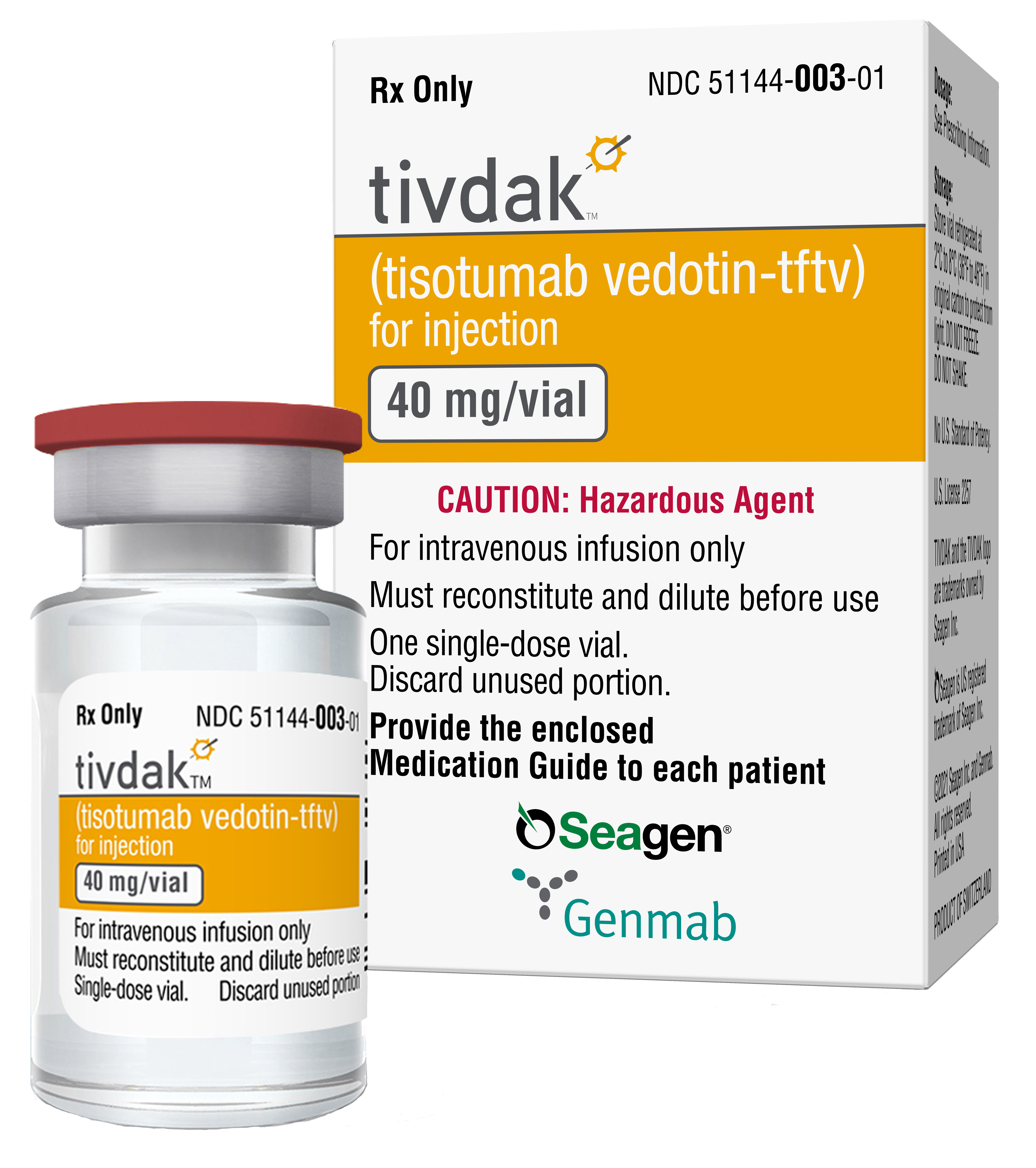
Tivdak®5 (tisotumab vedotin-tftv)
initial approval and launch in the US
for recurrent or metastatic cervical
cancer
DuoBody-based bispecifics
RYBREVANT®2 (amivantamab),
TECVAYLI®2 (teclistamab) and
TALVEY®2 (talquetamab) approval
and launch
DuoBody-based bispecific
EPKINLY®6 (epcoritamab-bysp)/
TEPKINLY®6 (epcoritamab) initial
approvals and launches in relapsed/
refractory diffuse large B-cell
lymphoma (DLBCL) in US, Europe
and Japan
ProfoundBio Inc. (ProfoundBio)
acquisition, including rinatabart
sesutecan (Rina-S®)
Rina-S moves into Phase 3
development in platinum resistant
ovarian cancer (PROC)
Rina-S granted Breakthrough
Therapy designation (BTD) by the
U.S. Food and Drug Administration
(FDA) in advanced endometrial
cancer
EPKINLY approval and launch in
relapsed/refractory follicular
lymphoma (FL) in US, Europe
and Japan
Tivdak approved in Europe and
Japan for recurrent or metastatic
cervical cancer
EPKINLY approval in US in
combination with rituximab and
lenalidomide (R2) for relapsed/
refractory FL
Rina-S expands Phase 3
development into endometrial
cancer and platinum sensitive
ovarian cancer (PSOC)
Genmab acquisition of Merus
N.V. (Merus), including
petosemtamab
1. Developed and commercialized by GlaxoSmithKline (GSK); 2. Developed and commercialized by J&J; 3. Developed and commercialized by Novartis AG (Novartis); 4. Developed and commercialized by Amgen Inc. (Amgen); 5. Co-developed
and commercialized with Pfizer Inc. (Pfizer); 6. Co-developed and commercialized with AbbVie
Page 5a.jpg
Genmab 2025 Annual Report
5
Chair’s Statement
Deirdre P. Connelly
Board Chair
Dear Shareholder,
As we close another successful year, we reflect
on our progress and growth. The past year
has been one of intentional transformation,
marked by a strengthening pipeline and
meaningful steps toward our long-term goals.
Genmab remains committed to its purpose:
to improve the lives of patients with cancer
and other serious diseases through innovative
and differentiated antibody therapeutics.
Genmab’s Evolution
Genmab is celebrating another transformational
year. With the acquisition of Merus, a clinical-
stage biotechnology company with late-stage
breakthrough asset petosemtamab, Genmab
has taken another important step — this
strategic move accelerates our transition to a
fully integrated biotech company. We continue to
strengthen our position as a global leader in
antibody therapeutics, driven by the strength
of our science and our unstoppable team.
Empowering Our People
In this exciting time of change, it is crucial
that Genmab maintains and grows our
team to create value for the years to come.
Our colleagues are the foundation of our
achievements and sustain our innovation.
This year, Genmab surpassed 3,000 employees
in eight countries, reflecting our commitment
to building a diverse, multicultural and high-
performing organization.
Experienced Leadership
In 2025 Genmab further strengthened
its Executive Management team with the
appointment of Greg Mueller as General Counsel
and Chief Legal Officer. Mr. Mueller will lead
global legal affairs, intellectual property rights,
corporate secretary and global compliance and
risk functions. Bringing more than 20 years of
experience, Greg joins a robust leadership team,
guiding Genmab through its next phase of growth
to a fully integrated biotech company.
Our Board of Directors, comprised of experts
in their fields, also saw a change this year.
Michael Kavanagh was elected to the Board
by fellow employees at Genmab’s 2025 Annual
General Meeting, linking the workforce and
Genmab’s governing body.
Looking Ahead
The year ahead will bring new opportunities
and challenges, but with our talented team,
strong leadership, and clear strategic vision,
we are well positioned to continue making
a meaningful difference.
On behalf of the Board, I thank Genmab’s
dedicated team members, Chief Executive
Officer Jan van de Winkel and the global
leadership team for their extraordinary
contributions, and our shareholders for
your continued support.
Sincerely,
Deirdre P. Connelly
Board Chair
Page 6a.jpg
Genmab 2025 Annual Report
6
Letter from the CEO
Jan van de Winkel
Ph.D. President & CEO
Dear Shareholder,
As we look back on 2025, I am proud of how
Genmab advanced our strategy, strengthened
our foundation, and stayed true to our purpose:
improving the lives of patients through
innovative, differentiated antibody medicines.
We entered the year focused on disciplined
execution and ended it poised for our next
decade of sustainable growth.
Acquisition of Merus
A pivotal step on that journey is our acquisition of
Merus. This transaction enhances our late-stage
portfolio with petosemtamab, a potential
first-in-class bispecific for head and neck cancer
with two BTDs from the FDA, reflecting its
potential to meaningfully improve outcomes
for patients.
Importantly, Merus strengthens, not changes,
our strategy as it accelerates our shift toward
a fully integrated, 100%-owned medicines
model. The addition of petosemtamab to
our pipeline diversifies our sources of future
revenue, reduces our dependence on royalties
over time, and enhances our flexibility to
invest in the “next winners” emerging from
our research and development (R&D) engine.
With petosemtamab joining EPKINLY
(epcoritamab) and Rina-S, we have a strong
pipeline of late-stage assets that will provide
us with multiple value-creating catalysts in the
coming years.
Transforming Science
Into Medicine
Our late-stage portfolio made meaningful strides
in 2025. EPKINLY continued to demonstrate
the potential to become a core therapy in B-cell
lymphomas with its FDA approval in second-line
FL in combination with R2, as well as the
unprecedented data in this indication, highlighted
during an oral presentation at the 2025
prestigious American Society of Hematology
(ASH) Annual Meeting. Together, these
milestones move treatment into earlier lines of
therapy and expand our impact for people living
with FL.
Our other commercialized medicine, Tivdak
(tisotumab vedotin), was approved in Europe
and Japan for recurrent or metastatic cervical
cancer after prior therapy, and these became
our first independent Genmab launches.
These launches, and the offices we have
now opened in Germany, the United Kingdom
(UK) and France, lay the groundwork for a
broader Genmab commercial footprint and
deepen our commitment to the gynecologic
oncology community.
We will further build on this commitment
with our advancement of Rina-S. In addition
to encouraging clinical data presented in both
PROC and endometrial cancer, the FDA granted
BTD for Rina-S in 2025, in recurrent or
progressive endometrial cancer. This support
from the FDA provides confidence for our
expanded development for Rina-S, as we
ended the year with three Phase 3 trials
across PROC, endometrial cancer and PSOC.
Page 7c.jpg
Genmab 2025 Annual Report
7
Letter from the CEO
A Strong Financial Foundation
To Enable Our Evolution
Our financial performance this year has been
a testament to the strength of our strategy.
Revenue grew significantly, driven by royalties
from our collaborations as well as sales of our
own medicines. We anticipate this trend will
continue into the future. We look forward to
both expanded indications for EPKINLY and
the potential for Rina-S and petosemtamab
to launch in 2027, as well as due to the
expansion of our royalty medicines. In 2025,
J&J’s subcutaneous (SC) DARZALEX
(daratumumab and hyaluronidase fihj) became
the first and only treatment approved in both
the US and Europe for patients with high-risk
smoldering multiple myeloma. The landmark
approvals support earlier intervention before the
disease progresses to active multiple myeloma.
Also this year Novo Nordisk A/S (Novo Nordisk)
submitted a Biologics License Application (BLA)
to the FDA for Mim8, also known as denecimig,
a DuoBody-based investigational prophylaxis
treatment for people living with hemophilia A
with or without inhibitors. If approved, denecimig
would become the ninth approved medicine
created using Genmab’s technology and
innovation.
Acknowledgments and Outlook
Looking ahead, our priorities are clear:
Integrate Merus to preserve momentum on
the petosemtamab program and prepare for
potential launch in 2027.
Accelerate the development of our late-stage
pipeline, delivering key clinical readouts
across our late-stage portfolio, especially
for epcoritamab and Rina-S, while preparing
for potential label expansions and launches.
Continue to deliver on our capital allocation
priorities, maintaining financial discipline
while focusing our investments on the
highest-growth opportunities.
With EPKINLY, Rina-S and petosemtamab,
we believe Genmab is positioned to deliver
multiple potential launches and label expansions
over the next several years, deepen our
leadership in antibody innovation, and create
durable, long-term value.
Our progress this year reflects the passion of our
people, the strength of our partnerships, and the
confidence of our shareholders. Looking ahead,
we are energized by the opportunities before us.
With a resilient financial foundation, a
world-class team, and a differentiated late-stage
pipeline, we believe Genmab is positioned to
deliver durable growth and, most importantly,
better futures for patients in the years ahead.
Sincerely yours,
Jan van de Winkel, Ph.D.
President & CEO
Page 8a.jpg
Home icon Green.jpg
Genmab 2025 Annual Report
8
2025 at a Glance
Operational
EPKINLY (epcoritamab-bysp) moves into
earlier lines of therapy in FL with FDA
approval in combination with R2, based
on Phase 3 EPCORE® FL-1
Epcoritamab Phase 3 EPCORE FL-1 trial met
dual primary endpoints of overall response
rate (ORR) and progression free survival
(PFS), demonstrating statistically significant
and clinically meaningful differences in both
endpoints, basis for global regulatory
submissions
Acquisition of Merus, including its late-stage
breakthrough therapy asset petosemtamab,
which provides additional transformational
opportunity
Tivdak (tisotumab vedotin) approved in Europe
and Japan for recurrent or metastatic cervical
cancer, first independent Genmab launches,
laying groundwork for future
Rina-S expands Phase 3 development beyond
PROC, into endometrial cancer and PSOC
Rina-S granted BTD by the FDA
Approvals in the US and Europe for J&J
therapy, SC DARZALEX in smoldering
multiple myeloma
Submission of BLA for Novo Nordisk’s
DuoBody-based denecimig
Continued development of Genmab’s
broader organizational infrastructure with the
addition of over 300 new colleagues
Sustainability
Environmental
Achieved a 56% reduction in Scope 1
and market-based Scope 2 greenhouse
gas (GHG) emissions 
Achieved 99% renewable electricity
across all sites
Developed a sustainability roadmap
to meet both short- and long-term
GHG emission reduction targets
Social
Met life sciences industry benchmark
for favorability rate and exceeded for
participation rate for Global Employee
Engagement Survey
Rate of recordable work-related accidents
Financial
Operating Profit
USD
USD
USD
(USD Million)
20.5B
3,720M
2,219M
2025 year-end market cap
2025 revenue
2025 adjusted operating
expenses1, 72% invested in
R&D
Liquidity and Capital Resources
USD
USD
1,715M
5,847M
Cash and cash equivalents
Shareholders’ equity
1.Operating Expenses exclude 2025 charges related to: 1) acquisition and integration-related charges of $185 million and 2) amortization of intangible assets acquired through
acquisitions of $13 million.
(accidents per million hours worked) at 0.4
100% of eligible team members with
access to year-end performance process
41781441855556
Training available to all team members
at varying degrees
Governance
Code of Conduct applies to all Genmab
team members
Page 9.jpg
Consolidated Key Figures
(USD Millions)
2021
2022
2023
2024
2025
Income Statement
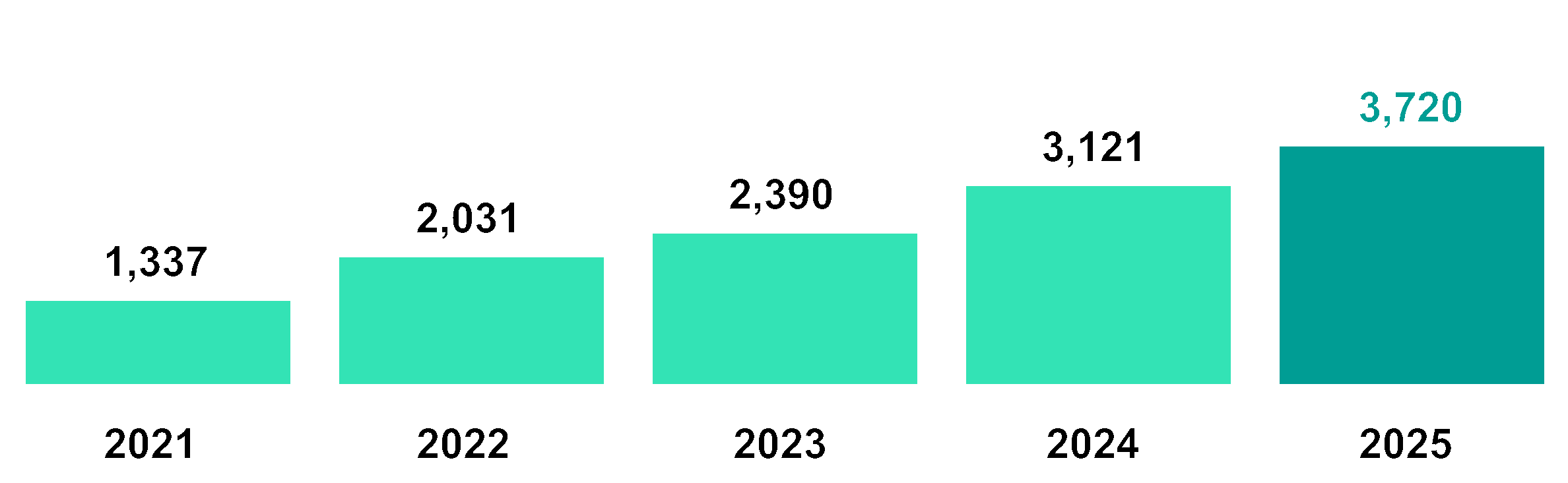
Revenue
1,337
2,031
2,390
3,121
3,720
Cost of product sales
(33)
(143)
(238)
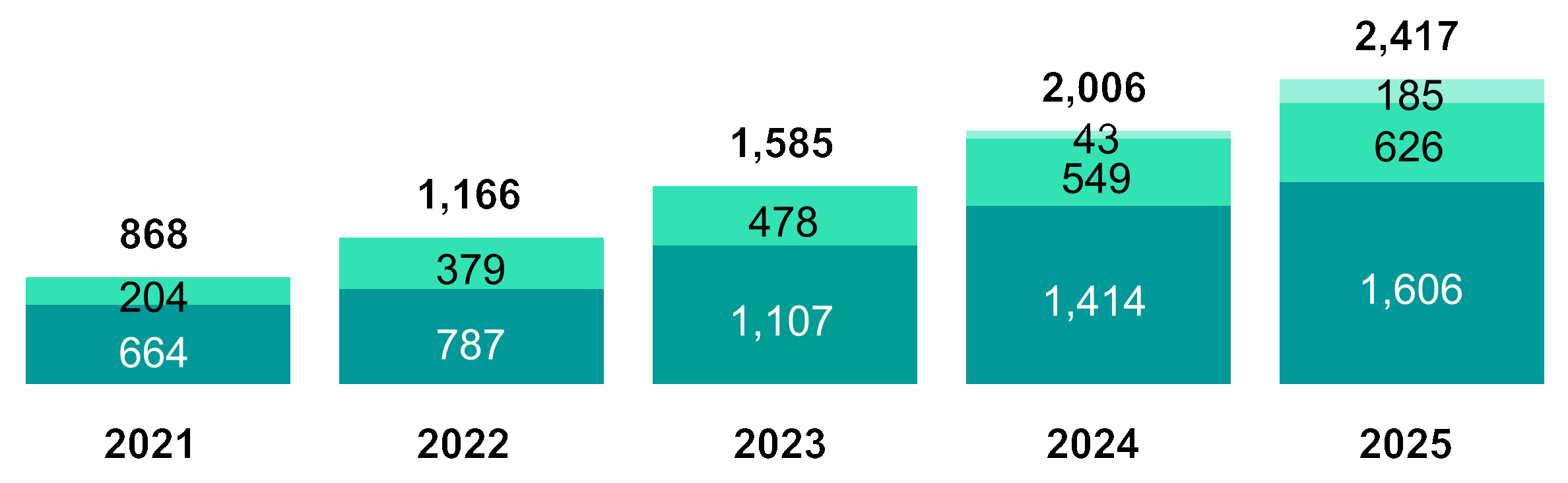
Research and development expenses
(664)
(787)
(1,107)
(1,414)
(1,606)
Selling, general and administrative
expenses
(204)
(379)
(478)
(549)
(626)
Acquisition and integration related
charges
(43)
(185)
Total costs and operating expenses
(868)
(1,166)
(1,618)
(2,149)
(2,655)
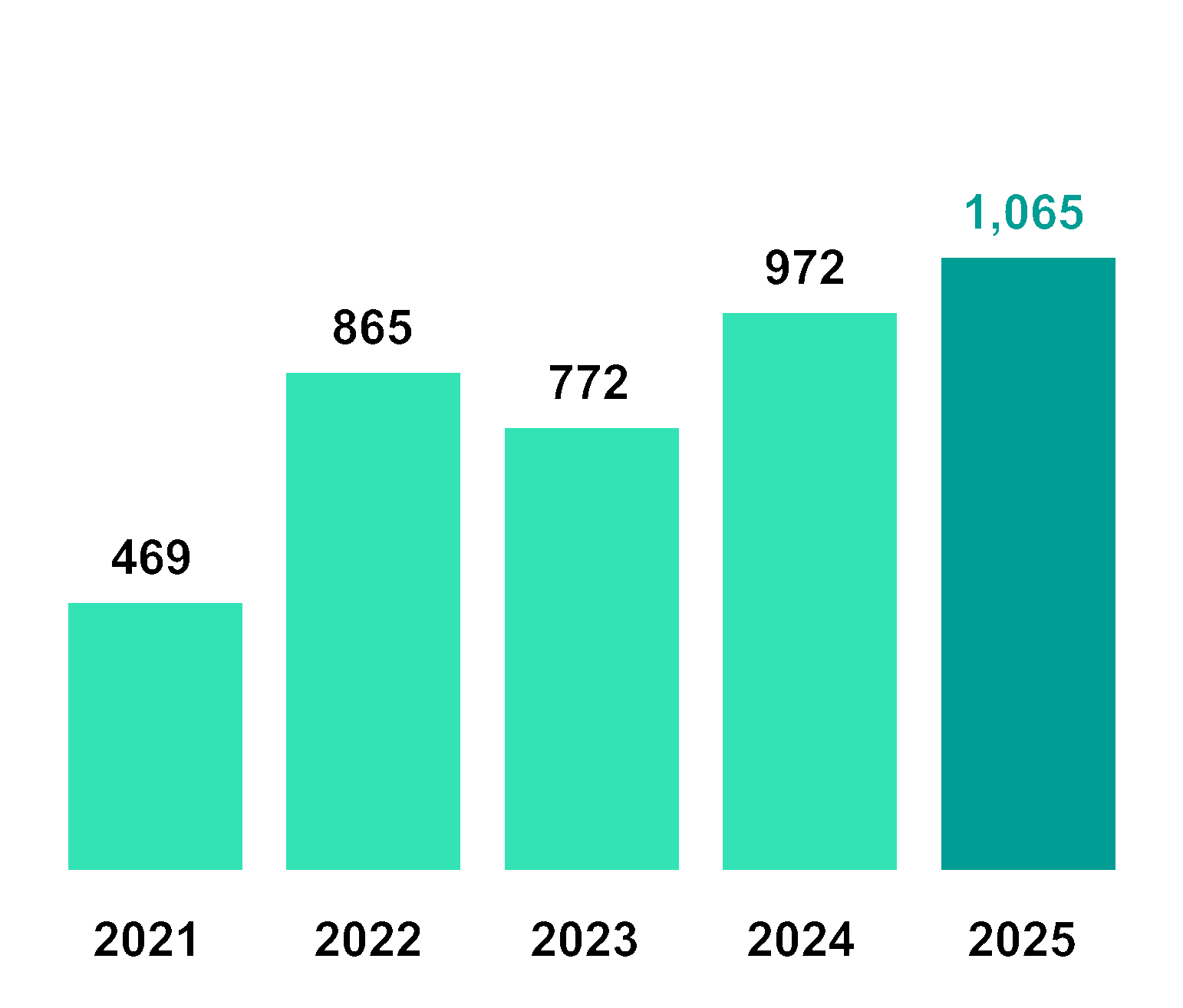
Operating profit
469
865
772
972
1,065
Net financial items
153
96
45
354
139
Net profit
470
750
631
1,133
963
Balance Sheet
Total non-current assets
300
273
320
2,514
9,988
Marketable securities
1,650
1,783
1,967
1,574
Cash and cash equivalents
1,423
1,419
2,204
1,380
1,715
Total assets
3,899
4,321
5,232
6,414
12,873
Borrowings
5,274
Share capital
10
10
10
10
10
Shareholders' equity
3,405
3,915
4,687
5,137
5,847
Cash Flow Statement
Investment in acquisitions, net of cash
acquired
(1,783)
(7,215)
Cash flow from operating activities
354
555
1,071
1,126
1,186
Cash flow from investing activities
(153)
(392)
(185)
(1,447)
(5,643)
Cash flow from financing activities
(67)
(110)
(89)
(566)
4,789
Investments in intangible assets
(1)
(17)
(18)
Investments in tangible assets
(40)
(45)
(53)
(27)
(37)
Financial Ratios and Other
Information
Basic net profit per share
7.19
11.47
9.67
17.66
15.50
Diluted net profit per share
7.12
11.36
9.58
17.53
15.37
Year-end share market price
2,630.00
2,941.00
2,155.00
1,492.50
2,027.00
Price/book value
7.72
7.51
4.60
2.91
3.47
Shareholders' equity per share
340.50
391.50
468.70
513.70
584.70
Equity ratio
87%
91%
90%
80%
45%
Shares outstanding
65,718,456
65,961,573
66,074,535
66,187,186
64,238,408
Average number of employees (FTE)¹
1,022
1,460
2,011
2,535
2,694
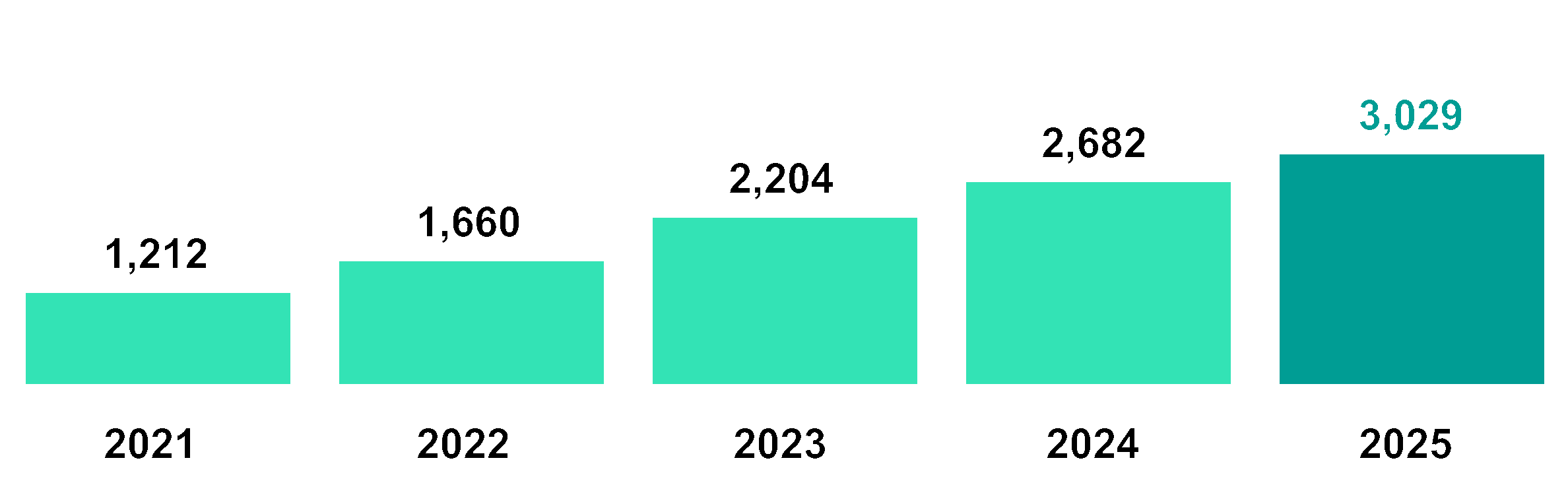
Number of employees (FTE) at year-end
1,212
1,660
2,204
2,682
3,029
Revenue
(USD million)
73
Operating Expenses
(USD million)
75
n
Research and development
expenses
n
Selling, general and
administrative expenses
n
Acquisition and integration
related charges
FTE at Year End
77
1.Full-time equivalent (FTE) or team member
Page 10a.jpg
2026 Outlook
(USD millions)
2025 Actual
Result
2025 Adjusted
Result2
2026 Guidance2
2026 Guidance
Mid-Point2
Revenue
3,720
3,720
4,065 - 4,395
4,230
Royalties
3,102
3,102
3,440 - 3,685
3,563
Net product sales/
Collaboration
revenue1
468
468
490 - 555
522
Milestones/
Reimbursement
revenue
150
150
135 - 155
145
Gross profit
3,482
3,482
3,810 - 4,110
3,960
Operating expenses
(2,417)
(2,219)
(2,710) - (2,910)
(2,810)
Operating profit
1,065
1,263
900 - 1,400
1,150
1.Net product sales and collaboration revenue consists of EPKINLY net product sales in the US and Japan, and
Tivdak ex-US net product sales plus Genmab's share of US gross profits.
2.Operating expenses and operating profit exclude 2026 and 2025 charges related to: 1) acquisition and
integration-related charges of $65 million and $185 million, respectively, and 2) amortization of intangible assets
acquired through acquisitions of $45 million and $13 million, respectively.
Revenue
Genmab expects its 2026 revenue to be in the
range of $4.1 - 4.4 billion, compared to $3.7 billion
in 2025.
Genmab’s projected revenue growth for 2026 is driven
by higher royalties, net product sales and collaboration
revenue. Royalty growth relates mainly to DARZALEX
and Kesimpta net sales growth. Net product sales and
collaboration revenue growth is driven by strong
performance for both EPKINLY and Tivdak. Net
product sales and collaboration revenue consists of
EPKINLY net product sales in the US and Japan, and
Tivdak ex-US net product sales plus Genmab's share
of US gross profits.
Genmab’s projected revenue for 2026 primarily
consists of DARZALEX royalties of approximately
$2.7 billion at the midpoint. Such royalties are
based on estimated DARZALEX 2026 net sales of
$15.6 - 16.4 billion compared to actual net sales in
2025 of $14.3 billion. DARZALEX royalties are
partly offset by Genmab’s share of J&J’s royalty
payments to Halozyme Therapeutics, Inc.
(Halozyme) in connection with SC net sales as well
as royalty reduction in countries and territories
where there is no Genmab patent coverage.
The remainder of Genmab’s revenue consists
primarily of royalties from Kesimpta, TEPEZZA,
RYBREVANT, TECVAYLI, TALVEY and TEPKINLY,
net product sales and collaboration revenue
from EPKINLY and Tivdak, reimbursement
revenue and milestones.
Operating Expenses
Genmab anticipates its 2026 operating expenses to
be in the range of $2.7 - 2.9 billion, compared
to $2.2 billion in 2025. The increase in operating
expenses is primarily related to investments in
late-stage programs and launch readiness in
key markets.
Operating Profit
Genmab expects its 2026 operating profit to be
in the range of $0.9 - 1.4 billion, compared to
$1.3 billion.
Outlook: Risks and Assumptions
In addition to factors already mentioned, the
estimates above are subject to change due to
numerous reasons, including but not limited to: the
achievement of certain milestones associated with
Genmab’s collaboration agreements; the timing and
variation of development activities (including
activities carried out by Genmab’s collaboration
partners) and related income and costs;
DARZALEX, DARZALEX FASPRO, Kesimpta,
TEPEZZA, RYBREVANT, TECVAYLI, TALVEY and
TEPKINLY net sales and royalties paid to Genmab;
changing rates of inflation; and currency exchange
rates (the 2026 guidance assumes a USD/DKK
exchange rate of 6.2). The financial guidance
assumes that no significant new agreements are
entered into during 2026 that could materially affect
the results.
The factors discussed above, as well as other
factors that are currently unforeseeable, may result
in further material adverse impacts on Genmab’s
business and financial performance, including
unfavorable impacts on the sales of Tivdak and
EPKINLY/TEPKINLY, and on the net sales of
DARZALEX, Kesimpta, TEPEZZA, RYBREVANT,
TECVAYLI, and TALVEY by Genmab’s collaboration
partners and on Genmab’s royalties, collaboration
revenue and milestone revenue therefrom.
Page 12.jpg
Who We Are
Our Core Values
In our quest to turn science into medicine, we
use these guideposts to transform the future of
cancer treatment:
Passion for innovation
Determination — being the best at
what we do
Integrity — we do the right thing
We work as one team and respect each other
Our Key Accomplishments
Each of our achievements stands as evidence
of our unyielding determination, including:
Two Genmab co-owned medicines on the
market: Tivdak with Pfizer and EPKINLY/
TEPKINLY with AbbVie
Six additional medicines that were created
by Genmab, or that leverage Genmab’s
DuoBody technology, are being developed
and marketed by global pharmaceutical
and biotechnology companies
Late-stage pipeline with high potential: EPKINLY,
Rina-S and petosemtamab
Suite of proprietary antibody technologies
including bispecifics and antibody-drug
conjugate (ADC) platform technologies
fueling future innovations
Robust clinical and preclinical pipeline fueling
future growth
Over 45 Investigational New Drugs (IND) filed by
Genmab and/or partners, based on Genmab’s
innovations and technology, since 1999
Industry-leading team with antibody know-how,
and expertise in R&D and commercial fields
Partnerships with industry leaders and
innovators across the innovation ecosystem
of pharma, biotech and academia
Partnership with ChatGPT to launch
“AI Everywhere,” providing ChatGPT
access to our teams
Solid financial foundation enabling our
evolution to a fully integrated biotech
Building and expanding our capabilities
with more than 3,000 team members
across our international locations
Genmab’s Growing Organization
and Presence
Utrecht, The Netherlands
Discovery and Antibody Research
Translational and Quantitative Sciences
Development Operation
Copenhagen, Denmark
Headquarters
Chemistry, Manufacturing and
Controls (CMC) Operations
Development Operations
Quality Control (QC) Laboratory
Princeton, US
Translational and
Quantitative Sciences
Clinical development
Development Operations
U.S. Market Operations
Cambridge, US
Late-stage clinical
development
Enabling functions
Suzhou and Shanghai,
China
Early-stage R&D
CMC Operations
Tokyo, Japan
Development Operations
Japan Market Operations
European Union
(EU) Market Offices
Munich
Paris
London
Page 12a.jpg
Business Model
At Genmab, we have built
a profitable and successful
biotech that creates value
for our stakeholders.
Our Strengths and
Differentiators
World-class antibody biology knowledge
and insight into disease targets
Discovery and development engine
with proprietary technologies that allow us to build a
differentiated pipeline
In-house expertise with a solid track record of building
successful strategic partnerships
Pipeline of potential best-in-class and/or
first-in-class therapies
Experienced, diverse leadership team
Business Strategy
Build a profitable and successful biotech
Maintain a flexible and capital-efficient model
Maximize relationships with partners
Retain ownership of select products
Focus on core competence
Identify the best disease targets
Develop unique first-in-class or
best-in-class antibodies
Develop next-generation technologies
Turn science into medicine
Create differentiated antibody therapeutics
with significant commercial potential
  Building a Fully Integrated Biotech Innovation Powerhouse
Translational
and precision
medicine, data
science and artificial
intelligence (AI)
Key to accelerating
development and ensuring
the right therapies get to
the right patients
Team
Deeply driven
One Genmab team
rooted in science and
inspired by patients
Research
Track record of success
and investing for tomorrow
Development
Scaled up capabilities to expand
from early- to late-stage development
Technical Operations
and Commercialization
Capabilities in place to support
commercialized medicines
Enabling functions:  Supporting growth and managing risk
Strong financials
Growing revenues,
strategic prioritization and
focused investments
Collaboration
Reaches across the
innovation ecosystem
of pharma, biotech and
academia, and drives
our business forward
Page 14.jpg
Value Chain
Value Chain_Graphic 2025_v2 extended copy.gif
Genmab’s value chain encompasses
the full journey from discovery to global
commercialization of innovative antibody-based
therapies. Each stage is designed to drive
scientific excellence, ensure product quality,
and deliver value to patients, partners, and
shareholders.
Research & Development
Our value chain begins with research and
discovery, where disease-related targets—
primarily in oncology—are identified and
proprietary antibody technologies, including
DuoBody, HexaBody®, and ADC platforms, are
applied to design and optimize novel antibody
candidates. These candidates progress to
preclinical development, where they are
rigorously evaluated for safety, efficacy, and
therapeutic potential prior to advancement
into human studies. Clinical development
then assesses safety, dosage, and efficacy in
patients and achieve Proof of Concept. Where
appropriate, we engage strategic partners to
co-develop and co-fund clinical programs,
enabling risk sharing across the value chain.
Technical Operations
In manufacturing, Genmab focuses on
developing scalable efficient, and sustainable
production processes. While we partner with
contract manufacturing organizations (CMOs) for
manufacturing and production, we maintain strict
oversight and quality control to ensure product
consistency and compliance with global
standards.
Commercialization
Genmab pursues regulatory approval with
authorities such as the European Medicines Agency
(EMA), FDA, and the Ministry of Health, Labor
and Welfare (MHLW), paving the way for
product launch.
Our commercialization activities include market
access strategies, engagement with payors and
healthcare professionals, and distribution through
our own network or in collaboration with partners.
Continuous pharmacovigilance ensures
the ongoing safety and effectiveness of
our marketed therapies.
Partnerships and Alliances
Partnerships and alliances are integral to our
value chain. Through licensing of our proprietary
technologies, co-development arrangements,
and strategic collaborations. Genmab expands
its innovative ecosystem, advances its pipeline, and
generates sustainable revenue through upfront
payments, milestones, and royalties.
Refer to section SBM-2 in the sustainability
statements for details of key stakeholders
including a mapping to Genmab’s value chain.
Refer to the Sustainability Statements within
this Annual Report for material topics identified
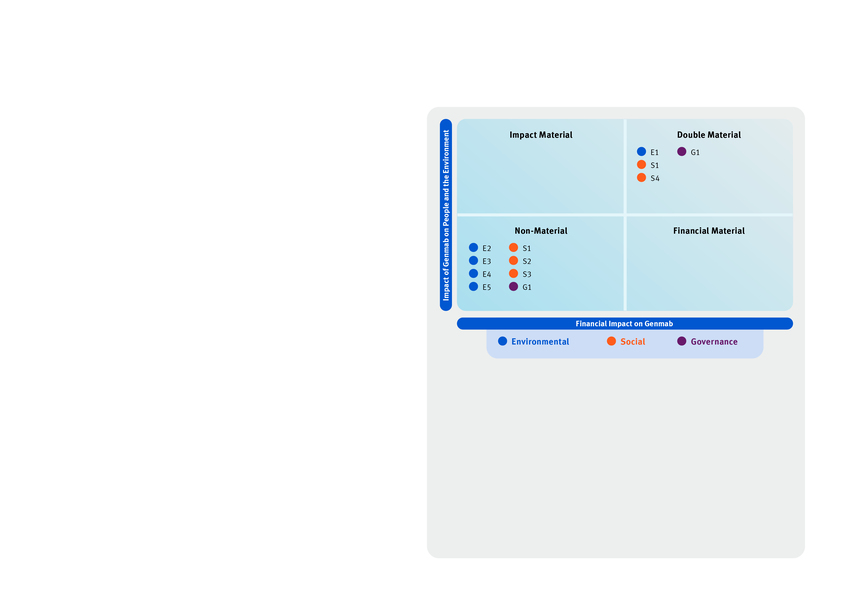
as part of Genmab’s Double Materiality
Assessment (DMA). The visual maps the
material topics to Genmab’s value chain.
Refer to the Who We Are section for Genmab’s
presence.
Page 14a.jpg
Research and Development Capabilities
Inspired by Nature
At Genmab, we are inspired by nature and understand
how antibodies work. We are deeply knowledgeable about
antibody biology and our scientists harness this expertise to
create and develop differentiated investigational antibody
medicines. We utilize a sophisticated and highly automated
process to efficiently generate, select, produce, and evaluate
antibody-based products. Our teams have established a fully
integrated R&D enterprise and streamlined process to
coordinate the activities of antibody product discovery,
preclinical testing, manufacturing, clinical trial design and
execution, and regulatory submissions across Genmab’s
international operations. We have expanded our scientific focus
to use data science and AI to aid in the discovery of new targets
and biomarkers and bolster our in-depth precision medicine and
translational laboratory capabilities. Through our expertise in
antibody drug development, we pioneer technologies that allow
us to create differentiated and potentially first-in-class or best-
in-class investigational medicines with the potential to improve
patients’ lives. Our antibody expertise has enabled us to create
our cutting-edge technology platforms: DuoBody, HexaBody,
DuoHexaBody® and HexElect®. With our acquisition of
ProfoundBio we gained novel ADC technology platforms.
We gained additional proprietary technology platforms as part of
our acquisition of Merus. Additional information about our
technologies is available on Genmab’s website, genmab.com/
antibody-science/antibody-technology-platforms.
Page 17.jpg
Research and Development Capabilities
Sustainable and State-of-the-Art Facilities
The Netherlands 
In the Netherlands, Genmab operates from
two adjoined state-of-the-art buildings at the
Utrecht Science Park—the Genmab research
and Development Center (GRDC) and the
Accelerator. Mainly discovery, translational and
CMC research is conducted at these facilities,
which house state-of-the-art laboratories,
including a new chemistry lab that opened at the
GRDC in 2024. The GRDC was one of the first
Building Research Establishment Environmental
Assessment Method (BREEAM) Excellent
laboratory buildings in the Netherlands. The
Accelerator, a multi-tenant ultra-modern R&D
facility, was opened in 2023, enabling our
continued R&D growth trajectory. These two
spaces are located in close proximity to premier
universities, academic medical centers and other
life science companies. They accommodate
modern auditoriums, and innovative
brainstorming and meeting rooms. They provide
a bright, open, and collaborative atmosphere
and enable the Genmab team to continue to
innovate and create new ways to help patients.
Denmark
Denmark, with its rich history of scientific
achievement and innovation, has been home to
Genmab's headquarters for more than 25 years.
We are surrounded by a vibrant ecosystem of
talent, with multiple biotech and pharma peers,
academia and research centers, knowledge, and
resources. Genmab opened our new headquarters
in Valby, Denmark in 2023, a space designed
specifically for Genmab. In addition, Genmab
introduced our own Good Manufacturing Practice
(GMP) QC laboratory in 2023. The new space
insources certain business-critical processes and
capabilities for our early clinical development. With
our growing pipeline and commercial ambitions, we
are taking control of processes, prioritization,
people, and timing and taking another tremendous
step toward becoming an end-to-end biotech
innovation powerhouse.
United States
Genmab opened a new US facility in 2020, which
was subsequently expanded in 2025. This space,
modeled on the open and collaborative spirit of the
R&D labs and offices in Utrecht, includes both
offices and laboratories. The U.S. translational and
quantitative laboratories allow Genmab to expand
our preclinical and clinical drug development
expertise and are part of the strategic growth of the
Company. As with our Utrecht facilities, our U.S.
office and laboratories were designed and built with
sustainability in mind and meet the requirements for
Leadership in Energy and Environmental Design
(LEED) Gold certification for sustainable design
features.
Japan
Genmab’s Japan office is located in Roppongi,
an international business district in the center
of Tokyo. It offers an open and collaborative
environment that fosters Genmab’s culture
of innovation and teamwork.
China
As part of our acquisition of ProfoundBio,
Genmab expanded our presence with
state-of-the-art ADC research and CMC
capabilities in Suzhou, China.
Europe
In 2025 and 2026 we opened Market offices
in Munich, Germany, London, UK and
Paris, France.
As Genmab continues to grow our
geographical footprint, we will endeavor to
do so with minimal impact to the environment
and with a focus on sustainable practices.
Expanding the Reach of Our Medicines
A fully integrated biotech
delivering for patients
around the world
This year, we accelerated our transformation into
a fully integrated biotechnology company—one
designed to deliver meaningful, antibody-based
medicines to patients at scale. We reached more
patients than ever before, reflecting the growing
global impact of our science and our ability to
reliably bring innovation to the people who
need it most.
Our medicines have achieved leading positions
worldwide, reaching more than 13,000 patients
through 2025. We also celebrated a major
milestone with our first independently led launches,
and expanded our operations into France,
Germany, and the UK, supported by
extra[not]ordinary® talent and capabilities that
position us to extend our reach and impact even
further in the years ahead.
Driving Meaningful
Progress in Lymphoma
EPKINLY (epcoritamab) continued to redefine
what’s possible for patients as the only bispecific
antibody with indications in both FL and DLBCL
in the U.S., Europe, and Japan.
In February, EPKINLY became the first bispecific
therapy approved in Japan for 3L+ relapsed/
refractory FL, marking the medicine’s second
indication in the country and reinforcing its growing
global presence.
In November, EPKINLY in combination with R2
became the first bispecific-based therapy to enter
earlier lines of FL treatment with FDA approval in
relapsed/refractory FL. This approval has the
potential to broaden access to this bispecific-based
treatment across sites of care, including community
settings closer to where patients live. A submission
for this indication was also filed in Japan in
November.
Building on its established role as a later-line
monotherapy option, this progress underscores
EPKINLY’s potential to become a core therapy for
B-cell malignancies, demonstrating meaningful
benefit both as a single agent and in combination,
as well as in earlier stages of disease.
With regulatory approvals now in more than 65
countries and ongoing Phase 3 studies across
multiple lymphoma histologies and lines of therapy,
EPKINLY is well-positioned to continue expanding
its reach to more patients around the world.
Follicular Lymphoma
Follicular lymphoma is the second most
common non-Hodgkin lymphoma and is
considered incurable, underscoring the
need for new treatments.
CeMe_Logo.jpg
Cervical Cancer Support:
CeMe™
The CeMe campaign in the U.S., created
with Pfizer, creates connection and
community for those affected by cervical
cancer.
“To be diagnosed with cervical cancer…
knocked the wind out of me,” said Karen.
“Sharing your story… lets people know
that there are other people out there that
can support you.”
youtube.com/cemestories
Working to Improve
Outcomes in Gynecologic
Cancers
Genmab’s commitment to patients with gynecologic
cancers is rooted in a simple belief: people facing
these diseases deserve better options. We are
working to deliver on that promise by expanding
access to Tivdak (tisotumab vedotin) today, while
advancing a pipeline of potential therapies for
tomorrow.
Cervical cancer remains the fourth leading cause of
cancer-related death among women worldwide.
The need for improved treatments is particularly
urgent in Japan, where both incidence and mortality
have risen in recent years, especially among
women under 50. In Europe, despite advances in
prevention and early detection, there remains a
significant unmet need for effective treatments for
advanced-stage disease.
Approved in the U.S. in 2021, Tivdak transformed
the treatment landscape for advanced cervical
cancer, offering a new standard of care where
options were limited. In 2025, Tivdak achieved
additional regulatory approvals in the EU, Japan,
and the UK, marking the start of a new chapter in
its global reach.
Tivdak also continues to catalyze our evolution into
a fully integrated, end-to-end company. It was the
first medicine we launched in partnership and
continues to set the course for how we bring
medicines to patients. The launch of Tivdak in
Japan, the first executed independently by
Genmab, represents a major step toward our
ambition to bring our own medicines to market.
Expanding the Reach of Our Medicines
In September, Tivdak became available in
Germany, marking our first commercial launch in
Europe and establishing the foundation for our
expanding regional footprint, including new
operations in France, Germany, and the
United Kingdom.
With increasing global access to Tivdak and strong
patient uptake, Genmab is building a robust
foundation for broader impact across gynecologic
cancers as we continue to advance our innovative
pipeline with investigational assets like Rina-S that
could broaden our reach to areas including ovarian
and endometrial cancers.
Tivdak
Tivdak is the first and only ADC
approved in the US, Europe, and Japan
for the treatment of recurrent or
metastatic cervical cancer after prior
therapy and is the only ADC with
demonstrated overall survival data in
this setting compared to chemotherapy.
Ensuring Rapid and
Sustainable Access to
Our Medicines
We are focused on our pursuit to turn innovative
science into medicines that create value and
provide meaningful impact to patients and
health systems.
Ultimately, we positively impact the lives of people
with cancer when our science becomes medicine,
our medicine creates value, and the value of our
medicine is realized by patients who can benefit.
Patient access and affordability are key
components of this.
We aim to ensure patients have timely access to
our medicines, regardless of their socioeconomic or
insurance status. Our pricing approach balances
this commitment to access with the value of our
innovations and our ability to invest in the
breakthrough science of the future.
Together with our partners, we work with local
country regulatory and payer authorities in the U.S.,
Japan, and throughout Europe to facilitate
registration and reimbursement to help enable
patient access to our medicines around the
world. At the same time, we fundamentally
believe that global, sustainable access requires fair
contribution among developed nations towards
innovation costs. For the global innovation
ecosystem to thrive and for patients to benefit,
value and pricing mechanisms must recognize the
different healthcare infrastructures and economic
contexts of individual markets.
We understand that true patient impact happens
when our medicines reach the patients who need
them. In the U.S., MyNavCare Patient Support® by
Genmab was created to offer support services to
patients prescribed Genmab medicines to help
them navigate each step of their unique
treatment journey.
Our Approach to Value, Access,
and Pricing
Value: The value of our medicines is
driven by our innovative science.
Access: Patient impact happens when
our medicines reach the people who need
them and help them live better.
Pricing: The price of our medicines
reflects the innovation behind our science,
its impact on patients, and our
commitment to bringing that science
to patients.
Elevating Patient Voices
Our Patient Advisory Council gives
patients a seat at the table, ensuring
their insights and experiences will help
guide our work, from trial design to how
we support and deliver our medicines.
“Serving on Genmab’s Patient Advisory
Council means the patient voice will
have a direct influence on what comes
next,” said Jim Zervanos. “It’s
empowering and inspiring to know my
experience will help shape decisions
that can benefit others like me.”
Page 20b.jpg
Page 21.jpg
Antibody
Discovery and
ADC/Immunocytokine
Designer Polyclonals/
Bispecifics
Development
We are experts in antibody discovery and development. Our
appreciation for, and understanding of, the power of the human
immune system gives us a unique perspective on how to respond to
the constant challenges of oncology drug development. We entered
a new chapter in Genmab’s evolution with the commercialization
and launch of our first medicine, Tivdak, co-owned with Pfizer,
in 2021, and we successfully launched our second medicine,
EPKINLY/TEPKINLY, in 2023 under our collaboration with AbbVie.
As part of our shift into a fully integrated biotech we also have wholly
owned programs in Phase 3 development.
Half-Life Extended/Inert/
Fc-Enhanced/Isotypes
Page 19a.jpg
Products and Technologies
Pipeline
At the end of 2025, Genmab’s proprietary pipeline of
investigational medicines, where we are responsible for at least
50% of development, consisted of five antibody products in
active clinical development. Our approved medicines are
EPKINLY/TEPKINLY, which Genmab is co-developing and   
co-commercializing in the US and Japan in collaboration with
AbbVie and Tivdak, which Genmab is co-developing globally
and co-promoting in the US in collaboration with Pfizer and
exclusively by Genmab outside of the US and China. In addition
to our own pipeline, there are multiple investigational medicines
in development by global pharmaceutical and biotechnology
companies and six approved medicines powered by Genmab’s
technology and innovations. BIZENGRI® (zenocutuzumab-zbco)
was also added to our portfolio of royalty medicines as part of
our acquisition of Merus. Beyond the investigational medicines
in active clinical development, our pipeline includes multiple
promising preclinical programs. An overview of the development
status of our approved medicines and our late-stage
investigational medicines is provided in the following sections.
Detailed descriptions of dosing and efficacy and safety data
from certain clinical trials have been disclosed in company
announcements and media releases published via the Nasdaq
Copenhagen stock exchange and may also be found in
Genmab’s filings with the U.S. Securities and Exchange
Commission (SEC). Additional information is available on
Genmab’s website, genmab.com. The information accessible
through our website is not part of and is not incorporated by
reference herein.
Page 20a.jpg
Products and Technologies
 
Genmab’s Proprietary1 Products
Approved Medicines
Approved Product
Target
Developed By
Disease Indication(s)2
EPKINLY
(epcoritamab-bysp, epcoritamab)
TEPKINLY
(epcoritamab)
CD3xCD20
Co-development
Genmab/AbbVie
Approved in multiple territories including the US and Europe for adult patients with relapsed or refractory DLBCL after
two or more lines of systemic therapy and in Japan for adult patients with certain types of relapsed or refractory large   
B-cell lymphoma (LBCL) after two or more lines of systemic therapy
Approved in multiple territories including the US, Europe and Japan for adult patients with relapsed or refractory FL after
two or more lines of systemic therapy
Approved in multiple territories including the US in combination with R2 for the treatment of adult patients with relapsed or
refractory FL, following at least one prior systemic therapy
Tivdak
(tisotumab vedotin-tftv, tisotumab
vedotin)
TF
Co-development Genmab/
Pfizer
Approved in territories including the US, Europe and Japan for adult patients with recurrent/metastatic cervical cancer
with disease progression on or after chemotherapy
1.Approved and investigational medicines where Genmab has ≥50% ownership, in co-development with partners as indicated.
2.Refer to local country prescribing information for precise indication and safety information.
Page 20a.jpg
Products and Technologies
Pipeline in Active Clinical Development, Including Further Development for Approved Medicines
Product
Developed By
Target(s)
Technology
Disease Indications
Most Advanced Development Phase
Preclinical
1
2
3
Epcoritamab
Co-development
Genmab/AbbVie
CD3, CD20
DuoBody
Relapsed/refractory DLBCL
Relapsed/refractory FL
First line DLBCL
First line FL
Non-Hodgkin lymphoma (NHL)
Relapsed/refractory chronic lymphocytic leukemia (CLL) & Richter's
Syndrome
Aggressive mature B-cell neoplasms in pediatric patients
Rinatabart
Sesutecan
(Rina-S,
GEN1184)
Genmab
Folate receptor alpha
(FRα)
ADC
PROC
Endometrial cancer
PSOC
NSCLC
Solid tumors
Petosemtamab
Genmab
Epidermal growth factor receptor
(EGFR), leucine-rich repeat-containing
G-protein coupled receptor 5 ( LGR5)
Biclonics®
Recurrent/metastatic head and neck squamous cell carcinoma (r/m
HNSCC)
Advanced solid tumors including metastatic colorectal cancer (mCRC)
First line NSCLC with pembrolizumab
GEN1059
(BNT314)
Co-development
Genmab/BioNTech
SE (BioNTech)
Epithelial cell adhesion
molecule (EpCAM), 4-1BB
DuoBody
Solid tumors
mCRC, in combination with pumitamig/chemo
GEN1057
Genmab
Fibroblast activation protein alpha
(FAPα), death receptor 4 (DR4)
DuoBody
Malignant solid tumors
In the fourth quarter of 2025, further development of acasunlimab was discontinued as part of Genmab’s strategic focus on the most value‑creating opportunities in its late‑stage portfolio and following a thorough
assessment of the evolving competitive landscape.
Page 20a.jpg
Products and Technologies
Royalty Medicines Portfolio1
Approved Medicines
Approved Product
Discovered and/or Developed/Marketed By
Disease Indication(s)2
DARZALEX
(daratumumab)/DARZALEX FASPRO (daratumumab and
hyaluronidase-fihj)
J&J (Royalties to Genmab on global net sales)
Multiple myeloma
Light-chain (AL) Amyloidosis
Kesimpta
(ofatumumab)
Novartis (Royalties to Genmab on global net sales)
Relapsing multiple sclerosis (RMS)
TEPEZZA
(teprotumumab-trbw)
Amgen (under sublicense from Roche, royalties to Genmab on
global net sales)
Thyroid eye disease (TED)
RYBREVANT
(amivantamab/amivantamab-vmjw)/RYBREVANT FASPROTM 
(amivantamab and hyaluronidase-lpuj)
J&J (Royalties to Genmab on global net sales)
Advanced NSCLC with certain EGFR mutations
TECVAYLI
(teclistamab/teclistamab-cqyv)
J&J (Royalties to Genmab on global net sales)
Relapsed and refractory multiple myeloma
TALVEY
(talquetamab/talquetamab-tgvs)
J&J (Royalties to Genmab on global net sales)
Relapsed and refractory multiple myeloma
BIZENGRI
(zenocutuzumab-zbco)
Partner Therapeutics, Inc. (part of Genmab’s acquisition of Merus,
royalties to Genmab on U.S. net sales)
Pancreatic adenocarcinoma and NSCLC that are advanced,
unresectable or metastatic and harbor NRG1 gene fusions
1.Approved and investigational medicines under development, and where relevant, commercialized by a company other than Genmab for which we receive royalties.
2.See local prescribing information for precise indication and safety information.
Pipeline, Including Further Development for Approved Medicines, ≥Phase 2 Development
Product
Technology
Discovered and/or Developed By
Disease Indications
Most Advanced Development Phase
Preclinical
1
2
3
Daratumumab
UltiMAb1
J&J
Multiple myeloma
AL Amyloidosis
Teprotumumab
UltiMAb
Amgen
TED
Amivantamab
DuoBody
J&J
NSCLC
Advanced or mCRC
Recurrent/metastatic head and neck cancer
Teclistamab
DuoBody
J&J
Multiple myeloma
Talquetamab
DuoBody
J&J
Multiple myeloma
Mim8 (denecimig)
DuoBody
Novo Nordisk
Hemophilia A
Amlenetug (Lu AF82422)
UltiMAb
H. Lundbeck A/S (Lundbeck)
Multiple system atrophy
1.UltiMab transgenic mouse technology licensed from Medarex, Inc. (Medarex), a wholly owned subsidiary of Bristol-Myers Squibb.
Page 20a.jpg
Genmab’s Late-stage Proprietary Pipeline
Approved and Phase 3 Programs where Genmab has ≥50% ownership.
EPKINLY/TEPKINLY
(epcoritamab)
The only bispecific antibody
approved to treat multiple B-cell
malignancies in the US, Europe
and Japan
Epcoritamab (approved as
EPKINLY and TEPKINLY) has
received regulatory approvals in
multiple territories including in the
US and Europe for adult patients
with relapsed or refractory DLBCL
after two or more lines of systemic
therapy, and in Japan for adult
patients with certain types of
relapsed or refractory LBCL after
two or more lines of systemic
therapy
11965 Epkinly_48mg_3DRender_US V2-group.jpg
EPKINLY/TEPKINLY has also been
approved in multiple territories
including the US, Japan and Europe
for the treatment of adults with
relapsed or refractory FL after two
or more lines of systemic therapy
In 2025 EPKINLY plus R2 became
the first bispecific antibody
combination regimen available in
the US as a treatment option for
patients with relapsed/refractory FL
More than 40 clinical trials are
ongoing across different treatment
settings, lines of therapy and in
combination regimens across
histologies, including five
Phase 3 trials
Two BTDs granted by the FDA
for relapsed/refractory FL: as
monotherapy after two or more
therapies and in combination with
R2 following at least one prior
systemic therapy
SC bispecific antibody targeting
CD3 and CD20, created using
Genmab’s DuoBody technology
platform
Co-developed and
co-commercialized in collaboration
with AbbVie
Epcoritamab is a proprietary bispecific
antibody created using Genmab’s DuoBody
technology platform. Epcoritamab targets
CD3, which is expressed on T-cells, and
CD20, a clinically validated target on
malignant B-cells. Genmab used technology
licensed from Medarex to generate the
CD20 antibody forming part of epcoritamab.
Epcoritamab is marketed as EPKINLY in
the US, Japan, and other regions, and as
TEPKINLY in Europe and other regions.
See local prescribing information for specific
indications and safety information. In 2020,
Genmab entered into a collaboration
agreement with AbbVie to jointly develop and
commercialize epcoritamab. The companies
share commercialization responsibilities in
the US and Japan, with AbbVie responsible
for further global commercialization.
Page 20a.jpg
Genmab’s Late-stage Proprietary Pipeline
Genmab records sales in the US and Japan
and receives tiered royalties between 22% and
26% on remaining global sales outside of these
territories, subject to certain royalty reductions.
The companies have a broad clinical
development program for epcoritamab including
five ongoing Phase 3 trials and additional trials
in planning. Please refer to Note 5.6 of the
financial statements for further details regarding
the epcoritamab collaboration with AbbVie.
Please consult the U.S. Prescribing
Information for EPKINLY and the European
Summary of Product Characteristics for
TEPKINLY for the labeled indication and
safety information.
EPKINLY/TEPKINLY (CON’T)
Fourth Quarter Updates
December: Epcoritamab-bysp in
combination with R2 was added to the National
Comprehensive Cancer Network® (NCCN®)
Clinical Practice Guidelines in Oncology (NCCN
Guidelines®) for “B-Cell lymphomas” (Version
1.2026) for second-line FL therapy as a
Category 1, preferred regimen, the only
bispecific antibody listed in this setting.
November: FDA approval of EPKINLY in
combination with R2 for the treatment of
adult patients with relapsed or refractory FL,
following at least one prior systemic therapy.
The approval was based on data from the first
interim analysis of the Phase 3 EPCORE FL-1
(NCT05409066) trial. With the results from this
study the FDA also converted the June 2024
accelerated approval of EPKINLY monotherapy
for the treatment of relapsed/refractory FL
following two or more lines of systemic therapy
into a full approval.
October: Epcoritamab-bysp monotherapy
was added to the NCCN Guidelines for “Chronic
Lymphocytic Leukemia/Small Lymphocytic
Lymphoma” (Version 1.2026) for Richter’s
transformation as a Category 2A, preferred
regimen.
Key Updates From First Quarter
To Third Quarter
August: In a second pre-planned interim analysis
the Phase 3 EPCORE FL-1 trial met its dual
primary endpoints of ORR and PFS. The safety
profile of epcoritamab in combination with R2 was
consistent with the known safety profiles of the
individual regimens and as presented in the U.S.
prescribing information for epcoritamab. These
results will serve as the basis for global regulatory
submissions. The data was selected for an oral
presentation at the 67th Annual Meeting and
Exposition of ASH in December 2025.
September: Updated results from the Phase 2
EPCORE NHL-6 trial (NCT05451810) were
presented as a poster at the 13th Society of
Hematologic Oncology Annual Meeting. These
results demonstrated the feasibility of treating
and monitoring patients in an outpatient setting
following the first dose of epcoritamab and showed
that the incidence and severity of adverse events
associated with epcoritamab were consistent with
previous epcoritamab studies in patients with
relapsed/refractory DLBCL.
February: Epcoritamab-bysp in combination
with gemcitabine and oxaliplatin (GemOx) was
added to the NCCN Clinical Practice Guidelines in
Oncology for “B-cell Lymphomas” (Version 2.2025)
for second-line patients with DLBCL who are
ineligible for transplant as a Category 2A,
preferred regimen.
January: The Japan MHLW approved EPKINLY
(epcoritamab) for the treatment of patients with
relapsed or refractory FL who have received two
or more lines of therapy.
About Diffuse Large B-cell
Lymphoma
DLBCL is the most common type of NHL worldwide,
accounting for approximately 25-30% of all NHL
cases.1 In the US there are approximately 25,000
new cases of DLBCL diagnosed each year.2
DLBCL can arise in lymph nodes as well as in
organs outside of the lymphatic system, occurs
more commonly in the elderly and is slightly more
prevalent in men.3,4 DLBCL is a fast-growing type
of NHL, a cancer that develops in the lymphatic
system and affects B-cell lymphocytes, a type of
white blood cell. For many people living with
DLBCL, their cancer either relapses, which means
it may return after treatment, or becomes refractory,
meaning it does not respond to treatment. Although
new therapies have become available, treatment
management can remain a challenge.5,6
1.NHL Subtypes. Leukemia & Lymphoma Society.
lls.org/lymphoma/non-hodgkin-lymphoma/nhl-subtypes.
Accessed December 2025.
2.Diffuse large B-cell lymphoma (DLBCL) research. Blood
Cancer United. bloodcancerunited.org/research/blood-
cancer-research-development-progress/lymphoma/
diffuse-large-b-cell-lymphoma-dlbcl.
Accessed December 2025.
3.Sehn LH, Salles G. N Engl J Med. 2021;384:842-858.
4.Kanas G, Ge W, Quek RGW, et al. Leukemia &
Lymphoma. 2022;63(1):54-63.
5.Sehn LH, Salles G. N Engl J Med. 2021;384:842-858.
6.Crump M, Neelapu SS, Farooq U, et al. Blood.
2017;130(16):1800-1808.
Page 20a.jpg
Genmab’s Late-stage Proprietary Pipeline
EPKINLY/TEPKINLY (CON’T)
Ongoing Clinical Trials
B-NHL Type
Stage
Development Phase
Preclinical
1
2
3
DLBCL
Relapsed/Refractory
EPCORE DLBCL-1
Front-line + R-CHOP
EPCORE DLBCL-2
Relapsed/Refractory + lenalidomide, ASCT ineligible
EPCORE DLBCL-4
Front-line +/- lenalidomide
EPCORE DLBCL-3
FL
Relapsed/Refractory (Combo)
EPCORE FL-1
Front-line +R2
EPCORE FL-2
DLBCL & FL
Outpatient
EPCORE NHL-6
B-NHL
Relapsed/Progressive/Refractory
EPCORE NHL-1
Relapsed/Progressive/Refractory (Japan)
EPCORE NHL-3
Relapsed/Refractory Pediatric
EPCORE Peds-1
Previously Untreated/Relapsed/Refractory (Combo)
EPCORE NHL-2
Previously Untreated/Relapsed/Refractory (China)
EPCORE NHL-4
Previously Untreated/Relapsed/Refractory (Combo)
EPCORE NHL-5
CLL/Richter’s Syndrome
Relapsed/Refractory
EPCORE CLL-1
R-CHOP = rituximab-cyclophosphamide, hydroxydaunorubicin, vincristine, prednisone; ASCT = autologous stem cell transplant
About Follicular Lymphoma
FL is typically an indolent (or slow-growing)
form of NHL that arises from B-lymphocytes
and is the second most common form of
NHL accounting for 20 — 30% of all cases.1
About 15,000 people develop FL each year
in the US2 and it is considered incurable with
current standard of care therapies.3 Patients
often relapse and, with each relapse the
remission and time to next treatment is
shorter.4 Over time, transformation to
DLBCL, an aggressive form of NHL
associated with poor survival outcomes, can
occur in more than 25% of FL patients.5
1.Lymphoma Research Foundation official
website. lymphoma.org/aboutlymphoma/nhl/fl/.
Accessed November 4, 2025.
2.Leukemia & Lymphoma Society. lls.org/
research/follicular-lymphoma-fl. Accessed
November 4, 2025.
3.Ghione P, Palomba ML, Ghesquieres H, et al.
Treatment patterns and outcomes in relapsed/
refractory follicular lymphoma: results from the
international SCHOLAR-5 study.
Haematologica. 2023;108(3):822-832. doi:
10.3324/haematol.2022.281421.
4.Al-Tourah AJ, Gill KK, Chhanabhai M, et al.
FL accounts for
20%–30%
of all NHL cases
~15,000
people develop FL
each year in the US
Population-based analysis of incidence and
outcome of transformed non-Hodgkin's
lymphoma. J Clin Oncol. 2008 Nov
10;26(32):5165-9. doi: 10.1200/
JCO.2008.16.0283. Epub 2008 Oct 6.
PMID: 18838711.
5.Rivas-Delgado A, Magnano L, Moreno-
Velázquez M, et al. Response duration and
survival shorten after each relapse in patients
with follicular lymphoma treated in the rituximab
era. Br J Haematol. 2018;184(5):753-759.
doi:10.1111/bjh.15708.
Page 20a.jpg
Genmab’s Late-stage Proprietary Pipeline
Tivdak
(tisotumab vedotin-tftv)
First and Only ADC for
Recurrent or Metastatic
Cervical Cancer in the US,
Europe and Japan
An ADC directed to tissue factor
(TF), a protein highly prevalent on
solid tumors, including cervical
cancer, which is associated with
poor prognosis
Tisotumab vedotin, approved as
Tivdak, is the first and only ADC
approved in the US, Europe and
Japan for the treatment of recurrent
or metastatic cervical cancer with
disease progression on or after
prior therapy and is the only ADC
with demonstrated overall survival
data in this setting compared to
Carton w_Vial.jpg
chemotherapy
Co-developed globally and co-
promoted in the US in collaboration
with Pfizer, exclusively by Genmab
outside of the US and China
Tisotumab vedotin is an ADC composed of
Genmab’s human monoclonal antibody directed
to TF and Pfizer’s ADC technology that utilizes a
protease-cleavable linker that covalently attaches
the microtubule-disrupting agent monomethyl
auristatin E (MMAE) to the antibody. Genmab used
technology licensed from Medarex to generate the
TF antibody forming part of tisotumab vedotin.
Tisotumab vedotin, marketed as Tivdak, is the first
and only ADC approved for the treatment of adult
patients with recurrent or metastatic cervical cancer
after prior therapy in territories including the US,
Europe and Japan. Tisotumab vedotin is being
co-developed by Genmab and Pfizer. Under a
joint commercialization agreement, Genmab is 
co-promoting Tivdak in the US and is leading
commercial operational activities in Japan,
Europe and all other regions globally, excluding
the United States and China. Pfizer is leading
commercial operational activities in the US and
will lead commercial operational activities in China
once approved in connection with the sublicense of
its rights to develop and commercialize tisotumab
vedotin in China to Zai Lab. Genmab records sales
for Europe, Japan and rest of world markets
(excluding the US and China), and provides
royalties in the low teens to Pfizer on net sales.
The companies have joint decision-making on the
worldwide development and commercialization
strategy for Tivdak.
Please refer to Note 5.6 of the financial statements
for further details regarding the tisotumab vedotin
collaboration with Pfizer.
Please consult the U.S. Prescribing
Information and the European Summary of
Product Characteristics for Tivdak for the
labeled indication and safety information,
including the boxed warning.
Key Updates From First Quarter
To Third Quarter
September: Tivdak became available for
prescribing in Germany. This is the first
European country where this medicine is
commercially available following approval
by the European Commission (EC) in
March 2025.
March: The EC granted marketing
authorization for Tivdak (tisotumab vedotin) as
monotherapy treatment for adult patients with
recurrent or metastatic cervical cancer with
disease progression on or after systemic
therapy. Tivdak is the first and only ADC to
be granted EU marketing authorization for
people living with recurrent or metastatic
cervical cancer.
March: The Japan MHLW approved Tivdak
(tisotumab vedotin) for the treatment of
advanced or recurrent cervical cancer that has
progressed on or after cancer chemotherapy.
Tivdak is the first and only ADC to be
approved for people living with cervical
cancer in Japan.
Page 20a.jpg
Genmab’s Late-stage Proprietary Pipeline
Tivdak (CON’T)
January: Genmab and Pfizer agreed to amend
the License and Collaboration Agreement and
the Joint Commercialization Agreement for
Tivdak, assigning Genmab sole responsibility
for the development and commercialization
of Tivdak for second line plus recurrent or
metastatic cervical cancer in Europe and all
other regions globally, excluding the US
and China.
About Cervical Cancer
Cervical cancer remains a disease with high
unmet need despite advances in effective
vaccination and screening practices to prevent
and diagnose pre-/early-stage cancers for
curative treatment. Recurrent and/or metastatic
cervical cancer is a particularly devastating and
mostly incurable disease; up to 15% of adults
with cervical cancer present with metastatic
disease at diagnosis1,2 and, for adults diagnosed
at earlier stages who receive treatment, up to
61%3 will experience disease recurrence.
Cervical cancer is the fourth most common
cause of cancer death among women globally4.
4th
most common cause
of cancer death among
women globally
1.National Cancer Institute. SEER Cancer Stat Facts:
Cervical Cancer. 2023. seer.cancer.gov/statfacts/
html/cervix.html. Accessed November 4, 2025.
2.McLachlan J, Boussios S, Okines A, et al. The
impact of systemic therapy beyond first-line
treatment for advanced cervical cancer. Clin Oncol
(R Coll Radiol). 2017;29(3):153-60
3.Pfaendler KS, Tewari KS. Changing paradigms in
the systemic treatment of advanced cervical cancer.
Am J Obstet Gynecol. 2016;214(1):22-30
4.Wu, Jie, and Qianyun Jin. “Global Burden of
Cervical Cancer: Current Estimates, Temporal
Trend and Future Projections Based on the
Globocan 2022.” Journal of the National Cancer
Center, 23 Jan. 2025, sciencedirect.com/science/
article/pii/S2667005425000134.
Page 20a.jpg
Genmab’s Late-stage Proprietary Pipeline
Rinatabart Sesutecan
(Rina-S, GEN1184)
Folate Receptor Alpha
(FRα)-targeted Type I
Topoisomerase
(TOPO1) inhibitor ADC
with FDA Fast Track and
Breakthrough Therapy
Designations
FRα-targeted TOPO1 ADC
being evaluated for potential
treatment of FRα-expressing
cancers
FDA granted Fast Track
Designation (FTD) for FRα-
expressing high-grade serous
or endometrioid PROC and
BTD for recurrent or progressive
endometrial cancer
Potentially registrational Phase 2
clinical trials (expansion
arms of RAINFOLTM-01,
NCT05579366) in PROC
and second line plus endometrial
cancer are ongoing
Three Phase 3 clinical trials
recruiting; PROC, PSOC,
endometrial cancer as well
as a Phase 2 signal seeking
trial in NSCLC
Rina-S is a novel FRα-targeted TOPO1 ADC being
evaluated for the potential treatment of ovarian
cancer and other FRα-expressing cancers. Dose
escalation data suggests that Rina-S has robust
single agent activity in various cancers across a
broad range of FRα expression levels. In January
2024, Rina-S was granted FTD by the FDA for the
treatment of FRα-expressing high-grade serous
or endometrioid PROC. In August 2025 the
FDA granted BTD for recurrent or progressive
endometrial cancer. Three Phase 3 trials are
currently recruiting: RAINFOL-02 (NCT06619236)
in PROC, RAINFOL-03 (NCT07166094) in second
line plus endometrial cancer and RAINFOL-04
(NCT07225270) in second line PSOC. In addition,
a Phase 2 trial (RAINFOL-05, NCT07288177) has
been initiated.
Fourth Quarter Updates
December: The Phase 2 RAINFOL-05
was initiated to evaluate Rina-S in NSCLC.
November: The Phase 3 RAINFOL-04 trial
was initiated to evaluate Rina-S with or
without bevacizumab, versus bevacizumab
or observation as a maintenance treatment
after second-line platinum-based doublet
chemotherapy in patients with recurrent PSOC.
October: The Phase 3 RAINFOL-03 trial was
initiated to evaluate Rina-S versus investigator’s
choice of chemotherapy in patients with
endometrial cancer after platinum-based
chemotherapy and PD(L)-1 therapy.
Key Updates From First Quarter
to Third Quarter
August: The FDA granted BTD to Rina-S for the
treatment of adult patients with recurrent or
progressive endometrial cancer who have
disease progression on or following prior
treatment with a platinum-containing regimen
and a PD-(L)1 therapy.
June: The first disclosure of data from the
Phase 1/2 RAINFOL-01 trial (NCT05579366,
B2 cohort) in patients with recurrent/advanced
endometrial cancer was presented at the 2025
American Society of Clinical Oncology (ASCO)
Annual Meeting. Updated results, consistent with
the favorable results presented at ASCO, were
subsequently presented at the European Society
for Medical Oncology (ESMO) in October.
March: Encouraging updated data
from the Phase 1/2 RAINFOL-01 trial
(NCT05579366, B1 cohort) was presented
during an oral presentation at the 2025
Society of Gynecologic Oncology Annual
Meeting on Women’s Cancer®.
Page 20a.jpg
Genmab’s Late-stage Proprietary Pipeline
Petosemtamab
EGFRxLGR5 bispecific
antibody with FTD and
Two BTDs from the FDA
EGFRxLGR5 bispecific antibody
being evaluated for potential
treatment of EGFR-expressing
cancers, focusing on HNSCC
FDA granted FTD for r/m
HNSCC and BTD for both first
line and second line plus r/m
HNSCC indications
Potential for accelerated
approval in the US, both first line
and second/third line r/m
HNSCC
Two Phase 3 trials ongoing in
first line and second/third line r/m
HNSCC, potential topline interim
readout of one or both in 2026
Expansion opportunity in locally
advanced HNSCC
Petosemtamab was added to Genmab’s portfolio
with the acquisition of Merus. Petosemtamab is
an EGFRxLGR5 bispecific antibody being
evaluated for the potential treatment of HNSCC
and other solid tumors including mCRC.
Petosemtamab has demonstrated a significant
clinical benefit in both first line and later line
HNSCC settings. The FDA has granted FTD in r/
m HNSCC and BTD for both first line PD-L1
positive and second line plus r/m HNSCC. Two
Phase 3 trials are currently recruiting; LiGeR-HN1
(NCT06525220) in first line r/m PD-L1 positive
HNSCC and LiGeR-HN2 (NCT06496178)
in second/third line r/m HNSCC. Petosemtamab
is also being evaluated in a Phase 2 study
(NCT03526835) of other advanced solid tumors,
including mCRC, and a Phase 2 study
(NCT07353957) in first line NSCLC. In November
2025, Merus announced that they had entered a
global collaboration and license agreement with
Halozyme to develop a subcutaneous formulation
of petosemtamab.
Page 30a.jpg
Preclinical Programs
Broad preclinical pipeline that includes both
partnered products and in-house programs
based on our proprietary technologies and/
or antibodies
Multiple new IND applications expected
to be submitted over the coming years
Genmab has entered multiple strategic
collaborations to support the expansion
of our innovative pipeline, including our
acquisition of ProfoundBio in 2024 and
Merus in 2025
Our preclinical pipeline includes immune effector function
enhanced antibodies developed with our HexaBody
technology platform, bispecific antibodies created with
our DuoBody technology platform and ADCs created with
our ADC technology platforms. We are also collaborating
with our partners to generate additional new antibody-based
product concepts. A number of the preclinical programs are
conducted in cooperation with our collaboration partners.
Fourth Quarter Updates
November: IND submitted for GEN1079
November: IND submitted for GEN1106
Page 31c.jpg
Royalty Medicines That Drive Significant Revenue
In addition to Genmab’s own pipeline of investigational
medicines, our innovations and proprietary technology platforms
are applied in the pipelines of global pharmaceutical and
biotechnology companies. These companies are running clinical
development programs with antibodies created by Genmab or
created using Genmab’s proprietary DuoBody bispecific
antibody technology platform.
The information in this section includes those therapies
that have been approved by regulatory agencies in certain
territories. Under the agreements for these medicines Genmab
is entitled to certain potential milestones and royalties.
Page 32b.jpg
Royalty Medicines That Drive Significant Revenue
Darzalex.jpg
Redefining the Treatment of
Multiple Myeloma
First-in-class human CD38
monoclonal antibody
Developed and commercialized by
J&J under an exclusive worldwide
license from Genmab
Intravenous (IV) formulation
approved in combination with other
therapies and as monotherapy for
certain multiple myeloma
indications
First and only SC CD38-directed
antibody approved for the
treatment of certain multiple
myeloma indications, known as
DARZALEX FASPRO in the US,
and as DARZALEX SC in Europe
First licensed treatment for patients
with high-risk smoldering multiple
myeloma, approved in the US and
Europe
SC daratumumab is the first and
only approved therapy for AL
amyloidosis in the US, Europe,
and Japan
Daratumumab is a human monoclonal antibody that
binds with high affinity to the CD38 molecule, which
is highly expressed on the surface of multiple
myeloma cells and is also expressed by AL
amyloidosis plasma cells. Genmab used technology
licensed from Medarex to generate the CD38
antibody. Daratumumab is being developed and
commercialized by J&J under an exclusive
worldwide license from Genmab. Under the terms
of the agreement, Genmab receives royalties
between 12% and 20% with J&J reducing such
royalty payments for Genmab’s share of J&J’s
royalty payments made to Halozyme; payments are
further reduced in countries and territories where
there are no relevant patents.
Please refer to Note 5.6 of the financial statements
for further details regarding the daratumumab
collaboration with J&J.
Daratumumab (marketed as DARZALEX for IV
administration and as DARZALEX FASPRO in
the US and as DARZALEX SC in Europe for SC
administration) is approved in a large number
of territories for the treatment of adult patients with
certain multiple myeloma indications. SC
DARZALEX is the only approved therapy for the
treatment of patients with high-risk smoldering
multiple myeloma approved in the US and Europe.
It is also the only approved therapy in the US,
Europe and Japan for the treatment of adult
patients with AL amyloidosis.
Please consult the European Summary of
Product Characteristics for DARZALEX and
DARZALEX SC and the U.S. Prescribing
Information for DARZALEX and DARZALEX
FASPRO for the labeled indication and safety
information.
Page 32b.jpg
Royalty Medicines That Drive Significant Revenue
Kesimpta logo.gif
Approved in the Treatment
of RMS
Human CD20 monoclonal antibody
developed and commercialized by
Novartis under a license agreement
with Genmab
Approved in territories including
the US, EU and Japan for
treatment of RMS in adults
First B-cell therapy that can be
self-administered by patients using
the Sensoready® autoinjector pen
Ofatumumab is a human monoclonal antibody that
targets an epitope on the CD20 molecule
encompassing parts of the small and large
extracellular loops. Genmab used technology
licensed from Medarex to generate the CD20
antibody. Ofatumumab, marketed as Kesimpta,
is approved in territories including the US,
Europe, and Japan for the treatment of certain adult
patients with RMS. Kesimpta is the first B-cell
therapy that can be self-administered by patients
using the Sensoready autoinjector pen, once
monthly after starting therapy. Ofatumumab is being
developed and marketed worldwide by Novartis
under a license agreement between Genmab and
Novartis. Under the terms of the agreement,
Genmab receives a 10% royalty on net sales of
Kesimpta, and Genmab pays a low-single digit
royalty to Medarex based on Kesimpta sales.
Please refer to Note 5.6 of the financial statements
for further details regarding the ofatumumab
collaboration with Novartis.
Please consult the U.S. Prescribing Information
and the European Summary of Product
Characteristics for the labeled indication
and safety information for Kesimpta.
Page 34b.jpg
Royalty Medicines That Drive Significant Revenue
Tepezza.jpg
First FDA Approved Medicine
for the Treatment of TED
Developed and commercialized by
Amgen for the treatment of TED
First and only approved medicine
for the treatment of TED in the US,
Europe and Japan
Teprotumumab, approved in the US, Japan and
Europe under the trade name TEPEZZA, is a
human monoclonal antibody that targets the 
Insulin-like Growth Factor 1 Receptor (IGF-1R), a
validated target. It is the first and only medicine
approved for the treatment of TED. Genmab used
technology licensed from Medarex to generate the
IGF-1R antibody. The antibody was created by
Genmab under a collaboration with Roche.
Development and commercialization of the product
is currently being conducted by Amgen. Under the
terms of Genmab’s original agreement with Roche,
Genmab receives a mid-single digit royalty on net
sales (as defined) of TEPEZZA.
Please refer to Note 5.6 of the financial statements
for further details regarding the teprotumumab
collaboration.
Please consult the U.S. Prescribing Information
and the European Summary of Product
Characteristics for the labeled indication and
safety information for TEPEZZA.
Page 32b.jpg
Royalty Medicines That Drive Significant Revenue
Rybrevant Logo_vmjw_R_CMYK.jpg
Tecvayli.jpg
Talvey.jpg
Bispecific antibodies created
under Genmab and J&J
DuoBody research and
license agreement
Under the agreement with J&J,
Genmab is eligible to receive
milestones and receives royalties
on net sales of RYBREVANT,
TECVAYLI and TALVEY
In July 2012, and as amended in December 2013,
Genmab entered into a collaboration with J&J to
create and develop bispecific antibodies using
Genmab’s DuoBody technology platform. Three
approved therapies were generated from this
agreement, RYBREVANT (amivantamab),
TECVAYLI (teclistamab) and TALVEY
(talquetamab).
RYBREVANT is approved for the treatment of
certain adult patients with NSCLC in certain
territories including the US, Europe, Japan
and other territories. In December 2025, an
SC formulation was approved, marketed as
RYBREVANT FASPRO. TECVAYLI and TALVEY
are approved for the treatment of certain adult
patients with relapsed or refractory multiple
myeloma in certain territories including the
US, Europe, Japan and other territories. J&J
is responsible for the development and
commercialization of these medicines.
Under the terms of the agreement, for
RYBREVANT, Genmab receives royalties between
8% and 10% on net sales with J&J reducing such
royalty payments for Genmab’s share of J&J’s
royalty payments made to Halozyme; payments are
further reduced in countries and territories where
there are no relevant patents. Genmab also pays
a royalty to Medarex based on RYBREVANT net
sales. For TECVAYLI and TALVEY, Genmab is
eligible to receive milestones and receives a
mid-single digit royalty on net sales of TECVAYLI
subject to a reduction of such royalty payments
in countries and territories where there are no
relevant patents, among other reductions.
Please refer to Note 5.6 of the financial
statements for further details regarding
the DuoBody collaboration with J&J.
Please consult the U.S. Prescribing
Information and the European Summary
of Product Characteristics for each product
for the labeled indication and safety
information.
Page 35a.jpg
Antibody Technologies
Antibodies are Y-shaped proteins that play a
central role in immunity against bacteria and
viruses (also known as pathogens). As we
develop immunity, our bodies generate
antibodies that bind to pathogen structures
(known as antigens), which are specific to the
pathogen. Once bound, the antibodies attract
other parts of the immune system to eliminate
the pathogen. In modern medicine, we have
learned how to create and develop specific
antibodies against antigens associated with
diseased human cells for use in the treatment
of diseases such as cancer and autoimmune
disease. Genmab uses several types of
technologies to create antibodies to treat
disease and has developed proprietary antibody
technologies including the DuoBody, HexaBody,
DuoHexaBody and HexElect technology
platforms. With our acquisition of ProfoundBio
we gained their novel ADC technology platforms.
We also gained a number of proprietary
technology platforms as part of our acquisition of
Merus. Information about these technologies can
be found in the following sections and at
genmab.com/antibody-science/antibody-
technology-platforms.
We also use or license several other
technologies to generate diverse libraries of
high-quality, functional antibodies. In addition,
we use or license technologies to increase the
potency of some of our antibody therapeutics
on a product-by-product basis.
Our Proprietary Technology Platform Suite
Platform
Principle
Applications
DuoBody
DuoBody.jpg
Bispecific antibodies
Dual-targeting:
Recruitment (e.g., T cells)
Tumor heterogeneity
ADC Technology
ADC.jpg
Proprietary linker-drug
platforms
ADCs with more “antibody-like” PK
Pursue targets with clear opportunities for best- and/or
first-in-class ADCs
HexaBody
Hexabody.jpg
Target-mediated enhanced
hexamerization
Enhanced potency:
CDC
Target clustering, outside-in signaling, apoptosis
DuoHexaBody
DuoHexabody.jpg
Bispecific antibodies with
target-mediated enhanced
hexamerization
Dual-targeting + enhanced potency:
CDC
Target clustering, outside-in signaling, apoptosis
HexElect
HexElect.jpg
Two co-dependent antibodies
with target-mediated
enhanced hexamerization
Dual-targeting + enhanced potency and
selectivity:
Co-dependent unlocking of potency
New target space, previously inaccessible
Page 38a.jpg
Financial Review
“Our differentiated approach
to building a fully integrated
biotech company started in the
2010s and has continued into
the 2020s. Anchored by
high-quality revenue growth and
disciplined capital allocation,
we have high conviction that we
have the building blocks in place
to continue our strong track
record through the 2030s.”
Anthony Pagano,
Executive Vice President and
Chief Financial Officer
Financial Review — Group
The financial statements are prepared on a consolidated basis for Genmab A/S (parent company)
and its subsidiaries. Management has determined it is appropriate to change both the functional currency
of the Genmab A/S legal entity and the presentation currency of the consolidated financial statements
from DKK to USD effective January 1, 2025. The change in functional currency was triggered by
the expanding commercialization of EPKINLY and was made to reflect that USD has become the
predominant currency of the Genmab A/S legal entity. The change has been implemented with prospective
effect. The change in presentation currency is applied retrospectively and was made to better reflect the
Company’s financial position. Comparative figures for prior periods have been restated accordingly. The
symbol “$” is used throughout this annual report to refer to the U.S. dollar. The Genmab consolidated
Group is referenced herein as “Genmab” or the “Company.”
On December 12, 2025, Genmab closed on the acquisition of Merus, including its late-stage breakthrough
therapy asset petosemtamab. In order to finance the acquisition, Genmab incurred borrowing of $5.5 billion
and utilized cash on hand. Genmab’s financial results for 2025 reflect the impact of these transactions.
(In all accompanying tables, amounts of dollars are expressed in millions, except per share amounts,
unless otherwise noted)
Financial Performance For The Year
Guidance and Result for 2025
Actual Result
Adjusted Result1
Latest Guidance
Revenue
3,720
3,720
3,500 - 3,700
Royalties
3,102
3,102
2,945 - 3,090
Net product sales/Collaboration revenue
468
468
425 - 465
Milestones/Reimbursement revenue
150
150
130 - 145
Gross Profit
3,482
3,482
3,280 - 3,460
Operating Expenses
(2,417)
(2,219)
(2,055) - (2,225)
Operating Profit
1,065
1,263
1,055 - 1,405
1.Adjusted 2025 results exclude from operating expenses and operating profit Merus Acquisition and Integration
related charges of $185 million and amortization of intangible assets acquired through acquisitions of $13 million
Actual revenue, operating expenses and operating profit were in line with the latest guidance published
on August 7, 2025
Revenue
Genmab’s revenue was $3,720 million in 2025 compared to $3,121 million in 2024. The increase of
$599 million, or 19%, was primarily driven by higher DARZALEX and Kesimpta royalties achieved under
our collaborations with J&J and Novartis, respectively, and increased EPKINLY net product sales. This
increase was partly offset by reduced reimbursement revenue associated with Genmab assuming
full control of the development of the acasunlimab program, effective in the second half of 2024.
Genmab’s revenue was $3,121 million in 2024 compared to $2,390 million in 2023. The increase of
$731 million, or 31%, was primarily driven by higher DARZALEX and Kesimpta royalties achieved under
our collaborations with J&J and Novartis, respectively. Increased EPKINLY net product sales, driven by
a strong product launch in 2023 with a full year of net sales in 2024, also contributed to increased
revenue in 2024.
2025
2024
2023
Royalties
3,102
83%
2,517
80%
1,989
83%
Net Product Sales
398
11%
253
8%
61
3%
Reimbursement revenue
53
1%
144
5%
124
5%
Milestone revenue
97
3%
145
5%
171
7%
Collaboration revenue
70
2%
62
2%
45
2%
Total revenue
3,720
100%
3,121
100%
2,390
100%
Royalties
Royalty revenue amounted to $3,102 million in 2025 compared to $2,517 million in 2024. The increase of
$585 million, or 23%, was primarily driven by higher DARZALEX and Kesimpta royalties achieved under
our daratumumab collaboration with J&J and ofatumumab collaboration with Novartis, respectively. The
table below summarizes Genmab’s royalty revenue by product.
2025
2024
2023
DARZALEX
2,443
2,019
1,635
Kesimpta
443
323
217
TEPEZZA
105
106
102
Other
111
69
35
Total royalties
3,102
2,517
1,989
Financial Review – Group
DARZALEX
J&J’s net sales of DARZALEX were $14,351 million
in 2025 compared to $11,670 million in 2024 and
$9,744 million in 2023. The increase from 2024
to 2025 of $2,681 million, or 23%, was driven by
share gains in all regions. The increase from 2023
to 2024 of $1,926 million, or 20%, was also driven
by share gains in all regions.
Royalty revenue on net sales of DARZALEX was
$2,443 million in 2025 compared to $2,019 million
in 2024 and $1,635 million in 2023, an increase of
$424 million from 2024 to 2025, and an increase of
$384 million from 2023 to 2024.
The percentage increase in royalties of 21%
from 2024 to 2025 is lower than the percentage
increase in the underlying net sales of 23%
primarily due to negative foreign exchange rate
impacts and an increase in Genmab’s Halozyme
royalty reductions in connection with the increase in
SC product net sales, partially offset by higher
effective royalty rate for 2025. Under our license
agreement with Janssen for DARZALEX, for
purposes of calculating royalties due to
Genmab, DARZALEX net sales for non-U.S. dollar
denominated currencies are translated to U.S.
dollars at a specified annual Currency Hedge Rate.
This contractual arrangement is the driver for the
other foreign exchange impacts discussed above.
The percentage increase in royalties of 23%
from 2023 to 2024 is higher than the percentage
increase in the underlying net sales of 20%
primarily due to a higher effective royalty rate
for 2024 and other positive foreign exchange
rate impacts, partially offset by the increase
in Genmab’s Halozyme royalty reductions in
connection with the increase in SC product net
sales and an increase in royalty reductions on net
sales in countries and territories where there is no
Genmab patent coverage as well as lower average
exchange rate between the USD and DKK in 2024.
Under our license agreement with Janssen for
DARZALEX, for purposes of calculating royalties
due to Genmab, DARZALEX net sales for non-U.S.
dollar denominated currencies are translated to
U.S. dollars at a specified annual Currency Hedge
Rate. This contractual arrangement is the driver
for the other foreign exchange impacts
discussed above.
Kesimpta
Novartis’ net sales of Kesimpta were $4,426 million
in 2025 compared to $3,224 million in 2024 and
$2,171 million in 2023. The increase of $1,202
million from 2024 to 2025, or 37%, was primarily
driven by increased demand and continued strong
access. The increase of $1,053 million from 2023 to
2024, or 49%, was primarily driven by increased
demand and strong access.
Royalty revenue on net sales of Kesimpta was
$443 million in 2025 compared to $323 million in
2024, an increase of $120 million, or 37%. Royalty
revenue on net sales of Kesimpta was $323 million
in 2024 compared to $217 million in 2023, an
increase of $106 million, or 49%.
TEPEZZA
Amgen’s net sales of TEPEZZA were $1,903 million
in 2025 compared to $1,851 million in 2024 and
$1,771 million in 2023. Royalty revenue on net
sales of TEPEZZA was $105 million in 2025
compared to $106 million in 2024 and $102 million
in 2023, a decrease of $1 million, or 1% from 2024
to 2025 and an increase of $4 million, or 4% from
2023 to 2024.
Other Royalties
Other royalties consist of royalties from net sales of
RYBREVANT, TECVAYLI, TALVEY and TEPKINLY.
J&J was granted FDA approval for RYBREVANT
during the second quarter of 2021, and Genmab
subsequently started recognizing royalties on net
sales of RYBREVANT. Royalties were not material
for 2025, 2024 or 2023.
J&J was granted approval for TECVAYLI for the
treatment of relapsed or refractory multiple
myeloma during the third quarter of 2022 in Europe
and in the fourth quarter of 2022 in the U.S.
Royalties were not material for 2025, 2024 or 2023.
During the third quarter of 2023, J&J was granted
approval in the US and in Europe for TALVEY for
the treatment of relapsed or refractory multiple
myeloma. Royalties were not material for 2025
or 2024.
The EC granted conditional marketing authorization
for TEPKINLY as a monotherapy for the treatment
of adult patients with relapsed or refractory DLBCL
after two or more lines of systemic therapy during
the third quarter of 2023. Royalties from AbbVie,
related to European net sales, were not material for
2025 or 2024.
Royalty revenue fluctuations from period to
period are driven by the level of product net sales,
foreign currency exchange rate movements and
more specifically to DARZALEX, the contractual
arrangement related to annual Currency Hedge
Rate, Genmab’s share of J&J’s royalty payments to
Halozyme in connection with SC product net sales
and royalty deductions on net sales in countries
and territories where there is no patent protection.
Net Product Sales
Global net product sales include sales of EPKINLY
in the US and Japan and Tivdak in Japan and
Germany. Global net sales of EPKINLY/TEPKINLY
were $468 million in 2025 compared to $281 million
in 2024, an increase of $187 million or 67%, driven
by strong growth in 3L+ DLBCL and the expansion
to address a second indication, 3L+ FL, which was
approved in the US in June 2024 . Net product
sales in the US and Japan recorded by Genmab
were $379 million in 2025 compared to $253 million
in 2024 and $61 million in 2023. EPKINLY was
approved in the US in May 2023 and in Japan in
September 2023.
Net sales of TEPKINLY in territories where Genmab
receives royalty revenue were $88 million in 2025,
compared to $28 million in 2024, with immaterial
net sales in 2023 due to regulatory approvals in
such territories not occurring until late 2023.
Net product sales of Tivdak by Genmab were
$19 million in 2025 with no net product sales in
2024. Tivdak was launched in Japan in May 2025
and became available for prescribing in Germany in
September 2025.
Refer to Note 2.1 for further details about revenue.
Financial Review – Group
Reimbursement Revenue
Reimbursement revenue, mainly comprised of
the reimbursement of certain research and
development costs related to the development work
under Genmab’s collaboration agreements,
amounted to $53 million in 2025 compared to $144
million in 2024 and $124 million in 2023.
The decrease of $91 million , or 63%, from 2024
to 2025 was driven by Genmab assuming full
control of the development, as well as future
commercialization, of the acasunlimab program,
effective in the second half of 2024. The increase of
$20 million, or 16%, from 2023 to 2024 was
primarily driven by higher activities under our
collaboration agreements with BioNTech for
DuoBody-CD40x4-1BB and acasunlimab prior
to Genmab assuming full ownership, as well
as by higher activities under our collaboration
agreement with Pfizer for Tivdak.
Milestone Revenue
Milestone revenue was $97 million in 2025
compared to $145 million in 2024 and $171 million
in 2023, a decrease of $48 million , or 33%, from
2024 to 2025, and a decrease of $26 million , or
15%, from 2023 to 2024, primarily driven by the
following milestones by year as presented below:
2025 milestones:
AbbVie milestone of $30 million due to
acceptance for filing of a BLA by the FDA in
the third Indication for epcoritamab.
AbbVie milestone of $15 million due to
acceptance for filing of a BLA by the EMA in
the third indication for epcoritamab.
Novo Nordisk milestone of $12.5 million due
to filing of a BLA in the United States for an
exclusive product.
J&J milestone of $10 million due to Biologics
License Application (BLA) approval in any of
Japan, China or India of Licensed Product
targeting an Optioned Target Binding Pair
from First or Second Tranches (talquetamab).
J&J milestone of $10 million due to first
commercial sale in the United States or a
major EU country for either a smoldering multiple
myeloma indication or a maintenance indication
for DARZALEX.
J&J milestone of $10 million driven by
Worldwide Net Sales for TECVAYLI first
exceeding $0.5 billion in 2025.
2024 milestones:
Novartis milestone of $84 million driven
by worldwide net sales for Kesimpta, first
exceeding $2.5 billion in 2024, and
AbbVie milestone of $50 million due to the
acceptance for filing of a BLA by the FDA in the
second indication of epcoritamab in the US.
2023 milestones:
AbbVie milestone of $50 million driven by the
first commercial sale of EPKINLY in the US.
AbbVie milestone of $30 million due to the
acceptance of the marketing authorization
application (MAA) filing by the EMA of the
type II variation for marketing authorization
of TEPKINLY,
AbbVie milestone of $25 million due to the first
commercial sale of TEPKINLY in Europe, and
J&J milestone of $25 million related to the BLA
approval in the US for talquetamab.
Milestone revenue may fluctuate significantly
from period to period due to both the timing of
achievements and the varying amount of each
individual milestone under our license and
collaboration agreements.
Collaboration Revenue
Collaboration revenue, which reflects 50% of gross
profit from net sales of Tivdak in the US by Pfizer,
was $70 million in 2025 compared to $62 million in
2024 and $45 million in 2023. The increase of $8
million , or 13%, from 2024 to 2025 was primarily
driven by increased sales of Tivdak. The increase
of $17 million from 2023 to 2024 was primarily
driven by increased sales of Tivdak.
Cost of Product Sales
Genmab recognized cost of product sales of
$238 million in 2025 compared to $143 million
in 2024 and $33 million in 2023. Cost of product
sales includes product costs, royalty expense and
profit-sharing amounts payable to AbbVie. The
profit-sharing amount paid to AbbVie related to
EPKINLY was $179 million in 2025 compared to
$122 million in 2024 and $28 million in 2023.
Royalty expense was $17 million in 2025. There
was no royalty expense recorded in 2024 or 2023.
Aside from these items, there are no other costs
included within cost of product sales.
Refer to Notes 2.3, 3.5 and 5.6 for further details
about cost of product sales.
Research and
Development Expenses
Research and development expenses amounted to
$1,606 million in 2025 compared to $1,414 million
in 2024 and $1,107 million in 2023. The increase
from 2024 to 2025 of $192 million , or 14%, was
driven by the addition of ProfoundBio related
research and development expenses, primarily
Rina-S, and the increase in team members to
support the continued expansion of our product
portfolio. The acquisition of ProfoundBio occurred in
the second quarter of 2024 and therefore
there were minimal Rina-S related research and
development expenses during 2024 compared
to 2025. Also contributing to the increase
were termination costs associated with the
discontinuance of the acasunlimab program in the
fourth quarter of 2025. These increases were offset
by decreased research and development expenses
related to epcoritamab under our collaboration with
AbbVie, primarily due to lower CMC costs in 2025
compared to 2024.
The increase from 2023 to 2024 of $307 million,
or 28% was driven by the increased and
accelerated advancement of epcoritamab under our
collaboration with AbbVie, the addition of
ProfoundBio related research and development
expenses, primarily Rina-S, advancement of
acasunlimab and DuoBody-CD40x4-1BB under our
collaboration with BioNTech, further progression of
pipeline products, and the increase in team
members to support the continued expansion of our
product portfolio.
Research and development costs accounted for
72% of total research and development expenses
and selling, general and administration expenses in
2025 compared to 72% in 2024 and 70% in 2023.
Financial Review – Group
The following table provides information regarding our research and development expenses for 2025 as
compared to 2024 and 2023.
Percentage
Change
Percentage
Change
2025
2024
2023
2025/2024
2024/2023
Research¹
267
310
219
(14)%
42%
Development and contract
manufacturing²
598
516
337
16%
53%
Clinical³
607
478
476
27%
%
Other4
134
110
75
22%
47%
Total research and development
expenses
1,606
1,414
1,107
14%
28%
1.Research expenses include, among other things, personnel, occupancy and laboratory expenses, technology access
fees associated with identification of new monoclonal antibodies (mAbs), expenses associated with the development of
new proprietary technologies and research activities associated with our product candidates, such as in vitro and in vivo
studies, translational research, and IND enabling toxicology studies.
2.Development and contract manufacturing expenses include personnel and occupancy expenses, external contract
manufacturing costs for the scaleup and pre-approval manufacturing of drug product used in research and our clinical
trials, costs for drug product supplied to our collaborators, costs related to preparation for the production of process
validation batches to be used in potential future regulatory submissions, quality control and assurance activities, and
storage and shipment of our product candidates.
3.Clinical expenses include personnel, travel, occupancy costs, and external clinical trial costs including contract
research organizations (CROs), investigator fees, clinical site fees, contractors and regulatory activities associated with
conducting human clinical trials.
4.Other research and development expenses primarily include share-based compensation, depreciation, amortization
and impairment losses.
The following table shows third-party costs incurred for research, contract manufacturing of our product
candidates and clinical and regulatory services for 2025 as compared to 2024 and 2023. The table also
presents unallocated costs and overhead consisting of third-party costs for our preclinical stage programs,
personnel, facilities, and other indirect costs not directly charged to development programs.
Percentage
Change
Percentage
Change
2025
2024
2023
2025/2024
2024/2023
Epcoritamab
303
414
192
(27)%
116%
Rina-S
230
46
400%
N/A
Tisotumab vedotin
23
38
41
(39)%
(7)%
Acasunlimab
159
102
80
56%
28%
DuoBody-CD40x4-1BB
50
75
59
(33)%
27%
Other clinical stage programs
23
73
109
(68)%
(33)%
Total third-party costs for clinical
stage programs
788
748
481
5%
56%
Preclinical projects
245
216
164
13%
32%
Personnel, unallocated costs and
overhead
573
450
462
27%
(3)%
Total research and development
expenses
1,606
1,414
1,107
14%
28%
Third-party costs for epcoritamab decreased by $111 million, or 27%, in 2025 as compared to 2024,
primarily due to lower CMC costs in 2025 compared to 2024 related to epcoritamab under our collaboration
with AbbVie. Third-party costs for epcoritamab increased by $222 million, or 116%, in 2024 as compared to
2023, primarily due to the advancement and acceleration of the epcoritamab program under Genmab’s
collaboration with AbbVie.
Third-party costs for Rina-S were $230 million in 2025 compared to $46 million in 2024. Rina-S was
acquired through the acquisition of ProfoundBio in the second quarter of 2024 and therefore there
were minimal Rina-S related research and development expenses during 2024 compared to 2025 due to
the increased development of Rina-S.
Third-party costs for tisotumab vedotin decreased by $15 million, or 39%, in 2025 as compared to 2024,
primarily due to the completion of certain clinical study activities in 2024. Third-party costs for tisotumab
vedotin decreased by $3 million, or 7%, in 2024 as compared to 2023, primarily due to the completion of
certain clinical study activities in 2024.
Third-party costs for acasunlimab increased by $57 million, or 56%, in 2025 as compared to 2024 due to
termination costs associated with the discontinuance of the acasunlimab program in the fourth quarter of
2025. Third-party costs for acasunlimab increased by $22 million, or 28%, in 2024 as compared to 2023,
primarily due to the continued advancement of the program, which Genmab obtained sole ownership
during the third quarter of 2024.
Financial Review – Group
Third-party costs for DuoBody-CD40x4-1BB
decreased by $25 million, or 33%, in 2025 as
compared to 2024, primarily due to lower CMC
spending for the program under Genmab’s
collaboration with BioNTech, which was terminated
during the fourth quarter of 2025. Third-party costs
for DuoBody-CD40x4-1BB increased by $16
million, or 27%, in 2024 as compared to 2023,
primarily due to the continued advancement and
expansion of the program under Genmab’s
collaboration with BioNTech during 2024.
Third-party costs for Genmab’s other clinical stage
programs decreased by $50 million, or 68%, in
2025 as compared to 2024, primarily related to
discontinuance of the DuoBody-CD3xB7H4 and
DuoBody-CD3xCD30 programs. Third-party costs
for Genmab’s other clinical stage programs
decreased by $36 million, or 33%, in 2024 as
compared to 2023, primarily related to DuoBody-
CD3xB7H4 and DuoBody-CD3xCD30 in 2024.
Research and development expenses related to
our preclinical projects increased by $29 million, or
13%, in 2025 as compared to 2024, driven by the
continued investment in new and existing
preclinical programs. Research and development
expenses related to our preclinical projects
increased by $52 million, or 32%, in 2024 as
compared to 2023, driven by the continued
investment in new and existing preclinical
programs. An IND was submitted for
DuoBody-FAPαxDR4 and a CTA was submitted
for GEN1078.
Personnel, unallocated costs and overhead
increased by $123 million, or 27%, in 2025
as compared to 2024, primarily related to
incremental FTE costs to support our late state
pipeline. Our research and development FTEs
increased from 1,886 at the end of 2024 to 2,089 at
the end of 2025. Personnel, unallocated costs and
overhead decreased by $12 million, or 3%, in 2024
as compared to 2023, primarily due to travel costs,
which were higher in 2023 due to the upcoming
launch of EPKINLY in 2023. Our research and
development FTEs increased from 1,541 at the end
of 2023 to 1,886 at the end of 2024.
Refer to Note 2.3, 3.1, 3.2 and 5.5 for further
details about staff costs, intangible assets,
property and equipment and the acquisition
of ProfoundBio.
Selling, General and
Administrative Expenses
Selling, general and administrative expenses were
$626 million in 2025 compared to $549 million in
2024 and $478 million in 2023. The increase from
2024 to 2025 of $77 million, or 14%, was driven
primarily by the expansion of Genmab’s global
commercialization capabilities, primarily associated
with the expansion of epcoritamab and investment
in commercialization related activities for Rina-S to
prepare for its projected launch. The increase from
2023 to 2024 of $71 million, or 15%, was driven by
the continued expansion of Genmab’s
commercialization capabilities through the increase
in team members to support the continued launch
of EPKINLY in the US and Japan in 2023, and the
investment in Genmab’s broader organizational
capabilities.
$323 million, or 52% of selling, general and
administrative expenses in 2025, was related
to compensation of Genmab team members
associated with selling, general and administrative
activities, as compared to $263 million, or 48%
in 2024 and $224 million, or 47% in 2023.
Refer to Note 2.3 and 3.2 for further details about
staff costs and property and equipment.
Selling, general and administrative expenses accounted for 28% of total research and development
expenses and selling, general and administration expenses in 2025 compared to 28% in 2024 and 30% in
2023.
Acquisition and Integration Related Charges
Acquisition and integration related charges were $185 million in 2025 compared to $43 million in 2024 and
no acquisition and integration related charges for 2023 as there were no acquisitions during 2023. The
$185 million in 2025 is primarily related to professional fees of $109 million incurred by Merus upon close of
the acquisition and $58 million of equity payouts to former Merus employees. The acquisitions of Merus
and ProfoundBio occurred during the fourth quarter of 2025 and second quarter of 2024, respectively.
Refer to Note 5.5 for further details about the acquisitions of Merus and ProfoundBio.
Operating Profit
Operating profit was $1,065 million in 2025 compared to $972 million in 2024, an increase of $93 million, or
10%. Operating profit was $972 million in 2024 compared to $772 million in 2023, an increase of $200
million, or 26%.
Financial Income and Expense
Financial income and expense was comprised of the following:
2025
2024
2023
Financial income:
Interest and other financial income
138
144
142
Gain on marketable securities
112
237
157
Gain on other investments, net
6
Foreign exchange rate gain
158
258
Total financial income
408
645
299
Financial expenses:
Other interest expense
(34)
(18)
(10)
Interest expense on borrowings
(27)
Loss on marketable securities
(46)
(107)
(174)
Loss on other investments, net
(1)
(4)
Foreign exchange rate loss
(161)
(166)
(66)
Total financial expenses
(269)
(291)
(254)
Net financial items
139
354
45
Financial Review – Group
Interest Income
Interest income was $138 million in 2025 compared
to $144 million in 2024 and $142 million in 2023.
The decrease of $6 million, or 4% from 2024 to
2025, was primarily driven by the lower average
cash and cash equivalents and marketable
securities as a result of the ProfoundBio acquisition
in the second quarter of 2024, as well as lower
interest rates of USD denominated marketable
securities in 2025 compared to 2024. Additionally,
Genmab liquidated its entire marketable security
portfolio in December 2025 to contribute to the
financing of the Merus acquisition. The increase of
$2 million, or 1% from 2023 to 2024 was primarily
driven by the higher cash and cash equivalents and
marketable securities in the first half of 2024
compared to 2023, almost entirely offset by lower
cash and cash equivalents and marketable
securities in the second half of 2024 compared to
2023 as a result of liquidating marketable securities
and using cash to purchase ProfoundBio.
Interest Expense on Borrowings
The increase of $27 million, or 100% from 2024 to
2025, was primarily driven by interest expense
associated with debt issued in December 2025 in
connection with financing the Merus acquisition.
There was no interest expense on borrowings in
2024 and 2023.
Refer to Note 4.8 for further details regarding
Genmab borrowings.
Foreign Exchange Rate Gains
and Losses
Foreign exchange rate loss, net, which excludes
foreign exchange rate movements on marketable
securities, was $3 million in 2025 compared to the
foreign exchange rate gain, net of $92 million in
2024 and foreign exchange rate loss, net of
$66 million in 2023. The change from 2024 to 2025
is primarily driven by a lower exchange rate impact
due to the change in functional currency of Genmab
A/S from DKK to USD on January 1, 2025. The
change from 2023 to 2024 was primarily driven by
foreign exchange rate movements impacting
Genmab’s USD denominated assets (excluding
marketable securities) and liabilities, noting
Genmab A/S functional currency was DKK during
2023 and 2024.
Marketable Securities Gains
and Losses
Gain on marketable securities, net, which includes
the impact of foreign exchange rate movements,
was $66 million in 2025 compared to gain on
marketable securities, net of $130 million in
2024 and loss on marketable securities, net of
$17 million in 2023. The decrease in gain, net
of $64 million, or 49% from 2024 to 2025 was
primarily driven by the change in the functional
currency of Genmab A/S effective January 1, 2025.
As the majority of Genmab’s investment portfolio is
denominated in U.S. dollars, these securities
benefited from the strengthening of the USD
against the DKK in 2024. In 2025, Genmab’s DKK
and EUR denominated currencies strengthened
against the USD, but to a lesser extent than the
USD strengthening against the DKK in 2024.
Additionally, Genmab liquidated its marketable
security portfolio in December 2025 to contribute to
financing of the Merus acquisition. The increase in
gain, net of $147 million, or 865% from 2023
to 2024, was primarily driven by foreign exchange
rate movements impacting Genmab’s USD
denominated marketable securities. As the majority
of Genmab’s investment portfolio is denominated in
U.S. dollars, these securities benefited from the
strengthening of the USD against the DKK in
2024, as compared the USD weakening against the
DKK in 2023.
Refer to Notes 4.2 and 4.5 for further details
regarding foreign currency risk and net financial
items, respectively.
Corporate Tax
Corporate tax expense was $241 million in 2025
compared to $193 million in 2024 and $186 million
in 2023. Genmab’s estimated annual effective tax
rate was 20.0% in 2025 compared to 14.6% in 2024
and 22.8% in 2023. The increase from 2024 to
2025 in Genmab’s effective tax rate was primarily
due to an increase in unrecognized deferred tax
assets from the acquisition of Merus. The decrease
from 2023 to 2024 in Genmab’s effective tax rate
was primarily due to the integration of ProfoundBio
which allowed for the deduction of previously
unrecognized deferred tax assets in 2024.
We anticipate that our effective tax rate should be
closer to the Danish statutory rate of 22% going
forward.
Refer to Note 2.4 for additional information
regarding the corporate tax, deferred tax assets
and deferred tax liabilities including
Management’s significant judgements
and estimates.
Net Profit
Net profit for 2025 was $963 million compared to
$1,133 million in 2024 and $631 million in 2023.
The changes in net profit for the periods were
driven by the items described above.
Liquidity And Capital
Resources
December 31
2025
2024
Marketable securities
1,574
Cash and cash equivalents
1,715
1,380
Shareholders' equity
5,847
5,137
Non-current borrowings
5,001
Current borrowings
273
Genmab did not have any marketable securities as
of December 31, 2025. As of December 31, 2025,
cash and cash equivalents denominated in USD
represented 77% of Genmab’s total cash and
cash equivalents. As of December 31, 2024, cash
and cash equivalents and marketable securities
denominated in USD represented 85%.
Marketable Securities
Marketable securities are invested in highly
secure and liquid investments with short effective
maturities. As of December 31, 2025, Genmab did
not hold any marketable securities as the portfolio
was liquidated to contribute to the financing of
the Merus acquisition. As of December 31, 2024,
$1,574 million was held as liquid investments
in short-term government and other debt
instruments. As of December 31, 2024, 71% of
Genmab’s marketable securities were long-term A
rated or higher, or short-term rated A-1/P-1 by S&P,
Moody’s or Fitch.
Financial Review – Group
Cash and Cash Equivalents
As of December 31, 2025, $1,715 million, as
compared to $1,380 million as of December 31,
2024, was held as cash and cash equivalents
Cash and cash equivalents did not include any
short-term marketable securities at the end of
December 2025, compared to $11 million at the end
of December 2024. In accordance with Genmab’s
accounting policy, securities purchased with a
maturity of less than 90 days at the date
of acquisition are classified as cash and
cash equivalents.
Genmab requires cash to meet our operating
expenses and capital expenditures. We have
primarily funded our cash requirements since
inception, including through December 31, 2025,
primarily with royalty and milestone payments from
our partners, upfront payments, and equity
financing. Genmab expects to continue to fund
a significant portion of our development costs
for proprietary product candidates as well as
commercialization activities with cash received from
royalties and milestone payments from partners,
and net sales of Genmab products. During
December 2025, with the acquisition of Merus, we
incurred borrowing of $5.5 billion to contribute to
the financing of the acquisition.
Borrowings
Genmab entered into financing arrangements
totaling $5.5 billion, consisting of senior secured
notes, senior unsecured notes, and term loans, as
well as a revolving credit facility that remained
undrawn.
Term Loans
In December 2025, Genmab entered into two
senior secured term loans, Term Loan A and Term
Loan B, with nominal amounts of $1 billion and
$2 billion, respectively (collectively, the “Loans”).
The Loans were obtained to contribute to the
financing of the acquisition of Merus and contain
certain customary financial covenants. The Loans
are secured by a first-priority lien on substantially all
assets of Genmab Finance LLC, Genmab A/S, and
certain other guarantor subsidiaries.
As of December 31, 2025, Genmab retains
ownership and control of the pledged assets, which
continue to be recognized in the Consolidated
Balance Sheets and Genmab is in compliance with
all applicable financial covenants. As of December
31, 2025, the carrying amount of assets, including
goodwill and other intangible assets, corporate tax
receivable, inventory, financial assets, and property
and equipment pledged as collateral for the Loans
is $11.1 billion.
Notes
In December 2025, Genmab entered into Senior
Secured Notes of $1.5 billion and Senior
Unsecured Notes of $1.0 billion (together, the
“Notes”). The proceeds were also used to finance
the Merus acquisition. The Senior Secured Notes
are backed by the same collateral package as the
Loans, while the Senior Unsecured Notes are not
collateralized. Genmab is subject to certain
financial covenants testing on a quarter-end and
annual basis beginning March 31, 2026.
Revolving Credit Facilities
During the fourth quarter of 2024, Genmab entered
into an unsecured three-year revolving credit facility
(“2024 Revolving Credit Facility”) of up to $300
million with a syndicate of lenders. The 2024
Revolving Credit Facility was established to finance
working capital needs, and for general corporate
purposes of Genmab A/S and its subsidiaries. The
2024 Revolving Credit Facility included options to
increase the size of the facility up to $500 million as
well as the ability to extend for an additional two
years. The 2024 Revolving Credit Facility contained
certain customary financial covenants. The 2024
Revolving Credit Facility was terminated on
December 12, 2025 upon close of the Merus
acquisition.
During the fourth quarter of 2025, Genmab entered
into a secured five-year revolving credit facility
(“2025 Revolving Credit Facility”) of up to
$500 million with a syndicate of lenders. The
2025 Revolving Credit Facility contains certain
customary financial covenants. Genmab intends
to use the 2025 Revolving Credit Facility to finance
working capital needs, and for general corporate
purposes, of Genmab A/S and its subsidiaries.
Expenditures
Genmab’s expenditures on current and future
preclinical and clinical development programs are
subject to numerous uncertainties in timing and
cost to completion. In order to advance our product
candidates toward commercialization, the product
candidates are tested in numerous preclinical
safety, toxicology and efficacy studies. Genmab
then conducts clinical trials for those product
candidates that take several years or more to
complete. The length of time varies substantially
based upon the type, complexity, novelty and
intended use of a product candidate. The cost of
clinical trials may vary significantly over the life of a
project as a result of a variety of factors, including:
the number of patients required in the clinical trials;
the length of time required to enroll trial
participants; the number and location of sites
included in the trials; the costs of producing
supplies of the product candidates needed for
clinical trials and regulatory submissions; the safety
and efficacy profile of the product candidate; the
use of CROs to assist with the management of the
trials; and the costs and timing of, and the ability to
secure, regulatory approvals.
Genmab’s expenses also fluctuate from period
to period based on the degree of activities with
collaborative partners, timing of manufacturing
campaigns, numbers of patients enrolled in clinical
trials and the outcome of each clinical trial event. As
a result, Genmab is unable to determine with
any degree of certainty the anticipated completion
dates, duration and completion costs of research
and development projects, or when and to what
extent Genmab will receive cash inflows from the
commercialization and sale of any product
candidates. Genmab also cannot predict the actual
amount or timing of future royalties and milestone
payments, and these may differ from estimates.
Genmab expects to increase operating
expenditures and make additional capital outlays
over the next several years as Genmab supports
preclinical development, manufacturing, clinical trial
activities, product collaborations, commercialization
activities and early payments of borrowings.
Spending is expected to increase on research,
development, integration activities, and
commercialization activities related to product
development. To the extent Genmab’s capital
resources are insufficient to meet future capital
requirements, Genmab may need to finance
operating requirements and other cash needs
through the use of the 2025 Revolving Credit
Facility, public or private equity offerings, or debt
financings. Such financings may not be on terms
deemed favorable to Genmab.
Refer to Notes 4.1, 4.2 4.4, and 4.8 for additional
information regarding our external source of
liquidity, financial risks, Marketable securities,
and Borrowings, respectively.
Financial Review – Group
Cash Flows
The following table provides information regarding Genmab’s cash flow for 2025, 2024 and 2023.
Cash Flow ($ million)
2025
2024
2023
Cash provided by operating activities
1,186
1,126
1,071
Cash (used in) investing activities
(5,643)
(1,447)
(185)
Cash provided by (used in) financing activities
4,789
(566)
(89)
Changes in cash and cash equivalents
332
(887)
797
Exchange rate adjustments
3
63
(12)
Net cash provided by operating activities is primarily related to our operating profit, changes in operating
assets and liabilities, reversal of net financial items, and adjustments related to non-cash transactions.
Cash provided by operating activities increased in 2025 compared to 2024 primarily driven by increase in
other payables of $278 million  in 2025 compared to 2024 primarily related to the expansion of our product
pipeline as well as accrued termination costs associated with the discontinuance of the acasunlimab
program during the fourth quarter of 2025. Also contributing to the increase was a reduction of financial
income, net of $215 million from 2024 to 2025 attributable to a lower exchange rate impact due to the
change in functional currency of Genmab A/S from DKK to USD on January 1, 2025 and an increase in
non-cash transactions of $49 million. Theses increases were partly offset by a decrease in net profit before
tax of $122 million and an increase in taxes paid of $410 million in 2025 compared to 2024. Cash provided
by operating activities increased in 2024 compared to 2023 primarily driven by an increase in net profit
before tax of $509 million, an increase in non-cash transactions of $54 million, and a decrease in taxes
paid of $105 million in 2024 compared to 2023, partly offset by significant AbbVie milestones achieved
during the fourth quarter of 2022 with related cash received during 2023, and an increase in DARZALEX
royalty receivables in the fourth quarter of 2024 compared to the fourth quarter in 2023.
Net cash (used in) investing activities primarily reflects cash used in making acquisitions, differences
between the proceeds received from the sale and maturity of our marketable securities and amounts
invested, and the cash paid for investments in tangible and intangible assets. The increase from 2024
to 2025 in net cash (used in) investing activities is primarily driven by the larger acquisition of Merus in
2025 of $7.2 billion compared to the acquisition of ProfoundBio in 2024 of $1.8 billion, partly offset by the
sales and maturities of marketable securities exceeding purchases in 2025 to a greater extent than
compared to 2024 due to the liquidation of marketable securities during the fourth quarter of 2025 to
contribute towards the financing of the Merus acquisition. The increase from 2023 to 2024 in net cash
(used in) investing activities is primarily driven by the acquisition of ProfoundBio, partly offset by the sales
and maturities of marketable securities exceeding purchases in 2024, compared to purchases exceeding
sales and maturities in 2023.
Net cash provided by (used in) financing activities
is primarily related to the issuance of borrowings,
purchase of treasury shares, exercise of warrants,
lease payments, and payment of withholding taxes
on behalf of employees on net settled Restricted
Stock Units (RSUs). The increase from 2024 to
2025 in net cash provided by financing activities is
as a result of the $5.5 billion of proceeds from
issuance of borrowings, net of $273 million of debt
issuance costs paid. The increase from 2023 to
2024 in net cash (used in) financing activities is
primarily driven by cash payments for the purchase
of treasury shares of $560 million in 2024
compared to $81 million in 2023.
Exchange rate adjustments represent foreign
currency gains or losses on Genmab’s cash and
cash equivalents, primarily driven by our cash
and cash equivalents holdings denominated in
currencies other than USD.
Balance Sheet
As of December 31, 2025, total assets were
$12,873 million, compared to $6,414 million as
of December 31, 2024. As of December 31, 2025,
assets are mainly comprised of intangible assets of
$9,123 million, as a result of intangible assets
acquired in the Merus and ProfoundBIo
acquisitions, current receivables of $1,112 million,
cash and cash equivalents of $1,715 million and
$355 million of goodwill related to the acquisition of
ProfoundBio. The current receivables consist
primarily of amounts related to royalties from our
collaboration agreements. The credit risk related to
our receivables is not material based on no
historical credit losses as well as the high-quality
nature of Genmab’s collaboration partners and
limited number of distributors with high
credit standing.
Refer to Note 3.6 for additional information
regarding receivables and Note 5.5 for additional
details related to the acquisitions of Merus and
ProfoundBio.
As of December 31, 2025, total liabilities were
$7,026 million compared to $1,277 million as of
December 31, 2024. The increase in total liabilities
of $5,749 million, or 450%, was primarily driven
by the $5.5 billion of borrowings entered into in
December 2025 to contribute to the funding of
the Merus acquisition. Also contributing to the
increase was an increase of $580 million in
accruals, primarily related to the expansion of our
product pipeline as well as accrued termination
costs associated with the discontinuance of the
acasunlimab and other programs during the fourth
quarter of 2025.
Shareholders’ equity as of December 31, 2025 was
$5,847 million compared to $5,137 million as of
December 31, 2024. The increase of $710 million,
or 14%, was driven primarily by Genmab’s net profit
for the period and share-based compensation
expenses, partly offset by the purchase of treasury
shares. Genmab’s equity ratio was 45% as of
December 31, 2025 compared to 80% as of
December 31, 2024. The decrease was primarily
attributable to assets acquired in the acquisition of
Merus, net of cash paid, during the fourth
quarter of 2025.
Financial Review – Group
Legal Matters
In September 2020, Genmab commenced
arbitration against J&J with respect to two
different provisions of our license agreement for
daratumumab, both relating to royalties payable to
Genmab on net sales of daratumumab (marketed
as DARZALEX for IV administration and as
DARZALEX FASPRO in the US and as DARZALEX
SC in Europe for SC administration). In April 2022,
the arbitral tribunal issued an award in that
arbitration denying both of Genmab’s claims.
Genmab did not seek review of the award. On June
9, 2022, Genmab commenced a second arbitration
against J&J under the license agreement, in which
Genmab sought additional compensation from
J&J with respect to SC daratumumab based on
Genmab’s position that the award in favor of J&J in
the first arbitration was premised on that tribunal’s
determination that IV daratumumab and SC
daratumumab were separate “Licensed Products”
as that term is defined in the license agreement.
Genmab’s claim in that second arbitration was
denied by the tribunal on April 21, 2023 on the
ground that it should have been brought in the first
arbitration, and the dismissal was affirmed by an
appellate arbitrator on January 23, 2024.
In 2024, Chugai Pharmaceutical Co., Ltd. filed a
lawsuit in the Tokyo District Court in Japan against
AbbVie’s and Genmab’s Japanese subsidiaries
asserting that their activities related to EPKINLY
(epcoritamab) in Japan infringe two Japanese
patents held by Chugai, claiming damages and
injunctive relief. In September 2025, Chugai filed
two further lawsuits in the same court, against the
same parties and with similar assertions, based
on two newly granted Japanese patents held by
Chugai which are similar to the patents from the
original lawsuit.
Genmab and AbbVie believe that all four patents
are invalid and/or not infringed and intend to
vigorously defend the claims, and thus no provision
has been recorded related to this matter.
During the first quarter of 2025, AbbVie filed a
complaint in the U.S. District Court for the Western
District of Washington (Seattle) naming
Genmab A/S; ProfoundBio US Co.; ProfoundBio
(Suzhou) Co., Ltd.; and former AbbVie employees
as defendants. AbbVie alleges that the defendants
have misappropriated AbbVie’s alleged trade
secrets relating to the use of disaccharides to
improve the hydrophilicity of drug-linkers in ADCs
in connection with Rina-S and other ADC pipeline
products of ProfoundBio. AbbVie is seeking
damages and broad injunctive relief. AbbVie is not
asserting or enforcing any patent rights against the
defendants, and to Genmab’s knowledge, AbbVie
has not pursued any development of products
incorporating their alleged trade secrets. During
the fourth quarter of 2025, AbbVie filed a complaint
with the U.S. International Trade Commission (ITC)
under Section 337 of the Tariff Act against
ProfoundBio US Co.; ProfoundBio (Suzhou) Co.,
Ltd.; Genmab A/S; Genmab B.V.; and Genmab US,
Inc., seeking to exclude certain antibody drug
conjugate products from importation into the United
States. The district court action has since been
stayed. The ITC complaint is based on allegations
that are substantially similar to those asserted in
the Washington district court action.
Genmab categorically refutes these allegations and
will vigorously defend the Company against
AbbVie’s claims, and thus no provision has been
recorded related to this matter.
Refer to Note 5.7 for further details about
contingencies.
Page 42.jpg
Financial Review – Parent
Revenue
Genmab A/S’s revenue was $3,659 million in 2025
compared to $3,213 million in 2024. The increase
of $446 million, or 14%, was primarily driven by
higher DARZALEX and Kesimpta royalties
achieved under our collaborations with J&J and
Novartis, respectively, as well as increased
EPKINLY intercompany net product sales.
Financial Income
and Expense
Genmab A/S’s financial income was $420 million in
2025 compared to $2,508 million in 2024. The
decrease of $2,088 million was primarily driven by
the $1.9 billion of dividend income Genmab A/S
received related to the sale of ProfoundBio US
intangible assets to Genmab A/S in 2024.
Genmab A/S’s financial expense was $257 million
in 2025 compared to $1,767 million in 2024. The
decrease of $1,510 million was primarily driven
by the $1.5 billion impairment related to
Genmab A/S’s investment in subsidiaries in 2024.
Refer to Note 14 in the parent company financial
statements for further details related to the
transfer of ProfoundBio US intangible assets
to Genmab A/S.
Page 48b.jpg
Risk Management
As an international biotech company dedicated
to improving the lives of cancer patients around
the world, Genmab operates within a heavily
regulated environment that exposes us to an
ever-evolving set of risks, some of which are
beyond our control. Genmab has core facilities in
five countries that perform an array of essential
innovation, research, development,
manufacturing activities, commercial operations,
and support functions, all of which pose risks
to our operations and success.
Specifically, these operations and activities
expose us to risks, some of which are inherent in
our business and/or beyond our control, that
include but may not be limited to financial,
research and development, regulatory, IT/data/
technology, staffing, compliance, legal, and also
environmental and sustainability-related risks.
Maintaining a strong control environment,
with adequate procedures for identification,
prioritization and assessment of risks and
adhering to operational policies designed
to reduce such risks to an acceptable level,
is essential for the continued evolution of
Genmab. It is our policy to identify and reduce
the risks derived from our operations and
to establish insurance coverage and other
enterprise risk reduction and resilience
mechanisms to mitigate any residual risk,
wherever considered practicable. Genmab
has dedicated resources toward enabling its
enterprise risk management (ERM) framework
under the Global Compliance & Risk function
that reports directly to the Chief Legal Officer.
In concert with a refreshed Code of Conduct,
company policies and procedures, Genmab
has chartered a Global Compliance and Risk
Governance Committee (GCRC) co-chaired by the
CEO and the head of Compliance & Risk. Genmab
has also updated its risk model and framework
to include enhanced risk oversight, mitigation,
governance, and reporting, all of which we believe
positions us to better manage the risks associated
with our business, now and into the future.
Furthermore, the Audit and Finance Committee of
the Board performs a yearly review of Genmab’s
Enterprise Risk Program and relevant insurance
coverage to ensure that they are appropriate for
Genmab. For further information about the risks
and uncertainties that Genmab faces, refer to
the current Form 20-F filed with the SEC.
The use of data, as defined in the Danish Financial
Statements Act, both personal and non-personal, is
essential to fulfilling Genmab’s core purpose; and
Genmab is committed to handling data with integrity
and in an ethical and compliant manner considering
the impact our actions may have on individuals and
society.
Genmab has a policy for Data Ethics in
compliance with Section 99d of the Danish
Financial Statements Act in which Genmab adopted
the Data Ethics principles of the International
Federation of Pharmaceutical Manufacturers &
Associations (IFPMA).
These principles complement and strengthen
already existing Genmab policies and procedures,
and they focus on the following areas:
1.Autonomy:
Respect individuals’ privacy, protect their rights, and
honor confidentiality
2.Transparency:
Individuals should be able to understand how their
personal data is used
3.Data Quality:
The best quality data available should be used to
make decisions
4. Fairness and
Non-discrimination:
Data acquisition should be inclusive, equitable,
and seek to support the industry’s mission of
responding to the needs of all patients
5. Ethics by Design:
Controls to prevent harm and risks to
individuals should be built into the design
of data architecture and data processing
6. Responsible Data
Sharing:
Data sharing should be based on processes
that actively and consistently consider,
prioritize, and protect individual rights
7. Responsibility and
Accountability:
Data Ethics Principles should be
operationalized through effective governance,
clear standards, training, monitoring activities,
and disciplinary sanctions. Genmab will
continue to focus on these principles,
particularly in the areas of data privacy, DE&I,
clinical trials, and the application of new
technologies (e.g., AI and Machine Learning),
where policies, processes, and training
materials will be aligned with the
above-mentioned principles. The Genmab Data
Ethics policy and its principles are anchored in
the Genmab Code of Conduct as part of the
overall Genmab Compliance program.
Page 49a.jpg
Risk Management
Effective ERM starts with strong governance
Board and Audit
and Finance
Committee:
The Board retains overall ERM/Risk oversight. The Audit
and Finance Committee supports the Board by monitoring
ERM activities and providing assurance that Management
appropriately manages the risks of the business.
Executive
Management:
Maintains ultimate ownership of and accountability for
management of top risks, enabling proper linkage of risk
management to strategic initiatives and business decisions.
GCRC:
Validates risk identification, prioritization, strategic and
tactical ownership of risk mitigation plans and reporting.
ERM Framework:
Routinely gathers risks, evaluates with risk sponsors,
prioritizes, and reports to the GCRC, Executive Management
and Board, driving risk discussions, and supporting risk
sponsors and management in facilitating ERM processes,
risk-intelligent decision-making, and key risk capabilities.
Risk Sponsors
and Business
Champions:
Manage risks in the normal course of business, executing
risk plans/mitigation activities, and monitoring and reporting
key risk information.
Page 50a.jpg
Risk Management
The following is a summary of Genmab’s key risk areas, including sustainability-related risks, and how we address and mitigate such risks.
Risk related to
Risk areas
Mitigation
Risk trend
Business and
Products
The identification and development of successful
products is expensive and includes time-consuming
clinical trials with uncertain outcomes and the risk of
failure to obtain regulatory approval in one or more
jurisdictions.
Genmab has a disciplined approach to investment, focusing on areas with the potential to maximize success, including new
technologies and formats, scaling up to expand from early- to late-stage development and commercialization. Genmab has
established various committees to ensure optimal selection of disease targets and formats of our antibody candidates, and to
monitor progress of preclinical and clinical development. We strive to have a well-balanced product pipeline, continuing to search
for and identify new product candidates, and closely monitoring the market landscape.
Icons for Key_Equal.jpg
Genmab is dependent on the identification and
development of new proprietary technologies and
access to new third-party technologies. This exposes
us to safety issues as well as other failures and
setbacks related to use of such new or existing
technologies.
Genmab strives to identify and develop new antibody-based products that harness new antibody technologies, such as the
DuoBody, HexaBody, DuoHexaBody and HexElect technology platforms, ADC technology, and gain access to competitive and
complementary new third-party technologies. We closely monitor our preclinical programs and clinical trials to mitigate any
unforeseen safety issues or other failures, or setbacks associated with the use of these technology platforms.
Icons for Key_Equal.jpg
Genmab faces ongoing uncertainty about the
successful commercialization of product candidates.
This is a result of factors including immense
competition on the basis of cost and efficacy as well as
rapid technological change, which may result in others
discovering, developing or commercializing competing
products before and/or more successfully than us.
From early in the research phase and throughout development, commercial potential and product commercialization, associated
risks are assessed to ensure that final products have the potential to be commercially viable. Genmab attempts to control
commercial risks in part by regularly monitoring and evaluating current market conditions, competing products and new
technologies, to potentially gain access to new technologies and products that may supplement our pipeline. Genmab also
strives to ensure market exclusivity for its own technologies and products by seeking patent protection. Genmab engages with
patients and caregivers to gather insights and improve patient outcomes.
Icons for Key_Equal.jpg
Genmab’s near- and mid-term prospects are
substantially dependent on continued clinical and
commercial success of DARZALEX.
The impact of DARZALEX patent expirations will have
an adverse impact on Genmab’s future royalty
revenue.
DARZALEX is subject to intense competition in the
multiple myeloma therapy market.
Genmab focuses on its three-pronged strategy of focusing on our core competence, turning science into medicine and building a
profitable and successful biotech to develop a broad pipeline of unique best-in-class or first-in-class antibody products with
significant commercial potential. In addition, Genmab maintains a strong cash position, disciplined financial management, and a
flexible and capital efficient business model to mitigate potential setbacks related to DARZALEX.
To address the impact of DARZALEX Genmab patents expiration, Genmab intends to mitigate this risk through its strong
foundation in science and investments in its late-stage assets EPKINLY, Rina-S and petosemtamab. Genmab manages and
maintains efficient operations through focused prioritization and increased productivity.
Beyond DARZALEX there are six additional medicines in our royalty portfolio that that drive revenue for the Company: Kesimpta,
TEPEZZA, RYBREVANT, TECVAYLI, TALVEY and BIZENGRI.
Icons for Key_Up.jpg
Genmab has exposure to product liability claims related
to the use or misuse of our products and technologies.
Product liability claims and/or litigation could materially affect our business and financial position, and Genmab therefore strives
to maintain internal processes for the review, approval, and compliant use of promotion materials and also maintains appropriate
product liability insurance for our clinical trials and our approved products and other coverage required under applicable laws.
Icons for Key_Equal.jpg
Our core research and manufacturing activities are
carried out at a limited number of locations. Any event
resulting in Genmab’s or our vendors’/suppliers’
inability to operate these facilities could materially
disrupt our business.
Genmab employs oversight and quality risk management principles. In addition, Genmab follows current Good Laboratory
Practices (cGLP) and current Good Manufacturing Practices (cGMP) and requires that our vendors operate with the same
standards. Genmab’s quality assurance (QA) department ensures that high-quality standards are set and monitors adherence to
these practices.
Icons for Key_Equal.jpg
Page 50a.jpg
Risk Management
Risk related to
Risk areas
Mitigation
Risk trend
If we are unable to effectively manage Genmab’s   
fast-paced growth, or maintain our commercialization
and other capabilities at adequate levels, and control
operating costs within the scope of our overall business
as well as properly integrate acquisitions, financial
condition and net profits may be adversely affected.
Any business disruption or failure to properly manage
growth, maintain capabilities and transformation in a
manner that reflects and supports our organizational
strategies and priorities, while assuring ethical business
practices, prudent risk management, and commercial
compliance, could have a material adverse effect on
our business, financial condition, results of operations
and cash flows.
We have experienced rapid growth over the last several years. We anticipate additional growth as our pipeline advances and we
continue product commercialization activities. Such growth, including maintaining and enabling R&D, commercialization, and
support functions, has placed significant demands on our management and infrastructure, including new operational and
financial systems, as well as extending manufacturing and commercial outsource arrangements. Our success will depend in part
upon our ability to manage and maintain operations and integrate acquisitions effectively through leadership, focused
prioritization, increased productivity and talent management to maintain our values-based, collaborative culture. As we continue
to grow and evolve, we must continuously improve our operational, commercial, compliance, financial and management
practices, and controls.
Icons for Key_Equal.jpg
Genmab is subject to government regulations on
pricing/public reimbursement as well as other
healthcare payer cost-containment initiatives;
increased pressures by governmental and third-party
payers to reduce healthcare costs.
Genmab strives to develop differentiated antibody medicines that bring meaningful impact to patients and health systems and
are well-positioned to secure reasonable price reimbursement by government healthcare programs and private health insurers.
The impact our science has on patients today and in the future, particularly those with few treatment options, drives the value of
our medicines. Genmab’s U.S. Government Affairs & Policy department interacts with U.S. federal and state policymakers to
advance policies aimed at improving patients’ lives through access to quality healthcare and innovative science. Genmab’s U.S.
Market Access department educates payers on the value of our products and works across the healthcare system to help
ensure all appropriate patients gain access to our innovative medicines.
Icons for Key_Up.jpg
Strategic
Collaborations
Genmab is dependent on existing partnerships with
major pharmaceutical or biotech companies to support
our business and develop and extend the
commercialization of our products.
Our business may suffer if our collaboration partners do not devote sufficient resources to our programs and products, do not
successfully maintain, defend and enforce their intellectual property rights or do not otherwise have the ability to successfully
develop or commercialize our products, independently or in collaboration with others. Our business may also suffer if we are not
able to continue our current collaborations or establish new collaborations. Genmab strives to be an attractive and respected
collaboration partner, and to pursue a close and open dialogue with our collaboration partners to share ideas and align on best
practices and decisions within clinical development and commercial operations to increase the likelihood that we reach our
goals.
Icons for Key_Equal.jpg
Genmab relies on a limited number of manufacturing
organizations (CMO) and individual sites at those
CMOs to produce and supply our product candidates.
Genmab is also dependent on clinical research
organizations to conduct key aspects of our clinical
trials, and on collaboration partners to conduct some of
our clinical trials.
CMOs may be subject to or affected by various U.S.
legislation, executive orders, regulations, or
investigations.
Genmab oversees outsourcing and partnership relationships to ensure consistency with strategic objectives and service provider
compliance with regulatory requirements, resources, and performance. This includes assessment of contingency plans,
availability of alternative service providers and costs and resources required to switch service providers. We continually evaluate
financial solvency and require our suppliers to abide by a code of conduct consistent with Genmab’s Code of Conduct.
Icons for Key_Equal.jpg
Page 50a.jpg
Risk Management
Risk related to
Risk areas
Mitigation
Risk trend
Regulation,
Legislation, and
Compliance
Genmab is subject to extensive legislative, regulatory
and other requirements during preclinical and clinical
development, commercialization, and post-marketing
approval, including healthcare, marketing/labeling/
promotion, fraud and abuse, competition/antitrust laws,
and regulations, as well as transparency, privacy and
data protection and other requirements.
Genmab is subject to strict disclosure obligations under
applicable laws and regulations globally, including the
EU Market Abuse Regulation and the U.S. Inflation
Reduction Act (IRA). Being listed on the Nasdaq Global
Select Market, we are subject to additional U.S.
regulatory requirements, including U.S. securities laws
and the U.S. Foreign Corrupt Practices Act, and may
become more exposed to U.S. class actions.
To ensure compliance with applicable healthcare laws and regulations, Genmab has established a compliance program,
including a Code of Conduct that is regularly evaluated and sets high ethical standards on which all colleagues receive regular
training. Genmab also maintains a Speak Up Policy and Hotline for reporting and response to potential misconduct. Our head of
Global Compliance reports directly to the Chief Legal Officer.
Genmab is committed to transparency of clinical trial research and has published our Clinical Trial Transparency Declaration.
Genmab is also committed to ensuring equal access to Genmab clinical trials and that patients participating in our trials are
representative of those living with the disease being studied.
Genmab respects the privacy, protection, and appropriate use of data by ensuring compliance with all applicable privacy
and data protection laws, regulations, and other standards. In support of this commitment, Genmab established its Global Data
Privacy Office supported by a cross-functional team of privacy subject matter experts, including a Data Protection Officer,
who collaborate in the development and maintenance of a forward-looking Global Data Privacy Program that seeks to address
shifts in both the internal and external environments, along with emerging challenges in the privacy and data protection
regulatory landscape. The Program, through its policies, procedures, and centralized guidance for processing personal
data, seeks to drive organizational accountability and empower Genmab colleagues, and our third party partners, to handle
personal data consistent with our values of ethical behavior, integrity, fairness, inclusion, and transparency.
To further support compliance with regulatory, legal, and other requirements applicable to our business and operations, including
cGLP, current Good Clinical Practices (cGCP) and cGMP, Genmab’s QA department is staying abreast of and adhering to
regulatory and legislative changes relevant to quality standards.
Genmab has also established relevant procedures and guidelines to ensure transparency with respect to providing timely,
adequate, and correct information to the market and otherwise complying with applicable securities laws and other legal
and regulatory requirements.
Genmab has an Internal Audit function that reports to the Audit and Finance Committee of the Board and administratively reports
to the CFO.
Icons for Key_Up.jpg
Legislation, regulations, industry codes and practices,
and their application may change from time to time.
To prevent unwarranted consequences of new and amended legislation, regulations, etc., Genmab strives to stay current with
respect to all applicable legislation, regulations, industry codes and practices by means of its internal compliance function and
related governance bodies as well as internal and external legal counsel. Also, internal procedures for review and refinement of
contracts are ongoing to ensure contractual consistency and compliance with applicable legislation, regulation, and other
standards.
Icons for Key_Equal.jpg
Intellectual
Property
Genmab is dependent on protecting our own
intellectual property rights to regain our investments
and protect our competitive positions.
We may become involved in lawsuits to protect or
enforce our patents or other intellectual property which
could result in costly litigation and unfavorable
outcomes.
Claims may be asserted against us that we infringe
the intellectual property of third parties, which could
result in costly litigation and unfavorable outcomes.
Genmab files and prosecutes patent applications to optimally protect its products and technologies. To protect trade secrets and
technologies, Genmab maintains strict confidentiality standards and agreements for employees and collaborating parties.
Genmab actively monitors third-party patent positions within our relevant fields to avoid violating any third-party patent rights.
Icons for Key_Equal.jpg
Page 50a.jpg
Risk Management
Risk related to
Risk areas
Mitigation
Risk trend
Finances
Genmab may have the inability to satisfy debt
obligations.
Genmab's borrowings include two senior secured term loans, Term Loan A and Term Loan B, with nominal amounts of $1
billion and $2 billion, senior secured notes of $1.5 billion, senior unsecured notes of $1.0 billion as well as access to a revolving
loan facility up to $500 million with a syndicate of lenders, which can be drawn down upon as another source of additional
funding. The credit agreement requires Genmab to comply with certain financial maintenance and other covenants. A breach of
the covenants under the credit agreement and the indentures governing the outstanding notes could result in an event of
default which could result in Genmab having to repay the borrowings before their due dates. Because Genmab’s future
commercial potential and operating profits are hard to predict, Genmab’s policy is to maintain a strong capital base so as to
maintain investor, creditor and market confidence, and a continuous advancement of Genmab’s product pipeline and business
in general.
Star New icon.jpg
Genmab is exposed to different kinds of financial risks,
including currency exposure and changes in interest
rates as well as changes in Danish, U.S. or foreign tax
laws or related compliance requirements.
Genmab has established financial risk management guidelines to identify and analyze relevant risks, to set appropriate risk limits
and controls, and to monitor the risks and adherence to limits. Please refer to Note 4.2 of the financial statements for additional
information regarding financial risks.
Icons for Key_Equal.jpg
Management
and Workforce
Genmab may have an inability to attract and retain
suitably qualified team members as it continues to
evolve.
To attract and retain our highly skilled team, including the members of Genmab’s Executive Management, Genmab offers
competitive remuneration packages, including share-based remuneration.
Genmab strives to create a positive, safe, and energizing working environment. Genmab has strong core values that nourish
high-integrity and ethical behavior, respectful and candid tone and a culture which prizes diversity, as well as trust and teamwork.
Genmab has implemented strategies such as diversifying recruitment efforts, cross-training employees, fostering a culture
of knowledge sharing, investing in talent development programs, and promoting a supportive work environment that values
employee well-being and career growth.
Please refer to Note 4.6 of the financial statements for additional information regarding share-based compensation.
Icons for Key_Equal.jpg
Cybersecurity
Genmab may be subject to malicious cyber attacks,
and with the increased use of artificial intelligence
within the biopharmaceutical industry, can lead to
the theft or leakage of intellectual property, sensitive
business data, or personal employee or patient data,
with the result of significant business disruptions,
negative impacts to patient or employee privacy,
monetary loss or fines from authorities, or
reputational damage.
Genmab has implemented security controls and processes to enhance the identification of potential data/systems security
issues and mitigate the risk of security breaches. Genmab makes use of the National Institute of Standards and Technology
(NIST) Cybersecurity Framework and other security standards to define and implement such security controls. Due to the
continually changing threat environment, regular assessments are executed to ensure that implemented security controls and
processes follow the threat profile of the Company and effectively support Genmab’s ambitious business strategy. The risk of
security breaches is regarded as enterprise risk and the Company’s threat profile, the security program and security incidents
are presented and discussed in meetings of the Global Compliance and Risk Committee and the Audit and Finance Committee
of the Board.
Genmab’s Cybersecurity Program, in conjunction with Genmab’s Global Data Privacy Program, collaborates to manage and
mitigate any cybersecurity and data privacy threats to the personal data processed in our systems and by our third party
partners.
Icons for Key_Equal.jpg
Environment
Genmab could face transitional risks by its inability
to manage the carbon footprint and energy mix from
our business operations and physical risks from
climate-related events that may impact our business
operations or that of our third-party partners or
suppliers.
Genmab has oversight and manages its carbon footprint Scope 1 and 2 emissions from its business operations. Genmab is
committed to tracking the Scope 3 emissions carbon footprint by partnering with suppliers.
Genmab makes use of scenario analysis to evaluate risks and opportunities due to the rapid pace of world climate change.
Genmab’s work with climate strategy, carbon reduction targets, climate-related financial risk, relevant prevention, and mitigation
measures are presented to and reviewed by the Board biannually.
Refer to the sustainability statements for details of Genmab’s targets in the future to mitigate risks.
Icons for Key_Equal.jpg
Corporate Governance
Genmab works diligently to improve
its guidelines and policies for
corporate governance, taking
into account the recent trends
in international and domestic
requirements and recommendations.
Genmab’s commitment to corporate
governance is based on ethics and
integrity and forms the basis of its
effort to strengthen the confidence
that existing and future shareholders,
partners, employees, and other
stakeholders have in Genmab.
The role of shareholders and their
interaction with Genmab is important.
Genmab believes that open and
transparent communication is
necessary to maintain the confidence
of Genmab’s shareholders and
achieves this through company
announcements, investor meetings
and company presentations. Genmab
is committed to providing reliable
and transparent information about
its business, financial results,
development programs and scientific
results in a clear and timely manner.
All Danish companies listed on the Nasdaq
Copenhagen are required to disclose in their annual
reports how they address the Recommendations for
Corporate Governance issued by the Committee on
Corporate Governance in December 2020 (the
“Recommendations”), applying the “comply-or-
explain” principle.
Genmab follows the Recommendations, except
for one specific sub-area where Genmab’s
corporate governance principles differ from
the Recommendations. The Recommendations
provide that according to a company’s takeover
contingency procedures, the Board abstains from
countering any takeover bids by taking actions that
seek to prevent the shareholders from deciding on
the takeover bid, without the approval of the
general meeting. Genmab does not have such a
restriction in its takeover contingency procedures
and retains the right in certain circumstances to
reject takeover bids without consulting the
shareholders. Genmab believes this provides the
Board with the needed flexibility to best respond to
takeover bids and to negotiate with bidders;
retaining this flexibility helps the Board meet its
objectives in protecting and creating value in the
interest of the shareholders. Actions will be
determined on a case-by-case basis with due
consideration of the interests of the shareholders
and other stakeholders.
Genmab publishes its statutory report on Corporate
Governance for the financial year 2025 cf.
Article 107b of the Danish Financial Statements Act
(“Lovpligtig redegørelse for virksomhedsledelse jf.
årsregnskabslovens § 107 b”) on the Company’s
website, including a detailed description of the
Board’s consideration in respect of all the
Recommendations. The statutory report on
Corporate Governance can be found on Genmab’s
website ir.genmab.com/corporate governance.
The Board of Directors
The Board is responsible for setting the overall
strategy and goals for Genmab and monitoring
its operations and results. Board duties include
establishing policies for strategy, accounting,
organization and finance and the appointment of
Executive Management members. The Board also
assesses Genmab’s capital and share structure
and is responsible for approving share issues
and the grant of warrants and RSUs.
The Board has established an annual process
whereby the Board’s performance is assessed
through self-evaluation to verify that the
Board is capable of fulfilling its function
and responsibilities. When performing these
evaluations external assistance is obtained
every year. The outcome of the Board‘s 2025
self-assessment was positive with only minor areas
for improvement identified.
Board Committees
To support the Board in its duties, the Board has
established and appointed a Compensation
Committee, an Audit and Finance Committee, a
Nominating and Corporate Governance Committee
and a Scientific Committee. These committees are
charged with reviewing issues pertaining to their
respective fields that are due to be considered
at Board meetings. Written charters specifying
the tasks and responsibilities for each of the
committees are available on Genmab’s website
genmab.com.
For more details on the work, composition and
evaluation of the Board and its committees,
reference is made to the statutory report on
Corporate Governance.
Remuneration Policy
A Remuneration Policy applying to the
compensation of members of the Board and the
registered Executive Management of Genmab A/S
has been prepared in accordance with Sections
139 and 139a of the Danish Companies Act
and was most recently considered and adopted
by the 2025 Annual General Meeting pursuant
to the Danish Companies Act (in Danish
“Selskabsloven”). The Remuneration Policy
contains an comprehensive description of the
remuneration components for members of the
Board and the registered Executive Management
and includes the reasons for choosing the individual
components of the remuneration and a description
of the criteria on which the balance between the
individual components of the remuneration is
based. The latest version can be downloaded from
Genmab’s website ir.genmab.com/compensation.
Compensation Report
In accordance with Section 139b of the
Danish Companies Act, Genmab has prepared
a compensation report for the financial year
2025 that includes information on the total
remuneration received by each member of the
Board and the registered Executive Management of
Genmab A/S for the last five years, including
information on the most important content of
retention and resignation arrangements and
the correlation between the remuneration and
company strategy and relevant related goals
(the “Compensation Report”). The Compensation
Report can be found on Genmab’s website
ir.genmab.com/compensation.
Corporate Governance
Change of control
The Danish Financial Statements Act
(Section 107a) contains rules relating to listed
companies with respect to certain disclosures
that may be of interest to the stock market and
potential takeover bidders, in particular in relation to
disclosure of change of control provisions. In the
event of a change of control, change of control
clauses are included in some of our collaboration,
development, and license agreements as well as in
service agreements for certain employees.
Collaboration, Development and
License Agreements
Genmab has entered into collaboration,
development and license agreements with external
parties, which may be subject to renegotiation in
the case of a change of control event as specified
in the individual agreements. However, any
changes in the agreements are not expected to
have a significant impact on our financial position.
Service Agreements with Executive
Management and Employees
The service agreements with each registered member
of the Executive Management may be terminated by
Genmab with no less than 12 months’ notice and by
the registered member of the Executive Management
with no less than six months’ notice. In the event of a
change of control of Genmab, the termination notice
due to the registered member of the Executive
Management is extended to 24 months. In the event of
termination by Genmab (unless for cause) or by a
registered member of Executive Management as a
result of a change of control of Genmab, Genmab is
obliged to pay a registered member of Executive
Management a compensation equal to his/her existing
total salary (including benefits) for up to two years in
addition to the notice period.
In addition, Genmab has entered into service
agreements with a limited number of employees
according to which Genmab may become obliged
to compensate the employees in connection with a
change of control of Genmab. If Genmab, as a
result of a change of control, terminates the service
agreement without cause or changes the working
conditions to the detriment of the employee, the
employee shall be entitled to terminate the
employment relationship without further cause with
one month’s notice in which case Genmab shall
pay the employee a compensation equal to one-
half, one or two times the employee’s existing
annual salary (including benefits).
Change of control clauses related to our warrant
and RSU programs are outlined in Note 4.6.
Share capital
Information on share capital is included in Note 4.7.
Unless otherwise provided in the
Danish Companies Act, the adoption of any
resolution to amend Genmab A/S’s articles of
association shall be subject to the affirmative
vote of not less than two thirds of the votes cast, as
well as of the voting share capital represented at
the general meeting. Genmab A/S’s entire articles
of association can be found on our website
genmab.com.
Page 45.jpg
Page 56c.jpg
Executive Management
As of December 31, 2025,
there are nine members of
Executive Management.
Jan G. J. van de
Winkel, Ph.D.
Dutch, 64, Male
President & Chief Executive Officer
Special Competencies
Extensive antibody creation and
development expertise, broad knowledge
of the biotechnology industry and
executive management skills.
ESG Competencies: Social ·
Governance
Anthony Pagano
American, 48, Male
Executive Vice President & Chief
Financial Officer
Special Competencies
Significant knowledge and experience in
the life sciences industry particularly as it
relates to corporate finance, corporate
development, strategic planning, general
management, treasury, accounting, and
corporate governance.
ESG Competencies: Social ·
Governance
Judith Klimovsky, M.D.
Argentinian (U.S. Citizen), 69,
Female
Executive Vice President & Chief
Development Officer
Special Competencies
Extensive expertise in oncology drug
development from early clinical stages
through to marketing approval, experience
in clinical practice and leading large teams
in pharmaceutical organizations.
ESG Competencies: Social · Governance
Current Board Positions: Member,
Bio-Techne
Tahamtan Ahmadi, M.D.,
Ph.D.
Iranian-German (U.S. Citizen), 53,
Male
Executive Vice President & Chief Medical
Officer, Head of Experimental Medicines
Special Competencies
Significant expertise in global regulatory
and clinical drug development across
entire spectrum from pre-IND to life cycle
management; drug discovery and
translational research.
ESG Competencies: Social ·
Governance
Christopher Cozic
American, 48, Male
Executive Vice President, Chief People
Officer
Special Competencies
Expertise in strategic leadership,
organization design, human resource
management, policy development, employee
relations, organizational development, and a
heavy concentration in all aspects of
corporate growth and expansion.
ESG Competencies: Social · Governance
Current Board Positions: Member,
BioNJ
Martine J. van Vugt, Ph.D.
Dutch, 55, Female
Executive Vice President, Chief Strategy
Officer
Special Competencies
Extensive knowledge of and experience in
Corporate Strategy, Corporate and
Business Development, as well as
Portfolio, Project, and Alliance
Management.
ESG Competencies: Social · Governance
Rayne Waller
American, 58, Male
Executive Vice President & Chief Technical
Operations Officer
Special Competencies
Expertise in all elements of technical
operations from early-to-mid-stage product
development through global manufacturing
of both clinical and commercial products.
ESG Competencies: Social · Governance
Brad Bailey
American, 58, Male
Executive Vice President & Chief
Commercial Officer
Special Competencies
Extensive experience in strategic and
operational commercial leadership roles
across specialty biopharma, oncology,
immunology, and other serious diseases.
ESG Competencies: Social · Governance
Greg Mueller
Canadian, British, 54, Male
Executive Vice President, General
Counsel & Chief Legal Officer
Special Competencies
Extensive international experience in
Legal, IP, Compliance, Risk and Business
Development matters, with deep
experience in the pharmaceutical industry.
ESG Competencies: Social ·
Governance
Page 58 BOD.jpg
Board of Directors
Refer to our website for the
Board of Directors diversity
and skills matrix.
Deirdre P. Connelly
Female, Hispanic/American, 65
Board Chair (Independent, elected by the General
Meeting); Member of the Audit and Finance
Committee, the Compensation Committee and the
Nominating & Corporate Governance Committee
First elected 2017, current term expires 2026
Special Competencies and Qualifications
Deirdre P. Connelly has more than 30 years’
experience as a corporate leader and board member
in publicly traded companies with global operations.
She has comprehensive knowledge and experience
with business conduct, business turnaround and
product development and has successfully directed the
launch of more than 20 new pharmaceutical drugs. As
a former HR executive, Deirdre P. Connelly also has
valuable insight in corporate culture transformation,
talent development and managing large organizations.
She furthermore has significant experience with the
development of governance and other sustainability
related responsibilities from various leadership roles
and as a board member. Deirdre P. Connelly is former
President of U.S. Operations of Eli Lilly and Company
and former President, North America Pharmaceuticals
for GlaxoSmithKline.
ESG Competencies: Social · Governance
Current Board Positions
Member: Lincoln Financial Corporation1, Macy’s Inc.2
Sarepta Therapeutics, Inc.3
1.Chair of Compensation Committee, Member of Audit
Committee, Corporate Governance Committee and
Executive Committee
2.Chair of Nominating and Corporate Governance
Committee, Member of Compensation and
Management Development Committee
3.Chair of Compensation Committee, Member of
Nominating and Corporate Governance Committee
Pernille Erenbjerg
Female, Danish, 58
Deputy Board Chair (Independent, elected by the
General Meeting); Chair of the Audit and Finance
Committee, Member of the Nominating and
Corporate Governance Committee
First elected 2015, current term expires 2026
Special Competencies and Qualifications
Pernille Erenbjerg has broad executive management
and business experience from the telecoms, media,
and tech industries. She has extensive expertise with
business conduct and in operation and strategic
transformation of large and complex companies,
including digital transformations and digitally based
innovation, and has been responsible for major
transformation processes in complex organizations
including M&A. Pernille Erenbjerg furthermore has
significant IT and cybersecurity expertise and
sustainability related experience from various
executive and non-executive positions. She has a
Certified Public Accountant background (no longer
practicing) and has a comprehensive all-around
background within finance, including extensive
exposure to public and private equity and debt
investors. Pernille Erenbjerg is former CEO and
President of TDC Group A/S. Pernille Erenbjerg is an
audit committee financial expert based on her
professional experience, including her background
within accounting, her service in senior finance
leadership at TDC Group A/S and as an audit
committee chair or member at other public companies.
ESG Competencies: Environmental · Social ·
Governance
Current Board Positions
Chair: KK Wind Solutions
Member: RTL Group1, GlobalConnect, Nokia2
1.Chair of Audit Committee
2.Member of the Audit Committee and Corporate
Governance and Nomination Committee
Anders Gersel Pedersen, M.D., Ph.D.
Male, Danish, 74
Board Member (Non-independent, elected by the
General Meeting); Chair of the Nominating and
Corporate Governance Committee, Member of the
Scientific Committee and Compensation Committee
First elected 2003, current term expires 2026
Special Competencies and Qualifications
Anders Gersel Pedersen has more than 30 years’
board and management experience in publicly traded,
international pharmaceutical and biotech companies.
He has significant knowledge and expertise in
discovery and development of the product pipeline
from preclinical activities to post-launch marketing
studies as well as solid business experience. Anders
Gersel Pedersen furthermore has extensive
experience with the global pharmaceutical market and
has built comprehensive knowledge and insight in
governance, including business conduct, and the
development of ESG and other sustainability related
responsibilities from various leadership roles and as a
board member. Anders Gersel Pedersen is former
Executive Vice President of Research & Development
of H. Lundbeck.
ESG Competencies: Environmental · Social ·
Governance
Current Board Positions
Chair: Aelis Farma S.A.S.
Member: Bond 2 Development GP Limited
Page 59 BOD_b.jpg
Board of Directors
Refer to our website for the
Board of Directors diversity
and skills matrix.
Paolo Paoletti, M.D.
Male, Italian/American, 75
Board Member (Independent, elected by the General
Meeting); Chair of the Scientific Committee and
Member of the Compensation Committee
First elected 2015, current term expires 2026
Special Competencies and Qualifications
Paolo Paoletti has extensive experience in research,
development and commercialization in the
pharmaceutical industry, where he has been
responsible for the development of several medicines
approved globally and the related global commercial
strategies. As an executive, he has led cross-functional
teams on the development and registration of
medicines and has been responsible for all compliance
aspects for the R&D organization. Paolo Paoletti has
successfully conducted submissions and approvals of
new cancer drugs and new indications in the U.S., in
Europe and in Japan. He furthermore has significant
experience with governance, including business
conduct, from various leadership roles and as a board
member. Paolo Paoletti is former Vice President of
Oncology Clinical Development with Eli Lilly and
Company, former President of GSK Oncology with
GlaxoSmithKline, and former CEO of GAMMADELTA
Therapeutics.
ESG Competencies: Environmental · Social ·
Governance
Current Position, including Managerial Positions
Member of the Investment Committee for Apollo
Therapeutics Limited                                             
Scientific Advisor for 3B Future Health Fund       
Scientific Advisor for Sun Pharmaceuticals
Current Board Positions
None
Rolf Hoffmann
Male, German/Swiss, 66
Board Member (Independent, elected by the General
Meeting); Member of the Audit and Finance Committee
and the Scientific Committee
First elected 2017, current term expires 2026
Special Competencies and Qualifications
Rolf Hoffmann has more than 30 years’ experience in
senior management and as a board member in the life
science industry worldwide. He has significant
expertise with business conduct and in creating and
optimizing commercial opportunities in global markets
and has managed companies across multiple
continents with multibillion-dollar P&L and cross-
functional accountability. Rolf Hoffmann furthermore
has knowledge and experience with governance,
compliance and ensuring organizational efficiency from
various management positions as well as from being a
board member. Rolf Hoffmann has held a variety of
sales and marketing and executive management
positions with Eli Lilly and Company, and is former
Senior Vice President, International Commercial
Operations and former Senior Vice President, U.S.
Commercial Operations with Amgen.
ESG Competencies: Environmental · Social ·
Governance
Current Position, including Managerial Positions
Adjunct Professor of Strategy and Entrepreneurship at
University of North Carolina Business School
Current Board Positions
Member: Semdor Pharma, Sun Pharmaceutical
Industries Ltd.1, Priavoid GmbH2
1.Member of Nomination and Remuneration Committee
2.Deputy Chairman
Elizabeth A. O’Farrell
Female, American, 61
Board Member (Independent, elected by the General
Meeting); Chair of the Compensation Committee,
Member of the Audit and Finance Committee
First elected 2022, current term expires 2026
Special Competencies and Qualifications
Elizabeth O’Farrell has solid financial experience from
her 25-year career in finance leadership roles and as a
board member. During her career, she has led multiple
strategy, planning and resource allocation processes in
multiple roles and in cross-functional teams. Elizabeth
O’Farrell has significant knowledge and expertise in
business conduct and with driving paradigm-changing
contributions within finance and the enterprise through
collaboration and influence. In addition to experience
at Price Waterhouse and Whipple & Company
Corporation, Elizabeth O’Farrell held various executive
management positions at Eli Lilly and Company,
including as former Chief Procurement Officer.
Elizabeth O’Farrell is an audit committee financial
expert based on her professional experience, including
her service in senior finance leadership positions at Eli
Lilly and as an audit committee chair or member at
other public companies. She has also completed the
Nasdaq Center for Board Excellence Cyber Security
Program.
ESG Competencies: Social · Governance
Current Board Positions
Chair: PDL BioPharma, Geron Corporation1
Member: LENSAR1, Karius1, SpyGlass Pharma1
1.Chair of Audit Committee
Page 60 BoD.jpg
Board of Directors
Refer to our website for the
Board of Directors diversity and
skills matrix.
Michael Kavanagh
Male, American, 52
Board Member (Non-independent, elected by
the employees)
First elected 2025, current term expires 2028
Special Competencies and Qualifications
Michael Kavanagh is a seasoned professional with
over 25 years of experience in the pharmaceutical
industry and has a track record of successful product
launches in oncology commercialization. His extensive
expertise in building commercial teams and driving
market expansion has been demonstrated in the
successful product launches at Genmab. Previously,
he held senior leadership roles at Bristol Myers
Squibb, leading commercialization efforts for
hematology and oncology brands in the US and
globally.
ESG Competencies: Social · Governance
Current Position, including Managerial Positions
Senior Director, Head of Strategic Engagement,
Oncology Marketing at Genmab
Martin Schultz
Male, Danish, 50
Board Member (Non-independent, elected by
the employees)
First elected 2022, current term expires 2028
Special Competencies and Qualifications
Martin Schultz has broad experience within clinical
project management with a substantial understanding
and knowledge of research and development.
He furthermore has specific expertise in project
management, strategic sourcing, vendor collaboration,
contract, and budget governance.
ESG Competencies: Social · Governance
Current Position, including Managerial Positions
Senior Director, Head of Development Business
Partnership & Strategy at Genmab
Mijke Zachariasse, Ph.D.
Female, Dutch, 52
Board Member (Non-independent, elected by
the employees)
First elected 2019, current term expires 2028
Special Competencies and Qualifications
Mijke Zachariasse has broad experience in people
and business management and expertise in building
partnerships across sectors, the research funding
landscape, operational excellence and organizational
strategy and change.
ESG Competencies: Environmental · Social ·
Governance
Current Position, including Managerial Positions
Vice President, Head of Protein and Cell Supply at
Genmab
C — Chair
M — Member
O — Observer
F — Financial Expert
Review of BoD (incl. Committee Composition)
Current Committee Composition
Name
A&FC
Compensation Comm.
NCGC
Scientific Comm.
Deirdre P. Connelly (Chair)
M
M
M
Pernille Erenbjerg (Deputy Chair) (F)
C
M
Anders Gersel Pedersen
M
C
M
Paolo Paoletti
M
C
Rolf Hoffmann
M
M
Elizabeth O’Farrell (F)
M
C
Mijke Zachariasse
O
Martin Schultz
O
Michael Kavanagh
Shareholders and Share Information
Ownership
Genmab is dual listed on the Nasdaq Copenhagen
and the Nasdaq Global Select Market in the US
under the symbol GMAB. Our communication with
the capital markets complies with the disclosure
rules and regulations of these exchanges. As of
December 31, 2025, the number of registered
shareholders totaled 88,163 shareholders holding a
total of 61,758,725 shares, which represented 96%
of the total share capital of 64,238,408.
The following shareholders are registered in
Genmab’s register of shareholders as being the
owner of a minimum of 5% of the voting rights or
a minimum of 5% of the share capital (one share
equals one vote) as of December 31, 2025:
BlackRock, Inc., 50 Hudson Yards, New York,
New York 10001, United States of America
(5.8%)
Orbis Investment Management Limited1 (5.8%)
Shareholders registered in the Company’s
shareholder registry may sign up for electronic
shareholder communications via Genmab’s investor
portal. The investor portal can be accessed at
Genmab’s website genmab.com/investors.
Electronic shareholder communication enables
Genmab to, among other things, quickly and
efficiently call general meetings.
The charts included here illustrate the performance
of the Genmab share during 2025, the performance
of the Genmab share over the last five years, from
2021 through the end of 2025, and the
geographical distribution of our shareholders. As of
December 31, 2025, Genmab’s shares closed at
DKK 2,027.00. As of December 31, 2025 Genmab’s
ADSs closed at USD 30.80.
The following table shows share data as of December 31, 2025.
Share Data
Denmark
US
Number of shares at
December 31, 2025
64,238,408
6,437,745 (represented by 64,377,450
American Depository Shares (ADSs))
Listing
Nasdaq Copenhagen
Nasdaq Global Select Market, New York
Ticker Symbol
GMAB
GMAB
Index Membership
OMX Nordic Large Cap Index
OMX Copenhagen Benchmark Index
OMX Copenhagen 25 Index (OMXC25)
Nasdaq Biotech Index
Stock Performance Comparison 2025
(Index 100 = stock price on December 31, 2024)
36283883739371
Genmab
OMXC25
Nasdaq Biotech
Stock Performance Comparison 5 Years
(Index 100 = stock price on December 31, 2020)
36283883739742
Genmab
OMXC25
Nasdaq Biotech
Geographical Shareholder
Distribution2
June 30, 2025
36283883739844
June 30, 2024
36283883739968
USA
Netherlands
Denmark
Norway
UK
Other3
1.Orbis Investment Management Limited is an investment
manager which has investment discretion and voting
control over the Genmab A/S shares and ADRs held by
certain investment funds and portfolios.
2.Based on Nasdaq Corporate Solutions aggregated data
per June 30, 2025 and June 30, 2024
3."Other" includes shares held in other countries and
shares not held in nominee accounts, including OTC
traded shares
Shareholders and Share Information
Please refer to Note 4.7 of the financial statements
for additional information regarding Genmab’s
share capital including authorizations to issue
shares and purchase its own shares.
Genmab is a Foreign Private Issuer as defined in
the SEC's rules and regulations. The determination
of foreign private issuer status is made annually.
We plan to make our next determination with
respect to our foreign private issuer status on
June 30, 2026.
American Depositary Receipt
(ADR) Program
Genmab has a sponsored Level 3 ADR program
with J.P. Morgan Chase Bank N.A.. An ADS is a
share certificate representing ownership of shares
in a non-U.S. corporation. ADSs issued under
Genmab’s ADR Program are quoted and traded in
U.S. dollars on the Nasdaq Global Select Market in
the United States. Ten Genmab ADSs correspond
to one Genmab ordinary share. Genmab’s ADR
ticker symbol is GMAB. For more information
on Genmab’s ADR Program, visit
https://ir.genmab.com/adr-program.
Investor Relations
Genmab’s Investor Relations department aims to
ensure relevant, accurate and timely information
is available to our investors and the financial
community. We maintain an ongoing dialogue
with sell-side equity analysts, as well as major
institutional and retail shareholders. A list of the
current analysts covering Genmab can be found at
our website along with financial reports, company
announcements, current presentations, fact sheets
and other downloads.
Contact
For Media Relations:
Marisol Peron,
Senior Vice President, Global Communications &
Corporate Affairs
T: +1 609 524 0065; E: mmp@genmab.com
For Investor Relations:
Andrew Carlsen,
Vice President, Head of Investor Relations
T: +45 33 77 95 58; E: acn@genmab.com
Annual General Meeting
Genmab’s Annual General Meeting will be held on March 19, 2026 at 2:00 PM CEST. Further details will be
included in the notice to convene the Annual General Meeting.
Financial Calendar for 2026
Annual General Meeting 2026
Thursday, March 19, 2026
Publication of the Interim Report for the first quarter 2026
Thursday, May 7, 2026
Publication of the Interim Report for the first half 2026
Thursday, August 6, 2026
Publication of the Interim Report for the first nine months 2026
Thursday, November 5,
2026
Page 63a.jpg
Management’s
Review:
Sustainability
Statements
Table of Contents
Page 51.jpg
Sustainability Statements
General
Information
Genmab considers sustainability
essential to its business and
long-term success. Recognizing
the link between human and
planetary health, Genmab
integrates environmental, social
and governance initiatives into its
operations. These efforts support
stakeholder trust and contribute
to a more sustainable and
equitable future.
Section
Disclosure Requirements Content
Disclosure
Requirements #
Reference/Report
1.1 Basis for
preparation
General basis for preparation of the sustainability statement
BP-1
SUS
Disclosures in relation to specific circumstances
BP-2
SUS
1.2 Governance
The role of the administrative, management and supervisory bodies
GOV-1
SUS, MR
Information provided to, and sustainability matters addressed by the undertaking’s
administrative, management and supervisory bodies
GOV-2
SUS, MR
Sustainability-related performance in incentive schemes
GOV-3, E1, S1
SUS
Statement on due diligence
GOV-4
SUS
Risk management and internal controls over sustainability reporting
GOV-5
SUS, MR
1.3 Strategy
Strategy, business model and value chain
SBM-1
SUS, MR, FS
Interests and views of stakeholders
SBM-2
SUS
Material impacts, risks and opportunities and how they interact with our strategy and business
model
SBM-3
SUS
1.4 Impact, risk
and opportunity
management
Process to identify and assess material impacts, risks and opportunities
IRO-1
SUS
Disclosure requirements in ESRS covered by the sustainability statement
IRO-2
SUS
SUS—Sustainability Statements
MR—Management's Review (outside of Sustainability Statements)
FS—Financial Statements
Sustainability Statements
1.1
Basis for presentation
General basis for preparation of the
sustainability statement (BP-1)
Frameworks
This 2025 annual report marks Genmab’s second
year reporting in accordance with the European
Sustainability Reporting Standards (ESRS), as
required under section 99a of the Danish Financial
Statements Act. For EU Taxonomy reporting,
Genmab has opted to apply the amended EU
Taxonomy legislation, Commission Delegated
Regulation (EU) 2026/73 amending the Delegated
Regulations (EU) 2021/2178, (EU) 2021/2139 and
(EU) 2023/2486.
Consolidation
The sustainability statements have been
prepared on a consolidated basis in line with
our consolidated financial statements; therefore, the
disclosures comprise the Genmab A/S (parent
company) and its subsidiaries. The E1 disclosures
in particular have been consolidated on the basis of
both financial and operational control. The
sustainability statements cover Genmab’s
own operations and upstream and downstream
value chains, where material, specifically regarding
disclosures around impacts, risks and opportunities
(IROs), policies, actions, targets and metrics. We
have applied transitional provisions relating to some
value chain information.
Refer to the topical sections for additional
information.
Genmab has not omitted any specific pieces of
information corresponding to intellectual property,
know-how or the results of innovation nor used
the exemption from disclosure of impending
developments or matters in the course of negotiation.
On December 12, 2025, Genmab completed the
acquisition of Merus, a clinical-stage biotech
developing multispecific antibodies. The impact
of the acquisition has been deemed immaterial for
sustainability reporting and is not included in our
sustainability statements, except as noted in the
E1-6 table for Scope 3 GHG emissions and EU
Taxonomy tables.
Disclosures in relation to specific
circumstances (BP-2)
Disclosures Stemming from
Other Regulation
Genmab’s sustainability statements also comply
with sections 99d, 107(d) and 107(f) of the
Danish Financial Statements Act.
Refer to Appendix A for a complete overview.
Accounting Policies
Genmab’s accounting policies have been applied,
in all material respects, consistently in the financial
year and for comparative figures.
Key Accounting Estimates and
Judgements
Genmab uses estimates and judgements for the
reporting of certain data points related to our Scope
3 emissions, which are detailed in the relevant
accounting policies. Quantifying GHG emissions
inherently involves significant uncertainty due to the
complexity of natural and anthropogenic systems.
Measurement challenges arise from factors such as
variability in emissions sources, accuracy of data
and assumptions in emission factors. We regularly
reassess our use of estimates and judgements
based on experience, the development of
sustainability reporting, and a number of other
factors. Changes in estimates are recognized in the
period in which the estimate in question is revised.
In addition, we make judgements when we apply the
accounting policies.
Refer to the quantitative data tables in
the sustainability statements for further information
on accounting policies, key estimates, judgements,
and assumptions applied.
Incorporation by Reference
Genmab’s Management’s Review includes the
sustainability statements, which address ESRS
disclosure requirements. The sustainability
statements are structured into five sections:
General Information, Environmental, Social,
Governance and Appendix A. Certain strategy
and governance disclosures under ESRS 2 are
presented outside the sustainability statements but
are included in the Management’s Review to align
with the Financial Review and business overview.
Any information incorporated by reference from
outside the sustainability statements is clearly
indicated. Forward-looking information, including
disclosed targets, is subject to uncertainty.
Phase-in Provisions
Genmab has opted to apply all relevant phase-in
provisions for material topics introduced by the
Delegated Regulation (EU) 2025/4812 ("Quick
Fix"). Accordingly, Genmab's phase-in approach
remains consistent with that of 2024, as the
regulation extended the previously available phase-
in options.
Changes in accounting policies and
comparative figures
Genmab has restated certain figures in E1-5
Energy consumption and mix and E1-6 Gross
Scopes 1, 2 and 3 and total GHG emissions and
revised the accounting policies related to leased
vehicles. Refer to the sections for further details.
1.2
Governance
The role of the administrative,
management and supervisory
bodies (GOV-1), and information
provided to, and sustainability
matters addressed by the
undertaking’s administrative,
management and supervisory
bodies (GOV-2)
Sustainability governance at Genmab is embedded
in the overall corporate governance framework and
supports the integration of sustainable practices
across the business. Clear roles and
responsibilities are defined at the Board, executive,
and operational levels.
Board of Directors
The Board (comprising 9 non-executive members
and 0 executive members) oversees Genmab’s
sustainability strategy and performance, ensuring
alignment with long-term business goals and
stakeholder expectations. The Board receives
updates on CSR and sustainability at least annually
and oversees material IROs, as well as targets. Of
the full Board, five members (56%) were
independent, and four (44%) were non-
independent. Anders Gersel Pedersen is
considered non-independent due to his tenure
since 2003. All three employee-elected board
members are considered non-independent.
Refer to S1-9 Board diversity metrics.
The Nominating and Corporate Governance
Committee provides oversight of corporate
governance, CSR, ESG, and sustainability matters
and makes related recommendations to the Board.
The Audit and Finance Committee oversees
sustainability reporting compliance.
Sustainability Statements
Executive and Management
Structure
The sustainability statements are approved
annually by Executive Management (9 executive
members, 0 non-executive members who are
Genmab’s top management) and the Board.
Executive Management brings deep expertise
in the pharmaceutical, biotech, and life sciences
sectors, including ESG matters. External experts
and consultants are engaged to support materiality
assessments and environmental disclosures.
See the “Board of Directors” and “Executive
Management” sections in the Management’s
Review for further detail.
Genmab’s CSR & Sustainability Committee,
co-chaired by the CEO and SVP of Global
Communications and Corporate Affairs, includes
senior leaders from R&D, commercial operations,
compliance & risk, legal, HR, and finance.
The committee defines strategic priorities,
and oversees material IROs, targets, and
progress toward sustainability goals.
Supporting this structure is the Corporate
Sustainability Team, responsible for executing
the DMA, identifying material IROs, setting and
tracking targets, and collecting data for reporting.
The team works closely with functional leads across
the business to integrate sustainability into day-to-
day operations.
Business Conduct and Stakeholder
Engagement
Leaders of Genmab’s Global Compliance,
Data Privacy, and Enterprise Risk Management
Programs report directly to the Chief Legal Officer
and the Board on business conduct matters.
Genmab engages regularly with stakeholders
through reports, presentations, and engagement
sessions. Feedback is incorporated to align
initiatives with stakeholder expectations and
societal needs.
Refer to the “Corporate Governance” section
in Management’s Review for additional information
on governance structure and SBM-3 for the list of
the material IROs.
Sustainability-related performance
in incentive schemes (GOV-3)
Per Genmab’s Remuneration Policy, the variable
compensation of Executive Management is based
on predefined Key Performance Indicators (KPIs)
and performance goals related to Genmab A/S’s
short- and long-term business results. These KPIs,
which may be financial, operational, strategic,
or organizational, are aligned with Genmab’s
business strategy and annual plans. They are
recommended by the Compensation Committee
and approved by the Board.
Genmab grants restricted stock units (RSUs) to
Executive Management which are performance-
based and include sustainability-related
performance goals. RSUs granted to the Board
are not performance-based and do not include
sustainability-related performance goals.
Sustainability KPIs for Executive Management are
tied to Climate and Employee Well-Being targets,
weighted at 10% of total performance goals for
the 2025, 2024 and 2023 grants. Share-based
compensation granted is at a 4x target multiplier
with maximum opportunity of 6x multiplier with
no cap in 2025, 2024 and 2023. In 2025, Genmab
removed gender diversity targets from Executive
Management performance criteria for the 2024 and
2023 grants.
Governance Graphic_2025_V2.gif
Refer to sections E1-4 and S1-5 for targets linked to Executive Management incentive compensation.
Sustainability-related performance in incentive schemes
Unit
2025
2024
Total remuneration to registered Executive Management
USDm
15.4
11.4
Portion linked to climate-related performance goals
USDm
0.5
0.3
%
3%
3%
Total variable remuneration to registered Executive Management
USDm
12.9
9.1
Portion of variable remuneration linked to all sustainability-related
performance goals
USDm
1.1
0.9
%
9%
10%
Refer to Note 5.1 in the consolidated financial statements for details.
Sustainability Statements
Statement on due diligence (GOV-4)
The following table maps the core elements of due diligence related to impacts on people and the
environment to the corresponding disclosures in Genmab’s sustainability statements:
Core elements of Due Diligence
Sections in the
Sustainability Statement
Does the disclosure relate to
people and/or the
environment?
a) Embedding due diligence in governance,
strategy, and business model
ESRS 2 GOV-1, GOV-2,
GOV-3
People and Environment
ESRS 2 SBM-3:
E1
Environment
b) Engaging with affected stakeholders in
all key steps of the due diligence
ESRS 2 GOV-1, GOV-2
People and Environment
ESRS 2 SBM-2
People and Environment
ESRS 2 IRO-1
People and Environment
ESRS 2 MDR-P:
E1-2
Environment
c) Identifying and assessing adverse
impacts
ESRS 2 IRO-1:
E1
Environment
d) Taking actions to address those adverse
impact
ESRS 2 MDR-A:
E1-3
Environment
e) Tracking the effectiveness of these
efforts and communicating
ESRS 2 MDR-M:
E1-4
Environment
ESRS 2 MDR-T:
E1-4
Environment
Risk management and internal controls over sustainability reporting
(GOV-5)
Genmab identifies and assesses sustainability-related risks primarily through its CSR & Sustainability
Committee and Enterprise Risk Program. Clear governance supports our overall risk management
framework. The Board oversees, and Executive Management is responsible for, sustainability-related
risk management and internal controls.
Genmab evaluates how such risks may affect operations, reputation, and financial performance,
and has implemented processes to ensure the accuracy and traceability of sustainability data.
Our reporting aligns with recognized frameworks to support consistency, comparability, and stakeholder
relevance. Internal and external audits are conducted to assess compliance with sustainability
reporting controls. Genmab’s Internal Audit function reports to the Audit and Finance Committee and
administratively to the CFO, with findings communicated at least annually. The Corporate Sustainability
Team integrates risk assessment outcomes and internal controls regarding sustainability reporting
into relevant processes and maintains controls and
documentation for identifying material IROs under
the DMA. Genmab’s external auditor provides
limited assurance on Genmab’s sustainability
statements.
Training is provided to employees on sustainability-
related risks and reporting responsibilities to
promote accountability and support reporting
integrity.
Refer to the Risk Management section in
Management’s Review for the followed risk
assessment approach including the risk
prioritization methodology, details of risks identified
and mitigation strategies, and related controls.
1.3
Strategy
Strategy, business model and
value chain (SBM-1)
Genmab’s strategy including our response/priorities
to the main challenges ahead, business model,
value chain, products, and customers in relation to
sustainability is provided in the following sections in
Management’s Review:
Who We Are
Business Model
Value Chain
Research and Development Capabilities
Bringing Our Own Innovative Medicines to
Patients
Antibody Discovery and Development
Products and Technologies
Sustainability-related goals have been broken out
into relevant targets in the Environmental, Social
and Governance sections of these sustainability
statements.
Refer to section S1-6 for information on Genmab’s
headcount by geographical areas.
Refer to Note 2.1 in the consolidated financial
statements for disclosures related to Genmab’s
revenue by type, collaboration partner and product,
and Note 2.2 for Genmab’s revenue by
geographical area.
There are no additional significant ESRS sectors
beyond those reflected in these disclosures.
Interests and views of stakeholders
(SBM-2)
As an international biotech company, Genmab
maintains ongoing engagement with a broad range
of stakeholders to understand their perspectives,
concerns, and expectations. This dialogue supports
our sustainability strategy, due diligence, and DMA,
helping ensure alignment with stakeholder needs
and societal expectations.
Key stakeholder views on our sustainability impacts
are regularly shared with the CSR & Sustainability
Committee through periodic meetings. For each
stakeholder group listed in the table, Genmab
incorporates feedback into its decision-making,
contributing to the outcomes disclosed.
Sustainability Statements
Stakeholder Group
Description
Value Chain Location
How Engagement is Organized
Purpose of Engagement
Key Outcomes
Academic, Scientific &
Research Partners
Academic institutions, Contract
Research Organizations (CROs) and
research organizations collaborating
on early-stage research, technology,
and innovation.
Upstream, Own
Operations
Collaborative research programs and
licensing agreements – Scientific
conferences and workshops –
Sponsorships and co-development
meetings
Drive innovation and access new
technologies – Exchange knowledge
and expertise
Accelerated innovation – Publications
and patents – Strengthened reputation
and talent development
Collaboration Partners
Companies partnering in co-
development, licensing, or
commercialization.
Upstream,
Downstream
Joint steering committees – Regular
project reviews and team meetings
Strategic alignment and innovation –
Shared development responsibilities
Successful product launches – Shared
expertise and strengthened
partnerships
Contract
Manufacturers,
Suppliers & Quality
Partners
Contract Manufacturing Organizations
(CMOs), suppliers, and QA teams
ensuring quality, reliability, and
sustainability of materials and
production.
Upstream, Own
Operations
Supplier qualification and audits –
Regular communication and SOP
adherence – Quality assurance reviews
and training
Ensure supply chain quality, safety, and
compliance – Drive continuous
improvement and sustainability
Consistent product quality – Reduced
compliance risks – Long-term, trusted
supplier relationships
Employees
Core internal stakeholders supporting
research, development, and
operations aligned with Genmab’s
strategic goals and 2030 Vision.
Own Operations
Engagement surveys and networks –
Development dialogues and training –
Works councils and employee
representatives
Foster inclusive, safe, and engaging
workplace – Promote well-being and
collaboration
Action plans and improved
engagement – Enhanced workplace
culture and communication
Healthcare Providers
Physicians, nurses, and medical
institutions supporting clinical trials
and patient care.
Upstream,
Downstream
Advisory boards – Clinical trials –
Educational initiatives and feedback
mechanisms
Understand clinical needs – Enhance
patient outcomes and research quality
Improved clinical trial design –
Increased therapy adoption and safety
awareness
Patients & Patient
Organizations
End-users and advocacy groups
providing insights on therapies and
clinical trials.
Upstream,
Downstream
Patient Advisory Council – Focus
groups and surveys – Support for
patient organizations
Embed patient perspectives in R&D –
Improve education and awareness
Enhanced trial design and patient
experience – Safer, more effective
therapies
Payers
Insurance providers and health
systems determining reimbursement
and market access.
Downstream
Advisory boards and meetings – Value
assessment studies – Health economics
collaborations
Demonstrate therapeutic value and
pricing rationale – Support equitable
access
Strengthened payer relationships –
Improved access and affordability
Regulatory Agencies
Authorities such as EMA, FDA, and
MHLW, overseeing clinical trials and
approvals.
Upstream,
Downstream
Submissions, reports, and regular
meetings – Advisory consultations
Ensure compliance and patient safety –
Clarify approval pathways
Regulatory approvals – Streamlined
development and improved safety data
Investors
Shareholders supporting Genmab’s
financial growth and long-term
strategy.
Upstream,
Own Operations,
Downstream
Earnings calls, roadshows, and
conferences – One-on-one investor
meetings
Build trust through transparency –
Gather feedback on strategy and
performance
Increased investor confidence –
Broader shareholder base
Communities
Local and global communities where
Genmab operates, benefiting from
CSR and social initiatives.
Upstream,
Own Operations,
Downstream
Community programs and partnerships
– Employee volunteering
Promote health awareness and social
responsibility – Strengthen community
trust
Positive social impact – Enhanced
employee morale and community
relations
Sustainability Statements
Material impacts, risks, and
opportunities and how they interact
with our strategy and business
model (SBM-3)
The table outlines Genmab’s material IROs
identified through our DMA indicating where these
IROs are concentrated within our business model,
own operations, and value chain, and whether
impacts are positive or negative.
Further details on our responses to these IROs—
including links to our sustainability strategy,
business model, expected time horizons, and
business relationships—are provided in the
Environmental, Social, and Governance sections.
There is no identified significant risk of material
adjustments to asset or liability values in the next
annual reporting period related to these IROs.
Genmab has no material investment or disposal
plans, nor specific funding arrangements currently
linked to our material IROs or sustainability
strategy.
Key:
U
Upstream
D
Downstream
MT
Medium-Term
OO
Own operations
ST
Short-Term
LT
Long-Term
During the reporting period, Genmab reviewed
and refined the presentation of its IROs. As part of
this exercise, IRO naming and categorization were
updated to improve clarity and consistency of
documentation. These updates were editorial in
nature and did not result in any changes to the
underlying content or substance of the IROs.
The DMA methodology and outcomes remain
unchanged. In addition, Genmab reassessed the
materiality of IROs related to opportunities. Based
on this review, the number of opportunity-related
IROs was reduced, reflecting a more focused
articulation of those opportunities that are assessed
as material. This refinement did not change
Genmab’s overall material topics or strategic
priorities but improves the clarity and relevance of
the disclosed information.
Value Chain
Location
Time Horizon
IRO Name
IRO Type
IRO Description
U
OO
D
ST
MT
LT
E1 - Climate Change
Climate Change -
Adaptation,
Mitigation and
Energy
GHG emissions from
own operations and
value chain
Actual
Negative
Impact
Genmab’s business model centers on the research, development, and commercialization of innovative antibody therapies. These
activities generate GHG emissions which have an actual negative impact on the environment.
Transitional and
physical risks related to
GHG emissions
Risk
Genmab faces potential transitional risks including loss of market access and higher costs from investments in green
technologies, alongside reputational, regulatory, and financial pressures linked to the net-zero transition. Genmab also faces
potential physical risks including disruption of supply chain and operations from extreme weather, heat waves, and flooding,
though exposure is limited in our own operations due to Genmab’s asset-light model.
Partner with value
chain to reduce Scope
3 emissions
Opportunity
Genmab has an opportunity to partner with the value chain to reduce upstream emissions while driving efficiency and potential
cost savings for both Genmab and its suppliers. This opportunity is linked to our Scope 3 supplier engagement target.
S1 - Own Workforce
Working Conditions
Own Workforce -
Working Conditions
Employee well-being
and vitality
Actual
Positive
Impact
Genmab’s employees feel connected and motivated in a safe work environment enabling them to thrive and perform at their best.
Attracting and retaining
talent to enable
continued innovation
Risk
As a science-driven innovation company, Genmab recognizes that our success depends on our ability to attract, develop, and
retain exceptional talent. Our continued progress in research and development makes this especially critical.
Sustainability Statements
Key:
U
Upstream
D
Downstream
MT
Medium-Term
OO
Own operations
ST
Short-Term
LT
Long-Term
Value Chain
Location
Time Horizon
IRO Name
IRO Type
IRO Description
U
OO
D
ST
MT
LT
Provide a voice to
employees through our
global engagement
survey
Opportunity
Genmab has an opportunity through our annual Global Engagement Survey to assesses satisfaction, well-being, and workplace
conditions, using results to drive improvement. Leaders are accountable for acting on feedback, ensuring employees feel heard,
valued, and aligned with the Company’s goals—fostering a positive, supportive, and sustainable work environment. This
opportunity is linked to our Global Engagement Survey target which is part of Executive Management performance criteria for
incentive compensation.
Safety in our facilities
Potential
Negative
Impact
Genmab recognizes there is a systemic potential negative impact around safety in our facilities due to potential work-related
accidents, illnesses or fatalities that can arise in a laboratory setting.
Equal Treatment and Opportunities for All
Own Workforce -
Equal Treatment and
Opportunities for All
Career development
through training and
skill building
Actual
Positive
Impact
Genmab’s focus on continuous learning fosters growth, collaboration, and morale while strengthening its ability to attract and
retain top talent.
Equal opportunity
promoting innovation
Actual
Positive
Impact
Genmab’s team members encompass over 75 nationalities. We foster a global, inclusive culture, with access to equal
opportunities, where a broad mix of perspectives across gender, age, and nationality drive innovation to meet the needs of
patients, partners, and employees.
S4 - Consumers and End-Users
Social inclusion of consumers and/or end-users
Consumers and
End-Users - Social
inclusion of
consumers and/or
end-users
Innovation for patients
with unmet needs
Actual
Positive
Impact
From discovery through commercialization, Genmab’s antibody-based medicines have a meaningful positive impact on
patients’ lives. As we expand our innovative capabilities to address cancer and other serious diseases, our continued
investment in scientific excellence creates new opportunities to deliver breakthrough therapies that improve health outcomes
and quality of life.
Research and
development risk
Risk
The identification and development of successful products is expensive and includes time-consuming clinical trials with uncertain
outcomes and the risk of failure to obtain regulatory approval in one or more jurisdictions.
Access and inclusion in
clinical trials
Potential
Negative
Impact
Persistent inequities in cancer incidence and care continue to drive underrepresentation in clinical research. Expanding access
for underrepresented groups ensures Genmab’s trials reflect real-world patients and generate more representative safety and
efficacy data.
Regulation, Legislation,
and Compliance
Risk
Genmab is subject to extensive legislative, regulatory, and other requirements during preclinical and clinical development,
commercialization, and post-marketing approval, including healthcare, marketing/labeling/promotion, fraud and abuse,
competition/antitrust laws, and regulations, as well as transparency, privacy, and data protection and other requirements.
Responsible and
ethical marketing
Potential
Negative
Impact
Without responsible, ethical marketing, patients and healthcare professionals could receive incomplete or misleading information
about Genmab’s therapies. This could undermine trust in our science, contributing to improper medicine use, and negatively
affect patient well-being. It can also distort treatment decisions and harm the integrity of the broader healthcare ecosystem.
Personal safety and information of consumers and/or end user
Consumers and
End-Users -
Personal safety and
information of
consumers and/or
end user
Patient voice
Actual
Positive
Impact
Genmab incorporates patient and caregiver perspectives across the full product lifecycle, ensuring our innovations address the
realities of serious illness.
Sustainability Statements
Key:
U
Upstream
D
Downstream
MT
Medium-Term
OO
Own operations
ST
Short-Term
LT
Long-Term
Value Chain
Location
Time Horizon
IRO Name
IRO Type
IRO Description
U
OO
D
ST
MT
LT
Health and safety of
patients
Potential
Negative
Impact
Any breakdown in Genmab’s safety and clinical oversight processes could expose trial participants to avoidable risks, including
adverse events, inappropriate use of investigational medicines, or missed beneficial treatments. Patients depend on rigorous
controls and accurate information to protect their health and ensure safe use of our therapies.
Pharmacovigilance
risks as a biotech
company
Risk
Robust pharmacovigilance is essential for monitoring the safety and effectiveness of our therapies throughout their lifecycle. Any
gaps or disruptions in these processes could delay the detection of adverse events, lead to regulatory non-compliance, and
create reputational or financial consequences.
Access to quality
information
Potential
Negative
Impact
Limited transparency in clinical trials can restrict access to reliable information, compromising patient outcomes, research
integrity, and trust.
G1 - Business Conduct
Business Conduct -
Corporate Culture
Business Conduct -
Corruption and
bribery
Healthy and ethical
corporate culture
aligned with core
values and purpose
Actual
Positive
Impact
Genmab has clear, core values, allowing a healthy and ethical culture to thrive and anti-corruption practices embedded in the
ways of working. This is demonstrated by all employees’ attestation to our ethical standards and Code of Conduct.
Organizational health
risk
Risk
Misaligned or toxic culture, or failure to prevent corruption and bribery in operations and the supply chain, can result in financial,
operational, legal, and reputational risks, including high employee turnover, reduced productivity, compliance breaches, and loss
of trust with stakeholders and patients.
Business Conduct -
Privacy
Global data privacy
Potential
Negative
Impact
Genmab handles the data of patients, employees, business partners, healthcare professionals and other stakeholders.
Despite prioritizing the privacy and protection of personal data, there is an inherent potential negative impact.
Business Conduct -
Protection of whistle-
blower
Protection of
whistleblowers
Potential
Negative
Impact
Failing to protect whistleblowers could discourage the reporting of incidents or unethical and unlawful behavior, potentially leading
to negative impacts on patients and undermining trust in Genmab’s operations.
Business Conduct -
Animal Welfare
Animal welfare
Actual
Negative
Impact
As part of developing new therapies, Genmab conducts preclinical studies involving animals before testing in humans. Failure to
ensure appropriate care and minimize potential adverse impacts during research could compromise animal welfare.
Business Conduct -
Management of
relationships with
suppliers (including
payment practices
Management of
suppliers
Potential
Negative
Impact
Without strong ethical standards for good supplier payment practices and responsible sourcing, Genmab could be prone to
supply chain risks compromising Genmab’s ethical standards and patient’s access to treatment. Supplier relationship
management is a key focus for Genmab, aimed at building strong, mutually beneficial partnerships.
Genmab has the resources in place to manage the effects of IROs across the Environmental, Social, and Governance areas.
Refer to the Environmental section of the sustainability statements for information on Genmab’s resilience analysis.
page 75a.jpg
Sustainability Statements
1.4
Impact, risk and opportunity
management
Process to identify and assess
material impacts, risks and
opportunities (IRO-1)
A core principle of the CSRD and ESRS is double
materiality. This considers both impact materiality—
how Genmab’s activities affect people and
the environment—and financial materiality—
how sustainability matters may pose risks or
opportunities for Genmab. In 2024, Genmab
conducted its first DMA to inform our sustainability
reporting. In 2025, our DMA was updated and
supports the continued integration of sustainability
into our business operations. The methodology,
findings, and updates were reviewed and approved
by Executive Management, the Board, and relevant
Committees.
Refer to GOV-1 and GOV-2 for further details on
the governance structure with regard to
sustainability.
Scope
The DMA covers Genmab A/S and its subsidiaries
on a consolidated basis as well as the relevant
upstream and downstream value chain.
Material Topics
In 2025, the DMA output resulted in four material
topics across ESRS standards E1, S1, S4, and G1
which is consistent with the prior year.
Non-Material Topics
Genmab screened site locations, assets, and
business activities across Denmark, the
Netherlands, the US, Japan, and China. Based
on analysis of our operations and value chain,
internal stakeholder feedback, and supporting
workshops and deep-dive sessions, topics under
ESRS E2, E3, E4, E5, S1 (other work-related
rights), S2, S3, and G1 (political engagement and
lobbying) were concluded to be not material from
both an impact and financial perspective. For
E4, no detailed IRO analysis was performed
given the consistent outcome of the screening.
The process used to conduct the DMA and
the basis for determining material topics are
described below.
E1: Climate Change
E2: Pollution
E3: Water and Marine
Resources
E4: Biodiversity and
Ecosystems
E5: Circular Economy
S1: Own Workforce
Working conditions
Equal treatment and
opportunities for all
Other work-related rights
S2: Workers in the Value Chain
S3: Affected Communities
S4: Consumers and End-
Users
Social inclusion of consumers
and/or end-users
Personal safety and
information of consumers
and/or end-users
G1: Business Conduct
Corporate culture
Protection of whistle-blowers
Animal welfare
Management of relationships
with suppliers
Corruption and bribery
Political engagement and
lobbying
Grey text denotes Non-Material
Sustainability Statements
Value Chain Analysis and Stakeholder
Selection
Genmab began the DMA by mapping its value
chain and identifying key stakeholders across
operations and the broader value chain. Desk
research, including peer reviews and industry
relevance analysis, informed the initial long list
of topics. Internal stakeholders from all major
functions and global locations were engaged
to ensure full ESRS topic coverage. External
stakeholders were selected from key groups,
including patient associations, investors, partners,
life science industry organizations, and civil society.
Their input, combined with internal perspectives,
provided critical insights to inform the DMA.
Long List and Validation
A long list of potential material topics was
developed based on ESRS 1 (Application
Requirement 16), supplemented by insights
from the value chain and stakeholder analyses,
relevant regulatory frameworks, and peer
benchmarking. Both impact and financial materiality
were assessed using surveys, interviews, and
workshops. This multi-method approach ensured
broad stakeholder coverage and allowed for
refinement of results. Surveys generated initial
scoring from a wide audience. Internal and external
interviews—conducted before and after the
workshops—provided expert input to validate and
contextualize findings.
Double Materiality Methodology
The ESRS requires companies to assess topics
that are material from both an impact and/or
financial perspective.
Impact Materiality
In line with ESRS 1 and international standards
including the United Nations Guiding Principles on
Business and Human Rights (UNGP) and the
Organization for Economic Co-Operation and
Development (OECD) Guidelines, Genmab
assessed impacts based on severity—defined by
scale, scope, and irremediability. Each factor was
rated on a scale of 1 to 5, with an average score
calculated. Irremediability was not scored for
positive impacts. For potential impacts, likelihood
was rated from 0 to 1. For actual impacts, likelihood
was set at 1. In the case of potential negative
human rights impacts, severity was prioritized over
likelihood, as prescribed by ESRS.
Additional ESRS-required indicators included:
(i)the topic’s location in the value chain
(own operations, upstream, or downstream),
(ii)whether the impact is actual or potential,
(iii)positive or negative nature of the impact, and
(iv)relevant time horizon (short, medium, or
long term)
All long listed topics were assessed using these
indicators. A topic was considered material from an
impact perspective if its average score exceeded a
defined threshold—set one full point above the
overall average on the five-point scale.
Financial Materiality
In preparing the long list and during workshops,
Genmab evaluated how sustainability-related
impacts and dependencies could give rise to
risks or opportunities for the business. These
discussions informed the financial materiality
assessment.
The scoring approach mirrors that of impact
materiality but focuses on risks and opportunities.
Each was rated based on magnitude (scale of
1 to 5) and likelihood (scale of 0 to 1). Additional
indicators included time horizon and location in the
value chain.
To identify financially material topics, we applied
a relative threshold—one point above the average
financial materiality score on the five-point scale.
Final determinations also considered qualitative
and quantitative factors, as well as Genmab’s
financial statement materiality level.
Validation
Survey results were reviewed with internal
stakeholders during workshops and deep-dive
sessions, allowing for refinement and clarification
where needed. To further validate and align the
DMA outcomes, findings were shared with external
stakeholders and supplemented by interviews with
internal subject matter experts. All identified
sustainability-related risks were previously captured
within Genmab’s Enterprise Risk Management
(ERM) framework and continue to be monitored,
updated, and prioritized alongside other
enterprise risks.
Action
Throughout the DMA review process, Genmab
advanced the integration of material topics into our
business by setting meaningful targets and
establishing related data collection processes.
Our Corporate Sustainability Team will continue
to monitor performance and maintain an up-to-date
DMA, including in response to acquisitions or other
significant business changes.
The final DMA for 2025 was approved and adopted
by the Board in connection with the filing of this
Annual Report.
Disclosure Requirements in ESRS
Covered by the Sustainability Statement
(IRO-2)
Based on the outcomes of the DMA, Genmab
compiled a list of ESRS disclosure requirements,
with corresponding page and paragraph references.
These are presented as content indexes in the
General, Environmental, Social, and Governance
sections of the sustainability statements. Material
disclosures reflect the IROs assessed as material,
determined using a combination of qualitative and
quantitative factors and Genmab’s financial
statement materiality threshold. A table of data
points derived from other applicable EU legislation
is included in the appendices.
Page 54.jpg
Sustainability Statements
Environmental
As an international biotech
company, Genmab recognizes
its responsibility to safeguard
the environment, natural
resources, and the health and
safety of employees, partners,
and society. We aim to reduce our
environmental impact by operating
safely and sustainably, refining
processes, and applying best
practices across our operations
and value chain where relevant.
Our environmental strategy
focuses on setting, monitoring,
and evaluating targets;
measuring our environmental
impact; and transparently
communicating progress.
Section
Disclosure Requirement Content
Disclosure
Requirement #
E1 Climate Change
2.0 Climate Change
Strategy
Transition plan for climate change mitigation
E1-1
2.1 Climate Change
IRO management
Policies related to climate change mitigation and adaptation
E1-2
2.2 Climate Change
Actions, Metrics and
Targets
Actions and resources in relation to climate change policies
E1-3
Targets related to climate change mitigation and adaptation
E1-4
Energy consumption and mix
E1-5
Gross Scopes 1, 2, 3 and total GHG emissions
E1-6
GHG removals and GHG mitigation projects financed through carbon credits
E1-71
Internal carbon pricing
E1-81
Anticipated financial effects from material physical and transition risks and potential climate-related opportunities
E1-92
EU Taxonomy
2.3 EU Taxonomy
Reporting according to the EU Taxonomy
N/A
1.Disclosure requirements E1-7 and E1-8 are not applicable for Genmab.
2.Genmab has adopted the phase-in for E1-9 and elected not to disclose for 2025 reporting.
IROs related to the Environment (See SBM-3 for details):
Actual Negative Impact
GHG emissions from own operations and value chain
Risk
Transitional and physical risks related to GHG emissions
Opportunity
Partner with value chain to reduce Scope 3 emissions
Sustainability Statements
Genmab’s Resilience to
Climate Change
Genmab's resilience analysis was conducted
qualitatively in 2025, incorporating climate
scenarios based on key reports from authoritative
bodies such as the Intergovernmental Panel
on Climate Change (IPCC) and the International
Energy Agency (IEA). The analysis was conducted
by assessing climate-related risks and opportunities
across Genmab’s entire value chain, including
supply chains, operations, energy consumption,
and logistics.
This resilience analysis helps inform Genmab’s
strategic planning, risk management, and financial
planning processes, ensuring that climate-related
risks and opportunities are integrated into the
Company’s ERM framework.
Genmab utilized three scenarios to explore
potential transition and physical risks: a Net-Zero
Emission by 2050 scenario at a Paris Agreement
aligned 1.5°C, Announced Pledges scenario at
1.7-2°C and Stated Policies, a high emissions
scenario at 2.4-3°C warming levels, considering
both short-term (within 1 year), medium-term (2030)
and long-term (2050) time horizons in alignment
with Genmab’s strategic planning horizons and its
GHG emissions reduction targets.
The Net-Zero Emission by 2050 (1.5°C) scenario
assumes a transition to a low-carbon economy in
line with global climate targets. This scenario
evaluates risks and opportunities arising from
regulatory actions such as carbon taxation, low-
carbon technology adoption, and evolving
consumer preferences toward sustainability.
The Announced Pledges (1.7-2°C) scenario is
marked by uneven decarbonization efforts
across regions and markets. This divergence
increases transition risks, particularly for global
companies operating across jurisdictions with
differing climate commitments.
The Stated Policies (2.4-3°C) scenario
represents a business-as-usual pathway with
high emissions and limited global mitigation
efforts, leading to more severe physical risks
such as extreme weather events, flooding,
and disruptions to supply chains.
The key assumptions for the resilience analysis
include the transition to a low-carbon economy,
macroeconomic trends, energy consumption and
mix, technology deployment and time horizons.
Based on the scenario analysis, Genmab identified
several potential physical risks, transition risks and
opportunities for all three scenarios across short,
medium and long-term time frames. The identified
physical and transition risks and opportunities were
evaluated based on likelihood and magnitude of
financial impact to Genmab’s operations and taking
into account Genmab’s physical geographical
locations at the time of conducting the analysis. No
aspects of Genmab’s business were identified as
incompatible with a transition to a climate neutral
economy.
Key transition risks to Genmab’s business
activities identified in the scenarios: Loss of
market access due to net-zero healthcare and
high costs from investments in green/resource
efficient technology. Other risks considered were
global carbon taxation and pricing impacting
costs and financial returns, investor focus on
climate performance limiting access to capital
and investment, and cost of compliance with
fragmented and drastic regulatory intervention.
Key potential physical risks to Genmab’s
business activities and assets identified in
the scenarios: Disruption of supply chain
and operations from extreme weather events,
increased cooling costs from more frequent and
severe heat waves, operations and supply chain
disruption from coastal flooding and damage
to physical assets and inventory.
Genmab has set a science-aligned emissions
reduction target in line with the Paris Agreement,
aimed at reducing its GHG emissions in line with
the global goal to limit warming to 1.5°C. This target
plays a critical role in mitigating both transition and
potential physical risks by guiding risk mitigation,
reducing exposure to physical risks and enhancing
resilience to market shifts.
Uncertainties within the resilience analysis included
climate projections under the scenarios and
regulatory evolution over time.
Genmab’s resilience analysis, underpinned by
qualitative scenario analysis and guided by a
science-aligned emissions reduction target,
highlights Genmab’s preparedness by adapting our
strategy for climate-related risks in the medium and
long term. The science-aligned emissions reduction
target offers a clear pathway for mitigating these
risks while also seizing opportunities associated
with the transition to a low-carbon economy.
Through its ongoing commitment to sustainability,
Genmab is not only reducing its exposure to climate
risks but also positioning itself for long-term
business success in an increasingly climate-
conscious world.
2.0
Climate Change Strategy
Transition plan for climate change
mitigation (E1-1)
Genmab addresses climate change through a
developing transition plan that sets science-aligned
targets for our operations and outlines actions to
reduce emissions. Climate-related risks and
opportunities are identified and assessed through
our resilience analysis, which covers both our
operations and value chain. Aligned with the Paris
Agreement’s 1.5°C goal, our GHG emissions
reduction targets currently apply to Scope 1
and 2 emissions, while we continue to advance
initiatives to address value chain (Scope 3)
impacts. To achieve our targets, we focus on:
Collaborating with suppliers and partners to drive
value chain decarbonization,
Sourcing renewable electricity (solar, wind,
hydro, or geothermal), and
Promoting behavioral changes to reduce
emissions from labs, travel, and commuting.
Our developing transition plan should be regarded
as a dynamic and iterative framework that will
continue to evolve to reflect progress in data
quality, methodological innovation, and the
changing regulatory and market landscape.
The plan is subject to review and oversight through
our sustainability governance model.
Sustainability Statements
2.1
Climate Change IRO Management
Policies related to climate change mitigation and adaptation (E1-2)
Policy
IRO Mapping
Policy Content and Objectives
Scope of the Policy
Accountability
External Standards or
Commitments
Stakeholder
Consideration
Accessibility /
Communication
Commitment to
the Environment
and
Sustainability
GHG emissions from
own operations and
value chain
Establishes our approach to
managing material environmental
topics. Its objective is to
guide responsible environmental
practices across all operations.
Applies to all employees,
contractors, and
operations globally
CSR & Sustainability
Committee
Guided by the Paris
Agreement of the United
Nations Framework
Convention on Climate
Change
Developed with input from
internal and external
experts and stakeholders
Available on internet and
intranet
2.2
Climate Change Actions, Metrics and Targets
Actions and resources in relation to climate change policies (E1-3) / Targets related to climate change mitigation and adaptation (E1-4)
IRO
Key Actions in 2025
Targets
Outcomes / Tracking Effectiveness
Stakeholder Involvement
GHG
emissions
from own
operations
and value
chain
We developed a sustainability roadmap as an integral
part of Genmab’s sustainable climate-related strategy, in
collaboration with an external expert consultant, focusing on
quantifying investments, impacts, and feasibility to ensure
structured and prioritized implementation of initiatives
aligned with our sustainability targets.
Develop and execute on sustainable climate-related
strategy by 2025.1
Achieved in 2025. The development of our sustainability
roadmap has enhanced our ability to govern and sequence
sustainability initiatives. Genmab has executed on this strategy
with significant progress on market-based Scope 2 GHG
emission reductions in 2025.
Facility Management,
R&D Operations, and
External Environmental
Sustainability Expert
Consultant
We expanded the use of renewable electricity to additional
Genmab sites globally to advance our target of reducing
Scope 2 emissions. Specifically, we began sourcing
renewable electricity by use of unbundled renewable
energy certificates at our sites in China during 2025.
Reduce Scope 1 and Scope 2 (market-based)
emissions by 42% through a reduction in Scope 2
emissions by 2030 from a 2024 base year.2
Reduce Scope 1 and 2 (market-based) emissions
by 90% by 2050 from a 2024 base year
In progress for both targets. We plan to continue using energy
attribute certificates (EACs) as the primary decarbonization
lever to reduce Scope 2 emissions to achieve our 2030
GHG emissions reduction target. Additional levers are under
investigation, and their quantitative impacts will be disclosed
when available.
Facility Management,
Landlords and Utility
Providers
Genmab monitored the climate ambitions of our top
suppliers to ensure traction towards our 2030 target of at
least 70% (by spend) of our suppliers having a science-
aligned target.
Ensure 70% of suppliers by spend covering
upstream purchases goods and services, capital
goods and upstream transportation commit to have
science-aligned targets by 2030.3
In progress. The benchmarking confirmed that we remain on
track to meet our 2030 target and enabled us to identify priority
areas for supplier engagement, highlighting action hotspots
where targeted collaboration will have the greatest impact.
Suppliers and
Procurement.
Refer to E1-5 and E1-6 for further details on energy usage and mix, and GHG emissions. Refer to section GOV-3 for climate related targets related to Executive Management incentive compensation.
1.Executive Management received RSU grants in 2023 with performance linked to developing and executing on a sustainable climate-related strategy.
2.Executive Management received RSU grants in 2024 with performance linked to Scope 1 and Scope 2 emission reductions by 42% by 2030 from a 2021 base year. The grant occurred prior to our base year update to 2024 due to significant
changes in our structure and corresponding emissions (ProfoundBio acquisition in May 2024) and achievement will be assessed prior to base year update. Executive Management received RSU grants in 2025 with performance linked to Scope 1
and Scope 2 emission reductions by 42% by 2030 from a 2024 base year.
3.Executive Management received RSU grants in 2024 and 2025 with performance linked to supplier engagement ensuring two thirds of suppliers by spend committed to a Paris Agreement aligned climate target by 2030.
Sustainability Statements
Energy consumption and mix (E1-5)
2025
20243
1
Total fossil energy consumption
MWh
4,469
5,120
Share of fossil sources in total
energy consumption
%
35%
40%
2
Consumption from nuclear
sources
MWh
92
Share of consumption from
nuclear sources in total energy
consumption
%
%
1%
3
Fuel consumption for renewable
sources, including biomass (also
comprising industrial and
municipal waste of biologic
origin, biogas, renewable
hydrogen, etc.)
MWh
4
Consumption of purchased or
acquired electricity, heat, steam,
and cooling from renewable
sources
MWh
8,143
7,414
5
The consumption of self-
generated non-fuel renewable
energy
MWh
117
77
6
Total renewable energy
consumption1
MWh
8,260
7,491
Share of renewable sources in
total energy consumption
%
65%
59%
Total energy consumption2
MWh
12,729
12,703
1.Total renewable energy consumption (MWh) (calculated as the
sum of lines 3 to 5)
2.Total energy consumption (MWh) (calculated as the sum of lines 1, 2 and 6)
3.2024 restated to include fossil energy consumption for leased vehicles. Total
fossil energy consumption increased from 4,616 to 5,120, or 11%.
Accounting Policies
Total energy consumption includes both renewable and non-
renewable energy sources across our operations, measured in
megawatt-hours (MWh) using data from energy systems, utility
invoices and leased vehicle mileage reports. Renewable energy
covers wind, solar, hydro and other sustainable sources which are
supported by contractual agreements such as EACs, while non-
renewable energy covers fossil fuels and grid electricity. Annual
reviews ensure data accuracy, compliance with reporting standards,
and alignment with our sustainability commitments.
Gross Scopes 1, 2, 3 and total GHG emissions (E1-6)
Genmab calculates its Scope 1, 2 and 3 GHG emissions in accordance with the requirements of ESRS E1 Climate Change, considering the
principles, requirements and guidance provided by the GHG Protocol.
Milestones and Target Years
2025
Base Year
20244
% Change
2030
2050
Annual %
Target/
Base Year3
Scope 1 GHG emissions1
Gross Scope 1 GHG emissions (tCO2eq)
758
662
15%
662
67
%
Scope 2 GHG emissions
Gross location-based Scope 2 GHG emissions (tCO2eq)
2,658
2,705
(2)%
Gross market-based Scope 2 GHG emissions (tCO2eq)
41
1,163
(96)%
397
116
7%
Total Scope 1 and market-based Scope 2 GHG
emissions (tCO2eq)
799
1,825
(56)%
1,059
183
7%
Significant Scope 3 GHG emissions2
Total Gross indirect (Scope 3) GHG emissions (tCO2eq)
1 - Purchased Goods and services
192,922
164,449
17%
2 - Capital goods
7,746
5,519
40%
3 - Fuel and energy-related Activities (not included in
Scope 1 or Scope 2)
1,119
1,112
1%
4 - Upstream transportation and distribution
5,877
5,425
8%
6 - Business travel
10,784
10,559
2%
7 - Employee commuting
1,002
946
6%
Total Scope 3 GHG emissions
219,450
188,010
17%
Total GHG emissions
Total GHG emissions (location- based) (tCO2eq)
222,866
191,377
16%
Total GHG emissions (market- based) (tCO2eq)
220,249
189,835
16%
Genmab purchases unbundled EACs related to purchased electricity to cover approximately 89% of total energy consumption in Scope 2.
1.Percentage of Scope 1 GHG emissions from regulated emission trading schemes not applicable to Genmab.
2.Scope 3 GHG emissions categories excluded from the inventory include 5 – Waste generated in operations as it is included in category 1, 8 – Upstream leased
assets, 9 – Downstream transportation and distribution, 10 – Processing of sold products, 11 – Use of products sold, 12 – End-of-life treatment of sold products,
13 – Downstream leased assets, 14 – Franchises as they are all not applicable to Genmab, and 15 – Investments as they are not material. Scope 3 GHG
emissions includes the results of Merus from the date of acquisition through December 31, 2025 for categories 1, 4 and 6 as the consolidated trial balance
includes the results of Merus. Further, there are no emission reduction target percentages for Scope 3 GHG emissions. Refer to E1-4 for environmental targets.
3.Annual % Target/Base Year represents the actual reduction target for 2030 (or 42%) over six years.
4.2024 restated to include GHG emissions from mobile combustion from leased vehicles. Scope 1 increased from 534 to 662, or 24%, and Scope 3 Category 3
increased from 1,078 to 1,112, or 3%.
Sustainability Statements
Accounting Policies
Scope 1 GHG Emissions
Scope 1 GHG emissions are direct emissions from sources under Genmab’s financial or operational
control at its offices, laboratories and leased vehicles. These emissions result primarily from fuel
combustion and refrigerant leakage and are reported in CO₂ equivalents (CO2eq) using the 2025
DEFRA conversion factors.
Scope 2 GHG Emissions
Scope 2 GHG emissions are indirect emissions from purchased electricity and district heating used across
Genmab’s offices and laboratories. Location-based and market-based GHG emissions are calculated using
consumed energy multiplied with either supplier-specific emission factors or national factors from the
International Energy Agency (IEA, 2023) and Association of Issuing Bodies (AIB, 2024). Renewable energy
purchases and certificates are considered when accounting for GHG emissions, using the market-based
approach.
Scope 3 GHG Emissions
Genmab reports on six of the 15 Scope 3 GHG categories defined by the GHG Protocol; the remaining
nine are either not applicable or not material. All Scope 3 emissions are currently estimated using
secondary data.
Category 1 – Purchased goods and services
Purchased goods and services include GHG emissions related to all spend from external suppliers, except
for investment (CapEx), travel, and transportation and distribution spend, which are included in other
Scope 3 categories. Spend is converted into CO2eq emissions using the spend-based method by applying
the Environmentally Extended Input-Output (EEIO) model with U.S. EPA emission factors (2024) to
estimate GHG emissions (CO2eq).
Category 2 – Capital goods
Capital goods include GHG emissions related to investments in tangible assets (CapEx). Spend is
converted into CO2eq emissions using the spend-based method by applying the Environmentally Extended
Input-Output (EEIO) model with U.S. EPA emission factors (2024) to estimate GHG emissions (CO2eq).
Category 3 – Fuel and energy-related activities
Fuel and energy-related activities include all upstream Well-to-Tank (WTT) CO2eq emissions of purchased
fuel and electricity and Transmission and Distribution (T&D) Loss of purchased electricity (beyond Scope 1
and 2 GHG emissions). Electricity and fuel consumption are multiplied by DEFRA's emission factors (2025
for fuel and 2021 for electricity) to estimate GHG emissions (CO2eq). The category primarily comprises
upstream WTT and T&D emissions from electricity and WTT emissions from natural gas.
Category 4 – Upstream transportation and distribution
Upstream transportation and distribution include GHG emissions related to spend from external suppliers
related to transportation and distribution of goods. Spend is converted into CO2eq emissions using the
spend-based method by applying the Environmentally Extended Input-Output (EEIO) model with U.S. EPA
emission factors (2024) to estimate GHG emissions (CO2eq).
Category 6 – Business travel
Business travel includes GHG emissions related to spend from external suppliers related to flights, ground
transportation, hotel stays and meals in connection with business travel. Spend is converted into CO2eq
emissions using the spend-based method by applying the Environmentally Extended Input-Output (EEIO)
model with U.S. EPA emission factors (2024) to estimate GHG emissions (CO2eq).
Category 7 – Employee Commuting
Employee commuting includes GHG emissions related to employees’ commuting between their homes and
the Genmab sites. GHG emissions are estimated using the average data method and based on
assumptions across our locations.
GHG intensity per net revenue
2025
2024
Total GHG emissions (location-based) per net revenue (tCO2eq/
USD million)
59.9
61.3
Total GHG emissions (market-based) per net revenue (tCO2eq/
USD million)
59.2
60.8
Refer to Note 2.1 in the consolidated financial statements for disclosures related to Genmab’s revenue.
Sustainability Statements
2.3
EU Taxonomy
Reporting according to the EU
Taxonomy
The EU Taxonomy is a classification system
designed to provide a framework for identifying
sustainable economic activities. It helps companies
and investors distinguish between activities that
contribute to environmental sustainability by
establishing a common language for defining
what constitutes "green" or sustainable business
practices. The EU Taxonomy plays a role in
supporting the transition towards a more
sustainable economy.
In line with the amended EU Taxonomy legislation,
Commission Delegated Regulation (EU) 2026/73
amending the Delegated Regulations (EU)
2021/2178, (EU) 2021/2139 and (EU) 2023/2486,
Genmab is required to report on the sustainability
profile of its activities, specifically focusing on the
eligibility and alignment of its Turnover, Capital
Expenditures (CapEx) and Operating Expenditures
(OpEx).
Eligibility
We screened our economic activities against those
outlined in the Taxonomy, identifying eligible
Turnover, CapEx and OpEx.
Turnover - We assessed turnover based on the
net product sales of pharmaceutical products.
We concluded that turnover from the sale of
EPKINLY and Tivdak qualifies under the
Manufacture of Medicinal Products (#1.2)
activity, in line with the Taxonomy criteria
for Pollution Prevention and Control (PPC).
CapEx - Our assessment focused on
investments that align with Taxonomy-eligible
activities. We identified eligible activity under
Renovation of Buildings (#7.2) in line with the
Taxonomy criteria for Climate Change Mitigation
(CCM).
OpEx - We evaluated the eligibility of our OpEx
by reviewing the eligible economic activities
outlined in our Income Statement and examining
the data available to us from our ERP system.
Based on this evaluation, we did not identify
eligible OpEx.
Page 55.jpg
Alignment
We assessed whether any of our Taxonomy-eligible
Turnover or CapEx for economic activities 1.2 and
7.2 could be considered Taxonomy-aligned;
however, we were not able to obtain enough
evidence to conclude alignment with the
'Substantial contribution' and 'Do No Significant
Harm' (DNSH) criteria.
Accounting Policies
Turnover
Total Turnover consists of total revenue as
disclosed in Note 2.1 in the consolidated financial
statements. The Turnover KPI represents the ratio
of net product sales from taxonomy-eligible or
taxonomy-aligned economic activities to the
total revenue in a fiscal year.
CapEx
Total CapEx consists of additions to intangible
assets, tangible assets and right-of-use assets
during the fiscal year (refer to Notes 3.1, 3.2
and 3.3, respectively) and considered before
depreciation, amortization, and any re-
measurements, including those resulting from
revaluations and impairments, for the relevant
financial year, excluding any fair value changes.
Furthermore, total CapEx consists of any additions
to tangible and intangible assets resulting from
business combinations. The CapEx KPI represents
the share of CapEx that is taxonomy-eligible or
taxonomy-aligned divided by the total CapEx.
OpEx
Total OpEx includes direct non-capitalized
costs that relate to research and development,
building renovation measures, short-term leases,
maintenance and repair, and any other direct
expenditures relating to the day-to-day servicing of
assets of property and equipment by Genmab or
third party to whom activities are outsourced that
are necessary to ensure the continued and effective
functioning of such assets. OpEx does not include
amortization, depreciation or impairments.
Merus results are included in the EU Taxonomy
tables to reconcile with financial reporting.
To avoid double counting related to the economic
activities, Turnover, CapEx and OpEx are distinctly
allocated to ensure that there is no overlap across
these financial metrics.
Page 56.jpg
Sustainability Statements
Financial Year (N)
2025
KPI (1)
Total (2)
Proportion of Taxonomy
eligible activities (3)
Taxonomy aligned
activities (4)
Proportion of Taxonomy
aligned activities (5)
Breakdown by environmental objectives of Taxonomy
aligned activities
Proportion of
enabling
activities (12)
Proportion of
transitional
activities (13)
Not assessed
activities
considered non-
material (14)
Taxonomy
aligned
activities in
previous
financial year
(N-1) (15)
Proportion of
Taxonomy
aligned
activities in
previous
financial year
(N-1) (16)
Climate Change
Mitigation (6)
Climate Change
Adaption (7)
Water (8)
Circular
Economy (9)
Pollution (10)
Biodiversity
(11)
MUSD
%
MUSD
%
%
%
%
%
%
%
%
%
%
MUSD
%
Turnover
3,720
11%
0
%
%
%
%
%
%
%
%
%
%
0
%
CapEx
7,469
0.4%
0
%
%
%
%
%
%
%
%
%
%
0
%
OpEx
1,560
%
0
%
%
%
%
%
%
%
%
%
%
0
%
Reported KPI
Turnover
Financial Year (N)
2025
Economic
Activities (1)
Code (2)
Taxonomy eligible
KPI (Proportion of
Taxonomy eligible
Turnover) (3)
Taxonomy aligned
KPI (monetary
value of Turnover)
(4)
Taxonomy aligned
KPI (Proportion of
Taxonomy aligned
Turnover) (5)
Environmental objective of Taxonomy aligned
activities
Enabling Activity
(12)
Transitional
Activity (13)
Proportion of
Taxonomy aligned
in Taxonomy
eligible (14)
Climate
Change
Mitigation (6)
Climate
Change
Adaption (7)
Water (8)
Circular
Economy (9)
Pollution (10)
Biodiversity
(11)
%
MUSD
%
%
%
%
%
%
%
(E where
applicable)
(T where
applicable)
%
Manufacture of
medicinal
products
PPC 1.2
11%
0
%
%
%
%
%
%
%
%
Sum of alignment per
objective
%
%
%
%
%
%
Total Turnover
11%
0
%
%
%
%
%
%
%
%
Page 56.jpg
Sustainability Statements
Reported KPI
CapEx
Financial Year (N)
2025
Economic
Activities (1)
Code (2)
Taxonomy eligible
KPI (Proportion of
Taxonomy eligible
CapEx) (3)
Taxonomy aligned
KPI (monetary
value of CapEx)
(4)
Taxonomy aligned
KPI (Proportion of
Taxonomy aligned
CapEx) (5)
Environmental objective of Taxonomy aligned
activities
Enabling Activity
(12)
Transitional
Activity (13)
Proportion of
Taxonomy aligned
in Taxonomy
eligible (14)
Climate
Change
Mitigation (6)
Climate
Change
Adaption (7)
Water (8)
Circular
Economy (9)
Pollution (10)
Biodiversity
(11)
%
(MUSD)
%
%
%
%
%
%
%
(E where
applicable)
(T where
applicable)
%
Renovation of
existing buildings
CCM 7.2
0.4%
0
%
%
%
%
%
%
%
%
Sum of alignment per
objective
%
%
%
%
%
%
Total CapEx
0.4%
0
%
%
%
%
%
%
%
%
page 81 Blue.jpg
Sustainability Statements
Social
Genmab is committed to improving the lives of
patients and caregivers by developing innovative
treatments that transform cancer care and address
serious diseases. We prioritize understanding
patient needs and ensuring that their insights
guide our research, development and
commercialization efforts.
Our workforce is central to our success.
The Genmab Commitment anchors our culture
and reflects our vision, purpose, and core values.
Genmab team members, or full-time equivalents
(FTEs) are defined as all employees on our payroll,
both full-time and part-time, as well as those on-
leave, measured by reflecting the proportion of
an FTE they represent based on their contractual
agreement. Non-employees include contingent
workers and consultants provided by third parties
for employment.
We focus on attracting and retaining individuals
who align with our mission to improve patient
outcomes. Our culture emphasizes teamwork,
respect and inclusivity across all global
locations. We believe that workplace inclusivity—
encompassing social, educational, cultural,
national, age, and gender differences—is crucial for
our continued success. By hiring individuals with
the right skills and fostering collaborative teams,
Genmab strengthens its ability to deliver lasting
impact in healthcare, ultimately benefiting the
patients and communities we serve.
Own Workforce
Below are the list of Disclosure Requirements pertaining to ESRS S1 - Own Workforce:
Section
Disclosure requirement content
Disclosure
requirement #
3.0 Own Workforce
IRO Management
Policies related to own workforce
S1-1
Processes for engaging with own workers and workers’ representatives about impacts
S1-2
Processes to remediate negative impacts and channels for own workers to raise concerns
S1-3
3.1 Own Workforce
Actions, Metrics and
Targets
Taking action on material impacts on own workforce, and approaches to mitigating material risks and pursuing
material opportunities related to own workforce, and effectiveness of those actions
S1-4
Targets related to managing material negative impacts, advancing positive impacts, and managing material risks
and opportunities
S1-5
Characteristics of the Company’s employees
S1-6
Characteristics of non-employee workers in the Company’s own workforce
S1-71
Collective bargaining coverage and social dialogue
S1-8
Diversity metrics
S1-9
Adequate wages
S1-10
Social protection
S1-11
Persons with disabilities
S1-121
Training and skills development metrics
S1-13
Health and safety metrics
S1-14
Work-life balance metrics
S1-151
Compensation metrics (pay gap and total compensation)
S1-16
Incidents, complaints and severe human rights impacts
S1-17
1.Genmab has adopted the phase-in for S1-7, S1-12 and S1-15 and elected not to disclose for 2025 reporting.
IROs related to Genmab’s Own Workforce (See SBM-3 for details):
Actual Positive Impact
Employee well-being and vitality
Risk
Attracting and retaining talent to enable continued innovation
Opportunity
Provide a voice to employees through our global engagement survey
Potential Negative Impact
Safety in our facilities
Actual Positive Impact
Career development through training and skill building
Actual Positive Impact
Equal opportunity promoting innovation
Sustainability Statements
3.0
Own Workforce IRO Management
Policies related to own workforce (S1-1)
Genmab has a number of policies that address our material IROs for the topic of Working Conditions as described in the table:
Policy/
Commitment
IRO Mapping
Policy/Commitment Content and Objectives
Scope
Accountability
External Standards or Commitments
Stakeholder
Consideration
Accessibility /
Communication
Code of
Conduct
Covers all
Social S1 IROs
Defines our commitment to conducting business ethically
and in compliance with applicable legal, regulatory, and
industry code requirements. The objective is to translate
the principles of the Code into clear global compliance
expectations, guiding interactions with healthcare
professionals, healthcare organizations, patients, patient
advocacy groups, public officials, and other
stakeholders, and supporting consistent, lawful, and
ethical conduct across all business activities.
Applies to all
employees,
Board
members, and
third parties.
SVP, Global
Compliance, Risk,
and Data Privacy.
Supports alignment with:
Applicable global and local laws
including but not limited to Foreign
Corrupt Practices Act, False Claims Act,
Anti-Kickback Statute, UK Bribery Act,
Sarbanes-Oxley Act.
Regulations set forth by government
agencies such the FDA and EMA.
GDPR and other applicable privacy and
data protection guidelines.
Internationally recognized industry
codes/ethical standards including
EFPIA, PhRMA Codes of Practice, and
the UN Convention against Corruption.
Reflects the
expectations of
employees, patients,
business partners,
regulators, and society
by setting clear
standards for ethical
behavior, legal
compliance, and
responsible business
conduct.
Available on
internet, intranet,
and integrated into
onboarding and
annual Code of
Conduct training.
Global Speak
Up Policy
Employee well-
being and
vitality
Shares our commitment to fostering a culture of
openness, integrity, and accountability where concerns
can be raised without fear of retaliation. The objective is
to encourage employees and other relevant
stakeholders to report suspected misconduct, unethical
behavior, or violations of laws, policies, or the Code of
Conduct, and to ensure that such concerns are
addressed promptly, fairly, and confidentially.
Applies to all
employees
and external
parties, such
as contractors,
consultants,
and other third
parties.
SVP, Global
Compliance, Risk,
and Data Privacy.
Supports alignment with expectation of
effective compliance programs and
applicable laws/regulations (e.g. EU
Whistleblower Protection Directive; Dutch
Whistleblower Protection Act, GDPR, etc.).
Supports employees
and third parties by
providing safe and
confidential channels
to raise concerns,
reinforcing trust,
accountability, and
ethical conduct.
Available on
internet, intranet,
and integrated into
onboarding and
annual Code of
Conduct training.
Human Rights
Commitment
Employee well-
being and
vitality
Defines our responsibility to respect human dignity
across our operations, guided by international human
rights and labor standards. Its objectives are to prevent
human rights impacts, ensure fair employment practices,
prohibit forced or child labor, protect privacy, and uphold
these standards across our operations and suppliers.
Genmab does not discriminate based on race, ethnicity,
color, religion, sex, gender identity and expression,
national origin, age, disability, genetic information, sexual
orientation, military, veteran or other protected status.
Applies to all
employees
and third
parties acting
on behalf of
Genmab and
extends to all
workers in the
value chain.
EVP, Chief People
Officer.
Guided by human rights laws and the UN
Guiding Principles, Genmab aligns with the
International Bill of Human Rights and the
ILO’s core labor standards.
Developed with
consideration of
employees, suppliers,
patients, and other
affected stakeholders.
Available on
internet, intranet,
and integrated into
supplier
expectations.
Sustainability Statements
Policy/
Commitment
IRO Mapping
Policy/Commitment Content and Objectives
Scope
Accountability
External Standards or Commitments
Stakeholder
Consideration
Accessibility /
Communication
Global
Workforce
Culture Policy
Equal
opportunity
promoting
innovation
Describes our commitment to fostering an equitable and
inclusive workplace where all employees are valued and
treated fairly. Its objectives are to ensure equal
opportunities, prevent discrimination and harassment,
and enable a safe environment that drives innovation,
strong performance, and positive impact across our
workforce and value chain. It covers inclusion for groups
that may be at particular risk of vulnerability regardless of
gender, race, ethnicity, religion, age, disability, and other
protected characteristics, and as noted in our Code of
Conduct, all forms of harassment and retaliation are
unacceptable and counter to everything we stand for as
a company.
Applies to all
employees
and suppliers;
extends to all
workers in the
value chain.
EVP, Chief People
Officer
Aligns with widely recognized external
standards, local statutory frameworks, and
commitments, including Title VII of the U.S.
Civil Rights Act (and corresponding U.S.
and state laws), the UN Guiding Principles
on Business and Human Rights, Universal
Declaration of Human Rights, International
Labour Organization (ILO) Declaration on
Fundamental Principles and Rights at
Work, ISO 26000 - Social Responsibility,
UN Sustainable Development Goals
(SDGs), UN Global Compact Principles,
and OECD Guidelines for Multinational
Enterprises.
Developed with
employee feedback to
foster an inclusive,
fair, and responsible
workplace culture.
Available on internet
and intranet.
Corporate
Social
Responsibility
(CSR) Policy
Career
development
through
training and
skill building
Outlines how the Company integrates its purpose,
values, and vision into responsible business practices
focused on patient-centered innovation, caring for
employees and communities, business integrity, and
environmental sustainability. Its objective is to guide
ethical, transparent, and sustainable operations,
supported by clear governance and oversight, and
ensure all employees incorporate CSR principles into
daily decisions.
Applies across
all operations
and employee
groups.
SVP,
Communications &
Corporate Affairs
Aligns with UN Universal Declaration of
Human Rights (UDHR) and UN Guiding
Principles on Business and Human Rights
(UNGPs), and International Labour
Organization (ILO).
Developed
considering employee
welfare, governance,
and long-term
sustainability goals.
Available on internet
and intranet.
Health and
Safety
Commitment
Safety in our
facilities
Details our dedication to maintaining safe, healthy, and
supportive environments across all sites through
proactive risk management, strong governance, and
continuous improvement. Its objective is to prevent
workplace injuries and illnesses, foster a shared culture
of safety, and ensure resilient, high-performing
operations that support our broader sustainability and
business goals.
Applies across
all sites;
covers
employees,
contractors,
and visitors.
EVP, Chief People
Officer
Aligns with ILO Occupational Safety and
health and safety standards; ISO 45001
and national and local OHS laws; UN
Universal Declaration of Human Rights.
Developed with
employee safety input
and local operational
oversight.
Available on internet
and intranet.
Global Lab
Occupational
Health and
Safety Policy
Safety in our
facilities
Defines our approach to maintaining safe R&D lab
environments through site-level health and safety
committees and prevention measures. Its objective is to
protect employees by ensuring strong safety oversight,
issue escalation, and continuous improvement across all
lab facilities.
Applies to all
R&D
laboratories
and related
operations
globally.
EVP, Chief Medical
Officer
Aligns with applicable occupational health,
safety and environmental legislation in
China, the Netherlands, Denmark, and the
United States, including the Dutch Working
Conditions and environmental permitting
framework, EU REACH/CLP, and relevant
U.S. federal and state regulations such as
OSHA, EPA, DOT, and applicable fire,
biosafety and transport of dangerous
goods requirements.
Developed
considering employee
safety needs in lab
environments.
Available on intranet
and communicated
internally to all lab
staff through site
operations and
training.
Sustainability Statements
Processes for engaging with own workers and workers’ representatives
about impacts (S1-2)
Genmab fosters ongoing dialogue between employees and Management through Human Resources
business partners, the Danish Employee Representative Council, and the Dutch Works Council. In
Denmark, employees elect three Board representatives and meet annually to raise concerns. In the
Netherlands, the Works Council meets annually, provides consent on daily work matters, and is consulted
on major organizational changes. In addition to the Councils, in other regions, employee engagement is
supported via surveys, inclusion networks, development dialogues, employee-elected board positions, and
town hall updates. The Chief People Officer and Human Resources oversee engagement with employees
and their representatives.
Processes to remediate negative impacts and channels for own workers to
raise concerns (S1-3)
While we have not identified any material negative impacts involving our workforce, we encourage
employees to raise concerns, share feedback, report compliance issues, and discuss ethical dilemmas.
This supports a culture of openness, transparency, and accountability. Concerns may be reported to
immediate managers or Human Resources, who monitor and escalate matters as appropriate. In addition,
employees have access to our 24/7 Speak Up (whistleblower) hotline.
Refer to the Global Speak Up Policy in S1-1 and on our website. Refer to G1-1 for details of Genmab’s
anti-retaliation policies and procedures and how Genmab tracks and monitors issues raised.
Page 90.jpg
Sustainability Statements
3.1
Own Workforce Actions, Metrics and Targets
Taking action on material impacts on own workforce, and approaches to mitigating material risks and pursuing material opportunities related to own
workforce, and effectiveness of those actions (S1-4) / Targets related to managing material negative impacts, advancing positive impacts, and managing
material risks and opportunities (S1-5)
IRO
Key Actions in 2025
Targets
Outcomes/Tracking Effectiveness
Stakeholder Involvement
Employee well-
being and vitality
Provide a voice
to employees
through our
global
engagement
survey
Annual Employee Engagement Survey: Provided employees with a
meaningful voice through our annual survey, offering insights into key areas
such as career development, innovation, leadership, and the work
environment.
Global Well-Being: Strengthened our well-being pillars—emotional, financial,
physical, and social—by supporting mental health and resilience; promoting
financial security through initiatives such as Global Money Week; offering on-
site and virtual fitness options; and fostering community connection. We also
expanded our Global Well-Being Programs, providing additional workshops
and resources focused on financial planning, work–life balance, and holistic
self-care.
Emotional and Mental Health: Continued offering programs and local
resources to support emotional and mental well-being. We announced
the launch of a new global resource through Spring Health—providing care
navigation, coaching, in-person and virtual therapy, self-guided digital
exercises, and educational content—which will be available to all employees
beginning January 2026.
Volunteering: Organized events throughout the year to connect with
each other and our communities. In 2025, 770 team members volunteered
3,135 hours on Global Volunteer Day compared to 688 team members and
2,952 hours in 2024.
Work-life Balance: Continued offering four additional days off and four
meeting-free days annually, alongside paid time off, leave-of-absence policies,
and family-related leave for all full-time employees in line with local regulations.
Maintained the tradition of a late-December holiday office closure to support
rest and connection outside of work.
Total Rewards & Opportunities: Advanced our ongoing efforts to support
employee understanding of Total Rewards & Opportunities, including salary
growth potential, equity grants, and market-competitive benefits across well-
being dimensions. We also launched a new global reward and recognition
program and tool to facilitate timely feedback, offer opportunities for cash
rewards, and strengthen a culture of appreciation across the organization.
Meet or exceed the global
benchmark for (1)
employee engagement
score and (2) participation
rate for the Global
Employee Engagement
Survey (Annual)1
Target achieved for 2025. In 2025, Genmab achieved a 77%
engagement score compared to 77% industry average, and an
89% global participation rate compared to an 80% industry
average. The engagement score reflects overall favorability
based on key questions designed to measure employee
engagement, while the participation rate indicates how broadly
employees are contributing feedback relative to industry norms.
The favorability score is calculated by the percent of agreement
responses when combining scale points 4-5. Genmab
compares to the Life and Sciences Sector for the industry
benchmark provided by Mercer. This provides a comparison of
employees answering surveys conducted over a number of
years for organizations within hospital, health systems,
insurance, pharmaceuticals, and medical research and
development industry.
These results allow us to track progress year over year, identify
patterns, and assess the effectiveness of our actions. Insights
from the survey help us monitor Genmab’s areas of strength
and opportunity. To deepen understanding of critical
engagement issues, we also conduct focus groups and share
survey results across the organization. People leaders are
encouraged to review team-level feedback and develop
targeted actions to improve the employee experience.
Executive Management reviews the findings collectively to
analyze trends, reflect on strengths and opportunities, and
guide organizational priorities. In addition, Genmab regularly
hosts functional and regional town halls to update teams on
business progress and reinforce transparency.
By consistently leveraging our global engagement survey and
follow-up actions, Genmab creates a workplace where
employees feel valued, motivated, and committed to achieving
our shared goals.
Results are reviewed by
Executive Management
and people leaders,
shared transparently
across our internal
network, and used
collaboratively to guide
action planning across
teams.
1.Executive Management received RSU grants in 2023, 2024 and 2025 with performance linked to sustaining at or better than the global benchmark for employee engagement.
Sustainability Statements
IRO
Key Actions in 2025
Targets
Outcomes/Tracking Effectiveness
Stakeholder Involvement
Safety in our
facilities
Training: Provided mandatory safety training and continuous education,
focusing on hazardous materials in our labs. Our chemical management meets
all regulations, prioritizes employee and environmental safety, and monitors
high-risk substances. In 2025, no chemical-related incidents required more
than first aid.
Annual Safe & Sound Day: Demonstrates Genmab’s continued focus on
workplace health, safety, and employee well-being. Colleagues across our
sites in the Netherlands, Denmark, and the US took part in coordinated
activities designed to enhance safety awareness and practical response skills.
The program included the launch of Genmab’s global Safety Culture Ladder,
first aid and firefighter training, interactive safety games, CPR workshops,
vendor fairs, and live safety demonstrations. These events fostered
engagement and strengthened our shared commitment to a safe and
supportive work environment.
None
We have formal committees responsible for monitoring and
improving health and safety at all locations. Our chemical
management team met all regulations, prioritized employee
and environmental safety, and monitored high-risk substances.
Under the leadership of
our Chief Medical Officer,
our committees are
responsible for ensuring
compliance.
Career
Development
through Training
and Skill
Building
Learning & Development: Leveraged multiple skills-based in-person
workshops and digital learning paths for employees focused on specific skill
development with focus areas including leadership, digital and AI, feedback,
strategic planning, advance Excel skills, leading different generations, informal
leadership, and business communications.
Global Mentorship Program: Extended the Program to ensure an inclusive
and supportive environment, designed to impact the sense of belonging, as
employees connect with other colleagues outside their area of expertise as
well as connecting with leaders who can provide insights and feedback not
linked to any performance plan. The feedback can be used to develop skills
and traits important to that specific individual.
Sustainability Awareness Training: Launched training to all Genmab
employees.
1.100% of employees are
provided access to
training programs that
meet the development
needs across various
career stages and
learning styles (Annual)
2.100% of eligible
employees are provided
access to Genmab’s end
of year performance
process (Annual)2
3.Launch sustainability
awareness training by
2025
1.Target achieved for 2025. The Global Talent and Culture
team ensured that required trainings were offered to all
employees.
2.Target achieved for 2025. The Global Talent and Culture
team ensured all eligible employees were provided full
access to Genmab’s year-end performance process,
including providing internal resources and early engagement.
3.Target achieved for 2025. The Corporate Sustainability Team
launched the sustainability awareness training for employees
in 2025.
1.Under the leadership of
the Global Talent and
Culture team, all
employees are provided
access.
2.Under the leadership of
the Global Talent and
Culture team, all eligible
employees are provided
access.
3.Under the leadership of
the Corporate
Sustainability Team, all
employees are provided
access to Sustainability
Awareness training.
Equal
Opportunity
Promoting
Innovation
Culture Trainings: Offered a combination of culture workshops and
masterclasses to our workforce.
Employee Resource Groups (ERGs): Made ERGs available to all employees
to foster a collaborative culture where unique perspectives drive innovation,
engagement, and organizational strength—empowering employees to
contribute meaningfully to our mission of developing the next generation of
antibody medicines for patients in need.
Target between 40% to
60% gender representation
by 2025 in the Other
Management Levels at
Genmab A/S only in
accordance with the
guidelines from the Danish
Business Authority (DBA).
In 2025, Genmab removed
gender diversity targets at
the Group level including
those linked to Executive
Management
compensation.
Target not achieved for 2025. As of December 31, 2025,
women represented 30% (seven) and men 70% (16) of
managers in the “Other Management Levels” of Genmab A/S,
as defined by the Danish Gender Balance Act. Other
Management Levels are comprised of Executive Management
and employees with personnel responsibilities who report to
Executive Management.
As Genmab does not currently have an equal gender
representation in the Other Management Levels, with women
being the underrepresented gender, the Board of Directors has
decided to maintain a target for the proportion of women in the
Other Management Levels of 40%, or, depending on the
specific number of individuals to be included in the Other
Management Levels at the given time, the percentage that
comes closest to 40%, but not exceeding 49%, by 2028.
The Global Talent and
Culture team, within the
Human Resource team.
2.Eligibility refers to all employees hired before October 1 of the reporting year. Also, excludes interns and student workers and in the case of long-term absence, local rules apply
Sustainability Statements
Characteristics of the undertaking’s employees (S1-6)
December 31,
2025
20242
2023
Employees (Headcount)
Female
Male
Total
Female
Male
Total
Total
Denmark
345
254
599
326
228
554
495
Netherlands
461
321
782
490
335
825
740
U.S.
647
421
1,068
642
432
1,074
887
Japan
62
158
220
55
131
186
140
China
69
63
132
55
56
111
Other Countries
14
4
18
Total Headcount
1,598
1,221
2,819
1,568
1,182
2,750
2,262
December 31,
20251
20242
2023
Employees (FTEs)1
Female
Male
Total
Female
Male
Total
Total
Permanent
1,517
1,168
2,685
1,498
1,136
2,634
2,159
Temporary
32
24
56
28
20
48
45
Total FTEs
1,549
1,192
2,741
1,526
1,156
2,682
2,204
December 31,
FTEs (R&D vs. SG&A)1
20251
2024
2023
Research and development FTE
1,880
1,886
1,541
Selling, general and administrative FTE
861
796
663
December 31,
Turnover
2025
2024
2023
# of FTEs leaving Genmab
321
190
157
Turnover Rate - Overall
12%
7%
8%
Turnover Rate - Voluntary
7%
6%
5%
1.Total FTEs of 3,029 as per note 2.3 'Staff Costs' in the Consolidated financial statements. The variance of 288
employees is due to Merus employees not being included.
2.2024 is a baseline year for female/male headcount and FTE reporting. Splits were not previously disclosed in prior year
Annual Reports.
Accounting Policies
Number of Employees
FTEs include all full-time and part-time employees on payroll, both active and on leave, calculated
proportionally based on contractual hours. Headcount includes the same population, with each individual
counted as one, regardless of working hours.
Turnover Rate
Calculated as the number of FTEs who left during the year divided by the average number of FTEs for
the year.
Temporary
Includes interns, student workers, postdoctoral researchers, and fixed-term employees.
Refer to the Note 2.3 Staff Costs for cross reference to FTEs reported in Genmab’s financial statements.
Collective bargaining coverage and social dialogue (S1-8)
There are no employees covered by collective bargaining agreements at Genmab. There are workers
councils in Denmark and the Netherlands.
Refer to S1-2 for details of the work councils.
Collective Bargaining Coverage
Social Dialogue
Coverage Rate
Employees - EEA
Workplace representation (EEA only)
0-19%
20-39%
40-59%
60-79%
80-100%
Denmark, Netherlands
Sustainability Statements
Diversity metrics (S1-9)
Diversity metrics as of December 31:
2025
2024
2023
Female
Male
Total
Female
Male
Total
Female
Male
Total
Board of Directors,
Shareholder-Elected1
3
3
6
3
3
6
3
3
6
% of total
50%
50%
100%
50%
50%
100%
50%
50%
100%
Board of Directors,
Employee-Elected1
1
2
3
1
2
3
1
2
3
% of total
33%
67%
100%
33%
67%
100%
33%
67%
100%
Board of Directors, Total
4
5
9
4
5
9
4
5
9
% of total
44%
56%
100%
44%
56%
100%
44%
56%
100%
Registered Executive
Management
0
2
2
0
2
2
0
2
2
% of total
%
100%
100%
%
100%
100%
%
100%
100%
Executive Management
(Top Management), Total
2
7
9
3
6
9
3
5
8
% of total
22%
78%
100%
33%
67%
100%
38%
62%
100%
1.Disaggregation to comply with section 107(f) of the Danish Financial Statements Act.
Age
2025
2024
2023
< 30
9%
11%
13%
30 - 50
64%
63%
63%
> 50
27%
26%
24%
100%
100%
100%
Adequate wages (S1-10)
All of Genmab's employees receive adequate
wages. We have a dedicated compensation &
benefits team at Genmab that ensures that our total
rewards programs and practices are in line with
local legal requirements as well as peer and similar
companies through benchmark analysis.
Social protection (S1-11)
All of Genmab's employees are covered by social
protection, through public programs or through
benefits offered by Genmab, against loss of income
due to any of the following major life events
including sickness, unemployment, employment
injury and acquired disability, parental leave and
retirement.
Page 59.jpg
Sustainability Statements
Training and skills development metrics (S1-13)
Genmab provides all employees training and skills development related activities within the context
of continuous professional growth, to upgrade employees’ skills and facilitate continued employability.
Average number of training hours excludes role-qualifying training related to external requirements.
2025
2024
Training and skills development metrics
Female
Male
Female
Male
% of Employees Who Have Participated in Performance Reviews/
Career Conversations
100%
100%
100%
100%
Average Number of Training Hours
5
5
10
8
Health and safety metrics (S1-14)
Genmab’s health and safety practices cover 100% of employees and non-employees in accordance with
legal requirements and recognized standards. We continue our ongoing preventative health and safety
activities to reinforce global policies and procedures to protect our workforce.
Health and safety metrics
2025
2024
Percentage of own workforce covered by the Health and Safety
management system
100%
100%
Number of fatalities
0
0
Number of recordable work-related accidents
2
0
Rate of recordable work-related accidents (accidents per million
hours worked)
0.4
0
Accounting Policies
Own workforce covered by health and
safety management system
The percentage of employees in Genmab’s own
workforce who are covered by our health and safety
management system based on legal requirements
and/or recognized standards or guidelines is
defined as the number of employees covered by
health and safety management systems
(headcount) divided by all employees (headcount).
Fatalities as a result of work-related
injuries and work-related ill health
Work-related accidents and work-related ill health
resulting in the death of an employee (headcount).
Recordable work-related accidents
(number and rate) Work-related injury or ill
health that results in any of the following:
death, days away from work, restricted work
or transfer to another job, medical treatment
beyond first aid, or loss of consciousness; or
significant injury or ill health diagnosed
by a physician or other licensed healthcare
professional, even if it does not result in death,
days away from work, restricted work or job
Page 95a.jpg
transfer, medical treatment beyond first aid,
or loss of consciousness.
In computing the rate of work-related accidents,
we divide the respective number of cases by
the number of total hours worked by employees
(headcount) in its own workforce, multiplied
by 1,000,000.
Compensation metrics (pay gap
and total compensation) (S1-16)
The below table shows the percentage gap in pay
between all our female and male employees and
the ratio between the remuneration of our CEO and
the median remuneration of our employees.
Remuneration
Metrics
2025
2024
Gender pay gap -
Overall
9%
12%
Gender pay gap -
Excluding Executive
Management
2%
5%
CEO pay ratio
76
64
Accounting Policies
Gender pay gap
The gender pay gap is calculated as the difference
in average gross hourly pay between female and
male employees, expressed as a percentage of the
average pay of male employees. This calculation
is based solely on gender and does not adjust for
factors such as job level, experience, performance,
education, or market benchmarks.
CEO pay ratio
The CEO pay ratio is calculated as the total
annual remuneration of the highest-paid individual
(our CEO) compared to the median total annual
remuneration of all other employees. Remuneration
includes base salary, defined contribution plans,
other benefits, annual bonuses, and share-based
compensation measured in accordance with
IFRS 2.
Refer to Note 5.1 in the consolidated financial
statements for details of CEO pay for 2025.
Sustainability Statements
Incidents, complaints and severe human rights impacts (S1-17)
Incidents, complaints and severe human rights impact metrics
2025
2024
Total number of incidents of discrimination reported, including
harassment
10
0
Substantiated number of incidents of discrimination, including
harassment
4
0
Number of complaints filed through channels for own workforce,
excluding incidents of discrimination and harassment
0
0
Number of complaints filed through National Contact Points for
OECD Multinational Enterprises
0
0
Fines, penalties, and compensation for damages as a result of the
incidents and complaints of discrimination, including harassment
(in USD)
0
0
Number of severe human rights incidents for own workforce
0
0
Fines, penalties, and compensation for damages as a result of
severe human rights incidents (in USD)
0
0
Accounting Policies
Incidents, complaints and severe human rights impacts
Genmab calculates the number of discrimination incidents, complaints and severe human rights
cases reported to the Speak Up Hotline or to our Human Resources or Compliance teams in the
reporting period.
Page 93.jpg
Page 54.jpg
Sustainability Statements
Consumers
and End-users
Genmab’s consumers include healthcare
providers and pharmaceutical distributors,
while end-users are the patients who receive
our therapies. Accurate and accessible product
information—such as labels and manuals—is
essential to ensure safe and appropriate use.
A small subset of end-users includes pediatric
patients participating in clinical studies, who may
be especially vulnerable to health, privacy, and
marketing-related impacts due to their age.
Below are the list of Disclosure Requirements pertaining to ESRS S4 — Consumers and/or End-users:
Section
Disclosure requirement content
Disclosure
requirement #
4.0 Consumers &
End-Users IRO
Management
Policies related to consumers and end-users
S4-1
Processes for engaging with consumers and end-users about impacts
S4-2
Processes to remediate negative impacts and channels for consumers and end-users to raise concerns
S4-3
4.1 Consumers &
End-Users Actions,
Metrics and Targets
Taking action on material impacts on consumers and end-users, and approaches to managing material risks and
pursuing material opportunities related to consumers and end-users, and effectiveness of those actions
S4-4
Targets related to managing material negative impacts, advancing positive impacts, and managing material risks
and opportunities
S4-5
IROs related to Consumers and/or End-users (See SBM-3 for details):
Actual Positive Impact
Innovation for patients with unmet needs
Risk
Research and development risk
Potential Negative Impact
Access and inclusion in clinical trials
Risk
Regulation, Legislation, and Compliance
Potential Negative Impact
Responsible and ethical marketing
Actual Positive Impact
Patient voice
Potential Negative Impact
Health and safety of patients
Risk
Pharmacovigilance risks as a biotech company
Potential Negative Impact
Access to quality information
Sustainability Statements
4.0
Consumers & End-Users IRO Management
Policies related to Consumers and End-Users (S4-1)
Policy/
Commitment
IRO Mapping
Policy/Commitment Content and Objectives
Scope
Accountability
External Standards or Commitments
Stakeholder
Consideration
Accessibility /
Communication
Code of
Conduct
Access and
inclusion in
clinical trials;
Responsible
and ethical
marketing
Defines our commitment to conducting business ethically
and in compliance with applicable legal, regulatory, and
industry code requirements. The objective is to translate
the principles of the Code into clear global compliance
expectations, guiding interactions with healthcare
professionals, healthcare organizations, patients, patient
advocacy groups, public officials, and other stakeholders,
and supporting consistent, lawful, and ethical conduct
across all business activities.
Applies to all
employees, Board
members, and third
parties.
SVP, Global
Compliance, Risk,
and Data Privacy
Supports alignment with:
Applicable global and local laws
including but not limited to Foreign
Corrupt Practices Act, False Claims
Act, Anti-Kickback Statute, UK
Bribery Act, Sarbanes-Oxley Act.
Regulations set forth by government
agencies such as the FDA and EMA.
GDPR and other applicable privacy
and data protection guidelines.
Internationally recognized industry
codes/ethical standards including
EFPIA, PhRMA Codes of Practice,
and the UN Convention against
Corruption.
Reflects the expectations
of employees, patients,
business partners,
regulators, and society by
setting clear standards
for ethical behavior, legal
compliance, and
responsible business
conduct.
Available on
internet, intranet,
and integrated
into onboarding
and annual Code
of Conduct
training.
Human
Rights
Commitment
Health and
safety of
patients
Defines our responsibility to respect human dignity across
our operations, guided by international human rights and
labor standards. Its objectives are to prevent human rights
impacts, ensure fair employment practices, prohibit forced
or child labor, protect privacy, and uphold these standards
across our operations and suppliers. Genmab does not
discriminate based on race, ethnicity, color, religion, sex,
gender identity and expression, national origin, age,
disability, genetic information, sexual orientation, military,
veteran or other protected status.
Applies to all
employees and
third parties acting
on behalf of
Genmab and
extends to all
workers in the
value chain.
EVP, Chief People
Officer
Guided by human-rights laws and the
UN Guiding Principles, Genmab aligns
with the International Bill of Human
Rights and ILO’s core labor standards.
Developed considering
employees, suppliers,
patients, and other
affected stakeholders.
Available on
internet, intranet,
and integrated
into supplier
expectations.
Commitment
to Quality
Health and
safety of
patients;
Access to
quality
information
Reflects our commitment to developing, manufacturing,
and delivering antibody therapies that meet applicable
regulatory requirements and patient needs. The objective
is to ensure the consistent delivery of safe, effective, and
compliant products through a robust quality management
system, adherence to global regulatory standards,
protection of patient safety, and continuous improvement
across the product lifecycle. Genmab maintains
comprehensive quality and safety processes to identify
and mitigate product-related risks and works with relevant
authorities and stakeholders to support product safety and
efficacy.
Applies to all
operations and
suppliers; extends
to all workers in the
value chain.
EVP, Chief
Development
Officer
Aligns with applicable US FDA and EU
regulatory requirements, including
Good Manufacturing Practice, and
internationally recognized standards
such as the ICH guidelines governing
quality, clinical development, and
product safety, and Japan PMDA.
Developed with
employee feedback and
engagement,
emphasizing the
importance of quality in
our business.
Available on
internet and
intranet.
Sustainability Statements
Policy/
Commitment
IRO Mapping
Policy/Commitment Content and Objectives
Scope
Accountability
External Standards or Commitments
Stakeholder
Consideration
Accessibility /
Communication
Clinical Trial
Transparency
Declaration
Access to
quality
information
Shares our commitment to the responsible, unbiased, and
timely disclosure of clinical trial information. The objective
of this declaration is to promote transparency in clinical
research, advance scientific knowledge, and support
informed decision-making by patients and healthcare
professionals, while safeguarding patient privacy and
intellectual property. The commitments apply to all
Genmab-sponsored interventional clinical trials from
Phase 1 onwards and, where applicable, to non-
interventional studies and expanded access programs,
in compliance with applicable legal and regulatory
requirements.
Applies to all
Genmab-sponsored
interventional
clinical trials from
Phase 1 onwards
conducted
worldwide and,
where applicable, to
Genmab-sponsored
non-interventional
clinical studies and
expanded access
programs.
EVP, Chief
Development
Officer
Aligned with applicable global and
national clinical trial disclosure
requirements and internationally
recognized standards, including WHO
guidance on clinical trial registration,
and PhRMA/EFPIA principles on
responsible data sharing.
Addresses the needs of
patients, healthcare
professionals, regulators,
and the scientific
community by supporting
informed decision-making
through transparent and
responsible disclosure of
clinical trial information.
Available on
internet and
intranet.
Commitment
to Patients
Patient voice;
Innovation for
patients with
unmet needs
Communicates Genmab’s commitment to placing
patients at the center of its activities across research,
development, and access to medicines. The objective is to
improve patient outcomes by integrating patient
perspectives, promoting inclusive and patient-centric
clinical research, supporting access to prescribed
medicines, and acting with integrity and transparency in all
patient-related interactions.
Applies across
global operations,
including clinical
development,
medical writing,
patient advocacy,
and patient access
and support
programs.
SVP,
Communications
& Corporate
Affairs
Aligned with patient-focused drug
development guidance (e.g., ICH and
FDA PFDD); established industry codes
for ethical, transparent engagement
(e.g., EFPIA/PhRMA, and GDPR);
responsible interactions with patients,
consumers, and healthcare
stakeholders (e.g., UN Guiding
Principles on Business and Human
Rights and OECD Guidelines for
Multinational Enterprises); and best
practices for integrating the patient
voice into research and healthcare
decision-making (e.g., National Health
Council Patient Activities Framework).
Addresses the needs and
perspectives of patients,
care partners, healthcare
professionals, regulators,
and patient organizations
by incorporating patient
insights, supporting
equitable access to
medicines, while
maintaining ethical and
transparent engagement.
Available on
internet and
intranet.
Global
Compliance
Policy
Responsible
and ethical
marketing
Reflects our commitment to conducting business ethically
and in compliance with applicable legal, regulatory, and
industry code requirements. The objective is to provide a
common set of ethical principles and compliance
expectations governing Genmab’s interactions with
healthcare professionals, healthcare organizations,
patients, patient advocacy groups, public officials, and
other stakeholders, and to support consistent, lawful, and
ethical conduct across the business.
Applies to all
employees,
managers, board
members, and third
parties.
SVP, Global
Compliance, Risk,
and Data Privacy
Supports alignment with:
Applicable global and local laws
including but not limited to Foreign
Corrupt Practices Act, False Claims
Act, Anti-Kickback Statute, UK
Bribery Act, Sarbanes-Oxley Act.
Regulations set forth by government
agencies such as the FDA and EMA.
GDPR and other applicable privacy
and data protection guidelines.
Internationally recognized industry
codes/ethical standards including
EFPIA, PhRMA Codes of Practice,
and the UN Convention against
Corruption.
Addresses the
expectations of patients,
healthcare professionals,
healthcare organizations,
regulators, public
authorities, and business
partners by promoting
ethical, transparent, and
compliant interactions
and safeguarding trust in
Genmab’s activities.
Available on
intranet and
integrated into
onboarding and
annual Code of
Conduct training.
Sustainability Statements
Processes for engaging with consumers and end-users about impacts (S4-2)
Genmab’s engagement with consumers and end-users is a multi-faceted strategy that prioritizes patient safety, ethical marketing, and transparent communication.
Patient Engagement and Safety
Genmab’s mission is reflected in its patient engagement activities across clinical development, advocacy,
and support programs. MyNavCare Patient Support™ offers personalized guidance, insurance navigation,
and financial assistance to help eligible patients access therapies. Patient perspectives are incorporated
through the Patient Advisory Council, informing clinical trial design and treatment delivery. Engagement is
overseen by the SVP of Communications and Corporate Affairs, reporting to the CEO.
Clinical Trial Transparency
Genmab collaborates with patient advocacy groups and healthcare professionals to integrate stakeholder
perspectives in clinical trial design and execution. Genmab’s Clinical Trial Transparency Declaration
outlines its commitment to openness, with oversight by the Development Operations team under the Chief
Development Officer.
Safety and Compliance
Genmab’s Global Drug Safety team ensures therapies meet rigorous safety and efficacy standards through
close collaboration with regulatory authorities and continuous monitoring. Oversight is led by the Chief
Development Officer, supported by cross-functional teams.
Ethical Marketing Practices
Genmab promotes responsible marketing and compliance with applicable laws and industry standards.
Employees receive regular training under the Code of Conduct, with oversight by the Chief Commercial
Officer.
Processes to remediate negative
impacts and channels for
consumers and end-users to raise
concerns (S4-3)
Genmab encourages consumers and end-users to
raise concerns, share feedback, report compliance
issues, and seek remedy for potential human rights
impacts. We maintain accessible and trusted
communication channels, which are actively used
by stakeholders to submit inquiries and requests.
Clinical Trials
Consumers and end-users can raise questions
or concerns via Genmab’s public mailbox,
ClinicalTrials@genmab.com, listed with
all registered trials on platforms such as
ClinicalTrials.gov and the EU CTIS portal. Trial
participants also receive an Informed Consent Form
outlining contact channels. All requests are
reviewed and directed to the appropriate Genmab
function, with personal data handled securely and
in compliance with privacy regulations.
MyNavCare
Patients enrolled in Genmab’s optional MyNavCare
program receive personalized, non-clinical support
from Patient Engagement Liaisons (PELs), who
serve as trusted contacts to provide treatment
information, connect patients with external support
organizations, and offer tailored resources. The
program promotes patient empowerment and
support while respecting the clinical role of
healthcare providers. Effectiveness is tracked
through regular MyNavCare team meetings, cross-
functional leadership updates, and quarterly
reviews by the Patient Services Steering
Committee, composed of senior U.S. Market
leaders, to assess program metrics
and performance.
Reporting a Side Effect or a Quality
Concern
Genmab is committed to patient safety and
encourages the reporting of side effects and quality
concerns to support the ongoing monitoring of our
therapies. Reports can be made to:
FDA: 1-800-FDA-1088 or
www.fda.gov/medwatch
Genmab US, Inc.: 1-855-4GENMAB
(1-855-443-6622)
We systematically monitor and evaluate post-
approval safety data to promptly identify and
address potential concerns.
Speak Up Hotline
Patients and caregivers can raise concerns
anonymously via the 24/7 Speak Up Hotline,
which allows reporting of illegal, unethical, or non-
compliant behavior. The Compliance team reviews
and investigates issues as needed, reporting to
Management and the Audit & Finance Committee.
Refer to the Global Speak Up Policy and Hotline
on our website, and S1-3 for further details.
Sustainability Statements
4.1
Consumers & End-Users Actions, Metrics and Targets
Taking action on material impacts on consumers and end-users, and approaches to managing material risks and pursuing material opportunities related
to consumers and end-users, and effectiveness of those actions (S4-4) / Targets related to managing material negative impacts, advancing positive
impacts, and managing material risks and opportunities (S4-5)
IRO
Key Actions in 2025
Targets
Outcomes / Tracking Effectiveness
Stakeholder
Involvement
Innovation
for patients
with unmet
needs
Training: All Market Access colleagues complete annual compliance training to ensure regulatory
and ethical adherence. Training covers Data Privacy, FDA guidelines, PhRMA Code, Ad Promotion
rules, Anti-bribery, Speak Up/whistleblower, Pharmacovigilance, Sunshine Act, and Conflict of
Interest. The MyNavCare team receives additional annual training on Patient Support Services
(PSS) policies and business rules.
None
Global Compliance monitors training completion to ensure accountability
and uphold patient access to Genmab products.
Market access team,
and the MyNavCare
team, overseen by
Vice President, U.S.
Market Access.
Access and
inclusion in
clinical trials
Patient and Study Coordinator Advisory Councils: Continued involvement to inform trial design
and execution.
Registration: Registered all Genmab-sponsored trials on ClinicalTrials.gov to ensure transparency.
Trial Access: Conducted 13 trials in 27 countries, enrolling 818 patients in 2025; compared to 25
trials in 37 countries, enrolling 620 patients in 2024.
Oversight: Ensured oversight by ethics committees, regulatory authorities, and data and safety
monitoring boards.
Compliance: Complied with global standards (cGLP, cGCP, cGMP, FELASA) and regulatory
guidance (EMA, FDA, PMDA).
Monitoring: Continued post-approval safety monitoring and regular review by internal and external
committees.
None
We have a Patient Advisory Council and a Study Coordinator Advisory
Council who provide input to our clinical trials. In addition, our clinical
trials are reviewed by institutional review boards, ethics committees,
regulatory authorities, and data and safety monitoring boards.
Patient Advocacy
team working closely
with the Patient and
Study Coordinator
Advisory Councils
Overseen by the
SVP,
Communications
and Corporate
Affairs.
Responsible
and ethical
marketing
Training: All Marketing colleagues completed annual compliance training to ensure regulatory and
ethical adherence. All promotional materials went through medical, regulatory, and legal review to
ensure medically accurate, on label, and responsible promotion.
None
Genmab has established a Code of Conduct that sets high ethical
standards for employees, reinforced through regular training. This
ensures that all marketing and sales efforts align with local and national
regulations, which may limit direct engagement with consumers and end-
users. Ethical marketing practices are the responsibility of our Chief
Commercial Officer.
Global Marketing
team, with oversight
by the EVP, Chief
Commercial Officer.
Sustainability Statements
IRO
Key Actions in 2025
Targets
Outcomes / Tracking Effectiveness
Stakeholder
Involvement
Patient
voice
US Patient Advisory Council: Met multiple times during the year with discussions focused on
feedback for patient-facing content (brand messaging, Medical Information resources, and digital
communications), reviewing three clinical-trial lay summaries, and two unbranded resource
flashcards (hematology and gynecologic cancers). Members represented diverse tumor types,
age groups, geographies, and socioeconomic backgrounds.
European Patient Advocate Advisory Council: Launched in late 2025 as a complement to the
U.S. patient council, met twice and reviewed a clinical trial lay summary, offering culturally relevant
insights that shaped the document.
Fourth annual Science Day: Convened leaders and patient advisors for collaborative scientific
discussions on health literacy, regulatory policy, care partner support, and education needs for
hematologic and gynecologic cancers. The event produced actionable insights that are shaping
patient engagement, education, and plain language communications.
MyNavCare Patient Support: Provided direct assistance to patients following the U.S. launch of
EPKINLY, ensuring rapid and sustainable access to therapy. Patients and care partners received
support through case management, insurance navigation, and financial assistance, while healthcare
providers (HCPs) were supported with reimbursement education, billing guidance, and coverage
information.
Patient Assistance Program: Facilitated access for eligible uninsured or underinsured patients,
reducing administrative burdens and ensuring timely support.
None
The effectiveness of these patient engagement programs is tracked via
regular meetings with our patient advisory council and through scheduled
updates with other internal teams.
Under the leadership of the Vice President, U.S. Market Access,
Genmab’s Market Access function oversaw MyNavCare operations,
with effectiveness tracked through regular cross-functional and leadership
reviews.
Patient Advocacy
team working closely
with the Patient and
Study Coordinator
Advisory Councils.
Overseen by the
SVP,
Communications
and Corporate
Affairs.
Health and
safety of
patients
Training: Provided annual training programs on pharmacovigilance for global drug safety and
pharmacovigilance (GDS&PV) staff, including regular updates and assessments to ensure
continuous learning and compliance with the latest regulations. Also, Genmab developed and
distributed educational materials on safety requirements to stakeholders and organized workshops to
enhance their understanding and implementation of safety protocols. These actions are linked to the
personal safety and information of consumers and end-users.
None
Genmab has safety measures in place for products, patients, and
healthcare providers. Genmab believes that patient safety plays a critical
role in our business operations. Genmab has a Comprehensive Safety
Program that is designed to identify and mitigate potential risks
associated with our products, and to ensure that our products are safe
and effective for their intended use. We work closely with regulatory
agencies to ensure that our products meet all safety and efficacy
standards.
Global Drug Safety
&
Pharmacovigilance
team. Overseen by
the EVP, Chief
Development
Officer.
Sustainability Statements
IRO
Key Actions in 2025
Targets
Outcomes / Tracking Effectiveness
Stakeholder
Involvement
Access to
quality
information
Provided clinical trial information and results on publicly accessible registries, including
ClinicalTrials.gov and the EU Clinical Trials Information System (CTIS), in compliance with evolving
global transparency regulations and good practice.
To support potential trial participants, we included clear and understandable trial descriptions in
ClinicalTrials.gov registrations, written specifically for non-scientists. Similarly, for all protocols
uploaded to the EU CTIS, we provided a lay protocol synopsis to help non-specialist audiences
understand trial objectives and design.
To ensure trial results were meaningfully returned to patients, all scientific result summaries
submitted to the EU CTIS were accompanied by lay results summaries written in non-technical
language. Visitors on ClinicalTrials.gov were also made aware of these lay results summaries via
a link provided on the specific trial registration.
None
Genmab tracks the effectiveness of its transparency and patient
engagement initiatives by evaluating feedback, monitoring
communication channels, and incorporating learnings into future
practices.
Building on the Patient Advisory Council’s earlier contribution to the lay
results summary template, the Council in 2025 reviewed three lay results
summaries, providing valuable feedback that improved both content and
tone. This collaboration deepened our understanding of critical aspects
such as wording sensitivity and the right level of detail for non-scientific
audiences.
To further enhance clarity and consistency across all patient-facing
materials, we developed and finalized an internal Plain Language
Lexicon. The lexicon supports the use of health-literate terminology and
a consistent tone across communications with patients, whether
developed by disclosure, trial, or publication teams.
We also hosted a health literacy workshop at Genmab’s Advisory
Science Day, highlighting Genmab’s efforts to make complex scientific
information more accessible and gathering valuable feedback to guide
future initiatives.
Requests and questions from consumers and end-users were received
via Genmab’s publicly available mailbox, ClinicalTrials@genmab.com,
and were triaged to ensure timely responses by the appropriate
functions.
Through these initiatives, Genmab continues to strengthen transparency,
build trust, and ensure that clinical trial information is communicated
responsibly and meaningfully to patients and the public.
Clinical Trial
Disclosure &
Transparency team,
part of Development
Operations that is
overseen by the
EVP, Chief
Development
Officer.
page 81 Blue.jpg
Sustainability Statements
Governance
Genmab’s sustainability oversight
ensures that our commitments are
embedded in the business and
aligned with international best
practices. We are committed to
legal compliance, adherence to
relevant codes and standards,
and transparency in our
sustainability disclosures.
Business Conduct
Below are the list of Disclosure Requirements pertaining to ESRS G1 – Business Conduct:
Section
Disclosure requirement content
Disclosure
requirement #
5.0 Business Conduct IRO
Management including Actions,
Metrics and Targets
Business conduct policies and corporate culture
G1-1
Management of relationships with suppliers
G1-2
Prevention and detection of corruption and bribery
G1-3
Incidents of corruption or bribery
G1-4
Political influence and lobbying activities
G1-51
Payment practices
G1-6
1.Disclosure requirement G1-5 is not material for Genmab
IROs related to Business Conduct (See SBM-3 for details):
Actual Positive Impact
Healthy and ethical corporate culture aligned with core values and purpose
Risk
Organizational health risk
Potential Negative Impact
Global data privacy
Potential Negative Impact
Protection of whistleblowers
Actual Negative Impact
Animal welfare
Potential Negative Impact
Management of suppliers
Sustainability Statements
5.0
Business Conduct IRO
Management including Actions,
Metrics and Targets
Business conduct policies and
corporate culture (G1-1)
We continue to strengthen our compliance, risk,
and data privacy programs to support a culture
of integrity, resilience, and business continuity,
enabling confident, risk-based decisions that
drive patient value and align with our goals.
Genmab’s policies on business conduct related
matters linked to material IROs disclosed in section
G1-1 include the following:
Code of conduct
Genmab’s Code of Conduct sets high ethical
standards for all employees and the Board when
conducting business on behalf of Genmab. The
Code of Conduct encourages team members to
conduct themselves in a manner reflecting our core
values, determination, integrity, innovation, and
teamwork when representing the Company. Our
head of Global Compliance who is a member of the
CSR & Sustainability Committee is responsible for
the Code of Conduct and reports directly to our
Chief Legal Officer. The Code of Conduct can be
mapped to the positive impact of a healthy and
ethical corporate culture aligned with core values
and purpose.
Actions:
Training: All employees are required to complete
annual training and attest to their commitment
to adhere to our ethical standards. The Code of
Conduct training provides an overview of our
Ethical Standards, Company Values, and
incorporates training vignettes that illustrate ethical
approaches to common business practices. This
training also reviews relevant anti-bribery and anti-
corruption, regulatory, conflicts of interest, and
Speak Up concepts. The Global Compliance team
monitors completion of the annual Code of Conduct
training and provides progress updates to function
leaders and the Global Compliance and Risk
Committee.
Refer to the Code of Conduct on our website.
Global Compliance Policy
Our internal Global Compliance Policy, owned
by our head of Global Compliance, outlines our
standards on interactions and engagements with
HCPs, healthcare organizations, patients, patient
association groups and government officials
consistent with applicable industry codes and
standards. The policy aligns with the values and
principles articulated in our Code of Conduct and is
complemented by an associated Global Fair Market
Value Policy and a Compliance Playbook tool to
ensure stakeholder engagement is conducted in an
ethical, compliant manner. Our compliance program
focuses on our commercialization efforts to assure
ethical market-based and customer-focused
business practices. Genmab maintains a Global
Compliance Program staffed by compliance
professionals who monitor adherence to the policy.
The Global Compliance Policy can be mapped to
the positive impact of a healthy and ethical
corporate culture aligned with core values and
purpose.
Global Speak Up Policy
Genmab maintains a Speak Up (whistleblower)
program featuring an independently operated
hotline service available globally intended to
provide anyone with information about potential
misconduct related to Genmab or its business
activities the opportunity to report the misconduct.
Genmab’s Speak Up program is intended to
accommodate information from any group with
information including all Genmab’s current and
former employees, directors, contractors,
customers, suppliers, and other third parties
wishing to report concerns. The Global Speak Up
Policy can be mapped to the potential negative
impact of protection of whistleblowers.
Actions:
Quarterly Reporting: On a quarterly basis,
Genmab’s Audit & Finance Committee receives
a summary of all reports made under the Speak Up
program along with additional information about any
material incidents raised. Summaries of all reports
made to the Speak Up program are provided to
Genmab’s Global Compliance and Risk Committee
(GCRC) annually.
Training: All Genmab employees and contractors
are required to take Speak Up training, and
completion metrics are monitored by the
Compliance team. Speak Up program training is
a mandatory component of employee onboarding
and also an annual requirement.
Genmab has zero tolerance for any retaliation
against anyone who raises concerns or participates
in investigations. Retaliation includes any conduct
or treatment that could discourage someone from
speaking up. Genmab has established procedures
to protect whistleblowers and ensure they do not
suffer retaliation for their report. Genmab will
protect the identity of people who participate in the
Speak Up program as appropriate and consistent
with applicable law. Genmab utilizes a number of
methods (determined by the scenario) to protect
whistleblowers from retaliation or detriment
including but not limited to discrimination,
harassment, physical or psychological harm,
isolation, impact to employee performance and/ or
compensation, damaging property, or varying
employee’s role or duties.
Refer to the Global Speak Up Policy on our
website, and S1-3 for further details. Refer to G1-3
for Genmab’s procedures to investigate business
conduct matters.
Anti-Fraud Policy
Genmab has an internal Anti-Fraud Policy that
communicates anti-fraud principles and program
elements, and Management’s responsibility for
detecting and responding to fraud and misconduct.
This Policy applies to all employees, officers,
directors of Genmab, and Management regardless
of legal entity or work location, and anyone
supervising the performance of services for or on
behalf of Genmab, including contractors, contingent
workers, agents, suppliers, and consultants
(collectively “Genmab Person”). Genmab’s
Corporate Controller is responsible for the anti-
fraud policy and reports to the CFO. The Anti-Fraud
Policy can be mapped to the positive impact of a
healthy and ethical corporate culture aligned with
core values and purpose.
Actions:
Annual Fraud Risk Assessment: Genmab
monitors through Internal Audit assessing the
potential for fraud risk when planning individual
audits. On an annual basis, a fraud risk assessment
is prepared with the participation of Management.
This annual fraud risk assessment is presented to
the Audit & Finance Committee.
Sustainability Statements
Data Ethics Policy
The use of data, both personal and non-personal, is
essential to fulfilling our core purpose, and we are
committed to handling data with integrity and in an
ethical and compliant manner. Genmab has
developed a global data privacy program supported
by a cross-functional team of global data privacy
subject matter experts and a Global Data Privacy
Officer (DPO) and EU DPO dedicated to GDPR
compliance and oversight.
Our Data Ethics Policy complies with Section 99d of
the Danish Financial Statements Act, and we
adopted the Data Ethics principles of the
International Federation of Pharmaceutical
Manufacturers & Associations (IFPMA). As part of
this commitment to ethical and responsible use of
data and overall transparency, Genmab has made
this Data Ethics Policy publicly available to all
external stakeholders, and can be mapped to our
potential negative impact of global data privacy.
The policy and its principles are anchored in our
Code of Conduct as part of our overall Compliance
program, and has been communicated to our
Management so they can share and consider it with
team members.
Refer to the Data Ethics Policy on our website.
Animal Welfare Policy
Genmab uses research animals only when
necessary to answer essential scientific questions
or meet regulatory requirements, and only when no
suitable alternatives exist. Animals have intrinsic
value, and we take moral and ethical responsibility
for all studies, whether performed internally or
externally. We maintain an animal welfare policy
and supporting procedures across the US, Europe,
Japan, and China that meet local regulations and
reflect our high standards. Our approach
emphasizes responsible, humane use of animals
and is grounded in the 3Rs principles—
Replacement, Reduction, and Refinement.
A dedicated animal welfare officer oversees
compliance and continuous improvement, while our
Global Animal Welfare Committee guides policy,
identifies 3R opportunities, and advances
transparency. Internal policies further outline
requirements for all work involving animals.
The policy is mapped to the actual negative impact
of animal welfare.
Actions:
Training: Genmab provides continuing education
to team members working with animals on ethical
treatment of animals.
Audits: Genmab performs animal welfare audits
at external contractors, when required, to ensure
contractors maintain comparable high standards for
animal use and care as we do internally.
Global Procurement Policy
Genmab’s Global Procurement Policy is an
important tool utilized by our team members to
steer the procurement practices and increase
financial cost control and transparency within
Genmab. Furthermore, the Policy helps assess and
mitigate risk, ensure selection and maintenance of
high-quality, regulatory-compliant third parties,
through a transparent, fair, and compliant process.
Genmab’s CFO is responsible for the policy, which
is available on Genmab’s intranet.
Genmab’s Global Procurement Policy requires
suppliers to be fully onboarded before any
commercial engagement to enable timely payment.
The mandated use of purchase requisitions and
purchase orders supports proper approval of spend
and ensures that agreed payment terms are met.
Overall, the procurement process—from on-
boarding through PO issuance—is designed to
ensure invoices can be processed and paid on
time.
Supplier Code of Conduct
Our Supplier Code of Conduct articulates
expectations for all third parties conducting work on
our behalf, minimizing risks to Genmab posed by
our suppliers’ activities. The Supplier Code of
Conduct addresses topics that include, but are not
limited to, anti-bribery and anti-corruption, privacy,
trade compliance, conflicts of interest, human and
labor rights, diversity, compliance with
environmental laws and regulations, supply chain
and animal welfare, protecting information and
intellectual property, protecting physical and digital
security and product compliance and quality. Our
VP, Head of Global Procurement who reports to our
CFO is responsible for the policy. The Global
Procurement Policy and Supplier Code of Conduct
can be mapped to the potential negative impact of
management of suppliers
Actions:
Supplier Vetting: All Genmab suppliers are vetted
against unethical business practices, including
adverse media, U.S. and EU Sanctions lists and the
Global Corruption Index as well as a review of the
financial health of the third party.
Anti-Corruption Anti-Bribery Policy
(ABAC)
Our Anti-Bribery and Anti-Corruption (ABAC) Policy,
owned by our head of Global Compliance,
establishes a zero-tolerance approach to bribery
and corruption, educates employees on risk
recognition, and provides clear reporting
mechanisms for suspected misconduct. It promotes
ethical business conduct and supports
transparency across all operations. Its objective
is to prevent, detect, and address bribery and
corruption risks by promoting ethical conduct,
ensuring transparency, and maintaining
strong oversight.
The policy applies to all Genmab employees,
contractors, Board members, and third parties
acting on the Company’s behalf. It covers all
business functions, with heightened focus on
interactions with public officials, healthcare
providers, regulatory representatives, and
third parties.
The policy is accessible via the Company intranet.
Key tools, such as Genmab’s Quarterly Financial
Disclosure Questionnaire, support management
disclosures and ongoing compliance awareness.
The Anti-Bribery and Anti-Corruption Policy can
be mapped to the actual positive impact of our
healthy and ethical corporate culture aligned with
core values and purpose.
Refer to G1-3 for further details on prevention and
detection corruption and bribery and G1-4 for
incidents of corruption or bribery.
Other policies, available on our website
or internally, include the Enterprise Risk
Management and Resilience Policy,
International Trade Controls Policy,
and Tax Policy.
Sustainability Statements
Management of relationships with suppliers (G1-2)
Genmab’s Global Procurement functions which include, R&D Contract Management, Lab Purchase Management, CMC Commercial Supply Chain and Global Procurement (collectively known as “Procurement”)
are created to be a trusted value adding partner to both internal and external stakeholders across the entire Genmab value chain.
Our Global Procurement function implemented a dedicated supplier vetting tool which serves as a single point of entry for all new suppliers. Information technology & digital, quality assurance, compliance and risk, and
legal functions are involved when the risk score is elevated based on a fact-based approach. Our vetting process focuses on financial health, international sanctions, regulatory and reputational risks, and other key
issues. Suppliers in sanctioned countries are subject to additional legal review before payments may be processed. All Genmab suppliers are vetted against unethical business practices, including adverse media, U.S.
and EU Sanctions lists and the Global Corruption Index as well as a review of the financial health of the third party.
Our Global Procurement Policy and Supplier Code of Conduct reflect our strong supplier management practices, which emphasize compliance with our Code of Conduct. The Global Procurement team is responsible
for setting, monitoring and ensuring achievement of related targets.
Actions / Targets related to Suppliers:
IRO
Key Actions in 2025
Targets
Outcomes / Tracking Effectiveness
Stakeholder Involvement
Management
of suppliers
(potential
negative
impact)
Leadership transition: Responsibility for Supplier
Code of Conduct implementation moved to a new
Procurement VP in mid-2025.
Process review: Conducted a review of the initial
implementation phase to identify opportunities for
a more structured and effective approach.
Supplier identification: Identified over 130
suppliers requiring formal engagement on the
Supplier Code of Conduct.
Revised planning: Developed a phased
implementation plan, targeting engagement
with roughly half of suppliers in 2026 and the
remainder in 2027.
Monitoring and oversight: Planned regular
progress tracking by the Global Procurement
team.
Acceptance of Genmab’s Supplier Code of
Conduct by 80% of suppliers by spend by 2025.
The target supports key governance areas in the
Supplier Code of Conduct, including legal
compliance, anti-corruption, labor practices,
human rights, supply chain, animal welfare, and
information and IP security.
Target not achieved in 2025. The target was
initially set for 2025; however, Genmab did not
meet this target date due to a lack of systematic
initiation and monitoring during the initial
implementation phase. Responsibility has since
moved to a new VP of Procurement (joined
mid-2025), and a review has been conducted to
establish a more structured approach to achieve
this target. Target has been reset with a 2027 time
horizon.
Key stakeholders include suppliers, the Global
Procurement team, and the Legal and
Compliance teams.
Refer to E1-4 for details of Genmab’s engagement plans with suppliers on Scope 3 emission reductions targets.
Sustainability Statements
Prevention and detection of
corruption and bribery (G1-3)
Management identifies the primary bribery and
corruption risks as payments or gifts intended to
secure preferential treatment for Genmab.
Employees interacting with public officials or
regulatory representatives face heightened risks, as
do those dealing with healthcare providers and third
parties on Genmab’s behalf, especially due to
limited oversight of third-party anti-corruption
practices.
Reports of bribery or corruption are reviewed by the
Global Compliance Program, which reports directly
to the Chief Legal Officer. Annual summaries are
provided to the Global Compliance and Risk
Committee and the Board, detailing all reported
incidents. We consider all functions within the
business to be potentially subject to corruption and
bribery and as such, 100% of Genmab employees,
contractors, and Board members must complete
annual Code of Conduct training, which covers
ABAC, regulatory issues, conflicts of interest, and
reporting mechanisms. New hires also receive
ABAC training. Our Compliance program maintains
a SharePoint site for business conduct policies and
Page 61.jpg
uses the Company intranet to communicate key
concepts.
Every two years, business functions assess their
vulnerability to corruption and report findings to the
Compliance organization, which may implement
further controls. Our Internal Audit function also
conducts an annual fraud assessment.
Incidents of corruption or bribery
(G1-4)
Genmab defines bribery as acts designed to
influence individuals to act dishonestly in the
performance or discharge of their duty, and
corruption as the misuse of office or power or
influence for private gain. Genmab has a zero-
tolerance policy for any acts of bribery or corruption
by employees, contingent staff, Management,
officers, directors, or third-party agents or
representatives. Genmab’s 24/7 Speak Up
Compliance Hotline enables the anonymous
reporting of behavior indicative of corruption or
bribery. Our compliance team reviews these reports
and supports investigations as warranted.
Incidents of corruption or
bribery
2025
2024
Number of convictions for
violation of anti-corruption and
anti-bribery laws
0
0
Amount of fines for violation of
anti-corruption and anti-bribery
laws (USD million)
0
0
Accounting Policies
Number of convictions for violation of
anti-corruption and anti-bribery laws
Instances in which any reported activity by Genmab
or its affiliates has been legally determined by a
court to violate anti-corruption or anti-bribery laws.
Payment practices (G1-6)
Standard payment terms are 45 days net. For
certain categories of suppliers there are other
possible payment terms, for example 30 days net
allowed for Small and Medium Enterprises (SMEs)
and seven days net for Grants/Sponsorships and
Government organizations.
Our Global Procurement Policy currently defines
SMEs as enterprises which employ fewer than 10
persons or which have an annual turnover not
exceeding EUR/USD 10 million. In practice,
Genmab updated this definition in 2025 to align with
industry standards (EU, OECD, World Bank):
Small enterprise: Fewer than 50 employees
Medium enterprise: More than 50 employees,
but fewer than 250 employees
Large enterprise: 250 employees or more
SMEs that self-identify to Genmab receive standard
30 day net payment terms unless otherwise agreed
in writing.
Genmab plans to update its Global Procurement
Policy in 2026 to reflect this change, along with
other planned revisions.
There were no legal proceedings for late payments
in 2025 or 2024, including payments to SMEs.
The average time Genmab takes to pay an invoice
for all suppliers with varying payment terms from
the date when the contractual or statutory term of
payment starts to be calculated, in number of days
was 44 in 2025 and 46 in 2024. 72% of payments
are aligned with agreed upon payment terms
in 2025.
Accounting Policies
Average number of days to pay invoice
Average number of days it takes Genmab to pay an
invoice from the invoice date (when contractual or
statutory term of payment starts to be calculated)
until the invoice has been cleared.
page 127.jpg
Appendix A
Appendix A (Derived from ESRS 2 Appendix B)
Disclosure
Requirement
Data
Point
SFDR
Reference
Pillar 3
Reference
Benchmark
Regulation
Reference
EU Climate
Law
Reference
Material/ Not
Material
Section,
Paragraph or
Page Reference
ESRS 2
GOV-1
21 (d)
Material
GOV-1 Section
ESRS 2
GOV-1
21 (e)
Material
GOV-1 Section
ESRS 2
GOV-4
30
Material
GOV-4 Section
ESRS 2
SBM-1
40 (d) i
Not Material
ESRS 2
SBM-1
40 (d) ii
Not Material
ESRS 2
SBM-1
40 (d)
iii
Not Material
ESRS 2
SBM-1
40 (d)
iv
Not Material
ESRS E1-1
14
Material
ESRS E1-1
Section
ESRS E1-1
16 (g)
Not Material
ESRS E1-4
34
Material
ESRS E1-4
Section
ESRS E1-5
38
Not Material
ESRS E1-5
37
Material
ESRS E1-5
Section
ESRS E1-5
40-43
Not Material
ESRS E1-6
44
Material
ESRS E1-6
Section
ESRS E1-6
53-55
Material
ESRS E1-6
Section
ESRS E1-7
56
Not Material
Disclosure
Requirement
Data
Point
SFDR
Reference
Pillar 3
Reference
Benchmark
Regulation
Reference
EU Climate
Law
Reference
Material/ Not
Material
Section,
Paragraph or
Page Reference
ESRS E1-9
66
Not Material
ESRS E1-9
66 (a);
66 (c)
Not Material
ESRS E1-9
67 (c)
Not Material
ESRS E1-9
69
Not Material
ESRS E2-4
28
Not Material
ESRS E3-1
9
Not Material
ESRS E3-1
13
Not Material
ESRS E3-1
14
Not Material
ESRS E3-4
28 (c)
Not Material
ESRS E3-4
29
Not Material
ESRS 2 -
SBM 3 - E4
16 (a) i
Not Material
ESRS 2 -
SBM 3 - E4
16 (b)
Not Material
ESRS 2 -
SBM 3 - E4
16 (c)
Not Material
ESRS E4-2
24 (b)
Not Material
ESRS E4-2
24 (c)
Not Material
ESRS E4-2
24 (d)
Not Material
page 127.jpg
Appendix A
Disclosure
Requirement
Data
Point
SFDR
Reference
Pillar 3
Reference
Benchmark
Regulation
Reference
EU Climate
Law
Reference
Material/ Not
Material
Section,
Paragraph or
Page Reference
ESRS E5-5
37 (d)
Not Material
ESRS E5-5
39
Not Material
ESRS 2-
SBM3 - S1
14 (f)
Not Material
ESRS 2-
SBM3 - S1
14 (g)
Not Material
ESRS S1-1
20
Material
ESRS S1-1
Section
ESRS S1-1
21
Material
ESRS S1-1
Section
ESRS S1-1
22
Material
ESRS S1-1
Section
ESRS S1-1
23
Material
ESRS S1-1
Section
ESRS S1-3
32 (c)
Material
ESRS S1-3
Section
ESRS S1-14
88 (b);
88 (c)
Material
ESRS S1-14
Section
ESRS S1-14
88 (e)
Material
ESRS S1-14
Section
ESRS S1-16
97 (a)
Material
ESRS S1-16
Section
ESRS S1-16
97 (b)
Material
ESRS S1-16
Section
ESRS S1-17
103 (a)
Material
ESRS S1-17
Section
ESRS S1-17
104 (a)
Not Material
ESRS 2-
SBM3 – S2
11 (b)
Not Material
ESRS S2-1
17
Not Material
Disclosure
Requirement
Data
Point
SFDR
Reference
Pillar 3
Reference
Benchmark
Regulation
Reference
EU Climate
Law
Reference
Material/ Not
Material
Section,
Paragraph or
Page Reference
ESRS S2-1
18
Not Material
ESRS S2-1
19
Not Material
ESRS S2-1
19
Not Material
ESRS S2-4
36
Not Material
ESRS S3-1
16
Not Material
ESRS S3-1
17
Not Material
ESRS S3-4
36
Not Material
ESRS S4-1
16
Material
ESRS S4-1
Section
ESRS S4-1
17
Not Material
ESRS S4-4
35
Not Material
ESRS G1-1
10 (b)
Not Material
ESRS G1-1
10 (d)
Material
ESRS G1-1
Section
ESRS G1-4
24 (a)
Material
ESRS G1-4
Section
ESRS G1-4
24 (b)
Not Material
Page 106a.jpg
Financial
Statements
Table of contents
Page 107.jpg
Financial Statements for the Genmab Group
Financial
Statements for
the Genmab
Group
Introduction
The financial statements in the 2025 Annual
Report are grouped into the following sections:
Primary Statements; Basis of Presentation;
Results for the Year; Operating Assets and
Liabilities; Capital Structure, Financial Risk
and Related Items; and Other Disclosures.
Each note to the financial statements includes
information about the accounting policies applied
and significant Management judgements and
estimates in addition to the financial numbers.
(In all accompanying tables, amounts of dollars
are expressed in millions, except per share
amounts, unless otherwise noted).
Table of Contents
Intangible Assets and Goodwill
Acquisitions
Financial Statements for the Genmab Group
Consolidated Statements of Comprehensive Income
Income Statement
Note
2025
2024¹ Restated
2023¹ Restated
Revenue
2.1, 2.2
3,720
3,121
2,390
Cost of product sales
2.3
(238)
(143)
(33)
Research and development expenses
2.3, 3.1, 3.2
(1,606)
(1,414)
(1,107)
Selling, general and administrative expenses
2.3, 3.2
(626)
(549)
(478)
Acquisition and integration related charges
5.5
(185)
(43)
Total costs and operating expenses
(2,655)
(2,149)
(1,618)
Operating profit
1,065
972
772
Financial income
4.5
408
645
299
Financial expenses
4.5
(269)
(291)
(254)
Net profit before tax
1,204
1,326
817
Corporate tax
2.4
(241)
(193)
(186)
Net profit
963
1,133
631
Other comprehensive income:
Amounts which may be re-classified to the income statement:
Exchange differences on translation of foreign operations
45
(224)
139
Total comprehensive income
1,008
909
770
Basic net profit per share
2.5
15.50
17.66
9.67
Diluted net profit per share
2.5
15.37
17.53
9.58
1.Genmab changed its presentation currency from DKK to USD effective January 1, 2025. Accordingly, Management has translated the consolidated financial statements and related notes into USD for all periods presented. Additionally, certain
reclassifications have been made between financial income and financial expenses for all periods presented. Refer to Note 1.1 and Note 1.4, respectively, for more information.
Financial Statements for the Genmab Group
Consolidated Balance Sheets
December 31,
January 1,
Note
2025
2024¹
Restated
2024¹
Restated
Assets
Goodwill
3.1, 5.5
355
355
Other intangible assets
3.1, 5.5
9,123
1,728
15
Property and equipment
2.2, 3.2
153
137
142
Right-of-use assets
2.2, 3.3
127
128
102
Receivables
2.2, 3.6
22
7
10
Deferred tax assets
2.4
171
127
31
Other investments
3.4
37
32
20
Total non-current assets
9,988
2,514
320
Corporate tax receivable
2.4
40
14
Inventories
3.5
18
9
8
Receivables
3.6
1,112
923
733
Marketable securities
4.2, 4.4
1,574
1,967
Cash and cash equivalents
1,715
1,380
2,204
Total current assets
2,885
3,900
4,912
Total assets
12,873
6,414
5,232
December 31,
January 1,
Note
2025
2024¹
Restated
2024¹
Restated
Shareholders' Equity And Liabilities
Share capital
4.7
10
10
10
Share premium
4.7
1,920
1,961
1,942
Other reserves
(181)
(226)
(2)
Retained earnings
4,098
3,392
2,737
Total shareholders' equity
5,847
5,137
4,687
Borrowings
4.8
5,001
Lease liabilities
3.3
134
131
101
Contract Liabilities
3.7
95
67
71
Deferred tax liabilities
2.4
364
330
Other payables
3.8
5
5
5
Total non-current liabilities
5,599
533
177
Borrowings
4.8
273
Corporate tax payable
2.4
43
239
8
Lease liabilities
3.3
18
13
13
Contract liabilities
3.7
24
3
5
Other payables
3.8
1,069
489
342
Total current liabilities
1,427
744
368
Total liabilities
7,026
1,277
545
Total shareholders' equity and liabilities
12,873
6,414
5,232
1.Genmab changed its presentation currency from DKK to USD effective January 1, 2025. Accordingly, Management has
translated the consolidated financial statements and related notes into USD for all periods presented. Refer to Note 1.1
for more information.
Financial Statements for the Genmab Group
Consolidated Statements of Cash Flows
Note
2025
2024¹
Restated
2023¹
Restated
Cash flows from operating activities:
Net profit before tax
1,204
1,326
817
Financial income
4.5
(408)
(645)
(299)
Financial expense
4.5
269
291
254
Adjustment for non-cash transactions
Share-based compensation expense
2.3, 4.6
128
105
85
Depreciation
3.2, 3.3
55
49
40
Amortization
3.1
16
11
3
Impairment losses
3.1, 3.6
32
17
Change in operating assets and liabilities
Receivables
3.6
(166)
(230)
116
Inventories
3.5
(9)
(1)
(8)
Other payables
3.8
400
122
90
Cash flows from operating activities before
financial items
1,521
1,045
1,098
Interest received
135
136
131
Interest elements of lease payments
3.3
(5)
(5)
(3)
Interest paid
(5)
Corporate taxes paid
(460)
(50)
(155)
Net cash provided by operating activities
1,186
1,126
1,071
Cash flows from investing activities:
Acquisition of business, net of cash acquired
5.5
(1,783)
Acquisition of assets, net of cash acquired
5.5
(7,215)
Investment in intangible assets
3.1
(18)
(17)
(1)
Investment in tangible assets
3.2
(37)
(27)
(53)
Marketable securities bought
4.3, 4.4
(991)
(1,248)
(1,578)
Marketable securities sold
4.3, 4.4
2,622
1,636
1,451
Other investments bought
3.4
(4)
(8)
(4)
Net cash (used in) investing activities
(5,643)
(1,447)
(185)
Note
2025
2024¹
Restated
2023¹
Restated
Cash flows from financing activities:
Warrants exercised
4.6, 4.7
23
19
21
Principal elements of lease payments
3.3
(13)
(9)
(14)
Purchase of treasury shares
4.7
(430)
(560)
(81)
Payment of withholding taxes on behalf of
employees on net settled RSUs
(18)
(16)
(15)
Proceeds from issuance of borrowings
4.8
5,500
Debt issuance costs paid
4.8
(273)
Net cash provided by (used in) financing
activities
4,789
(566)
(89)
Changes in cash and cash equivalents
332
(887)
797
Cash and cash equivalents at the beginning of the
period
1,380
2,204
1,419
Exchange rate adjustments
3
63
(12)
Cash and cash equivalents at the end of the
period
1,715
1,380
2,204
Cash and cash equivalents include:
Bank deposits
1,715
1,369
2,004
Short-term marketable securities
11
200
Cash and cash equivalents at the end of the
period
1,715
1,380
2,204
1.Genmab changed its presentation currency from DKK to USD effective January 1, 2025. Accordingly, Management has
translated the consolidated financial statements and related notes into USD for all periods presented. Additionally,
certain reclassifications have been made between financial income and financial expenses for all periods presented.
Refer to Note 1.1 and Note 1.4, respectively, for more information.
Financial Statements for the Genmab Group
Consolidated Statements of Changes in Equity
Share capital
Share
premium
Translation
reserves
Retained
earnings
Shareholders'
equity
Balance at December 31, 2022¹
Restated
10
1,921
(141)
2,125
3,915
Net profit
631
631
Other comprehensive income
139
139
Total comprehensive income
139
631
770
Transactions with owners:
Exercise of warrants
21
21
Purchase of treasury shares
(81)
(81)
Share-based compensation
expenses
85
85
Withholding taxes on behalf of
employees on net settled RSUs
(15)
(15)
Tax on items recognized directly
in equity
(8)
(8)
Balance at December 31, 2023¹
Restated
10
1,942
(2)
2,737
4,687
Net profit
1,133
1,133
Other comprehensive income
(224)
(224)
Total comprehensive income
(224)
1,133
909
Transactions with owners:
Exercise of warrants
19
19
Purchase of treasury shares
(560)
(560)
Share-based compensation
expenses
105
105
Withholding taxes on behalf of
employees on net settled RSUs
(16)
(16)
Tax on items recognized directly
in equity
(7)
(7)
Share capital
Share
premium
Translation
reserves
Retained
earnings
Shareholders'
equity
Balance at December 31, 2024¹
Restated
10
1,961
(226)
3,392
5,137
Net profit
963
963
Other comprehensive income
45
45
Total comprehensive income
45
963
1,008
Transactions with owners:
Exercise of warrants
23
23
Purchase of treasury shares
(430)
(430)
Share-based compensation
expenses
124
124
Withholding taxes on behalf of
employees on net settled RSUs
(18)
(18)
Share Reduction
(64)
64
Tax on items recognized directly
in equity
3
3
Balance at December 31, 2025
10
1,920
(181)
4,098
5,847
1.Genmab changed its presentation currency from DKK to USD effective January 1, 2025. Accordingly, Management has
translated the consolidated financial statements and related notes into USD for all periods presented. Refer to Note 1.1
and Note 1.4 for more information.
page 146 Purple.jpg
Financial Statements for the Genmab Group
Section 1 - Basis of Presentation
These consolidated financial statements include Genmab A/S (parent
company) and subsidiaries over which the parent company has control.
The Genmab consolidated Group is referenced herein as “Genmab” or
the “Company.”
This section describes Genmab’s general accounting policies including Management’s judgements and
estimates under IFRS Accounting Standards as issued by the International Accounting Standards Board
(IASB) and endorsed by the EU (IFRS Accounting Standards). The specific accounting policies are
described in each note in conjunction with supplementary disclosures of the specific item with the
aim to provide a more understandable description of each accounting area.
(In all accompanying tables, amounts of dollars are expressed in millions, except per share amounts,
unless otherwise noted).
1.1 - Nature of the Business and Accounting Policies
Genmab A/S is a publicly traded, international biotechnology company that was founded in 1999 and
specializes in the creation and development of differentiated antibody therapeutics for the treatment
of cancer and other diseases. Genmab has seven approved products commercialized by third parties, two
approved products that are jointly commercialized with a collaboration partner, a broad clinical
and preclinical product pipeline and proprietary next-generation antibody technologies.
The consolidated financial statements have been prepared in accordance with IFRS Accounting Standards
as issued by the International Accounting Standards Board (IASB) and in accordance with IFRS
Accounting Standards as endorsed by the EU and further disclosure requirements for listed companies in
Denmark. The consolidated financial statements were approved by the Board of Directors and authorized
for issue on February 17, 2026. Except as outlined in Note 1.2, the consolidated financial statements have
been prepared using the same accounting policies as 2024.
Please refer to the overview below to see in which note/section the detailed accounting policy is included.
Section 2 - Result for the Year
2.1 - Revenue
2.2 - Information about Geographical Areas
2.3 - Staff Costs
2.4 - Corporate and Deferred Tax
2.5 - Profit Per Share
Section 3 - Operating Assets and Liabilities
3.1 - Other Intangible Assets and Goodwill
3.2 - Property and Equipment
3.3 - Leases
3.4 - Other Investments
3.5 - Inventories
3.6 - Receivables
3.7 - Contract Liabilities
3.8 - Other Payables
Section 4 - Capital Structure, Financial Risk and Related Items
4.3 - Financial Assets and Liabilities
4.4 - Marketable Securities
4.5 - Financial Income and Expenses
4.6 - Share-Based Instruments
4.8 - Borrowings
Section 5 - Other Disclosures
5.5 -  Acquisitions
Materiality
Genmab’s Annual Report is based on the concept of materiality and the Company focuses on information
that is considered material and relevant to the users of the consolidated financial statements. The
consolidated financial statements consist of a large number of transactions. These transactions are
aggregated into classes according to their nature or function and presented in classes of similar items in
the consolidated financial statements as required by IFRS and the Danish Financial Statements Act. If
items are individually immaterial, they are aggregated with other items of similar nature in the consolidated
financial statements or in the notes.
Financial Statements for the Genmab Group
Genmab provides these specific required disclosures unless the information is considered immaterial to the
economic decision-making of the readers of the consolidated financial statements or not applicable.
Consolidated Financial Statements
The consolidated financial statements include Genmab A/S and subsidiaries over which the parent
company has control. The parent controls a subsidiary when the parent is exposed to, or has rights
to, variable returns from its involvement with the subsidiary and has the ability to affect those returns
through its power to direct the activities of the subsidiary. Genmab A/S (parent company) holds
investments either directly or indirectly in the following subsidiaries:
Name
Domicile
Ownership
and votes
2025
Ownership
and votes
2024
Genmab B.V.
Utrecht, the Netherlands
100%
100%
Genmab Holding B.V.
Utrecht, the Netherlands
100%
100%
Genmab Holding II B.V.
Utrecht, the Netherlands
100%
N/A²
Genmab US, Inc.
Delaware, USA
100%
100%
Genmab K.K.
Tokyo, Japan
100%
100%
Genmab Germany GmbH
Munich, Germany
100%
N/A²
Genmab UK Ltd
London, United Kingdom
100%
N/A²
Genmab France SAS
Paris, France
100%
N/A²
Genmab Finance LLC.
Delaware, USA
100%
N/A²
ProfoundBio Inc.
Delaware, USA
100%
100%
ProfoundBio US Co.
Delaware, USA
100%
100%
ProfoundBio Limited
Hong Kong, China
100%
100%
Genmab (Suzhou) Co., Ltd.
Suzhou, China
100%
100%
Genmab (Beijing) Co., Ltd.
Beijing, China
100%
100%
Merus B.V.
Utrecht, the Netherlands
100%
N/A¹
Merus US Inc.
Massachusetts, USA
100%
N/A¹
1.These subsidiaries were added as a result of the acquisition of Merus during the fourth quarter of 2025.
2.These subsidiaries were created during 2025.
Genmab’s consolidated financial statements have been prepared on the basis of the financial statements
of the parent company and subsidiaries – prepared under Genmab’s accounting policies – by combining
similar accounting items on a line-by-line basis. On consolidation, intercompany income and expenses,
intercompany receivables and payables, and unrealized gains and losses on transactions between the
consolidated companies are eliminated.
The recorded value of the equity interests in the consolidated subsidiaries is eliminated with the
proportionate share of the subsidiaries’ equity. Subsidiaries are consolidated from the date when control is
transferred to the Group.
Items included in the financial statements of Genmab's entities are measured using the currency of the
primary economic environment in which the entity operates (functional currency).The income statements
for subsidiaries with a different functional currency than Genmab’s presentation currency are translated into
Genmab’s presentation currency at average exchange rates, and the balance sheets are translated at the
exchange rate in effect at the balance sheet date.
Exchange rate differences arising from the translation of foreign subsidiaries shareholders’ equity at the
beginning of the year and exchange rate differences arising as a result of foreign subsidiaries’ income
statements being translated at average exchange rates are recorded in translation reserves in
shareholders’ equity.
Functional and Presentation Currency Change
Management has determined it is appropriate to change both the functional currency of the Genmab A/S
legal entity and the presentation currency of the consolidated financial statements from DKK to
USD effective January 1, 2025. The change in functional currency was triggered by the expansion of
commercialization of EPKINLY and was made to reflect that USD has become the predominant currency of
the Genmab A/S legal entity. The change has been implemented with prospective effect. The change in
presentation currency is applied retrospectively and was made to better reflect the Company’s financial
position. Comparative figures for prior periods have been restated accordingly.
The consolidated statements of comprehensive income and the consolidated statements of cash flows
have been translated into the presentation currency using the average exchange rates prevailing during
each reporting period. In the consolidated balance sheets, all assets and liabilities have been translated
using the period-end exchange rates, and all resulting exchange differences have been recognized in other
comprehensive income for the relevant year and accumulated in translation reserves in equity.
Shareholders’ equity balances have been translated using historical rates in effect on the date of the
transactions.
Financial Statements for the Genmab Group
The DKK/USD exchange rates used to reflect the change in presentation currency were as follows:
2020
2021
2022
2023
Average rate
0.1530
NA
0.1415
0.1451
Closing rate
N/A
0.1524
0.1434
0.1483
Q1 2024
Q2 2024
Q3 2024
Q4 2024
2024
Average rate
0.1456
0.1443
0.1472
0.1433
0.1452
Closing rate
0.1450
0.1435
0.1502
0.1400
0.1400
The change in presentation currency resulted in the following impact on the December 31, 2024
consolidated balance sheet:
Previously
reported in DKK
Reported in USD
December 31,
2024
Presentation
currency change
December 31,
2024
Total assets
45,811
(39,397)
6,414
Total liabilities
9,114
(7,837)
1,277
Total shareholders' equity
36,697
(31,560)
5,137
The change in presentation currency resulted in the following impact on the January 1, 2024 consolidated
balance sheets:
Previously
reported in DKK
Reported in USD
January 1, 2024
Presentation
currency change
January 1, 2024
Total assets
35,289
(30,057)
5,232
Total liabilities
3,679
(3,134)
545
Total shareholders' equity
31,610
(26,923)
4,687
The change in presentation currency resulted in the following impact on the 12 months ended
December 31, 2024 consolidated statement of comprehensive income:
Previously
reported in DKK
Reported in USD
December 31,
2024
Presentation
currency change
December 31,
2024
Net profit
7,844
(6,711)
1,133
Comprehensive income
8,274
(7,365)
909
The change in presentation currency resulted in the following impact on the 12 months ended
December 31, 2023 consolidated statement of comprehensive income:
Previously
reported in DKK
Reported in USD
December 31,
2023
Presentation
currency change
December 31,
2023
Net profit
4,352
(3,721)
631
Comprehensive income
4,314
(3,544)
770
The change in presentation currency resulted in the following impact on the 12 months ended
December 31, 2024 consolidated statement of cash flows:
Previously
reported in DKK
Reported in USD
Cash provided by (used in):
December 31,
2024
Presentation
currency change
December 31,
2024
Operating activities
7,771
(6,645)
1,126
Investing activities
(9,907)
8,460
(1,447)
Financing activities
(3,919)
3,353
(566)
The change in presentation currency resulted in the following impact on the 12 months ended
December 31, 2023 consolidated statement of cash flows:
Previously
reported in DKK
Reported in USD
Cash provided by (used in):
December 31,
2023
Presentation
currency change
December 31,
2023
Operating activities
7,380
(6,309)
1,071
Investing activities
(1,282)
1,097
(185)
Financing activities
(606)
517
(89)
Financial Statements for the Genmab Group
The change in presentation currency resulted in the following impact on the 12 months ended
December 31, 2024 basic and diluted earnings per share:
Previously
reported in DKK
Reported in USD
December 31,
2024
Presentation
currency change
December 31,
2024
Earnings per share - basic
122.21
(104.55)
17.66
Earnings per share - diluted
121.36
(103.83)
17.53
The change in presentation currency resulted in the following impact on the 12 months ended December
31, 2023 basic and diluted earnings per share:
Previously
reported in DKK
Reported in USD
December 31,
2023
Presentation
currency change
December 31,
2023
Earnings per share - basic
66.64
(56.97)
9.67
Earnings per share - diluted
66.02
(56.44)
9.58
Foreign Currency
Transactions in foreign currencies are translated at the exchange rates in effect at the date of the
transaction.
Except for foreign currency differences related to tax balances, exchange rate gains and losses arising
between the transaction date and the settlement date are recognized in the Consolidated Statements
of Comprehensive Income as financial income or expense.
Unsettled monetary assets and liabilities in foreign currencies are translated at the exchange rates in effect
at the balance sheet date. Exchange rate gains and losses arising between the transaction date and the
balance sheet date are recognized in the Consolidated Statements of Comprehensive Income as financial
income or expense.
Classification of Costs and Operating Expenses in the Income Statement
Cost of Product Sales
Cost of product sales includes direct and indirect costs relating to the manufacturing of inventory mainly
from third-party providers of manufacturing as well as costs related to internal resources and distribution
and logistics. Inventory amounts written down as a result of excess or obsolescence are charged to cost of
product sales. Also included in cost of product sales are royalty payments on commercialized products.
Additionally, cost of product sales includes profit-sharing amounts owed to collaboration partners
for the sale of commercial products when Genmab is determined to be the principal in sales to end
customers. The only profit-sharing amounts owed to collaboration partners that are recorded as cost of
product sales relate to sales of EPKINLY in the US and Japan pursuant to the Collaboration Agreement
with AbbVie.
Aside from these items, there are no other costs included within cost of product sales.
Refer to Note 5.6 in the Annual Report for detailed information regarding Genmab’s Collaboration
Agreement with AbbVie.
Financial Statements for the Genmab Group
Research and Development Expenses
Research and development expenses primarily include salaries, benefits and other employee-related costs
of Genmab’s research and development staff, license costs, manufacturing costs, preclinical costs, clinical
trials, contractors and outside service fees, amortization and impairment of licenses and rights related to
intangible assets, depreciation of property and equipment, and depreciation of right-of-use assets, to the
extent that such costs are related to the Group’s research and development activities.
Refer to Note 3.1 for a more detailed description on the treatment of Genmab’s research and development
expenses.
Selling, General and Administrative Expenses
Selling, general and administrative expenses relate to the management and administration of Genmab,
including commercialization activities. This primarily includes salaries, benefits and other employee costs
related to management and support functions including human resources, information technology and the
finance departments. In addition, depreciation of property and equipment and depreciation of right-of-use
assets, to the extent such expenses are related to administrative functions, are also included. Selling,
general and administrative expenses are recognized in the Consolidated Statements of Comprehensive
Income in the period to which they relate.
Acquisition and Integration Related Charges
Acquisition and integration related charges for the acquisitions of Merus N.V. ("Merus") and ProfoundBio
which occurred during the fourth quarter of 2025 and second quarter of 2024, respectively.
Refer to Note 5.5 for more information regarding Genmab’s Acquisition and Integration costs related to the
acquisition of Merus and ProfoundBio.
Government Grants
Government grants are recognized at their fair value where there is reasonable assurance that the grant
will be received and that Genmab will comply with all attaching conditions. When the grant relates to an
expense item, it is recognized as a reduction of that expense on a systematic basis over the periods that
the costs for which it is intended to compensate are incurred. Where the grant relates to an asset, the
fair value is credited to a contract liability account and is released to the statement of comprehensive
income as other operating income over the expected useful life of the relevant asset by equal annual
installments.
Statements of Cash Flows
The cash flow statement is presented using the indirect method with basis in the net profit before tax.
Cash flows from operating activities are stated as the net profit before tax adjusted for financial income and
expense, non-cash operating items including depreciation, amortization, impairment losses, share-based
compensation expenses, and for changes in operating assets and liabilities, interest paid and received,
interest elements of lease payments and corporate taxes paid or received. Operating assets and liabilities
are mainly comprised of changes in receivables, inventories and other payables excluding the items
included in cash and cash equivalents. Changes in non-current assets and liabilities are included in
operating assets and liabilities, if related to the main revenue-producing activities of Genmab.
Cash flows from investing activities consist of acquisitions of businesses, net of cash acquired, purchases
and sales of marketable securities and other investments, as well as purchases of intangible assets and
property and equipment.
Cash flows from financing activities relate to the purchase of treasury shares, exercise of warrants,
payments of withholding taxes on behalf of employees on net settled RSUs and repayments of borrowings
including installments on loans, notes and lease liabilities.
Cash and cash equivalents are comprised of cash, bank deposits, and marketable securities with a
maturity of less than 90 days on the date of acquisition.
The statements of cash flows cannot be derived solely from the consolidated financial statements.
Treasury Shares
The total amount paid to acquire treasury shares including directly attributable costs and the proceeds from
the sale of treasury shares is recognized in retained earnings.
Collaborations, License Agreements and Collaborative Agreements
Collaborations and License Agreements
Genmab continues to pursue the establishment of research collaborations and licensing agreements.
These arrangements often include upfront payments, expense reimbursements or payments to the
collaboration partner, and milestone and royalty arrangements, contingent upon the occurrence of certain
future events linked to the success of the asset in development.
In regard to Genmab’s license agreements with J&J, Novartis and Roche, each of these parties retain
final decision-making authority over the relevant activities and as such no joint control exists.
Refer to Note 2.1 for additional information related to revenue from these parties.
Financial Statements for the Genmab Group
Collaborative Agreements
Genmab has entered into a number of joint collaborative agreements. These agreements often include
upfront payments, expense reimbursements or payments to the collaboration partner, and milestone and
royalty arrangements, contingent upon the occurrence of certain future events linked to the success of the
asset in development.
These agreements also provide Genmab with varying rights to develop, produce and market products
together with its collaborative partners. Both parties in these arrangements share in the decision-making
and therefore have joint control of the arrangement. In 2025, Genmab’s more significant collaboration
agreements are with AbbVie (epcoritamab) and Pfizer (tisotumab vedotin).
Refer to Note 2.1 for additional information related to revenue from our joint collaborative agreements.
Refer to Note 5.6 for detailed information regarding Genmab’s significant Research Collaborations,
License Agreements and Collaborative Agreements.
1.2 - New Accounting Policies and Disclosures
New Accounting Policies and Disclosures For 2025
Genmab has, with effect from January 1, 2025, implemented the following amendment:
Amendments to IAS 21 The Effects of Changes in Foreign Exchange Rates: Lack of Exchangeability
The implementation of this amendment did not have a material impact on the consolidated financial
statements for the current or prior reporting periods and is not expected to have a significant impact
in future reporting periods.
New Accounting Policies and Disclosures Effective in 2026 or Later
Furthermore, as it relates to new or amended accounting standards and interpretations (IFRSs) not yet
effective, but issued by the IASB, Management does not anticipate any significant impact on the
Consolidated Financial Statements in the period of initial application from the adoption of these
new standards and amendments, apart from IFRS 18 ‘Presentation and Disclosure in Financial
Statements’ which replaces IAS 1 effective from 1 January 2027. Management is assessing the impact
of the standard on its financial statements, and the impact has not yet been determined.
IFRS 18 introduces the following :
Changes the presentation of the financial statements, requiring items of income and expense to be
classified into five categories: operating, investing, finance, income taxes and discontinued operations
along with two new mandatory sub-totals, operating profit or loss and profit or loss before financing and
income taxes.
Requires companies to disclose definitions of company-specific management-defined performance
measures (MPMs) that are related to the statement of income and provide reconciliations between the
MPMs and the most similar specified subtotals within the statement of income in a single note.
Provides enhanced guidance on the principles of how items should be aggregated or disaggregated
based on shared characteristics. The changes are expected to provide more detailed and useful
information to investors and impacts all primary financial statements and notes.
1.3 - Management’s Judgements and Estimates under IFRS
In preparing financial statements under IFRS, certain provisions in the standards require Management’s
judgements, including various accounting estimates and assumptions. These judgements and estimates
affect the application of accounting policies, as well as reported amounts within the consolidated financial
statements and disclosures.
Determining the carrying amount of certain assets and liabilities requires judgements, estimates and
assumptions concerning future events that are based on historical experience and other factors, which by
their very nature are associated with uncertainty and unpredictability.
Accounting estimates are based on historical experience and various other factors relative to the
circumstances in which they are applied. Estimates are generally made based on information available
at the time.
Accounting judgements are made in the process of applying accounting policies. These judgements
are typically made based on the guidance and information available at the time of application.
These estimates and judgements may prove incomplete or incorrect, and unexpected events or
circumstances may arise. Genmab is also subject to risks and uncertainties which may lead actual results
to differ from these estimates, both positively and negatively. Specific risks for Genmab are discussed in
the relevant section of this Annual Report and in the notes to the consolidated financial statements.
Financial Statements for the Genmab Group
Accounting
policy
Key accounting estimates and judgements
Note
reference
Risk
Fair value and
impairment
assessment of
other intangible
assets and
goodwill
Estimation of the fair value of other intangible assets acquired
through acquisitions
Subsequent assessment of impairment of other intangible assets
Estimation regarding the valuation of goodwill and assessment of
impairment of goodwill
Notes 3.1
and 5.5
High
Revenue
recognition
Judgement in assessing whether a collaboration
partner is a customer
Estimation of partner net sales amounts in the
calculation of royalties
Estimation of variable consideration
Judgement in assessing the nature of combined performance
obligations within contracts
Note 2.1
High
Share-based
compensation
Judgement in selecting assumptions required for valuation of
warrant grants
Estimation in developing forfeiture rate RSUs/warrants and
probability of achievement for PSUs
Note 4.6
Moderate
Current and
deferred income
taxes
Judgement and estimation regarding valuation of deferred
income tax assets
Note 2.4
Moderate
1.4 - Reclassifications of Prior Period Financial Statements
In order to conform to the current period gross presentation for 2025, a reclassification of net, $100 million
gain and $63 million loss have been made to the gross amounts presented for 2024 and 2023, to move
foreign exchange rate gains and losses related to marketable securities from gains and losses on foreign
exchange rates to gains and losses on marketable securities. These reclassifications have no impact on
the net amounts of financial items as presented in Note 4.5 - Financial Income and Expenses.
December 31,
2024
Reclass
December 31,
2024
Financial income:
Gain on marketable securities
53
184
237
Foreign exchange rate gain
431
(173)
258
Gain on other investments, net
21
(15)
6
Total financial income
505
(4)
501
Financial expenses:
Loss on marketable securities
(23)
(84)
(107)
Foreign exchange rate loss
(239)
73
(166)
Loss on other investments, net
(15)
15
Total financial expenses
(277)
4
(273)
Net financial items
228
228
December 31,
2023
Reclass
December 31,
2023
Financial income:
Gain on marketable securities
72
85
157
Foreign exchange rate gain
57
(57)
Gain on other investments, net
10
(10)
Total financial income
139
18
157
Financial expenses:
Loss on marketable securities
(26)
(148)
(174)
Foreign exchange rate loss
(186)
120
(66)
Loss on other investments, net
(14)
10
(4)
Total financial expenses
(226)
(18)
(244)
Net financial items
(87)
(87)
Refer to Note 4.5 for additional information relating to financial income and expenses of the Group.
page 146 Purple.jpg
Financial Statements for the Genmab Group
Section 2 - Result for the Year
This section includes disclosures related to revenue, information about
geographical areas, staff costs, corporate and deferred tax, and profit
per share.
2.1 - Revenue
2025
2024
2023
Revenue by type:
Royalties
3,102
2,517
1,989
Net product Sales
398
253
61
Reimbursement revenue
53
144
124
Milestone revenue
97
145
171
Collaboration revenue
70
62
45
Total
3,720
3,121
2,390
Revenue by collaboration partner:
Janssen
2,565
2,091
1,734
AbbVie
66
58
106
Roche
106
107
102
Novartis
446
408
219
BioNTech
40
127
114
Pfizer1
77
77
54
Other
22
Total2
3,322
2,868
2,329
Royalties by product:
DARZALEX
2,443
2,019
1,635
Kesimpta
443
323
217
TEPEZZA
105
106
102
Other3
111
69
35
Total
3,102
2,517
1,989
1.Pzifer acquired Seagen in December 2023
2.Excludes Genmab’s Net product sales
3.Other consist of royalties from net sales of RYBREVANT, TECVAYLI, TALVEY and TEPKINLY
Financials_icon_A.jpg
Accounting Policies
Genmab recognizes revenue when its customer obtains control of promised goods or services, in an
amount that reflects the consideration that it expects to receive in exchange for those goods or services. To
determine revenue recognition for arrangements that Genmab determines are within the scope of IFRS 15,
Genmab performs the following five steps: (i) identify the contract(s) with a customer; (ii) identify the
performance obligations in the contract; (iii) determine the transaction price; (iv) allocate the transaction
price to the performance obligations in the contract; and (v) recognize revenue when (or as) the entity
satisfies a performance obligation. Genmab only applies the five-step model to contracts when it is
probable that the Company will collect the consideration it is entitled to in exchange for the goods or
services it transfers to the customer. At contract inception, once the contract is determined to be within the
scope of IFRS 15, Genmab assesses the goods and services promised within each contract and identifies
as a performance obligation each good or service that is distinct. Revenue is recognized in the amount of
the transaction price that is allocated to the respective performance obligation when (or as) the
performance obligation is satisfied.
Royalties: Certain of Genmab’s license and collaboration agreements include sales-based royalties
based on the level of sales. The license has been deemed to be the predominant item to which the
royalties relate under Genmab’s license and collaboration agreements. As a result, Genmab recognizes
revenue when the related sales occur.
Net Product Sales: Revenue from the sale of goods is recognized when control is transferred to the
customer and it is probable that Genmab will collect the consideration to which it is entitled for transferring
the products. Control of the products is transferred at a single point in time which occurs upon delivery to
the customer. The amount of sales to be recognized is based on the consideration Genmab expects to
receive in exchange for its goods. When sales are recognized, an estimate for a variety of sales deductions
is also recorded such as cash discounts, government rebates, chargebacks, wholesaler fees, other rebates
and administrative fees, sales returns and allowances and other sales discounts. Sales deductions are
estimated and recognized as a reduction of gross product sales to arrive at net product sales, by assessing
the expected value of the sales deductions (variable consideration). Sales deductions are estimated and
provided for at the time the related sales are recorded. Genmab’s estimates related to sales deductions
require significant use of estimates as not all conditions are known at the time of sale. The estimates are
based on analyses of existing contractual obligations, historical experience, drug product analogs and
payer channel mix. Genmab considers the provisions established for sales deductions to be reasonable
and appropriate based on currently available information; however, the actual amount of deductions may
differ from the amounts estimated by Management as more information becomes available. Estimates will
be assessed each period and adjusted as required based on updated information and actual experience.
When Genmab is determined to be the principal in sales to end customers, all product sales are included in
net product sales in the Consolidated Statements of Comprehensive Income. As of December 31, 2025, all
net product sales relate to sales of EPKINLY in the US and Japan and Tivdak in Japan and Germany,
pursuant to the Collaboration Agreements with AbbVie and Pfizer, respectively.
Financial Statements for the Genmab Group
Reimbursement Revenue for R&D Services: Genmab’s research collaboration agreements
include provisions for reimbursement or cost sharing for R&D services and payment for full time
equivalents (“FTEs”) at contractual rates. R&D services are performed and satisfied over time given that
the customer simultaneously receives and consumes the benefits provided by Genmab and revenue for
research services is recognized over time rather than at a point in time.
Milestone Revenue: Certain of Genmab’s license and collaboration agreements include development,
regulatory and commercial milestone payments based on the level of sales. At the inception of each
arrangement that includes milestone payments, Genmab evaluates whether the achievement of milestones
is considered highly probable and estimates the amount to be included in the transaction price using the
most likely amount method. If it is highly probable that a significant revenue reversal would not occur, the
associated milestone value is included in the transaction price. Milestone payments that are not within the
control of Genmab or the license and collaboration partner, such as regulatory approvals, are not
considered probable of being achieved until those approvals are received. The transaction price is then
allocated to each performance obligation on a relative stand-alone selling price basis, for which Genmab
recognizes revenue as or when the performance obligations under the contract are satisfied. At the end of
each subsequent reporting period, Genmab re-evaluates the probability of achievement of such
development milestones and commercial milestones and any related constraint, and if necessary, adjusts
its estimate of the overall transaction price. Any such adjustments are recorded on a cumulative catch-up
basis, which would affect revenue and earnings in the period of adjustment. Under all of Genmab’s existing
license and collaboration agreements, milestone payments have been allocated to the license transfer
performance obligation.
Collaboration Revenue: Collaboration revenue includes the result of profit sharing arrangements for
the sale of commercial products by our collaboration partners. When Genmab’s collaboration partner is
determined to be the principal in sales to end customers, Genmab’s share of profits for the sale of
commercial products is included in collaboration revenue.
License Revenue for Intellectual Property: If the license to Genmab’s functional intellectual
property is determined to be distinct from the other performance obligations identified in the arrangement,
Genmab recognizes revenues from non-refundable upfront fees allocated to the license at the point in time
the license is transferred to the licensee and the licensee is able to use and benefit from the license. For
licenses that are bundled with other promises, Genmab utilizes judgement to assess the nature of the
combined performance obligation to determine whether the combined performance obligation is satisfied
over time or at a point in time and, if over time, the appropriate method of measuring progress for purposes
of recognizing revenue from non-refundable, upfront fees. Under all of Genmab’s existing license and
collaboration agreements the license to functional intellectual property has been determined to be distinct
from other performance obligations identified in the agreement.
Refer to Note 5.6 for detailed information regarding Genmab’s significant Research Collaborations,
License Agreements and Collaborative Agreements.
Refer to Note 1.3 for Management’s judgements and estimates related to revenue recognition.
2.2 - Information about Geographical Areas
Genmab is managed and operated as one business unit, which is reflected in the organizational structure
and internal reporting. No separate lines of business or separate business entities have been identified
with respect to any licensed products, marketed products, product candidates or geographical markets and
no segment information is currently prepared for internal reporting.
Accordingly, it has been concluded that it is not relevant to include segment disclosures in the financial
statements as Genmab’s business activities are not organized on the basis of differences in related
product and geographical areas.
Revenue
Non-current
assets
Revenue
Non-current
assets
Revenue
Non-current
assets
2025
2024
2023
Denmark
3,326
1,791
2,868
1,779
2,329
75
Netherlands
1
7,512
108
130
United States
180
459
131
447
55
56
Japan
213
12
122
14
6
8
China
6
7
Total
3,720
9,780
3,121
2,355
2,390
269
Out of total non-current assets of $9,780 million, $1,728 million relates to intangible assets in Denmark
primarily acquired as part of the acquisition of ProfoundBio, $7,394 million relates to intangibles in the
Netherlands acquired as a part of the acquisition of Merus N.V. and $355 million relates to Goodwill in the
United States acquired through the acquisition of ProfoundBio.
Financials_icon_A.jpg
Accounting Policies
Geographical information is presented for Genmab’s revenue and non-current assets. Revenue is
attributed to countries on the basis of the location of the legal entity holding the contract with the
counterparty. Non-current assets comprise intangible assets, goodwill, property and equipment, right-of-
use assets, and receivables.
Financial Statements for the Genmab Group
2.3 - Staff Costs
2025
2024
2023
Wages and salaries
547
460
381
Share-based compensation
128
105
85
Defined contribution plans
34
30
25
Other social security costs
77
58
49
Government grants related to research and
development expenses
(23)
(22)
(25)
Total
763
631
515
Staff costs are included in the Consolidated
Statements of Comprehensive Income as
follows:
Cost of product sales
4
2
Research and development expenses
436
366
291
Selling, general and administrative expenses
323
263
224
Total
763
631
515
Average number of FTE
2,694
2,535
2,011
Number of FTE at year-end
3,029
2,682
2,204
Staff costs also include $58 million of payments to Merus option holders for the portion of the equity payout
attributable to the post-combination period, which were recorded in Acquisition and integration related
charges in the Consolidated Statements of Income during the fourth quarter of 2025.
Refer to Note 4.6 for additional information regarding share-based instruments, Note 5.1 for additional
information regarding the remuneration of the Board and Executive Management and Note 5.5 for
additional information related to the acquisition of Merus.
Financials_icon_A.jpg
Accounting Policies
Staff costs
Wages and salaries, other social security costs, paid leave and bonuses, and other employee benefits are
recognized in the financial year in which the employee performs the associated work.
Genmab’s pension plans are classified as defined contribution plans and, accordingly, no pension
obligations are recognized in the balance sheet. Costs relating to defined contribution plans are included in
the income statement in the period in which they are accrued, and outstanding contributions are included in
other payables.
Termination benefits are recognized as an expense, when Genmab is committed demonstrably,
without realistic possibility of withdrawal, to a formal detailed plan to terminate employment.
2.4 - Corporate and Deferred Tax
Taxation – Income Statement & Shareholders’ Equity
2025
2024
2023
Current tax on profit
256
261
189
Adjustment to deferred tax
(63)
14
(9)
Net increase (decrease) of unrecognized
deferred tax assets for the year
51
(84)
6
Effect of exchange rate adjustment
(3)
2
Total tax for the period in the income
statement
241
193
186
2025
2024
2023
Net profit before tax
1,204
1,326
817
Tax at the Danish corporation tax rate of
22% for all periods
265
292
180
Tax effect of:
Net increase (decrease) of unrecognized
deferred tax assets for the year
51
(84)
6
Net of non-taxable income over non-
deductible expenses
(36)
13
1
Other current and deferred tax adjustments
(36)
(30)
(1)
Effect of exchange rate adjustment
(3)
2
Total tax effect
(24)
(99)
6
Total tax for the period in the income
statement
241
193
186
Total tax for the period in shareholders'
equity
(3)
7
8
Effective Tax Rate
20.0%
14.6%
22.8%
Corporate tax consists of current tax and the adjustment of deferred taxes during the year. The corporate
tax expense was $241 million in 2025, $193 million in 2024 and $186 million in 2023. Tax benefits of $3
million in 2025, tax expense of $7 million in 2024 and tax expense of $8 million in 2023, related to excess
tax benefits for share-based compensation were recorded directly in shareholders’ equity. Other current
and deferred tax adjustments primarily driven by income subject to tax at a lower rate than the statutory
U.S. rate.
There were no additional unrecognized tax losses utilized in 2025. As a result of the ProfoundBio
integration activities, Genmab utilized approximately $360 million of previously unrecognized tax
losses during 2024, compared to an estimate of $319 million disclosed in the prior year.
Financial Statements for the Genmab Group
Genmab operates in multiple jurisdictions which have enacted new legislation to implement the global
minimum top-up tax, which became effective on January 1, 2024. Under this legislation, the Company is
liable to pay a top-up tax for the difference between its GloBE Effective Tax Rate per jurisdiction and the
minimum rate of 15 percent. The rules have no impact on the tax position of Genmab in 2025.
Taxation – Balance Sheet
Significant components of the deferred tax asset(liability) are as follows:
December 31,
December 31,
January 1,
2025
2024
2024
Share-based instruments
52
38
5
Deferred revenue
16
16
16
Intangible assets
(410)
(409)
(9)
Liabilities
30
9
3
Tax losses and credits carried forward
33
48
Other temporary differences
86
95
16
Total
(193)
(203)
31
Share-
based
instruments
Deferred
revenue
Intangible
assets
Liabilities
Tax
losses
carried
forward
Other
temporary
differences
Total
2025
Net deferred tax
asset/(liability) at
the beginning of
the year
38
16
(409)
9
48
95
(203)
Recognised in
Profit or Loss
14
(1)
21
(15)
(9)
10
Acquired in
Business
Combinations
Net deferred tax
asset/(liability) at
the end of the
year
52
16
(410)
30
33
86
(193)
2024
Net deferred tax
asset/(liability) at
the beginning of
the year
5
16
(9)
3
16
31
Recognised in
Profit or Loss
33
(52)
6
48
79
114
Acquired in
Business
Combinations
(348)
(348)
Net deferred tax
asset/(liability) at
the end of the
year
38
16
(409)
9
48
95
(203)
Genmab recognizes deferred tax assets if it is probable that sufficient taxable income will be available in
the future. Management has considered future taxable income and applied its judgement in assessing
whether deferred tax assets should be recognized.
The difference between the deferred tax liability as of December 31, 2024 and the deferred tax liability
acquired as part of the acquisition of ProfoundBio relates to the reestablishment of the deferred tax liability
as a result of the transfer of intangible assets from ProfoundBio US to Genmab A/S during the fourth
quarter of 2024. The transferred intangible assets were fully depreciated for Danish tax purposes in 2024.
Financial Statements for the Genmab Group
As of December 31, 2025, Genmab had estimated gross unrecognized tax loss carryforwards in the
Netherlands of $1.6 billion and in the United States of $0.1 billion to reduce future taxable income.
As of December 31, 2024, Genmab had estimated gross unrecognized tax loss carryforwards in the
Netherlands of $0.1 billion. The increase of the loss carryforwards is due to the acquisition of Merus
B.V; and Merus U.S. The tax losses available in the Netherlands and the United States as of December 31,
2025 can be carried forward indefinitely.
Financials_icon_A.jpg
Accounting Policies
Corporate Tax
Corporate tax, which consists of current tax and deferred taxes for the year, is recognized in the income
statement, except to the extent that the tax is attributable to items which directly relate to shareholders’
equity or other comprehensive income.
Current tax assets and liabilities for current and prior periods are measured at the amounts expected to be
recovered from or paid to the tax authorities.
Deferred Tax
Deferred tax accounting requires recognition of deferred tax on all temporary differences between the
carrying amount of assets and liabilities and the tax base of such assets and liabilities. This includes the
tax value of certain tax losses carried forward.
Deferred tax is calculated in accordance with the tax regulations in the local countries and the tax rates
expected to be in force at the time the deferred tax is utilized. Changes in deferred tax as a result of
changes in tax rates are recognized in the income statement.
Deferred tax assets resulting from temporary differences, including the tax value of losses to be carried
forward, are recognized only to the extent that it is probable that future taxable profit will be available
against which the differences can be utilized.
Deferred tax liabilities are recognized for taxable temporary differences that arise when the carrying
amount of an asset exceeds its tax basis or the carrying amount of a liability is less than its tax base.
Financials_icon_B.jpg
Management’s Judgements and Estimates
Deferred Tax
Genmab recognizes deferred tax assets if Management assesses that these tax assets can be offset
against positive taxable income within the foreseeable future. This judgement is made on an ongoing basis
and is based on numerous factors, including actual results, budgets, and business plans for the coming
years.
Realization of deferred tax assets is dependent upon a number of factors, including estimated future
taxable earnings, the timing and amount of which are highly uncertain. A significant portion of Genmab’s
future taxable income will be driven by future events that are highly susceptible to factors outside the
control of Genmab including overall commercial growth, specific clinical outcomes, regulatory approvals,
advancement of Genmab’s product pipeline and other matters. As such, changes in estimates of
the impact from these factors could impact Genmab’s future taxable income in a positive or
negative manner.
As of December 31, 2025, the deferred tax assets of Merus B.V. and Merus U.S. are not recognized. As a
result of the ProfoundBio integration activities, Genmab, based on current business plans and estimates of
future taxable income, recognized a significant portion of previously unrecognized deferred tax assets
during 2024.
2.5 - Profit Per Share
2025
2024
2023
Net profit
963
1,133
631
(Shares)
Weighted average number of shares
outstanding
64,721,175
66,139,029
66,023,437
Weighted average number of treasury shares
(2,570,090)
(1,952,382)
(713,693)
Weighted average number of shares excl.
treasury shares
62,151,085
64,186,647
65,309,744
Adjustments for share-based instruments,
dilution
540,545
469,339
587,833
Weighted average number of shares,
diluted
62,691,630
64,655,986
65,897,577
Basic net profit per share
15.50
17.66
9.67
Diluted net profit per share
15.37
17.53
9.58
In the calculation of the diluted net profit per share for 2025, 1,067,239 potential ordinary shares related to
share-based instruments have been excluded as they are anti-dilutive, compared to 788,967 and 248,649
for 2024 and 2023, respectively.
Financials_icon_A.jpg
Accounting Policies
Basic Net Profit Per Share
Basic net profit per share is calculated as the net profit for the period divided by the weighted average
number of outstanding ordinary shares, excluding treasury shares.
Diluted Net Profit Per Share
Diluted net profit per share is calculated as the net profit for the period divided by the weighted average
number of outstanding ordinary shares, excluding treasury shares and adjusted for the dilutive effect of
share equivalents.
page 146 Purple.jpg
Financial Statements for the Genmab Group
Section 3 - Operating Assets
and Liabilities
This section covers the operating assets and related liabilities that form
the basis for Genmab’s activities. Deferred tax assets and liabilities are
included in Note 2.4. Assets related to Genmab’s financing activities
are shown in section 4.
3.1 - Other Intangible Assets and Goodwill
The increase in the gross carrying value of other intangible assets during 2025 was primarily due to the
addition of intangible assets from the acquisition of Merus, including $6,927 million of in-process research
and development (IPR&D) related to petosemtamab (Peto), $369 million related to the acquired Merus
technology platform and $82 million related to other licenses and patents.
As a not-yet-in-use IPR&D asset, Peto, is not currently being amortized. Amortization will be recognized on
a straight-line basis upon regulatory approval. The acquired Merus technology platform asset is being
amortized over its estimated useful life of 13 years.
Peto is monitored for impairment throughout the year and tested for impairment on at least an annual basis
during the fourth quarter of the year. An impairment test was performed following the acquisition of Merus
and no impairment losses were recognized.
The increase in the gross carrying value of other intangible assets during 2024 was primarily due to
intangibles assets from the acquisition of ProfoundBio, including Rina-S and the ADC technology platform.
The ADC technology platform is amortized on a straight-line basis over its estimated useful life of 15 years.
As of December 31, 2025, the asset has a remaining useful life of approximately 14 years.
Rina-S, a not-yet in use IPR&D asset acquired as a part of the 2024 ProfoundBio acquisition, has a
carrying value of $1,532 million as of December 31, 2025. As a not-yet in use IPR&D asset, Rina-S is
not currently being amortized. Amortization will be recognized on a straight-line basis upon regulatory
approval.
Rina-S is monitored for impairment throughout the year and tested for impairment on at least an annual
basis during the fourth quarter of the year. The annual impairment review indicated that the recoverable
amount in the forecast period for Rina-S significantly exceeds the carrying amount. The recoverable
amount is estimated based on value in use (VIU), with VIU being estimated at net present value using an
income approach.
Refer to Note 5.5 for additional details on acquired intangibles assets from the Merus and ProfoundBio
acquisitions.
Goodwill
Licenses
and Patents
Technology
Platform
Acquired
IPR&D
Total
Intangible
Assets
2025
Cost at the beginning of the year
355
149
180
1,532
2,216
Additions for the year
115
369
6,927
7,411
Effect of exchange rate adjustment
4
1
15
20
Cost at the end of the year
355
268
550
8,474
9,647
Amortization and impairment
losses at the beginning of the year
126
7
133
Amortization for the year
2
14
16
Impairment losses for the year
18
18
Effect of exchange rate adjustment
2
2
Amortization and impairment
losses at the end of the year
148
21
169
Carrying amount at the end of
the year
355
120
529
8,474
9,478
2024
Cost at the beginning of the year
134
134
Additions for the year
354
24
180
1,536
2,094
Effect of exchange rate adjustment
1
(9)
(4)
(12)
Cost at the end of the year
355
149
180
1,532
2,216
Amortization and impairment
losses at the beginning of the year
119
119
Amortization for the year
3
8
11
Impairment losses for the year
11
11
Effect of exchange rate adjustment
(7)
(1)
(8)
Amortization and impairment
losses at the end of the year
126
7
133
Carrying amount at the end of
the year
355
23
173
1,532
2,083
Financial Statements for the Genmab Group
The impairment losses recognized during 2025 relate to licenses and patents and were primarily
attributable to other intangible assets associated with the acasunlimab program, which was terminated in
the fourth quarter of 2025. The impairment losses during 2024 were related to licenses and patents, which
were not material. The impairment losses for 2025 and 2024 were recognized in Research
and development expenses in the Consolidated Statements of Comprehensive Income.
Amortization expense was $16 million $11 million, and $8 million for 2025, 2024 and 2023, respectively,
which was recorded in Research and development expenses in the Consolidated Statements of
Comprehensive Income.
Goodwill
The carrying amount of goodwill was $355 million as of December 31, 2025, due to the acquisition
of ProfoundBio (refer to Note 5.5), and was unchanged from December 31, 2024.. No impairment of
goodwill was recognized in 2025 as the annual impairment test showed that the estimated recoverable
amount exceeded the carrying amount of the cash-generating unit (CGU) to which all of Genmab’s
goodwill was allocated.
Goodwill is monitored for impairment at the operating segment level, which is the lowest level CGU to
which consolidated goodwill is allocated and monitored by Management. Genmab operates as a single
CGU, reflecting its single operating segment. The recoverable amount is estimated based on VIU, with VIU
being estimated at net present value using an income approach. The applied discount rate is 8.6%. Cash
flow projections are based on Management-approved forecasts. The forecast period comprises 10 years.
Management considers the use of a forecast period longer than five years to be appropriate given the long-
term nature of pharmaceutical development and commercialization cycles and the expected duration of
economic benefits from the underlying assets. No terminal growth rate was applied, and the growth rate
was not considered a material input in the VIU calculation.
The key estimations relate to volume of market share, pricing, development of new markets and the
success rate for introducing new products and treatments. Assumptions are affected by external factors
such as market and generic competition, and price regulation. VIU is determined using largely
unobservable inputs.
Management has performed sensitivity analyses on the key assumptions used in the VIU calculation.
Reasonably possible changes in the key assumptions, individually or in combination, would not result in the
carrying amount exceeding the recoverable amount, and accordingly no impairment would be required.
Financials_icon_A.jpg
Accounting Policies
Research and Development Projects
Internal and subcontracted research costs are charged in full to research and development expenses in the
Consolidated Statements of Comprehensive Income in the period in which they are incurred. Development
costs are also expensed until regulatory approval is obtained or is probable. Genmab has no internally
generated intangible assets from development, as the criteria for recognition of an intangible asset are not
met.
Genmab acquires licenses and rights primarily to gain access to targets and technologies identified by third
parties. Payments to third parties under collaboration and license agreements are assessed to determine
whether such payments should be expensed as incurred as research and development expenses or
capitalized as an intangible asset. Licenses and rights that meet the criteria for capitalization as intangible
assets are measured at cost less accumulated amortization and any impairment losses. Milestone
payments related to capitalized licenses and rights are accounted for as an increase in the cost to acquire
licenses and rights. 
For acquired research and development projects, and intellectual property rights, including acquisition in a
business combination, the likelihood of obtaining future commercial sales is reflected in the cost of the
asset, and thus the probability recognition criteria is always considered to be satisfied. As the cost
of acquired research and development projects can often be measured reliably, these projects fulfil the
capitalization criteria as intangible assets on acquisition. Development costs incurred subsequent to
acquisition are treated consistently with internal project development costs.
Goodwill
Goodwill represents the excess of purchase price over the fair value of net identifiable assets acquired and
liabilities assumed in a business combination accounted for by the acquisition method of accounting.
Goodwill is allocated to each of the group’s CGU (or groups of CGUs) expected to benefit from the
synergies of the combination. Genmab consists of one single CGU which represents its single operating
segment.
Recognition and Measurement
Intangible assets are initially measured at cost and are subsequently measured at cost less any
accumulated amortization and any impairment loss. Goodwill is not amortized but is subject to impairment
testing.
Amortization
Intangible assets with definite useful lives are amortized based on the straight-line method over their
estimated useful lives. This corresponds to the legal duration or the economic useful life depending
on which is shorter. The amortization of intellectual property rights, including IPR&D, commences
after regulatory approval has been obtained or when assets are put in use.
Financial Statements for the Genmab Group
Financials_icon_B.jpg
Management’s Judgements and Estimates
Impairment Assessment of Goodwill and Other Intangible Assets
Genmab performs its annual test of goodwill and indefinite-lived intangible assets for impairment in its
fiscal fourth quarter. Indefinite-lived intangible assets and the CGU including goodwill are monitored for
indicators of impairment throughout the year. If indicators of impairment exist, then an impairment test is
performed. The recoverable amount of certain intangible assets was determined using VIU. The VIU used
in impairment tests is based on Management’s projections and anticipated net present value of estimated
future cash flows from marketable products and products in development. Goodwill and intangible assets
not yet available for use are tested for impairment at least annually or when indicators of impairment are
identified. Goodwill is allocated to the single operating segment. The discount rate used is based on the
Group WACC, adjusted where appropriate, to reflect the risk of the specific asset tested. VIU is determined
using largely unobservable inputs.
Assets that are subject to amortization are reviewed for impairment whenever events or changes in
circumstances indicate that the carrying amount may not be recoverable.
Factors considered material that could trigger an impairment test include the following:
Development of a competing drug
Realized sales trending below predicted sales
Inconsistent or unfavorable clinical readouts
Changes in the legal framework covering patents, rights, and licenses
Advances in medicine and/or technology that affect the medical treatments
Adverse impact on reputation and/or brand names
An impairment loss is recognized in Consolidated Statements of Comprehensive Income as research
and development expenses when the carrying amount of intangible assets exceeds the recoverable
amount. Impairments on intangible assets, other than goodwill, are reviewed at each reporting date
for possible reversal.
3.2 - Property and Equipment
Leasehold
improvements
Equipment,
furniture and
fixtures
Assets under
construction
Total property and
equipment
2025
Cost at January 1
101
139
14
254
Additions for the year
8
9
29
46
Transfers between the
classes
23
18
(41)
Disposals for the year
(6)
(5)
(11)
Exchange rate
adjustment
6
14
1
21
Cost at December 31
132
175
3
310
Accumulated
depreciation and
impairment at January 1
(38)
(79)
(117)
Depreciation for the year
(13)
(25)
(38)
Exchange rate
adjustment
(3)
(10)
(13)
Accumulated
depreciation on
disposals
6
5
11
Accumulated
depreciation and
impairment at
December 31
(48)
(109)
(157)
Carrying amount at
December 31
84
66
3
153
Financial Statements for the Genmab Group
Leasehold
improvements
Equipment,
furniture and
fixtures
Assets under
construction
Total property and
equipment
2024
Cost at January 1
101
135
6
242
Additions for the year
1
12
17
30
Acquisitions through
business combinations
2
6
8
Transfers between the
classes
1
6
(7)
Disposals for the year
(1)
(12)
(1)
(14)
Exchange rate
adjustment
(3)
(8)
(1)
(12)
Cost at December 31
101
139
14
254
Accumulated
depreciation and
impairment at January 1
(29)
(71)
(100)
Depreciation for the year
(11)
(23)
(34)
Exchange rate
adjustment
1
4
5
Accumulated
depreciation on
disposals
1
11
12
Accumulated
depreciation and
impairment at
December 31
(38)
(79)
(117)
Carrying amount at
December 31
63
60
14
137
2025
2024
2023
Depreciation and impairment included in
the income statement as follows:
Research and development expenses
31
29
20
Selling, general and administrative expenses
7
5
7
Total
38
34
27
Capital expenditures in 2025 were primarily related to the expansion of Genmab’s facilities in the United
States and Japan. Capital expenditures in 2024 were primarily related to the expansion of Genmab’s
facilities in the United States and Japan.
Financials_icon_A.jpg
Accounting Policies
Property and equipment is comprised of leasehold improvements, assets under construction, and
equipment, furniture, and fixtures, which are measured at cost less accumulated depreciation and any
impairment losses.
The cost is comprised of the acquisition price and direct costs related to the acquisition until the asset is
ready for use. Costs include direct costs and costs to subcontractors.
Depreciation
Depreciation is calculated on a straight-line basis to allocate the cost of the assets, net of any residual
value, over the estimated useful lives, which are as follows:
Equipment, furniture and fixtures
3-5 years
Leasehold improvements
15 years or the lease term, if shorter
Depreciation commences when the asset is available for use, including when it is in the location and
condition necessary for it to be capable of operating in the manner intended by Management. The
useful lives and residual values are reviewed and adjusted if appropriate on a yearly basis. Assets
under construction are not depreciated.
Impairment
If circumstances or changes in Genmab’s operations indicate that the carrying amount of property
and equipment may not be recoverable, Management performs an impairment test of the asset.
The basis for the performance of an impairment test is the recoverable amount of the asset, determined as
the greater of the fair value less cost to sell or its value in use. Value in use is calculated as the net present
value of future cash inflow expected to be generated from the asset.
If the carrying amount of an asset is greater than the recoverable amount, the asset is written down to the
recoverable amount. An impairment loss is recognized in the Consolidated Statements of Comprehensive
Income when the impairment is identified.
Financial Statements for the Genmab Group
3.3 - Leases
Genmab has entered into lease agreements with respect to office and laboratory space, vehicles, and
IT equipment. The expense, lease liability, and right-of-use assets balances related to vehicles and IT
equipment are immaterial. The leases are non-cancelable over various periods through 2038.
2025
2024
2023
Right-of-use assets
Balance at January 1
128
102
75
Additions to right-of-use assets1
12
48
36
Depreciation charge for the year
(17)
(15)
(13)
Exchange rate adjustment
4
(7)
4
Balance at December 31
127
128
102
Lease liabilities
Current
18
13
13
Non-current
134
131
101
Total at December 31
152
144
114
Cash outflow for lease payments
18
14
17
1.Additions to right-of-use assets in 2025 related to the Merus acquisition, modifications to existing leases, lease
incentives, and adjustments to the provisions for contractual restoration obligations related to leases of Genmab
offices.
Variable lease payments, short-term lease expense, lease interest expense, and low-value assets.
Undiscounted future minimum payments under leases are as follows:
December 31,
December 31,
December 31,
2025
2024
2023
Payment due
Within 1 year
25
18
16
1 – 3 years
47
40
30
3 – 5 years
44
39
27
More than 5 years
65
77
61
Total
181
174
134
Financials_icon_A.jpg
Accounting Policies
All leases are recognized in the Consolidated Balance Sheets as a right-of-use (ROU) asset with a
corresponding lease liability, except for short-term leases in which the term is 12 months or less and
low-value leases.
ROU assets represent Genmab’s right to use an underlying asset for the lease term and lease liabilities
represent Genmab’s obligation to make lease payments arising from the lease. The ROU asset is
depreciated over the shorter of the asset’s useful life or the lease term on a straight-line basis. In the
Consolidated Statements of Comprehensive Income, depreciation of the ROU asset is recognized over the
lease term in operating expenses and interest expenses related to the lease liability are classified
in financial items.
Genmab determines if an arrangement is a lease at inception. Genmab leases various properties
and vehicles. Lease contracts are typically made for fixed periods. Lease terms are negotiated on
an individual basis and contain a wide range of terms and conditions.
Assets and liabilities arising from a lease are initially measured on a present value basis. Lease liabilities
are measured at amortized cost, and include the net present value of fixed payments, less any lease
incentives receivable. As Genmab’s leases generally do not provide an implicit interest rate, Genmab uses
an incremental borrowing rate based on the information available at the commencement date of the lease
in determining the present value of lease payments. Lease terms utilized by Genmab may include options
to extend or terminate the lease when it is reasonably certain that Genmab will exercise that option. In
determining the lease term, Management considers all facts and circumstances that create an economic
incentive to exercise an extension option, or not exercise a termination option. Extension options (or
periods after termination options) are only included in the lease term if the lease is reasonably certain to be
extended.
ROU assets are measured at cost and include the amount of the initial measurement of the lease liability,
any lease payments made at or before the commencement date less any lease incentives received, any
initial direct costs, and restoration costs.
Payments associated with short-term leases and leases of low-value assets are recognized on a straight-
line basis as an expense in the Consolidated Statements of Comprehensive Income.
Financial Statements for the Genmab Group
3.4 - Other Investments
December 31,
December 31,
January 1,
2025
2024
2024
Publicly traded equity securities
9
5
7
Fund investments
26
25
13
Privately held equity securities
2
2
Total
37
32
20
Other investments includes strategic investments in publicly traded common stock of companies, including
common stock of companies with whom Genmab has entered into collaboration arrangements,
investments in certain investment funds, as well as investments in shares of privately held companies.
Financials_icon_A.jpg
Accounting Policies
Other investments are measured on initial recognition at fair value, and subsequently at fair value.
Changes in fair value are recognized in the Consolidated Statements of Comprehensive Income within
financial income or expense.
Other investments primarily consist of investments in certain strategic investment funds. Genmab’s share
of the fair value of these fund investments is determined based on the valuation of the underlying
investments included in the fund. Investments in publicly traded equity securities included in these strategic
investment funds are valued based at the most recent sale price or official closing price reported on the
exchange or over-the-counter market on which they trade, while investments in non-publicly traded equity
securities are based on other factors, including but not limited to, type of the security, the size of the
holding, the initial cost of the security, the price and extent of public trading in similar securities of the
comparable companies, an analysis of the Company's or issuer's financial statements and with respect to
debt securities, the maturity and creditworthiness. As such, these fund investments have been
characterized as Level 3 investments as fair values are based on significant unobservable inputs.
3.5 - Inventories
December 31,
December 31,
January 1,
2025
2024
2024
Raw materials
6
1
2
Work in progress
Finished goods
13
11
9
Total inventories (gross)
19
12
11
Allowances at year end
(1)
(3)
(3)
Total inventories (net)
18
9
8
In 2025 and 2024, allowances related to write downs of excess and obsolete inventories were immaterial
and recognized as expense within cost of product sales in the Consolidated Statements of Comprehensive
Income.
Financials_icon_A.jpg
Accounting Policies
Inventories are measured at the lower of cost and net realizable value with costs determined on a first-
in, first-out basis. Costs comprise direct and indirect costs relating to the manufacture of inventory mainly
from third-party providers of manufacturing as well as costs related to internal resources and distribution
and logistics. Genmab assesses the recoverability of capitalized inventories during each reporting period
and will write down excess or obsolete inventories to their net realizable value in the period in which the
impairment is identified. Write downs of inventory are included within Cost of product sales in the
Consolidated Statements of Comprehensive Income.
Included in inventories are materials with the intended purpose of being made available for sale. If the
materials are later used in the production of clinical products, the materials are charged to research and
development expense when shipped to the clinical packaging site. Materials ordered exclusively to be used
in Genmab’s research and development process (e.g., early research/clinical trials) are immediately
expensed to research and development as incurred.
Inventory manufactured prior to regulatory approval of a product (prelaunch inventory) is written down to its
net realizable value (that is the probable amount expected to be realized from its sale or use at the time of
production). The amount of this write down is recognized in the Consolidated Statements
of Comprehensive Income as research and development expenses. Once there is a high probability of
regulatory approval being obtained for the product, inventory costs begin to be capitalized. Additionally, the
write-down is reversed, up to no more than the original cost. The reversal of the write-down is recognized
as a reduction to research and development expenses in the Consolidated Statements of Comprehensive
Income.
Financial Statements for the Genmab Group
3.6 - Receivables
December 31,
December 31,
January 1,
2025
2024
2024
Receivables related to collaboration agreements
907
761
615
Prepayments
65
36
36
Trade receivables related to product sales
96
65
27
Interest receivables
4
19
22
Other receivables
62
49
43
Total
1,134
930
743
Non-current receivables
22
7
10
Current receivables
1,112
923
733
Total
1,134
930
743
During 2025 and 2024, there were immaterial and no losses, respectively, related to receivables and the
credit risk on receivables is considered to be limited. The provision for expected credit losses was zero
given that there have been no credit losses over the last three years and the limited credit risk due to high-
quality nature with high credit ratings (top tier life science companies and major distributors) of Genmab’s
customers are not likely to result in future default risk.
The receivables are mainly comprised of royalties, trade receivables, milestones and amounts due under
collaboration agreements and are non-interest bearing receivables which are due less than one year from
the balance sheet date.
Refer to Note 4.2 for additional information about interest receivables and related credit risk.
Financials_icon_A.jpg
Accounting Policies
Initially, trade receivables are designated as financial assets measured at transaction price and other
receivables are measured at fair value. Subsequently receivables are measured in the balance sheet
at amortized cost, which generally corresponds to nominal value less expected credit losses.
Accounts receivable arising from product sales consists of amounts due from customers, net of customer
allowances for chargebacks, cash and other discounts and estimated credit losses. Genmab’s contracts
with customers have initial payment terms that range from 30 to 180 days.
Management measures allowance for doubtful trade receivables based on the simplified approach to
provide for expected credit losses, which requires the use of the lifetime expected loss provision for all
trade receivables. The allowance is an estimate based on shared credit risk characteristics and the days
past due.
Loss allowance is calculated using historical analysis of customer payments, past due customer invoice
activity, Dun & Bradstreet credit risk management reports, and specific customer knowledge.
Prepayments include expenditures related to a future financial period. Prepayments are measured at cost.
3.7 - Contract Liabilities
December 31,
December 31,
January 1,
2025
2024
2024
Contract liabilities at January 1
70
76
74
Consideration received
14
Additions from asset acquisition
51
Revenue recognized during the year
(16)
(1)
Exchange rate adjustment
(5)
2
Total
119
70
76
Non-current contract liabilities
95
67
71
Current contract liabilities
24
3
5
Total
119
70
76
Contract liabilities relate to the AbbVie collaboration agreement and contract liabilities assumed as part of
the acquisition of Merus.
Under the AbbVie collaboration agreement, Genmab received a non-refundable upfront payment of
$750 million in July 2020, of which $673 million was recognized as license revenue during 2020. The
revenue deferred at the initiation of the AbbVie agreement in June 2020 related to four product concepts to
be identified and subject to a research agreement to be negotiated between Genmab and AbbVie. During
the first quarter of 2022, Genmab and AbbVie entered into the aforementioned research agreement that
governs the research and development activities in regard to the product concepts.
Financial Statements for the Genmab Group
As part of the continued evaluation of contract liabilities related to the AbbVie collaboration agreement,
Genmab’s classification of contract liabilities reflects the current estimate of co-development activities as of
December 31, 2025. Contract liabilities related to AbbVie have been recognized as reimbursement revenue
in the Consolidated Statements of Comprehensive Income. The amounts recognized in 2025 and 2024
were not material.
Contract liabilities assumed in the acquisition of Merus primarily relate to a collaboration, option and
license agreement between Merus and Gilead Sciences, Inc. (Gilead), under which Merus granted Gilead
access to certain intellectual property and committed to perform related research and collaboration
activities. At inception of the arrangement, Merus identified a performance obligation consisting of research
services and deferred the consideration allocated to this performance obligation. Following the acquisition,
contract liabilities of $51 million were recognized, primarily relating to the Gilead collaboration agreement,
which accounted for $49 million of the additions. The contract liabilities assumed from the acquisition of
Merus are recognized as reimbursement revenue in the Consolidated Statements of Comprehensive
Income over time as the related performance obligations are satisfied.
Refer to Note 5.6 for additional information related to the AbbVie and Gilead collaborations.
3.8 - Other Payables
December 31,
December 31,
January 1,
2025
2024
2024
Liabilities related to collaboration agreements
79
39
22
Staff cost liabilities
171
102
94
Accounts payable
145
90
49
Other liabilities
679
263
182
Total
1,074
494
347
Non-current other payables
5
5
5
Current other payables
1,069
489
342
Total
1,074
494
347
Financials_icon_A.jpg
Accounting Policies
Other payables, excluding provisions, are initially measured at fair value and subsequently measured in the
balance sheet at amortized cost.
The current other payables are comprised of liabilities that are due less than one year from the balance
sheet date and are in general not interest bearing and settled on an ongoing basis during the next financial
year. The $580 million increase in current other payables is primarily related to the expansion of our
product pipeline as well as accrued termination costs associated with the discontinuance of the
acasunlimab program during the fourth quarter of 2025.
Non-current payables are measured at the present value of the expenditures expected to be required to
settle the obligation using a pre-tax discount rate that reflects current market assessments of the time
value of money and the risks specific to the obligation. The increase in the liability due to passage of time
is recognized as interest expense.
Accounts Payable
Accounts payable are measured in the Consolidated Balance Sheets at amortized cost.
Other Liabilities
Other liabilities primarily include accrued expenses related to our research and development project costs
and are measured in the Consolidated Balance Sheets at amortized cost.
Refer to Note 2.3 for accounting policies related to staff costs.
page 146 Purple.jpg
Financial Statements for the Genmab Group
Section 4 - Capital Structure,
Financial Risk and Related Items
This section includes disclosures related to how Genmab manages its
capital structure, cash position and related risks and items. Genmab is
primarily financed through partnership collaborations.
4.1 - Capital Management
Genmab’s goal is to maintain a strong capital base so as to maintain investor, creditor and market
confidence, and to have adequate liquidity to support the continuous advancement of Genmab’s product
pipeline and business in general. To achieve this goal Genmab invests in different liquidity tiers. To meet
operational goals, Genmab invests in cash and cash equivalents and marketable securities. To ensure
sufficient reserves, Genmab invests in short-term securities with an average duration of about six months,
which serves as back-up liquidity for the operating tier. For strategic purposes, Genmab has short term
investments to support the Company’s growth over the longer term. Most of Genmab’s cash and
marketable securities are in USD due to having a larger USD expenditure base than DKK, which provides
better matching of investment balances with actual expenditures. Genmab is primarily financed through
revenues under various collaboration agreements and had, as of December 31, 2025, cash, and cash
equivalents of $1,715 million compared to $1,380 million as of December 31,2024. There were no
marketable securities as of December 31, 2025 compared to marketable securities of $1,574 million as of
December 31, 2024. Genmab liquidated all marketable securities and incurred $5.5 billion of borrowings to
contribute to the financing of the Merus acquisition in December 2025. Genmab’s cash and cash
equivalents and marketable securities support the advancement of our product pipeline and operations.
Genmab entered into financing arrangements total $5.5 billion, consisting of senior secured notes, senior
unsecured notes, and term loans to contribute to the financing of the Merus acquisition. Genmab has
access to up to $500 million in additional funds through the 2025 Revolving Credit Facility. Refer to Note
4.8 for additional information related to the revolving credit facility and existing borrowings.
The adequacy of our available funds will depend on many factors, including the level of DARZALEX and
other royalty streams, progress in our research and development programs, the magnitude of those
programs, our commitments to existing and new clinical collaborators, our ability to establish commercial
and licensing arrangements, our capital expenditures, market developments, and any future acquisitions.
Because Genmab’s future commercial potential and operating profits are hard to predict, Genmab’s policy
is to maintain a strong capital base so as to maintain investor, creditor and market confidence, and a
continuous advancement of Genmab’s product pipeline and business in general.
The Board monitors the share and capital structure to ensure that Genmab’s capital resources support its
strategic goals.
4.2 - Financial Risk
The financial risks of Genmab are managed centrally.
The overall risk management guidelines have been approved by the Board of Directors and include
the Group’s investment policies related to our marketable securities and interest rate risk related to
borrowings. The Group’s risk management guidelines are established to identify and analyze the risks
faced by the Genmab Group, to set the appropriate risk limits and controls and to monitor the risks and
adherence to limits. It is Genmab’s policy not to actively speculate in financial risks. The Group’s financial
risk management is directed solely towards monitoring and reducing financial risks which are directly
related to Genmab’s operations.
Management ensures that the interest rate risk is managed by Treasury in accordance with the Interest
Risk Policy. Interest rate risk relates mainly to outstanding interest-bearing debt with floating interest rates.
Interest rate risk management is handled centrally by the Parent Company.
The primary objective of Genmab’s investment activities is to preserve capital and ensure liquidity with
a secondary objective of maximizing the return derived from security investments without significantly
increasing risk. Therefore, our investment policy includes among other items, guidelines and ranges for
which investments (which are primarily shorter-term in nature) are considered to be eligible investments for
Genmab and which investment parameters are to be applied, including maturity limitations and credit
ratings. In addition, the policy includes specific diversification criteria and investment limits to minimize the
risk of loss resulting from over-concentration of assets in a specific class, issuer, currency, country, or
economic sector.
Genmab’s marketable securities are administered by external investment managers. The investment
guidelines and managers are reviewed regularly to reflect changes in market conditions, Genmab’s
activities and financial position. Genmab’s investment policy allows investments in debt rated BBB- or
greater by S&P or Fitch and in debt rated Baa3 or greater by Moody’s. The policy also includes additional
allowable investment types such as corporate debt, commercial paper, certificates of deposit, and certain
types of AAA rated asset-backed securities.
In addition to the capital management and financing risk mentioned in Note 4.1, Genmab has identified the
following key financial risk areas, which are mainly related to our marketable securities portfolio and
borrowings:
credit risk;
foreign currency risk; and
interest rate risk
Financial Statements for the Genmab Group
All of Genmab’s marketable securities are traded in established markets. Given the current market
conditions, all future cash inflows, including re-investments of proceeds from the disposal of marketable
securities, are invested in highly liquid, investment grade securities.
Refer to Note 4.4 for additional information regarding marketable securities.
Credit Risk
Genmab is exposed to credit risk and losses on marketable securities, bank deposits and receivables. The
maximum credit exposure related to Genmab’s cash and cash equivalents and marketable securities was
$1,715 million as of December 31, 2025 compared to $2,954 million as of December 31, 2024. The
maximum credit exposure to Genmab’s receivables was $1,134 million as of December 31, 2025
compared to $930 million as of December 31, 2024.
Genmab maintains a large portion of its investment portfolio in cash equivalents and marketable securities
in USD as well as a portion of cash equivalents and marketable securities in DKK, EUR and GBP as a
natural partial hedge of Genmab A/S’s liability exposures in those currencies.
Marketable Securities
To manage and reduce credit risks on our securities, Genmab’s policy is to ensure only securities from
investment grade issuers are eligible for our portfolios. No issuer of marketable securities can be accepted
if the issuer, at the time of purchase, does not have the credit quality equal to or better than the rating
shown in the table below from at least one of the rating agencies. If an issuer is rated by more than one of
the rating agencies listed below, the credit assessment is made against the lowest rating available for the
issuer.
Category
S&P
Moody’s
Fitch
Short-term
A-2
P-2
F-2
Long-term
BBB-
Baa3
BBB-
As of December 31, 2024, 71% of Genmab’s $1,574 million marketable securities were long-term A rated
or higher, or short-term A-1 / P-1 rated by S&P, Moody’s or Fitch. Genmab did not have any marketable
securities as of December 31, 2025, as they were liquidated to contribute to the financing of the
Merus acquisition.
Cash and Cash Equivalents
To reduce the credit risk on our bank deposits, Genmab’s policy is only to invest its cash deposits with
highly rated financial institutions. Currently, these financial institutions have a short-term Fitch and S&P
rating of at least F‑1 and A‑1, respectively. In addition, Genmab maintains bank deposits at a level
necessary to support the short-term funding requirements of Genmab. The total value of bank deposits
including AAA rated money market funds and short-term marketable securities classified as cash
equivalents amounted to 1,380 million at the end of 2024. There were no short term marketable securities
classified as cash and cash equivalents as of December 31, 2025. The decrease was primarily the result of
cash used to acquire Merus in December 2025.
Receivables
The credit risk related to our receivables is not significant, despite a concentration of credit risk, due to the
high-quality nature of Genmab’s collaboration partners. As disclosed in Note 2.2, J&J, Novartis, Roche,
AbbVie and BioNTech are Genmab’s primary collaboration partners in which receivables are established
for royalties, milestone revenue and reimbursement revenue. These collaboration partners are life sciences
companies with strong credit worthiness and long-standing relationships with Genmab. Additionally,
Genmab does not have a history of writing off receivables from collaboration partners.
Foreign Currency Risk
Genmab and its foreign subsidiaries are not significantly affected by currency risks as both revenues and
expenses are primarily settled in the foreign subsidiaries’ functional currencies.
The majority of Genmab’s revenue is generated in USD. Exchange rate changes to the USD, prior to
Genmab A/S changing its functional and group presentation currency from DKK to USD effective January
1, 2025, resulted in changes to the translated value of future net profit before tax and cash flows.
Genmab’s revenue in USD was 81% of total revenue in 2025 as compared to 79% in 2024 and 86%
in 2023.
Under our license agreement with J&J for DARZALEX, for purposes of calculating royalties due to
Genmab, DARZALEX net sales for non-U.S. dollar denominated currencies are translated to U.S. dollars at
a specified annual Currency Hedge Rate. Movements in foreign exchanges against the annual Currency
Hedge Rate will result in changes to royalties due to Genmab impacting net profit before tax and
cash flows.
There is also exposure that exchange rate fluctuations may impact equity as part of the currency
translation adjustments required to convert the investments in foreign subsidiaries from their respective
functional currencies to the presentation currency of USD during consolidation, however any such
fluctuations would be immaterial.
To manage and reduce this foreign currency risk, Genmab maintains a large portion of its investment
portfolio in cash equivalents and marketable securities in USD as well as a portion of cash equivalents and
marketable securities in DKK, EUR and GBP as a natural partial hedge of Genmab A/S’s liability exposures
in those currencies.
Financial Statements for the Genmab Group
Assets and Liabilities in Foreign Currency
Genmab’s marketable securities denominated in USD, DKK, EUR and GBP as a percentage of total
marketable securities were as follows:
2025
2024
Percent
USD
%
76
%
DKK
%
15
%
EUR
%
8
%
GBP
%
1
%
Total at December 31
%
100
%
Genmab’s USD currency exposure, prior to Genmab A/S changing its functional and group presentation
currency from DKK to USD effective January 1, 2025, mainly related to cash and cash equivalents,
marketable securities, and receivables related to our collaborations with J&J, AbbVie, and Roche. Prior to
January 1, 2025, significant changes in the exchange rate of USD to DKK have caused net profit before tax
to change materially as gains and losses are recognized in the Consolidated Statements of
Comprehensive Income. Based on the amount of assets and liabilities denominated in USD as of
December 31, 2024, a 10% increase/decrease in the USD to DKK exchange rate was estimated to impact
Genmab’s net profit before tax by approximately $266 million. The analysis assumed that all other
variables, in particular interest rates, remain constant. The movements in the income statement and equity
arise from monetary items (cash and cash equivalents, marketable securities, receivables, and liabilities)
where the functional currency of the entity differs from the currency that the monetary items are
denominated in. As of December 31, 2025, Genmab’s DKK exposure is not material.
Genmab’s EUR exposure is mainly related to our marketable securities, receivables under our
collaboration with BioNTech, intangible assets acquired through the acquisition of Merus and other costs
denominated in EUR. As of December 31, 2025 and 2024, Genmab’s EUR exposure is not material.
Genmab’s GBP currency exposure is mainly related to contracts and marketable securities denominated in
GBP. As of December 31, 2025 and 2024, Genmab’s GBP exposure is not material.
Interest Rate Risk
Genmab is exposed to interest rate risk as the Senior Unsecured Notes of $1 billion and Senior Secured
Notes of $1.5 billion have fixed rates, and Term Loan A of $1 billion and Term Loan B of $2 billion have
been partially swapped to fixed rates using hedging instruments effective January 2026 and Genmab
intends to apply hedge accounting. The effectiveness of the hedging instruments will be monitored by
Management on a quarterly basis. Genmab’s exposure to interest rate risk as of December 31, 2025 is low
due to the debt issuance, and related interest rate exposure, occurring in December 2025
An interest rate change on Term Loan A and Term Loan B of +/- 1 percentage point would not materially
decrease/increase net profit before tax in 2025, primarily due to the loans being acquired in December
2025. There was no interest-bearing debt in 2024.
For more information on Genmab’s borrowings refer to Note 4.8.
Marketable Securities
The securities in which the Group has invested bear interest rate risk, as a change in market-derived
interest rates may cause fluctuations in the fair value of the investments. In accordance with the objective
of the investment activities, the portfolio of securities is monitored on a total return basis.
To control and minimize the interest rate risk, Genmab maintains an investment portfolio in a variety of
securities with a relatively short effective duration with both fixed and variable interest rates.
A sensitivity analysis was performed on Genmab’s marketable securities, and based on exposures in 2024
and 2025, a hypothetical +/- 1% interest rate change would not have resulted in a material change in the
fair values of these financial instruments. Due to the short-term nature of the current investments and to
the extent that Genmab is able to hold the investments to maturity, the current exposure to changes in fair
value due to interest rate changes is considered to be insignificant compared to the fair value of the
portfolio.
2025
2024
Year of Maturity
2025
700
2026
449
2027
324
2028
46
2029
22
2030+
33
Total at December 31
1,574
Financial Statements for the Genmab Group
4.3 - Financial Assets and Liabilities
Categories Of Financial Assets And Liabilities
December 31,
Note
2025
2024
Financial assets measured at fair value through
profit or loss
Marketable securities
4.4
1,574
Other investments
3.4
37
32
Financial assets measured at amortized cost
Receivables excluding prepayments
3.6
1,069
894
Cash and cash equivalents
1,715
1,380
Financial liabilities measured at amortized cost
Borrowings
4.8
(5,274)
Lease liabilities
3.3
(152)
(144)
Other payables excluding provisions
3.8
(1,069)
(489)
Fair Value Measurement
December 31,
2025
2024
Note
Level 1
Level 2
Level 3
Total
Level 1
Level 2
Level 3
Total
Assets Measured at
Fair Value
Marketable
securities
4.4
1,574
1,574
Other investments
3.4
9
2
26
37
5
2
25
32
Marketable Securities
Substantially all fair market values are determined by reference to external sources using unadjusted
quoted prices in established markets for our marketable securities (Level 1).
Other Investments
Other investments primarily consist of investments in certain strategic investment funds. Genmab’s share
of the fair value of these fund investments is determined based on the valuation of the underlying
investments included in the fund. Investments in publicly traded equity securities included in these strategic
investment funds are valued based at the most recent sale price or official closing price reported on the
exchange or over-the-counter market on which they trade, while investments in non-publicly traded equity
securities are based on other factors, including but not limited to, type of the security, the size of the
holding, the initial cost of the security, the price and extent of public trading in similar securities of the
comparable companies, an analysis of the Company's or issuer's financial statements and with respect to
debt securities, the maturity and creditworthiness. As such, these fund investments have been
characterized as Level 3 investments as fair values are not entirely based on observable market data.
There were no transfers into or out of Level 3 during 2025 or 2024. Acquisitions (capital calls), fair value
changes and foreign currency changes on Level 3 investments in 2025 and 2024 were as follows:
Other Investments
Fair value at December 31, 2023
13
Acquisitions
6
Fair value changes
6
Fair value at December 31, 2024
25
Acquisitions
4
Fair value changes
(3)
Fair value at December 31, 2025
26
Financials_icon_A.jpg
Accounting Policies
Classification of categories of financial assets and liabilities
Genmab classifies its financial assets and liabilities held into the following measurement categories:
those to be measured subsequently at fair value (either through other comprehensive income, or
through profit or loss), and
those to be measured at amortized cost.
The classification depends on the business model for managing the financial assets and the contractual
terms of the cash flows.
For assets measured at fair value, gains and losses will either be recorded in profit or loss or other
comprehensive income.
Genmab reclassifies debt investments only when its business model for managing those assets changes.
Further details about the accounting policy for each of the financial assets and liabilities are outlined in the
respective notes.
Refer to Note 3.3 and 4.8 for detailed policies regarding Genmab’s lease liability and borrowings,
respectively.
Financial Statements for the Genmab Group
Fair value measurement
Genmab measures financial instruments, such as marketable securities, at fair value at each balance
sheet date. Management assessed that the fair value of financial assets and liabilities measured at
amortized cost such as bank deposits, receivables and other payables approximate their carrying amounts
largely due to the short-term maturities of these instruments.
Fair value is the price that would be received to sell an asset or paid to transfer a liability in an orderly
transaction between market participants at the measurement date. The fair value measurement is based
on the presumption that the transaction to sell the asset or transfer the liability takes place either:
In the principal market for the asset or liability, or
In the absence of a principal market, in the most advantageous market for the asset or liability.
The principal or the most advantageous market must be accessible by Genmab.
The fair value of an asset or a liability is measured using the assumptions that market participants would
use when pricing the asset or liability, assuming that market participants act in their economic best interest.
Genmab uses valuation techniques that are appropriate in the circumstances and for which sufficient data
are available to measure fair value, maximizing the use of relevant observable inputs and minimizing the
use of unobservable inputs.
For financial instruments that are measured in the balance sheet at fair value, IFRS 13 requires disclosure
of fair value measurements by level of the following fair value measurement hierarchy:
Level 1 - Quoted prices (unadjusted) in active markets for identical assets or liabilities
Level 2 - Inputs other than quoted prices included within Level 1 that are observable for the asset or
liability, either directly (that is, as prices) or indirectly (that is, derived from prices)
Level 3 - Inputs for the asset or liability that are not based on observable market data (that is,
unobservable inputs).
For assets and liabilities that are recognized in the financial statements at fair value on a recurring basis,
Genmab determines whether transfers have occurred between levels in the hierarchy by reassessing
categorization (based on the lowest level input that is significant to the fair value measurement as a whole)
at the end of each reporting period. Any transfers between the different levels are carried out at the end of
the reporting period.
4.4 - Marketable Securities
Market value
Share
Market value
Share
Market value
Share
December
31, 2025
%
December
31, 2024
%
January 1,
2024
%
USD portfolio
Corporate bonds
%
711
45%
895
46%
US government bonds
and treasury bills
%
355
22%
481
24%
Commercial paper
%
27
2%
67
3%
Other
%
114
7%
149
8%
Total USD portfolio
%
1,207
76%
1,592
81%
DKK portfolio
Kingdom of Denmark
bonds and treasury bills
%
60
4%
62
3%
Danish mortgage-
backed securities
%
170
11%
174
9%
Total DKK portfolio
%
230
15%
236
12%
EUR portfolio
European government
bonds and treasury bills
%
124
8%
127
6%
GBP portfolio
UK government bonds
and treasury bills
%
13
1%
12
1%
Total portfolio
%
1,574
100%
1,967
100%
Marketable securities
1,574
1,967
Genmab liquidated all marketable securities during December 2025 to contribute to the financing of the
Merus acquisition.
Refer to Note 4.2 for additional information regarding the risks related to our marketable securities.
Financial Statements for the Genmab Group
Financials_icon_A.jpg
Accounting Policies
Marketable securities are debt instruments that consist of investments in securities with a maturity of 90
days or greater at the time of acquisition. Measurement of marketable securities depends on the business
model for managing the asset and the cash flow characteristics of the asset. Genmab assesses its debt
instruments to determine classification based on the following measurement categories:
Amortized cost: Assets that are held for collection of contractual cash flows, where those cash flows
represent solely payments of principal and interest, are measured at amortized cost. Interest income
from these financial assets is included in finance income using the effective interest rate method. Any
gain or loss arising on derecognition is recognized directly in profit or loss and presented in other
financial income or expenses, together with foreign exchange gains and losses. Impairment losses,
when material, are presented as a separate line item in the Consolidated Statements of Comprehensive
Income.
Fair value through other comprehensive income (FVOCI): Assets that are held to achieve an objective
by both collecting contractual cash flows as well as selling financial assets and where those cash flows
represent solely payments of principal and interest, are measured at FVOCI. Changes in fair value on a
debt investment that is subsequently measured at FVOCI are recognized in other comprehensive
income. Impairment gains and losses, interest income and foreign exchange gains and losses are
recognized in the Consolidated Statements of Comprehensive Income and presented within financial
income or expenses in the period in which they arise.
Fair value through profit and loss (FVPL): Assets that do not meet the criteria for amortized cost or
FVOCI are measured at FVPL. A gain or loss on a debt investment that is subsequently measured at
FVPL is recognized in the Consolidated Statements of Comprehensive Income and presented net within
financial income or expenses in the period in which it arises.
Genmab’s portfolio is managed and evaluated on a fair value basis in accordance with its stated
investment guidelines and the information provided internally to Management. This business model does
not meet the criteria for amortized cost or FVOCI and as a result marketable securities are measured at
FVPL. This classification is consistent with the prior year’s classification.
Genmab invests its cash in deposits with major financial institutions, in AAA rated money market funds,
Danish mortgage bonds, investment grade rated corporate debt, commercial paper, certificates of deposit,
certain types of AAA rated asset backed securities, U.S. Agency bonds, and notes issued by the Danish,
European and U.S. governments. The securities can be purchased and sold using established markets.
Transactions are recognized at the trade date.
4.5 - Financial Income and Expenses
2025
2024¹
2023¹
Financial income:
Interest and other financial income
138
144
142
Gain on marketable securities
112
237
157
Gain on other investments, net
6
Foreign exchange rate gain
158
258
Total financial income
408
645
299
Financial expenses:
Other interest expense
(34)
(18)
(10)
Interest expense on borrowings
(27)
Loss on marketable securities
(46)
(107)
(174)
Loss on other investments, net
(1)
(4)
Foreign exchange rate loss
(161)
(166)
(66)
Total financial expenses
(269)
(291)
(254)
Net financial items
139
354
45
1.Certain reclassifications have been made between financial income and expenses for all periods presented. Refer to
Note 1.4 for more information.
Interest Income
Interest income was $138 million in 2025 compared to $144 million in 2024 and $142 million in 2023. The
decrease of $6 million, or 4% from 2024 to 2025 was primarily driven by the lower average cash and cash
equivalents and marketable securities as a result of the ProfoundBio acquisition in the second quarter of
2024, as well as lower interest rates of USD denominated marketable securities in 2025 compared to 2024.
Additionally, Genmab liquidated its entire marketable security portfolio in December 2025 to contribute to
the financing of the Merus acquisition. The increase of $2 million, or 1% from 2023 to 2024, was primarily
driven by the higher cash and cash equivalents and marketable securities in the first half of 2024 compared
to 2023, almost entirely offset by lower cash and cash equivalents and marketable securities in the second
half of 2024 compared to 2023 as a result of liquidating marketable securities and using cash to purchase
ProfoundBio.
Interest Expense on Borrowings
The increase of $27 million from 2024 to 2025, was primarily driven by interest expense associated with
debt issued in December 2025 in connection with financing the Merus acquisition. There was no interest
expense on borrowings in 2024 and 2023.
Refer to Note 4.8 for further details regarding Genmab borrowings.
Financial Statements for the Genmab Group
Foreign Exchange Rate Gains and Losses
Foreign exchange rate loss, net, which excludes foreign exchange rate movements on marketable
securities, was $3 million in 2025 compared to foreign exchange rate gains net of $92 million in 2024 and
foreign exchange rate loss, net of $66 million in 2023. The change from 2024 to 2025 is primarily driven by
a lower exchange rate impact due to the change in functional currency of Genmab A/S from DKK to USD
on January 1, 2025. The change from 2023 to 2024 was primarily driven by foreign exchange rate
movements impacting Genmab’s USD denominated assets (excluding marketable securities) and liabilities,
noting Genmab A/S functional currency was DKK during 2023 and 2024.
Refer to Note 4.2 for additional information on foreign currency risk.
Marketable Securities Gains and Losses
Gain on marketable securities, net, which includes the impact of foreign exchange rate movements,
was $66 million in 2025 compared to gain on marketable securities, net of $130 in 2024 and loss on
marketable securities, net $17 million in 2023. The decrease in gain, net of $64 million, or 49%, from 2024
to 2025 was primarily driven by the change in the functional currency of Genmab A/S effective January 1,
2025. As the majority of Genmab’s investment portfolio is denominated in U.S. dollars, these securities
benefited from the strengthening of the USD against the DKK in 2024. In 2025, Genmab’s DKK and EUR
denominated currencies strengthened against the USD, but to a lesser extent than the USD strengthening
against the DKK in 2024. Additionally, Genmab liquidated its marketable security portfolio in December
2025 to contribute to the financing of the Merus acquisition. The increase in gain of $147 million, or 865%
from 2023 to 2024 was primarily driven by foreign exchange rate movements impacting Genmab’s USD
denominated marketable securities. As the majority of Genmab’s investment portfolio is denominated in
U.S. dollars, these securities benefited from the strengthening of the USD against the DKK in 2024, as
compared to the USD weakening against the DKK in 2023.
Financials_icon_A.jpg
Accounting Policies
Financial income and expenses include interest as well as foreign exchange rate adjustments and gains
and losses on marketable securities (designated as FVPL) and realized gains and losses and write-downs
of other securities and equity interests.
Interest income is shown separately from gains and losses on marketable securities and other securities
and equity interests.
Financial Statements for the Genmab Group
4.6 - Share-Based Instruments
Restricted Stock Unit Program
Genmab A/S has established an RSU program (equity-settled share-based payment transactions) as an incentive for Genmab’s employees, members of the Executive Management, and members of the Board of
Directors. RSUs granted to Executive Management are performance-based (PSUs)1.
RSUs are granted by the Board of Directors. RSU grants to members of the Board of Directors and members of the registered Executive Management are subject to the Remuneration Policy adopted at the Annual
General Meeting.
See the table below for a summary of key terms of Genmab’s RSU programs:
RSUs Granted in Periods
Key Terms
December 2019 - February 2021
From February 2021
Grants
RSUs are granted at no cost to employees. Number of shares granted is determined based on closing share price on the grant date.
Vesting (Settlement)
Cliff vesting – RSUs become fully vested on the first banking day of the month following a period of three years from the grant date. The three years cliff vesting also applies to PSUs,
while also subject to the degree of fulfilment of the applicable performance criteria.
After RSUs vest, the holder receives one share in Genmab A/S for each RSU granted. In jurisdictions in which Genmab as an employer is required to withhold tax and settle with the
tax authority on behalf of the employee, Genmab withholds the number of RSUs that are equal to the monetary value of the employee’s tax obligation from the total number of RSUs
that otherwise would have been issued to the employee upon vesting (“net settlement”). Genmab A/S may at its sole discretion in extraordinary circumstances choose to make a
cash settlement instead of delivering shares.
Leaver
Leavers – Forfeit all unvested RSUs except when due to retirement, death, serious
sickness, or serious injury, in which case granted but not yet vested RSUs shall remain
outstanding and will be settled in accordance with their terms.
Notwithstanding the above, the December 2020 RSU grant to members of the Board was
made subject to pro-rata vesting upon termination of board services.
Employees and Executive Management – RSUs remain outstanding and vest accordingly
when the employment relationship is terminated by Genmab without cause.
Good-Leavers2 – May maintain a pro-rata portion of unvested RSUs.
Bad-Leavers3 – Forfeit all unvested RSUs.
Death – Forfeit all unvested RSUs.
Voluntary leavers forfeit unvested RSUs.
1.Annual bonuses are paid in cash, with a portion convertible into deferred RSUs, following the determination of achievement against performance goals and KPIs. The vesting of deferred RSUs is not contingent upon continued service and is not
subject to any forward-looking performance criteria.
2.“Good-Leaver” - Dismissal without cause or termination of employment due to Genmab’s material breach of the RSU or Warrant holder’s employment terms, or if the participant is a member of the Board, if the membership of the Board ceases for
any other reason than as a result of the participant’s death.
3.“Bad-leaver” - Dismissed for cause or during the employment probationary period.
The RSU program contains anti-dilution provisions if changes occur in Genmab’s share capital prior to the vesting date and provisions to accelerate vesting of RSUs in the event of change of control as defined in the
RSU program.
Financial Statements for the Genmab Group
RSU Activity in 2025, 2024 and 2023
Number of RSUs
held by the Board
of Directors
Number of RSUs
held by the
Executive
Management
Number of RSUs
held by
employees
Number of RSUs
held by former
members of the
Executive
Management,
Board of Directors
and employees
Total RSUs
Weighted Average
Fair Value - RSUs
Granted - DKK
Total Fair Value of
RSUs Granted -
DKK million
Outstanding at January 1, 2023
8,819
112,331
423,142
3,846
548,138
Granted¹
3,361
75,854
208,353
11,643
299,211
2,619.35
784
Settled
(1,880)
(35,773)
(54,871)
(9,805)
(102,329)
Transferred
12,918
(55,103)
42,185
Forfeited
(4,357)
(35)
(37,984)
(42,376)
Outstanding at December 31, 2023
10,300
160,973
521,486
9,885
702,644
Outstanding at January 1, 2024
10,300
160,973
521,486
9,885
702,644
Granted¹
7,097
121,063
344,068
14,484
486,712
1,977.87
963
Settled
(3,367)
(35,320)
(112,663)
(12,465)
(163,815)
Transferred
(19,924)
(37,348)
57,272
Forfeited
(11,667)
(71)
(38,178)
(49,916)
Outstanding at December 31, 2024
14,030
215,125
715,472
30,998
975,625
Outstanding at January 1, 2025
14,030
215,125
715,472
30,998
975,625
Granted¹
10,828
136,205
471,443
39,635
658,111
1,611.15
1,060
Settled
(3,383)
(33,690)
(157,268)
(31,781)
(226,122)
Transferred
997
(12,482)
(89,642)
101,127
Forfeited
(672)
(6,449)
(14)
(91,693)
(98,828)
Outstanding at December 31, 2025
21,800
298,709
939,991
48,286
1,308,786
1.RSUs held by the Board of Directors include RSUs granted to employee-elected Board Members as employees of Genmab A/S or its subsidiaries.
Refer to Note 5.1 for additional information regarding compensation of the Executive Management and the Board of Directors.
Financial Statements for the Genmab Group
Warrant Program
Genmab A/S has established a warrant program (equity-settled share-based payment transactions) as an incentive for all the Genmab Group’s employees.
Warrants are granted by the Board of Directors in accordance with authorizations given to it by Genmab A/S’s shareholders.
Following Genmab’s Annual General Meeting on March 29, 2023, members of the registered Executive Management and members of the Board of Directors may only be granted RSUs.
See the table below for a summary of key terms of Genmab’s warrant programs:
Warrants Granted in Periods
Key Terms
March 2017 - February 2021
From February 2021
Grants
Warrants are granted at no cost to employees. Granted at an exercise price equal to the closing share price on the grant date.
Vesting (Exercisable)
Cliff vesting over 3-year period (100% after three years)
Leaver
Leavers - Forfeit all unvested warrants; however, will be able to exercise pro-rata portion
of warrants on a regular schedule in instances where the employment relationship is
terminated by Genmab without cause.
Good-Leavers - May maintain a pro-rata portion of unvested warrants.
Bad-Leavers - Forfeit all unvested warrants.
Death - Forfeit all unvested warrants.
Voluntary leavers forfeit all unvested warrants.
Lapse
7th anniversary of grant date
The warrant program contains anti-dilution provisions if changes occur in Genmab’s share capital prior to the warrants being exercised and provisions to accelerate vesting of warrants in the event of change of control
or certain other extraordinary transactions as defined in the warrant program.
Financial Statements for the Genmab Group
Warrant Activity in 2025, 2024 and 2023
Number of
warrants held by
the Board of
Directors
Number of
warrants held by
the Executive
Management
Number of
warrants held by
employees
Number of
warrants held by
former members
of the Executive
Management,
Board of Directors
and employees
Total warrants
Weighted average
exercise price -
DKK
Weighted average
share price at
exercise date -
DKK
Outstanding
Warrants - % of
Share Capital
Outstanding at January 1, 2023
1,920
129,798
773,014
33,236
937,968
1,770.31
Granted¹
403
198,001
10,973
209,377
2,632.02
Exercised
(11,900)
(74,672)
(26,390)
(112,962)
1,341.40
2,657.76
Expired
(1,200)
(117)
(1,317)
1,225.18
Forfeited
(32)
(43,143)
(43,175)
2,274.50
Transfers
21,295
(103,396)
82,101
Outstanding at December 31, 2023
2,323
139,193
791,715
56,660
989,891
1,980.25
1%
Exercisable at year end
875
123,345
246,635
45,686
416,541
1,416.25
Exercisable warrants in the money at year end
617
123,345
192,945
43,632
360,539
1,272.37
Outstanding at January 1, 2024
2,323
139,193
791,715
56,660
989,891
1,980.25
Granted¹
694
354,255
14,898
369,847
1,974.71
Exercised
(63,811)
(31,721)
(17,119)
(112,651)
1,143.29
1,877.19
Expired
(155)
(132)
(287)
1,032.00
Forfeited
(73)
(39,564)
(39,637)
2,300.10
Transfers
555
(53,903)
53,348
Outstanding at December 31, 2024
3,017
75,937
1,060,118
68,091
1,207,163
2,046.38
2%
Exercisable at year end
1,226
63,405
321,099
60,686
446,416
1,759.86
Exercisable warrants in the money at year end
46,166
77,669
25,477
149,312
1,131.68
Outstanding at January 1, 2025
3,017
75,937
1,060,118
68,091
1,207,163
2,046.38
Granted¹
835
504,180
42,373
547,388
1,613.94
Exercised
(46,166)
(51,271)
(30,638)
(128,075)
1,139.53
1,689.89
Expired
(468)
(1,605)
(2,073)
989.32
Forfeited
(14)
(92,764)
(92,778)
1,936.81
Transfers
1,934
(3,556)
(128,054)
129,676
Outstanding at December 31, 2025
5,786
26,215
1,384,491
115,133
1,531,625
1,975.81
2%
Exercisable at year end
2,325
22,442
411,526
96,028
532,321
2,109.73
Exercisable warrants in the money at year end
617
5,597
88,025
23,214
117,453
1,546.60
1.Warrants held by the Board include warrants granted to employee-elected Board Members as employees of Genmab A/S or its subsidiaries.
Refer to Note 5.1 for additional information regarding compensation of the Executive Management and the Board of Directors.
Financial Statements for the Genmab Group
Weighted Average Outstanding Warrants at December 31, 2025
As of December 31, 2025, the range of exercise prices for outstanding warrants was DKK 962 to DKK
3,172 with a weighted average remaining contractual life of 4.42 years. As of December 31, 2024, the
range of exercise prices for outstanding warrants was DKK 962 to DKK 3,172 with a weighted average
remaining contractual life of 4.24 years.
Financials_icon_A.jpg
Accounting Policies
Share-Based Compensation Expenses
Share-based compensation expense is recognized in the Consolidated Statements of Comprehensive
Income based on the estimated fair value of the awards at grant date. Subsequently, the fair value is
not remeasured. The expense recognized reflects an estimate of the number of awards expected to vest
after taking into consideration an estimate of award forfeitures based on historical experience and is
recognized on a straight-line basis over the requisite service period, which is the vesting period.
Genmab reassesses its estimate of the number of shares expected to vest periodically.
Management expectations related to the achievement of performance goals associated with performance-
based RSU grants are assessed periodically, and that assessment is used to determine whether such
grants are expected to vest or if any revision to the current estimate is required. Genmab recognizes the
impact of the revised estimate of the number of awards expected to vest, if any, as an adjustment to the
income statement over the remaining vesting period. If performance-based milestones related to
performance-based RSU grants are not met or not expected to be met, any share-based compensation
expense recognized to date associated with grants that are not expected to vest will be reversed.
Share-based compensation expenses represent calculated values of warrants, RSUs and performance-
based RSUs granted and do not represent actual cash expenditures. A corresponding amount is
recognized in shareholders’ equity as the warrant, RSU and performance-based RSU programs are
designated as equity-settled share-based payment transactions.
The fair value of each RSU and performance-based RSU granted during the year is calculated using
the closing share price on the grant date. Below is a description of how the fair value of warrants is
measured and the estimates involved.
Financials_icon_B.jpg
Management’s Judgements and Estimates
Share-Based Compensation Expenses
The fair value of each warrant granted during the year is calculated using the Black-Scholes pricing model.
This pricing model requires the input of subjective assumptions such as:
The expected stock price volatility, which is based upon the historical volatility of Genmab’s
stock price;
The risk-free interest rate, which is determined as the interest rate on Danish government bonds
(bullet issues) with an average maturity of five years;
The expected life of warrants, which is based on vesting terms, expected rate of exercise and life
terms in the current warrant program.
These assumptions can vary over time and can change the fair value of future warrants granted.
Valuation Assumptions for Warrants Granted in 2025, 2024 and 2023
The fair value of each warrant granted during the year is calculated using the Black-Scholes pricing model
with the following assumptions:
Weighted average
2025
2024
2023
Fair value per warrant on grant date
503.09
639.67
924.10
Share price
1,613.94
1,974.71
2,632.02
Exercise price
1,613.94
1,974.71
2,632.02
Expected dividend yield
%
%
%
Expected stock price volatility
31.3%
32.3%
35.3%
Risk-free interest rate
2.05%
2.26%
2.48%
Expected life of warrants
5 years
5 years
5 years
Total Fair Value of Amounts Granted
2025
2024
2023
Total fair value of warrants granted
DKK 275 million
DKK 237 million
DKK 193 million
Financial Statements for the Genmab Group
4.7 - Share Capital
Share Capital
The share capital comprises the nominal amount of Genmab A/S ordinary shares, each at a nominal value
of DKK 1. All shares are fully paid.
As of December 31, 2025, the share capital of Genmab A/S comprised 64,238,408 shares of DKK 1
each with one vote. There are no restrictions related to the transferability of the shares. All shares
are regarded as negotiable instruments and do not confer any special rights upon the holder, and
no shareholder shall be under an obligation to allow his/her shares to be redeemed.
Genmab’s Board is authorized to increase the share capital by subscription of new shares, issue warrants
to subscribe for shares and raise loans against bonds as well as other financial instruments of Genmab A/S
as set out in articles 4A-5B of Genmab A/S’s articles of association. Further, Genmab’s share capital is in
compliance with the capital requirements of the Danish Companies Act and the rules of Nasdaq
Copenhagen.
See table below for warrants issued and reissued and warrants available for reissue under active
authorizations as of December 31, 2025:
March 12, 2025
March 13, 2024
April 13, 2021
Authorization
Authorization
Authorization
Warrants issued
358,760
750,000
Warrants reissued
65,463
Warrants available for issue
750,000
391,240
Warrants available for reissue
30,310
38,731
Share Premium
The share premium reserve is comprised of the amount received, attributable to shareholders’ equity,
in excess of the nominal amount of the shares issued at the parent company’s offerings, reduced by any
external expenses directly attributable to the offerings. The share premium reserve can be distributed.
Changes in Share Capital During 2023 to 2025
The share capital of DKK 64 million at December 31, 2025, is divided into 64,238,408 shares at a nominal
value of DKK 1 each.
Number of
shares
Share capital
Share capital
Share Price Ranges1
(DKK million)
(USD
million)
December 31, 2022
65,961,573
66
10
Exercise of warrants
112,962
DKK 815.50 to DKK 1,948.00
December 31, 2023
66,074,535
66
10
Exercise of warrants
112,651
DKK 962.00 to DKK 1,615.00
December 31, 2024
66,187,186
66
10
Exercise of warrants
128,075
DKK 962.00 to DKK 1,615.00
Share capital reduction
(2,076,853)
(2)
December 31, 2025
64,238,408
64
10
1.New shares were subscribed at share prices in connection with the exercise of warrants under Genmab’s warrant
program.
Treasury Shares
Number of shares
Share capital
(USD million)
Proportion of
share capital %
Cost
(USD million)
Shareholding at
December 31, 2022
589,948
0.1
0.9%
201
Purchase of treasury
shares
220,000
0.3%
81
Shares used for funding
RSU program
(65,778)
(0.1)%
(18)
Shareholding at
December 31, 2023
744,170
0.1
1.1%
263
Purchase of treasury
shares
2,011,853
0.3
3.0%
560
Shares used for funding
RSU program
(109,016)
(0.1)%
(36)
Shareholding at
December 31, 2024
2,647,007
0.4
4.0%
787
Purchase of treasury
shares
2,200,000
0.3
3.3%
430
Shares used for funding
RSU program
(150,749)
(0.1)%
(53)
Reduction in share
capital
(2,076,853)
(0.3)
(3.1)%
(572)
Shareholding at
December 31, 2025
2,619,405
0.4
4.1%
592
Financial Statements for the Genmab Group
Share Repurchases
At Genmab’s Annual General Meeting on March 12, 2025, the Board of Directors was authorized to allow
Genmab to acquire treasury shares with a total nominal value of up to 10% of the share capital in the
period until and including March 11, 2030. The purchase price for the relevant shares may not deviate by
more than 10% from the price quoted on Nasdaq Copenhagen at the time of the acquisition. Such shares
may only be acquired to the extent that the Company’s total holding of treasury shares does not at any
time exceed a nominal value of 10% of the share capital. The authorization replaced existing previously
provided authorizations to purchase treasury shares.
As announced on March 25, 2025, Genmab initiated a share buy-back program to reduce capital and to
honor our commitments under the RSU program. During 2025, Genmab acquired 2,200,000 of its own
shares under the program, representing approximately 3.3% of share capital as of December 31, 2024.
The total amount incurred to acquire the shares, including directly attributable costs, was $430 million and
was recognized as a deduction to shareholders’ equity. During 2024, Genmab acquired 2,011,853 of its
own shares, representing approximately 3.0% of share capital as of December 31, 2023. The total amount
paid to acquire the shares, including directly attributable costs, was $560 million and was recognized as a
deduction to shareholders’ equity. These shares are classified as treasury shares and are presented within
retained earnings on the Consolidated Balance Sheets as of December 31, 2025.
As of December 31, 2025, 3,804,436 shares were available for repurchase and 2,619,405 treasury shares
were held by Genmab.
Share Capital Reduction
At Genmab’s Annual General Meeting on March 12, 2025, the decision was made to reduce the share
capital of nominally DKK 2,076,853 by cancellation of 2,076,853 of the Company’s holding of shares with a
nominal value of DKK 1 each. On April 10, 2025, the capital reduction was registered with the Danish
Business Authority.
4.8 - Borrowings
Current
Non-Current
December
31,
December
31,
January 1,
December
31,
December
31,
January 1,
2025
2024
2024
2025
2024
2024
Term Loan A (Secured)
53
909
Term Loan B (Secured)
207
1,707
Secured Notes
7
1,434
Unsecured Notes
6
951
Total Borrowings
273
5,001
Terms and conditions of borrowings
Interest
Maturity Date
Nominal Value
Term Loan A (Secured)
5.48% Float
December 2030
1,000
Term Loan B (Secured)
6.73% Float
December 2032
2,000
Secured Notes
6.25% Fixed
December 2032
1,500
Unsecured Notes
7.25% Fixed
December 2033
1,000
Total
5,500
1.The interest rate listed is the current percentage as of December 31, 2025, and is subject to change.
Contractual undiscounted cash flows1
Term Loan
A (Secured)
Term Loan
B (Secured)
Secured
Notes
Unsecured
Notes
Total
Payments due
Within 1 year
105
331
90
69
595
1 – 3 years
201
810
188
145
1,344
3 – 5 years
937
442
188
145
1,712
More than 5 years
1,008
1,688
1,218
3,914
Total
1,243
2,591
2,154
1,577
7,565
1.With respect to debt, the amounts below combine interest and scheduled amortization payments. Interest on floating
rate debt was calculated based on the interest rate in effect on December 31, 2025.
Term Loans
In December 2025, Genmab entered into a credit agreement (the “Credit Agreement”) consisting of a
$1 billion senior secured term A loan facility (the loans thereunder, the “Term A Loans”) and a $2 billion
senior secured term loan B facility (the loans thereunder, the “Term B Loans”, together with the Term A
Loans, the “Loans”), and the 2025 Revolving Credit Facility described in the Revolving Credit Facilities
section. The Loans were obtained to contribute to the financing of the acquisition of Merus.
The Term A Loans are subject to financial covenants, with the financial covenant tests on a quarter-end
basis beginning March 31, 2026. The first financial covenant requires that Genmab’s first lien secured
net leverage ratio (defined as consolidated first lien debt less unrestricted cash, divided by adjusted
consolidated EBITDA) does not exceed 4.5:1.00 from March 31, 2026 through March 31, 2027, and
3.75:1.00 from the quarter ending June 30, 2027, and thereafter.
The second financial covenant is also tested quarterly beginning on March 31, 2026, and requires that
Genmab’s interest coverage ratio (defined as adjusted consolidated EBITDA, divided by consolidated cash
interest expense) does not fall below 2.00:1.00 from March 31, 2026 through March 31, 2027, 2.50:1.00
Financial Statements for the Genmab Group
from the quarter ending June 30, 2027 through September 30, 2027, and 3.00:1.00 from the quarter ending
December 31, 2027, and thereafter.
Loans are subject to principal amortization which is reflected in the table above and to mandatory
prepayment in certain circumstances including for asset sales and excess cash flow (as defined in the
Credit Agreement).The Loans are also subject to a mandatory prepayment provision beginning in fiscal
year 2026. After each fiscal year end, if Genmab’s excess cash flow (as defined in the Credit Agreement)
exceeds $150 million, 50% of the excess amount is required to be applied to prepay the Loans. The
required prepayment percentage is reduced to 25% if the net leverage ratio is at or below 2.15 :1.00
but above 1.65:1.00, and no excess cash flow prepayment is required if the ratio is at or below 1.65:1.00.
In additional to financial covenants, the Loans contain customary covenants that, among other things,
restrict, with certain exceptions, the ability of each of Genmab and its subsidiaries to incur additional debt,
pay dividends, make certain other restricted payments, incur debt secured by liens, dispose of assets,
engage in consolidations and mergers or sell or transfer all or substantially all of its assets. The Loans also
contain customary events of default, including cross-default provisions relating to other material
indebtedness.
The Loans are secured by a first-priority lien on substantially all assets of Genmab. As of December 31,
2025, Genmab retains ownership and control of the pledged assets, which continue to be recognized in the
Consolidated Balance Sheets. The carrying amount of assets, including goodwill and other intangible
assets, corporate tax receivable, inventory, financial assets, and property and equipment pledged as
collateral for the Loans is $11.1 billion.
Refer to Note 5.5 for detailed information regarding Genmab’s acquisition of Merus.
Notes
In December 2025, Genmab entered into Senior Secured Notes of $1.5 billion and Senior Unsecured
Notes of $1.0 billion (together, the “Notes”). The proceeds were also used to finance the Merus acquisition.
The Senior Secured Notes are backed by the same collateral package as the Loans, while the Senior
Unsecured Notes are not collateralized. The Notes contain customary events of default, including cross-
default provisions relating to other material indebtedness.
Revolving Credit Facilities
During the fourth quarter of 2024, Genmab entered into an unsecured three-year revolving credit facility
(“2024 Revolving Credit Facility”) of up to $300 million with a syndicate of lenders. During the fourth quarter
of 2025, Genmab terminated the 2024 Revolving Credit Facility. The 2024 Revolving Credit Facility was
undrawn at the date of termination, and no penalties or additional costs were incurred. The termination
reflects Genmab’s updated financing strategy and does not impact its liquidity position, as alternative
sources of funding remain available.
During the fourth quarter of 2025, Genmab entered into the Credit Agreement described in the Term Loan
section, which includes a senior secured five-year revolving credit facility (“2025 Revolving Credit Facility”)
of up to $500 million with a syndicate of lenders.
The 2025 Revolving Credit Facility is subject to the same financial covenants and collateral described in
the Term Loans section.
As of December 31, 2025, there were no outstanding amounts due on, nor any usage of, the 2025
Revolving Credit Facility.
Genmab intends to use the 2025 Revolving Credit Facility to finance working capital needs, and for general
corporate purposes, of Genmab A/S and its subsidiaries.
Reconciliation of borrowings arising from financing activities
There were no borrowings as of December 31, 2024. Borrowings, net of transaction costs, of $5,247 million
were issued in December 2025 in connection with financing the Merus acquisition. Other than
the recognition of accrued interest expense of $27 million, which represents a non-cash movement, there
were no cash or non-cash movements of borrowings for the year ended December 31, 2025.
As of December 31, 2025, borrowings were $5,274 million.
Financials_icon_A.jpg
Accounting Policies
Borrowings are financial liabilities that are initially recognized at the fair value of the proceeds received less
transaction costs in the Consolidated Balance Sheets. In subsequent periods these are measured
at amortized cost using the effective interest method. Interest expense, including the amortization of
transaction costs and any difference between the initial carrying amount and the redemption amount,
is recognized in financial expenses in the Consolidated Statements of Comprehensive Income over the
term of the borrowings.
page 146 Purple.jpg
Financial Statements for the Genmab Group
Section 5 - Other Disclosures
This section is comprised of various statutory disclosures or notes that
are of secondary importance for the understanding of Genmab’s
financials.
5.1 - Remuneration of the Board of Directors and Executive
Management
The total remuneration of the Board of Directors and Executive Management is as follows:
2025
2024
2023
Wages and salaries
16
15
10
Share-based compensation expenses
30
23
15
Defined contribution plans
1
1
Total
47
39
25
The remuneration packages for the Board and Executive Management are described in further detail in
Genmab’s 2025 Compensation Report. The remuneration packages are denominated in DKK, EUR, or
USD. The Compensation Committee of the Board performs an annual review of the remuneration
packages. All incentive and variable remuneration is considered and adopted at the Company’s Annual
General Meeting.
Share-based compensation is included in the Consolidated Statements of Comprehensive Income and
reported in the table above. Share-based compensation expense represents the estimated fair value of the
awards at grant date and does not represent actual cash compensation received by the Board Members or
Executive Management.
Refer to Note 4.6 for additional information regarding Genmab’s share-based compensation programs and
accounting policies.
Financial Statements for the Genmab Group
Remuneration To The Board Of Directors
Base Board Fee
Committee
Fees
Share-Based Compensation Expenses
Total
2025
2024
2023
2025
2024
2023
2025
2024
2023
2025
2024
2023
Deirdre P. Connelly
0.2
0.2
0.2
0.1
0.1
0.1
0.3
0.2
0.2
0.6
0.5
0.5
Pernille Erenbjerg
0.1
0.1
0.1
0.1
0.1
0.1
0.2
0.2
0.1
0.4
0.4
0.3
Anders Gersel Pedersen
0.1
0.1
0.1
0.1
0.1
0.1
0.2
0.1
0.1
0.4
0.3
0.3
Paolo Paoletti
0.1
0.1
0.1
0.2
0.1
0.1
0.3
0.2
0.2
Rolf Hoffmann
0.1
0.1
0.1
0.1
0.1
0.2
0.1
0.1
0.4
0.3
0.2
Elizabeth O’Farrell
0.1
0.1
0.1
0.1
0.1
0.2
0.2
0.1
0.4
0.4
0.2
Mijke Zachariasse1
0.1
0.1
0.1
0.2
0.1
0.1
0.3
0.2
0.2
Martin Schultz1
0.1
0.1
0.1
0.2
0.1
0.3
0.2
0.1
Takahiro Hamatani2
0.1
0.1
0.1
0.1
0.1
0.2
0.1
Michael Kavanagh1
0.1
0.1
0.2
Total
1.0
1.0
1.0
0.5
0.5
0.3
1.9
1.2
0.8
3.4
2.7
2.1
1.Employee elected board members were elected at the Annual General Meeting in March 2025.
2.Takahiro Hamatani was replaced by Michael Kavanagh as an employee elected board members at the Annual General Meeting in March 2025.
Refer to the section “Board of Directors” in Management’s Review for additional information regarding the Board of Directors.
Financial Statements for the Genmab Group
Remuneration To The Executive Management
Base Salary
Defined Contribution Plans
Other Benefits
Annual Cash Bonus
Share-Based Compensation
Expenses
Total
2025
2024
2023
2025
2024
2023
2025
2024
2023
2025
2024
2023
2025
2024
2023
2025
2024
2023
Jan van de Winkel
1.5
1.4
1.3
0.3
0.2
0.2
1.5
1.3
1.3
7.4
5.0
3.5
10.7
7.9
6.3
Anthony Pagano
0.7
0.7
0.6
0.4
0.4
0.4
3.6
2.4
1.8
4.7
3.5
2.8
Anthony Mancini3
0.4
0.7
2.4
0.4
0.4
0.6
4.2
2.0
0.6
7.4
3.1
Judith Klimovsky
0.8
0.8
0.7
0.5
0.4
0.4
4.1
2.8
2.0
5.4
4.0
3.1
Tahamtan Ahmadi
0.8
0.7
0.7
0.5
0.4
0.4
3.9
2.6
1.8
5.2
3.7
2.9
Birgitte Stephensen1
0.3
0.4
0.4
1.7
0.2
0.2
2.3
1.2
0.8
4.3
1.8
1.4
Christopher Cozic1
0.5
0.5
0.5
0.3
0.3
0.3
2.6
1.6
1.1
3.4
2.4
1.9
Martine van Vugt2
0.5
0.4
0.4
0.1
0.1
0.1
0.3
0.2
0.2
1.5
0.8
0.6
2.4
1.5
1.3
Brad Bailey4
0.6
0.6
0.2
0.1
0.4
0.3
0.9
0.6
2.1
1.6
Rayne Waller4
0.7
0.2
0.7
0.6
0.4
0.1
0.9
0.1
2.7
1.0
Greg Mueller
0.3
0.9
0.2
0.1
1.5
Total
6.7
6.1
5.3
0.4
0.3
0.3
3.5
3.1
4.5
4.0
3.6
27.9
21.3
13.6
43.0
34.8
22.8
1.Birgitte Stephensen and Christopher Cozic were appointed Chief Legal Officer and Chief People Officer, respectively, and members of the Executive Management in March 2022.
2.Martine van Vugt was appointed Chief Strategy Officer and member of the Executive Management in March 2023.
3.Anthony Mancini stepped down as Executive Vice President and Chief Operating Officer in September 2024.
4.Brad Bailey and Rayne Waller were appointed Executive Vice President and Chief Commercial Officer, and Executive Vice President and Chief Technical Operations Officer, respectively, and members of the Executive Management in August
2024.
Jan van de Winkel, President and Chief Executive Officer, and Anthony Pagano, Executive Vice President and Chief Financial Officer, are formally registered as executive managers with the Danish Business Authority.
Refer to the section “Executive Management” in Management’s Review for additional information regarding the Executive Management.
Financial Statements for the Genmab Group
Severance Payments
In the event Genmab terminates the service agreements with any member of the Executive Management
team without cause, Genmab is obliged to pay his/her existing salary for one or two years after the end of
the one-year notice period. However, in the event of termination by Genmab (unless for cause) or by any
member of Executive Management as a result of a change of control of Genmab, Genmab is obliged to
pay compensation equal to his/her existing total salary (including benefits) for up to two years in addition to
the notice period. The total value of remuneration relating to the notice period for new members of
Executive Management cannot exceed two years of remuneration, including all components of the
remuneration. In case of the termination of the service agreements of the Executive Management without
cause, the total impact on Genmab’s financial position is estimated to be approximately
$19 million as of December 31, 2025 (2024: $17 million, 2023: $15 million).
5.2 - Related Party Disclosures
Genmab’s related parties are its Board, Executive Management, and close members of the
family of these persons.
Genmab has not granted any loans, guarantees or other commitments to or on behalf of any of the
members of the Board or members of the Executive Management.
Other than the remuneration and other transactions relating to the Board of Directors and the Executive
Management described in Note 5.1, there were no material related party transactions during 2025, 2024
and 2023.
5.3 - Commitments
Purchase Obligations
Genmab has entered into a number of agreements related to research and development activities that
contain various obligations. These contractual obligations amounted to approximately $608 million as of
December 31, 2025 (2024: approximately $403 million).
Genmab also has certain contingent commitments under license and collaboration agreements that
may become due in the future. As of December 31, 2025, these contingent commitments amounted to
approximately $2.7 billion in potential future development, regulatory and commercial milestone payments
to third parties under license and collaboration agreements for our preclinical and clinical stage
development programs as compared to approximately $2.2 billion as of December 31, 2024.
These milestone payments generally become due and payable only upon the achievement of certain
development, clinical, regulatory or commercial milestones. The events triggering such payments or
obligations have not yet occurred.
In addition to the above obligations, Genmab enters into a variety of agreements and financial
commitments in the normal course of business. The terms generally allow Genmab the option to cancel,
reschedule and adjust our requirements based on our business needs prior to the delivery of goods or
performance of services. It is not possible to predict the maximum potential amount of future payments
under these agreements due to the conditional nature of our obligations and the unique facts and
circumstances involved in each particular agreement.
5.4 - Fees to Auditors Appointed at the Annual General Meeting
2025
2024
2023
Audit fees
1.7
1.5
0.9
Audit-related fees
0.8
0.3
0.5
Total
2.5
1.8
1.4
Genmab changed auditors from PricewaterhouseCoopers Statsautoriseret Revisionspartnerselskab (PwC)
to Deloitte Statsautoriseret Revisionspartnerselskab (Deloitte) as Genmab’s new statutory auditor and
independent registered public accounting firm for the fiscal year beginning January 1, 2024, replacing
PwC. As such, fees in the table above reflect those incurred by Deloitte in 2025 and 2024 and by
PwC in 2023.
Fees for other services than statutory audit of the financial statements provided by Deloitte amounted to
$0.8 million in 2025, $0.3 million in 2024, and $0.5 million in 2023, provided by PwC. These services
primarily include agreed-upon procedures, other assurance assessments and reports,
and accounting advice.
5.5 -  Acquisitions
Merus N.V.
On December 12, 2025 Genmab completed the acquisition of 100% of the common shares of Merus,
clinical-stage biotechnology company with its late-stage breakthrough therapy asset petosemtamab
(Peto), which is in Phase 3 development, for $97 per share in an all-cash transaction with a total purchase
price of $8,017 million. The transaction was funded through a combination of cash on hand and $5.5 billion
of non-convertible debt financing (Borrowings). Refer to Note 4.8 for detailed information regarding
Genmab’s Borrowings.
The acquisition of Merus does not meet the definition of a business in accordance with IFRS 3 Business
Combinations, therefore, this transaction is accounted for as an asset acquisition since substantially all of
the fair value of the acquired set of assets is concentrated in a single identifiable asset (i.e. Peto). The total
consideration of $8,017 million is allocated to net identifiable assets acquired on a relative fair value basis.
Financial Statements for the Genmab Group
The total consideration for the acquisition of Merus is summarized as follows:
Total
Consideration
Cash paid for outstanding shares
7,359
Cash for equity compensation attributable to pre-modification of equity awards1
596
Cash paid by Genmab directly attributable acquisition related costs2
62
Total consideration
8,017
1.Includes payments made to Merus option holders which were vested prior to the acquistion date, and therefore related
to pre-acquistion service
2.Includes professional fees related to legal, advisory and due diligence procedures that were directly attributable to the
acquisition of Merus by Genmab
The allocation to net identifiable assets is as follows:
Amounts
Recognized as of
the Acquisition
Date
Cash and cash equivalents
745
Other current assets1
52
IPR&D intangible asset
6,927
Technology platform intangible asset
369
Licenses and patents
82
Other non-current assets2
29
Non-current contract liabilities
(30)
Current contract liabilities
(21)
Other liabilities3
(136)
  Total identifiable net assets
8,017
1.Includes current receivables, marketable securities and prepaid expenses
2.Includes right-of-use assets, property and equipment and other investments.
3.Includes other current payables (primarily accrued expenses for R&D and personnel costs), current lease liabilities and
non-current lease liabilities
Acquisition- and integration-related charges of $185 million incurred from the date of acquisition through
December 31, 2025 are primarily related to professional fees incurred by Merus upon close of the
acquisition ($109 million) and payments to Merus option holders for the portion of the equity payout
attributable to the post-acquisition period ($58 million). These charges were expensed rather than
capitalized as part of purchase consideration because they were not directly attributable to the acquisition
of Merus by Genmab. The remaining expenses of $18 million are primarily integration related charges
incurred from the Acquisition Date through December 31, 2025, which are comprised of professional fees
incurred to assist with the integration of Merus into Genmab’s operations post-acquisition. Acquisition and
integration related charges are presented in Genmab’s Consolidated Statements of Comprehensive
Income.
ProfoundBio, Inc.
On May 21, 2024 (Acquisition Date), Genmab completed the previously announced acquisition of all of the
outstanding shares of ProfoundBio, resulting in ProfoundBio becoming a wholly owned subsidiary of
Genmab. The acquisition of ProfoundBio gave Genmab worldwide rights to three candidates in clinical
development, including ProfoundBio’s lead drug candidate, rinatabart sesutecan (Rina-S). In addition,
Genmab acquired ProfoundBio’s novel ADC technology platforms. Rina-S is a clinical-stage,
FRα-targeted, TOPO1 ADC, which was in Phase 2 of a Phase 1/2 clinical trial at the time of the acquisition,
for the treatment of ovarian cancer and other FRα-expressing solid tumors. Based on the data from the
ongoing Phase 1/2 clinical trial Genmab intends to broaden the development plans for Rina-S within
ovarian cancer and other FRαexpressing solid tumors. In January 2024, the FDA granted Fast Track
designation to Rina-S for the treatment of patients with FRα-expressing high-grade serous or endometrioid
platinum-resistant ovarian cancer.
In addition to payment of $1.72 billion for all of the outstanding shares of ProfoundBio, Genmab also made
a $199 million payment to holders of outstanding ProfoundBio equity awards for settlement of such vested
and non-vested awards. Of the $199 million payment, $187 million related to the portion of awards where
the vesting period was completed prior to the Acquisition Date. This portion of the payment was therefore
determined to be attributable to the pre-combination period and included in purchase consideration. The
remaining $11 million payment related to the portion of awards with future vesting conditions, and therefore
is attributable to post-combination services. The amount attributable to the post-combination service does
not form part of the consideration and was therefore instead recognized as Acquisition and integration
related charges in Genmab’s Consolidated Statements of Comprehensive Income.
The acquisition has been accounted for using the acquisition method of accounting which requires that
assets acquired and liabilities assumed be recognized at their fair values as of the Acquisition Date and
consolidated into Genmab’s Consolidated Balance Sheets. The results of operations for ProfoundBio have
been included in Genmab’s consolidated financial statements from the Acquisition Date. A fair value
measurement has been performed and the purchase price has been allocated to intangible assets,
associated deferred tax liabilities, other assets and liabilities, as well as goodwill being the excess value of
the purchase price over the fair value of assets acquired and liabilities assumed (the purchase price
allocation). Adjustments may be applied to the purchase price allocation for a period of up to 12 months
from the Acquisition Date and was therefore finalized during the second quarter of 2025. During the fourth
quarter of 2024, the Company recorded a measurement period adjustment impacting non-current deferred
tax liabilities and goodwill that was not material.
Financial Statements for the Genmab Group
The total consideration for the acquisition of ProfoundBio is summarized as follows:
Total
Consideration
Cash paid for outstanding shares
1,718
Cash for equity compensation attributable to pre-combination service
187
Total consideration
1,905
Cash acquired
(122)
Cash used for acquisition of asset
1,783
The purchase price allocation resulted in the following amounts being allocated to the assets acquired and
liabilities assumed at the Acquisition Date based upon their respective fair values summarized below:
Amounts
Recognized as of
the Acquisition
Date
Cash and cash equivalents
122
Other current assets1
4
Property and equipment
6
IPR&D intangible asset
1,540
Technology platform intangible asset
181
Other non-current assets2
3
Deferred tax liability
(292)
Other current liabilities3
(13)
Total identifiable net assets
1,551
Goodwill
354
Total consideration
1,905
1.Includes receivables and other investments.
2.Includes other investments and right-of-use assets.
3.Includes other payables, contract liabilities, lease and other liabilities.
The carrying values of other current assets, property and equipment, other non-current assets and other
current liabilities were determined to approximate their fair values.
The fair value assigned to acquired IPR&D, which was calculated using the multi-period excess earnings
method of the income approach, was based on the present value of expected after-tax cash flows
attributable to Rina-S, which was in Phase 1/2 testing. The present value of expected after-tax cash
flows obtainable from Rina-S and assigned to IPR&D was determined by estimating the after-tax costs
to complete development of Rina-S into a commercially viable product, estimating future revenue and
ongoing expenses to produce, support and sell Rina-S, on an after-tax basis, and discounting the resulting
net cash flows to present value. The revenue and costs projections used were reduced based on the
probability that compounds at similar stages of development will become commercially viable products.
The rate utilized to discount the net cash flows to their present value reflects the risk associated with the
future earnings attributable to the intangible asset. Acquired IPR&D will be accounted for as an intangible
asset not yet available for use until regulatory approval in a major market is received or development is
discontinued.
The fair value of the technology platform intangible asset was calculated using the relief from royalty
method of the income approach. This method includes assigning value based on the economic savings
from owning, rather than in-licensing, the technology platform intangible asset supported by observable
market data for peer companies, then discounting the resulting probability-adjusted net post-tax cash flows
using a discount rate commensurate with the risk associated with the future income or cost savings
attributable to the intangible asset.
The significant assumptions used to estimate the value of the acquired intangible assets include discount
rates and certain assumptions that form the basis of future cash flows (such as probabilities of technical
and regulatory success, revenue growth rates, operating margins, and royalty rates).
The excess of purchase price over the fair value amounts assigned to identifiable assets acquired and
liabilities assumed represents the goodwill amount resulting from the acquisition. The goodwill recorded as
part of the acquisition is attributable to the intangible assets that do not qualify for separate recognition at
the time of the acquisition, assembled workforce and deferred tax consequences of the IPR&D and
technology platform intangible asset recorded for financial statement purposes. Genmab does not expect
any portion of this goodwill to be deductible for tax purposes. The goodwill attributable to the acquisition
has been recorded as a non-current asset in Genmab’s Consolidated Balance Sheets and is not
amortized, but is subject to review for impairment annually.
Refer to Note 3.1 for further details related to the accounting for goodwill.
From the Acquisition Date through December 31, 2024, Genmab’s Consolidated Statements of
Comprehensive Income include no revenue and the following expenses associated with the acquisition and
operations of ProfoundBio:
Financial Statements for the Genmab Group
Consolidated Statements of Comprehensive Income (USD million):
Acquisition Date
through December
31, 2024
Research and development expenses
58
Selling, general and administrative expenses
4
Acquisition and integration related charges¹
27
Total
89
1.Acquisition-related charges incurred from the Acquisition Date through December 31, 2024, are comprised of payments
to holders of outstanding ProfoundBio equity awards related to post-combination services ($11 million). The remaining
expenses are integration-related charges incurred from the Acquisition Date through December 31, 2024, which are
comprised of professional fees incurred to assist with the integration of ProfoundBio into Genmab’s operations post-
acquisition. Additionally, prior to the Acquisition Date, Genmab recorded $16 million in Acquisition and integration-
related charges in Genmab’s Consolidated Statements of Comprehensive Income related to professional due diligence
procedures in connection with the acquisition of ProfoundBio. The $16 million of Acquisition- and integration-related
charges incurred prior to the Acquisition Date and the $27 million of Acquisition and integration charges incurred from
the Acquisition Date through December 31, 2024 total $43 million through the fourth quarter of 2024.
The following table provides Genmab’s consolidated revenue and net profit for 2024 as if the acquisition of
ProfoundBio had occurred on January 1, 2024:
(USD million)
Twelve Month
Period Ended
December 31,
2024
Revenue
3,121
Net Profit
1,102
The unaudited pro forma information does not necessarily reflect the actual results of operations of the
combined entities that would have been achieved, nor are they necessarily indicative of future results
of operations. The unaudited pro forma information reflects certain adjustments that were directly
attributable to the acquisition of ProfoundBio, including additional amortization adjustments for the
fair value of the technology platform intangible asset acquired.
As of December 31, 2024, cash and cash equivalents in Genmab’s Consolidated Balance Sheets includes
$30 million of restricted cash balances for funds held in escrow related to the acquisition of ProfoundBio.
Financials_icon_A.jpg
Accounting Policies
Business Combinations
The acquisition method of accounting is used to account for all acquisitions where the target company
meets the definition of a business in accordance with IFRS 3 (Business Combinations). The purchase price
for a business is comprised of the fair value of the assets transferred and liabilities owned to the former
owners, including option holders, of the acquired business and the fair value of any asset or liability
resulting from a contingent consideration arrangement. Any amount of the purchase price which effectively
comprises a settlement of a pre-existing relationship is not part of the exchange for the acquiree and is
therefore not included in the consideration for the purpose of applying the acquisition method. Settlements
of pre-existing relationships are accounted for as separate transactions in accordance with the relevant
IFRS standards.
Identifiable assets and liabilities and contingent liabilities assumed are measured at fair value on the date
of acquisition by applying relevant valuation methods. Goodwill is recognized as the excess of purchase
price over the fair value of net identifiable assets acquired and liabilities assumed. Acquisition-related
charges are expensed as incurred and included within Acquisition and integration-related charges in the
Consolidated Statements of Comprehensive Income.
Asset Acquisitions
The asset acquisition method is applied to account for all transactions that do not meet the definition of a
business in accordance with IFRS 3 Business Combinations.
Genmab applies a ‘concentration test,’ which is a simplified assessment of whether an acquired set of
activities and assets is not a business. The optional concentration test is met if substantially all of the
fair value of the gross assets acquired is concentrated in a single identifiable asset or group of similar
identifiable assets.
At initial recognition, an asset acquisition is measured at cost. Cost comprises the fair value of
consideration transferred plus any directly attributable acquisition-related costs. The cost price is allocated
to the individual identifiable assets acquired and liabilities assumed based on their relative fair values at the
acquisition date. No goodwill or deferred taxes are recognized.
Acquisition-related costs that are directly attributable to the acquisition of assets, such as legal, advisory,
and due diligence fees, are capitalized as part of the cost of the acquired assets in accordance with the
relevant IFRS standards (for example, IAS 16 Property, Plant and Equipment or IAS 38 Intangible Assets).
Subsequent measurement of these assets follows the requirements of the relevant IFRS standards
applicable to each asset class.
Financial Statements for the Genmab Group
Financials_icon_B.jpg
Management’s Judgements and Estimates –
Other Intangible Assets and Goodwill
Fair Value and Impairment Assessment of Other Intangible Assets and Goodwill
The application of the acquisition method for a business combination as well as allocation of fair value
through an asset acquisition involve the use of significant estimates because the identifiable net assets of
the acquiree are recognized at their fair values for which observable market prices are typically not
available. This is particularly relevant for intangible assets which require use of valuation techniques
typically based on estimates of present value of future uncertain cash flows. The significant assumptions
used to estimate the value of the acquired intangible assets include discount rates and certain assumptions
that form the basis of future cash flows (such as probabilities of technical and regulatory success, revenue
growth rates, operating margins, and royalty rates).
5.6 - Collaborations and Licenses
Collaborations
Genmab enters into collaborations with biotechnology and pharmaceutical companies to advance the
development and commercialization of Genmab’s product candidates and to supplement its internal
pipeline. Genmab seeks collaborations that will allow Genmab to retain significant future participation in
product sales through either profit-sharing or royalties paid on net sales. Below is an overview of certain of
Genmab’s collaborations that have had, or are expected in the near term to have, a significant impact on
financial results.
Janssen (Daratumumab/DARZALEX)
In 2012, Genmab entered into a global license, development and commercialization agreement with J&J
for daratumumab, marketed for the treatment of certain multiple myeloma indications as DARZALEX for IV
administration and as DARZALEX FASPRO in the US and DARZALEX SC in Europe for SC administration
(“Janssen Collaboration and License Agreement”). Under the Janssen Collaboration and License
Agreement, J&J is fully responsible for developing and commercializing daratumumab, and all costs
associated therewith. Genmab receives tiered royalty payments between 12% and 20% based on J&J’s
annual net product sales with J&J reducing such royalty payments for Genmab’s share of J&J’s royalty
payments made to Halozyme. In addition, the royalties payable by J&J are limited in time and subject
to reduction on a country-by-country basis for customary reduction events, including for lack of Genmab
patent coverage or upon patent expiration or invalidation in the relevant country and upon the first
commercial sale of a biosimilar product in the relevant country (for as long as the biosimilar product
remains for sale in that country). Pursuant to the terms of the Janssen Collaboration and License
Agreement, J&J’s obligation to pay royalties to us will expire on a country-by-country basis on the later
of the date that is 13 years after the first commercial sale of daratumumab in such country or upon the
expiration or invalidation of the last-to-expire relevant Genmab patent covering daratumumab in such
country. The first US, European and Japanese sales of daratumumab occurred in 2015, 2016 and 2017,
respectively. We have issued patents and pending patent applications covering daratumumab in numerous
jurisdictions, including patents issued in the US, Europe and Japan. J&J owns a separate patent portfolio
related to the subcutaneous formulation of daratumumab used in DARZALEX FASPRO/DARZALEX SC,
but a binding arbitration determined that we are not entitled to royalties based on these separate patents.
Our issued U.S., European and Japanese patents covering daratumumab, after giving effect to issued
U.S., European and Japanese patent term extensions and supplementary protection certificates, expire in
2029, 2031 and begin to expire in 2030, respectively. Assuming constant underlying sales of DARZALEX,
we expect that our royalties from sales of DARZALEX will begin to decline materially in 2029 following
expiration of our U.S. patent rights on daratumumab. Genmab is also eligible to receive certain additional
payments in connection with development, regulatory and sales milestones.
In September 2020, Genmab commenced arbitration against J&J with respect to two different provisions of
our Janssen Collaboration and License Agreement, both relating to royalties payable to Genmab on net
sales of daratumumab (marketed as DARZALEX for IV administration and as DARZALEX FASPRO in the
US and as DARZALEX SC in Europe for SC administration). In April 2022, the arbitral tribunal issued an
award in that arbitration denying both of Genmab’s claims. Genmab did not seek review of the award.
On June 9, 2022, Genmab announced the commencement of a second arbitration under the Janssen
Collaboration and License Agreement with claims for milestone payments for daratumumab SC of
$405 million and a separate 13-year royalty term for daratumumab SC on a country-by-country basis, from
the date of the first commercial sale of daratumumab SC in each such country. This second arbitration
followed from the award in the prior arbitration, where the tribunal ruled in favor of Janssen on the question
as to whether Genmab is required to share in Janssen’s royalty payments to Halozyme for its technology
used in the daratumumab SC product. The tribunal based its ruling on the finding that DARZALEX
FASPRO constitutes a new licensed product under the Janssen Collaboration and License Agreement.
On April 21, 2023, the arbitral tribunal dismissed Genmab’s claims regarding the second arbitration, on the
basis that these claims should have been brought in the first arbitration. One arbitrator dissented Genmab
filed a request for review of the award, which was denied on January 23, 2024. As a result, the dismissal of
Genmab’s claims in the second arbitration is now final.
Financial Statements for the Genmab Group
Novartis (Ofatumumab/Kesimpta)
Genmab and GlaxoSmithKline (GSK) entered a co-development and collaboration agreement for
ofatumumab (“Novartis Agreement”) in 2006. The full rights to ofatumumab were transferred from GSK to
Novartis in 2015. Novartis is now fully responsible for the development and commercialization
of ofatumumab in all potential indications, including autoimmune diseases. Genmab is entitled to a 10%
royalty payment on net sales for non-cancer treatments. Genmab pays a royalty to Medarex based on
Kesimpta net sales. Novartis’s obligation to pay royalties to Genmab under the Novartis Agreement expires
on a country-by-country basis only in the event Novartis is no longer selling such product in a given
country. The royalties are on a country‑by‑country basis subject to reduction in case of significant
competition by competing products (as defined in the Novartis Agreement) or a joint committee
determination that a license of intellectual property owned by a third-party is necessary
for commercialization. All potential regulatory and sales milestone payments under this agreement
have been achieved and no further milestone payments remain outstanding.
Roche (Teprotumumab/TEPEZZA)
In May 2001, Genmab entered a research collaboration with Roche to develop human antibodies to
disease targets identified by Roche (“Roche Agreement”). In 2002, this alliance was expanded. Under the
Roche Agreement, Genmab will receive milestones as well as royalty payments on successful products.
Teprotumumab was initially developed in collaboration between Genmab and Roche, and later investigated
under license from Roche by River Vision Development Corporation and subsequently Horizon
Therapeutics for ophthalmic use. The product was approved under the brand name TEPEZZA in 2020 by
the FDA for the treatment of TED, in 2024 by Japan's MHLW for the treatment of active or high clinical
activity score (CAS) TED and in 2025 by the European Commission for treating moderate-to-severe TED.
In October 2023, Amgen completed its acquisition of Horizon Therapeutics, including all rights to the
development and commercialization of teprotumumab. Under the terms of the Roche Agreement, Genmab
receives a mid-single digit royalty on net sales of TEPEZZA, on a country-by-country basis, for 10 years
following the first commercial sale in such country.
Pfizer (Tisotumab vedotin/Tivdak)
In September 2010, Genmab and Pfizer entered into an ADC collaboration, and a commercial license and
collaboration agreement (the “Pfizer License and Collaboration Agreement”) was executed in October
2011. In October 2020, Genmab and Pfizer entered into a joint commercialization agreement (“Tivdak Joint
Commercialization Agreement”) where Genmab would co-promote tisotumab vedotin, marketed as Tivdak,
in the US, and lead commercial operational activities and record sales in Japan, while Pfizer would lead
operational commercial activities in the US, Europe and China with a 50:50 profit split in those markets. In
all other markets, if any, Pfizer would be responsible for commercializing tisotumab vedotin and Genmab
would receive royalties based on a percentage of aggregate net sales ranging from the mid-teens to the
mid-twenties. Effective January 1, 2025, Genmab and Pfizer agreed to amend the Pfizer License and
Collaboration Agreement and the Tivdak Joint Commercialization Agreement, assigning Genmab sole
responsibility for the development and commercialization of Tivdak for second line plus recurrent or
metastatic cervical cancer in Europe and all other regions globally, excluding the United States and China.
With this amendment, Genmab will continue to co-promote Tivdak with Pfizer in the US and will record
sales for Europe, Japan and rest of world markets (excluding the United States and China), once
commercialized, and will provide royalties to Pfizer on net sales in the low teens. Pfizer will continue to lead
commercialization activities in China, when approved. The companies will continue the practice of joint
decision-making on the worldwide development and commercialization strategy for tisotumab vedotin.
AbbVie (Epcoritamab/EPKINLY/TEPKINLY)
On June 10, 2020, Genmab entered into a broad oncology collaboration agreement with AbbVie
(“AbbVie Collaboration and License Agreement”) to jointly develop and commercialize products
including epcoritamab, and subsequently into a discovery research collaboration for up to four future
differentiated antibody therapeutics for cancer. The companies will share commercial responsibilities for
epcoritamab in the US and Japan, with AbbVie responsible for further global commercialization. Genmab is
the principal for net sales in the US and Japan and receives tiered royalties between 22% and 26% on
remaining net sales outside of these territories, subject to certain royalty reductions. For any product
candidates developed as a result of the companies’ discovery research collaboration, Genmab and AbbVie
will share responsibilities for global development and commercialization in the US and Japan. Genmab
retains the right to co-commercialize these products, along with AbbVie, outside of the US and Japan.
Under the terms of the AbbVie Collaboration and License Agreement, Genmab received a $750 million
upfront payment in June 2020 and was initially entitled to receive an aggregate of up to $3.15 billion in
additional development, regulatory and sales milestone payments for all programs. Included in these
potential milestones were up to $1.15 billion in payments related to clinical development and commercial
success across the three bispecific antibody programs originally included in the AbbVie Collaboration and
License Agreement.
As of December 31, 2025, as a result of epcoritamab and one additional antibody product candidate being
the remaining bispecific antibody programs under the original AbbVie Collaboration and License
Agreement, we are instead contractually entitled to receive an aggregate of up to $1.06 billion in additional
development, regulatory and sales milestone payments. In addition, and also included in these potential
milestones, if the remaining next-generation antibody product candidate is developed as a result of the
discovery research collaboration and is successful, we are eligible to receive up to $510 million in option
exercise and success-based milestones.
Financial Statements for the Genmab Group
In May 2023, epcoritamab received initial approval from the FDA and is marketed under the tradename
EPKINLY. In September 2023, epcoritamab received initial approval from the EC and the Japan MHLW
and is marketed under the tradenames TEPKINLY and EPKINLY, respectively. Genmab is entitled to tiered
royalties between 22% and 26% on net sales for epcoritamab outside the US and Japan. Except for these
royalty-bearing sales, Genmab will share with AbbVie profits from the sale of licensed products on a 50:50
basis. Genmab and AbbVie split 50:50 the development costs related to epcoritamab, while Genmab will
be responsible for 100% of the costs of the discovery research programs up to opt-in.
The total transaction price of $750 million was allocated to the four performance obligations based on the
best estimate of relative stand-alone selling prices. The allocation of the transaction price to the
performance obligations is summarized below:
Delivery of licenses for the three programs: $672 million
Co-development activities for the product concepts: $78 million
For the license grants, Genmab based the stand-alone selling price on a discounted cash flow approach
and considered several factors including, but not limited to, discount rate, development timeline, regulatory
risks, estimated market demand and future revenue potential. For co-development activities related to up
to four product concepts, a cost-plus margin approach was utilized.
The performance obligations related to the delivery of licenses were completed at a point in time
(June 2020) and Genmab recognized $672 million as license fee revenue in June 2020. After delivery of
the licenses, Genmab shares further development and commercial costs equally with AbbVie. AbbVie is
not assessed as a customer but as a collaboration partner, and as such this part of the collaboration is not
in scope of IFRS 15.
Refer to Note 3.7 for information pertaining to the remaining performance obligation related to co-
development activities for the product concepts.
BioNTech
In May 2015, Genmab entered into an agreement with BioNTech to jointly research, develop and
commercialize bispecific antibody products using Genmab’s DuoBody technology platform (“BioNTech
Agreement”). Under the terms of the BioNTech Agreement, BioNTech will provide proprietary antibodies
against key immunomodulatory targets, while Genmab provides proprietary antibodies and access to its
DuoBody technology platform. Genmab paid an upfront fee of $10 million to BioNTech and an additional
fee as certain BioNTech assets were selected for further development. If the companies jointly select any
product candidates for clinical development, development costs and product ownership will be shared
equally going forward. If one of the companies does not wish to move a product candidate forward,
the other company is entitled to continue developing the product on predetermined licensing terms.
The BioNTech Agreement also includes provisions which will allow the parties to opt out of joint
development at key points. During July 2022, Genmab and BioNTech expanded this collaboration
to include the joint research, development and commercialization of monospecific antibody candidates
using Genmab’s HexaBody technology platform.
Genmab and BioNTech have one investigational medicine currently in active clinical development:
DuoBody-EpCAMx4-1BB (GEN1059/BNT314). In August 2024, BioNTech opted not to participate in the
further development of the acasunlimab (GEN1046) program under the parties’ existing License and
Collaboration Agreement for reasons related to BioNTech’s portfolio strategy. Genmab assumed sole
responsibility for the continued development and potential commercialization of acasunlimab. In the fourth
quarter of 2025, Genmab announced the discontinuation of further clinical development for acasunlimab.
This decision was made as part of Genmab’s strategic focus on the most value‑creating opportunities in its
late‑stage portfolio and following a thorough assessment of the evolving competitive landscape.
Refer to Note 3.1 for information pertaining to impairment loss associated with the discontinuation of
GEN1046.
Janssen (DuoBody)
In July 2012, and as amended in December 2013, Genmab entered into a collaboration with J&J to create
and develop bispecific antibodies using our DuoBody technology platform.
As of December 31, 2025, three DuoBody-based products created under this collaboration were in
active clinical development and had been approved by regulatory authorities: RYBREVANT, and an
SC formulation, RYBREVANT FASPRO, TECVAYLI and TALVEY. Under our DuoBody Agreement with J&J,
Genmab is eligible to receive milestones and receives royalties between 8% and 10% on net sales of
RYBREVANT, with J&J reducing such royalty payments for Genmab’s share of J&J’s royalty payments
made to Halozyme, a mid-single digit royalty on net sales of TECVAYLI, and a mid-single digit royalty
on net sales of TALVEY, all of which are subject to a reduction of such royalty payment in countries and
territories where there are no relevant patents (as defined in the DuoBody Agreement), among other
reductions. Pursuant to the terms of the DuoBody Agreement, J&J’s obligation to pay these royalties will
expire on a country-by-country and licensed product-by-licensed product basis on the later of the date that
is 10 years after the first sale of each licensed product in such country or upon the expiration of the last-to-
expire relevant patent (as defined in the DuoBody Agreement) covering the licensed product in such
country. Genmab pays a royalty to Medarex based on RYBREVANT net sales.
Gilead
In March 2024, prior to its acquisition by Genmab, Merus entered into a collaboration, option and license
agreement with Gilead (Gilead Collaboration Agreement) to research and develop trispecific T-cell
engaging antibody product candidates using Merus’ technology platform. Under the terms of the
agreement, the collaboration included two preclinical research programs, with an option for Gilead to
include a third program.
Financial Statements for the Genmab Group
Under the Gilead Collaboration Agreement, Merus granted Gilead a non-exclusive license and agreed to
perform related research and collaboration activities during the research term. On a program-by-program
basis, Gilead was granted an exclusive option to obtain an exclusive license for further development and
commercialization of products arising from each program. At the acquisition date, no exclusive license
options had been exercised by Gilead.
Under the Gilead Collaboration Agreement, Merus received a non-refundable upfront payment and
Genmab is eligible to receive additional consideration in the form of option exercise payments,
development and commercialization milestone payments, and tiered royalties between 5% and 11% on net
sales of any products successfully commercialized under the Gilead Collaboration Agreement.
Refer to Note 3.7 for information pertaining to the remaining performance obligation.
5.7 - Contingencies
Legal Contingency
Chugai Patent Infringement Complaint
In 2024, Chugai filed a lawsuit in the Tokyo District Court in Japan against AbbVie’s and Genmab’s
Japanese subsidiaries asserting that their activities with EPKINLY (epcoritamab) in Japan infringe two
Japanese patents held by Chugai claiming damages and injunctive relief. In September 2025, Chugai filed
two further lawsuits in the same court, against the same parties and with similar assertions, based on two
newly granted Japanese patents held by Chugai which are similar to the patents from the original lawsuit.
Genmab and AbbVie believe that the four Japanese patents are invalid and not infringed and intend to
vigorously defend against the lawsuit, and thus no provision has been recognized related to this matter.
AbbVie Rina-S Trade Secret Complaint
During the first quarter of 2025, AbbVie filed a complaint in the U.S. District Court for the Western District of
Washington (Seattle) naming Genmab A/S; ProfoundBio US Co.; ProfoundBio (Suzhou) Co., Ltd.; and
former AbbVie employees as defendants. AbbVie alleges that the defendants have misappropriated
AbbVie’s alleged trade secrets relating to the use of disaccharides to improve the hydrophilicity of drug-
linkers in ADCs in connection with Rina-S and other ADC pipeline products of ProfoundBio. AbbVie is
seeking damages and broad injunctive relief. AbbVie is not asserting or enforcing any patent rights against
the defendants, and to Genmab’s knowledge, AbbVie has not pursued any development of products
incorporating their alleged trade secrets. During the fourth quarter of 2025, AbbVie filed a complaint with
the U.S. International Trade Commission (ITC) under Section 337 of the Tariff Act against ProfoundBio US
Co.; ProfoundBio (Suzhou) Co., Ltd.; Genmab A/S; Genmab B.V.; and Genmab US, Inc., seeking to
exclude certain antibody drug conjugate products from importation into the United States. The district court
action has since been stayed. The ITC complaint is based on allegations that are substantially similar to
those asserted in the Washington district court action.
Genmab categorically refutes these allegations and will vigorously defend the Company against AbbVie’s
claims, and thus no provision has been recorded related to this matter.
5.8 - Subsequent Events
No events have occurred subsequent to the balance sheet date that could significantly affect the
consolidated financial statements as of December 31, 2025.
Page 107.jpg
Financial Statements
Financial
Statements
of the Parent
Company
Table of Contents
Page 163.jpg
Financial Statements of the Parent Company
Parent
Statements of
Comprehensive
Income
Income Statement
(USD Millions)
Note
2025
2024¹ Restated
Revenue
2
3,659
3,213
Cost of product sales
(116)
(72)
Research and development expenses
3, 5, 6
(1,713)
(1,545)
Selling, general and administrative expenses
3, 6
(477)
(346)
Integration related charges
(1)
(5)
Total costs and operating expenses
(2,307)
(1,968)
Operating profit
1,352
1,245
Financial income
14, 18
420
2,508
Financial expenses
14, 18
(257)
(1,767)
Net profit before tax
1,515
1,986
Corporate tax
4
(311)
(356)
Net profit
1,204
1,630
Other comprehensive income:
Amounts which may be re-classified to the income statement:
Exchange differences on translation of foreign operations
(236)
Total comprehensive income
1,204
1,394
1.Genmab changed its presentation currency from DKK to USD effective January 1, 2025. Accordingly, Management has translated the financial statements of the parent
company and related notes into USD for all periods presented. Additionally, certain reclassifications have been made between financial income and financial expenses for all
periods presented. Refer to Parent Note 1.1 and Note 1.2, respectively, for more information.
Page 163.jpg
Financial Statements of the Parent Company
Balance Sheets
December 31,
December 31,
(USD Millions)
Note
2025
2024¹
Restated
ASSETS
Intangible assets
5
1,877
1,872
Property and equipment
6
14
15
Right-of-use assets
7
30
33
Investments in subsidiaries
18
4,332
929
Receivables
10
19
3
Receivables from subsidiaries
10
3
Loans to subsidiaries
10
4,258
Deferred tax assets
4
Other investments
8
25
25
Total non-current assets
10,558
2,877
Corporate tax receivable
4
14
Inventories
9
7
2
Receivables
10
931
802
Receivables from subsidiaries
10
446
135
Loans to subsidiaries
10
79
Marketable securities
13
1,574
Cash and cash equivalents
1,358
1,259
Total current assets
2,821
3,786
Total assets
13,379
6,663
December 31,
December 31,
(USD Millions)
Note
2025
2024¹
Restated
SHAREHOLDERS' EQUITY AND
LIABILITIES
Share capital
10
10
Share premium
1,920
1,961
Other Reserves
(265)
(265)
Retained earnings
5,055
4,108
Total shareholders' equity
6,720
5,814
Borrowings
15
5,001
Lease liabilities
7
34
33
Contract liabilities
11
65
67
Deferred tax liabilities
4
364
306
Other payables
12
3
3
Total non-current liabilities
5,467
409
Borrowings
15
273
Corporate tax payable
4
43
Payable to subsidiaries
12
358
231
Lease liabilities
7
3
2
Contract liabilities
11
4
3
Other payables
12
511
204
Total current liabilities
1,192
440
Total liabilities
6,659
849
Total shareholders' equity and
liabilities
13,379
6,663
1.Genmab changed its presentation currency from DKK to USD effective January 1,
2025.  Accordingly, Management has translated the financial statements of the parent
company and related notes into USD for all periods presented. Refer to Note 1.1 for
more information.
Page 163.jpg
Financial Statements of the Parent Company
Statements of
Cash Flows
(USD Millions)
Note
2025
2024¹
Restated
Cash flows from operating
activities:
Net profit before tax
1,515
1,986
Financial income
14
(420)
(2,508)
Financial expense
14
257
1,767
Adjustment for non-cash transactions
Share-based compensation
expense
16
13
Depreciation
6
5
Amortization
15
5
Impairment losses
44
41
Change in operating assets and
liabilities
Receivables
(121)
(169)
Inventories
(6)
3
Other payables
248
50
Cash provided by operating
activities before financial items
1,554
1,193
Interest received
131
131
Interest elements of lease payments
7
(1)
(1)
Interest paid
(5)
Corporate taxes (paid)/received
(186)
(46)
Net cash provided by operating
activities
1,493
1,277
Cash flows from investing
activities:
Transactions with subsidiaries
(7,781)
(1,965)
Investment in intangible assets
5
(18)
(28)
Investment in tangible assets
6
(1)
(1)
Marketable securities bought
(991)
(1,248)
Marketable securities sold
2,599
1,636
Other investments bought
(2)
(6)
Net cash (used in) investing
activities
(6,194)
(1,612)
(USD Millions)
Note
2025
2024¹
Restated
Cash flows from financing
activities:
Warrants exercised
23
19
Principal elements of lease payments
7
(2)
(2)
Purchase of treasury shares
(430)
(560)
Payment of withholding taxes on
behalf of employees on net settled
RSUs
(18)
(16)
Proceeds from issuance of borrowings
5,500
Debt issuance costs paid
(273)
Net cash (used in) financing
activities
4,800
(559)
Changes in cash and cash
equivalents
99
(894)
Cash and cash equivalents at the
beginning of the period
1,259
2,145
Exchange rate adjustments
8
Cash and cash equivalents at the
end of the period
1,358
1,259
Cash and cash equivalents include:
Bank deposits
1,358
1,248
Short-term marketable securities
11
Cash and cash equivalents at the
end of the period
1,358
1,259
1.Genmab changed its presentation currency from DKK to USD effective January 1,
2025. Accordingly, Management has translated the financial statements of the parent
company and related notes into USD for all periods presented. Refer to Note 1.1 for
more information.
Page 163.jpg
Financial Statements of the Parent Company
Financial
Statements
of the Parent
Company
Statements of Changes
in Equity
(USD Millions)
Share capital
Share premium
Translation
Reserves
Retained earnings
Shareholders'
equity
Balance at December 31, 2023¹ Restated
10
1,942
(29)
2,950
4,873
Net profit
1,630
1,630
Other Comprehensive Income
(236)
(236)
Total Comprehensive Income
(236)
1,630
1,394
Exercise of warrants
19
19
Purchase of treasury shares
(560)
(560)
Share-based compensation expenses
105
105
Net settlement of RSUs
(16)
(16)
Tax on items recognized directly in equity
(1)
(1)
Balance at December 31, 2024¹ Restated
10
1,961
(265)
4,108
5,814
Net profit
1,204
1,204
Other Comprehensive Income
Total Comprehensive Income
1,204
1,204
Exercise of warrants
23
23
Purchase of treasury shares
(430)
(430)
Share-based compensation expenses
124
124
Net settlement of RSUs
(18)
(18)
Share reduction
(64)
64
Tax on items recognized directly in equity
3
3
Balance at December 31, 2025
10
1,920
(265)
5,055
6,720
1.Genmab changed its presentation currency from DKK to USD effective January 1, 2025. Accordingly, Management has translated the consolidated financial statements and
related notes into USD for all periods presented. Refer to Note 1.1 for more information.
Distribution Of The Year’s Profit
The Board of Directors proposes that the parent company’s 2025 net profit of $1,204 million (2024: net profit of $1,630 million) be carried forward to next year
by transfer to retained earnings.
Financial Statements of the Parent Company
Notes to the Financial Statements
of the Parent Company
1.1 - Accounting Policies
The financial statements of the parent company
have been prepared in accordance with the
IFRS Accounting Standards as issued by the
International Accounting Standards Board (IASB)
and in accordance with IFRS as endorsed by the
EU and further disclosure requirements for listed
companies in Denmark.
A number of new or amended standards
became applicable for the current reporting period.
Genmab A/S did not have to change its accounting
policies as a result of the adoption of these
standards.
(In all accompanying tables, amounts of dollars are
expressed in millions, except per share amounts,
unless otherwise noted).
Refer to Note 1.2 in the consolidated financial
statements for a description of new accounting
policies and disclosures of the Group.
Refer to Note 1.3 in the consolidated financial
statements for a description of Management’s
judgements and estimates under IFRS.
Refer to Note 1.4 in the consolidated financial
statements for additional information regarding the
reclassifications of the Group financial statements.
Supplementary Accounting Policies
for the Parent Company
Investments in Subsidiaries
The cost method is used for measuring the
investments in subsidiaries. Under the cost method,
investments in subsidiaries are measured at
historical cost. Equity interests in foreign currencies
are translated to the reporting currency by use of
historical exchange rates prevailing at the time of
investment.
Additions to the carrying value of investment
in subsidiaries include capital contributions
made by the parent and share-based payment
transactions related to employees of the respective
subsidiaries based on where the employee has
rendered service.
Distributions from the investment are recognized as
income when declared, if any. If the distribution
exceeds the current period income or if
circumstances or changes in Genmab’s operations
indicate that the carrying amount of the subsidiary
may not be recoverable, the carrying amount is
tested for impairment. Where the recoverable
amount of the investments is lower than cost, the
investments are written down to this lower value.
Refer to Note 1.1 in the consolidated financial
statements for a description of the accounting
policies of the Group.
Presentation Currency
The financial statements of the parent company
were originally presented in Danish Kroner (DKK).
Genmab changed its presentation currency from
DKK to USD effective January 1, 2025. The change
was made to better reflect the Company’s financial
position. For purposes of restatement of Genmab’s
financial statements of the parent company as of
and for the year ended December 31, 2024 and
January 1, 2024, Management has translated the
financial statements of the parent company and
related notes into USD for all periods presented.
The statement of comprehensive income and the
statement of cash flows, and related notes, have
been translated into the presentation currency
using the average exchange rates prevailing during
each reporting period. In the balance sheets, and
related notes, all assets and liabilities have been
translated using the period-end exchange rates,
and all resulting exchange differences have been
recognized in accumulated other comprehensive
income. Shareholders’ equity balances, and related
notes, have been translated using historical rates in
effect on the date of the transactions and all
resulting exchange differences have been
recognized in accumulated other comprehensive
income. The DKK/USD exchange rates used to
reflect the change in presentation currency were as
follows:
Notes to the Financial Statements of the Parent Company
Q1 2024
Q2 2024
Q3 2024
Q4 2024
YTD 2024
Average rate
0.1456
0.1443
0.1472
0.1433
0.1452
Closing rate
0.1450
0.1435
0.1502
0.1400
0.1400
The change in presentation currency resulted in the following impact on the December 31, 2024 parent
balance sheet:
Previously
reported in DKK
Presentation
currency change
Reported in USD
December 31,
2024
December 31,
2024
Total assets
47,069
(40,406)
6,663
Total liabilities
5,473
(4,624)
849
Total shareholders' equity
41,596
(35,782)
5,814
The change in presentation currency resulted in the following impact on the January 1, 2024 parent
balance sheet:
Previously
reported in DKK
Presentation
currency change
Reported in USD
January 1, 2024
January 1, 2024
Total assets
37,325
(31,792)
5,533
Total liabilities
4,451
(3,791)
660
Total shareholders' equity
32,874
(28,001)
4,873
The change in presentation currency resulted in the following impact on the 12 months ended December
31, 2024 parent statement of comprehensive income:
Previously
reported in DKK
Presentation
currency change
Reported in USD
December 31,
2024
December 31,
2024
Net profit
11,867
(10,237)
1,630
Comprehensive income
11,867
(10,473)
1,394
The change in presentation currency resulted in the following impact on the 12 months ended December
31, 2024 parent statement of cash flows:
Previously
reported in DKK
Presentation
currency change
Reported in USD
Cash provided by (used in):
December 31,
2024
December 31,
2024
Operating activities
(9,553)
10,830
1,277
Investing activities
(11,746)
10,134
(1,612)
Financing activities
(3,872)
3,313
(559)
Foreign Currency
As stated above, the parent company financial statements were originally prepared in DKK, which was the
presentation currency of Genmab. As such, foreign currency transactions reflect the original impacts of the
DKK presentation currency.
Transactions in foreign currencies are translated at the exchange rates in effect at the date of
the transaction.
Exchange rate gains and losses arising between the transaction date and the settlement date are
recognized in the Parent Statements of Comprehensive Income as financial income or expense.
Unsettled monetary assets and liabilities in foreign currencies are translated at the exchange rates in effect
at the balance sheet date. Exchange rate gains and losses arising between the transaction date and the
balance sheet date are recognized in the Parent Statements of Comprehensive Income as financial income
or expense.
Notes to the Financial Statements of the Parent Company
1.2 - Revisions and Reclassifications of Prior Period Financial
Statements
Restatement
During 2025, two adjustments totaling $107 million were identified that should have been recorded in
Genmab A/S’s financial statements in 2024 but were instead recorded in 2025. These adjustments, which
had a $24 million impact to corporate tax expense and net deferred tax liabilities, related to the transfer
pricing agreement between Genmab A/S and subsidiary, Genmab U.S. Inc for reimbursement for R&D and
SG&A services. Genmab evaluated the error under IAS 1 “Presentation of Financial Statements”, IAS 8
“Accounting Policies, Changes in Accounting Estimates and Errors”, and determined that the related
impact of this error would be material to Genmab’s financial statements of the parent company.
Accordingly, Genmab has restated the 2024 financial statements and related notes included herein.
The comparative figures for fiscal years 2024 have been revised accordingly
2024
Revised Balances
Effect of Error
Correction
Previously
Reported
Balances
Income Statement:
Revenue
3,213
3,213
Cost of product sales
(72)
(72)
Research and development expenses
(1,545)
(43)
(1,502)
Selling, general and administrative expenses
(346)
(64)
(282)
Integration related charges
(5)
(5)
Operating profit
1,245
(107)
1,352
Financial income/expense
741
741
Net profit before tax
1,986
(107)
2,093
Corporate tax
(356)
24
(380)
Net profit
1,630
(83)
1,713
Balance Sheet:
Retained earnings
4,108
(83)
4,191
Total shareholders' equity
5,814
(83)
5,897
Deferred tax liabilities
306
(24)
330
Payable to subsidiaries
231
107
124
Total liabilities
849
83
766
Total shareholders' equity and liabilities
6,663
6,663
Cash Flow Statement:
Net profit before tax
1,986
(107)
2,093
Cash flows from operating activities before
financial items
1,193
(107)
1,300
Net cash provided by operating activities
1,277
(107)
1,384
Transactions with subsidiaries
(1,965)
107
(2,072)
Net cash (used in) investing activities
(1,612)
107
(1,719)
Reclassifications
In order to conform to the current period gross presentation for 2025, a reclassification of net $100 million
gain has been made to the gross amounts presented for 2024, to move foreign exchange rate gains and
losses related to marketable securities from gains and losses on foreign exchange rates to gains and
losses on marketable securities. These reclassifications have no impact on the net amounts of financial
items as presented in Note 14 - Financial Income and Expenses.
Notes to the Financial Statements of the Parent Company
($ Millions)
December 31,
2024
Reclass
December 31,
2024
Financial income:
Gain on marketable securities
53
184
237
Foreign exchange rate gain
420
(173)
247
Gain on other investments, net
17
(1)
16
Total financial income
490
10
500
Financial expenses:
Loss on marketable securities
(21)
(84)
(105)
Foreign exchange rate loss
(229)
73
(156)
Loss on other investments, net
(1)
1
Total financial expenses
(251)
(10)
(261)
Net financial items
239
239
2 - Revenue
2025
2024
Revenue by type:
Royalties
3,102
2,517
Net product sales - External
5
Net product sales - Intercompany
208
180
Reimbursement revenue - External
52
144
Reimbursement revenue - Intercompany
125
165
Milestone revenue
97
145
Collaboration revenue
70
62
Total
3,659
3,213
Revenue by collaboration partner:
Janssen
2,565
2,091
AbbVie
66
58
Roche
106
107
Novartis
446
408
BioNTech
40
127
Pfizer
76
77
Other
21
Total¹
3,320
2,868
Royalties by product:
DARZALEX
2,443
2,019
Kesimpta
443
323
TEPEZZA
105
106
Other²
111
69
Total
3,102
2,517
1.Excludes Genmab’s intercompany revenue
2.Other consist of royalties from net sales of RYBREVANT, TECVAYLI, TALVEY and TEPKINLY
Refer to Note 2.1 in the consolidated financial statements for additional information regarding revenue of
the Group.
Notes to the Financial Statements of the Parent Company
3 - Staff Costs
2025
2024
Wages and salaries
103
82
Share-based compensation
16
13
Defined contribution plans
9
7
Other social security costs
3
Total
131
102
Staff costs are included in the income statement as follows:
Research and development expenses
94
78
Selling, general and administrative expenses
37
24
Total
131
102
Average number of FTE
521
492
Number of FTE at year-end
556
519
Refer to Note 2.3 in the consolidated financial statements for additional information regarding staff costs of
the Group.
4 - Corporate and Deferred Tax
Taxation – Income Statement & Shareholders’ Equity
2025
2024
Current tax
Current tax on profit
254
(12)
Adjustment to deferred tax
64
368
Effect of exchange rate adjustment
(7)
Total tax for the period in the income statement
311
356
A reconciliation of Genmab's effective tax rate relative to the Danish statutory tax rate is as follows:
2025
2024
Net profit before tax
1,515
1,986
Tax at the Danish statutory corporation tax rate of 22% for all
periods
333
437
Tax effect of:
Non-deductible expenses/non-taxable income and other permanent
differences, net
(12)
(96)
All other
(3)
15
Effect of exchange rate adjustment
(7)
Total tax effect
(22)
(81)
Total tax for the period in the income statement
311
356
Total tax for the period in shareholders' equity
(3)
1
Effective Tax Rate
20.5%
17.9%
Taxation – Balance Sheet
Significant components of the deferred tax asset are as follows:
2025
2024
Share-based instruments
9
5
Deferred revenue
16
16
Intangible assets
(413)
(412)
Tax losses and credits carried forward
72
Other temporary differences
24
13
Total deferred tax liabilities
(364)
(306)
Refer to Note 2.4 in the consolidated financial statements for additional information regarding corporate
and deferred tax of the Group.
Notes to the Financial Statements of the Parent Company
5 - Intangible Assets
Licenses and
Patents
Technology
Platform
Acquired
IPR&D
Total
Intangible
Assets
2025
Cost at the beginning of the year
187
173
1,650
2,010
Additions for the year
33
31
64
Cost at the end of the year
220
173
1,681
2,074
Amortization and impairment losses at the
beginning of the year
138
138
Amortization for the year
3
12
15
Impairment losses for the year
44
44
Amortization and impairment losses at
the end of the year
185
12
197
Carrying amount at the end of the year
35
161
1,681
1,877
2024
Cost at the beginning of the year
162
162
Additions for the year
35
180
1,712
1,927
Exchange Rate Adjustments
(10)
(7)
(62)
(79)
Cost at the end of the year
187
173
1,650
2,010
Amortization and impairment losses at the
beginning of the year
106
106
Amortization for the year
5
5
Impairment losses for the year
35
35
Amortization and impairment losses at
the end of the year
138
138
Carrying amount at the end of the year
49
173
1,650
1,872
Parent Company intangible assets include IPR&D, a technology platform asset and licenses and rights
primarily to gain access to targets and technologies identified by third parties as well as subsidiaries.
Refer to Note 3.1 in the consolidated financial statements for additional information regarding intangible
assets of the Group. Refer to Note 18 in the parent financial statements for additional information
regarding the intangible assets and goodwill acquired through the ProfoundBio acquisition.
Intangible Assets
The increase in the gross carrying value of intangible assets during 2025 was primarily related to
milestones achieved under third party collaboration agreements, as well as intercompany milestones. The
increase in the gross carrying value of intangible assets during 2024 was primarily due to the addition of
approximately $1,712 million of IPR&D and $180 million of a technology platform asset from the
ProfoundBio acquisition. The technology platform asset is being amortized over its estimated useful life of
15 years. These intellectual property rights were transferred from ProfoundBio US to Genmab A/S during
the fourth quarter of 2024. As of December 31, 2025, the technology platform asset has a remaining useful
life of approximately 14 years.
The impairment losses recognized during the year relate to licenses and patents and primarily reflect
impairments of other intangible assets associated with the acasunlimab program, which was terminated in
the fourth quarter of 2025, and the Hexabody-OX40 program, which was terminated in the second quarter
of 2025. The impairment losses were recognized in research and development expenses in the Parent
Company Statements of Comprehensive Income.
Amortization expense was $15 million and $5 million for 2025 and 2024, respectively, which was recorded
in Research and development expenses in the Statements of Comprehensive Income of the Parent
Company.
6 - Property and Equipment
Leasehold
improvements
Equipment,
furniture and
fixtures
Assets under
construction
Total property
and equipment
2025
Cost at January 1
10
11
21
Additions for the year
1
1
Transfers between the classes
1
1
Disposals for the year
Cost at December 31
11
12
23
Accumulated depreciation and
impairment at January 1
(1)
(6)
(7)
Depreciation for the year
(1)
(2)
(3)
Disposals for the year
Exchange Rate Adjustments
1
1
Accumulated depreciation and
impairment at December 31
(2)
(7)
(9)
Carrying amount at December 31
9
5
14
Notes to the Financial Statements of the Parent Company
Leasehold
improvements
Equipment,
furniture and
fixtures
Assets under
construction
Total property
and equipment
2024
Cost at January 1
12
12
24
Additions for the year
Transfers between the classes
Disposals for the year
(1)
(1)
(2)
Cost at December 31
11
11
22
Accumulated depreciation and
impairment at January 1
(1)
(4)
(5)
Depreciation for the year
(1)
(3)
(4)
Disposals for the year
1
1
2
Accumulated depreciation and
impairment at December 31
(1)
(6)
(7)
Carrying amount at December 31
10
5
15
2025
2024
Depreciation and impairment included in the income
statement as follows:
Research and development expenses
2
3
Selling, general and administrative expenses
1
1
Total
3
4
Refer to Note 3.2 in the consolidated financial statements for additional information regarding property and
equipment of the Group.
7 - Leases
The parent company has entered into lease agreements with respect to office and laboratory space.
The leases are non-cancellable over various periods through 2038.
2025
2024
Right-of-use assets
Balance at January 1
33
34
Additions to right-of-use assets1
3
Depreciation charge for the year
(3)
(2)
Exchange rate adjustment
(2)
Balance at December 31
30
33
Lease liabilities
Current
3
2
Non-current
34
33
Total at December 31
37
35
Cash outflow for lease payments
3
3
1.Additions to right-of-use assets also includes modifications to the existing leases of Genmab offices.
Variable lease payments, lease interest expense, and low-value assets are immaterial.
Future minimum payments under leases are as follows:
2025
2024
Payment due
Less than 1 year
5
4
1 to 3 years
8
7
More than 3 years but less than 5 years
9
8
More than 5 years
25
26
Total at December 31
47
45
Refer to Note 3.3 in the consolidated financial statements for additional information regarding leases of the
Group.
Notes to the Financial Statements of the Parent Company
8 - Other Investments
2025
2024
Fund Investments
23
23
Privately held equity securities
2
2
Total at December 31
25
25
Refer to Note 3.4 in the consolidated financial statements for additional information on other investments of
the Group.
9 - Inventories
2025
2024
Raw materials
4
1
Work in progress
Finished goods
3
1
Total inventories (gross) at December 31
7
2
Allowances at year end
Total inventories (net) at December 31
7
2
Refer to Note 3.5 in the consolidated financial statements for additional information regarding inventories
of the Group.
10 - Receivables
2025
2024
Receivables related to collaboration agreements
904
761
Prepayments
14
15
Receivables from subsidiaries
449
135
Loans to subsidiaries
4,337
Interest receivables
4
19
Other receivables
28
10
Total at December 31
5,736
940
Non-current receivables
4,280
3
Current receivables
1,456
937
Total at December 31
5,736
940
Receivables from subsidiaries are recognized initially at fair value and subsequently at amortized cost. The
receivables primarily relate to intercompany funding and balances arising in the ordinary course
of business.
Expected credit losses are assessed using the simplified approach. Management considers the credit risk
to be low, as the subsidiaries are wholly owned and funded by Genmab A/S, and there is no history of
defaults. Accordingly, no material expected credit losses have been recognized.
Refer to Note 17 for additional information regarding loans to subsidiaries.
Refer to Note 3.6 in the consolidated financial statements for additional information regarding receivables
and Note 4.8 related to borrowings of the Group.
11 - Contract Liabilities
2025
2024
Deferred revenue at January 1
70
76
Customer payment received
14
Revenue recognized during the year
(15)
(1)
Exchange Rate Adjustments
(5)
Total at December 31
69
70
Non-current deferred revenue
65
67
Current deferred revenue
4
3
Total at December 31
69
70
Refer to Note 3.7 in the consolidated financial statements for additional information regarding contract
liabilities of the Group.
Notes to the Financial Statements of the Parent Company
12 - Other Payables
2025
2024
Liabilities related to collaboration agreements
42
18
Staff cost liabilities
21
13
Accounts payable
60
26
Payable to subsidiaries
358
231
Other liabilities
391
150
Total at December 31
872
438
Non-current other payables
3
3
Current other payables
869
435
Total at December 31
872
438
Refer to Note 3.8 in the consolidated financial statements for additional information regarding other
payables of the Group.
13 - Marketable Securities
Refer to Note 4.4 in the consolidated financial statements for additional information on marketable
securities of the Group.
14 - Financial Income and Expenses
2025
2024¹
Financial income:
Dividend income from subsidiaries
1,867
Interest and other financial income
134
141
Interest from subsidiaries
22
Gain on marketable securities
112
237
Gain on other investments, net
16
Foreign exchange rate gain
152
247
Total financial income
420
2,508
Financial expenses:
Impairment of investment in subsidiaries
(1,491)
Other interest expense
(30)
(13)
Interest expense on borrowings
(27)
(1)
Interest to subsidiaries
(1)
Loss on marketable securities
(46)
(105)
Loss on other investments, net
(2)
Foreign exchange rate loss
(152)
(156)
Total financial expenses
(257)
(1,767)
Net financial items
163
741
1.Certain reclassifications have been made between financial income and expenses for all periods presented. Refer to
parent  Note 1.2 for more information.
During the fourth quarter of 2024, ProfoundBio US (an indirect subsidiary of Genmab A/S) sold its
intangible assets to Genmab A/S. Following this transaction, Genmab A/S ultimately received dividend
income. The dividend income received of $1.9 billion was recognized as Financial Income in the
statements of comprehensive income of the parent company.
As a result of the above, due to the significant deterioration in the value of Genmab A/S’s indirect
investment in ProfoundBio US, Genmab A/S ultimately recorded a $1.5 billion loss on impairment of its
investment in subsidiaries. The difference between the dividend income received by Genmab A/S in this
transaction and the loss on impairment of investment in subsidiaries relates to goodwill retained at the
subsidiary level. The $1.5 billion impairment loss was recognized as Financial Expense in the statements
of comprehensive income of the parent company.
Notes to the Financial Statements of the Parent Company
Refer to Note 5.5 in the consolidated financial statements for additional information regarding the
acquisition of ProfoundBio and Note 18 in the parent company financial statements for additional
information related to investment in subsidiaries.
15 - Borrowings
Refer to Note 4.8 in the consolidated financial statements for additional information on borrowings of the
Group.
16 - Remuneration of the Board of Directors and Executive
Management
Remuneration of the Board for the parent, excluding employee elected board members not directly
employed by the parent, is the same as the Group.
Remuneration of Executive Management not directly employed by the parent company is between 10%
and 20% of their total compensation, as defined in their individual service agreement and as reported in
Note 5.1 in the consolidated financial statements.
Refer to Note 5.1 in the consolidated financial statements for additional information regarding the
remuneration of the Board of Directors and Executive Management.
17 - Related Party Disclosures
Genmab A/S’ related parties are the parent company’s subsidiaries, Board, Executive Management,
and close members of the family of these persons.
Transactions With Subsidiaries
Genmab B.V., Genmab Holding B.V., Genmab Holding II B.V., Genmab US, Inc., Genmab K.K., Genmab
Germany GmbH, Genmab UK Ltd, Genmab France SAS, Genmab Finance LLC., ProfoundBio, Inc.,
ProfoundBio, US Co., Profound Limited, ProfoundBio co., Ltd., ProfoundBio Shanghai Branch, Co., Ltd.,
Beijing Puyifang Biotechnology Co., Ltd., Merus B.V. and Merus US Inc. are 100% (directly or indirectly)
owned subsidiaries of Genmab A/S and are included in the consolidated financial statements. During 2025,
various intercompany transactions and services between the aforementioned companies took place in the
field of product sales, research and development, selling, general and administration, finance and
management. All intercompany transactions have been eliminated in the consolidated financial statements
of the Genmab Group.
2025
2024
Transactions with subsidiaries:
Income statement:
Net product sales
208
180
Reimbursement revenue
125
165
Cost of product sales
7
(4)
Service fee costs
(1,064)
(914)
Milestone costs
(67)
(79)
Impairment intangible assets - Intercompany
(26)
Impairment investment in subsidiaries
(1,491)
Dividend income
1,867
Financial income
22
Financial expense
(1)
Balance sheet:
Intangible assets
148
144
Receivables from subsidiaries - Non-Current
3
Loans to subsidiaries - Non-Current
4,258
Receivables from subsidiaries - Current
446
135
Loans to subsidiaries - Current
79
Current payables
(358)
(231)
Genmab A/S has placed at each subsidiary’s disposal a credit facility (denominated in local currency) that
the subsidiary may use to draw from in order to secure the necessary funding of its activities.
The increase in the gross carrying value of loans to subsidiaries during 2025 was primarily due to the
intercompany loan entered into between Genmab A/S and Genmab Holding II BV related to the financing
of the Merus acquisition.
Refer to Note 5.2 in the consolidated financial statements for additional information regarding transactions
with related parties of the Group.
Notes to the Financial Statements of the Parent Company
18 - Investments in Subsidiaries
2025
2024
Cost at January 1
2,678
777
Additions
3,403
1,901
Cost at December 31
6,081
2,678
Impairment at January 1
(1,749)
(286)
Impairment for the year
(1,463)
Impairment at December 31
(1,749)
(1,749)
Carrying amount at December 31
4,332
929
Additions primarily related to capital contributions of $3,038 million to Genmab Holding II B.V. for the
acquisition of Merus in 2025 and $1,800 million to Genmab US, Inc. for the acquisition of ProfoundBio, Inc.
in 2024.
There were no impairment losses recorded in 2025. In 2024, a $1,463 million impairment loss was
recorded related to Genmab A/S’s indirect investment in ProfoundBio US.
Refer to Note 1.1 in the consolidated financial statements for a listing of subsidiaries owned by Genmab A/
S, Note 5.5 in the consolidated financial statements of the group for additional information regarding the
acquisitions of Merus and ProfoundBio and Note 14 in the parent company financial statements for further
details related to the transfer of ProfoundBio US intangible assets to Genmab A/S.
19 - Commitments
Purchase Obligations
Genmab A/S has entered into a number of agreements related to research and development activities that
contain various obligations. These contractual obligations amounted to approximately $353 million as of
December 31, 2025 (2024: approximately $401 million).
Genmab A/S also has certain contingent commitments under our license and collaboration agreements
that may become due in the future. As of December 31, 2025, these contingent commitments amounted to
approximately $2,502 million in potential future development, regulatory and commercial milestone
payments to third parties under license and collaboration agreements for our preclinical and clinical stage
development programs as compared to approximately $1,723 million as of December 31, 2024. These
milestone payments generally become due and payable only upon the achievement of certain
development, clinical, regulatory or commercial milestones. The events triggering such payments or
obligations have not yet occurred.
In addition to the above obligations, Genmab A/S enters into a variety of agreements and financial
commitments in the normal course of business. The terms generally allow us the option to cancel,
reschedule and adjust our requirements based on our business needs prior to the delivery of goods or
performance of services. It is not possible to predict the maximum potential amount of future payments
under these agreements due to the conditional nature of our obligations and the unique facts and
circumstances involved in each particular agreement.
Financial Guarantees
As of December 31, 2025 and December 31, 2024, Genmab A/S has financial bank guarantees of
$2 million issued as security for lease obligations under certain lease agreements. The guarantees
represent the Group’s maximum exposure under these arrangements. No losses are expected under the
guarantees.
Refer to Note 5.3 in the consolidated financial statements for additional information regarding
commitments of the Group and Note 5.7 in the consolidated financial statements for additional information
regarding contingencies of the Group.
20 - Fees to Auditors Appointed at the Annual General Meeting
2025
2024
Audit fees
1.7
1.5
Audit-related fees
0.8
0.3
Total
2.5
1.8
Fees for other services than statutory audit of the financial statements provided by Deloitte Statsautoriseret
Revisionspartnerselskab amounted to $0.8 million in 2025 and $0.3 million in 2024. These services
primarily include agreed-upon procedures, other assurance assessments and reports, and accounting
advice.
Refer to Note 5.4 in the consolidated financial statements for additional information regarding fees to
auditors of the Group.
Directors’ and Management’s Statement on the Annual Report
The Board of Directors and Executive Management
have today considered and adopted the Annual
Report of Genmab A/S for the financial year
January 1 to December 31, 2025.
The Annual Report has been prepared in
accordance with IFRS Accounting Standards as
issued by the International Accounting Standards
Board (IASB) and in accordance with IFRS
Accounting Standards as endorsed by the EU
and further requirements in the Danish Financial
Statements Act.
In our opinion, the Consolidated Financial
Statements and the Parent Company Financial
Statements give a true and fair view of the financial
position at December 31, 2025 of the Group and
the Parent Company and of the results of the
Group and Parent Company operations and
cash flows for 2025.
In our opinion, the management commentary is
prepared in accordance with relevant laws and
regulations and contains a fair review of the
development of the Group's and the Parent’s
business and financial matters, the results for the
year and of the Parent’s financial position and the
financial position as a whole of the entities included
in the consolidated financial statements, together
with a description of the principal risks and
uncertainties that the Group and the Parent face.
The sustainability statement is prepared in
accordance with the European Sustainability
Reporting Standards (ESRS) as required by the
Danish Financial Statements Act as well as article 8
in the EU Taxonomy regulation.
In our opinion, the Annual Report of Genmab A/S
for the financial year January 1 to December 31,
2025, with the file name genmab-2025-12-31-1-
en.zip is prepared, in all material respects, in
compliance with the ESEF Regulation.
We recommend that the Annual Report be adopted
at the Annual General Meeting.
Copenhagen, February 17, 2026
Executive Management
Image_17.jpg
Image_18.jpg
Jan van de Winkel
Anthony Pagano
(President & CEO)
(Executive Vice President &
CFO)
Board of Directors
Image_19.jpg
Image_20.jpg
Image_21.jpg
Deirdre P. Connelly
Pernille Erenbjerg
Anders Gersel Pedersen
(Chair)
(Deputy Chair)
Image_22.jpg
Image_23.jpg
Image_24.jpg
Rolf Hoffmann
Paolo Paoletti
Elizabeth O’Farrell
Image_25.jpg
gmab-20250508xex99d1.jpg
Image_27.jpg
Mijke Zachariasse
Michael Kavanagh
Martin Schultz
(Employee elected)
(Employee elected)
(Employee elected)
Independent Auditor’s Reports
To the shareholders of
Genmab A/S
Report on the consolidated
financial statements and the
parent financial statements
Opinion
We have audited the consolidated financial
statements and the parent financial statements of
Genmab A/S for the financial year January 1, 2025
– December 31, 2025, which comprise
Consolidated Statements of Comprehensive
Income, Consolidated Balance Sheets,
Consolidated Statements of Cash Flows,
Consolidated Statements of Changes in Equity, and
notes, including material accounting policy
information, for the Group, and Income Statements,
Balance Sheets, Statements of Cash Flows,
Statements of Changes in Equity and notes,
including material accounting policy information for
the Parent. The consolidated financial statements
and the parent financial statements are prepared in
accordance with IFRS Accounting Standards as
endorsed by the EU and further disclosure
requirements for listed companies in Denmark.
In our opinion, the consolidated financial
statements and the parent financial statements give
a true and fair view of the Group’s and the Parent’s
financial position at December 31, 2025 , and of the
results of their operations and cash flows for the
financial year January 1, 2025 – December 31,
2025 in accordance with IFRS Accounting
Standards as endorsed by the EU and further
disclosure requirements for listed companies
in Denmark.
Our opinion is consistent with our Long Form Audit
Report issued to the Audit & Finance Committee
and the Board of Directors.
Basis for opinion
We conducted our audit in accordance with
International Standards on Auditing (ISAs) and the
additional requirements applicable in Denmark. Our
responsibilities under those standards and
requirements are further described in the "Auditor’s
responsibilities for the audit of the consolidated
financial statements and the parent financial
statements" section of this auditor’s report. We are
independent of the Group in accordance with the
International Ethics Standards Board for Accountants’
International Code of Ethics for Professional
Accountants (IESBA Code), as applicable to audits of
financial statements of public interest entities, and the
additional ethical requirements applicable in Denmark
to audits of financial statements of public interest
entities. We have also fulfilled our other ethical
responsibilities in accordance with these requirements
and the IESBA Code. We believe that the audit
evidence we have obtained is sufficient and
appropriate to provide a basis for our opinion.
To the best of our knowledge and belief, we have
not provided any prohibited non-audit services as
referred to in Article 5(1) of Regulation (EU) No
537/2014.
We were appointed auditors of Genmab A/S for the
first time on March 13, 2024 for the financial year
2024. We have been reappointed annually by
decision of the general meeting for a total
continuous engagement period of 2 years up to and
including the financial year 2025.
Key audit matters
Key audit matters are those matters that, in our
professional judgement, were of most significance
in our audit of the consolidated financial statements
and the parent financial statements for the financial
year January 1, 2025 – December 31, 2025. These
matters were addressed in the context of our audit
of the consolidated financial statements and the
parent financial statements as a whole, and in
forming our opinion thereon, and we do not provide
a separate opinion on these matters.
Key audit matter
How our audit addressed the key audit matter
Valuation of Acquired IPR&D Asset
in the Merus N.V. Acquisition
Refer to Notes 3.1 and 5.5 to the consolidated
financial statements.
The Company acquired Merus N.V. (“Merus”) for
USD 8.017 billion on December 12, 2025. The
Company accounted for the acquisition as an asset
acquisition based on an asset concentration test in
accordance with IFRS 3 Business Combinations, as
substantially all of the fair value of the acquired
assets is concentrated in a single identifiable asset.
Intangible assets acquired primarily included an in-
process research and development intangible
asset (“Acquired IPR&D asset”). The Company
allocated the cost price of the Acquired IPR&D
asset using an income approach to estimate the
fair value at the acquisition date. The fair value
determination of the Acquired IPR&D asset
required the Company to apply significant
estimates and assumptions related to the
forecasted future cash flows, such as probabilities
of technical and regulatory success, and the
determination of the discount rates.
We identified the valuation of the Acquired IPR&D
asset for the Merus acquisition as a key audit
matter because of the high level of complexity and
management judgement involved in determining the
above outlined significant estimates and
assumptions used by the Company to determine
the fair value of the asset. This required a high
degree of auditor judgement and an increased
extent of effort when performing audit procedures to
evaluate the reasonableness of management’s
estimates and assumptions.
Our audit procedures related to the Company’s
valuation of the Acquired IPR&D asset in the Merus
acquisition included the following, among others:
We performed corroborative inquiries of key
individuals from senior leadership, including
research & development, and personnel involved
in forecasting the future cash flows in
determining the appropriateness of the
probabilities of technical and regulatory success.
We tested the effectiveness of controls relating
to management's review of the significant
estimates and assumptions related to the
forecasted future cash flows, including the
determination of the probabilities of technical and
regulatory success and discount rates applied.
We evaluated the probabilities of technical and
regulatory success against external medical
studies and industry benchmarks to determine if
these were corroborative or contradictory to the
probabilities of technical and regulatory success
applied by management.
With the assistance of our valuation specialists,
we evaluated the appropriateness of the
valuation method and we tested the source
information and inputs applied in the
determination of the discount rates, including
comparison to publicly available information of
comparable companies, and tested the
mathematical accuracy of the calculation.
Independent Auditor’s Reports
Revenue recognition of royalty
revenue
Refer to Note 2.1 to the consolidated financial
statements.
The Company recognized royalty revenue, where
revenue is recognized based on net sales by
collaboration partners. The Company uses net
sales provided by its collaboration partners as an
input to its calculation of the amount of royalty
revenue to recognize in each period. The
preliminary net sales data provided by the
collaboration partner may change once final net
sales data is available.
We identified the revenue recognition of royalty
contracts for selected products as a key audit
matter because of the significant estimation
uncertainty related to the net sales data provided
by collaboration partners. Specifically, the
collaboration partner’s estimate of net sales could
change based on the final net sales impacting the
royalty revenue recognized in each period. This
required a high degree of auditor judgement and
an increased extent of effort when performing
audit procedures to evaluate the reliability of
management’s estimates of the net sales. Further,
the contracts with the collaboration partners are
complex and contain multiple clauses that directly
impact revenue recognition, which require an
increased extent of audit effort to ensure accurate
and complete revenue recognition.
Our audit procedures related to the royalty
revenue recognized based on the significant
assumption of estimated net sales provided by the
collaboration partners and the complex and
multiple clauses in the contracts included the
following, among others:
We tested the effectiveness of controls relating
to management’s review of the estimated net
sales used in the determination of royalty
revenue recognition.
We tested the overall reliability of the estimated
net sales reported by the collaboration partners
by assessing the historical accuracy of the
estimates.
We tested the recognition of royalty revenue by
reconciling to the contract terms, cash receipts
and royalty reports from collaboration partners
or reported net sales.
We obtained external confirmations from
collaboration partners on the estimated and
actual net sales amounts reported.
Statement on Management’s Review
Management is responsible for the
Management’s Review.
Our opinion on the consolidated financial
statements and the parent financial statements
does not cover the Management’s Review,
and we do not express any form of assurance
conclusion thereon.
In connection with our audit of the consolidated
financial statements and the parent financial
statements, our responsibility is to read the
Management’s Review and, in doing so, consider
whether the Management’s Review is materially
inconsistent with the consolidated financial
statements and the parent financial statements or
our knowledge obtained in the audit or otherwise
appears to be materially misstated.
Moreover, we considered whether Management’s
Review includes the disclosures required by the
Danish Financial Statements Act. This does not
include the requirements in section 99a related to
the sustainability statements covered by the
separate auditor’s limited assurance report hereon.
Based on the work we have performed, in our view,
Management’s Review is in accordance with the
consolidated financial statements and the parent
financial statements and has been prepared in
accordance with the requirements of the Danish
Financial Statements Act except for the
requirements in section 99a related to the
sustainability statements cf. above.  We did not
identify any material misstatement of the
Management’s Review.
Management's responsibilities
for the consolidated financial
statements and the parent financial
statements
Management is responsible for the preparation of
consolidated financial statements and parent
financial statements that give a true and fair view in
accordance with IFRS Accounting Standards as
endorsed by the EU and further disclosure
requirements for listed companies in Denmark, and
for such internal control as Management
determines is necessary to enable the preparation
of consolidated financial statements and parent
financial statements that are free from material
misstatement, whether due to fraud or error.
In preparing the consolidated financial statements
and the parent financial statements, Management is
responsible for assessing the Group’s and the
Parent’s ability to continue as a going concern, for
disclosing, as applicable, matters related to going
concern, and for using the going concern basis of
accounting in preparing the consolidated financial
statements and the parent financial statements
unless Management either intends to liquidate the
Group or the Entity or to cease operations, or has
no realistic alternative but to do so.
Independent Auditor’s Reports
Auditor's responsibilities for the
audit of the consolidated financial
statements and the parent financial
statements
Our objectives are to obtain reasonable assurance
about whether the consolidated financial
statements and the parent financial statements as a
whole are free from material misstatement, whether
due to fraud or error, and to issue an auditor’s
report that includes our opinion. Reasonable
assurance is a high level of assurance, but is not a
guarantee that an audit conducted in accordance
with ISAs and the additional requirements
applicable in Denmark will always detect a material
misstatement when it exists. Misstatements can
arise from fraud or error and are considered
material if, individually or in the aggregate, they
could reasonably be expected to influence the
economic decisions of users taken on the basis of
these consolidated financial statements and these
parent financial statements.
As part of an audit conducted in accordance with
ISAs and the additional requirements applicable in
Denmark, we exercise professional judgement and
maintain professional skepticism throughout the
audit. We also:
Identify and assess the risks of material
misstatement of the consolidated financial
statements and the parent financial statements,
whether due to fraud or error, design and
perform audit procedures responsive to those
risks, and obtain audit evidence that is sufficient
and appropriate to provide a basis for our
opinion. The risk of not detecting a material
misstatement resulting from fraud is higher
than for one resulting from error, as fraud
may involve collusion, forgery, intentional
omissions, misrepresentations, or the override
of internal control.
Obtain an understanding of internal control
relevant to the audit in order to design audit
procedures that are appropriate in the
circumstances, but not for the purpose of
expressing an opinion on the effectiveness of the
Group’s and the Parent’s internal control.
Evaluate the appropriateness of accounting
policies used and the reasonableness of
accounting estimates and related disclosures
made by Management.
Conclude on the appropriateness of
Management’s use of the going concern basis of
accounting in preparing the consolidated
financial statements and the parent financial
statements, and, based on the audit evidence
obtained, whether a material uncertainty exists
related to events or conditions that may cast
significant doubt on the Group's and the Parent’s
ability to continue as a going concern. If we
conclude that a material uncertainty exists, we
are required to draw attention in our auditor’s
report to the related disclosures in the
consolidated financial statements and the parent
financial statements or, if such disclosures are
inadequate, to modify our opinion. Our
conclusions are based on the audit evidence
obtained up to the date of our auditor’s report.
However, future events or conditions may cause
the Group and the Entity to cease to continue as
a going concern.
Evaluate the overall presentation, structure and
content of the consolidated financial statements
and the parent financial statements, including
the disclosures in the notes, and whether the
consolidated financial statements and the parent
financial statements represent the underlying
transactions and events in a manner that gives a
true and fair view.
Plan and perform the group audit to obtain
sufficient appropriate audit evidence regarding
the financial information of the entities or
business units within the group as a basis for
forming an opinion on the consolidated financial
statements and the parent financial statements.
We are responsible for the direction, supervision
and review of the audit work performed for
purposes of the group audit. We remain solely
responsible for our audit opinion.
We communicate with those charged with
governance regarding, among other matters, the
planned scope and timing of the audit and
significant audit findings, including any significant
deficiencies in internal control that we identify
during our audit.
We also provide those charged with governance
with a statement that we have complied with
relevant ethical requirements regarding
independence, and to communicate with them all
relationships and other matters that may
reasonably be thought to bear on our
independence, and, where applicable, safeguards
put in place and measures taken to eliminate
threats.
From the matters communicated with those
charged with governance, we determine those
matters that were of most significance in the audit
of the consolidated financial statements and the
parent financial statements of the current period
and are therefore the key audit matters. We
describe these matters in our auditor’s report
unless law or regulation precludes public disclosure
about the matter.
Independent Auditor’s Reports
Report on compliance with the
ESEF Regulation
As part of our audit of the consolidated financial
statements and the parent financial statements of
Genmab A/S we performed procedures to express
an opinion on whether the annual report for the
financial year January 1, 2025 – December 31,
2025, genmab-2025-12-31-1-en.zip, is prepared, in
all material respects, in compliance with the
Commission Delegated Regulation (EU) 2019/815
on the European Single Electronic Format (ESEF
Regulation), which includes requirements related to
the preparation of the annual report in XHTML
format and iXBRL tagging of the consolidated
financial statements including notes.
Management is responsible for preparing an annual
report that complies with the ESEF Regulation. This
responsibility includes:
The preparing of the annual report in XHTML
format;
The selection and application of appropriate
iXBRL tags, including extensions to the ESEF
taxonomy and the anchoring thereof to elements
in the taxonomy, for financial information
required to be tagged using judgement where
necessary;
Ensuring consistency between iXBRL tagged
data and the consolidated financial statements
presented in human readable format; and
For such internal control as Management
determines necessary to enable the preparation
of an annual report that is compliant with the
ESEF Regulation.
Our responsibility is to obtain reasonable assurance
on whether the annual report is prepared, in all
material respects, in compliance with the ESEF
Regulation based on the evidence we have
obtained, and to issue a report that includes our
opinion. The nature, timing and extent of
procedures selected depend on the auditor’s
judgement, including the assessment of the risks of
material departures from the requirements set out
in the ESEF Regulation, whether due to fraud or
error. The procedures include:
Testing whether the annual report is prepared
in XHTML format;
Obtaining an understanding of the company’s
iXBRL tagging process and of internal control
over the tagging process;
Evaluating the completeness of the iXBRL
tagging of the consolidated financial statements
including notes;
Evaluating the appropriateness of the company’s
use of iXBRL elements selected from the ESEF
taxonomy and the creation of extension
elements where no suitable element in the ESEF
taxonomy has been identified;
Evaluating the use of anchoring of extension
elements to elements in the ESEF taxonomy;
and
Reconciling the iXBRL tagged data with the
audited consolidated and parent financial
statements.
In our opinion, the annual report of Genmab A/S for
the financial year January 1, 2025 – December 31,
2025, with the file name genmab-2025-12-31-1-
en.zip, is prepared, in all material respects, in
compliance with the ESEF Regulation.
Copenhagen, February 17, 2026
Deloitte
Statsautoriseret Revisionspartnerselskab
CVR no 33963556
SS.jpg
NV.jpg
Sumit Sudan
Niels Skannerup
Vendelbo
State Authorised Public
Accountant
State Authorised Public
Accountant
Identification No (MNE)
mne33716
Identification No (MNE)
mne34532
Independent Auditor’s Reports
Independent auditor’s limited
assurance report on
Sustainability Statements
To the stakeholders of
Genmab A/S
Limited assurance conclusion
We have conducted a limited assurance
engagement on the Sustainability Statements
of Genmab A/S (the “Group”) included in the
Management’s Review (the “Sustainability
Statements”), for the financial year
January 1 – December 31, 2025.
Based on the procedures we have performed and
the evidence we have obtained, nothing has come
to our attention that causes us to believe that the
Sustainability Statements are not prepared, in all
material respects, in accordance with the Danish
Financial Statements Act section 99a, including:
compliance with the European Sustainability
Reporting Standards (ESRS), including that the
process carried out by the Management to
identify the information reported in the
Sustainability Statements (the “Process”) is in
accordance with the description set out in 1.4
Impact, risk, and opportunity management; and
compliance of the disclosures in section 2.3 EU
Taxonomy within the environmental section of
the Sustainability Statements with Article 8 of EU
Regulation 2020/852 (the “Taxonomy
Regulation”).
Basis for conclusion
We conducted our limited assurance engagement
in accordance with ISAE 3000 (Revised),
Assurance engagements other than audits or
reviews of historical financial information, and
additional requirements applicable in Denmark.
The procedures in a limited assurance engagement
vary in nature and timing from, and are less in
extent than for, a reasonable assurance
engagement. Consequently, the level of assurance
obtained in a limited assurance engagement is
substantially lower than the assurance that would
have been obtained had a reasonable assurance
engagement been performed.
We believe that the evidence we have obtained is
sufficient and appropriate to provide a basis for our
conclusion. Our responsibilities under this standard
are further described in the “Auditor’s
responsibilities for the assurance engagement”
section of our report.
Our independence and quality
management
We are independent of the Group in accordance
with the International Ethics Standards Board for
Accountants’ International Code of Ethics for
Professional Accountants (IESBA Code) and the
additional ethical requirements applicable in
Denmark. We have also fulfilled our other ethical
responsibilities in accordance with these
requirements and the IESBA Code.
Deloitte Statsautoriseret Revisionspartnerselskab
applies International Standard on Quality
Management 1, ISQM1, which requires the firm to
design, implement and operate a system of quality
management including policies or procedures
regarding compliance with ethical requirements,
professional standards and applicable legal and
regulatory requirements.
Other matter
The comparative information included in the
Sustainability Statements of the Group for the
financial year 2023 and previous years was
not subject to an assurance engagement.
Our conclusion is not modified in respect of
this matter.
Inherent limitations in preparing the
Sustainability Statements
In reporting forward-looking information in
accordance with ESRS, Management is required
to prepare the forward-looking information on the
basis of disclosed assumptions about events that
may occur in the future and possible future actions
by the Group. Actual outcomes are likely to be
different since anticipated events frequently do not
occur as expected.
Management’s responsibilities for
the Sustainability Statements
Management is responsible for designing and
implementing a process to identify the information
reported in the Sustainability Statements in
accordance with the ESRS as disclosed in section
1.4 Impact, risk and opportunity management of the
Sustainability Statements. This responsibility
includes:
understanding the context in which the Group’s
activities and business relationships take place
and developing an understanding of its affected
stakeholders;
the identification of the actual and potential
impacts (both negative and positive) related
to sustainability matters, as well as risks and
opportunities that affect, or could reasonably
be expected to affect, the Group’s financial
position, financial performance, cash flows,
access to finance or cost of capital over the
short-, medium-, or long-term;
the assessment of the materiality of the identified
impacts, risks and opportunities related to
sustainability matters by selecting and applying
appropriate thresholds; and
making assumptions that are reasonable in
the circumstances.
Management is further responsible for the
preparation of the Sustainability Statements,
in accordance with the Danish Financial Statements
Act section 99a, including:
compliance with the ESRS;
preparing the disclosures in section 2.3 EU
Taxonomy within the environmental section
of the Sustainability Statements, in compliance
with Article 8 of the Taxonomy Regulation;
designing, implementing and maintaining such
internal control that Management determines
is necessary to enable the preparation of the
Sustainability Statements that is free from
material misstatement, whether due to fraud
or error; and
the selection and application of appropriate
sustainability reporting methods and making
assumptions and estimates that are reasonable
in the circumstances.
Auditor’s responsibilities for the
assurance engagement
Our objectives are to plan and perform the
assurance engagement to obtain limited assurance
about whether the Sustainability Statements are
free from material misstatement, whether due to
fraud or error, and to issue a limited assurance
report that includes our conclusion. Misstatements
can arise from fraud or error and are considered
material if, individually or in the aggregate, they
could reasonably be expected to influence
decisions of users taken on the basis of the
Sustainability Statements as a whole.
Independent Auditor’s Reports
As part of a limited assurance engagement in
accordance with ISAE 3000 (Revised), we exercise
professional judgement and maintain professional
scepticism throughout the engagement.
Our responsibilities in respect of the Process
include:
Obtaining an understanding of the Process but
not for the purpose of providing a conclusion
on the effectiveness of the Process, including the
outcome of the Process;
Considering whether the information identified
addresses the applicable disclosure
requirements of the ESRS, and
Designing and performing procedures to
evaluate whether the Process is consistent
with the Group’s description of its Process,
as disclosed in section 1.4 Impact, risk, and
opportunity management.
Our other responsibilities in respect of the
Sustainability Statements include:
Identifying disclosures where material
misstatements are likely to arise, whether
due to fraud or error; and
Designing and performing procedures
responsive to disclosures in the Sustainability
Statements where material misstatements
are likely to arise. The risk of not detecting a
material misstatement resulting from fraud
is higher than for one resulting from error, as
fraud may involve collusion, forgery, intentional
omissions, misrepresentations, or the override of
internal control.
Summary of the work performed
A limited assurance engagement involves
performing procedures to obtain evidence about the
Sustainability Statements.
The nature, timing and extent of procedures
selected depend on professional judgement,
including the identification of disclosures
where material misstatements are likely to
arise, whether due to fraud or error, in the
Sustainability Statements.
In conducting our limited assurance engagement,
with respect to the Process, we:
Obtained an understanding of the Process by
performing inquiries to understand the sources
of the information used by Management; and
reviewing the Group’s internal documentation
of its Process; and
Evaluated whether the evidence obtained from
our procedures about the Process implemented
by the Group was consistent with the description
of the Process set out in section 1.4 Impact, risk,
and opportunity management.
In conducting our limited assurance engagement,
with respect to the Sustainability Statements, we:
Obtained an understanding of the Group’s
reporting processes relevant to the preparation
of its Sustainability Statements including the
consolidation processes by obtaining an
understanding of the Group’s control
environment, processes and information
systems relevant to the preparation of the
Sustainability Statements but not evaluating
the design of particular control activities,
obtaining evidence about their implementation or
testing their operating effectiveness;
Evaluated whether material information identified
by the Process is included in the Sustainability
Statements;
Evaluated whether the structure and the
presentation of the Sustainability Statements are
in accordance with the ESRS;
Performed inquiries of relevant personnel and
analytical procedures on selected information
in the Sustainability Statements;
Performed substantive assurance procedures
on selected information in the Sustainability
Statements;
Evaluated methods, assumptions and data
for developing material estimates and forward-
looking information and how these methods
were applied; and
Obtained an understanding of the process
to identify taxonomy-eligible and taxonomy-
aligned economic activities and the
corresponding disclosures in the
Sustainability Statements.
Copenhagen, February 17, 2026
Deloitte
Statsautoriseret Revisionspartnerselskab
CVR no 33 96 35 56
SS.jpg
NV.jpg
Sumit Sudan
Niels Skannerup
Vendelbo
State Authorised Public
Accountant
State Authorised Public
Accountant
Identification No (MNE)
mne33716
Identification No (MNE)
mne34532
Page 183.jpg
Other information
Forward
Looking
Statement
This Annual Report contains forward looking
statements. The words “believe,” “expect,”
“anticipate,” “intend” and “plan” and similar
expressions identify forward looking statements.
Actual results or performance may differ materially
from any future results or performance expressed
or implied by such statements. The important
factors that could cause our actual results or
performance to differ materially include, among
others, risks associated with product discovery and
development, uncertainties related to the outcome
and conduct of clinical trials including unforeseen
safety issues, uncertainties related to product
manufacturing, our inability to manage growth, the
competitive environment in relation to our business
area and markets, our inability to attract and retain
suitably qualified personnel, the unenforceability
or lack of protection of our patents and proprietary
rights, our relationships with affiliated entities,
changes and developments in technology
which may render our products obsolete,
and other factors.
Additional factors that could cause our actual
results or performance to differ materially could 
also include and are not limited to the risk
and uncertainties related to regulatory action,
reimbursement, market adoption by physicians
or lack of market acceptance of our products,
the risks that the Company or our collaborators
may be delayed or unsuccessful in planned
clinical trial initiations, enrollment and planned
regulatory submissions and approvals in the US
and other countries.
For a further discussion of these risks, please refer
to the section “Risk Management” in this Annual
Report and the risk factors included in Genmab’s
2025 Annual Report on Form 20-F and other filings
with the U.S. Securities and Exchange Commission
(SEC). Genmab does not undertake any obligation
to update or revise forward looking statements in
this Annual Report nor to confirm such statements
to reflect subsequent events or circumstances after
the date made or in relation to actual results, unless
required by law.
Genmab A/S and/or its subsidiaries own the
following trademarks: Genmab®; the Y-shaped
Genmab logo®; Genmab in combination with the Y-
shaped Genmab logo®; HuMax®; DuoBody®;
HexaBody®; DuoHexaBody®; HexElect®; KYSO®;
ABBIL1TY™, RAINFOL™; ProfoundBio™ and
Rina-S® are trademarks of ProfoundBio, US, Co. and
Genmab (Suzhou) Co., Ltd. Tivdak® is a trademark
of Seagen Inc.; EPCORE®, EPKINLY®, TEPKINLY®
and their designs are trademarks of AbbVie
Biotechnology Ltd.; Biclonics® and BIZENGRI® are
registered trademarks of Merus N.V. Kesimpta® and
Sensoready® are trademarks of Novartis AG or its
affiliates; DARZALEX®, DARZALEX FASPRO®,
RYBREVANT®, RYBREVANT FASPRO™,
TECVAYLI® and TALVEY® are trademarks of
Johnson & Johnson; TEPEZZA® is a trademark of
Horizon Therapeutics Ireland DAC. ©2026,
Genmab A/S. All rights reserved.
Photograph credits:
Andrei Jackamets
Michel van het Klooster
Rob Walbers
Stijn Doors
Tuala Hjarnø
3FX, Inc.
About Genmab A/S
Genmab is an international biotechnology
company dedicated to improving the lives of
people with cancer and other serious diseases
through innovative antibody medicines. For
over 25 years, its passionate, innovative and
collaborative team has advanced a broad range
of antibody-based therapeutic formats,
including bispecific antibodies, ADCs, immune-
modulating antibodies and other next-
generation modalities. Genmab’s science
powers eight approved antibody medicines, and
the Company is advancing a strong late-stage
clinical pipeline, including wholly owned
programs, with the goal of delivering
transformative medicines to patients.
Established in 1999, Genmab is headquartered
in Copenhagen, Denmark, with international
presence across North America, Europe and
Asia Pacific. For more information, please visit
Genmab.com and follow us on LinkedIn
and X.
Page 183.jpg
Other Information
Contact
information
Addresses
GENMAB A/S
Carl Jacobsens Vej 30
2500 Valby
Denmark
T. +45 70 20 27 28
GENMAB US, INC.
777 Scudders Mill Road
Plainsboro, NJ 08536
USA
T. +1 609 430 2481
GENMAB QC Lab
Baltorpvej 154
2750 Ballerup
Denmark
T. +45 7020 2728
GENMAB (SUZHOU) CO., LTD.
Suite 101&102
Building 1
Phase 3A of BioBAY
No. 1 Xinze Road
Suzhou Industrial Park
Suzhou, China 215021
T. +86 512 6799 1868
GENMAB B.V. 
Uppsalalaan 15
3584 CT Utrecht
The Netherlands
T. +31 30 2 123 123
GENMAB K.K.
35F Midtown Tower
9-7-1 Akasaka, Minato-ku
Tokyo 107-6235
Japan
T. +81 3 5403 6330
GENMAB GERMANY GMBH
Oskar-von-Miller-Ring 20
80333 München
Germany
GENMAB UK LTD
131-151 Great Titchfield Street
London W1W 5PL
United Kingdom
www.genmab.com
LEI Code 529900MTJPDPE4MHJ122
Genmab France SAS
110 Esplanade du Général de Gaulle
92400 Courbevoie
France
MERUS B.V. 
Uppsalalaan 17
3rd & 4th Floor
3584 CT Utrecht
The Netherlands
T. +31 85 016 2500
MERUS US
139 Main Street
Cambridge, MA 02142
USA
T. +1 617 401 4499
Designed and produced by Brunswick Group
BC3.jpg
www.genmab.com