
Fourth Quarter Earnings Release Materials February 18, 2026 ARSEN KITCH President, Chief Executive Officer and Director SHERRI BAKER Senior Vice President and Chief Financial Officer
2 Forward Looking Statements Cautionary Statement Regarding Forward Looking Statements This presentation of supplemental information contains, in addition to historical information, certain “forward-looking” statements within the meaning of Section 27A of the Securities Act of 1933, as amended, and Section 21E of the Securities Exchange Act of 1934, as amended by the Private Securities Litigation Reform Act of 1995 as amended, including statements as to: our expectations regarding additional savings from our fixed cost reduction initiatives; the Company’s strategic positioning to capitalize on the paperboard industry’s cyclical nature and deliver strong returns; product demand and industry trends; assumptions for Q1 2026 and full year 2026, including operational factors, capital, input costs, lower pricing and inflation; our capital allocation priorities; our strategy, including achieving target leverage ratio and maintaining liquidity; our focus on free cash flow generation through operational efficiencies and demand; our plans to explore avenues for strategic growth opportunities, particularly to expand our own product offerings and broaden such offerings to North American customers; continued investments into our assets to strengthen our competitive advantages and maintain our long-term performance; expectations regarding the paperboard market; targeted working capital improvements; and our financial flexibility and liquidity; and repurchases under the existing share buyback authorization. These forward-looking statements are based on management’s current expectations, estimates, assumptions and projections that are subject to change. Our actual results of operations may differ materially from those expressed or implied by the forward-looking statements contained in this presentation. Important factors that could cause or contribute to such differences include the risks and uncertainties described from time to time in the Company's public filings with the Securities and Exchange Commission, including but not limited to the following: our inability to realize the expected benefits of the Augusta, Georgia paperboard manufacturing facility acquisition, including anticipated financial results, due to integration challenges or other factors; unexpected costs, charges or expenses resulting from the sale of our consumer products division (tissue business) and the related restructuring initiatives; competitive pricing pressures for our products arising from capacity additions, demand reduction and market conditions; the loss of, changes in prices for, or reduction in, orders from significant customers; changes in customer preferences, industry consolidation and vertical integration; changes in the cost and availability of wood fiber, pulp, energy, chemicals, packaging and transportation services; cyclical industry conditions and broader U.S. and global economic conditions; manufacturing or operating disruptions; labor disruptions; reliance on a limited number of suppliers and service providers; cyber-security risks; environmental liabilities and litigation, including PFAS-related claims involving our Augusta facility; our ability to execute our growth, expansion and operational efficiency initiatives and capital projects; changes in expenses, required contributions or withdrawal costs associated with our pension plans; our ability to attract and retain qualified personnel; our ability to service our debt obligations and comply with debt covenants; changes in banking relationships or credit ratings; and changes in laws, regulations or industry standards affecting our business. Forward-looking statements contained in this presentation present management’s views only as of the date of this presentation. We undertake no obligation to publicly update forward-looking statements or to retract future revisions of management's views based on events or circumstances occurring after the date of this presentation. Non-GAAP Financial Measures This presentation includes certain financial measures that are not calculated in accordance with GAAP, including Adjusted EBITDA from continuing operations. The Company’s management believes that the presentation of these financial measures provides useful information to investors because these measures are regularly used by management in assessing the Company’s performance. These financial measures should be considered in addition to results prepared in accordance with GAAP but should not be considered substitutes for or superior to GAAP results. In addition, these non-GAAP financial measures may not be comparable to similarly-titled measures utilized by other companies, since such other companies may not calculate such measure in the same manner as we do. A reconciliation of Adjusted EBITDA to the most relevant GAAP measure is available in the appendix of this presentation.
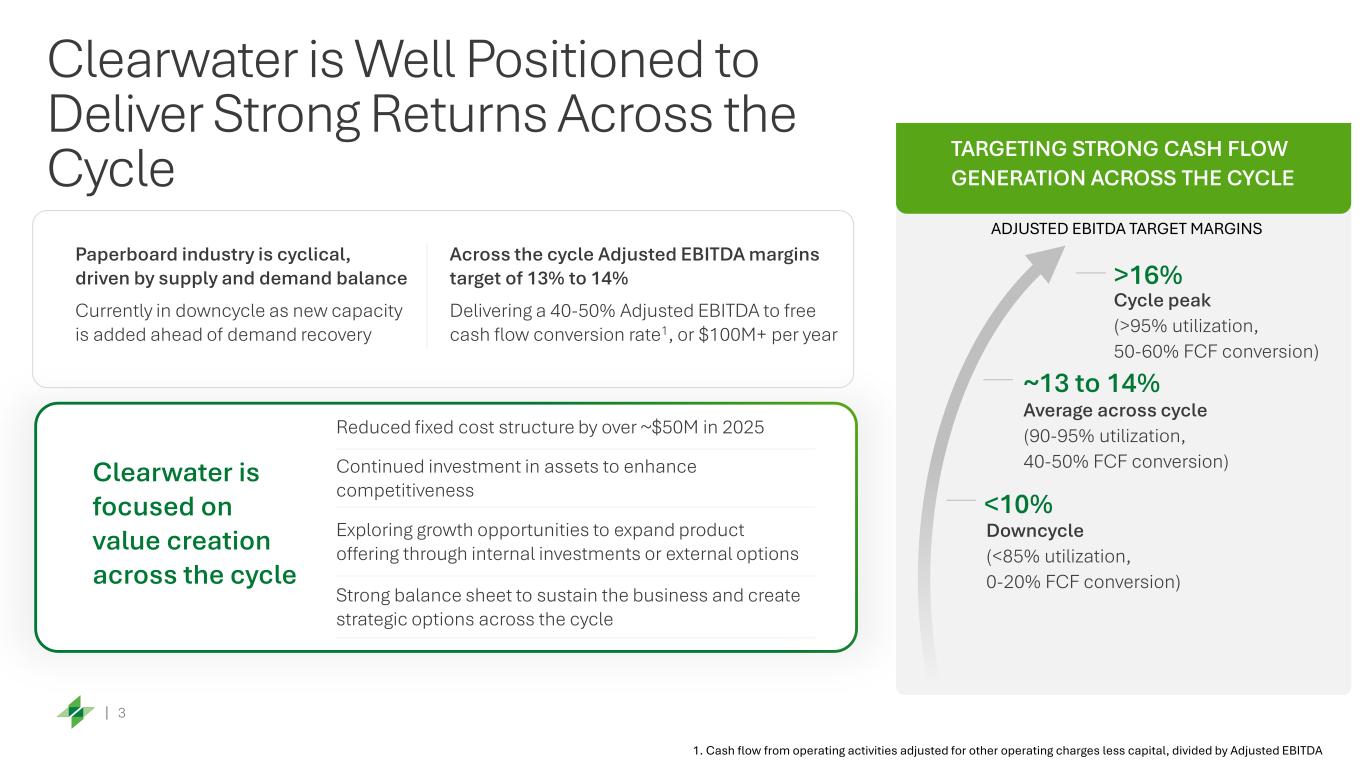
3 Clearwater is Well Positioned to Deliver Strong Returns Across the Cycle >16% Cycle peak (>95% utilization, 50-60% FCF conversion) Average across cycle (90-95% utilization, 40-50% FCF conversion) ~13 to 14% Downcycle (<85% utilization, 0-20% FCF conversion) <10% TARGETING STRONG CASH FLOW GENERATION ACROSS THE CYCLE Paperboard industry is cyclical, driven by supply and demand balance Currently in downcycle as new capacity is added ahead of demand recovery Across the cycle Adjusted EBITDA margins target of 13% to 14% Delivering a 40-50% Adjusted EBITDA to free cash flow conversion rate1, or $100M+ per year Reduced fixed cost structure by over ~$50M in 2025 Continued investment in assets to enhance competitiveness Exploring growth opportunities to expand product offering through internal investments or external options Strong balance sheet to sustain the business and create strategic options across the cycle Clearwater is focused on value creation across the cycle 1. Cash flow from operating activities adjusted for other operating charges less capital, divided by Adjusted EBITDA ADJUSTED EBITDA TARGET MARGINS
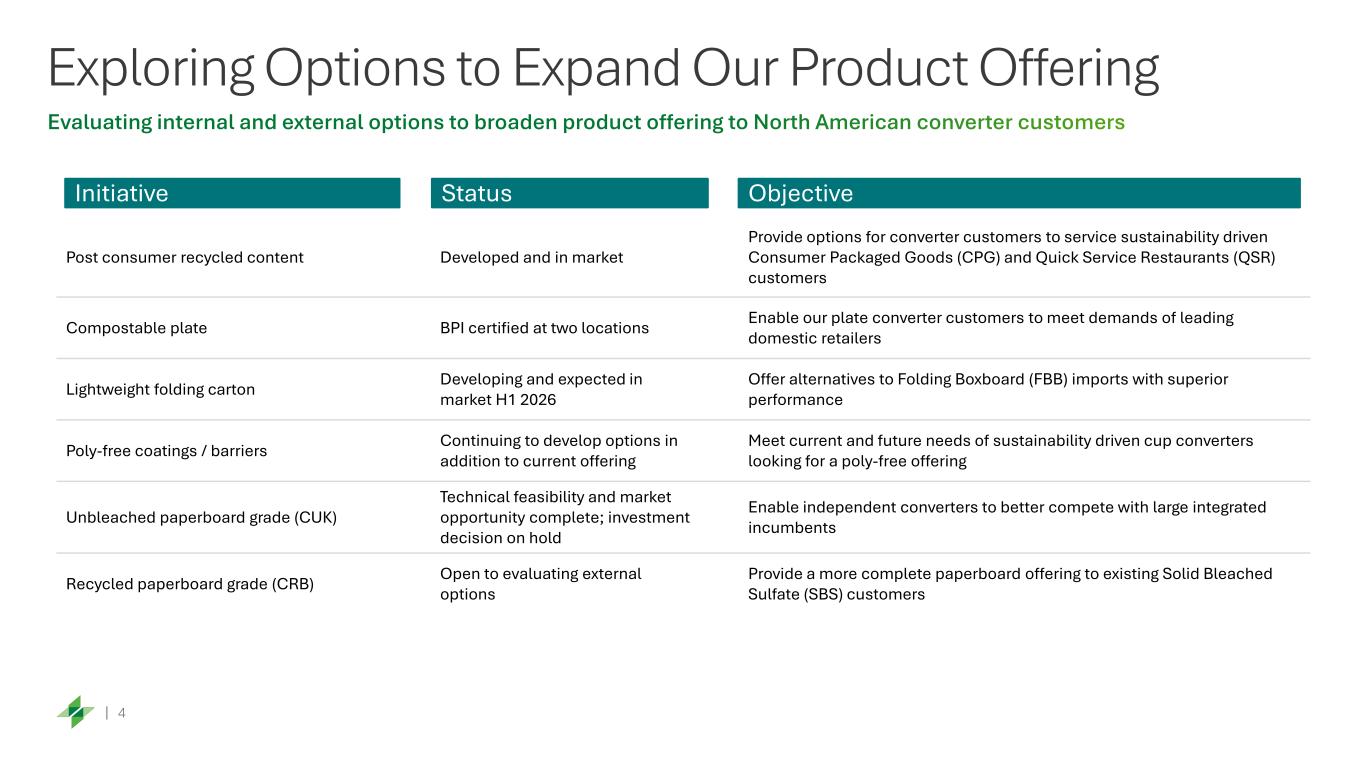
4 Exploring Options to Expand Our Product Offering Post consumer recycled content Developed and in market Provide options for converter customers to service sustainability driven Consumer Packaged Goods (CPG) and Quick Service Restaurants (QSR) customers Compostable plate BPI certified at two locations Enable our plate converter customers to meet demands of leading domestic retailers Lightweight folding carton Developing and expected in market H1 2026 Offer alternatives to Folding Boxboard (FBB) imports with superior performance Poly-free coatings / barriers Continuing to develop options in addition to current offering Meet current and future needs of sustainability driven cup converters looking for a poly-free offering Unbleached paperboard grade (CUK) Technical feasibility and market opportunity complete; investment decision on hold Enable independent converters to better compete with large integrated incumbents Recycled paperboard grade (CRB) Open to evaluating external options Provide a more complete paperboard offering to existing Solid Bleached Sulfate (SBS) customers Initiative Status Objective
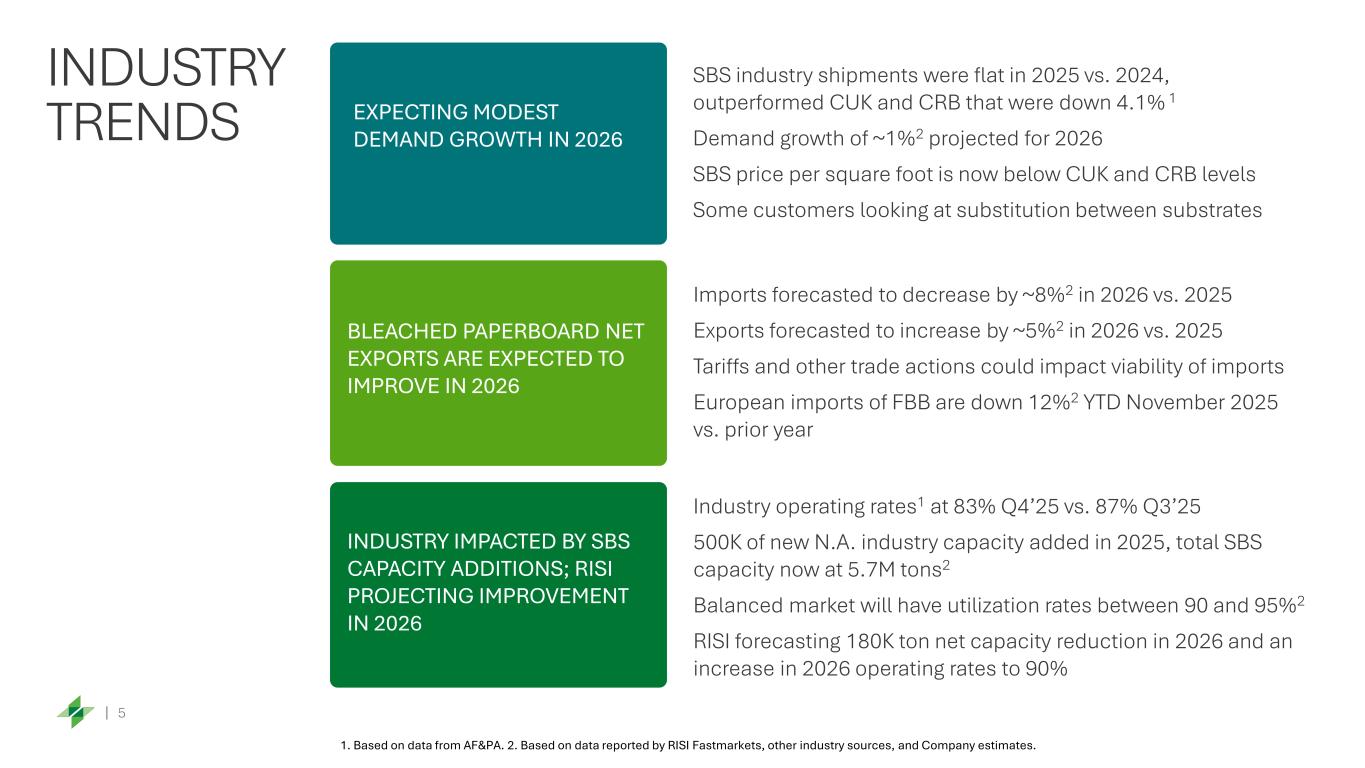
5 INDUSTRY TRENDS 1. Based on data from AF&PA. 2. Based on data reported by RISI Fastmarkets, other industry sources, and Company estimates. EXPECTING MODEST DEMAND GROWTH IN 2026 SBS industry shipments were flat in 2025 vs. 2024, outperformed CUK and CRB that were down 4.1% 1 Demand growth of ~1%2 projected for 2026 SBS price per square foot is now below CUK and CRB levels Some customers looking at substitution between substrates INDUSTRY IMPACTED BY SBS CAPACITY ADDITIONS; RISI PROJECTING IMPROVEMENT IN 2026 Industry operating rates1 at 83% Q4’25 vs. 87% Q3’25 500K of new N.A. industry capacity added in 2025, total SBS capacity now at 5.7M tons2 Balanced market will have utilization rates between 90 and 95%2 RISI forecasting 180K ton net capacity reduction in 2026 and an increase in 2026 operating rates to 90% BLEACHED PAPERBOARD NET EXPORTS ARE EXPECTED TO IMPROVE IN 2026 Imports forecasted to decrease by ~8%2 in 2026 vs. 2025 Exports forecasted to increase by ~5%2 in 2026 vs. 2025 Tariffs and other trade actions could impact viability of imports European imports of FBB are down 12%2 YTD November 2025 vs. prior year
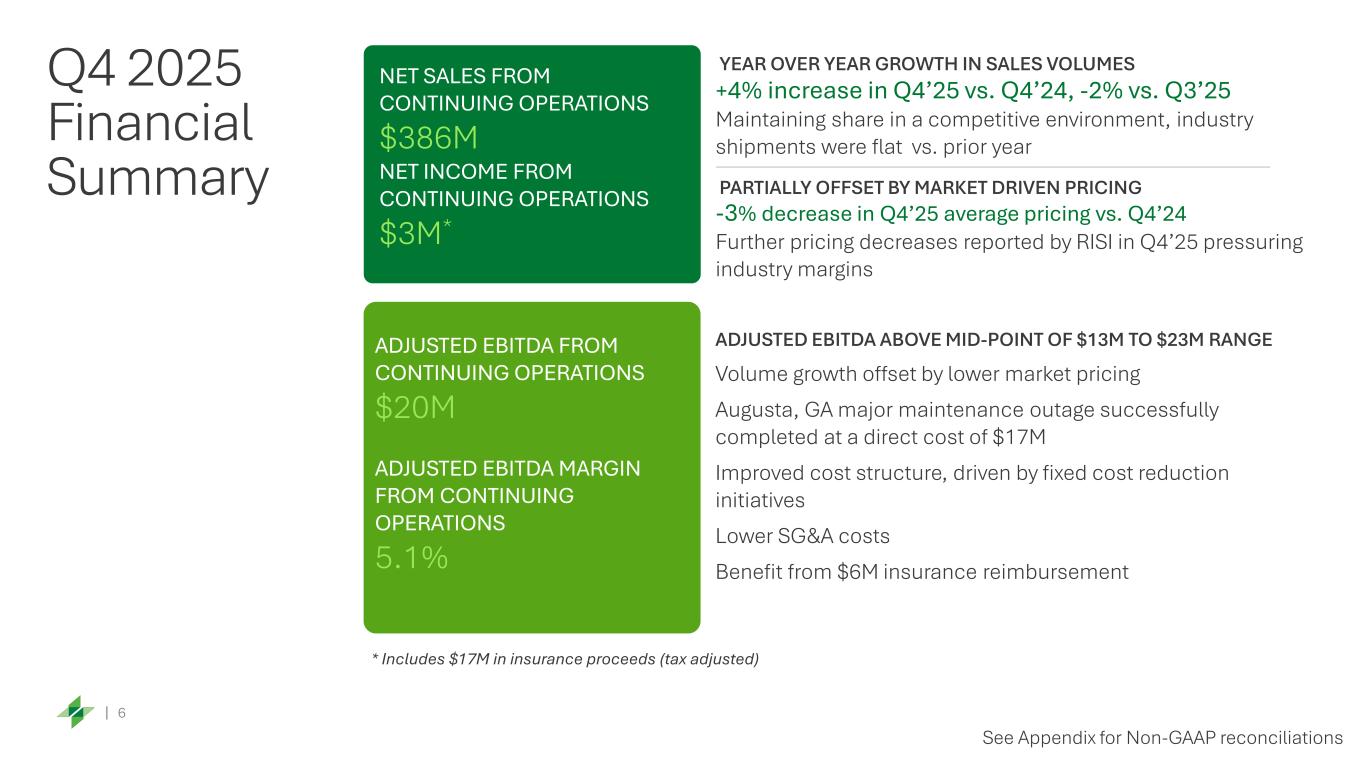
6 +4% increase in Q4’25 vs. Q4’24, -2% vs. Q3’25 Maintaining share in a competitive environment, industry shipments were flat vs. prior year -3% decrease in Q4’25 average pricing vs. Q4’24 Further pricing decreases reported by RISI in Q4’25 pressuring industry margins Q4 2025 Financial Summary NET SALES FROM CONTINUING OPERATIONS $386M NET INCOME FROM CONTINUING OPERATIONS $3M* PARTIALLY OFFSET BY MARKET DRIVEN PRICING ADJUSTED EBITDA FROM CONTINUING OPERATIONS $20M ADJUSTED EBITDA MARGIN FROM CONTINUING OPERATIONS 5.1% ADJUSTED EBITDA ABOVE MID-POINT OF $13M TO $23M RANGE Volume growth offset by lower market pricing Augusta, GA major maintenance outage successfully completed at a direct cost of $17M Improved cost structure, driven by fixed cost reduction initiatives Lower SG&A costs Benefit from $6M insurance reimbursement YEAR OVER YEAR GROWTH IN SALES VOLUMES See Appendix for Non-GAAP reconciliations * Includes $17M in insurance proceeds (tax adjusted)
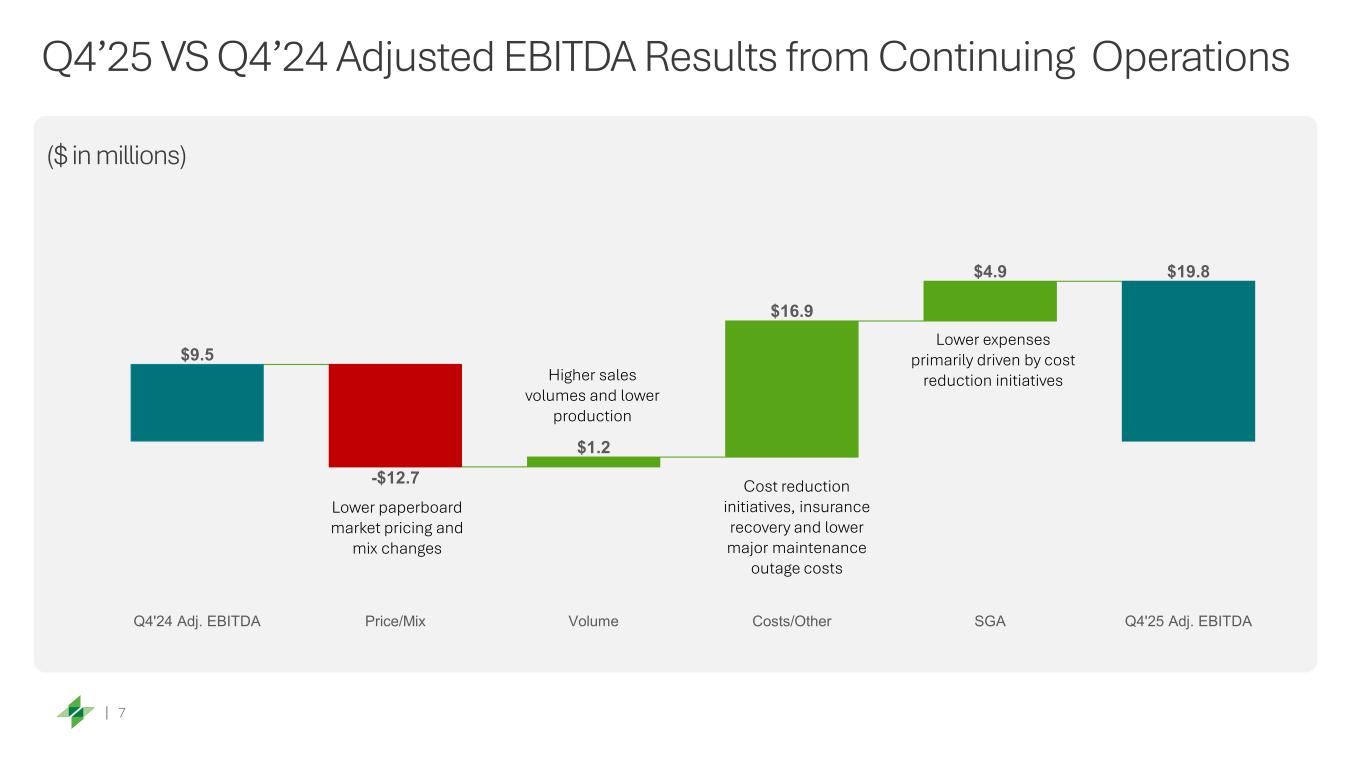
7 Q4’25 VS Q4’24 Adjusted EBITDA Results from Continuing Operations ($ in millions) $9.5 $16.9 $4.9 $19.8 -$12.7 $1.2 Q4'24 Adj. EBITDA Price/Mix Volume Costs/Other SGA Q4'25 Adj. EBITDA Lower paperboard market pricing and mix changes Cost reduction initiatives, insurance recovery and lower major maintenance outage costs Lower expenses primarily driven by cost reduction initiativesHigher sales volumes and lower production
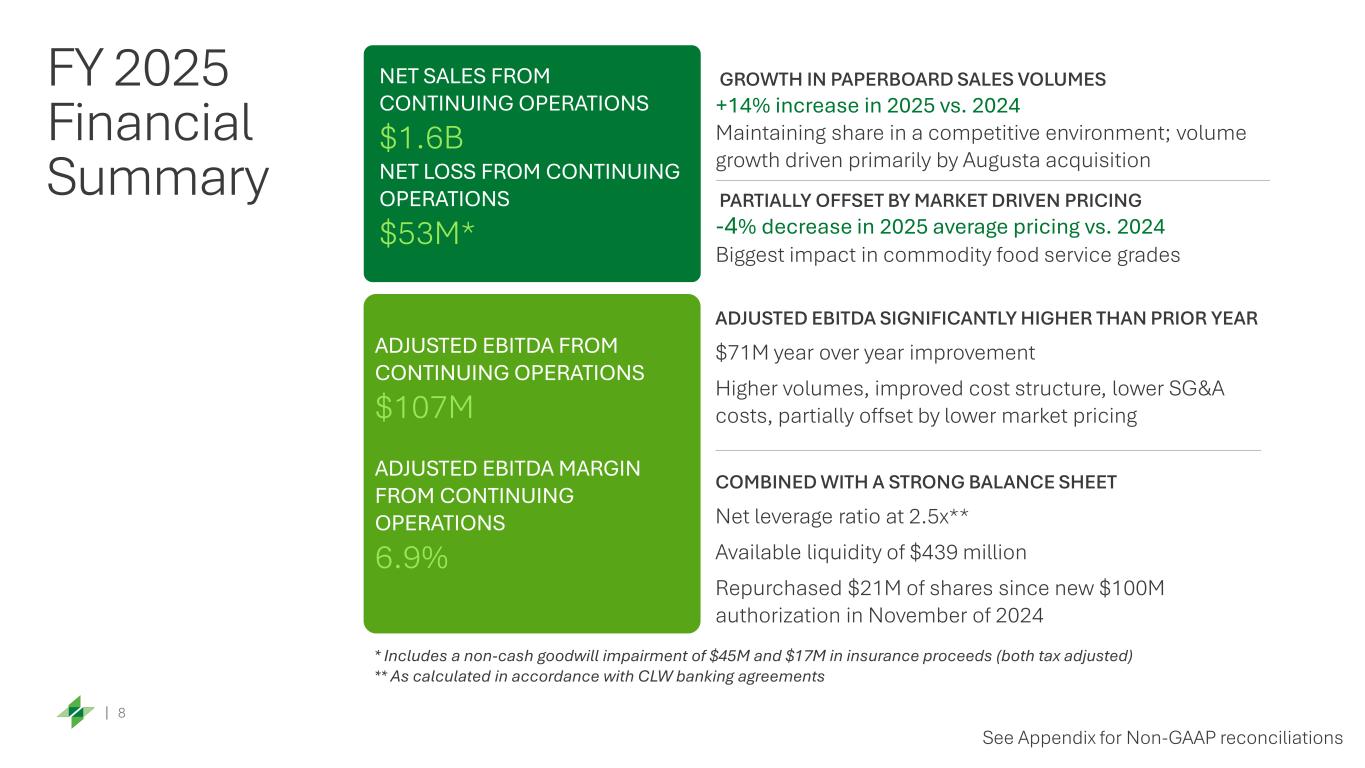
8 +14% increase in 2025 vs. 2024 Maintaining share in a competitive environment; volume growth driven primarily by Augusta acquisition -4% decrease in 2025 average pricing vs. 2024 Biggest impact in commodity food service grades FY 2025 Financial Summary NET SALES FROM CONTINUING OPERATIONS $1.6B NET LOSS FROM CONTINUING OPERATIONS $53M* PARTIALLY OFFSET BY MARKET DRIVEN PRICING ADJUSTED EBITDA FROM CONTINUING OPERATIONS $107M ADJUSTED EBITDA MARGIN FROM CONTINUING OPERATIONS 6.9% ADJUSTED EBITDA SIGNIFICANTLY HIGHER THAN PRIOR YEAR $71M year over year improvement Higher volumes, improved cost structure, lower SG&A costs, partially offset by lower market pricing COMBINED WITH A STRONG BALANCE SHEET Net leverage ratio at 2.5x** Available liquidity of $439 million Repurchased $21M of shares since new $100M authorization in November of 2024 GROWTH IN PAPERBOARD SALES VOLUMES See Appendix for Non-GAAP reconciliations * Includes a non-cash goodwill impairment of $45M and $17M in insurance proceeds (both tax adjusted) ** As calculated in accordance with CLW banking agreements
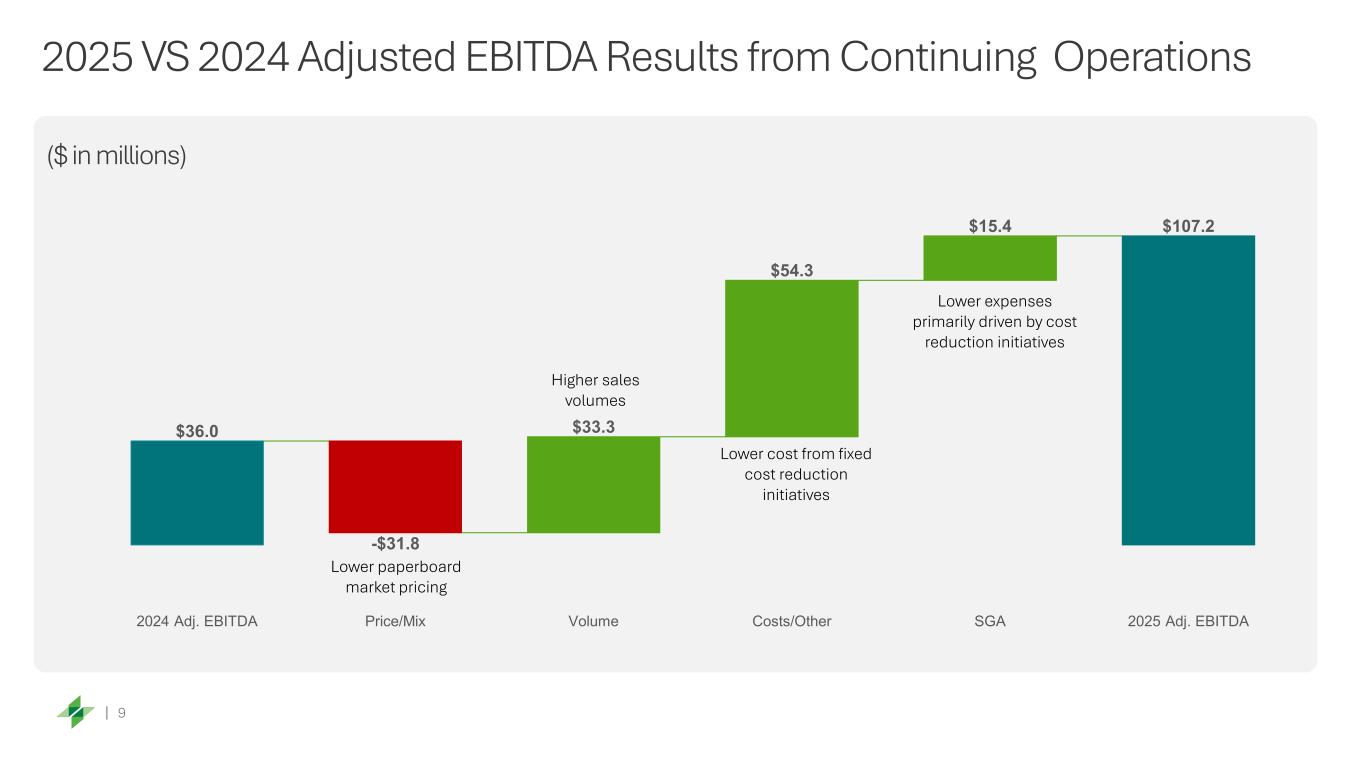
9 2025 VS 2024 Adjusted EBITDA Results from Continuing Operations ($ in millions) $36.0 $54.3 $15.4 $107.2 -$31.8 $33.3 2024 Adj. EBITDA Price/Mix Volume Costs/Other SGA 2025 Adj. EBITDA Lower paperboard market pricing Higher sales volumes Lower cost from fixed cost reduction initiatives Lower expenses primarily driven by cost reduction initiatives
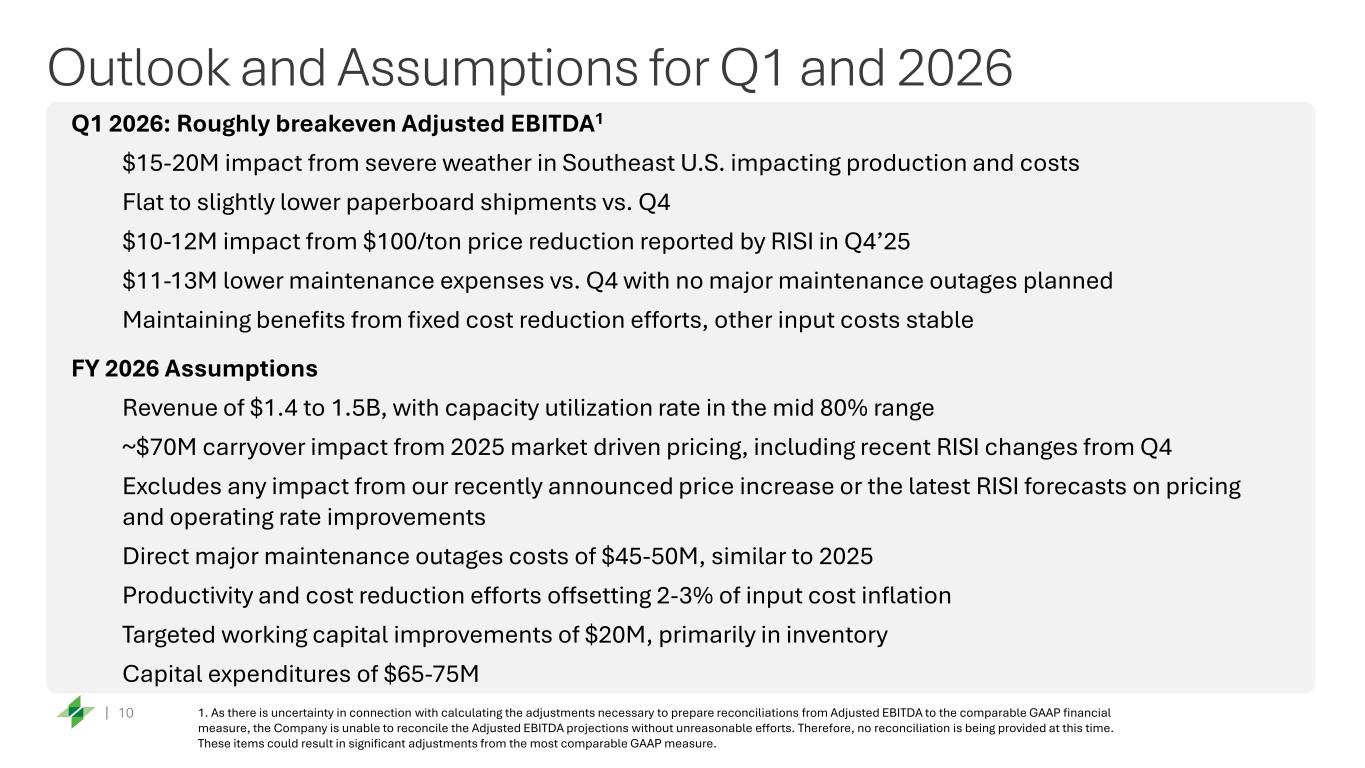
10 Outlook and Assumptions for Q1 and 2026 Q1 2026: Roughly breakeven Adjusted EBITDA1 $15-20M impact from severe weather in Southeast U.S. impacting production and costs Flat to slightly lower paperboard shipments vs. Q4 $10-12M impact from $100/ton price reduction reported by RISI in Q4’25 $11-13M lower maintenance expenses vs. Q4 with no major maintenance outages planned Maintaining benefits from fixed cost reduction efforts, other input costs stable FY 2026 Assumptions Revenue of $1.4 to 1.5B, with capacity utilization rate in the mid 80% range ~$70M carryover impact from 2025 market driven pricing, including recent RISI changes from Q4 Excludes any impact from our recently announced price increase or the latest RISI forecasts on pricing and operating rate improvements Direct major maintenance outages costs of $45-50M, similar to 2025 Productivity and cost reduction efforts offsetting 2-3% of input cost inflation Targeted working capital improvements of $20M, primarily in inventory Capital expenditures of $65-75M 1. As there is uncertainty in connection with calculating the adjustments necessary to prepare reconciliations from Adjusted EBITDA to the comparable GAAP financial measure, the Company is unable to reconcile the Adjusted EBITDA projections without unreasonable efforts. Therefore, no reconciliation is being provided at this time. These items could result in significant adjustments from the most comparable GAAP measure.
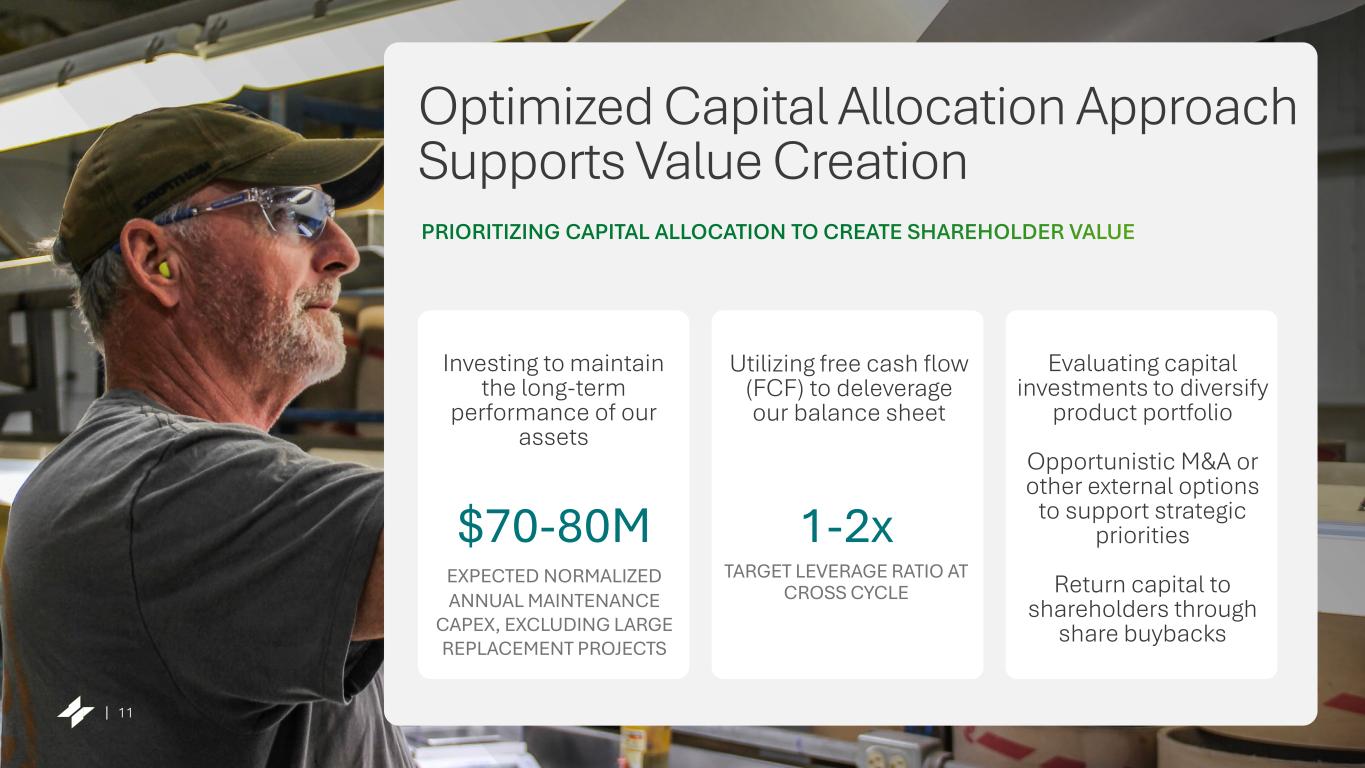
11 Optimized Capital Allocation Approach Supports Value Creation $70-80M EXPECTED NORMALIZED ANNUAL MAINTENANCE CAPEX, EXCLUDING LARGE REPLACEMENT PROJECTS 1-2x TARGET LEVERAGE RATIO AT CROSS CYCLE Investing to maintain the long-term performance of our assets Evaluating capital investments to diversify product portfolio Opportunistic M&A or other external options to support strategic priorities Return capital to shareholders through share buybacks Utilizing free cash flow (FCF) to deleverage our balance sheet
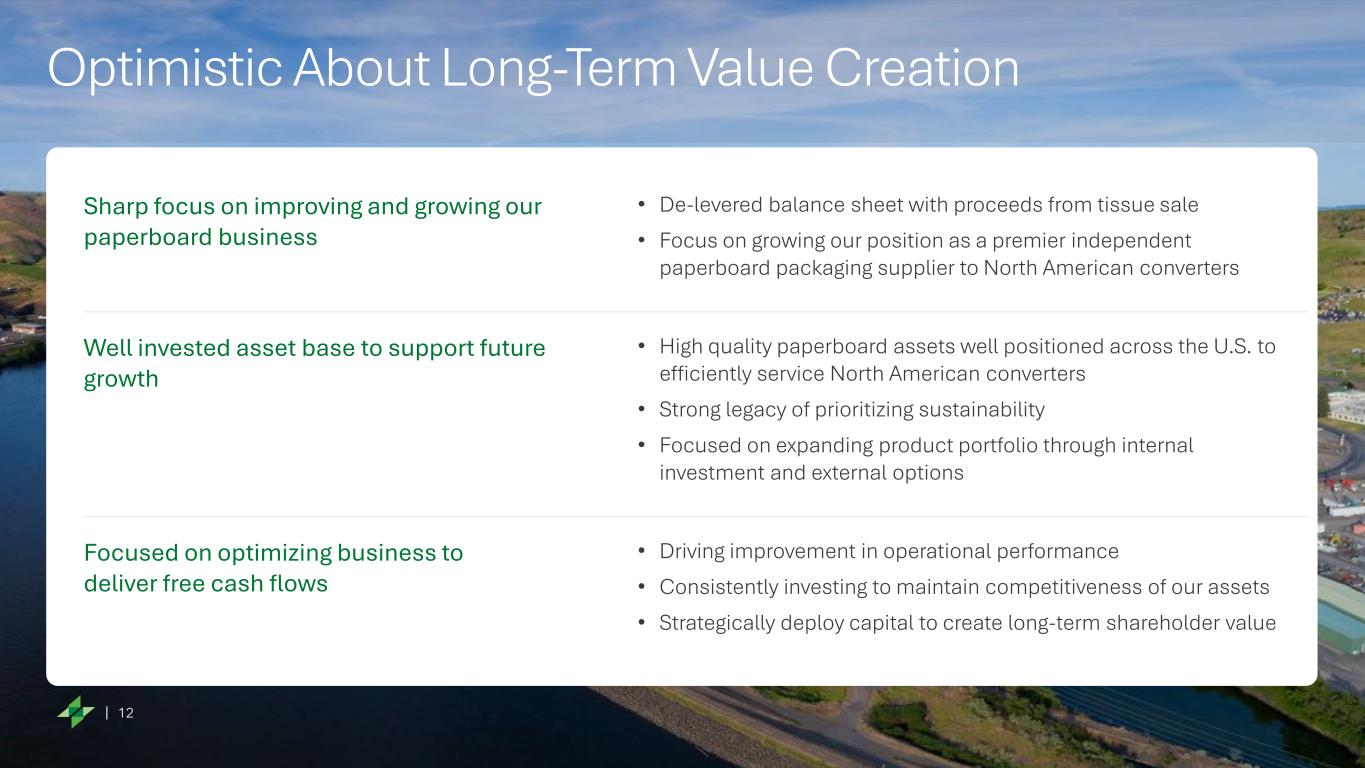
12 Optimistic About Long-Term Value Creation Sharp focus on improving and growing our paperboard business • De-levered balance sheet with proceeds from tissue sale • Focus on growing our position as a premier independent paperboard packaging supplier to North American converters Well invested asset base to support future growth • High quality paperboard assets well positioned across the U.S. to efficiently service North American converters • Strong legacy of prioritizing sustainability • Focused on expanding product portfolio through internal investment and external options Focused on optimizing business to deliver free cash flows • Driving improvement in operational performance • Consistently investing to maintain competitiveness of our assets • Strategically deploy capital to create long-term shareholder value

13 Appendix
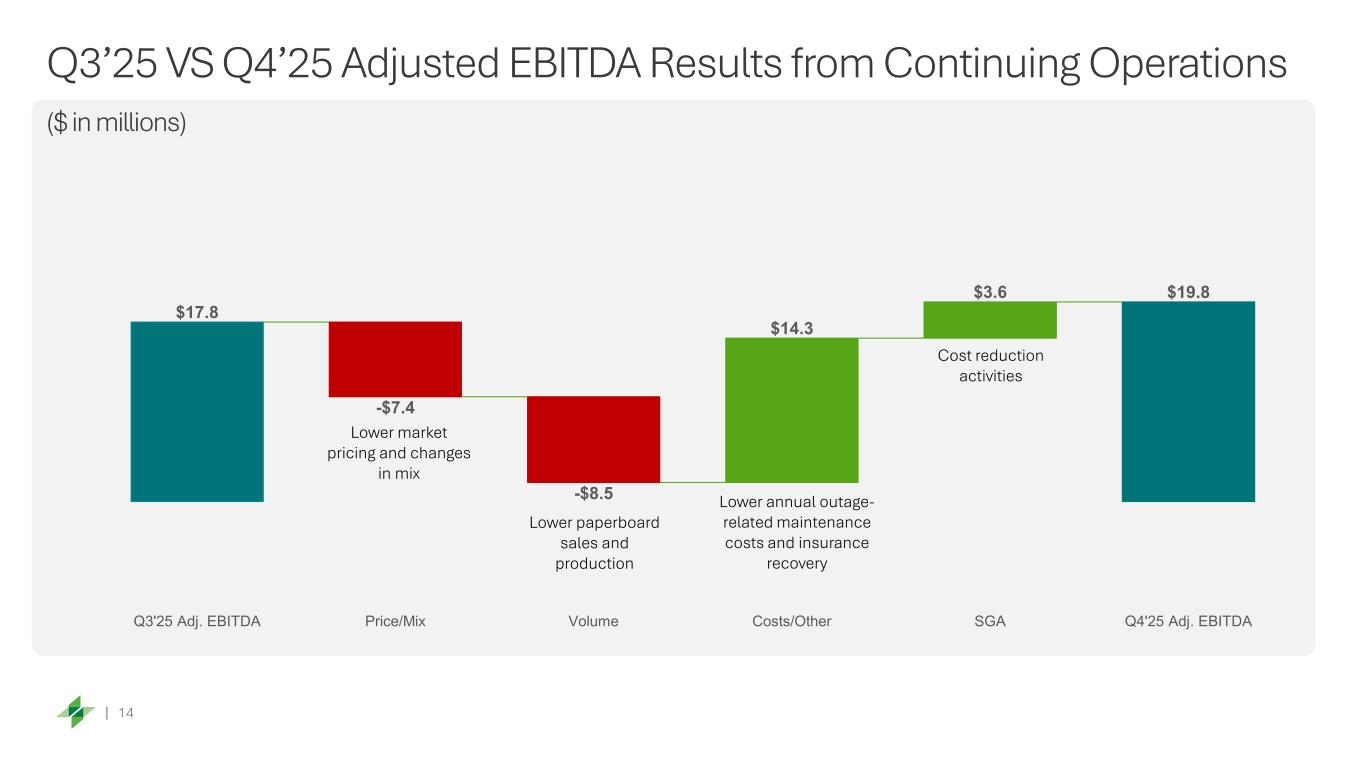
14 Q3’25 VS Q4’25 Adjusted EBITDA Results from Continuing Operations ($ in millions) $17.8 $14.3 $3.6 $19.8 -$7.4 -$8.5 Q3'25 Adj. EBITDA Price/Mix Volume Costs/Other SGA Q4'25 Adj. EBITDA Lower paperboard sales and production Lower annual outage- related maintenance costs and insurance recovery Cost reduction activities Lower market pricing and changes in mix
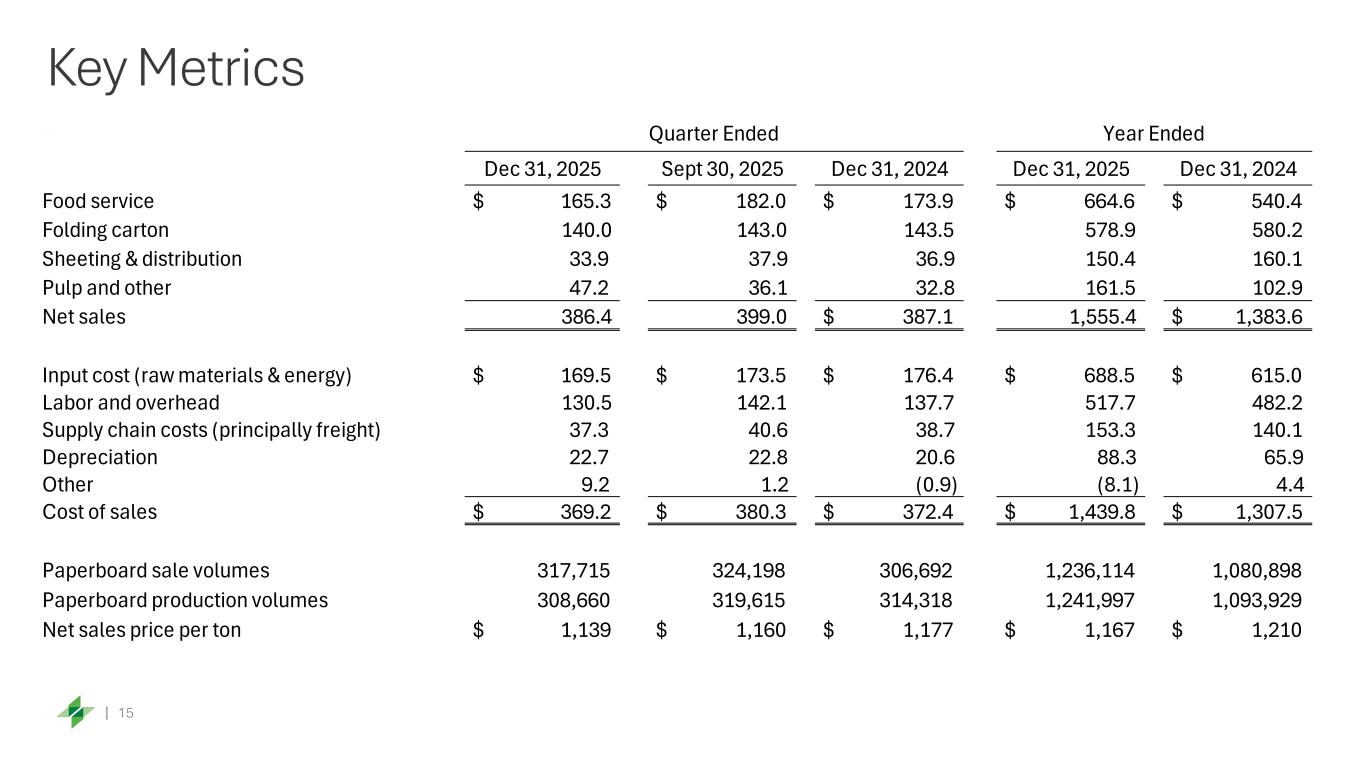
15 Key Metrics Dec 31, 2025 Sept 30, 2025 Dec 31, 2024 Dec 31, 2025 Dec 31, 2024 Food service $ 165.3 $ 182.0 $ 173.9 $ 664.6 $ 540.4 Folding carton 140.0 143.0 143.5 578.9 580.2 Sheeting & distribution 33.9 37.9 36.9 150.4 160.1 Pulp and other 47.2 36.1 32.8 161.5 102.9 Net sales 386.4 399.0 $ 387.1 1,555.4 $ 1,383.6 Input cost (raw materials & energy) $ 169.5 $ 173.5 $ 176.4 $ 688.5 $ 615.0 Labor and overhead 130.5 142.1 137.7 517.7 482.2 Supply chain costs (principally freight) 37.3 40.6 38.7 153.3 140.1 Depreciation 22.7 22.8 20.6 88.3 65.9 Other 9.2 1.2 (0.9) (8.1) 4.4 Cost of sales $ 369.2 $ 380.3 $ 372.4 $ 1,439.8 $ 1,307.5 Paperboard sale volumes 317,715 324,198 306,692 1,236,114 1,080,898 Paperboard production volumes 308,660 319,615 314,318 1,241,997 1,093,929 Net sales price per ton $ 1,139 $ 1,160 $ 1,177 $ 1,167 $ 1,210 Quarter Ended Year Ended
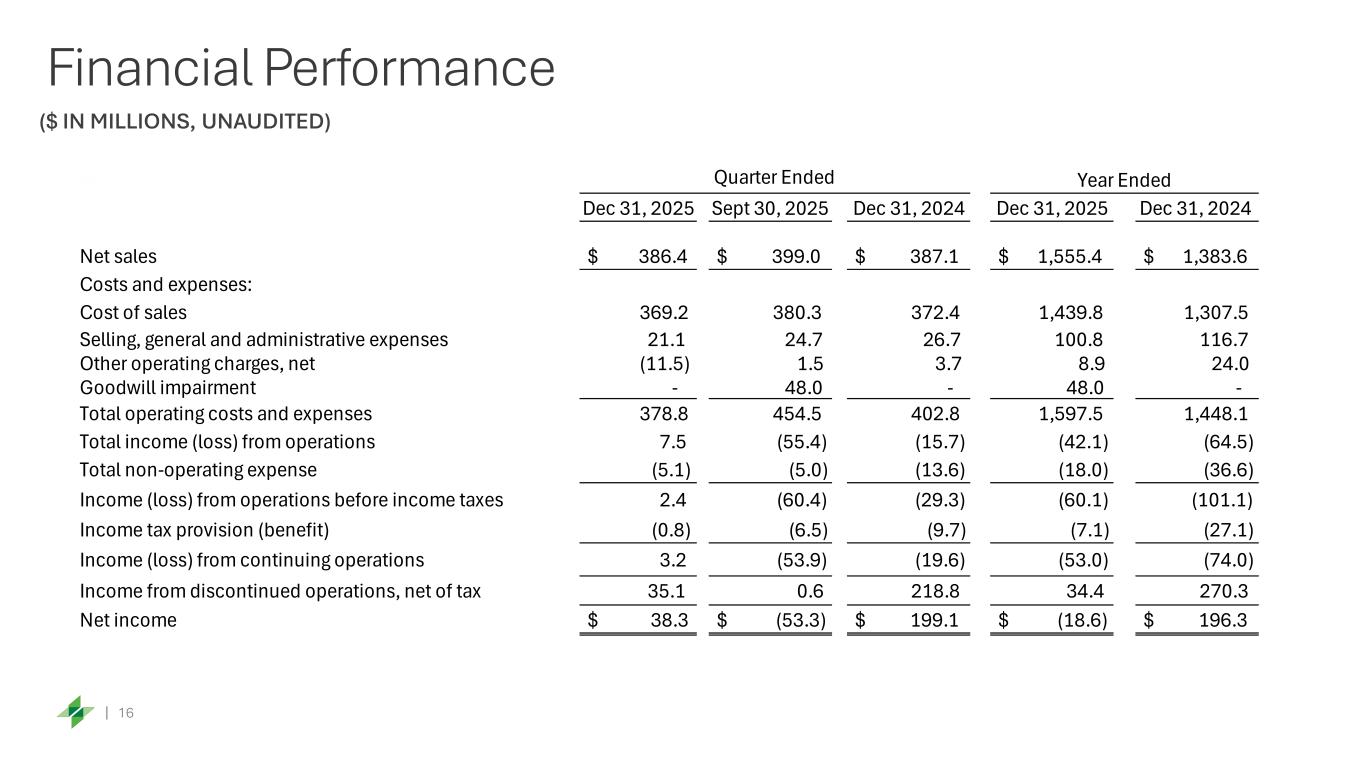
16 Financial Performance ($ IN MILLIONS, UNAUDITED) Dec 31, 2025 Sept 30, 2025 Dec 31, 2024 Dec 31, 2025 Dec 31, 2024 Net sales $ 386.4 $ 399.0 $ 387.1 $ 1,555.4 $ 1,383.6 Costs and expenses: Cost of sales 369.2 380.3 372.4 1,439.8 1,307.5 Selling, general and administrative expenses 21.1 24.7 26.7 100.8 116.7 Other operating charges, net (11.5) 1.5 3.7 8.9 24.0 Goodwill impairment - 48.0 - 48.0 - Total operating costs and expenses 378.8 454.5 402.8 1,597.5 1,448.1 Total income (loss) from operations 7.5 (55.4) (15.7) (42.1) (64.5) Total non-operating expense (5.1) (5.0) (13.6) (18.0) (36.6) Income (loss) from operations before income taxes 2.4 (60.4) (29.3) (60.1) (101.1) Income tax provision (benefit) (0.8) (6.5) (9.7) (7.1) (27.1) Income (loss) from continuing operations 3.2 (53.9) (19.6) (53.0) (74.0) Income from discontinued operations, net of tax 35.1 0.6 218.8 34.4 270.3 Net income $ 38.3 $ (53.3) $ 199.1 $ (18.6) $ 196.3 Quarter Ended Year Ended
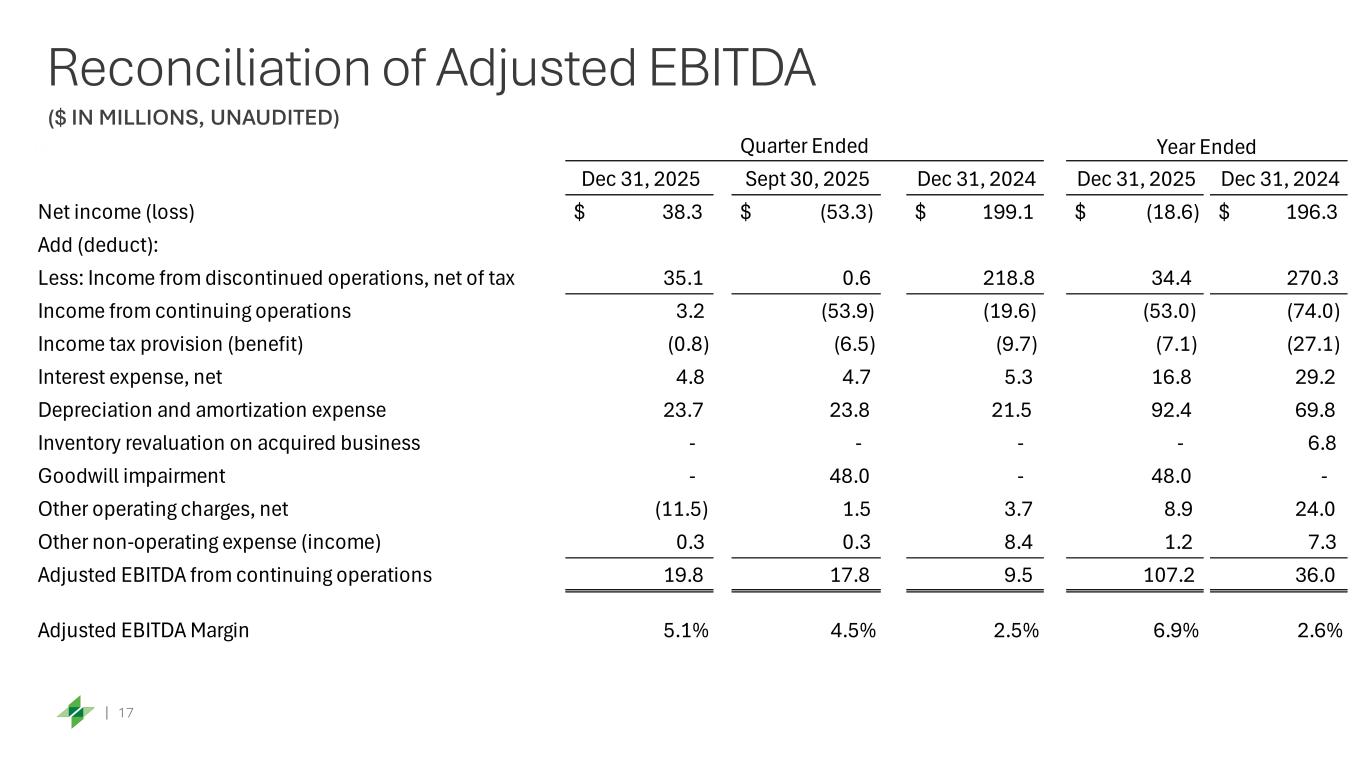
17 Reconciliation of Adjusted EBITDA ($ IN MILLIONS, UNAUDITED) Dec 31, 2025 Sept 30, 2025 Dec 31, 2024 Dec 31, 2025 Dec 31, 2024 Net income (loss) $ 38.3 $ (53.3) $ 199.1 $ (18.6) $ 196.3 Add (deduct): Less: Income from discontinued operations, net of tax 35.1 0.6 218.8 34.4 270.3 Income from continuing operations 3.2 (53.9) (19.6) (53.0) (74.0) Income tax provision (benefit) (0.8) (6.5) (9.7) (7.1) (27.1) Interest expense, net 4.8 4.7 5.3 16.8 29.2 Depreciation and amortization expense 23.7 23.8 21.5 92.4 69.8 Inventory revaluation on acquired business - - - - 6.8 Goodwill impairment - 48.0 - 48.0 - Other operating charges, net (11.5) 1.5 3.7 8.9 24.0 Other non-operating expense (income) 0.3 0.3 8.4 1.2 7.3 Adjusted EBITDA from continuing operations 19.8 17.8 9.5 107.2 36.0 Adjusted EBITDA Margin 5.1% 4.5% 2.5% 6.9% 2.6% Quarter Ended Year Ended
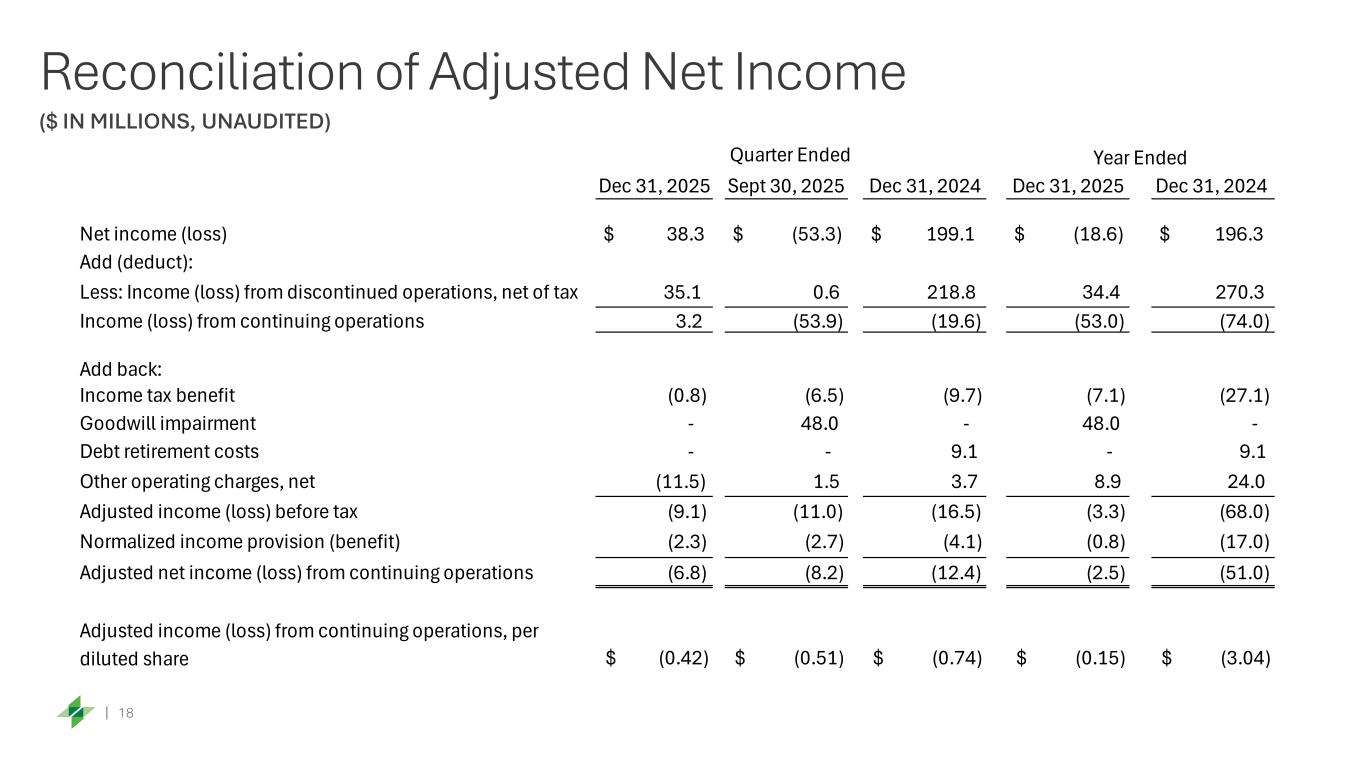
18 Reconciliation of Adjusted Net Income ($ IN MILLIONS, UNAUDITED) Dec 31, 2025 Sept 30, 2025 Dec 31, 2024 Dec 31, 2025 Dec 31, 2024 Net income (loss) $ 38.3 $ (53.3) $ 199.1 $ (18.6) $ 196.3 Add (deduct): Less: Income (loss) from discontinued operations, net of tax 35.1 0.6 218.8 34.4 270.3 Income (loss) from continuing operations 3.2 (53.9) (19.6) (53.0) (74.0) Add back: Income tax benefit (0.8) (6.5) (9.7) (7.1) (27.1) Goodwill impairment - 48.0 - 48.0 - Debt retirement costs - - 9.1 - 9.1 Other operating charges, net (11.5) 1.5 3.7 8.9 24.0 Adjusted income (loss) before tax (9.1) (11.0) (16.5) (3.3) (68.0) Normalized income provision (benefit) (2.3) (2.7) (4.1) (0.8) (17.0) Adjusted net income (loss) from continuing operations (6.8) (8.2) (12.4) (2.5) (51.0) Adjusted income (loss) from continuing operations, per diluted share (0.42)$ (0.51)$ (0.74)$ (0.15)$ (3.04)$ Quarter Ended Year Ended