Please wait

Exhibit 7.2

Graphic

POLICY ON USE OF PRIVILEGED INFORMATION OF ECOPETROL S.A.

RELATIONSHIPS WITH INVESTORS DEPARTMENT

CODE

Prepared

Version:

GFI-POL-001

25/03/2025

3

1.    OBJECTIVE

This Policy is intended for overseeing compliance with applicable norms by Directors and Officials of Ecopetrol S.A. (“Ecopetrol” or the “Company”) who, in performance of their duties, have access to privileged information and negotiate the Company’s Securities, pursuant to article 404 of the Commercial Code and literal a) of article 2.11.4.2.1 of Decree 2555 of 2010, rule 10b5-1 of the Exchange Act, the Insider Trading and Securities Fraud Enforcement Act, and the sections of the Exchange Act that have been amended or added by virtue thereof, and other regulations that modify, complement and/or repeal them.

Ecopetrol has implemented this policy to promote compliance with applicable securities laws and regulations, mainly those that prohibit and sanction performing operations based on insider information in the jurisdictions where the Company lists its Securities, including its Bonds, Ordinary Shares, and American Depositary Receipts (ADR). A copy of this Policy will be included as annex to Form 20-F that must be published annually in the Securities and Exchange Commission de los Estados Unidos de América (la “SEC”).

2.    GLOSSARY

Ordinary shares: Negotiable property titles, representing an aliquot part of a company’s assets, which grant their holders political and economic rights that can be exercised be it collectively or individually, in accordance with the provisions of the respective corporate statutes. For the purposes of this Policy, the notion of “Ordinary Shares” will also include the American Depositary Receipts.

Administrators: In accordance with article 22 of Law 222 of 1995 and the regulations that complement, modify or repeal it, the directors, the legal representative, the liquidator, the factor, the members of boards or governing councils of the entity and those who, in accordance with the statutes, exercise or hold these functions.

American Depositary Receipts: An American Depositary Receipt is a negotiable certificate evidencing holding in the shares of a non-US company that have been deposited in a US bank. Such ADRs are negotiated in US Dollars, through the settlement system of the United States, which allows the ADR holders to not making transactions in a foreign currency.

Beneficial owner: The beneficial owner is understood to be any person or group of persons who, be it directly or indirectly, by themselves or through an Interposed Person, by virtue of contract, agreement or in any other way, has, with respect to a share or any holding in a company, the faculty or power to vote in the election of directors or representatives or, to direct, guide, and control said vote, as well as that of disposing or ordering the disposal of or encumbrance of the share or holding.

For the purposes of this definition, spouses or permanent couple and relatives within the second degree of consanguinity, second degree of affinity, and only civil relationship constitute the same beneficial owner, unless it is demonstrated that they act with independent economic interests, a circumstance that may be declared by means of oath before the Financial Superintendency of Colombia for exclusively evidentiary purposes.

Bonds: Negotiable fixed income securities, representing an aliquot part of a collective credit established by the Company.

Material changes: Information relating to a change in the Company’s business, operations, or capital that would be expected to have a significant effect on the market price or value of the Company’s assets (e.g. Business Mergers or Acquisitions, Disposals, Issuance of Shares or Bonds to the market).

Hedging and Derivatives: Hedging refers to a number of financial strategies designed for protection against losses or risks. Derivatives are financial instruments or future contracts whose value is based on the price of an underlying asset-shares, exchange rates, among others - characterized by defining a future
delivery or settlement period, which in some cases may or may not be exercised.

Speculation: It is the practice of obtaining economic benefits by leveraging on short or medium-term fluctuations in the market value of the Securities as a result of access to privileged information, in accordance with the provisions of literal a of article 2.11.4.2.1 of Decree 2555 of 2010, and other regulations that modify, complement and/or repeal it.

Factor: Pursuant to article 1332 and subsequent of the Commercial Code and other regulations that modify, complement and/or repeal it, the “factor” is the person who, by virtue of a preposition contract, takes charge of the administration of a commercial establishment or a part or branch of its activity.

Material facts: facts that would reasonably be expected to have a significant effect on the price or market value of the securities (e.g. disclosure of investment plan or reserves, payment of dividends, delivery of financial results, changes in credit rating).

Material Non-Public Information: it means material information that (i) a reasonable investor would consider material in making an investment decision, and (ii) impacts information previously disclosed by the Company, which has not been made public.

Privileged Information: For purposes of this document, privileged information is considered as Non-Public Material Information as well as that subject to reserve, which has not been made public when there is an obligation to do so, and that of a concrete nature that has not been made public and that if it had been, a fairly diligent and prudent investor would have taken it into account when negotiating the respective securities, in accordance with the provisions of literal a of article 2.11.4.2.1 of Decree 2555 of 2010 and other regulations that modify, complement and/or repeal it.

Relevant information: In accordance with the provisions of article 5.2.4.1.2. of Decree 2555 of 2010 and other regulations that modify, complement and/or repeal it, relevant information is considered any situation related to the issuer or its issuance that would have been considered by a prudent and diligent expert when buying, selling or holding the securities of the issuer, or at the time of exercising the political rights inherent in such securities.

Unpublished relevant information: It is the information that meets the requisites of section 5.2.4.1.2. of Decree 2555 of 2020 and other regulations that modify, complement and/or repeal it, but which publishing in the Integrated Information System of the Security Market (SIMEV) in Colombia and/or in the Securities and Exchange Commissionin the United States of America, has not yet been made effective.

The SEC defines relevant information as that which is important or significant for financial perspectives or in the value of a company.

Interposed Person: They are the natural or legal persons who negotiate the Securities, in favor and/or with the knowledge and will of the Administrator or Official of Ecopetrol, allowing the effects of the negotiation to affect their assets. The Interposed Person may or may not be a real beneficiary, representative or attorney-in-fact of the Administrator or Official of Ecopetrol, in favor of whom he acts.

Securities Trading Form: It is used by the Ecopetrol Official to request prior approval for the purchase or sale of Company Securities on the Colombian Stock Exchange or the New York Stock Exchange.

Ecopetrol Officials: direct employees of the Company who, in the process of their duties, have access to Privileged Information.

Liquidator: Person in charge of the process by which dissolved companies enter the liquidation period, with the main purpose of concluding existing corporate obligations, disposing of the assets, paying the liabilities, and distributing the remainder, if any, among the associates proportionately to their participation in the company.

Restriction Period or Blackout Period: Period prior to an event qualified as a Relevant Event during which its Directors, Ecopetrol Officials, by themselves or by an Interposed Person, cannot negotiate with the Company’s Securities. Relevant corporate events include those listed in article 5.2.4.3.1. of Decree 2555 of 2010 and the regulations that complement, modify and/or repeal it.


All rights reserved by No written external reproduction, copy or digital transmission of this publication are allowed without written authorization. No paragraph of this publication may be reproduced, copied, or transmitted digitally without written consent, in accordance with the laws governing copyright and based on current regulations.


Related persons: Persons whose relationships are regulated by the Colombian Civil Code mainly in the family and contractual setting. This area includes blood relations such as parents, children, grandparents, brothers, uncles, aunts, spouses, and relatives of the couple such as in-laws and brothers-in-law.

SEC: Securities and Exchange Commission of the United States of America.

Securities: Common Stock, Bonds, and other securities issued by the Company.

3.    GENERAL TERMS

3.1.

GENERAL PROHIBITION AND DISCLOSURE OBLIGATION

In accordance with the provisions of article 404 of the Colombian Commercial Code and other regulations that modify, complement and/or repeal it, the Company’s Directors may not, either by themselves or through an Interposed Person, dispose of or acquire Securities of Ecopetrol S.A. while they are in the exercise of their positions, except when dealing with operations unrelated to speculation and with prior authorization from the Board of Directors. Similarly, The SEC rule governing insider trading is Rule 10b-5, also known as the anti-fraud rule. This rule prohibits directors, officers, and internal employees of a company from using confidential corporate information to obtain profit or avoid losses when trading company securities.

On the other hand, and given that in Ecopetrol there are also Ecopetrol Officials who have access to Privileged Information and/or Relevant Non-Published Information, they may not, either by themselves or through their Related Persons or Intermediate Person, dispose of or acquire Ecopetrol Securities while they are in the exercise of their positions, except in the case of operations unrelated to speculation and after completing the “Securities Negotiation Form” provided for this purpose by the Company.

3.2.

GENERAL DUTIES AND PROHIBITIONS

Ecopetrol Directors and Officers who intend to negotiate Ecopetrol Securities must comply with the following duties, as well as observe the following prohibitions:

1.

Prior to trading Securities, ensure that the Restriction Period (Blackout Period) is not in force, in which case, they must refrain from trading Ecopetrol Securities, directly, through an Intermediary Person and/or through Related Persons, until such period ends.

2.

Prior to trading Securities, ensure that a purchase or sale transaction does not start at the same time that the annual or quarterly financial results or any periodic publication thereof are published.

3.

Refrain from carrying out purchase or sale transactions with Ecopetrol Securities, directly, through an Intermediary Person and/or through Related Persons, based on Privileged Information, Relevant Non-Published Information, information that has not been revealed and there is a duty to do so, or which is considered classified, reserved, confidential and/or secret, pursuant to the law.

4.

Negotiate Ecopetrol Securities respecting the free interaction of supply and demand, as well as rules applicable to the securities market and securities trading systems.

5.

Refrain from providing investment advice of any sort to third parties while you have Inside Information, Relevant Unpublished Information, or that which is considered classified, reserved, confidential and/or secret, pursuant to the law.

6.

Refrain from reducing or limiting economic risks or benefits through Ecopetrol Hedging or Derivatives, engaging in short selling activities (i.e., selling securities that are not owned or not fully paid), purchasing financial assets, instruments or taking speculative or derivative positions, including without limitation, forward contracts, instruments for the purchase or short sale or sale of call or put options, currency swaps. shares, CFDs (contracts for difference) Collars, futures, or other derivative securities that are designed to, or can reasonably be expected to have the effect of, covering or offsetting a decrease in the market value of any of Ecopetrol’s securities.


All rights reserved by No written external reproduction, copy or digital transmission of this publication are allowed without written authorization. No paragraph of this publication may be reproduced, copied, or transmitted digitally without written consent, in accordance with the laws governing copyright and based on current regulations.


Failure to comply with the aforementioned duties and prohibitions could lead to the initiation of administrative actions and processes of a criminal or disciplinary nature, as explained in section 4.6 of this document.

4.    DEVELOPMENT

4.1. PROCEDURE FOR REQUESTING AUTHORIZATION

4.1.1. For Directors

Directors who are considering trading securities of the Company must keep the following in mind:

a.

Article 404 of the Commercial Code, as a general rule, prohibits the Directors from executing, be it directly or through an Intermediate Person, any transaction that involves acquiring or disposing Ecopetrol Securities when it involves transactions related to speculation.

b.

The Directors must ensure that, if they intend to trade Company Securities, they must complete the “Securities Trading Form” prior to trading.

c.

The Director, after completing the form in the previous section, must request authorization from the Board of Directors to carry out the negotiation of the Securities, demonstrating that the operations are not motivated by speculation purposes. See details of the procedure in “Prohibition of acquiring or selling shares in Chapter IX: Securities Trading” of the Good Governance Code.

d.

The Board of Directors must decide whether or not to grant authorization to the Director, in which case they may request additional support and/or information to prove that there is no reason for speculation about the negotiation.

e.

The Board of Directors may not authorize any transaction that is not unrelated to speculation.

f.

The Directors must refrain from trading Securities issued by Ecopetrol if they are in possession of Inside Information, Relevant Information not Published or that which is considered classified, reserved, confidential and/or secret, pursuant to the law. Said information may include:

i.

“Material changes”: information relating to a change in the Company’s business, operations, or capital that would be expected to have a significant effect on the market price or value of the Company’s assets (e.g. Business Mergers or Acquisitions, Disposals, Issuance of Shares or Bonds to the market); and/or

ii.

“Material facts”: facts that would reasonably be expected to have a significant effect on the price or market value of the securities (e.g. disclosure of investment plan or reserves, payment of dividends, delivery of financial results, changes in credit rating).

Unpublished Relevant Information can be positive or negative and can be identified in the list of facts contained in article 5.2.4.3.1. of Decree 2555 of 2010 or the regulations that modify, complement and/or repeal it.

4.1.2. For Officials

Ecopetrol Officials who are considering trading Company Securities must keep the following in mind:

g.

Ensure that if you intend to trade the Company’s Securities, you must complete the “Securities Trading Form” prior to trading.

h.

The transactions performed may not have speculative reasons.

i.

Refrain from trading Securities issued by the Company if you are in possession of Inside Information, Relevant Unpublished Information or which is considered classified, reserved, confidential and/or secret, pursuant to the law. Said information may include, but without limitation:

iii.

“Material changes”: information relating to a change in the Company’s business, operations or capital that would be expected to have a significant effect on the market price or value of the Company’s assets (e.g. Business Mergers or Acquisitions, Disposals, Issuance of Shares or Bonds to the market); and/or

iv.

“Material facts”: facts that would reasonably be expected to have a significant effect on the price or market value of the securities (e.g. disclosure of investment plan or reserves, payment of dividends, delivery of financial results, changes in credit rating).

Unpublished Relevant Information can be positive or negative and can be identified in the list of facts contained in article 5.2.4.3.1. Decree 2555 of 2010, or that defined by the SEC or the regulations that


All rights reserved by No written external reproduction, copy or digital transmission of this publication are allowed without written authorization. No paragraph of this publication may be reproduced, copied, or transmitted digitally without written consent, in accordance with the laws governing copyright and based on current regulations.


modify, complement and/or repeal it.

Stock trading operations by Ecopetrol administrators and officials will be periodically monitored by the Monitoring team of the Compliance Directorate or the area that takes its stead as set forth in section 4.4 hereunder. Those who carry out transactions without authorization or outside the regulations will be exposed to the sanctions included in section 4.6 of this document.

4.2.RESTRICTION OR BLACKOUT PERIOD

Ecopetrol may impose Restriction Periods during which, directly its Directors and Ecopetrol Officials, acting through Intermediate Person or through its Related Persons, will be prohibited from buying, selling or otherwise carrying out transactions with securities issued by the Company. The Blackout Period will be determined by the President or Corporate Vice President of Finance and Sustainable Value of Ecopetrol, or those acting in their stead, when it is considered that failure to do so could affect the Company’s interests. Described below is the duration of the Blackout Period with respect to the aforementioned persons mentioned above:

i.

Regarding the annual financial statements, from January 1 until the close of business on the second business day after the public disclosure of said financial statements.

ii.

With respect to the quarterly financial statements, 15     calendar days prior to the publication of the quarter results and until the close of business on the business day following the public disclosure of said financial statements.

iii.

Regarding events other than those mentioned in sections i and ii above, the President or Corporate Vice President of Finance and Sustainable Value of Ecopetrol, or those acting in their stead, will inform the Directors and Officials of Ecopetrol about the duration of the Blackout Period in each case, via email or by any other means set out for this purpose by the Company.

The Restriction Period or Blackout Period caused by the disclosure of quarterly and annual financial information will be communicated by the Investor Relations Department or the agency that acts in its stead.

4.3

PROCEDURE TO SUBMIT AN APPLICATION FOR THE ACQUISITION OR DISPOSAL OF ECOPETROL SECURITIES

The Directors and Officers of Ecopetrol who wish to sell or acquire Company Securities, be it directly or through an Intermediate Person, must complete the “Securities Negotiation Form”, which is published at the following link, https://forms.office.com/Pages/ResponsePage.aspx?id=h1kwpHjPk0-dZL8Yr2U5e7rphzNLdhNMlO_FduAsH5BUNTA0WFFDVE05MU5NV040T1U4TU0zRE1aQyQlQCN0PWcu.

The completion will result in the approval, denial or need to request permission from the Board of Directors to negotiate the purchase or sale of Securities.

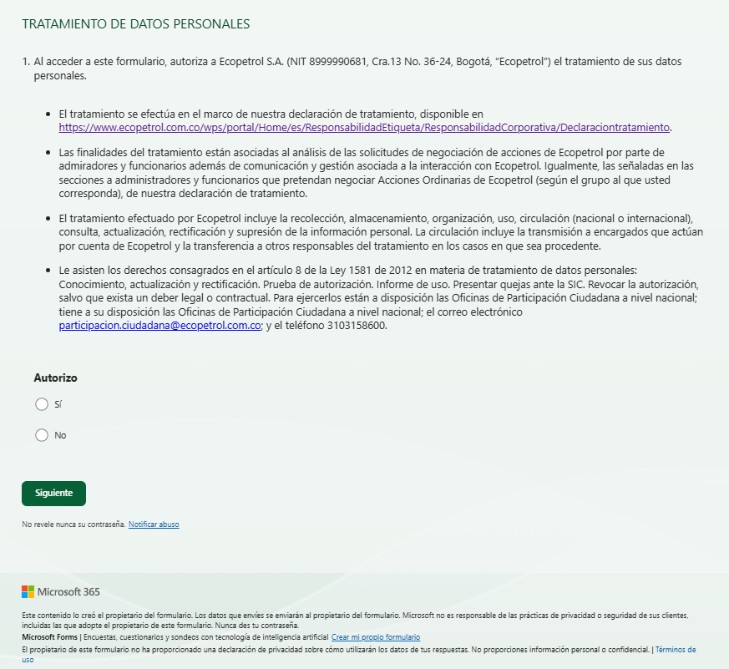
The filling instructions are described below:

A)

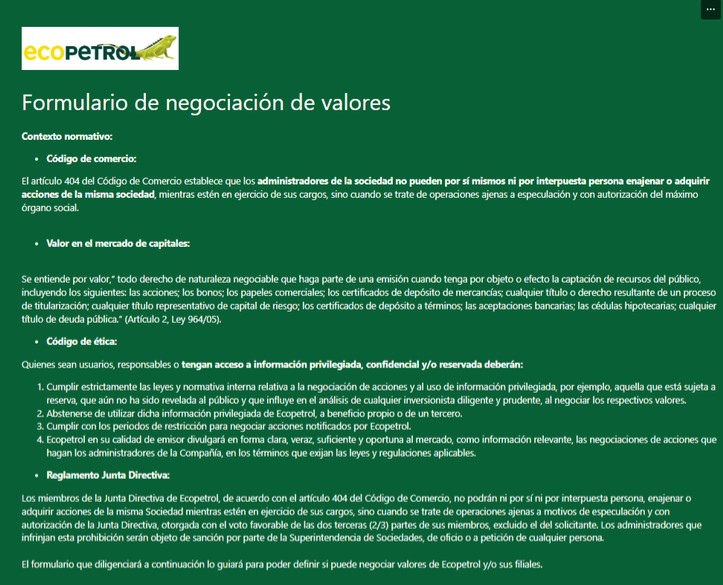
The first part of the form contains the regulatory context citing the Commercial Code, Code of Ethics, Internal Regulations of the Board of Directors and requests authorization of the personal data processing policy implemented by Ecopetrol:


All rights reserved by No written external reproduction, copy or digital transmission of this publication are allowed without written authorization. No paragraph of this publication may be reproduced, copied, or transmitted digitally without written consent, in accordance with the laws governing copyright and based on current regulations.


Graphic

Graphic

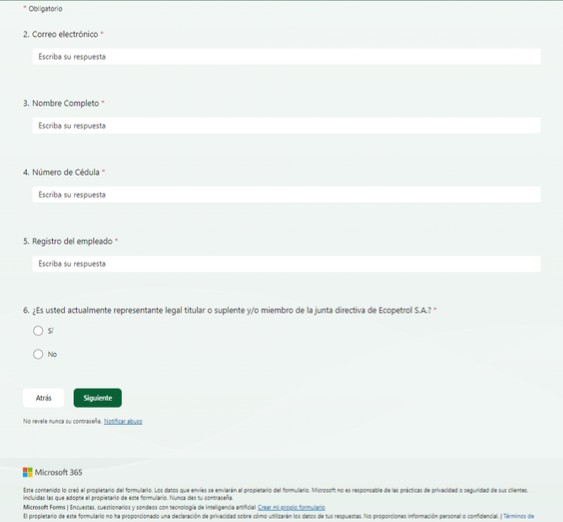
B)

Once the applicant grants authorization to process personal data, the Director or Official of Ecopetrol, as the case may be, must include their identification data on the following page and in section 6) and must


All rights reserved by No written external reproduction, copy or digital transmission of this publication are allowed without written authorization. No paragraph of this publication may be reproduced, copied, or transmitted digitally without written consent, in accordance with the laws governing copyright and based on current regulations.


indicate whether he or she is a Regular or Alternate Legal Representative and/or a member of the Board of Directors of Ecopetrol:

Graphic

C)

If the applicant’s response in section 6) is YES, the form will indicate that authorization must be obtained from the Board of Directors in the case of a Director, who must follow the procedure set out in CHAPTER 8 “Acquisition or disposal of shares” of the internal regulations of the Board of Directors, which can be consulted at the following link https://www.ecopetrol.com.co/wps/wcm/connect/56f25b16-01c0-4f3b-a7f2-a0a2594928d1/1.2+220615+Internal+Regulations+of+the+Board+Directive.pdf?MOD=AJPERES&CVID=osWVlZO

D)

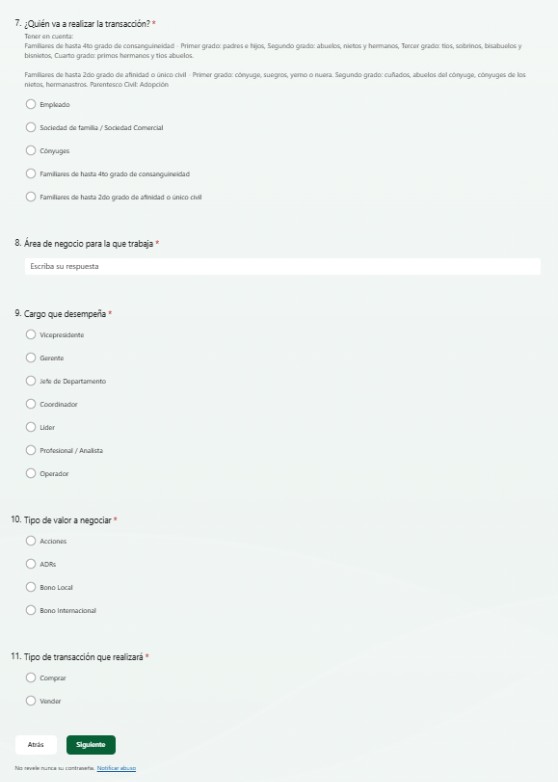
If the answer in point 6) was NO, new questions are displayed to continue answering:


All rights reserved by No written external reproduction, copy or digital transmission of this publication are allowed without written authorization. No paragraph of this publication may be reproduced, copied, or transmitted digitally without written consent, in accordance with the laws governing copyright and based on current regulations.


Graphic

E)

In question 7), the applicants must select whether they are going to make the transaction directly or through an Interposed Person, including Related Persons, legal representatives and/or attorneys, indicating their respective personal data.

F)

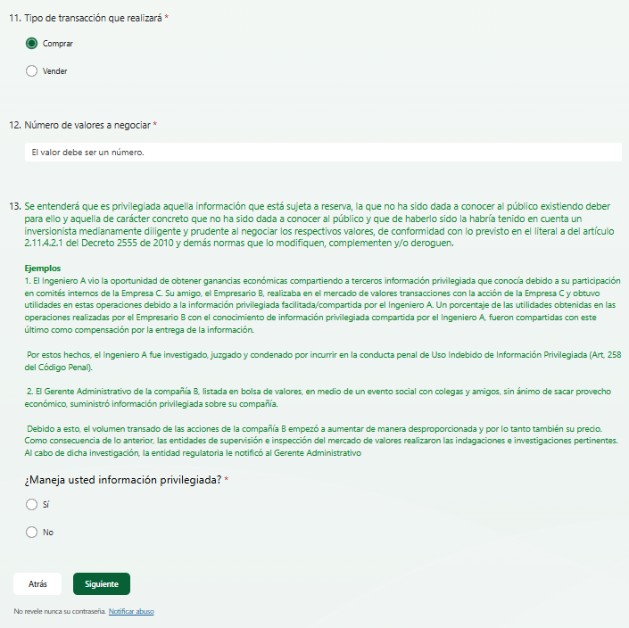
In question 11) the applicant must select the type of transaction to be carried out; if selecting Buy, the following set of questions will be displayed, asking for the number of Securities to trade and confirmation of whether you handle Inside Information, as described below:


All rights reserved by No written external reproduction, copy or digital transmission of this publication are allowed without written authorization. No paragraph of this publication may be reproduced, copied, or transmitted digitally without written consent, in accordance with the laws governing copyright and based on current regulations.


Graphic

G)

Based on the information entered at this point, the form will automatically issue an affirmative or negative response via email to the request for the purchase of Company Securities.

H)

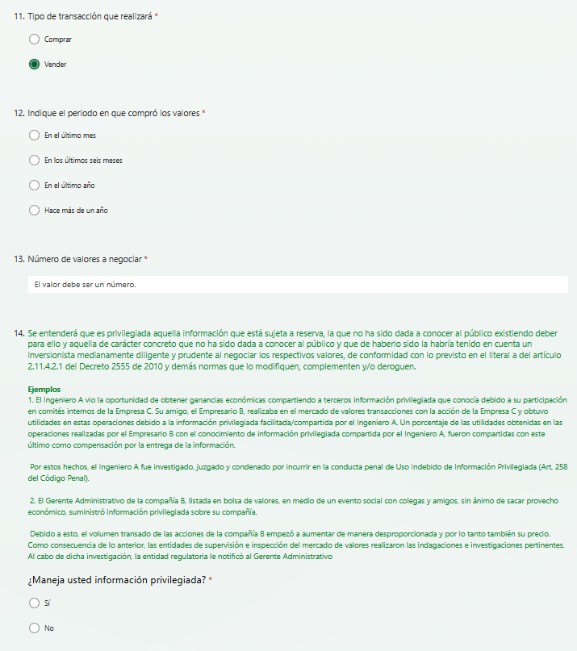
If in question 11) the applicant chose the option Sell, the following set of questions will be displayed asking the period of purchase and the number of Securities to be sold, and confirmation of whether they handle Inside Information:


All rights reserved by No written external reproduction, copy or digital transmission of this publication are allowed without written authorization. No paragraph of this publication may be reproduced, copied, or transmitted digitally without written consent, in accordance with the laws governing copyright and based on current regulations.


Graphic

I)

In question 12) (If the sell option was chosen) the applicants must indicate the period in which they acquired the Securities they wish to sell; if they did so in several tranches, they are instructed to mark the date on which they purchased the majority of the Securities.

J)

In question 12 (if the buy option was chosen) or 13 (if the sell option was chosen) the applicant must indicate the number of Securities they wish to sell.

K)

In question 13 (if the buy option was chosen) or 14 (if the sell option was chosen) the applicants must indicate whether they handle Inside Information. If the answer is “Yes”, it will take them to the next question, if the answer is “No” the form ends and an automatic response is sent to the registered email.

L)

In question 14 (if the buy option was chosen) or 15 (if the sell option was chosen), it must be confirmed whether the purchase or sale is made for speculation purposes. Based on the information entered at this point, the form will automatically issue an affirmative or negative response via email to the request for the sale of Securities.

As a general rule, officials who have privileged information and want to perform transactions for speculative reasons should refrain from doing so.

At the end of the answers to the form, the administrator or official of Ecopetrol must accept the declaration of information that ensures that the answers included are true and complete.

“I declare that the information provided herein as set out by Ecopetrol for this purpose is true and corresponds to reality. I authorize that the data contained herein be verified by any means and, in case of falsehood, that the sanctions provided for in the Law be applied.”


All rights reserved by No written external reproduction, copy or digital transmission of this publication are allowed without written authorization. No paragraph of this publication may be reproduced, copied, or transmitted digitally without written consent, in accordance with the laws governing copyright and based on current regulations.


4.4

MONITORING OF THE NEGOTIATIONS OF ECOPETROL SHARES BY ITS DIRECTORS AND OFFICERS

The RCU (Corporate Compliance Department for its initials in Spanish) or the agency that takes its stead, is the area in charge at Ecopetrol for conducting periodic control of the stock negotiations performed by the Directors and Officials of Ecopetrol. For this purpose, said agency verifies if the transactions that they have made with Company shares have complied with the pertinent authorization process.

In any event, RCU may monitor the trading of any other security other than shares in the market performed by officials and/or their related persons.

4.5

PROCESS

4.5.1

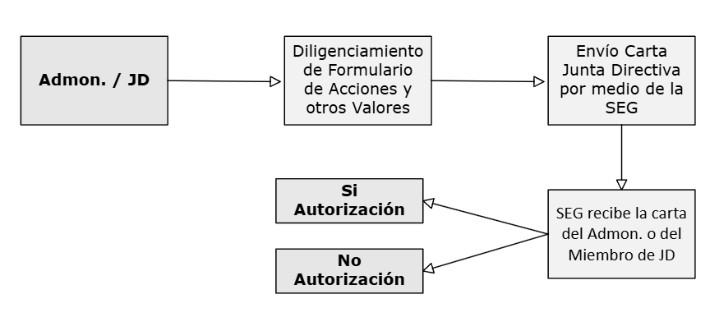
Process for Directors or members of the Board of Directors of Ecopetrol

Graphic

See details of the authorization procedures for directors or members of the Board of Directors in CHAPTER 8: ACQUISITION OR DISPOSAL OF SHARES pursuant to regulations of the Board of Directors.

https://www.ecopetrol.com.co/wps/wcm/connect/56f25b16-01c0-4f3b-a7f2-a0a2594928d1/1.2+220615+Reglamento+Interno+de+la+Junta+Directiva.pdf?MOD=AJPERES&CVID=osWVlZO

4.5.2

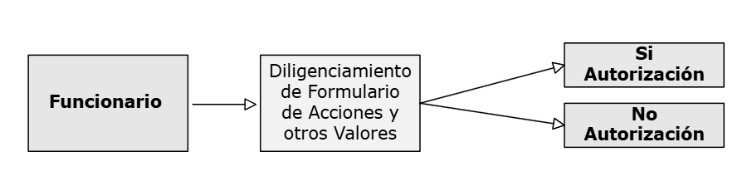
Process for Ecopetrol Officials

Graphic

The form will include the response of authorization or not to the Company officials at once.

* Periodically, the RCU monitoring team performs verifications on stock trading transactions.

4.6

SANCTIONS FOR ADMINISTRATORS FOR NON-COMPLIANCE WITH THE REGULATION

Sanctions for violation of article 404 of the Commercial Code and other regulations that modify, complement and/or repeal it: The Director or Official of Ecopetrol in contact with Inside Information who violates the prohibition set forth in article 404 of the Commercial Code will be sanctioned with fines (up to a maximum of 200 minimum legal monthly salaries), which will be imposed by the Superintendency of Companies, ex officio or upon request of any person, giving rise to loss of their position.

All rights reserved by No written external reproduction, copy or digital transmission of this publication are allowed without written authorization. No paragraph of this publication may be reproduced, copied, or transmitted digitally without written consent, in accordance with the laws governing copyright and based on current regulations.


Sanctions for improper use of Inside Information: The Director or Official of Ecopetrol in contact with Inside Information who misuses it for the negotiation of Ecopetrol Securities will be subject to the legal sanctions that may apply. In particular, the criminal sanctions provided for in article 258 of the Penal Code include prison sentence (from 1 to 3 years) and a fine (from 5 to 50 current monthly legal minimum salaries), without prejudice to the investigations that may be initiated by securities market supervisory bodies, such as the Financial Superintendency of Colombia, or the administrative sanctions that may arise therefrom.
Sanctions for breaching the disciplinary regime: Ecopetrol Officials who violate the duty provided for in paragraph 1 of article 38 of Law 1952 of 2019 - General Disciplinary Code - associated with compliance, but without limitation, with the entity’s statutes, regulations and function manuals, or who incur the prohibition provided for in paragraph 1 of article 39 of the same law, related to failing to comply with duties or abusing rights, or exceeding the functions enshrined, among others, in the entity’s statutes, regulations and function manuals, rules that include this policy, may incur the disciplinary sanctions provided for in this Code.
Consequences derived from ignorance of the principles set out in the Ethics Code: People who act contrary to this policy may be subject to the procedures and consequences derived therefrom, which are adopted by the RCU or the agency that takes its stead.
Sanctions under SEC Regulations: The exact amount of each possible sanction detailed below will depend on the date on which said sanctions are imposed, as the SEC will adjust them in accordance with inflation levels:
oCriminal Sanctions: Section 32(a) of the Exchange Act authorizes criminal penalties of up to five million US dollars and a prison sentence of up to 20 years. In the event that the violation is incurred by a legal entity, sanctions of up to 25 million US dollars are authorized.
oCivil Sanctions: Pursuant to the Insider Trading Sanctions Act, the SEC may impose sanctions of up to three times the amount earned, or losses avoided for having made sales or purchases of shares based on Inside Information or Material Unpublished Information.
oPrecautionary measures: The SEC may impose precautionary measures (injunctive actions) to suspend sales or purchases of shares based on Inside Information or Relevant Unpublished Information.
oOther Sanctions: The Insider Trading Sanctions Act and Section 20 of the Exchange Act allow natural persons who meet certain conditions to file claims in federal courts in the United States against persons who sell or buy shares based on Inside Information or Material Unpublished Information. Such claims may be for up to a maximum amount equivalent to the amount gained or losses avoided by the sale or purchase of shares based on Inside Information or Relevant Unpublished Information.

5.    CHANGES AND REVISION

This Policy may be modified periodically. The Capital Markets Management (GMC for its initials in Spanish) must approve any change to this Policy and this shall be communicated to the Directors and Officials of Ecopetrol as defined in this regulation.

Reviewed

Approved


All rights reserved by No written external reproduction, copy or digital transmission of this publication are allowed without written authorization. No paragraph of this publication may be reproduced, copied, or transmitted digitally without written consent, in accordance with the laws governing copyright and based on current regulations.


LINA MARIA CONTRERAS MORA
Investor Relations Officer

Carolina Tovar Aragon
Head of Capital Markets


All rights reserved by No written external reproduction, copy or digital transmission of this publication are allowed without written authorization. No paragraph of this publication may be reproduced, copied, or transmitted digitally without written consent, in accordance with the laws governing copyright and based on current regulations.