Please wait
BALLARD POWER SYSTEMS INC.
ANNUAL INFORMATION FORM
For the year ended December 31, 2025
Dated March 9, 2026
TABLE OF CONTENTS
| | | | | |
| |
| |
| |
| 8 |
| |
| 15 |
| 16 |
| 18 |
| 18 |
| 18 |
| 19 |
| 21 | |
| 21 | |
Rail | 21 | |
Stationary Power | 21 |
Marine | 22 | |
Truck | 22 | |
Material Handling | 22 | |
| 22 | |
| 24 | |
| 29 |
| 29 |
| 29 | |
| 30 | |
| 30 |
| 30 | |
| 31 | |
| 31 | |
| 32 | |
| 32 | |
| 32 | |
| 33 | |
| 34 | |
| 35 | |
| | | | | |
| 36 | |
| 36 |
| 36 |
| 36 |
| 39 |
| 40 | |
| 40 | |
| 40 | |
| 41 | |
| 42 | |
| 42 | |
| 43 | |
| 44 | |
| 44 | |
| 44 | |
| 44 | |
| 44 | |
| 45 | |
| 45 | |
| 46 | |
| 46 | |
| 68 |
| 69 |
This Annual Information Form and the documents incorporated by reference herein contain forward-looking statements that are based on the beliefs of management and reflect our current expectations as contemplated under the safe harbor provisions of Section 21E of the United States Securities Exchange Act of 1934, as amended. When used in this Annual Information Form, the words “estimate”, “project”, “believe”, “anticipate”, “intend”, “expect”, “plan”, “predict”, “may”, “could”, “should”, “will”, the negatives of these words or other variations thereof and comparable terminology are intended to identify forward-looking statements. Such statements include, but are not limited to, statements with respect to our objectives, goals, liquidity, sources and uses of capital, outlook, strategy, order backlog, order book of expected deliveries, sales pipeline and future product sales; future product roadmap, including expected product costs and selling prices; future production capacities and volumes; the markets for our products; expenses and costs; research, technology and product development activities, including future product performance, attributes, and launches and product cost reduction plans; as well as statements with respect to our beliefs, plans, objectives, expectations, anticipations, estimates and intentions, including regarding our ability to implement, execute, complete or realize benefits of our restructuring initiatives on the timelines we expect, including our expectations with response to our expected restructuring changes, cost savings and the reduction of our planned capital expenditure. These statements are not guarantees of future performance and involve assumptions, risks and uncertainties that are difficult to predict. In particular, these forward-looking statements are based on certain factors and assumptions relating to our expectations with respect to hydrogen and fuel cell market development; certain factors and assumptions relating to our existing customer and partner relationships; the generation of new sales; producing, delivering, and selling the expected product and service volumes at the expected prices and costs; and controlling our costs. They are also based on a variety of general factors and assumptions including, but not limited to, our expectations regarding technology and product development efforts; manufacturing capacity and cost; product and service pricing; market demand; and the availability and prices of raw materials, labour, and supplies. These assumptions have been derived from information available to the Company including information obtained by the Company from third parties. These assumptions may prove to be incorrect in whole or in part. In addition, actual results may differ materially from those expressed, implied, or forecasted in such forward-looking statements. Factors that could cause
our actual results or outcomes to differ materially from the results expressed, implied or forecasted in such forward-looking statements include, but are not limited to: our ability to successfully execute our business plan; commercial adoption of hydrogen in mobility and stationary power applications, including delays in hydrogen adoption and negative market sentiment; our expectation that our cash reserves will be reduced due to future operating losses, working capital requirements, capital expenditures and potential investments, and our ability to access additional capital when required; potential fluctuations in our financial and business results that make forecasting difficult and may restrict our access to funding; our dependence on a limited number of customers and risks associated with early-stage market activities; our dependence on third party suppliers for the supply of key materials and components and risks of supply chain disruption; our dependence on OEMs and system integrators; our limited experience manufacturing fuel cell products at commercial scale; risks inherent in international operations, including trade tariffs, currency restrictions and restrictions on repatriation of funds; risks under certain customer supply agreements; public policy and regulatory changes, including regulations relating to perfluoroalkyl and polyfluoroalkyl substances (“PFAS”) and changes to clean energy subsidies and incentives; adequate investment in hydrogen fueling infrastructure and competitive pricing of hydrogen fuel; geopolitical events and global economic risks; inflationary pressures, including relating to supply of materials and labour; commodity price fluctuations; competition and competitive technologies; risks associated with capital investments and new business processes; risks associated with mergers and acquisitions; our technology and products may not meet market requirements; we may not be able to sell our products on a commercially viable basis on the timetable anticipated, or at all; our ability to attract and retain key personnel; warranty claims, product performance guarantees, or indemnification claims; a mass market for our products may never develop or may take longer to develop than anticipated; cybersecurity threats; our ability to protect our intellectual property; climate change risks; regulatory agency actions that could affect existing or future investments, acquisitions or joint ventures; additional issuance of securities may dilute existing securityholders and affect the market price of our securities; exchange rate fluctuations; product safety, product liability or other claims; environmental liabilities; changes in U.S. tax laws and tax status related to “passive foreign investment company” designation; emerging diseases; and the general assumption that none of the risks noted in the “Risk Factors” section of this Annual Information Form will materialize.
The forward-looking statements contained in this Annual Information Form speak only as of the date of this Annual Information Form. Except as required by applicable legislation, Ballard does not undertake any obligation to release publicly any revisions to these forward-looking statements to reflect events or circumstances after the date of this Annual Information Form, including the occurrence of unanticipated events.
In this Annual Information Form, references to “Corporation”, “Company”, “Ballard”, “we”, “us” and “our” refer to Ballard Power Systems Inc. and, as applicable, its subsidiaries. All dollar amounts are in United States dollars unless otherwise indicated. Canadian dollars are indicated by the symbol “C$”, and euros by the symbol “€”.
Except where otherwise indicated, all information presented is as of December 31, 2025.
CORPORATE STRUCTURE
Name, Address and Incorporation
Ballard was incorporated on November 12, 2008 under the Canada Business Corporations Act (Canada), under the name “7076991 Canada Inc.” Ballard changed its name to “Ballard Power Systems Inc.” on December 31, 2008. On August 24, 2016, Ballard continued into British Columbia under the Business Corporations Act (British Columbia). Ballard’s head office is located at 9000 Glenlyon Parkway, Burnaby, British Columbia, Canada V5J 5J8, and its registered office is located at Suite 1700, 666 Burrard Street, Vancouver, British Columbia, Canada V6C 2X8.
Previously, Ballard Power Systems Inc. was a British Columbia company incorporated on May 30, 1989. The original predecessor to Ballard was founded in 1979 under the name Ballard Research Inc. to conduct research and development on high-energy lithium batteries. In the course of investigating environmentally clean energy systems with commercial potential, we began to develop fuel cells and have been developing fuel cell technology since 1983.
Our Vision, Mission and Values
Our vision is to deliver fuel cell power for a sustainable planet. Our mission is to use our fuel cell expertise to deliver valuable and innovative solutions to our customers globally, create rewarding opportunities for our team, provide extraordinary value to our shareholders and power the hydrogen society.
Our values represent our core beliefs and underpin how we carry on our business. In addition to our value pillars of safety and innovation, we have five key cultural values:
•Listen and Deliver – We listen to our customers, understand their business and deliver innovative and valuable solutions for lasting partnerships;
•Quality Always – We deliver quality in everything we do;
•Inspire Excellence – We live with integrity, passion, urgency, agility and humility;
•Row Together – We achieve success through respect, trust and collaboration; and
•Own It – We step up, take ownership for our results and trust others to do the same.
Intercorporate Relationships
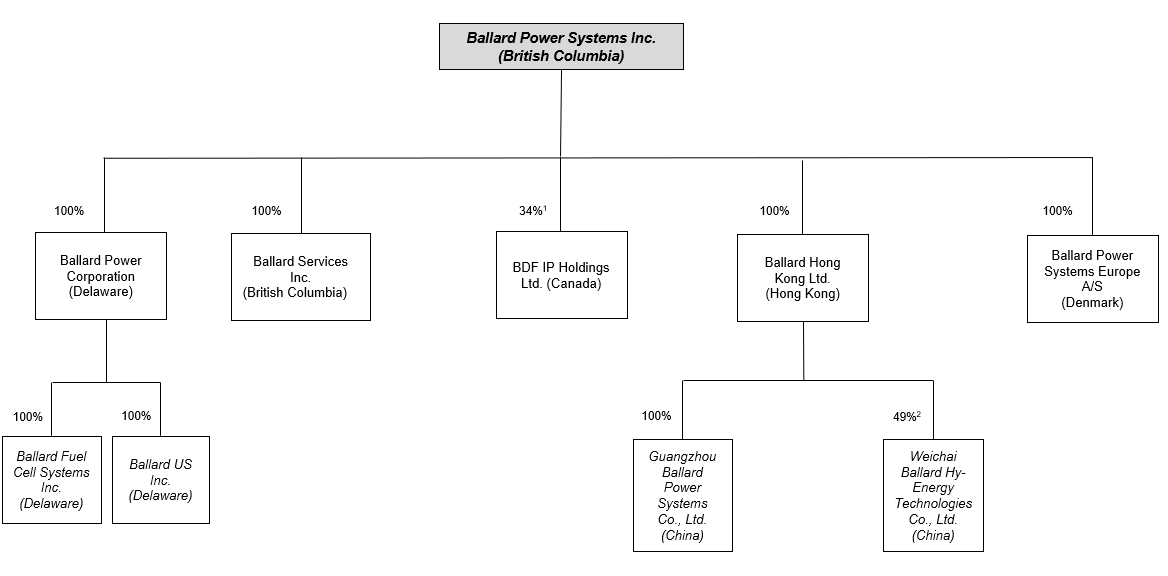
We have eight subsidiaries and affiliates: (i) Ballard Power Corporation, a Delaware corporation that is a holding company; (ii) Ballard Fuel Cell Systems, Inc., a Delaware corporation that does certain development and manufacturing work, and provides certain services to customers; (iii) Ballard US Inc. (formerly Ballard Unmanned Systems Inc.), a Delaware corporation that is a dormant holding company; (iv) Ballard Power Systems Europe A/S (formerly Dantherm Power A/S), a Danish corporation that provides certain sales, commissioning, engineering services and after-sales service; (v) BDF IP Holdings Ltd., a Canadian corporation that holds certain intellectual property assets; (vi) Ballard Services Inc., a British Columbia company that provides certain engineering services; (vii) Ballard Hong Kong Limited, a holding company for certain assets in China; and (viii) Guangzhou Ballard Power Systems Co., Ltd., a Chinese wholly foreign-owned entity, that provides certain sales, quality, supply chain and after-sales services.
We have a non-controlling 49% interest in Weichai Ballard Hy-Energy Technologies Co., Ltd. (“Weichai-Ballard JV”), located in Weifang, Shandong Province, China, with Weichai Power Co., Ltd. (“Weichai”) holding a 51% interest. The Weichai-Ballard JV’s business is to manufacture Ballard’s FCgen®-LCS fuel cell bipolar plates, stacks and power modules for bus, commercial truck and forklift applications with certain exclusive rights in China.
The following chart shows these subsidiaries and affiliates, their respective jurisdictions of incorporation and our percentage of share ownership in each of them, all as of March 9, 2026:
Notes:
1. Ballard holds 100% of the non-voting, participating shares of BDF IP Holdings Ltd. and 34% of the voting, non-participating shares, along with each of Mercedes-Benz AG (33%) and Ford Motor Company (33%).
2. Ballard indirectly holds a 49% interest in Weichai Ballard Hy-Energy Technologies Co., Ltd. together with Weichai Power Co., Ltd. (51%).
Recent History
Over the past three years, we have continued to focus on building and commercializing our proton exchange membrane (“PEM”) fuel cell business for select mobility and stationary power applications. The following are key developments during that period:
Ballard launches FCmove®-SC fuel cell at Busworld
On September 17, 2025, we announced plans to launch the FCmove®-SC fuel cell engine at Busworld in Brussels. The FCmove®-SC is designed for city transit bus applications and builds on the Company’s FCmove platform.
The module incorporates engineering enhancements relative to prior-generation products, including an increase in end-of-life system power, higher volumetric power density through integrated DC/DC packaging, an increase in maximum radiator outlet temperature from 60°C to 75°C to support vehicle thermal management, and a reduction in total part count. The FCmove®-SC is designed to deliver peak power capability of at least 75 kW and is expected to support an
estimated service life of approximately 25,000 operating hours under standard transit duty cycles.
The FCmove®-SC internalizes certain power electronics components to simplify system integration and reduce external interfaces. The module is supported by the Company’s fleet services platform, including onboard communications and the FCServiceCloud™ portal, which provides maintenance and performance monitoring capabilities. The design also incorporates safety-focused features within the PEM stack enclosure architecture.
The FCmove®-SC design reflects the Company’s operating experience in transit applications, including deployments of fuel cell-powered buses in Europe and other markets.
Strategic restructuring, leadership transition and realignment initiatives (2023–2025)
Over the past three years, the Company has implemented a series of restructuring and strategic realignment initiatives to align its investment intensity, cost structure and product development priorities with evolving hydrogen market conditions and policy uncertainty.
In 2023, we implemented a modest headcount reduction, rationalized our product portfolio, reduced the number of active product development programs, discontinued certain legacy products and non-core activities, and suspended a proposed investment to localize membrane electrode assembly manufacturing in China.
On September 12, 2024, we announced a global corporate restructuring that included a sizeable workforce reduction, rationalization and consolidation of certain global operations and facilities, and a reduction in certain planned capital expenditures, with the objective of reducing total annualized operating costs by approximately 30% compared to the first half of 2024.
As part of the 2024 restructuring initiatives, the Company reduced its corporate cost structure in China and initiated a strategic review of the Weichai-Ballard JV in light of continued policy and market challenges in the China fuel cell sector and the joint venture’s operating performance. Following completion of this review in early 2025, the Company does not intend to make additional significant investments in China, including in the Weichai-Ballard JV, for the foreseeable future. During the fourth quarter of 2025, the Company recognized an impairment charge of $4.6 million to fully impair its remaining equity investment in the Weichai-Ballard JV.
On June 16, 2025, the Company announced a planned leadership transition pursuant to which Randy MacEwen stepped down as President and Chief Executive Officer, and Marty Neese was
appointed President and Chief Executive Officer effective July 7, 2025, as part of the Company’s succession planning process.
On July 31, 2025, under Mr. Neese’s leadership, the Company announced a strategic realignment intended to align its operations, capital allocation and product development priorities with prevailing hydrogen market conditions and commercial adoption timelines.
The strategic realignment includes a structured plan focussed on enhanced cost discipline, market and product prioritization, pricing initiatives and optimized working capital management to improve the Company’s financial performance and strengthen its long-term sustainability.
As part of this initiative, the Company expects to further reduce annualized operating costs by approximately 30% in 2026 relative to the first half of 2025, through workforce adjustments, portfolio rationalization and operational streamlining. The Company also intends to prioritize fuel cell products and applications with stronger commercial traction, discontinue certain non-core programs, and focus product development efforts on system cost reduction, next-generation stack readiness and higher-margin product offerings.
In addition, the Company is pursuing margin expansion initiatives through product cost reductions, value-based pricing strategies and enhanced customer service offerings. The strategic realignment also emphasizes disciplined capital allocation, including limiting capital expenditures and maintaining rigorous cash and working capital management practices, with a focus on inventory optimization.
Ballard announces order for 6.4 MW to eCap Marine for Samskip vessels
On July 22, 2025, we announced an order to supply 6.4 MW of FCwave™ fuel cell engines to eCap Marine GmbH for deployment on two Samskip vessels operating between Norway and the Netherlands. This order represents continued expansion of Ballard’s fuel cell products into marine applications.
Ballard announces 1.5 MW fuel cell engine order for Sierra Northern Railway
On June 5, 2025, we announced an order from Sierra Northern Railway for 1.5 MW of fuel cell engines to support the conversion of three diesel switching locomotives to hydrogen fuel cell
operation. The order includes 12 FCmove®-XD fuel cell engines and reflects continued progress in the adoption of fuel cell technology in heavy-duty rail applications.
Ballard announces fuel cell engine order totaling approximately 5 MW of fuel cell engines for bus market
On March 4, 2025, we announced a multi-year supply agreement from Manufacturing Commercial Vehicles for 50 FCmove®-HD+ fuel cell engines totaling approximately 5 megawatts (“MW”).
Ballard announces multiple orders totaling over 6 MW of fuel cell engines for European bus market
On December 20, 2024, we announced orders from two bus manufacturers to supply over 90 fuel cell engines, representing approximately 6.4 MW of total rated power, for the European and UK city bus market.
Ballard announces orders for 70 hydrogen fuel cell engines for delivery to Wrightbus in 2024
On April 16, 2024, we announced multiple purchase orders totaling 70 FCmove®-HD hydrogen fuel cell engines from our customer Wrightbus, a UK-based bus manufacturer deploying hydrogen-powered buses in the UK and Europe.
Manufacturing capacity and expansion initiatives (2022-2025)
On September 30, 2022, the Company announced its “local for local” strategy, which included plans to expand its global manufacturing footprint in Europe, the United States, and China, including a proposed investment of approximately $130 million to establish a China headquarters, membrane electrode assembly (“MEA”) manufacturing facility and research and development center in Shanghai.
Given continued policy and market uncertainties, including evolving U.S. federal energy priorities, recent reductions in U.S. hydrogen and fuel cell funding programs, and uncertainties relating to hydrogen adoption timelines in heavy mobility applications, the business case for large-scale production capacity expansion investments in the foreseeable future remains highly challenging. Accordingly, the Company has determined not to proceed with its previously planned expansion program for a new fuel cell manufacturing facility in Rockwall, Texas (the “Texas Gigafactory”) and is focusing on optimizing utilization and efficiency at its existing manufacturing facilities.
In 2024, the Company entered into financial assistance agreements with the U.S. Department of Energy (“DOE”) providing for awards totaling approximately $40 million and was awarded up to $54 million of federal investment tax credits in support of the Texas Gigafactory. The DOE awards were subsequently terminated in 2025. In light of the Company’s decision not to proceed with the Texas Gigafactory, the Company does not expect to realize the benefit of the related federal investment tax credits.
On March 5, 2025, the Company signed an agreement with the European Innovation Fund for a grant of up to €113 million in support of a proposed European manufacturing facility. Funding under the grant is milestone-based, with the first milestone aligned with the Company’s final investment decision, currently planned for the third quarter of 2027. Any final investment decision will be subject to market adoption, demand indicators and overall project economics.
Long-term supply agreement with NFI Group Inc. (“NFI”) and purchase order for 100 fuel cell engines for bus deployments in North America
On January 3, 2024, we announced the signing of a new long-term supply agreement with NFI, a leading independent bus and coach manufacturer and a leader in electric mass mobility solutions in North America and Europe. As part of the agreement, NFI placed its first purchase order for a minimum of 100 FCmove®-HD+ modules which were delivered in 2024.
On November 4, 2024, we announced a purchase order to supply a further 200 fuel cell engines to a subsidiary of NFI.
Solaris Bus & Coach S.A. orders and long-term supply agreement
On November 17, 2022, we announced another purchase order from Solaris Bus & Coach S.A. (“Solaris”) for a further 25 70 kW heavy-duty FCmove®-HD fuel cell modules.
On October 10, 2023, we announced multiple purchase orders totaling 177 hydrogen fuel cell engines from Solaris. Deliveries commenced in 2023 and 2024, with the remaining units shipped in 2025.
On November 6, 2023 we announced multiple purchase orders totaling 62 hydrogen fuel cells engines from Solaris.
On April 1, 2024, we announced the signing of a long-term supply agreement with Solaris Bus & Coach sp. z o.o. for the supply of 1,000 hydrogen fuel cell engines through 2027 for the European transit bus market.
Ballard signs contracts with Stadler
On September 26, 2022, we announced an order from Stadler Rail AG , a leading manufacturer of rolling stock, for the supply of six 100 kW FCmove®-HD+ fuel cell engines to power trains for San Bernardino County Transportation Authority (SBCTA), with options for additional units.
On December 9, 2024, we announced the signing of a multi-year supply agreement with Stadler US Inc. to supply approximately 8 MW of FCmove®-HD+ fuel cell engines to power trains for the California Department of Transportation (Caltrans).
Infrastructure funds
In 2021, we committed to invest in two hydrogen infrastructure and growth equity funds whereby we acquired a 10% interest in the HyCap Fund I SCSP (“HyCap”), a special limited partnership registered in Luxembourg; and a 1% interest in the Clean H2 Infra Fund (“Clean H2”), a special limited partnership registered in France.
During the first quarter of 2024, we committed to invest in a decarbonization and climate technology and growth equity fund by acquiring a 2% interest in Templewater Decarbonization I, L.P., a limited partnership registered in Cayman Islands.
Ballard and Quantron AG announce a strategic partnership for the development of hydrogen fuel cell trucks
On September 7, 2021, we announced a strategic partnership with Quantron AG (“Quantron”) intended to support the deployment and adoption of fuel cell technologies in commercial vehicle applications.
On September 19, 2022, we announced a minority equity investment in Quantron. In 2023, Ballard made an additional investment in Quantron following the satisfaction of certain investment conditions.
Following financial distress, the company underwent restructuring in late 2024, significantly reducing its workforce. As a result of the restructuring, the Company no longer holds an equity interest in Quantron.
Ballard receives orders to power Siemens Mireo Plus H passenger trains and signs LOI for up to an additional 200 modules over the next six years
On July 15, 2021, the Company announced that it had received a purchase order for two of our 200 kW fuel cell modules from Siemens Mobility GmbH (“Siemens”) to power a 2-car Mireo Plus H passenger train through a trial operation in Bavaria, Germany.
On September 22, 2022, the Company announced that it had received an order for fourteen 200 kW fuel cell modules from Siemens, to power a fleet of seven Mireo Plus H passenger trains. These trains entered passenger service in early 2025.
Siemens also entered into a letter of intent with Ballard for the supply of up to 200 fuel cell modules totaling approximately 40 MW over a sixyear period, including a firm commitment for 100 fuel cell modules totaling approximately 20 MW.
Ballard fuel cells to power CPKC Hydrogen Locomotive Program
On March 9, 2021, we announced that Canadian Pacific (“CP”), now Canadian Pacific Kansas City (“CPKC”), will employ Ballard fuel cell modules for CP’s pioneering Hydrogen Locomotive Program to develop North America’s first hydrogen-powered line-haul freight locomotive by retrofitting a formerly diesel-powered locomotive with Ballard’s 200 kW hydrogen fuel cell modules.
In 2022 through 2024, Ballard supplied CPKC with 44 fuel cell engines for use in its hydrogen locomotives.
On December 5, 2024, we announced the signing of a new long-term supply agreement with CPKC, including the initial supply of 98 fuel cell engines for use in the North American freight rail market. Of the 98 engines, 65 were delivered in 2025, and the remaining 33 engines have been or are expected to be delivered in 2026.
OUR BUSINESS
At Ballard, our vision is to deliver fuel cell power for a sustainable planet. We are recognized as a world leader in PEM fuel cell power system development and commercialization.
Our principal business is the design, development, manufacture, sale and service of PEM fuel cell products for a variety of applications, focusing on power products for bus, truck, rail, marine, stationary and emerging market (material handling, off-road and other) applications, as well as the delivery of services, including technology solutions, after sales services and training.
A fuel cell is an environmentally clean electrochemical device that combines hydrogen fuel with oxygen (from the air) to produce electricity. The hydrogen fuel can be obtained from natural gas, methanol, ammonia, or other hydrocarbon fuels, or from water through electrolysis. Ballard’s PEM fuel cell products are typically designed to feature high fuel efficiency, relatively low operating temperature, high durability, low noise and vibration, compact size, quick response to changes in electrical demand, and modular design. Embedded in each Ballard fuel cell product lies a stack of unit cells designed with our proprietary PEM fuel cell technology. This technology includes membrane electrode assemblies, catalysts, plates, and other key components, and draws on intellectual property from our patent portfolio, together with our extensive experience and know-how, in key areas of PEM fuel cell stack design, operation, production processes and systems integration.
Strategy
We strive to build value for our shareholders by developing, manufacturing, selling, and servicing zero-emission, industry-leading PEM fuel cell technology products and services to meet the needs of our customers in target markets. More specifically, our business plan is to leverage our core competencies of PEM fuel cell stack technology and module development and manufacturing, our investments in advanced manufacturing and production capacity, and our product portfolio by marketing our products and services across select large and attractive addressable market applications and select geographic regions.
We typically select our target market applications based on use cases where the comparative user value propositions for PEM fuel cells powered by hydrogen are strongest – such as where operators value low emission vehicles that require high utilization, long driving range, heavy payload, fast refueling, and similar user experiences to legacy diesel vehicles – and where the barriers to entry for hydrogen refueling infrastructure are lowest – such as use cases where vehicles typically return to a depot for centralized refueling and do not require a distributed refueling network. Our current target markets include medium- and heavy-duty mobility applications, such as bus, truck, rail, and marine, along with certain off-road applications, including material handling and stationary power solutions.
We select our target geographic markets based on a variety of factors, including addressable market sizes of the target market applications in the geographic markets, historic deployments and expected market adoption rates for hydrogen and fuel cells, supportive government policies,
existing and potential partner, customer, and end user relationships, and competitive dynamics. Our current key target markets are the geographic regions of Europe and North America.
We also seek to leverage common PEM fuel cell technology platforms across multiple applications and regions in order to support scale efficiencies and cost reduction over time. While we recognize addressing multiple market applications and geographic markets in parallel increases our near-term cost structure and investments, we believe offering the same core PEM fuel cell technologies and substantially similar derivative PEM fuel cell products across multiple mobility and power market applications and across select geographic regions will significantly expand and strengthen our long-term business prospects. We believe this model approach will increase volume scaling in our operations, enable lower product and production costs for the benefit of all markets, improve our competitive positioning and market share, enable diversified revenue streams and profit pools, and enhance our returns on investments in our technology, product development, and manufacturing.
As we look to our long-term strategic plan and cascading capital allocation, we continue to believe hydrogen and PEM fuel cells will play an important long-term role in decarbonizing select heavy mobility and stationary power applications. We continue to believe that there are certain use cases where customers will be attracted to the differentiated PEM fuel cell value proposition of long range, fast refueling, heavy payload, and zero tailpipe emissions.
However, given ongoing market uncertainties, we expect further industry rationalization, failures, restructurings and consolidation. We will continue to closely monitor various factors and circumstances that may impact the commercial adoption of our markets and products, including factors related to macroeconomic conditions and outlook, geopolitical context, climate change policies, hydrogen and fuel cell industry growth, capital markets, supply chain development, and customer conditions. We will continue to review our investment plans and cost structure based on these factors as we remain focused on our customers and developing next-generation, low-cost fuel cell products, while maintaining disciplined spending and balance sheet strength for long-term competitiveness and sustainability.
Overall, our strategy is focused on disciplined capital allocation, prioritization of markets and applications with clearer commercial adoption pathways, continued product cost reduction and operational efficiency, and maintaining our strong financial position to support long-term competitiveness.
Revenues from Market Segments
We report our results in the single operating segment of Fuel Cell Products and Services. Our Fuel Cell Products and Services segment consists of the sale of PEM fuel cell products and services for a variety of applications, including Heavy-Duty Mobility (consisting of bus, truck, rail, and marine applications), Stationary Power, and Emerging and Other Markets (consisting of material handling, off-road, and other applications). Revenues from the delivery of Services, including technology solutions, after-sales services and training, are included in each of the respective markets.
The following chart shows the percentage of total revenues which arises from sales to investees and sales of products and services to other customers, for the years 2025 and 2024:
| | | | | | | | |
| 2025 | 2024 |
| Revenues from Fuel Cell Products and Services | | |
Percentage of total revenues | 100% | 100% |
Portion representing sales to investees (1) | 1.5% | 4.0% |
Portion representing sales to customers other than investees | 98.5% | 96.0% |
Notes:
1. In this table, “investees” means Weichai Ballard Hy-Energy Technologies Co., Ltd., a joint venture formed in China, of which we hold a 49% equity interest.
Our Markets, Products and Services
Product & Service Overview
Ballard provides products in three distinct product classes and two separate categories of services:
1.MEAs: We provide our proprietary membrane electrode assemblies (“MEAs”) to selected customers to produce their own fuel cell stacks.
2.Fuel cell stacks: We provide our proprietary FCgen® fuel cell stacks to original equipment manufacturer (“OEM”) customers and system integrators that use the stacks to produce fuel cell systems for certain mobility or stationary power solutions.
3.Fuel cell modules: We design and assemble PEM fuel cell power modules or engines for certain mobility and stationary power applications. We design these modules using our proprietary fuel cell stacks, balance of plant components we typically specify and procure from third-party suppliers, and proprietary controls software.
4.Technology Solutions: We offer specialized engineering services to our customers typically for integration of our into a vehicle platform or packaged power generation solution or for custom fuel cell development.
5.After-Sales Services: We offer our customers after-sales services, including warranty support, service contracts, spare parts management, fleet monitoring, and training, to support customers throughout the service life of our products.
The following table lists the key fuel cell products we currently produce, offer for sale, have under development or are testing:
| | | | | | | | |
| Fuel Cell Product Family: |
| Product Name | Application | Status |
FCgen®-LCS MEA | Fuel cell stacks for buses and commercial vehicles | Sales to licensee (Weichai-Ballard JV) |
FCgen®-HPS stacks | Light-duty and heavy-duty commercial vehicles | Sales to OEMs and system integrators |
FCgen®-LCS stacks | Buses, commercial vehicles, rail and material handling | Sales to OEMs and system integrators |
FCgen®-1020ACS stacks | Material handling and backup power | Sales to OEMs and system integrators |
FCmove® modules | Buses, commercial vehicles, rail and stationary | Sales to OEMs and system integrators |
FCwave® modules | Marine, rail (freight locomotives) and stationary | Sales to OEMs and system integrators |
FCrail® modules | Passenger rail application | Sales to OEMs and system integrators |
Fuel Cell Products and Services
Our primary business is the sale of Power Products, consisting of fuel cell modules and fuel cell stacks offered to customers in our target market applications of bus, truck, rail, marine, stationary power, and off-highway markets such as material handling. Fuel cell electric vehicles and power generation systems in these applications rely on centralized fueling depots that simplify the
hydrogen infrastructure requirements and are typically government-subsidized, thus enabling the purchase of pre-commercial fleets.
In addition to our fuel product, we also provide engineering services to customers in our target markets under our Technology Solutions offering. Our engineering services help customers solve difficult technical and business challenges in the commercialization of their PEM fuel cell products and/or address new business opportunities and markets. We offer customized, bundled technology solutions, including specialized PEM fuel cell engineering services, access to our intellectual property portfolio and know-how, as well as specialized integration and after sales support for our products in various applications across all of our market applications.
We design and manufacture fuel cell modules and stack products capable of delivering 50 kW to 200 kW of power. These modules and stacks can be combined to provide power output in excess of 1 MW for certain applications. We supply the fuel cell modules to a combination of vehicle OEMs and system integrators to deliver to end users.
In 2019, we launched our eighth-generation high-performance fuel cell module, the FCmove® platform. The FCmove® family of products is designed to power medium- and heavy-duty commercial vehicles such as buses and trucks. We have sold over 1,500 FCmove® fuel cell modules to date. The FCmove®-HD 70 kW and 100 kW versions were launched in 2019 and 2021. In May 2024, the Company launched its ninth-generation fuel cell module, the FCmove®-XD (120/240 kW), designed for heavy-duty truck (Class 6–8) and coach applications.
In September 2025, at Busworld in Brussels, the Company launched the FCmove®-SC (75 kW), a next-generation fuel cell module designed for transit bus applications. The FCmove®-SC is intended to improve durability, simplify system integration and reduce lifecycle costs compared to prior generations of transit modules. The FCmove-SC (75kW) forms part of the Company’s ninth-generation portfolio of core fuel cell module products.
In 2020, we introduced the FCwave®, a fuel cell module designed for marine applications. The FCwave® fuel cell module is a 200 kW modular unit that can be scaled in series up to the multi-megawatt power level. The FCwave® product is intended to provide primary propulsion power for marine vessels – such as passenger and car ferries, river push boats, and fishing boats – as well as stationary electrical power generator for applications such as shore power, EV charging and critical infrastructure backup power. In 2021, we also started to sell FCwave® products for stationary and rail applications. In 2022, the Company received Type Approval from DNV, one of the world’s leading marine classification and certification bodies, for its FCwave® marine fuel
cell module. This Type Approval supports deployment of the FCwave® module in marine applications, subject to applicable regulatory requirements. In 2024 and 2025, we continued sales of FCwave® products into marine, stationary power, and rail applications, including projects related to freight locomotives in Canada.
Market Applications
Bus
We provide Power Products and associated services to bus manufacturers, primarily in Europe and North America. The city transit bus market is our most mature market as measured by the length of time Ballard has been active in the market and by the number of products sold to customers in the market. Hydrogen fuel cell buses offer zero tailpipe emissions, long range, rapid refueling times, reliable performance in diverse weather conditions, and scalable refueling infrastructure.
The FCmove®-SC module is designed specifically for this market segment and reflects the Company’s ongoing product development efforts focused on cost reduction and operational performance in transit applications.
Rail
We supply Power Products and associated services to train manufacturers and railway operators, primarily in Europe and North America. Our technology offers a value proposition to railway operators seeking to reduce greenhouse gas emissions on railway lines that lack overhead catenary power infrastructure, as hydrogen fuel cells eliminate the need to build the overhead infrastructure by utilizing refueling depots that mirror current practice for diesel locomotives. Target applications for our rail vertical include passenger rail and freight locomotive applications.
Stationary Power
We supply Power Products and associated services to OEMs and system integrators of power generation products. Our products are designed to enable zero-emission power generation in remote locations that lack access to electrical grid infrastructure, or to generate backup power for extended periods.
Given the expected growth in electricity demand and challenges associated with expanding the electrical transmission and distribution infrastructure, we believe fuel cell products may support incremental power generation requirements and, in certain cases, may be deployed more quickly
than grid upgrades. Target applications include EV charging, television and film production sites, grid balancing, and backup power for critical infrastructure.
As power demand from datacenter increases, PEM fuel cell system may support reduced time-to-power and provide complementary or backup power to the grid or to on-site generation. PEM fuel cells offer operational characteristics such as rapid ramp-up capability, cycling flexibility, high reliability, low noise, and modular scalability from megawatt to multi-megawatt scale. These characteristics may support lower-carbon power solutions for data centers and may contribute to improved community acceptance in certain jurisdictions.
Marine
We supply Power Products and associated services to the marine industry, including ship builders, ship operators and systems integrators in Europe. Fuel cell power offers low emissions, long range and rapid refueling time. Target applications in our marine vertical include coastal and river applications, such as ferries, barges, short sea container ships and tugs.
Truck
We supply Power Products and associated services to commercial truck manufacturers and commercial truck integrators, primarily in Europe and North America. Our Power Products and associated services revenues from Weichai-Ballard JV are also recorded in this vertical. The hydrogen fuel cell truck market is at a nascent phase typified by demonstration projects to prove the capabilities of the technology in real world use cases. For truck applications, hydrogen fuel cell power offers long range, high payloads, short refueling times, and high fuel efficiency. Target applications for our truck vertical include heavy-duty long haul trucks, rubbish collection vehicles or garbage trucks, and medium-duty trucks or delivery vans.
Material Handling
The material handling market includes industrial vehicles such as forklifts, automated guided vehicles and ground support equipment. Our initial focus is on battery-powered Class 1 counterbalance lift trucks, Class 2 reach trucks and Class 3 pallet forklifts. Ballard is currently supplying fuel cell stacks to a limited number of system integrators in North America and Europe.
Competition
Diesel-powered buses and commercial trucks currently dominate the market today. Compressed natural gas and diesel electric hybrid powertrains are lower-emission alternatives to diesel
engines but are in limited service today. Electric trolley buses provide a zero-emission alternative; however, their purchase price is high and the overhead catenary power infrastructure is expensive to maintain and is considered aesthetically undesirable in many urban centres. The recent developments in battery-powered powertrain vehicles have created a zero-emission alternative to fuel cell buses in the form of battery electric buses and commercial trucks, as well as electrified trains and battery-powered marine vessels. These battery-powered heavy-duty vehicles represent a competitive zero-emission mobility solution in certain applications.
Fuel cell electric vehicles represent an alternative zero-emission solution for medium- and heavy-duty applications in certain use cases across bus, truck, rail, marine and off-highway markets.
Compared to battery electric vehicles, fuel cell electric vehicles may offer advantages in certain applications, including longer range, higher energy density to support payload requirements, and faster refueling times.
In certain fleet configurations, hydrogen refueling infrastructure may offer logistical and scaling advantages relative to battery charging infrastructure..
Companies developing fuel cell systems for heavy-duty motive applications include Beijing Sinohytec Co. Ltd., cellcentric GmbH & Co. KG (a joint venture of Daimler Truck AG and the Volvo Group), Cummins Inc., EKPO Fuel Cell Technologies GmbH (a joint venture of ElringKlinger and OPmobility), Hyundai Motor Company, Honda Motor Company, Plug Power, Inc., Powercell Sweden AB, Robert Bosch GmbH, Shanghai Re-Fire Technology Co., Ltd., Sino-Synergy Hydrogen Energy Technology (Jiaxing) Co., Ltd., Symbio SAS (a joint venture of Michelin, Forvia and Stellantis), and Toyota Motor Corporation.
We are also seeing the emergence of product offerings for hydrogen internal combustion engines developed by companies like Cummins Inc. and J C Bamford Excavators Ltd. Numerous engine and vehicle manufacturers are investing in development programs. This technology is seen as a potential bridge between legacy internal combustion engines and hydrogen fuel cell mobility. Through modification of existing diesel engines, it allows the use of hydrogen as a fuel leading to CO2 emission reduction. However, the technology is not expected to meet all zero emission requirements (such as NOx and SOx emissions) and may exhibit lower overall efficiency compared to fuel cell systems.
The stationary power generation market is currently dominated by diesel generators, gas internal combustion engines and batteries. Advanced battery technology continues to make modest
progress in the backup power generation market. However, advanced battery technologies still require lengthy recharging and, in many cases, cannot meet desired run times without requiring substantial space.
PEM fuel cell products may offer advantages over batteries in certain applications, including extended run time without lengthy recharging and, in some cases, lower lifecycle costs.
For certain applications and markets we believe fuel cell power generators offer a value proposition against diesel generators with lower operating cost, extended run time, low emission and noise, and less risk of theft.
Hydrogen-fueled gas turbines are also being developed and could be an alternative to diesel or natural gas generators. Compared with fuel cell systems, however, H-ICEs and gas turbines produce nitrous oxide emissions and are considered to be less power efficient.
Companies developing PEM fuel cell systems for stationary power generation applications include Honda Motor Company, Plug Power, Inc., Powercell, and Toyota.The Company seeks to compete through fuel cell designs focused on emissions performance, reliability, durability and cost competitiveness.
The Company competes based on factors including technology, product performance, intellectual property, manufacturing capabilities, customer relationships, partnerships and operational experience in heavy-duty applications.
Impact of Regulations and Public Policy
In the course of carrying on our business, the Company is subject to and monitors government regulations and public policies that may affect the fuel cell industry, zero-emission vehicles and related markets. The statements below are based on our understanding of applicable regulations and public policies as of the date of this Annual Information Form. Regulations and public policies may change, and the Company’s interpretation of such regulations may differ from that of regulators or other stakeholders.
Prolonged policy uncertainty, unpredictable election cycles, and funding challenges have contributed to delays in certain hydrogen projects across key global markets. In some cases, projects have been postponed, scaled back or cancelled. Industry commentary has referenced extended timelines for hydrogen project development, hydrogen infrastructure build-out and commercial adoption of PEM fuel cell applications relative to earlier expectations.
According to the Hydrogen Council’s Global Hydrogen Compass 2025 industry report, total committed global clean hydrogen production capacity now exceeds 6 million tonnes per year, including approximately 1 million tonnes per year of capacity already in operation. Since 2020, more than 1,700 hydrogen-related projects have been announced globally.
In 2025, investment activity in the hydrogen sector continued, although at a more measured pace. According to the Hydrogen Council’s Global Hydrogen Compass 2025 report, approximately $110 billion of committed investment in hydrogen projects has reached final investment decision or an equivalent commitment stage across more than 500 projects.
United States
In 2025, changes in U.S. federal policy priorities and funding frameworks increased uncertainty regarding government support for certain clean energy programs, including incentives and funding mechanisms that had supported green hydrogen development. Legislative developments and budgetary considerations introduced uncertainty regarding the availability and timing of certain tax credits, including those established under the Inflation Reduction Act, may have contributed to delays or reconsideration of some renewable-based hydrogen projects and related private investment decisions.
Policy emphasis also shifted toward broader domestic energy production, including lower-carbon hydrogen pathways such as blue hydrogen (natural gas with carbon capture). In addition, tariffs and regulatory changes may increase cost and planning uncertainty across clean hydrogen supply chains. As a result, certain large-scale hydrogen projects have experienced delays, scope changes, or cancellations, and market activity has increasingly reflected the role of state-level and regional initiatives with more stable incentive structures.
The California Air Resources Board (“CARB”) Low Carbon Transportation and Air Quality Improvement Program provides mobile-source incentives to reduce GHG emissions, criteria pollutants, and air toxics through the development of advanced technology and clean transportation solutions in California.
CARB’s Innovative Clean Transit (“ICT”) regulation, adopted in December 2018, requires public transit agencies to transition to a 100% zero‑emission bus (“ZEB”) fleet. Beginning in 2029, all new transit bus purchases by California transit agencies are required to be ZEBs, with a target for full transition by 2040.
In 2020, the CARB adopted Advanced Clean Trucks (“ACT”) regulation, which requires truck manufacturers to increase the percentage of zero-emission truck sales in California over time. Beginning in 2024, manufacturers are required to meet increasing sales targets, ranging from approximately 30% to 50% by 2030 and 40% to 75% by 2035, depending on vehicle class.
CARB regulatory requirements have been viewed as supportive of demand for zero-emission fuel cell and battery-electric trucks and buses in California. However, the authority for certain California emissions standards has been subject to ongoing legal and political challenges at the federal level, including Congressional actions related to U.S. Environmental Protection Agency waivers under the U.S. Clean Air Act. Developments affecting the availability or scope of such waivers could impact the implementation or enforceability of certain California zero-emission vehicle regulations, including the ICT and ACT regulations, and could affect market adoption timelines.
Europe
The European Union has identified hydrogen as a component of its decarbonization strategy under initiatives such as the European Green Deal and the REPowerEU plan. These frameworks include measures intended to support the development and deployment of renewable and low-carbon hydrogen, particularly in sectors that are difficult to electrify, including steel, chemicals, heavy transport, and aviation. The EU has established targets for domestic production of renewable hydrogen and for hydrogen imports in order to reduce fossil fuel dependence by 2030 and support its longer-term objective of net-zero greenhouse gas emissions by 2050.
The European Commission’s “Fit for 55” package includes 19 legislative proposals to help the European Union reach its climate goals of reducing GHG emissions by 55% by 2030 and achieving carbon-neutrality by 2050. A significant portion of the legislative measures proposed under this package have now been adopted, several of which could support growth of the European Union’s hydrogen economy.
For instance, the Alternative Fuels Infrastructure Regulation (Regulation (EU) 2023/1804) mandates the deployment of hydrogen refueling stations at least every 200 km along the TEN-T core transport network corridors for compressed hydrogen by 2030.
The revised Renewable Energy Directive, Directive (EU) 2023/2413 (“RED III”) that came into force on November 20, 2023, includes provisions intended to promote the use of renewable fuels of non-biological origin (“RFNBOs”), including renewable hydrogen and its derivatives, in the transport and industrial sectors.
As of late 2025, implementation of RED III, including provisions relating to RFNBOs, remained ongoing across EU Member States.
Implementation timelines and transposition of RED III provisions vary across Member States, and the European Commission may initiate infringement procedures where Member States do not meet implementation obligations.
The European Commission’s revised CO₂ emission standards for heavy-duty vehicles, presented on February 14, 2023, are intended to support the transition to zero-emission trucks, buses and coaches by establishing progressively more stringent emission reduction requirements for vehicle manufacturers. In 2024, the EU formally amended and expanded those standards to broaden their scope to nearly all new heavy-duty vehicles, including medium lorries, urban buses, coaches, and trailers, and to introduce more ambitious CO₂ reduction targets of 45% by 2030, 65% by 2035, and 90% by 2040 relative to the applicable reference period.
In November 2021, the European Commission launched the Clean Hydrogen Partnership, taking over the activities of the existing Fuel Cells and Hydrogen Joint Undertaking. The Partnership is intended to support hydrogen technology research and development, with up to €1 billion of EU funding for the period 2021-2027, complemented by additional private investment from private sector participants.
The European Union has also introduced funding mechanisms intended to accelerate investment in renewable hydrogen projects. In 2023, the European Commission launched the European Hydrogen Bank, an initiative designed to support the scaling of renewable hydrogen production and help bridge the cost gap between renewable hydrogen and fossil-based alternatives. The initiative is expected to mobilize funding through instruments such as the EU Innovation Fund, which provides financial support for large-scale low-carbon technology projects across the European Union and is financed through revenues generated under the EU Emissions Trading System. Hydrogen production and related infrastructure projects are among the technologies eligible for Innovation Fund support.
Other relevant EU legislative initiatives for the hydrogen and fuel cell sector include FuelEU Maritime, the revised EU Emissions Trading System, the Energy Efficiency Directive, the revision of the EU Gas Directive and EU Gas Regulation, the revised Weights and Dimensions Directive and the Net-Zero Industry Act.
Canada
Canada’s Hydrogen Strategy, originally released in December 2020, remains a key element of federal policy intended to position Canada as a producer, user, and exporter of low-carbon hydrogen in support of the country’s objective of achieving net-zero greenhouse gas emissions by 2050 and fostering economic development in hydrogen value chains.
The federal government has enacted and expanded fiscal measures intended to support hydrogen development, including the Clean Hydrogen Investment Tax Credit, a refundable investment tax credit of up to approximately 15% to 40% of eligible project costs, depending on lifecycle carbon intensity and compliance with certain labour and other program requirements, to support clean hydrogen production and attract capital.
The Clean Fuels Fund, administered by Natural Resources Canada, and the Net Zero Accelerator initiative under the Strategic Innovation Fund provide additional federal funding programs to support infrastructure, production facilities, and clean fuels projects that may include hydrogen. Legislation implementing the Clean Hydrogen Investment Tax Credit was included in Canada’s 2024 federal budget and related legislative measures, with program implementation expected to occur through subsequent regulations and guidance.
Regional hydrogen hubs have been announced or are under development or proposal across Canada, including in Edmonton, Vancouver, and Southern Ontario, to support coordination of production, distribution, refuelling, and industrial use, with participation from government and industry stakeholders. Several provinces, including British Columbia, Alberta, Quebec, Nova Scotia, and Ontario, have introduced hydrogen strategies or funding programs intended to complement federal initiatives and support regional development.
Hydrogen is also referenced within Canada’s Clean Fuel Regulations, which establish carbon-intensity reduction framework and credit market for liquid fossil fuels intended to incentivize lower-carbon-intensity fuels, including hydrogen, for use in transportation and certain industrial applications.
In 2024, the Government of Canada announced the Canada Public Transit Fund, which is intended to provide long-term federal transit funding averaging approximately $3 billion per year beginning in fiscal 2026–2027 to support public transit systems, including investments that may enable the deployment of zero-emission buses and related infrastructure.
The federal government has also announced broader infrastructure and economic initiatives intended to support major projects across energy, critical minerals, transportation and clean growth sectors, including efforts aimed at improving coordination of regulatory processes and federal funding programs for large-scale projects of national interest.
Workforce
As of December 31, 2025, we had 492 temporary and permanent employees in Canada, the United States, the European Union and China, representing such diverse disciplines as electrochemistry, polymer chemistry, chemical, mechanical, electronic and electrical engineering, manufacturing, quality, supply chain management, advanced manufacturing, marketing, sales, service, business development, legal, finance, accounting, human resources, information technology and business management. This reflects the global corporate restructuring further detailed in the Recent History section. Our employees are not represented by any labour union. Each employee must agree to confidentiality provisions as part of the terms of employment, and certain employees have also executed non-competition agreements with Ballard.
Sustainability
Strategy and Oversight
Our strategic theme, Here for Life®, reflects our purpose to decarbonize mobility and drive the transition to a low-carbon energy future. Our strategy remains rooted in a fundamental commitment to risk management, seizing opportunities, and operating in an environmentally and socially responsible way.
The Board’s Nominating and Governance Committee (“N&G Committee”) is responsible for overseeing our environmental, social, and governance performance, including the policies and practices related to sustainability. Composed of independent directors, the N&G Committee receives regular updates from management on sustainability activities and shares relevant information with the Board regularly. In 2025, the N&G Committee was focused on navigating the evolving regulatory landscape, with particular attention to understanding emerging reporting standards, anti-greenwashing and modern slavery legislation in Canada and assessing other potential regulatory impacts.
Details of the Committee’s mandate are available on Ballard’s website at https://www.ballard.com/investor-hub/document-library/#governance.
Recent Developments
In 2025, Ballard completed its first double-materiality assessment (DMA) to align sustainability risks and opportunities with financial and impact considerations.
The Company published three key reports related to its sustainability activities, including (i) its annual Communication on Progress (CoP) report to the United Nations Global Compact (“UNGC”), detailing progress against the ten principles, (ii) the sixth standalone annual Sustainability Report capturing the second year of activities from our Sustainability strategy and roadmap, and the pursuit of Ballard’s sustainability commitments and supporting initiatives, and (iii) the second annual “Fighting Against Forced Labour and Child Labour in the Supply Chains Act” report to align with recent Canadian legislation. A copy of the Sustainability Report and Forced and Child Labour Report can be found on the website at www.ballard.com/sustainability.
Ballard continued to advance its Mission Carbon Reduction initiative, targeting carbon reduction for corporate emissions (corporate emissions include scope 1, scope 2, and some scope 3 emissions, including business travel, employee commuting and telecommuting, and the hydrogen production emissions of hydrogen consumed by the organization in research and development activities).
Environmental Policy
Ballard is committed to supporting the delivery of fuel cell solutions while seeking to mitigate our negative environmental impact and ensuring compliance with applicable regulatory requirements. Consequently, we have implemented comprehensive environmental management programs with half of our operating sites (including our most material production facilities) third-party certified under ISO 14001. We strive to contribute to the protection of the environment by integrating environmental priorities into our overall business plan and through the specific monitoring and measurement of such priorities against historical performance and, in some cases, specific targets.
Social Policies
Ballard maintains (i) a comprehensive Code of Ethics and (ii) a Harassment, Workplace Bullying and Anti-discrimination Policy. These policies affirm Ballard’s commitment to preventing harassment and discrimination against any employee or applicant based on grounds of religion, race, sex, nationality, disability or any other basis protected by law, ordinance or regulation. The policies extend to recruitment, selection and compensation practices, as well as to working conditions and the work environment. Internal complaint resolution procedures have been
established whereby any person covered by these policies can contact their people and culture business partner or manager who will address their complaint. We encourage our employees to report any situation that appears to involve a breach of the company’s ethical or legal obligations and have engaged a third-party to receive anonymous reports or allegations of wrongdoing, and they can be contacted on a confidential basis.
Facilities
We currently have facilities in Canada, Denmark, USA, and China, including the following facilities: (a) 281,103 ft² (26,115 m²) of leased facilities in Burnaby, British Columbia that house our corporate headquarters and our fuel cell development, manufacturing, assembly and testing activities; (b) 27,759 ft² (3,508 m²) of leased facilities in Hobro, Denmark that house certain engineering, sales and service activities; and (c) 26,779 ft² (2,488 m²) of leased facilities in Bend, Oregon that house certain of our assembly and testing facilities. The Weichai-Ballard JV’s operations in Weifang, Shandong Province, China are conducted in an approximately 150,000 ft² (14,000 m²) facility.
We are committed to ensuring that each of our facilities is operated in full compliance with all applicable laws, including all applicable health, safety, and regulatory standards.
Manufacturing
Our PEM fuel cell products are produced in three facilities – two in Burnaby, British Columbia, Canada, and one in Bend, Oregon, USA. Along with these facilities, the Weichai-Ballard JV manufactures Ballard’s FCgen®-LCS fuel cell stack and FCgen®-LCS-based power modules for bus, truck and forklift applications in Weifang, Shandong Province, China. The Burnaby facilities are focused on our core fuel cell competencies, which include the production of MEAs, the production of bipolar plates, integration and testing of fuel cell stacks, assembly and testing of modules and systems, as well as support of other products required through our engineering services contracts. Our Bend facility manufactures and tests certain motive modules primarily for the U.S. market.
As a part of our strategy to reduce product costs and enable future volume production, we continue to make investments in our manufacturing processes, equipment, capabilities and business processes.
Certain materials and components used in the production of MEAs, bipolar plates, fuel cell stacks, and balance of plant are proprietary in nature and have been developed in joint collaboration between Ballard and our key supply base. Strategic supply agreements have been
executed with these suppliers to ensure security of supply, protection of our intellectual property, and adherence to our strict quality and reliability standards.
Safety
We maintain a robust safety program that is designed to ensure the safety of our employees, contractors, customers, suppliers and partners in our facilities. We have various protocols to support our safety program, including training and instruction, hazard identification and control, workplace inspections, emergency preparedness, incident investigations, and safety metrics tracking. Certain of our facilities have achieved safety standards or certifications, such as ISO 45001.
Quality
We maintain a robust quality and reliability assurance program that monitors critical process parameters and measures product performance to ensure industry and internal standards are met. Certain of our operations have adopted quality management systems and achieved certain quality standards or certifications, such as ISO9001:2015. We also conduct certain factory acceptance tests prior to preparing a fuel cell stack or module for shipment. Our quality and reliability tests complement certain production surveillance activities. These programs and tests help assure delivery of expected performance in the field with a high level of product quality and reliability.
Research and Product Development
Our R&D model differentiates us from many of our competitors due to its vertical integration, from advanced research to product development, manufacturing, and applications. We continue to devote substantial resources to our R&D efforts, which generally focus on continually improving the performance and lowering the costs of our MEAs, bipolar plates, stacks, and modules, while improving our production processes.
We continue to invest in R&D related to:
•our MEAs, including MEA design, materials, components, and production processes, with a focus on improving the overall cost, performance, durability, reliability, power density, and efficiency of our products;
•our bipolar plates, including plate design, materials, and production processes, with a focus on improving the overall cost, performance, durability, and power density of our products;
•our unit cell designs, including frames, seals and adhesives;
•our stack design, including stack hardware;
•our module design, including engine bay and rooftop mount variants, with a focus on system design, balance of plant component selection, and software development, to improve the overall cost, performance, durability, reliability, power density, and efficiency of our products; and
•advanced manufacturing initiatives, including new production processes, improvements in production throughput and yield, material cost reduction, and automation.
Intellectual Property
Ballard’s technical strengths lie in our proprietary MEA design, combined with our extensive stack and system integration capabilities, which enables development of complete end-user systems that meet or exceed customer specifications, across a wide range of market applications.
Our intellectual property covers multiple aspects of our technology, including: materials and components; cell, stack and systems architecture; stack/system operation and control; and manufacturing processes. Our intellectual property portfolio is not limited to our patents and patent applications; it also includes know-how and trade secrets developed over more than 30 years of research, product development and production.
As of March 9, 2026, Ballard owns or controls: 28 United States granted patents; 70 non-United States granted patents; 3 United States published patent applications; and 15 published non-United States patent applications. Our patents will expire between March 2026 and November 2039.
We hold license rights to additional intellectual property from a number of third parties. We have a royalty-free license to approximately 803 issued patents and pending patent applications from AUDI for bus and non-automotive applications and a royalty-bearing license for all other applications. In addition, these licenses include non-exclusive, royalty-free access to all of the intellectual property rights held by NuCellSys GmbH, a Daimler subsidiary, and to all of the intellectual property rights relating to fuel cells developed by Daimler, Ford and their subsidiaries (either directly or through AFCC), including any intellectual property rights developed by them to January 31, 2013. As of March 9, 2026, approximately 62 of the patents and patent applications that were included in these licenses, are currently granted or pending.
Cybersecurity
Ballard is committed to maintaining strong security controls, including encryption, to protect our information and the information our customers and partners entrust to us. We maintain administrative, technical, and organizational security measures to protect information from loss, misuse, and unauthorized access or disclosure. These measures are based on industry security practices and take into account the sensitivity of the information we collect, the current state of technology, the cost effectiveness of implementation, and the scope of the data processing we engage in. To our knowledge, Ballard has not experienced an information security breach in the last three years.
Ballard implements and maintains a cybersecurity framework to manage cyber risk, control, and compliance-based activities. We are certified under the ISO 27001:2022 standard (International Organization for Standardization) and Ballard also maintains robust cyber insurance coverage. Ballard employees receive cybersecurity training during onboarding and on an ongoing basis.
The Audit Committee is responsible for overseeing our cybersecurity risk program and monitoring cybersecurity policies and procedures within our organization. Management briefs the Audit Committee on cybersecurity matters quarterly.
SHARE CAPITAL AND MARKET FOR SECURITIES
Our authorized share capital consists of an unlimited number of common shares and an unlimited number of preferred shares. As of March 9, 2026, our issued share capital consisted of 300,913,456 common shares. Our common shares are listed and trade on the Toronto Stock Exchange (“TSX”) and on the National Association of Securities Dealers Automated Quotation Global Market (“NASDAQ”) and trade under the symbol “BLDP” on both exchanges.
The following table shows the monthly trading activity for our common shares on the TSX and NASDAQ during 2025:
| | | | | | | | | | | | | | |
| TSX | NASDAQ |
Price Range (C$) | Average Daily Volume (#) | Price Range (US$) | Average Daily Volume (#) |
| January | $1.92-$2.85 | 1,110,637 | $1.33-$1.99 | 929,131 |
| February | $1.75-$2.13 | 886,406 | $1.23-$1.50 | 561,332 |
| March | $1.59-$1.93 | 783,027 | $1.10-$1.35 | 822,972 |
| April | $1.45-$1.74 | 606,957 | $1.02-$1.26 | 646,024 |
| May | $1.68-$1.97 | 1,271,685 | $1.20-$1.43 | 1,076,087 |
| June | $1.74-$2.41 | 761,864 | $1.28-$1.79 | 1,111,436 |
| July | $2.18-$2.91 | 695,361 | $1.61-2.13 | 941,070 |
| August | $2.38-$2.86 | 556,613 | $1.73-$2.06 | 515,188 |
| September | $2.57-$4.14 | 1,009,657 | $1.85-$2.99 | 1,000,872 |
| October | $3.77-$5.59 | 1,316,837 | $2.72-$3.98 | 1,355,310 |
| November | $3.78-$5.17 | 1,491,533 | $2.68-$3.57 | 1,528,727 |
| December | $3.49-$3.99 | 591,685 | $2.53-$2.72 | 720,557 |
The holders of our common shares are entitled to one vote for each share held on all matters to be voted on by such shareholders and, subject to the rights and priorities of the holders of preferred shares, are entitled to receive such dividends as may be declared by our Board out of funds legally available therefor and, in the event of liquidation, wind-up or dissolution, to receive our remaining property, after the satisfaction of all outstanding liabilities.
Our preferred shares are issuable in series and our Board is entitled to determine the designation, preferences, rights, conditions, restrictions, limitations and prohibitions to be attached to each series of such shares. The Board represents that it will not, without prior shareholder approval, issue or use preferred stock for any defensive or anti-takeover purpose or for the purpose of implementing any shareholder rights plan. Currently there are no preferred shares outstanding.
DIVIDEND RECORD AND POLICY
To date, we have not paid any dividends on our shares and, because it is anticipated that all available cash will be needed to implement our business plans, we have no plans to pay dividends in the foreseeable future.
ESCROWED SECURITIES AND SECURITIES SUBJECT TO CONTRACTUAL RESTRICTIONS ON TRANSFER
There are no securities of Ballard in escrow or subject to contractual restrictions on transfer.
DIRECTORS AND OFFICERS
Board of Directors
The following chart provides the following information as of December 31, 2025: the name and province or state of residence of each of our directors, each director’s respective positions and offices held with Ballard, their principal occupation during the past five years and, the period of time each has served as a director.
| | | | | | | | | | | |
Name and Province/State of Residence(1) | Office | Principal Occupations and Positions During the Last Five Years | Director Since |
Kathy Bayless
California, USA | Director | Ms. Bayless’ principal occupation is corporate director. Ms. Bayless is a member of the Board and Audit Committee Chair of Veeco Instruments Inc. (electronics manufacturing equipment) and Amprius Technologies, Inc. (lithium-ion battery manufacturing). Previously Ms. Bayless held various executive roles at public technology companies, including SVP Chief Financial Officer and Treasurer at Synaptics, Incorporated as well as Komag, Incorporated. Ms. Bayless is a Certified Public Accountant in California. | 2021 |
Michael Chen
Shandong, China | Director | Mr. Chen currently serves as the CEO of Weichai Ballard Hy-energy Technologies Co. Ltd. and Vice General Manager of Weichai Holding Group Co., Ltd. (diesel engine manufacturing). He has served in various engineering and management roles at Weichai Power Co., Ltd, (diesel engine, powertrain and hydraulic products manufacturing) since 2010. Mr. Chen earned a PhD in Power Engineering and Engineering Thermophysics from Tsinghua University. | 2024 |
Jacqueline Dedo
Michigan, USA | Director | Ms. Dedo is co-founder of Aware Mobility LLC (ACES development & consulting) and a corporate director. Prior to that, Ms. Dedo held various executive roles at Dana Holding Corp. (now Dana Incorporated, automotive component supplier), Piston Group (automotive manufacturing), The Timken Company (industrial machinery manufacturing), Motorola (computer and electronics manufacturing), and Robert Bosch Corporation (automotive component & systems supplier). Ms. Dedo earned her B.Sc. in electrical engineering from Kettering University. | 2024 |
| | | | | | | | | | | |
Name and Province/State of Residence(1) | Office | Principal Occupations and Positions During the Last Five Years | Director Since |
Douglas P. Hayhurst
British Columbia, Canada | Director | Mr. Hayhurst’s principal occupation is corporate director. Previously, Mr. Hayhurst was a Global Industry Leader with IBM Canada Business Consulting Services (consulting services) and with PricewaterhouseCoopers Management Consultants (consulting services). Prior to that, Mr. Hayhurst held various senior executive management roles with Price Waterhouse Canada including National Deputy Managing Partner (Toronto) and Managing Partner for British Columbia (Vancouver). Mr. Hayhurst received a Fellowship (FCA) from the Institutes of Chartered Accountants of British Columbia and of Ontario. He has completed the Directors Education Program of the Institute of Corporate Directors and has received his ICD.D designation. | 2012 |
Hubertus M. Muehlhaeuser
Switzerland | Director | Mr. Muehlhaeuser’s principal occupation is Corporate Director. Mr. Mühlhäuser is Board Chair of Kelvion Holding Ltd. (heat exchangers); FläktGroup Ltd. (air handling technology solutions) and TAKKT AG (business equipment distributor). Previously he was Chairman & CEO of Pontem Corporation (special purpose acquisition company) and CEO and Executive Director at CNH Industrial N.V. (capital goods manufacturer), CEO and Executive Director at Welbilt Inc. (food and beverage equipment) and Sr. Vice President and General Manager at AGCO Corporation (agricultural equipment). | 2021 |
Marty Neese
California, USA | Director, President & Chief Executive Officer | Mr. Neese is President & Chief Executive Officer of Ballard, a position he has held since 2025. Previously, Mr. Neese was CEO of Verdagy Inc. (electrolysis and hydrogen production). He is also co-founder of Nuvosil AS (silicon recycling). Previously, he was Chief Operating Officer of Velodyne LiDAR, Inc. (autonomous vehicles) from February 2017 to October 2017. Prior to that, over the past 20 years, Mr. Neese held various executive positions at SunPower Corporation (solar power equipment and services), Flextronics (electronics manufacturing services), and Solectron Corporation (electronics manufacturing services). | 2015 |
James Roche
Ontario, Canada | Director | Mr. Roche is founder, President & CEO of Stratford Group Ltd. (management consulting services) and Chair of ThinkRF Corp. (communications equipment manufacturer), a position he has held since 2016. Prior to that, Mr. Roche was CEO of ThinkRF Corp. from 2016 to 2025, co-founder, President & CEO of Tundra Semiconductor (semiconductor component manufacturer) from 1995 to 2006 and founding member and executive at Newbridge Networks (communications equipment manufacturer) from 1986 to 1995. | 2015 |
| | | | | | | | | | | |
Name and Province/State of Residence(1) | Office | Principal Occupations and Positions During the Last Five Years | Director Since |
Janet Woodruff
British Columbia, Canada | Director | Ms. Woodruff’s principal occupation is corporate director. Previously, Ms. Woodruff served as acting CEO to the Transportation Investment Corporation (transportation infrastructure management) from 2014 to 2015, advisor to the board (2013-2014) and interim Chief Financial Officer (2012-2013). Prior to that, she was Vice President and Special Advisor to BC Hydro (public utility) from 2010 to 2011; Interim President (2009-2010) and Vice President, Corporate Services and Chief Financial Officer (2007-2008) of BC Transmission Corporation (electricity transmission infrastructure); and Chief Financial Officer and Vice President, Systems Development and Performance of Vancouver Coastal Health (regional health authority) from 2003 to 2007. | 2017 |
Huajie Wang
Shandong, China | Director | Mr. Wang is Director of Strategy and Planning Department at Weichai Power Co. Ltd. (diesel engine, powertrain and hydraulic products manufacturing), Director at Weichai Honki (Japan) Technology (intelligent manufacturing, clean energy vehicle development), and Director at China National Center of Technology Innovation for Fuel Cell. Mr. Wang has a degree in Thermal Energy and Power Engineering from Shandong University, and has worked for Weichai Power as the leader in production, quality control, lab testing and strategy planning, and as General Manager for Société Internationale des Moteurs Baudouin (marine propulsion systems). | 2025 |
Notes:
1. The information as to place of residence, principal occupation, business or employment of, and shares beneficially owned, or controlled or directed, directly or indirectly, by a director is not within the knowledge of our management and has been furnished by the director.
Directors are elected annually at our annual shareholders’ meeting and serve on the Board until the next annual shareholders’ meeting, at which time, they either stand for re-election or cease to serve on the Board. If no meeting is held, each director serves until his or her successor is elected or appointed, unless the director resigns earlier.
The Board currently has three standing committees: (1) the Audit Committee (“AC”); (2) the People & Compensation Committee (“PCC”); and (3) the Nominating & Governance Committee (“NGC”).
In September 2025, the Sustainability & Governance Committee (“SGC”) and Commercial Committee (“CC”) were merged to form the NGC. At that time, all independent directors were appointed as members of each of the standing committees. As a result, Ms. Bayless attended two PCC meetings during the year; Ms. Dedo and Mr. Muehlhaeuser joined one AC meeting; and all independent directors attended the NGC for one meeting.
Mr. Neese attended all CC and SGC meetings prior to his appointment as President & CEO in July 2025, and ceased to serve on any Board committees as of that date.
Ms. Bayless serves as Chair of the AC, Mr. Muehlhaeuser serves as Chair of the PCC, and Ms. Woodruff serves as Chair of the NGC.
Prior to the committee reorganization in September 2025, the SGC was comprised of Ms. Bayless, Mr. Muehlhaeuser, Mr. Neese, Mr. Roche and Ms. Woodruff, with Ms. Woodruff serving as Chair. The CC was comprised of Ms. Dedo, Mr. Muehlhaeuser, Mr. Neese and Mr. Roche, with Mr. Neese serving as Chair.
The members of these committees are all independent directors. Management directors and directors appointed by shareholders pursuant to agreements with Ballard are not eligible to serve on Board committees. Accordingly, Weichai nominees do not serve on any committees.
Conflicts of Interest
Mr. Chen and Mr. Wang are directors and officers of Weichai or affiliates of Weichai, and as a result they may have potential material conflicts of interest with Ballard given the contractual relationships between and amongst Ballard, Weichai and the Weichai-Ballard JV as discussed above in the Recent History section and below in the Material Contracts section of this Annual Information Form.
Executive Officers
As of March 9, 2026, we have six executive officers. The name and province or state of residence of each executive officer, the offices held by each officer and each officer’s principal occupation during the last five years are as follows: | | | | | | | | |
| Name and Province/State of Residence | Position | Principal Occupation |
Kevin Colbow British Columbia, Canada | Senior Vice President and Chief Technology Officer | Executive officer of Ballard. |
Kate Igbalode Washington, USA | Senior Vice President and Chief Financial Officer | Executive officer of Ballard. Formerly Vice President, Corporate Finance, Strategy & Investor Relations of Ballard, and formerly Director, Investor Relations at Suncor (2019-2021) |
Marty Neese California, USA | President and Chief Executive Officer | Executive officer of Ballard. Formerly CEO of Verdagy Inc. (2021-2025) |
Sarbjot (Jyoti) Sidhu British Columbia, Canada(1) | Senior Vice President and Chief Experience Officer | Executive officer of Ballard.Formerly Senior Vice President, Operations of Ballard. |
Lee Sweetland British Columbia, Canada | Senior Vice President and Chief Operating Officer | Executive officer of Ballard. Formerly Senior Vice President and Chief Transformation Officer, and formerly Vice President Advanced Manufacturing of Ballard and Director, Advanced Manufacturing of Ballard |
Oben Uluc Berlin, Germany | Vice President, Sales and Marketing | Executive officer of Ballard. Formerly Vice President, Sales & Marketing EMEA Region of Ballard. |
Notes:
1. Sarbjot (Jyoti) Sidhu was appointed Senior Vice President and Chief Experience Officer (CXO) at Ballard in October 2025. In this role, she leads global Customer Care and People and Culture.
Shareholdings of Directors and Executive Officers
As of March 9, 2026, our directors and executive officers, as a group, beneficially owned, or controlled or directed, directly or indirectly, 240,632 of our common shares, being less than 1% of our issued and outstanding common shares.
Cease Trade Orders, Bankruptcies, Penalties or Sanctions
For the 10 years ended March 9, 2026, other than as disclosed below we are not aware that any current director or executive officer of Ballard had been a director or executive officer of any issuer which, while that person was acting in that capacity, or within a year of that person ceasing to act in that capacity, became bankrupt or made a proposal under any legislation relating to bankruptcy or insolvency or was subject to or instituted any proceedings, arrangement or
compromise with creditors or had a receiver, receiver manager or trustee appointed to hold its assets.
Mr. Roche was Chair of Aonix Advanced Materials Corp. (a private company) when a bankruptcy order was issued against it under the Bankruptcy and Insolvency Act (Canada) on October 13, 2017.
For the 10 years ended March 9, 2026, we are not aware that any current director or executive officer of Ballard had been a director, chief executive officer or chief financial officer of any issuer which was the subject of a cease trade order, an order similar to a cease trade order or an order that denied such issuer access to any exemption under securities legislation, and that was in effect for a period of more than 30 consecutive days, (in each such case, an “Order”) while that person was acting in that capacity, or was subject to such an Order issued after the director or executive officer ceased to be a director, chief executive officer or chief financial officer and resulted from an event that occurred while that person was acting in that capacity.
INTEREST OF MANAGEMENT AND OTHERS IN MATERIAL TRANSACTIONS
The Weichai-Ballard JV is 51% owned by Weichai. As of March 9, 2026, Weichai is estimated to beneficially own approximately 15.3% of Ballard’s common shares through its wholly owned subsidiary, Weichai Power Hong Kong International Development Co., Limited (“Weichai HK”).
The Weichai-Ballard JV has exclusive rights to manufacturer Ballard’s next generation LCS fuel cell stack and LCS-based modules for bus, commercial truck and forklift markets in China.
As noted above, two of Ballard’s directors, Mr. Chen and Mr. Wang, are directors and officers of Weichai or affiliates of Weichai.
Except as described above, none of our insiders, directors or executive officers, nor any associate or affiliate of such persons, has had any material interest, direct or indirect, in any transaction of ours within our three most recently completed financial years, nor in any transaction or proposed transaction within our current financial year that has materially affected or would materially affect us or any of our subsidiaries.
AUDIT COMMITTEE MATTERS
Audit Committee Mandate
The Audit Committee operates under a mandate that is approved by the Board and which outlines the responsibilities of the Audit Committee. A copy of the Audit Committee’s mandate is attached as Appendix “A” and posted on our website. This mandate is reviewed annually and the Audit Committee’s performance is assessed.
Composition of the Audit Committee
The following table sets forth the name of each of the current members of the Audit Committee, whether such member is independent, whether such member is financially literate and the relevant education and experience of such member.
| | | | | | | | | | | |
| Name | Independent? | Financially Literate? | Relevant Education and Experience |
| Kathy Bayless (Chair) | Yes | Yes | Ms. Bayless is a member of the Board and Audit Committee Chair of Veeco Instruments Inc. (electronics manufacturing equipment) and Amprius Technologies, Inc. (lithium-ion battery manufacturing). Previously Ms. Bayless held various executive roles at public technology companies, including SVP Chief Financial Officer and Treasurer at Synaptics, Incorporated as well as Komag, Incorporated. Ms. Bayless is a Certified Public Accountant in California. |
| Jacqueline Dedo | Yes | Yes | Ms. Dedo is co-founder of Aware Mobility LLC (ACES development & consulting) and a corporate director. Prior to that, over 40 years, Ms. Dedo held various executive roles at Dana Holding Corp. (now Dana Incorporated, automotive component supplier), Piston Group (automotive manufacturing), The Timken Company (industrial machinery manufacturing), Motorola (connectivity and electronics manufacturing), and Robert Bosch Corporation (automotive component & systems supplier). Ms. Dedo earned her B.Sc. in electrical engineering from Kettering University. |
| Douglas P. Hayhurst | Yes | Yes | Mr. Hayhurst was an executive with IBM Canada Business Consulting Services and a Partner with PricewaterhouseCoopers Management Consultants. Prior to that, Mr. Hayhurst held various senior executive management roles with Price Waterhouse including National Deputy Managing Partner (Toronto) and Managing Partner for British Columbia (Vancouver). Mr. Hayhurst received a Fellowship (FCA) from the Institutes of Chartered Accountants of British Columbia and of Ontario. He has completed the Directors Education Program of the Institute of Corporate Directors and has received his ICD.D designation. |
Hubertus M. Muehlhaeuser | Yes | Yes | Mr. Muehlhaeuser’s principal occupation is Corporate Director. Mr. Mühlhäuser is Board Chair of Kelvion Holding Ltd. (heat exchangers), FläktGroup Ltd. (air handling technology solutions), and TAKKT AG (business equipment distributor). Previously he was Chairman & CEO of Pontem Corporation (special purpose acquisition company) and CEO and Executive Director at CNH Industrial N.V. (capital goods manufacturert), CEO and Executive Director at Welbilt Inc. (food and beverage equipment) and Sr. Vice President and General Manager at AGCO Corporation (agricultural equipment).
|
| James Roche | Yes | Yes | Mr. Roche is currently President and CEO of Stratford Group Ltd. and was a founding member and executive at Newbridge Networks Corporation. He subsequently co-founded Tundra Semiconductor Corporation, and was President and CEO of the publicly traded company. Mr. Roche has also served as President and CEO of CMC Microsystems and ThinkRF Corp. |
| Janet Woodruff | Yes | Yes | Ms. Woodruff was acting CEO to the Transportation Investment Corporation from 2014 to 2015, advisor to the board (2013-2014) and interim Chief Financial Officer (2012-2013). Formerly Vice President and Special Advisor to BC Hydro from 2010 to 2011; Interim President (2009-2010) and Vice President, Corporate Services and Chief Financial Officer (2007-2008) of BC Transmission Corporation. Formerly, Chief Financial Officer and Vice President, Systems Development and Performance of Vancouver Coastal Health from 2003 to 2007. |
The Audit Committee is responsible for recommending the appointment of our external auditors (for shareholder approval at our annual general meeting), monitoring the external auditors’ qualifications and independence, and determining the appropriate level of remuneration for the external auditors. The external auditors report directly to the Audit Committee.
The Audit Committee also approves in advance, on a case-by-case basis, any services to be provided by the external auditors that are not related to the audit. The following table shows the costs incurred with KPMG LLP in 2025 and 2024 for audit and non-audit related work, all of which were approved by the Audit Committee:
| | | | | | | | |
| Type of Audit Fees | 2025 (C$) | 2024 (C$) |
Audit | $911,900 | $1,054,428 |
Audit-Related Fees | Nil | Nil |
Tax Fees | Nil | $21,400 |
All Other Fees | Nil | $7,400 |
Audit Fees
Audit fees were for professional services rendered by KPMG LLP for the audit of the annual financial statements, quarterly reviews and services provided in connection with statutory and regulatory filings or engagements relating to prospectuses and other offering documents.
Audit-Related Fees
Audit-related fees would be for assurance and related services reasonably related to the performance of the audit or review of financial statements or other services traditionally performed by the auditor but are not reported under the heading audit fees above. There were no fees paid to KPMG LLP that would be considered “Audit-Related Fees” in 2025 and 2024.
Tax Fees
There were no fees paid to KPMG LLP that would be considered “Tax Fees” in 2025. The “Tax Fees” in 2024 consist of advisory services related to the tax treatment of stock options for the employees of Ballard Power Systems Europe A/S.
All Other Fees
All other fees to be disclosed under this category would be for products and services other than those described under the headings audit fees, audit-related fees and tax fees above. There were no fees paid to KPMG LLP that would be considered “All Other Fees” in 2025. The “All Other Fees” in 2024 consist of KPMG Denmark XBRL tagging services.
LEGAL PROCEEDINGS
From time to time, we may be involved in litigation relating to claims arising out of our operations in the normal course of business.
TRANSFER AGENT AND REGISTRAR
Our transfer agent and registrar is Odyssey Trust Company, United Kingdom Building, 350-409 Granville Street, Vancouver, British Columbia, Canada, V6C 1T2.
MATERIAL CONTRACTS
Particulars of every contract that is material to Ballard, other than a contract entered into in the ordinary course of business that is not required to be disclosed under National Instrument 51-102 – Continuous Disclosure Obligations, and that was entered into within the most recently completed financial year, or before the most recently completed financial year but is still in effect, are listed below.
AUDI Patent License and Intellectual Property Exploitation Agreement
On October 29, 2020, we entered into a Patent License and Intellectual Property Exploitation Agreement (the “License Agreement”) with AUDI expanding Ballard’s right to use the FCgen®-HPS product, a high-performance, zero-emission, proton exchange membrane (PEM) fuel cell stack in all applications, including commercial trucks and passenger cars. The License Agreement modifies many of the provisions of TDA-3 related to the parties’ respective intellectual property rights. Concurrently with the signing of the License Agreement Ballard and AUDI entered into an amendment to TDA-3.
Pursuant to the License Agreement AUDI grants to Ballard for use in all applications a non-exclusive, royalty-bearing license to the intellectual property developed for AUDI pursuant to TDA-3, the prior Technology Development Agreement dated as of March 1, 2013 entered into between Ballard and Volkswagen AG, as amended and assigned to AUDI, and the Transfer and License Agreement dated February 11, 2015 between Ballard and AUDI.
Pursuant to the License Agreement Ballard grants to AUDI for use in all applications a non-exclusive, royalty-bearing license to use Ballard’s background and sideground intellectual property incorporated, forming a part of, or covering work or deliverables performed in connection with TDA-3.
The License Agreement established the royalty payable by each party. The term of the License Agreement continues until the last of the relevant patents expire.
We filed the License Agreement on SEDAR on November 6, 2020.
Weichai Strategic Collaboration
On November 13, 2018, we entered into a strategic collaboration transaction with Weichai that included the following material agreements:
1.A Subscription Agreement between Weichai and Ballard dated August 29, 2018. The Subscription Agreement resulted in an equity investment in Ballard by Weichai in the amount of approximately $163.6 million, representing 19.9% of the outstanding common shares of the capital of Ballard at that time.
2.An Investor Rights Agreement between Weichai HK and Ballard dated November 13, 2018. The key terms of the Investor Rights Agreement are set out in the Recent History section of this Annual Information Form.
3.A Joint Venture Agreement between Weichai and Ballard Hong Kong Limited dated November 13, 2018. The key terms of the Joint Venture Agreement are set out in the Recent History section of this Annual Information Form.
The Subscription Agreement was filed on SEDAR on September 3, 2018 and the Investor Rights Agreement and Joint Venture Agreement were filed on SEDAR on November 23, 2018.
INTERESTS OF EXPERTS
KPMG LLP, our independent auditor, has audited our consolidated financial statements for the years ended December 31, 2025 and 2024. As at the date hereof, KPMG LLP has confirmed that they are independent with respect to the Corporation within the meaning of the relevant rules and related interpretations prescribed by the relevant professional bodies in Canada and any applicable legislation or regulations and also that they are independent accountants with respect to the Corporation under all relevant U.S. professional and regulatory standards.
RISK FACTORS
An investment in our common shares involves risk. Investors should carefully consider the risks and uncertainties described below and the other information contained in, and incorporated into, this Annual Information Form, including “Management’s Discussion and Analysis” and our financial statements for the year ended December 31, 2025. The risks and uncertainties described below are not the only ones we face. Additional risks and uncertainties, including those that we do not know about now or that we currently deem immaterial, may also adversely affect our business.
We may not be able to successfully execute our business plan.
The execution of our business plan poses many challenges and is based on a number of assumptions. We may not be able to successfully execute our business plan. If we experience significant cost overruns on our programs, or if our business plan is more costly than we anticipate, certain research and development activities may be delayed or eliminated, resulting in changes or delays to our commercialization plans, or we may be compelled to secure additional funding (which may or may not be available) to execute our business plan. We cannot predict with certainty our future revenues or results from our operations. If the assumptions on which our revenue or expenditure forecasts are based change, the benefits of our business plan may change as well. In addition, we may consider expanding our business beyond what is currently contemplated in our business plan. Depending on the financing requirements of a potential acquisition or new product opportunity, we may be required to raise additional capital through the issuance of equity or debt. If we are unable to raise additional capital on acceptable terms, we may be unable to pursue a potential acquisition or new product opportunity.
Commercial adoption of hydrogen in mobility and stationary power applications, including delays in hydrogen adoption and negative market sentiment are beyond our control and may have an adverse impact on our business, our key suppliers, and/or customers and our ability to raise capital.
Over the past few years, there have been significant changes in the hydrogen and fuel cell industry context resulting from a variety of factors, including: an uncertain macroeconomic outlook; a dynamic geopolitical environment; prolonged policy uncertainty in the U.S., Europe and China; uncertain election cycles in key countries; rising interest rates, inflation and material costs; and various funding challenges. These changes have adversely impacted and delayed hydrogen projects across key global markets. We believe there is a multi-year push-out of the hydrogen and fuel cell industry, including hydrogen project development, the availability of low-cost hydrogen, the availability of hydrogen refueling infrastructure, and the commercial adoption of PEM fuel cell applications.
Compounding these challenges, access to the equity capital markets has been challenged by a negative change in investor sentiment towards ESG investing and pre-profitability clean energy companies with long-duration investment horizons. In the hydrogen sector, this means many companies are struggling with compressed valuations, liquidity issues, and restricted access to capital. As a result, many companies in the industry (including Ballard) have implemented cost
restructurings. Notably, in 2024, many companies across the industry filed for bankruptcy/insolvency or determined to wind down operations.
While rationalization is having some impact on competitive landscape, we see continued pressure on selling prices given weak customer economics, high hydrogen prices and weak demand-side subsidies.
The current U.S. Administration is expected to have a negative impact on programs supporting the hydrogen industry, including the recent issuing of executive orders to pause disbursement of hydrogen funds under the IRA and IIJA. For example, in 2025, the DOE terminated previously awarded financial assistance agreements relating to the Company’s planned U.S. manufacturing expansion in Rockwall, Texas.
These and other macro-economic conditions, including volatility in capital markets, and global and regional expectations with respect to the rate of inflation, may adversely affect our sales, and thereby delay the commercialization of our products. Customers and/or suppliers may not be able to successfully execute their business plans; product development activities may be delayed or eliminated; new product introduction may be delayed or eliminated; end-user demand may decrease; and some companies (including Ballard) may not continue to be commercially viable.
The inability to raise capital on favorable terms, particularly during times of high interest rates and inflation, and uncertainty or reduced liquidity in the capital markets, could negatively affect Ballard’s ability to maintain and expand our businesses. Other factors beyond Ballard’s control that could increase our cost of capital or impair our ability to access the capital markets include depressed economic conditions, a recession, increasing interest rates, inflation, sanctions, trade restrictions, tariffs and non-tariff trade barriers, political instability, war, terrorism, and extreme volatility in the debt, equity, or credit markets. If Ballard is unable to access capital markets on terms that are reasonable, we may have to delay raising capital, issue shorter-term securities, and/or bear an unfavorable cost of capital, which, in turn, may have a material and adverse impact on our business, financial condition and results of operations for us, our key suppliers and/or customers.
We expect our cash reserves will be reduced due to future operating losses, working capital requirements, capital expenditures, and potential acquisitions and other investments by our business, including in certain hydrogen infrastructure and growth equity funds, and we cannot provide certainty as to how long our cash reserves will last or that we will be able to access additional capital when necessary.
We have a history of losses and negative cash flows and expect to incur continued losses and generate negative cash flow until we can produce sufficient revenues to cover our costs. We expect to incur continued losses and generate negative cash flow until we can produce sufficient revenues to cover our costs. Further, we are obligated to fund HyCap and Clean H2 to our agreed upon contribution amount. We may never become profitable. Even if we do achieve profitability, we may be unable to sustain or increase our profitability in the future. There are substantial uncertainties associated with our achieving and sustaining profitability. We expect our cash reserves will be reduced due to future operating losses, working capital requirements, and we cannot provide certainty as to how long our cash reserves will last or that we will be able to access additional capital if and when necessary.
Potential fluctuations in our financial and business results make forecasting difficult and may restrict our access to funding for our commercialization plan.
We expect our revenues and operating results to vary significantly from quarter to quarter. As a result, quarter-to-quarter comparisons of our revenues and operating results may not be meaningful. Due to the stage of development of our business, it is difficult to predict our future revenues or results of operations accurately. We are also subject to normal operating risks such as credit risks, foreign currency risks and fluctuations in commodity prices. As a result, it is possible that in one or more future quarters, our operating results may fall below the expectations of investors and securities analysts. Not meeting investor and security analyst expectations may materially and adversely impact the trading price of our common shares and restrict our ability to secure the required funding to pursue our commercialization plans.
We depend on a limited number of customers for the majority of our revenues and are subject to risks associated with early-stage market activities related to fuel cell bus, truck, rail, marine and stationary applications.
We depend on a limited number of customers for the majority of our revenues and are subject to risks associated with early stage market activities related to fuel cell bus, truck, rail, marine and stationary applications. While we continually seek to expand our customer base, we expect the
limited number of customers will continue for the next several years. Our future success is dependent upon the continued purchases of our products by these customers. Any fluctuations in anticipated demand from these customers may negatively impact on our business, financial condition and results of operations.
If we are unable to broaden our customer base and expand relationships with other potential customers, our business in these markets will continue to be impacted by unanticipated demand fluctuations due to our dependence on these customers. Unanticipated demand fluctuations may have a negative impact on our revenues and business, and an adverse effect on our business, financial condition and results of operations.
In addition, our dependence on a small number of customers in our markets exposes us to numerous other risks, including: a slowdown or delay in the customers’ deployment of our products could significantly reduce demand for our products as well as increase pricing pressure on our products due to increased purchasing leverage; customer-specific factors resulting in a choice to pursue an alternative technology or supplier; reductions in a few customers’ forecasts and demand could result in excess inventories; the current or future economic conditions could negatively affect our major customers and cause them to significantly reduce operations or file for bankruptcy; concentration of accounts receivable credit risk, which could have a material adverse effect on our liquidity and financial condition if one of our major customers declared bankruptcy or delayed payment of their receivables; and changes in government support for hydrogen refueling infrastructure and zero-emission vehicles could adversely affect the end-user cost of our products and our customer's products.
We are dependent on third party suppliers for the supply of key materials and components for our products and services and may be subject to supply chain disruption.
We have established relationships with third party suppliers, on whom we rely to provide materials and components for our products. A supplier’s failure to supply materials or components in a timely manner, or to supply materials and components that meet our quality, quantity or cost requirements, or our inability to obtain substitute sources for these materials and components in a timely manner or on terms acceptable to us, could harm our ability to manufacture and deliver our products. Ballard depends on third-party carriers to ship our products to customers around the world. Any interruption or inefficiency in the shipping process could cause delays, damage, or loss of products. In addition, to the extent that our product development plans rely on development of supplied materials or components, we cannot
guarantee that we will be able to leverage our relationships with suppliers to support these plans. To the extent that the processes that our suppliers use to manufacture the materials and components are proprietary, we may be unable to obtain comparable materials or components from alternative suppliers, which could adversely affect our ability to produce viable fuel cell products or significantly raise our cost of producing such products.
While supply chain disruptions that occurred globally as a result of the COVID-19 pandemic did not materially impact our business or operations, supply chains could be further disrupted in the future by factors beyond our control. This could include: a reduction in the supply or availability of commodities or parts required to manufacture our products; lockdowns and workforce disruptions caused by epidemics and pandemics; the impacts of climate change on transportation networks and suppliers manufacturing facilities; and economic sanctions or embargoes.
We are dependent upon Original Equipment Manufacturers (OEMs) and Systems Integrators to purchase certain of our products.
To be commercially useful, our fuel cell products must be integrated into products manufactured by Systems Integrators and OEMs. We can offer no guarantee that Systems Integrators or OEMs will manufacture appropriate, durable or safe products or, if they do manufacture such products, that they will choose to use our fuel cell products. Any integration, design, manufacturing or marketing problems encountered by Systems Integrators or OEMs could adversely affect the market for our fuel cell products and our financial results.
We sell a significant portion of our products to relatively small System Integrator customers with limited experience developing fuel cell system products on a commercial basis. We do not know whether these customers will be able to successfully develop, manufacture or market products to their customers. In addition, our dependence on such customers in this market increases the risks of difficulties in integration, design, manufacturing or marketing of their products; and that current or future macro-economic conditions could negatively affect them and cause them to significantly reduce operations or file for bankruptcy.
We have limited experience manufacturing fuel cell products on a commercial basis and our experience has been limited to relatively low production volumes.
To date, we have limited experience manufacturing fuel cell products on a commercial basis and our experience has been limited to relatively low production volumes. We have limited experience developing and manufacturing products that meet regulatory and commercial requirements in our target markets.
We cannot be sure that we will be able to develop efficient, low-cost, high-volume automated processes that will enable us to meet our cost goals and profitability projections. While we currently have sufficient production capacity to fulfill customer orders in the near term, we expect that we will increase our production capacity based on market demand. We cannot be sure that we will be able to achieve any planned increases in production capacity or that unforeseen problems relating to our manufacturing processes will not occur. Even if we are successful in developing high-volume automated processes and achieving planned increases in production capacity, we cannot be sure that we will do so in time to meet our product commercialization schedule or to satisfy customer demand. If our business does not grow as quickly as anticipated, our existing and planned manufacturing facilities would, in part, represent excess capacity for which we may not recover the cost, in which case our revenues may be inadequate to support our committed costs and planned growth, and our gross margins and business strategy would be adversely affected. Any of these factors may have a material adverse impact on our business, financial conditions and results of operations.
We are subject to risks inherent in international operations, including restrictions on the conversion of currencies and restrictions on repatriation of funds, and risks related to trade tariffs.
We face numerous challenges in our international business activities, including restrictions on the conversion of currencies; restrictions on repatriation of funds; nationalization and expropriation; war, insurrection, civil unrest, strikes and other political risks; negotiation of contracts with government entities; unexpected changes in regulatory and other legal requirements; delays or inability to obtain permits; fluctuations in exchange rates; longer accounts receivable requirements and collections; difficulties in managing international operations; potentially adverse tax consequences; and added risks and uncertainties due to different economic, cultural and political environments.
Trade disputes and trade barriers, whether tariff or non-tariff, could prevent us from selling our products in key geographical markets, make our products uncompetitive with local competitors, and prevent us from sourcing key components of our products.
The current U.S. Administration has implemented tariffs on U.S. imports, including substantial tariffs on imports from Canada, Mexico, China and Europe. Whether and to what extent tariffs will continue to be imposed remains to be seen, but if tariffs are increased or additional tariffs are imposed, they will lead to increased costs for materials and goods imported into the U.S. and
may lead to retaliatory tariffs from affected countries. Any such tariffs may result in disruptions to global supply chains, increased costs for materials and goods, and increased logistics costs and challenges, for Ballard as well as for our suppliers and/or customers.
Any of the above factors could have a material and adverse impact on our business, financial conditions and results of operations for us, our key suppliers and/or customers.
Certain of our customer supply agreements are subject to certain conditions or risks, including achievement of certain product performance milestones, completion of product development programs, or customer cancellation provisions.
Certain of our customer supply agreements are subject to certain conditions or risks, including achievement of certain product performance milestones, completion of product development programs, or customer cancellation provisions, and it is likely that some future supply agreements will also be subject to similar conditions and risks. There can be no assurance that we will achieve or satisfy the conditions or that customers will not cancel their orders. In addition, our supply agreements may include various pricing structures or reduced pricing tiers based on various factors, including volumes and timing. In setting these reduced pricing tiers, we may assume certain future product cost reductions which are subject to execution risk, including future commodity costs, supply chain costs, and production costs, and we may not be successful in achieving the planned cost reductions. In such circumstances, these agreements may become future onerous contracts if our gross margins become negative, and the value of carried inventory to support product delivery under such contracts may also be adversely impacted. This could have a material and adverse effect on our business, financial condition and results of operations.
Public policy and regulatory changes, including regulations relating to perfluoroalkyl and polyfluoroalkyl substances (“PFAS”) used in our products, could hurt the market for our products and services.
Changes in existing government regulations and the emergence of new regulations with respect to fuel cell products may hurt the market for our products and services. Environmental laws and regulations have driven interest in fuel cells. We cannot guarantee that these laws and policies, including subsidies or incentives associated with the adoption of clean energy products, will not change. Changes in these laws and other laws and policies, or the failure of these laws and policies to become more widespread, could result in manufacturers abandoning their interest in fuel cell products or favoring alternative technologies. In addition, as fuel cell products are introduced into our target markets, governments may impose burdensome requirements and
restrictions on the use of fuel cell products that could reduce or eliminate demand for some or all of our products and services.
Government budgetary constraints could reduce the demand for our products by restricting the funding available for green hydrogen production and/or zero-emission products like those that we produce. We cannot guarantee that current government direct and indirect financial support for our products will continue. Any significant economic slowdown or change in government policies and practices around subsidies for fuel cell products, zero-emission vehicles or hydrogen fueling infrastructure, in any of the regions in which we operate, could have a material and adverse impact on the business, financial condition and results of operations for us, our key suppliers and/or customers.Like many industries, the hydrogen and fuel cell industries use perfluoroalkyl and polyfluoroalkyl substances in products, including materials and components of PEM fuel cells and electrolyzers. There are accelerating regulatory trends in markets where we operate focused on reducing or eliminating the presence of PFAS in the environment, including a proposed ban on PFAS for fuel cells in Europe by 2031. While we are working with our supply base to eliminate the use of PFAS in materials and components used in our fuel cell products, including our membrane electrode assemblies, there can be no assurance that our suppliers would be able to successfully achieve reductions of PFAS if required to comply with future regulatory requirements.
The U.S. Administration has discussed pursuing an agenda that focuses on deregulation, particularly with respect to environmental and climate change-related regulations, cutting expenditures, and restructuring federal agencies. Whether and to what extent this agenda will impact the hydrogen and fuel cell sectors remains to be seen, but changes to environmental laws and regulations, including available subsidies and incentives for fuel cell products, zero-emission vehicles or hydrogen fueling infrastructure, could be detrimental to our business, or to our suppliers’ and/or customers businesses in the U.S., and could be rapid and unexpected.
Adequate investment in hydrogen fueling infrastructure and competitive pricing of hydrogen fuel is beyond our control.
The successful large-scale deployment of zero-emission vehicles will require adequate investment in hydrogen fueling infrastructure and competitive pricing of hydrogen fuel. Inadequate hydrogen fueling infrastructure and/or excessive hydrogen fuel costs could negatively impact deployment of fuel cell powered zero-emission vehicles and could have a material and
adverse impact the business, financial condition and results of operations for us, our key suppliers and/or customers.
Geopolitical events are beyond our control and may have an adverse impact on our business, our key suppliers, and/or customers.
While our operations have not been, and are unlikely to be, directly impacted by the current conflicts in Ukraine and the Middle East, the conflicts and international response have, and may continue to have, wide-ranging impacts to the global economy and markets. The duration and outcome of these conflicts remains uncertain, and could continue to fuel, or exacerbate global tensions, energy and other commodity shortages, supply chain disruptions, inflationary pressures, weakening sentiment and growth prospects, market volatility, cyberattacks, and the proliferation of sanctions and trade measures.
The implications of the conflicts in Ukraine and the Middle East are difficult to predict with any certainty at this time and there remains uncertainty relating to the potential impact of the conflicts on our business, our key suppliers, and/or customers, and it could have a material and adverse effect on our business operations, financial reporting, financial condition and results of operations. Depending on the extent, duration, and severity of the conflicts, it may have the effect of heightening many of the other risks described herein.
We are subject to geopolitical risk in all jurisdictions in which we operate. There are risks of political instability in several of the jurisdictions in which we operate, including, from such factors as political conflict, economic sanctions or embargoes, tariffs and corruption. Political tensions and potential conflict could contribute to global economic uncertainty and could significantly disrupt the flow of goods, services and people. Such conditions could have a destabilizing effect on our markets and/or increase the costs of conducting business in affected jurisdictions. The materialization of one or more of these risks could have a material and adverse impact on our business, financial condition and results of operations for us, our key suppliers and/or customers.
We currently face inflationary pressures, including relating to supply of materials and labour.
We currently face inflationary pressures in all markets in which we operate, with higher commodities, energy, labor, freight and other production input pricing. While many of these input price increases will likely moderate over time, the increases may have a longer-term effect on our cost structure. Additionally, we may continue to experience price increases or surcharges
from suppliers in connection with the inflationary pressures they face. The inability to offset inflationary price increases through price increases to or cost recoveries from our customers, modifications to our products, continuous improvement actions or otherwise, could have a material and adverse impact on our business, financial condition and results of operations.
Commodity price fluctuations are beyond our control and may have a material adverse effect on our business, operating results, financial condition and profitability.
Commodity prices, in particular the price of platinum and palladium, affect our costs. Platinum and palladium are key components of our fuel cell products. Platinum and palladium are scarce natural resources and we are dependent upon a sufficient supply of these commodities. While we do not anticipate significant near or long-term shortages in the supply of platinum or palladium, such shortages could adversely affect our ability to produce commercially viable fuel cell products or significantly raise our cost of producing such products. In order to reduce the impact of platinum price fluctuations, we occasionally enter into various hedging programs.
We currently face and will continue to face significant competition, and many current and future competitors may have significantly more resources.
As fuel cell products have the potential to replace existing power products, competition for our products will come from current power technologies, from improvements to current power technologies, and from new alternative energy technologies, including other types of fuel cells. Each of our target markets is currently serviced by existing manufacturers with existing customers and suppliers. These manufacturers use proven and widely accepted technologies such as internal combustion engines and batteries as well as coal, oil and nuclear-powered generators.
Additionally, there are competitors working on developing technologies other than PEM fuel cells (such as other types of fuel cells and advanced batteries) in each of our targeted markets. Some of these technologies are as capable of fulfilling existing and proposed regulatory requirements as the PEM fuel cell.
Within the PEM fuel cell market, we also have a large number of competitors. Across the world, corporations, national laboratories and universities are actively engaged in the development and manufacture of PEM fuel cell products and components. Each of these competitors has the potential to capture market share in each of our target markets.
Many of our competitors have substantial financial resources, customer bases, manufacturing, marketing and sales capabilities, and businesses or other resources, which give them significant competitive advantages over us.
We could be adversely affected by risks associated with capital investments and new business processes.
We may, in the future, seek to expand our business through investments in capital equipment and new business processes.
While necessary for the growth of our business, investments in capital equipment and new business processes involve allocating resources based on future expectations that may or may not be correct. Investments in capital equipment and new business processes may not address the requirements of the targeted markets in the future and may result in lower-than-expected returns on such investments.
The above risks and difficulties, if they materialize, could disrupt our ongoing business, distract management, result in the loss of key personnel, increase expenses and otherwise have a material adverse effect on our business, results of operations and financial performance.
We could be adversely affected by risks associated with mergers and acquisitions.
We may, in the future, seek to expand our business through acquisitions and investments.
Acquisitions will be in part dependent on management’s ability to identify, acquire and develop suitable acquisition targets in both new and existing markets. In certain circumstances, acceptable acquisition targets might not be available. Acquisitions involve a number of risks, including: (i) the possibility that we, as successor owner, may be legally and financially responsible for liabilities of prior owners; (ii) the possibility that we may pay more than the acquired company or assets are worth; (iii) the additional expenses associated with completing an acquisition and amortizing any acquired intangible assets; (iv) the difficulty of integrating the operations and personnel of an acquired business; (v) the challenge of implementing uniform standards, controls, procedures and policies throughout an acquired business; (vi) the inability to integrate, train, retrain and motivate key personnel of an acquired business; (vii) the potential disruption of our ongoing business and the distraction of management from our day-to-day operations; and (viii) an inability to realize the full extent of, or any of, the anticipated benefits of a merger or acquisition transaction, including failure to realize projected revenue gains or achieve expected cost savings within the assumed timeframe.
The above risks and difficulties, if they materialize, could disrupt our ongoing business, distract management, result in the loss of key personnel, increase expenses and otherwise have a material adverse effect on our business, results of operations and financial performance.
Our technology and products may not meet the market requirements, including requirements relating to performance, integration and/or cost.
The market requirements for our products and, by extension, our technology change rapidly. Our existing and planned products may not meet the market requirements for any number of characteristics, including performance, integration characteristics, cost, freeze-protection, ingress protection, and durability.
We may not be able to sell our products on a commercially viable basis on the timetable we anticipate, or at all.
We cannot guarantee that we will be able to develop commercially viable fuel cell products on the timetable we anticipate, or at all. Selling our fuel cell products on a commercially viable basis requires technological advances to improve the durability, reliability and performance of these products, and to develop commercial volume manufacturing processes for these products. It also depends upon our ability to reduce the costs of these products, since they are currently more expensive than products based on existing technologies, such as internal combustion engines and batteries. We may not be able to sufficiently reduce the cost of these products without reducing their performance, reliability and durability, which would adversely affect the willingness of consumers to buy our products. We cannot guarantee that we will be able to internally develop the technology necessary to sell our fuel cell products on a commercially viable basis or that we will be able to acquire or license the required technology from third parties.
In addition, before we release any product to market, we subject it to numerous field tests. These field tests may encounter problems and delays for a number of reasons, many of which are beyond our control. If these field tests reveal technical defects or reveal that our products do not meet performance goals, our anticipated timeline for selling our products on a commercially viable basis could be delayed, and potential purchasers may decline to purchase our products.
We could lose or fail to attract the personnel necessary to operate our business.
Our success depends in large part on our ability to attract and retain key management, engineering, scientific, marketing, manufacturing and operating personnel. As we develop
additional manufacturing capabilities and expand the scope of our operations, we will require more skilled personnel. Recruiting personnel for the fuel cell industry is highly competitive. We may not be able to continue to attract and retain the qualified executive, managerial and technical personnel needed for our business. Our failure to attract or retain qualified personnel could have a material adverse effect on our business.
Warranty claims, product performance guarantees, or indemnification claims could negatively impact on our gross margins and financial performance.
There is a risk that our warranty accrual estimates are not sufficient and we may recognize additional expenses, including those related to litigation, as a result of warranty claims in excess of our current expectations. Such warranty claims may necessitate changes to our products or manufacturing processes and/or a product recall, all of which could hurt our reputation and the reputation of our products and may have an adverse impact on our financial performance and/or on future sales. While we attempt to mitigate these risks through product development, quality assurance and customer support and service processes, there can be no assurance that these processes are adequate. Even in the absence of any warranty claims, a product deficiency such as a design or manufacturing defect could be identified, necessitating a product recall or other corrective measures, which could hurt our reputation and the reputation of our products and may have an adverse impact on our financial performance and/or on future sales.
New products may have different performance characteristics from previous products. In addition, we have limited field experience with existing commercial products from which to make our warranty accrual estimates.
A mass market for our products may never develop or may take longer to develop than we anticipate.
Our fuel cell products represent emerging markets, and we do not know whether end-users will want to use them in commercial volumes. In such emerging markets, demand and market acceptance for recently introduced products and services are subject to a high level of uncertainty and risk. The development of a mass market for our fuel cell products may be affected by many factors, some of which are beyond our control, including the emergence of newer, more competitive technologies and products, the cost of fuels used by our products, regulatory requirements, consumer perceptions of the safety of our products and related fuels, and end-user reluctance to buy a new product.
If a mass market fails to develop, or develops more slowly than we anticipate, we may never achieve profitability. In addition, we cannot guarantee that we will continue to develop, manufacture or market our products if sales levels do not support the continuation of the product.
We may experience cybersecurity threats to our information technology infrastructure and systems, and unauthorized attempts to gain access to our proprietary or confidential information, as may our customers, suppliers and/or partners.
We depend on information technology infrastructure and systems (“IT Systems”), hosted internally and outsourced, to process, transmit and store electronic data and financial information (including proprietary or confidential information), and manage business operations. Our business requires the appropriate and secure utilization of sensitive, confidential or personal data or information belonging to our employees, customers and partners. In addition, Ballard proprietary or confidential information may be stored on IT Systems of our suppliers, customers and partners. Increased global cybersecurity vulnerabilities, threats and more sophisticated and targets cyber-related attacks pose a risk to the security of Ballard’s and its customers’, partners’, suppliers’ and third-party service providers’ IT Systems and the confidentiality, availability and integrity of Ballard’s and its customers’ and partners’ data or information. We may be subject to cybersecurity risks or other breaches of our IT Systems intended to obtain unauthorized access to our information and that of our business partners, destroy data or disable, degrade or sabotage our IT Systems through the introductions of computer viruses, fraudulent emails, cyber attached and other means, and such breaches could originate from a variety of sources including our own employees or unknown third parties. While we have made investments seeking to address these threats, including monitoring of networks and systems, hiring of experts, employee training and security policies for employees, we may face difficulties in anticipating and implementing adequate preventative measures and remain potentially vulnerable. We must rely on our own safeguards as well as the safeguards put in place by our suppliers, customers and partners to mitigate the threats. Our internal systems are audited for cybersecurity vulnerabilities by third party security firms to ensure we are prepared for new and emerging threats. Our suppliers, customers and partners have varying levels of cybersecurity expertise and safeguards, most have yearly compliance audits that are available upon request.
An IT System failure or non-availability, cyber-attack or breach of systems security could disrupt our operations, cause financial loss, a loss of business opportunities, misappropriation or unauthorized release of confidential/proprietary or personal information, damage to our systems and those with whom we do business, violation of privacy laws, litigation, regulatory penalties
and remediation and restoration costs, as well as increased costs to maintain our IT Systems. Cybersecurity breaches or failures of our IT Systems could have an adverse effect on our business operations, financial reporting, financial condition and results of operations, and result in reputational damage. Furthermore, given the highly evolving nature of cybersecurity threats or disruptions and their increased frequency, the impact of any future incident cannot be easily predicted or mitigated, and the costs related to such threats or disruptions may not be fully insured or indemnified by other means.
We depend on our intellectual property, and our failure to protect that intellectual property could adversely affect our expected future growth and success.
Failure to protect our existing intellectual property rights may result in the loss of our exclusivity regarding, or the right to use, our technologies. If we do not adequately ensure our freedom to use certain technology, we may have to pay others for the rights to use their intellectual property, pay damages for infringement or misappropriation, or be enjoined from using such intellectual property. We rely on patent, trade secret, trademark and copyright laws to protect our intellectual property. Some of our intellectual property is not covered by any patent or patent application, and the patents to which we currently have rights expire between 2024 and 2039. Our present or future-issued patents may not protect our technological leadership, and our patent portfolio may not continue to grow at the same rate as it has in the past. Moreover, our patent position is subject to complex factual and legal issues that may give rise to uncertainty as to the validity, scope and enforceability of a particular patent. Accordingly, there is no assurance that: (i) any of the patents owned by us or other patents that third parties license to us will not be invalidated, circumvented, challenged, rendered unenforceable or licensed to others; or (ii) any of our pending or future patent applications will be issued with the breadth of claim coverage sought by us, if issued at all. In addition, effective patent, trade secret, trademark and copyright protection may be unavailable, limited or not applied for in certain countries.
We also seek to protect our proprietary intellectual property, including intellectual property that may not be patented or patentable, in part by confidentiality agreements and, if applicable, inventors’ rights agreements with our strategic partners and employees. We can provide no assurance that these agreements will not be breached, that we will have adequate remedies for any breach, or that such persons or institutions will not assert rights to intellectual property arising out of these relationships.
Certain of our intellectual property have been licensed to us on a non-exclusive basis from third parties who may also license such intellectual property to others, including our competitors. If necessary or desirable, we may seek further licenses under the patents or other intellectual property rights of others. However, we may not be able to obtain such licenses or the terms of any offered licenses may not be acceptable to us. The failure to obtain a license from a third party for intellectual property we use could cause us to incur substantial liabilities and to suspend the manufacture or shipment of products or our use of processes requiring the use of such intellectual property.
We may become subject to lawsuits in which it is alleged that we have infringed the intellectual property rights of others or commence lawsuits against others who we believe are infringing upon our rights. Our involvement in intellectual property litigation could result in significant expense to us, adversely affecting the development of sales of the challenged product or intellectual property and diverting the efforts of our technical and management personnel, whether or not such litigation is resolved in our favour.
Climate change risks may adversely affect our operations, or the operations of our suppliers, customers and/or partners.
Our business interruption risk is exacerbated by an increasing number of extreme weather events related to climate change. Extreme weather events such as floods and fires caused or exacerbated by climate change could impair our ability to carry on business. For example, extreme weather events could cause catastrophic destruction to some of our or our supplier’s and/or customer’s facilities, which could in turn disrupt our production and/or prevent us from supplying products to our customers.
Transitioning to a lower-carbon economy creates opportunities for us and may increase demand for zero-emission products like those that we produce. However, we may also become subject to potential negative impacts of new environmental regulations, laws, and policies that could result in increased costs of carrying on our business. Our financial condition may be negatively impacted by costs associated with changes in environmental laws and regulations and regulatory enforcement.
Regulatory agencies could require us to modify or terminate existing investments, acquisitions or joint ventures and could delay or prevent future opportunities.
Our current and future investment, acquisition and joint venture opportunities are, or may be, subject to the jurisdiction of the Department of Innovation, Science and Economic Development
(“ISED”) under the Investment Canada Act (the “ICA”), the U.S. Federal Trade Commission (“FTC”) and Department of Justice (“DOJ”) under the Hart-Scott-Rodino Antitrust Improvements Act of 1976 (the “HSR Act”) and related legislation and regulations, the Committee on Foreign Investment in the United States (“CFIUS”) and other similar regulatory schemes. The ICA regulates the acquisition of control of a Canadian business by a non-Canadian and requires that certain transactions be reviewed by ISED before they are permitted to close. The HSR Act regulates certain transactions that affect U.S. commerce and requires that certain transactions be reported to the FTC and DOJ before they are permitted to close. CFIUS has jurisdiction over investments in “U.S. businesses” by non-U.S. persons that involve U.S. national security concerns, which concerns may change or evolve over time in response to political, economic or other events. Unlike the ICA and the HSR Act, CFIUS may intervene in the transaction before or after the closing if the parties to a transaction do not make a voluntary or required filing with CFIUS.
Because we are a British Columbia-based company with operations and assets in the United States, Europe and China, as well as a joint venture and significant shareholders in China, from time to time we have received and responded to inquiries from these agencies. We may receive additional inquiries from, or be required to make filings with, these agencies in the future. Any of these agencies could delay or prevent us from participating in future investment, acquisition or joint venture opportunities, or could require us to take steps to address concerns identified by the regulatory agency with respect to existing investments or joint ventures. Each of these regulatory agencies has broad discretion to investigate and intervene in transactions that fall within the scope of their respective regulatory authority. In addition, CFIUS could intervene in our previously completed transactions and require us to modify or amend the terms of those transactions, or terminate or unwind all or part of the transactions, if CFIUS determines that it is necessary to address U.S. national security concerns, without regard to whether the transaction was completed and operated in accordance with applicable law. If these regulatory agencies modify, delay, prevent or terminate our participation in these investments, acquisitions and joint ventures, the results of our operations or financial condition may be adversely impacted.
Additional issuance of securities by Ballard may dilute existing securityholders, reduce some or all of Ballard’s financial measures on a per share basis, reduce the trading price of the Common Shares or other Ballard securities or impede Ballard’s ability to raise future capital.
Ballard may issue additional securities in the future in connection with acquisitions, strategic transactions, financings, or for other purposes. To the extent additional securities are issued, Ballard’s existing securityholders could be diluted and some or all of Ballard’s financial measures could be reduced on a per share basis. Additionally, Ballard securities issued in connection with a transaction may not be subject to resale restrictions and, as such, the market price of Ballard’s securities may decline if certain large holders of Ballard securities or recipients of Ballard securities in connection with an acquisition, sell all or a significant portion of such securities or are perceived by the market as intending to sell such securities. In addition, such issuances of securities may impede Ballard’s ability to raise capital through the sale of additional equity securities in the future.
Exchange rate fluctuations are beyond our control and may have a material adverse effect on our business, operating results, financial condition and profitability.
We report our financial results in United States dollars. Our operating expenditures are particularly affected by fluctuations in the exchange rate between the Canadian dollar and the United States dollar. We generate the majority of our revenues in United States dollars while the majority of our operating expenditures are incurred in Canadian dollars. As a result, any increase in the value of the Canadian dollar, relative to the United States dollar, increases the amount of reported operating expenditures in excess of any corresponding increase in revenues and gross margins. Exchange rate fluctuations are beyond our control, and the Canadian dollar may appreciate against the United States dollar in the future, which would result in higher operating expenditures and lower net income. In order to reduce the potential negative effect of a strengthening Canadian dollar, we occasionally enter into various hedging programs. Regardless, if the Canadian dollar increases in value, it will negatively affect our financial results and our competitive position compared to other fuel cell product manufacturers in jurisdictions where operating costs are lower.
Our products use flammable fuels and some generate high voltages, which could subject our business to product safety, product liability or other claims.
Our business exposes us to potential product safety, product liability and similar claims that are inherent in electrical products, and in products that use hydrogen or hydrogen-rich reformate fuels. High-voltage electricity poses potential shock hazards, and hydrogen is a flammable gas and therefore a potentially dangerous fuel. Any accidents involving our products or other hydrogen-based products could materially impede widespread market acceptance and demand for our fuel cell products. Involvement in litigation could result in significant expense to us, adversely affecting the development and sales of our products, and diverting the efforts of our technical and management personnel, whether or not the litigation is resolved in our favour. In addition, we may be held responsible for damages beyond the scope of our insurance coverage. We also cannot predict whether we will be able to maintain our insurance coverage on acceptable terms.
We could be liable for environmental damages resulting from our research, development or manufacturing operations.
Our business exposes us to the risk of harmful substances escaping into the environment, resulting in personal injury or loss of life, damage to or destruction of property, and natural resource damage. Depending on the nature of the claim, our current insurance policies may not adequately reimburse us for costs incurred in settling environmental damage claims, and in some instances, we may not be reimbursed at all. Our business is subject to numerous laws and regulations that govern environmental protection and human health and safety. These laws and regulations have changed frequently in the past and it is reasonable to expect additional and more stringent changes in the future. Our operations may not comply with future laws and regulations, and we may be required to make significant unanticipated capital and operating expenditures. If we fail to comply with applicable environmental laws and regulations, governmental authorities may seek to impose fines and penalties on us, or to revoke or deny the issuance or renewal of operating permits, and private parties may seek damages from us. Under those circumstances, we might be required to curtail or cease operations, conduct site remediation or other corrective action, or pay substantial damage claims.
We may constitute a “passive foreign investment company”, which could result in adverse U.S. federal income tax consequences for U.S. investors.
We believe that we were classified as a “passive foreign investment company (a “PFIC”) within the meaning of Section 1297(a) of the United States Internal Revenue Code of 1986, as amended (the “Code”), for our most recently completed tax year. No determination has been made by us with respect to our anticipated PFIC status for our current tax year or any future tax year. Our PFIC classification for our current or future tax years may depend on, among other things, the manner in which, and how quickly, we utilize our cash on hand, the income generated by us and our subsidiaries, as well as on changes in the market value of our common shares. If we are a PFIC for any year during a U.S. taxpayer’s holding period of our common shares, then such U.S. taxpayer generally will be required to treat any gain realized upon a disposition of our common shares or any so-called ‘‘excess distribution’’ received on our common shares as ordinary income, and to pay an interest charge on a portion of such gain or distribution. In certain circumstances, the sum of the tax and the interest charge may exceed the total amount of proceeds realized on the disposition, or the amount of excess distribution received, by the U.S. taxpayer. Subject to certain limitations, these tax consequences may be altered if a U.S. taxpayer makes a timely and effective “QEF Election” under Section 1295 of the Code (a “QEF Election”) with respect to us or a “mark-to-market” election under Section 1296 of the Code (a “Mark-to-Market Election”) with respect to the common shares. For each tax year that we qualify as a PFIC, we: (i) intend to make publicly available to U.S. taxpayers, upon their written request, a “PFIC Annual Information Statement” with respect to us as described in Treasury Regulations Section 1.1295-1(g), and (ii) upon written request, intend to use commercially reasonable efforts to provide such additional information that such U.S. taxpayer is reasonably required to obtain in connection with maintaining such QEF Election with regard to us. We may elect to provide such information on our website. However, U.S. taxpayers should be aware that we can provide no assurances that we will provide any such information relating to any non-U.S. subsidiary of ours that is classified as a PFIC. A U.S. taxpayer who makes a timely and effective QEF Election generally must report on a current basis its share of our net capital gain and ordinary earnings for any year in we are a PFIC, whether or not we distribute any amounts with respect to the common shares. A U.S. taxpayer who makes the Mark-to-Market Election generally must include as ordinary income each year the excess of the fair market value of the common shares over the U.S. taxpayer’s basis therein. This paragraph is qualified in its entirety by the discussion under the heading “Certain U.S. Federal Income Tax Considerations” in our
Annual Report on Form 40-F, which has been filed with the SEC and can be found on the SEC’s website at www.sec.gov. Each U.S. taxpayer should consult its own tax advisors regarding the tax consequences of the PFIC rules and the acquisition, ownership and disposition of the common shares.
Emerging diseases may adversely affect our operations, our suppliers, our customers and/or partners.
Emerging diseases and government actions to address them, may adversely affect our operations, our suppliers, or our customers.
A local, regional, national or international epidemic may prevent, or cause delays in, acquiring components of our products, producing our products, delivering our services, completing sales of our products or services whether by direct impacts to our operations, or impacts to the operations of our suppliers, customers or to the financial markets.
The continued magnitude, outcome and duration of epidemics and pandemics are difficult to accurately assess, but their impacts could:
•worsen economic conditions, which could negatively impact levels of investment in fuel cell technology deployments by governments and/or our customers;
•impact our production levels, including as a result of full or partial shutdowns of our manufacturing facilities;
•impact our customers’ production volume levels, including as a result of prolonged unscheduled facility shutdowns;
•cause potential shortages of employees to staff our facilities, or the facilities of our customers, and/or suppliers;
•lead to prolonged disruptions of critical components, including because of the bankruptcy/insolvency of one or more suppliers; or
•result in governmental regulation adversely impacting our business,
all of which could have a material adverse effect on our business, financial condition and results of operations, which could be rapid and unexpected.
ADDITIONAL INFORMATION
Additional information regarding Ballard may be found on the Canadian Securities Administrator’s SEDAR website at www.sedar.com and on the United States Securities and Exchange Commission’s EDGAR website at www.sec.gov. In particular, additional information regarding directors’ and officers’ remuneration and indebtedness, principal holders of our securities and securities authorized for issuance under security compensation plans is contained in our information circular for our most recent annual meeting of securityholders that involved the election of directors. Additional financial information is provided in our financial statements and Management’s Discussion and Analysis for the most recently completed financial year.
Copies of this Annual Information Form and the documents incorporated by reference herein, our comparative financial statements (including the auditors’ report) for the year ended December 31, 2025, each interim financial statement issued after December 31, 2025, our management proxy circular and our Annual Report may be obtained upon request from our Corporate Secretary, 9000 Glenlyon Parkway, Burnaby, British Columbia, V5J 5J8, or on our website at www.ballard.com.
APPENDIX “A”
AUDIT COMMITTEE MANDATE
Purpose
The Board has established an Audit Committee (the “Committee”) to assist the Board in fulfilling its oversight responsibilities regarding:
(a)the integrity of the Corporation’s accounting and financial reporting;
(b)the Corporation’s systems of internal controls over financial reporting;
(c)the independence and performance of the Corporation’s external and internal auditors;
(d)the identification and management of the Corporation’s risks;
(e)the Corporation’s Whistleblower Reporting processes;
(f)the Corporation’s financial policies; and
(g)the review and approval of related party transactions.
Definitions
In this Mandate:
•the “Corporation” means Ballard Power Systems Inc.,
•a “director” means a member of the Corporation's board of directors (the “Board”),
•“securities laws” means applicable securities legislation, rules and regulations, (including, without limitation, the Sarbanes-Oxley Act of 2002, the British Columbia Business Corporations Act, National Policy 58-201 Corporate Governance Guidelines, National Instrument 55-104 Insider Reporting Requirements and Exemptions), and the standards of the stock exchanges on which the Corporation’s securities are listed, and
•“NGC” means the Corporation’s Nominating & Governance Committee.
Composition and Eligibility
A) The Committee will have a minimum of three members, including the chair of the Committee. All members must be “independent” and financially literate as defined by securities laws. At least one member of the Committee must be an audit committee “financial expert” as defined by securities laws, and at least one member must have experience in overseeing and managing cybersecurity and AI related enterprise risks.
B) Any member of the Committee who serves on more than three public company audit committees must inform the Chair of the Board, so that the Board may consider and discuss with such member any issues related to his or her effectiveness and time commitment.
Meetings & Quorum
A) The Committee will meet at least quarterly, with additional meetings as required.
B) Meetings may be held in person, by teleconference, or by electronic means.
C) The CEO, CFO, Controller, internal auditor, and such other executives as appropriate will have direct access to the Committee and any of them may request a meeting of the Committee be called by notifying the chair of the Committee.
D) A majority of members constitute a quorum. Once established, a quorum is maintained even if members leave the meeting prior to conclusion.
E) As part of every regularly-scheduled meeting, the Committee will hold in-camera sessions with: (1) the external auditors and the internal auditors; (2) with the external auditors only; (3) the CFO, and (4) of the Committee itself, without management or management directors present. The Committee may also hold other in-camera sessions with such members of management present as the Committee deems appropriate.
F) The Corporate Secretary (or designate) shall act as secretary and maintain minutes of all meetings.
G) The Committee will report to the Board on its meetings and each independent director will have access to the minutes of the Committee’s meetings.
Duties and Responsibilities
A) Financial Reporting Control Systems
The Committee is responsible for monitoring the quality and integrity of the Corporation’s accounting and financial reporting process through discussions with management, the external auditors and the internal auditors.
The Committee is responsible for monitoring the quality and integrity of the Corporation’s accounting and financial reporting process through discussions with management, the external auditors and the internal auditors.
In discharging this responsibility, the Committee will review:
(i) with management and the external auditors, the Company’s significant accounting policies, including the impact of alternative accounting policies, and any proposed changes thereto; and key management estimates, risks and judgments that could materially affect the financial results;
(ii) emerging accounting issues and their potential impact on the Company’s financial reporting;
(iii) with management any significant changes in financial risks facing the Corporation;
(iv) management’s report assessing the adequacy and effectiveness of the Corporation’s disclosure controls and procedures and systems of internal control; and
(v) the evaluation by either the internal or external auditors of management’s internal control systems, and management’s responses to any identified deficiencies or weaknesses.
Prior to public disclosure, the Committee will review and approve (where authority has been delegated by Board to the Committee) or recommend to the Board for approval:
(i) the audited annual consolidated financial statements and unaudited interim condensed consolidated financial statements of the Corporation;
(ii) the interim and annual management’s discussion and analysis of financial condition and results of operations (MD&A) of the Corporation; and
(iii) all other material financial public disclosure documents of the Company and those of its subsidiaries that are reporting issuers, including prospectuses, material press releases with financial results, the Annual Information Form and management information circular.
B) External Auditors
The external auditors will report directly to the Committee and the Committee will:
(i) recommend to the Board and the Corporation’s shareholders the appointment of external auditors; determine their compensation; and monitor and evaluate their qualifications, resources, performance and independence;
(ii) oversee the work of the external auditors and review and approve the annual audit plan of the external auditors, including the scope of the audit to be performed, and performance against the audit plan;
(iii) pre-approve all audit, audit-related and non-audit services to be provided to the Corporation or any of its subsidiaries, by the external auditors (and its affiliates), in accordance with applicable securities laws;
(iv) discuss with the external auditors the quality and acceptability of the Corporation’s accounting policies, including:
a) all critical accounting policies and practices;
b) all alternative treatments of financial information that have been discussed with management, implications of their use and the external auditors’ "preferred treatment";
c) any other material written communications between the external auditors and management;
(v) review reports of the external auditors;
(vi) review the quarterly and annual representation letters given by management to the external auditors;
(vii) at least annually, obtain and review a report by the external auditors describing:
a) the firm's internal quality-control procedures;
b) any material issues raised by the most recent internal quality control review, or peer review of the firm, or by any inquiry or investigation by governmental, regulatory or professional authorities, within the preceding five years, respecting one or more independent audits carried out by the firm, and any steps taken to deal with such issues; and
c) all relationships between the external auditors and the Company.
(viii) annually assess and confirm the independence of the external auditors and require the external auditors to deliver an annual report to the Committee regarding its independence, and hold discussions with the external auditors as to any relationship or services that may impact their objectivity or independence;
(ix) ensure that the audit partners representing the external auditors meet the rotation requirements set out by securities laws; and
(x) review and approve hiring policies regarding partners, employees and former partners and employees of current and former external auditors in accordance with applicable securities laws and the Corporation’s policies.
C) Monitoring Internal Auditors
The internal auditors will report quarterly to the Committee on the results of internal audit activities and will also have direct access to the chair of the Committee when the internal auditors determine it is necessary. The Committee will:
(i) annually approve the appointment of the internal auditor (or persons responsible for the function);
(ii) review the scope of responsibilities and effectiveness of the internal audit team, its reporting relationships, activities, organizational structure and resources, its independence from management and its working relationship with the external auditors;
(iii) oversee the work of the internal auditors including reviewing and approving the annual internal audit plan and updates thereto; and
(iv) review the reports of the internal auditors on the status of significant internal audit findings, recommendations and management’s responses and review any other reports of the internal auditors.
D) Financial Management
The Committee will at least annually:
(i) review with management and approve, or make recommendations to the Board to approve, the Corporation’s capital structure strategy; financial policies and investment policies, including debt and equity components; current and expected financial leverage, interest rate and foreign exchange exposures; taking in
consideration current and future business needs (including the Annual Operating Plan), capital markets and the Corporation’s credit rating; and
(ii) review compliance with financial policies.
E) Cybersecurity and AI
The Committee will:
(i) oversee policies and procedures for providing security, confidentiality, privacy, availability and integrity of the Corporation’s data, including personal information and customer and other third party confidential information in the Corporation’s possession or custody;
(ii) oversee the Corporation’s compliance with applicable information security, privacy, data protection, and AI-related laws and industry standards, and oversee any internal audits of the Corporation’s information technology systems and processes;
(iii) oversee policies and procedures of the Corporation in preparation for responding to any material cybersecurity incidents;
(iv) review the Corporation’s cyber insurance policies to ensure appropriate coverage; and
(v) ensure that appropriate risk management, data governance, and internal control frameworks are in place for all AI initiatives, including a formal process for managing AI-related risks and a review of the cybersecurity implications.
F) Risk Management and Internal Controls
The Committee will:
(i) at least annually, review the Corporation’s risk assessment and risk management policies, including the Corporation’s insurance coverage, and management’s compliance with them;
(ii) review with management, the external auditors and legal counsel, as necessary, any litigation, claim or other contingency, including any tax assessment, that could have a material effect upon the financial position or operating results of the Corporation and the appropriateness of the disclosure thereof in the documents reviewed by the Committee;
(iii) review and recommend to the Board for approval of the Corporation’s delegation of financial authority;
(iv) while ensuring confidentiality and anonymity, ensure management has established procedures for the receipt, retention and treatment of complaints received by the Corporation regarding accounting, internal accounting controls or auditing matters or employee concerns regarding accounting or auditing matters or breaches of the Corporation’s ethics policies (“Whistleblower Reporting”);
(v) review quarterly reports on any Whistleblower Reporting complaints received by the Corporation;
(vi) review management’s approach for safeguarding corporate assets, data and information systems, the adequacy of staffing of key financial functions (including succession plans for the Corporation’s CFO and Controller) and their plans for improvements;
(vii) review the appointment of the financial senior executives of the Corporation, prior to recommendation by the SGC to the Board;
(viii) assist the Board with the oversight of the Corporation’s compliance with applicable legal and regulatory requirements; and
(ix) review other risk management matters from time to time as the Committee may consider suitable or the Board may specifically direct.
G) Related Party Transactions
A related party transaction is defined as a transaction or a series of transactions in which the Corporation or any of its subsidiaries is to be a party, which involves an amount exceeding U.S. $120,000 in aggregate and in which any of the following persons have a direct or indirect material interest:
• a director or executive officer of the Corporation;
• any nominee for election as a director of the Corporation;
• any security holder of the Corporation known by the Corporation to own (of record or beneficially) more than 5% of any class of the Corporation’s voting securities; and
• any member of the immediate family of any of the foregoing persons.
In carrying out its responsibilities in reviewing and approving related party transactions, the Committee will:
(i) receive details of all related party transactions proposed by the Corporation, and actual and potential conflicts of interest relating thereto, to verify their propriety and that disclosure is appropriate;
(ii) if a valuation or fairness opinion is required by any applicable statutes or regulations, supervise the preparation of such valuation or fairness opinion; and
(iii) if approval of the Board of directors is necessary, provide a recommendation to the Board of directors with respect to the related party transaction.
H) Other
The Committee will:
(i) annually review the audit of the expense reports of the Chair of the Board of Directors and the CEO;
(ii) review the minutes of the Corporation’s Disclosure Committee; and
(iii) evaluate, at least annually, the adequacy of this Mandate and the Committee’s performance, and report its evaluation and any recommendations for change to the Board.
Authority
A) The Committee is authorized to retain independent legal, financial, governance or commercial advisors at the Corporation’s expense without further Board approval.
B) The Committee may delegate responsibilities to a subcommittee or individual member where appropriate, provided such delegation is reported to the Board.
C) The Committee is empowered to investigate any activity of the Corporation and all employees are to co-operate as requested by the Committee.
D) Nothing contained in the above mandate is intended to assign to the Audit Committee the Board’s responsibility to ensure the Corporation’s compliance with applicable laws or regulations or to expand applicable standards of liability under statutory or regulatory requirements for the directors or the members of the Audit Committee.
Review
The Committee will review this mandate annually and recommend any changes to the Board.