
TABLE OF CONTENTS
| Page |
1 | |
| |
1 | |
| |
3 | |
| |
3 | |
| |
3 | |
| |
4 | |
| |
17 | |
| |
19 | |
| |
21 | |
| |
28 | |
| |
37 | |
| |
44 | |
| |
59 | |
| |
59 | |
| |
60 | |
| |
61 | |
| |
66 | |
| |
66 | |
| |
66 | |
| |
66 | |
| |
66 | |
| |
66 | |
| |
67 | |
| |
APPENDIX A FRANCO-NEVADA CORPORATION AUDIT AND RISK COMMITTEE CHARTER | A-1 |
i
Unless otherwise noted or the context otherwise indicates, the terms “Franco-Nevada”, “FNV”, “Company”, “Corporation”, “our” and “we” refer to Franco-Nevada Corporation and its subsidiaries. For reporting purposes, the Corporation presents its financial statements in United States dollars and in conformity with International Financial Reporting Standards as issued by the International Accounting Standards Board (“IFRS Accounting Standards”). All dollar amounts in this Annual Information Form (“AIF”) are expressed in United States dollars, except as otherwise indicated. References to “US$”, “$” or “dollars” are to United States dollars, references to “C$” are to Canadian dollars and references to “A$” are to Australian dollars.
The information contained in this AIF is as of December 31, 2024, unless otherwise indicated. More current information may be available on our public website at www.franco-nevada.com, on SEDAR+ at www.sedarplus.com, or on the website of the United States Securities and Exchange Commission (the “SEC”) at www.sec.gov. In addition, we generally maintain supporting materials on our website, which may assist in reviewing (but are not to be considered part of) this AIF, including Franco-Nevada’s most recent Asset Handbook and ESG Report (which contains a discussion of environmental, social and governance issues, including climate change), and a glossary of non-technical and technical terms.
CAUTIONARY STATEMENT ON FORWARD-LOOKING INFORMATION
This AIF contains “forward-looking information” and “forward-looking statements” within the meaning of applicable Canadian securities laws and the United States Private Securities Litigation Reform Act of 1995, respectively, which may include, but are not limited to, statements with respect to future events or future performance, management’s expectations regarding Franco-Nevada’s growth, results of operations, estimated future revenues, performance guidance, carrying value of assets, future dividends and requirements for additional capital, mineral resources and mineral reserves estimates, production estimates, production costs and revenue, future demand for and prices of commodities, expected mining sequences, business prospects and opportunities, the performance and plans of third-party operators, the timing for the completion of the Porcupine Complex royalty acquisition and the completion of other related transactions, audits being conducted by the Canada Revenue Agency (“CRA”), the expected exposure for current and future tax assessments and available remedies, and statements with respect to the future status and any potential restart of the Cobre Panamá mine and related arbitration proceedings. In addition, statements relating to mineral resources and mineral reserves, gold equivalent ounces (“GEOs”) or mine lives are forward-looking statements, as they involve implied assessment, based on certain estimates and assumptions, and no assurance can be given that the estimates and assumptions are accurate and that such mineral resources and mineral reserves, GEOs or mine lives will be realized. Such forward-looking statements reflect management’s current beliefs and are based on information currently available to management. Often, but not always, forward-looking statements can be identified by the use of words such as “plans”, “expects”, “is expected”, “budgets”, “potential for”, “scheduled”, “estimates”, “forecasts”, “predicts”, “projects”, “intends”, “targets”, “aims”, “anticipates” or “believes” or variations (including negative variations) of such words and phrases or may be identified by statements to the effect that certain actions “may”, “could”, “should”, “would”, “might” or “will” be taken, occur or be achieved. Forward-looking statements involve known and unknown risks, uncertainties and other factors, which may cause the actual results, performance or achievements of Franco-Nevada to be materially different from any future results, performance or achievements expressed or implied by the forward-looking statements. A number of factors could cause actual events or results to differ materially from any forward-looking statement, including, without limitation: fluctuations in the prices of the primary commodities that drive royalty and stream revenue (gold, platinum group metals, copper, nickel, uranium, silver, iron ore and oil and gas); fluctuations in the value of the Canadian and Australian dollar, Mexican peso and any other currency in which revenue is generated, relative to the U.S. dollar; changes in national and local government legislation, including permitting and licensing regimes and taxation policies and the enforcement thereof; proposed tariff and other trade measures that may be imposed by the United States and proposed retaliatory measures that may be adopted by its trading partners; the adoption of a global minimum tax on corporations; regulatory, political or economic developments in any of the countries where properties in which Franco-Nevada holds a royalty, stream or other interest are located or through which they are held; risks related to the operators of the properties in which Franco-Nevada holds a royalty, stream or other interest, including changes in the ownership and control of such operators; relinquishment or sale of mineral properties; influence of macroeconomic developments; business opportunities that become available to, or are pursued by Franco-Nevada; reduced access to debt and equity capital; litigation; title, permit or license disputes related to interests on any of the properties in which Franco-Nevada holds a royalty, stream or other interest; whether or not Franco-Nevada is determined to have “passive foreign investment company” (“PFIC”) status as defined in Section 1297 of the United States Internal Revenue Code of 1986, as amended; potential changes in Canadian tax treatment of offshore streams; excessive cost escalation as well as development, permitting, infrastructure, operating or technical difficulties on any of the properties in which Franco-Nevada holds a royalty, stream or other interest; access to sufficient pipeline capacity; actual mineral content may differ from the mineral resources and mineral reserves contained in technical reports; rate and timing of production differences from resource estimates, other technical reports and mine plans; risks and hazards associated with the business of development and mining on any of the properties in which Franco-Nevada holds a royalty, stream or other interest, including, but not limited to unusual or unexpected geological and metallurgical conditions, slope failures or cave-ins, sinkholes, flooding and other natural disasters, terrorism, civil unrest or an outbreak of contagious disease; the impact of future pandemics; and the integration of acquired assets. The forward-looking statements contained herein are based upon assumptions management believes to be reasonable, including, without limitation: the ongoing operation of the properties in which Franco-Nevada holds a royalty, stream or other interest by the owners or operators of such properties in a manner consistent with past practice; the accuracy of public statements and disclosures made by the owners or operators of such underlying properties; no material adverse change in the market price of the commodities that underlie the asset portfolio; Franco-Nevada’s ongoing income and assets relating to determination of its PFIC status; no material changes to existing tax treatment; the expected application of tax laws and regulations by taxation authorities; the expected assessment and outcome of any audit by any taxation
authority; no adverse development in respect of any significant property in which Franco-Nevada holds a royalty, stream or other interest; the accuracy of publicly disclosed expectations for the development of underlying properties that are not yet in production; integration of acquired assets; and the absence of any other factors that could cause actions, events or results to differ from those anticipated, estimated or intended. However, there can be no assurance that forward-looking statements will prove to be accurate, as actual results and future events could differ materially from those anticipated in such statements. Investors are cautioned that forward-looking statements are not guarantees of future performance. In addition, there can be no assurance as to (i) the outcome of the ongoing audit by the CRA or Franco-Nevada’s exposure as a result thereof, or (ii) the future status and any potential restart of the Cobre Panamá mine or the outcome of any related arbitration proceedings. Franco-Nevada cannot assure investors that actual results will be consistent with these forward-looking statements. Accordingly, investors should not place undue reliance on forward-looking statements due to the inherent uncertainty therein.
For additional information with respect to risks, uncertainties and assumptions, please refer to the “Risk Factors” section from pages 44 to 58 of this AIF. The forward-looking statements herein are made as of the date of this AIF only and Franco-Nevada does not assume any obligation to update or revise them to reflect new information, estimates or opinions, future events or results or otherwise, except as required by applicable law.
CAUTIONARY NOTE REGARDING MINERAL RESOURCE AND MINERAL RESERVE ESTIMATES
This AIF has been prepared in accordance with the requirements of Canadian securities laws in effect in Canada, which differ from the requirements of U.S. securities laws. Unless otherwise indicated, all mineral resource and mineral reserve estimates included in this AIF have been prepared by the owners or operators of the relevant properties (as and to the extent indicated by them) in accordance with National Instrument 43-101 — Standards of Disclosure for Mineral Projects (“NI 43-101”) and the Canadian Institute of Mining and Metallurgy Classification System. NI 43-101 is a rule developed by the Canadian securities regulatory authorities which establishes standards for all public disclosure an issuer makes of scientific and technical information concerning mineral projects. NI 43-101 permits a historical estimate made prior to the adoption of NI 43-101 that does not comply with NI 43-101 to be disclosed using the historical terminology if, among other things, the disclosure: (a) identifies the source and date of the historical estimate; (b) comments on the relevance and reliability of the historical estimate; (c) states whether the historical estimate uses categories other than those prescribed by NI 43-101; and (d) includes any more recent estimates or data available.
Mining disclosure under U.S. securities law was previously required to comply with SEC Industry Guide 7 (“SEC Industry Guide 7”) under the United States Securities Exchange Act of 1934, as amended. The SEC has adopted rules to replace SEC Industry Guide 7 with new mining disclosure rules under sub-parts 1300 and 1301 of Regulation S-K of the United States Securities Act of 1933 (“Regulation S-K 1300”) which became mandatory for U.S. reporting companies beginning with the first fiscal year commencing on or after January 1, 2021. Under Regulation S-K 1300, the SEC now recognizes estimates of “Measured Mineral Resources”, “Indicated Mineral Resources” and “Inferred Mineral Resources”. In addition, the SEC has amended its definitions of “Proven Mineral Reserves” and “Probable Mineral Reserves” to be substantially similar to international standards. Readers are cautioned that despite efforts to harmonize U.S. mining disclosure rules with NI 43-101 and other international requirements, there are differences between the terms and definitions used in Regulation S-K 1300 and mining terms defined in the Canadian Institute of Mining, Metallurgy and Petroleum Standards, which definitions have been adopted by NI 43‑101, and there is no assurance that any mineral resources or mineral reserves that an owner or operator may report as “measured mineral resources”, “indicated mineral resources”, “inferred mineral resources”, “proven mineral reserves” and “probable mineral reserves” under NI 43-101 would be the same had the owner or operator prepared the mineral resource or mineral reserve estimates under the standards of Regulation S-K 1300.
In addition to NI 43-101, a number of mineral resource and mineral reserve estimates have been prepared in accordance with the JORC Code or the SAMREC Code (as such terms are defined in NI 43-101), which differ from the requirements of NI 43-101 and U.S. securities laws. Accordingly, information containing descriptions of the Corporation’s mineral properties set forth herein may not be comparable to similar information made public by U.S. companies subject to the reporting and disclosure requirements under the U.S. federal securities laws and the rules and regulations thereunder. For more information, see “Reconciliation to CIM Definitions”.
2
The following table sets out the high and low rates of exchange for one U.S. dollar expressed in Canadian dollars during each of the following periods; the average rate of exchange for those periods; and the rate of exchange in effect at the end of each of those periods, each based on the exchange rate published by the Bank of Canada.
| | | | | | | | | | |
| | Years ended December 31, | ||||||||
|
| 2024(1) |
| 2023(1) |
| 2022(1) |
| |||
High | | $ | 1.4415 | | $ | 1.3875 | | $ | 1.3856 | |
Low | | $ | 1.3316 | | $ | 1.3129 | | $ | 1.2451 | |
Average for the Period | | $ | 1.3697 | | $ | 1.3493 | | $ | 1.3011 | |
End of Period | | $ | 1.4388 | | $ | 1.3226 | | $ | 1.3544 | |
| | | | | | | | | | |
| (1) | Based on the daily exchange rate published by the Bank of Canada |
On March 19, 2025 the daily exchange rate was US$1.00 = C$1.4326 as published by the Bank of Canada.
| | | | | | | | | | | | | | | | | | | | | | | | | | | |
| | Spot Commodity Prices | |||||||||||||||||||||||||
|
| Gold/oz |
| Silver/oz |
| Platinum/oz |
| Palladium/oz |
| Iron Ore/$ tonne |
| Oil/C$ bbl |
| Gas/C$ mcf |
| Oil/$ bbl |
| Gas/$ mcf | |||||||||
| | (LBMA Gold) | | (LBMA Silver ) | | (London PM | | (London PM | | (62% Fe, CFR | | (Edmonton | | (AECO-C) | | (WTI) | | (Henry Hub) | |||||||||
| | Price PM) | | Price) | | Fix) | | Fix) | | China) | | Light) | | | | | | | |||||||||
Average for 2022 | | $ | 1,801 | | $ | 21.75 | | $ | 961 | | $ | 2,107 | | $ | 122 | | $ | 120 | | $ | 5.08 | | $ | 94 | | $ | 6.51 |
Average for 2023 | | $ | 1,943 | | $ | 23.39 | | $ | 967 | | $ | 1,338 | | $ | 119 | | $ | 100 | | $ | 2.50 | | $ | 78 | | $ | 2.66 |
Average for 2024 | | $ | 2,387 | | $ | 28.24 | | $ | 955 | | $ | 983 | | $ | 110 | | $ | 98 | | $ | 1.31 | | $ | 76 | | $ | 2.41 |
| | | | | | | | | | | | | | | | | | | | | | | | | | | |
Name, Address and Incorporation
Franco-Nevada was incorporated under the Canada Business Corporations Act on October 17, 2007 and was amalgamated with Franco-Nevada Canada Corporation, its wholly-owned subsidiary, on January 1, 2008. Franco-Nevada’s head office and registered office is currently located at Suite 2000, Commerce Court West, 199 Bay Street, Toronto, Ontario M5L 1G9. Franco-Nevada has additional offices in (i) Hastings, Christ Church, Barbados, (ii) Denver, Colorado and (iii) Perth, Australia, all of which are used to manage its asset portfolio and pursue new investment opportunities.
Intercorporate Relationships
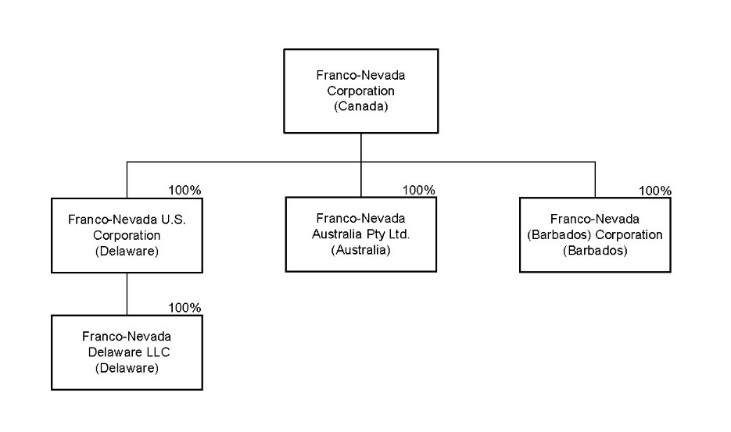
The chart below depicts significant subsidiaries and/or subsidiaries in jurisdictions in which Franco-Nevada maintains an office that are wholly-owned by Franco-Nevada either directly or indirectly and are existing under the laws of the jurisdictions set out therein. Intermediate holding companies have been omitted.
3
GENERAL DEVELOPMENT OF FRANCO-NEVADA’S BUSINESS
Overview
Franco-Nevada is a leading gold-focused royalty and streaming company with the most diversified portfolio of cash-flow producing royalties and streams by commodity, geography, operator, revenue type and stage of project.
Our shares are listed on the Toronto and New York stock exchanges under the symbol FNV. An investment in our shares is expected to provide investors with yield and exposure to commodity price and exploration optionality while limiting exposure to cost inflation and other operating risks.
Strategy
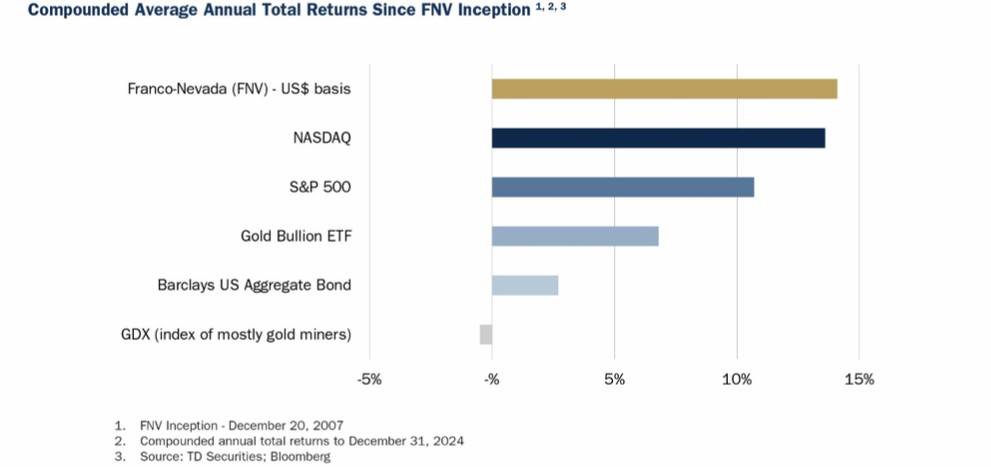
We believe that combining lower risk gold investments with a strong balance sheet, progressively growing dividends and exposure to exploration optionality is the right mix to appeal to investors seeking to hedge market instability. Since our Initial Public Offering over 17 years ago, we have increased our dividend annually and our share price has outperformed the gold price and all relevant gold equity benchmarks. Creating successful long-term partnerships with operators is a core objective. The alignment and the natural flexibility of royalty and stream financing has made it an attractive source of capital for the cyclical resource sector. We also work to be a positive force in all our communities, providing a safe and diverse workplace, promoting responsible mining and contributing to build community support for the operations in which we invest.
Our revenue is generated from various forms of agreements, ranging from net smelter return royalties, streams, net profits interests, net royalty interests, working interests and other types of arrangements. We do not operate mines, develop projects or conduct exploration. Franco-Nevada has a free cash flow generating business with limited future capital commitments and management is focused on managing and growing its portfolio of royalties and streams. We recognize the cyclical nature of the industry and have a long-term investment outlook. We maintain a strong balance sheet to minimize financial risk so that we can provide capital to the industry when it is otherwise scarce.
The advantages of this business model are:
| ● | Exposure to commodity price optionality; |
| ● | A perpetual discovery option over large areas of geologically prospective lands; |
| ● | No additional capital requirements other than the initial commitment; |
| ● | Limited exposure to cost inflation; |
| ● | A free cash-flow business with limited cash calls; |
| ● | A high-margin business that can generate cash through the entire commodity cycle; |
| ● | A scalable and diversified business in which a large number of assets can be managed with a small stable overhead; and |
| ● | Management that focuses on forward-looking growth opportunities rather than operational or development issues. |
Our short-term financial results are primarily tied to the price of commodities and the amount of production from our portfolio of assets. Our attributable production has typically been supplemented by acquisitions of new assets. Over the longer term, our results are impacted by the amount of exploration and development capital available to operators to expand or extend our producing assets or to progress our advanced and exploration assets into production.
4
The focus of our business is to create exposure to gold and precious metal resource optionality. This principally involves investments in gold mines and providing capital to copper and other base metal mines to obtain exposure to by-product gold, silver and platinum group metals production. We also invest in other metals and energy to expose our shareholders to additional resource optionality. In 2024, 81.9% of our revenue was earned from mining assets, of which 76.6% was earned from precious metals.
A strength of our business model is that our margins are not generally impacted when producer costs increase. The majority of our interests are royalty and streams with payments/deliveries that are based on production levels with no adjustments for the operator’s operating costs. In 2024, these interests accounted for 92.7% of our revenue. We also have a small number of WI, NPI and NRI royalties which are based on the profit of the underlying operations.
Franco-Nevada currently operates a small organization. As of March 20, 2025, Franco-Nevada has 41 full-time employees and 5 part-time contractors. As such, Franco-Nevada is dependent upon the continued availability and commitment of its key management, whose contributions to the immediate and future operations of Franco-Nevada are of significant importance. From time to time, Franco-Nevada may also need to identify and retain additional skilled management and specialized technical personnel to efficiently operate its business. For additional information, please see the “Risk Factors” section from pages 44 to 58 of this AIF.
Investment Process and Corporate Policies
Franco-Nevada currently does not operate any of the precious metals or diversified assets in which it has royalty, stream or other interests. However, Franco-Nevada recognizes its business model is dependent on the industry operating in a responsible fashion and actively supports the industry in its efforts and initiatives, including the World Gold Council and its Responsible Gold Mining Principles and the Prospectors and Developers Association of Canada and its initiatives for responsible exploration. A detailed description of Franco-Nevada’s investment process and a discussion of environmental, social and governance issues, including climate, is contained in Franco-Nevada’s most recent ESG Report, which can be found on the Corporation’s website at www.franco-nevada.com but is not to be considered part of this AIF.
Franco-Nevada has adopted policies relating to its business conduct, including a code of business conduct and ethics, a business integrity policy, a whistleblower policy, a policy concerning confidentiality, fair disclosure and trading in securities, a human rights policy, a non-discrimination, anti-harassment and equal opportunity policy, a diversity and inclusion policy, an investment principles (environmental, social and governance) policy, a responsible gold mining principles policy, a supplier code of conduct, a corporate responsibility policy, a health and safety policy, and an information security policy. These and other policies can be found on the Corporation’s website at www.franco-nevada.com and are summarized in Franco-Nevada’s most recent ESG Report and its management information circular for its annual and special meeting of shareholders scheduled to be held on May 8, 2025, which circular will be filed on SEDAR+.
5
Three-Year History
2022
Acquisition of Royalty on Caserones Mine (Chile) and Private Placement with EMX Royalty Corporation
On April 14, 2022, Franco-Nevada agreed to acquire, through a wholly-owned subsidiary, an effective 0.4582% NSR on the producing Caserones copper-molybdenum mine, which is now owned by Lundin Mining Corporation (“Lundin”) (successor-in-interest to JX Nippon Mining & Metals Group), located in Chile for an aggregate purchase price of approximately $37.4 million.
Franco-Nevada also completed a private placement with EMX Royalty Corporation (“EMX”), acquiring 3,812,121 units of EMX at C$3.30 per unit for a total cost of $10.0 million (C$12.6 million). Each unit consists of one common share of EMX and one warrant to purchase one common share of EMX over five years at an exercise price of C$4.45. EMX used the proceeds from the private placement to acquire an NSR on the Caserones mine on similar terms as Franco-Nevada.
Acquisition of Additional Royalty on Castle Mountain – U.S.A.
On May 2, 2022, Franco-Nevada acquired, through a wholly-owned subsidiary, an existing 2% NSR on gold and silver produced from the Pacific Clay claims, which comprise a portion of the JSLA pit of Equinox Gold Corp.’s Castle Mountain project in California for $6.0 million. When combined with Franco-Nevada’s 2.65% NSR on the broader Castle Mountain land position, the Company now has an effective 4.65% NSR on the Pacific Clay claims.
Repayment of Loan Receivable from Noront Resources Ltd. – Canada
Franco-Nevada held a loan receivable in the principal amount of $25.0 million from Noront Resources Ltd. (“Noront”), which was extended to Noront as part of the Company’s acquisition of royalty rights in the Ring of Fire mining district of Ontario in April 2015 that had a maturity date of September 30, 2022. On May 4, 2022, following the acquisition of Noront by Wyloo Metals Pty Ltd. (“Wyloo”), Franco-Nevada received $42.7 million as full repayment of the loan. The Company continues to own several royalties over Wyloo’s properties in the Ring of Fire.
Funding of Financing Package with G Mining Ventures on the Tocantinzinho Project – Brazil
On July 18, 2022, Franco-Nevada acquired, through a wholly-owned subsidiary, Franco-Nevada (Barbados) Corporation (“FNBC”), a gold stream with reference to production from the Tocantinzinho gold project, owned by G Mining Ventures Corp. (“G Mining Ventures”) and located in Brazil (the “Tocantinzinho Stream”), for a purchase price of $250.0 million. Additionally, through one of Franco-Nevada’s wholly-owned subsidiaries, Franco-Nevada provided G Mining Ventures with a $75.0 million secured term loan (the “G Mining Ventures Term Loan”). Franco-Nevada also subscribed for common shares of G Mining Ventures.
| (a) | Tocantinzinho Stream |
The Tocantinzinho Stream deposit of $250.0 million, which was payable in instalments subject to various conditions, was fully funded in the year ended December 31, 2023. Stream deliveries to FNBC are based on gold production from the Tocantinzinho property, according to the following schedule: (i) 12.5% of gold produced until 300,000 ounces of gold have been delivered and, thereafter, (ii) 7.5% of gold produced for the remaining mine life. G Mining Ventures will receive 20% of the spot gold price for each ounce of gold delivered.
| (b) | G Mining Ventures Term Loan |
The G Mining Ventures Term Loan is a $75.0 million, 6-year term loan with an availability period of 3.5 years, drawable quarterly at G Mining Ventures’ option following full funding of the Tocantinzinho Stream. The G Mining Ventures Term Loan will bear interest at a rate of 3-Month Term Secured Overnight Financing Rate (“3-Month SOFR”) +5.75% per annum, reducing to 3-Month SOFR +4.75% after completion tests have been achieved at the project. Amortization will begin in December 2025 with equal quarterly repayments followed by a final 25% repayment upon maturity in June 2028. Fees payable to Franco-Nevada’s subsidiary include a standby fee on undrawn amounts of 1.0% per annum and a 2.0% original issue discount payable on principal amounts drawn.
Pursuant to the G Mining Ventures Term Loan, on July 18, 2022, Franco-Nevada was granted warrants with a fair value of $0.75 million to purchase 11.5 million G Mining Ventures common shares with a 5-year term and an exercise price of C$1.90 per G Mining Ventures common share.
The G Mining Ventures Term Loan was funded in two tranches, with $42.0 million on January 29, 2024 and $33.0 million on April 19, 2024.
| (c) | G Mining Ventures Common Shares |
On July 22, 2022, Franco-Nevada also subscribed for 44,687,500 G Mining Ventures common shares at a price of C$0.80 per G Mining Ventures common share for a total cost of $27.5 million (C$35.8 million).
Acquisition of Portfolio of Royalties – Chile
On July 25, 2022, Franco-Nevada acquired, through a wholly-owned subsidiary, a portfolio of seven royalties, each with a 2% NSR on precious metals and 1% NSR on base metals, which collectively covered approximately 230 km2 in northern Chile, for $1.0 million.
6
Financing Package with Westhaven Gold Corp. on Spences Bridge Gold Belt Claims – Canada
On October 6, 2022, Franco-Nevada acquired a 2% NSR on all of Westhaven Gold Corp.’s (“Westhaven”) claims across the Spences Bridge Gold Belt in British Columbia for $6.0 million. Westhaven has an option to buy-down 0.5% of the NSR for $3.0 million for a period of 5 years from the closing of the transaction. Franco-Nevada also acquired an existing 2.5% NSR from Westhaven on adjoining properties currently owned by Talisker Resources Ltd. for a purchase price of $0.75 million. Total coverage for both royalties comprised approximately 1,105 km2.
In addition, Franco-Nevada also subscribed for 2,500,000 common shares of Westhaven at a price of C$0.40 per share for a total cost of $0.73 million (C$1.0 million).
Financing Package with Argonaut Gold on the Magino Gold Project – Canada
On October 27, 2022, Franco-Nevada acquired a 2% NSR on Argonaut Gold Inc.’s (“Argonaut Gold”) now-producing Magino gold project in Ontario for a purchase price of $52.5 million. In addition to the Magino project, the royalty covers all of Argonaut Gold’s current regional exploration properties. On July 12, 2024, Argonaut Gold was acquired by Alamos Gold Inc. (“Alamos Gold”).
Franco-Nevada also completed a private placement with Argonaut Gold, acquiring 34,693,462 common shares at a price of C$0.39 per share for a total cost of $10.0 million (C$13.5 million).
Acquisition of Additional Royalty on Eskay Creek – Canada
On December 30, 2022, Franco-Nevada acquired an additional 0.5% NSR from Skeena Resources Limited (“Skeena”) on the Eskay Creek gold-silver project (“Eskay Creek”) land package in British Columbia for total consideration of $21.0 million (C$28.5 million) payable as follows: (i) $19.9 million (C$27.0 million) paid on closing of the transaction and (ii) $1.1 million (C$1.5 million) of contingent consideration payable upon the achievement of certain conditions relating to materials in the Albino Lake Storage Facility at Eskay Creek. In connection with this transaction, Skeena and Franco-Nevada terminated the right of first refusal to purchase a 0.5% NSR on Eskay Creek, which right was granted to Franco-Nevada on December 24, 2021.
2023
Receipt of Valentine Gold Royalty Buy-back – Canada
On February 22, 2023, Marathon Gold Corporation (“Marathon”) exercised its option to buy-back 0.5% of the initial 2.0% NSR on the Valentine Gold project by paying $7.0 million to the Company. Franco-Nevada acquired the initial 2.0% NSR on February 21, 2019 for $13.7 million (C$18.0 million). On January 24, 2024, Marathon was acquired by Calibre Mining Corp. (“Calibre”).
Acquisition of Gold Royalties – Australia
On February 22, 2023, Franco-Nevada acquired a portfolio of five primarily gold royalties from Trident Royalties Plc (“Trident”), which includes a 1.5% NSR on Ramelius Resources Limited’s Rebecca gold project (“Rebecca”) located in Australia, for total consideration of $15.6 million payable as follows: (i) $14.3 million paid on closing of the transaction, and (ii) $1.3 million in a contingent payment payable upon first gold production at Rebecca.
Acquisition of Royalty on Kerr-Addison Property and Share Subscription with Gold Candle Ltd. – Canada
On April 14, 2023, Franco-Nevada acquired a 1% NSR on Gold Candle Ltd.’s (“Gold Candle”) Kerr-Addison project located in Ontario, which hosts the formerly producing Kerr-Addison gold mine, for a purchase price of $10.0 million.
On July 26, 2023, Franco-Nevada acquired 5,454,546 common shares of Gold Candle, a private company, at a price of C$1.10 per common share for an aggregate purchase price of $4.6 million (C$6.0 million).
Acquisition of Additional Royalty on Valentine Gold Project and Private Placement with Marathon – Canada
On June 8, 2023, Franco-Nevada acquired an additional 1.5% NSR on Marathon’s (now Calibre’s) Valentine Gold project for a purchase price of $45.0 million. Inclusive of the Franco-Nevada’s initial 1.5% NSR (reduced from 2.0% following Marathon’s buy-back of 0.5%, as described above), Franco-Nevada now holds an aggregate 3.0% NSR on the project.
On July 5, 2023, Franco-Nevada acquired 6,578,947 common shares of Marathon at a price of C$0.76 per common share for an aggregate of $3.8 million (C$5.0 million), comprising the back-end of a non-brokered charity flow-through offering.
Acquisition of Royalties on Exploration Properties – U.S.A.
On June 15, 2023, Franco-Nevada acquired, through a wholly-owned subsidiary, a portfolio of eight royalties on exploration properties located in the states of Nevada and Arizona, including a 0.5% NSR on Integra Resources Corp.’s Wildcat and Mountain View gold projects, for a purchase price of $2.5 million.
Acquisition Agreement for New Royalties with EMX
On June 27, 2023, Franco-Nevada executed a binding term sheet with EMX for a three-year arrangement for the joint acquisition of newly created precious metals and copper royalties sourced by EMX. Franco-Nevada will contribute 55% (up to $5.5 million) and EMX will contribute 45% (up to $4.5 million) towards the royalty acquisitions, with the resulting royalty interests equally split on a 50/50 basis.
7
Acquisition of Additional Royalty Interest on Caserones – Chile
Franco-Nevada acquired, through a wholly-owned subsidiary, an incremental effective NSR totaling 0.1120% on the Caserones copper-molybdenum mine, now owned by Lundin, in Chile. The incremental effective 0.1120% NSR was acquired in two transactions: (i) a 0.0260% effective NSR on March 8, 2023, for a purchase price of $2.1 million, and (ii) a 0.0860% NSR on June 29, 2023, for a purchase price of $7.3 million. Inclusive of Franco-Nevada’s interest of 0.4582% acquired in April 2022, the Company held a 0.5702% effective NSR on Caserones as at December 31, 2023.
Subsequent to year end, on January 19, 2024, EMX exercised an option to acquire a portion of Franco-Nevada’s interest for a sale price of $4.7 million, such that the Franco-Nevada’s effective NSR on Caserones is now 0.517%.
Acquisition of Royalty on Volcan Gold Project – Chile
On July 6, 2023, Franco-Nevada agreed to acquire, through a wholly-owned subsidiary, a 1.5% NSR on the Volcan gold project located in Chile for a purchase price of $15.0 million. The project is owned by Tiernan Gold Corporation (“Tiernan”), a company privately held by Hochschild Mining plc. The NSR covers the entire land package comprising the Volcan project, as well as a surrounding area of interest extending 1.5 kilometers. The agreement provides Franco-Nevada the option to acquire an additional 1.0% NSR based on predetermined conditions. Franco-Nevada already holds an existing 1.5% NSR on the peripheral Ojo de Agua area, which is owned by Tiernan and forms part of the Volcan project.
Acquisition of Royalties on Pascua-Lama Project – Chile
On August 8, 2023, Franco-Nevada agreed to acquire, through a wholly-owned subsidiary, a sliding-scale gold royalty and fixed-rate copper royalty from private individuals over property pertaining to the Chilean portion of Barrick Gold Corporation’s (“Barrick”) Pascua-Lama project for an aggregate purchase price of $75.0 million.
Acquisition of Royalty on Wawa Gold Project – Canada
On August 29, 2023, Franco-Nevada acquired a 1.5% NSR on Red Pine Exploration Inc.’s Wawa gold project, located in Ontario, for a purchase price of $5.0 million (C$6.8 million). The agreement provides Franco-Nevada the option to acquire an additional 0.5% NSR based on predetermined conditions.
Acquisition of Additional Royalty on Magino Gold Mine – Canada
On November 15, 2023, Franco-Nevada acquired, through a wholly-owned subsidiary, an additional 1.0% NSR on Argonaut Gold’s (now Alamos Gold’s) Magino gold mine in Ontario, for a purchase price of $28.0 million. Inclusive of Franco-Nevada’s initial 2.0% NSR acquired on October 27, 2022, Franco-Nevada now holds an aggregate 3.0% NSR on Magino.
Financing Package with Skeena on Eskay Creek – Canada
On December 18, 2023, Franco-Nevada completed the following transactions with Skeena:
| (a) | Eskay Creek Royalty |
Franco-Nevada acquired an incremental 1.0% NSR for a purchase price of $41.8 million (C$56.0 million). Including Franco-Nevada’s initial 1% NSR and the incremental 0.5% NSR it acquired in December 2022 for a purchase price of $19.9 million (C$27.0 million), Franco-Nevada now holds a 2.5% NSR covering Skeena’s Eskay Creek properties. The amended royalty agreement also provides contingent consideration of $3.4 million (C$4.5 million) payable by Franco-Nevada upon the achievement of certain conditions relating to materials in the Albino Lake Storage Facility at Eskay Creek.
| (b) | Skeena Convertible Debenture |
Franco-Nevada advanced $18.7 million (C$25.0 million) and received a convertible debenture (the “Skeena Convertible Debenture”). The C$25.0 million Skeena Convertible Debenture had a maturity date of the earlier of December 19, 2028 or the completion of a project financing for Eskay Creek approved by the Board of Skeena, carried an interest rate of 7% and was convertible into common shares of Skeena at a conversion price of C$7.70. Skeena could elect to defer interest payments until maturity.
On June 26, 2024, following the completion of a project financing for Eskay Creek, Skeena paid $18.9 million (C$25.9 million) to Franco-Nevada as full repayment for the Skeena Convertible Debenture.
2024 and 2025 YTD
Acquisition of Additional Natural Gas Royalty Interests in the Haynesville – U.S.A.
On January 2, 2024, Franco-Nevada closed, through wholly-owned subsidiaries, the acquisition of a royalty portfolio in the Haynesville gas play in Louisiana and Texas for a total purchase price of $125.0 million. Franco-Nevada had funded an initial deposit of $12.5 million in November 2023 when Franco-Nevada entered into the agreement. The remainder of the purchase price of $112.5 million was funded upon closing of the transaction in January 2024.
8
Acquisition of Additional Royalties on Pascua-Lama Project – Chile
On January 3, 2024, Franco-Nevada acquired, through a wholly-owned subsidiary, an additional interest in the Chilean portion of Barrick‘s Pascua-Lama project for a purchase price of $6.7 million. Including the interest Franco-Nevada acquired in August 2023, the Company now holds a 2.941% NSR (gold) and a 0.588% NSR (copper) on the property.
Exercise of Option by EMX for an Effective NSR Interest on Caserones – Chile
On January 19, 2024, EMX exercised an option to acquire 0.0531% of Franco-Nevada’s effective NSR on the Caserones mine for a price of $4.7 million, such that Franco-Nevada’s effective NSR on Caserones is now 0.517%.
Acquisition of Silver Royalty on Stibnite Gold Project – U.S.A.
On March 21, 2024, Franco-Nevada acquired, through a wholly-owned subsidiary, a NSR interest covering all of the payable silver production from the Stibnite Gold project in Idaho for a purchase price of $8.5 million.
Amendment of Condestable Gold and Silver Stream – Peru
On March 27, 2024, Franco-Nevada amended its precious metal stream agreement with reference to the gold and silver production from the Condestable mine in Peru, owned and operated by a subsidiary of Southern Peaks Mining LP, a private company, by advancing, through a wholly-owned subsidiary, an additional up-front deposit of $10.0 million for a total combined deposit of $175.0 million. Under the amended agreement, following the end of the fixed delivery period on December 31, 2025, Franco-Nevada will receive 63% of the gold and silver contained in concentrate until a cumulative total of 87,600 ounces of gold and 2,910,000 ounces of silver have been delivered (the “Variable Phase 1 Deliveries”), then 37.5% over the remaining life of the mine (the “Variable Phase 2 Deliveries”). The March 2024 amendment increased the Variable Phase 2 Deliveries from 25% to 37.5%.
Receipt of Séguéla Royalty Buy-Back Proceeds – Cote d’Ivoire
On March 30, 2024, Fortuna Mining Corp. exercised its option to buy-back 0.6% of our initial 1.2% NSR on the Séguéla mine for $6.5 million (A$10.0 million). Franco-Nevada’s royalty percentage on the Séguéla mine is now 0.6%.
Acquisition of Royalty in the Stewart Mining Camp and Private Placement with Scottie Resources Corp. – Canada
On April 15, 2024, Franco-Nevada acquired a 2.0% gross production royalty on all minerals produced on Scottie Resources Corp.’s (“Scottie”) claims in the Stewart Mining Camp in the Golden Triangle in British Columbia, for a purchase price of $5.9 million (C$8.1 million).
In addition, Franco-Nevada acquired 5,422,994 common shares of Scottie at a price of C$0.18 per common share for an aggregate purchase price of $0.7 million (C$1.0 million), comprising the back-end of a non-brokered charity flow-through offering.
Term Loan with SolGold plc
On May 13, 2024, SolGold plc (“SolGold”) received a $10.0 million term loan from Franco-Nevada (the “SolGold Term Loan”) which was repaid on July 17, 2024. The SolGold Term Loan had a maturity date of July 19, 2024 and carried an interest rate of 12% per annum with interest payments deferred until maturity.
EMX Term Loan
On August 19, 2024, Franco-Nevada advanced, through a wholly-owned subsidiary, $35.0 million (net of a commitment fee equal to 1% of the principal amount) to EMX pursuant to a term loan agreement (the “EMX Term Loan”). The EMX Term Loan is a senior secured term loan which matures on July 1, 2029. Interest is payable monthly at a rate equal to the 3-Month SOFR plus an applicable margin based on EMX’s net debt to adjusted EBITDA ratio. During each year, EMX may prepay $10.0 million of the principal amount outstanding without penalty, on a cumulative basis.
G Mining Ventures Equity Investment
On July 12, 2024, Franco-Nevada completed a private placement of $25.0 million with G Mining Ventures at a price of C$2.279 per share (equivalent to C$9.116 per share following the merger between G Mining Ventures and Reunion Gold Corporation (“Reunion Gold”) on July 15, 2024). La Mancha Investments S.à r.l. completed a concurrent $25.0 million private placement resulting in total proceeds to G Mining Ventures of $50.0 million. The placement was related to G Mining Ventures’ business combination with Reunion Gold and advancement of the Oko West gold development project in Guyana.
On December 4, 2024, Franco-Nevada exercised share purchase warrants to acquire 2,875,000 common shares of G Mining Ventures at a price of C$7.60 for a total cost of $15.5 million (C$21.9 million). The share purchase warrants were granted to Franco-Nevada in connection with our initial project financing package for the Tocantinzinho gold project in July 2022.
Acquisition of Gold Stream on SolGold’s Cascabel Copper-Gold Project – Ecuador
On July 15, 2024, Franco-Nevada acquired, through its wholly-owned subsidiary, FNBC, a gold stream (the “Cascabel Stream”) from SolGold with reference to production from the Cascabel project located in Ecuador. Franco-Nevada has a pre-existing 1.0% net smelter return royalty on all minerals produced from the project. FNBC and Osisko Gold Royalties Ltd.’s subsidiary, Osisko Bermuda Limited (“Osisko”), participated in the stream financing package on a 70%/30% basis. FNBC will provide a total of
9
$525.0 million and Osisko a total of $225.0 million for a total combined funding of $750.0 million as follows:
| ● | $70.0 million from FNBC in pre-construction funding available as three equal sized staged payments. FNBC funded an upfront deposit of $23.4 million at closing and will fund two additional staged deposits of $23.3 million each, subject to completion of key development milestones. |
| ● | $455.0 million available from FNBC towards construction, subject to customary conditions including receipt of all material permits, a construction decision approved by the SolGold board of directors and the remainder of the required project financing being available. |
Stream deliveries attributable to FNBC are based on gold production from the Cascabel property, according to the following schedule:
| ● | 14.0% of gold produced in concentrate until 525,000 ounces of gold have been delivered. |
| ● | Thereafter, 8.4% of gold produced in concentrate for the remaining life of mine. |
SolGold will receive 20% of the spot gold price for each ounce of gold delivered.
Other terms include:
| ● | In the event of a change of control within five years from closing, FNBC has the option to terminate the Cascabel Stream and receive repayment of the deposit that has been advanced by such date plus a return. If not elected, SolGold may purchase 50% of the Cascabel Stream if the change of control occurs within three years from closing and 33.33% of the Cascabel Stream if the change of control occurs in the following two years for a one-time gold payment equal to a 15.0% internal rate of return on the portion of the deposit being bought back that has been advanced by such date, plus a change of control fee. |
| ● | FNBC and Osisko obtained a right of first refusal on any future royalties or streams over the Cascabel concession and the Cascabel Stream applies to any production from other properties owned by SolGold that is processed through the project mill or infrastructure. |
| ● | The Cascabel Stream has adjustment mechanisms in the event of changes to the scale or timeline of development. SolGold and certain of its subsidiaries have provided FNBC and Osisko with corporate guarantees and security over their assets related to the Cascabel project. |
| ● | FNBC agreed to contribute to environmental and social initiatives carried out by SolGold in the vicinity of the project for $750,000 over a 3-year period on a 70%/30% basis with Osisko. |
Acquisition of Royalty on Newmont Corporation’s Yanacocha Operations – Peru
On August 13, 2024, Franco-Nevada indirectly acquired from Compañía de Minas Buenaventura S.A.A. (“Buenaventura”) and its subsidiary, an existing 1.8% net smelter return royalty on all minerals (the “Yanacocha Royalty”) covering Newmont Corporation’s (“Newmont”) Yanacocha mine and adjacent mineral properties, including the Conga project, located in Peru.
Consideration for the Yanacocha Royalty consisted of $210.0 million paid in cash on closing, plus a contingent payment of $15.0 million (payable with 118,534 common shares of Franco-Nevada, as determined as of the date of closing), payable upon the Conga project achieving commercial production for a full year prior to the 20th anniversary of closing.
The acquisition of the Yanacocha Royalty was effective July 1, 2024.
Option to Acquire Royalty with Brazil Potash Corp. – Brazil
On November 1, 2024, Franco-Nevada acquired an option from Brazil Potash Corp. (“Brazil Potash”) for $1.0 million to purchase a 4.0% gross revenue royalty on potash produced from Brazil Potash’s Autazes development stage project in Brazil.
Acquisition of Royalty on Hayasa Metals Inc.’s Urasar Project – Armenia
Subsequent to year-end, on January 21, 2025, Franco-Nevada acquired a 0.625% NSR covering all minerals produced from Hayasa Metals Inc.’s Urasar gold-copper project in northern Armenia for $0.55 million, pursuant to a joint acquisition agreement with EMX.
Financing Package with Discovery Silver Corp. on the Porcupine Complex – Canada
Subsequent to year-end, on January 27, 2025, Franco-Nevada agreed to acquire, through a wholly-owned subsidiary, a 4.25% NSR royalty for $300.0 million, consisting of two tranches, on Discovery Silver Corp.’s (“Discovery”) Porcupine Complex, located in Ontario. Franco-Nevada also agreed to provide a $100.0 million senior secured term loan (the “Discovery Term Loan”) and on February 3, 2025, Franco-Nevada purchased 78,833,333 subscription receipts for $48.6 million (C$70.9 million). The financing package, totaling $448.6 million, provides Discovery with proceeds to acquire the Porcupine Complex and fund a planned capital program for the Porcupine Complex.
10
Closing of the transactions are subject to customary conditions, including the successful completion of the acquisition by Discovery of the Porcupine Complex (which is itself subject to conditions, including, without limitation, receipt of certain regulatory consents and approvals), and is expected to occur in Q2 2025.
| (a) | Porcupine NSR Royalty |
The royalty on the Porcupine Complex consists of two tranches: (i) a 2.25% NSR in perpetuity on all minerals produced, and (ii) a 2.00% NSR on all minerals produced until the earlier of royalty payments on the tranche equivalent to 72,000 gold ounces or a cash payment equal to a pre-tax annual internal rate of return of 12% in reference to a $100.0 million attributable purchase price.
| (b) | Discovery Term Loan |
The Discovery Term Loan is a $100.0 million, 7-year term loan with an availability period of 2 years. The loan will bear interest at a rate of 3-Month SOFR +4.50% per annum. Amortization will begin after year 5 at 5% per quarter, with no restrictions on prepayment. The loan provides for an upfront fee equal to 2% on any principal drawn, a standby fee of 100 basis points per annum on undrawn funds, and the issuance of 3-year common share purchase warrants by Discovery of $1.0 million.
| (c) | Discovery Subscription Receipts |
As part of a concurrent public offering of subscription receipts of approximately $169.5 million (C$247.5 million) which closed on February 3, 2025, Franco-Nevada purchased 78,833,333 subscription receipts at a price of C$0.90 per subscription receipt for an aggregate purchase price of $48.6 million (C$70.9 million). Each subscription receipt entitles the holder to receive, without payment of additional consideration and without further action, one common share of Discovery upon the satisfaction or waiver of certain release conditions. Upon receipt of the Discovery common shares, Franco-Nevada will own approximately 9.9% of Discovery’s issued and outstanding common shares. Franco-Nevada has agreed to a two-year lock-up, commencing on the closing of the acquisition in respect of Discovery common shares acquired in the offering.
Pandora Royalty – South Africa
Subsequent to year-end, on February 28, 2025, Franco-Nevada and Sibanye Stillwater Limited (“Sibanye-Stillwater”) converted the 5% net profit interest that Franco-Nevada held on the Pandora property to a 1% net smelter return royalty. Sibanye-Stillwater’s Pandora property forms a portion of its Marikana operations and includes the currently operating E3 decline and E4 project.
Acquisition of Precious Metals Stream on Sibanye-Stillwater’s Western Limb Mining Operations – South Africa
Subsequent to year-end, on February 28, 2025, a wholly-owned subsidiary of Franco-Nevada, FNBC, completed the acquisition of a precious metals stream (the “Western Limb Mining Operations Stream”) with reference to specific production from Sibanye-Stillwater’s Marikana, Rustenburg and Kroondal mining operations (the “Stream Area”) in South Africa for a purchase price of $500.0 million. The Western Limb Mining Operations Stream is primarily comprised of a gold component for the life of mine (“LOM”) and a platinum component for approximately 25 years.
Key terms:
| ● | Gold stream deliveries to FNBC are initially based off the platinum, palladium, rhodium and gold (“4E PGM”) production from the Stream Area, according to the following schedule: |
| o | Gold ounces equal to 1.1% of 4E PGM ounces contained in concentrate until delivery of 87,500 ounces of gold, then |
| o | Gold ounces equal to 0.75% of 4E PGM ounces contained in concentrate until total delivery of 237,000 ounces of gold, then |
| o | 80% of gold contained in concentrate for the remaining LOM. |
| ● | Platinum stream deliveries to FNBC are based on platinum production from the Western Limb Mining Operations Stream Area, according to the following schedule: |
| o | 1.0% of platinum contained in concentrate until the delivery of 48,000 ounces of platinum, then |
| o | Step-up to 2.1% of platinum contained in concentrate until total delivery of 294,000 ounces of platinum, then |
| o | No further platinum deliveries. |
Other terms include:
| ● | Gold and platinum ounces delivered will be subject to an ongoing payment of 5% of spot prices respectively to Sibanye-Stillwater. In the case of gold, the ongoing payment will increase to 10% following the delivery of 237,000 ounces of gold to FNBC. |
| ● | Effective start date of the Western Limb Mining Operations Stream is September 1, 2024, and first delivery approximately 45 days after closing of the transaction. |
11
Portfolio Updates
Acquisition of Mineral Rights with Continental Resources, Inc. – U.S.A.
Franco-Nevada has, through a wholly-owned subsidiary, a strategic relationship with Continental Resources, Inc. (“Continental”) to acquire, through a jointly-owned entity (the “Royalty Acquisition Venture”), royalty rights within Continental’s areas of operation. Franco-Nevada recorded contributions to the Royalty Acquisition Venture of $23.5 million for 2024 ($9.6 million for 2023). As at December 31, 2024, Franco-Nevada has remaining commitments of up to $46.3 million.
| (a) | Preservation and Safe Management |
Cobre Panamá remains on preservation and safe management (“P&SM”) with production halted since November 2023.
On March 8, 2023, First Quantum Minerals Ltd. (“First Quantum”) and its subsidiary, Minera Panamá S.A. (“MPSA”), and the Government of Panamá (the “GOP”) announced that an agreement had been reached on the terms and conditions for a revised concession contract (together with subsequent modifications, the “Revised Concession Contract”). On October 20, 2023, the National Assembly adopted Law 406, which gave the Revised Concession Contract the status of legislation. The GOP shortly thereafter withdrew support for the Revised Concession Contract and Law 406. On November 27, 2023, the Supreme Court issued a ruling (released publicly the following day) declaring Law 406 unconstitutional and stating that the effect of the ruling was that the Revised Concession Contract purportedly no longer exists, although it did not order the closure of the Cobre Panamá mine. The GOP thereafter took further steps against the mine.
First Quantum is working with the Ministry of Commerce and Industries (“MICI”) to implement environmental stability and asset integrity measures. At the request of the MICI, Cobre Panamá delivered a draft plan for the first phase of P&SM to the GOP (the “P&SM plan”) in the first quarter of 2024. In May 2024, an Intergovernmental Commission that had been convened to inspect the site and review the P&SM plan issued its Inspection Report and recommendation for approval and implementation of the P&SM plan and its key activities; including export of 121 thousand dry metric tonnes of copper concentrate that has been stored at site since operations were suspended, reactivation of the power plant, determining a means of dealing with the sulphur containing stockpiles and providing material for the embankment walls of the tailings facility. Subsequently, there was an election and a change of government on July 1, 2024. The incoming administration reviewed the P&SM plan upon taking office. The P&SM plan is still pending government approval, and therefore not all aspects of the plan have been able to be implemented.
The general elections were held in Panamá during May 2024 and a new government took office on July 1, 2024 under the leadership of President José Raúl Mulino. President Mulino has made public statements to the effect that his government intends to address the Cobre Panamá mine in early 2025. The GOP also announced that an integrated audit of Cobre Panamá would be conducted with international experts to establish a factual basis to aid in decision making for the future of the mine. On January 6, 2025, Panamá’s Ministry of Environment (“MiAMBIENTE”) released the terms of reference for the environmental audit of the Cobre Panamá mine. The terms of reference for the environmental audit were submitted to a public consultation process, with a public comment period that concluded on February 7, 2025. Separately, an independent audit of the copper concentrate stored on site was completed by the government in December 2024, which confirmed the quantities of copper concentrate stored at the facilities.
On January 12, 2025, the Minister of Environment and the Minister of Security conducted a site visit of Cobre Panamá. During the visit, the ministers were given a tour of the mine site, highlighting the P&SM plan that is designed to ensure site stability, protect the assets of the mine and ensure the well-being of the workforce, communities and the environment. The visit also enabled the ministers to inspect 7,960 tons of ammonium nitrate stored at the mine’s Punta Rincón port. The Minister of Environment has subsequently stated that the material should be exported, which commenced by road in January 2025. The P&SM plan is not yet approved by the GOP.
On February 27, 2025, President Mulino made public statements to the effect that his government intended to discuss the future of the Cobre Panamá mine after having addressed the country's social security reform. On March 13, 2025 and on March 20, 2025, President Mulino made further statements reiterating his intentions.
| (b) | Franco-Nevada Arbitration Proceedings |
Franco-Nevada is pursuing legal avenues to protect its investment in Cobre Panamá and is of the view that it has rights under international law. On November 23, 2023, Franco-Nevada notified MICI of the Company’s intent to initiate arbitration to enforce its rights under international law (“Notice of Intent”) pursuant to the Canada-Panama Free Trade Agreement (the “FTA”). On February 22, 2024, Franco-Nevada filed an updated Notice of Intent reiterating the Company’s intent to commence arbitration under the FTA. On June 27, 2024, Franco-Nevada filed a request for arbitration to the International Centre for Settlement of Investment Disputes, specifying that Franco-Nevada presently and preliminarily estimates its damages to be at least $5.0 billion, subject to further analysis and development (the “Cobre Panamá Arbitration Claim”). In Q4 2024, members of the tribunal were selected and appointed, and the tribunal was constituted on December 9, 2024. The hearing is scheduled to be held in October 2026.
12
While Franco-Nevada continues to pursue these legal remedies, Franco-Nevada strongly prefers and hopes for a resolution with the State of Panamá, providing the best outcome for the Panamanian people and all parties involved.
| (c) | Impairment of Franco-Nevada’s Cobre Panamá Stream |
For the year ended December 31, 2023, Franco-Nevada carried out an impairment assessment to determine the recoverable amount of its Cobre Panamá stream. The recoverable amount, in accordance with applicable accounting standards, was determined to be nil at December 31, 2023 and the Company recognized a full impairment loss of $1,169.2 million in the year ended December 31, 2023.
In the event that there is a change in the facts and circumstances surrounding the halting of production at Cobre Panamá, and there is a resumption of precious metal stream deliveries to Franco-Nevada, an assessment of the recoverable amount of the Cobre Panamá stream will be performed at that time, which may lead to a reversal of part or all of the impairment loss that has been recognized.
The impairment was taken without prejudice to, or without attributing any specific value to, the legal remedies that may be obtained through any arbitration proceedings or otherwise.
Corporate and Tax Updates
Credit Facility
In June 2024, Franco-Nevada amended its $1.0 billion unsecured revolving term credit facility (the “Corporate Revolver”) to extend its term to June 3, 2029. Advances under the Corporate Revolver bear interest depending upon the currency of the advance and Franco-Nevada’s leverage ratio. As at December 31, 2024, there were no amounts borrowed against the Corporate Revolver.
As at December 31, 2024, Franco-Nevada had three standby letters of credit in the amount of $17.7 million (C$25.5 million) and subsequent to December 31, 2024, on March 11, 2025, Franco-Nevada issued a fourth standby letter in the amount of $28.0 million (C$40.5 million). These four standby letters are in relation to the audit by the CRA as referenced in the “Contingencies” section on page 33 of Franco-Nevada’s Management Discussion and Analysis for the fiscal year ended December 31, 2024, filed with the Canadian securities regulatory authorities on www.sedarplus.com and on Form 40-F filed with the SEC on www.sec.gov. These standby letters of credit reduce the available balance under the Corporate Revolver.
Dividends
As announced on January 29, 2025, Franco-Nevada’s Board of Directors raised the Company’s quarterly dividend and declared a quarterly dividend of US$0.38 per share payable on March 27, 2025, to shareholders of record on March 13, 2025. The increased dividend is intended to be effective for the full 2025 fiscal year. This is a 5.6% increase from the previous US$0.36 per share quarterly dividend and marks the 18th consecutive annual increase for Franco-Nevada shareholders.
In Q4 2024, Franco-Nevada declared a quarterly dividend of $0.36 per share, compared to the dividend of $0.34 per share in Q4 2023. During the quarter, Franco-Nevada paid total dividends of $68.7 million, of which $62.2 million was paid in cash and $6.5 million was settled in common shares under Franco-Nevada’s Dividend Reinvestment Plan (the “DRIP”). In 2024, we paid total dividends of $277.0 million, of which $242.4 million was paid in cash and $34.6 million was settled in common shares under our DRIP.
Global Minimum Tax and Barbados Corporate Tax Reform
On June 20, 2024, the Government of Canada enacted the Global Minimum Tax Act (“GMTA”) which implements key measures of the Organisation for Economic Co-operation and Development’s (“OECD”) Pillar Two GMT in Canada and includes the introduction of a 15% GMT that applies to large multinational enterprise groups with global consolidated revenues over €750.0 million. The legislation is effective from January 1, 2024. As a result, Franco-Nevada is liable to pay a top-up tax in Canada when the effective tax rate in a jurisdiction in which its subsidiary operates in is below the 15% minimum rate.
In May 2024, the Government of Barbados enacted legislation to implement tax measures in response to the OECD’s Pillar Two GMT initiative. The measures include (i) an increase of the Barbados corporate tax rate to 9% effective January 1, 2024, and (ii) the introduction of a Qualified Domestic Minimum Top-Up Tax for tax years beginning on or after January 1, 2024, which tops up the Barbados effective tax rate payable by an entity subject to Pillar Two, from 9% to 15%. As a result of these changes, our subsidiary in Barbados recognized an additional income tax expense of $44.3 million in the year ended December 31, 2024. In addition, our subsidiary recognized a deferred tax expense of approximately $49.1 million related to the remeasurement of its January 1, 2024 opening deferred tax liability balance.
All entities within the Franco-Nevada group have an effective tax rate of at least 15% for the year ended December 31, 2024, including our subsidiary in Barbados as a result of the new measures enacted by the Government of Barbados as described above. Therefore, no current tax expense was recognized in respect of the GMTA for the year ended December 31, 2024.
13
A summary of the total income tax recognized by Franco-Nevada for years ended December 31, 2024 and 2023 is shown below.
| | | | | | | | | | | | | | | | | | |
| | | | For the three months ended | | | For the year ended | | ||||||||||
| | | | December 31, | | | December 31, | | ||||||||||
| (expressed in millions) | | | 2024 |
|
| 2023 |
|
| 2024 |
|
| 2023 |
| ||||
| | | | | | | | | | | | | | | | | | |
| | | | | | | | | | | | | | | | | | |
| Income tax expense | | | | | | | | | | | | | | | | | |
| Tax expense excluding impact of GMT | | | $ | 33.1 | | | $ | 22.7 | | | $ | 118.4 | | | $ | 102.2 | |
| Q1 2024 retroactive impact of GMT | | | | — | | | | — | | | | 9.9 | | | | — | |
| Q2 2024 impact of GMT | | | | — | | | | — | | | | 10.8 | | | | — | |
| Q3 2024 impact of GMT | | | | — | | | | — | | | | 9.9 | | | | — | |
| Q4 2024 impact of GMT | | | | 13.7 | | | | — | | | | 13.7 | | | | — | |
| Deferred tax expense related to the remeasurement of deferred tax | | | | | | | | | | | | | | | | | |
| liability due to changes in Barbados tax rate | | | | — | | | | — | | | | 49.1 | | | | — | |
| | | | | | | | | | | | | | | | | | |
| | | | | | | | | | | | | | | | | | |
| Total income tax expense | | | $ | 46.8 | | | $ | 22.7 | | | $ | 211.8 | | | $ | 102.2 | |
| | | | | | | | | | | | | | | | | | |
CRA Audit
With respect to the ongoing audit by the CRA of Franco-Nevada’s 2013-2021 taxation years, please refer to the “Contingencies” section on page 33 of Franco-Nevada’s Management Discussion and Analysis for the fiscal year ended December 31, 2024, filed with the Canadian securities regulatory authorities on www.sedarplus.com and on Form 40-F filed with the SEC on www.sec.gov.
Guidance and Outlook
The following contains forward-looking statements. For a description of material factors that could cause our actual results to differ materially from the forward-looking statements below, please see the “Cautionary Statement on Forward-Looking Information” section on page 1 of this AIF and the “Risk Factors” section from pages 44 to 58 of this AIF. The 2025 guidance and long-term outlook is based on assumptions including the forecasted state of operations from our assets based on the public statements and other disclosures by the third-party owners and operators of the underlying properties and our assessment thereof.
We present our guidance in reference to GEO sales. For streams, our guidance reflects GEOs that have been delivered from the operators of our assets and that we have subsequently sold. Our GEO deliveries may differ from operators’ production based on timing of deliveries and due to recovery and payability factors. Our GEO sales may differ from GEO deliveries based on the timing of the sales. For royalties, GEO guidance reflects the timing of royalty payments or accruals.
Our 2025 guidance and long-term outlook are based on the following assumed commodity prices: $2,800/oz Au, $31/oz Ag, $950/oz Pt, $950/oz Pd, $100/tonne Fe 62% CFR China, $70/bbl WTI oil and $3.00/mcf Henry Hub natural gas.
2025 Guidance
We expect our 2025 revenue to be more than 25% higher than in 2024. This is based on our budgeted gold price of $2,800/oz and the mid-point of our Total GEOs guidance range, provided below. We anticipate a 14% increase in Precious Metal GEOs and a 7% increase in our Total GEOs for 2025 compared to 2024, assuming no contributions from Cobre Panamá.
| | | | | | | |
|
| | 2025 Guidance | | | 2024 Actual |
|
Precious Metal GEO sales | | | 385,000 to 425,000 GEOs | | | 355,310 GEOs | |
Total GEO sales | | | 465,000 to 525,000 GEOs | | | 463,334 GEOs | |
| | | | | | | |
| (1) | We expect our streams to contribute between 255,000 and 285,000 of our GEO sales for 2025. For 2024, we sold 236,158 GEOs from our streams. |
| (2) | Our guidance does not reflect any incremental revenue from additional contributions we may make to the Royalty Acquisition Venture with Continental as part of our remaining commitment of $46.3 million. |
The anticipated 14% increase in Precious Metal GEOs largely reflects the recent additions of the Yanacocha royalty, the Western Limb Mining Operations Stream, and the Porcupine Complex royalty which is expected to close in Q2 2025. We also expect to benefit from the continued ramp-up of newly constructed mines and initial contributions from Valentine Gold. For Total GEOs, the anticipated 7% increase over 2024 is expected to be driven by higher Precious Metal GEOs, partly offset by lower GEOs from our Diversified assets. We are forecasting higher production from our Diversified assets although the expected contribution to GEOs from these assets is lower than in 2024 as we have assumed significantly higher gold prices and slightly lower energy and iron ore prices in calculating the GEO contribution. For reference, a $100 increase in the price of gold from our current assumption of $2,800/oz would result in a decrease of approximately 4,750 GEOs, with all other commodity prices and production levels constant.
Based on our assumed commodity prices, we expect our revenue mix for 2025 to be comprised of 70% gold, 11% silver, 2% PGMs, 9% oil and NGLs, 4% natural gas, 3% iron ore with the balance being from other commodities.
14
Precious Metals
• | South America: For Candelaria, we forecast between 60,000 and 70,000 GEOs sold, generally in line with 2024 where we sold 67,260 GEOs, as production from Phase 11 is planned to shift to lower average grades. For Antapaccay, we anticipate GEOs sold to decrease from 55,329 GEOs in 2024 to between 40,000 and 50,000 GEOs based on mine sequencing. For Antamina, we anticipate an increase to between 3.1 and 3.3 million silver ounces, compared to 1.9 million ounces sold in 2024, reflecting an increase in silver production due to anticipated higher silver grades. We expect higher contributions from Tocantinzinho and Salares Norte as both mines continue to ramp-up production and expect a full-year of contributions from our recently acquired Yanacocha royalty. |
• | Central America & Mexico: For Guadalupe-Palmarejo, we anticipate deliveries of between 45,000 and 50,000 GEOs, an increase compared to 2024, reflecting a greater proportion of Palmarejo’s production being mined from ground covered by our stream. We assumed no production from Cobre Panamá, which currently remains in a phase of P&SM with production halted. |
• | Canada & United States: We expect royalty payments from the Porcupine Complex to contribute approximately 6,000 GEOs in 2025, assuming the acquisition of the Porcupine Complex by Discovery closes in April 2025. We also expect an increase in GEOs from Greenstone as the mine continues its ramp-up and contributes a first full year of production. Valentine Gold is expected to pour first gold in Q2 2025. Production at Detour is also anticipated to increase, after the mill successfully ramped up to a throughput rate of 28 million tonnes per annum in Q4 2024. Offsetting these increases is expected lower GEOs from Stillwater, following Sibanye-Stillwater’s restructuring plans for its US PGM operations. Please refer to the “Portfolio Updates” section on page 11 of Franco-Nevada’s Management Discussion and Analysis for the fiscal year ended December 31, 2024, filed with the Canadian securities regulatory authorities on www.sedarplus.com and on Form 40-F filed with the SEC on www.sec.gov, for further details on Sibanye-Stillwater’s restructuring plans. |
• | Rest of World: Our Western Limb Mining Operations Stream had an effective start date of September 1, 2024. First deliveries are expected within 45 days of closing the transaction and will include approximately 7,000 GEOs related to production in the last four months of 2024. Deliveries related to 2025 production are expected to total approximately 20,000 GEOs. Production at Subika (Ahafo) is expected to decrease relative to 2024 as mining activities in the Subika open pit are completed as planned in H2 2025. Newmont plans to increase its investment in exploration and advanced projects, including at Subika Underground. Tasiast expects lower production driven by mine plan sequencing and lower grades during the stripping phase of West Branch 5. |
Diversified
• | Other Mining: Attributable sales from our Vale royalty are expected to increase in 2025 compared to 2024, reflecting contributions from the Southeastern System assuming the cumulative sales threshold of 1.7 billion tonnes of iron ore is reached in the latter part of 2025. Iron ore production from Iron Ore Company of Canada’s Carol Lake mine is expected to improve in 2025 compared to 2024, where production was affected by forest fires and operational challenges. Revenue from Other Mining assets, which include our copper royalty on Caserones, is expected to be slightly lower than in 2024. |
• | Energy: We expect revenue from our Energy assets to remain in-line with 2024. Contribution from our U.S. oil assets is expected to be lower due to assumed lower oil prices of $70/bbl WTI when compared to 2024. Conversely, we are assuming slightly higher Henry Hub natural gas prices of $3.00/mcf compared to 2024 and as a result anticipate higher contributions from our U.S. gas assets. With respect to our Canadian assets, production from the Weyburn Unit is forecasted to remain relatively stable, but our Weyburn NRI is expected to be impacted by higher capital costs. |
Interest income: We estimate interest income from our loans receivable in 2025 to be between $10.0 million and $12.0 million, not including interest revenue we may earn from the $100.0 million Discovery Term Loan.
Depletion: We estimate depletion and depreciation expense in 2025 to be between $265.0 million and $295.0 million. In 2024, depletion expense was $225.3 million.
Income Tax: We expect our effective tax rate to be between 19% and 21%.
Capital Commitments: As of December 31, 2024, our remaining capital commitment to the Royalty Acquisition Venture with Continental was $46.3 million, of which between $10.0 million and $20.0 million is expected to be deployed in 2025. Subsequent to year-end, we closed the acquisition of our stream on Sibanye-Stillwater’s Western Limb Mining Operations and funded $500.0 million on February 28, 2025. We also anticipate funding the acquisition of the $300.0 million Porcupine royalty, as well as the two remaining staged payments for the pre-construction funding of the Cascabel Stream. Refer to the “Capital Commitments” section on page 33 of Franco-Nevada’s Management Discussion and Analysis for the fiscal year ended December 31, 2024, filed with the Canadian securities regulatory authorities on www.sedarplus.com and on Form 40-F filed with the SEC on www.sec.gov, for further details on our other capital commitments.
15
Long-Term Outlook
For 2028, we expect Precious Metal GEOs to increase to between 400,000 and 440,000 GEOs and Total GEOs to increase to between 505,000 and 565,000 GEOs, an 18% and 15% increase, respectively, compared to 2024. For 2029, we expect Precious Metal GEOs to increase to between 375,000 and 415,000 GEOs and Total GEOs to increase to between 490,000 and 550,000 GEOs, an 11% and 12% increase, respectively, compared to 2024. We have not assumed any contribution from Cobre Panamá in this outlook, although there is potential for materially higher GEOs should it restart production, depending on the conditions of such restart. Based on the average of the next five years of the Cobre Panamá mine plan, the asset has the potential to contribute as much as 130,000 to 150,000 GEOs annually.
The five-year outlook reflects the expected commencement of production at Valentine Gold, Stibnite, Eskay Creek, Castle Mountain Phase 2, the Coroccohuayco project at Antapaccay, the expected underground expansion at Candelaria, and the long-term expansion of Magino. We also anticipate an increase in silver production from Antamina due to higher silver grades. The outlook includes a step-down starting in 2027 in our stream from 68% to 40% of gold and silver produced at Candelaria, and a reduction starting in 2028 in our stream deliveries at Antapaccay, where our stream will be based on 30% of gold and silver produced rather than indexed to copper production. Production at Guadalupe-Palmarejo is currently expected to decrease in 2029 based on the latest life of mine plan.
With respect to our Diversified assets, we anticipate production growth from the continued development of our U.S. Energy assets. We also expect an increase in attributable sales from Vale’s Northern and Southeastern systems, and have assumed commencement of production at Copper World and Taca Taca in 2029. While we expect higher revenues from our Diversified assets in the long-term outlook compared to 2024, we have used significantly higher gold prices and slightly lower oil, gas and iron ore prices in calculating the GEO contribution as compared to the prices used in 2024. This has the effect of reducing the GEOs represented by the larger revenues.
16
EXPLANATION OF ROYALTIES, STREAMS AND OTHER INTERESTS
A royalty is a payment to a royalty holder by a property owner or an operator of a property and is typically based on a percentage of the minerals or other products produced or the revenues or profits generated from the property. The granting of a royalty to a person usually arises as a result of: (i) paying part of the consideration payable to landowners, prospectors or junior mining companies for the purchase of their property interests; (ii) providing capital in exchange for granting a royalty; or (iii) converting a participating interest in a joint venture relationship into a royalty.
Royalties are not typically working interests in a property. Therefore, depending on the nature of the royalty interest and the laws applicable to the royalty and project, the royalty holder is generally not responsible for, and has no obligation to contribute, additional funds for any purpose, including, but not limited to, operating or capital costs, or environmental or reclamation liabilities. Typically, royalty interests are established through a contract between the royalty holder and the property owner, although many jurisdictions permit the holder to also register or otherwise record evidence of a royalty interest in applicable mineral title or land registries. The unique characteristics of royalties may provide royalty holders with special commercial benefits not available to the property owner because the royalty holder may enjoy the upside potential of the property with reduced risk.
Revenue-based Royalties: The majority of royalty revenues that Franco-Nevada receives are royalties based on revenues from the value of production. The key types of revenue-based royalties are described in general terms below:
Net Smelter Return (“NSR”) royalties are based on the value of production or net proceeds received by the operator from a smelter or refinery. These proceeds are usually subject to deductions or charges for transportation, insurance, smelting and refining costs as set out in the royalty agreement. For gold royalties, the deductions are generally minimal, while for base metal projects the deductions can be much more substantial. This type of royalty generally provides cash flow that is free of any operating or capital costs and environmental liabilities. A smaller percentage NSR in a project can effectively equate to the economic value of a larger percentage profit or working interest in the same project.
Gross Royalties (“GR”) or Gross Overriding Royalties (“GORR”) are based on the total revenue stream from the sale of production from the property with few, if any, deductions. Some contracts refer to gross proceeds (“GP”) which have been characterized as comparable to GRs in this document.
Overriding Royalties (“ORR”) and Lessor or Freehold Royalties (“FH”) are based on the proceeds from gross production and are usually free of any operating, capital and environmental costs. These terms are usually applied in the oil and gas industry.
Profit-based Royalties: Franco-Nevada also receives a portion of its revenues from royalties that are calculated based on profits, as described below:
Net Profit Interest (“NPI”) is based on the profit realized after deducting costs related to production as set out in the royalty agreement. NPI payments generally begin after payback of capital costs. Although the royalty holder is generally not responsible for providing capital, covering operating losses or environmental liabilities, increases in production costs will affect net profits and royalties payable.
Net Royalty Interest (“NRI”) is paid net of operating and capital costs similar to an NPI.
Fixed Royalties: Franco-Nevada has a small number of fixed royalties. These are royalties that are paid based on a set rate per tonne mined, produced or processed or even a minimum for a period of time rather than as a percentage of revenue or profits. These types of royalties are more common for iron ore, coal and industrial minerals and usually do not have exposure to changes in the underlying commodity price.
The royalty types listed above can include additional provisions that allow them to change character in different circumstances or have varying rates. Some examples are as follows:
Minimum Royalty (“MR”) is a provision included in some royalties that requires fixed payments at a certain level even if the project is not producing, or the project is producing at too low a rate to achieve the minimum.
Advance Minimum Royalty (“AMR”) is similar to an MR except that, once production begins, the minimum payments already paid are often credited against subsequent royalty payments from production that exceeds the minimum.
Sliding Scale Royalty (“Sliding Scale” or “ss”) refers to royalties where the royalty percentage is variable. Generally, this royalty percentage is indexed to metal prices or a production threshold. Generally, a minimum or maximum percentage would be applied to such a royalty.
Capped Royalty (“Capped”) refers to royalties that expire or cease payment after a particular cumulative royalty amount has been paid or a set production volume threshold or time period has been reached.
Royalties can be commodity specific and, for instance, apply only to gold or hydrocarbons or have varying royalty structures for different commodities from the same property. Royalties can be restricted or varied by metallurgy, ore type or even by stratigraphic horizon. Generally, the contract terms for royalties in the oil and gas business are more standardized than those found in the mining business.
17
Streams: Streams are distinct from royalties. They are metal purchase agreements where, in exchange for an upfront deposit and ongoing payments for metal delivered, the holder purchases all or a portion of one or more metals produced from a mine, at a preset price. In the case of gold, the agreements typically provide for the purchase price to be the spot price at the time of delivery with a fixed price per ounce (typically the lesser of (i) $400 per ounce with a small inflationary adjustment and (ii) the spot price at the time of delivery) or a percentage of the spot price for gold payable in cash (the “Ongoing Price”) and the balance paid by applying the upfront deposit. Once the upfront deposit is fully applied, the purchase price is the Ongoing Price. Precious metals streams are well suited to co-product production providing incentive to the operator to produce the precious metals. Because streams can also be used as a form of financing a project, the stream structure may also help maintain the borrowing capacity for the project. Streams can provide higher leverage to commodity price changes when structured with a fixed purchase price per ounce.
Working Interests (“WI”): A working interest is significantly different than a royalty or stream in that a holder of a WI owns an undivided possessory interest in the land or leasehold itself, and is liable for its share of capital, operating and environmental costs, usually in proportion to its ownership percentage, and it receives its pro-rata share of revenue. Minority working or equity interests are not considered to be royalties because of the ongoing funding commitments, although they can be similar in their calculations to NPIs.
Example Economics of a Royalty (NSR or NPI) versus a Stream
The example below compares the relative value per ounce to Franco-Nevada of an NSR, a stream or an NPI or WI. Assume for one ounce of gold, a sales price of $2,800, a “stream cost”(1) of $400 per ounce and that the “all-in sustaining cost”(2) of the mine is $1,484 per ounce.
| | | | | | | | | | |
|
| | |
| | |
| Developed |
| |
| | NSR | | Stream | | NPI or WI |
| |||
One ounce sold at | | $ | 2,800 | | $ | 2,800 | | $ | 2,800 | |
Applicable cost | |
| — | | $ | 400 | (1) | $ | 1,484 | (2) |
Margin for calculation | | $ | 2,800 | | $ | 2,400 | | $ | 1,316 | |
| | | | | | | | | | |
NSR, Stream or NPI % | |
| 4 | % |
| 4 | % |
| 4 | % |
Revenue per ounce to FNV | | $ | 112 | | $ | 96 | | $ | 53 | |
Value relative to an NSR | | | 1x | | | 0.86x | | | 0.47x | |
| | | | | | | | | | |
| (1) | Franco-Nevada’s streams have various ongoing costs. In some cases, it is $400 per ounce of gold plus a 1% annual increment, in other cases it is 20% of the spot price of gold. For each stream, Franco-Nevada indicates the detail for ongoing costs. |
| (2) | For applicable costs for a developed NPI or WI, Franco-Nevada is, for illustrative purposes, assuming Barrick Gold Corporation’s (“Barrick”) 2024 all-in sustaining cash cost measure, as Barrick is the operator of two assets at which Franco-Nevada has NPI interests. |
18
TECHNICAL AND THIRD-PARTY INFORMATION
Except where otherwise stated, the disclosure in this AIF relating to properties and operations on the properties in which Franco-Nevada holds royalty, stream or other interests is based on information publicly disclosed by the owners or operators of these properties and information/data available in the public domain as at March 13, 2025 (except where stated otherwise), and none of this information has been independently verified by Franco-Nevada. Specifically, as a royalty or stream holder, Franco-Nevada has limited, if any, access to properties included in its asset portfolio. Additionally, Franco-Nevada may from time to time receive operating information from the owners and operators of the properties, which it is not permitted to disclose to the public. Franco-Nevada is dependent on the operators of the properties and their qualified persons to provide information to Franco-Nevada or on publicly available information to prepare disclosure pertaining to properties and operations on the properties on which Franco-Nevada holds royalty, stream or other interests and generally has limited or no ability to independently verify such information. Although Franco-Nevada does not have any knowledge that such information may not be accurate, there can be no assurance that such third-party information is complete or accurate. Some information publicly reported by operators may relate to a larger property than the area covered by Franco-Nevada’s royalty, stream or other interest. Franco-Nevada’s royalty, stream or other interests often cover less than 100% and sometimes only a portion of the publicly reported mineral resources, mineral reserves and production of a property.
Except where otherwise noted, the disclosure in this AIF relating to mineral resources and mineral reserves statements for individual properties is made as at December 31, 2024. In addition, such numerical information presented in this AIF which has been derived from information publicly disclosed by owners or operators may have been rounded by Franco-Nevada and, therefore, there may be some inconsistencies between the significant digits presented in this AIF and the information publicly disclosed by owners and operators.
As at December 31, 2024, Franco-Nevada considers its stream interest in the Candelaria mine to be its only material mining project for the purposes of NI 43-101. In prior years, NI 43-101 disclosure was provided for Cobre Panamá, but it is currently on P&SM with production halted since November 2023. Currently, NI 43-101 disclosure is not required for Cobre Panamá, but Franco-Nevada has provided disclosure on the asset consistent with its approach in prior years. Please refer to “Cobre Panamá Updates – Panamá” on page 12 of this AIF for further information on the status of Cobre Panamá. Franco-Nevada will continue to assess the materiality of its assets, with respect to developments affecting existing assets and as new assets are acquired or move into production. During 2025, Franco-Nevada intends to continue to evaluate whether the inclusion of the Summary of Mineral Resources and Mineral Reserves contained in this AIF should be continued to be included going forward. For additional information, please refer to Franco-Nevada’s most recent Asset Handbook which can be found on our website.
Information contained in this AIF with respect to each of the Candelaria mine and the Cobre Panamá mine has been prepared in accordance with the exemption set forth in section 9.2 of NI 43-101.
The disclosure contained in this AIF of a scientific or technical nature for the Candelaria mine is based on (i) the technical report entitled “Technical Report for the Candelaria Copper Mining Complex, Atacama Region, Region III, Chile” dated February 22, 2023 which technical report was prepared for Lundin and filed under Lundin’s SEDAR+ profile on February 22, 2023 (the “Candelaria Technical Report”); and (ii) the information disclosed in the annual information form of Lundin dated February 19, 2025 and filed under Lundin’s SEDAR+ profile on February 19, 2025.
The technical and scientific disclosure contained in this AIF for the Cobre Panamá mine is based on (i) the technical report entitled “Cobre Panamá Project -- Colón Province, Republic of Panamá -- NI 43-101 Technical Report” and dated March 2019, which was prepared for First Quantum and filed under First Quantum’s SEDAR+ profile on March 29, 2019 (“Cobre Panamá Technical Report”); (ii) the information disclosed in the annual information form of First Quantum dated March 28, 2024 and filed under First Quantum’s SEDAR+ profile on March 28, 2024; and (iii) the management’s discussion and analysis of First Quantum for the year ended December 31, 2024 and filed under First Quantum’s SEDAR+ profile on February 12, 2025.
The technical and scientific information contained in this AIF including relating to the Candelaria mine and the Cobre Panamá mine was reviewed and approved in accordance with NI 43-101 by Darrol van Deventer, P.Eng., Vice President, Mining of the Corporation and a “Qualified Person” as defined in NI 43-101.
Reconciliation to CIM Definitions
In this AIF, Franco-Nevada has disclosed a number of Mineral Resource and Mineral Reserve estimates covering properties related to mining assets that are not based on Canadian Institute of Mining, Metallurgy and Petroleum definitions (“CIM”), but have instead been prepared in reliance upon other comparable international reporting codes, including JORC (Australia), SAMREC (South Africa) and Regulation S-K 1300 (collectively, the “Acceptable Foreign Codes”). Similar to the CIM, reporting standards adopted by these Acceptable Foreign Codes are all compliant with the international Mineral Resource and Mineral Reserve Guidelines defined by the Committee for Mineral Reserves International Reporting Standards (“CRIRSCO”).
In each case, the Mineral Resources and Mineral Reserves reported in this AIF are based on estimates previously disclosed by the relevant property owner or operator, without reference to the underlying data used to calculate the estimates. Accordingly, Franco-Nevada is unable to reconcile the Mineral Resource and Mineral Reserve estimates prepared in reliance with the Acceptable Foreign Codes with that of CIM. Franco-Nevada sought confirmation from one of its technical advisory firms, that is comprised of engineers experienced in the preparation of Mineral Resource and Mineral Reserve estimates using CIM and each
19
of the Acceptable Foreign Codes, of the extent to which an estimate prepared under an Acceptable Foreign Code would differ from that prepared under CIM. Franco-Nevada was advised that CIM are largely comparable to those of the Acceptable Foreign Codes and that the Mineral Resource and Mineral Reserve definitions and categories are similar to CIM as adopted in NI 43-101 and will typically result in reporting of substantially similar Mineral Resource and Mineral Reserve estimates. Such advisors further confirmed, without reference to the procedures in which the estimates prepared using Acceptable Foreign Codes that are reproduced in this AIF were conducted, that in the course of their preparation of a Mineral Resource or Mineral Reserve estimate they would effectively apply similar procedures to prepare and report the Mineral Resource or Mineral Reserve estimate regardless of the reliance on CIM or any of the Acceptable Foreign Codes.
20
Franco-Nevada’s assets are categorized by commodity and stage of development. By commodity, assets are characterized as “Precious Metals” or “Diversified”. Precious Metals includes gold, silver, and PGM assets. Diversified includes iron ore, other mining and energy assets (which encompass oil, gas and natural gas liquids). “Producing” assets are those that have generated revenue from steady-state operations for Franco-Nevada or are expected to in the next year. “Advanced” assets are interests on projects which are not yet producing but where, in management’s view, the technical feasibility and commercial viability of extracting a mineral resource are demonstrable. “Exploration” assets represent interests on projects where technical feasibility and commercial viability of extracting a mineral resource are not demonstrable.
Management uses the following criteria in its assessment of technical feasibility and commercial viability:
(i) | Geology: there is a known mineral deposit which contains mineral resources or mineral reserves; or the project is adjacent to a mineral deposit that is already being mined or developed and there is sufficient geologic certainty of converting the deposit into mineral resources or mineral reserves. |
(ii) | Accessibility and authorization: there are no significant unresolved issues impacting the accessibility and authorization to develop or mine the mineral deposit, and social, environmental and governmental permits and approvals to develop or mine the mineral deposit appear obtainable. |
For accounting purposes, the number of assets has been counted in different manners depending on the category. Royalties on a producing or advanced property are generally counted as a single asset even if Franco-Nevada has multiple different royalties on the property, such as at the Goldstrike complex. Streams covering a group of mines in close proximity and operated by a common operator, such as the Sudbury streams, have also been counted as one asset. However, royalties and streams on producing properties that have significant co-products have been counted twice, such as the Robinson royalties for gold and copper or the Sudbury streams for gold and PGM. Exploration royalties are simply counted by the number of royalty contracts and no effort has been made to consolidate royalties on the same property. Franco-Nevada’s energy interests are subdivided into Producing Assets, which are assets that are currently producing oil or natural gas, or Exploration Assets, which are undeveloped assets that are not producing oil or natural gas. Franco-Nevada’s energy interests consist of a variety of royalty interests and working interests which are derived from a large number of underlying leases, contractual agreements and mineral title covering land positions primarily in western Canada and Oklahoma, North Dakota, Pennsylvania, Louisiana and Texas in the United States. For accounting purposes, these leases, contracts and mineral title have been grouped into distinct land areas and tabulated as individual assets. In many cases, Franco-Nevada owns multiple royalties or working interests that pertain to the same land area, and in these circumstances, the interests are counted as a single asset.
As of March 20, 2025, Franco-Nevada estimates that it holds 240 Precious Metals assets and 192 Diversified assets (109 Other Mining assets and 83 Energy assets) for a total of 432 assets.
| | | | | | | | | | | | | |
Franco-Nevada Asset Tabulation at March 20, 2025 | |||||||||||||
| | | | | | Diversified | | | | | |||
|
|
| Precious Metals |
|
| Other Mining |
|
| Energy |
|
| TOTAL |
|
Producing | |
| 48 | |
| 14 | |
| 56 | |
| 118 | |
Advanced | |
| 31 | |
| 7 | |
| — | |
| 38 | |
Exploration | |
| 161 | |
| 88 | |
| 27 | |
| 276 | |
TOTAL | |
| 240 | |
| 109 | |
| 83 | |
| 432 | |
| | | | | | | | | | | | | |
21
Summary of Mineral Resources and Mineral Reserves
The Mineral Resources and Mineral Reserves tabulated in this AIF reflect the most recent publicly disclosed figures by the operators of the assets (converted to a 100% basis where appropriate) in which Franco-Nevada has interests. However, Franco-Nevada’s interests often do not cover the entire Mineral Resource and Mineral Reserve that is publicly reported by the operator. This could be a result of the underlying agreement not applying to the entire property or due to the underlying agreement not applying to 100% of the disclosed Mineral Resources and Mineral Reserves. In such cases, Franco-Nevada is reporting either that portion of the Mineral Resource and Mineral Reserve covered by its interests or is providing its best approximation as to the percentage covered by Franco-Nevada’s interests.
| | | | | Gold Mineral Resources - Inclusive of Mineral Reserves | | | Gold Mineral Resources | | | Est. % of Mineral | | ||||||||||||||||||
| | | | | Measured (M) | | | Indicated (I) | | | (M)+(I) | | | Inferred | | | Resources Covered | | ||||||||||||
|
| |
|
| Tonnes |
| Grade |
| Contained |
|
| Tonnes |
| Grade |
| Contained |
|
| Contained | |
| Tonnes |
| Grade |
| Contained |
|
| by FNV Interest | |
GOLD - SOUTH AMERICA | | Notes | | | 000s | | g/t | | 000 oz | | | 000s | | g/t | | 000 oz | | | 000 oz | | | 000s | | g/t | | 000 oz | | | | |
Candelaria |
| 3,4 |
| | 852,817 |
| 0.12 |
| 3,364 | |
| 589,044 |
| 0.13 |
| 2,400 | |
| 5,764 | |
| 121,597 |
| 0.11 |
| 436 | | | 80 | % |
Antapaccay |
| 5 |
| | 280,000 |
| 0.07 |
| 653 | |
| 842,000 |
| 0.08 |
| 2,079 | |
| 2,734 | |
| 95,000 |
| 0.05 |
| 153 | | | 100 | % |
Condestable | | 6 | | | 39,200 |
| 0.22 |
| 271 | | | 43,200 |
| 0.20 |
| 275 | | | 546 | | | 12,900 |
| 0.19 |
| 78 | | | 100 | % |
Tocantinzinho | | 7 | | | 27,314 | | 1.21 | | 1,066 | | | 28,453 | | 1.22 | | 1,114 | | | 2,181 | | | 752 | | 1.12 | | 27 | | | 100 | % |
Yanacocha | | 1,8 | | | 34,900 |
| 0.71 |
| 800 | |
| 917,800 |
| 0.74 |
| 21,700 | |
| 22,500 | |
| 521,100 |
| 0.51 |
| 8,500 | | | 100 | % |
Sossego | | 1,9 | | | 363,700 | | 0.10 | | 1,211 | | | 556,800 | | 0.10 | | 1,755 | | | 2,966 | | | 68,400 | | 0.10 | | 220 | | | varies by deposit | |
Cerro Moro |
| 1,10 |
| | 500 |
| 6.33 |
| 102 | |
| 1,100 |
| 6.68 |
| 236 | |
| 338 | |
| 700 |
| 6.98 |
| 150 | | | 90 | % |
Salares Norte | | 1,11 | | | — | | — | | — | | | 20,430 | | 5.46 | | 3,586 | | | 3,586 | | | 200 | | 1.57 | | 10 | | | 100 | % |
Cascabel | | 12 | | | 1,576,000 | | 0.35 | | 17,500 | | | 2,159,000 | | 0.20 | | 13,700 | | | 31,200 | | | 853,000 | | 0.20 | | 5,400 | | | 100 | % |
Posse (Mara Rosa) | | 13 | | | 5,713 | | 1.15 | | 211 | | | 24,721 | | 1.03 | | 821 | | | 1,032 | | | 5,636 | | 1.35 | | 244 | | | 100 | % |
Taca Taca |
| 14 |
| | 421,500 |
| 0.14 |
| 1,853 | |
| 1,781,800 |
| 0.07 |
| 4,200 | |
| 6,052 | |
| 716,900 |
| 0.05 |
| 1,183 | | | 100 | % |
CentroGold (Gurupi) |
| 15 |
| | — |
| — |
| — | |
| 43,512 |
| 1.31 |
| 1,830 | |
| 1,830 | |
| 18,517 |
| 1.29 |
| 770 | | | 100 | % |
Calcatreu |
| 16 |
| | — |
| — |
| — | |
| 9,841 |
| 2.11 |
| 669 | |
| 669 | |
| 8,078 |
| 1.34 |
| 348 | | | 100 | % |
San Jorge |
| 17 |
| | 79,518 |
| 0.22 |
| 584 | |
| 104,091 |
| 0.19 |
| 626 | |
| 1,211 | |
| 11,235 |
| 0.16 |
| 59 | | | 100 | % |
Pascua-Lama | | 18 | | | 43,000 |
| 1.86 |
| 2,600 | |
| 390,000 |
| 1.49 |
| 19,000 | |
| 21,000 | |
| 15,000 |
| 1.70 |
| 860 | | | 80 | % |
Volcan |
| 19 |
| | 123,979 |
| 0.70 |
| 2,792 | |
| 339,274 |
| 0.64 |
| 7,013 | |
| 9,804 | |
| 75,018 |
| 0.52 |
| 1,246 | | | 100 | % |
GOLD - CENTRAL AMERICA & MEXICO | | | | | | | | | | | | | | | | | | | | | | | | | | | | | | |
Guadalupe-Palmarejo |
| 1,2,20 |
| | 9,497 |
| 2.22 |
| 679 | |
| 21,538 |
| 2.06 |
| 1,424 | |
| 2,104 | |
| 5,967 |
| 3.35 |
| 643 | | | 92 | % |
GOLD - UNITED STATES | | | | | | | | | | | | | | | | | | | | | | | | | | | | | | |
Carlin Trend |
| 21 |
| | 14,472 |
| 1.36 |
| 634 | |
| 211,382 |
| 3.57 |
| 24,390 | |
| 24,390 | |
| 78,049 |
| 3.70 |
| 9,268 | | | 28 | % |
Bald Mountain |
| 1,22 |
| | 7,131 |
| 0.90 |
| 205 | |
| 227,902 |
| 0.50 |
| 3,651 | |
| 3,856 | |
| 51,303 |
| 0.30 |
| 571 | | | 99 | % |
Marigold |
| 1,23 |
| | — |
| — |
| — | |
| 393,460 |
| 0.41 |
| 5,166 | |
| 5,166 | |
| 18,031 |
| 0.43 |
| 249 | | | 81 | % |
Mesquite |
| 1,24 |
| | 115 |
| 0.81 |
| 3 | |
| 135,174 |
| 0.43 |
| 1,852 | |
| 1,855 | |
| 84,030 |
| 0.34 |
| 912 | | | 100 | % |
Castle Mountain |
| 1,25 |
| | 85,691 |
| 0.55 |
| 1,515 | |
| 246,442 |
| 0.52 |
| 4,123 | |
| 5,638 | |
| 69,890 |
| 0.63 |
| 1,422 | | | 100 | % |
Fire Creek/Midas |
| 1,2,26 |
| | 2 |
| 17.14 |
| 1 | |
| 265 |
| 13.03 |
| 111 | |
| 112 | |
| 70,091 |
| 1.48 |
| 3,335 | | | 100 | % |
Hollister |
| 1,2,27 |
| | 17 |
| 19.85 |
| 11 | |
| 67 |
| 19.00 |
| 41 | |
| 52 | |
| 673 |
| 13.58 |
| 294 | | | 100 | % |
Stibnite |
| 1,28 |
| | — |
| — |
| — | |
| 148,159 |
| 1.33 |
| 6,317 | |
| 6,317 | |
| 52,128 |
| 0.96 |
| 1,611 | | | 100 | % |
Sandman |
| 29 |
| | — |
| — |
| — | |
| 18,550 |
| 0.73 |
| 433 | |
| 433 | |
| 3,246 |
| 0.58 |
| 61 | | | 34 | % |
Robinson |
| 30 |
| | 317,942 |
| 0.18 |
| 1,861 | |
| 40,173 |
| 0.15 |
| 189 | |
| 2,050 | |
| 11,942 |
| 0.18 |
| 68 | | | 100 | % |
Nevada North (Wildcat & Mountain View) | | 31 | | | — |
| — |
| — | |
| 88,624 |
| 0.46 |
| 1,324 | |
| 1,324 | |
| 26,611 |
| 0.32 |
| 270 | | | 100 | % |
Sleeper | | 1,2,32 | | | 4,902 |
| 0.54 |
| 85 | |
| 158,338 |
| 0.36 |
| 1,812 | |
| 1,897 | |
| 119,910 |
| 0.31 |
| 1,214 | | | 100 | % |
GOLD - CANADA | | | | | | | | | | | | | | | | | | | | | | | | | | | | | | |
Detour Lake |
| 1,33 |
| | 162,377 |
| 0.87 |
| 4,534 | |
| 1,324,852 |
| 0.70 |
| 29,776 | |
| 34,310 | |
| 124,362 |
| 1.65 |
| 6,605 | | | 100 | % |
Sudbury | | 34 | | | — |
| — |
| — | |
| 9,034 |
| 0.57 |
| 167 | |
| 167 | |
| 1,478 |
| 0.39 |
| 18 | | | 100 | % |
Hemlo |
| 35 |
| | 3,900 |
| 4.37 |
| 550 | |
| 60,000 |
| 1.49 |
| 2,900 | |
| 3,400 | |
| 8,500 |
| 2.30 |
| 620 | | | 20 | % |
Brucejack |
| 1,36 |
| | — |
| — |
| — | |
| 12,900 |
| 6.03 |
| 2,500 | |
| 2,500 | |
| 16,600 |
| 5.80 |
| 3,100 | | | 100 | % |
Kirkland Lake |
| 1,37 |
| | 630 |
| 10.81 |
| 219 | |
| 24,176 |
| 4.78 |
| 3,714 | |
| 3,933 | |
| 24,999 |
| 4.10 |
| 3,292 | | | 100 | % |
Greenstone |
| 1,38 |
| | 6,817 |
| 1.16 |
| 255 | |
| 167,813 |
| 1.42 |
| 7,663 | |
| 7,918 | |
| 26,371 |
| 3.26 |
| 2,763 | | | 100 | % |
Magino | | 1,39 | | | 25,263 |
| 0.91 |
| 740 | |
| 105,825 |
| 0.93 |
| 3,173 | |
| 3,913 | |
| 40,383 |
| 0.91 |
| 1,177 | | | 100 | % |
Dublin Gulch (Eagle) |
| 40 |
| | 35,237 |
| 0.62 |
| 705 | |
| 197,960 |
| 0.57 |
| 3,596 | |
| 4,304 | |
| 29,595 |
| 0.52 |
| 497 | | | 100 | % |
Musselwhite |
| 1,41 |
| | 4,120 |
| 6.26 |
| 829 | |
| 5,390 |
| 5.42 |
| 939 | |
| 1,767 | |
| 1,190 |
| 4.96 |
| 190 | | | 100 | % |
Timmins |
| 1,42 |
| | 6,500 |
| 2.71 |
| 567 | |
| 5,700 |
| 2.73 |
| 500 | |
| 1,067 | |
| 3,500 |
| 3.37 |
| 383 | | | 35 | % |
Gold River | | 1,43 | | | — |
| — |
| — | |
| 700 |
| 5.29 |
| 117 | |
| 117 | |
| 5,300 |
| 6.06 |
| 1,027 | | | 100 | % |
Canadian Malartic |
| 1,44 |
| | 40,383 |
| 0.52 |
| 677 | |
| 88,054 |
| 2.39 |
| 6,760 | |
| 7,437 | |
| 66,705 |
| 2.19 |
| 4,686 | | | 24 | % |
Island Gold | | 1,45 | | | 962 |
| 12.32 |
| 381 | |
| 7,403 |
| 10.52 |
| 2,505 | |
| 2,886 | |
| 7,106 |
| 16.52 |
| 3,774 | | | 75 | % |
Golden Highway - Holt Complex |
| 1,46 |
| | 5,806 |
| 4.29 |
| 800 | |
| 5,884 |
| 4.75 |
| 898 | |
| 1,699 | |
| 9,097 |
| 4.48 |
| 1,310 | | | 100 | % |
Golden Highway - Hislop |
| 1,47 |
| | — |
| — |
| — | |
| 1,337 |
| 4.00 |
| 173 | |
| 173 | |
| 804 |
| 3.80 |
| 97 | | | 100 | % |
Golden Highway - Aquarius | | 1,48 | | | — | | — | | — | | | 12,364 | | 2.15 | | 856 | | | 856 | | | 122 | | 3.59 | | 14 | | | 100 | % |
Valentine Gold | | 49 | | | 29,226 |
| 2.19 |
| 2,058 | |
| 35,398 |
| 1.67 |
| 1,897 | |
| 3,955 | |
| 20,752 |
| 1.65 |
| 1,100 | | | 100 | % |
Eskay Creek | | 50 | | | 28,648 | | 3.37 | | 3,106 | | | 23,252 | | 1.71 | | 1,275 | | | 4,380 | | | 924 | | 2.26 | | 67 | | | 100 | % |
Red Lake (McFinley) |
| 51 |
| | — |
| — |
| — | |
| 2,130 |
| 4.63 |
| 317 | |
| 317 | |
| 1,780 |
| 3.84 |
| 220 | | | 100 | % |
Courageous Lake |
| 52 |
| | 6,007 |
| 2.84 |
| 500 | |
| 139,167 |
| 2.34 |
| 10,400 | |
| 11,000 | |
| 44,737 |
| 2.71 |
| 3,900 | | | 100 | % |
Goldfields |
| 53 |
| | — |
| — |
| — | |
| 23,200 |
| 1.31 |
| 980 | |
| 980 | |
| 7,100 |
| 0.92 |
| 211 | | | 100 | % |
Monument Bay |
| 54 |
| | — |
| — |
| — | |
| 36,581 |
| 1.52 |
| 1,787 | |
| 1,787 | |
| 41,946 |
| 1.32 |
| 1,781 | | | 100 | % |
Red Mountain |
| 55 |
| | 1,920 |
| 8.81 |
| 544 | |
| 1,271 |
| 5.85 |
| 239 | |
| 783 | |
| 405 |
| 5.32 |
| 69 | | | 100 | % |
Fenelon-Martiniere | | 56 | | | — | | — | | — | | | 30,702 | | 3.09 | | 3,054 | | | 3,054 | | | 24,680 | | 2.96 | | 2,351 | | | 100 | % |
Spences Bridge (Shovelnose) | | 57 | | | — |
| — |
| — | |
| 2,983 |
| 6.38 |
| 612 | |
| 612 | |
| 1,331 |
| 3.89 |
| 166 | | | 100 | % |
Wawa | | 58 | | | — |
| — |
| — | |
| 14,653 |
| 1.79 |
| 842 | |
| 842 | |
| 16,183 |
| 1.62 |
| 843 | | | 100 | % |
Kerr-Addison | | 59 | | | — |
| — |
| — | |
| 69,252 |
| 1.50 |
| 3,311 | |
| 3,311 | |
| 55,611 |
| 1.30 |
| 2,369 | | | 100 | % |
Clarence Stream | | 60 | | | — |
| — |
| — | |
| 12,396 |
| 2.31 |
| 922 | |
| 922 | |
| 15,963 |
| 2.60 |
| 1,334 | | | 100 | % |
GOLD - AUSTRALIA | | | | | | | | | | | | | | | | | | | | | | | | | | | | | | |
Duketon |
| 61 |
| | 14,000 |
| 0.80 |
| 360 | |
| 32,000 |
| 1.40 |
| 1,430 | |
| 1,790 | |
| 14,000 |
| 1.51 |
| 680 | | | 87 | % |
Matilda (Wiluna) |
| 62 |
| | 2,760 |
| 3.90 |
| 346 | |
| 54,200 |
| 1.50 |
| 2,609 | |
| 2,955 | |
| 34,800 |
| 3.62 |
| 4,046 | | | 100 | % |
South Kalgoorlie |
| 63 |
| | 7,938 |
| 3.80 |
| 967 | |
| 58,076 |
| 2.10 |
| 3,962 | |
| 4,930 | |
| 45,892 |
| 1.70 |
| 2,540 | | | 32 | % |
Yandal (Bronzewing) |
| 64 |
| | 20,710 |
| 1.50 |
| 1,023 | |
| 44,838 |
| 1.90 |
| 2,741 | |
| 3,764 | |
| 9,554 |
| 1.50 |
| 468 | | | 47 | % |
Aphrodite |
| 65 |
| | — |
| — |
| — | |
| 18,000 |
| 2.00 |
| 1,200 | |
| 1,200 | |
| 7,900 |
| 2.00 |
| 500 | | | 100 | % |
Red October |
| 1,66 |
| | 105 |
| 8.40 |
| 28 | |
| 608 |
| 5.40 |
| 105 | |
| 133 | |
| 4,678 |
| 3.93 |
| 591 | | | 100 | % |
Henty |
| 67 |
| | — |
| — |
| — | |
| 3,600 |
| 3.50 |
| 397 | |
| 397 | |
| 600 |
| 2.90 |
| 52 | | | 100 | % |
Bullabulling |
| 68 |
| | — |
| — |
| — | |
| 39,000 |
| 1.10 |
| 1,400 | |
| 1,400 | |
| 21,000 |
| 1.30 |
| 890 | | | 60 | % |
Rebecca | | 69 | | | — |
| — |
| — | |
| 27,000 |
| 1.30 |
| 1,100 | |
| 1,100 | |
| 6,500 |
| 1.20 |
| 240 | | | 100 | % |
Edna May |
| 70 |
| | 757 |
| 1.10 |
| 27 | |
| 23,000 |
| 1.00 |
| 700 | |
| 727 | |
| 7,000 |
| 1.00 |
| 220 | | | 2 | % |
Glenburgh |
| 71 |
| | — |
| — |
| — | |
| 13,500 |
| 1.00 |
| 431 | |
| 431 | |
| 2,800 |
| 0.90 |
| 79 | | | 100 | % |
GOLD - REST OF WORLD | | | | | | | | | | | | | | | | | | | | | | | | | | | | | | |
Tasiast |
| 1,72 |
| | 78,656 |
| 0.98 |
| 2,478 | |
| 98,726 |
| 1.45 |
| 4,592 | |
| 7,070 | |
| 21,047 |
| 2.40 |
| 1,632 | | | 100 | % |
Subika (Ahafo) |
| 1,73 |
| | 34,900 |
| 1.52 |
| 1,700 | |
| 88,300 |
| 2.40 |
| 6,800 | |
| 8,400 | |
| 15,000 |
| 2.70 |
| 1,300 | | | 38 | % |
Sabodala-Massawa Complex |
| 74 |
| | 19,900 |
| 1.13 |
| 724 | |
| 60,500 |
| 2.29 |
| 4,463 | |
| 5,186 | |
| 20,400 |
| 2.01 |
| 1,322 | | | 47 | % |
Karma |
| 75 |
| | 300 |
| 0.40 |
| 4 | |
| 47,700 |
| 1.24 |
| 1,894 | |
| 1,898 | |
| 16,200 |
| 1.30 |
| 679 | | | 100 | % |
Edikan |
| 76 |
| | 13,800 |
| 1.03 |
| 458 | |
| 23,100 |
| 1.14 |
| 848 | |
| 1,306 | |
| 5,100 |
| 1.71 |
| 280 | | | 100 | % |
Kiziltepe | | 77 | | | 832 |
| 1.60 |
| 43 | |
| 976 |
| 1.72 |
| 54 | |
| 97 | |
| 1,009 |
| 1.47 |
| 48 | | | 100 | % |
Seguela | | 1,78 | | | 692 | | 1.50 | | 33 | | | 12,108 | | 3.54 | | 1,379 | | | 1,412 | | | 7,260 | | 2.90 | | 677 | | | 100 | % |
Perama Hill |
| 79 |
| | 3,093 |
| 4.15 |
| 412 | |
| 10,973 |
| 2.73 |
| 962 | |
| 1,374 | |
| 16,006 |
| 1.53 |
| 787 | | | 100 | % |
Agi Dagi |
| 1,80 |
| | 2,516 |
| 0.74 |
| 60 | |
| 104,453 |
| 0.63 |
| 2,132 | |
| 2,192 | |
| 19,551 |
| 0.52 |
| 330 | | | 100 | % |
Sissingue |
| 81 |
| | 900 |
| 1.20 |
| 36 | |
| 3,700 |
| 1.41 |
| 166 | |
| 202 | |
| 100 |
| 1.10 |
| 3 | | | 100 | % |
Rogozna | | 82 | | | — |
| — |
| — | |
| — |
| — |
| — | |
| — | |
| 179,000 |
| 0.61 |
| 3,510 | | | 100 | % |
TOTAL GOLD MINERAL RESOURCES* | | | | | | | |
| 63,164 | | | | | |
| 263,073 | |
| 324,959 | | | | | |
| 104,438 | | | | |
*Total excludes Cobre Panamá and New Prosperity
22
| | | | | Gold Mineral Reserves | | | Est. % of Mineral | | ||||||||||||||||||
| | | | | Proven | | | Probable | | | Proven & Probable | | | Reserves Covered | | ||||||||||||
| | | | | Tonnes |
| Grade |
| Contained |
|
| Tonnes |
| Grade |
| Contained |
|
| Tonnes |
| Grade |
| Contained |
|
| by FNV Interest | |
GOLD - SOUTH AMERICA | | Notes | | | 000s | | g/t | | 000 oz | | | 000s | | g/t | | 000 oz | | | 000s | | g/t | | 000 oz | | | | |
Candelaria |
| 3,4 |
| | 376,992 |
| 0.11 |
| 1,282 | |
| 245,120 |
| 0.10 |
| 822 | |
| 622,112 |
| 0.11 |
| 2,104 | | | 80 | % |
Antapaccay |
| 5 |
| | 195,000 |
| 0.07 |
| 439 | |
| 210,000 |
| 0.07 |
| 473 | |
| 404,000 |
| 0.07 |
| 909 | | | 100 | % |
Condestable | | 6 | | | 18,000 |
| 0.23 |
| 136 | | | 19,900 |
| 0.17 |
| 108 | | | 37,900 |
| 0.20 |
| 244 | | | 100 | % |
Tocantinzinho | | 7 | | | 26,798 | | 1.23 | | 1,061 | | | 24,259 | | 1.24 | | 971 | | | 51,057 | | 1.24 | | 2,031 | | | 100 | % |
Yanacocha | | 8 | | | 17,800 |
| 0.90 |
| 500 | |
| 108,600 |
| 1.38 |
| 4,800 | |
| 126,400 |
| 1.31 |
| 5,300 | | | 100 | % |
Sossego | | 9 | | | 9,200 | | 0.24 | | 71 | | | 55,900 | | 0.17 | | 306 | | | 65,100 | | 0.18 | | 377 | | | 100 | % |
Cerro Moro |
| 10 |
| | 400 |
| 5.58 |
| 80 | |
| 600 |
| 9.31 |
| 166 | |
| 1,000 |
| 7.64 |
| 246 | | | 95 | % |
Salares Norte | | 11 | | | — | | — | | — | | | 18,136 | | 5.86 | | 3,416 | | | 18,135 | | 5.86 | | 3,416 | | | 100 | % |
Cascabel | | 12 | | | 457,500 | | 0.60 | | 8,855 | | | 82,200 | | 0.22 | | 579 | | | 539,700 | | 0.54 | | 9,433 | | | 100 | % |
Posse (Mara Rosa) | | 13 | | | 5,140 | | 1.22 | | 202 | | | 18,169 | | 1.13 | | 663 | | | 23,309 | | 1.15 | | 865 | | | 100 | % |
Taca Taca | | 14 |
| | 408,300 |
| 0.13 |
| 1,750 | |
| 1,350,200 |
| 0.08 |
| 3,337 | |
| 1,758,500 |
| 0.09 |
| 5,087 | |
| 100 | % |
CentroGold (Gurupi) |
| 15 |
| | — |
| — |
| — | |
| — |
| — |
| — | |
| — |
| — |
| — | | | 100 | % |
Calcatreu | | 16 |
| | — |
| — |
| — | |
| — |
| — |
| — | |
| — |
| — |
| — | |
| 100 | % |
San Jorge | | 17 |
| | — |
| — |
| — | |
| — |
| — |
| — | |
| — |
| — |
| — | |
| 100 | % |
Pascua-Lama | | 18 | | | — |
| — |
| — | |
| — |
| — |
| — | |
| — |
| — |
| — | |
| 80 | % |
Volcan | | 19 |
| | — |
| — |
| — | |
| — |
| — |
| — | |
| — |
| — |
| — | |
| 100 | % |
GOLD - CENTRAL AMERICA & MEXICO | | | | | | | | | | | | | | | | | | | | | | | | | | | |
Guadalupe-Palmarejo |
| 2,20 |
| | 3,151 |
| 2.02 |
| 205 | |
| 7,596 |
| 1.94 |
| 475 | |
| 10,746 |
| 1.97 |
| 681 | | | 97 | % |
GOLD - UNITED STATES | | | | | | | | | | | | | | | | | | | | | | | | | | | |
Carlin Trend |
| 21 |
| | 6,667 |
| 1.66 |
| 358 | |
| 125,203 |
| 3.73 |
| 15,122 | |
| 133,333 |
| 3.62 |
| 15,447 | | | 28 | % |
Bald Mountain |
| 22 |
| | — |
| — |
| — | |
| 55,772 |
| 0.70 |
| 1,173 | |
| 55,772 |
| 0.70 |
| 1,173 | | | 100 | % |
Marigold |
| 23 |
| | — |
| — |
| — | |
| 246,150 |
| 0.41 |
| 3,256 | |
| 246,150 |
| 0.41 |
| 3,256 | | | 81 | % |
Mesquite |
| 24 |
| | 34 |
| 0.79 |
| 1 | |
| 30,264 |
| 0.48 |
| 470 | |
| 30,298 |
| 0.48 |
| 471 | | | 100 | % |
Castle Mountain | | 25 |
| | 84,910 |
| 0.55 |
| 1,498 | |
| 172,990 |
| 0.48 |
| 2,670 | |
| 257,900 |
| 0.51 |
| 4,168 | |
| 100 | % |
Fire Creek/Midas |
| 2,26 |
| | — |
| — |
| — | |
| — |
| — |
| — | |
| — |
| — |
| — | | | 100 | % |
Hollister |
| 2,27 |
| | — |
| — |
| — | |
| — |
| — |
| — | |
| — |
| — |
| — | | | 100 | % |
Stibnite |
| 28 |
| | — |
| — |
| — | |
| 104,625 |
| 1.43 |
| 4,816 | |
| 104,625 |
| 1.43 |
| 4,816 | | | 100 | % |
Sandman |
| 29 |
| | — |
| — |
| — | |
| — |
| — |
| — | |
| — |
| — |
| — | |
| 34 | % |
Robinson |
| 30 |
| | 110,513 |
| 0.15 |
| 545 | |
| 8,860 |
| 0.12 |
| 34 | |
| 119,374 |
| 0.15 |
| 579 | | | 100 | % |
Nevada North (Wildcat & Mountain View) | | 31 | | | — |
| — |
| — | |
| — |
| — |
| — | |
| — |
| — |
| — | |
| 100 | % |
Sleeper | | 2,32 | | | — |
| — |
| — | |
| — |
| — |
| — | |
| — |
| — |
| — | |
| 100 | % |
GOLD - CANADA | | | | | | | | | | | | | | | | | | | | | | | | | | | |
Detour Lake |
| 33 |
| | 128,454 |
| 0.81 |
| 3,333 | |
| 666,651 |
| 0.73 |
| 15,718 | |
| 795,105 |
| 0.75 |
| 19,051 | | | 100 | % |
Sudbury | | 34 | | | — |
| — |
| — | |
| — |
| — |
| — | |
| — |
| — |
| — | | | 100 | % |
Hemlo |
| 35 |
| | 290 |
| 3.84 |
| 36 | |
| 31,000 |
| 1.60 |
| 1,600 | |
| 32,000 |
| 1.62 |
| 1,600 | | | 20 | % |
Brucejack |
| 36 |
| | — |
| — |
| — | |
| 8,600 |
| 6.95 |
| 1,900 | |
| 8,600 |
| 6.95 |
| 1,900 | | | 100 | % |
Kirkland Lake |
| 37 |
| | 352 |
| 12.64 |
| 143 | |
| 6,675 |
| 9.00 |
| 1,931 | |
| 7,027 |
| 9.18 |
| 2,074 | | | 100 | % |
Greenstone |
| 38 |
| | 6,817 |
| 1.16 |
| 255 | |
| 137,846 |
| 1.23 |
| 5,445 | |
| 144,662 |
| 1.23 |
| 5,700 | | | 100 | % |
Magino | | 39 | | | 19,684 |
| 0.89 |
| 561 | |
| 48,715 |
| 0.92 |
| 1,447 | |
| 68,400 |
| 0.91 |
| 2,008 | | | 100 | % |
Dublin Gulch (Eagle) |
| 40 |
| | 21,100 |
| 0.68 |
| 464 | |
| 96,600 |
| 0.63 |
| 1,943 | |
| 117,700 |
| 0.64 |
| 2,407 | | | 100 | % |
Musselwhite |
| 41 |
| | 3,250 |
| 6.76 |
| 707 | |
| 4,100 |
| 5.81 |
| 766 | |
| 7,360 |
| 6.23 |
| 1,473 | | | 100 | % |
Timmins |
| 42 |
| | 5,400 |
| 2.79 |
| 481 | |
| 4,400 |
| 2.74 |
| 386 | |
| 9,800 |
| 2.75 |
| 868 | | | 37 | % |
Gold River | | 43 | | | — |
| — |
| — | |
| — |
| — |
| — | |
| — |
| — |
| — | | | 100 | % |
Canadian Malartic |
| 44 |
| | 40,383 |
| 0.52 |
| 677 | |
| 82,811 |
| 2.44 |
| 6,503 | |
| 123,194 |
| 1.81 |
| 7,180 | | | 22 | % |
Island Gold | | 45 | | | 727 |
| 12.74 |
| 298 | | | 5,505 |
| 11.23 |
| 1,987 | | | 6,232 |
| 11.40 |
| 2,285 | | | 80 | % |
Golden Highway - Holt Complex |
| 46 |
| | — |
| — |
| — | |
| — |
| — |
| — | |
| — |
| — |
| — | | | 100 | % |
Golden Highway - Hislop |
| 47 |
| | — |
| — |
| — | |
| — |
| — |
| — | |
| — |
| — |
| — | | | 100 | % |
Golden Highway - Aquarius | | 48 | | | — | | — | | — | | | — | | — | | — | | | — | | — | | — | | | 100 | % |
Valentine Gold | | 49 | | | 23,400 | | 1.89 | | 1,400 | | | 28,200 |
| 1.40 |
| 1,300 | | | 51,600 |
| 1.62 |
| 2,700 | | | 100 | % |
Eskay Creek | | 50 | | | 27,954 | | 3.00 | | 2,657 | | | 11,889 | | 1.80 | | 680 | | | 39,843 | | 2.60 | | 3,336 | | | 100 | % |
Red Lake (McFinley) | | 51 |
| | — |
| — |
| — | |
| 400 |
| 5.66 |
| 78 | |
| 400 |
| 5.66 |
| 78 | |
| 100 | % |
Courageous Lake | | 52 |
| | 2,000 |
| 3.50 |
| 200 | |
| 31,900 |
| 2.60 |
| 2,600 | |
| 33,900 |
| 2.60 |
| 2,800 | |
| 100 | % |
Goldfields |
| 53 |
| | — |
| — |
| — | |
| — |
| — |
| — | |
| — |
| — |
| — | | | 100 | % |
Monument Bay | | 54 |
| | — |
| — |
| — | |
| — |
| — |
| — | |
| — |
| — |
| — | |
| 100 | % |
Red Mountain |
| 55 |
| | 2,194 |
| 6.68 |
| 471 | |
| 351 |
| 5.51 |
| 62 | |
| 2,545 |
| 6.52 |
| 534 | | | 100 | % |
Fenelon-Martiniere | | 56 | | | — | | — | | — | | | — | | — | | — | | | — | | — | | — | | | 100 | % |
Spences Bridge (Shovelnose) | | 57 | | | — |
| — |
| — | |
| — |
| — |
| — | |
| — |
| — |
| — | | | 100 | % |
Wawa | | 58 | | | — |
| — |
| — | |
| — |
| — |
| — | |
| — |
| — |
| — | | | 100 | % |
Kerr-Addison | | 59 | | | — |
| — |
| — | |
| — |
| — |
| — | |
| — |
| — |
| — | | | 100 | % |
Clarence Stream | | 60 | | | — |
| — |
| — | |
| — |
| — |
| — | |
| — |
| — |
| — | | | 100 | % |
GOLD - AUSTRALIA | | | | | | | | | | | | | | | | | | | | | | | | | | | |
Duketon |
| 61 |
| | 9,000 |
| 1.20 |
| 191 | |
| 10,000 |
| 1.30 |
| 607 | |
| 20,000 |
| 1.30 |
| 798 | | | 89 | % |
Matilda (Wiluna) |
| 62 |
| | — |
| — |
| — | |
| 5,379 |
| 2.00 |
| 345 | |
| 5,379 |
| 2.00 |
| 345 | | | 100 | % |
South Kalgoorlie |
| 63 |
| | 2,408 |
| 4.20 |
| 324 | |
| 21,715 |
| 1.80 |
| 1,222 | |
| 24,123 |
| 2.00 |
| 1,546 | | | 32 | % |
Yandal (Bronzewing) | | 64 |
| | 13,805 |
| 1.30 |
| 584 | |
| 27,139 |
| 1.80 |
| 1,558 | |
| 40,945 |
| 1.60 |
| 2,143 | |
| 44 | % |
Aphrodite | | 65 |
| | — |
| — |
| — | |
| — |
| — |
| — | |
| — |
| — |
| — | |
| 100 | % |
Red October |
| 66 |
| | — |
| — |
| — | |
| — |
| — |
| — | |
| — |
| — |
| — | | | 100 | % |
Henty |
| 67 |
| | — |
| — |
| — | |
| 1,207 |
| 4.00 |
| 154 | |
| 1,207 |
| 4.00 |
| 154 | | | 100 | % |
Bullabulling | | 68 |
| | — |
| — |
| — | |
| — |
| — |
| — | |
| — |
| — |
| — | |
| 60 | % |
Rebecca | | 69 | | | — |
| — |
| — | |
| — |
| — |
| — | |
| — |
| — |
| — | | | 100 | % |
Edna May |
| 70 |
| | 37 |
| 1.43 |
| 2 | |
| — |
| — |
| — | |
| 37 |
| 1.43 |
| 2 | | | 2 | % |
Glenburgh | | 71 |
| | — |
| — |
| — | |
| — |
| — |
| — | |
| — |
| — |
| — | |
| 100 | % |
GOLD - REST OF WORLD | | | | | | | | | | | | | | | | | | | | | | | | | | | |
Tasiast |
| 72 |
| | 57,361 |
| 1.10 |
| 2,000 | |
| 45,471 |
| 1.90 |
| 2,705 | |
| 102,831 |
| 1.40 |
| 4,705 | | | 100 | % |
Subika (Ahafo) |
| 73 |
| | 30,200 |
| 1.51 |
| 1,500 | |
| 54,800 |
| 1.79 |
| 3,200 | |
| 85,000 |
| 1.69 |
| 4,600 | | | 62 | % |
Sabodala-Massawa Complex |
| 74 |
| | 16,700 |
| 1.02 |
| 549 | |
| 33,900 |
| 2.49 |
| 2,711 | |
| 50,700 |
| 2.00 |
| 3,260 | | | 45 | % |
Karma |
| 75 |
| | 300 |
| 0.40 |
| 4 | |
| 5,200 |
| 0.93 |
| 154 | |
| 5,500 |
| 0.90 |
| 158 | | | 100 | % |
Edikan |
| 76 |
| | 5,800 |
| 1.03 |
| 192 | |
| 6,000 |
| 1.63 |
| 314 | |
| 11,900 |
| 1.32 |
| 506 | | | 100 | % |
Kiziltepe | | 77 | | | 451 | | 1.76 | | 26 | | | 287 |
| 1.81 |
| 17 | | | 738 |
| 1.78 |
| 42 | | | 100 | % |
Seguela | | 78 | | | 692 | | 1.50 | | 33 | | | 8,675 | | 3.52 | | 983 | | | 9,366 | | 3.38 | | 1,016 | | | 100 | % |
Perama Hill |
| 79 |
| | 3,116 |
| 4.08 |
| 409 | |
| 7,196 |
| 2.54 |
| 587 | |
| 10,312 |
| 3.01 |
| 997 | | | 100 | % |
Agi Dagi | | 80 |
| | 1,450 |
| 0.76 |
| 36 | |
| 52,911 |
| 0.66 |
| 1,130 | |
| 54,361 |
| 0.67 |
| 1,166 | |
| 100 | % |
Sissingue |
| 81 |
| | 400 |
| 1.61 |
| 23 | |
| 1,000 |
| 1.60 |
| 51 | |
| 1,400 |
| 1.61 |
| 74 | | | 100 | % |
Rogozna | | 82 | | | — | | — | | — | | | — |
| — |
| — | | | — |
| — |
| — | | | 100 | % |
TOTAL GOLD MINERAL RESERVES* | | | | | | | |
| 34,538 | | | | | |
| 103,740 | | | | | |
| 138,108 | | | | |
*Total excludes Cobre Panamá
23
| | | | Silver Mineral Resources - Inclusive of Mineral Reserves | | | | | | | | | Est. % of Mineral | | ||||||||||||||||
| | | | | Measured (M) | | | Indicated (I) | | | (M)+(I) | | | Silver Inferred Mineral Resources | | | Resources Covered | | ||||||||||||
|
| |
|
| Tonnes |
| Grade |
| Contained |
|
| Tonnes |
| Grade |
| Contained |
|
| Contained |
|
| Tonnes |
| Grade |
| Contained |
|
| by FNV Interest | |
Silver | | Notes | | | 000s | | g/t | | 000 oz | | | 000s | | g/t | | 000 oz | | | 000 oz | | | 000s | | g/t | | 000 oz | | | | |
Candelaria |
| 4,83 | |
| 852,817 |
| 1.80 |
| 48,915 | |
| 589,044 |
| 2.00 |
| 37,158 | |
| 86,073 | |
| 121,597 |
| 1.40 |
| 5,516 | | | 80 | % |
Antapaccay |
| 84 | |
| 280,000 |
| 1.49 |
| 13,375 | |
| 842,000 |
| 1.95 |
| 52,679 | |
| 68,134 | |
| 95,000 |
| 1.05 |
| 3,204 | | | 100 | % |
Antamina |
| 1,85,86 | |
| 351,700 |
| 10.04 |
| 113,500 | |
| 511,100 |
| 12.26 |
| 201,423 | |
| 315,357 | |
| 1,217,100 |
| 11.00 |
| 428,537 | | | 22.5 | % |
Condestable | | 87 | | | 39,200 |
| 4.28 |
| 5,392 | |
| 43,200 |
| 3.16 |
| 4,391 | |
| 9,783 | |
| 12,900 |
| 2.29 |
| 947 | | | 100 | % |
Yanacocha | | 1,88 | | | 16,800 | | 6.48 | | 3,500 | | | 976,200 | | 5.43 | | 170,500 | | | 174,100 | | | 267,400 | | 3.09 | | 26,600 | | | 100 | % |
Cerro Moro |
| 1,89 | |
| 500 |
| 298.59 |
| 4,800 | |
| 1,100 |
| 257.31 |
| 9,100 | |
| 13,800 | |
| 700 |
| 168.00 |
| 3,600 | | | 90 | % |
Salares Norte | | 1,90 | | | — |
| — |
| — | |
| 20,430 |
| 67.15 |
| 44,109 | |
| 44,109 | |
| 200 |
| 13.50 |
| 86 | | | 100 | % |
Cascabel | | 91 | | | 1,576,000 |
| 1.16 |
| 58,600 | |
| 1,437,000 |
| 0.71 |
| 32,700 | |
| 91,300 | |
| 607,000 |
| 0.56 |
| 11,000 | | | 100 | % |
Calcatreu | | 92 | | | — |
| — |
| — | |
| 9,841 |
| 19.83 |
| 6,275 | |
| 6,275 | |
| 8,078 |
| 13.09 |
| 3,399 | | | 100 | % |
Fire Creek/Midas |
| 1,2,93 | |
| 2 |
| 257.14 |
| 15 | |
| 265 |
| 79.37 |
| 676 | |
| 691 | |
| 70,091 |
| 6.07 |
| 13,674 | | | 100 | % |
Stibnite | | 1,94 | | | — |
| — |
| — | |
| 148,159 |
| 1.97 |
| 9,400 | |
| 9,400 | |
| 52,128 |
| 1.40 |
| 2,345 | | | 100 | % |
Eskay Creek | | 95 | | | 28,648 | | 89.45 | | 82,391 | | | 23,252 | | 32.97 | | 24,644 | | | 107,035 | | | 924 | | 30.36 | | 902 | | | 100 | % |
Nevada North (Wildcat & Mountain View) | | 96 | |
| — |
| — |
| — | |
| 88,624 |
| 3.45 |
| 9,840 | |
| 9,840 | |
| 26,611 |
| 2.60 |
| 2,224 | | | 100 | % |
Spences Bridge (Shovelnose) | | 97 | |
| — |
| — |
| — | |
| 2,983 |
| 34.13 |
| 3,273 | |
| 3,273 | |
| 1,331 |
| 16.94 |
| 725 | | | 100 | % |
Sleeper | | 1,2,98 | |
| 4,902 |
| 3.62 |
| 570 | |
| 158,338 |
| 4.06 |
| 20,661 | |
| 21,231 | |
| 119,910 |
| 2.45 |
| 9,454 | | | 100 | % |
Rogozna | | 99 | | | — | | — | | — | | | — | | — | | — | | | — | | | 179,000 | | 4.40 | | 25,600 | | | 100 | % |
TOTAL SILVER MINERAL RESOURCES* | | | | | | | |
| 331,058 | | | | | |
| 626,829 | |
| 960,401 | | | | | |
| 537,813 | | | | |
*Total excludes Cobre Panamá
| | | | | Silver Mineral Reserves | | | Est. % of Mineral | | ||||||||||||||||||
| | | | | Proven | | | Probable | | | Proven & Probable | |
| Reserves Covered | | ||||||||||||
|
| |
|
| Tonnes |
| Grade |
| Contained | | | Tonnes |
| Grade |
| Contained | | | Tonnes |
| Grade |
| Contained | | | by FNV Interest | |
Silver | | Notes | |
| 000s | | g/t | | 000 oz |
|
| 000s | | g/t | | 000 oz |
|
| 000s | | g/t | | 000 oz |
|
| | |
Candelaria |
| 4,83 | |
| 376,992 |
| 1.40 |
| 17,330 | |
| 245,120 |
| 1.60 |
| 12,363 | |
| 622,112 |
| 1.50 |
| 29,693 | | | 80 | % |
Antapaccay |
| 84 | |
| 195,000 |
| 1.10 |
| 6,896 | |
| 210,000 |
| 1.30 |
| 8,777 | |
| 404,000 |
| 1.20 |
| 15,587 | | | 100 | % |
Antamina |
| 85,86 | |
| 247,500 |
| 10.10 |
| 80,497 | |
| 302,200 |
| 13.00 |
| 126,838 | |
| 549,700 |
| 11.70 |
| 207,770 | | | 22.5 | % |
Condestable | | 87 | | | 18,000 | | 4.79 | | 2,780 | |
| 19,900 | | 3.48 | | 2,225 | |
| 37,900 | | 4.11 | | 5,005 | | | 100 | % |
Yanacocha | | 88 | | | — | | — | | — | |
| 172,300 | | 15.05 | | 83,400 | |
| 172,300 | | 15.05 | | 83,400 | | | 100 | % |
Cerro Moro |
| 89 | |
| 400 |
| 272.00 |
| 3,900 | |
| 600 |
| 200.00 |
| 3,600 | |
| 1,000 |
| 232.00 |
| 7,500 | | | 95 | % |
Salares Norte | | 90 | |
| — |
| — |
| — | |
| 18,136 |
| 71.93 |
| 41,941 | |
| 18,136 |
| 71.93 |
| 41,941 | | | 100 | % |
Cascabel | | 91 | | | 457,500 |
| 1.70 |
| 24,942 | |
| 82,200 |
| 1.20 |
| 3,093 | |
| 539,700 |
| 1.60 |
| 28,034 | | | 100 | % |
Calcatreu | | 92 | |
| — |
| — |
| — | |
| — |
| — |
| — | |
| — |
| — |
| — | | | 100 | % |
Fire Creek/Midas |
| 2,93 | |
| — |
| — |
| — | |
| — |
| — |
| — | |
| — |
| — |
| — | | | 100 | % |
Stibnite | | 94 | | | — |
| — |
| — | |
| 104,625 |
| 1.91 |
| 6,430 | |
| 104,625 |
| 1.91 |
| 6,430 | | | 100 | % |
Eskay Creek | | 95 | |
| 27,954 | | 80.90 | | 72,661 | |
| 11,889 | | 40.10 | | 15,308 | |
| 39,843 | | 68.70 | | 87,969 | | | 100 | % |
Nevada North (Wildcat & Mountain View) | | 96 | |
| — | | — | | — | |
| — | | — | | — | |
| — | | — | | — | | | 100 | % |
Spences Bridge (Shovelnose) | | 97 | |
| — | | — | | — | |
| — | | — | | — | |
| — | | — | | — | | | 100 | % |
Sleeper | | 2,98 | | | — | | — | | — | | | — | | — | | — | |
| — | | — | | — | | | 100 | % |
Rogozna | | 99 | | | — | | — | | — | |
| — | | — | | — | |
| — | | — | | — | | | 100 | % |
TOTAL SILVER MINERAL RESERVES* | | | | | | | |
| 209,007 | | | | | |
| 303,975 | | | | | |
| 513,328 | | | | |
*Total excludes Cobre Panamá
| | | | PGM Mineral Resources - Inclusive of Mineral Reserves | | | | | | | | | Est. % of Mineral | | ||||||||||||||||
| | | | | Measured (M) | | | Indicated (I) | | | (M)+(I) | | | PGM Inferred Mineral Resources | | | Resources Covered | | ||||||||||||
| | | | | Tonnes | | Grade | | Contained | | | Tonnes | | Grade | | Contained | | | Contained | | | Tonnes | | Grade | | Contained | | | by FNV Interest | |
PGM | | Notes | | | 000s | | g/t | | 000 oz | | | 000s | | g/t | | 000 oz | | | 000 oz | | | 000s | | g/t | | 000 oz | | | | |
Stillwater |
| 100 | |
| 37,300 |
| 15.50 |
| 18,600 | |
| 41,500 |
| 14.60 |
| 19,400 | |
| 38,100 | |
| 91,200 |
| 14.00 |
| 41,100 | | | 98 | % |
Western Limb | | 101,102 | | | 581,285 | | 3.95 | | 73,800 | | | 832,887 | | 4.06 | | 108,700 | | | 182,600 | | | 278,889 | | 4.35 | | 39,000 | | | 97 | % |
Sudbury |
| 103 | |
| — | | — | | — | | | 9,034 | | 2.80 | | 814 | | | 814 | | | 1,478 | | 2.31 | | 110 | | | 100 | % |
Eagle's Nest | | 104 | | | 4,727 | | 5.19 | | 789 | | | 4,288 | | 4.48 | | 618 | | | 1,408 | | | 6,750 | | 4.35 | | 943 | | | 100 | % |
Marathon (Sally) | | 105 | | | — | | — | | — | | | 24,801 | | 0.62 | | 494 | | | 494 | | | 14,019 | | 0.48 | | 218 | | | 100 | % |
TOTAL PGM MINERAL RESOURCES | | | | | | | |
| 93,189 | | | | | |
| 130,026 | |
| 223,416 | | | | | |
| 81,371 | | | | |
| | | | | PGM Mineral Reserves | | | Est. % of Mineral | | ||||||||||||||||||
| | | | | Proven | | | Probable | | | Proven & Probable | | | Reserves Covered | | ||||||||||||
|
| |
|
| Tonnes |
| Grade |
| Contained |
|
| Tonnes |
| Grade |
| Contained |
|
| Tonnes |
| Grade |
| Contained |
|
| by FNV Interest | |
PGM | | Notes | | | 000s | | g/t | | 000 oz | | | 000s | | g/t | | 000 oz | | | 000s | | g/t | | 000 oz | | | | |
Stillwater |
| 100 | |
| 9,500 |
| 13.10 |
| 4,000 | |
| 35,100 |
| 13.30 |
| 15,000 | |
| 44,500 |
| 13.30 |
| 19,000 | | | 98 | % |
Western Limb | | 101,102 | | | 135,923 | | 3.52 | | 15,400 | | | 182,894 | | 3.18 | | 18,700 | | | 318,817 | | 3.32 | | 34,000 | | | 95 | % |
Sudbury |
| 103 | |
| — | | — | | — | | | — | | — | | — | | | — | | — | | — | | | 100 | % |
Eagle's Nest | | 104 | | | — | | — | | — | | | — | | — | | — | | | — | | — | | — | | | 100 | % |
Marathon (Sally) | | 105 | | | — | | — | | — | | | — | | — | | — | | | — | | — | | — | | | 100 | % |
TOTAL PGM MINERAL RESERVES | | | | | | | |
| 19,400 | | | | | |
| 33,700 | | | | | |
| 53,000 | | | | |
| | | | | Copper Mineral Resources - Inclusive of Mineral Reserves | | | | | | | | | | Est. % of Mineral | | ||||||||||||||
| | | | | Measured (M) | | | Indicated (I) | | | (M)+(I) | | | Copper Inferred Mineral Resources | | | Resources Covered | | ||||||||||||
| | | | | Tonnes | | Grade | | Contained | | | Tonnes | | Grade | | Contained | | | Contained | | | Tonnes | | Grade | | Contained | | | by FNV Interest | |
Copper | | Notes | | | 000s | | % | | Mlbs | | | 000s | | % | | Mlbs | | | Mlbs | | | 000s | | % | | Mlbs | | | | |
Yanacocha | | 1,106 | | | 1,500 |
| 1.02 | | — | |
| 904,700 |
| 0.32 | | 6,393 | |
| 6,393 | |
| 270,200 |
| 0.19 | | 1,102 | | | 100 | % |
Sossego | | 1,107 | | | 363,700 | | 0.66 | | 5,318 | | | 556,800 | | 0.60 | | 7,389 | | | 12,684 | | | 68,400 | | 0.70 | | 1,056 | | | varies by deposit | |
Cascabel | | 108 | | | 1,576,000 |
| 0.43 | | 14,771 | |
| 2,159,000 |
| 0.26 | | 12,566 | |
| 27,337 | |
| 853,000 |
| 0.23 | | 4,409 | | | 100 | % |
NuevaUnion (Relincho) |
| 1,109 | |
| 895,400 |
| 0.29 | | 5,657 | |
| 1,440,400 |
| 0.33 | | 10,411 | |
| 16,068 | |
| 724,700 |
| 0.36 | | 5,752 | | | 100 | % |
Taca Taca |
| 110 | |
| 421,500 |
| 0.60 | | 5,606 | |
| 1,781,800 |
| 0.39 | | 15,230 | |
| 20,835 | |
| 716,900 |
| 0.31 | | 4,863 | | | 100 | % |
Caserones | | 111 | | | 376,427 | | 0.33 | | 2,765 | | | 958,390 | | 0.26 | | 5,430 | | | 8,195 | | | 116,466 | | 0.22 | | 564 | | | 100 | % |
Vizcachitas |
| 112 | |
| 273,000 |
| 0.43 | | 2,605 | |
| 1,268,000 |
| 0.37 | | 10,416 | |
| 13,021 | |
| 1,823,000 |
| 0.34 | | 13,747 | | | 100 | % |
Copper World/East Pit |
| 1,113 | |
| 902,400 |
| 0.42 | | 8,429 | |
| 326,700 |
| 0.37 | | 2,670 | |
| 11,100 | |
| 275,000 |
| 0.32 | | 1,957 | |
| 100 | % |
Robinson |
| 114 | |
| 317,942 |
| 0.47 | | 3,261 | |
| 40,173 |
| 0.34 | | 305 | |
| 3,566 | |
| 11,942 |
| 0.38 | | 100 | | | 100 | % |
Rogozna | | 115 | | | — |
| — | | — | |
| — |
| — | | — | |
| — | |
| 179,000 |
| 0.15 | | 597 | | | 100 | % |
TOTAL COPPER MINERAL RESOURCES | | | | | | | | | 48,412 | | | | | | | 70,811 | |
| 119,200 | | | | | | | 34,148 | | | | |
| | | | | Copper Mineral Reserves | | | Est. % of Mineral | | ||||||||||||||||||
| | | | | Proven | | | Probable | | | Proven & Probable | | | Reserves Covered | | ||||||||||||
| | | | | Tonnes | | Grade | | Contained | | | Tonnes | | Grade | | Contained | | | Tonnes | | Grade | | Contained | | | by FNV Interest | |
Copper | | Notes | | | 000s | | % | | Mlbs | | | 000s | | % | | Mlbs | | | 000s | | % | | Mlbs | | | | |
Yanacocha | | 106 | | | — |
| — | | — | |
| 111,100 |
| 0.63 | | 1,543 | |
| 111,100 |
| 0.63 | | 1,543 | | | 100 | % |
Sossego | | 107 | | | 9,200 | | 0.79 | | 160 | | | 55,900 | | 0.53 | | 653 | | | 65,100 | | 0.56 | | 804 | | | 100 | % |
Cascabel | | 108 | | | 457,500 |
| 0.64 | | 6,475 | |
| 82,200 |
| 0.36 | | 653 | |
| 539,700 |
| 0.60 | | 7,128 | | | 100 | % |
NuevaUnion (Relincho) |
| 109 | |
| 576,400 |
| 0.34 | | 4,321 | |
| 977,400 |
| 0.36 | | 7,757 | |
| 1,553,800 |
| 0.35 | | 12,078 | | | 100 | % |
Taca Taca |
| 110 | |
| 408,300 |
| 0.59 | | 5,295 | |
| 1,350,200 |
| 0.39 | | 11,757 | |
| 1,758,500 |
| 0.44 | | 17,052 | | | 100 | % |
Caserones | | 111 | | | 362,249 |
| 0.33 | | 2,639 | |
| 522,057 |
| 0.27 | | 3,097 | |
| 884,306 |
| 0.29 | | 5,736 | | | 100 | % |
Vizcachitas |
| 112 | |
| 302,247 |
| 0.41 | | 2,714 | |
| 917,685 |
| 0.34 | | 6,908 | |
| 1,219,932 |
| 0.36 | | 9,623 | | | 100 | % |
Copper World/East Pit |
| 113 | |
| 319,400 |
| 0.54 | | 3,802 | |
| 65,700 |
| 0.52 | | 753 | |
| 385,100 |
| 0.54 | | 4,585 | |
| 100 | % |
Robinson | | 114 | |
| 110,513 |
| 0.42 | | 1,025 | |
| 8,860 |
| 0.28 | | 54 | |
| 119,374 |
| 0.41 | | 1,079 | | | 100 | % |
Rogozna | | 115 | | | — |
| — | | — | |
| — |
| — | | — | |
| — |
| — | | — | | | 100 | % |
TOTAL COPPER MINERAL RESERVES | | | | | | | | | 26,431 | | | | | | | 33,177 | | | | | | | 59,628 | | | | |
24
| | | | | Nickel Mineral Resources - Inclusive of Mineral Reserves | | | | | | | | | | Est. % of Mineral | | ||||||||||||||
| | | | | Measured (M) | | | Indicated (I) | | | (M)+(I) | | | Nickel Inferred Mineral Resources | | | Resources Covered | | ||||||||||||
| | | |
| Tonnes | | Grade | | Contained | | | Tonnes | | Grade | | Contained | | | Contained |
|
| Tonnes | | Grade | | Contained | | | by FNV Interest | |
Nickel | | Notes | | | 000s | | % | | Mlbs | | | 000s | | % | | Mlbs | | | Mlbs | | | 000s | | % | | Mlbs | | | | |
Falcondo |
| 116 | |
| 40,500 |
| 1.42 | | 1,268 | |
| 31,100 |
| 1.53 | | 1,049 | |
| 2,320 | |
| 4,900 |
| 1.40 | | 151 | | | 100 | % |
Eagle's Nest | | 117 | | | 4,727 | | 2.24 | | 234 | | | 4,288 | | 1.50 | | 141 | | | 375 | | | 6,750 | | 1.67 | | 249 | | | 100 | % |
Crawford | | 118 | | | 1,097,100 | | 0.24 | | 5,904 | | | 1,464,700 | | 0.23 | | 7,402 | | | 13,306 | | | 1,693,200 | | 0.22 | | 8,215 | | | 100 | % |
Mt Keith |
| 119 | |
| 132,000 |
| 0.54 | | 1,571 | |
| 67,000 |
| 0.52 | | 768 | |
| 2,340 | |
| 24,000 |
| 0.52 | | 275 | | | 100 | % |
TOTAL NICKEL MINERAL RESOURCES | | | | | | | | | 8,977 | | | | | | | 9,360 | |
| 18,340 | | | | | | | 8,891 | | | | |
| | | | | Nickel Mineral Reserves | | | Est. % of Mineral | | ||||||||||||||||||
| | | | | Proven | | | Probable | | | Proven & Probable | | | Reserves Covered | | ||||||||||||
| | |
|
| Tonnes | | Grade | | Contained |
|
| Tonnes | | Grade | | Contained |
|
| Tonnes | | Grade | | Contained |
|
| by FNV Interest | |
Nickel | | Notes | | | 000s | | % | | Mlbs | | | 000s | | % | | Mlbs | | | 000s | | % | | Mlbs | | | | |
Falcondo |
| 116 | |
| 44,900 |
| 1.28 | | 1,267 | |
| 26,300 |
| 1.36 | | 789 | |
| 71,200 |
| 1.31 | | 2,056 | | | 100 | % |
Eagle's Nest | | 117 | | | — | | — | | — | | | — | | — | | — | | | — | | — | | — | | | 100 | % |
Crawford | | 118 | | | 994,000 | | 0.24 | | 5,172 | | | 721,000 | | 0.20 | | 3,183 | | | 1,715,000 | | 0.22 | | 8,356 | | | 100 | % |
Mt Keith |
| 119 | |
| — |
| — | | — | |
| — |
| — | | — | |
| — |
| — | | — | | | 100 | % |
TOTAL NICKEL MINERAL RESERVES | | | | | | | | | 6,439 | | | | | | | 3,972 | | | | | | | 10,412 | | | | |
| | | | | Chromite Mineral Resources - Inclusive of Mineral Reserves | | | | | | | Est. % of Mineral | | ||||||||
| | | | | Measured (M) | | | Indicated (I) | | | Chromite Inferred Mineral Resources | | | Resources Covered | | ||||||
| | | |
| Tonnes | | Grade | | | Tonnes | | Grade | |
| Tonnes | | Grade | | | by FNV Interest | |
Chromite | | Notes | | | 000s | | % Cr2O3 | | | 000s | | % Cr2O3 | | | 000s | | % Cr2O3 | | | | |
Ring of Fire |
| 120 | |
| 140,190 |
| 32.5 | |
| 52,573 |
| 29.8 | |
| 54,581 |
| 30.8 | | | 100 | % |
TOTAL CHROMITE MINERAL RESOURCES | | | | | 140,190 | | | | | 52,573 | | | | | 54,581 | | | | | | |
| | | | | Chromite Mineral Reserves | | | Est. % of Mineral | | ||||||||||||
| | | | | Proven | | | Probable | | | Proven & Probable | | | Reserves Covered | | ||||||
| | |
|
| Tonnes | | Grade |
|
| Tonnes | | Grade |
|
| Tonnes | | Grade |
|
| by FNV Interest | |
Chromite | | Notes | | | 000s | | % Cr2O3 | | | 000s | | % Cr2O3 | | | 000s | | % Cr2O3 | | | | |
Ring of Fire |
| 120 | |
| — |
| — | |
| — |
| — | |
| — |
| — | | | 100 | % |
TOTAL CHROMITE MINERAL RESERVES* | | | | | — | | | | | — | | | | | — | | | | | | |
*No Mineral Reserve estimate has been reported for the Ring of Fire
| | | | | Iron Ore Mineral Resources - Inclusive of Mineral Reserves | | | | | | | Est. % of Mineral | | ||||||||
| | | | | Measured (M) | | | Indicated (I) | | | Iron Ore Inferred Mineral Resources | | | Resources Covered | | ||||||
| | | |
| Tonnes | | Grade | | | Tonnes | | Grade | |
| Tonnes | | Grade | | | by FNV Interest | |
Iron Ore | | Notes | | | 000s | | % Fe | | | 000s | | % Fe | | | 000s | | % Fe | | | | |
Vale (Northern & Southeastern System) | | 1,121 | | | 7,136,100 | | 53.6 | | | 9,263,600 | | 53.1 | | | 4,055,100 | | 43.0 | | | varies by system | |
LIORC | | 1,122,123 | | | 536,000 | | 39.3 | | | 1,249,000 | | 38.5 | | | 665,000 | | 38.0 | | | 100 | % |
TOTAL IRON ORE MINERAL RESOURCES | | | | | 7,672,100 | | | | | 10,512,600 | | | | | 4,720,100 | | | | | | |
| | | | | Iron Ore Mineral Reserves | | | Est. % of Mineral | | ||||||||||||
| | | | | Proven | | | Probable | | | Proven & Probable | | | Reserves Covered | | ||||||
| | |
|
| Tonnes | | Grade |
|
| Tonnes | | Grade |
|
| Tonnes | | Grade |
|
| by FNV Interest | |
Iron Ore | | Notes | | | 000s | | % Fe | | | 000s | | % Fe | | | 000s | | % Fe | | | | |
Vale (Northern & Southeastern System) | | 121 | | | 2,783,200 | | 60.5 | | | 4,888,700 | | 59.6 | | | 7,671,900 | | 59.9 | | | varies by system | |
LIORC | | 122,123 | | | 355,000 | | 39.0 | | | 610,000 | | 39.0 | | | 966,000 | | 39.0 | | | 100 | % |
TOTAL IRON ORE MINERAL RESERVES | | | | | 3,138,200 | | | | | 5,498,700 | | | | | 8,637,900 | | | | | | |
Notes and Sources
| ● | All Mineral Resources and Mineral Reserves have been calculated in accordance with CIM or Acceptable Foreign Codes for the purposes of NI 43-101, including Regulation S-K 1300, JORC, or SAMREC guidelines |
| ● | Mineral Resources, which are not Mineral Reserves, do not have demonstrated economic viability |
| ● | Unless otherwise noted, Mineral Resources were reported by the operator inclusive of Mineral Reserves |
| ● | Contained metal does not take into account recovery losses |
| ● | Franco-Nevada's royalties or stream interests may not cover the operator's entire property or all estimated Mineral Resources and Mineral Reserves or a combination of both |
| ● | The grade of platinum group elements has been reported by the operators as either the sum of the individual platinum group elements grades or the individual grades. In the cases where individual platinum group element grades have been reported, Franco-Nevada’s Qualified Person has calculated the sum of the platinum group element grades for presentation purposes |
| ● | Mineral Resources and Mineral Reserves based on publicly disclosed information available as of March 13, 2025 |
| ● | The MRMR statement might have excluded depletion prior to this year's reporting |
| ● | Rows and columns may not add up due to rounding |
Inferred Resources are in addition to Measured and Indicated Resources, as described in the "Cautionary Note Regarding Mineral Resource and Mineral Reserve Estimates" section on page 2 of this AIF.
| 1 | Mineral Resources reported by operator exclusive of Mineral Reserves. Franco-Nevada’s Qualified Person determined the inclusive Mineral Resources by adding the exclusive Measured and Indicated Mineral Resources to the Proven and Probable Reserves |
| 2 | Mineral Resources and Mineral Reserves are reported by the operator in non-metric units. Franco-Nevada’s Qualified Person calculated the metric conversion using 1 opt = 34.286 g/t, 1 short ton = 0.9072 metric tonnes, 1 oz = 31.1035 g |
| 3 | Lundin Mining Corporation; News Release, February 12, 2025 |
| 4 | The stream agreement applies to 100% of the property, but only with respect to the ownership interest of Lundin Mining Corporation which indirectly owns 80% of the Candelaria Copper Mining Complex |
| 5 | Glencore plc; Resources & Reserves as at December 31, 2024 |
| 6 | Southern Peaks Mining LP; Email and Letter to Franco-Nevada (Barbados) Corporation, Statement Resource & Reserves estimates at the Condestable Mine, March 17, 2025 |
| 7 | G Mining Ventures Corp.; News Release, February 20, 2025 |
| 8 | Newmont Corporation; News Release, February 20, 2025. Yanacocha, as represented in the table, includes Conga |
| 9 | Vale S.A.; Form 20-F, April 19, 2024. Details of Vale's Participating Debentures are available on Vale's website |
| 10 | Pan American Silver Corp.; News Release, September 11, 2024 & Corporate Website |
| 11 | Gold Fields Limited; Mineral Resources and Mineral Reserves Supplement to the Integrated Annual Report 2023, March 28, 2024 |
| 12 | SolGold Plc.; Annual Information Form, September 26, 2024 |
| 13 | Hochschild Mining PLC; Press Release, March 12, 2025 |
| 14 | First Quantum Minerals Ltd.; Taca Taca Project NI 43-101 Technical Report, March 29, 2021 |
| 15 | G Mining Ventures Corp.; News Release, February 20, 2025 |
| 16 | Patagonia Gold Corp.; MD&A, November 29, 2024 |
| 17 | Coro Mining Corporation; San Jorge Project NI 43-101 Technical Report, March 1, 2012 |
| 18 | Barrick Gold Corporation; Press Release, February 6, 2025 |
| 19 | Hochschild Mining PLC; Press Release, March 12, 2025 |
| 20 | Coeur Mining, Inc.; News Release, February 18, 2025 |
| 21 | Barrick Gold Corporation; Press Release, February 6, 2025. Carlin Trend includes Goldstrike, Gold Quarry and South Arturo as well as other properties where Franco-Nevada has no royalties or stream interests |
| 22 | Kinross Gold Corporation; News Release, February 12, 2025 |
| 23 | SSR Mining Inc.; Mineral Reserve and Resource Tables as of December 31, 2024 |
| 24 | Equinox Gold Corp. & Calibre Mining Corp.; Corporate Presentation, February 24, 2025 |
| 25 | Equinox Gold Corp. & Calibre Mining Corp.; Corporate Presentation, February 24, 2025 |
| 26 | Hecla Mining Company; News Release, February 12, 2025 |
| 27 | Hecla Mining Company; News Release, February 12, 2025 |
25
| 28 | Perpetua Resources Corp., Form 10-K, March 26, 2024 |
| 29 | Borealis Mining Company Ltd. & Gold Bull Resources Corp.; News Release, December 10, 2024 |
| 30 | KGHM Polska Miedź S.A.; Mineral Resources and Reserves Report, December 31, 2014 |
| 31 | Integra Resources Corp.; Corporate Presentation, February 2025 |
| 32 | Paramount Gold Nevada; Sleeper Gold-Silver Project Form 10-K; September 26, 2024 |
| 33 | Agnico Eagle Mines Limited; News Release, February 13, 2025 |
| 34 | Magna Mining Inc.; Corporate Presentation, February 2025 and McCreedy West Mine NI 43-101 Technical Report, October 28, 2024 |
| 35 | Barrick Gold Corporation; Press Release, February 6, 2025 |
| 36 | Newmont Corporation; News Release, February 20, 2025 |
| 37 | Agnico Eagle Mines Limited; News Release, February 13, 2025 |
| 38 | Equinox Gold Corp. & Calibre Mining Corp.; Corporate Presentation, February 24, 2025 |
| 39 | Alamos Gold Inc.; News Release, February 18, 2025 |
| 40 | Victoria Gold Corp.; Eagle Gold Mine NI 43-101 Technical Report, April 10, 2023 |
| 41 | Orla Mining Ltd.; Corporate Presentation, February 21, 2025 |
| 42 | Pan American Silver Corp.; News Release, September 11, 2024 |
| 43 | Pan American Silver Corp.; News Release, September 11, 2024 |
| 44 | Agnico Eagle Mines Limited; News Release, February 13, 2025 |
| 45 | Alamos Gold Inc.; News Release, February 18, 2025 |
| 46 | Agnico Eagle Mines Limited; News Release, February 13, 2025 |
| 47 | Agnico Eagle Mines Limited; News Release, February 13, 2025 |
| 48 | Agnico Eagle Mines Limited; News Release, February 13, 2025 |
| 49 | Equinox Gold Corp. & Calibre Mining Corp.; Corporate Presentation, February 24, 2025 |
| 50 | Skeena Resources Limited; Eskay Creek Project NI 43-101 Technical Report, November 14, 2023 |
| 51 | Evolution Mining Limited; ASX Announcement, February 14, 2024 |
| 52 | Seabridge Gold Inc.; Mineral Reserves and Resources, June 2024 |
| 53 | Fortune Bay Corp.; Goldfields Project NI 43-101 Technical Report, October 31, 2022 |
| 54 | Agnico Eagle Mines Limited; News Release, February 16, 2023 |
| 55 | Ascot Resources Ltd.; Annual Information Form, March 25, 2024 |
| 56 | Wallbridge Mining Company Limited; Detour-Fenelon Gold Trend Property NI 43-101 Technical Report, December 29, 2023 |
| 57 | Westhaven Gold Corp.; Corporate Presentation, February 2025 |
| 58 | Red Pine Exploration Inc.; Wawa Gold Project NI 43-101 Technical Report, September 30, 2024 |
| 59 | Gold Candle Ltd.; Press Release, February 19, 2025 |
| 60 | Galway Metals Inc.; Corporate Presentation, December 2024 |
| 61 | Regis Resources Limited; ASX Announcement, June 17, 2024 |
| 62 | Wiluna Mining Corporation Limited; Public Announcement, January 25, 2025 and ASX Announcement, February 16, 2024 |
| 63 | Northern Star Resources Limited; ASX Announcement, May 2, 2024 |
| 64 | Northern Star Resources Limited; ASX Announcement, May 2, 2024 |
| 65 | Genesis Minerals Limited; Annual Report, August 29, 2024 |
| 66 | Matsa Resources Ltd.; Annual Report, October 16, 2024 for Red October and AngloGold Ashanti Limited; Mineral Resource and Ore Reserve Report as at December 31, 2023 for Butcher Well |
| 67 | Catalyst Metals Limited; ASX Announcement; October 11, 2024 |
| 68 | Minerals 260 Limited; Corporate Presentation, February 28, 2025 |
| 69 | Ramelius Resources Limited; ASX Release, September 2, 2024 |
| 70 | Ramelius Resources Limited; ASX Release, September 2, 2024 |
| 71 | Benz Mining Corp; ASX Announcement, November 6, 2024 |
| 72 | Kinross Gold Corporation; News Release, February 12, 2025 |
| 73 | Newmont Corporation; News Release, February 20, 2025 |
| 74 | Endeavour Mining plc; News Release, March 6, 2025 |
| 75 | Endeavour Mining Corp.; Annual Report, March 17, 2022 |
| 76 | Perseus Mining Limited; News Release, August 21, 2024 |
| 77 | Ariana Resources plc; Kiziltepe, Kepez North, Kepez West, Karakavak Mineral Resource Estimates, effective March 2024 |
| 78 | Fortuna Mining Corp.; News Release, December 10, 2024 |
| 79 | Eldorado Gold Corporation; News Release, December 11, 2024 |
| 80 | Alamos Gold Inc.; News Release, February 18, 2025 |
| 81 | Perseus Mining Limited; News Release, August 21, 2024 |
| 82 | Strickland Metals Limited; ASX Announcement, February 19, 2025 |
| 83 | Lundin Mining Corporation; News Release, February 12, 2025 |
| 84 | Glencore plc; Resources & Reserves as at December 31, 2024 |
| 85 | Teck Resources Limited; Annual Information Form, February 19, 2025 |
| 86 | The stream agreement applies to 100% of the property, but only with respect to the ownership interest of Teck Resources Limited which indirectly owns a 22.5% interest in Compañía Minera Antamina S.A. |
| 87 | Southern Peaks Mining LP; Email and Letter to Franco-Nevada (Barbados) Corporation, Statement Resource & Reserves estimates at the Condestable Mine, March 17, 2025 |
| 88 | Newmont Corporation; News Release, February 20, 2025. Yanacocha, as represented in the table, includes Conga |
| 89 | Pan American Silver Corp.; News Release, September 11, 2024 & Corporate Website |
| 90 | Gold Fields Limited; Mineral Resources and Mineral Reserves Supplement to the Integrated Annual Report, March 28, 2024 |
| 91 | SolGold Plc.; Annual Information Form, September 26, 2024 |
| 92 | Patagonia Gold Corp.; MD&A, November 29, 2024 |
| 93 | Hecla Mining Company; News Release, February 12, 2025 |
| 94 | Perpetua Resources Corp., Form 10-K, March 26, 2024 |
| 95 | Skeena Resources Limited; Eskay Creek Project NI 43-101 Technical Report, November 14, 2023 |
| 96 | Integra Resources Corp.; Corporate Presentation, February 2025 |
| 97 | Westhaven Gold Corp.; Corporate Presentation, February 2025 |
| 98 | Paramount Gold Nevada; Sleeper Gold-Silver Project Form 10-K; September 26, 2024 |
| 99 | Strickland Metals Limited; ASX Announcement, February 19, 2025 |
| 100 | Sibanye Stillwater Limited; JSE Market Release, February 19, 2025 |
| 101 | Sibanye Stillwater Limited; JSE Market Release, February 19, 2025 |
| 102 | Western Limb includes the precious metals stream on Sibanye Stillwater Limited’s Western Limb mining operations and the net smelter return royalty on the Pandora property |
| 103 | Magna Mining Inc.; Corporate Presentation, February 2025 and McCreedy West Mine NI 43-101 Technical Report, October 28, 2024 |
| 104 | Ring of Fire Metals Pty Ltd.; Eagle's Nest Project NI 43-101 Technical Report, January 24, 2024 |
| 105 | Generation Mining Limited; Marathon Palladium & Copper Project NI 43-101 Technical Report, May 31, 2024 |
| 106 | Newmont Corporation; News Release, February 20, 2025. Yanacocha, as represented in the table, includes Conga |
| 107 | Vale S.A.; Form 20-F, April 19, 2024. Details of Vale's Participating Debentures are available on Vale's website |
| 108 | SolGold Plc.; Annual Information Form, September 26, 2024 |
| 109 | Teck Resources Limited; Annual Information Form, February 19, 2025 |
| 110 | First Quantum Minerals Ltd.; Taca Taca Project NI 43-101 Technical Report, March 29, 2021 |
| 111 | Lundin Mining Corporation; News Release, February 12, 2025 |
| 112 | Los Andes Copper Ltd.; Corporate Presentation, February 5, 2025 |
| 113 | Hudbay Minerals Inc.; Investor Presentation, February 24, 2025 |
| 114 | KGHM Polska Miedź S.A.; Mineral Resources and Reserves Report, December 31, 2014 |
| 115 | Strickland Metals Limited; ASX Announcement, February 19, 2025 |
| 116 | Glencore plc; Resources & Reserves as at December 31, 2014 |
| 117 | Ring of Fire Metals Pty Ltd.; Eagle's Nest Project NI 43-101 Technical Report, January 24, 2024 |
| 118 | Canada Nickel Company, Inc.; Crawford Nickel Sulfide Project NI 43-101 Technical Report, October 1, 2023 |
| 119 | BHP Group Limited; Annual Report, Aug 26, 2024 |
| 120 | Noront Resources Ltd.; Black Thor, Black Label and Big Daddy NI 43-101 Technical Report, July 27, 2015 and Eagle's Nest Project NI 43-101 Technical Report, October 19, 2012 for Blackbird |
| 121 | Vale S.A.; Form 20-F, April 19, 2024. Details of Vale's Participating Debentures are available on Vale's website |
| 122 | Labrador Iron Ore Royalty Corporation; Annual Information Form, March 11, 2025 |
| 123 | Franco-Nevada holds a 9.9% equity interest in Labrador Iron Ore Royalty Corporation ("LIORC"). LIORC, directly and through its wholly-owned subsidiary, owns a 15.1% equity interest in Iron Ore Company of Canada and receives a 7% gross overriding royalty on the operation and also receives a C$0.10/t commission on sales of iron ore |
26
Cobre Panamá Exclusion
| Mineral Resources - Inclusive of Mineral Reserves | | | Est. % of Mineral | | ||||||||||
| | | | | Grade | | Contained Metal | |
| Resources Covered | | ||||
| Category |
| Tonnes |
| Au |
| Ag |
| Au |
| Ag | | | by FNV Interest | |
| | | 000s | | g/t | | g/t | | 000 oz | | 000 oz |
|
| | |
| Measured | | 100,900 | | 0.15 | | 1.65 | | 487 | | 5,353 | | | 100 | % |
| Indicated | | 3,212,000 | | 0.06 | | 1.33 | | 6,224 | | 136,987 | | | 100 | % |
| M&I | | 3,312,900 | | 0.06 | | 1.34 | | 6,710 | | 142,339 | | | 100 | % |
| Inferred | | 1,084,500 | | 0.04 | | 1.09 | | 1,286 | | 37,825 | | | 100 | % |
| | | | | | | | | | | | | | | |
| Mineral Reserves | | | Est. % of Mineral | | ||||||||||
| | | | | Grade | | Contained Metal | |
| Reserves Covered | | ||||
| Category |
| Tonnes |
| Au |
| Ag |
| Au |
| Ag | | | by FNV Interest | |
| | | 000s | | g/t | | g/t | | 000 oz | | 000 oz |
|
| | |
| Proven | | 98,400 | | 0.15 | | 1.61 | | 475 | | 5,093 | | | 100 | % |
| Probable | | 2,669,300 | | 0.06 | | 1.35 | | 5,125 | | 116,062 | | | 100 | % |
| Total | | 2,767,700 | | 0.06 | | 1.36 | | 5,600 | | 121,243 | | | 100 | % |
Notes
| ● | Source: First Quantum Minerals Ltd.'s Annual Information Form dated March 28, 2024 |
| ● | Cobre Panamá has been on P&SM with production halted since November 2023. Please refer to the “Cobre Panamá Updates – Panamá” section on page 12 of this AIF and the “Technical and Third-Party Information” section on page 19 of this AIF. Due to the status of Cobre Panamá, Mineral Resources and Mineral Reserves are being reported separately and are not included in the comprehensive Mineral Resources and Mineral Reserves tables above |
| ● | Mineral Resources and Mineral Reserves are estimated using 2014 CIM Definition Standards |
| ● | Mineral Resources are reported inclusive of Mineral Reserves |
| ● | Stockpiles have been added into the Mineral Resources and Mineral Reserves |
| ● | Rows and columns may not add up due to rounding |
27
CANDELARIA MINING AND TECHNICAL INFORMATION
Property Description, Location and Access
The Candelaria Copper Mining Complex comprises two adjacent copper mining operations, Candelaria and Ojos del Salado, which produce copper concentrates from open pit and underground mines. Candelaria consists of an open pit and underground mine providing copper ore to an on-site flotation concentrator with a nominal processing capacity of 75,000 tpd. Ojos del Salado comprises two underground mines: Santos and Alcaparrosa. Operations at the Alcaparrosa mine were suspended following the appearance of a surficial sinkhole near the mine on July 30, 2022 and Alcaparrosa was removed from Candelaria’s LOM plans and Mineral Reserves. The Alcaparrosa mine is permanently closed following receipt of the Superintendencia del Medio Ambiente’s (“SMA”) notice levying a fine of $3.3 million and ordering the continued closure of the Alcaparrosa mine. The Santos mine provides copper ore to the Pedro Aguirre Cerda (“PAC”) processing plant with a capacity of 3,700 tpd. The remainder of the ore extracted from the Santos mine is treated at the Candelaria processing plant. The Candelaria Copper Mining Complex is indirectly owned by Lundin (80%) and Sumitomo Corporation (“Sumitomo”) (20%).
The Candelaria Copper Mining Complex is located in Chile’s Atacama Region, at an elevation of approximately 650 m above sea level, approximately 20 km south of the city of Copiapó and 650 km north of Santiago. The properties are easily accessed using the public road system. Employees and contractors are primarily from the Atacama region. Copiapó is a modern city with regular services and a population of approximately 170,000. The regional Atacama airport is serviced by daily commercial flights from Santiago and other destinations.
The Candelaria property within the Candelaria district comprises 237 mining exploitation concessions (approximately 6,499 ha) and 30 mining exploration concessions (approximately 6,880 ha). The Ojos del Salado property comprises 190 mining exploitation concessions (approximately 9,123 ha) and 49 mining exploration concessions (approximately 11,350 ha). The concessions either have been granted or are in the process of being granted. The tenements are free of material mortgages, encumbrances, prohibitions, injunctions, and litigation. The tenements containing the active and future mining activities are not affected by material royalties.
Exploration concessions have a duration of four years and require an annual fee of approximately $4.00 per hectare payable to the Chilean Treasury. At the end of this period, the exploration concessions may be converted, totally or partially, into exploitation concessions. Exploitation concessions are of indefinite duration and an annual fee is payable to the Chilean Treasury of approximately $7.00 per hectare and $28.00 per hectare without activity, pursuant to a recent law implemented at the end of 2023, known as N° 21.420. The holder of a mining concession, whether exploitation or exploration, has the right to establish an occupation easement over the surface properties required for the exploration or exploitation of its concession.
History
The Candelaria sulphide deposit was discovered by Phelps Dodge Corporation (“Phelps Dodge”) in 1987. A feasibility study was completed in 1990 and, following approval by the Chilean government, construction started in October of 1992. Sumitomo acquired a 20% stake in the property in 1992. Production commenced in early 1995. In 1997, Phelps Dodge completed the expansion of the concentrator throughput with the installation of a second SAG mill, additional mining facilities and new and expanded concentrator facilities.
In 2007, property ownership changed when Freeport-McMoRan Inc. (“Freeport”) acquired Phelps Dodge.
During 2011, a pipeline was completed to bring water from a nearby sewage treatment facility to the Candelaria Copper Mining Complex. A desalination plant at the port of Caldera was built and commissioned in 2013 at a capacity of 500 litres per second.
Mine site and district exploration programs have been active since the discovery of the Candelaria deposit. This work resulted in the discovery of the Alcaparrosa, Candelaria underground (both North and South Sectors), and Española deposits. Both sectors in Candelaria underground are now in active production.
The Santos underground mine has been in production since 1929, with processing taking place at the PAC plant. Phelps Dodge became sole owner of Ojos del Salado and the Santos mine and the PAC plant in 1985. The PAC plant has been expanded several times to its current capacity of 3,700 tpd. Sumitomo acquired its 20% interest in Ojos del Salado in 2005.
In 1995, construction of a second underground operation at the Alcaparrosa mine commenced, with production starting in early 1996.
Between October 1998 and 2004, the Santos, Alcaparrosa and PAC plant operations were suspended due to the weak copper price environment.
On October 6, 2014, LMC Bermuda Ltd., Franco-Nevada and FNBC entered into the Candelaria stream agreement, as amended, to sell to FNBC a gold and silver stream from Candelaria Copper Mining Complex for an upfront deposit of $648.0 million. In addition to the upfront deposit, FNBC will make ongoing payments upon delivery under the stream. The stream covers 68% of the payable gold and silver from 100% of the properties comprising the Candelaria Copper Mining Complex which reduces to 40% after 720 koz of gold and 12 Moz of silver have been delivered to Franco-Nevada. As of December 31,
28
2024, Candelaria Copper Mining Complex has delivered 598 koz of gold and 9.9 Moz of silver. Based on the 2025 life of mine production estimates, the change in the stream percentage from 68 percent of production to 40 percent of production is expected to occur in year 2027.
In November 2014, Lundin acquired Freeport’s 80% interest in the Candelaria Copper Mining Complex.
In 2015, the Candelaria 2030 Environmental Impact Assessment (“EIA”), including the new Los Diques tailings storage facility (“Los Diques TSF”), received environmental approval from Chilean regulators. Construction of Los Diques TSF commenced in 2016 after the receipt of the major construction permits. Construction continued throughout 2017 and first tailings were placed during the first quarter of 2018.
During 2018, exploration success led to the first declaration of Mineral Resources and Mineral Reserves on the Española deposit. In 2019, first ore was produced from the new South Sector of the Candelaria underground mine.
In February 2020, the Candelaria Copper Mining Complex submitted the Candelaria 2040 EIA which was approved by the Regional Environmental Commission of Atacama on September 8, 2023. The Candelaria 2040 EIA considers several enhancements to the current operation that will enable the extension of the mine life to at least 2040.
The Candelaria Copper Mining Complex has been a significant producer of copper since the mid-1990s. In 2024, annual contained copper and gold in concentrate were 162,487 t and 93,021 oz, respectively.
Geological Setting and Mineralization
Geological Setting
The Candelaria sulphide deposit is located at the boundary between the Coastal Cordillera and the Copiapó Precordillera. The Coastal Cordillera of Chañaral and Copiapó is composed of Permian to Lower Cretaceous intrusions within a basement of metasedimentary rocks of Devonian to Carboniferous age. Volcanic, volcaniclastic, and marine carbonate rocks represent intra and back-arc sequences that were deposited during the early to mid-cretaceous period.
The Candelaria, Santos, and Alcaparrosa mines and the Española deposit are located in the district of Punta del Cobre. The polymetallic sulphide deposits are hosted in volcanic rocks of the Punta del Cobre Formation. Polymetallic sulphide deposits in the Punta del Cobre district are located to the east of the main branches of the Atacama fault zone, a subduction-linked strike-slip fault system stretching over 1,000 km along the Chilean coast and active at least since the Jurassic period. The dominant structural elements of the Punta del Cobre area are the northeast-trending Tierra Amarilla Anticlinorium, a southeast verging fold-and-thrust system, and a series of north-northwest to northwest-trending high-angle faults.
Calcareous, sedimentary, and volcaniclastic rock of the Abundancia and Punta del Cobre formations are exposed within the open pit of the Candelaria mine. The lowermost unit in the Candelaria open pit mine and Candelaria underground is the Lower Andesite, a compact succession of porphyritic to massive andesite and volcaniclastic breccias with intense biotite-quartz-magnetite-albite alteration. The Santos mine is located in the eastern limb of the north-northeast-trending Tierra Amarilla anticline, and the rocks of the Santos mine are comprised mainly of the Punta del Cobre and Abundancia Formations. The Alcaparrosa mine is located in the northern part of the Punta del Cobre mining district, with the Punta del Cobre Formation subdivided into a Lower Andesite unit, which is succeeded by volcanoclastic breccias, albitophyre and pyroxene-scapolite hornfels interbedded with garnetites. The Española deposit is in the south portion of Candelaria-Punta del Cobre district, and occurs in the contact aureole between the Copiapó batholith and sedimentary and volcano-sedimentary rocks of the Chañarcillo Group and the Punta del Cobre Formation in a tectonically depressed block controlled by San Gregorio fault system.
Mineralization
The copper-gold sulphide mineralization found at the Candelaria Copper Mining Complex, which is generally referred to as iron oxide copper gold (“IOCG”) mineralization, is located within the thermal aureole of the Lower Cretaceous magmatic arc plutonic suite in the Candelaria-Punta del Cobre district. Depending on lithology and the structural setting, the polymetallic sulphide mineralization can occur as veins, hydrothermal breccias, replacement mantos, and calcic skarns within andesite and tuff units. The sulphide mineralization is hosted in breccias, stockwork veinlets, disseminations in andesite, and as an internal tuff unit. There are also some localized controls to mineralization in the form of faults, breccias, veins, and foliation. Candelaria has become an exploration model for Andean-type IOCG deposits that display close relationships to the plutonic complexes and broadly coeval fault systems.
The main mineralized body at the Candelaria mine is up to 400 m thick in its central part and thins towards the edges. In east-west sections, the mineralization has a lenticular, downward concave shape with a steep eastern limb and a shallowly dipping western limb. The shape of the mineralized body in north-south section is irregular. In plan view, the extent of the mineralization in the Candelaria mine is approximately 1,400 m by 2,400 m. The mineralized body was folded after its formation. The north-northeast-trending fold axis corresponds to the Tierra Amarilla Anticline.
In the Santos mine, three styles of mineralization are observed: veins, mantos, and breccia bodies. An important vein in the Santos Mine is the Isabel Vein, which has a northwest striking orientation, and extends over 1 km in length and between 4 m
29
and 30 m in width. Manto-type mineralization occurs as tabular bodies located at two sedimentary horizons located in the floor and roof of the albitophyre. The manto mineralization is characterized by variable iron contents with magnetite common in the north and deeper areas, and specular hematite in the south. Mineralization occurs within breccia bodies which are typically contained with the albitophyre and lower andesite units, and the mineralization generally forms steeply west-dipping and north-northwest to northwest-striking bodies.
Mineralization at the Alcaparrosa mine principally occurs as mantos that trend to the northeast and dip to the west. Ore mineralogy consists of chalcopyrite, pyrite, and magnetite, with trace pyrrhotite, molybdenite, and arsenopyrite. Mineralization at the Alcaparrosa mine also occurs as veinlets defining dense stockwork, breccias as well as fine dissemination in biotite meta-andesites. High-grade bodies are also found in massive veins striking north-northwest, north, and east.
In the Española project area, mineralization occurs within mantos hosted mainly in a brown garnet skarn, and in lesser proportions within silica hornfels. Chalcopyrite is the primary copper sulphide mineral found as clusters and in disseminated form, commonly associated with brown garnet porphyroblasts. Near the surface and down to a depth of approximately 70 m, the mineralization is oxidized, characterized by the presence of chrysocolla, malachite, native copper, diogenite and bornite.
Exploration and Drilling
Exploration at the Candelaria Copper Mining Complex is focused on tracing known mantos, veins, and breccia masses in proximity to existing open pit and underground infrastructure. Much of the exploration is conducted from underground, requiring significant underground development to provide adequate drilling stations. Regional exploration is also undertaken on the large property holdings surrounding the mines to identify targets and define new areas with Mineral Resource potential.
From 2010 to the end of December 2024, exploration at the Candelaria Copper Mining Complex has focused on expanding the Mineral Resources primarily below the Candelaria open pit (to the north and south of the pit) and at the three underground mines (Candelaria underground, Santos and, until 2023, at Alcaparrosa). During this period, over 15,163 m of underground development drifting was completed to provide access for Exploration drilling. In 2015, a new exploration and resource development tool, Mineral Inventory Range Analysis (MIRA), was initiated to understand the potential mineral inventory remaining in the mines as well as within the Candelaria land holdings.
Mineral Resources are estimated based on information obtained from surface and underground drill holes. From 1990 to December 2024, 6,170 core and percussion boreholes (1,494,056 m) were drilled in and around the Candelaria District. Approximately 96% of all drilling comprised core boreholes. From 1990 to 2004, three exploration diamond drill holes drilled in Española totaling 1,892 m. From July 2017 to the end of September 2023, 195 new diamond drill holes were completed. To date, Española has 214 drill holes with 64,128 m in total. In the Santos mine, a total 1,648 core boreholes (343,677 m) were drilled from underground and surface stations from 1988 until November 2023. The borehole data base for the Alcaparrosa mine contains 1,221 boreholes (294,047 m) drilled from surface and underground locations from 1990 to March 2023.
In 2024, a total of 18,039 m was drilled in Candelaria underground (North and South sectors) and 10,746 m drilled from Candelaria surface on the west and south extensions of the Candelaria mineralization. Moving away from the mine, 5,180 m were drilled at Española with a further 3,828 m of drilling completed in the District. A total of 16,070 m was drilled for exploration purposes. Additionally, technical drilling comprised of 1,305 m geotechnical drilling at Candelaria. A further 10,746 m was drilled for infill mine planning at Candelaria underground. The drilling and sampling procedures used are consistent with generally recognized industry best practices.
Sampling, Analysis and Data Verification
Analytical samples informing the Candelaria open pit Mineral Resources were prepared and assayed at the Candelaria mine laboratory that is accredited to ISO17025 for the analyses of copper, iron, zinc, and silver. The laboratory is not independent from Candelaria and is managed by the Candelaria Processing Department. Intertek and Geolaqium in the Paipote Sector of Copiapo, Chile have been used as umpire laboratories, which are independent of Candelaria.
Analytical samples informing the Ojos del Salado Mineral Resource estimates were prepared and assayed by Intertek in Paipote, Chile. Intertek is a global group operating 13 laboratories in Chile with a management system accredited to ISO9001. Intertek’s laboratories are independent from Ojos del Salado. Since 2016, the Candelaria laboratory has been used as an umpire laboratory.
The sample analyses used for the Mineral Resource reporting for the Española project were prepared by Geolaquim (80%) and Intertek (20%). Geolaquim is certified under regulation ISO17025 by the Chilean Instituto Nacional de Normalización (“INN”) for concentrated minerals and others (soluble copper, total copper, iron and gold). The sample preparation and analytical methodologies used for assaying Candelaria, Ojos del Salado and Española samples are similar. Upon reception, sample details are recorded and insertion points for quality control samples in the sample stream are determined. Sample preparation includes drying at 105 degrees Celsius in a forced air furnace, primary crushing to 100% passing 5 mm, and secondary crushing cycle to 90% passing 1.68 mm (12 mesh). Grinding tests are conducted on every 40th sample. From the crushed
30
material two 1 kg samples are prepared using a rotary splitter. Both samples are pulverized separately to 95% passing 0.106 mm (140 mesh), and further subdivided into subsamples, including those used for quality control and those kept for future reference or as backup should more sample material be required.
Copper is analyzed by multi acid digestion and atomic absorption spectroscopy. Gold is assayed using a fire assay procedure. Specific gravity is measured systematically every 2 m over the full sample interval. Assay data are loaded directly from digital assay result files into the final database in order to minimize entry errors.
All drilling assay samples are collected by a contractor under the direct supervision of a mine geologist. Samples from Candelaria are processed at the mine site. Samples from Ojos del Salado are shipped directly from the property to the Intertek laboratory in Paipote. In each case, established procedures were used to ensure the security of samples during transportation between the drill rig and the laboratories, including through maintaining the chain of custody of samples to prevent inadvertent contamination or mixing of samples and rendering active tampering as difficult as possible.
The analytical quality control program implemented at Candelaria and Ojos del Salado includes the use of control samples (coarse and pulp duplicate samples and reference material samples) inserted within all batches submitted for assaying. Reference materials from Candelaria samples have been prepared by INTEM laboratory in Antofagasta, Chile, including new reference materials created for copper and gold of low grade, medium grade, high grade and blanks. Ten laboratories are used in a round robin process to define the recommended grade and variance of the reference materials. A duplicate and approximately 5% of the samples are sent to the umpire laboratories.
Since 2016, exploration data are managed through an acQuireTM database, which includes quality control management features for sample coordinates from borehole surveys and data management tools. Sample numbering and labelling is controlled through acQuireTM, including insertion of quality control samples and consignment notes to the primary laboratories. Analytical results are received electronically and managed through acQuireTM with quality control filters. Samples outside defined limits are rejected by acQuireTM and flagged for further investigation. The acQuireTM system includes features for reporting analytical results and preparing bias charts and time series plots.
Exploration and production work completed by the Candelaria Copper Mining Complex was conducted using documented procedures and involved extensive verification and validation of exploration and production data prior to them being considered for geological modelling and Mineral Resource estimation. Candelaria Copper Mining Complex technical staff monitor analytical quality control data on a real-time basis. The authors of the Candelaria Technical Report conducted numerous site visits to examine aspects that could materially impact the integrity of the data informing the Mineral Resources (core logging, sampling, analytical results, and database management), and reviewed the borehole databases, Mineral Resource models, documented Mineral Resource estimation procedures and digital mine infrastructure wireframes.
The sampling preparation, security, analytical and data verification procedures used by the Candelaria Copper Mining Complex are consistent with generally accepted industry best practices.
Metallurgical Testing
The Candelaria Copper Mining Complex maintains regular metallurgical testing programs that are incorporated with historical testing results and mill performance into statistical models to predict and improve processing performance in terms of mill throughput, metal recovery, and final concentrate grade. Metallurgical tests are generally conducted at specialized facilities such as the Universidad de Atacama and at commercial third-party laboratories in Chile, including SGS Mineral Services. Metallurgical testing focuses on rock hardness, mineralogy and bench scale flotation tests to predict mill throughput and metallurgical performance. The internal test work conducted by the Candelaria Copper Mining Complex includes comminution and flotation testing for routine characterization and ongoing development of geo-metallurgical models. A similar but less intense program is underway for the PAC plant.
The Candelaria Copper Mining Complex considers a throughput model that includes factors for geological units, feed particle size, source of mineral and operational factors including pebble processing, coating effect, stockpile, and liners time. This model is updated regularly based on metallurgical pilot testing and operations data. The most important factor impacting throughput is geological unit.
The Candelaria Copper Mining Complex maintains a copper recovery model. This model includes factors for geological units, P80 to flotation, long term stockpiled material and copper and zinc head grades. This model is updated regularly based on metallurgical testing and operations data. The most important factors impacting recovery are copper grade, throughput and feed particle size.
31
Mineral Resource and Mineral Reserve Estimates
The Mineral Resources at the Candelaria Copper Mining Complex are estimated from core drilling information stored in a secure central database and were evaluated using a geostatistical block modelling approach. Six Mineral Resource models were prepared for the Candelaria open pit mine, the Española open pit project and the four underground mines (Candelaria underground South sector, Candelaria underground North sector, Santos and Alcaparrosa) using slightly different methodologies and assumptions. Geological modelling is carried out using Leapfrog Geo software. Mineral Resource estimation is carried out using NPV Scheduler (Datamine software).
The open pit Mineral Reserve estimates for both Candelaria and Española are based on a life of mine plan and open pit designs developed using modifying parameters including metal prices, metal recovery based on performance of the processing plant, operating cost and sustaining capital cost estimates based on the production schedule and equipment requirements. Open pit optimizations are carried out using HxGN MinePlanTM 3D and Datamine software.
Underground Mineral Reserve estimates at Candelaria underground (North and South sectors) and Santos are based on life of mine plans and the stopes were designed and developed using modifying parameters including metal prices, metal recovery based on performance of the processing plant, actual operating and sustaining capital cost estimates based on the production schedule and equipment requirements. Stope layouts, mining sequence and development plans are developed using Deswik software with Stope Optimizer and MineSight® for detailed design and operational refinements.
Factors which may affect the Mineral Resource and Mineral Reserve estimates include: dilution and mining recovery, metal prices, smelter, refining and shipping terms, metallurgical performance, geotechnical characteristics of the rock mass, capital and operating cost estimates, and the likelihood of obtaining land title, required permits and environmental, social and legal licenses. To the extent such factors are within the control of, or capable of influence by the Candelaria Copper Mining Complex, these factors are managed through industry accepted practices and procedures and well as maintaining an engaged and constructive dialogue with the local communities and government authorities.
Details of the December 31, 2024 Mineral Resource and Mineral Reserve estimates for the Candelaria Copper Mining Complex are set forth below:
| | | | | | | | | | | | | | | | |
Consolidated Mineral Resources Statement as of December 31, 2024 (100% Basis)(1)(2)(3) | ||||||||||||||||
| | | | Quantity | | Cu | | Au | | Ag | | Cu | | Au | | Ag |
| | Category | | ‘000 t | | % | | g/t | | g/t | | ‘000 t | | Koz | | Koz |
Candelaria Open Pit |
| Measured |
| 517,548 |
| 0.39 |
| 0.09 |
| 1.30 |
| 2,018 |
| 1,498 |
| 21,964 |
|
| Indicated | | 74,074 | | 0.25 | | 0.06 | | 0.90 | | 185 | | 143 | | 2,167 |
|
| M&I | | 591,622 | | 0.37 | | 0.09 | | 1.30 | | 2,204 | | 1,640 | | 24,131 |
|
| Inferred | | 15,579 | | 0.17 | | 0.05 | | 0.70 | | 26 | | 25 | | 371 |
La Española |
| Measured | | 54,182 | | 0.36 | | 0.07 | | 0.30 | | 195 | | 122 | | 575 |
|
| Indicated | | 93,088 | | 0.33 | | 0.06 | | 0.30 | | 307 | | 180 | | 988 |
|
| M&I | | 147,270 | | 0.34 | | 0.06 | | 0.30 | | 502 | | 302 | | 1,562 |
|
| Inferred | | 36,974 | | 0.26 | | 0.04 | | 0.30 | | 96 | | 48 | | 321 |
Candelaria Stockpile |
| Measured | | — | | — | | — | | — | | — | | — | | — |
| | Indicated | | 78,964 | | 0.29 | | 0.08 | | 1.20 | | 229 | | 203 | | 3,047 |
|
| M&I | | 78,964 | | 0.29 | | 0.08 | | 1.20 | | 229 | | 203 | | 3,047 |
| | Inferred | | — | | — | | — | | — | | — | | — | | — |
Candelaria Underground |
| Measured | | 194,304 | | 0.85 | | 0.19 | | 3.60 | | 1,652 | | 1,187 | | 22,302 |
|
| Indicated | | 263,274 | | 0.78 | | 0.17 | | 3.10 | | 2,054 | | 1,439 | | 26,578 |
|
| M&I | | 457,578 | | 0.81 | | 0.18 | | 3.30 | | 3,705 | | 2,626 | | 48,880 |
|
| Inferred | | 44,018 | | 0.75 | | 0.16 | | 2.10 | | 330 | | 226 | | 2,901 |
Ojos del Salado Underground |
| Measured | | 86,783 | | 0.90 | | 0.20 | | 1.50 | | 781 | | 558 | | 4,074 |
|
| Indicated | | 79,645 | | 0.83 | | 0.17 | | 1.70 | | 661 | | 435 | | 4,379 |
|
| M&I | | 166,428 | | 0.87 | | 0.19 | | 1.69 | | 1,442 | | 993 | | 8,452 |
|
| Inferred | | 25,027 | | 0.89 | | 0.78 | | 2.40 | | 223 | | 137 | | 1,923 |
District Total |
| Measured | | 852,817 | | 0.54 | | 0.12 | | 1.80 | | 4,646 | | 3,364 | | 48,915 |
| | Indicated | | 589,044 | | 0.58 | | 0.13 | | 2.00 | | 3,436 | | 2,400 | | 37,158 |
|
| M&I | | 1,441,862 | | 0.56 | | 0.12 | | 1.90 | | 8,082 | | 5,764 | | 86,073 |
| | Inferred | | 121,597 | | 0.56 | | 0.11 | | 1.40 | | 675 | | 436 | | 5,516 |
| | | | | | | | | | | | | | | | |
| (1) | Totals may not summate correctly due to rounding. |
| (2) | Mineral Resources have been estimated using metal prices of $4.43/lb copper and $1,840/oz gold. |
| (3) | Mineral Resources for open pit are reported at a cut-off grade of 0.13% copper for Candelaria and 0.15% copper for the Española Project. Underground Mineral Resources for Candelaria are reported at cut-off of 0.38% copper. Underground Mineral Resources for Santos are reported at cut-off of 0.43% copper. |
32
| | | | | | | | | | | | | | | | |
Consolidated Mineral Reserves Statement as of December 31, 2024 (100% Basis)(1)(2)(3) | ||||||||||||||||
| | | | Tonnes | | Cu | | Au | | Ag | | Cu | | Au | | Ag |
| | Category | | ‘000 t | | % | | g/t | | g/t | | ‘000 t | | Koz | | Koz |
Candelaria Open Pit |
| Proven |
| 301,746 | | 0.44 | | 0.10 | | 1.40 | | 1,328 | | 970 | | 13,582 |
|
| Probable |
| 28,178 | | 0.28 | | 0.08 | | 1.10 | | 79 | | 72 | | 951 |
|
| Total |
| 329,924 | | 0.43 | | 0.10 | | 1.40 | | 1,407 | | 1,043 | | 14,533 |
La Española |
| Proven |
| 43,704 | | 0.39 | | 0.08 | | 0.40 | | 170 | | 112 | | 492 |
|
| Probable |
| 65,509 | | 0.37 | | 0.07 | | 0.40 | | 242 | | 147 | | 737 |
|
| Total |
| 109,213 | | 0.38 | | 0.07 | | 0.40 | | 413 | | 260 | | 1,229 |
Candelaria Underground |
| Proven |
| 26,380 | | 0.84 | | 0.19 | | 3.40 | | 222 | | 161 | | 2,858 |
|
| Probable |
| 62,573 | | 0.78 | | 0.17 | | 3.30 | | 488 | | 342 | | 6,639 |
| | Total |
| 88,953 | | 0.80 | | 0.18 | | 3.30 | | 710 | | 503 | | 9,497 |
Candelaria Stockpile |
| Proven |
| — | | — | | — | | — | | — | | — | | — |
|
| Probable |
| 78,965 | | 0.30 | | 0.08 | | 1.30 | | 237 | | 203 | | 3,275 |
| | Total |
| 78,965 | | 0.30 | | 0.08 | | 1.30 | | 237 | | 203 | | 3,275 |
Ojos del Salado Underground |
| Proven |
| 5,162 | | 0.92 | | 0.23 | | 2.40 | | 47 | | 38 | | 398 |
|
| Probable |
| 9,895 | | 0.83 | | 0.18 | | 2.40 | | 82 | | 57 | | 760 |
| | Total |
| 15,057 | | 0.86 | | 0.20 | | 2.40 | | 130 | | 95 | | 1,159 |
District Total |
| Proven |
| 376,992 | | 0.47 | | 0.11 | | 1.40 | | 1,767 | | 1,282 | | 17,330 |
|
| Probable |
| 245,120 | | 0.46 | | 0.10 | | 1.60 | | 1,128 | | 822 | | 12,363 |
|
| Total |
| 622,112 | | 0.47 | | 0.11 | | 1.50 | | 2,896 | | 2,104 | | 29,693 |
| | | | | | | | | | | | | | | | |
| (1) | Totals may not summate correctly due to rounding. |
| (2) | Mineral Reserves have been prepared using metal prices of $3.85/lb of copper, $1,600/oz of gold. |
| (3) | Mineral Reserves for open pit are reported at a cut-off grade of 0.14% copper for Candelaria and 0.16% copper for the Española Project. Underground Mineral Reserves for Candelaria are reported at cut-off of 0.43% copper. Underground Mineral Reserves for Santos are reported at cut-off of 0.52% copper. |
Mining Operations
The Candelaria and Española open pits are designed to operate with an overall mining rate of approximately 250,000 tpd until 2040. As the final waste stripping is completed, the overall mining rate will decline. A stockpile strategy has been developed to maximize the grade of material going to the processing facility. Direct milling ore is expected to average 0.55% Cu from Candelaria and 0.41% Cu from Española. Lower grade stockpile ore will be accessed to meet the plant capacity as required. The mine currently operates hydraulic and electric shovels, 54 haulage trucks, seven production drills, and a fleet of support equipment.
The Candelaria open pit was designed to be mined in several phases of development. Based on the 2025 life of mine plan, four phases of development remain in the life of mine plan (Phases 11, 12, 13A and 13B). The overall strip ratio is expected to be 2.2:1 including ore that is initially delivered to stockpiles. The total in-pit waste is 716.8 Mt and the overall life of the open pit mine is 21 years. The Española total in-pit waste is 243 Mt and the overall life estimated is 19 years.
The Candelaria underground mine is expected to have a production rate of approximately 12,500 tpd in 2025 and maintain a stable production rate of 14,000 tpd thereafter, with approximately 12,100 tpd from the North sector and approximately 1,900 tpd from the South sector. This combined production is expected to remain at these peak levels until 2042, with an average copper grade of 0.78%. The Santos mine will continue production at 5,000 tpd until 2025, followed by a decrease to 3,700 tpd from 2026-2035, with an average copper grade of 0.90%.
Mining operations at the Alcaparrosa mine were suspended following the appearance of a surficial sinkhole near the mine on July 30, 2022. The Alcaparrosa mine is permanently closed following receipt of the SMA’s notice levying a fine of $3.3 million and ordering the continued closure of the Alcaparrosa mine. The Company has sought review of the penalties imposed and has otherwise collaborated with investigative proceedings initiated by the SMA, including providing monitoring technology, studies and experts to guide the process.
All underground mines use the sublevel stoping mining method, suitable for large, vertical deposits with stable rock. Stopes, up to 100 m high with 20 m to 60 m sublevel intervals, are drilled as benches using 114 mm to 130 mm diameter bit down-the-hole holes. After blasting, ore gravitates to the bottom of the stope, and is collected in draw points at the production level. The Epiroc Simba tophammer rig drills 64 mm upholes in the undercut, which are loaded, blasted, and the ore flows to the haulage drift. No backfill is used, and mucked ore is transported to the surface stockpile in 60-tonne underground trucks (Candelaria-owned) and 30 or 40-tonne highway trucks (contractor-owned). The current life of the Candelaria underground and Santos mines is 18 and 11 years, respectively.
In early 2022, a feasibility study update was completed for expansion of throughput of the underground mines from 14 ktpd to up to 26 ktpd and included underground crushing and conveying systems and a surface secondary crushing plant. The expansion project is currently under evaluation based on the latest Mineral Reserves and an alternative scenario has been incorporated into the analysis, which explores the possibility of utilizing hauling trucks to increase production capacity from 14 ktpd to approximately 22 ktpd.
33
Processing and Recovery Operations
The Candelaria Copper Mining Complex operates two processing plants: Candelaria and PAC. The Candelaria processing plant receives ore from the Candelaria open pit as well as from the Candelaria underground mine and part of the Santos underground mine. It has a nominal capacity of 75,000 tpd. The PAC processing plant receives ore exclusively from the Santos underground mine and has a design capacity of 3,700 tpd.
The annual throughput of Candelaria from 2005 to late 2024 averaged 26 Mtpa, equivalent to 70,800 tpd at a plant utilization of 92%. The average process plant recoveries for copper, gold and silver during this period were 93%, 72% and 83% respectively. Copper head grades are forecasted to be between 0.5% to 0.7% until 2036 before falling to below 0.4% at the end of mine life. Reclaimed stockpiles and Candelaria underground will be the only mill feed source at the end of mine life. In October 2023, the conversion of the existing ball mill N°6 to a rod mill was complete. This allows all the crushed and milled pebbles to advance to secondary grinding, liberating room for incremental fresh feed to SAG milling.
The PAC concentrator of Ojos del Salado has been in operation since 1929. The concentrator processes 3,700 tpd of fresh feed from the Santos underground mine with an average head grade of 0.86% copper achieving a recovery of 94%. Final flotation tailings from the PAC plant are pumped to a new line to the Los Diques TSF, installed in 2019.
The Candelaria processing plant produces a clean concentrate containing no penalty elements, with payable gold and silver. Based on the 2024 life of mine, the copper concentrate grade is 30% Cu, with 5 to 6 g/t Au and 95 g/t Ag. For the PAC processing plant, the copper concentrate is 30% Cu, with 5 to 6 g/t Au and 62 g/t Ag.
Candelaria has an agreement with a third-party company to process Candelaria’s flotation tailings to produce a magnetite concentrate and this produces an additional source of by-product revenue subject to favourable iron ore prices.
Infrastructure, Permitting and Compliance Activities
The facilities of the Candelaria Copper Mining Complex receive electrical power through long-term contracts with AES Andes S.A. (formerly AES Gener S.A.), a local energy company. Currently, 100% of power generation is from renewable energy sources. The current contract with AES Andes S.A. expires in December 2035.
The main water supply comes from a desalination plant, which was commissioned in 2013 and is located adjacent to the Punta Padrones port facility. Copper concentrate is sold on contract to local traders or is trucked to the Punta Padrones port facility and from there shipped to various smelters around the world. The desalination plant and the Punta Padrones port are owned and operated by Candelaria.
The active tailings facility, the Los Diques TSF, commenced operation in 2018 replacing the original Candelaria tailings storage facility. The Los Diques TSF, approved as a key part of the Candelaria 2030 EIA, is located to the southwest of the open pit and plant sites and has a designed capacity of approximately 600 million tonnes. The tailings facility includes three dams, all constructed from rockfill using the downstream method. The Los Diques TSF now receives the full flotation tailings from the Candelaria and PAC processing plants. Future phases of the Los Diques TSF have been initiated ahead of schedule, taking advantage of synergies with the original project and the availability of mine waste from the open pit. The original Candelaria tailings storage facility is inactive, except for on-going recovery of tailings drain-down water, recycled to the process plant. There is no longer a supernatant pond on the Candelaria tailings storage facility.
The physical stability of the tailings storage facility embankments is inspected and monitored on a continuous basis by Candelaria operations staff and a monitoring report is submitted quarterly to the Chilean Mining and Geology National Authority. All Candelaria Copper Mining Complex tailings storage facilities have a formally appointed external Engineer of Record that conducts in-person dam safety focused inspections at least annually. For the active Los Diques TSF, representatives from the Engineer of Record team maintain a full-time site presence to perform construction quality assurance and supervision. Monitoring data is regularly shared with the Engineer of Record to review and verify that all levels are below predetermined safety trigger levels. The Candelaria Copper Mining Complex also conducts regular additional tailings review activities, including by an Independent Tailings Review Board (with the most recent review completed during a site visit in June 2024).
Chile has established a comprehensive regulatory framework for mining and other industrial activities, dating from the mid-1990’s that has been updated several times since then. Although the Candelaria and Ojos del Salado facilities were permitted and developed prior to the modern framework being in place, both hold numerous environmental approvals stemming from modifications to the original developments and are compliant with current regulatory requirements. In addition, the two companies hold more than 1,000 permits for construction and operation of the mining and milling facilities, and related infrastructure.
Candelaria is operating under the Candelaria 2040 EIA approved by the environmental authorities on September 8, 2023. The Resolución de Calificación Ambiental by Servicio de Evaluación Ambiental de la República de Chile was received in October 2023. The Candelaria 2040 EIA considers several enhancements to the current operation that will enable the extension of the mine life to 2040 from 2030, as contemplated under the previous EIA, and includes various measures that will support
34
sustainable social, economic, and environmental development within the Atacama Region. Approval represents a key milestone towards successfully extending the operational life, including development of the La Española open pit and the potential development of the Candelaria Underground Expansion Project.
The Alcaparrosa mine received environmental approval in 1996 with subsequent amendments, most recently a Declaración de Impacto Ambiental (“DIA”) to support the extension of the mine operation through 2025. A routine permit renewal was submitted in December 2020 and was approved in 2021. A sectorial permit for the Santos mine was updated in 2022 and, if issued, will allow the mine to continue its operations until 2029.
Candelaria and Ojos del Salado operate under Lundin’s Responsible Mining Management System and corresponding health, safety, environment and community standards. This system undergoes a third-party audit to ensure continued compliance with those standards and guidance documents. In addition, the Health, Safety and Environmental Management Systems at Candelaria and Ojos del Salado are certified under the international ISO — 45000 and ISO — 14001 (2015) standards. The environmental management systems that fall under ISO — 14001 were last certified in March 2018 and were recertified in the first quarter of 2021. The health and safety management systems that fall under OHSAS — 18001 were last certified in March 2018, and were converted to ISO — 45001 certifications in October 2021. The energy management systems that fall under ISO — 50001 were certified in 2021.
Separate mine closure plans are in place for Candelaria and Ojos del Salado and both have been approved by SERNAGEOMIN. These plans are updated periodically, at a minimum of every five years, and include financial guarantees pursuant to local regulations. A final report indicating completion of obligations identified in the San Esteban closure plan (which consisted of two small historical tailings storage facilities) was approved in 2020 under new Chilean regulations. One of the closed San Esteban tailings storage facilities has been decommissioned with the tailings solids relocated to the Candelaria tailings storage facility and the Candelaria Copper Mining Complex continues to maintain and monitor the other closed tailings storage facility. In addition, the Candelaria Copper Mining Complex maintains and monitors six closed tailings storage facility locations at Ojos del Salado, none of which have a water cover.
The social performance team engages with numerous stakeholders, primarily in the communities nearest the mine and port facilities, namely Tierra Amarilla, Caldera and Copiapó. Community offices are located in each of these municipalities; engagement occurs throughout the year and is focused on managing social impacts, risks and opportunities specific to each community. The team bases its activities on a 5-year social performance strategic plan and systems, which reflect best practice and international standards in stakeholder engagement, grievance procedures, risk management and community investment.
Capital and Operating Costs
For the year ending December 31, 2024, Candelaria’s annual production cost is presented below. In addition, the Candelaria Copper Mining Complex’s actual Cash Cost and Cash Cost per pound of copper sold for 2024 and guidance for 2025 are presented below.
| | | | | | |
Candelaria |
| Unit |
| 2024 Actual |
| 2025 Guidance(2) |
Annual production cost |
| $M | | 727 | | — |
Cash Cost(1) |
| $M | | 604 | | — |
Cash Cost per pound sold of copper(1) | | $/lb Cu | | 1.73 | | $1.80-2.00 |
| | | | | | |
| (1) | Cash Cost and Cash Cost per pound sold of copper are non-GAAP measures. Cash Cost and Cash Cost per pound sold of copper include the impact of the Candelaria stream agreement but exclude an allocation of upfront cash received under that agreement, and capitalized stripping costs. 68% of Candelaria’s total gold and silver production are subject to the Candelaria stream agreement and as such Cash Costs are calculated based on receipt of approximately $429/oz and $4.28 /oz, respectively, on gold and silver sales in the year ended December 31, 2024. |
| (2) | Cash Cost guidance is based on various assumptions and estimates including, but not limited to, production volumes, commodity prices (Cu: $4.40/lb, Au: $2,500/oz), foreign exchange rates (USD/CLP 1:900) and operating costs. |
Capital cost estimates for the Candelaria Copper Mining Complex in 2025 are $255.0 million, a breakdown of which is tabulated below. The Candelaria Copper Mining Complex capitalizes waste costs during the production phase of the mine when these costs provide probable future economic benefits and identifiable improved access to the ore body which can be reliably measured.
35
| | | | |
Candelaria Capital Cost Estimates |
| Unit |
| 2025 Guidance |
Capitalized waste stripping |
| $M | | 59 |
Underground mine development |
| $M | | 37 |
Mobile and mine equipment | | $M | | 20 |
Los Diques TSF | | $M | | 32 |
Other sustaining |
| $M | | 57 |
Total sustaining |
| $M | | 205 |
Expansionary capital |
| $M | | 50 |
Total sustaining and expansionary |
| $M | | 255 |
| | | | |
Exploration, Development, and Production
The 2025 exploration effort is to grow and extend near-mine Mineral Resources at Candelaria North and South underground, La Portuguesa and La Española. An exploration drilling budget of 18,000 m has been planned for 2025. A further 210 m of exploration drifting has been outlined to develop future drilling platforms. An infill drilling program of 12,000 m is planned for 2025. Total planned exploration expenditure in 2025 is approximately $7.0 million.
The last five years of production of metal contained in concentrate from the Candelaria Copper Mining Complex is shown in the table below:
| | | | | | |
| | Metal Produced in Concentrates | ||||
|
| Cu |
| Au |
| Ag |
| | ‘000 t | | Koz | | Moz |
2020 |
| 127 |
| 76 |
| 1.1 |
2021 | | 152 | | 91 | | 1.4 |
2022 | | 152 | | 86 | | 1.6 |
2023 | | 152 | | 90 | | 1.5 |
2024 | | 162 | | 93 | | 2.0 |
| | | | | | |
For 2025, forecast production is 140 - 150 thousand tonnes copper and 78,000 – 88,000 ounces of gold. The current forecast life of mine of the Candelaria Copper Mining Complex is until 2051.
36
COBRE PANAMÁ MINING AND TECHNICAL INFORMATION
Cobre Panamá Updates
Cobre Panamá remains on P&SM with production halted since November 2023. Currently, NI 43-101 disclosure is not required for Cobre Panamá, but Franco-Nevada has provided disclosure on the asset consistent with its approach in prior years. For further information, please refer to the “Cobre Panamá Updates – Panamá” section on page 12 of this AIF and the “Technical and Third-Party Information” section on page 19 of this AIF.
Property Description, Location and Access
The Cobre Panamá concessions are located 120 km west of Panamá City and 25 km from the Caribbean Sea coast, located in the Donoso and Omar Torrijos Herrera Districts of Colon Province in the Republic of Panamá. Previously the Cobre Panamá Project was located completely within the Donoso District however, following district realignment, the Project now lies partly within each of the amended Districts.
The Cobre Panamá property consists of four concessions covering a combined area of 12,955.1 ha. There is no other industrial development in the area of the concessions and the region is sparsely populated. The primary occupation of the local residents is subsistence farming. The nearest community, the village of Coclesito (population approximately 2,600), is 12 km southeast of the plant site. The city of Penonomé, which has a population of approximately 25,000, is 49 km southeast of Coclesito.
Access to the Cobre Panamá property is via the southern Pan-American Highway from Panamá City to Penonomé, all-weather roads to La Pintada and then sealed roads from Coclesito to the mine site. Helicopter pads have been retained for occasional use.
The topography in the concession area is rugged with considerable local relief which is covered by dense forest. The area to the north is a lowland with minimal relief extending to the Caribbean coast. Climatic conditions are tropical with high precipitation levels, high humidity and relatively high temperatures year-round of 25 to 30 degrees Celsius.
History
In August 2012, MPSA entered into a precious metals stream agreement with a subsidiary of Franco-Nevada Corporation for the delivery of precious metals based on production of the Cobre Panamá project, which was amended and restated on November 2, 2015 (the “PSA”).
In 2013, First Quantum acquired an indirect 80% interest in MPSA, which holds the Cobre Panamá concession, through its acquisition of Inmet Mining Corporation (“Inmet”). At that time the remaining 20% interest in MPSA was held by Korea Panamá Mining Corp. (“KPMC”) a 50/50 joint venture company whose ultimate shareholders were LS-Nikko Copper Inc. and Korea Mine Rehabilitation and Mineral Resources Corporation (“KOMIR”) (formerly known as Korea Resources Corporation).
In August 2017, First Quantum increased its effective ownership of MPSA to 90% by acquiring LS-Nikko’s 50% holding of KPMC which was payable in six installments over a five-year period.
On January 19, 2018, Franco-Nevada, through a wholly owned subsidiary, entered into an amended and restated stream agreement with First Quantum and KOMIR which covers 100% of Cobre Panamá.
Cobre Panamá completed construction, phased commissioning and start-up in 2019 and commercial production was declared from September 1, 2019. Cobre Panamá achieved record copper production of 350kt for the year 2022.
Cobre Panamá successfully dispatched 35 concentrate shipments during 2023, reflecting a total of 307,848 tonnes of contained copper sold. As of December 31, 2024, the P&SM program that would permit the shipment of copper concentrate that remains on site continues to await approval from the Panamanian authorities.
In December 2023, following the ruling of the Supreme Court of Justice of Panamá that Law 406 was unconstitutional, First Quantum and MICI entered into discussions regarding entry into a P&SM phase for Cobre Panamá. The Cobre Panamá project has remained on P&SM since the adoption of that plan.
Geological Setting and Mineralization
Mineralization at Cobre Panamá consists of several disseminated copper-gold-molybdenum deposits. Known geologically as porphyry copper deposits, these are typical of the Western Cordillera of the Americas and other regions around the Pacific Ocean basin.
The porphyry deposits occur at the southern margin of a large granodioritic batholith of mid-Oligocene age. The main deposits are Balboa, Botija, Colina and Valle Grande. There are also a number of smaller zones, the most significant being Brazo and Botija Abajo (collectively “BABR”) and Medio.
37
All of the porphyry style mineralization on the property is hosted in granodiorite, feldspar-quartz-hornblende porphyry and adjacent andesitic volcanic rocks. The porphyry at Balboa intruded passively toward the south from a source located northwest of the deposit and is also thought to be influenced by a high angle structure to the west of the deposit.
At Botija, a number of north dipping feldspar-quartz-hornblende dikes cut the granodiorite. Two roof pendants of andesitic volcanic rock occur in the central and eastern parts of the deposit. At Colina, mineralization is associated with an east-southeasterly trending, shallow north-dipping 2.5 km by 1 km feldspar-quartz-hornblende porphyry sill and dyke complex that intrudes granodiorite and andesitic volcanic rocks. The Valle Grande zone is associated with a southeast trending feldspar-quartz-hornblende porphyry lopolith that is bounded to the north and south by andesitic volcanics and minor granodioritic dykes. Mineralisation at Balboa is dominantly hosted by a feldspar-quartz-hornblende porphyry that intrudes the adjacent andesite. Medio is a low to moderate grade porphyry associated with silicified and sereticised porphyritic intrusive rocks and brecciated andesite volcanics, and at Brazo and Botija Abajo mineralisation is primarily located within feldspar-quartz or feldspar-quartz-hornblende porphyry.
Hydrothermal alteration along the Cobre Panamá mineral trend is primarily silica-chlorite which is interpreted to be a form of propylitic alteration. Potassic alteration, consisting of salmon coloured potassium feldspar and secondary biotite is seen in the central parts of Botija. Argillic and phyllic alteration is patchy in the three main deposits, with the latter variety being most prevalent near the tops of the deposits. At Brazo, pervasive sericite, clay and pyrite is associated with well-developed quartz stockworks.
Hypogene sulphides occur as disseminations, micro-veinlets, fracture fillings, and quartz-sulphide stockworks. Chalcopyrite is the dominant copper mineral with lesser bornite. Traces of molybdenite are commonly found in quartz veinlets. There is no significant zone of supergene enrichment at Botija, Colina and Valle Grande. At Brazo, supergene mineralization consisting of chalcocite-coated pyrite and rare native copper occurs to a depth of at least 150 m.
There has been significant exploration drilling in this region, giving the project a potential life of operations in excess of 35 years. Mineral Resources and Mineral Reserves were updated by MPSA in December 2018, and MPSA filed a Cobre-Panamá Technical Report on March 29, 2019.
Exploration and Drilling
During a regional survey in 1968, a United Nations Development Program team discovered copper, gold and molybdenum porphyry style mineralization in the Petaquilla River region of north-central Panamá, with follow up drilling leading to the discovery of Botija East, Colina and Valle Grande. Later exploration by several other companies outlined four large deposits and several smaller deposits in the concession zones.
Since 1968, a number of drill programs have been conducted. A total of 1,813 diamond drill holes totalling 348,775 m have been drilled through to 2013.
During 2019, MPSA commenced additional diamond drilling in the vicinity of the Colina and smaller Medio pits in order to sterilize proposed areas for infrastructure development, and for further resource delineation at Colina.
During 2022, exploration diamond drilling activities focused on extending mineralization in the north, northeast and gathering additional geo-metallurgical information from the central portion of the Colina deposit. The current drilling programs are continuing to test the Colina north and central mineralization at depth. This drilling will then progress into the Valle Grande deposit and waste dump sterilization.
In total during 2022, 31 holes for 12,584 m were drilled for exploration geology. The total drilling, including the geo metallurgical drilling, was 46 holes for 13,643 m.
Sampling, Analysis and Data Verification
Samples from MPSA drilling were placed within aluminum trays and dried in ovens. Once dry, the entire sample was crushed in a Rocklabs Boyd crusher, with sieve tests conducted regularly to ensure that the material was being crushed to the appropriate size. The equipment was cleaned after every sample using high-pressure air and after every tenth sample a coarse blank sample was passed through the crusher. The crushed sample material was split using a Jones rifle splitter and a 500 g aliquot taken for assay. The aliquot was placed in a small plastic bag which was heat sealed and marked with a bar-coded sample tag. The reject material was returned to the original sample bag and stored on site.
The sample aliquots were shipped by air courier to ALS Chemex Lima in Lima, Peru, for analysis. Copper assays were conducted using four acid digestion and Atomic Absorption Spectroscopy (“AAS”) finish. Umpire assay checks and secondary assay work was conducted by Acme Santiago in Santiago, Chile. Both labs have ISO/IEC 17025-2005 certification. Residual pulps were stored at either ALS Chemex in Lima, Perú, or at a storage warehouse at First Quantum’s Minera Antares office in Arequipa, Peru. Residual pulps were discarded after three years due to oxidation and a reduced ability to repeat the original assays. All MPSA drill core is, however, safely and securely stored in warehouses located on the Cobre Panamá site.
38
All assay samples were kept in a locked facility on site until they were ready for shipment. Samples for a given hole were batched once the entire hole had been logged and sampled. Samples were collected into larger bags in batches of approximately 90 samples per bag. Samples to be assayed for sequential copper were batched into bags of 20 to 25 samples. Several times a week, the samples were dispatched by road to a secure warehouse in Penonomé by MPSA staff. While in storage, generally for less than two days, samples were kept under locked conditions until picked up by DHL cargo shipping. DHL then airfreighted the samples to ALS Chemex Laboratory in Lima, Peru.
A detailed review of all the historical and current QA/QC practices, QA/QC data and historical QA/QC reports at Cobre Panamá has been undertaken by First Quantum in order to determine the accuracy, precision and bias present in the drillhole assay data for the mine, in order to determine suitability for mineral resource estimation. While a systemized program of QA/QC sampling was not fully implemented until 2006, numerous programs of check analysis were undertaken to compare each program of drilling to historic drilling undertaken by previous owners. Similarly, routine review of the QA/QC data and results did not occur until the MPSA drilling programs. Regular reviews of the QA/QC data have been undertaken by MPSA personnel and corrections made to the database when an error was identified. The sampling QA/QC results and the related studies demonstrate that sample assay data is representative of the mineralisation sampled and that it is appropriate for use in the Mineral Resource estimation. In addition, data verification completed by First Quantum supports that data used in the Mineral Resource estimate is similarly adequate.
Metallurgical Testing
Various metallurgical test work programs have been undertaken on the Cobre Panamá project since 1968, commensurate with the various levels of preliminary feasibility and prefeasibility studies that were completed up until 1998.
In 1997, an extensive program of metallurgical testing was designed to confirm earlier studies on the metallurgical response of the Botija and Colina ores. Work included grinding, flotation, dewatering and mineralogical testing. Further testing was completed, including locked-cycle flotation test work and modal analysis to assist in defining grind requirements for both rougher and cleaner flotation. Copper-molybdenum separation by means of differential flotation was also tested.
Confirmatory batch laboratory flotation testwork was conducted during 2014. Based on all of this test work, variable processing recovery relationships were determined for copper and gold, whilst fixed recovery values were determined for molybdenum and silver. This information is the basis for the life of mine production scheduling and cash flow modelling which supports the Mineral Reserve estimate.
Mineral Resources
The Mineral Resource estimate for each of the Cobre Panamá deposits was generated from the drillhole sample results and an interpretation of the relevant geology that relates to the spatial distribution of copper, molybdenum, gold and silver mineralization. The Botija Mineral Resource estimate was updated in December 2018 with added Reverse Circulation (“RC”) grade control drilling results. Block grade estimates used ordinary kriging and was post processed by local uniform conditioning of the copper and gold panel estimates considered appropriate to the scale of mining, The Mineral Resource estimates were classified according to the drill hole spacing, sample QA/QC, geological confidence and confidence in the grade estimates.
The Mineral Resource estimate for Cobre Panamá, inclusive of the Mineral Reserve inventory, is presented below and reflects the March 2019 NI 43-101 Technical Report estimate, inclusive of depletion through December 31, 2023.
39
Mineral Resources Statement as at December 31, 2023, and Reported Using a 0.15% Cu Cut-off Grade
| | | | | | | | | | | | |
|
| |
| Tonnes |
| TCu |
| Mo |
| Au |
| Ag |
Deposit | | Category | | (Mt) | | % | | % | | g/t | | g/t |
Botija |
| Measured |
| 100.9 | | 0.58 | | 0.009 | | 0.15 | | 1.65 |
Botija |
| Indicated |
| 488.1 | | 0.36 | | 0.007 | | 0.07 | | 1.10 |
Colina |
| Indicated |
| 1,031.6 | | 0.39 | | 0.007 | | 0.06 | | 1.58 |
Medio |
| Indicated |
| 63.0 | | 0.28 | | 0.004 | | 0.03 | | 0.96 |
Valle Grande |
| Indicated |
| 602.1 | | 0.36 | | 0.006 | | 0.04 | | 1.37 |
Balboa |
| Indicated |
| 647.3 | | 0.35 | | 0.002 | | 0.08 | | 1.37 |
Botija Abajo |
| Indicated |
| 114.0 | | 0.31 | | 0.004 | | 0.06 | | 0.93 |
Brazo |
| Indicated |
| 228.3 | | 0.36 | | 0.004 | | 0.05 | | 0.81 |
Total Measured and Indicated | | |
| 3,275.4 | | 0.37 | | 0.005 | | 0.07 | | 1.34 |
Botija |
| Inferred |
| 185.2 | | 0.23 | | 0.004 | | 0.05 | | 0.87 |
Colina |
| Inferred |
| 125.1 | | 0.26 | | 0.006 | | 0.05 | | 1.20 |
Medio |
| Inferred |
| 189.4 | | 0.25 | | 0.005 | | 0.03 | | 1.25 |
Valle Grande |
| Inferred |
| 362.9 | | 0.29 | | 0.005 | | 0.03 | | 1.14 |
Balboa |
| Inferred |
| 78.8 | | 0.23 | | 0.003 | | 0.04 | | 0.96 |
Botija Abajo |
| Inferred |
| 66.7 | | 0.27 | | 0.005 | | 0.06 | | 1.25 |
Brazo |
| Inferred |
| 76.4 | | 0.21 | | 0.003 | | 0.01 | | 0.73 |
Total Inferred | | |
| 1,084.5 | | 0.26 | | 0.005 | | 0.04 | | 1.09 |
| | | | | | | | | | | | |
Stockpile Mineral Resource Statement as at December 31, 2023
| | | | | | | | | | | | |
|
| |
| Tonnes |
| TCu |
| Mo |
| Au |
| Ag |
Deposit | | Category | | (Mt) | | % | | ppm | | g/t | | g/t |
Botija |
| Stockpile |
| 37.6 |
| 0.19 |
| 33.62 | | 0.04 |
| 0.82 |
| | | | | | | | | | | | |
Mineral Reserves
The Mineral Reserve estimate for Cobre Panamá is disclosed entirely within the Measured and Indicated Mineral Resource estimate in the table above. It is prepared consistent with the Mineral Reserve estimate methodology reported in the Cobre Panamá Technical Report. The actual cut-off grade for the estimate varies due to variable processing recovery, but otherwise reflects a longer-term consensus copper price of $3.00/lb, a molybdenum price of $13.50/lb, a gold price of $1,200/oz and a silver price of $16.00/oz.
Mineral Reserves Statement as at December 31, 2023, and Reported Based on a $3.00/lb Cu Price
| | | | | | | | | | |
| | Total Ore | ||||||||
|
| Tonnes |
| TCu |
| Mo |
| Au |
| Ag |
Pit and Classification | | (Mt) | | % | | ppm | | ppm | | ppm |
Botija |
| |
| |
| |
| |
| |
Proven |
| 98.4 | | 0.56 | | 85.85 | | 0.15 | | 1.61 |
Probable | | 453.1 | | 0.34 | | 68.60 | | 0.07 | | 1.07 |
Total Mineral Reserves |
| 551.5 | | 0.38 | | 71.67 | | 0.09 | | 1.17 |
Colina and Medio |
| | | | | | | | | |
Proven |
| — | | — | | — | | — | | — |
Probable | | 980.7 | | 0.39 | | 65.60 | | 0.06 | | 1.57 |
Total Mineral Reserves |
| 980.7 | | 0.39 | | 65.60 | | 0.06 | | 1.57 |
Valle Grande |
| | | | | | | | | |
Proven |
| — | | — | | — | | — | | — |
Probable | | 541.1 | | 0.37 | | 67.43 | | 0.05 | | 1.42 |
Total Mineral Reserves |
| 541.1 | | 0.37 | | 67.43 | | 0.05 | | 1.42 |
Balboa |
| | | | | | | | | |
Proven |
| — | | — | | — | | — | | — |
Probable | | 437.1 | | 0.35 | | 16.10 | | 0.08 | | 1.36 |
Total Mineral Reserves |
| 437.1 | | 0.35 | | 16.10 | | 0.08 | | 1.36 |
BABR |
| | | | | | | | | |
Proven |
| — | | — | | — | | — | | — |
Probable | | 219.7 | | 0.40 | | 41.31 | | 0.07 | | 0.87 |
Total Mineral Reserves |
| 219.7 | | 0.40 | | 41.31 | | 0.07 | | 0.87 |
Combined Pits |
| | | | | | | | | |
Proven |
| 98.4 | | 0.56 | | 85.85 | | 0.15 | | 1.61 |
Probable | | 2,631.7 | | 0.37 | | 56.25 | | 0.06 | | 1.36 |
Total Mineral Reserves |
| 2,730.1 | | 0.38 | | 57.31 | | 0.07 | | 1.37 |
| | | | | | | | | | |
40
Stockpile Mineral Reserves Statement as at December 31, 2023
| | | | | | | | | | |
| | Total Ore | ||||||||
|
| Tonnes |
| TCu |
| Mo |
| Au |
| Ag |
| | (Mt) | | % | | ppm | | ppm | | ppm |
Proven |
| — | | — | | — | | — | | — |
Probable |
| 37.6 | | 0.19 | | 33.30 | | 0.04 | | 0.82 |
Total Mineral Reserves |
| 37.6 | | 0.19 | | 33.30 | | 0.04 | | 0.82 |
| | | | | | | | | | |
Mining Operations
Mining at Cobre Panamá involves ultra-class scale mining equipment and conventional open pit methods at up to approximately 83 Mbcm of ore and waste mined per annum.
The multiple pits will be mined in an optimized sequence and in phases with ore crushed in-pit and conveyed overland to the nearby processing plant. The Botija pit is being mined first, followed by the Colina and Medio pits. Mining in the Valle Grande and BABR pits will commence towards the end of mining of the Colina pit, with the Balboa pit being mined last.
At the end of 2021, four rope shovels, three ultra-class loaders and thirty ultra-class trucks were operating in the Botija Pit. During 2022, the fleet was expanded by adding a fifth rope shovel and eight additional ultra-class haul trucks. Significant progress has been made on the pre-strip work for the Colina pit and earthworks for the associated overland conveyor and in-pit crushing facility. The commissioning of the first crusher at Colina has been completed in 2023. The crusher feed reached 86 Mtpa in 2022 and was planned to ultimately ramp up to 100 Mtpa by the end of 2023 at which rate it would remain until 2041 before dropping to 75 Mtpa between 2042 and 2054.
The overall life of mine strip ratio (tonnes) is 1:1.
Processing and Recovery Operations
The predominantly copper/molybdenum sulphide ore is amenable to conventional differential flotation processing, with gold and silver recovered into the copper concentrate and also separated into gravity concentrate.
The processing plant design is based upon a conventional sulphide ore flotation circuit, with differential flotation to produce separate copper and molybdenum concentrate products. Plant tailings are directed into the tailings management facility and at a later date into the depleted Botija open pit.
The copper concentrate containing gold and silver by-products, is piped as a slurry to the port site on the northern coast of the country (on the Caribbean Sea), where it is dried in filter presses and stored before being loaded onto vessels for shipping to world markets. The molybdenum concentrate will be delivered to the port by road and shipped in bulk bags.
While design recoveries vary for each deposit the average recoveries are expected to be as follows over the life of mine.
•Copper:90%
•Molybdenum:53%
•Gold:56%
•Silver:45%
Construction is completed for the CP100 Expansion project at Cobre Panamá, which, prior to the suspension of Cobre Panamá in November 2023, was intended to achieve a throughput rate of 100 Mtpa by the end of 2023. This included the addition of a sixth ball mill, a screening plan and process water upgrades alongside other process plant facilities and infrastructure upgrades.
Infrastructure, Permitting and Compliance Activities
The mining complex has two main areas: the mine and plant site within the concession boundaries, and the port and power station at Punta Rincon, approximately 25 km north of the plant site on the Caribbean coast. The port and power plant site consists of a deep-water berth for concentrate and coal shipments, a conventional ship landing site and a 300 MW coal fired power plant. An access road has been constructed between the mine and the power plant site and port area.
Mine power is generated by a coal-fired power station at the port site and transmitted via a 230 kV transmission line to the Botija substation at the mine site. Power reticulation from the Botija substation is via 14kV arterial powerlines to the mine, process plant, tailing management facilities, accommodation camps and other electric load areas. The Botija substation is also connected to the national Panamá electricity grid via a 230 kV transmission line to the Llano Sanchez substation. In 2018, the first 150 MW generator Unit 1 of the power plant was synchronized to the national grid. Unit 2 was synchronized to the national grid in January 2019.
41
New access roads and improvements to the existing access roads from Penonomé through La Pintada and Coclesito to the site have been constructed to permit safe access to the mine and plant site from the Pan-American Highway via the existing road from Penonomé.
In December 2011, the GOP, through MiAMBIENTE, being the Panamanian national environmental authority, formerly known as Autoridad Nacional del Ambiente, approved the mine environmental and social impact assessment (“ESIA”) required for development of the Cobre Panamá copper project, including the mining operations and related infrastructure at Botija, Colina, Medio and Valle Grande, the port facility, and the coal-fired power plant. Since the initial submission, the Project definition and development scope has changed to include additional open pits and aspects that will need to be addressed in a new ESIA. Considering the P&SM phase, MPSA does not provide a timeline for new EISA submission.
MPSA continues to implement its environmental management plans to meet commitments made in the project ESIA and comply with Panamá environmental regulations, international standards including Equator Principles and IFC Performance Standards and MPSA environmental policy. MPSA is developing and implementing its environmental management system in accordance with ISO 14001:2015 standard.
The mine closure plan and costs were reviewed in 2022. The closure cost present value as of December 31, 2023 was $107.0 million.
The mine is located in the tropics with a high average annual rainfall and all drainage and contact water from the open pit, waste dumps and ore stockpiles is being collected and used as process water in the mill whilst non-contact water for environmental flow is released to the Botija river. Furthermore, water is being recycled from the Tailings Management Facility (“TMF”) to the plant. Excess water decanted off the surface of the TMF is being released to the Del Medio River, in compliance with local regulations and discharge permits. The discharged water quality currently meets all local discharge requirements and is expected to continue meeting water quality standards for aquatic biota over the life of mine.
Prior to the suspension of commercial production in November 2023, the project was audited bi-annually against ESIA commitments by a government appointed independent auditor. The results of the audits were provided to the national environmental regulator, MiAMBIENTE. In recent audits the Company demonstrated complete compliance with all environmental commitments.
In July 2021, there was an environmental incident related to a tailings pipeline failure resulting in a limited, short-term impact on natural waters. A notice of violation regarding this incident was issued in July 2021, followed by a reconsideration motion submitted by MPSA in January 2022. No other material environmental incident was reported at Cobre Panamá in 2022 and there were no other notices of violation or penalties issued by any applicable regulatory authority. MiAMBIENTE opened an administrative process due to seven old findings arising from their inspection in July 2021. MPSA requested a reconsideration in the belief that the findings refer to old issues that have already been resolved.
Capital and Operating Expenses
The estimated Cobre Panamá capital expenditures for 2024 was zero. For the year ended December 31, 2024, the operating costs were $325.0 million (operating costs exclude royalties, treatment/refining charges and transport costs and Gold and Silver credit purchases).
| | | | |
Operating Costs(1) |
| Unit |
| 2024 |
Labour, contractors and maintenance |
| $M | | 140 |
Supplies, power and fuel |
| $M | | 40 |
Other (includes inventory) | | $M | | 145 |
Total estimated operating costs |
| $M | | 325 |
| | | | |
| (1) | Cobre Panamá currently remains on P&SM with production halted and production guidance suspended. P&SM costs are expected to be between $12.0 million to $13.0 million per month in 2025. |
Mine Development and Production
The table below shows the historical production from Cobre Panamá:
| | | | | | |
|
| Cu |
| Au |
| Ag |
| | tonnes | | ounces | | ounces |
2019 | | 147,480 | | 60,074 | | 1,132,247 |
2020 | | 205,548 | | 84,667 | | 1,595,561 |
2021 | | 331,000 | | 141,637 | | 2,521,235 |
2022 | | 350,438 | | 139,751 | | 2,813,129 |
2023 | | 330,863 | | 129,854 | | 2,724,347 |
| | | | | | |
42
The Company’s precious metals streams with respect to Cobre Panamá are linked to copper production from the Cobre Panamá mine.
As the mine is currently in a P&SM phase, there is currently no metal production forecast.
P&SM Developments
At the request of MICI, Cobre Panamá delivered a draft plan for the first phase of the P&SM plan on January 16, 2024. Following a request for additional information and clarification from MICI, an updated and expanded plan was presented to the Government of Panamá on March 26, 2024.
On May 13, 2024, an Intergovernmental Commission that had been convened to inspect the site and review the P&SM plan issued its inspection report and recommendation for approval and implementation of the P&SM plan and its key activities, including the export of copper concentrate that has been stored at site since operations were suspended, reactivation of the power plant, determining a means of dealing with the sulphur containing ore stockpiles and providing material for the embankment walls of the tailings facility.
On June 11, 2024, the government, through MICI, requested additional updated information regarding the stability of the TMF, which the company provided on June 17, 2024. Subsequently, there was an election and a change of government on July 1, 2024. The incoming administration reviewed the P&SM plan upon taking office in July 2024 and requested additional information, which was submitted by the Company on August 27, 2024, along with a formal presentation to MICI on September 25, 2024. The plan is still pending government approval, and therefore not all aspects of the plan have been able to be implemented by the Company.
In January 2025, the terms of reference of an environmental audit of Cobre Panamá were submitted to a public consultation process which concluded in February 2025.
43
Investors should carefully consider all of the information disclosed in this AIF. In addition to the other information presented in this AIF, the following risk factors should be given special consideration.
Risks Related to the Business of Franco-Nevada
Changes in the market price of the commodities that underlie the royalty, stream, working and other interests will affect the profitability of Franco-Nevada and the revenue generated therefrom
The revenue derived by Franco-Nevada from its asset portfolio will be significantly affected by changes in the market price of the commodities underlying the royalties, streams, working interests and investments. Franco-Nevada’s revenue is particularly sensitive to changes in the price of gold, silver, oil, natural gas, natural gas liquids, PGM, copper and iron ore, as the revenue from these commodities represents substantially all of the cash flow derived from the asset portfolio. Commodity prices, including those to which Franco-Nevada is exposed, fluctuate on a daily basis and are affected by numerous factors beyond the control of Franco-Nevada, including levels of supply and demand, industrial development levels, inflation and the level of interest rates and the strength of the U.S. dollar. Such external economic factors are in turn influenced by changes in international investment patterns, monetary systems, political developments and geopolitical events.
Franco-Nevada also holds marketable securities in a number of companies that operate in the commodity sector and the value of these securities may be adversely affected by price fluctuations and future material commodity price declines, as well as other factors.
All commodities, by their nature, are subject to wide price fluctuations and future material price declines will result in a decrease in revenue or, in the case of severe declines that cause a suspension or termination of production by relevant operators, a complete cessation of revenue from royalties, streams or working interests applicable to one or more relevant commodities. Moreover, despite Franco-Nevada’s commodity diversification, the broader commodity market tends to be cyclical, and a general downturn in overall commodity prices could result in a significant decrease in overall revenue. Any such price decline may result in a material adverse effect on Franco-Nevada’s profitability, results of operations and financial condition.
Gold, silver, and/or PGM are produced or will be produced as a by-product metal at some of the assets including, amongst others, the Antamina mine, Antapaccay mine, Candelaria mine, Cobre Panamá mine (prior to its production halt) and Sudbury mine; therefore, production decisions and the economic cut-off applied to the reporting of gold, silver and PGM mineral resources and mineral reserves, as applicable, will be influenced by changes in the commodity prices of other metals at the mines. To some extent, risks related to this will be mitigated by Franco-Nevada in respect of each of Antapaccay and Cobre Panamá as gold and silver deliveries under the stream are initially tied to the production of copper, the primary product to be produced at such mines.
For mining assets that are subject to stream agreements where there is a fixed price payable per ounce, in the event that the price of gold and/or silver falls below the fixed price per ounce (subject to inflation adjustment), Franco-Nevada would not realize any profits.
The operation of the properties in which Franco-Nevada holds an interest is generally determined by third-party property owners and operators, and Franco-Nevada has no or limited decision making power as to how these properties are operated, and the operators’ failure to perform could affect the revenues generated by Franco-Nevada
Franco-Nevada is not directly involved in the operation of mines. The revenue derived from the asset portfolio is based on production by third-party property owners and operators. The owners and operators generally will have the power to determine the manner in which the properties are exploited, including decisions to expand, sell, continue or reduce, suspend or discontinue production from a property, decisions about the marketing of products extracted from the property, decisions to relinquish or dispose of mineral properties, and decisions to advance exploration efforts and conduct development of non-producing properties. The interests of third-party owners and operators and those of Franco-Nevada on the relevant properties may not always be aligned. As an example, it will usually be in the interest of Franco-Nevada to advance development and production on properties as rapidly as possible in order to maximize near-term cash flow, while third-party owners and operators may take a more cautious approach to development as they are at risk on the cost of development and operations. Likewise, it may be in the interest of property owners to invest in the development of and emphasize production from projects or areas of a project that are not subject to streaming, royalty or working interest obligations. The inability of Franco-Nevada to control the operations for the properties in which it has a royalty, stream or other interest may result in, among other things, differences between Franco-Nevada’s assumptions for a property and actual results, which may lead to a material and adverse effect on Franco-Nevada’s profitability, results of operations and financial condition. In addition, the owners or operators may take action contrary to Franco-Nevada’s policies or objectives; be unable or unwilling to fulfill their obligations under their agreements with Franco-Nevada; have difficulty obtaining or be unable to obtain the financing necessary to move projects forward; or experience financial, operational or other difficulties, including insolvency, which could limit the owner or operator’s ability to perform its obligations under arrangements with Franco-Nevada.
44
Franco-Nevada may not be entitled to any material compensation if any of the properties in which it holds a royalty, stream or other interest shuts down or discontinues their operations on a temporary or permanent basis. At any time, any of the operators of the properties in which it holds a royalty, stream or other interest or their successors may decide to suspend or discontinue operations.
The owners or operators of the projects in which Franco-Nevada holds an interest may from time to time announce transactions, including the sale or transfer of the projects or of the operator itself, over which Franco-Nevada has little or no control. If such transactions are completed it may result in a new operator controlling the project, who may or may not operate the project in a similar manner to the current operator which may positively or negatively impact Franco-Nevada. If any such transaction is announced, there is no certainty that such transaction will be completed, or completed as announced, and any consequences of such non-completion on Franco-Nevada may be difficult or impossible to predict.
Franco-Nevada has limited access to data and disclosure regarding the operation of properties, which will affect its ability to assess the royalty, stream, or other interest’s performance
As a holder of royalties, streams or other interests, Franco-Nevada has limited access to data on the operations or to the actual properties themselves. This could affect its ability to assess the performance of the royalty, stream, or working or other interest. This could result in deviations in cash flow from that which is anticipated by Franco-Nevada. In addition, some royalties, streams or other interests may be subject to confidentiality arrangements which govern the disclosure of information with regard to the applicable interest and, as such, Franco-Nevada may not be in a position to publicly disclose non-public information with respect to certain royalties, streams, or other interests. The limited access to data and disclosure regarding the operations of the properties in which Franco-Nevada has an interest, may restrict Franco-Nevada’s ability to enhance its performance which may result in a material and adverse effect on Franco-Nevada’s profitability, results of operations and financial condition. Although Franco-Nevada attempts to obtain these rights when creating new royalty or stream agreements or negotiating working or other interests, there is no assurance that Franco-Nevada’s efforts will be successful.
Franco-Nevada depends on its operators for the calculation of applicable payments. It may not be able to detect errors and payment calculations may call for retroactive adjustments
Franco-Nevada’s royalty, stream and other payments are calculated by the operators of the properties on which Franco-Nevada has royalties, streams, or interests based on the reported production. Each operator’s calculation of Franco-Nevada’s royalty, stream or other payments is subject to and dependent upon the adequacy and accuracy of its production, cost and accounting functions, and errors may occur from time to time in the calculations made by an operator. Certain royalty, stream or other agreements require the operators to provide Franco-Nevada with production and operating information that may, depending on the completeness and accuracy of such information, enable Franco-Nevada to detect errors in the calculation of royalty, stream or other payments that it receives. Franco-Nevada does not, however, have the contractual right to receive production information for all of its royalty, stream or other interests. As a result, Franco-Nevada’s ability to detect payment errors through its monitoring program and its associated internal controls and procedures is limited, and the possibility exists that Franco-Nevada will need to make retroactive royalty, stream or other revenue adjustments. Some of Franco-Nevada’s royalty, stream or other contracts provide the right to audit the operational calculations and production data for the associated royalty, stream or other payments; however, such audit rights may be time-limited by contract or statute and such audits may occur many months following Franco-Nevada’s recognition of the royalty, stream or other interest revenue and may require Franco-Nevada to adjust its revenue in later periods.
The Candelaria stream is and the Cobre Panamá stream (prior to its production halt) was significant to Franco-Nevada and other assets and properties may become significant to Franco-Nevada from time to time and any adverse development related to any such assets will affect the revenue derived from such assets
The stream on Candelaria was significant to Franco-Nevada in 2024. As new assets are acquired or move into production, the materiality of each of Franco-Nevada’s assets will be reconsidered. Any adverse development affecting the operation of, production from, ownership of, or recoverability of mineral reserves from any significant property in the asset portfolio from time to time, such as, but not limited to, unusual and unexpected geologic formations, seismic activity, rock bursts, cave-ins, sinkholes, pit wall failures, tailings dam failures, flooding and other conditions involved in the drilling and removal of material, any of which could result in damage to, or destruction of, mines and other producing facilities, damage to life or property, environmental damage, or the inability to hire suitable personnel and engineering contractors or secure supply agreements on commercially suitable terms, may have a material adverse effect on Franco-Nevada’s profitability, financial condition and results of operations. In addition, Franco-Nevada has no control over operational decisions made by the third-party owners and operators of these projects. Any adverse decision made by the owners and operators, including for example, alterations to mine plans or production schedules, may impact the timing and amount of revenue that Franco-Nevada receives and may have a material and adverse effect on Franco-Nevada’s profitability, financial condition and results of operations. As these mines mature, Franco-Nevada can expect overall declines in production over the years unless operators are able to replace reserves that are mined through mine expansion or successful new exploration.
45
Cobre Panamá has been on P&SM with production halted since November 2023. Please refer to the “Cobre Panamá Updates – Panamá” section on page 12 of this AIF for details on the current status of Cobre Panamá.
The halting of production at Cobre Panamá has resulted in a cessation of deliveries to Franco-Nevada under the Cobre Panamá stream agreement. The continued cessation of deliveries under the Cobre Panamá stream agreement. will have an adverse effect on Franco-Nevada’s revenues, results of operations and financial condition. While both First Quantum and Franco-Nevada are pursuing arbitration proceedings to protect their rights in respect of the concession agreement, there can be no assurance of a satisfactory resolution with respect to First Quantum’s or Franco-Nevada’s claims in respect of Cobre Panamá.
Franco-Nevada is dependent on the payment of royalty, stream, and other payments by the owners and operators of the relevant properties and any delay in or failure of such payments will affect the revenues generated by the asset portfolio
Franco-Nevada is dependent to a large extent upon the financial viability and operational effectiveness of owners and operators of the relevant royalty/stream/interest properties. Accordingly, Franco-Nevada may be negatively impacted by credit risks associated with the owners of the properties where it has royalties, streams and other interests, including risks to the continuing solvency of such counterparties. Payments from production generally flow through the operator and there is a risk of delay and additional expense in receiving such revenues. Payments may be delayed by restrictions imposed by lenders or other creditors, delays in the sale or delivery of products, the ability or willingness of smelters and refiners to process mine products, delays in the connection of wells to a gathering system, blowouts or other accidents, recovery by the operators of expenses incurred in the operation of the royalty/stream/interest properties, the establishment by the operators of reserves for such expenses or the insolvency of the operator. Franco-Nevada’s rights to payment under the royalties/streams/interests must, in most cases, be enforced by contract without the protection of the ability to liquidate a property. This inhibits Franco-Nevada’s ability to collect outstanding royalties/streams/payments from interest properties upon a default. Additionally, some agreements may provide limited recourse in particular circumstances which may further inhibit Franco-Nevada’s ability to recover or obtain equitable relief in the event of a default under such agreements. In the event of a bankruptcy of an operator or owner, a creditor or the operator may seek to terminate the royalty, stream or other agreement or otherwise limit Franco-Nevada’s recovery in the insolvency proceeding. In insolvency proceedings, it is possible that streams and royalty interests may be terminated in certain circumstances and any recovery in these circumstances is uncertain. Failure to receive payments from the owners and operators of the relevant properties or the termination of Franco-Nevada’s rights may result in a material and adverse effect on Franco-Nevada’s profitability, results of operations and financial condition.
Certain royalty and stream interests and working interests are subject to rights in favour of others or third parties that could adversely affect the revenues generated from the asset portfolio
Some royalty and stream interests and working or other interests are subject to: (i) buy-down right provisions pursuant to which an operator may buy-back all or a portion of the royalty, stream or working or other interest, (ii) pre-emptive rights pursuant to which parties to operating and royalty or stream agreements have the right of first refusal or first offer with respect to a proposed sale or assignment of such interest by or to Franco-Nevada, (iii) claw-back rights pursuant to which the seller of a royalty, stream or working or other interest to Franco-Nevada has the right to re-acquire the royalty, stream or working or other interest, or (iv) a right to dispose of property interests which are subject to the royalty, stream or working or other interest, for a return to Franco-Nevada, if any, which may be lower than Franco-Nevada’s assumptions regarding the asset. Holders may exercise these rights such that certain royalty, stream interests and working or other interests would no longer be held by Franco-Nevada.
The asset portfolio includes a number of royalty interests based on net profits or other royalties with cost deductions as well as working interests, and the revenue derived from such royalty interests and working interests is dependent upon factors beyond the control of Franco-Nevada that may have an adverse effect on the overall revenues generated by the asset portfolio
Franco-Nevada holds a number of net profit royalties, equity interests and working or other interests in its asset portfolio. These royalties and other interests allow the operator to account for the effect of prevailing cost pressures on the operation before calculating the royalty or other amounts payable to Franco-Nevada. These cost pressures include costs of labour, equipment, fuel, electricity, environmental compliance, oil prices and numerous other capital, operating and production inputs. NSR royalties allow for prescribed deductions in respect of certain costs, which in the case of NSR royalties in respect of non-precious metals, may be more significant. Such costs will fluctuate in ways that are unpredictable and are beyond the control of Franco-Nevada, and can have a dramatic effect on the revenue payable to Franco-Nevada on these royalties and other interests. Any increase in the costs incurred by the operators on the applicable properties will likely result in a decline in the revenue received by Franco-Nevada. This will affect overall revenue generated by the asset portfolio which may have a material and adverse effect on Franco-Nevada’s profitability, financial condition, and results of operations.
Franco-Nevada may enter into acquisitions or other material royalty or streaming transactions at any time
Franco-Nevada is continuously reviewing opportunities to acquire existing royalties or streams, to create new royalty interests or streaming arrangements through the financing of mining projects, financing of new acquisitions or to acquire companies
46
that hold royalties or streams. At any given time, Franco-Nevada has various types of transactions and acquisition opportunities in various stages of active review, including submission of indications of interest and participation in discussions or negotiations in respect of such transactions. This process also involves the engagement of consultants and advisors to assist in analyzing particular opportunities. Any such acquisition or transaction could be material to Franco-Nevada and may involve the issuance of securities by Franco-Nevada or the incurring of indebtedness to fund any such acquisition. In addition, any such acquisition or other royalty or streaming transaction may have other transaction-specific risks associated with it, including risks related to the completion of the transaction, the project operators or the jurisdictions in which assets may be acquired.
Additionally, Franco-Nevada may consider opportunities to restructure its royalties or stream arrangements where it believes such a restructuring may provide a long-term benefit to Franco-Nevada, even if such restructuring may reduce near-term revenues or result in Franco-Nevada incurring transaction-related costs.
Franco-Nevada may enter into one or more acquisitions, restructurings or other royalty and streaming transactions at any time.
Franco-Nevada may experience difficulty attracting and retaining qualified management and technical personnel to efficiently operate its business
Franco-Nevada is dependent upon the continued availability and commitment of its key management, whose contributions to immediate and future operations of Franco-Nevada are of significant importance. The loss of any such key management could negatively affect business operations. From time to time, Franco-Nevada may also need to identify and retain additional skilled management and specialized technical personnel to efficiently operate its business. The number of persons skilled in the acquisition, exploration and development of royalties, streams and other interests in natural resource properties is limited and competition for such persons is intense. Recruiting and retaining qualified personnel is critical to Franco-Nevada’s success and there can be no assurance of such success. If Franco-Nevada is not successful in attracting and retaining qualified personnel, Franco-Nevada’s ability to execute its business model and growth strategy could be affected, which could have a material and adverse impact on its profitability, results of operations and financial condition. Franco-Nevada does not intend to maintain “key man” insurance for any members of its management.
Increased competition for royalty and stream interests and resource investments could adversely affect Franco-Nevada’s ability to acquire additional royalties, streams and other investments in mineral and oil and natural gas properties
Many companies are engaged in the search for and the acquisition of mineral and oil and natural gas interests, and there is a limited supply of such desirable interests. The mineral exploration and mining and oil and natural gas businesses are competitive in all phases. Many companies are engaged in the acquisition of mining and oil and natural gas interests, including large, established companies with substantial financial resources, operational capabilities and long earnings records. There has been significant growth in the number of royalty and streaming companies over the last several years. Franco-Nevada may be at a competitive disadvantage in acquiring mineral and oil and gas interests, whether by way of royalty, stream or other form of investment, as competitors may have greater financial resources and technical staffs or may have different investment criteria. There can be no assurance that Franco-Nevada will be able to compete successfully against other companies in acquiring royalty, stream and other interests. In addition, Franco-Nevada may be unable to acquire royalties or streams at acceptable valuations which may result in a material and adverse effect on Franco-Nevada’s profitability, results of operations and financial condition.
Royalty, stream and other interests may not be honoured
Royalty, stream and other interests in natural resource properties are largely contractual in nature. Parties to contracts do not always honour contractual terms and contracts themselves may be subject to interpretation or technical defects. Furthermore, operators themselves face risks in the jurisdictions in which they operate that could increase the likelihood that contractual and/or mineral rights as between operators and governmental or other administrative bodies may be disregarded or unilaterally altered, thus directly or indirectly affecting Franco-Nevada’s rights to its royalty, stream or other interests. To the extent grantors of such interests do not abide by their contractual obligations (whether through their own actions or through the actions of relevant governmental or other administrative bodies), Franco-Nevada would be forced to take legal action in one or more courts of competent jurisdiction or initiate arbitration proceedings to enforce its contractual and related rights. Any such litigation or arbitration may be time consuming and costly and there is no guarantee of success, both with respect to the litigation or arbitration claim or enforcement of any judgement. Any pending proceedings or actions or any decisions determined adversely against Franco-Nevada, may have a material and adverse effect on Franco-Nevada’s profitability, results of operations, financial condition and the trading price of Franco-Nevada securities.
There may be unknown defects in the asset portfolio
A defect in a royalty, stream, working or other interest or equity interest and/or the underlying contract may arise to defeat or impair the claim of Franco-Nevada to such royalty, stream, working or other interest or equity interest. Unknown defects in the royalty, stream or other assets of Franco-Nevada may result in a material and adverse effect on Franco-Nevada’s profitability, results of operations, financial condition and the trading price of Franco-Nevada securities.
47
Continued volatile global financial and geopolitical conditions may negatively impact Franco-Nevada or its counterparties
Global financial conditions have been characterized by ongoing volatility. Global financial conditions could suddenly and rapidly destabilize in response to future events, as government authorities may have limited resources to respond to future crises. Global capital markets have continued to display increased volatility in response to global events. Future crises may be precipitated by any number of causes, including natural disasters, geopolitical instability, civil unrest, changes to energy prices or sovereign defaults. Ongoing geopolitical challenges such as the Ukraine-Russia war, conflict in the Middle East, tensions between the United States and China, imposition of new tariffs by the U.S. government and potential significant changes to U.S. trade policies and treaties, and corresponding global trade responses have contributed to volatility in global financial conditions.
The new President of the United States of America has recently enacted and proposed to enact significant new tariffs on Canada, Mexico and other countries. Additionally, President Trump has directed various federal agencies to further evaluate key aspects of U.S. trade policy resulting in ongoing discussion and commentary regarding potential significant changes to U.S. trade policies, treaties and tariffs. These developments, or the perception that any of them could occur, may have a material adverse effect on global economic conditions and the stability of global financial markets. The economic impact of tariffs on the Canadian, American and global economy could result in increased volatility in commodity prices and negatively impact capital markets and the ability of operators and owners of Franco-Nevada’s asset portfolio to raise funds. In addition to increased volatility in commodity prices, such tariffs could result in increased costs for operators of mining and oil and natural gas projects. Any of these factors could depress economic activity, negatively impact the operators of the properties in which Franco-Nevada holds royalties, streams or other interests and have a material adverse effect on the business, results of operations, cash flows and financial condition of Franco-Nevada and its asset portfolio.
Any sudden or rapid destabilization of global economic conditions (including due to geopolitical issues) could negatively impact Franco-Nevada’s ability, or the ability of the operators of the properties in which Franco-Nevada holds royalties, streams or other interests, to obtain equity or debt financing or make other suitable arrangements to finance their projects. In particular, continued volatility in Canadian and global capital markets may impair a counterparty’s ability to raise necessary funding, and volatile commodity prices may impair the ability of operators of the properties in which Franco-Nevada holds royalties, streams or other interests to honour such interests held by Franco-Nevada. Additionally, Franco-Nevada may be subject to counterparty risk and liquidity risk, including potential insolvency. Franco-Nevada is exposed to various counterparty risks including, but not limited to (i) through financial institutions that hold Franco-Nevada’s cash, (ii) through companies that have payables to Franco-Nevada, (iii) through Franco-Nevada’s insurance providers, and (iv) through Franco-Nevada’s lenders. Franco-Nevada is also exposed to liquidity risks in meeting its operating expenditure requirements in instances where cash positions are unable to be maintained or appropriate financing is unavailable. These factors may impact the ability of Franco-Nevada to obtain loans or other credit facilities or obtain equity financing in the future or to obtain them on terms favourable to Franco-Nevada. If increased levels of volatility continue or in the event of a rapid destabilization of global economic conditions, Franco-Nevada’s operations could be adversely impacted and the trading price of Franco-Nevada securities could be adversely affected.
The impact of pandemics and public health emergencies in the future may significantly impact Franco-Nevada
The COVID-19 global health pandemic had a significant impact on the global economy and commodity and financial markets. Many of these impacts are still being experienced in various ways around the world. The impact of the pandemic included extreme volatility in financial markets, elevated inflation, extreme volatility in commodity prices (including gold, silver, palladium, iron ore, oil and gas), raised the prospect of an extended global recession and the temporary suspension of many mining operations. If the operation or development of one or more of the properties in which Franco-Nevada holds a royalty, stream or other interest and from which it receives or expects to receive significant revenue is suspended as a result of future pandemics or other public health emergencies, it may have a material adverse impact on Franco-Nevada’s profitability, results of operations, financial condition and the trading price of Franco-Nevada’s securities. The broader impact of future pandemics or similar public health emergencies on investors, businesses, the global economy or financial and commodity markets may also have a material adverse impact on Franco-Nevada’s profitability, results of operations, financial condition and the trading price of Franco-Nevada’s securities.
Franco-Nevada’s revenue, earnings, the value of its treasury and the value it records for its assets are subject to variations in foreign exchange rates, which may adversely affect the revenue generated by the asset portfolio or cause adjustments to the recorded value of assets
Franco-Nevada’s royalty, stream and other interests are subject to foreign currency fluctuations and inflationary pressures, which may have a material and adverse effect on Franco-Nevada’s profitability, results of operations and financial condition. There can be no assurance that any steps taken by management to address variations in foreign exchange rates will eliminate all adverse effects and Franco-Nevada may suffer losses due to adverse foreign currency rate fluctuations.
48
The ability to pay dividends will be dependent on the financial condition of Franco-Nevada
Payment of dividends on the Common Shares is within the discretion of Franco-Nevada’s Board of Directors and will depend upon Franco-Nevada’s future earnings, cash flows, acquisition capital requirements and financial condition, and other relevant factors. Although Franco-Nevada currently pays a regular dividend, there can be no assurance that it will be in a position to declare dividends due to the occurrence of one or more of the risks described herein.
Changes in tax legislation or accounting rules could affect the profitability of Franco-Nevada
Changes to, or differing interpretation of, taxation laws or regulations in any of Canada, the United States, Mexico, Barbados, Australia, Chile, Peru, Brazil or any of the countries in which Franco-Nevada’s assets or relevant contracting parties are located could result in some or all of Franco-Nevada’s profits being subject to additional taxation.
The Government of Canada enacted the GMTA, which implements key measures of the OECD’s Pillar Two GMT in Canada. The GMTA includes the introduction of a 15% global minimum tax that applies to large multinational enterprise groups with global consolidated revenues over €750.0 million. The legislation is effective from January 1, 2024 and as a result, the Company is liable to pay a top-up tax when the effective tax rate in a jurisdiction in which its subsidiary operates is below the 15% minimum rate. All entities in the Franco-Nevada group have an effective tax rate of at least 15% for the twelve months ended December 31, 2024, including its subsidiary in Barbados as a result of the new tax measures enacted by the Government of Barbados, including an increase of the Barbados corporate tax rate to 9% effective January 1, 2024, and the introduction of a Qualified Domestic Minimum Top-up Tax for tax years beginning on or after January 1, 2024, which tops up the Barbados effective tax rate payable by an entity subject to Pillar Two, from 9% to 15%. As a result, no current tax expense was recognized in respect of the GMTA for the twelve months ended December 31, 2024.
No assurance can be given that new taxation rules or accounting policies will not be enacted or that existing rules will not be applied in a manner which could result in Franco-Nevada’s profits being subject to additional taxation or which could otherwise have a material adverse effect on Franco-Nevada’s profitability, results of operations, financial condition and the trading price of Franco-Nevada’s securities. In addition, the introduction of new tax rules or accounting policies, or changes to, or differing interpretations of, or application of, existing tax rules or accounting policies could make royalties, streams or other investments by Franco-Nevada less attractive to counterparties. Such changes could adversely affect Franco-Nevada’s ability to acquire new assets or make future investments.
For further information, please refer to the “Global Minimum Tax and Barbados Corporate Tax Reform” section on page 13 of this AIF.
Reviews conducted by tax authorities, now or in the future, may result in adverse tax consequences for Franco-Nevada
Tax authorities in jurisdictions applicable to Franco-Nevada may periodically conduct reviews of Franco-Nevada’s tax filings and compliance. Those reviews could result in adverse tax consequences and unexpected financial costs and exposure.
The CRA is conducting an audit of Franco-Nevada’s 2013-2021 taxation years and has issued a series of reassessments to Franco-Nevada relating to the 2013-2019 taxation years. For a description of the matters and amounts at issue, please refer to the “Notes to the Consolidated Financial Statements” beginning on page 10 of Franco-Nevada’s Financial Statements for the fiscal year ended December 31, 2024, filed with the Canadian securities regulatory authorities on www.sedarplus.com and on Form 40-F filed with the SEC on www.sec.gov.
Management believes that Franco-Nevada has filed its tax returns and paid all applicable taxes in compliance with Canadian and applicable foreign tax laws. Franco-Nevada does not believe that the reassessments are supported by Canadian tax law and jurisprudence and intends to vigorously defend its tax filing positions.
The CRA audit is ongoing and there can be no assurance of the outcome thereof that the CRA will not further challenge the manner in which Franco-Nevada or any of its subsidiaries has filed its income tax returns and reported its income. In the event that the CRA or other applicable tax authority successfully challenges the manner in which Franco-Nevada or a subsidiary has filed its tax returns and reported its income, this could potentially result in additional income taxes, penalties and interest, which could have a material adverse effect on Franco-Nevada.
Certain of Franco-Nevada’s directors and officers serve in similar positions with other public companies, which could put them in a conflict position from time to time
Certain of the directors and officers of Franco-Nevada also serve as directors or officers of, or have significant shareholdings in, other companies involved in natural resource exploration, development and production and, to the extent that such other companies may engage in transactions or participate in the same ventures in which Franco-Nevada participates, or in transactions or ventures in which Franco-Nevada may seek to participate, the directors and officers of Franco-Nevada may have a conflict of interest in negotiating and concluding terms respecting the extent of such participation. In all cases where directors and officers have an interest in other companies, such other companies may also compete with Franco-Nevada for the acquisition of royalties or streams, or other investments. Such conflicts of the directors and officers may result in a material
49
and adverse effect on Franco-Nevada’s profitability, results of operations, financial condition and the trading price of Franco-Nevada’s securities.
Franco-Nevada can provide no assurance that it will be able to obtain adequate financing in the future or that the terms of such financing will be favourable and Franco-Nevada may have to raise additional capital through the issuance of additional equity, which could result in dilution to Franco-Nevada’s shareholders
There can be no assurance that Franco-Nevada will be able to obtain adequate financing in the future or that the terms of such financing will be favourable. Failure to obtain such additional financing could impede Franco-Nevada’s funding obligations, or result in delay or postponement of further business activities which may result in a material and adverse effect on Franco-Nevada’s profitability, results of operations and financial condition. Franco-Nevada may require new capital to continue to grow its business and there are no assurances that capital will be available when needed, if at all. It is likely that, at least to some extent, such additional capital will be raised through the issuance of additional equity, which could result in dilution to shareholders.
If Franco-Nevada expands its business beyond the acquisition of royalty, stream and other interests, Franco-Nevada may face new challenges and risks which could affect its profitability, results of operations and financial condition
Franco-Nevada’s operations and expertise have been focused on the acquisition and management of royalty, stream and other interests. Franco-Nevada may pursue acquisitions outside this area, including acquiring and/or investing in and/or developing resource projects. Expansion of Franco-Nevada’s activities into new areas would present challenges and risks that it has not faced in the past, including many of the risks described under “Risks Related to Mining Operations and Oil and Natural Gas Operations”. The failure to manage these challenges and risks successfully may result in a material and adverse effect on Franco-Nevada’s profitability, results of operations, financial condition and the trading price of Franco-Nevada’s securities.
Potential litigation affecting owners of the properties in which Franco-Nevada holds its royalty, stream or other interests, or affecting such properties directly, could have an adverse effect on Franco-Nevada
Potential litigation may arise involving one or more of Franco-Nevada’s counterparties or on a property on which Franco-Nevada holds or has a royalty, stream or other interest (for example, litigation brought by community, indigenous groups or host governments, litigation between joint venture partners or litigation between operators and original property owners or neighbouring property owners). As a royalty, stream or other interest holder, Franco-Nevada will not generally have any influence on the litigation and will not generally have access to data. Any such litigation that results in the cessation or reduction of production from a property (whether temporary or permanent) or in a material impact on a counterparty’s financial position which has a material impact on the operation of their assets, could have a material and adverse effect on Franco-Nevada’s profitability, results of operations, financial condition and the trading price of Franco-Nevada’s securities.
Franco-Nevada relies on the use of technology and information systems, many of which are controlled by third-party vendors, which may not be able to accommodate its growth or may increase in cost and may become subject to cyberattacks or other compromises and shutdowns, and any failures or interruptions of these systems could materially and adversely affect its business
Franco-Nevada’s operations depend on information systems and other technology, such as computer systems used for information storage, processing, administrative and commercial functions. Franco-Nevada depends on various information technology systems to estimate resource and reserve quantities and production from the assets underlying its royalties and streams, process and record financial data, analyze seismic information, administer its contracts with its counterparties and communicate with employees and third parties. These information technology systems, and those of its third-party service providers and vendors and the counterparties under its royalty/stream agreements, may be vulnerable to an increasing number of continually evolving cybersecurity risks. In addition, Franco-Nevada relies on telecommunication services to interface with its business networks and counterparties. Franco-Nevada relies on this technology functioning as intended. Franco-Nevada’s information systems and technology may not continue to be able to accommodate its growth, and the cost of maintaining such systems may increase from its current level.
Franco-Nevada may in the future be subject to cyberattacks or other compromises and shutdowns, noting the increasing frequency, sophistication and severity of these kinds of incidents. Such attacks may result in attempts to gain unauthorized access to Franco-Nevada’s proprietary information or third-party data stored on its systems, destroy or disable its data, and/or degrade or sabotage its systems through the introduction of computer viruses, cyberattacks and other means. Such attacks could originate from a wide variety of sources, including internal or unknown third parties. Franco-Nevada cannot predict what effects such cyberattacks or compromises or shutdowns may have on its business and the consequences could be material. Cybersecurity incidents may remain undetected for an extended period, which could exacerbate these consequences. A significant actual or potential theft, loss, corruption, exposure, fraudulent, unauthorized or accidental use or misuse of personally identifiable or proprietary business data, could result in significant remediation and other costs, fines, litigation and regulatory actions against Franco-Nevada by governments, various regulatory organizations or exchanges, or affected
50
individuals, in addition to significant reputational harm and/or financial loss, and it may not be possible to recover losses suffered from such incidents under Franco-Nevada’s insurance policies.
If Franco-Nevada’s information systems and other technology are compromised, do not function as intended or are disabled, such events could have a material adverse effect on its business, financial condition, results of operations and cash flow. As vendors increasingly offer cloud-based software services, these third-party service providers could face ongoing cybersecurity threats and compromises of their systems. Franco-Nevada generally does not have control over the delivery of such third-party services and, as a result, it may face disruptions to its operations. Although Franco-Nevada is continuing to develop measures to ensure the integrity of its systems, it can provide no assurance that its efforts or those of third parties with whom it conducts business will be successful in protecting its systems or preventing or ameliorating damage from a cybersecurity incident.
Risks Related to Mining Operations and Oil and Natural Gas Operations
Franco-Nevada is subject to the same risk factors as the owners and operators of properties in which it holds a royalty, stream or other interests
To the extent that they relate to the production of minerals or oil and natural gas from, or the continued operation of, the properties in which Franco-Nevada holds a royalty, stream or other interest, Franco-Nevada will be subject to the risk factors applicable to the owners and operators of such mines or projects.
The inability to add additional reserves to its asset portfolio through either the development of existing resources or the acquisition of new producing assets could adversely affect Franco-Nevada
The revenue generated by Franco-Nevada is principally based on the exploitation of mineral and oil and natural gas reserves on assets underlying the royalty, stream or other interests on which Franco-Nevada has a royalty, stream or other interest. Reserves are continually being depleted through extraction and the long-term viability of Franco-Nevada’s asset portfolio depends on the replacement of reserves through new producing assets and increases in reserves on existing producing assets. While Franco-Nevada may be able to maintain all or a portion of its interest in its reserve inventory through acquisitions, its business model relies on the successful development of the non-producing properties in its asset portfolio. Exploration for minerals and energy resources is a speculative venture necessarily involving substantial risk. There is no certainty that the expenditures made by the operator of any given project will result in discoveries of commercial quantities of minerals or energy resources on properties underlying the asset portfolio. Even in those cases where a significant mineral or oil and natural gas deposit is identified, there is no guarantee that the deposit can be permitted and economically extracted. Substantial expenditures are required to establish reserves through drilling, to develop processes to extract the resources and, in the case of new properties, to develop the extraction and processing facilities and infrastructure at any site chosen for extraction. Although substantial benefits may be derived from the discovery of a major deposit, no assurance can be given that new reserves will be identified to replace or increase the amount of reserves currently in the asset portfolio. This includes mineral resources, as the resources that have been discovered have not been subjected to sufficient analysis to justify commercial operations or the allocation of funds required for development. The inability to add additional reserves or to replace existing reserves through either the development of existing resources or the acquisition of new mineral producing assets may result in a material and adverse effect on Franco-Nevada’s profitability, results of operations, financial condition and the trading price of Franco-Nevada’s securities.
Resources and reserves are estimates based on interpretation and assumptions and actual production may differ from amounts identified in such estimates
The mineral resources and mineral reserves and oil and natural gas reserves and resources on properties underlying Franco-Nevada’s royalty, stream or other interests are estimates only, and no assurance can be given that the estimated resources and reserves are accurate or that the indicated level of minerals and/or oil and natural gas will be produced. Such estimates are, in large part, based on interpretations of geological data obtained from drill holes and other sampling techniques. Actual mineralization or formations may be different from those predicted. Further, it may take many years from the initial phase of drilling before production is possible and during that time the economic feasibility of exploiting a discovery may change.
Market price fluctuations of the applicable commodity, as well as increased production and capital costs, including as a result of high inflation, or reduced recovery rates, may render the proven and probable reserves on properties underlying Franco-Nevada’s royalty/stream interests unprofitable to develop at a particular site or sites for periods of time or may render reserves containing relatively lower-grade mineralization uneconomic. Moreover, short-term operating factors relating to the reserves, such as the need for the orderly development of ore bodies or the processing of new or different ore grades, may cause reserves to be reduced or not extracted. Estimated reserves may have to be recalculated based on actual production experience. The economic viability of a mineral deposit may also be impacted by other attributes of a particular deposit, such as size, grade and proximity to infrastructure, governmental regulations and policy relating to price, taxes, royalties, land tenure, land use permitting, social impacts, the import and export of minerals and environmental protection and by political and economic stability.
51
Resource estimates in particular must be considered with caution. Resource estimates for properties that have not commenced production are based, in many instances, on limited and widely-spaced drill hole or other limited information, which is not necessarily indicative of the conditions between and around drill holes. Such resource estimates may require revision as more drilling or other exploration information becomes available or as actual production experience is gained. Franco-Nevada’s interpretations and assumptions regarding the information underlying resource estimates may also differ from those of the operator.
Further, resources may not have demonstrated economic viability and may never be extracted by the operator of a property. It should not be assumed that any part or all of the mineral resources on properties underlying Franco-Nevada’s royalty/stream interests constitute or will be converted into reserves.
Any of the foregoing factors may require operators to reduce their resources and reserves, which may result in a material and adverse effect on Franco-Nevada’s profitability, results of operations, financial condition and the trading price of Franco-Nevada’s securities.
The exploration and development of mining and resource properties is inherently dangerous and subject to risks beyond the control of Franco-Nevada
Companies engaged in mining and oil and natural gas activities are subject to all of the hazards and risks inherent in exploring for and developing natural resource projects. These risks and uncertainties include, but are not limited to, environmental hazards, industrial accidents, labour disputes, increases in the cost of labour, social unrest, changes in the regulatory environment, permitting and other government and community approvals and title risks, impact of non-compliance with laws and regulations, fires, explosions, blowouts, cratering, sour gas releases and spills, encountering unusual or unexpected geological formations or other geological or grade problems, unanticipated metallurgical characteristics or less than expected mineral recovery, encountering unanticipated ground or water conditions, cave-ins, sinkholes, pit wall failures, flooding, rock bursts, tailings dam failures, periodic interruptions due to inclement or hazardous weather conditions, earthquakes, seismic activity, other natural disasters or unfavourable operating conditions and losses. Should any of these risks or hazards affect a company’s exploration or development activities, it may (i) cause the cost of development or production to increase to a point where it would no longer be economic to produce the metal or oil and natural gas from the company’s resources or expected reserves, (ii) result in a write-down or write-off of the carrying value of one or more projects, (iii) cause delays or stoppage of exploration, mining or processing, (iv) result in the destruction of properties, processing facilities or third-party facilities necessary to the company’s operations, (v) cause personal injury or death and related legal liability, or (vi) result in the loss of insurance coverage. The occurrence of any of the above-mentioned risks or hazards could result in an interruption or suspension of operation of the properties in which Franco-Nevada holds a royalty/stream interest and have a material and adverse effect on Franco-Nevada’s profitability, results of operations, financial condition and the trading price of Franco-Nevada’s securities.
Title defects may result in a loss of entitlement to a property
A defect in the chain of title to any of the properties underlying the royalty, stream or other interests necessary for the anticipated development or operation of a particular project to which a royalty, stream or other interest relates may arise to defeat or impair the claim of the operator to a property. In addition, claims by third parties or indigenous groups in Canada and elsewhere may impact on the operator’s ability to conduct activities on a property to the detriment of Franco-Nevada’s royalty, stream or other interests. To the extent an owner or operator does not have title to the property, it may be required to cease operations or transfer operational control to another party. Many royalties, streams or other interests are contractual, rather than an interest in land, with the risk that an assignment or bankruptcy or insolvency proceedings by an owner may result in the loss of any effective royalty, stream or other interest in a particular property. Further, even in those jurisdictions where there is a right to record or register royalties, streams or other interests held by Franco-Nevada in land registries or mining recorders offices, such registrations may not necessarily provide any protection to the holder of such interests. Accordingly, the holder of such interests may be subject to risk from third parties. As a result, known title defects as well as unforeseen and unknown title defects may impact operations at a project in which Franco-Nevada has a royalty, stream or other interest and may result in a material and adverse effect on Franco-Nevada’s profitability, results of operations, financial condition and the trading price of Franco-Nevada’s securities.
The operations in which Franco-Nevada holds a royalty, stream or other interest require various property rights, permits, licenses and consultation obligations in order to conduct current and future operations, and delays or a failure to obtain or maintain such property rights, permits and licenses or comply with consultation obligations, or a failure to comply with the terms of any of such property rights, permits and licenses could result in interruption or closure of operations or exploration on the properties
Exploration, development and operation of mining and oil and natural gas properties are subject to laws and regulations governing health and worker safety, employment standards, indigenous and community consultation, environmental matters, mine development, project development, mineral production, permitting and maintenance of title, exports, taxes, labour standards, reclamation obligations, heritage and historic matters and other matters. Franco-Nevada, in respect of its own
52
assets and operations, as well as the owners and operators of the properties in which Franco-Nevada holds a royalty, stream or other interest, require licenses and permits and approvals from various governmental authorities in order to conduct their operations and other activities. Future changes in such laws and regulations or in such licenses and permits could have a material adverse impact on the revenue Franco-Nevada derives from the royalty, stream or other interests. Such licenses, applications and permits are subject to change in various circumstances and are required to be kept in good standing through a variety of means, including cash payments and satisfaction of conditions of issue. Such licenses, applications and permits are subject to expiration, relinquishment and/or termination without notice to, control of or recourse by Franco-Nevada. There can be no guarantee that Franco-Nevada or the owners or operators of those properties in which Franco-Nevada holds a royalty, stream or other interest, will be able to obtain or maintain all necessary licenses and permits in good standing and conduct all consultation that may be required to explore, develop and operate the properties, commence construction or operation of mining or oil and natural gas facilities, or maintain operations that economically justify the cost. Any failure to conduct appropriate consultation, comply with applicable laws and regulations, permits and licenses, or to maintain permits and licenses in good standing, even if inadvertent, could result in interruption or closure of exploration, development or mining operations or fines, penalties or other liabilities accruing to the owner or operator of the project. Any such occurrence could substantially decrease production or cause the termination of operations on the property and have a material and adverse effect on Franco-Nevada’s profitability, results of operations, financial condition and the trading price of Franco-Nevada’s securities.
Franco-Nevada is exposed to risks related to the permitting, construction, development and/or expansion in relation to the projects and properties in which it holds a royalty, stream or other interest
Many of the projects or properties in which Franco-Nevada holds an interest are in the permitting, construction, development and/or expansion stage and such projects are subject to numerous risks including, but not limited to, delays in obtaining equipment, materials and services essential to the construction and development of such projects in a timely manner, delays or inability to obtain required permits or licenses, changes in environmental or other regulations, currency exchange rates or controls, labour shortages, cost escalations and fluctuations in metal prices. There can be no assurance that the owners or operators of such projects will have the financial, technical and operational resources to complete permitting, licensing, construction, development and/or expansion of such projects in accordance with current expectations or at all.
The operations in which Franco-Nevada holds an interest are subject to environmental and endangered species laws and regulations that may increase the costs of doing business and may restrict the operations
All phases of the mining and the oil and natural gas business present environmental risks and hazards and are subject to environmental regulation pursuant to a variety of government laws and regulations, including laws and regulations relating to the protection of endangered and threatened species. Compliance with such laws and regulations can require significant expenditures or operating constraints and a breach may result in the imposition of fines and penalties, which may be material. In addition, such laws and regulations can constrain or prohibit the exploration and development of new projects or the development or expansion of existing projects. Environmental legislation is evolving in a manner expected to result in stricter standards and enforcement, increases in land use restrictions, larger fines and liability and potentially increased capital expenditures and operating costs. Any breach of environmental legislation by owners or operators of properties underlying the asset portfolio could have a material impact on the viability of the relevant property and impair the revenue derived from the owned property or applicable royalty/stream or working interest, which could have a material and adverse effect on Franco-Nevada’s profitability, results of operations, financial condition and the trading price of Franco-Nevada’s securities.
Risks relating to climate change
Franco-Nevada acknowledges climate change as both an international and local concern that will impact its business and the business of the operators of the properties in which it holds a royalty, stream or other interest in a number of possible ways. Franco-Nevada supports and endorses various initiatives for voluntary actions consistent with international initiatives on climate change. In addition to voluntary actions, governments are moving to introduce and implement new and more stringent climate change legislation and treaties at the international, national, state/provincial and local levels. While some of the costs associated with reducing emissions can be offset by increased energy efficiency and technological innovation, Franco-Nevada expects that continued efforts to address climate change, including complying with enhanced regulatory requirements, may result in increased costs for the operations at the properties in which it holds an interest.
Climate change may also pose physical risks to the properties in which Franco-Nevada holds an interest. This could include adverse effects on operations as a result of increasing occurrences of extreme weather events, water shortages, changes in rainfall and storm patterns, changes in sea levels and other negative weather and climate patterns.
Responses to the impacts of climate change may include the development and expansion of, and increased reliance on energy sources and systems that do not rely on oil and natural gas. This could result in changes to demand for oil and natural gas in the short and long term, including permanent changes to such demand. A decrease in the demand for oil and natural gas could result in reduced prices and sales volumes, which could have a material and adverse effect with respect to production and revenues from Franco-Nevada’s oil and gas assets.
53
Investors are increasingly sensitive to the climate change impacts and mitigation efforts of companies, and are increasingly seeking enhanced disclosure on the risks, challenges, governance implications and financial impacts of climate change faced by companies, including many of the operators of the properties in which Franco-Nevada holds an interest. Adverse publicity or climate-related litigation in respect of these operators could have a negative impact on Franco-Nevada. Challenges relating to climate change could have an impact on the ability of these operators to access the capital markets and such limitations could have a corresponding negative effect on their business and operations.
The impacts of climate change, including those described above, could have a material and adverse effect on Franco-Nevada’s profitability, results of operations, financial condition and the trading price of Franco-Nevada’s securities.
Risks relating to foreign jurisdictions
Many of Franco-Nevada’s royalty and stream interests relate to properties outside of the United States and Canada, including Latin America and, to a lesser extent, Africa. In addition, future investments may expose Franco-Nevada to new jurisdictions. There can be significant risk in investing in foreign countries, including the risk that the resource concessions or other rights may be susceptible to revision or cancellation by new laws, may not be renewed or approved as anticipated or may otherwise be adversely impacted by changes in direction by the government in question. The ownership, development and operation of these properties and the mines and projects thereupon by their owners and operators are subject to the risks normally associated with conducting business in foreign countries. These risks include, depending on the country, nationalization and expropriation, social unrest and political instability, less developed legal and regulatory systems, uncertainties in perfecting mineral titles, trade barriers, exchange controls and material changes in taxation. These risks may, among other things, limit or disrupt the ownership, development or operation of properties, mines or projects in respect of which Franco-Nevada holds royalty and stream interests, restrict the movement of funds, or result in the deprivation of contractual rights or the taking of property by nationalization or expropriation without fair compensation.
Franco-Nevada applies various methods, where practicable, to identify, assess and, where possible, mitigate these risks prior to entering into royalty and stream agreements. Such methods generally include: conducting due diligence on the political, social, legal and regulatory systems and on the ownership, title and regulatory compliance of the properties subject to the royalty or stream interest; engaging experienced local counsel and other advisors in the applicable jurisdiction; and negotiating where possible so that the applicable royalty or stream agreement contains appropriate protections, representations, warranties and, in each case as Franco-Nevada deems necessary or appropriate in the circumstances, all applied on a risk-adjusted basis. There can be no assurance, however, that Franco-Nevada will be able to identify or mitigate all risks relating to holding royalty and stream interests in respect of properties, mines and projects located in foreign jurisdictions, and the occurrence of any of the factors and uncertainties described above could have a material adverse effect on Franco-Nevada’s business, results of operations, cash flows and financial condition.
Franco-Nevada is exposed to risks of changing political attitudes and stability and ensuing changes in government regulation in the countries in which it holds royalty, stream or other interests
The properties on which Franco-Nevada holds or will hold a royalty, stream or other interest are located in multiple legal jurisdictions and political systems. It is possible that changes in applicable laws, regulations, or in their enforcement or regulatory interpretation could result in adverse changes to mineral or oil and natural gas operations. These are matters over which Franco-Nevada has no control. There is no assurance that future political and economic conditions, including the lobbying efforts of non-governmental organizations, in such countries will not result in the adoption of different policies or attitudes respecting the development and ownership of resources. Any such changes in policy or attitudes may result in changes in laws affecting ownership of assets, land tenure and resource concessions, licensing fees, taxation, royalties, price controls, exchange rates and controls, export controls, environmental protection, labour relations, foreign investment, nationalization, expropriation, repatriation of income and return of capital, which may affect both the ability to undertake exploration and development on, or production from, the properties in which Franco-Nevada holds a royalty, stream or other interest. In certain areas where Franco-Nevada holds a royalty, stream or other interest, the regulatory environment is in a state of continuing change, and new laws, regulations and requirements may be retroactive in their effect and implementation. Any changes in governmental laws, regulations, economic conditions or shifts in political attitudes or stability are beyond the control of Franco-Nevada and the owners and operators of the properties in which Franco-Nevada has an interest and such changes may result in a material and adverse effect on Franco-Nevada’s profitability, results of operations, financial condition and the trading price of Franco-Nevada’s securities.
Political volatility and potential changes to mining legislation in Chile, Peru, Mexico and South Africa
Franco-Nevada has a number of streams and royalties with respect to properties located in each of Chile (including Candelaria), Peru (including Antamina and Antapaccay), Mexico (including Guadalupe-Palmarejo) and South Africa (including Pandora and Western Limb Mining Operations). These countries have been experiencing periods of significant political volatility and changes in government. Government bodies and officials in these countries have made a variety of proposals regarding potential changes to mining legislation in the respective countries. The proposals are wide-ranging and have included potential changes in mining policies, royalties, taxation levels, ownership rights and the treatment of local communities. In Chile, the mining
54
legislation has been modified (and continues to be subject to modifications) to increase the taxes payable by mining companies and fees of mining concessions, as well as to set new requirements for mining concessions, including with respect to their timeframe, and obligations to provide information, amongst other requirements. In Peru, political volatility remains ongoing and certain mining operations, including Antapaccay, have previously been directly impacted by the unrest. In Mexico, a bill was approved by the lower Chamber of Congress to ban open-pit mining, which proposed legislation remains under review by the Mexican government. In South Africa, their primary mining legislation remains under political review, as part of larger developments around the regulation of mineral and petroleum resources in South Africa. To the extent that operations at properties underlying Franco-Nevada’s royalties and streams are impacted by political unrest, this may materially and adversely affect Franco-Nevada’s profitability, results of operations, financial condition and the trading price of Franco-Nevada’s securities.
While the final scope and pace of the proposed changes and their implementation are still ongoing, this could have a material adverse impact on the operations of the owners or operators of properties underlying Franco-Nevada’s royalties and streams in these jurisdictions. This may materially and adversely affect Franco-Nevada’s profitability, results of operations, financial condition and the trading price of Franco-Nevada’s securities.
Changes to provincial and state royalty frameworks may have an adverse effect on the revenue generated by energy assets
In addition to federal regulation, each Canadian province and U.S. state has legislation and regulations that govern royalties, production rates and other matters. The royalty regime in a given province or state is a significant factor in the profitability of crude oil, natural gas liquids, sulfur and natural gas production. Royalties payable on production from lands other than Crown or U.S. federal government lands are determined by negotiation between the mineral freehold owner and the lessee, although production from such lands is subject to certain taxes and royalties. Royalties from production on Crown or U.S. federal government lands are determined by governmental regulation and are generally calculated as a percentage of the value of gross production. The rate of royalties payable generally depends in part on prescribed reference prices, well productivity, geographical location, field discovery date, method of recovery and the type or quality of the petroleum product produced. Other royalties and royalty-like interests are, from time to time, carved out of the working interest owner’s interest through non-public transactions. These are often referred to as overriding royalties, gross overriding royalties, net profits interests, or net carried interests.
Occasionally the governments of the western Canadian provinces create incentive programs for exploration and development. Such programs often provide for royalty rate reductions, royalty holidays, or royalty tax credits and are generally introduced when commodity prices are low to encourage exploration and development activity by improving earnings and cash flow within the industry.
Any increased royalty burden may affect the operations of the owners or operators of properties underlying Franco-Nevada’s energy assets which may materially and adversely affect its profitability, results of operations, financial condition and the trading price of Franco-Nevada’s securities.
Proposed changes to U.S. federal mining and public land law could impose, among other things, royalties and fees paid to the U.S. government by mining companies and royalty holders
Periodically, members of the U.S. Congress have introduced bills which would supplant or alter the provisions of The General Mining Law of 1872 which governs the disposition of metallic minerals on lands owned by the federal government. Some of the production covered by Franco-Nevada’s royalties occurs on unpatented mining claims located on U.S. federal lands. There have been recent proposals to amend the U.S. mining law to impose a royalty on the production of select hardrock minerals, such as silver, gold and copper, from U.S. federal lands, and a reclamation fee on production from federal and other lands. Any such proposal, if enacted by the U.S. Congress, could substantially increase the cost of holding mining claims and could reduce the revenue Franco-Nevada receives from royalties on unpatented mining claims and, to a lesser extent, on other lands in the United States. Moreover, such legislation could significantly impair the ability of owners of properties subject to Franco-Nevada’s royalties to develop mineral resources on unpatented mining claims. Although it is impossible at this time to predict what royalties and fees may be imposed in the future, the imposition of such royalties and fees could adversely affect the potential for development of such mining claims and the economics of existing operating mines on federal lands. Passage of such legislation may result in a material and adverse effect on Franco-Nevada’s profitability, results of operations, financial condition and the trading price of Franco-Nevada’s securities.
Adequate infrastructure is necessary for the properties in which Franco-Nevada has an interest or to realize maximum value from its interests
Mining, processing, development and exploration activities depend, to one degree or another, on adequate infrastructure. Reliable roads, bridges, power sources and water supply are important determinants, which affect capital and operating costs. Unusual or infrequent weather phenomena, including climate change, sabotage, government or other interference in the maintenance or provision of such infrastructure could adversely affect the operations in which Franco-Nevada has a royalty/stream interest.
55
Realized pricing underlying payments in respect of Franco-Nevada’s diversified interests may differ from benchmark pricing due to product quality differences and transportation and other costs. From time to time, material differences in price may arise due to transportation bottlenecks or a lack of pipeline capacity. These differentials are expected to be volatile over time and change with market dynamics.
Production is dependent on operators’ employees
Production from the properties in which Franco-Nevada holds an interest depends on the efforts of operators’ employees. There is competition for geologists and persons with mining and oil and gas expertise. The ability of the owners and operators of such properties to hire and retain geologists and persons with expertise is key to those operations. Further, relations with employees may be affected by changes in the scheme of labour relations that may be introduced by the relevant governmental authorities in the jurisdictions in which those operations are conducted. Changes in such legislation or otherwise in the relationships of the owners and operators of such properties with their employees may result in strikes, lockouts or other work stoppages, any of which could have a material adverse effect on such operations, results of operations and financial condition of Franco-Nevada. If these factors cause the owners and operators of such properties to decide to cease production at one or more of the properties, such decision could have a material adverse effect on the business and financial condition of Franco-Nevada.
Franco-Nevada is subject to risks related to certain operations in developing economies
Certain operators are subject to risks normally associated with the conduct of business in developing economies. Risks may include, among others, problems relating to power supply, water supply, worker safety, labour disputes, delays or invalidation of governmental orders and permits, corruption, uncertain political and economic environments, civil disturbances and crime, arbitrary changes in laws or policies, foreign taxation and exchange controls, nationalization of assets, opposition to mining from environmental or other non-governmental organizations or changes in the political attitude towards mining, empowerment of previously disadvantaged people, local ownership requirements, limitations on foreign ownership, power supply issues, limitations on repatriation of earnings, infrastructure limitations and increased financing costs. The above risks may limit, disrupt or negatively impact the operator’s business activities.
Franco-Nevada’s assets may be subject to risks related to indigenous peoples
Franco-Nevada holds royalty, stream and other interests on operations located in some areas presently or previously inhabited or used by indigenous peoples. Various international and national, state and provincial laws, codes, resolutions, conventions, guidelines, treaties, and other principles and considerations relate to the rights of indigenous peoples with many imposing obligations on government to respect the rights of indigenous people. Some mandate consultation with indigenous people regarding actions which may affect indigenous people, including actions to approve or grant mining rights or permits. The obligations of government and private parties under the various international and national requirements, principles and considerations pertaining to indigenous people continue to evolve and be defined. Franco-Nevada’s current and future operations are subject to a risk that one or more groups of indigenous people may oppose continued operation, further development, or new development of those projects or operations on which Franco-Nevada holds a royalty, stream or other interest. This risk exists even where operators have sought to comply with applicable consultation obligations. Such opposition may be directed through legal or administrative proceedings or protests, roadblocks or other forms of public expression against Franco-Nevada or the operators’ activities. Opposition by indigenous people to such activities may require modification of or preclude operation or development of projects or may require the entering into of agreements with indigenous people. Claims and protests of indigenous peoples may disrupt, halt or delay activities of the operators of Franco-Nevada’s royalty, stream or other interests.
Franco-Nevada’s assets may be subject to risks relating to environment, social and governance (ESG) matters
Mining, extraction, drilling, fracking, processing, exploration and development activities in both mining and oil and gas are subject to ESG risks which could have a significant impact on project development, operational performance, reputation and social license to operate. ESG issues at the properties underlying Franco-Nevada’s assets could have a material and adverse effect on Franco-Nevada’s profitability, results of operations, financial condition, the trading price of Franco-Nevada’s securities and Franco-Nevada’s reputation. Franco-Nevada’s corporate policies including its Investment Principles Policy (Environmental, Social and Governance) set out the principles regarding ESG matters which guide Franco-Nevada’s investment decisions and the ongoing management and evaluation of Franco-Nevada’s assets in an effort to mitigate these risks.
Investors are increasingly seeking enhanced disclosure on the risks, challenges, governance implications and financial impacts of ESG matters faced by companies, including Franco-Nevada itself and many of the operators of the properties in which Franco-Nevada holds an interest. In connection with increased investor focus and additional disclosure, there is the potential for litigation in connection with such disclosure and with underlying ESG-related issues. Such litigation, if instituted, could result in substantial cost and diversion of management’s attention and resources, which could have a materially adverse financial impact and significantly harm the reputation of Franco-Nevada.
56
Risks Related to Franco-Nevada’s Securities
Franco-Nevada’s securities are subject to price volatility
Securities markets have a high level of price and volume volatility, and the market price of securities of many companies have experienced wide fluctuations in price which have not necessarily been related to the operating performance, underlying asset values or prospects of such companies. Factors unrelated to the financial performance or prospects of Franco-Nevada include macroeconomic developments in North America and globally, and market perceptions of the attractiveness of particular industries or asset classes. There can be no assurance that continued fluctuations in commodity prices will not occur. As a result of any of these factors, the market price of Franco-Nevada’s securities at any given time may not accurately reflect the long-term value of Franco-Nevada.
In the past, following periods of volatility in the market price of a company’s securities, shareholders have instituted class action securities litigation against them. Such litigation, if instituted, could result in substantial cost and diversion of management’s attention and resources, which could significantly harm profitability and the reputation of Franco-Nevada.
There may be limitations on enforcement of civil judgements
A substantial portion of the assets of Franco-Nevada are located outside of Canada. As a result, it may not be possible for investors in Franco-Nevada’s securities to collect from Franco-Nevada judgements obtained in courts in Canada predicated on the civil liability provisions of securities legislation of certain of the provinces and territories of Canada. It may also be difficult for investors in Franco-Nevada’s securities to succeed in a lawsuit in the United States, based solely on violations of Canadian securities laws.
Additional issuance of securities by Franco-Nevada may dilute existing securityholders, reduce some or all of Franco-Nevada’s financial measures on a per share basis, reduce the trading price of the Common Shares or other Franco-Nevada securities or impede Franco-Nevada’s ability to raise future capital
Franco-Nevada may issue additional securities in the future in connection with acquisitions, strategic transactions, financings or for other purposes. To the extent additional securities are issued, Franco-Nevada’s existing securityholders could be diluted and some or all of Franco-Nevada’s financial measures could be reduced on a per share basis. Additionally, Franco-Nevada securities issued in connection with a transaction may not be subject to resale restrictions and, as such, the market price of Franco-Nevada’s securities may decline if certain large holders of Franco-Nevada securities or recipients of Franco-Nevada securities in connection with an acquisition, sell all or a significant portion of such securities or are perceived by the market as intending to sell such securities. In addition, such issuances of securities may impede Franco-Nevada’s ability to raise capital through the sale of additional equity securities in the future.
Franco-Nevada may be, or may become, a “passive foreign investment company,” which may result in adverse tax consequences for United States investors
If Franco-Nevada were classified as a PFIC for any taxable year during which a U.S. investor owned Common Shares, the U.S. investor generally would be subject to certain adverse U.S. federal income tax consequences, including increased tax liability on gain from the disposition of Common Shares and on certain distributions and a requirement to file annual reports with the U.S. Internal Revenue Service (“IRS”). In general, a non-U.S. corporation is a PFIC for any taxable year in which (i) 75% or more of its gross income consists of passive income or (ii) 50% or more of the value of its assets consists of assets that produce, or are held for the production of, passive income. Passive income generally includes dividends, interest, certain rents and royalties, certain gains from the sale of stock and securities, and certain gains from commodities transactions. The IRS has issued final and proposed regulations providing guidance on various aspects of the PFIC rules, including the income and asset tests. The proposed regulations will not be effective unless and until they are adopted in final form, although taxpayers generally may rely on the proposed regulations before adoption, provided the proposed regulations are applied consistently.
Franco-Nevada believes, on a more-likely-than-not basis, that it was not a PFIC for its taxable year ended December 31, 2024, and, based on its current and anticipated business activities and financial expectations, Franco-Nevada expects, on a more-likely-than-not basis, that it will not be a PFIC for its current taxable year or for the foreseeable future. However, the classification of Franco-Nevada under the PFIC rules will depend, in part, on whether certain of its income qualifies for an exception for active business gains arising from the sale of commodities for purposes of the PFIC income and asset tests. Moreover, the determination as to whether a corporation is, or will be, a PFIC for a particular taxable year depends, in part, on the application of complex U.S. federal income tax rules, which are subject to differing interpretations and uncertainty. There is limited authority on the application of the relevant PFIC rules, including the active business gains exception, to entities such as Franco-Nevada and its subsidiaries. Accordingly, there can be no assurance that the IRS will not challenge the views of Franco-Nevada concerning its PFIC status or that such a challenge will not be successful. In addition, whether any corporation will be a PFIC for any taxable year depends on its assets and income over the course of such taxable year, and, as a result, Franco-Nevada’s PFIC status for its current taxable year and any future taxable year cannot be predicted with certainty.
57
Each U.S. investor should consult their own tax advisor regarding the PFIC status of Franco-Nevada. Please see the discussion set forth under the heading, “United States Federal Income Tax Considerations” contained in Franco-Nevada’s Annual Report on Form 40-F filed with the SEC on www.sec.gov.
Franco-Nevada’s business is subject to evolving corporate governance and public disclosure regulations that have increased both Franco-Nevada’s compliance costs and the risk of noncompliance, which could have an adverse effect on the price of Franco-Nevada’s securities
Franco-Nevada is subject to changing rules and regulations promulgated by a number of United States and Canadian governmental and self-regulated organizations, including the SEC, the Canadian Securities Administrators, the NYSE, the TSX, the International Accounting Standards Board and the Financial Accounting Standards Board. These rules and regulations continue to evolve in scope and complexity making compliance more difficult and uncertain. For example, new rules have been enacted that will require Franco-Nevada to disclose on an annual basis certain payments made by Franco-Nevada, its subsidiaries or entities controlled by it, to domestic and foreign governments, including sub-national governments. Further, Franco-Nevada’s efforts to comply with these and other new and existing rules and regulations have resulted in, and are likely to continue to result in, increased general and administrative expenses and a diversion of management’s time and attention from revenue-generating activities to compliance activities.
Franco-Nevada may fail to maintain the adequacy of internal control over financial reporting as per the requirements of the Sarbanes-Oxley Act
Section 404 of the Sarbanes-Oxley Act of 2002 (“SOX”) requires an annual assessment by management of the effectiveness of Franco-Nevada’s internal control over financial reporting and an attestation report by Franco-Nevada’s independent auditors addressing this assessment. While Franco-Nevada’s internal controls over financial reporting for the year ended December 31, 2024 were effective, Franco-Nevada may in the future fail to achieve and maintain the adequacy of its internal control over financial reporting, as such standards are modified, supplemented or amended from time to time, and Franco-Nevada may not be able to ensure that it can conclude on an ongoing basis that it has effective internal control over financial reporting in accordance with Section 404 of SOX. Franco-Nevada’s failure to satisfy the requirements of Section 404 of SOX on an ongoing, timely basis could result in the loss of investor confidence in the reliability of its financial statements, which in turn could harm Franco-Nevada’s business and negatively impact the trading price of its Common Shares. In addition, any failure to implement required new or improved controls, or difficulties encountered in their implementation, could harm Franco-Nevada’s operating results or cause it to fail to meet its reporting obligations. Future acquisitions of companies may provide Franco-Nevada with challenges in implementing the required processes, procedures and controls in its acquired operations. Acquired companies may not have disclosure controls and procedures or internal control over financial reporting that are as thorough or effective as those required by securities laws currently applicable to Franco-Nevada.
No evaluation can provide complete assurance that Franco-Nevada’s internal control over financial reporting will detect or uncover all failures of persons within Franco-Nevada to disclose material information otherwise required to be reported. The effectiveness of Franco-Nevada’s controls and procedures could also be limited by simple errors or faulty judgements. In addition, should Franco-Nevada expand in the future, the challenges involved in implementing appropriate internal control over financial reporting will increase and will require that Franco-Nevada continue to improve its internal control over financial reporting. Although Franco-Nevada intends to devote substantial time and incur substantial costs, as necessary, to ensure compliance, Franco-Nevada cannot be certain that it will be successful in complying with Section 404 of SOX on an ongoing basis.
Franco-Nevada may become subject to burdensome regulatory requirements under U.S. laws regulating pension plans
Franco-Nevada may not qualify as an “operating company” for purposes of the Employee Retirement Income Security Act of 1974 (United States), as amended (“ERISA”). Consequently, if 25% or more of the issued Common Shares were held by private pension plans subject to ERISA or plans subject to the U.S. Internal Revenue Code’s “prohibited transaction” rules (such as individual retirement accounts), then Franco-Nevada’s assets would be treated as ERISA “plan assets”. As a result, Franco-Nevada could become subject to the ERISA regulatory regime, including, among other potentially burdensome regulatory requirements, heightened fiduciary duties owed to plan participants. While Franco-Nevada intends to monitor beneficial ownership of its Common Shares by ERISA plans, there can be no assurance that Franco-Nevada will not become subject to ERISA regulations in the future. If Franco-Nevada were subject to ERISA regulatory requirements, it could have a material and adverse effect on Franco-Nevada’s ability to manage its business and/or its results of operations and financial condition.
58
Franco-Nevada declares its dividends in U.S. dollars. The following tables set forth the dividends paid by Franco-Nevada for each of the three most recently completed financial years in U.S. dollars and the Canadian dollar equivalent.
| | | | | | | | | |
Dividends Paid in US$ (in millions) |
| 2024 |
| 2023 |
| 2022 | |||
Per Common Share (in dollars) | | $ | 1.44 | | $ | 1.36 | | $ | 1.28 |
Cash payments | | $ | 242.4 | | $ | 233.0 | | $ | 197.6 |
DRIP payments(1) | | $ | 34.6 | | $ | 29.1 | | $ | 48.2 |
In aggregate(1) | | $ | 277.0 | | $ | 262.1 | | $ | 245.8 |
| | | | | | | | | |
| (1) | For 2024, 2023 and 2022, includes DRIP payments which were satisfied by the issuance of 287,449, 221,351, and 360,085 Common Shares, respectively. |
| | | | | | | | | |
Dividends Paid in C$ (in millions) |
| 2024 |
| 2023 |
| 2022 | |||
Per Common Share (in dollars)(1) | | $ | 1.98 | | $ | 1.84 | | $ | 1.68 |
Cash payments(1) | | $ | 334.0 | | $ | 313.4 | | $ | 259.9 |
DRIP payments(1)(2) | | $ | 47.5 | | $ | 39.1 | | $ | 64.0 |
In aggregate(1)(2) | | $ | 381.5 | | $ | 352.5 | | $ | 323.9 |
| | | | | | | | | |
| (1) | The exchange rate used to convert the dividends to C$ is the daily exchange rate posted by the Bank of Canada on the record date. |
| (2) | For 2024, 2023 and 2022, includes DRIP payments which were satisfied by the issuance of 287,449, 221,351, and 360,085 Common Shares, respectively. |
Franco-Nevada has adopted a dividend policy to pay a sustainable dividend as determined by its Board of Directors to qualify its Common Shares for large generalist institutional funds. In July 2010, Franco-Nevada began to declare and pay monthly dividends and, effective Q2 2014, the Board of Directors began to pay dividends on a quarterly basis. The Board of Directors may change the dividend policy at any time at its sole discretion and there is no assurance that Franco-Nevada will be able to pay any dividends or sustain any level of dividend payments. It is expected that the Board of Directors will conduct periodic reviews of Franco-Nevada’s dividend policy.
On July 9, 2013, Franco-Nevada adopted a Dividend Reinvestment Plan (the “DRIP”) to provide, among other things, eligible holders of Franco-Nevada’s Common Shares with a means to reinvest dividends declared and payable to them as shareholders (less any withholding tax) in additional Common Shares of Franco-Nevada. Currently, such Common Shares are issued from treasury at a 1% discount to the market price. The discount may be adjusted in future but cannot exceed 5%. Shareholders were able to participate in the DRIP starting with the October 2013 dividend payment. During Q2 2018, Franco-Nevada amended and restated the DRIP to allow for the participation of certain non-Canadian and non-U.S. shareholders, subject to the satisfaction of certain conditions. Non-Canadian and non-U.S. shareholders who are interested in participating in the DRIP should contact Franco-Nevada to determine whether they satisfy the necessary conditions to participate in the DRIP.
The authorized share capital of Franco-Nevada consists of an unlimited number of Common Shares and an unlimited number of preferred shares of which, as of March 19, 2025, 192,585,298 Common Shares and no preferred shares were outstanding.
Common Shares
Each Common Share carries the right to one vote at all meetings of shareholders of Franco-Nevada. There are no special rights or restrictions of any nature attached to the Common Shares. All Common Shares rank equally as to dividends, voting powers and participation in assets upon liquidation of Franco-Nevada.
Preferred Shares
The preferred shares may be issued in one or more series, each series to consist of such number of shares as may, before the issue thereof, be fixed by resolution of the Board of Directors. The directors shall determine before the issue thereof the designations, rights, privileges, restrictions and conditions attaching to the preferred shares of each series including the rate or amount of dividends or the method of calculating dividends, the dates of payment thereof, the redemption and/or purchase prices and terms and conditions of redemption and/or purchase, any voting rights, any conversion rights and any sinking fund or other provisions.
The preferred shares of each series will, with respect to payment of dividends and the distribution of assets in the event of liquidation, dissolution or winding up, rank on a parity with the preferred shares of every other series and be entitled to preference over the Common Shares and over any other shares ranking junior to the preferred shares. The preferred shares of any series may also be given such other preferences over the Common Shares and over any other shares ranking junior to the preferred shares as may be fixed by the directors.
59
The Common Shares of Franco-Nevada are listed and posted for trading on the TSX and the NYSE in each case under the symbol “FNV”.
Trading Price and Volume
The following table sets forth the high and low prices and volumes for the Common Shares traded on the TSX and on the NYSE for fiscal year to date and for the most recently completed financial year.
| | | | | | | | | | | | | |
| | Common Shares TSX | | Common Shares NYSE |
| ||||||||
|
| High C$ |
| Low C$ |
| Volume |
| High $ |
| Low $ |
| Volume |
|
2024 | | | | | | | | | | | | | |
January |
| 151.72 | | 140.59 | | 8,246,788 |
| 113.67 | | 104.61 | | 13,841,817 | |
February |
| 149.78 | | 140.67 | | 6,193,736 |
| 111.92 | | 103.64 | | 12,957,212 | |
March |
| 162.18 | | 142.50 | | 9,341,502 | | 119.82 | | 104.76 | | 18,703,086 | |
April |
| 169.70 | | 157.92 | | 7,525,295 |
| 123.93 | | 114.19 | | 15,193,715 | |
May |
| 176.94 | | 163.60 | | 7,337,556 |
| 129.84 | | 119.32 | | 12,096,478 | |
June |
| 169.92 | | 157.25 | | 7,153,643 |
| 124.99 | | 114.34 | | 13,448,481 | |
July |
| 180.00 | | 161.60 | | 5,667,435 |
| 131.69 | | 117.33 | | 10,488,648 | |
August |
| 178.97 | | 156.31 | | 5,813,128 |
| 129.49 | | 113.95 | | 12,606,320 | |
September |
| 176.14 | | 159.86 | | 6,081,168 |
| 130.71 | | 117.88 | | 13,049,662 | |
October |
| 191.17 | | 162.28 | | 6,454,291 |
| 137.60 | | 118.75 | | 15,057,577 | |
November |
| 186.08 | | 157.70 | | 6,578,422 |
| 134.07 | | 112.70 | | 16,095,257 | |
December |
| 176.81 | | 165.36 | | 5,300,862 |
| 125.46 | | 114.81 | | 12,345,443 | |
2025 | | | | | | | | | | | | | |
January |
| 200.00 | | 171.26 | | 5,035,785 |
| 138.34 | | 118.86 | | 12,692,680 | |
February |
| 207.38 | | 195.93 | | 5,256,484 |
| 144.27 | | 135.16 | | 12,645,947 | |
March (1-19) |
| 223.85 | | 203.81 | | 4,711,523 |
| 156.82 | | 140.92 | | 13,593,775 | |
| | | | | | | | | | | | | |
60
The following table sets forth, as at the date hereof, the name, province or state and country of residence, position held with Franco-Nevada and principal occupation of each director and executive officer of Franco-Nevada:
Name and Municipality of Residence |
| Position with Franco-Nevada(1) |
| Principal Occupation |
| | | | |
David Harquail | | Director and Chair of the Board | | Chair of the Board, Franco-Nevada |
Toronto, Ontario, Canada | | | | |
| | | | |
Paul Brink | | Director and President & Chief | | President & Chief Executive Officer, |
Toronto, Ontario, Canada | | Executive Officer | | Franco-Nevada |
| | | | |
Tom Albanese(3)(4) | | Lead Independent Director | | Corporate Director |
Hillsborough, New Jersey, U.S.A. | | | | |
| | | | |
Hugo Dryland(2) | | Director | | Global Partner, Rothschild & Co |
Lighthouse Point, Florida, U.S.A. | | | | |
| | | | |
Derek W. Evans(3)(4) | | Director and Chair of the Compensation | | Corporate Director |
Calgary, Alberta, Canada | | and ESG Committee (the “CESGC”) | | |
| | | | |
Catharine Farrow(2) | | Director | | President, FarExGeoMine Ltd. |
Sudbury, Ontario, Canada | | | | |
| | | | |
Maureen Jensen(4) | | Director | | Corporate Director |
Thornbury, Ontario, Canada | | | | |
| | | | |
Jennifer Maki(2) | | Director and Chair of the Audit and Risk | | Corporate Director |
Toronto, Ontario, Canada | | Committee (the “ARC”) | | |
| | | | |
Daniel Malchuk | | Director | | Senior Advisor, Appian Capital LLP |
Santiago, Chile | | | | |
| | | | |
Jacques Perron(4) | | Director | | Corporate Director |
West Vancouver, British Columbia, | | | | |
Canada | | | | |
| | | | |
Sandip Rana | | Chief Financial Officer | | Chief Financial Officer, Franco-Nevada |
Oakville, Ontario, Canada | | | | |
| | | | |
Lloyd Hong | | Chief Legal Officer & Corporate Secretary | | Chief Legal Officer & Corporate |
Toronto, Ontario, Canada | | | | Secretary, Franco-Nevada |
| | | | |
Eaun Gray(5) | | Chief Investment Officer | | Chief Investment Officer, Franco-Nevada |
Toronto, Ontario, Canada | | | ||
| | | | |
Jason O’Connell | | Senior Vice President, Diversified | | Senior Vice President, Diversified, |
Toronto, Ontario, Canada | | | | Franco-Nevada |
| (1) | Mr. Harquail was appointed a director in November 2007 and was appointed Chair in May 2020. The appointment dates of all other directors were as follows: Derek Evans in August 2008, Tom Albanese in August 2013, Catharine Farrow in May 2015, Jennifer Maki in May 2019, Paul Brink in May 2020, Maureen Jensen in May 2020, Jacques Perron in November 2022, Hugo Dryland in May 2024, and Daniel Malchuk in January 2025. |
| (2) | Member of the ARC. Mr. Dryland was appointed a member of the ARC, effective as of May 1, 2024. |
| (3) | Mr. Albanese assumed the role of Lead Independent Director from Mr. Evans, effective as of March 5, 2024. |
| (4) | Member of the CESGC. Mr. Albanese ceased serving as a member of the ARC and was appointed a member of the CESGC, both effective as of May 1, 2024. |
| (5) | Mr. Gray’s title was changed from Senior Vice President, Business Development to Chief Investment Officer, effective as of March 10, 2025. |
61
Each director’s term of office expires at the next annual meeting of shareholders of Franco-Nevada or when his or her successor is duly elected or appointed, unless his or her term ends earlier in accordance with the articles or by-laws of Franco-Nevada, he or she resigns from office or he or she becomes disqualified to act as a director of Franco-Nevada.
As of March 19, 2025, the directors and executive officers of Franco-Nevada, as a group, beneficially own, directly or indirectly, or exercise control or direction over an aggregate of 1,328,772 Common Shares, representing approximately 0.7% of the Common Shares outstanding.
Biographical information regarding the current directors and executive officers of Franco-Nevada is provided as follows:
David Harquail, Director and Chair of the Board — David Harquail is Chair of the Board. Mr. Harquail was the founding CEO of the Corporation. Prior to his appointment as Chair in May 2020, Mr. Harquail served as the Corporation’s CEO for more than 13 years since its initial public offering in 2007. He serves as a director of the Bank of Montreal, as a governor of Laurentian University in Sudbury, as a director of the Prospectors & Developers Association of Canada and is a past director and former Chair (2017-2020) of the World Gold Council. He has also held senior executive roles and served as a director of numerous public mining companies and has been actively involved in industry organizations. Mr. Harquail holds a B.A.Sc. in Geological Engineering from the University of Toronto, an MBA from McGill University and is a registered Professional Engineer in Ontario. He is also a major benefactor of the School of Earth Sciences and its Mineral Exploration Research Centre (MERC) at Laurentian University as well as the Centre for Neuromodulation at Sunnybrook Health Sciences in Toronto.
Paul Brink, President & Chief Executive Officer — Paul Brink is President & Chief Executive Officer and a director of Franco-Nevada. Prior to his appointment as CEO, Mr. Brink served as President & Chief Operating Officer of Franco-Nevada from May 2018 to May 2020. He has been with Franco-Nevada since its initial public offering in 2007 and successfully led its business development activities as SVP, Business Development from 2008 until his promotion to President & Chief Operating Officer in 2018. Mr. Brink is active with a number of not-for-profit organizations. He previously had roles in corporate development at Newmont, investment banking at BMO Nesbitt Burns and project financing at UBS. Mr. Brink holds a Bachelor’s degree in Mechanical Engineering from the University of Witwatersrand and a Master’s degree in Management Studies from Oxford University.
Tom Albanese, Director — Tom Albanese is a director of Franco-Nevada. He served as CEO of Vedanta Resources plc (2014 to 2017), CEO of Vedanta Limited (2014 to 2017) and was CEO of Rio Tinto plc and Rio Tinto Limited (2007 to 2013). Mr. Albanese is also a director of CoTec Holdings Corp. and is a director and Chair of Nevada Copper Corp. He previously served on the boards of Vedanta Resources plc, Vedanta Limited, Rio Tinto plc, Rio Tinto Limited, Ivanhoe Mines Limited, Palabora Mining Company and Turquoise Hill Resources Limited. Mr. Albanese holds a Master’s of Science degree in Mining Engineering and a Bachelor of Science degree in Mineral Economics both from the University of Alaska Fairbanks.
Hugo Dryland, Director — Hugo Dryland is a director of Franco-Nevada. Mr. Dryland is also a Global Partner of Rothschild & Co, Chairman of the group’s Global Advisory Metals & Mining Sector and Non-Executive Chairman of the group’s Global Advisory business in Canada. Mr. Dryland joined Rothschild & Co in 1986 and has extensive experience in the mining, minerals, oil and gas, energy, utilities and infrastructure sectors, working on transactions spanning the globe. Throughout his career, Mr. Dryland has been actively involved in the leadership, oversight and execution of M&A mandates, financing advisory transactions and strategic advisory work undertaken in the mining and metals sectors. Mr. Dryland previously served on the boards of RCF Acquisition Corp. (2023), Antofagasta plc (2011-2016) and Antofagasta Minerals SA (2011-2016). Mr. Dryland holds Masters’ degrees in Business Administration and in Comparative Law from the University of Warwick and George Washington University, respectively.
Derek W. Evans, Director — Derek Evans is a director of Franco-Nevada. Mr. Evans served as President & CEO of MEG Energy Corp. from August 2018 until May 2024 and as President and CEO and a director of Pengrowth Energy Corporation from May 2009 until March 2018. He also serves as a director of AltaGas Ltd. and as Executive Chairman of the Pathways Alliance. Mr. Evans has over 40 years of experience in a variety of operational and senior executive positions in the oil and gas business in Western Canada. Mr. Evans is also active in not-for-profit organizations and was a board member of MaRS (an innovation hub) from 2011 until 2023. Mr. Evans holds a Bachelor of Science degree in Mining Engineering from Queen’s University and is a registered Professional Engineer in Alberta. Mr. Evans is also a member of the Institute of Corporate Directors.
Dr. Catharine Farrow, Director — Catharine Farrow is a director of Franco-Nevada, a licensed professional geoscientist (P.Geo.) and has more than 30 years of mining industry experience. Dr. Farrow also serves as a director of Eldorado Gold Corporation, is lead director of Aclara Resources Inc., and until November 2024, served on the Board of Centamin plc. She also remains active in the mining and technology industries in both private companies and academia. From 2012 to 2017, Dr. Farrow was Founding CEO, Director and Co-Founder of TMAC Resources Inc. From 2003 to 2012, she was COO of KGHM International and held various other executive roles in precursor companies. Dr. Farrow has been honoured as one of the 100 Global Inspirational Women in Mining, is a past recipient of the William Harvey Gross Medal of the Geological Association of Canada, the Distinguished Alumni Award from the Acadia Alumni Association, and a Doctorate in Business Administration (Honoris Causa) from Laurentian University. Dr. Farrow obtained her BSc (Hons) from Mount Allison University, her MSc from Acadia
62
University and her PhD from Carleton University. She also holds a Professional Certificate in Cybersecurity Leadership from Cornell University and the ICD.D designation.
Maureen Jensen, Director — Maureen Jensen is a director of Franco-Nevada. She served as Chair and Chief Executive Officer of the Ontario Securities Commission (the “OSC”) from 2016 until April 2020 and was previously the Executive Director and Chief Administrative Officer of the OSC from 2011 to 2016. Before joining the OSC, Ms. Jensen was Senior Vice President, Surveillance and Compliance at the Investment Industry Regulatory Organization of Canada. Ms. Jensen has held senior regulatory and business positions at the Toronto Stock Exchange and had a 20-year career in the mining industry. Ms. Jensen is Chair of Canada’s Ombudsman for Banking Services and Investments and is a Public Governor of FINRA in the United States. In 2022, Ms. Jensen was inducted into the Canadian Mining Hall of Fame. Ms. Jensen is a licensed professional geoscientist (P.Geo.) with Professional Geoscientists Ontario (PGO), holds the ICD.D and GCB.D designations, has a BSc, Doctor of Laws (Honoris Causa) and is a member of the Investment Industry Hall of Fame.
Jennifer Maki, Director — Jennifer Maki is a director of Franco-Nevada. She is also a director of Baytex Energy Corp. and Pan American Silver Corp. She previously served as Chief Executive Officer of Vale Canada and Executive Director of Vale Base Metals (2014 to 2017) and previously held several other positions with Vale Base Metals, including Chief Financial Officer & Executive Vice-President and Vice-President & Treasurer. She has also served on the boards of not-for-profit organizations. Ms. Maki has a Bachelor of Commerce degree from Queen’s University and a postgraduate diploma from the Institute of Chartered Accountants, both in Ontario, Canada. She is also a Chartered Professional Accountant (CPA, CA) and holds the ICD.D designation and the CERT Certificate in Cybersecurity Oversight.
Daniel Malchuk, Director — Daniel Malchuk is a director of Franco-Nevada. Mr. Malchuk brings over 30 years of strategic, operational and financial experience in the natural resource industry to the Board. He currently serves as a director of SSR Mining Inc. and also serves as Senior Advisor with Appian Capital Advisory LLP and Chairman of Jetti Resources LLC. Previously, Mr. Malchuk held various leadership positions with BHP Group Ltd. until his retirement in 2020 including President Operations, Minerals Americas, President of Copper, President of Aluminum, Manganese, and Nickel, President, Minerals Exploration and Vice President, Strategy and Development. He is also a member of the Senior Advisory Board at the Pre-Columbian Art Museum in Santiago. Mr. Malchuk holds a Civil Industrial Engineer degree from Universidad de Chile and an MBA from University of California at Los Angeles (UCLA) Anderson School of Management.
Jacques Perron, Director — Jacques Perron is a director of Franco-Nevada. Mr. Perron has over 40 years of experience in the mining industry and has extensive technical and operations experience. He currently serves as a director of Centerra Gold Inc. and as director and Chair of Arizona Metals Corp. Previously, Mr. Perron was President and Chief Executive Officer at a number of mining companies including Pretium Resources Inc., Thompson Creek Metals Company Inc. and St Andrew Goldfields Ltd. and has held senior executive roles at a number of other mining companies prior thereto. Mr. Perron is also the Chair of the Canadian Mineral Industry Education Foundation. Mr. Perron has a Bachelor of Science degree in Mining Engineering from l’École Polytechnique de Montréal.
Sandip Rana, Chief Financial Officer — Sandip Rana, Chief Financial Officer, joined Franco-Nevada in April 2010. He previously served in treasurer and controller roles at old Franco-Nevada until 2002 and then acted as an international controller for Newmont. From 2003 to April 2010, Mr. Rana held financial roles at Four Seasons Hotels Limited where he last served as Vice-President Corporate Finance. Mr. Rana holds a Bachelor of Business Administration degree from the Schulich School of Business and is a Chartered Professional Accountant, CA. In February 2019, Mr. Rana was recognized as a Top Gun CFO by Brendan Wood International.
Lloyd Hong, Chief Legal Officer & Corporate Secretary — Lloyd Hong, Chief Legal Officer & Corporate Secretary, joined Franco-Nevada in December 2012. He previously was the Senior Vice‐President, Legal Counsel and Assistant Secretary of Uranium One Inc. Prior to that, he was a partner with the Canadian law firm of Davis LLP (now DLA Piper (Canada) LLP) with a practice focused on corporate finance and mergers and acquisitions. Mr. Hong holds a Bachelor of Commerce degree from the University of Alberta and a Bachelor of Laws degree from Queen’s University. Mr. Hong is a member of The Law Society of Ontario and The Law Society of British Columbia (non-practising).
Eaun Gray, Chief Investment Officer — Eaun Gray, Chief Investment Officer, heads Franco-Nevada’s mining business development group. Mr. Gray was previously a Vice President at Rothschild & Co where he advised on mergers and acquisitions and debt and stream transactions. Prior to that, Mr. Gray worked for CIBC in investment and corporate banking. Mr. Gray completed a Master of Business Administration degree at the Tuck School at Dartmouth College (Edward Tuck Scholar), is a CFA Charterholder and received a Bachelor of Commerce from Queen’s University (First Class Honours).
63
Jason O’Connell, Senior Vice President, Diversified — Jason O’Connell, Senior Vice President, Diversified, has been with Franco-Nevada since 2008. His role includes leading business development activities for diversified mining and energy opportunities and managing the Corporation’s Energy portfolio. Mr. O’Connell led the growth of the Corporation’s U.S. Energy portfolio and, prior to that, held roles in the business development group and managed investor relations. Prior to joining Franco-Nevada, he worked in mining equity research with the Bank of Montreal. Mr. O’Connell holds a Master of Business Administration degree from Dalhousie University and Bachelor of Science degree with honours in Geology from Acadia University.
Cease Trade Orders, Bankruptcies, Penalties or Sanctions
Except as set out below, no director or executive officer of Franco-Nevada (or where applicable, personal holding company of a director or executive officer):
| (a) | is, as at the date hereof, or has been, within 10 years before the date hereof, a director, chief executive officer or chief financial officer of any company (including the Company) that: |
| (i) | was subject to an order that was issued while the director or executive officer was acting in the capacity as director, chief executive officer or chief financial officer, or |
| (ii) | was subject to an order that was issued after the director or executive officer ceased to be a director, chief executive officer or chief financial officer and which resulted from an event that occurred while that person was acting in the capacity as director, chief executive officer or chief financial officer; or |
| (b) | is, as at the date hereof, or has been, within 10 years before the date hereof, a director or executive officer of any company (including the Company) that, while that person was acting in that capacity, or within a year of that person ceasing to act in that capacity, became bankrupt, made a proposal under any legislation relating to bankruptcy or insolvency or was subject to or instituted any proceedings, arrangement, or compromise with creditors or had a receiver, receiver-manager or trustee appointed to hold its assets; or |
| (c) | has, within 10 years before the date hereof, become bankrupt, made a proposal under any legislation relating to bankruptcy or insolvency, or become subject to or instituted any proceedings, arrangement or compromise with creditors, or had a receiver, receiver-manager or trustee appointed to hold the assets of the director or executive officer; or |
| (d) | has been subject to: |
| (i) | any penalties or sanctions imposed by a court relating to securities legislation or by a securities regulatory authority or has entered into a settlement agreement with a securities regulatory authority; or |
| (ii) | any other penalties or sanctions imposed by a court or regulatory body that would likely be considered important to a reasonable investor in making an investment decision. |
Derek Evans was a director (until his resignation in January 2016) of a private oil and gas company that sought protection under the Companies’ Creditors Arrangement Act (Canada) in May 2016.
Tom Albanese was the CEO and a director of Vedanta Limited (“Vedanta”) from 2014 until 2017. On March 12, 2024, the Securities and Exchange Board of India (“SEBI”) imposed a two-month cease trade order in respect of India’s securities markets on each of the executive directors (including Mr. Albanese) of Vedanta (one month for non-executive directors) in connection with an order issued by SEBI relating to the alleged delay in the payment of dividends to a shareholder of Vedanta between January 2014 and June 2017. On March 21, 2024, the Securities Appellate Tribunal issued a stay of the SEBI order against Vedanta. This matter relates to a long-running tax dispute and Vedanta has noted it is evaluating its legal options in respect of this order.
Tom Albanese is a director of Nevada Copper Corp. (“NCU”). On June 10, 2024, NCU and its subsidiaries filed a voluntary petition for relief under Chapter 11 of the United States Bankruptcy Code in the District of Nevada (the “Chapter 11 Proceedings”). On June 21, 2024, the Ontario Superior Court of Justice (Commercial List) issued orders under the Companies’ Creditors Arrangement Act (Canada) recognizing the Chapter 11 Proceedings in Canada and granting NCU and its subsidiaries a stay of proceedings in Canada (the “Canadian Recognition Proceedings”). As of the date of this AIF, the Chapter 11 Proceedings and the Canadian Recognition Proceedings are currently ongoing. On August 20, 2024, the British Columbia Securities Commission issued a Failure-to-File Cease Trade Order in respect of NCU as NCU had not filed certain periodic disclosure documents required under applicable securities law related to the interim period ended June 30, 2024. These documents were not filed in light of the ongoing Chapter 11 Proceedings and Canadian Recognition Proceedings. As of the date of this AIF, the Failure-to-File Cease Trade Order currently remains in effect.
64
For the purposes of the above, “order” means: (i) a cease trade order; (ii) an order similar to a cease trade order, or (iii) an order that denied the relevant company access to any exemption under securities legislation, and, with respect to each, was in effect more than 30 consecutive days.
Other Disclosed Matters
On October 17, 2017, the United States Securities and Exchange Commission (the “SEC”) filed civil charges against each of Rio Tinto plc, Tom Albanese and the former CFO of Rio Tinto plc, alleging, among other things, violations of the anti-fraud, reporting, books and records and internal control provisions of U.S. federal securities laws in connection with conduct at Rio Tinto plc and certain of its subsidiaries while Mr. Albanese was the CEO of Rio Tinto plc and prior to his becoming a director of the Corporation.
On November 20, 2023, final judgements were entered as to Rio Tinto plc, Rio Tinto Limited, and Mr. Albanese based on the consents of Rio Tinto plc, Rio Tinto Limited, and Mr. Albanese and without admitting or denying the SEC’s allegations. The final judgement regarding Rio Tinto plc and Rio Tinto Limited permanently restrains and enjoins those companies from violating Sections 13(a) and 13(b)(2)(A) of the Securities and Exchange Act of 1934 (the “Exchange Act”) and Rules 12b 20 and 13a 16 thereunder and orders the payment of a civil penalty of US$28 million. The final judgement regarding Mr. Albanese permanently restrains and enjoins him from violating Section 13(b)(5) of the Exchange Act and Rule 13b2 1 thereunder and orders the payment of a civil penalty of US$50,000. The SEC’s civil charges alleging violations of the anti-fraud provisions were dismissed.
On March 2, 2018, the Australian Securities and Investments Commission (“ASIC”) commenced civil proceedings in the Federal Court of Australia against each of Rio Tinto Limited, Tom Albanese and the former CFO of Rio Tinto Limited related to statements which ASIC alleged were misleading contained in the annual report of Rio Tinto Limited for 2011. On May 1, 2018, ASIC expanded the proceedings commenced on March 2, 2018 in the Federal Court of Australia. The expanded proceedings related to Rio Tinto Limited’s alleged failure to recognize an impairment of a wholly-owned subsidiary, Rio Tinto Coal Mozambique in its 2012 Interim Financial Statements.
On February 28, 2022, ASIC amended the proceedings, dropping all of its claims for relief against Mr. Albanese and the former CFO. On March 7, 2022, the Federal Court of Australia entered an order that, among other things, dismissed the proceedings in their entirety against Mr. Albanese and the former CFO. There were no findings of liability or contraventions on the part of Mr. Albanese (or the former CFO). The proceedings are concluded.
Conflicts of Interest
In the opinion of management of Franco-Nevada, there are no existing or potential conflicts of interest among Franco-Nevada, its directors, officers or other insiders of Franco-Nevada, other than as described in the following paragraph. Various officers, directors or other insiders of the Corporation may hold senior positions with other entities, including entities involved in the resource industry or may otherwise be involved in transactions within the resource industry and may develop other interests outside the Corporation. In the event that any such conflict of interest arises (or could potentially arise) for a director, such director will be required to disclose the conflict to a meeting of the directors of the Corporation and abstain from voting for or against the approval of such participation or such terms. In the event that any such conflict of interest arises (or could potentially arise) for an officer or other insider of the Corporation, such person will be required to disclose the conflict to the Chief Legal Officer and abstain from participating in any discussions related to such matter and the Board will be apprised of such conflict. In appropriate cases, the Corporation will establish a special committee of independent directors to review a matter in which several directors, or management, may have a conflict. Any decision made by any of such directors involving the Corporation will be required to be made in accordance with their duties and obligations to deal honestly and in good faith with a view to the best interests of the Corporation and its shareholders.
65
LEGAL PROCEEDINGS AND REGULATORY ACTIONS
Other than with respect to the ongoing CRA audits as described in the financial statements of the Corporation and the Cobre Panamá Arbitration Claim, there are no outstanding material legal proceedings to which Franco-Nevada or any of its subsidiaries is a party or was a party to during fiscal 2024 or that any of its properties or assets is subject or was subject to, during fiscal 2024, and no proceedings are known to be contemplated against Franco-Nevada, any of its subsidiaries or any of their property or assets.
There have been no penalties or sanctions imposed against Franco-Nevada by a court relating to securities legislation or by a securities regulatory authority during fiscal 2024 and there have been no other penalties or sanctions imposed by a court or regulatory body against Franco-Nevada that would likely be considered important to a reasonable investor in making an investment decision. Franco-Nevada has not entered into any settlement agreement before a court relating to securities legislation or with a securities regulatory authority during fiscal 2024.
INTERESTS OF MANAGEMENT AND OTHERS IN MATERIAL TRANSACTIONS
No director or executive officer of Franco-Nevada, any other insider of Franco-Nevada or any associate or affiliate of any of such individuals or companies has any material interest, directly or indirectly, in any transaction within the three most recently completed financial years or during the current financial year that has materially affected Franco-Nevada or is reasonably expected to materially affect Franco-Nevada.
The registrar and transfer agent for the Common Shares is Computershare Investor Services Inc. at its principal office in Toronto, Ontario.
Franco-Nevada has not entered into a material contract since October 17, 2007 (date of incorporation) that is still in effect other than material contracts entered into in the ordinary course of business (none of which are required to be disclosed).
Certain technical and scientific information contained in this AIF, including in respect of the Candelaria mine and the Cobre Panamá mine was reviewed and approved in accordance with NI 43-101 by Darrol van Deventer, P.Eng., Vice President, Mining of the Corporation and a “Qualified Person” as defined in NI 43-101.
To the knowledge of Franco-Nevada, this expert held less than 1% of the outstanding securities of the Corporation or of any associate or affiliate thereof as of the date hereof, when he prepared the technical information contained in this AIF or following the preparation of such technical information. No firm or person received, or will receive, any direct or indirect interest in any securities of the Corporation or of any associate or affiliate thereof in connection with the preparation of such technical information.
Franco-Nevada’s independent registered public accounting firm is PricewaterhouseCoopers LLP, Chartered Professional Accountants, who have issued a Report of Independent Registered Public Accounting Firm dated March 8, 2025 in respect of Franco-Nevada’s consolidated financial statements as at December 31, 2024 and 2023 and for each of the years then ended and on the effectiveness of internal control over financial reporting as at December 31, 2024. They have advised Franco-Nevada that they are independent with respect to Franco-Nevada within the meaning of the Chartered Professional Accountants of Ontario CPA Code of Professional Conduct and comply with the rules of the SEC and the Public Company Accounting Oversight Board (United States) on auditor independence.
Additional information relating to Franco-Nevada is available electronically on SEDAR+ at www.sedarplus.com and on the website of the SEC at www.sec.gov and on its website at www.franco-nevada.com. A glossary of non-technical and technical terms is generally available on Franco-Nevada’s website.
Additional information, including directors’ and officers’ remuneration and indebtedness, principal holders of Franco-Nevada’s securities and securities authorized for issuance under equity compensation plans, will be contained in Franco-Nevada’s management information circular for its annual and special meeting of shareholders scheduled to be held on May 8, 2025. For information relating to compensation and corporate governance related matters, please see “Statement of Executive Compensation” and “Statement of Governance Practices”, respectively, in such circular.
Additional financial information is provided in Franco-Nevada’s financial statements and management’s discussion and analysis for its most recently completed financial year.
66
AUDIT AND RISK COMMITTEE INFORMATION
The following information is provided in accordance with Form 52-110F1 under the Canadian Securities Administrators’ National Instrument 52-110 — Audit Committees (“NI 52-110”).
Audit and Risk Committee Charter
The Audit and Risk Committee Charter (the “Charter”) is attached as Appendix A to this AIF. The Charter was last updated effective March 7, 2025 to reflect the ARC’s oversight of IT matters, including cybersecurity and artificial intelligence-related initiatives.
With respect to risk management, the Charter provides that the ARC will generally review with management the Company’s significant risks and exposures and the steps management has taken to manage, monitor and control such risks and exposures. The ARC will also more specifically review the Company’s principal business, political, financial, litigation and control risks and exposures with a view to ensuring that such risks and exposures are being effectively managed, monitored or controlled. For more information regarding the ARC’s responsibilities relating to risk management, please see Appendix A to this AIF.
Composition of the Audit and Risk Committee
As of December 31, 2024, the ARC was composed of the following three directors: Jennifer Maki (Chair), Hugo Dryland, and Catharine Farrow. Each director was and is considered “independent” and “financially literate” (as such terms are defined in NI 52-110, the rules of the NYSE and Rule 10A-3 of the U.S. Securities Exchange Act of 1934).
Relevant Education and Experience
Each member of the ARC is financially literate, i.e., has the ability to read and understand financial statements. Collectively, the ARC has the education and experience to fulfill the responsibilities outlined in the Charter, including those relating to risk management. The education and current and past experience of each ARC member that is relevant to the performance of his or her responsibilities as an ARC member is summarized below:
Education and Experience (Past and Present)
Hugo Dryland | ● Global Partner, Rothschild & Co |
| ● Chairman of Global Advisory Metals & Mining, Rothschild & Co |
| ● Non-Executive Chairman of Global Advisory business Canada, Rothschild & Co |
| ● Master of Business Administration, University of Warwick |
| |
Catharine Farrow | ● Lead Director, Aclara Resources Inc. |
| ● Member, Audit Committee and Chair, Compensation Committee, Aclara Resources Inc. |
| ● Director, Eldorado Gold Corporation |
| ● Previous Director and Member, Audit & Risk Committee, Centamin plc |
| ● Previous CEO, TMAC Resources Inc. |
| ● Previous Chief Operating Officer, KGHM International Ltd. (formerly known as Quadra FNX Mining Company Inc.) |
| ● Professional Certificate in Cybersecurity Leadership, Cornell University (2024) |
| ● ICD.D, Institute of Corporate Directors (2019) |
| |
Jennifer Maki | ● Director and Chair, Audit Committee, Baytex Energy Corp. |
| ● Director and Chair, Audit Committee, Pan American Silver Corp. |
| ● Previous CEO, Vale Canada and Executive Director, Vale SA - Base Metals |
| ● Previous EVP and CFO, Vale Base Metals |
| ● CERT Certificate in Cybersecurity Oversight, CERT Division of the Software Engineering Institute at Carnegie Mellon University (2024) |
| ● ICD.D, Institute of Corporate Directors (2019) |
| ● Chartered Professional Accountant, CA (1996) |
| ● Bachelor of Commerce, Queen’s University |
67
Pre-Approval Policies and Procedures
The Board of Directors, upon the recommendation of the ARC, has adopted policies and procedures regarding services provided by external auditors (collectively, the “Auditor Independence Policy”). Under the Auditor Independence Policy, specific proposals for audit services and permitted non-audit services must be pre-approved by the ARC. The ARC may delegate to any one or more of its members pre-approval authority (other than pre-approval of the annual audit service engagement). Any approvals granted under this delegated authority must be presented to the ARC at its next meeting. The Auditor Independence Policy also provides that the ARC may pre-approve services (other than the annual audit service engagement) without the requirement for a specific proposal where the scope and parameters of such services and their attendant fees are clearly defined. The ARC must be informed in writing at its next scheduled meeting of any engagement of the external auditor to provide services in such circumstances. The Auditor Independence Policy deems de minimus non-audit services to have been pre-approved by the ARC in limited circumstances and subject to certain conditions being met.
The Auditor Independence Policy prohibits the external auditors from providing any of the following types of non-audit services:
| ● | bookkeeping or other services related to the accounting records or financial statements; |
| ● | financial information systems design and implementation; |
| ● | appraisal or valuation services, fairness opinion, or contribution-in-kind reports; |
| ● | actuarial services; |
| ● | internal audit outsourcing services; |
| ● | management functions or human resources services; |
| ● | corporate finance or other services; |
| ● | broker-dealer, investment advisor or investment banking services; |
| ● | legal services; |
| ● | expert services; and |
| ● | any other service that under applicable law and generally accepted auditing standards cannot be provided by an external auditor. |
The Auditor Independence Policy provides that the external auditor should not be precluded from providing tax or advisory services that do not fall within any of the categories described above, unless the provision of those services would reasonably be expected to compromise the independence of the external auditor.
Reliance on Certain Exemptions
At no time since the commencement of Franco-Nevada’s most recently completed financial year has Franco-Nevada relied on any exemption from NI 52-110.
Audit Committee Oversight
At no time since the commencement of Franco-Nevada’s most recently completed financial year was a recommendation of the ARC to nominate or compensate an external auditor not adopted by the Board of Directors of Franco-Nevada.
68
Fees
For the years ended December 31, 2024 and 2023, PricewaterhouseCoopers LLP was paid fees in Canadian dollars from the Corporation as detailed below:
| | | | | | | | | | | |
|
|
| December 31, 2024 | |
|
| December 31, 2023 | |
| ||
Audit Fees | | | C$ | 1,399,948 | (1) | | | C$ | 1,230,752 | (1) | |
Audit-Related Fees | |
| C$ | 80,250 | | |
| C$ | — | | |
Tax Fees | |
| C$ | 146,003 | | |
| C$ | 17,809 | | |
Other Fees | |
| C$ | 82,764 | | |
| C$ | 20,504 | | |
Total Fees | |
| C$ | 1,708,965 | | |
| C$ | 1,269,065 | | |
| | | | | | | | | | | |
| (1) | Audit fees are reported on an accrual basis for the relevant year and include related out-of-pocket expenses and administrative fees. Fees in the prior year may reflect additional fees which had not been accrued for in the prior year Annual Information Form. |
For the years ended December 31, 2024 and 2023, “Tax Fees” are fees incurred for tax compliance and planning and “Other Fees” include fees incurred for the completion of non-audit assurance services in relation to the amounts of silver delivered under the Antamina stream, subscription fees for PwC Viewpoint. In addition, for the year ended December 31, 2024, the Corporation also incurred fees in connection with its base shelf prospectus, which are included in "Audit-Related Fees" and the related French translation of documents, which are included in "Other Fees".
69
FRANCO-NEVADA CORPORATION
AUDIT AND RISK COMMITTEE CHARTER
PURPOSE
The Audit and Risk Committee is appointed by the Board of Directors of Franco-Nevada Corporation (the “Company”) to assist the Board of Directors in its oversight and evaluation of:
| ● | the quality and integrity of the financial statements of the Company, |
| ● | the compliance by the Company with legal and regulatory requirements in respect of financial disclosure, |
| ● | the qualification, independence and performance of the Company’s independent auditors, |
| ● | the performance of the Company’s Chief Financial Officer, and |
| ● | risk management oversight, including climate risks and technology-related risks (including cybersecurity and artificial intelligence). |
In addition, the Audit and Risk Committee provides an avenue for communication between the independent auditor, financial management, other employees and the Board of Directors concerning accounting and auditing matters.
The Audit and Risk Committee is directly responsible for the appointment, compensation, retention (and termination) and oversight of the work of the independent auditor (including oversight of the resolution of any disagreements between management and the independent auditor regarding financial reporting) for the purpose of preparing audit reports or performing other audit, review or attest services for the Company.
The Audit and Risk Committee is not responsible for:
| ● | planning or conducting audits, |
| ● | certifying or determining the completeness or accuracy of the Company’s financial statements or that those financial statements are in accordance with applicable accounting principles or standards, or |
| ● | guaranteeing the report of the Company’s independent auditor. |
The fundamental responsibility for the Company’s financial statements and disclosure rests with management. It is not the duty of the Audit and Risk Committee to conduct investigations, to itself resolve disagreements (if any) between management and the independent auditor or to ensure compliance with applicable legal and regulatory requirements.
REPORTS
The Audit and Risk Committee shall report to the Board of Directors of the Company on a regular basis and, in any event, before the public disclosure by the Company of its quarterly and annual financial results. The reports of the Audit and Risk Committee shall include any issues of which the Committee is aware with respect to the quality or integrity of the Company’s financial statements, its compliance with legal or regulatory requirements in respect of financial matters and disclosure, and the performance and independence of the Company’s independent auditor.
The Committee shall also prepare, as required by applicable law, any committee report required for inclusion in the Company’s publicly filed documents.
COMPOSITION
The members of the Audit and Risk Committee shall be three or more individuals who are appointed (and may be replaced) by the Board of Directors of the Company on the recommendation of the Company’s Compensation and ESG Committee. Each of the members of the Audit and Risk Committee shall be “independent” and “financially literate” within the meaning of National Instrument 52-110 — Audit Committees (“NI 52-110”) and any other securities legislation and stock exchange rules applicable to the Company, and as confirmed by the Board of Directors using its business judgement. In addition, at least one member of the Audit and Risk Committee shall be a “financial expert” as determined by the Board of Directors in its business judgement. No member of the Audit and Risk Committee shall accept (directly or indirectly) any consulting, advisory or other compensatory fee from the Company or any of its subsidiaries or affiliates (collectively, the “Franco-Nevada Group”) (other than remuneration for acting in his or her capacity as a director) or be an “affiliated entity” within the meaning of NI 52-110.
A-1
RESPONSIBILITIES
Independent Auditors
The Audit and Risk Committee shall:
| ● | Recommend to the Board of Directors the independent auditor to be nominated for the purpose of preparing or issuing an auditor’s report or performing other audit, review or attest services for the Company and the compensation of the independent auditor; |
| ● | Recommend to the Board of Directors any change of the independent auditor, and oversee any such change to ensure compliance with the provisions of the Canada Business Corporations Act and applicable securities legislation; |
| ● | Require and obtain confirmation from the independent auditor that it ultimately is accountable, and will report directly, to the Audit and Risk Committee and the Board of Directors of the Company; |
| ● | Oversee the work of the independent auditor engaged for the purpose of preparing or issuing an auditor’s report or performing other audit, review or attest services for the Company, including the resolution of disagreements between management and the external auditor regarding financial reporting; |
| ● | Pre-approve all audit and permitted non-audit services provided to the Company and its subsidiary entities by the independent auditor, including adopting policies and procedures for the pre-approval of the retention thereof (subject to any restrictions on such services imposed by applicable securities legislation) and including procedures for the delegation of authority to provide such approval to one or more members of the Audit and Risk Committee; and |
| ● | At least annually, review the qualifications, performance and independence of the independent auditor. In doing so, the Audit and Risk Committee should, among other things, undertake the measures set forth in Schedule “A”. |
The Financial Statements, Audit Process and Related Disclosure
The Audit and Risk Committee shall:
| ● | As may be delegated by the Board of Directors, review, approve and authorize the issuance of the Company’s interim financial statements, MD&A and interim earnings press releases before the Company publicly discloses this information; |
| ● | Review and recommend to the Board of Directors for approval the Company’s annual financial statements, MD&A and press releases before the Company publicly discloses the information; and |
| ● | Be satisfied that adequate procedures are in place for the review of the Company’s public disclosure of financial information extracted or derived from the Company’s financial statements and will periodically assess the adequacy of those procedures. |
The Audit and Risk Committee shall also, as it determines to be appropriate:
| ● | Review with management and the independent auditor, |
| ● | the planning and staffing of the audit by the independent auditor, |
| ● | financial information and any earnings guidance provided to analysts and rating agencies, recognizing that this review and discussion may be done generally (consisting of a discussion of the types of information to be disclosed and the types of presentations to be made) and need not take place in advance of the disclosure of each release or provision of guidance, |
| ● | any significant financial reporting issues and judgements made in connection with the preparation of the Company’s financial statements, including any significant changes in the selection or application of accounting principles or standards, any major issues regarding auditing principles and practices, and the adequacy of internal controls that could significantly affect the Company’s financial statements, as raised by the independent auditor, and review management’s response thereto, |
| ● | all critical accounting policies and practices used, |
A-2
| ● | all alternative treatments of financial information by applicable accounting principles or standards that have been discussed with management, ramifications of the use of such alternative disclosures and treatments, and the treatment preferred by the independent auditor, |
| ● | the use of “pro forma” or “adjusted” information that is not consistent with applicable accounting principles or standards, |
| ● | the effect of regulatory and accounting initiatives, as well as any off-balance sheet structures, transactions, arrangements and obligations (contingent or otherwise), on the Company’s financial statements, |
| ● | any disclosures concerning any weaknesses or any deficiencies in the design or operation of internal controls or disclosure controls made to the Audit and Risk Committee by the Chief Executive Officer and the Chief Financial Officer during their certification process for forms filed with applicable securities regulators, and |
| ● | the adequacy of the Franco-Nevada Group’s internal accounting controls and management information systems and its financial, auditing and accounting organizations and personnel and any special steps adopted in light of any material control deficiencies. |
| ● | Review with the independent auditor, |
| ● | the quality as well as the acceptability of the accounting principles or standards that have been applied, |
| ● | any problems or difficulties the independent auditor may have encountered during the provision of its audit-related services, including any restrictions on the scope of activities or access to requested information and any significant disagreements with management, any management letter provided by the independent auditor or other material communication (including any schedules of unadjusted differences) to management and the Company’s response to that letter or communication, and |
| ● | any changes to the Company’s significant auditing and accounting principles, standards and practices suggested by the independent auditor to members of management. |
Risk Management Oversight
The Audit and Risk Committee shall:
| ● | Generally review with management the Franco-Nevada Group’s significant risks and exposures and the steps management has taken to manage, monitor and control such risks and exposures. |
| ● | More specifically review the Company’s principal business, political, financial, litigation and control risks and exposures with a view to ensuring that such risks and exposures are being effectively managed, monitored or controlled by: |
| ● | reviewing the Company’s risk philosophy as set forth by management and the Board of Directors, |
| ● | reviewing management’s assessment of the significant risks and exposures facing the Company, including climate risks and technology-related risks (including cybersecurity and artificial intelligence), where applicable, |
| ● | reviewing management’s policies, plans, processes and programs to manage and control significant risks and exposures, including the Company’s loss prevention policies, disaster response and recovery programs, corporate liability protection programs for directors and officer and any other insurance programs, as applicable, |
| ● | receiving regular reports from management regarding the development and implementation of its policies, plans, processes and programs to manage, monitor and control significant risks and exposures, and |
| ● | if the Audit and Risk Committee deems it appropriate, requesting the independent auditor’s opinion of management’s assessment of significant risks facing the Company and how effectively they are managed, monitored and controlled. |
A-3
Compliance
The Audit and Risk Committee shall:
| ● | Establish procedures for: |
| ● | the receipt, retention and treatment of complaints received by the Company regarding accounting, internal accounting controls or auditing matters, and |
| ● | the confidential, anonymous submission by employees of the Franco-Nevada Group of concerns regarding questionable accounting or auditing matters. |
| ● | Review and approve clear policies for the hiring by the Franco-Nevada Group of partners, employees or former partners or employees of the present and former independent auditor of the Company. |
The Audit and Risk Committee shall also, as it determines appropriate:
| ● | Obtain reports from the Chief Financial Officer, other members of management and the independent auditor that the Company’s subsidiary/foreign affiliated entities are in conformity with applicable legal requirements and the Company’s Code of Business Conduct and Ethics, including disclosures of insider and affiliated party transactions. |
| ● | Review with the Chief Financial Officer, other members of management and the independent auditor any correspondence with regulators or governmental agencies and any employee complaints or published reports, which raise material issues regarding the Company’s financial statements or accounting policies. |
| ● | Advise the Board of Directors of the Company with respect to the Franco-Nevada Group’s policies and procedures regarding compliance with applicable laws and regulations and with the Company’s Code of Business Conduct and Ethics. |
| ● | Review with the Chief Financial Officer legal matters that may have a material impact on the financial statements, the Franco-Nevada Group’s compliance policies and any material reports or inquiries received from regulators or governmental agencies. |
| ● | Periodically review with management the need for an internal audit function. |
Delegation
To avoid any confusion, the Audit and Risk Committee responsibilities identified above are the sole responsibility of the Audit and Risk Committee and may not be delegated to a different committee.
MEETINGS
The Audit and Risk Committee shall meet at least quarterly and more frequently as circumstances require. All members of the Audit and Risk Committee should strive to be at all meetings. The Audit and Risk Committee shall meet separately, periodically, with management and the independent auditors and may request any officer or employee of the Franco-Nevada Group or the Franco-Nevada Group’s outside counsel or independent auditor to attend meetings of the Committee or with any members of, or advisors to, the Committee. The Audit and Risk Committee also may meet with the investment bankers, financial analysts and rating agencies that provide services to, or follow, the Franco-Nevada Group.
The Audit and Risk Committee may form and delegate authority to individual members and subcommittees where the Committee determines it is appropriate to do so.
INDEPENDENT ADVICE
In discharging its mandate, the Audit and Risk Committee shall have the authority to retain (and authorize the payment by the Company of) and receive advice from special legal, accounting or other advisors as the Audit and Risk Committee determines to be necessary to permit it to carry out its duties.
ANNUAL EVALUATION
At least annually, the Audit and Risk Committee shall, in a manner it determines to be appropriate:
| ● | Perform a review and evaluation of the performance of the Committee and its members, including the compliance of the Audit and Risk Committee with this Charter. |
| ● | Review and assess the adequacy of its Charter and recommend to the Board of Directors any improvements to this Charter that the Committee determines to be appropriate. |
A-4
SCHEDULE “A”
Qualifications, Performance and Independence of Independent Auditor
| ● | Review the experience and qualifications of the senior members of the independent auditor’s team. |
| ● | Confirm with the independent auditor that it is in compliance with applicable legal, regulatory and professional standards relating to auditor independence. |
| ● | Review annual reports from the independent auditor regarding its independence and consider whether there are any non-audit services or relationships that may affect the objectivity and independence of the independent auditor and, if so, recommend that the Board of Directors of the Company take appropriate action to satisfy itself of the independence of the independent auditor. |
| ● | Obtain and review such report(s) from the independent auditor as may be required by applicable legal and regulatory requirements. |
Updated: March 7, 2025
A-5