|
|
|
|
Writer’s Direct Dial: (5411 4344-6000)
E-mail: gcohen@pampaenergia.com
John Hodgin
Petroleum Engineer
Jennifer Thompson
Division of Corporate Finance
Office of Consumer Products
U.S. Securities and Exchange Commission
Washington, D.C. 20549
Re: Pampa Energía S.A. (“Pampa”)
Form 20-F for the Fiscal Year Ended December 31, 2017
Filed April 30, 2018
File No. 1-34429
Dear Mr. Hodgin and Ms. Thompson:
On behalf of Pampa Energía S.A. (“Pampa” or the “Company”), we are writing to respond to the comments set forth in the letter of the staff (the “Staff”) of the Securities and Exchange Commission dated December 13, 2018, related to the above-referenced annual report on Form 20-F filed by Pampa (the “2017 20-F”).
For convenience, we have reproduced below in italics the Staff’s comments and have provided responses immediately below to those comments.
Information on the Company
Our Oil and Gas Business
Reserves, page 88
1. To the extent that the net quantities of proved reserves disclosed on page 89 and elsewhere in your filing include material amounts of natural gas consumed in operations, expand your disclosure to clarify the net amounts of such reserves and explain how these reserves were accounted for in the calculation of the standardized measure of discounted future net cash flows presented on page S-6. This comment also applies to the net quantities of proved reserves disclosed in Exhibit 13.2. Refer to FASB ASC 932-235-50-10 and 50-36, respectively.
|
|
We respectfully advise the Staff that, on page 89 of the 2017 20-F, we included gas to be consumed as fuel in our operations in our total natural gas proved reserves. Conversely, we did not include gas to be consumed as fuel in our operations in the calculation of the standardized measure of discounted future net cash flows presented on page S-6 of our 2017 20-F.
In this respect, the net quantities of natural gas proved reserves totaled 752.7 billion cubic feet, of which: (i) 690.6 billion cubic feet were estimated to be marketable, representing 92% of our total natural gas proved reserves; and (ii) 62.1 billion cubic feet were estimated to be consumed as fuel gas in operations, representing 8% of our total natural gas proved reserves.
This response also applies to the net quantities of proved reserves disclosed in Exhibit 13.2 to the 2017 20- F. Please see Note No. 3 to Table 1 in the amended and restated reserves report issued by Gaffney, Cline & Associates Inc. on January 4, 2019 (the “Amended and Restated Reserves Report”), attached hereto as Annex I, which refers to estimated gas used for consumption. Also, see response to Question No. 4 below for further clarification.
In response to the Staff’s comment, we will include disclosure in our future 20-Fs to clarify if gas to be consumed as fuel in operations is included or not in our total natural gas proved reserves or in the calculation of standardized measure of discounted future net cash flows.
Reserves Evolution, page 89
2. Expand the discussion of the changes that occurred during 2017 in your proved undeveloped reserves to include an explanation of the reason or source of the change relating to revisions of previous estimates, e.g. changes caused by commodity prices and/or well performance. To the extent that two or more unrelated factor are combined to arrive at the line item figure, your disclosure should separately identify and quantify each individual factor that contributed to a material change so that the change in net reserves between periods is fully explained. Refer to Item 1203(b) of Regulation S-K.
We respectfully advise the Staff that the changes that occurred during 2017 in our proved undeveloped reserves relating to revisions of previous estimates were addressed by item (4) on page 92 of the 2017 20-F. Downward revisions were mainly attributable to (i) adjustments to production estimates based on performance of drilling activities, mainly in Rincón del Mangrullo (-1.5 MMBoe), El Mangrullo (-0.9 MMBoe), Aguaragüe (-0.3 MMBoe) and Jagüel de los Machos (-0.3 MMBoe); (ii) revision of improved recovery in Medanito (-0.1 MMBoe); and (iii) the reprograming of development activities in El Tordillo area (-0.9 MMBoe) (exceeding five years from the date of report of reserves).
|
|
We take note of the Staff’s comment and will include disclosure on revisions of previous estimates in our future 20-Fs.
Exhibits
Exhibit 13.2, page 242
3. The reserves report does not appear to include all of the information that is required by Item 1202(a)(8) of Regulation S-K. Obtain and file a revised reserves report to address the following points:
• The reserves report should specify the percentage of the registrant’s total proved reserves reviewed in connection with the preparation of the report. This information should be included in the report as part of the requirements pursuant to Items 1202(a)(8)(iii) and (iv) of Regulation S-K.
• The reserves report should specify the volume-weighted average realized prices after adjustments for location and quality differentials, by product type including natural gas liquids, for the reserves included in the report. This information should be included in the report as part of the primary economic assumptions pursuant to Item 1202(a)(8)(v) of Regulation S-K.
Please see the Amended and Restated Reserves Report, attached hereto as Annex I, which was revised to specify (i) that the independent audit examination covered 100% of our total proved reserves based on our working interest; and (ii) the volume-weighted average realized prices after adjustments for location and quality differentials, by product type including natural gas liquids.
In line with the Staff’s comment, the reserves reports to be filed with our future 20-Fs will include these specifications.
4. The reserves figures presented in the reserves report filed as Exhibit 13.2 do not appear to correlate with the reserve figures provided in the tabular disclosure on page 89 of Form 20-F as of December 31, 2017. In this regard, we note the statement on page 88 of Form 20-F indicating that the third party performed an independent audit of 100% of the estimated reserves as of December 31, 2017. Obtain and file a revised reserve report to resolve the apparent lack of correlation with the disclosure presented in your filing or tell us the reason(s) for the apparent inconsistency in such disclosure.
We respectfully advise the Staff that pursuant to ASC 932-235-50-8, if an entity issues consolidated financial statements, 100 percent of the net reserve quantities attributable to the parent and 100 percent of the net reserve quantities attributable to its consolidated subsidiaries (whether or not wholly owned) shall be included.
|
|
The Company issues consolidated financial statements, therefore, 100% of the net reserve quantities attributable to its consolidated subsidiaries (whether or not wholly-owned) were included in the tabular disclosure on page 89 of the 2017 20- F, as described in the Note to such tabular disclosure.
In this regard, we had a direct interest of 58.88% in our subsidiary Petrolera Entre Lomas S.A. (“PELSA”), which we consolidated. PELSA had 73.15% interest in the joint operation agreements of the Agua Amarga, Bajada del Palo and Entre Lomas areas (“PELSA’s areas”). Additionally, we had a 3.85% direct interest in the joint operation agreements of the PELSA’s areas. As a consequence, our working interest (“WI”) in PELSA’s areas was 46.92% obtained as a result of:
(i) 58.88% of our direct interest in PELSA multiplied by PELSA’s 73.15% WI in the joint operation agreements of the PELSA’s areas (58.88 x 73.15 = 43.07%); plus
(ii) 3.85% of our direct interest in the joint operation agreements of the PELSA´s areas.
As mentioned above, we disclosed 100% of the net reserve quantities attributable to our subsidiary PELSA following ASC 932-235-50-8, such that the tabular disclosure on page 89 of the 2017 20-F included our 3.85% direct interest in the joint operation agreements of the PELSA’s areas and our 73.15% indirect interest through PELSA, totaling 77%.
However, as mentioned in the response to Question No. 3 above, the independent audit of Gaffney, Cline & Associates Inc. covered 100% of our total proved reserves based on WI, i.e., 46.92% (please see Appendix II to Exhibit 13.2 of our 2017 20-F).
To clarify, below we include a table with gross reserves, net reserves based on WI (including the 46.92% in PELSA) and net consolidated reserves (including the 77% in PELSA) as of December 31, 2017:
| Gross (100%) | Pampa Net Reserves | Pampa Net Reserves | |||||||||
| Reserves | Field Volumes | Working Interest | Consolidated | ||||||||
| Liquids | Gas | Liquids | Gas | Liquids | Gas | ||||||
| (MMbl) | (Bcf) | (MMbl) | (Bcf) | (MMbl) | (Bcf) | ||||||
| Proved | |||||||||||
| Developed | 56.1 | 975 | 28.0 | 426 | 32.9 | 446.6 | |||||
| Undeveloped | 20.6 | 681 | 7.7 | 299 | 8.7 | 306.1 | |||||
| Total Proved | 76.6 | 1,656 | 35.7 | 724 | 41.6 | 752.7 | |||||
|
|
We respectfully advise the Staff that Pampa sold PELSA to Vista Oil & Gas S.A.B. de C.V., as disclosed in “—Recent Developments—Sale of Certain Oil and Gas Assets to Vista” in our 2017 20-F.
If you have any questions or require any additional information with respect to the above, please do not hesitate to contact Horacio Turri, our Executive Director of Oil and Gas, at (5411) 4344 6000.
[Signature page follows]
|
|
|
Sincerely, |
|
/s/ Gabriel Cohen |
|
Gabriel Cohen |
|
Chief Financial Officer |
cc: Juan G. Giráldez, Esq.
Cleary Gottlieb Steen & Hamilton LLP
|
|
ANNEX I
Third Party Report Amendment, January 4, 2019 Gaffney, Cline & Associates
|
|
|
Pampa Energía S.A.Maipú 1 - Piso 22C1084ABA Ciudad Autónoma de Buenos Aires |
January 4, 2019 |
Ladies and Gentlemen:
We hereby consent to the references to Gaffney, Cline & Associates and to the inclusion of our third-party letter report issued on January 4, 2019, as set forth under the sections “Item 4 Information on the Company – Our Oil and Gas Business – Reserves,” “Item 19 Exhibits,” and as Exhibit 13.2 in Pampa Energía Sociedad Anónima’s (PAMPA) report on Form 20-F for the year ended December 31, 2017, to be filed with the United States Securities and Exchange Commission (SEC).
Our third-party letter report dated January 4, 2019 is an amendment of the report issued on April 19, 2018 and contains our independent audit of the proved crude oil, condensate, natural gas liquids, gasoline and marketable gas reserves as of December 31, 2017 of all properties in Argentina in which PAMPA holds interests.
|
Yours sincerely, |
||
|
|
||
|
Sergio Paredes Principal Advisor |
SOP/sop/AB-17-2023.00
Pampa Energía S.A.
|
|
|
|
Mr. Horacio Turri Director Ejecutivo Exploración y Producción Pampa Energía S.A. Maipú 1 - Piso 22 C1084ABA Ciudad Autónoma de Buenos Aires República Argentina |
January 4, 2019 |
Dear Mr. Turri,
Proved Hydrocarbon Reserves Statement
for Pampa Energía S.A. for Certain Argentine Properties
as of December 31, 2017
This Proved reserves statement is an amendment of the report issued on April 19, 2018 and has been prepared by Gaffney, Cline & Associates (GCA) and issued on January 4, 2019 at the request of Pampa Energía S.A. (PAMPA or “the Client”), for certain assets in Argentina. PAMPA’s participating interest in each asset is shown in Appendix II.
GCA has conducted an independent audit examination of the hydrocarbon liquid and natural gas proved reserves of 16 units that includes 100% of PAMPA’s assets as of December 31, 2017. On the basis of technical and other information made available to GCA concerning these property units, GCA hereby provides the reserves statement in the following table:
Table 1
Statement of Remaining Hydrocarbon Volumes
Pampa Energía S.A. Certain Properties in Argentina
as of December 31, 2017
|
|
Gross (100%) Contract Volumes |
NetReserves | ||||
|
|
Liquids |
Marketable Gas |
Sales Gas |
Liquids |
Marketable Gas |
Sales Gas |
|
|
MMBbl |
Bcf |
Bcf |
MMBbl |
Bcf |
Bcf |
|
Proved |
56.1 |
975 |
888 |
28.0 |
426 |
391 |
|
Developed | ||||||
|
Undeveloped |
20.6 |
681 |
632 |
7.7 |
299 |
280 |
|
Total Proved |
76.6 |
1656 |
1520 |
35.7 |
724 |
671 |
Notes:
SOP/sop/AB-17-2023.00
Pampa Energía S.A.

1. PAMPA Net Reserves represent PAMPA’s working interest volumes and therefore include volumes related to royalties payable to the relevant Argentine provinces, which according to domestic treatment in Argentina and reporting in PAMPA’s 20-F filings with the SEC are treated as financial obligations.
2. Hydrocarbon liquid volumes represent crude oil, condensate, gasoline and NGL estimated to be recovered during field separation and plant processing and are reported in millions of stock tank barrels (MMBbl).
3. Marketable gas results from field separation and processing, being reduced by injection, flare and shrinkage. Marketable gas volumes include the volume of gas consumed at the field for production operations and are reported in billion (109) standard cubic foot (Bcf) at standard condition of 15 degrees Celsius and 1 atmosphere. Of the total proved gas reserves of 724 Bcf, 671 Bcf represents sales gas and 53 Bcf is fuel.
4. Totals may not exactly equal the sum of the individual entries because of rounding.
Gas reserves sales volumes are based on firm and existing gas contracts, or on the reasonable expectation of a contract or on the reasonable expectation that any such existing gas sales contracts will be renewed on similar terms in the future.
Our study was completed on February 16, 2018.
Reserves Assessment
GCA’s audit of the PAMPA reserves estimates was based on decline curve analysis to extrapolate the production of existing wells or elaborate type curves to estimate future production from the locations proposed by PAMPA. Geological information, material balance, fluid laboratory tests and other pertinent information was used to assess the reserves estimates and the classification/categorization of the proposed development plan.
This audit examination was based on reserves estimates and other information provided by PAMPA to GCA from September to December 2017 and included such tests, procedures and adjustments as were considered necessary under the circumstances to prepare the report. All questions that arose during the course of the audit process were resolved to our satisfaction.
The economic tests for the December 31, 2017 Proved Reserve volumes were based on expected gas sales volumes (excluding gas consumption) and realized crude oil, condensate, NGL and average gas sales prices, as advised by PAMPA (Table 2). PAMPA is subject to extensive regulations relating to the oil and gas industry in Argentina, which include specific natural gas market regulations.
Table 2
Liquid Prices by Property
|
|
Oil, C5+, | |||
|
Marker |
Property |
Marker Oil Price |
Quality Adjustment |
Condensate |
|
|
|
US$/Bbl |
US$/Bbl |
US$/Bbl |
|
Medanito |
Medanito - 25 de Mayo (Rio Negro) |
56.9 |
-3.2 |
53.7 |
|
Medanito |
Jaguel de los Machos |
56.9 |
-3.2 |
53.7 |
|
Medanito |
Rincon de Aranda |
56.9 |
1.1 |
58.0 |
|
Medanito |
Sierra Chata |
56.9 |
1.9 |
58.8 |
|
Medanito |
El Mangrullo |
56.9 |
2.0 |
58.9 |
|
Medanito |
Rio Neuquen |
56.9 |
2.0 |
58.9 |
|
Medanito |
Entre Lomas |
56.9 |
-2.4 |
54.5 |
|
Medanito |
Bajada del Palo |
56.9 |
-2.4 |
54.5 |
|
Medanito |
Agua Amarga |
56.9 |
-2.4 |
54.6 |
|
Medanito |
Gobernador Ayala |
56.9 |
-8.2 |
48.7 |
|
Medanito |
Rincon del Mangrullo |
56.9 |
1.8 |
58.7 |
|
Medanito |
Estación Fernandez Oro |
56.9 |
1.8 |
58.7 |
|
Medanito |
Anticlinal Campamento |
56.9 |
1.8 |
58.7 |
|
Medanito |
El Mangrullo PEPASA |
56.9 |
2.0 |
58.9 |
|
Noroeste |
Aguaragüe |
49.9 |
0.0 |
49.9 |
|
Escalante |
El Tordillo - La Tapera-Pto. Quiroga |
49.6 |
-0.1 |
49.6 |
The average gas sale price was US$4.58/MMBTU for PELSA blocks (refer to interest table in Appendix II) and US$4.72/MMBTU for all other properties. The NGL price was US$308.08 /Tn for all properties.
Information on net proved reserves as of December 31, 2017 was calculated in accordance with the SEC rules and Financial Accounting Standards Board (“FASB”) Accounting Standards Codification (“ASC”) 932, as amended. Accordingly, oil prices used to determine volumes and reserves were calculated each month, for crude oils of different quality produced by PAMPA.
Consequently, for calculation of volumes and reserves as of December 31, 2017, PAMPA considered the realized prices for crude oil in the domestic market (which are higher than those that had prevailed in the international market), taking into account the unweighted average price for each month within the twelve-month period ended December 31, 2017.
There are no benchmark crude oil prices in Argentina that relate to PAMPA’s oil production from which first-day-of-month prices could be obtained. Additionally, since there are no benchmark market natural gas prices available in Argentina, PAMPA used average realized gas prices during the year to determine its reserves. GCA audited and accepted the methodology and prices used by PAMPA in estimating the reserves in Argentina.
Future capital costs were derived from development program forecasts prepared by PAMPA for the fields. Recent historical operating expense data were utilized as the basis for operating cost projections. GCA has found that PAMPA has projected sufficient capital investments and operating expenses to produce economically the projected volumes.
It is GCA’s opinion that the estimates of total remaining recoverable hydrocarbon liquid and gas volumes at December 31, 2017, are, in the aggregate, reasonable and the reserves categorization is appropriate and consistent with the definitions for reserves set out in 17-CFR Part 210 Rule 4- 10(a) of Regulation S-X of the United States Securities and Exchange Commission (as set out in Appendix III). GCA concludes that the methodologies employed by PAMPA in the derivation of the volume estimates are appropriate and that the quality of the data relied upon, and the depth and thoroughness of the estimation process are adequate.
This report was prepared in accordance with guidelines specified in Item 1202 (a)(8) of Regulation S-K and is to be used for inclusion in certain SEC filings by Pampa Energía S.A.
GCA is not aware of any potential changes in regulations applicable to these areas that could affect the ability of PAMPA to produce the estimated reserves.
Basis of Opinion
This document reflects GCA’s informed professional judgment based on accepted standards of professional investigation and, as applicable, the data and information provided by PAMPA, the limited scope of engagement, and the time permitted to conduct the evaluation.
In line with those accepted standards, this document does not in any way constitute or make a guarantee or prediction of results, and no warranty is implied or expressed that the actual outcome will conform to the outcomes presented herein. GCA has not independently verified any information provided by, or at the direction of PAMPA, and has accepted the accuracy and completeness of this data. GCA has no reason to believe that any material facts have been withheld, but does not warrant that its inquiries have revealed all of the matters that a more extensive examination might otherwise disclose.
The opinions expressed herein are subject to and fully qualified by the generally accepted uncertainties associated with the interpretation of geoscience and engineering data and do not reflect the totality of circumstances, scenarios and information that could potentially affect decisions made by the report’s recipients and/or actual results. The opinions and statements contained in this report are made in good faith and in the belief that such opinions and statements are representative of prevailing physical and economic circumstances.
|
|
There are numerous uncertainties inherent in estimating reserves, and in projecting future production, development expenditures, operating expenses and cash flows. Oil and gas reserves assessments must be recognized as a subjective process of estimating subsurface accumulations of oil and gas that cannot be measured in an exact way. Estimates of oil and gas reserves prepared by other parties may differ, perhaps materially, from those contained within this report.
The accuracy of any reserves estimate is a function of the quality of the available data and of engineering and geological interpretation. Results of drilling, testing and production that post- date the preparation of the estimates may justify revisions, some or all of which may be material.
Accordingly, reserves estimates are often different from the quantities of oil and gas that are ultimately recovered, and the timing and cost of those volumes that are recovered may vary from that assumed.
GCA’s audit involved reviewing pertinent facts, interpretations and assumptions made by PAMPA in preparing estimates of reserves. GCA performed procedures necessary to enable it to render an opinion on the appropriateness of the methodologies employed, adequacy and quality of the data relied on, depth and thoroughness of the reserves and resources estimation process, classification and categorization of reserves and resources appropriate to the relevant definitions used, and reasonableness of the estimates.
Definition of Reserves
Reserves are estimated remaining quantities of oil and gas and related substances anticipated to be economically producible, as of a given date, by application of development projects to known accumulations. In addition, there must exist, or there must be a reasonable expectation that there will exist, the legal right to produce, or a revenue interest in, the production, installed means of delivering oil and gas or related substances to market, and all permits and financing required to implement the project.
Reserves are further categorized in accordance with the level of certainty associated with the estimates and may be sub-classified based on project maturity and/or characterized by development and production status. The reserves volumes quoted herein have been derived within the context of an economic limit test (ELT) assessment (pre-tax and exclusive of accumulated depreciation amounts).
GCA has not undertaken a site visit and inspection because it was not part of the scope of work. As such, GCA is not in a position to comment on the operations or facilities in place, their appropriateness and condition, or whether they are in compliance with the regulations pertaining to such operations. Further, GCA is not in a position to comment on any aspect of health, safety, or environment of such operations.
This report has been prepared based on GCA’s understanding of the effects of petroleum legislation and other regulations that currently apply to these properties. However, GCA is not in a position to attest to property title or rights, conditions of these rights (including environmental and abandonment obligations), or any necessary licenses and consents (including planning permission, financial interest relationships, or encumbrances thereon for any part of the appraised properties).
|
|
Qualifications
In performing this study, GCA is not aware that any conflict of interest has existed. As an independent consultancy, GCA is providing impartial technical, commercial, and strategic advice within the energy sector. GCA’s remuneration was not in any way contingent on the contents of this report.
In the preparation of this document, GCA has maintained, and continues to maintain, a strict independent consultant-client relationship with PAMPA. Furthermore, the management and employees of GCA have no interest in any of the assets evaluated or related with the analysis performed, as part of this report.
Staff members who prepared this report hold appropriate professional and educational qualifications and have the necessary levels of experience and expertise to perform the work. The technical qualifications of the person primarily responsible for the preparation of the reserves estimates presented in this report are given in Appendix I.
|
|
Notice
This report is intended for inclusion in its entirety in PAMPA’s filings (20-F, F-3) with the United States Securities and Exchange Commission (SEC) in accordance with the disclosure requirements set forth in the SEC regulations. Pampa Energía S.A. will obtain GCA's prior written approval for any other use of any results, statements or opinions expressed to Pampa Energía S.A. in this report, which are attributed to GCA.
|
Yours sincerely, Gaffney, Cline & Associates |
||
|
|
||
| Project Manager Sergio O.Paredes,Technical Director |
|
|
||
|
Reviewed by |
Appendix II: PAMPA’s Participating Interest in each Area
Appendix III: SEC Reserves Definitions
Appendix IV: Glossary
|
|
|
|
S. O. Paredes
|
|
Appendix II
PAMPA’s Participating Interest in Each Area
|
|
PAMPA’s Participating Interest in each Unit
|
Concession / Contract |
PAMPA WI |
Operator |
|
25 de Mayo - Medanito |
100.00% |
PAMPA |
|
Agua Amarga * |
46.92% |
PELSA |
|
Bajada del Palo * |
46.92% |
PELSA |
|
El Mangrullo |
100.00% |
PAMPA |
|
Rincón del Mangrullo |
50.00% |
YPF |
|
Entre Lomas (Neuquén) * |
46.92% |
PELSA |
|
Entre Lomas (Rio Negro) * |
46.92% |
PELSA |
|
Jagüel de los Machos |
100.00% |
PAMPA |
|
Rio Neuquén (Neuquén) |
33.07% |
YPF |
|
Rio Neuquén (Rio Negro) |
31.42% |
YPF |
|
Sierra Chata |
45.55% |
PAMPA |
|
Anticlinal Campamento** |
15.00% |
YPF |
|
Estación Fernandez Oro** |
15.00% |
YPF |
|
Gobernador Ayala |
22.51% |
Pluspetrol |
|
El Tordillo |
35.67% |
Tecpetrol |
|
Aguaragüe |
15.00% |
Tecpetrol |
* Total net WI results from 58.88% equity interest in Petrolera Entre Lomas (PELSA), which has a 73.15% WI in the concessions (total WI of 43.07%), plus a 3.85% of direct WI participation in the Agua Amarga, Bajada del Palo and Entre Lomas concessions.
** WI of 15% on 9 wells in Anticlinal El Campamento field and 13 wells in Estación Fernandez Oro field, drilled under development contracts.
|
|
SEC Reserves Definitions
|
|
U.S. SECURITIES AND EXCHANGE COMMISSION (SEC)
MODERNIZATION OF OIL AND GAS REPORTING1
Oil and Gas Reserves Definitions and Reporting
(a) Definitions
(1) Acquisition of properties. Costs incurred to purchase, lease or otherwise acquire a property, including costs of lease bonuses and options to purchase or lease properties, the portion of costs applicable to minerals when land including mineral rights is purchased in fee, brokers' fees, recording fees, legal costs, and other costs incurred in acquiring properties.
(2) Analogous reservoir. Analogous reservoirs, as used in resources assessments, have similar rock and fluid properties, reservoir conditions (depth, temperature, and pressure) and drive mechanisms, but are typically at a more advanced stage of development than the reservoir of interest and thus may provide concepts to assist in the interpretation of more limited data and estimat ion of recovery. When used to support proved reserves, an “analogous reservoir” refers to a reservoir that shares the following characteristics with the reservoir of interest:
(i) Same geological formation (but not necessarily in pressure communication with th e reservoir of interest);
(ii) Same environment of deposition;
(iii) Sim ilar geological structure; and
(iv) Same drive mechanism.
Instruction to paragraph (a)(2): Reservoir properties must, in the aggregate, be no more favorable in the analog than in the reservoir of interest.
(3) Bitumen. Bitumen, sometimes referred to as natural bitumen, is petroleum in a solid or semi-solid state in natural deposits with a viscosity greater than 10,000 centipoise measured at original temperature in the deposit and atmospheric pressure, on a gas free basis. In its natural state it usually contains sulfur, metals, and other non-hydrocarbons.
(4) Condensate. Condensate is a mixture of hydrocarbons that exists in the gaseous phase at original reservoir temperature and pressure, but that, when produced, is in the liquid phase at surface pressure and temperature.
(5) Deterministic estimate. The method of estimating reserves or resources is called deterministic when a single value for each parameter (from the geoscience, engineering, or economic data) in the reserves calculation is used in the reserves estimation procedure.
(6) Developed oil and gas reserves. Developed oil and gas reserves are reserves of any category that can be expected to be recovered:
(i) Through existing wells with existing equipment and operating methods or in which the cost of the required equipment is relatively minor compared to the cost of a new well; and
(ii) Through installed extraction equipment and infrastructure operational at the time of the reserves estimate if the extraction is by means not involving a well.
(7) Developm ent costs. Costs incurred to obtain access to proved reserves and to provide facilities for extracting, treating, gathering and storing the oil and gas. More specifically, development costs, including depreciation and applicable operating costs of support equipment and facilities and other costs of development activities, are costs incurred to:
|
|
1 Extracted from 17 CFR Parts 210, 211, 229, and 249 [Release Nos. 33-8995; 34-59192; FR-78; File No. S7-15-08] RIN 3235-AK00].
(i) Gain access to and prepare well locations for drilling, including surveying well locations for the purpose of determining specific development drilling sites, clearing ground, draining, road building, and relocating public roads, gas lines, and power lines, to the extent necessary in developing the proved reserves.
(ii) Drill and equip development wells, development-type stratigraphic test wells, and service wells, including the costs of platforms and of well equipment such as casing, tubing, pumping equipment, and the wellhead assembly.
(iii) Acquire, construct, and install production facilities such as lease flow lines, separators, treaters, heaters, manifolds, measuring devices, and production storage tanks, natural gas cycling and processing plants, and central utility and waste disposal systems.
(iv) Provide improved recovery systems.
(8) Development project. A development project is the means by which petroleum resources are brought to the status of economically producible. As examples, the development of a single reservoir or field, an incremental development in a producing field, or the integrated development of a group of several fields and associated facilities with a common ownership may constitute a development project.
(9) Development well. A well drilled within the proved area of an oil or gas reservoir to the depth of a stratigraphic horizon known to be productive.
(10) Economically producible. The term economically producible, as it relates to a resource, means a resource which generates revenue that exceeds, or is reasonably expected to exceed, the costs of the operation. The value of the products that generate revenue shall be determined at the terminal point of oil and gas producing activities as defined in paragraph (a)(16) of this section.
(11) Estimated ultimate recovery (EUR). Estimated ultimate recovery is the sum of reserves remaining as of a given date and cumulative production as of that date.
(12) Exploration costs. Costs incurred in identifying areas that may warrant examination and in examining specific areas that are considered to have prospects of containing oil and gas reserves, including costs of drilling exploratory wells and exploratory-type stratigraphic test wells. Exploration costs may be incurred both before acquiring the related property (sometimes referred to in pail as prospecting costs) and after acquiring the property. Principal types of exploration costs, which include depreciation and applicable operating costs of support equipment and facilities and other costs of exploration activities, are:
(i) Costs of topographical, geographical and geophysical studies, rights of access to properties to conduct those studies, and salaries and other expenses of geolo gists, geophysical crews, and others conducting those studies. Collectively, these are sometimes referred to as geological and geophysical or "G&G" costs.
(ii) Costs of carrying and retaining undeveloped properties, such as delay rentals, ad valorem taxes on properties, legal costs for title defense, and the maintenance of land and lease records.
(iii) Dry hole contributions and bottom hole contributions.
(iv) Costs of drilling and equipping exploratory wells.
|
|
(v) Costs of drilling exploratory-type stratigraphic test wells.
(13) Exploratory well. An exploratory well is a well drilled to find a new field or to find a new reservoir in a field previously found to be productive of oil or gas in another reservoir. Generally, an exploratory well is any well that is not a development well, an extension well, a service well, or a stratigraphic test well as those items are defined in this section.
(14) Extension well. An extension well is a well drilled to extend the limits of a known reservoir.
(15) Field. An area consisting of a single reservoir or multiple reservoirs all grouped on or related to the same individual geological structural feature and/or stratigraphic condition. There may be two or more reservoirs in a field which are separated vertically by intervening impervious strata, or laterally by local geologic barriers, or by both. Reservoirs that are associated by being in overlapping or adjacent fields may be treated as a single or common operational field. The geological terms "structural feature" and "stratigraphic condition" are intended to identify localized geological features as opposed to the broader terms of basins, trends, provinces, plays, areas-of-interest, etc.
(16) Oil and gas producing activities.
(i) Oil and gas producing activities include:
(A) The search for crude oil, including condensate and natural gas liquids, or natural gas (“oil and gas”) in their natural states and original locations;
(B) The acquisition of property rights or properties for the purpose of further exploration or for the purpose of removing the oil or gas from such properties;
(C) The construction, drilling, and production activities necessary to retrieve oil and gas from their natural reservoirs, including the acquisition, construction, installation, and maintenance of field gathering and storage systems, such as:
(1) Lifting the oil and gas to the surface; and
(2) Gathering, treating, and field processing (as in the case of processing gas to extract liquid hydrocarbons); and
(D) Extraction of saleable hydrocarbons, in the solid, liquid, or gaseous state, from oil sands, shale, coalbeds, or other nonrenewable natural resources which are intended to be upgraded into synthetic oil or gas, and activities undertaken with a view to such extraction.
Instruction 1 to paragraph (a)(16)(i): The oil and gas production function shall be regarded as ending at a “terminal point”, which is the outlet valve on the lease or field storage tank. If unusual physical or operational circumstances exist, it may be appropriate to regard the terminal point for the production function as:
a. The first point at which oil, gas, or gas liquids, natural or synthetic, are delivered to a main pipeline, a common carrier, a refinery, or a marine terminal; and
b. In the case of natural resources that are intended to be upgraded into synthetic oil or gas, if those natural resources are delivered to a purchaser prior to upgrading, the first point at which the natural resources are delivered to a main pipeline, a common carrier, a refinery, a marine terminal, or a facility which upgrades such natural resources into synthetic oil or gas.
Instruction 2 to paragraph (a)(16)(i): For purposes of this paragraph (a)(16), the term saleable hydrocarbons means hydrocarbons that are saleable in the state in which the hydrocarbons are delivered.
( i ) Oil and gas producing activities do not include:
(A) Transporting, refining, or marketing oil and gas;
|
|
(B) Processing of produced oil, gas or natural resources that can be upgraded into synthetic oil or gas by a registrant that does not have the legal right to produce or a revenue interest in such production;
(C) Activities relating to the production of natural resources other than oil, gas, or natural resources from which synthetic oil and gas can be extracted; or
(D) Production of geothermal steam.
(17) Possible reserves. Possible reserves are those additional reserves that are less certain to be recovered than probable reserves.
(i) When deterministic methods are used, the total quantities ultimately recovered from a project have a low probability of exceeding proved plus probable plus possible reserves. When probabilistic methods are used, there should be at least a 10% probability that the total quantities ultimately recovered will equal or exceed the proved plus probable plus possible reserves estimates.
(ii) Possible reserves may be assigned to areas of a reservoir adjacent to probable reserves where data control and interpretations of available data are progressively less certain. Frequently, this will be in areas where geoscience and engineering data are unable to define clearly the area and vertical limits of commercial production from the reservoir by a defined project.
(iii) Possible reserves also include incremental quantities associated with a greater percentage recovery of the hydrocarbons in place than the recovery quantities assumed for probable reserves.
(iv) The proved plus probable and proved plus probable plus possible reserves estimates must be based on reasonable alternative technical and commercial interpretations within the reservoir or subject project that are clearly documented, including comparisons to results in successful similar projects.
(v) Possible reserves may be assigned where geoscience and engineering data identify directly adjacent portions of a reservoir within the same accumulation that may be separated from proved areas by faults with displacement less than formation thickness or other geological discontinuities and that have not been penetrated by a wellbore, and the registrant believes that such adjacent portions are in communication with the known (proved) reservoir. Possible reserves may be assigned to areas that are structurally higher or lower than the proved area if these areas are in communication with the proved reservoir.
(vi) Pursuant to paragraph (a)(22)(iii) of this section, where direct observation has defined a highest known oil (HKO) elevation and the potential exists for an associated gas cap, proved oil reserves should be assigned in the structurally higher portions of the reservoir above the HKO only if the higher contact can be established with reasonable certainty through reliable technology. Portions of the reservoir that do not meet this reas onable certainty criterion may be assigned as probable and possible oil or gas based on reservoir fluid properties and pressure gradient interpretations.
(18) Probable reserves. Probable reserves are those additional reserves that are less certain to be recovered than proved reserves but which, together with proved reserves, are as likely as not to be recovered.
(i) When deterministic methods are used, it is as likely as not that actual remaining quantities recovered will exceed the sum of estimated proved plus probable reserves. When probabilistic methods are used, there should be at least a 50% probability that the actual quantities recovered will equal or exceed the proved plus probable reserves estimates.
|
|
(ii) Probable reserves may be assigned to areas of a reservoir adjacent to proved reserves where data control or interpretations of available data are less certain, even if the interpreted reservoir continuity of structure or productivity does not meet the reasonable certainty criterion. Probable reserves may be assigned to areas that are structurally higher than the proved area if these areas are in communication with the proved reservoir.
(iii) Probable reserves estimates also include potential incremental quantities associated with a greater percentage recovery of the hydrocarbons in place than assumed for proved reserves.
(iv) See also guidelines in paragraphs (a)(17)(iv) and (a)(17)(vi) of this section.
(19) Probabilistic estimate. The method of estimation of reserves or resources is called probabilistic when the full range of values that could reasonably occur for each unknown parameter (from the geoscience and engineering data) is used to generate a full range of possible outcomes and their associated probabilities of occurrence.
(20) Production costs.
(i) Costs incurred to operate and maintain wells and related equipment and facilities, including depreciation and applicable operating costs of support equipment and facilities and other costs of operating and maintaining those wells and related equipment and facilities, they become part of the cost of oil and gas produced. Examples of production costs (sometimes called lifting costs) are:
(A) Costs of labor to operate the wells and related equipment and facilities.
(B) R e p a i r s a n d m a i n t e n a n c e .
(C) Materials, supplies, arid fuel consumed and supplies utilized in operating the wells and related equipment and facilities.
(D) Property taxes and insurance applicable to proved properties and wells and related equipment and facilities.
(E) Severance taxes.
(i) Some support equipment or facilities may serve two or more oil and gas producing activities and may also serve transportation, refining, and marketing activities. To the extent that the support equipment and facilities are used in oil and gas producing activities, their depreciation and applicable operating costs become exploration, development or production costs, as appropriate. Depreciation, depletion, and amortization of capitalized acquisition, exploration, and development costs are not production costs but also become part of the cost of oil and gas produced along with production (lifting) costs identified above.
(21) P r o v e d a r e a . The part of a property to which pr oved reserves have been specifically attributed.
(22) Proved oil and gas reserves. Proved oil and gas reserves are those quantities of oil and gas, which, by analysis of geoscience and engineering data, can be estimated with reasonable certainty to be economically producible—from a given date forward, from known reservoirs, and under existing economic conditions, operating methods, and government regulations— prior to the time at which contracts providing the right to operate expire, unless evidence indicates that renewal is reasonably certain, regardless of whether deterministic or probabilistic methods are used for the estimation. The project to extract the hydrocarbons must have commenced or the operator must be reasonably certain that it will commence the project within a reasonable time.
|
|
(i) The area of the reservoir considered as proved includes:
(A) The area identified by drilling and limited by fluid contacts, if any, and
(B) Adjacent undrilled portions of the reservoir that can, with reasonable certainty, be judged to be continuous with it and to contain economically producible oil or gas on the basis of available geoscience and engineering data.
(ii) In the absence of data on fluid contacts, proved quantities in a reservoir are limited by the lowest known hydrocarbons (LKH) as seen in a well penetration unless geoscience, engineering, or performance data and reliable technology establishes a lower contact with reasonable certainty.
(iii) Where direct observation from well penetrations has defined a highest known oil (HKO) elevation and the potential exists for an associated gas cap, proved oil reserves may be assigned in the structurally higher portions of the reservoir only if geoscience, engineering, or performance data and reliable technology establish the higher contact with reasonable certainty.
(iv) Reserves which can be produced economically through application of improved recovery techniques (including, but not limited to, fluid injection) are included in the proved classification when:
(A) Successful testing by a pilot project in an area of the reservoir with properties no more favorable than in the reservoir as a whole, the operation of an installed program in the reservoir or an analogous reservoir, or other evidence using reliable technology establishes the reasonable certainty of the engineering analysis on which the project or program was based; and
(B) The project has been approved for development by all necessary parties and entities, including governmental entities.
(v) Existing economic conditions include prices and costs at which economic producibility from a reservoir is to be determined. The price shall be the average price during the 12-month period prior to the ending date of the period covered by the report, determined as an unweighted arithmetic average of the first-day-of-the-month price for each month within such period, unless prices are defined by contractual arrangements, excluding escalations based upon future conditions.
(23) Proved properties. Properties with proved reserves.
(24) Reasonable certainty. If deterministic methods are used, reasonable certainty means a high degree of confidence that the quantities will be recovered. If probabilistic methods are used, there should be at least a 90% probability that the quantities actually recovered will equal or exceed the estimate. A high degree of confidence exists if the quantity is much more likely to be achieved than not, and, as changes due to increased availability of geoscience (geological, geophysical, and geochemical), engineering, and economic data are made to estimated ultimate recovery (EUR) with time, reasonably certain EUR is much more likely to increase or remain constant than to decrease.
(25) Reliable technology. Reliable technology is a grouping of one or more technologies (including computational methods) that has been field tested and has been demonstrated to provide reasonably certain results with consistency and repeatability in the formation being evaluated or in an analogous formation.
(26) Reserves. Reserves are estimated remaining quantities of oil and gas and related substances anticipated to be economically producible, as of a given date, by application of development projects to known accumulations. In addition, there must exist, or there must be a reasonable expectation that ther e will exist, the legal right to produce or a revenue interest in the production, installed means of delivering oil and gas or related substances to market, and all permits and financing required to implement the project.
|
|
Note to paragraph (a)(26): Reserves should not be assigned to adjacent reservoirs isolated by major, potentially sealing, faults until those reservoirs are penetrated and evaluated as economically producible. Reserves should not be assigned to areas that are clearly separated from a known accumulation by a non-productive reservoir (i.e., absence of reservoir, structurally low reservoir, or negative test results). Such areas may contain prospective resources (i.e., potentially recoverable resources from undiscovered accumulations).
(27) Reservoir. A porous and permeable underground formation containing a natural accumulation of producible oil and/or gas that is confined by impermeable rock or water barriers and is individual and separate from other reservoirs.
(28) Resources. Resources are quantities of oil and gas estimated to exist in naturally occurring accumulations. A portion of the resources may be estimated to be recoverable, and another portion may be considered to be unrecoverable. Resources include both discovered and undiscovere d accumulations.
(29) Ser vice we ll. A well drilled or completed for the purpose of supporting production in an existing field. Specific purposes of service wells include gas injection, water injection, steam injection, air injection, salt-water disposal, water supply for injection, observation, or injection for in -situ combustion.
(30) Stratigraphic test well. A stratigraphic test well is a drilling effort, geologically directed, to obtain information pertaining to a specific geologic condition. Such wells customarily are drilled without the intent
of being completed for hydrocarbon production. The classification also includes tests identified as core tests and all types of expendable holes related to hydrocarbon exploration. Stratigraphic tests are classified as “exploratory type” if not drilled in a known area or “development type” if drilled in a known area.
(31) Undeveloped oil and gas reserves. Undeveloped oil and gas reserves are reserves of any category that are expected to be recovered from new wells on undrilled acreage, or from existing wells where a relatively major expenditure is required for recompletion.
(i) Reserves on undrilled acreage shall be limited to those directly offsetting developmen t spacing areas that are reasonably certain of production when drilled, unless evidence using reliable technology exists that establishes reasonable certainty of economic producibility at greater distances.
(ii) Undrilled locations can be classified as having undeveloped reserves only if a development plan has been adopted indicating that they are scheduled to be drilled within five years, unless the specific circumstances, justify a longer time.
(iii) Under no circumstances shall estimates for undeveloped reserves be attributable to any acreage for which an application of fluid injection or other improved recovery technique is contemplated, unless such techniques have been proved effective by actual projects in the same reservoir or an analogous reservoir, as defined in paragraph (a)(2) of this section, or by other evidence using reliable technology establishing reasonable certainty.
(32) Unproved properties. Properties with no proved reserves.
|
|
|
|
Glossary – Standard Oil Industry Terms and Abbreviations
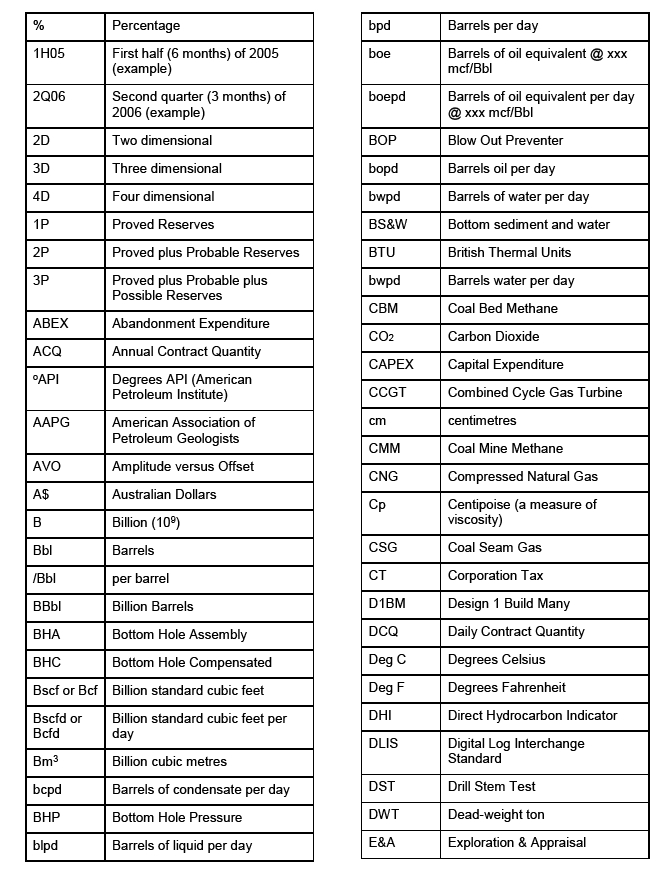
|
|
Glossary – Standard Oil Industry Terms and Abbreviations
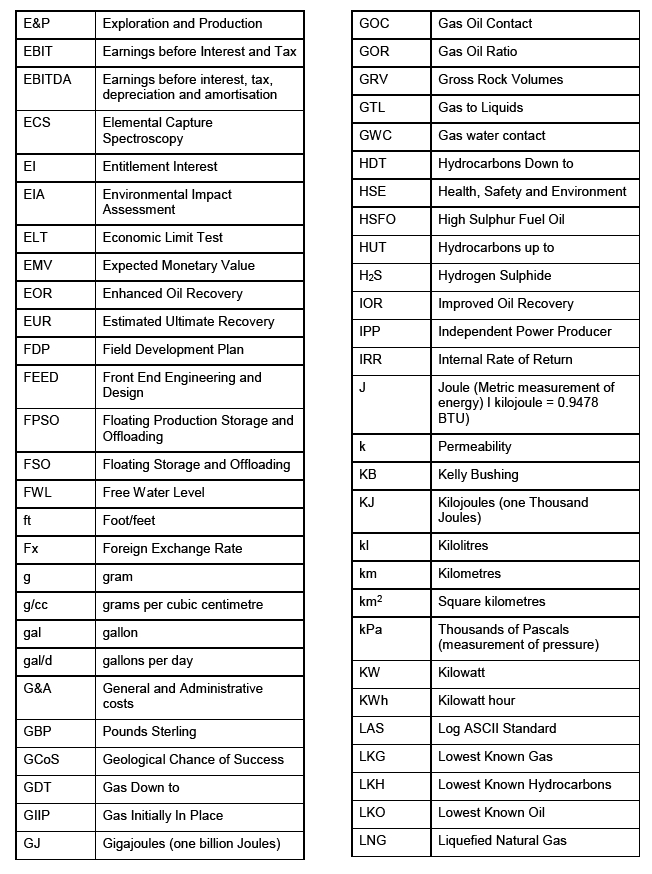
|
|
Glossary – Standard Oil Industry Terms and Abbreviations
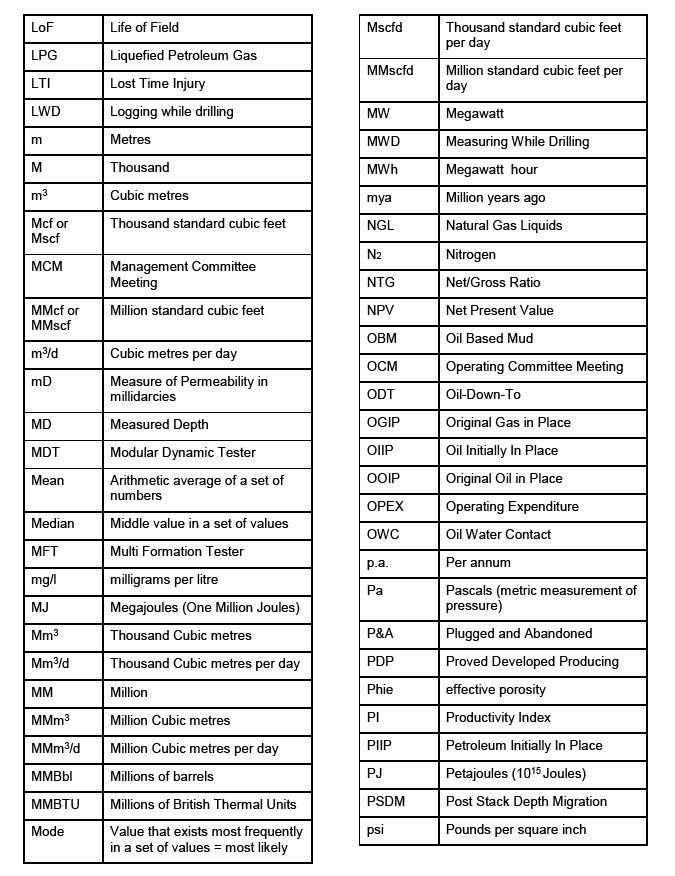
|
|
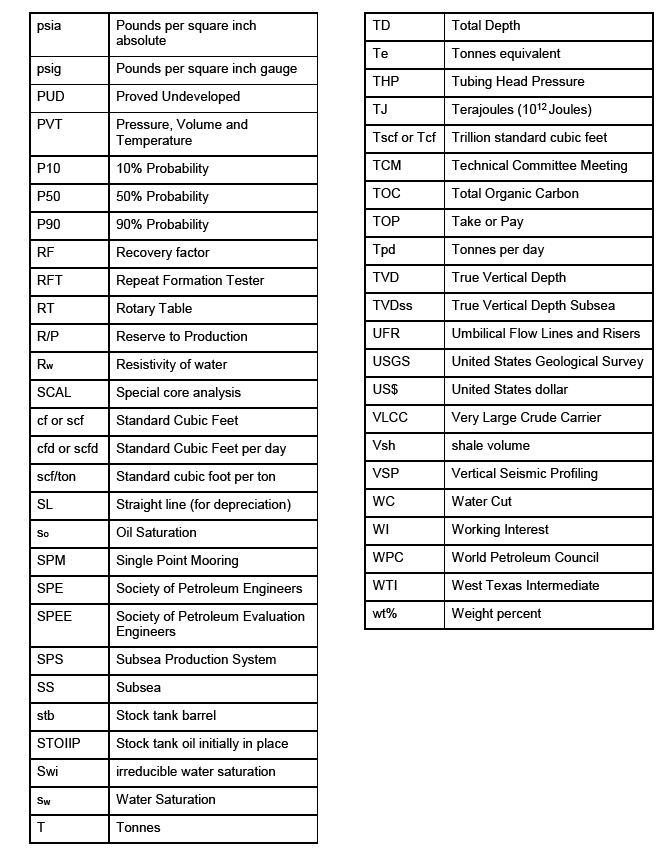
Glossary – Standard Oil Industry Terms and Abbreviations