Please wait
0001475841falseDEF 14A000147584142025-01-012025-12-31000147584132025-01-012025-12-31000147584122025-01-012025-12-31000147584112025-01-012025-12-3100014758412024-01-012024-12-3100014758412023-01-012023-12-3100014758412022-01-012022-12-3100014758412021-01-012021-12-310001475841ecd:YrEndFrValOfEqtyAwrdsGrntdInCvrdYrOutsdngAndUnvstdMemberecd:PeoMember2025-01-012025-12-310001475841ecd:YrEndFrValOfEqtyAwrdsGrntdInCvrdYrOutsdngAndUnvstdMemberecd:NonPeoNeoMember2025-01-012025-12-310001475841ecd:EqtyAwrdsInSummryCompstnTblForAplblYrMemberecd:PeoMember2025-01-012025-12-310001475841ecd:EqtyAwrdsInSummryCompstnTblForAplblYrMemberecd:NonPeoNeoMember2025-01-012025-12-310001475841ecd:EqtyAwrdsAdjsExclgValRprtdInSummryCompstnTblMemberecd:PeoMember2025-01-012025-12-310001475841ecd:EqtyAwrdsAdjsExclgValRprtdInSummryCompstnTblMemberecd:NonPeoNeoMember2025-01-012025-12-310001475841ecd:DvddsOrOthrErngsPdOnEqtyAwrdsNtOthrwsRflctdInTtlCompForCvrdYrMemberecd:PeoMember2025-01-012025-12-310001475841ecd:DvddsOrOthrErngsPdOnEqtyAwrdsNtOthrwsRflctdInTtlCompForCvrdYrMemberecd:NonPeoNeoMember2025-01-012025-12-310001475841ecd:ChngInFrValOfOutsdngAndUnvstdEqtyAwrdsGrntdInPrrYrsMemberecd:PeoMember2025-01-012025-12-310001475841ecd:ChngInFrValOfOutsdngAndUnvstdEqtyAwrdsGrntdInPrrYrsMemberecd:NonPeoNeoMember2025-01-012025-12-310001475841ecd:ChngInFrValAsOfVstngDtOfPrrYrEqtyAwrdsVstdInCvrdYrMemberecd:PeoMember2025-01-012025-12-310001475841ecd:ChngInFrValAsOfVstngDtOfPrrYrEqtyAwrdsVstdInCvrdYrMemberecd:NonPeoNeoMember2025-01-012025-12-310001475841ecd:YrEndFrValOfEqtyAwrdsGrntdInCvrdYrOutsdngAndUnvstdMemberecd:PeoMember2024-01-012024-12-310001475841ecd:YrEndFrValOfEqtyAwrdsGrntdInCvrdYrOutsdngAndUnvstdMemberecd:NonPeoNeoMember2024-01-012024-12-310001475841ecd:EqtyAwrdsInSummryCompstnTblForAplblYrMemberecd:PeoMember2024-01-012024-12-310001475841ecd:EqtyAwrdsInSummryCompstnTblForAplblYrMemberecd:NonPeoNeoMember2024-01-012024-12-310001475841ecd:EqtyAwrdsAdjsExclgValRprtdInSummryCompstnTblMemberecd:PeoMember2024-01-012024-12-310001475841ecd:EqtyAwrdsAdjsExclgValRprtdInSummryCompstnTblMemberecd:NonPeoNeoMember2024-01-012024-12-310001475841ecd:DvddsOrOthrErngsPdOnEqtyAwrdsNtOthrwsRflctdInTtlCompForCvrdYrMemberecd:PeoMember2024-01-012024-12-310001475841ecd:DvddsOrOthrErngsPdOnEqtyAwrdsNtOthrwsRflctdInTtlCompForCvrdYrMemberecd:NonPeoNeoMember2024-01-012024-12-310001475841ecd:ChngInFrValOfOutsdngAndUnvstdEqtyAwrdsGrntdInPrrYrsMemberecd:PeoMember2024-01-012024-12-310001475841ecd:ChngInFrValOfOutsdngAndUnvstdEqtyAwrdsGrntdInPrrYrsMemberecd:NonPeoNeoMember2024-01-012024-12-310001475841ecd:ChngInFrValAsOfVstngDtOfPrrYrEqtyAwrdsVstdInCvrdYrMemberecd:PeoMember2024-01-012024-12-310001475841ecd:ChngInFrValAsOfVstngDtOfPrrYrEqtyAwrdsVstdInCvrdYrMemberecd:NonPeoNeoMember2024-01-012024-12-310001475841ecd:YrEndFrValOfEqtyAwrdsGrntdInCvrdYrOutsdngAndUnvstdMemberecd:PeoMember2023-01-012023-12-310001475841ecd:YrEndFrValOfEqtyAwrdsGrntdInCvrdYrOutsdngAndUnvstdMemberecd:NonPeoNeoMember2023-01-012023-12-310001475841ecd:EqtyAwrdsInSummryCompstnTblForAplblYrMemberecd:PeoMember2023-01-012023-12-310001475841ecd:EqtyAwrdsInSummryCompstnTblForAplblYrMemberecd:NonPeoNeoMember2023-01-012023-12-310001475841ecd:EqtyAwrdsAdjsExclgValRprtdInSummryCompstnTblMemberecd:PeoMember2023-01-012023-12-310001475841ecd:EqtyAwrdsAdjsExclgValRprtdInSummryCompstnTblMemberecd:NonPeoNeoMember2023-01-012023-12-310001475841ecd:DvddsOrOthrErngsPdOnEqtyAwrdsNtOthrwsRflctdInTtlCompForCvrdYrMemberecd:PeoMember2023-01-012023-12-310001475841ecd:DvddsOrOthrErngsPdOnEqtyAwrdsNtOthrwsRflctdInTtlCompForCvrdYrMemberecd:NonPeoNeoMember2023-01-012023-12-310001475841ecd:ChngInFrValOfOutsdngAndUnvstdEqtyAwrdsGrntdInPrrYrsMemberecd:PeoMember2023-01-012023-12-310001475841ecd:ChngInFrValOfOutsdngAndUnvstdEqtyAwrdsGrntdInPrrYrsMemberecd:NonPeoNeoMember2023-01-012023-12-310001475841ecd:ChngInFrValAsOfVstngDtOfPrrYrEqtyAwrdsVstdInCvrdYrMemberecd:PeoMember2023-01-012023-12-310001475841ecd:ChngInFrValAsOfVstngDtOfPrrYrEqtyAwrdsVstdInCvrdYrMemberecd:NonPeoNeoMember2023-01-012023-12-310001475841ecd:YrEndFrValOfEqtyAwrdsGrntdInCvrdYrOutsdngAndUnvstdMemberecd:PeoMember2022-01-012022-12-310001475841ecd:YrEndFrValOfEqtyAwrdsGrntdInCvrdYrOutsdngAndUnvstdMemberecd:NonPeoNeoMember2022-01-012022-12-310001475841ecd:EqtyAwrdsInSummryCompstnTblForAplblYrMemberecd:PeoMember2022-01-012022-12-310001475841ecd:EqtyAwrdsInSummryCompstnTblForAplblYrMemberecd:NonPeoNeoMember2022-01-012022-12-310001475841ecd:EqtyAwrdsAdjsExclgValRprtdInSummryCompstnTblMemberecd:PeoMember2022-01-012022-12-310001475841ecd:EqtyAwrdsAdjsExclgValRprtdInSummryCompstnTblMemberecd:NonPeoNeoMember2022-01-012022-12-310001475841ecd:DvddsOrOthrErngsPdOnEqtyAwrdsNtOthrwsRflctdInTtlCompForCvrdYrMemberecd:PeoMember2022-01-012022-12-310001475841ecd:DvddsOrOthrErngsPdOnEqtyAwrdsNtOthrwsRflctdInTtlCompForCvrdYrMemberecd:NonPeoNeoMember2022-01-012022-12-310001475841ecd:ChngInFrValOfOutsdngAndUnvstdEqtyAwrdsGrntdInPrrYrsMemberecd:PeoMember2022-01-012022-12-310001475841ecd:ChngInFrValOfOutsdngAndUnvstdEqtyAwrdsGrntdInPrrYrsMemberecd:NonPeoNeoMember2022-01-012022-12-310001475841ecd:ChngInFrValAsOfVstngDtOfPrrYrEqtyAwrdsVstdInCvrdYrMemberecd:PeoMember2022-01-012022-12-310001475841ecd:ChngInFrValAsOfVstngDtOfPrrYrEqtyAwrdsVstdInCvrdYrMemberecd:NonPeoNeoMember2022-01-012022-12-310001475841ecd:YrEndFrValOfEqtyAwrdsGrntdInCvrdYrOutsdngAndUnvstdMemberecd:PeoMember2021-01-012021-12-310001475841ecd:YrEndFrValOfEqtyAwrdsGrntdInCvrdYrOutsdngAndUnvstdMemberecd:NonPeoNeoMember2021-01-012021-12-310001475841ecd:EqtyAwrdsInSummryCompstnTblForAplblYrMemberecd:PeoMember2021-01-012021-12-310001475841ecd:EqtyAwrdsInSummryCompstnTblForAplblYrMemberecd:NonPeoNeoMember2021-01-012021-12-310001475841ecd:EqtyAwrdsAdjsExclgValRprtdInSummryCompstnTblMemberecd:PeoMember2021-01-012021-12-310001475841ecd:EqtyAwrdsAdjsExclgValRprtdInSummryCompstnTblMemberecd:NonPeoNeoMember2021-01-012021-12-310001475841ecd:DvddsOrOthrErngsPdOnEqtyAwrdsNtOthrwsRflctdInTtlCompForCvrdYrMemberecd:PeoMember2021-01-012021-12-310001475841ecd:DvddsOrOthrErngsPdOnEqtyAwrdsNtOthrwsRflctdInTtlCompForCvrdYrMemberecd:NonPeoNeoMember2021-01-012021-12-310001475841ecd:ChngInFrValOfOutsdngAndUnvstdEqtyAwrdsGrntdInPrrYrsMemberecd:PeoMember2021-01-012021-12-310001475841ecd:ChngInFrValOfOutsdngAndUnvstdEqtyAwrdsGrntdInPrrYrsMemberecd:NonPeoNeoMember2021-01-012021-12-310001475841ecd:ChngInFrValAsOfVstngDtOfPrrYrEqtyAwrdsVstdInCvrdYrMemberecd:PeoMember2021-01-012021-12-310001475841ecd:ChngInFrValAsOfVstngDtOfPrrYrEqtyAwrdsVstdInCvrdYrMemberecd:NonPeoNeoMember2021-01-012021-12-3100014758412025-01-012025-12-31iso4217:USD

Table of Contents

Graphic

UNITED STATES

SECURITIES AND EXCHANGE COMMISSION

Washington, D.C. 20549

SCHEDULE 14A INFORMATION

Proxy Statement Pursuant to Section 14(a) of the Securities Exchange Act of 1934
(Amendment No.)

Filed by the Registrant

Filed by a Party other than the Registrant

Check the appropriate box:
  Preliminary Proxy Statement  
  Confidential, for Use of the Commission Only (as permitted by Rule 14a-6(e)(2))
 Definitive Proxy Statement  
  Definitive Additional Materials  
  Soliciting Material under § 240.14a-12

National Bank Holdings Corporation 
(Name of the Registrant as Specified In Its Charter)

(Name of Person(s) Filing Proxy Statement, if other than the Registrant)

Payment of Filing Fee (Check the appropriate box):

 No fee required.

  ​Fee paid previously with preliminary materials.

  ​Fee computed on table in exhibit required by Item 25(b) per Exchange Act Rules 14a6(i)(1) and 0-11

Table of Contents

Graphic

Notice of 2026 Annual Meeting of Shareholders

April 3, 2026

DEAR SHAREHOLDERS: I’m pleased to invite you to the Annual Meeting of Shareholders of National Bank Holdings Corporation. At the meeting, shareholders will vote on the following proposals:

1    To elect ten directors to our Board of Directors to hold office until the next annual meeting of shareholders and until their successors are duly elected and qualified;

2    To ratify the appointment of KPMG LLP as our independent registered public accounting firm for the year 2026;

3    To adopt a resolution approving, on an advisory, non-binding basis, the compensation paid to the Company’s named executive officers, as disclosed, pursuant to Item 402 of Regulation
S-K, in the proxy statement; and

4    To approve the proposed Amended and Restated National Bank Holdings Corporation 2023 Omnibus Incentive Plan.

Shareholders also will transact such other business as may properly come before the meeting.

The proxy statement and the accompanying form of proxy are first being sent to shareholders on or about April 3, 2026.

YOUR VOTE IS IMPORTANT: Whether or not you plan to attend the meeting, we urge you to vote and submit your proxy so that as many shares as possible may be represented during the meeting. We appreciate your cooperation in returning your proxy promptly.

Please call us at 720-554-6640 if you need instructions on how to attend the meeting or have questions about how to vote.

By Order of the Board of Directors,

/s/ Angela Petrucci

Angela Petrucci, Secretary

  ​ ​ ​

Meeting Information

Date:

Thursday, May 7, 2026

Time:

8:30 a.m. Central Time

  ​

  ​

Location:

Vista Bank, a division of NBH Bank, 3225 Martin Luther King Jr. Boulevard, Dallas, TX 75210

How to Vote and Other Details

Graphic

Record
Date

March 24, 2026 is the record date for determining which shareholders have the right to receive notice of, and to vote at, the meeting or any postponements or adjournments thereof.

Registered and beneficial shareholders can vote their shares in the following ways:

Graphic

Internet

Log on to www.proxyvote.com and enter the 16- digit control number provided on your proxy card

Graphic

Telephone

Dial 1-800-690-6903 and enter the 16-digit control number provided on your proxy card

Graphic

Mail

Mark, sign and date your proxy card and return it in the postage paid envelope we have provided or return it to Vote Processing c/o Broadridge, 51 Mercedes Way, Edgewood, NY 11717

Graphic

If you are a “record” shareholder of Class A common stock (that is, you hold Class A common stock in your own name in NBHC’s stock records maintained by our transfer agent), register upon your arrival at the Meeting, request a ballot and submit the ballot with your voting instructions at the Meeting.

Table of Contents

Table of Contents

General Information

1

Stock Ownership of Certain Beneficial Owners and Management

4

Proposal 1 Election of Directors

6

Governance

12

Board and Committee Meetings; Annual Meeting Attendance

12

Committees of the Board

12

Director Nomination Process, Director Qualifications and Skills

15

Compensation Committee Interlocks and Insider Participation

16

Director Independence

16

Board Leadership Structure

16

Succession Planning

17

The Board’s Role in Risk Oversight

18

Communications with Directors

18

Doing Good at NBH

19

Director Compensation

20

Certain Relationships and Related Person Transactions

22

ProposalRatification of Appointment of Independent Registered Public Accounting Firm

24

Audit & Risk Committee Report

26

ProposalAdvisory Vote on Executive Compensation (“Say-on-Pay”)

27

Executive Compensation

28

Letter to Shareholders from the Compensation Committee

28

Compensation Discussion and Analysis

32

Compensation Committee Report

47

Executive Compensation Tables

48

2025 Potential Payments upon Termination or Change-in-Control

56

CEO Pay Ratio

60

Pay Versus Performance Disclosure

62

Proposal 4 Amendment and Restatement of the 2023 Omnibus Incentive Plan

68

Section 16(a) Beneficial Ownership Reporting Compliance

78

Other Business

78

2027 Annual Meeting of Shareholders

78

“Householding” of Proxy Materials

79

Appendix A – National Bank Holdings Corporation 2023 Omnibus Incentive Plan, As Amended & Restated May 7, 2026

A-1

Appendix B – Summary and Reconciliation of Non-GAAP Measures

B-1

Table of Contents

General Information

This proxy statement is furnished in connection with the solicitation of proxies by the Board of Directors (the “Board of Directors” or the “Board”) of National Bank Holdings Corporation, a Delaware corporation (the “Company”, “NBHC”, “we”, “us” or “our”), to be used during our 2026 Annual Meeting of Shareholders (the “Meeting”) and at any postponements or adjournments thereof. The Meeting will be held in person at our Vista Bank, a division of NBH Bank, banking center located at 3225 Martin Luther King Jr. Boulevard, Dallas, TX 75210 at 8:30 a.m. Central Time on Thursday, May 7, 2026.

In this proxy statement, we refer to our employees as “associates;” and the Notice of Annual Meeting of Shareholders, this proxy statement, our 2025 Annual Report to Shareholders and the accompanying proxy, collectively, as our “Proxy Materials.” These Proxy Materials are first being sent to shareholders on or about April 3, 2026.

Holders of record of our shares of Class A common stock (“common stock”) at the close of business on March 24, 2026 (the “record date”) are entitled to notice of, and to vote at, the Meeting. As of such date, there were 44,692,472 shares of common stock outstanding and entitled to vote. In addition, as of such date, there were 952,463 shares of unvested restricted common stock entitled to vote. Each share of our common stock is entitled to one vote on all matters (in the case of Proposal 1, with respect to the election of each director). If your shares are registered directly in your own name, you are the shareholder of record with respect to those shares. If your shares are held in a brokerage account or by a broker, bank, or similar organization, then such broker, bank or similar organization is the “record holder” and you are the “beneficial owner” of shares held in “street name”.

Please read the Proxy Materials carefully. You should consider the information contained in these Proxy Materials when deciding how to vote your shares. You have a choice of voting by proxy over the Internet, by toll-free telephone number or by completing a proxy card and mailing it in the postage-paid envelope provided. If your shares are held in street name, please refer to your proxy card or the voting information provided by the record holder. As a beneficial owner, you have the right to instruct the record holder on how to vote your shares by using the voting instruction form or other procedures provided by the record holder. Voting via the Internet, by telephone or by mail will not prevent you from voting your shares during the Meeting. However, if your shares are held in street name, you must obtain a proxy, executed in your favor, from the record holder to vote in person during the Meeting. Otherwise, your shares will be voted in the manner in which you instructed the record holder of your shares. Even if you plan on attending the Meeting, we encourage you to vote your shares in advance of the Meeting to ensure that your vote will be represented in case your plans change.

We pay the cost of soliciting proxies. We have retained Alliance Advisors as our proxy solicitor for the Meeting and to provide strategic advice related to matters to be voted on at the Meeting. We expect to pay approximately $35,000, plus reimbursable costs, related to this engagement. Our directors, officers and associates may also solicit proxies by mail, telephone, fax, email, electronically or in person. We will not pay our directors, officers or associates any extra amounts for soliciting proxies. We may, upon request, reimburse brokerage firms, banks or similar nominees representing street name holders for their expenses in forwarding Proxy Materials to their customers who are street name holders and obtaining their voting instructions.

Any shareholder entitled to vote at the Meeting may attend the Meeting. If your shares are held through a bank, broker or other record holder and you would like to attend the Meeting, you will need to bring an account statement or other acceptable evidence of ownership of our common stock as of the record date. Each shareholder who attends the Meeting may be asked to present valid picture identification, such as a driver’s license or passport. Please note that the use of cell phones, tablets, recording and photographic equipment, computers and/or other similar devices is not permitted in the meeting room at the Meeting.

The Company’s principal executive offices are located at 7800 E. Orchard Road, Suite 300, Greenwood Village, Colorado 80111.

2026 Annual Proxy Statement

1

Table of Contents

Voting Matters

When you vote by proxy, your shares will be voted according to your instructions. If you are a shareholder of record and either (1) sign and return a proxy card without giving specific voting instructions or (2) indicate when voting by internet or by phone you wish to vote as recommended by the Board, then the persons named as proxy holders will vote your shares at the Meeting consistent with the Board’s recommendations as presented in this proxy statement. Also, if any other matters are properly presented at the Meeting for consideration, the proxy holders will have the discretion to vote for you on those matters. If you are a beneficial owner and your broker holds your shares in its name, the rules of the New York Stock Exchange (“NYSE”) permit your broker to vote on routine matters but not on non-routine matters. This means that your broker will be permitted to vote your shares on the ratification of the appointment of our independent registered public accounting firm (Proposal 2), even if the broker does not receive voting instructions from you, but will not be permitted to vote your shares on the other proposals if you do not timely provide instructions for voting your shares. This results in what is referred to as a “broker non-vote.”

Quorum

The presence, represented in person or by proxy, of the holders of a majority of the outstanding shares of our common stock entitled to vote during the Meeting shall constitute a quorum. Withheld votes, abstentions and broker non-votes are counted as present for purposes of establishing a quorum. If a quorum is not present at the scheduled time of the Meeting, the Meeting may be adjourned. The time and place of the adjourned meeting will be announced at the time the adjournment is taken, and no other notice will be given.

Votes Required for Approval

For Proposal 1 (election of directors), directors are elected by a plurality of the votes cast during the Meeting in person or by proxy, meaning that the ten director nominees who receive the most votes will be elected. You may vote “for” or “withhold” authority to vote for each of the nominees for election to the Board. Only votes “for” affect the outcome. Withheld votes and broker non-votes will have no effect on the voting results for this proposal. There is no cumulative voting for the election of directors.

Proposal 2 (ratification of the appointment of our independent registered public accounting firm) will be approved if a majority of the shares of our common stock present during the Meeting and entitled to vote cast their votes “for” this proposal. Abstentions will have the same effect as votes “against” this proposal. No broker non-votes are expected in connection with this proposal as brokers, banks or other nominees will have discretionary authority to vote shares for which street name shareholders do not provide voting instructions. Even if the appointment is ratified, our Audit and Risk Committee in its discretion may direct the appointment of a different independent registered public accounting firm at any time during the year if it is determined that such a change would be in the best interest of the Company and our shareholders.

Proposal 3 (the advisory proposal on the compensation of our named executive officers (commonly known as “Say-on-Pay”)) will be approved if a majority of the shares of our common stock present during the Meeting and entitled to vote cast their votes “for” this proposal. Abstentions will have the same effect as votes “against” this proposal. Broker non-votes will have no effect on the voting results for this proposal. The advisory vote on executive compensation (Proposal 3) is non-binding. However, our Board and Compensation Committee will review the results of the vote and, consistent with our commitment to shareholder engagement, take such results into account in making executive compensation decisions.

Proposal 4 (approval of the proposed Amended and Restated National Bank Holdings Corporation 2023 Omnibus Incentive Plan (the “Omnibus Plan”)) will be approved if a majority of the shares of our common stock present during the Meeting and entitled to vote cast their votes “for” this proposal. Abstentions will have the same effect as votes “against” the proposal. Broker non-votes will have no effect on the voting results of this proposal.

2

National Bank Holdings Corporation

Table of Contents

Approval of any other business that may properly come before the Meeting will require the affirmative vote of a majority of the shares of our common stock present or represented by proxy during the Meeting and entitled to vote thereon. Abstentions will have the same effect as a vote against any such proposal.

Voting by Registered and Beneficial Shareholders

You may vote your shares in person during the Meeting or by proxy in advance of the Meeting. There are three ways to vote by proxy:

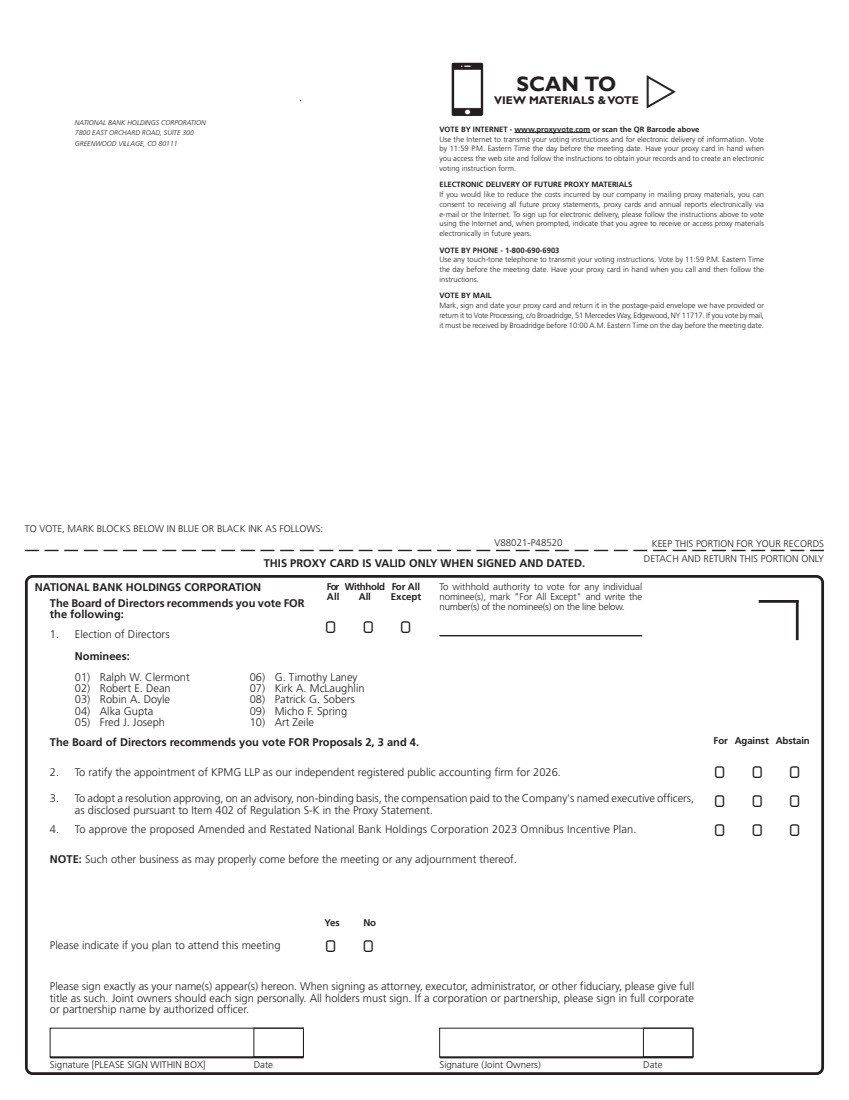
Via Internet: You may vote your shares over the internet by going to www.proxyvote.com. You will need to enter your 16-digit control number (found at the top right hand side of the proxy card or voting instruction form that you received in the mail) to identify yourself as a shareholder on the voting website.

By Telephone: Vote by telephone by calling 1-800-690-6903. You will need to enter your 16-digit control number (found at the top right hand side of the proxy card or voting instruction form that you received in the mail) to identify yourself as a shareholder.

By Mail: Mark, sign and date your proxy card and return it in the postage paid envelope we have provided or return it to Vote Processing c/o Broadridge, 51 Mercedes Way, Edgewood, NY, 11717.

Your voting instructions must be received by the proxy voting deadlines indicated on your proxy card, which provide that votes via the internet and telephone must be cast by 11:59 p.m. Eastern Time on May 6, 2026; and votes via mail must be received by 10:00 a.m. Eastern Time on May 6, 2026.

Even if you plan to attend the Meeting, we encourage you to vote your shares in advance of the Meeting using one of the methods described above.

Revocation of Proxy or Changing Your Vote

If you are a record holder, you may revoke your proxy or change your vote at any time as follows:

Online or by Telephone Prior to the Meeting. You may change your vote using the internet or telephone voting method described above, in which case only your latest proxy submitted prior to the Meeting will be counted. Changes must be submitted by 11:59 p.m. Eastern Time on May 6, 2026.

By Mail. You may revoke your proxy or change your vote by submitting a later dated proxy or delivering a written notice of revocation to the attention of our Secretary, Angela Petrucci, at National Bank Holdings Corporation, 7800 E. Orchard Road, Suite 300, Greenwood Village, CO 80111. Revocations or changes must be received by our Secretary prior the commencement of the Meeting.

During the Annual Meeting. You may change your vote by attending the Meeting and voting during the Meeting prior to the closing of the polls. You will need the control number found on your proxy card or on the instructions that accompanied your Proxy Materials.

If your shares are held in street name, you must contact the record holder to revoke any prior voting instructions.

If you have any questions or require voting assistance, please contact us at IR@nationalbankholdings.com.

2026 Annual Proxy Statement

3

Table of Contents

Stock Ownership of Certain Beneficial Owners and Management

The following table sets forth, as of March 24, 2026, information regarding the beneficial ownership of our common stock by (i) each person known by us to own beneficially more than five percent of the shares of our common stock (our only class of voting securities outstanding); (ii) each of our “Named Executive Officers” or “NEOs” as defined below in “Compensation Discussion and Analysis;” (iii) each director; and (iv) all current directors and executive officers as a group.

We have determined beneficial ownership in accordance with the rules of the Securities and Exchange Commission (“SEC”). Except as indicated in the footnotes below, we believe, based on the information furnished to us, that the persons and entities named in the tables below have sole voting and investment power with respect to all shares of common stock that they beneficially own, subject to applicable community property laws. We have based our calculation of the percentage of beneficial ownership on 45,644,935 shares, which number is comprised of 44,692,472 shares of common stock outstanding and 952,463 shares of unvested restricted common stock (which shares of restricted stock are entitled to voting rights), in each case as of March 24, 2026.

In computing the number of shares of common stock beneficially owned by a person and the percentage ownership of that person, we deemed outstanding shares of common stock subject to options held by that person that are currently exercisable or exercisable within sixty days of March 24, 2026. We, however, did not deem these shares outstanding for the purpose of computing the percentage ownership of any other person. Beneficial ownership representing less than 1% is denoted with an asterisk (*).

Amount and nature of

Percent of

Name of beneficial owner

  ​ ​ ​

beneficial ownership

  ​ ​ ​

class

5% Shareholders

BlackRock, Inc.(1)
55 East 52nd Street
New York, NY 10055

5,421,736


11.9%

The Vanguard Group(2)
100 Vanguard Blvd.
Malvern, PA 19355

4,220,345


9.3%

Named Executive Officers and Directors

G. Timothy Laney(3)


937,251


2.1%

Aldis Birkans(4)

322,058

*

Nicole L. Van Denabeele(5)

23,117

*

Richard U. Newfield, Jr.(6)


198,734


*

Angela N. Petrucci(7)

44,891

*

Ralph W. Clermont(8)


76,346


*

Robert E. Dean(9)


32,998


*

Robin Doyle(10)

5,230

*

Alka Gupta(11)

10,539

*

Fred J. Joseph(12)


25,175


*

Kirk A. McLaughlin(13)

602,339

1.3%

Patrick G. Sobers(14)

22,519

*

Micho F. Spring(15)


35,663


*

Art Zeile(16)


17,349


*

All current executive officers and directors as a group (16 persons)


3,125,184


6.8%

4

National Bank Holdings Corporation

Table of Contents

(1)As reported on the most recent Schedule 13G/A filed with the SEC on January 23, 2024 by BlackRock, Inc. (“BlackRock”). BlackRock (i) reported sole voting power with respect to 5,346,303 shares and sole dispositive power with respect to 5,421,736 shares; (ii) that various persons have the right to receive or the power to direct the receipt off dividends from or the proceeds from the sale of such shares; and (iii) the interest of one such person, iShares Core S&P Small-Cap ETF, in the Company’s Class A common stock is more than five percent (5%) of the Company’s total outstanding Class A common stock.

(2)As reported on the most recent Schedule 13G/A filed with the SEC on February 13, 2024 by The Vanguard Group, Inc. (“Vanguard”). Vanguard reported sole voting power with respect to zero shares, sole dispositive power with respect to 4,164,151 shares, shared voting power with respect to 23,715 shares, and shared dispositive power with respect to 56,194 shares.

(3)Includes 449,721 unvested restricted shares for which Mr. Laney has voting power and 232,928 shares issuable upon the exercise of options, 80,278 of which Mr. Laney holds as constructive trustee for the benefit of a former spouse pursuant to a 2021 divorce decree. Also includes 8,859 shares owned by the Timothy Laney 2012 Grantor Retained Annuity Trust. Mr. Laney disclaims beneficial ownership of all shares and options held by him as constructive trustee.
(4)Includes 221,730 unvested restricted shares for which Mr. Birkans has voting power and 57,613 shares issuable upon the exercise of options.
(5)Includes 10,523 unvested restricted shares for which Ms. Van Denabeele has voting power and 3,886 shares issuable upon the exercise of options.
(6)Includes 12,463 unvested restricted shares for which Mr. Newfield has voting power and 44,968 shares issuable upon the exercise of options.
(7)Includes 10,677 unvested restricted shares for which Ms. Petrucci has voting power and 20,488 shares issuable upon the exercise of options.
(8)Includes 1,936 unvested restricted shares for which Mr. Clermont has voting power. Also includes 59,939 shares owned by the Ralph W. Clermont Irrevocable Trust.
(9)Includes 1,659 unvested restricted shares for which Mr. Dean has voting power.
(10)Includes 1,659 unvested restricted shares for which Ms. Doyle has voting power.
(11)Includes 1,659 unvested restricted shares for which Ms. Gupta has voting power. Also includes 8,057 owned by the Gupta Rastogi Family Trust.
(12)Includes 1,659 unvested restricted shares for which Mr. Joseph has voting power.
(13)Includes 978 unvested restricted shares for which Mr. McLaughlin has voting power. Also includes 377,982 shares owned by the Gene McLaughlin Estate Trust, 205,204 shares owned through Kirk McLaughlin Enterprises Ltd., and 14,645 shares owned by Ramona McLaughlin over which Mr. McLaughlin has voting power pursuant to power of attorney.
(14)Includes 1,659 unvested restricted shares for which Mr. Sobers has voting power. Also includes 17,199 shares owned by the Patrick & Sharon Sobers Revocable Living Trust.
(15)Includes 1,659 unvested restricted shares for which Ms. Spring has voting power.
(16)Includes 1,659 unvested restricted shares for which Mr. Zeile has voting power.

2026 Annual Proxy Statement

5

Table of Contents

Proposal 1 - Election of Directors

Size and Composition of Board. In accordance with the terms of the Agreement and Plan of Merger, dated as of September 15, 2025 (the “Merger Agreement”), by and among NBHC, Vista Bancshares, Inc. (“Vista”) and Bryan Wick, solely in his capacity as the shareholders’ representative, as of the effective time of the merger of Vista with and into NBHC the size of the Board was increased by one to consist of a total of ten directors, and Kirk A. McLaughlin, a former director of Vista, became a member of the Board. The current members of the Board are G. Timothy Laney (Chairman), Ralph W. Clermont (independent Lead Director), Robert E. Dean, Robin A. Doyle, Alka Gupta, Fred J. Joseph, Kirk A. McLaughlin, Patrick G. Sobers, Micho F. Spring, and Art Zeile. The ages set forth below are as of the date of our Meeting.

Nominees. Upon the recommendation of the Nominating & Governance Committee, the Board has nominated each of the directors named below for reelection to the Board. Other than as set forth in the Merger Agreement, there are no arrangements between any director and any other person pursuant to which such director was or is to be selected as a director or nominee. With the exception of Mr. Laney, who serves as our Chairman and Chief Executive Officer (“CEO”), the Board has determined that each of these nominees is an independent director, as discussed further below under “Director Independence.”

Each of the directors elected during the Meeting will be elected for a one-year term which expires at the next annual meeting of shareholders and will serve until the director’s successor has been elected and qualified, or until the director’s earlier resignation or removal.

In the event that any nominee is no longer a candidate for director at the time of the Meeting, the proxyholders will vote for the rest of the nominees and may vote for a substitute nominee in their discretion. To the best of its knowledge, the Company has no reason to believe that any of the nominees will be unable to serve as directors if elected.

The Board recommends you vote “FOR” each of the nominees set forth below.

6

National Bank Holdings Corporation

Table of Contents

Graphic

Age: 78
Director Since: 2009

  ​

Ralph W. Clermont

Independent Lead Director

Audit & Risk Committee Chair

Nominating & Governance Committee Member

Compensation Committee Member

EXPERIENCE AND QUALIFICATIONS

Mr. Clermont has served as a director for the Company since 2009 and as the Board’s independent Lead Director since 2014. As the independent Lead Director, Mr. Clermont is an ex officio member of all of our Board committees with full voting rights. He also serves as Chair of the Board’s Audit & Risk Committee and as a board member of both NBH Bank and Bank of Jackson Hole Trust. He is also a member of the Trust Committee of the board of directors of Bank of Jackson Hole Trust. Mr. Clermont has served on the board of directors of Cass Information Systems, Inc. (Nasdaq: CASS) since October 2015, where he also serves on the audit committee and the governance committee. He also serves on the board of directors of Cass Commercial Bank. Mr. Clermont is a certified public accountant and a member of the American Institute of Certified Public Accountants and the Missouri Society of Certified Public Accountants. Mr. Clermont retired in 2008 as Managing Partner of the St. Louis office of KPMG LLP, and was formerly the partner in charge of KPMG’s Midwest financial services practice. Mr. Clermont joined the St. Louis office of KPMG in 1969 and was elected to the partnership in 1977. Mr. Clermont was a member of KPMG’s Assurance Services Committee and was chairman of KPMG’s Quality Improvement Audit Subcommittee. Mr. Clermont spent over 39 years providing services to the banking industry and has had responsibility for the audits of numerous banking organizations. Since retiring, Mr. Clermont has served as a consultant to various banking institutions on strategic planning, risk management and corporate governance matters. Mr. Clermont holds a Bachelor of Science in Accounting. Among other reasons, Mr. Clermont’s expertise in financial and accounting matters for complex financial organizations qualifies him to serve on our Board of Directors.

Graphic

Age: 75
Director Since: 2009

  ​

Robert E. Dean

Independent Director

Nominating & Governance Committee Chair

Audit & Risk Committee Member

Compensation Committee Member

EXPERIENCE AND QUALIFICATIONS

Mr. Dean has served as a director for the Company since 2009 and also serves as Chairman of the Nominating & Governance Committee. Mr. Dean is a private investor. He serves as President and director of his condominium owners association. Since November 2014 through April 2026, Mr. Dean served as a member of the boards of directors of two related Cornerstone closed-end mutual funds (Strategic Investment (CLM) and Total Return (CRF)) and as a member of each audit and nominating and governance committee thereof. From 2000 to 2003, Mr. Dean was with Ernst & Young Corporate Finance LLC, a wholly owned broker-dealer subsidiary of Ernst & Young LLP, serving as a Senior Managing Director and member of the board of managers from 2001 to 2003. From 1976 to 2000, Mr. Dean practiced corporate, banking and securities law with Gibson, Dunn & Crutcher LLP. Mr. Dean co-chaired the firm’s banking practice and advised bank clients on numerous capital markets and merger and acquisition transactions (including FDIC-assisted transactions). Mr. Dean was Partner-in-Charge of the Orange County, California office from 1993 to 1996 and was a member of the law firm’s executive committee from 1996 to 1999. Mr. Dean holds a Juris Doctor and a Bachelor of Arts. Mr. Dean’s substantial experience in bank capital markets and merger and acquisition transactions, bank regulatory matters and public company corporate governance matters qualifies him to serve on our Board of Directors.

2026 Annual Proxy Statement

7

Table of Contents

Graphic

Age: 62
Director Since: 2024

  ​

Robin A. Doyle

Independent Director

Audit & Risk Committee Member

EXPERIENCE AND QUALIFICATIONS

Ms. Doyle has served as a director for the Company since March 2024 and serves on the Board’s Audit & Risk Committee. She is NACD Directorship Certified®. Ms. Doyle is the chair of the board of directors of Dress for Success Central New Jersey and serves as a member of the executive committee, a board member of the New Jersey Chapter of the National Association of Corporate Directors, a board member and Treasurer of her condominium owners association, and serves on the advisory board of the Women’s Data Professional Group of the EDM Council. Ms. Doyle served as a founding board member of the Global Legal Entity Identifier Foundation (GLEIF), where she was chair of the audit and finance committee and vice chair of the governance committee. Ms. Doyle was a founding board member for the Rutgers Business School Center for Women in Business, the Rutgers Business School dean’s advisory board, the board of NJ Junior Achievement and the board of Easter Seals of New Jersey where she also founded the organization’s first audit committee. During her 28 year career at J.P. Morgan (NYSE:JPM), Ms. Doyle served in several senior management roles at the company, including managing director in JPM’s Office of Regulatory Affairs, chief financial officer for the firm’s risk management organization, where she was also an executive member of J.P. Morgan’s board of directors risk policy committee, senior vice president of Chase Home Finance and senior vice president of JPM’s accounting policies group before retiring from JPM in 2021. Prior to joining JPM, Ms. Doyle held roles at Midlantic National Bank (now PNC Bank) in internal audit, at KPMG in their audit department, and at Prudential Insurance Co. Ms. Doyle holds a Masters of Business Administration and Bachelor of Science in Accounting. Ms. Doyle’s distinguished career and expertise in financial services includes managing a number of finance functions, internal and external audit experience and managing a broad range of risk management functions, including risk governance, risk appetite, finance and technology. These experiences qualify her to serve on our Board of Directors.

Graphic

Age: 56
Director Since: 2021

  ​

Alka Gupta

Independent Director

Audit & Risk Committee Member

Compensation Committee Member

EXPERIENCE AND QUALIFICATIONS

Ms. Gupta has served as a director for the Company since 2021 and serves on the Board’s Audit & Risk Committee and Compensation Committee. Ms. Gupta is a Fortune 500 executive and tech entrepreneur with deep experience in digital transformation. Ms. Gupta currently serves as a director and chair of the Risk Committee of Dwolla Payment, and as the board chair of Digital Frontiers. From 2021 to 2023, Ms. Gupta was a director of MoneyGram International, Inc., where she also was a member of the Compliance and Ethics Committee. She previously served as a Venture Partner at Fin Venture Capital, a fintech B2B focused global venture fund. She was also Co-Founder, former President and member of the board of directors at GlobaliD, Inc. During her tenure at GlobaliD, she led GlobaliD’s growth, including building a high-quality team, launching a cutting-edge product and signing on first digital wallet customers. Prior to this, she was an executive at eBay/PayPal as Head of Strategy for eBay Marketplaces building new growth strategies in areas such as mobile commerce and cross-border payments. She holds a Masters of Business Administration and a Bachelor of Science. Ms. Gupta’s substantial experience in digital payments qualifies her to serve on our Board of Directors.

8

National Bank Holdings Corporation

Table of Contents

 Joseph is a past President of the North American Securities Administrators Association (“NASAA”), and also served as a director on NASAA’s Board for almost a decade. Mr. Joseph currently serves as a board member of the Colorado Board of Mortgage Loan Originators, being appointed to that position by the Colorado Governor in 2014, and reappointed in 2018. He also serves as a member of the Investor Issues Committee for the Financial Industry Regulatory Authority (FINRA). In addition, Mr. Joseph serves as an advisory board member for Plains Dedicated, a privately-held trucking company. Mr. Joseph holds a Bachelor of Science degree in Business Administration from Colorado State University-Pueblo and an MBA in Finance and Accounting from Regis University in Denver. Mr. Joseph’s substantial experience in the regulatory fields of financial services and securities qualifies him to serve on our Board of Directors.

Graphic

Age: 72
Director Since: 2014

  ​

Fred J. Joseph

Independent Director

Audit & Risk Committee Member

Nominating & Governance Committee Member

EXPERIENCE AND QUALIFICATIONS

Mr. Joseph has served as a director for the Company since 2014 and serves on the Board’s Audit & Risk Committee and Nominating and Governance Committee. He is a board member of both NBH Bank and Bank of Jackson Hole Trust. He is also a member of the Trust Committee of the board of directors of Bank of Jackson Hole Trust. Mr. Joseph is currently an advisory board member for Plains Dedicated, a privately-held trucking company. From 2014 to 2022, Mr. Joseph served as a board member of the Colorado Board of Mortgage Loan Originators and previously served as a board member of the Investor Issues committee for the Financial Industry Regulatory Authority (FINRA). Mr. Joseph was a financial services regulator for 30 years, retiring at the end of 2013 as the Banking and Securities Commissioner for the State of Colorado, a dual division-head role he assumed in 2011. In these roles, he oversaw the regulatory agency that licenses stockbrokers, brokerage firms and investment advisers in Colorado and had regulatory oversight of state-chartered commercial banks, money transmitters and trust companies in Colorado. From 2008 to 2010, Mr. Joseph served as the Acting Banking Commissioner for the State of Colorado. He was originally appointed as the Securities Commissioner of the State of Colorado in 1999. From 1992 to 1999, he was the Deputy Securities Commissioner for the State of Colorado. In that position, he oversaw the examination functions as well as the administrative matters for the Colorado Division of Securities. Prior to that, he was the Deputy Commissioner of Financial Services in Colorado for eight years, where he was responsible for the examination and regulatory oversight of state-chartered savings and loan associations and credit unions in Colorado. Mr. Joseph is a past President of the North American Securities Administrators Association (“NASAA”), and also served as a director on NASAA’s board for almost a decade. Mr. Joseph holds a Bachelor of Science in Business Administration and a Masters in Finance and Accounting. Mr. Joseph’s substantial experience in the regulatory fields of financial services and securities qualifies him to serve on our Board of Directors.

Graphic

Age: 64
Director Since: 2010

  ​

G. Timothy Laney

Chairman of the Board
Chief Executive Officer

EXPERIENCE AND QUALIFICATIONS

Mr. Laney has served as the Company’s Chief Executive Officer since 2010 as well as Chairman of the Board since 2014 and currently holds the same positions and directorships at NBH Bank and Bank of Jackson Hole Trust, including serving as the chairman of the Bank of Jackson Hole Trust’s Trust Committee. Mr. Laney is also a founder of National Bank Holdings Corporation and previously served as the Company’s President from 2010 through 2024 when the roles of Chief Executive Officer and President were split. Mr. Laney has served as a board member of the Federal Reserve Bank of Kansas City Denver Branch since 2025, and also serves as a board member of Finexio and the Moffitt Cancer Center, is the Chairman of the USA Weightlifting Foundation, and is the founder of the NBH Bank Do More Charity Challenge®. Mr. Laney previously served as a board member of the Colorado Bankers Association from 2018 to 2023. Prior to founding the Company, Mr. Laney was Senior Executive Vice President and Head of Business Services at Regions Financial, one of the nation’s largest full-service banks, where he led the transformation of the bank’s wholesale lines of business. Prior to his tenure at Regions Financial, Mr. Laney had a 24-year tenure with Bank of America, where he held senior management roles in small business, commercial banking, private banking, corporate marketing and change management. He also served as President of Bank of America, Florida, with more than 800 banking centers and $50 billion in total assets, and a member of Bank of America’s management operating committee. Mr. Laney brings to our Board of Directors valuable and extensive experience from managing and overseeing a broad range of banking operations for more than 40 years.

 Joseph is a past President of the North American Securities Administrators Association (“NASAA”), and also served as a director on NASAA’s Board for almost a decade. Mr. Joseph currently serves as a board member of the Colorado Board of Mortgage Loan Originators, being appointed to that position by the Colorado Governor in 2014, and reappointed in 2018. He also serves as a member of the Investor Issues Committee for the Financial Industry Regulatory Authority (FINRA). In addition, Mr. Joseph serves as an advisory board member for Plains Dedicated, a privately-held trucking company. Mr. Joseph holds a Bachelor of Science degree in Business Administration from Colorado State University-Pueblo and an MBA in Finance and Accounting from Regis University in Denver. Mr. Joseph’s substantial experience in the regulatory fields of financial services and securities qualifies him to serve on our Board of Directors.

2026 Annual Proxy Statement

9

Table of Contents

Graphic

Age: 67
Director Since: 2026

  ​

Kirk A. McLaughlin

Independent Director

Audit & Risk Committee Member

Compensation Committee Member

EXPERIENCE AND QUALIFICATIONS

Mr. McLaughlin has served as a director and member of the Board's Audit & Risk Committee and Compensation Committee since January 7, 2026, the effective date of the merger of Vista with and into NBHC. Mr. McLaughlin joined Vista in 1982 and served as a director of Vista for 43 years. Mr. McLaughlin served in multiple leadership roles at Vista, including as President of Vista Bank from 1989 until his retirement on January 1, 2018; as Chief Executive Officer of Vista from 2008 to 2015; and as a Trust Officer from 1982 until January 1, 2018. During his time as President, he helped grow Vista and Vista Bank from one banking location in Ralls, Texas to 11 retail locations across the Texas South Plains region, in addition to establishing an operations/administrations center in Lubbock, Texas. Mr. McLaughlin served as the Mayor of the City of Ralls, Texas for two terms and served as a Class A Director of the Federal Reserve Bank of Dallas from 1995 through 2000 (serving as the Chairman of the Audit Committee of the Federal Reserve Bank of Dallas from 1996 through 2000). Mr. McLaughlin also previously served on the boards of the Texas Bankers Association and the Community Bankers Council of the Texas Bankers Association. Mr. McLaughlin was a partner in Caprock Independent Insurance Agency from 1990 until 2010 and held Texas insurance licenses for both Property & Casualty sales and Life and Health sales. Mr. McLaughlin holds a Bachelor of Business Administration in Finance and Accounting from Texas Tech University and completed the Texas Tech School of Banking and the American Bankers Association National Agricultural Credit School. He also completed the Southwestern School of Banking Certified Community Bank Director Program at the Cox School of Business at Southern Methodist University. Mr. McLaughlin’s audit background and his vast experience in the financial services industry qualify him to serve on our Board of Directors.

Graphic

Age: 67
Director Since: 2021

  ​

Patrick G. Sobers

Independent Director

EXPERIENCE AND QUALIFICATIONS

Mr. Sobers has served as a director for the Company since 2021. He also serves as a member of the board of directors of both NBH Bank and Bank of Jackson Hole Trust. Mr. Sobers previously served as the EVP, Head of Business and Consumer Banking for NBH Bank, where he worked from 2012 until his retirement in 2021. Mr. Sobers is currently a member of the board of directors, board Treasurer, and chair of the finance committee of the board of directors of the Denver Seminary, an Emeritus board member and Chair of the Finance Committee of the of the Moffitt Cancer Center Foundation, and a member and Treasurer of the board of directors for Third Way Center. Mr. Sobers has over 30 years of experience in the financial services industry. Prior to joining NBH Bank, he held several leadership positions at Bank of America, including: the Southeast Region’s Consumer Banking Executive; Customer Service and Solutions Executive; Premier Banking and Investments Regional Executive for Florida and Georgia (now Merrill Lynch Wealth Management); and Tampa Market President. He holds a Bachelor of Applied Science in Business Administration. Mr. Sobers has been very active in the communities where he has resided, serving on the boards of numerous civic and charitable organizations. Mr. Sobers’ extensive experience in financial services and banking qualifies him to serve on our Board of Directors.

  ​ ​ ​

10

National Bank Holdings Corporation

Table of Contents

Graphic

Age: 76
Director Since: 2009

  ​

Micho F. Spring

Independent Director

Audit & Risk Committee Member

Nominating & Governance Committee Member

EXPERIENCE AND QUALIFICATIONS

Ms. Spring has served as a director for the Company since 2009 and serves on the Board’s Audit & Risk Committee and Nominating and Governance Committee. She also serves as a member of the board of directors of both NBH Bank and Bank of Jackson Hole Trust. Ms. Spring is currently a senior advisor at Weber Shandwick. Ms. Spring also currently serves as Past Chair and is on the Executive Committee of the Greater Boston Chamber of Commerce. She also serves on numerous boards of civic organizations, including National Association of Corporate Directors (NACD) New England, John F. Kennedy Library Foundation, Friends of Caritas Cubana, and the Whitehead Institute at MIT. From 1992 to 2022, she was a senior executive at Weber Shandwick, where she served as Chief Reputation Officer, Chair of the Global Corporate Practice and President of New England. Prior to joining Weber Shandwick, Ms. Spring was Chief Executive Officer of a Boston Telecommunications Company. Ms. Spring served as Deputy Mayor and Chief of Staff to Boston Mayor Kevin H. White after four years of service in New York City government. She also served as a director of Citizens Bank of Massachusetts, one of the largest state-chartered banks in Massachusetts at the time of her service. Ms. Spring holds a Masters in Public Administration. Ms. Spring’s extensive public policy experience, expertise in public relations, involvement in community activities and knowledge of financial institutions qualify her to serve on our Board of Directors.

Graphic

Age: 62
Director Since: 2016

  ​

Art Zeile

Independent Director

Compensation Committee Chair

Audit & Risk Committee Member

EXPERIENCE AND QUALIFICATIONS

Mr. Zeile has served as a director for the Company since 2016 and also serves as Chairman of the Compensation Committee and as a member of the Audit & Risk Committee. Mr. Zeile is currently the CEO of DHI Group, Inc. (NYSE: DHX), a leading provider of data, insights and employment connections through its specialized services for technology professionals and other select online communities. Mr. Zeile currently serves on the board of DHI Group, Inc. and also serves as an advisor of the Dispatch Health Advisory board. From 2008 to 2016, Mr. Zeile co-founded and served as the CEO of HOSTING, a pioneer in the cloud hosting space. From 2004 to 2006, he served as a director for Intrado (NASDAQ: TRDO) and served on the audit committee. During that time, he was also a director of several other private companies. His extensive career experience also includes serving as CEO and co-founder of several technology companies. He began his career as an officer in the U.S. Air Force. Mr. Zeile holds a Masters of Public Policy and a Bachelor of Science in Astronautical Engineering. Mr. Zeile’s extensive experience in software, telecommunications, internet, datacenter and security technologies, with a particular focus on cybersecurity, qualifies him to serve on our Board of Directors.

2026 Annual Proxy Statement

11

Table of Contents

Governance

The Board is committed to sound and effective governance principles and practices. The Board has adopted Governance Guidelines to provide the framework for the governance of the Board and the Company. These guidelines set forth, among other matters, qualifications for Board membership, director independence standards, director responsibilities, information about the structure of the Board and its committees, director compensation, management succession and Board self-evaluation. Each director serves for a one-year term. We do not have a staggered or classified Board.

The Board has adopted a Code of Business Conduct and Ethics that applies to all of our associates as well as our directors. Additionally, the Board has adopted a Supplemental Code of Ethics for CEO and Senior Financial Officers (together with the Code of Business Conduct and Ethics, the “Codes of Ethics”). We expect all of our associates to adhere to the highest standards of ethics and business conduct with other associates, clients, shareholders and the communities we serve and to comply with all laws, rules, and regulations that govern our business.

Shareholders and other interested persons may view our Governance Guidelines, Codes of Ethics and other key information about our corporate governance on our website at www.nationalbankholdings.com.

Board and Committee Meetings; Annual Meeting Attendance

Directors are expected to attend all Board meetings and meetings of committees. Only committee members vote on committee actions taken.

The Board held six meetings during 2025 and each director attended at least 75% of the total number of meetings of the Board and committees on which he or she served. The Board and each standing committee regularly meet in executive session. During 2025, the Board met in executive sessions without the CEO and other members of management present three times. During 2025, the independent Lead Director chaired each of the executive sessions of the Board, and the chairs of each committee chaired the executive sessions of the committees.

All directors are expected to attend each annual meeting of shareholders of the Company. In 2025, all directors attended the Company’s annual meeting of shareholders.

Committees of the Board

The Board has established three standing committees: Audit & Risk Committee, Compensation Committee and Nominating & Governance Committee. The Board’s committees act on behalf of the Board and report on their activities to the entire Board. The Board appoints the members and chair of each committee based on the recommendation of the Nominating & Governance Committee. The Audit & Risk Committee has also delegated authority to a sub-committee to oversee Emerging Technologies.

12

National Bank Holdings Corporation

Table of Contents

The following table provides membership information for each of the Board’s standing committees as of the date of this proxy statement.

Audit & Risk Committee

  ​ ​ ​

Compensation Committee

  ​ ​ ​

Nominating & Governance Committee


Ralph W. Clermont, Chair*

Art Zeile, Chair

Robert E. Dean, Chair

Robert E. Dean

Ralph W. Clermont

Ralph W. Clermont

Robin A. Doyle*

Robert E. Dean

Fred J. Joseph

Alka Gupta*

Alka Gupta

Micho F. Spring

Fred J. Joseph

Kirk A. McLaughlin

Kirk A. McLaughlin

Micho F. Spring

Art Zeile*

*Member of the Emerging Technologies Sub-Committee (Art Zeile, Chair)

With respect to each standing committee, the Board has adopted a charter that addresses its purpose, authority and responsibilities and contains other provisions relating to, among other matters, membership and meetings. In its discretion, each committee may form and delegate all or a portion of its authority to subcommittees of one or more of its members. As required by its charter, each committee periodically reviews and assesses its charter’s adequacy and reviews its performance, and also is responsible for overseeing risk related to the responsibilities described in its charter. Shareholders and other interested persons may view each committee’s charter on the Governance section of our website at www.nationalbankholdings.com.

Audit & Risk Committee

Purpose and Responsibilities. The Audit & Risk Committee is responsible for, among other things:

reviewing our financial statements and public filings that contain financial statements, significant accounting policy changes, material weaknesses and significant deficiencies, if any, and risk management issues;
overseeing the performance of our internal audit function as well as serving as an independent and objective body to monitor and assess our compliance with legal and regulatory requirements, our financial reporting processes and related internal control systems;
reviewing the adequacy of our internal audit department charter on an annual basis;
overseeing the audit and other services of our outside auditors and being directly responsible for the appointment, independence, qualifications, compensation and oversight of the outside auditors, including the review and evaluation of the lead audit partner;
discussing any disagreements between our management and the outside auditors regarding our financial reporting; and
reviewing the adequacy of our cybersecurity policies and procedures on an ongoing basis; and
preparing the Audit & Risk Committee Report for inclusion in our proxy statement for our annual meeting.

Membership and Meetings. Under its charter, the Audit & Risk Committee must have a minimum of three members. No Audit & Risk Committee member may serve on the audit committee of more than two other public companies. Each member of the Audit & Risk Committee is independent, as independence for audit committee members is defined by NYSE and SEC rules, as discussed below under “Director Independence.” The Board has determined, in its business judgment, that each current member of the Audit & Risk Committee is financially literate as required by NYSE rules, and that Mr. Clermont, the committee’s chair, Ms. Doyle, and Mr. McLaughlin each qualify as an “audit committee financial expert” as defined by SEC regulations.

The Audit & Risk Committee meets as often as necessary to carry out its responsibilities, but no less than quarterly. In 2025, the Audit & Risk Committee met four times.

2026 Annual Proxy Statement

13

Table of Contents

Compensation Committee

Purpose and Responsibilities. The Compensation Committee is responsible for, among other things:

determining the compensation of our executive officers;
reviewing our executive compensation policies and plans;
oversight of the Company’s compensation practices generally;
administering and implementing our equity compensation plans;
preparing a report on executive compensation for inclusion in our proxy statement for our annual meeting; and
overseeing the Company’s talent management and succession planning process, including succession planning for the position of CEO.

The Compensation Committee’s process and procedures for establishing compensation for our Named Executive Officers is discussed in the “Compensation Discussion and Analysis” section elsewhere in this proxy statement.

Membership and Meetings. Under its charter, the Compensation Committee must have a minimum of three members, all of which must meet the definition of a “non-employee director” under Rule 16b-3 of the Securities Exchange Act of 1934 (the “Exchange Act”). All Compensation Committee members must be independent under NYSE rules. The Board has determined that each current Compensation Committee member meets these qualifications, as further discussed below under “Director Independence.” The Compensation Committee meets as often as necessary to carry out its responsibilities, but no less than quarterly. In 2025, the Compensation Committee met five times.

Nominating & Governance Committee

Purpose and Responsibilities. The Nominating & Governance Committee is responsible for, among other things:

identifying individuals qualified to become members of our Board of Directors and recommending director candidates for election or reelection to our Board;
advising the Board on committee structure and recommending to the Board any nominees for the committees of the Board;
reviewing and making recommendations to our Board of Directors with respect to the compensation and benefits of directors;
reviewing and approving or ratifying all related-party transactions in accordance with the Company’s Related Person Transactions Policy;
assessing the performance of our Board of Directors and its committees; and
monitoring our governance policies, principles and practices, including periodic review of the Company’s strategy, initiatives and policies regarding environmental, social and governance matters that are significant to the Company.

Information about the Nominating & Governance Committee’s process and procedures for establishing director compensation appears below under the “Director Compensation” section.

Membership and Meetings. Under its charter, the Nominating & Governance Committee must have a minimum of three members, each of whom must be independent under NYSE rules. The Board has determined that each member meets this standard, as discussed below under “Director Independence.” The Nominating & Governance Committee meets as often as necessary to carry out its responsibilities, but no less than quarterly. In 2025, the Nominating & Governance Committee met four times.

14

National Bank Holdings Corporation

Table of Contents

Director Nomination Process, Director Qualifications and Skills

Director Selection Process. The Nominating & Governance Committee is responsible for identifying and reviewing the qualifications and skills of Board candidates, and for recommending candidates for membership on our Board of Directors, whether for election by the shareholders or to fill any vacancies that may occur. The Nominating & Governance Committee may consider director candidates from a wide range of sources, including referrals from shareholders, officers, and directors.

Director Qualifications. The Nominating & Governance Committee considers experience, skills, age and self-identified diversity attributes in its assessment of potential nominees for Board membership. The Board has continually sought directors with backgrounds and skills important to the priorities of the Company, which continue to evolve in connection with our strategic objectives, including our digital strategy.

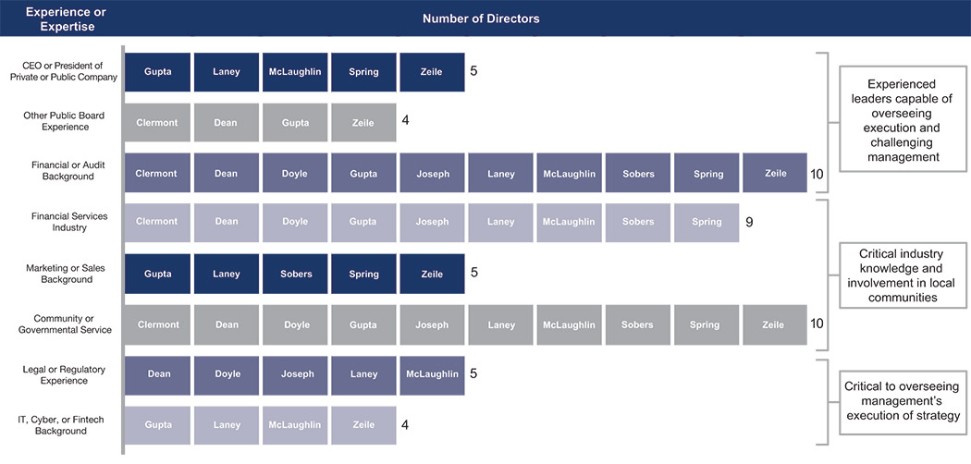
The breadth and experience of this Board is reflected in the Board Skills Matrix chart below. Each director and nominee possesses numerous other skills, experience and competencies not identified below. Identification in the table below represents a significant area of experience or expertise which the Board considers to contribute significantly to the overall Board skill set. A director or nominee may possess an experience or expertise even if such is not identified in the table. Director and nominee biographies above under “Proposal 1 – Election of Directors” describe each person’s background and relevant experience in more detail.

Graphic

Board Refreshment. The Board is committed to ongoing refreshment to ensure it maintains an effective balance of skills, experience, diversity, and independent perspectives. Over the past five years, we have strategically added four new Board members with important experience and skillsets. These have included Patrick G. Sobers (August 2021), Alka Gupta (November 2021), Robin A. Doyle (March 2024), and Kirk A. McLaughlin (January 2026). Mr. Sobers brought his 30+ years of banking experience to the Board in 2021. We added high-level technology and cybersecurity expertise in 2016 with the addition of Mr. Zeile and, in 2021, Ms. Gupta joined our Board with deep experience in digital transformation and digital payment systems. Ms. Doyle added significant experience in accounting, risk management and regulatory affairs when she joined the Board in 2024. This year, Mr. McLaughlin added significant banking experience and civic leadership due to his 40 years of experience in financial services, governance and non-profit organizations. Further, he qualifies as an “audit committee financial expert” as defined by SEC regulations.

As a result of these efforts, the Board today reflects a well-balanced mix of skills, tenure and age. The Board believes that this thoughtful approach to refreshment enhances oversight, supports long term strategy, and

2026 Annual Proxy Statement

15

Table of Contents

ensures that our directors collectively possess the diverse qualifications, experience and expertise necessary to guide the Company’s future growth and success.

Shareholder Nominations. Shareholders are welcome to recommend candidates for membership on the Board. The Nominating & Governance Committee, in accordance with its charter, will evaluate shareholder recommended candidates in the same manner that it evaluates other potential nominees. Our Bylaws require timely notice of shareholder nominations to our Secretary, as further discussed below under “2027 Annual Meeting of Shareholders – Shareholder Proposals.” In order to make a nomination, a shareholder must be a shareholder at the time the Company gives notice of its annual meeting and at the time of the annual meeting, must be entitled to vote at the annual meeting, and must comply with the procedures of our Bylaws, which require certain information regarding shareholders who wish to nominate candidates for Board membership. This includes (i) the name and address of such shareholder, as they appear on the Company’s books, of such beneficial owner, if any, and of their respective affiliates or associates or others acting in concert therewith (collectively, the “Nominating Party”); (ii) information regarding the shares owned by the Nominating Party; (iii) information regarding derivative and other instruments regarding the Company’s stock that the Nominating Party owns; (iv) contracts, arrangements, understandings or relationships the Nominating Party has entered into concerning the Company’s stock; and (v) other information relating to the Nominating Party that would be required to be disclosed in a proxy statement or other filing required to be made in connection with the solicitations of proxies for the election of directors in a contested election pursuant to Section 14 of the Exchange Act and the rules and regulations promulgated thereunder. For a complete description of the requirements and procedures for shareholder nominations, please refer to our Bylaws.

Compensation Committee Interlocks and Insider Participation

During 2025, Messrs. Zeile, Clermont, and Dean and Ms. Gupta served as members of our Compensation Committee. None of them has at any time been an officer or associate of the Company, and none has had any relationship with the Company of the type that is required to be disclosed under Item 404 of Regulation S-K. None of our executive officers serves or has served as a member of the board of directors or compensation committee (or other board committee performing equivalent functions) of another entity that has one or more executive officers serving as a member of our Board of Directors or Compensation Committee.

Director Independence

Our Governance Guidelines and committee charters require that a majority of the members of the Board of Directors and all members of the Audit & Risk Committee, the Compensation Committee and the Nominating & Governance Committee meet the criteria for independence required by the NYSE. Our Governance Guidelines also require all members of the Audit & Risk Committee to meet the heightened independence requirements for audit committee members under NYSE rules and the Exchange Act.

In February 2026, the Board, with the assistance of the Nominating & Governance Committee, undertook its annual review of director independence. In connection with this review, the Board evaluated banking, commercial, business, investment, legal, charitable, consulting, familial or other relationships with each director, and us and our affiliates. As a result of this review, the Board affirmatively determined that all of our directors (except Mr. Laney, who is an executive officer of the Company) are independent of the Company and its management under the corporate governance standards of the NYSE. The Board also confirmed that all members of the Board’s committees are independent under applicable NYSE and SEC rules.

Board Leadership Structure

The Board is responsible for overseeing the exercise of corporate power and seeing that our business and affairs are managed to meet our stated goals and objectives and that the long-term interests of our shareholders are served. The Company’s Governance Guidelines reserve the right to our Board to vest the responsibilities of the Chairman of the Board and the Chief Executive Officer in the same individual. The Board believes that it is in the best interests of the Company for the Board, in consultation with the Nominating & Governance Committee, to make this determination from time to time based on the

16

National Bank Holdings Corporation

Table of Contents

circumstances and direction of the Company and the membership of the Board. Pursuant to the Company’s Governance Guidelines, when the position of Chairman of the Board is not held by an independent director, the independent directors shall appoint an independent director to serve as Lead Director.

The Board has elected our Chief Executive Officer, Tim Laney, to serve as Chairman of the Board, and Mr. Clermont to serve as the independent Lead Director. The Board has concluded, based upon the Company’s size and history and its years of experience with Mr. Laney as Chief Executive Officer and as a fellow director, that a combined Chairman and CEO role for Mr. Laney, and an independent lead director with a strong role and defined authorities, continues to be the most appropriate corporate governance structure for the Company. The Board believes that Mr. Laney’s strong leadership roles with the Company’s shareholders and other stakeholders and with the Company’s ongoing strategic planning, among other factors, and Mr. Clermont’s demonstrated ability to work with the Company’s senior management and provide independent leadership on Board and committee issues is in the best interest of the Company and its shareholders and has enhanced Board communication and strategic planning.

The Board believes that both the duties of the independent Lead Director under the Company’s Governance Guidelines and the Board’s practice of regular meetings of, and communications between, directors in executive session without management are important parts of the Company’s corporate governance safeguards. Pursuant to the Company’s Governance Guidelines, the duties of the Lead Director include: (i) serving as a liaison, and facilitating communication between the Chairman of the Board and the other directors; (ii) organizing, convening and presiding over executive sessions of the independent directors; (iii) presiding at all meetings of the Board at which the Chairman of the Board is not present; (iv) approving meeting schedules and agendas proposed by the Chairman and Chief Executive Officer, and consulting with the Chairman and Chief Executive Officer regarding the information to be provided to the directors in conjunction with such meetings; (v) serving as an advisor to the Board committees, chairs of the Board committees and other directors; (vi) serving as a member ex officio of each of the Board’s standing committees, with full voting rights on each such committee; (vii) if requested by major shareholders, ensuring that he or she is available for consultation and direct communication; (viii) calling meetings of the Board if deemed advisable by the independent Lead Director; and (ix) such other duties and responsibilities as assigned from time-to-time by the independent directors. As part of his duties as independent Lead Director, Mr. Clermont meets regularly with Mr. Laney and other executives throughout the year.

Our current Board leadership structure supports the independence of directors. The non-employee directors strive to meet in executive session without the Chairman and CEO or anyone from management a minimum of four times a year and each of the standing committees is comprised solely of and led by independent directors. Our independent Lead Director presides at each executive session of the independent directors of the Board, and the independent committee chairs preside over the executive sessions of their respective committees. Moreover, both the Chairman and the independent Lead Director, as well as Ms. Spring and Messrs. Joseph and Sobers, serve as members of the boards of directors of NBH Bank and the Bank of Jackson Hole Trust, which further contributes to the oversight of our business, management and policies.

Succession Planning

The Compensation Committee oversees the Company’s talent management and succession planning process, including succession planning for the position of CEO, and periodically reports to the Board on these topics. The entire Board works with the Compensation Committee to identify and evaluate potential successors to the CEO and to establish policies regarding succession in the event of an emergency or the retirement of the CEO. The CEO also provides recommendations and evaluations of potential successors, along with a review of any professional development plans recommended for such individuals. In addition, the Compensation Committee, with input from the CEO and other members of management as appropriate, annually reviews the Company’s program for executive talent development and succession planning for executive officers other than the CEO. The appointments of Mr. Birkans to President, Ms. Van Denabeele to Chief Financial Officer and Mr. Steinmetz to Executive Vice Chair and Executive Managing Director of Strategic Initiatives at NBH Bank are recent examples of the Company’s executive succession processes.

2026 Annual Proxy Statement

17

Table of Contents

The Board’s Role in Risk Oversight

Our Board of Directors oversees risk management throughout the Company. The Board accomplishes this primarily through its three standing committees, each of which is active in risk management.

The Audit & Risk Committee is responsible for oversight of the management of risks across various aspects of our Company, including, but not limited to, market, credit, liquidity, fraud, legal, compliance, financial, operational (including cybersecurity) and reputational risks. The Audit & Risk Committee is further responsible for reviewing and approving guidelines, policies and processes for managing these risks. The Audit & Risk Committee monitors the Company’s risk exposure in all risk categories through regular reports prepared by members of management, including the Company’s Chief Risk Management Officer (“CRMO”). The Audit & Risk Committee determines the risk appetite of the Company and makes recommendations regarding such to the Board of Directors. Additionally, the Audit & Risk Committee regularly meets with representatives from the Company’s internal audit team and the Company’s independent registered public accounting firm, including in executive sessions without management present.

The Company devotes considerable resources to protect the confidentiality, integrity, and availability of its subsidiary banks’ systems and data, including associate and client information. Through coordinated efforts across our information technology, risk management, and third parties, we continuously enhance our suite of cyber-defense and information security capabilities. The Audit & Risk Committee is updated quarterly on information security, cybersecurity trends and artificial intelligence, and receives an annual report on the Company’s Information Security Risk Assessment efforts. Mr. Zeile, one of our directors who has extensive experience in information technology and cybersecurity matters, regularly discusses the Company’s technology initiatives with senior management responsible for these areas. In addition, Ms. Gupta has added deep experience in digital transformation and digital payment systems to our Audit & Risk Committee as a member. Both Mr. Zeile (chair) and Ms. Gupta, along with Mr. Clermont and Ms. Doyle, are members of the Emerging Technologies Sub-Committee of our Audit & Risk Committee, which assists with oversight of emerging technologies with respect to current and future risks associated with new technologies implemented or being considered by the Company and how such technologies fit into the Company’s overall strategy.

The Compensation Committee oversees risks related to compensation and human capital management, including risks that may arise from the Company’s incentive compensation practices. The Compensation Committee oversees and evaluates the design, administration and risk management of all of the Company’s material incentive compensation arrangements to ensure consistency with safety and soundness principles and to appropriately balance risk and reward. The Compensation Committee also oversees an annual compensation risk assessment to review the Company’s incentive compensation practices and identify any compensation practices that may present an unacceptable level of risk to the Company. In addition, the Compensation Committee oversees risks associated with human capital management in its oversight of the Company’s talent management and succession planning process.

The Nominating & Governance Committee oversees the Company’s governance program. This includes the Company’s Codes of Ethics, Insider Trading Policy, disclosure policies, management of potential conflicts of interest, including related party transactions, and director independence.

Communications with Directors

Shareholders and other interested parties who wish to communicate with the Board, the independent directors as a group, or one or more individual directors may do so by contacting our Secretary by mail at National Bank Holdings Corporation, Attn: Secretary, 7800 E. Orchard Road, Suite 300, Greenwood Village, CO 80111. Communications will be compiled by our Secretary and submitted to the intended recipient(s) on a periodic basis. In general, communications relating to corporate governance and Board matters are more likely to be forwarded than communications relating to ordinary business affairs or commercial solicitations.

18

National Bank Holdings Corporation

Table of Contents

Doing Good at NBH

Our corporate culture is driven by our core values of integrity, meritocracy, teamwork, and citizenship. The Company was founded in 2009 during the great recession, and the strong fundamentals and conservative principles that we put in place at our inception have consistently shaped how we operate our business.

It is our strong belief in “Doing Good” for our clients, our communities and our associates. Through our Doing Good initiatives, we focus on strengthening the communities and markets in which we do business. Our Doing Good Committee is comprised of a multi-disciplinary group of associates throughout the Company and is overseen by members of our executive management team with regular reporting to our Board of Directors.

Responsible and Client-Focused Business Practices

Our commitment to deliver common sense banking through building relationships with our clients that are based on the principles of fairness and simplicity continues to guide our business practices. We recognize that if our clients succeed, we succeed.

Our banking subsidiaries are community banks that understand small businesses are critical for job creation, innovation and keeping money in the local communities we serve. We are an approved lender in the Small Business Administration’s (“SBA”) Preferred Lender Program. We offer a range of SBA loans and products to support our small business clients seeking to grow and expand their businesses.

Knowledge is power, and we communicate regularly through email and our bank websites to keep our clients informed on a number of important topics, including cybersecurity, fraud, financial planning, business trends, and more.

Doing Good in Our Communities

We recognize our role in building and contributing to the growth, financial well-being, health and safety of our surrounding community and workforce. We believe that our Company’s long-term success is deeply tied to the prosperity of the communities we serve. Our focus is on investing our time, talent, and resources to help people (1) find meaningful work, (2) find affordable housing and (3) become financially empowered.

We strive to make a positive impact in the communities we serve through consistent engagement, as well as maintaining strong partnerships with a wide range of charitable organizations and causes. All of our associates are granted eight paid hours each year to donate their time to non-profit organizations, including those that align with our Community Reinvestment Act (CRA) initiatives. In addition to volunteering their time, we encourage our associates hold board and committee positions, both internally and externally, with the goal of bettering the communities we serve.

We held our 2025 Do More Charity Challenge® and Do More Concert® in Utah, bringing total contributions since inception of our do more initiatives to approximately $2 million for non-profits in our communities. In addition to these events, we continue to contribute directly to a wide range of nonprofits in our communities through NBH Charitable Foundation, which provided much needed funding to, among others, the following nonprofits in 2025: A Precious Child and Habitat for Humanity in Metro Denver, Junior Achievement in Kansas City, Utah, Texas, and Idaho, People Fund in Texas, Hope House in Kansas City, and Homewise in New Mexico.

Also, we seek to manage our environmental footprint through the use of environmentally conscious office products and materials and by evaluating the efficient use of office and banking center space. We continue to focus and invest in our mobile and digital platforms, which may contribute to a reduction in paper usage and lower fuel-related emissions. From time to time, we have provided financing to businesses engaged in green or sustainable activities and continue to evaluate opportunities to support such industries.

2026 Annual Proxy Statement

19

Table of Contents

Supporting Our People

Our core values also represent our belief that our Company’s long-term success is deeply tied to having a dedicated and engaged workforce. As of December 31, 2025, we employed 1,250 full-time and 52 part-time associates throughout our business footprint. The average tenure of service of our associates at December 31, 2025, was approximately six years.

We work diligently to attract, develop and retain associates who reflect the communities we serve. We are committed to building and contributing to a healthy workplace environment for our associates by investing in competitive compensation and benefit packages, fostering diverse viewpoints and backgrounds, providing training and career development opportunities, driving engagement of our associates and promoting qualified associates within our organization. Our compensation structure recognizes the individual performance of our associates through merit-based salary increases with a focus on variable pay and paying for performance.

In addition, we encourage our associates to plan for their long-term financial stability. Our associates have the opportunity to participate in our 401(k) plan, which includes contribution matches from the Company. Additionally, we offer a stock purchase plan (ESPP) to our associates which allows them to purchase shares in our Company at a 10% discount.

We strongly believe that investing in our associates and communities are important elements in building and sustaining a successful organization and a positive, results-driven culture. The Company has implemented programs to foster leadership opportunities for the entire associate base, such as engagement surveys as well as events with keynote speakers, panels and forums to gather associate feedback.

We are also committed to providing a safe and secure work environment in accordance with applicable labor, safety, health, anti-discrimination and other workplace laws. We strive for all of our associates to feel safe and empowered at work. To that end, we maintain a whistleblower hotline available 24/7 that allows associates and others to anonymously voice concerns. We prohibit retaliation against any individual who reports a concern or assists with an inquiry or investigation.

Director Compensation

Compensation Principles. The Nominating & Governance Committee and the Board believe director compensation should be based upon the following principles:

to align director interests with those of our shareholders, Board compensation should be predominately (at least 50%) equity-based and reinforced by stock ownership requirements;
director compensation should be sufficient to attract and retain high caliber experienced directors and commensurate with the work required and responsibilities undertaken; and
to foster management solicitation of director input and minimize administrative burdens, directors should receive annual retainers and not individual meeting fees.

Compensation Elements. During 2025, each director (other than Mr. Laney) received an annual cash retainer of $75,000 for his or her service as a member of the Board of Directors. The chair of the Audit & Risk Committee received an additional annual cash retainer of $30,000 and each of the chairs of the Compensation and Nominating & Governance Committees received an additional annual cash retainer of $20,000. All cash retainers for our directors are paid quarterly, in arrears. In addition, each director (other than Mr. Laney and Mr. Clermont) received an award of restricted common stock with an aggregate grant date fair value of $120,000. For his service as the independent Lead Director, Mr. Clermont received additional compensation of $30,000, which was paid $10,000 in cash and $20,000 in restricted common stock. The annual grants were made on the day of our 2025 annual meeting of shareholders and vest 50% after 180 days following the grant date and 50% on the date immediately preceding our next annual meeting of shareholders, in each case, subject to continued service through the vesting date. No individual meeting fees are paid for either Board meetings or committee meetings, whether in person or virtually. We reimburse directors for expenses incurred in their Board service, including the cost of attending Board and committee

20

National Bank Holdings Corporation

Table of Contents

meetings. We generally do not provide personal benefits (perquisites) to our directors. Our directors are eligible to participate in the Company’s Nonqualified Deferred Compensation Plan described in “Nonqualified Deferred Compensation Plan” below. In 2025, Ms. Spring participated in the Nonqualified Deferred Compensation Plan.

Compensation Review. Our director compensation structure and amounts are reviewed regularly by the Nominating & Governance Committee and the Compensation Committee’s independent compensation consultant, Pay Governance, LLC (“Pay Governance”). Pay Governance also assists the Compensation Committee with fulfilling its responsibilities related to the oversight of executive officer compensation. Our director compensation package was last reviewed relative to our peer group in October 2025 with Pay Governance; prior to that, our director compensation package had not been revised or reviewed with an independent compensation consultant since November 2022. Based on the most recent review, and upon the recommendation of the Nominating & Governance Committee, our full Board approved changes to our director compensation package effective January 1, 2026 to, among other things, align with the general industry median and maintain NBHC’s positioning in the peer group, while also maintaining a pay mix that is focused on equity. These changes included increasing the cash retainer for all directors to $90,000 and increasing the equity award component for all directors to $135,000. The additional compensation for the independent Lead Director was increased to $35,000, which is payable $15,000 in cash and $20,000, in restricted common stock; and the cash retainer for the Audit & Risk Committee chair was increased to $35,000.

Stock Ownership Guidelines. We believe ownership of NBHC common stock aligns the interests of our directors with those of our shareholders and emphasizes the long-term aspects of equity-based compensation. Under the current director stock ownership guidelines (the “Director Stock Ownership Guidelines”), each of our non-employee directors is required to beneficially own shares of NBHC common stock worth five times their annual board cash retainer within five years of their appointment to the Board (the “Director Minimum Ownership Threshold”). Shares counted for the purposes of the Director Stock Ownership Guidelines include vested restricted shares and all other shares of common stock owned outright. Unvested restricted shares and unexercised stock options do not count towards the threshold. Directors who have not achieved the Director Minimum Ownership Threshold are required to retain 50% of the after-tax portion of all vested common stock awards until the threshold is met. As of March 24, 2026, all non-employee directors were in compliance with the Director Minimum Ownership Threshold, with the exception of Ms. Gupta and Ms. Doyle who joined the Board in November 2021 and March 2024, respectively.

Mr. Laney, as an associate of the Company, does not receive separate compensation for his service on the Board. Information on his compensation and applicable stock ownership guidelines is included under the section “Executive Compensation” elsewhere in this proxy statement.

The Compensation of our non-employee directors (other than Mr. McLaughlin who was appointed January 7, 2026) for 2025 was as follows:

2025 Director Compensation Table

  ​ ​ ​

Fees earned or paid

  ​ ​ ​

Stock 

  ​ ​ ​

in cash 

awards 

Total

Name

($)(1)

($)(2)(3)

($)

Ralph W. Clermont


115,000


140,000


255,000

Robert E. Dean


95,000


120,000


215,000

Robin A. Doyle


75,000

120,000


195,000

Alka Gupta

75,000

120,000

195,000

Fred J. Joseph


75,000


120,000


195,000

Patrick G. Sobers

75,000

120,000

195,000

Micho F. Spring


75,000

120,000

195,000

Art Zeile

95,000

120,000

215,000

2026 Annual Proxy Statement

21

Table of Contents

(1)All of Ms. Spring’s cash retainer for 2025 was deferred under the Company’s Nonqualified Deferred Compensation Plan.

(2)Represents the aggregate grant date fair market value of the restricted common stock awards granted to each of our non-employee directors (other than Mr. McLaughlin) in 2025, computed in accordance with Financial Accounting Standards Board Accounting Standards Codification Topic 718, Compensation-Stock Compensation (“FASB ASC Topic 718”), using the valuation assumptions described in Note 15, “Stock-Based Compensation and Benefits” of our consolidated financial statements filed with the SEC on Form 10-K for the fiscal year ended December 31, 2025.

(3)As of December 31, 2025, our non-employee directors (other than Mr. McLaughlin) held the following unvested restricted stock: 1,936 shares of unvested restricted stock with respect to Mr. Clermont, and 1,659 shares of unvested restricted stock with respect to Messrs. Dean, Joseph, Sobers, and Zeile and Mses. Doyle, Spring, and Gupta.

Certain Relationships and Related Person Transactions

Related Person Transactions Policy and Procedures

The Board has adopted a written policy that establishes a framework for the review and approval or ratification of transactions between the Company and its related persons and/or their respective affiliated entities. We refer to this policy as our “Related Person Transactions Policy.” Under the Related Person Transactions Policy, no Related Person Transaction may be consummated or continued unless approved by the Nominating & Governance Committee. The Related Person Transactions Policy is available on our website at www.nationalbankholdings.com.

Related Persons” under this policy include our directors, director nominees, executive officers, persons who recently served as directors or executive officers, holders of more than 5% of any class of our voting securities and immediate family members of any of the foregoing persons. An “immediate family member” of a related person means any child, stepchild, parent, stepparent, spouse, sibling, mother-in-law, father-in-law, son-in-law, daughter-in-law, brother-in-law, sister-in-law of a related person and any person (other than a tenant or employee) sharing a household with a related person.

A “Related Person Transaction” is any transaction, arrangement or relationship (or series of similar transactions, arrangements or relationships) in which the Company (or any of its subsidiaries) is, was or will be a participant and the amount involved exceeds $120,000, and in which the Related Person had, has or will have a direct or indirect material interest, other than:

employment relationships or transactions involving an executive officer and any related compensation solely resulting from such employment if (i) the compensation is required to be reported in the Company’s annual proxy statement or (ii) the executive officer is not an immediate family member and such compensation would have been reported if the executive officer were a named executive officer and such compensation was approved, or recommended to the Board for approval, by the Compensation Committee or (iii) the transaction involves the recovery of erroneously awarded compensation that is disclosed when required;
compensation for serving as a director of the Company;
payments arising solely from the ownership of the Company’s equity securities in which all holders of that class of equity securities received the same benefit on a pro rata basis;
indebtedness arising from ordinary-course transactions such as the purchases of goods and services at market prices, and indebtedness transactions with any person or entity that is a Related Person only because such person or entity owns more than 5% of any class of the Company’s voting securities;
transactions where the rates or charges are determined by competitive bids;
transactions where the rates or charges are fixed in conformity with law or governmental authority in connection with the provision of services as a common or contract carrier or public utility; or

22

National Bank Holdings Corporation

Table of Contents

ordinary course transactions involving the provision of certain financial services (e.g., by a bank depository, transfer agent, registrar, trustee, etc.).

The Nominating & Governance Committee is responsible for approving, ratifying or disapproving of all Related Person Transactions. Prior to the consummation of any Related Person Transaction, Company management is responsible for providing the Nominating & Governance Committee with all material information regarding the potential Related Person Transaction and the interest of any Related Persons in such transactions. The Nominating & Governance Committee will only approve or ratify a Related Person Transaction if it determines that the transaction is in, or not inconsistent with, the best interests of the Company and its shareholders. No member of the Nominating & Governance Committee will participate in the review, consideration or approval of any Related Person Transaction with respect to which such member or any member of his or her immediate family is a Related Person.

In the event management determines it is impractical or undesirable to wait until the next meeting of the Nominating & Governance Committee to approve a Related Person Transaction, the Chair of the Nominating & Governance Committee may review and approve the Related Person Transaction, in accordance with the Related Party Transaction Policy. The Chair of the Nominating & Governance Committee will report any such approval to the Nominating & Governance Committee at its next regularly scheduled meeting.

Ordinary Course Transactions

Certain of our executive officers and directors, or their immediate family members and affiliates, are clients of or have, from time to time, engaged in banking (e.g., deposits, loans, etc.) and/or trust and wealth services transactions with NBH Bank and/or Bank of Jackson Hole Trust (our wholly owned bank subsidiaries). We expect to continue such relationships in the future. All loans or other extensions of credit made by NBH Bank or Bank of Jackson Hole Trust to such individuals were made in the ordinary course of business on substantially the same terms, including interest rates and collateral, as those prevailing at the time for comparable transactions with unaffiliated third parties and did not involve more than the normal risk of collectability or present other unfavorable features.

2026 Annual Proxy Statement

23

Table of Contents

Proposal 2 - Ratification of Appointment of Independent Registered Public Accounting Firm

The Audit & Risk Committee of the Board of Directors has appointed KPMG LLP (“KPMG”) as our independent registered public accounting firm for the year ending December 31, 2026, and the Audit & Risk Committee has determined that such appointment is in the best interest of the Company and its shareholders. KPMG’s tenure as the auditor of the financial statements of the Company began in 2010, which included auditing the 2009 financial statements. To help ensure the independence of our independent registered public accounting firm, the Audit & Risk Committee oversees the required five year rotation of our lead audit partner and also, on a periodic basis, considers the rotation of our independent registered public accounting firm. In determining whether to reappoint KPMG, the Audit & Risk Committee periodically considers, among other things, the following: (1) the advisability and potential impact of selecting a different independent registered public accounting firm, (2) experience auditing banks our size, (3) reasonableness of fees, (4) the quality of communications with the Audit & Risk Committee and management, (5) a review of KPMG’s performance of the annual audit, and (6) a review of the quality initiatives and steps KPMG is taking to improve the quality and efficiency of its audits.

Shareholders will vote during the Meeting to ratify such appointment. Representatives from KPMG are expected to be present at the Meeting. They will have an opportunity to make a statement if they so desire and will be available to respond to appropriate questions.

The Board recommends you vote “FOR” the proposal to ratify the appointment of KPMG as our independent registered public accounting firm for 2026.

KPMG Fees

We incurred the fees shown in the following table for professional services provided by KPMG for 2025 and 2024:

  ​ ​ ​

2025

  ​ ​ ​

2024

Audit fees

$1,531,500

$1,315,000

Audit-related fees

Tax fees

All other fees

Total

$1,531,500

$1,315,000

Audit Fees. Audit fees principally relate to the audit of our annual financial statements, the review of our quarterly financial statements, the audit of our internal control over financial reporting, attendance at Audit & Risk Committee meetings, accounting and audit consultations, and consent procedures.

Audit-Related Fees. Audit-related fees consist of fees billed for assurance and related services that are reasonably related to the performance of the audit or review of our financial statements and are not reported under “Audit Fees” above. There were no audit-related fees paid to KPMG in 2025 and 2024.

Tax Fees. Tax fees principally relate to the preparation of tax returns, compliance services, tax planning and consultation services. There were no tax fees paid to KPMG in 2025 and 2024.

All Other Fees. All other fees consist of fees for products and services other than the services reported above. There were no such fees paid to KPMG in 2025 and 2024.

24

National Bank Holdings Corporation

Table of Contents

The Audit & Risk Committee has determined that the provision of services by KPMG described in the preceding paragraphs is compatible with maintaining KPMG’s independence. All audit engagement hours were performed by KPMG’s full-time, permanent employees.

Audit & Risk Committee Pre-Approval Policies and Procedures

The Audit & Risk Committee selects and oversees our independent registered public accounting firm. The Audit & Risk Committee’s charter requires that the committee pre-approve all audit, audit-related, tax and other services performed by the independent registered public accounting firm, subject to de minimis exceptions for certain non-audit services, so long as such services are approved by the Audit & Risk Committee prior to the completion of the audit. In approving any non-audit services, the Audit & Risk Committee considers whether the provision of the services would impair the independent registered public accounting firm’s independence.

The Audit & Risk Committee may delegate pre-approval authority and responsibility to individuals or to designated subcommittees consisting of one or more members of the committee, provided that any such pre-approvals are presented to the committee at its next scheduled meeting. The Audit & Risk Committee has delegated such pre-approval authority to its Chair.

The Audit & Risk Committee pre-approved all of the audit services provided by KPMG in 2025 and 2024.

2026 Annual Proxy Statement

25

Table of Contents

Audit & Risk Committee Report

The Audit & Risk Committee’s charter, a copy of which is available on the Governance section of our website at www.nationalbankholdings.com, sets forth the Audit & Risk Committee’s purposes and responsibilities. The eight members of the Audit & Risk Committee are named below. Each member is independent, as independence for audit committee members is defined by NYSE rules and SEC regulations. The Board has determined, in its business judgment, that each member of the Audit & Risk Committee is financially literate as required by NYSE rules and that Messrs. Clermont and McLaughlin and Ms. Doyle each qualify as an “audit committee financial expert” as defined by SEC regulations.

Management has primary responsibility for our consolidated financial statements, the overall reporting process, maintaining adequate internal control over financial reporting and, with the assistance of our internal auditors, assessing the effectiveness of our internal control over financial reporting. The Audit & Risk Committee reviews with management the Company’s major financial risk exposures and the steps management has taken to monitor, mitigate, and control such exposures. The independent auditors are responsible for expressing an opinion that the consolidated financial statements have been prepared in accordance with generally accepted accounting principles, that management’s assessment that the Company maintained effective internal control over financial reporting is fairly stated, and that the audit of the Company’s consolidated financial statements by the external auditor has been carried out in accordance with Standards of the Public Company Accounting Oversight Board (United States) (“PCAOB”). This audit serves as a basis for the auditors’ opinion included in the annual report to shareholders addressing whether the financial statements fairly present our financial position, results of operations, and cash flows in conformity with U.S. generally accepted accounting principles as of and for the year ended December 31, 2025 and whether our internal controls over financial reporting were, in all material respects, effective. The Audit & Risk Committee’s responsibility is to monitor and oversee these processes.

The Audit & Risk Committee has reviewed and discussed our 2025 audited consolidated financial statements with management and KPMG. The Audit & Risk Committee has discussed with KPMG the matters required to be discussed by PCAOB Auditing Standard No. 1301, Communications with Audit Committees, including matters relating to the conduct of the audit of our consolidated financial statements and management’s assessment of internal control over financial reporting, and applicable requirements of the SEC. KPMG has provided to the Audit & Risk Committee the written disclosures required by applicable requirements of the PCAOB regarding KPMG’s communications with the Audit & Risk Committee concerning independence, and the Audit & Risk Committee has discussed with KPMG that firm’s independence from us. Based on this review and these discussions, the Audit & Risk Committee recommended to the Board that the audited consolidated financial statements be included in our Annual Report on Form 10-K for the year ended December 31, 2025, for filing with the SEC.

Current Members of the Audit & Risk Committee

Ralph W. Clermont, Chair

Robert E. Dean

Robin A. Doyle

Alka Gupta

Fred J. Joseph

Kirk A. McLaughlin

Micho F. Spring

Art Zeile

26

National Bank Holdings Corporation

Table of Contents

Proposal 3 - Advisory Vote on Executive Compensation (Say-on-Pay)

Non-Binding Advisory Vote

The Company seeks your advisory vote on the following resolution to approve the compensation of our Named Executive Officers:

Resolved, that the shareholders of National Bank Holdings Corporation hereby approve, on an advisory, non-binding basis, the compensation paid to the Company’s Named Executive Officers as disclosed in this proxy statement pursuant to Item 402 of Regulation S-K, including the Compensation Discussion and Analysis, compensation tables and narrative discussion.”

Effect of Non-Binding Advisory Vote

This advisory vote is not binding on the Company. Our Board and our Compensation Committee do, however, review the results of the vote and, consistent with our commitment to shareholder engagement, will take it into account in determining executive compensation.

Compensation Philosophy

The Company’s compensation philosophy is designed to attract, develop and retain the talent needed for the organization’s continued success in building a competitive franchise and executing our strategic plan. We intend these programs to be aligned with performance goals that motivate executives to achieve strategic goals prudently and within acceptable risk parameters. Our executive compensation program is designed to reward individual contributions and to create long-term shareholder value. Our compensation philosophy is discussed in greater detail in the “Compensation Discussion and Analysis” section elsewhere in this proxy statement.

Recommendation

The Board encourages you to read both the “Letter to Shareholders from the Compensation Committee” and “Compensation Discussion and Analysis” below. The Compensation Committee is committed to maintaining a strong link between pay and performance and explaining the rationale for its pay decisions. For these reasons, we strongly believe you should approve the compensation of our Named Executive Officers as presented.

The Board recommends you vote “FOR” the proposal to approve the Advisory Vote on Executive Compensation (Say-on-Pay).

2026 Annual Proxy Statement

27

Table of Contents

Executive Compensation

LETTER TO SHAREHOLDERS

FROM THE COMPENSATION COMMITTEE

Fellow Shareholders,

Our Board and Compensation Committee continues to ensure that our executive compensation program is designed to align executive compensation with shareholder interests. We also focus on attracting and retaining the talent essential to providing vision, developing strategy and successfully executing our long-term strategy. The Board and the Compensation Committee remain committed to providing clear and comprehensive disclosure to help you understand how (1) our executive compensation programs are structured, (2) we assess performance and (3) performance leads to pay outcomes that are aligned with your best interests.

2025 Year in Review

During 2025, we strengthened the foundation of our Company, making meaningful investments in our Company and our communities. We grew tangible common book value per share by 10% and further strengthened our capital levels—providing us a solid platform to invest in future opportunities and significant strategic flexibility. We also advanced two important priorities: expanding our franchise through the Vista acquisition and launching the initial phase of 2UniFiSM.

2025 Financial Achievements

Our values of integrity, meritocracy and teamwork, coupled with our strong foundation and ample liquidity, continue to drive meaningful shareholder returns.

In 2025, the Company:

Delivered earnings per diluted share of $2.85 or $3.061 on an adjusted basis;
Achieved a return on average assets of 1.11% or 1.30%1 on an adjusted tangible basis;
Generated fully taxable equivalent net interest margin2 of 3.94% for FY 2025;
Maintained disciplined deposit pricing as the Federal Reserve Bank lowered rates with a 2.02% cost of deposits;
Originated $1.6 billion of new loans including $591.0 million of new loans in the fourth quarter;
Produced 10% growth in our tangible common book value per share;
Delivered strong excess capital with a common equity tier I capital ratio of 14.89%;
Launched the initial phase of 2UniFi, an innovative financial ecosystem built to empower business entrepreneurs with treasury management, depository capabilities, and a streamlined SBA loan offering; and
Continued expense management with an adjusted efficiency ratio of 58.43%.1

Additionally, during 2025, the Company announced and obtained regulatory approval for the acquisition of Vista Bancshares, Inc. The merger of Vista with and into the Company was successfully completed on January 7, 2026. This acquisition further strengthens the Company’s position as a premier regional bank and deepens our presence in high-growth markets, including Dallas-Ft. Worth and Austin, and advances our private banking strategy in key resort markets.

1 Represents a non-GAAP financial measure. Please refer to Appendix A of this Proxy Statement for a reconciliation of these measures.

2 Net interest margin represents net interest income, including accretion income on interest earning assets, as a percentage of average interest earning assets. Presented on a fully taxable equivalent basis using the statutory tax rate of 21%. The tax equivalent adjustments included was $7.9 million.

28

National Bank Holdings Corporation

Table of Contents

Long Term Performance

As a Company, our strong fundamentals and conservative principles we put in place since our inception have enabled us to support our clients, associates and communities we serve. These disciplined foundations have contributed to sustained financial strength, reflected in the continued growth of our tangible common book value per share, underscoring the resilience of our business model and our commitment to generating longterm value for our shareholders.

We have also consistently provided meaningful returns of capital to our shareholders, reflecting both the strength of our financial performance and our confidence in the longterm outlook of the Company. This approach underscores our continued dedication to creating lasting shareholder value through balanced, responsible capital allocation.

Graphic

The results of our intentional efforts have helped secure our status as a leading regional bank franchise. As we look ahead, we remain focused on growthwithin our core bank franchise, through our 2UniFi digital strategy, through the expansion of our trust and wealth business and through our Cambr® business.

2026 Annual Proxy Statement

29

Table of Contents

CEO Compensation

Our philosophy for our CEO compensation is heavily weighted towards measures that directly align with shareholder value creation and is reviewed annually in consultation with the Compensation Committee’s independent compensation consultant, Pay Governance.

Following a review of our then-current peer companies and a desire to align the CEO’s compensation at a level commensurate with his performance and tenure as CEO, the Compensation Committee increased our CEO’s salary from $850,000 to $955,000 effective March 23, 2025. The majority of our CEO’s compensation remains tied to the achievement of specified performance metrics. The total amount of our CEO’s at-risk pay (Short-Term Incentive and Long-Term Incentive) and overall total compensation for the last three years was as follows:

Year

Salary
(Cash)

Short-Term
Incentive
(Cash)

Long-Term Incentive

(Equity)

All other
Compensation

Total Compensation

2025

$930,769

$1,153,241

$1,444,946

$196,996

$3,725,952

2024

$850,000

$1,208,700

$1,664,934

$222,205

$3,945,839

2023

$850,000

$1,114,350

$1,441,511

$172,240

$3,578,101

Shareholder Engagement & 2025 Say-on-Pay Advisory Vote

At our 2025 Annual Meeting of Shareholders, we were pleased to receive a 98.24% vote in favor of our executive compensation (Say-on-Pay), which was a strong signal that shareholders concurred with our pay for performance philosophy. Our record of shareholder engagement is strong, beginning with the regular meetings that our CEO, President and CFO hold with our investors at various conferences and meetings throughout the year. In addition, the Company annually conducts a post-meeting campaign to engage with the corporate governance teams of our shareholders to understand any concerns or other feedback regarding our executive compensation program and governance practices. As part of the process for the 2026 Annual Meeting of Shareholders, we contacted shareholders representing more than 79% of our shares outstanding.

Our engagement meetings discussed our practices and their views regarding, among other things, compensation, succession planning, technology investments including with respect to 2UniFi, and governance matters. No shareholders with which we engaged expressed any significant concerns.

Summary

The Board and the executive team remain committed to moving your company forward with a clear priority of delivering superior growth and performance for you, our shareholders. The Board and the Compensation Committee have the utmost confidence in the talent and determination of the executive team as we work to continue to execute on our long-term strategy and deliver value to our shareholders.

The Board and the Compensation Committee are also committed to ensuring the link between executive compensation and shareholder value creation is strong. As always, we will continue to evaluate our current compensation practices and monitor emerging best practices.

We thank you for taking the time to read our disclosure and encourage you to vote in favor of our approach to executive compensation.

30

National Bank Holdings Corporation

Table of Contents

Sincerely,

Compensation Committee of the Board of Directors of National Bank Holdings Corporation

/s/ Art Zeile

/s/ Ralph W. Clermont

Art Zeile

Ralph W. Clermont

Chair

/s/ Alka Gupta

/s/ Robert E. Dean

Alka Gupta

Robert E. Dean

/s/ Kirk A. McLaughlin

Kirk A. McLaughlin

2026 Annual Proxy Statement

31

Table of Contents

Compensation Discussion and Analysis

Introduction

In this section, which we refer to as the “CD&A”, we explain how we compensate the executive officers named in the “Summary Compensation Table” below (our “Named Executive Officers” or “NEOs”). Our NEOs for 2025 were:

G. Timothy Laney, Chairman and Chief Executive Officer
Aldis Birkans, President
Nicole L. Van Denabeele, EVP, Chief Financial Officer
Richard U. Newfield, Jr., EVP, Chief Risk Management Officer
Angela N. Petrucci, EVP, Chief Administrative Officer, General Counsel and Secretary

Our approach to executive compensation is to pay for performance and to align compensation programs with effective risk management. We believe this approach to compensation has and will continue to create sustainable shareholder value over the long term.

Philosophy, Objectives, Components and Highlights of Our Executive Compensation Program

Philosophy

We are at our best when we are providing our clients with banking advice and services that help them be successful. When we do this in accordance with our core values, it is a win-win for clients and the community. Because a key expectation of management is to build an effective organizational structure, it is particularly important that our executive compensation program be designed to attract, develop and retain the talent needed for the organization’s continued success in building a competitive franchise and executing our strategic plan. We intend this program to be aligned with performance goals that motivate executives to achieve our strategic goals prudently and within acceptable risk parameters. Our executive compensation program is designed to reward individual contributions and to create long-term shareholder value.

Objectives

Our executive compensation philosophy is designed to meet five key objectives:

ensure that the goals and interests of management are closely aligned with those of the Company, our shareholders, our clients and the communities we serve;
balance compensation to reward both short-term results and the strategic decisions and actions required to build a sustainable enterprise and create long-term value;
motivate executives to deliver a high level of business performance and prudently achieve strategic goals within acceptable risk parameters;
pay compensation based on corporate and individual performance; and
attract and retain highly qualified executives through a balance of cash and equity compensation.

32

National Bank Holdings Corporation

Table of Contents

Compensation Components

For 2025, the total compensation of our NEOs consisted primarily of the following components:

Compensation Component

  ​ ​ ​

Purpose

  ​ ​ ​

Considerations

Base Salary: Cash

To provide a fixed amount of cash compensation reflective of level and scope of responsibility and competitive practice.

NEO salary levels are based on:

  ​experience;

  ​scope of responsibilities;

  ​individual performance; and

  ​competitiveness with salary ranges at other banking organizations.

Short-Term Incentive Compensation:
Cash

To motivate and reward our NEOs for meeting or exceeding corporate, business line and individual performance goals.

The annual short-term incentive for our NEOs is 70% tied to quantitative financial metrics and 30% to qualitative metrics.

Long-Term Incentive Compensation:
Equity Awards

Equity compensation links performance with the interests of our shareholders, promotes a long-term focus, and acts as an effective retention tool for key talent.

  ​50% of the value in the form of performance stock units that vest after a three-year performance period based on the achievement of financial and shareholder return metrics.

  ​50% of the value is in the form of time-based restricted stock that vests over a three-year service period.

Benefits & Perquisites

Benefits are designed to be generally competitive with other banking institutions.

We provide limited perquisites to our NEOs where we believe there is a strong business rationale for providing them (e.g., optimizing executive’s ability to be productive, safe and efficient).

Change in Control and Severance Arrangements

Employment agreements or change of control agreements, which include severance benefits and certain change in control benefits, are intended to reinforce and encourage the continued attention and dedication of our NEOs.

We believe change in control and severance arrangements are an effective tool in attracting and retaining talent. All equity awards granted in 2025 to our NEOs contain a double-trigger acceleration of equity upon a change in control.

Compensation Best Practices

Best practices we have implemented with respect to our executive compensation program include the following:

Stock Ownership Guidelines. Our directors and executive officers are subject to stock ownership guidelines that impose a holding requirement of 50% of the after-tax portion of vested and/or exercised awards until established ownership thresholds are met.
Anti-Hedging/Pledging Policy. Our Insider Trading Policy prohibits hedging or short sales involving Company securities. In addition, directors, executive officers and certain designated associates (including our NEOs) under the Company’s Insider Trading Policy are prohibited from pledging the Company’s securities.

2026 Annual Proxy Statement

33

Table of Contents

Double-trigger Acceleration of Equity. All of our outstanding unvested equity awards held by our NEOs and all future equity awards to be granted to our NEOs under the Omnibus Plan contain a double-trigger acceleration of equity upon a change in control.
Perquisites and Benefits. We provide limited perquisites to our NEOs where we believe there is a strong business rationale for providing them (e.g., optimizing executive’s ability to be productive, safe and efficient), and do not have a defined-benefit pension plan or supplemental executive retirement plan (SERPs).
Independent Compensation Consultant. The Compensation Committee engages an independent compensation consultant for advice with respect to the Company’s executive compensation program.
Clawbacks. We have adopted a compensation recovery policy in accordance with NYSE and SEC rules to recover incentive-based compensation from executive officers after an accounting restatement. Additionally, the employment agreements of our executive officers, as well as the equity award agreements for all associates, contain clawback provisions for financial misstatements and other misconduct beyond what is required by the SEC.
Risk Assessment. The Compensation Committee oversees a risk assessment of our compensation program that is performed annually.
Pay for Performance. 70% of the CEO’s compensation and 61% of the other NEOs compensation was at-risk in 2025. Furthermore, NEOs are rewarded for attaining financial performance measures that are aligned with the interests of shareholders.
Capped Payouts. The maximum payouts under our 2025 Short-Term Incentive Plan (“STIP”) are limited to 157.5% of the target opportunity for our NEOs. The maximum payouts under our long-term performance-based equity awards are limited to 150% of the target opportunity for all NEOs.
No Tax Gross Ups on Change in Control Payments. The Company does not provide for tax gross ups on change in control payments.
Prohibition on Repricing of Stock Options or Stock Appreciation Rights. Our equity plans prohibit the repricing of stock options or stock appreciation rights.

Setting Compensation for our Named Executive Officers

Executive compensation is set by the Compensation Committee, in collaboration with the compensation consultant and, for all NEOs other than the CEO, management. The Compensation Committee considered the results of the Say-on-Pay vote from our 2024 annual meeting of shareholders, which were 97.7% favorable, in making executive compensation decisions for our NEOs for 2025.

Role of Compensation Committee

The Compensation Committee, comprised entirely of independent directors, sets compensation policy and administers our executive compensation program. The Compensation Committee acts independently, but works closely with our Board of Directors and members of management. The Compensation Committee has responsibility for setting the components of the CEO’s compensation and uses the assistance of Pay Governance, its independent compensation consultant, in determining executive compensation. The Chairman of our Compensation Committee takes an active role in meeting with Pay Governance periodically. Our CEO, with the assistance of Pay Governance and our Chief Administrative Officer (“CAO”) and General Counsel, develops initial recommendations for the NEOs (other than the CEO) for the Compensation Committee’s consideration.

34

National Bank Holdings Corporation

Table of Contents

Role of Independent Compensation Consultant

The Compensation Committee has the authority to engage an external compensation consultant to assist them by providing information, analysis and other advice relating to the compensation of our NEOs. The compensation consultant reports directly to the Compensation Committee. The Compensation Committee has engaged Pay Governance as its independent compensation consultant to assist with fulfilling its responsibilities related to the oversight of executive officer and non-employee director compensation. As part of the engagement of Pay Governance, the Compensation Committee annually considers the independence factors required under the NYSE corporate governance standards, including the applicable SEC rules, and has confirmed each year that Pay Governance remains independent.

The Compensation Committee has directed Pay Governance to review and assess the competitiveness of our executive officer and director compensation practices and advise the Compensation Committee with respect to those compensation practices, including salary, incentive plans, benefits and equity awards for our executive officers and retainers, meeting fees and equity awards for our directors. Representatives of Pay Governance meet regularly with the Compensation Committee, and the Compensation Committee has generally evaluated and considered Pay Governance’s reports and recommendations in connection with its compensation programs.

Role of Management

Our CEO and CAO assist the Compensation Committee in designing and managing our executive compensation program. Our CEO attends meetings and makes recommendations to the Compensation Committee on the compensation of the NEOs (other than the CEO). Our CRMO advises the Compensation Committee on risk mitigation and assessment of compensation risk. None of our NEOs provide recommendations with respect to their own compensation.

Market Data Review

Market pay levels and practices, including those of our self-selected peer group, are one of many factors the Compensation Committee considers in making executive compensation decisions. Market information provides an external frame of reference on the range and reasonableness of compensation levels and practices, and is used as a data point in decision-making and not as a primary factor. Internal considerations, competitive factors and the Company’s evolution are other factors the Compensation Committee considers in setting executive compensation.

The Compensation Committee evaluates the Company’s executive compensation peer group on an annual basis, with adjustments made as appropriate to maintain comparability among the peer group companies. In 2024, the Compensation Committee reviewed the Company’s executive compensation peer group from the prior year, with input from Pay Governance, to inform its decisions for 2025 executive compensation. The Compensation Committee considered, among other things, median market capitalization, asset size, revenue size, geography, investment in financial technology, complexity of the organization, and similarity of business lines and services and products offered to those of the Company. Based on this evaluation, the Compensation Committee made no changes to its peer group from the prior year. Thus, the Compensation Committee approved the following peer group of 20 institutions for setting executive compensation for 2025 (the “2025 Peer Group”):

2026 Annual Proxy Statement

35

Table of Contents

Amerant Bancorp Inc.

Heritage Financial Corporation

Axos Financial, Inc.

Independent Bank Corporation

Brookline Bancorp, Inc.

Lakeland Financial Corporation

ConnectOne Bancorp, Inc.

OceanFirst Financial Corp.

Customers Bancorp

Pathward Financial, Inc.

CVB Financial Corp.

Preferred Bank

Eagle Bancorp, Inc.

The Bancorp, Inc.

Enterprise Financial Services Corp.

Stock Yards Bancorp, Inc.

First Foundation Inc.

Triumph Financial, Inc.

Flushing Financial Corporation

Veritex Holdings, Inc.

The companies in the resulting 2025 Peer Group had a median asset size of $10.7 billion and a median market capitalization of $1.2 billion (as of July 30, 2024).

In 2025, the Compensation Committee again conducted its annual review of the executive compensation peer group with the assistance of Pay Governance and other advisors. During this year’s review, the Compensation Committee considered, among other things, the anticipated impact of the acquisition of Vista on the Company post-acquisition and future valuation estimates provided by investment banking advisors, the Company’s strategic plan to increase asset size to $15 to $20 billion through M&A and organic growth, and the continued focus on growth in tech-forward initiatives. The Compensation Committee also considered the impact of consolidation within the companies in the 2025 Peer Group. Based on this evaluation, the Compensation Committee made the following changes to its peer group for executive compensation decisions impacting 2026 compensation of our NEOs: (i) removed Beacon Financial Corporation (which was the successor to Brookline Bancorp, Inc.), Veritex Holdings, Inc., Eagle Bancorp Inc., Amerant Bancorp, Inc., Stock Yards Bancorp, Inc., Flushing Financial Corporation, Preferred Bank, Heritage Financial Corporation and Lakeland Financial Corporation and (ii) added Texas Capital Bancshares, Inc., United Community Banks, Inc., Simmons First National Corporation, Home Bancshares, Inc., WSFS Financial Corporation, Merchants Bancorp, First Busey Corporation, FB Financial Corporation and First Financial Bankshares, Inc. These changes were made to improve relative market cap positioning of the Company among the peer companies, after taking into consideration the Company’s acquisition of Vista, to continue to reflect appropriate representation of tech-forward banks and to proactively reflect the Company’s strategic growth plans. With this repositioning, the Compensation Committee approved the following peer group for executive compensation decisions executed in 2026:

Axos Financial, Inc.

Merchants Bancorp

ConnectOne Bancorp, Inc.

OceanFirst Financial Corp.

Customers Bancorp

Pathward Financial, Inc.

CVB Financial Corp.

Simmons First National Corporation

Enterprise Financial Services Corp.

Texas Capital Bancshares, Inc.

FB Financial Corporation

The Bancorp, Inc.

First Busey Corporation

Triumph Financial, Inc.

First Foundation Inc.

United Community Banks, Inc.

Home Bancshares, Inc.

WSFS Financial Corporation

Independent Bank Corporation

First Financial Bankshares, Inc.

The companies in the resulting 2026 executive compensation peer group have a median asset size of $17.5 billion and a median market capitalization of $2.8 billion (as of August 31, 2025). The Compensation Committee determined that the peer group set forth above has strong alignment with the Company and is representative of a diverse group of financial institutions that provide the necessary breadth to be meaningful in evaluating NEO compensation for 2026.

Pay Governance summarized and provided the Compensation Committee with market data relating to base salaries, short-term cash bonuses, long-term equity awards, and total compensation for officers with roles

36

National Bank Holdings Corporation

Table of Contents

comparable to the Company’s executive officers at these peer companies, using available data from peer company proxy statements. The Compensation Committee also considers survey data from a larger segment of companies within the financial services industry. The Compensation Committee considered this information, together with other factors discussed in this CD&A, in determining NEO compensation.

Executive Compensation Framework

The Compensation Committee believes in variable compensation and paying for performance. This is demonstrated by the amount of at-risk pay with respect to the NEOs. For 2025, 70% of our CEO’s compensation was at-risk and 61% of the compensation for all other NEOs was at-risk.

Graphic

The Compensation Committee made the following determinations with respect to each of the compensation components further described below.

Base Salary

The Compensation Committee, in conjunction with its annual review of peer data, reviewed market data provided by Pay Governance, which included both total compensation and overall salary levels relative to peers. In connection with that review, and in recognition that Mr. Laney’s base salary had been flat since 2022, the Compensation Committee increased Mr. Laney’s base salary from $850,000 to $955,000, effective March 23, 2025, primarily to align his compensation at a level commensurate with his performance and tenure as CEO to reward and incent performance and promote retention. Additionally, the Compensation Committee made the following changes to certain of the other NEOs’ base salaries, effective March 23, 2025, to reward and incent performance and promote retention: Mr. Birkans’ salary was increased from $525,000 to $610,000; Ms. Van Denabeele’s salary was increased from $340,000 to $360,000, and Ms. Petrucci’s salary was increased from $350,000 to $380,000. No changes were made to Mr. Newfield’s salary of $430,000, which the Compensation Committee determined to be aligned with the 2025 Peer Group and other market data.

2026 Annual Proxy Statement

37

Table of Contents

Executive Short-Term Incentive Plan Compensation

2025 Executive Short-Term Incentive Plan Design

The Compensation Committee awards cash incentive compensation pursuant to the terms of the 2025 STIP, which was established pursuant to the Omnibus Plan. Under the 2025 STIP, the minimum payout is 0% if certain thresholds are not met, and the maximum payout is 157.5% of the target opportunity for the NEOs in the event of exceptional individual performance. The below reflects the payout opportunity structure under the 2025 STIP:

Named Executive Officer

  ​

Base
salary(1)

  ​

Threshold
as % of
target

  ​

Threshold
payout

  ​

Target as
% of
salary

  ​

Target
payout

  ​

Maximum
as % of
target(2)

  ​

Maximum
payout

G. Timothy Laney

$

930,769

50%

$

465,385

100%

$

930,769

157.5%

$

1,465,961

Aldis Birkans

$

590,385

50%

$

236,154

80%

$

472,308

157.5%

$

743,885

Nicole L. Van Denabeele

$

355,385

50%

$

115,500

65%

$

231,000

157.5%

$

363,825

Richard U. Newfield, Jr.

$

430,000

50%

$

139,750

65%

$

279,500

157.5%

$

440,213

Angela N. Petrucci

$

373,077

50%

$

121,250

65%

$

242,500

157.5%

  ​

$

381,938

(1)Amounts in this column reflect the earnings paid in 2025 (i.e., STIP eligible earnings).
(2)157.5% is the maximum payout that can be achieved and requires the NEO to receive a rating allowing for 200% achievement of the Qualitative Individual performance metric.

2025 STIP Structure

In its establishment of the 2025 STIP, the Compensation Committee determined that payouts should be based on the attainment of quantitative financial metrics as well as a qualitative assessment of certain objectives and individual performance. The Compensation Committee determined that with respect to each of the NEOs, 70% of the total 2025 STIP bonus should be based on the attainment of specific quantitative financial metrics as interpolated for performance between threshold, target and maximum levels of performance. There is no payout with respect to a given metric if the threshold level of performance is not achieved.

The financial metrics and relative targets established are a reflection of what the Compensation Committee deemed important in the beginning of the performance period to align the NEOs’ performance with the achievement of the Company’s strategic goals, as well as key financial targets. The 2025 STIP included Core Net Income and Asset Quality (Non-Performing Assets Ratio) (each as defined below) weighted at 70% in the aggregate, which the Compensation Committee determined were the most important metrics to drive overall corporate performance.

In addition, the Compensation Committee determined that 30% of the 2025 STIP bonus should be based on qualitative metrics, with 15% of the 2025 STIP based on Enterprise Risk Management (“ERM”) and the remaining 15% based upon individual performance, as further described below.

2025 STIP Goal Setting

In establishing the performance metrics for the 2025 STIP, the Compensation Committee focused on the financial metrics that play the most significant role in driving the Company to meet its corporate objectives. Every year, the Company undertakes a rigorous financial planning process geared around establishing targets for performance that will enhance the Company’s franchise value and return for shareholders. The Compensation Committee reviews the metrics that are most aligned with the strategic objectives of the Company and which are most aligned with the interest of shareholders.

In setting the target level of performance for each of the financial metrics, the Compensation Committee considered the Company’s annual profit plan that is developed through the aforementioned planning process, strategic objectives for the Company, and projected economic conditions for the upcoming year. Our annual profit plan for 2025 factored in key assumptions regarding credit performance metrics of our loan portfolio

38

National Bank Holdings Corporation

Table of Contents

relative to peers. The Company, in keeping with its normal process, did not factor in potential merger and acquisition activity or economic activity beyond its control, such as interest rate changes, prolonged government shutdowns or other global macroeconomic impacts.

Review of 2025 STIP Performance Metrics Results by the Compensation Committee

As part of its role in overseeing and approving NEO compensation, the Compensation Committee reviewed and certified the actual achievement levels with respect to each performance metric under the 2025 STIP. The following is a summary of the specific performance metrics established by the Compensation Committee for the NEOs’ 2025 STIP, including the actual results for each metric:

Performance Metrics

  ​ ​

Weighting

  ​ ​

Threshold

  ​ ​

Target

  ​ ​

Maximum

  ​ ​

Actual

  ​ ​

Weighting 
Achieved

Core Net Income ($ in thousands)(1)

40%

$

105,137

$

123,691 

$

129,876

$

118,034

34%

Asset Quality (Non-Performing Assets Ratio)(2)

30%

0.90%

0.65%

0.50%

0.36%

45.0%

ERM (Qualitative)(3)

15%

80%

100%

120%

150%

22.5%

Payout Range for Each Metric

50%

100%

150%

Qualitative – Individual

15%

80%

100%

120%

90-120%

11.3-22.5%

Payout Range for Metric

50%

100%

150% or 200%*

TOTAL PAYOUT:

112.7-123.9%*

*Each NEO may receive a rating that would allow for 200% attainment of the Qualitative-Individual metric for exceptional individual performance.

Metric Definitions:

(1)Core Net Income is defined as net income under GAAP, as adjusted to eliminate the effects of the following: (a) changes in law or accounting principles, (b) one-time effects of mergers and acquisitions costs, (c) gains or losses on the extinguishment of debt or sale of investment securities, (d) restructuring charges, and (e) other extraordinary items that the committee deems appropriate.

(2)Non-Performing Assets Ratio is the ratio of non-performing assets to total loans and other-real estate owned.

(3)Qualitative - ERM factors include prudent management of enterprise risk, which includes, but is not limited to, credit and underwriting risk, financial accounting and related controls risk, legal risk, compliance and BSA/AML risk, operational and transaction risk, interest rate risk and reputation risk. In addition, quality of regulatory relationships is considered.

(4)Qualitative - Individual factors include execution of strategic goals and objectives, building and fostering a values-based culture/organization, adherence to Company’s core values, and individual contributions to the Company’s performance.*

* The individual performance results for each NEO are discussed below.

ERM. With respect to this qualitative metric, the Compensation Committee considered several factors, including:

Strong asset quality, including a common equity tier 1 capital ratio of 14.89%;
Positive regulatory standing and continued strong regulatory relationships;
Risk management policies and practices remained strong;
Reduction in fraud expenses compared to prior year; and
Further upgrades in risk management talent.

These considerations resulted in the achievement of this performance component at a 120% achievement level, or 150% of the target level payout.

2026 Annual Proxy Statement

39

Table of Contents

Qualitative Individual. For this component, the Compensation Committee considered each NEO’s individual performance as follows:

G. Timothy Laney (120% achievement): With respect to Mr. Laney, the Compensation Committee considered Mr. Laney’s individual performance with respect to integrity, strategic vision, leadership, strategic planning, financial results, risk management, succession planning, talent management, communications and board and other shareholder relations. Of particular focus was Mr. Laney’s elevation of key talent within the organization, the quality of regulatory relationships and the further execution of the Company’s M&A and growth strategies. The consideration of these factors resulted in the achievement of the individual performance component at a 120% achievement level, or 150% of the target level payout.

Aldis Birkans (110% achievement): With respect to Mr. Birkans, the Compensation Committee considered Mr. Birkans’ continued individual performance, including with respect to the performance of the lines of business that he manages. His further development in his growth into his role as President was also considered. The consideration of these factors resulted in the achievement of the individual performance component at a 110% achievement level, or 125% of the target level payout.

Nicole L. Van Denabeele (120% achievement): With respect to Ms. Van Denabeele, the Compensation Committee considered Ms. Van Denabeele’s advancement into the Chief Financial Officer role, as well as Mr. Laney’s recommendation and evaluation of Ms. Van Denabeele’s performance. In consideration of this performance, Ms. Van Denabeele and undertook a key role in the Company’s financial planning process, including with respect to executing on strategic cost savings and on the closing of the acquisition of Vista. The consideration of these factors resulted in the achievement of the individual performance component at a 120% achievement level, or 150% of the target level payout.

Richard U. Newfield, Jr. (90% achievement): With respect to Mr. Newfield, the Compensation Committee considered a number of factors, including Mr. Laney’s recommendation and evaluation of Mr. Newfield’s performance. In consideration of his performance, Mr. Newfield maintained continued strong regulatory relationships and further diversified his teams by hiring key talent within the organization. In addition, the Committee considered Mr. Newfield’s performance against internal risk management goals. The consideration of these factors resulted in the achievement of the individual performance component at an 90% achievement level, or 75% of the target level payout.

Angela N. Petrucci (120% achievement): With respect to Ms. Petrucci, the Compensation Committee considered Ms. Petrucci’s further development in her CAO and General Counsel roles, as well as Mr. Laney’s recommendation and evaluation of Ms. Petrucci’s performance. In consideration of this performance, it was noted that Ms. Petrucci played a key role facilitating the Company’s regulatory relationships and in executing upon the acquisition of Vista. The consideration of these factors resulted in the achievement of the individual performance component at a 120% achievement level, or 150% of the target level payout.

Final STIP Payouts for 2025

f

Named Executive Officer

  ​ ​ ​

Total Calculated Payout under
the 2025 STIP (as a percentage of target)

  ​ ​ ​

Total STIP
payment
for 2025


G. Timothy Laney

123.9%

$

1,153,241

Aldis Birkans

120.2%

$

567,487

Nicole L. Van Denabeele

123.9%

$

286,214

Richard U. Newfield, Jr.

112.7%

$

314,862

Angela N. Petrucci

123.9%

$

300,461

40

National Bank Holdings Corporation

Table of Contents

2026 STIP Design

The 2026 STIP design is materially consistent with the 2025 STIP aside from two new additions: (i) a new performance metric related to the achievement of cost savings related to actions taken in connection with the Vista acquisition has been added for all of the Company’s executive officers and (ii) the achievement of financial plan, measured by the individual business leader’s performance or direct contribution when taking into consideration the loan, deposit and fee income growth targets originally set by the leader’s respective financial plan, has been added for Mr. Birkans. With these updates, the 2026 STIP continues to be weighted 70% for quantitative financial metrics and 30% for qualitative metrics.

Equity Compensation

2025 Long-Term Equity Awards and Equity Mix

The equity awards granted in 2025 took the following forms:

1.Time-Based Restricted Stock Awards
2.Three-Year Performance Stock Unit Awards (PSUs)

The target equity mix for the CEO and the other NEOs was 50% performance-based for the standard annual equity awards granted in 2025 to reward and incent performance and to promote retention.

Graphic

The Compensation Committee approved equity awards to the NEOs in 2025 as follows:

Named Executive Officer

  ​

Total
equity
award
value as a
percentage
of salary(1)

Equity
award
value(2)

  ​

Approximate
value of 
PSUs

  ​

Approximate
value of 
restricted
stock

  ​

G. Timothy Laney

170%

$

1,444,946


50%


50%

Aldis Birkans

125%

$

656,197

50%

50%

Nicole L. Van Denabeele

70%

$

237,893

50%

50%

Richard U. Newfield, Jr.

85%

$

365,425

50%

50%

Angela N. Petrucci

70%

$

244,933

50%

50%

(1)The equity percentages were based on an annual base salary for each of the executives as follows: $850,000 for Mr. Laney, $525,000 for Mr. Birkans, $340,000 for Ms. Van Denabeele, $430,000 for Mr. Newfield and $350,000 for Ms. Petrucci.
(2)Reflects the grant date fair value as of April 1, 2025, the grant date.

2026 Annual Proxy Statement

41

Table of Contents

Restricted Stock Awards

The Compensation Committee awarded time-based restricted stock to each of our NEOs that vest in one-third increments over three years. The Compensation Committee believes equity in this form continues to be an important element to ensure retention of its key executives and to reinforce a culture of ownership across our leadership team.

Three-Year Performance Stock Unit Awards

The Company believes the award of PSUs is an important part of its long-term incentive program because it aligns a significant portion of each executive’s compensation to Company performance over an extended period and aligns the performance goals with the long-term corporate objectives of the Company. We believe linking compensation to long-term Company performance encourages prudent risk management and discourages excessive risk taking for short-term gain.

In 2025, the Compensation Committee granted each of the NEOs a long-term performance stock unit award (“2025 PSU Award”) that vests based on the Company’s achievement of three metrics over a three-year performance period (covering January 1, 2025 through December 31, 2027). The Compensation Committee determined it was appropriate to divide the 2025 PSU Award among one Company-based financial performance metric (Cumulative Adjusted Earnings Per Share (“EPS”)) and two market-based metrics relative to a defined group of peer banks within the S&P 600 Regional Bank Group as of January 1, 2025 (Relative Total Shareholder Return (“Relative TSR”) and Relative Return on Tangible Assets (“Relative ROTA”)). The Compensation Committee believes that a combination of Relative ROTA, Relative TSR and Cumulative Adjusted EPS over a three-year period is meaningful to properly incentivize long-term performance by executives and closely align pay with the long-term creation of shareholder value. Moreover, the Compensation Committee allocated equal weighting across all three metrics for the 2025 PSU Awards given their relative impact on the financial performance of the Company and contribution to shareholder value.

The 2025 PSU Award will vest on April 1, 2028 and the number of shares delivered upon vesting will be based upon the Compensation Committee’s certification of the attainment of the results at the end of the three-year performance period. The equity payouts at threshold, target, and maximum levels are 50%, 100% and 150%, respectively, and the number of shares delivered under the 2025 PSU Award will be interpolated between performance levels. Dividends accrue during the three-year performance period and are paid in proportion to the number of earned PSUs on the vesting date. The three financial metrics and respective weightings for the 2025 PSU Awards are as follows:

Performance Metric

  ​ ​ ​

Award 
Value 
Weighting

  ​ ​ ​

Threshold

  ​ ​ ​

Target

  ​ ​ ​

Maximum

Cumulative Adjusted Earnings Per Share (EPS)(1)

33%

$8.57

$10.09

$10.59

Relative Return on Tangible Assets (ROTA)(2)

33%

35th

50th

75th

3-year Relative Total Shareholder Return (TSR) (percentile rank)(3)

33%

35th

50th

75th

Equity Payout Amount

100%

50%

100%

150%

(1)Cumulative Adjusted EPS is the sum of the Company’s earnings per share under GAAP for each of the fiscal years ending December 31, 2025, 2026 and 2027, as reported in the Company’s audited financial statements in the Company’s Annual Report on Form 10-K, as adjusted to eliminate the effects of the following: (a) changes in law or accounting principles, (b) one-time effects of merger and acquisition charges, (c) gains or losses on the extinguishment of debt or the sale of investment securities, (d) restructuring charges and (e) other extraordinary items that the Compensation Committee deems appropriate (collectively, “Discretionary Adjustments”).

(2)Relative ROTA is measured against the ROTA for companies in the S&P 600 Regional Bank Group. If the Company has a negative ROTA for any calendar year during the performance period, ROTA-based shares will not settle for more than target. The Compensation Committee shall have the discretion to

42

National Bank Holdings Corporation

Table of Contents

adjust ROTA for certain Discretionary Adjustments provided that the corresponding Discretionary Adjustment has been made across all respective companies in the S&P 600 Regional Bank Group.

(3)Relative TSR is measured against the TSR for companies in the S&P 600 Regional Bank Group as of January 1, 2025, and assumes dividends are reinvested in company shares on the ex-dividend date. If the Company has a negative TSR for the performance period, TSR-based shares will not settle for more than target.

2026 Performance Stock Unit Award Design

The PSUs awarded in 2026 will continue to vest based on the Company’s performance over a three-year period and have maintained the same three metrics as the 2025 PSU Awards; however, Relative TSR will be used as a modifier rather than a weighted metric to focus the primary measurement on operating performance. Under the 2026 long-term incentive plan design, the Relative TSR modifier will recognize underperformance or overperformance against the S&P 600 Regional Bank Group.

Vesting of 2023 Performance Stock Unit Awards

The PSUs that were granted in 2023 (the “2023 PSUs”) were subject to performance vesting conditions tied to Cumulative Adjusted EPS and TSR relative to a defined group of peer banks within the KBW Regional Banking Index (the “KRX Index”) as of January 1, 2023 (“Relative TSR-KRX”), in each case over the period from January 1, 2023 to December 31, 2025.

For the 2023 PSUs, the Compensation Committee selected Cumulative Adjusted EPS and Relative TSR-KRX to incent performance by executives in alignment with the long-term corporate objectives of the Company and to closely align pay with the long-term creation of shareholder value. The Relative TSR-KRX metric also included a cap on payout of the 2023 PSUs at 100% of target if our Relative TSR-KRX is negative during the performance period. The Compensation Committee believes this cap provides important balance to ensure alignment with shareholder outcomes, governance expectations and a sound payforperformance philosophy.

In 2026, the Compensation Committee reviewed the Company’s actual performance against the Cumulative Adjusted EPS and Relative TSR-KRX targets during the performance period (as further described below) and confirmed that the 2023 PSU awards achieved a payout of 43% of target. A summary of the Company’s performance as measured against the targets, and the resulting payout, is set forth below:

Performance Goals

Results

Performance Metric

  ​ ​

Award 
Value 
Weighting

  ​ ​

Threshold 
(50% 
Payout)

  ​ ​

Target 
(100% 
Payout)

  ​ ​

Max 
(150%
 Payout)

  ​ ​

Actual 
Performance

  ​ ​

Percent of
Target 
Payout

Cumulative Adjusted Earnings Per Share (EPS) (1)

60%

$10.10

$11.89

$12.48

$10.90

72%

3-year Relative TSR (percentile rank) (2)

40%

35th

50th

75th

13th

0%

Total:

43%

(1)Cumulative Adjusted EPS is the sum of the Company’s EPS under GAAP for each of the fiscal years during the performance period, as reported in the Company’s audited financial statements in the Company’s Annual Report on Form 10-K, as adjusted in the Compensation Committee’s discretion to eliminate the effects of the Discretionary Adjustments.

(2)Relative TSR is measured against the TSR for companies in the KRX Index as of January 1, 2023 and assumes dividends are reinvested in additional shares on the ex-dividend date. If the Company has a negative absolute TSR for the three-year cumulative performance period, TSR-based shares will not settle for more than target.

2026 Annual Proxy Statement

43

Table of Contents

Stock Ownership Guidelines

We believe that ownership of our stock helps align the interests of certain of our key executives with those of shareholders and emphasizes the long-term aspects of equity-based compensation. The Nominating and Governance Committee adopted minimum stock ownership thresholds (the “Executive Minimum Ownership Thresholds”) as part of the stock ownership guidelines applicable to our executive officers (the “Executive Stock Ownership Guidelines”) as shown in the table below.

Under the Executive Stock Ownership Guidelines, only vested restricted shares and shares owned outright, count towards the Executive Minimum Ownership Thresholds. Unvested restricted shares and unexercised stock options do not count. In addition, executive officers who have not yet achieved the Executive Minimum Ownership Thresholds are required to retain 50% of the after-tax portion of vested stock awards and exercised options until the Executive Minimum Ownership Threshold for such person is met.

As of February 24, 2026, Messrs. Laney and Newfield had achieved their respective Executive Minimum Ownership Threshold. Mr. Birkans and Mses. Petrucci and Van Denabeele have not yet met their Executive Minimum Ownership Thresholds due to their more recent executive officer appointment dates. Specifically, Mr. Birkans was appointed President in September 2024, Ms. Petrucci was appointed Chief Administrative Officer and General Counsel in July 2020, and Ms. Van Denabeele was appointed as Chief Financial Officer in September 2024.

Title:

  ​ ​ ​

Guidelines require owning:

Chief Executive Officer


5 times base salary

President


4 times base salary

Executive Vice Chair & Executive Managing Director of Strategic Initiatives of NBH Bank

4 times base salary

Chief Financial Officer


3 times base salary(1)

Chief Risk Management Officer


2 times base salary

Chief Administrative Officer

  ​ ​ ​

2 times base salary

Chief Corporate Development Officer & Treasurer

  ​ ​ ​

2 times base salary

(1)This threshold will move to 4 times base salary beginning in November 2026.

Insider Trading Restrictions and Anti-Hedging and Anti-Pledging

To further strengthen the alignment between stock ownership and the interests of our shareholders, we maintain an Insider Trading Policy that governs the purchase, sale, and other transactions in our securities by our directors, officers, and associates that is reasonably designed to promote compliance with insider trading laws, rules, and regulations, as well as applicable exchange listing standards. This policy prohibits trading in our securities when any of these individuals (or their family members or entities that they control) are in possession of material non-public information. The policy also provides for “black-out periods” during which certain individuals are prohibited from transacting in the Company’s securities, as well as pre-clearance procedures for certain individuals, including all executive officers and directors, before engaging in certain transactions in our stock.

Our Insider Trading Policy also prohibits every director, officer, associate (including persons employed on a temporary or contract basis or through a staffing agency), and consultants of the Company and its subsidiaries from engaging in short sales, including sales with delayed delivery and any hedging transactions with respect to the Company’s securities. Such hedging transactions include, but are not limited to, the use of

44

National Bank Holdings Corporation

Table of Contents

prepaid variable forward contracts, equity swaps, collars and exchange funds that are intended to offset any decrease in the value of the Company’s securities. In addition, our Insider Trading Policy prohibits directors, executive officers and certain designated persons (including our NEOs) from pledging the Company’s securities.

A copy of our Insider Trading Policy can be found as Exhibit 19.1 to our Annual Report on Form 10-K for the year ended December 31, 2025.

It is the Company’s policy to comply with applicable insider trading laws, rules and regulations, and any exchange listing standards when engaging in transactions in the Company’s securities.

Policies and Practices Related to the Timing of Equity Awards

In 2025, we did not grant any stock options, stock appreciation rights or similar awards and we do not currently plan to grant stock options, stock appreciation rights or other similar appreciation-based awards as incentive compensation to any executive officer, director or associate. Accordingly, the Compensation Committee does not time the disclosure of material non-public information for the purpose of affecting the value of executive compensation, and it does not take material non-public information into account when determining the timing and terms of such awards.

Although we have not adopted a formal policy regarding the timing of equity award grants, including stock option grants, the Compensation Committee generally approves equity award grants during a regularly scheduled meeting in the first quarter of the fiscal year. The Compensation Committee does not grant equity awards in anticipation of the release of material non-public information, nor is the timing of disclosures of material non-public information based on equity award grant dates.

Clawback Policy

Each executive officer’s employment agreement contains a clawback provision, which requires the executive to reimburse the Company for all amounts received under any incentive compensation plans and any gains realized on the sale of the Company’s securities, in each case during the 12 month period following the first public issuance or filing with the SEC (whichever first occurs) of the financial document embodying such financial reporting requirement, if the Company is required to prepare an accounting restatement due to material noncompliance of the Company with any financial reporting requirement as a result of misconduct. The clawback provision also provides that if the executive is found guilty of misconduct by any judicial or administrative authority in connection with any (1) formal investigation by the SEC or (2) other federal or state regulatory investigation, the Compensation Committee may require the repayment of any gain realized on the exercise of an award under any equity compensation plan without regard to the timing of the determination of misconduct in relation to the timing of the exercise of the award.

In addition, each NEO’s equity award agreements include a similar clawback provision, including a clause whereby if the executive has engaged in a serious breach of conduct, the Compensation Committee may require the executive to forfeit the unvested award and/or require the executive to repay any amounts realized upon the vesting of the award or on the subsequent sale of the shares underlying the award.

In addition to the Company’s rights under the individual contractual clawback provisions, the Compensation Committee adopted a Compensation Recovery Policy in November 2023 that mandates incentive-based compensation recovery as required by applicable SEC and NYSE rules. The policy applies to the Company’s executive officers and requires recovery of incentive-based compensation erroneously received by executive officers after an accounting restatement as required under those rules.

2026 Annual Proxy Statement

45

Table of Contents

Compensation Risk

Our Compensation Committee is responsible for the oversight of our compensation programs and for risk management as it relates to such compensation programs. We are also subject to regulatory oversight and reviews, whereby our compensation practices are subject to the review of our regulators and any restrictions or requirements that may be imposed upon us. Annually, we conduct an analysis and risk assessment of our incentive compensation programs. After reviewing our executive and broad-based incentive compensation programs for 2025, the Compensation Committee determined that our overall compensation policies and practices do not create risks that are reasonably likely to have a material adverse effect on our Company and do not promote unnecessary risk-taking on the part of our NEOs or other associates.

Compensation Disclosure Controls

The Compensation Committee also assesses the compensation disclosure controls that management has in place to ensure proper disclosure of compensation data. The Compensation Committee approved those controls after review and discussion with management.

Use of Corporate Aircraft

For reasons of business efficiency and continued security-related concerns (including personal and cyber security as well as privacy of business information and communications), the Company maintains and operates certain corporate aircraft (whether owned, leased or otherwise made available via fractional leasehold or ownership interest or charter, herein referred to as “Corporate Aircraft”) . The use of the Corporate Aircraft is primarily for business purposes and is governed by the Board-approved Airplane Use Policy. In addition to business travel, this policy provides executive officers with limited personal use of the Corporate Aircraft, without reimbursement to the Company. For 2025, the approved personal usage was as follows for our NEOs: CEO up to a maximum of 40 flight hours per year; President up to a maximum of 20 flight hours per year; and Chief Financial Officer, Chief Risk Management Officer and Chief Administrative Officer and General Counsel up to a maximum of 10 flight hours per year. Any hours not used in a given year are forfeited. In the event that any covered executive exceeds their respective hours in a specific year, they must reimburse the Company for the full incremental costs of such use under a time sharing agreement with the Company. In 2025, the value of the personal use of the Corporate Aircraft for our NEOs was as follows: CEO, President, and CFO is $110,426, $42,297 and $11,980, respectively. Our CAO and General Counsel and CRMO did not utilize the Corporate Aircraft for personal purposes in 2025. For 2026, the approved personal usage for our NEOs is as follows: CEO up to a maximum of 45 flight hours per year; President up to a maximum of 25 flight hours per year; Chief Financial Officer up to a maximum of 15 hours per year; and Chief Risk Management Officer and Chief Administrative Officer and General Counsel up to a maximum of 10 flight hours per year.

Tax Considerations

The Internal Revenue Code of 1986, as amended, generally limits a public company’s corporate income tax deduction for compensation to $1 million per year for all individuals who are considered covered employees, including our NEOs. The Compensation Committee implements compensation programs that it believes are competitive, will attract and retain executive talent and are in the best interests of the Company and its shareholders. Accordingly, the compensation awarded under the programs approved by the Compensation Committee may provide for non-deductible payments or benefits.

46

National Bank Holdings Corporation

Table of Contents

Compensation Committee Report

The Compensation Committee has reviewed and discussed with management the foregoing Compensation Discussion and Analysis (“CD&A”). Based on this review and these discussions, the Compensation Committee has recommended to the Board that the CD&A be included in this proxy statement and incorporated by reference in our 2025 Annual Report on Form 10-K for filing with the SEC.

Members of the Compensation Committee:

Art Zeile, Chair

Ralph W. Clermont

Robert E. Dean

Alka Gupta

Kirk A. McLaughlin

2026 Annual Proxy Statement

47

Table of Contents

Executive Compensation Tables

The following tables, accompanying footnotes and narrative provide information about compensation paid to the Company’s NEOs as described in the CD&A.

Summary Compensation Table

The following summary compensation table sets forth the total compensation paid or accrued for the years ended December 31, 2025, 2024 and 2023 (as applicable) for each of our NEOs.

Nonqualified

Non-equity

deferred

Stock

Option

incentive plan

compensation

All other

Name and principal

Salary

Bonus

awards

awards

compensation

earnings

compensation

Total

position

  ​ ​ ​

Year

  ​ ​ ​

($)

  ​ ​ ​

($)

  ​ ​ ​

($)(1)

  ​ ​ ​

($)(2)

  ​ ​ ​

($)(3)

  ​ ​ ​

($)(4)

  ​ ​ ​

($)

  ​ ​ ​

($)

G. Timothy Laney


2025


930,769


1,444,946


1,153,241


196,996

(5)  

3,725,952

Chairman and


2024


850,000


1,664,934


1,208,700


222,205

3,945,839

Chief Executive Officer


2023


850,000


1,160,363


281,148


1,114,350


172,240

3,578,101

Aldis Birkans

2025

590,385

656,197

567,487

4,641

89,249

(6)  

1,907,959

President

2024

518,077

687,190

589,570

4,771

88,999

1,888,607

2023

469,846

373,643

92,046

461,652

2,688

61,764

1,461,640

Nicole L. Van Denabeele


2025


355,385


237,893


286,214

39,587

(7)  

919,079

Chief Financial Officer

2024

292,692

116,888

191,874

238,138

839,592

Richard U. Newfield, Jr.


2025


430,000


365,425


314,862


16,968


36,997

(8)  

1,164,252

EVP, Chief Risk


2024


425,846


419,916


352,227


10,634


36,995

1,245,618

Management Officer


2023


406,000


262,653


65,196


345,730


6,033


42,252

1,127,864

Angela N. Petrucci


2025


373,077


244,933


300,461


118


22,387

(9)  

940,976

EVP, Chief Administrative

2024


345,385


282,994


294,785


99


36,774

960,037

Officer & General Counsel

2023


326,538


175,650


43,446


256,675


50


18,866

821,225

(1)The amounts in this column reflect the grant date fair value of the restricted stock and performance stock units awarded to the NEOs in 2025 in accordance with FASB ASC Topic 718. See Note 15, “Stock-Based Compensation and Benefits” of our consolidated financial statements filed with the SEC on Form 10-K for the fiscal year ended December 31, 2025 for an explanation of the assumptions made in valuing these awards. Specifically, the values for the performance stock units are based upon the Company’s stock price (for the Cumulative Adjusted EPS target portion) and by using a Monte Carlo Simulation (for the Relative TSR target and Relative ROTA target portions) as of the grant date, respectively. The actual number of shares earned for the performance stock units is dependent on the Company’s performance during the performance measuring period, therefore actual results may vary.

For the first part of the performance stock units that are subject to performance conditions (the Cumulative Adjusted EPS metric), the value of such award assuming the highest level of performance condition is achieved under the 2023, 2024, and 2025 awards is $632,595, $416,209, and $361,240, respectively, for Mr. Laney; $207,084,$171,774, and $164,043, respectively, for Mr. Birkans; $146,655,$104,955, and $91,333, respectively, for Mr. Newfield; and $97,720, $70,749, and $61,235, respectively, for Ms. Petrucci. The value for Ms. Van Denabeele was $17,953 for 2024 and $59,447 for 2025.

For the second part of the performance stock units that are subject to performance conditions (the Relative ROTA metric), the value of such award assuming the highest level of performance condition is achieved under the 2024 and 2025 awards are $416,209 and $361,240, respectively, for Mr. Laney; $171,774 and $164,043, respectively, for Mr. Birkans; $17,953 and $59,447, respectively, for Ms. Van Denabeele; $104,955 and $91,333, respectively, for Mr. Newfield; and $70,749 and $61,235, respectively, for Ms. Petrucci.

For that part of the performance stock units that is subject to market conditions (the Relative TSR metric), the potential maximum value is factored into the calculated grant date fair value for the 2023, 2024, and 2025 awards, which is $421,730, $416,249, and $361,220, respectively, for Mr. Laney; $138,047, $171,810, and $164,024, respectively, for Mr. Birkans; $97,781, $104,992, and $91,355, respectively, for Mr. Newfield, and $65,147, $70,745, and $61,225, respectively, for Ms. Petrucci. The value for Ms. Van Denabeele was $17,961 for 2024 and $59,487 for 2025.

In 2023, the Company granted profits interest in the form of Class B Units of 2UniFi, LLC, a wholly owned subsidiary of the Company (the “2UniFi Profits Interests Awards”), to each of Messrs. Laney, Birkans, Newfield and Ms. Petrucci, which had a grant date fair value of $35,750 for Mr. Laney, $5,500 for Mr. Birkans and $1,925 for Mr. Newfield and Ms. Petrucci, respectively. Such awards were previously disclosed in the Company’s annual proxy statement filed with the SEC on March 29, 2024.

(2)The amounts in this column reflect the grant date fair value of stock option awards granted to our NEOs, determined in accordance with FASB ASC Topic 718. The grant date fair value of the stock options is estimated using the Black-Scholes option pricing model. See Note 15 “Stock-Based Compensation and Benefits” to our consolidated financial statements filed with the SEC on Form 10-K for the fiscal year ended December 31, 2025 for an explanation of the assumptions made in valuing these awards.

48

National Bank Holdings Corporation

Table of Contents

(3)Amounts in this column represent cash bonuses we paid under the 2025 STIP. See “Review of 2025 STIP Performance Metrics Results by the Compensation Committee” above.

(4)Any amounts reported in this column represent the above-market portion of interest earned in a fixed rate investment option under our Nonqualified Deferred Compensation Plan.

(5)Includes Company matching contributions to the 401(k) plan and Nonqualified Deferred Compensation Plan of $10,500 and $64,184, respectively, $110,426 representing the value of personal use of the Corporate Aircraft in 2025, and imputed income on insurance premiums of $11,886.

(6)Includes Company matching contributions to the 401(k) plan and Nonqualified Deferred Compensation Plan of $10,500 and $35,399, respectively, $42,297 representing the value of personal use of the Corporate Aircraft in 2025, and imputed income on insurance premiums of $1,053.

(7)Includes Company matching contributions to the 401(k) plan and Nonqualified Deferred Compensation Plan of $10,500 and $16,418, respectively, $11,980 representing the value of personal use of the Corporate Aircraft in 2025, and imputed income on insurance premiums of $689.

(8)Includes Company matching contributions to the 401(k) plan and Nonqualified Deferred Compensation Plan of $10,500 and $23,467, respectively, and imputed income on insurance premiums of $3,030.

(9)Includes Company matching contributions to the 401(k) plan and Nonqualified Deferred Compensation Plan of $10,500 and $11,192, respectively, and imputed income on insurance premiums of $695.

2026 Annual Proxy Statement

49

Table of Contents

2025 Grants of Plan-Based Awards

The following table sets forth certain information with respect to plan-based awards granted to each of our NEOs during 2025:

All

All

Grant

other

other

date

stock

option

fair

awards:

awards:

Exercise

value

Number of

Number of

or base

of stock

Estimated potential payouts under

Estimated future payouts under

shares

securities

price of

and

Date of

non-equity incentive plan awards(1)

equity incentive plan awards(2)

of stock

underlying

option

option

Committee

Threshold

Target

Maximum

Threshold

Target

Maximum

or units


options

awards


awards

Name

  ​ ​

Grant date

  ​ ​

Approval

  ​ ​

($)

  ​ ​

($)

  ​ ​

($)

  ​ ​

(#)

  ​ ​

(#)

  ​ ​

(#)

  ​ ​

(#)

  ​ ​

(#)

  ​ ​

($/Sh)

  ​ ​

($)(3)

G. Timothy Laney

465,385

930,769

1,465,961


04/01/2025

02/25/2025


04/01/2025

02/25/2025


18,795

(4)  


722,480


04/01/2025

02/25/2025


10,006

20,011

30,017


722,467

Aldis Birkans


236,154


472,308


743,885


04/01/2025

02/25/2025


04/01/2025

02/25/2025

8,536

(4)  

328,124

04/01/2025

02/25/2025

4,544


9,087

13,631

328,073

Nicole L. Van Denabeele


115,500


231,000


363,825


04/01/2025

02/25/2025

04/01/2025

02/25/2025


3,095

(4)  

118,972


04/01/2025

02/25/2025


1,647

3,294

4,941

118,921

Richard U. Newfield, Jr.


139,750


279,500


440,213


04/01/2025

02/25/2025


04/01/2025

02/25/2025


4,754

(4)  

182,744


04/01/2025

02/25/2025


2,530

5,060

7,590

182,681

Angela N. Petrucci


121,250


242,500


381,938


04/01/2025

02/25/2025

04/01/2025

02/25/2025


3,186

(4)  

122,470


04/01/2025

02/25/2025


1,696

3,392

5,088

122,463

(1)Cash incentive bonuses under the 2025 STIP.

(2)Represents the possible range of the performance stock units granted in 2025 under the Omnibus Plan. The performance stock units vest upon the achievement of specified performance criteria; please see “Three-Year Performance Stock Unit Award” above for more details. Dividend equivalents are accrued during the three-year performance period and paid upon vesting based on the number of units that vest.

(3)The amounts in this column reflect the grant date fair value of the restricted stock and performance stock units awarded to the NEOs in 2025 in accordance with FASB ASC Topic 718. See Note 15, “Stock-Based Compensation and Benefits” of our consolidated financial statements filed with the SEC on Form 10-K for the fiscal year ended December 31, 2025 for an explanation of the assumptions made in valuing these awards. Specifically, the values for the performance stock units are based upon the Company’s stock price (for the Cumulative Adjusted EPS target portion and the Relative ROTA target portions) and by using a Monte Carlo Simulation (for the Relative TSR target portion) as of the grant date, respectively. The actual number of shares earned for the performance stock units is dependent on the Company’s performance during the performance measuring period, therefore actual results may vary. For a more complete description of the criteria for payment of the performance stock units granted in 2025, please see "Three-Year Performance Stock Unit Award" above.

(4)Represents time-based restricted stock that vests, subject to the NEO’s continued service through the applicable vesting date, in three equal annual installments, the first of which will occur on April 28, 2026. Dividends are paid on these shares at the same time and same rate as dividends are paid to other shareholders.

50

National Bank Holdings Corporation

Table of Contents

Outstanding Equity Awards at 2025 Fiscal Year-End

The following table provides information regarding outstanding equity awards held by each of our NEOs on December 31, 2025:

  ​ ​ ​

Option Awards

  ​ ​ ​

Restricted Stock Awards

  ​ ​ ​

Performance-Based Awards

Equity

incentive

Equity

plan

incentive

awards:

plan

Market or

awards:

payout

Number of

value of

Number

Market

unearned

unearned

Number of

Number of

of shares

value of

shares,

shares,

securities

securities

or units

shares or

units or

units or

underlying

underlying

of stock

units of

other

other

unexercised

unexercised

Option

that

stock that

rights that

rights that

options

options

exercise

Option

have not

have not

have not

have not

  ​ ​ ​

exercisable

  ​ ​ ​

unexercisable

  ​ ​ ​

price

  ​ ​ ​

expiration

  ​ ​ ​

vested

  ​ ​ ​

vested

  ​ ​ ​

vested

  ​ ​ ​

vested

Name

(#)

(#)

($)

date

(#)

($)(1)

(#)

($)(1)

G. Timothy Laney

26,683

34.04

3/1/2027

4,202

(2)

159,718


34,491

(3)

1,311,003

37,042

32.65

3/1/2028

15,674

(4)

595,769


23,621

(5)

897,834

33,386

34.08

4/1/2029

18,795

(6)

714,398


20,011

(7)

760,618

63,444

23.10

4/1/2030

65,000

(8)

21,761

40.16

4/1/2031

19,408

40.83

4/1/2032

20,802

10,402

(4)

33.46

4/1/2033

Aldis Birkans

3,080

19.56

3/1/2026

1,376

(2)

52,302

11,291

(3)

429,171

3,303

34.04

3/1/2027

6,470

(4)

245,925

9,749

(5)

370,559

2,442

32.65

3/1/2028

8,536

(6)

324,453

9,087

(7)

345,397

1,987

35.36

5/2/2028

10,000

(8)

7,631

34.08

4/1/2029

17,552

23.10

4/1/2030

6,165

40.16

4/1/2031

8,317

40.83

4/1/2032

6,810

3,406

(4)

33.46

4/1/2033

Nicole L. Van Denabeele

1,106

40.16

4/1/2031

263

(2)

9,997


2,159

(3)

82,064

1,478

40.83

4/1/2032

678

(4)

25,771


1,019

(5)

38,732

651

651

(4)

33.46

4/1/2033

3,095

(6)

117,641

3,294

(7)

125,205

666

(9)

25,315

Richard U. Newfield, Jr.

6,607

34.04

3/1/2027

974

(2)

37,022


7,997

(3)

303,966

8,934

32.65

3/1/2028

3,954

(4)

150,292


5,957

(5)

226,426

8,783

34.08

4/1/2029

4,754

(6)

180,700


5,060

(7)

192,331

6,606

40.16

4/1/2031

3,500

(8)

6,802

40.83

4/1/2032

4,824

2,412

(4)

33.46

4/1/2033

Angela N. Petrucci

675

19.56

3/1/2026

649

(2)

24,668


5,329

(3)

202,555

889

34.04

3/1/2027

2,664

(4)

101,259


4,015

(5)

152,610

1,356

32.65

3/1/2028

3,186

(6)

121,100

3,392

(7)

128,930

1,844

34.08

4/1/2029

3,500

(8)

3,021

23.10

4/1/2030

1,631

26.00

7/1/2030

3,108

40.16

4/1/2031

3,817

40.83

4/1/2032

3,214

1,608

(4)

33.46

4/1/2033

(1)Based upon the closing price of our common stock on December 31, 2025, which was $38.01.

(2)Represents awards that will vest in full on April 28, 2026, subject to the NEO’s continued service through such date.

(3)Amounts shown above represent the 2023 PSU Awards. The number of units are currently reflected at the maximum level of performance. The 2023 PSU Award vested on March 1, 2026, with the number of shares delivered based upon the Compensation Committee’s certification of the attainment of the results at the end of the three-year performance period (January 1, 2023 through December 31, 2025), which attainment resulted in a payout of 43%, as discussed in more detail in the “Vesting of 2023 Performance Stock Unit Award” above. In addition, dividend equivalents accrued during the three-year performance period and were paid on any earned shares following settlement of the 2023 PSU Awards on the vesting date.

2026 Annual Proxy Statement

51

Table of Contents

(4)Represents awards that vest, subject to the NEO’s continued service through the applicable vesting date, in two equal annual installments, the first of which will occur on April 28, 2026.

(5)Amounts shown above represent the performance stock units granted in 2024 (the “2024 PSU Award”). Since performance through December 31, 2025 is tracking between threshold and target performance, the number of units are currently reflected at the target level of performance. Actual results for these awards cannot be determined at this time. The actual amounts to be vested and earned, if any, depend on actual performance against a Cumulative Adjusted EPS metric (33% weighting), a Relative TSR metric (33% weighting), and a Relative ROTA metric (33% weighting) over a three-year performance period (January 1, 2024 through December 31, 2026). The 2024 PSU Award will vest on March 1, 2027, and the number of shares delivered will be based upon the Compensation Committee’s certification of the attainment of the results at the end of the three-year performance period. The number of shares delivered under the 2024 PSU Award will be based upon an interpolation of threshold, target and maximum performance levels. The equity payouts at threshold, target and maximum levels are 50%, 100% and 150%, respectively. In addition, dividend equivalents accrue during the three-year performance period and will be paid on any earned shares following settlement of the 2024 PSU Awards on the vesting date.

(6)Represents awards that vest, subject to the NEO’s continued service through the applicable vesting date, in three equal annual installments, the first of which will occur on April 28, 2026.

(7)Amounts shown above represent the 2025 PSU Awards. The number of units are currently reflected at the target level of performance. Actual results for these awards cannot be determined at this time. The actual amounts to be vested and earned, if any, depend on actual performance against the Cumulative Adjusted EPS metric (33% weighting), the Relative TSR metric (33% weighting), and the Relative ROTA metric (33% weighting) over a three-year performance period (January 1, 2025 through December 31, 2027). The 2025 PSU Awards will vest on March 1, 2028, and the number of shares delivered will be based upon the Compensation Committee’s certification of the attainment of the results at the end of the three-year performance period. The number of shares delivered under the 2025 PSU Awards will be based upon an interpolation of threshold, target and maximum performance levels. The equity payouts at threshold, target and maximum levels are 50%, 100% and 150%, respectively. In addition, dividend equivalents accrue during the three-year performance period and will be paid on any earned shares following settlement of the 2025 PSU Awards on the vesting date.

(8)Represents the number of Class B Units underlying the executive’s 2UniFi Profits Interests Award that were granted on December 11, 2023 under the 2UniFi, LLC 2023 Equity Unit Incentive Plan. 50% of the awards vest upon the third anniversary of the date of grant and 25% of the awards vest upon the fourth and fifth anniversaries of the date of grant. There is no value attributable to these awards as of December 31, 2025 as those awards did not have a liquidation value as of December 31, 2025.

(9)Represents awards that vest, subject to the NEO’s continued service through the applicable vesting date, in two equal annual installments, the first of which will occur on October 1, 2026.

Option Exercises and Stock Vested in 2025

The following table provides information regarding options exercised, shares of restricted stock vested and PSUs settled during 2025 with respect to each of our NEOs:

Option Exercises and Stock Vested

Option Awards

Stock Awards

  ​ ​ ​ ​

Number of shares

  ​ ​ ​ ​

  ​ ​ ​ ​

Number of shares

  ​ ​ ​ ​

acquired on

Value realized on

acquired on

Value realized on

exercise

exercise

vesting

vesting

Name

(#)

($)

(#)

($)

G. Timothy Laney(1)


29,337

1,140,540

Aldis Birkans(2)

12,023

469,080

Nicole L. Van Denabeele(3)

2,251

88,301

Richard U. Newfield, Jr.(4)

9,012

354,188

Angela N. Petrucci(5)

5,385

210,517

(1)Stock awards include 14,728 performance stock units that vested on March 1, 2025 and 14,609 shares of time-based restricted stock that vested on April 28, 2025.

(2)Stock awards include 6,312 performance stock units that vested on March 1, 2025 and 5,711 shares of time-based restricted stock that vested on April 28, 2025.

(3)Stock award includes 1,121 performance stock units that vested on March 1, 2025 and 798 and 332 shares of time-based restricted stock that vested on April 28, 2025 and October 1, 2025, respectively.

(4)Stock awards include 5,161 performance stock units that vested on March 1, 2025 and 3,851 shares of time-based restricted stock that vested on April 28, 2025.

(5)Stock awards include 2,897 performance stock units that vested on March 1, 2025 and 2,488 shares of time-based restricted stock that vested on April 28, 2025.

52

National Bank Holdings Corporation

Table of Contents

Nonqualified Deferred Compensation Plan

The NEOs are eligible to participate in our Nonqualified Deferred Compensation Plan, which we refer to as the “NDCP.” The NDCP, which is meant to be an unfunded deferred compensation plan, is intended to be exempt from certain requirements of the Employee Retirement Income Security Act of 1974. The NDCP is similar to our 401(k) plan; however, it does not have the statutory limit on contributions that the 401(k) plan has. Executives may participate in the NDCP even if they do not participate in the 401(k) plan. NDCP participants may defer up to 75% of their base salaries and up to 85% of their bonuses (annual incentives) until separation of service or upon the occurrence of other specified events (e.g., disability, previously specified dates, and a change in control). Generally, once a participant makes an election regarding the time of his or her deferred compensation payout, he or she may only modify that election if such modification occurs at least one year before the payout would begin if not modified and does not cause any amounts to be paid to the participant for at least five years after the payout would have begun if not modified. NDCP participants may elect to have their account balances paid in a lump sum upon a change in control. The Company matches participants’ contributions to the NDCP in the same way it matches 401(k) plan contributions. Each of the participating NEOs’ contributions to the NDCP and the related Company matching contributions are fully vested when made. Each NDCP participant may choose among a variety of investment options. The Company pays all applicable fees and expenses relating to the administration of the NDCP and may, in its sole discretion, make additional discretionary contributions to participants’ accounts.

  ​ ​ ​

  ​ ​ ​

Registrant

  ​ ​ ​

Aggregate

  ​ ​ ​

  ​ ​ ​

Aggregate

Executive

contributions

earnings

Aggregate

balance at

contributions in

in last

in last

withdrawals/

last fiscal

last fiscal year

fiscal year

fiscal year

distributions

year end

Name

($)(1)

($)(2)

($)(3)

($)

($)(4)

G. Timothy Laney


85,579

64,184

213,993


2,647,193

Aldis Birkans

88,746

35,399

89,728

(56,925)

1,048,827

Nicole L. Van Denabeele


21,890

16,418

34,338


259,599

Richard U. Newfield, Jr.


175,291

23,467

235,715

(41,956)

2,915,496

Angela N. Petrucci

14,923

11,192

22,549

229,652

(1)This column represents amounts deferred from base salary and annual short-term incentive plan payments during 2025. Although deferred, these amounts are included in the Summary Compensation Table in the columns captioned “Salary” and “Non-Equity Incentive Plan Compensation,” as applicable.

(2)These amounts are included in the Summary Compensation Table in the column captioned “All Other Compensation.”

(3)This column includes total earnings and losses on the amounts held under the NDCP during 2025. With respect to Messrs. Birkans and Newfield and Ms. Petrucci, earnings that represent an above-market portion of interest have been included in the Summary Compensation Table in the column captioned “Nonqualified Deferred Compensation Earnings”.

(4)Of these balances, the following amounts were reported in Summary Compensation Table: $2,283,437 for Mr. Laney, $892,149 for Mr. Birkans, $186,952 for Ms. Van Denabeele, $2,522,980 for Mr. Newfield, and $180,988 for Ms. Petrucci.

Employment or Change of Control Agreements with Named Executive Officers

Mr. Laney’s Employment Agreement

On May 22, 2010, we entered into an employment agreement with Mr. Laney. On November 17, 2015, we entered into an amendment to Mr. Laney’s employment agreement. The employment agreement automatically renews for successive one-year terms (ending on December 31) unless either party gives at least 90 days’ written notice prior to the expiration date of the current term. The employment agreement provides Mr. Laney an annual base salary of no less than $500,000, to be reviewed annually, and for a target cash bonus opportunity of no less than 90% of his base salary, to be reviewed annually. The employment agreement also provides Mr. Laney with employee benefits, fringe benefits, and perquisites on a basis no less favorable than such benefits and perquisites are provided to other senior executives. Under the employment agreement, Mr. Laney is subject to restrictive covenants, including non-competition and non-solicitation of our associates, clients and certain other parties with business relationships with us, while employed by us and for either (a) three years following Mr. Laney’s termination of employment, if his

2026 Annual Proxy Statement

53

Table of Contents

employment is terminated by us without “cause” or Mr. Laney resigns with “good reason” within two years following a change in control or (b) one year following Mr. Laney’s termination of employment in the case of all other terminations of employment. In the event of termination of Mr. Laney’s employment without “cause” or Mr. Laney’s resignation with “good reason,” Mr. Laney is eligible to receive certain severance benefits, as more fully described in “2025 Potential Payments upon Termination or Change-in-Control” below. Mr. Laney’s employment agreement also provides that, in the event any payments to Mr. Laney would subject him to the excise tax under Section 4999 of the Code, such payments will be reduced to the extent necessary to avoid imposition of the excise tax unless Mr. Laney would be better off on an after-tax basis receiving all such payments.

In addition, Mr. Laney’s employment agreement contains a clawback provision, which requires, if the Company is required to prepare an accounting restatement due to material noncompliance of the Company with any financial reporting requirement as a result of misconduct, Mr. Laney is to reimburse the Company for all amounts received under any incentive compensation plans and any gains realized on the sale of the Company’s securities, in each case during the 12-month period following the first public issuance or filing with the SEC (whichever first occurs) of the financial document embodying such financial reporting requirement. The clawback provision also provides that if Mr. Laney is found guilty of misconduct by any judicial or administrative authority in connection with any (a) formal investigation by the SEC or (b) other federal or state regulatory investigation, the Compensation Committee may require the repayment of any gain realized on the exercise of an award under any equity compensation plan without regard to the timing of the determination of misconduct in relation to the timing of the exercise of the award.

Mr. Birkans’ Employment Agreement

On May 2, 2018, we entered into an employment agreement with Mr. Birkans, which became effective August 10, 2018. The employment agreement automatically renews for successive one-year terms (ending on December 31) unless either party gives at least 90 days’ written notice prior to the expiration date of the current term. The employment agreement provides Mr. Birkans an annual base salary of no less than $300,000 and a target cash bonus opportunity of no less than 55% of base salary for fiscal years thereafter, to be reviewed annually. The employment agreement also provides Mr. Birkans with employee benefits, fringe benefits, and perquisites on a basis no less favorable than such benefits and perquisites are provided to other senior executives. Under the employment agreement, Mr. Birkans is also subject to restrictive covenants, including non-competition and non-solicitation of our associates, clients and certain other parties with business relationships with us, while employed by us and for either (a) two years following Mr. Birkans’ termination of employment, if his employment is terminated by us without “cause” or Mr. Birkans resigns with “good reason” within two years following a change in control or (b) one year following Mr. Birkans’ termination of employment in the case of all other terminations of employment. In the event of termination of Mr. Birkans’ employment without “cause” or Mr. Birkans’ resignation with “good reason,” Mr. Birkans is eligible to receive certain severance benefits, including enhanced severance benefits in the event of a termination of employment within two years following a “change in control,” as more fully described in “2025 Potential Payments upon Termination or Change-in-Control” below. Mr. Birkans’ employment agreement also provides that, in the event any payments to Mr. Birkans would subject him to the excise tax under Section 4999 of the Code, such payments will be reduced to the extent necessary to avoid imposition of the excise tax unless Mr. Birkans would be better off on an after-tax basis receiving all such payments. In addition, Mr. Birkans’ employment agreement contains a clawback provision similar to that included in Mr. Laney’s employment agreement.

Ms. Van Denabeele’s Employment Agreement

On September 10, 2024, we entered into an employment agreement with Ms. Van Denabeele. The employment agreement automatically renews for successive one-year terms (ending on December 31) unless either party gives at least 90 days’ written notice prior to the expiration date of the current term. The employment agreement provides Ms. Van Denabeele an annual base salary of no less than $340,000, to be reviewed annually, and a target cash bonus opportunity of 46.7% for the 2024 fiscal year and no less than 60% of base salary in each fiscal year thereafter, to be reviewed annually. The employment agreement also provides Ms. Van Denabeele with employee benefits, fringe benefits, and perquisites on a basis no less favorable than such benefits and perquisites are provided to other senior executives. Under the employment

54

National Bank Holdings Corporation

Table of Contents

agreement, Ms. Van Denabeele is also subject to restrictive covenants, including non-competition and non-solicitation of our associates, clients and certain other parties with business relationships with us, while employed by us and for either (a) two years following Ms. Van Denabeele’s termination of employment, if her employment is terminated by us without “cause” or Ms. Van Denabeele resigns with “good reason” within two years following a change in control or (b) one year following Ms. Van Denabeele’s termination of employment in the case of all other terminations of employment. In the event of termination of Ms. Van Denabeele’s employment without “cause” or Ms. Van Denabeele’s resignation with “good reason,” Ms. Van Denabeele is eligible to receive certain severance benefits, including enhanced severance benefits in the event of a termination of employment within two years following a “change in control,” as more fully described in “2025 Potential Payments upon Termination or Change-in-Control” below. Ms. Van Denabeele’s employment agreement also provides that, in the event any payments to Ms. Van Denabeele would subject her to the excise tax under Section 4999 of the Code, such payments will be reduced to the extent necessary to avoid imposition of the excise tax unless Ms. Van Denabeele would be better off on an after-tax basis receiving all such payments. In addition, Ms. Van Denabeele’s employment agreement contains a clawback provision similar to that included in Mr. Laney’s employment agreement.

Mr. Newfield’s Employment Agreement

On November 17, 2015, we entered into an employment agreement with Mr. Newfield, which amends and restates Mr. Newfield’s employment agreement dated October 24, 2011. The employment agreement automatically renews for successive one-year terms (ending on December 31) unless either party gives at least 90 days’ written notice prior to the expiration date of the current term. The employment agreement provides Mr. Newfield an annual base salary of no less than $325,000, to be reviewed annually, and a target cash bonus opportunity of no less than 60% of base salary, to be reviewed annually. The employment agreement also provides Mr. Newfield with employee benefits, fringe benefits, and perquisites on a basis no less favorable than such benefits and perquisites are provided to other senior executives. Under the employment agreement, Mr. Newfield is also subject to restrictive covenants, including non-competition and non-solicitation of our associates, clients and certain other parties with business relationships with us, while employed by us and for either (a) two years following Mr. Newfield’s termination of employment, if his employment is terminated by us without “cause” or Mr. Newfield resigns with “good reason” within two years following a change in control or (b) one year following Mr. Newfield’s termination of employment in the case of all other terminations of employment. In the event of termination of Mr. Newfield’s employment without “cause” or Mr. Newfield’s resignation with “good reason,” Mr. Newfield is eligible to receive certain severance benefits, including enhanced severance benefits in the event of a termination of employment within two years following a “change in control,” as more fully described in “2025 Potential Payments upon Termination or Change-in-Control” below. Mr. Newfield’s employment agreement also provides that, in the event any payments to Mr. Newfield would subject him to the excise tax under Section 4999 of the Code, such payments will be reduced to the extent necessary to avoid imposition of the excise tax unless Mr. Newfield would be better off on an after-tax basis receiving all such payments. In addition, Mr. Newfield’s employment agreement contains a clawback provision similar to that included in Mr. Laney’s employment agreement.

Ms. Petrucci’s Employment Agreement

On May 5, 2020, we entered into an employment agreement with Ms. Petrucci. The employment agreement automatically renews for successive one-year terms (ending on December 31) unless either party gives at least 90 days’ written notice prior to the expiration date of the current term. The employment agreement provides Ms. Petrucci an annual base salary of no less than $250,000, to be reviewed annually, and a target cash bonus opportunity of no less than 50% of base salary, to be reviewed annually. The employment agreement also provides Ms. Petrucci with employee benefits, fringe benefits, and perquisites on a basis no less favorable than such benefits and perquisites are provided to other senior executives. Under the employment agreement, Ms. Petrucci is also subject to restrictive covenants, including non-competition and non-solicitation of our associates, clients and certain other parties with business relationships with us, while employed by us and for either (a) two years following Ms. Petrucci’s termination of employment, if her employment is terminated by us without “cause” or Ms. Petrucci resigns with “good reason” within two years following a change in control or (b) one year following Ms. Petrucci’s termination of employment in the case of all other terminations of employment. In the event of termination of Ms. Petrucci’s employment without “cause” or Ms. Petrucci’s resignation with “good reason,” Ms. Petrucci is eligible to receive certain severance

2026 Annual Proxy Statement

55

Table of Contents

benefits, including enhanced severance benefits in the event of a termination of employment within two years following a “change in control,” as more fully described in “2025 Potential Payments upon Termination or Change-in-Control” below. Ms. Petrucci’s employment agreement also provides that, in the event any payments to Ms. Petrucci would subject her to the excise tax under Section 4999 of the Code, such payments will be reduced to the extent necessary to avoid imposition of the excise tax unless Ms. Petrucci would be better off on an after-tax basis receiving all such payments.In addition, Ms. Petrucci’s employment agreement contains a clawback provision similar to that included in Mr. Laney’s employment agreement.

2025 Potential Payments upon Termination or Change-in-Control

The following discussion addresses potential payments to our NEOs upon termination of employment or a change in control.

Termination of Employment without Cause or Resignation with Good Reason Prior to Change in Control

Severance under Mr. Laney’s Employment Agreement

If Mr. Laney’s employment is terminated prior to a change in control (i) by the Company without “cause” or (ii) by Mr. Laney for “good reason,” subject to his execution and non-revocation of a release of claims in favor of the Company, Mr. Laney will receive a lump sum cash amount equal to: (a) any earned but unpaid base salary and bonus and any accrued but unused vacation time, (b) a pro-rated bonus for the year of termination, (c) any amounts due and payable under any of our plans, programs, policies or practices, and (d) an amount equal to the sum of (1) three times his annual base salary immediately prior to the date of the qualifying termination and (2) three times the greater of (i) his target annual bonus for the year in which the qualifying termination occurs and (ii) the annual bonus paid or payable to him in respect of the year prior to the year of the qualifying termination.

For the purposes of Mr. Laney’s employment agreement, “cause” means his (1) continued failure to perform substantially his duties, (2) willful misconduct or gross neglect in the performance of his duties, (3) continued failure to adhere materially to the clear directions of the Board, to adhere materially to the Company’s material written policies, or to devote substantially all of his business time and efforts to the Company, (4) conviction of or formal admission to or plea of guilty or nolo contendere to a charge of commission of a felony or any crime involving serious moral turpitude or (5) willful breach of any material terms of the employment agreement.

For the purposes of Mr. Laney’s employment agreement, “good reason” means (1) a material diminution of annual base salary, (2) a material diminution in title, position, duties or responsibilities, (3) a failure to elect or re-elect Mr. Laney as a member of the Board, (4) during the two-year period following a change in control, any requirement by the Company that his services be rendered primarily at a location that is more than 50 miles from his primary employment location immediately prior to the change in control or (5) any material breach by us of the employment agreement.

Severance for Messrs. Birkans, Newfield and Mses. Petrucci and Van Denabeele under Employment Agreements

If the executive’s employment, is terminated prior to a change in control (i) by the Company without “cause” or (ii) by the executive for “good reason,” subject to the executive’s execution and non-revocation of a release of claims in favor of the Company, the executive will receive a lump sum cash amount equal to: (a) any earned but unpaid base salary and bonuses, (b) a pro-rated bonus for the year of termination, (c) any amounts due and payable under any of our plans, programs, policies or practices, and (d) an amount equal to the sum of (1) his or her annual base salary immediately prior to the date of the qualifying termination and any accrued but unused vacation time, and (2) the greater of (i) his or her target annual bonus for the year in which the qualifying termination occurs and (ii) the annual bonus paid or payable to the executive in respect of the year prior to the year of the qualifying termination.

56

National Bank Holdings Corporation

Table of Contents

For the purposes of each executive’s employment agreement, “good reason” means (1) a material diminution in the executive’s annual base salary, (2) the assignment of any duties that are materially inconsistent with the executive’s position, duties or responsibilities or any other action by the Company that results in a material diminution in the executive’s position or the duties or responsibilities customarily associated with the executive’s position, (3) during the two-year period following a change in control, any requirement by the Company that the executive’s services be rendered primarily at a location that is more than 50 miles from the executive’s primary employment location immediately prior to the change in control or (4) any material breach by us of the employment agreement.

Equity Awards under the Equity Incentive Plans

Stock Options and Restricted Stock Awards. All unvested stock options and time-based restricted stock awards will be forfeited upon a termination of employment prior to a change in control without “cause” or the executive’s resignation of employment for “good reason.” In the case of Messrs. Laney and Birkans, with respect to the shares of performance-based restricted stock that they were granted in January 2026, such unvested shares of performance-based restricted stock will become vested if such executive is terminated without “cause” or resigns his employment for “good reason.” Under those circumstances, any performance-based portion of the award will become vested assuming the greater of (i) actual level of achievement if the performance period was concluded at the time of the termination of employment, or (ii) “at-target” levels (assuming the “at-target” levels of goal achievement had been attained).

Performance Stock Unit Awards. With respect to the PSU awards granted to the NEOs, all unvested awards will be forfeited following any termination of employment.

2UniFi Profits Interests Awards. In the event of a termination of employment prior to a change in control without “cause”, the portion of the executive’s 2UniFi Profits Interests Awards that is scheduled to vest within the twelve-month period following the date of termination shall immediately vest. If the executive resigns for good reason prior to a change in control, the executive’s 2UniFi Profits Interests Awards will be forfeited.

For purposes of the equity awards, the definitions of “cause” and “good reason” are governed by the respective equity award agreements and in most cases, the definitions are similar to those set forth in the NEOs’ employment agreements.

Termination of Employment due to Retirement

A termination of employment due to retirement is treated similar to a resignation without good reason for the restricted stock awards and the PSU awards, as described above. However, the Company’s option award agreements and the 2UniFi Profits Interests Awards allow for continued vesting of the awards according to the existing vesting schedule in the event of a resignation due to retirement prior to a change in control.

In the event of a termination of employment due to retirement, the executive’s 2UniFi Profits Interests Awards will continue to vest according to the existing vesting schedule, provided that if a change in control occurs after such termination, any unvested Class B Units under the 2UniFi Profits Interests Awards (if any) then held by such executive will immediately vest.

The definition of “retirement” for purposes of the option award agreements generally means that an executive has reached the age of 60 and has worked for the Company or its affiliates for at least 10 years (inclusive of years of service at acquired companies).

The definition of “retirement” for purposes of the Class B Units of 2UniFi, LLC means that an executive has reached the age of 65 and has worked for the Company, its predecessors or affiliates for at least 10 years.

Termination of Employment for Cause or Resignation without Good Reason

Upon a termination of employment for “cause” or the executive’s resignation of employment without “good reason” at any time, the executive is entitled to accrued benefits, including accrued base salary as of the date

2026 Annual Proxy Statement

57

Table of Contents

of termination of employment and accrued but unused vacation time, and the timely payment of any amounts due and payable under any of our plans, programs, policies or practices.

All unvested equity awards (excluding the Class B Units under the 2UniFi Profits Interests Awards) will be forfeited following a termination of employment for “cause” or the executive’s resignation of employment without “good reason.” For Class B Units under the 2UniFi Profits Interests Awards, all unvested units will be forfeited upon any resignation and all vested and unvested units will be forfeited upon a termination of employment for “cause”.

Termination of Employment due to Death or Disability

Upon a termination of employment due to death or disability, the executive is entitled to accrued benefits, including accrued base salary and unused vacation time, as of the date of termination of employment, and the timely payment of any amounts due and payable under any of our plans, programs, policies or practices. All unvested equity awards (including the Class B Units of 2UniFi, LLC) will vest upon a termination of employment due to death or disability, other than any PSU awards, which will be forfeited effective as of the date of termination.

Arrangements upon a Change in Control

Severance for NEOs under Employment, Change of Control or Transition Agreements

If an NEO’s employment is terminated within two years following a change in control (similar definition to that in the Company’s equity incentive plans) (i) without “cause” or (ii) by the executive for “good reason,” subject to the executive’s execution and non-revocation of a release of claims in favor of the Company, the executive will receive a lump sum cash amount equal to (a) any earned but unpaid base salary and bonuses and accrued but unused vacation time and (b) a pro-rated bonus calculated at target for the year of termination (or, if greater, the fiscal year of the Company ending immediately prior to the year in which the change in control occurs).

Additionally, Mr. Laney will receive a lump sum cash amount equal to the sum of (1) three times his annual base salary immediately prior to the qualifying termination (or if greater, immediately prior to the change in control) and (2) three times the greater of (i) his target annual bonus determined in the year in which the termination occurs, and (ii) the annual bonus paid or payable to him in respect of the year immediately prior to the year in which the change in control occurs. Messrs. Birkans and Newfield and Mses. Petrucci and Van Denabeele will receive a lump sum cash amount equal to the sum of (1) two times their annual base salary immediately prior to the qualifying termination (or if greater, immediately prior to the change in control) and (2) two times the greater of (i) their target annual bonus determined in the year in which the termination occurs and (ii) the annual bonus paid or payable to them in respect of the year immediately prior to the year in which the change in control occurs.

Equity Awards under the Equity Incentive Plans

Stock Options and Restricted Stock Awards. All unvested stock options and restricted stock awards held by the NEOs are subject to a double trigger vesting standard. If the executive is provided a replacement award in connection with a change in control (as defined in the Company’s equity plans), and if the executive’s employment is terminated within two years following the change in control (i) by the Company without “cause” or (ii) by the executive for “good reason,” all unvested outstanding stock options and restricted stock awards held by the executive fully vest, and in the case of stock options, become exercisable, upon the qualifying termination. If the executive is not provided a replacement award, the award fully vests, and in the case of stock options, becomes exercisable, upon the change in control.

Performance Stock Unit Awards. With respect to the performance stock unit awards granted to the NEOs, in connection with a change in control (as defined in the Company’s equity plans), the performance achievement level of any outstanding unvested awards will be determined prior to the change of control by the Compensation Committee, with awards earned at the higher of target and actual performance. If the executive is provided a replacement award in connection with a change in control, then the earned award

58

National Bank Holdings Corporation

Table of Contents

continues to be subject to service-based vesting requirements with the vesting date being the last day of the original performance period. If the executive’s employment is terminated within two years following the change in control (i) by the Company without “cause,” (ii) by the executive for “good reason,” or (iii) due to the executive’s death or disability, any remaining service condition will be deemed to be satisfied and the earned award fully vests upon the qualifying termination. If the executive is not provided a replacement award, the service condition will be deemed to be satisfied and the earned award fully vests upon the change in control.

2UniFi Profits Interests Awards. If the Company experiences a change in control (as defined in the Omnibus Plan), and if the executive’s employment is terminated within two years following the change in control (i) by the Company without “cause”, (ii) by the executive for “good reason” or “retirement” or (iii) due to death or disability, all unvested outstanding Class B Units of 2UniFi, LLC held by the executive will fully vest. Upon a 2UniFi, LLC change in control (as defined in the 2UniFi, LLC 2023 Equity Unit Incentive Plan), (i) if the executive is not primarily providing services to 2UniFi, LLC, and following the change in control will not be employed by 2UniFi, such awards shall immediately vest, and (ii) if the executive is primarily providing services to 2UniFi, LLC and is employed by the entity following the change of control but is subsequently terminated within two years following the change in control (A) by the Company without “cause” (B) by the executive for “good reason” or due to retirement, or (C) due to death or disability, all unvested outstanding Class B Units of 2UniFi, LLC held by the executive will fully vest.

Change in Control Definition. The definition of change in control for any equity awards granted by the Company to the NEOs are defined in the Company’s equity plan under which such award was granted, and generally means an acquisition of a substantial majority of the outstanding shares, a change in directors of the Board, the approval of a dissolution or a merger, sale or combination of the Company’s assets. The definition of an NBHC change in control for purposes of the 2UniFi profits interests is the same as the definition under the Company’s Omnibus Plan and the definition of a 2UniFi, LLC change in control is defined in the 2UniFi, LLC 2023 Equity Unit Incentive Plan and is similar to the definition of an NBHC change in control but requires an acquisition of 2UniFi, LLC by an unrelated third party.

2025 Potential Payments upon Termination or Change-in-Control Table

Stock

Restricted

Cash

option

stock

  ​

  ​

severance

  ​

vesting

  ​

vesting

  ​

Total

Name

  ​

Scenario

  ​

($)(1)

  ​

($)

  ​

($)

  ​

($)(2)

G. Timothy Laney

Voluntary Resignation without Good Reason

Voluntary Resignation with Good Reason or Involuntary Termination not for Cause

7,574,533

7,574,533

Involuntary Termination for Cause

Involuntary Termination or Voluntary Resignation with Good Reason Following Change in Control

7,421,869

47,325

4,002,339

11,471,533

Change in Control - No Termination of Employment(3)

Death or Disability - No Change in Control

47,325

1,469,885

1,517,210

Death or Disability Following Change in Control(3)

47,325

4,002,339

4,049,664

Retirement(4)

Aldis Birkans

Voluntary Resignation without Good Reason

Voluntary Resignation with Good Reason or Involuntary Termination not for Cause

1,731,589

1,731,589

Involuntary Termination for Cause

Involuntary Termination or Voluntary Resignation with Good Reason Following Change in Control

2,871,448

15,497

1,624,737

4,511,682

Change in Control - No Termination of Employment(3)

Death or Disability - No Change in Control

15,497

622,680

638,177

Death or Disability Following Change in Control(3)

15,497

1,624,737

1,640,234

Retirement(4)

2026 Annual Proxy Statement

59

Table of Contents

Nicole L. Van Denabeele

Voluntary Resignation without Good Reason

Voluntary Resignation with Good Reason or Involuntary Termination not for Cause

857,312

857,312

Involuntary Termination for Cause

Involuntary Termination or Voluntary Resignation with Good Reason Following Change in Control

1,413,000

2,962

409,976

1,825,938

Change in Control - No Termination of Employment(3)

Death or Disability - No Change in Control

2,962

191,342

194,304

Death or Disability Following Change in Control(3)

2,962

409,976

412,938

Retirement(4)

Richard U. Newfield, Jr.

Voluntary Resignation without Good Reason

Voluntary Resignation with Good Reason or Involuntary Termination not for Cause

1,097,089

1,097,089

Involuntary Termination for Cause

Involuntary Termination or Voluntary Resignation with Good Reason Following Change in Control

1,843,954

10,975

989,400

2,844,329

Change in Control - No Termination of Employment(3)

Death or Disability - No Change in Control

10,975

368,013

378,988

Death or Disability Following Change in Control(3)

10,975

989,400

1,000,375

Retirement(4)

Angela N. Petrucci

Voluntary Resignation without Good Reason

Voluntary Resignation with Good Reason or Involuntary Termination not for Cause

975,246

975,246

Involuntary Termination for Cause

Involuntary Termination or Voluntary Resignation with Good Reason Following Change in Control

1,592,070

7,316

663,579

2,262,965

Change in Control - No Termination of Employment(3)

Death or Disability - No Change in Control

7,316

247,027

254,343

Death or Disability Following Change in Control(3)

7,316

663,579

670,895

Retirement(4)

(1)Severance amounts are based on the terms of the applicable employment agreements for each NEO. Under the employment agreements, the pro-rated bonus for the year of termination is calculated using the target annual bonus amount in the event of an involuntary termination following a change in control. All cash severance will be paid in lump sum.

(2)Amounts listed do not account for any reduction of payments under the terms of the applicable employment agreements due to the imposition of excise taxes under Section 4999 of the Code. See “Employment Agreements with Named Executive Officers” above.

(3)Assumes that the NEO’s performance stock unit awards are assumed, or replacement awards are granted for such awards, by the successor entity upon a change in control.

(4)In the event of retirement, the NEO’s option and 2UniFi Profits Interest Awards will continue to vest on their standard vesting schedule.

The table above is intended to reflect potential payments to the NEOs upon termination under the various termination scenarios assuming a termination date of December 31, 2025 and an NBHC share price of $38.01, the closing price of NBHC common stock on such date. For purposes of this table, no amounts are attributable to the Class B Units of 2UniFi, LLC as those awards did not have a liquidation value as of December 31, 2025.

CEO Pay Ratio

The following information provides details about the relationship of the total compensation of our median associate and that of our Chairman and CEO.

SEC rules require us to determine our median associate only once every three years, provided that there have been no material changes in our associate population or associate compensation arrangements. Based on this, we are using the same median associate for our 2025 pay ratio calculation as we used for the 2024 calculation. For the relevant period, we did not have any significant acquisitions, divestitures or reductions in our workforce, and therefore, the Company’s compensation practices did not change during 2025 in a way that would significantly impact the pay ratio or median associate. Further, the designated median associate’s title, job responsibilities and circumstances remained similar throughout 2025.

60

National Bank Holdings Corporation

Table of Contents

For 2025, the median annual total compensation of all associates of the Company (other than our CEO) was $80,982 and the annual total compensation of our CEO was $3,725,952. Based on this information, the ratio for 2025 total compensation of our CEO to the median of all associates is 46:1.

As disclosed in our prior proxy statements, we completed the following steps to determine the annual total compensation of our median associate:

As of October 15, 2024, our associate population consisted of approximately 1,295 associates, including any full-time, part-time, temporary, or seasonal associates actively employed on that date.
To find the median of the annual total compensation of our associates (other than our CEO), we used wages from our payroll records as reported on Form W-2 for fiscal year 2024. In making this determination, we annualized compensation for full-time and part-time permanent associates who were employed on October 15, 2024, but did not work for us the entire year. No full-time equivalent adjustments were made for part-time associates.
We identified our median associate using this compensation measure and methodology, which was consistently applied to all our associates included in the calculation.
After identifying the median associate, we added together all the elements of such associate’s compensation in accordance with the requirements of Item 402(c)(2)(x) of Regulation S-K.
With respect to the annual total compensation of our CEO, we used the amount reported in the “Total” column of our Summary Compensation Table.

2026 Annual Proxy Statement

61

Table of Contents

Pay Versus Performance Disclosure

In accordance with rules adopted by the SEC, we provide the following disclosure regarding the relationship between executive compensation actually paid for our principal executive officer (“PEO”), G. Timothy Laney, and our other NEOs (as a group) (the “Non-PEO NEOs”) and certain financial performance measures of the Company for the fiscal years listed below. The Compensation Committee did not consider the pay versus performance disclosure below in making its pay decisions for any of the years shown.

Year

Summary
Compensation
Table Total for
G. Timothy

Compensation
Actually Paid to
G. Timothy
Laney¹˒²˒³

Average
Summary
Compensation
Table Total for

Average
Compensation
Actually Paid to
Non-PEO

Value of Initial
Fixed $100
Investment
based on:5

Net Income
($ Millions)

Core Net Income6
($ Millions)

Laney¹
($)

($)

Non-PEO NEOs1
($)

NEOs1,2,4
($)

TSR
($)

Peer
Group TSR
($)

(a)

(b)

(c)

(d)

(e)

(f)

(g)

(h)

(i)

2025

3,725,952

2,719,246

1,233,067

1,030,945

132.58

152.73

109.6

118.0

2024

3,945,839

5,129,595

1,124,497

1,364,577

145.60

143.41

118.8

124.4

2023

3,578,101

3,258,465

1,030,317

978,460

122.26

126.69

142.0

142.6

2022

3,290,389

2,753,340

1,012,024

848,531

134.10

127.19

71.3

99.3

2021

3,009,547

5,550,207

957,694

1,442,256

137.05

136.64

93.6

94.9

1.G. Timothy Laney was our PEO for each year presented. The individuals comprising the Non-PEO NEOs for each year presented are listed below.

2021

2022

2023

2024

2025

Aldis Birkans

Aldis Birkans

Aldis Birkans

Aldis Birkans

Aldis Birkans

Richard U. Newfield, Jr.

Richard U. Newfield, Jr.

Richard U. Newfield, Jr.

Nicole Van Denabeele

Nicole Van Denabeele

Brendan Zahl

Christopher S. Randall

Christopher S. Randall

Richard U. Newfield, Jr.

Richard U. Newfield

Angela N. Petrucci

Angela N. Petrucci

Angela N. Petrucci

Christopher S. Randall

Angela N. Petrucci

Angela N. Petrucci

2.The amounts shown for compensation actually paid have been calculated in accordance with Item 402(v) of Regulation S-K and do not reflect compensation actually earned, realized, or received by the Company’s NEOs. These amounts reflect the amounts set forth in the “Total” column in the Summary Compensation Table with certain adjustments as described in footnotes 3 and 4 below.

3.Compensation actually paid reflects the exclusions and inclusions of certain amounts for the PEO as set forth below. Equity values are calculated in accordance with FASB ASC Topic 718. Amounts in the Exclusion of Stock Awards and Option Awards column are the totals from the Stock Awards and Option Awards columns set forth in the Summary Compensation Table.

Year

Summary Compensation Table Total for G. Timothy Laney
($)

Exclusion of Stock Awards and Option Awards for G. Timothy Laney
($)

Inclusion of Equity Values for G. Timothy Laney
($)

Compensation Actually Paid to G. Timothy Laney
($)

2025

3,725,952

(1,444,946)

438,240

2,719,246

2024

3,945,839

(1,664,934)

2,848,690

5,129,595

2023

3,578,101

(1,441,511)

1,121,875

3,258,465

2022

3,290,389

(1,049,904)

512,855

2,753,340

2021

3,009,547

(1,186,672)

3,727,332

5,550,207

62

National Bank Holdings Corporation

Table of Contents

The amounts in the Average Inclusion of Equity Values in the tables above are derived from the amounts set forth in the following tables. The valuation assumptions used to calculate fair values did not materially differ from those disclosed at the time of grant.

Year

Year-End Fair Value of Equity Awards Granted During Year That Remained Unvested as of Last Day of Year for G. Timothy Laney
($)

Change in Fair Value from Last Day of Prior Year to Last Day of Year of Unvested Equity Awards for G. Timothy Laney
($)

Vesting-Date Fair Value of Equity Awards Granted During Year that Vested During Year for G. Timothy Laney
($)

Change in Fair Value from Last Day of Prior Year to Vesting Date of Unvested Equity Awards that Vested During Year for G. Timothy Laney
($)

Fair Value at Last Day of Prior Year of Equity Awards Forfeited During Year for G. Timothy Laney
($)

Value of Dividends or Other Earnings Paid on Equity Awards Not Otherwise Included for G. Timothy Laney
($)

Total - Inclusion of
Equity Values for G. Timothy Laney
($)

2025

1,534,454

(883,344)

(240,958)

28,088

438,240

2024

2,088,605

717,280

7,689

35,116

2,848,690

2023

1,620,838

8,005

(528,891)

21,922

1,121,875

2022

807,175

9,633

(323,368)

19,416

512,855

2021

1,371,004

1,743,632

592,202

20,494

3,727,332

4.Compensation actually paid reflects the exclusions and inclusions of certain amounts for the Non-PEO NEOs (as a group) as set forth below. Equity values are calculated in accordance with FASB ASC Topic 718. Amounts in the Average Exclusion of Stock Awards and Option Awards column are the totals from the Stock Awards and Option Awards columns set forth in the Summary Compensation Table. See footnote 1 for the names of the Non-PEO NEOs included in the calculation for each fiscal year.

Year

Average Summary Compensation Table Total for Non-PEO NEOs
($)

Average Exclusion of Stock Awards and Option Awards for Non-PEO NEOs
($)

Average Inclusion of Equity Values for Non-PEO NEOs
($)

Average Compensation Actually Paid to Non-PEO NEOs
($)

2025

1,233,067

(376,112)

173,990

1,030,945

2024

1,124,497

(352,231)

592,311

1,364,577

2023

1,030,317

(309,897)

258,040

978,460

2022

1,012,024

(303,194)

139,701

848,531

2021

957,694

(302,312)

786,874

1,442,256

2026 Annual Proxy Statement

63

Table of Contents

The amounts in the Inclusion of Equity Values in the tables above are derived from the amounts set forth in the following tables. The valuation assumptions used to calculate fair values did not materially differ from those disclosed at the time of grant.

Year

Average Year-End Fair Value of Equity Awards Granted During Year That Remained Unvested as of Last Day of Year for Non-PEO NEOs
($)

Average Change in Fair Value from Last Day of Prior Year to Last Day of Year of Unvested Equity Awards for Non-PEO NEOs
($)

Average Vesting-Date Fair Value of Equity Awards Granted During Year that Vested During Year for Non-PEO NEOs
($)

Average Change in Fair Value from Last Day of Prior Year to Vesting Date of Unvested Equity Awards that Vested During Year for Non-PEO NEOs
($)

Average Fair Value at Last Day of Prior Year of Equity Awards Forfeited During Year for Non-PEO NEOs
($)

Average Value of Dividends or Other Earnings Paid on Equity Awards Not Otherwise Included for Non-PEO NEOs
($)

Total - Average Inclusion of
Equity Values for Non-PEO NEOs
($)

2025

399,407

(178,055)

(53,676)

6,314

173,990

2024

439,166

145,558

359

7,227

592,311

2023

349,133

10,329

(106,210)

4,788

258,040

2022

196,870

1,373

(62,736)

4,194

139,701

2021

349,664

323,957

108,347

4,906

786,874

5.The Peer Group TSR set forth in this table utilizes the KRX Index, which we also utilize in the stock performance graph required by Item 201(e) of Regulation S-K included in our Annual Report for the year ended December 31, 2025. The comparison assumes $100 was invested for the period starting December 31, 2020, through the end of the applicable fiscal year (with dividends invested on a total return basis) in the Company and in the KRX Index, respectively. Historical stock performance is not necessarily indicative of future stock performance.

6.We determined Core Net Income to be the most important financial performance measure used to link Company performance to Compensation Actually Paid to our PEO and the Non-PEO NEOs in 2025. This performance metric is the highest weighted Company-based financial performance metric we used for our 2025 STIP, as described in more detail in the section “Executive Short-Term Incentive Plan Compensation” above. For purposes of this “Pay Versus Performance Disclosure” section, we have calculated Core Net Income based on the methodology described in “Executive Short-Term Incentive Plan Compensation.” Core Net Income is a non-GAAP financial measure. A reconciliation of this measure to the most directly comparable GAAP financial measure appears in Appendix A. This performance measure may not have been the most important financial performance measure for previous years, and we may determine a different financial performance measure to be the most important financial performance measure in future years.

64

National Bank Holdings Corporation

Table of Contents

Relationship Between PEO and Average Non-PEO NEO Compensation Actually Paid, Company TSR and Peer Group TSR

The following chart sets forth the relationship between the amount of Compensation Actually Paid to our PEO, the average amount of Compensation Actually Paid to our Non-PEO NEOs, and the Company’s cumulative TSR compared to the Peer Group TSR over the four most recently completed fiscal years.

Graphic

2026 Annual Proxy Statement

65

Table of Contents

Relationship Between PEO and Average Non-PEO NEO Compensation Actually Paid and Net Income

The following chart sets forth the amount of Compensation Actually Paid to our PEO, the average amount of Compensation Actually Paid to our Non-PEO NEOs, and our net income during the four most recently completed fiscal years.

Graphic

66

National Bank Holdings Corporation

Table of Contents

Relationship Between PEO and Average Non-PEO NEO Compensation Actually Paid and Core Net Income

The following chart sets forth the amount of Compensation Actually Paid to our PEO, the average amount of Compensation Actually Paid to our Non-PEO NEOs, and our Core Net Income during the four most recently completed fiscal years.

Graphic

Tabular List of Most Important Financial Performance Measures

The following table presents the financial performance measures that the Company considers to have been the most important in linking Compensation Actually Paid to our PEO and Non-PEO NEOs for 2025 to Company performance. The measures in this table are not ranked.

Core Net Income

Asset Quality (Non-Performing Assets Ratio)

Relative Total Shareholder Return (rTSR)

Adjusted Diluted Earnings Per Share (Adjuted Diluted EPS)

2026 Annual Proxy Statement

67

Table of Contents

Proposal 4 - Amended and Restated 2023 Omnibus Incentive Plan

On February 24, 2026, upon the recommendation of our Compensation Committee, our Board of Directors adopted the Amended and Restated 2023 Omnibus Incentive Plan (the “A&R Omnibus Plan”), subject to shareholder approval at the 2026 Annual Shareholders’ Meeting. Our shareholders initially approved the 2023 Omnibus Incentive Plan at the Company's 2023 Annual Meeting of Shareholders on May 9, 2023, to replace the 2014 Omnibus Incentive Plan ("2014 Plan"). We are asking the Company’s shareholders to approve the A&R Omnibus Plan to (i) increase the maximum number of shares of our common stock authorized for issuance under the Omnibus Plan by an additional 1,000,000 shares of common stock, and (ii) to prohibit recycling of shares tendered or withheld to pay the exercise price or to satisfy tax withholdings for any awards or shares repurchased by the Company on the open market with the proceeds of the exercise, strike or purchase price of an award.

The granting of equity awards has provided an important incentive to (i) create continued alignment of the Company’s vision and mission between eligible participants and shareholders; (ii) attract, hire and retain quality associates in an industry that has a very competitive market for talented employees; and (iii) establish a broad-based, long-term ownership focus for the Company's high performing associates. We believe that operation of the A&R Omnibus Plan is important in attracting, retaining and motivating key associates, consultants, and non-employee directors in a competitive labor market, which is essential to our long-term growth and success. It is the judgment of our Compensation Committee and Board of Directors that the A&R Omnibus Plan is necessary to advance our compensation philosophy and to make certain changes to reflect sound compensation and governance practices (as discussed in more detail below) is in the best interests of the Company and our shareholders.

If our shareholders do not approve the A&R Omnibus Plan, the A&R Omnibus Plan will not be given effect, and the Omnibus Plan would continue as in effect prior to this proposed amendment and restatement.

Summary of Proposed Amendments

We are asking our shareholders to approve the A&R Omnibus Plan, which, if approved, would result in the following material amendments:

Increase in Authorized Shares. The proposed amendments would increase the total number of shares authorized for issuance under the Omnibus Plan by 1,000,000 shares.
Prohibition on Liberal Share Recycling. The A&R Omnibus Plan would prohibit recycling of shares tendered or withheld to pay the exercise price or to satisfy tax withholdings for any awards or shares repurchased by the Company on the open market with the proceeds of the exercise, strike or purchase price of an award.

The A&R Omnibus Plan includes the following sound compensation and governance practices:

No Evergreen Provision. Fixed number of shares available for grant that will not automatically increase.
Double-Trigger Change-in-Control Provision. Does not mandate accelerated vesting of equity awards in connection with a change in control in which such awards are continued or assumed by the post-transaction entity; instead includes a double-trigger change-in-control provision that provides for the accelerated vesting of awards assumed following a change in control upon a qualifying termination within a prescribed period of time.

68

National Bank Holdings Corporation

Table of Contents

No Discounted Options or Stock Appreciation Rights. Stock options and stock appreciation rights may not be granted with exercise prices lower than the fair market value of the underlying shares on the grant date.
Prohibition on Repricing and Cash Buyouts. Prohibits the repricing or the exchange of stock options and stock appreciation rights without shareholder approval.
Limitation on Non-Employee Director Compensation. Limits the value of total compensation (including equity awards granted under the A&R Omnibus Plan and any other compensation such as cash retainers or fees) that might be made to any non-employee director during a Board cycle (i.e., the period beginning on an annual meeting and ending at immediately before the start of the next annual meeting) to $750,000 ($1,250,000 in the first Board cycle in which an individual becomes a member of the Board).
Prohibition on Liberal Share Recycling. Prohibits recycling of shares tendered or withheld to pay the exercise price or to satisfy tax withholdings for any awards or shares repurchased by the Company on the open market with the proceeds of the exercise, strike or purchase price of an award.
Clawback Policy. Awards under the A&R Omnibus Plan are subject to the Company’s policies on, or any provisions in an individual agreement between the Company and a participant (an “Individual Agreement”) providing for, recoupment and clawback.

The Board believes that the A&R Omnibus Plan, with the increased share reserve and the prohibition on liberal share recycling, will further align the interests of the management and other participants in the A&R Omnibus Plan with those of our shareholders, as well as implement sound compensation and governance practices.

Background and Determination of Shares Amounts

In determining the number of shares of common stock issuable under the A&R Omnibus Plan, our Board of Directors considered a number of factors, including: our award grant history under our equity incentive plans; our historical burn rate under our equity incentive plans; the number of shares of common stock remaining available under the Omnibus Plan for future awards prior to any approved increase; the number of outstanding unvested and unexercised equity awards as of March 24, 2026; the potential dilution resulting from the proposed increase in shares of common stock available under the Omnibus Plan; and the potential shareholder value transfer resulting from the proposed increase.

In setting the number of proposed additional shares of common stock issuable under the A&R Omnibus Plan, our Board of Directors also considered the following annual share usage under our equity compensation program for fiscal years 2023-2025 as follows:

Year

Fiscal Year 2023

Fiscal Year 2024

Fiscal Year 2025

Average

Options Granted

107,350

-

-

35,783

Restricted Stock

And Performance

Stock Units Granted(1)

265,761

265,304

250,600

260,555

Total Shares Granted

373,111

265,304

250,600

296,338

Basic Weighted

Average Shares

Outstanding

37,937,579

38,212,304

37,964,059

38,037,981

Burn Rate – Annual

Usage(2)

1.0%

0.7%

0.7%

0.8%

(1)The number of shares of common stock subject to restricted stock and performance stock unit awards in the table equals the actual number of shares of common stock subject to such awards at target level.

2026 Annual Proxy Statement

69

Table of Contents

(2)Represents Total Shares Granted divided by Basic Weighted Average Shares Outstanding.

The historical amounts shown above are not necessarily indicative of the shares of common stock that might be awarded in 2026 and beyond, including under the proposed A&R Omnibus Plan.

If we continue making equity awards consistent with our past practices over the past three years as set forth above, we estimate that the shares of common stock available for future awards, including the increase of 1,000,000 additional shares of common stock available for issuance if the proposed A&R Omnibus Plan is approved, will be sufficient for awards for at least two years. While we believe this estimate is reasonable, there are a number of factors that could impact our future equity share usage. Among the factors that will impact our actual usage are changes in market grant values, changes in the number of recipients, changes in our stock price, payout levels of performance-based awards, changes in the structure of our long-term equity incentive program and forfeitures of outstanding awards.

As of March 24, 2026, we had 1,844,435 shares of common stock subject to outstanding equity awards under all equity plans of the Company. The 1,844,435 shares of common stock are comprised of 1,347,797 shares of common stock subject to full value awards (consisting of restricted stock plus performance stock units at target level) plus 496,638 shares of common stock subject to outstanding stock options. As of March 24, 2026, we had 44,692,472 shares of common stock outstanding. The overhang of the outstanding equity awards of 1,844,435 shares of common stock is 4.1% of the Company's shares of common stock outstanding as of March 24, 2026. The increase of 1,000,000 additional shares of common stock available for issuance under the A&R Omnibus Plan, together with the 109,684 remaining shares of common stock available for issuance under the Omnibus Plan, would increase the overhang percentage by an additional 2.5% to approximately 6.6% at March 24, 2026.

Additional information in respect of price and term by equity award type currently outstanding, as of March 24, 2026, is included in the following table:

Options

Restricted Stock and Performance Stock Units

Weighted Average Exercise Price / Grant Date Fair Value(1)

$33.16

$37.96

Weighted Average Remaining Term(2)

4.19 years

2.33 years

(1)Represents the weighted average grant date exercise price for options and weighted average grant date fair value for restricted stock and performance stock units.
(2)Represents the remaining period until expiration for options and the remaining period until vesting for restricted stock and performance stock units.

In its determination to recommend that the Board approve the A&R Omnibus Plan, the Compensation Committee reviewed the analysis prepared by management in consultation with Alliance Advisors, the Company’s proxy solicitor, and Pay Governance, its independent compensation consultant, which included the foregoing burn rate, dilution and overhang metrics, as well as peer group market practices and trends, and the cost of the proposed A&R Omnibus Plan. Management's analysis was based on generally accepted evaluation methodologies used by proxy advisory firms and based on this analysis, we believe that the number of shares of common stock under the A&R Omnibus Plan is within generally accepted standards as measured by an analysis of our peers.

While we believe the number of shares of common stock remaining authorized for issuance under the Omnibus Plan as of March 24, 2026 is sufficient to cover the remaining 2026 anticipated grants under the Omnibus Plan, we expect that this share reserve will be depleted to a level that will be insufficient for the

70

National Bank Holdings Corporation

Table of Contents

anticipated grants to be made in 2027. If the proposed A&R Omnibus Plan, including the increase in the number of shares of common stock authorized for issuance thereunder, is not approved, we will not be able to continue issuing awards under the Omnibus Plan after the remaining number of authorized shares of common stock have been exhausted, which could negatively impact our ability to recruit, retain and motivate present or future associates and non-employee directors.

In light of the factors described above, and because the ability to grant equity compensation is vital to our ability to recruit, retain and motivate present or future associates and directors, the Board has determined that the total authorized number of shares of common stock under the proposed A&R Omnibus Plan is reasonable and appropriate at this time.

Summary of the Omnibus Plan, as Amended & Restated

The following is a summary of the material terms of the A&R Omnibus Plan. The full text of the A&R Omnibus Plan is attached as Annex A to this Proxy Statement and the following summary is qualified in its entirety by reference to the terms of the A&R Omnibus Plan, as proposed to be amended and restated. Shareholders are urged to review the A&R Omnibus Plan before determining how to vote on this proposal. Capitalized terms used but not defined herein shall have the meaning ascribed to such terms in the A&R Omnibus Plan.

Purpose

The purpose of the A&R Omnibus Plan is to give us the ability to competitively attract, retain and motivate executives, associates, directors and consultants who will contribute toward our continued growth, profitability and success by providing stock-based incentives that offer an opportunity to participate in our future performance and align the interests of such officers, associates, directors and/or consultants with those of our shareholders.

Administration

The Board has delegated the authority to administer the A&R Omnibus Plan to our Compensation Committee. Our Compensation Committee consists solely of independent directors. Among other things, the Compensation Committee has the authority to select individuals to whom awards may be granted, to determine the type of award, to determine the value and/or number of shares of common stock to be covered by each award, and to determine the terms and conditions of any such awards. Subject to applicable law, the Compensation Committee may delegate all or any portion of its responsibilities and powers to any one or more of its members or persons selected by it.

Eligibility

Current and prospective directors, associates (including executive officers) and consultants of the Company and any of our subsidiaries and affiliates are eligible to be granted awards under the A&R Omnibus Plan. However, incentive stock options may be granted only to associates of the Company. As of March 24, 2026, there were approximately 1,452 associates and consultants (including all of our executive officers) and nine non-employee directors who would be eligible to participate in the A&R Omnibus Plan. However, our historical practices have been to grant awards on a more limited basis.

Shares Subject to the Omnibus Plan

The A&R Omnibus Plan permits the issuance of up to 2,525,000 shares of common stock pursuant to awards granted under the A&R Omnibus Plan, including any existing outstanding equity awards previously granted under the Omnibus Plan.

In determining the number of shares to be available under the A&R Omnibus Plan, our Compensation Committee reviewed the shares remaining under the Omnibus Plan and evaluated the prospective needs of the Company going forward.

2026 Annual Proxy Statement

71

Table of Contents

During any Board cycle, the aggregate value of total compensation (including equity awards granted under the A&R Omnibus Plan and any other compensation such as cash retainers or fees) that might be made to any non-employee director of the Company may not exceed $750,000 ($1,250,000 in the first Board cycle in which an individual becomes a member of the Board).

To the extent that any award under the A&R Omnibus Plan or the 2014 Plan is forfeited, expires, or is settled for cash, in each case on or after the Effective Date, the shares of common stock subject to such awards not delivered as a result thereof will again be available for awards under the A&R Omnibus Plan. Any shares that become available for awards will be added as one share for every one share subject to such award. But to the extent any shares of common stock subject to an award under the A&R Omnibus Plan or the 2014 Plan, (a) are tendered or withheld to satisfy the exercise price or the tax withholding obligations relating to an award, or (b) are not issued in connection with the stock settlement of a stock appreciation right upon exercise, they will not be added to the shares authorized for grant under the A&R Omnibus Plan.

The A&R Omnibus Plan provides that, in the event of certain extraordinary corporate transactions or events affecting us, the Compensation Committee or our Board will or may make such substitutions or adjustments as it deems appropriate and equitable to (a) the aggregate number and kind of shares or other securities reserved for issuance and delivery under the A&R Omnibus Plan, (b) the various maximum limitations set forth in the A&R Omnibus Plan, (c) the number and kind of shares or other securities subject to outstanding awards, (d) the performance goals applicable to outstanding awards, and (e) the exercise price of outstanding options and stock appreciation rights. In the case of corporate transactions such as a merger or consolidation, such adjustments may include the cancellation of outstanding awards in exchange for cash or other property or the substitution of other property for the shares subject to outstanding awards.

Awards

A summary of the types of awards that can be made under the A&R Omnibus Plan is set forth below.

Stock Options and Stock Appreciation Rights

Stock options granted under the A&R Omnibus Plan may either be incentive stock options, which are intended to qualify for favorable treatment to the recipient under U.S. federal tax law, or nonqualified stock options, which do not qualify for this favorable tax treatment. Stock appreciation rights can also be granted under the A&R Omnibus Plan. The A&R Omnibus Plan does not permit any stock option or stock appreciation right to be amended to decrease the exercise price thereof, be cancelled in exchange for cash or other awards or in conjunction with the grant of any new stock option or stock appreciation right with a lower exercise price, or otherwise be subject to any action that would be treated, under the NYSE listing standards or for accounting purposes, as a “repricing” of such stock option or stock appreciation right, without the approval of shareholders.

Each grant of stock options or stock appreciation rights under the A&R Omnibus Plan will be evidenced by an award agreement that specifies the exercise price, the duration of the award, the number of shares to which the award pertains, and such additional limitations, terms, and conditions as the Compensation Committee may determine, including, in the case of stock options, whether the options are intended to be incentive stock options or nonqualified stock options. The A&R Omnibus Plan provides that the exercise price of stock options and stock appreciation rights will be determined by the Compensation Committee, but may not be less than 100% of the fair market value of the stock underlying the stock options or stock appreciation rights on the date of grant. Award holders may pay the exercise price in cash or, if provided for in the applicable award agreement as approved by the Compensation Committee, in shares of common stock (valued at its fair market value on the date of exercise) or a combination thereof, or by “cashless exercise” through a broker or by withholding shares otherwise receivable on exercise. The term of stock options and stock appreciation rights will be determined by the Compensation Committee, but may not exceed 10 years from the date of grant. The Compensation Committee will determine the vesting and exercise schedule of stock options and stock appreciation rights, and the extent to which they will be exercisable after the award holder’s service with the Company terminates.

72

National Bank Holdings Corporation

Table of Contents

Restricted Stock

Restricted stock may be granted under the A&R Omnibus Plan with such restrictions as the Compensation Committee may designate. The Compensation Committee may provide at the time of grant that the vesting of restricted stock will be contingent upon the achievement of applicable performance goals and/or continued service. Except for these restrictions and any others imposed under the A&R Omnibus Plan or by the Compensation Committee, upon the grant of restricted stock under the A&R Omnibus Plan, the recipient will have rights of a shareholder with respect to the restricted stock, including the right to vote the restricted stock; however, whether and to what extent the recipient will be entitled to receive cash or stock dividends paid, either currently or on a deferred basis, will be set forth in the award agreement.

Restricted Stock Units

The Compensation Committee may grant restricted stock units payable in cash, shares of common stock, or both, conditioned upon continued service and/or the attainment of applicable performance goals determined by the Compensation Committee. We are not required to set aside a fund for the payment of any restricted stock units, and the award agreement for restricted stock units will specify whether, to what extent, and on what terms and conditions, the applicable participant will be entitled to receive dividend equivalents with respect to the restricted stock units.

Performance Units

The Compensation Committee may grant performance units valued by reference to a designated amount of cash or other property (other than shares of common stock) under the A&R Omnibus Plan, which will be payable in cash, shares of common stock, other property, or any combination thereof, and conditioned upon attainment of applicable performance goals determined by the Compensation Committee.

Other Stock-Based Awards

The Compensation Committee may grant unrestricted shares of common stock, or other awards denominated in our shares of common stock, alone or in tandem with other awards, in such amounts and subject to such terms and conditions as the Compensation Committee determines from time to time in its sole discretion.

Cash Awards

The Compensation Committee may grant awards that are denominated and payable in cash in such amounts and subject to such terms and conditions consistent with the terms of the A&R Omnibus Plan as the Compensation Committee determines. With respect to a cash award subject to performance goals, the performance goals to be achieved during any performance period and the length of the performance period shall be determined by the Compensation Committee upon the grant of such cash award.

Termination of Employment

The impact of a termination of employment not in connection with a change in control (as defined in the A&R Omnibus Plan) on an outstanding award granted under the A&R Omnibus Plan, if any, will be set forth in the applicable award agreement.

Treatment of Outstanding Equity Awards Following a Change in Control

The A&R Omnibus Plan provides that, unless otherwise set forth in an award agreement, in the event of a change in control, the awards (other than annual cash awards) granted under the A&R Omnibus Plan will be treated as follows:

the applicable performance goals for any performance-based award will be deemed achieved at the greater of (a) the applicable target level and (b) the level of achievement as determined by the Compensation Committee, taking into account performance through the latest date preceding the

2026 Annual Proxy Statement

73

Table of Contents

change in control as to which performance can, as a practical matter, be determined, which date shall not be later than the end of the applicable performance period;
if the awards under the A&R Omnibus Plan are assumed or substituted by the successor company on their existing terms (after giving effect to the determination of the level of achievement of any performance goals as described in the first bullet above), such awards shall continue to vest in accordance with their terms. Any assumed or substituted awards would become fully vested upon a termination of employment by the successor company other than for cause (or by the participant for good reason if and to the extent “good reason” is defined in the award agreement or an Individual Agreement) within 24 months following such change in control. In addition, any stock option or stock appreciation right held by the participant as of the date of the change in control that remains outstanding as of the date of such termination may thereafter be exercised until the expiration of the stated full term of such award. However, if a participant’s award agreement or Individual Agreement provides for a different treatment upon a termination following a change in control, the terms of such award agreement or Individual Agreement shall apply; and
if an award is not assumed or substituted by the successor company in connection with a change in control, all then-outstanding stock options and stock appreciation rights will become fully vested and exercisable, and all other awards will vest, be free of restrictions, and be deemed to be earned and payable, in each case after giving effect to the determination of the level of achievement of any performance goals as described in the first bullet above.

With respect to annual cash awards, the treatment described above will apply only if the Compensation Committee specifically provides for their application in the plan, policy or other arrangement governing such annual cash awards.

Clawback Policy

Any awards under the A&R Omnibus Plan are subject to the Company’s policies on, or any provisions in an award agreement or an Individual Agreement providing for, recoupment of gains realized from any awards as may be in effect from time to time.

Amendment and Termination

The A&R Omnibus Plan may be amended, altered, or discontinued by our Board or the Compensation Committee, but no amendment, alteration, or discontinuation may be made if it would materially impair the rights of a participant without the participant’s consent, except for any such amendment required to comply with law. The A&R Omnibus Plan may not be amended, without shareholder approval to the extent such approval is required to comply with applicable law or the listing standards of the applicable exchange.

Federal Income Tax Consequences Relating to Equity Awards Granted under the Omnibus Plan

The following discussion summarizes certain federal income tax consequences of the issuance, receipt, and exercises of stock options and the granting and vesting of restricted stock and restricted stock units, in each case under the A&R Omnibus Plan. The summary does not purport to cover federal employment tax or other federal tax consequences that may be associated with the A&R Omnibus Plan, nor does it cover state, local, or non-U.S. taxes.

Incentive Stock Options

In general, a participant realizes no taxable income upon the grant or exercise of an incentive stock option (“ISO”). The exercise of an ISO, however, may result in an alternative minimum tax liability to the participant. With certain exceptions, a disposition of shares purchased under an ISO within two years from the date of grant or within one year after exercise produces ordinary income to the participant (and a deduction for the Company) equal to the value of the shares at the time of exercise less the exercise price. Any additional gain recognized in the disposition is treated as a capital gain for which we are not entitled to a deduction. If the

74

National Bank Holdings Corporation

Table of Contents

participant does not dispose of the shares until after the expiration of these one- and two-year holding periods, any gain or loss recognized upon a subsequent sale is treated as a long-term capital gain or loss for which we are not entitled to a deduction.

Nonqualified Stock Options

In general, in the case of a nonqualified stock option, the participant has no taxable income at the time of grant but realizes income in connection with exercise of the option in an amount equal to the excess (at the time of exercise) of the fair market value of the shares acquired upon exercise over the exercise price. A corresponding deduction is available to the Company. Any gain or loss recognized upon a subsequent sale or exchange of the shares is treated as capital gain or loss for which we are not entitled to a deduction.

Stock Appreciation Rights

In general, in the case of a stock appreciation right, the participant has no taxable income at the time of grant but realizes income in connection with exercise of the stock appreciation right in an amount equal to the excess (at the time of exercise) of the fair market value of the cash received or shares acquired upon exercise over the exercise price. A corresponding deduction is available to us. Any gain or loss recognized upon a subsequent sale or exchange of the shares is treated as capital gain or loss for which we are not entitled to a deduction.

Restricted Stock

Unless a participant makes an election to accelerate recognition of the income to the date of grant as described below, the participant will not recognize income, and the Company will not be allowed a tax deduction, at the time a restricted stock award is granted. When the restrictions lapse, the participant will recognize ordinary income equal to the fair market value of the common stock as of that date, less any amount paid for the stock, and the Company will be allowed a corresponding deduction at that time. If the participant files an election under Section 83(b) of the Code within 30 days after the date of grant of the restricted stock, the participant will recognize ordinary income as of the date of grant equal to the fair market value of the common stock as of that date, less any amount the participant paid for the common stock, and we will be allowed a corresponding deduction at that time. Any future appreciation in the common stock will be taxable to the participant at capital gains rates. If, however, the restricted stock award is later forfeited, the participant will not be able to recover the tax previously paid pursuant to the participant’s Section 83(b) election.

Restricted Stock Units

A participant does not recognize income, and the Company will not be allowed a tax deduction, at the time a restricted stock unit is granted. When the restricted stock units vest and are settled for cash or stock, the participant generally will be required to recognize as income an amount equal to the fair market value of the shares on the date of vesting. Any gain or loss recognized upon a subsequent sale or exchange of the stock (if settled in stock) is treated as capital gain or loss for which we are not entitled to a deduction.

Performance Units and Cash Awards.

Performance units and cash awards generally are subject to ordinary income tax at the time of payment to a participant and we are entitled to a corresponding deduction.

New Plan Benefits

Any awards under the A&R Omnibus Plan will be subject to the discretion of our Compensation Committee. As a result, it is not possible to determine the number or type of awards that will be granted to any person under the A&R Omnibus Plan. In addition, we have not approved any awards under the A&R Omnibus Plan that are conditioned upon shareholder approval of the A&R Omnibus Plan and are not currently considering any specific award grants under the A&R Omnibus Plan. The current executive officers named under the section “Executive Officers” in our most recent Annual Report on Form 10-K and each of the Company’s non-

2026 Annual Proxy Statement

75

Table of Contents

employee directors are among the individuals eligible to receive awards under the A&R Omnibus Plan. The closing price of a Share of Common Stock on the NYSE on March 24, 2026 was $38.44.

Equity Compensation Plan Information

The following table provides information with respect to all of our equity compensation plans (i.e., the Omnibus Plan, the Vista Bank Equity Incentive Plan and the Inducement Plan) under which securities are authorized for issuance as of March 24, 2026:

Plan Category

  ​ ​ ​

Number of 
Securities to be 
Issued Upon 
Exercise of 
Outstanding 
Options, 
Warrants and 
Rights(1)

  ​ ​ ​

Weighted- 
Average Exercise 
Price of 
Outstanding 
Options, Warrants 
and Rights(2)

  ​ ​ ​

Number of Securities 
Remaining Available 
for Future Issuance 
Under Equity 
Compensation Plans 
(Excluding Securities 
Reflected in Column 
(a))(3)


(a)

  ​ ​ ​

(b)

(c)

Equity compensation plans approved by security holders(4)

496,638

$

33.16

297,953

Equity compensation plans not approved by security holders(5)

-

$

-

-

Total

496,638

$

33.16

297,953

(1)Represents shares of common stock that may be issued pursuant to outstanding stock options, and performance stock units. No restricted stock is included.
(2)Includes weighted-average exercise price of outstanding stock options only.
(3)Excludes securities to be issued upon exercise of outstanding options.
(4)Includes 109,684 shares of common stock that may be issued under the Omnibus Plan as of March 24, 2026 and 188,269 shares of common stock that may be issued under the Associate Stock Purchase Plan.
(5)Includes the National Bank Holdings Corporation 2026 Inducement Plan and the Vista Bank Equity Incentive Plan.

Registration with the SEC

We intend to file a Registration Statement on Form S-8 relating to the issuance of the additional Shares under the A&R Omnibus Plan with the SEC pursuant to the Securities Act of 1933, as amended, as soon as practicable after approval of the proposed A&R Omnibus Plan by our shareholders.

Vote Required

The affirmative vote of a majority of the shares present or represented by proxy and entitled to vote at a meeting at which a quorum is present is required to approve this proposal. Abstentions will be counted as shares present and entitled to vote and will have the same effect as votes “against” this proposal. Broker non-votes are not considered to be entitled to vote and therefore will have no effect on the voting results for this proposal.

76

National Bank Holdings Corporation

Table of Contents

Recommendation

The Board unanimously recommends a vote “FOR” the proposed Amended and Restated National Bank Holdings Corporation 2023 Omnibus Incentive Plan as disclosed in this Proxy Statement.

The Board recommends you vote “FOR” the

proposal to approve the Amended and Restated National Bank Holdings Corporation 2023 Omnibus Incentive Plan.

2026 Annual Proxy Statement

77

Table of Contents

Section 16(a) Beneficial Ownership Reporting Compliance

Section 16(a) of the Exchange Act requires our directors and executive officers, and persons who own more than 10% of a registered class of the Company’s equity securities, to file reports of ownership of, and transactions in, the Company’s equity securities with the SEC. Such reporting persons are also required to furnish the Company with copies of all Section 16(a) reports that they file. Based solely on a review of the copies of such reports received by the Company, and on written representations from certain reporting persons, the Company does not believe that any of such reporting persons failed to file on a timely basis reports required by Section 16(a) during 2025.

Other Business

Except as set forth herein, our Board and management have no knowledge of any other business to come before the Meeting. If, however, any other matters do properly come before the Meeting, it is the intention of the persons appointed in the accompanying proxy to vote the shares represented by such proxy in accordance with their best judgment.

2027 Annual Meeting of Shareholders

Shareholder Proposals

Shareholder proposals submitted pursuant to SEC Rule 14a-8 of Regulation 14A for inclusion in our 2027 proxy statement and acted upon at our 2027 Annual Meeting of Shareholders (the “2027 Annual Meeting”) must be received by us at our principal executive offices, to the attention of the Secretary, on or prior to December 4, 2026 and must satisfy the requirements of SEC Rule 14a-8. We suggest that such proposals be sent by certified mail, return receipt requested.

Shareholder proposals submitted for consideration at the 2027 Annual Meeting but not submitted pursuant to SEC Rule 14a-8, including shareholder nominations for candidates for election as directors, generally must be delivered to the Secretary at our principal executive offices not later than 90 days nor earlier than 120 days before the first anniversary of the Meeting. As a result, any notice given by a shareholder pursuant to the provisions of our Bylaws (other than notice pursuant to SEC Rule 14a-8) must be received no earlier than January 7, 2027 and no later than February 6, 2027. Shareholder proposals or nominations must include the specified information concerning the shareholder and the proposal or nominee as described in Section 2.10(C) of our Bylaws. Each such notice must include, among other things:

for each matter, a brief description thereof and the reasons for conducting such business at the annual meeting;
the name and address of the shareholder proposing such business as well as any affiliates or associates acting in concert with such shareholder;
the number of shares of each class of NBHC stock owned by such shareholder;
a description of all ownership interests in the shares identified, including derivative securities, hedged positions and other economic and voting interests; and
any material interest of such shareholder in such proposal, including any other information required to be disclosed in a proxy statement pursuant to Section 14 of the Exchange Act and the SEC rules thereunder.

In addition, to comply with the universal proxy rules, shareholders who intend to solicit proxies in support of director nominees other than the Company’s nominees must provide notice that sets forth the information required by Rule 14a-19 under the Exchange Act no later than March 8, 2027.

78

National Bank Holdings Corporation

Table of Contents

Further information regarding the process for shareholder nominations for candidates for election as directors is provided under “Director Nomination Process, Director Qualifications and Skills” elsewhere in this proxy statement.

Discretionary Authority Conferred in Proxy Solicited by the Company

The proxy solicited by the Company for the 2027 Annual Meeting will confer discretionary authority on the Company’s proxies on (i) any proposal presented by a shareholder at that meeting for which the Company has not been provided with notice on or prior to February 6, 2027 and (ii) any proposal made in accordance with Company’s Bylaws provisions if the 2027 proxy statement briefly describes the matter and how the Company’s proxies intend to vote on it and if the shareholder does not comply with the requirements of Rule 14a-4(c)(2) under the Exchange Act.

“HOUSEHOLDING” OF PROXY MATERIALS

Unless we have received contrary instructions from one or more of the shareholders, only one proxy statement and annual report may be delivered to multiple shareholders who share the same address. This procedure, known as “householding,” reduces our printing costs, mailing costs and fees. Shareholders who participate in householding will continue to be able to receive separate proxy cards. If you reside at an address that received only one copy of our Proxy Materials as a result of householding, requests for additional copies should be directed to National Bank Holdings Corporation, Attention: Investor Relations, 7800 E. Orchard Road, Suite 300, Greenwood Village, CO 80111 (telephone number: 720-554-6640; e-mail: ir@nationalbankholdings.com). If you object to householding and wish to receive separate copies of documents in the future, or if you received multiple copies of your Proxy Materials at a single address and would like to request delivery of a single copy in the future, you may contact Investor Relations as described above if you are a record holder. If you hold your shares through a bank, broker or other holder of record, you should contact such record holder.

2026 Annual Proxy Statement

79

Table of Contents

APPENDIX A

NATIONAL BANK HOLDINGS CORPORATION 2023 OMNIBUS INCENTIVE PLAN,

AS AMENDED & RESTATED MAY 7, 2026

Section 1.Purpose; Definitions

The purpose of the Plan is to give the Company the ability to competitively attract, retain and motivate officers, employees, directors and/or consultants who will contribute toward the continued growth, profitability and success of the Company by providing stock-based incentives that offer an opportunity to participate in the Company’s future performance and align the interests of such officers, employees, directors and/or consultants with those of the shareholders of the Company.

For purposes of the Plan, the following terms are defined as set forth below:

Affiliate” means a corporation or other entity controlled by, controlling or under common control with the Company.

Annual Cash Award” means a Cash Award that relates to an annual performance period and is not valued based on the Fair Market Value of a Share.

Applicable Exchange” means the New York Stock Exchange or such other securities exchange as may at the applicable time be the principal market for the Common Stock.

Award” means an Equity Award or Cash Award granted pursuant to the terms of the Plan.

Award Agreement” means a written or electronic document or agreement setting forth the terms and conditions of a specific Award.

Board” means the Board of Directors of the Company.

Board Cycle” means the period beginning on an annual meeting of the shareholders of the Company and ending immediately prior to the start of the next annual meeting of the shareholders of the Company.

Business Combination” has the meaning set forth in Section 11(e)(iii).

Cash Award” means an Award denominated and payable in cash granted pursuant to Section 10.

Cause” means, unless otherwise provided in an Award Agreement, (i) “Cause” as defined in an Individual Agreement, or (ii) if there is no such Individual Agreement or if it does not define Cause: (A) the willful or gross neglect by a Participant of his or her employment duties (other than as a result of his incapacity due to physical or mental illness or injury) as determined by the Committee; (B) the plea of guilty or nolo contendere to, or conviction for, the commission of a felony offense by a Participant; (C) conduct by a Participant that is injurious to the Company or an Affiliate, or an act of fraud, embezzlement, misrepresentation or breach of a fiduciary duty against the Company or any of its Subsidiaries, as determined by the Committee; (D) a breach by a Participant of any nondisclosure, nonsolicitation or noncompetition obligation owed to the Company or any of its Affiliates; or (E) the failure of a Participant to follow instructions of the Board or his or her direct superiors. Notwithstanding anything to the contrary in the Plan, following a Change in Control, any determination by the Committee as to whether “Cause” exists shall be subject to de novo review.

Change in Control” has the meaning set forth in Section 11(e).

Code” means the Internal Revenue Code of 1986, as amended from time to time, and any successor thereto, the Treasury Regulations thereunder and other relevant interpretive guidance issued by the Internal

A-1

Table of Contents

Revenue Service or the Treasury Department. Reference to any specific section of the Code shall be deemed to include such regulations and guidance, as well as any successor provision of the Code.

Commission” means the Securities and Exchange Commission or any successor agency.

Committee” means the Committee referred to in Section 2(a).

Common Stock” means Class A Common Stock, par value $0.01 per Share, of the Company.

Company” means National Bank Holdings Corporation, a Delaware corporation, or its successor.

Corporate Transaction” has the meaning set forth in Section 3(g)(i).

Disability” means, unless otherwise provided in an Award Agreement, the Company or an Affiliate having cause to terminate a Participant’s employment or service on account of “disability,” as defined in any existing Individual Agreement, or, in the absence of such an Individual Agreement, a condition entitling the Participant to receive benefits under a long-term disability plan of the Company or an Affiliate or, in the absence of such a plan, the complete and permanent inability by reason of illness or accident to perform the duties of the occupation at which a Participant was employed or served when such disability commenced or, as determined by the Committee, based upon medical evidence acceptable to it. Notwithstanding the above, (a) with respect to an Incentive Stock Option, Disability (for purposes of any extended exercise period) shall mean Permanent and Total Disability as defined in Section 22(e)(3) of the Code, and (b) with respect to each Award that constitutes a “nonqualified deferred compensation plan” within the meaning of Section 409A of the Code, the foregoing definition shall apply for purposes of vesting of such Award; provided that such Award shall not be settled until the earliest of: (i) the Participant’s “disability” within the meaning of Section 409A of the Code, (ii) the Participant’s “separation from service” within the meaning of Section 409A of the Code, and (iii) the date such Award would otherwise be settled pursuant to the terms of the Award Agreement (to the extent that such date is in compliance with Treasury Regulations Section 1.409A-3(i)(1)(i)).

Disaffiliation” means a Subsidiary’s or Affiliate’s ceasing to be a Subsidiary or Affiliate for any reason (including, without limitation, as a result of a public offering, or a spinoff or sale by the Company, of the stock of the Subsidiary or Affiliate) or a sale of a division of the Company and its Affiliates.

Effective Date” has the meaning set forth in Section 13(a).

Eligible Employee” means any Eligible Individual who is an employee of the Company or any of its Subsidiaries or Affiliates.

Eligible Individuals” means any director, officer, employee or consultant of the Company or any of its Subsidiaries or Affiliates, or any prospective employee and consultant who has accepted an offer of employment or consultancy from the Company or any of its Subsidiaries or Affiliates, who are or will be responsible for, or contribute to, the management, growth or profitability of the business of the Company or its Subsidiaries or Affiliates.

Equity Award” means a Stock Option, Stock Appreciation Right, Restricted Stock, Restricted Stock Unit, Performance Unit or Other Stock-Based Award granted pursuant to the terms of the Plan.

Exchange Act” means the Securities Exchange Act of 1934, as amended from time to time, and any successor thereto.

Fair Market Value” means, except as otherwise determined by the Committee, the closing price of a Share on the Applicable Exchange on the date of measurement or, if Shares were not traded on the Applicable Exchange on such measurement date, then on the next preceding date on which Shares were traded on the Applicable Exchange, as reported by such source as the Committee may select. If there is no regular public trading market for such Common Stock, the Fair Market Value of the Common Stock shall be determined by the Committee in good faith and, to the extent applicable, such determination shall be made in a manner that satisfies Section 409A and Section 422(c)(1) of the Code.

A-2

Table of Contents

Full-Value Award” means any Award other than a Stock Option, Stock Appreciation Right or Cash Award.

Grant Date” means (i) the date on which the Committee by resolution selects an Eligible Individual to receive a grant of an Award and determines the number of Shares, or the formula for earning a number of Shares, to be subject to such Award or the cash amount subject to such Award, or (ii) such later date as the Committee shall provide in such resolution.

Incentive Stock Option” means any Stock Option designated in the applicable Award Agreement as an “incentive stock option” within the meaning of Section 422 of the Code, and that in fact so qualifies.

Incumbent Board” has the meaning set forth in Section 11(e)(ii).

Individual Agreement” means an employment, consulting or similar agreement between a Participant and the Company or one of its Subsidiaries or Affiliates, and, after a Change in Control, a change in control or salary continuation agreement between a Participant and the Company or one of its Subsidiaries or Affiliates. If a Participant is party to both an employment agreement and a change in control or salary continuation agreement, the employment agreement shall be the relevant “Individual Agreement” prior to a Change in Control, and, the change in control or salary continuation agreement shall be the relevant “Individual Agreement” after a Change in Control.

Nonqualified Stock Option” means any Stock Option that is not an Incentive Stock Option.

Other Stock-Based Award” means Awards of Common Stock and other Awards that are valued in whole or in part by reference to, or are otherwise based upon, Common Stock, including (without limitation) unrestricted stock, dividend equivalents and convertible debentures.

Outstanding Company Common Stock” has the meaning set forth in Section 11(e)(i).

Outstanding Company Voting Securities” has the meaning set forth in Section 11(e)(i).

Participant” means an Eligible Individual to whom an Award is or has been granted.

Performance Goals” means the performance goals established by the Committee in connection with the grant of an Award, which may be based on the attainment of specified levels of one or more of the following measures, or any other performance measure as is determined by the Committee in its sole discretion: stock price, earnings and earnings per share (including core, gross, net, pre-tax, post-tax, pre-provision, earnings before interest and taxes, earnings before interest, taxes, depreciation and amortization, and whether or not excluding or adjusting for specific items, which may include stock or other compensation expense, impairment charges, indemnification asset amortization or loss-share accounting metrics), net income and net income per share (including core, gross, net, pre-tax, post-tax, pre-provision, earnings before interest and taxes, earnings before interest, taxes, depreciation and amortization, and whether or not excluding or adjusting for specific items, which may include stock or other compensation expense, impairment charges, indemnification asset amortization or loss-share accounting metrics), profits (net profit, gross profit, operating profit, economic profit, profit margins or other corporate profit measures, in total or with respect to specific categories or business units), operating or cash earnings and operating or cash earnings per share; cash (cash flow, cash flow per share, cash flow return on investment, cash generation or other cash measures, before or after dividends); return on equity (including average and/or tangible), return on assets, risk weighted assets or operating assets (including average and/or tangible), asset quality (including charge-offs, loan loss reserves, non-performing assets or loans and related ratios), net interest margin (including on a tax equivalent basis), net interest income (including on a tax equivalent basis), core non-interest income (including on a tax equivalent basis), interest-sensitivity gap levels, investments, efficiency ratio, non-interest expense, non-interest expense to average assets, expense targets, cost control, cost-saving levels, loan portfolio growth, deposit portfolio growth, levels of assets, loans (in total or with respect to specific categories of loans) and/or deposits (in total or with respect to specific categories of deposit accounts, and with respect to number of account relationships or account balance amounts), cost of funds, liquidity, market share, growth

A-3

Table of Contents

in target market relationships, objective customer service measures or indices, business expansion or consolidation (acquisitions and divestitures), economic value added, shareholder value added, embedded value added, combined ratio, operating income, pre- or after-tax income, gross margin, risk-based capital, revenues, revenue growth, return on capital (including return on total capital or return on invested capital), total shareholder return, strategic plan development and implementation, internal rate of return, regulatory compliance, satisfactory internal or external audits, book value and book value per share, tangible shareholders’ equity and tangible book value per share, tangible common equity and tangible common equity per share, tangible common equity to tangible assets, tangible common equity to risk-weighted assets, achievement of balance sheet or income statement objectives, unit volume, sales, marketing spending efficiency or change in working capital, in each case with respect to the Company or any one or more Subsidiaries, divisions, business units or business segments thereof, either in absolute terms or relative to the performance of one or more other companies (including an index covering multiple companies).

Performance Period” means that period established by the Committee at the time any Performance Unit is granted or at any time thereafter during which any Performance Goals specified by the Committee with respect to such Award are to be measured.

Performance Unit” means any Award granted under Section 8 of a unit valued by reference to a designated amount of cash or other property other than Shares, which value may be paid to the Participant by delivery of such property as the Committee shall determine, including, without limitation, cash, Shares or any combination thereof, upon achievement of such Performance Goals during the Performance Period as the Committee shall establish at the time of such grant or thereafter.

Person” has the meaning set forth in Section 11(e)(i).

Plan” means the National Bank Holdings Corporation 2023 Omnibus Incentive Plan, as Amended and Restated May 7, 2026, as set forth herein and as hereinafter amended from time to time.

Replaced Award” has the meaning set forth in Section 11(b)(ii).

Replacement Award” has the meaning set forth in Section 11(b)(ii).

Prior Plans” means the National Bank Holdings Corporation 2014 Omnibus Incentive Plan and the NBH Holdings Corp. 2009 Equity Incentive Plan.

Restricted Stock” means an Award granted under Section 6.

Restricted Stock Unit” has the meaning set forth in Section 7(a).

Restriction Period” has the meaning set forth in Section 6(c)(ii).

Section 16(b)” has the meaning set forth in Section 12(a).

Section 409A Change in Control” means an event described in Section 409A(a)(2)(v) of the Code and the regulations promulgated thereunder.

Separation from Service” has the meaning set forth in the definition of “Termination of Employment.”

Share” means a share of Common Stock.

Stock Appreciation Right” means an Award granted under Section 5(b).

Stock Option” means an Award granted under Section 5(a).

Subsidiary” means any corporation, partnership, joint venture, limited liability company or other entity during any period in which at least a 50% voting or profits interest is owned, directly or indirectly, by the Company or any successor to the Company.

A-4

Table of Contents

Substitute Awards” means Awards granted or Shares issued by the Company in assumption of, or in substitution or exchange for, awards previously granted, or the right or obligation to make future awards, in each case, by any Person acquired by the Company or any Subsidiary or with which the Company or any Subsidiary combines.

Term” means the maximum period during which a Stock Option or Stock Appreciation Right may remain outstanding, subject to earlier termination upon Termination of Employment or otherwise, as specified in the applicable Award Agreement.

Termination of Employment” means the termination of the applicable Participant’s employment with, or performance of services for, the Company and any of its Subsidiaries or Affiliates. Unless otherwise determined by the Committee, (i) if a Participant’s employment with the Company and its Affiliates terminates but such Participant continues to provide services to the Company and its Affiliates in a non-employee capacity, such change in status shall not be deemed a Termination of Employment and (ii) a Participant employed by, or performing services for, a Subsidiary, an Affiliate or a division of the Company and its Affiliates shall also be deemed to incur a Termination of Employment if, as a result of a Disaffiliation, such Subsidiary, Affiliate or division ceases to be a Subsidiary, Affiliate or division, as the case may be, and the Participant does not immediately thereafter become an employee of, or service provider for, the Company or another Subsidiary or Affiliate. Temporary absences from employment because of illness, vacation or leave of absence and transfers among the Company and its Subsidiaries and Affiliates shall not be considered Terminations of Employment. Notwithstanding the foregoing provisions of this definition, with respect to any Award that constitutes a “nonqualified deferred compensation plan” within the meaning of Section 409A of the Code, a Participant shall not be considered to have experienced a “Termination of Employment” unless the Participant has experienced a “separation from service” within the meaning of Section 409A of the Code (a “Separation from Service”).

Section 2.Administration

(a)Committee. The Plan shall be administered by the Board directly, or if the Board elects, by the Compensation Committee or such other committee of the Board as the Board may from time to time designate, which committee shall be composed of not less than two directors, and shall be appointed by and serve at the pleasure of the Board. All references in the Plan to the “Committee” refer to the Board as a whole, unless a separate committee has been designated or authorized consistent with the foregoing.

Subject to the terms and conditions of the Plan, the Committee shall have absolute authority:

(i)to select the Eligible Individuals to whom Awards may from time to time be granted;

(ii)to determine whether and to what extent Incentive Stock Options, Nonqualified Stock Options, Stock Appreciation Rights, Restricted Stock, Restricted Stock Units, Performance Units, Other Stock-Based Awards, Cash Award or any combination thereof are to be granted hereunder;

(iii)to determine the number of Shares to be covered by each Award or the amount of any Cash Award granted hereunder;

(iv)to approve the form of any Award Agreement and determine the terms and conditions of any Award granted hereunder, including, but not limited to, the exercise price (subject to Section 5(c)), any vesting condition, restriction or limitation (which may be related to the performance of the Participant, the Company or any Subsidiary or Affiliate), and any vesting acceleration or forfeiture waiver regarding any Award and the shares of Common Stock relating thereto, based on such factors as the Committee shall determine;

(v)to modify, amend or adjust the terms and conditions of any Award (subject to terms of the Plan), at any time or from time to time, including, but not limited to, Performance Goals;

(vi)to determine to what extent and under what circumstances Common Stock and other amounts payable with respect to an Award shall be deferred;

A-5

Table of Contents

(vii)to determine under what circumstances an Award may be settled in cash, Shares, other property or a combination of the foregoing;

(viii) to determine whether, to what extent and under what circumstances cash, Shares and other property and other amounts payable with respect to an Award under the Plan shall be deferred either automatically or at the election of the Participant;

(ix)to adopt, alter and repeal such administrative rules, guidelines and practices governing the Plan as it shall from time to time deem advisable;

(x)to establish any “blackout” period that the Committee in its sole discretion deems necessary or advisable;

(xi)to interpret the terms and provisions of the Plan and any Award issued under the Plan (and any Award Agreement relating thereto);

(xii)to decide all other matters that must be determined in connection with an Award; and

(xiii) to otherwise administer the Plan.

(b)Procedures.

(i)The Committee may act only by a majority of its members then in office, except that the Committee may, except to the extent prohibited by applicable law or the listing standards of the Applicable Exchange and subject to Section 122, allocate all or any portion of its responsibilities and powers to any one or more of its members and may delegate all or any part of its responsibilities and powers to any person or persons selected by it. Any such allocation or delegation may be revoked by the Committee at any time.

(ii)Subject to Section 122, any authority granted to the Committee may be exercised by the full Board. To the extent that any permitted action taken by the Board conflicts with action taken by the Committee, the Board action shall control.

(c)Discretion of Committee. Subject to the last sentence of the definition of “Cause,” any determination made by the Committee or pursuant to delegated authority under the provisions of the Plan with respect to any Award shall be made in the sole discretion of the Committee or such delegate at the time of the grant of the Award or, unless in contravention of any express term of the Plan, at any time thereafter. All decisions made by the Committee or any appropriately delegated officer pursuant to the provisions of the Plan shall be final, binding and conclusive on all persons, including the Company, Participants and Eligible Individuals.

(d)Cancellation or Suspension. Subject to Section 5(c), the Committee shall have full power and authority to determine whether, to what extent and under what circumstances any Award shall be canceled or suspended.

(e)Award Agreements. The terms and conditions of each Award, as determined by the Committee, shall be set forth in a written (or electronic) Award Agreement, which shall be delivered to the Participant receiving such Award upon, or as promptly as is reasonably practicable following, the grant of such Award. The effectiveness of an Award shall be subject to the Award Agreement’s being signed by the Company and the Participant receiving the Award unless otherwise provided in the Award Agreement.

Section 3.Common Stock Subject to Plan

(a)Plan Maximums. Subject to adjustment as provided in Section 3(g), the total number of Shares reserved and authorized for Awards granted under the Plan, all of which may be granted as Incentive Stock Options, shall be equal to 2,525,000 (the “Maximum Share Limit”). Any Shares that are subject to an Award shall be counted against this limit as one Share for every one Share granted. After the Effective Date, no awards may be granted under the Prior Plans, it being understood that awards outstanding under the Prior Plans as of the Effective Date shall remain in full force and effect under the Prior Plans according to their respective terms.

A-6

Table of Contents

(b)Rules for Calculating Shares Issued. If (i) any Shares subject to an Award are forfeited or an Award expires or is settled for cash (in whole or in part), or (ii) on or after the Effective Date, any Shares subject to an award under the Prior Plans are forfeited or an award under the Prior Plans expires or is settled for cash (in whole or in part), then, in each such case, the Shares subject to such Award under the Plan or award under the Prior Plans shall, to the extent of such forfeiture, expiration or cash settlement, be added to the Shares available for Awards under the Plan, in accordance with Section 3(d). Notwithstanding anything to the contrary contained herein, the following Shares shall not again be made available for issuance as Awards under the Plan: (A) Shares tendered by a Participant or withheld by the Company in payment of the exercise price of Stock Options or Stock Appreciation Rights under the Plan or options or stock appreciation rights under the Prior Plans, (B) Shares tendered by a Participant (either actually or by attestation) or withheld by the Company in accordance with Section 15(d) for any Awards, (C) Shares subject to a Stock Appreciation Right under the Plan or a stock appreciation right under the Prior Plan that are not issued in connection with its stock settlement on exercise thereof and (D) Shares repurchased by the Company on the open market with the proceeds of the exercise, strike or purchase price of an Award.

(c)Substitute Awards. Substitute Awards shall not reduce the Maximum Share Limit, nor shall Shares subject to a Substitute Award be added to the Maximum Share Limit. In addition, if a Person acquired by the Company or any Subsidiary or with which the Company or any Subsidiary combines has shares available under a preexisting plan approved by shareholders of such Person and not adopted in contemplation of such acquisition or combination, the shares available for grant pursuant to the terms of such preexisting plan (as adjusted, to the extent appropriate, using the exchange ratio or other adjustment or valuation ratio or formula used in such acquisition or combination to determine the consideration payable to the holders of common stock of the entities party to such acquisition or combination) may be used for Awards under the Plan and shall not reduce the Maximum Share Limit (and Shares subject to such Awards shall not be added to the Maximum Share Limit as provided in Section 3(b)); provided that Awards using such available Shares shall not be made after the date awards or grants were permitted to be made under the terms of the preexisting plan, absent the acquisition or combination, and shall only be made to individuals who were not employees or non-employee directors of the Company or any of its Subsidiaries prior to such acquisition or combination.

(d)Recycling of Shares. Any Shares that again become available for Awards under the Plan pursuant to this Section 3 shall be added as one Share for every one Share subject to Awards granted under the Plan or awards granted under the Prior Plans.

(e)Character of Shares. Any Shares issued hereunder may consist, in whole or in part, of authorized and unissued Shares, treasury Shares or Shares purchased in the open market or otherwise.

(f)Limits on Director Compensations. Notwithstanding any other provision of the Plan to the contrary, the aggregate value of the total compensation made to any non-employee director of the Company during any Board Cycle shall not exceed $750,000; provided, however, that the limitation of this Section 3(f) shall be $1,250,000 in the first Board Cycle in which an individual becomes a member of the Board. For purposes of this limit, a non-employee director’s total compensation includes any Awards granted under the Plan and any other compensation (such as cash retainers or fees) for director services. Any Award granted or compensation made to a Participant in lieu of his or her services as an employee or a consultant (other than a non-employee director) will not count for this limitation.

(g)Adjustment Provisions.

(i)In the event of a merger, consolidation, acquisition of property or shares, stock rights offering, liquidation, disposition for consideration of the Company’s direct or indirect ownership of a Subsidiary or Affiliate (including by reason of a Disaffiliation), or similar event affecting the Company or any of its Subsidiaries (each, a “Corporate Transaction”), the Committee or the Board may in its discretion make such substitutions or adjustments as it deems appropriate and equitable to (A) the aggregate number and kind of Shares or other securities reserved for issuance and delivery under the Plan, (B) the maximum limitations set forth in Section 3(a), (C) the number and kind of Shares or other securities subject to outstanding Awards, (D) the Performance Goals applicable to outstanding Awards and (E) the exercise price of outstanding Awards.

A-7

Table of Contents

(ii)In the event of a stock dividend, stock split, reverse stock split, reorganization, share combination, recapitalization or similar event affecting the capital structure of the Company, or a Disaffiliation, separation or spinoff, in each case without consideration, or other extraordinary dividend of cash or other property to the Company’s shareholders, the Committee or the Board shall make such substitutions or adjustments as it deems appropriate and equitable to (A) the aggregate number and kind of Shares or other securities reserved for issuance and delivery under the Plan, (B) the maximum limitations set forth in Section 3(a), (C) the number and kind of Shares or other securities subject to outstanding Awards, (D) the Performance Goals applicable to outstanding Awards and (E) the exercise price of outstanding Awards.

(iii)In the case of Corporate Transactions, such adjustments may include, without limitation, (A) the cancellation of outstanding Awards in exchange for payments of cash, property or a combination thereof having an aggregate value equal to the value of such Awards, as determined by the Committee or the Board in its sole discretion (it being understood that in the case of a Corporate Transaction with respect to which shareholders of Common Stock receive consideration other than publicly traded equity securities of the ultimate surviving entity, any such determination by the Committee that the value of a Stock Option or Stock Appreciation Right shall for this purpose be deemed to equal the excess, if any, of the value of the consideration being paid for each Share pursuant to such Corporate Transaction over the exercise price of such Stock Option or Stock Appreciation Right shall conclusively be deemed valid); (B) the substitution of other property (including, without limitation, cash or other securities of the Company and securities of entities other than the Company) for the Shares subject to outstanding Awards; and (C) in connection with any Disaffiliation, arranging for the assumption of Awards, or replacement of Awards with new awards based on other property or other securities (including, without limitation, other securities of the Company and securities of entities other than the Company), by the affected Subsidiary, Affiliate or division or by the entity that controls such Subsidiary, Affiliate or division following such Disaffiliation (as well as any corresponding adjustments to Awards that remain based upon Company securities). The Committee may adjust the Performance Goals applicable to any Awards to reflect any unusual or nonrecurring events and other extraordinary items, impact of charges for restructurings, discontinued operations and the cumulative effects of accounting or tax changes, each as defined by generally accepted accounting principles or as identified in the Company’s financial statements, notes to the financial statements, management’s discussion and analysis or other Company filings with the Commission.

(iv)(A) Any adjustments made pursuant to this Section 3(g) to Awards that are considered “nonqualified deferred compensation” within the meaning of Section 409A of the Code shall be made in compliance with the requirements of Section 409A of the Code; (B) any adjustments made pursuant to this Section 3(g) to Awards that are not considered “nonqualified deferred compensation” subject to Section 409A of the Code shall be made in such a manner as to ensure that after such adjustments, either (I) the Awards continue not to be subject to Section 409A of the Code or (II) there does not result in the imposition of any penalty taxes under Section 409A of the Code in respect of such Awards.

(v)Any adjustment under this Section 3(g) need not be the same for all Participants.

Section 4.Eligibility

Awards may be granted under the Plan to Eligible Individuals; provided, however, that Incentive Stock Options may be granted only to employees of the Company and its Subsidiaries or parent corporation (within the meaning of Section 424(f) of the Code).

Section 5.Stock Options and Stock Appreciation Rights

(a)Types of Stock Options. Stock Options may be granted alone or in addition to other Awards granted under the Plan and may be of two types: Incentive Stock Options and Nonqualified Stock Options. The Award Agreement for a Stock Option shall indicate whether the Stock Option is intended to be an Incentive Stock Option or a Nonqualified Stock Option.

A-8

Table of Contents

(b)Nature of Stock Appreciation Rights. Upon the exercise of a Stock Appreciation Right, the Participant shall be entitled to receive an amount in cash, Shares or both, in value equal to the product of (i) the excess of the Fair Market Value of one Share over the exercise price of the applicable Stock Appreciation Right, multiplied by (ii) the number of Shares in respect of which the Stock Appreciation Right has been exercised. The applicable Award Agreement shall specify whether such payment is to be made in cash or Common Stock or both, or shall reserve to the Committee or the Participant the right to make that determination prior to or upon the exercise of the Stock Appreciation Right.

(c)Exercise Price; Prohibition on Repricing and Cash Buyouts. The exercise price per Share subject to a Stock Option or Stock Appreciation Right shall be determined by the Committee and set forth in the applicable Award Agreement, and shall not be less than the Fair Market Value of a share of the Common Stock on the applicable Grant Date. In no event may any Stock Option or Stock Appreciation Right granted under the Plan be amended, other than pursuant to Section 3(g), to decrease the exercise price thereof, be cancelled in exchange for cash or other Awards or in conjunction with the grant of any new Stock Option or Stock Appreciation Right with a lower exercise price, or otherwise be subject to any action that would be treated, under the Applicable Exchange listing standards or for accounting purposes, as a “repricing” of such Stock Option or Stock Appreciation Right, unless such amendment, cancellation, or action is approved by the Company’s shareholders.

(d)Term. The Term of each Stock Option and each Stock Appreciation Right shall be fixed by the Committee, but no Stock Option or Stock Appreciation Right shall be exercisable more than 10 years after its Grant Date.

(e)Exercisability. Except as otherwise provided herein, Stock Options and Stock Appreciation Rights shall be exercisable at such time or times and be subject to such terms and conditions as shall be determined by the Committee.

(f)Method of Exercise. Subject to the provisions of this Section 5, Stock Options and Stock Appreciation Rights may be exercised, in whole or in part, at any time during the Term thereof by giving written notice of exercise to the Company specifying the number of shares of Common Stock subject to the Stock Option or Stock Appreciation Right to be purchased. In the case of the exercise of a Stock Option, such notice shall be accompanied by payment in full of the aggregate purchase price (which shall equal the product of such number of Shares subject to such Stock Options multiplied by the applicable exercise price) per Share by certified or bank check, wire transfer or such other instrument or method as the Company may accept. If provided for in the applicable Award Agreement as approved by the Committee, payment in full or in part may also be made as follows:

(i)In the form of unrestricted Common Stock (by delivery of such shares or by attestation) already owned by the Participant of the same class as the Common Stock subject to the Stock Option (based on the Fair Market Value of the Common Stock on the date the Stock Option is exercised); provided, however, that, in the case of an Incentive Stock Option, the Participant shall only have the right to make a payment in the form of already owned shares of Common Stock of the same class as the Common Stock subject to the Stock Option if such right is set forth in the applicable Award Agreement.

(ii)To the extent permitted by applicable law, by delivering a properly executed exercise notice to the Company, together with a copy of irrevocable instructions to a broker to deliver promptly to the Company the amount of sale necessary to pay the purchase price, and, if requested, by the amount of any federal, state, local or foreign withholding taxes. To facilitate the foregoing, the Company may, to the extent permitted by applicable law, enter into agreements for coordinated procedures with one or more brokerage firms.

(iii)By instructing the Company to withhold a number of such shares having a Fair Market Value (based on the Fair Market Value of the Common Stock on the date the applicable Stock Option is exercised) equal to the product of (A) the exercise price per Share multiplied by (B) the number of shares of Common Stock in respect of which the Stock Option shall have been exercised.

A-9

Table of Contents

(g)Delivery; Rights of Shareholders. A Participant shall not be entitled to delivery of Shares pursuant to the exercise of a Stock Option or Stock Appreciation Right until the exercise price therefor has been fully paid and applicable taxes have been withheld. Except as otherwise provided in Section 5(k), a Participant shall have all of the rights of a shareholder of the Company holding the class or series of Common Stock that is subject to such Stock Option or Stock Appreciation Right (including, if applicable, the right to vote the applicable Shares), when the Participant (i) has given written notice of exercise, (ii) if requested, has given the representation described in Section 15(a), and (iii) in the case of a Stock Option, has paid in full for such Shares.

(h)Nontransferability of Stock Options and Stock Appreciation Rights. No Stock Option or Stock Appreciation Right shall be transferable by a Participant other than, for no value or consideration, (i) by will or by the laws of descent and distribution; or (ii) in the case of a Nonqualified Stock Option or Stock Appreciation Right, as otherwise expressly permitted by the Committee including, if so permitted, pursuant to a transfer to such Participant’s family members, whether directly or indirectly or by means of a trust or partnership or otherwise (for purposes of the Plan, unless otherwise determined by the Committee, “family member” shall have the meaning given to such term in General Instructions A.1(a)(5) to Form S-8 under the Securities Act of 1933, as amended, and any successor thereto). Any Stock Option or Stock Appreciation Right shall be exercisable, subject to the terms of the Plan, only by the Participant, the guardian or legal representative of the Participant, or any person to whom such stock option is transferred pursuant to this Section 5(h), it being understood that the term “holder” and “Participant” include such guardian, legal representative and other transferee; provided, however, that the term “Termination of Employment” shall continue to refer to the Termination of Employment of the original Participant.

(i)Termination of Employment. The effect of a Participant’s Termination of Employment on any Stock Option or Stock Appreciation Right then held by the Participant shall be set forth in the applicable Award Agreement or any other document approved by the Committee and applicable to such Stock Option or Stock Appreciation Right. In no event shall a Stock Option or Stock Appreciation Right be exercisable after the expiration of its term.

(j)Additional Rules for Incentive Stock Options. Notwithstanding any other provision of the Plan to the contrary, no Stock Option that is intended to qualify as an Incentive Stock Option may be granted (i) to any Eligible Individual who is not an Eligible Employee or (ii) to any Eligible Employee who at the time of such grant owns stock possessing more than 10% of the total combined voting power of all classes of stock of the Company or of any Subsidiary, unless at the time such Stock Option is granted the exercise price is at least 110% of the Fair Market Value of a Share and such Stock Option by its terms is not exercisable after the expiration of five years from the date such Stock Option is granted. In addition, the aggregate Fair Market Value of the Common Stock (determined at the time a Stock Option for the Common Stock is granted) for which Incentive Stock Options are exercisable for the first time by an optionee during any calendar year, under all of the Incentive Stock Option plans of the Company and of any Subsidiary, may not exceed $100,000. To the extent a Stock Option that by its terms was intended to be an Incentive Stock Option exceeds this $100,000 limit, the portion of the Stock Option in excess of such limit shall be treated as a Nonqualified Stock Option.

(k)Dividends and Dividend Equivalents. Dividends (whether paid in cash or Shares) and dividend equivalents may not be paid or accrued on Stock Options or Stock Appreciation Rights; provided that Stock Options and Stock Appreciation Rights may be adjusted under certain circumstances in accordance with the terms of Section 3(g).

Section 6.Restricted Stock

(a)Administration. Shares of Restricted Stock are actual Shares issued to a Participant that are subject to vesting or forfeiture provisions and may be awarded either alone or in addition to other Awards granted under the Plan. The Committee shall determine the Eligible Individuals to whom and the time or times at which grants of Restricted Stock will be awarded, the number of shares to be awarded to any Eligible Individual, the conditions for vesting, the time or times within which such Awards may be subject to forfeiture and any other terms and conditions of the Awards, in addition to those contained in Section 6(c).

A-10

Table of Contents

(b)Book Entry Registration or Certificated Shares. Shares of Restricted Stock shall be evidenced in such manner as the Committee may deem appropriate, including book-entry registration or issuance of one or more stock certificates. If any certificate is issued in respect of shares of Restricted Stock, such certificates shall be registered in the name of the Participant and shall bear an appropriate legend referring to the terms, conditions and restrictions applicable to such Award, substantially in the following form:

The transferability of this certificate and the shares of stock represented hereby are subject to the terms and conditions (including forfeiture) of the National Bank Holdings Corporation 2023 Omnibus Incentive Plan and an Award Agreement.  Copies of such Plan and Award Agreement are on file at the offices of National Bank Holdings Corporation.  

The Committee may require that the certificates evidencing such shares be held in custody by the Company until the restrictions thereon shall have lapsed and that, as a condition of any Award of Restricted Stock, the applicable Participant shall have delivered a stock power, endorsed in blank, relating to the Common Stock covered by such Award.

(c)Terms and Conditions. Shares of Restricted Stock shall be subject to the following terms and conditions and such other terms and conditions as are set forth in the applicable Award Agreement (including the vesting or forfeiture provisions applicable upon a Termination of Employment):

(i)The Committee shall, prior to or at the time of grant, condition (A) the vesting of an Award of Restricted Stock upon the continued service of the applicable Participant, or (B) the grant or vesting of an Award of Restricted Stock upon the attainment of Performance Goals or the attainment of Performance Goals and the continued service of the applicable Participant. The conditions for grant or vesting and the other provisions of Restricted Stock Awards (including, without limitation, any applicable Performance Goals) need not be the same with respect to each recipient.

(ii)Subject to the provisions of the Plan and the applicable Award Agreement, during the period, if any, set by the Committee, commencing with the date of such Restricted Stock Award for which such vesting restrictions apply (the “Restriction Period”), and until the expiration of the Restriction Period, the Participant shall not be permitted to sell, assign, transfer, pledge or otherwise encumber Shares of Restricted Stock.

(d)Rights of a Shareholder. Except as provided in this Section 6 and the applicable Award Agreement, the applicable Participant shall have, with respect to the Shares of Restricted Stock, all of the rights of a shareholder of the Company holding the class or series of Common Stock that is the subject of the Restricted Stock, including, if applicable, the right to vote the shares and the right to receive any dividends. As determined by the Committee in the applicable Award Agreement and subject to Section 15(e), (i) cash dividends on the class or series of Common Stock that is the subject of the Restricted Stock Award shall be payable in cash and shall, as determined by the Committee, be either (A) held subject to the vesting of the underlying Restricted Stock, or held subject to meeting Performance Goals applicable only to dividends, or (B) distributed in full or in part without regard to the vested status of the underlying Restricted Stock; and (ii) dividends payable in Common Stock shall be paid in the form of Restricted Stock of the same class as the Common Stock with which such dividend was paid, and shall, as determined by the Committee, be either (A) held subject to the vesting of the underlying Restricted Stock, or held subject to meeting Performance Goals applicable only to dividends, or (B) distributed in full or in part without regard to the vested status of the underlying Restricted Stock.

(e)Delivery of Unlegended Certificates. If and when any applicable Performance Goals are satisfied and the Restriction Period expires without a prior forfeiture of the Shares of Restricted Stock for which legended certificates have been issued, unlegended certificates for such Shares shall be delivered to the Participant upon surrender of the legended certificates.

(f)Termination of Employment. The effect of a Participant’s Termination of Employment on any Restricted Stock then held by the Participant shall be set forth in the applicable Award Agreement or any other document approved by the Committee and applicable to such Restricted Stock.

A-11

Table of Contents

Section 7.Restricted Stock Units

(a)Nature of Awards. Restricted stock units and deferred share rights (together, “Restricted Stock Units”) are Awards denominated in Shares that will be settled, subject to the terms and conditions of the Restricted Stock Units, in an amount in cash, Shares or both, based upon the Fair Market Value of a specified number of Shares.

(b)Terms and Conditions. Restricted Stock Units shall be subject to the following terms and conditions and such other terms and conditions as are set forth in the applicable Award Agreement (including the vesting or forfeiture provisions applicable upon a Termination of Employment):

(i)The Committee shall, prior to or at the time of grant, condition (A) the vesting of Restricted Stock Units upon the continued service of the applicable Participant, or (B) the grant or vesting of Restricted Stock Units upon the attainment of Performance Goals or the attainment of Performance Goals and the continued service of the applicable Participant. The conditions for grant or vesting and the other provisions of Restricted Stock Units (including, without limitation, any applicable Performance Goals) need not be the same with respect to each recipient. An Award of Restricted Stock Units shall be settled as and when the Restricted Stock Units vest, at a later time specified by the Committee in the applicable Award Agreement or, if the Committee so permits, in accordance with an election of the Participant.

(ii)Subject to the provisions of the Plan and the applicable Award Agreement, during the Restriction Period, if any, set by the Committee, the Participant shall not be permitted to sell, assign, transfer, pledge or otherwise encumber Restricted Stock Units.

(iii)The Award Agreement for Restricted Stock Units shall specify whether, to what extent and on what terms and conditions the applicable Participant shall be entitled to receive payments of cash, Common Stock or other property corresponding to the dividends payable on the Common Stock (subject to Section 15(e)).

(c)Rights of a Shareholder. A Participant to whom Restricted Stock Units are awarded shall have no rights as a shareholder with respect to the Shares represented by the Restricted Stock Units unless and until Shares are actually delivered to the Participant in settlement thereof. Unless otherwise determined by the Committee and subject to Section 15(e), an Award of Restricted Stock Units shall be adjusted to reflect deemed reinvestment in additional Restricted Stock Units of the dividends that would be paid and distributions that would be made with respect to the Award of Restricted Stock Units if it consisted of actual Shares. Notwithstanding the immediately preceding sentence, if an adjustment to an Award of Restricted Stock Units is made pursuant to Section 3(g) as a result of any dividend or distribution, no increase to such Award (by means of deemed reinvestment in additional Restricted Stock Units) shall be made under this Section 7(c) as a result of the same dividend or distribution.

(d)Termination of Employment. The effect of a Participant’s Termination of Employment on any Restricted Stock Units then held by the Participant shall be set forth in the applicable Award Agreement or any other document approved by the Committee and applicable to such Restricted Stock Units.

Section 8.Performance Units

Performance Units may be issued hereunder to Eligible Individuals, for no cash consideration or for such minimum consideration as may be required by applicable law, either alone or in addition to other Awards granted under the Plan. The Performance Goals to be achieved during any Performance Period and the length of the Performance Period shall be determined by the Committee upon the grant of each Performance Unit. The conditions for grant or vesting and the other provisions of Performance Units (including without limitation any applicable Performance Goals) need not be the same with respect to each recipient. Performance Units may be paid in cash, Shares, other property or any combination thereof, in the sole discretion of the Committee as set forth in the applicable Award Agreement.

A-12

Table of Contents

Section 9.Other Stock-Based Awards

Other Stock-Based Awards may be granted either alone or in conjunction with other Awards granted under the Plan.

Section 10.Cash Awards

The Committee may grant Awards to Eligible Individuals that are denominated and payable in cash in such amounts and subject to such terms and conditions consistent with the terms of the Plan as the Committee shall determine. With respect to a Cash Award subject to Performance Goals, the Performance Goals to be achieved during any performance period and the length of the Performance Period shall be determined by the Committee upon the grant of such Cash Award.

Section 11.Change-in-Control Provisions

(a)General. Subject to Section 3(g) and notwithstanding any other provision of the Plan to the contrary, the provisions of this Section 11 shall apply to Awards (other than Annual Cash Awards), except to the extent the Committee specifically provides otherwise in an Award Agreement. With respect to Annual Cash Awards, the provisions of this Section 11 shall apply only if the Committee specifically provides for their application in the plan, policy or other arrangement governing such Annual Cash Awards.

(b)Impact of Change in Control. Upon the occurrence of a Change in Control, unless otherwise provided in the applicable Award Agreement:

(i)the applicable Performance Goal(s) for any performance-based Award shall be deemed achieved at the greater of (x) the applicable target level and (y) the level of achievement as determined by the Committee, taking into account performance through the latest date preceding the Change in Control as to which performance can, as a practical matter, be determined, which date shall not be later than the end of the applicable performance period; and

(ii)after giving effect to Section 11(b)(i), all then-outstanding Stock Options and Stock Appreciation Rights shall become fully vested and exercisable, and all Full-Value Awards and all Cash Awards shall vest in full, be free of restrictions, and be deemed to be earned and payable in an amount equal to the full value of such Award, except in each case to the extent that another Award meeting the requirements of Section 11(c) (any award meeting the requirements of Section 11(c), a “Replacement Award”) is provided to the Participant pursuant to Section 3(g) to replace such Award (any award intended to be replaced by a Replacement Award, a “Replaced Award”).

(c)Replacement Awards. An Award shall meet the conditions of this Section 11(c) (and hence qualify as a Replacement Award) if: (i) it is of the same type as the Replaced Award; (ii) it has a value equal to the value of the Replaced Award as of the date of the Change in Control, as determined by the Committee in its sole discretion consistent with Section 3(g); (iii) the underlying Replaced Award was an equity-based award, it relates to publicly traded equity securities of the Company or the entity surviving the Company following the Change in Control; (iv) it contains vesting and forfeiture terms (including with respect to vesting schedule and a Termination of Employment) that are not less favorable to the Participant than those of the Replaced Award (taking into account the rights on Termination of Employment set forth in Section 11(d) as applicable); and (v) its other terms and conditions are not less favorable to the Participant than the terms and conditions of the Replaced Award (including the provisions that would apply in the event of a subsequent Change in Control) as of the date of the Change in Control. Without limiting the generality of the foregoing, a Replacement Award may take the form of a continuation of the applicable Replaced Award if the requirements of the preceding sentence are satisfied. If a Replacement Award is granted, the Replaced Award shall not vest upon the Change in Control. The determination of whether the conditions of this Section 11(c) are satisfied shall be made by the Committee, as constituted immediately before the Change in Control, in its sole discretion.

(d)Termination of Employment. Notwithstanding any other provision of the Plan to the contrary and unless otherwise determined by the Committee and set forth in the applicable Award Agreement, upon a

A-13

Table of Contents

Termination of Employment of a Participant by the Company other than for Cause or by the Participant for “good reason” (if and to the extent such term is defined in the Award Agreement or an Individual Agreement with the Participant) within 24 months following a Change in Control, (i) all Replacement Awards held by such Participant shall vest in full, be free of restrictions, and be deemed to be earned in full, and (ii) unless otherwise provided in the applicable Award Agreement, notwithstanding any other provision of the Plan to the contrary, any Stock Option or Stock Appreciation Right held by the Participant as of the date of the Change in Control that remains outstanding as of the date of such Termination of Employment may thereafter be exercised until the expiration of the stated full Term of such Nonqualified Stock Option or Stock Appreciation Right. For the avoidance of doubt, if the Participant’s Award Agreement or Individual Agreement contains provisions related to a Termination of Employment following a Change Control that conflict with this Section 11(d), the terms of such Award Agreement or Individual Agreement shall apply.

(e)Definition of Change in Control. For purposes of the Plan, a “Change in Control” shall mean the occurrence of any of the following events:

(i)An acquisition by any individual, entity or group (within the meaning of Section 13(d)(3) or 14(d)(2) of the Exchange Act) (a “Person”) of beneficial ownership (within the meaning of Rule 13d-3 promulgated under the Exchange Act) of 35% or more of either (A) the then-outstanding Shares of the Company (the “Outstanding Company Common Stock”), or (B) the combined voting power of the then-outstanding voting securities of the Company entitled to vote generally in the election of directors (the “Outstanding Company Voting Securities”); provided, however, that for purposes of this subsection (i), the following acquisitions shall not constitute a Change in Control: (I) any acquisition directly from the Company, (II) any acquisition by the Company, (III) any acquisition by any employee benefit plan (or related trust) sponsored or maintained by the Company or any entity controlled by the Company, or (IV) any acquisition by any entity pursuant to a transaction which complies with clauses (A), (B), and (C) of subsection (iii) of this Section 11(e); or

(ii)A change in the composition of the Board such that the individuals who, as of the Effective Date, constitute the Board (the “Incumbent Board”) cease for any reason to constitute at least a majority of the Board; provided, however, that, for purposes of this Section 11(e), any individual who becomes a member of the Board subsequent to the Effective Date whose election, or nomination for election by the Company’s shareholders, was approved by a vote of at least a majority of those individuals who are members of the Board and who were also members of the Incumbent Board (or deemed to be such pursuant to this proviso) shall be considered as though such individual were a member of the Incumbent Board; provided, further, that any such individual whose initial assumption of office occurs as a result of either an actual or threatened election contest with respect to the election or removal of directors or other actual or threatened solicitation of proxies or consents by or on behalf of a Person other than the Board shall not be considered as a member of the Incumbent Board; or

(iii)The consummation of a reorganization, merger, statutory share exchange or consolidation or similar transaction involving the Company or any of its Subsidiaries, or sale or other disposition of all or substantially all of the assets of the Company, or the acquisition of assets or securities of another entity by the Company or any of its Subsidiaries (a “Business Combination”), in each case, unless, following such Business Combination, (A) all or substantially all of the individuals and entities who were the beneficial owners, respectively, of the Outstanding Company Common Stock and Outstanding Company Voting Securities immediately prior to such Business Combination beneficially own, directly or indirectly, more than 50% of, respectively, the then-outstanding shares of common stock (or, for a noncorporate entity, equivalent securities) and the combined voting power of the then-outstanding voting securities entitled to vote generally in the election of directors (or, for a noncorporate entity, equivalent securities), as the case may be, of the entity resulting from such Business Combination (including, without limitation, an entity that, as a result of such transaction, owns the Company or all or substantially all of the Company’s assets either directly or through one or more Subsidiaries) in substantially the same proportions as their ownership, immediately prior to such Business Combination of the Outstanding Company Common Stock and Outstanding Company Voting Securities, as the case may be, (B) no Person (excluding any entity resulting from such Business Combination or any

A-14

Table of Contents

employee benefit plan (or related trust) of the Company or such entity resulting from such Business Combination) beneficially owns, directly or indirectly, 35% or more of, respectively, the then-outstanding shares of common stock (or, for a noncorporate entity, equivalent securities) of the entity resulting from such Business Combination or the combined voting power of the then-outstanding voting securities of such entity except to the extent that such ownership existed prior to the Business Combination, and (C) at least a majority of the members of the board of directors (or, for a noncorporate entity, equivalent body or committee) of the entity resulting from such Business Combination were members of the Incumbent Board at the time of the execution of the initial agreement, or of the action of the Board, providing for such Business Combination; or

(iv)The approval by the shareholders of the Company of a complete liquidation or dissolution of the Company.

Notwithstanding any other provision of the Plan, any Award Agreement or any Individual Agreement, with respect to any Award that constitutes “nonqualified deferred compensation” within the meaning of Section 409A of the Code, a Change in Control shall not constitute a settlement or distribution event with respect to such Award, or an event that otherwise changes the timing of settlement or distribution of such Award, unless the Change in Control also constitutes a Section 409A Change in Control. For the avoidance of doubt, this paragraph shall have no bearing on whether an Award vests pursuant to the terms of the Plan or the applicable Award Agreement or Individual Agreement.

Section 12.Section 16(b); Section 409A

(a)The provisions of the Plan are intended to ensure that no transaction under the Plan is subject to (and all such transactions will be exempt from) the short-swing recovery rules of Section 16(b) of the Exchange Act (“Section 16(b)”). Accordingly, the composition of the Committee shall be subject to such limitations as the Board deems appropriate to permit transactions pursuant to the Plan to be exempt (pursuant to Rule 16b-3 promulgated under the Exchange Act) from Section 16(b), and no delegation of authority by the Committee shall be permitted if such delegation would cause any such transaction to be subject to (and not exempt from) Section 16(b).

(b)The Plan is intended to comply with the requirements of Section 409A of the Code or an exemption or exclusion therefrom and, with respect to amounts that are subject to Section 409A of the Code, it is intended that the Plan be administered in all respects in accordance with Section 409A of the Code. Each payment under any Award that constitutes nonqualified deferred compensation subject to Section 409A of the Code shall be treated as a separate payment for purposes of Section 409A of the Code. In no event may a Participant, directly or indirectly, designate the calendar year of any payment to be made under any Award that constitutes nonqualified deferred compensation subject to Section 409A of the Code. Notwithstanding any other provision of the Plan or any Award Agreement to the contrary, if a Participant is a “specified employee” within the meaning of Section 409A of the Code (as determined in accordance with the methodology established by the Company), amounts that constitute “nonqualified deferred compensation” within the meaning of Section 409A of the Code that would otherwise be payable by reason of a Participant’s Separation from Service during the six-month period immediately following such Separation from Service shall instead be paid or provided on the first business day following the date that is six months following the Participant’s Separation from Service. If the Participant dies following the Separation from Service and prior to the payment of any amounts delayed on account of Section 409A of the Code, such amounts shall be paid to the personal representative of the Participant’s estate within 30 days following the date of the Participant’s death.

Section 13.Term, Amendment and Termination

(a)Effectiveness. The Plan became effective on May 22, 2023, the date the Plan was originally approved by the Company’s shareholders (the “Effective Date”) and was further amended and restated effective as of May 7, 2026, subject to and contingent upon the approval of the shareholders of the Company (such date of approval, “Amended and Restated Plan Approval Date”).

A-15

Table of Contents

(b)Termination. The Plan will terminate on the tenth anniversary of the Amended and Restated Plan Approval Date. Awards outstanding as of such date shall not be affected or impaired by the termination of the Plan.

(c)Amendment of Plan. The Board or the Committee may amend, alter, or discontinue the Plan, but no amendment, alteration or discontinuation shall be made that would materially impair the rights of the Participant with respect to a previously granted Award without such Participant’s consent, except such an amendment made to comply with applicable law, including, without limitation, Section 409A of the Code, Applicable Exchange listing standards or accounting rules. In addition, no amendment shall be made without the approval of the Company’s shareholders to the extent such approval is required by applicable law or the listing standards of the Applicable Exchange, and the last sentence of Section 5(c) shall not be amended without the approval of the Company’s shareholders.

(d)Amendment of Awards. Subject to Section 5(c), the Committee may unilaterally amend the terms of any Award theretofore granted, but no such amendment shall without the Participant’s consent materially impair the rights of any Participant with respect to an Award, except such an amendment made to cause the Plan or Award to comply with applicable law, Applicable Exchange listing standards or accounting rules.

Section 14.Unfunded Status of Plan

It is intended that the Plan constitute an “unfunded” plan for incentive and deferred compensation. The Committee may authorize the creation of trusts or other arrangements to meet the obligations created under the Plan to deliver Common Stock or make payments; provided, however, that unless the Committee otherwise determines, the existence of such trusts or other arrangements is consistent with the “unfunded” status of the Plan.

Section 15.General Provisions

(a)Conditions for Issuance. The Committee may require each person purchasing or receiving Shares pursuant to an Award to represent to and agree with the Company in writing that such person is acquiring the Shares without a view to the distribution thereof. The certificates for such Shares may include any legend that the Committee deems appropriate to reflect any restrictions on transfer. Notwithstanding any other provision of the Plan or agreements made pursuant thereto, the Company shall not be required to issue or deliver any certificate or certificates for Shares under the Plan prior to fulfillment of all of the following conditions: (i) listing, or approval for listing upon notice of issuance, of such Shares on the Applicable Exchange; (ii) any registration or other qualification of such Shares of the Company under any state or federal law or regulation, or the maintaining in effect of any such registration or other qualification that the Committee shall, in its absolute discretion upon the advice of counsel, deem necessary or advisable; and (iii) obtaining any other consent, approval, or permit from any state or federal governmental agency that the Committee shall, in its absolute discretion after receiving the advice of counsel, determine to be necessary or advisable.

(b)Additional Compensation Arrangements. Nothing contained in the Plan shall prevent the Company or any Subsidiary or Affiliate from adopting other or additional compensation arrangements for its employees.

(c)No Contract of Employment. The Plan shall not constitute a contract of employment, and adoption of the Plan shall not confer upon any employee any right to continued employment, nor shall it interfere in any way with the right of the Company or any Subsidiary or Affiliate to terminate the employment of any employee at any time.

(d)Required Taxes. No later than the date as of which an amount first becomes includible in the gross income of a Participant for federal, state, local or foreign income or employment or other tax purposes with respect to any Award under the Plan, such Participant shall pay to the Company, or make arrangements satisfactory to the Company regarding the payment of, any federal, state, local or foreign taxes of any kind required by law to be withheld with respect to such amount. Unless otherwise determined by the Company, withholding obligations may be settled with Common Stock, including Common Stock that is part of the Award

A-16

Table of Contents

that gives rise to the withholding requirement, having a Fair Market Value on the date of withholding no greater than the maximum amount required to be withheld for tax purposes, all in accordance with such procedures as the Committee establishes. The obligations of the Company under the Plan shall be conditional on such payment or arrangements, and the Company and its Affiliates shall, to the extent permitted by law, have the right to deduct any such taxes from any payment otherwise due to such Participant. The Committee may establish such procedures as it deems appropriate, including making irrevocable elections, for the settlement of withholding obligations with Common Stock.

(e)Limitation on Dividend Reinvestment and Dividend Equivalents. Reinvestment of dividends in additional Restricted Stock at the time of any dividend payment, and the payment of Shares with respect to dividends to Participants holding Awards of Restricted Stock Units, shall only be permissible if sufficient Shares are available under Section 3 for such reinvestment or payment (taking into account then-outstanding Awards). If sufficient Shares are not available for such reinvestment or payment, such reinvestment or payment shall be made in the form of a grant of Restricted Stock Units equal in number to the Shares that would have been obtained by such payment or reinvestment, the terms of which Restricted Stock Units shall provide for settlement in cash and for dividend equivalent reinvestment in further Restricted Stock Units on the terms contemplated by this Section 15(e). In no event may any dividends or dividend equivalents with respect to any performance-based Awards be paid until vesting (if any) of such Awards.

(f)Designation of Death Beneficiary. The Committee shall establish such procedures as it deems appropriate for a Participant to designate a beneficiary to whom any amounts payable in the event of such Participant’s death are to be paid or by whom any rights of such Eligible Individual, after such Participant’s death, may be exercised.

(g)Subsidiary Employees. In the case of a grant of an Award to any employee of a Subsidiary, the Company may, if the Committee so directs, issue or transfer the Shares, if any, covered by the Award to the Subsidiary, for such lawful consideration as the Committee may specify, upon the condition or understanding that the Subsidiary will transfer the Shares to the employee in accordance with the terms of the Award specified by the Committee pursuant to the provisions of the Plan. All Shares underlying Awards that are forfeited or canceled revert to the Company.

(h)Governing Law and Interpretation. The Plan and all Awards made and actions taken thereunder shall be governed by and construed in accordance with the laws of the State of Delaware, without reference to principles of conflict of laws. The captions of the Plan are not part of the provisions hereof and shall have no force or effect.

(i)Nontransferability. Except as otherwise provided in Section 5(h), Section 6(c)(ii) and Section 7(b)(ii) or as determined by the Committee, Awards under the Plan are not transferable except by will or by laws of descent and distribution.

(j)Clawback Policy. Awards are subject to the Company’s policies on, or any provisions in an Award Agreement or Individual Agreement with a Participant providing for, recoupment of gains realized from any Awards as may be in effect from time to time. All Awards granted under the Plan will be subject to recoupment in accordance with applicable law or any clawback policy that the Company is required to adopt pursuant to the listing standards of any national securities exchange or association on which the Company’s securities are listed or as is otherwise required by the Dodd-Frank Wall Street Reform and Consumer Protection Act or other applicable law.

A-17

Table of Contents

APPENDIX B

SUMMARY AND RECONCILIATION OF CERTAIN NON-GAAP FINANCIAL MEASURES


Certain financial measures and ratios presented herein are supplemental measures that are not required by, or are not presented in accordance with, U.S. generally accepted accounting principles (“GAAP”). We refer to each of these financial measures as a “non-GAAP financial measure.” We consider the use of select non-GAAP financial measures and ratios to be useful for financial and operational decision making and useful in evaluating period-to-period comparisons, and the Compensation Committee considers these non-GAAP financial measures to be useful for assessing performance of the Company in making compensation decisions. We believe that these non-GAAP financial measures provide meaningful supplemental information regarding our performance by excluding certain expenditures or assets that we believe are not indicative of our primary business operating results. We believe that management and investors benefit from referring to these non-GAAP financial measures in assessing our performance and when planning, forecasting, analyzing and comparing past, present and future periods 

These non-GAAP financial measures should not be considered a substitute for financial information presented in accordance with GAAP, and you should not rely on non-GAAP financial measures alone as measures of our performance. The non-GAAP financial measures we present may differ from non-GAAP financial measures used by our peers or other companies. We compensate for these limitations by providing the following reconciliations of our GAAP financial measures to the comparable non-GAAP financial measures below.

Adjusted net income* ($ in thousands) and adjusted earnings per share

For the years ended

December 31,

December 31,

December 31,

December 31,

December 31,

  ​ ​ ​

2025

2024

2023

2022

2021

Adjustments to core net income:

Net income

$

109,574

$

118,815

$

142,048

$

71,274

$

93,606

Add: adjustments, after tax (non-GAAP)(1)


8,460


5,580

519

28,009

1,273

Adjusted core net income (non-GAAP)

$

118,034

$

124,395

$

142,567

$

99,283

$

94,879

(1)Adjustments:

Acquisition-related expenses

$

7,156

$

$

963

$

36,773

$

Loss on security sales

3,348

6,582

Excess (tax benefit) expense on stock-based compensation

22

(531)

(278)

(382)

(840)

Restructuring charges

516

1,225

Other non-recurring transaction costs

2,501

Total adjustments

11,042

7,276

685

36,391

1,661

Income tax benefit

(2,582)

(1,696)

(166)

(8,382)

(388)

Adjustments, after tax (non-GAAP)

$

8,460

$

5,580

$

519

$

28,009

$

1,273

*This reconciliation is included for purposes of the Pay Versus Performance table and discussion.

B-1

Table of Contents

For the years ended

December 31,

December 31,

December 31,

December 31,

December 31,

  ​ ​ ​

2025

2024

2023

2022

2021

Adjustments to earnings per share:

Earnings per share diluted

$

2.85

$

3.08

$

3.72

$

2.18

$

3.01

Add: adjustments, after tax (non-GAAP)(2)


0.21


0.14


0.87

Adjusted earnings per share - diluted (non-GAAP)

$

3.06

$

3.22

$

3.72

$

3.05

$

3.01

(2)Adjustments:

Acquisition-related expenses, after tax

$

0.14

$

$

$

0.87

$

Loss on security sales, after tax

0.07

0.14

Adjustments, after tax (non-GAAP)

$

0.21

$

0.14

$

$

0.87

$

Return on Average Tangible Assets ($ in thousands)

As of and for the year ended

December 31, 2025

Net income

$

109,574

Add: acquisition-related expenses and loss on security sales, after tax (non-GAAP)


8,048

Net income adjusted for the acquisition-related expenses and loss on security sales, after tax (non-GAAP)

$

117,622

Net income

$

109,574

Add: impact of other intangible assets amortization expense, after tax


5,989

Net income excluding the impact of other intangible assets amortization expense, after tax (non-GAAP)

$

115,563

Net income excluding the impact of other intangible assets amortization expense, after tax (non-GAAP)

$

115,563

Add: acquisition-related expenses and loss on security sales, after tax (non-GAAP)


8,048

Net income excluding the impact of other intangible assets amortization expense, adjusted for the acquisition-related expenses and loss on security sales, after tax (non-GAAP)

$

123,611

Average assets

$

9,845,221

Less: average goodwill and other intangible assets, net of deferred tax liability related to goodwill

(339,152)

Average tangible assets (non-GAAP)

$

9,506,069

Return on average assets

1.11%

Return on average tangible assets (non-GAAP)

1.22%

Adjusted return on average tangible assets (non-GAAP)

1.30%

B-2

Table of Contents

Efficiency Ratio ($ in thousands)

As of and for the year ended

December 31, 2025

  ​ ​ ​

December 31, 2024

Net interest income

$

348,505

$

345,388

Add: impact of taxable equivalent adjustment


7,866


7,094

Net interest income FTE

$

356,371

$

352,482

Non-interest income

$

67,566

$

61,231

Add: loss on security sales (non-GAAP)

3,348

6,582

Non-interest income adjusted for loss on security sales (non-GAAP)

$

70,914

$

67,813

Non-interest expense

$

264,642

$

254,617

Less: other intangible assets amortization


(7,817)


(7,939)

Less: acquisition-related expenses (non-GAAP)

(7,156)

Non-interest expense excluding other intangible assets amortization, adjusted for acquisition-related expenses (non-GAAP)

$

249,669

$

246,678

Efficiency ratio FTE

62.42%

61.54%

Efficiency ratio excluding other intangible assets amortization, adjusted for acquisition-related expenses and loss on security sales FTE (non-GAAP)

58.43%

58.69%

B-3

GRAPHIC

Signature [PLEASE SIGN WITHIN BOX] Date Signature (Joint Owners) Date TO VOTE, MARK BLOCKS BELOW IN BLUE OR BLACK INK AS FOLLOWS: KEEP THIS PORTION FOR YOUR RECORDS DETACH AND RETURN THIS PORTION ONLY THIS PROXY CARD IS VALID ONLY WHEN SIGNED AND DATED. V88021-P48520 Nominees: 2. To ratify the appointment of KPMG LLP as our independent registered public accounting firm for 2026. 3. To adopt a resolution approving, on an advisory, non-binding basis, the compensation paid to the Company's named executive officers, as disclosed pursuant to Item 402 of Regulation S-K in the Proxy Statement. 4. To approve the proposed Amended and Restated National Bank Holdings Corporation 2023 Omnibus Incentive Plan. 1. Election of Directors ! ! ! 01) Ralph W. Clermont 02) Robert E. Dean 03) Robin A. Doyle 04) Alka Gupta 05) Fred J. Joseph 06) G. Timothy Laney 07) Kirk A. McLaughlin 08) Patrick G. Sobers 09) Micho F. Spring 10) Art Zeile For All Withhold All For All Except ! ! ! ! ! ! ! ! ! NATIONAL BANK HOLDINGS CORPORATION To withhold authority to vote for any individual nominee(s), mark "For All Except" and write the The Board of Directors recommends you vote FOR number(s) of the nominee(s) on the line below. the following: Please sign exactly as your name(s) appear(s) hereon. When signing as attorney, executor, administrator, or other fiduciary, please give full title as such. Joint owners should each sign personally. All holders must sign. If a corporation or partnership, please sign in full corporate or partnership name by authorized officer. The Board of Directors recommends you vote FOR Proposals 2, 3 and 4. NOTE: Such other business as may properly come before the meeting or any adjournment thereof. Please indicate if you plan to attend this meeting NATIONAL BANK HOLDINGS CORPORATION 7800 EAST ORCHARD ROAD, SUITE 300 GREENWOOD VILLAGE, CO 80111 ! ! Yes No For Against Abstain VOTE BY INTERNET - www.proxyvote.com or scan the QR Barcode above Use the Internet to transmit your voting instructions and for electronic delivery of information. Vote by 11:59 P.M. Eastern Time the day before the meeting date. Have your proxy card in hand when you access the web site and follow the instructions to obtain your records and to create an electronic voting instruction form. ELECTRONIC DELIVERY OF FUTURE PROXY MATERIALS If you would like to reduce the costs incurred by our company in mailing proxy materials, you can consent to receiving all future proxy statements, proxy cards and annual reports electronically via e-mail or the Internet. To sign up for electronic delivery, please follow the instructions above to vote using the Internet and, when prompted, indicate that you agree to receive or access proxy materials electronically in future years. VOTE BY PHONE - 1-800-690-6903 Use any touch-tone telephone to transmit your voting instructions. Vote by 11:59 P.M. Eastern Time the day before the meeting date. Have your proxy card in hand when you call and then follow the instructions. VOTE BY MAIL Mark, sign and date your proxy card and return it in the postage-paid envelope we have provided or return it to Vote Processing, c/o Broadridge, 51 Mercedes Way, Edgewood, NY 11717. If you vote by mail, it must be received by Broadridge before 10:00 A.M. Eastern Time on the day before the meeting date. SCAN TO VIEW MATERIALS & VOTEw

GRAPHIC

Important Notice Regarding the Availability of Proxy Materials for the Annual Meeting: The Proxy Statement and Annual Report are available at www.proxyvote.com V88022-P48520 NATIONAL BANK HOLDINGS CORPORATION Annual Meeting of Shareholders May 7, 2026 8:30 a.m. Central Time This proxy is solicited on behalf of the Board of Directors The undersigned, revoking all prior proxies, hereby appoints G. Timothy Laney and Angela Petrucci, or either of them severally, as proxies, each with full power of substitution and re-substitution, for and in the name of the undersigned, to represent and vote all shares of Class A common stock of National Bank Holdings Corporation, which the undersigned is entitled to vote at the Annual Meeting of Shareholders to be held at 8:30 a.m. Central Time on Thursday, May 7, 2026 at the offices of Vista Bank, a division of NBH Bank, located at 3225 Martin Luther King Jr. Boulevard, Dallas, Texas 75210, and any adjournment or postponement thereof. When properly executed and returned, this proxy will be voted as directed herein. If no direction is indicated, this proxy will be voted in accordance with the Board of Directors' recommendations for each proposal. In their discretion, the proxies named on this proxy card are authorized to vote upon any other business as may properly come before the Annual Meeting or any adjournment or postponement thereof. Either of the proxies or their respective substitutes shall have and may exercise all of the powers hereby granted. Continued and to be signed on reverse side