Use these links to rapidly review the document
TABLE OF CONTENTS
TABLE OF CONTENTS 2
UNITED STATES
SECURITIES AND EXCHANGE COMMISSION
Washington, DC 20549
Amendment No. 1
to
FORM 10
GENERAL FORM FOR REGISTRATION OF SECURITIES
Pursuant to Section 12(b) or 12(g) of the Securities Exchange Act of 1934
TROPICANA LAS VEGAS HOTEL AND CASINO, INC.
(Exact name of registrant as specified in its charter)
| Delaware (State or other jurisdiction of incorporation or organization) |
27-0455607 (I.R.S. Employer Identification No.) |
3801 Las Vegas Boulevard South
Las Vegas, Nevada 89109
(Address of principal executive offices and zip code)
(702) 739-2722
(Registrant's telephone number, including area code)
with copies of correspondences to:
| Joanne M. Beckett Vice President and General Counsel Tropicana Las Vegas Hotel and Casino, Inc. 3801 Las Vegas Boulevard South Las Vegas, Nevada 89109 |
Janet S. McCloud Glaser, Weil, Fink, Jacobs, Howard & Shapiro, LLP Nineteenth Floor 10250 Constellation Boulevard Los Angeles, California 90067 |
Securities to be registered pursuant to Section 12(b) of the Act:
None
Securities to be registered pursuant to Section 12(g) of the Act:
Class A Common Stock, $0.01 par value per share
(Title of class)
Indicate by check mark whether the registrant is a large accelerated filer, an accelerated filer, a non-accelerated filer, or a smaller reporting company. See the definitions of "large accelerated filer," "accelerated filer" and "smaller reporting company" in Rule 12b-2 of the Exchange Act. (Check one):
| Large accelerated filer o | Accelerated filer o | Non-accelerated filer ý (Do not check if a smaller reporting company) |
Smaller reporting company o |
i
This Amendment No. 1 to registration statement on Form 10 is being filed voluntarily by Tropicana Las Vegas Hotel and Casino, Inc. in order to register its class A common stock pursuant to Section 12(g) under the Securities Exchange Act of 1934, as amended, or the Exchange Act. Tropicana Las Vegas Hotel and Casino, Inc. originally filed a registration statement on Form 10 (File No. 000-53894) on February 16, 2010 and is filing this amended registration statement in response to comments received from the Securities and Exchange Commission and to update the financial statements to include the results of Tropicana Las Vegas Hotel and Casino, Inc. for the six months ended December 31, 2009.
Unless otherwise stated in this registration statement or unless the content otherwise requires, references to "we," "us," "our" or "our company" refer to the Tropicana Las Vegas Hotel and Casino, Inc. and/or its consolidated subsidiaries.
SPECIAL NOTE REGARDING FORWARD-LOOKING STATEMENTS
This registration statement contains certain "forward-looking statements," including information relating to future events, future financial performance, strategies, expectations, competitive environment, regulation and availability of resources. These forward-looking statements include, without limitation, statements regarding: proposed expansion and renovation projects; expectations that regulatory developments or other matters will not have a material adverse effect or material impact on our financial position, results of operations or liquidity; statements concerning projections, predictions, expectations, estimates or forecasts as to our business, financial and operational results and future economic performance; and statements of management's goals and objectives and other similar expressions concerning matters that are not historical facts. Words such as "may," "should," "could," "would," "predicts," "potential," "continue," "expects," "anticipates," "future," "intends," "plans," "believes," "estimates" and similar expressions, as well as statements in future tense, identify forward-looking statements.
Forward-looking statements should not be read as a guarantee of future performance or results and will not necessarily be accurate indications of the times at, or by, which such performance or results will be achieved. Forward-looking statements are based on information available at the time those statements are made or management's good faith belief as of that time with respect to future events and are subject to risks and uncertainties that could cause actual performance or results to differ materially from those expressed in or suggested by the forward-looking statements. Important factors that could cause such differences include, but are not limited to:
1
Forward-looking statements speak only as of the date the statements are made. You should not put undue reliance on any forward-looking statements. We assume no obligation to update forward-looking
2
statements to reflect actual results, changes in assumptions, or changes in other factors affecting forward-looking information, except to the extent required by applicable securities laws. If we do update one or more forward-looking statements, no inference should be drawn that we will make additional updates with respect to those or other forward-looking statements.
The Company
Our company was formed in June 2009 for the purpose of owning and operating the Tropicana Las Vegas in connection with the reorganization of Tropicana Entertainment and certain of its subsidiaries, under Chapter 11 of Title 11 of the United States Code, or the Bankruptcy Code. Our principal executive offices are located at 3801 Las Vegas Boulevard South, Las Vegas, Nevada 89109. The telephone number for our executive offices is (720) 739-2722 and our web site is www.troplv.com. The information on, or accessible through, our website does not constitute a part of, and is not incorporated into, this registration statement.
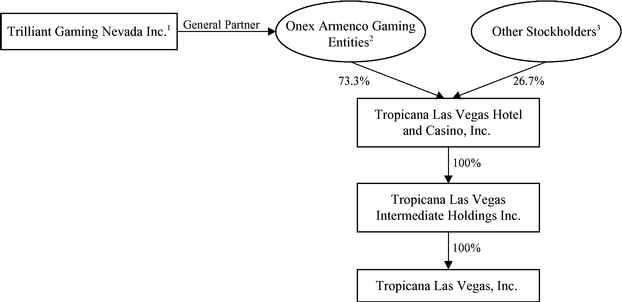
Corporate Structure
3
Background
Proceedings Under Chapter 11 of the Bankruptcy Code
On May 5, 2008, Tropicana Entertainment together with certain of its subsidiaries, including subsidiary entities that owned and operated the Tropicana Las Vegas, specifically Adamar of Nevada, Hotel Ramada of Nevada LLC, Tropicana Development Company, LLC, Tropicana Enterprises, Tropicana Las Vegas Holdings, LLC, Tropicana Las Vegas Resort and Casino, LLC, and Tropicana Real Estate Company, LLC, or the LandCo Entities, filed voluntary petitions for relief, seeking to reorganize their businesses under the provisions of Chapter 11 of the Bankruptcy Code. Pending adoption of a plan of reorganization, Tropicana Entertainment continued to operate the LandCo Entities as debtors in possession under the jurisdiction and orders of the United States Bankruptcy Court for the District of Delaware, or the Bankruptcy Court, and in accordance with the applicable provisions of the Bankruptcy Code. On May 5, 2009, the Bankruptcy Court entered an order confirming the First Amended Joint Plan of Reorganization of Tropicana Las Vegas Holdings, LLC and Certain of Its Debtor Affiliates under Chapter 11 of the Bankruptcy Code, or the Bankruptcy Plan, proposed by the LandCo Entities. The Bankruptcy Plan was consummated and became effective on July 1, 2009. Pursuant to the Bankruptcy Plan, among other things:
4
Tropicana Las Vegas from time of confirmation through the effective date of the Bankruptcy Plan;
To date we have paid approximately $2.5 million in allowed priority claims, cure claims and in non-professional fee administrative expenses and, with the exception of one disputed priority claim asserted in the amount of approximately $426,000 and one disputed priority tax claim asserted in the amount of approximately $42,200, we do not anticipate any material additions to such claims or expenses. Professionals employed at the expense of the bankruptcy estates of the LandCo Entities and other debtors have filed applications for allowance of approximately $13 million in professional fees and expenses against the LandCo Entities. We dispute and intend to object to many of those applications and believe that our liability in respect of such claimed professional fees and expenses will be materially less than the amounts requested, but we can give no assurance in this regard. Tropicana Entertainment, the former ultimate owner of the Tropicana Las Vegas, has asserted a claim of approximately $520,000 for management fees and an unliquidated contingent claim relating to alleged workers' compensation liabilities. We dispute a portion of the claimed management fee and currently are in discussions with Tropicana Entertainment regarding a resolution. We dispute the claim in respect of workers' compensation liabilities in its entirety.
Recent Debt Financing and Rights Offering
On March 17, 2010, we entered into a $60 million loan agreement with one of our stockholders, The Foothill Group, Inc., or Foothill, pursuant to which we have the right to borrow up to $50 million to finance our capital improvement project and our working capital and other general corporate requirements and up to an additional $10 million to finance the construction and build-out of our Nikki Beach night club and related amenities.
We are also in the process of completing a $50 million rights offering pursuant to which we are issuing and selling 500,000 shares of our Class A Series 2 Convertible Participating Preferred Stock, or Series 2 Preferred, to certain of our stockholders. We expect to complete this offering on or about . As part of this offering, we will also issue an additional 40,000 shares of Class A Common to purchasers in the offering who provided a "backstop" to the offering (i.e., purchasing the
5
shares of Series 2 Preferred that were unsubscribed for by the other stockholders to ensure that we could raise a full $50 million from the offering). Further, we will issue an additional 45,585 shares of Series 2 Preferred to Foothill as part of the consideration payable by us to Foothill for providing the $60 million loan.
The Tropicana Las Vegas Hotel and Casino
Overview
The Tropicana Las Vegas, originally developed in 1957, is located on an approximately 34-acre parcel on the "Las Vegas Strip" in Las Vegas, Nevada, and features 1,772 hotel rooms and a 50,000 square foot casino floor with approximately 811 slot machines and 15 table games. Other amenities include two restaurants, several lounges, an indoor-outdoor swimming pool, a five-acre water oasis and tropical garden, more than 100,000 square feet of flexible convention and meeting space, two theaters and 2,949 parking spaces. We believe that the property's central location, with neighbors including the MGM Grand Hotel & Casino, the Excalibur Hotel and Casino, the Luxor Hotel and Casino, the Monte Carlo Resort and Casino and the New York-New York Hotel and Casino, on a prime intersection collectively offering over 18,000 hotel rooms, allows us to benefit from a "cluster" effect resulting in increased pedestrian traffic, visitation and gaming play.
Hotel
Our hotel offers 1,581 guest rooms ranging from 362 square feet to 464 square feet and 191 suites ranging from 729 square feet to 2,000 square feet. Services offered to our guests include a business center, room service, a fitness center and in-room high-speed internet access.
Casino
We have a 50,000 square foot casino floor featuring approximately 811 slot machines and 15 table games offering our customers a variety of gaming options including popular table games such as blackjack, baccarat, craps and roulette and a race and sports book.
The gaming assets located at the Tropicana Las Vegas are owned and operated by Armenco pursuant to the Armenco Lease Agreement and a bill of sale. After we obtain our gaming licenses, we expect our casino will be operated by Trilliant LP. See "—Nevada Gaming Regulation and Licensing," "Item 7. Certain Relationships and Related Transactions, and Director Independence—Lease Agreement" and "Item 7. Certain Relationships and Related Transactions, and Director Independence—Trilliant Management Agreement." The race and sports book is leased to an unrelated third party that operates it and pays us a flat fee under the terms of the lease.
Restaurants
We offer our customers two specialty room dining options (Bacio Pasta & Vino and Legends Steak & Seafood) with a combined total of approximately 224 seats and two casual dining restaurants (Havana Go Go Café and Player's Deli) with a combined total of approximately 200 seats. We own all the restaurants located on the property.
Entertainment
The Tropicana Las Vegas houses two live-show venues, the 883 seat Tiffany Theater and the 500 seat Mezzanine Theater. The Tiffany Theater is home to both Once Before I Go starring Wayne Newton, a live show featuring Mr. Las Vegas himself, and Xtreme Magic starring Dirk Arthur, a magic show featuring tigers and leopards. The Mezzanine Theater features the adults only Hypnosis Unleashed. In addition, there are several separate lounges available to guests including the Celebration Lounge and the Tropics Lounge. Currently, none of the shows are subject to long-term contracts, providing us flexibility in updating our entertainment concepts or planning for renovations to our entertainment venues.
6
Revenues from the Wayne Newton show are limited to a service charge on each ticket and food and beverage revenue generated inside the showroom. The Wayne Newton show was intended to provide an entertainment option to guests during the transition and renovation period of the property, and will end its run in April 2010 to accommodate the timeline for showroom renovations. Future show concepts are being researched, and business terms of any future shows have not yet been determined.
Revenues from the Hypnosis Unleashed show include monthly rent, a service charge on each ticket and beverage revenue generated inside the theater. The contract allows for either party to terminate with reasonable notice. The Hypnosis Unleashed show has met with positive guest reception and its run is considered ongoing.
Convention/Meeting Areas
Our convention and meeting facilities offer more than 100,000 square feet of flexible convention and meeting space. Room sizes range from 30' × 40' in the Tradewinds and Hawaiian rooms to our 288' × 100' Grand Ballroom. All rooms can be arranged for banquet, theater or classroom style seating.
Other Amenities
We also offer other amenities, including, an indoor-outdoor swimming pool, an outdoor recreation area with individual cabanas, a pool with swim up blackjack, a five-acre water oasis and tropical garden, a beauty salon and a barber shop.
Capital Improvement Program
In July 2009, we announced a large-scale renovation of the Tropicana Las Vegas. We plan to spend approximately $125 million on capital improvements during 2009 and 2010, of which $24.4 million was spent in the six months ended December 31, 2009. The capital improvements include a master plan to make the Tropicana Las Vegas more attractive. See "Business Strategy—Capital Improvement Program" for details of the capital improvement program.
Operations
General
Our company was formed with the primary purpose of owning and operating the Tropicana Las Vegas. However, until we, together with our directors, our executive officers and certain of our key employees and stockholders, have obtained the necessary registrations, licenses, findings of suitability, qualifications, permits and approvals, or, collectively, licenses, to own and operate our gaming facility directly, the success of the Tropicana Las Vegas and, in turn, our business will be substantially dependent upon the successful management and operation of the Tropicana Las Vegas by Armenco. We, together with our directors, executive officers and certain of our key employees and stockholders, have applied to the Nevada Gaming Commission, or the Nevada Commission, the Nevada State Gaming Control Board, or the Nevada Board, and the Clark County Liquor and Gaming Licensing Board, or the Clark County Board and, together with the Nevada Commission and the Nevada Board, the Nevada Gaming Authorities, and other applicable regulatory bodies for all governmental licenses that we believe to be necessary for us to own and operate our gaming facility. If our efforts to become licensed by the Nevada Gaming Authorities are successful, we will thereafter be dependent upon Trilliant Gaming for the successful operation of the Tropicana Las Vegas.
Customers of the Tropicana Las Vegas generally wager with cash and pay for non-gaming services with cash or credit cards, making our revenue essentially cash based (less than 10% of casino play and group-related hotel activity is conducted on a credit basis). Our net revenue, and in turn our results of
7
operations, vary by month during the year. A variety of factors may affect the results of any interim period, including the timing of major Las Vegas conventions, the amount and timing of marketing and special events for our customers and the level of play during major holidays, including New Year. Our operating results are highly dependent on the volume of customers that visit the Tropicana Las Vegas, which in turn impacts the prices we can charge for our hotel rooms and other amenities. We market to different customer segments to manage our hotel occupancy, such as targeting conventions to ensure mid-week occupancy. Our results do not depend on key individual customers, though our success in marketing to customer groups, such as convention customers, or the financial health of customer segments, such as business travelers or high-end gaming customers from a particular country or region, can impact our results.
The Tropicana Las Vegas operates 24 hours a day, every day of the year. Other hotel amenities may be owned and operated by us, owned by us but managed by third parties for a fee or leased to third parties. We are currently exploring leased-based concepts for the operation of our retail outlets and race and sports book, and are reviewing leased or shared-management concepts for other areas, including restaurants and a nightclub. Currently other hotel amenities are owned by us but managed by Armenco pursuant to the Armenco Lease Agreement (See "Item 7. Certain Relationships and Related Transactions, and Director Independence—Lease Agreement"). Upon our obtaining our gaming license, we intend to terminate our agreement with Armenco and enter into a management agreement with Trilliant LP (See "Item 7. Certain Relationships and Related Transactions, and Director Independence—Trilliant Management Agreement").
Customers and Competition
We operate in a highly competitive environment and compete against other gaming companies as well as other hospitality companies and companies that specialize in leisure and business travel.
The Tropicana Las Vegas competes with other Las Vegas hotels, resorts and casinos, including those located on the Las Vegas Strip, on the basis of overall atmosphere, range of amenities, level of service, price, location, entertainment offered, convention and meeting facilities, shopping and restaurant facilities, theme and size. Currently, there are approximately 30 major gaming properties located on or near the strip, 13 additional major gaming properties in the downtown area and additional gaming properties located in other areas of Las Vegas. Many of the competing properties have themes and attractions which draw a significant number of visitors and directly compete with our operations. Some of these facilities are operated by companies that have more than one operating facility, have greater name recognition and financial and marketing resources than us and market to the same target demographic group as we do.
The following table provides certain historical information relating to Las Vegas gathered by the Las Vegas Convention and Visitors Authority for the preceding three years:
| |
Year Ended December 31, | |||||
|---|---|---|---|---|---|---|
| |
2009 | 2008 | 2007 | |||
Room Inventory |
148,941 | 140,529 | 132,947 | |||
Visitor Volume |
36,351,469 | 37,481,552 | 39,196,761 | |||
Average Daily Room Rate |
$92.93 | $119.19 | $132.09 | |||
Total Room Nights Occupied |
41,986,134 | 42,967,252 | 43,978,733 | |||
Convention Attendance |
4,492,275 | 5,899,725 | 6,209,253 | |||
Gaming Revenues |
$8,833,902,000 | $9,796,970,000 | $10,868,029,000 | |||
The principal segments of the Las Vegas visitor market are free and independent travelers, gaming customers, convention attendees (encompassing people that attend exhibits, small meetings and corporate incentive programs) and tour and travel visitors. Our marketing strategy is aimed at
8
attracting a mix of convention groups, tours and free and independent visitors midweek and gaming customers and free and independent travelers on the weekend.
The Tropicana Las Vegas draws a substantial number of customers from geographic areas outside of Las Vegas, especially California and Arizona, in which there are a significant number of Native American casinos. As a result, we face significant competition from gaming venues outside the Las Vegas market, including hotel casinos in the Mesquite, Laughlin, Reno and Lake Tahoe areas of Nevada, Atlantic City, New Jersey and other parts of the United States, gaming on Native American tribal lands and gaming on cruise ships. We also compete with state-sponsored lotteries, racetracks, off-track wagering, video lottery and video poker terminals, riverboats and card parlors. In addition, online gaming, despite its illegality in the United States, is a growing sector in the gaming industry. See "Item 1A. Risk Factors—Risks Related to Our Business—We face increasing competition from gaming venues in other geographic regions, other forms of legalized gambling and online gaming."
Marketing
Our marketing efforts are targeted at both the visitor market (tourists and business travelers) in California, Arizona, Texas, Illinois and New York as well as local customers. To reach our customers, we employ both innovative forms of marketing, including use of major internet sites, search engine optimization and online social networks, as well as more traditional forms of marketing, including print, radio and television advertising, database marketing, hotel group sales, player development and public relations. We also target local residents through direct mail advertising and through hosting special events and parties specifically geared to the local population. In addition, we believe that our location on a prime intersection on the Las Vegas Strip allows us to benefit from a "cluster" effect, resulting in increased pedestrian traffic, visitation and gaming play.
Employees
As of March 15, 2010, we had approximately 1,035 active employees, with approximately 57% of such employees being unionized. We believe that our employees are critical to our success and seek to foster a productive work culture. We offer our employees what we believe to be competitive salaries, as well as a benefits package that includes medical and dental coverage. We believe that we have a good working relationship with both our union and non-union employees. See "Item 1A. Risk Factors—Risks Related to Our Business—Increased labor costs, work stoppages, other labor problems and unexpected shutdowns may limit our operational flexibility and negatively impact our future profits."
The Slot Machine Industry in General
Slot machine revenue represents approximately 70% of the Tropicana Las Vegas' gaming revenue. It is important that we maintain and upgrade our slot machines and systems to keep them competitive with other casinos and attractive to gaming customers. In the past, slot machine sales were dominated by International Gaming Technology, or IGT, which commanded an approximate 75% of the market. A few other companies competed for the remaining 25%. In recent years the slot machine manufacturing industry has become significantly more competitive. It is estimated that IGT is shipping less than 50% of all new slot machines while its floor presence in casinos has fallen from 75% to 50%. Three other public gaming manufacturing companies have increased market share. Of note, WMS Industries Inc., Bally Technologies, Inc. and Aristocrat Leisure Limited all have significant market share. They all have very competitive and successful slot offerings. In addition to these three competitors, there are other providers such as the Atronic Group, Konami Digital Entertainment, Inc., Aruze Corp. and AC Coin & Slot that develop and manufacture slot machines. Currently, we have business relationships, including capital leases, participation agreements, arrangements to purchase parts, the ability to purchase conversion kits or other general interaction, with all the slot machine manufacturers or their sales representatives.
9
While the cost of new slot machines has gone up to match the advances in technology, competition in the industry has driven discounting by most major manufacturers. It is not uncommon to receive discounts off the list price on the most popular slot machines. In addition, conversion kits are often available, which update slot machine software and game offerings for less than the cost of a new machine. As with most other casino companies, we are taking advantage of the conversion offerings to upgrade a significant portion of our slot machine floors. While the new slot machine technology is more expensive than in the past, it has allowed us to decrease our support staff through technology such as ticket-in, ticket-out, which returns a bar coded receipt instead of coinage. In the past, most major innovations in slot machine technology that have driven up slot machine prices have also improved revenue and profitability for casino operators.
Business Strategy
Our business strategy includes:
Capital Improvement Program. We believe that having facilities that are attractive and desirable to customers is critical to our competitiveness. We plan to spend approximately $125 million on capital improvements during 2009 and 2010, of which $24.4 million was spent as of December 31, 2009. The capital improvements include a master plan to make the Tropicana Las Vegas more attractive. Plans include the following:
In addition, we intend to add the Nikki Beach nightclub to make the Tropicana Las Vegas more competitive with the offerings of its competitors.
Focus on Customer Service. We continue to emphasize the importance of having a culture focused on customer service. In August 2009, we implemented leadership training for all management personnel to ensure that employees are extensively trained in their respective functional area and are able to respond immediately to customer needs. Customer satisfaction will continue to be a key basis of employee evaluation. We are continually seeking to promote and maintain an environment in which all
10
employees feel a sense of commitment to customer service and customers feel welcome in the Tropicana Las Vegas.
Gaming Mix Targeted To Customers. Our casino floor houses approximately 811 slot machines and 15 table games. We continually evaluate the mix of gaming machines, gaming tables and non-gaming activities we offer as we seek to satisfy the preferences of the gaming customers we target.
Litigation
We are a plaintiff in a civil action pending in the United States District Court for the District of Nevada, called Tropicana Las Vegas, Inc. and Hotel Ramada of Nevada, LLC v. Aztar Corporation and Tropicana Entertainment, LLC (Case No. A09595469-B). We are seeking confirmation from the court that we have the right to use the "Tropicana" name based on implied and express agreements and the application of principles of estoppel. The defendants contend that they alone have a right to use the "Tropicana" name and, further, have asserted a counterclaim that we are infringing their purported trademark rights by using the "Tropicana" name in conducting our business. After the action was filed, the defendants removed it to the United States District Court for the District of Nevada; we moved to remand the action, which motion was granted, the effect being that the case has now returned to state court. Prior to remand, on January 8, 2010, we filed a Motion For Summary Judgment in the United States District Court for the District of Nevada, where the case was then pending. The motion asserts that we are entitled to judgment as a matter of law based on historical agreements concerning the property and the name Tropicana. The defendants have not responded to the Motion. Discovery is ongoing, and we therefore cannot express an opinion at this time on the outcome of the case.
Nevada Gaming Regulation and Licensing
Introduction
The gaming industry is highly regulated. Gaming licenses, once obtained, can be suspended or revoked for a variety of reasons. We cannot assure you that we will obtain all required licenses on a timely basis or at all, or that, once obtained, the licenses will not be suspended, conditioned, limited or revoked. The ownership and operation of casino gaming facilities in the State of Nevada are subject to the Nevada Gaming Control Act and the regulations made under such Act, as well as to various local ordinances, or, collectively, the Nevada Gaming Laws. We are subject to the licensing and regulatory control of the Nevada Gaming Authorities.
Owner and Operator Licensing Requirements
Our subsidiary, Tropicana Las Vegas, Inc. is required to be licensed by, the Nevada Gaming Authorities as a nonrestricted licensee to operate our casino, which we refer to herein as a company licensee. If it is granted gaming licenses, it will have to pay periodic fees and taxes. The gaming licenses will not be transferable. We cannot assure you that Tropicana Las Vegas, Inc. will be able to obtain all licenses from the Nevada Gaming Authorities on a timely basis, or at all, or that if obtained, such licenses will not be conditioned or limited. Tropicana Las Vegas Intermediate Holdings Inc., the intermediate company that owns Tropicana Las Vegas Inc., must be also be licensed as an intermediary company by the Nevada Gaming Authorities, which we refer to as the intermediary licensee. The company licensee and the intermediary licensee are collectively referred to as the licensed subsidiaries.
Company Registration Requirements
Tropicana Las Vegas Hotel and Casino, Inc. is required to be registered by the Nevada Commission as a "publicly traded corporation," which we refer to herein as a registered company, for the purposes of the Nevada Gaming Control Act. Certain of our directors, executive officers and key employees are also required to be licensed by the Nevada Gaming Authorities. Stockholders owning in
11
excess of 10% of the registered company are also required to be licensed by the Nevada Gaming Authorities. The applications of our company and our subsidiaries, officers, directors and majority shareholders have been filed. We are aware of one stockholder that owns in excess of 10% of our company and needs to file an application for either a finding of suitability as a stockholder or an institutional investor waiver of such finding, as discussed below.
Once we have been registered by the Nevada Commission, we will be required to submit detailed financial and operating reports to the Nevada Commission and provide any other information that the Nevada Commission may require. Substantially all of our material loans, leases, sales of securities and similar financing transactions must be reported to, or approved by, the Nevada Gaming Authorities.
Individual Licensing Requirements
No person may become a stockholder of, or receive any percentage of the profits of, an intermediary company or company licensee without first obtaining licenses and approvals from the Nevada Gaming Authorities. The Nevada Gaming Authorities may investigate any individual who has a material relationship to or material involvement with us to determine whether the individual is suitable or should be licensed as a business associate of a gaming licensee. Certain of our directors, executive officers, key employees and stockholders, and all officers and directors of the licensed subsidiaries, are required to file applications with the Nevada Gaming Authorities and may be required to be licensed or found suitable by the Nevada Gaming Authorities. The Nevada Gaming Authorities may deny an application for licensing for any cause which they deem reasonable. A finding of suitability is comparable to licensing, and both require submission of detailed personal and financial information followed by a thorough investigation. An applicant for licensing or an applicant for a finding of suitability must pay or must cause to be paid all the costs of the investigation.
If the Nevada Gaming Authorities were to find an officer, director or key employee unsuitable for licensing or unsuitable to continue having a relationship with us, we would have to sever all relationships with that person. In addition, the Nevada Commission may require us to terminate the employment of any person who refuses to file appropriate applications. Determinations of suitability or questions pertaining to licensing are not subject to judicial review in Nevada.
Consequences of Violating Gaming Laws
If the Nevada Commission decides that we have violated the Nevada Gaming Control Act or any of its regulations, it could limit, condition, suspend or revoke our applications, or registrations and gaming license, once obtained. In addition, we and the persons involved could be subject to substantial fines for each separate violation of Nevada laws, at the discretion of the Nevada Commission. Further, the Nevada Commission could appoint a supervisor to operate the gaming-related activities at the Tropicana Las Vegas and, under specified circumstances, earnings generated during the supervisor's appointment (except for the reasonable rental value of the premises) could be forfeited to the State of Nevada. Limitation, conditioning or suspension of any gaming licenses we may obtain and the appointment of a supervisor could, and revocation of any such gaming license would, have a significant negative effect on our gaming operations.
Requirements for Voting Security Holders
Regardless of the number of shares or other interests held, any beneficial holder of the voting securities of a registered company may be required to file an application, be investigated and have that person's suitability as a beneficial holder of voting securities determined if the Nevada Commission has reason to believe that the ownership would otherwise be inconsistent with the declared policies of the State of Nevada. If the beneficial holder of such securities who must be found suitable is a corporation, partnership, limited partnership, limited liability company or trust, it must submit detailed business and financial information including a list of its beneficial owners. The applicant must pay all costs of the investigation incurred by the Nevada Gaming Authorities in conducting any investigation.
12
The Nevada Gaming Control Act requires any person who, individually or in association with others, acquires, directly or indirectly, beneficial ownership of more than 5% of the voting securities of a registered company to report the acquisition to the Nevada Commission. The Nevada Gaming Control Act requires any person who, individually or in association with others, acquires, directly or indirectly, beneficial ownership of more than 10% of a registered company's voting securities to apply to the Nevada Commission for a finding of suitability within 30 days after the Chairman of the Nevada Board mails the written notice requiring such filing. Under certain circumstances, an "institutional investor," as defined in the Nevada Gaming Control Act, which acquires more than 10%, but not more than 25%, of the registered company's voting securities may apply to the Nevada Commission for a waiver of a finding of suitability if the institutional investor holds the voting securities for investment purposes only. An institutional investor that has obtained a waiver may, in certain circumstances, own up to 29% of the voting securities of a registered company for a limited period of time and maintain the waiver. An institutional investor will not be deemed to hold voting securities for investment purposes unless the voting securities were acquired and are held in the ordinary course of business as an institutional investor and not for the purpose of causing, directly or indirectly, the election of a majority of the members of the board at directors of the registered company, a change in the corporate charter, bylaws, management, policies or operations of the registered company, or any of its gaming affiliates, or any other action which the Nevada Commission finds to be inconsistent with holding the registered company's voting securities for investment purposes only. Activities which are not deemed to be inconsistent with holding voting securities for investment purposes only include:
The Nevada Commission may, in its discretion, require the holder of any debt or nonvoting security of a registered company to file applications, be investigated and be found suitable to own the debt or nonvoting security of the registered company if the Nevada Commission has reason to believe that the ownership would otherwise be inconsistent with the declared policies of the State of Nevada.
Consequences of Being Found Unsuitable
Any person who fails or refuses to apply for a finding of suitability or a license within 30 days after being ordered to do so by the Nevada Commission or by the Chairman of the Nevada Board, or who refuses or fails to pay the investigative costs incurred by the Nevada Gaming Authorities in connection with the investigation of its application, may be found unsuitable. The same restrictions apply to a record owner if the record owner, after request, fails to identify the beneficial owner. Any person found unsuitable and who holds, directly or indirectly, any beneficial ownership of any equity security or debt security of a registered company beyond the period of time as may be prescribed by the Nevada Gaming Commission may be guilty of a criminal offense. We will be subject to disciplinary action if, after we receive notice that a person is unsuitable to hold an equity interest or to have any other relationship with us, we:
13
Approval of Public Offerings
A registered company may not make a public offering of its securities without the prior approval of the Nevada Commission if it intends to use the proceeds from the offering to construct, acquire or finance gaming facilities in Nevada, or to retire or extend obligations incurred for those purposes or for similar transactions. Once we become a registered company, any approval that we might receive in the future relating to future offerings will not constitute a finding, recommendation or approval by any of the Nevada Board or the Nevada Commission as to the accuracy or adequacy of the offering memorandum or the investment merits of the securities. Any representation to the contrary is unlawful.
The regulations of the Nevada Commission also provide that any entity which is not an "affiliated company," as that term is defined in the Nevada Gaming Control Act, or which is not otherwise subject to the provisions of the Nevada Gaming Control Act or regulations, that plans to make a public offering of securities intending to use such securities, or the proceeds from the sale thereof, for the construction or operation of gaming facilities in Nevada, or to retire or extend obligations incurred for such purposes, may apply to the Nevada Commission for prior approval of such offering. The Nevada Commission may find an applicant unsuitable based solely on the fact that it did not submit such an application, unless upon a written request for a ruling, referred to as a Ruling Request, the Nevada Board Chairman has ruled that it is not necessary to submit an application.
Approval of Changes in Control
Once we become a registered company, we must obtain prior approval of the Nevada Commission with respect to a change in control through:
Entities seeking to acquire control of a registered company must satisfy the Nevada Board and Nevada Commission with respect to a variety of stringent standards before assuming control of the registered company. The Nevada Commission may also require controlling stockholders, officers, directors and other persons having a material relationship or involvement with the entity proposing to acquire control to be investigated and licensed as part of the approval process relating to the transaction.
Approval of Defensive Tactics
The Nevada legislature has declared that some corporate acquisitions opposed by management, repurchases of voting securities and corporate defense tactics affecting Nevada gaming licenses or affecting registered companies that are affiliated with the operations permitted by Nevada gaming licenses may be harmful to stable and productive corporate gaming. The Nevada Commission has established a regulatory scheme to reduce the potentially adverse effects of these business practices upon Nevada's gaming industry and to further Nevada's policy to:
14
Once we become a registered company, approvals may be required from the Nevada Commission before we can make exceptional repurchases of voting securities above their current market price and before a corporate acquisition opposed by management can be consummated. The Nevada Gaming Control Act also requires prior approval of a plan of recapitalization proposed by a registered company's board of directors in response to a tender offer made directly to its stockholders for the purpose of acquiring control.
Fees and Taxes
License fees and taxes, computed in various ways depending on the type of gaming or activity involved, are payable to the State of Nevada and to the counties and cities in which the licensed subsidiaries respective operations are conducted. Depending upon the particular fee or tax involved, these fees and taxes are payable monthly, quarterly or annually and are based upon:
A live entertainment tax is also paid on charges for admission to any facility where certain forms of live entertainment are provided.
Foreign Gaming Investigations
Any person who is licensed, required to be licensed, registered, required to be registered, or is under common control with those persons, or, collectively, licensees, and who proposes to become involved in a gaming venture outside of Nevada, is required to deposit with the Nevada Board, and thereafter maintain, a revolving fund in the amount of $10,000 to pay the expenses of investigation of the Nevada Board of the licensee's or registrant's participation in such foreign gaming. The revolving fund is subject to increase or decrease in the discretion of the Nevada Commission. Licensees and registrants are required to comply with the reporting requirements imposed by the Nevada Gaming Control Act. A licensee or registrant is also subject to disciplinary action by the Nevada Commission if it:
15
License for Conduct of Gaming and Sale of Alcoholic Beverages
The conduct of gaming activities and the service and sale of alcoholic beverages at the Tropicana Las Vegas are subject to licensing, control and regulation by the Clark County Board. In addition to approving the licensee, the Clark County Board has the authority to approve all persons owning or controlling the stock of any business entity controlling a gaming or liquor license. All licenses are revocable and are not transferable. The Clark County Board has full power to limit, condition, suspend or revoke any license. Any disciplinary action could, and revocation would, have a substantial negative impact upon the operations of the Tropicana Las Vegas.
Additional Information
Following the effectiveness of this registration statement, we will be required to file annual, quarterly and current reports and other information with the United States Securities and Exchange Commission, or the Commission. You will be able to read and copy any reports, statements or other information filed by us, including this registration statement, at the Commission's Public Reference Room at 100 F Street, NE, Washington, D.C. 20549. Please call the Commission at 1-800-SEC-0330 for further information on the Public Reference Room. Our filings will also be available to the public from commercial document retrieval services and at the web site maintained by the Commission at www.sec.gov.
An investment in our securities involves a high degree of risk. You should carefully consider the risks described below, together with the other information included in this registration statement, and the descriptions included in our financial statements and accompanying notes. The risks described below are those that we believe are the material risks we face. Any of the risks described below, and others that we have not anticipated, could significantly and adversely affect our business, prospects, financial condition, results of operations and cash flows, which in turn could have a material adverse effect on the value of our securities.
We have limited liquidity and capital resources, have been operating at a loss with negative cash flow and may be unable to secure additional financing for our continued operations, which may cause our business to fail.
We have a limited amount of cash. We have been operating at a loss with negative cash flow since we commenced operations on July 1, 2009. Our ability to generate cash from operations in the future depends, in significant part, upon the state of the gaming industry in Las Vegas, which in turn depends upon a number of factors including the state of the United States economy, the amount of discretionary consumer and corporate spending in Las Vegas and the level of competition in the Las Vegas casino market. If our sources of capital are inadequate to fund our short-term or long-term liquidity requirements, we will attempt to procure additional financing, including debt financing or additional equity financing, to fund our operations and our capital expenditures. There can be no assurances that such sources of financing will be available to us on terms acceptable to us, if at all.
Recent global economic conditions have been unprecedented and challenging and have had, and continue to have, an adverse effect on the United States financial markets and the United States economy in general, which has had, and may continue to have, a material adverse effect on the availability of credit to us and our customers and, in turn, on our business and financial performance.
As a result of these current economic conditions, the cost and availability of credit has been, and may continue to be, adversely affected by illiquid credit markets and wider credit spreads. Concern about the stability of the credit markets generally and the strength of counterparties specifically has led
16
many lenders and institutional investors to reduce, and in some cases cease to provide, credit to businesses and consumers. This has been particularly the case in Las Vegas, where lenders have dramatically reduced the availability of funds, and in some cases ceased to provide funds, for hotel, condominium, casino and resort development, expansion and remodeling projects. As a result of these market conditions, we may be unable to obtain debt financing or otherwise borrow funds for our business, which may adversely affect our liquidity and financial condition and impair our ability to complete needed capital improvements.
The Las Vegas hotel, casino and resort market's sensitivity to reductions in discretionary spending, combined with the continued weakness and possible further weakening in global economic conditions that has had and may continue to have a material adverse effect on consumer and corporate spending and tourism trends, may cause a further deterioration in our business, prospects, financial condition, results of operations and cash flows.
The current recession in the United States and ongoing global economic crisis, together with the limited availability of credit, has resulted in significant declines in discretionary consumer and corporate spending and changes in consumer preferences. Worldwide, consumers are traveling less and spending less when they do travel. Likewise, corporate spending on conventions and business development is being significantly curtailed as businesses cut their budgets. As a result, there has been a significant reduction in the amount of tourism and spending in Las Vegas. This reduction follows a long period of substantial growth in tourism and spending that fueled a dramatic expansion of the hotel, casino and resort market in Las Vegas, including significant additions to hotel room and condominium capacity, convention floor space, gaming facilities and attractions, with further additions in the pipeline as a result of large projects recently completed, such as CityCenter, that were begun prior to the current economic downturn. As a consequence, the economic conditions for businesses such as the hotel, casino and resorts market in Las Vegas have been and continue to be extremely challenging and are expected to continue to be challenging until demand from consumer and corporate spenders catches up to the current increased capacity in our market. Any further declines in consumer and corporate discretionary spending or changes in consumer preferences brought about by factors such as perceived or actual general economic conditions, the current housing crisis and credit crisis, the impact of high energy and food costs, the increased costs of travel, the potential for continued bank failures, perceived or actual decreases in disposable consumer income and wealth, effects of the current recession, changes in consumer confidence in the economy and fears of war and future acts of terrorism could further reduce customer demand for the amenities and services that we offer and have a material adverse effect on our business, prospects, financial condition, results of operations and cash flows.
Energy price increases may adversely affect our cost of operations and our revenues and the discretionary spending of our customers.
We use significant amounts of electricity. Substantial increases in energy prices in the United States may negatively affect our operating results in the future. The extent of the impact is subject to the magnitude and duration of any energy and fuel price increases, but this impact could be material. In addition, energy and gasoline price increases for our customers could result in a decline in disposable income of potential customers and a corresponding decrease in visitation and spending at the Tropicana Las Vegas, which would negatively impact our revenues.
The Las Vegas hotel, resort and casino market in which we operate is highly competitive, and we may not have the resources needed to compete successfully or be successful in executing our marketing strategy.
The Tropicana Las Vegas competes with other Las Vegas hotels, resorts and casinos, in particular those located on the Las Vegas Strip, on the basis of overall atmosphere, range of amenities, level of service, price, location, entertainment offered, convention, shopping and restaurant facilities, theme and
17
size. Currently, there are approximately 30 major gaming properties located on or near the Las Vegas Strip, 13 additional major gaming properties in the downtown area and additional gaming properties located in other areas of Las Vegas. Many of the competing properties have themes and attractions which draw a significant number of visitors and directly compete with our operations. Some of these facilities are owned by companies that have more than one operating facility, have greater name recognition and financial and marketing resources than us and may utilize such resources to market themselves more effectively to the same target demographic group as we do. Our ability to compete also depends, to a large extent, on our ability to successfully execute our marketing strategy, including factors such as targeting the appropriate demographic groups and utilizing forms of media with the geographic scope to successfully reach our targeted demographic groups. If we lack sufficient financial resources or liquidity to maintain the attractiveness of our facility or match the promotions, marketing and branding efforts of competitors, the number of customers at the Tropicana Las Vegas may decline, which may have an adverse effect on our financial performance. See "Item 1. Business—Marketing."
Furthermore, openings of additional major hotel casinos and high rise condos and significant expansions of existing properties containing large numbers of hotel rooms and attractions have occurred in Las Vegas recently and will put additional pressure on us to remain competitive. If we are unable to compete effectively, we could lose market share and have declining margins which could adversely affect our business and results of operations.
We face increasing competition from gaming venues in other geographic regions, other forms of legalized gambling and online gaming.
We face significant competition from gaming venues outside the Las Vegas market, including hotel casinos in the Mesquite, Laughlin, Reno and Lake Tahoe areas of Nevada, Atlantic City, New Jersey and other parts of the United States, gaming on Native American tribal lands and gaming on cruise ships. We also compete with state-sponsored lotteries, racetracks, off-track wagering, video lottery and video poker terminals, riverboats and card parlors. In addition, online gaming, despite its illegality in the United States, is a growing sector in the gaming industry. Online casinos offer a variety of games, including slot machines, roulette, poker and blackjack, with web-enabled technologies allowing individuals to game using credit or debit cards from any location.
As the Tropicana Las Vegas draws a substantial number of customers from certain other specific geographic areas, including California and Arizona, the availability of competing gaming venues, other forms of legalized gambling and online gaming in these and other parts of the United States has diverted some potential visitors away from Las Vegas, which has had and is expected to continue to have a negative effect on our business. In particular, we expect increasing competition from casinos operated on Native American tribal lands in California, which are permitted to operate video slot machines, blackjack and house-banked card games. The governor of California has entered into compacts with numerous tribes in California and has announced the execution of a number of new compacts with no limits on the number of gaming machines (which had been limited under the prior compacts). The federal government has also approved numerous compacts in California and casino-style gaming is now legal on those tribal lands. While the competitive impact on our operations from the continued growth of Native American gaming establishments in California remains uncertain, the proliferation of competing gaming venues in California and other areas, as well as other forms of legalized gambling and online gaming, could adversely affect our business and results of operations.
Furthermore, several states have considered legalizing casino gaming and others may in the future. Legalization of large-scale, unlimited casino gaming in or near any major metropolitan area or increased gaming in other areas could have a material adverse economic impact on our business and results of operations by diverting our customers to competitors in those areas. In particular, the expansion of casino gaming in or near any geographic area from which we attract or expect to attract a significant number of customers could have a material adverse effect on us.
18
We are undertaking a capital improvement program involving construction and renovations to, and closures of parts of, the Tropicana Las Vegas, which may result in disruptions of and inconveniences to our customers and, in turn, could harm our business.
The capital improvement program to make our facilities more attractive includes a full renovation of the hotel rooms and convention center, a refurbishment of the casino floor, the expansion and renovation of the race and sports book, redevelopment of the pool area, expansion and renovation of the showroom, enhancement of the food and beverage facilities, refurbishment of outdoor signage and the façade, and reconfiguration of the pedestrian bridge between our facility and the MGM Grand Hotel & Casino. As part of this program, we expect to close each of the two hotel towers and the pool for a period of time during the construction. While we expect our facility to remain open for business and we will seek to minimize the disruption and inconvenience to our customers during the construction and renovations, we cannot assure you that we will be successful in this regard. If customers choose not to visit our facility, including choosing to visit instead the hotel casinos of our competitors that are not under construction and renovation, our business may be harmed, both during the construction and renovation and afterwards to the extent customers decide not to return.
We may suffer delays and/or cost overruns with respect to our capital improvement program.
While we have attempted to estimate and budget for the costs of our capital improvement program, we cannot be certain that we will be able to complete the improvements to the Tropicana Las Vegas within the planned budget. In order to achieve cost savings, we are dealing directly with subcontractors instead of a single or limited number of general contractors, which can result in the process being more complicated and difficult to manage for us as the owner and operator of the Tropicana Las Vegas. We have limited experience in managing such a large capital improvement program, and there can be no assurance that we will be successful in managing the process. If we are unsuccessful, we may suffer delays and/or cost overruns. In addition, as the Tropicana Las Vegas facility is old, with some parts dating back to the 1950s, as we undertake the capital improvement program we may discover additional areas in which the facility requires renovation, refurbishment or repair that we had not anticipated and budgeted for, which could also result in delays and/or cost overruns with respect to the project.
We are entirely dependent on one property for all of our cash flow, which subjects us to greater risks than a gaming company with more operating properties.
We do not expect to have material assets or operations other than the Tropicana Las Vegas and, therefore, we are entirely dependent upon the Tropicana Las Vegas for all of our cash flow. As a result, we are subject to a greater degree of risk than companies with properties in more than one location. In addition, some of our competitors with multiple operating properties are able to achieve cost savings, including through the use of centralized management, administrative and other services and superior purchasing power, which we cannot match.
We are not currently licensed by Nevada gaming authorities to own and operate the gaming assets of the Tropicana Las Vegas.
The ownership and operation of casino gaming facilities in Nevada are governed by the Nevada Gaming Control Act and the regulations promulgated thereunder, as well as various local ordinances. In addition, the owners and operators of casino gaming facilities in Nevada are subject to the licensing and regulatory control of the Nevada Gaming Authorities. We are not currently licensed by the Nevada Gaming Authorities. As a result, we entered into a lease agreement, dated June 22, 2009, whereby we lease the real and non-gaming personal property of our hotel and casino, including the restaurants, lounges, retail shops and other related support facilities, and the operation thereof to Armenco. Armenco separately acquired all of the gaming assets. At such time as we are able to obtain all
19
governmental registrations, findings of suitability, licenses, qualifications, permits and approvals pursuant to the Nevada Gaming Laws necessary for us to own and operate our gaming facility directly, Armenco will transfer to us all of the gaming assets of the Tropicana Las Vegas for nominal consideration, the lease agreement with Armenco will be terminated and we expect the operation of our hotel and casino to thereafter be managed by Trilliant LP pursuant to a management agreement we intend to enter into with Trilliant LP. See "Item 7. Certain Relationships and Related Transactions, and Director Independence—Lease Agreement."
We, together with our directors, our executive officers and certain of our key employees and stockholders, have applied to the Nevada Gaming Authorities and other applicable regulatory bodies for all governmental registrations, licenses, findings of suitability, qualifications, permits and approvals that we believe to be necessary for us to own and operate our gaming assets directly. However, there can be no assurance that we will be successful in obtaining, on a timely basis or at all, and if obtained that we will be successful in maintaining, renewing and not having suspended or revoked, the governmental registrations, licenses, findings of suitability, qualifications, permits and approvals necessary, presently or in the future, for us to own and operate our gaming assets directly.
Trilliant Gaming controls a significant percentage of our outstanding voting securities, and a conflict may arise between our interests and those of Trilliant Gaming.
Trilliant Gaming is the general partner of the Onex Armenco Gaming Entities. The Onex Armenco Gaming Entities, in the aggregate, own, and Trilliant Gaming has voting and investment control over, approximately 73.3% of our outstanding voting securities. Each of Mr. Alex Yemenidjian, our Chairman of the Board, Chief Executive Officer and President, Mr. Timothy Duncanson, one of our directors, and Mr. Gerald Schwartz, the chairman and controlling stockholder of Onex Corporation, owns one-third of the outstanding voting securities of Trilliant Gaming, and together Messrs. Yemenidjian, Duncanson and Schwartz own 100% of the outstanding voting securities of Trilliant Gaming. A stockholder agreement between Messrs. Yemenidjian, Duncanson and Schwartz sets forth the rights of each of them with respect to control of Trilliant Gaming and, in turn, our securities owned by the Onex Armenco Gaming Entities. The Onex Armenco Gaming Entities were formed by entities affiliated with Onex Corporation.
As a result of Trilliant Gaming's voting and investment control over our securities held by the Onex Armenco Gaming Entities, Trilliant Gaming may, among other things, exercise a controlling influence over our affairs, the election of directors and the approval of significant corporate transactions, including a merger or the sale of all or substantially all of our assets. Trilliant Gaming may have the ability to prevent any transaction that requires approval of our stockholders regardless of whether or not other stockholders believe that any such transaction is in our best interests and such other stockholders. Trilliant Gaming also controls the voting of greater than two-thirds of the outstanding shares of our Class A Preferred and Series 2 Preferred, or the Preferred Stock, giving it the power to amend or waive certain provisions of the Preferred Stock, including the power to waive the anti-dilution protections thereof.
We are dependent upon Armenco, a company controlled by our Chief Executive Officer, and after we become licensed we expect to be dependent upon Trilliant Management, L.P., an entity controlled by Trilliant Gaming, to operate the Tropicana Las Vegas.
The gaming assets of the Tropicana Las Vegas are owned by, and the other assets of the Tropicana Las Vegas are currently being leased to and operated by, Armenco, a company controlled by our Chairman of the Board, Chief Executive Officer and President, pursuant to a lease agreement, dated June 22, 2009. See "Item 7. Certain Relationships and Related Transactions, and Director Independence—Lease Agreement." We expect that this arrangement will continue until such time as we have obtained all governmental registrations, licenses, findings of suitability, qualifications, permits
20
and approvals necessary for us to own and operate the Tropicana Las Vegas directly. Until we are able to own and operate the Tropicana Las Vegas directly, the success of the Tropicana Las Vegas and, in turn, our business, will be substantially dependent upon Armenco. If Armenco were to cease to operate the Tropicana Las Vegas before we are licensed by the Nevada Gaming Authorities, we would have to find another party to own and operate the Tropicana Las Vegas or we would have to close the Tropicana Las Vegas. There can be no assurance that we would be able to find any such other party to operate the Tropicana Las Vegas on favorable terms, or at all.
After we become licensed by the Nevada Gaming Authorities, the agreement with Armenco will be terminated and we expect the operation of the Tropicana Las Vegas to thereafter be managed by Trilliant LP pursuant to a management agreement we intend to enter with Trilliant LP. Trilliant LP is a limited partnership that is controlled by its general partner, Trilliant Gaming. The success of the Tropicana Las Vegas and, in turn, ours, will be substantially dependent upon Trilliant LP. There can be no assurance that Trilliant LP will be successful at managing the Tropicana Las Vegas or that the terms of the management agreement with Trilliant LP will turn out to be in our best interests.
Unless we are considered a "publicly traded corporation" under the Nevada Gaming Control Act, each of our stockholders must be found suitable by the Nevada Gaming Authorities or we may be required to sever all relationships with such stockholder.
Upon the effectiveness of this registration statement, we will be a "publicly traded corporation" under the Nevada Gaming Control Act, following which persons who acquire beneficial ownership of more than 5% of our voting securities will be required to report their acquisition to the Nevada Gaming Authorities and persons who acquire beneficial ownership of more than 10% of our voting securities will be required to apply to the Nevada Gaming Authorities for a finding of suitability. Notwithstanding these provisions, under the Nevada Gaming Control Act the Nevada Gaming Authorities may at any time, in their discretion, require the holder of any of our securities to file applications, be investigated and be found suitable to own our securities if they have reason to believe that the security ownership would be inconsistent with the declared policies of Nevada. We anticipate that, so long as we are a "publicly traded corporation" under the Nevada Gaming Control Act, the Nevada Gaming Authorities will require only our stockholders having beneficial ownership of more than 10% of our voting securities to be found suitable.
If we do not become, or cease to be, a "publicly traded corporation" under the Nevada Gaming Control Act, or if required by the Nevada Gaming Authorities, each of our stockholders would be required to be found suitable and licensed by the Nevada Gaming Authorities. If any stockholder fails to be so licensed, we may be required to sever all relationships, including through redemption of shares, with such stockholder, which may have a material adverse effect on our business and our stockholders.
There is currently no public market for our securities, a public market may not develop in the future and state gaming laws may affect marketability of shares of our capital stock.
None of our securities are listed on any national securities exchange. There is currently no public market for any of our securities, and a public trading market may not develop in the future. The filing of this registration statement will not create any such public trading market for any of our securities. If a market for any of our securities were to develop, the liquidity of any such market would depend, among other things, upon the number of holders of our securities, our financial performance and the market for similar securities. We cannot predict whether an active trading market will develop, or if a market develops, what the liquidity or pricing characteristics of that market will be. In addition, Nevada Gaming Laws regulate the transfer of securities of gaming companies. These restrictions on marketability may limit our stockholders' ability to sell their shares and, if sold, the prices they may receive for those shares.
21
We are subject to extensive governmental regulation and taxation policies which have a material effect upon our business, financial condition and results of operations.
Regulation by Gaming Authorities. The ownership and operation of a gaming facility in Nevada is subject to the Nevada Gaming Laws and we will be subject to such laws upon our obtaining and maintaining all necessary governmental registrations, findings of suitability, licenses, qualifications, permits and approvals to operate the Tropicana Las Vegas. The laws, regulations and ordinances requiring these licenses, permits and other approvals generally relate to the responsibility, financial stability and character of the owners and managers of gaming operations, as well as persons financially interested or involved in gaming operations. The scope of the approvals required to open and operate a gaming facility is extensive.
We have filed applications for the various registrations, approvals, permits and licenses required in order to engage in gaming activities in Nevada. If such registrations, approvals, permits or licenses are granted, the Nevada Gaming Authorities will have broad powers to request detailed financial and other information and to limit, condition, suspend or revoke a registration, gaming license or related approval. Substantial fines or forfeiture of assets for violations of gaming laws or regulations may be levied. The suspension of any license which may be granted to us or the levy of substantial fines or forfeiture of assets could, and the revocation of any gaming license would, significantly harm our business, financial condition and results of operations. Furthermore, compliance costs associated with gaming laws, regulations and licenses are significant.
Potential Changes in Legislation and Regulation. From time to time, legislators and special interest groups propose legislation that would expand, restrict or prevent gaming operations in Nevada. Further, from time to time, various legislation and referenda are considered or enacted, such as bans on smoking in casinos and other entertainment and dining facilities, which could adversely affect our operations. Any restriction on or prohibition relating to our gaming operations or enactment of other adverse legislation or regulatory changes applicable to our business or gaming licenses could require us to make substantial expenditures or otherwise negatively affect our gaming operations and have a material adverse effect on our business, prospects and results of operations.
Taxation and Fees. The casino entertainment industry represents a significant source of tax revenue to Nevada. Gaming companies are currently subject to significant state and local taxes and fees in addition to federal income taxes, and such taxes and fees could increase at any time. From time to time, various state and federal legislators and officials have proposed changes in tax laws, or in the administration of such laws, including increases in tax rates, which would affect the industry. Worsening economic conditions could intensify the efforts of state and local governments to raise revenues through increases in gaming taxes and fees. In addition, state or local budget shortfalls could prompt tax or fee increases. Any material increase in assessed taxes, or the adoption of additional taxes or fees in Nevada, could have a material adverse effect on our financial results.
Compliance With Other Laws. We are also subject to a variety of other rules and regulations, including zoning, environmental, construction and land-use laws, laws governing our relationship with our employees in such areas as minimum wage and maximum working hours, overtime, working conditions, hiring and firing employees and work permits and regulations governing the preparation and sale of food and beverages, including alcoholic beverages. Failure to comply with these laws could have a material adverse effect on our business, financial condition or results of operations. Also, our ability to remodel, refurbish or add to our property may be dependent upon our obtaining necessary building permits from local authorities. The failure to obtain any of these permits could adversely affect our ability to increase revenues and net income through capital improvements of our property.
22
The denial of a license or a finding of unsuitability by the Nevada Gaming Authorities may result in criminal or disciplinary action.
Any person who fails or refuses to apply for a finding of suitability or a license within the period prescribed after being advised by Nevada Gaming Authorities that such person is required to do so may be denied a license or found unsuitable or unqualified. Any holder of securities that is found unsuitable or unqualified or is denied a license, and who holds, directly or indirectly, any beneficial ownership of a gaming entity's securities beyond such period of time as may be prescribed by the Nevada Gaming Authorities, may be guilty of a criminal offense. Furthermore, a gaming entity may be subject to disciplinary action if, after receiving notice that a person is unsuitable to be a holder of securities or to have any other relationship with such gaming entity or any of its subsidiaries, such gaming entity:
In the event that disqualified holders fail to divest themselves of such securities, the Nevada Gaming Authorities have the power to revoke or suspend the casino license or licenses related to the regulated entity that issued the securities. The Nevada Gaming Authorities may also require that suppliers of certain goods and services to gaming industry participants be licensed and that we purchase and lease gaming equipment, supplies and services only from such licensed suppliers. Finally, the Nevada Gaming Authorities may also, among other things, limit, condition, suspend, or revoke a gaming license or approval to own an entity or joint venture interest of any of our operations for any cause deemed reasonable by such licensing authority. If the Tropicana Las Vegas were to violate any applicable gaming laws, our gaming licenses could be limited, conditioned, suspended, or revoked by the Nevada Gaming Authorities, and we and any other persons involved could be subject to substantial fines.
We may incur increased costs in connection with the rejection of certain pre-petition contracts.
Pursuant to the Bankruptcy Plan, the LandCo Entities rejected a number of pre-petition contracts with their vendors. As we rebuild our business, we will need to replace many of these vendors. We may be unable to find replacement vendors, and the services that we require may not be available on similar terms or at all. Vendors may also be required to undergo a suitability investigation. Any inability to replace necessary vendors could materially adversely affect our business, financial condition and results of operations.
We may face potential successor liability.
As the acquirer of certain assets of the LandCo Entities, we may be subject to certain liabilities of the LandCo Entities notwithstanding confirmation and effectiveness of the Bankruptcy Plan. While remote, such liabilities conceivably might arise in a number of circumstances, including those where:
23
Although we have no reason to believe that we will become subject to liabilities of the LandCo Entities that are not provided for in the Bankruptcy Plan, and we would vigorously contest any effort to make us subject to such liabilities. If we should become subject to such liabilities, it could materially adversely affect our business, financial condition and results of operations. By listing above potential circumstances under which an entity may seek to hold us liable for obligations of the LandCo Entities, we do not concede that we would become liable even in such circumstances, and nothing herein is an admission or waiver of any sort in this regard.
We may face substantial administrative liabilities.
As noted above, in the Bankruptcy Plan we assumed certain obligations and liabilities of the LandCo Entities, particularly liabilities in respect of post-bankruptcy petition administrative expenses. We have paid approximately $2.5 million in allowed priority and cure claims and in non-professional fee administrative expenses and, with the exception of one disputed priority claim asserted in the amount of approximately $426,000 and one disputed priority tax claim asserted in the amount of approximately $42,200, we do not anticipate any material additions to such claims or expenses. Professionals employed at the expense of the bankruptcy estates of the LandCo Entities and other debtors have filed applications for allowance of approximately $13 million in professional fees and expenses against the LandCo Entities. We dispute and intend to object to many of those applications and believe that our liability in respect of such claimed professional fees and expenses will be materially less than the amounts requested, but we can give no assurance in this regard. Tropicana Entertainment, former ultimate owner of the Tropicana Las Vegas, has asserted a claim of approximately $520,000 for management fees and an unliquidated contingent claim relating to alleged workers' compensation liabilities. We dispute a portion of the claimed management fee and currently are in discussions with Tropicana Entertainment regarding a resolution. We dispute the claim in respect of workers' compensation liabilities in its entirety. However, no assurance can be given that the claims asserted will be ultimately disallowed or will not have a material adverse impact on us.
We are currently involved in litigation over the use of the "Tropicana" name.
We are a plaintiff in a civil action pending in the United States District Court for the District of Nevada, called Tropicana Las Vegas, Inc. and Hotel Ramada of Nevada, LLC v. Aztar Corporation and Tropicana Entertainment, LLC (Case No. A09595469-B). We are seeking confirmation from the court that we have the right to use the "Tropicana" name based on implied and express agreements and the application of principles of estoppel. The defendants contend that they alone have a right to use the "Tropicana" name and, further, have asserted a counterclaim that we are infringing their purported trademark rights by using the "Tropicana" name in conducting our business. After the action was filed, the defendants removed it to the United States District Court for the District of Nevada; we moved to remand the action, which motion was granted, the effect being that the case has now returned to state court. Prior to remand, on January 8, 2010, we filed a Motion For Summary Judgment in the United States District Court for the District of Nevada, where the case was then pending. The motion asserts that we are entitled to judgment as a matter of law based on historical agreements concerning the property and the name Tropicana. The defendants have not responded to the Motion. Discovery is ongoing, and we therefore cannot express an opinion at this time on the outcome of the case. In the event that the court were to decide that we do not have the right to use the "Tropicana" name in conducting our business, we would be required to license the name or re-name and re-brand the Tropicana Las Vegas at a price that cannot be estimated. An adverse decision in this litigation could have a material adverse effect on our business, financial condition and results of operations.
24
In addition, we are, from time to time and during the normal course of business, subject to various litigation claims and legal disputes, including contract, lease, employment and regulatory claims as well as claims made by visitors to the Tropicana Las Vegas. Certain litigation claims may not be covered entirely by our insurance policies, or at all, or our insurance carriers may seek to deny coverage. In addition, litigation claims can be expensive to defend and may divert the attention of our management from the operation of the Tropicana Las Vegas. Further, litigation involving visitors to the Tropicana Las Vegas, even if without merit, can attract adverse media attention. As a result, litigation can have a material adverse effect on our business. We cannot predict the outcome of any action, and it is possible that adverse judgments or settlements could have a material adverse effect on our business, financial condition and results of operations.
Because we own real property, we are subject to extensive environmental regulation, which creates uncertainty regarding future environmental expenditures and liabilities.
We may incur costs to comply with environmental requirements, such as those relating to discharges into the air, water and land, the handling and disposal of solid and hazardous waste and the cleanup of the property affected by hazardous substances, including asbestos and mold. Under these and other environmental requirements we may be required to investigate and clean up hazardous or toxic substances or chemical releases at our property. As an owner or operator, we could also be held responsible to a governmental entity or third parties for property damage, personal injury and investigation and cleanup costs incurred by them in connection with any contamination.
These laws typically impose cleanup responsibility and liability without regard to whether the owner or operator knew of or caused the presence of the contaminants. The liability under those laws has been interpreted to be joint and several unless the harm is divisible and there is a reasonable basis for allocation of the responsibility. The costs of investigation, remediation or removal of those substances may be substantial, and the presence of those substances, or the failure to remediate a property properly, may impair our ability to use our property.
The physical condition of, and improvements to, our property may require the remediation or abatement of certain environmental conditions.
Development of the land and buildings we now own dates back to the 1950's, and multiple alterations and additions have taken place throughout the history of the property. Portions of the property are known to contain asbestos, which requires abatement if disturbed. Improvements to the property are expected to require asbestos abatement in isolated areas. Other environmental conditions, including the presence of mold, are also expected to require remediation in isolated areas. We have recognized a liability for such conditions; however, the extent of potential environmental conditions cannot be determined definitively, and may result in substantial additional expense in the event that additional or currently unknown conditions are detected.
We depend upon the continued service of our senior management team and key employees.
Our success is substantially dependent upon the efforts and skills of our senior management team. If we were to lose the services rendered by members of our senior management team, our operations could be adversely affected. We have an employment agreement with Alex Yemenidjian, our Chairman of the Board, Chief Executive Officer and President. Mr. Yemenidjian is employed on an at-will basis under an employment agreement that may be terminated by Mr. Yemenidjian or us at any time with 30 days written notice, subject to the imposition of certain penalties and limitation if termination by either party is without cause or good reason. We cannot assure you that we would find a suitable replacement for Mr. Yemenidjian if he retires or his employment terminates for any other reason. There is intense competition to hire and retain high-level gaming executives and managerial personnel. Some of our competitors have employment agreements with many of their executives and managerial
25
personnel to seek to retain those individuals and reduce turnover. We do not have any employment agreements other than with Mr. Yemenidjian, which is on an at-will basis, and as a result we may have difficulty retaining our employees and face higher turnover of our executives and managerial personnel than some of our competitors. An inability to hire and retain qualified management personnel could have a material adverse effect on our business, financial condition and results of operations.
Increased labor costs, work stoppages, other labor problems and unexpected shutdowns may limit our operational flexibility and negatively impact our future profits.
Approximately 57% of our employees are unionized. If we are unable to obtain favorable terms in or are forced to accept unfavorable changes to these collective bargaining agreements, we could face significant increases in our labor costs, which could have a material adverse effect on our business and results of operations. Union organization efforts, a prolonged dispute with our employees or a strike or work stoppage at the Tropicana Las Vegas could cause disruptions in our business and our incurrence of significant additional costs. Strikes and work stoppages could also result in adverse media attention or otherwise discourage customers from visiting the Tropicana Las Vegas. Any of these events could have a material adverse effect on our business, financial condition and results of operations.
The concentration and evolution of the slot machine manufacturing industry could impose additional costs on us.
A majority of Tropicana Las Vegas's gaming revenue is attributable to slot machines. It is important, for competitive reasons, that we offer the most popular and technologically advanced slot machine games to our customers. We believe that a substantial majority of the slot machines sold in the United States in recent years were manufactured by a limited number of companies. A deterioration in our commercial arrangements with any of these slot machine manufacturers could result in our being unable to acquire the slot machines desired by our customers, or could result in manufacturers significantly increasing the cost of these machines. Alternatively, significant industry demand for new slot machines may result in our being unable to acquire the desired number of new slot machines or result in manufacturers increasing the cost of these machines. The inability to obtain new and up-to-date slot machine games could impair the Tropicana Las Vegas's competitive position and result in decreased gaming revenues. In addition, increases in the costs associated with acquiring slot machine games could adversely affect our profitability.
In recent years, the prices of new slot machines have risen more rapidly than the domestic rate of inflation. Furthermore, in recent years, slot machine manufacturers have frequently refused to sell slot machines featuring the most popular games, instead requiring gaming operators to execute participation lease arrangements in order for them to be able to offer such machines to customers. Participation slot machine leasing arrangements typically require the payment of a fixed daily rental fee. Such agreements may also include a percentage payment to the manufacturer of "coin-in" or "net win." Generally, a slot machine participation lease is more expensive over the long term than the cost of purchasing a new slot machine. We have slot machine participation leases at the Tropicana Las Vegas.
For competitive reasons, we may be forced to purchase new, more contemporary slot machines or enter into participation lease arrangements that are more expensive than the costs currently associated with the continued operation of our existing slot machines. If the newer slot machines do not result in sufficient incremental revenues to offset the increased investment and participation lease costs, our profitability could be adversely affected.
26
We have not paid dividends in the past, and do not plan to pay dividends in the future, on shares of our common stock.
We do not plan to pay any dividends or make any distributions on shares of our common stock in the foreseeable future. Therefore, you should not expect to receive any dividend income in the foreseeable future from shares of our common stock.
We are required to pay cumulative dividends on our shares of Preferred Stock, which will reduce the amount of cash available to us for our operations or, if we do not pay the dividends and the shares of Preferred Stock are converted into shares of our common stock, will result in dilution to holders of shares of our common stock.
Dividends on shares of our Preferred Stock accrue at a rate of 12.5% per annum, payable semi-annually in arrears. These dividends are cumulative. Payment of these dividends will reduce the amount of cash available to us for our operations. If for any reason our board of directors does not declare a dividend on the Preferred Stock for a particular dividend period, or if our board of directors declares less than a full dividend, we will remain obligated to pay the unpaid portion of the dividend for that period and the unpaid dividend will compound on each subsequent dividend date (meaning that dividends for future dividend periods will accrue on any unpaid dividend amounts for prior dividend periods). If there are unpaid dividends on our shares of Preferred Stock at a time when shares of our Preferred Stock are converted to shares of our common stock, the conversion price for the Preferred Stock is adjusted such that additional shares of our common stock will be issuable upon conversion of the Preferred Stock, which would result in dilution to holders of shares of our common stock. See "Item 11. Description of Registrant's Securities to be Registered—Preferred Stock."
Our results of operations and financial condition could be materially and adversely affected by the occurrence of natural disasters or other catastrophic events, including war and terrorism, that have a negative effect on travel and leisure expenditures by consumers and on corporate spending on conventions and business development.
Catastrophic events such as terrorist and war activities in the United States and elsewhere have had a negative effect on travel and leisure expenditures, including lodging, gaming (in some jurisdictions) and tourism by consumers and on corporate spending on conventions and business development. In addition, any man-made or natural disasters in or around Nevada, or the areas from which we draw customers for the Tropicana Las Vegas, could reduce the number of visitors to Las Vegas. For example, earthquakes are common in California, the Nevada gaming industry's primary feeder market, and the severity of any such natural disasters is unpredictable. Any such events could have a significant adverse effect on our business, prospects, financial condition and results of operations.
We may not have or be able to obtain sufficient insurance coverage to replace or cover the full value of losses we may suffer.
We evaluate our risks and insurance coverage annually. While we believe we have obtained sufficient insurance coverage with respect to the occurrences of casualty damage to cover losses that could result from the acts or events described above for the next year, we may not be able to obtain sufficient or similar insurance for later periods and we cannot predict whether we will encounter difficulty in collecting on any insurance claims that may be submitted, including claims for business interruption.
In addition, while we maintain insurance against many risks to the extent and in amounts that we believe are reasonable, these policies do not cover all risks. Furthermore, portions of our business are difficult or impracticable to insure. Therefore, after carefully weighing the costs, risks and benefits of
27
retaining versus insuring various risks, as well as the availability of certain types of insurance coverage, we occasionally opt to retain certain risks not covered by insurance policies. Retained risks are associated with deductible limits, partial self-insurance programs and insurance policy coverage ceilings.
As an example, we carry certain insurance policies that, in the event of certain substantial losses, may not be sufficient to pay the full current market value or current replacement cost of damaged property. As a result, if a significant event were to occur that is not fully covered by an insurance policy, we may lose all, or a portion of, the capital we have invested in our property, as well as the anticipated future revenue from such property, and our financial condition and results of operations could be adversely affected. Consequently, uninsured losses may negatively affect our financial condition, liquidity and results of operations. There can be no assurance that we will not face uninsured losses pertaining to the risks that have been retained.
28
Item 2. FINANCIAL INFORMATION.
Selected Financial Data
On July 1, 2009, we obtained ownership and operational control of Tropicana Las Vegas Holdings, LLC and its subsidiaries, or the Predecessor, including the operations of the Tropicana Las Vegas, from Tropicana Entertainment Holdings, LLC, or TEH, in connection with the Bankruptcy Plan. See "Item 1. Proceedings Under Chapter 11 of the Bankruptcy Code." Tropicana Las Vegas was owned and operated by TEH for the period from January 3, 2007 to June 30, 2009. Prior to January 3, 2007, Tropicana Las Vegas was owned and operated by Aztar Corporation through its subsidiary Hotel Ramada of Nevada. The following selected consolidated financial data presents the financial results of our company from July 1, 2009 through December 31, 2009 and the Tropicana Las Vegas for the six months ended June 30, 2009 and the years ended December 31, 2008, 2007, 2006 and 2005.
The selected consolidated financial data presented below for the successor period from July 1, 2009 to December 31, 2009, or the Successor Period, and the period then ended and the predecessor period for the six months ended June 30, 2009, or the Predecessor Period, have been derived from audited consolidated financial statements of our company and the Predecessor, respectively, included elsewhere in this registration statement. The selected consolidated financial data presented below as of and for the years ended December 31, 2008, 2007, 2006 and 2005 have been derived from the Predecessor's audited financial statements which, except for 2006 and 2005, are contained elsewhere in this registration statement. The selected financial data set forth below is qualified in its entirety by, and should be read in conjunction with, "Item 2. Financial Information—Management's Discussion and Analysis of Financial Condition and Results of Operations" and our and the Predecessor's consolidated financial statements, the notes thereto and other financial and statistical information included elsewhere in this registration statement. As a result of the application of fresh-start reporting in accordance with accounting guidance on reorganizations, the financial statements of the Predecessor for the periods prior to July 1, 2009 are not comparable to our financial statements for the periods on or after July 1, 2009.
| |
|
|
|
|
|
|
||||||||||||||
|---|---|---|---|---|---|---|---|---|---|---|---|---|---|---|---|---|---|---|---|---|
| |
Successor | Predecessor | ||||||||||||||||||
| |
Six Months Ended December 31, 2009(a) |
Six Months Ended June 30, 2009(b) |
Year Ended December 31, | |||||||||||||||||
| |
2008(b) | 2007(b) | 2006(c) | 2005(c) | ||||||||||||||||
| |
(in thousands except per share date) |
|||||||||||||||||||
Income Statement Data: |
||||||||||||||||||||
Net revenues |
$ | 33,551 | $ | 43,894 | $ | 118,383 | $ | 156,848 | $ | 162,879 | $ | 163,771 | ||||||||
Operating (loss) income |
(19,024 | ) | (433,651 | ) | (216,993 | ) | 36,679 | 32,062 | 33,147 | |||||||||||
Net (loss) income |
(18,988 | ) | (308,261 | ) | (162,226 | ) | (5,573 | ) | 8,782 | 9,615 | ||||||||||
Loss per common share |
(4.29 | ) | ||||||||||||||||||
Balance Sheet Data (as of period end): |
||||||||||||||||||||
Total assets |
$ | 308,950 | $ | 875,056 | $ | 1,287,249 | $ | 1,508,526 | $ | 221,129 | $ | 214,279 | ||||||||
Total debt |
2,320 | 440,512 | 440,000 | 440,000 | — | — | ||||||||||||||
Total stockholders'/member's equity |
286,012 | 362,610 | 670,871 | 833,097 | 113,879 | 108,882 | ||||||||||||||
29
Unaudited Pro Forma Financial Data
The following unaudited pro forma condensed consolidated statements of operations for the year ended December 31, 2009 gives effect to the Bankruptcy Plan as if it had occurred on January 1, 2009. The unaudited pro forma condensed consolidated financial statements are not necessarily indicative of the results that would have been reported had the effective date of the Bankruptcy Plan actually occurred on the date specified, nor are they indicative of our future results of operations or financial condition. The pro forma adjustments are based upon currently available information and upon certain assumptions that we believe are reasonable. The unaudited pro forma condensed consolidated financial statements should be read in conjunction with "Management's Discussion and Analysis of Financial Condition and Results of Operations," "Selected Financial Data" and our and the Predecessor's consolidated financial statements and related notes included elsewhere in this registration statement.
Unaudited Pro Forma Condensed Consolidated Statement of Operations For the Year Ended December 31, 2009
| |
Historical Successor |
Historical Predecessor |
Historical Combined |
|
Pro Forma Combined |
|||||||||||||
|---|---|---|---|---|---|---|---|---|---|---|---|---|---|---|---|---|---|---|
| |
Six Months Ended December 31, 2009 |
Six Months Ended June 30, 2009 |
Year Ended December 31, 2009 |
Pro Forma Adjustments |
Year Ended December 31, 2009 |
|||||||||||||
| |
(in thousands, except per share data) |
|||||||||||||||||
Net revenues |
$ | 33,551 | $ | 43,894 | $ | 77,445 | $ | — | $ | 77,445 | ||||||||
Total operating costs and expenses |
52,575 | 477,545 | 530,120 | (420 | )(a) | 529,700 | ||||||||||||
Operating loss |
(19,024 | ) | (433,651 | ) | (452,675 | ) | 420 | (452,255 | ) | |||||||||
Other income (expense): |
||||||||||||||||||
Interest income |
40 | — | 40 | — | 40 | |||||||||||||
Interest expense |
(4 | ) | (2,560 | ) | (2,564 | ) | 2,560 | (b) | (4 | ) | ||||||||
Total other income (expense) |
36 | (2,560 | ) | (2,524 | ) | 2,560 | 36 | |||||||||||
Loss before reorganization items and income taxes |
(18,988 | ) | (436,211 | ) | (455,199 | ) | 2,980 | (452,219 | ) | |||||||||
Reorganization items, net |
— | (1,502 | ) | (1,502 | ) | 1,502 | (c) | — | ||||||||||
Loss before income taxes |
(18,988 | ) | (437,713 | ) | (456,701 | ) | 4,482 | (452,219 | ) | |||||||||
Income tax benefit |
— | 129,452 | 129,452 | (129,452 | )(d) | — | ||||||||||||
Net loss |
$ | (18,988 | ) | $ | (308,261 | ) | $ | (327,249 | ) | $ | (124,970 | ) | $ | (452,219 | ) | |||
Loss per common share: |
||||||||||||||||||
Basic and diluted |
$ | (4.29 | ) | $ | (102.15 | ) | ||||||||||||
Weighted average common shares outstanding: |
||||||||||||||||||
Basic |
4,427 | 4,427 | ||||||||||||||||
Diluted |
n/a | n/a | ||||||||||||||||
Dividends declared per common share |
$ | — | $ | — | ||||||||||||||
30
Notes to Unaudited Pro Forma Condensed Consolidated Financial Statements
1. Description of Transaction
On May 5, 2008, the Predecessor filed voluntary petitions in the Bankruptcy Court seeking reorganization relief under the provisions of the Bankruptcy Code. The Bankruptcy Plan was consummated and became effective on July 1, 2009.
Pursuant to the Bankruptcy Plan among other things:
For additional details on the foregoing, see "Item 1. Business—Background—Proceedings Under Chapter 11 of the Bankruptcy Code."
2. Basis of Presentation
On July 1, 2009, our company was required to adopt the "fresh-start" provisions in accordance with accounting guidance for reorganizations, as it relates to the Predecessor. Fresh-start reporting requires resetting the historical net book value of generally all assets and liabilities to fair value by allocating the entity's enterprise value to its assets and liabilities pursuant to accounting guidance related to business combinations. Our company performed a valuation of these assets and liabilities as of July 1, 2009. Under fresh-start reporting, a new reporting entity is deemed created.
3. Fresh-Start Reporting
Our reorganized company's enterprise value was calculated using various valuations methods, including the discounted cash flow method of the income approach and the cost approach. The enterprise value using the discounted cash flow method of the income approach was determined using financial projections from July 1, 2009 through 2014 at a discount rate of 14%. The discount rate was determined based on a weighted average cost of capital analysis of comparable statistics for our company's peer group. Revenues for the period July 1, 2009 through December 31, 2009 and the year ended December 31, 2010 were assumed to be $53.9 million and $114.3 million, respectively. The
31
assumed revenue growth rate for 2011, 2012, 2013, and 2014 was 20.4%, 9.8%, 8.3% and 8.4%, respectively. The financial projections include anticipated changes associated with our company's capital improvement project, general market conditions and other factors. The marginal tax rate was assumed to be 35%. The discount rate was determined based on a weighted average cost of capital analysis. The terminal value was calculated by utilizing an exit multiple based on twelve month EBITDA of 7.0x. The basis for the exit multiple was comparable company EBITDA multiples for our company's peer group. Given the current assessment of our company in light of the market comparables, the minimum range was utilized. Equal weight was applied to both the income and cost approach to reach an enterprise value of $230.0 million.
In accordance with fresh-start reporting the Company's enterprise value has been allocated to existing assets and liabilities. Fair value for real property such as land was determined using market comparable data. Other real property such as building and building improvements were valued based on the depreciable replacement cost method as was personal property such as furniture and fixtures. Personal property such as slot machines were valued using market prices of similar assets as an active secondary market exist. In addition, liabilities, other than deferred taxes, have been recorded at the present value of amounts estimated to be paid. Deferred taxes have been determined in accordance with accounting guidance related to accounting for income taxes.
The determination of fair value of assets and liabilities was subject to significant estimation and assumptions and there can be no assurances that the estimates, assumptions and values reflected in the valuations will be realized and actual results could vary materially. In accordance with accounting guidance for business combinations, the preliminary allocation of the enterprise value is subject to additional adjustments within one year from the effective date due to the extent that improved information on assets and liability valuations become available.
Based upon the enterprise value of $230.0 million, our company's allocation of the fair value of assets and liabilities was as follows (in thousands):
| |
July 1, 2009 |
||||
|---|---|---|---|---|---|
Cash and cash equivalents |
$ | 16,949 | |||
Other current assets |
10,326 | ||||
Property and equipment |
229,182 | ||||
Other assets |
213 | ||||
Accounts payable and accrued expense |
(26,479 | ) | |||
Other long-term liabilities |
(191 | ) | |||
Total enterprise value |
$ | 230,000 | |||
32
4. Pro Forma Adjustments
| |
Fair Value |
Useful Life |
Annual Expense |
|||||||||
|---|---|---|---|---|---|---|---|---|---|---|---|---|
| |
|
(years) |
|
|||||||||
Property and equipment: |
||||||||||||
Land |
$ | 195,793 | — | $ | — | |||||||
Building and improvements |
26,300 | 10 | 2,630 | |||||||||
Furniture, fixtures and equipment |
5,793 | 5 | 1,159 | |||||||||
Construction in progress |
1,296 | — | ||||||||||
Total |
$ | 229,182 | 3,789 | |||||||||
Less: historical depreciation and amortization |
(4,209 | ) | ||||||||||
Pro forma depreciation and amortization expense adjustment |
$ | (420 | ) | |||||||||
33
Management's Discussion and Analysis of Financial Condition and Results of Operations
The following discussion and analysis should be read in conjunction with our consolidated financial statements and the Predecessor's consolidated financial statements, including the notes thereto, and the other financial information appearing elsewhere in this registration statement. In addition to historical financial information, the following discussion contains forward-looking statements that reflect our plans, estimates and beliefs. Factors that could cause or contribute to these differences include those discussed below and elsewhere in this registration statement, particularly in "Special Note Regarding Forward-Looking Statements" and "Item 1A. Risk Factors".
Overview of our Company
The Tropicana Las Vegas is a hotel casino property conveniently located at the corner of Tropicana Avenue and Las Vegas Boulevard on the Las Vegas Strip. Our casino hotel offers 1,772 hotel rooms, a 50,000 square foot casino floor, two restaurants, several lounges, two theaters and more than 100,000 square feet of flexible convention and meeting space.
Our company was formed to own and operate the Tropicana Las Vegas beginning on July 1, 2009, free and clear of all liens and claims against the LandCo Entities other than the obligations and liabilities specifically assumed under the Bankruptcy Plan (as described in "Item 1. Business—Background—Proceedings Under Chapter 11 of the Bankruptcy Code"). We conducted no business or operations prior to taking ownership of the Tropicana Las Vegas. Since our company took ownership of the Tropicana Las Vegas, we have formed a new executive team led by Alex Yemenidijian, our Chairman of the Board, President and Chief Executive Officer, and began a rebranding of the property along with a $125 million capital improvement project to make the property more attractive and desirable.
Our primary business is the ownership and operation of a casino gaming resort which offers casino gaming, hotel accommodations, dining, entertainment, retail shopping and other resort amenities. As a casino-based company, our operating results are highly dependent on the volume of customers to our property, which in turn impacts the price that we can charge for our hotel rooms and food and beverage menu items and other amenities. Casino revenue, hotel room revenue, food and beverage revenue and other revenue vary due to general economic conditions and competition.
Gaming and other leisure activities we offer represent discretionary expenditures and participation in such activities may decline during economic downturns, during which consumers generally earn less disposable income. The current unprecedented and challenging global and economic conditions have negatively impacted our results of operations by affecting consumer discretionary spending and overall visitor volume. Corporate spending on conventions and business development has also decreased substantially as companies are cutting costs in response to the current global and economic conditions. These and other uncertainties have and could continue to adversely affect our results of operations. In addition, in recent months the Las Vegas market has also seen an influx of room inventory as a result of the opening of City Center by MGM Mirage in December 2009 which increased room inventory by approximately 4,400 rooms. The increase in room inventory coupled with the decrease in visitor volume has resulted in a supply demand unbalance leading to a lower average daily rate which translates into lower room revenues.
In an effort to revamp the historic Tropicana Las Vegas, which has not seen any updates to the facility since 1985, we have begun a rebranding of the property starting with a new free-formed logo which will match the "Miami" vibe of the property redesign as part of the $125 million facelift the Tropicana Las Vegas is currently undergoing.
34
Plans include the following:
In addition, we intend to add the Nikki Beach nightclub to make the Tropicana Las Vegas more competitive with the offerings of its competitors. While we expect the Tropicana Las Vegas to remain open during the capital improvement project, the construction and renovations process will both disrupt and inconvenience our customers. Although we will seek to minimize such disruption and inconvenience to our customers, our company may experience a reduction in revenues as a result.
Basis of Presentation
In accordance with accounting guidance related to financial reporting by entities in reorganization under the Bankruptcy Code, we adopted fresh-start reporting upon the Bankruptcy Plan being consummated and becoming effective on July 1, 2009. In connection with the adoption of fresh-start reporting, a new entity was deemed created for financial reporting purposes. Fresh-start reporting generally requires resetting the historical net book value of assets and liabilities to fair value by allocating our enterprise value as set forth in the Bankruptcy Plan to our assets and liabilities pursuant to accounting guidance related to business combinations upon emergence from bankruptcy.
The accompanying results of operations for 2009 are presented for two periods: January 1, 2009 through June 30, 2009, or the Predecessor Period, and July 1, 2009 through December 31, 2009, or the Successor Period. The Predecessor Period reflects the historical accounting basis in the Predecessor's assets and liabilities, while the Successor Period reflects the assets and liabilities at fair value by allocating the enterprise value to our company's assets and liabilities pursuant to accounting guidance related to business combinations. Moreover, the historical financial results of the Predecessor are not indicative of our current financial condition or our future results of operations. Our future results of operations will be subject to significant business, economic, regulatory and competitive uncertainties and contingencies, some of which are beyond our control.
35
The following discussion and analysis should be read in conjunction with "Selected Financial Data" and the consolidated financial statements and notes thereto of our company and the Predecessor included elsewhere in this registration statement.
Key Financial Metrics
Casino Revenue. Casino revenue is derived primarily from customers wagering on slot machines, table games and other gaming activities. Table games generally include blackjack or twenty one, craps, baccarat and roulette. Other gaming activities include keno and race and sports wagering. Casino revenue is defined as the net win from gaming activities, computed as the difference between gaming wins and losses, not the total amounts wagered. "Table game handle" and "slot handle" are casino industry specific terms that are used to identify the amount wagered by customers at tables and slot machines, respectively. "Table game hold" and "slot hold" represent the percentage of the total amount wagered by customers that the casino has won. Hold is derived by dividing the amount won by the casino by the amount wagered by customers. Casino revenue is recognized at the end of each gaming day. Casino revenue varies from time to time due to table game hold, slot hold and the amount of gaming activity.
Room Revenue. Room revenue is derived from hotel rooms and suites rented to guests. "Average daily rate" is an industry specific term used to define the average amount of revenue per room per rented room day. "Occupancy percentage" defines the total percentage of rooms occupied and is computed by dividing the number of rooms occupied by the total number of rooms available. Room revenue is recognized at the time the rooms are provided to guests. Hotel room revenue varies depending upon the occupancy level of the hotel and the rates that can be charged.
Food and Beverage Revenue. Food and beverage revenue is derived from food and beverage sales in the food outlets of the hotel casino, including restaurants, room service and banquets. Food and beverage revenue is recognized at the time the relevant food or beverage service is provided to guests.
Operating Costs and Expenses. Operating costs and expenses includes the direct costs associated with, among other things, operating the casino, hotel, food and beverage outlets and other casino and hotel operations (including retail amenities, concessions, entertainment offerings and certain other ancillary services conducted at the casino). These direct costs primarily relate to payroll, supplies, costs of goods sold and gaming taxes and licenses. Gaming license fees and taxes are based upon such factors as a percentage of the gross revenues or net gaming proceeds received and the number of gaming devices and table games operated. Gaming license fees and taxes may also vary with changes in applicable legislation. Operating costs and expenses also include the costs of marketing, advertising and promotions, general and administrative costs and the costs of maintenance and utilities.
Results of Operations
We conducted no business or operations prior to taking ownership of the Tropicana Las Vegas. From January 3, 2007 through June 30, 2009, the Tropicana Las Vegas was owned and operated by TEH. Prior to January 3, 2007, the Tropicana Las Vegas was owned and operated by Hotel Ramada of Nevada. As such, we cannot provide substantive disclosure on all aspects of the business of the Tropicana Las Vegas prior to July 1, 2009.
36
The following table highlights our and the Predecessor's results of operations (dollars in thousands):
| |
Successor | Predecessor | 2009 Combined(a) |
|
Predecessor | |||||||||||||||||
|---|---|---|---|---|---|---|---|---|---|---|---|---|---|---|---|---|---|---|---|---|---|---|
| |
Six Months Ended December 31, 2009 |
Six Months Ended June 30, 2009 |
Year Ended December 31, 2009 |
Percent Change |
Year Ended December 31, 2008 |
Percent Change |
Year Ended December 31, 2007 |
|||||||||||||||
Net revenues |
$ | 33,551 | $ | 43,894 | $ | 77,445 | (35 | )% | $ | 118,383 | (25 | )% | $ | 156,848 | ||||||||
Operating costs and expenses |
52,575 | 477,545 | 530,120 | 58 | % | 335,376 | 179 | % | 120,169 | |||||||||||||
Operating (loss) income |
(19,024 | ) | (433,651 | ) | (452,675 | ) | 109 | % | (216,993 | ) | (692 | )% | 36,679 | |||||||||
Interest income |
40 | — | 40 | (94 | )% | 725 | (66 | )% | 2,158 | |||||||||||||
Interest expense |
(4 | ) | (2,560 | ) | (2,564 | ) | (92 | )% | (33,947 | ) | (30 | )% | (48,566 | ) | ||||||||
Reorganization items, net |
— | (1,502 | ) | (1,502 | ) | (39 | )% | (2,472 | ) | 100 | % | — | ||||||||||
Income tax benefit |
— | 129,452 | 129,452 | 43 | % | 90,461 | 2,077 | % | 4,156 | |||||||||||||
Net loss |
(18,988 | ) | (308,261 | ) | (327,249 | ) | 102 | % | (162,226 | ) | 2,811 | % | (5,573 | ) | ||||||||
Net Revenue and Operating (Loss) Income
Net revenues decreased 35% for 2009 Combined as compared to the year ended December 31, 2008. The decrease in net revenues in 2009 is primarily related to the overall continuing economic slowdown and reduced consumer discretionary spending which negatively affected our operations. Net revenues decreased 25% for the year ended December 31, 2008 as compared to the year ended December 31, 2007. Declining real estate values, the credit crisis, increased unemployment and a decrease in consumer confidence levels have all precipitated an economic slowdown which negatively impacted the Predecessor's operations during 2008.
The operating loss of $452.7 million for 2009 Combined was impacted by impairment charges of $427.0 million related to property and equipment as it exceeded its estimated fair value. The Predecessor's operating loss of $217.0 million for the year ended December 31, 2008 was impacted by impairment charges and other write-downs of approximately $214.2 million. Excluding these impairment charges and other write downs, operating income decreased $22.9 million to a operating loss of $25.7 million in 2009 Combined from a operating loss of $2.8 million for the year ended December 31, 2008, primarily due to the decrease in net revenues. In addition, in light of the current economic conditions, the Predecessor focused on efficiency initiatives that it began implementing in early 2009 to reduce operating costs and expenses. These cost saving initiatives include a reduction in the number of employees, reduced advertising and promotional expenses and the suspension of the employer match of the 401(k) plan, among other initiatives. We continue to monitor our expenses for additional opportunities for cost savings and operational efficiencies. However, many of our operational costs are fixed and therefore our operating results and operating margins suffer as net revenues decrease.
The Predecessor's operating loss for the year ended December 31, 2008, excluding impairment charges discussed above, decreased $39.5 million to a operating loss of $2.8 million from operating income of $36.7 million for the year ended December 31, 2007, primarily due to the decrease in net revenues resulting from the difficult economic climate and increased operating expenses.
37
The following table highlights our and the Predecessor's various sources of revenues and expenses as compared to prior periods (dollars in thousands):
| |
Successor | Predecessor | 2009 Combined(a) |
|
Predecessor | ||||||||||||||||||
|---|---|---|---|---|---|---|---|---|---|---|---|---|---|---|---|---|---|---|---|---|---|---|---|
| |
Six Months Ended December 31, 2009 |
Six Months Ended June 30, 2009 |
Year Ended December 31, 2009 |
Percent Change |
Year Ended December 31, 2008 |
Percent Change |
Year Ended December 31, 2007 |
||||||||||||||||
Casino revenues |
$ | 15,443 | $ | 18,789 | $ | 34,232 | (26 | )% | $ | 46,084 | (23 | )% | $ | 59,697 | |||||||||
Casino expenses |
12,411 | 12,444 | 24,855 | (13 | )% | 28,503 | 1 | % | 28,297 | ||||||||||||||
Margin |
27 | % | 38 | % | 53 | % | |||||||||||||||||
Room revenue |
10,796 |
12,420 |
23,216 |
(40 |
)% |
38,722 |
(32 |
)% |
57,214 |
||||||||||||||
Room expense |
7,335 | 8,519 | 15,854 | (34 | )% | 24,131 | 1 | % | 23,788 | ||||||||||||||
Margin |
32 | % | 38 | % | 58 | % | |||||||||||||||||
Food and beverage revenues |
7,466 |
9,505 |
16,971 |
(21 |
)% |
21,465 |
(15 |
)% |
25,399 |
||||||||||||||
Food and beverage expenses |
7,627 | 9,748 | 17,375 | (21 | )% | 21,867 | 6 | % | 20,682 | ||||||||||||||
Margin |
(2 | )% | (2 | )% | 19 | % | |||||||||||||||||
Other revenues |
3,503 |
6,986 |
10,489 |
(51 |
)% |
21,380 |
(18 |
)% |
26,004 |
||||||||||||||
Other expenses |
2,229 | 3,932 | 6,161 | (38 | )% | 9,938 | (8 | )% | 10,853 | ||||||||||||||
General and administrative expenses |
12,114 |
6,602 |
18,716 |
34 |
% |
13,971 |
— |
% |
13,922 |
||||||||||||||
Percent of net revenues |
24 | % | 12 | % | 9 | % | |||||||||||||||||
Depreciation and amortization |
2,253 |
1,956 |
4,209 |
(34 |
)% |
6,385 |
4 |
% |
6,140 |
||||||||||||||
Percent of net revenues |
5 | % | 5 | % | 4 | % | |||||||||||||||||
Casino
Casino revenues decreased $11.9 million to $34.2 million for 2009 Combined compared to $46.1 million for the year ended December 31, 2008. Slot revenues accounted for a majority of the decrease in casino revenues primarily due to a decrease in slot handle resulting from reduced customer visits and decreased customer spend per visit due to the overall continuing economic slowdown and reduced consumer spending discussed above. Casino expenses decreased 13% for 2009 Combined as compared to the year ended December 31, 2008. The decrease was primarily related to lower gaming taxes as a result of decreased casino revenues and reduced payroll. As a result of the decreased casino revenues, the casino operating margin decreased to 27% in 2009 Combined from 38% in the year ended December 31, 2008.
Casino revenues decreased 23% for the year ended December 31, 2008 compared to the year ended December 31, 2007 due to the economic slowdown beginning in 2008. Slot revenues accounted for a majority of the decrease in casino revenues primarily due to a 27% decrease in slot volume for the year ended December 31, 2008 as compared to the year ended December 31, 2007. Table games hold percentage decreased from 17.8% for the year ended December 31, 2007 to 16.8% for the year ended December 31, 2008. Casino expenses remained virtually unchanged, which resulted in a decrease in casino operating margin to 38% during the year ended December 31, 2008 from 53% during the year ended December 31, 2007.
38
Room
Room revenue decreased $15.5 million, or 40%, for 2009 Combined as compared to the year ended December 31, 2008. The decrease was attributable to a decline in occupancy percentage as well as average daily rate. Occupancy percentage decreased to 67% for 2009 Combined compared to 80% for the year ended December 31, 2008. The average daily rate decreased to $55 for 2009 Combined from $71 for the year ended December 31, 2008. The decrease in both occupancy and average daily rate is due to a combination of the economic downturn coupled with a severe supply-demand room inventory imbalance in Las Vegas. Room expense decreased 34% for 2009 Combined as compared to the year ended December 31, 2008 due to reduced payroll costs.
Room revenue decreased 32% for the year ended December 31, 2008 as compared to the year ended December 31, 2007. The decrease was attributable to both a decrease in average daily rate and occupancy percentage as a result of the general economic slowdown discussed above. Average daily rate decreased to $71 for the year ended December 31, 2008 from $89 for the year ended December 31, 2007. Occupancy percentage decreased approximately 15% to 80% for the year ended December 31, 2008 from 95% for the year ended December 31, 2007. The slight increase in room expense is primarily related to increased payroll costs offset by lower operating costs.
Food and Beverage
Food and beverage revenues decreased $4.5 million, or 21%, to $17.0 million for 2009 Combined from $21.5 million for the year ended December 31, 2008, with a corresponding decrease in food and beverage expense, primarily due to the continued general economic slowdown discussed above which reduced the number of visitors to our hotel and casino and, as a result, reduced the demand for our food and beverage services.
Food and beverage revenues decreased 15% for the year ended December 31, 2008 as compared to the year ended December 31, 2007. The decrease in food and beverage revenue is primarily due to reduced consumer spending. Food and beverage expense increased 6% for the year ended December 31, 2008 as compared to the year ended December 31, 2007 as a result of increased payroll costs while cost of sales remained virtually unchanged.
Other
Other revenues primarily include income from the gift shop, entertainment and leased outlets. Other revenues decreased $10.9 million, or 51%, for 2009 Combined as compared to the year ended December 31, 2008. Other revenues decreased 18% for the year ended December 31, 2008 as compared to the year ended December 31, 2007. These decreases are related to the continued general economic slowdown discussed above.
General and Administrative
General and administrative expenses increased 34% for 2009 Combined as compared to the year ended December 31, 2008. The increase is related to additional costs incurred as a result of the acquisition of the Tropicana Las Vegas by us on July 1, 2009 including items such as severance and legal fees related to the bankruptcy. In addition, we have incurred approximately $0.5 million in fees related to our company obtaining necessary licensing to own and operate the gaming assets. General and administrative expenses for the year ended December 31, 2008 remained virtually unchanged as compared to the year ended December 31, 2007.
39
Depreciation and Amortization
Depreciation and amortization expense decreased 34% for 2009 Combined as compared to the year ended December 31, 2008. The decrease is primarily related to the Successor resetting historical net book value of its property and equipment to fair value in accordance with fresh-start reporting as well as the Predecessor recording an impairment loss of approximately $187.4 million during the fourth quarter of 2008, which resulted in lower depreciable book values of its property and equipment. Depreciation and amortization expense increased slightly to $6.4 million for the year ended December 31, 2008 as compared to $6.1 million for the year ended December 31, 2007.
Interest Expense
Interest expense decreased 92% for 2009 Combined as compared to the year ended December 31, 2008 as a result of the bankruptcy filing on May 5, 2008. As a result of the bankruptcy filing, Tropicana Las Vegas did not make any payments on the Predecessor's $440 million senior credit facility except for adequate protection payments as ordered by the Bankruptcy Court from May 5, 2008 through February 15, 2009. Also included in interest expense in the year ended December 31, 2008 is $1.4 million to adjust the interest rate swap to its fair value. Interest expense decreased 30% for the year ended December 31, 2008 as compared to the year ended December 31, 2007 as a result of the bankruptcy filing as discussed above.
Income Tax Benefit
Income tax benefit increased 43% for 2009 Combined as compared to the year ended December 31, 2008 primarily as a result of the impairment charge related to property and equipment during the six months ended June 30, 2009. Income tax benefit was $90.5 million and $4.2 million for the years ended December 31, 2008 and 2007, respectively. The income tax benefit for the year ended December 31, 2008 was primarily a result of impairment charges and other write-downs related to property and equipment. The income tax benefit for the year ended December 31, 2008 was a result of losses incurred.
Liquidity and Capital Resources
Overview
The following liquidity and capital resources discussion contains certain forward-looking statements with respect to our business, financial condition, results of operations and capital improvement project, which involve risks and uncertainties that cannot be predicted or quantified. Consequently, actual results may differ materially from those expressed or implied herein. Such risk and uncertainties include, but are not limited to, financial market risks, the ability to maintain existing management, competition within the gaming industry, economic conditions, regulatory matters and litigation and other risks described in "Item 1A. Risk Factors." In addition, construction projects such as our capital improvement project entail significant risks including shortages of materials or skilled labor, unforeseen regulatory problems, work stoppages, weather interference and unanticipated cost increases. The anticipated costs and construction periods are based on budgets, conceptual design documents and construction schedule estimates. There can be no assurance that the budgeted costs or construction period will be met. All forward-looking statements are based on our current expectations and projections about future events.
We have not conducted any business other than the operation of the Tropicana Las Vegas that we took operational ownership of on July 1, 2009 as provided for by the Bankruptcy Plan. In addition, we have limited liquidity and capital resources and are currently experiencing negative cash flow from our operations. As of December 31, 2009, we had $45.0 million in cash and cash equivalents which is used to fund our daily operations as well as costs associated with our property revitalization.
40
In connection with our formation and operation of the Tropicana Las Vegas, we entered into a lease agreement, dated June 22, 2009, with Armenco, whereby we lease the real and non-gaming personal property of our hotel and casino, including the restaurants, lounges, retail shops and other related support facilities, and the operation thereof to Armenco. Armenco separately acquired the gaming assets. At such time as we are able to obtain all governmental registrations, findings of suitability, licenses, qualifications, permits and approvals pursuant to the gaming laws and regulations of the State of Nevada and Clark County liquor and gaming codes necessary for us to own and operate our gaming facility directly, Armenco will transfer to us all of the gaming assets of Tropicana Las Vegas for nominal consideration, the lease agreement with Armenco will be terminated and we expect the operation of our hotel and casino to thereafter be managed by Trilliant LP, pursuant to a management agreement we intend to enter into with Trilliant LP. Trilliant LP is a limited partnership that is controlled by its general partner, Trilliant Gaming. See "Item 7. Certain Relationships and Related Transactions, and Director Independence—Trilliant Management Agreement."
Six months ended December 31, 2009
During the six months ended December 31, 2009, our cash flows used in operating activities were approximately $24.9 million, which includes $8.5 million in payments of accrued expenses and other current liabilities related to the Predecessor's bankruptcy. Capital expenditures were approximately $24.4 million for the same period. During the six months ended December 31, 2009, we received $75.0 million in proceeds from the issuance of preferred stock in accordance with the Bankruptcy Plan.
Six months ended June 30, 2009
During the six months ended June 30, 2009, the Predecessor's cash flows used in operating activities were approximately $7.1 million. Capital expenditures were approximately $1.6 million.
Anticipated Capital Expenditures, Liquidity Requirements, and Liquidity Sources
In July 2009, we announced a large-scale property revitalization of our hotel casino. The project will cost approximately $125 million, of which $24.4 million was spent as of December 31, 2009, and will include the remodel of a significant majority of our 1,772 rooms, the casino floor, restaurants and bars along with the showroom, convention center and pool area.
On March 17, 2010, we entered into a $60 million credit agreement with one of our stockholders, Foothill, pursuant to which we have the right to borrow up to $50 million to finance our capital improvement project and our working capital and other general corporate requirements and up to an additional $10 million to finance the construction and build-out of our Nikki Beach night club and related amenities.
We are also in the process of completing a $50 million rights offering pursuant to which we are issuing and selling 500,000 shares of our Series 2 Preferred to certain of our stockholders. We expect to complete this offering on or about April 12, 2010.
Subject to the consummation of the additional issuance of our preferred stock, we believe that our current sources of capital will be sufficient to meet our short-term liquidity requirements. We intend to satisfy our long-term liquidity requirements primarily through cash provided by operations. However, our ability to meet our long-term liquidity requirements will depend upon our ability to generate adequate cash flow from our operations. In the event that the anticipated sources of capital are inadequate to fund our short-term or long-term liquidity requirements, we will be required to procure additional financing, including debt financing or additional equity financing, to fund our operations and our capital expenditures. There can be no assurances that such sources of financing will be available to us on terms acceptable to us, if at all.
41
Our primary cash requirements for 2010 are expected to include interest payments on indebtedness and capital expenditures related to our capital improvement project. We expect that our cash flows from operations and cash obtained from the issuance of additional shares of our preferred stock and our debt financing, together with cash on hand, will be adequate to fund our activities, including capital expenditures for our property revitalization.
Contractual Obligations
The following table summarizes our contractual obligations and commitments as of December 31, 2009 (in thousands):
| |
Payments due by period | ||||||||||||||||||
|---|---|---|---|---|---|---|---|---|---|---|---|---|---|---|---|---|---|---|---|
| |
2010 | 2011 | 2012 | 2013 | 2014 | Thereafter | |||||||||||||
Capital leases |
$ | 1,447 | $ | 873 | $ | — | $ | — | $ | — | $ | — | |||||||
Off-Balance sheet Arrangements
As of December 31, 2009, our company did not have any off-balance sheet arrangements that have had or are reasonably likely to have a material current or future effect on our financial condition, revenues, expenses, results of operations, liquidity, capital expenditures or capital resources.
Critical Accounting Policies
Critical accounting policies and estimates are those that are both important to the presentation of our financial condition and results of operations and require management to apply significant judgment in determining the estimates and assumptions for calculating estimates. The preparation of our consolidated financial statements in conformity with accounting principles generally accepted in the United States, or GAAP, requires us to make estimates and judgments that affect the reported amounts of assets, liabilities, revenues and expenses, and related disclosure of contingent assets and liabilities. We evaluate our estimates on an ongoing basis. We base our estimates on historical experience, information that is currently available to us and various other assumptions that we believe are reasonable under the circumstances. Actual results may differ from these estimates. We believe the following critical accounting policies affect the most significant judgments and estimates used in the preparation of our consolidated financial statements.
Property and Equipment
Property and equipment are stated at cost. Depreciation is computed using the straight-line method over the estimated useful lives of the related assets, or for capital leases and leasehold improvements, over the shorter of the asset's useful life or the term of the lease. Land improvements are depreciated over an estimated useful life of 35 years. Buildings and improvements are depreciated over an estimated life of 2 to 35 years. Furniture, fixtures and equipment are depreciated over 3 to 7 years. Gains or losses on disposals of assets are recognized as incurred. Costs of major improvements are capitalized, while costs of normal repairs and maintenance are expensed as incurred.
We must make estimates and assumptions when accounting for capital expenditures. Whether an expenditure is considered a maintenance expense or a capital asset is a matter of judgment. In contrast to normal repair and maintenance costs that are expensed when incurred, items we classify as maintenance capital are expenditures necessary to keep our existing properties at their current levels and are typically replacement items due to the normal wear and tear of our properties and equipment as a result of use and age. Our depreciation expense is highly dependent on the assumptions we make about our assets' estimated useful lives. We determine the estimated useful lives based on our experience with similar assets, engineering studies and our estimate of the usage of the asset. Whenever
42
events or circumstances occur which change the estimated useful life of an asset, we account for the change prospectively.
Long-Lived Assets
We evaluate our property and equipment and other long-lived assets for impairment in accordance with accounting guidance related to accounting for the impairment or disposal of long-lived assets. For assets to be held for sale, we recognize the asset to be sold at the lower of carrying value or fair value less costs to sell. Fair value for assets held for sale is generally estimated based on comparable asset sales, solicited offers or a discounted cash flow model. For long-lived assets to be held and used, we review for impairment whenever indicators of impairment exist. If an indicator of impairment exists, we compare the estimated undiscounted future cash flows of the asset to the carrying value of the asset. If the undiscounted cash flows exceed the carrying value, no impairment is indicated. If the undiscounted cash flows do not exceed the carrying value, then impairment is measured based on estimated fair value compared to carrying value, with fair value typically based on a discounted cash flow model.
Self-Insurance Reserves
We are self-insured up to certain stop loss amounts for employee health coverage, workers' compensation and general liability cost. Insurance claims and reserves include accruals of estimated settlements for known claims, as well as accruals of estimates for claims incurred but not yet reported as provided by a third party. In estimating these accruals, we consider historical loss experience and make judgments about the expected levels of costs per claim. We believe our estimates of future liability are reasonable based upon our methodology; however, changes in health care costs, accident frequency and severity and other factors could materially affect the estimate for these liabilities. We continually monitor changes in claim and incident type and evaluate the insurance accrual making necessary adjustments based on the evaluation of these qualitative data points
Customer Loyalty Program
We provide a customer loyalty program, or the Program, at our casino, which allows customers to redeem points earned from their gaming activity for slot play, food, beverage, rooms or merchandise. Under the Program, customers are able to accumulate points which may be redeemed in the future, subject to certain limitations and the terms of the Program. We record a liability for the estimated cost of the outstanding points under the Program that we believe will ultimately be redeemed, which is calculated based on redemption value multiplied by the average number of points needed to convert to rewards. We estimate the cost and accrue for this expense as the points are earned from gaming play, which is recorded as casino expense.
Income Taxes
We account for income taxes in accordance with accounting guidance related to accounting for income taxes, whereby deferred tax assets and liabilities are recognized for the future tax consequences attributable to differences between financial statement carrying amounts of existing assets and liabilities and their respective tax bases. Deferred tax assets and liabilities are measured using enacted tax rates expected to apply to taxable income in the years in which those temporary differences are expected to be recovered or settled. Under this accounting guidance, the effect on deferred tax assets and liabilities of a change in tax rates is recognized in income in the period that included the enactment date. Future tax benefits are recognized to the extent that realization of those benefits is considered more likely than not and a valuation allowance is established for deferred tax assets which do not meet this threshold.
43
Fresh Start Reporting
As of the effective date of the Bankruptcy Plan, we were required to adopt the "fresh start" provisions in accordance with accounting guidance on reorganizations, which requires resetting the historical net book value of assets and liabilities to fair value by allocating the entity's enterprise value to its assets and liabilities pursuant to accounting guidance related to business combinations as of the effective date of the Bankruptcy Plan. The determination of fair value of assets and liabilities is subject to significant estimation and assumptions and there can be no assurances that the estimates, assumptions and values reflected in the valuations will be realized and actual results could vary materially.
Liabilities existing as of the effective date of the Bankruptcy Plan, other than deferred taxes, were recorded at the present value of amounts estimated to be paid. Deferred taxes were determined in conformity with applicable income tax accounting standards. Predecessor accumulated depreciation, accumulated amortization, retained deficit, common stock and accumulated other comprehensive loss were eliminated. See Note 3, "Fresh-Start Reporting" to our consolidated financial statements for further information.
Recent Accounting Pronouncements
In June 2009, new accounting standards were issued regarding the consolidation of variable interest entities. These new accounting standards addresses the effects of elimination of the qualifying special-purpose entity concept from previous standards. These new accounting standards amend previous guidance in determining whether an enterprise has a controlling financial interest in a variable interest entity. This determination identifies the primary beneficiary of a variable interest entity as the enterprise that has both the power to direct the activities of a variable interest entity that most significantly impacts the entity's economic performance and the ability to absorb losses or the right to receive benefits of the entity that could potentially be significant to the variable interest entity. These new accounting standards are effective January 1, 2010. The Company is currently evaluating the impact, if any, of adopting this new accounting guidance on its consolidated financial statements.
A variety of proposed or otherwise potential accounting standards are currently under consideration by standard-setting organizations and certain regulatory agencies. Because of the tentative and preliminary nature of such proposed standards, we have not yet determined the effect, if any, that the implementation of such proposed standards would have on our consolidated financial statements.
Quantitative and Qualitative Disclosures About Market Risk
Market risk is the risk of loss arising from adverse changes in market rates and prices, such as interest rates, foreign currency exchange rates and commodity prices. We currently do not have any long-term debt outstanding and therefore are not currently subject to market risk.
We own approximately 34 acres of land where the Tropicana Las Vegas is located. The Tropicana Las Vegas is a hotel casino with 1,772 hotel rooms and a 50,000 square foot casino floor featuring approximately 811 slot machines and 15 gaming tables.
44
Item 4. SECURITY OWNERSHIP OF CERTAIN BENEFICIAL OWNERS AND MANAGEMENT.
The following table sets forth information regarding the beneficial ownership of our Class A Common as of April 1, 2010 for:
The information in the following table and related footnotes has been presented in accordance with the rules of the Commission. Under Commission rules, beneficial ownership of a class of capital stock includes any shares of such class as to which a person, directly or indirectly, has or shares voting power or investment power and also any shares as to which a person has the right to acquire such voting or investment power within 60 days through the exercise of any stock option, warrant or other right. If two or more persons share voting power or investment power with respect to specific securities, each such person is deemed to be the beneficial owner of such securities. Except as we otherwise indicate below and under applicable community property laws, we believe that the beneficial owners of the common stock listed below, based on information they have furnished to us, have sole voting and investment power with respect to the shares shown. Unless otherwise noted below, the address for each holder listed below is c/o Tropicana Las Vegas Hotel and Casino, Inc., 3801 Las Vegas Boulevard South, Las Vegas, Nevada 89109.
The calculations of beneficial ownership in this table are based on 4,487,485 shares of our Class A Common and 750,000 shares of our Class A Preferred, convertible into 3,000,000 shares of Class A Common (assuming an exchange ratio of 4:1), outstanding as of April 1, 2010 and 545,585 shares of our Series 2 Preferred, convertible into 2,182,340 shares of Class A Common (assuming an exchange ratio of 4:1), and 40,000 shares of Class A Common issuable upon closing of our rights offering which is expected to occur on approximately April 12, 2010.
| |
Beneficial Ownership of Class A Common |
||||||
|---|---|---|---|---|---|---|---|
| |
Shares | Percent | |||||
Principal Stockholders: |
|||||||
All stockholders party to the Stockholders' Agreement(1) |
9,709,825 | 100.0 | % | ||||
Tropicana Entertainment, LLC(2) |
664,122 | 6.4 | % | ||||
Directors and Executive Officers: |
|||||||
Alex Yemenidjian(3) |
9,709,825 | 100.0 | % | ||||
Timothy A. R. Duncanson(3) |
9,709,825 | 100.0 | % | ||||
Judy K. Mencher(4) |
0 | — | |||||
John Redmond(4) |
0 | — | |||||
Joanne M. Beckett |
0 | — | |||||
Jerry L. Fox |
0 | — | |||||
Thomas J. McCartney |
0 | — | |||||
All Directors and Executive Officers as a Group (7 persons): |
9,709,825 | 100.0 | % | ||||
Notes
45
Independence—Stockholders' Agreement." As a result, all of our stockholders may be deemed to be a group for the purposes of Section 13 of the Securities and Exchange Act of 1934, as amended, with each of such stockholders being deemed to have beneficial ownership of all of the shares owned by the group. However, except as otherwise noted, each of our stockholders disclaims beneficial ownership of shares of our capital stock not held directly by such stockholder. The table below shows the direct ownership (excluding the deemed beneficial ownership of shares held by other members of the group as a result of the Stockholders' Agreement) of all of our stockholders of all outstanding shares of our capital stock. The outstanding shares of our capital stock include Class A Common and Preferred Stock. The table below also shows the direct ownership of Class A Common assuming full conversion of all shares of Preferred Stock into Class A Common at an exchange ratio of 4:1. The exchange ratio may increase to the extent dividends on the Preferred Stock accrue and are unpaid. See "Item 11. Description of Registrant's Securities to be Registered—Preferred Stock."
| |
Class A Common | Preferred Stock | Class A Common Assuming Full Conversion of Preferred Stock |
|||||||||||||||||
|---|---|---|---|---|---|---|---|---|---|---|---|---|---|---|---|---|---|---|---|---|
| |
Shares | Percent | Shares | Percent | Shares | Percent | ||||||||||||||
Trilliant Gaming Nevada Inc.(a) |
2,916,221 | 64.4 | % | 1,049,659 | 81.0 | % | 7,114,857 | 73.3 | % | |||||||||||
The Foothill Group, Inc.(b) |
502,800 | 11.1 | % | 130,757 | 10.1 | % | 1,025,828 | 10.6 | % | |||||||||||
H/2 Special Opportunities Ltd.(c) |
290,833 | 6.4 | % | 89,566 | 6.9 | % | 649,097 | 6.7 | % | |||||||||||
Embassy & Co. |
120,000 | 2.7 | % | — | — | 120,000 | 1.2 | % | ||||||||||||
Aozora Bank Ltd. |
110,000 | 2.4 | % | — | — | 110,000 | 1.1 | % | ||||||||||||
46
| |
Class A Common | Preferred Stock | Class A Common Assuming Full Conversion of Preferred Stock |
|||||||||||||||||
|---|---|---|---|---|---|---|---|---|---|---|---|---|---|---|---|---|---|---|---|---|
| |
Shares | Percent | Shares | Percent | Shares | Percent | ||||||||||||||
DeBello Investors LLC |
50,000 | 1.1 | % | 14,070 | 1.1 | % | 106,280 | 1.1 | % | |||||||||||
Community Bank of Nevada |
100,000 | 2.2 | % | — | — | 100,000 | 1.0 | % | ||||||||||||
Pacific Investment Management Company LLC(d) |
100,000 |
2.2 |
% |
— |
— |
100,000 |
1.0 |
% |
||||||||||||
Fidelity ADV Series I Fidelity Advisors Floating Rate High Income Fund |
48,650 |
1.1 |
% |
— |
— |
48,650 |
* |
|||||||||||||
State Street Bank & Trust(e) |
20,000 | * | 4,553 | — | 38,212 | * | ||||||||||||||
Deutsche Bank(f) |
37,761 | * | — | — | 37,761 | * | ||||||||||||||
Newcastle CDO IX I Ltd. |
30,000 | * | — | — | 30,000 | * | ||||||||||||||
MAC & Co. |
10,000 | * | 2,813 | * | 21,252 | * | ||||||||||||||
Harch CLO III Limited |
20,000 | * | — | — | 20,000 | * | ||||||||||||||
Pacific Select FN High YLD BND |
20,000 | * | — | — | 20,000 | * | ||||||||||||||
Wells Capital Management |
2,500 | * | 1,773 | * | 9,592 | * | ||||||||||||||
Atlantis Funding Ltd. |
16,082 | * | — | — | 16,082 | * | ||||||||||||||
47
| |
Class A Common | Preferred Stock | Class A Common Assuming Full Conversion of Preferred Stock |
|||||||||||||||||
|---|---|---|---|---|---|---|---|---|---|---|---|---|---|---|---|---|---|---|---|---|
| |
Shares | Percent | Shares | Percent | Shares | Percent | ||||||||||||||
US Bank NA(g) |
14,000 | * | — | — | 14,000 | * | ||||||||||||||
CSAM Funding I |
10,069 | * | 846 | — | 13,453 | * | ||||||||||||||
Credit Suisse Candlewood Special Situations Master Fund Ltd. |
10,069 | * | 846 | — | 13,453 | * | ||||||||||||||
General Electric Pension Trust |
13,000 | * | — | — | 13,000 | * | ||||||||||||||
Endurance CLO I Ltd. |
10,000 | * | — | — | 10,000 | * | ||||||||||||||
Light Point CLO 2004-1 (NY) |
10,000 | * | — | — | 10,000 | * | ||||||||||||||
Ocean Trails CLO I |
10,000 | * | — | — | 10,000 | * | ||||||||||||||
Ocean Trails CLO II |
10,000 | * | — | — | 10,000 | * | ||||||||||||||
WG Horizons CLO I |
10,000 | * | — | — | 10,000 | * | ||||||||||||||
Whitehorse V Ltd. |
10,000 | * | — | — | 10,000 | * | ||||||||||||||
Prospero CLO II BV |
8,000 | * | — | — | 8,000 | * | ||||||||||||||
48
| |
Class A Common | Preferred Stock | Class A Common Assuming Full Conversion of Preferred Stock |
|||||||||||||||||
|---|---|---|---|---|---|---|---|---|---|---|---|---|---|---|---|---|---|---|---|---|
| |
Shares | Percent | Shares | Percent | Shares | Percent | ||||||||||||||
EMSEG & Co. |
2,500 | * | 702 | * | 5,308 | * | ||||||||||||||
Cumberland II CLO Ltd. |
5,000 | * | — | — | 5,000 | * | ||||||||||||||
Lehman Commercials Paper Inc. |
5,000 | * | — | — | 5,000 | * | ||||||||||||||
Louisiana State Employees Retirement Fund |
5,000 |
* |
— |
— |
5,000 |
* |
||||||||||||||
Total |
4,527,485 | 100 | % | 1,295,585 | 100 | % | 9,709,825 | 100 | % | |||||||||||
Notes
49
CLO Ltd. (10,000 shares). Each of these entities disclaims beneficial ownership of shares held by parties other than these entities.
50
Item 5. DIRECTORS AND EXECUTIVE OFFICERS.
The following table sets forth the name, age and position of each of our directors and executive officers as of April 1, 2010:
Name
|
Age | Position(s) | |||
|---|---|---|---|---|---|
| Alex Yemenidjian | 54 | Chairman of the Board, Chief Executive Officer and President | |||
| Timothy A. R. Duncanson | 42 | Director | |||
| Judy K. Mencher | 53 | Director | |||
| John Redmond | 51 | Director | |||
| Joanne M. Beckett | 49 | Vice President, General Counsel and Corporate Secretary | |||
| Jerry L. Fox | 44 | Vice President and Chief Financial Officer | |||
| Thomas J. McCartney | 57 | President, Tropicana Las Vegas, Inc. | |||
Alex Yemenidjian is our Chairman of the Board, Chief Executive Officer and President and has served as such since our company was founded in June 2009. Mr. Yemenidjian has served as Chairman of the Board and Chief Executive Officer of Armenco Holdings, LLC, a private holding company, since January 2005. He served as Chairman of the Board and Chief Executive Officer of Metro-Goldwyn-Mayer Inc., a video and theatrical production and distribution company, from April 1999 until April 2005 and was a director thereof from November 1997 until April 2005. Mr. Yemenidjian also served as a director of MGM MIRAGE (formerly MGM Grand, Inc.), a hospitality and gaming company, from 1989 until 2005. Mr. Yemenidjian is currently a director and chairman of the compensation committee of Guess?, Inc., an apparel and accessory design, marketing, distribution and licensing company, a director and chairman of the audit committee of Regal Entertainment Group, a public company that owns and operates multi-screen movie theaters, and a trustee of Baron Investment Funds Trust and Baron Select Funds, mutual funds. Mr. Yemenidjian has a bachelor degree in business administration and accounting from California State University, Northridge and a masters degree in business taxation from the University of Southern California. Pursuant to the terms and conditions of the Stockholders' Agreement, as long as Mr. Yemenidjian remains the Chief Executive Officer of our company, our board of directors must nominate, and our stockholders must elect, Mr. Yemenidjian as a director of our company. Therefore, the Stockholders' Agreement does not provide for any discretion on the part of our board of directors in nominating, or our stockholders in electing, Mr. Yemenidjian as a director.
Timothy A. R. Duncanson was appointed to our board of directors in June 2009 and serves as the chairman of our compensation and governance committee. Since January 2005, Mr. Duncanson has served as a managing director at Onex Corporation, a private equity investment and asset management company, and serves on the board of directors of several privately-held companies owned by Onex Corporation. Prior to joining Onex Corporation in 1999, Mr. Duncanson was an associate at Lazard Feres & Co LLC, an investment bank, and an investment analyst at Mutual Asset Management, a money management firm. Mr. Duncanson is a chartered financial analyst and has an honors degree in history from Huron University and has masters degrees in public policy and business administration from Harvard Business School. Mr. Duncanson was selected as a nominee by the Onex Stockholders pursuant to the terms and conditions of the Stockholders' Agreement. Pursuant to the terms of the Stockholders' Agreement, our board of directors must nominate, and our stockholders must elect, Mr. Duncanson as a director of our company. Therefore, the Stockholders' Agreement does not provide for any discretion on the part of our board of directors in nominating, or our stockholders in electing, Mr. Duncanson as a director.
Judy K. Mencher was appointed to our board of directors in June 2009. Ms. Mencher is a co-founder of DDJ Capital Management, a high yield, special situations and distressed investment manager, and has been a principal at DDJ Capital Management since 1996. Ms. Mencher has served
51
on the board of a number of private companies owned by DDJ Capital Management. Prior to co-founding DDJ Capital Management, Ms. Mencher was a vice president and associate general counsel at Fidelity Investments, a financial services firm, from 1990 until 1996 and a partner at the law firm Goodwin Procter LLP from 1983 until 1990. Ms. Mencher serves on the board of directors of several private companies. Ms. Mencher has a bachelor degree in economics from Tufts University, a law degree and a masters degree in business administration from Boston University. Ms. Mencher was selected as a nominee by the non-Onex Stockholders pursuant to the terms and conditions of the Stockholders' Agreement. Pursuant to the terms of the Stockholders' Agreement, our board of directors must nominate, and our stockholders must elect, Ms. Mencher as a director of our company. Therefore, the Stockholders' Agreement does not provide for any discretion on the part of our board of directors in nominating, or our stockholders in electing, Ms. Mencher as a director.
John Redmond was appointed to our board of directors in June 2009 and serves as the chairman of our audit committee. Mr. Redmond most recently served as president and chief executive officer of MGM Grand Resorts, LLC, a hospitality and gaming company, from 2001 until August 2007, and was a member of the board of directors for its parent company MGM MIRAGE. During his time at MGM MIRAGE and its subsidiaries from 1996 until August 2007, Mr. Redmond at various times held other leadership positions including co-chief executive officer of MGM MIRAGE, chief operating officer of The Primadonna Company, senior vice president of MGM Grand Development, Inc. and chairman of the board and director of MGM Grand Detroit, LLC. Prior to 1996, Mr. Redmond was senior vice president and chief financial officer of Caesars Palace and Sheraton Desert Inn hotel-casinos. Mr. Redmond currently serves on the board of directors of Allegiant Travel Company, a regional scheduled and charter airline company based in Nevada, and Vail Resorts Inc., the owner of Vail ski resort. Mr. Redmond has a bachelor degree in accounting from the University of San Diego and is a Certified Public Accountant. Mr. Redmond was selected as a nominee by the Onex Stockholders pursuant to the terms and conditions of the Stockholders' Agreement. Pursuant to the terms of the Stockholders' Agreement, our board of directors must nominate, and our stockholders must elect, Mr. Redmond as a director of our company. Therefore, the Stockholders' Agreement does not provide for any discretion on the part of our board of directors in nominating, or our stockholders in electing, Mr. Redmond as a director.
Joanne M. Beckett has served as our Vice President, General Counsel and Corporate Secretary since June 2009. Prior to assuming this position, Ms. Beckett served as the senior vice president and general counsel at FX Luxury LLC, a company pursuing real estate and attraction-based projects, from February 2008 until June 2009, as senior vice president and general counsel of Golden Nugget, Inc., a hospitality and gaming company, from 1990 until February 2008 and as an associate at the law firm of Jolley, Urga, Wirth & Woodbury from 1986 until 1990. Ms. Beckett has a bachelor degree from the University of California, Irvine and a law degree from Pepperdine University.
Jerry L. Fox has served as our Vice President and Chief Financial Officer since June 2009, after originally joining Tropicana Las Vegas as Vice President of Finance in November 2008. Prior to joining our company, Mr. Fox served as Chief Financial Officer of Cypress Bayou Casino in Charenton, Louisiana from January 2007 until November 2008. From January 2006 until August 2006, Mr. Fox served as Director of Finance at the Red Rock Resort in Las Vegas, Nevada. From 1999 until October 2005, Mr. Fox was employed by Caesars Entertainment, Inc. (subsequently Harrah's Entertainment, Inc.) and served as the Vice President of Finance for three properties (Bally's Las Vegas Hotel & Casino, Paris Las Vegas, and Rio Hotel and Casino). Mr. Fox has a bachelor degree in finance from Santa Clara University and masters degrees in business administration and hotel administration from the University of Nevada, Las Vegas.
Thomas J. McCartney was appointed to serve as President of our subsidiary, Tropicana Las Vegas, Inc., in December 2009. Prior to assuming this position, Mr. McCartney served as president and chief executive officer of Planet Hollywood Resort and Casino, in Las Vegas, Nevada, from January
52
2009 until December 2009. Prior to joining Planet Hollywood Resort and Casino, Mr. McCartney served in various leadership roles at MGM MIRAGE from 1996 until January 2009, most recently as an executive vice president of Luxor Hotel and Casino in Las Vegas, Nevada from March 2004 until January 2009. From 1990 until 1996, Mr. McCartney was the associate vice president of hotel operations at Caesars Atlantic City, a hotel and casino owned by Harrah's Entertainment, Inc., a hospitality and gaming company. Mr. McCartney received an associate degree in Hotel Management from Teikyo Post University in Waterbury Connecticut.
Item 6. EXECUTIVE COMPENSATION
We were formed in June 2009 for the purposes of owning and operating the Tropicana Las Vegas in connection with the reorganization of Tropicana Entertainment, the prior owner of the Tropicana Las Vegas, under Chapter 11 of Title 11 of the Bankruptcy Code. Because we were formed in 2009, we do not have a history of executive officer compensation practices for fiscal years prior to 2009. In addition, the compensation paid to the executive officers of Tropicana Entertainment is not necessarily indicative of how we compensate our executive officers. Set forth below is a description of our current policies and practices with respect to the compensation of certain of our executive officers and a summary of the compensation paid to our executive officers and directors in 2009.
Compensation Discussion and Analysis
Executive Compensation Philosophy and Objectives
Our executive compensation program is designed to provide our executive officers with compensation that is competitive in the marketplace and to reward and incentivize executive contributions to increasing and maximizing value to our stockholders. Specifically, the primary tenets of our executive compensation philosophy, similar to other companies in the Las Vegas hotel, resort and casino industry, are the following:
Attract, retain and motivate qualified, high-performing executives. The compensation packages for our executive officers were initially designed and negotiated to attract each of them to our company. In addition, we must continually ensure that our executive compensation program is competitive and attractive to qualified executives with the level of industry experience that we generally seek such that we can continue to retain the services of our executive officers and, when needed, attract other executives to join our company.
Provide rewards commensurate with performance by emphasizing variable, at-risk compensation that is dependent on both company and individual achievements and continued service. Generally, our executive compensation plan is comprised of a "fixed" base salary and an annual cash bonus based on the achievement of performance targets and an executive officer's continued service to us. We believe executives with higher levels of responsibility and a greater ability to influence enterprise results, which includes each of the named executive officers set forth in "—Compensation of Named Executive Officers" below, should have a greater percentage of their total compensation based on variable compensation. We further believe such a focus directly rewards our senior executive team for creating, sustaining and, more importantly, increasing value to our stockholders.
With these tenets in mind, we intend to adhere to the following objectives when making executive compensation decisions:
53
Setting of Executive Compensation
The compensation and governance committee of our board of directors structures our compensation program to encourage high performance, promote accountability and ensure that the interests of our executive officers are aligned with the interests of our stockholders. The compensation paid to our executive officers is also a function of the seniority of their position and their anticipated roles and responsibilities within our organization. In general, officers with higher levels of responsibility and a greater ability to influence results have a greater percentage of their total compensation based on variable compensation.
Elements of Executive Compensation
Base Salary. The compensation and governance committee of our board of directors determines each executive's base salary after considering many factors, including job performance, skill sets, prior experience, each executive's time in his or her position and external pressures to attract and retain executives under current market conditions. In addition, the annual salaries of the executives are reviewed from time to time by the committee, and adjustments are made when necessary in order for the salaries of our executives to be competitive with the salaries paid by other companies in the Las Vegas hotel, resort and casino industry.
Annual Incentive Awards. When appropriate, we intend to offer annual incentive awards for executive officers in the form of cash performance bonuses to encourage and reward achievement of our business goals and attract and retain key personnel. Performance bonuses are usually determined after the end of our fiscal year and are based on an assessment of the executive officer's achievement of certain individual performance goals and our achievement of certain operating, financial and other corporate goals.
We do not currently offer an equity-based incentive plan to our executive officers. In the future, the compensation and governance committee may determine that an equity-based incentive plan, including, but not limited to, the granting of equity-based awards, stock options or restricted stock, is necessary to meet the objectives of our compensation policy or to remain competitive within our market and may recommend the implementation of such a plan to our board of directors.
Compensation of Named Executive Officers
The following table sets forth the total compensation earned for services rendered during the year ended December 31, 2009 by our named executive officers.
Name and Position
|
Year(1) | Salary | Bonus | All Other Compensation(2) |
Total | |||||||||||
|---|---|---|---|---|---|---|---|---|---|---|---|---|---|---|---|---|
Alex Yemenidjian |
2009 | $ | 378,462 | $ | — | $ | 98,230 | $ | 476,692 | |||||||
Joanne M. Beckett |
2009 |
85,154 |
50,000 |
— |
135,154 |
|||||||||||
Jerry L. Fox |
2009 |
70,962 |
— |
— |
70,962 |
|||||||||||
Thomas J. McCartney |
2009 |
— |
— |
— |
— |
|||||||||||
Note
54
Employment Agreements
Alex Yemenidjian Employment Agreement. Mr. Yemenidjian entered into an employment agreement with Tropicana Las Vegas Inc. dated July 1, 2009. The employment agreement is on an at-will basis until terminated by either party pursuant to its terms. Mr. Yemenidjian's compensation is $800,000 per year, payable in periodic intervals in accordance with our payroll practices for salaried employees, with increases commensurate with the rise in the applicable cost-of-living index. In addition, Mr. Yemenidjian receives a housing allowance of $10,000 per month net of taxes. Following the substantial completion of the renovation of the Tropicana Las Vegas, Mr. Yemenidjian's compensation will be increased to an amount commensurate with other individuals serving as chief executive officer and chairman of the board of similar casino and gaming companies, and Mr. Yemenidjian will be eligible, upon meeting criteria set forth by our compensation and governance committee, for an annual bonus commensurate with other individuals of Mr. Yemenidjian's stature in the gaming industry.
Joanne M. Beckett Offer Letter. Ms. Beckett's offer letter from Hotel Ramada of Nevada, dba Tropicana Las Vegas Hotel and Casino governs her employment as our Vice President, General Counsel and Secretary. Pursuant to the offer letter, Ms. Beckett receives a base salary of $180,000 and is entitled to a signing bonus of $100,000 (50% of which was paid on June 1, 2009 and 50% is payable on June 1, 2010) and an annual incentive bonus as described above under "—Elements of Executive Compensation." Under the terms of the offer letter, Ms. Beckett is entitled to receive benefits similar to similarly situated employees at our company.
Thomas J. McCartney Offer Letter. Mr. McCartney's offer letter from Tropicana Las Vegas Inc. governs his employment as President of Tropicana Las Vegas Inc. Pursuant to the offer letter, Mr. McCartney receives a base salary of $400,000 per year and is entitled to receive a signing bonus of $100,000 payable after successful completion of one year of employment, or earlier in the discretion of our compensation committee, and an annual incentive bonus as described above under "—Elements of Executive Compensation." Under the terms of the offer letter, Mr. McCartney is eligible for our health insurance benefits as well as the ability to begin contributing to our 401(k) plan.
Compensation Interlocks and Insider Participation
No interlocking relationship exists between the members of our board of directors and the board of directors or compensation committee or similar committees of any other company.
Director Compensation
Each of our directors is paid $40,000 per annum, plus $1,000 for each committee meeting they attend (regardless of whether they attend such meeting in person or telephonically). In addition, the chairperson of our audit committee, currently Mr. John Redmond, is paid an additional $10,000 per year and the chairperson of our compensation and governance committee, currently Mr. Timothy Duncanson, is paid an additional $7,500 per year. However, Alex Yemenidjian and Timothy Duncanson have notified our compensation and governance committee that they will forego compensation for their service on our board of directors and its committees.
55
The following table sets forth the compensation of each member of our board of directors for the year ended December 31, 2009.
Name
|
Fees Earned or Paid in Cash(1) |
Total | |||||
|---|---|---|---|---|---|---|---|
Alex Yemenidjian |
$ | — | $ | — | |||
Timothy A. R. Duncanson |
— | — | |||||
Judy K. Mencher |
13,000 | 13,000 | |||||
John Redmond |
14,500 | 14,500 | |||||
Sergio Zyman(2) |
11,000 | 11,000 | |||||
Note
We intend to make a one-time grant of $100,000 worth of shares of restricted stock of our Class A Common to each of our three independent directors. Such restricted stock would vest as to one quarter of the grant on each of July 1, 2010, 2011, 2012 and 2013.
Item 7. CERTAIN RELATIONSHIPS AND RELATED TRANSACTIONS, AND DIRECTOR INDEPENDENCE.
Relationship with Trilliant Gaming
Trilliant Gaming is the general partner of the Onex Armenco Gaming Entities. The Onex Armenco Gaming Entities, in the aggregate, own, and Trilliant Gaming has voting and investment control over, approximately 73.3% of our outstanding voting securities. Each of Mr. Alex Yemenidjian, our Chairman of the Board, Chief Executive Officer and President, Mr. Timothy Duncanson, one of our directors, and Mr. Gerald Schwartz, the chairman and controlling stockholder of Onex Corporation, owns one-third of the outstanding voting securities of Trilliant Gaming, and together Messrs. Yemenidjian, Duncanson and Schwartz own 100% of the outstanding voting securities of Trilliant Gaming. A stockholder agreement between Messrs. Yemenidjian, Duncanson and Schwartz sets forth the rights of each of them with respect to control of Trilliant Gaming and, in turn, our securities owned by the Onex Armenco Gaming Entities. The Onex Armenco Gaming Entities were formed by entities affiliated with Onex Corporation.
As a result of Trilliant Gaming's voting and investment control over our securities held by the Onex Armenco Gaming Entities, Trilliant Gaming may, among other things, exercise a controlling influence over our affairs, the election of directors and the approval of significant corporate transactions, including a merger or the sale of all or substantially all of our assets. Trilliant Gaming may have the ability to prevent any transaction that requires approval of our stockholders regardless of whether or not other stockholders believe that any such transaction is in our best interests and the interests of such other stockholders. Trilliant Gaming's ability to exercise a controlling influence over our affairs is, to a certain extent, set forth in the stockholders' agreement dated July 1, 2009, or the Stockholders' Agreement, to which we and each of our stockholders is a party and which sets forth rights of our controlling stockholder, Trilliant Gaming, including the right to select a majority of our directors, and rights of our other stockholders. See "—Stockholders' Agreement." Trilliant Gaming also controls the voting of greater than two-thirds of the outstanding shares of our Preferred Stock, giving it the power to amend or waive certain provisions thereof, including the power to waive the anti-dilution protections.
Currently, the only agreement that we are a party to with Trilliant Gaming and its affiliates is the Stockholders' Agreement. However, at such time as our lease agreement with Armenco terminates
56
following our receipt of all necessary approvals and licenses to operate the Tropicana Las Vegas under applicable gaming laws (See "—Lease Agreement"), we intend to enter into a management agreement with Trilliant LP for the management and operation of the Tropicana Las Vegas (See "—Trilliant Management Agreement").
Stockholders' Agreement
Introduction
On July 1, 2009, we entered into the Stockholders' Agreement with all of our current stockholders and any other stockholder or option holder who becomes a party to the Stockholders' Agreement by execution of a joinder agreement. This description, which summarizes the material terms of the Stockholders' Agreement, is not complete. You should read the full text of the Stockholders' Agreement, which is included as an exhibit to this registration statement.
Termination
The Stockholders' Agreement shall terminate immediately prior to the closing of the earlier of a public offering of our company's securities for aggregate gross proceeds of at least $100 million or the acquisition by a third party of either 50% or more of our then outstanding shares or all or substantially all of our assets. However, the registration rights contained in the Stockholders' Agreement of our securities shall survive any such termination.
Transfer Restrictions
The Stockholders' Agreement provides that holders of shares of our common and preferred stock may transfer those shares only if the transfer is made in compliance with the tag along and drag along rights described below and the transferee agrees to be bound by the terms of the Stockholders' Agreement, provided that these limitations do not apply to transfers pursuant to or after our initial public offering in a public offering of our equity securities or in compliance with Rule 144 under the Securities Act. In addition, we will not recognize any transfer of our shares in violation of the Stockholders' Agreement, in violation of applicable law, including federal securities laws and state securities or "blue sky" laws, or which requires us to register our common or preferred stock pursuant to Section 12(g)(1) of the Exchange Act as a result of our shares being held of record by 500 or more persons. Finally, for any transfer of our shares, the Stockholders' Agreement provides that we may require the transferring stockholder to provide us with an opinion of counsel and certain representations and warranties to ensure compliance with applicable federal securities laws and state securities or "blue sky" laws and any other applicable laws.
Tag Along and Drag Along Rights
Tag Along Rights. The Stockholders' Agreement provides holders of shares of our common and preferred stock tag along rights with respect to any proposed transfer or series of related transfers of shares representing 30% or more of all of our outstanding shares of common and preferred stock. In any such proposed transfer, stockholders exercising their tag along rights have the right to sell a pro rata portion of their shares in the transfer.
If a transfer with respect to which tag along rights are exercised involves the sale of both common and preferred stock, the economic terms of the transfer must be the same on a per share basis, based upon the number of shares of common stock issuable upon the conversion of the preferred stock at the then-existing conversion price of the preferred stock. The tag along rights described above do not apply to transfers of shares of our common or preferred stock to certain affiliates of the transferring holder.
57
Drag Along Rights. The Stockholders' Agreement provides drag along rights whereby holders of a specified percentage of our outstanding common and preferred stock may cause all of our stockholders to participate in a drag along transaction. The agreement provides that the "specified percentage" is two-thirds at any time on or before July 1, 2014 and 50% at any time after July 1, 2014. A "drag along transaction" means a bona fide negotiated transaction or series of related transactions whereby:
In any drag along transaction, all of our stockholders shall be obligated to:
In furtherance of the drag along rights described above, each stockholder other than OCP I LP, Onex Corporation and their affiliates, or the Onex Stockholders, that beneficially owns less than 5% of our outstanding shares of common and preferred stock, has agreed to appoint our president and our treasurer as proxies to vote all of such stockholder's shares in a manner consistent with the provisions described above and to grant each of our president and our treasurer such stockholder's power of attorney to execute any agreements or documents required to effect a drag along transaction.
If any drag along transaction involves both shares of common and preferred stock, the economic terms of the transaction shall be the same on a per share basis, based upon the number of shares of common stock issuable upon the conversion of the preferred stock at the then-existing conversion price of the preferred stock. The drag along rights described above do not apply to transfers of shares of our common or preferred stock to certain affiliates of the transferring holder.
Board of Directors
Under the Stockholders' Agreement, each stockholder is required to vote all voting shares such stockholder owns, or has voting control over, in such manner as from time to time as shall be necessary to ensure that the number of directors of our company is set and remains at five and that our board of directors is at all times comprised of the following persons:
58
is not an Onex Stockholder and is individually the beneficial owner of more than 5% of our outstanding shares, or if such stockholders cannot reach a joint written agreement, nominated by a group of our stockholders who are not Onex Stockholders and collectively beneficially own more than 5% of our outstanding shares and who receives a plurality of votes of our stockholders who are not Onex Stockholders until such time as another individual is designated pursuant to a joint written agreement.
The Stockholders' Agreement defines an "independent director" as an individual who qualifies as an independent director under the rules promulgated under any national securities exchange on which our shares are listed or, so long as our shares are not listed, the rules promulgated by the New York Stock Exchange.
Company Restrictions
Certain Actions Requiring Stockholder Approval. We may not take any of the following actions unless authorized to do so by the vote of more than two-thirds of our stockholders:
For purposes of approving the actions listed above or to the extent a stockholder vote is required by law, shares of our Class B Common shall be entitled to one vote per share and shall vote as a single class together with the holders of shares of our Class A Common and any other shares of our capital stock not otherwise carrying voting rights but granted voting rights by law.
Matters Requiring Unanimous Approval of our Board of Directors. We may not take any of the following actions unless unanimously approved by our board of directors:
59
provided, however, that, notwithstanding the above, from and after July 1, 2011, we may issue shares of our capital stock upon the approval of a majority of our board of directors and the authorization of more than two-thirds of our stockholders entitled to vote on the matter; and, provided further, that in the case of any event or circumstance that will or may reasonably be anticipated to cause or result in an imminent default under any of our indebtedness that is reasonably likely to result in acceleration of such indebtedness, or the loss of or imposition of a limitation upon a license, permit or approval required for our business or the violation of any law, regulation or rule that could have a material adverse effect on our business, we may issue shares of our capital stock upon the approval of a majority of our board of directors and a majority of our stockholders in order to cure, avoid or mitigate the effects of such event or circumstance;
Preemptive Rights. The Stockholders' Agreement grants our current stockholders preemptive rights to participate, on a pro rata basis, in any future issuance of additional shares of our capital stock or other securities convertible into shares of our capital stock. These preemptive rights do not apply to:
Our stockholders may not be afforded the right to exercise their preemptive rights where our board of directors determines that the delay caused by allowing our stockholders to exercise their preemptive rights would be reasonably likely to adversely affect our company.
Committees
The Stockholders' Agreement provides that our board of directors shall form and maintain an audit committee, a nominating/governance committee and a compensation committee, which may be part of the nominating/governance committee. Each committee shall have three members selected from the members of our board of directors. So long as the Onex Stockholders beneficially own at least 20% of our outstanding shares, they shall have the right to designate two members of each committee. So long as the Onex Stockholders own at least 10% of our outstanding shares, they shall have the right to designate one member of each committee.
60
Registration Rights
Shelf Registration. The Stockholders' Agreement provides that holders of 10% or more of our outstanding common stock, excluding the Onex Stockholders, may require us to register all of their shares through a shelf registration statement on Form S-3 under the Securities Act, at any time following our becoming eligible to register securities on Form S-3 under the Securities Act and our having available audited consolidated financial statements for the required fiscal years. Upon a request for shelf registration, we are required to prepare and file such registration statement promptly, and in any event within 60 days if filing on Form S-3 under the Securities Act or 90 days if filing on any other form, and use commercially reasonable efforts to cause it to be declared effective as promptly as reasonably practicable and to continuously maintain effectiveness. Our stockholders may make no more than two requests for shelf registration. In addition, at any time after we have available audited consolidated financial statements for the required fiscal years, holders of 10% or more of our outstanding common stock, excluding the Onex Stockholders, may request that we register all of their shares through a shelf registration statement on Form S-1 under the Securities Act, which request we shall consider in good faith but shall not be required to file or keep effective such shelf registration statement on Form S-1 under the Securities Act.
Underwritten Offerings. Once we have the necessary audited financial statements, we shall be required to initiate and use commercially reasonable efforts to complete an initial public offering of our common stock upon the direction of a majority of our board of directors, the written request of two-thirds or more of our stockholders on or before July 1, 2014 or the written request of a majority of our stockholders following July 1, 2014; provided, however, that we will not be required to make any such registration if the aggregate gross proceeds of such initial public offering will be less than $100 million. Our company will include in such initial public offering all securities that are qualified to be included under the Stockholders' Agreement. In addition, once we have the necessary audited financial statements, so long as the Onex Stockholders hold at least 10% of our outstanding shares, any Onex Stockholder may request that we effect a registration of some or all of the shares held by the Onex Stockholders, provided that this request may be made no more than five times by the Onex Stockholders.
Piggyback Rights. If we propose to file a registration statement, including a shelf registration statement or pursuant to a request by the Onex Stockholders, then we are required to offer beneficial holders of 5% or more of our outstanding common stock the opportunity to register qualifying shares in such registration statement. These piggyback rights are subject to various conditions and limitations, including the rights of the underwriters of an offering to limit the number of registrable securities that may be included in the offering.
Gaming Laws and Blackout Periods. Our company's obligations to file a registration statement are subject to obtaining all necessary approvals and licensing under applicable gaming laws. Our obligations to file a registration statement pursuant to a request by stockholders or maintain a shelf registration statement are further subject to blackout periods, not to exceed 180 days, to the extent our board of directors determines necessary in the case of imminent or concurrent offering of our equity securities, a potential delay or interference with any proposed transaction by our company or our being in possession of material nonpublic information the disclosure of which would not be in our best interests.
Expenses. We are generally required to bear all of the expenses of these registrations, except underwriting discounts and selling commissions and transfer taxes, if any.
61
Lease Agreement
Overview
On June 22, 2009, we entered into a lease agreement, or the Armenco Lease Agreement, with Armenco, a company controlled by Alex Yemenidjian, our Chairman of the Board, Chief Executive Officer and President. Mr. Yemenidjian is the majority owner of Armenco. Pursuant to the Armenco Lease Agreement, we lease the real and personal property of the Tropicana Las Vegas to Armenco, allowing Armenco to operate and manage the Tropicana Las Vegas and the restaurants, lounges, retail shops and other related support facilities located therein. This description, which summarizes the material terms of the Armenco Lease Agreement, is not complete. You should read the full text of the Armenco Lease Agreement, which is included as an exhibit to this registration statement.
Gaming Approval
Prior to the commencement date of the Armenco Lease Agreement, Armenco obtained all necessary approvals and licenses under all applicable gaming laws necessary to operate the Tropicana Las Vegas, including the approval of the Armenco Lease Agreement by the applicable Nevada gaming authorities.
Services
Under the terms of the Armenco Lease Agreement, Armenco assumed all responsibility for all aspects of the operation of the real property and personal property comprising the Tropicana Las Vegas.
The Property
The Lease provides that we will lease the real property and personal property comprising the Tropicana Las Vegas to Armenco, including, but not limited to, the operation of restaurants, lounges, retail shops and other related support facilities located within the Tropicana Las Vegas. In order to comply with the applicable gaming laws, Armenco has negotiated new agreements pertaining to the ownership and lease of all gaming devices with the gaming device manufacturers directly.
In addition, the lease provides for the lease to Armenco of the cash in our operating accounts, or the Operating Accounts, which are to be used by Armenco solely for operating expenses, and other necessary expenses, of the Tropicana Las Vegas. All revenue and other amounts received by Armenco from the operation of the Tropicana Las Vegas over the term of the lease must be deposited into the Operating Accounts.
Term and Termination
The term of the Armenco Lease Agreement is 12 months, but terminates automatically 30 days following our receipt of all necessary approvals and licenses to operate the Tropicana Las Vegas under all applicable gaming laws. Upon termination of the Armenco Lease Agreement due to our receipt of such approvals, Armenco, for a nominal amount, will transfer to us the leases and titles to the gaming devices used in connection with the operation of the Tropicana Las Vegas. Either party is also entitled to terminate the Armenco Lease Agreement for any reason on 30 days written notice.
Rent, Armenco Fee and Capital Reserve Account
Rent is fixed at $1.00 per month, and Armenco is responsible for all costs and expenses related to the operation of the Tropicana Las Vegas including, but not limited to, all real and personal property taxes, all gaming and business license fees or taxes, other state and federal taxes, utilities, and employee wages. These costs and expenses are to paid out of the Operating Accounts.
62
In consideration for Armenco's services, Armenco shall be entitled to a fee equal to the sum of:
During the six month period ended December 31, 2009, the fee Armenco was entitled to totaled $0.7 million. Such fee is in addition to the compensation payable to our chief executive officer who owns a majority of Armenco.
To the extent that the cash in the Operating Accounts at the end of the lease term, after subtraction of the fees payable to Armenco, exceed the cash in the Operating Accounts at the beginning of the lease term, the Armenco Lease Agreement provides that the excess cash must be placed in a separate capital reserve account to be used by us only for capital expenditures in connection with our assets.
Trilliant Management Agreement
Overview
Once we obtain all governmental registrations, findings of suitability, licenses, qualifications, permits and approvals necessary for us to own and operate our gaming facility, we intend to terminate our agreement with Armenco and retake ownership and operating control of the Tropicana Las Vegas. Thereafter, we intend to enter into a management agreement, or the Management Agreement, with Trilliant LP whereby Trilliant LP will assist us in the management and operation of the Tropicana Las Vegas. We have not finalized the Management Agreement but have agreed to its basic terms. This description summarizes the anticipated material terms of the Management Agreement. However, it must be noted that these terms may change as we continue to negotiate the terms of the Management Agreement with Trilliant LP.
Trilliant LP is a limited partnership that is controlled by its general partner, Trilliant Gaming. Each of Mr. Alex Yemenidjian, our Chairman of the Board, Chief Executive Officer and President, Mr. Timothy Duncanson, one of our directors, and Mr. Gerald Schwartz, the chairman and controlling stockholder of Onex Corporation, owns one-third of the outstanding voting securities of Trilliant Gaming, and together Messrs. Yemenidjian, Duncanson and Schwartz own 100% of the outstanding voting securities of Trilliant Gaming. A stockholder agreement between Messrs. Yemenidjian, Duncanson and Schwartz sets forth the rights of each of them with respect to control of Trilliant Gaming.
Services and Personnel
Trilliant LP will be responsible for the day-to-day operations of the Tropicana Las Vegas including:
63
In addition to the responsibilities listed above, Trilliant LP will also hire and supervise all personnel subject to our right to veto the hiring of an employee or terminate the employment of an employee that jeopardizes any of our hotel casino's gaming approvals, licenses or permits. All personnel of our hotel casino will be our employees. Any fees payable to Trilliant LP will be in addition to compensation payable by us to any of our employees and directors who hold an interest in Trilliant LP.
Compensation
During each contract year, we will pay Trilliant LP an annual fee equal to the sum of:
In addition, we will pay Trilliant LP's out-of-pocket costs and expenses incurred for and during travel and related matters in furtherance of its duties under the Management Agreement.
Employment Arrangements
The employment arrangements with Mr. Yemenidjian, Ms. Beckett and Mr. McCartney are set forth in "Item 6. Executive Compensation—Compensation Discussion and Analysis—Employment Agreements."
Indemnification
Our certificate of incorporation and bylaws provide that our company will provide directors and officers liability insurance coverage to our current directors and officers See "Item 12. Indemnification of Officers and Directors."
Director Independence
Although we are not subject to the rules promulgated by the New York Stock Exchange, we have used the independence requirements set forth in these rules as a benchmark to determine whether our directors are independent. Pursuant to the Stockholders' Agreement, three of the five members of our board of directors must qualify as "independent directors" under the rules of the New York Stock
64
Exchange. Our board of directors has determined that Judy K. Mencher and John Redmond meet such requirements. We currently have only four directors due to the recent resignation of Mr. Sergio Zyman from our board of directors effective March 12, 2010. Prior to his resignation, Mr. Zyman had also been an "independent director." A search is underway for a new director qualifying as an "independent director" to fill the vacancy on our board of directors.
Code of Business Conduct and Ethics
Our board of directors has adopted a code of business conduct and ethics, or Code of Conduct, that applies to all of our directors and officers, including our senior financial officers, and other employees. In addition, the audit committee of our board of directors has adopted a supplement to the Code of Conduct, or the Supplement, for our senior financial officers with respect to full, fair, accurate, timely and understandable disclosure in reports and documents that we file with, or submit to, the Commission and in other public communications made by us. The Code of Conduct and the Supplement establish policies and procedures that our board of directors believes promote the highest standards of integrity, compliance with the law and personal accountability. Upon this registration statement becoming effective, the Code of Conduct, the Supplement and amendments and waivers thereto will be posted on our website at www.tropicanalasvegas.com under the caption "Investor Relations." The Code of Conduct is provided to all new directors, officers and employees and the Supplement is provided to all new senior financial officers, in each case with the recipient required to acknowledge in writing his or her receipt and understanding thereof and agreement to adhere to the principles contained therein.
Review, Approval or Ratification of Transactions
Our Code of Conduct provides for the reporting, review and approval of potential conflicts of interest. Each potential conflict of interest that is reportable under the Code of Conduct is reviewed internally on a case by case basis. Any such reportable potential conflict of interest involving a director or an executive officer must be reported to our General Counsel and the audit committee of our board of directors for approval.
Because the Code of Conduct was designed to implement, among other things, a procedure by which we can review and take action with respect to potential conflicts of interest, the criteria for determining which proposed transactions are reportable under the Code of Conduct are broad and are based on the goal of avoiding any actual or perception of conflict of interest. Therefore, the guidelines for reporting are not based on the threshold set forth in Item 404(a) of Regulation S-K under the Exchange Act, or Item 404(a), and transactions that may be reportable under Item 404(a) may not present a conflict of interest, and transactions that may not be reportable under Item 404(a) may be subject to the reporting and approval requirements under the Code of Conduct. Furthermore, the Code of Conduct is not applicable to any of our stockholders who is not otherwise an employee or a director of our company.
In addition, under the Stockholders' Agreement, we are not permitted to enter into any agreement or arrangement, or any amendments thereto, with any director, officer or holder of 1% or more of our capital stock without the unanimous approval of our entire board of directors. Therefore, any potential transaction with any director, officer or a holder of 1% or more of our capital stock, including those transactions that would not otherwise be reportable under Item 404(a), must be reported to, and approve by, our entire board of directors.
Because the Stockholders' Agreement and the Lease Agreement were executed in connection with the formation of our company, those agreements necessarily preceded any ratification or approval process described above. In addition, the Trilliant Management Agreement is subject to pending negotiation and discussion. Therefore, the terms of the Trilliant Management Agreement have not been
65
finalized and are subject to change, and the Trilliant Management Agreement has not been executed by any of the proposed parties. Unanimous approval of the board of directors will be required prior to us finalizing and executing the Trilliant Management Agreement. All other transactions described above were unanimously approved by the entire board of directors.
We are a plaintiff in a civil action pending in the United States District Court for the District of Nevada, called Tropicana Las Vegas, Inc. and Hotel Ramada of Nevada, LLC v. Aztar Corporation and Tropicana Entertainment, LLC (Case No. A09595469-B). We are seeking confirmation from the court that we have the right to use the "Tropicana" name based on implied and express agreements and the application of principles of estoppel. The defendants contend that they alone have a right to use the "Tropicana" name and, further, have asserted a counterclaim that we are infringing their purported trademark rights by using the "Tropicana" name in conducting our business. After the action was filed, the defendants removed it to the United States District Court for the District of Nevada; we moved to remand the action, which motion was granted, the effect being that the case has now returned to state court. Prior to remand, on January 8, 2010, we filed a Motion For Summary Judgment in the United States District Court for the District of Nevada, where the case was then pending. The motion asserts that we are entitled to judgment as a matter of law based on historical agreements concerning the property and the name Tropicana. The defendants have not responded to the Motion. Discovery is ongoing, and we therefore cannot express an opinion at this time on the outcome of the case.
In the Bankruptcy Plan we assumed certain obligations and liabilities of the LandCo Entities, particularly liabilities in respect of post-bankruptcy petition administrative expenses. We have paid approximately $2.5 million in allowed priority and cure claims and in non-professional fee administrative expenses and, with the exception of one disputed priority claim asserted in the amount of approximately $426,000 and one disputed priority tax claim asserted in the amount of approximately $42,200, we do not anticipate any material additions to such claims or expenses. Professionals employed at the expense of the bankruptcy estates of the LandCo Entities and other debtors have filed applications for allowance of approximately $13 million in professional fees and expenses against the LandCo Entities. We dispute and intend to object to many of those applications and believe that our liability in respect of such claimed professional fees and expenses will be materially less than the amounts requested, but we can give no assurance in this regard. Tropicana Entertainment, former ultimate owner of the Tropicana Las Vegas, has asserted a claim of approximately $520,000 for management fees and an unliquidated contingent claim relating to alleged workers' compensation liabilities. We dispute a portion of the claimed management fee and currently are in discussions with Tropicana Entertainment regarding a resolution. We dispute the claim in respect of workers' compensation liabilities in its entirety. However, no assurance can be given that the claims asserted will be ultimately disallowed or will not have a material adverse impact on us.
Item 9. MARKET PRICE OF DIVIDENDS ON THE REGISTRANT'S COMMON EQUITY AND RELATED STOCKHOLDER MATTERS.
Market Information
There currently is no established public trading market for our common stock. As of April 1, 2010, there were 4,487,485 shares of our Class A Common and 750,000 shares of our Class A Preferred outstanding.
Holders
As of April 1, 2010, there were 57 holders of record of our Class A Common and ten holders of record of our Class A Preferred.
66
Dividends
Holders of shares of our common stock are entitled to receive dividends only when, as and if approved by our board of directors from funds legally available for the payment of dividends, after payment of dividends on our outstanding series of preferred stock. We do not anticipate declaring a dividend on our common stock for the foreseeable future.
Securities Authorized for Issuance under Equity Compensation Plans
As of April 1, 2010, we did not maintain any equity compensation plans, however we intend to grant $100,000 worth of shares of restricted stock of Class A Common to each of our independent directors as described above under "—Director Compensation."
Item 10. RECENT SALES OF UNREGISTERED SECURITIES.
In connection with the Bankruptcy Plan, which became effective on July 1, 2009, we issued, on a pro rata basis, 4,427,485 shares of our Class A Common to the 64 holders of secured claims under a $440 million senior credit facility in partial satisfaction of their secured claims under the senior credit facility.
Contemporaneously with the issuance of the Class A Common, ten of the LandCo Lenders subscribed to purchase 750,000 shares of Class A Preferred for $75 million to provide operating capital for our company. An additional 60,000 shares of Class A Common was issued to one of such LandCo Lenders on December 30, 2009 in consideration of it having provided a "backstop" for the offering (i.e., it purchased the shares of Class A Preferred that were unsubscribed for by the other LandCo Lenders to ensure that we could raise a full $75 million from the offering). In accordance with the Certificate of Designations for the Class A Preferred, the holders of two-thirds of the outstanding shares of Class A Preferred waived the anti-dilution rights of the Class A Preferred with respect to the issuance of the 60,000 shares of Class A Common in consideration of the "backstop" for the offering. These issuances were in connection with the Bankruptcy Plan.
We entered into the Stockholders' Agreement with each of holder of Class A Common and Class A Preferred. See "Item 7. Certain Relationships and Related Transactions, and Director Independence—Stockholders' Agreement."
Also in connection with the Bankruptcy Plan, on July 1, 2009 we issued the Tropicana Entertainment Warrant, which entitles Tropicana Entertainment to purchase up to 664,122 shares of our Class B Common at an exercise price per share equal to (a) $66,412,373 plus interest accrued from and after July 1, 2009 at the rate of 15% per annum, compounded annually, divided by (b) 664,122. The Tropicana Entertainment Warrant is exercisable by Tropicana Entertainment at any time on or prior to the earlier of (i) 5:00 pm, New York City time, on July 1, 2013, or (ii) a date on which we sell, lease, transfer or otherwise dispose of substantially all of our property, assets or business, another person or entity acquires all or substantially all of our shares of common stock or we consolidate with or merge with or into another person or entity or enter into a business combination with another person. In order to exercise the Tropicana Entertainment Warrant, Tropicana Entertainment is required to become a party to the Stockholders' Agreement.
We are also in the process of completing a $50 million rights offering pursuant to which we are issuing and selling 500,000 shares of Series 2 Preferred to certain of our stockholders. We expect to complete this offering on or about April 12, 2010. As part of this offering, we will also issue an additional 40,000 shares of Class A Common to purchasers in the offering who provided a "backstop" to the offering (i.e., purchasing the shares of Series 2 Preferred that were unsubscribed for by the other stockholders to ensure that we could raise a full $50 million from the offering). Further, we will issue an additional 45,585 shares of Series 2 Preferred to one of our stockholders, Foothill, as part of the
67
consideration payable by us to Foothill for providing a $60 million loan to us. In accordance with the Certificate of Designations for the Class A Preferred, the holders of two-thirds of the outstanding shares of Class A Preferred waived the anti-dilution rights of the Class A Preferred with respect to the issuance of the 40,000 shares of Class A Common in consideration of the "backstop" for the offering.
The offer, sale and issuance of the Class A Common and the Class A Preferred (and associated shares of Class A Common for the "backstop") described above are exempt from Section 5 of the Securities Act of 1933, or the Securities Act, and from any other state or local law requiring registration or licensing of an issuer of a security, pursuant to section 1145 of the Bankruptcy Code because the Class A Common and the Class A Preferred were offered, sold and issued in partial satisfaction of claims resolved through the Bankruptcy Plan. The Class A Preferred (and associated shares of Class A Common for the "backstop") and the Tropicana Entertainment Warrant were offered, sold and issued by us in private placements exempt from Section 5 of the Securities Act. The Series 2 Preferred (and associated shares of Class A Common for the "backstop") will be offered, sold and issued by us in a private placement exempt from Section 5 of the Securities Act.
Item 11. DESCRIPTION OF REGISTRANT'S SECURITIES TO BE REGISTERED.
Authorized capital stock
Our authorized capital stock consists of 16,182,808 shares of common stock, $0.01 par value per share, of which 11,000,000 are designated Class A Common and 5,182,808 are designated Class B Common, and 1,295,702 shares of preferred stock, $0.01 par value per share, of which 750,000 are designated Class A Preferred and 545,702 are designated Series 2 Preferred.
Pursuant to this registration statement, we are registering our Class A Common which is described below.
Common Stock
Holders
As of April 1, 2010, we had 4,487,485 shares of Class A Common outstanding and held of record by 57 stockholders. We anticipate that an additional 40,000 shares of Class A Common will be outstanding as of approximately April 12, 2010, with no increase in the number of holders of record. As of the same date, none of our Class B Common was outstanding.
Voting Rights
In all matters submitted to a vote of our stockholders, including the election of our directors, each holder of our Class A Common shall be entitled to one vote, in person or by proxy, for each share standing in such holder's name on our stock transfer records. To the fullest extent permitted by law, holders of Class B Common shall not be entitled to vote on any matter submitted to a vote of our stockholders.
Dividend Rights
Holders of our shares of common stock are entitled to receive dividends only when, as and if approved by our board of directors from funds legally available for the payment of dividends, after payment of dividends on our outstanding series of preferred stock. Our stockholders are entitled to share ratably in our assets legally available for distribution to our stockholders in the event of our liquidation, dissolution or winding up, voluntarily or involuntarily, after payment of, or adequate provision for, all of our known debts and liabilities and of any preferences of Class A Preferred or any other series of our preferred stock that may be outstanding in the future. These rights are subject to the preferential rights of any other series of our preferred stock that may then be outstanding.
68
Conversion Rights
Each share of Class A Common is convertible into a share of Class B Common, in each case as adjusted for any stock dividends, splits, combinations, recapitalizations, reclassifications and similar events.
Each share of Class B Common is convertible into a share of Class A Common, in each case as adjusted for any stock dividends, splits, combinations, recapitalizations, reclassifications and similar events, provided that such conversion is in compliance with, and such holder has, all necessary approvals and licenses under all applicable gaming laws.
Liquidation and Other Rights
Upon a liquidation or dissolution of our company, whether voluntary or involuntary, creditors and holders of our preferred stock with preferential liquidation rights will be paid before any distribution to holders of our common stock. After such distribution, holders of our common stock are entitled to receive a pro rata distribution per share of any excess amount.
Holders of shares of our common stock have no preference, exchange, sinking fund or redemption rights and have no preemptive rights to subscribe for any of our securities. Our board of directors may issue additional shares of our common stock or rights to purchase shares of our common stock without the approval of our stockholders.
Preferred Stock
As of April 1, 2010, we had 750,000 shares of Class A Preferred outstanding and held of record by 10 stockholders. In addition, we anticipate that as of approximately April 12, 2010, we will have 545,585 shares of Class A Preferred outstanding and held of record by 23 stockholders.
The Preferred Stock consists of an aggregate of 1,295,702 shares having a per share liquidation preference amount equal to the greater of (i) $100 plus the amount of accrued and unpaid dividends for any prior dividend periods; and (ii) an amount equal to the amount the holders of the Class A Preferred would have received upon liquidation, dissolution or winding up of our company had such holders converted their shares of the Class A Preferred into shares of our common stock immediately prior to such liquidation, dissolution or winding up.
Dividends
Rate. Dividends on the Preferred Stock are payable semi-annually in arrears, when, as and if authorized and declared by our board of directors out of legally available funds, on a cumulative basis on the $100 per share original purchase price plus the amount of cumulated and unpaid dividends for any prior dividend periods. Dividends on the Preferred Stock accrue at a rate of 12.5% per annum. Dividends on the Preferred Stock are payable semi-annually in arrears on February 17 and August 17 of each year, commencing on February 17, 2010 for the Class A Preferred and August 17, 2010 for the Series 2 Preferred. Each dividend will be payable to holders of record as they appear on our stock register on the applicable record date, which will be the 15th calendar day immediately preceding the related dividend payment date (whether or not a business day), or such other record date determined by our board of directors that is not more than 60 nor less than ten days prior to the related dividend payment date. Each period from and including a dividend payment date (or the date of the issuance of the Preferred Stock) to but excluding the following dividend payment date is referred to as a "dividend period." Dividends payable for each dividend period are computed on the basis of a 360-day year consisting of twelve 30-day months. Any payment of a dividend will first be credited against the earliest cumulated but unpaid dividend due with respect to such share that remains payable.
69
Dividends on the Preferred Stock will be cumulative. If for any reason our board of directors does not declare a dividend on the Preferred Stock for a particular dividend period, or if our board of directors declares less than a full dividend, we will remain obligated to pay the unpaid portion of the dividend for that period and the unpaid dividend will compound on each subsequent dividend date (meaning that dividends for future dividend periods will accrue on any unpaid dividend amounts for prior dividend periods).
We are not obligated to pay holders of the Preferred Stock any dividend in excess of the dividends on the Preferred Stock that are payable as described above. There is no sinking fund with respect to dividends on the Preferred Stock.
Priority of Dividends. So long as the Preferred Stock remains outstanding, we may not declare or pay a dividend or other distribution on our common stock or any series of shares that ranks junior to the Preferred Stock (other than dividends payable solely in our common stock), and we generally may not directly or indirectly purchase, redeem or otherwise acquire any shares of our common stock unless all accrued and unpaid dividends on the Preferred Stock for all past dividend periods are paid in full. As of December 31, 2009, we had $3.4 million in dividends in arrears on the Class A Preferred.
Liquidation Rights
In the event of any voluntary or involuntary liquidation, dissolution or winding up of the affairs of our company, holders of the Preferred Stock will be entitled to receive for each share of Preferred Stock, out of the assets of our company or proceeds available for distribution to our stockholders, subject to any rights of our creditors, before any distribution of assets or proceeds is made to or set aside for the holders of our common stock and any other class or series of our stock ranking junior to the Preferred Stock, payment of an amount equal to the greater of (i) $100 plus the amount of accrued and unpaid dividends for any prior dividend periods; and (ii) an amount equal to the amount the holders of Preferred Stock would have received upon liquidation, dissolution or winding up of our company had such holders converted such share of Preferred Stock into shares of common stock immediately prior to such liquidation, dissolution or winding up.
Conversion Rights
Optional Conversion. Each holder of Preferred Stock is entitled to convert any and all shares of such stock into shares of Class A Common or Class B Common (at the option of such holder) provided that the conversion of Preferred Stock to Class A Common will not be permitted unless such conversion is in compliance with, and such holder has, all necessary approvals and licenses under all applicable gaming laws. The number of shares of Class A Common or Class B Common (at the option of such holder) that each share of Preferred Stock can be converted into can be determined by dividing (i) the sum of the $100 per share original purchase price of the Preferred Stock and the amount of accrued and unpaid dividends for any prior dividend periods by (ii) the conversion price at the time of the time of the conversion. The initial conversion price is $25. The Preferred Stock has weighted average anti-dilution rights that adjust the conversion price downward in the event of an issuance of shares by us at a price lower than the initial conversion price.
Automatic Conversion. Each outstanding share of Preferred Stock will automatically convert into a number of shares of Class A Common or Class B Common, as the case may be, upon any initial public offering of our common stock on a national stock exchange. Each share of Preferred Stock will be converted pursuant to the same formula set forth in "Optional Conversion" above.
Voting Rights
In all matters submitted to a vote of our stockholders, including the election of our directors, each holder of shares of our Preferred Stock shall be entitled to cast a number of votes equal to the number
70
of votes that could be cast by the holder of the number of shares of Class A Common into which such shares of Preferred Stock could then be converted into pursuant to the formula set forth in "Optional Conversion" above.
Transfer Agent and Registrar
Holders of shares of our common and preferred stock may transfer those shares only if the transfer is made in compliance with the tag along and drag along rights described below and the transferee agrees to be bound by the terms of the Stockholders' Agreement, provided that these limitations do not apply to transfers pursuant to our initial public offering or subsequent to our initial public offering in a public offering of our equity securities or in compliance with Rule 144 under the Securities and Exchange Act of 1934, as amended. See "Item 7. Certain Relationships and Related Transactions, and Director Independence—Stockholders' Agreement."
Wells Fargo Shareowner Services acts as the transfer agent and registrar for the shares of our common and preferred stock.
Item 12. INDEMNIFICATION OF DIRECTORS AND OFFICERS.
Our certificate of incorporation and bylaws provide for the indemnification of our directors and officers to the fullest extent authorized by the Delaware General Corporation Law. The Delaware General Corporation Law provides that each of our directors will not be personally liable to us or our stockholders for monetary damages for breach of fiduciary duty as a director, except for liability:
As a result, we and our stockholders may be unable to obtain monetary damages from a director for breach of his or her duty of care.
The indemnification provided to our directors and officers under our certificate of incorporation and bylaws includes the right to be paid expenses in advance of any proceeding for which indemnification may be payable, provided that the payment of these expenses incurred by a director or officer in advance of the final disposition of a proceeding may be made only upon delivery to us of an undertaking by or on behalf of the director or officer to repay all amounts so paid in advance if it is ultimately determined that the director or officer is not entitled to be indemnified.
We currently maintain director and officer liability insurance on behalf of our directors and officers.
Item 13. FINANCIAL STATEMENTS AND SUPPLEMENTARY DATA.
The financial statements required to be included in this registration statement appear immediately following the signature page to this registration statement beginning on page F-1.
Item 14. CHANGE IN AND DISAGREEMENTS WITH ACCOUNTANTS ON ACCOUNTING AND FINANCIAL DISCLOSURE.
We have no disagreements with the findings of our accountant.
71
Item 15. FINANCIAL STATEMENTS AND EXHIBITS.
(a) List separately all financial statements filed.
See Index to Financial Statements beginning on Page F-1.
(b) Exhibits
See "Exhibit Index" below.
72
Pursuant to the requirements of Section 12 of the Securities Exchange Act of 1934, the registrant has duly caused this registration statement to be signed on its behalf by the undersigned, thereunto duly authorized.
| TROPICANA LAS VEGAS HOTEL AND CASINO, INC. | ||||
Date: April 12, 2010 |
By: |
/s/ ALEX YEMENIDJIAN |
||
| Name: | Alex Yemenidjian | |||
| Title: | Chief Executive Officer and President | |||
73
F-1
REPORT OF INDEPENDENT REGISTERED PUBLIC ACCOUNTING FIRM
To
the Board of Directors and Stockholders of
Tropicana Las Vegas Hotel and Casino, Inc.
We have audited the accompanying consolidated balance sheets of Tropicana Las Vegas Hotel and Casino, Inc. (the Company) as of December 31, 2009 (Successor) and 2008 (Predecessor), and the related consolidated statements of operations, changes in stockholders'/member's equity (deficit), and cash flows for the six-month period ended December 31, 2009 (Successor), six-month period ended June 30, 2009 (Predecessor) and years ended December 31, 2008 and 2007 (Predecessor). These financial statements are the responsibility of the Company's management. Our responsibility is to express an opinion on these financial statements based on our audits.
We conducted our audits in accordance with the standards of the Public Company Accounting Oversight Board (United States). Those standards require that we plan and perform the audit to obtain reasonable assurance about whether the financial statements are free of material misstatement. An audit includes examining, on a test basis, evidence supporting the amounts and disclosures in the financial statements. An audit also includes assessing the accounting principles used and significant estimates made by management, as well as evaluating the overall financial statement presentation. We believe that our audits provide a reasonable basis for our opinion.
In our opinion, the financial statements referred to above present fairly, in all material respects, the consolidated financial position of Tropicana Las Vegas Hotel and Casino, Inc. at December 31, 2009 (Successor) and 2008 (Predecessor), and the consolidated results of its operations and its cash flows for the six-month period ended December 31, 2009 (Successor), six-month period ended June 30, 2009 (Predecessor) and years ended December 31, 2008 and 2007 (Predecessor), in conformity with US generally accepted accounting principles.
As discussed in Note 1 and 3 to the consolidated financial statements, on May 5, 2009, the United States Bankruptcy Court for the District of Delaware entered an order confirming the plan of reorganization, which became effective on July 1, 2009. Accordingly, the accompanying consolidated financial statements have been prepared in conformity with Accounting Standards Codification 852-10, Reorganizations, for the Successor company as a new entity with assets, liabilities and a capital structure having carrying amounts not comparable with prior periods as described in Note 4.
| /s/ ERNST & YOUNG LLP | ||
April 12, 2010 Las Vegas, Nevada |
F-2
TROPICANA LAS VEGAS HOTEL AND CASINO, INC.
CONSOLIDATED BALANCE SHEET
(amounts in thousands, except per share data)
| |
|
|
|||||||
|---|---|---|---|---|---|---|---|---|---|
| |
Successor | Predecessor | |||||||
| |
December 31, 2009 | December 31, 2008 | |||||||
ASSETS |
|||||||||
Current Assets: |
|||||||||
Cash and cash equivalents |
$ | 45,008 | $ | 16,619 | |||||
Restricted cash |
4,962 | 17,597 | |||||||
Receivables, net |
1,550 | 2,011 | |||||||
Inventories |
362 | 1,139 | |||||||
Deferred tax asset |
— | 4,165 | |||||||
Prepaid expenses and other assets |
3,107 | 2,374 | |||||||
Total current assets |
54,989 | 43,905 | |||||||
Property and equipment, net |
253,710 | 628,276 | |||||||
Intangible assets, net |
— | 728 | |||||||
Due from Tropicana Entertainment Holdings, LLC, net |
— | 613,454 | |||||||
Other assets, net |
251 | 886 | |||||||
Total assets |
$ | 308,950 | $ | 1,287,249 | |||||
LIABILITIES AND STOCKHOLDERS'/MEMBER'S EQUITY |
|||||||||
Current liabilities not subject to compromise: |
|||||||||
Current portion of capital lease obligations |
$ | 1,447 | $ | — | |||||
Accounts payable |
10,205 | 6,844 | |||||||
Construction payable |
2,749 | — | |||||||
Accrued payroll and related |
4,235 | 5,064 | |||||||
Due to affiliates, net |
— | 112 | |||||||
Accrued gaming and related |
1,408 | 1,958 | |||||||
Other accrued expenses and current liabilities |
1,836 | 2,073 | |||||||
Total current liabilities not subject to compromise |
21,880 | 16,051 | |||||||
Capital lease obligations |
873 | — | |||||||
Other long-term liabilities |
185 | 974 | |||||||
Deferred tax liabilities |
— | 123,420 | |||||||
Total liabilities not subject to compromise |
22,938 | 140,445 | |||||||
Liabilities subject to compromise |
— | 475,933 | |||||||
Total liabilities |
22,938 | 616,378 | |||||||
Commitment and contingencies (Note 11) |
|||||||||
Stockholders'/Member's Equity: |
|||||||||
Member's equity |
— | 670,871 | |||||||
Preferred stock, $0.01 par value, 750,000 shares authorized, issued and outstanding |
8 | — | |||||||
Class A common stock, $0.01 par value, 8,000,000 shares authorized, 4,487,485 shares issued and outstanding |
44 | — | |||||||
Class B common stock, $0.01 par value, 3,500,000 shares authorized, no shares issued and outstanding |
— | — | |||||||
Additional paid-in capital |
304,948 | — | |||||||
Accumulated deficit |
(18,988 | ) | — | ||||||
Total stockholders'/member's equity |
286,012 | 670,871 | |||||||
Total liabilities and stockholders'/member's equity |
$ | 308,950 | $ | 1,287,249 | |||||
The accompanying notes are an integral part of these consolidated financial statements.
F-3
TROPICANA LAS VEGAS HOTEL AND CASINO, INC.
CONSOLIDATED STATEMENTS OF OPERATIONS
(amounts in thousands, except per share data)
| |
|
Predecessor | |||||||||||||
|---|---|---|---|---|---|---|---|---|---|---|---|---|---|---|---|
| |
Successor | ||||||||||||||
| |
|
Year ended December 31, | |||||||||||||
| |
Six Months Ended December 31, 2009 |
Six Months Ended June 30, 2009 |
|||||||||||||
| |
2008 | 2007 | |||||||||||||
Revenues: |
|||||||||||||||
Casino |
$ | 15,443 | $ | 18,789 | $ | 46,084 | $ | 59,697 | |||||||
Room |
10,796 | 12,420 | 38,722 | 57,214 | |||||||||||
Food and beverage |
7,466 | 9,505 | 21,465 | 25,399 | |||||||||||
Other |
3,503 | 6,986 | 21,380 | 26,004 | |||||||||||
Gross revenues |
37,208 | 47,700 | 127,651 | 168,314 | |||||||||||
Less: promotional allowances |
(3,657 | ) | (3,806 | ) | (9,268 | ) | (11,466 | ) | |||||||
Net revenues |
33,551 | 43,894 | 118,383 | 156,848 | |||||||||||
Operating costs and expenses: |
|||||||||||||||
Casino |
12,411 | 12,444 | 28,503 | 28,297 | |||||||||||
Room |
7,335 | 8,519 | 24,131 | 23,788 | |||||||||||
Food and beverage |
7,627 | 9,748 | 21,867 | 20,682 | |||||||||||
Other |
2,229 | 3,932 | 9,938 | 10,853 | |||||||||||
Marketing, advertising and promotions |
918 | 2,256 | 5,912 | 6,303 | |||||||||||
General and administrative |
12,114 | 6,602 | 13,971 | 13,922 | |||||||||||
Maintenance and utilities |
7,692 | 5,069 | 10,467 | 10,184 | |||||||||||
Depreciation and amortization |
2,253 | 1,956 | 6,385 | 6,140 | |||||||||||
Impairment charges and other write-downs |
(4 | ) | 427,019 | 214,202 | — | ||||||||||
Total operating costs and expenses |
52,575 | 477,545 | 335,376 | 120,169 | |||||||||||
Operating (loss) income |
(19,024 |
) |
(433,651 |
) |
(216,993 |
) |
36,679 |
||||||||
Other income (expense): |
|||||||||||||||
Interest income |
40 | — | 725 | 2,158 | |||||||||||
Interest expense |
(4 | ) | (2,560 | ) | (33,947 | ) | (48,566 | ) | |||||||
Total other income (expense) |
36 | (2,560 | ) | (33,222 | ) | (46,408 | ) | ||||||||
Loss before reorganization items and income taxes |
(18,988 | ) | (436,211 | ) | (250,215 | ) | (9,729 | ) | |||||||
Reorganization items, net |
— | (1,502 | ) | (2,472 | ) | — | |||||||||
Loss before income taxes |
(18,988 | ) | (437,713 | ) | (252,687 | ) | (9,729 | ) | |||||||
Income tax benefit |
— | 129,452 | 90,461 | 4,156 | |||||||||||
Net loss |
$ | (18,988 | ) | $ | (308,261 | ) | $ | (162,226 | ) | $ | (5,573 | ) | |||
Earnings per common share: |
|||||||||||||||
Basic and Diluted |
$ | (4.29 | ) | ||||||||||||
Weighted average common shares outstanding: |
|||||||||||||||
Basic |
4,427 | ||||||||||||||
Diluted |
n/a | ||||||||||||||
Dividends declared per common share |
$ | — | |||||||||||||
The accompanying notes are an integral part of these consolidated financial statements.
F-4
TROPICANA LAS VEGAS HOTEL AND CASINO, INC.
CONSOLIDATED STATEMENTS OF CHANGES IN STOCKHOLDERS'/MEMBER'S EQUITY
(in thousands)
| |
|
Stockholders' Equity | |
|||||||||||||||||
|---|---|---|---|---|---|---|---|---|---|---|---|---|---|---|---|---|---|---|---|---|
| |
Member's Equity |
Preferred Stock |
Common Stock |
Additional Paid-in Capital |
Accumulated Deficit |
Total Stockholders'/ Member's Equity |
||||||||||||||
Predecessor: |
||||||||||||||||||||
Balance, January 3, 2007 |
$ | — | $ | — | $ | — | $ | — | $ | — | $ | — | ||||||||
Asset contribution from parent |
826,433 | — | — | — | — | 826,433 | ||||||||||||||
Cash contribution from members |
12,237 | — | — | — | — | 12,237 | ||||||||||||||
Net loss |
(5,573 | ) | — | — | — | — | (5,573 | ) | ||||||||||||
Balance, December 31, 2007 |
833,097 | — | — | — | — | 833,097 | ||||||||||||||
Net loss |
(162,226 | ) | — | — | — | — | (162,226 | ) | ||||||||||||
Balance, December 31, 2008 |
670,871 | — | — | — | — | 670,871 | ||||||||||||||
Net loss |
(308,261 | ) | — | — | — | — | (308,261 | ) | ||||||||||||
Balance, June 30, 2009 |
$ | 362,610 | $ | — | $ | — | $ | — | $ | — | $ | 362,610 | ||||||||
Successor: |
||||||||||||||||||||
Balances, July 1, 2009 |
$ | — | $ | — | $ | 44 | $ | 229,956 | $ | — | $ | 230,000 | ||||||||
Issuance of preferred stock for cash |
— | 8 | — | 74,992 | — | 75,000 | ||||||||||||||
Net loss |
— | — | — | — | (18,988 | ) | (18,988 | ) | ||||||||||||
Balances, December 31, 2009 |
$ | — | $ | 8 | $ | 44 | $ | 304,948 | $ | (18,988 | ) | $ | 286,012 | |||||||
The accompanying notes are an integral part of these consolidated financial statements.
F-5
TROPICANA LAS VEGAS HOTEL AND CASINO, INC.
CONSOLIDATED STATEMENTS OF CASH FLOWS
(in thousands)
| |
|
Predecessor | |||||||||||||
|---|---|---|---|---|---|---|---|---|---|---|---|---|---|---|---|
| |
Successor | ||||||||||||||
| |
|
Year ended December 31, | |||||||||||||
| |
Six Months Ended December 31, 2009 |
Six Months Ended June 30, 2009 |
|||||||||||||
| |
2008 | 2007 | |||||||||||||
Cash flows from operating activities: |
|||||||||||||||
Net loss |
$ | (18,988 | ) | $ | (308,261 | ) | $ | (162,226 | ) | $ | (5,573 | ) | |||
Adjustments to reconcile net loss to net cash (used in) provided by operating activities: |
|||||||||||||||
Depreciation and amortization |
2,253 | 1,956 | 6,385 | 6,140 | |||||||||||
Amortization of debt issuance costs |
— | — | 6,748 | 13,496 | |||||||||||
Impairment charges and other write-downs |
(4 | ) | 427,019 | 214,202 | — | ||||||||||
Deferred income tax |
— | (129,452 | ) | (90,662 | ) | 87,052 | |||||||||
Change in fair value of interest rate swaps |
— | — | 1,364 | 1,385 | |||||||||||
Changes in operating assets and liabilities: |
|||||||||||||||
Restricted cash |
(10 | ) | 3,454 | 16,978 | (34,575 | ) | |||||||||
Receivables, net |
(600 | ) | 1,200 | 1,519 | (3,530 | ) | |||||||||
Inventories, prepaids and other assets |
1,364 | (658 | ) | 771 | 3,631 | ||||||||||
Accrued interest |
— | (1,003 | ) | — | — | ||||||||||
Accounts payable, accrued expenses and other liabilities |
20 | (1,233 | ) | 3,442 | (464 | ) | |||||||||
Accrued expenses and other current liabilities related to bankruptcy |
(8,503 | ) | — | — | — | ||||||||||
Other |
(461 | ) | (133 | ) | (587 | ) | — | ||||||||
Net cash (used in) provided by operating activities |
(24,929 | ) | (7,111 | ) | (2,066 | ) | 67,562 | ||||||||
Cash flows from investing activities: |
|||||||||||||||
Capital expenditures |
(24,422 | ) | (1,579 | ) | (5,221 | ) | (29,948 | ) | |||||||
Proceeds from sale of property and equipment |
11 | — | — | — | |||||||||||
Construction payable |
2,749 | — | — | — | |||||||||||
Aztar acquisition, net of cash acquired |
— | — | — | (906,789 | ) | ||||||||||
Other |
— | — | 103 | — | |||||||||||
Net cash used in investing activities |
(21,662 | ) | (1,579 | ) | (5,118 | ) | (936,737 | ) | |||||||
Cash flows from financing activities: |
|||||||||||||||
Proceeds from issuance of preferred stock |
75,000 | — | — | — | |||||||||||
Principal payments on capital lease |
(350 | ) | (86 | ) | — | — | |||||||||
Payment of financing costs |
— | — | — | (6,748 | ) | ||||||||||
Advances from affiliate |
— | (421 | ) | 5,771 | (559,126 | ) | |||||||||
Proceeds from issuance of long-term debt |
— | — | — | 440,000 | |||||||||||
Contributions from member |
— | — | — | 1,013,081 | |||||||||||
Net cash provided by (used in) financing activities |
74,650 | (507 | ) | 5,771 | 887,207 | ||||||||||
Net increase (decrease) in cash and cash equivalents |
28,059 | (9,197 | ) | (1,413 | ) | 18,032 | |||||||||
Cash and cash equivalents, beginning of period |
16,949 | 16,619 | 18,032 | — | |||||||||||
Cash and cash equivalents, end of period |
$ | 45,008 | $ | 7,422 | $ | 16,619 | $ | 18,032 | |||||||
Supplemental cash flow disclosure: |
|||||||||||||||
Cash paid for interest |
$ | 4 | $ | 3,563 | $ | 24,839 | $ | 33,679 | |||||||
Cash paid for reorganization items |
— | 1,579 | 2,861 | — | |||||||||||
Cash received related to reorganization items |
— | (77 | ) | (577 | ) | — | |||||||||
Property and equipment financed by debt |
2,349 | 406 | — | — | |||||||||||
The accompanying notes are an integral part of these consolidated financial statements.
F-6
Notes to Consolidated Financial Statements
1. Organization and Background
Organization
Tropicana Las Vegas Hotel and Casino, Inc., (the "Company," "we," "our," "us" or "Successor") is a Delaware corporation formed in June 2009 for the purpose of owning and operating Tropicana Las Vegas Holdings, LLC and its subsidiaries (the "Predecessor"), including the operations of the Tropicana Las Vegas Hotel and Casino, LLC dba Tropicana Resort and Casino Las Vegas ("Tropicana Las Vegas") from Tropicana Entertainment Holdings, LLC ("TEH"), in connection with the Predecessor's plan of reorganization (the "Bankruptcy Plan") under Chapter 11 of Title 11 of the United States Code (the "Bankruptcy Code").
The Company is not currently licensed by Nevada gaming authorities to own and operate the gaming assets of Tropicana Las Vegas. As a result, the gaming assets were transferred to Armenco Holdings, LLC ("Armenco") upon consummation of the Bankruptcy Plan. Armenco is currently the third-party operator of all gaming operations at Tropicana Las Vegas. Armenco is a company controlled by Alex Yemenidijian, our Chairman of the Board, Chief Executive Officer and President, which is licensed to own and operate gaming facilities in the state of Nevada. The Company does not own any legal interest in Armenco. The Company has determined that in accordance with accounting guidance related to Accounting Standards Codification ("ASC") 810-10, Consolidation, the Company is ultimately responsible for a majority of the operations' losses and is entitled to a majority of the operations' residual returns. As a result, the gaming operations are incorporated in the Company's financial statements. The Company's management anticipates that the Company will assume the gaming operations of Tropicana Las Vegas once it has satisfied the conditions to receive the necessary gaming approvals.
Background
On January 3, 2007, Tropicana Casinos Resorts, Inc., formerly known as Wimar Tahoe Corporation ("Wimar"), TEH's ultimate parent company and predecessor, acquired all of the outstanding equity interest of Aztar Corporation ("Aztar"), for approximately $2.1 billion in cash.
On May 5, 2008 (the "Petition Date"), TEH together with certain of its subsidiaries, including the Predecessor, filed voluntary petitions in the United States Bankruptcy Court for the District of Delaware (the "Bankruptcy Court") for relief, seeking to reorganize their businesses under the provisions of the Bankruptcy Code (the "Chapter 11 Cases"). As TEH and certain of its subsidiaries progressed towards an exit from the Chapter 11 Cases, it was determined that given their capital structures and the claims arising thereunder, as well as the nature of the business operations, two separate plans were warranted. Accordingly, TEH proposed two separate plans of reorganization, one for the Predecessor and one for TEH's other gaming properties. The Bankruptcy Plan was consummated and became effective on July 1, 2009 (the "Effective Date"). See Note 3 for further discussion.
Prior to adoption of the Bankruptcy Plan, the Predecessor continued to operate its business as a debtor-in-possession under the jurisdiction of the Bankruptcy Court and in accordance with the applicable provisions of the Bankruptcy Code and the orders of the Bankruptcy Court. Under the Bankruptcy Code, certain claims against the Predecessor in existence prior to the filing of the petitions for relief under the federal bankruptcy laws were stayed while the Predecessor continued business operations as a debtor-in-possession. Those claims are reflected as "liabilities subject to compromise" in the accompanying consolidated balance sheet as of December 31, 2008.
F-7
Notes to Consolidated Financial Statements (Continued)
2. Summary of Significant Accounting Policies
Principles of Consolidation
The accompanying consolidated financial statements include the Company and its subsidiaries. All material intercompany transactions are eliminated in consolidation.
Basis of Presentation
The accompanying consolidated financial statements have been prepared in accordance with accounting principles generally accepted in the United States of America ("GAAP"). The accompanying consolidated statements of operations, stockholders'/member's equity and cash flows for 2009 are presented for two periods: January 1, 2009 through June 30, 2009 (the "Predecessor Period") and July 1, 2009 through December 31, 2009 (the "Successor Period"). The Predecessor Period reflects the historical accounting basis in the Predecessor's assets and liabilities, while the Successor Period reflects the assets and liabilities at fair value by allocating the Company's enterprise value to its assets and liabilities pursuant to accounting guidance related to business combinations (Note 4).
The Predecessor was a wholly-owned indirect subsidiary of TEH. The accompanying financial statements for the Predecessor Period and the years ended December 31, 2008 and 2007 have been prepared from the separate books and records maintained by the Predecessor and may not necessarily be indicative of the conditions that would have existed, or the results of operations, if the Predecessor had been operated as an unaffiliated company.
For the period subsequent to the Petition Date, the accompanying consolidated financial statements have been prepared in accordance with accounting guidance related to financial reporting by entities in reorganization under the bankruptcy code. Accordingly, all pre-petition liabilities subject to compromise have been segregated in the balance sheet as of December 31, 2008 and classified as liabilities subject to compromise at the estimated amounts of allowable claims. Liabilities not subject to compromise are separately classified as current and non-current. Reorganization items include the expenses, realized gains and losses, and provisions for losses resulting from the reorganization under the Bankruptcy Code, and are reported separately as reorganization items in the accompanying statement of operations for the Predecessor Period and year ended December 31, 2008. Cash received and payments for reorganization items are disclosed separately in the accompanying consolidated statements of cash flows.
Use of Estimates
The preparation of financial statements in conformity with GAAP requires management to make estimates and assumptions for items, such as customer loyalty program liability, self-insurance reserves, bad debt reserves, estimated useful lives assigned to fixed assets, asset impairment, enterprise value allocations made in connection with fresh-start reporting and the calculation of the income tax liabilities, that affect the reported amounts of assets and liabilities and disclosure of contingent assets and liabilities at the date of the financial statements and the reported amounts of revenues and expenses during the reporting period. Actual results may differ from those estimates.
Cash and Cash Equivalents
Cash and cash equivalents include cash on hand at Tropicana Las Vegas, as well as highly liquid investments purchased with an original maturity of three months or less. These instruments are stated at cost, which approximates fair value because of their short maturities.
F-8
Notes to Consolidated Financial Statements (Continued)
2. Summary of Significant Accounting Policies (Continued)
Restricted Cash
Restricted cash held at December 31, 2009, consisted primarily of certain proceeds of the Company's financing activities invested in approved money market funds. These funds were restricted by the Bankruptcy Court in connection with the reorganization of the Predecessor for the purpose of satisfying liabilities related to professional services incurred as part of the Chapter 11 Cases. Restricted cash held at December 31, 2008 consisted primarily of cash reserves as a requirement of the Predecessor's $440 million Senior Secured Term Loan (the "Las Vegas Term Loan").
Concentration of Credit Risk
The Company maintains cash and cash equivalents at a financial institution which are insured by the Federal Deposit Insurance Corporation (the "FDIC") up to $250,000. At times the balances in the accounts exceed the FDIC insurance amount. The Company has not experienced any losses in such accounts and believes it is not exposed to significant credit risk.
Concentration of credit risk, with respect to casino and hotel receivables, is limited through the Company's credit evaluation process. The Company issues markers to approved casino customers, and issues credit to convention-related hotel groups, following credit checks and investigation of credit worthiness. The Company ages such casino and hotel receivables and has historically recorded a reasonable amount of associated bad debt expense.
Fair Value of Financial Instruments
The carrying value of the Company's cash and cash equivalents, receivables and accounts payable approximates fair value primarily because of the short maturities of these instruments.
Receivables
Receivables consist primarily of casino, hotel and other receivables, net of an allowance for doubtful accounts. Receivables are typically non-interest bearing and are initially recorded at cost. Accounts are written off when management deems them to be uncollectible. An estimated allowance for doubtful accounts is maintained to reduce the Company's receivables to their expected realization, which approximates fair value. The allowance is estimated based on specific review of customer accounts as well as management's experience with collection trends in the casino industry and current economic and business conditions. Recoveries of accounts previously written off are recorded when received. Allowance for doubtful accounts was approximately $0.2 million and $0.5 million as of December 31, 2009 and 2008, respectively.
Inventories
Inventories consist of retail, food and beverage, retail merchandise and certain operating supplies which are stated at the lower of cost or market value. Cost is determined using the first-in, first-out method.
Property and Equipment
Property and equipment are stated at cost. Depreciation and amortization is computed using the straight-line method over the estimated useful lives of the related assets or, for capital leases and leasehold improvements, over the shorter of the asset's useful life or the term of the lease. Land
F-9
Notes to Consolidated Financial Statements (Continued)
2. Summary of Significant Accounting Policies (Continued)
improvements are depreciated over an estimated useful life of 35 years. Buildings and improvements are depreciated over an estimated useful life of 2 to 35 year lives. Furniture, fixtures and equipment are depreciated over 3 to 7 year lives. Gains or losses on disposals of assets are recognized when realized or incurred. Costs of major improvements are capitalized, while costs of normal repairs and maintenance are expensed as incurred.
The Company must make estimates and assumptions when accounting for capital expenditures. Whether an expenditure is considered a maintenance expense or a capital asset is a matter of judgment. In contrast to normal repair and maintenance costs that are expensed when incurred, items the Company classifies as maintenance capital are expenditures necessary to keep its existing property at its current level and are typically replacement items due to the normal wear and tear of its property and equipment as a result of use and age. Depreciation expense is highly dependent on the assumptions the Company makes about its assets' estimated useful lives. The Company determines the estimated useful lives based on its experience with similar assets, engineering studies and its estimate of the usage of the asset. Whenever events or circumstances occur which change the estimated useful life of an asset, the Company accounts for the change prospectively.
Long-Lived Asset
The Company evaluates property and equipment and other long-lived assets for impairment on an annual basis or when certain events or changes in operating conditions occur. The asset lives may be adjusted and an impairment assessment may be performed on the recoverability of the carrying amounts. If an indicator of impairment exists, the Company compares the estimated undiscounted future cash flows of the asset to its carrying value. If the undiscounted cash flows exceed the carrying value, no impairment is indicated. If the undiscounted cash flows is less than the carrying value, then impairment is measured based on estimated fair value compared to carrying value, with fair value typically based on a discounted cash flow model. For assets to be disposed of, the Company recognizes the asset to be sold at the lower of carrying value or the fair market value less disposal costs. Fair market value of assets to be disposed of is generally based on comparable asset sales, solicited offers, or a discounted cash flow model. During the Predecessor Period, the Predecessor recorded impairment charges of approximately $427.0 million related to property and equipment as it exceeded its estimated fair value.
Asset Retirement Obligations (Predecessor)
The Predecessor accounted for the retirement of tangible long-lived assets and the associated retirement cost based on accounting guidance related to asset retirement obligations and accounting for conditional asset retirement obligations. In accordance with the accounting guidance the fair value of a liability for an asset retirement obligation is recognized in the period in which it is incurred if a reasonable estimate of fair value can be made. The associated asset retirement costs were capitalized as part of the carrying amount of the long-lived asset. The liability was discounted and accretion expense was recognized using the credit-adjusted risk-free interest rate in effect when the liability was initially recognized. As of December 31, 2008, the balance related to such liability was $1.1 million. The Company currently has no asset retirement obligations.
Capitalization of Interest
Interest associated with major construction projects are capitalized as part of the cost of the constructed assets. When no specific debt is incurred for a project, interest is capitalized on cash
F-10
Notes to Consolidated Financial Statements (Continued)
2. Summary of Significant Accounting Policies (Continued)
expenditures for the project using the Company's weighted average cost of borrowings. Capitalization of interest ceases when the project is substantially complete or development activity is suspended for more than a brief period. There was no interest capitalized for the Successor Period, Predecessor Period or the years ended December 31, 2008 and 2007.
Intangible Asset (Predecessor)
Intangible assets represent assets, other than goodwill or financial assets, which lack physical substance. In accordance with accounting guidance related to goodwill and other intangible assets, indefinite-lived intangible assets are tested for impairment using a discounted cash flow approach and are not amortized. Intangible assets with a definite life are amortized over their useful life which is the period over which the asset is expected to contribute directly or indirectly to future cash flows. The Company currently has no intangible assets.
Debt Issuance Costs
Debt issuance costs incurred in connection with the issuance of long-term debt are capitalized and amortized to interest expense over the expected terms of the related debt agreements and are included in other assets, net, on the Company's consolidated balance sheets. Amortization of debt issuance costs was approximately $6.7 million and $13.5 million for the years ended December 31, 2008 and 2007, respectively. As of December 31, 2009 the Company has no debt issuance costs.
Self-Insurance Accruals
The Company is self-insured up to certain stop loss amounts for employee health coverage, worker's compensation and general liability cost. Insurance claims and reserves include accruals of estimated settlements for known claims, as well as accruals of estimates for claims incurred but not yet reported as provided by a third party. In estimating these accruals, the Company considers historical loss experience and makes judgments about the expected levels of costs per claim. The Company believes its estimates of future liability are reasonable based upon its methodology; however, changes in health care costs, accident frequency and severity and other factors could materially affect the estimate for these liabilities. The Company continually monitors changes in claim type and incident and evaluates the insurance accrual making necessary adjustments based on the evaluation of these qualitative data points. At December 31, 2009 and 2008, the Company and the Predecessor had total self-insurance accruals reflected in its consolidated balance sheets of approximately $1.1 million and $3.3 million, respectively.
Derivative Instruments (Predecessor)
From time to time the Company may enter into derivative instruments, typically in the form of interest rate swaps, in order to manage interest rate risks associated with the Company's current and future borrowings. In accordance with accounting guidance related to accounting for derivative instruments and hedging activities, all derivative instruments are to be recognized on the balance sheet at fair value. Derivative instruments that are not designated as hedges for accounting purposes must be adjusted to fair value through income. If the derivative instrument qualifies and is designated as a hedge, depending on the nature of the hedge, changes in its fair value will either be offset against the change in fair value of the hedged item through earnings or recognized in other comprehensive income (loss) until the hedged item is recognized in earnings. The ineffective portion of the derivative instrument's change in fair value will be immediately recognized in earnings. Fluctuations in interest
F-11
Notes to Consolidated Financial Statements (Continued)
2. Summary of Significant Accounting Policies (Continued)
rates can cause the fair value of derivative instruments to change each reporting period. As of the Petition Date, the Predecessor had an interest rate swap which converted to a fixed-amount claim and is classified in liabilities subject to compromise as of December 31, 2008. The claim was discharged in accordance with the Bankruptcy Plan (Note 3). The Predecessor did not enter into any additional interest rate swap agreements subsequent to the Petition Date.
Customer Loyalty Program
The Company provides a customer loyalty program (the "Program") at its casino, which allows customers to redeem points earned from their gaming activity for slot play, food, beverage, rooms or merchandise. Under the Program, customers are able to accumulate points which may be redeemed in the future, subject to certain limitations and the terms of the Program. The Company records a liability for the estimated cost of the outstanding points under the Program that it believes will ultimately be redeemed which is calculated based on the total number of points earned, converted to a redemption value based on the average number of points needed to convert to rewards. The Company estimates the cost and accrues for this expense as the points are earned from gaming play, which is recorded as casino expense. At December 31, 2009 and 2008, approximately $0.3 million was accrued for the costs of anticipated Program redemptions.
Revenue Recognition and Promotional Allowances
The Company recognizes as casino revenues the net win from gaming activities, which is the difference between gaming wins and losses. All other revenues are recognized at the time the goods or services are provided. The retail value of rooms, food and beverage and other services provided to customers on a complimentary basis are included in gross revenues with a corresponding offsetting amount included in promotional allowances. Promotional allowances also include goods and services, such as complimentary rooms and food and beverage, earned in the Program. The Company rewards customers, through the use of the Program, with points based on amounts wagered or won that can be redeemed for a specified period of time. The Company records the estimated retail value of these goods and services as revenue and then deducts them as promotional allowance. The estimated departmental costs and expenses of providing these promotional allowances are included in casino operating costs and expenses and consist of the following (in thousands):
| |
Successor | Predecessor | ||||||||||||
|---|---|---|---|---|---|---|---|---|---|---|---|---|---|---|
| |
Six months ended December 31, |
Six months ended June 30, |
Year ended December 31, |
|||||||||||
| |
2009 | 2009 | 2008 | 2007 | ||||||||||
Room |
$ | 904 | $ | 946 | $ | 1,758 | $ | 1,460 | ||||||
Food and beverage |
3,270 | 3,102 | 7,638 | 6,676 | ||||||||||
Other |
144 | 5 | 1 | 3 | ||||||||||
Total |
$ | 4,318 | $ | 4,053 | $ | 9,397 | $ | 8,139 | ||||||
Advertising
Costs for advertising are expensed as incurred or the first time the advertising takes place. Advertising expense, which is generally included in marketing, advertising and promotions on the accompanying consolidated statements of operations, was approximately $0.9 million, $0.7 million,
F-12
Notes to Consolidated Financial Statements (Continued)
2. Summary of Significant Accounting Policies (Continued)
$1.6 million and $1.6 million for the Successor Period, Predecessor Period and the years ended December 31, 2008 and 2007, respectively.
Gaming Taxes
The Company is subject to taxes based on the number of gaming devices and gross gaming revenues, subject to applicable adjustments. These gaming taxes are an assessment on the Company's gaming revenues and are recorded in casino expense on the accompanying consolidated statements of operations. Gaming taxes totaled approximately $1.4 million, $1.6 million, $3.9 million and $5.0 million for the Successor Period, Predecessor Period and the years ended December 31, 2008 and 2007, respectively.
Income Taxes
Income taxes for the Company are recognized for the amount of taxes payable for the current year and for the impact of deferred tax liabilities and assets, which represent future tax consequences of events that have been recognized differently in the financial statements than for tax purposes. Deferred tax assets and liabilities are measured using enacted tax rates expected to apply to taxable income in the years in which those temporary differences are expected to be recovered or settled. Under this accounting guidance, the effect on deferred tax assets and liabilities of a change in tax rates is recognized in income in the period that included the enactment date. Future tax benefits are recognized to the extent that realization of those benefits is considered more likely than not and a valuation allowance is established for deferred tax assets which do not meet this threshold.
The Predecessor's operating results are included in the consolidated federal income tax return of TEH. For purposes of the Predecessor's financial statements, the provision for income taxes has been prepared using the separate return method. TEH managed its tax position for the benefit of its entire portfolio of businesses. As a result, the assumptions, methodologies and calculations made for the purposes of determining the Predecessor's tax provision and related tax accounts in the consolidated financial statements herein may differ from those made by TEH and are not necessarily reflective of the tax strategies that the Predecessor would have followed as a separate stand-alone company.
In applying the separate return method, income taxes are determined using the asset and liability method of accounting. For purposes of accounting for deferred taxes of the Predecessor, deferred tax assets and liabilities are recognized for future tax consequences attributable to differences between the financial statement carrying amounts and the corresponding tax carrying amounts of assets and liabilities. Deferred tax assets are also recognized for tax loss and tax credit carryforwards generated after 2006. A valuation allowance is recorded to reduce deferred tax assets when it is more likely than not that a tax benefit will not be realized based on available evidence weighted towards evidence that is objectively verifiable.
Subsequent Events
The Company evaluated all activity through the date the consolidated financial statements were issued, and concluded that no other material subsequent events would require recognition in the financial statements or disclosure in the notes to the financial statements; except as disclosed in Note 16.
F-13
Notes to Consolidated Financial Statements (Continued)
2. Summary of Significant Accounting Policies (Continued)
Recently Issued Accounting Standards
In June 2009, new accounting standards were issued regarding the consolidation of variable interest entities. These new accounting standards addresses the effects of elimination of the qualifying special-purpose entity concept from previous standards. These new accounting standards amend previous guidance in determining whether an enterprise has a controlling financial interest in a variable interest entity. This determination identifies the primary beneficiary of a variable interest entity as the enterprise that has both the power to direct the activities of a variable interest entity that most significantly impacts the entity's economic performance and the ability to absorb losses or the right to receive benefits of the entity that could potentially be significant to the variable interest entity. These new accounting standards are effective January 1, 2010. The Company is currently evaluating the impact, if any, of adopting this new accounting guidance on its consolidated financial statements.
A variety of proposed or otherwise potential accounting standards are currently under consideration by standard-setting organizations and certain regulatory agencies. Because of the tentative and preliminary nature of such proposed standards, the Company has not yet determined the effect, if any, that the implementation of such proposed standards would have on its financial statements.
3. Plan of Reorganization
Plan of Reorganization
The Bankruptcy Plan was confirmed by the Bankruptcy Court on May 5, 2009 and consummated on July 1, 2009. Pursuant to the Bankruptcy Plan, among other things:
F-14
Notes to Consolidated Financial Statements (Continued)
3. Plan of Reorganization (Continued)
Liabilities Subject to Compromise (Predecessor)
Liabilities subject to compromise are certain of the liabilities of the Predecessor incurred prior to the Petition Date of the Chapter 11 Cases. In accordance with accounting guidance for financial reporting by entities in reorganization under the bankruptcy code, liabilities subject to compromise are recorded at the estimated amount that is expected to be allowed as pre-petition claims in the Chapter 11 proceedings. Payment terms for the liabilities subject to compromise were established as part of the Bankruptcy Plan.
Liabilities subject to compromise consist of the following as of December 31, 2008 (in thousands):
Senior Secured Las Vegas Term Loan |
$ | 440,000 | |||
Interest rate swap |
2,749 | ||||
Accrued expenses and other liabilities |
972 | ||||
Accounts payable |
5,168 | ||||
Due to affiliates |
27,044 | ||||
Total liabilities subject to compromise |
$ | 475,933 | |||
Reorganization Items (Predecessor)
Reorganization items represent amounts the Predecessor incurred since the Petition Date as a direct result of the Chapter 11 Cases and was comprised of the following (in thousands):
| |
Predecessor | |||||||
|---|---|---|---|---|---|---|---|---|
| |
Six months ended June 30, |
Year ended December 31, |
||||||
| |
2009 | 2008 | ||||||
Professional fees |
$ | 1,565 | $ | 2,990 | ||||
Interest income |
(77 | ) | (577 | ) | ||||
Other |
14 | 59 | ||||||
Total reorganization items, net |
$ | 1,502 | $ | 2,472 | ||||
Professional fees include financial, tax, legal, real estate and valuation services, among other items, that are directly associated with the reorganization process. Cash payments pertaining to these reorganization items amounted to approximately $1.6 million and $2.9 million for the Predecessor Period and the year ended December 31, 2008, respectively.
The Company continues to incur expenses related to the Predecessor's Chapter 11 proceedings, which includes professional fees that were classified as reorganization items by the Predecessor. Upon the Effective Date, these expenses are classified in operating costs and expenses, primarily in general and administrative expense in the Successor's consolidated statements of operations.
4. Fresh-Start Reporting
In accordance with accounting guidance related to financial reporting by entities in reorganization under the Bankruptcy Code, the Company adopted fresh-start reporting upon emergence from the Chapter 11 Cases on July 1, 2009. The Company is required to apply the provisions of fresh-start reporting to its financial statements because (i) the reorganization value of the assets of the emerging
F-15
Notes to Consolidated Financial Statements (Continued)
4. Fresh-Start Reporting (Continued)
entity immediately before the date of confirmation was less than the total of all post-petition liabilities and allowed claims and (ii) the holders of the existing voting shares of the Company's common stock immediately before confirmation (i.e., the holders of shares of the common stock of the Predecessor that were issued and outstanding prior to the commencement of the Chapter 11 Cases) received less than 50 percent of the voting shares of the emerging entity. Under the accounting guidance, fresh-start reporting is required on the date which the plan of reorganization is confirmed by the Bankruptcy Court, but further provides that fresh-start reporting should not be applied until all material conditions to the Bankruptcy Plan are satisfied. All material conditions to the Bankruptcy Plan were satisfied as of July 1, 2009, the Effective Date.
Fresh-start reporting generally requires resetting the historical net book value of assets and liabilities to fair value by allocating the entity's enterprise value as set forth in the Bankruptcy Plan to its assets and liabilities pursuant to accounting guidance related to business combinations as of the Effective Date. To facilitate the calculation of the reorganized company's enterprise value, various valuations methods, including the discounted cash flow method of the income approach and the cost approach were utilized. The enterprise value using the discounted cash flow method of the income approach was determined using financial projections from July 1, 2009 through 2014 at a discount rate of 14%. The discount rate was determined based on a weighted average cost of capital analysis based on comparable statistics on the Company's peer group. Revenues for the period July 1, 2009 through December 31, 2009 and the year ended December 31, 2010 were assumed to be $53.9 million and $114.3 million, respectively. The assumed revenue growth rate for 2011, 2012, 2013 and 2014 was 20.4%, 9.8%, 8.3% and 8.4%, respectively. The financial projections include anticipated changes associated with the Company's capital improvement project, general market conditions and other factors. The marginal tax rate was assumed to be 35%. The terminal value was calculated by utilizing an exit multiple based on twelve month EBITDA of 7.0x. The basis for the exit multiple was comparable company EBITDA multiples of the Company's peer group. Given the current assessment of the Company in light of the market comparables, the minimum of the range was utilized. Equal weight was applied to both the income and cost approach to reach an enterprise value of $230.0 million.
In accordance with fresh-start reporting the Company's enterprise value has been allocated to existing assets and liabilities. Fair value for real property such as land was determined using market comparable data. Other real property such as building and building improvements were valued based on the depreciable replacement cost method as was personal property such as furniture and fixtures. Personal property such as slot machines were valued using market prices of similar assets as an active secondary market exist. In addition, liabilities, other than deferred taxes, have been recorded at the present value of amounts estimated to be paid. Deferred taxes have been determined in accordance with accounting guidance related to accounting for income taxes.
The determination of fair value of assets and liabilities is subject to significant estimation and assumptions and there can be no assurances that the estimates, assumptions and values reflected in the valuations will be realized and actual results could vary materially. In accordance with accounting guidance for business combinations, the preliminary allocation of the enterprise value is subject to additional adjustments within one year from the Effective Date due to the extent that improved information on assets and liability valuations become available. The effect of the Bankruptcy Plan and
F-16
Notes to Consolidated Financial Statements (Continued)
4. Fresh-Start Reporting (Continued)
fresh-start reporting resulted in the following adjustments to the Company's consolidated balance sheet as of July 1, 2009 (in thousands):
| |
Predecessor | |
|
Successor | |||||||||||
|---|---|---|---|---|---|---|---|---|---|---|---|---|---|---|---|
| |
June 30, 2009 |
Restructuring of debt and equity |
Fresh-start adjustments |
July 1, 2009 |
|||||||||||
ASSETS |
|||||||||||||||
Current Assets: |
|||||||||||||||
Cash and cash equivalents |
$ | 7,422 | $ | — | $ | 9,527 | (c) | $ | 16,949 | ||||||
Restricted cash |
14,143 | — | (9,191 | )(c) | 4,952 | ||||||||||
Receivables, net |
811 | — | 140 | (d) | 951 | ||||||||||
Deposits |
— | — | 540 | (d) | 540 | ||||||||||
Inventories, net |
765 | — | — | 765 | |||||||||||
Prepaid expenses and other assets |
8,915 | — | (5,797 | )(d) | 3,118 | ||||||||||
Total current assets |
32,056 | — | (4,781 | ) | 27,275 | ||||||||||
Property and equipment, net |
202,000 | — | 27,182 | (d) | 229,182 | ||||||||||
Due from Tropicana Entertainment Holdings, LLC |
639,967 | (639,967 | )(a) | — | — | ||||||||||
Other assets, net |
1,033 | — | (820 | )(d) | 213 | ||||||||||
Total assets |
$ | 875,056 | $ | (639,967 | ) | $ | 21,581 | $ | 256,670 | ||||||
LIABILITIES AND STOCKHOLDERS'/MEMBER'S EQUITY |
|||||||||||||||
Current liabilities not subject to compromise: |
|||||||||||||||
Current portion of capital lease obligations |
$ | 320 | $ | — | $ | — | $ | 320 | |||||||
Accounts payable |
5,526 | 13,411 | (a) | — | 18,937 | ||||||||||
Accrued compensation and benefits |
5,128 | — | (330 | )(d) | 4,798 | ||||||||||
Due to affiliates, net |
134 | (134 | )(a) | — | — | ||||||||||
Other accrued expenses |
2,299 | — | 125 | (d) | 2,424 | ||||||||||
Customer deposits and other liabilities |
— | — | — | — | |||||||||||
Intercompany |
2,086 | (2,086 | )(a) | — | — | ||||||||||
Total current liabilities not subject to compromise |
15,493 | 11,191 | (205 | ) | 26,479 | ||||||||||
Capital lease obligations |
191 | — | — | 191 | |||||||||||
Deferred tax liabilities |
21,298 | (21,298 | )(a) | — | — | ||||||||||
Total liabilities not subject to compromise |
36,982 | (10,107 | ) | (205 | ) | 26,670 | |||||||||
Liabilities subject to compromise |
475,464 | (475,464 | )(a) | — | — | ||||||||||
Total liabilities |
512,446 | (485,571 | ) | (205 | ) | 26,670 | |||||||||
Stockholders'/Member's Equity: |
|||||||||||||||
Predecessor Member's equity |
362,610 | (154,440 | )(b) | (208,170 | )(e) | — | |||||||||
Successor preferred stock, common stock and additional paid-in capital |
— | 44 | (b) | 229,956 | (e) | 230,000 | |||||||||
Total stockholders'/member's equity |
362,610 | (154,396 | ) | 21,786 | 230,000 | ||||||||||
Total liabilities and stockholders'/member's equity |
$ | 875,056 | $ | (639,967 | ) | $ | 21,581 | $ | 256,670 | ||||||
F-17
Notes to Consolidated Financial Statements (Continued)
4. Fresh-Start Reporting (Continued)
5. Receivables, net
Receivables, net consisted of the following (in thousands):
| |
Successor | Predecessor | ||||||
|---|---|---|---|---|---|---|---|---|
| |
December 31, 2009 |
December 31, 2008 |
||||||
Hotel |
$ | 1,411 | $ | 1,577 | ||||
Casino |
316 | 559 | ||||||
Other |
38 | 369 | ||||||
|
1,765 | 2,505 | ||||||
Less: allowance for doubtful accounts |
(215 | ) | (494 | ) | ||||
Receivables, net |
$ | 1,550 | $ | 2,011 | ||||
6. Property and Equipment, net
Property and equipment, net consisted of the following (in thousands):
| |
Successor | Predecessor | ||||||
|---|---|---|---|---|---|---|---|---|
| |
December 31, 2009 |
December 31, 2008 |
||||||
Land and improvements |
$ | 200,898 | $ | 539,103 | ||||
Building and improvements |
21,500 | 84,325 | ||||||
Furniture, fixtures and equipment |
9,619 | 17,211 | ||||||
Construction in progress |
23,932 | 121 | ||||||
|
255,949 | 640,760 | ||||||
Less: accumulated depreciation and amortization |
(2,239 | ) | (12,484 | ) | ||||
Property and equipment, net |
$ | 253,710 | $ | 628,276 | ||||
Capital Improvement Project
In July 2009, the Company announced a large-scale renovation of Tropicana Las Vegas. The Company plans to spend approximately $125 million on capital improvements during 2009 and 2010, of which $24.4 million was spent as of December 31, 2009.
Plans include the following:
F-18
Notes to Consolidated Financial Statements (Continued)
6. Property and Equipment, net (Continued)
In addition, we intend to add the Nikki Beach nightclub to make the Tropicana Las Vegas more competitive with the offerings of its competitors.
Impairment Loss
During the fourth quarter of 2008, the continuing economic downturn and constrained capital markets contributed to a severe decline in value of gaming stocks and gaming assets. As a result, the Predecessor determined that a triggering event in accordance with accounting guidance related to accounting for the impairment or disposal of long-lived assets occurred in the fourth quarter of 2008, therefore its property and equipment should be reviewed for impairment. Based on estimated undiscounted future cash flows, the Predecessor determined that the carrying value of the property and equipment exceeded its estimated undiscounted cash flows. As a result, the Predecessor performed a fair value analysis for these assets and recorded an impairment loss of approximately $187.4 million in the year ended December 31, 2008 which is included in impairment charges and other write downs on the accompanying statements of operations.
Write-off of Abandoned Projects
During the year ended December 31, 2008, the Predecessor decided to abandon various projects that were in the development stage due to the economic conditions and the Chapter 11 Cases. In conjunction with these decisions, the capitalized costs incurred to date of approximately $26.8 million were written off during the year ended December 31, 2008 which is included in impairment charges and other write downs on the accompanying statements of operations.
7. Intangible Assets, net (Predecessor)
As of December 31, 2008, the Predecessor had intangible assets, net of approximately $0.7 million which included an indefinite lived trade name valued at approximately $0.5 million and other definite lived intangible assets valued at approximately $0.3 million. Accumulated amortization was approximately $0.1 million as of December 31, 2008. Amortization was computed on a straight-line
F-19
Notes to Consolidated Financial Statements (Continued)
7. Intangible Assets, net (Predecessor) (Continued)
basis for definite lived intangible assets over an estimated useful life of 9 to 60 years. Amortization expense was approximately $25,000 and $55,000 for the years ended December 31, 2008 and 2007, respectively.
8. Debt (Predecessor)
In conjunction with the Aztar acquisition on January 3, 2007, the Predecessor entered into the Las Vegas Term Loan which was scheduled to mature in July 2008. Interest on the Las Vegas Term Loan was due quarterly at a margin above a LIBO Rate option or an Alternative Base Rate (each as defined in the Las Vegas Term Loan), as selected by the Predecessor, and was secured by all the assets of the Predecessor. On the closing date, the Predecessor was required to deposit, in an escrow account, cash in an amount sufficient to pay all scheduled interest payments in respect of the Las Vegas Term Loan for a period of one-year.
In April and May 2008, the lenders under the Las Vegas Term Loan sent notices of default to the Predecessor for failure to pay interest due on April 30, 2008, failure to timely deliver audited financial statements, failure to make excess cash flow principal payments (if any were required) and failure to notify the lenders of defaults under other credit agreements.
As a result of the bankruptcy filing as discussed in Note 3, claims against the Predecessor, including those related to the Las Vegas Term Loan were stayed and are reflected as "liabilities subject to compromise" in the accompanying consolidated balance sheet as of December 31, 2008. Subsequent to the Petition Date, the Bankruptcy Court authorized the Predecessor to use this restricted cash to make adequate protection payments that include interest on the Las Vegas Term Loan which were approximately $3.5 million and $16.0 million for the Predecessor Period and year ended December 31, 2008, respectively. The interest rate was the Adjusted LIBO Rate plus 2.25% per annum until (but not including) June 30, 2008 and thereafter, at the Alternate Base Rate plus 1.25% per annum.
The Bankruptcy Plan was confirmed by the Bankruptcy Court on May 5, 2009 and became effective on July 1, 2009. By virtue of the Bankruptcy Plan becoming effective the Las Vegas Term Loan has been cancelled.
9. Derivative Instrument (Predecessor)
In January 2007, the Predecessor entered into an interest rate swap agreement with a notional amount of $440.0 million converting its floating-rate debt to a fixed rate of 5.1% based on three-month LIBO Rate. The interest rate swap was not designated as a hedging instrument for accounting purposes and as a result gains or losses resulting from the change in fair value of the interest rate swap were recognized in earnings in the period of change.
The difference between amounts received and paid under the Predecessor's interest rate swap agreement, as well as costs or fees, was recorded as a reduction of or an addition to interest expense as incurred over the life of the interest rate swap. The net effect of the interest rate swap resulted in an increase in interest expense of approximately $1.4 million for both the period January 1, 2008 through the Petition Date and the year ended December 31, 2007.
The filing for bankruptcy protection on May 5, 2008 caused an early termination of the interest swap agreement. The interest rate swap agreement provided that upon an early termination, the market value of the interest rate swap agreement as of the date of the early termination was due and interest payable on this amount was owed at the prime rate plus 2%. The fair value of the interest rate swap
F-20
Notes to Consolidated Financial Statements (Continued)
9. Derivative Instrument (Predecessor) (Continued)
agreement, as of May 5, 2008 was approximately $2.7 million and was included in liabilities subject to compromise as of December 31, 2008 (Note 3). Pursuant to the Bankruptcy Plan the pre-petition liability was discharged as of the Effective Date.
10. Related Party Transactions (Predecessor)
Due from Tropicana Entertainment Holdings, LLC, net
Funds received by the Predecessor in relation to the Las Vegas Term Loan were transferred to TEH to fund the acquisition of Aztar. In addition, any excess funds on hand were transferred to TEH to facilitate the payment of general corporate expenses net of any reimbursement for expenses paid by TEH on behalf of the Predecessor. As of December 31, 2008, the Predecessor had amounts receivable related to such transfers of approximately $613.5 million. Pursuant to the Bankruptcy Plan, the receivable amount from TEH was written off as of the Effective Date.
Due to Affiliates
Wimar provided various support services such as purchasing, internal audit, human resources and advertising through September 2008 which were charged to the Predecessor. In addition, Columbia Sussex Corporation ("CSC"), a company related by common ownership to the Predecessor, provided, until April 30, 2009, various administrative and accounting services such as accounts payable, cash management and payroll to the Predecessor under a series of administrative services agreements. The Predecessor also participated in general liability, workers' compensation, property and health insurance programs facilitated by CSC. The operations of the Predecessor were separate and apart from Wimar and CSC. Any costs incurred by Wimar or CSC for the benefit of or related to the Predecessor's operations were charged to the Predecessor. Effective April 30, 2009, the Predecessor terminated the administrative services agreements with CSC in anticipation of the Bankruptcy Plan as discussed in Note 3. Expenses related to these shared and administrative services totaled approximately $85,000, $247,000 and $180,000 for the Predecessor Period and the years ended December 31, 2008 and 2007, respectively. As of December 31, 2008, the Predecessor has recorded liabilities to these affiliated companies of approximately $27.0 million related to these services and other costs paid on their behalf which is included in liabilities subject to compromise (Note 3). Pursuant to the Bankruptcy Plan, the pre-petition liabilities were discharged as of the Effective Date.
11. Commitments and Contingencies
Armenco Lease
As discussed in Note 3, on June 22, 2009, the Company entered into a lease agreement with Armenco (the "Armenco Lease") in which the Company leases the real and personal property of the Company's hotel and casino, including the restaurants, lounges, retail shops and other related support facilities, and the operation thereof to Armenco until such time as its is able to obtain all governmental registrations, findings of suitability, licenses, qualifications, permits and approvals pursuant to the gaming laws and regulations of the State of Nevada and Clark County liquor and gaming codes necessary for the Company to own and operate its gaming facility directly, as allowed under the Bankruptcy Plan. The Armenco Lease calls for a fee equal to 2% of net revenues and 5% percent of Earnings Before Interest, Taxes, Depreciation and Amortization ("EBITDA"), each as defined, to be paid to Armenco. Armenco shall in turn pay rent in the amount of $1.00 per month. The Armenco Lease shall terminate thirty (30) days after the Company has received all licenses and approvals
F-21
Notes to Consolidated Financial Statements (Continued)
11. Commitments and Contingencies (Continued)
necessary to operate a hotel and casino on the leased property or June 30, 2010, whichever comes first. In the event the Company has not received all required approvals by June 30, 2010, the term shall be considered a tenancy from month to month only. The expense related to the Armenco Lease was approximately $0.7 million for the Successor Period, which is included in general and administrative expenses on the accompanying consolidated statements of operations.
Capital Leases
The Company leases certain equipment under capital leases. These agreements have been capitalized at the present value of the future minimum lease payments at inception and are included in property and equipment. Under the terms, the lease agreements are non-interest bearing. No imputed interest was recorded as it was not material to the financial statements. The company estimates that the fair market value of the property and equipment subject to leases approximates the net present value of the leases. As of December 31, 2009, property and equipment under capital leases was approximately $2.3 million with accumulated amortization of $0.1 million. Future minimum lease payments required under these capital leases are as follows (in thousands):
Years ended December 31,
|
|
||||
|---|---|---|---|---|---|
2010 |
$ | 1,447 | |||
2011 |
873 | ||||
2012 |
— | ||||
2013 |
— | ||||
2014 |
— | ||||
Thereafter |
— | ||||
Total |
$ | 2,320 | |||
Operating Leases
The Company leases equipment used in its operations with terms that are cancelable within a year. The Predecessor leased various equipment and property under terms maturing at various dates through April 2009. Rent expense totaled approximately $0.1 million, $44,000, $90,000 and $73,000 for the Successor Period, Predecessor Period and years ended December 31, 2008 and 2007, respectively.
Litigation
Pursuant to the Bankruptcy Plan discussed in Note 3, the Company has assumed certain obligations and liabilities of the Predecessor, particularly liabilities in respect of post-bankruptcy petition administrative expenses. As of December 31, 2009, we have paid approximately $2.5 million in allowed priority and cure claims and in non-professional fee administrative expenses and, with the exception of one disputed priority claim asserted in the amount of approximately $426,000 and one disputed priority tax claim asserted in the amount of approximately $42,200, we do not anticipate any material additions to such claims or expenses. Professionals employed at the expense of the bankruptcy estates of the Predecessor and other debtors have filed applications for allowance of approximately $13 million in professional fees and expenses against the Predecessor. The Company disputes and intends to object to many of those applications and believes that our liability in respect of such claimed professional fees and expenses will be materially less than the amounts requested, but we can give no assurance in this regard. TEH has asserted a claim of approximately $520,000 for management fees and
F-22
Notes to Consolidated Financial Statements (Continued)
11. Commitments and Contingencies (Continued)
an unliquidated contingent claim relating to alleged workers' compensation liabilities. The Company disputes a portion of the claimed management fee and currently we are in discussions with TEH regarding a resolution. We dispute the claim in respect of workers' compensation liabilities in its entirety. However, no assurance can be given that the claims asserted will be ultimately disallowed or will not have a material adverse impact on the Company.
The Company is a plaintiff in a civil action pending in the United States District Court for the District of Nevada, called Tropicana Las Vegas, Inc. and Hotel Ramada of Nevada, LLC v. Aztar Corporation and Tropicana Entertainment, LLC (Case No. A09595469-B). The Company is seeking confirmation from the court that it has the right to use the "Tropicana" name based on implied and express agreements and the application of principles of estoppel. The defendants contend that they alone have a right to use the "Tropicana" name and, further, have asserted a counterclaim that the Company is infringing their purported trademark rights by using the "Tropicana" name in conducting its business. After the action was filed, the defendants removed it to the United States District Court for the District of Nevada; the Company moved to remand the action, which motion was granted, the effect being that the case has now returned to state court. Prior to remand, on January 8, 2010, the Company filed a Motion For Summary Judgment in the United States District Court for the District of Nevada, where the case was then pending. The motion asserts that the Company is entitled to judgment as a matter of law based on historical agreements concerning the property and the name Tropicana. The defendants have not responded to the Motion. Discovery is ongoing, and the Company therefore cannot express an opinion at this time on the outcome of the case.
Contingencies
In the ordinary course of business, the Company enters into numerous agreements that contain standard guarantees and indemnities whereby the Company indemnifies another party for breaches of representations and warranties. Many of these parties are also indemnified against any third party claim resulting from the transaction that is contemplated in the underlying agreement such as a lease agreement. While some of these guarantees extend only for the duration of the underlying agreement, many survive the expiration of the term of the agreement. There are no explicit limitations on the maximum potential amount of future payments that the Company could be required to make under some of these guarantees. The Company is unable to develop an estimate of the maximum potential amount of future payments to be made under these guarantees as the triggering events are not predictable. The Company maintains insurance coverage that mitigates some potential payments to be made.
Nevada Use Tax Refund Claims
On March 27, 2008, the Nevada Supreme Court issued a decision in Sparks Nugget, Inc. vs. The State of Nevada Department of Taxation that food purchased for subsequent use in the provision of complimentary and/or employee meals was exempt from both sales and use tax. The Predecessor had previously paid use tax on food purchased for subsequent use in complimentary and employee meals at the Predecessor's property and has filed refund claims for the periods from March 2003 through March 2008. Any amount refunded to us would be reduced by a contingent fee owed to a third party advisory firm.
On April 24, 2008, The State of Nevada Department of Taxation (the "Department") filed a Petition for Rehearing (the "Petition") on the decision. Additionally, on the same date the Nevada
F-23
Notes to Consolidated Financial Statements (Continued)
11. Commitments and Contingencies (Continued)
Legislature filed an amicus curiae brief in support of the Department's position. The Nevada Supreme Court denied the Department's petition on July 17, 2008. As of December 31, 2008, the Predecessor had not recorded a receivable related to this matter because the refund claims are subject to audit and it is unclear whether the Department will pursue alternative legal theories in connection with certain issues raised in the Nevada Supreme Court case in any audit of the refund claims. However, the Predecessor claimed the exemption on sales and use tax returns for periods subsequent to March 2008 based on the Nevada Supreme Court decision.
12. Stockholders' Equity
Common Stock
The Company is authorized to issue up to 8.0 million shares of its Class A Common and up to 3.5 million of its Class B Common. As of December 31, 2009, 4,487,485 shares of the Company's Class A Common were outstanding. No Class B Common has been issued. Except as otherwise provided by the Company's articles of incorporation or Nevada law, each holder of the Class A Common is entitled to one vote, in person or by proxy, for each share standing in such holder's name on the Company's stock transfer records. To the fullest extent permitted by law, holders of Class B Common shall not be entitled to vote on any matter submitted to a vote of the Company's stockholders. Each share of Class A Common is convertible into a share of Class B Common, in each case as adjusted for any stock dividends, splits, combinations, recapitalizations, reclassifications and similar events. Each share of Class B Common is convertible into a share of Class A Common, in each case as adjusted for any stock dividends, splits, combinations, recapitalizations, reclassifications and similar events, provided that such conversion is in compliance with, and such holder has, all necessary approvals and licenses under all applicable gaming laws.
Holders of shares of common stock are entitled to receive dividends only when, as and if approved by the Company's board of directors from funds legally available for the payment of dividends, after payment of dividends on the Company's outstanding series of preferred stock. The Company's stockholders are entitled to share ratably in the assets legally available for distribution to the Company's stockholders in the event of the Company's liquidation, dissolution or winding up, voluntarily or involuntarily, after payment of, or adequate provision for, all of the Company's known debts and liabilities and of any preferences of the Class A Preferred or any other series of its preferred stock that may be outstanding in the future. These rights are subject to the preferential rights of any other series of the Company's preferred stock that may then be outstanding.
Subject to compliance with the Stockholders' Agreement, dated July 1, 2009 (the "Stockholders' Agreement") and applicable federal and state securities laws, including the Nevada Gaming Control Act, the Company's common stock may be transferred without any restrictions or limitations.
Pursuant to the Bankruptcy Plan, the Company issued warrants to purchase up to 664,122 shares of our Class B Common to TEH (the "TE Warrant"). As of December 31, 2009, the warrant is outstanding. The TE Warrant is exercisable by TEH at any time on or prior to the earlier of (i) 5:00 pm, New York City time, on July 1, 2013, or (ii) a date on which we sell, lease, transfer or otherwise dispose of substantially all of our property, assets or business, another person or entity acquires all or substantially all of our shares of common stock or we consolidate with or merge with or into another person or entity or enter into a business combination with another person. The exercise price per share for the TE Warrant is equal to (a) $66,412,373 plus interest accrued from and after July 1, 2009 at the rate of 15% per annum, compounded annually, divided by (b) 664,122. As of December 31, 2009, the
F-24
Notes to Consolidated Financial Statements (Continued)
12. Stockholders' Equity (Continued)
TE Warrant is exercisable at an exercise price of $107.50. In order to exercise the TE Warrant, TEH is required to become a party to the Stockholders' Agreement. Based on the valuation models used and related assumptions, no value has been ascribed to the warrant in the accompanying consolidated financial statements.
Preferred Stock
As of December 31, 2009, 750,000 shares of the Company's Class A Preferred were outstanding. The Class A Preferred constitutes a series of the Company's preferred stock, consisting of an aggregate of 750,000 shares having a per share liquidation preference amount equal to the greater of (i) $100 plus the amount of accrued and unpaid dividends for any prior dividend periods; and (ii) an amount equal to the amount the holders of the Class A Preferred would have received upon liquidation, dissolution or winding up of the Company had such holders converted their shares of the Class A Preferred into shares of Company's common stock immediately prior to such liquidation, dissolution or winding up.
Dividends on the Class A Preferred are payable semi-annually in arrears, when, as and if authorized and declared by the Company's board of directors out of legally available funds, on a cumulative basis on the $100 per share original purchase price plus the amount of cumulated and unpaid dividends for any prior dividend periods. Dividends on the Class A Preferred are calculated at a rate of 12.5% per annum and are payable semi-annually in arrears on February 17 and August 17 of each year, commencing on February 17, 2010. Each dividend will be payable to holders of record as they appear on the Company's stock register on the applicable record date, which will be the 15th calendar day immediately preceding the related dividend payment date (whether or not a business day), or such other record date determined by the Company's board of directors that is not more than 60 nor less than ten days prior to the related dividend payment date. Each period from and including a dividend payment date (or the date of the issuance of the Class A Preferred) to but excluding the following dividend payment date is referred to as a "dividend period." Dividends payable for each dividend period are computed on the basis of a 360-day year consisting of twelve 30-day months. Any payment of a dividend will first be credited against the earliest cumulated but unpaid dividend due with respect to such share that remains payable. As of December 31, 2009, the Company had approximately $3.4 million in unrecorded dividend liability.
Dividends on the Class A Preferred will be cumulative. If for any reason the Company's board of directors does not declare a dividend on the Class A Preferred for a particular dividend period, or if the Company's board of directors declares less than a full dividend, the Company will remain obligated to pay the unpaid portion of the dividend for that period and the unpaid dividend will compound on each subsequent dividend date (meaning that dividends for future dividend periods will be calculated on any unpaid dividend amounts for prior dividend periods).
The Company is not obligated to pay holders of the Class A Preferred any dividend in excess of the dividends on the Class A Preferred that are payable as described above. There is no sinking fund with respect to dividends on the Class A Preferred. So long as the Class A Preferred remains outstanding, the Company may not declare or pay a dividend or other distribution on the Company's common stock or any other shares that ranks junior to the Class A Preferred (other than dividends payable solely in common stock), and the Company generally may not directly or indirectly purchase, redeem or otherwise acquire any shares of common stock unless all accrued and unpaid dividends on the Class A Preferred for all past dividend periods are paid in full.
F-25
Notes to Consolidated Financial Statements (Continued)
12. Stockholders' Equity (Continued)
Each share of Class A Preferred is convertible into shares of common stock. Each holder of the Class A Preferred is entitled to convert any and all shares of such stock into shares of Class A Common or Class B Common (at the option of such holder) provided that the conversion of Class A Preferred to Class A Common will not be permitted unless such conversion is in compliance with, and such holder has, all necessary approvals and licenses under all applicable gaming laws. The number of shares of Class A Common or Class B Common (at the option of such holder) that each Class A Preferred can be converted into can be determined by dividing (i) the sum of the $100 per share original purchase price of the Class A Preferred and the amount of cumulated and unpaid dividends for any prior dividend periods by (ii) the conversion price at the time of the time of the conversion. The initial conversion price is $25. Each outstanding share of Class A Preferred will automatically convert into a number of shares of Class A Common or Class B Common, as the case may be, upon any initial public offering of the Company's common stock on a national stock exchange.
Subject to any preferences that may be granted to the holders of the Company's preferred stock, each holder of Common Stock is entitled to receive ratably such dividends as may be declared by the Board of Directors out of funds legally available therefore, as well as any distributions to the stockholders and, in the event of liquidation, dissolution or winding up of the Company, is entitled to share ratably in all assets of the Company remaining after payment of liabilities.
13. Basic and Diluted Net Income (Loss) Per Share
The Company computes net income (loss) per share in accordance with accounting guidance which requires presentation of both basic and diluted earnings per share ("EPS") on the face of the income statement. Basic EPS is computed by dividing net income (loss) available to common shareholders by the weighted average number of shares outstanding during the period. Diluted EPS gives effect to all dilutive potential common shares outstanding during the period using the treasury stock method and convertible preferred stock using the if-converted method. Diluted EPS excludes all dilutive potential shares if their effect is anti dilutive.
14. Employee Benefit Plans
Retirement Plans
The Company has a defined contribution plan that covers substantially all employees who are not covered by a collective bargaining agreement. The plan allows employees, at their discretion, to make contributions of their before-tax earnings to the plan up to an annual maximum amount. The Company currently makes no matching contributions. Contributions to these plans for the Predecessor Period and the years ended December 31, 2008 and 2007 were approximately $50,000, $47,000 and $123,000, respectively.
Collective Bargaining Agreements
For employees covered by a collective bargaining agreement, the Company makes contributions based on hours worked, as specified in six union agreements, to union administered, multiemployer, defined contribution pension plans. Contributions to these plans for the Successor Period were approximately $0.9 million.
F-26
Notes to Consolidated Financial Statements (Continued)
15. Income Taxes
The Predecessor's operating results have been included in consolidated federal, state and local income tax returns filed by TEH. The tax payments, if any, related to the returns were paid by TEH. However, the income tax expense reflected in the Predecessor consolidated statement of operations and deferred tax assets and liabilities reflected in the Predecessor consolidated balance sheet have been prepared as if these amounts were computed on a separate return basis.
The income tax expense and deferred income taxes recorded in the accompanying Predecessor consolidated financial statements may not necessarily reflect the income tax expense or deferred income taxes of the Predecessor had it been a separate stand-alone company during the Predecessor Period.
The benefit for income taxes attributable to net loss consists of the following (in thousands):
| |
Successor | Predecessor | ||||||||||||
|---|---|---|---|---|---|---|---|---|---|---|---|---|---|---|
| |
Six months ended December 31, |
Six months ended June 30, |
Year ended December 31, |
|||||||||||
| |
2009 | 2009 | 2008 | 2007 | ||||||||||
Current |
$ | — | $ | — | $ | (18,425 | ) | $ | (7,752 | ) | ||||
Deferred |
— | (129,452 | ) | (72,036 | ) | 3,596 | ||||||||
Total income taxes |
$ | — | $ | (129,452 | ) | $ | (90,461 | ) | $ | (4,156 | ) | |||
As of December 31, 2009, the Company has U.S. Federal net operating loss carryforwards of approximately $19.4 million for tax purposes, which will be available to offset future taxable income. If not used, these carryforwards will expire in 2029.
The benefit for income taxes differs from the amount computed by applying the statutory federal income tax rate to income before provision for income taxes. A reconciliation of the federal income tax statutory rate and the effective tax rate is as follows:
| |
Successor | Predecessor | ||||||||||||
|---|---|---|---|---|---|---|---|---|---|---|---|---|---|---|
| |
Six months ended December 31, |
Six months ended June 30, |
Year ended December 31, |
|||||||||||
| |
2009 | 2009 | 2008 | 2007 | ||||||||||
Federal statutory rate |
35.0 | % | 35.0 | % | 35.0 | % | 35.0 | % | ||||||
Merger costs |
— | — | — | 5.9 | % | |||||||||
Credits |
— | — | — | 1.3 | % | |||||||||
Valuation allowance, net |
(35.0 | )% | (5.4 | ) | — | — | ||||||||
Other |
— | — | 0.8 | % | 0.5 | % | ||||||||
Effective tax rate |
— | % | 29.6 | % | 35.8 | % | 42.7 | % | ||||||
F-27
Notes to Consolidated Financial Statements (Continued)
15. Income Taxes (Continued)
The tax effects of temporary differences that give rise to significant portions of the deferred tax assets and deferred tax liabilities are presented below (in thousands):
| |
Successor | Predecessor | ||||||||
|---|---|---|---|---|---|---|---|---|---|---|
| |
December 31, 2009 |
December 31, 2008 |
||||||||
Deferred tax assets: |
||||||||||
Allowance for doubtful accounts |
$ | 35 | $ | 3,337 | ||||||
Other |
5 | 828 | ||||||||
Less: valuation allowance |
(40 | ) | — | |||||||
Total deferred tax assets |
— | 4,165 | ||||||||
Deferred tax liabilities: |
||||||||||
Property and equipment |
(181 | ) | (153,084 | ) | ||||||
Transaction costs |
— | 989 | ||||||||
Other |
3 | (60 | ) | |||||||
Net operating loss carryforwards |
6,592 | 25,986 | ||||||||
Less: valuation allowance |
(6,414 | ) | 2,749 | |||||||
Total deferred tax liabilities |
— | (123,420 | ) | |||||||
Net |
$ | — | $ | (119,255 | ) | |||||
In assessing the realizability of deferred tax assets, management considers whether it is more likely than not that some portion or all of the deferred tax assets will not be realized. The ultimate realization of deferred tax assets is dependent upon the generation of future taxable income during the periods in which those temporary differences become deductible. Management considers the scheduled reversal of deferred tax liabilities, projected future taxable income, and tax planning strategies in making this assessment. Management assesses the realizability of deferred tax assets on a quarterly basis. Management has concluded that it is not more likely than not to recognize certain deferred tax assets. As a result, management has recorded a valuation allowance against deferred tax assets.
16. Subsequent Event (unaudited)
Authorization of Shares
In March 2010, the Company amended its Certificate of Incorporation to authorize 11,000,000 shares of Class A Common, 5,182,808 shares of Class B Common, 750,000 of Class A Preferred and 545,702 of class A series 2 convertible participating preferred stock, $0.01 par value per share ("Series 2 Preferred").
Credit Agreement
In March 2010, the Company entered into a $60 million credit agreement (the "Credit Agreement") comprised of a $50 million revolving credit facility (the "Revolver") and a $10 million delayed draw term loan (the "Term Loan"). The maturity date for the Term Loan and Revolver is March 2014. The Revolver bears interest at 4%. Proceeds from the Revolver will be used to finance current ongoing capital improvement projects and other general corporate purposes. Proceeds from the Term Loan will be used to finance the construction and build-out of our night club and related amenities as part of our capital improvement projects. The Term Loan bears interest at 6% and
F-28
Notes to Consolidated Financial Statements (Continued)
16. Subsequent Event (unaudited) (Continued)
requires quarterly principal payments equal to the 100% of the net income generated by the nightclub as long as an amount is outstanding under the Term Loan, as defined. Upon funding of the Term Loan, the Company will be required to establish as interest reserve account, as defined.
The Credit Agreement contains certain financial and other covenants. These include a minimum total debt to EBITDA (as defined in the Credit Agreement) ratio beginning September 30, 2011. The covenants, among other things, restrict, subject to certain exceptions, the Company's ability to incur additional indebtedness; create liens on assets; engage in mergers or consolidations; sell assets; pay dividends or make distributions; engage in certain transactions with affiliates; and make investments. Substantially all of the assets of the Company are pledged as security under the Credit Agreement.
Rights Offering
The Company is in the process of completing a $50 million rights offering pursuant to which we are issuing and selling 500,000 shares of our Class A Series 2 Convertible Participating Preferred Stock ("Series 2 Preferred"), to certain of our stockholders. The Company expects to complete this offering during the second quarter of 2010. As part of this offering, the Company will also issue an additional 40,000 shares of Class A Common to purchasers in the offering who provide a "backstop" to the offering (i.e., purchasing the shares of Series 2 Preferred that were unsubscribed for by the other stockholders to ensure that the Company can raise the full $50 million from the offering). Further, the Company will issue an additional 45,585 shares of Series 2 Preferred as consideration to the lead arranger and administrative agent of the Credit Agreement.
F-29
| Exhibit Number |
Exhibit Description | ||
|---|---|---|---|
| 2.1 | * | First Amended Joint Plan of Reorganization of Tropicana Las Vegas Holdings, LLC and Certain of its Debtor Affiliates pursuant to Title 11 of the United States Code, 11 U.S.C. Section 101 et seq. | |
| 3.1 | * | Certificate of Incorporation of Tropicana Las Vegas Hotel and Casino, Inc. | |
| 3.2 | * | Bylaws of Tropicana Las Vegas Hotel and Casino, Inc. | |
| 3.3 | * | Certificate of Designations of Class A Convertible Participating Preferred Stock of Tropicana Las Vegas Hotel and Casino, Inc. dated as of August 12, 2009. | |
| 3.4 | Amendment to Certificate of Incorporation of Tropicana Las Vegas Hotel and Casino, Inc. dated as of August 12, 2009. | ||
| 3.5 | Amendment to Certificate of Incorporation of Tropicana Las Vegas Hotel and Casino, Inc. dated as of March 17, 2010. | ||
| 3.6 | Certificate of Designations of Class A Series 2 Convertible Participating Preferred Stock of Tropicana Las Vegas Hotel and Casino, Inc. dated as of March 17, 2010. | ||
| 4.1 | * | Form of Tropicana Las Vegas, Inc. Common Share Certificate | |
| 4.2 | Warrant Agreement, dated July 1, 2009, for Warrants Issued to Tropicana Entertainment, LLC | ||
| 10.1 | * | Stockholders' Agreement, dated July 1, 2009, by and among Tropicana Las Vegas Hotel and Casino, Inc., and the stockholders listed on a schedule thereto and any stockholder or option holder who becomes a party thereto by joinder. | |
| 10.2 | * | Lease Agreement, dated June 22, 2009, by and between Tropicana Las Vegas, Inc. and Armenco Holdings, LLC. | |
| 10.3 | *† | Employment Agreement dated July 1, 2009 by and between Tropicana Las Vegas, Inc. and Alex Yemenidjian. | |
| 10.4 | *† | Offer Letter dated May 19, 2009 by and between Hotel Ramada of Nevada d/b/a Tropicana Resort & Casino and Joanne Beckett. | |
| 10.5 | *† | Offer Letter dated December 4, 2009 by and between Tropicana Las Vegas, Inc. and Thomas McCartney. | |
| 10.6 | Loan Agreement, dated March 17, 2010, among Tropicana Las Vegas, Inc., as the Borrower, Various Financial Institutions, as the Lenders, The Foothill Group, Inc., as Lead Arranger and Administrative Agent, and Wells Fargo Bank, N.A., as the Issuer. | ||
| 21.1 | * | Subsidiaries of the registrant. | |