
Ryerson Quarterly Release Presentation Q1 2026 .2
Important Information About Ryerson Holding Corporation These materials do not constitute an offer or solicitation to purchase or sell securities of Ryerson Holding Corporation (“Ryerson” or “the Company”) or its subsidiaries and no investment decision should be made based upon the information provided herein. Ryerson strongly urges you to review its filings with the Securities and Exchange Commission, which can be found at https://ir.ryerson.com/financials/sec-filings/default.aspx. This site also provides additional information about Ryerson. Safe Harbor Provision Certain statements made in this release and other written or oral statements made by or on behalf of the Company constitute “forward-looking statements” within the meaning of the federal securities laws, including statements regarding our future performance, as well as management's expectations, beliefs, intentions, plans, estimates, objectives, or projections relating to the future. Such statements can be identified by the use of forward-looking terminology such as “objectives,” “goals,” “preliminary,” “range,” “believes,” “expects,” “may,” “estimates,” “will,” “should,” “plans,” or “anticipates” or the negative thereof or other variations thereon or comparable terminology, or by discussions of strategy. The Company cautions that any such forward-looking statements are not guarantees of future performance and may involve significant risks and uncertainties, and that actual results may vary materially from those in the forward-looking statements as a result of various factors. Among the factors that significantly impact our business are: the cyclicality of our business; the highly competitive, volatile, and fragmented metals industry in which we operate; the impact of geopolitical events; fluctuating metal prices; our indebtedness and the covenants in instruments governing such indebtedness; the integration of acquired operations; regulatory and other operational risks associated with our operations located inside and outside of the United States; the influence of a single investor group over our policies and procedures; work stoppages; obligations under certain employee retirement benefit plans; currency fluctuations; and consolidation in the metals industry. Forward-looking statements should, therefore, be considered in light of various factors, including those set forth above and those set forth under “Risk Factors” in our most recent annual report on Form 10-K for the year ended December 31, 2025, and in our other filings with the Securities and Exchange Commission. Moreover, we caution against placing undue reliance on these statements, which speak only as of the date they were made. The Company does not undertake any obligation to publicly update or revise any forward-looking statements to reflect future events or circumstances, new information or otherwise. Non-GAAP Measures Certain measures contained in these slides or the related presentation are not measures calculated in accordance with generally accepted accounting principles (“GAAP”). They should not be considered a replacement for GAAP results. Non-GAAP financial measures appearing in these slides are identified in the footnotes. A reconciliation of these non-GAAP measures to the most directly comparable GAAP financial measures is included in the Appendix.
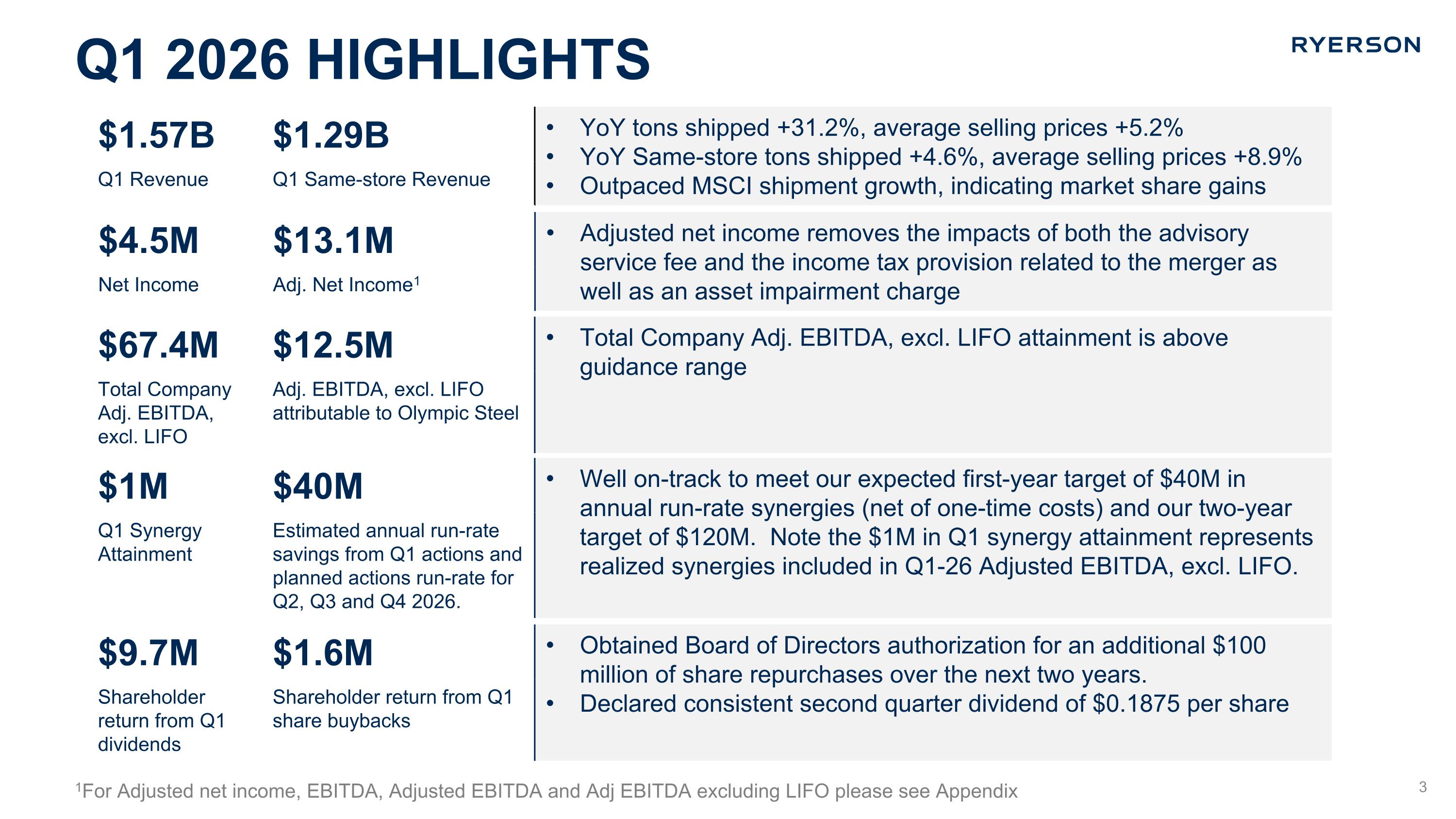
Q1 2026 Highlights 1For Adjusted net income, EBITDA, Adjusted EBITDA and Adj EBITDA excluding LIFO please see Appendix $1.57B $1.29B YoY tons shipped +31.2%, average selling prices +5.2% YoY Same-store tons shipped +4.6%, average selling prices +8.9% Outpaced MSCI shipment growth, indicating market share gains Q1 Revenue Q1 Same-store Revenue $4.5M $13.1M Adjusted net income removes the impacts of both the advisory service fee and the income tax provision related to the merger as well as an asset impairment charge Net Income Adj. Net Income1 $67.4M $12.5M Total Company Adj. EBITDA, excl. LIFO attainment is above guidance range Total Company Adj. EBITDA, excl. LIFO Adj. EBITDA, excl. LIFO attributable to Olympic Steel $1M $40M Well on-track to meet our expected first-year target of $40M in annual run-rate synergies (net of one-time costs) and our two-year target of $120M. Note the $1M in Q1 synergy attainment represents realized synergies included in Q1-26 Adjusted EBITDA, excl. LIFO. Q1 Synergy Attainment Estimated annual run-rate savings from Q1 actions and planned actions run-rate for Q2, Q3 and Q4 2026. $9.7M $1.6M Obtained Board of Directors authorization for an additional $100 million of share repurchases over the next two years. Declared consistent second quarter dividend of $0.1875 per share Shareholder return from Q1 dividends Shareholder return from Q1 share buybacks
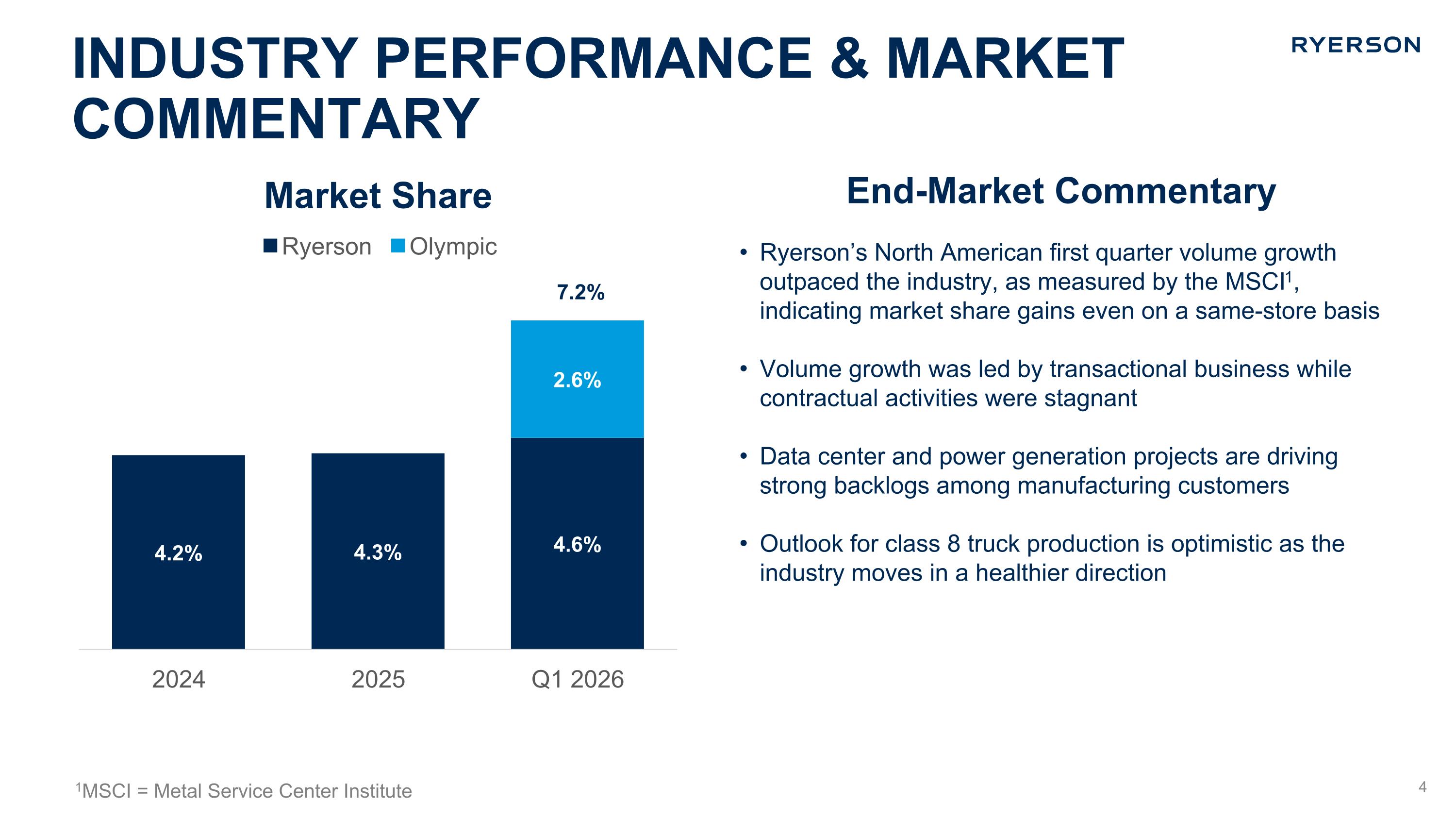
industry PERFORMANCE & Market Commentary End-Market Commentary Ryerson’s North American first quarter volume growth outpaced the industry, as measured by the MSCI1, indicating market share gains even on a same-store basis Volume growth was led by transactional business while contractual activities were stagnant Data center and power generation projects are driving strong backlogs among manufacturing customers Outlook for class 8 truck production is optimistic as the industry moves in a healthier direction 7.2% 1MSCI = Metal Service Center Institute
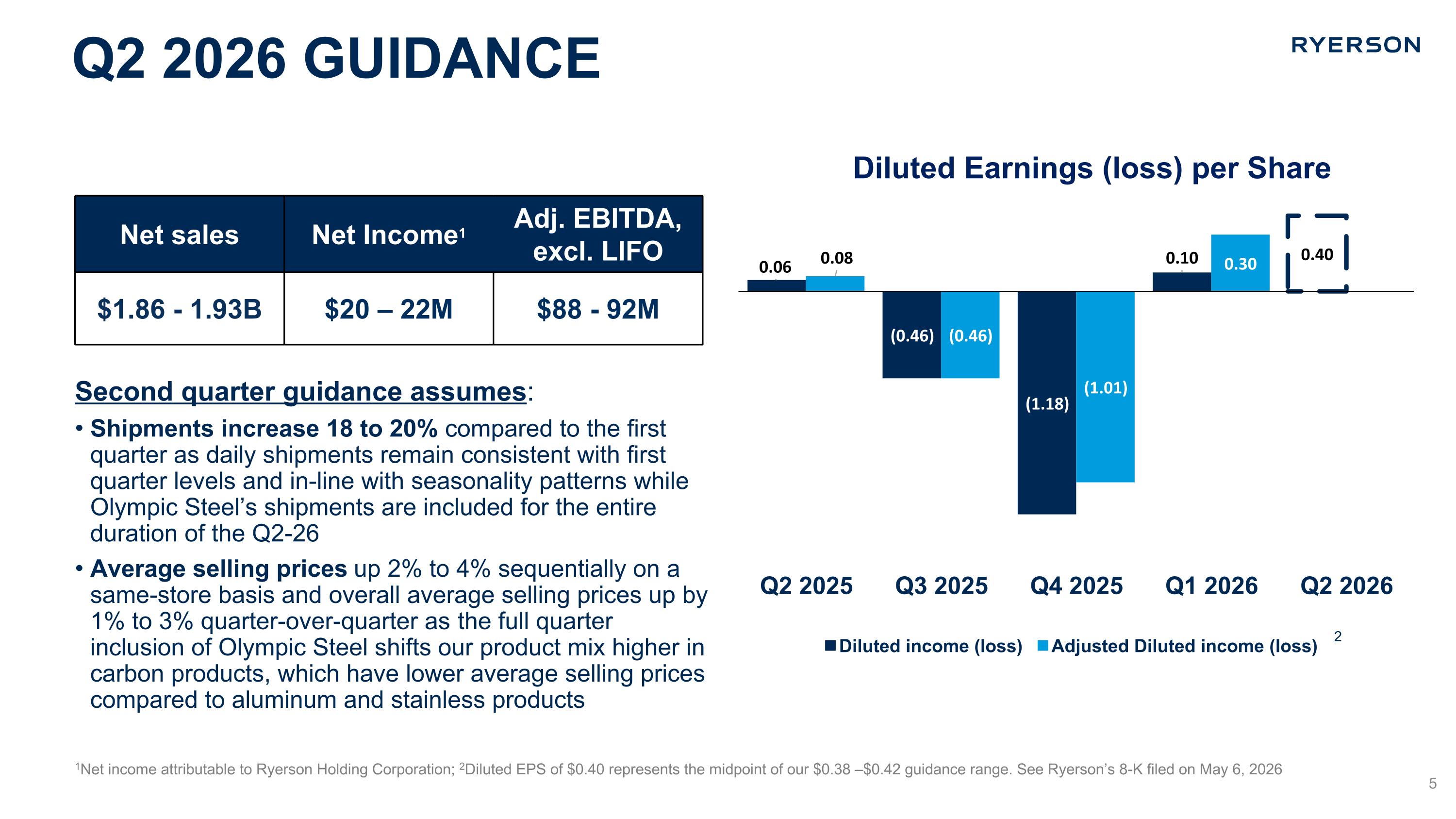
1Net income attributable to Ryerson Holding Corporation; 2Diluted EPS of $0.40 represents the midpoint of our $0.38 –$0.42 guidance range. See Ryerson’s 8-K filed on May 6, 2026 Net sales Net Income1 Adj. EBITDA, excl. LIFO $1.86 - 1.93B $20 – 22M $88 - 92M Diluted Earnings (loss) per Share 2 Q2 2026 Guidance Second quarter guidance assumes: Shipments increase 18 to 20% compared to the first quarter as daily shipments remain consistent with first quarter levels and in-line with seasonality patterns while Olympic Steel’s shipments are included for the entire duration of the Q2-26 Average selling prices up 2% to 4% sequentially on a same-store basis and overall average selling prices up by 1% to 3% quarter-over-quarter as the full quarter inclusion of Olympic Steel shifts our product mix higher in carbon products, which have lower average selling prices compared to aluminum and stainless products
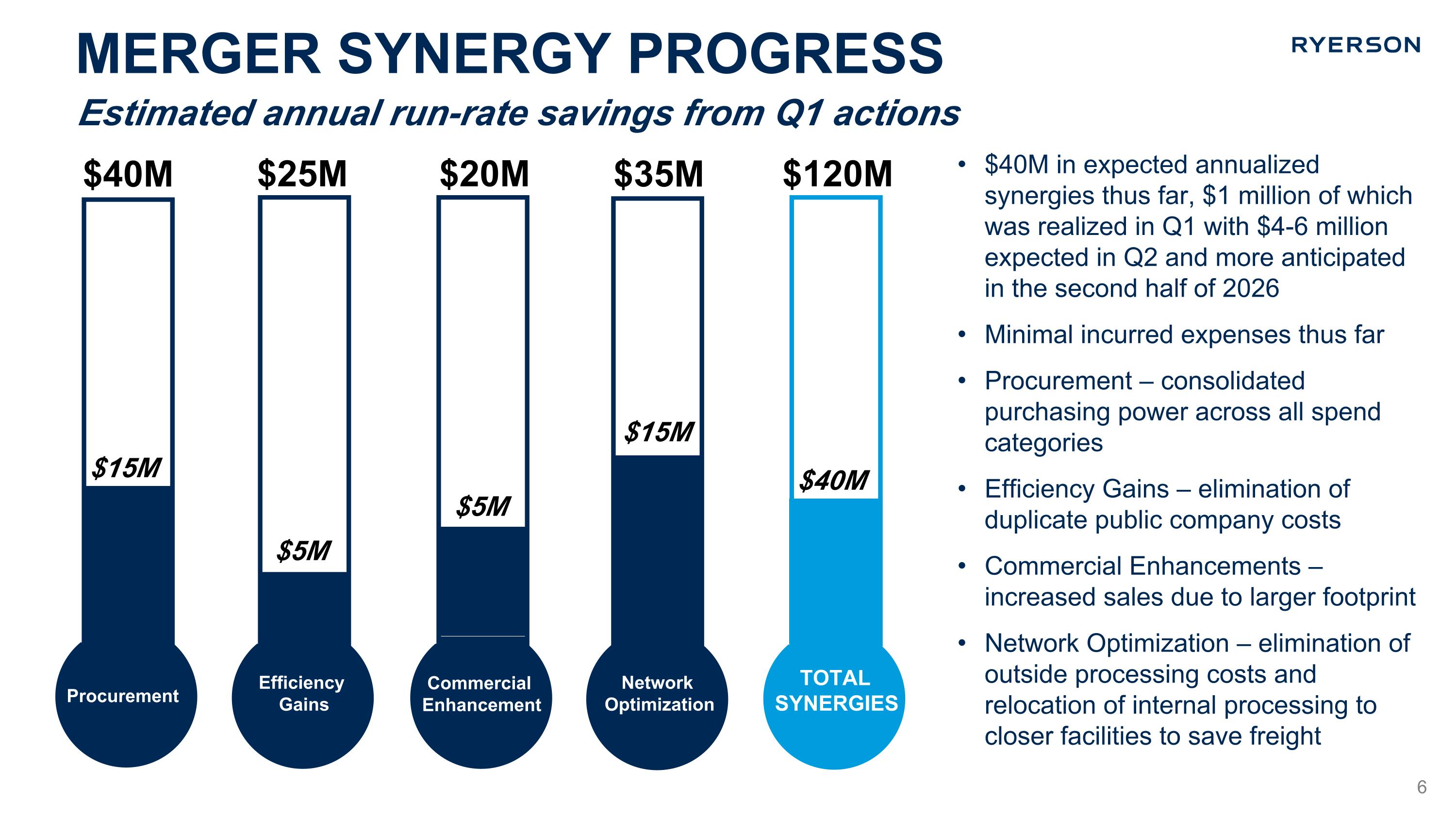
Merger Synergy Progress $40M in expected annualized synergies thus far, $1 million of which was realized in Q1 with $4-6 million expected in Q2 and more anticipated in the second half of 2026 Minimal incurred expenses thus far Procurement – consolidated purchasing power across all spend categories Efficiency Gains – elimination of duplicate public company costs Commercial Enhancements – increased sales due to larger footprint Network Optimization – elimination of outside processing costs and relocation of internal processing to closer facilities to save freight Procurement Commercial Enhancement Efficiency Gains Network Optimization $40M $25M $20M $35M $15M $5M $5M $15M TOTAL SYNERGIES $120M $40M Estimated annual run-rate savings from Q1 actions
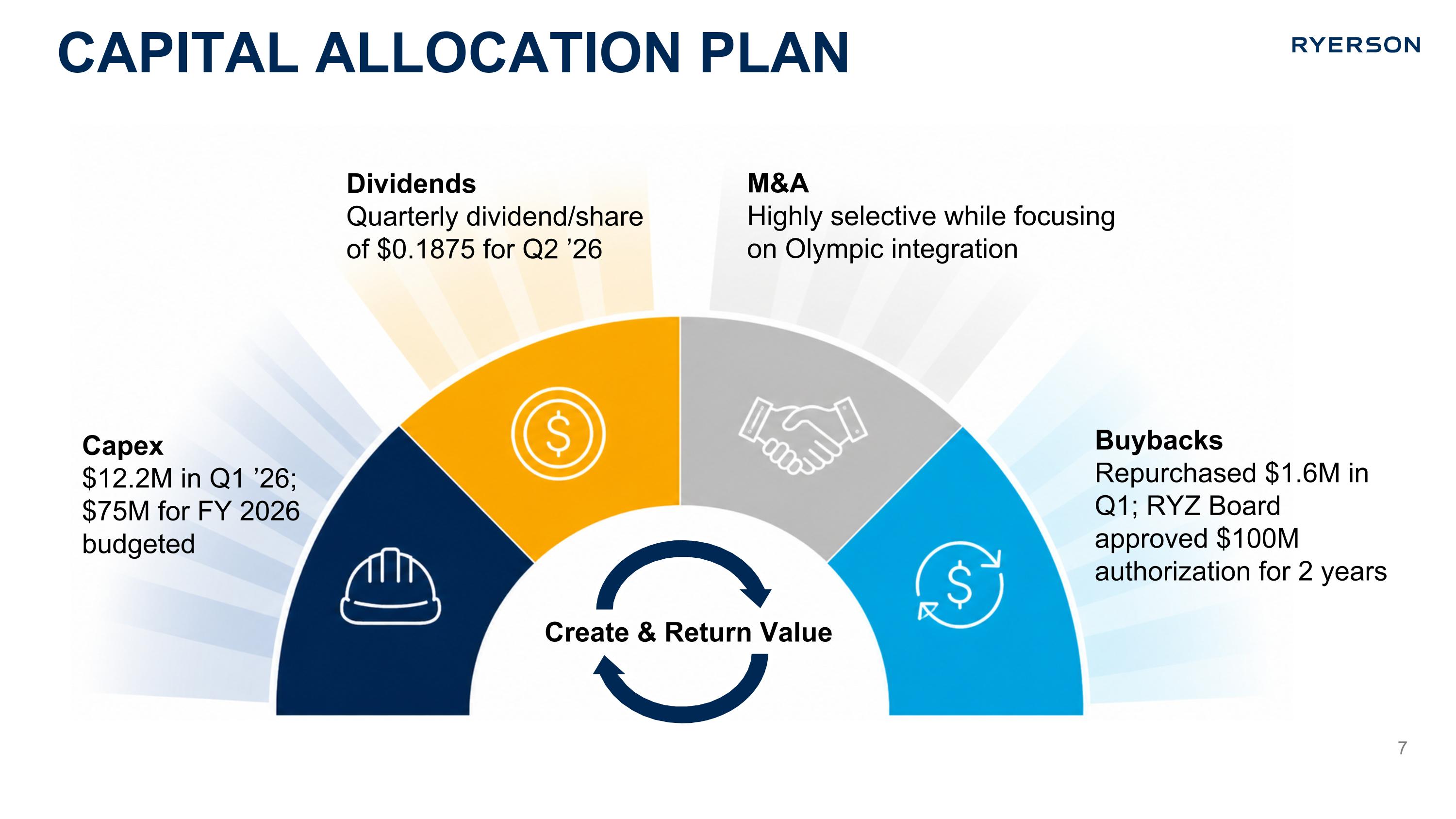
Capital allocation plan Capex $12.2M in Q1 ’26; $75M for FY 2026 budgeted Dividends Quarterly dividend/share of $0.1875 for Q2 ’26 M&A Highly selective while focusing on Olympic integration Buybacks Repurchased $1.6M in Q1; RYZ Board approved $100M authorization for 2 years Create & Return Value
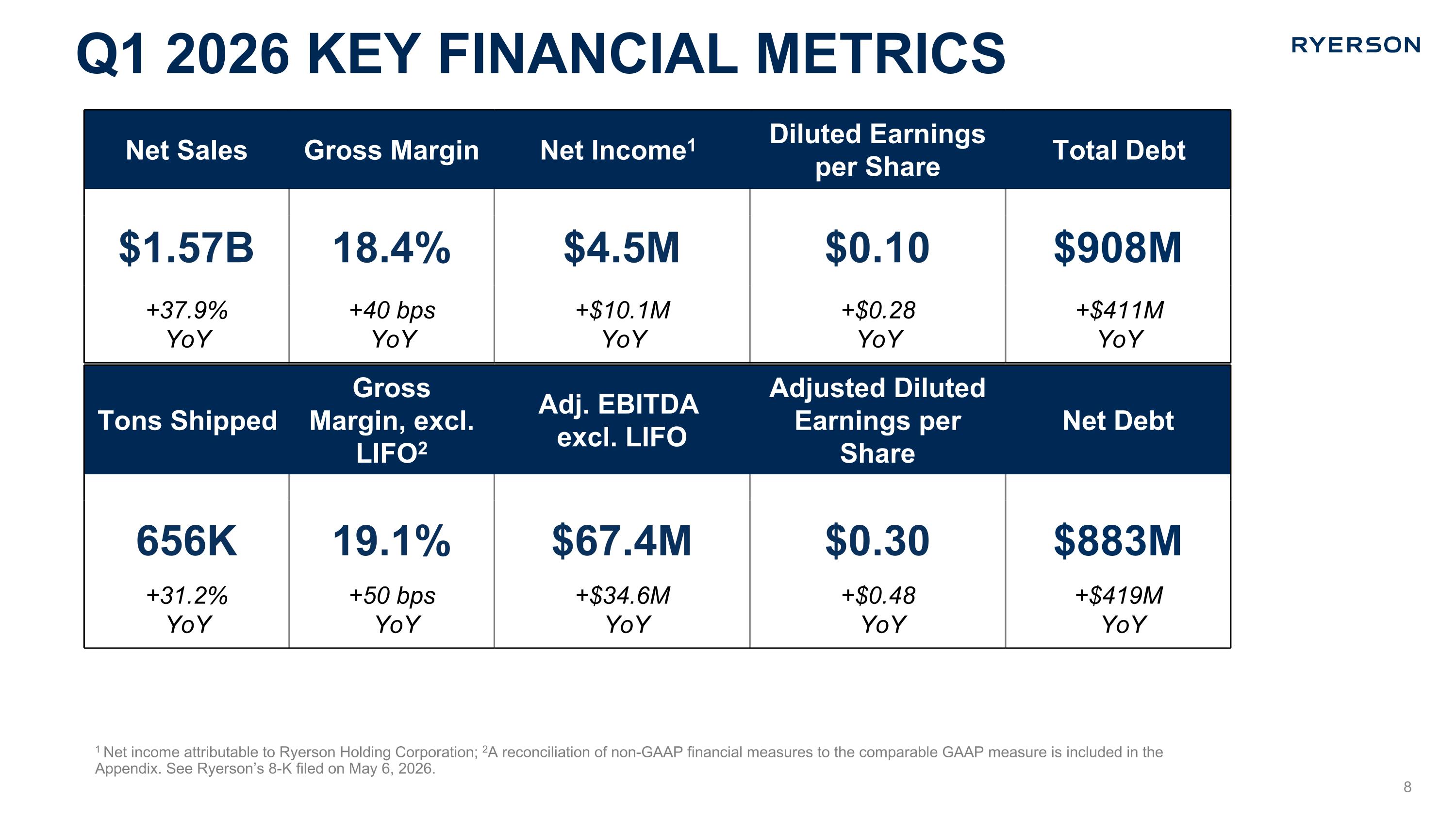
Q1 2026 key financial metrics 1 Net income attributable to Ryerson Holding Corporation; 2A reconciliation of non-GAAP financial measures to the comparable GAAP measure is included in the Appendix. See Ryerson’s 8-K filed on May 6, 2026. Net Sales Gross Margin Net Income1 Diluted Earnings per Share Total Debt $1.57B 18.4% $4.5M $0.10 $908M +37.9% YoY +40 bps YoY +$10.1M YoY +$0.28 YoY +$411M YoY 8 Tons Shipped Gross Margin, excl. LIFO2 Adj. EBITDA excl. LIFO Adjusted Diluted Earnings per Share Net Debt 656K 19.1% $67.4M $0.30 $883M +31.2% YoY +50 bps YoY +$34.6M YoY +$0.48 YoY +$419M YoY
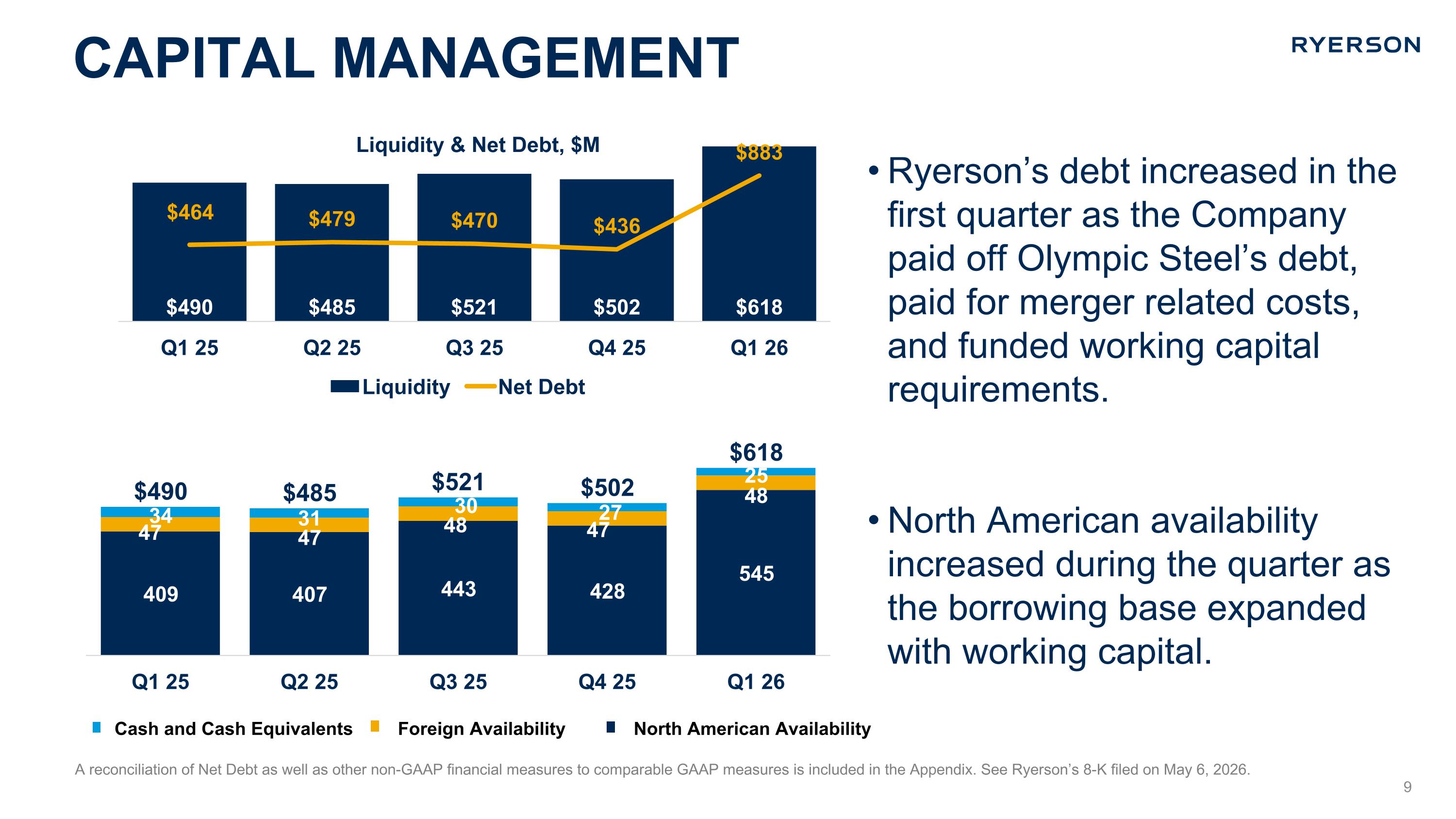
A reconciliation of Net Debt as well as other non-GAAP financial measures to comparable GAAP measures is included in the Appendix. See Ryerson’s 8-K filed on May 6, 2026. Ryerson’s debt increased in the first quarter as the Company paid off Olympic Steel’s debt, paid for merger related costs, and funded working capital requirements. North American availability increased during the quarter as the borrowing base expanded with working capital. Capital Management Liquidity & Net Debt, $M Foreign Availability 9 Cash and Cash Equivalents North American Availability
Appendix
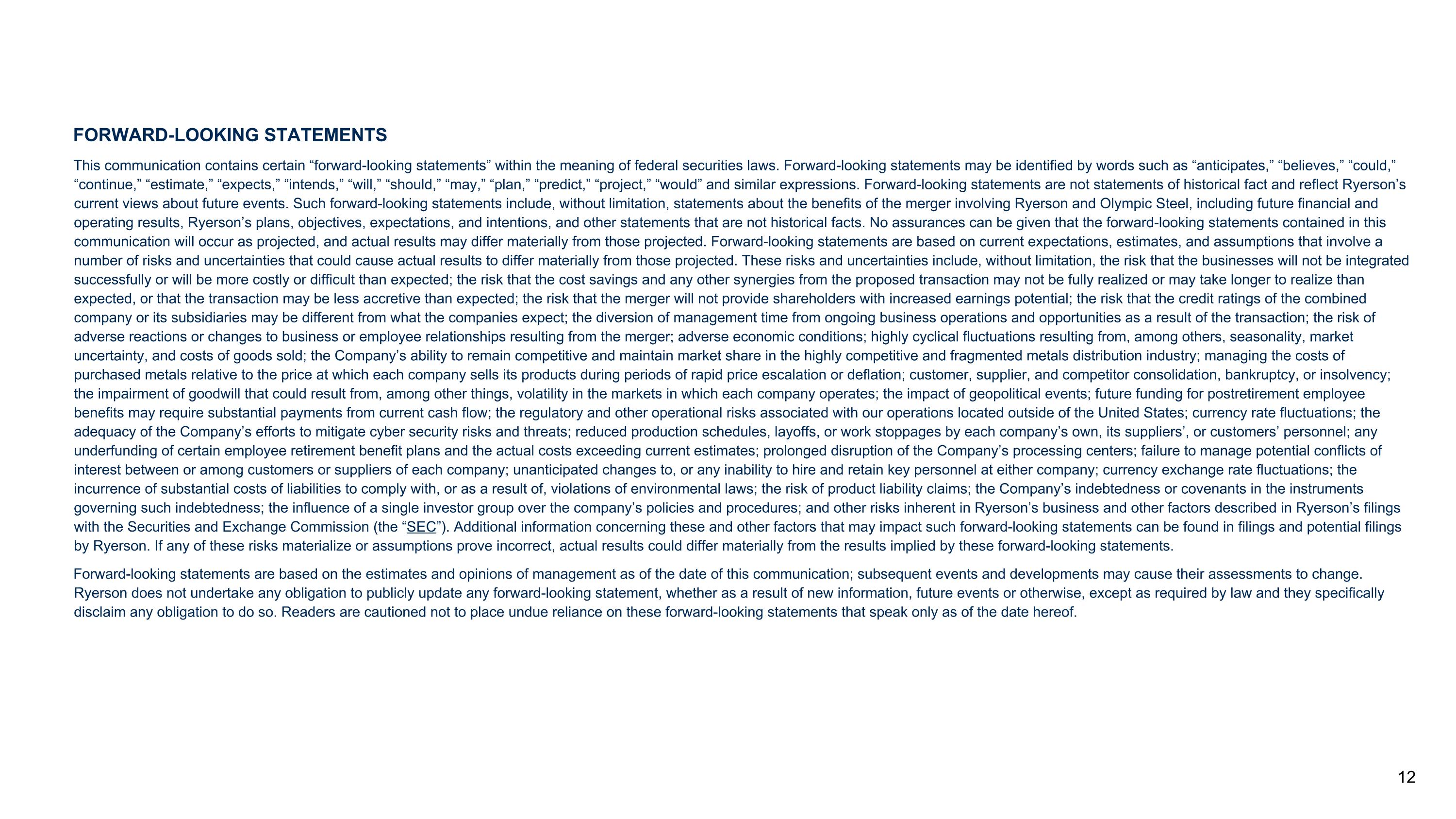
FORWARD-LOOKING STATEMENTS This communication contains certain “forward-looking statements” within the meaning of federal securities laws. Forward-looking statements may be identified by words such as “anticipates,” “believes,” “could,” “continue,” “estimate,” “expects,” “intends,” “will,” “should,” “may,” “plan,” “predict,” “project,” “would” and similar expressions. Forward-looking statements are not statements of historical fact and reflect Ryerson’s current views about future events. Such forward-looking statements include, without limitation, statements about the benefits of the merger involving Ryerson and Olympic Steel, including future financial and operating results, Ryerson’s plans, objectives, expectations, and intentions, and other statements that are not historical facts. No assurances can be given that the forward-looking statements contained in this communication will occur as projected, and actual results may differ materially from those projected. Forward-looking statements are based on current expectations, estimates, and assumptions that involve a number of risks and uncertainties that could cause actual results to differ materially from those projected. These risks and uncertainties include, without limitation, the risk that the businesses will not be integrated successfully or will be more costly or difficult than expected; the risk that the cost savings and any other synergies from the proposed transaction may not be fully realized or may take longer to realize than expected, or that the transaction may be less accretive than expected; the risk that the merger will not provide shareholders with increased earnings potential; the risk that the credit ratings of the combined company or its subsidiaries may be different from what the companies expect; the diversion of management time from ongoing business operations and opportunities as a result of the transaction; the risk of adverse reactions or changes to business or employee relationships resulting from the merger; adverse economic conditions; highly cyclical fluctuations resulting from, among others, seasonality, market uncertainty, and costs of goods sold; the Company’s ability to remain competitive and maintain market share in the highly competitive and fragmented metals distribution industry; managing the costs of purchased metals relative to the price at which each company sells its products during periods of rapid price escalation or deflation; customer, supplier, and competitor consolidation, bankruptcy, or insolvency; the impairment of goodwill that could result from, among other things, volatility in the markets in which each company operates; the impact of geopolitical events; future funding for postretirement employee benefits may require substantial payments from current cash flow; the regulatory and other operational risks associated with our operations located outside of the United States; currency rate fluctuations; the adequacy of the Company’s efforts to mitigate cyber security risks and threats; reduced production schedules, layoffs, or work stoppages by each company’s own, its suppliers’, or customers’ personnel; any underfunding of certain employee retirement benefit plans and the actual costs exceeding current estimates; prolonged disruption of the Company’s processing centers; failure to manage potential conflicts of interest between or among customers or suppliers of each company; unanticipated changes to, or any inability to hire and retain key personnel at either company; currency exchange rate fluctuations; the incurrence of substantial costs of liabilities to comply with, or as a result of, violations of environmental laws; the risk of product liability claims; the Company’s indebtedness or covenants in the instruments governing such indebtedness; the influence of a single investor group over the company’s policies and procedures; and other risks inherent in Ryerson’s business and other factors described in Ryerson’s filings with the Securities and Exchange Commission (the “SEC”). Additional information concerning these and other factors that may impact such forward-looking statements can be found in filings and potential filings by Ryerson. If any of these risks materialize or assumptions prove incorrect, actual results could differ materially from the results implied by these forward-looking statements. Forward-looking statements are based on the estimates and opinions of management as of the date of this communication; subsequent events and developments may cause their assessments to change. Ryerson does not undertake any obligation to publicly update any forward-looking statement, whether as a result of new information, future events or otherwise, except as required by law and they specifically disclaim any obligation to do so. Readers are cautioned not to place undue reliance on these forward-looking statements that speak only as of the date hereof. 12
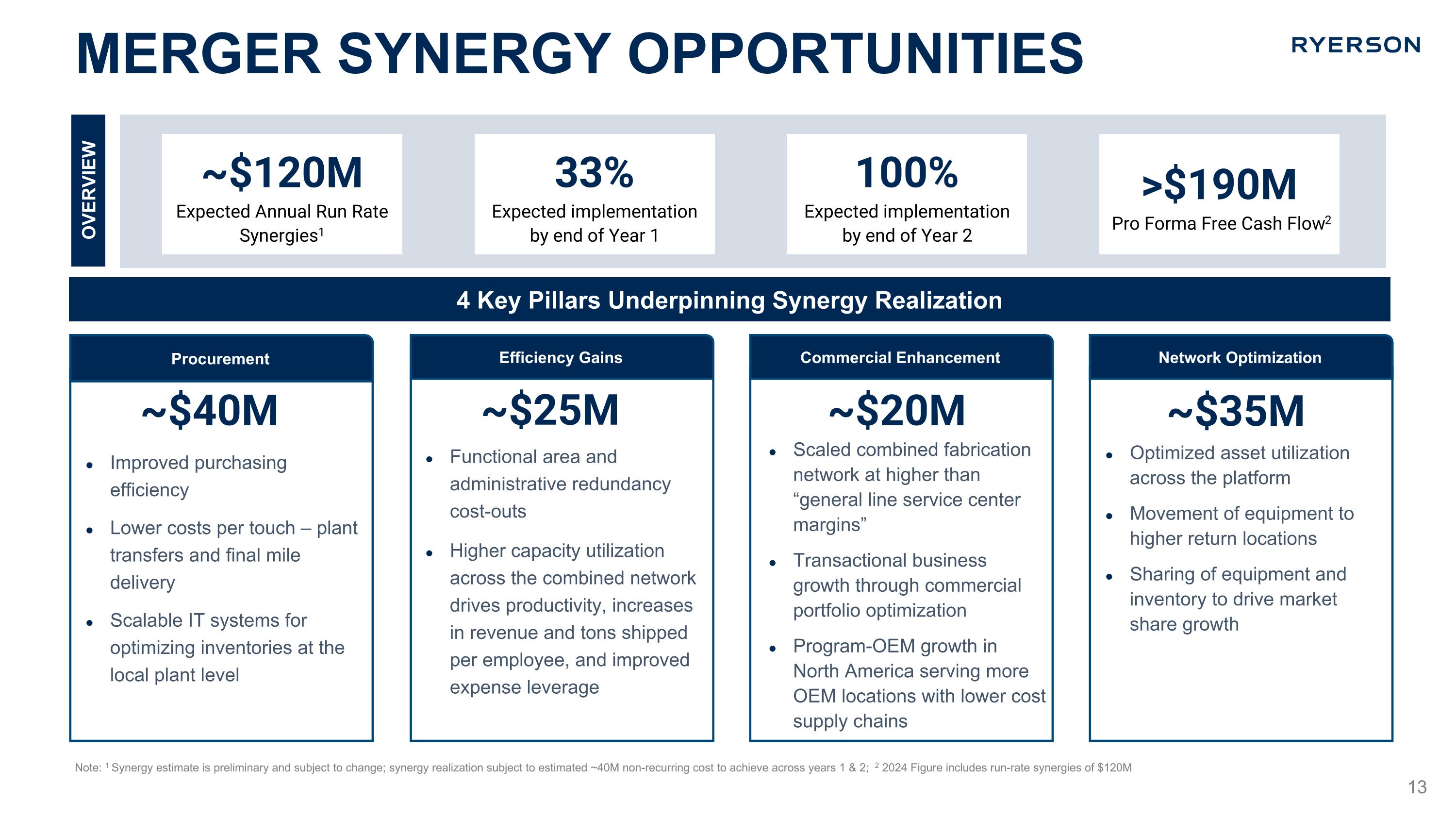
Merger Synergy Opportunities Note: 1 Synergy estimate is preliminary and subject to change; synergy realization subject to estimated ~40M non-recurring cost to achieve across years 1 & 2; 2 2024 Figure includes run-rate synergies of $120M 4 Key Pillars Underpinning Synergy Realization OVERVIEW ~$120M Expected Annual Run Rate Synergies1 33% Expected implementation by end of Year 1 100% Expected implementation by end of Year 2 >$190M Pro Forma Free Cash Flow2 Procurement Improved purchasing efficiency Lower costs per touch – plant transfers and final mile delivery Scalable IT systems for optimizing inventories at the local plant level Efficiency Gains Functional area and administrative redundancy cost-outs Higher capacity utilization across the combined network drives productivity, increases in revenue and tons shipped per employee, and improved expense leverage Network Optimization Optimized asset utilization across the platform Movement of equipment to higher return locations Sharing of equipment and inventory to drive market share growth Commercial Enhancement Scaled combined fabrication network at higher than “general line service center margins” Transactional business growth through commercial portfolio optimization Program-OEM growth in North America serving more OEM locations with lower cost supply chains ~$40M ~$20M ~$35M ~$25M
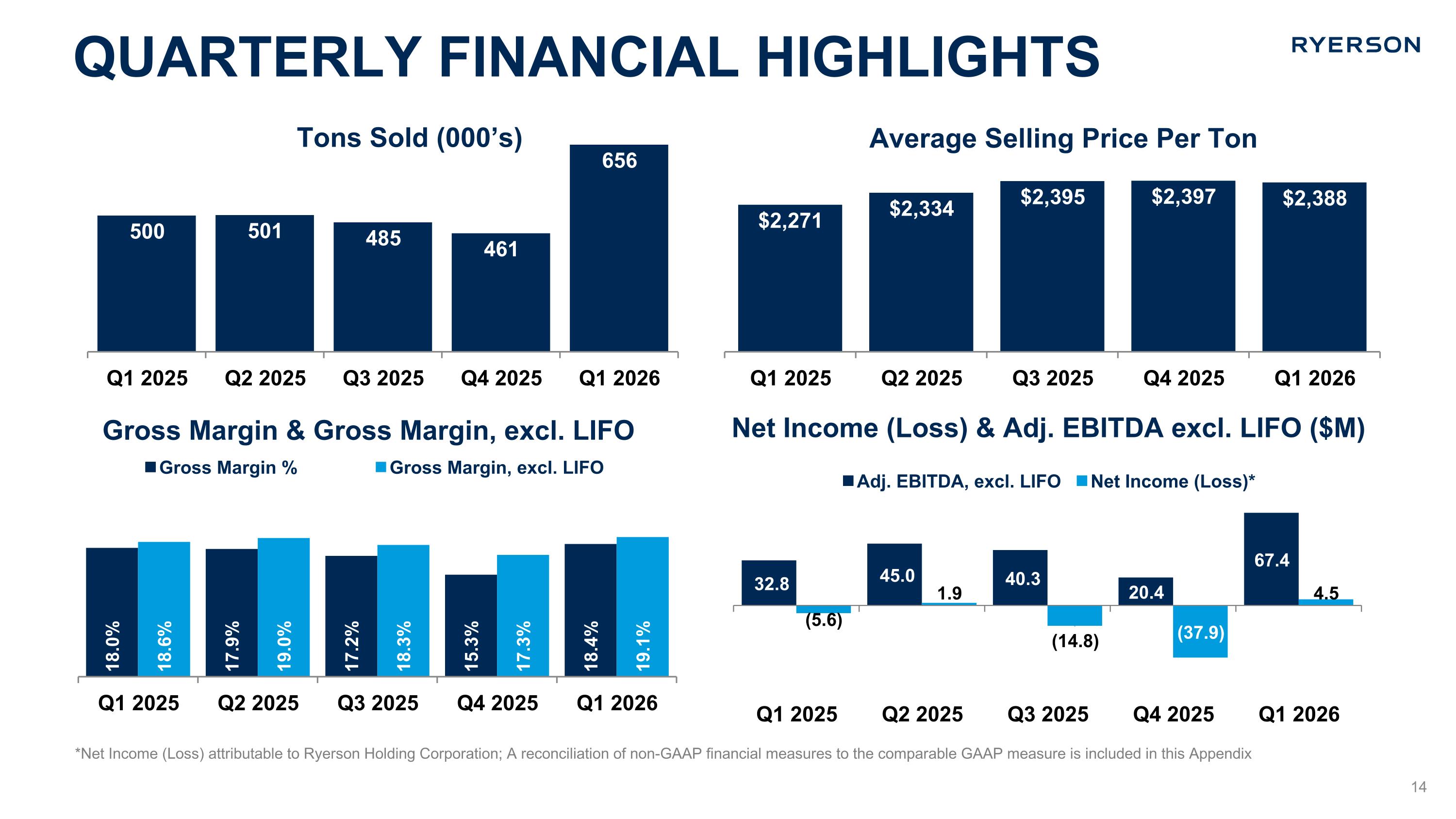
Quarterly financial highlights *Net Income (Loss) attributable to Ryerson Holding Corporation; A reconciliation of non-GAAP financial measures to the comparable GAAP measure is included in this Appendix Average Selling Price Per Ton Tons Sold (000’s) Net Income (Loss) & Adj. EBITDA excl. LIFO ($M) Gross Margin & Gross Margin, excl. LIFO
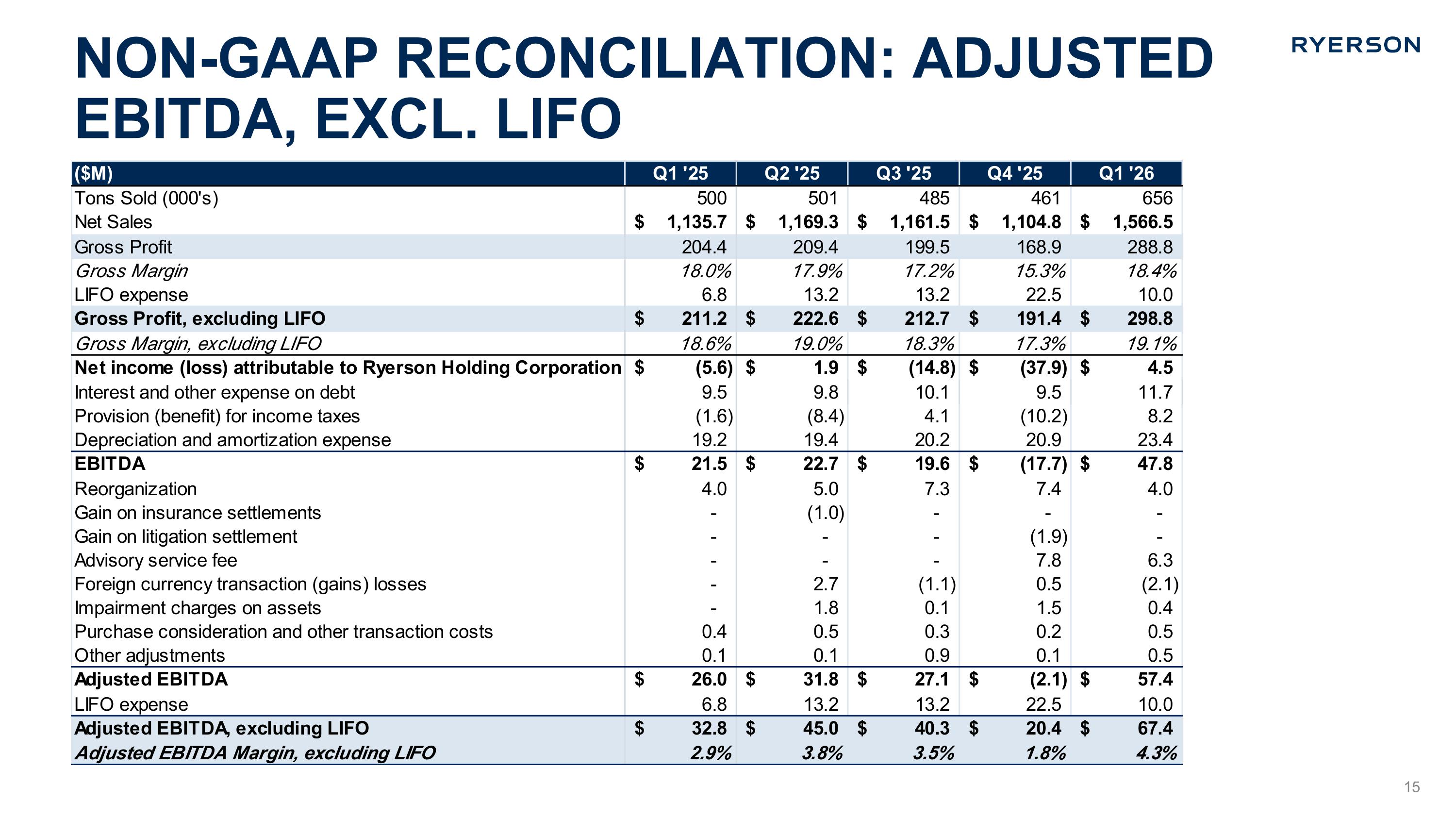
Non-GAAP Reconciliation: Adjusted EBITDA, excl. LIFO 15
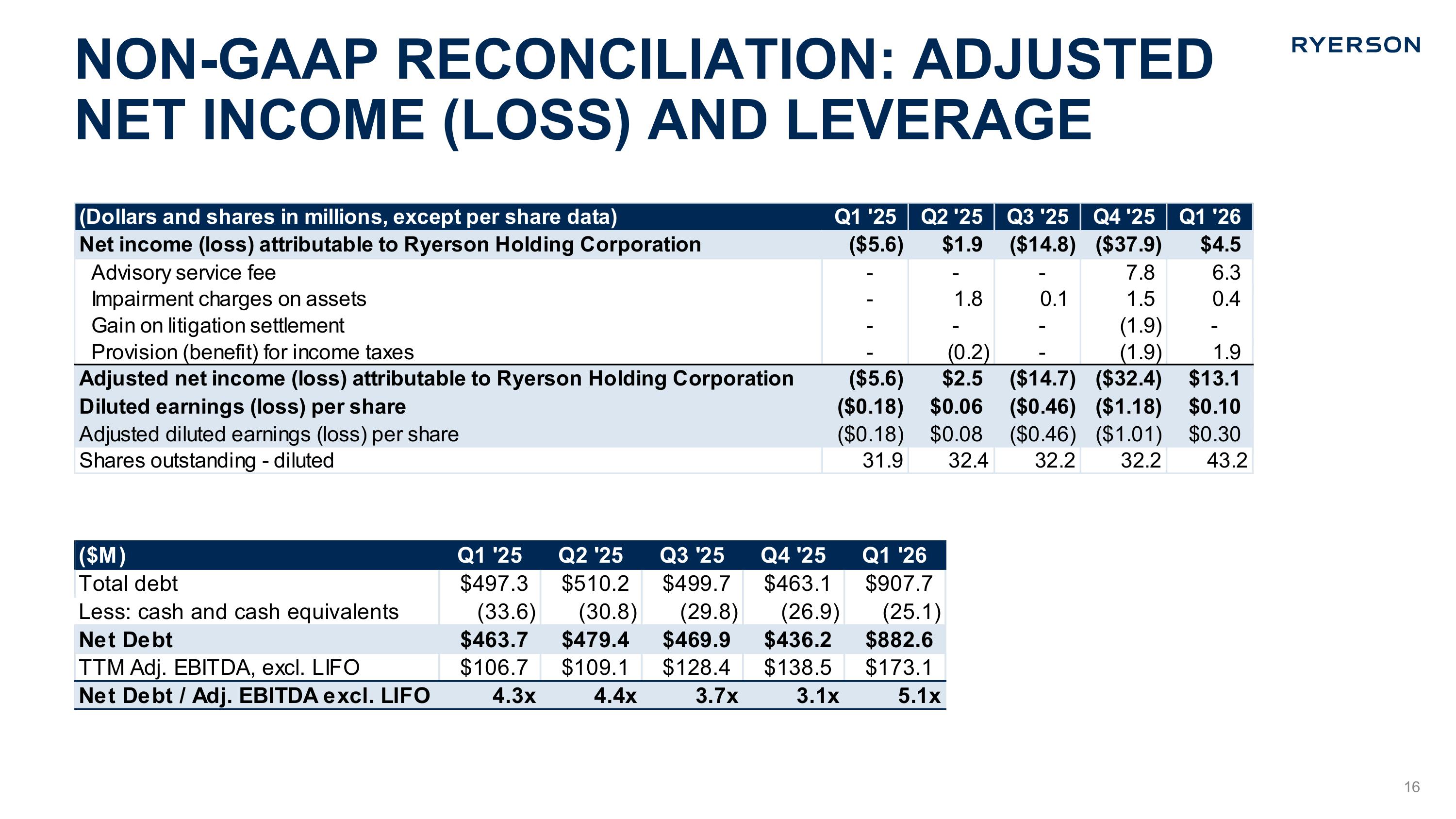
Non-GAAP Reconciliation: Adjusted Net Income (loss) and Leverage 16