1 DESCRIPTION OF THE REGISTRANT'S SECURITIES REGISTERED PURSUANT TO SECTION 12 OF THE SECURITIES EXCHANGE ACT OF 1934 As of December 31, 2025, Customers Bancorp, Inc. had six classes of securities registered under Section 12(b) of the Securities Exchange Act of 1934: Voting Common Stock, par value of $1.00 per share 5.375% Subordinated Notes due 2034 Description of Common Stock The following description of our common stock is a summary. This summary is not complete and is subject to the complete text of our amended and restated articles of incorporation, as amended, and amended and restated bylaws, as amended, copies of which are currently exhibits to our Form 10-K Annual Report. We encourage you to read those documents carefully. General We are authorized to issue up to an aggregate amount of 300,000,000 shares of stock, which is divided into three equal classes: • 100,000,000 shares of voting common Stock, par value $1.00 per share; • 100,000,000 shares of Class B non-voting common stock, par value $1.00 per share; and • 100,000,000 shares of preferred stock. Our board of directors has the authority to establish and divide the authorized and unissued shares of voting common stock and of Class B non-voting common stock into series or classes and to fix and determine, to the extent not already determined in our articles of incorporation, the designations, preferences, and other special rights, including conversion rights, and the qualifications, limitations, or restrictions on those rights attributable to the shares in a series or class. As of December 31, 2025, there were 34,191,223 shares of voting common stock issued and outstanding, exclusive of 1,997,697 shares held in treasury. There were no shares of Class B non-voting common stock issued or outstanding as of December 31, 2025. Voting Rights The holders of shares of our voting common stock have the right to elect our board of directors and to act on such other matters as are required to be presented to them. Each holder of voting common stock is entitled to one vote per share. The holders of voting common stock do not have the right to vote their shares cumulatively in the election of directors. This means that, for each director position to be elected, a shareholder may only cast a number of votes equal to the number of shares held by the shareholder. Any action that would significantly and adversely affect the rights of the Class B non-voting common stock with respect to the modification of the terms of those securities or dissolution requires the approval of the holders of Class B non-voting common stock voting separately as a class. Otherwise, the holders of the Class B non-voting common stock have no voting power, and do not have the right to participate in or have notice of any meeting of shareholders. Because our articles of incorporation permit the board of directors to set the voting rights of preferred stock, it is possible that holders of one or more series of preferred stock issued in the future could have voting rights of any sort, which could limit the effect of the voting rights of holders of voting common stock. Dividend Rights The holders of our common stock are entitled to receive an equal amount of dividends per share if, as and when declared from time to time by our board of directors. In no event shall any stock dividends or stock splits or combinations of stock be declared or made on our common stock unless the shares of our voting common stock and Class B non-voting common stock at the time outstanding are treated equally and identically, provided that, in the event of a dividend of common stock, shares of our Class B non-voting common stock shall only be entitled to
2 receive shares of Class B non-voting common stock and shares of our voting common stock shall only be entitled to receive shares of voting common stock. Because our articles of incorporation permit our board of directors to set the dividend rights of preferred shares, it is possible that holders of one or more series of preferred shares issued in the future could have dividend rights that differ from those of the holders of our common stock, or could have no right to the payment of dividends. If the holders of a class or series of preferred stock is given dividend rights, the right of holders of preferred shares to receive dividends could have priority over the right of holders of our common stock to receive dividends. Redemption, Preemptive Rights and Repurchase Provisions Our common stock has no preemptive rights or redemption or repurchase provisions. The shares are non-assessable and require no sinking fund. Repurchases of our voting common stock are subject to Federal Reserve Board regulations and policy, which generally require that no more than ten percent of the outstanding shares of a bank holding company's voting common stock may be repurchased in any 12-month period unless the bank holding company is deemed "well-managed" and "well-capitalized" under applicable regulations. Repurchases of our stock will also be constrained by federal and state bank regulatory capital requirements. Repurchases of stock by bank holding companies may also be subject to prior notice to and approval by the Federal Reserve in some cases. Liquidation Rights In the event of the liquidation, dissolution or winding up of Customers Bancorp, the holders of our common stock will be entitled to share ratably in all of our assets remaining after payment of all liabilities, subject, however, to any preferential liquidation rights of holders of any preferred stock outstanding at that time. If our only asset is our ownership of Customers Bank, our wholly-owned subsidiary, it is likely that, if Customers Bank is then in liquidation or receivership, Customers Bancorp shareholders will not receive anything on account of their shares. Potential Anti-Takeover Effect of Governing Documents and Applicable Law Provisions of Governing Documents. Our amended and restated articles of incorporation, as amended, and amended and restated bylaws, as amended, contain certain provisions which may have the effect of deterring or discouraging, among other things, a non-negotiated tender or exchange offer for our common stock, a proxy contest for control of the company, the assumption of control of the company by a holder of a large block of common stock or the removal of our board of directors. These provisions: • Empower our board of directors, without shareholder approval, to issue preferred stock, the terms of which, including voting power, are set by our board of directors; • Divide our board of directors into three classes serving staggered three-year terms; • Restrict the ability of shareholders to remove directors; • Require that shares with at least 80% of total voting power approve mergers and other similar transactions with a person or entity holding stock with more than 5% of our voting power, if a reorganization is not approved, in advance, by two-thirds of the members of our board of directors; • Prohibit action by the shareholders without a shareholder meeting; • Require that shares representing at least 80% of total voting power approve the repeal or amendment of certain provisions of our articles of incorporation; • Require any person who acquires our stock with voting power of 25% or more to offer to purchase for cash all remaining shares of our voting stock at the highest price paid by such person for shares of our voting stock during the preceding year; • Eliminate cumulative voting in elections of directors; • Require that shares representing at least two-thirds of the total voting power approve any amendment to or repeal of our bylaws; • Require that our board of directors give due consideration to the effect of a proposed transaction on the depositors, employees, suppliers, customers and other of our and our subsidiaries' constituents and on the communities in which we and they operate or are located, and to the business reputation of the other party and our value in a freely negotiated sale and of our future prospects as an independent entity; • Require advance notice of nominations for the election of directors and the presentation of shareholder proposals at meetings of shareholders; and
3 • Provide that officers, directors, employees, agents and persons who own 5% or more of the voting securities of any other corporation or other entity that owns 66 2/3% or more of our outstanding voting stock cannot constitute a majority of the members of our board of directors. Provisions of Applicable Law. The Pennsylvania Business Corporation Law also contains certain provisions applicable to us that may have the effect of impeding a change in control. These provisions, among other things, prohibit for five years, subject to certain exceptions, a "business combination," which includes a merger or consolidation of the corporation or a sale, lease or exchange of assets with a shareholder or group of shareholders beneficially owning 20% or more of the corporation's voting power in an election of directors. In addition, certain provisions of the Pennsylvania Business Corporation Law: • Expand the factors and groups (including shareholders) a board of directors can consider in determining whether a certain action is in the best interests of the corporation; • Provide that a board of directors need not consider the interests of any particular group as dominant or controlling; • Provide that directors, in order to satisfy the presumption that they have acted in the best interests of the corporation, need not satisfy any greater obligation or higher burden of proof for actions relating to an acquisition or potential acquisition of control; • Provide that actions relating to acquisitions of control that are approved by a majority of "disinterested directors" are presumed to satisfy the directors' standard of care, unless it is proven by clear and convincing evidence that the directors did not assent to such action in good faith after reasonable investigation; and • Provide that the fiduciary duties of directors are solely to the corporation and may be enforced by the corporation or by a shareholder in a derivative action, but not by a shareholder directly. The Pennsylvania Business Corporation Law also provides that the fiduciary duties of directors do not require directors to: • Redeem any rights under, or to modify or render inapplicable, any shareholder rights plan; • Render inapplicable, or make determinations under, provisions of the Pennsylvania Business Corporation Law, relating to control transactions, business combinations, control-share acquisitions or disgorgement by certain controlling shareholders following attempts to acquire control; or • Take action as the board of directors, a committee of the board or an individual director solely because of the effect such action might have on an acquisition or potential or proposed acquisition of control of us or the consideration that might be offered or paid to shareholders in such an acquisition. Pursuant to provisions of our articles of incorporation, and in accordance with Pennsylvania law, we have opted out of coverage by the "disgorgement," "control transactions," "control-share acquisitions," "severance compensation," and "labor contracts" provisions of the Pennsylvania Business Corporation Law. As a result of our opting-out from coverage by these statutes, none of the "disgorgement," "control transactions," "control-share acquisitions," "severance compensation," nor "labor contracts" statutes would apply to a non-negotiated attempt to acquire control of us, although such an attempt would still be subject to the special provisions of our governing documents. The overall effect of these provisions may be to deter a future offer or other merger or acquisition proposal that a majority of the shareholders might view to be in their best interests as the offer might include a substantial premium over the market price of our common stock at that time. In addition, these provisions may have the effect of assisting our management and board of directors in retaining their positions and placing them in a better position to resist changes that the shareholders may want to make if dissatisfied with the conduct of our business. Transfer Agent and Registrar Computershare, Inc. serves as the transfer agent and registrar for our common stock. Description of 5.375% Subordinated Notes due 2034 (Trading Symbol CUBB) The following description of our 5.375% Subordinated Notes due 2034 is a summary. This summary is not complete and is subject to the complete text of the Indenture, dated as of December 9, 2019, between Customers Bancorp, Inc., as Issuer, and Wilmington Trust, National Association, as Trustee, the First Supplemental Indenture, dated as of December 9, 2019, between Customers Bancorp, Inc., as Issuer, and Wilmington Trust, National Association, as
4 Trustee and the form of 5.375% Subordinated Note copies of which are available as exhibits to our Form 10-K Annual Report. We encourage you to read those documents carefully. General The notes will be our unsecured and subordinated obligations and are intended to qualify as Tier 2 Capital under the guidelines established by the Federal Reserve for bank holding companies. The notes will be issued in an initial aggregate principal amount of $65,000,000 and will mature on December 30, 2034, unless earlier redeemed by us. The notes will rank equally among themselves, junior to our existing and future Senior Indebtedness, effectively junior to our secured subordinated indebtedness to the extent of the value securing the same and effectively subordinated to all existing and future indebtedness, deposits and other liabilities and preferred equity of Customers Bank and Customer Bancorp’s other subsidiaries. See “—Ranking” below. The notes will not be subject to, or entitled to the benefits of, a sinking fund or repurchase by us at the option of the holders. The notes will be issued only in fully registered book-entry form without coupons and in minimum denominations of $25 and integral multiples of $25 in excess thereof. Currently, there is no public market for the notes. We will apply to list the notes on the New York Stock Exchange. The registered holder of a note will be treated as the owner of it for all purposes. Only registered holders have rights under the Indenture. Payment of the principal of, and interest on, the notes represented by a global note registered in the name of or held by DTC or its nominee will be made in immediately available funds to DTC or its nominee, as the case may be, as the registered owner and holder of such global note. Holders of the notes and the Trustee have no right to accelerate the maturity of the notes in the event we fail to pay interest or principal on the notes, fail to perform any other obligation under the notes or in the Indenture or default on any other securities issued by us. See “—Events of Default; Limitation on Suits” below. The Indenture contains no covenants or restrictions restricting the incurrence of Senior Indebtedness, parity indebtedness or secured subordinated indebtedness by us or the incurrence or issuance by our subsidiaries of any indebtedness, deposits or other liabilities or any preferred stock. The Indenture contains no financial covenants and does not restrict us from paying dividends or issuing or repurchasing other securities, and does not contain any provision that would provide protection to the holders of the notes against a sudden and dramatic decline in credit quality resulting from a merger, takeover, recapitalization or similar restructuring or any other event involving us or our subsidiaries that may adversely affect our credit quality, except to the extent described under the headings “— Merger, Consolidation, Sale, Lease or Conveyance” and “— Certain Covenants” below. The notes will not be savings accounts, deposits or other obligations of any of our subsidiaries and will not be insured or guaranteed by the FDIC or any other governmental agency or instrumentality. We may, without notice to or the consent of the holders of notes, but in compliance with the terms of the Indenture, issue additional notes having the same ranking, interest rate, maturity date and other terms as the notes other than issue date and offering price. Any such additional notes, together with the notes being issued hereby, will constitute a single series under the Indenture; provided, however, that no additional notes may be issued unless they will be fungible with the notes offered hereby for U.S. federal income tax and securities law purposes; and provided, further, that the additional notes have the same CUSIP number as the notes offered hereby. No additional notes may be issued if any event of default (as defined below) has occurred and is continuing with respect to the notes. Interest Interest on the notes will accrue at the rate of 5.375% per annum. Interest on the notes will be payable quarterly in arrears on March 30, June 30, September 30 and December 30 of each year, commencing on March 30, 2020. We will make each interest payment on the applicable interest payment date to the registered holders of notes at the close of business on the fifteenth day (whether or not a business day) immediately preceding the applicable interest payment date. Interest on the notes at the maturity date or earlier redemption will be payable to the persons to whom principal is payable. Interest on the notes will be computed on the basis of a 360-day year consisting of twelve 30 day months. Interest payments on the notes will be the amount of interest accrued from and including December 9, 2019 or the most recent interest payment date on which interest has been paid to but excluding the interest payment date or the maturity date or earlier redemption, as the case may be.
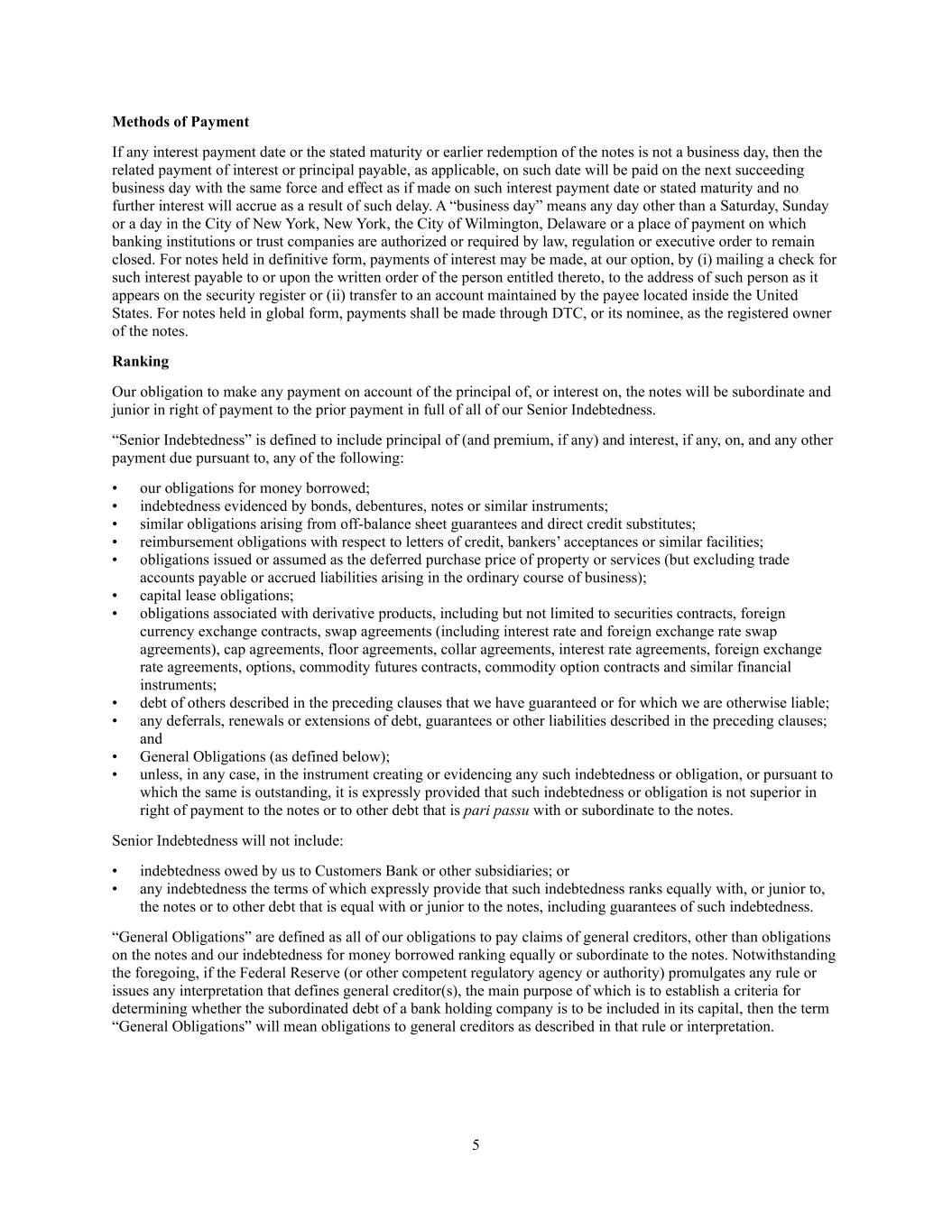
5 Methods of Payment If any interest payment date or the stated maturity or earlier redemption of the notes is not a business day, then the related payment of interest or principal payable, as applicable, on such date will be paid on the next succeeding business day with the same force and effect as if made on such interest payment date or stated maturity and no further interest will accrue as a result of such delay. A “business day” means any day other than a Saturday, Sunday or a day in the City of New York, New York, the City of Wilmington, Delaware or a place of payment on which banking institutions or trust companies are authorized or required by law, regulation or executive order to remain closed. For notes held in definitive form, payments of interest may be made, at our option, by (i) mailing a check for such interest payable to or upon the written order of the person entitled thereto, to the address of such person as it appears on the security register or (ii) transfer to an account maintained by the payee located inside the United States. For notes held in global form, payments shall be made through DTC, or its nominee, as the registered owner of the notes. Ranking Our obligation to make any payment on account of the principal of, or interest on, the notes will be subordinate and junior in right of payment to the prior payment in full of all of our Senior Indebtedness. “Senior Indebtedness” is defined to include principal of (and premium, if any) and interest, if any, on, and any other payment due pursuant to, any of the following: • our obligations for money borrowed; • indebtedness evidenced by bonds, debentures, notes or similar instruments; • similar obligations arising from off-balance sheet guarantees and direct credit substitutes; • reimbursement obligations with respect to letters of credit, bankers’ acceptances or similar facilities; • obligations issued or assumed as the deferred purchase price of property or services (but excluding trade accounts payable or accrued liabilities arising in the ordinary course of business); • capital lease obligations; • obligations associated with derivative products, including but not limited to securities contracts, foreign currency exchange contracts, swap agreements (including interest rate and foreign exchange rate swap agreements), cap agreements, floor agreements, collar agreements, interest rate agreements, foreign exchange rate agreements, options, commodity futures contracts, commodity option contracts and similar financial instruments; • debt of others described in the preceding clauses that we have guaranteed or for which we are otherwise liable; • any deferrals, renewals or extensions of debt, guarantees or other liabilities described in the preceding clauses; and • General Obligations (as defined below); • unless, in any case, in the instrument creating or evidencing any such indebtedness or obligation, or pursuant to which the same is outstanding, it is expressly provided that such indebtedness or obligation is not superior in right of payment to the notes or to other debt that is pari passu with or subordinate to the notes. Senior Indebtedness will not include: • indebtedness owed by us to Customers Bank or other subsidiaries; or • any indebtedness the terms of which expressly provide that such indebtedness ranks equally with, or junior to, the notes or to other debt that is equal with or junior to the notes, including guarantees of such indebtedness. “General Obligations” are defined as all of our obligations to pay claims of general creditors, other than obligations on the notes and our indebtedness for money borrowed ranking equally or subordinate to the notes. Notwithstanding the foregoing, if the Federal Reserve (or other competent regulatory agency or authority) promulgates any rule or issues any interpretation that defines general creditor(s), the main purpose of which is to establish a criteria for determining whether the subordinated debt of a bank holding company is to be included in its capital, then the term “General Obligations” will mean obligations to general creditors as described in that rule or interpretation.
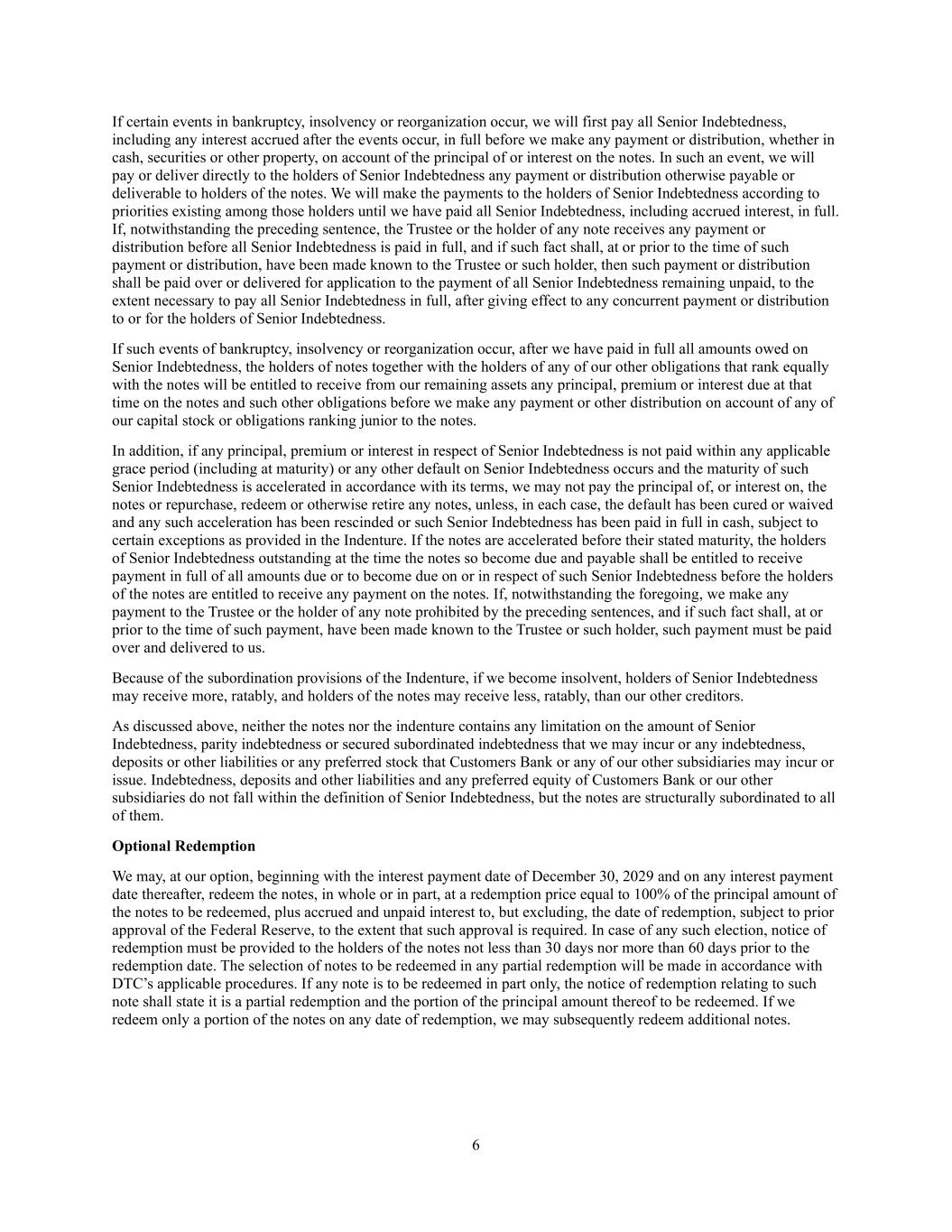
6 If certain events in bankruptcy, insolvency or reorganization occur, we will first pay all Senior Indebtedness, including any interest accrued after the events occur, in full before we make any payment or distribution, whether in cash, securities or other property, on account of the principal of or interest on the notes. In such an event, we will pay or deliver directly to the holders of Senior Indebtedness any payment or distribution otherwise payable or deliverable to holders of the notes. We will make the payments to the holders of Senior Indebtedness according to priorities existing among those holders until we have paid all Senior Indebtedness, including accrued interest, in full. If, notwithstanding the preceding sentence, the Trustee or the holder of any note receives any payment or distribution before all Senior Indebtedness is paid in full, and if such fact shall, at or prior to the time of such payment or distribution, have been made known to the Trustee or such holder, then such payment or distribution shall be paid over or delivered for application to the payment of all Senior Indebtedness remaining unpaid, to the extent necessary to pay all Senior Indebtedness in full, after giving effect to any concurrent payment or distribution to or for the holders of Senior Indebtedness. If such events of bankruptcy, insolvency or reorganization occur, after we have paid in full all amounts owed on Senior Indebtedness, the holders of notes together with the holders of any of our other obligations that rank equally with the notes will be entitled to receive from our remaining assets any principal, premium or interest due at that time on the notes and such other obligations before we make any payment or other distribution on account of any of our capital stock or obligations ranking junior to the notes. In addition, if any principal, premium or interest in respect of Senior Indebtedness is not paid within any applicable grace period (including at maturity) or any other default on Senior Indebtedness occurs and the maturity of such Senior Indebtedness is accelerated in accordance with its terms, we may not pay the principal of, or interest on, the notes or repurchase, redeem or otherwise retire any notes, unless, in each case, the default has been cured or waived and any such acceleration has been rescinded or such Senior Indebtedness has been paid in full in cash, subject to certain exceptions as provided in the Indenture. If the notes are accelerated before their stated maturity, the holders of Senior Indebtedness outstanding at the time the notes so become due and payable shall be entitled to receive payment in full of all amounts due or to become due on or in respect of such Senior Indebtedness before the holders of the notes are entitled to receive any payment on the notes. If, notwithstanding the foregoing, we make any payment to the Trustee or the holder of any note prohibited by the preceding sentences, and if such fact shall, at or prior to the time of such payment, have been made known to the Trustee or such holder, such payment must be paid over and delivered to us. Because of the subordination provisions of the Indenture, if we become insolvent, holders of Senior Indebtedness may receive more, ratably, and holders of the notes may receive less, ratably, than our other creditors. As discussed above, neither the notes nor the indenture contains any limitation on the amount of Senior Indebtedness, parity indebtedness or secured subordinated indebtedness that we may incur or any indebtedness, deposits or other liabilities or any preferred stock that Customers Bank or any of our other subsidiaries may incur or issue. Indebtedness, deposits and other liabilities and any preferred equity of Customers Bank or our other subsidiaries do not fall within the definition of Senior Indebtedness, but the notes are structurally subordinated to all of them. Optional Redemption We may, at our option, beginning with the interest payment date of December 30, 2029 and on any interest payment date thereafter, redeem the notes, in whole or in part, at a redemption price equal to 100% of the principal amount of the notes to be redeemed, plus accrued and unpaid interest to, but excluding, the date of redemption, subject to prior approval of the Federal Reserve, to the extent that such approval is required. In case of any such election, notice of redemption must be provided to the holders of the notes not less than 30 days nor more than 60 days prior to the redemption date. The selection of notes to be redeemed in any partial redemption will be made in accordance with DTC’s applicable procedures. If any note is to be redeemed in part only, the notice of redemption relating to such note shall state it is a partial redemption and the portion of the principal amount thereof to be redeemed. If we redeem only a portion of the notes on any date of redemption, we may subsequently redeem additional notes.
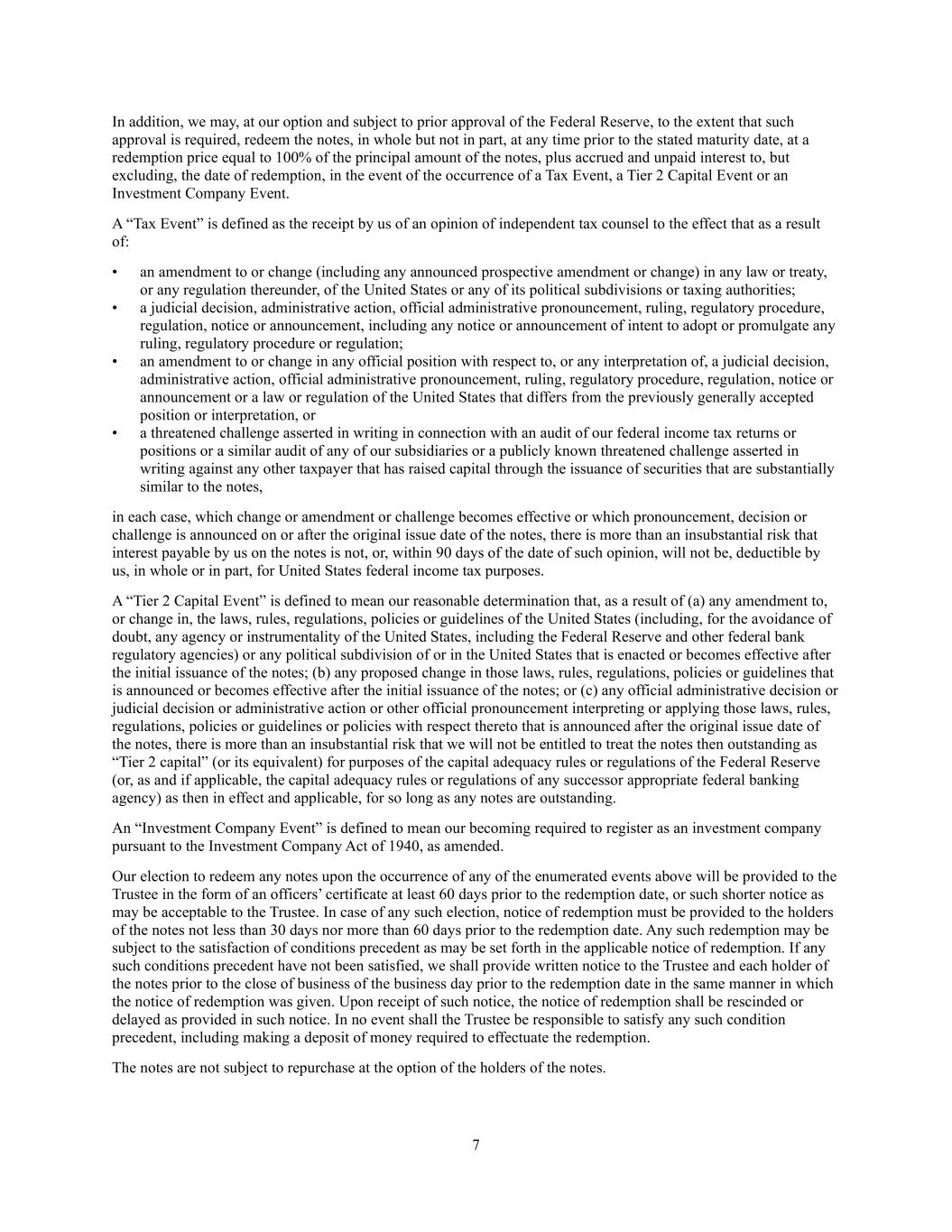
7 In addition, we may, at our option and subject to prior approval of the Federal Reserve, to the extent that such approval is required, redeem the notes, in whole but not in part, at any time prior to the stated maturity date, at a redemption price equal to 100% of the principal amount of the notes, plus accrued and unpaid interest to, but excluding, the date of redemption, in the event of the occurrence of a Tax Event, a Tier 2 Capital Event or an Investment Company Event. A “Tax Event” is defined as the receipt by us of an opinion of independent tax counsel to the effect that as a result of: • an amendment to or change (including any announced prospective amendment or change) in any law or treaty, or any regulation thereunder, of the United States or any of its political subdivisions or taxing authorities; • a judicial decision, administrative action, official administrative pronouncement, ruling, regulatory procedure, regulation, notice or announcement, including any notice or announcement of intent to adopt or promulgate any ruling, regulatory procedure or regulation; • an amendment to or change in any official position with respect to, or any interpretation of, a judicial decision, administrative action, official administrative pronouncement, ruling, regulatory procedure, regulation, notice or announcement or a law or regulation of the United States that differs from the previously generally accepted position or interpretation, or • a threatened challenge asserted in writing in connection with an audit of our federal income tax returns or positions or a similar audit of any of our subsidiaries or a publicly known threatened challenge asserted in writing against any other taxpayer that has raised capital through the issuance of securities that are substantially similar to the notes, in each case, which change or amendment or challenge becomes effective or which pronouncement, decision or challenge is announced on or after the original issue date of the notes, there is more than an insubstantial risk that interest payable by us on the notes is not, or, within 90 days of the date of such opinion, will not be, deductible by us, in whole or in part, for United States federal income tax purposes. A “Tier 2 Capital Event” is defined to mean our reasonable determination that, as a result of (a) any amendment to, or change in, the laws, rules, regulations, policies or guidelines of the United States (including, for the avoidance of doubt, any agency or instrumentality of the United States, including the Federal Reserve and other federal bank regulatory agencies) or any political subdivision of or in the United States that is enacted or becomes effective after the initial issuance of the notes; (b) any proposed change in those laws, rules, regulations, policies or guidelines that is announced or becomes effective after the initial issuance of the notes; or (c) any official administrative decision or judicial decision or administrative action or other official pronouncement interpreting or applying those laws, rules, regulations, policies or guidelines or policies with respect thereto that is announced after the original issue date of the notes, there is more than an insubstantial risk that we will not be entitled to treat the notes then outstanding as “Tier 2 capital” (or its equivalent) for purposes of the capital adequacy rules or regulations of the Federal Reserve (or, as and if applicable, the capital adequacy rules or regulations of any successor appropriate federal banking agency) as then in effect and applicable, for so long as any notes are outstanding. An “Investment Company Event” is defined to mean our becoming required to register as an investment company pursuant to the Investment Company Act of 1940, as amended. Our election to redeem any notes upon the occurrence of any of the enumerated events above will be provided to the Trustee in the form of an officers’ certificate at least 60 days prior to the redemption date, or such shorter notice as may be acceptable to the Trustee. In case of any such election, notice of redemption must be provided to the holders of the notes not less than 30 days nor more than 60 days prior to the redemption date. Any such redemption may be subject to the satisfaction of conditions precedent as may be set forth in the applicable notice of redemption. If any such conditions precedent have not been satisfied, we shall provide written notice to the Trustee and each holder of the notes prior to the close of business of the business day prior to the redemption date in the same manner in which the notice of redemption was given. Upon receipt of such notice, the notice of redemption shall be rescinded or delayed as provided in such notice. In no event shall the Trustee be responsible to satisfy any such condition precedent, including making a deposit of money required to effectuate the redemption. The notes are not subject to repurchase at the option of the holders of the notes.
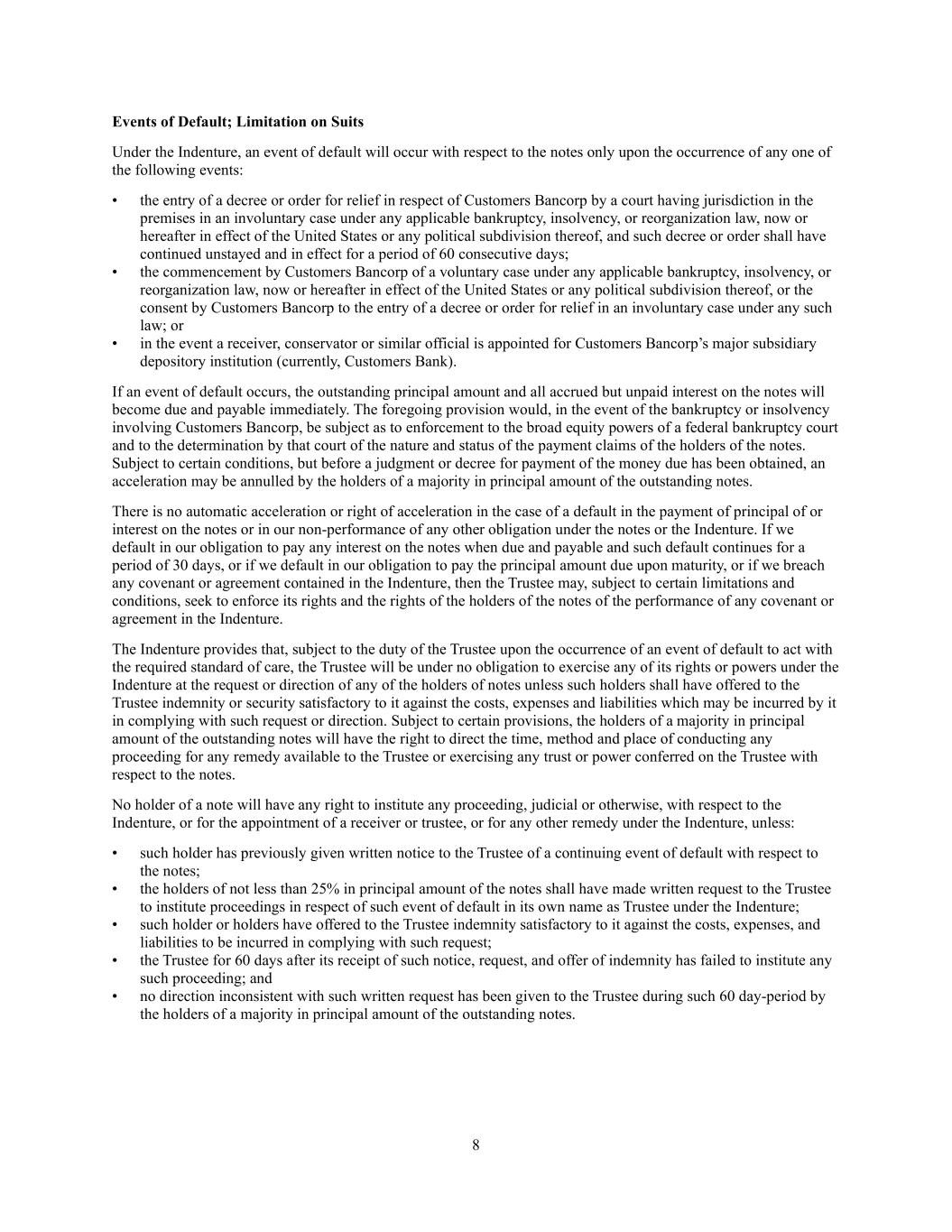
8 Events of Default; Limitation on Suits Under the Indenture, an event of default will occur with respect to the notes only upon the occurrence of any one of the following events: • the entry of a decree or order for relief in respect of Customers Bancorp by a court having jurisdiction in the premises in an involuntary case under any applicable bankruptcy, insolvency, or reorganization law, now or hereafter in effect of the United States or any political subdivision thereof, and such decree or order shall have continued unstayed and in effect for a period of 60 consecutive days; • the commencement by Customers Bancorp of a voluntary case under any applicable bankruptcy, insolvency, or reorganization law, now or hereafter in effect of the United States or any political subdivision thereof, or the consent by Customers Bancorp to the entry of a decree or order for relief in an involuntary case under any such law; or • in the event a receiver, conservator or similar official is appointed for Customers Bancorp’s major subsidiary depository institution (currently, Customers Bank). If an event of default occurs, the outstanding principal amount and all accrued but unpaid interest on the notes will become due and payable immediately. The foregoing provision would, in the event of the bankruptcy or insolvency involving Customers Bancorp, be subject as to enforcement to the broad equity powers of a federal bankruptcy court and to the determination by that court of the nature and status of the payment claims of the holders of the notes. Subject to certain conditions, but before a judgment or decree for payment of the money due has been obtained, an acceleration may be annulled by the holders of a majority in principal amount of the outstanding notes. There is no automatic acceleration or right of acceleration in the case of a default in the payment of principal of or interest on the notes or in our non-performance of any other obligation under the notes or the Indenture. If we default in our obligation to pay any interest on the notes when due and payable and such default continues for a period of 30 days, or if we default in our obligation to pay the principal amount due upon maturity, or if we breach any covenant or agreement contained in the Indenture, then the Trustee may, subject to certain limitations and conditions, seek to enforce its rights and the rights of the holders of the notes of the performance of any covenant or agreement in the Indenture. The Indenture provides that, subject to the duty of the Trustee upon the occurrence of an event of default to act with the required standard of care, the Trustee will be under no obligation to exercise any of its rights or powers under the Indenture at the request or direction of any of the holders of notes unless such holders shall have offered to the Trustee indemnity or security satisfactory to it against the costs, expenses and liabilities which may be incurred by it in complying with such request or direction. Subject to certain provisions, the holders of a majority in principal amount of the outstanding notes will have the right to direct the time, method and place of conducting any proceeding for any remedy available to the Trustee or exercising any trust or power conferred on the Trustee with respect to the notes. No holder of a note will have any right to institute any proceeding, judicial or otherwise, with respect to the Indenture, or for the appointment of a receiver or trustee, or for any other remedy under the Indenture, unless: • such holder has previously given written notice to the Trustee of a continuing event of default with respect to the notes; • the holders of not less than 25% in principal amount of the notes shall have made written request to the Trustee to institute proceedings in respect of such event of default in its own name as Trustee under the Indenture; • such holder or holders have offered to the Trustee indemnity satisfactory to it against the costs, expenses, and liabilities to be incurred in complying with such request; • the Trustee for 60 days after its receipt of such notice, request, and offer of indemnity has failed to institute any such proceeding; and • no direction inconsistent with such written request has been given to the Trustee during such 60 day-period by the holders of a majority in principal amount of the outstanding notes.
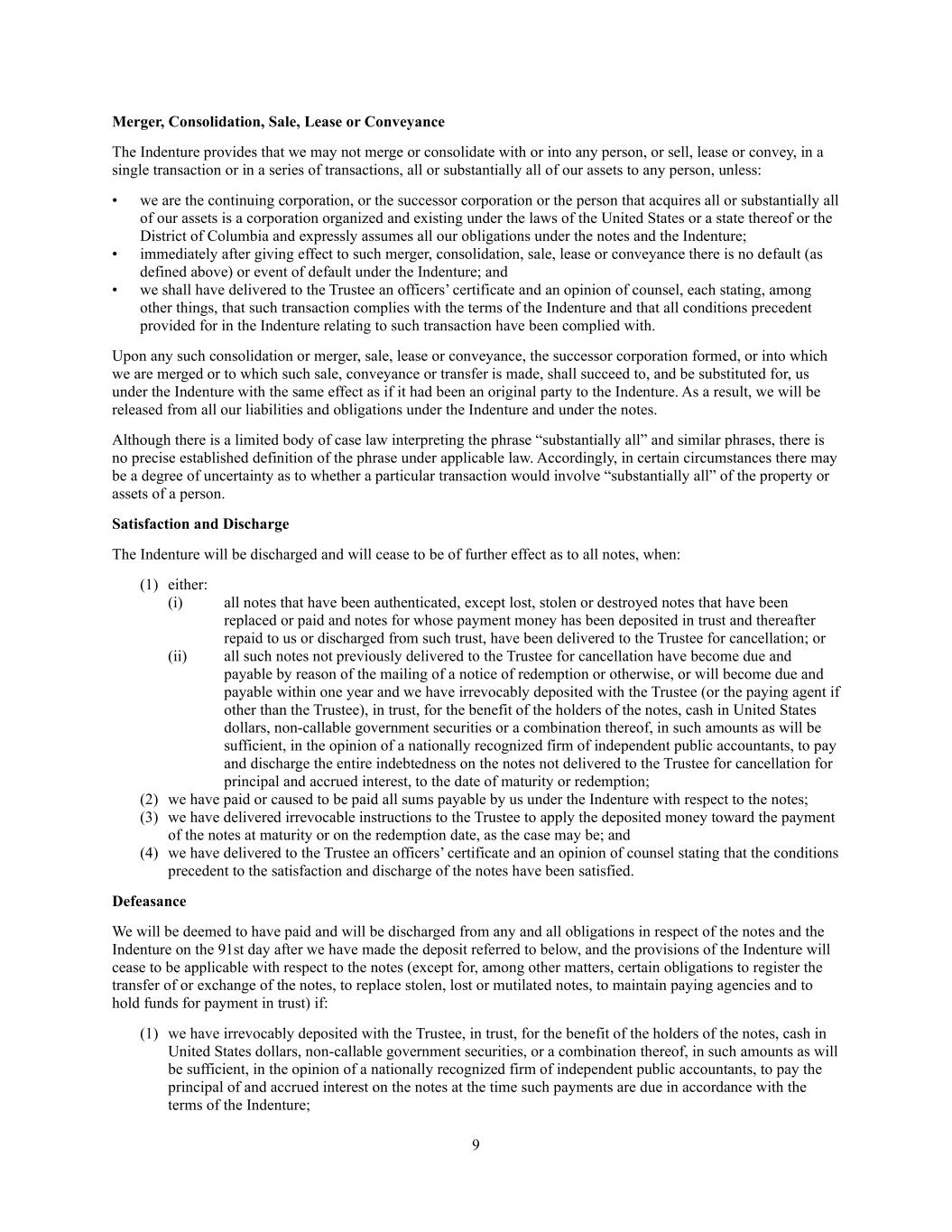
9 Merger, Consolidation, Sale, Lease or Conveyance The Indenture provides that we may not merge or consolidate with or into any person, or sell, lease or convey, in a single transaction or in a series of transactions, all or substantially all of our assets to any person, unless: • we are the continuing corporation, or the successor corporation or the person that acquires all or substantially all of our assets is a corporation organized and existing under the laws of the United States or a state thereof or the District of Columbia and expressly assumes all our obligations under the notes and the Indenture; • immediately after giving effect to such merger, consolidation, sale, lease or conveyance there is no default (as defined above) or event of default under the Indenture; and • we shall have delivered to the Trustee an officers’ certificate and an opinion of counsel, each stating, among other things, that such transaction complies with the terms of the Indenture and that all conditions precedent provided for in the Indenture relating to such transaction have been complied with. Upon any such consolidation or merger, sale, lease or conveyance, the successor corporation formed, or into which we are merged or to which such sale, conveyance or transfer is made, shall succeed to, and be substituted for, us under the Indenture with the same effect as if it had been an original party to the Indenture. As a result, we will be released from all our liabilities and obligations under the Indenture and under the notes. Although there is a limited body of case law interpreting the phrase “substantially all” and similar phrases, there is no precise established definition of the phrase under applicable law. Accordingly, in certain circumstances there may be a degree of uncertainty as to whether a particular transaction would involve “substantially all” of the property or assets of a person. Satisfaction and Discharge The Indenture will be discharged and will cease to be of further effect as to all notes, when: (1) either: (i) all notes that have been authenticated, except lost, stolen or destroyed notes that have been replaced or paid and notes for whose payment money has been deposited in trust and thereafter repaid to us or discharged from such trust, have been delivered to the Trustee for cancellation; or (ii) all such notes not previously delivered to the Trustee for cancellation have become due and payable by reason of the mailing of a notice of redemption or otherwise, or will become due and payable within one year and we have irrevocably deposited with the Trustee (or the paying agent if other than the Trustee), in trust, for the benefit of the holders of the notes, cash in United States dollars, non-callable government securities or a combination thereof, in such amounts as will be sufficient, in the opinion of a nationally recognized firm of independent public accountants, to pay and discharge the entire indebtedness on the notes not delivered to the Trustee for cancellation for principal and accrued interest, to the date of maturity or redemption; (2) we have paid or caused to be paid all sums payable by us under the Indenture with respect to the notes; (3) we have delivered irrevocable instructions to the Trustee to apply the deposited money toward the payment of the notes at maturity or on the redemption date, as the case may be; and (4) we have delivered to the Trustee an officers’ certificate and an opinion of counsel stating that the conditions precedent to the satisfaction and discharge of the notes have been satisfied. Defeasance We will be deemed to have paid and will be discharged from any and all obligations in respect of the notes and the Indenture on the 91st day after we have made the deposit referred to below, and the provisions of the Indenture will cease to be applicable with respect to the notes (except for, among other matters, certain obligations to register the transfer of or exchange of the notes, to replace stolen, lost or mutilated notes, to maintain paying agencies and to hold funds for payment in trust) if: (1) we have irrevocably deposited with the Trustee, in trust, for the benefit of the holders of the notes, cash in United States dollars, non-callable government securities, or a combination thereof, in such amounts as will be sufficient, in the opinion of a nationally recognized firm of independent public accountants, to pay the principal of and accrued interest on the notes at the time such payments are due in accordance with the terms of the Indenture;
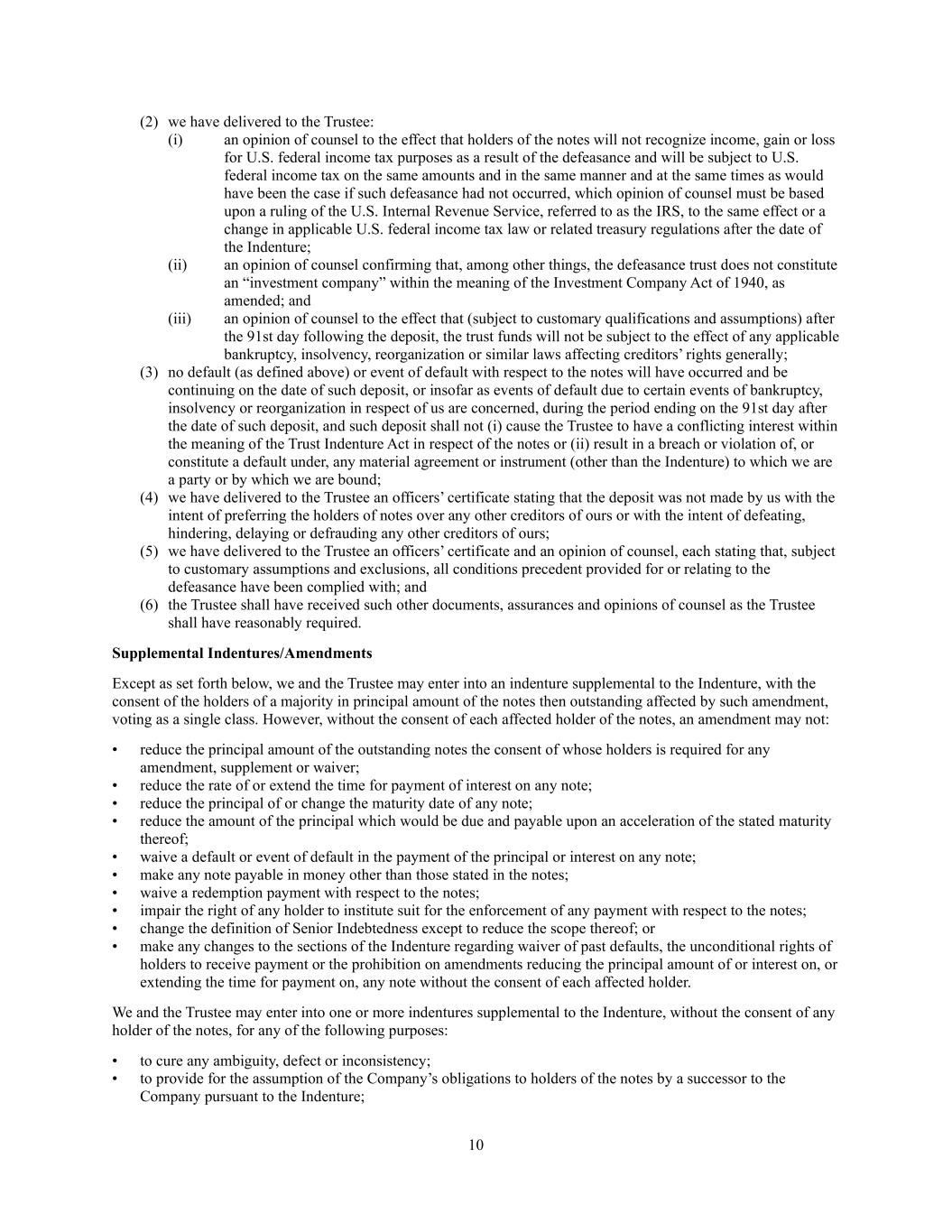
10 (2) we have delivered to the Trustee: (i) an opinion of counsel to the effect that holders of the notes will not recognize income, gain or loss for U.S. federal income tax purposes as a result of the defeasance and will be subject to U.S. federal income tax on the same amounts and in the same manner and at the same times as would have been the case if such defeasance had not occurred, which opinion of counsel must be based upon a ruling of the U.S. Internal Revenue Service, referred to as the IRS, to the same effect or a change in applicable U.S. federal income tax law or related treasury regulations after the date of the Indenture; (ii) an opinion of counsel confirming that, among other things, the defeasance trust does not constitute an “investment company” within the meaning of the Investment Company Act of 1940, as amended; and (iii) an opinion of counsel to the effect that (subject to customary qualifications and assumptions) after the 91st day following the deposit, the trust funds will not be subject to the effect of any applicable bankruptcy, insolvency, reorganization or similar laws affecting creditors’ rights generally; (3) no default (as defined above) or event of default with respect to the notes will have occurred and be continuing on the date of such deposit, or insofar as events of default due to certain events of bankruptcy, insolvency or reorganization in respect of us are concerned, during the period ending on the 91st day after the date of such deposit, and such deposit shall not (i) cause the Trustee to have a conflicting interest within the meaning of the Trust Indenture Act in respect of the notes or (ii) result in a breach or violation of, or constitute a default under, any material agreement or instrument (other than the Indenture) to which we are a party or by which we are bound; (4) we have delivered to the Trustee an officers’ certificate stating that the deposit was not made by us with the intent of preferring the holders of notes over any other creditors of ours or with the intent of defeating, hindering, delaying or defrauding any other creditors of ours; (5) we have delivered to the Trustee an officers’ certificate and an opinion of counsel, each stating that, subject to customary assumptions and exclusions, all conditions precedent provided for or relating to the defeasance have been complied with; and (6) the Trustee shall have received such other documents, assurances and opinions of counsel as the Trustee shall have reasonably required. Supplemental Indentures/Amendments Except as set forth below, we and the Trustee may enter into an indenture supplemental to the Indenture, with the consent of the holders of a majority in principal amount of the notes then outstanding affected by such amendment, voting as a single class. However, without the consent of each affected holder of the notes, an amendment may not: • reduce the principal amount of the outstanding notes the consent of whose holders is required for any amendment, supplement or waiver; • reduce the rate of or extend the time for payment of interest on any note; • reduce the principal of or change the maturity date of any note; • reduce the amount of the principal which would be due and payable upon an acceleration of the stated maturity thereof; • waive a default or event of default in the payment of the principal or interest on any note; • make any note payable in money other than those stated in the notes; • waive a redemption payment with respect to the notes; • impair the right of any holder to institute suit for the enforcement of any payment with respect to the notes; • change the definition of Senior Indebtedness except to reduce the scope thereof; or • make any changes to the sections of the Indenture regarding waiver of past defaults, the unconditional rights of holders to receive payment or the prohibition on amendments reducing the principal amount of or interest on, or extending the time for payment on, any note without the consent of each affected holder. We and the Trustee may enter into one or more indentures supplemental to the Indenture, without the consent of any holder of the notes, for any of the following purposes: • to cure any ambiguity, defect or inconsistency; • to provide for the assumption of the Company’s obligations to holders of the notes by a successor to the Company pursuant to the Indenture;
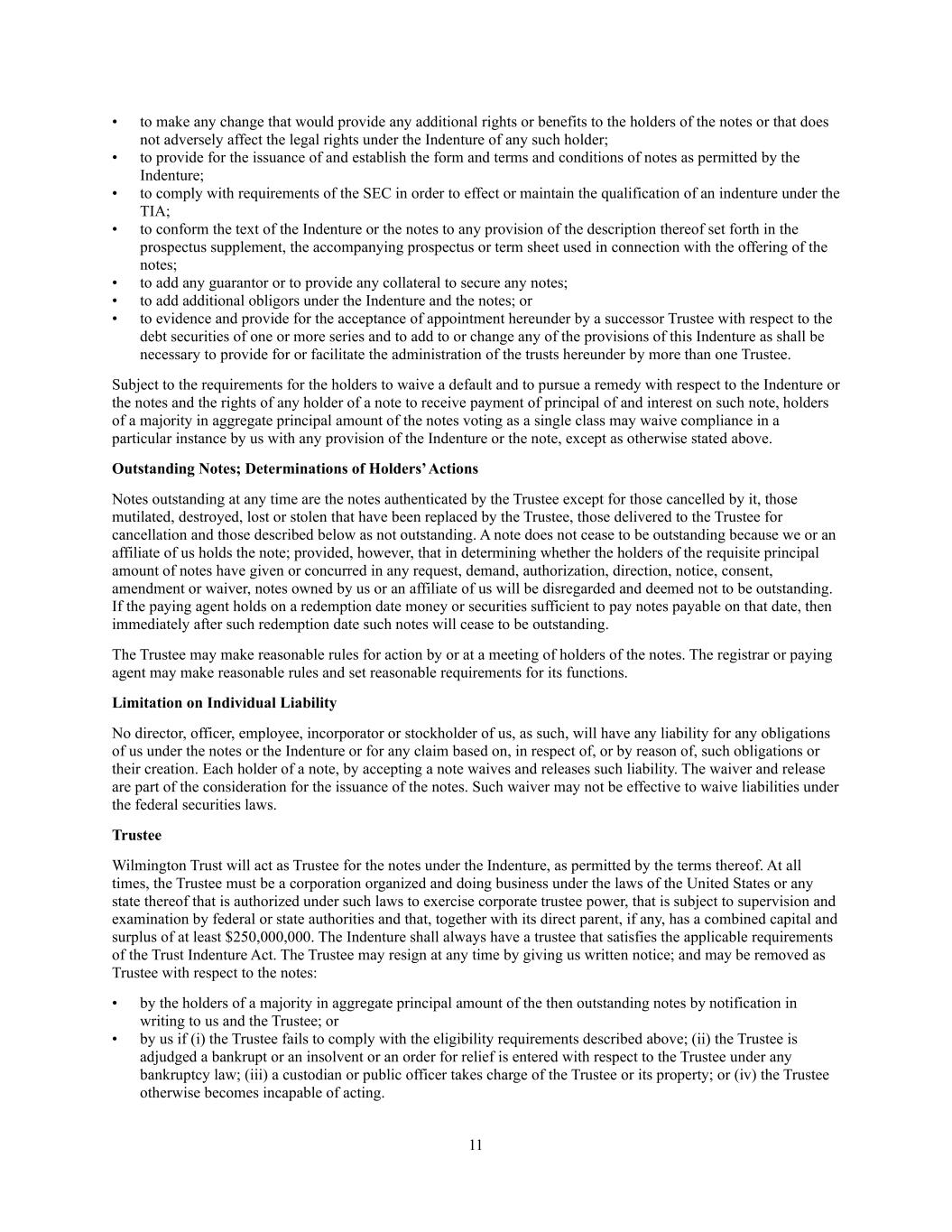
11 • to make any change that would provide any additional rights or benefits to the holders of the notes or that does not adversely affect the legal rights under the Indenture of any such holder; • to provide for the issuance of and establish the form and terms and conditions of notes as permitted by the Indenture; • to comply with requirements of the SEC in order to effect or maintain the qualification of an indenture under the TIA; • to conform the text of the Indenture or the notes to any provision of the description thereof set forth in the prospectus supplement, the accompanying prospectus or term sheet used in connection with the offering of the notes; • to add any guarantor or to provide any collateral to secure any notes; • to add additional obligors under the Indenture and the notes; or • to evidence and provide for the acceptance of appointment hereunder by a successor Trustee with respect to the debt securities of one or more series and to add to or change any of the provisions of this Indenture as shall be necessary to provide for or facilitate the administration of the trusts hereunder by more than one Trustee. Subject to the requirements for the holders to waive a default and to pursue a remedy with respect to the Indenture or the notes and the rights of any holder of a note to receive payment of principal of and interest on such note, holders of a majority in aggregate principal amount of the notes voting as a single class may waive compliance in a particular instance by us with any provision of the Indenture or the note, except as otherwise stated above. Outstanding Notes; Determinations of Holders’ Actions Notes outstanding at any time are the notes authenticated by the Trustee except for those cancelled by it, those mutilated, destroyed, lost or stolen that have been replaced by the Trustee, those delivered to the Trustee for cancellation and those described below as not outstanding. A note does not cease to be outstanding because we or an affiliate of us holds the note; provided, however, that in determining whether the holders of the requisite principal amount of notes have given or concurred in any request, demand, authorization, direction, notice, consent, amendment or waiver, notes owned by us or an affiliate of us will be disregarded and deemed not to be outstanding. If the paying agent holds on a redemption date money or securities sufficient to pay notes payable on that date, then immediately after such redemption date such notes will cease to be outstanding. The Trustee may make reasonable rules for action by or at a meeting of holders of the notes. The registrar or paying agent may make reasonable rules and set reasonable requirements for its functions. Limitation on Individual Liability No director, officer, employee, incorporator or stockholder of us, as such, will have any liability for any obligations of us under the notes or the Indenture or for any claim based on, in respect of, or by reason of, such obligations or their creation. Each holder of a note, by accepting a note waives and releases such liability. The waiver and release are part of the consideration for the issuance of the notes. Such waiver may not be effective to waive liabilities under the federal securities laws. Trustee Wilmington Trust will act as Trustee for the notes under the Indenture, as permitted by the terms thereof. At all times, the Trustee must be a corporation organized and doing business under the laws of the United States or any state thereof that is authorized under such laws to exercise corporate trustee power, that is subject to supervision and examination by federal or state authorities and that, together with its direct parent, if any, has a combined capital and surplus of at least $250,000,000. The Indenture shall always have a trustee that satisfies the applicable requirements of the Trust Indenture Act. The Trustee may resign at any time by giving us written notice; and may be removed as Trustee with respect to the notes: • by the holders of a majority in aggregate principal amount of the then outstanding notes by notification in writing to us and the Trustee; or • by us if (i) the Trustee fails to comply with the eligibility requirements described above; (ii) the Trustee is adjudged a bankrupt or an insolvent or an order for relief is entered with respect to the Trustee under any bankruptcy law; (iii) a custodian or public officer takes charge of the Trustee or its property; or (iv) the Trustee otherwise becomes incapable of acting.
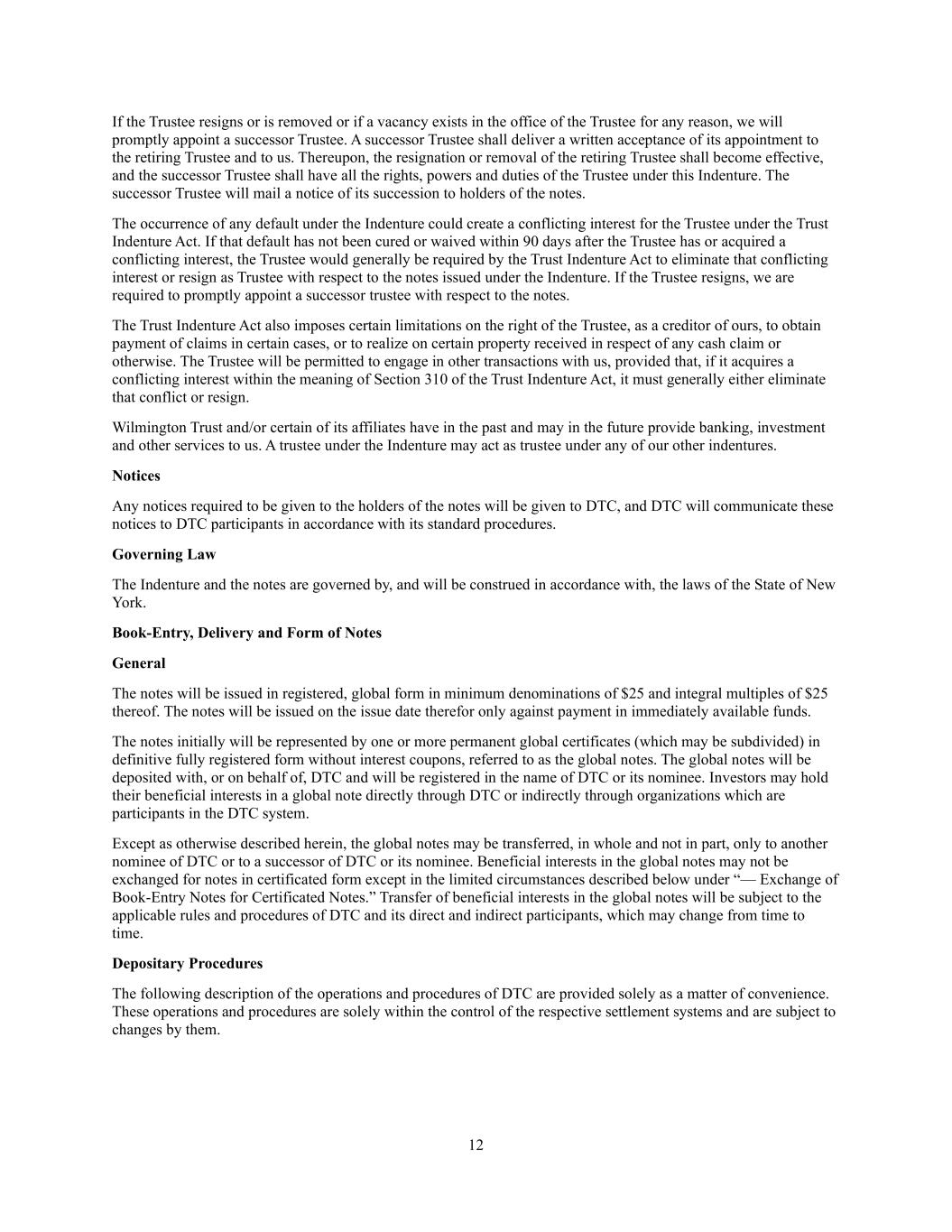
12 If the Trustee resigns or is removed or if a vacancy exists in the office of the Trustee for any reason, we will promptly appoint a successor Trustee. A successor Trustee shall deliver a written acceptance of its appointment to the retiring Trustee and to us. Thereupon, the resignation or removal of the retiring Trustee shall become effective, and the successor Trustee shall have all the rights, powers and duties of the Trustee under this Indenture. The successor Trustee will mail a notice of its succession to holders of the notes. The occurrence of any default under the Indenture could create a conflicting interest for the Trustee under the Trust Indenture Act. If that default has not been cured or waived within 90 days after the Trustee has or acquired a conflicting interest, the Trustee would generally be required by the Trust Indenture Act to eliminate that conflicting interest or resign as Trustee with respect to the notes issued under the Indenture. If the Trustee resigns, we are required to promptly appoint a successor trustee with respect to the notes. The Trust Indenture Act also imposes certain limitations on the right of the Trustee, as a creditor of ours, to obtain payment of claims in certain cases, or to realize on certain property received in respect of any cash claim or otherwise. The Trustee will be permitted to engage in other transactions with us, provided that, if it acquires a conflicting interest within the meaning of Section 310 of the Trust Indenture Act, it must generally either eliminate that conflict or resign. Wilmington Trust and/or certain of its affiliates have in the past and may in the future provide banking, investment and other services to us. A trustee under the Indenture may act as trustee under any of our other indentures. Notices Any notices required to be given to the holders of the notes will be given to DTC, and DTC will communicate these notices to DTC participants in accordance with its standard procedures. Governing Law The Indenture and the notes are governed by, and will be construed in accordance with, the laws of the State of New York. Book-Entry, Delivery and Form of Notes General The notes will be issued in registered, global form in minimum denominations of $25 and integral multiples of $25 thereof. The notes will be issued on the issue date therefor only against payment in immediately available funds. The notes initially will be represented by one or more permanent global certificates (which may be subdivided) in definitive fully registered form without interest coupons, referred to as the global notes. The global notes will be deposited with, or on behalf of, DTC and will be registered in the name of DTC or its nominee. Investors may hold their beneficial interests in a global note directly through DTC or indirectly through organizations which are participants in the DTC system. Except as otherwise described herein, the global notes may be transferred, in whole and not in part, only to another nominee of DTC or to a successor of DTC or its nominee. Beneficial interests in the global notes may not be exchanged for notes in certificated form except in the limited circumstances described below under “— Exchange of Book-Entry Notes for Certificated Notes.” Transfer of beneficial interests in the global notes will be subject to the applicable rules and procedures of DTC and its direct and indirect participants, which may change from time to time. Depositary Procedures The following description of the operations and procedures of DTC are provided solely as a matter of convenience. These operations and procedures are solely within the control of the respective settlement systems and are subject to changes by them.
13 We do not take any responsibility for these operations and procedures and urge investors to contact the systems or their participants to directly discuss these matters. DTC has advised us that it is a limited-purpose trust company organized under the New York Banking Law, a “banking organization” within the meaning of the New York Banking Law, a member of the Federal Reserve System, a “clearing corporation” within the meaning of the Uniform Commercial Code and a “clearing agency” registered pursuant to the provisions of Section 17A of the Exchange Act. DTC was created to hold securities for its participating organizations, referred to as participants, and to facilitate the clearance and settlement of transactions in those securities between participants through electronic, computerized book-entry changes in accounts of its participants, thereby eliminating the need for physical movement of certificates. Participants include both U.S. and non-U.S. securities brokers and dealers, banks, trust companies, clearing corporations and certain other organizations. Indirect access to DTC’s system is also available to banks, securities brokers, dealers, trust companies and clearing corporations that clear through or maintain a custodial relationship with a participant, either directly or indirectly, referred to as indirect participants. Persons who are not participants may beneficially own securities held by or on behalf of DTC only through participants or indirect participants. The ownership interest and transfer of ownership interest of each actual purchaser of each security held by or on behalf of DTC are recorded on the records of participants and indirect participants. DTC has advised us that, pursuant to procedures established by it: • upon deposit of the global notes, DTC will credit the accounts of participants designated by the underwriters with portions of the principal amount of the global notes; and • ownership of interests in the global notes will be shown on, and the transfer of ownership of the global notes will be effected only through, records maintained by DTC (with respect to participants) or by participants and indirect participants (with respect to other owners of beneficial interests in the global notes). Upon issuance, a holder may hold its interests in the global notes directly through DTC if it is a participant, or indirectly through organizations that are participants or indirect participants. The depositaries, in turn, will hold interests in the notes in customers’ securities accounts in the depositaries’ names on the books of DTC. All interests in a global note will be subject to the procedures and requirements of DTC. The laws of some jurisdictions require that certain persons take physical delivery in certificated form of securities that they own. Consequently, the ability to transfer beneficial interests in a global note to those persons will be limited to that extent. Because DTC can act only on behalf of participants, which in turn act on behalf of indirect participants and certain banks, the ability of a person having beneficial interests in a global note to pledge its interests to persons or entities that do not participate in the DTC system, or otherwise take actions in respect of its interests, may be affected by the lack of a physical certificate evidencing its interests. For certain other restrictions on the transferability of the notes, see “— Exchange of Book-Entry Notes for Certificated Notes.” Except as described below, owners of interests in the global notes will not have notes registered in their name, will not receive physical delivery of notes in certificated form and will not be considered the registered owners or holders thereof under the Indenture for any purpose. Payments on the global notes registered in the name of DTC, or its nominee, will be payable in immediately available funds by the Trustee (or the paying agent if other than the Trustee) to DTC or its nominee in its capacity as the registered holder under the Indenture. We and the Trustee, as applicable, will treat the persons in whose names the notes, including the global notes, are registered as the owners thereof for the purpose of receiving such payments and for any and all other purposes whatsoever. Neither the Trustee nor any agent thereof has or will have any responsibility or liability for: • any aspect of DTC’s records or any participant’s or indirect participant’s records relating to, or payments made on account of, beneficial ownership interests in the global notes, or for maintaining, supervising or reviewing any of DTC’s records or any participant’s or indirect participant’s records relating to the beneficial ownership interests in the global notes; or • any other matter relating to the actions and practices of DTC or any of its participants or indirect participants.
14 DTC has advised us that its current practice, upon receipt of any payment in respect of securities such as the notes (including principal and interest), is to credit the accounts of the relevant participants with the payment on the payment date, in amounts proportionate to their respective holdings in the principal amount of the relevant security as shown on the records of DTC, unless DTC has reason to believe it will not receive payment on such payment date. Payments by participants and indirect participants to the beneficial owners of notes will be governed by standing instructions and customary practices and will be the responsibility of participants or indirect participants and will not be the responsibility of DTC, the Trustee, as applicable, or us. Neither we nor the Trustee will be liable for any delay by DTC or any of its participants or indirect participants in identifying the beneficial owners of the notes, and we and the Trustee may conclusively rely on and will be protected in relying on instructions from DTC or its nominee for all purposes. If less than all of the notes are being redeemed, DTC’s current practice is to determine by lot the amount of the interest of each participant in such global notes to be redeemed. Initial settlement for the notes will be made in immediately available funds. Any secondary market trading activity in interests in the global notes will settle in immediately available funds, subject in all cases to the rules and procedures of DTC and its participants. Transfers between participants in DTC will be effected in accordance with DTC’s procedures, and will settle in same-day funds. DTC has advised us that it will take any action permitted to be taken by a holder of notes only at the direction of one or more participants who have an interest in DTC’s global notes in respect of the portion of the principal amount of the notes as to which the participant or participants has or have given direction. However, if an event of default exists under the Indenture, DTC reserves the right to exchange the global notes for notes in certificated form and to distribute the certificated notes to its participants. We believe that the information in this section concerning DTC and its book-entry system has been obtained from reliable sources, but we do not take responsibility for the accuracy or completeness of this information. Although DTC will agree to the procedures described in this section to facilitate transfers of interests in the global notes among participants in DTC, DTC is not obligated to perform or to continue to perform these procedures, and these procedures may be discontinued at any time by giving reasonable notice. Neither we nor the Trustee will have any responsibility or liability for any aspect of the performance by DTC or its participants or indirect participants of any of their respective obligations under the rules and procedures governing their operations or for maintaining, supervising or reviewing any records relating to the global notes that are maintained by DTC or any of its participants or indirect participants. Exchange of Book-Entry Notes for Certificated Notes A global note is exchangeable for certificated notes in definitive, fully registered form without interest coupons if: • DTC notifies us that it is unwilling or unable to continue as depositary for the global notes and we fail to appoint a successor depositary within 90 days of receipt of DTC’s notice, or DTC has ceased to be a clearing agency registered under the Exchange Act and we fail to appoint a successor depositary within 90 days of becoming aware of this condition; or • at our request, DTC notifies holders of the notes that they may utilize DTC’s procedures to cause the notes to be issued in certificated form, and such holders request such issuance. In addition, beneficial interests in a global note may be exchanged by or on behalf of DTC for certificated notes upon request by DTC, but only upon at least 20 days prior written notice given to the Trustee in accordance with DTC’s customary procedures. In all cases, certificated notes delivered in exchange for any global note or beneficial interests therein will be registered in the names, and issued in any approved denominations, requested by or on behalf of the depository in accordance with its customary procedures.