
UNITED STATES
SECURITIES AND EXCHANGE COMMISSION
Washington, D.C. 20549
SCHEDULE 14A
Proxy Statement Pursuant to Section 14(a) of the
Securities Exchange Act of 1934
|
Filed by the Registrant ☑ |
Filed by a Party other than the Registrant ☐ |
|
Check the appropriate box:
|
☐ |
Preliminary Proxy Statement |
|
☐ |
Confidential, for Use of the Commission Only (as permitted by Rule 14a‑6(e)(2)) |
|
☑ |
Definitive Proxy Statement |
|
☐ |
Definitive Additional Materials |
|
☐ |
Soliciting Material Pursuant to §240.14a‑12 |
REVA Medical, Inc.
(Name of Registrant as Specified in Its Charter)
Payment of Filing Fee (Check the appropriate box):
|
☑ |
No fee required. |
|
☐ |
Fee computed on table below per Exchange Act Rules 14(a)‑6(i)(1) and 0‑11. |
|
|
(1) |
Title of each class of securities to which transaction applies: |
|
|
(2) |
Aggregate number of securities to which transaction applies: |
|
|
(3) |
Per unit price or other underlying value of transaction computed pursuant to Exchange Act Rule 0‑11 (sets forth the amount on which the filing fee is calculated and state how it was determined): |
|
|
(4) |
Proposed maximum aggregate value of transaction: |
|
|
(5) |
Total fee paid: |
|
☐ |
Fee paid previously with preliminary materials. |
|
☐ |
Check box if any part of the fee is offset as provided by Exchange Act Rule 0‑11(a)(2) and identify the filing for which the offsetting fee was paid previously. Identify the previous filing by registration statement number, or the Form or Schedule and the date of its filing. |
|
|
(1) |
Amount Previously Paid: |
|
|
(2) |
Form, Schedule or Registration Statement No.: |
|
|
(3) |
Filing Party: |
|
|
(4) |
Date Filed: |
April 5, 2018
Dear Stockholders:
We cordially invite you to attend our Annual General Meeting of Stockholders, also referred to as the “AGM” or the “Annual Meeting.” The meeting will be held Wednesday, May 16, 2018 at 4:00 p.m., US Pacific Daylight Time (which is 9:00 a.m. Thursday, 17 May 2018 Australian Eastern Standard Time), at the offices of DLA Piper LLP (US), 4365 Executive Drive, Suite 1100, San Diego, California 92121, U.S.A.
The matters to be acted upon are described in the accompanying Notice of 2018 Annual Meeting of Stockholders and Proxy Statement and consist of the following:
|
|
1) |
Election of two Class II board members |
|
|
2) |
Election of one Class I board member |
|
|
3) |
Ratification of auditors |
|
|
4) |
Approve issuance of equity securities up to 10% of the issued capital of the company |
|
|
5) |
Advisory vote on the frequency of a stockholder vote on executive compensation |
|
|
6) |
Advisory vote on executive compensation |
|
|
7) |
Approval of the issuance and transfer of securities under the Amended and Restated 2010 Equity Incentive Plan |
|
|
8) |
Approval of stock options and RSUs to directors |
|
|
9) |
Approval to transact any other business to come before the meeting |
Following the formal business of the meeting, management will provide an update on REVA’s operations; a copy of the management presentation will be posted on our website the day of the meeting.
All stockholders are invited to attend the Annual Meeting in person. Whether or not you expect to attend the Annual Meeting, you are urged to vote or submit your Proxy Card or CHESS Depositary Interest (or “CDI”) Voting Instruction Form as soon as possible so that your shares can be voted at the Annual Meeting in accordance with your instructions. Telephone and Internet voting are available. For specific instructions on voting, please refer to the instructions in the Notice of Annual Meeting of Stockholders or the Proxy Card or CDI Voting Instruction Form. If you hold your shares through an account with a brokerage firm, bank, or other nominee, please follow the instructions you receive from them to vote your shares.
We look forward to seeing you at our Annual Meeting.
Very Truly Yours,
/s/ C. Raymond Larkin
C. Raymond Larkin
Chairman of the Board
|
NOTICE OF 2018 ANNUAL MEETING OF STOCKHOLDERS
To Be Held 17 May 2018 (Australian Eastern Standard Time) May 16, 2018 (U.S. Pacific Daylight Time)
|
The 2018 Annual General Meeting (the “AGM” or “Annual Meeting”) of Stockholders of REVA Medical, Inc. will be held on 17 May 2018, at 9:00 a.m., Australian Eastern Standard Time (which is 4:00 p.m. on May 16, 2018 U.S. Pacific Daylight Time) at the offices of DLA Piper LLP (US), 4365 Executive Drive, Suite 1100, San Diego, California 92121, U.S.A., for the following purposes:
|
|
1. |
To elect the two Class II directors named in the Proxy Statement to hold office for a term of three years, and until their successors are duly elected and qualified, or until their earlier resignation or removal; |
|
|
2. |
To elect one Class I director named in the Proxy Statement to hold office for a term of two years, and until his successor is duly elected and qualified, or until his earlier resignation or removal; |
|
|
3. |
To ratify the appointment of Grant Thornton LLP as our independent registered public accounting firm for the fiscal year ending December 31, 2018; |
|
|
4. |
For the purposes of Australian Securities Exchange (“ASX”) Listing Rule 7.1A and for all other purposes, to approve the issuance of equity securities up to 10% of the issued capital of the Company (calculated in accordance with the formula prescribed in ASX Listing Rule 7.1A) on the terms and conditions set forth in the Proxy Statement; |
|
|
5. |
To vote, on an advisory basis, on the frequency of a stockholder vote on executive compensation; |
|
|
6. |
To approve, on an advisory basis, the compensation of the named executive officers for the fiscal year ended December 31, 2017, as set forth in the Proxy Statement; |
|
|
7. |
For the purposes of ASX Listing Rule 7.2 (Exception 9) and for all other purposes, to approve the issuance and transfer of securities under the Amended and Restated 2010 Equity Incentive Plan on the terms and conditions set forth in the Proxy Statement, as an exception to ASX Listing Rule 7.1; |
|
|
8. |
For the purposes of ASX Listing Rule 10.14 and for all other purposes, to approve the grant of 25,000 options to purchase 25,000 shares of common stock to Dr. Ross A. Breckenridge on the terms and conditions set forth in the Proxy Statement; |
|
|
9. |
For the purposes of ASX Listing Rule 10.14 and for all other purposes, to approve the grant of 25,000 options to purchase 25,000 shares of common stock to Brian H. Dovey on the terms and conditions set forth in the Proxy Statement; |
|
|
11. |
For the purposes of ASX Listing Rule 10.14 and for all other purposes, to approve the grant of 61,095 options to purchase 61,095 shares of common stock to C. Raymond Larkin on the terms and conditions set forth in the Proxy Statement; |
|
|
12. |
For the purposes of ASX Listing Rule 10.14 and for all other purposes, to approve the grant of 86,917 options to purchase 86,917 shares of common stock to Dr. Stephen N. Oesterle on the terms and conditions set forth in the Proxy Statement; |
|
|
13. |
For the purposes of ASX Listing Rule 10.14 and for all other purposes, to approve the grant of 25,000 options to purchase 25,000 shares of common stock to Robert B. Stockman on the terms and conditions set forth in the Proxy Statement; |
|
|
14. |
For the purposes of ASX Listing Rule 10.14 and for all other purposes, to approve the grant of 25,000 options to purchase 25,000 shares of common stock to Robert B. Thomas on the terms and conditions set forth in the Proxy Statement; |
|
|
15. |
To transact such other business as may properly come before the meeting or any adjournment or postponement of the meeting. |
Our Board of Directors recommends that our stockholders vote “FOR” the three nominees for director, “1 YEAR” for Proposal 5, and “FOR” all other Proposals, except for Dr. Ross A. Breckenridge with respect to Proposal 8 only; Brian H. Dovey with respect to Proposal 9 only; Regina E. Groves with respect to Proposal 10 only; C. Raymond Larkin with respect to Proposal 11 only; Dr. Stephen N. Oesterle with respect to Proposal 12 only; Robert B. Stockman with respect to Proposal 13 only; and, Robert B. Thomas with respect to Proposal 14 only, all of who abstain from making a recommendation on those Proposals due to their personal interests in the Proposals.
You are entitled to vote only if you were a REVA Medical, Inc. stockholder as of 4:30 p.m. on 28 March 2018 Australian Eastern Daylight Time (which was 10:30 p.m. on March 27, 2018 U.S. Pacific Daylight Time), the Record Date for the Annual Meeting. The owners of common stock as of that date are entitled to vote at the Annual Meeting and any adjournment or postponement of the meeting. Record holders of CHESS Depositary Interests (or “CDIs”) as of the close of business on the Record Date, are entitled to receive notice of and to attend the meeting or any adjournment or postponement of the meeting and may instruct our CDI Depositary, CHESS Depositary Nominees Pty Ltd (or “CDN”) to vote the shares underlying their CDIs by following the instructions on the CDI Voting Instruction Form or by voting online at www.investorvote.com.au. Doing so permits CDI holders to instruct CDN to vote on behalf of the CDI holders at the meeting in accordance with the instructions received via the CDI Voting Instruction Form or online.
For ten days prior to the meeting, a complete list of stockholders entitled to vote at the meeting will be available for examination by any stockholder, for any purpose relating to the meeting, during ordinary business hours at our principal offices located at 5751 Copley Drive, San Diego, California 92111, U.S.A.
The Proxy Statement that accompanies and forms part of this Notice of Annual Meeting provides information in relation to each of the matters to be considered. This Notice of Annual Meeting and the Proxy Statement should be read in their entirety. If stockholders are in doubt as to how they should vote, they should seek advice from their legal counsel, accountant, solicitor, or other professional advisor prior to voting.
By order of the Board of Directors:
/s/ Brandi L. Roberts
Brandi L. Roberts
Chief Financial Officer and Secretary
IMPORTANT: To ensure that your shares are represented at the meeting, please vote your shares (or, for CDI holders, direct CDN to vote your CDIs) via the Internet, by telephone, or by marking, signing, dating, and returning a Proxy Card or CDI Voting Instruction Form to the address specified. If you attend the meeting, you may choose to vote in person even if you have previously voted your shares, except that CDI holders may only instruct CDN to vote on their behalf by completing and signing the CDI Voting Instruction Form or voting online at www.investorvote.com.au and may not vote in person.
IMPORTANT NOTICE REGARDING THE AVAILABILITY OF
PROXY MATERIALS FOR THE ANNUAL MEETING OF STOCKHOLDERS:
Our Proxy Statement and 2017 Annual Report on Form 10-K
are available at
www.envisionreports.com/RVA (for holders of shares)
and at
www.investorvote.com.au (for holders of CDIs)
REVA MEDICAL, INC.
5751 Copley Drive, San Diego, California 92111, U.S.A.
PROXY STATEMENT FOR THE ANNUAL GENERAL MEETING OF STOCKHOLDERS
17 MAY 2018 (AUSTRALIAN EASTERN STANDARD TIME)
MAY 16, 2018 (U.S. PACIFIC DAYLIGHT TIME)
This Proxy Statement, along with a Proxy Card and/or CDI Voting Instruction Form,
is being made available to our stockholders and CDI holders on or about April 5, 2018
Why am I receiving these materials?
We have made these proxy materials available to you in connection with the solicitation by the Board of Directors (the “Board”) of REVA Medical, Inc. (the “Company” or “REVA”) of proxies to be voted at our 2018 Annual General Meeting of Stockholders (the “AGM” or “Annual Meeting”) to be held on 17 May 2018, at 9:00 a.m., Australian Eastern Standard Time (which is 4:00 p.m. on May 16, 2018 U.S. Pacific Daylight Time), at the DLA Piper LLP (US) offices in San Diego, CA, and at any postponements or adjournments of the Annual Meeting. If you held shares of our common stock as of 4:30 p.m. on 28 March 2018 Australian Eastern Daylight Time (which was 10:30 p.m. on March 27, 2018 U.S. Pacific Daylight Time), the Record Date for the Annual Meeting, you are invited to attend the Annual Meeting and vote on the proposals described below under the heading “On what proposals am I voting?” Those persons holding CHESS Depositary Interests (“CDIs”) are entitled to receive notice of and to attend the AGM and may instruct CHESS Depositary Nominees Pty Ltd. (“CDN”) to vote at the Annual Meeting by following the instructions on the CDI Voting Instruction Form or by voting online at www.investorvote.com.au.
On what proposals am I voting?
There are 14 proposals scheduled to be voted on at the Annual Meeting:
|
|
1) |
Election of the two Class II directors named in this Proxy Statement to hold office for a term of three years, and until their successors are duly elected and qualified, or until their earlier resignation or removal; |
|
|
2) |
Election of the Class I director named in this Proxy Statement to hold office for a term of two years, and until his successor is duly elected and qualified, or until his earlier resignation or removal; |
|
|
3) |
Ratification of the appointment of Grant Thornton LLP as our independent registered public accounting firm for the fiscal year ending December 31, 2018; |
|
|
4) |
For the purposes of Australian Securities Exchange (“ASX”) Listing Rule 7.1A and for all other purposes, to approve the issuance of equity securities up to 10% of the issued capital of the company (calculated in accordance with the formula prescribed in ASX Listing Rule 7.1A) on the terms and conditions set forth in the Proxy Statement; |
|
|
5) |
To vote, on an advisory basis, on the frequency of a stockholder vote on executive compensation; |
|
|
6) |
Approval, on an advisory basis, of the compensation of the named executive officers for the fiscal year ended December 31, 2017, as set forth in this Proxy Statement; |
|
|
7) |
Approval of the issuance and transfer of securities under the Amended and Restated 2010 Equity Incentive Plan on the terms and conditions set forth in this Proxy Statement; |
|
|
8) |
Approval of the grant of 25,000 options to purchase 25,000 shares of common stock to Dr. Ross A. Breckenridge on the terms and conditions set forth in this Proxy Statement; |
|
|
9) |
Approval of the grant of 25,000 options to purchase 25,000 shares of common stock to Brian H. Dovey on the terms and conditions set forth in this Proxy Statement; |
|
|
10) |
Approval of the grant of 226,000 options to purchase 226,000 shares of common stock and the award of 114,000 restricted stock units for 114,000 shares of common stock to Regina E. Groves on the terms and conditions set forth in this Proxy Statement; |
- 1 -
|
|
11) |
Approval of the grant of 61,095 options to purchase 61,095 shares of common stock to C. Raymond Larkin on the terms and conditions set forth in this Proxy Statement; |
|
|
12) |
Approval of the grant of 86,917 options to purchase 86,917 shares of common stock to Dr. Stephen N. Oesterle on the terms and conditions set forth in this Proxy Statement; |
|
|
13) |
Approval of the grant of 25,000 options to purchase 25,000 shares of common stock to Robert B. Stockman on the terms and conditions set forth in this Proxy Statement; |
|
|
14) |
Approval of the grant of 25,000 options to purchase 25,000 shares of common stock to Robert B. Thomas on the terms and conditions set forth in this Proxy Statement; |
How does the Board recommend that I vote?
Our Board recommends that you vote your shares “FOR” all Proposals, except for: Dr. Ross A. Breckenridge with respect to Proposal 8 only; Brian H. Dovey with respect to Proposal 9 only; Regina E. Groves with respect to Proposal 10 only; C. Raymond Larkin with respect to Proposal 11 only; Dr. Stephen N. Oesterle with respect to Proposal 12 only; Robert B. Stockman with respect to Proposal 13 only; and, Robert B. Thomas with respect to Proposal 14 only. Those directors abstain from making a recommendation on those specific Proposals due to their personal interests in the Proposals.
Who is entitled to vote at the Annual Meeting?
If you were a holder of REVA common stock, either as a stockholder of record or as the beneficial owner of shares held in street name as of 4:30 p.m. on 28 March 2018 Australian Eastern Daylight Time (which was 10:30 p.m. on March 27, 2018 U.S. Pacific Daylight Time), the Record Date for the Annual Meeting, subject to the voting exclusions below, you may vote your shares at the Annual Meeting. As of the Record Date, there were 41,245,820 shares of our common stock outstanding (equivalent to 412,458,200 CDIs assuming all shares of common stock were converted into CDIs on the Record Date). Each stockholder has one vote for each share of common stock held as of the Record Date. Each CDI holder is entitled to direct CDN to vote one vote for every ten (10) CDIs held by such holder. As summarized below, there are some distinctions between shares held of record and those owned beneficially and held in street name.
What does it mean to be a “stockholder of record?”
You are a “stockholder of record” if your shares are registered directly in your name with our transfer agent, Computershare Trust Company, N.A. As a stockholder of record, you have the right to grant your voting proxy directly to REVA or to vote in person at the Annual Meeting. You may vote by Internet, telephone, or mail, as described below under the heading “How do I vote my shares of REVA common stock?” Holders of CDIs are entitled to receive notice of and to attend the Annual Meeting and may direct CDN to vote at the Annual Meeting by following the instructions on the CDI Voting Instruction Form or by voting online at www.investorvote.com.au.
What does it mean to beneficially own shares in “street name?”
You are deemed to beneficially own your shares in “street name” if your shares are held in an account at a brokerage firm, bank, broker‑dealer, trust, custodian, or other similar organization. If this is the case, proxy materials were forwarded to you by that organization. As the beneficial owner, you have the right to direct your broker, bank, trustee, or nominee how to vote your shares, and you are also invited to attend the Annual Meeting.
If you hold your shares in street name and do not provide voting instructions to your broker, your shares will not be voted on any proposals for which your broker does not have discretionary authority to vote (a “broker non‑vote”). Since a beneficial owner is not the stockholder of record, you may not vote your shares in person at the Annual Meeting unless you obtain a “legal proxy” from the broker, bank, trustee, or nominee that holds your shares giving you the right to vote at the meeting. If you do not wish to vote in person or will not be attending the Annual Meeting, you may vote by proxy. Proxies can be lodged by Internet or telephone, as described below under “How do I vote my shares of REVA common stock?”
How many shares must be present or represented to conduct business at the Annual Meeting?
The quorum requirement for holding the Annual Meeting and transacting business is that holders of one-third of the voting power of the issued and outstanding shares of our common stock entitled to vote generally in the election of directors must be present in person or represented by proxy. Abstentions and shares represented by “broker non‑votes” are counted for the purpose of determining the presence of a quorum. As of the Record Date, there were 41,245,820 shares of our common stock outstanding, and each share is entitled to one vote at the Annual Meeting.
- 2 -
What is the voting requirement to approve each of the proposals?
Subject to voting exclusion statements for a Proposal, the vote required to approve each Proposal is set forth below. Information on voting exclusion statements are set forth in the additional information provided for each Proposal.
Proposals 1 and 2 — Election of Directors
Directors are elected by a plurality of the votes cast by the stockholders entitled to vote at the election, which means that the director nominees receiving the highest number of “FOR” votes will be elected. Neither abstentions nor broker non‑votes will count in determining which nominees received the largest number of votes cast and they will have no direct effect on the outcome of the election of directors.
Proposal 3 — Ratification of the Appointment of our Independent Registered Public Accounting Firm
The proposal to ratify the appointment of Grant Thornton LLP requires the affirmative vote of a majority of the shares present in person or represented by proxy at the Annual Meeting and entitled to vote on such proposal. Abstentions are considered shares present and entitled to vote and thus will have the effect of a vote “AGAINST” this proposal. Broker non-votes will have no direct effect on the outcome of this proposal.
Proposal 4 — Approval of Issuance of up to 10% of the Issued Capital of the Company
The proposal to approve the issuance of equity securities of up to 10 percent of the issued capital of the Company requires the affirmative vote of the holders of 75 percent of the shares present in person or represented by proxy at the Annual Meeting and voting on such proposals. Abstentions are considered shares present and entitled to vote and thus will have the effect of a vote “AGAINST” this proposal. Broker non-votes will have no direct effect on the outcome of this proposal.
Proposal 5 — Advisory Vote on the Frequency of a Stockholder Vote on Executive Compensation
The proposal on whether advisory votes on executive compensation should be conducted annually, biennially or triennially will be determined by a plurality of votes, which means that the choice of frequency that receives the highest number of votes will be considered the advisory vote of the Company’s stockholders. Abstentions and broker non-votes will not count in determining which frequency choice received the largest number of votes, and will have no direct effect on the outcome of this proposal.
Proposal 6 — Approval, on an Advisory Basis, of Executive Compensation
The proposal to approve, on an advisory basis, the compensation awarded to the named executive officers for the fiscal year ended December 31, 2017 requires the affirmative vote of a majority of the shares present in person or represented by proxy at the Annual Meeting and entitled to vote on such proposal. Abstentions are considered shares present and entitled to vote and thus will have the effect of a vote “AGAINST” this proposal. Broker non-votes will have no direct effect on the outcome of this proposal.
Proposal 7 – Approval of the Issuance and Transfer of Securities under the Company’s Amended and Restated 2010 Equity Incentive Plan
The proposal to approve the issuance and transfer of securities under the Amended and Restated 2010 Equity Incentive Plan requires the affirmative vote of a majority of the shares present in person or represented by proxy at the Annual Meeting and entitled to vote on such proposal. Abstentions are considered shares present and entitled to vote and thus will have the effect of a vote “AGAINST” this proposal. Broker non-votes will have no direct effect on the outcome of this proposal.
Proposals 8 through 14 — Approval of the Grant of Stock Options and Restricted Stock Units to Directors
Each of the proposals to approve the grants of options to purchase shares of common stock or restricted stock units under the 2010 Equity Incentive Plan, as amended, to each of the non-executive directors of the Company requires the affirmative vote of the holders of a majority of the shares present in person or represented by proxy at the Annual Meeting and entitled to vote on such proposal. Abstentions are considered shares present and entitled to vote and thus will have the effect of a vote “AGAINST” these proposals. Broker non-votes will have no direct effect on the outcome of these proposals.
Voting exclusion statement:
The Company will disregard any votes cast on Proposals 7 through 14 by any director of REVA and by any associate of any director of REVA.
- 3 -
However, the Company need not disregard a vote cast on Proposals 7 through 14 if:
|
|
• |
it is cast by a person as a proxy for a person who is entitled to vote, in accordance with the direction on the proxy card; or |
|
|
• |
it is cast by the person chairing the meeting as a proxy for a person who is entitled to vote, in accordance with the direction on the proxy card to vote as the proxy decides. |
How do I vote my shares of REVA common stock?
If you are a stockholder of record, you can vote in the following ways:
|
|
• |
By Internet: |
CDI holders: by following the Internet voting instructions included in the Notice of Annual Meeting of Stockholders at any time up until 9:00 a.m. on 14 May 2018 Australian Eastern Standard Time (which is 4:00 p.m. on May 13, 2018 U.S. Pacific Daylight Time);
U.S. stockholders: by following the Internet voting instructions included in the Notice of Annual Meeting of Stockholders at any time up until 1:30 a.m. U.S. Central Time on May 15, 2018
|
|
• |
By Telephone: |
U.S. stockholders: by following the telephone voting instructions included in the Notice of Annual Meeting of Stockholders at any time up until 1:30 a.m. U.S. Central Time on May 15, 2018
|
|
• |
By Mail: by marking, dating, and signing your proxy card in accordance with the instructions on it and returning it by mail in the pre‑addressed reply envelope. The proxy card must be received prior to the Annual Meeting. |
If your shares are held through a benefit or compensation plan or in street name, your plan trustee or your bank, broker, or other nominee should give you instructions for voting your shares. In these cases, you may vote by Internet, telephone, or mail by submitting a Voting Instruction Form.
If you satisfy the admission requirements to the Annual Meeting, as described below under the heading “How do I attend the Annual Meeting?” you may vote your shares in person at the meeting. Even if you plan to attend the Annual Meeting, we encourage you to vote in advance by Internet, telephone, or mail so that your vote will be counted in the event you later decide not to attend the Annual Meeting. Shares held through a benefit or compensation plan cannot be voted in person at the Annual Meeting.
How do I vote if I hold CDIs?
Each CDI holder is entitled to direct CDN to vote one vote for every ten (10) CDIs held by such holder. Those persons holding CDIs are entitled to receive notice of and to attend the Annual Meeting and any adjournment or postponement thereof, and may direct CDN to vote their underlying shares of common stock at the Annual Meeting by voting online at www.investorvote.com.au, or by returning the CDI Voting Instruction Form to Computershare, the agent we designated for the collection and processing of voting instructions from our CDI holders, no later than 9:00 a.m. on 14 May 2018 Australian Eastern Standard Time (which is 4:00 p.m. on May 13, 2018 U.S. Pacific Daylight Time) in accordance with the instructions on such form. Doing so permits CDI holders to instruct CDN to vote on their behalf in accordance with their written directions.
Alternatively, CDI holders have the following options in order to vote at the Annual Meeting:
|
|
• |
informing REVA that they wish to nominate themselves or another person to be appointed as CDN’s proxy for the purposes of attending and voting at the meeting; or |
|
|
• |
converting their CDIs into a holding of shares of REVA’s common stock and voting these at the meeting (however, if thereafter the former CDI holder wishes to sell their investment on ASX, it would be necessary to convert shares of common stock back into CDIs). This must be done prior to the record date for the meeting. |
As holders of CDIs will not appear on REVA’s share register as the legal holders of the shares of common stock, they will not be entitled to vote at our stockholder meetings unless one of the above steps is undertaken.
- 4 -
How do I attend the Annual Meeting?
Admission to the Annual Meeting is limited to REVA stockholders and CDI holders, one member of their immediate families, or their named representatives. We reserve the right to limit the number of immediate family members or representatives who may attend the meeting. Stockholders of record, holders of CDIs of record, immediate family member guests, and representatives will be required to present government‑issued photo identification (e.g., driver’s license or passport) to gain admission to the meeting. Please be advised that no cameras, recording equipment, electronic devices, large bags, briefcases, or packages will be permitted in the meeting.
To register to attend the Annual Meeting, please contact REVA’s investor relations as follows:
|
|
• |
by e‑mail at IR@revamedical.com; |
|
|
• |
by phone at (858) 966-3045 in the U.S. or at +61 3 9866 4722 in Australia; or |
|
|
• |
by mail to Investor Relations at 5751 Copley Drive, San Diego, California 92111, U.S.A. |
Please include the following information in your request:
|
|
• |
your name and complete mailing address; |
|
|
• |
whether you require special assistance at the meeting; |
|
|
• |
if you will be naming a representative to attend the meeting on your behalf, the name, complete mailing address, and telephone number of that individual; |
|
|
• |
proof that you own shares of REVA’s common stock or hold CDIs as of the Record Date (such as a letter from your bank, broker, or other financial institution; a photocopy of a current brokerage, Computershare, or other account statement; or, a photocopy of a holding statement); and, |
|
|
• |
the name of your immediate family member guest, if one will accompany you. |
What does it mean if I receive more than one Notice of Annual Meeting of Stockholders?
It generally means you hold shares registered in multiple accounts. To ensure that all your shares are voted, please submit proxies or voting instructions for all of your shares.
May I change my vote or revoke my proxy?
Yes.
If you are a stockholder of record, you may change your vote or revoke your proxy by:
|
|
• |
filing a written statement to that effect with our Corporate Secretary at or before the taking of the vote at the Annual Meeting; |
|
|
• |
voting again via the Internet or telephone at a later time before the closing of those voting facilities for: |
CDI holders: at any time up until 9:00 a.m. on 14 May 2018 Australian Eastern Standard Time (which is 4:00 p.m. on May 13, 2018 U.S. Pacific Daylight Time) or
U.S. stockholders: at any time up until 1:30 a.m. U.S. Central Time on May 15, 2018;
|
|
• |
submitting a properly signed proxy card with a later date that is received at or prior to the Annual Meeting; or, |
|
|
• |
attending the Annual Meeting, revoking your proxy, and voting in person. |
The written statement or subsequent proxy should be delivered to REVA Medical, Inc., 5751 Copley Drive, San Diego, California 92111, U.S.A., Attention: Corporate Secretary, or hand delivered to the Corporate Secretary, before the taking of the vote at the Annual Meeting. If you are a beneficial owner and hold shares through a broker, bank, or other nominee, you may submit new voting instructions by contacting your broker, bank, or other nominee. You may also change your vote or revoke your voting instructions in person at the Annual Meeting if you obtain a signed proxy from the record holder (broker, bank, or other nominee) giving you the right to vote the shares.
If you are a holder of CDIs and you direct CDN to vote by completing the CDI Voting Instruction Form, you may revoke those directions by delivering to Computershare, no later than 9:00 a.m. on 14 May 2018 Australian Eastern Standard Time
- 5 -
(which is 4:00 p.m. on May 13, 2018 U.S. Pacific Daylight Time), a written notice of revocation bearing a later date than the CDI Voting Instruction Form previously sent.
Could other matters be decided at the Annual Meeting?
We are currently unaware of any matters to be raised at the Annual Meeting other than those presented in this Proxy Statement. If other matters are properly presented for consideration at the Annual Meeting and you are a stockholder of record and have submitted your proxy, the persons named in your proxy will have the discretion to vote on those matters for you.
Who will pay for the cost of soliciting proxies?
We will pay the cost of soliciting proxies, including the cost of preparing and mailing proxy materials. Proxies may be solicited on our behalf by directors, officers, or employees (for no additional compensation) in person or by telephone, electronic transmission, and facsimile transmission.
If we hire soliciting agents, we will pay them a reasonable fee for their services. We will not pay directors, officers, or other regular employees any additional compensation for their efforts to supplement our proxy solicitation. We anticipate that banks, brokerage houses, and other custodians, nominees, and fiduciaries may forward soliciting material to the beneficial owners of shares of common stock entitled to vote at the Annual Meeting and that we will reimburse those persons for their out‑of‑pocket expenses incurred in this connection.
PROPOSAL 1 — ELECTION OF class ii DIRECTORS
At the Annual Meeting, our stockholders will be asked to elect the two directors nominated for election as Class II directors. Our Board of Directors currently consists of eight members and is divided into three classes; Class I and II comprise three directors each and Class III comprises two directors. The directors in Class II, if elected, will serve three‑year terms and in each case until their respective successors are duly elected and qualified. On March 22, 2018, the Board unanimously nominated Robert B. Thomas and C. Raymond Larkin for election at the 2018 Annual Meeting. R. Scott Huennekens, our other Class II director, has informed us that he does not intend to stand for re-election due to other time commitments.
Robert B. Thomas is a current Class II director whose term expires at the Annual Meeting. Our Board appointed C. Raymond Larkin on July 13, 2017 to serve as a Class II director until the next annual general meeting after his appointment (being this Annual Meeting), when he must be duly elected by a vote of our stockholders. If elected, the two directors nominated as Class II directors will serve until the Company’s annual meeting of stockholders in 2021, and in each case until their successors are elected and qualified, or until their earlier resignation or removal. Both nominees have indicated their willingness to serve if elected, but if any should be unable to serve or for good cause will not serve, the shares represented by proxies may be voted for a substitute as REVA may designate, unless a contrary instruction is indicated in the proxy.
If another Board member is not appointed as a Class II director by the date of the Annual General Meeting to replace R. Scott Huennekens, we may have a vacancy on the Board.
Vote Required for Approval
Directors are elected by a plurality of the votes cast at the Annual Meeting, which means that the two director nominees receiving the highest number of “FOR” votes will be elected as Class II directors. Abstentions and broker non‑votes are not counted as votes cast with respect to that director, and will have no direct effect on the outcome of the election of directors.
THE BOARD OF DIRECTORS UNANIMOUSLY RECOMMENDS THAT STOCKHOLDERS VOTE
“FOR” THE ELECTION OF EACH OF THE DIRECTOR NOMINEES NAMED ABOVE.
PROPOSAL 2 — ELECTION OF class i DIRECTOR
At the Annual Meeting, our stockholders will be asked to elect one director nominated for election as a Class I director. Our Board of Directors currently consists of eight members and is divided into three classes; Class I and II comprise three
- 6 -
directors each and Class III comprises two directors. The Class I director, if elected, will serve a two‑year term and until his respective successor is duly elected and qualified. On March 22, 2018, our Board unanimously nominated Dr. Stephen N. Oesterle for election at the 2018 Annual Meeting as a Class I director. Our Board appointed Dr. Stephen N. Oesterle on February 5, 2018 to serve as a Class I director until the next annual general meeting after his appointment (being this Annual Meeting), when he must be duly elected by a vote of our stockholders.
If elected, the Class I director will serve until the Company’s annual meeting of stockholders in 2020, and until his successor is elected and qualified, or until his earlier resignation or removal. The nominee has indicated his willingness to serve if elected, but if he should be unable to serve or for good cause will not serve, the shares represented by proxies may be voted for a substitute as REVA may designate, unless a contrary instruction is indicated in the proxy.
Vote Required for Approval
Directors are elected by a plurality of the votes cast at the Annual Meeting, which means that the director nominee receiving the highest number of “FOR” votes will be elected as a Class I director. Abstentions and broker non‑votes are not counted as votes cast with respect to that director, and will have no direct effect on the outcome of the election of directors.
THE BOARD OF DIRECTORS UNANIMOUSLY RECOMMENDS THAT STOCKHOLDERS VOTE
“FOR” THE ELECTION OF THE DIRECTOR NOMINEE NAMED ABOVE.
PROPOSAL 3 — RATIFICATION OF INDEPENDENT AUDITOR
The audit committee has selected Grant Thornton LLP as the Company’s independent registered public accounting firm (the “independent auditor”) to audit our financial statements for the fiscal year ending December 31, 2018. We are asking our stockholders to ratify the appointment of Grant Thornton LLP as our independent auditor because we value our stockholders’ views on the Company’s independent auditor even though the ratification is not required by our bylaws or otherwise. If our stockholders fail to ratify the appointment, the audit committee will reconsider whether or not to retain Grant Thornton LLP as our independent auditor or whether to consider the appointment of a different firm. Even if the appointment is ratified, the audit committee in its discretion may direct the appointment of a different independent auditor at any time for the fiscal year ending December 31, 2018.
A representative of Grant Thornton LLP is expected to be present at the Annual Meeting, will have an opportunity to make a statement if he or she desires to do so, and will be available to respond to appropriate questions.
Vote Required for Approval
Ratification of the appointment of Grant Thornton LLP as our independent registered public accounting firm for the fiscal year ending December 31, 2018 requires the affirmative vote of a majority of the shares of common stock of the Company present in person or represented by proxy at the Annual Meeting and entitled to vote. Abstentions are considered shares present and entitled to vote and thus will have the effect of a vote “AGAINST” this proposal. Broker non-votes will have no direct effect on the outcome of this proposal.
THE BOARD OF DIRECTORS UNANIMOUSLY RECOMMENDS THAT STOCKHOLDERS vote
“FOR” THE RATIFICATION OF OUR INDEPENDENT auditor.
PROPOSAL 4 — APPROVAL OF ISSUANCE OF UP TO 10% OF THE ISSUED CAPITAL OF THE COMPANY
Introduction
We are a U.S. public reporting company listed on ASX and, therefore, are required to comply with the U.S. federal securities laws and the ASX Listing Rules. We are seeking stockholder approval for the potential issuance of securities in the future solely for purpose of ASX Listing Rules, as further described below.
- 7 -
ASX Listing Rule 7.1 allows a company to issue a maximum of 15 percent of its issued capital in any 12-month period without obtaining stockholder approval. In accordance with ASX Listing Rule 7.1A, eligible companies can issue a further 10 percent of their issued capital over a 12-month period (the “Placement Securities”) without obtaining stockholder approval for the individual issues, provided that stockholder approval is obtained at the company’s annual meeting (and the company is an “eligible entity” at the time of the annual meeting). The Company is an “eligible entity” as of the date of this Proxy Statement.
Under ASX Listing Rule 7.1A, the Placement Securities must be in the same class as an existing quoted class of equity securities of the Company. As of the date of this Proxy Statement, the Company has only one quoted class of equity securities on issue, namely CDIs (and the shares of common stock underlying those CDIs).
The purpose of this Proposal 4 is to provide us with flexibility to meet future business and financial needs. We believe that it is advantageous for us to have the ability to act promptly with respect to potential opportunities and that approval of the issuance of the Placement Securities is desirable in order to have the securities available, as needed, for possible future financing transactions, strategic transactions, or other general corporate purposes that are determined by our board to be in the Company’s best interests.
Approval of this Proposal 4 would enable us to issue shares of common stock or CDIs without the expense and delay of holding a stockholders’ meeting, except as may be required by applicable law or regulations. The cost, prior notice requirements, and delay involved in obtaining stockholder approval at the time a corporate action may become necessary could eliminate the opportunity to effect the action or could reduce the expected benefits.
If approved, subject to the limitations described below with respect to the additional 10 percent placement capacity, we will generally be permitted to issue up to 25 percent of our issued and outstanding capital without any further stockholder approval, unless such stockholder approval is required by applicable law, the rules of ASX, or the rules or another stock exchange on which our securities may be listed. Currently, we have no definitive plans, understandings, agreements, or arrangements to issue securities for any purpose, other than equity awards under our 2010 Equity Incentive Plan. We believe that the adoption of this Proposal 4 will enable us to promptly and appropriately respond to business opportunities or to raise additional equity capital. Our board of directors will determine the terms of any issuance of securities in the future.
The Company is seeking stockholder approval to have the ability to issue Placement Securities under ASX Listing Rule 7.1A. The exact number of Placement Securities that may be issued by the Company under ASX Listing Rule 7.1A will be determined in accordance with the formula prescribed in ASX Listing Rule 7.1A.2, as follows:
(A x D) - E
A = Number of fully paid ordinary securities on issue 12 months before the date of issue or agreement:
• plus the number of fully paid ordinary securities issued during the 12 months under an exception in ASX Listing Rule 7.2;
• plus the number of partly paid ordinary securities that became fully paid during the 12 months;
• plus the number of fully paid ordinary securities issued during the 12 months with stockholder approval under ASX Listing Rules 7.1 and 7.4; and,
• less the number of fully paid ordinary securities cancelled during the 12 months.
D = 10%
E = Number of equity securities issued or agreed to be issued under Listing Rule 7.1A.2 in the 12 months before the date of issue or agreement to issue that are not issued with stockholder approval under ASX Listing Rules 7.1 or 7.4.
If passed, Proposal 4 will allow our board of directors to issue up to an additional 10 percent of the Company’s issued capital during the 12-month period following the date of the annual meeting without requiring further stockholder approval. This is in addition to the 15 percent annual placement capacity provided in ASX Listing Rule 7.1.
- 8 -
As of the date of this Proxy Statement, the Company has no specific plans to issue Placement Securities under ASX Listing Rule 7.1A.
As required by ASX Listing Rule 7.3A, the following information is provided in relation to this Proposal 4:
(a) ASX Listing Rule 7.3A.1 — The minimum price at which Placement Securities may be issued pursuant to the ASX Listing Rule 7.1A approval will be no less than 75% of the volume weighted average price of the Company’s CDIs calculated over the 15 trading days on which trades in that class were recorded immediately before:
• the date on which the issue price of the Placement Securities is agreed; or
• if Placement Securities are not issued within 5 trading days of the date on which the issue price is agreed, the date on which Placement Securities are issued.
In accordance with ASX listing rules, if the Placement Securities are issued for non-cash consideration, the Company will provide a valuation to the market that demonstrates the non-cash consideration issue price of the Placement Securities complies with ASX Listing Rule 7.3A.
(b) ASX Listing Rule 7.3A.2 — If the Company issues Placement Securities under ASX Listing Rule 7.1A, the existing stockholders of the Company face the risk of economic and voting dilution as a result of the issue of Placement Securities, to the extent that such Placement Securities are issued, including the risk that:
• the market price for Placement Securities may be significantly lower on the issue date than on the date of the approval under ASX Listing Rule 7.1A; and
• Placement Securities may be issued at a price that is at a discount to the market price for those securities on the issue date.
The following table describes the potential dilution to existing stockholders on the basis of three different issue prices and values for variable ‘A’ in the formula in ASX Listing Rule 7.1A.2. The prices and values set out in the table are examples only and include scenarios prescribed by the ASX Listing Rules. Accordingly, they provide no indication of the actual market price of the Company’s CDIs or the price at which issues of Placement Securities under ASX Listing Rule 7.1A will be made (assuming Proposal 4 is approved by stockholders).
|
Variable 'A' in Listing Rule 7.1.A.2 |
|
|
|
CDI issue price of A$0.20 (50% of the current market price of the Company's CDIs) |
|
CDI issue price of A$0.40 (100% of the current market price of the Company's CDIs) |
|
CDI issue price of A$0.80 (200% of the current market price of the Company's CDIs) |
|
412,458,200 CDIs |
|
10% Voting Dilution |
|
41,245,820 CDIs |
|
41,245,820 CDIs |
|
41,245,820 CDIs |
|
(current variable 'A') |
|
Funds raised |
|
A$8,249,164 |
|
A$16,498,328 |
|
A$32,996,656 |
|
|
|
|
|
|
|
|
|
|
|
618,687,300 CDIs |
|
10% Voting Dilution |
|
61,868,730 CDIs |
|
61,868,730 CDIs |
|
61,868,730 CDIs |
|
(50% increase in variable 'A') |
|
Funds raised |
|
A$12,373,746 |
|
A$24,747,492 |
|
A$49,494,984 |
|
|
|
|
|
|
|
|
|
|
|
824,916,400 CDIs |
|
10% Voting Dilution |
|
82,491,640 CDIs |
|
82,491,640 CDIs |
|
82,491,640 CDIs |
|
(100% increase in variable 'A') |
|
Funds raised |
|
A$16,498,328 |
|
A$32,996,656 |
|
A$65,993,312 |
|
|
|
|
|
|
|
|
|
|
- 9 -
The above table has been prepared based on the following assumptions:
|
|
• |
The Company issues (as CDIs) the maximum number of Placement Securities available under the 10% placement capacity prescribed by ASX Listing Rule 7.1A. |
|
|
• |
No options are exercised before the date of issue of Placement Securities under ASX Listing Rule 7.1A. |
|
|
• |
The 10% voting dilution reflects the aggregate percentage dilution against the issued share capital at the time of issue. This is why the voting dilution is shown in each example as 10%. |
|
|
• |
The table shows only the effect of issues of Placement Securities under ASX Listing Rule 7.1A, not under the Company’s 15% placement capacity under ASX Listing Rule 7.1. |
|
|
• |
The issue price of A$0.40 is the last closing price of the Company’s CDIs on ASX as of March 22, 2018. |
|
|
• |
Assuming all shares of common stock are held as CDIs. |
(c) ASX Listing Rule 7.3A.3 — The date the Placement Securities must be issued by (assuming this Proposal 4 is approved by stockholders) is the date that is 12 months after the date of the Company’s 2018 annual general meeting (i.e., 17 May 2019 (Australian Time)) unless the Company approves a transaction under ASX Listing Rule 11.1.2 (a significant change to the nature or scale of the Company’s activities) or ASX Listing Rule 11.2 (disposal of the Company’s main undertaking), in which case the ASX Listing Rule 7.1A approval under this Proposal 4 will fall away on the date of stockholder approval for the relevant transaction.
(d) ASX Listing Rule 7.3A.4 — The Placement Securities will be issued for the purpose of funding the Company’s operations, including research and development, preclinical and clinical studies and commercialization.
(e) ASX Listing Rule 7.3A.5 — the Company’s allocation policy for issues of Placement Securities pursuant to approval under this Proposal 4 will depend on prevailing market conditions and the Company’s circumstances at the time of any proposed issue. The form and timing of any issue of Placement Securities under ASX Listing Rule 7.1A and the identity of the allottees of Placement Securities will be determined on a case by case basis having regard to any one or more of the following:
• the methods of raising funds available to the Company including, but not limited to, rights issues or other issues in which existing stockholders of the Company can participate;
• the effect of the issue of placement securities on the control of the Company;
• the financial situation of the Company; and
• advice from any one or more of the Company’s professional advisers.
Allottees for the purposes of the issue of Placement Securities under ASX Listing Rule 7.1A have not been determined as at the date of this Proxy Statement but may include existing substantial stockholders and/or new stockholders who are not related parties or associates of as related party of the Company. In addition, if the Company is successful in acquiring new assets or investments, it is possible that allottees for the purpose of the issue of Placement Securities under ASX Listing Rule 7.1A will be or include vendors or include vendors of the new assets or investments.
As of the date of this Proxy Statement, the Company has not formed an intention as to the parties which it may approach to participate in an issue of Placement Securities under ASX Listing Rule 7.1A including which such an issue would be made to existing stockholders or to new investors.
(f) ASX Listing Rule 7.3A.6— the Company previously obtained stockholder approval under ASX Listing Rule 7.1A at its 2016 Annual Meeting on 26 May 2016. The Company has not issued any securities pursuant to that ASX Listing Rule 7.1A approval which expired on 26 May 2017.
- 10 -
The Company will disregard any votes cast in respect of Proposal 4 by a person who may participate in the proposed issue of any Placement Securities and a person who might obtain a benefit, except a benefit solely in the capacity of a holder of shares, if Proposal 4 is passed, and any associates of those persons. However, the Company need not disregard a vote if:
• it is cast by a person as a proxy for a person who is entitled to vote, in accordance with the direction on the proxy card; or
• it is cast by the person chairing the meeting as a proxy for a person who is entitled to vote, in accordance with direction on the proxy card to vote as the proxy decides.
As at the date of this Proxy Statement, the Company has no specific plans to issue Placement Securities under ASX Listing Rule 7.1A and therefore it is not known who, if any, may participate in a potential issue of Placement Securities, if any, under ASX Listing Rule 7.1A. Accordingly, as at the date of this Proxy Statement, the Company is not aware of any person who would be excluded from voting on this Proposal 4.
Vote required and Board of Directors Recommendation
Under ASX Listing Rule 7.1A, Proposal 4 is required to be passed as a special resolution for the purposes of the ASX Listing Rules, which means that it must be approved by at least 75 percent of the votes cast by stockholders entitled to vote on Proposal 4.
THE BOARD OF DIRECTORS UNANIMOUSLY RECOMMENDS THAT STOCKHOLDERS VOTE “FOR” THE ISSUANCE OF SECURITIES OF UP TO 10% OF THE ISSUED CAPITAL OF THE COMPANY.
PROPOSAL 5 — ADVISORY VOTE ON THE FREQUENCY OF A STOCKHOLDER VOTE ON EXECUTIVE COMPENSATION
This proposal gives our stockholders the opportunity, through the following resolution, to advise our Board how often we should conduct an advisory “Say on Pay” vote on the compensation of our named executive officers:
“RESOLVED, that an advisory vote of the stockholders of REVA Medical, Inc. to approve the compensation of named executive officers as disclosed pursuant to the United States Securities and Exchange Commission (“SEC”) compensation disclosure rules, shall be held at an annual meeting of stockholders, beginning with the 2018 Annual Meeting of Stockholders, (i) every 3 years, (ii) every 2 years, or (iii) every year.”
The enclosed proxy card gives you four choices for voting on this item. You can choose whether the Say on Pay vote should be conducted every 3 years, every 2 years, or 1 year. You may also abstain.
Recommendation
While we will continue to monitor developments in this area, our Board currently plans to seek an advisory vote on compensation of our named executive officers every year. Our Board believes that holding such a vote every year is advisable for a number of reasons, including the following:
|
|
• |
an annual advisory vote would enable our stockholders to provide the Company with input regarding the compensation of our named executive officers on a timely basis; |
|
|
• |
an annual advisory vote may provide a higher level of accountability and direct communication between the Company and its stockholders by enabling the vote to correspond to the information presented in the accompanying proxy statement for the applicable stockholders’ meeting; |
|
|
• |
an annual vote is consistent with the requirement for ASX listed Australian companies to conduct an advisory vote at each annual general meeting with respect to the approval of the Company’s remuneration report; and, |
- 11 -
We ask that you indicate your support for the advisory vote on compensation of our named executive officers to be held annually.
Because your vote is advisory, it will not be binding upon the Board. However, our Board values the opinions that our stockholders express in their votes and will take into account the outcome of the vote when considering how frequently we should conduct an advisory Say on Pay vote on the compensation of our named executive officers.
The choice of frequency that receives the highest number of votes will be considered the advisory vote of the stockholders. Abstentions and broker non-votes will not count in determining which frequency choice received the largest number of votes, and will have no direct effect on the outcome of this proposal.
THE BOARD RECOMMENDS A VOTE FOR A FREQUENCY OF EVERY “1 YEAR” FOR FUTURE NON-BINDING STOCKHOLDER VOTES ON THE COMPENSATION OF OUR NAMED EXECUTIVE OFFICERS.
PROPOSAL 6 — ADVISORY VOTE ON EXECUTIVE COMPENSATION
The Board of Directors is providing stockholders with the opportunity to cast an advisory vote on the compensation of our named executive officers in accordance with the rules of the SEC. This proposal, commonly known as a “Say on Pay” proposal, gives you, as a stockholder, the opportunity to endorse or not endorse our executive compensation programs and policies and the compensation paid to our named executive officers.
The Say on Pay vote is advisory, and therefore not binding on the compensation committee or the Board. Although the vote is non‑binding, the compensation committee and the Board will review the voting results, seek to determine the cause or causes of any significant negative voting, and take them into consideration when making future decisions regarding executive compensation programs.
We design our executive compensation programs to implement our core objectives of providing competitive pay, pay for performance, and alignment of management’s interests with the interests of long‑term stockholders. We utilize an independent compensation consultant to assist us in designing our compensation programs. Stockholders are encouraged to read the “Compensation Discussion and Analysis” section of this Proxy Statement for a more detailed discussion of how our compensation programs reflect our core objectives.
We believe stockholders should consider the following key aspects of executive compensation with respect to our named executive officers when voting on this proposal:
|
|
• |
base salaries increased by three to five percent in fiscal year 2017, in line with industry standards, as compared to the 2016 base salaries; |
|
|
• |
in addition to base salaries, the executives have a potential for cash bonuses and equity awards that would comprise a significant percentage of total compensation. Bonuses were awarded for 2017 based upon achievements of milestones under a pre-defined program, as more fully described in the Compensation and Discussion Analysis presented in this Proxy Statement; |
|
|
• |
the Company grants long-term equity awards that link the interests of our executives with those of our stockholders; and, |
|
|
• |
our compensation programs were reviewed by the compensation committee and determined not to create inappropriate or excessive risk that is likely to have a material adverse effect on the Company. |
Recommendation
The Board believes the Company’s executive compensation program uses appropriate structures and sound pay practices that are effective in achieving our core objectives. Accordingly, the Board recommends that you vote in favor of the following resolution:
- 12 -
“RESOLVED, that the stockholders of REVA Medical, Inc. approve, on an advisory basis, the compensation of the Company’s named executive officers as disclosed pursuant to the SEC’s compensation disclosure rules, including the “Compensation Discussion and Analysis” and “Executive Compensation” sections of this Proxy Statement.”
Approval of the Say on Pay proposal requires the affirmative vote of a majority of the shares present in person or represented by proxy at the Annual Meeting and entitled to vote on such proposal. Abstentions are considered shares present and entitled to vote and thus will have the effect of a vote “AGAINST” this proposal. Broker non‑votes will have no direct effect on the outcome of this proposal.
THE BOARD OF DIRECTORS UNANIMOUSLY RECOMMENDS THAT STOCKHOLDERS vote
“FOR” APPROVAL, ON AN ADVISORY BASIS, OF EXECUTIVE COMPENSATION.
PROPOSAL 7 — APPROVAL OF THE ISSUANCE AND TRANSFER OF SECURITIES UNDER THE AMENDED AND RESTATED 2010 EQUITY INCENTIVE PLAN
Introduction
ASX Listing Rule 7.1 provides that the prior approval of our stockholders is required for an issue of equity securities if the securities will, when aggregated with the securities issued by the Company during the previous 12 months, exceed 15% of the number of securities on issue at the commencement of that 12 months.
ASX Listing Rule 7.2 (Exception 9) sets out an exception to ASX Listing Rule 7.1. This rule provides that issues under an employee incentive scheme are exempt for a period of three years if stockholders approve the issue of securities under the scheme for the purposes of this exception.
Accordingly, Proposal 7 seeks approval from our stockholders to approve the issuance and transfer of securities under the Amended and Restated 2010 Equity Incentive Plan (or “2010 Plan” or “Restated Plan”).
Approval of this Proposal 7 will mean that for the period of three years following the date of this Annual Meeting, any issues or transfers of securities made under the Amended and Restated 2010 Equity Incentive Plan will be excluded from the calculation of the Company’s 15% issue capacity under ASX Listing Rule 7.1 and, to the extent applicable, from the Company’s additional 10% placement capacity under ASX Listing Rule 7.1A (assuming Proposal 4 is approved by stockholders).
The Board of Directors last sought and obtained approval of its stockholders to approve the issuance and transfer of securities under the Amended and Restated 2010 Equity Incentive Plan in May 2014. The Company is now requesting that its stockholders approve the issuance and transfer of securities under the Amended and Restated 2010 Equity Incentive Plan at this Annual Meeting for the purposes of ASX Listing Rule 7.2 (Exception 9) so that we may continue to offer a compensation program that will attract, retain, motivate, and reward the experienced, highly qualified, and performance-based directors, employees, and consultants who will contribute to our success and align their and the Company’s interests with those of our stockholders through our ability to grant a variety of equity-based awards.
The number of securities issued under the 2010 Plan since its last approval for ASX purposes in May 2014 is 3,394,550 options (exercisable over 3,394,550 shares of common stock) and 1,151,300 shares of restricted stock units (for 1,151,300 shares of common stock).
A summary of the principal provisions of the 2010 Plan is set out below. This summary is qualified in its entirety by the complete text of the Amended and Restated 2010 Equity Incentive Plan set forth in Appendix A to this Proxy Statement.
Shares Authorized. As approved by our stockholders in November 2010, the 2010 Plan (and the Restated Plan) also provides that the number of authorized shares automatically increases on January 1 of each subsequent year through 2020, by an “Annual Increase” equal to the smallest of (a) 3% of the number of shares of common stock issued and outstanding on the
- 13 -
immediately preceding December 31, and (b) a lesser amount determined by the Board of Directors. On January 1, 2018, the share reserve was increased by 1,237,374 shares.
As of March 22, 2018, options were outstanding under the 2010 Plan for a total of 6,547,948 shares of our common stock and a total of 691,500 shares were subject to unvested awards of “full value awards” (e.g., awards other than stock options and stock appreciation rights) were outstanding under the 2010 Plan. As of that date, a total of 3,142,438 shares remained available for the future grant of awards under the 2010 Plan.
Our average annual burn rate (gross number of shares granted during the year divided by weighted common shares outstanding) for the three years ending December 31, 2017 was 4.5%. On an annual basis, the burn rate for the prior three (3) years was approximately 3.1%, 1.5%, and 9.0% for the annual periods ending December 31, 2017, December 31, 2016, and December 31, 2015, respectively.
If any award granted under the 2010 Plan expires or otherwise terminates for any reason without having been exercised or settled in full, or if shares subject to forfeiture or repurchase are forfeited or repurchased by the Company for not more than the participant’s purchase price, any such shares reacquired or subject to a terminated award will again become available for issuance under the Restated Plan. Shares will not be treated as having been issued under the Restated Plan and will therefore not reduce the number of shares available for issuance to the extent an award is settled in cash. Shares that are withheld or reacquired by the Company in satisfaction of a tax withholding obligation or that are tendered in payment of the exercise price of an option will not be made available for new awards under the 2010 Plan. Upon the exercise of a stock appreciation right or net-exercise of an option, the number of shares available under the 2010 Plan will be reduced by the gross number of shares for which the award is exercised.
Adjustments for Capital Structure Changes. Appropriate and proportionate adjustments will be made to the number of shares authorized under the Restated Plan, to the numerical limits on certain types of awards described below, and to outstanding awards in the event of any change in our common stock through merger, consolidation, reorganization, reincorporation, recapitalization, reclassification, stock dividend, stock split, reverse stock split, split-up, split-off, spin-off, combination of shares, exchange of shares or similar change in our capital structure, or if we make a distribution to our stockholders in a form other than common stock.
Section 162(m) Award Limits. As described above, the 2010 Plan established a limit on the maximum aggregate number of shares or dollar value for which such awards may be granted to an employee in any fiscal year which are intended to qualify as performance-based awards under Section 162(m) of the Code, as follows:
• No more than five hundred thousand (500,000) shares under stock-based awards within any fiscal year.
• No more than $2,000,000 for each full fiscal year contained in the performance period under cash-based awards.
These amounts are doubled with respect to the first fiscal year in which an employee is hired.
Administration. The 2010 Plan generally is administered by the Compensation Committee, although the Board of Directors retains the right to appoint another of its committees to administer the Restated Plan or to administer the Restated Plan directly. In the case of awards intended to qualify for the performance-based compensation exemption under Section 162(m) of the Code, administration of the Restated Plan must be by a compensation committee comprised solely of two or more “outside directors” within the meaning of Section 162(m) of the Code. (For purposes of this summary, the term “Compensation Committee” will refer to either such duly appointed committee or the Board of Directors.) Subject to the provisions of the Restated Plan, the Compensation Committee determines in its discretion the persons to whom and the times at which awards are granted, the types and sizes of awards, and all of their terms and conditions. The Compensation Committee may, subject to certain limitations on the exercise of its discretion required by Section 162(m) of the Code or otherwise provided by the Restated Plan, amend, cancel or renew any award, waive any restrictions or conditions applicable to any award, and accelerate, continue, extend or defer the vesting of any award. The 2010 Plan provides, subject to certain limitations, for indemnification by the Company of any director, officer or employee against all reasonable expenses, including attorneys’ fees, incurred in connection with any legal action arising from such person’s action or failure to act in administering the 2010 Plan. All awards granted under the Restated Plan will be evidenced by a written or digitally signed agreement between the Company and the participant specifying the terms and conditions of the award, consistent with the requirements of the Restated Plan. The Compensation Committee will interpret the 2010 Plan and awards granted thereunder,
- 14 -
and all determinations of the Compensation Committee generally will be final and binding on all persons having an interest in the Restated Plan or any award.
Prohibition of Option and SAR Repricing. The 2010 Plan expressly provides that, without the approval of a majority of the votes cast in person or by proxy at a meeting of our stockholders, the Compensation Committee may not provide for any of the following with respect to underwater options or stock appreciation rights: (1) either the cancellation of such outstanding options or stock appreciation rights in exchange for the grant of new options or stock appreciation rights at a lower exercise price or the amendment of outstanding options or stock appreciation rights to reduce the exercise price, (2) the issuance of new full value awards in exchange for the cancellation of such outstanding options or stock appreciation rights, or (3) the cancellation of such outstanding options or stock appreciation rights in exchange for payments in cash.
Eligibility. Awards may be granted to employees, directors and consultants of the Company or any present or future parent or subsidiary corporation or other affiliated entity of the Company. Incentive stock options may be granted only to employees who, as of the time of grant, are employees of the Company or any parent or subsidiary corporation of the Company. As of March 22, 2018, we had approximately 56 employees, including four executive officers, and seven non-employee directors who are eligible under the 2010 Plan.
Stock Options. The Compensation Committee may grant nonstatutory stock options, incentive stock options within the meaning of Section 422 of the Code, or any combination of these. The exercise price of each option may not be less than the fair market value of a share of our common stock on the date of grant. However, any incentive stock option granted to a person who at the time of grant owns stock possessing more than 10% of the total combined voting power of all classes of stock of the Company or any parent or subsidiary corporation of the Company (a “10% Stockholder”) must have an exercise price equal to at least 110% of the fair market value of a share of common stock on the date of grant. As of March 22, 2018, the last closing price of our common stock as reported on the ASX was $3.10 per share as adjusted to account for conversion of CDIs (A$0.40) into shares of common stock and converted into U.S. dollars based on the prevailing exchange rate of 0.7744 on March 22, 2018.
The 2010 Plan provides that the option exercise price may be paid in cash, by check, or cash equivalent; by means of a broker-assisted cashless exercise; by means of a net-exercise procedure; to the extent legally permitted, by tender to the Company of shares of common stock owned by the participant having a fair market value not less than the exercise price; by such other lawful consideration as approved by the Compensation Committee; or by any combination of these. Nevertheless, the Compensation Committee may restrict the forms of payment permitted in connection with any option grant. No option may be exercised unless the participant has made adequate provision for federal, state, local and foreign taxes, if any, relating to the exercise of the option, including, if permitted or required by the Company, through the participant’s surrender of a portion of the option shares to the Company.
Options will become vested and exercisable at such times or upon such events and subject to such terms, conditions, performance criteria or restrictions as specified by the Compensation Committee. The maximum term of any option granted under the 2010 Plan is ten (10) years, provided that an incentive stock option granted to a 10% Stockholder must have a term not exceeding five (5) years. Unless otherwise permitted by the Compensation Committee, an option generally will remain exercisable for three months following the participant’s termination of service, provided that if service terminates as a result of the participant’s death or disability, the option generally will remain exercisable for 12 months, but in any event the option must be exercised no later than its expiration date, and provided further that an option will terminate immediately upon a participant’s termination for cause (as defined by the 2010 Plan).
Options are nontransferable by the participant other than by will or by the laws of descent and distribution, and are exercisable during the participant’s lifetime only by the participant. However, a nonstatutory stock option may be assigned or transferred to certain family members or trusts for their benefit to the extent permitted by the Compensation Committee.
Stock Appreciation Rights. The Compensation Committee may grant stock appreciation rights either in tandem with a related option (a “Tandem SAR”) or independently of any option (a “Freestanding SAR”). A Tandem SAR requires the option holder to elect between the exercise of the underlying option for shares of common stock or the surrender of the option and the exercise of the related stock appreciation right. A Tandem SAR is exercisable only at the time and only to the extent that the related stock option is exercisable, while a Freestanding SAR is exercisable at such times or upon such events and subject to such terms, conditions, performance criteria or restrictions as specified by the Compensation Committee. The exercise price of each stock appreciation right may not be less than the fair market value of a share of our common stock on the date of grant.
- 15 -
Upon the exercise of any stock appreciation right, the participant is entitled to receive an amount equal to the excess of the fair market value of the underlying shares of common stock as to which the right is exercised over the aggregate exercise price for such shares. Payment of this amount upon the exercise of a Tandem SAR may be made only in shares of common stock whose fair market value on the exercise date equals the payment amount. At the Compensation Committee’s discretion, payment of this amount upon the exercise of a Freestanding SAR may be made in cash or shares of common stock. The maximum term of any stock appreciation right granted under the 2010 Plan is ten (10) years.
Stock appreciation rights are generally nontransferable by the participant other than by will or by the laws of descent and distribution, and are generally exercisable during the participant’s lifetime only by the participant. If permitted by the Compensation Committee, a Tandem SAR related to a nonstatutory stock option and a Freestanding SAR may be assigned or transferred to certain family members or trusts for their benefit to the extent permitted by the Compensation Committee. Other terms of stock appreciation rights are generally similar to the terms of comparable stock options.
Restricted Stock Awards. The Compensation Committee may grant restricted stock awards under the 2010 Plan either in the form of a restricted stock purchase right, giving a participant an immediate right to purchase common stock, or in the form of a restricted stock bonus, in which stock is issued in consideration for services to the Company rendered by the participant. The Compensation Committee determines the purchase price payable under restricted stock purchase awards, which may be less than the then current fair market value of our common stock. Restricted stock awards may be subject to vesting conditions based on such service or performance criteria as the Compensation Committee specifies, including the attainment of one or more performance goals similar to those described below in connection with performance awards. Shares acquired pursuant to a restricted stock award may not be transferred by the participant until vested. Unless otherwise provided by the Compensation Committee, a participant will forfeit any shares of restricted stock as to which the vesting restrictions have not lapsed prior to the participant’s termination of service. Unless otherwise determined by the Compensation Committee, participants holding restricted stock will have the right to vote the shares and to receive any dividends paid, except that dividends or other distributions paid in shares will be subject to the same restrictions as the original award and dividends paid in cash may be subject to such restrictions.
Restricted Stock Units. The Compensation Committee may grant restricted stock units under the 2010 Plan, which represent rights to receive shares of our common stock at a future date determined in accordance with the participant’s award agreement. No monetary payment is required for receipt of restricted stock units or the shares issued in settlement of the award, the consideration for which is furnished in the form of the participant’s services to the Company. The Compensation Committee may grant restricted stock unit awards subject to the attainment of one or more performance goals similar to those described below in connection with performance awards, or may make the awards subject to vesting conditions similar to those applicable to restricted stock awards. Unless otherwise provided by the Compensation Committee, a participant will forfeit any restricted stock units which have not vested prior to the participant’s termination of service. Participants have no voting rights or rights to receive cash dividends with respect to restricted stock unit awards until shares of common stock are issued in settlement of such awards. However, the Compensation Committee may grant restricted stock units that entitle their holders to dividend equivalent rights, which are rights to receive additional restricted stock units for a number of shares whose value is equal to any cash dividends the Company pays.
Performance Awards. The Compensation Committee may grant performance awards subject to such conditions and the attainment of such performance goals over such periods as the Compensation Committee determines in writing and sets forth in a written agreement between the Company and the participant. These awards may be designated as performance shares or performance units, which consist of unfunded bookkeeping entries generally having initial values equal to the fair market value determined on the grant date of a share of common stock in the case of performance shares and a monetary value established by the Compensation Committee at the time of grant in the case of performance units. Performance awards will specify a predetermined amount of performance shares or performance units that may be earned by the participant to the extent that one or more performance goals are attained within a predetermined performance period. To the extent earned, performance awards may be settled in cash, shares of common stock (including shares of restricted stock that are subject to additional vesting) or any combination thereof.
Prior to the beginning of the applicable performance period or such later date as permitted under Section 162(m) of the Code, the Compensation Committee will establish one or more performance goals applicable to the award. Performance goals will be based on the attainment of specified target levels with respect to one or more measures of business or financial performance of the Company and each subsidiary corporation consolidated with the Company for financial reporting purposes, or such division or business unit of the Company as may be selected by the Compensation Committee. The
- 16 -
Compensation Committee, in its discretion, may base performance goals on one or more of the following such measures: revenue; sales; expenses; operating income; gross margin; operating margin; earnings before any one or more of: stock-based compensation expense, interest, taxes, depreciation and amortization; pre-tax profit; net operating income; net income; economic value added; free cash flow; operating cash flow; balance of cash, cash equivalents and marketable securities; stock price; earnings per share; return on stockholder equity; return on capital; return on assets; return on investment; total stockholder return, employee satisfaction; employee retention; market share; customer satisfaction; product development; research and development expense; completion of an identified special project; and completion of a joint venture or other corporate transaction.
The target levels with respect to these performance measures may be expressed on an absolute basis or relative to an index, budget or other standard specified by the Compensation Committee. The degree of attainment of performance measures will be calculated in accordance with generally accepted accounting principles, if applicable, but prior to the accrual or payment of any performance award for the same performance period, and, according to criteria established by the Compensation Committee, excluding the effect (whether positive or negative) of changes in accounting standards or any extraordinary, unusual or nonrecurring item occurring after the establishment of the performance goals applicable to a performance award.
Following completion of the applicable performance period, the Compensation Committee will certify in writing the extent to which the applicable performance goals have been attained and the resulting value to be paid to the participant. The Compensation Committee retains the discretion to eliminate or reduce, but not increase, the amount that would otherwise be payable on the basis of the performance goals attained to a participant who is a Covered Employee within the meaning of Section 162(m) of the Code (with respect to awards intended to qualify as performance-based awards under Section 162(m) of the Code). However, no such reduction may increase the amount paid to any other participant. The Compensation Committee may make positive or negative adjustments to performance award payments to participants other than Covered Employees to reflect the participant’s individual job performance or other factors determined by the Compensation Committee. In its discretion, the Compensation Committee may provide for a participant awarded performance shares of to receive dividend equivalent rights with respect to cash dividends paid on the Company’s common stock. The Compensation Committee may provide for performance award payments in lump sums or installments. If any payment is to be made on a deferred basis, the Compensation Committee may provide for the payment of dividend equivalent rights or interest during the deferral period.
Cash-Based Awards and Other Stock-Based Awards. The Compensation Committee may grant cash-based awards or other stock-based awards in such amounts and subject to such terms and conditions as the Compensation Committee determines. Cash-based awards will specify a monetary payment or range of payments, while other stock-based awards will specify a number of shares or units based on shares or other equity-related awards. Such awards may be subject to vesting conditions based on continued performance of service or subject to the attainment of one or more performance goals similar to those described above in connection with performance awards. Settlement of awards may be in cash or shares of common stock, as determined by the Compensation Committee. A participant will have no voting rights with respect to any such award unless and until shares are issued pursuant to the award. The Compensation Committee may grant dividend equivalent rights with respect to other stock-based awards. The effect on such awards of the participant’s termination of service will be determined by the Compensation Committee and set forth in the participant’s award agreement.
Deferred Compensation Awards. The 2010 Plan authorizes the Compensation Committee to establish a deferred compensation award program. If and when implemented, participants designated by the Compensation Committee, who may be limited to directors or members of a select group of management or highly compensated employees, may make an advance election to receive an award of stock options, stock appreciation rights, restricted stock or restricted stock units in lieu of director fees or bonuses otherwise payable in cash. The Compensation Committee will determine basis on which the number of shares subject to an equity award granted in lieu of cash compensation will be determined. Such awards will be subject to the applicable provisions of the 2010 Plan.
Change in Control. Unless otherwise defined in a participant’s award or other agreement with the Company, the Restated Plan provides that a “Change in Control” occurs upon (a) a person or entity (with certain exceptions described in the Restated Plan) becoming the direct or indirect beneficial owner of more than 50% of the Company’s voting stock; (b) stockholder approval of a liquidation or dissolution of the Company; or (c) the occurrence of any of the following events upon which the stockholders of the Company immediately before the event do not retain immediately after the event direct or indirect beneficial ownership of more than 50% of the voting securities of the Company, its successor or the entity to which the assets of the company were transferred: (i) a sale or exchange by the stockholders in a single transaction or series of
- 17 -
related transactions of more than 50% of the Company’s voting stock; (ii) a merger or consolidation in which the Company is a party; or (iii) the sale, exchange or transfer of all or substantially all of the assets of the Company (other than a sale, exchange or transfer to one or more subsidiaries of the Company).
If a Change in Control occurs, the surviving, continuing, successor or purchasing entity or its parent may, without the consent of any participant, either assume or continue outstanding awards or substitute substantially equivalent awards for its stock. If so determined by the Compensation Committee, stock-based awards will be deemed assumed if, for each share subject to the award prior to the Change in Control, its holder is given the right to receive the same amount of consideration that a stockholder would receive as a result of the Change in Control. In general, any awards which are not assumed, substituted for or otherwise continued in connection with a Change in Control or exercised or settled prior to the Change in Control will terminate effective as of the time of the Change in Control. Subject to the restrictions of Section 409A of the Code, the Compensation Committee may provide for the acceleration of vesting or settlement of any or all outstanding awards upon such terms and to such extent as it determines. The 2010 Plan also authorizes the Compensation Committee, in its discretion and without the consent of any participant, to cancel each or any award denominated in shares of stock upon a Change in Control in exchange for a payment to the participant with respect each vested share (and each unvested share if so determined by the Compensation Committee) subject to the cancelled award of an amount equal to the excess of the consideration to be paid per share of common stock in the Change in Control transaction over the exercise price per share, if any, under the award. The vesting of all awards held by non-employee directors will be accelerated in full upon a Change in Control.
Awards Subject to Section 409A of the Code. Certain awards granted under the 2010 Plan may be deemed to constitute “deferred compensation” within the meaning of Section 409A of the Code, providing rules regarding the taxation of nonqualified deferred compensation plans, and the regulations and other administrative guidance issued pursuant to Section 409A of the Code. Any such awards will be required to comply with the requirements of Section 409A of the Code. Notwithstanding any provision of the Restated Plan to the contrary, the Compensation Committee is authorized, in its sole discretion and without the consent of any participant, to amend the 2010 Plan or any award agreement as it deems necessary or advisable to comply with Section 409A of the Code.
Amendment, Suspension or Termination. The 2010 Plan will continue in effect until its termination by the Compensation Committee, provided that no awards may be granted under the 2010 Plan following the tenth anniversary of the date the Amended 2010 Plan became effective. The Compensation Committee may amend, suspend or terminate the 2010 Plan at any time, provided that no amendment may be made without stockholder approval that would increase the maximum aggregate number of shares of stock authorized for issuance under the 2010 Plan, change the class of persons eligible to receive incentive stock options or require stockholder approval under any applicable law. No amendment, suspension or termination of the 2010 Plan may affect any outstanding award unless expressly provided by the Compensation Committee, and, in any event, may not have a materially adverse effect an outstanding award without the consent of the participant unless necessary to comply with any applicable law, regulation or rule, including, but not limited to, Section 409A of the Code, or unless expressly provided in the terms and conditions governing the award.
Voting Exclusion Statement
The Company will disregard any votes cast in respect of Proposal 7 by a Director of the Company or any associate of such Directors.
However, the Company need not disregard any vote cast by any such persons if:
• it is cast as proxy for a person who is entitled to vote, in accordance with the directions on the proxy form; or
• it is cast by a Director who is chairing the meeting as proxy for a person who is entitled to vote, in accordance with a direction on the proxy form to vote as the proxy decides.
Vote Required for Approval
Approval of the issuance and transfer of securities under the Amended and Restated 2010 Equity Incentive Plan requires the affirmative vote of a majority of the shares of common stock of the Company present in person or represented by proxy at the Annual Meeting and entitled to vote. Abstentions are considered shares present and entitled to vote and thus will have the effect of a vote “AGAINST” this proposal. Broker non-votes will have no direct effect on the outcome of this proposal.
- 18 -
THE BOARD OF DIRECTORS UNANIMOUSLY RECOMMENDS THAT STOCKHOLDERS VOTE “FOR” THE APPROVAL OF THE ISSUE AND TRANSFER OF SECURITIES UNDER THE PLAN.
PROPOSALS 8 through 14 — STOCK OPTION AND RSU GRANTS TO DIRECTORS
Introduction
On January 22, 2018, our Board of Directors, upon the recommendation of the compensation committee, approved the grant of 226,000 options to purchase 226,000 shares of our common stock (the “Options”) and the award of 114,000 restricted stock units for 114,000 shares of common stock (the “RSUs”) under the REVA Medical, Inc. 2010 Equity Incentive Plan, as amended (the “Plan) to Regina E. Groves, our chief executive officer and director, subject to obtaining stockholder approval for the grant at the 2018 Annual Meeting as required by the ASX Listing Rules.
On March 22, 2018, our Board of Directors, upon the recommendation of the compensation committee, approved the grant of an aggregate 248,012 options to purchase 248,012 shares of our common stock (the “Options”) under the Plan in the amounts of 25,000 Options to each of four existing non-executive directors of the Company, and 61,095 Options and 86,917 Options to Mr. C. Raymond Larkin and Dr. Stephen N. Oesterle, respectively; both new non-executive directors, subject to obtaining stockholder approval for each grant at the 2018 Annual Meeting as required by the ASX Listing Rules. The compensation committee utilized the recommendations of our independent compensation consultant to determine the number of annual option grants awarded to directors. Mr. Larkin and Dr. Oesterle received a pro-rata portion of the annual option grants based on their service period. Mr. Larkin and Dr. Oesterle also received initial equity grants of 40,000 and 80,000 options, respectively. The board of directors determined that Dr. Oesterle should receive a higher initial grant as the board expects Dr. Oesterle will assist management with commercialization of our bioresorbable coronary scaffolds, Fantom and Fantom Encore due to his extensive knowledge of the interventional cardiology market.
The aggregate market value of the shares issuable on exercise of the Options proposed for grant to Ms. Groves is approximately US$ $700,000, the aggregate market value of the shares and on the vesting of the RSUs proposed for grant to Ms. Groves is approximately US$353,000, and the aggregate market value of the shares issuable on exercise of the Options to our non-executive directors is US$768,000, in each case based on the ASX closing price of A$0.40 for our CDIs and the exchange rate of 0.7744 on 22 March 2018 (Australian Time). As of March 22, 2018, the Company had a total of 3,142,438 options reserved for issuance for employees and non‑executive directors. Proposals 8 through 14 recommend the issuance of Options and RSUs to non‑executive directors that constitute approximately 18.7 percent of the total number of stock options reserved for issuance.
Approvals
Our CHESS Depositary Interests (“CDIs”), each representing one-tenth of a share of our common stock, are listed on the Australian Securities Exchange (“ASX”). ASX Listing Rule 10.14 provides that a company must not permit a director to acquire securities under an employee incentive scheme without the prior approval of stockholders. Accordingly, stockholder approval is now being sought for purposes of ASX Listing Rule 10.14 and for all other purposes for the grant of the securities to the directors of the Company as described below.
Principal Terms of the Options
If Proposals 8 through 14 (inclusive) are approved by stockholders, the Options will be issued to Ms. Groves and the non‑executive directors as soon as practicable after the Annual Meeting and, in any case, no later than three years after the Annual Meeting. The Options to be issued to Ms. Groves and each of the non‑executive directors will be issued on the following terms and conditions:
|
|
a) |
Grant Price: There is no consideration payable for the grant of the Options. |
|
|
b) |
Exercise Price: The exercise price of the Options will be equal to the closing price of the Company’s CDIs on the ASX on the date of grant, as converted to US dollars. Any vested Options will be exercisable; unvested Options will not be exercisable. Upon exercise, each option will entitle the non-executive director to receive one share of REVA’s common stock. |
- 19 -
|
|
anniversary of the grant date. For Dr. Oesterle, 80,000 Options are scheduled to vest in equal annual installments over three years beginning on the first anniversary of the grant date and 6,917 Options are scheduled to vest on the one-year anniversary of the grant date. For the remaining non-executive directors, the Options are scheduled to vest on the one-year anniversary of the grant date. There are no performance conditions or other requirements attaching to the Options, other than the requirement that Ms. Groves continue to be employed by the Company as an officer or director at each relevant vesting date and the non‑executive director to whom they are granted being a director of the Company at each relevant vesting date. |
|
|
d) |
Lapsing of Options: The Options will lapse in circumstances where: |
|
|
i. |
the Options have been exercised or otherwise settled; |
|
|
ii. |
Ms. Groves ceases to be an employee or director of the Company or the non‑executive director ceases to be a director of the Company; |
|
|
iii. |
there has been a change in control event (as defined in the Plan); or, |
|
|
iv. |
the Options have not been exercised by the tenth anniversary of the date of grant. |
Principal Terms of the Restricted Stock Units
If Proposal 10 is approved by stockholders, the RSUs will be issued to Ms. Groves as soon as practicable after the Annual Meeting and, in any case, no later than three years after the Annual Meeting. The RSUs to be issued to Ms. Groves will be issued on the following terms and conditions:
|
|
a) |
Issue Price: There is no consideration payable for the award, or upon vesting, of the RSUs. |
|
|
b) |
Vesting Conditions: For Ms. Groves, the RSUs are scheduled to vest one-third on each anniversary date of the award. There are no performance conditions or other requirements attaching to the RSUs, other than the requirement that Ms. Groves continue to be employed by the Company as an officer or director at each relevant vesting date. |
|
|
c) |
Issuance of Common Stock: Upon vesting, the RSUs will be settled by issuance of the same number of shares of the Company’s common stock. |
|
|
d) |
Restrictions on Transfer of RSUs: Prior to vesting, the RSUs may not be transferred, sold, exchanged, assigned, encumbered, or subjected to garnishment, except by transfer through a will or the laws of descent and distribution. |
|
|
e) |
Lapsing of RSUs: The RSUs will lapse in circumstances where: |
|
|
i. |
the RSUs have been settled with issuance of the Company’s common stock; |
|
|
ii. |
Ms. Groves ceases to be an employee or director of the Company; or, |
|
|
iii. |
there has been a change in control event (as defined in the Plan). |
As required by ASX Listing Rule 10.15A, the following information is provided for Proposals 8 through 14. The maximum aggregate number of Options and RSUs that may be granted under Proposals 8 through 14 is 474,012 Options and 114,000 RSUs, comprising:
|
|
• |
25,000 Options to Dr. Ross A. Breckenridge; |
|
|
• |
25,000 Options to Brian H. Dovey; |
|
|
• |
226,000 Options and 114,000 RSUs to Regina E. Groves; |
|
|
• |
61,095 Options to C. Raymond Larkin; |
|
|
• |
86,917 Options to Dr. Stephen N. Oesterle; |
|
|
• |
25,000 Options to Robert B. Stockman; and, |
|
|
• |
25,000 Options to Robert B. Thomas. |
Upon exercise, each Option will entitle Ms. Groves and the relevant non‑executive director to receive one share of REVA’s common stock. Upon vesting, each RSU will entitle Ms. Groves to receive one share of REVA’s common stock. No loans have been or will be made by the Company to Ms. Groves or any non‑executive director in connection with the acquisition or exercise of Options or the underlying shares of common stock or the vesting of RSUs.
- 20 -
The securities received by our directors during the past three years under ASX Listing Rule 10.14 are presented in the “Non-Executive Director Compensation” section below. Our directors did not receive options or any other equity awards under the Plan subsequent to those approved at our 2017 Annual General Meeting of Stockholders. The securities received by Ms. Groves during the past three years under ASX Listing Rule 10.14 are presented in the Outstanding Equity Awards table under “Executive Compensation” section below. Ms. Groves equity awards were not subject to stockholder approval prior to her appointment to the Board of Directors in June 2017.
All of our directors are entitled to participate in the Plan. Details of any securities issued under the Plan will be published in the Company’s Annual Report relating to the period in which securities have been issued, together with a statement that approval for this issue of securities was obtained under ASX Listing Rule 10.14.
Any additional persons who become entitled to participate in the Plan after approval of Proposals 8 through 14 and who are not named in this Proxy Statement will not participate until any applicable approval is obtained under ASX Listing Rule 10.14.
Voting Exclusion Statement
The Company will disregard any votes cast on Proposals 8 through 14 by the directors of REVA or any associate of the directors of REVA. However, the Company need not disregard a vote if:
|
|
• |
it is cast by a person as a proxy for a person who is entitled to vote, in accordance with the direction on the proxy card; or |
|
|
• |
it is cast by the person chairing the meeting as a proxy for a person who is entitled to vote, in accordance with the direction on the proxy card to vote as the proxy decides. |
Vote Required for Approval
Approval of Proposals 8 through 14 requires the affirmative vote of the holders of a majority of the shares present in person or represented by proxy at the Annual Meeting and entitled to vote on such proposals. Abstentions are considered shares present and entitled to vote and thus will have the effect of a vote “AGAINST” a proposal. Broker non-votes will have no direct effect on the outcome of these proposals.
EXCLUDING Dr. Ross A. Breckenridge (Proposal No. 8), Brian H. Dovey (Proposal No. 9),
REGINA E. GROVES (Proposal No. 10), C. RAYMOND LARKIN (Proposal No. 11), DR. STEPHEN N. OESTERLE (Proposal No. 12), Robert B. Stockman (Proposal No. 13), and Robert B. Thomas (Proposal No. 14) WHO DO NOT MAKE A RECOMMENDATION WITH RESPECT TO THE PROPOSAL IN PARENTHESIS AFTER THEIR NAME DUE TO THEIR PERSONAL INTEREST IN THAT PROPOSAL,
THE BOARD OF DIRECTORS RECOMMENDS THAT STOCKHOLDERS VOTE
“FOR” THE APPROVAL OF the stock option AND RSU grants to the CHIEF EXECUTIVE OFFICER AND non-executive directors as contained in PROPOSALS 8 through 14 (INCLUSIVE).
- 21 -
BOARD OF DIRECTORS INFORMATION
Overview
Our Company is incorporated in the State of Delaware and, as a result, the rights of our stockholders are governed by the Delaware General Corporation Law. Our stock is traded in the form of CHESS Depositary Interests (or “CDIs”) on the Australian Securities Exchange (the “ASX”).
Nominees for Election as Directors
Our Board currently consists of eight members and is divided into three classes. Class I and Class II comprise three directors each and Class III comprises two directors. The directors in each class (unless otherwise stated) are elected to serve three‑year terms and in each case until their respective successors are duly elected and qualified. The Board unanimously nominated C. Raymond Larkin, Robert Thomas and Dr. Stephen N. Oesterle, for election at the 2018 Annual Meeting. R. Scott Huennekens currently serves as a Class II director, but he is not standing for re-election and his term will expire at the 2018 Annual Meeting.
Directors are elected by a plurality of the votes cast at the Annual Meeting, which means that the director nominees receiving the highest number of “FOR” votes will be elected. Each nominee has indicated their willingness to serve if elected, but if any nominee should be unable to serve or for good cause will not serve, the shares represented by proxies may be voted for a substitute as REVA may designate, unless a contrary instruction is indicated in the proxy.
The following table sets forth information as of March 22, 2018 regarding the director nominees for election at the Annual Meeting, as well as the other members of our Board, whose terms of office will continue after the Annual Meeting but who are not currently up for election. The information includes each member’s business experience and service on other boards of directors, in addition to the qualifications, attributes, and skills that led our Board to the conclusion that each member should serve as a director.
While our Diversity Policy doesn’t contain specific guidelines in considering whether to recommend any director nominee, including any candidate recommended by stockholders, we believe that the backgrounds and qualifications of the directors, considered as a group, should provide a significant mix of experience, knowledge, and abilities that will allow our Board to fulfill its responsibilities. As set forth in our corporate governance guidelines, these criteria generally include, among other things, an individual’s business experience and skills (including skills in core areas such as operations, management, technology, accounting and finance, strategic planning, and international markets), as well as independence, judgment, knowledge of our business and industry, professional reputation, leadership, integrity, and the ability to represent the best interests of the Company’s stockholders. In addition, the nominating and corporate governance committee also considers a Board member’s ability to commit sufficient time and attention to the activities of the Board, as well as the absence of any potential conflicts with the Company’s interests. The nominating and corporate governance committee does not assign specific weights to particular criteria and no particular criterion is necessarily applicable to all prospective nominees. Our Board is responsible for selecting candidates for election as directors based on the recommendation of the nominating and corporate governance committee.
We believe that our current Board includes individuals with strong backgrounds in executive leadership and management, accounting and finance, and Company and industry knowledge. In addition, each of our directors has a strong professional reputation and has shown a dedication to his or her profession and community. We also believe that our directors’ diversity of backgrounds and experiences results in different perspectives, ideas, and viewpoints, which makes our Board more effective in carrying out its duties. We believe that our directors hold themselves to the highest standards of integrity and that they are committed to representing the long‑term interests of our stockholders.
- 22 -
|
Class I Director for Election (New Term Expires in 2020)
|
- 23 -
|
|
||||
|
BRIAN H. DOVEY Director (age 76)
|
|
Mr. Dovey has served as a director since June 2001 and was Chairman of the Board from March 2016 through September 2017. Since 1988, Mr. Dovey has been a partner of Domain Associates, LLC, a private venture capital management firm focused on life sciences, where he has led innovative investments not only in life science companies, but also has established and directed new initiatives such as the collaboration between Domain and Rusnano. Since joining Domain, he has served on the board of directors of over 35 private and public companies and has been chairman of six, including REVA. Mr. Dovey currently sits on the board of two public companies: REVA and Orexigen Therapeutics, Inc. Prior to joining Domain, Mr. Dovey spent six years at Rorer Group, Inc. (now part of Sanofi), a pharmaceutical and medical device company listed on the NYSE. As president of Rorer from 1986 to 1988, he was the primary architect of the company’s strategic shift to pharmaceuticals. Previous to that, he was President of Survival Technology, Inc., a start-up medical products company. Mr. Dovey serves on the board of directors and was the former chairman of the Center for Venture Education (Kauffman Fellows Program) and serves on the La Jolla Playhouse board of trustees. He was the former chair and currently serves on the board of trustees of the Wistar Institute, a leader in preclinical biomedical research in the non-profit sector. Mr. Dovey has served as both president and chairman of the National Venture Capital Association. He is a former board member of the industry association representing the medical device industry, as well as the association representing consumer pharmaceuticals. He is a trustee emeritus of Germantown Academy and is a former trustee of the University of Pennsylvania School of Nursing and the Sanford-Burnham Institute for Medical Research. Mr. Dovey received his B.A. in mathematics from Colgate University and his MBA from the Harvard Business School. Qualifications: We believe Mr. Dovey is qualified to sit on our Board due to his strong financial expertise, his experience in corporate governance and risk management, his service as a director on over 35 private and public companies, his broad executive experience with medical device companies, and his extensive experience at a health care venture capital firm. |
||
|
REGINA E. GROVES Chief Executive Officer (age 59)
|
|
Ms. Groves has served as a director since June 2017 and as the Company’s Chief Executive Officer since September 2015. Her background encompasses over 30 years in medical devices, executive leadership, and financial management. Prior to joining REVA, since 2008 Ms. Groves served as Vice President and General Manager of the AF Solutions, Cardiac Rhythm and Heart Failure division of Medtronic, Inc., a leading global medical technology company. In this position she developed and executed strategies to re-enter the catheter-based Atrial fibrillation (“Afib”) ablation market and achieved the goal to be the market leader in intermittent Afib ablation. The position also allowed her to acquire and integrate companies, complete numerous clinical trials, and launch novel products worldwide. Prior to 2008, Ms. Groves held other senior positions at Medtronic, McKinsey & Company, Inc. and several health care companies. Since March 2017, she serves on the board of AtriCure, Inc., a NASDAQ-listed company innovating surgical treatments for Afib. She is a member of the Commercial Advisory Board for the Global Cardiovascular Innovation Center at the Cleveland Clinic. From 2010 through 2016, she served on the board of the Foxcroft School and was Chair from 2013 through 2016. She also served as an Observer to the Board of Directors for Synaptic, Inc., a Chinese ablation company from 2011 through 2015. Ms. Groves received her M.B.A. from Harvard Business School and her B.S. in Pharmacy from the University of Florida. Qualifications: We believe Ms. Groves is qualified to sit on our Board due to her extensive industry knowledge and her operational and management experience. Additionally, Ms. Groves brings valuable experience and insights to our Board from her experience of transitioning pre-revenue stage operations to highly successful worldwide commercial operations, her key commercial and business contacts in our industry, and her intimate knowledge of REVA’s strategies and operations. |
||
- 24 -
- 25 -
|
R. SCOTT HUENNEKENS Director (age 53)
|
|
Mr. Huennekens has served as a director since March 2015. Since August 2015 he is President and Chief Executive Officer of Verb Surgical, Inc., a collaboration between Alphabet, Inc. (formerly Google) and Johnson & Johnson, focused on developing a comprehensive robotic surgical solutions platform. Previously, from April 2002 to February 2015, Mr. Huennekens was President and Chief Executive Officer of Volcano Corporation, a manufacturer of intravascular imaging equipment for coronary and peripheral applications. Prior to 2002, he served as President and Chief Executive Officer of Digirad Corporation, a diagnostic imaging solutions provider, and also held senior positions at Baxter International, Inc. in the Edwards Cardiovascular Division and the Novacor division. Mr. Huennekens currently serves on the Medical Device Manufacturers Association (“MDMA”) board and he served on the board of EndoChoice until November 2016. He received his B.S. in Business Administration from the University of Southern California and an MBA from Harvard Business School. Qualifications: We believe Mr. Huennekens is qualified to sit on our Board due to his vast experience in executive positions with medical equipment manufacturers, his broad business background, his experience serving on multiple other boards of directors, and his strong financial background, including his work early in his career at Deloitte, a provider of tax, audit, and advisory services. |
Committees of the Board of Directors/Corporate Governance
Directors are expected to attend meetings of the Board and any Board committees on which they serve. The Board has three standing committees to facilitate and assist the Board in the execution of its responsibilities: audit, compensation, and nominating and corporate governance. Each of these committees has the responsibilities described in the committee charters, which are available on our website at www.revamedical.com. Our Board may also establish other committees from time to time to assist in the discharge of its responsibilities.
As of March 22, 2018, membership of the committees of our Board is as follows:
|
Director |
|
Audit Committee |
|
Compensation |
|
Nominating |
|
Mr. Larkin (Chairman) (1) |
|
— |
|
— |
|
Chair |
|
Dr. Breckenridge (1) |
|
X |
|
X |
|
— |
|
Mr. Dovey (2) |
|
— |
|
Chair |
|
X |
|
Ms. Groves (4) |
|
— |
|
— |
|
— |
|
Mr. Huennekens (1) |
|
Chair |
|
— |
|
X |
|
Dr. Oesterle (1) |
|
— |
|
— |
|
— |
|
Mr. Stockman (3) |
|
— |
|
— |
|
— |
|
Mr. Thomas (1) |
|
X |
|
X |
|
— |
____________
|
|
(1) |
Independent Director under the rules of the ASX, SEC, and NASDAQ. |
|
|
(2) |
Independent Director under the rules of the SEC and NASDAQ, but not considered independent under the ASX. |
|
|
(3) |
Mr. Stockman resigned as our chief executive officer on September 18, 2015. Under ASX, SEC, and NASDAQ rules, a director employed by the Company is not independent until three years after such employment terminates. |
|
|
|
(4) |
Ms. Groves is currently our chief executive officer. Under ASX, SEC and NASDAQ rules, a director employed by the Company is not independent. |
|
During the year ended December 31, 2017, all directors attended at least 75 percent of the aggregate of (i) the total number of Board meetings held during the period for which he or she was a director and (ii) the total number of committee meetings on which he or she served during the period that he or she served. Following is a summary of meeting attendance during the year ended December 31, 2017:
- 26 -
|
Director |
|
Board of Directors |
|
Audit Committee |
|
Compensation |
|
Nominating |
|
Number of Meetings Held |
|
9 |
|
5 |
|
2 |
|
3 |
|
Meeting Attendance: |
|
|
|
|
|
|
|
|
|
Mr. Dovey |
|
9 |
|
3 (3) |
|
2 |
|
0 (5) |
|
Dr. Breckenridge |
|
9 |
|
2 (3) |
|
0 (4) |
|
3 (5) |
|
Ms. Groves |
|
9 |
|
— |
|
— |
|
— |
|
Mr. Huennekens |
|
7 |
|
5 |
|
— |
|
0 (5) |
|
Mr. Larkin (1) |
|
3 |
|
— |
|
— |
|
0 (5) |
|
Mr. Oesterle (2) |
|
0 |
|
— |
|
— |
|
— |
|
Mr. Stockman |
|
9 |
|
— |
|
— |
|
— |
|
Mr. Thomas |
|
7 |
|
5 |
|
2 |
|
— |
____________
|
|
(1) |
Mr. Larkin joined the Board in July 2017 and attended all subsequent meetings. |
|
|
(2) |
Mr. Oesterle joined the Board in February 2018 and therefore did not attend any meetings in 2017. |
|
|
(3) |
On September 18, 2017, Dr. Breckenridge replaced Mr. Dovey on the Audit Committee. |
|
|
(4) |
On September 18, 2017, Dr. Breckenridge was assigned to the Compensation Committee. There were no meetings of this committee between September 18 and December 31, 2017. |
|
|
(5) |
Prior to September 18, 2017, the Nominating and Corporate Governance members were Anne Keating (resigned as of June 1, 2017), Gordon Nye (resigned as of July 13, 2017) and Dr. Ross Breckenridge. On September 18, 2017, Mr. Dovey, Mr. Huennekens and Mr. Larkin were assigned to the Nominating and Corporate Governance Committee. There were no meetings of this committee between September 18 and December 31, 2017. |
Audit Committee
Our audit committee oversees our corporate accounting and financial reporting, including auditing of our financial statements. Among other things, our audit committee:
|
|
• |
determines the engagement of, and approves fees paid to, our independent registered public accounting firm; |
|
|
• |
oversees and receives reports from the internal auditors; |
|
|
• |
reviews our financial statements and critical accounting estimates; |
|
|
• |
monitors the qualifications, independence activities, and performance of our independent registered public accounting firm and our internal auditors; |
|
|
• |
approves the retention of our independent registered public accounting firm to perform any proposed and permissible non-audit services; and, |
|
|
• |
discusses the annual audit results with management, the internal auditors, and the independent registered public accounting firm. |
Our audit committee reviews the effectiveness of internal controls and the adequacy of our reporting and disclosure controls and procedures. In addition, our audit committee is responsible for the performance of our internal audit function, as well as preparing any reports required under SEC rules. The audit committee will also provide advice to the Board and report on the status of business risks pursuant to our risk management policy.
We have adopted an audit committee charter, a copy of which is available in the “Investors ─ Corporate Governance” section of our website at www.revamedical.com.
Compensation Committee
Our compensation committee establishes, amends, reviews, and approves the compensation and benefit plans with respect to senior management and employees, including determining individual elements of total compensation for the chief executive officer and other executive officers, and reviews our performance and the performance of our executive officers with respect to these elements of compensation. In carrying out its responsibilities, the compensation committee will review all components of compensation for consistency with our compensation philosophy and with the interests of stockholders. Our compensation committee reviews compensation practices and trends, identifies performance goals of our Company and
- 27 -
our executive officers, and sets compensation in light of these objectives. Our compensation committee also makes recommendations to the Board regarding annual retainer, meeting fees, equity awards, and other compensation for members of the Board and its committees and administers the issuance of stock options and other awards under our equity incentive plans.
Our compensation committee reviews and evaluates potential risks related to our compensation policies and practices for employees and has determined that we have no compensation risks that are reasonably likely to have a material adverse effect on the Company. We structure our compensation to address Company‑wide risk. We believe the combination of base salary, bonus potential, and equity-based incentive awards with four‑year vesting periods, or vesting based on achievement of performances, is balanced and serves to motivate our employees to accomplish our business plan without creating risks that are reasonably likely to have a material adverse effect on our Company.
We have adopted a compensation committee charter, a copy of which is available in the “Investors ─ Corporate Governance” section of our website at www.revamedical.com.
Nominating and Corporate Governance Committee
Our nominating and corporate governance committee recommends the director nominees for each annual general meeting and ensures that the Board and the committees of the Board have the benefit of qualified and experienced independent directors. The committee’s primary responsibilities are to:
|
|
• |
review the size and composition of our Board; |
|
|
• |
select, or recommend to our Board, nominees for each election of directors; |
|
|
• |
develop and recommend to our Board criteria for selecting qualified director candidates; |
|
|
• |
consider committee member qualifications, appointment, and removal; |
|
|
• |
recommend corporate governance principles, codes of conduct, and applicable compliance mechanisms; and, |
|
|
• |
provide oversight in the evaluation of our Board and each committee. |
We have adopted a nominating and corporate governance committee charter, a copy of which is available in the “Investors ─ Corporate Governance” section of our website at www.revamedical.com.
Corporate Governance Guidelines
Our corporate governance guidelines are designed to ensure effective corporate governance of the Company. Our corporate governance guidelines cover topics including, but not limited to, director qualification criteria, director compensation, director orientation and continuing education, communications from stockholders to the Board, succession planning, and the annual evaluations of the Board and its committees. Our corporate governance guidelines are reviewed regularly by the nominating and corporate governance committee and revised when appropriate.
The full content of our corporate governance guidelines can be found in the “Investors ─ Corporate Governance” section of our website accessible at www.revamedical.com. A printed copy may also be obtained by any stockholder upon request.
Code of Business Conduct and Ethics
Our Board adopted a code of business conduct and ethics to ensure that our business is conducted in a consistently legal and ethical manner. The code of business conduct and ethics establishes policies pertaining to, among other things, employee conduct in the workplace, securities trading, confidentiality, conflicts of interest, reporting violations, and compliance procedures. All of our employees, including our executive officers, as well as members of our Board, are required to comply with our code of business conduct and ethics.
The full content of our code of business conduct and ethics can be found in the “Investors ─ Corporate Governance” section of our website accessible at www.revamedical.com. A printed copy may also be obtained by any stockholder upon request. Any waiver of the code of business conduct and ethics for our executive officers or directors must be approved by our Board after receiving a recommendation from our audit committee. We disclose any amendments or waivers to our code of business conduct and ethics on our website within four business days following the date of an amendment or waiver.
- 28 -
Stockholder Recommendations for Director Nominees
In nominating candidates for election as director, the nominating and corporate governance committee will consider a reasonable number of candidates for director recommended by a single stockholder who has held over 0.1 percent of REVA’s shares of common stock for over one year and who satisfies the notice, information, and consent provisions set forth in our amended and restated bylaws and corporate governance guidelines.
Stockholders who wish to recommend a candidate may do so by writing to the nominating and corporate governance committee in care of the Corporate Secretary, REVA Medical, Inc., 5751 Copley Drive, San Diego, California 92111, U.S.A. The nominating and corporate governance committee will use the same evaluation process for director nominees recommended by stockholders as it uses for other director nominees.
Communicating with the Board
Our nominating and corporate governance committee establishes procedures by which stockholders and other interested parties may communicate with the Board, any committee of the Board, any individual director, or the independent or non-executive directors as a group. Such parties can send communications by mail to the Board in care of the Corporate Secretary, REVA Medical, Inc., 5751 Copley Drive, San Diego, California 92111, U.S.A. In addition, parties can contact the Board by emailing the Corporate Secretary at boardmember@revamedical.com. The name or title of any specific recipient or group should be noted in the communication. Communications from stockholders are distributed by the Corporate Secretary to the Board or to the committee or director(s) to whom the communication is addressed, however the Corporate Secretary will not distribute items that are unrelated to the duties and responsibilities of the Board, such as spam, junk mail and mass mailings, business solicitations and advertisements, and communications that advocate the Company’s engaging in illegal activities or that, under community standards, contain offensive, scurrilous, or abusive content.
Identification and Evaluation of Nominees for Directors
Our nominating and corporate governance committee uses a variety of methods for identifying and evaluating nominees for director. The committee regularly assesses the appropriate size and composition of the Board, the needs of the Board and the respective committees of the Board, and the qualifications of candidates in light of these needs. Candidates may come to the attention of the committee through stockholders, management, current members of the Board, or search firms. The evaluation of these candidates may be based solely upon information provided to the nominating and corporate governance committee or may also include discussions with persons familiar with the candidate, an interview of the candidate or other actions the nominating and corporate governance committee deems appropriate, including the use of third parties to review candidates.
Director Attendance at Annual Meetings of Stockholders
We have a policy encouraging all of the directors to attend each annual meeting of stockholders. Ms. Keating attended the 2017 AGM in person and Mr. Dovey attended it by teleconference. We currently anticipate a majority of our directors to be present at, or available for, the 2018 Annual Meeting.
Director Independence
In accordance with our corporate governance guidelines, the majority of our Board members are independent directors. Our Board considers that a director is independent when the director is not an officer or employee of the Company or its subsidiaries, does not have any relationship which would, or could reasonably appear to, materially interfere with independent judgment, and otherwise meets the independence requirements under the rules of the ASX, SEC, and NASDAQ. Our Board has reviewed the materiality of any relationship that each of our directors has with us, either directly or indirectly.
Based on this review, our Board has determined that:
|
|
• |
Dr. Ross A. Breckenridge, R. Scott Huennekens, Dr. Stephen N. Oesterle, C. Raymond Larkin, and Robert B. Thomas are considered to be independent directors under the rules of the ASX, SEC and NASDAQ; |
|
|
• |
Brian H. Dovey is considered to be an independent director under the rules of the SEC and NASDAQ, but is not considered to be independent under ASX standards as he is a principal of a firm that has held between 8.6 and 11.1 percent of the Company’s outstanding common stock; |
- 29 -
|
|
• |
Regina E. Groves is not considered to be independent. Ms. Groves currently serves as our chief executive officer. Under ASX, SEC, and NASDAQ rules, a director is not independent if currently serving as an employee of the Company. |
There are no family relationships among our directors and officers, nor are there any arrangements or understandings between any of our directors or officers or any other person pursuant to which any director or officer was, or is, to be selected as a director or officer.
Board Leadership Structure
Mr. Larkin is considered independent under the rules of the ASX, SEC and NASDAQ. The Board considers his appointment as Chairman of the Board to be in the best interest of our Company and our Stockholders. Mr. Larkin possesses detailed and in-depth knowledge of the issues, opportunities, and challenges facing the Company, and we believe he is the person best positioned to develop agendas that ensure the Board’s time and attention is focused on the most critical matters. Further, our Board believes that his decisive leadership ensures clear accountability and enhances our ability to communicate our message and strategy clearly and consistently to stockholders, employees, customers, and suppliers.
The Board’s Role in Risk Oversight
Our Board’s role in risk oversight includes receiving reports from members of management on a regular basis regarding material risks faced by the Company and applicable mitigation strategies and activities, at least on a quarterly basis. The reports cover the critical areas of development, regulatory and quality affairs, intellectual property, clinical development, operations, sales and marketing, and legal and financial affairs. Our Board and its committees consider these reports, discuss matters with management, and identify and evaluate any potential strategic or operational risks and appropriate activities to address those risks.
We have adopted a risk management policy that sets out how we identify, assess, and manage risk in business operations, a copy of which is available in the “Investors ─ Corporate Governance” section of our website at www.revamedical.com.
Compensation Committee Interlocks and Insider Participation
No member of our compensation committee has at any time been our employee. Except as set forth herein, none of our executive officers serves, or has served during the last fiscal year, as a member of the board of directors or compensation committee of any other entity that has one or more executive officers serving as a member of our Board or our compensation committee.
Report of the Audit Committee
As of March 22, 2018, the audit committee of our board had three members, all of whom have been determined by our board to be independent under SEC and NASDAQ rules. Mr. Huennekens is considered to be an “audit committee financial expert” under applicable SEC rules.
In performing its functions, the audit committee acts only in an oversight capacity and necessarily relies on the work and assurances of management, the internal audit function as currently performed by an independent third party (the “internal auditor”), and Grant Thornton LLP, the Company’s independent registered public accounting firm (the “independent auditor”), which, in its reports, express opinions on the conformity of the Company’s annual financial statements with U.S. generally accepted accounting principles.
Management is responsible for the financial reporting process, the system of internal controls, including internal control over financial reporting, risk management, and procedures designed to ensure compliance with accounting standards and applicable laws and regulations. The independent auditor is responsible for performing an independent audit of the consolidated financial statements and expressing an opinion on the conformity of those financial statements with U.S. generally accepted accounting principles, as well as expressing an opinion on the effectiveness of internal control over
- 30 -
financial reporting, to the extent such opinion is required by the SEC. The audit committee recognizes the importance of maintaining the independence of the Company’s independent auditor, both in fact and appearance. Each year, the audit committee evaluates the qualifications, performance and independence of the Company’s independent auditor and determines whether to re-engage the current independent auditor. In doing so, the audit committee considers the quality and efficiency of the services provided by the auditors, the auditors’ capabilities and the auditors’ technical expertise and knowledge of the Company’s operations and industry.
The audit committee held five meetings during the year ended December 31, 2017. At each meeting, the audit committee met with the independent auditor and the internal auditor, with and without management present, to discuss the following:
|
|
• |
overall scope and plans for the Company’s audits; |
|
|
• |
the results of audits and quarterly reviews of the Company’s financial statements, including a discussion of the quality, not just the acceptability, of the accounting principles; |
|
|
• |
the reasonableness of significant judgments; the clarity of disclosures in the financial statements; |
|
|
• |
review of the Company’s compliance with internal controls; and, |
|
|
• |
the overall quality of the Company’s financial reporting. |
The audit committee also discussed with the independent auditor the matters required to be discussed by the standards of the Public Company Accounting Oversight Board (United States) (“PCAOB”), including PCAOB Auditing Standard No. 16, Communications With Audit Committees, SEC rules, and other applicable regulations.
The audit committee and/or the Board also received from the Company’s independent auditor the written disclosures and the letter required by applicable requirements of the PCAOB Ethics and Independence Rule 3526, Communication with Audit Committees Concerning Independence, regarding their communications with the audit committee concerning independence and has discussed with the independent auditor its independence from the Company. The audit committee also has considered whether the provision of non-audit services to the Company is compatible with the independence of the independent auditor.
The audit committee has reviewed and discussed the annual consolidated financial statements included in the Company’s Annual Report on Form 10-K for the year ended December 31, 2017 with management and the independent auditor. The audit committee has also discussed the results of management’s assessment of the effectiveness of the Company’s internal control over financial reporting with management.
Based on the review of the consolidated financial statements and discussions with management and Grant Thornton LLP, the audit committee recommended to the Board, and the Board has approved, that the audited financial statements be included in the Company’s Annual Report on Form 10-K for the fiscal year ended December 31, 2017. The Annual Report on Form 10-K was filed with the SEC and the ASX.
Submitted by the Audit Committee of the Board of Directors:
R. Scott Huennekens (Chair)
Dr. Ross A. Breckenridge
Robert B. Thomas
Audit and Non-Audit Fees
The following table presents the fees for professional services rendered to the Company by Grant Thornton LLP for audit of the Company’s financial statements and tax consulting for the years ended December 31, 2017 and 2016:
|
Type of Service |
|
2017 |
|
|
2016 |
|
|||
|
Audit Fees (1) |
|
$ |
523,000 |
|
|
$ |
349,000 |
|
|
|
Audit-related Fees (2) |
|
|
— |
|
|
|
— |
|
|
|
Tax Fees (3) |
|
|
33,000 |
|
|
|
63,000 |
|
|
|
Total Fees |
|
$ |
556,000 |
|
|
$ |
412,000 |
|
|
|
|
(1) |
Includes the integrated audit of our consolidated financial statements included in the Annual Reports on Form 10-K, reviews of Quarterly Reports on Form 10-Q, the audit of internal control over financial reporting, and the issuance of consents related to our Form S-8 filings. |
|
|
|
(2) |
We did not incur any assurance or related services during the past two years, other than those reported as “Audit Fees.” |
|
|
|
(3) |
Includes services related to tax advice and tax planning. |
|
- 31 -
Policy Regarding Pre-Approval of Services Provided by the Independent Auditor
The audit committee has established an audit and non‑audit services compliance policy (the “Policy”) requiring pre‑approval of all audit and permissible non‑audit services performed by the independent auditor to monitor the auditor’s independence from the Company. The Policy provides for the annual pre‑approval of specific types of services and gives detailed guidance to management as to the specific services that are eligible for such annual pre‑approval and for all other permitted services. For all types of pre‑approval, the audit committee considers whether the provision of a non‑audit service is consistent with the SEC’s rules on auditor independence.
Additionally, the audit committee considers whether the independent auditor is best positioned to provide the most effective and efficient service, for reasons such as its familiarity with the Company’s business, people, culture, accounting systems, risk profile, and other factors, and whether the service might enhance the Company’s ability to manage or control risk or improve audit quality.
All services require pre‑approval as set forth in the Policy and within the established guidelines prior to being provided by the independent auditor. In its review, the audit committee will also consider the relationship between fees for audit and non‑audit services in deciding whether to pre‑approve such services.
As provided under the Sarbanes‑Oxley Act of 2002 and the SEC’s rules, the audit committee has delegated pre‑approval authority to the chair of the audit committee to address certain requests for pre‑approval of services, and the chair must report his or her pre‑approval decisions to the audit committee at its next regular meeting. The Policy is designed to help ensure that there is no delegation by the audit committee of authority or responsibility for pre‑approval decisions to management. The audit committee monitors compliance by requiring management to report to the audit committee on a regular basis regarding the pre‑approved services rendered by the independent auditor. Management has also implemented internal procedures to promote compliance with the Policy.
The audit committee appointed Grant Thornton LLP for 2017 and selected them to serve as our independent auditor for the year ending December 31, 2018, subject to ratification by our stockholders.
Representatives of Grant Thornton will be present at the Annual Meeting, will have an opportunity to make a statement, if desired, and will be available to respond to appropriate questions.
The following discussion and analysis of compensation arrangements is designed to provide stockholders with an understanding of our compensation philosophy and objectives, as well as an overview of the analyses that we performed in setting executive compensation. It discusses the compensation committee’s determination of how and why, in addition to what, compensation actions were taken for the year ended December 31, 2017 for each person serving as our chief executive officer and our chief financial officer, as well as for our two other most highly compensated executive officers during 2017 (the “named executive officers”), all of whom were employed as of December 31, 2017, who were as follows:
|
|
• |
Regina E. Groves, our Chief Executive Officer (age 59); |
|
|
• |
Brandi L. Roberts, our Chief Financial Officer and Secretary (age 44); |
|
|
• |
Jeffrey A. Anderson, our Senior Vice President, Clinical and Regulatory Affairs (age 51); and |
|
|
• |
Richard M. Kimes, our Senior Vice President, Operations (age 56). |
This discussion contains forward-looking statements that are based on our current plans, considerations, expectations, and determinations regarding our business objectives and anticipated achievement under existing and future compensation programs. Actual compensation programs that we may adopt in the future may differ materially from currently planned programs as summarized in this discussion.
Compensation Discussion and Analysis
Overview of Executive Compensation Program
Our compensation committee oversees our executive compensation program and determines executive compensation. Our compensation program is intended to align the interests of our executive officers with those of our stockholders by rewarding performance for the achievement of goals as established by the compensation committee. Our compensation approach for
- 32 -
2017 is tied to successfully commercializing our first product, adequately capitalizing the Company, expanding our clinical trials, and sourcing feasible follow-on products for development and commercialization. Our compensation approach for 2018 is tied to achieving commercialization targets, development of follow-on products, expanding clinical evidence, cash management and talent management.
In an effort to ensure our 2017 executive compensation practices were comparable to those of similar public medical device companies, the compensation committee engaged Marsh & McLennan (“Marsh”), an independent compensation consultant, to provide compensation advisory services that included the following:
|
|
• |
an assessment of our executive compensation philosophy and plan structures and objectives; |
|
|
• |
a review and update of our peer group of companies for compensation comparison purposes; |
|
|
• |
a review of market practices related to short-term cash incentive plans and long-term equity and other incentive trends in the medical device industry; |
|
|
• |
the collection of competitive compensation levels for each of our executive positions; |
|
|
• |
an assessment of our executives’ base salaries, cash bonuses, and equity compensation levels; |
|
|
• |
a review of our equity compensation strategy, including the development of award guidelines; and, |
|
|
• |
a review of broader equity trends, including burn rate, share overhang, and share allocation. |
The compensation committee oversees, reviews, and approves all compensation programs, initiatives, and decisions relating to our executives. Our compensation program is designed to attract and retain talented employees, to motivate them to achieve our key financial, operational, and strategic goals, and to reward them for superior performance. As we commercialize our first product, add to our senior management team, and continue product development, we expect that the specific direction, emphasis, and components of our executive compensation program will continue to evolve. During 2017, the objectives of the compensation program included:
|
|
• |
a program structure to attract and retain highly qualified executive officers; |
|
|
• |
guiding principles, including a comparative peer group and targeted market positioning for compensation elements; |
|
|
• |
alignment of executive compensation, individually and as a team, to the long‑term interests of stockholders by rewarding performance for achievements; and, |
|
|
• |
program flexibility to permit the accommodation of appropriate individual circumstances. |
Compensation Process
Our compensation committee is responsible for establishing our compensation philosophy and setting the compensation levels for our executives, including base salaries, cash bonuses, and equity‑based incentive awards. To assist the compensation committee in their executive compensation evaluations, our chief executive officer prepares a report at the beginning of each fiscal year recommending base salaries, bonus targets, and equity‑based incentive awards for each executive officer (other than herself). In addition to this report, our compensation committee considers market compensation data presented by Marsh. The compensation committee in its sole discretion may accept or adjust the compensation recommendations it is provided. No executive officer is allowed to be present at the time his or her compensation is being discussed or determined by the compensation committee.
Benchmarking
In the fourth quarter of 2017, as part of Marsh’s advisory services to the compensation committee, Marsh recommended a “peer” group, comprising 19 medical device or medical technology companies for purposes of benchmarking our compensation program in 2018. Each member of the peer group was selected based on an evaluation of the nature and location of its operations, number of employees, revenues and revenue growth, operating income or loss, outstanding securities, and market capitalization. Since we are an early-stage revenue company and are still incurring operating losses, the selection of peer companies focused on those with annual revenues less than $200 million and a market capitalization less than $650 million. The following companies comprised our peer group for 2018:
- 33 -
|
AtriCure |
Inovio |
STAAR Surgical Company |
|
Cardiovascular Systems |
Intersect ENT |
SurModics |
|
Cerus |
Invuity |
Tandem Diabetes Care |
|
CryoLife |
IRIDEX |
Utah Medical Products |
|
Cutera |
LeMaitre Vascular |
Veracyte |
|
Endologix |
Ocular Therapeutix |
|
|
GenMark Diagnostics |
Sientra |
|
A majority of the companies in our 2018 peer group were also part of our 2017 peer group. Vascular Solutions was removed from the peer group as they were acquired in 2017. Entellus Medical was also removed as it did not fall within our peer group parameters. We replaced Vascular Solutions and Entellus Medical with Inovio and Invuity.
The compensation committee reviewed market data made available by Marsh to benchmark our executive compensation relative to the peer group. The compensation committee used this data to evaluate whether our executive compensation levels, including base salary and incentive awards, were within industry norms.
Determination of Executive Compensation
In setting compensation for our executive officers, our compensation committee’s philosophy is to consider market levels of compensation, an executive’s contributions and responsibilities, and the goals and overall progress of the Company. Compensation for this purpose comprises total cash compensation, which includes base salary and annual cash bonus consideration, and long-term equity incentives. With assistance from our compensation consultant, the compensation committee measures our executives’ compensation against the peer group, generally targeting compensation between the 25th and 75th percentile of market.
In addition to market benchmarking, the compensation committee reviews the compensation recommendations of our chief executive officer (other than with respect to determining her own compensation), considers the Company’s overall performance and each executive’s individual contributions during the prior fiscal year, as well as each individual’s annual performance reviews based on achievement of annual goals. With respect to new hires, our compensation committee considers an executive’s background and historical compensation in lieu of prior year performance.
Components of Executive Compensation
Our current executive compensation program consists of the following components:
|
|
• |
base salary; |
|
|
• |
performance-based cash bonus awards; |
|
|
• |
equity‑based incentives; and, |
|
|
• |
other benefits. |
We combine these elements in order to formulate compensation packages that provide competitive pay; reward achievement of financial, operational, and strategic objectives; and, align the interests of our named executive officers with those of our stockholders.
Base Salary: We provide our executive officers with a base salary to compensate them for the services they provide to the Company. In setting base salaries, our compensation committee considers the executive’s position, our success in achieving prior year corporate goals, the individual’s responsibilities, contributions, and performance during the prior year, relevant market data, and benchmark levels. The evaluations and recommendations proposed by our chief executive officer are also considered. Our compensation committee evaluates and sets base salaries following annual performance evaluations, as well as upon a promotion or other change in responsibility. We expect our compensation committee to continue these policies going forward.
- 34 -
For 2017, the compensation committee determined to increase the base salaries of the named executive officers between three and five percent from the 2016 levels, based on general economic trends, rather than performance or market data. For 2018, the compensation committee determined to increase base salaries based on performance and market data, as the Company had transitioned to commercialization. Following are the base salaries for our named executive officers for 2018, 2017 and 2016:
|
Name and Title |
|
2018 Base Salary |
|
2017 Base Salary |
|
2016 |
|
Regina E. Groves, Chief Executive Officer |
|
$482,000 |
|
$414,900 |
|
$395,000 |
|
Brandi L. Roberts, Chief Financial Officer and Secretary |
|
339,900 |
|
330,000 |
|
N/A (3) |
|
Jeffrey A. Anderson, SVP, Clinical and Regulatory Affairs |
|
300,300 |
|
291,500 |
|
283,000 |
|
Richard M. Kimes, SVP, Operations |
|
265,300 |
|
257,500 |
|
250,000 |
|
Robert K. Schultz, Ph.D., Former President and Chief Operating Officer |
|
N/A (1) |
|
359,500 |
|
349,000 |
|
Katrina L. Thompson, Former Chief Financial Officer and Secretary |
|
N/A (2) |
|
298,300 |
|
284,000 |
|
|
(1) |
Dr. Schultz’s employment ceased on July 13, 2017. |
|
|
(2) |
Ms. Thompson’s employment ceased on September 8, 2017. |
|
|
(3) |
Ms. Roberts’ employment commenced on August 28, 2017. |
Performance-Based Cash Bonuses: To help align each executive officer’s efforts with the Company’s operational, financial, and strategic goals, we have utilized a combination of discretionary bonuses and defined programs for cash bonuses. In considering and awarding cash bonuses, our compensation committee considers the executive officer’s position and individual responsibilities, contributions and accomplishments, and performance. The committee also evaluates the Company’s success in achieving corporate goals, relevant market data, and benchmark levels. The recommendations proposed by our chief executive officer are also considered.
The Company’s approach is to ensure individual incentive payments will not be considered an entitlement.
For the year ended December 31, 2017, the compensation committee established a bonus program for the named executive officers; similar to the program established in 2016. The 2017 bonus program was primarily based on the Company’s goals for commercialization of Fantom, product development, clinical trial progress, fundraising and transition from a research-based company to a commercial company. Metrics related to these goals were defined at the beginning of 2017 and assigned individual weighting. Each goal was assigned a target performance metric, as well as a minimum and maximum value. Achievement at target would result in earning 100 percent of that goal’s bonus value; achievement of the minimum criteria would result in earning 85 percent and achievement of the maximum criteria would result in earning 110 percent of the goals’ bonus values. Achievement of goals was measured each quarter, with final measurement at December 31, 2017. Bonuses achieved under the 2017 program were paid out in February 2018.
Following is a summary of the Company’s 2017 bonus program goals, metrics, and the 2017 result by metric:
|
Company Goal |
|
Weight |
|
2017 |
|
Commercialization of Fantom |
|
30% |
|
26.0% |
|
Progress on product development and clinical trials |
|
30% |
|
25.5% |
|
Fundraising status and business position |
|
30% |
|
25.5% |
|
Organizational transition |
|
10% |
|
10.0% |
|
|
|
|
|
|
|
Total Program Metrics |
|
100% |
|
87.0% |
The 2017 Company goal achievement result applied universally to all executives; however, each executive was assigned an individual bonus target level, stated as a percent of base salary, to which the goal achievement applied.
At its meeting on January 21, 2018, the compensation committee determined to continue a bonus program for the named executive officers, similar in structure to the 2017 program with defined company goals, weighting, and target, minimum, and maximum potential for each goal. The compensation committee also considered and set the 2018 individual bonus target levels at that meeting.
- 35 -
Following is a summary of the 2017 bonus program and the 2018 individual bonus targets:
|
|
|
2017 Bonus Program |
|
|
2018 Bonus Program |
|
||||||||||||||||||||||||||||||
|
Name and Title |
|
Bonus Target (% of Salary) |
|
|
Amount at Target |
|
|
Amount Earned |
|
|
Bonus Target (% of Salary) |
|
|
Amount at Target |
|
|||||||||||||||||||||
|
Regina E. Groves |
|
|
50 |
% |
|
$ |
207,450 |
|
|
$ |
180,482 |
|
|
|
75 |
% |
|
$ |
361,500 |
|
||||||||||||||||
|
Chief Executive Officer |
|
|
|
|
|
|
|
|
|
|
|
|
|
|
|
|
|
|
|
|
||||||||||||||||
|
|
|
|
|
|
|
|
|
|
|
|
|
|
|
|
|
|
|
|
|
|
||||||||||||||||
|
Brandi L. Roberts (1) |
|
|
40 |
% |
|
|
50,268 |
|
|
|
44,186 |
|
|
|
50 |
% |
|
|
169,950 |
|
||||||||||||||||
|
Chief Financial Officer and Secretary |
|
|
|
|
|
|
|
|
|
|
|
|
|
|
|
|
|
|
|
|
||||||||||||||||
|
|
|
|
|
|
|
|
|
|
|
|
|
|
|
|
|
|
|
|
|
|
||||||||||||||||
|
Jeffrey A. Anderson |
|
|
35 |
% |
|
|
102,025 |
|
|
|
89,680 |
|
|
|
35 |
% |
|
|
105,105 |
|
||||||||||||||||
|
SVP, Clinical and Regulatory Affairs |
|
|
|
|
|
|
|
|
|
|
|
|
|
|
|
|
|
|
|
|
||||||||||||||||
|
|
|
|
|
|
|
|
|
|
|
|
|
|
|
|
|
|
|
|
|
|
||||||||||||||||
|
Richard M. Kimes |
|
|
35 |
% |
|
|
90,125 |
|
|
|
79,220 |
|
|
|
35 |
% |
|
|
92,855 |
|
||||||||||||||||
|
SVP, Operations |
|
|
|
|
|
|
|
|
|
|
|
|
|
|
|
|
|
|
|
|
||||||||||||||||
|
|
|
|
|
|
|
|
|
|
|
|
|
|
|
|
|
|
|
|
|
|
||||||||||||||||
|
Robert K. Schultz, Ph.D. (2) |
|
|
35 |
% |
|
|
125,825 |
|
|
N/A |
|
|
N/A |
|
|
N/A |
|
|||||||||||||||||||
|
Former President and Chief Operating Officer |
|
|
|
|
|
|
|
|
|
|
|
|
|
|
|
|
|
|
|
|
||||||||||||||||
|
|
|
|
|
|
|
|
|
|
|
|
|
|
|
|
|
|
|
|
|
|
||||||||||||||||
|
Katrina L. Thompson (3) |
|
|
35 |
% |
|
|
104,405 |
|
|
N/A |
|
|
N/A |
|
|
N/A |
|
|||||||||||||||||||
|
Former Chief Financial Officer |
|
|
|
|
|
|
|
|
|
|
|
|
|
|
|
|
|
|
|
|
||||||||||||||||
|
|
(1) |
Ms. Roberts’ employment commenced on August 28, 2017 and her bonus was pro-rated accordingly. |
|
|
(2) |
Dr. Schultz’s employment ceased on July 13, 2017. No bonus was earned for 2017. |
|
|
(3) |
Ms. Thompson’s employment ceased on September 8, 2017. No bonus was earned for 2017. |
Equity‑Based Incentives: In addition to base salary, we provide long‑term equity‑based incentives to our executives. These equity-based awards generally consist of options to purchase shares of our common stock, and in some cases, shares of restricted stock or restricted stock units (“RSUs”). We believe that equity-based incentives help further our compensation objectives by encouraging our executives to remain with us through at least the vesting period for these awards and providing them with an incentive to continue to focus on our long‑term financial performance and to build stockholder value.
Historically, our executive officers have received grants of equity awards at the time of hire or promotion, on an annual basis, and occasionally on an ad‑hoc basis. The grants of equity awards are made in accordance with our 2010 Equity Incentive Plan, as amended (the “2010 Plan”).
During the year ended December 31, 2017, our Board granted equity-based incentives to our named executive officers as follows:
|
|
• |
Regina E. Groves, Chief Executive Officer – options to purchase 234,000 shares of common stock (subject to vesting over a 4-year period) and 117,000 RSUs (subject to vesting over a 3-year period). |
|
|
• |
Brandi L. Roberts, Chief Financial Officer and Secretary – options to purchase 190,000 shares of common stock (subject to vesting over a 4-year period). |
|
|
• |
Jeffrey A. Anderson, SVP, Clinical and Regulatory Affairs - options to purchase 41,000 shares of common stock (subject to vesting over a 4-year period) and 20,500 RSUs (subject to vesting over a 3-year period). |
|
|
• |
Richard M. Kimes, SVP, Operations – options to purchase 41,000 shares of common stock (subject to vesting over a 4-year period) and 20,500 RSUs (subject to vesting over a 3-year period). |
|
|
• |
Robert K. Schultz, Ph.D., Former President and Chief Operating Officer – while still an employee, options to purchase 41,000 shares of common stock (subject to vesting over a 4-year period) and 20,500 RSUs (subject to vesting over a 3-year period). At Dr. Schultz’s separation date, these equity awards were forfeited as they had not vested. Dr. Schultz was also granted 75,000 RSUs as part of a consulting agreement, vesting in full on June 30, 2018, subject to certain performance requirements. |
|
|
• |
Katrina L. Thompson, Former Chief Financial Officer and Secretary – while still an employee, options to purchase 52,600 shares of common stock (subject to vesting over a 4-year period) and 26,300 RSUs (subject to vesting over a 3-year period). At Ms. Thompson’s separation date, these equity awards were forfeited as they had not vested. Ms. Thompson was also granted 75,000 RSUs as part of a consulting agreement, vesting in full on June 30, 2018, subject to certain performance requirements. |
We plan to continue to grant equity incentive awards, including stock options, restricted stock, and/or restricted stock units, to our executive officers upon hire, following promotions, and on an annual or occasional basis. The guidelines for initial grants are based on the executive’s position and the guidelines for annual grants are designed to partially replace the
- 36 -
number of equity awards initially granted to the executive at hiring that vest after one year. For new hires, we also will consider the executive’s background and historical compensation when determining the equity incentive to grant or award. The actual number of options or shares of stock for an executive may be higher or lower than these guidelines, based on individual performance or extraordinary achievements.
Stock and Option Grant Practices: All equity awards to our employees, consultants, and directors have been granted at no less than the fair market value on the date of the award or grant. The amount of realizable value related to such grants and awards is determined by our stock price following the dates of vesting and, therefore, will be determined by our financial performance in the time after award but prior to vesting. Whether the stock price moves up or down shortly after an award date is largely irrelevant for purposes of the equity awards.
The exercise price of any option grant and the value of any restricted stock or RSU award are determined by reference to the fair market value of the underlying shares, which the 2010 Plan defines as the closing price of our common stock. The closing price of our common stock is calculated in U.S. dollars based on the closing price of our CDIs traded on the ASX on the date of grant or award. However, because options have been, and will continue to be, granted at fair market value, such options only have cash value to the holder to the extent that the price of our common stock increases during the term of the option. Restricted stock awards and RSUs generally have cash value equal to the current stock price.
All vesting of equity-based incentive awards is subject to continued service to the Company. Certain stock options were granted that allow immediate exercise; any common stock issued upon exercise of those stock options is subject to a lapsing right of repurchase until fully vested. All options have a 10‑year term; RSUs typically vest over 3 to 5-year periods, or upon achievement of specific performance criteria. Additional information regarding accelerated vesting prior to, upon, or following a change in control is discussed below under “Potential Payments upon Termination or Change in Control.”
Severance and Change of Control Benefits
We have entered into employment agreements that require specific payments and benefits to certain executive officers in the event their employment is terminated following a change of control or in the event their employment is terminated without cause or by the executive for good reason. See “Employment Agreements” below.
Other Benefits
In order to attract and retain qualified individuals and pay market levels of compensation, we have historically provided, and will continue to provide, our executives with the following benefits:
|
|
• |
Health Insurance – We provide each of our executives and their spouses and children the same health, dental, and vision insurance coverage that we make available to our other eligible employees. |
|
|
• |
Life and Disability Insurance – We provide each of our executives with the same life and disability insurance as we make available to our other eligible employees. |
|
|
• |
Pension Benefits – We do not provide pension arrangements or post‑retirement health coverage for our executives or employees. Our executives and other eligible employees may participate in our 401(k) defined contribution plan. We currently provide matching contributions equal to 25 percent of an employee’s deferral amount, to a maximum four percent of the employee’s salary, to the statutory limits. |
|
|
• |
Nonqualified Deferred Compensation – We do not provide any nonqualified defined contribution or other deferred compensation plans to any of our employees. |
|
|
• |
Perquisites – We limit the perquisites that we make available to our executive officers. Our executives are entitled to relocation expenses on their initial hire and other benefits with de minimis value that are not otherwise available to all of our employees. |
Employment Agreements
Regina E. Groves: In August 2015, we entered into an employment agreement with Ms. Groves to serve as our chief executive officer. Ms. Groves’ offer letter provided for, among other things: (i) an annual base salary, subject to annual review; (ii) eligibility to participate in the Company’s bonus plan, with half of her 2016 bonus guaranteed, provided employment continued through December 31, 2016; (iii) award of options to purchase shares of our common stock at an exercise price equal to the fair market value on the grant date; (iv) reimbursement for monthly expenses of up to $3,000 for commuting and up to $3,000 for housing in San Diego until such time as Ms. Groves relocates from her residence in Minnesota to San Diego, California; (v) moving allowance of $50,000, provided relocation occurs prior to receipt of CE Mark on Fantom (during 2018, the Board of Directors extended this timeframe to December 31, 2018); (vi) reimbursement of pre-employment legal fees of up to $7,500; and (vii) four weeks of paid vacation annually. In the event Ms. Groves’
- 37 -
employment is terminated Without Cause or if she resigns for Good Reason (both as defined in the employment agreement), we will pay Ms. Groves severance equal to (i) 12 months of base salary and (ii) continuation in our medical and dental insurance plans for 12 months. The offer letter also provides immediate vesting of all stock options upon a Change in Control (as defined in the employment agreement).
Brandi L. Roberts: In August 2017, we entered into an employment offer letter with Ms. Roberts to serve as our Chief Financial Officer. Ms. Roberts’ offer letter provides for, among other things: (i) an annual base salary subject to annual review; (ii) eligibility to participate in the Company’s bonus plan; (iii) award of options to purchase shares of our common stock at an exercise price equal to the fair market value on the grant date and (iv) reimbursement of pre-employment legal fees of up to $2,000. In the event Ms. Roberts’ employment terminates, any options exercised prior to vesting that have not become vested will be subject to a repurchase right by us at the lesser of cost or fair market value. In addition, in the event Ms. Roberts’ employment is terminated Without Cause or if she resigns for Good Reason (both as defined in the employment offer letter), we will pay Ms. Roberts severance equal to (i) six months of base salary and (ii) continuation in our medical and dental insurance plans for six months. The amounts of severance payments are increased to nine months after the one-year anniversary of Ms. Roberts’ employment. The offer letter also provides immediate vesting of all stock options upon a Change in Control (as defined in the employment agreement).
Jeffrey A. Anderson: In February 2011, we entered into an employment offer letter with Mr. Anderson, to serve as our Vice President of Clinical and Regulatory Affairs (Mr. Anderson was promoted to Senior Vice President in December 2013). Mr. Anderson’s offer letter provides for, among other things: (i) an annual base salary subject to annual review; (ii) eligibility to participate in the Company’s bonus plan; and, (iii) award of options to purchase shares of our common stock at an exercise price equal to the fair market value on the grant date. In the event Mr. Anderson’s employment terminates, any options exercised prior to vesting that have not become vested will be subject to a repurchase right by us at the lesser of cost or fair market value. In addition, in the event Mr. Anderson’s employment is terminated Without Cause or if he resigns for Good Reason (both as defined in the employment offer letter), we will pay Mr. Anderson severance equal to (i) three months of base salary and (ii) continuation in our medical and dental insurance plans for three months.
Robert K. Schultz, Ph.D.: In October 2010, we entered into an employment offer letter with Dr. Schultz to serve as our Chief Operating Officer. Upon Dr. Schultz’s resignation in July 2017, we paid Dr. Schultz severance equal to (i) six months of base salary and (ii) continuation in our medical and dental insurance plans for six months. Dr. Schultz elected to take the salary portion of the severance payment over 13 bi-weekly pay periods. $152,096 of the salary amount was paid in 2017, with the remainder paid in January 2018. All of the medical and dental insurance payments were made in 2017.
Katrina L. Thompson: In October 2010, we entered into an employment offer letter with Ms. Thompson to serve as our Chief Financial Officer. Upon Ms. Thompson’s resignation in September 2017, we paid Ms. Thompson severance equal to (i) six months of base salary, (ii) an additional negotiated payment ($25,000), and (iii) continuation in our medical and dental insurance plans for six months. Ms. Thompson elected to take the salary portion of the severance payment, as well as the $25,000 additional payment, over 13 bi-weekly pay periods. $80,377 of the salary amount was paid in 2017, with the remainder to be paid by March 2018. $1,753 of the medical and dental insurance payments were made in 2017 with the remainder to be paid by March 2018.
|
CEO Pay Ratio |
We are providing the following information about the relationship of the annual total compensation of our employees and the annual total compensation of Ms. Groves, our CEO. The pay ratio included in this information is a reasonable estimate calculated in a manner consistent with SEC rules based on our payroll and employment records.
For 2017, our last completed fiscal year:
|
|
• |
the median of the annual total compensation of all employees of our company (other than our CEO), was $80,000 and |
|
|
• |
the annual total compensation of our CEO, as reported in the Summary Compensation Table presented elsewhere in this Proxy Statement, was $2,628,988. |
Based on this information, for 2017 the ratio of the annual total compensation of Ms. Groves, our CEO, to the median of the annual total compensation of all employees was 33 to 1.
To identify the median of the annual total compensation of all our employees, as well as to determine the annual total compensation of the "median employee," the methodology and the material assumptions, adjustments, and estimates that we used were as follows:
- 38 -
|
|
• |
We determined that, as of December 31, 2017, our employee population consisted of 51 employees, with 48 based in the United States and 3 based in Europe. |
|
|
• |
We selected December 31, 2017, which is within the last three months of 2017, as the date upon which we would identify the "median employee". |
|
|
• |
For all employees, we examined total compensation, which included: base salary, incentive compensation plan payments for non-sales employees, sales incentive compensation plan payments for sales employees, equity awards consisting of stock options and restricted stock units, and other compensation such as 401(k) matching contributions and Company-paid life insurance premiums. |
|
|
• |
We annualized the compensation of all permanent employees who were not employed by us for all of 2017. |
|
|
• |
Since nearly all of our employees are located in the United States, we did not make any cost-of-living adjustments in identifying the "median employee." |
|
|
• |
For employees outside the United States, we converted their compensation to U.S. dollars using the average exchange rate for 2017. |
Compensation Committee Report
The compensation committee has reviewed and discussed the Compensation Discussion and Analysis contained in this Proxy Statement with management and, based on such review and discussion, the compensation committee recommended to the Board that it be included in this Proxy Statement.
By the Compensation Committee of the Board of Directors on March 21, 2018:
Brian H. Dovey (Chair)
Ross A. Breckenridge
Robert B. Thomas
- 39 -
2017 Summary Compensation Table
The following table presents the compensation provided during 2017 to our principal executive officer, our principal financial officer, our two other executive officers as of December 31, 2017 and our former president and chief operating officer and former chief financial officer. We refer to these executive officers as our “named executive officers.”
|
Name & Principal Position |
|
Year |
|
Salary |
|
|
Bonus |
|
|
Stock or RSU Awards (1) |
|
|
Option Awards (1) |
|
|
Non-Equity Incentive Plan Comp |
|
|
All Other Comp |
|
|
Total Compensation |
|
|||||||
|
Regina E. Groves (2) |
|
2017 |
|
$ |
414,900 |
|
|
$ |
— |
|
|
$ |
871,943 |
|
|
$ |
1,078,740 |
|
|
$ |
180,482 |
|
|
$ |
82,923 |
|
(9) |
$ |
2,628,988 |
|
|
Chief Executive Officer |
|
2016 |
|
|
395,000 |
|
|
|
— |
|
|
|
— |
|
|
|
1,494,900 |
|
|
|
162,740 |
|
|
|
76,298 |
|
(9) |
|
2,128,938 |
|
|
|
|
2015 |
|
|
94,952 |
|
|
|
39,500 |
|
|
|
— |
|
|
|
4,158,300 |
|
|
|
— |
|
|
|
28,734 |
|
(9) |
|
4,321,486 |
|
|
|
|
|
|
|
|
|
|
|
|
|
|
|
|
|
|
|
|
|
|
|
|
|
|
|
|
|
|
|
|
|
|
Brandi L. Roberts (3) |
|
2017 |
|
|
113,918 |
|
|
|
— |
|
|
|
— |
|
|
|
668,825 |
|
|
|
44,186 |
|
|
|
14,778 |
|
(10) |
|
841,707 |
|
|
Chief Financial Officer, SVP and Secretary |
|
|
|
|
|
|
|
|
|
|
|
|
|
|
|
|
|
|
|
|
|
|
|
|
|
|
|
|
|
|
|
|
|
|
|
|
|
|
|
|
|
|
|
|
|
|
|
|
|
|
|
|
|
|
|
|
|
|
|
|
|
|
|
|
|
|
|
|
|
|
|
|
|
|
|
|
|
|
|
|
|
|
|
|
|
|
|
|
|
|
|
|
|
|
|
Jeffrey A. Anderson |
|
2017 |
|
|
291,500 |
|
|
|
— |
|
|
|
158,055 |
|
|
|
195,980 |
|
|
|
89,680 |
|
|
|
5,982 |
|
(11) |
|
741,197 |
|
|
SVP, Clinical and Regulatory Affairs |
|
2016 |
|
|
283,000 |
|
|
|
— |
|
|
|
— |
|
|
|
— |
|
|
|
87,447 |
|
|
|
5,932 |
|
(11) |
|
376,379 |
|
|
|
|
2015 |
|
|
282,077 |
|
|
|
85,000 |
|
|
|
469,640 |
|
|
|
72,100 |
|
|
|
— |
|
|
|
5,740 |
|
(11) |
|
914,557 |
|
|
|
|
|
|
|
|
|
|
|
|
|
|
|
|
|
|
|
|
|
|
|
|
|
|
|
|
|
|
|
|
|
|
Richard M. Kimes (4) |
|
2017 |
|
|
257,500 |
|
|
|
— |
|
|
|
158,055 |
|
|
|
195,980 |
|
|
|
79,220 |
|
|
|
3,595 |
|
(12) |
|
694,350 |
|
|
SVP, Operations |
|
2016 |
|
|
230,769 |
|
|
|
— |
|
|
|
— |
|
|
|
436,000 |
|
|
|
85,939 |
|
|
|
3,254 |
|
(12) |
|
755,962 |
|
|
|
|
|
|
|
|
|
|
|
|
|
|
|
|
|
|
|
|
|
|
|
|
|
|
|
|
|
|
|
|
|
|
|
|
|
|
|
|
|
|
|
|
|
|
|
|
|
|
|
|
|
|
|
|
|
|
|
|
|
|
|
|
|
|
Robert K. Schultz, Ph.D. (5) |
|
2017 |
|
|
191,077 |
|
|
|
— |
|
|
|
622,680 |
|
(7) |
|
195,980 |
|
|
|
— |
|
|
|
177,073 |
|
(13) |
|
1,186,810 |
|
|
Former President and Chief Operating Officer |
|
2016 |
|
|
349,000 |
|
|
|
— |
|
|
|
— |
|
|
|
— |
|
|
|
107,841 |
|
|
|
4,314 |
|
(13) |
|
461,155 |
|
|
|
|
2015 |
|
|
347,904 |
|
|
|
100,000 |
|
|
|
630,432 |
|
|
|
144,200 |
|
|
|
— |
|
|
|
3,762 |
|
(13) |
|
1,226,298 |
|
|
|
|
|
|
|
|
|
|
|
|
|
|
|
|
|
|
|
|
|
|
|
|
|
|
|
|
|
|
|
|
|
|
Katrina L. Thompson (6) |
|
2017 |
|
|
205,132 |
|
|
|
— |
|
|
|
592,923 |
|
(8) |
|
251,428 |
|
|
|
— |
|
|
|
89,672 |
|
(14) |
|
1,139,155 |
|
|
Former Chief Financial Officer and Secretary |
|
2016 |
|
|
284,000 |
|
|
|
— |
|
|
|
— |
|
|
|
— |
|
|
|
87,756 |
|
|
|
6,412 |
|
(14) |
|
378,168 |
|
|
|
|
2015 |
|
|
283,054 |
|
|
|
90,000 |
|
|
|
604,164 |
|
|
|
97,850 |
|
|
|
— |
|
|
|
6,412 |
|
(14) |
|
1,081,480 |
|
|
|
(1) |
Amounts do not reflect compensation received by our named executive officers. Rather, the amounts represent the aggregate grant date fair value of RSU and option awards. RSU values are determined by multiplying the ASX closing market price of our CDIs on the date of award, as converted to shares and U.S. dollars, by the number of units awarded. The fair value of stock options is determined using the Black-Scholes option model; for the assumptions used, see “Note 11 – Stock Based Compensation” of our notes to consolidated financial statements in the Form 10-K for the year ended December 31, 2017, as filed with the SEC. |
|
|
(2) |
Ms. Groves’ employment began September 23, 2015. |
|
|
(3) |
Mr. Kimes’ employment began January 18, 2016. |
|
|
(4) |
Ms. Roberts’ employment began August 28, 2017. |
|
|
(5) |
Dr. Schultz’s employment with us concluded on July 13, 2017. In order to assist with transition activities, Dr. Schultz entered into a consulting agreement with us on July 13, 2017. |
|
|
(6) |
Ms. Thompson’s employment with us concluded on September 8, 2017. In order to assist with transition activities, Ms. Thompson entered into a consulting agreement with us on September 8, 2017. |
|
|
(7) |
Represents $158,055 of compensation related to RSUs granted while still an employee and $464,625 of compensation related to RSUs granted while a consultant. The RSUs granted as an employee were cancelled at separation. |
|
|
(8) |
Represents $202,773 of compensation related to RSUs granted while still an employee and $390,150 of compensation related to RSUs granted while a consultant. The RSUs granted as an employee were cancelled at separation. |
|
|
(9) |
Consists of commuting and housing expense reimbursements of $76,461, $69,886 and $21,677 in 2017, 2016 and 2015, respectively; 401(k) matching contributions of $2,700 and $2,650 in 2017 and 2016, respectively; phone allowance of $2,730, $2,730 and $656 in 2017, 2016 and 2015, respectively; premiums paid for the NEO’s life insurance policy of $1,032, $1,032 and $258 in 2017, 2016 and 2015, respectively; and, legal fee reimbursements of $6,143 in 2015. For additional information regarding the commuting and living expense reimbursement, see “Employment Agreements – Regina E. Groves” above. |
|
|
(10) |
Consists of consulting fees of $12,612, legal fee reimbursements of $1,246, phone allowance of $840 and premiums paid for the NEO’s life insurance policy of $80 in 2017. |
|
|
(11) |
Consists of 401(k) matching contributions of $2,700, $2,650 and $2,650 in 2017, 2016 and 2015, respectively, a phone allowance of $2,730 in each year and premiums paid for the NEO’s life insurance policy of $552, $552 and $360 in 2017, 2016 and 2015, respectively. |
- 40 -
|
|
(13) |
Consists of phone allowance of $1,565, $2,730 and $2,730 in 2017, 2016 and 2015, respectively; premiums paid for the NEO’s life insurance policy of $924, $1,584 and $1,032 in 2017, 2016 and 2015, respectively; severance and healthcare expenses of $159,284 in 2017 and consulting expenses of $15,300 in 2017. |
|
|
(14) |
Consists of phone allowance of $1,995, $2,730 and $2,730 in 2017, 2016 and 2015, respectively; 401(k) matching contributions of $2,373, $2,650 and $2,650 in 2017, 2016 and 2015, respectively premiums paid for the NEO’s life insurance policy of $774, $1,032 and $1,032 in 2017, 2016 and 2015, respectively; and severance and healthcare expenses of $82,130 in 2017 and consulting expenses of $2,400 in 2017. |
2017 Grants of Plan‑Based Awards
The following table describes the grants of plan-based awards made under our 2010 Equity Incentive Plan, as amended, to our named executive officers in 2017.
|
Name |
|
Award Type |
|
Grant Date |
|
Estimated Future Payouts under Non-Equity Incentive Plan Award Targets (1) |
|
|
RSU Award: Number of Securities Underlying Option |
|
|
Option Award: Number of Securities Underlying Option |
|
|
Exercise Price of Option Award (5) |
|
|
|
|
Grant Date Fair Value of Option Award (6) |
|
|||||
|
Regina E. Groves |
|
Options |
|
3/20/2017 |
|
$ |
— |
|
|
|
— |
|
|
|
175,500 |
|
|
$ |
7.72 |
|
|
|
|
$ |
838,890 |
|
|
Chief Executive Officer |
|
Options |
|
5/19/2017 |
|
|
— |
|
|
|
— |
|
|
|
58,500 |
|
|
|
6.71 |
|
|
|
|
|
239,850 |
|
|
|
|
RSUs |
|
3/20/2017 |
|
|
— |
|
|
|
87,750 |
|
|
|
— |
|
|
|
— |
|
|
|
|
|
676,553 |
|
|
|
|
RSUs |
|
5/19/2017 |
|
|
— |
|
|
|
29,250 |
|
|
|
— |
|
|
|
— |
|
|
|
|
|
195,390 |
|
|
|
|
Cash Bonus |
|
— |
|
|
207,450 |
|
|
|
— |
|
|
|
— |
|
|
|
— |
|
|
|
|
|
— |
|
|
|
|
|
|
|
|
|
|
|
|
|
|
|
|
|
|
|
|
|
|
|
|
|
|
|
|
|
|
Brandi L. Roberts |
|
Options |
|
9/18/2017 |
|
|
— |
|
|
|
— |
|
|
|
190,000 |
|
|
|
5.88 |
|
|
|
|
|
668,825 |
|
|
Chief Financial Officer, SVP and Secretary |
|
Cash Bonus |
|
— |
|
|
— |
|
(2) |
|
— |
|
|
|
— |
|
|
|
— |
|
|
|
|
|
— |
|
|
|
|
|
|
|
|
|
|
|
|
|
|
|
|
|
|
|
|
|
|
|
|
|
|
|
|
|
|
Jeffrey A. Anderson |
|
Options |
|
3/20/2017 |
|
|
— |
|
|
|
— |
|
|
|
41,000 |
|
|
|
7.72 |
|
|
|
|
|
195,980 |
|
|
SVP, Clinical and Regulatory Affairs |
|
RSUs |
|
3/20/2017 |
|
|
— |
|
|
|
20,500 |
|
|
|
— |
|
|
|
— |
|
|
|
|
|
158,055 |
|
|
|
|
Cash Bonus |
|
— |
|
|
102,025 |
|
|
|
— |
|
|
|
— |
|
|
|
— |
|
|
|
|
|
— |
|
|
|
|
|
|
|
|
|
|
|
|
|
|
|
|
|
|
|
|
|
|
|
|
|
|
|
|
|
|
Richard M. Kimes |
|
Options |
|
3/20/2017 |
|
|
— |
|
|
|
— |
|
|
|
41,000 |
|
|
|
7.72 |
|
|
|
|
|
195,980 |
|
|
SVP, Operations |
|
RSUs |
|
3/20/2017 |
|
|
— |
|
|
|
20,500 |
|
|
|
— |
|
|
|
— |
|
|
|
|
|
158,055 |
|
|
|
|
Cash Bonus |
|
— |
|
|
90,125 |
|
|
|
— |
|
|
|
— |
|
|
|
— |
|
|
|
|
|
— |
|
|
|
|
|
|
|
|
|
|
|
|
|
|
|
|
|
|
|
|
|
|
|
|
|
|
|
|
|
|
Robert K. Schultz, Ph.D. |
|
Options |
|
3/20/2017 |
|
|
— |
|
|
|
— |
|
|
|
41,000 |
(4) |
|
|
7.72 |
|
|
|
|
|
195,980 |
|
|
Former President and Chief Operating Officer |
|
RSUs |
|
3/20/2017 |
|
|
— |
|
|
|
20,500 |
|
(4) |
|
— |
|
|
|
— |
|
|
|
|
|
158,055 |
|
|
|
|
RSUs |
|
7/13/2017 |
|
|
— |
|
|
|
75,000 |
|
|
|
— |
|
|
|
— |
|
|
|
|
|
464,625 |
|
|
|
|
Cash Bonus |
|
— |
|
|
125,825 |
|
(3) |
|
— |
|
|
|
— |
|
|
|
— |
|
|
|
|
|
— |
|
|
|
|
|
|
|
|
|
|
|
|
|
|
|
|
|
|
|
|
|
|
|
|
|
|
|
|
|
|
Katrina L. Thompson |
|
Options |
|
3/20/2017 |
|
|
— |
|
|
|
— |
|
|
|
52,600 |
(4) |
|
|
7.72 |
|
|
|
|
|
251,428 |
|
|
Former Chief Financial Officer and Secretary |
|
RSUs |
|
3/20/2017 |
|
|
— |
|
|
|
26,300 |
|
(4) |
|
— |
|
|
|
— |
|
|
|
|
|
202,773 |
|
|
|
|
RSUs |
|
11/16/2017 |
|
|
— |
|
|
|
75,000 |
|
|
|
— |
|
|
|
— |
|
|
|
|
|
390,150 |
|
|
|
|
Cash Bonus |
|
— |
|
|
104,405 |
|
(3) |
|
— |
|
|
|
— |
|
|
|
— |
|
|
|
|
|
— |
|
|
|
(1) |
The target annual cash bonus awards are granted under our bonus program and are based on pre-established Company performance goals for 2017 for the named executive officers. For a discussion of the program and the achievement of the performance criteria, see our Compensation Discussion and Analysis section above. Actual amounts earned for 2017 bonuses are listed in the Summary Compensation table above. |
|
|
(2) |
As Ms. Roberts did not commence employment until August 28, 2017, she did not have a 2017 target annual cash bonus. |
|
|
(3) |
As Dr. Schultz and Ms. Thompson both resigned in 2017, neither earned their 2017 bonus. |
|
|
(4) |
Options and RSUs were forfeited upon executive resignation as they did not vest prior to termination. |
|
|
(5) |
The exercise price of stock options is set on the grant date and is not less than the ASX closing market price of our CDIs on the date of grant, as converted to shares and U.S. dollars. |
- 41 -
Outstanding Equity Awards at December 31, 2017
The following table sets forth outstanding equity awards held by our named executive officers at December 31, 2017.
____________
|
|
|
Option Awards |
|
Stock Awards |
|
|||||||||||||||||
|
Name |
|
# of Securities Underlying Unexercised Options Exercisable |
|
|
# of Securities Underlying Unexercised Options Unexercisable |
|
|
Option Exercise Price (per share) |
|
|
Option Expiration Date |
|
Number of Shares or RSUs that have not Vested |
|
|
Market Value (14) of Shares or RSUs that have not Vested |
|
|||||
|
Regina E. Groves |
|
|
765,361 |
|
(3) |
|
904,639 |
|
(3) |
$ |
4.65 |
|
|
9/24/2025 |
|
|
87,750 |
|
(10) |
$ |
465,075 |
|
|
Chief Executive Officer |
|
|
330,000 |
|
(5) |
|
— |
|
|
|
8.31 |
|
|
2/16/2026 |
|
|
29,250 |
|
(11) |
|
155,025 |
|
|
|
|
|
175,500 |
|
(6) |
|
— |
|
|
|
7.72 |
|
|
3/20/2027 |
|
|
|
|
|
|
|
|
|
|
|
|
58,500 |
|
(7) |
|
— |
|
|
|
6.71 |
|
|
5/19/2027 |
|
|
|
|
|
|
|
|
|
|
|
|
|
|
|
|
|
|
|
|
|
|
|
|
|
|
|
|
|
|
|
|
|
Brandi L. Roberts |
|
|
190,000 |
|
(8) |
|
— |
|
|
|
5.88 |
|
|
9/18/2027 |
|
|
— |
|
|
|
— |
|
|
Chief Financial Officer and Secretary |
|
|
|
|
|
|
|
|
|
|
|
|
|
|
|
|
|
|
|
|
|
|
|
|
|
|
|
|
|
|
|
|
|
|
|
|
|
|
|
|
|
|
|
|
|
|
|
Jeffrey A. Anderson |
|
|
50,000 |
|
(1) |
|
— |
|
|
|
13.70 |
|
|
3/15/2021 |
|
|
118,000 |
|
(12) |
|
625,400 |
|
|
SVP, Clinical and Regulatory Affairs |
|
|
62,500 |
|
(1) |
|
— |
|
|
|
5.80 |
|
|
7/17/2022 |
|
|
20,500 |
|
(10) |
|
108,650 |
|
|
|
|
|
35,000 |
|
(1) |
|
— |
|
|
|
5.10 |
|
|
1/14/2023 |
|
|
|
|
|
|
|
|
|
|
|
|
50,000 |
|
(2) |
|
— |
|
|
|
3.80 |
|
|
1/20/2024 |
|
|
|
|
|
|
|
|
|
|
|
|
22,750 |
|
(1) |
|
12,250 |
|
(9) |
|
4.00 |
|
|
3/9/2025 |
|
|
|
|
|
|
|
|
|
|
|
|
41,000 |
|
(6) |
|
— |
|
|
|
7.72 |
|
|
3/20/2027 |
|
|
|
|
|
|
|
|
|
|
|
|
|
|
|
|
|
|
|
|
|
|
|
|
|
|
|
|
|
|
|
|
|
Richard M. Kimes |
|
|
100,000 |
|
(4) |
|
— |
|
|
|
7.90 |
|
|
1/27/2026 |
|
|
20,500 |
|
(10) |
|
108,650 |
|
|
SVP, Operations |
|
|
41,000 |
|
(6) |
|
— |
|
|
|
7.72 |
|
|
3/20/2027 |
|
|
|
|
|
|
|
|
|
|
|
|
|
|
|
|
|
|
|
|
|
|
|
|
|
|
|
|
|
|
|
|
|
Robert K. Schultz, Ph.D. |
|
|
130,000 |
|
(1) |
|
— |
|
|
|
1.40 |
|
|
11/20/2018 |
|
|
75,000 |
|
(13) |
|
397,500 |
|
|
Former President and Chief Operating Officer |
|
|
215,000 |
|
(1) |
|
— |
|
|
|
11.00 |
|
|
10/21/2020 |
|
|
|
|
|
|
|
|
|
|
|
|
84,500 |
|
(1) |
|
— |
|
|
|
5.80 |
|
|
7/17/2022 |
|
|
|
|
|
|
|
|
|
|
|
|
25,000 |
|
(1) |
|
— |
|
|
|
5.10 |
|
|
1/14/2023 |
|
|
|
|
|
|
|
|
|
|
|
|
85,420 |
|
(2) |
|
— |
|
|
|
3.80 |
|
|
1/20/2024 |
|
|
|
|
|
|
|
|
|
|
|
|
45,500 |
|
(1) |
|
— |
|
|
|
4.00 |
|
|
3/9/2025 |
|
|
|
|
|
|
|
|
|
|
|
|
|
|
|
|
|
|
|
|
|
|
|
|
|
|
|
|
|
|
|
|
|
Katrina L. Thompson |
|
|
71,425 |
|
(1) |
|
— |
|
|
|
1.40 |
|
|
11/20/2018 |
|
|
75,000 |
|
(13) |
|
397,500 |
|
|
Former Chief Financial Officer and Secretary |
|
|
190,000 |
|
(1) |
|
— |
|
|
|
11.00 |
|
|
10/21/2020 |
|
|
|
|
|
|
|
|
|
|
|
|
84,500 |
|
(1) |
|
— |
|
|
|
5.80 |
|
|
7/17/2022 |
|
|
|
|
|
|
|
|
|
|
|
|
25,000 |
|
(1) |
|
— |
|
|
|
5.10 |
|
|
1/14/2023 |
|
|
|
|
|
|
|
|
|
|
|
|
62,708 |
|
(2) |
|
— |
|
|
|
3.80 |
|
|
1/20/2024 |
|
|
|
|
|
|
|
|
|
|
|
|
30,875 |
|
(1) |
|
— |
|
|
|
4.00 |
|
|
3/9/2025 |
|
|
|
|
|
|
|
|
|
|
(1) |
Options were 100% vested as of December 31, 2017. |
|
|
(2) |
Options vested 25% on January 20, 2015 and in equal monthly installments for a period of 36 months thereafter. |
|
|
(3) |
Options vested 25% on September 24, 2016 and in equal monthly installments for a period of 36 months thereafter. |
|
|
(4) |
Options vested 25% on January 27, 2017 and in equal monthly installments for a period of 36 months thereafter. |
|
|
(5) |
Options vested 25% on February 16, 2017 and in equal monthly installments for a period of 36 months thereafter. |
|
|
(6) |
Options vest 25% on March 20, 2018 and in equal monthly installments for a period of 36 months thereafter. |
|
|
(7) |
Options vest 25% on May 19, 2018 and in equal monthly installments for a period of 36 months thereafter. |
|
|
(8) |
Options vest 25% on September 18, 2018 and in equal monthly installments for a period of 36 months thereafter. |
- 42 -
|
|
(10) |
RSUs vest one-third on September 20, 2018, one-third on March 20, 2019 and one-third on March 20, 2020. |
|
|
(11) |
RSUs vest one-third annually each year beginning on May 19, 2018. |
|
|
(12) |
65% of the RSUs vest upon a listing of the Company’s securities on a U.S. stock exchange and 35% of the RSUs vest upon the later of: (i) $5 million in cumulative revenue from Fantom sales or (ii) listing of the Company’s securities on a U.S. stock exchange. |
|
|
(13) |
RSUs vest on June 30, 2018, subject to certain performance requirements. |
|
|
(14) |
Market value is calculated based on the ASX closing price of our CDIs as of December 31, 2017, as converted to shares and U.S. dollars. |
2017 Option Exercises and Vesting of Restricted Stock
The table below sets forth restricted stock awards that vested during 2017 for each of our named executive officers. During 2017, our named executive officers did not exercise any options and no RSUs vested. The value realized upon vesting of restricted stock awards is calculated by multiplying the number of shares shown as vesting in the table by the ASX closing market price of our common stock on the date of vesting, as converted to shares and U.S. dollars.
|
Name |
|
Number of Shares Acquired on Vesting |
|
Valued Realized on Vesting |
|
Regina E. Groves, Chief Executive Officer |
|
— |
|
$ — |
|
Brandi L. Roberts, Chief Financial Officer and Secretary |
|
— |
|
— |
|
Jeffrey A. Anderson, SVP, Clinical and Regulatory Affairs |
|
— |
|
— |
|
Richard M. Kimes, SVP, Operations |
|
— |
|
— |
|
Robert K. Schultz, Ph.D., Former President and Chief Operating Officer |
|
5,000 |
|
40,200 |
|
Katrina L. Thompson, Former Chief Financial Officer and Secretary |
|
5,000 |
|
40,200 |
Potential Payments upon Termination or Change in Control
The table below describes the potential payments or benefits to our named executive officers under the arrangements discussed above, for various scenarios involving a change of control or termination of employment of each of our named executive officers, assuming a December 31, 2017 termination date. Please see the employment offer letters described in “Employment Agreements” for additional information.
|
Name |
|
Base Salary |
|
Health Insurance |
|
Stock Option Vesting (2) |
|
Total |
|
Regina E. Groves, CEO Termination Without Cause Termination for Good Reason Qualifying Termination after Change of Control Change in Control, without Termination |
|
$ 482,000 482,000 482,000 — |
|
$ — (1) — (1) — (1) — |
|
— — 1,085,500 (3) 1,085,500 (3) |
|
$ 482,000 482,000 1,567,500 1,085,500 |
|
|
|
|
|
|
|
|
|
|
|
Brandi L. Roberts, CFO and Secretary Termination Without Cause Termination for Good Reason Qualifying Termination after Change of Control |
|
169,950 169,950 169,950 |
|
11,550 11,550 11,550 |
|
— — — |
|
181,500 181,500 181,500 |
|
Change in Control, without Termination |
|
— |
|
— |
|
— |
|
— |
|
|
|
|
|
|
|
|
|
|
|
Jeffrey A. Anderson, SVP, Clinical and Regulatory Affairs Termination Without Cause Termination for Good Reason Qualifying Termination after Change of Control |
|
75,075 75,075 — |
|
5,775 5,775 — |
|
— — — |
|
80,850 80,850 — |
|
|
|
|
|
|
|
|
|
|
|
Richard M. Kimes, SVP, Operations Termination Without Cause Termination for Good Reason Qualifying Termination after Change of Control |
|
— — — |
|
— — — |
|
— — — |
|
— — — |
|
|
|
|
|
|
|
|
|
|
____________
|
|
(1) |
Per her employment agreement, Ms. Groves is entitled to 12 months of continuing medical and dental coverage; however, she currently has elected to waive participation in the Company’s medical and dental benefits. |
|
|
(2) |
Represents the value of shares of common stock subject to options that would accelerate upon a termination of the executive’s employment or a Change in Control. The amount is calculated as the spread value of the options subject to accelerated vesting on December 31, 2017, assuming a price per share of $5.30, calculated on the closing price of REVA’s common stock traded in the form of CDIs on the ASX. |
- 43 -
Upon Dr. Robert Schultz’s, our Former President and Chief Operating Officer, resignation in July 2017, we paid Dr. Schultz severance equal to (i) six months of base salary ($179,750) and (ii) continuation in our medical and dental insurance plans for six months ($7,188). Dr. Schultz elected to take the salary portion of the severance payment over 13 bi-weekly pay periods. $152,096 of the salary amount was paid in 2017, with the remainder paid in January 2018. All of the medical and dental insurance payments were made in 2017.
Upon Katrina Thompson’s, our Former Chief Financial Officer and Secretary, resignation in September 2017, we paid Ms. Thompson severance equal to (i) six months of base salary ($149,150), (ii) an additional negotiated payment ($25,000), and (iii) continuation in our medical and dental insurance plans for six months ($3,505). Ms. Thompson elected to take the salary portion of the severance payment, as well as the $25,000 additional payment, over 13 bi-weekly pay periods. $80,377 of the salary amount was paid in 2017, with the remainder to be paid by March 2018. $1,753 of the medical and dental insurance payments were made in 2017 with the remainder to be paid by March 2018.
Non‑Executive Director Compensation
Effective July 1, 2016, our non-executive Directors earn the following fees as annual cash compensation under the policy:
|
|
• |
a base fee of $40,000 for service during the year; |
|
|
• |
additional fees of $15,000 to the audit committee chair, $10,000 to the compensation committee chair, and $7,500 to the nominating and corporate governance committee chair; all such fees are for chair service during the year; |
|
|
• |
additional fees of $7,500 to each audit committee member (other than the chair), $5,000 to each compensation committee member (other than the chair), and $3,750 to each nominating and corporate governance committee member (other than the chair); all such fees are for member service during the year; |
|
|
• |
an additional annual fee of $25,000 to the Board chair for chair service during the year. |
The fees payable pursuant to the Independent Director Compensation Policy are payable quarterly within thirty days of the beginning of each quarter.
In addition, under the Independent Director Compensation Policy, each director may receive an annual equity award, either a grant of options to purchase shares of our common stock or an award of restricted stock units; grants and awards are at the discretion of the Board. Any such grant or award will be subject to stockholder approval in accordance with ASX Listing Rules. Any option grants to directors will have an exercise price per share determined at the fair market value on the date of grant.
As part of the compensation assessment performed by Marsh in late 2017, director compensation was evaluated as compared to our peers. Although no changes were recommended for cash compensation, the Board of Directors agreed to a $5,000 reduction in 2018 base fees in light of our current cash position. In terms of equity grants, Marsh recommended an annual grant of 25,000 stock options to purchase 25,000 shares of common stock that vests on the anniversary of the grant date. Marsh also recommended an initial grant of 40,000 stock options to purchase 40,000 shares of common stock that vest annually over three years for new directors. These recommendations were approved by the Board on March 22, 2018, with the only exception being an increase in the initial grant to 80,00 options for Dr. Oesterle due to his extensive experience in interventional cardiology and his expected assistance with the commercialization of our products. Such grants are included in Proposals 8, 9, 11, 12, 13 and 14 for the stockholders to approve at the 2018 Annual Meeting.
Each director is also entitled to be reimbursed for reasonable travel and other expenses incurred in connection with attending Board meetings, stockholder meetings and any committee meetings on which he or she serves as a committee member.
- 44 -
The following table presents compensation to our non-executive directors during the year ended December 31, 2017. Employee directors do not receive compensation for their services as directors.
|
Name |
|
Board Fees Earned or Paid in Cash |
|
|
Other Cash Payments |
|
|
Option Awards (1) |
|
|
RSU Awards (1) |
|
|
Total |
|
|||||
|
Dr. Ross A. Breckenridge |
|
$ |
45,938 |
|
|
$ |
— |
|
|
$ |
39,248 |
|
|
$ |
38,574 |
|
|
$ |
123,760 |
|
|
Brian H. Dovey |
|
|
59,063 |
|
|
— |
|
|
|
39,248 |
|
|
|
38,574 |
|
|
|
136,885 |
|
|
|
R. Scott Huennekens |
|
|
55,938 |
|
|
— |
|
|
|
39,248 |
|
|
|
38,574 |
|
|
|
133,760 |
|
|
|
Anne J. Keating (2) |
|
|
23,750 |
|
|
— |
|
|
— |
|
|
— |
|
|
|
23,750 |
|
|||
|
C. Raymond Larkin (3) |
|
|
28,125 |
|
|
— |
|
|
— |
|
|
— |
|
|
|
28,125 |
|
|||
|
Gordon E. Nye (4) |
|
|
29,115 |
|
|
18,000 |
|
|
— |
|
|
— |
|
|
|
47,115 |
|
|||
|
Stephen N. Oesterle (5) |
|
|
— |
|
|
— |
|
|
— |
|
|
— |
|
|
|
— |
|
|||
|
Robert B. Stockman |
|
|
40,000 |
|
|
— |
|
|
|
39,248 |
|
|
|
38,574 |
|
|
|
117,822 |
|
|
|
Robert B. Thomas |
|
|
52,500 |
|
|
— |
|
|
|
39,248 |
|
|
|
38,574 |
|
|
|
130,322 |
|
|
|
|
(1) |
Amounts do not reflect compensation received by our directors. Rather, the amounts represent the aggregate grant date fair value of option and RSU awards. The fair value of stock options is determined using the Black-Scholes option model; for the assumptions used, see “Note 11 – Stock Based Compensation” of our notes to consolidated financial statements in the Form 10-K for the year ended December 31, 2017, as filed with the SEC. |
|
|
|
(2) |
Ms. Keating resigned from the Board of Directors on June 1, 2017. |
|
|
|
(3) |
Mr. Larkin joined the Board of Directors on July 13, 2017. |
|
|
|
(4) |
Mr. Nye resigned from the Board of Directors on July 13, 2017. |
|
|
|
(5) |
Mr. Oesterle joined the Board of Directors on February 5, 2018. |
|
The following table presents the number of stock options granted and RSUs awarded under our 2010 Equity Incentive Plan, as amended, to our non-executive directors in accordance with ASX Listing Rule 10.14 following receipt of stockholder approval at each of our three most recent Annual Meetings. All grants and awards were for nil consideration. Each option allows a director to purchase one share of our common stock and each RSU entitles a director to one share of our common stock upon vesting.
|
|
|
Date of Stock Option Grant |
|
|
Date of RSU Award |
|
|
Total Equity Awards |
|
|||||||||||||||||||
|
Name |
|
May 27, 2015 |
|
|
May 25, 2016 |
|
|
July 9, 2017 |
|
|
May 27, 2015 |
|
|
May 25, 2016 |
|
|
July 9, 2017 |
|
|
|
||||||||
|
Dr. Ross A. Breckenridge |
|
|
30,000 |
|
(5) |
|
11,800 |
|
|
|
10,500 |
|
|
|
15,000 |
|
|
|
6,300 |
|
|
|
6,000 |
|
|
|
79,600 |
|
|
Brian H. Dovey |
|
|
— |
|
|
|
11,800 |
|
|
|
10,500 |
|
|
|
15,000 |
|
|
|
10,000 |
|
(8) |
|
6,000 |
|
|
|
53,300 |
|
|
R. Scott Huennekens |
|
|
30,000 |
|
(5) |
|
11,800 |
|
|
|
10,500 |
|
|
|
15,000 |
|
|
|
6,300 |
|
|
|
6,000 |
|
|
|
79,600 |
|
|
Anne J. Keating (1) |
|
|
— |
|
|
|
11,800 |
|
|
|
— |
|
|
|
15,000 |
|
|
|
6,300 |
|
|
|
— |
|
|
|
33,100 |
|
|
C. Raymond Larkin (2) |
|
|
— |
|
|
|
— |
|
|
|
— |
|
|
|
— |
|
|
|
— |
|
|
|
— |
|
|
|
— |
|
|
Gordon E. Nye (3) |
|
|
— |
|
|
|
11,800 |
|
|
|
— |
|
|
|
35,000 |
|
(7) |
|
6,300 |
|
|
|
— |
|
|
|
53,100 |
|
|
Stephen N. Oesterle (4) |
|
|
— |
|
|
|
— |
|
|
|
— |
|
|
|
— |
|
|
|
— |
|
|
|
— |
|
|
|
— |
|
|
Robert B. Stockman |
|
|
70,000 |
|
(6) |
|
11,800 |
|
|
|
10,500 |
|
|
|
50,000 |
|
(6) |
|
6,300 |
|
|
|
6,000 |
|
|
|
154,600 |
|
|
Robert B. Thomas |
|
|
— |
|
|
|
11,800 |
|
|
|
10,500 |
|
|
|
15,000 |
|
|
|
6,300 |
|
|
|
6,000 |
|
|
|
49,600 |
|
|
|
(1) |
Ms. Keating resigned from the Board of Directors on June 1, 2017. |
|
|
|
(2) |
Mr. Larkin joined the Board of Directors on July 13, 2017. |
|
|
|
(3) |
Mr. Nye resigned from the Board of Directors on July 13, 2017. |
|
|
|
(4) |
Mr. Oesterle joined the Board of Directors on February 5, 2018. |
|
|
|
(5) |
Initial option grants following appointment to Board. |
|
|
|
(6) |
Mr. Stockman was an executive board member through September 18, 2015; equity awards through that date were issued as employee awards that continue to vest as long as Mr. Stockman remains in service to the Board. |
|
|
|
(7) |
Mr. Nye was awarded 20,000 RSUs in addition to the annual non-executive director award as a result of his providing services to the Board in excess of standard Board requirements during the period August 2014 through January 2015. |
|
|
|
(8) |
As Board chair during 2017, Mr. Dovey was entitled to earn an annual cash chair fee of $25,000. The Board determined to award Mr. Dovey an additional 3,700 RSUs, which had a market value of $30,562 on the date of award, in place of the cash chair fee for the period July 1, 2016 to June 30, 2017. |
|
- 45 -
SECURITY OWNERSHIP OF CERTAIN BENEFICIAL OWNERS AND MANAGEMENT
The table below presents information about the beneficial ownership of our common stock (as converted and aggregated for any holdings in the form of CHESS Depositary Interests) as of March 22, 2018 by:
|
|
• |
each stockholder known to beneficially own five percent or more of our stock (“principal stockholders”); |
|
|
• |
each of our directors; |
|
|
• |
each of our named executive officers; and, |
|
|
• |
all of our directors and executive officers as a group. |
Beneficial ownership is determined in accordance with the rules of the SEC. In computing the number of shares beneficially owned and the percentage ownership by a person or entity, shares of common stock subject to options, warrants, or other conversions held by that person or entity that are currently exercisable or exercisable within 60 days of March 22, 2018 are deemed outstanding, but are not deemed outstanding for computing the percentage ownership of any other person or entity. To our knowledge, except as set forth in the footnotes to this table and subject to applicable community property laws, each beneficial owner named in the table has sole voting and investment power with respect to the shares set forth opposite such owner’s name, based on information provided to us by such stockholders. Except as otherwise indicated, the address of each stockholder is c/o REVA Medical, Inc., 5751 Copley Drive, San Diego, California 92111, U.S.A.
|
Name and Address of Beneficial Owner |
|
Number of Shares of Common Stock (1) |
|
|
Percent of Common Stock (1) |
|
||
|
Principal Stockholders: |
|
|
|
|
|
|
|
|
|
Senrigan Master Fund (2) |
|
|
12,453,969 |
|
|
|
26.3 |
% |
|
Goldman Sachs International (3) |
|
|
11,332,186 |
|
|
|
23.5 |
% |
|
Domain Partners (4) |
|
|
3,703,688 |
|
|
|
9.0 |
% |
|
JP Morgan Chase & Co. (5) |
|
|
3,323,951 |
|
|
|
8.1 |
% |
|
Elliott Associates, L.P. (6) |
|
|
3,227,031 |
|
|
|
7.8 |
% |
|
Brookside Capital Partners Fund, L.P. (7) |
|
|
2,965,022 |
|
|
|
7.2 |
% |
|
Stephen Feinberg (8) |
|
|
2,884,426 |
|
|
|
7.0 |
% |
|
Medtronic, Inc. (9) |
|
|
2,809,453 |
|
|
|
6.4 |
% |
|
|
|
|
|
|
|
|
|
|
|
Directors and Named Executive Officers: |
|
|
|
|
|
|
|
|
|
Regina E. Groves (10) |
|
|
1,709,384 |
|
|
|
4.0 |
% |
|
Brandi L. Roberts (11) |
|
|
290,000 |
|
|
* |
|
|
|
Jeffrey A. Anderson (12) |
|
|
324,750 |
|
|
* |
|
|
|
Richard M. Kimes (13) |
|
|
205,380 |
|
|
* |
|
|
|
Robert K. Schultz, Ph.D. (14) |
|
|
846,920 |
|
|
|
2.0 |
% |
|
Katrina L. Thompson (15) |
|
|
599,583 |
|
|
|
1.4 |
% |
|
Dr. Ross A. Breckenridge (16) |
|
|
76,373 |
|
|
* |
|
|
|
Brian H. Dovey (17) |
|
|
3,843,488 |
|
|
|
8.5 |
% |
|
R. Scott Huennekens (16) |
|
|
73,600 |
|
|
* |
|
|
|
C. Raymond Larkin |
|
|
351,749 |
|
|
* |
|
|
|
Stephen N. Oesterle |
|
|
33,000 |
|
|
* |
|
|
|
Robert B. Stockman (18) |
|
|
2,597,054 |
|
|
|
6.0 |
% |
|
Robert Thomas (19) |
|
|
258,600 |
|
|
* |
|
|
|
|
|
|
|
|
|
|
|
|
|
All directors and executive officers as a group (11 persons) |
|
|
9,763,378 |
|
|
|
19.0 |
% |
|
|
* |
Indicates beneficial ownership of less than 1% of our shares of common stock. |
|
|
(1) |
Number of shares owned as shown both in this table and the accompanying footnotes and percentage ownership is based on 41,245,820 shares of common stock (which is equivalent to 412,458,200 CDIs) outstanding on March 22, 2018. |
|
|
(2) |
Based on information contained in Schedule 13G and Form 5 filed on February 14, 2018, filed by Senrigan Capital Group Limited, a Hong Kong private company (“Senrigan Capital”), Senrigan Capital Management Limited (“SCM”), and Nick Taylor, each with respect to the Company’s common stock (“Shares”). Nick Taylor is the majority owner of SCM. Senrigan Master Fund is an investment vehicle managed by Senrigan Capital. By virtue of this relationship, Senrigan Capital, SCM and Mr. Taylor may be deemed to beneficially own the shares held by Senrigan Master Fund. The business address of the Senrigan Master Fund is Ugland House, Grand Cayman, KY-1104, Cayman Islands. The number of shares of common stock beneficially owned by Senrigan Master Fund includes 5,919,698 shares issuable on conversion of the Notes held by it and 135,000 warrants to purchase common stock associated with the Notes. |
- 46 -
|
|
(4) |
The address of Domain Partners is One Palmer Square, Suite 515, Princeton, NJ 08542. 3,606,002 of the shares of common stock are held directly by Domain Partners V, L.P, 85,186 of the shares are held directly by DP V Associates, L.P., and 12,500 shares are held by Domain Associates LLC. One Palmer Square Associates V, L.L.C. is the general partner of Domain Partners V, L.P. and DP V Associates L.P. The managing members of One Palmer Square Associates V, L.L.C. share voting and dispositive power with respect to the shares. The managing members of One Palmer Square Associates V, L.L.C. consist of James C. Blair, Brian H. Dovey, and Jesse I. Treu. Each of these individuals disclaims beneficial ownership except to the extent of their respective pecuniary interest therein. |
|
|
(5) |
Based on information contained in Schedule 13G filed on January 5, 2018, filed by JPMorgan Chase & Co. and J.P. Morgan GT Corp, each with respect to the Company’s common stock. The business address of JPMorgan Chase & Co. is 270 Park Avenue, New York, NY 10017. |
|
|
(6) |
The address of Elliott Associates, L.P. is 40 West 57th Street, 30th Floor, New York, NY 10019. Elliott Associates, L.P. has voting and dispositive power with respect to the shares. The general partners of Elliott Associates, L.P. are Paul E. Singer (“Singer”), Elliott Capital Advisors, L.P., a Delaware limited partnership (“Capital Advisors”), which is controlled by Singer, and Elliott Special GP, LLC, a Delaware limited liability company (“Special GP”), which is controlled by Singer. |
|
|
(7) |
Based on information contained in Schedule 13G filed on February 14, 2018, filed by 1) Brookside Capital Partners Fund, L.P., whose sole general partner is Brookside Capital Investors, L.P., whose sole general partner is Bain Capital Public Equity Management, LLC; and 2) Brookside Capital Trading Fund, L.P., whose sole general partner is Bain Capital Public Equity Management, LLC. The address of Brookside Capital Partners Fund, L.P. is John Hancock Tower, 200 Clarendon St., Boston, MA 02116. 2,783,204 of the shares are held directly by Brookside Capital Partners Fund, LP and 181,818 of the shares are held by Brookside Capital Trading Fund L.P. |
|
|
(8) |
The address for Stephen Feinberg is c/o Cerberus Capital Management, L.P., 875 Third Avenue, New York, NY 10022. Cerberus America Series Two Holdings, LLC holds 27,232 of the shares, Cerberus International, Ltd. holds 1,036,056 shares, Cerberus Partners, L.P. holds 436,491 shares, Cerberus Series Four Holdings, LLC holds 1,089,068 shares, and Gabriel Assets, LLC holds 295,579 shares (collectively, we refer to these five entities holding our securities as the “Cerberus Entities”). Stephen Feinberg, through one or more entities, possesses the sole power to vote and direct the disposition of all securities of REVA held by the Cerberus Entities. |
|
|
(9) |
The address for Medtronic, Inc. is 710 Medtronic Parkway, Minneapolis, MN 55432-5604. Includes 2,021,953 shares issuable on conversion of the Notes held by it and 787,500 warrants to purchase common stock associated with the Notes. |
|
|
(10) |
Includes options to purchase 1,694,525 shares that are immediately exercisable and 9,750 RSUs that vest within 60 days of March 22, 2017. |
|
|
(11) |
Includes options to purchase 290,000 shares that are immediately exercisable. |
|
|
(12) |
Includes options to purchase 324,250 shares that are immediately exercisable. |
|
|
(13) |
Includes options to purchase 204,000 shares that are immediately exercisable. |
|
|
(14) |
Includes 5,000 shares held by the Schultz Family Trust. Also includes options to purchase 585,420 shares that are immediately exercisable. |
|
|
(15) |
Includes options to purchase 464,508 shares that are immediately exercisable. |
|
|
(16) |
Includes options to purchase 52,300 shares that are immediately exercisable. |
|
|
(17) |
Includes 3,606,002 shares of common stock held by Domain Partners V, L.P., 85,186 shares of common stock held by DP V Associates, L.P., and 12,500 shares held by Domain Associates LLC. One Palmer Square Associates V, L.L.C. is the general partner of Domain Partners V, L.P. and DP V. Associates L.P. and has voting and dispositive power with respect to the shares. The managing members of One Palmer Square Associates V, L.L.C. consist of James C. Blair, Brian H. Dovey, and Jesse I. Treu. Mr. Dovey disclaims beneficial ownership except to the extent of his pecuniary interest therein. Also includes options to purchase 127,300 shares that are immediately exercisable. |
|
|
(18) |
Includes 796,262 shares of common stock held by Kenneth Rainin Administrative Trust U/D/T Dated 3/26/1990 and 227,718 shares held by Mr. Stockman’s spouse Lisa Stockman. Mr. Stockman, along with Jennifer Rainin, are co-trustees of the Kenneth Rainin Administrative Trust U/D/T Dated 3/26/1990 and have voting and dispositive power with respect to these shares. Mr. Stockman disclaims beneficial ownership except to the extent of his pecuniary interest therein. Includes 268,235 shares of common stock held by Group Outcome Investors I, LLC. Includes options to purchase 992,300 shares that are immediately exercisable. |
|
|
(19) |
Includes 110,000 shares held by the Robert Thomas Superannuation Fund. Mr. Thomas is the beneficial owner and has voting and dispositive power with respect to these shares. Also includes options to purchase 127,300 shares that are immediately exercisable. |
- 47 -
SECTION 16(a) BENEFICIAL OWNERSHIP REPORTING COMPLIANCE
Section 16(a) of the Exchange Act requires our directors, executive officers, and persons who own more than ten percent of a registered class of our equity securities, to file with the SEC initial reports of ownership and reports of changes in ownership of the common stock and other equity securities of our Company. Officers, directors, and greater than ten percent beneficial owners are required by SEC regulation to furnish us with copies of all Section 16(a) reports they file. Based solely upon information furnished to us and contained in reports filed with the SEC, as well as any written representations that no other reports were required, we believe that all required reports were timely filed during 2017, except for Robert B. Stockman who inadvertently failed to file a timely Form 4 for one transaction that occurred on December 29, 2017; the transaction was reported on Form 4 on January 12, 2018.
Policy for Approval of Related Party Transactions
Pursuant to the written charter of our audit committee, the audit committee is responsible for reviewing and approving all transactions in which we are a participant and in which any parties related to us, including our executive officers, our directors, beneficial owners of more than five percent of our securities, immediate family members of the foregoing persons, and any other persons whom our Board determines may be considered related parties, has or will have a direct or indirect material interest. If advanced approval is not feasible, the audit committee has the authority to ratify a related party transaction at the next audit committee meeting. For purposes of our audit committee charter, a material interest is deemed to be any consideration received by such a party in excess of $120,000 per year.
In reviewing and approving such transactions, the audit committee shall obtain, or shall direct our management to obtain on its behalf, all information that the committee believes to be relevant and important to a review of the transaction prior to its approval. Following receipt of the necessary information, a discussion shall be held of the relevant factors if deemed to be necessary by the committee prior to approval. If a discussion is not deemed to be necessary, approval may be given by written consent of the committee. This approval authority may also be delegated to the Chair of the audit committee in respect of any transaction in which the expected amount is less than $250,000. No related party transaction may be entered into prior to the completion of these procedures.
The audit committee or its Chair, as the case may be, shall approve only those related party transactions that are determined to be in, or not inconsistent with, the best interests of us and our stockholders, taking into account all available facts and circumstances as the committee or the Chair determines in good faith to be necessary. These facts and circumstances will typically include, but not be limited to, the material terms of the transaction, the nature of the related party’s interest in the transaction, the significance of the transaction to the related party and the nature of our relationship with the related party, the significance of the transaction to us, and whether the transaction would be likely to impair (or create an appearance of impairing) the judgment of a director or executive officer to act in our best interest. No member of the audit committee may participate in any review, consideration, or approval of any related party transaction with respect to which the member or any of his or her immediate family members is the related party, except that such member of the audit committee will be required to provide all material information concerning the related party transaction to the audit committee.
Certain transactions with related parties will be subject to stockholder approval in accordance with ASX Listing Rules, including but not limited to, any issuances of securities to related parties.
Related Person Transactions
During our fiscal year ended December 31, 2017, there were no transactions, or currently proposed transactions, in which we were or are to be a participant involving an amount exceeding $120,000, and in which any related person had or will have a direct or indirect material interest, other than the consulting agreements with Robert K. Schultz, our former President and Chief Operating Officer, and Katrina Thompson, our former Chief Financial Officer and Secretary, which are described under the “Executive Compensation” section, and transactions under that certain Convertible Note Deed dated April 22, 2017, as amended, which has been approved by our stockholders in accordance with ASX Listing Rules.
- 48 -
Stockholder Proposals for 2019 Annual Meeting
Stockholders interested in submitting a proposal for consideration at our 2019 Annual Meeting must do so by sending such proposal to our Corporate Secretary at REVA Medical, Inc., 5751 Copley Drive, San Diego, California 92111, U.S.A. Under the SEC’s proxy rules, the deadline for submission of proposals to be included in our proxy materials for the 2019 Annual Meeting is December 6, 2018 (U.S. Pacific Time). Accordingly, in order for a stockholder proposal to be considered for inclusion in our proxy materials for the 2019 Annual Meeting, any such stockholder proposal must be received by our Corporate Secretary on or before December 6, 2018 (U.S. Pacific Time), and comply with the procedures and requirements set forth in Rule 14a‑8 under the Securities Exchange Act of 1934, as well as the applicable requirements of our amended and restated bylaws. Any stockholder proposal received after such date will be considered untimely, and will not be included in our proxy materials. In addition, stockholders interested in submitting a proposal outside of Rule 14a‑8 must properly submit such a proposal in accordance with our amended and restated bylaws.
Our amended and restated bylaws require advance notice of business to be brought before a stockholders’ meeting, including nominations of persons for election as directors. To be timely, notice to our Corporate Secretary must be received at our principal executive offices not less than 90 days no more than 120 days prior to the anniversary date of the preceding year’s Annual Meeting and must contain specified information concerning the matters to be brought before such meeting and concerning the stockholder proposing such matters. Therefore, to be presented at our 2019 Annual Meeting, such a proposal must be received by the Company on or after January 16, 2019 (U.S. Pacific Time) but no later than February 15, 2019 (U.S. Pacific Time). If the date of the 2019 Annual Meeting is advanced by more than 30 days, or delayed by more than 70 days, from the anniversary date of the 2018 Annual Meeting, notice must be received no earlier than the 120th day prior to such annual meeting and not later than the close of business on the later of the 90th day prior to such annual meeting or, if the first public announcement of the date of such annual meeting is less than 100 days prior to the date of such annual meeting, the 10th day following the day on which the public announcement of the date of such meeting is first made.
Householding of Annual Meeting Materials
We have adopted “householding,” a procedure approved by the SEC under which our stockholders who share an address will receive a single copy of the Annual Report and Proxy Statement, or a single notice addressed to those stockholders. This procedure reduces printing costs and mailing fees, while also reducing the environmental impact of the distribution. If you reside at the same address as another stockholder and wish to receive a separate copy of the applicable materials, you may do so by making a written or oral request to: REVA Medical, Inc., 5751 Copley Drive, San Diego, California 92111, U.S.A. Attention: Investor Relations; by calling, (858) 966-3045; or, by e-mailing to IR@revamedical.com. Upon your request, we will promptly deliver a separate copy to you. The Proxy Statement and our Annual Report are also available at www.envisionreports.com/RVA.
The Board does not know of any other matters to be brought before the meeting. If other matters are presented, the proxy holders have discretionary authority to vote all proxies in accordance with their best judgment.
By order of the Board of Directors,
/s/ Brandi L. Roberts
Brandi L. Roberts
Chief Financial Officer and Secretary
All of our filings made with the ASX and SEC, including Forms 10‑K, 10‑Q, and 8‑K are available on our website free of charge. These materials can be found in the “Investors” section of our website at www.revamedical.com under “ASX Announcements” and “SEC Filings”. Copies of our Annual Report for the fiscal year ended December 31, 2017, including financial statements, filed with the SEC and ASX, are also available without charge to stockholders upon written request addressed to:
Corporate Secretary
REVA Medical, Inc.
5751 Copley Drive
San Diego, California 92111 U.S.A.
- 49 -
REVA Medical, Inc.
2010 Equity Incentive Plan
(As Amended and Restated)
|
1. |
ESTABLISHMENT, PURPOSE AND TERM OF PLAN. |
|
1.1 |
Establishment. The REVA Medical, Inc. 2010 Equity Incentive Plan (the “Plan”) was effective on October 21, 2010 (the “Effective Date”). On March 15, 2014, the Compensation Committee approved an amendment and restatement of the Plan, effective as of the date the stockholders of the Company approve the Plan, as amended and restated. |
|
1.2 |
Purpose. The purpose of the Plan is to advance the interests of the Participating Company Group and its stockholders by providing an incentive to attract, retain and reward persons performing services for the Participating Company Group and by motivating such persons to contribute to the growth and profitability of the Participating Company Group. The Plan seeks to achieve this purpose by providing for Awards in the form of Options, Stock Appreciation Rights, Restricted Stock Purchase Rights, Restricted Stock Bonuses, Restricted Stock Units, Performance Shares, Performance Units, Cash-Based Awards and Other Stock-Based Awards. |
|
1.3 |
Term of Plan. The Plan shall continue in effect until its termination by the Committee; provided, however, that all Awards shall be granted, if at all, within ten (10) years from the Effective Date. |
|
2. |
DEFINITIONS AND CONSTRUCTION. |
|
2.1 |
Definitions. Whenever used herein, the following terms shall have their respective meanings set forth below: |
|
(a) |
“Affiliate” means (i) a parent entity, other than a Parent Corporation, that directly, or indirectly through one or more intermediary entities, controls the Company or (ii) a subsidiary entity, other than a Subsidiary Corporation, that is controlled by the Company directly or indirectly through one or more intermediary entities. For this purpose, the terms “parent,” “subsidiary,” “control” and “controlled by” shall have the meanings assigned such terms for the purposes of registration of securities on Form S-8 under the Securities Act. |
|
(b) |
“ASX” means ASX Limited ACN 008 624 691 or the market it operates, as the context requires. |
|
(c) |
“ASX Listing Rules” means the Listing Rules of ASX and any other rules of ASX which are applicable while the Company is admitted to the official list of ASX, each as amended or replaced from time to time, except to the extent of any express written waiver by ASX. |
|
(d) |
“Award” means any Option, Stock Appreciation Right, Restricted Stock Purchase Right, Restricted Stock Bonus, Restricted Stock Unit, Performance Share, Performance Unit, Cash-Based Award or Other Stock-Based Award granted under the Plan. |
|
(e) |
“Award Agreement” means a written or electronic agreement between the Company and a Participant setting forth the terms, conditions and restrictions applicable to an Award. |
|
(f) |
“Board” means the Board of Directors of the Company. |
|
(g) |
“Cash-Based Award” means an Award denominated in cash and granted pursuant to Section 12. |
|
(h) |
“Cashless Exercise” means a Cashless Exercise as defined in Section 7.3(b)(i). |
A-1
|
performed the Participant’s duties; (ii) the Participant’s gross negligence, intentional misconduct or fraud in the performance of his or her Service; (iii) the Participant’s indictment (or equivalent) for a felony or to a crime involving fraud or dishonesty; (iv) a judicial determination that the Participant committed fraud or dishonesty against any natural person, firm, partnership, limited liability company, association, corporation, company, trust, business trust, governmental authority or other entity; (v) the Participant’s material violation of one or more of the Participating Company Group’s policies applicable to the Participant’s Service as may be in effect from time to time; or (vi) the Participant’s conduct that brings or could reasonably be expected to bring the Participating Company Group into public disgrace or disrepute and that has a material adverse effect on the business of the Participating Company Group. |
|
(j) |
“Change in Control” means, unless such term or an equivalent term is otherwise defined by the applicable Award Agreement, the occurrence of any one or a combination of the following: |
|
(i) |
any “person” (as such term is used in Sections 13(d) and 14(d) of the Exchange Act) becomes the “beneficial owner” (as such term is defined in Rule 13d 3 promulgated under the Exchange Act), directly or indirectly, of securities of the Company representing more than fifty percent (50%) of the total Fair Market Value or total combined voting power of the Company’s then outstanding securities entitled to vote generally in the election of Directors; provided, however, that a Change in Control shall not be deemed to have occurred if such degree of beneficial ownership results from any of the following: (A) an acquisition by any person who on the Effective Date is the beneficial owner of more than fifty percent (50%) of such voting power, (B) any acquisition directly from the Company, including, without limitation, pursuant to or in connection with a public offering of securities, (C) any acquisition by the Company, (D) any acquisition by a trustee or other fiduciary under an employee benefit plan of a Participating Company or (E) any acquisition by an entity owned directly or indirectly by the stockholders of the Company in substantially the same proportions as their ownership of the voting securities of the Company; or |
|
(ii) |
an Ownership Change Event or series of related Ownership Change Events (collectively, a “Transaction”) in which the stockholders of the Company immediately before the Transaction do not retain immediately after the Transaction direct or indirect beneficial ownership of more than fifty percent (50%) of the total combined voting power of the outstanding securities entitled to vote generally in the election of Directors or, in the case of an Ownership Change Event described in Section 2.1(gg)(iii), the entity to which the assets of the Company were transferred (the “Transferee”), as the case may be; or |
|
(iii) |
approval by the stockholders of a plan of complete liquidation or dissolution of the Company; |
provided, however, that a Change in Control shall be deemed not to include a transaction described in subsections (i) or (ii) of this Section 2.1(j) in which a majority of the members of the board of directors of the continuing, surviving or successor entity, or parent thereof, immediately after such transaction is comprised of Incumbent Directors.
|
For purposes of the preceding sentence, indirect beneficial ownership shall include, without limitation, an interest resulting from ownership of the voting securities of one or more corporations or other business entities which own the Company or the Transferee, as the case may be, either directly or through one or more subsidiary corporations or other business entities. The Committee shall determine whether multiple acquisitions of the voting securities of the Company and/or multiple Ownership Change Events are related and to be treated in the aggregate as a single Change in Control, and its determination shall be final, binding and conclusive. |
|
(k) |
“Code” means the United States Internal Revenue Code of 1986, as amended, and any applicable regulations or administrative guidelines promulgated thereunder. |
|
(l) |
“Committee” means the Compensation Committee and such other committee or subcommittee of the Board, if any, duly appointed to administer the Plan and having such powers in each instance as shall be specified by the Board. If, at any time, there is no committee of the Board then authorized or properly constituted to administer the Plan, the Board shall exercise all of the powers of the Committee granted herein, and, in any event, the Board may in its discretion exercise any or all of such powers. |
|
(m) |
“Company” means REVA Medical, Inc., a Delaware corporation, or any successor corporation thereto. |
|
(n) |
“Consultant” means a person engaged to provide consulting or advisory services (other than as an Employee or a member of the Board) to a Participating Company, provided that the identity of such person, the nature of such services or the entity to which such services are provided would not preclude the Company from offering or selling securities to such person pursuant to the Plan in reliance on registration on Form S 8 under the Securities Act. |
A-2
|
(p) |
“Director” means a member of the Board. |
|
(q) |
“Disability” means the permanent and total disability of the Participant, within the meaning of Section 22(e)(3) of the Code. |
|
(r) |
“Dividend Equivalent Right” means the right of a Participant, granted at the discretion of the Committee or as otherwise provided by the Plan, to receive a credit for the account of such Participant in an amount equal to the cash dividends paid on one share of Stock for each share of Stock represented by an Award held by such Participant. |
|
(s) |
“Employee” means any person treated as an employee (including an Officer or a member of the Board who is also treated as an employee) in the records of a Participating Company and, with respect to any Incentive Stock Option granted to such person, who is an employee for purposes of Section 422 of the Code; provided, however, that neither service as a member of the Board nor payment of a director’s fee shall be sufficient to constitute employment for purposes of the Plan. The Company shall determine in good faith and in the exercise of its discretion whether an individual has become or has ceased to be an Employee and the effective date of such individual’s employment or termination of employment, as the case may be. For purposes of an individual’s rights, if any, under the terms of the Plan as of the time of the Company’s determination of whether or not the individual is an Employee, all such determinations by the Company shall be final, binding and conclusive as to such rights, if any, notwithstanding that the Company or any court of law or governmental agency subsequently makes a contrary determination as to such individual’s status as an Employee. |
|
(t) |
“Exchange Act” means the United States Securities Exchange Act of 1934, as amended. |
|
(u) |
“Fair Market Value” means, as of any date, the value of a share of Stock or other property as determined by the Committee, in its discretion, or by the Company, in its discretion, if such determination is expressly allocated to the Company herein, subject to the following: |
|
(i) |
Except as otherwise determined by the Committee, if, on such date, the Stock is listed or quoted on a securities exchange or quotation system (including without limitation ASX), the Fair Market Value of a share of Stock shall be the closing price of a share of Stock as quoted on that securities exchange or quotation system constituting the primary market for the Stock, as reported in The Wall Street Journal, the Australian Financial Review or such other source as the Company deems reliable. If the relevant date does not fall on a day on which the Stock has traded on such securities exchange or quotation system, the date on which the Fair Market Value shall be established shall be the last day on which the Stock was so traded or quoted prior to the relevant date, or such other appropriate day as shall be determined by the Committee, in its discretion. |
|
(ii) |
Notwithstanding the foregoing, the Committee may, in its discretion, determine the Fair Market Value of a share of Stock on the basis of the opening, closing, or average of the high and low sale prices of a share of Stock on such date or the preceding trading day, the actual sale price of a share of Stock received by a Participant, any other reasonable basis using actual transactions in the Stock as reported on a securities exchange or quotation system, or on any other basis consistent with the requirements of Section 409A. The Committee may also determine the Fair Market Value upon the average selling price of the Stock during a specified period that is within thirty (30) days before or thirty (30) days after such date, provided that, with respect to the grant of an Option or SAR, the commitment to grant such Award based on such valuation method must be irrevocable before the beginning of the specified period. The Committee may vary its method of determination of the Fair Market Value as provided in this Section for different purposes under the Plan to the extent consistent with the requirements of Section 409A. |
|
(iii) |
If, on such date, the Stock is not listed or quoted on a securities exchange or quotation system, the Fair Market Value of a share of Stock shall be as determined by the Committee in good faith without regard to any restriction other than a restriction which, by its terms, will never lapse, and in a manner consistent with the requirements of Section 409A. |
A-3
|
(v) |
“Incentive Stock Option” means an Option intended to be (as set forth in the Award Agreement) and which qualifies as an incentive stock option within the meaning of Section 422(b) of the Code. |
|
(w) |
“Incumbent Director” means a director who either (i) is a member of the Board as of the Effective Date or (ii) is elected, or nominated for election, to the Board with the affirmative votes of at least a majority of the Incumbent Directors at the time of such election or nomination (but excluding a director who was elected or nominated in connection with an actual or threatened proxy contest relating to the election of directors of the Company). |
|
(x) |
“Insider” means an Officer, Director or any other person whose transactions in Stock are subject to Section 16 of the Exchange Act. |
|
(y) |
“Listing Rules” means the applicable listing rules of the securities exchange market on which the Company's Stock is listed for trading, which include, while the Company is listed on ASX, the ASX Listing Rules. |
|
(z) |
“Net Exercise” means a Net Exercise as defined in Section 7.3(b)(iii). |
|
(aa) |
“Nonemployee Director” means a Director who is not an Employee. |
|
(bb) |
“Nonemployee Director Award” means any Award granted to a Nonemployee Director. |
|
(cc) |
“Nonstatutory Stock Option” means an Option not intended to be (as set forth in the Award Agreement) or which does not qualify as an incentive stock option within the meaning of Section 422(b) of the Code. |
|
(dd) |
“Officer” means any person designated by the Board as an officer of the Company. |
|
(ee) |
“Option” means an Incentive Stock Option or a Nonstatutory Stock Option granted pursuant to the Plan. |
|
(ff) |
“Other Stock-Based Award” means an Award denominated in shares of Stock and granted pursuant to Section 12. |
|
(gg) |
“Ownership Change Event” means the occurrence of any of the following with respect to the Company: (i) the direct or indirect sale or exchange in a single or series of related transactions by the stockholders of the Company of securities of the Company representing more than fifty percent (50%) of the total combined voting power of the Company’s then outstanding securities entitled to vote generally in the election of Directors; (ii) a merger or consolidation in which the Company is a party; or (iii) the sale, exchange, or transfer of all or substantially all of the assets of the Company (other than a sale, exchange or transfer to one or more subsidiaries of the Company). |
|
(hh) |
“Parent Corporation” means any present or future “parent corporation” of the Company, as defined in Section 424(e) of the Code. |
|
(ii) |
“Participant” means any eligible person who has been granted one or more Awards. |
|
(jj) |
“Participating Company” means the Company or any Parent Corporation, Subsidiary Corporation or Affiliate. |
|
(kk) |
“Participating Company Group” means, at any point in time, the Company and all other entities collectively which are then Participating Companies. |
|
(ll) |
“Performance Award” means an Award of Performance Shares or Performance Units. |
|
(mm) |
“Performance Award Formula” means, for any Performance Award, a formula or table established by the Committee pursuant to Section 11.3 which provides the basis for computing the value of a Performance Award at one or more levels of attainment of the applicable Performance Goal(s) measured as of the end of the applicable Performance Period. |
|
(nn) |
“Performance-Based Compensation” means compensation under an Award that satisfies the requirements of Section 162(m) for certain performance-based compensation paid to Covered Employees. |
A-4
|
(oo) |
“Performance Goal” means a performance goal established by the Committee pursuant to Section 11.3. |
|
(pp) |
“Performance Period” means a period established by the Committee pursuant to Section 11.3 at the end of which one or more Performance Goals are to be measured. |
|
(qq) |
“Performance Share” means a right granted to a Participant pursuant to Section 11 to receive a payment equal to the value of a Performance Share, as determined by the Committee, based upon attainment of applicable Performance Goal(s). |
|
(rr) |
“Performance Unit” means a right granted to a Participant pursuant to Section 11 to receive a payment equal to the value of a Performance Unit, as determined by the Committee, based upon attainment of applicable Performance Goal(s). |
|
(ss) |
“Restricted Stock Award” means an Award of a Restricted Stock Bonus or a Restricted Stock Purchase Right. |
|
(tt) |
“Restricted Stock Bonus” means Stock granted to a Participant pursuant to Section 9. |
|
(uu) |
“Restricted Stock Purchase Right” means a right to purchase Stock granted to a Participant pursuant to Section 9. |
|
(vv) |
“Restricted Stock Unit” means a right granted to a Participant pursuant to Section 10 to receive on a future date or event, a share of Stock or cash in lieu thereof, as determined by the Committee. |
|
(ww) |
“Rule 16b 3” means Rule 16b 3 under the Exchange Act, as amended from time to time, or any successor rule or regulation. |
|
(xx) |
“SAR” or “Stock Appreciation Right” means a right granted to a Participant pursuant to Section 8 to receive payment, for each share of Stock subject to such Award, of an amount equal to the excess, if any, of the Fair Market Value of a share of Stock on the date of exercise of the Award over the exercise price thereof. |
|
(yy) |
“Section 162(m)” means Section 162(m) of the Code. |
|
(zz) |
“Section 409A” means Section 409A of the Code. |
|
(aaa) |
“Section 409A Deferred Compensation” means compensation provided pursuant to an Award that constitutes nonqualified deferred compensation within the meaning of Section 409A. |
|
(bbb) |
“Securities Act” means the United States Securities Act of 1933, as amended. |
|
(ccc) |
“Service” means a Participant’s employment or service with the Participating Company Group, whether as an Employee, a Director or a Consultant. Unless otherwise provided by the Committee, a Participant’s Service shall not be deemed to have terminated merely because of a change in the capacity in which the Participant renders such Service or a change in the Participating Company for which the Participant renders such Service, provided that there is no interruption or termination of the Participant’s Service. Furthermore, a Participant’s Service shall not be deemed to have been interrupted or terminated if the Participant takes any military leave, sick leave, or other bona fide leave of absence approved by the Company. However, unless otherwise provided by the Committee, if any such leave taken by a Participant exceeds ninety (90) days, then on the ninety-first (91st) day following the commencement of such leave the Participant’s Service shall be deemed to have terminated, unless the Participant’s right to return to Service is guaranteed by statute or contract. Notwithstanding the foregoing, unless otherwise designated by the Company or required by law, an unpaid leave of absence shall not be treated as Service for purposes of determining vesting under the Participant’s Award Agreement. A Participant’s Service shall be deemed to have terminated either upon an actual termination of Service or upon the business entity for which the Participant performs Service ceasing to be a Participating Company. Subject to the foregoing, the Company, in its discretion, shall determine whether the Participant’s Service has terminated and the effective date of such termination. |
|
(ddd) |
“Stock” means the common stock of the Company, as adjusted from time to time in accordance with Section 5.4. |
|
(eee) |
“Stock Tender Exercise” means a Stock Tender Exercise as defined in Section 7.3(b)(ii). |
A-5
|
(fff) |
“Subsidiary Corporation” means any present or future “subsidiary corporation” of the Company, as defined in Section 424(f) of the Code. |
|
(ggg) |
“Ten Percent Owner” means a Participant who, at the time an Option is granted to the Participant, owns stock possessing more than ten percent (10%) of the total combined voting power of all classes of stock of a Participating Company (other than an Affiliate) within the meaning of Section 422(b)(6) of the Code. |
|
(hhh) |
“Trading Compliance Policy” means the written policy of the Company pertaining to the purchase, sale, transfer or other disposition of the Company’s equity securities by Directors, Officers, Employees or other service providers who may possess material, nonpublic information regarding the Company or its securities. |
|
(iii) |
“Vesting Conditions” mean those conditions established in accordance with the Plan prior to the satisfaction of which an Award or shares subject to an Award remain subject to forfeiture or a repurchase option in favor of the Company exercisable for the Participant’s monetary purchase price, if any, for such shares upon the Participant’s termination of Service. |
|
2.2 |
Construction. Captions and titles contained herein are for convenience only and shall not affect the meaning or interpretation of any provision of the Plan. Except when otherwise indicated by the context, the singular shall include the plural and the plural shall include the singular. Use of the term “or” is not intended to be exclusive, unless the context clearly requires otherwise. |
|
3. |
EFFECT OF ASX LISTING RULES ON OPERATION OF THE PLAN. |
If the Company is admitted to the official list of ASX, then, for so long as the Company is admitted to the official list of ASX, the following Sections apply:
|
(a) |
Notwithstanding anything contained in this Plan, if the ASX Listing Rules prohibit an act being done, the act shall not be done. |
|
(b) |
Nothing contained in this Plan prevents an act being done that the ASX Listing Rules require to be done. |
|
(c) |
If the ASX Listing Rules require an act to be done or not to be done, authority is given for that act to be done or not to be done (as the case may be). |
|
(d) |
If the ASX Listing Rules require this Plan to contain a provision and it does not contain such a provision, this Plan is deemed to contain that provision. |
|
(e) |
If the ASX Listing Rules require this Plan not to contain a provision and it contains such a provision, this Plan is deemed not to contain that provision. |
|
(f) |
If any provision of this Plan is or becomes inconsistent with the ASX Listing Rules, this Plan is deemed not to contain that provision to the extent of the inconsistency. |
|
4. |
ADMINISTRATION. |
|
4.1 |
Administration by the Committee. The Plan shall be administered by the Committee. All questions of interpretation of the Plan, of any Award Agreement or of any other form of agreement or other document employed by the Company in the administration of the Plan or of any Award shall be determined by the Committee, and such determinations shall be final, binding and conclusive upon all persons having an interest in the Plan or such Award, unless fraudulent or made in bad faith. Any and all actions, decisions and determinations taken or made by the Committee in the exercise of its discretion pursuant to the Plan or Award Agreement or other agreement thereunder (other than determining questions of interpretation pursuant to the preceding sentence) shall be final, binding and conclusive upon all persons having an interest therein. All expenses reasonably incurred by the Company in the administration of the Plan shall be paid by the Company. |
A-6
|
who, at the time of such grant, is an Insider or a Covered Person; provided, however, that (a) the exercise price per share of each such Award which is an Option or SAR shall be not less than the Fair Market Value per share of the Stock on the effective date of grant (or, if the Stock has not traded on such date, on the last day preceding the effective date of grant on which the Stock was traded), (b) each such Award shall be subject to the terms and conditions of the appropriate standard form of Award Agreement approved by the Board or the Committee and shall conform to the provisions of the Plan, and (c) each such Award shall conform to guidelines as shall be established from time to time by resolution of the Board or the Committee. |
|
4.3 |
Administration with Respect to Insiders. With respect to participation by Insiders in the Plan, at any time that any class of equity security of the Company is registered pursuant to Section 12 of the Exchange Act, the Plan shall be administered in compliance with the requirements, if any, of Rule 16b 3. |
|
4.4 |
Committee Complying with Section 162(m). If the Company is a “publicly held corporation” within the meaning of Section 162(m), the Board may establish a Committee of “outside directors” within the meaning of Section 162(m) to approve the grant of any Award intended to result in the payment of Performance-Based Compensation. |
|
4.5 |
Powers of the Committee. In addition to any other powers set forth in the Plan and subject to the provisions of the Plan, the Committee shall have the full and final power and authority, in its discretion: |
|
(a) |
to determine the persons to whom, and the time or times at which, Awards shall be granted and the number of shares of Stock, units or monetary value to be subject to each Award; |
|
(b) |
to determine the type of Award granted; |
|
(c) |
to determine the Fair Market Value of shares of Stock or other property; |
|
(d) |
to determine the terms, conditions and restrictions applicable to each Award (which need not be identical) and any shares acquired pursuant thereto, including, without limitation, (i) the exercise or purchase price of shares pursuant to any Award, (ii) the method of payment for shares purchased pursuant to any Award, (iii) the method for satisfaction of any tax withholding obligation arising in connection with any Award, including by the withholding or delivery of shares, (iv) the timing, terms and conditions of the exercisability or vesting of any Award or any shares acquired pursuant thereto, (v) the Performance Measures, Performance Period, Performance Award Formula and Performance Goals applicable to any Award and the extent to which such Performance Goals have been attained, (vi) the time of the expiration of any Award, (vii) the effect of the Participant’s termination of Service on any of the foregoing, and (viii) all other terms, conditions and restrictions applicable to any Award or shares acquired pursuant thereto not inconsistent with the terms of the Plan; |
|
(e) |
to determine whether an Award will be settled in shares of Stock, cash, other property or in any combination thereof; |
|
(f) |
to approve one or more forms of Award Agreement; |
|
(g) |
to amend, modify, extend, cancel or renew any Award or to waive any restrictions or conditions applicable to any Award or any shares acquired pursuant thereto; |
|
(h) |
to accelerate, continue, extend or defer the exercisability or vesting of any Award or any shares acquired pursuant thereto, including with respect to the period following a Participant’s termination of Service; |
|
(i) |
to prescribe, amend or rescind rules, guidelines and policies relating to the Plan, or to adopt sub-plans or supplements to, or alternative versions of, the Plan, including, without limitation, as the Committee deems necessary or desirable to comply with the laws or regulations of or to accommodate the tax policy, accounting principles or custom of, foreign jurisdictions whose citizens may be granted Awards; and |
|
(j) |
to correct any defect, supply any omission or reconcile any inconsistency in the Plan or any Award Agreement and to make all other determinations and take such other actions with respect to the Plan or any Award as the Committee may deem advisable to the extent not inconsistent with the provisions of the Plan or applicable law. |
A-7
|
cancellation of outstanding Options or SARs having exercise prices per share greater than the then Fair Market Value of a share of Stock (“Underwater Awards”) and the grant in substitution therefore of new Options or SARs having a lower exercise price or payments in cash. This Section shall not apply to adjustments pursuant to the assumption of or substitution for an Option or SAR in a manner that would comply with Section 424(a) or Section 409A of the Code or to an adjustment pursuant to Section 5.4. |
|
4.7 |
Indemnification. In addition to such other rights of indemnification as they may have as members of the Board or the Committee or as officers or employees of the Participating Company Group, to the extent permitted by applicable law, members of the Board or the Committee and any officers or employees of the Participating Company Group to whom authority to act for the Board, the Committee or the Company is delegated shall be indemnified by the Company against all reasonable expenses, including attorneys’ fees, actually and necessarily incurred in connection with the defense of any action, suit or proceeding, or in connection with any appeal therein, to which they or any of them may be a party by reason of any action taken or failure to act under or in connection with the Plan, or any right granted hereunder, and against all amounts paid by them in settlement thereof (provided such settlement is approved by independent legal counsel selected by the Company) or paid by them in satisfaction of a judgment in any such action, suit or proceeding, except in relation to matters as to which it shall be adjudged in such action, suit or proceeding that such person is liable for gross negligence, bad faith or intentional misconduct in duties; provided, however, that within sixty (60) days after the institution of such action, suit or proceeding, such person shall offer to the Company, in writing, the opportunity at its own expense to handle and defend the same. |
|
5. |
SHARES SUBJECT TO PLAN. |
|
5.1 |
Maximum Number of Shares Issuable. Subject to adjustment as provided in Sections 5.2, 5.3 and 5.4, the maximum aggregate number of shares of Stock that may be issued under the Plan shall be equal to two million six hundred twenty eight thousand and eight hundred and thirty eight (2,628,838) and shall consist of authorized but unissued or reacquired shares of Stock or any combination thereof. |
|
5.2 |
Annual Increase in Maximum Number of Shares Issuable. Subject to adjustment as provided in Section 5.4, the maximum aggregate number of shares of Stock that may be issued under the Plan as set forth in Section 5.1 shall be cumulatively increased automatically on January 1, 2011 and on each subsequent January 1 through and including January 1, 2020, by a number of shares (the “Annual Increase”) equal to the smaller of (a) three percent (3%) of the number of shares of Stock issued and outstanding on the immediately preceding December 31, or (b) an amount determined by the Board. |
|
5.3 |
Share Counting. If an outstanding Award for any reason expires or is terminated or canceled without having been exercised or settled in full, or if shares of Stock acquired pursuant to an Award subject to forfeiture or repurchase are forfeited or repurchased by the Company for an amount not greater than the Participant’s purchase price, the shares of Stock allocable to the terminated portion of such Award or such forfeited or repurchased shares of Stock shall again be available for issuance under the Plan. Shares of Stock shall not be deemed to have been issued pursuant to the Plan with respect to any portion of an Award that is settled in cash. Shares withheld or reacquired by the Company in satisfaction of tax withholding obligations pursuant to Section 17.2 shall not again be available for issuance under the Plan. Upon payment in shares of Stock pursuant to the exercise of an SAR, the number of shares available for issuance under the Plan shall be reduced by the gross number of shares for which such SAR was exercised. If the exercise price of an Option is paid by tender to the Company, or attestation to the ownership, of shares of Stock owned by the Participant, or by means of a Net Exercise, the number of shares available for issuance under the Plan shall be reduced by the gross number of shares for which the Option is exercised. |
A-8
|
outstanding Awards to provide that such Awards are for New Shares. In the event of any such amendment, the number of shares subject to, and the exercise or purchase price per share of, the outstanding Awards shall be adjusted in a fair and equitable manner as determined by the Committee, in its discretion. Any fractional share resulting from an adjustment pursuant to this Section shall be rounded down to the nearest whole number, and in no event may the exercise or purchase price under any Award be decreased to an amount less than the par value, if any, of the stock subject to such Award. The Committee, in its discretion, may also make such adjustments in the terms of any Award to reflect, or related to, such changes in the capital structure of the Company or distributions as it deems appropriate, including modification of Performance Goals, Performance Award Formulas and Performance Periods. The adjustments determined by the Committee pursuant to this Section shall be final, binding and conclusive. |
|
5.5 |
Assumption or Substitution of Awards. The Committee may, without affecting the number of shares of Stock reserved or available hereunder, authorize the issuance or assumption of benefits under this Plan in connection with any merger, consolidation, acquisition of property or stock, or reorganization upon such terms and conditions as it may deem appropriate, subject to compliance with Section 409A and any other applicable provisions of the Code. |
|
6. |
ELIGIBILITY, PARTICIPATION AND AWARD LIMITATIONS. |
|
6.1 |
Persons Eligible for Awards. Awards may be granted only to Employees, Consultants and Directors. |
|
6.2 |
Participation in the Plan. Awards are granted solely at the discretion of the Committee. Eligible persons may be granted more than one Award. However, eligibility in accordance with this Section shall not entitle any person to be granted an Award, or, having been granted an Award, to be granted an additional Award. |
|
6.3 |
Incentive Stock Option Limitations. |
|
(a) |
Maximum Number of Shares Issuable Pursuant to Incentive Stock Options. Subject to adjustment as provided in Section 5.4, the maximum aggregate number of shares of Stock that may be issued under the Plan pursuant to the exercise of Incentive Stock Options shall not exceed 2,628,838 shares, cumulatively increased on January 1, 2011 and on each subsequent January 1, through and including January 1, 2020, by a number of shares equal to the Annual Increase determined under Section 5.2. The maximum aggregate number of shares of Stock that may be issued under the Plan pursuant to all Awards other than Incentive Stock Options shall be the number of shares determined in accordance with Section 5.1, subject to adjustment as provided in Sections 5.2, 5.3 and 5.4. |
|
(b) |
Persons Eligible. An Incentive Stock Option may be granted only to a person who, on the effective date of grant, is an Employee of the Company, a Parent Corporation or a Subsidiary Corporation (each being an “ISO-Qualifying Corporation”). Any person who is not an Employee of an ISO-Qualifying Corporation on the effective date of the grant of an Option to such person may be granted only a Nonstatutory Stock Option. |
|
(c) |
Fair Market Value Limitation. To the extent that options designated as Incentive Stock Options (granted under all stock option plans of the Participating Company Group, including the Plan) become exercisable by a Participant for the first time during any calendar year for stock having a Fair Market Value greater than One Hundred Thousand Dollars ($100,000), the portion of such options which exceeds such amount shall be treated as Nonstatutory Stock Options. For purposes of this Section, options designated as Incentive Stock Options shall be taken into account in the order in which they were granted, and the Fair Market Value of stock shall be determined as of the time the option with respect to such stock is granted. If the Code is amended to provide for a limitation different from that set forth in this Section, such different limitation shall be deemed incorporated herein effective as of the date and with respect to such Options as required or permitted by such amendment to the Code. If an Option is treated as an Incentive Stock Option in part and as a Nonstatutory Stock Option in part by reason of the limitation set forth in this Section, the Participant may designate which portion of such Option the Participant is exercising. In the absence of such designation, the Participant shall be deemed to have exercised the Incentive Stock Option portion of the Option first. Upon exercise, shares issued pursuant to each such portion shall be separately identified. |
|
6.4 |
Section 162(m) Award Limits. Subject to adjustment as provided in Section 5.4, no Covered Employee shall be granted within any fiscal year of the Company one or more Awards intended to qualify for treatment as Performance-Based Compensation which in the aggregate are for more than five hundred thousand (500,000) shares or, if applicable, which could result in such Covered Employee receiving more than $2,000,000 for each full fiscal year of the Company contained in the Performance Period for such Award. The above limits shall be doubled with respect to any such Awards granted to an Employee in the fiscal year he or she is hired. |
A-9
Options shall be evidenced by Award Agreements specifying the number of shares of Stock covered thereby, in such form as the Committee shall from time to time establish. Award Agreements evidencing Options may incorporate all or any of the terms of the Plan by reference and shall comply with and be subject to the following terms and conditions:
|
7.1 |
Exercise Price. The exercise price for each Option shall be established in the discretion of the Committee; provided, however, that (a) the exercise price per share shall be not less than the Fair Market Value of a share of Stock on the effective date of grant of the Option and (b) no Incentive Stock Option granted to a Ten Percent Owner shall have an exercise price per share less than one hundred ten percent (110%) of the Fair Market Value of a share of Stock on the effective date of grant of the Option. Notwithstanding the foregoing, an Option (whether an Incentive Stock Option or a Nonstatutory Stock Option) may be granted with an exercise price lower than the minimum exercise price set forth above if such Option is granted pursuant to an assumption or substitution for another option in a manner that would qualify under the provisions of Section 409A or 424(a) of the Code. |
|
7.2 |
Exercisability and Term of Options. Options shall be exercisable at such time or times, or upon such event or events, and subject to such terms, conditions, performance criteria and restrictions as shall be determined by the Committee and set forth in the Award Agreement evidencing such Option; provided, however, that (a) no Option shall be exercisable after the expiration of ten (10) years after the effective date of grant of such Option, (b) no Incentive Stock Option granted to a Ten Percent Owner shall be exercisable after the expiration of five (5) years after the effective date of grant of such Option and (c) no Option granted to an Employee who is a non-exempt employee for purposes of the Fair Labor Standards Act of 1938, as amended, shall be first exercisable until at least six (6) months following the date of grant of such Option (except in the event of such Employee’s death, disability or retirement, upon a Change in Control, or as otherwise permitted by the Worker Economic Opportunity Act). Subject to the foregoing, unless otherwise specified by the Committee in the grant of an Option, each Option shall terminate ten (10) years after the effective date of grant of the Option, unless earlier terminated in accordance with its provisions. Notwithstanding the foregoing, for so long as the Plan is intended to comply with Section 25102(o) of the California Corporations Code, to the extent required by applicable law Options issued under the Plan shall contain the minimum post termination exercise periods required under Section 25102(o) and the applicable regulations promulgated thereunder. |
|
7.3 |
Payment of Exercise Price. |
|
(a) |
Forms of Consideration Authorized. Except as otherwise provided below, payment of the exercise price for the number of shares of Stock being purchased pursuant to any Option shall be made (i) in cash, by check or in cash equivalent; (ii) if permitted by the Committee and subject to the limitations contained in Section 7.3(b), by means of (1) a Cashless Exercise, (2) a Stock Tender Exercise or (3) a Net Exercise; (iii) by such other consideration as may be approved by the Committee from time to time to the extent permitted by applicable law, or (iv) by any combination thereof. The Committee may at any time or from time to time grant Options which do not permit all of the foregoing forms of consideration to be used in payment of the exercise price or which otherwise restrict one or more forms of consideration. |
|
(b) |
Limitations on Forms of Consideration. |
|
(i) |
Cashless Exercise. A “Cashless Exercise” means the delivery of a properly executed notice of exercise together with irrevocable instructions to a broker providing for the assignment to the Company of the proceeds of a sale or loan with respect to some or all of the shares being acquired upon the exercise of the Option (including, without limitation, through an exercise complying with the provisions of Regulation T as promulgated from time to time by the Board of Governors of the Federal Reserve System). The Company reserves, at any and all times, the right, in the Company’s sole and absolute discretion, to establish, decline to approve or terminate any program or procedures for the exercise of Options by means of a Cashless Exercise, including with respect to one or more Participants specified by the Company notwithstanding that such program or procedures may be available to other Participants. |
A-10
|
by the Company (and not used for another option exercise by attestation during such period) or were not acquired, directly or indirectly, from the Company. |
|
(iii) |
Net Exercise. A “Net Exercise” means the delivery of a properly executed exercise notice followed by a procedure pursuant to which (1) the Company will reduce the number of shares otherwise issuable to a Participant upon the exercise of an Option by the largest whole number of shares having a Fair Market Value that does not exceed the aggregate exercise price for the shares with respect to which the Option is exercised, and (2) the Participant shall pay to the Company in cash the remaining balance of such aggregate exercise price not satisfied by such reduction in the number of whole shares to be issued. |
|
7.4 |
Effect of Termination of Service. |
|
(a) |
Option Exercisability. Subject to earlier termination of the Option as otherwise provided by this Plan and unless otherwise provided by the Committee, an Option shall terminate immediately upon the Participant’s termination of Service to the extent that it is then unvested and shall be exercisable after the Participant’s termination of Service to the extent it is then vested only during the applicable time period determined in accordance with this Section and thereafter shall terminate. |
|
(i) |
Disability. If the Participant’s Service terminates because of the Disability of the Participant, the Option, to the extent unexercised and exercisable for vested shares on the date on which the Participant’s Service terminated, may be exercised by the Participant (or the Participant’s guardian or legal representative) at any time prior to the expiration of twelve (12) months after the date on which the Participant’s Service terminated, but in any event no later than the date of expiration of the Option’s term as set forth in the Award Agreement evidencing such Option (the “Option Expiration Date”). |
|
(ii) |
Death. If the Participant’s Service terminates because of the death of the Participant, the Option, to the extent unexercised and exercisable for vested shares on the date on which the Participant’s Service terminated, may be exercised by the Participant’s legal representative or other person who acquired the right to exercise the Option by reason of the Participant’s death at any time prior to the expiration of twelve (12) months after the date on which the Participant’s Service terminated, but in any event no later than the Option Expiration Date. The Participant’s Service shall be deemed to have terminated on account of death if the Participant dies within three (3) months after the Participant’s termination of Service. |
|
(iii) |
Termination for Cause. Notwithstanding any other provision of the Plan to the contrary, if the Participant’s Service is terminated for Cause or if, following the Participant’s termination of Service and during any period in which the Option otherwise would remain exercisable, the Participant engages in any act that would constitute Cause, the Option shall terminate in its entirety and cease to be exercisable immediately upon such termination of Service or act. |
|
(iv) |
Other Termination of Service. If the Participant’s Service terminates for any reason, except Disability, death or Cause, the Option, to the extent unexercised and exercisable for vested shares on the date on which the Participant’s Service terminated, may be exercised by the Participant at any time prior to the expiration of three (3) months after the date on which the Participant’s Service terminated, but in any event no later than the Option Expiration Date. |
|
(b) |
Extension if Exercise Prevented by Law. Notwithstanding the foregoing, other than termination of Service for Cause, if the exercise of an Option within the applicable time periods set forth in Section 7.4(a) is prevented by the provisions of Section 15 below, the Option shall remain exercisable until the later of (i) thirty (30) days after the date such exercise first would no longer be prevented by such provisions or (ii) the end of the applicable time period under Section 7.4(a), but in any event no later than the Option Expiration Date. |
|
7.5 |
Transferability of Options. During the lifetime of the Participant, an Option shall be exercisable only by the Participant or the Participant’s guardian or legal representative. An Option shall not be subject in any manner to anticipation, alienation, sale, exchange, transfer, assignment, pledge, encumbrance, or garnishment by creditors of the Participant or the Participant’s beneficiary, except transfer by will or by the laws of descent and distribution. Notwithstanding the foregoing, to the extent permitted by the Committee, in its discretion, and set forth in the Award Agreement evidencing such Option, an Option shall be assignable or transferable subject to the applicable limitations, if any, described in the General Instructions to Form S 8 under the Securities Act or, in the case of an Incentive Stock Option, only as permitted by applicable regulations under Section 421 of the Code in a manner that does not disqualify such Option as an Incentive Stock Option. |
A-11
Stock Appreciation Rights shall be evidenced by Award Agreements specifying the number of shares of Stock subject to the Award, in such form as the Committee shall from time to time establish. Award Agreements evidencing SARs may incorporate all or any of the terms of the Plan by reference and shall comply with and be subject to the following terms and conditions:
|
8.1 |
Types of SARs Authorized. SARs may be granted in tandem with all or any portion of a related Option (a “Tandem SAR”) or may be granted independently of any Option (a “Freestanding SAR”). A Tandem SAR may only be granted concurrently with the grant of the related Option. |
|
8.2 |
Exercise Price. The exercise price for each SAR shall be established in the discretion of the Committee; provided, however, that (a) the exercise price per share subject to a Tandem SAR shall be the exercise price per share under the related Option and (b) the exercise price per share subject to a Freestanding SAR shall be not less than the Fair Market Value of a share of Stock on the effective date of grant of the SAR. Notwithstanding the foregoing, an SAR may be granted with an exercise price lower than the minimum exercise price set forth above if such SAR is granted pursuant to an assumption or substitution for another stock appreciation right in a manner that would qualify under the provisions of Section 409A of the Code. |
|
8.3 |
Exercisability and Term of SARs. |
|
(a) |
Tandem SARs. Tandem SARs shall be exercisable only at the time and to the extent, and only to the extent, that the related Option is exercisable, subject to such provisions as the Committee may specify where the Tandem SAR is granted with respect to less than the full number of shares of Stock subject to the related Option. The Committee may, in its discretion, provide in any Award Agreement evidencing a Tandem SAR that such SAR may not be exercised without the advance approval of the Company and, if such approval is not given, then the Option shall nevertheless remain exercisable in accordance with its terms. A Tandem SAR shall terminate and cease to be exercisable no later than the date on which the related Option expires or is terminated or canceled. Upon the exercise of a Tandem SAR with respect to some or all of the shares subject to such SAR, the related Option shall be canceled automatically as to the number of shares with respect to which the Tandem SAR was exercised. Upon the exercise of an Option related to a Tandem SAR as to some or all of the shares subject to such Option, the related Tandem SAR shall be canceled automatically as to the number of shares with respect to which the related Option was exercised. |
|
(b) |
Freestanding SARs. Freestanding SARs shall be exercisable at such time or times, or upon such event or events, and subject to such terms, conditions, performance criteria and restrictions as shall be determined by the Committee and set forth in the Award Agreement evidencing such SAR; provided, however, that (i) no Freestanding SAR shall be exercisable after the expiration of ten (10) years after the effective date of grant of such SAR and (ii) no Freestanding SAR granted to an Employee who is a non-exempt employee for purposes of the Fair Labor Standards Act of 1938, as amended, shall be first exercisable until at least six (6) months following the date of grant of such SAR (except in the event of such Employee’s death, disability or retirement, upon a Change in Control, or as otherwise permitted by the Worker Economic Opportunity Act). Subject to the foregoing, unless otherwise specified by the Committee in the grant of a Freestanding SAR, each Freestanding SAR shall terminate ten (10) years after the effective date of grant of the SAR, unless earlier terminated in accordance with its provisions. |
|
8.4 |
Exercise of SARs. Upon the exercise (or deemed exercise pursuant to Section 8.5) of an SAR, the Participant (or the Participant’s legal representative or other person who acquired the right to exercise the SAR by reason of the Participant’s death) shall be entitled to receive payment of an amount for each share with respect to which the SAR is exercised equal to the excess, if any, of the Fair Market Value of a share of Stock on the date of exercise of the SAR over the exercise price. Payment of such amount shall be made (a) in the case of a Tandem SAR, solely in shares of Stock in a lump sum upon the date of exercise of the SAR and (b) in the case of a Freestanding SAR, in cash, shares of Stock, or any combination thereof as determined by the Committee, in a lump sum upon the date of exercise of the SAR. When payment is to be made in shares of Stock, the number of shares to be issued shall be determined on the basis of the Fair Market Value of a share of Stock on the date of exercise of the SAR. For purposes of Section 8, an SAR shall be deemed exercised on the date on which the Company receives notice of exercise from the Participant or as otherwise provided in Section 8.5. |
|
8.5 |
Deemed Exercise of SARs. If, on the date on which an SAR would otherwise terminate or expire, the SAR by its terms remains exercisable immediately prior to such termination or expiration and, if so exercised, would result in a payment to the holder of such SAR, then any portion of such SAR which has not previously been exercised shall automatically be deemed to be exercised as of such date with respect to such portion. |
A-12
|
8.7 |
Transferability of SARs. During the lifetime of the Participant, an SAR shall be exercisable only by the Participant or the Participant’s guardian or legal representative. An SAR shall not be subject in any manner to anticipation, alienation, sale, exchange, transfer, assignment, pledge, encumbrance, or garnishment by creditors of the Participant or the Participant’s beneficiary, except transfer by will or by the laws of descent and distribution. Notwithstanding the foregoing, to the extent permitted by the Committee, in its discretion, and set forth in the Award Agreement evidencing such Award, a Tandem SAR related to a Nonstatutory Stock Option or a Freestanding SAR shall be assignable or transferable subject to the applicable limitations, if any, described in the General Instructions to Form S 8 under the Securities Act. |
|
9. |
RESTRICTED STOCK AWARDS. |
Restricted Stock Awards shall be evidenced by Award Agreements specifying whether the Award is a Restricted Stock Bonus or a Restricted Stock Purchase Right and the number of shares of Stock subject to the Award, in such form as the Committee shall from time to time establish. Award Agreements evidencing Restricted Stock Awards may incorporate all or any of the terms of the Plan by reference and shall comply with and be subject to the following terms and conditions:
|
9.1 |
Types of Restricted Stock Awards Authorized. Restricted Stock Awards may be granted in the form of either a Restricted Stock Bonus or a Restricted Stock Purchase Right. Restricted Stock Awards may be granted upon such conditions as the Committee shall determine, including, without limitation, upon the attainment of one or more Performance Goals described in Section 11.4. If either the grant of or satisfaction of Vesting Conditions applicable to a Restricted Stock Award is to be contingent upon the attainment of one or more Performance Goals, the Committee shall follow procedures substantially equivalent to those set forth in Sections 11.3 through 11.5(a). |
|
9.2 |
Purchase Price. The purchase price for shares of Stock issuable under each Restricted Stock Purchase Right shall be established by the Committee in its discretion. No monetary payment (other than applicable tax withholding) shall be required as a condition of receiving shares of Stock pursuant to a Restricted Stock Bonus, the consideration for which shall be services actually rendered to a Participating Company or for its benefit. Notwithstanding the foregoing, if required by applicable state corporate law, the Participant shall furnish consideration in the form of cash or past services rendered to a Participating Company or for its benefit having a value not less than the par value of the shares of Stock subject to a Restricted Stock Award. |
|
9.3 |
Purchase Period. A Restricted Stock Purchase Right shall be exercisable within a period established by the Committee, which shall in no event exceed thirty (30) days from the effective date of the grant of the Restricted Stock Purchase Right. |
|
9.4 |
Payment of Purchase Price. Except as otherwise provided below, payment of the purchase price for the number of shares of Stock being purchased pursuant to any Restricted Stock Purchase Right shall be made (a) in cash, by check or in cash equivalent, (b) by such other consideration as may be approved by the Committee from time to time to the extent permitted by applicable law, or (c) by any combination thereof. |
|
9.5 |
Vesting and Restrictions on Transfer. Shares issued pursuant to any Restricted Stock Award may (but need not) be made subject to Vesting Conditions based upon the satisfaction of such Service requirements, conditions, restrictions or performance criteria, including, without limitation, Performance Goals as described in Section 11.4, as shall be established by the Committee and set forth in the Award Agreement evidencing such Award. During any period in which shares acquired pursuant to a Restricted Stock Award remain subject to Vesting Conditions, such shares may not be sold, exchanged, transferred, pledged, assigned or otherwise disposed of other than pursuant to an Ownership Change Event or as provided in Section 9.8. The Committee, in its discretion, may provide in any Award Agreement evidencing a Restricted Stock Award that, if the satisfaction of Vesting Conditions with respect to any shares subject to such Restricted Stock Award would otherwise occur on a day on which the sale of such shares would violate the provisions of the Trading Compliance Policy, then satisfaction of the Vesting Conditions automatically shall be determined on the next trading day on which the sale of such shares would not violate the Trading Compliance Policy. Upon request by the Company, each Participant shall execute any agreement evidencing such transfer restrictions prior to the receipt of shares of Stock hereunder and shall promptly present to the Company any and all certificates representing shares of Stock acquired hereunder for the placement on such certificates of appropriate legends evidencing any such transfer restrictions. |
A-13
|
9.7 |
Effect of Termination of Service. Unless otherwise provided by the Committee in the Award Agreement evidencing a Restricted Stock Award, if a Participant’s Service terminates for any reason, whether voluntary or involuntary (including the Participant’s death or disability), then (a) the Company shall have the option to repurchase for the purchase price paid by the Participant any shares acquired by the Participant pursuant to a Restricted Stock Purchase Right which remain subject to Vesting Conditions as of the date of the Participant’s termination of Service and (b) the Participant shall forfeit to the Company any shares acquired by the Participant pursuant to a Restricted Stock Bonus which remain subject to Vesting Conditions as of the date of the Participant’s termination of Service. The Company shall have the right to assign at any time any repurchase right it may have, whether or not such right is then exercisable, to one or more persons as may be selected by the Company. |
|
9.8 |
Nontransferability of Restricted Stock Award Rights. Rights to acquire shares of Stock pursuant to a Restricted Stock Award shall not be subject in any manner to anticipation, alienation, sale, exchange, transfer, assignment, pledge, encumbrance or garnishment by creditors of the Participant or the Participant’s beneficiary, except transfer by will or the laws of descent and distribution. All rights with respect to a Restricted Stock Award granted to a Participant hereunder shall be exercisable during his or her lifetime only by such Participant or the Participant’s guardian or legal representative. |
|
10. |
RESTRICTED STOCK UNIT AWARDS. |
Restricted Stock Unit Awards shall be evidenced by Award Agreements specifying the number of Restricted Stock Units subject to the Award, in such form as the Committee shall from time to time establish. Award Agreements evidencing Restricted Stock Units may incorporate all or any of the terms of the Plan by reference and shall comply with and be subject to the following terms and conditions:
|
10.1 |
Grant of Restricted Stock Unit Awards. Restricted Stock Unit Awards may be granted upon such conditions as the Committee shall determine, including, without limitation, upon the attainment of one or more Performance Goals described in Section 11.4. If either the grant of a Restricted Stock Unit Award or the Vesting Conditions with respect to such Award is to be contingent upon the attainment of one or more Performance Goals, the Committee shall follow procedures substantially equivalent to those set forth in Sections 11.3 through 11.5(a). |
|
10.2 |
Purchase Price. No monetary payment (other than applicable tax withholding, if any) shall be required as a condition of receiving a Restricted Stock Unit Award, the consideration for which shall be services actually rendered to a Participating Company or for its benefit. Notwithstanding the foregoing, if required by applicable state corporate law, the Participant shall furnish consideration in the form of cash or past services rendered to a Participating Company or for its benefit having a value not less than the par value of the shares of Stock issued upon settlement of the Restricted Stock Unit Award. |
A-14
|
(i) last day of the calendar year in which the original vesting date occurred or (ii) the last day of the Company’s taxable year in which the original vesting date occurred. |
|
10.4 |
Voting Rights, Dividend Equivalent Rights and Distributions. Participants shall have no voting rights with respect to shares of Stock represented by Restricted Stock Units until the date of the issuance of such shares (as evidenced by the appropriate entry on the books of the Company or of a duly authorized transfer agent of the Company). However, the Committee, in its discretion, may provide in the Award Agreement evidencing any Restricted Stock Unit Award that the Participant shall be entitled to Dividend Equivalent Rights with respect to the payment of cash dividends on Stock during the period beginning on the date such Award is granted and ending, with respect to each share subject to the Award, on the earlier of the date the Award is settled or the date on which it is terminated. Such Dividend Equivalent Rights, if any, shall be paid by crediting the Participant with a cash amount or with additional whole Restricted Stock Units as of the date of payment of such cash dividends on Stock, as determined by the Committee. The number of additional Restricted Stock Units (rounded to the nearest whole number), if any, to be so credited shall be determined by dividing (a) the amount of cash dividends paid on such date with respect to the number of shares of Stock represented by the Restricted Stock Units previously credited to the Participant by (b) the Fair Market Value per share of Stock on such date. Such cash amounts and/or additional Restricted Stock Units shall be subject to the same terms and conditions and shall be settled in the same manner and at the same time as the Restricted Stock Units originally subject to the Restricted Stock Unit Award. In the event of a dividend or distribution paid in shares of Stock or other property or any other adjustment made upon a change in the capital structure of the Company as described in Section 5.4, appropriate adjustments shall be made in the Participant’s Restricted Stock Unit Award so that it represents the right to receive upon settlement any and all new, substituted or additional securities or other property (other than regular, periodic cash dividends) to which the Participant would be entitled by reason of the shares of Stock issuable upon settlement of the Award, and all such new, substituted or additional securities or other property shall be immediately subject to the same Vesting Conditions as are applicable to the Award. |
|
10.5 |
Effect of Termination of Service. Unless otherwise provided by the Committee and set forth in the Award Agreement evidencing a Restricted Stock Unit Award, if a Participant’s Service terminates for any reason, whether voluntary or involuntary (including the Participant’s death or disability), then the Participant shall forfeit to the Company any Restricted Stock Units pursuant to the Award which remain subject to Vesting Conditions as of the date of the Participant’s termination of Service. |
|
10.6 |
Settlement of Restricted Stock Unit Awards. The Company shall issue to a Participant on the date on which Restricted Stock Units subject to the Participant’s Restricted Stock Unit Award vest or on such other date determined by the Committee, in its discretion, and set forth in the Award Agreement one (1) share of Stock (and/or any other new, substituted or additional securities or other property pursuant to an adjustment described in Section 10.4) for each Restricted Stock Unit then becoming vested or otherwise to be settled on such date, subject to the withholding of applicable taxes, if any. If permitted by the Committee, the Participant may elect, consistent with the requirements of Section 409A, to defer receipt of all or any portion of the shares of Stock or other property otherwise issuable to the Participant pursuant to this Section, and such deferred issuance date(s) and amount(s) elected by the Participant shall be set forth in the Award Agreement. Notwithstanding the foregoing, the Committee, in its discretion, may provide for settlement of any Restricted Stock Unit Award by payment to the Participant in cash of an amount equal to the Fair Market Value on the payment date of the shares of Stock or other property otherwise issuable to the Participant pursuant to this Section. |
|
10.7 |
Nontransferability of Restricted Stock Unit Awards. The right to receive shares pursuant to a Restricted Stock Unit Award shall not be subject in any manner to anticipation, alienation, sale, exchange, transfer, assignment, pledge, encumbrance, or garnishment by creditors of the Participant or the Participant’s beneficiary, except transfer by will or by the laws of descent and distribution. All rights with respect to a Restricted Stock Unit Award granted to a Participant hereunder shall be exercisable during his or her lifetime only by such Participant or the Participant’s guardian or legal representative. |
|
11. |
PERFORMANCE AWARDS. |
Performance Awards shall be evidenced by Award Agreements in such form as the Committee shall from time to time establish. Award Agreements evidencing Performance Awards may incorporate all or any of the terms of the Plan by reference and shall comply with and be subject to the following terms and conditions:
|
11.1 |
Types of Performance Awards Authorized. Performance Awards may be granted in the form of either Performance Shares or Performance Units. Each Award Agreement evidencing a Performance Award shall specify the number of Performance Shares or Performance Units subject thereto, the Performance Award Formula, the Performance Goal(s) and Performance Period applicable to the Award, and the other terms, conditions and restrictions of the Award. |
A-15
|
11.3 |
Establishment of Performance Period, Performance Goals and Performance Award Formula. In granting each Performance Award, the Committee shall establish in writing the applicable Performance Period, Performance Award Formula and one or more Performance Goals which, when measured at the end of the Performance Period, shall determine on the basis of the Performance Award Formula the final value of the Performance Award to be paid to the Participant. Unless otherwise permitted in compliance with the requirements under Section 162(m) with respect to each Performance Award intended to result in the payment of Performance-Based Compensation, the Committee shall establish the Performance Goal(s) and Performance Award Formula applicable to each Performance Award no later than the earlier of (a) the date ninety (90) days after the commencement of the applicable Performance Period or (b) the date on which 25% of the Performance Period has elapsed, and, in any event, at a time when the outcome of the Performance Goals remains substantially uncertain. Once established, the Performance Goals and Performance Award Formula applicable to a Covered Employee shall not be changed during the Performance Period. The Company shall notify each Participant granted a Performance Award of the terms of such Award, including the Performance Period, Performance Goal(s) and Performance Award Formula. |
|
11.4 |
Measurement of Performance Goals. Performance Goals shall be established by the Committee on the basis of targets to be attained (“Performance Targets”) with respect to one or more measures of business or financial performance (each, a “Performance Measure”), subject to the following: |
|
(a) |
Performance Measures. Performance Measures shall be calculated in accordance with the Company’s financial statements, or, if such terms are not used in the Company’s financial statements, they shall be calculated in accordance with generally accepted accounting principles, a method used generally in the Company’s industry, or in accordance with a methodology established by the Committee prior to the grant of the Performance Award. Performance Measures shall be calculated with respect to the Company and each Subsidiary Corporation consolidated therewith for financial reporting purposes or such division or other business unit as may be selected by the Committee. Unless otherwise determined by the Committee prior to the grant of the Performance Award, the Performance Measures applicable to the Performance Award shall be calculated prior to the accrual of expense for any Performance Award for the same Performance Period and excluding the effect (whether positive or negative) on the Performance Measures of any change in accounting standards or any extraordinary, unusual or nonrecurring item, as determined by the Committee, occurring after the establishment of the Performance Goals applicable to the Performance Award. Each such adjustment, if any, shall be made solely for the purpose of providing a consistent basis from period to period for the calculation of Performance Measures in order to prevent the dilution or enlargement of the Participant’s rights with respect to a Performance Award. Performance Measures may be one or more of the following, as determined by the Committee: |
|
(i) |
revenue; |
|
(ii) |
sales; |
|
(iii) |
expenses; |
|
(iv) |
operating income; |
|
(v) |
gross margin; |
|
(vi) |
operating margin; |
|
(vii) |
earnings before any one or more of: stock-based compensation expense, interest, taxes, depreciation and amortization; |
|
(viii) |
pre-tax profit; |
|
(ix) |
net operating income; |
A-16
|
(xi) |
economic value added; |
|
(xii) |
free cash flow; |
|
(xiii) |
operating cash flow; |
|
(xiv) |
balance of cash, cash equivalents and marketable securities; |
|
(xv) |
stock price; |
|
(xvi) |
earnings per share; |
|
(xvii) |
return on stockholder equity; |
|
(xviii) |
return on capital; |
|
(xix) |
return on assets; |
|
(xx) |
return on investment; |
|
(xxi) |
total stockholder return; |
|
(xxii) |
employee satisfaction; |
|
(xxiii) |
employee retention; |
|
(xxiv) |
market share; |
|
(xxv) |
customer satisfaction; |
|
(xxvi) |
product development; |
|
(xxvii) |
research and development expenses; |
|
(xxviii) |
completion of an identified special project; and |
|
(xxix) |
completion of a joint venture or other corporate transaction. |
|
(b) |
Performance Targets. Performance Targets may include a minimum, maximum, target level and intermediate levels of performance, with the final value of a Performance Award determined under the applicable Performance Award Formula by the level attained during the applicable Performance Period. A Performance Target may be stated as an absolute value, an increase or decrease in a value, or as a value determined relative to an index, budget or other standard selected by the Committee. |
|
11.5 |
Settlement of Performance Awards. |
|
(a) |
Determination of Final Value. As soon as practicable following the completion of the Performance Period applicable to a Performance Award, the Committee shall certify in writing the extent to which the applicable Performance Goals have been attained and the resulting final value of the Award earned by the Participant and to be paid upon its settlement in accordance with the applicable Performance Award Formula. |
A-17
|
of such criteria as may be established by the Committee, to reduce some or all of the value of the Performance Award that would otherwise be paid to the Covered Employee upon its settlement notwithstanding the attainment of any Performance Goal and the resulting value of the Performance Award determined in accordance with the Performance Award Formula. No such reduction may result in an increase in the amount payable upon settlement of another Participant’s Performance Award that is intended to result in Performance-Based Compensation. |
|
(c) |
Effect of Leaves of Absence. Unless otherwise required by law or a Participant’s Award Agreement, payment of the final value, if any, of a Performance Award held by a Participant who has taken in excess of thirty (30) days in unpaid leaves of absence during a Performance Period shall be prorated on the basis of the number of days of the Participant’s Service during the Performance Period during which the Participant was not on an unpaid leave of absence. |
|
(d) |
Notice to Participants. As soon as practicable following the Committee’s determination and certification in accordance with Sections 11.5(a) and (b), the Company shall notify each Participant of the determination of the Committee. |
|
(e) |
Payment in Settlement of Performance Awards. As soon as practicable following the Committee’s determination and certification in accordance with Sections 11.5(a) and (b), but in any event within the Short-Term Deferral Period described in Section 16.1 (except as otherwise provided below or consistent with the requirements of Section 409A), payment shall be made to each eligible Participant (or such Participant’s legal representative or other person who acquired the right to receive such payment by reason of the Participant’s death) of the final value of the Participant’s Performance Award. Payment of such amount shall be made in cash, shares of Stock, or a combination thereof as determined by the Committee. Unless otherwise provided in the Award Agreement evidencing a Performance Award, payment shall be made in a lump sum. If permitted by the Committee, the Participant may elect, consistent with the requirements of Section 409A, to defer receipt of all or any portion of the payment to be made to the Participant pursuant to this Section, and such deferred payment date(s) elected by the Participant shall be set forth in the Award Agreement. If any payment is to be made on a deferred basis, the Committee may, but shall not be obligated to, provide for the payment during the deferral period of Dividend Equivalent Rights or interest. |
|
(f) |
Provisions Applicable to Payment in Shares. If payment is to be made in shares of Stock, the number of such shares shall be determined by dividing the final value of the Performance Award by the Fair Market Value of a share of Stock determined by the method specified in the Award Agreement. Shares of Stock issued in payment of any Performance Award may be fully vested and freely transferable shares or may be shares of Stock subject to Vesting Conditions as provided in Section 9.5. Any shares subject to Vesting Conditions shall be evidenced by an appropriate Award Agreement and shall be subject to the provisions of Sections 9.5 through 9.8 above. |
|
11.6 |
Voting Rights; Dividend Equivalent Rights and Distributions. Participants shall have no voting rights with respect to shares of Stock represented by Performance Share Awards until the date of the issuance of such shares, if any (as evidenced by the appropriate entry on the books of the Company or of a duly authorized transfer agent of the Company). However, the Committee, in its discretion, may provide in the Award Agreement evidencing any Performance Share Award that the Participant shall be entitled to Dividend Equivalent Rights with respect to the payment of cash dividends on Stock during the period beginning on the date the Award is granted and ending, with respect to each share subject to the Award, on the earlier of the date on which the Performance Shares are settled or the date on which they are forfeited. Such Dividend Equivalent Rights, if any, shall be credited to the Participant either in cash or in the form of additional whole Performance Shares as of the date of payment of such cash dividends on Stock, as determined by the Committee. The number of additional Performance Shares (rounded to the nearest whole number), if any, to be so credited shall be determined by dividing (a) the amount of cash dividends paid on the dividend payment date with respect to the number of shares of Stock represented by the Performance Shares previously credited to the Participant by (b) the Fair Market Value per share of Stock on such date. Dividend Equivalent Rights may be paid currently or may be accumulated and paid to the extent that Performance Shares become nonforfeitable, as determined by the Committee. Settlement of Dividend Equivalent Rights may be made in cash, shares of Stock, or a combination thereof as determined by the Committee, and may be paid on the same basis as settlement of the related Performance Share as provided in Section 11.5. Dividend Equivalent Rights shall not be paid with respect to Performance Units. In the event of a dividend or distribution paid in shares of Stock or other property or any other adjustment made upon a change in the capital structure of the Company as described in Section 5.4, appropriate adjustments shall be made in the Participant’s Performance Share Award so that it represents the right to receive upon settlement any and all new, substituted or additional securities or other property (other than regular, periodic cash dividends) to which the Participant would be entitled by reason of the shares of Stock issuable upon settlement of the Performance Share Award, and all such new, substituted or additional securities or other property shall be immediately subject to the same Performance Goals as are applicable to the Award. |
A-18
|
(a) |
Death or Disability. If the Participant’s Service terminates because of the death or Disability of the Participant before the completion of the Performance Period applicable to the Performance Award, the final value of the Participant’s Performance Award shall be determined by the extent to which the applicable Performance Goals have been attained with respect to the entire Performance Period and shall be prorated based on the number of months of the Participant’s Service during the Performance Period. Payment shall be made following the end of the Performance Period in any manner permitted by Section 11.5. |
|
(b) |
Other Termination of Service. If the Participant’s Service terminates for any reason except death or Disability before the completion of the Performance Period applicable to the Performance Award, such Award shall be forfeited in its entirety; provided, however, that in the event of an involuntary termination of the Participant’s Service, the Committee, in its discretion, may waive the automatic forfeiture of all or any portion of any such Award and determine the final value of the Performance Award in the manner provided by Section 11.7(a). Payment of any amount pursuant to this Section shall be made following the end of the Performance Period in any manner permitted by Section 11.5. |
|
11.8 |
Nontransferability of Performance Awards. Prior to settlement in accordance with the provisions of the Plan, no Performance Award shall be subject in any manner to anticipation, alienation, sale, exchange, transfer, assignment, pledge, encumbrance, or garnishment by creditors of the Participant or the Participant’s beneficiary, except transfer by will or by the laws of descent and distribution. All rights with respect to a Performance Award granted to a Participant hereunder shall be exercisable during his or her lifetime only by such Participant or the Participant’s guardian or legal representative. |
|
12. |
CASH-BASED AWARDS AND OTHER STOCK-BASED AWARDS. |
Cash-Based Awards and Other Stock-Based Awards shall be evidenced by Award Agreements in such form as the Committee shall from time to time establish. Award Agreements evidencing Cash-Based Awards and Other Stock-Based Awards may incorporate all or any of the terms of the Plan by reference and shall comply with and be subject to the following terms and conditions:
|
12.1 |
Grant of Cash-Based Awards. Subject to the provisions of the Plan, the Committee, at any time and from time to time, may grant Cash-Based Awards to Participants in such amounts and upon such terms and conditions, including the achievement of performance criteria, as the Committee may determine. |
|
12.2 |
Grant of Other Stock-Based Awards. The Committee may grant other types of equity-based or equity-related Awards not otherwise described by the terms of this Plan (including the grant or offer for sale of unrestricted securities, stock-equivalent units, stock appreciation units, securities or debentures convertible into common stock or other forms determined by the Committee) in such amounts and subject to such terms and conditions as the Committee shall determine. Other Stock-Based Awards may be made available as a form of payment in the settlement of other Awards or as payment in lieu of compensation to which a Participant is otherwise entitled. Other Stock-Based Awards may involve the transfer of actual shares of Stock to Participants, or payment in cash or otherwise of amounts based on the value of Stock and may include, without limitation, Awards designed to comply with or take advantage of the applicable local laws of jurisdictions other than the United States. |
|
12.3 |
Value of Cash-Based and Other Stock-Based Awards. Each Cash-Based Award shall specify a monetary payment amount or payment range as determined by the Committee. Each Other Stock-Based Award shall be expressed in terms of shares of Stock or units based on such shares of Stock, as determined by the Committee. The Committee may require the satisfaction of such Service requirements, conditions, restrictions or performance criteria, including, without limitation, Performance Goals as described in Section 11.4, as shall be established by the Committee and set forth in the Award Agreement evidencing such Award. If the Committee exercises its discretion to establish performance criteria, the final value of Cash-Based Awards or Other Stock-Based Awards that will be paid to the Participant will depend on the extent to which the performance criteria are met. The establishment of performance criteria with respect to the grant or vesting of any Cash-Based Award or Other Stock-Based Award intended to result in Performance-Based Compensation shall follow procedures substantially equivalent to those applicable to Performance Awards set forth in Section 11. |
A-19
|
terms of the Award, in cash, shares of Stock or other securities or any combination thereof as the Committee determines. The determination and certification of the final value with respect to any Cash-Based Award or Other Stock-Based Award intended to result in Performance-Based Compensation shall comply with the requirements applicable to Performance Awards set forth in Section 11. To the extent applicable and permitted, payment or settlement with respect to each Cash-Based Award and Other Stock-Based Award shall be made in compliance with the requirements of Section 409A. |
|
12.5 |
Voting Rights; Dividend Equivalent Rights and Distributions. Participants shall have no voting rights with respect to shares of Stock represented by Other Stock-Based Awards until the date of the issuance of such shares of Stock (as evidenced by the appropriate entry on the books of the Company or of a duly authorized transfer agent of the Company), if any, in settlement of such Award. However, the Committee, in its discretion, may provide in the Award Agreement evidencing any Other Stock-Based Award that the Participant shall be entitled to Dividend Equivalent Rights with respect to the payment of cash dividends on Stock during the period beginning on the date such Award is granted and ending, with respect to each share subject to the Award, on the earlier of the date the Award is settled or the date on which it is terminated. Such Dividend Equivalent Rights, if any, shall be paid in accordance with the provisions set forth in Section 10.4. Dividend Equivalent Rights shall not be granted with respect to Cash-Based Awards. In the event of a dividend or distribution paid in shares of Stock or other property or any other adjustment made upon a change in the capital structure of the Company as described in Section 5.4, appropriate adjustments shall be made in the Participant’s Other Stock-Based Award so that it represents the right to receive upon settlement any and all new, substituted or additional securities or other property (other than regular, periodic cash dividends) to which the Participant would be entitled by reason of the shares of Stock issuable upon settlement of such Award, and all such new, substituted or additional securities or other property shall be immediately subject to the same Vesting Conditions and performance criteria, if any, as are applicable to the Award. |
|
12.6 |
Effect of Termination of Service. Each Award Agreement evidencing a Cash-Based Award or Other Stock-Based Award shall set forth the extent to which the Participant shall have the right to retain such Award following termination of the Participant’s Service. Such provisions shall be determined in the discretion of the Committee, need not be uniform among all Cash-Based Awards or Other Stock-Based Awards, and may reflect distinctions based on the reasons for termination, subject to the requirements of Section 409A, if applicable. |
|
12.7 |
Nontransferability of Cash-Based Awards and Other Stock-Based Awards. Prior to the payment or settlement of a Cash-Based Award or Other Stock-Based Award, the Award shall not be subject in any manner to anticipation, alienation, sale, exchange, transfer, assignment, pledge, encumbrance, or garnishment by creditors of the Participant or the Participant’s beneficiary, except transfer by will or by the laws of descent and distribution. The Committee may impose such additional restrictions on any shares of Stock issued in settlement of Cash-Based Awards and Other Stock-Based Awards as it may deem advisable, including, without limitation, minimum holding period requirements, restrictions under applicable federal securities laws, under the requirements of any stock exchange or market upon which such shares of Stock are then listed and/or traded, or under any state securities laws or foreign law applicable to such shares of Stock. |
|
13. |
STANDARD FORMS OF AWARD AGREEMENT. |
|
13.1 |
Award Agreements. Each Award shall comply with and be subject to the terms and conditions set forth in the appropriate form of Award Agreement approved by the Committee and as amended from time to time. No Award or purported Award shall be a valid and binding obligation of the Company unless evidenced by a fully executed Award Agreement, which execution may be evidenced by electronic means. |
|
13.2 |
Authority to Vary Terms. The Committee shall have the authority from time to time to vary the terms of any standard form of Award Agreement either in connection with the grant or amendment of an individual Award or in connection with the authorization of a new standard form or forms; provided, however, that the terms and conditions of any such new, revised or amended standard form or forms of Award Agreement are not inconsistent with the terms of the Plan. |
|
14. |
CHANGE IN CONTROL. |
|
14.1 |
Effect of Change in Control on Awards. Subject to the requirements and limitations of Section 409A, if applicable, the Committee may provide for any one or more of the following: |
|
(a) |
Accelerated Vesting. In its discretion, the Committee may provide in the grant of any Award or at any other time may take such action as it deems appropriate to provide for acceleration of the exercisability, vesting and/or settlement in connection with a Change in Control of each or any outstanding Award or portion thereof and shares acquired pursuant thereto upon such conditions and to such extent as the Committee shall determine. |
A-20
|
(c) |
Cash-Out of Outstanding Stock-Based Awards. The Committee may, in its discretion and without the consent of any Participant, determine that, upon the occurrence of a Change in Control, each or any Award denominated in shares of Stock or portion thereof outstanding immediately prior to the Change in Control and not previously exercised or settled shall be canceled in exchange for a payment with respect to each vested share (and each unvested share, if so determined by the Committee) of Stock subject to such canceled Award in (i) cash, (ii) stock of the Company or of a corporation or other business entity a party to the Change in Control, or (iii) other property which, in any such case, shall be in an amount having a Fair Market Value equal to the Fair Market Value of the consideration to be paid per share of Stock in the Change in Control, reduced (but not below zero) by the exercise or purchase price per share, if any, under such Award. In the event such determination is made by the Committee, an Award having an exercise or purchase price per share equal to or greater than the Fair Market Value of the consideration to be paid per share of Stock in the Change in Control may be canceled without payment of consideration to the holder thereof. Payment pursuant to this Section (reduced by applicable withholding taxes, if any) shall be made to Participants in respect of the vested portions of their canceled Awards as soon as practicable following the date of the Change in Control and in respect of the unvested portions of their canceled Awards in accordance with the vesting schedules applicable to such Awards. |
|
14.2 |
Effect of Change in Control on Nonemployee Director Awards. Subject to the requirements and limitations of Section 409A, if applicable, including as provided by Section 16.4(f), in the event of a Change in Control, each outstanding Nonemployee Director Award shall become immediately exercisable and vested in full and, except to the extent assumed, continued or substituted for pursuant to Section 14.1(b), shall be settled effective immediately prior to the time of consummation of the Change in Control. |
|
14.3 |
Federal Excise Tax Under Section 4999 of the Code. |
|
(a) |
Excess Parachute Payment. In the event that any acceleration of vesting pursuant to an Award and any other payment or benefit received or to be received by a Participant would subject the Participant to any excise tax pursuant to Section 4999 of the Code due to the characterization of such acceleration of vesting, payment or benefit as an “excess parachute payment” under Section 280G of the Code, the Participant may elect to reduce the amount of any acceleration of vesting called for under the Award in order to avoid such characterization. |
|
(b) |
Determination by Independent Accountants. To aid the Participant in making any election called for under Section 14.3(a), no later than the date of the occurrence of any event that might reasonably be anticipated to result in an “excess parachute payment” to the Participant as described in Section 14.3(a), the Company shall request a determination in writing by independent public accountants selected by the Company (the “Accountants”). As soon as practicable thereafter, the Accountants shall determine and report to the Company and the Participant the amount of such acceleration of vesting, payments and benefits which would produce the greatest after-tax benefit to the Participant. For the purposes of such determination, the Accountants may rely on reasonable, good faith interpretations concerning the application of Sections 280G and 4999 of the Code. The Company and the Participant shall furnish to the Accountants such information and documents as the Accountants may reasonably request in order to make their required determination. The Company shall bear all fees and expenses the Accountants charge in connection with their services contemplated by this Section. |
A-21
The grant of Awards and the issuance of shares of Stock pursuant to any Award shall be subject to compliance with all applicable requirements of federal, state and foreign law (including any applicable Listing Rules) with respect to such securities and the requirements of any stock exchange or market system upon which the Stock may then be listed. In addition, no Award may be exercised or shares issued pursuant to an Award unless (a) a registration statement under the Securities Act shall at the time of such exercise or issuance be in effect with respect to the shares issuable pursuant to the Award, or (b) in the opinion of legal counsel to the Company, the shares issuable pursuant to the Award may be issued in accordance with the terms of an applicable exemption from the registration requirements of the Securities Act. The inability of the Company to obtain from any regulatory body having jurisdiction the authority, if any, deemed by the Company’s legal counsel to be necessary to the lawful issuance and sale of any shares under the Plan shall relieve the Company of any liability in respect of the failure to issue or sell such shares as to which such requisite authority shall not have been obtained. As a condition to issuance of any Stock, the Company may require the Participant to satisfy any qualifications that may be necessary or appropriate to evidence compliance with any applicable law or regulation and to make any representation or warranty with respect thereto as may be requested by the Company.
|
16. |
COMPLIANCE WITH SECTION 409A. |
|
16.1 |
Awards Subject to Section 409A. The Company intends that Awards granted pursuant to the Plan shall either be exempt from or comply with Section 409A, and the Plan shall be so construed. The provisions of this Section 16 shall apply to any Award or portion thereof that constitutes or provides for payment of Section 409A Deferred Compensation. Such Awards may include, without limitation: |
|
(a) |
A Nonstatutory Stock Option or SAR that includes any feature for the deferral of compensation other than the deferral of recognition of income until the later of (i) the exercise or disposition of the Award or (ii) the time the stock acquired pursuant to the exercise of the Award first becomes substantially vested. |
|
(b) |
Any Restricted Stock Unit Award, Performance Award, Cash-Based Award or Other Stock-Based Award that either (i) provides by its terms for settlement of all or any portion of the Award at a time or upon an event that will or may occur later than the end of the Short-Term Deferral Period (as defined below) or (ii) permits the Participant granted the Award to elect one or more dates or events upon which the Award will be settled after the end of the Short-Term Deferral Period. |
Subject to the provisions of Section 409A, the term “Short-Term Deferral Period” means the 2½ month period ending on the later of (i) the 15th day of the third month following the end of the Participant’s taxable year in which the right to payment under the applicable portion of the Award is no longer subject to a substantial risk of forfeiture or (ii) the 15th day of the third month following the end of the Company’s taxable year in which the right to payment under the applicable portion of the Award is no longer subject to a substantial risk of forfeiture. For this purpose, the term “substantial risk of forfeiture” shall have the meaning provided by Section 409A.
|
16.2 |
Deferral and/or Distribution Elections. Except as otherwise permitted or required by Section 409A, the following rules shall apply to any compensation deferral and/or payment elections (each, an “Election”) that may be permitted or required by the Committee pursuant to an Award providing Section 409A Deferred Compensation: |
|
(a) |
Elections must be in writing and specify the amount of the payment in settlement of an Award being deferred, as well as the time and form of payment as permitted by this Plan. |
|
(b) |
Elections shall be made by the end of the Participant’s taxable year prior to the year in which services commence for which an Award may be granted to such Participant. |
|
(c) |
Elections shall continue in effect until a written revocation or change in Election is received by the Company, except that a written revocation or change in Election must be received by the Company prior to the last day for making the Election determined in accordance with paragraph (b) above or as permitted by Section 16.3. |
|
16.3 |
Subsequent Elections. Except as otherwise permitted or required by Section 409A, any Award providing Section 409A Deferred Compensation which permits a subsequent Election to delay the payment or change the form of payment in settlement of such Award shall comply with the following requirements: |
A-22
|
(a) |
No subsequent Election may take effect until at least twelve (12) months after the date on which the subsequent Election is made. |
|
(b) |
Each subsequent Election related to a payment in settlement of an Award not described in Section 16.4(a)(ii), 16.4(a)(iii) or 16.4(a)(vi) must result in a delay of the payment for a period of not less than five (5) years from the date on which such payment would otherwise have been made. |
|
(c) |
No subsequent Election related to a payment pursuant to Section 16.4(a)(iv) shall be made less than twelve (12) months before the date on which such payment would otherwise have been made. |
|
(d) |
Subsequent Elections shall continue in effect until a written revocation or change in the subsequent Election is received by the Company, except that a written revocation or change in a subsequent Election must be received by the Company prior to the last day for making the subsequent Election determined in accordance the preceding paragraphs of this Section 16.3. |
|
16.4 |
Payment of Section 409A Deferred Compensation. |
|
(a) |
Permissible Payments. Except as otherwise permitted or required by Section 409A, an Award providing Section 409A Deferred Compensation must provide for payment in settlement of the Award only upon one or more of the following: |
|
(i) |
The Participant’s “separation from service” (as defined by Section 409A); |
|
(ii) |
The Participant’s becoming “disabled” (as defined by Section 409A); |
|
(iii) |
The Participant’s death; |
|
(iv) |
A time or fixed schedule that is either (i) specified by the Committee upon the grant of an Award and set forth in the Award Agreement evidencing such Award or (ii) specified by the Participant in an Election complying with the requirements of Section 16.2 or 16.3, as applicable; |
|
(v) |
A change in the ownership or effective control of the Company or in the ownership of a substantial portion of the assets of the Company determined in accordance with Section 409A; or |
|
(vi) |
The occurrence of an “unforeseeable emergency” (as defined by Section 409A). |
|
(b) |
Installment Payments. It is the intent of this Plan that any right of a Participant to receive installment payments (within the meaning of Section 409A) shall, for all purposes of Section 409A, be treated as a right to a series of separate payments. |
|
(c) |
Required Delay in Payment to Specified Employee Pursuant to Separation from Service. Notwithstanding any provision of the Plan or an Award Agreement to the contrary, except as otherwise permitted by Section 409A, no payment pursuant to Section 16.4(a)(i) in settlement of an Award providing for Section 409A Deferred Compensation may be made to a Participant who is a “specified employee” (as defined by Section 409A) as of the date of the Participant’s separation from service before the date (the “Delayed Payment Date”) that is six (6) months after the date of such Participant’s separation from service, or, if earlier, the date of the Participant’s death. All such amounts that would, but for this paragraph, become payable prior to the Delayed Payment Date shall be accumulated and paid on the Delayed Payment Date. |
|
(d) |
Payment Upon Disability. All distributions of Section 409A Deferred Compensation payable by reason of a Participant becoming disabled shall be paid in a lump sum or in periodic installments as established by the Participant’s Election. If the Participant has made no Election with respect to distributions of Section 409A Deferred Compensation upon becoming disabled, all such distributions shall be paid in a lump sum upon the determination that the Participant has become disabled. |
A-23
|
distributions of Section 409A Deferred Compensation upon death, all such distributions shall be paid in a lump sum upon receipt by the Committee of satisfactory notice and confirmation of the Participant’s death. |
|
(f) |
Payment Upon Change in Control. Notwithstanding any provision of the Plan or an Award Agreement to the contrary, to the extent that any amount constituting Section 409A Deferred Compensation would become payable under this Plan by reason of a Change in Control, such amount shall become payable only if the event constituting a Change in Control would also constitute a change in ownership or effective control of the Company or a change in the ownership of a substantial portion of the assets of the Company within the meaning of Section 409A. Any Award which constitutes Section 409A Deferred Compensation and which would vest and otherwise become payable upon a Change in Control as a result of the failure of the Acquiror to assume, continue or substitute for such Award in accordance with Section 14.1(b) shall vest to the extent provided by such Award but shall be converted automatically at the effective time of such Change in Control into a right to receive, in cash on the date or dates such award would have been settled in accordance with its then existing settlement schedule (or as required by Section 16.4(c)), an amount or amounts equal in the aggregate to the intrinsic value of the Award at the time of the Change in Control. |
|
(g) |
Payment Upon Unforeseeable Emergency. The Committee shall have the authority to provide in the Award Agreement evidencing any Award providing for Section 409A Deferred Compensation for payment in settlement of all or a portion of such Award in the event that a Participant establishes, to the satisfaction of the Committee, the occurrence of an unforeseeable emergency. In such event, the amount(s) distributed with respect to such unforeseeable emergency cannot exceed the amounts reasonably necessary to satisfy the emergency need plus amounts necessary to pay taxes reasonably anticipated as a result of such distribution(s), after taking into account the extent to which such emergency need is or may be relieved through reimbursement or compensation by insurance or otherwise, by liquidation of the Participant’s assets (to the extent the liquidation of such assets would not itself cause severe financial hardship) or by cessation of deferrals under the Award. All distributions with respect to an unforeseeable emergency shall be made in a lump sum upon the Committee’s determination that an unforeseeable emergency has occurred. The Committee’s decision with respect to whether an unforeseeable emergency has occurred and the manner in which, if at all, the payment in settlement of an Award shall be altered or modified, shall be final, conclusive, and not subject to approval or appeal. |
|
(h) |
Prohibition of Acceleration of Payments. Notwithstanding any provision of the Plan or an Award Agreement to the contrary, this Plan does not permit the acceleration of the time or schedule of any payment under an Award providing Section 409A Deferred Compensation, except as permitted by Section 409A. |
|
(i) |
No Representation Regarding Section 409A Compliance. Notwithstanding any other provision of the Plan, the Company makes no representation that Awards shall be exempt from or comply with Section 409A. No Participating Company shall be liable for any tax, penalty or interest imposed on a Participant by Section 409A. |
|
17. |
TAX WITHHOLDING. |
|
17.1 |
Tax Withholding in General. The Company shall have the right to deduct from any and all payments made under the Plan, or to require the Participant, through payroll withholding, cash payment or otherwise, to make adequate provision for, the federal, state, local and foreign taxes (including social insurance), if any, required by law to be withheld by any Participating Company with respect to an Award or the shares acquired pursuant thereto. The Company shall have no obligation to deliver shares of Stock, to release shares of Stock from an escrow established pursuant to an Award Agreement, or to make any payment in cash under the Plan until the Participating Company Group’s tax withholding obligations have been satisfied by the Participant. |
|
17.2 |
Withholding in or Directed Sale of Shares. The Committee shall have the right, but not the obligation, to cause the Company to deduct from the shares of Stock issuable to a Participant upon the exercise or settlement of an Award, or to accept from the Participant the tender of, a number of whole shares of Stock having a Fair Market Value, as determined by the Committee, equal to all or any part of the tax withholding obligations of any Participating Company (provided such shares of Stock are not pledged or otherwise serve as security and the withholding of which would not trigger adverse accounting treatment). The Fair Market Value of any shares of Stock withheld or tendered to satisfy any such tax withholding obligations shall not exceed the amount determined by the applicable minimum statutory withholding rates. The Committee may require a Participant to direct a broker, upon the vesting, exercise or settlement of an Award, to sell a portion of the shares subject to the Award determined by the Committee in its discretion to be sufficient to cover the tax withholding obligations of any Participating Company and to remit an amount equal to such tax withholding obligations to such Participating Company in cash. |
A-24
The Committee may amend, suspend or terminate the Plan at any time. However, without the approval of the Company’s stockholders, there shall be (a) no increase in the maximum aggregate number of shares of Stock that may be issued under the Plan (except by operation of the provisions of Section 5.4), (b) no change in the class of persons eligible to receive Incentive Stock Options, and (c) no other amendment of the Plan that would require approval of the Company’s stockholders under any applicable law, regulation or rule, including the rules of any stock exchange or quotation system upon which the Stock may then be listed or quoted. No amendment, suspension or termination of the Plan shall affect any then outstanding Award unless expressly provided by the Committee. Except as provided by the next sentence, no amendment, suspension or termination of the Plan may have a materially adverse effect on any then outstanding Award without the consent of the Participant. Notwithstanding any other provision of the Plan to the contrary, the Committee may, in its sole and absolute discretion and without the consent of any Participant, amend the Plan or any Award Agreement, to take effect retroactively or otherwise, as it deems necessary or advisable for the purpose of conforming the Plan or such Award Agreement to any present or future law, regulation or rule applicable to the Plan, including, but not limited to, Section 409A.
|
19. |
MISCELLANEOUS PROVISIONS. |
|
19.1 |
Repurchase Rights. Shares issued under the Plan may be subject to one or more repurchase options, or other conditions and restrictions as determined by the Committee in its discretion at the time the Award is granted. The Company shall have the right to assign at any time any repurchase right it may have, whether or not such right is then exercisable, to one or more persons as may be selected by the Company. Upon request by the Company, each Participant shall execute any agreement evidencing such transfer restrictions prior to the receipt of shares of Stock hereunder and shall promptly present to the Company any and all certificates representing shares of Stock acquired hereunder for the placement on such certificates of appropriate legends evidencing any such transfer restrictions. |
|
19.2 |
Forfeiture Events. |
|
(a) |
The Committee may specify in an Award Agreement that the Participant’s rights, payments, and benefits with respect to an Award shall be subject to reduction, cancellation, forfeiture, or recoupment upon the occurrence of specified events, in addition to any otherwise applicable vesting or performance conditions of an Award. Such events may include, but shall not be limited to, termination of Service for Cause or any act by a Participant, whether before or after termination of Service, that would constitute Cause for termination of Service. |
|
(b) |
If the Company is required to prepare an accounting restatement due to the material noncompliance of the Company, as a result of misconduct, with any financial reporting requirement under the securities laws, any Participant who knowingly or through gross negligence engaged in the misconduct, or who knowingly or through gross negligence failed to prevent the misconduct, and any Participant who is one of the individuals subject to automatic forfeiture under Section 304 of the Sarbanes-Oxley Act of 2002, shall reimburse the Company for (i) the amount of any payment in settlement of an Award received by such Participant during the twelve- (12-) month period following the first public issuance or filing with the United States Securities and Exchange Commission (whichever first occurred) of the financial document embodying such financial reporting requirement, and (ii) any profits realized by such Participant from the sale of securities of the Company during such twelve- (12-) month period. |
|
19.3 |
Provision of Information. Each Participant shall be given access to information concerning the Company equivalent to that information generally made available to the Company’s common stockholders. |
|
19.4 |
Rights as Employee, Consultant or Director. No person, even though eligible pursuant to Section 6, shall have a right to be selected as a Participant, or, having been so selected, to be selected again as a Participant. Nothing in the Plan or any Award granted under the Plan shall confer on any Participant a right to remain an Employee, Consultant or Director or interfere with or limit in any way any right of a Participating Company to terminate the Participant’s Service at any time. To the extent that an Employee of a Participating Company other than the Company receives an Award under the Plan, that Award shall in no event be understood or interpreted to mean that the Company is the Employee’s employer or that the Employee has an employment relationship with the Company. |
|
19.5 |
Rights as a Stockholder. A Participant shall have no rights as a stockholder with respect to any shares covered by an Award until the date of the issuance of such shares (as evidenced by the appropriate entry on the books of the Company or of a duly authorized transfer agent of the Company). No adjustment shall be made for dividends, distributions or other rights for which the record date is prior to the date such shares are issued, except as provided in Section 5.4 or another provision of the Plan. |
A-25
|
19.7 |
Fractional Shares. The Company shall not be required to issue fractional shares upon the exercise or settlement of any Award. |
|
19.8 |
Retirement and Welfare Plans. Neither Awards made under this Plan nor shares of Stock or cash paid pursuant to such Awards may be included as “compensation” for purposes of computing the benefits payable to any Participant under any Participating Company’s retirement plans (both qualified and non-qualified) or welfare benefit plans unless such other plan or the relevant laws expressly provide that such compensation shall be taken into account in computing a Participant’s benefit. |
|
19.9 |
Beneficiary Designation. Subject to local laws and procedures, each Participant may file with the Company a written designation of a beneficiary who is to receive any benefit under the Plan to which the Participant is entitled in the event of such Participant’s death before he or she receives any or all of such benefit. Each designation will revoke all prior designations by the same Participant, shall be in a form prescribed by the Company, and will be effective only when filed by the Participant in writing with the Company during the Participant’s lifetime. If a married Participant designates a beneficiary other than the Participant’s spouse, the effectiveness of such designation may be subject to the consent of the Participant’s spouse. If a Participant dies without an effective designation of a beneficiary who is living at the time of the Participant’s death, the Company will pay any remaining unpaid benefits to the Participant’s legal representative. |
|
19.10 |
Severability. If any one or more of the provisions (or any part thereof) of this Plan shall be held invalid, illegal or unenforceable in any respect, such provision shall be modified so as to make it valid, legal and enforceable, and the validity, legality and enforceability of the remaining provisions (or any part thereof) of the Plan shall not in any way be affected or impaired thereby. |
|
19.11 |
No Constraint on Corporate Action. Nothing in this Plan shall be construed to: (a) limit, impair, or otherwise affect the Company’s or another Participating Company’s right or power to make adjustments, reclassifications, reorganizations, or changes of its capital or business structure, or to merge or consolidate, or dissolve, liquidate, sell, or transfer all or any part of its business or assets; or (b) limit the right or power of the Company or another Participating Company to take any action which such entity deems to be necessary or appropriate. |
|
19.12 |
Unfunded Obligation. Participants shall have the status of general unsecured creditors of the Company. Any amounts payable to Participants pursuant to the Plan shall be considered unfunded and unsecured obligations for all purposes, including, without limitation, Title I of the Employee Retirement Income Security Act of 1974. No Participating Company shall be required to segregate any monies from its general funds, or to create any trusts, or establish any special accounts with respect to such obligations. The Company shall retain at all times beneficial ownership of any investments, including trust investments, which the Company may make to fulfill its payment obligations hereunder. Any investments or the creation or maintenance of any trust or any Participant account shall not create or constitute a trust or fiduciary relationship between the Committee or any Participating Company and a Participant, or otherwise create any vested or beneficial interest in any Participant or the Participant’s creditors in any assets of any Participating Company. The Participants shall have no claim against any Participating Company for any changes in the value of any assets which may be invested or reinvested by the Company with respect to the Plan. |
|
19.13 |
Choice of Law. Except to the extent governed by applicable federal law, the validity, interpretation, construction and performance of the Plan and each Award Agreement shall be governed by the laws of the State of Delaware, without regard to its conflict of law rules. |
A-26
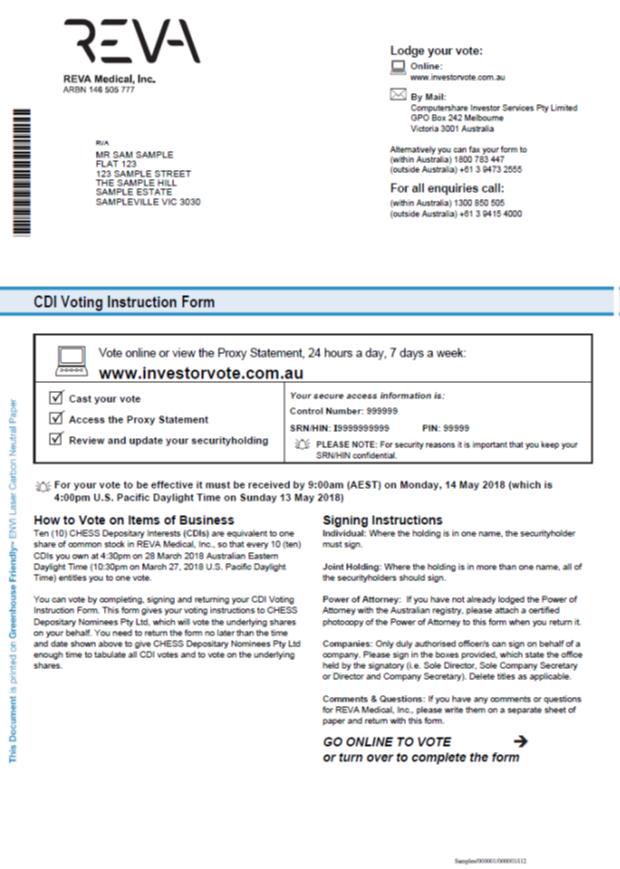
SRN/HIN: I9999999999Lodge your vote: By Mail: Computershare Investor Services Pty Limited GPO Box 242 Melbourne Victoria 3001 Australia Alternatively you can fax your form to (within Australia) 1800 783 447 (outside Australia) +61 3 9473 2555 For all enquiries call: (within Australia) 1300 850 505 (outside Australia) +61 3 9415 4000 CDI Voting Instruction Form . PLEASE NOTE: For security reasons it is important that you keep your SRN/HIN confidential. . . For your vote to be effective it must be received by 9:00am (AEST) on Monday, 14 May 2018 (which is 4:00pm U.S. Pacific Daylight Time on Sunday 13 May 2018) How to Vote on Items of Business Ten (10) CHESS Depositary Interests (CDIs) are equivalent to one share of common stock in REVA Medical, Inc., so that every 10 (ten) CDIs you own at 4:30pm on 28 March 2018 Australian Eastern Daylight Time (10:30pm on March 27, 2018 U.S. Pacific Daylight Time) entitles you to one vote. You can vote by completing, signing and returning your CDI Voting Instruction Form. This form gives your voting instructions to CHESS Depositary Nominees Pty Ltd, which will vote the underlying shares on your behalf. You need to return the form no later than the time and date shown above to give CHESS Depositary Nominees Pty Ltd enough time to tabulate all CDI votes and to vote on the underlying shares. Signing Instructions Individual: Where the holding is in one name, the securityholder must sign. Joint Holding: Where the holding is in more than one name, all of the securityholders should sign. Power of Attorney: If you have not already lodged the Power of Attorney with the Australian registry, please attach a certified photocopy of the Power of Attorney to this form when you return it. Companies: Only duly authorised officer/s can sign on behalf of a company. Please sign in the boxes provided, which state the office held by the signatory (i.e. Sole Director, Sole Company Secretary or Director and Company Secretary). Delete titles as applicable. Comments & Questions: If you have any comments or questions for REVA Medical, Inc., please write them on a separate sheet of paper and return with this form. GO ONLINE TO VOTE . or turn over to complete the form www.investorvote.com.au Vote online or view the Proxy Statement, 24 hours a day, 7 days a week: Cast your vote Access the Proxy Statement Your secure access information is: . Control Number: 999999 PIN: 99999 Review and update your securityholding www.investorvote.com.au .Online: RVA MR SAM SAMPLE FLAT 123 123 SAMPLE STREET THE SAMPLE HILL SAMPLE ESTATE SAMPLEVILLE VIC 3030 Samples/000001/000001/i12 *S00000112Q01*
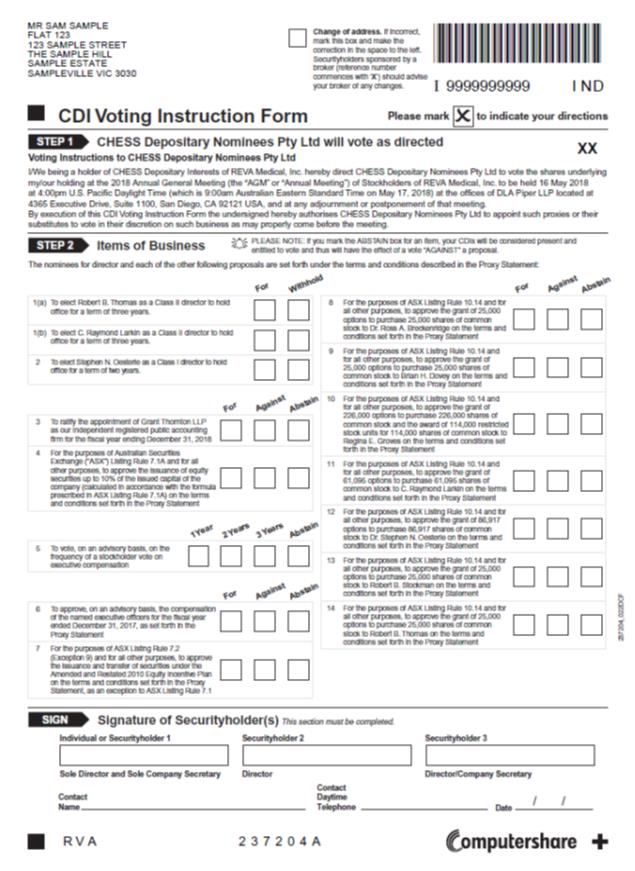
............. I 9999999999 SIGN Signature of Securityholder(s) This section must be completed. Individual or Securityholder 1 Sole Director and Sole Company Secretary Securityholder 2 Director Securityholder 3 Director/Company Secretary Contact Name Contact Daytime Telephone Date / / Please mark to indicate your directions STEP 2 Items of Business PLEASE NOTE: If you mark the ABSTAIN box for an item, your CDIs will be considered present and entitled to vote and thus will have the effect of a vote “AGAINST” a proposal. 1(a) To elect Robert B. Thomas as a Class II director to hold offi ce for a term of three years. 1(b) To elect C. Raymond Larkin as a Class II director to hold offi ce for a term of three years. 2 To elect Stephen N. Oesterle as a Class I director to hold offi ce for a term of two years. 3 To ratify the appointment of Grant Thornton LLP as our independent registered public accounting fi rm for the fi scal year ending December 31, 2018 4 For the purposes of Australian Securities Exchange (“ASX”) Listing Rule 7.1A and for all other purposes, to approve the issuance of equity securities up to 10% of the issued capital of the company (calculated in accordance with the formula prescribed in ASX Listing Rule 7.1A) on the terms and conditions set forth in the Proxy Statement 5 To vote, on an advisory basis, on the frequency of a stockholder vote on executive compensation 6 To approve, on an advisory basis, the compensation of the named executive offi cers for the fi scal year ended December 31, 2017, as set forth in the Proxy Statement 7 For the purposes of ASX Listing Rule 7.2 (Exception 9) and for all other purposes, to approve the issuance and transfer of securities under the Amended and Restated 2010 Equity Incentive Plan on the terms and conditions set forth in the Proxy Statement, as an exception to ASX Listing Rule 7.1 8 For the purposes of ASX Listing Rule 10.14 and for all other purposes, to approve the grant of 25,000 options to purchase 25,000 shares of common stock to Dr. Ross A. Breckenridge on the terms and conditions set forth in the Proxy Statement 9 For the purposes of ASX Listing Rule 10.14 and for all other purposes, to approve the grant of 25,000 options to purchase 25,000 shares of common stock to Brian H. Dovey on the terms and conditions set forth in the Proxy Statement 10 For the purposes of ASX Listing Rule 10.14 and for all other purposes, to approve the grant of 226,000 options to purchase 226,000 shares of common stock and the award of 114,000 restricted stock units for 114,000 shares of common stock to Regina E. Groves on the terms and conditions set forth in the Proxy Statement 11 For the purposes of ASX Listing Rule 10.14 and for all other purposes, to approve the grant of 61,095 options to purchase 61,095 shares of common stock to C. Raymond Larkin on the terms and conditions set forth in the Proxy Statement 12 For the purposes of ASX Listing Rule 10.14 and for all other purposes, to approve the grant of 86,917 options to purchase 86,917 shares of common stock to Dr. Stephen N. Oesterle on the terms and conditions set forth in the Proxy Statement 13 For the purposes of ASX Listing Rule 10.14 and for all other purposes, to approve the grant of 25,000 options to purchase 25,000 shares of common stock to Robert B. Stockman on the terms and conditions set forth in the Proxy Statement 14 For the purposes of ASX Listing Rule 10.14 and for all other purposes, to approve the grant of 25,000 options to purchase 25,000 shares of common stock to Robert B. Thomas on the terms and conditions set forth in the Proxy Statement For Withhold CDI Voting Instruction Form Voting Instructions to CHESS Depositary Nominees Pty Ltd I/We being a holder of CHESS Depositary Interests of REVA Medical, Inc. hereby direct CHESS Depositary Nominees Pty Ltd to vote the shares underlying my/our holding at the 2018 Annual General Meeting (the “AGM” or “Annual Meeting”) of Stockholders of REVA Medical, Inc. to be held 16 May 2018 at 4:00pm U.S. Pacifi c Daylight Time (which is 9:00am Australian Eastern Standard Time on May 17, 2018) at the offi ces of DLA Piper LLP located at 4365 Executive Drive, Suite 1100, San Diego, CA 92121 USA, and at any adjournment or postponement of that meeting. By execution of this CDI Voting Instruction Form the undersigned hereby authorises CHESS Depositary Nominees Pty Ltd to appoint such proxies or their substitutes to vote in their discretion on such business as may properly come before the meeting. STEP 1 CHESS Depositary Nominees Pty Ltd will vote as directed Change of address. If incorrect, mark this box and make the correction in the space to the left. Securityholders sponsored by a broker (reference number commences with ‘X’) should advise your broker of any changes. 237204_022DCF The nominees for director and each of the other following proposals are set forth under the terms and conditions described in the Proxy Statement: 2 Years 3 Years Abstain For AgainstAbstain For AgainstAbstain For AgainstAbstain 1 Year I ND MR SAM SAMPLE FLAT 123 123 SAMPLE STREET THE SAMPLE HILL SAMPLE ESTATE SAMPLEVILLE VIC 3030 R V A 2 3 7 2 0 4 A XX
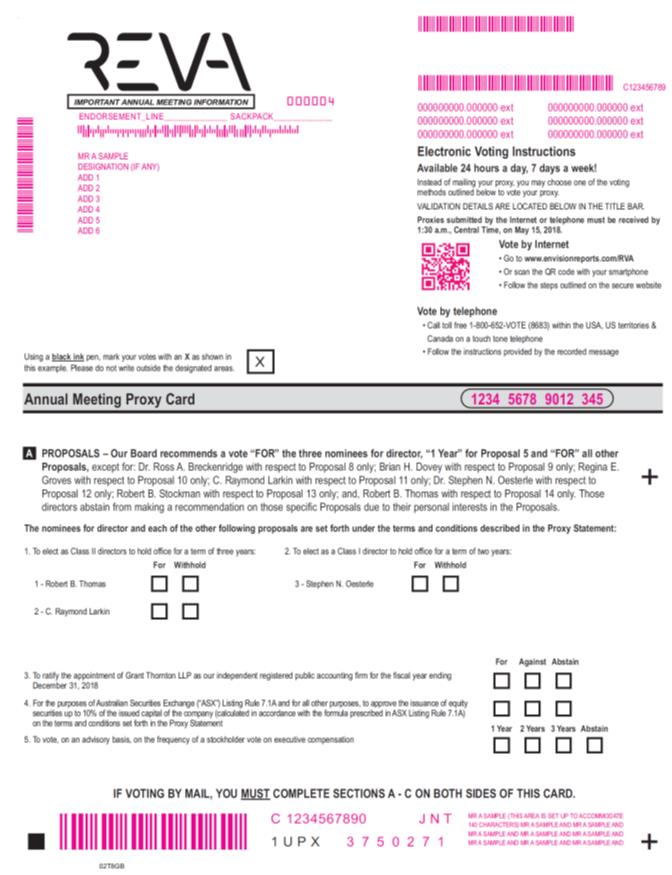
. IMPORTANT ANNUAL MEETING INFORMATION MMMMMMMMMMMM MMMMMMMMMMMMMMM C123456789 000004 000000000.000000 ext 000000000.000000 ext MMMMMMMMMENDORSEMENT_LINE______________ SACKPACK_____________ MR A SAMPLE DESIGNATION (IF ANY) ADD 1 ADD 2 ADD 3 ADD 4 ADD 5 ADD 6 Using a black ink pen, mark your votes with an X as shown in this example. Please do not write outside the designated areas. X 000000000.000000 ext 000000000.000000 ext 000000000.000000 ext 000000000.000000 ext Electronic Voting Instructions Available 24 hours a day, 7 days a week! Instead of mailing your proxy, you may choose one of the voting methods outlined below to vote your proxy. VALIDATION DETAILS ARE LOCATED BELOW IN THE TITLE BAR. Proxies submitted by the Internet or telephone must be received by1:30 a.m., Central Time, on May 15, 2018. Vote by Internet • Go to www.envisionreports.com/RVA • Or scan the QR code with your smartphone • Follow the steps outlined on the secure website Vote by telephone • Call toll free 1-800-652-VOTE (8683) within the USA, US territories & Canada on a touch tone telephone • Follow the instructions provided by the recorded message Annual Meeting Proxy Card 1234 5678 9012 345 A PROPOSALS – Our Board recommends a vote “FOR” the three nominees for director, “1 Year” for Proposal 5 and “FOR” all other Proposals, except for: Dr. Ross A. Breckenridge with respect to Proposal 8 only; Brian H. Dovey with respect to Proposal 9 only; Regina E. Groves with respect to Proposal 10 only; C. Raymond Larkin with respect to Proposal 11 only; Dr. Stephen N. Oesterle with respect to +Proposal 12 only; Robert B. Stockman with respect to Proposal 13 only; and, Robert B. Thomas with respect to Proposal 14 only. Those directors abstain from making a recommendation on those specific Proposals due to their personal interests in the Proposals. The nominees for director and each of the other following proposals are set forth under the terms and conditions described in the Proxy Statement: 1. To elect as Class II directors to hold office for a term of three years: 2. To elect as a Class I director to hold office for a term of two years: For Withhold For Withhold 1 - Robert B. Thomas 3 - Stephen N. Oesterle 2 - C. Raymond Larkin For Against Abstain 3. To ratify the appointment of Grant Thornton LLP as our independent registered public accounting firm for the fiscal year endingDecember 31, 2018 4. For the purposes of Australian Securities Exchange (“ASX”) Listing Rule 7.1A and for all other purposes, to approve the issuance of equity securities up to 10% of the issued capital of the Company (calculated in accordance with the formula prescribed in ASX Listing Rule 7.1A)on the terms and conditions set forth in the Proxy Statement 1 Year 2 Years 3 Years Abstain 5. To vote, on an advisory basis, on the frequency of a stockholder vote on executive compensation IF VOTING BY MAIL, YOU MUST COMPLETE SECTIONS A - C ON BOTH SIDES OF THIS CARD. MR A SAMPLE (THIS AREA IS SET UP TO ACCOMMODATE C 1234567890 J N T 140 CHARACTERS) MR A SAMPLE AND MR A SAMPLE AND MR A SAMPLE AND MR A SAMPLE AND MR A SAMPLE AND 1UPX 3750271 MR A SAMPLE AND MR A SAMPLE AND MR A SAMPLE AND MMMMMMM + 02T8GB
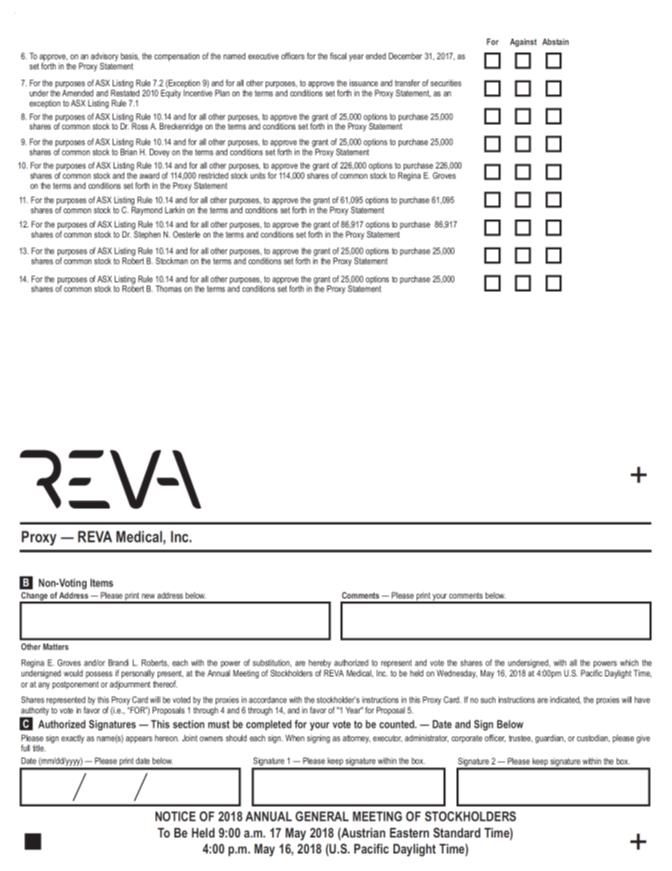
. For Against Abstain 6. To approve, on an advisory basis, the compensation of the named executive officers for the fiscal year ended December 31, 2017, as set forth in the Proxy Statement 7. For the purposes of ASX Listing Rule 7.2 (Exception 9) and for all other purposes, to approve the issuance and transfer of securities under the Amended and Restated 2010 Equity Incentive Plan on the terms and conditions set forth in the Proxy Statement, as an exception to ASX Listing Rule 7.1 8. For the purposes of ASX Listing Rule 10.14 and for all other purposes, to approve the grant of 25,000 options to purchase 25,000 shares of common stock to Dr. Ross A. Breckenridge on the terms and conditions set forth in the Proxy Statement 9. For the purposes of ASX Listing Rule 10.14 and for all other purposes, to approve the grant of 25,000 options to purchase 25,000 shares of common stock to Brian H. Dovey on the terms and conditions set forth in the Proxy Statement 10. For the purposes of ASX Listing Rule 10.14 and for all other purposes, to approve the grant of 226,000 options to purchase 226,000 shares of common stock and the award of 114,000 restricted stock units for 114,000 shares of common stock to Regina E. Groves on the terms and conditions set forth in the Proxy Statement 11. For the purposes of ASX Listing Rule 10.14 and for all other purposes, to approve the grant of 61,095 options to purchase 61,095 shares of common stock to C. Raymond Larkin on the terms and conditions set forth in the Proxy Statement 12. For the purposes of ASX Listing Rule 10.14 and for all other purposes, to approve the grant of 86,917 options to purchase 86,917 shares of common stock to Dr. Stephen N. Oesterle on the terms and conditions set forth in the Proxy Statement 13. For the purposes of ASX Listing Rule 10.14 and for all other purposes, to approve the grant of 25,000 options to purchase 25,000 shares of common stock to Robert B. Stockman on the terms and conditions set forth in the Proxy Statement 14. For the purposes of ASX Listing Rule 10.14 and for all other purposes, to approve the grant of 25,000 options to purchase 25,000 shares of common stock to Robert B. Thomas on the terms and conditions set forth in the Proxy Statement + Proxy — REVA Medical, Inc. B Non-Voting Items Change of Address — Please print new address below. Comments — Please print your comments below. Other Matters Regina E. Groves and/or Brandi L. Roberts, each with the power of substitution, are hereby authorized to represent and vote the shares of the undersigned, with all the powers which the undersigned would possess if personally present, at the Annual Meeting of Stockholders of REVA Medical, Inc. to be held on Wednesday, May 16 2018 at 4:00pm U.S. Pacific Daylight Time, or at any postponement or adjournment thereof. Shares represented by this Proxy Card will be voted by the proxies in accordance with the stockholder’s instructions in this Proxy Card. If no such instructions are indicated, the proxies will have authority to vote in favor of (i.e., “FOR”) Proposals 1 through 4 and 6 through 14, and in favor of "1 Year" for Proposal 5. Authorized Signatures — This section must be completed for your vote to be counted. — Date and Sign Below Please sign exactly as name(s) appears hereon. Joint owners should each sign. When signing as attorney, executor, administrator, corporate officer, trustee, guardian, or custodian, please give full title. Date (mm/dd/yyyy) — Please print date below. Signature 1 — Please keep signature within the box. Signature 2 — Please keep signature within the box. NOTICE OF 2018 ANNUAL GENERAL MEETING OF STOCKHOLDERS To Be Held 9:00 a.m. 17 May 2018 (Austrian Eastern Standard Time) 4:00 p.m. May 16, 2018 (U.S. Pacific Daylight Time) +