Q1 2026 Earnings Call Chris Kastner President and CEO Tom Stiehle EVP and CFO Kari Wilkinson EVP and President, Newport News Shipbuilding May 5, 2026
Q1 2026 EARNINGS Cautionary Statement Regarding Forward-looking Statements Statements in this presentation and in our other filings with the SEC, as well as other statements we may make from time to time, other than statements of historical fact, constitute "forward-looking statements" within the meaning of the Private Securities Litigation Reform Act of 1995. In some cases, you can identify forward-looking statements by words such as "may," "will," "should," "expects," "intends," "plans," "anticipates," "believes," "estimates," "guidance," "outlook," "predicts," "potential," "continue," and similar words or phrases or the negative of these words or phrases. These statements relate to future events or our future financial performance and involve known and unknown risks, uncertainties, and other factors that may cause our actual results, levels of activity, performance, or achievements to be materially different from any future results, levels of activity, performance, or achievements expressed or implied by these forward-looking statements. Although we believe the expectations reflected in the forward-looking statements are reasonable when made, we cannot guarantee future results, levels of activity, performance, or achievements. There are a number of important factors that could cause our actual results to differ materially from the results anticipated by our forward-looking statements, which include, but are not limited to: our dependence on the U.S. Government for substantially all of our business; significant delays or reductions in appropriations for our programs and/or changes in customer priorities and requirements (including government budgetary constraints, government shutdowns, shifts in defense spending, and changes in customer short-range and long-range plans); our ability to estimate our future contract costs, including cost increases due to inflation, labor challenges, changes in trade policy, or other factors and our efforts to recover or offset such costs and/or changes in estimated contract costs, and perform our contracts effectively; changes in business practices, procurement processes and government regulations, including changes through executive orders, contract terms, or other policies or practices applicable to our industry, and our ability to comply with such requirements; adverse economic conditions in the United States and globally; our level of indebtedness and ability to service our indebtedness; our ability to deliver our products and services at an affordable life cycle cost and compete within our markets; our ability to attract, retain, and train a qualified workforce; subcontractor and supplier performance and the availability and pricing of raw materials and components; our ability to execute our strategic plan, including with respect to share repurchases, dividends, capital expenditures, and strategic acquisitions; investigations, claims, disputes, enforcement actions, litigation (including criminal, civil, and administrative), and/or other legal proceedings, and improper conduct of employees, agents, subcontractors, suppliers, business partners, or joint ventures in which we participate, including the impact on our reputation or ability to do business; changes in key estimates and assumptions regarding our pension and retiree health care costs; security threats, including cybersecurity threats, and related disruptions; natural and environmental disasters and political instability; health epidemics, pandemics and similar outbreaks; and other risk factors discussed herein and in our other filings with the SEC. There may be other risks and uncertainties that we are unable to predict at this time or that we currently do not expect to have a material adverse effect on our business, and we undertake no obligation to update or revise any forward-looking statements. You should not place undue reliance on any forward-looking statements that we may make. 2
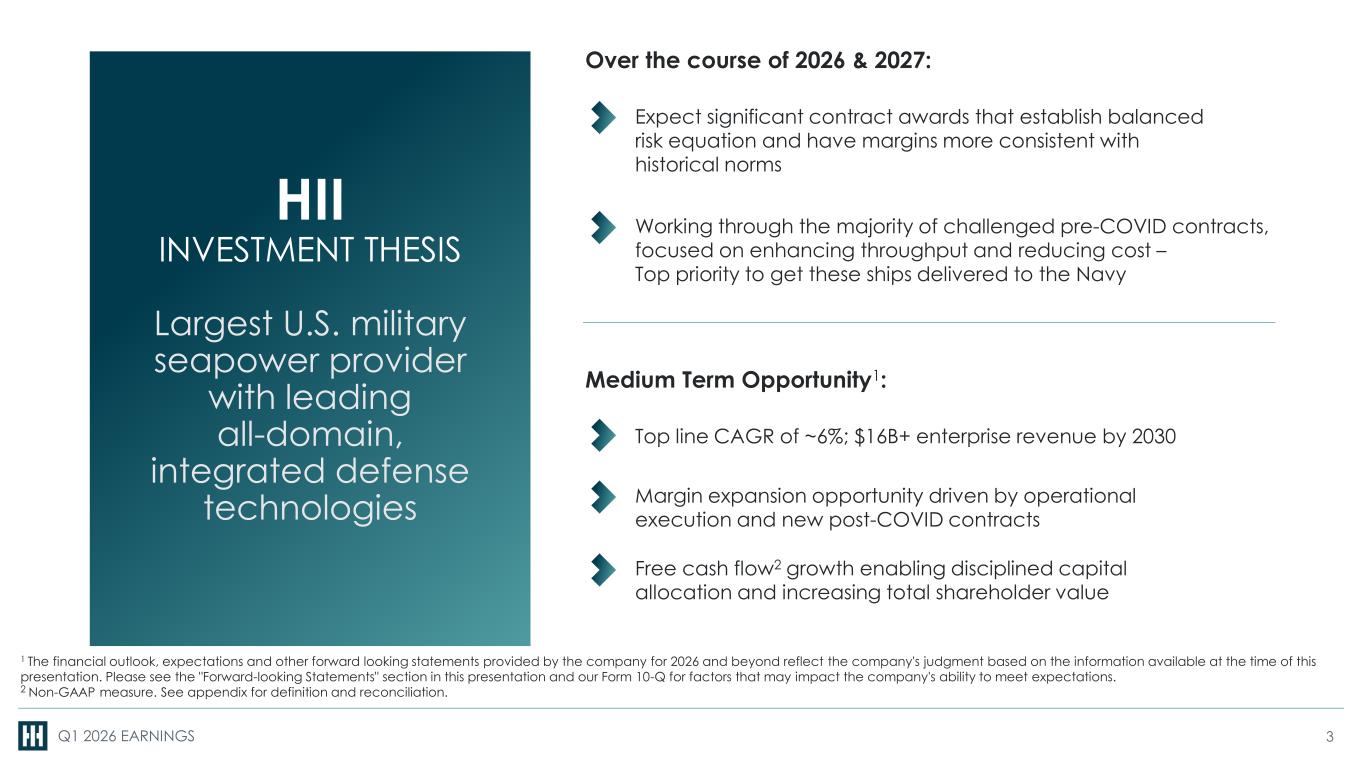
Q1 2026 EARNINGS 1 The financial outlook, expectations and other forward looking statements provided by the company for 2026 and beyond reflect the company's judgment based on the information available at the time of this presentation. Please see the "Forward-looking Statements" section in this presentation and our Form 10-Q for factors that may impact the company's ability to meet expectations. 2 Non-GAAP measure. See appendix for definition and reconciliation. 3 HII INVESTMENT THESIS Largest U.S. military seapower provider with leading all-domain, integrated defense technologies Margin expansion opportunity driven by operational execution and new post-COVID contracts Free cash flow2 growth enabling disciplined capital allocation and increasing total shareholder value Working through the majority of challenged pre-COVID contracts, focused on enhancing throughput and reducing cost – Top priority to get these ships delivered to the Navy Expect significant contract awards that establish balanced risk equation and have margins more consistent with historical norms Over the course of 2026 & 2027: Medium Term Opportunity1: Top line CAGR of ~6%; $16B+ enterprise revenue by 2030
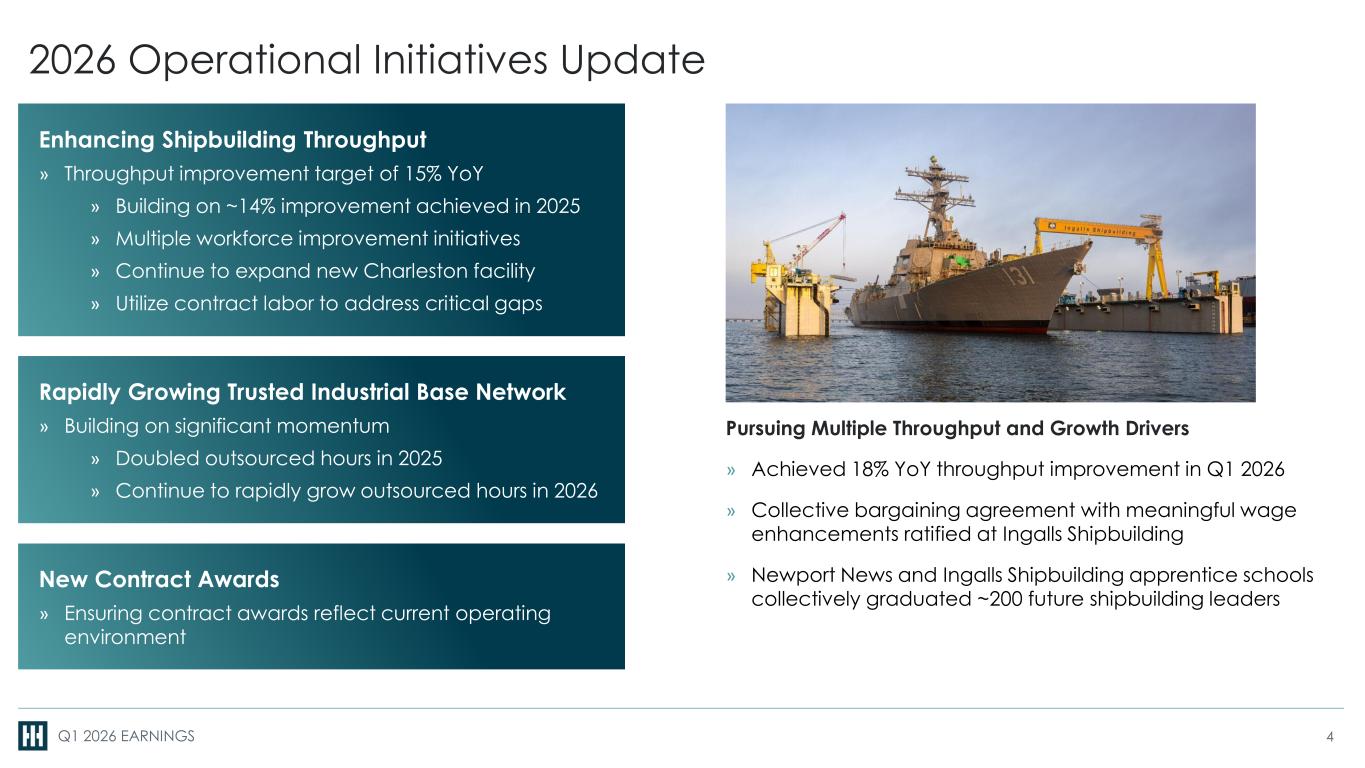
Q1 2026 EARNINGS Enhancing Shipbuilding Throughput » Throughput improvement target of 15% YoY » Building on ~14% improvement achieved in 2025 » Multiple workforce improvement initiatives » Continue to expand new Charleston facility » Utilize contract labor to address critical gaps Rapidly Growing Trusted Industrial Base Network » Building on significant momentum » Doubled outsourced hours in 2025 » Continue to rapidly grow outsourced hours in 2026 New Contract Awards » Ensuring contract awards reflect current operating environment 2026 Operational Initiatives Update 4 Pursuing Multiple Throughput and Growth Drivers » Achieved 18% YoY throughput improvement in Q1 2026 » Collective bargaining agreement with meaningful wage enhancements ratified at Ingalls Shipbuilding » Newport News and Ingalls Shipbuilding apprentice schools collectively graduated ~200 future shipbuilding leaders
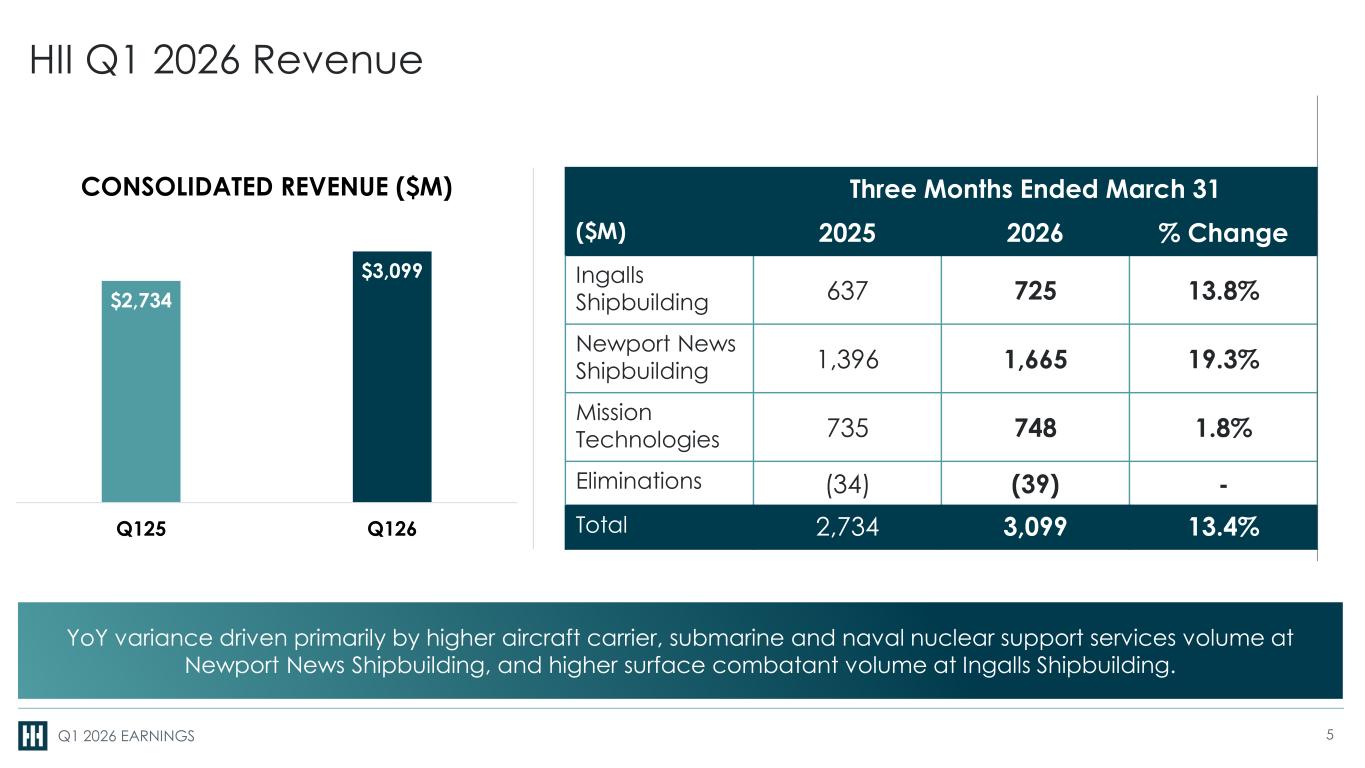
Q1 2026 EARNINGS HII Q1 2026 Revenue 6.1% 9.8% 3.7% Three Months Ended March 31 ($M) 2025 2026 % Change Ingalls Shipbuilding 637 725 13.8% Newport News Shipbuilding 1,396 1,665 19.3% Mission Technologies 735 748 1.8% Eliminations (34) (39) - Total 2,734 3,099 13.4% YoY variance driven primarily by higher aircraft carrier, submarine and naval nuclear support services volume at Newport News Shipbuilding, and higher surface combatant volume at Ingalls Shipbuilding. 5 $2,734 $3,099 Q125 Q126 CONSOLIDATED REVENUE ($M)
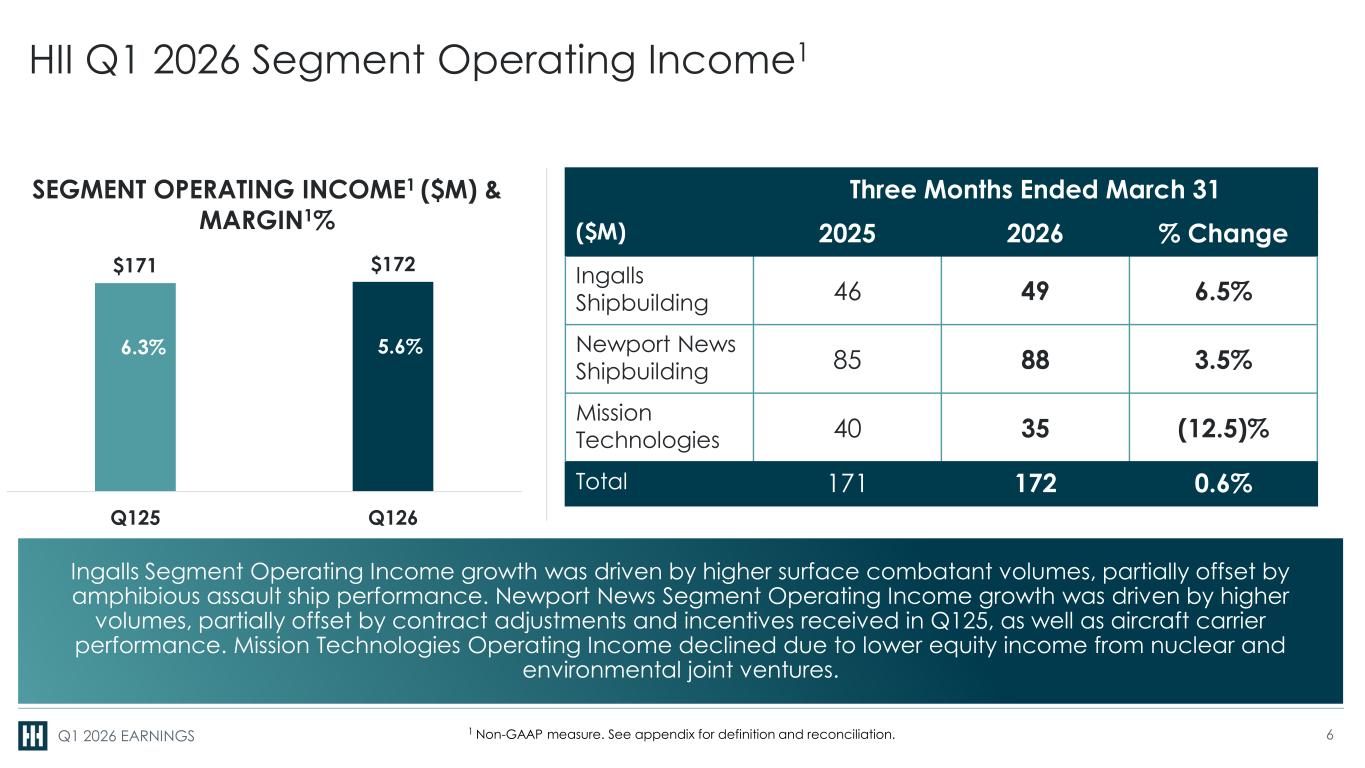
Q1 2026 EARNINGS HII Q1 2026 Segment Operating Income1 6.1% 9.8% 3.7% Three Months Ended March 31 ($M) 2025 2026 % Change Ingalls Shipbuilding 46 49 6.5% Newport News Shipbuilding 85 88 3.5% Mission Technologies 40 35 (12.5)% Total 171 172 0.6% Ingalls Segment Operating Income growth was driven by higher surface combatant volumes, partially offset by amphibious assault ship performance. Newport News Segment Operating Income growth was driven by higher volumes, partially offset by contract adjustments and incentives received in Q125, as well as aircraft carrier performance. Mission Technologies Operating Income declined due to lower equity income from nuclear and environmental joint ventures. 61 Non-GAAP measure. See appendix for definition and reconciliation. $171 $172 Q125 Q126 SEGMENT OPERATING INCOME1 ($M) & MARGIN1% 5.6%6.3% SEGMENT OPERATING INCOME1 ($M) & MARGIN1%
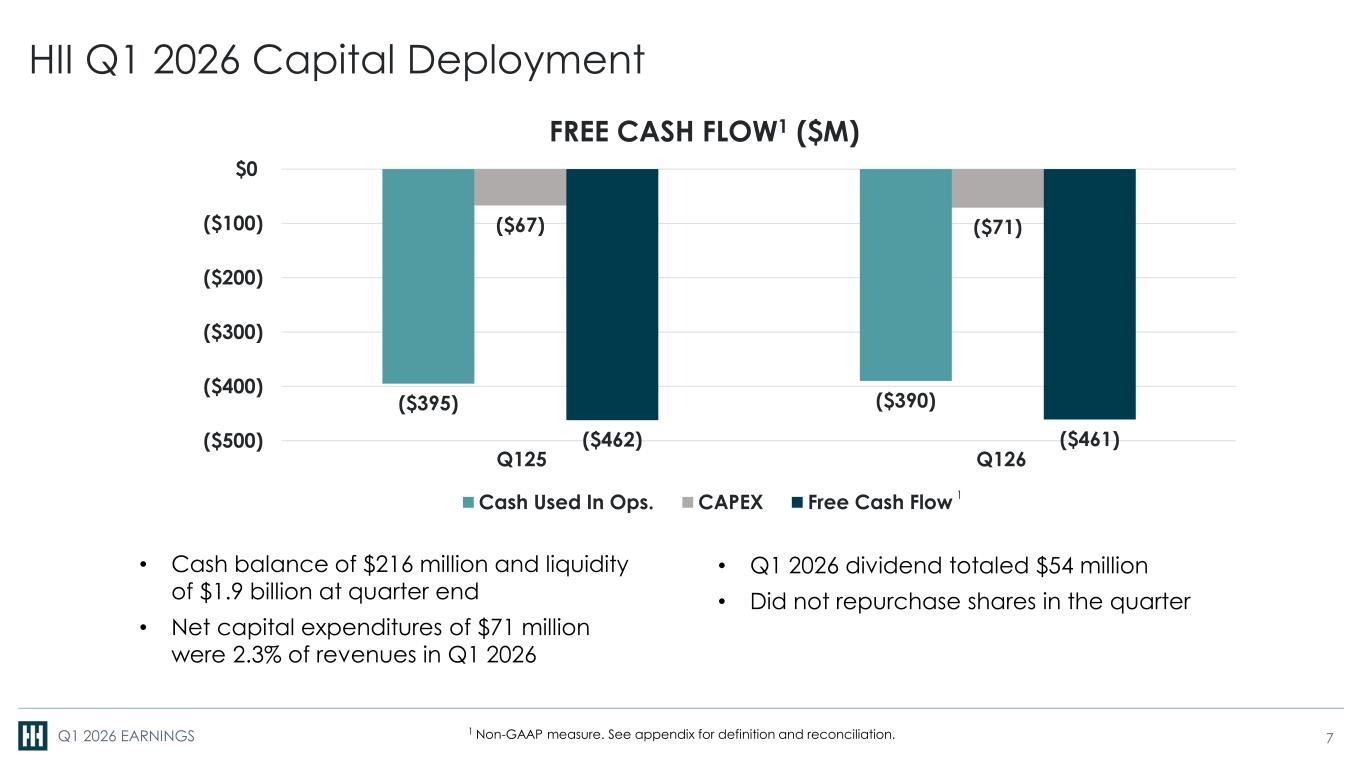
Q1 2026 EARNINGS ($395) ($390) ($67) ($71) ($462) ($461)($500) ($400) ($300) ($200) ($100) $0 Cash Used In Ops. CAPEX Free Cash Flow HII Q1 2026 Capital Deployment 1 Non-GAAP measure. See appendix for definition and reconciliation. 7 FREE CASH FLOW1 ($M) Q126Q125 1 • Cash balance of $216 million and liquidity of $1.9 billion at quarter end • Net capital expenditures of $71 million were 2.3% of revenues in Q1 2026 • Q1 2026 dividend totaled $54 million • Did not repurchase shares in the quarter
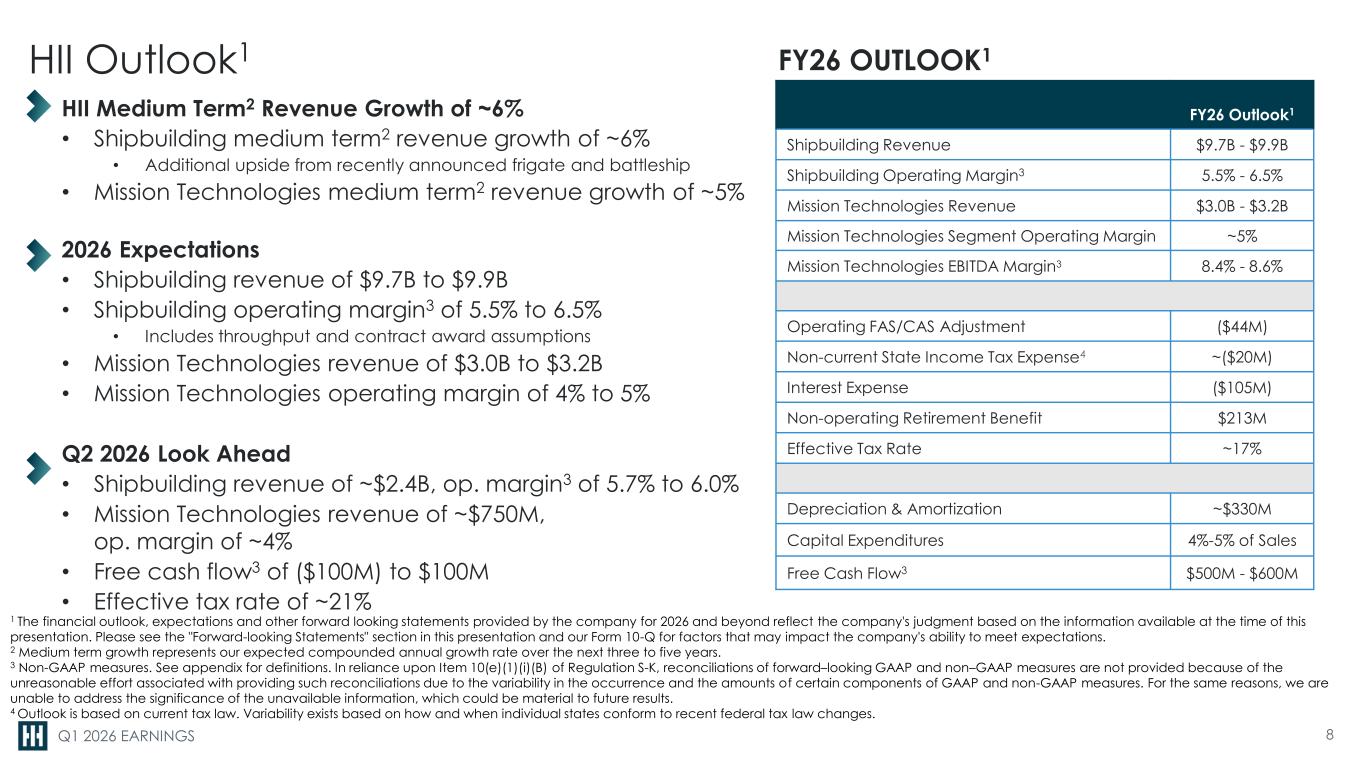
Q1 2026 EARNINGS HII Outlook1 FY26 OUTLOOK1 1 The financial outlook, expectations and other forward looking statements provided by the company for 2026 and beyond reflect the company's judgment based on the information available at the time of this presentation. Please see the "Forward-looking Statements" section in this presentation and our Form 10-Q for factors that may impact the company's ability to meet expectations. 2 Medium term growth represents our expected compounded annual growth rate over the next three to five years. 3 Non-GAAP measures. See appendix for definitions. In reliance upon Item 10(e)(1)(i)(B) of Regulation S-K, reconciliations of forward–looking GAAP and non–GAAP measures are not provided because of the unreasonable effort associated with providing such reconciliations due to the variability in the occurrence and the amounts of certain components of GAAP and non-GAAP measures. For the same reasons, we are unable to address the significance of the unavailable information, which could be material to future results. 4 Outlook is based on current tax law. Variability exists based on how and when individual states conform to recent federal tax law changes. 8 FY26 Outlook1 Shipbuilding Revenue $9.7B - $9.9B Shipbuilding Operating Margin3 5.5% - 6.5% Mission Technologies Revenue $3.0B - $3.2B Mission Technologies Segment Operating Margin ~5% Mission Technologies EBITDA Margin3 8.4% - 8.6% Operating FAS/CAS Adjustment ($44M) Non-current State Income Tax Expense4 ~($20M) Interest Expense ($105M) Non-operating Retirement Benefit $213M Effective Tax Rate ~17% Depreciation & Amortization ~$330M Capital Expenditures 4%-5% of Sales Free Cash Flow3 $500M - $600M HII Medium Term2 Revenue Growth of ~6% • Shipbuilding medium term2 revenue growth of ~6% • Additional upside from recently announced frigate and battleship • Mission Technologies medium term2 revenue growth of ~5% 2026 Expectations • Shipbuilding revenue of $9.7B to $9.9B • Shipbuilding operating margin3 of 5.5% to 6.5% • Includes throughput and contract award assumptions • Mission Technologies revenue of $3.0B to $3.2B • Mission Technologies operating margin of 4% to 5% Q2 2026 Look Ahead • Shipbuilding revenue of ~$2.4B, op. margin3 of 5.7% to 6.0% • Mission Technologies revenue of ~$750M, op. margin of ~4% • Free cash flow3 of ($100M) to $100M • Effective tax rate of ~21%

Q1 2026 EARNINGS Appendix 9
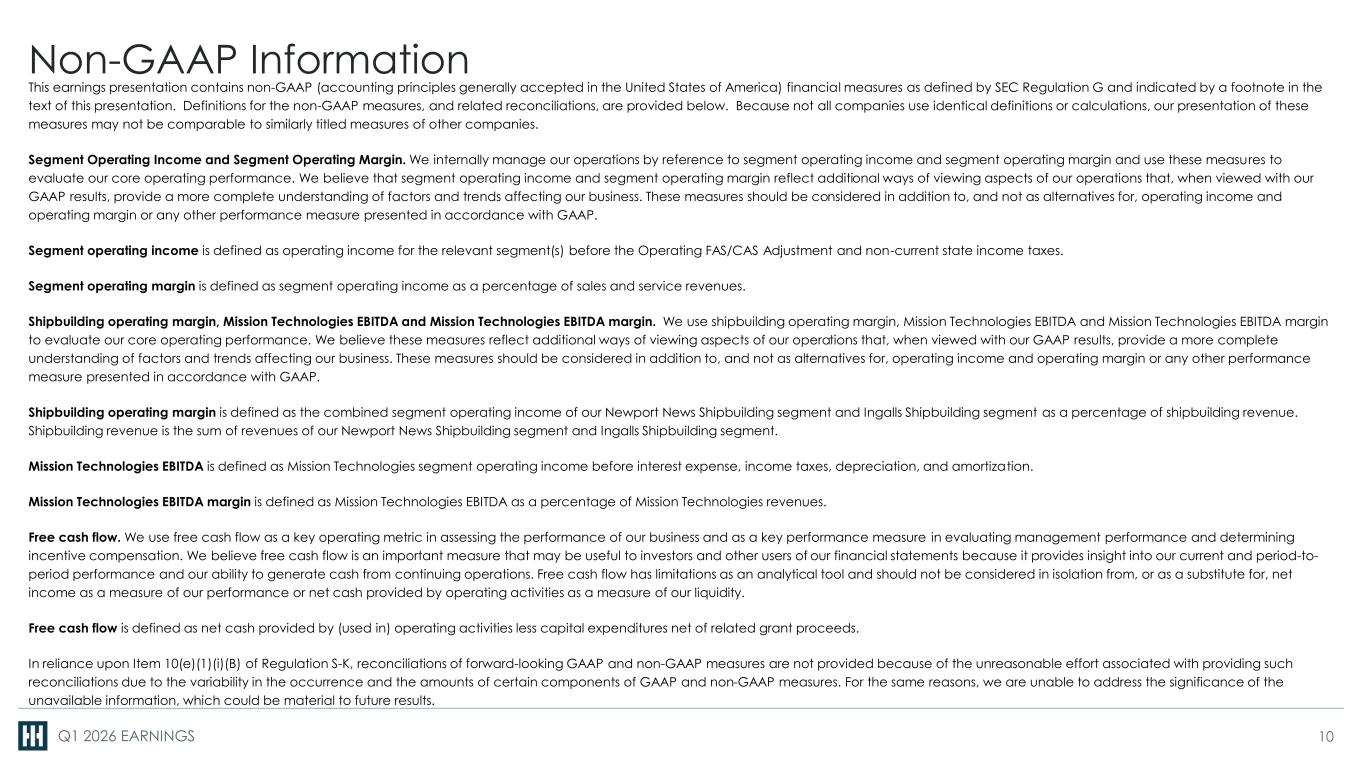
Q1 2026 EARNINGS Non-GAAP Information This earnings presentation contains non-GAAP (accounting principles generally accepted in the United States of America) financial measures as defined by SEC Regulation G and indicated by a footnote in the text of this presentation. Definitions for the non-GAAP measures, and related reconciliations, are provided below. Because not all companies use identical definitions or calculations, our presentation of these measures may not be comparable to similarly titled measures of other companies. Segment Operating Income and Segment Operating Margin. We internally manage our operations by reference to segment operating income and segment operating margin and use these measures to evaluate our core operating performance. We believe that segment operating income and segment operating margin reflect additional ways of viewing aspects of our operations that, when viewed with our GAAP results, provide a more complete understanding of factors and trends affecting our business. These measures should be considered in addition to, and not as alternatives for, operating income and operating margin or any other performance measure presented in accordance with GAAP. Segment operating income is defined as operating income for the relevant segment(s) before the Operating FAS/CAS Adjustment and non-current state income taxes. Segment operating margin is defined as segment operating income as a percentage of sales and service revenues. Shipbuilding operating margin, Mission Technologies EBITDA and Mission Technologies EBITDA margin. We use shipbuilding operating margin, Mission Technologies EBITDA and Mission Technologies EBITDA margin to evaluate our core operating performance. We believe these measures reflect additional ways of viewing aspects of our operations that, when viewed with our GAAP results, provide a more complete understanding of factors and trends affecting our business. These measures should be considered in addition to, and not as alternatives for, operating income and operating margin or any other performance measure presented in accordance with GAAP. Shipbuilding operating margin is defined as the combined segment operating income of our Newport News Shipbuilding segment and Ingalls Shipbuilding segment as a percentage of shipbuilding revenue. Shipbuilding revenue is the sum of revenues of our Newport News Shipbuilding segment and Ingalls Shipbuilding segment. Mission Technologies EBITDA is defined as Mission Technologies segment operating income before interest expense, income taxes, depreciation, and amortization. Mission Technologies EBITDA margin is defined as Mission Technologies EBITDA as a percentage of Mission Technologies revenues. Free cash flow. We use free cash flow as a key operating metric in assessing the performance of our business and as a key performance measure in evaluating management performance and determining incentive compensation. We believe free cash flow is an important measure that may be useful to investors and other users of our financial statements because it provides insight into our current and period-to- period performance and our ability to generate cash from continuing operations. Free cash flow has limitations as an analytical tool and should not be considered in isolation from, or as a substitute for, net income as a measure of our performance or net cash provided by operating activities as a measure of our liquidity. Free cash flow is defined as net cash provided by (used in) operating activities less capital expenditures net of related grant proceeds. In reliance upon Item 10(e)(1)(i)(B) of Regulation S-K, reconciliations of forward-looking GAAP and non-GAAP measures are not provided because of the unreasonable effort associated with providing such reconciliations due to the variability in the occurrence and the amounts of certain components of GAAP and non-GAAP measures. For the same reasons, we are unable to address the significance of the unavailable information, which could be material to future results. 10
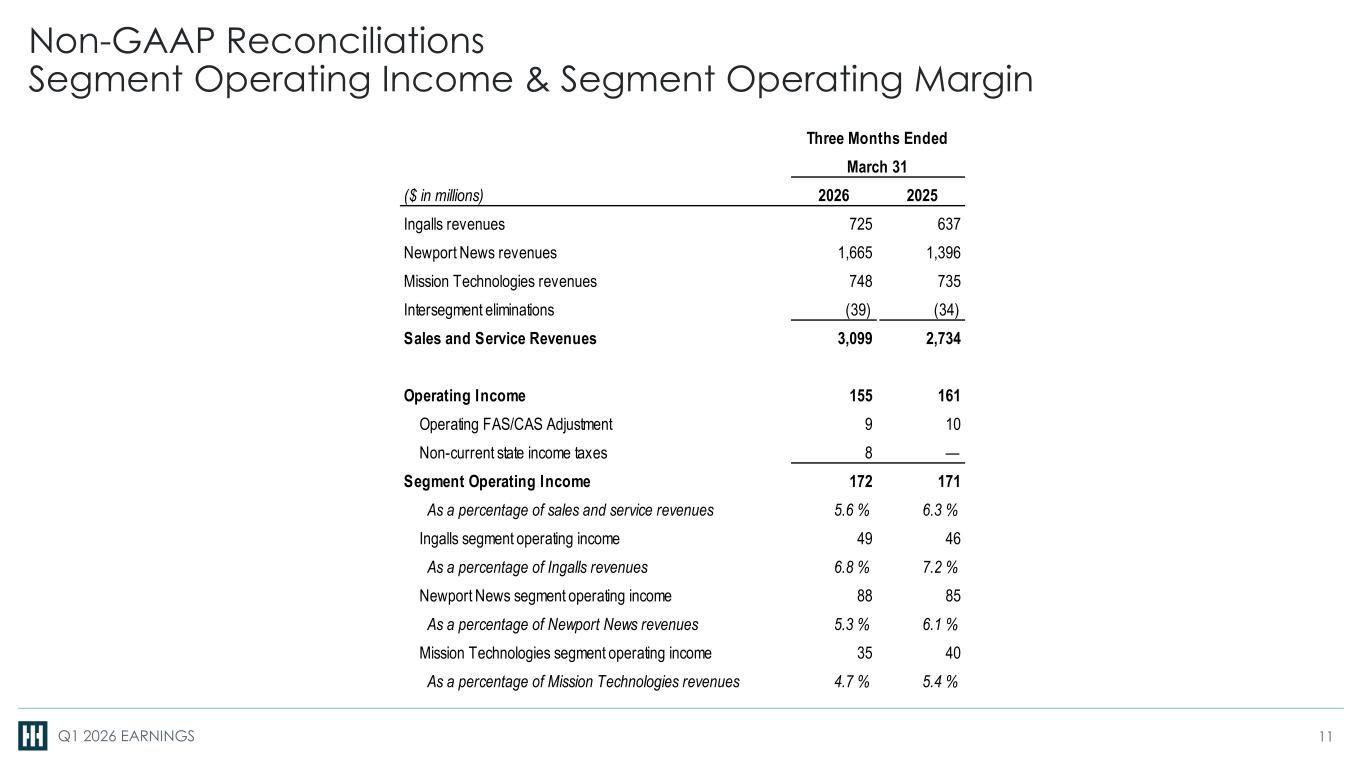
Q1 2026 EARNINGS Non-GAAP Reconciliations Segment Operating Income & Segment Operating Margin 11 ($ in millions) 2026 2025 Ingalls revenues 725 637 Newport News revenues 1,665 1,396 Mission Technologies revenues 748 735 Intersegment eliminations (39) (34) Sales and Service Revenues 3,099 2,734 Operating Income 155 161 Operating FAS/CAS Adjustment 9 10 Non-current state income taxes 8 — Segment Operating Income 172 171 As a percentage of sales and service revenues 5.6 % 6.3 % Ingalls segment operating income 49 46 As a percentage of Ingalls revenues 6.8 % 7.2 % Newport News segment operating income 88 85 As a percentage of Newport News revenues 5.3 % 6.1 % Mission Technologies segment operating income 35 40 As a percentage of Mission Technologies revenues 4.7 % 5.4 % March 31 Three Months Ended
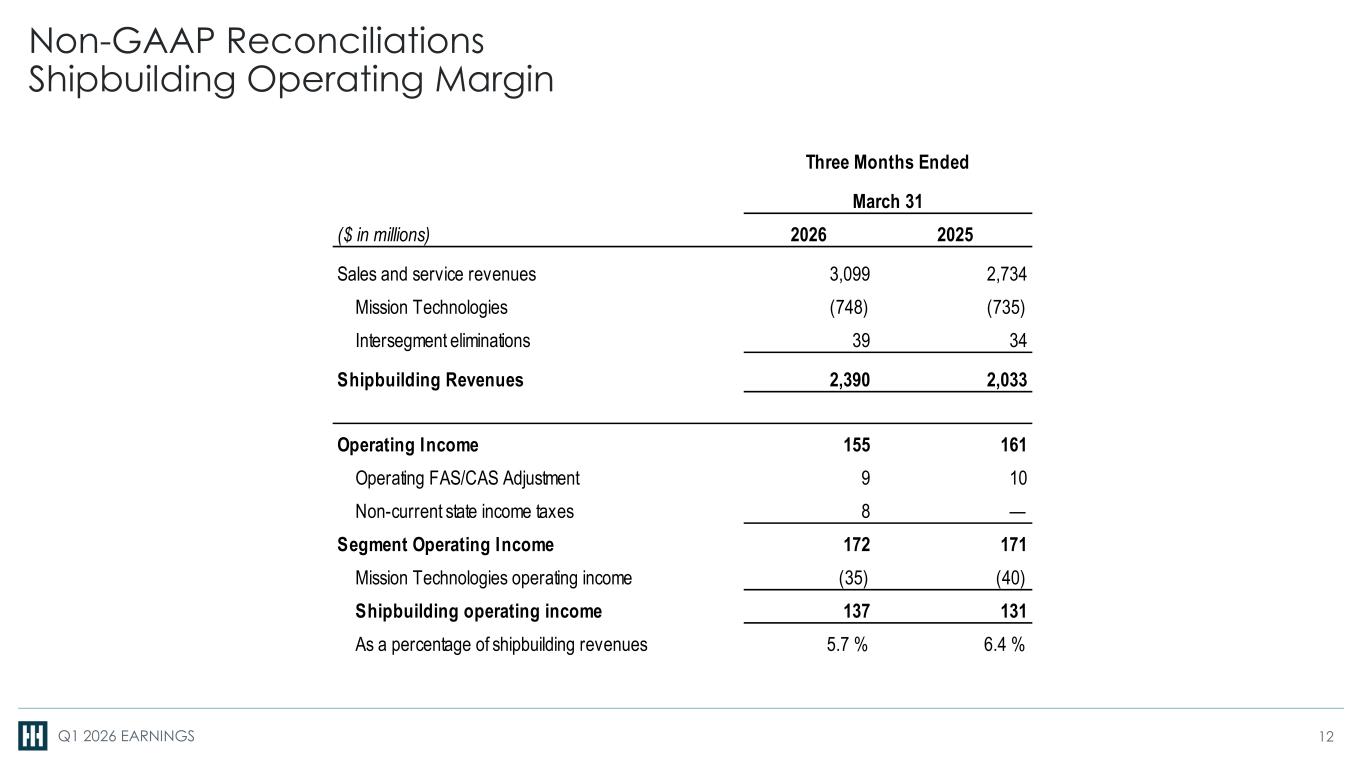
Q1 2026 EARNINGS Non-GAAP Reconciliations Shipbuilding Operating Margin 12 ($ in millions) 2026 2025 Sales and service revenues 3,099 2,734 Mission Technologies (748) (735) Intersegment eliminations 39 34 Shipbuilding Revenues 2,390 2,033 Operating Income 155 161 Operating FAS/CAS Adjustment 9 10 Non-current state income taxes 8 — Segment Operating Income 172 171 Mission Technologies operating income (35) (40) Shipbuilding operating income 137 131 As a percentage of shipbuilding revenues 5.7 % 6.4 % March 31 Three Months Ended
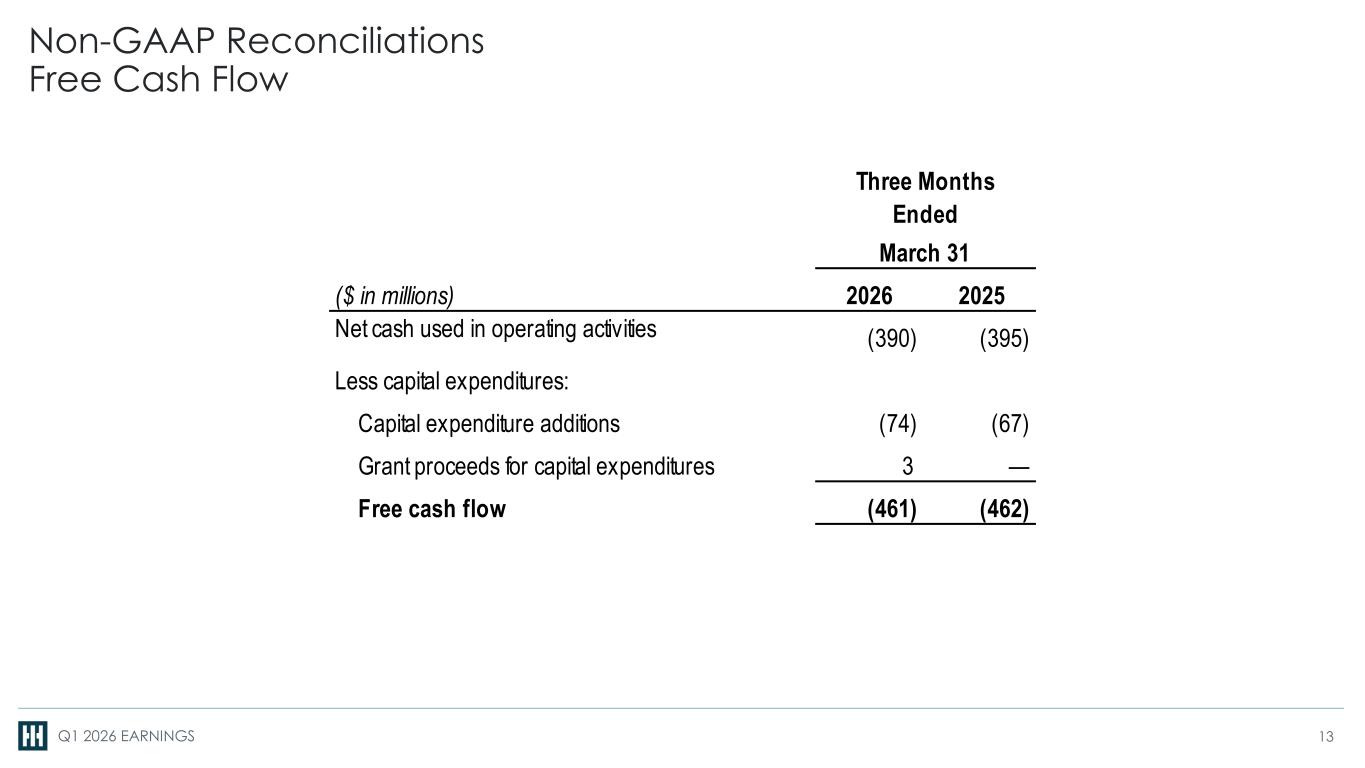
Q1 2026 EARNINGS Non-GAAP Reconciliations Free Cash Flow 13 ($ in millions) 2026 2025 Net cash used in operating activities (390) (395) Less capital expenditures: Capital expenditure additions (74) (67) Grant proceeds for capital expenditures 3 — Free cash flow (461) (462) March 31 Three Months Ended
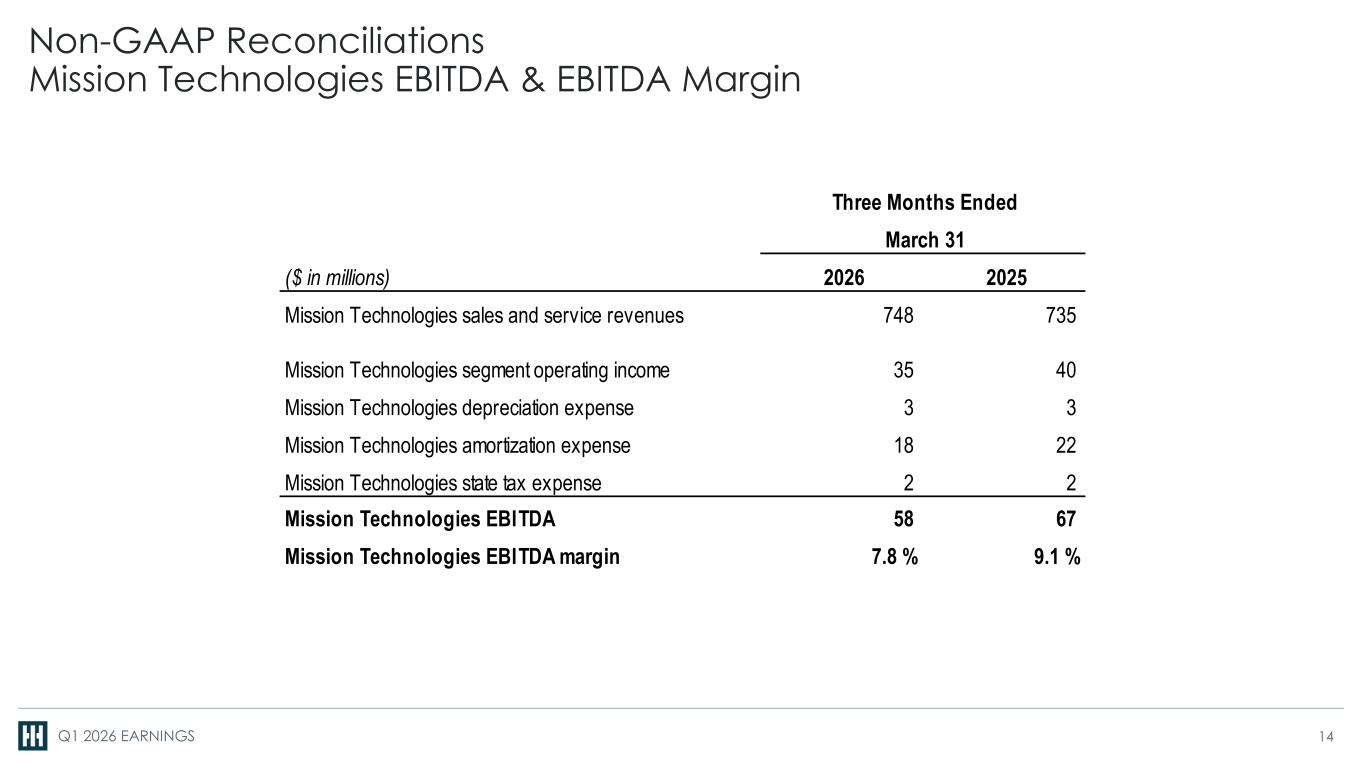
Q1 2026 EARNINGS Non-GAAP Reconciliations Mission Technologies EBITDA & EBITDA Margin 14 ($ in millions) 2026 2025 Mission Technologies sales and service revenues 748 735 Mission Technologies segment operating income 35 40 Mission Technologies depreciation expense 3 3 Mission Technologies amortization expense 18 22 Mission Technologies state tax expense 2 2 Mission Technologies EBITDA 58 67 Mission Technologies EBITDA margin 7.8 % 9.1 % March 31 Three Months Ended