UNITED STATES
SECURITIES AND EXCHANGE COMMISSION
Washington, D.C. 20549
SCHEDULE 14A
(Rule 14a-101)
INFORMATION REQUIRED IN PROXY STATEMENT
SCHEDULE 14A INFORMATION
Proxy Statement Pursuant to Section 14(a) of
the Securities Exchange Act of 1934
|
Filed by the Registrant ☒ |
||||
|
|
||||
|
| ||||
|
☒ |
|
Preliminary Proxy Statement | ||
|
☐ |
|
Confidential, for Use of the Commission Only (as permitted by Rule 14a-6(e)(2)) | ||
|
☐ |
|
Definitive Proxy Statement | ||
|
☐ |
|
Definitive Additional Materials | ||
|
☐ |
|
Soliciting Material under §240.14a-12 | ||
|
PARK STERLING CORPORATION | ||||
|
(Name of Registrant as Specified In Its Charter) | ||||
|
(Name of Person(s) Filing Proxy Statement, if other than the Registrant) | ||||
|
| ||||
|
☒ |
|
No fee required. | ||
|
☐ |
|
Fee computed on table below per Exchange Act Rules 14a-6(i)(1) and 0-11. | ||
|
|
|
(1) |
|
Title of each class of securities to which transaction applies: |
|
|
|
(2) |
|
Aggregate number of securities to which transaction applies: |
|
|
|
(3) |
|
Per unit price or other underlying value of transaction computed pursuant to Exchange Act Rule 0-11 (set forth the amount on which the filing fee is calculated and state how it was determined): |
|
|
|
(4) |
|
Proposed maximum aggregate value of transaction: |
|
|
|
(5) |
|
Total fee paid: |
|
☐ |
|
Fee paid previously with preliminary materials. | ||
|
|
|
| ||
|
|
|
(1) |
|
Amount Previously Paid: |
|
|
|
(2) |
|
Form, Schedule or Registration Statement No.: |
|
|
|
(3) |
|
Filing Party: |
|
|
|
(4) |
|
Date Filed: |
|
|
1043 East Morehead Street, Suite 201
Charlotte, North Carolina 28204
|
TO THE SHAREHOLDERS OF PARK STERLING CORPORATION |
April [ ], 2016 |
We are pleased to invite you to attend the 2016 Annual Meeting of Shareholders of Park Sterling Corporation. The Annual Meeting will be held at 4201 Congress Street, Suite 210, Charlotte, North Carolina, on Thursday, May 26, 2016 at 8:30 A.M., local time.
Details of the business to be conducted at the Annual Meeting are provided in the enclosed Notice of Annual Meeting of Shareholders and Proxy Statement, each of which we urge you to read carefully. In addition, enclosed is a proxy card and a copy of our Annual Report on Form 10-K for the year ended December 31, 2015.
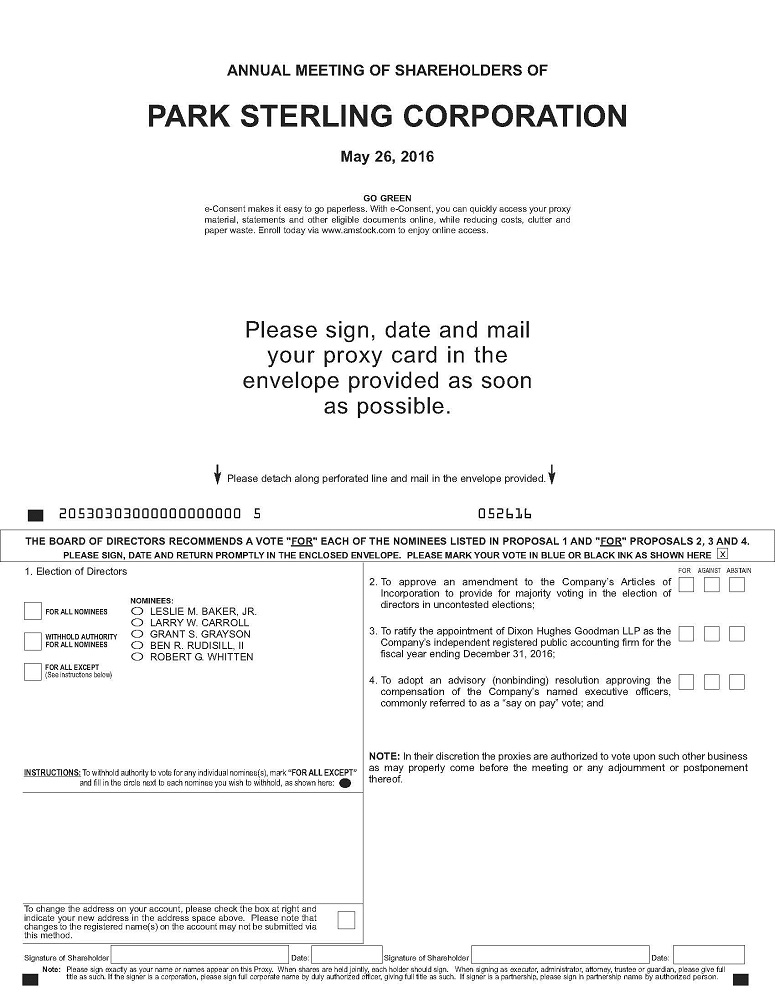
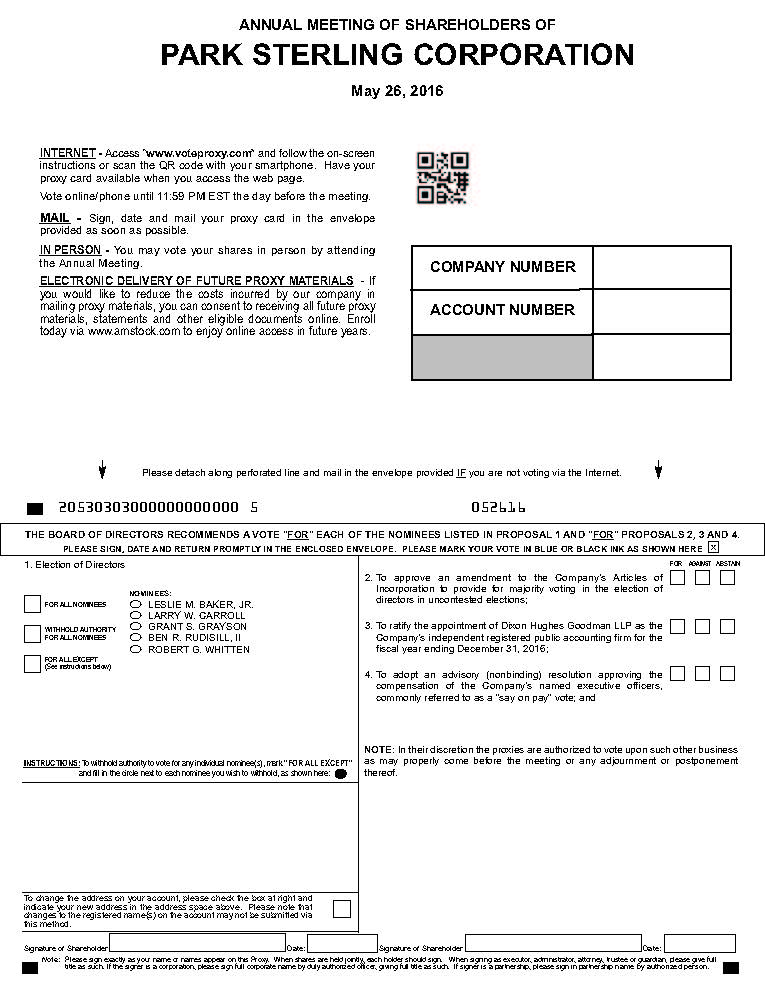
Even if you plan to attend the Annual Meeting, I encourage you to review these proxy materials and vote your shares in advance of the Annual Meeting either by Internet or by mail. Instructions regarding Internet voting are included on the proxy card. If you choose to submit a proxy by mail, please mark, sign and date the proxy card and return it in the enclosed postage-paid envelope. If you attend the Annual Meeting and desire to revoke your proxy and vote in person, you may do so. In any event, you may revoke your proxy at any time before it is exercised as explained in the Proxy Statement.
Thank you for your interest in Park Sterling.
Sincerely,

James C. Cherry
Chief Executive Officer
PARK STERLING CORPORATION
NOTICE OF ANNUAL MEETING OF SHAREHOLDERS
to be held on
May 26, 2016
TO OUR SHAREHOLDERS:
The 2016 Annual Meeting of Shareholders (the “Annual Meeting”) of Park Sterling Corporation (the “Company”) will be held at 4201 Congress Street, Suite 210, Charlotte, North Carolina, on Thursday, May 26, 2015, at 8:30 A.M., local time, for the following purposes:
|
1. |
To elect as directors of the Company the five nominees named in the proxy statement, four to serve three-year terms expiring in 2019, and one to serve a two-year term expiring in 2018, or until their successors are duly elected and qualified; |
|
2. |
To approve an amendment to the Company’s Articles of Incorporation to provide for majority voting in the election of directors in uncontested elections; |
|
3. |
To ratify the appointment of Dixon Hughes Goodman LLP as the Company’s independent registered public accounting firm for the fiscal year ending December 31, 2016; |
|
4. |
To adopt an advisory (nonbinding) resolution approving the compensation of the Company’s named executive officers, commonly referred to as a “say on pay” vote; and |
|
5. |
To transact such other business as may properly come before the Annual Meeting or any adjournment or adjournments thereof. |
We have fixed March 24, 2016 as the record date for the determination of shareholders entitled to notice of and to vote at the Annual Meeting. Only holders of record of the Company’s Common Stock at the close of business on that date will be entitled to notice of and to vote at the Annual Meeting and any adjournments thereof.
You are cordially invited to attend the Annual Meeting in person. Whether or not you plan to attend the Annual Meeting, your vote is important, and we encourage you to review these proxy materials and vote your shares in advance of the Annual Meeting by Internet or by mail, as described in the accompanying Proxy Statement. You may also vote your shares in person at the Annual Meeting. To obtain directions to be able to attend the Annual Meeting and vote in person, please call Ralph W. Brewer at (704) 716-2134.
Important Notice Regarding the Availability of Proxy Materials for the Shareholder Meeting to be Held on May 26, 2016: the Proxy Statement, form of proxy and the Company’s 2015 Form 10-K which serves as its annual report to shareholders are available on the Company’s website at www.parksterlingbank.com, under Investor Relations.
By order of the Board of Directors
Ralph W. Brewer
Secretary
April [ ], 2016
PARK STERLING CORPORATION
1043 East Morehead Street, Suite 201
Charlotte, North Carolina 28204
Proxy Statement
Annual Meeting of Shareholders
to be held on
May 26, 2016
This Proxy Statement is furnished in connection with the solicitation by the Board of Directors of Park Sterling Corporation (the “Company”) of proxies to be used at the 2016 Annual Meeting of Shareholders of the Company (the “Annual Meeting”) to be held on Thursday, May 26, 2016, at 8:30 A.M., local time, at 4201 Congress Street, Suite 210, Charlotte, North Carolina, and at any adjournment or adjournments thereof. These proxy materials are first being mailed or made available to shareholders on or about April [ ], 2016.
The entire cost of soliciting these proxies will be borne by the Company. In addition to the delivery of the proxy materials by mail, the Company may request banks, brokers and other record holders, or a proxy solicitor acting on its behalf, to send proxies and proxy materials to the beneficial owners of the Company’s common stock (the “Common Stock”) and secure their voting instructions and will reimburse them for their reasonable expenses in so doing. The Company has not engaged a proxy solicitor to solicit proxies from shareholders; however, the Company retains the right to do so if it deems such solicitation necessary. Furthermore, the Company may also use one or more of its regular employees, who will not be specially compensated, to solicit proxies from shareholders, either in person, by telephone, by e-mail, or by special letter.
Business to be Transacted
At the Annual Meeting, we will ask you to:
|
1. |
Elect as directors of the Company the five nominees named in this proxy statement, four to serve three-year terms expiring in 2019, and one to serve a two-year term expiring in 2018, or in each case until their successors are duly elected and qualified; |
|
2. |
Approve an amendment to the Company’s Articles of Incorporation to provide for majority voting in the election of directors in uncontested elections; |
|
3. |
Ratify the appointment of Dixon Hughes Goodman LLP as the Company’s independent registered public accounting firm for the fiscal year ending December 31, 2016; |
|
4. |
Adopt an advisory (nonbinding) resolution approving the compensation of the Company’s named executive officers, commonly referred to as a “say on pay” vote; and |
|
5. |
Transact such other business as may properly come before the Annual Meeting or any adjournment or adjournments thereof. |
No other items are scheduled to be voted upon.
Who May Vote
Shareholders of record of Common Stock as of the close of business on March 24, 2016, the record date established by the Company’s Board of Directors, are entitled to notice of and to vote at the Annual Meeting and any adjournments thereof, either in person or by proxy. Each share of Common Stock is entitled to one vote on each matter expected to be presented at the Annual Meeting, including the election of directors. On the record date, there were 53,076,216 shares of Common Stock outstanding and entitled to vote at the Annual Meeting.
Voting Methods
You may vote at the Annual Meeting: (i) in person, (ii) by mail via your proxy card, or (iii) on the Internet in accordance with the instructions on your proxy card. If a bank, broker or other nominee (“broker”) holds your shares, you will receive voting instructions directly from the holder of record.
Voting by Proxy
The form of proxy solicited by the Board of Directors permits you to specify a choice between “for” and “withhold authority” to vote for each nominee for election as director, and a choice among “for,” “against,” and “abstain” with respect to each of the other matters to be acted upon at the Annual Meeting. All shares represented by valid proxies that the Company receives through this solicitation, and that are not revoked, will be voted according to your instructions on the proxy card or as instructed via the Internet. If you properly submit a proxy without giving specific voting instructions, your shares will be voted in accordance with the Board of Directors’ recommendations. If other matters properly come before the Annual Meeting, the persons appointed to vote the proxies will vote on these matters in accordance with their best judgment.
Revocability of Proxies
Even if you execute a proxy, you have the right to revoke it and change your vote by notifying us at any time before your proxy is voted. You may revoke a proxy at any time by submitting written notice of revocation to the Company’s Secretary before the proxy is exercised, by submitting a proxy having a later date, or by appearing at the Annual Meeting and voting in person. Unless so revoked, the shares of Common Stock represented by the valid proxies received pursuant to this solicitation will be voted in accordance with the specifications given therein.
Quorum and Vote Necessary for Action
Quorum. The presence of the holders of a majority of the outstanding shares of Common Stock entitled to vote at the Annual Meeting, present in person or represented by proxy, is necessary to constitute a quorum.
Broker Non-Votes. A broker holding shares in “street name” for a beneficial owner has discretion (but is not required) to vote the client’s shares with respect to “routine” matters if the client does not provide voting instructions. The broker, however, is not permitted to vote the client’s shares with respect to “non-routine” matters without voting instructions. A “broker non-vote” occurs when your broker submits a proxy for your shares but does not vote on a particular proposal because the broker does not have discretionary voting power for that item and has not received instructions from you. Broker non-votes, if any, will be counted for purposes of determining a quorum but will not be treated as votes cast and therefore will have no effect on the vote required for a particular matter.
“Routine” and “Non-routine” Matters. The ratification of the appointment of Dixon Hughes Goodman LLP as the Company’s independent registered public accounting firm for 2016 (Proposal 3) is considered a routine matter under applicable stock exchange rules. Therefore, even if your broker does not receive voting instructions from you, your broker is entitled (but not required) to vote your shares on this proposal. The election of directors (Proposal 1), the amendment to the Articles of Incorporation (Proposal 2) and the advisory “say on pay” vote (Proposal 4) are considered non-routine matters under applicable stock exchange rules, and your broker is not entitled to vote your shares on these proposals without your instructions.
Abstentions. If you abstain from voting on a particular matter, your vote will be counted for purposes of determining whether a quorum is present but will not be treated as a vote cast either for or against that matter.
Required Vote. Directors are elected by a plurality of the votes cast at the Annual Meeting. This means that with respect to the election of directors (Proposal 1), the nominees receiving the largest number of affirmative votes cast are elected as directors up to the maximum number of directors to be elected at the meeting. At the Annual Meeting, the maximum number of directors to be elected is five. You may vote “for” or “withhold authority” with respect to the election of directors. Only votes “for” are counted in determining whether a plurality has been cast in favor of a director. You may not cumulate votes in the election of directors.
Approval of the amendment to the Company’s Articles of Incorporation (Proposal 2) and approval of the ratification of the appointment of Dixon Hughes Goodman LLP (Proposal 3) each require the affirmative vote of the majority of the votes cast with respect to that matter at the Annual Meeting. “Say on pay” (Proposal 4) is an advisory vote that will not be binding on the Board of Directors. The Board of Directors will, however, strongly consider the outcome of this vote in determining the compensation of named executive officers.
BENEFICIAL OWNERSHIP OF COMMON STOCK
Principal Shareholders
The following table sets forth information with respect to the beneficial ownership of Common Stock as of March 24, 2016 by those persons known to the Company to be the beneficial owners of more than five percent of the Common Stock, based solely on the most recent Schedule 13D and 13G reports filed with the Securities and Exchange Commission (the “SEC”) and the information contained in those filings. Percentages are calculated based on shares outstanding as of March 24, 2016. The nature of beneficial ownership of the shares included is presented in the notes following the table.
|
Name and Address of Beneficial Owner |
Amount and Nature of Beneficial Ownership (1) |
Percent of Common Stock (2) | ||
|
T.Rowe Price Associates, Inc. (3) 100 E. Pratt Street Baltimore, MD 21202 |
3,905,057 |
7.36% | ||
|
Huber Capital Management, LLC (4) 2321 Rosencrans Avenue, Suite 3245 El Segundo, CA 90245 |
2,976,199 |
5.61% | ||
|
Skyline Asset Management, L.P. (5) 120 South LaSalle Street, Suite 1320 Chicago, IL 60603 |
2,487,700 |
4.69% | ||
|
Wellington Management Group LLP (6) 280 Congress Street Boston, MA 02210 |
2,406,438 |
4.53% | ||
|
Dimensional Fund Advisors LP (7) 6300 Bee Cave Road, Building One Austin, TX 78746 |
2,374,970 |
4.47% |
|
(1) |
“Beneficial Ownership” for purposes of the table is determined according to the meaning of applicable securities regulations and based on a review of reports filed with the SEC pursuant to Section 13(d) of the Securities Exchange Act of 1934, as amended (the “Exchange Act”). |
|
(2) |
This table includes beneficial ownership information for those beneficial owners whose Schedule 13G reports filed in February 2016 indicated beneficial ownership of more than 5% of the Common Stock as of December 31, 2015.. Subsequent thereto, the Company issued additional shares of Common Stock in connection with its acquisition of First Capital Bancorp, Inc. on January 1, 2016. The percentages disclosed in the table reflect these additional shares outstanding as of the Record Date. As of the date of this Proxy Statement, no additional reports have been filed by these beneficial owners pursuant to Section 13(d) that reflect any different beneficial ownership of the Common Stock. |
|
(3) |
T. Rowe Price Associates, Inc. reported in its Schedule 13G/A filed with the SEC on February 16, 2016 that it had sole power to vote 481,200 shares and sole investment power with respect to 3,905,057 shares. |
|
(4) |
Huber Capital Management, LLC reported in its Schedule 13G/A filed with the SEC on February 12, 2016 that it had sole power to vote 1,443,284 shares, shared power to vote 339,717 shares, and sole investment power with respect to 2,976,199 shares. |
|
(5) |
Skyline Asset Management, L.P. reported in its Schedule 13G/A filed with the SEC on February 16, 2016 that it had sole voting and investment power with respect to 2,487,700 shares. |
|
(6) |
Wellington Management Group LLP, Wellington Group Holdings LLP, Wellington Investment Advisors Holdings LLP and Wellington Management Company LLP jointly reported in their Schedule 13G/A filed with the SEC on February 16, 2016 that they each had shared power to vote 2,276,593 shares and shared investment power with respect to 2,406,438 shares. |
|
(7) |
Dimensional Fund Advisors LP (“Dimensional Fund”) reported in its Schedule 13G/A filed with the SEC on February 9, 2016 that it had sole power to vote 2,319,400 shares and sole investment power with respect to 2,374,970 shares. Dimensional Fund serves as investment adviser to four investment companies, and serves as investment manager or sub-adviser to certain other commingled funds, group trusts and separate accounts (the “funds”). All shares are owned by the funds. However, in its role as investment advisor, sub-adviser and/or manager, Dimensional Fund may possess voting and/or investment power with respect to the shares that are owned by the funds, and may be deemed to be the beneficial owner of such shares. Dimensional Funds expressly disclaims beneficial ownership of such shares. |
Directors and Executive Officers
The following table sets forth information with respect to the beneficial ownership of Common Stock as of March 24, 2016 by all current directors and all nominees for director of the Company and the executive officers named in the Summary Compensation Table included later in this Proxy Statement, and of all current directors and executive officers of the Company as a group. Percentages are calculated based on the number of shares outstanding as of March 24, 2016. Except as otherwise indicated, the persons named in the table have sole voting and investment power over the shares included in the table.
|
Name of Beneficial Owner |
Amount and Nature of Beneficial Ownership (1) |
Percent of Common Stock | |||
|
Walter C. Ayers |
65,350 |
(2) |
* | ||
|
Leslie M. Baker, Jr. |
377,744 |
(3) |
* | ||
|
Larry W. Carroll |
433,125 |
(4) |
* | ||
|
James C. Cherry |
646,625 |
(5) |
1.22% | ||
|
Jean E. Davis |
112,500 |
(6) |
* | ||
|
Nancy J. Foster |
395,600 |
(7) |
* | ||
|
David L. Gaines |
495,525 |
(8) |
* | ||
|
Grant S. Grayson |
112,609 |
* | |||
|
Patricia C. Hartung |
74,033 |
(9) |
* | ||
|
Thomas B. Henson |
207,228 |
(10) |
* | ||
|
Jeffrey S. Kane |
65,808 |
(11) |
* | ||
|
Bryan F. Kennedy, III |
480,688 |
(12) |
* | ||
|
Mark S. Ladnier |
7,411 |
(13) |
* | ||
|
Kim S. Price |
189,631 |
(14) |
* | ||
|
Ben R. Rudisill, II |
172,473 |
(15) |
* | ||
|
Robert G. Whitten |
9,232 |
* | |||
|
All directors and executive officers as a group (17 persons) |
3,921,608 |
(16) |
|
7.22% | |
|
* Less than 1% |
|
(1) |
Amounts include, as applicable, shares of unvested restricted stock, as to which the director or executive officer currently has sole voting power but no investment power prior to vesting, as well as shares that may be acquired upon exercise of stock options that currently are exercisable or are exercisable within 60 days, as to which the director or executive officer would have sole voting and investment power upon acquisition, as indicated in the footnotes below. |
|
(2) |
Includes (i) 22,827 shares of unvested restricted stock, and (ii) 32,340 shares that may be acquired upon the exercise of stock options. |
|
(3) |
Includes (i) 153,847 shares held in trust, (ii) 26,292 shares of unvested restricted stock, and (iii) 40,425 shares that may be acquired upon exercise of stock options. |
|
(4) |
Includes (i) 25,000 shares held by Carroll Financial Associates, (ii) 22,827 shares of unvested restricted stock, and (iii) 69,465 shares that may be acquired upon the exercise of stock options. |
|
(5) |
Includes (i) 195,424 shares of unvested restricted stock, and (ii) 363,825 shares that may be acquired upon the exercise of stock options. |
|
(6) |
Includes (i) 22,827 shares of unvested restricted stock, and (ii) 32,340 shares that may be acquired upon the exercise of stock options. |
|
(7) |
Includes (i) 122,687 shares of unvested restricted stock, and (ii) 226,380 shares that may be acquired upon the exercise of stock options. |
|
(8) |
Includes (i) 10,306 shares of unvested restricted stock, and (ii) 274,890 shares that may be acquired upon the exercise of stock options. |
|
(9) |
Includes 8,804 shares of unvested restricted stock. |
|
(10) |
Includes (i) 58,298 shares held in trust, (ii) 1,910 shares held by Mr. Henson’s children, as to which they have sole voting and investment power and which he is deemed to beneficially own, (iii) 22,827 shares of unvested restricted stock, and (iv) 57,090 shares that may be acquired upon the exercise of stock options. |
|
(11) |
Includes (i) 2,308 shares held jointly with Mr. Kane’s spouse, as to which he has shared voting and investment power, (ii) 22,827 shares of unvested restricted stock, and (iii) 32,340 shares that may be acquired upon the exercise of stock options. |
|
(12) |
Includes (i) 2,750 shares held by Mr. Kennedy’s spouse, as to which she has sole voting and investment power and he is deemed the beneficial owner, (ii) 121,687 shares of unvested restricted stock, and (iii) 319,192 shares that may be acquired upon the exercise of stock options. |
|
(13) |
Includes 6,233 shares of unvested restricted stock. |
|
(14) |
Includes (i) 4,800 shares of unvested restricted stock, and (ii) 54,386 shares that may be acquired by Mr. Price upon the exercise of stock options. |
|
(15) |
Includes (i) 8,967 shares of unvested restricted stock, and (ii) 4,351 shares that may be acquired upon the exercise of stock options. |
|
(16) |
Includes (i) 1,613,723 shares owned of record or beneficially by such persons; (ii) 2,308 shares owned beneficially by such persons, as to which they have shared voting and investment power; (iii) 4,660 shares deemed to be owned beneficially by such persons, as to which they have no voting and investment power; (iv) 766,105 shares of unvested restricted stock; and (v) 1,507,024 shares that may be acquired upon the exercise of stock options. |
PROPOSAL 1
ELECTION OF DIRECTORS
Our Articles of Incorporation and Bylaws provide that the Board of Directors will consist of at least six but not more than nineteen members. The exact number of directors is determined from time to time by the vote of a majority of directors. The directors are divided into three classes having staggered three-year terms. Each class of directors is as nearly equal in number as possible.
The number of directors currently is fixed at twelve. Each director also currently serves as a director of Park Sterling Bank, the Company’s wholly owned banking subsidiary (the “Bank”).
The terms of five directors expire at the Annual Meeting, three of whom (Leslie M. Baker, Larry W. Carroll and Ben R. Rudisill, II) are serving three-year terms that expire in 2016 and two of whom (Grant G. Grayson and Robert G. Whitten) were appointed to the Board of Directors in January 2016 to fill vacancies created on the Board in connection with the merger of First Capital Bancorp, Inc. (“First Capital”) into the Company on January 1, 2016. The Board of Directors has nominated these five directors for re-election by the shareholders. Mr. Grayson and Mr. Whitten, who are standing for election at the Annual Meeting for the first time, initially were identified by the board of directors of First Capital as potential candidates for appointment to the Board of Directors in connection with the merger and are recommended by the Nominating and Governance Committee of the Board of Directors. Upon election, Mr. Baker, Mr. Carroll, Mr. Grayson and Mr. Rudisill will serve until the 2019 Annual Meeting of Shareholders and Mr. Whitten will serve until the 2018 Annual Meeting of Shareholders or, in each case, his earlier resignation or retirement or until a successor is elected and qualifies to serve. Although the Board of Directors expects that each of the nominees will be available for election, if a vacancy in the slate of nominees is caused by death or other unexpected occurrence, the persons named as proxies in the accompanying form of proxy may vote for a substitute nominee proposed by the Board of Directors.
Proxies may not be voted for a number of persons greater than the number of nominees.
The Board of Directors recommends a vote FOR each of LESLIE M. BAKER, JR., LARRY W. CARROLL, GRANT S. GRAYSON, BEN R. RUDISILL, II, and ROBERT G. WHITTEN for election as directors of the Company. Properly submitted proxies will be voted FOR election of Mr. Baker, Mr. Carroll, Mr. Grayson, Mr. Rudisill, and Mr. Whitten unless otherwise specified.
Board of Directors
The names, ages and principal occupations (which have continued for at least the past five years unless otherwise indicated) and certain other information, including the specific experience, qualifications, attributes or skills that led to the conclusion that such person should serve as a director of the Company, with respect to each of the nominees and continuing directors are set forth below.
Nominees for Terms Expiring in 2019
Leslie M. Baker, Jr. Mr. Baker, age 73, retired as Chairman of the Board of Wachovia Corporation in 2003. He previously served as President and Chief Executive Officer, Chief Operating Officer, President of the North Carolina bank, Chief Credit Officer, and Manager of the International Division of Wachovia. Mr. Baker is a founder of the National Museum of the Marine Corps and a member of the board of trustees of the Marine Corp Heritage Foundation. Past board affiliations include Marsh & McLennan Companies, Inc., the Federal Advisory Council of the Federal Reserve, International Monetary Conference, Financial Services Roundtable, American Bankers Association, Carolina Power & Light, Novant Health and Acuity Brands. As the former chief executive officer of a successful regional and super-regional bank, Mr. Baker brings exceptional knowledge of all aspects of managing and overseeing our Company to the Board of Directors. In addition, Mr. Baker brings a keen interest in both economic analysis and corporate governance to the Board of Directors, as well as experience as a public company director. Mr. Baker currently serves as Chairman of the Board of Directors and has been a director of the Company (or, prior to the Company’s formation as holding company, the Bank) since the Bank’s initial public offering in 2010 (the “Public Offering”).
Larry W. Carroll. Mr. Carroll, age 64, has been the President of Carroll Financial Associates, Inc., a financial planning and investment management firm, since 1980. He currently serves on the Board of Directors of Carroll Financial Associates, Inc. and the Board of Directors of Capitala Investment Corp., a North Carolina-based publicly traded business development corporation. He previously served on the Board of Trustees of Wingate University and the Board of Directors of the Cultural and Heritage Foundation. Prior to the Public Offering, Mr. Carroll also served as Chairman of the Board of Directors of the Bank. He began his career as a public accountant with KPMG LLC (USA). Mr. Carroll brings expertise in the financial services industry and capital markets to the Board of Directors, including a deep understanding of the wealth management business. His experience as a public accountant is important to our Audit Committee and Board of Directors, and his successful entrepreneurial experience is supportive of the Company’s organic growth strategy. In addition, his deep knowledge of and connections to community banking in the Carolinas is important to the Company’s acquisition strategy. Mr. Carroll has been a director of the Company (or, prior to the Company’s formation as holding company, the Bank) since 2006.
Grant S. Grayson. Mr. Grayson, age 63, has been a shareholder in the law firm of LeClairRyan, since November 2009. Prior to November 2009, Mr. Grayson was a partner in the law firm of Cantor Arkema, P.C. Mr. Grayson served on the First Capital board of directors as Chairman of the Board from 1998 until its merger with the Company in January 2016. Mr. Grayson’s knowledge of First Capital’s business, history, organization and executive management will provide the Park Sterling board of directors with insight into the effective integration of the First Capital operations. In addition, Mr. Grayson will be able to provide valuable guidance regarding merger activities, government and community relations, interactions with industry group and professional associations and business development efforts. Mr. Grayson has been a director of the Company since 2016.
Ben R. Rudisill, II. Mr. Rudisill, age 72, has served as the President of Rudisill Enterprises, Inc., a beverage distributor and food broker, since founding the company in 1976. Mr. Rudisill served as a director of Citizens South Banking Corporation (“Citizens South”) from 1977 until its merger with the Company in October 2012, and served as Chairman of Citizens South from May 2012 until the merger and prior to that as Vice Chairman since January 1998. Mr. Rudisill also served as Chairman of Citizens South Bank from May 2009 to October 2012. Mr. Rudisill currently serves as a director of the U.S. National Whitewater Center, a director of Covenant Village, Inc., and a director of Linville Golf Club. Past board affiliations include the Public Service Company of North Carolina, the Duke University Fuqua School of Business, and Lenoir Rhyne College. During his tenure as a director of Citizens South and since becoming a member of the Board of Directors, Mr. Rudisill has developed knowledge of both the banking industry in general and Citizens South’s and the Company’s business, history, organization and executive management which, together with his personal understanding of many of the markets that we serve, has enhanced his ability to serve the Board of Directors. In addition, Mr. Rudisill brings entrepreneurial experience that is supportive of the Company’s organic growth strategy. Mr. Rudisill has been a director of the Company since October 2012.
Nominee for Term Expiring in 2018
Robert G. Whitten. Mr. Whitten, age 61, is co-owner and president of Whitten Brothers Holding Company, which owns and operates two automobile dealerships in the metropolitan Richmond area. Mr. Whitten has been involved in the automobile business for over thirty-six years. Mr. Whitten’s business experience gives him extensive insights into the customers who live in the market areas in which First Capital operated and the economic developments affecting these communities. In addition, through his tenure on the First Capital board of directors from 2012 until the First Capital merger, Mr. Whitten has developed knowledge of First Capital’s business, history, organization and executive management, which, together with his personal understanding of many of the markets in which First Capital operated, will be a significant resource as Park Sterling integrates the First Capital operations. Mr. Whitten has been a director of the Company since January 2016.
Continuing Directors with Terms Expiring in 2017
Walter C. Ayers. Mr. Ayers, age 74, is the retired President and Chief Executive Officer of the Virginia Bankers Association, a position in which he served for 24 years until his retirement at the end of 2006. Past board affiliations include the American Bankers Professional Fidelity and Insurance Company, the American Bankers Insurance Association, and Bay Banks of Virginia, Inc. Mr. Ayers also served as a member of the American Bankers Association’s Communications Counsel, Government Relations Council, Deposit Insurance Reform Task Force, and the State Association Division Executive Committee. He is most recently served on the Board of Trustees of Ferrum College. He brings extensive knowledge of community and regional banking, particularly in the Commonwealth of Virginia, including strategic, financial and regulatory considerations, to the Board of Directors. His knowledge of and relationships with banks in Virginia are expected to support the Company’s growth ambitions in that market. He also brings national experience with banking-related industry associations and government relations. In addition, as a former director of Bay Banks of Virginia, Inc., Mr. Ayers brings community bank and public company board experience. Mr. Ayers has been a director of the Company (or, prior to the Company’s formation as holding company, the Bank) since the Public Offering.
Jean E. Davis. Ms. Davis, age 60, retired as the head of Operations, Technology and e-Commerce of Wachovia Corporation in 2006, a position that she held since 2001. She previously served as the Head of Operations and Technology, Head of Human Resources, Head of Retail Banking, and in several office executive, regional executive and corporate banking roles for Wachovia. She is currently serves as chairperson of Safe Alliance, a 501(c)(3) in Charlotte, NC and as chairperson of the Charlotte Latin School Board of Trustees. She is also currently a member of the Board of Children and Family Services Center in Charlotte, NC. Ms. Davis previously served as a member of the Financial Services Roundtable, the Board of Trustees of University of North Carolina at Greensboro, the Board of Visitors of the University of North Carolina at Chapel Hill, the Board of Directors of the YMCA of Greater Charlotte and the Board of United Family Services. Ms. Davis brings extensive knowledge of bank operations and technology, as well as human resources, to the Board of Directors, both of which are important to the Company’s long-term success. In addition, she brings a strong background in retail banking, merger due diligence and merger integration experience. Ms. Davis has been a director of the Company since March 2011.
Jeffrey S. Kane. Mr. Kane, age 62, retired as Senior Vice President in charge of the Charlotte Office of the Federal Reserve Bank of Richmond in 2009, which included overall responsibility for Fifth District Cash Operations, Reserve Accounts and Loans functions. He was previously responsible for Banking Supervision and Regulation for the Fifth District, and began his banking career as a lending officer at the Bank of Virginia. Mr. Kane brings extensive experience in bank regulatory matters to the Board of Directors. This includes significant knowledge of supervisory matters, soundness considerations, regulatory compliance, application approval and central bank operations. Mr. Kane also brings strong knowledge of commercial and retail banking markets in the Carolinas and Virginia, from a regulatory perspective, to the Board of Directors. His past involvement with education initiatives for bank directors is also valuable to our Board of Directors. Mr. Kane has been a director of the Company (or, prior to the Company’s formation as holding company, the Bank) since the Public Offering.
Kim S. Price. Mr. Price, age 60, is the retired President and Chief Executive Officer of Citizens South and Citizens South Bank, a position in which he served for 15 years until his retirement in October 2012 in connection with the merger of Citizens South into the Company. He currently serves as a director of both the Daniel Stowe Botanical Garden and the Community Foundation of Gaston County. Past board affiliations include Citizens South Banking Corporation and Citizens South Bank as well as the Gaston County Economic Development Corporation. As the former chief executive officer of Citizens South, Mr. Price brings both exceptional knowledge of managing and overseeing a successful community bank as well as local market experience to the Board of Directors. In addition, Mr. Price has local experience with banking-related industry associations and government relations, and deep knowledge of and connections with community banks in North Carolina, which is supportive of the Company’s growth strategies. Mr. Price currently serves as Vice Chairman of the Board of Directors and has been a director of the Company since October 2012.
Continuing Directors with Terms Expiring in 2018
James C. Cherry. Mr. Cherry, age 65, has served as Chief Executive Officer of the Company since its formation and of the Bank since the Public Offering. He retired as the Chief Executive Officer for the Mid-Atlantic Banking Region at Wachovia Corporation in 2006, and previously served as President of Virginia Banking, Head of Trust and Investment Management, and in various positions in North Carolina banking including Regional Executive, Area Executive, City Executive, Corporate Banking and Loan Administration Manager, and Retail Banking Branch Manager for Wachovia. Mr. Cherry was formerly Chairman of the Virginia Bankers Association. He is currently a director of Armada Hoffler Properties Inc., a Virginia-based publicly traded real estate company. Mr. Cherry’s extensive experience in commercial and retail banking operations, credit administration, product management and merger integration at Wachovia, which was focused in the Carolinas and Virginia, provides the Board of Directors with significant expertise important to the oversight of the Company and expansion into its target markets. Mr. Cherry has been a director of the Company (or, prior to the Company’s formation as holding company, the Bank) since the Public Offering.
Patricia C. Hartung. Ms. Hartung, age 62, has served as the Executive Director of the Upper Savannah Council of Governments since March 1990, and previously as its Assistant Director. Ms. Hartung served as Chairman of Community Capital Corporation (“Community Capital”) from 2007 until its merger with the Company in November 2011, and was a director of Community Capital since its formation in 1988. Ms. Hartung is currently a director of the National Association of Development Organizations, a director of Provident Business Financial Services and a director of Francis Marion University. During her tenure as a director of Community Capital and since becoming a member of the Board of Directors, Ms. Hartung has developed knowledge of both the banking industry in general and Community Capital’s and the Company’s business, history, organization, and executive management which, together with her personal understanding of many of the markets that we serve, has enhanced her ability to serve the Board of Directors. In addition, as former Chairman of Community Capital, Ms. Hartung brings community bank and public company board experience. Ms. Hartung has been a director of the Company since November 2011.
Thomas B. Henson. Mr. Henson, age 61, is founder and CEO of American Spirit Media, LLC. American Spirit owns seven network affiliated television stations in the Southeast and Midwest. Mr. Henson is also a private investor and has formed and managed various investment firms. Beginning in 1980, Mr. Henson was an attorney with Robinson Bradshaw & Hinson, P.A., specializing in mergers and acquisitions. Mr. Henson is currently a director of Cato Corporation, a North Carolina-based publicly traded specialty retailer. Mr. Henson brings valuable experience negotiating and closing mergers and acquisitions, which is an important component of the Company’s growth strategy, to the Board of Directors, as well as securities law knowledge and a legal background and interest in corporate governance, which are valuable to the Board of Directors in governing a public company. Mr. Henson has been a director of the Company (or, prior to the Company’s formation as holding company, the Bank) since 2006.
No nominee for director, director or executive officer of the Company has a family relationship as close as first cousin with any other nominee for director, director or executive officer of the Company.
Compensation of Directors
The table below summarizes the total compensation paid to or earned by directors of the Company during the fiscal year ended December 31, 2015.
|
Name (1) |
Fees Earned or Paid in Cash |
Stock Awards |
Option Awards |
Non-Equity Incentive Plan Compensation |
Change in Pension Value and Nonqualified Deferred Compensation Earnings |
All Other Compensation |
Total | |||||||
|
($) |
($) (2) |
($) |
($) |
($) |
($) (3) |
($) | ||||||||
|
Walter C. Ayers |
40,500 |
32,208 |
- |
- |
- |
2,463 |
75,171 | |||||||
|
Leslie M. Baker, Jr. |
62,500 |
32,208 |
- |
- |
- |
2,879 |
97,587 | |||||||
|
Larry W. Carroll |
47,500 |
32,208 |
- |
- |
- |
2,463 |
82,171 | |||||||
|
Jean E. Davis |
43,000 |
32,208 |
- |
- |
- |
2,463 |
77,671 | |||||||
|
Patricia C. Hartung |
41,000 |
32,208 |
- |
- |
- |
800 |
74,008 | |||||||
|
Thomas B. Henson |
40,250 |
32,208 |
- |
- |
- |
2,463 |
74,921 | |||||||
|
Jeffrey S. Kane |
48,000 |
32,208 |
- |
- |
- |
2,463 |
82,671 | |||||||
|
Kim S. Price (4) |
- |
34,800 |
- |
- |
- |
250,000 |
284,800 | |||||||
|
Ben R. Rudisill, II |
41,000 |
32,208 |
- |
- |
- |
800 |
74,008 |
|
(1) |
James C. Cherry, the Company’s Chief Executive Officer, is not included in this table because he is an employee of the Company and thus receives no compensation for his service as a director. The compensation received by Mr. Cherry as an employee of the Company is shown in the Summary Compensation Table provided below under the heading “Compensation of Executive Officers”. In addition, Grant S. Grayson and Robert G. Whitten are not included in this table as they did not serve as directors of the Company during 2015. |
|
(2) |
Amounts reflect the aggregate grant date fair value, computed in accordance with Financial Accounting Standards Board Accounting Standards Codification (“FASB ASC”) Topic 718, related to stock awards granted during the fiscal year ended December 31, 2015. The assumptions used in the calculation of these amounts, if any, are included in Note 19 – “Employee and Director Benefit Plans” in the notes to the consolidated financial statements included in the Company’s Annual Report on Form 10-K for the fiscal year ended December 31, 2015 (the “2015 Form 10-K”). |
The table below sets forth the number of unexercised stock options and the number of unvested shares of restricted stock held by our non-employee directors as of December 31, 2015.
|
Name |
Number of Shares Subject to Stock Options (#) |
Number of Shares of Restricted Stock (#) | ||
|
Walter C. Ayers |
32,340 |
22,827 | ||
|
Leslie M. Baker, Jr. |
40,425 |
26,292 | ||
|
Larry W. Carroll |
69,465 |
22,827 | ||
|
Jean E. Davis |
32,340 |
22,827 | ||
|
Patricia C. Hartung |
- |
8,967 | ||
|
Thomas B. Henson |
57,090 |
22,827 | ||
|
Jeffrey S. Kane |
32,340 |
22,827 | ||
|
Kim S. Price |
54,386 |
4,800 | ||
|
Ben R. Rudisill, II |
4,351 |
8,967 |
|
(3) |
For each director, other than Mr. Price, amount represents cash dividends accrued during the year on unvested performance-based and time-based restricted stock awards. Mr. Price was granted restricted stock in the fourth quarter of 2015 subsequent to the final dividend declaration of 2015. These dividends are payable to the director only if and to the extent the restricted stock vests and is not forfeited. For more information see the table in footnote (2) above which sets forth the number of unvested shares of restricted stock held by our non-employee directors as of December 31, 2015. |
|
(4) |
Mr. Price currently does not receive fees for service on the Board of Directors or attendance at Board or committee meetings as he is not an independent director. The compensation received by Mr. Price during the fiscal year ended December 31, 2015 reflected amounts paid or earned during 2015 pursuant to a Consulting Agreement, which is described below under “—Non-Competition Agreement and Consulting Agreement.” In previous years, Mr. Price also received payments in exchange for entering into a non-competition agreement which are also described below. |
Cash Retainer and Meeting Fees for Independent Directors. Under the Company’s director compensation policy, (i) the Chairman of the Board of Directors is paid an annual $50,000 fee, payable monthly, for service as Chairman; (ii) the chairman of the Audit Committee and the chairman of the Loan and Risk Committee of the Board of Directors are each paid an annual $35,000 fee, payable monthly, for service as chairmen of their respective committees; and (iii) each other independent director is paid an annual $30,000 fee, payable monthly, for service as a director of the Company. In addition, each of the Chairman and each independent director is paid a meeting fee of $750 for each Board of Directors meeting attended, whether in person or by telephone, and a meeting fee of $250 for each committee meeting attended, whether in person or by telephone, when such committee meetings are not scheduled concurrent to a full meeting of the Board of Directors.
Long-Term Incentive Plan Compensation. Directors are eligible for awards under the Park Sterling Corporation 2014 Long-Term Incentive Plan (the “2014 LTIP”), pursuant to which nonstatutory stock options, stock appreciation rights and other stock-based awards (including, without limitation, restricted stock awards) can be awarded to directors from time to time, in the discretion of the Board of Directors and the Nominating and Governance Committee. Equity awards granted to directors during the fiscal year ended December 31, 2015 are disclosed in the table above.
Nonqualified Deferred Compensation. Directors are eligible to participate in the Park Sterling Bank Deferred Compensation Plan (the “Deferred Compensation Plan”), which provides directors the ability to defer Board fees, with deferred amounts credited with interest at the Wall Street Journal prime rate, with a floor of at least 0.50%. For more information, see “Compensation of Executive Officers – Nonqualified Deferred Compensation.”
Predecessor Company Benefits. Prior to the merger of Citizens South with the Company, Citizens South Bank entered into nonqualified deferred compensation and income continuation agreements for the benefit of certain of its directors, including Ben R. Rudisill, II. Mr. Rudisill’s agreement provides him with an annual benefit of $78,816, payable in monthly installments for a period of 10 years, to Mr. Rudisill upon his retirement from service on or after attaining age 70 or to Mr. Rudisill’s beneficiaries upon his death. Benefits under the agreement are forfeited if Mr. Rudisill’s service is terminated for cause.
Also prior to the merger, Citizens South Bank entered into nonqualified director retirement agreements for certain of its directors, including Mr. Rudisill. Mr. Rudisill’s agreement provides for an annual benefit of $8,000, payable to Mr. Rudisill in monthly installments for a period of 15 years upon his termination of service on or after attaining age 70. In the event of Mr. Rudisill’s pre-retirement death or death before all payments under the agreement have been made to him, monthly benefits are provided for his designated beneficiary or beneficiaries. If Mr. Rudisill dies without a valid beneficiary designation, his surviving spouse will be his beneficiary, or if none, then the benefits will be paid to his personal representative. Benefits under the agreement are forfeited if Mr. Rudisill’s service is terminated for cause.
Also prior to the merger, Citizens South entered into Endorsement Split Dollar Agreements with certain executives, including Kim S. Price, which Park Sterling assumed in connection with, and agreed to continue to maintain after, the merger. Mr. Price is 100% vested in his life insurance benefit under the policy. Under the Endorsement Split Dollar Agreement, upon Mr. Price’s death, Mr. Price’s designated beneficiaries will be paid a death benefit equal to the death proceeds under the policy minus the cash surrender value of the policy. The cash surrender value of the policy will be paid to Park Sterling. No premiums were paid by or on behalf of Park Sterling with respect to this policy during 2015.
Non-Competition Agreement and Consulting Agreement. Effective at the time of the merger of Citizens South with the Company in 2012, Kim S. Price entered into a Consulting Agreement and a Non-Competition Agreement with the Company and the Bank. Pursuant to the Consulting Agreement, Mr. Price performs consulting services as the Company and Bank may reasonably request, including supporting merger activities, government relations, community relations, industry group association and business development efforts for a period of five years following the merger. Pursuant to the Non-Competition Agreement, Mr. Price has agreed not to compete with the Company and the Bank for a period of the longer of three years or the consulting period following the merger for the benefit of any business within 25 miles of any office of Citizens South or the Company as of the closing date of the merger. During such three- to five-year period, Mr. Price has also agreed not to solicit any customers of the Company or the Bank, disparage the Company or the Bank or offer employment to any employee of the Company or Bank or any of their subsidiaries or affiliates that would cause such person(s) to terminate employment and accept employment with or provide services to any business that competes with the Company or Bank. In exchange for the consulting services, the Company and the Bank have agreed to pay Mr. Price $250,000 per year payable in equal monthly installments. In exchange for the non-competition agreement, the Company and the Bank agreed to pay Mr. Price $1,500,000, with $775,000 paid by lump sum at the closing date of the merger and $725,000 paid on the first anniversary of the closing date of the merger. Mr. Price has been determined by the Nominating and Governance Committee to be a non-independent director in accordance with the independence standards of NASDAQ in light of these payments.
Board Meetings; Attendance
The Board of Directors held eight regular meetings and three special meetings during 2015. Each director then serving attended at least 75% of the aggregate number of meetings of the Board of Directors and all committees of the Board of Directors on which he or she served during 2015.
Committees of the Board of Directors
The Board of Directors has a standing Executive Committee, Audit Committee, Compensation and Development Committee, Nominating and Governance Committee, Loan and Risk Committee, and Trust and Investment Management Committee, each of which operates under a charter that is included on the Company’s website at www.parksterlingbank.com. Information on the Company’s website does not form a part of this Proxy Statement. Current membership of the committees and number of meetings for these committees during 2015 are as follows:
|
Director |
Independent Director (1) |
Executive |
Audit |
Compensation and Development |
Nominating and Governance |
Loan and Risk |
Trust and Investment Management | |
|
Walter C. Ayers |
Yes |
X |
Chair |
|||||
|
Leslie M. Baker, Jr. |
Yes |
Chair |
X |
X |
||||
|
Larry W. Carroll |
Yes |
X |
Chair |
X |
X | |||
|
James C. Cherry |
No |
X |
X |
X | ||||
|
Jean E. Davis |
Yes |
X |
X |
X |
||||
|
Grant S. Grayson (2) |
Yes |
X |
X | |||||
|
Patricia C. Hartung |
Yes |
X |
Chair | |||||
|
Thomas B. Henson |
Yes |
X |
Chair |
|||||
|
Jeffrey S. Kane |
Yes |
X |
X |
Chair |
||||
|
Kim S. Price |
No |
X |
X | |||||
|
Ben R. Rudisill, II |
Yes |
X |
X | |||||
|
Robert G. Whitten (2) |
Yes |
X |
X | |||||
|
Number of meetings in 2015 |
4 |
6 |
3 |
3 |
12 |
5 |
|
(1) |
Independent director in accordance with the independence standards of NASDAQ. |
| (2) | Became a director upon completion of the First Capital merger. |
The following is a brief description of each committee of the Board of Directors.
Audit Committee: The Audit Committee discharges the Board of Directors’ responsibility relating to the oversight of (i) the integrity of the financial statements and internal controls of the Company; (ii) the independent auditor’s qualifications and independence; (iii) the performance of the Company’s internal audit function and independent auditors; and (iv) compliance by the Company with legal and regulatory requirements. The Audit Committee, among other things, is responsible for the appointment, compensation and oversight of the independent auditors and review of the Company’s financial statements, audit reports, internal controls and internal audit procedures. The Audit Committee was established in accordance with Section 3(a)(58)(A) of the Exchange Act. Each member of the Audit Committee has been determined to be an independent director, in accordance with the independence standards of the SEC and NASDAQ applicable to audit committees.
Compensation and Development Committee: The Compensation and Development Committee (the “Compensation Committee”) is appointed by the Board of Directors to (i) review and approve the Company’s compensation and benefit programs; (ii) ensure the competitiveness of those programs; (iii) discharge the responsibilities of the Board of Directors relating to compensation of the Company’s Chief Executive Officer and other officers, as appropriate; and (iv) advise the Board of Directors on the development of and succession for key executives. The Chief Executive Officer works closely with the Compensation Committee to evaluate and recommend compensation for the other executive officers and other key employees. Each member of the Compensation Committee has been determined to be an independent director, in accordance with the independence standards of NASDAQ applicable to compensation committees.
The Compensation Committee may from time to time, in its sole discretion, engage a compensation consultant to conduct a review, on either a comprehensive or selected basis, of the competitiveness and effectiveness of the Company’s executive compensation program relative to market practices and business goals or engage legal counsel or other advisors to assist it in the performance of its duties, but only after taking into consideration factors relevant to such compensation consultant’s or other adviser’s independence as specified in the NASDAQ listing standards. Such compensation consultants or other advisors, when engaged, serve at the request of, and report directly to, the Compensation Committee. The Compensation Committee has the sole authority to approve such adviser’s fees and other terms and conditions of engagement, and the Company must pay the reasonable compensation of any compensation consultant or other advisor retained by the Compensation Committee.
Additional information on the process and procedures for executive compensation determinations, including the role of management and compensation consultants, is contained under the heading “Compensation Discussion and Analysis” below.
Nominating and Governance Committee: The Nominating and Governance Committee (i) reviews and recommends to the Board of Directors the appropriate size, functions and needs of the Board of Directors; (ii) reviews the qualifications of proposed director nominees and recommends such nominees to the Board of Directors; (iii) evaluates and recommends to the Board of Directors corporate governance practices applicable to the Company; (iv) reviews and makes recommendations to the Board of Directors regarding independent director compensation; (v) periodically reviews the duties and composition of the committees of the Board of Directors; and (vi) oversees the annual evaluation of the Board of Directors and its committees. The Nominating and Governance Committee also periodically reviews the functions of senior officers and reviews shareholder proposals and proposed responses, including consideration of director nominations from shareholders. A more detailed discussion regarding the process for nominating potential director candidates is included under the heading “Corporate Governance Matters – Process for Nominating Potential Director Candidates.” Each member of the Nominating and Governance Committee has been determined to be an independent director, in accordance with the independence standards of NASDAQ.
Loan and Risk Committee: The Loan and Risk Committee provides oversight of management’s responsibilities to assess and manage the Company’s risks including, but not limited to, risks related to the Company’s credit and lending activities and asset-liability management. This includes the Company’s credit, market, funding and liquidity, interest rate, operational, compliance, reputational, legal, and cyber security risks.
Executive Committee: The Executive Committee generally exercises all of the powers and authority of the Board of Directors in the management of the affairs of the Company in the interim between meetings of the Board of Directors. The Executive Committee is established with the expectation that it will not take material actions absent special circumstances. The Executive Committee has no power to authorize distributions, authorize issuance or acquisition of shares, approve shareholder actions, amend the Company’s articles of incorporation or bylaws or approve a merger.
Trust and Investment Management Committee: The Trust and Investment Management Committee is appointed by the Board of Directors to oversee senior management’s responsibilities to assess and manage the Company’s Investment Management and Trust Services Group Services. The Trust and Investment Management Committee provides oversight of the Company’s trust and investment management activities, including providing for (i) sound banking practices in the operation of a trust department; and (ii) safeguards for the protection of depositors, fiduciary beneficiaries, creditors, shareholders, and the public.
CORPORATE GOVERNANCE MATTERS
Director Independence
The Board of Directors determines which of our directors is independent. For a director to be considered independent under NASDAQ listing standards, the Board of Directors must affirmatively determine that the director meets the criteria for independence set forth from time to time in the NASDAQ listing standards.
The Board of Directors has evaluated the relationships between each current director (and his immediate family members and related interests) and the Company or the Bank and has determined each of the following directors is independent under the applicable NASDAQ listing standards: Walter C. Ayers, Leslie M. Baker, Jr. (Chairman of the Board), Larry W. Carroll, Jean E. Davis, Grant S. Grayson, Patricia C. Hartung, Thomas B. Henson, Jeffrey S. Kane, Ben R. Rudisill, II and Robert G. Whitten.
The Board of Directors has determined that James C. Cherry, Chief Executive Officer of the Company, is not independent because he is an executive officer of the Company. The Board of Directors has also determined that Kim S. Price, Vice Chairman of the Company, is not independent because of the Non-Competition Agreement and Consulting Agreement between Mr. Price, the Company and the Bank entered into at the time of the merger of Citizens South with the Company.
Audit Committee Financial Expert
The Board of Directors has determined that one member of the Audit Committee, Larry W. Carroll, qualifies as an “audit committee financial expert.” Mr. Carroll is “independent” as that term is defined in the NASDAQ listing standards and the SEC rules.
Executive Sessions of Independent Directors
Independent directors meet at regularly scheduled executive sessions, generally at the end of each regularly scheduled meeting of the Board of Directors, without the directors who are not independent. The independent Chairman of the Board of Directors presides over meetings of the non-management or independent directors.
Code of Ethics
The Company has adopted a written Code of Ethics for Senior Financial Officers (the “Senior Code of Ethics”) that applies to the Company’s Chief Executive Officer (the principal executive officer), Chief Financial Officer (the principal financial officer), Chief Accounting Officer (the principal accounting officer) and Treasurer. The Company has also adopted a Code of Ethics (the “Code of Ethics”) that applies to all employees, officers and directors of the Company as well as any subsidiary company officers that are executive officers of the Company. The Senior Code of Ethics and Code of Ethics are available on the Company’s website at www.parksterlingbank.com and print copies are available to any shareholder that requests a copy. Any amendments to the Senior Code of Ethics or Code of Ethics, or waivers of these policies, to the extent applicable to the Chief Executive Officer, the Chief Financial Officer, the Chief Accounting Officer and Treasurer, will be disclosed on the Company’s website promptly following the date of such amendment or waiver, as applicable. Information on the Company’s website does not form a part of this Proxy Statement.
Shareholder and Interested Party Communications with Directors
Shareholders and other interested parties may communicate directly with the entire Board of Directors, any committee of the Board of Directors, the chairman of any committee, any individual director, the independent directors, as a group, or any other group of directors by writing to: Park Sterling Corporation, 1043 East Morehead Street, Suite 201, North Carolina 28204, Attention: Secretary. Each such communication should specify the applicable addressee(s). The Company’s Board of Directors has instructed the Secretary to forward these communications to the addressee, and if no specific addressee is listed, to the Chairman of the Board of Directors.
Director Attendance at Annual Meeting
The Company believes that the Annual Meeting is an opportunity for shareholders to communicate directly with the Company’s directors. Consequently, each director is encouraged to attend the Annual Meeting of Shareholders. All of the persons who were members of the Board of Directors at the time of the Company’s 2015 Annual Meeting of Shareholders attended such meeting.
Process for Nominating Potential Director Candidates
The Nominating and Governance Committee is responsible for identifying and screening potential director candidates and recommending qualified candidates to the full Board of Directors for nomination. Director nominees are recommended to the Board of Directors from time to time, but at least annually, by the Nominating and Governance Committee for election by the shareholders. Nominees for director are selected on the basis of outstanding achievement in their personal careers, wisdom, broad experience, integrity, ability to make independent analytical inquiries, understanding of the business environment, forthrightness and willingness to devote adequate time to Board of Directors’ duties. Knowledge of the financial services industry, and banking in particular, is also considered. Nominees must also possess a willingness to challenge and stimulate management and the ability to work as part of a team in an environment of trust.
The Nominating and Governance Committee reviews the background and qualifications of each nominee to determine such nominee’s experience, competence and character and assesses such nominee’s potential contribution to the Board of Directors, taking into account the then-existing composition of the Board of Directors and such other factors as the Nominating and Governance Committee deems appropriate. The Board of Directors believes that the business experience of its directors has been, and continues to be, critical to our success.
While the Company does not have a formal diversity policy with respect to the Board of Directors, the Board of Directors is committed to diversified membership and believes its membership should broadly reflect the communities served by the Company and the Bank as well as the strategic priorities of the Company, which include diversity of gender, race, ethnicity and experience. The Nominating and Governance Committee actively considers diversity in recruitment and nominations of directors. The current composition of our Board of Directors reflects those efforts. Going forward, the Nominating and Governance Committee will periodically review the composition of the Board of Directors to ensure it continues to meet the diversity goals, especially in line with the Company’s growth strategy into its target markets and subsequent accomplishments. The Nominating and Governance Committee uses its network of contacts when compiling a list of potential director candidates and may in the future engage outside consultants, such as professional search firms.
The Nominating and Governance Committee also will consider qualified nominees that are recommended by shareholders when such recommendations are submitted in accordance with Article II, Section 13 of the Company’s Bylaws, which the Board of Directors amended in March 2016. Shareholders may submit, in writing, the names and qualifications of potential director nominees to the Secretary, Park Sterling Corporation, 1043 East Morehead Street, Suite 201, Charlotte, NC 28204, for delivery to the Chair of the Nominating and Governance Committee for consideration. The written notice must include certain information about the proposed nominee and the shareholder submitting the nomination, including (i) with respect to the proposed nominee, the nominee’s name and address, the number of shares of stock owned of record and beneficially by such nominee, any derivative positions held of record or beneficially by such nominee related to, or the value of which is derived in whole or in part from, the value of the Company’s shares and whether and the extent to which any hedging, derivative or other transaction has been entered into by or on behalf of, or any other agreement, arrangement or understanding has been made, the effect or intent of which is to mitigate loss to, or to manage the risk or benefit from share price changes for, or to increase or decrease the voting power of, such nominee with respect to the Company’s shares, and all other information relating to such nominee that would be required to be disclosed in a proxy statement or other filings for a contested election (including the nominee’s written consent to being named as a nominee and to serving as a director if elected); and (ii) with respect to the shareholder submitting the nomination, the name and address of such shareholder as they appear on Company’s books, of any beneficial owner on whose behalf the nomination is being submitted, and of their respective affiliates and associates, the number of shares of stock owned of record or beneficially by any such person, any derivative positions held of record or beneficially by any such person related to, or the value of which is derived in whole or in part from, the value of the Company’s shares and whether and the extent to which any hedging, derivative or other transaction has been entered into by or on behalf of, or any other agreement, arrangement or understanding has been made, the effect or intent of which is to mitigate loss to, or to manage the risk or benefit from share price changes for, or to increase or decrease the voting power of, any such person with respect to the Company’s shares, a description of all agreements, arrangements or understandings with respect to the nomination between or among any such person, the proposed nominee and any other persons, any other information regarding any such person that would be required to be disclosed in a proxy statement or other filings for a contested election, and a representation that such shareholder is a record holder of the Company’s Common Stock entitled to vote at the meeting and intends to appear in person or by proxy at the meeting to make such nomination. Article II, Section 13 of the Company’s Bylaws also requires that any such shareholder recommendation be received by the Company in accordance with the time frame described under the heading “Shareholder Proposals” below. A copy of the Company’s Bylaws is available upon written request to: Park Sterling Corporation, 1043 East Morehead Street, Suite 201, North Carolina 28204, Attention: Secretary.
Pursuant to its charter, the Nominating and Governance Committee (i) periodically reviews the Company’s corporate governance matters, including criteria for the selection of Board of Directors members to ensure that the criteria, including diversity, are being addressed appropriately and (ii) conducts an annual assessment of its performance and of the charter and recommends changes to the Board of Directors when necessary.
All nominees for election to the Board of Directors at the Annual Meeting have been recommended by the Nominating and Governance Committee. All such nominees are current directors of the Company.
Board Leadership Structure
The Board of Directors is committed to strong, independent leadership and believes that objective oversight of management performance is a critical aspect of effective corporate governance. All but two of the members of the Board of Directors are independent directors. In addition, our key governance committees of the Board of Directors – Audit, Compensation and Development, and Nominating and Governance – are comprised solely of, and chaired by, independent directors.
Currently, the positions of Chairman of the Board and Chief Executive Officer of the Company are held by separate individuals, with James C. Cherry serving as Chief Executive Officer and Leslie M. Baker, Jr. serving as independent Chairman of the Board. The Board of Directors believes that at the current time this structure is appropriate for the Company, as it allows Mr. Cherry to focus on the Company’s strategy, business and operations, while enabling Mr. Baker to assist with Board-level matters and serve as a liaison between the Board of Directors and the Company’s management. The Board of Directors regularly deliberates and discusses its appropriate leadership structure and the role and responsibilities of the Chairman of the Board of Directors based upon the needs of the Company from time to time to provide effective, independent oversight of management.
Role in Risk Oversight
As the Company’s principal governing body, the Board of Directors has the ultimate responsibility for overseeing the Company’s risk management practices. On an ongoing basis, the Board of Directors identifies areas of risk that particularly affect the Company and assigns senior members of management to report to the Board of Directors on those areas of risk at regularly scheduled meetings of the Board of Directors. The areas of risk identified by the Board of Directors change from time to time based on business conditions and competitive considerations. The Board of Directors has also delegated certain risk management functions to its committees.
The primary roles and responsibilities of the Audit Committee are to assist the Board of Directors with the oversight of (i) the integrity of the financial statements and internal controls of the Company; (ii) the independent auditor’s qualifications and independence; (iii) the performance of the Company’s internal audit function and independent auditors; and (iv) compliance by the Company with legal and regulatory requirements. Under its charter, the Audit Committee, among other responsibilities and duties:
|
● |
Reviews with the outside auditor and management, as appropriate, significant accounting, income tax, financial reporting policies, issues and judgments made in connection with the preparation or audit of the Company’s financial statements; |
|
● |
Reviews with the outside auditor and management major issues identified by management or the outside auditor regarding the Company’s accounting and auditing principles and practices, including critical accounting policies, and major changes in auditing and accounting principles and practices suggested by the outside auditor, internal auditor or management; |
|
● |
Consults with the outside auditor and management concerning the Company’s internal controls, including any significant deficiencies and significant changes in internal controls and, when applicable, reviews management’s and the outside auditor’s reports on internal control over financial reporting; and |
|
● |
Reviews and approves the proposed annual internal audit plan, as well as the risk assessment used to establish the annual audit plan. |
Additionally, the Loan and Risk Committee of the Board of Directors provides oversight of management’s responsibilities to assess and manage the Company’s risks, including, but not limited to, risks related to the credit and lending activities of the Company and the Bank and asset-liability management. This includes the Company’s credit, market, funding and liquidity, interest rate, operational, compliance, reputational, legal and cyber security risks. In addition, the full Board of Directors is invited to meetings of the Loan and Risk Committee. The Loan and Risk Committee, among other responsibilities and duties:
|
● |
Reviews and approves the policies and procedures which govern the Company’s risk-taking activities and exposures; |
|
● |
Reviews and approves performance benchmarks, both internal or external, for the Company’s risk-taking activities and exposures, including establishing risk tolerances; |
|
● |
Reviews senior management's performance against these policies and benchmarks, and provides strategic guidance on achieving risk objectives; |
|
● |
Reviews reports on the Company’s risk-taking activities and exposures, as well as on selected risk topics as either the Loan and Risk Committee or senior management deem appropriate from time to time; |
|
● |
Reviews reports of significant issues prepared by internal risk oversight functional groups, including risk management, compliance and information technology; |
|
● |
Reviews the results of regulatory examinations and management’s response to significant findings, if any; and |
|
● |
Establishes senior management committees to assist the Loan and Risk Committee in carrying out its duties and responsibilities. |
The Trust and Investment Management Committee provides oversight of the Company’s Investment Management and Trust Services Group Services, including associated fiduciary risks.
Stock Ownership of Directors
The Board of Directors has adopted a governance guideline pursuant to which each non-employee director is expected to beneficially own at least 5,000 shares of Common Stock throughout the full term of the director’s service. These shares may be acquired over a period of three years beginning with the date of initial election of the director. Currently, each of the eleven non-employee directors beneficially owns at least 5,000 shares of Common Stock. As discussed below in “Compensation Discussion and Analysis – Stock Ownership,” executive officers also are expected to own a minimum amount of Common Stock. See ”Beneficial Ownership of Common Stock” above for a specific listing of the amount of Common Stock beneficially owned by each member of the Board of Directors and each executive officer of the Company named in the Summary Compensation Table in this Proxy Statement. Directors and executive officers of the Company may not engage in speculative trading or hedging strategies with respect to Common Stock.
COMPENSATION DISCUSSION AND ANALYSIS
Executive Summary
The Company’s practice is to provide total compensation that attracts, retains and incentivizes the management talent needed to execute our business strategies, and that promotes both our short-term and long-term objectives. Achievement of short-term objectives is rewarded through annual cash incentives, while equity incentive awards encourage employees to focus on the Company’s long-term goals. These incentives are based on business and financial objectives considered by the Compensation Committee to be important to the Company and its shareholders, including execution of growth strategies, maintenance of asset quality, and generation of earnings growth, return on assets and return on equity, along with the Compensation Committee’s assessment of individual performance and contributions to the Company.
The Company’s compensation practices reflect our pay-for-performance philosophy, whereby a significant component of the total compensation paid to our Chief Executive Officer and other named executive officers (together, the “NEOs;” see “—Named Executive Officers” below) is variable and tied to corporate and individual performance. The Company advanced its growth strategies in 2015 by making investments in its markets. Additionally, earnings remained strong and asset quality continued to improve in 2015. This performance led the Compensation Committee to:
|
● |
Pay cash bonuses to the NEOs based on their and the Company’s performance during 2015; and |
|
● |
Grant equity awards vesting over three years. |
Named Executive Officers
The following table lists the Company’s NEOs, as set forth in the Summary Compensation Table under “Compensation of Executive Officers – 2015 Summary Compensation,” on whom this Compensation Discussion and Analysis is focused:
|
Title |
Key Work Experience |
Years in Banking |
Age |
|
James C. Cherry Chief Executive Officer |
Hired as Chief Executive Officer following Public Offering in August 2010. Previously Chief Executive Officer of Mid-Atlantic Region and President of Virginia Banking for Wachovia Corporation. |
41 |
65 |
|
Bryan F. Kennedy, III President |
Founded the Bank in October 2006. Served as President and Chief Executive Officer until Public Offering in August 2010. Previously President-North Carolina of Regions Bank and Executive Vice President of Park Meridian Bank. |
35 |
58 |
|
David L. Gaines (1) Executive Vice President and Chief Financial Officer |
Hired as Chief Financial Officer following Public Offering in August 2010. Previously Chief Risk Officer for Corporate and Investment Banking and Comptroller of Wachovia Corporation. |
30 |
56 |
|
Nancy J. Foster Executive Vice President and Chief Risk Officer |
Hired as Chief Risk Officer in November 2010. Previously Chief Risk Officer of CIT Group and Chief Credit Officer-Community Banking for LaSalle Bank. |
32 |
54 |
|
Mark S. Ladnier Group Senior Vice President and Head of Operations and Information Technology |
Engaged as an Operations and Information Technology consultant in December 2013 to provide consultative recommendations to the Company. Hired as Head of Operations and Information Technology in January 2014. Previously Chief Information Officer for Real Estate Lending of Wells Fargo Bank, N.A. |
28 |
57 |
|
(1) |
Mr. Gaines stepped down as Executive Vice President and Chief Financial Officer of the Company effective February 5, 2016. |
General Compensation Philosophy and Guiding Principles
The Company operates in the highly competitive financial services industry where attracting and retaining talented executives is critical to future success. For this reason, the Company has designed a competitive total compensation program that provides a mix of cash, annual incentive opportunities and equity-based compensation, when the Compensation Committee determines appropriate, along with retirement and other health and welfare programs. Together, these components create a pay-for-performance philosophy which is manifested in our compensation practices.
The Compensation Committee also considers how the individual elements of executive compensation and the executive compensation program as a whole could potentially encourage executives, either individually or as a group, to make excessively risky business decisions at the expense of long-term shareholder value. The Compensation Committee considers the following characteristics of the Company’s executive compensation program as factors that help mitigate risk:
|
● |
The Compensation Committee has the authority to establish a reserve for annual bonus awards and to approve the funding of the reserve, as well as to approve individual annual bonus awards, or to pay no bonuses at all (the Company does not guarantee bonuses for our NEOs); |
|
● |
From time to time as the Compensation Committee determines appropriate, the Company grants its executives equity awards that vest over multi-year periods of no less than three years, which the Compensation Committee believes aligns the executives’ long term interests with those of our shareholders; |
|
● |
Overall compensation is balanced between fixed and variable pay, and variable pay is linked both to annual performance and, with respect to equity awards, performance over multi-year periods with prohibitions against reloading grants or repricing options without the approval of our shareholders; |
|
● |
We have entered into employment agreements with our chief executive officer, president, chief financial officer and chief risk officer that provide for recoupment of incentive compensation, or “claw-backs,” based on applicable laws or if the compensation exceeds what should have been paid because the determination of the initial payment was based on materially inaccurate financial information about the Company; |
|
● |
The Company does not currently offer any supplemental retirement benefits to our NEOs; |
|
● |
The Company does not offer disproportionate severance packages to our NEOs and potential payments are prohibited in the case of termination for “cause;” |
|
● |
Performance goals for both annual and long-term incentive arrangements are not unduly aggressive; and |
|
● |
An open dialogue is maintained among management, the Compensation Committee and the Board of Directors regarding executive compensation practices and policies and the appropriate incentives to use in achieving short-term and long-term performance targets. |
The Company, Board of Directors and Compensation Committee pay careful attention to communications received from shareholders on executive compensation, including the non-binding advisory “say on pay” vote. At the Company’s 2015 Annual Meeting, our shareholders approved, by 80% of the votes cast, the non-binding advisory resolution on the 2014 compensation of NEOs submitted to shareholders in accordance with the Dodd-Frank Wall Street Reform and Consumer Protection Act (the “Dodd-Frank Act”). The favorable advisory vote was considered and reflected in the decision to maintain the overarching framework and balance for NEO compensation for 2015, but not for specific pay-level decisions. Based on the preference expressed by shareholders at the Company’s 2012 Annual Meeting, the Board of Directors currently has determined to have an annual advisory vote on NEO compensation until the next required nonbinding shareholder advisory vote on the frequency of our advisory “say on pay” vote is held.
Components of Compensation
From year to year, the Compensation Committee utilizes some or all of the following compensation components when setting NEO pay:
|
Compensation Component |
|
Key Features |
Objective |
Key Considerations | ||
|
Base Salary |
Fixed annual cash amount. |
To provide a fixed amount of cash compensation upon which our NEOs can rely. |
Base salary levels are intended to reward experience, scope of responsibility, demonstrated skills and competencies, and individual performance. | |||
|
Bonus Compensation (Cash Bonus Award) |
Variable annual cash amounts, if any, with bonus reserve size determined by evaluating Company performance against pre-established financial and business objectives. |
To motivate and reward individual and corporate performance based on the Compensation Committee’s review of Company results that have a meaningful bearing on long-term increases in shareholder value. |
Consistent with the Company’s pay-for-performance objectives; bonus reserve size based on Company performance and actual bonus payments based on Compensation Committee’s determination of individual and corporate performance. | |||
|
Long-Term Incentive Compensation (Equity Awards) |
Discretionary equity awards determined by the Compensation Committee which may include options, restricted stock, restricted stock units or other forms of equity awards under the 2014 LTIP. Exercise prices and vesting schedules determined at time of award. |
To motivate and reward individual and corporate performance relative to long-term goals and peer group that are expected to have a meaningful bearing on long-term increases in shareholder value. |
Consistent with the Company’s pay-for-performance objectives; aggregate number of awards, performance measures and individual awards approved by Compensation Committee. The Compensation Committee may consider previously granted awards when determining whether equity awards are appropriate for any given year. |
Employment Agreements. At the time of, or soon after, the Bank’s Public Offering in 2010, the Bank entered into employment agreements with Messrs. Cherry, Kennedy and Gaines and Ms. Foster, in order to secure the services of these employees within the highly competitive financial services industry. These agreements were designed to provide the executives with a measure of predictability for the future that, in turn, supported the Bank’s efforts to attract and retain the necessary management talent to execute our business strategies. Such agreements also include non-compete and non-solicitation provisions that help protect the Company from the loss of revenues and/or employees in the event an executive is terminated. From time to time, we may consider the use of additional employment agreements with high performing and long-term senior employees as the Company deems necessary in order to balance individual financial goals of employees relative to the needs of the Company and its shareholders. On February 5, 2016, the Bank entered into an agreement and release with Mr. Gaines in connection with his stepping down as Chief Financial Officer, which replaces his existing employment agreement with the Bank. In addition, in March 2016 the Company entered into new employment agreements with Messrs. Cherry, and Kennedy and entered into an employment agreement with Donald K. Truslow, who was hired as Executive Vice President and Chief Financial Officer of the Company and the Bank effective February 8, 2016. For more information regarding these new employment agreements and Mr. Gaines’ agreement and release, see “—Compensation Actions After 2015”. For more information regarding the executive officers’ employment agreements generally, see “Compensation of Executive Officers – Employment Agreements”.
Benefits and Perquisites. The Company currently provides NEOs with limited perquisites and other personal benefits. These include, but may not be limited to, relocation allowances and reimbursement for temporary living and commuting expenses for NEOs relocating as part of their employment with the Company. While others in the financial services industry, including community banks, provide executives with perquisites such as personal or financial tax advice; personal travel using vehicles owned or leased by the company; personal use of other property owned or leased by the company; security provided at a personal residence or during personal travel; personal club memberships; and discounts on company services not generally available to employees, the Company does not currently provide any of these listed benefits to NEOs, as the Compensation Committee believes structuring the Company’s compensation around base salary, annual cash incentives and equity awards is more transparent to shareholders and promotes a more accurate assessment of NEO compensation levels.
The Company maintains various broad-based employee benefit plans that constitute a portion of the total compensation package available to all eligible employees, including our NEOs. These other employee benefits include:
|
● |
the Park Sterling Corporation 401(k) Savings Plan, which in 2015 permitted employees to contribute up to 50% of their compensation, on a tax-deferred basis, up to certain Internal Revenue Service compensation deferral amount limits applicable to tax-qualified retirement plans, with the Company matching 100% of the first 3% of their deferrals and 50% of the next 3% of their deferrals; |
|
● |
health care plans, including flexible spending plans and Health Savings Accounts, that provide medical, prescription, dental and vision coverage for all eligible employees; |
|
● |
disability insurance for the benefit of its employees which, in the event of disability, pays the employee (i) short-term benefits of up to 50% of the employee’s weekly salary, subject to a cap of $3,000 per week, for up to 13 weeks, and thereafter (ii) long-term benefits of up to 50% of the employee’s monthly salary, subject to a cap of $12,500 per month; and |
|
● |
certain other welfare benefits, such as Paid Time Off and an Employee Assistance Program. |
The benefits our NEOs receive under the broad-based plans described above are determined by the same criteria applicable to all Company employees. In general, these benefits are designed to provide a safety net of protection against the financial catastrophes that can result from illness, disability or death. These benefits help keep the Company competitive in attracting and retaining employees. Benefits also help keep employees focused due to a lack of distractions related to obtaining health care, maintaining adequate savings for retirement and similar issues.
Executive Life Insurance. In 2011, the Company, acting through the Bank, purchased bank-owned life insurance that included, among certain other salaried employees, policies on the individual lives of Messrs. Cherry, Kennedy and Gaines and Ms. Foster. Under separate agreements with each insured party, including these executives, the insured party has the right to designate a beneficiary for up to a $100,000 death benefit. The full death benefit for each policy reverts to the Company should the insured party cease to be employed by the Company. The insured party has no right to sell, surrender or transfer ownership of the policy at any time, and has no right to designate a beneficiary upon termination of employment, whether by voluntary or involuntary means, and including retirement. The Company believes that the executive life insurance policies provide protection for the Company should an executive pass away during his or her employment, while also providing these executives with additional life insurance that helps them protect their families. The Company currently does not provide any post-retirement split dollar benefits to the NEOs. The purchase of bank-owned life insurance was only for persons employed at that time and no additional purchases have been made since 2011.
Executive Retirement Plan. The Company, acting through the Bank, maintains the Deferred Compensation Plan, which is designed to provide executives, including the NEOs, a greater ability to plan for their retirement. Accordingly, the Deferred Compensation Plan provides certain executives and directors, including the NEOs, the ability to defer base salary and bonus compensation (or, in the case of directors, Board fees). For more information, see “Compensation of Executive Officers – Nonqualified Deferred Compensation.”
2015 Compensation Events
The following section provides a summary of 2015 compensation events for the Company’s NEOs:
Base Salary Increases. The Compensation Committee did not make any adjustments to the NEOs’ base salaries in 2015, as it believed the existing salaries were competitive in light of market data and an increase was not required to further the Company’s business objectives.
Annual Bonuses. The Compensation Committee granted cash bonuses to certain employees, including the NEOs, from a reserve it created based on the Company’s annual adjusted earnings per share available to common shareholder (“Adjusted EPS”). The Compensation Committee utilized an earnings per share measure as the funding mechanism for the reserve based on its wide acceptance in the banking industry as a leading indicator of financial performance. The Compensation Committee determined, however, that reported net income available to common shareholders should be adjusted to exclude the effect of merger-related expenses and gain or loss on sale of securities, as adjusted net income better reflects core earnings and facilitates comparisons with peers.
Following the establishment of the reserve for 2015, the Compensation Committee selected and granted bonuses in 2016 to certain employees, including each of the NEOs, based on its determination of the Company’s success in achieving certain business and financial objectives during the year and the contribution of each NEO to that success, in accordance with the Company’s pay-for-performance philosophy. Mr. Gaines’ bonus was determined based upon his agreement and release with the Bank in connection with his stepping down as Executive Vice President and Chief Financial Officer. See “—Compensation Actions after 2015” below. With the exception of Mr. Gaines’ bonus, the actual bonuses awarded were entirely within the discretion of the Compensation Committee, which reviewed a variety of Company and individual factors when determining whether to give an employee a bonus and the amount of any such bonus.
The Compensation Committee awarded the following discretionary cash awards to NEOs for 2015:
|
Named Executive Officer |
Ending Base Salary |
Annual Bonus |
Annual Bonus Payout |
Total Cash Compensation |
|
($) |
($) |
(%) |
($) | |
|
James C. Cherry |
450,000 |
152,000 |
33.8% |
602,000 |
|
Bryan F. Kennedy, III |
347,000 |
117,800 |
33.9% |
464,800 |
|
David L. Gaines |
365,000 |
124,640 |
34.1% |
489,640 |
|
Nancy J. Foster |
347,000 |
117,800 |
33.9% |
464,800 |
|
Mark S. Ladnier |
215,000 |
45,000 |
20.9% |
260,000 |
As mentioned above, discretionary bonuses are paid from a reserve that was created based on the Company’s achievement of certain Adjusted EPS metrics. As with base salaries, annual discretionary bonuses, if any, generally are awarded to the NEOs relative to their respective duties, responsibilities and contributions to the Company’s performance. For 2015, the award pool began funding at a $0.39 Adjusted EPS and increased based on Company performance up to a maximum award pool at a $0.55 Adjusted EPS. The reserve began at $1.2 million and the maximum reserve that could have been created was $4.0 million.
The Compensation Committee met in January 2016 and reviewed the Company’s 2015 performance, as outlined in the table below:
|
($ in 000's) |
Twelve Months Ended December 31, 2015 |
Twelve Months Ended December 31, 2014 |
||||||
|
Pre-tax income, as reported |
$ | 24,748 | $ | 18,947 | ||||
|
Plus: Merger-related expenses |
1,716 | 3,616 | ||||||
|
Less: Gain on sale of securities |
(54 | ) | (180 | ) | ||||
|
Adjusted pre-tax income* |
26,410 | 22,383 | ||||||
|
Tax expense |
8,615 | 7,163 | ||||||
|
Adjusted net income* |
$ | 17,795 | $ | 15,220 | ||||
|
Adjusted net income per share |
$ | 0.40 | $ | 0.34 | ||||
|
Weighted average diluted shares |
44,304,888 | 44,247,000 | ||||||
|
* Non-GAAP financial measure; reconciliation to the most comparable GAAP measure is presented in the table above. |
The calculated Adjusted EPS of $0.40 per share would have yielded a reserve of $1.8 million based on the Compensation Committee’s predetermined discretionary bonus funding scale. However, the Compensation Committee determined that the final reserve should be set at the higher amount of $2.1 million primarily due to the Company’s improved noninterest income and consistent expense management.
The creation of the reserve did not entitle any employee (including the NEOs) to any particular cash bonus. Instead, the Compensation Committee awarded discretionary bonuses from the amounts set aside in the reserve based on its evaluation of the Company’s and the employee’s 2015 performance. Moreover, the Compensation Committee was not under any obligation to pay the entire reserve in bonuses or to limit the reserve to the funding scale.
The Compensation Committee’s evaluation of Company performance in 2015 included:
|
● |
Continued progress toward the Company’s vision of creating a regional-sized community bank through the announcement of the merger with First Capital Bancorp in Richmond, Virginia; |
|
● |
Reported net income available to common shareholders of $16.6 million, or $0.37 per share, for the twelve months ended December 31, 2015, compared to net income available to common shareholders of $12.9 million, or $0.29 per share, for the twelve months ended December 31, 2014; |
|
● |
Reported adjusted net income available to common shareholders of $17.8 million, or $0.40 per share, for the twelve months ended December 31, 2015, compared to adjusted net income available to common shareholders of $15.2 million, or $0.34 per share, for the twelve months ended December 31, 2014; |
|
● |
Reported record organic loan growth of $161.1 million, representing a 10% increase from the prior year; |
|
● |
Continued improvement of asset quality, with nonperforming loans decreasing from 0.56% to 0.47% of total loans and nonperforming assets decreasing from 0.89% to 0.54% of total assets, respectively, from December 31, 2014 to December 31, 2015; and |
|
● |
Maintained strong capitalization with a Tier 1 leverage ratio of 11.00% at December 31, 2015. |
When evaluating the individual performance of the NEOs, the Compensation Committee considered the individual’s overall performance and their contributions towards achieving the Company-wide performance measures described above.
The discretionary cash bonus awards shown in the table above reflect the Compensation Committee’s decision to reduce each of the 2015 incentive payments for Messrs. Cherry, Kennedy and Gaines and Ms. Foster by 9%, compared to their respective 2014 award levels, to facilitate increased incentive payment awards for certain of the Company’s origination bankers. Mr. Ladnier’s discretionary cash bonus is reflective of his duties, responsibilities and contributions relative to the other NEOs. The cash bonus for Mr. Gaines was determined in accordance with the provisions of the agreement and release with the Bank, described below under “—Compensation Actions After 2015.”
Long-Term Incentive Awards. In May 2015, the Compensation Committee granted equity awards in the form of restricted stock to the NEOs in the following amounts:
|
Named Executive Officer |
Number of Shares of Restricted Stock |
|
James C. Cherry |
20,400 |
|
Bryan F. Kennedy, III |
13,400 |
|
David L. Gaines |
15,400 |
|
Nancy J. Foster |
13,400 |
|
Mark S. Ladnier |
2,900 |
These shares of restricted stock vest in approximately equal one-third increments annually, over a period of three years, subject to the executive’s continued service with the Company or its affiliates and to accelerated vesting upon the executive’s termination by the Company without “cause” or resignation for “good reason.” For more information see “Potential Payments Upon Termination or Change of Control” below. Dividends are accrued with respect to the shares of restricted stock but are paid to the NEO only if and when the shares to which the dividends are attributable are vested. These multi-year grants are designed as long-term incentives and are intended to help align the NEOs’ long-term interests with those of our shareholders and to the tie actual vesting with continued service over the next three years. These awards are consistent with the Company’s pay-for-performance objectives.
Peer Group Analysis
Annually, the Compensation Committee reviews both internally or externally prepared reports to assist it in determining the market for executive compensation, and utilizes this information while setting compensation for the upcoming year. While the Compensation Committee believes the information in these reports is valuable, it presently does not utilize the reports as a benchmark to set executive compensation. The Compensation Committee does not currently believe it is appropriate to tie executive compensation directly to the compensation awarded by other companies or to a particular survey or group of surveys. Instead, the purpose of the reports, and the manner in which they are used by the Compensation Committee, is to provide a general understanding of current compensation practices and trends of similarly situated companies. No specific compensation decision for any individual was based on or justified by these reports. The reports contain information compiled from publicly available documents from the following peer financial institutions:
|
American National Bankshares Inc. |
First Bancorp |
South State Corporation |
|
(NASDAQ: AMNB) |
(NASDAQ:FBNC) |
(NASDAQ:SSB) |
|
Ameris Bancorp |
First Community Bancshares, Inc. |
TowneBank |
|
(NASDAQ:ABCB) |
(NASDAQ:FCBC) |
(NASDAQ:TOWN) |
|
BNC Bancorp |
Hampton Roads Bankshares, Inc. |
Union First Market Bankshares Corporation |
|
(NASDAQ:BNCN) |
(NASDAQ:HMPR) |
(NASDAQ:UBSH) |
|
Community Bankers Trust Corporation |
HomeTrust Bancshares, Inc. |
United Community Banks, Inc. |
|
(NASDAQ:ESXB) |
(NASDAQ:HTBI) |
(NASDAQ:UCBI) |
|
CommunityOne Bancorp |
State Bank Financial Corporation |
Yadkin Financial Corporation |
|
(NASDAQ:COB) |
(NASDAQ:STBZ) |
(NASDAQ:YDKN) |
|
Fidelity Southern Corporation |
||
|
(NASDAQ:LION) |
Decision-Making Practices
Role of Compensation and Development Committee. The Compensation Committee is responsible for oversight, review and administration of the Company’s compensation programs for all employees, including each of the NEOs. The Compensation Committee is composed entirely of non-management directors who are independent under the independence standards of NASDAQ applicable to compensation committees. It reviews all aspects of the compensation program for NEOs, including base salaries, annual cash bonuses, equity awards, perquisites, severance arrangements and other health and welfare benefits. It also approves the performance goals for any NEO compensation programs that use performance metrics, such as the Adjusted EPS funding mechanism used for the annual bonus reserve in 2015, and evaluates performance at the end of each performance period. The Compensation Committee approves base salary increases, annual bonuses, stock option awards, restricted stock awards and other long-term incentive award opportunities. The Compensation Committee does not have any pre-established plans regarding the amount of cash incentive or equity based award opportunities available to NEOs, if any. The Compensation Committee also sets the level and components of the compensation for the Chief Executive Officer and reviews and approves the compensation for the remaining NEOs. Beginning in 2015, the Compensation Committee currently expects that equity-based awards, if any, will generally be made on a regular award date in early May of each year. In addition, the Company occasionally may make equity-based awards other than on the annual award date, usually in connection with hiring a new key employee or in connection with a corporate transaction. We do not coordinate the timing of our awards with the release of material non-public information.
In making its decisions, the Compensation Committee may use several resources and tools, including the use of a compensation consultant or other advisor, peer financial institution evaluation and other analyses. The Chief Executive Officer also is involved in compensation determinations, including review of the compensation consultant’s recommendations, if any, and discussion of executive management compensation (including compensation for each NEO other than the Chief Executive Officer). The Company believes that the Chief Executive Officer is in the best possible position to assess the performance of the other NEOs, and he accordingly plays an important role in the compensation setting process. From time to time, the Chief Executive Officer also discusses his compensation package with the Compensation Committee. However, the Chief Executive Officer cannot be present during any voting or deliberation by the Compensation Committee on his compensation. Decisions about individual compensation components and total compensation for the NEOs, including those related to the Chief Executive Officer, are ultimately made by the Compensation Committee using its discretion and judgment, focusing primarily on the NEO’s performance and the Company’s overall performance. The Compensation Committee also considers the business environment in which the results were achieved and general comparisons to the overall performance of peer banks.
In addition, the Compensation Committee also reviews the total compensation of the NEOs relative to one another. The Compensation Committee believes that Mr. Cherry’s relatively higher compensation is appropriate in light of his expanded responsibilities as the Chief Executive Officer and the leadership, vision and strategy he has provided to the Company during his tenure. In addition, the Compensation Committee believes that the relatively similar compensation levels of Messrs. Kennedy and Gaines and Ms. Foster are appropriate in light of their shared responsibilities in managing the day-to-day activities of the Company, with modestly higher compensation awarded to Mr. Gaines given his added responsibilities related to merger and acquisition activities, and that the lower compensation level for Mr. Ladnier is appropriate in light of his assigned responsibilities relative to the other NEOs.
Compensation Consultant and Other Advisors. As described above under the heading “Committees of the Board of Directors – Compensation and Development Committee”, the Compensation Committee may from time to time, in its sole discretion, engage an independent compensation consultant to conduct a review, on either a comprehensive or selected basis, of the competitiveness and effectiveness of the Company’s executive compensation program relative to market practices and business goals or engage legal counsel or other advisors to assist it in the performance of its duties, but only after taking into consideration factors relevant to such compensation consultant’s or other adviser’s independence from management as specified in the NASDAQ listing standards. Such compensation consultants or other advisors, when engaged, serve at the request of, and report directly to, the Compensation Committee. The Compensation Committee has the sole authority to approve such adviser’s fees and other terms and conditions of engagement, and the Company must pay the reasonable compensation to any such compensation consultant or other adviser retained by the Compensation Committee.
The Compensation Committee did not engage an independent compensation consultant in 2015 in light of its belief that there were no material changes to the Company’s business strategy, the NEO composition, the Company’s peer group, or market practices outlined by the compensation consultant study conducted in 2014.
Determination of Individual Bonus Awards. The Company’s goal is to base individual bonus awards on a qualitative review of the NEO’s performance during the year relative to business and financial objectives. For bonuses in respect of 2015 results, the Compensation Committee determined the aggregate available annual bonus reserve based on the on the sliding scale approach described above under “—2015 Compensation Events – Annual Bonuses”. In addition to evaluating the aggregate funding mechanism, the Compensation Committee considered the following factors in determining individual NEO bonuses: (i) maintenance of acceptable asset quality, as measured by nonperforming loan levels, nonperforming asset levels, net charge-off levels and other relevant metrics; (ii) advancement of business objectives, including growth initiatives; and (iii) the individual contribution of each NEO to accomplishing these objectives. The Compensation Committee believes that review of corporate-wide metrics are appropriate performance measurements for the NEOs given that they align payment of bonuses to NEOs based on results that are important to the long-term interests of shareholders, offer broader perspective than metrics focused on individual operating businesses, and capture key drivers of financial and business performance.
Stock Ownership
The Board of Directors generally believes that the NEOs should accumulate meaningful equity stakes over time to further align their economic interests with the interests of shareholders, thereby promoting the Company’s objective of increasing shareholder value. The long-term incentives used by the Company also facilitate the acquisition of shares of the Company’s Common Stock by the NEOs. Pursuant to internal guidelines, each NEO is expected to beneficially own at least 10,000 shares of Common Stock throughout the full term of the NEO’s service as a member of executive management. Shares may be acquired over a period of three years beginning with the date of the initial election of the NEO to executive management. Currently, each of the NEOs beneficially owns the requisite number of shares, other than Mr. Ladnier who has until January 2017 to acquire the required ownership level.
Consistent with the Company’s compensation philosophy of rewarding the NEOs based on the long-term success of the Company, the Company’s Code of Ethics and Insider Trading Policy prohibit all employees, including the NEOs, from speculative trading in the Company’s Common Stock and place limitations on a NEO’s ability to conduct short-term trading, thus encouraging long-term ownership of the Company’s Common Stock. Additionally, pursuant to internal guidelines, NEOs are prohibited from entering into hedging strategies that protect against downside risk in the Company’s Common Stock.
Compensation Events After 2015
Base Salary Increases. Effective April 1, 2016, the Compensation Committee increased the base salaries of the NEOs as follows: Mr. Cherry -- $465,000; Mr. Kennedy -- $360,000; Ms. Foster -- $360,000; and Mr. Ladnier -- $220,000.
Gaines Agreement and Release. In connection with Mr. Gaines’ stepping down as Executive Vice President and Chief Financial Officer, on February 5, 2016, the Bank and Mr. Gaines entered into an Agreement and Release which replaces Mr. Gaines’ existing employment agreement with the Bank, which provided for Mr. Gaines to remain employed by the Bank through March 31, 2016. Pursuant to this agreement and release, which was entered into prior to the Compensation Committee’s determination of 2015 bonus compensation for the NEOs, Mr. Gaines will receive (i) severance pay equivalent to the base salary Mr. Gaines would have earned from March 31, 2016 through and including August 15, 2016 (or $136,875), plus (ii) bonus compensation for 2015 in an amount determined as a percentage of Mr. Gaines 2014 bonus compensation, with such percentage equal to the percentage that the Chief Executive Officer’s 2015 compensation represented relative to the Chief Executive Officer’s 2014 bonus compensation (subsequently determined to be $124,640). Such amounts will be payable to Mr. Gaines in a lump sum, subject to applicable withholdings and deductions, six months following the end of his employment on March 31, 2016. The agreement and release also provided for the immediate vesting on February 5, 2016 of 132,270 restricted stock awards. The agreement and release contains customary provisions regarding use of confidential information obtained during Mr. Gaines’ employment, the mutual release of claims, a mutual non-disparagement agreement effective for two years following the separation date, and a provision prohibiting the solicitation by Mr. Gaines, for twelve months following cessation of employment, of employees of the Bank with whom he had contact during the two years preceding cessation of employment.
Hiring of Mr. Truslow. In connection with the hiring of Mr. Truslow as Executive Vice President and Chief Financial Officer effective February 8, 2016, Mr. Truslow’s base salary was determined to be $350,000 and he was awarded 14,500 shares of restricted stock on March 1, 2016. These shares of restricted stock vest in approximately equal one-third increments annually over a period of three years.
New Employment Agreements. The Company also entered into employment agreements with Messrs. Cherry, Kennedy and Truslow on March 24, 2016 (the “2016 Employment Agreements”). The agreements with Messrs. Cherry and Kennedy replace their existing employment agreements. Each of the 2016 Employment Agreements is for a three-year initial term and automatically renews for additional one-year terms, absent notice from either party. The 2016 Employment Agreements generally provide for base salary, annual bonus opportunities and participation in the Company’s equity compensation program.
The 2016 Employment Agreements also remove the provisions found in the respective executives’ prior employment agreements (as applicable) that permitted the executive to voluntarily resign his employment without good reason within six months following a change in control and receive severance compensation. The 2016 Employment Agreements generally provide for severance in the event of a termination without cause or resignation for good reason equal to (i) two times the executive’s base salary, (ii) two times the executive’s highest bonus received during the three years prior to termination, and (iii) monthly COBRA payments.
Under the 2016 Employment agreements, in the event an executive is terminated without cause, resigns for good reason, or his 2016 Employment Agreement expires as a result of the buyer’s failure to renew its terms, each within the period beginning with the signing of a letter of intent or similar agreement that would result in a change of control transaction or within 12 months following a change of control (each a “CIC Termination”), the 2016 Employment Agreements provide such executive with the severance pay described above. In addition, in the event of a CIC Termination, Mr. Cherry is entitled to an additional year of base salary and bonus compensation (measured at the highest bonus received during the three years prior to termination).
Additional information regarding the 2016 Employment Agreements has been disclosed in the Company’s Current Report on Form 8-K filed on March 24, 2016.
Tax and Accounting Considerations
Tax Considerations. Section 162(m) of the Internal Revenue Code of 1986, as amended (the “Code”), and related regulations generally impose a $1 million cap on the deductibility of compensation paid to certain executive officers by a public corporation, unless an exception applies. One important exception is for qualified “performance-based compensation.” To the extent the Company determines it is in its interests, the Company’s compensation programs may be designed to meet the performance-based compensation exception under Section 162(m). However, the Company retains the flexibility to pay compensation that is not eligible for such exception if it is in the interest of the Company to do so.
Accounting Considerations. As previously described, for the purposes of certifying the Company’s performance for incentive compensation purposes, the Compensation Committee may adjust the Company’s net income to ensure that the employees are fairly compensated for the actual growth of the Company and not as a result of extraordinary items and events.
Conclusion
The Compensation Committee reviews all components of the Company’s compensation practices for the NEOs. In designing the various components of the total compensation program, the Company intends to take care to select elements that are performance-based and to use a variety of performance metrics that, on the whole, will encourage the achievement of short and long-term shareholder value without motivating excessive risk-taking and while enabling the Company to retain its talented executives. The Company believes the total compensation for each NEO is reasonable and that the components of the Company’s compensation program for NEOs are consistent with market standards and with comparable programs of peer financial institutions. The compensation program for NEOs is based on the financial performance of the Company compared to both business and financial objectives. The Company believes this practice links NEO performance to the annual financial and operational results of the Company and the long-term financial interests of its shareholders. The Company further believes that the foregoing compensation philosophy is consistent with the Company’s corporate culture and objectives and has served and will continue to serve as a reasonable basis for administering the total compensation program of the Company.
COMPENSATION OF EXECUTIVE OFFICERS
2015 Summary Compensation
The following table summarizes the cash compensation paid, equity awards granted and other compensation awarded to the Company’s NEOs for each of the three years ended December 31, 2015, December 31, 2014, and December 31, 2013:
Summary Compensation Table
|
Name and Principal Position |
Year |
Salary ($) |
Bonus ($) |
Stock Awards
($) (1) |
Option Awards ($) |
Non-Equity Incentive Plan Compensation
($) |
Change in Pension Value and Non-Qualified Deferred Compensation Earnings ($) |
All Other Compensation
($) (2) |
Total ($) |
||||||||||||||||||||||||
|
James C. Cherry |
2015 |
450,000 | 152,000 | 136,884 | - | - | - | 37,836 | 776,720 | ||||||||||||||||||||||||
|
Chief Executive Officer |
2014 |
450,000 | 190,000 | 129,336 | - | - | - | 29,157 | 798,493 | ||||||||||||||||||||||||
|
2013 |
433,333 | 200,000 | 96,880 | - | - | - | 20,633 | 750,846 | |||||||||||||||||||||||||
|
Bryan F. Kennedy, III |
2015 |
347,000 | 117,800 | 89,914 | - | - | - | 28,987 | 583,701 | ||||||||||||||||||||||||
|
President |
2014 |
347,000 | 147,250 | 84,956 | - | - | - | 23,418 | 602,624 | ||||||||||||||||||||||||
|
2013 |
339,000 | 155,000 | 60,480 | - | - | - | 18,104 | 572,584 | |||||||||||||||||||||||||
|
David L. Gaines (3) |
2015 |
365,000 | 124,640 | 103,334 | - | - | - | 15,622 | 608,596 | ||||||||||||||||||||||||
|
Executive Vice President and |
2014 |
365,000 | 155,800 | 97,636 | - | - | - | 23,083 | 641,519 | ||||||||||||||||||||||||
| Chief Financial Officer |
2013 |
355,000 | 164,000 | 73,360 | - | - | - | 18,997 | 611,357 | ||||||||||||||||||||||||
|
Nancy J. Foster |
2015 |
347,000 | 117,800 | 89,914 | - | - | - | 29,107 | 583,821 | ||||||||||||||||||||||||
|
Executive Vice President and |
2014 |
347,000 | 147,250 | 84,956 | - | - | - | 22,738 | 601,944 | ||||||||||||||||||||||||
| Chief Risk Officer |
2013 |
339,000 | 155,000 | 60,480 | - | - | - | 18,104 | 572,584 | ||||||||||||||||||||||||
|
Mark S. Ladnier (4) |
2015 |
215,000 | 45,000 | 19,459 | - | - | - | 15,133 | 294,592 | ||||||||||||||||||||||||
|
Group Senior Vice President and |
2014 |
215,000 | 50,000 | - | - | - | - | 9,180 | 274,180 | ||||||||||||||||||||||||
| Head of Operations and Information Technology |
2013 |
- | - | - | - | - | - | - | - | ||||||||||||||||||||||||
|
(1) |
Amounts reflect the aggregate grant date fair value, computed in accordance with FASB ASC Topic 718, related to restricted stock awards granted during the fiscal years indicated. The assumptions used in the calculation of these amounts are included in Note 19, “Employee and Director Benefit Plans,” in the notes to consolidated financial statements included in the 2015 Form 10-K. For further discussion of grants made in 2015, see the accompanying “Grants of Plan-Based Awards” table. |
|
(2) |
The following table shows all amounts included in the “All Other Compensation” column for each NEO in 2015: |
|
Dividends |
Life & Disability Premiums |
401(k) Matching |
Total |
|||||||||||||
|
($) (a) |
($) (b) |
($) | ($) | |||||||||||||
|
James C. Cherry |
23,451 | 2,460 | 11,925 | 37,836 | ||||||||||||
|
Bryan F. Kennedy, III |
14,602 | 2,460 | 11,925 | 28,987 | ||||||||||||
|
David L. Gaines |
1,237 | 2,460 | 11,925 | 15,622 | ||||||||||||
|
Nancy J. Foster |
14,722 | 2,460 | 11,925 | 29,107 | ||||||||||||
|
Mark S. Ladnier |
748 | 2,460 | 11,925 | 15,133 | ||||||||||||
|
(a) |
Represents cash dividends accrued on unvested stock price performance-based and time-based restricted stock. For more information, see “Outstanding Equity Awards at Fiscal Year-End.” Dividends are payable to the NEO only if and to the extent restricted stock vests and is not forfeited. |
|
(b) |
Represents premiums associated with the Company’s nondiscriminatory group life and group disability plans, which are available to all employees. |
Total perquisites for each of the NEOs for 2015 were less than $10,000.
|
(3) |
Mr. Gaines stepped down as Executive Vice President and Chief Financial Officer of the Company effective February 5, 2016. |
|
(4) |
Mr. Ladnier was first employed by the Bank in January 2014. Prior to such time he was retained as a consultant of the Company in 2013. |
Grants of Plan-Based Awards
The following table summarizes equity awards granted to the Company’s NEOs for the year ended December 31, 2015.
|
Grant |
All Other Stock |
Grant Date Fair |
|||||||
|
Name |
(#) (1) |
($) (2) | |||||||
|
James C. Cherry |
5/1/2015 |
20,400 | 136,884 | ||||||
|
Bryan F. Kennedy, III |
5/1/2015 |
13,400 | 89,914 | ||||||
|
David L. Gaines |
5/1/2015 |
15,400 | 103,334 | ||||||
|
Nancy J. Foster |
5/1/2015 |
13,400 | 89,914 | ||||||
|
Mark S. Ladnier |
5/1/2015 |
2,900 | 19,459 | ||||||
|
(1) |
Represents number of shares of restricted stock awarded in 2015. These shares of restricted stock vest in approximately equal one-third increments annually over a period of three years, subject to the NEO’s continued service with the Company or its affiliates and to accelerated vesting upon the NEO’s termination by the Company without “cause” or resignation for “good reason”. Dividends, if any, are accrued with respect to shares of restricted stock but are paid to the NEO only if and when the shares to which the dividends are attributable are vested. |
|
(2) |
Amounts reflect the aggregate grant date fair value, computed in accordance with FASB ASC Topic 718, related to the restricted stock awards granted during fiscal year 2015. The assumptions used in the calculation of these amounts are included in Note 19, “Employee and Director Benefit Plans,” in the notes to consolidated financial statements included in the 2015 Form 10-K. |
Employment Agreements
In connection with the Public Offering, the Bank entered into employment agreements with each of Messrs. Cherry, Kennedy and Gaines in August 2010 and entered into an employment agreement with Ms. Foster upon her hiring in November 2010. Each of these agreements was for an initial term of three years and is subject to automatic one-year renewals on each successive anniversary of the initial effective date unless either party provides timely notice of non-renewal. The agreements provide for certain payments in the event the executive’s employment is terminated by the Company without “cause,” the executive resigns for “good reason” or the executive is terminated following a “change of control.” The agreements also provide that the executive will not compete with the Bank in the banking business or solicit its customers or employees for a period of twelve months following termination of the executive’s employment, and are subject to a customary confidentiality obligation. For a discussion of these provisions see “— Potential Payments Upon Termination or Change of Control” below.
These agreements further provide for the following:
|
● |
Annual base salary, to be reviewed annually; |
|
● |
Eligibility to receive annual bonus compensation in cash or equity (with a maximum opportunity equal to no less than 100% of base salary) pursuant to any incentive program adopted by the Compensation Committee from time to time and long-term equity incentive awards, in the discretion of the Compensation Committee, no less favorable than those that apply to other senior executives; |
|
● |
Employee benefits, fringe benefits and perquisites on a basis no less favorable than those applicable to other senior executives; |
|
● |
Special equity awards in the form of stock options and restricted stock as contemplated by the Public Offering; and |
|
● |
Repayment by executive, or “claw-back,” of any incentive compensation previously paid that is subject to recovery under applicable law where the compensation was in excess of what should have been paid because the determination of the amount due was based, in whole or in part, on materially inaccurate financial information of the Company. |
On February 5, 2016, the Bank entered into an agreement and release with Mr. Gaines, which replaces his existing employment agreement, in connection with his stepping down as Executive Vice President and Chief Financial Officer of the Company. In addition, on March 24, 2016, the Company entered into new employment agreements with Messrs. Cherry and Kennedy, and entered into an employment agreement with Mr. Truslow, the Company’s new Executive Vice President and Chief Financial Officer. For a description of these agreements, see “Compensation Discussion and Analysis – Compensation Events After 2015”.
Outstanding Equity Awards at Fiscal Year-End
The following table summarizes outstanding equity awards at December 31, 2015:
|
Option Awards |
Stock Awards |
|||||||||||||||||||||||||||||||
|
Name |
Number of Securities Underlying Unexercised Options (#)
Exercisable |
Number of Securities Underlying Unexercised Options (#) Unexercisable |
Option ($ per share) |
Option |
Number of Shares or Units of Stock That Have Not Vested (#) (1) |
Market Value of Shares or Units of Stock That Have Not Vested ($) (2) |
Equity Incentive Plan Awards: Number of Unearned Shares, Units or Other Rights That Have Not Vested (#) (3) |
Equity Incentive Plan Awards: Market or Payout Value of Unearned Shares, Units or Other Rights That Have Not Vested ($) (2) |
||||||||||||||||||||||||
|
James C. Cherry |
363,825 | - | 6.5000 |
08/12/20 |
39,499 | 289,133 | 155,925 | 1,141,371 | ||||||||||||||||||||||||
|
Bryan F. Kennedy, III |
226,380 | - | 6.5000 |
08/12/20 |
24,667 | 180,562 | 97,020 | 710,186 | ||||||||||||||||||||||||
| 92,812 | - | 9.0900 |
12/14/16 |
- | - | - | - | |||||||||||||||||||||||||
|
David L. Gaines (4) |
274,890 | - | 6.5000 |
08/12/20 |
(102,504 | ) | (750,329 | ) | 117,810 | 862,369 | ||||||||||||||||||||||
|
Nancy J. Foster |
226,380 | - | 6.5000 |
08/12/20 |
25,667 | 187,882 | 97,020 | 710,186 | ||||||||||||||||||||||||
|
Mark S. Ladnier |
- | - | - | - | 6,233 | 45,626 | - | - | ||||||||||||||||||||||||
|
(1) |
Represents shares of restricted stock awarded to the NEOs by the Compensation Committee in 2013, 2014 and 2015. These shares of restricted stock vest in approximately equal one-third increments on the anniversary of each grant, subject to the NEO’s continued service with the Company or its subsidiaries. Dividends, if any, are accrued with respect to shares of restricted stock but are paid to the NEO only if and when the shares to which the dividends are attributable are vested. |
|
(2) |
In accordance with SEC rules, for purposes of this table the market value is determined by reference to the closing price of the Company’s common stock on December 31, 2015, or $7.32 per share. |
|
(3) |
Represents shares of special stock price performance-based restricted stock which were granted in February 2011 as contemplated in connection with the Public Offering and as specified in each such NEO’s employment agreement. These stock price performance-based restricted stock awards are subject to vesting conditions linked to the trading price of the Common Stock. The grants vest in approximately equal one-third increments when the trading price of the Common Stock is equal to or greater than $8.125 (125% of Public Offering price), $9.10 (140% of Public Offering price) and $10.30 (160% of Public Offering price), respectively, in each case for a period of 30 consecutive trading days. To the extent not vested, these restricted stock awards will be forfeited upon the earlier to occur of the NEO’s termination of employment or February 24, 2021. Dividends, if any, are accrued with respect to shares of restricted stock but are paid to the NEO only if and when the shares to which the dividends are attributable are vested. |
|
(4) |
Mr. Gaines stepped down as Executive Vice President and Chief Financial Officer of the Company effective February 5, 2016. As part of his agreement and release, Mr. Gaines immediately vested in 132,270 restricted stock awards. |
Option Exercises and Stock Vested
The following table summarizes option award exercises or stock award vesting for NEOs in 2015:
|
Option Awards |
Stock Awards |
|||||||||||||||
|
Name |
Number of Shares Aquired on Exercise (#) |
Value Realized on Exercise |
Number of Shares Acquired on Vesting (#) |
Value Realized o n Vesting |
||||||||||||
|
James C. Cherry |
- | - | 12,434 | 84,717 | ||||||||||||
|
Bryan F. Kennedy, III |
- | - | 7,433 | 50,714 | ||||||||||||
|
David L. Gaines |
- | - | 9,367 | 63,831 | ||||||||||||
|
Nancy J. Foster |
- | - | 7,933 | 54,014 | ||||||||||||
|
Mark S. Ladnier |
- | - | 1,667 | 12,236 | ||||||||||||
Pension Benefits
The Company currently does not provide any pension benefits to NEOs.
Nonqualified Deferred Compensation
The following table summarizes information about the participation of each NEO in the Park Sterling Bank Deferred Compensation Plan:
|
Named Executive Officer |
Executive Contributions in 2015 ($) (1) (2) |
Registrant Contributions in 2015 ($) |
Aggregate Earnings in 2015 ($)(2) |
Aggregate Withdrawals/ Distributions ($) |
Aggregate Balance at December 31, 2015 ($)(2) |
|||||||||||||||
|
James C. Cherry |
47,500 | - | 11,527 | - | 372,810 | |||||||||||||||
|
Bryan F. Kennedy, III |
145,625 | - | 9,256 | - | 345,729 | |||||||||||||||
|
David L. Gaines |
- | - | - | - | - | |||||||||||||||
|
Nancy J. Foster |
- | - | - | - | - | |||||||||||||||
|
Mark S. Ladnier |
- | - | - | - | - | |||||||||||||||
|
(1) |
Amounts in this column represent NEO elective deferrals credited during 2015 under the Deferred Compensation Plan, comprised of the deferred portion of base salary otherwise payable in 2015. |
|
(2) |
The following table identifies amounts that have already been reported as compensation in our Summary Compensation Table for the current or prior years: |
|
Named Executive Officer |
Amount of 2015 Contributions and Earnings Reported As Compensation in 2015 Summary Compensation Table ($) |
Amounts in “Aggregate Balance at December 31, 2015" Column Reported as Compensation in Summary Compensation Tables for Prior Years ($) |
||||||
|
James C. Cherry |
47,500 | 313,783 | ||||||
|
Bryan F. Kennedy, III |
145,625 | 190,848 | ||||||
|
David L. Gaines |
- | - | ||||||
|
Nancy J. Foster |
- | - | ||||||
|
Mark S. Ladnier |
- | - | ||||||
The Deferred Compensation Plan provides certain executives and directors, including the NEOs, the ability to defer base salary and bonus compensation (or, in the case of directors, Board fees). Amounts deferred under the Deferred Compensation Plan are credited with interest at the Wall Street Journal prime rate, with a floor of at least 0.50% interest. Participants in the Deferred Compensation Plan may elect to receive distributions of their deferrals at a specified date during their employment or upon termination of employment. Distributions are also made upon a participant’s death or disability or due to a participant’s unexpected hardship or a change in control of the Bank. If the NEO’s employment is terminated for “cause,” the NEO forfeits any interest credited to his or her account with respect to deferrals.
Potential Payments Upon Termination or Change of Control
As discussed above in “– Employment Agreements,” the Bank has entered into employment agreements with Messrs. Cherry, Kennedy, and Gaines and Ms. Foster that require us to provide compensation to them in connection with certain events related to the NEO’s termination of employment or change of control of the Company. The following discussion summarizes the provisions of the employment agreements that were in effect as of December 31, 2015. As described above, Mr. Gaines stepped down from his role as Executive Vice President and Chief Financial Officer on February 5, 2016, and the Company entered into new employment agreements with Messrs. Cherry and Kennedy, and entered into an employment agreement with Mr. Truslow, on March 24, 2016.
Accrued and Vested Benefits. Each of the NEOs may have accrued various benefits and awards under one or more of the Company’s compensation programs and benefits, including stock-based plans, broad-based employee benefit plans and the Deferred Compensation Plan. Certain of these benefits and awards are fully vested, and each of the NEOs would receive all of their vested benefits and awards if their employment with the Company ends for any reason. In addition, if an NEO’s employment is terminated for any reason, the NEO will be entitled to the payment of any amount earned and owing under his or her employment agreement, as applicable.
Each of Messrs. Cherry, Kennedy and Gaines and Ms. Foster has stock options granted under the Bank’s 2010 Employee Stock Option Plan and Bryan Kennedy also has stock options granted under the Bank’s 2006 Employee Stock Option Plan (together, the “Options”) which are fully exercisable and vested. Upon the termination of an NEO’s employment with the Company for any reason, all the NEO’s Options will be cancelled and forfeited, except in certain cases related to the NEO’s death, disability, retirement, resignation or termination by the Bank for other than an “immediate termination reason” (similar to “cause” under the employment agreements, described below). In such cases, the Options will remain exercisable for a specified period of time following the termination, ranging from a period of three months to the remaining term of the Options. Upon the effectiveness of the Company’s reorganization as the holding company for the Bank, the Company assumed the Options.
Termination without Cause. With respect to NEOs with an employment agreement, if the NEO’s employment is terminated by the Company or by the Bank without “cause,” under the agreement the NEO will be entitled (subject to any required six-month delay) to receive an amount equal to two times the NEO’s annual base salary at the highest rate in effect during the previous twelve months, payable monthly over two years. In addition, with respect to outstanding restricted stock awarded to NEOs under the 2010 LTIP or 2014 LTIP, if the NEO’s employment is terminated by the Company without “cause,” then (i) in the case of the special stock price performance-based restricted stock awards, the stock price performance goals will be deemed to have been satisfied as to all such shares of restricted stock, and (ii) in the case of restricted stock subject to time-based vesting, all such shares of restricted stock shall be deemed 100% vested, in each case as long as the NEO has provided continuous services to the Company or an affiliated entity since the grant date of the restricted stock.
For these purposes, “cause” means:
|
● |
Fraud against, material misappropriation from, or material dishonesty to the Company or the Bank by the NEO; |
|
● |
Conviction of the NEO of a crime involving breach of trust or moral turpitude or any felony; |
|
● |
Conduct of the NEO amounting to willful misconduct, gross and willful insubordination, gross neglect or inattention to or material failure to perform the NEO’s duties and responsibilities under the agreement, including prolonged absences without the Board of Directors’ consent, following notice from the Company and the failure to cure (if applicable) within 10 days; |
|
● |
Behavior related to employment that is materially disruptive to the orderly conduct of the Company’s business (including substance abuse, sexual harassment or sexual misconduct); |
|
● |
Receipt of notice that a regulatory agency intends to institute regulatory action against the NEO; or |
|
● |
Removal or permanent prohibition from participating in the Company’s conduct by an order issued under section 8(e)(4) or 8(g)(l) of the Federal Deposit Insurance Act. |
In addition, for NEOs with an employment agreement, “cause” also means a material breach of the employment agreement by the NEO which is not cured within 30 days of notice by the Company, including failure to perform duties and responsibilities required under the agreement.
Voluntary Termination with Good Reason. Each NEO has the right to terminate his or her employment voluntarily at any time for “good reason” either pursuant to an employment agreement or an applicable restricted stock award agreement. “Good reason” is generally defined in the employment agreements and the restricted stock award agreements to include material reductions in the NEO’s base salary or in the NEO’s authority, responsibilities or duties. If an NEO terminates employment for “good reason,” the NEO will be entitled to receive the termination compensation and other benefits described above under “Termination without Cause,” including the vesting of restricted stock as applicable.
Change of Control. With respect to NEOs with an employment agreement, if the NEO voluntarily resigns (with or without “good reason”) within six months following a “change of control,” the NEO will be entitled (subject to any required six-month delay) to receive an amount equal to two times the NEO’s annual base salary at the highest rate in effect during the previous twelve months, payable monthly over two years. For these purposes, “change of control” means a “change in the ownership or effective control of a corporation, or a change in the ownership of a substantial portion of the assets of a corporation” within the meaning of Section 409A of the Code, using 50 percent for purposes of determining an “effective change of control” and 85 percent for purposes of determining “a substantial portion of the assets of a corporation.” However, a “change of control” will not include a merger, reorganization, consolidation, share exchange or other transaction where the holders of the Common Stock continue to hold, directly or indirectly through a holding company or otherwise, shares of capital stock of the Company or other surviving company representing more than 50 percent of the value or ordinary voting power to elect directors of such company.
Release and Non-Disparagement Agreement. With respect to NEOs with an employment agreement, the payment of any amount under the agreement to an NEO in connection with a termination of employment is subject to the NEO’s execution of a release and non-disparagement agreement.
Non-Competition and Non-Solicitation Provisions. With respect to NEOs with an employment agreement, an NEO’s receipt of the severance or change of control payments described above is subject to the NEO’s compliance with the non-competition and non-solicitation provisions of the NEO’s employment agreement. These provisions generally prohibit the NEO, during the term of the agreement and for one year following termination of employment for any reason, from competing with the Bank or working for a competitor within the Bank’s banking footprint, from soliciting the Bank’s customers or actively pursuing potential customers with whom the NEO has had material contact, and from soliciting employees of the Bank with whom the NEO has had material contact. If an NEO breaches any of these provisions, the NEO is required to repay a pro rata portion of the amount otherwise payable to the NEO based on the period following the termination of employment during which the NEO complied with the covenants.
The potential payments to the NEOs under these agreements and other existing plans, awards and arrangements in the event of their termination of employment or a change in control as of December 31, 2015 are shown in the table below.
|
Involuntary Termination by Company w/out Cause ($) (1) |
Involuntary Termination by Company with Cause ($) |
Voluntary Termination by Employee for Good Reason ($) (1) |
Voluntary Termination by Employee w/out Good Reason ($) |
Voluntary Resignation by Employee Withing Six Months of Change of Control with or w/out Good Reason ($) (1) |
Termination in the Event of Disability ($) |
Termination in the Event of Death ($) (2) |
||||||||||||||||||||||
|
James C. Cherry |
||||||||||||||||||||||||||||
|
Cash Severance |
900,000 | - | 900,000 | - | 900,000 | - | - | |||||||||||||||||||||
|
Intrinsic Value of Unvested Stock Options (3) |
- | - | - | - | - | - | - | |||||||||||||||||||||
|
Intrinsic Value of Unvested Restricted Stock |
1,430,504 | - | 1,430,504 | - | - | - | - | |||||||||||||||||||||
|
Benefits and Perquisites |
- | - | - | - | - | - | 100,000 | |||||||||||||||||||||
|
Total Benefit |
2,330,504 | - | 2,330,504 | - | 900,000 | - | 100,000 | |||||||||||||||||||||
|
Bryan F. Kennedy, III |
||||||||||||||||||||||||||||
|
Cash Severance |
694,000 | - | 694,000 | - | 694,000 | - | - | |||||||||||||||||||||
|
Intrinsic Value of Unvested Stock Options (3) |
- | - | - | - | - | - | - | |||||||||||||||||||||
|
Intrinsic Value of Unvested Restricted Stock |
890,749 | - | 890,749 | - | - | - | - | |||||||||||||||||||||
|
Benefits and Perquisites |
- | - | - | - | - | - | 100,000 | |||||||||||||||||||||
|
Total Benefit |
1,584,749 | - | 1,584,749 | - | 694,000 | - | 100,000 | |||||||||||||||||||||
|
David L. Gaines (4) |
||||||||||||||||||||||||||||
|
Cash Severance |
730,000 | - | 730,000 | - | 730,000 | - | - | |||||||||||||||||||||
|
Intrinsic Value of Unvested Stock Options (3) |
- | - | - | - | - | - | - | |||||||||||||||||||||
|
Intrinsic Value of Unvested Restricted Stock |
112,040 | - | 112,040 | - | - | - | - | |||||||||||||||||||||
|
Benefits and Perquisites |
- | - | - | - | - | - | 100,000 | |||||||||||||||||||||
|
Total Benefit |
842,040 | - | 842,040 | - | 730,000 | - | 100,000 | |||||||||||||||||||||
|
Nancy J. Foster |
||||||||||||||||||||||||||||
|
Cash Severance |
694,000 | - | 694,000 | - | 694,000 | - | - | |||||||||||||||||||||
|
Intrinsic Value of Unvested Stock Options (3) |
- | - | - | - | - | - | - | |||||||||||||||||||||
|
Intrinsic Value of Unvested Restricted Stock |
898,069 | - | 898,069 | - | - | - | - | |||||||||||||||||||||
|
Benefits and Perquisites |
- | - | - | - | - | - | 100,000 | |||||||||||||||||||||
|
Total Benefit |
1,592,069 | - | 1,592,069 | - | 694,000 | - | 100,000 | |||||||||||||||||||||
|
Mark S. Ladnier |
||||||||||||||||||||||||||||
|
Cash Severance |
- | - | - | - | - | - | - | |||||||||||||||||||||
|
Intrinsic Value of Unvested Stock Options |
- | - | - | - | - | - | - | |||||||||||||||||||||
|
Intrinsic Value of Unvested Restricted Stock |
45,626 | - | 45,626 | - | - | - | - | |||||||||||||||||||||
|
Benefits and Perquisites |
- | - | - | - | - | - | - | |||||||||||||||||||||
|
Total Benefit |
45,626 | - | 45,626 | - | - | - | - | |||||||||||||||||||||
|
(1) |
Each of Messrs. Cherry, Kennedy and Gaines and Ms. Foster is entitled to an amount equal to two times his or her annual base salary at the highest rate in effect during the previous twelve months, payable monthly over two years, and each NEO is entitled to vesting of restricted stock awards, shown above with an intrinsic value equal to the closing price of the Common Stock at December 31, 2015 of $7.32 per share. |
|
(2) |
Represents life insurance death benefit, assuming the NEO has designated at least one beneficiary. |
|
(3) |
The stock options previously granted to the NEOs are all fully vested at December 31, 2014; therefore, there is no intrinsic value for the unvested stock options. |
|
(4) |
Mr. Gaines stepped down as Executive Vice President and Chief Financial Officer of the Company effective February 5, 2016. See “Compensation Discussion and Analysis – Compensation Events After 2015” for further discussion as to actual amounts paid or payable to Mr. Gaines in connection therewith. |
COMPENSATION AND DEVELOPMENT COMMITTEE REPORT ON EXECUTIVE COMPENSATION
The Compensation Discussion and Analysis section of this Proxy Statement is management’s report on the Company’s compensation program and, among other things, explains the material components of the compensation paid to the Chief Executive Officer and the other NEOs. The Compensation Committee has reviewed and discussed the Compensation Discussion and Analysis section of this Proxy Statement with management. Based on this review and discussions the Compensation Committee recommended to the Board of Directors that the Compensation Discussion and Analysis be included in this Proxy Statement and incorporated by reference into the Company’s Annual Report on Form 10-K for the fiscal year ended December 31, 2015.
Submitted by the Compensation and Development Committee of the Board of Directors, whose current members include:
|
|
Thomas B. Henson, Chair Leslie M. Baker, Jr. Larry W. Carroll |
COMPENSATION AND DEVELOPMENT COMMITTEE INTERLOCKS AND INSIDER PARTICIPATION
The directors who constituted the Compensation Committee during all of 2015 were Thomas B. Henson, Chair, Leslie M. Baker, Jr. and Larry W. Carroll. None of the individuals who served as a member of the Compensation Committee were at any time officers or employees of the Company or any of its subsidiaries or had any relationship with the Company requiring disclosure under SEC regulations.
REPORT OF THE AUDIT COMMITTEE
The Audit Committee of the Board of Directors currently is composed of six independent directors and operates under a written charter adopted by the Board of Directors. The Audit Committee annually reviews and assesses the adequacy of the Audit Committee charter.
Management is responsible for the Company’s internal controls and the financial reporting process. Dixon Hughes Goodman LLP, the Company’s registered public accounting firm, is responsible for performing an independent audit of the Company’s consolidated financial statements in accordance with the standards of the Public Company Accounting Oversight Board (United States) and issuing a report on those financial statements. The Audit Committee, among other things, is responsible for monitoring and overseeing these processes and is directly responsible for the appointment, compensation, retention and oversight of the Company’s independent auditors.
In this context, the Audit Committee has met and held discussions with management and the independent auditors. Management represented to the Audit Committee that the Company’s audited financial statements were prepared in accordance with generally accepted accounting principles, and the Audit Committee has reviewed and discussed the audited consolidated financial statements with management and the independent auditors. The Audit Committee discussed with the independent auditors the matters required to be discussed by Public Company Accounting Oversight Board Auditing Standard No. 16, “Communications with Audit Committees.”
The Company’s independent auditors also provided to the Audit Committee the written disclosures and the letter required by the Public Company Accounting Oversight Board regarding communications of the independent auditors with the Audit Committee concerning independence, and the Audit Committee discussed with the independent auditors the independence of the auditors.
Based upon the Audit Committee’s discussion with management and the independent auditors and the Audit Committee’s review of the representations of management and the report of the independent auditors to the Audit Committee, the Audit Committee recommended that the Board of Directors include the audited consolidated financial statements in the Company’s Annual Report on Form 10-K for the fiscal year ended December 31, 2015.
|
|
Submitted by the Audit Committee
Larry W. Carroll (Chair) Walter C. Ayers Patricia C. Hartung Thomas B. Henson Ben R. Rudisill, II Robert G. Whitten |
proposal 2
AMENDMENT OF THE COMPANY’S ARTICLES OF INCORPORATION TO PROVIDE FOR MAJORITY VOTING IN THE ELECTION OF DIRECTORS IN UNCONTESTED ELECTIONS
The Board of Directors has adopted, and recommends that the shareholders approve, an amendment to the Company’s Articles of Incorporation to provide for the election of directors by a majority of the votes cast in uncontested elections.
Background
The North Carolina Business Corporation Act provides that unless otherwise specified in a company’s articles of incorporation, directors are elected by a plurality of the votes cast by the shares entitled to vote in the election at a meeting at which a quorum is present. The Company’s Articles of Incorporation do not specify any voting standard required in director elections and, therefore, our directors currently are elected by a plurality vote. As a result, implementing a majority voting standard for uncontested elections of directors requires that the shareholders approve an amendment to the Company’s Articles of Incorporation.
Under plurality voting, only “for” votes are counted, not any “against” or “withheld” votes or abstentions. Therefore, in an uncontested election (i.e., an election where the only nominees are those proposed by the board) a director could be elected with only one “for” vote, despite an overwhelming number of “withheld” votes. Under a majority voting standard, a director must receive more votes “for” than votes “against” his or her election in order to be elected.
The Nominating Committee and the Board of Directors recognize that in recent years, shareholders of public companies have advocated for majority voting in the election of directors and that in response many public companies have implemented a majority voting standard for uncontested director elections. The Nominating Committee and the Board have engaged in an evaluation of the majority vote standard and, after careful consideration, believe it is in the best interests of the Company and its shareholders to adopt a majority voting standard in uncontested director elections as such a standard would (1) ensure that only directors with broad acceptability among the voting shareholders will be seated on the Board and (ii) enhance the accountability of each Board member to the shareholders.
The Board of Directors believes that the plurality vote standard should continue to apply in contested director elections. If a majority voting standard is used in a contested election, where there are more nominees than there are board seats to fill, fewer candidates could be elected to the board than the number of board seats to be filled, if too many directors receive more “against” than “for” votes.
Proposed Amendment to the Company’s Articles of Incorporation
Accordingly, the Board of Directors has adopted and recommends that shareholders approve the amendment (the “Amendment”) of the Company’s Articles of Incorporation (the “Articles”) to provide for majority voting in the election of directors in uncontested elections. If the Amendment is approved, a new Article 13 of our Articles of Incorporation will be added to read as follows:
Article 13. Election of Directors
Each director to be elected by the shareholders shall be elected to the Board of Directors if the votes cast for such nominee’s election exceed the votes cast against such nominee’s election (with abstentions and “broker non-votes” not counted as a vote cast either for or against that nominee’s election) by the shares entitled to vote in the election at a meeting at which a quorum is present; provided, however, that if, as of the record date for the meeting, the number of nominees exceeds the number of directors to be elected at the meeting, the directors shall be elected by a plurality of the votes cast by the shares entitled to vote in the election at such meeting at which a quorum is present.
If approved, this Amendment will become effective upon the filing of Articles of Amendment to our Articles of Incorporation with the Secretary of State of North Carolina. We would make such a filing promptly after approval of the proposal at the Annual Meeting. The new standard would then be applicable to the election of directors at the 2017 Annual Meeting of Shareholders. In addition, if this Amendment is approved (and the number of director nominees does not exceed the number of directors to be elected), the proxy card for the 2017 Annual Meeting would be modified such that shareholders would be able to vote “for” or “against”, or to “abstain” from voting, with respect to each director. Currently, under the plurality standard, the proxy card allows shareholders to either vote “for” a director nominee or to “withhold” voting for such director nominee.
New Director Resignation Policy
Under North Carolina law, if an incumbent director is not re-elected at an annual meeting of shareholders, then, even though his or her term has expired, the incumbent director continues to serve in office as a holdover director until his or her successor is elected and qualifies or until there is a decrease in the number of directors. To address the issue of holdover directors if the Amendment is adopted, the Board of Directors has approved a new Director Resignation Policy, conditioned on approval of the Amendment by the shareholders. Assuming shareholder approval of the Amendment, this Policy will become effective upon filing of the Articles of Amendment described above, and does not require any shareholder action.
The new Policy will require that if an incumbent director is nominated but not re-elected (i.e., does not receive the required majority vote), the director shall tender his or her resignation to the Board of Directors. The Policy will require the Nominating Committee to recommend to the full Board of Directors whether or not to accept the resignation, or to take other action, and will require the Board to act on the recommendation and promptly publicly disclose its decision and basis for the decision. The Nominating and Governance Committee and the Board, in making their decisions, may consider any factors or other information that they deem relevant. Any director who tenders his or her resignation pursuant to this provision would not participate in the Nominating Committee recommendation or Board action regarding whether to accept the resignation offer.
If the shareholders do not approve the Amendment, the Director Resignation Policy will not become effective.
Recommendation
The Board of Directors recommends that shareholders vote FOR the Amendment to the Articles of Incorporation to provide for majority voting in the election of directors in uncontested elections. Properly submitted proxies will be voted FOR approval of the Amendment unless otherwise specified.
proposal 3
RATIFICATION OF THE INDEPENDENT REGISTERED PUBLIC ACCOUNTING FIRM FOR 2016
The Audit Committee of the Board of Directors has retained Dixon Hughes Goodman LLP (“Dixon Hughes Goodman”) as the Company’s independent registered public accounting firm for the fiscal year ending December 31, 2016. Although the Audit Committee has the sole authority to select and appoint the independent registered public accounting firm, the Board of Directors deems it advisable to obtain your ratification of this appointment. In determining that Dixon Hughes Goodman be retained as the Company’s independent registered public accounting firm, the Audit Committee considered whether the provision of non-audit services by Dixon Hughes Goodman was compatible with maintaining Dixon Hughes Goodman’s independence and concluded that it was.
Representatives of Dixon Hughes Goodman are expected to be present at the Annual Meeting and will have the opportunity to respond to appropriate questions and to make a statement if they desire.
The Board of Directors recommends that shareholders vote FOR the ratification of the appointment of Dixon Hughes Goodman as the Company’s Independent Registered Public Accounting Firm for the fiscal year ending December 31, 2016. Properly submitted proxies will be voted FOR ratification of the appointment of Dixon Hughes Goodman unless otherwise specified. If the shareholders do not ratify the appointment of Dixon Hughes Goodman, the Audit Committee will consider a change in independent registered public accounting firm for the next fiscal year.
Fees
The fees billed or incurred by Dixon Hughes Goodman for services rendered to the Company for the fiscal years indicated were as follows:
|
Fiscal Year Ended |
||||||||
|
Fee Type |
December 31, 2015 |
December 31, 2014 |
||||||
|
Audit Fees ($) (1) |
369,755 | 405,035 | ||||||
|
Audit Related Fees ($) (2) |
15,000 | 24,000 | ||||||
|
Tax Fees ($) (3) |
52,385 | 75,200 | ||||||
|
All Other Fees ($) |
- | - | ||||||
|
Total Fees ($) |
437,140 | 504,235 | ||||||
|
|
(1) |
These amounts were incurred for audit services, quarterly review services and for services rendered in connection with the Company’s Registration Statement on Form S-4, HUD and FDIC loss share agreement audits for the respective fiscal years. |
|
(2) |
These amounts were incurred for the audit of the Company’s employee benefit plans. |
|
(3) |
These amounts were incurred for preparation of federal and state tax returns and tax consultation on merger-related matters for the respective fiscal years. |
Policy on Audit Committee Pre-Approval of Audit and Permissible Non-Audit Services by the Independent Registered Public Accounting Firm
The Audit Committee is responsible for the appointment, compensation and oversight of the work of the independent public accountants. As part of this responsibility, the Audit Committee is required to pre-approve all audit and non-audit services performed by the independent public accountants in order to assure that they do not impair the accountant’s independence from the Company. Accordingly, the Audit Committee has adopted procedures and conditions under which services proposed to be performed by the independent public accountants must be pre-approved.
Pursuant to this policy, the Audit Committee will consider annually and approve the terms of the audit engagement. Any proposed engagement relating to permissible non-audit services must be presented to the Audit Committee and pre-approved on a case-by-case basis. In addition, particular categories of permissible non-audit services that are recurring may be pre-approved by the Audit Committee subject to pre-set fee limits. If a category of services is so approved, the Audit Committee will be regularly updated regarding the status of those services and the fees incurred. The Audit Committee reviews requests for the provision of audit and non-audit services by the Company’s independent public accountants and determines if they should be approved. Such requests could be approved either at a meeting of the Audit Committee or upon approval by the Chair of the Audit Committee, or another member of the Audit Committee designated by the Chair. If a permissible non-audit service is approved by the Chair or his designee, that decision is required to be presented at the next meeting of the Audit Committee. Prior to approving any services, the Audit Committee considers whether the provision of such services is consistent with SEC rules on auditor independence and is compatible with maintaining the independence of the Company’s independent public accountants.
All of the fees paid to Dixon Hughes Goodman in 2014 and 2015 were pre-approved by the Audit Committee.
proposal 4
ADVISORY (NON BINDING) VOTE TO APPROVE EXECUTIVE COMPENSATION (SAY ON PAY)
SEC rules require the Company to seek an advisory (nonbinding) vote from our shareholders to approve the compensation of the NEOs, as disclosed in the Compensation Discussion and Analysis, compensation tables and related narrative disclosures included in this Proxy Statement, which are presented in accordance with the SEC’s rules.
The Company’s practice is to provide total compensation that attracts, retains and incentivizes the management talent needed to execute our business strategies, and that promotes both our short and long-term objectives. Achievement of short-term objectives is rewarded through annual cash incentives, while equity-based incentive awards encourage NEOs to focus on the Company’s long-term goals. These incentives are based on business and financial objectives considered by the Compensation Committee to be important to the Company and its shareholders, including execution of growth strategies, maintenance of asset quality, and generation of earnings growth, return on assets and return on equity, along with the Compensation Committee’s assessment of individual performance and contributions to the Company.
The Compensation Committee’s evaluation of Company performance in 2015 included:
|
● |
Continued progress toward the Company’s vision of creating a regional-sized community bank through the announcement of the merger with First Capital Bancorp, Inc. in Richmond, Virginia; |
|
● |
Reported net income available to common shareholders of $16.6 million, or $0.37 per share, for the twelve months ended December 31, 2015, compared to net income available to common shareholders of $12.9 million, or $0.29 per share, for the twelve months ended December 31, 2014; |
|
● |
Reported adjusted net income available to common shareholders of $17.8 million, or $0.40 per share, for the twelve months ended December 31, 2015, compared to adjusted net income available to common shareholders of $15.2 million, or $0.34 per share, for the twelve months ended December 31, 2014; |
|
● |
Reported record organic loan growth of $161.1 million, representing a 10% increase from the prior year; |
|
● |
Continued improvement of asset quality, with nonperforming loans decreasing from 0.56% to 0.47% of total loans and nonperforming assets decreasing from 0.89% to 0.54% of total assets, respectively, from December 31, 2014 to December 31, 2015; and |
|
● |
Maintained strong capitalization with a Tier 1 leverage ratio of 11.00% at December 31, 2015. |
This performance led the Compensation Committee to recommend paying cash bonuses to the NEOs in 2016, for 2015 performance. For more information on the NEOs’ compensation, see “Compensation Discussion and Analysis” and “Compensation of Executive Officers” above. The Board of Directors believes that the compensation of the NEOs for the 2015 fiscal year is reasonable and appropriate, is justified by the Company’s performance and is the result of a carefully considered approach.
Accordingly, the Company is presenting the following proposal, which gives you as a shareholder the opportunity to endorse or not endorse our pay program for NEOs by voting for or against the following resolution. While our Board of Directors intends to carefully consider the shareholder vote resulting from the proposal, the final vote is advisory in nature and will not be binding on us.
“RESOLVED, that the shareholders approve, on an advisory basis, the compensation of the Company’s named executive officers, as disclosed in the Compensation Discussion and Analysis, the compensation tables, and the related disclosure contained in the Company’s proxy statement for its 2016 Annual Meeting of Shareholders.”
We currently hold our “say on pay” vote annually. Shareholders will have an opportunity to cast an advisory vote on the frequency of the “say on pay” vote at least every six years. The next advisory vote on the frequency of the “say on pay” vote will occur no later than 2018.
The Board of Directors recommends that you approve the compensation of our NEOs as disclosed in this Proxy Statement by voting FOR the above proposal. Properly submitted proxies will be voted FOR approval of the proposal unless otherwise specified.
Transactions with Related Persons and Certain Control Persons
The Company’s Code of Ethics provides that personal interests of directors, officers and employees of the Company must not interfere with, or appear to interfere with, the interests of the Company. Directors, officers and employees of the Company may not compete with the Company or disadvantage the Company by taking for personal gain corporate opportunities or engage in any action that creates actual or apparent conflicts of interest with the Company. Any director or officer involved in a transaction with the Company or that has an interest or a relationship that reasonably could be expected to give rise to a conflict of interest must report the matter promptly to the Audit Committee, which is responsible for determining if the particular situation is acceptable.
The Company does not have a formal policy regarding the review, approval or ratification of related party transactions. As transactions are reported, however, the Audit Committee considers any related party transactions on a case-by-case basis to determine whether the transaction or arrangement was undertaken in the ordinary course of business and whether the terms of the transaction are no less favorable to the Company than terms that could have been reached with an unrelated party. If any member of the Audit Committee is interested in the transaction, that member will recuse himself from the discussion and decision on the transaction.
The Company, through the Bank, engages in loan transactions and maintains accounts with its directors, executive officers, principal shareholders and their related interests (collectively referred to as “related parties”). All such transactions between the Bank and related parties were made in the ordinary course of business and on substantially the same terms, including interest rates, and collateral as those prevailing at the time for comparable transactions with independent third parties and did not involve more than the normal risk of collectability or present other unfavorable features. The Company expects to continue to enter into transactions in the ordinary course of business on similar terms with related parties.
Loans made by the Bank to directors and executive officers are subject to the requirements of Regulation O of the Board of Governors of the Federal Reserve System. Regulation O requires, among other things, prior approval of the Board of Directors with any “interested” director not participating and dollar limitations on amounts of certain loans, and prohibits any favorable treatment being extended to any director or executive officer in any of the Bank’s lending matters. To the best knowledge of the Company, Regulation O has been complied with in its entirety.
SECTION 16(a) BENEFICIAL OWNERSHIP
REPORTING COMPLIANCE
Section 16 of the Exchange Act requires the Company’s directors, certain officers and beneficial owners of more than ten percent of the Common Stock to file reports with the SEC indicating their holdings of and transactions in the Company’s equity securities and to provide copies of such reports to the Company. Based solely on a review of such copies and written representations from the Company’s reporting persons, the Company believes that all Section 16 filing requirements were fulfilled on a timely basis.
SHAREHOLDER PROPOSALS
The deadline for submission of shareholder proposals pursuant to Rule 14a-8 under the Exchange Act for inclusion in the Company’s proxy statement for its 2017 Annual Meeting of Shareholders is December [__], 2016. In addition, a shareholder proposal to be submitted at the 2017 Annual Meeting of Shareholders (but not required to be included in our proxy statement), including nominations for election to the Board of Directors, must comply with Article II, Section 13 of the Company’s Bylaws. These provisions, which were amended by the Board of Directors of the Company in March 2016, require that a shareholder give written notice to the Company’s Secretary at least 90 but not more than 120 days prior to the first anniversary of the preceding year’s annual meeting. Consequently, any shareholder proposal to be submitted at the 2017 Annual Meeting of Shareholders (but not required to be included in our proxy statement) will not be considered timely unless the notice required by our Bylaws is delivered to the Secretary not later than the close of business on February 25, 2017 and not earlier than the close of business on January 26, 2017. However, if the date of the 2017 Annual Meeting is moved more than 30 days before or more than 60 days after May 26, 2017, then the notice by the shareholder must be delivered not earlier than the 120th day prior to the date of such annual meeting and not later than the close of business on the later of the 90th day prior to such annual meeting or the tenth day following the day the date of such meeting is first publicly announced or disclosed. Shareholder proposals must include the information required by the Company’s Bylaws.
HOUSEHOLDING OF ANNUAL MEETING MATERIALS
SEC rules permit registrants to send a single copy of their proxy materials to any household at which two or more shareholders reside if the registrant believes they are members of the same family. This procedure, referred to as householding, reduces the volume of duplicate information shareholders receive and reduces the expense to the registrant. The Company has not implemented these householding rules with respect to its record holders; however, a number of brokerage firms have instituted householding which may impact certain beneficial owners of the Common Stock. If your family has multiple accounts by which you hold the Common Stock, you may have previously received a householding notification from your broker. Please contact your broker directly if you have any questions, require additional copies of the proxy materials, or wish to revoke your decision to household, and thereby receive multiple copies of the proxy materials. Those options are available to you at any time.
ANNUAL REPORT
We filed an Annual Report on Form 10-K with the SEC on March 4, 2016. We make available through our website (www.parksterlingbank.com) our annual reports on Form 10-K, quarterly reports on Form 10-Q, current reports on Form 8-K, and amendments to those reports filed or furnished pursuant to Section 13(a) of the Exchange Act as soon as reasonably practicable after we electronically file such material with, or furnish it to, the SEC. Our Annual Report on Form 10-K also serves as the annual disclosure statement of the Bank pursuant to Part 350 of the rules and regulations of the Federal Deposit Insurance Corporation (the “FDIC”). The Form 10-K has not been reviewed or confirmed for accuracy or relevancy by the FDIC. Shareholders may also obtain a copy of these reports, without charge, upon request to: Park Sterling Corporation, 1043 East Morehead Street, Suite 201, Charlotte, North Carolina 28204, Attention: Secretary.
OTHER MATTERS
As to any other matter of business that may be properly brought before the Annual Meeting, a vote may be cast in the discretion of the proxy holders at the Annual Meeting. The Board of Directors does not know of any such other business.
|
By order of the Board of Directors | |
|
| |
| Ralph W. Brewer | |
|
April [ ], 2016 |
Secretary |
51
|
|
|
|
|
|