☐ REGISTRATION STATEMENT PURSUANT TO SECTION 12(b) OR (g) OF THE SECURITIES EXCHANGE ACT OF 1934
OR
☒ ANNUAL REPORT PURSUANT TO SECTION 13 OR 15(d) OF THE SECURITIES EXCHANGE ACT OF 1934
For the fiscal year ended December 31, 2025
OR
☐ TRANSITION REPORT PURSUANT TO SECTION 13 OR 15(d) OF THE SECURITIES EXCHANGE ACT OF 1934
OR
☐ SHELL COMPANY REPORT PURSUANT TO SECTION 13 OR 15(d) OF THE SECURITIES EXCHANGE ACT OF 1934
Date of event requiring this shell company report
For the transition period from ________________ to ________________
Commission file number: 001-35129
Arcos Dorados Holdings Inc.
(Exact name of Registrant as specified in its charter)
British Virgin Islands
(Jurisdiction of incorporation or organization)
Río Negro 1338, First Floor
Montevideo, Uruguay, 11100
(Address of principal executive offices)
Roman Ajzen
Chief Legal Officer
Arcos Dorados Holdings Inc.
Río Negro 1338, First Floor
Montevideo, Uruguay11100
Telephone: +5982626-3000
Fax: +598 2626-3018
(Name, Telephone, E-mail and/or Facsimile number and Address of Company Contact Person)
Securities registered or to be registered pursuant to Section 12(b) of the Act:
Title of each class
Trading Symbol
Name of each exchange on which registered
Class A shares, no par value
ARCO
New York Stock Exchange
Securities registered or to be registered pursuant to Section 12(g) of the Act:
None
(Title of Class)
Securities for which there is a reporting obligation pursuant to Section 15(d) of the Act:
None
(Title of Class)
Indicate the number of outstanding shares of each of the issuer’s classes of capital stock or common stock as of the close of the period covered by the annual report.
Class A shares: 130,663,057
Class B shares: 80,000,000
Indicate by check mark if the registrant is a well-known seasoned issuer, as defined in Rule 405 of the Securities Act.
YesxNo o
If this report is an annual or transition report, indicate by check mark if the registrant is not required to file reports pursuant to Section 13 or 15(d) of the Securities Exchange Act of 1934.
Yes o Nox
Note - Checking the box above will not relieve any registrant required to file reports pursuant to Section 13 or 15(d) of the Securities Exchange Act of 1934 from their obligations under those Sections.
Indicate by check mark whether the registrant (1) has filed all reports required to be filed by Section 13 or 15(d) of the Securities Exchange Act of 1934 during the preceding 12 months (or for such shorter period that the registrant was required to file such reports), and (2) has been subject to such filing requirements for the past 90 days.
YesxNo o
Indicate by check mark whether the registrant has submitted electronically every Interactive Data File required to be submitted pursuant to Rule 405 of Regulation S-T (§232.405 of this chapter) during the preceding 12 months (or for such shorter period that the registrant was required to submit such files).
YesxNo o
Indicate by check mark whether the registrant is a large accelerated filer, an accelerated filer, a non-accelerated filer, or an emerging growth company. See definition of “large accelerated filer,” “accelerated filer,” and “emerging growth company” in Rule 12b-2 of the Exchange Act. (Check one):
Large accelerated filer
x
Accelerated filer
☐
Non-accelerated filer
☐
Emerging growth company
☐
If an emerging growth company that prepares its financial statements in accordance with U.S. GAAP, indicate by check mark if the registrant has elected not to use the extended transition period for complying with any new or revised financial accounting standards† provided pursuant to Section 13(a) of the Exchange Act. o
† The term “new or revised financial accounting standard” refers to any update issued by the Financial Accounting Standards Board to its Accounting Standards Codification after April 5, 2012.
Indicate by check mark whether the registrant has filed a report on and attestation to its management’s assessment of the effectiveness of its internal control over financial reporting under Section 404(b) of the Sarbanes-Oxley (15 U.S.C. 7262(b)) by the registered public accounting firm that prepared or issued its audit report. x
If securities are registered pursuant to Section 12(b) of the Act, indicate by check mark whether the financial statements of the registrant included in the filing reflect the correction of an error to previously issued financial statements. o
Indicate by check mark whether any of those error corrections are restatements that required a recovery analysis of incentive based compensation received by any of the registrant’s executive officers during the relevant recovery period pursuant to §240.10D-1(b). o
Indicate by check mark which basis of accounting the registrant has used to prepare the financial statements included in this filing:
U.S. GAAP
x
International Financial Reporting Standards as issued by the International Accounting Standards Board
o
Other
o
If “Other” has been checked in response to the previous question, indicate by check mark which financial statement item the registrant has elected to follow.
o Item 17 o Item 18
If this is an annual report, indicate by check mark whether the registrant is a shell company (as defined in Rule 12b-2 of the Exchange Act).
All references to “U.S. dollars,” “dollars,” “U.S.$” or “$” are to the U.S. dollar. All references to “Argentine pesos” or “ARS$” are to the Argentine peso. All references to “Brazilian reais” or “R$” are to the Brazilian real. All references to “Mexican pesos” or “Ps.” are to the Mexican peso. All references to “Chilean pesos” or “CLPs” are to the Chilean peso. All references to “Venezuelan bolívares” or “Bs.” are to the Venezuelan bolívar, the legal currency of Venezuela. See “Item 3. Key Information—A. Selected Financial Data—Exchange Rates and Exchange Controls” for information regarding exchange rates for the Argentine, Brazilian and Mexican currencies.
Definitions
In this annual report, unless the context otherwise requires, all references to “Arcos Dorados,” the “Company,” “we,” “our,” “ours,” “us” or similar terms refer to Arcos Dorados Holdings Inc., together with its subsidiaries. All references to “systemwide” refer only to the system of McDonald’s-branded restaurants operated by us or our sub‑franchisees in 21 countries and territories in Latin America and the Caribbean, including Argentina, Aruba, Brazil, Chile, Colombia, Costa Rica, Curaçao, Ecuador, French Guiana, Guadeloupe, Martinique, Mexico, Panama, Peru, Puerto Rico, Saint Martin (French part) and Sint Maarten (Dutch part, and, together with the French Part, “St. Martin”), Trinidad and Tobago, Uruguay, the U.S. Virgin Islands of St. Croix and St. Thomas, and Venezuela, which we refer to as the “Territories,” and do not refer to the system of McDonald’s-branded restaurants operated by McDonald’s Corporation, its affiliates or its franchisees (other than us).
We own our McDonald’s franchise rights pursuant to a Third Amended and Restated Master Franchise Agreement for all of the Territories, except Brazil, which we refer to as the “MFA,” and a separate, but substantially identical, Third Amended and Restated Master Franchise Agreement for Brazil, which we refer to as the “Brazilian MFA.” We refer to the MFA and the Brazilian MFA, as amended or otherwise modified to date, collectively as the “MFAs.” We commenced operations on August 3, 2007, as a result of our purchase of McDonald’s operations and real estate in the Territories (except for Trinidad and Tobago, and St. Martin), which we refer to collectively as the “McDonald’s LatAm” business, and the acquisition of McDonald’s franchise rights pursuant to the MFAs, which together with the purchase of the McDonald’s LatAm business, we refer to as the “Acquisition.”
Financial Statements
We prepare our consolidated financial statements in accordance with accounting principles and standards generally accepted in the United States, or U.S. GAAP, and elect to report in U.S. dollars.
The financial information contained in this annual report includes our consolidated financial statements at December 31, 2025 and 2024 and for the years ended December 31, 2025, 2024 and 2023, which have been audited by Pistrelli, Henry Martin y Asociados S.A. (successor firm of Pistrelli, Henry Martin y Asociados S.R.L.), member Firm of Ernst & Young Global Limited, as stated in their report included elsewhere in this annual report.
Our fiscal year ends on December 31. References in this annual report to a fiscal year, such as “fiscal year 2025,” relate to our fiscal year ended on December 31 of that calendar year.
Operating Data
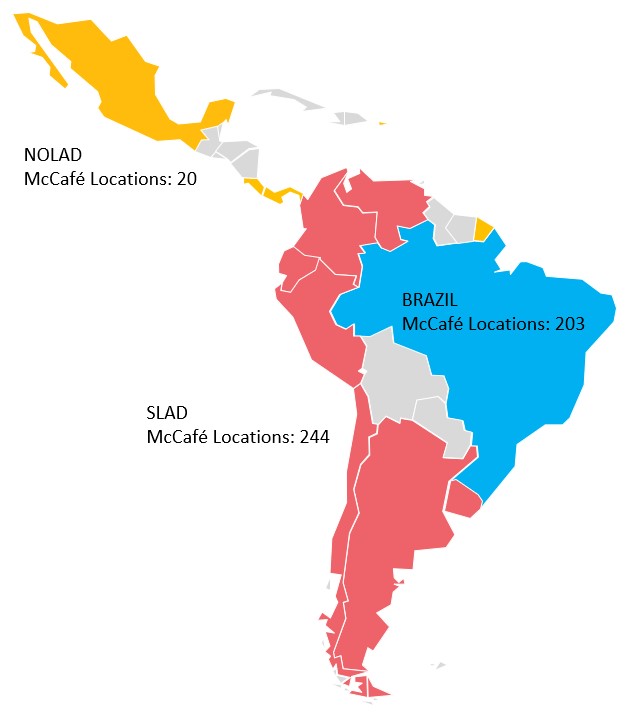
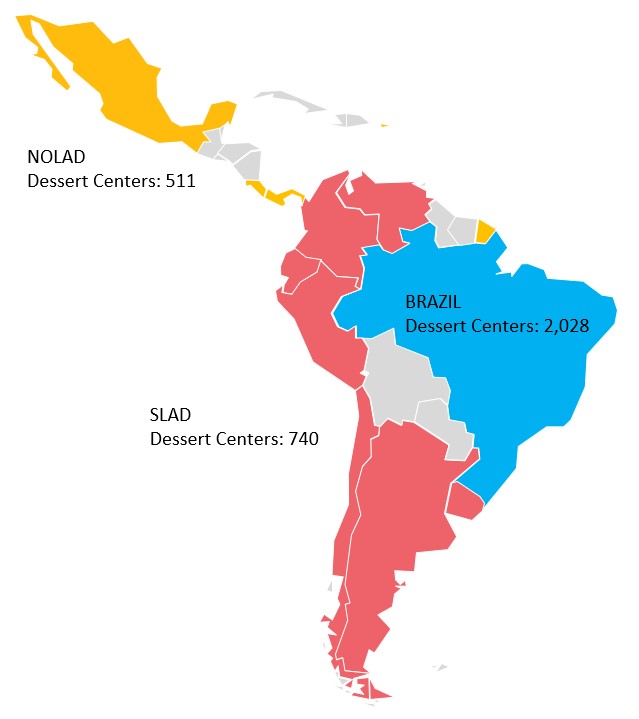
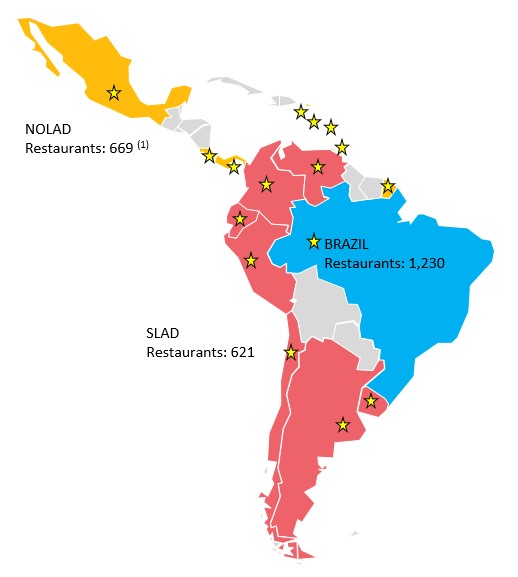
Our operations are comprised of three geographic divisions, as follows: (i) Brazil, (ii) the North Latin American division, or “NOLAD,” consisting of Costa Rica, Mexico, Panama, Puerto Rico, Martinique, Guadeloupe, French Guiana, the U.S. Virgin Islands of St. Croix and St. Thomas, St. Martin, and (iii) the South Latin American division, or “SLAD,” consisting of Argentina, Chile, Ecuador, Peru, Uruguay, Colombia, Venezuela, Trinidad and Tobago, Aruba and Curaçao. For more information see “Item 5. Operating and Financial Review and Prospects—A. Operating Results—Segment Presentation.”
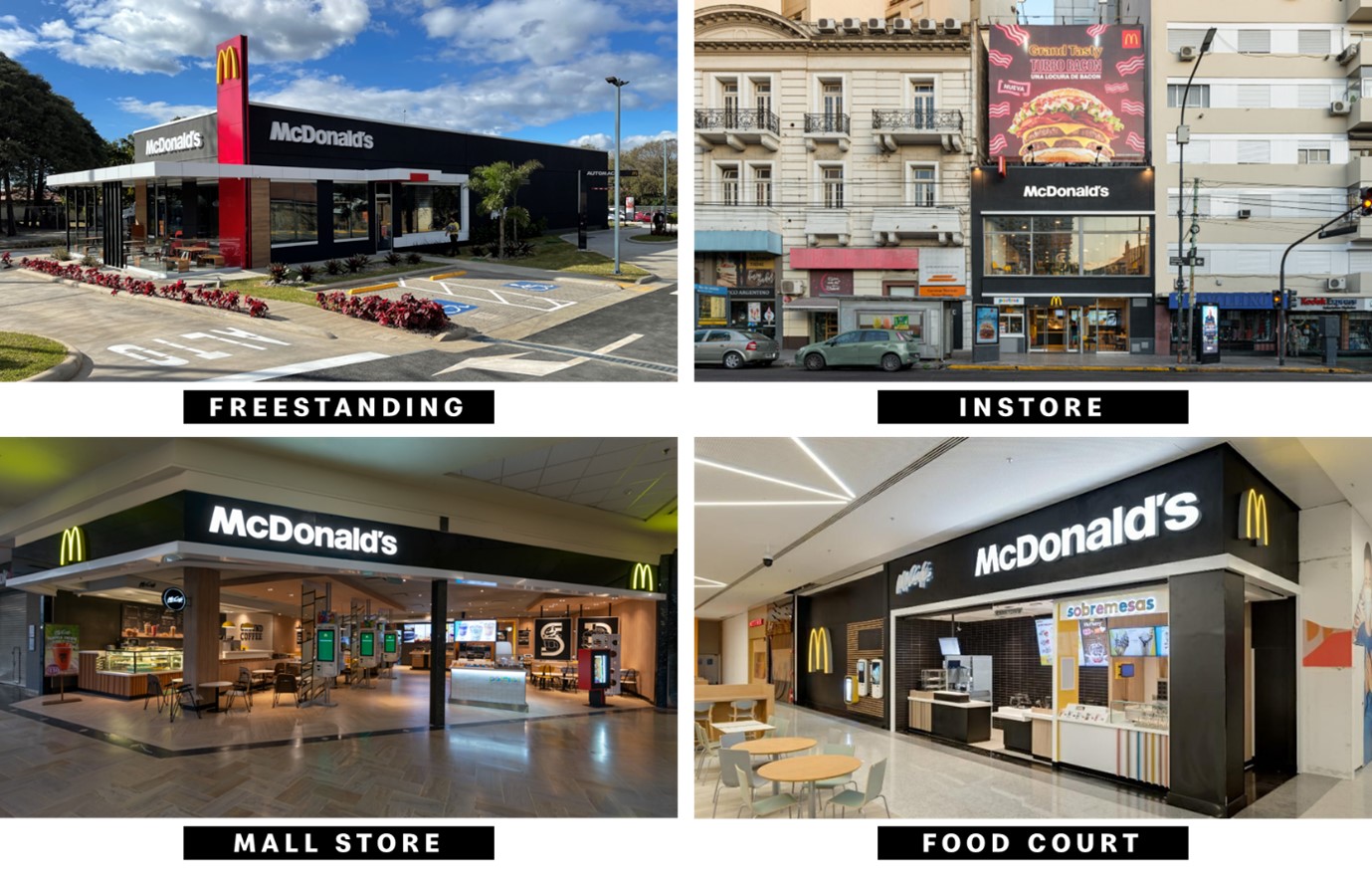
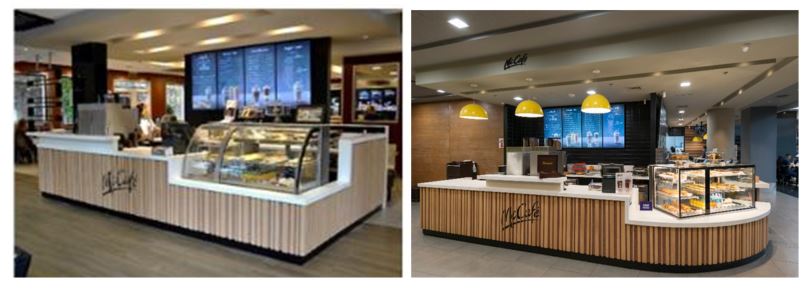
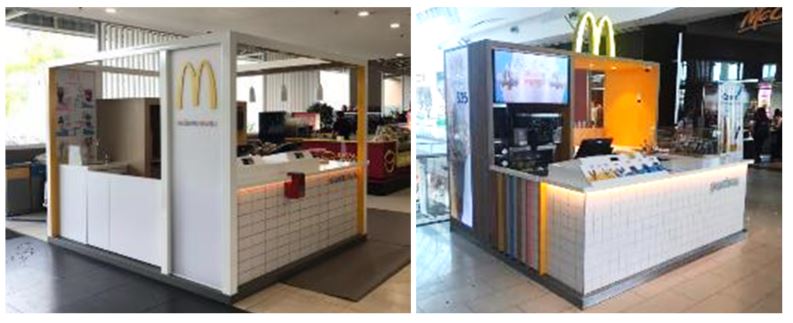
We operate McDonald’s-branded restaurants under two different operating formats: those directly operated by us, or “Company-operated” restaurants, and those operated by sub‑franchisees, or “franchised” restaurants. All references to “restaurants” are to our freestanding, food court, in-store and mall store restaurants and do not refer to our McCafé locations or Dessert Centers. Systemwide data represents measures for both our Company-operated restaurants and our franchised restaurants.
We are the majority stakeholder in two joint ventures with third parties that collectively own 19 restaurants in Argentina and Chile. We consider these restaurants to be Company-operated restaurants. We also have granted developmental licenses to five restaurants. Developmental licensees own or lease the land and buildings on which their restaurants are located and pay a franchise fee to us in addition to the royalties due to McDonald’s. We consider these restaurants to be franchised restaurants and we refer to them as stand-alone restaurants. We are also a minority stakeholder in a joint venture formed with a Mexican sub-franchisee, which owns 45 restaurants. We consider these restaurants to be franchised restaurants. The Company’s joint ventures in Argentina, Chile and Mexico operate as a joint venture under the traditional definition used within the McDonald’s system for such business arrangements. For purposes of this annual report, a joint venture is an entity that operates certain restaurants in the Company’s territory in which the Company is a stakeholder together with a third party. This third party is always a sub-franchisee of the Company. Although in most joint ventures the Company exercises control or significant influence over the entity’s operating and financial policies, the third party is responsible for the day-to-day operation of the entity’s restaurants. Restaurants operated by entities in which the Company has a majority stake are considered to be Company-operated; whereas, restaurants operated by entities in which the Company holds a minority stake are considered to be franchised restaurants.
Market Share and Other Information
Market data and certain industry forecast data used in this annual report were obtained from internal reports and studies, where appropriate, as well as estimates, market research, publicly available information (including information available from the United States Securities and Exchange Commission, or the “SEC,” website) and industry publications, including the United Nations Economic Commission for Latin America and the Caribbean and the CIA World Factbook. Industry publications generally state that the information they include has been obtained from sources believed to be reliable, but that the accuracy and completeness of such information is not guaranteed. Similarly, internal reports and studies, estimates and market research, which we believe to be reliable and accurately extracted by us for use in this annual report, have not been independently verified. However, we believe such data is accurate and agree that we are responsible for the accurate extraction of such information from such sources and its correct reproduction in this annual report.
Basis of Consolidation
The accompanying consolidated financial statements have been prepared in accordance with U.S. GAAP on the accrual basis of accounting and include the accounts of the Company and its subsidiaries. All significant intercompany balances and transactions have been eliminated in consolidation.
Rounding
We have made rounding adjustments to some of the figures included in this annual report. Accordingly, numerical figures shown as totals in some tables may not be an arithmetic aggregation of the figures that preceded them.
This annual report contains statements that constitute “forward-looking statements” within the meaning of the Private Securities Litigation Reform Act of 1995. Many of the forward-looking statements contained in this annual report can be identified by the use of forward-looking words such as “aim,” “anticipate,” “believe,” “could,” “expect,” “should,” “plan,” “intend,” “estimate” and “potential,” among others.
Forward-looking statements appear in a number of places in this annual report and include, but are not limited to, statements regarding our intent, belief or current expectations. Forward-looking statements are based on our management’s beliefs and assumptions and on information currently available to our management. Such statements are subject to risks and uncertainties, and actual results may differ materially from those expressed or implied in the forward-looking statements due to various factors, including, but not limited to, those identified in “Item 3. Key Information—D. Risk Factors” in this annual report. These risks and uncertainties include factors relating to:
•general economic, political, social, demographic and business conditions in Latin America and the Caribbean;
•fluctuations in inflation, interest rates and exchange rates in Latin America and the Caribbean;
•our ability to implement our growth strategy;
•the success of operating initiatives, including advertising and promotional efforts and new product and concept development by us and our competitors;
•our ability to compete and conduct our business in the future;
•unforeseen events, such as disruptions, natural disasters, adverse weather conditions, wars, pandemics and other catastrophic events, such as hurricanes and earthquakes;
•changes in consumer tastes and preferences, including changes resulting from concerns over nutritional or safety aspects of beef, poultry, french fries or other foods or the effects of pandemics or food-borne illnesses, bovine spongiform encephalopathy disease and avian influenza or “bird flu,” and changes in spending patterns and demographic trends, such as the extent to which consumers eat meals away from home;
•the availability, location and lease terms for restaurant development;
•our sub‑franchisees, including their business and financial viability and the timely payment of our sub‑franchisees’ obligations due to us and to McDonald’s;
•our ability to comply with the requirements of the MFAs, including McDonald’s standards;
•our decision to own and operate restaurants or to sub-franchise them;
•the availability of qualified restaurant personnel for us and for our sub‑franchisees, and the ability to retain such personnel;
•changes in commodity costs, labor, supply, fuel, utilities, distribution and other operating costs;
•changes in labor laws;
•our ability, if necessary, to secure alternative distribution of supplies of food, equipment and other products to our restaurants at competitive rates and in adequate amounts, and the potential financial impact of any interruptions in such distribution;
•material changes in government regulation;
•material changes in tax legislation;
•climate change manifesting as physical or transition risks;
•climate-related conditions, regulations, targets and weather events;
Forward-looking statements speak only as of the date they are made, and we do not undertake any obligation to update them in light of new information or future developments or to release publicly any revisions to these statements in order to reflect later events or circumstances or to reflect the occurrence of unanticipated events.
ENFORCEMENT OF JUDGMENTS
We are incorporated under the laws of the British Virgin Islands with limited liability. We are incorporated in the British Virgin Islands because of certain benefits associated with being a British Virgin Islands company, such as political and economic stability, an effective judicial system, a favorable tax system, the absence of exchange control or currency restrictions, and the availability of professional and support services. However, the British Virgin Islands has a less developed body of securities laws as compared to the United States and provides protections for investors to a significantly lesser extent. In addition, British Virgin Islands companies may not have standing to sue before the federal courts of the United States.
A majority of our directors and officers, as well as certain of the experts named herein, reside outside of the United States. A substantial portion of our assets and several of such directors, officers and experts are located principally in Argentina, Brazil and Uruguay. As a result, it may not be possible for investors to effect service of process outside Argentina, Brazil and Uruguay upon such directors or officers, or to enforce against us or such parties in courts outside Argentina, Brazil and Uruguay judgments predicated solely upon the civil liability provisions of the federal securities laws of the United States or other non-Argentine, Brazilian or Uruguayan regulations, as applicable. In addition, local counsel to the Company have advised that there is doubt as to whether the courts of Argentina, Brazil or Uruguay would enforce in all respects, to the same extent and in as timely a manner as a U.S. court or non-Argentine, Brazilian or Uruguayan court, an original action predicated solely upon the civil liability provisions of the U.S. federal securities laws or other non-Argentine, Brazilian or Uruguayan regulations, as applicable; and that the enforceability in Argentine, Brazilian or Uruguayan courts of judgments of U.S. courts or non-Argentine, Brazilian or Uruguayan courts predicated upon the civil liability provisions of the U.S. federal securities laws or other non-Argentine, Brazilian or Uruguayan regulations, as applicable, will be subject to compliance with certain requirements under Argentine, Brazilian or Uruguayan law, including the condition that any such judgment does not violate Argentine, Brazilian or Uruguayan public policy.
We have been advised by Maples and Calder, our counsel as to British Virgin Islands law, that the United States and the British Virgin Islands do not have a treaty providing for reciprocal recognition and enforcement of judgments of courts of the United States in civil and commercial matters and that a final judgment for the payment of money rendered by any general or state court in the United States based on civil liability, whether or not predicated solely upon the U.S. federal securities laws, would not be automatically enforceable in the British Virgin Islands. We have been advised by Maples and Calder that a final and conclusive judgment obtained in U.S. federal or state courts under which a sum of money is payable (i.e., not being a sum claimed by a revenue authority for taxes or other charges of a similar nature by a governmental authority, or in respect of a fine or penalty or multiple or punitive damages) may be the subject of an action on a debt in the court of the British Virgin Islands under British Virgin Islands common law.
The selected balance sheet data as of December 31, 2025 and 2024 and the income statement data for the years ended December 31, 2025, 2024 and 2023 of Arcos Dorados Holdings Inc. are derived from the consolidated financial statements included elsewhere in this annual report, which have been audited by Pistrelli, Henry Martin y Asociados S.A., member firm of Ernst & Young Global Limited.
We were incorporated on December 9, 2010 as a direct, wholly-owned subsidiary of Arcos Dorados Limited, the prior holding company for the Arcos Dorados business. On December 13, 2010, Arcos Dorados Limited effected a downstream merger into and with us, with us as the surviving entity. The merger was accounted for as a reorganization of entities under common control in a manner similar to a pooling of interest and the consolidated financial statements reflect the historical consolidated operations of Arcos Dorados Limited as if the reorganization structure had existed since Arcos Dorados Limited was incorporated in July 2006. We did not commence operations until the Acquisition on August 3, 2007.
We prepare our consolidated financial statements in accordance with accounting principles and standards generally accepted in the United States, or U.S. GAAP, and elect to report in U.S. dollars. This financial information should be read in conjunction with “Presentation of Financial and Other Information,” “Item 5. Operating and Financial Review and Prospects” and our consolidated financial statements, including the notes thereto, included elsewhere in this annual report.
(1)Operating margin is operating income divided by revenues for each division, except for Corporate and others and purchase price allocation which is calculated as Operating loss divided by Total Revenues, since there are no revenues assigned to this segment, expressed as a percentage. Total Operating margin is calculated as Total Operating Income divided by Total Revenues, expressed as a percentage.
(2)Adjusted EBITDA is a measure of our performance that is reviewed by our management. Adjusted EBITDA does not have a standardized meaning and, accordingly, our definition of Adjusted EBITDA may not be comparable to Adjusted EBITDA as used by other companies. Total Adjusted EBITDA is a non-GAAP measure. For our definition of Adjusted EBITDA, see “Item 5. Operating and Financial Review and Prospects—A. Operating Results—Key Business Measures.”
(3)Adjusted EBITDA margin is Adjusted EBITDA divided by revenues for each division, except for Corporate and others which is calculated as Adjusted EBITDA divided by Total Revenues, since there are no revenues assigned to this segment, expressed as a percentage. Total Adjusted EBITDA margin is calculated as Total Adjusted EBITDA divided by Total Revenues, expressed as a percentage.
(4)Net Income attributable to Arcos Dorados Holdings Inc. margin is Net Income attributable to Arcos Dorados Holdings Inc. divided by Total Revenues, expressed as a percentage.
(5)Working capital equals current assets minus current liabilities.
(6)Includes both traditional restaurants and satellite non-traditional restaurants. We define non-traditional satellite restaurants as those points of distribution that have one or more of the following characteristics: (i) depend on another of our restaurants, (ii) offer a limited menu of products, (iii) have approximately 30% of the size of our average restaurants (other than McCafé or other satellites), (iv) generate approximately 50% of the gross sales of our average restaurants (other than McCafé or other satellites), or (v) are located inside a Wal-Mart.
Presented below is the reconciliation between net income and Adjusted EBITDA on a consolidated basis:
Consolidated Adjusted EBITDA Reconciliation
For the Years Ended December 31,
2025
2024
2023
(in thousands of U.S. dollars)
Net income attributable to Arcos Dorados Holdings Inc.
$
212,116
$
148,759
$
181,274
Plus (Less):
Net interest expense and other financing results
13,660
47,238
32,275
Loss (Gain) from derivative instruments
3,078
(941)
13,183
Foreign currency exchange results
4,859
15,063
(10,774)
Other non-operating expenses, net
1,484
3,873
1,238
Income tax expense, net
128,728
109,903
95,702
Net income attributable to non-controlling interests
468
620
1,141
Operating income
364,393
324,515
314,039
Plus (Less):
Items excluded from computation that affect operating income:
Depreciation and amortization
197,257
177,354
149,268
Gains from sale and insurance recovery of property and equipment
(2,641)
(5,486)
(2,030)
Write-offs of long-lived assets
6,557
2,650
8,401
Impairment of long-lived assets
922
1,067
2,626
Reorganization and optimization plan
8,721
—
—
Adjusted EBITDA
575,209
500,100
472,304
Exchange Rates and Exchange Controls
In 2025, 63.0% of our total revenues were derived from our restaurants in Brazil, Argentina and Mexico. While we report figures in U.S. dollars, our revenues are generated in the local currencies of the territories in which we operate and may therefore be affected by exchange rate fluctuations. The exchange rates discussed in this section have been obtained from each country’s central bank. For consolidation purposes, we use foreign currency to U.S. dollar exchange rates obtained from Bloomberg. Any differences between these sources are not material.
Brazil
Exchange Rates
The Brazilian real appreciated 8.2% against the U.S. dollar in 2023, depreciated 27.2% in 2024, appreciated 11.0% in 2025 and appreciated 5.7% in the first quarter of 2026. As of April 27, 2026, the exchange rate for the purchase of U.S. dollars was R$4.98 per U.S. dollar.
The Brazilian real has historically experienced periods of significant volatility against the U.S. dollar, influenced by various economic, political, and external factors, including macroeconomic conditions, inflationary pressures, interest rate differentials, fiscal and monetary policies, global commodity prices, and investor sentiment towards emerging markets. There is an ongoing market concern regarding Brazil’s fiscal outlook, including fiscal targets and government spending constraints, which have contributed to investor uncertainty. Additionally, global monetary policy dynamics, particularly the stance of the U.S. Federal Reserve, as well as geopolitical developments, continue to impact the U.S. dollar and drive exchange rate volatility.
The Central Bank of Brazil may issue further regulations in relation to foreign exchange transactions, as well as on payments and transfers of Brazilian currency between Brazilian residents and non-residents (such transfers being commonly known as the international transfer of reais), including those made through so-called non-resident accounts.
Brazilian law also imposes a tax on foreign exchange transactions on the conversion of reais into foreign currency and on the conversion of foreign currency into reais. As of June 11, 2025, the general IOF/Exchange rate applicable to almost all foreign currency exchange transactions was increased from 0.38% to 3.5%, although other rates may apply in particular operations, such as the below transactions which are currently not taxed:
•inflow related to transactions carried out in the Brazilian financial and capital markets, including investments in our common shares by investors which register their investment under Joint CVM-Central Bank of Brazil Resolution No. 13/2024;
•outflow related to the return of the investment mentioned under the first bulleted item above; and
•outflow related to the payment of dividends and interest on shareholders’ equity in connection with the investment mentioned under the first bulleted item above.
•Inflow related to loans: International loans in USD/EUR with a tenor of less than 364 days: 3.5% IOF on the principal amount. Loans in local currency: 0.38% plus 0.0082% per day over the principal for the duration of the operation.
Notwithstanding these rates of the IOF/Exchange, in force as of the date hereof, the Minister of Finance is legally entitled to increase the rate of the IOF/Exchange to a maximum of 25% of the amount of the currency exchange transaction, but only on a prospective basis.
Although the Central Bank of Brazil has intervened occasionally to control movements in the foreign exchange rates, the exchange market may continue to be volatile as a result of capital movements or other factors, and, therefore, the Brazilian real may substantially decline or appreciate in value in relation to the U.S. dollar in the future.
Brazilian law further provides that whenever there is a significant imbalance in Brazil’s balance of payments or reasons to foresee such a significant imbalance, the Brazilian government may, and has done so in the past, impose temporary restrictions on the remittance of funds to foreign investors of the proceeds of their investments in Brazil. The likelihood that the Brazilian government would impose such restricting measures may be affected by the extent of Brazil’s foreign currency reserves, the availability of foreign currency in the foreign exchange markets on the date a payment is due, the size of Brazil’s debt service burden relative to the economy as a whole and other factors. We cannot assure you that the Central Bank of Brazil will not modify its policies or that the Brazilian government will not institute restrictions or delays on cross-border remittances in respect of securities issued in the international capital markets.
Argentina
Exchange Rates
The Argentine pesodepreciated 357.4% against the U.S. dollar in 2023, depreciated 27.5% in 2024, depreciated 40.8% in 2025 and appreciated 4.8% in the first quarter of 2026. As of April 27, 2026, the exchange rate for the purchase of U.S. dollars was ARS$1,417.02 per U.S. dollar.
Exchange Controls
Since 2019, Argentina has had currency controls in place that tightened restrictions on capital flows, exchange controls, the official U.S. dollar exchange rate and transfers that substantially limit the ability of companies to retain foreign currency or make payments abroad.
By means of Decree No. 609/2019, as amended, the Argentine government reinstated foreign exchange controls and authorized the Central Bank of Argentina to (a) regulate access to the foreign exchange market (Mercado Libre de Cambios or “MLC”) for the purchase of foreign currency and outward remittances; and (b) set forth regulations to avoid practices and transactions aimed to circumvent the measures adopted through the decree. As a consequence of these exchange controls, the spread between the official exchange rate and other exchange rates implicitly resulting from certain capital market operations usually effected to obtain U.S. dollars broadened significantly during 2023.
The current administration implemented a currency adjustment, leading to a 120.6% depreciation of the Peso in December 2023, followed by the establishment of a guideline by the Central Bank of Argentina of a 2% monthly devaluation of the exchange rate, which was reduced to 1% in February 2025. In April 2025, the Argentine government established floating bands, between Ps. 1,000 and Ps. 1,400, at a rate of 1% per month, within which the dollar exchange rate was allowed to float. As of January 1, 2026, the Central Bank of Argentina transitioned to a new floating band system. Under this framework, the exchange rate fluctuates between a floor and a ceiling that are adjusted monthly based on the Argentine consumer price index with a two-month lag ($T-2$). The Central Bank only intervenes if the exchange rate reaches the limits of these bands. The abovementioned exchange rate as of April 27, 2026, was within the applicable floating band. In addition, the current administration has implemented reforms to reduce the burden for access to the MLC by importers and other market participants.
At present, foreign exchange regulations have been consolidated in a single regulation, Communication “A” 8307, as subsequently amended and supplemented from time to time by the Central Bank’s communications (the “Argentine FX Regulations”).
Specific provisions for inward remittances
Obligation to repatriate and settle in Argentine pesos the proceeds from exports of services
Section 2.2 of the Argentine FX Regulations imposes the obligation on exporters to repatriate, and exchange into Argentine pesos through the MLC, the proceeds from services rendered to non-residents within 20 business days following either the perception of funds in the country or abroad, or their accreditation in foreign accounts.
Sale of non-financial non-produced assets
Pursuant to Section 2.3 of the Argentine FX Regulations, the proceeds in foreign currency of the sale to non-residents of non-financial non-produced assets must be repatriated and settled in Argentine pesos in the MLC within 20 business days following either the perception of funds in the country or abroad, or their accreditation in foreign accounts.
External financial indebtedness
Pursuant to Section 2.4 of the Argentine FX Regulations, the proceeds of new financial indebtedness disbursed as of September 1, 2019, must be repatriated, and exchanged into Argentine pesos through the MLC, as a condition for accessing the MLC to make debt principal and service payments thereunder. The reporting of debt under the reporting regime established by Communication “A” 6401 (as amended and restated from time to time, the “External Assets and Liabilities Reporting Regime”) is also a condition to access the MLC to repay external financial indebtedness.
Access to the MLC to make such payments more than three days in advance of the due date is, as a general rule, subject to the Central Bank of Argentina’s prior authorization. Prepayments made with funds from new foreign loans duly settled or in connection with debt refinancing or liability management processes may be exempt from such prior authorization from Argentina’s Central Bank to the extent they comply with several requirements as set forth in Section 3.5 of the Argentine FX Regulations.
Specific Provisions Regarding Access to the MLC
Payment of principal under intercompany foreign financial indebtedness and payment of dividends
Access to the MLC for payments of principal or interest under intercompany foreign financial indebtedness is subject to the Central Bank of Argentina’s prior approval. Certain specific exceptions apply and are included in Section 3.5.6. of the Argentine FX Regulations. Likewise, in April 2025, the Central Bank authorized the distribution of profits to foreign shareholders of Argentine companies, applicable to financial years commencing in 2025.
Pursuant to Argentine FX Regulations, accessing the MLC to make deferred payments for new imports of goods with customs entry registration as from December 13, 2023, does not require Central Bank of Argentina’s prior approval, when in addition to the other applicable regulatory requirements, it is verified that the payment complies with the requirements established in Section 10.10.1 of the Argentine FX Regulations.
In addition, Section 3.1 of the Argentine FX Regulations allows access to the MLC for the payment of imports of goods, establishing different conditions depending on whether they are payments of imports of goods with customs entry registration, or payments of imports of goods with pending customs entry registration. It also provides for the reestablishment of the “SEPAIMPO”, the import payment tracking system, for the purpose of monitoring import payments, import financing and the demonstration of the entry of goods into the country.
A licensing regime is also in place, which requires importers of non-automatic import licenses to provide information about the product they intend to import (e.g., FOB value, type and quantity, commercial brand, model, country of origin and of shipping).
Though there are additional exceptions to the access to the MLC for the payment of imports of goods, they do not apply to the operations of our Company.
Payment of services provided by non-residents
Pursuant to Section 13.1 of the Argentine FX Regulations, residents may access the MLC for payment of services rendered by non-residents, as long as, among other requirements, it is verified that the operation has been declared, if applicable, in the last overdue presentation of the External Assets and Liabilities Reporting Regime. As a general rule, if the non-resident service provider is not an affiliated company, access to the MLC for payment of services is granted once the services have been rendered. In the case of intercompany services, access is generally granted within 90 days from the date the services are provided.
Access to the MLC for the prepayment of debts for services requires prior authorization by the Central Bank of Argentina.
Other Specific Provisions
Additional requirements on outflows through the MLC
As a general rule, and in addition to any rules regarding the specific purpose for access, certain general requirements must be met by a local company or individual to access the MLC for the purchase of foreign currency or its transfer abroad (i.e., payments of imports and other purchases of goods abroad; payment of services rendered by non-residents; remittances of profits and dividends; payment of principal and interest on external indebtedness; payments of interest on debts for the import of goods and services, among others). These include the following:
(i) during the 90 calendar days preceding the date of such access, the local company must not have directly or indirectly or on behalf of a third party:
(a) sold securities in Argentina, with settlement in foreign currency;
(b) transferred securities to a foreign depositary;
(c) exchanged securities issued by resident issuers for foreign assets;
(d) purchased in Argentina securities issued by non-resident issuers with settlement in Argentine pesos;
(f) acquired corporate debt securities representing private debt issued in foreign jurisdiction; and
(g) delivered Argentine pesos or any other local assets (other than foreign currency funds deposited in Argentine banks) to any person, receiving in exchange thereof, whether prior to or after such delivery, and whether directly or indirectly through a related, controlled or controlling entity, foreign assets, crypto assets or securities deposited abroad.
(ii) on the date of such access, the local company must:
(a) not have any available foreign liquid assets or Argentine depositary certificates representing shares issued by non‑resident companies for an aggregate amount exceeding U.S.$100,000. The Argentine FX Regulations contains a non-exhaustive list of assets that qualify as “foreign liquid assets” for purposes thereof, which include foreign currency bills and coins, gold bars, sight deposits with foreign banks and, generally, any investment that allows for immediate availability of foreign currency (e.g., foreign bonds and securities, investment accounts with foreign investment managers, crypto-assets, cash held with payment service providers, etc.);
(b) deposit all its local holdings of foreign currency in accounts held with local financial institutions.
(c) undertake to settle through the MLC within 5 business days from the date of receipt of any funds originating from abroad as a result of the repayment of loans, the release of term-deposits or the sale of any type of asset, to the extent the asset was originally acquired, the deposit made or the loan granted, as applicable, after May 28, 2020; and
(d) during the 90 calendar days following such access to the MLC, undertake to not sell securities issued by residents in Argentina for foreign currency, transfer such securities to foreign depositaries, exchange such securities for other foreign assets, or purchase foreign securities with pesos in Argentina.
Furthermore, in order to access the MLC without obtaining prior approval from the Central Bank of Argentina, the local company has to file several affidavits. In connection with this matter, the affidavit shall meet certain requirements established in Section 3.16.3 of the Argentine FX Regulations.
Foreign Exchange Criminal Regime
Foreign exchange regulations are characterized as “public policy” rules in Argentina. Failure to comply with such provisions could result in penalties pursuant to the Foreign Exchange Criminal Law No. 19,359.
Although the current administration has implemented measures aimed at gradually easing certain foreign exchange restrictions, including the authorization, as of 2026, to distribute and remit dividends abroad subject to applicable regulatory requirements, foreign exchange regulations remain subject to change. The Central Bank of Argentina and the federal government may impose additional exchange controls or modify existing regulations in the future, which could further impact our ability to transfer funds abroad and may prevent or delay payments that our Argentine subsidiaries are required to make outside Argentina.
Mexico
Exchange Rates
The Mexican peso appreciated 13% against the U.S. dollar in 2023, depreciated 22.5% in 2024, appreciated 13.5% in 2025 and appreciated 0.4% in the first quarter of 2026. As of April 27, 2026, the free-market exchange rate for the purchase of U.S. dollars was Ps.17.38 per U.S. dollar.
Exchange Controls
In recent years, the Mexican government has maintained a policy of non-intervention in the foreign exchange markets, other than conducting periodic auctions for the purchase of U.S. dollars, and has not had in effect any exchange controls (although these controls have existed and have been in effect in the past). We cannot assure you that the Mexican government will maintain its current policies with regard to the Mexican peso or that the Mexican peso will not further depreciate or appreciate significantly in the future.
Our business, financial condition and results of operations could be materially and adversely affected if any of the risks described below occur. As a result, the market price of our class A shares could decline, and you could lose all or part of your investment. This annual report also contains forward-looking statements that involve risks and uncertainties. See “Forward-Looking Statements.” Our actual results could differ materially and adversely from those anticipated in these forward-looking statements as a result of certain factors, including the risks facing our company or investments in Latin America and the Caribbean described below and elsewhere in this annual report.
Summary of Risk Factors
An investment in our Company is subject to a number of risks, including risks related to our business, results of operations, financial condition, liquidity and indebtedness, industry, and reputation. The following summarizes some, but not all, of these risks. Please carefully consider all of the information discussed in “Item 3. Key Information—D. Risk Factors” in this annual report for a more thorough description of these and other risks.
Risks Related to Our Business and Operations
•Our rights to operate and franchise McDonald’s-branded restaurants are dependent on the MFAs, the termination or expiration of which would materially adversely affect our business, results of operations, financial condition and prospects.
•Our business depends on our relationship with McDonald’s and changes in this relationship may adversely affect our business, results of operations and financial condition.
•McDonald’s has the right to acquire control of all or portions of our business upon the occurrence of certain events and, in the case of a material breach of the MFAs, may terminate such MFA and acquire our non-public shares or our interests in one or more Territories at 80% of their fair market value.
•Our business activity and results of operations may be negatively affected by unforeseen events, such as disruptions, natural disasters, adverse weather conditions, national and international armed conflicts and wars, pandemics, or other catastrophic events, such as hurricanes, earthquakes and floods.
•The failure to successfully manage our future growth may adversely affect our results of operations.
•From time to time, we rely on informal agreements with third-party suppliers and distributors for the provision of products and services that are necessary for our operations.
•Supply chain interruptions may increase our costs and reduce revenues.
•Information technology system failures or interruptions or breaches of our network security may interrupt our operations, exposing us to lost sales, increased operating costs, fraud, data protection incidents and litigation.
•Our financial condition and results of operations depend, to a certain extent, on the financial condition of our sub‑franchisees and their ability to fulfill their obligations under their franchise agreements.
•We do not have full operational control over the businesses of our sub‑franchisees.
•Ownership and leasing of a broad portfolio of real estate exposes us to potential losses and liabilities.
•The success of our business is dependent on the effectiveness of our marketing strategy.
•The inability to attract and retain qualified management may affect our growth and results of operations.
•The resignation, termination, permanent incapacity or death of our Executive Chairman could adversely affect our business, results of operations, financial condition and prospects.
•Labor shortages or increased labor costs could harm our results of operations.
•A failure by McDonald’s to protect its intellectual property rights, including its brand image, could harm our results of operations.
Risks Related to Our Results of Operations and Financial Condition
•We may use non-committed lines of credit to partially finance our working capital needs.
•Covenants and events of default in the agreements governing our outstanding indebtedness could limit our ability to undertake certain types of transactions and adversely affect our liquidity.
•Fluctuation in market interest rates could affect our ability to refinance our indebtedness or results of operations.
•Inflation and government measures to curb inflation may adversely affect the economies in the countries where we operate, our business and results of operations.
•Exchange rate fluctuations against the U.S. dollar in the countries in which we operate have negatively affected, and could continue to negatively affect, our results of operations.
•Price controls and other similar regulations in certain countries have affected, and may in the future affect, our results of operations.
•We are subject to significant foreign currency exchange controls, currency devaluation and cross-border money transfer controls and restrictions in certain countries in which we operate, which could affect our ability to move our cash flow and pay dividends out from those countries.
Risks Related to Government Regulation
•If we fail to comply with, or if we become subject to, more onerous government regulations, our business could be adversely affected.
•We could be subject to expropriation or nationalization of our assets and government interference with our business in certain countries in which we operate.
•Non-compliance with anti-terrorism and anti-corruption regulations could harm our reputation and have an adverse effect on our business, results of operations and financial condition.
•Tax increases or changes in tax legislation may adversely affect our results of operations.
•Tax, customs or other inspections and investigations in any of the jurisdictions in which we operate may negatively affect our business and results of operations.
•We are subject to increasingly stringent data protection laws, which could increase our costs, damage our reputation and adversely affect our business.
•Litigation and other pressure tactics could expose our business to financial and reputational risk.
•Our insurance may not be sufficient to cover certain losses.
•Our cash balance may not be covered by government-backed deposit insurance programs in the event of a default or failure of any bank with which we maintain a commercial relationship, which may have a material adverse effect on our business, financial condition results of operations and cash flows.
Risks Related to Our Industry
•The food services industry is intensely competitive and we may not be able to continue to compete successfully.
•Increases in commodity prices, logistics or other operating costs could harm our operating results.
•Demand for our offerings may decrease due to changes in consumer preferences, habits or other factors.
•Our investments to enhance customer experience, including through technology, may not generate the expected returns.
•Food safety and food- or beverage- borne illnesses may have an adverse effect on our business and results of operations.
•Restrictions on promotions and advertisements directed at families with children and regulations regarding the nutritional content of children’s meals may harm McDonald’s brand image and our results of operations.
•Environmental laws and regulations may affect our business.
•Our business is subject to an increasing focus on ESG matters.
•We may be adversely affected by legal actions with respect to our business.
•Unfavorable publicity or a failure to respond effectively to adverse publicity, particularly on social media platforms, could harm our reputation and adversely impact our business and financial performance.
Risks Related to Our Business and Operations in Latin America and the Caribbean
•Our business is subject to the risks generally associated with international business operations.
•Developments and the perception of risk in other countries, especially emerging market countries, as well as the increasingly complex political and social environment in Latin America and the Caribbean have in the past and could in the future lead to social unrest, which may adversely affect our business, operations, sales, results, financial conditions and prospects.
•Changes in governmental policies in the Territories could adversely affect our business, results of operations, financial conditions and prospects.
•Latin America has experienced, and may continue to experience, adverse economic conditions that have impacted, and may continue to impact, our business, financial condition and results of operations.
•Mr. Woods Staton, our Executive Chairman, controls all matters submitted to a shareholder vote, which will limit your ability to influence corporate activities and may adversely affect the market price of our class A shares.
•Sales of substantial amounts of our class A shares in the public market, or the perception that these sales may occur, could cause the market price of our class A shares to decline.
•As a foreign private issuer, we are permitted to, and we will, rely on exemptions from certain NYSE corporate governance standards applicable to U.S. issuers, including the requirement that a majority of an issuer’s directors consist of independent directors. This may afford less protection to holders of our class A shares.
Risks Related to Investing in a British Virgin Islands Company
•We are a British Virgin Islands company and it may be difficult for you to obtain or enforce judgments against us or our executive officers and directors in the United States.
•You may have more difficulty protecting your interests than you would as a shareholder of a U.S. corporation.
•You may not be able to participate in future equity offerings, and you may not receive any value for rights that we may grant.
Risks Related to Our Business and Operations
Our rights to operate and franchise McDonald’s-branded restaurants are dependent on the MFAs, the termination or expiration of which would materially adversely affect our business, results of operations, financial condition and prospects.
Our rights to operate and franchise McDonald’s-branded restaurants in the Territories, and therefore our ability to conduct our business, derive exclusively from the rights granted to us by McDonald’s in the MFAs through December 31, 2044 (for most Territories). As a result, our ability to continue operating in our current capacity is dependent on the continued existence of our contractual relationship with McDonald’s.
After the expiration of the term, McDonald’s may grant us an option to enter into a new agreement to continue the franchise for an additional term of (a) 20 years with respect to all Territories other than French Guiana, Guadeloupe, Martinique and Saint Martin (French part) and (b) 10 years with respect to French Guiana, Guadeloupe, Martinique and Saint Martin (French part), with an option to extend the term with respect to such territories for an additional term of 10 years. Pursuant to the MFAs, McDonald’s will determine whether to grant us the option to renew between January 2040 and January 2042. If McDonald’s grants us the option to renew and we elect to exercise the option, then we and McDonald’s will amend the MFAs to reflect the terms of such renewal option, as appropriate. We cannot assure you that McDonald’s will grant us an option to extend the term of the MFAs or that the terms of any renewal option will be acceptable to us, will be similar to those contained in the MFAs or will not be less favorable to us than those contained in the MFAs.
If McDonald’s elects not to grant us the renewal option or we elect not to exercise the renewal option, we will have a two and a half-year period in which to solicit offers for our business, which offers would be subject to McDonald’s approval. Upon the termination or expiration of the MFAs, McDonald’s has the option to acquire all of our non-public shares at their fair market value.
In the event McDonald’s does not exercise its option to acquire our non-public shares, the MFAs would expire and we would be required to cease operating McDonald’s-branded restaurants, identifying our business with McDonald’s and using any of McDonald’s intellectual property. Although we would retain our real estate and our rights therein, the MFAs prohibit us from engaging in certain competitive businesses, including any other local or international quick-service restaurant or informal eating out business, or duplicating the McDonald’s system at another restaurant or business during the two-year period following the expiration of the MFAs. Moreover, McDonald’s would have the option to purchase the furniture, fixtures, signs, equipment, leasehold improvements and other similar fixed property or any portion thereof held by the franchised restaurant(s) designated by McDonald’s, for a sum equal to the fair market value of such property. As the McDonald’s brand and our relationship with McDonald’s are among our primary competitive strengths, the termination or expiration of the MFAs for any reason would materially and adversely affect our business, results of operations, financial condition, reputation and prospects.
Our business depends on our relationship with McDonald’s and changes in this relationship may adversely affect our business, results of operations and financial condition.
Our rights to operate and franchise McDonald’s-branded restaurants in the Territories, and therefore our ability to conduct our business, derive exclusively from the rights granted to us by McDonald’s in the MFAs. As a result, our revenues are dependent on the continued existence of our contractual relationship with McDonald’s.
Pursuant to the MFAs, McDonald’s has the ability to exercise substantial influence over the conduct of our business. For example, among other restrictions and obligations, under the MFAs, we are not permitted to operate any other competitive businesses, including any other local or international quick-service restaurant or informal eating out business, we must comply with McDonald’s high quality standards, we must own and operate at least 50% of all McDonald’s-branded restaurants in each Territory, we must maintain certain guarantees in favor of McDonald’s, including standby letters of credit (or other similar financial guarantee acceptable to McDonald’s) in an amount of $80.0 million, to secure our payment obligations under the MFAs, we cannot incur debt above certain financial ratios, we cannot transfer the equity interests of our subsidiaries, any significant portion of their assets or certain of the real estate properties that we own without McDonald’s consent, and McDonald’s has the right to approve the appointment of our chief executive officer and chief operating officer (such approval not to be unreasonably withheld) as well as to approve certain related party transactions. In addition, the MFAs require us to reinvest a significant amount of money, including through reimaging our existing restaurants, opening new restaurants and advertising, which McDonald’s has the right to approve.
However, McDonald’s does not have an obligation to fund our operations. Furthermore, McDonald’s does not guarantee any of our financial obligations, including trade payables or outstanding indebtedness, and has no obligation to do so.
In addition to using our cash flow from operations, we may need to incur additional indebtedness in order to finance future commitments, which could adversely affect our financial condition. Moreover, we may not be able to obtain this additional indebtedness on favorable terms, or at all. Failure to comply with our commitments could constitute a material breach of the MFAs and may lead to a termination by McDonald’s of the MFAs.
If the terms of the MFAs excessively restrict our ability to operate our business or if we are unable to satisfy our restaurant opening and reinvestment commitments under the MFAs, our business, results of operations and financial condition would be materially and adversely affected.
McDonald’s has the right to acquire control of all or portions of our business upon the occurrence of certain events and, in the case of a material breach of the MFAs, may terminate such MFA and acquire our non-public shares or our interests in one or more Territories at 80% of their fair market value.
McDonald’s has the right to acquire all of our non-public shares or our interests in one or more Territories upon the occurrence of certain events, including the death or permanent incapacity of our controlling shareholder, an election by McDonald’s or us not to renew the MFA, a material breach of the MFAs or the termination of the MFAs for any reason other than a material breach. In the event McDonald’s were to exercise its right to acquire all of our non-public shares, McDonald’s would become our controlling shareholder.
McDonald’s has the option to acquire all, but not less than all, of our non-public shares at 100% of their fair market value:
•upon expiration of the two and a half-year period beginning on either (i) the date when McDonald’s notifies us of its election to not renew the MFAs or (ii) if McDonald’s notifies us of an offer to renew the MFAs and we do not accept such offer, the date of such offer notice from McDonald’s, in each case, to and including the expiration or termination of the MFA;
•within 30 days after the termination of the MFAs for any reason other than for a material breach; or
•during the twelve-month period following the earlier of: (i) the eighteen-month anniversary of the death or permanent incapacity of Mr. Woods Staton, our Executive Chairman and controlling shareholder, during which period no successor to Mr. Staton has been nominated or appointed, and (ii) the receipt by McDonald’s of notice from the beneficiaries of Mr. Woods Staton’s estate that such beneficiaries have elected to have such twelve-month period commence as of a date specified in such notice, which date shall be after the receipt of such notice.
If there is a material breach of the MFA, other than our failure to achieve certain targeted openings, McDonald’s has the option to acquire all, but not less than all, of our non-public shares at 80% of their fair market value. If we fail to achieve such targeted openings, McDonald’s has the right to terminate our exclusive right to exploit the rights granted under the MFAs with respect to each Territory to which such failure may be attributable.
In addition, if there is a material breach that relates to one or more Territories in which, at the time of the material breach determination, there are at least 100 franchised restaurants in operation, McDonald’s also has the right, in McDonald’s sole discretion, to acquire (i) all of our interests in our subsidiaries in all Territories or (ii) all of our interests in our subsidiaries in the Territory or Territories identified by McDonald’s as being affected by such material breach or to which such material breach may be attributable, in each case at 80% of their fair market value. By contrast, if the material breach of the MFAs affects or is attributable to any of the Territories in which, at the time of the material breach determination, there are less than 100 franchised restaurants in operation, McDonald’s only has the right to acquire the equity interests of any of our subsidiaries in the Territory or Territories being affected by such material breach or to which such material breach may be attributable. For example, since, as of the date hereof, we have more than 100 franchised restaurants in Mexico, if there is a material breach with respect to our business in Mexico identified by McDonald’s as being affected by such material breach or to which such material breach may be attributable, McDonald’s would have the right to acquire our entire business throughout Latin America and the Caribbean or just our Mexican operations, whereas upon a similar breach relating to our Ecuadorian business, which, as of the date hereof, has less than 100 franchised restaurants in operation, McDonald’s would only have the right to acquire our business in Ecuador.
Additionally, if there is a material breach under an MFA, other than our failure to achieve certain targeted openings, McDonald’s has the right to terminate the MFAs, in whole or, in McDonald’s sole discretion, with respect to any one or more Territories identified by McDonald’s as being affected by such material breach or to which such material breach may be, directly or indirectly attributable. Any such termination would have a material adverse effect on our business, results of operations and financial condition.
McDonald’s was granted a perfected security interest in the equity interests of the Master Franchisee, the Brazilian Master Franchisee and our subsidiaries other than our subsidiaries organized in Costa Rica, Mexico, French Guiana, Guadeloupe and Martinique. The equity interests of our subsidiaries organized in Costa Rica and Mexico were transferred to trusts for the benefit of McDonald’s. If McDonald’s exercises its right to acquire our interests in one or more Territories as a result of a material breach, our business, results of operations and financial condition would be materially and adversely affected. See “Item 10. Additional Information—C. Material Contracts—The MFAs—Termination” for more details about fair market value calculation.
Our business activity and results of operations may be negatively affected by unforeseen events, such as disruptions, natural disasters, adverse weather conditions, national and international armed conflicts and wars, pandemics, or other catastrophic events, such as hurricanes, earthquakes and floods.
Unforeseen events beyond our control, including war, terrorist activities, political and social unrest, boycotts, natural disasters (or expectations about them), adverse weather conditions and pandemics, could disrupt our operations and results of operations and those of our sub‑franchisees, suppliers or customers, have a negative effect on consumer spending or result in political or economic instability. These events could reduce demand for our offerings or make it difficult to ensure the regular supply of ingredients and products through our distribution chain. For instance, ongoing conflicts in several areas of the world and their related impact and the sanctions imposed as a consequence, have adversely affected the macroeconomic environment, contributing to volatile economic conditions and heightened inflationary pressures. For example, ongoing hostilities between the United States and Iran, including disruptions to key energy transit routes, have contributed to significant volatility and upward pressure on global crude oil prices, which could adversely affect global economic conditions. These factors have led to increased food inflation, rising commodity and energy costs, and worsened supply chain disruptions. We anticipate that these challenges may continue to influence consumer behavior and demand, escalate geopolitical tensions, and negatively impact our business and financial results. Additionally, adverse weather conditions, including climate change, which has become more pronounced in recent years, may also increase the frequency and severity of weather-related events and natural disasters or affect customer behavior or preferences. Furthermore, incidents of pandemics, if not controlled, could affect visitors and reduce sales in our restaurants. The duration and scope of a health crisis, pandemic, epidemic, natural disaster, adverse weather conditions, war or other catastrophic events can be difficult to predict and depend on many factors, including emergence of new variants, outbreaks of diseases, extreme weather shifts, shorter harvest seasons, availability, acceptance and effectiveness of preventative measures, increased geopolitical tensions and economic sanctions, among other. A health crisis, pandemic, epidemic, natural disaster, adverse weather conditions, war or other catastrophic events may also heighten other risks disclosed in these Risk Factors, including, but not limited to, those related to the availability and costs of labor and commodities, supply chain interruptions, consumer behavior, and consumer perceptions of our brand and industry.
The failure to successfully manage our future growth may adversely affect our results of operations.
Our business has grown significantly since the Acquisition, largely due to the opening of new restaurants in existing and new markets within the Territories, from an increase in comparable store salesand, more recently, from the growth of sales through digital channels, which comprised 61%, or $3.7 billion, of our systemwide sales in 2025. Our total number of restaurant locations has increased from 1,569 at the date of the Acquisition to 2,520 restaurants as of December 31, 2025.
Our growth is, to a certain extent, dependent on new restaurant openings and therefore may not be constant from period to period; it may accelerate or decelerate in response to certain factors. There are many obstacles to opening new restaurants, including determining the availability of desirable locations, securing reliable suppliers, permit approval by governments, hiring and training new personnel and negotiating acceptable lease terms, and, in times of adverse economic conditions, sub‑franchisees may be more reluctant to provide the investment required to open new restaurants. In addition, our growth in comparable store sales is dependent on continued economic growth in the countries in which we operate as well as our ability to continue to predict and satisfy changing consumer preferences and to navigate other external pressures. See “—Our business activity and results of operations may be negatively affected by unforeseen events, such as disruptions, natural disasters, adverse weather conditions, national and international armed conflicts and wars, pandemics or other catastrophic events, such as hurricanes, earthquakes and floods.” In addition, the continued growth of our sales through digital channels is dependent on the continued adoption of technology and digital and delivery channels by our customers, which is in turn dependent on wider consumer trends.
We plan our capital expenditures on a long-term basis and conduct annual reviews, taking into account historical information, regional economic trends, restaurant opening and reimaging plans, site availability and the investment requirements of the MFAs in order to maximize our returns on invested capital. The success of our investment plan may, however, be harmed by factors outside our control, such as changes in macroeconomic conditions, changes in demand and construction difficulties that could jeopardize our investment returns and our future results and financial condition.
From time to time, we rely on informal agreements with third-party suppliers and distributors for the provision of products and services that are necessary for our operations.
Effective supply chain management is a key driver of our success and a critical factor in optimizing profitability. We use McDonald’s centralized supply chain management model, which depends on approved third-party suppliers and distributors for goods, and we typically engage multiple suppliers to meet our product needs. This model includes the selection and development of suppliers of both core products (such as beef, chicken, buns, potatoes, produce, sauces, cheese, dairy mixes and beverages) and non-core products (including dressings, pork, condiments, confectionery and toppings among others). These suppliers must meet McDonald’s high standards for quality, food safety, sustainability policies and commitments, which requires fostering long-term and sustainable relationships.
McDonald’s standards include the highest expectations with respect to our suppliers’ food safety and quality management systems, product consistency and timeliness, as well as commitments to follow internationally recognized manufacturing and management schemes and practices to meet or exceed all local food regulations and to comply with our policies, procedures and guidelines.
Our continued success depends heavily on the ability of McDonald’s suppliers to consistently deliver safe, high quality products that meet our specifications and requirements and comply with all applicable laws and regulations. McDonald’s is widely recognized as a leader in food safety by both suppliers and the public health community.
Our 32 largest suppliers represent approximately 76% of our total purchases. Only a limited number of these suppliers have formal written contracts with us; instead, we only maintain pricing protocols or informal agreements with most of them. Our supplier approval process is comprehensive and time‑intensive, ensuring full compliance with McDonald’s strict standards. As a result, we tend to build strong relationships with approved suppliers and, given our relevance to their business, pricing protocols have generally proven sufficient to secure a reliable supply of quality products. While we source goods from numerous approved suppliers across Latin America and the Caribbean, reducing our dependence on any single supplier, the informal nature of many of our supplier relationships means we cannot always ensure long-term or reliable product availability.
Additionally, certain goods, such as beef, dairy products, confectionery and produce, are often sourced locally due to import restrictions. Due to these restrictions, as well as McDonald’s requirements to purchase certain core items from approved suppliers, if any supplier terminates our relationship or if a supplier’s products or services no longer meet required standards and we must end the relationship, we may be unable to rapidly secure alternative or additional sources of supply.
Supply chain interruptions may increase our costs and reduce revenues.
Our business relies on an effective supply chain that ensures a reliable and adequate supply of quality products, supplies, equipment, and equipment parts. If our suppliers fail to deliver these items in a timely manner due to unexpected demand, production or distribution issues, financial distress or shortages, or if they decide to end their relationship with us, or we terminate our relationship with such suppliers because they no longer comply with McDonald’s standards, we may face challenges securing replacement suppliers in a timely manner or at all. As a result, we could experience inventory shortages and increased costs that may negatively affect our operations and results of operations.
Supply chain interruptions, delivery delays, and related price increases have adversely affected us and our suppliers in the past and may do so again in the future. These disruptions may arise from shortages, inflationary pressures, unexpected surges in demand, transportation or logistics difficulties, labor, or technology issues, adverse weather conditions, natural disasters, pandemics, acts of war, terrorism, social unrest and protests or other circumstances beyond our or our suppliers’ control. Such interruptions, delays, or failures in contingency planning may increase our costs, reduce revenues and limit the availability of our products, supplies, or equipment that are critical to our operations.
Information technology system failures or interruptions or breaches of our network security may interrupt our operations, exposing us to lost sales, increased operating costs, fraud, data protection incidents and litigation.
We rely heavily on our computer systems and network infrastructure across our operations including, but not limited to, point-of-sale processing at our restaurants. We implement security measures and controls that we believe provide reasonable assurance regarding our security posture. See “Part II—Item 16K. Cybersecurity” for further detail. However, there remains the risk that our technology systems are vulnerable to damage, disability or failures due to physical theft, fire, power loss, telecommunications failure or other catastrophic events. If those systems were to fail or otherwise be unavailable, and we were unable to recover in a timely way, we could experience an interruption in our operations. Moreover, security breaches, data breaches and cyberattacks involving our systems have occurred, and may continue to occur, from time to time. Although we have procedures and controls in place to protect our systems and safeguard confidential information, including personal information, and financial data, we have been and continue to be subject to a range of internal and external security breaches, denial of service attacks, malware, phishing attacks, viruses, worms and other disruptive problems caused by hackers. Data breaches, security incidents and cyberattacks can result from, among other things, inadequate personnel, inadequate or failed internal control processes and systems, fraud or external events, or actors that interrupt normal business operations. Our information technology systems contain personal, financial and other information that is entrusted to us by our customers, our employees and other third parties, as well as financial, proprietary and other confidential information related to our business. The proper and secure functioning of our technology, financial and processing systems is critical to our business and to our ability to compete effectively.
Furthermore, we have experienced a rise in transactions through our online digital channels for which we rely more heavily on third-party operators or trusted certified payment gateways to handle an increasing volume of sensitive financial transactions and other sensitive customer information, which increases our cybersecurity risks. Our increasing reliance on third-party systems also presents the risks faced by the third party’s business, including the operational, security and credit risks of those parties. Moreover, due to our digital strategy and increased use of our digital channels, there has also been an increase in the number of registered customers, now over 100 million, for whom we store and process personal information to strengthen our relationship with customers. Although we work with our customers, third-party service providers and other third parties to develop secure data and information processing, collection, authentication, management, usage, storage and transmission capabilities and to ensure the eventual destruction of confidential information, including personal information, to prevent against information security risk, we, our third-party service providers or other third parties with whom we do business have been and continue to be the target of cyberattacks or subject to other information security incidents, breaches or disruption in our operations. An actual or alleged security breach of our or their systems has resulted and could result in additional disruptions, shutdowns, theft, fraud or unauthorized disclosure of personal, financial, proprietary or other confidential information. For example, on April 4, 2025, we were notified by one of our third-party service providers of an unauthorized access to a database hosted by them, which included certain non-sensitive personal identifiable employee information. This third-party vendor has advised us that the vulnerability in their systems has been remedied. The occurrence of any of these incidents could result in reputational damage, adverse publicity, loss of consumer confidence, reduced sales and profits, fines, increased costs of regulatory compliance or enhanced measures against such security or data breaches, complications in executing our growth initiatives and regulatory and legal risk.
Our financial condition and results of operations depend, to a certain extent, on the financial condition of our sub‑franchisees and their ability to fulfill their obligations under their franchise agreements.
As of December 31, 2025, 28.6% of our restaurants were franchised. Under our franchise agreements, we receive monthly payments which are, in most cases, the greater of a fixed rent or a certain percentage of the sub-franchisee’s gross sales. Sub‑franchisees are independent operators with whom we have franchise agreements. We typically own or lease the real estate upon which sub‑franchisees’ restaurants are located and sub‑franchisees are required to follow our operating manual that specifies items such as menu choices, permitted advertising, equipment, food handling procedures, product quality and approved suppliers. Our operating results depend to a certain extent on the restaurant profitability and financial viability of our sub‑franchisees. The concurrent failure by a significant number of sub‑franchisees to meet their financial obligations to us could jeopardize our ability to meet our obligations.
We are liable for our sub‑franchisees’ monthly payment of royalties to McDonald’s, which represents a percentage of those franchised restaurants’ gross sales. To the extent that our sub‑franchisees fail to pay this fee in full, we are responsible for any shortfall under the MFAs. As such, the concurrent failure by a significant number of sub‑franchisees to pay their royalties could have a material adverse effect on our results of operations and financial condition.
We do not have full operational control over the businesses of our sub‑franchisees.
We are dependent on sub‑franchisees to maintain McDonald’s quality, service and cleanliness standards, and their failure to do so could materially affect the McDonald’s brand and harm our business. Although we exercise significant influence over sub‑franchisees through the franchise agreements, sub‑franchisees have some flexibility in their operations, including the ability to set prices for our products in their restaurants, hire employees and select certain service providers. In addition, it is possible that some sub‑franchisees may not operate their restaurants in accordance with our quality, service, cleanliness, health, food safety or product standards. Although we take corrective measures if sub‑franchisees fail to maintain McDonald’s quality, service and cleanliness standards, we may not be able to identify and rectify problems with sufficient speed and, as a result, our image and operating results may be negatively affected.
Ownership and leasing of a broad portfolio of real estate exposes us to potential losses and liabilities.
As of December 31, 2025, we owned the land for 474 of our 2,520 restaurants. The value of these assets could decrease or rental costs could increase due to changes in local demographics, the investment climate and local economic conditions, including taxes.
The majority of our restaurant locations, or those operated by our sub‑franchisees, are subject to long-term leases. We may not be able to renew leases on acceptable terms or at all, in which case we would have to find new locations to lease or be forced to close the restaurants. If we are able to negotiate a new lease at an existing location, we may be subject to a rent increase. In addition, current restaurant locations may become unattractive due to changes in neighborhood demographics or economic conditions, which may result in reduced sales at these locations.
The success of our business is dependent on the effectiveness of our marketing strategy.
Market awareness and engagement are essential to our continued growth and financial success. Pursuant to the MFAs, we create, develop and coordinate marketing plans and promotional activities throughout the Territories, and sub‑franchisees contribute a percentage of their gross sales to our marketing plan. Unless otherwise provided in or required by existing franchise agreements, pursuant to the MFAs we are required to make aggregate expenditures in an amount not less than 5% of the gross sales of all franchised restaurants in the Territories in connection with advertising, communications and promotional activities, in accordance with guidelines established by McDonald’s. Pursuant to the MFAs, McDonald’s has the right to review and approve our marketing plans in advance and may request that we cease using the materials or promotional activities at any time. We also participate in global and regional marketing activities undertaken by McDonald’s and pay McDonald’s up to 0.2% of our gross sales of all franchised restaurants in the Territories in order to fund such activities.
If our advertising programs are not effective, or if our competitors begin spending significantly more on advertising than we do, or if our competitors develop attractive new products or innovative advertising techniques, we may be unable to attract new customers or existing customers may not return to our restaurants and our operating results may be negatively affected.
The inability to attract and retain qualified management may affect our growth and results of operations.
We have a strong, diverse and multidisciplinary management team with broad experience in the various areas of the modern management, such as human resources, product development, supply chain management, operations, finance, ESG, marketing, real estate development, communications, government relations, investor relations, security, information technology, legal, and training. Our growth plans place substantial demands on our management team, and future growth could increase those demands. Our ability to manage future growth will depend on the adequacy of our resources and our ability to continue to identify, attract, retain and train management. Failure to do so could have a material adverse effect on our business, financial condition and results of operations.
In addition, pursuant to the MFAs, McDonald’s is entitled to approve the appointment of our chief executive officer and chief operating officer. If we and McDonald’s have not agreed upon a successor CEO after six months, McDonald’s may designate a temporary CEO in its sole discretion pending our submission of information relating to a further candidate and McDonald’s approval of that candidate. A delay in finding a suitable successor CEO could adversely affect our business, results of operations, financial condition and prospects.
The resignation, termination, permanent incapacity or death of our Executive Chairman could adversely affect our business, results of operations, financial condition and prospects.
Due to Mr. Woods Staton’s unique experience and leadership capabilities, it would be difficult to find a suitable successor for him if he were to cease serving as Executive Chairman for any reason. In the event of Mr. Woods Staton’s death or permanent incapacity where no successor to Mr. Staton has been appointed by us and approved by McDonald’s, McDonald’s has the right to acquire all of our non-public shares during the twelve-month period following the earlier of (1) the eighteen-month anniversary of his death or incapacity, and (2) the receipt by McDonald’s of notice from the beneficiaries of Mr. Staton’s estate that such beneficiaries have elected to have such twelve-month period commence as of a date specified in such notice, which date shall be after the receipt of such notice.
Labor shortages or increased labor costs could harm our results of operations.
Our operations depend in part on our ability to attract and retain restaurant managers and crew. While the turnover rate varies significantly among categories of employees, due to the nature of our business, we traditionally experience a high rate of turnover among our crew.
As of December 31, 2025, we had approximately 96,782 employees, including our Company-operated restaurants and staff. Controlling labor costs is critical to our results of operations, and we closely monitor those costs. Some of our employees are paid minimum wages and any increases in minimum wages or changes to labor regulations in the Territories could increase our labor costs. In recent years, the legal minimum wage has increased in several of the countries in which we operate, having an adverse impact on our results of operations. In addition, legislative proposals currently under discussion in Brazil contemplate a reduction in statutory working hours, which are currently up to 44 hours per week under Brazilian labor legislation, without a corresponding reduction in pay. If enacted, and depending on the final wording, such measures could increase our labor costs and require adjustments to our workforce planning and operations in Brazil. Additionally, competition for employees could also result in additional incurred costs to pay for higher wages.
We are also impacted by the costs and other effects of compliance with regulations affecting our workforce. These regulations are increasingly focused on employment issues, including wages and working hours, healthcare, employee safety and other employee benefits and workplace practices. Claims of non-compliance with these regulations could result in liability and expense to us. Despite our anti-discriminatory policies and related employee training, we are exposed to potential reputational and other harm regarding our workplace practices or conditions or those of our sub‑franchisees or suppliers, including those giving rise to claims of sexual harassment or discrimination (or perceptions thereof), which could have a negative impact on consumer perceptions of us and a reputation of our business. In 2019, two of our restaurant employees in Peru died in a workplace accident at one of our restaurants. This accident is still under investigation by Peruvian authorities, and while we have not been materially impacted by this event, any future workplace accidents could have a material adverse effect on our business, financial condition and results of operations.
Some of our employees are represented by unions and are working under agreements that are subject to annual salary negotiations. We cannot guarantee the results of any such collective bargaining negotiations or whether any such negotiations will result in a work stoppage. In addition, employees may strike for reasons unrelated to our union arrangements. Any future work stoppage could, depending on the affected operations and the length of the work stoppage, have a material adverse effect on our financial position, results of operations or cash flows.
A failure by McDonald’s to protect its intellectual property rights, including its brand image, could harm our results of operations.
Our business depends in part on consumers’ perception of the McDonald’s brand. Under the terms of the MFAs, we are required to assist McDonald’s with protecting its intellectual property rights in the Territories. However, McDonald’s is generally responsible for decisions about whether and how to enforce its rights. Any failure by McDonald’s to protect its proprietary rights in the Territories or elsewhere could harm its brand image, which could affect our competitive position and our results of operations.
Under the MFAs, we may use, and grant rights to sub‑franchisees to use, McDonald’s intellectual property in connection with the development, operation, promotion, marketing, communications and management of our restaurants. McDonald’s has reserved the right to use, or grant licenses to use, its intellectual property in Latin America and the Caribbean for all other purposes, including to sell, promote or license the sale of products using its intellectual property. If we or McDonald’s fail to identify unauthorized filings of McDonald’s trademarks and imitations thereof, and we or McDonald’s do not adequately protect McDonald’s trademarks and copyrights, the infringement of McDonald’s intellectual property rights by others may cause harm to McDonald’s brand image and decrease our sales.
Risks Related to Our Results of Operations and Financial Condition
We may use non-committed lines of credit to partially finance our working capital needs.
We may use non-committed lines of credit to partially finance our working capital needs. Given the nature of these lines of credit, some of these lines could be withdrawn and no longer be available to us, or their terms, including the interest rate, could change to make the terms no longer acceptable to us. The availability of these lines of credit depends on the level of liquidity in financial markets, which can vary based on events outside of our control, including financial or credit crises. Any inability to draw upon our non-committed lines of credit could have an adverse effect on our working capital, financial condition and results of operations.
Covenants and events of default in the agreements governing our outstanding indebtedness could limit our ability to undertake certain types of transactions and adversely affect our liquidity.
As of December 31, 2025, we had $1,101.7 million in total outstanding indebtedness (including interest payable), consisting of $1,156.5 million in long-term debt (including interest payable) net of $54.8 million related to the fair market value of our outstanding derivative instruments. The agreements governing our outstanding indebtedness contain covenants and events of default that may limit our financial flexibility and ability to undertake certain types of transactions. For instance, we are subject to negative covenants that restrict some of our activities, including restrictions on:
•creating liens;
•paying dividends;
•maintaining certain leverage ratios;
•entering into sale and lease-back transactions; and
•consolidating, merging or transferring assets.
Although certain of the negative covenants under our 2029 Notes are currently suspended as a result of our investment grade credit rating, we cannot guarantee that we will be able to maintain this rating. If we were to lose our investment grade rating, these negative covenants would become effective again, potentially limiting our financial flexibility and our ability to undertake certain transactions.
If we fail to satisfy the covenants set forth in these agreements or another event of default occurs under the agreements, our outstanding indebtedness under the agreements could become immediately due and payable. In addition, we are required to meet certain financial ratios under our line of credit, our revolving credit facility and the credit facilities entered into by Arcos Dourados Comercio de Alimentos S.A., our Brazilian subsidiary. If we are unable to comply with such ratios or obtain waivers for non-compliance in the future, we will be in default under such facilities. In the case of our revolving credit facility and our Brazilian subsidiary’s credit facilities, any amounts drawn under such facilities may be declared to be immediately due and payable by the relevant lender, who may also terminate its obligation to provide loans under such agreement if we are not in compliance with our ratios under the agreement. In the case of our non-committed lines of credit,
if we have previously drawn any amount, then such amounts may be immediately due and payable to the relevant lender, subject to the terms of each non-committed line of credit. If our outstanding indebtedness becomes immediately due and payable and we do not have sufficient cash on hand to pay all amounts due, we could be required to sell assets, to refinance all or a portion of our indebtedness or to obtain additional financing. Refinancing may not be possible and additional financing may not be available on commercially acceptable terms, or at all.
Fluctuation in market interest rates could affect our ability to refinance our indebtedness or results of operations.
We are exposed to market risk related to changes in interest rates that could affect our results of operations or ability to refinance our existing indebtedness. Volatility or increases in interest rates could affect our ability to refinance our existing indebtedness or to obtain incremental debt financing. Volatility or increases in interest rates could increase our interest expense or borrowing costs and may adversely affect our results of operations. Our future ability to refinance our existing indebtedness will depend on certain financial, business and market trends, many of which are beyond our control.
Inflation and government measures to curb inflation may adversely affect the economies in the countries where we operate, our business and results of operations.
Certain of the countries in which we operate, have experienced, or are currently experiencing, high rates of inflation. For example, both Venezuela and Argentina have been considered highly inflationary under U.S. GAAP since 2010 and 2018, respectively, which has significantly reduced competitiveness, real wages and consumption. Although in most of our markets inflationary pressures decreased in 2025 as compared to 2024 (as is the case in Argentina, where inflation in 2025, although still high, was 31.5% compared to 117.8% in 2024), inflation has proven more resilient than expected and decreased at a lower rate than anticipated. In an effort to contain inflation, central banks shifted to more restrictive monetary policy, including increased interest rates, which has contributed to a slowdown in the global economy, thereby restricting the availability of credit and impairing economic growth. The measures taken by the governments of these countries to control inflation have historically been indicative of a potential economic recession. Inflation, measures to combat inflation and public speculation about possible additional actions have also contributed materially to economic uncertainty in many of these countries and to heightened volatility in their securities markets. Periods of higher inflation may also slow the growth rate of local economies that could lead to reduced demand for our core products and decreased sales. Inflation is also likely to increase some of our costs and expenses, which we may not be able to fully pass on to our customers or offset with other efficiencies, which could adversely affect our operating margins and operating income. Although the risk of high inflation has generally been mitigated in most of the Territories in which we operate, we cannot guarantee that inflation will not rise again, which could lead to measures as those described above being implemented again which would have an adverse effect on our operating margins and operating income.
Exchange rate fluctuations against the U.S. dollar in the countries in which we operate have negatively affected, and could continue to negatively affect, our results of operations.
We are exposed to exchange rate risk in relation to the U.S. dollar. While substantially all of our income is denominated in the local currencies of the countries in which we operate, our supply chain management involves the importation of various products, and some of our imports, as well as some of our capital expenditures and a significant portion of our long-term debt, are denominated in U.S. dollars. As a result, the decrease in the value of the local currencies of the countries in which we operate as compared to the U.S. dollar has increased our costs, and any further decrease in the value of such currencies will further increase our costs. Although we maintain a hedging strategy to attempt to mitigate some of our exchange rate risk, our hedging strategy may not be successful or may not fully offset our losses relating to exchange rate fluctuations.
For example, the Brazilian real and the Mexican peso have historically experienced periods of significant volatility against the U.S. dollar. Similar fluctuations in other currencies in the region have in the past and may in the future adversely affect our costs, margins and results of operations.
As a result, fluctuations in the value of the U.S. dollar with respect to the various currencies of the countries in which we operate or in U.S. dollar interest rates could adversely impact our net income, results of operations and financial condition.
Price controls and other similar regulations in certain countries have affected, and may in the future affect, our results of operations.
Certain countries in which we conduct operations have imposed, and may continue to impose, price controls that restrict our ability, and the ability of our sub‑franchisees, to adjust the prices of our products.
For example, certain markets in which we operate, such as Venezuela, have historically been subject to government intervention in pricing, including price controls and other limitations that may restrict our ability to adjust prices. While the enforcement of such measures has varied over time, the existence of these regulatory frameworks, as well as the potential for future government action or changes in policy, could adversely affect our business and results of operations. We continue to closely monitor developments in these markets. See “Item 4. Information on the Company—B. Business Overview—Regulation.”
The imposition and enforcement of these and similar restrictions in the future may place downward pressure on the prices at which our products are sold and may limit the growth of our revenue. We cannot assure you that existing price controls will not be enforced or become more stringent, or that new price controls will not be imposed in the future, or that any such controls may not have an adverse effect on our business. Our inability to control the prices of our products could have an adverse effect on our results of operations.
We are subject to significant foreign currency exchange controls, currency devaluation and cross-border money transfer controls and restrictions in certain countries in which we operate, which could affect our ability to move our cash flow and pay dividends out from those countries.
Certain Latin American economies have experienced shortages in foreign currency reserves and their respective governments have adopted restrictions on the ability to transfer funds out of the country and convert local currencies into U.S. dollars. This may increase our costs and limit our ability to convert local currency into U.S. dollars and transfer funds out of certain countries, including for the purchase of dollar-denominated inputs, the payment of dividends or the payment of interest or principal on our outstanding debt. In the event that any of our subsidiaries are unable to transfer funds to us due to currency restrictions, we are responsible for any resulting shortfall.
For example, certain countries in which we operate have historically imposed foreign exchange controls and restrictions on the transfer of funds abroad, such as Argentina. While some of these measures have been recently relaxed, there can be no assurance that such conditions will continue or that additional restrictions will not be introduced in the future. Any such restrictions could limit our ability to access foreign currency, transfer funds outside of these countries or service our foreign currency-denominated obligations, which could adversely affect our business, financial condition and results of operations.
In addition, to the extent that we incur indebtedness in local markets that is denominated in, or requires payment in, foreign currency, restrictions on access to foreign exchange markets or limitations on the purchase of foreign currency or compliance with applicable regulatory requirements in the jurisdictions in which we operate could affect our ability to obtain the necessary foreign currency to service such indebtedness. As a result, we may be required to seek alternative sources of foreign currency, incur additional costs or delays, or otherwise be unable to repay such indebtedness when due which could have a material adverse effect on our results of operations and financial condition.
Further currency devaluations in any of the countries in which we operate could have a material adverse effect on our results of operations and financial condition. See “—A. Selected Financial Data—Exchange Rates and Exchange Controls.”
Risks Related to Government Regulation
If we fail to comply with, or if we become subject to, more onerous government regulations, our business could be adversely affected.
We are subject to various federal, state, provincial and municipal laws and regulations in the countries in which we operate, including those related to the food services industry, health and safety standards, imports of goods and services, marketing and promotional activities, cross-border money transfers, nutritional labeling, packaging and zoning and land use, environmental standards and consumer protection. We strive to abide by and maintain compliance with these laws and regulations. The imposition of new laws or regulations, including potential trade barriers, may increase our operating costs or impose restrictions on our operations, which could have an adverse impact on our financial condition.
Regulations governing the food services industry have become more restrictive. We cannot assure you that new and stricter standards will not be adopted or become applicable to us, or that stricter interpretations of existing laws and regulations will not occur. Any of these events may require us to spend additional funds to gain compliance with the new rules, if possible, and therefore increase our cost of operation.
We could be subject to expropriation or nationalization of our assets and government interference with our business in certain countries in which we operate.
We face a risk of expropriation or nationalization of our assets and government interference with our business in some of the countries in which we do business. The current Venezuelan government has promoted a model of increased state participation in the economy through welfare programs, exchange and price controls and the promotion of state-owned companies. Although the Venezuelan government has not carried out expropriations in some years, in recent years the risk of expropriation by municipalities of land considered to be excess property (which consists of land owned by the Company on which no restaurants are currently in operation) has increased. In spite of the recent operation in Venezuela by the U.S. government, which led to the arrest of Nicolas Maduro, we cannot provide assurance that Company-operated or franchised restaurants will not be threatened with expropriation, either at a national or a municipal level, and that our operations will not be transformed into state-owned enterprises. In addition, the Venezuelan government may pass laws, rules or regulations which may directly or indirectly interfere with our ability to operate our business in Venezuela which could result in a material breach of the MFAs, in particular if we are unable to comply with McDonald’s operations system and standards. A material breach of the MFAs would trigger McDonald’s option to acquire our non-public shares or our interests in Venezuela. See “—Risks Related to Our Business and Operations—McDonald’s has the right to acquire control of all or portions of our business upon the occurrence of certain events and, in the case of a material breach of the MFAs, may terminate such MFA or acquire our non-public shares or our interests in one or more Territories at 80% of their fair market value.”
Non-compliance with anti-terrorism and anti-corruption regulations could harm our reputation and have an adverse effect on our business, results of operations and financial condition.
A material breach under the MFAs would occur if we, or our subsidiaries, materially breached any of the representations or warranties or obligations under the MFAs and, to the extent the MFAs provide for a cure period, such material breach is not cured within such specified time, including by failing to comply with anti-terrorism or anti-corruption policies and procedures required by applicable law.
We maintain policies and procedures that require our employees to comply with anti-corruption laws, including the Foreign Corrupt Practices Act of 1977 (the “FCPA”), and our corporate standards of ethical conduct. Our employees, including part-time employees, participate in training on ethical and anti-corruption standards, and we utilize our online campus to provide such training. However, we cannot ensure that these policies and procedures will always protect us from intentional, reckless or negligent acts committed by our employees or agents. If we are not in compliance with the FCPA and other applicable anti-corruption laws, we may be subject to criminal and civil penalties and other remedial measures, which could have an adverse impact on our business, financial condition, and results of operations. Any investigation of any potential violations of the FCPA or other anti-corruption laws by U.S. or other governmental authorities could adversely impact our reputation, cause us to lose or become disqualified from bids, and lead to other adverse impacts on our business, financial condition and results of operations.
Tax increases or changes in tax legislation may adversely affect our results of operations.
Since we conduct our business in many countries in Latin America and the Caribbean, we are subject to multiple taxation regimes and multinational tax conventions. Our effective tax rate therefore depends on these tax laws and multinational tax conventions, as well as on the effectiveness of our tax planning abilities. Our income tax position and effective tax rate are subject to uncertainty, as our income tax position for each year depends on the profitability of Company‑operated restaurants and franchised restaurants operated by our sub‑franchisees in tax jurisdictions that levy income tax at a broad range of rates. It is also dependent on changes in the valuation of deferred tax assets and liabilities, the impact of various accounting rules, changes to these rules and tax laws, and examinations by various tax authorities. If our actual tax rate differs significantly from our estimated tax rate, this could have a material impact on our financial condition.
In addition, any increase in the rates of taxes, such as income taxes, excise taxes, value added taxes, import and export duties, withholding taxes or other transaction-based taxes, or the adoption of new taxes or enhanced economic protectionist measures, could negatively affect our business. Fiscal measures that target quick service restaurants or specific consumer products could also be adopted in the jurisdictions in which we operate.
In recent years, several jurisdictions in which we operate have enacted significant tax reforms or adopted new tax measures. For example, Brazil approved a comprehensive constitutional tax reform creating a dual value-added tax system to replace existing consumption taxes and introducing a new selective tax, with a multi-year transition period beginning in 2026. In addition, certain countries have introduced measures that led to an increase in withholding taxes, advance tax payments or
indirect taxes. For instance, Brazil recently introduced a withholding tax on dividends and increased the withholding income tax rate applicable to interest on net equity distributions. In Ecuador, tax reforms enacted in recent years have included increases in value added tax rates, changes to foreign exchange outflow taxes, temporary advance income tax mechanisms and certain import-related measures, some of which have adversely affected consumption levels and operating costs in that market. Although some of these measures may be temporary or subject to change, these tax reforms and fiscal measures may affect consumption patterns as well as our operating margins and cash flow, which could have a material adverse effect on our results of operations and financial condition.
In December 2021, the Organization for Economic Co-operation and Development published Tax Challenges Arising from the Digitalization of the Economy - Global Anti-Base Erosion Model Rules (Pillar Two). These rules are designed to ensure that large multinational enterprises pay a minimum effective tax rate of 15% on income arising in each jurisdiction where they operate. We are within the scope of these rules, and they have been enacted or substantively enacted in certain jurisdictions in which we operate and became effective as of January 1, 2024. Although we did not record any tax charge in connection with these rules for the year ended December 31, 2025, we continue to monitor legislative developments, as further countries enact Pillar Two legislation, to evaluate the potential future impact on our consolidated results of operations, financial position and cash flows.
We cannot assure you that governmental authorities in any country in which we operate will not increase existing taxes, impose new taxes, or adopt more stringent interpretations or enforcement measures in connection with existing taxes, which could materially and adversely affect our business, financial condition, results of operations, cash flows or the amounts available for distribution to shareholders.
Tax, customs or other inspections and investigations in any of the jurisdictions in which we operate may negatively affect our business and results of operations.
From time to time, we are subject to inspections or other investigations by federal, municipal and state tax and customs authorities in Latin America. These inspections and investigations may generate tax or other assessments, including fines, and could lead to other civil or criminal investigations which, depending on their results, may have a material adverse effect on our reputation, business, operations and financial results. See “Item 8. Financial Information—A. Consolidated Statements and Other Financial Information—Legal Proceedings.”
We are subject to increasingly stringent data protection laws, which could increase our costs, damage our reputation and adversely affect our business.
We operate in jurisdictions with increasingly stringent and evolving data protection laws, which impose substantial compliance requirements and restrictions on how we collect, process, store, and transfer personal data. Many of these laws, including those in Brazil, Argentina, Uruguay, Peru, Ecuador, Colombia, Mexico, and Chile, are inspired by or similar to the European Union’s General Data Protection Regulation (GDPR).
Our efforts to enhance guest engagement through loyalty programs and personalized marketing strategies further expose us to increasing customer requests to comply with their data protection rights, heightened regulatory scrutiny, and compliance and reputational risks related to the collection and use of their data.
In line with our governance practices, in 2020, Arcos Dourados Comercio de Alimentos S.A., our Brazilian subsidiary, appointed a Data Protection Officer (“DPO”) in Brazil, as required by local legislation, and in 2023, we established a Corporate Data Protection Area and appointed a Corporate DPO to strengthen our data protection strategy in all our markets. Since then, we have been working on the design and implementation of our Privacy Program to enhance our compliance framework and mitigate data protection risks.
As the regulatory landscape continues to evolve, our ability to effectively comply with these requirements will be critical. Failure to comply with these data protection laws and regulations may result in severe legal, financial, and operational consequences, including substantial fines, regulatory investigations, and reputational harm, which could materially affect our business, results of operations and financial condition. Additionally, the implementation of new regulations or the tightening of existing requirements could lead to increased compliance costs and operational burdens.
Litigation and other pressure tactics could expose our business to financial and reputational risk.
Given that we conduct our business in many countries, we may be subject to multi-jurisdictional private and governmental lawsuits, including but not limited to lawsuits relating to labor and employment practices, taxes, trade and business practices, franchising, intellectual property, consumer, real property, landlord/tenant, environmental, advertising, nutrition and antitrust matters. In the past, QSR chains have been subject to class-action lawsuits claiming that their food products and promotional strategies have contributed to the obesity of some customers. We cannot guarantee that we will not be subject to these or similar types of lawsuits in the future. We may also be the target of pressure tactics such as strikes, boycotts and negative publicity from government officials, suppliers, distributors, employees, unions, special interest groups and customers that may negatively affect our reputation.
Additionally, in recent years there has been an increase in litigation against public companies in relation to ESG matters, including in relation to claims made by public companies related to climate justice, net-zero targets and ambitions, greenwashing, climate-washing, supply chain commercial relationships, and diversity and sustainability disclosure practices. Given our commitment to social and environmental sustainability matters, we may and McDonald’s also may provide expanded disclosure, establish, modify, adjust or expand goals, commitments or targets, and take actions to meet such goals, commitments and targets, which may expose us to class actions or other litigation, including administrative proceedings, with respect to our ESG practices, particularly in light of the heightened focus on ESG matters from investors and other stakeholders. Any potential fines, damages or reputational damages to us or our brands as a result from such litigation could have a material adverse effect on our reputation, business, financial condition, or results of operations.
Our insurance may not be sufficient to cover certain losses.
We face the risk of loss or damage to our properties, machinery, cash and inventories due to fire, theft, climate change and natural disasters such as earthquakes and floods. While our insurance policies cover some losses with respect to damage or loss of our properties, machinery, cash and inventories, our insurance may not be sufficient to cover all such potential losses. Losses of sales resulting from the preventive closure of our restaurants due to social or political protests, civil unrest, or workforce unavailability, in the absence of material physical damage, are not covered under our insurance policies, except where such closures are mandated by an express governmental order.
Furthermore, we generate significant cash from our operations and have been and continue to be the target of theft of that cash, misappropriation and fraud from employees, suppliers, such as cash-in-transit service companies, and third-party service providers that has resulted and could result in future losses that may not be fully covered by our insurance. The increased use of technology and digital operations expose us to larger cyber security, data protection and delivery operation risks. The delivery channel could expose us to subsidiary liability for accidents and injuries that riders could suffer or cause to third parties with their vehicles. These risks are not fully covered by insurance, especially when they are related to attacks in our technology and delivery suppliers’ systems. Although we have negotiated indemnity provisions with some of our suppliers against cyber security, data protection and delivery operation risks arising from their systems or activities in support of our business, enforcement action and any reimbursement for our losses may be difficult to obtain should these risks materialize.
In addition, even if any such losses are fully covered by our insurance policies, such fire, theft, climate change or natural disasters may cause disruptions or cessations in our operations that would adversely affect our financial condition and results of operations.
Our cash balance may not be covered by government-backed deposit insurance programs in the event of a default or failure of any bank with which we maintain a commercial relationship, which may have a material adverse effect on our business, financial condition results of operations and cash flows.
We expect that a limited number of financial institutions will hold all or most of our cash. Depending on our cash balance in any of our accounts at any given point in time, our balances may not be covered by government-backed deposit insurance programs in the event of default or failure of any bank with which we maintain a commercial relationship. For example, while the U.S. Federal Deposit Insurance Corporation provides deposit insurance of $250,000 per depositor, per insured bank, the amounts we have in deposits in U.S. banks far exceed the insured amount. Therefore, if the U.S. government does not impose measures to protect depositors in the event a bank in which our funds are held fails, we may lose all or a substantial portion of our deposits with such bank. The occurrence of any default or failure of any of the banks in which we have deposits could have a material adverse effect on our business, financial condition, results of operations and cash flows.
The food services industry is intensely competitive and we may not be able to continue to compete successfully.
Although competitive conditions in the QSR industry vary in each of the countries in which we conduct our operations, in general, we compete with many well-established restaurant companies on price, brand image, quality, sales promotions, new product development and restaurant locations. Since the restaurant industry has few barriers to entry, our competitors are diverse and range from national and international restaurant chains to individual, local restaurant operators. Our largest sources of competition include Restaurant Brands International (which franchises Burger King, Popeyes, Firehouse Subs and Tim Hortons), Yum! Brands (which franchises KFC restaurants, Taco Bell, Pizza Hut and Pizza Hut Express, and the Habit Burger Grill restaurants), Carl’s Junior and Subway. In Brazil, we also compete with ZAMP (which franchises Burger King, Popeyes, Starbucks and Subway), Habib’s, a Brazilian QSR chain that focuses on low-price Middle Eastern street food, and Bob’s, a primarily-Brazilian QSR chain that focuses on hamburger product offerings. Alsea is one of the largest restaurant operators in Latin America (Mexico, Argentina, Colombia, Chile, and Uruguay); it has a diversified portfolio, with brands such as Domino’s Pizza, Starbucks, Burger King, Chili’s and other casual dining brands. In Argentina, we also compete with Mostaza, an Argentine QSR chain that focuses on hamburger product offerings. Another competitor in Latin America is Grupo Serrano, a KFC operator that originated in Ecuador and has since expanded regionally. The company operates in Ecuador, Colombia, Chile, Argentina and Venezuela, and entered the Brazilian market in 2025. We also face strong competition from new businesses targeting the same clients we serve, including, for example, the strong online betting behavior in Brazil, which consumes an increasing portion of the discretionary spending of potential customers as well as from street vendors of limited offerings, including hamburgers, hot dogs, pizzas and other local food items. We expect competition to increase as our competitors continue to expand their operations, introduce new options and market their brands.
If any of our competitors offers items that are better priced or more appealing to consumers, increases its number of restaurants, obtains more desirable restaurant locations, provides more attractive financial incentives to management personnel, franchisees or hourly employees or has more effective marketing initiatives than we do in any of the markets in which we operate, this could have a material adverse effect on our results of operations.
Increases in commodity prices, logistics or other operating costs could harm our operating results.
Food and paper costs represented 36.0% of our total sales by Company-operated restaurants in 2025, and 23.3% of our food and paper raw materials cost is exposed to fluctuations in foreign exchange rates. We source, among other commodities, beef, chicken, pork, potatoes, produce, sauces, dairy mixes, dairy cheeses, grains, sugar, fiber and coffee. The cost of food and supplies depends on several factors, including global supply and demand, new offerings, global macroeconomic conditions, acts of war and other hostilities, weather conditions, fluctuations in energy costs, tax incentives and our suppliers’ ability to comply with sustainability and animal welfare commitments, all of which makes us susceptible to substantial price and currency fluctuations and other increased operating costs. For instance, commodity prices have been adversely affected by recent climate-related phenomena, which has had an impact on our costs. Our hedging strategies on the imported portion of our food and paper raw materials may not be successful in fully offsetting cost increases due to currency nor commodities fluctuations. Furthermore, due to the competitive nature of the restaurant industry, we may be unable to pass increased operating costs on to our customers, which could have an adverse effect on our results of operations.
In addition, the U.S. government has introduced significant changes in trade policies, including the imposition of new tariffs and other trade restrictions that could affect cross-border commerce. The U.S. government has imposed tariffs on substantially all countries (and has threatened increased tariffs on goods originating from countries that do not cooperate with the U.S.), the rates of which could increase or fluctuate in the future. In response, some countries have announced the imposition of retaliatory tariffs on certain U.S. imports. While the U.S. Supreme Court issued a ruling against the validity of such tariffs in February 2026, subsequent to that ruling, the executive branch of the U.S. government announced the imposition of a new 15% baseline tariff under another legal authority and there is ongoing uncertainty in connection with tariff policies. The imposition of tariffs by the U.S. government, along with retaliatory actions by other countries, have had a significant impact on global trade flows and led to increased operational costs for companies reliant on international supply chains, which could potentially result in lower global growth and an increase cost of certain goods. Increased protectionism and trade tensions, such as the tensions between the United States and China during Donald Trump’s first term as President of the United States, could recur or intensify, which could have a negative impact on the economies in which we operate, which could have a material adverse effect on our business, results of operations and financial condition. For example, based on the shift in U.S. trade policies and in an effort to align with such policies, Mexico has imposed tariffs of up to 50% on various goods (including beef and toys) imported from countries with which it has no free trade agreements. If we are not able to successfully mitigate the impact of such tariffs, their implementation could materially impact our costs of operations in Mexico, which would in turn have an adverse effect on our business, results of operations and financial condition.
Demand for our offerings may decrease due to changes in consumer preferences or other factors.
Our competitive position depends on our continued ability to offer items that have a strong appeal to consumers. If consumer dining preferences change due to shifts in consumer demographics, dietary inclinations, for example those who are looking for vegan and vegetarian options, consumer behavior and preferences, such as widespread and long-term usage of GLP-1 and similar weight loss drugs, and focus on environmental, social and governance matters, trends in food sourcing or food preparation and our consumers begin to seek out alternative restaurant options, our financial results might be adversely affected. In addition, negative publicity surrounding our products or our food safety could also materially affect our business and results of operations.
Our success in responding to consumer demands depends in part on our ability to anticipate consumer preferences in the countries in which we operate, allocate sufficient resources to effectively reach and appeal to our consumers, market and advertise our products and platforms, and introduce new items in a timely manner to address evolving preferences.
Our investments to enhance customer experience, including through technology, may not generate the expected returns.
We are engaged in various efforts to improve our customers’ experience in our restaurants. In particular, we have invested in reimaging our restaurant portfolio to the latest McDonald’s restaurant design, which focuses on restaurant modernization and technology and digital engagement in order to transform the restaurant experience. As we modernize restaurants, we are placing renewed emphasis on improving our service model and strengthening relationships with customers, in part through digital channels and loyalty initiatives and payment systems.
We are evolving our digital transformation with the goal of increasing our engagement with our customers, including the release of our own mobile application, delivery, loyalty program and order taking, and using data in order to improve our decision-making. In order to accomplish this goal, we made structural changes in our IT and data systems, to facilitate collaboration across groups within Arcos Dorados and adopting agile methodologies and principles to aid different groups in transforming products and services and the customer experience, or in otherwise achieving a specific business objective. We may not fully realize the intended benefits of these significant investments, or we might not find or retain the right talent to operate the new digital tools, or these initiatives may not be well executed, and therefore our business results may suffer.
Food safety and food- or beverage- borne illnesses may have an adverse effect on our business and results of operations.
Food- or beverage- borne illnesses, such as those caused by E. coli, listeria, salmonella, cyclospora or trichinosis, as well as food safety incidents involving contamination or tampering, are risks that could affect our industry and may impact our restaurants. Widespread illnesses including avian influenza, the H1N1 influenza virus, pathogenic E. coli, bovine spongiform encephalopathy, hepatitis A or salmonella could also reduce consumer demand of meat or other animal products. Furthermore, our reliance on third-party food suppliers and distributors increases the risk of food-borne illness incidents being caused by third-party food suppliers and distributors who operate outside of our control and/or multiple locations being affected rather than a single restaurant.
Food safety events involving McDonald’s outside of Latin America or other well-known QSR chains could negatively impact our reputation and the entire business industry.
Furthermore, our industry has long been subject to the threat of food tampering by suppliers, employees or customers, such as the addition of foreign objects to the food. The increase in sales through our delivery channel also represents an increased risk of food tampering because we do not have control of the food once it leaves our restaurants. Reports, whether true or not, of injuries caused by food tampering have in the past negatively affected the reputations of QSR chains and could affect us in the future. While we require that suppliers maintain procedures and practices to ensure food safety and quality requirements, we cannot guarantee that suppliers will not breach their requirement to uphold our safety measures and standards. Instances of food tampering, even those occurring solely at competitor restaurants, could, by causing negative publicity about the restaurant industry, adversely affect our sales on a local, regional, national or systemwide basis. A decrease in customer traffic as a result of public health concerns or negative publicity could materially affect our business, results of operations and financial condition.
Restrictions on promotions and advertisements directed at families with children and regulations regarding the nutritional content of children’s meals may harm McDonald’s brand image and our results of operations.
A significant portion of our business depends on our ability to make our product offerings appealing to families with children, and restrictions on promotions and advertising targeting families with children, along with regulations on the nutritional content of children’s meals, could negatively impact McDonald’s brand image and operating results. Some countries in which we operate, such as Brazil, Mexico, Chile, and Peru, have implemented restrictions on marketing and advertising directed at children and adolescents. Although we have been able to continue advertising children’s meals and Happy Meals, including offering toys with them by modifying the content of certain of our offerings to comply with regulatory requirements such that these restrictions have not had a significant impact on our sales, we cannot guarantee that we will be able to continue advertising our children’s meals and Happy Meals if more stringent regulations were passed in any of the Territories, which could materially affect our business, results of operations and financial condition.
For instance, in 2010, the Brazilian National Health Surveillance Agency (“ANVISA”) published “RDC 24,” a regulation that sets rules for the marketing and advertising of foods considered to have high amounts of sugar, saturated fat, trans fat, sodium, and beverages with low nutritional value. This regulation has significant impacts on advertisements (including television media), as it requires the display of warnings about the dangers of excessive consumption and informs consumers about health risks such as diabetes and heart disease. Since its publication, the regulation has been legally challenged by the Brazilian Food Industry Association (“ABIA”), with which our Brazilian subsidiary is associated, arguing that ANVISA lacked the authority to regulate food and beverage advertising. Until 2024, courts had ruled in ABIA’s favor, suspending the regulation. However, in June 2024, the Supreme Federal Court (STF) reversed this decision, confirming ANVISA’s authority to regulate such advertising. The regulation is now in effect, though ABIA has filed an appeal, which is pending a decision. In 2025, the Brazilian Association of Radio and Television Broadcasters (“ABERT”) filed an action claiming the unconstitutionality of RDC 24 before the Brazilian Supreme Court. The case has been suspended by the court to allow the parties to negotiate a potential settlement. ABIA is working on a self-regulatory proposal to be submitted to ABERT to support the settlement negotiations. The next conciliation hearing is scheduled for May 11, 2026. If a settlement is not reached, the case will be determined by the Brazilian Supreme Court and may impact the Brazilian food industry’s ability to advertise its products. As of the date of this annual report, the outcome of the case remains uncertain.
In April 2013, a consumer protection agency in Brazil fined us $1.6 million for a 2010 advertising campaign relating to our offering of meals with toys from the motion picture Avatar. We filed a lawsuit seeking to annul the fine. The lower court ruled there was no basis for the penalty, which was upheld by the appellate court. The consumer protection agency filed a special appeal against this decision, which is pending a final decision. Although the fine under discussion relates to a specific campaign, industry and consumer associations on both sides have joined the case as amici curiae (non-parties who have submitted briefs to assist the court in its analysis), demonstrating an intention to broaden the discussion. An adverse decision could increase the risk of future claims or regulatory actions seeking to impose similar restrictions or prohibitions on advertising directed at children.
Although we have introduced changes in our Happy Meals in order to offer more balanced and nutritious options to our customers and in many cases been able to mitigate the impact of these types of laws and regulations on our sales, we may not be able to do so in the future and the imposition of similar or stricter laws and regulations in the future in the Territories may have a negative impact on our results of operations. In general, regulatory developments that adversely impact our ability to promote and advertise our business and communicate effectively with our target customers, including restrictions on the use of licensed characters, may have a negative impact on our results of operations.
Environmental laws and regulations may affect our business.
We are subject to various environmental laws and regulations in the countries in which we operate. These laws and regulations govern, among other things, discharges of pollutants into the air and water and the presence, handling, release and disposal of, and exposure to, hazardous substances and waste, such as common or non-hazardous waste and used vegetable oils, among others, in addition to requiring us to obtain permits and authorizations for various activities. These laws and regulations provide for significant fines and penalties for noncompliance. Third parties may also assert personal injury, property damage or other claims against owners or operators of properties associated with release of, or actual or alleged exposure to, hazardous substances at, on or from our properties. Liability from environmental conditions relating to prior, existing or future restaurants or restaurant sites, including franchised restaurant sites, may have a material adverse effect on us. Moreover, the adoption of new or more stringent environmental laws or regulations could result in a material environmental liability to us.
Since 2018, Latin America has experienced a wave of regulatory initiatives aimed at eliminating plastic bags and single‑use plastic products. This trend has resulted in the enactment or discussion of new laws and regulations in most of the countries where we operate, primarily targeting plastic bags, straws, and other plastic items, often with severe penalties for violations.
For example, Chile, French Guiana, Martinique, Peru, and Puerto Rico all impose significant restrictions and/or bans on single-use plastics and other non-recyclable containers. Similarly, Mexico City and São Paulo have imposed such restrictions at the municipal level. In Uruguay, the government has imposed requirements in packaging waste recovery and recycling that led the private sector to develop a new packaging waste management plan. In Argentina, a bill addressing minimal standards for the production, commercialization and sustainable use of single-use plastics is currently under discussion in Congress.
We have addressed this issue by eliminating plastic straws, removing plastic lids, and replacing salad containers with cardboard alternatives, among other initiatives, in most of the countries where we operate. This approach has led to a significant reduction in single-use plastic within our operations over the last three years.
However, the enactment of additional laws and regulations on this matter could lead to increased costs and certain capital investments, which could materially impact our business and results of operations.
Our business is subject to an increasing focus on ESG matters.
In recent years, there has been an increasing focus on ESG matters by stakeholders, including employees, sub‑franchisees, customers, suppliers, governmental and non-governmental organizations and investors. A failure, whether real or perceived, to address ESG matters or to achieve progress on our ESG initiatives could adversely affect our business, including by heightening other risks disclosed in this annual report, such as those related to consumer behavior, consumer perceptions of our brand, labor costs and shortages, supply chain interruptions, commodity costs, legal and regulatory complexity, and the timing and cost of restaurant development.
We may be adversely affected by legal actions with respect to our business.
We could be adversely affected by legal actions and claims brought by consumers or regulatory authorities in relation to the quality of our products, food safety and eventual health problems or other consequences caused by our offerings or by any of their ingredients. We could also be affected by legal actions and claims brought against us for products made in a jurisdiction outside the jurisdictions where we are operating. An array of legal actions, claims or damaging publicity may affect our reputation as well as have a material adverse effect on our revenues and businesses.
Unfavorable publicity or a failure to respond effectively to adverse publicity, particularly on social media platforms, could harm our reputation and adversely impact our business and financial performance.
The good reputation of our brand is a key factor in the success of our business. Actual or alleged incidents at any of our restaurants could result in harmful publicity. Moreover, we have seen a significant increase in the use of our delivery options, as this has been part of our growth strategy to strengthen guest relationships and integrate our mobile ordering channels. Any actual or perceived issue with the delivery of orders could also result in harmful publicity. Even incidents occurring at restaurants operated by our competitors or in the supply chain generally could result in negative publicity that could harm the restaurant industry and thus, indirectly, our brand. In particular, in recent years, there has been a marked increase in the use of social media platforms and similar devices which give individuals access to a broad audience of consumers and other interested persons. Many social media platforms immediately publish the content their participants’ posts, often without filters or checks on accuracy of the content posted. A variety of risks are associated with the dissemination of this information online, including the improper disclosure of proprietary information, negative comments about our company, exposure of personally identifiable information, fake news and disinformation, fraud or outdated information. The inappropriate use of social media platforms by our customers, employees or other individuals could increase our costs, lead to litigation or result in negative publicity that could damage our reputation. In addition, we are often affected by negative news about McDonald’s Corporation published in the media and picked up by Latin America outlets, as it can lead to the incorrect assumption by the public that it relates to Arcos Dorados or McDonald’s brand in our region. If we are unable to quickly and effectively respond to negative reports, comments or posts in the media and social media platforms, we may suffer damage to our reputation or loss of consumer confidence in our offerings, which could adversely affect our business, results of operations, cash flows and financial condition, as well as require resources to rebuild our reputation.
Risks Related to Our Business and Operations in Latin America and the Caribbean
Our business is subject to the risks generally associated with international business operations.
We engage in business activities throughout Latin America and the Caribbean. In 2025, 63.0% of our revenues were derived from Brazil, Argentina and Mexico. As a result, our business is and will continue to be subject to the risks generally associated with international business operations, including:
•governmental regulations applicable to food services operations;
•changes in social, political and economic conditions, including financial system instability;
•internal armed conflicts;
•transportation delays and other supply chain disruptions;
•power, water and other utility shutdowns or shortages;
•climate disasters such as earthquakes, hurricanes, floods and fires;
•limitations on foreign investment;
•restrictions on currency convertibility and volatility of foreign exchange markets;
•inflation;
•import-export quotas and restrictions on importation;
•changes in local labor conditions;
•changes in tax and other laws and regulations;
•expropriation and nationalization of our assets in a particular jurisdiction; and
•restrictions on repatriation of dividends or profits.
Some of the Territories have been subject to social and political instability in the past, and interruptions in operations could occur in the future. See also “—Developments and the perception of risk in other countries, especially emerging market countries, as well as the increasingly complex political and social environment in Latin America and the Caribbean have in the past and could in the future lead to social unrest, which may adversely affect our business, operations, sales, results, financial conditions and prospects.”
Developments and the perception of risk in other countries, especially emerging market countries, as well as the increasingly complex political and social environment in Latin America and the Caribbean have in the past and could in the future lead to social unrest, which may adversely affect our business, operations, sales, results, financial conditions and prospects.
Arcos Dorados’ growth and profitability depend on political stability and economic activity, whether real or perceived, in Latin America and the Caribbean, especially in emerging market countries. Political unrest and social strife could affect developments and perception of risk in this region. For example, in recent periods, Ecuador has experienced internal disturbances associated with organized crime, leading to the implementation of states of emergency and curfews during certain periods, which have affected, and may continue to affect, commercial activity, including nighttime sales. In addition, in February 2026, Mexico experienced a wave of cartel-related violence following the death of the leader of the Jalisco New Generation Cartel, which led to the temporary closure of a significant number of our restaurants.
Any continuation of orincrease in social unrest or violence related to organized crime in the future could lead to additional operational costs, a decline in sales or otherwise negatively impact our results.
Changes in governmental policies in the Territories could adversely affect our business, results of operations, financial conditions and prospects.
Governments throughout Latin America and the Caribbean have exercised, and continue to exercise, significant influence over the economies of their respective countries. Accordingly, the governmental actions, political developments,
regulatory and legal changes or administrative practices in the Territories concerning the economy in general and the food services industry in particular could have a significant impact on us. We cannot assure you that changes in the governmental policies of the Territories will not adversely affect our business, results of operations, financial condition and prospects.
Latin America has experienced, and may continue to experience, adverse economic conditions that have impacted, and may continue to impact, our business, financial condition and results of operations.
The success of our business is dependent on discretionary consumer spending, which is influenced by general economic conditions, consumer confidence and the availability of discretionary income in the countries in which we operate. Latin American countries have historically experienced uneven periods of economic growth, recessions, periods of high inflation and economic instability. Any prolonged economic downturn in the future could result in a decline in discretionary consumer spending. This may reduce the number of consumers who are willing and able to dine in our restaurants, or consumers may make more value-driven and price-sensitive purchasing choices, eschewing our core menu items for our entry-level food options. We may also be unable to sufficiently increase prices of our menu items to offset cost pressures, which may negatively affect our financial condition.
In addition, a prolonged economic downturn may lead to higher interest rates, significant changes in the rate of inflation or an inability to access capital on acceptable terms. Our suppliers and service providers could experience cash flow problems, credit defaults or other financial hardships. If our sub‑franchisees cannot adequately access the financial resources required to open new restaurants, this could have a material effect on our growth strategy.
Risks Related to Our Class A Shares
Mr. Woods Staton, our Executive Chairman, controls all matters submitted to a shareholder vote, which will limit your ability to influence corporate activities and may adversely affect the market price of our class A shares.
Mr. Woods Staton, our Executive Chairman, owns or controls common stock representing 38.0% and 75.4%, respectively, of our economic and voting interests. As a result, Mr. Woods Staton is and will be able to strongly influence or effectively control the election of our directors, determine the outcome of substantially all actions requiring shareholder approval and shape our corporate and management policies. The MFAs’ requirement that Mr. Woods Staton at all times hold at least 51% of our voting interests and 30% of our economic interest likely will have the effect of preventing a change in control of us and discouraging others from making tender offers for our shares, which could prevent shareholders from receiving a premium for their shares. Moreover, this concentration of share ownership may make it difficult for shareholders to replace management and may adversely affect the trading price for our class A shares because investors often perceive disadvantages in owning shares in companies with controlling shareholders. This concentration of control could be disadvantageous to other shareholders with interests different from those of Mr. Woods Staton and the trading price of our class A shares could be adversely affected. See “Item 7. Major Shareholders and Related Party Transactions―A. Major Shareholders” for a more detailed description of our share ownership.
Furthermore, the MFAs contemplate instances where McDonald’s could be entitled to purchase the shares of Arcos Dorados Holdings Inc. held by Mr. Woods Staton. However, our publicly held class A shares will not be similarly subject to acquisition by McDonald’s.
Sales of substantial amounts of our class A shares in the public market, or the perception that these sales may occur, could cause the market price of our class A shares to decline.
Sales of substantial amounts of our class A shares in the public market, or the perception that these sales may occur, could cause the market price of our class A shares to decline. This could also impair our ability to raise additional capital through the sale of our equity securities. Under our articles of association, we are authorized to issue up to 420,000,000 class A shares, of which 130,663,057 class A shares were outstanding as of December 31, 2025 and 2,309,062 class A shares were held in treasury. We cannot predict the size of future issuances of our shares or the effect, if any, that future sales and issuances of shares would have on the market price of our class A shares.
As a foreign private issuer, we are permitted to, and we will, rely on exemptions from certain NYSE corporate governance standards applicable to U.S. issuers, including the requirement that a majority of an issuer’s directors consist of independent directors. This may afford less protection to holders of our class A shares.
Section 303A of the New York Stock Exchange, or “NYSE,” Listed Company Manual requires listed companies to have, among other things, a majority of their board members be independent, and to have independent director oversight of executive compensation, nomination of directors and corporate governance matters. As a foreign private issuer, however, we are permitted to, and we generally will, follow home country practice in lieu of the above requirements. British Virgin Islands law, the law of our country of incorporation, does not require a majority of our board to consist of independent directors or the implementation of a nominating and corporate governance committee, and our board thus may not include, or may include fewer, independent directors than would be required if we were subject to these NYSE requirements. Since a majority of our board of directors may not consist of independent directors as long as we rely on the foreign private issuer exemption to these NYSE requirements, our board’s approach may, therefore, be different from that of a board with a majority of independent directors, and as a result, the management oversight of our Company may be more limited than if we were subject to these NYSE requirements.
Risks Related to Investing in a British Virgin Islands Company
We are a British Virgin Islands company and it may be difficult for you to obtain or enforce judgments against us or our executive officers and directors in the United States.
We are incorporated under the laws of the British Virgin Islands. Most of our assets are located outside the United States. Furthermore, most of our directors and officers reside outside the United States, and most of their assets are located outside the United States. As a result, you may find it difficult to effect service of process within the United States upon these persons or to enforce outside the United States judgments obtained against us or these persons in U.S. courts, including judgments in actions predicated upon the civil liability provisions of the U.S. federal securities laws. Likewise, it may also be difficult for you to enforce in U.S. courts judgments obtained against us or these persons in courts located in jurisdictions outside the United States, including actions predicated upon the civil liability provisions of the U.S. federal securities laws. It may also be difficult for an investor to bring an action against us or these persons in a British Virgin Islands court predicated upon the civil liability provisions of the U.S. federal securities laws.
As there is no treaty in force on the reciprocal recognition and enforcement of judgments in civil and commercial matters between the United States and the British Virgin Islands, courts in the British Virgin Islands will not automatically recognize and enforce a final judgment rendered by a U.S. court.
Any final and conclusive monetary judgment obtained against us in U.S. courts, for a definite sum, may be treated by the courts of the British Virgin Islands as a cause of action in itself so that no retrial of the issue would be necessary, provided that in respect of the U.S. judgment:
•the U.S. court issuing the judgment had jurisdiction in the matter and we either submitted to such jurisdiction or were resident or carrying on business within such jurisdiction and were duly served with process;
•the judgment given by the U.S. court was not in respect of penalties, taxes, fines or similar fiscal or revenue obligations of ours;
•in obtaining judgment there was no fraud on the part of the person in whose favor judgment was given or on the part of the court;
•recognition or enforcement of the judgment in the British Virgin Islands would not be contrary to public policy; and
•the proceedings pursuant to which judgment was obtained were not contrary to public policy.
Under our articles of association, we indemnify and hold our directors harmless against all claims and suits brought against them, subject to limited exceptions.
You may have more difficulty protecting your interests than you would as a shareholder of a U.S. corporation.
Our affairs are governed by the provisions of our memorandum of association and articles of association, as amended and restated from time to time, and by the provisions of applicable British Virgin Islands law. The rights of our shareholders and the responsibilities of our directors and officers under the British Virgin Islands law are different from those applicable to a corporation incorporated in the United States. There may be less publicly available information about us than is regularly published by or about U.S. issuers. Also, the British Virgin Islands regulations governing the securities of British Virgin Islands companies may not be as extensive as those in effect in the United States, and the British Virgin Islands law and regulations in respect of corporate governance matters may not be as protective of minority shareholders as state corporation laws in the United States. Therefore, you may have more difficulty protecting your interests in connection with actions taken by our directors and officers or our principal shareholders than you would as a shareholder of a corporation incorporated in the United States.
You may not be able to participate in future equity offerings, and you may not receive any value for rights that we may grant.
Under our memorandum and articles of association, existing shareholders are entitled to preemptive subscription rights in the event of capital increases. However, our articles of association also provide that such preemptive subscription rights do not apply to certain issuances of securities by us, including (i) pursuant to any employee compensation plans; (ii) as consideration for (a) any merger, consolidation or purchase of assets or (b) recapitalization or reorganization; (iii) in connection with a pro rata division of shares or dividend in specie or distribution; or (iv) in a bona fide public offering that has been registered with the SEC.
ITEM 4. INFORMATION ON THE COMPANY
A. History and Development of the Company
Overview
We were incorporated as Arcos Dorados Holdings Inc. on December 9, 2010 under the laws of the British Virgin Islands as a direct, wholly owned subsidiary of Arcos Dorados Limited, the prior holding company for the Arcos Dorados business. On December 13, 2010, Arcos Dorados Limited effected a downstream merger into and with us, with us as the surviving entity. Following the merger, we replaced Arcos Dorados Limited in the corporate structure and replicated its governance structure.
We are a BVI business company limited by shares incorporated in the British Virgin Islands and our affairs are governed by the provisions of our memorandum and articles of association, as amended and restated from time to time, and by the provisions of applicable British Virgin Islands law, including the BVI Business Companies Act (As Revised) or the “BVI Act.” Our company number in the British Virgin Islands is 1619553. As provided in sub-regulation 4.1 of our memorandum of association, subject to British Virgin Islands law, we have full capacity to carry on or undertake any business or activity, do any act or enter into any transaction and, for such purposes, full rights, powers and privileges.
Our principal executive offices are located at Río Negro 1338, First Floor, Montevideo, Uruguay (CP 11100). Our telephone number at this address is +598 2626-3000. Our registered office in the British Virgin Islands is Maples Corporate Services (BVI) Limited, Kingston Chambers, P.O. Box 173, Road Town, Tortola, British Virgin Islands.
The SEC maintains an internet website that contains reports, proxy, information statements and other information about issuers, like us, that file electronically with the SEC. The address of that website is www.sec.gov. Our website address is www.arcosdorados.com. The information contained on, or that can be accessed through, our website is not part of, and is not incorporated into, this annual report.
Important Events
The Acquisition
McDonald’s Corporation has a longstanding history in Latin America and the Caribbean, dating to the opening of its first restaurant in Puerto Rico in 1967. Since then, McDonald’s expanded its presence across the region as consumer markets and opportunities arose, opening its first stores in Brazil in 1979, in Mexico and Venezuela in 1985 and in Argentina in 1986.
We commenced operations on August 3, 2007, as a result of the Acquisition of McDonald’s LatAm business. Woods Staton, our Executive Chairman and controlling shareholder, was the joint venture partner of McDonald’s Corporation in Argentina for over 20 years prior to the Acquisition and also served as President of McDonald’s South Latin American division from 2004 until the Acquisition.
We hold our McDonald’s franchise rights pursuant to the MFA (as defined below) for all of the Territories except Brazil, as amended and restated, entered into by us, Arcos Dorados B.V. (the “Master Franchisee”), certain subsidiaries of the Master Franchisee, Arcos Dorados Group B.V., Los Laureles, Ltd. and McDonald’s. Our subsidiary Arcos Dourados Comercio de Alimentos S.A., the “Brazilian Master Franchisee,” and McDonald’s entered into the separate, but substantially identical, Brazilian MFA, as amended and restated. See “Item 10. Additional Information―C. Material Contracts―The MFAs.”
The Axionlog Split-off
Until March 2011, we managed the distribution of most of our food and paper supplies in Argentina, Chile, Mexico and Venezuela, which operations and related assets we refer to as Axionlog (formerly known as Axis). In March 2011, we effected a split-off of Axionlog to our existing shareholders. For additional information about the split-off of Axionlog, see “Item 7. Major Shareholders and Related Party Transactions—B. Related Party Transactions—The Axionlog Split-off.”
Capital Expenditures and Divestitures
Under the MFAs, we have agreed with McDonald’s on a restaurant opening plan and a reinvestment plan to reimage a certain percentage of our eligible restaurants on an annual basis. The restaurant opening plan specifies the number and type of new restaurants to be opened in the Territories during the applicable period, while the reinvestment plan specifies the number of restaurants to be remodeled or upgraded in the Territories during the applicable period. Prior to the expiration of the then-applicable period we must agree with McDonald’s on a subsequent reinvestment plan. In the event that we are unable to reach an agreement on a subsequent reinvestment plan, the MFAs provide for an automatic increase of 20% in the required amount of reinvestments as compared to the then-existing reinvestment plan. We may also propose, subject to McDonald’s prior written consent, amendments to any restaurant opening plan and/or reinvestment plan to adapt to changes in economic or political conditions.
Under the terms of the MFAs we have agreed to with McDonald’s on a restaurants opening plan. Between these restaurant openings and the reimaging of existing restaurants, we expect to invest between $275 million to $325 million on capital expenditures in 2026.
As a result of our previous restaurant opening plan and reinvestment plan, property and equipment expenditures were $281.4 million, $327.6 million and $360.1 million in 2025, 2024 and 2023 respectively. In 2025, we opened 102 restaurants, reimaged 144 existing restaurants, and opened 139 Dessert Centers. In 2024, we opened 85 restaurants, reimaged 160 existing restaurants, and opened 164 Dessert Centers. In 2023, we opened 81 restaurants, reimaged 241 existing restaurants, and opened 117 Dessert Centers.
We are the world’s largest independent McDonald’s franchisee in terms of systemwide sales and number of restaurants, according to McDonald’s, representing 4.4% of McDonald’s global sales in 2025. We have the exclusive right to own, operate and grant franchises of McDonald’s restaurants in 21 countries and territories in Latin America and the Caribbean, including Argentina, Aruba, Brazil, Chile, Colombia, Costa Rica, Curaçao, Ecuador, French Guiana, Guadeloupe, Martinique, Mexico, Panama, Peru, Puerto Rico, St. Martin, Trinidad and Tobago, Uruguay, the U.S. Virgin Islands of St. Croix and St. Thomas, and Venezuela, which we refer to collectively as the Territories. As of December 31, 2025, we operated or franchised 2,520 McDonald’s-branded restaurants, which represented 5.8% of McDonald’s total franchised restaurants worldwide. In 2025 and 2024, we accrued $273.0 million and $265.4 million, respectively, in royalties to McDonald’s (not including royalties accrued on behalf of our sub‑franchisees).
We operate in the QSR sub-segment of the fast food segment of the Latin American and Caribbean food service industry. In Latin America and the Caribbean, the fast food segment has benefited from the region’s increasing modernization, as people in more densely populated areas adopt lifestyles that increasingly seek convenience, speed and value.
We commenced operations on August 3, 2007 as a result of the Acquisition. We operate McDonald’s-branded restaurants under two different operating formats, Company-operated restaurants and franchised restaurants. As of December 31, 2025, of our 2,520 McDonald’s-branded restaurants in the Territories, 1,800 (or 71.4%) were Company-operated restaurants and 720 (or 28.6%) were franchised restaurants. We generate revenues primarily from two sources: sales by Company-operated restaurants and revenues from franchised restaurants. Revenues from franchised restaurants primarily consist of rental income, which is generally based on the greater of a fixed rent or a percentage of sales reported by franchised restaurants.
As of December 31, 2025, 48.8% of our restaurants were located in Brazil, 26.6% in NOLAD and 24.6% in SLAD. We believe our diversified market presence reduces our dependence on any one market and helps stabilize the impact of individual countries’ economic cycles on our revenues. We focus on our customers by managing operations at the local level, including marketing campaigns and special offers, menu management and monitoring customer satisfaction, while leveraging our size by conducting administrative and strategic functions at the divisional or corporate level, as appropriate.
The following table presents a breakdown of total revenues by division:
For the Years Ended December 31,
2025
2024
2023
(in thousands of U.S. dollars)
Total Revenues
Brazil
$
1,770,301
$
1,768,311
$
1,701,547
NOLAD
1,266,129
1,225,751
1,132,912
SLAD
1,641,829
1,476,100
1,497,419
Total
4,678,259
4,470,162
4,331,878
Our Operations
Company-Operated and Franchised Restaurants
We operate our McDonald’s-branded restaurants under two basic structures: (i) Company-operated restaurants operated by us and (ii) franchised restaurants operated by sub‑franchisees. Under both operating alternatives, the real estate location may either be owned or leased by us.
We own, fully manage and operate Company-operated restaurants and retain any operating profits generated by such restaurants, after paying operating expenses and the franchise and other fees owed to McDonald’s under the MFAs. In Company-operated restaurants, we assume the capital expenditures for the building and equipment of the restaurant and, if we own the real estate location, for the land as well.
In contrast to Company-operated restaurants, franchised restaurants are operated and managed by the sub-franchisee with technical and operational support from us as master franchisee, including training programs, operations manuals, access to our supply and distribution network, and marketing assistance. Under our conventional franchise arrangements, sub‑franchisees provide a portion of the capital required by initially investing in the equipment, signs, seating and decor of their restaurants, and by reinvesting in the business over time. We are required by the MFAs to own the real estate or to secure long-term leases for franchised restaurant sites. We subsequently lease or sublease the property to sub‑franchisees. This arrangement allows for long-term occupancy of the property and assists in the alignment of our sub‑franchisees’ interests with our own.
In exchange for the lease and services, sub‑franchisees pay a monthly rent to us, generally based on the greater of a fixed rent or a certain percentage of gross sales. In addition to this monthly rent, our sub-franchisees pay a monthly royalty, which we in turn pay to McDonald’s pursuant to the MFAs. However, if a sub-franchisee fails to pay its monthly royalties, we remain liable for payment in full of these royalties to McDonald’s. Pursuant to the MFAs, sub‑franchisees pay an initial franchise fee in connection with the opening of a new franchised restaurant and a transfer fee upon transfer of a franchised restaurant, both of which are subsequently shared between McDonald’s and us. See “Item 10. Additional Information—C. Material Contracts—The MFAs—Initial Franchise Fees.”
The chart below illustrates the economics for Company-operated restaurants and franchised restaurants in the case of owned and leased real estate:
Source: Arcos Dorados
In addition, we are party to joint ventures that own restaurants in Argentina, Chile and Mexico. For more information, see “Presentation of Financial and Other Information—Operating Data.”
We classify our restaurants into four categories: (i) freestanding, (ii) food court, (iii) in-store and (iv) mall stores. Freestanding restaurants are the largest type of restaurant, have ample indoor seating and include a drive-thru area and parking lot. Food court restaurants are located in malls and consist primarily of a front counter and kitchen and do not have their own seating area. In-store restaurants are part of a larger building, but they do not have a drive-thru area or a parking lot. Mall stores are located in malls like food court restaurants, but have their own seating areas. As of December 31, 2025, 1,384 (or 54.9%) of our restaurants (including non-traditional satellite stores) were freestanding, 586 (or 23.3%) were food courts, 262 (or 10.4%) were in-stores and 288 (or 11.4%) were mall stores. These percentages vary by country, and may shift as opportunities in malls and more densely populated areas become available in some of the Territories.
Below are examples of each of our restaurant categories:
Source: Arcos Dorados
Returns on investment in each type of restaurant vary significantly due to the different capital expenditures required and their different sales potential; mall stores generally provide the highest return on investment while freestanding restaurants generally provide the lowest. Moreover, returns vary significantly on a country-by-country basis.
Reimaging
An important component of our development plan is the reimaging of existing restaurants. During the twelve month period ended December 31, 2025, we completed the reimaging of 144 restaurants. We have committed to maintain an image for our restaurants that offers a contemporary dining environment. Over the last few years, we have invested substantially in the reimaging of our restaurants, and, pursuant to the MFAs, we have committed to a significant reimaging plan. See “Item 10. Additional Information—C. Material Contracts.”
Objectives of the reimaging include elevating the customer’s perception of McDonald’s and creating a more sophisticated and highly aspirational environment. We have developed systemwide guidelines for the interior and exterior design of reimaged restaurants. When carrying out a reimaging project, we try to minimize the impact on the operations and sales of the restaurants, for instance, when possible, by keeping the restaurants open and operating during the renovations and working in specific areas of the location at particular times.
Additionally, we participate in the restaurant operations improvement process designed by McDonald’s, under which Company-operated and franchised restaurants are visited at least ten times in any 12-month cycle to identify system opportunities to continuously improve our operations and guest experience. Visits are conducted by our operation consultants, who assess restaurants based on food quality, food safety, service and cleanliness, among others.
Below are images of the exterior of a few of our restaurants that have benefited from reimaging:
Our brand extension efforts focus on the development of additional McCafé locations and Dessert Centers. McCafé locations are stylish areas within restaurants where customers can purchase a variety of customizable beverages, including lattes, cappuccinos, mochas, hot and iced premium coffees, and hot chocolate. McCafé locations create a different customer experience, optimize the use of our restaurants at all hours of operation, and generally provide a higher profit margin than our regular restaurant operations. We believe the primary benefit of McCafé locations is that they attract new customers by increasing the variety of our product offerings and improving our image.
McCafé locations have been a key factor in adding value to our customers’ experience. As of December 31, 2025, there were 467 McCafé locations in the Territories, of which 15.4% were operated by sub‑franchisees. Brazil and Argentina, with 203 and 100 locations each, have the greatest number of McCafé locations. The first McCafé in Latin America was opened in Argentina in 1999. Pursuant to the MFAs, we have the right to add McCafé locations to the premises of our restaurants.
Below are images of the interior of two of our McCafé locations:
Dessert Centers operate both as part of our existing restaurant locations and separately, as standalone locations. For those Dessert Center locations that operate separately from our restaurant locations, they depend on our restaurants for supplies and operational support. For example, a mall store restaurant can provide support for several Dessert Centers located in different locations throughout the same mall. Our Dessert Centers are conveniently located to attract customers, thereby serving as important transaction generators and providing an effective method of extending our brand presence to non-traditional areas. At Dessert Centers, customers can purchase a variety of dessert items, including the McFlurry and soft-serve ice cream. Dessert Centers generally require low capital expenditures and provide returns on investment and operating margins that are significantly higher than our regular restaurant operations. As such, we believe they are an important driver in increasing our market penetration.
As of December 31, 2025, there were 3,279 Dessert Centers in the Territories. Dessert Centers are highly successful in Brazil, where we have 2,028 locations. The first Dessert Center was created in Brazil in 1979.
The following maps set forth our McCafé locations and Dessert Centers in each of the Territories as of December 31, 2025:
Kantar BrandZ, a brand consulting firm, ranked McDonald’s eighth among the top twenty global brands in 2025. In addition, we believe that in Latin America and the Caribbean, the McDonald’s brand benefits from an aspirational cachet as a “destination” restaurant with a reputation for safe, fresh, affordable and good-tasting food in an attractive setting. McDonald’s strong brand equity stems from the dedicated execution of its brand promise and its ability to associate with the local community where it operates. McDonald’s sets the standard in the restaurant industry worldwide for brand stewardship and marketing leadership.
Product Offerings
A crucial part of delivering the brand to guests depends on our product offerings, or more specifically, our menu strategy and management. The key objective of our menu strategy is the development and offering of quality food choices that attract customers to our restaurants on a regular basis. The elements we utilize to achieve this goal include offering McDonald’s core menu, our product innovation initiatives and our focus on food safety.
Our menus feature three tiers of products: (i) affordable entry-level options, such as our Economequi in Brazil, McTrio 3x3 and Elige tu fav in Mexico, McCombo del Día in Colombia, McXMenos in Chile and McMenu in Panama, (ii) core menu options made with beef and chicken, such as the Big Mac, Quarter Pounder, McNuggets, McChicken, McCrispy Chicken and Happy Meal, and (iii) premium options, such as the Signature Collection in Colombia, Chile and Uruguay and the Grands Platform in Argentina, Mexico and Peru, and salads for guests seeking an alternative to our sandwiches and other menu items. These platforms can be based on the type of products, such as beef, chicken, salads or desserts, or on the type of customer targeted, such as the value platforms or Happy Meal offerings. We have offered a menu with reduced calories, sugar and sodium in the majority of our Territories since 2011. Since 2013, we have offered dairy products, fruits or vegetables with our Happy Meals in all of the Territories except Venezuela. In November 2019, we joined McDonald’s Corporation in its mission to serve foods that are a win-win for families, providing delicious and nutritious food that appeal to both kids and parents. In the markets in which we operate, except for Venezuela, we are offering a Happy Meal menu that complies with the following criteria: less than 600 calories, less than 30% of calories from total fat, less than 10% of calories from saturated fat, less than 650 mg sodium, less than 10% of calories from added sugar, no artificial flavors and no added colors from artificial sources and balanced fruit and vegetable content. Arcos Dorados’ new nutritional policy was publicly endorsed by major health and nutrition bodies of various countries, such as Inter-American Society of Cardiology, the Brazilian Association of Nutrition (ABRAN), the Argentine Cardiology Foundation, the Peruvian Nutrition Society (SOPENUT), and the Uruguayan Association of Dietitians and Nutritionists.
Our core menu is the most important element of our menu strategy as it includes most of our product offerings and well‑recognized food choices that have global customer acceptance. Products from our core menu are what customers repeatedly order at McDonald’s-branded restaurants worldwide. We expanded our core products with new options such as the Spicy McNuggets, Big Mac Bacon and Quarter Pounder Western BBQ in many countries, which are being offered for a limited time only. In line with our commitment to the core menu, we are expanding the Best Burger program for beef products into new markets. The program has now been fully rolled out in 15 markets, delivering positive results in sales, quality, and taste while maximizing the impact of our core menu offerings.
Product Development
We closely follow consumer trends in all the markets in which we operate to identify opportunities to keep evolving our products. In recent years, for instance, we have identified consumer preference for more natural food, and, as a result, we have been working with our supply chain teams to remove artificial flavors and colors from various core ingredients, including the Big Mac sauce, cheddar cheese, ketchup, mustard, and vanilla ice cream, among others. In turn, these changes have allowed us to transform our core products in response to consumer trends, including the Big Mac, Quarter Pounder with Cheese, Chicken McNuggets, Happy Meal products, hamburgers and cheeseburgers. While we fully aim to evolve our products along with consumer trends and provide new and better options on our menu, we also recognize the importance of preserving the very characteristic of McDonald’s delicious flavors and food safety standards.
We work closely with McDonald’s to develop new product offerings and McDonald’s considers our recommendations regarding regional tastes and preferences, working with us to accommodate such tastes and preferences. We continue to benefit from McDonald’s product development efforts following the Acquisition and have access to a library of products developed globally for the McDonald’s system. For example, in 2021, we took the McCrispy Chicken sandwich platform from the U.S. and successfully launched it in Puerto Rico and Mexico. In 2022, we introduced the McCrispy Chicken
sandwich platform to additional markets: Panama, Costa Rica, Ecuador, Colombia, Chile, Trinidad, Brazil, Argentina and Uruguay. This McCrispy Chicken platform consists of three to four different chicken sandwiches made with a special bread and 100% chicken breast, among the chicken sandwich options is a “hero” sandwich, the McCrispy Deluxe, which is a large‑mainstream sandwich that can flex to the top tier by adding toppings and sauces. In 2025, we successfully launched a range of limited-time offers for McCrispy Chicken, including Bacon Ranch, Cajun, and Legend, across key markets. These initiatives drove strong consumer engagement and contributed to short-term sales growth.
We also launched several limited-time line extensions of our most iconic products, including the Chicken Big Mac in 2023 and 2024 in Mexico, Costa Rica, and Panama; the Quarter Pounder BBQ Bacon in 2023 and 2024 in Chile, Costa Rica, Panama, Puerto Rico, Uruguay, and Ecuador; and the Quarter Pounder Cheesy Jalapeño in 2024 in Mexico and Ecuador. Additionally, we introduced other innovations, such as the McRib in 2023 in Costa Rica and Ecuador and the McFish in 2024 in Brazil, Costa Rica, Panama, Puerto Rico, Aruba, and Curaçao. In 2025, we successfully launched key Big Mac core extensions across our top markets, including the Double Big Mac and Big Mac Bacon, strengthening our flagship platform and reinforcing the distinctiveness of our core product portfolio. We also launched a core extension campaign featuring the QPC to celebrate our iconic products, aligned with our sponsorship of Formula 1, further amplifying brand visibility and reinforcing our connection with key consumer segments.
In key countries, our understanding of the local market has enabled us to successfully introduce new items to appeal to local tastes and to provide our guests with additional menu options. Our chicken-based offerings include bone-in chicken in markets such as Peru, Panama and Costa Rica. We carefully monitor the sales of our menu items and are able to quickly modify them if necessary.
In addition, we continue to benefit from the Hamburger Universities in the United States and Brazil and the experimental kitchen located in Brazil that aims to develop locally relevant products for the region. The Hamburger Universities and the food studio models have been McDonald’s main global source of people and product development. The Hamburger Universities provide restaurant managers, mid-managers and owner/operators with training on best practices in different aspects of the business, like restaurant and people management, sales and accounting, while emphasizing consistent restaurant operations procedures, service, quality and cleanliness.
Product and Pricing Strategy
Value perceptions change significantly between markets and even between areas within a single market. In order to adjust pricing to meet customers’ expectations in each market, we have developed local expertise aimed at understanding the dynamics of the local marketplace and the characteristics of its customers using data analytics and digital tools.
We collaborate closely with McDonald´s Global Pricing team to implement a structured pricing methodology across our markets. This approach provides a comprehensive framework to refine pricing decisions based on customer insights. The program has been introduced in multiple regions, where ongoing research helps identify optimal value propositions and pricing strategies. Since 2023, Brazil has taken the lead in driving this initiative, leveraging advanced tools to generate data-driven price recommendations and enhance overall business performance. Building on the positive results observed in Brazil, we are rolling out these tools in additional markets. Implementation began in Colombia in 2025, and we plan to expand into new markets, including Chile and Mexico, in 2026. Across most markets, we are also developing tailored methodologies to optimize pricing architecture and ensure alignment with customer willingness to pay.
We also examine trends in the pricing of raw materials, packaging, product-related operating costs as well as individual items sales volumes to fully understand profitability by item. In addition, we use international consultants with particular experience in this area to understand marketplace dynamics and consumer characteristics. These insights feed into the local markets’ menu, promotional and pricing strategy as well as the marketing plan that is disseminated to both Company-operated and franchised restaurants. Restaurants may then adjust pricing and/or item offerings as they choose in an attempt to optimize sales, profitability and local preferences. This cycle is part of an overall revenue management philosophy and is part of our business management practices utilized throughout the region.
Advertisement & Promotion
We believe that sales in the QSR sub-segment can be significantly affected by the frequency and quality of our advertising and promotional programs. In particular, we benefit from the strength of McDonald’s global resources, including its global alliances with some of the largest multinational conglomerates and sponsorship of sporting events such as the FIFA World Cup and participation in various movie promotions, which provides us with important advertising and promotion opportunities.
We are enhancing brand equity by scaling high-impact collaborations with globally recognized entertainment franchises such as Minecraft and Stranger Things. These partnerships strengthen cultural relevance among key consumer segments while supporting our core portfolio through product innovation and differentiated sauce offerings, reinforcing brand affinity and long-term customer loyalty.
We are leveraging the rapid growth of the Formula 1 fan base in Latin America by associating with a high-profile global sport that strongly resonates with younger audiences, serving as a strategic sponsorship platform across our markets. Beef and chicken campaigns reinforced our sales expansion, while this sponsorship allowed us to carry out campaigns in all markets, especially promoting the use of our digital platforms and McDelivery by customers.
Under the MFAs, we are required to develop and implement a marketing plan for each Territory, which must be approved in advance by McDonald’s and adhere to guidelines provided by McDonald’s. We promote the McDonald’s brand and our products through advertising and promotional activities across all of the Territories. While we are responsible for creating, developing and coordinating these marketing plans and promotional activities, McDonald’s reserves the right to review and approve any advertising materials and related promotional efforts. McDonald’s may also request that we discontinue the use of any materials or promotional activities it deems detrimental to its brand image.
The MFAs require us to spend at least 5% of our gross sales on advertising and promotional activities, unless otherwise agreed with McDonald’s. Our advertising and promotional efforts are guided by a comprehensive marketing plan that outlines key strategic platforms aimed at driving sales.
Our advertisement and promotion activities are guided by our overall marketing plan, which identifies the key strategic platforms that we aim to leverage to drive sales. The advertisement and promotion program is formulated based on the amount of advertisement and promotion support needed for each strategic platform for the year. Our key strategic platforms include menu relevance, by introducing premium products and extending core product lines, convenience, digital and strengthening the kids and family experience. In terms of pricing, we understand that our customers seek great-tasting food at affordable prices and that their perception of value while at the restaurant is a significant factor in determining overall satisfaction and frequency of visits. Other initiatives included the “Book or Toy” campaign in ten Latin American markets, through which we have delivered more than 30 million books to our restaurants since 2013, aiming to foster children’s creativity.
In 2025, we continued focusing our efforts to promote our mobile app and new digital channels such as “Pide y Retira” (“order and pick up”). We strengthened sales channels like McDelivery with special offers and repositioned the drive-thru sales channel in order to adapt to the new mobility trends. In addition, we successfully rebuilt our family business with the introduction of family bundles like the Family Box. All advertised Happy Meal bundles in the markets in which we operate comply with McDonald’s Corporation’s Global Marketing to Children Policy, including its Global Happy Meal Nutrition Criteria.
To unlock further growth, we will continue investing in the digitalization of our business. We have a dedicated department that is working under agile methodologies to accelerate our digital offerings. We are doubling down on our digital marketing capabilities to acquire, activate and engage customers through personalization.
Through the execution of these initiatives, we work to enhance the McDonald’s experience for customers throughout the Territories and increase our sales and customer counts. We aim to position ourselves as a “forever young” brand that provides its customers delicious “feel good moments” through a youthfully energetic, distinctly casual, personally engaging and delightful dining/brand experience.
Digital, Delivery, Drive-Thru and Development Strategy
We are focused on leveraging our competitive strengths by building a digital strategy we believe will help continue the growth of our digital, delivery and drive-thru channels. Our industry-leading digital platform offers guests greater choices for how to enjoy our brand experience, while the connection with families remains at the core of its appeal. As a result, during 2025, we saw strong growth in on-premise sales, while also generating strong off-premise sales growth. In 2025, our digital channels (the mobile app, delivery, self-order kiosks and order ahead) comprised 61% of our systemwide sales, representing $3.7billion in digital sales. We leveraged our structural competitive advantages, including the largest free‑standing restaurant portfolio in the Latin American and Caribbean QSR industry and our industry-leading digital platform to generate robust digital sales growth. Since the nationwide launch of the loyalty program “Meu Méqui” in Brazil in October 2023, we have continued expanding the platform across the region. By the end of 2025, the program had been implemented in nine markets - Brazil, Uruguay, Costa Rica, Argentina, Colombia, Ecuador, Puerto Rico, Mexico and Chile - representing more than 90% of our system footprint. The program strengthens customer affinity with the brand by leveraging guest data to deliver more relevant and rewarding experiences, increasing visit frequency and lifetime value.
Through our digital platform, we offer customers personalized, fast and convenient experiences that drive engagement and repeat visits. Our lifecycle management efforts, combined with the rollout of our loyalty programs across multiple markets, have resulted in double-digit increases in purchase frequency among digital customers. We plan to continue expanding our loyalty program across the markets in which we operate.
Our mobile app is currently available in 19 markets and over 2,500 restaurants and reached more than 187 million cumulative downloads by the end of 2025. The mobile app had more than 19 million average monthly active users. In 2025, digital sales, generated through our mobile app, delivery and self-order kiosks, accounted for approximately 61% of our systemwide sales. In addition, identified sales, which reflect transactions linked to registered users, represented more than 26% of our total sales in December 2025.
Arcos Dorados’ CRM platform had more than 115 million unique registered users by the end of December 2025, including more than 27 million as part of our Loyalty program. The platform provides convenient solutions, combined with insights from the Company’s data analytics capabilities, driving a more personalized experience and higher guest lifetime value.
We continued to generate significant growth in our delivery sales channel in 2025, which increased 109% since 2021. Trends in drive-thru also reflected the structural competitive advantage of our free-standing restaurant portfolio. Sales in this channel were up 19.5% between 2021 and 2025. Guest experience is the main driver of frequency and sales growth, so we made operational improvements over the last several years to speed up total experience times and reduce inaccuracy that strengthened customer satisfaction. As a result, we have the highest drive-thru market share among all restaurants in the markets in which we operate.
The Company is managed across three geographic divisions: Brazil, NOLAD and SLAD. The divisions are subsequently divided into sub-groups comprised of individual Territories or regions. The presidents of the divisions report directly to our chief operating officer.
The following map sets forth the number of our restaurants in each of our operating divisions as of December 31, 2025:
(1) Non-traditional satellite restaurants are included.
Source: Arcos Dorados
We remain close to customers by managing operations at the local level, including implementing recruiting centers, conducting marketing campaigns and promotions, monitoring consumer perception and managing menu offerings. We conduct administrative and strategic activities at either the divisional level or at our headquarters, as appropriate. In addition, we have designed standardized crew recruiting manuals and have implemented a new modernized training system for crew and managers. These centralized operations help us maintain consistent procedures, quality control and brand management across all of our markets.
Set forth below is a summary of our restaurant portfolio as of December 31, 2025.
Ownership
Store Type(1)
Real Property(2)
Portfolio by Division
Company-Operated
Franchised
Total
Freestanding
Food Court
In-Store
Mall Store
Dessert Centers
McCafé Locations
Owned
Leased
Brazil
762
468
1,230
678
354
90
108
2,028
203
109
1121
NOLAD
522
147
669
426
134
48
61
511
20
204
460
SLAD
516
105
621
280
98
124
119
740
244
161
460
Total
1,800
720
2,520
1,384
586
262
288
3,279
467
474
2,041
(1) Non-traditional satellite restaurants are included in these figures.
(2) Developmental licenses and mobile stores are not included in these figures.
Brazil
Brazil is our largest division in terms of restaurants, with 1,230 restaurants as of December 31, 2025 and $1,770.3 million in revenues in 2025, representing 48.8% and 37.8% of our total restaurants and revenues, respectively. Our operations in Brazil are headquartered in São Paulo and McDonald’s has been present in Brazil since opening its first restaurant in Rio de Janeiro in 1979.
NOLAD
NOLAD includes 10 countries with 669 restaurants as of December 31, 2025 and $1,266.1 million in revenues in 2025, representing 26.6% and 27.1% of our total restaurants and revenues, respectively. Its primary market is Mexico, where the division’s management is based. McDonald’s has been present in Mexico since opening its first restaurant in Mexico City in 1985. As of December 31, 2025, Mexico represented 57.1% of NOLAD’s restaurants and 38.0% of NOLAD’s revenues in 2025. Mexico is our second-largest market in terms of restaurants.
SLAD
SLAD includes ten countries with 621 restaurants as of December 31, 2025 and $1,641.8 million in revenues in 2025, representing 24.6% and 35.1% of our total restaurants and revenues, respectively. The division’s management is based in Colombia and its primary market is Argentina, where McDonald’s has been present since opening its first restaurant in Buenos Aires in 1986. As of December 31, 2025, Argentina represented 37.2% of SLAD’s restaurants and 42.5% of SLAD’s revenues in 2025. Argentina is our third-largest market in terms of restaurants.
Seasonality
Our sales and revenues are generally greater in the second half of the year than in the first half. Although the impact on our results of operations is relatively small, this impact is due to increased consumption of our products during the winter and summer holiday seasons, affecting July and December, respectively.
Supply Chain and Distribution
Supply chain management is a key component of our success and a critical factor in optimizing our profitability. We currently operate an integrated and centralized supply chain management system designed to: (i) uphold the highest quality and food safety standards, (ii) secure competitive market pricing that remains stable, predictable and sustainable over time, and (iii) leverage local, regional and global sourcing strategies to achieve competitive advantages.
This system consists of the selection and development of suppliers capable of meeting McDonald’s rigorous quality and food safety requirements and establishing the appropriate type of relationship with each approved supplier. These standards, aligned with the highest industry benchmarks recognized by the Global Food Safety Initiative (“GFSI”), such as the British Retail Consortium (BRC) standards, among others, include strict expectations for suppliers’ food safety and quality management systems, product consistency and on-time performance, compliance with or exceeding applicable local food regulations and adherence to our policies, procedures, and guidelines.
The supplier quality management system includes compliance with strict requirements such as:
•Food safety and quality policies
•Food safety system based on Hazard Analysis Critical Control Point (“HACCP”), an internationally recognized method of identifying and managing food safety risk addressed through the analysis and control of biological, chemical and physical hazards from raw material production, procurement, handling, manufacturing and distribution to help prevent contamination and food-borne illnesses
•Crisis management
•Contingency plans
•Facility security and food defense, including efforts to ensure defense against acts of intentional food adulteration or tampering
•Good manufacturing practices
•Material handling, storage and transport
•Testing
•Traceability
•Food fraud prevention, including efforts to ensure prevention of fraudulent and intentional substitution, dilution, addition or misrepresentation of food, food ingredients or food packaging or labeling made for economic gain that could adversely impact consumer health
•Product quality, including product and raw material specification, sensory attributes, process validation and capability
•Verification and continuous improvement, including management of customer complaints
As a result of our supply chain management practices described above, we believe our products enjoy a competitive advantage as they incorporate unique attributes that enhance their appeal to our customers. For example, our Chicken McNuggets are made with 100% white meat; our frying oil in almost all our markets is 100% free of trans fatty acids; the dairy mix for our sundaes and the McFlurry is produced from best quality ingredients and subjected to heat treatment processes to ensure best-in-class quality and safety; our leafy vegetables are grown following good agricultural practices and are washed and sanitized to uphold our food safety standards, and our beef patties are made with 100% pure beef and do not contain additives or preservatives.
Pursuant to the MFAs, we purchase core products and services, such as beef, chicken, pork, buns, potatoes, produce, sauces, cheese and dairy mixes, from approved suppliers and distribution centers that meet the above mentioned requirements. If McDonald’s determines that a product or service offered by an approved supplier no longer meets its standards, that supplier’s approved status may be revoked. Beyond the purchase of core products and services, we have no restrictions on which suppliers we may use, as long as they meet the requirements for approval. We have largely continued the supply relationships that McDonald’s had established prior to the Acquisition, and we developed relationships with new suppliers in accordance with McDonald’s product and supplier requirements, including the following: Supplier Quality Management System (“SQMS”), Supply Chain Human Rights (“SCHR”), Distributor Quality Management Program (DQMP), Animal Health and Welfare (AH&W) and Global Quality & Safety Requirements for Disposable Packaging (GQSR), among others.
Given that the process of becoming an approved supplier is lengthy, costly, and requires demonstrated compliance with McDonald’s high quality standards, we have found that informal agreements with our approved suppliers are generally sufficient to ensure a reliable supply of high-quality food products. As a result, we have developed long-term relationships with most of our suppliers. In addition, we typically enter into written agreements with most of our suppliers regarding product pricing, which may be based on pricing protocols, formula-based costing, benchmarking or open bidding processes, as appropriate. Our 32 largest suppliers account for approximately 76% of our supplies, and no single supplier or group of related suppliers account for more than 13% of our total food and paper costs. Among our main suppliers are Marfrig Global Foods SA; McCain Foods Group Inc.; Coca Cola Company; Bimbo S.A. de C.V.; Axionlog B.V.; Reyes Holdings L.L.C.; HAVI Group L.P.; BRF S.A.; American Beef S.A.; Savencia Fromage & Dairy; Frima S.A.; Tyson Foods; Schreiber Foods Inc.; J.R. Simplot Company; Kerry Group plc; F C & Natural Salads Distribuidora de Produtos Hortifrutigranjeiros Ltda; Panifresh S.A.; Griffith Foods Worldwide Inc.; Bunge Limited; Lactalis Group; BO Packaging S.A.; Brasilgrafica S.A.; Lacteos de Poblet S.A.; Golden State Foods; Terbium Industrial S.A.; Granja Tres Arroyos S.A.; Interbake Chile S.A.; Alpina Productos Alimenticios S.A.; Cellier Alimentos do Brasil Ltda.; Empresas Carozzi S.A. and Fortunato Mangravita S.A.
Our integrated supply chain management approach optimizes value by working closely with suppliers to develop effective pricing protocols, inventory management practices, planning processes and product quality standards. As of December 31, 2025, approximately 23.3% of our restaurant costs, primarily related to food and paper, were exposed to fluctuations in foreign exchange rates. This percentage varies among the Territories; for example, 37.8% of the products consumed in Mexico are exposed to fluctuations in foreign exchange rates, while 18.4% and 6.8% of the products consumed in Brazil and Argentina, respectively, are exposed. This includes the toys distributed to our restaurants, which are imported from China. Certain supplies, such as beef, dairy and produce, must often be locally sourced due to restrictions on their importation. Although we maintain contingency plans to back up restaurant supplies, fluctuations in exchange rates coupled with the MFAs’ requirement to purchase certain core supplies from approved suppliers, may mean that we are unable to quickly find alternate or additional supplies in the event a vendor is unable to meet our orders. See “Item 3. Key Information—D. Risk Factors—Risks Related to Our Business and Operations—From time to time, we depend on oral agreements with third-party suppliers and distributors for the provision of products and services that are necessary for our operations.” The suppliers deliver almost all of their products to distribution centers that are responsible for reception, transportation, warehousing, financial administration, demand and inventory planning and customer service. The distribution centers interact directly with our Company-operated and franchised restaurants.
Until March 2011, we managed the distribution of most of our food and paper supplies in Argentina, Chile, Mexico and Venezuela, which operations and related assets we refer to as Axionlog. Since the split-off, Axionlog has provided us with comprehensive 3PL services, including storage (dry, frozen and chilled), transportation, planning, and logistics management services pursuant to a master commercial agreement with Axionlog on arm’s-length terms. Axionlog currently provides us some or all of these services in most of our territories. For additional information about our transactions with Axionlog, see “Item 7. Major Shareholders and Related Party Transactions—B. Related Party Transactions—The Axionlog Split-off.”
Supply Chain Management and Quality Assurance
All menu products meet McDonald’s and Arcos Dorados’ specifications, including new products and promotions (except branded products, such as McFlurry toppings, condiments, or Coca-Cola beverages, which follow standards specified by their brands and approved by McDonald’s).
We work closely with our suppliers, distribution centers and restaurants to implement and maintain rigorous food safety and quality standards through established policies and procedures. These standards are reinforced through ongoing training programs across our supply chain.
During 2025, we continued to enhance our regional training programs, focusing on food safety, quality assurance, supplier standards, risk mitigation and the consistent implementation of our policies and procedures across our supply chain.
To verify compliance with our food safety and quality requirements, we conduct annual independent third-party audits. When opportunities for improvement are identified, we require the implementation of corrective action plans supported by root-cause analysis.
In addition, we have implemented a Supplier Manual that outlines the requirements suppliers must meet to be part of our system. Suppliers are required to acknowledge and comply with these standards.
We require our suppliers of raw materials to comply with stringent food safety and quality standards and to successfully complete audits covering areas such as manufacturing practices, traceability, food safety systems and supply chain human rights.
Animal health and welfare standards are defined on a species-specific basis and are verified through recurring independent audits. When instances of non-compliance are identified, we work with suppliers to strengthen their practices and implement corrective action plans.
At processing facilities, we apply McDonald’s supply chain quality management systems, which promote continuous improvement and are regularly measured, scored and audited by independent third parties.
Suppliers are also required to implement measures designed to prevent risks to individuals, products and processes, including facility security, controlled access, incident reporting protocols and risk assessments of ingredients and raw materials.
We conduct unannounced audits at high-risk and core suppliers and monitor compliance through periodic on-site visits by our internal teams. In addition, we provide ongoing training and support to suppliers to promote continuous improvement.
We also maintain a corporate social responsibility auditing program to assess suppliers’ practices in areas such as labor standards, health and safety, environmental management and business ethics.
We have established global supplier standards that address areas such as human rights, workplace conditions, business integrity and grievance mechanisms. Compliance is monitored through self-assessments, third-party audits and corrective action plans.
We maintain a Global Restricted Substances List (“GRSL”) that defines chemical substances prohibited or restricted in food-contact materials. Compliance with these standards is required for all materials entering our system and is supported by supplier approval processes, testing and validation procedures.
We encourage suppliers to adopt globally recognized food safety certification schemes aligned with international best practices.
To monitor product quality, we implement sensory evaluation programs that assess key product attributes to ensure consistency and compliance with specifications.
We have implemented guidelines to prevent and manage foreign objects within supplier manufacturing processes, with a focus on strengthening preventive controls across our supply chain.
At the distribution stage, we apply McDonald’s Distribution Quality Management Program, which establishes comprehensive requirements related to food safety, operational controls, traceability, contingency planning and regulatory compliance.
We conduct unannounced third-party food safety audits at our restaurants on a periodic basis.
We also gather customer feedback through McDonald’s global customer satisfaction programs, which allow us to monitor operational performance and identify opportunities for improvement across our restaurants.
We have implemented a HACCP-based food safety management approach across our restaurants, focused on systematic risk analysis and the identification and control of potential hazards. This approach is supported by a robust set of operational procedures, including sanitation, training, supplier management and pest control.
We also promote a culture of food safety and continuous improvement across our organization through ongoing engagement initiatives involving suppliers and internal teams.
Our Competition
We compete with international, national, regional and local retailers of food products. We compete on the basis of price, convenience, service, menu variety and product quality. Our competition in the broadest perspective includes restaurants, quick-service eating establishments, pizza parlors, coffee shops, street vendors, ice cream vendors, convenience food stores, delicatessens and supermarkets.
We aim to provide our guests with safe, fresh and great-tasting food at a good value and an enjoyable dining experience in the family friendly environment demanded by our target demographic of young adults and families with children. Based on data from the United Nations Economic Commission for Latin America and the Caribbean, the Territories represented a market of approximately 565 million people in 2025—equivalent to the combined population of the United States, Germany, France and the United Kingdom—of which approximately 21.8% are under 14 years old and 35.7% are under 25 years old. As a business focused on young adults in the 14 to 35 age range and families with children, our operations have benefited, and we expect to continue to benefit, from our Territories’ population size, age profile when compared to more developed markets and improving socio-economic conditions.
The McDonald’s brand in Latin America is positioned as an aspirational experience and a destination for our guests. In order to maintain that brand positioning, we have implemented several initiatives focused on providing our guests with a differentiated customer experience. McDonald’s digital strategies provides an innovative experience with a noticeable change in the areas of service, hospitality, and atmosphere in the restaurant. We will evolve to an integrated vision, based on 5 fundamental pillars to transversally deliver the expected experience for our guest: atmosphere, people, family, menu and technology.
Despite ongoing risks generally associated with international business operations, the confluence of favorable factors throughout many of the Territories, including growth in our target demographic markets, offer an opportunity of profitable growth and the ability to serve an ever-increasing number of guests.
Regulation
We are subject to various multi-jurisdictional federal, regional and local laws in the countries in which we operate affecting the operation of our business, as are our sub‑franchisees and suppliers. Each restaurant is subject to licensing and regulation by a number of governmental authorities, which include zoning, health, safety, sanitation, tax, operating, environmental, building and fire agencies in the jurisdiction in which the restaurant is located. Difficulties in obtaining, or the failure to obtain, required licenses or approvals can delay or prevent the opening of a new restaurant in a particular area.
Restaurant operations are also subject to federal and local laws governing matters such as wages, working conditions and overtime. We are also subject to tariffs and regulations on imported commodities and equipment and laws regulating foreign investment.
Substantive laws that regulate the franchisor/franchisee relationship presently exist in several of the countries in which we operate. These laws often limit, among other things, the duration and scope of non-competition provisions, the ability of a franchisor to terminate or refuse to renew a franchise and the ability of a franchisor to designate sources of supply and regulate franchise sales communications.
Price Controls
Certain countries in which we conduct operations have imposed, and may continue to impose, price controls that restrict our ability, and the ability of our sub‑franchisees, to adjust the prices of our products. For example, in Venezuela, the Fair Price Act has been in force since 2013, which seeks to lower high inflation by controlling prices and costs in the chain of production. The Fair Price Act generally sets forth a profit cap of 30% on the cost structure of goods and services, thus reducing management’s ability to freely determine final prices. According to regulations passed under the Fair Price Act, to determine a final and fair price, management must observe and consider all of the costs of production, including (i) acquisition costs of raw materials, the determination of which must comply with existing regulations on transfer pricing (i.e., price, freight, primary storage, non-recoverable taxes and other costs directly attributable to the acquisition of raw materials), (ii) labor costs, and (iii) indirect costs of production.
The Fair Price Act also empowers the National Agency for the Defense of Socio-economic Rights to implement provisions and regulations on “fair pricing” and to oversee and audit businesses in Venezuela. Breaches of the Fair Price Act can result in criminal charges against merchants or business people. See “Item 3. Key Information—D. Risk Factors—Risks Related to Our Results of Operations and Financial Condition—Price controls and other similar regulations in certain countries have affected, and may in the future affect, our results of operations.” Although we managed to navigate the negative impact of the price controls on our operations from 2013 through 2025, the existence of such laws and regulations continues to present a risk to our business. We continue to closely monitor developments in this dynamic environment.
In Argentina, the current administration, which took office in December 2023, has repealed Law No. 26,992, titled the “Creation of the Observatory of Prices and Availability of Inputs, Goods and Services Act”, pursuant to Decree No. 70/2023, issued on December 21, 2023. Decree No. 70/2023, which remains in force and subject to congressional and judicial review, also repealed and amended various existing regulations with the purpose of deregulating the Argentine economy.
Labor Regulation
We are subject to labor laws and regulations in the countries in which we operate. Changes in labor legislation, including increases in minimum wages, modifications to working hour regimes, new employee benefit obligations, or additional employment-related taxes or social contributions, may increase our labor costs and operating expenses and affect the way we manage our workforce.
Several of the jurisdictions in which we operate have recently adopted or proposed reforms affecting employment conditions, compensation structures and workplace flexibility. For example, certain countries in our region have implemented increases to statutory minimum wages, introduced new employee benefits, or adopted measures that may increase overtime premiums or reduce the standard workweek. In other jurisdictions, broader labor reforms have been proposed or enacted that could modify rules relating to hiring practices, severance, probationary periods and other employment conditions.
The scope, implementation and interpretation of these measures vary across jurisdictions and may continue to evolve. Any further changes to labor legislation, or the adoption of additional employee protections, could increase our labor costs, require adjustments to our operations or adversely affect our results of operations and financial condition.
ConsumerRegulation
We are also subject to increasing consumer regulation. For instance, in Peru, draft legislation has been introduced that could increase obligations on companies regarding consumer protection and safety and may result in an increase in consumer claims. Enactment of this type of regulation may lead to higher costs and could adversely affect our results of operations and financial condition. Such proposals are still under evaluation by the Peruvian Congress.
In addition, we may become subject to legislation or regulation seeking to regulate high-fat and/or high-sodium foods, particularly in Brazil and Chile. Moreover, restrictions on advertising by food retailers and QSRs have been proposed or adopted in Argentina, Brazil, Chile, Colombia, Mexico and Peru, including proposals to restrict our ability to sell toys in conjunction with food. Certain jurisdictions in the United States are considering curtailing or have curtailed McDonald’s ability to sell children’s meals including free toys if these meals do not meet certain nutritional criteria. Similar restrictions, if imposed in the Latin American countries where we do business, may have a negative impact on our results of operations. We will comply with any laws or regulations that may be enacted, and we can provide no assurance of the effect that any possible future laws and regulations will have on our operating results. See “Item 3. Key Information—D. Risk Factors—Risks Related to Our Industry—Restrictions on promotions and advertisements directed at families with children and regulations regarding the nutritional content of children’s meals may harm McDonald’s brand image and our results of operations.”
Insurance
We maintain insurance policies in accordance with the requirements of the MFAs and as appropriate beyond those requirements, to the extent we believe additional coverage is necessary. Our insurance policies include commercial general liability, workers compensation, “all risk” property and business interruption insurance, among others. See “Item 10. Additional Information—C. Material Contracts—The MFAs—Insurance.”
Environmental Issues
To the best of our knowledge, there are currently no international, federal, state or local environmental laws, rules or regulations that we expect will materially affect our results of operations or our position with respect to our competitors. However, we can provide no assurance of the effect that any possible future environmental laws will have on our operating results. There are several countries and cities with regulations either already being enforced or in the legislative process. However, those laws have not had a material effect on our operations thus far. In the city of São Paulo, single-use plastic is banned. In Chile and in Mexico City, single-use plastic is also banned. In our French Caribbean territories, the Circular Economy Law presents certain challenges that will potentially require structural investments and could potentially have an impact on our business results due to the inherent specifications of the law and its applicability in the quick service industry.
Youth unemployment is one of the most critical issues facing countries in Latin America. Through our Youth Opportunity initiative, we promote social mobility by providing training and employment opportunities to young people in Latin America that help them develop valuable customer service, soft skills and leadership skills that can be applied to a wide range of career paths in the future. We are implementing this initiative through strategic alliances and by leveraging our track record and experience in this field. We are also developing projects for labor participation that include technical training and programs to support the employment of people with disabilities, as well as financial literacy for our employees.
We increased our focus on Youth Opportunity because it has been one of the most significant problems facing Latin American countries in recent years. According to the Inter-American Development Bank (IDB), 48% of the working-age population in the region is young, between the ages of 15 and 29 years old. The unemployment rate of this particular age bracket is 20%, more than double the unemployment level of the general population and more than three times that of adults. Informality in the youth job sector in our region is among the largest in the world, reaching more than 60% according to the International Labour Organization, and we play a significant role in helping to address this issue.
In conjunction with our Latin American branch of Hamburger University, we created the training platform McCampus Comunidad, which was designed as an Arcos Dorados and McDonald’s employee training system, but has been opened to the general public, particularly to young people seeking formal job opportunities. McCampus Comunidad offers over 40 free, online soft skills courses, related to leadership, digital capabilities, IT and customer services, all of which offer an official, formal certificate issued by the Hamburger University. Since we established the McCampus online through December 31, 2025, over 200,000 young people have enrolled in the platform.
We have also continued to strengthen our partnerships with other organizations that focus on soft skills training, such as Aldeas SOS (Mexico, Costa Rica and Peru), Instituto Ayrton Senna (Brazil), Fundación Cimientos (Argentina), Liceo Impulso (Uruguay), Mi Sangre (Colombia), among others. In 2025, we donated over $8.4 million in connection with our solidarity days, Gran Día and McHappy Day. Those funds were transferred to non-governmental organizations that support the development of soft skills and the employability skills of young people across the region and to support the local chapters of Ronald McDonald House Charities.
We also developed a soft skills program called “Meu Jeito” in partnership with Instituto Ayrton Senna, which in its first stage was implemented in Brazil with the participation ofmore than 38,900 members of our crew.
Climate Change
As much as possible, Arcos Dorados seeks to carefully identify, control and minimize the environmental impact generated by its operation. Environmental management must permeate the entire supply chain, which is why we work with suppliers who have shared values, ensuring they comply with best practices, endorsed or recognized under international seals.
To implement these initiatives, we have developed strategic partnerships with prestigious organizations such as the World Wildlife Fund (“WWF”), the Nature Conservancy, the Rainforest Alliance and the Forest Stewardship Council (“FSC”), among others.
In order to achieve reductions in our environmental impact at the restaurant level, we are taking specific actions, such as advancing our transition to renewable energy sourcing. To that end, we have signed renewable energy contracts in Mexico, Puerto Rico, Costa Rica, Panama, Guadeloupe, Colombia, Chile, Argentina and Brazil.
We expect to publish the results of our scopes 1, 2 and 3 greenhouse gas emissions as of December 31, 2025, in our Social Impact and Sustainable Development Report, which is scheduled to be released in May 2026.
Arcos Dorados has implemented a sustainable construction policy for its restaurants. This means that all new projects include technologies and designs to drive efficiency in the use of energy and water, as well as the use of recycled materials and incorporate features to recycle waste.
As a result, restaurants are being designed and built to maximize energy efficiency and lower water usage by including low-consumption equipment, climate-efficient architecture and systems for reusable water, while at the same time, improving accessibility for our guests and employees. We also continue to work to improve processes, such as implementing responsible use and recycling of natural resources, promoting waste sorting and separation and encouraging the use of efficient air conditioning systems.
The outcome of all these initiatives should be reflected in our complete scope 1,2,3 inventory of greenhouse gas emissions, which we expect to publish in our upcoming 2025 Social Impact and Sustainable Development Report, due to be published at the end of May 2026.
Circular Economy
Recycling infrastructure, regulations and consumer behaviors vary city to city and country to country, but we are committed to be part of the solution and help influence powerful change. In 2025, we achieved 93.2% of compliance with our packaging sourcing commitment. We continue to deploy waste sorting bins in our restaurants and educate our consumers about the importance of properly sorting and recycling materials where and when possible.
On a yearly basis, we offer sustainability workshops in our restaurants and organize beach clean-up activities in several markets, such as Argentina, Chile, Ecuador, Uruguay, Peru and Puerto Rico. We plan to expand these opportunities within our communities.
Our strategy focuses on prioritizing certain processes: eliminating or minimizing the use of packaging through design innovation, recovering and recycling where possible, and aiming to close the loop by using more recycled materials in our packaging and restaurants, which in turn helps to drive global demand for recycled materials. Our packaging is made with 21.3% recycled materials.
To reduce the impact on the environment as a result of virgin plastic waste, Arcos Dorados has developed a series of initiatives over the last few years. Starting in 2018 with the “Straws on Demand” program, through which restaurants stopped offering straws in nearly all markets and only provided straws upon customer request. To date, we have eliminated plastic straws in almost every market. Additionally, we streamlined a series of initiatives. The main actions contributing to this reduction are:
•Straw only upon customer request, with the additional removal of lids from cold drinks served in restaurants and replacement of plastic cups in some markets.
•Cutlery redesign (the spoon delivered with desserts redesigned to reduce plastic per unit by 40%) or replacement with fiber-based material.
•Plastic salad bowls and breakfast containers were replaced with a 100% biodegradable cardboard box.
•Plastic lids on cold beverages for delivery service were replaced by paper/ PE seals.
Currently, our packaging includes 10,268 tons of recycled material (which amounts to 21.3% of recycled material in our packaging); that does not come into direct contact with food, showcasing our commitment to reducing packaging and increasing recycled material for a circular economy.
When it comes to fiber materials, it is important to ensure that our fiber suppliers support deforestation-free supply chains. Since 2020, we are focused on fiber-based packaging and committed to sourcing 100% of primary fiber-based guest packaging from chain-of-custody certified or third-party verified recycled sources, where no deforestation occurs. At the end of 2025, 99.64% of our fiber packaging was certified as either FSC® (Forest Stewardship Council) or Programme for the Endorsement of Forest Certification (“PEFC”).
Reverse logistics is another component of our recycling program. We are leveraging our logistics providers to recover cardboard from our restaurants, which is then recycled and reused to generate new packaging. The solution is being tested in several markets. In 2025, we recovered more than 1,454 tons of cardboard, which were reused in our value chain, providing us with opportunities to recycle and reduce waste. We aim to continue increasing the number of collected cardboard tons in the coming years.
We also use reverse logistics for our used oil recycling program. We recycle used cooking oil in all our restaurants, which is then reused according to local regulations. For instance, in 2025, more than 5,000,000 litters of used cooking oil were recycled for further use, including as biofuel.
Composting continues to expand as part of our circular economy approach. In 2025, we expanded our composting initiatives in Chile and Colombia, increasing both the volume of organic waste recovered and the number of participating restaurants. Brazil continued to lead these efforts, with 76 restaurants implementing composting systems, including select locations with on-site solutions. The compost generated through these initiatives is used in local gardens to cultivate vegetables that are shared with employees and applied in community focused projects, creating a tangible link between waste management and local food production. In 2025 we managed to compost 435 tons of organic waste in 135 restaurants with composting initiatives.
We are also committed to reducing food waste. This requires identifying products that have lost commercial value but remain safe and suitable for consumption. By redirecting these items, we help prevent food waste while supporting people in vulnerable situations. Through structured donation programs across company-operated and franchised restaurants, food is recovered and delivered to social organizations, helping reduce waste while creating social value. In 2025, our logistics partner Martin Brower strengthened this effort by donating 32 tons of our products to food banks as part of its responsible inventory management practices. In 2025 we donated 64 tons of food from 510 restaurants participating in the initiative. This is equivalent to 385,000 meals provided.
Sustainable Sourcing
We have been supporting sustainable food production and forest conservation efforts for years. We work hard to continuously improve how we source our ingredients in a way that allows people, animals and the planet to thrive. Deforestation remains a material environmental risk, and we support initiatives that promote sustainable food production and protect vulnerable ecosystems in our operation. We require strict sustainability standards across the key priority commodities, ensuring raw materials meet traceability, responsible production, and socio-environmental standards. We also drive industry sustainability through initiatives like promoting regenerative agriculture practices in our supply chain.
As one of the largest buyers of beef in the region, we are serious about our responsibility to help lead the industry towards more sustainable production practices. We implement the McDonald´s Deforestation‑Free Beef Procurement Policy (DFBPP) in Brazil and Argentina. We apply this policy in high‑risk sourcing biomes in these countries, working closely with suppliers to ensure compliance with requirements related to deforestation monitoring, protection of Indigenous lands, adherence to environmental regulations, and respect for human rights. We monitor 100% of the beef sourced from direct suppliers in these markets using satellite and remote‑sensing tools provided by third‑party partners such as Proforest and Agrotools. These measures strengthen our supply chain oversight and help advance responsible beef production in the region.
In 2025, we achieved 99.8% compliance with the deforestation-free beef procurement policy. We ensure that the beef purchased from direct suppliers complies with the deforestation-free beef procurement policy. If any raw material supplier is found not to be in compliance with the policy, it is removed from our supply chain.
We believe in driving industry-wide change and encouraging collective action through strategic partnerships. That’s why we actively participate in global and local roundtables that promote sustainable beef productions. In Argentina, we are active members of the Steering Committee of the Argentine Roundtable For Sustainable Beef (MACS). In Brazil, we are part of the Brazilian Roundtable for Sustainable Beef (MBPS), and in Uruguay, we joined the Uruguayan Sustainable Beef Roundtable (MUCS). These strategic actions align with and strengthen the mission of the Global Roundtable for Sustainable Beef (GRSB).
We work with recognized certifications and closely collaborate with suppliers to meet rigorous standards. While we don’t use palm oil in our cooking processes, we work with our suppliers to guarantee that when they use oil as an ingredient, it is certified under the Roundtable on Sustainable Palm Oil (RSPO) standards. Our coffee is certified under the Rainforest Alliance certification.
We ask our chicken suppliers to source their soy in chicken feed from low-deforestation regions or comply with specific requirements if it is sourced from countries where there are protected biomes, such as Brazil, Argentina and Paraguay. Arcos Dorados is a member of the Round Table on Responsible Soy (RTRS). Arcos Dorados is engaged with chicken suppliers and the origin of soy used as an ingredient of their feed, supporting responsible production of soy through the purchase of RTRS credits.
Additionally, our fish, in the Territories in which we offer it on the menu, is sustainably raised to protect long term fish production and improve the marine ecosystem.
As part of our Recipe for the Future, we pledged to source 100% cage-free fresh eggs by the end of 2025. Although we have only achieved a migration of 95.3% of the volume of fresh eggs served in McDonald’s restaurants across Latin America to cage-free systems, as part of our continued commitment to sustainable sourcing and animal welfare, we have successfully transitioned to cage-free fresh eggs in major continental countries with fresh eggs in their menu.
Furthermore, the responsible use of antibiotics is important for animal health, as well as to ensure the future effectiveness of antimicrobial medicines. Arcos Dorados aligns with McDonald’s antibiotic stewardship, following health guidelines established by the World Health Organization (WHO) and the World Organization for Animal Health. Our efforts are outlined in McDonald’s 2017 Vision for Antibiotic Stewardship, emphasizing responsible antibiotic use across chicken, beef, and pork. In Brazil, we successfully removed Highest Priority Critically Important antibiotics (HPCIA as per WHO classification of antibiotics) from chicken in 2018. Additionally, we actively contributed to McDonald’s Antibiotic Policy for Beef, outlining expectations in compliance with local regulations.
Commitment to Families
The well-being of the communities where we operate is of considerable importance to us and we are engaged in a wide range of programs focused on positively impacting those communities. In addition to the support we give to Ronald McDonald House Charities, both currently and historically, we continue expanding our reach to the areas of Youth Opportunity and Sustainable Development and further strengthened our efforts in these areas in 2025, across the entire company, to reinforce our position as a socially responsible company.
In 2025, we executed our yearly Gran Día and McHappy Day campaigns, which seek to broaden our social impact. Through these campaigns, funds raised through the sale of Big Macs were donated to local organizations supporting youth employment and the Ronald McDonald House Charities. We raised more than $8.4 million in 2025.
Besides the Ronald McDonald Houses, in 2025, we collaborated with more than 20 NGOs, including Aldeas Infantiles SOS in Peru, Mexico, and Costa Rica, Voces Vitales in Panama, Mi Sangre in Colombia, Ayrton Senna Institute in Brazil, Fundación Cimientos in Argentina, Fundación Coanil in Chile, Fundación El Triangulo in Ecuador, Liceo Impulso in Uruguay, Centro Man Na Obra in Aruba and Fonditut in Curaçao, among others.
We also contribute to the communities in which we operate through the Ronald McDonald House Charities, which is dedicated to creating, finding and supporting programs that directly improve the health and well-being of children by providing “a home away from home” to children undergoing medical treatment in hospitals and their families.
As part of our commitment to offering nutritious and high‑quality food, we actively promote a balanced lifestyle by providing reliable and accessible information to support informed nutritional choices. We were the first restaurant chain in Latin America to disclose complete nutritional and calorie information for our menu items on our websites in each of the Territories. Nutritional information for all of our products is available on Company owned websites and mobile applications.
We have eliminated artificial colors and flavors from core menu items and Happy Meal bundled offerings in most of the regions in which we operate. Throughout this process, we remain focused on maintaining our quality standards, including the use of 100% pure beef for our hamburgers and high‑quality potatoes for our McFries.
As of August 2019, Happy Meal offerings in all of our markets complied with the nutritional criteria set by the Global McDonald’s Happy Meal Nutrition Criteria. We presented important changes in our famous Happy Meal, such as the reduction of sodium, calories and fat, and included an option for pure fruit juice with no added sugar to help promote the consumption of recommended food groups. These changes were endorsed by groups such as the Interamerican Society of Cardiology, the Brazilian Association of Nutrition, the Argentine Foundation of Cardiology, the Peruvian Society of Nutrition and the Uruguayan Association of Dieticians and Nutritionists. We continue with our responsible marketing practice complying with the Global Happy Meal Goals.
From a safety and quality perspective, we only use ingredients that have passed strict quality and food safety controls throughout the cooking chain, inside our restaurants and up to the moment they are served to our customers. These products are sourced from our approved supplier network for all McDonald’s restaurants. We believe we developed and continue to have one of the highest food safety standards in the industry, closely monitoring and enforcing adherence to those standards. All of our restaurants are audited on a yearly basis by a third-party entity. In order to ensure the quality and safety of our offerings, we have also implemented a supplier audit program, as described above, held by an independent audit firm, which includes Supplier Workplace Accountability (SWA), Supplier Quality Management System (SQMS) and Packaging Supplier Quality Management System Paper (PQMS).
As part of our commitment to safeguarding the well-being of Arcos Dorados employees, guests and third-party operators, we continue to reinforce our safety procedures in the kitchen, which establishes a guide that combines strict hygiene, cleanliness and sanitation protocols that characterize our brand. In addition to reinforcing existing safety measures, such as requiring that our employees wash their hands at least every half hour and sanitize their hands every fifteen minutes, hand sanitizer is made available at the lobby of our restaurants and other locations throughout the restaurants. We also encourage our customers to use contactless payment methods, such as credit cards. Additionally, we use double bags and triple sealing to ensure isolation of food for McDelivery and sanitize bags that transport food supplies to our restaurants.
Puertas Abiertas (“Open Doors”) is Arcos Dorados’ flagship quality control program that proactively invites guest and key stakeholders to visit our kitchens and other parts of our behind-the-counter operations. This program promotes greater transparency and has hosted over 450 thousand customers across the region since it was resumed in late 2022.
Diversity and Inclusion
Diversity, equity, and inclusion are central to our values and long-term success. We believe that fostering a culture of inclusion and respect strengthens our workforce, enhances organizational performance, and drives innovation. By valuing diverse perspectives and experiences, we promote equal opportunities for growth and create a more inclusive and engaged work environment. Our commitment is reflected in the implementation of programs, policies, and initiatives designed to support the professional and personal development of our employees.
In January 2018, Arcos Dorados established a Diversity and Inclusion Committee to guide our strategy and promote an inclusive culture in which differences—such as gender, race, culture, sexual orientation or gender identity, religion, socioeconomic background, and political beliefs—are valued as a source of strength and innovation. Since its creation, the Committee has contributed to strengthening employees’ sense of belonging and fostering a more connected workforce.
In 2025, the Committee focused on the following key areas:
•Gender Equity - Women’s Network: Our Women’s Network promotes gender equality and supports the professional development of women across all levels of the organization. In collaboration with Hamburger University and external partners such as UN Women, we provide training, mentorship, and development opportunities. Between 2021 and 2024, we increased female representation across several professional levels, including at senior leadership positions. We have also implemented initiatives such as maternity support programs, lactation spaces, and employee assistance resources. In several countries, we have received “Espacio Seguro” certifications recognizing workplaces free from violence.
•Gender Identity and Sexual Orientation Diversity (LGBTQI+): We promote a safe and inclusive environment for our LGBTQI+ employees through internal networks, training, and awareness initiatives. In 2022, we launched an LGBTQI+ guide to foster respectful interactions and reinforce a zero-tolerance policy for discrimination. We have also implemented inclusion measures such as gender-neutral uniforms.
•Health and Wellness: We are committed to supporting the physical and mental well-being of our employees. In several markets, we offer wellness programs, training, and initiatives aimed at promoting preventive care and healthy lifestyles.
•Inclusion of People with Disabilities: We promote workforce inclusion for individuals with disabilities through partnerships with organizations across Latin America, focusing on recruitment, training, and workplace integration. We also conduct internal assessments and provide training and guidelines to support an inclusive work environment.
We conduct substantially all of our business through our indirect, wholly owned Dutch subsidiary Arcos Dorados B.V. Our controlling shareholder is Los Laureles Ltd., a British Virgin Islands company, which is beneficially owned by Mr. Woods Staton, our Executive Chairman. Under the MFAs, Los Laureles Ltd. is required to hold at all times at least 51% of our voting interests and 30% of our economic interest, which is accomplished through its ownership of 100% of the class B shares of Arcos Dorados Holdings Inc., each having five votes per share. See “Item 7. Major Shareholders and Related Party Transactions—A. Major Shareholders—Los Laureles Ltd.” Arcos Dorados B.V. owns all the equity interests of LatAm, LLC, and owns, directly or indirectly, all the equity interests of the subsidiaries operating our restaurants in the Territories.
The following chart shows our corporate structure as of December 31, 2025.
(1) Includes class A shares and class B shares beneficially owned by Mr. Woods Staton, our Executive Chairman. Los Laureles Ltd. is beneficially owned by Mr. Woods Staton. See “Item 7. Major Shareholders and Related Party Transactions—A. Major Shareholders—Los Laureles Ltd.”
(2) Includes operating subsidiaries held directly and, in some cases, indirectly through certain intermediate subsidiaries.
Other than as described above, all of our significant subsidiaries are wholly owned by us, except Arcos Dorados Argentina S.A., of which Mr. Woods Staton owns 0.003%.
Our long-standing presence in Latin America and the Caribbean has allowed us to build a significant property portfolio with hard-to-replicate locations in key markets across the region that enhance our customers’ experience and ultimately support our brand and market position. As of December 31, 2025, we owned the land for 474 of our 2,520 restaurants. We lease the remaining real estate property where we operate. Accordingly, we are able to charge rent on the real estate that we own and lease to our sub‑franchisees. The rental payments generally are based on the greater of a flat fee or a percentage of sales reported by franchised restaurants. When we lease land, we match the term of our sublease to the term of the franchise. We may charge a higher rent to sub‑franchisees than that which we pay on our leases, thereby deriving additional rental income.
The selection, construction and maintenance of our restaurant locations and other related real estate assets (totaling approximately 1.2 million square meters), which is a key element of our performance, is determined based on an evaluation of expected returns on investment and the most efficient allocation of our capital expenditures.
In addition to our 474 restaurant properties, we own our corporate offices in Brazil and Argentina, an industrial center called Food Town in São Paulo, Brazil (where our logistics operator is located), and training centers in São Paulo, Brazil and Buenos Aires, Argentina. In total, we own 529 properties.
ITEM 4A. UNRESOLVED STAFF COMMENTS
None.
ITEM 5. OPERATING AND FINANCIAL REVIEW AND PROSPECTS
A. Operating Results
The following discussion of our financial condition and results of operations should be read in conjunction with the audited consolidated financial statements as of December 31, 2025 and 2024 and for the years ended December 31, 2025, 2024 and 2023, and the notes thereto, included elsewhere in this annual report, as well as the information presented under “Presentation of Financial and Other Information” and “Item 3. Key Information—A. Selected Financial Data.”
The following discussion contains forward-looking statements that involve risks and uncertainties. Our actual results may differ materially from those discussed in the forward-looking statements as a result of various factors, including those set forth in “Forward-Looking Statements” and “Item 3. Key Information—D. Risk Factors.”
Segment Presentation
Our operating segments are comprised of three geographic divisions: (i) Brazil; (ii) NOLAD, which consists of Costa Rica, Mexico, Panama, Puerto Rico, Martinique, Guadeloupe, French Guiana, St. Martin, and the U.S. Virgin Islands of St. Croix and St. Thomas; and (iii) SLAD, which consists of Argentina, Chile, Ecuador, Peru, Uruguay, Colombia, Venezuela, Trinidad and Tobago, Aruba, and Curaçao.
As of December 31, 2025, 48.8% of our restaurants were located in Brazil, 26.6% in NOLAD and 24.6% in SLAD. We focus on our customers by managing operations at the local level, including marketing campaigns and special offers, menu management and monitoring customer satisfaction, while leveraging our size by conducting administrative and strategic functions at the divisional or corporate level, as appropriate.
We are required to report information about operating segments in our financial statements in accordance with ASC 280. Operating segments are components of a company about which separate financial information is available that is regularly evaluated by the chief operating decision maker(s) in deciding how to allocate resources and assess performance. We have determined that our reportable segments are those that are based on our method of internal reporting, and we manage our business and operations through our three geographic divisions (Brazil, NOLAD and SLAD). The accounting policies of the segments are the same as those for the Company on a consolidated basis.
We generate revenues primarily from two sources: sales by Company-operated restaurants and revenue from franchised restaurants, which primarily consists of rental income, typically based on the greater of a flat fee or a percentage of sales reported by our franchised restaurants. This rent, along with occupancy and operating rights, is stipulated in our franchise agreements. These agreements typically have a 20-year term but may be shorter if necessary to mirror the term of the real estate lease. In both 2025 and 2024, sales by Company-operated restaurants and revenues from franchised restaurants represented 95.4% and 4.6% of our total revenues, respectively. In 2023, sales by Company-operated restaurants and revenues from franchised restaurants represented 95.5% and 4.5% of our total revenues, respectively.
Since 2023, the Company has offered a loyalty program in which our customers in certain territories are awarded loyalty points when purchases at Company-operated and franchised restaurants are completed. Loyalty points can be redeemed for free products.
The company defers revenue associated with the estimated selling price of points earned towards free products as each point is earned and a corresponding liability is established in deferred revenue. This deferral is based on the estimated value of the product for which the reward is expected to be redeemed, net of estimated unredeemed points. Loyalty points expire six months after issuance.
When a customer redeems an earned reward, or the loyalty points expire, we recognize revenue for the redeemed product and reduce the related deferred revenue.
Operating Costs & Expenses
Our sales are heavily influenced by brand advertising, menu selection and initiatives to improve restaurant operations. Sales are also affected by the timing of restaurant openings and closures. We do not record sales from our franchised restaurants as revenues.
Company-operated restaurants incur four types of operating costs and expenses:
• food and paper costs, which represent the costs of the products that we sell to customers in Company-operated restaurants;
• payroll and employee benefit costs, which represent the wages paid to Company-operated restaurant managers and crew, as well as the costs of benefits and training, and which tend to increase as we increase sales;
• occupancy and other operating expenses, which represent all other direct costs of our Company-operated restaurants, including advertising and promotional expenses, the costs of outside rent, which are generally tied to sales and therefore increase as we increase our sales, outside services, such as delivery fee, security and cash collection, building and leasehold improvement depreciation, depreciation on equipment, amortization of intangible assets, repairs and maintenance, insurance, restaurant operating supplies and utilities; and
• royalties, which we pay to McDonald’s pursuant to the MFAs, which are determined as a percentage of gross sales.
Franchised restaurant occupancy expenses include, mainly, as applicable, the costs of depreciating and maintaining the land and buildings upon which franchised restaurants are situated or the cost of leasing that property. A significant portion of our leases establish that rent payments are based on the greater of a flat fee or a specified percentage of the restaurant’s sales.
We promote the McDonald’s brand and our products by advertising in all of the Territories. The MFAs require us to spend at least 5% of our gross sales on advertisement and promotion activities, unless otherwise agreed with McDonald’s. These activities are guided by our overall marketing plan, which identifies the key strategic platforms that we leverage to drive sales. Our sub‑franchisees are generally required to pay us a certain percentage of their gross sales to cover advertising expenditures related to their restaurants. In Mexico, both we and our sub-franchisees contribute funds to a cooperative that is responsible for advertisement and promotion activities. We account for these payments as a deduction to our advertising expenses. As a result, our advertising expenses only reflect the expenditures related to Company-operated restaurants. Advertising expenses are recorded within the “Occupancy and other operating expenses” line item in our consolidated statement of income.
General and administrative expenses include the cost of overhead, including salaries and facilities, travel expenses, depreciation of office equipment, buildings and vehicles, amortization of intangible assets, occupancy costs, professional services, the cost of field management for Company-operated and franchised restaurants, and severance payments, among others.
Other operating income, net, includes gains and losses on asset acquisitions and dispositions, gains related to sales and exchange of restaurant businesses, write-offs of long-lived assets, insurance recovery, impairment charges, rental income and depreciation expenses of excess properties, accrual for contingencies, write-offs of inventory, recovery of taxes, results from equity method investments and other miscellaneous items.
Other Line Items
Net interest expense and other financing results primarily includes interest expense on our short-term and long-term debt, interest income and other financing results.
(Loss) gain from derivative instruments relates to the results of derivatives that are not designated for hedge accounting.
Foreign currency exchange results relates to the impact of remeasuring monetary assets and liabilities denominated in currencies other than our functional currencies. See “—Foreign Currency Translation.”
Other non-operating expenses, net, primarily includes certain results related to tax credits, asset taxes that we are required to pay in certain countries, and other non-operating charges.
Income tax expense, net includes both current and deferred income taxes. Current income taxes represent the amount accrued during the period to be paid to the tax authorities while deferred income taxes represent the earnings impact of the change in deferred tax assets and liabilities that are recognized in our balance sheet for future income tax consequences.
Net income attributable to non-controlling interests relates to the participation of non-controlling interests in the net income of certain subsidiaries that collectively owned 19restaurants as of December 31, 2025 (16 restaurants as of December 31, 2024).
Impact of Inflation and Changing Prices
Some of the countries in which we operate have experienced, or are currently experiencing, high rates of inflation. In general, we believe that, over time, we have demonstrated the ability to manage inflationary environments effectively. During 2025 and 2024, our revenues were favorably impacted by our pricing strategy in many of these inflationary environments, as we were able to keep average check growth roughly in-line with inflation in each period.
Key Business Measures
We track our results of operations and manage our business by using three key business measures: comparable sales growth, average restaurant sales, and sales growth in constant currency.
In analyzing business trends, management considers a variety of performance and financial measures which are considered to be non-GAAP including: comparable sales growth, average restaurant sales, constant currency measures, Adjusted EBITDA, and systemwide data.
Comparable sales is a key performance indicator used within the retail industry and is indicative of the success of our initiatives as well as local economic, competitive and consumer trends. Comparable sales are driven by changes in traffic and average check, which is affected by changes in pricing and product mix. Increases or decreases in comparable sales represent the percent change in sales from the prior year for all restaurants in operation for at least 13 months, including those temporarily closed. Some of the reasons restaurants may close temporarily include reimaging or remodeling, rebuilding, road construction, natural disasters and/or other circumstances such as pandemics. With respect to restaurants where there are changes in ownership, all previous months’ sales are reclassified according to the new ownership category when reporting comparable sales. As a result, there will be discrepancies between the sales figures used to calculate comparable sales and our results of operations. We report on a calendar basis, and therefore the comparability of the same month, quarter and year with the corresponding period for the prior year is impacted by the mix of days. The number of weekdays, weekend days and timing of holidays in a period can impact comparable sales positively or negatively. We refer to these impacts as calendar shift/trading day adjustments. These impacts vary geographically due to consumer spending patterns and have the greatest effect on monthly comparable sales while annual impacts are typically minimal.
We calculate and analyze comparable sales and average check in our divisions and systemwide on a constant currency basis, which means that sales in local currencies, including the Argentine peso and Venezuelan bolívar, are converted to U.S. dollars using the same exchange rate in the applicable division or systemwide, as applicable, over the periods under comparison to remove the effects of currency fluctuations from the analysis. We believe these constant currency measures, which are considered to be non-GAAP measures, provide a more meaningful analysis of our business by identifying the underlying business trend without distortion from the effect of foreign currency fluctuations.
Company-operated comparable sales growth refers to comparable sales growth for Company-operated restaurants and franchised comparable sales growth refers to comparable sales growth for franchised restaurants. We believe comparable sales growth is a key indicator of our performance, as influenced by our strategic initiatives and those of our competitors.
Average Restaurant Sales
Average restaurant sales, or “ARS,” is an important measure of the financial performance of our systemwide restaurants and changes in the overall direction and trends of sales. ARS is calculated by dividing the sales for the relevant period by the arithmetic mean of the number of restaurants at the beginning and end of such period. ARS is influenced mostly by comparable sales performance and restaurant openings and closures. As ARS is provided in nominal terms, it is affected by movements in foreign currency exchange rates.
Sales Growth and sales growth in constant currency
Sales growth refers to the change in sales by all restaurants, whether operated by us or by sub‑franchisees, from one period to another. We present sales growth both in nominal terms and on a constant currency basis, which means the latter is calculated by converting sales in local currencies, including the Argentine peso and Venezuelan bolívar, to U.S. dollar using the same exchange rate over the periods under comparison to remove the effects of currency fluctuations from the analysis.
Adjusted EBITDA
We use Adjusted EBITDA to facilitate operating performance comparisons from period to period. Adjusted EBITDA is defined as our operating income (loss) plus depreciation and amortization plus/minus the following losses/gains included within other operating income (expenses), net, and within general and administrative expenses in our statement of income: gains from sales, insurance recovery and contribution in equity method investments of property and equipment; write-offs of long-lived assets; impairment of long-lived assets and goodwill; and reorganization and optimization plan expenses. See “Item 3. Key Information—A. Selected Financial Data.”
We believe Adjusted EBITDA facilitates company-to-company operating performance comparisons by backing out potential differences caused by variations such as capital structures (affecting net interest expense and other financing results), taxation (affecting income tax expense, net) and the age and book depreciation of facilities and equipment (affecting relative depreciation expense), which may vary for different companies for reasons unrelated to operating performance. In addition, we exclude gains from sales, insurance recovery and contribution in equity method investments of property and equipment not related to our core business; write-offs of long-lived assets, impairment of long-lived assets and goodwill that do not result in cash payments, and reorganization and optimization plan expenses. While a GAAP measure for purposes of
our segment reporting, Adjusted EBITDA is a non-GAAP measure for reporting our total Company performance. Our management believes, however, that disclosure of Adjusted EBITDA provides useful information to investors, financial analysts and the public in their evaluation of our operating performance.
Systemwide data
Systemwide data represents measures for both Company-operated and franchised restaurants. While sales by sub‑franchisees are not recorded as revenues by us, management believes the information is important in understanding our financial performance because these sales are the basis on which we calculate and record franchised restaurant revenues and are indicative of the financial health of our sub-franchisee base. Systemwide results are driven primarily by our Company-operated restaurants, as 71.4% of our systemwide restaurants are Company-operated as of December 31, 2025.
Foreign CurrencyTranslation
The financial statements of our foreign operating subsidiaries are translated in accordance with guidance in ASC 830, Foreign Currency Matters. Except for our Venezuelan and Argentine operations, the functional currencies of our foreign operating subsidiaries are the local currencies of the countries in which we conduct our operations. Therefore, the assets and liabilities of these subsidiaries are translated into U.S. dollars at the exchange rates as of the balance sheet date, and revenues and expenses are translated at the average exchange rates prevailing during the period. Translation adjustments are included in the “Accumulated other comprehensive loss” component of shareholders’ equity. We record foreign currency exchange results related to monetary assets and liabilities transactions, including intercompany transactions, denominated in currencies other than our functional currencies in our consolidated statement of income.
Under U.S. GAAP, an economy is considered to be highly inflationary when its three-year cumulative rate of inflation meets or exceeds 100%. Since January 1, 2010 and July 1, 2018, respectively, Venezuela and Argentina were considered to be highly inflationary, and as such, the financial statements of each of these subsidiaries are remeasured as if its functional currency was the reporting currency of the relevant subsidiary’s immediate parent company (U.S. dollars). As a result, remeasurement gains and losses are recognized in earnings rather than in the cumulative translation adjustment component of “Accumulated other comprehensive loss” within shareholders’ equity. See “Item 3. Key Information—A. Selected Financial Data—Exchange Rates and Exchange Controls” for information regarding exchange rates for the Argentine currency.
Critical Accounting Estimates
This management’s discussion and analysis of financial condition and results of operations is based upon our consolidated financial statements, which have been prepared in accordance with accounting principles generally accepted in the United States. The preparation of these financial statements requires us to make estimates and judgments that affect the reported amounts of assets, liabilities, revenues and expenses as well as related disclosures. On an ongoing basis, we evaluate our estimates and judgments based on historical experience and various other factors that we believe to be reasonable under the circumstances. Actual results may differ from these estimates under varying assumptions or conditions.
We consider an accounting estimate to be critical if:
•the nature of the estimates or assumptions is material due to the levels of subjectivity and judgment necessary to account for highly uncertain matters or the susceptibility of such matters to change; and
•the impact of the estimates and assumptions on our financial condition or operating performance is material.
We believe that of our significant accounting policies, the following encompass a higher degree of judgment and/or complexity.
Accounting for property and equipment involves the use of estimates for determining the useful lives of the assets over which they are to be depreciated. We believe that the estimates we make to determine an asset’s useful life are critical accounting estimates because they require our management to make estimates about technological evolution and competitive uses of assets. We depreciate property and equipment on a straight-line basis over their useful lives based on management’s estimates of the period over which these assets will generate revenue (not to exceed the lease term plus renewal options for leased property). The useful lives are estimated based on historical experience with similar assets, taking into account anticipated technological or other changes. We periodically review these lives relative to physical factors, economic considerations and industry trends. If there are changes in the planned use of property and equipment, or if technological changes occur more rapidly than anticipated, the useful lives assigned to these assets may need to be shortened, resulting in the recognition of increased depreciation and amortization expense or write-offs in future periods. No significant changes to useful lives have been recorded in the past. A significant change in the facts and circumstances that we relied upon in making our estimates may have a material impact on our operating results and financial condition.
Impairment of Long-Lived Assets and Goodwill
We review long-lived assets (including property and equipment, intangible assets with definite useful lives and lease right of use assets) for impairment whenever events or changes in circumstances indicate that the carrying amount of an asset may not be recoverable. We review goodwill for impairment annually, primarily during the fourth quarter, or when an impairment indicator exists. In assessing the recoverability of our long-lived assets and goodwill, we consider changes in economic conditions and make assumptions regarding, among other factors, estimated future cash flows by market and by restaurant, discount rates by country and the fair value of the assets. Estimates of future cash flows are highly subjective judgments based on our experience and knowledge of our operations. These estimates can be significantly impacted by many factors, including changes in global and local business and economic conditions, operating costs, inflation, competition, and consumer and demographic trends.
See Note 3 to our consolidated financial statements for a detail of markets for which we performed impairment tests of our long-lived assets and goodwill, as well as impairment charges recorded.
If our estimates or underlying assumptions change in the future, we may be required to record additional impairment charges.
Accounting for Taxes
We record a valuation allowance to reduce the carrying value of deferred tax assets if it is more likely than not that some portion or all of our deferred assets will not be realized. Our valuation allowance as of December 31, 2025, 2024, and 2023 amounted to $235.8 million, $204.9 million and $218.7 million, respectively. We have considered future taxable income and ongoing prudent and feasible tax strategies in assessing the need for the valuation allowance. This assessment is carried out on the basis of internal projections, which are updated to reflect our most recent operating trends, such as the expiration date for tax loss carryforwards. Because of the imprecision inherent in any forward-looking data, the further into the future our estimates project, the less objectively verifiable they become. Therefore, we apply judgment to define the period of time to include projected future income to support the future realization of the tax benefit of an existing deductible temporary difference or carryforward and whether there is sufficient evidence to support the projections at a more-likely-than-not level for this period of time. Determining whether a valuation allowance for deferred tax assets is necessary often requires an extensive analysis of positive (e.g., a history of accurately projecting income) and negative evidence (e.g., historic operating losses) regarding realization of the deferred tax assets and inherent in that, an assessment of the likelihood of sufficient future taxable income. In 2025, we recognized net loss amounting to $13.2 million as compared to net loss amounting to $22.4 million in 2024 and net loss of $22.6 million in 2023. If these estimates and assumptions change in the future, we may be required to adjust the valuation allowance. This could result in a charge to, or an increase in, income in the period this determination is made.
In addition, the Company operates within multiple taxing jurisdictions and is subject to audit in these jurisdictions. The Company assesses the likelihood of any adverse judgments or outcomes on its tax positions, including income tax and other taxes, based on the technical merits of a tax position derived from authorities such as legislation and statutes, legislative intent, regulations, rulings and case law and their applicability to the facts and circumstances of the tax position.
It is reasonably possible that, as a result of audit progression within the next 12 months, there may be new information that causes the Company to reassess its tax positions because the outcome of tax audits cannot be predicted with certainty.
While the Company cannot estimate the impact that new information may have on its unrecognized tax benefit balance, it believes that the liabilities recorded are appropriate and adequate as determined under ASC 740 and ASC 450.
See Notes 3 and 17 to our consolidated financial statements.
Provision for Contingencies
We have certain contingent liabilities with respect to existing or potential claims, lawsuits and other proceedings, including those involving labor, tax and other matters. Accounting for contingencies involves the use of estimates for determining the probability of each contingency and the estimated amount to settle the obligation, including related costs. We accrue liabilities when it is probable that future costs will be incurred and the costs can be reasonably estimated. These accruals are based on all the information available at the issuance date of the consolidated financial statements, including our estimates of the outcomes of these matters and our lawyers’ experience in contesting, litigating and settling similar matters. If we are unable to reliably measure the obligation, no provision is recorded and information is then presented in the notes to our consolidated financial statements. As the scope of the liabilities becomes better defined, there may be changes in the estimates of future costs. Because of the inherent uncertainties in this estimation, actual expenditures may be different from the originally estimated amount recognized. See “Item 8. Financial Information—A. Consolidated Statements and Other Financial Information—Legal Proceedings” for a description of significant claims, lawsuits and other proceedings.
See Notes 19 and 26 to our consolidated financial statements.
Results of Operations
We have based the following discussion on our consolidated financial statements. You should read it along with these financial statements, and it is qualified in its entirety by reference to them.
In a number of places in this annual report, in order to analyze changes in our business from period to period, we present our results of operations and financial condition on a constant currency basis, which is considered to be a non-GAAP measure. Constant currency results isolate the effects of foreign exchange rates on our results of operations and financial condition. In particular, we have isolated the effects of appreciation and depreciation of local currencies in the Territories against the U.S. dollar because we believe that doing so is useful in understanding the development of our business. For these purposes, we eliminate the effect of movements in the exchange rates by converting the balances in local currency for both periods being compared from their local currencies to the U.S. dollar using the same exchange rate.
Key Business Measures
The following tables present sales, sales growth, sales growth on a constant currency basis, comparable sales growth and average restaurant sales increases:
Systemwide Sales
Sales growth
Sales growth in constant currency
Comparable sales growth
For the Years Ended December 31,
For the Years Ended December 31,
For the Years Ended December 31,
For the Years Ended December 31,
2025
2024
2023
2025(1)
2024(3)
2025(1)
2024(3)
2025(2)
2024(4)
(in thousands of U.S. dollars, except percentages)
Company-operated restaurants
4,465,177
4,266,748
4,137,675
4.7
%
3.1
%
15.6
%
40.4
%
12.4
%
35.9
%
Franchised
restaurants(5)
1,608,932
1,534,410
1,477,990
4.9
%
3.8
%
17.8
%
28.0
%
14.8
%
24.2
%
Total restaurants
6,074,109
5,801,158
5,615,665
4.7
%
3.3
%
16.2
37.1
%
13.0
%
32.8
%
(1) In nominal terms, sales increased during 2025 due to comparable sales growth of 13.0%, as a result of the increase in average check in Brazil and SLAD, together with higher traffic in SLAD and NOLAD. This was partially offset by the negative impact of the depreciation of currencies, mainly in Venezuela, Argentina, Brazil and Mexico. We had 1,800Company-operated restaurants and 720 franchised restaurants as of December 31, 2025, compared to 1,725 Company-operated restaurants and 703 franchised restaurants as of December 31, 2024.
(2) Our comparable sales increase on a systemwide basis in 2025 was driven by the increase in average check in Brazil and SLAD, together with higher traffic in SLAD and NOLAD. This was partially offset by lower traffic in Brazil and a decrease in average check in NOLAD.
(3) In nominal terms, sales increased during 2024 due to comparable sales growth of 32.8%, as a result of higher traffic in NOLAD and Brazil, together with the increase in average check in all divisions. This was partially offset by lower traffic in SLAD and the negative impact of the depreciation of currencies, mainly in Argentina, Brazil, Chile, Venezuela, and Mexico. We had 1,725 Company-operated restaurants and 703 franchised restaurants as of December 31, 2024, compared to 1,678 Company-operated restaurants and 683 franchised restaurants as of December 31, 2023.
(4) Our comparable sales increase on a systemwide basis in 2024 was driven by the increase in traffic in most of our markets, together with the increase of average check in all divisions.
(5) Franchised restaurant sales correspond to sales generated by franchised restaurants, which we do not collect. Revenues from franchised restaurants primarily consist of rental income.
By division
Systemwide Sales
Sales growth
Sales growth in constant currency
Comparable sales growth
For the Years Ended December 31,
For the Years Ended December 31,
For the Years Ended December 31,
For the Years Ended December 31,
2025
2024
2023
2025
2024
2025
2024
2025
2024
(in thousands of U.S. dollars, except percentages)
Company-operated restaurants:
Brazil
$
1,632,177
$
1,635,954
$
1,574,792
(0.2)
%
3.9
%
3.3
%
12.4
%
(0.5)
%
6.8
%
NOLAD
1,230,695
1,187,689
1,097,980
3.6
%
8.2
%
4.5
%
8.5
%
0.7
%
5.4
%
SLAD
1,602,305
1,443,105
1,464,903
11.0
%
(1.5)
%
38.9
%
94.3
%
37.2
%
90.8
%
Total Sales by Company-operated restaurants
4,465,177
4,266,748
4,137,675
4.7
%
3.1
%
15.6
%
40.4
%
12.4
%
35.9
%
Franchised-restaurants:(3)
Brazil
1,056,132
1,017,972
979,973
3.7
%
3.9
%
7.4
%
12.4
%
4.6
%
9.5
%
NOLAD
271,958
284,823
265,453
(4.5)
%
7.3
%
(0.7)
%
10.0
%
3.7
%
11.2
%
SLAD
280,842
231,615
232,564
21.3
%
(0.4)
%
86.0
%
114.7
%
68.6
%
96.2
%
Total sales by Franchised restaurants
1,608,932
1,534,410
1,477,990
4.9
%
3.8
%
17.8
%
28.0
%
14.8
%
24.2
%
Total restaurants:
Brazil
2,688,309
2,653,926
2,554,765
1.3
%
3.9
%
4.9
%
12.4
%
1.5
%
7.9
%
NOLAD
1,502,653
1,472,512
1,363,433
2.0
%
8.0
%
3.2
%
8.8
%
1.3
%
6.5
%
SLAD
1,883,147
1,674,720
1,697,467
12.4
%
(1.3)
%
45.4
%
97.1
%
41.9
%
91.6
%
Total sales by restaurants
6,074,109
5,801,158
5,615,665
4.7
%
3.3
%
16.2
%
37.1
%
13.0
%
32.8
%
Systemwide Sales
Number of restaurants
Average restaurant sales
For the Years Ended December 31,
For the Years Ended December 31,
For the Years
Ended December 31,
2025
2024
2023
2025
2024
2023
2025(1)
2024(2)
(in thousands of U.S. dollars, except for number of restaurants)
(1) Our ARS increased in 2025 due to the increase in average check in Brazil and SLAD, together with higher traffic in SLAD and NOLAD. This was partially offset by lower traffic in Brazil, a decrease in average check in NOLAD and the negative impact of the depreciation of currencies, mainly in Venezuela, Argentina, Mexico, Brazil, and Uruguay.
(2) Our ARS increased in 2024 due to higher traffic mainly in NOLAD and Brazil, together with an increase in average check across all divisions. This was partially offset by lower traffic in SLAD and the negative impact of depreciation of currencies, mainly in Argentina, Brazil, Chile, Venezuela, and Mexico.
(3) Franchised restaurant sales correspond to sales generated by franchised restaurants, which we do not collect. Revenues from franchised restaurants primarily derive from rental income.
Year Ended December 31, 2025 Compared to Year Ended December 31, 2024
Set forth below are our results of operations for the years ended December 31, 2025 and 2024.
For the Years Ended December 31,
%
Change
2025
2024
(in thousands of U.S. dollars)
Sales by Company-operated restaurants
$
4,465,177
$
4,266,748
4.7
%
Revenues from franchised restaurants
213,082
203,414
4.8
%
Total revenues
4,678,259
4,470,162
4.7
%
Company-operated restaurant expenses:
Food and paper
(1,606,076)
(1,498,853)
7.2
%
Payroll and employee benefits
(835,109)
(797,620)
4.7
%
Occupancy and other operating expenses
(1,300,420)
(1,238,220)
5.0
%
Royalty fees
(273,018)
(265,382)
2.9
%
Franchised restaurants – occupancy expenses
(89,518)
(83,665)
7.0
%
General and administrative expenses
(312,750)
(279,859)
11.8
%
Other operating income, net
103,025
17,952
473.9
%
Total operating costs and expenses
(4,313,866)
(4,145,647)
4.1
%
Operating income
364,393
324,515
12.3
%
Net interest expense and other financing results
(13,660)
(47,238)
(71.1)
%
(Loss) gain from derivative instruments
(3,078)
941
(427.1)
%
Foreign currency exchange results
(4,859)
(15,063)
(67.7)
%
Other non-operating expenses, net
(1,484)
(3,873)
(61.7)
%
Income before income taxes
341,312
259,282
31.6
%
Income tax expense, net
(128,728)
(109,903)
17.1
%
Net income
212,584
149,379
42.3
%
Less: Net income attributable to non-controlling interests
(468)
(620)
(24.5)
%
Net income attributable to Arcos Dorados Holdings Inc.
Total sales by Company-operated restaurants increased by $198.4 million, or 4.7%, from $4,266.7 million in 2024 to $4,465.2 million in 2025. This growth was mainly driven by the increase in average check of 13.6% partially offset by the decrease in traffic in the Territories of 1.1%, which led to an increase in comparable sales by Company-operated restaurants of 12.4%, equivalent to $527.8 million. In addition, the opening of 135 Company-operated restaurants, the closure of 26 Company-operated restaurants, the net conversion of 10 franchised restaurants into Company-operated restaurants since January 1, 2024 and the acquisition of three restaurants, contributed $143.1 million to sales. This was partially offset by the depreciation of currencies, based on average foreign exchange rates during 2025 and 2024 against the U.S. dollar, which resulted in a $469.3 million sales decline, mainly in Argentina, Venezuela, Brazil and Mexico.
In Brazil, sales by Company-operated restaurants decreased by $3.8 million, or 0.2%, to $1,632.2 million in 2025. This was primarily due to the depreciation of the Brazilian real against the U.S. dollar, based on average foreign exchange rates during 2025 and 2024, that resulted in a sales decrease of $57.5 million, together with a decrease in comparable sales of 0.5%, as a result of lower traffic of 6.8%, while average check grew by 6.8%, which resulted in a sales decrease of $7.9 million. This was partially offset by 69 net restaurants openings coupled with the conversion of 4 franchised restaurants into Company-operated restaurants since January 1, 2024, which resulted in a $62.9 million increase in sales.
In NOLAD, sales by Company-operated restaurants increased by $43.0 million, or 3.6%, to $1,230.7 million in 2025. This was primarily due to the opening of 22 Company-operated restaurants, the conversion of 12 franchised restaurants into Company-operated restaurants, the closing of 9 Company-operated restaurants since January 1, 2024 and the acquisition of three restaurants, which had a positive impact of $43.9 million in sales, together with an increase in comparable sales growth of 0.7%, as a result of higher traffic of 2.2%, while average check decreased by 1.5%, which resulted in a sales increase of $8.9 million. This was partially offset by the depreciation of local currencies, based on average foreign exchange rates during 2025 and 2024, explained by Mexico, which had a $10.0 million negative impact on sales.
In SLAD, sales by Company-operated restaurants increased by $159.2 million, or 11.0%, to $1,602.3 million in 2025. This was primarily driven by an increase in comparable sales of 37.2%, mainly driven by the increase in average check of 31.6%, primarily due to the inflationary context in Argentina and Venezuela, and an increase in traffic of 4.3%, which resulted in a sales increase of $526.8 million. In addition, the opening of 36 Company-operated restaurants and the closure of 9 Company-operated restaurants, coupled with the conversion of 6 Company-operated restaurants into franchised restaurants, since January 1, 2024, contributed $36.3 million to sales. This was partially offset by the depreciation of currencies against the U.S. dollar, based on average foreign exchange rates during 2025 and 2024, in particular the Argentinian peso and theVenezuelan Bolivar, which caused sales to decrease by $401.8 million.
Revenues from Franchised Restaurants
Our total revenues from franchised restaurants increased by $9.7 million, or 4.8%, from $203.4 million in 2024 to $213.1 million in 2025. Higher revenues are mainly driven by an increase in comparable sales, which caused revenues to grow by $27.4 million. In addition, the net opening of 47 franchised restaurants, partially offset by the net conversion of 10 franchised restaurant into Company-operated restaurants, since January 1, 2024, increased revenues by $6.9 million. This was partially offset by a lower rental income as a percentage of sales from franchised restaurants that reduced revenues from franchised restaurants in $0.4 million as well as the depreciation of currencies against the U.S. dollar, based on average foreign exchange rates during 2025 and 2024, which caused revenues to decrease by $24.2 million.
In Brazil, revenues from franchised restaurants increased by $5.8 million, or 4.4%, to $138.1 million in 2025, which was mainly driven by higher comparable sales of 4.6%, which increased revenues by $6.1 million. Additionally, the net opening of 31 franchised restaurants, partially offset by the conversion of 4 franchised restaurants into Company-operated restaurants, since January 1, 2024, caused revenues from franchised restaurants to increase by $3.8 million. The increase in rental income as a percentage of sales contributed $0.8 million to revenues, while the depreciation of the real against the U.S. dollar, based on average foreign exchange rates during 2025 and 2024 decreased revenues by $4.9 million.
In NOLAD, revenues from franchised restaurants decreased by $2.6 million, or 6.9%, to $35.4 million in 2025. This decrease was driven by the conversion of 12 franchised restaurants into Company-operated restaurants, coupled with closure of 1 franchised restaurants partially offset by the opening of 7 franchised restaurant since January 1, 2024, which caused revenues to decrease by $1.5 million. This was coupled with the depreciation of local currencies, based on average foreign exchange rates during 2025 and 2024, which had a negative impact of $1.4 million, and a decrease in rental income as a percentage of sales that decreased revenues by $1.0 million. This was partially offset by higher comparable sales of 3.7%, which resulted in a $1.2 million increase in revenues.
In SLAD, revenues from franchised restaurants increased by $6.5 million, or 19.8%, to $39.5 million in 2025. This increase was driven by higher comparable sales of 68.6%, highly driven by hyperinflation in Argentina and Venezuela, which resulted in a $20.1 million increase in revenues. This was coupled with the opening of 11 franchised restaurants and the conversion of 6 Company-operated restaurants into franchised restaurants, partially offset by 1 closure since January 1, 2024, which increased revenues by $4.6 million. This was partially offset by the depreciation of currencies against the U.S. dollar in the division, based on average foreign exchange rates during 2025 and 2024, which caused a decrease in revenues of $17.9 million, together with a lower rental income as a percentage of sales, reducing revenues by $0.2 million.
Operating Costs and Expenses
Food and Paper
Our total food and paper costs increased by $107.2 million, or 7.2%, to $1,606.1 million in 2025, as compared to 2024. As a percentage of our total sales by Company-operated restaurants, food and paper costs increased 0.8 percentage points to 36.0%. This increase is explained by higher cost increases as compared to price increases in several markets, which was partially offset by better waste management.
In Brazil, food and paper costs increased by $30.5 million, or 5.4%, to $595.5 million in 2025. As a percentage of the division’s sales by Company-operated restaurants, food and paper costs increased by 2.0 percentage points to 36.5%, primarily as a result of higher cost increases as compared to price increase, which was partially offset by a favorable product mix.
In NOLAD, food and paper costs increased by $17.3 million, or 4.1%, to $438.8 million in 2025. As a percentage of the division’s sales by Company-operated restaurants, food and paper costs increased by 0.2 percentage points to 35.7%, mainly explained by higher cost increase as compared to price increase in Mexico and a less favorable product mix in Costa Rica and Puerto Rico, partially offset by higher price increases as compared to costs in Panama, Costa Rica and Puerto Rico.
In SLAD, food and paper costs increased by $59.4 million, or 11.6%, to $571.8 million in 2025. As a percentage of the division’s sales by Company-operated restaurants, food and paper costs increased by 0.2 percentage points to 35.7%, mainly explained by worse product mix, mainly in Argentina, partially offset by better waste management.
Payroll and Employee Benefits
Our total payroll and employee benefits costs increased by $37.5 million, or 4.7%, to $835.1 million in 2025, as compared to 2024. As a percentage of our total sales by Company-operated restaurants, payroll and employee benefits costs remained in line with 2024 at 18.7%.
In Brazil, payroll and employee benefits costs increased by $17.2 million, or 6.3%, to $290.2 million in 2025. As a percentage of the division’s sales by Company-operated restaurants, payroll and employee benefits costs increased by 1.1 percentage points to 17.8%, mainly as a result of a recovery related to social security contributions in 2024 compared with no such recovery in 2025, which was partially offset by efficiencies in crew and management payroll.
In NOLAD, payroll and employee benefits costs increased by $3.1 million, or 1.2%, to $252.8 million in 2025. As a percentage of the division’s sales by Company-operated restaurants, payroll and employee benefits costs decreased by 0.5 percentage points to 20.5%, mainly due to higher crew productivity which was partially offset by the growth of crew hour costs above average check growth in several markets of the division.
In SLAD, payroll and employee benefits costs increased by $17.2 million, or 6.3%, to $292.1 million in 2025. As a percentage of the division’s sales by Company-operated restaurants, payroll and employee benefits decreased by 0.8 percentage points to 18.2% due to higher crew productivity coupled with management payroll efficiencies.
Our total occupancy and other operating expenses increased by $62.2 million, or 5.0%, to $1,300.4 million in 2025, as compared to 2024. As a percentage of our total sales by Company-operated restaurants, occupancy and other operating expenses increased 0.1 percentage points to 29.1%, driven by higher depreciation costs and outside rent, partially offset by lower delivery costs and operating supplies costs.
In Brazil, occupancy and other operating expenses increased by $1.4 million, or 0.3%, to $464.5 million in 2025. As a percentage of the division’s sales by Company-operated restaurants, occupancy and other operating expenses increased by 0.2 percentage points to 28.5%, mainly due to higher outside rent and higher depreciation costs partially offset by lower delivery costs.
In NOLAD, occupancy and other operating expenses increased by $18.5 million, or 5.4%, to $360.4 million in 2025. As a percentage of the division’s sales by Company-operated restaurants, occupancy and other operating expenses increased by 0.5 percentage points to 29.3% due to higher depreciation costs and outside rent partially offset by lower delivery costs.
In SLAD, occupancy and other operating expenses increased by $41.9 million, or 9.7%, to $475.1 million in 2025. As a percentage of the division’s sales by Company-operated restaurants, occupancy and other operating expenses decreased by 0.4 percentage points to 29.6%, due to lower operating supplies, utilities and collection costs.
Royalty Fees
Our total royalty fees increased by $7.6 million, or 2.9%, to $273.0 million in 2025, as compared to 2024. As a percentage of sales by Company-operated restaurants, royalty fees decreased by 0.1 percentage points to 6.1% mainly due to royalty fee percentage change due to the renewal of the MFA in 2025, partially offset by the absence of growth support funding provided by McDonald’s to Arcos Dorados.
In Brazil, royalty fees increased by $22.1 million, or 25.3%, to $109.7 million in 2025. As a percentage of sales by Company-operated restaurants, royalty fees increased by 1.4 percentage points to 6.7% mainly due to the absence of growth support funding provided by McDonald’s to Arcos Dorados, partially offset by royalty fee percentage change due to the renewal of the MFA in 2025.
In NOLAD, royalty fees decreased by $9.6 million, or 11.6%, to $72.6 million in 2025, as compared to 2024. As a percentage of sales by Company-operated restaurants, royalty fees decreased by 1.0 percentage points, closing 2025 at 5.9%, driven by royalty fee percentage change due to the renewal of the MFA in 2025.
In SLAD, royalty fees decreased by $4.9 million, or 5.1%, to $90.7 million in 2025 as compared to 2024. As a percentage of sales by Company-operated restaurants, royalty fees decreased by 1.0 percentage points, closing 2025 at 5.7%, driven by royalty fee percentage change due to the renewal of the MFA in 2025.
Franchised Restaurants—Occupancy Expenses
Occupancy expenses from franchised restaurants increased by $5.9 million or 7.0%, to $89.5 million in 2025, as compared to 2024, mainly due to higher rent expenses for leased properties, as a consequence of higher comparable sales from franchised restaurants. This was partially offset by depreciation of currencies, especially in Venezuela, Brazil, Argentina and Mexico, against the U.S. dollar.
In Brazil, occupancy expenses from franchised restaurants increased by $3.4 million, or 5.6%, to $63.6 million in 2025, as compared to 2024. This increase in occupancy expenses from franchised restaurants was primarily due to higher rent expenses for leased properties, as a consequence of the increase in comparable sales from franchised restaurants, higher taxes and a higher bad debt reserve, partially offset by the depreciation of the Brazilian real against the U.S. dollar.
In NOLAD, occupancy expenses from franchised restaurants decreased by $0.3 million, or 2.5%, to $12.7 million in 2025, as compared to 2024, mainly due to the depreciation of the Mexican peso against the U.S. dollar coupled with lower rent expenses for leased properties, as a consequence of the net conversions of franchised restaurants to Company-operated restaurants, partially offset by the increase in comparable sales from franchised restaurants.
In SLAD, occupancy expenses from franchised restaurants increased by $2.8 million, or 26.6%, to $13.2 million in 2025, as compared to 2024, mainly due to higher rent expenses for leased properties, as a consequence of the increase in comparable sales from franchised restaurants. This was partially offset by the depreciation of the Argentinean peso, Venezuelan bolívar andthe Chilean peso against the U.S. dollar.
Set forth below are the margins for our franchised restaurants in 2025 as compared to 2024. The margin for our franchised restaurants is expressed as a percentage and is equal to the difference between revenues from franchised restaurants and occupancy expenses from franchised restaurants, divided by revenues from franchised restaurants.
For the Years Ended
December 31,
2025
2024
Brazil
54.0
%
54.5
%
NOLAD
64.1
%
65.8
%
SLAD
66.5
%
68.3
%
Total
58.0
%
58.9
%
General and Administrative Expenses
General and administrative expenses increased by $32.9 million, or 11.8%, from $279.9 million in 2024 to $312.8 million in 2025. The increase was primarily explained by higher payroll expenses, severance expenses, and bonuses and other variable compensation. In addition, higher outside services and occupancy expenses together with higher travel expenses and other expenses. This was partially offset by the depreciation of various currencies against the U.S. dollar, including the Venezuelan bolivar, the Argentine peso and the Brazilian real.
In Brazil, general and administrative expenses increased by $11.4 million, or 16.8%, from $67.6 million in 2024 to $79.0 million in 2025. The increase resulted mainly from higher payroll expenses of $5.8 million and severance expenses of $2.6 million, higher occupancy expenses of $3.0 million, an increase in bonuses and other variable compensation of $1.5 million, an increase in outside services of $0.9 million and higher travel expenses of $0.5 million. This was partially offset by the depreciation of the Brazilian real against the U.S. dollar, which contributed in a reduction of general and administrative expenses by $2.4 million, together with a decrease in other expenses of $0.5 million.
In NOLAD, general and administrative expenses increased by $9.2 million, or 17.8%, from $51.8 million in 2024 to $61.1 million in 2025. This increase was driven by higher bonuses and other variable compensations expenses of $2.8 million, higher payroll expenses of $2.4 million and higher occupancy expenses of $1.7 million. Moreover, the division recorded severance expenses amounting to $1.6 million, higher outside services of $1.3 million and to a lesser extent, an increase in travel expenses of $0.5 million. This was partially offset by the depreciation of currencies, particularly the Mexican peso, with a total impact of $0.8 million and lower other expenses of $0.3 million.
In SLAD, general and administrative expenses increased by $7.3 million, or 11.9%, from $60.9 million in 2024 to $68.1 million in 2025. This increase was mainly explained by higher payroll expenses amounting to $21.0 million, primarily in Venezuela and Argentina due to their inflationary environment, together with higher outside services amounting to $5.4 million, and higher occupancy expenses amounting to $3.7 million. In addition, severance expenses drove an increase in general and administrative expenses amounting to $3.1 million, along with higher bonuses and other variable compensation expenses of $2.1, and an increase in other expenses and travel of $1.2 million and $1.0 million, respectively. These effects were partially offset by the depreciation of various currencies against the U.S. dollar, mainly the Venezuelan bolivar and the Argentine peso, which resulted in a reduction of general and administrative expenses of $30.4 million.
General and administrative expenses for Corporate and others increased by $5.0 million, or 5.0%, from $99.5 million in 2024 to $104.5 million in 2025. This increase was mainly driven by higher payroll expenses of $15.8 million, together with severance expenses amounting to $2.7 million, higher bonuses and other variable compensations of $2.1 million, an increase in other expenses and outside services of $1.7 million and, to a lesser degree, higher travel expenses of $0.2 million. This was partially offset by the depreciation of key currencies within the division, such as the Argentine peso and the Brazilian real, which, combined with other minor fluctuations, resulted in a reduction in expenses of $15.5 million, and a decrease in occupancy expenses of $1.9 million.
Other Operating Income, net
Other operating income, net increased by $85.1 million, to a gain of $103.0 million in 2025. This increase was primarily attributable to the positive impact of a recovery related to a net tax credit in Brazil for $109.6 million partially offset by an increase in write-offs of long-lived assets for $3.9 million, and by the absence in 2025 of a $5.6 million positive effect recognized in 2024, related to a recovery of social security contributions in Brazil.
Operating Income
For the Years Ended
December 31,
% Change
2025
2024
(in thousands of U.S. dollars)
Brazil
$
278,043
$
269,019
3.4
%
NOLAD
71,144
67,412
5.5
%
SLAD
119,959
87,406
37.2
%
Corporate and other and purchase price allocation
(104,753)
(99,322)
(5.5)
%
Total
364,393
324,515
12.3
%
Operating income increased by $39.9 million, or 12.3%, to $364.4 million in 2025 from $324.5 million in 2024, as a result of the foregoing factors discussed above.
Net Interest Expense and other financing results
Net interest expense and other financing results decreased by $33.6 million, or 71.1%, to $13.7 million in 2025, as compared to 2024. The decrease was primarily explained by the interest income recorded from the net tax credit in Brazil for $52.9 million, partially offset by an increase for $17.5 million due to the issuance of the 2032 Senior Notes net of the settlement of the 2027 Senior Notes.
(Loss) gain from Derivative Instruments
(Loss) gain from derivative instruments decreased by $4.0 million to a loss of $3.1 million in 2025, from a gain of $0.9 million in 2024, attributable to the results of derivatives instruments not designated as hedge accounting.
Foreign Currency Exchange Results
Foreign currency exchange results decreased by $10.2 million, from a loss of $15.1 million in 2024 to a loss of $4.9 million in 2025. The variation was primarily attributable to a favorable impact of $12.4 million by the appreciation of the Brazilian real of 11.4% between December 31, 2024 and December 31, 2025.
Other Non-operating Expenses, Net
Other non-operating expenses, net decreased by $2.4 million to $1.5 million in 2025, as compared to $3.9 million in 2024.
Income Tax Expense, net
Income tax expense, net increased by $18.8 million, from $109.9 million in 2024 to $128.7 million in 2025, mainly related to changes in pre-tax income. The consolidated effective tax rate was 37.7% in 2025, as compared to 42.4%, primarily explained by an increase in earnings before tax in Brazil.
See Note 17 to our consolidated financial statements for additional information.
Net Income Attributable to Non-controlling Interests
Net income attributable to non-controlling interests was $0.5 million in the full year ended December 31, 2025.
Net Income Attributable to Arcos Dorados Holdings Inc.
As a result of the foregoing, net income attributable to Arcos Dorados Holdings Inc. increased by $63.3 million from a gain of $148.8 million in 2024, to a gain of $212.1 million in 2025.
Net conversions of franchised restaurants to Company-operated restaurants
(2)
(12)
Franchised restaurants at end of period
703
683
Revenues
For the Years Ended
December 31,
% Change
2024
2023
(in thousands of U.S. dollars)
Sales by Company-operated restaurants
Brazil
$
1,635,954
$
1,574,792
3.9
%
NOLAD
1,187,689
1,097,980
8.2
%
SLAD
1,443,105
1,464,903
(1.5)
%
Total
4,266,748
4,137,675
3.1
%
Revenues from franchised restaurants
Brazil
132,357
126,755
4.4
%
NOLAD
38,062
34,932
9.0
%
SLAD
32,995
32,516
1.5
%
Total
203,414
194,203
4.7
%
Total revenues
Brazil
1,768,311
1,701,547
3.9
%
NOLAD
1,225,751
1,132,912
8.2
%
SLAD
1,476,100
1,497,419
(1.4)
%
Total
4,470,162
4,331,878
3.2
%
Sales by Company-operated Restaurants
Total sales by Company-operated restaurants increased by $129.1 million, or 3.1%, from $4,137.7 million in 2023 to $4,266.7 million in 2024. This growth was mainly driven by the increase in traffic in the Territories of 0.8%, together with the increase in average check of 34.8%, which led to an increase in comparable sales by Company-operated restaurants of $1,477.1 million. In addition, the opening of 122 Company-operated restaurants, the closure of 44 Company-operated restaurants and the conversion of 14 franchised restaurants into Company-operated restaurants since January 1, 2023, contributed $195.2 million to sales. This was partially offset by the depreciation of currencies against the U.S. dollar, which resulted in a $1,541.5 million sales decline, mainly in Argentina, Brazil and Chile, and the deferral of sales related to points accrued by customers under our loyalty program decreased sales in the period by $1.7 million.
In Brazil, sales by Company-operated restaurants increased by $61.2 million, or 3.9%, to $1,636,0 million in 2024. This was primarily due to an increase of comparable sales of 6.8%, as a result of higher traffic of 1.4%, and an average check growth of 5.4%, which resulted in a sales increase of $107.9 million. In addition, 61 net restaurants openings coupled with the conversion of 6 franchised restaurants into Company-operated restaurants since January 1, 2023 resulted in a $88.9 million increase in sales. This was partially offset by the depreciation of the Brazilian real against the U.S. dollar, that resulted in a sales decrease of $134.8 million and the deferral of sales related to points accrued by customers under our loyalty program decreased sales in the period by $0.8 million.
In NOLAD, sales by Company-operated restaurants increased by $89.7 million, or 8.2%, to $1,187.7 million in 2024. This was due to a comparable sales growth of 5.4%, as a result of higher traffic of 5.3%, and an average check growth of 0.1%, which resulted in a sales increase of $59 million. The opening of 23 Company-operated restaurants, the conversion of 10 franchised restaurants into Company-operated restaurants and the closing of 9 Company-operated restaurants since January 1, 2023, had a positive impact of $34.9 million to sales. This was partially offset by the depreciation of local currencies, mainly explained by Mexico, which had a $3.7 million negative impact on sales and the deferral of sales related to points accrued by customers under our loyalty program decreased sales in the period by $0.4 million.
In SLAD, sales by Company-operated restaurants decreased by $21.8 million, or 1.5%, to $1,443.1 million in 2024. This was driven by the depreciation of currencies against the U.S. dollar, in particular the Argentine and in a much lesser extent the Chilean peso, andtheVenezuelan bolívar, which caused sales to decrease by $1,403.0 million. In addition, the deferral of sales related to points accrued by customers under our loyalty program decreased sales in the period by $0.4 million. This was partially offset by an increase in comparable sales of 90.8%, mainly driven by the increase in average check of 96.2%, primarily due to the inflationary context in Argentina and Venezuela, and a traffic contraction of 2.8%, mostly explained by the economic context in Argentina, which resulted in a sales increase of $1,310.2 million. In addition, the opening of 32 Company-operated restaurants and the closure of 29 Company-operated restaurants, coupled with the conversion of 2 Company-operated restaurants into franchised restaurants, since January 1, 2023, contributed $71.4 million to sales.
Revenues from Franchised Restaurants
Our total revenues from franchised restaurants increased by $9.2 million, or 4.7%, from $194.2 million in 2023 to $203.4 million in 2024. Higher revenues are mainly driven by an increase in comparable sales, which caused revenues to grow by $47.2 million. In addition, the net opening of 38 franchised restaurants, partially offset by the net conversion of 14 franchised restaurant into Company-operated restaurants, since January 1, 2023, increased revenues by $8.2 million. Moreover, the increase in the percentage of rental income over sales from franchised restaurants improved revenues from franchised restaurants in $1.7 million. This was partially offset by the depreciation of currencies against the U.S. dollar, which caused revenues to decrease by $47.9 million.
In Brazil, revenues from franchised restaurants increased by $5.6 million, or 4.4%, to $132.4 million in 2024, which was mainly driven by higher comparable sales of 9.5%, which increased revenues by $12.0 million. Additionally, the net opening of 28 franchised restaurants, partially offset by the conversion of 6 franchised restaurants into Company-operated restaurants, since January 1, 2023, caused revenues from franchised restaurants to increase by $3.8 million. The increase in rental income as a percentage of sales contributed $0.7 million to revenues, while the depreciation of the real against the U.S. dollar decreased revenues by $10.8 million.
In NOLAD, revenues from franchised restaurants increased by $3.1 million, or 9.0%, to $38.1 million in 2024. This increase was driven by higher comparable sales of 11.2%, which resulted in a $3.9 million growth in revenues. This was coupled with an increase in rental income as percentage of sales that contributed $0.5 million to sales. This was partially offset by the depreciation of local currencies which had a negative impact of $1.0 million, and the conversion of 10 franchised restaurants into Company-operated restaurants, partly offset by the net opening of 2 franchised restaurants since January 1, 2023, which caused revenues to decrease by $0.3 million.
In SLAD, revenues from franchised restaurants increased by $0.5 million, or 1.5%, to $33.0 million in 2024. This increase was driven by higher comparable sales of 96.2%, highly driven by hyperinflation in Argentina and Venezuela which resulted in a $31.4 million increase in revenues. This was coupled with the opening of 8 franchised restaurants and the conversion of 2 Company-operated restaurants into franchised restaurants since January 1, 2023, which increased revenues by $4.8 million. Moreover, higher rental income as a percentage of sales, contributed $0.5 million to revenues. This was partially offset by the depreciation of currencies against the U.S. dollar in the division, which caused a decrease in revenues of $36.2 million.
Operating Costs and Expenses
Food and Paper
Our total food and paper costs increased by $41.1 million, or 2.8%, to $1,498.9 million in 2024, as compared to 2023. As a percentage of our total sales by Company-operated restaurants, food and paper costs decreased 0.1 percentage points to 35.1%. This decrease is explained by higher price increases as compared to cost increases in several markets and better waste management.
In Brazil, food and paper costs increased by $23.0 million, or 4.2%, to $564.9 million in 2024. As a percentage of the division’s sales by Company-operated restaurants, food and paper costs increased by 0.1 percentage points to 34.5%, primarily as a result of a less favorable product mix, partially offset by higher price increases as compared to costs and better waste management.
In NOLAD, food and paper costs increased by $30.4 million, or 7.8%, to $421.5 million in 2024. As a percentage of the division’s sales by Company-operated restaurants, food and paper costs decreased by 0.1 percentage points to 35.5%, mainly explained by product mix, partially offset by higher cost increases as compared to prices in Mexico, Panama and Puerto Rico.
In SLAD, food and paper costs decreased by $12.3 million, or 2.3%, to $512.4 million in 2024. As a percentage of the division’s sales by Company-operated restaurants, food and paper costs decreased by 0.3 percentage points to 35.5%, mainly explained by a better waste management and higher price increases as compared to costs, mainly in Argentina, Colombia and Uruguay.
Payroll and Employee Benefits
Our total payroll and employee benefits costs increased by $7.6 million, or 1.0%, to $797.6 million in 2024, as compared to 2023. As a percentage of our total sales by Company-operated restaurants, payroll and employee benefits costs decreased 0.4 percentage points to 18.7%. The decrease as a percentage of sales was mostly attributable to a recovery related to social security contributions in Brazil coupled with efficiencies in crew payroll.
In Brazil, payroll and employee benefits costs decreased by $17.6 million, or 6.0%, to $273.0 million in 2024. As a percentage of the division’s sales by Company-operated restaurants, payroll and employee benefits costs decreased by 1.8 percentage points to 16.7%, mainly as a result of a recovery related to social security contributions coupled with efficiencies in crew payroll, partially offset by higher management expenses.
In NOLAD, payroll and employee benefits costs increased by $24.3 million, or 10.8%, to $249.7 million in 2024. As a percentage of the division’s sales by Company-operated restaurants, payroll and employee benefits costs increased by 0.5 percentage points to 21.0%, mainly due to growth of crew hour costs above average check growth in several markets of the division, driven by increases in minimum wage salaries, partially offset by higher crew productivity.
In SLAD, payroll and employee benefits costs increased by $0.9 million, or 0.3%, to $274.9 million in 2024. As a percentage of the division’s sales by Company-operated restaurants, payroll and employee benefits increased by 0.3 percentage points to 19.0%. This is mainly explained by an increase in crew hour costs above average check growth in most markets of the division partially offset by efficiencies in crew productivity.
Occupancy and Other Operating Expenses
Our total occupancy and other operating expenses increased by $83.9 million, or 7.3%, to $1,238.2 million in 2024, as compared to 2023. As a percentage of our total sales by Company-operated restaurants, occupancy and other operating expenses increased 1.1 percentage points to 29.0%, driven by higher delivery costs coupled with depreciation costs and utilities.
In Brazil, occupancy and other operating expenses increased by $19.8 million, or 4.5%, to $463.1 million in 2024. As a percentage of the division’s sales by Company-operated restaurants, occupancy and other operating expenses increased by 0.2 percentage points to 28.3%, mainly due to higher delivery costs partially offset by lower collection costs and efficiencies in fixed costs.
In NOLAD, occupancy and other operating expenses increased by $34.0 million, or 11.0%, to $341.9 million in 2024. As a percentage of the division’s sales by Company-operated restaurants, occupancy and other operating expenses increased by 0.7 percentage points to 28.8% due to higher depreciation costs, delivery costs and IT services expenses.
In SLAD, occupancy and other operating expenses increased by $30.0 million, or 7.4%, to $433.1 million in 2024. As a percentage of the division’s sales by Company-operated restaurants, occupancy and other operating expenses increased by 2.5 percentage points to 30.0%, due to higher delivery, depreciation costs coupled with higher utilities, IT services an Operating Supplies expenses.
Our total royalty fees increased by $16.1 million, or 6.5%, to $265.4 million in 2024, as compared to 2023. As a percentage of sales, royalty fees increased by 0.2 percentage points to 6.2% mainly due to higher sales compared to lower growth support funding, as a percentage of sales, provided by McDonald’s to Arcos Dorados, coupled with higher taxes over royalties.
In Brazil, royalty fees increased by $13.1 million, or 17.5%, to $87.6 million in 2024. As a percentage of sales, royalty fees increased by 0.6 percentage points to 5.4% mainly due to higher sales compared to lower growth support funding, as a percentage of sales, provided by McDonald’s to Arcos Dorados, coupled with higher taxes over royalties.
In NOLAD, royalty fees increased by $6.4 million, or 8.4%, to $82.2 million in 2024, as compared to 2023. As a percentage of sales, royalty fees remained unchanged, closing 2024 at 6.9%.
In SLAD, royalty fees decreased by $3.3 million, or 3.3%, to $95.6 million in 2024 due to lower sales in Argentina, as compared to 2023. As a percentage of sales, royalty fees decreased by 0.1 percentage points to 6.6%.
Franchised Restaurants—Occupancy Expenses
Occupancy expenses from franchised restaurants increased by $0.3 million or 0.4%, to $83.7 million in 2024, as compared to 2023, mainly due to higher rent expenses for leased properties, as a consequence of higher comparable sales from franchised restaurants coupled with higher taxes in Brazil. This was partially offset by depreciation of currencies, especially in Argentina, Brazil and Chile, against the U.S. dollar.
In Brazil, occupancy expenses from franchised restaurants decreased by $0.7 million, or 1.1%, to $60.2 million in 2024, as compared to 2023. This decrease in occupancy expenses from franchised restaurants was primarily due to depreciation of the Brazilian real against the U.S. dollar coupled with a lower bad debt reserve which was partially offset by higher rent expenses for leased properties, as a consequence of the increase in comparable sales from franchised restaurants, and higher taxes.
In NOLAD, occupancy expenses from franchised restaurants increased by $0.5 million, or 3.6%, to $13.0 million in 2024, as compared to 2023, mainly due to higher rent expenses for leased properties, as a consequence of higher comparable sales from franchised restaurants partially offset by the depreciation of the Mexican peso against the U.S. dollar.
In SLAD, occupancy expenses from franchised restaurants increased by $0.5 million, or 5.1%, to $10.5 million in 2024, as compared to 2023, mainly due to higher rent expenses for leased properties, as a consequence of the increase in comparable sales from franchised restaurants. This was partially offset by the depreciation of the Argentinean peso, the Chilean peso and Venezuelan bolívar against the U.S. dollar.
Set forth below are the margins for our franchised restaurants in 2024 as compared to 2023. The margin for our franchised restaurants is expressed as a percentage and is equal to the difference between revenues from franchised restaurants and occupancy expenses from franchised restaurants, divided by revenues from franchised restaurants.
General and administrative expenses decreased by $5.1 million, or 1.8%, from $285.0 million in 2023 to $279.9 million in 2024. This is explained primarily by the depreciation of currencies, especially the Argentine peso, that contributed $154.0 million to the reduction in general and administrative expenses and lower bonuses and other variable compensation. This was partially offset by higher payroll, outside services and occupancy expenses, mainly related to inflation in Argentina.
In Brazil, general and administrative expenses decreased by $2.8 million, or 4.0%, from $70.5 million in 2023 to $67.6 million in 2024. The decrease is explained by the depreciation of the Brazilian real against the U.S. dollar amounting to $5.3 million as well as lower payroll expenses of $0.8 million, coupled with a reduction in outside services expenses of $0.2 million. This was partially offset by higher occupancy expenses of $2.5 million, together with higher other expenses of $0.6 million and bonuses and other variable compensation of $0.3 million.
In NOLAD, general and administrative expenses increased by $2.7 million, or 5.5%, from $49.1 million in 2023 to $51.8 million in 2024. This increase is a result of higher outside services amounting to $3.0 million, coupled with higher payroll expenses of $2.3 million and higher occupancy expenses of $0.8 million as well as higher other expenses of $0.3 million and travel expenses of $0.2 million. This was partially offset by lower bonuses and other variable compensations expenses of $3.5 million and the depreciation of the Mexican Peso against the U.S. dollar, which contributed in a reduction of general and administrative expenses by $0.3 million.
In SLAD, general and administrative expenses increased by $7.2 million, or 13.4%, from $53.7 million in 2023 to $60.9 million in 2024. This increase is mainly explained by higher payroll expenses amounting to $29.1 million, together with bonuses and other variable compensation amounting to $6.2 million, mainly in Argentina due to its inflationary environment, and higher occupancy expenses amounting to $15.3 million. In addition, there were higher outside services amounting to $5.9 million, higher other expenses of $3.1 million, and higher travel expenses of $2.7 million. This was partially offset by the depreciation of various currencies against the U.S. dollar, mainly the Argentine peso, Venezuelan bolivar and Chilean peso, which resulted in a reduction of general and administrative expenses of $55.1 million.
General and administrative expenses for Corporate and others decreased by $12.2 million, or 10.9%, from $111.7 million in 2023 to $99.5 million in 2024. This decrease is mainly driven by the depreciation of various currencies against the U.S. dollar, mainly the Argentine peso and Brazilian real, amounting to $93.3 million, coupled with lower bonuses and other variable compensations of $15.0 million. This was partially offset by higher expenses mainly related to Argentina’s inflation, as a portion of our Corporate expenses are denominated in Argentine pesos. Payroll expenses increased $51.2 million, while outside services grew $28.0 million and other expenses increased by $7.4 million. In addition, there were higher travel expenses amounting to $5.5 million and higher occupancy expenses amounting to $3.8 million.
Other Operating Income, net
Other operating income, net increased by $16.1 million, to a gain of $18.0 million in 2024. This increase was primarily driven by a $5.6 million positive impact from a recovery related to social security contributions in Brazil recognized in 2024, a reduction in write-offs and impairment of long-lived assets by $7.3 million and a higher gain from sale and insurance recovery of property and equipment of $3.5 million.
Operating Income
For the Years Ended
December 31,
% Change
2024
2023
(in thousands of U.S. dollars)
Brazil
$
269,019
$
230,024
17.0
%
NOLAD
67,412
73,237
(8.0)
%
SLAD
87,406
121,683
(28.2)
%
Corporate and other and purchase price allocation
(99,322)
(110,905)
10.4
%
Total
324,515
314,039
3.3
%
Operating income increased by $10.5 million, or 3.3%, to $324.5 million in 2024 from $314.0 million in 2023, as a result of the foregoing factors discussed above.
Net interest expense and other financing results increased by $14.9 million, or 46.4%, to $47.2 million in 2024, as compared to 2023. The increase was primarily explained by lower net financing gains during 2024 compared to 2023 for $34.9 million partially offset by the positive impact in the loss from securities transactions during 2024 compared to 2023 for $20.6 million.
Gain (loss) from Derivative Instruments
Gain (loss) from derivative instruments increased by $14.1 million to a gain of $0.9 million in 2024, from a loss of $13.2 million in 2023, attributable to the results of derivatives instruments not designated as hedge accounting.
Foreign Currency Exchange Results
Foreign currency exchange results decreased by $25.9 million, from a gain of $10.8 million in 2023 to a loss of $15.1 million in 2024. The variation was primarily attributable to the impact of the depreciation of the Brazilian real of 27.2% which resulted in a loss of $16.1 million on the outstanding U.S. dollar-denominated intercompany loans partially offset by a gain in derivatives in 2024, compared to a gain of $7.8 million in 2023.
Other Non-operating Expenses, Net
Other non-operating expenses, net increased by $2.7 million to $3.9 million in 2024, as compared to $1.2 million in 2023.
Income Tax Expense, net
Income tax expense, net increased by $14.2 million, from $95.7 million in 2023 to $109.9 million in 2024. The consolidated effective tax rate was 42.4% in 2024, as compared to 34.4%, primarily explained by remeasurement and inflationary impacts, which decreased income tax by $2.6 million in 2024 compared to a decrease by $16.2 million in 2023.
See Note 17 to our consolidated financial statements for additional information.
Net Income Attributable to Non-controlling Interests
Net income attributable to non-controlling interests was $0.6 million in the full year ended December 31, 2024.
Net Income Attributable to Arcos Dorados Holdings Inc.
As a result of the foregoing, net income attributable to Arcos Dorados Holdings Inc. decreased by $32.5 million from a gain of $181.3 million in 2023, to a gain of $148.8 million in 2024.
As part of our day-to-day operations, we manage our financial strategy considering, among other things, our liquidity risk and refinancing risk, our debt profile (including our indebtedness level and leverage ratios), the market risk and interest rate risk of our treasury investments as well as our financial debt and our foreign exchange risk.
In order to achieve our financial strategy, we hold several assets on our balance sheet, mainly cash positions in foreign currencies needed to support operations in each of the markets where we operate, treasury investments to reduce the negative carry of our debt, derivatives positions to hedge our exposure to foreign exchange risks, and other non-material financial assets.
We also have several key processes to address macroeconomic and financial challenges such as multi-year planning, periodic re-projections, internal reporting, and key human resources to supervise the outcomes of the financial strategy. While these processes cannot predict or fully mitigate any risk we may encounter in the future, we believe they help us adapt to different circumstances and more effectively implement our financial strategy.
Cash position, credit lines and liquidity risk
We generate significant cash from operations and, consistent with prior years, we expect existing cash flows from operations, working capital and our ability to issue debt or incur additional indebtedness will continue to be sufficient to fund our operating, investing and financing activities, including the day-to-day operations of our business, our credit profile to enter in new commercial agreements, the payment of the interests generated by our financial agreements and notes outstanding, the payment of dividends, and our capital expenditures plan.
To further support our cash position, we maintain a revolving credit facility at the holding company level with a syndicate of banks for a total amount of $200 million, which can be drawn at any time and will mature in September 2029. See “—Revolving Credit Facility”.
We are comfortable we maintain sufficient uncommitted credit facilities in excess of our daily cash needs as of the end of 2025. As of December 31, 2025, we had a total cash, cash equivalents and short-term investments position of $422.3 million, which is more than seven times the annual interest payment due on our outstanding senior notes. Furthermore, considering the committed credit lines available to us, we have more than three times the annual interest payment on our outstanding senior notes in available cash under such credit lines.
As of December 31, 2025 our cash position (cash and cash equivalents and short-term investments) in Argentina and Venezuela, which are considered highly inflationary markets represented 6.2% and 1.4%, respectively, of our consolidated cash position. Although these markets are subject to restrictions on cash remittances, these limitations did not materially affect our operations, as both countries have in place alternative legal mechanisms to obtain U.S. dollars. See “Item 3. Key Information—A. Selected Financial Data—Exchange Rates and Exchange Controls” for further information regarding exchange controls for Argentina. In addition, over the years we have been able to mitigate cost increases tied to inflation in these markets through our revenue management strategy. Moreover, in case we need to incur indebtedness in these markets, we also have available sufficient instruments to fund such incurrence.
Debt Profile
We evaluate our debt profile considering the following variables:
•Total indebtedness level
•Total senior notes annual interest payments and yield
•Other financial covenants including in financial arrangements
Through these variables, we evaluate our liquidity and refinancing risk. For more information on liquidity risk, see above “—Cash position, credit lines and liquidity risk.” As of the date of this report, regarding refinancing risk, the Company faces the following material maturities:
Maturity date
Outstanding amount (in thousands of U.S. Dollars)
Interest rate
2027 Senior Notes
April 4, 2027
—
5.875
%
2029 Senior Notes
May 27, 2029
214,804
6.125
%
2032 Senior Notes
January 29, 2032
600,000
6.375
%
In January 2025, we announced an any and all tender offer to repurchase $379.3 million of our 2027 Senior Notes outstanding, as a result of which we repurchased $136.1 million of our 2027 Senior Notes, plus accrued and unpaid interest. On April 4, 2025, we redeemed the entirety of the 2027 Senior Notes then outstanding at 100% of the aggregate principal amount outstanding, plus accrued and unpaid interest, as a result of which the 2027 Senior Notes have been cancelled.
In January 2026, we announced a tender offer to repurchase up to $150.0 million of our 2029 Senior Notes outstanding, as a result of which we repurchased $135.2 million of our 2029 Senior Notes, plus accrued and unpaid interest.
Therefore, the refinancing risk as a whole is considerably reduced in the short and medium term. Additionally, the notes’ maturities are denominated in U.S. dollars with a fixed interest rate, which mitigates our interest rate risk exposure.
Derivatives
An important part of our financial strategy is the analysis of our foreign exchange risk, given that a substantial part of the cash flow we generate is denominated in local currencies such as Brazilian reais, Chilean pesos, Euros, Uruguayan pesos, Argentinian pesos, Colombian pesos and Mexican pesos, among others. Conversely, part of our liabilities are denominated in U.S. dollars. To help reduce our exposure to foreign exchange risk, we focus on purchasing locally sourced products to the extent possible. With respect to the products and supplies that are not locally sourced, we have a risk management policy to hedge our exposure with a rolling hedges strategy, taking hedges of nine months or more, of up to 50% of our projected exposure.
Furthermore, we are subject to foreign exchange risk because most of our debt is denominated in U.S. dollars. See “—2029 Sustainability-Linked Notes” and “—2032 Senior Notes”. To mitigate this exposure, we entered into a series of long-term derivative instruments (See Note 14 to our consolidated financial statements for more detail.). This allows us to synthetically convert U.S. dollar denominated debt into local currency denominated debt, such as Brazilian reais. While this generates an additional interest payment (due to local currency rates being higher than U.S. dollar interest rates), it reduces the refinancing risk in events of sudden currency depreciation. Our derivatives portfolio is intended to balance the cost of hedging and the resulting risk mitigation.
Overview
Net cash provided by operations increased by $29.5 million, from $266.8 million in 2024 to $296.3 million in 2025. Cash used in our investing activities was $335.0 million in 2025, compared to $280.3 million in 2024. Cash provided by financing activities was $288.8 million in 2025, compared to cash used in financing activities of $37.2 million in 2024. In 2025, cash provided by financing activities included $597.5million deriving from the issuance of the 2032 Senior Notes, net of cash used in connection with the cash tender offer and repurchase of our 2027 Senior Notes of $379.3 million.
Net cash provided by operations decreased by $115.2 million, from $382.0 million in 2023 to $266.8 million in 2024. Cash used in our investing activities was $280.3 million in 2024, compared to $380.3 million in 2023. Cash used in financing activities was $37.2 million in 2024, compared to cash used in financing activities of $11.8 million in 2023. In 2024, Cash
used in financing activities included $15.3 million deriving from the payment of derivative instruments and derivative premiums, and dividend payments of $50.6 million.
As of December 31, 2025, our total financial debt was $1,101.7 million (including interest payable), consisting of $1,137.7 million in long-term debt (of which $597.7 million related to the 2032 Senior Notes, including the original issue discount, $348 million related to the 2029 Senior Notes, including the original issue discount, $185.0 million in long-term bank loans, and $11.7 million in finance lease obligations, partially offset by $7.0 million related to deferred financing costs), and $18.9 million in interest payable, the amount of which was offset by $54.9 million related to the fair market value of our outstanding net derivative instruments position.
As of December 31, 2024, our total financial debt was $707.6 million (including interest payable), consisting of $718.6 million in long-term debt (of which $378.3 million related to the 2027 Senior Notes, including the original issue discount, $331.2 million related to the 2029 Senior Notes, including the original issue discount, and $9.1 million in finance lease obligations, partially offset by $2.8 million related to deferred financing costs), $7.8 million in interest payable and $60.3 million in short-term debt, the amount of which was offset by $79 million related to the fair market value of our outstanding net derivative instruments position.
Cash and cash equivalents were $373.4 million at December 31, 2025 and $135.1 million at December 31, 2024.
Comparative Cash Flows
The following table sets forth our cash flows for the periods indicated:
For the Years Ended December 31,
2025
2024
2023
(in thousands of U.S. dollars)
Net cash provided by operating activities
$
296,344
$
266,847
$
381,965
Net cash used in investing activities
(335,027)
(280,331)
(380,349)
Net cash provided by (used in) financing activities
288,754
(37,162)
(11,823)
Effect of exchange rate changes on cash and cash equivalents
(11,697)
(10,951)
(60,069)
Increase (decrease) in cash and cash equivalents
238,374
(61,597)
(70,276)
Operating Activities
For the Years Ended December 31,
2025
2024
2023
(in thousands of U.S. dollars)
Net income attributable to Arcos Dorados Holdings Inc.
$
212,116
$
148,759
$
181,274
Non-cash charges and credits
213,838
178,399
178,074
Changes in assets and liabilities
(129,610)
(60,311)
22,617
Net cash provided by operating activities
296,344
266,847
381,965
For the year ended December 31, 2025, net cash provided by operating activities was $296.3 million, compared to $266.8 million in 2024. The $29.5 million increase is attributable to the increase of net income and non-cash charges and credits contributed by $98.8 million, net of the decrease of the change in assets and liabilities of $69.3 million.
For the year ended December 31, 2024, net cash provided by operating activities was $266.8 million, compared to $382 million in 2023. The $115.2 million decrease is attributable to the decrease of net income net of non-cash charges and credits contributed by $32.2 million, and the decrease of the change in assets and liabilities of $82.9 million.
Investments in new restaurants and the modernization of existing restaurants are primarily concentrated in markets with opportunities for long-term growth and returns on investment above a pre-defined threshold that is significantly above our cost of capital. Average development costs vary widely by market depending on the types of restaurants built and the real estate and construction costs within each market and are affected by foreign currency fluctuations. These costs, which include land, buildings and equipment, are managed through the use of optimally sized restaurants, construction and design efficiencies and the leveraging of best practices.
The following table presents our cash used in by investing activities by type:
For the Years Ended December 31,
2025
2024
2023
(in thousands of U.S. dollars)
Property and equipment expenditures
$
(281,350)
$
(327,636)
$
(360,097)
Purchases of restaurant businesses paid at acquisition date
(7,057)
(6,083)
(2,081)
Proceeds from sales of property and equipment, restaurant businesses and related advances
2,569
8,210
2,540
Proceeds from short-term investments
88,669
76,114
66,735
Acquisitions of short-term investments
(134,164)
(30,000)
(86,719)
Other investing activity
(3,694)
(936)
(727)
Net cash used in investing activities
(335,027)
(280,331)
(380,349)
The following table presents our property and equipment expenditures by type:
For the Years Ended December 31,
2025
2024
2023
(in thousands of U.S. dollars)
New restaurants
$
140,586
$
127,109
$
141,591
Existing restaurants
83,263
141,036
162,393
Other(1)
57,501
59,491
56,113
Total property and equipment expenditures
281,350
327,636
360,097
(1)Primarily software and information technology expenditures.
In 2025, net cash used in investing activities was $335.0 million, compared to $280.3 million in 2024. This $54.7 million increase was primarily attributable to an increase in the acquisition of short-term investments amounting to $104.2 million, partially offset by the increase of the proceeds from short-term investments of $12.6 million and the decrease in property and equipment expenditures of $46.3 million in comparison with 2024.
Property and equipment expenditures decreased by $46.3 million, from $327.6 million in 2024 to $281.3 million in 2025. The decrease in property and equipment expenditures is explained by a decrease in existing restaurants of $57.8 million, a decrease in software and information technology expenditures of $2.0 million partially offset by an increase in investment in new restaurants of $13.5 million. In 2025, we opened 102 restaurants and closed 13 restaurants.
Other investing activities increased by $2.8 million in 2025, mainly due to an increase of the initial franchise fee for new restaurants that opened in 2025.
In 2024, net cash used in investing activities was $280.3 million, compared to $380.3 million in 2023. This $100.0 million decrease was primarily attributable to a decrease in property and equipment expenditures of $32.5 million, to the acquisition of short-term investments amounting to $56.7 million, and the increase of proceeds from short-term investments of $9.4 million in comparison with 2023.
Property and equipment expenditures decreased by $32.5 million, from $360.1 million in 2023 to $327.6 million in 2024. The decrease in property and equipment expenditures is explained by a decrease in existing restaurants of $21.4 million, a decrease in investment in new restaurants of $14.5 million partially offset by an increase in software and information technology expenditures of $3.4 million. In 2024, we opened 85 restaurants and closed 18 restaurants.
Other investing activities increased by $0.2 million in 2024, mainly due to less proceeds from franchised notes in 2024.
Financing Activities
For the Years Ended December 31,
2025
2024
2023
(in thousands of U.S. dollars)
Issuance of 2032 Senior Notes
$
597,498
$
—
$
—
Proceeds from sale of 2029 Senior Notes
16,156
—
—
Open Market Repurchases of 2029 Senior Notes
—
—
—
Cash tender, Open Market Repurchases and Settlement at maturity of 2023, 2027 and 2029 Senior Notes
(379,265)
—
(22,941)
Dividend payments to Arcos Dorados Holdings Inc. shareholders
(50,560)
(50,557)
(40,022)
Short and long-term borrowings
176,447
77,240
29,679
Payment of short and other long-term debt
(58,819)
(43,572)
(1,095)
Payments for debt issue costs
(6,720)
—
—
Collection of derivative instruments
1,870
331
30,880
Payments related to derivative instruments and derivative premiums
(708)
(15,274)
(3,296)
Other financing activities
(7,145)
(5,330)
(5,028)
Net cash provided by (used in) financing activities
288,754
(37,162)
(11,823)
Net cash provided by financing activities was $288.8 million in 2025, compared to the net cash used in financing activities of $37.2 million in 2024. The $326.0 million increase in the amount of cash provided by financing activities was primarily attributable to the issuance of our 2032 Senior Notes of $597.5 million and to short and long-term borrowings of $99.2 million, which was partially offset by the cash tender of our 2027 Senior Notes for $379.3 million.
Net cash used in financing activities was $37.2 million in 2024, compared to $11.8 million in 2023. The $25.4 million increase in the amount of cash used in financing activities was primarily attributable to the payments related to derivative instruments and derivative premiums of $12.0 million, to the dividends paid in cash of $10.6 million, and the decrease of the collection of derivative instruments of $30.6 million, partially offset by the settlement at maturity of the 2023 Senior Notes during 2023 for $18.2 million.
The company may opportunistically seek to incur new debt to refinance any of its existing debt or for other corporate purposes, including potential capital expenditure requirements, from time to time, if market conditions permit.
Revolving Credit Facility
On September 30, 2025, the Company entered into a revolving credit facility with a syndicate of banks including JPMorgan Chase Bank, N.A., Banco Bilbao Vizcaya Argentaria, S.A. New York Branch, Banco Santander (Brasil) S.A.- Grand Cayman Branch, Bank of America, N.A., BNP Paribas, Banco de Credito del Peru and Firstbank Puerto Rico. Pursuant to the revolving credit facility, we are required to comply with a net indebtedness (including interest payable) to EBITDA ratio of less than 3.00 to 1.00 as of the last day of each fiscal quarter. Each loan made to the Company under this revolving credit facility bears interest at an annual rate equal to either Daily Simple SOFR or Term SOFR base rate plus 2.10% to 2.40%. The revolving credit facility will mature on September 30, 2029.
The obligations of Company under the revolving credit facility are jointly and severally guaranteed by certain of the Company’s subsidiaries on an unconditional basis. Furthermore, the revolving credit facility includes customary covenants including, among others, restrictions on the ability of the Company, the guarantors and certain material subsidiaries to: (i) incur liens, (ii) enter into any merger, consolidation or amalgamation; (iii) sell, assign, lease or transfer all or substantially all of the borrower’s or guarantor’s business or property; (iv) enter into transactions with affiliates; (v) engage in substantially different lines of business; and (vi) engage in transactions that violate certain anti-terrorism laws. The revolving credit facility provides for customary events of default, which, if any of them occurs, would permit or require the banks to terminate their obligation to provide loans under the revolving credit facility and/or to declare all sums outstanding under the loan documents immediately due and payable.
As of December 31, 2025, our net indebtedness (including interest payable) to EBITDA ratio was 1.15x and as such we were in compliance with such ratio.
Arcos Dourados Credit Agreements
On December 19, 2025, our Brazilian subsidiary, Arcos Dourados Comercio de Alimentos S.A. (“Arcos Dourados”), entered into three separate credit agreements under the 4131 Brazilian Law, each in a principal amount of $50 million with Bank of America, N.A., Citibank N.A. and JPMorgan Chase Bank, N.A. (jointly, the “Arcos Dourados Credit Agreements”). Each of the loans was fully drawn on December 23, 2025. Pursuant to the Arcos Dourados Credit Agreements, we are required to maintain a net indebtedness to EBITDA ratio of less than 3.00 to 1.00 as of the last day of each fiscal quarter.
On the same date, the Company and Arcos Dourados entered into certain derivative instruments in order to manage the interest rate and maintain the foreign currency exposure of its long-term debt.
The loans made by Bank of America, N.A., Citibank N.A. and JPMorgan Chase Bank, N.A. under the Arcos Dourados Credit Agreements bear interest at annual rates of 4.40%, 4.39% and 4.71%, respectively, and mature on January 2, 2029.
The obligations of Arcos Dourados under each of the Arcos Dourados Credit Agreements are fully and unconditionally guaranteed by the Company. Furthermore, each Arcos Dourados Credit Agreement contain customary covenants including, among others, restrictions on the ability of Arcos Dourados and the Company to: (i) incur liens, (ii) enter into any merger, consolidation or amalgamation; (iii) sell, assign, lease or transfer all or substantially all of Arcos Dourados or the Company’s business or property; (iv) enter into transactions with affiliates; (v) engage in substantially different lines of business; and (vi) engage in transactions that violate certain anti-terrorism laws.
Each Arcos Dourados Credit Agreement also contains customary events of default, which upon their occurrence and continuance, permit the respective lender to terminate its commitment and declare all amounts outstanding under such loan immediately due and payable.
The proceeds of the Arcos Dourados Credit Agreements were used to fund the cash tender offer of the 2029 sustainability-linked notes.
2029 Sustainability-Linked Notes
In April 2022, our subsidiary Arcos Dorados B.V. issued sustainability-linked Senior Notes for an aggregate principal amount of $350 million under an indenture dated April 27, 2022, which we refer to as the 2029 Senior Notes. The 2029 Senior Notes mature on May 27, 2029 and bear interest of 6.125% per year. Interest on the notes will accrue at a rate of 6.125% per annum from April 27, 2022, payable semi-annually in arrears on May 27 and November 27, commencing on November 27, 2022, and, from and including May 27, 2026 (the “Interest Rate Step-Up Date”), the interest rate payable on the notes may be increased to 6.250% per annum or 6.375% per annum if either or both sustainability performance targets (as described below), respectively, have not been satisfied by December 31, 2025. In January 2026, we announced a tender offer to repurchase up to $150.0 million of our 2029 Senior Notes outstanding, as a result of which we repurchased $135.2 million of our 2029 Senior Notes, plus accrued and unpaid interest.
For purposes of the 2029 Senior Notes, Arcos Dorados B.V. selected each of the Scope 1 and 2 2025 sustainability target (the “Scope 1 and 2 2025 Sustainability Target”) and the Scope 3 2025 sustainability target (the “Scope 3 2025 Sustainability Target” and, together with the Scope 1 and 2 2025 Sustainability Target, the “Sustainability Performance Targets”) as the sustainability performance targets, as updated in October 2023.
Under the terms of the notes, if (1) Arcos Dorados B.V. delivers a satisfaction notification in accordance with the indenture to the trustee on or prior to April 27, 2026 (the “Notification Date”) certifying that each Sustainability Performance Target was satisfied at or prior to the Notification Date, and that the satisfaction of each Sustainability Performance Target was confirmed by the external verifier in accordance with its customary procedures prior to the Notification Date, the interest rate payable on the notes will remain at the initial rate of interest of 6.125% per annum from and including the Interest Rate Step-Up Date to, and including, the maturity date; (2) Arcos Dorados B.V. delivers a satisfaction notification to the trustee on or prior to the Notification Date certifying that only the greenhouse gas (GHG) emission intensity reduction (Scope 3) Sustainability Performance Target was satisfied at or prior to the Notification Date, and that the satisfaction of the greenhouse gas (GHG) emission intensity reduction (Scope 3) Sustainability Performance Target was confirmed by the external verifier in accordance with its customary procedures, the interest rate payable on the notes will be increased by 12.5 basis points to 6.250% per annum (the “First Step-Up Interest Rate”), which First Step-Up Interest Rate will apply for each interest period from and including the Interest Rate Step-Up Date to, and including, the maturity date; (3) Arcos Dorados B.V. delivers a satisfaction notification to the trustee on or prior to the Notification Date certifying that only the absolute greenhouse gas (GHG) emissions reduction (Scope 1 and 2) Sustainability Performance Target was satisfied at or prior to the Notification Date, and that the satisfaction of the absolute greenhouse gas (GHG) emissions reduction (Scope 1 and 2) Sustainability Performance Target was confirmed by the external verifier in accordance with its customary procedures, the interest rate payable on the notes will be increased by 12.5 basis points to 6.250% per annum (the “Second Step-Up Interest Rate”), which Second Step-Up Interest Rate will apply for each interest period from and including the Interest Rate Step-Up Date to, and including, the maturity date or (4) (i) Arcos Dorados B.V. delivers a satisfaction notification to the trustee on or prior to the Notification Date certifying that neither Sustainability Performance Target was satisfied at or prior to the Notification Date and/or that the external verifier has not confirmed satisfaction of both Sustainability Performance Targets by the Notification Date, or (ii) Arcos Dorados B.V. fails, or is unable, to provide the satisfaction notification to the trustee by the Notification Date, the interest rate payable on the notes will be increased by 25 basis points to 6.375% per annum (the “Third Step-Up Interest Rate” and, together with the First Step-Up Interest Rate and the Second Step-Up Interest Rate, the “Subsequent Rate of Interest”), which Third Step-Up Interest Rate will apply for each interest period from and including the Interest Rate Step-Up Date to, and including, the maturity date.
On April 7, 2026, we delivered a satisfaction notice to the trustee of the 2029 Senior Notes certifying that each of the Sustainability Performance Targets were satisfied prior to the Notification Date and that such performance was confirmed by the external verifier. As a consequence, the interest rate payable on the 2029 Senior Notes will remain at the initial rate of interest of 6.125% per annum from and including the Interest Rate Step-Up Date to, and including, the maturity date.
In October 2023, we re-issued our Sustainability-Linked Financing Framework 2022, which contains a new set of improved methodologies to track our progress with respect to our sustainability plan, including the Sustainability Performance Targets set under Arcos Dorados B.V.’s 2029 Senior Notes. The revised Sustainability-Linked Financing Framework 2022 does not change our improvement targets, when measured as a percentage compared to the baseline, but adjusts the underlying calculations to provides a better base for performance comparability and consistency between years as we keep progressing in our decarbonization strategy.
To maintain the measurability of our progress towards our sustainable performance targets, including those included in Arcos Dorados B.V.’s 2029 sustainability-linked notes, we applied these changes and performed a re-baseline that contains: i) an update of our 2021 emissions inventory, ii) a recalculation of our sustainable performance targets in order to maintain ambitious sustainability goals, while adjusting for the new baseline figures to maintain comparability. We are maintaining the targeted reduction percentages and, all the inventory re-baseline figures have been audited by a third party as required by the International Capital Markets Association (“ICMA”). The 2021 re-baseline figures for our key performance indicators have been prepared by South Pole Carbon Asset Management Ltd. (“South Pole”).
The changes implemented to our Sustainability-Linked Financing Framework 2022 are in line with the Greenhouse Gas Protocol as well as the Sustainability-Linked Bond Principles 2020 (“SLBP”), published by the ICMA, given that the changes implemented were made retrospectively in order to maintain the comparability with past figures.
Under the terms of the re-issued Sustainability-Linked Financing Framework 2022, the new sustainability targets that will be used to track our performance are the following:
a.Scope 1 And 2 2025 Sustainability Target: absolute greenhouse gas (GHG) emissions to be equal to or lower than 231,791 tCO2e by the end of 2025.
b.Scope 3 2025 Sustainability Target: reduce greenhouse gas (GHG) emission intensity to be equal to or lower than 8.67 tCO2e per total annual tons of food and packaging by the end of 2025.
The proceeds from the issuance of the 2029 Senior Notes were used to fund the cash tender offers for the 2023 and 2027 Senior Notes and the subsequent redemption of the remaining 2023 Senior Notes.
The 2029 Senior Notes are redeemable at our option at any time at the applicable redemption prices set forth in the indenture.
The 2029 Senior Notes are fully and unconditionally guaranteed on a senior unsecured basis by us and certain of our subsidiaries. The 2029 sustainability-linked notes and guarantees (i) are senior unsecured obligations and rank equal in right of payment with all of our and the guarantors’ existing and future senior unsecured indebtedness; (ii) will be effectively junior to all of our and the guarantors’ existing and future secured indebtedness to the extent of the assets securing that indebtedness; and (iii) are structurally subordinated to all obligations of our subsidiaries that are not guarantors.
The indenture governing the 2029 Senior Notes limits Arcos Dorados B.V., our and our subsidiaries’ ability to, among other things, (i) incur additional indebtedness; (ii) make certain restricted payments; (iii) create certain liens; (iv) enter into sale and lease-back transactions; and (v) consolidate, merge or transfer assets. These covenants are subject to important qualifications and exceptions.
Additionally, as a result of our credit rating increasing to investment grade, as of January 16, 2025, covenants in our indenture related to the incurrence of additional indebtedness and making restricted payment, among others, have been suspended. If our credit rating were to be downgraded again, these covenants shall be reinstated.
The indenture governing the 2029 Senior Notes also provides for events of default, which, if any of them occurs, would permit or require the principal, premium, if any, and interest on all of the then-outstanding 2029 Senior Notes to be due and payable immediately.
2032 Senior Notes
In January 2025, our subsidiary Arcos Dorados B.V. issued Senior Notes for an aggregate principal amount of $600 million under an indenture dated January 29, 2025, which we refer to as the 2032 Senior Notes. The 2032 Senior Notes mature on January 29, 2032 and bear interest of 6.375% per year. Interest is paid semiannually on January 29 and July 29, commencing on July 29, 2025. The proceeds from the issuance of the 2032 Senior Notes were used to fund the tender offer and redemption for cash of any and all of our 2027 Senior Notes and for general corporate purposes.
The 2032 Senior Notes are redeemable at our option under certain circumstances as set forth in the indenture at the applicable redemption prices set forth therein.
The 2032 Senior Notes are fully and unconditionally guaranteed on a senior unsecured basis by certain of our subsidiaries. The 2032 Senior Notes and guarantees (i) are senior unsecured obligations and rank equal in right of payment with all of our and the guarantors’ existing and future senior unsecured indebtedness; (ii) will be effectively junior to all of our and the ‘guarantors’ existing and future secured indebtedness to the extent of the assets securing that indebtedness; and (iii) are structurally subordinated to all obligations of our subsidiaries that are not guarantors.
The indenture governing the 2032 Senior Notes limits our and our subsidiaries’ ability to, among other things, (i) create certain liens; (ii) enter into sale and lease-back transactions; and (iii) consolidate, merge or transfer assets. These covenants are subject to important qualifications and exceptions. The indenture governing the 2032 Senior Notes also provides for events of default, which, if any of them occurs, would permit or require the principal, premium, if any, and interest on all of the then-outstanding 2032 Senior Notes to be due and payable immediately.
The following table presents information relating to our contractual obligations as of December 31, 2025.
Payment Due by Period
Contractual Obligations
Total
2026
2027
2028
2029
2030
Thereafter
(in thousands of U.S. dollars)
Finance lease obligations(1)
$
16,100
$
2,109
$
2,109
$
2,110
$
1,984
$
1,895
$
5,893
Operating lease obligations
$
2,223,849
176,498
170,013
161,788
154,931
149,358
1,411,261
Contractual purchase obligations(2)
$
399,843
153,133
99,805
45,851
28,931
20,053
52,070
2029 and 2032 Senior Notes(1) (3)
$
1,273,656
59,688
59,688
59,688
398,967
38,250
657,375
Other long term borrowings
$
210,367
18,315
33,609
6,917
150,079
42
1,405
Derivative instruments
$
52,684
(1,455)
46,564
824
6,751
—
—
Total
$
4,176,499
$
408,288
$
411,788
$
277,178
$
741,643
$
209,598
$
2,128,004
(1) Includes interest payments.
(2) Includes automatic annual renewals, which contains only enforceable and legally binding unconditional obligations corresponding to prevailing agreements without considering future undefined renewals when the agreement is cancellable by us. This type of purchase obligation represents $8.7 million of contractual obligations for 2025 only.
(3) Does not include the impact of the deferred financing costs and the net discount related to the issue of the 2029 and 2032 Senior Notes.
The table set forth above excludes projected payments on our restaurant opening plans and reinvestment plans pursuant to the MFAs in respect of which we do not yet have any contractual commitments. For a description of our restaurant opening and reinvestment plans, see “Item 4. Information on the Company—A. History and Development of the Company—Capital Expenditures and Divestitures.”
Off-balance Sheet Arrangements
We do not have any off-balance sheet arrangements.
C. Research and Development, Patents and Licenses, etc.
We have not had significant research and development activities for the past three years because we rely primarily on McDonald’s research and development. McDonald’s operates research and development facilities in the United States, Europe and Asia, and independent suppliers also conduct research activities that benefit McDonald’s and us.
D. Trend Information
Our business and results of operations have also recently experienced the following material trends, which we expect will continue in the near term:
• Social upward mobility in Latin America and the Caribbean: Historically, our sales have benefited, and we expect to continue to benefit, from our Territories’ population size, younger age profile and improving socio-economic conditions when compared to more developed markets. This has led to a modernization of consumption patterns and increased affordability of our offerings across socio-economic segments, leading to greater demand for our offerings. While consumer behavior will continue to be cyclical and dependent on macroeconomic activity, we expect to continue to benefit from this trend in the long term.
• Nutrition & Healthier products: Consumers are increasingly seeking so called “healthier” options and showing greater interest in understanding their nutritional content. Additionally, they are demanding more transparency about the origin of our products and how they are sourced.
• Food offerings: Our beverages, core meals, desserts, breakfast items, reduced-calorie and sodium items have helped us remain relevant to our customers, especially as many are increasingly choosing products with offer prices, particularly through our digital channels.
• Increased competition in some markets: The popularity of the QSR concept in Latin America has attracted new competitors. Even though we have been able to protect our market share in many of these markets, mergers and acquisitions or additional funding by some of our competitors could lead them to expand, which might bring additional pressure to our market leadership and affect gross margins.
• Inflationary environment: Over the last few years, we have been able through our revenue management strategy to partially mitigate cost increase tied to inflation. However, inflation has been, and will continue to be, an important factor affecting our results of operations, specifically impacting our labor costs, supply chain, food and paper costs, occupancy and other operating expenses and general administrative expenses.
• Increased volatility of foreign exchange rates and impact of currency controls: Our results of operations have been impacted by increased volatility in foreign exchange rates in many of the Territories, particularly the significant devaluation of local currencies against the U.S. dollar. We expect that foreign exchange rates will continue to be an important factor affecting our foreign currency exchange results and the “Accumulated other comprehensive income (loss)” component of shareholders’ equity and, consequently, our results of operations and financial condition.
•Social unrest: The recent politically and economically complex scenario in the world, and specifically in Latin America has sparked social unrest in several countries, including Argentina, Brazil, Colombia, Mexico, Perú, Venezuela and Ecuador. Some of these events have disrupted our operations due to roadblocks, curfews, labor issues and other security-related measures, and in certain cases have resulted in property damage. In Mexico, for example, recent episodes of cartel-related violence have led to temporary disruptions in commercial activity and operations in certain areas. In addition, Mexico, has experienced waves of cartel-related violence in the recent past, following the death of the leader of the Jalisco New Generation Cartel, which led to the temporary closure of a significant number of our restaurants in Mexico during that time. Any continuation of or increase in social unrest in 2026 could lead to additional operational costs, a decline in sales or other negative impacts on our results.
•Environmental Consciousness: Over the last few years, our customers have demonstrated a growing interest in sustainable practices, including as it relates to limiting food waste and sourcing our ingredients and paper and packaging costs. In particular, movements such as the anti-plastic movement have gained momentum in recent years and caused us to make changes in the sourcing of our raw materials. We may need to make further changes in our supply chain and food and paper costs in the future in order to adequately respond to our customers’ focus on sustainability.
•Changing Consumer Trends: In 2023 and 2024, the restaurant industry continued to reflect a blending of “dining out” and “ordering in,” with consumers balancing value, convenience and experience as behaviors evolved following the pandemic. In 2025, however, the restaurant industry in Brazil experienced a significant decline in traffic, including in our restaurants, reflecting a more cautious consumer environment. At the same time, longer‑term trends such as demand for value, digital and mobile ordering, and personalization continued to shape diner expectations. Emerging health and wellness trends, including increased awareness and use of GLP‑1‑based medications, may also influence consumer eating habits and frequency of restaurant visits over time, although the full impact remains uncertain.
•Diversity & Inclusion Consciousness: There has been a growing consciousness in Latin American and Caribbean societies generally in living in a more respectful and tolerant environment. Activism on this matter has been growing, increasing the visibility and awareness of companies’ diversity and inclusion policies and activities. In particular, there has been a growing focus on activism in support of gender equality. We are making some changes in our operations, in line with our support of more gender equality, including, but not limited to, the implementation of gender neutral bathrooms in our restaurants.
•Artificial Intelligence: The rapid spread of the AI tools and their usage is changing the world and redefining many aspects of business. This brings many opportunities to manage the business more efficiently, also providing customers with more convenient, superior experiences. We are already using and testing several AI-generated tools in many aspects of the business to capture their full potential.
See “Item 5. Operating and Financial Review and Prospects—A. Operating Results—Critical Accounting Estimates.”
F. Safe Harbor
See “Forward-Looking Statements.”
ITEM 6. DIRECTORS, EXECUTIVE OFFICERS, SENIOR MANAGEMENT AND EMPLOYEES
A. Directors, Executive Officers and Senior Management
Board of Directors
Our Board of Directors currently consists of 13 members, eight of whom are independent directors. In case of a tie vote by the Board of Directors, the Executive Chairman will have the deciding vote. Our memorandum and articles of association authorize us to have eight members, and the number of authorized members may be increased or decreased by a resolution of shareholders or by a resolution of directors.
Pursuant to our articles of association, our Board of Directors is divided into three classes. There is no distinction in the voting or other powers and authorities of directors of different classes. The members of each class serve staggered, three-year terms. Upon the expiration of the term of a class of directors, directors in that class will be elected for three-year terms at the annual meeting of shareholders in the year in which their term expires. At our most recent annual general meeting of shareholders, held on April 10, 2026, our shareholders re-elected Mr. Chu, Mr. Vélez, Mr. Fernández and Ms. Berman to serve as Class III directors, and elected Ms. Alice Staton and Mr. Mario Quintana to serve as Class I and Class III directors, respectively.
The classes are currently composed as follows:
•Mr. Woods Staton, Mr. Sergio Alonso, Mr. Francisco Staton and Ms. Alice Staton are Class I directors, whose term will expire at the annual meeting of shareholders to be held in 2027;
•Mr. Carlos Hernández-Artigas, Ms. Annette Franqui, Mr. Marcelo Rabach and Ms. Cristina Presz Palmaka De Luca are Class II directors, whose term will expire at the annual meeting of shareholders to be held in 2028; and
•Mr. Michael Chu, Mr. José Alberto Vélez, Mr. José Fernández, Ms. Karla Berman and Mr. Mario Quintana are Class III directors, whose term will expire at the annual meeting of shareholders to be held in 2029.
Any additional directorships resulting from an increase in the number of directors and any directors elected to fill vacancies on the board will be distributed among the three classes so that, as nearly as possible, each class will consist of one third of our directors. This classification of our Board of Directors may have the effect of delaying or preventing changes in control of our company. Any director may be removed, with or without cause, by a resolution of shareholders or a resolution of directors. Our directors do not have a retirement age requirement under our memorandum and articles of association.
The following table presents the names of the members of our Board of Directors:
Name
Position
Age
Woods Staton
Executive Chairman
76
Marcelo Rabach
Director
56
Sergio Alonso
Director
63
Annette Franqui
Director
64
Carlos Hernández-Artigas
Director
61
Michael Chu
Director
77
José Alberto Vélez
Director
76
José Fernández
Director
64
Francisco Staton
Director
45
Cristina Presz Palmaka De Luca
Director
58
Karla Berman
Director
45
Alice Staton
Director
43
Mario Quintana
Director
59
The following is a brief summary of the business experience of our directors. Unless otherwise indicated, the current business addresses for our directors is Río Negro 1338, First Floor, Montevideo, Uruguay (CP 11100) and Roque Saenz Peña 432, Olivos, Buenos Aires, Argentina (B1636 FFB).
Woods Staton. Mr. Woods Staton is the founder and controlling shareholder of Arcos Dorados as well as the Executive Chairman of the Company’s Board of Directors. Mr. Staton previously served as the Company’s first CEO, holding the position from the Company’s founding in 2007 until October 2015. Mr. Staton began his career in the McDonald’s system in the mid-1980s, as Country Manager for Argentina. Shortly thereafter, he became McDonald’s Joint Venture partner for Argentina and, in 1986, opened the country’s first McDonald’s restaurant in Buenos Aires. During his tenure as JV partner, he was closely involved with the opening of both the Chilean and Uruguayan markets, later becoming President of McDonald’s South Latin American Division (SLAD). He founded Arcos Dorados after acquiring the Master Franchise rights, along with three private equity partners, for the territories across Latin America and the Caribbean that comprise the Company’s operating footprint. Mr. Staton is a co-founder of Endeavor Argentina, a foundation that promotes entrepreneurship in that country and has since expanded to several other countries. He is on the Latin America Advisory Board of Harvard Business School and is a Supervisory Board Member of IMD in Switzerland. He was recently invited to be on the Board of Trustees of Ronald McDonald House Charities (RMHC) in Chicago. He has also served as the Chair of the Advisory Board of the Woodrow Wilson Center for Latin America for eight years. Mr. Staton holds an MBA from the International Institute for Management Development (IMD) in Switzerland and a bachelor’s degree in economics from Emory University in Atlanta, Georgia (USA).
Marcelo Rabach. Mr. Rabach was our Chief Executive Officer from July 2019 until July 2025. Before his appointment as Chief Executive Officer, he was the Chief Operating Officer from August 2015 to July 2019, Divisional President for NOLAD from 2013 to August 2015, Vice President of Operations Development since 2012 and Divisional President in Brazil since 2008. He began his career at McDonald’s Argentina in 1990 and has over 30 years of line operations experience, starting as a crew employee and steadily advancing into larger operational roles. From 1999 until his appointment as McDonald’s Chief Operating Officer in Venezuela in 2005, Mr. Rabach was responsible for the operations, real estate, construction, human resources, local store marketing, and training and franchising of a region within Argentina, holding the positions of Operations Manager and Operations Director. He was the Chief Operating Officer in Venezuela from 2005 until 2008. Mr. Rabach graduated with a degree in Business Administration from Universidad Argentina de la Empresa in 2002.
Sergio Alonso.Mr. Alonso has been a member of our board of directors since 2010. Mr. Alonso was our Chief Executive Officer from 2015 to 2019 after serving as our Chief Operating Officer from 2007 to 2015. Prior to that, he was McDonald’s Divisional President in Brazil. Mr. Alonso began his career at McDonald’s as Accounting Manager and subsequently moved to the operations area, being promoted to Vice President of Operations after six years. From 1999 until 2003, Mr. Alonso was involved in the development of the Aroma Café brand in Argentina. In February 2023, Mr. Alonso was appointed as a Member of the Board of Directors of Universidad Austral, one of the most prestigious private universities in Argentina, where he also chairs the Finance and Administration Committee. Mr. Alonso graduated with a degree in Accounting from Universidad de Buenos Aires in 1986. Mr. Alonso has completed the Corporate Director Certification Program at Harvard Business School.
Annette Franqui. Ms. Franqui has been a member of our board of directors since 2007. She is the Chair of the Finance Committee and is also a member of the Compensation and Nomination Committee of the Board of Directors of Arcos Dorados. She graduated with a Bachelor of Science degree in Economics from the Wharton School of the University of Pennsylvania in 1984 and an MBA from the Stanford Graduate School of Business in 1986. She is also a Chartered Financial Analyst. Ms. Franqui has significant experience serving on public boards as well as a finance executive in the region. Ms. Franqui began her career in 1986 with J.P. Morgan and joined Goldman Sachs in 1989. In 1994, she returned to J.P. Morgan where she became a Managing Director and the Head of the Latin America Research Department. Ms. Franqui joined Panamerican Beverages Inc. (NYSE: PB) in 2001 as Vice President of Corporate Finance and became the Chief Financial Officer in 2002. She is one of the founding partners of Forrestal Capital, a business and investment advisory firm formed in 2003 to service the original Latin American founding families of Panamerican Beverages Inc. Ms. Franqui also serves on the boards of directors of Affiliated Managers Group, Inc. (NYSE: AMG), where she is the Chairman of the Audit Committee, and OFG Bancorp (NYSE: OFG), where she is a member of both the Compensation Committee and the Chairman of the Nominating and Governance Committee. She also served on the board of directors of the not-for-profit AARP, from 2014 to 2023, serving as Chair during her last three years.
Carlos Hernández-Artigas. Mr. Hernández-Artigas is an independent member of our board of directors. He joined our board in 2007 and is Chairman of the Compensation and Nomination Committee. Mr. Hernández-Artigas worked as a lawyer for several years in Mexico and as a foreign attorney in Dallas, Texas and New York. He served as the General Counsel, Chief Legal Officer and Secretary of Panamco for ten years. He is an advisor at Big Sur Partners in Miami, Florida and is currently a board member of MAC Hospitales in Mexico. He graduated from the Escuela de Derecho at Universidad Panamericana, in 1987 and University of Texas at Austin, School of Law in 1988. He received an MBA from IPADE in Mexico City in 1996.
Michael Chu. Mr. Chu has been an independent member of our board of directors since April 2011 and is a member of our Audit Committee. He graduated with honors from Dartmouth College in 1968 and received an MBA with highest distinction from the Harvard Business School in 1976. From 1989 to 1993, Mr. Chu served as an executive and limited partner in the New York office of the private equity firm Kohlberg Kravis Roberts & Co. From 1993 to 2000, Mr. Chu was with ACCION International, a nonprofit corporation dedicated to microfinance, where he served as President and CEO and participated in the founding and governance of various banks in Latin America. Mr. Chu currently holds an appointment as Executive Education Fellow at the Harvard Business School, after retiring from 21 years on the Faculty where he served as Chair for Latin America. He is also Partner Emeritus and cofounder of the IGNIA Fund, a venture capital firm dedicated to investing in disruptive business models serving the emerging middle class and low-income populations in Mexico and Latin America. He was a founding partner of, and continues to serve as Senior Advisor to, Pegasus Group, a private equity firm in Buenos Aires.
José Alberto Vélez. Mr. Vélez has been an independent member of our board of directors since June 2011 and is a member of our Audit Committee. Mr. Vélez received a Master of Science degree in Engineering from the University of California, Los Angeles, and a degree in Administrative Engineering from Universidad Nacional de Colombia. Mr. Vélez previously served as the CEO of Suramericana de Seguros, the leading insurance company in Colombia, and as the CEO of Inversura, a holding company that integrates the leading insurance and social security companies in Colombia. He was the Chief Executive Officer of Cementos Argos S.A. between 2003 and 2012. From 2012 until March 2016, he was the President of Grupo Argos, a holding group with investments in cement, energy and infrastructure concessions (roads and airports). He is currently a member of the Boards of Directors of Grupo Crystal, Grupo Daabon in Colombia and the Board of Trustees of the Universidad EAFIT in Colombia. Mr. Vélez is also a member of the Latin American Chapter of the Wilson Center in Washington D.C. In addition, Mr. Velez has been a member of the Board of Trustees of the “Fundacion Fraternidad” since 1998, a non-profit organization that grants college scholarships for students from rural areas in Colombia.
José Fernández. Mr. Fernandez is an independent member of our board of directors. He joined our board on October 1, 2013 and is currently a member of our Audit Committee. He also previously served as a member of the Compensation and Nomination Committee. Mr. Fernández was the Divisional President for SLAD until 2013. He held the positions of Development Director, Development Vice President and Managing Director of McDonald’s Argentina before becoming the Divisional President for SLAD. In August 2019, Mr. Fernández was appointed as a member of the board of directors of Cencosud Shopping S.A. (CENCOMALLS.SN) in Chile and he has been a member of the board of directors of The Fresh Market Inc., NC, USA since July 2022.Mr. Fernández is a Mechanical Engineer with a degree from Instituto Tecnológico Buenos Aires and began his career at McDonald’s in 1986.
Francisco Staton. Mr. Staton has been a member of our board of directors since April 2018 and Chief Strategy Officer since July 2025. Prior to that, Mr. Staton served in several leadership positions at Arcos Dorados, including Divisional President for SLAD, Divisional President for the Caribbean Division and Managing Director for Colombia, Aruba, Curaçao and Trinidad & Tobago. He joined the Arcos Dorados executive team in 2013 as Senior Manager of Business Development for our NOLAD Division. Prior to serving as Senior Manager of Business Development for our NOLAD Division, he held different operating roles within the organization and also worked as a consultant at the Boston Consulting Group office in Buenos Aires. Mr. Staton completed his undergraduate studies at Princeton University in 2003, and subsequently earned an MBA from Columbia Business School in 2010. He has served on the board of Princeton in Latin America since 2015. Mr. Staton is the son of our Executive Chairman, Woods Staton.
Cristina Presz Palmaka De Luca. Ms. Palmaka has been an independent member of our board of directors since November 12, 2019. Ms. Palmaka served as President of SAP Latin America for five years, following seven years as President of SAP Brazil. Ms. Palmaka also serves on the board of directors of C&A and Telefônica Brasil. She also serves on the Digital/Strategy Committee of Eurofarma. Ms. Palmaka holds an accounting degree from Fundação Álvares Penteado (Brazil) and received her MBA from Fundação Getúlio Vargas (Brazil). She also holds a master’s degree in International Business & Marketing from the University of Texas.
Karla Paola Berman Martin. Ms. Berman has been an independent member of our board of directors since 2023. Ms. Berman has an Industrial Engineering degree from Universidad Iberoamericana of Mexico City, Mexico, and has an MBA from Harvard Business School. Ms. Berman began her career in Mexico as a reporter for the newspaper Reforma in 2002. She then worked at McKinsey & Company in Mexico from 2003 until 2005. From 2006 until 2012 she joined Grupo Expansion (Time Inc.) as Digital Director. In 2012, Ms. Berman joined Google Mexico, working as head of branding solutions for Spanish Latam and held this role until 2015 and was a CPG Sales Director from 2016 to 2020. From 2020 until November 2021, Ms. Berman was VP of sales and Chief Marketing Officer for Yalo Mexico, and most recently she was a Director for Softbank in Mexico. Ms. Berman was a former board member of Mezcal Amarás and of the investment committee of IGNIA. She currently is a board member for Mendel, a board member for Endeavor Mexico and member of the Latin America Advisory Board for Harvard Business School. Ms. Berman is an angel investor, non-executive co-founder of NaranXadul.com, the largest Mommy blog in Mexico, and participates in the Mexican version of the TV show Shark Tank.
Alice Staton. Ms. Staton worked in the retail industry for several years, before completing a two-year leadership development program in our Buenos Aires corporate office. Ms. Staton was also closely involved in our charitable activities and has been an observer on our board. She graduated from Duke University in 2005 and received an MBA from London Business School in 2013. Ms. Staton is the daughter of our Executive Chairman, Woods Staton.
Mario Quintana. Mr. Quintana has more than thirty years of professional experience in business, entrepreneurship, and public service. He began his professional career in the Strategic Planning Division at Siemens AG and later joined McKinsey & Company after completing his MBA. Mr. Quintana is co-founder of Farmacity, Argentina’s leading drugstore chain, where he was CEO for two years and Chairman of the Board for twelve years. He is also co-founder of Pegasus, a private equity and real estate investment firm, where he served as Managing Partner for fifteen years. In 2015, Mr. Quintana was appointed Vice Chief of Cabinet of Argentina, a coordinating role within the executive branch, a position he held until 2018. In recent years, Mr. Quintana has been actively engaged in impact initiatives focused on ecosystem regeneration and climate change, as well as projects in emotional and spiritual education. He is also the co-author, together with Brother David Steindl-Rast, of two books on spirituality. Mr. Quintana obtained a Bachelor’s degree in Economics from the University of Buenos Aires and an MBA from INSEAD, with distinction.
Our executive officers are responsible for the overall management and representation of our company. All of our executive officers have worked in the food service industry for several years. Our executive officers were appointed by our Board of Directors for an indefinite term.
The following table lists our current executive officers:
Name
Position
Initial Year of Appointment
At Arcos Dorados Since
Woods Staton
Executive Chairman
2007
1986
Luis Raganato
Chief Executive Officer
2025
1991
Carlos González
Chief Operating Officer
2025
2000
Mariano Tannenbaum
Chief Financial Officer
2017
2008
The following is a brief summary of the business experience of our executive officers who are not also directors. Unless otherwise indicated, the current business addresses for our executive officers is Roque Saenz Peña 432, Olivos, Buenos Aires, Argentina (B1636 FFB) and Río Negro 1338, First Floor, Montevideo, Uruguay (CP 11100).
Luis Raganato. Mr. Raganato, 55, has been our Chief Executive Officer since July 2025. Prior to his appointment, he was our Chief Operating Officer from July 2019 to July 2025, Divisional President for the Caribbean, and before that, the General Director of Arcos Dorados in Peru. Mr. Raganato began his career at Arcos Dorados in 1991 as a Trainee in the Nuevocentro Shopping location in the province of Córdoba, Argentina and has held various positions in Operations Management over the years. Mr. Raganato holds a Bachelor’s degree in Business Administration from Instituto Aeronáutico de Argentina, a Master’s degree in Marketing and Business Development from Escuela Superior de Estudios de Marketing de Madrid and an MBA from Universidad de Piura, Peru.
Carlos Gonzalez. Mr. Gonzalez, 61, has been our Chief Operating Officer since July 2025. Prior to his appointment, Mr. Gonzalez served as Divisional President for SLAD and as Arcos Dorados’ Managing Director for Chile, beginning in 2011. He began his career in the financial and automotive sectors before joining McDonald’s Chile in 2000. During his tenure, Mr. Gonzalez held various operational and leadership roles within the Company. He has a degree in Public Administration from the University of Chile in 1989 and has completed various postgraduate studies in marketing and management as well as a Masters in Business Management from Adolfo Ibáñez University.
Mariano Tannenbaum. Mr. Tannenbaum, 52, is our Chief Financial Officer. He joined Arcos Dorados in 2008 and has held several positions at the corporate level, with his last position being Senior Director of Corporate Finance. Previously, Mr. Tannenbaum had a long international career in Europe and the United States. He worked for the IFG Group in Switzerland, for Tyco International in Switzerland and Princeton, New Jersey and for Sabre Holdings in London. He began his career working for an economic consulting firm in Argentina as well as for the Argentine government, as part of the Ministry of Treasury and Public Finances. Mr. Tannenbaum has an economics degree from the Universidad de Buenos Aires, a Master’s in finance from the Universidad Torcuato Di Tella and an MBA with a concentration in finance from the London Business School.
Senior Management
We have a strong centralized management team led by Mr. Woods Staton, our Executive Chairman, and Mr. Luis Raganato, our CEO, with broad experience in development, revenue, supply chain management, operations, finance, marketing, legal affairs, human resources, communications, sustainability, training, information and technology, among others. Our senior management team (which includes our executive officers) is responsible for the day-to-day management of our operations. Most of our senior management team has worked in the food service industry for several years. Many of the members of the management team have a long history with McDonald’s operations in Latin America and the Caribbean and with Mr. Raganato, as they have worked together as a team for many years.
The following table lists our current senior management:
Name
Position
Initial Year of Appointment
At Arcos Dorados Since
Sebastian Magnasco
Vice President of Development
2007
1994
Marlene Fernandez
Vice President of Government Relations
2011
2009
Daniel Schleiniger
Vice President of Investor Relations
2015
2014
David Grinberg
Vice President of Corporate Communications
2018
2010
Santiago Blanco
Chief Marketing and Digital Officer
2019
2019
Gustavo Pascualino
Divisional President—NOLAD
2021
1989
Magdalena Gonzalez Victorica
Chief Innovation and Technology Officer
2021
1999
Gabriel Serber
Vice President of Social Impact and Sustainable Development
2021
1990
Rogerio De Moraes Barreira
Divisional President—Brazil
2022
1984
Luana Matos
Vice President of People and Culture
2023
2023
Esteban Sequeira
Divisional President—SLAD
2024
2000
Francisco Staton
Chief Strategy Officer
2025
2013
Philippe De Grivel
Vice President of Supply Chain
2025
2025
Roman Ajzen
Chief Legal Officer
2025
2025
The following is a brief summary of the business experience of our senior management team who are not also executive officers. Unless otherwise indicated, the current business addresses for our senior management team is Roque Saenz Peña 432, Olivos, Buenos Aires, Argentina (B1636 FFB) and Río Negro 1338, First Floor, Montevideo, Uruguay (CP 11100).
Sebastian Magnasco. Mr. Magnasco, 56, is our Vice President of Development and served, prior to his appointment as such in 2007, in the same capacity in SLAD. He graduated in 1990 with a degree in Engineering from Instituto Tecnológico Buenos Aires and completed a post graduate Management Development Program in Business from I.A.E. Management and Business School in 2001. He began his career at McDonald’s in 1994 and held the positions of Real Estate & Equipment Director of Argentina and IT, Real Estate and Equipment Director of Argentina until his appointment as Vice President of Development of SLAD in 2005.
Marlene Fernandez. Ms. Fernandez, 64, is Corporate Vice President for Government Relations and Leader of the Diversity and Inclusion Committee. Prior to joining Arcos Dorados in 2009, she served as an elected Member of the House of Representatives in Bolivia where she held various leadership positions, including Ambassador of Bolivia to the United States of America, Ambassador to the Organization of American States, Ambassador to the Government of Italy and Representative of Bolivia to different specialized agencies of the United Nations. She was also Bureau Chief and Main Political Correspondent for CNN Spanish in Washington, D.C. Ms. Fernandez holds a Master of Science in Broadcast Journalism from Boston University, graduated Summa Cum Laude from the Universidad Argentina John. F. Kennedy and has completed courses in Finance for Executives, Strategic Communications, Conflict Resolution and Negotiations in Conflict at Harvard University.
Daniel Schleiniger. Mr. Schleiniger, 52, is our Vice President of Investor Relations. He joined Arcos Dorados in 2014 and, after leaving us to serve as Vice President of Investor Relations for BrightView Holdings, Inc. from October 2018 to December 2019, Mr. Schleiniger rejoined the Company in January 2020. Prior to joining Arcos Dorados, he worked at the Cisneros Group from 2000 to 2014, holding positions in investor relations, finance and treasury. Mr. Schleiniger’s experience also includes equity research at Morgan Stanley, corporate banking with Unibanco and consulting work for Wharton Econometric Forecasting Associates (WEFA). He holds a Bachelor of Science degree in chemistry as well as an MBA with a concentration in finance, both from the University of Delaware.
David Grinberg. Mr. Grinberg, 47, is our Vice President of Corporate Communications. Mr. Grinberg joined Arcos Dorados in 2010, as Sports Marketing Director to coordinate our sponsorship of the FIFA World Cup Brazil 2014 and 2016 Rio Olympic Games. He later served as Corporate Communications Director for the Brazil Division, before assuming his current role. Mr. Grinberg came from Samsung of Brazil where he led the Sports Marketing and Communications team. Prior to that, he served as Corporate Communications Director, Brazil Division of Nike. Mr. Grinberg holds a Bachelor’s Degree in Social Communication from FIAM in São Paulo, Brazil and a Master’s Degree in Corporate Communication & Public Affairs from the Cásper Líbero Foundation, also in São Paulo, Brazil.
Santiago Blanco. Mr. Blanco, 55, is our Chief Marketing and Digital Officer. He joined the company in 2019 and is responsible for designing and implementing the marketing and digital strategy. Prior to joining Arcos Dorados, he worked for The Coca-Cola Company where he held senior level Marketing positions in Asia Pacific, North America and Latin America. Mr. Blanco holds a Bachelor’s degree in Marketing from the Instituto Tecnológico de Monterrey and an MBA from University of Texas at Austin.
Gustavo Pascualino. Mr. Pascualino, 57, was appointed Divisional President for NOLAD in April 2021. Prior to his promotion, Mr. Pascualino served as Operations Vice President for the Brazil Division, beginning in 2016. He began his career in 1989 as a crew member in Buenos Aires, Argentina. In addition to his most recent role in Brazil, Mr. Pascualino held various leadership positions in operations, including Operations Director for Puerto Rico and the Caribbean Division and Corporate Operations Development Director. Mr. Pascualino has a degree in Marketing from Universidad de Morón in Buenos Aires, Argentina, and has also received executive training from the IAE Business School in Argentina and the University of Miami.
Magdalena Gonzalez Victorica. Ms. Gonzalez Victorica, 51, has served as the Company’s Chief Innovation and Technology Officer since October 2021. She joined the Company’s Finance Department in Argentina in September 1999 and, following the formation of Arcos Dorados, played a key role in the implementation and leadership of information technology initiatives across Latin America. She was also instrumental in the establishment and subsequent leadership of the Company’s Shared Services Center. In January 2011, she was appointed Business Services Director, assuming responsibility for Technology, Projects, and the Shared Services Center. She later led the Company’s Experience of the Future (EOTF) restaurant modernization initiative, which resulted in the opening of the first EOTF restaurant at the end of 2016. Beginning in 2019, Ms. Gonzalez Victorica took on responsibility for the Company’s Digital Factory, “ADvance,” created to accelerate Arcos Dorados’ digital transformation efforts across the organization. Ms. Gonzalez Victorica holds a Bachelor’s Degree in Accounting from Universidad Católica Argentina.
Gabriel Serber. Mr. Serber, 54, is our Vice President of Social Impact and Sustainable Development. He started his career in 1990 as a crew member in one of our restaurants in Buenos Aires, Argentina. He rose through the operation’s ranks until 2002, where he moved to McDonald’s global headquarters in Chicago to work as an operations manager, among other roles. He continued his tenure in Europe based in Paris where he was responsible for leading the deployment of several operational programs in Spain, Italy, Belgium, Holland, Portugal, Switzerland, Morocco and Greece. In 2008, he returned to Argentina in the role of Corporate Director of Operations Development. In 2013, he was transferred to Puerto Rico, where he was promoted to Managing Director for the Caribbean Region. In 2017, he returned to Argentina as Managing Director for that market. Finally, in 2019, he assumed the leadership of our Social Impact and Sustainable Development team, where he oversees all ESG matters for Arcos Dorados. Mr. Serber is a business graduate from Universidad Nacional de General San Martin in Buenos Aires, Argentina and has completed post graduate studies at the IAE Business School.
Rogerio Barreira. Mr. Barreira, 57, was appointed Divisional President for Brazil in July 2022. Prior to his appointment, Mr. Barreira served as Vice President of Operations for the Brazil Division. He also served as Divisional President for NOLAD, from October 2015 to March 2021. Mr. Barreira began his career at McDonald’s Brazil in 1984, starting as a crew employee and steadily advancing into more senior operational roles in Brazil. Mr. Barreira holds an MBA from Fundação Getulio Vargas in Brazil and also holds a degree in Marketing and Business Planning from Anhembi-Morumbi University in Brazil. Additionally, he received executive training from IAE Business School in Argentina and IPADE Business School in Mexico and the U.S.
Luana Matos. Ms. Matos, 52, was appointed Vice President of People and Culture on April 17, 2023. She brings more than 30 years of experience leading organizational transformations and people strategies in fast‑paced industries. Ms. Matos rejoined Arcos Dorados in April 2023, having previously served as HR Director for International Markets at BRF, based in Dubai. Earlier in her career, she held senior leadership roles as HR Director for Arcos Dorados Brazil, Chief Human Resources Officer at Nextel Telecommunications, and talent leadership positions at IBM Latin America. She began her professional career as a management consultant at PwC. She holds a degree in Economics from FAAP – Fundação Armando Alvares Penteado, an MBA in Business and Communications from ESPM, and a specialization in Human Resources from London Business School.
Esteban Sequeira. Mr. Sequeira, 47, was appointed Divisional President for SLAD, beginning in July 2025. He joined the Company in 2015 and has since held key leadership roles, including Managing Director for Costa Rica for nearly a decade and, most recently, Managing Director for Chile. Throughout his career, he led structural transformation processes and high-performing teams across the region. Mr. Sequeira holds a Global MBA in Business Management from Esden Business School in Madrid, Spain, and a Bachelor’s degree in Business Administration and Finance from the University of Tennessee, Knoxville, where he served as President of the Ronald McDonald House Charities, beginning his long-standing involvement with that organization.
Philippe De Grivel. Mr. de Grivel, 58, is our Vice President of Supply Chain. He joined the company in May 2025 and has a broad and successful track record in supply chain and procurement within the quick service restaurant and retail industries. For more than twenty years, Mr. de Grivel has held senior executive positions worldwide for companies including Subway, Starbucks, KFC and Vivarte. He has also served as an advisor and board member for industry organizations and companies both in the public and private sectors. Mr. de Grivel holds a Law degree from Paris-Pantheon-Assas University, Masters degrees in both Business Management and Law from Université Paris Dauphine and a postgraduate degree in Law from the University of Paris I: Panthéon-Sorbonne. He has also completed several executive education programs in food production and processing, sustainability management and digital business, among others.
Roman Ajzen. Mr. Ajzen, 43, was appointed as our Chief Legal Officer on October 1, 2025. Mr. Ajzen has extensive experience advising public and private companies across Americas, including as external counsel and general counsel. Prior to joining Arcos, Mr. Ajzen was a vice president at Forrestal Capital, where he was responsible for overseeing a portfolio of private direct investments. From 2015 to 2019, Mr. Ajzen was a senior vice president at Macquarie Infrastructure and Real Assets based in Mexico City, where his responsibilities included being general counsel of FIBRA Macquarie, a publicly listed Mexican REIT, and leading M&A and project finance transactions across the Americas. From 2008 to 2015, Mr. Ajzen was an associate in the corporate department of Davis Polk & Wardwell’s New York and London offices, with a focus on Latin American capital markets transactions and public company advisory. Mr. Ajzen earned a Juris Doctor from Stanford Law School and a Bachelor of Arts from Stanford University. Mr. Ajzen is the son-in-law of our Executive Chairman, Woods Staton and the husband of Alicia Staton, a member of our board of directors.
B. Compensation
Long-term and Equity Incentive Plans
Equity Incentive Plans
The 2011 Plan
In March 2011, we adopted an Equity Incentive Plan (the “2011 Plan”), to attract and retain the most highly qualified and capable professionals and to promote the success of our business. The 2011 Plan is being used to reward certain employees for the success of our business through an annual award program. The 2011 Plan permits grants of awards relating to class A shares, including awards in the form of share (also referred to as stock) options, restricted shares, restricted share units, share appreciation rights, performance awards and other share-based awards as will be determined by our Board.
The maximum number of shares that may be issued under the 2011 Plan is 5,238,235 class A shares, equal to 2.5% of our total outstanding class A and class B shares immediately following our initial public offering on April 14, 2011. As of December 2025, no shares remain available for issuance under this plan. On February 27, 2026, we filed a post-effective amendment on Form S-8 to deregister the shares of Class A shares issuable under the 2011 Plan, as we are no longer able to issue shares under such plan.
Phantom RSU Awards
In May 2019, we implemented a long-term incentive plan (“Phantom RSU Awards”) to reward employees by giving them the opportunity to benefit from the Company’s creation of value for its shareholders. In accordance with this plan, we grant units (“Phantom RSUs”) to certain employees, pursuant to which they are entitled to receive a cash payment equal to (i) the closing price of one Class A share per unit on the respective vesting date plus (ii) the corresponding dividends per-share (if any) formally paid between the grant and vesting dates of such Phantom RSU. In the event a recipient’s employment with us terminates for any reason (other than death, disability or retirement), all unvested Phantom RSUs shall be forfeited in their entirety without any payment due to the recipient.
Phantom RSU awards granted under the plan are subject to different vesting schedules, as set forth in the applicable award agreements. These vesting schedules currently include:
•awards granted annually that vest in full on the first anniversary of the grant date; and
•awards granted annually that vest in full on the third anniversary of the grant date.
We recognize compensation expense related to these benefits on a straight-line basis over the requisite service period for each separately vesting portion of the award as if the award was, in substance, multiple awards. The total compensation cost as of December 31, 2025, 2024 and 2023, relating to the Phantom RSUs amounted to $4.6 million, $1.0 million and $15.6 million, respectively, and is recorded under “General and administrative expenses” within the consolidated statement of income. The accrued liability is remeasured at the end of each reporting period until settlement.
The following table shows Phantom RSUs outstanding as of December 31, 2025, by grant date and vesting schedule:
Date of grant
Phantom RSUs vesting on the third anniversary of the grant date
Phantom RSUs vesting within one year of the grant date
May 10, 2023
586,633
—
May 10, 2024
504,305
—
May 10, 2025
750,568
39,904
See Note 18 to our consolidated financial statements for additional information.
Compensation of Directors and Officers
General
The approximate aggregate annual total cash compensation for our executive officers and senior management team in 2025 was $13.7 million. The approximate annual total cash compensation for our directors in 2025 was $1.2 million.
In the year ended December 31, 2025, each of the members of our Board of Directors received 4,998 Phantom RSUs, with the exception of Woods Staton, who received 72,007 Phantom RSUs, and Marcelo Rabach and Francisco Staton, who did not receive any Phantom RSUs. In addition, our Chief Executive Officer, Chief Financial Officer and Chief Operating Officer, received 34,675, 32,224 and 14,970 Phantom RSUs, respectively, during 2025.
We have not entered into anyservice contracts with our directors to provide for benefits upon termination of employment.
C. Board Practices
Our Committees
Audit Committee
Our audit committee consists of four directors, Mr. Michael Chu (chairman of the committee), Mr. José Alberto Vélez, Mr. José Fernández and Ms. Cristina Presz Palmaka De Luca, who was appointed to the audit committee in October 2025, each of whom is independent within the meaning of the SEC and NYSE corporate governance rules applicable to foreign private issuers. Our Board of Directors has determined that Mr. Chu, Mr. Vélez, Mr. Fernández and Ms. Presz Palmaka De Luca are also “audit committee financial experts” as defined by the SEC.
The charter of the audit committee states that the purpose of the audit committee is to assist the Board of Directors in its oversight of:
• the integrity of our financial statements;
• the annual independent audit of our financial statements, the engagement of the independent auditor and the evaluation of the qualifications, independence and performance of our independent auditor;
• the performance of our internal audit function; and
• our compliance with legal and regulatory requirements.
Compensation and Nomination Committee
Our compensation and nomination committee consists of Mr. Carlos Hernández-Artigas (chairman of the committee), Ms. Annette Franqui and Mr. Sergio Alonso. Pursuant to its charter, the compensation and nomination committee is responsible for, among other things:
• approving corporate goals and objectives relevant to compensation, evaluating the performance of executives in light of such goals and objectives and recommending compensation based on such evaluation, recommending any long-term incentive component of compensation and approving the compensation of our executive officers;
• reviewing and reporting to the board of directors on our management succession plan and on compensation for directors;
• evaluating our compensation and benefits policies;
• evaluating the structure of our board of directors;
• nominating candidates to executive positions and to the board of directors; and
• reporting to the board periodically.
Finance Committee
Our Finance committee was created by the Board of Directors in December, 2021.The Finance Committee consists of Ms. Annette Franqui (chair of the committee), Mr. Sergio Alonso and Mr. Woods Staton. Pursuant to its charter, the Finance committee is responsible for, among other things:
•reviewing and making recommendations to the Board with respect to the Company’s capital structure, indebtedness, debt management and capital markets operations;
•recommending to the Board of Directors dividends to shareholders and other shareholder actions;
•reviewing policies with respect to financial risk assessment and financial risk management, when deem necessary;
•reviewing any significant financial exposure and contingent liabilities of the Company, including foreign exchange, interest rate, and commodities exposure and the use of derivatives to hedge those risks; and
•reviewing the financial aspects of insurance programs with management.
D. Employees
Our employees are a crucial component of our customers’ restaurant service experience. As such, we consistently train our employees to deliver fast and friendly service through a series of training programs. We support our McDonald’s-based training programs with an extensive set of quality controls throughout production, processing and distribution and also in our restaurants, where we monitor restaurant managers’ performance and use ongoing external customer satisfaction opportunity reports that analyze key operating indicators.
Our employees can be divided into three different categories: crew, restaurant managers and professional staff. Due to the different tasks of each of these categories of employees, turnover rates differ significantly. Crew turnover is considerably higher than turnover for managers and professional staff.
As of December 31, 2025, we had a total of approximately 96,782 employees in Company-operated restaurants and staff throughout the Territories. Of this number, 82% were crew, 15% were restaurant managers and the remainder were professional staff. Approximately 39% of our employees were located in Brazil.
We have various types of employment arrangements with our employees in Brazil. Some of our employees receive monthly wages whereas others are paid by the hour, and all of our employees have fixed work schedules due to a settlement signed with Labor Prosecutor Office of the State of Pernambuco. A portion of our employees in Brazil, in particular part-time employees, students and apprentices, work schedules of less than 180 hours per month. Brazilian law requires that employers
provide a minimum monthly wage, which, in the case of employees who are paid by the hour, is prorated in terms of wages per hour.
The following table illustrates the distribution of our employees by division and employee category as of December 31, 2025.
Division
Crew
Restaurant Managers
Professional Staff
Total
Brazil
29,713
7,136
998
37,847
NOLAD
18,165
3,412
688
22,265
SLAD
31,165
4,138
915
36,218
Corporate and other
0
0
452
452
Total
79,043
14,686
3,053
96,782
Restaurant managers are responsible for the daily management of our restaurants. As such, we have a comprehensive training program for them that is focused on customer management practices, food preparation and other operational procedures. Standards are taught and continuously reinforced through the use of such training programs. We also use performance measurements on a continual basis, both internally and externally in connection with all our restaurants. Our internal on-site visit restaurant operations improvement process evaluates operational standards, which are compared globally to assure continuous improvement. We also contract third parties, which we refer to as third-party shoppers, to visit our restaurants anonymously and report on our performance. Our external third-party shopper measurements and customer satisfaction opportunity reports help maintain our competitiveness. In addition, Hamburger University provides restaurant managers, mid-managers and owner/operators with training on best practices in different aspects of our business. In 2025, approximately 200,000people attended different courses or events, in person or online, organized by Hamburger University in areas such as restaurant and customer management, sales, diversity and inclusion, leadership and digital transformation.
The role performed by our crew is of critical importance in our interactions with our customers. Employee relations are thus key to maintaining the level of motivation and enthusiasm on the part of our crew that help differentiate our restaurants from those of our competitors. We have been recognized by many independent organizations for being a “great place to work.”
Although we have unions in some of our most important markets, including Brazil, Argentina and Mexico, the unions only have an active role in our Brazilian restaurants. In these markets, the restaurant industry is unionized by law. However, in Brazil every employee and company are necessarily represented by unions. Workers unions can negotiate directly with companies through Collective Bargaining Agreements (“CBAs”), or with the company’s union through Collective Convention. Under Brazilian law, employees or groups of employees cannot opt-out of the terms under union agreements, which integrate the employment contract for all legal purposes. In Brazil, the CBA or the Collective Convention should provide, on a yearly basis, the salary adjustment to be afforded by all employees, and may also provide certain additional guarantees or rights, to be applicable to all employees, regardless of their unit or position in the company, during a certain term (maximum of two years). All collective agreements are mandatory in Brazil.
On November 11, 2017, an overhaul in the labor laws in Brazil (the “Labor Overhaul”) entered into effect and brought significant changes to labor relations and labor law itself. The Labor Overhaul introduces and changes several articles of the Consolidated Labor Statutes aiming to give more flexibility and legal certainty to the legal framework around labor relations thus meeting current demands of modern society. Out of several changes made in the Labor Overhaul, the most relevant for us is a change providing that collective labor agreements (CBAs or Collective Convention) will now prevail over statutory law in certain circumstances, giving priority to what has been agreed over what has been legislated and providing greater autonomy to the parties.
The following table presents the beneficial ownership of our shares owned by our directors, officers and senior management as of the date of this annual report. Other than those persons listed below, none of our directors, officers or senior management beneficially own any of our shares.
Shareholder
Class A Shares
Percentage of Outstanding Class A Shares(1)
Class B Shares
Percentage of Outstanding Class B Shares
Total Economic Interest(1)
Total Voting Interest(2)
Los Laureles Ltd.(3)(4)
—
—
80,000,000
100.00
%
37.98
%
75.38
%
Woods Staton(4)
106,129
0.08%
—
—
0.05
%
0.02
%
Sergio Alonso
238,935
0.18%
—
—
0.11
%
0.05
%
Annette Franqui
30,940
0.02%
—
—
0.01
%
0.01
%
Carlos Hernández-Artigas
343,554
0.26%
—
—
0.16
%
0.06
%
Michael Chu
10,796
0.01%
—
—
0.01
%
0.00
%
José Alberto Vélez
*
*
—
—
*
*
Cristina Presz Palmaka De Luca
*
*
—
—
*
*
Karla Berman
*
*
—
—
*
*
Mario Quintana
15,000
—
—
0.01
%
0.00
%
Alice Staton
*
*
—
—
*
*
Roman Ajzen
*
*
—
—
*
*
Philippe De Grivel
*
*
—
—
*
*
José Fernández
44,203
0.03%
—
—
0.02
%
0.01
%
Marcelo Rabach
62,011
0.05%
—
—
0.03
%
0.01
%
Mariano Tannenbaum
64,537
0.05%
—
—
0.03
%
0.01
%
Sebastian Magnasco
*
*
—
—
*
*
Luana Matos
*
*
—
—
*
*
Marlene Fernandez
*
*
—
—
*
*
Luis Raganato
60,034
0.05%
—
—
0.03
%
0.01
%
Carlos Gonzalez
*
*
—
—
*
*
Esteban Sequeira
*
*
—
—
*
*
Gustavo Pascualino
*
*
—
—
*
*
Rogerio De Moraes Barreira
*
*
—
—
*
*
Santiago Blanco
*
*
—
—
*
*
David Grinberg
*
*
—
—
*
*
Francisco Staton
*
*
—
—
*
*
Magdalena Gonzalez Victorica
*
*
—
—
*
*
Daniel Schleiniger
*
*
—
—
*
*
Gabriel Serber
*
*
—
—
*
*
* Each of these directors, officers or senior management members beneficially owns less than 1% of the total number of outstanding class A shares.
(1) Percentages are based on 130,663,057 class A shares issued and outstanding as of the date of this annual report and exclude 2,309,062 class A shares issued and held in treasury. Total Economic Interest percentages are based on all Class A and Class B shares outstanding, excluding treasury shares.
(2) Class A shares are entitled to one vote per share and class B shares are entitled to five votes per share.
(3) Los Laureles Ltd. is beneficially owned by Mr. Woods Staton, our Executive Chairman. See “Item 7. Major Shareholders and Related Party Transactions—A. Major Shareholders—Los Laureles Ltd.”
(4) In addition to the class B shares he beneficially owns through Los Laureles Ltd., Mr. Woods Staton beneficially owns 106,129 class A shares directly. On a combined basis, Mr. Woods Staton is the beneficial owner of an aggregate of 38.03% of the total economic interests of Arcos Dorados and 75.40% of its total voting interests. The address of Mr. Woods Staton is Mantua No. 6575 (esquina Potosí), Montevideo, Uruguay 11500.
ITEM 7. MAJOR SHAREHOLDERS AND RELATED PARTY TRANSACTIONS
A. Major Shareholders
As of the date of this annual report, under our memorandum and articles of association, we are authorized to issue a maximum of 420,000,000 class A shares, no par value per share, and 80,000,000 class B shares, no par value per share. Each of our class A shares entitles its holder to one vote. Each of our class B shares entitles its holder to five votes. Los Laureles Ltd., our controlling shareholder, owns 37.98% of our issued and outstanding share capital, and 75.38% of our voting power by virtue of its ownership of 100% of our class B shares. The following table presents the beneficial ownership of our shares based on the most recent information available as of the date of this annual report:
Shareholder
Class A Shares
% of Outstanding Class A Shares(1)
Class B Shares
% of Outstanding Class B Shares
Total Economic Interest(1)
Total Voting Interest (2)
Los Laureles Ltd(3)(4)
—
—
80,000,000
100.00
%
37.98
%
75.38
%
Woods Staton(4)
106,129
0.08
%
—
—
0.05
%
0.02
%
Lazard, Inc.(5)
21,471,672
16.43
%
—
—
10.19
%
4.05
%
Pzena Investment Management LP(6)
10,562,564
8.08
%
—
—
5.01
%
1.99
%
Remaining Public Shareholders
98,522,692
75.40
%
—
—
46.77
%
18.57
%
Total(7)(8)
130,663,057
100.00%
80,000,000
100.00
%
100.00
%
100.00%(8)
(1) Percentages are based on 130,663,057 class A shares issued and outstanding as of the date of this annual report and exclude 2,309,062 class A shares issued and held in treasury. Total Economic Interest percentages are based on all Class A and Class B shares outstanding, excluding treasury shares.
(2) Class A shares are entitled to one vote per share and class B shares are entitled to five votes per share.
(3) The address of Los Laureles Ltd. is 325 Waterfront Drive, Omar Hodge Building, 2nd Floor, Wickham’s Cay 1, Road Town, Tortola, British Virgin Islands. Los Laureles Ltd. is beneficially owned by Mr. Woods Staton, our Executive Chairman. See “—Los Laureles Ltd.”
(4) In addition to the class B shares he beneficially owns through Los Laureles Ltd., Mr. Woods Staton beneficially owns 106,129 class A shares directly. On a combined basis, Mr. Woods Staton is the beneficial owner of an aggregate of 38.03% of the total economic interests of Arcos Dorados and 75.40% of its total voting interests. 16,000,000 of the class B shares owned by Los Laureles Ltd. have been pledged pursuant to lending arrangements. The address of Mr. Woods Staton is Mantua No. 6575 (esquina Potosí), Montevideo, Uruguay 11500.
(5) Lazard, Inc. is the ultimate parent of Lazard Asset Management LLC, which filed Form 13F with the SEC for its holdings on December 31, 2025. Based solely on the disclosure set forth in such Form 13F, as of December 31, 2025, this fund had sole voting power with respect to21,471,672 class A shares and sole dispositive power with respect to 21,471,672 class A shares. The address of Lazard, Inc. is 30 Rockefeller Plaza, New York, NY 10112.
(6) Pzena Investment Management LP is the ultimate parent of Pzena Investment Management LLC, which filed Form 13F with the SEC for its holdings on December 31, 2025. Based solely on the disclosure set forth in such Form 13F as of December 31, 2025, Pzena Investment Management LLC had sole voting power with respect to 10,562,564 class A shares and sole dispositive power with respect to 10,562,564 class A shares. The address of Pzena Investment Management is 320 Park Avenue, 8th Floor, New York, NY 10022.
(7) Numbers do not sum to 100% due to the effects of rounding.
(8) Excludes2,309,062 class A shares issued and held in treasury.
As of April 27, 2026, there were 8 class A shareholders of record. We believe the number of beneficial owners is substantially greater than the number of record holders because a large portion of class A shares is held in “street name” by brokers.
Los Laureles Ltd.
Los Laureles Ltd. is our controlling shareholder and is beneficially owned by Mr. Woods Staton, our Executive Chairman. Los Laureles Ltd. currently owns 37.98% of the economic interests of Arcos Dorados and 75.38% of its voting interests.
Our Board of Directors has created and adopted a related party transactions policy for the purpose of assisting the Board of Directors in reviewing, approving and ratifying related party transactions. This Policy is intended to supplement, and not to supersede, our other policies that may be applicable to or involve transactions with related parties, such as our Standards of Business Conduct. In addition, McDonald’s has the right to review and approve certain related party transactions pursuant to the MFA.
The Axionlog Split-off
On March 16, 2011, we effected a split-off of Axionlog (formerly known as Axis) to our principal shareholders. The split-off was effected through the redemption of 41,882,966 shares (25,129,780 class A shares and 16,753,186 class B shares). As consideration for the redemption, the Company transferred to its principal shareholders its equity interests in the operating subsidiaries of the Axionlog business totaling a net book value of $15.4 million and an equity contribution that was made to the Axionlog holding company amounting to $29.8 million. Following the split-off, Los Laureles Ltd. acquired the Axionlog shares held by the other shareholders. The split-off of Axionlog did not have a material effect on our results of operations or financial condition.
Since the split-off, Axionlog has provided us with comprehensive 3PL services, including storage (dry, frozen and chilled), transportation, planning, and logistics management services pursuant to a master commercial agreement with Axionlog on arm’s-length terms. Axionlog currently provides us some or all of these services in most of our Territories. Axionlog must comply with McDonald’s Distributor Quality Management System (DQMP) and other supplier requirements to maintain its status as a McDonald’s-approved supplier pursuant to the MFA.
Pricing under the agreement is determined pursuant to an agreed-upon formula that is considered standard in the distribution services industry. The pricing formula considers certain variables to determine the applicable fees, including (i) cost inputs (i.e., transportation expenses and salaries); (ii) time required for completion; (iii) storage requirements; (iv) merchandise volume; and (v) inflation and exchange rate adjustments. To our knowledge, this standard formula (with certain modifications to account for country specific variables) is used with distribution service providers throughout the McDonald’s system around the world. Under the terms of the agreement, the pricing formula is reviewed on a yearly basis. During these reviews, we work with Axionlog to find potential cost efficiencies and savings. In addition, we or Axionlog may request a renegotiation of the pricing formula in the event that factors outside of our or their control (such as fuel costs) substantially alter the price of Axionlog’s services.
During 2025, we incurred $73.7 million in total distribution fees payable to Axionlog.
See Note 25 to our consolidated financial statements for details of the outstanding balances and transactions with related parties as of December 31, 2025 and 2024 and for the fiscal years ended December 31, 2025, 2024 and 2023.
Employment of Francisco Staton
Mr. Francisco Staton, Woods Staton’s son, was appointed as Chief Strategy Officer in July 2025, and is a member of our board of directors. Francisco Staton was re-elected as a Board Member, Class I, at our Annual General Shareholders’ Meeting held on April 26, 2024, and continues to serve in such capacity.
Employment of Roman Ajzen
Mr. Roman Ajzen, Woods Staton’s son in law and the husband of Alicia Staton, a member of our board of directors, was appointed as Chief Legal Officer in October 2025.
In November 2021, a joint venture was formed with a Mexican sub-franchisee in which the Company is a minority stakeholder. We consider these restaurants to be franchised restaurants.
For purposes of this annual report, a joint venture is an entity that operates certain restaurants in the Company’s territory in which the Company is a stakeholder together with a third party. This third party is always a sub-franchisee of the Company. Although in most joint ventures the Company exercises control or significant influence over the entity’s operating and financial policies, the third party is responsible for the day-to-day operation of the entity’s restaurants. Restaurants operated by entities in which the Company has a majority stake are considered to be Company-operated; whereas, entities in which the Company holds a minority stake are considered to be franchised.
A. Consolidated Statements and Other Financial Information
Financial statements
See “Item 18. Financial Statements,” which contains our financial statements prepared in accordance with U.S. GAAP.
Legal Proceedings
Sinthoresp – Brasília
On February 23, 2015, a coalition of labor unions filed a lawsuit against us alleging various labor-related claims, including inadequate working conditions, failure to comply with wage and hour requirements and other employment-related matters.
All claims were ultimately rejected by the Brazilian Labor Courts, which found that the plaintiffs failed to substantiate their allegations. The case was finally closed on May 29, 2025, with no adverse impact on the Company.
Complaint 0528900-98.2006.5.02.0080
In December 2006, the Labor Prosecutor’s Office in São Paulo filed a civil complaint against our Brazilian subsidiary regarding compliance with labor, health and safety and working conditions regulations. In connection with this matter, we entered into a conduct adjustment agreement (Termo de Ajustamento de Conduta, or “TAC”), which was ratified by the Labor Court in 2007 and remains in effect.
Under the TAC, we assumed certain compliance obligations, including commitments relating to labor practices and working conditions, as well as monetary contributions, including annual payments of R$1,300,000 (adjusted from 2011 to 2019) to fund campaigns against child labor and a one-time contribution of R$1,500,000. The TAC also provides for daily penalties of R$5,000 in the event of non-compliance. All monetary obligations have been satisfied.
From time to time, the Labor Prosecutor’s Office has reviewed our compliance with the TAC conditions. In prior years, it alleged non-compliance and sought approximately R$13 million in fines, which we contested and for which we have provided evidence of compliance.
In 2025, the Labor Prosecutor acknowledged our compliance efforts and provisionally closed the related investigation, while maintaining ongoing monitoring of our obligations under the TAC.
Administrative Investigation under Labor Prosecutor’s Office
Since 2019, the Labor Prosecutor’s Office in Brazil has conducted an administrative investigation involving our Brazilian subsidiary following complaints from labor unions alleging workplace harassment and discrimination practices. The proceedings were consolidated and have involved a series of hearings, submissions and interactions with the authorities.
In response, we have presented evidence of our practices and implemented procedures and training recommended by the Labor Prosecutor’s Office. In 2023, the Labor Prosecutor determined that we had complied with the recommended measures and suspended the proceeding, and in early 2025 the matter was archived. However, following appeals by the complainants, the case was reviewed by the Superior Council of the Labor Prosecutor’s Office, which did not ratify the dismissal in March 2026, and the investigation will therefore continue.
As of the date of this report, the matter does not involve a quantified claim or provision, as it remains an ongoing administrative proceeding focused on labor practices. However, it could result in the imposition of additional operational obligations and/or fines.
In addition, we are subject to other minor administrative investigations and individual labor claims in Brazil involving similar allegations.
Brazilian Administrative Council for Economic Defense Procedure
In August 2024, the Administrative Council for Economic Defense (CADE) notified our Brazilian Subsidiary, along with many other multinational companies, of a preliminary proceeding in relation to alleged anti-competitive conduct related to the exchange of compensation data for purposes of benchmarking the Brazilian labor market. Subsequently, in October 2024, CADE decided to initiate administrative proceedings to investigate such allegations. In July 2025, Arcos submitted its defense in the administrative proceeding, presenting detailed factual and legal arguments aimed at demonstrating the absence of any irregularity, illegality, or anti-competitive conduct in connection with the benchmarking relationship among the companies participating in the group. The defense also set out substantive grounds supporting the conclusion that there was no conduct capable of causing harm to the labor market or to the employees involved. Currently, the proceeding is under review by CADE for determination of the next procedural steps.
Brazilian Federal Custom Authorities Infraction Notices
As of August 2021, our Brazilian Subsidiary became aware of notices of infraction presented by Brazilian federal customs authorities (Alfândega da Receita Federal) alleging improprieties by a supplier of our Brazilian business related to the importation of certain products in 2017, 2018 and 2019. We believe these charges are improper and, together with our supplier, we have submitted the appropriate administrative defense of our position. We are defending ourselves vigorously in this and any related proceedings. As of the date of this annual report, this matter is still ongoing in the administrative phase and final rulings by the administrative tax court are pending.
Retained Lawsuits and Contingent Liabilities
We have certain contingent liabilities with respect to existing or potential claims, lawsuits and other proceedings, including those involving labor, tax and other matters. As of December 31, 2025 we maintained a provision for contingencies amounting to $58.4 million ($36.7 million as of December 31, 2024) and judicial deposits amounting to $7.6 million ($6.3 million as of December 31, 2024) in connection with the proceedings. As of December 31, 2025, the net amount of $50.9 million included $49.4 million as a non-current liability. See Note 19 to our consolidated financial statements for more details.
Pursuant to the Acquisition, McDonald’s Corporation indemnifies us for certain Brazilian claims. As of December 31, 2025, the provision for contingencies included $1.4 million ($1.2 million as of December 31, 2024) related to a Brazilian claim that is covered by the indemnification agreement. As a result, we have recorded a non-current asset in respect of McDonald’s Corporation’s indemnity within “Miscellaneous” in our consolidated balance sheet.
In addition, there are certain matters related to the interpretation of income tax laws which could be challenged by tax authorities. No formal claim has been made for fiscal years within the statute of limitation by Tax authorities in any of the mentioned matters, however those years are still subject to audit and claims may be asserted in the future. See Note 17 to our consolidated financial statements.
In addition, there are certain matters related to the interpretation of other tax, customs (including the alleged infraction mentioned above), labor and civil laws for which there is a reasonable possibility that a loss may have been incurred in accordance with ASC 450-20-50-4. See Note 19 to our consolidated financial statements.
Other Proceedings
In addition to the matters described above, we are from time to time subject to certain claims and party to certain legal proceedings incidental to the normal course of our business. In view of the inherent difficulty of predicting the outcome of legal matters, we cannot state with confidence what the eventual outcome of these pending matters will be, what the timing of the ultimate resolution of these matters will be or what the eventual loss, fines or penalties related to each pending matter may be. We believe that we have made adequate reserves related to the costs anticipated to be incurred in connection with these various claims and legal proceedings and believe that liabilities related to such claims and proceedings should not have, in the aggregate, a material adverse effect on our business, financial condition, or results of operations. However, in light of the uncertainties involved in these claims and proceedings, there is no assurance that the ultimate resolution of these matters will not significantly exceed the reserves currently accrued by us; as a result, the outcome of a particular matter may be material to our operating results for a particular period, depending upon, among other factors, the size of the loss or liability imposed and the level of our income for that period.
Our Board of Directors considers the legal requirements with regard to our net income and retained earnings and our cash flow generation, targeted leverage ratios and debt covenant requirements in determining the amount of dividends to be paid, if any. Dividends may only be paid in accordance with the provisions of our memorandum and articles of association and Section 57 of the BVI Business Companies Act (As Revised) and after having fulfilled our capital expenditures program and after satisfying our indebtedness and liquidity thresholds, in that order. Pursuant to our memorandum and articles of association, all dividends unclaimed for three years after having been declared may be forfeited by a resolution of directors for the benefit of the Company.
Holders of common shares will be entitled to receive dividends, if any, paid on the common shares. In 2025, our Board of Directors declared a cash dividend of $0.24 per share to all class A and B shareholder of the Company, paid in four quarterly installments of $0.06 per share on March 27, 2025, June 27, 2025, September 26, 2025 and December 26, 2025. On March 18, 2026, the Board of Directors announced a $0.28 per share dividend to all class A and B shareholders of the Company to be paid in four quarterly installments of $0.07 per share on April 2, 2026, June 26, 2026, September 25, 2026 and December 29, 2026.
The amounts and dates of future dividend payments, if any, will be subject to, among other things, the discretion of our Board of Directors. Accordingly, there can be no assurance that any future distributions will be made, or, if made, as to the amount of such distributions.
B. Significant Changes
Except as otherwise disclosed in this annual report, we are not aware of any significant changes that have occurred since December 31, 2025.
ITEM 9. THE OFFER AND LISTING
A.Offer and Listing Details
See “—C. Markets.”
B. Plan of Distribution
Not applicable.
C. Markets
Our class A shares have been listed on the NYSE, since April 14, 2011 under the symbol “ARCO.”
We are a BVI business company limited by shares incorporated in the British Virgin Islands and our affairs are governed by the provisions of our memorandum and articles of association, as amended and restated from time to time, and by the provisions of applicable British Virgin Islands law, including the BVI Business Companies Act (As Revised) or the “BVI Act.”
Our company number in the British Virgin Islands is 1619553. As provided in sub-regulation 4.1 of our memorandum of association, subject to British Virgin Islands law, we have full capacity to carry on or undertake any business or activity, do any act or enter into any transaction and, for such purposes, full rights, powers and privileges. Our registered office is at Maples Corporate Services (BVI) Limited, Kingston Chambers, P.O. Box 173, Road Town, Tortola, British Virgin Islands.
The transfer agent and registrar for our class A and class B shares is Continental Stock Transfer & Trust Company, which maintains the share registrar for each class in New York, New York.
As of the date of this annual report, under our memorandum and articles of association, we are authorized to issue up to 420,000,000 class A shares and 80,000,000 class B shares. As of the date of this annual report, 130,663,057 class A shares and 80,000,000 class B shares are issued, fully paid and outstanding. In addition, 2,309,062 class A shares are issued and being held in treasury.
The maximum number of shares that we are authorized to issue may be changed by resolution of shareholders amending our memorandum and articles of association. Shares may be issued from time to time only by resolution of shareholders.
Our class A shares are listed on the NYSE under the symbol “ARCO.”
The following is a summary of the material provisions of our memorandum and articles of association.
Class A Shares
Holders of our class A shares may freely hold and vote their shares.
The following summarizes the rights of holders of our class A shares:
• each holder of class A shares is entitled to one vote per share on all matters to be voted on by shareholders generally, including the election of directors;
• holders of class A shares vote together with holders of class B shares;
• there are no cumulative voting rights;
• the holders of our class A shares are entitled to dividends and other distributions, pari passu with our class B shares, as may be declared from time to time by our board of directors out of funds legally available for that purpose, if any, and pursuant to our memorandum and articles of association, all dividends unclaimed for three years after having been declared may be forfeited by a resolution of directors for the benefit of the Company;
• upon our liquidation, dissolution or winding up, the holders of class A shares will be entitled to share ratably, pari passu with our class B shares, in the distribution of all of our assets remaining available for distribution after satisfaction of all our liabilities; and
• the holders of class A shares have preemptive rights in connection with the issuance of any securities by us, except for certain issuances of securities by us, including (i) pursuant to any employee compensation plans; (ii) as consideration for (a) any merger, consolidation or purchase of assets or (b) recapitalization or reorganization; (iii) in connection with a pro rata division of shares or dividend in specie or distribution; or (iv) in a bona fide public offering that has been registered with the SEC, but they are not entitled to the benefits of any redemption or sinking fund provisions.
All of our class B shares are owned by Los Laureles Ltd. Holders of our class B shares may freely hold and vote their shares.
The following summarizes the rights of holders of our class B shares:
• each holder of class B shares is entitled to five votes per share on all matters to be voted on by shareholders generally, including the election of directors;
• holders of class B shares vote together with holders of class A shares;
• class B shares may not be listed on any U.S. or foreign national or regional securities exchange or market;
• there are no cumulative voting rights;
• the holders of our class B shares are entitled to dividends and other distributions, pari passu with our class A shares, as may be declared from time to time by our board of directors out of funds legally available for that purpose, if any, and pursuant to our memorandum and articles of association, all dividends unclaimed for three years after having been declared may be forfeited by a resolution of directors for the benefit of the Company;
• upon our liquidation, dissolution or winding up, the holders of class B shares will be entitled to share ratably, pari passu with our class A shares, in the distribution of all of our assets remaining available for distribution after satisfaction of all our liabilities;
• the holders of class B shares have preemptive rights in connection with the issuance of any securities by us, except for certain issuances of securities by us, including (i) pursuant to any employee compensation plans; (ii) as consideration for (a) any merger, consolidation or purchase of assets or (b) recapitalization or reorganization; (iii) in connection with a pro rata division of shares or dividend in specie or distribution; or (iv) in a bona fide public offering that has been registered with the SEC, but they are not entitled to the benefits of any redemption or sinking fund provisions;
• each class B share is convertible into one class A share at the option of the holder at any time, subject to the prior written approval of McDonald’s; and
• each class B share will convert automatically into one class A share at such time as the holders of class B shares cease to hold, directly or indirectly, at least 20% of the aggregate number of outstanding class A and class B shares.
Limitation on Liability and Indemnification Matters
Under British Virgin Islands law, each of our directors and officers, in performing his or her functions, is required to act honestly and in good faith with a view to our best interests and exercise the care, diligence and skill that a reasonably prudent director would exercise in comparable circumstances. Our memorandum and articles of association provide that, to the fullest extent permitted by British Virgin Islands law or any other applicable laws, our directors will not be personally liable to us or our shareholders for any acts or omissions in the performance of their duties. This limitation of liability does not affect the availability of equitable remedies such as injunctive relief or rescission. These provisions will not limit the liability of directors under United States federal securities laws.
Our memorandum and articles of association provide that we shall indemnify any of our directors or anyone serving at our request as a director of another entity against all expenses, including legal fees, and against all judgments, fines and amounts paid in settlement and reasonably incurred in connection with legal, administrative or investigative proceedings or suits. We may pay any expenses, including legal fees, incurred by any such person in defending any legal, administrative or investigative proceedings in advance of the final disposition of the proceedings. If a person to be indemnified has been successful in defense of any proceedings referred to above, the director is entitled to be indemnified against all expenses, including legal fees, and against all judgments, fines and amounts paid in settlement and reasonably incurred by the director or officer in connection with the proceedings.
We may purchase and maintain insurance in relation to any of our directors, officers, employees, agents or liquidators against any liability asserted against them and incurred by them in that capacity, whether or not we have or would have had the power to indemnify them against the liability as provided in our memorandum and articles of association.
Insofar as indemnification for liabilities arising under the Securities Act of 1933, as amended, or the “Securities Act,” may be permitted to our directors, officers or controlling persons pursuant to the foregoing provisions, we have been informed that in the opinion of the SEC, such indemnification is against public policy as expressed in the Securities Act and is therefore unenforceable as a matter of United States law.
Shareholders’ Meetings and Consents
The following summarizes certain relevant provisions of British Virgin Islands law and our articles of association in relation to our shareholders’ meetings:
• the directors of the Company may convene meetings of shareholders at such times and in such manner and places within or outside the British Virgin Islands as the directors consider necessary or desirable; provided that at least one meeting of shareholders be held each year;
• upon the written request of shareholders entitled to exercise 30 percent or more of the voting rights in respect of the matter for which the meeting is requested, the directors are required to convene a meeting of the shareholders. Any such request must state the proposed purpose of the meeting;
• the directors convening a meeting must give not less than ten days’ notice of a meeting of shareholders to: (i) those shareholders whose names on the date the notice is given appear as shareholders in the register of members of our company and are entitled to vote at the meeting, and (ii) the other directors;
• a meeting of shareholders held in contravention of the requirement to give notice is valid if shareholders holding at least 90 percent of the total voting rights on all the matters to be considered at the meeting have waived notice of the meeting and, for this purpose, the presence of a shareholder at the meeting shall constitute waiver in relation to all the shares that such shareholder holds;
• a shareholder may be represented at a meeting of shareholders by a proxy who may speak and vote on behalf of the shareholder;
• a meeting of shareholders is duly constituted if, at the commencement of the meeting, there are present in person or by proxy not less than 50 percent of the votes of the shares or class or series of shares entitled to vote on resolutions of shareholders to be considered at the meeting;
• if within two hours from the time appointed for the meeting a quorum is not present, the meeting, if convened upon the requisition of shareholders, shall be dissolved; in any other case it shall be adjourned to the next business day in the jurisdiction in which the meeting was to have been held at the same time and place or to such other date, time and place as the directors may determine, and if at the adjourned meeting there are present within one hour from the time appointed for the meeting in person or by proxy not less than one third of the votes of the shares or each class or series of shares entitled to vote on the matters to be considered by the meeting, those present shall constitute a quorum, but otherwise the meeting shall be dissolved. Notice of the adjourned meeting need not be given if the date, time and place of such meeting are announced at the meeting at which the adjournment is taken;
• a resolution of shareholders is valid (i) if approved at a duly convened and constituted meeting of shareholders by the affirmative vote of a majority of the votes of the shares entitled to vote thereon which were present at the meeting and were voted, or (ii) if it is a resolution consented to in writing by a majority of the votes of shares entitled to vote thereon; and
• an action that may be taken by the shareholders at a meeting may also be taken by a resolution of shareholders consented to in writing by a majority of the votes of shares entitled to vote thereon, without the need for any notice, but if any resolution of shareholders is adopted otherwise than by unanimous written consent of all shareholders, a copy of such resolution shall forthwith be sent to all shareholders not consenting to such resolution.
The compensation of our directors is determined by our Board of Directors, and there is no requirement that a specified number or percentage of “independent” directors must approve any such determination.
Differences in Corporate Law
We were incorporated under, and are governed by, the laws of the British Virgin Islands. The corporate statutes of the State of Delaware and the British Virgin Islands in many respects are similar, and the flexibility available under British Virgin Islands law has enabled us to adopt a memorandum of association and articles of association that will provide shareholders with rights that, except as described in this annual report, do not vary in any material respect from those they would enjoy if we were incorporated under the Delaware General Corporation Law, or Delaware corporate law. Set forth below is a summary of some of the differences between provisions of the BVI Act applicable to us and the laws applicable to companies incorporated in Delaware and their shareholders.
Director’s Fiduciary Duties
Under Delaware corporate law, a director of a Delaware corporation has a fiduciary duty to the corporation and its shareholders. This duty has two components: the duty of care and the duty of loyalty. The duty of care requires that a director act in good faith, with the care that an ordinarily prudent person would exercise under similar circumstances. Under this duty, a director must inform himself of, and disclose to shareholders, all material information reasonably available regarding a significant transaction. The duty of loyalty requires that a director act in a manner he reasonably believes to be in the best interests of the corporation. He must not use his corporate position for personal gain or advantage. This duty prohibits self-dealing by a director and mandates that the best interest of the corporation and its shareholders take precedence over any interest possessed by a director, officer or controlling shareholder and not shared by the shareholders generally. In general, actions of a director are presumed to have been made on an informed basis, in good faith and in the honest belief that the action taken was in the best interests of the corporation. However, this presumption may be rebutted by evidence of a breach of one of the fiduciary duties. Should such evidence be presented concerning a transaction by a director, a director must prove the procedural fairness of the transaction, and that the transaction was of fair value to the corporation.
British Virgin Islands law provides that every director of a British Virgin Islands company, in exercising his powers or performing his duties, shall act honestly and in good faith and in what the director believes to be in the best interests of the company. Additionally, the director shall exercise the care, diligence, and skill that a reasonable director would exercise in the same circumstances, taking into account the nature of the company, the nature of the decision and the position of the director and his responsibilities. In addition, British Virgin Islands law provides that a director shall exercise his powers as a director for a proper purpose and shall not act, or agree to the company acting, in a manner that contravenes British Virgin Islands law or the memorandum association or articles of association of the company.
Amendment of Governing Documents
Under Delaware corporate law, with very limited exceptions, a vote of the shareholders is required to amend the certificate of incorporation. In addition, Delaware corporate law provides that shareholders have the right to amend the bylaws, and the certificate of incorporation also may confer on the directors the right to amend the bylaws. Our memorandum of association may only be amended by a resolution of shareholders, provided that any amendment of the provision related to the prohibition against listing our class B shares must be approved by not less than 50% of the votes of the class A shares entitled to vote that were present at the relevant meeting and voted. Our articles of association may also only be amended by a resolution of shareholders.
Written Consent of Directors
Under Delaware corporate law, directors may act by written consent only on the basis of a unanimous vote. Similarly, under our articles of association, a resolution of our directors in writing shall be valid only if consented to by all directors or by all members of a committee of directors, as the case may be.
Written Consent of Shareholders
Under Delaware corporate law, unless otherwise provided in the certificate of incorporation, any action to be taken at any annual or special meeting of shareholders of a corporation may be taken by written consent of the holders of outstanding stock having not less than the minimum number of votes that would be necessary to take that action at a meeting at which all
shareholders entitled to vote were present and voted. As permitted by British Virgin Islands law, shareholders’ consents need only a majority of shareholders signing to take effect. Our memorandum and articles of association provide that shareholders may approve corporate matters by way of a resolution consented to at a meeting of shareholders or in writing by a majority of shareholders entitled to vote thereon.
Shareholder Proposals
Under Delaware corporate law, a shareholder has the right to put any proposal before the annual meeting of shareholders, provided it complies with the notice provisions in the governing documents. A special meeting may be called by the board of directors or any other person authorized to do so in the governing documents, but shareholders may be precluded from calling special meetings. British Virgin Islands law and our memorandum and articles of association provide that our directors shall call a meeting of the shareholders if requested in writing to do so by shareholders entitled to exercise at least 30% of the voting rights in respect of the matter for which the meeting is requested. Any such request must state the proposed purpose of the meeting.
Sale of Assets
Under Delaware corporate law, a vote of the shareholders is required to approve the sale of assets only when all or substantially all assets are being sold. In the British Virgin Islands, shareholder approval is required when more than 50% of the Company’s total assets by value are being disposed of or sold if not made in the usual or regular course of the business carried out by the company. Under our memorandum and articles of association, the directors may by resolution of directors determine that any sale, transfer, lease, exchange or other disposition is in the usual or regular course of the business carried on by us and such determination is, in the absence of fraud, conclusive.
Dissolution; Winding Up
Under Delaware corporate law, unless the board of directors approves the proposal to dissolve, dissolution must be approved in writing by shareholders holding 100% of the total voting power of the corporation. Only if the dissolution is initiated by the board of directors may it be approved by a simple majority of the corporation’s outstanding shares. Delaware corporate law allows a Delaware corporation to include in its certificate of incorporation a supermajority voting requirement in connection with dissolutions initiated by the board. As permitted by British Virgin Islands law and our memorandum and articles of association, we may be voluntarily liquidated under Part XII of the BVI Act by resolution of directors and resolution of shareholders if we have no liabilities or we are able to pay our debts as they fall due.
Redemption of Shares
Under Delaware corporate law, any stock may be made subject to redemption by the corporation at its option, at the option of the holders of that stock or upon the happening of a specified event, provided shares with full voting power remain outstanding. The stock may be made redeemable for cash, property or rights, as specified in the certificate of incorporation or in the resolution of the board of directors providing for the issue of the stock. As permitted by British Virgin Islands law and our memorandum and articles of association, shares may be repurchased, redeemed or otherwise acquired by us. However, the consent of the shareholder whose shares are to be repurchased, redeemed or otherwise acquired must be obtained, except as described under “—Compulsory Acquisition” below. Moreover, our directors must determine that immediately following the redemption or repurchase we will be able to pay our debts as they become due and that the value of our assets will exceed our liabilities.
Compulsory Acquisition
Under Delaware General Corporation Law § 253, in a process known as a “short form” merger, a corporation that owns at least 90% of the outstanding shares of each class of stock of another corporation may either merge the other corporation into itself and assume all of its obligations or merge itself into the other corporation by executing, acknowledging and filing with the Delaware Secretary of State a certificate of such ownership and merger setting forth a copy of the resolution of its board of directors authorizing such merger. If the parent corporation is a Delaware corporation that is not the surviving corporation, the merger also must be approved by a majority of the outstanding stock of the parent corporation. If the parent corporation does not own all of the stock of the subsidiary corporation immediately prior to the merger, the minority shareholders of the subsidiary corporation party to the merger may have appraisal rights as set forth in § 262 of the Delaware General Corporation Law.
Under the BVI Act, subject to any limitations in a Company’s memorandum or articles, members holding 90% of the votes of the outstanding shares entitled to vote, and members holding 90% of the votes of the outstanding shares of each class of shares entitled to vote, may give a written instruction to the company directing the company to redeem the shares held by the remaining members. Upon receipt of such written instruction, the company shall redeem the shares specified in the written instruction, irrespective of whether or not the shares are by their terms redeemable. The company shall give written notice to each member whose shares are to be redeemed stating the redemption price and the manner in which the redemption is to be effected. A member whose shares are to be so redeemed is entitled to dissent from such redemption, and to be paid the fair value of his shares, as described under “—Shareholders’ Rights under British Virgin Islands Law Generally” below.
Variation of Rights of Shares
Under Delaware corporate law, a corporation may vary the rights of a class of shares with the approval of a majority of the outstanding shares of that class, unless the certificate of incorporation provides otherwise. As permitted by British Virgin Islands law and our memorandum of association, we may vary the rights attached to any class of shares only with the consent in writing of holders of not less than 50% of the issued shares of that class and of holders of not less than 50% of the issued shares of any other class which may be adversely affected by such variation.
Removal of Directors
Under Delaware corporate law, a director of a corporation with a classified board may be removed only for cause with the approval of a majority of the outstanding shares entitled to vote, unless the certificate of incorporation provides otherwise. Our memorandum and articles of association provide that directors may be removed at any time, with or without cause, by a resolution of shareholders or a resolution of directors.
In addition, directors are subject to rotational retirement every three years. The initial terms of office of the Class I, Class II and Class III directors have been staggered over a period of three years to ensure that all directors of the company do not face reelection in the same year.
Mergers
Under Delaware corporate law, one or more constituent corporations may merge into and become part of another constituent corporation in a process known as a merger. A Delaware corporation may merge with a foreign corporation as long as the law of the foreign jurisdiction permits such a merger. To effect a merger under Delaware General Corporation Law § 251, an agreement of merger must be properly adopted and the agreement of merger or a certificate of merger must be filed with the Delaware Secretary of State. In order to be properly adopted, the agreement of merger must be adopted by the board of directors of each constituent corporation by a resolution or unanimous written consent. In addition, the agreement of merger generally must be approved at a meeting of stockholders of each constituent corporation by a majority of the outstanding stock of the corporation entitled to vote, unless the certificate of incorporation provides for a supermajority vote. In general, the surviving corporation assumes all of the assets and liabilities of the disappearing corporation or corporations as a result of the merger.
Under the BVI Act, two or more BVI companies may merge or consolidate in accordance with the statutory provisions. A merger means the merging of two or more constituent companies into one of the constituent companies, and a consolidation means the uniting of two or more constituent companies into a new company. In order to merge or consolidate, the directors of each constituent BVI company must approve a written plan of merger or consolidation which must be authorized by a resolution of shareholders. One or more BVI companies may also merge or consolidate with one or more companies incorporated under the laws of jurisdictions outside the BVI, if the merger or consolidation is permitted by the laws of the jurisdictions in which the companies incorporated outside the BVI are incorporated. In respect of such a merger or consolidation a BVI company is required to comply with the provisions of the BVI Act, and a company incorporated outside the BVI is required to comply with the laws of its jurisdiction of incorporation.
Shareholders of BVI companies not otherwise entitled to vote on the merger or consolidation may still acquire the right to vote if the plan of merger or consolidation contains any provision which, if proposed as an amendment to the memorandum of association or articles of association, would entitle them to vote as a class or series on the proposed amendment. In any event, all shareholders must be given a copy of the plan of merger or consolidation irrespective of whether they are entitled to vote at the meeting or consent to the written resolution to approve the plan of merger or consolidation.
Under Delaware corporate law, any shareholder of a corporation may for any proper purpose inspect or make copies of the corporation’s stock ledger, list of shareholders and other books and records. Under British Virgin Islands law, members of the general public, on payment of a nominal fee, can obtain copies of the public records of a company available at the office of the British Virgin Islands Registrar of Corporate Affairs which will include the company’s certificate of incorporation, its memorandum and articles of association (with any amendments), a list of the names of the company’s directors and records of license fees paid to date, and will also disclose any articles of dissolution, articles of merger and a register of registered charges if such a register has been filed in respect of the company.
A member of a company is entitled, on giving written notice to the company, to inspect:
(a) the memorandum and articles;
(b) the register of members;
(c) the register of directors; and
(d) the minutes of meetings and resolutions of members and of those classes of members of which he is a member; and to make copies of or take extracts from the documents and records referred to in (a) to (d) above. Subject to the memorandum and articles, the directors may, if they are satisfied that it would be contrary to the company’s interests to allow a member to inspect any document, or part of a document, specified in (b), (c) or (d) above, refuse to permit the member to inspect the document or limit the inspection of the document, including limiting the making of copies or the taking of extracts from the records.
Where a company fails or refuses to permit a member to inspect a document or permits a member to inspect a document subject to limitations, that member may apply to the court for an order that he should be permitted to inspect the document or to inspect the document without limitation.
A company is required to keep at the office of its registered agent the memorandum and articles of the company; the register of members maintained or a copy of the register of members; the register of directors or a copy of the register of directors; and copies of all notices and other documents filed by the company in the previous ten years.
Where a company keeps a copy of the register of members or the register of directors at the office of its registered agent, it is required to notify any changes to the originals of such registers to the registered agent, in writing, within 15 days of any change; and to provide the registered agent with a written record of the physical address of the place or places at which the original register of members or the original register of directors is kept. Where the place at which the original register of members or the original register of directors is changed, the company is required to provide the registered agent with the physical address of the new location of the records within fourteen days of the change of location.
A company is also required to keep at the office of its registered agent or at such other place or places, within or outside the British Virgin Islands, as the directors determine, the minutes of meetings and resolutions of members and of classes of members; and the minutes of meetings and resolutions of directors and committees of directors. If such records are kept at a place other than at the office of the company’s registered agent, the company is required to provide the registered agent with a written record of the physical address of the place or places at which the records are kept and to notify the registered agent, within 14 days, of the physical address of any new location where such records may be kept.
A company is further required to:
(a) keep at the office of its registered agent or at such other place or places, within or outside the British Virgin Islands, as the directors may determine, the records and underlying documentation of the company;
(b) retain the records and underlying documentation for a period of at least five years from the date: (i) of completion of the transaction to which the records and underlying documentation relate; or (ii) the company terminates the business relationship to which the records and underlying documentation relate; and
(c) provide its registered agent without delay any records and underlying documentation in respect of the company that the registered agent requests pursuant to the entitlement of the company’s registered agent to make such a request where the registered agent is required to do so by the British Virgin Islands Financial Services Commission or any other competent authority in the British Virgin Islands acting pursuant to the exercise of a power under an enactment.
The records and underlying documentation of the company are required to be in such form as:
(a) are sufficient to show and explain the company’s transactions; and
(b) will, at any time, enable the financial position of the company to be determined with reasonable accuracy.
Where the records and underlying documentation of a company are kept at a place or places other than at the office of the company’s registered agent, the company is required to provide the registered agent with a written:
(a)record of the physical address of the place at which the records and underlying documentation are kept; and
(b)record of the name of the person who maintains and controls the company’s records and underlying documentation.
Where the place or places at which the records and underlying documentation of the company, or the name of the person who maintains and controls the company’s records and underlying documentation, change, the company must within 14 days of the change, provide:
(a)its registered agent with the physical address of the new location of the records and underlying documentation; or
(b)the name of the new person who maintains and controls the company’s records and underlying documentation.
For the foregoing purposes:
(a) “business relationship” means a continuing arrangement between a company and one or more persons with whom the company engages in business, whether on a one-off, regular or habitual basis; and
(b) “records and underlying documentation” includes accounts and records (such as invoices, contracts and similar documents) in relation to: (i) all sums of money received and expended by the company and the matters in respect of which the receipt and expenditure takes place; (ii) all sales and purchases of goods by the company; and (iii) the assets and liabilities of the company.
Conflict of Interest
Under Delaware corporate law, a contract between a corporation and a director or officer, or between a corporation and any other organization in which a director or officer has a financial interest, is not void as long as the material facts as to the director’s or officer’s relationship or interest are disclosed or known and either a majority of the disinterested directors authorizes the contract in good faith or the shareholders vote in good faith to approve the contract. Nor will any such contract be void if it is fair to the corporation when it is authorized, approved or ratified by the board of directors, a committee or the shareholders.
The BVI Act provides that a director shall, forthwith after becoming aware that he is interested in a transaction entered into or to be entered into by the company, disclose that interest to the board of directors of the company. The failure of a director to disclose that interest does not affect the validity of a transaction entered into by the director or the company, so long as the director’s interest was disclosed to the board prior to the Company’s entry into the transaction or was not required to be disclosed because the transaction is between the company and the director himself and is otherwise in the ordinary course of business and on usual terms and conditions. As permitted by British Virgin Islands law and our memorandum and articles of association, a director interested in a particular transaction may vote on it, attend meetings at which it is considered and sign documents on our behalf which relate to the transaction, provided that the disinterested directors consent.
Transactions with Interested Shareholders
Delaware corporate law contains a business combination statute applicable to Delaware public corporations whereby, unless the corporation has specifically elected not to be governed by that statute by amendment to its certificate of incorporation, it is prohibited from engaging in certain business combinations with an “interested shareholder” for three years following the date that the person becomes an interested shareholder. An interested shareholder generally is a person or group that owns or owned 15% or more of the target’s outstanding voting stock within the past three years. This has the effect of limiting the ability of a potential acquirer to make a two-tiered bid for the target in which all shareholders would not be treated equally. The statute does not apply if, among other things, prior to the date on which the shareholder becomes an interested shareholder, the board of directors approves either the business combination or the transaction that resulted in the person becoming an interested shareholder. This encourages any potential acquirer of a Delaware public corporation to negotiate the terms of any acquisition transaction with the target’s board of directors.
British Virgin Islands law has no comparable provision. As a result, we cannot avail ourselves of the types of protections afforded by the Delaware business combination statute. However, although British Virgin Islands law does not regulate transactions between a company and its significant shareholders, it does provide that these transactions must be entered into bona fide in the best interests of the company and not with the effect of constituting a fraud on the minority shareholders.
Independent Directors
There are no provisions under Delaware corporate law or under the BVI Act that require a majority of our directors to be independent.
Cumulative Voting
Under Delaware corporate law, cumulative voting for elections of directors is not permitted unless the Company’s certificate of incorporation specifically provides for it. Cumulative voting potentially facilitates the representation of minority shareholders on a board of directors since it permits the minority shareholder to cast all the votes to which the shareholder is entitled on a single director, which increases the shareholder’s voting power with respect to electing such director. There are no prohibitions to cumulative voting under the laws of the British Virgin Islands, but our memorandum of association and articles of association do not provide for cumulative voting.
Shareholders’ Rights under British Virgin Islands Law Generally
The BVI Act provides for remedies which may be available to shareholders. Where a company incorporated under the BVI Act or any of its directors engages in, or proposes to engage in, conduct that contravenes the BVI Act or the Company’s memorandum and articles of association, the BVI courts can issue a restraining or compliance order. Shareholders cannot also bring derivative, personal and representative actions under certain circumstances. The traditional English basis for members’ remedies has also been incorporated into the BVI Act: where a shareholder of a company considers that the affairs of the company have been, are being or are likely to be conducted in a manner likely to be oppressive, unfairly discriminatory or unfairly prejudicial to him, he may apply to the court for an order based on such conduct.
Any shareholder of a company may apply to court for the appointment of a liquidator of the company and the court may appoint a liquidator of the company if it is of the opinion that it is just and equitable to do so.
The BVI Act provides that any shareholder of a company is entitled to payment of the fair value of his shares upon dissenting from any of the following: (a) a merger, if the company is a constituent company, unless the company is the surviving company and the member continues to hold the same or similar shares; (b) a consolidation, if the company is a constituent company; (c) any sale, transfer, lease, exchange or other disposition of more than 50% in value of the assets or business of the company if not made in the usual or regular course of the business carried on by the company but not including (i) a disposition pursuant to an order of the court having jurisdiction in the matter, (ii) a disposition for money on terms requiring all or substantially all net proceeds to be distributed to the shareholders in accordance with their respective interest within one year after the date of disposition, or (iii) a transfer pursuant to the power of the directors to transfer assets for the protection thereof; (d) a redemption of 10% or fewer of the issued shares of the company required by the holders of 90% or more of the shares of the company pursuant to the terms of the BVI Act; and (e) an arrangement, if permitted by the court.
Generally any other claims against a company by its shareholders must be based on the general laws of contract or tort applicable in the British Virgin Islands or their individual rights as shareholders as established by the Company’s memorandum and articles of association.
We hold exclusive master franchising rights from McDonald’s for Argentina, Aruba, Brazil, Chile, Colombia, Costa Rica, Curaçao, Ecuador, French Guiana, Guadeloupe, Martinique, Mexico, Panama, Peru, Puerto Rico, St. Martin, Trinidad and Tobago, Uruguay, Venezuela and the U.S. Virgin Islands of St. Thomas and St. Croix (collectively, the “Territories”) pursuant to an amended and restated Master Franchise Agreement for all of the Territories except Brazil, entered into by us, Arcos Dorados B.V. (the “Master Franchisee”), Arcos Dorados Group B.V. (together with us, the “Owner Entities”), certain of our subsidiaries, Los Laureles, Ltd. (the “Beneficial Owner”) and McDonald’s Latin America, LLC (“McDonald’s”) (the “MFA”), and an amended and restated Master Franchise Agreement for Brazil, entered into by Arcos Dourados Comercio de Alimentos S.A. (the “Brazilian Master Franchisee”) and McDonald’s (the “Brazil MFA” and, together with the MFA and related documents, the “MFAs”).
The material provisions of the MFAs are set forth below.
Term
The term of the franchise granted pursuant to the MFAs is 20 years (commencing January 1, 2025) for all of the Territories other than French Guiana, Guadeloupe, Martinique and Saint Martin (French part). The initial term of the franchise for French Guiana, Guadeloupe, Martinique and Saint Martin (French part) is 10 years and we have the right to extend the term of the MFA with respect to all or none of these four territories for an additional term of 10 years. After the expiration of the term, McDonald’s may grant us an option to enter into a new agreement to continue the franchise for an additional term of (a) 20 years with respect to all Territories other than French Guiana, Guadeloupe, Martinique and Saint Martin (French part) and (b) 10 years with respect to French Guiana, Guadeloupe, Martinique and Saint Martin (French part), with an option to extend the term with respect to such territories for an additional term of 10 years.
Our Right to Own and Operate McDonald’s-Branded Restaurants
Under the MFAs, in the Territories, we have the exclusive right to (i) own and operate, directly or indirectly, McDonald’s restaurants, (ii) license and grant franchises with respect to McDonald’s-branded restaurants, (iii) adopt and use, and to grant the right and license to sub‑franchisees to adopt and use, the McDonald’s operations system in our restaurants, (iv) advertise to the public that we are a franchisee of McDonald’s, and (v) to use, and to sublicense to our sub‑franchisees the right to use, the McDonald’s intellectual property solely in connection with the development, ownership, operation, promotion and management of our restaurants, and to engage in related advertising, promotion and marketing programs and activities.
Under the MFAs, McDonald’s cannot grant the rights described in clauses (i), (ii) and (iii) of the preceding paragraph to any other person while the MFAs are in effect. Notwithstanding the foregoing, McDonald’s has reserved, with respect to the McDonald’s restaurants located in the Territories, all rights not specifically granted to us, including the right, directly or indirectly, to (i) use and sublicense the McDonald’s intellectual property for all other purposes and means of distribution, (ii) sell, promote or license the sale of products or services under the intellectual property and (iii) use the intellectual property in connection with all other activities not prohibited by the MFAs.
In addition, under the MFAs, McDonald’s provides us with know-how and new developments, techniques and improvements in the areas of restaurant management, food preparation and service, and operations manuals that contain the standards and procedures necessary for the successful operation of McDonald’s-branded restaurants.
Initial Franchise Fees
Under the MFAs, we are responsible for the payment to McDonald’s of initial franchise fees, royalties, transfer fees and system support fees.
The initial franchise fee is payable (i) for each franchised restaurant in operation as of January 1, 2025 (which will be payable in two installments of 50% each (one on August 1, 2027, and the other on August 1, 2037)), and (ii) upon the opening of a new restaurant and the extension of the term of any existing franchise agreement. The initial fee for a new restaurant (or extension of the term of any existing restaurant) is equal to $2,250, and, in the case of any Satellite, $1,125, multiplied by, in each case, the lesser of (a) 20; or (b) the number of years remaining in the applicable term applicable in such Territory (with any partial remaining year rounded up to one full year). For our sub‑franchisees’ restaurants, we receive an initial fee from such sub-franchisee based on the greater of (a) the number of years remaining in the applicable term and (b) the number of years included in the term of the franchise agreement (generally 20 years) (in each case with any partial remaining year rounded up to one full year), and pay 50% of this fee to McDonald’s.
Royalties
During the first ten years of the MFAs, the royalties payable to McDonald’s for our restaurants, with respect to each calendar month, is in an amount equal to 6% of the U.S. dollar equivalent of the gross sales of such restaurants for such calendar month (or such ratable portion thereof) (the “Royalty Amount”). The Royalty Amount will increase to (i) 6.25% during years 11 through 15 of the MFAs, and (ii) 6.5% during years 16 through 20 of the MFAs.
We are responsible for collecting royalties from our sub‑franchisees and must pay that amount to McDonald’s. In the event that a sub-franchisee does not pay the full amount of the fee or any of our subsidiaries are unable to transfer funds to us due to currency restrictions or otherwise, we are responsible for any resulting shortfall. See “Item 3. Key Information—D. Risk Factors-Risks Related to Our Business and Operations—Our financial condition and results of operations depend, to a certain extent, on the financial condition of our sub‑franchisees and their ability to fulfill their obligations under their franchise agreements,” “—Risks Related to Our Results of Operations and Financial Condition—We are subject to significant foreign currency exchange controls, currency devaluation and cross-border money transfer controls and restrictions in certain countries in which we operate, which could affect our ability to move our cash flow and pay dividends out from those countries,” and “—Risks Related to Our Business and Operations—Our business activity and results of operations may be negatively affected by unforeseen events, such as disruptions, natural disasters, adverse weather conditions, national and international armed conflicts and wars, pandemics or other catastrophic events, such as hurricanes, earthquakes and floods.”
In the event of a voluntary or involuntary transfer of any of the McDonald’s restaurants located in the Territories to a person other than a subsidiary of ours or an affiliate of one of our sub‑franchisees, we must charge a transfer fee of not less than $10,000 and must pay to McDonald’s an amount equal to 50% of the fee charged.
All payments to McDonald’s must be made in U.S. dollars, but are based on local currency exchange rates at the time of payment.
Material Breach
A material breach under the MFAs would occur if we, our subsidiaries that are a party to the MFAs, or Beneficial Owner materially breached any of the representations or warranties or obligations under the MFAs and, to the extent the MFAs provide for a cure period, not cured within such specified time. In addition, the following events, among others, constitute a material breach under the MFAs:
•our noncompliance with anti-terrorism or anti-corruption policies and procedures required by applicable law;
•our, certain of our subsidiaries’ or Beneficial Owner’s bankruptcy, insolvency, voluntary filing or filing by any other person of a petition in commercial insolvency;
•our indictment or conviction or that of Mr. Woods Staton, our subsidiaries, Beneficial Owner or of our or their agents or employees for certain crimes, including a crime or offense that is punishable by incarceration for more than one year or a felony, or involves terrorist financing, financial crimes, bribery or corruption, or fraudulent or dishonest activity, or is otherwise likely to adversely affect the reputation of such person, any franchised restaurant or McDonald’s;
•the entry of any judgment against us, Beneficial Owner or our subsidiaries in excess of $5,000,000 that is not duly paid or otherwise discharged within 30 days (unless such judgment is being contested on appeal in good faith);
•our default, or the default by our subsidiaries, under any financing agreement which continues beyond any applicable cure period set forth in any such financing agreement which is deemed to materially and adversely affect each of the Territories;
•our engagement or any of our respective affiliates, or any managing director, senior executive or chief financial officer in any Territory or Territories in public conduct that reflects materially and unfavorably upon the operation of McDonald’s restaurants or the system or the goodwill associated with the intellectual property, and the failure of such relevant party or person to cease such conduct within five days after receipt of notice thereof from McDonald’s;
•our failure or the failure by our subsidiaries or Beneficial Owner to comply with any provision under the MFA other than those specifically defined as a material breach more than once in any 12 consecutive month period;
•our failure to comply with certain targets under the restaurant opening plan and reinvestment plan then in effect;
•our failure to pay any amount required to paid to McDonald’s under the MFAs (including overdue interest) that in the aggregate exceeds $80,000,000; or
•any breach of Beneficial Owner’s obligation to own not less than 51% of our voting interests and 30% of our economic interest.
In addition to the rights and remedies available to McDonald’s in the event of a material breach, including the right to terminate the MFAs, exercise the Call Option (as defined below) or terminate our exclusivity in certain cases, McDonald’s also has the right to restrict us from declaring or paying dividends or making any other distribution in respect of our shares if we fail to pay amounts due under the MFAs or if we fail to comply with the financial covenants set forth in the MFAs, in each case following certain specified cure periods.
Mandatory Closure of Franchised Restaurants
In addition to the rights and remedies available to McDonald’s in the event of a material breach, McDonald’s has the right to demand the closure of any of our restaurants, effective upon notice to us and without any opportunity to cure, upon the occurrence of one or more of the following: (i) failure to maintain possession or occupation of the real estate on which the restaurant is located, (ii) suspension, revocation or non-renewal of licenses or permits necessary for the proper operation of the restaurant, or (iii) a material breach by us of any obligation under the MFAs with respect to the relevant restaurant, including the obligation to maintain and operate the restaurant in a clean manner in compliance with the MFAs.
Business of the Company and the Other Owner Entities
In addition to the payment of franchise fees and other amounts described above, we and the other Owner Entities are subject to a variety of obligations and restrictions under the MFAs.
Under the MFAs, we cannot, directly or indirectly, enter into any other local or international informal eating out or quick-service restaurants or any business other than the operation of McDonald’s-branded restaurants in the Territories. Neither we nor the other Owner Entity can engage in a business other than holding, directly or indirectly, our or the other Owner Entity’s equity interests. In addition, neither we nor Mr. Woods Staton, the Beneficial Owner or the other Owner Entity can engage in any activity or participate in any business that competes with McDonald’s business.
Under the MFAs, the Beneficial Owner, which is beneficially owned by Mr. Woods Staton, our Executive Chairman and controlling shareholder, is required to own not less than 30% of our economic interests and 51% of our voting interests. Also, under the MFAs, subject to certain limited exceptions, we are required to own, directly or indirectly, 100% of the equity interests of our subsidiaries and cannot enter into any partnership, joint venture or similar arrangement without McDonald’s consent. In addition, at least 50% of all McDonald’s-branded restaurants in the Territories must be Company-operated restaurants.
Under the MFAs, we must own, lease or license the real estate property where all of our Company-operated restaurants are located. In addition, we cannot transfer or encumber a significant portion of the real estate properties that we own without McDonald’s consent. Due to the geographic and commercial importance of certain restaurants, we may not sell certain “iconic” properties without the prior written consent of McDonald’s. For certain of these selected properties, we must perfect a first priority lien on these properties in favor of McDonald’s no later than twelve months following the effective date of the MFA.
Under the MFAs, no more than 50% of the total number of restaurants in each Territory, and no more than 10% of the total number of restaurants in all the Territories, can be located on real estate property that is owned, held or leased by our sub‑franchisees.
Transfer of Equity Interests or Significant Assets
Under the MFAs, neither we nor any of our subsidiaries can transfer or pledge any equity interests in ourselves or any of our subsidiaries, or any significant portion of our or their assets, without McDonald’s consent.
Operational Control
Under the MFAs, McDonald’s is entitled to approve the appointment of our chief executive officer and our chief operating officer, but their approval may not be unreasonably withheld.
We must comply with the technology standards provided by McDonald’s. If McDonald’s modifies its standards applicable to technology and related equipment, we must update, purchase or license for use any new or modified technology, software, hardware or equipment necessary to comply with the modified standards.
Restaurant Opening Plan and Reinvestment Plan
Under the MFAs, we have agreed with McDonald’s on a restaurant opening plan. In addition, we have agreed to use our best efforts to reimage annually at least 10% of our eligible restaurants. We may also propose, subject to McDonald’s consent, amendments to any restaurant opening plan and/or reinvestment plan to adapt to changes in economic or political conditions.
Advertising and Promotion Plan
Under the MFAs, we must develop and implement a marketing plan with respect to each Territory that must be approved in advance by McDonald’s and be in accordance with guidelines provided by McDonald’s. The MFAs require us to spend at least 5% of our gross sales on advertisement and promotion activities, unless otherwise agreed with McDonald’s. Our advertising and promotion activities are guided by our overall marketing plan, which identifies the key strategic platforms that we aim to leverage in order to drive sales.
Insurance
Under the MFAs, we are required to acquire and maintain a variety of insurance policies with certain minimum coverage limits, including commercial general liability insurance, local obligatory insurance with respect to employees and employers liability insurance, business automobile insurance, umbrella or excess liability insurance, cyber liability insurance, “all risk” property and business interruption insurance, crime insurance, and “construction all-risk” or “all-risk builder’s risk” insurance, among others.
Call Option Right and Security Interest in Equity Interests of the Company
Under the MFAs, McDonald’s has the right, or “Call Option”, to acquire all, but not less than all, of our non-public shares or, in certain circumstances as further described below, our interests in one or more Territories (i) upon expiration of the two and a half-year period beginning on either (x) the date when McDonald’s notifies us of its election to not renew the MFAs or (y) if McDonald’s notifies us of an offer to renew the MFAs and we do not accept such offer, the date of such offer notice from McDonald’s, in each case, to and including the expiration or termination of the MFA, (ii) within 30 days after the termination of the MFAs for any reason other than for a material breach, (iii) during the twelve-month period following the earlier of: (x) the eighteen-month anniversary of the death or permanent incapacity of Mr. Woods Staton, our Executive
Chairman and controlling shareholder, during which period no successor to Mr. Staton has been nominated or appointed, and (y) the receipt by McDonald’s of notice from the beneficiaries of Mr. Woods Staton’s estate that such beneficiaries have elected to have such twelve-month period commence as of a date specified in such notice, which date shall be after the receipt of such notice, or (iv) following the occurrence of a material breach of the MFAs.
In the case of a material breach of our obligations under the MFAs, McDonald’s generally has the right either to exercise the Call Option with respect to all of the Territories, or, in its sole discretion, with respect to the Territory or Territories identified by McDonald’s as being affected by such material breach or to which such material breach may be attributable except upon the occurrence of an initial material breach relating to any Territory or Territories in which there are less than 100 restaurants in operation. In such case, McDonald’s only has the right to acquire the equity interests of any of our subsidiaries in the relevant Territory or Territories.
If McDonald’s exercises the Call Option upon the occurrence of the events described in clause (i), (ii) or (iii) of the second preceding paragraph, it must pay a purchase price equal to 100% of the fair market value of our non-public shares. If the Call Option is exercised upon the occurrence of a material breach, however, the purchase price is reduced to 80% of the fair market value of all of our non-public shares or of all of the equity interests of the subsidiaries operating restaurants in the Territory related to such material breach, as applicable. The purchase price paid by McDonald’s upon exercise of the Call Option is, in all events, reduced by the amount of debt and contingencies and increased by the amount of cash attributable to the entity whose equity interests are being acquired pursuant to the Call Option. In the event McDonald’s were to exercise its right to acquire all of our non-public shares, McDonald’s would become our controlling shareholder.
If McDonald’s exercises the Call Option with respect to any of our subsidiaries (but not all of them) and the amount of debt and contingencies (minus cash) attributable to the equity interests of those subsidiaries is greater than the fair market value of those equity interests, we must, at our election, either (i) assume the debts and contingencies (minus cash) and deliver the equity interests to McDonald’s free of any obligations with respect thereto or (ii) pay to McDonald’s the absolute value of that amount. The fair market value of any of the equity interests is to be determined by internationally recognized investment banks selected by us and McDonald’s.
In order to secure McDonald’s right to exercise the Call Option, McDonald’s was granted a perfected security interest in the equity interests of the Master Franchisee, the Brazilian Master Franchisee and our subsidiaries other than our subsidiaries organized in Costa Rica, Mexico, French Guiana, Guadeloupe and Martinique. The equity interests of our subsidiaries organized in Costa Rica and Mexico were transferred to a trust for the benefit of McDonald’s. McDonald’s does not have a security interest in the equity interests of our subsidiaries organized in French Guiana, Guadeloupe and Martinique.
The equity interests were transferred to Citibank, N.A., acting as escrow agent. Subject to the terms of the Escrow Agreement, upon McDonald’s exercise of the Call Option and its payment of the respective purchase price, the escrow agent or the applicable trustee must transfer the equity interests, free of any liens or encumbrances, to McDonald’s.
Upon the expiration or termination of the MFAs, in the event McDonald’s does not exercise its Call Option, the MFAs would expire and we would be required, among other obligations, to cease operating McDonald’s-branded restaurants, identifying our business with McDonald’s and using any of McDonald’s intellectual property. Although we would retain our real estate and our rights therein, the MFAs prohibit us from engaging in certain competitive businesses, including any local or international informal eating out or quick-service restaurants, or duplicating the McDonald’s system at another restaurant or business during the two-year period following the expiration of the MFAs. Moreover, McDonald’s would have the option to purchase the furniture, fixtures, signs, equipment, leasehold improvements and other similar fixed property or any portion thereof held by the franchised restaurant(s) designated by McDonald’s, for a sum equal to the fair market value of such property, by delivering a written notice to us within 60 days following any such termination or expiration.
Limitations on Indebtedness
Under the MFAs, we cannot incur certain indebtedness, without McDonald’s consent.
Under the MFAs, we must maintain a fixed charge coverage ratio (as defined therein) at least equal to 1.50 and a leverage ratio (as defined therein) not in excess of 4.25. If we are unable to comply with our original commitments under the MFAs or to obtain a waiver for any non-compliance in the future, we could be in material breach. Our breach of the MFAs would give McDonald’s certain rights, including the ability to acquire all or portions of our business. See “—Material Breach.”
As security for the performance of our obligations under the MFAs, we have obtained letters of credit in favor of McDonald’s in the aggregate amount of $80.0 million from various banks and are required to maintain these letters of credit in effect.
The letters of credit contain a limited number of customary affirmative and negative covenants and benefit from guarantees from certain subsidiaries.
Although we do not have any amounts outstanding under our letters of credit at this time, any default under the letters of credit would also result in a material breach of our obligations under the MFAs.
Termination
The MFAs automatically terminate without the need for any party to it to take any further action if any type of insolvency or similar proceeding in respect of us, any of our subsidiaries or Beneficial Owner commences.
In the event of the occurrence of any material breach—other than our failure to achieve certain targeted openings—McDonald’s has the right to terminate the MFAs. If we fail to achieve such targeted openings, McDonald’s has the right to terminate our exclusive right to exploit the rights granted under the MFAs with respect to each Territory to which such failure may be attributable.
We must pay to McDonald’s any amounts owed under the MFAs within ten business days of the termination of the MFA. In addition, McDonald’s has the right to exercise its Call Option.
McDonald’s also has the option to purchase certain fixed property or any portion thereof for a sum equal to the fair market value of such property, by delivering a written notice within 60 days following any termination of the MFA. If we and McDonald’s fail to agree on the fair market value of the property being purchased, the fair market value of such property will be determined by a reputable international accounting firm designated by McDonald’s.
The 2029 Senior Notes and the 2032 Senior Notes
For a description of the 2029 Senior Notes and the 2032 Senior Notes, see “Item 5. Operating and Financial Review and Prospects—B. Liquidity and Capital Resources.”
The Revolving Credit Facility
For a description of the revolving credit facility entered into by the Company, see “Item 5. Operating and Financial Review and Prospects—B. Liquidity and Capital Resources—Revolving Credit Facility.”
Arcos Dourados Credit Agreements
For a description of the credit agreements entered into by Arcos Dourados Comercio de Alimentos S.A. with Bank of America, N.A., Citibank, N.A., and JPMorgan Chase Bank, N.A., respectively, see “Item 5. Operating and Financial Review and Prospects—B. Liquidity and Capital Resources—Arcos Dourados Credit Agreements.”
D. Exchange Controls
There are currently no exchange control regulations in the BVI applicable to us or our shareholders. For information about any exchange controls or restrictions in Argentina, Brazil and Mexico, see “Item 3. Key Information—A. Selected Financial Data—Exchange Rates and Exchange Controls.”
The following summary contains a general description of certain British Virgin Islands tax consequences of the acquisition, ownership and disposition of class A shares, but it does not purport to be a comprehensive description of all the tax considerations that may be relevant to a decision to hold class A shares. The general summary is based upon the tax laws of the British Virgin Islands and regulations thereunder as of the date hereof, which are subject to change.
We are not liable to pay any form of corporate taxation in the BVI and all dividends, interests, rents, royalties, compensations and other amounts paid by us to persons who are not persons resident in the BVI or providing services in the BVI are exempt from all forms of taxation in the BVI and any capital gains realized with respect to any shares, debt obligations, or other securities of ours by persons who are not persons resident in the BVI are exempt from all forms of taxation in the BVI.
No estate, inheritance, succession or gift tax, rate, duty, levy or other charge is payable by persons who are not persons resident in the BVI with respect to any shares, debt obligation or other securities of ours.
Subject to the payment of stamp duty on the acquisition or certain leasing of property in the BVI by us (and in respect of certain transactions in respect of the shares, debt obligations or other securities of BVI incorporated companies owning land in the BVI), all instruments relating to transfers of property to or by us and all instruments relating to transactions in respect of the shares, debt obligations or other securities of ours and all instruments relating to other transactions relating to our business are exempt from payment of stamp duty in the BVI.
There are currently no withholding taxes or exchange control regulations in the BVI applicable to us or our shareholders who are not providing services in the BVI.
The BVI has signed an inter-governmental agreement to improve international tax compliance and the exchange of information with the United States (the “U.S. IGA”). The BVI has also signed, along with over 100 other countries, a multilateral competent authority agreement to implement the Organization for Economic Co-Operation and Development (OECD) Standard for Automatic Exchange of Financial Account Information - Common Reporting Standard (the “CRS” and together with the U.S. IGA, “AEOI”).
Amendments have been made to the Mutual Legal Assistance (Tax Matters) Act 2003 and orders have been made pursuant to this statute (the “BVI Legislation”) to give effect to the terms of the U.S. IGA under BVI law. Guidance notes were published by the government of the BVI in March 2015 to provide practical assistance to entities and others affected by the U.S. IGA and the BVI Legislation (the “FATCA Guidance Notes”). Further amendments have been made to the BVI Legislation to give effect to the terms of the CRS, which took effect on January 1, 2016. The implementing legislation makes it clear that the CRS commentary published by the OECD is an integral part of the CRS and applies for the purposes of the automatic exchange of financial account information. Additional guidance was issued by the BVI International Tax Authority (the “ITA”) in October 2016 (and most recently updated by the ITA in August 2022) to aid with compliance with the BVI legislation relating to CRS (the “CRS Guidance Notes”).
All BVI “Financial Institutions” are required to comply with the registration, due diligence and reporting requirements of the BVI Legislation, except to the extent that they can rely on an exemption that allows them to become a “Non-Reporting Financial Institution” (as defined in the relevant BVI Legislation) with respect to one or more of the AEOI regimes.
We do not believe we are classified as a “Foreign Financial Institution” or “Financial Institution” within the meaning of AEOI and the BVI Legislation. However, if we were to determine that our classification has changed, we may request additional information from any shareholder and its beneficial owners to identify whether shares in the Company are held directly or indirectly by “Reportable Persons” (as defined by AEOI). Information in respect of Reportable Persons would be disclosed to the ITA of the BVI. The ITA in turn is required under AEOI and the BVI Legislation to disclose information in respect of Reportable Persons to the foreign fiscal authorities relevant to such Reportable Persons.
There is no income tax treaty currently in effect between the United States and the BVI.
Material U.S. Federal Income Tax Considerations for U.S. Holders
The following summary describes the material U.S. federal income tax consequences of the ownership and disposition of class A shares, but it does not purport to be a comprehensive description of all of the tax considerations that may be relevant to a particular person’s decision to own such securities. This summary applies only to U.S. Holders (as defined below) that own class A shares as capital assets for U.S. federal income tax purposes. In addition, it does not describe all of the tax consequences that may be relevant in light of a U.S. Holder’s particular circumstances, including any minimum tax consequences, the potential application of the provisions of the Internal Revenue Code of 1986, as amended, (the “Code”) known as the Medicare contribution tax, and tax consequences applicable to certain U.S. Holders subject to special rules, such as:
• certain financial institutions;
• dealers or traders in securities who use a mark-to-market method of tax accounting;
• persons holding class A shares as part of a hedge, “straddle,” wash sale, conversion transaction or integrated transaction or persons entering into a constructive sale with respect to the class A shares;
• persons whose “functional currency” for U.S. federal income tax purposes is not the U.S. dollar;
• tax exempt entities, including “individual retirement accounts” and “Roth IRAs”;
• entities classified as partnerships for U.S. federal income tax purposes;
• persons that own or are deemed to own ten percent or more of our shares, by vote or by value;
• persons who acquired our class A shares pursuant to the exercise of an employee stock option or otherwise as compensation; or
• persons holding class A shares in connection with a trade or business conducted outside the United States.
If an entity that is classified as a partnership for U.S. federal income tax purposes holds class A shares, the U.S. federal income tax treatment of a partner will generally depend on the status of the partner and the activities of the partnership. Partnerships holding class A shares and partners in such partnerships should consult their tax advisers as to the particular U.S. federal income tax consequences of holding and disposing of the class A shares.
This discussion is based upon the Code, administrative pronouncements, judicial decisions and final, temporary and proposed Treasury Regulations, all as of the date hereof, changes to any of which may affect the tax consequences described herein—possibly with retroactive effect.
A “U.S. Holder” is a holder who, for U.S. federal income tax purposes, is a beneficial owner of class A shares that is:
(1) a citizen or individual resident of the United States;
(2) a corporation, or other entity taxable as a corporation, created or organized in or under the laws of the United States, any state therein or the District of Columbia; or
(3) an estate or trust the income of which is subject to U.S. federal income taxation regardless of its source.
U.S. Holders should consult their tax advisers concerning the U.S. federal, state, local and foreign tax consequences of owning and disposing of class A shares in their particular circumstances.
This discussion assumes that we are not, and will not become, a “passive foreign investment company,” as described below.
Distributions paid on class A shares, other than certain pro rata distributions of class A shares, will be treated as dividends to the extent paid out of our current or accumulated earnings and profits (as determined under U.S. federal income tax principles). Because we do not maintain calculations of our earnings and profits under U.S. federal income tax principles, we expect that distributions generally will be reported to U.S. Holders as dividends. Subject to applicable limitations, dividends paid to certain non-corporate U.S. Holders may be eligible for taxation as “qualified dividend income” and therefore may be taxable at rates applicable to long-term capital gains. Non-corporate U.S. Holders should consult their tax advisers regarding the availability of the reduced tax rates on dividends in their particular circumstances. The amount of the dividend will be treated as foreign-source dividend income to U.S. Holders and will not be eligible for the dividends-received deduction generally available to U.S. corporations under the Code. Dividends will be included in a U.S. Holder’s income on the date of the U.S. Holder’s receipt of the dividend.
Sale or Other Taxable Disposition of Class A Shares
For U.S. federal income tax purposes, gain or loss realized on the sale or other taxable disposition of class A shares will be capital gain or loss, and will be long-term capital gain or loss if the U.S. Holder owned the class A shares for more than one year. The amount of the gain or loss will equal the difference between the U.S. Holder’s tax basis in the class A shares disposed of and the amount realized on the disposition, in each case as determined in U.S. dollars. This gain or loss will generally be U.S.-source gain or loss for foreign tax credit purposes.
Passive Foreign Investment Company Rules
We believe that we were not a “passive foreign investment company” (a “PFIC”) for U.S. federal income tax purposes for our 2025 taxable year and do not expect to be a PFIC for the current taxable year or in the foreseeable future. However, because the application of the Treasury Regulations is not entirely clear and because PFIC status depends on the composition of a company’s income and assets and the market value of its assets from time to time, there can be no assurance that we will not be a PFIC for any taxable year.
If we were a PFIC for any taxable year during which a U.S. Holder owned class A shares, gain recognized by such U.S. Holder on a sale or other disposition (including certain pledges) of the class A shares would be allocated ratably over the U.S. Holder’s holding period for the class A shares. The amounts allocated to the taxable year of the sale or other disposition and to any year before we became a PFIC would be taxed as ordinary income. The amount allocated to each other taxable year would be subject to tax at the highest rate in effect for individuals or corporations, as appropriate, for that taxable year, and an interest charge would be imposed on the resulting tax liability for each taxable year. Further, to the extent that any distribution received by a U.S. Holder on its class A shares exceeds 125% of the average of the annual distributions on the class A shares received during the preceding three years or such U.S. Holder’s holding period, whichever is shorter, that distribution would be subject to taxation in the same manner as gain on the disposition of a share of a PFIC, described immediately above. If we were a PFIC, certain elections may be available that would result in alternative treatments (such as mark-to-market treatment) of the class A shares that differ from the treatment set forth in this paragraph.
In addition, if we were a PFIC or, with respect to any U.S. Holder, were treated as a PFIC for the taxable year in which we paid a dividend or for the prior taxable year, the preferential dividend rates discussed above with respect to dividends paid to certain non-corporate U.S. Holders would not apply.
If we are a PFIC for any taxable year during which a U.S. Holder owned our class A shares, the U.S. Holder will generally be required to file IRS Form 8621 (or any successor form) with their annual U.S. federal income tax returns, subject to certain exceptions.
Information Reporting and Backup Withholding
Payments of dividends and sales proceeds that are made within the United States or through certain U.S.-related financial intermediaries generally are subject to information reporting, and may be subject to backup withholding, unless (i) the U.S. Holder is an exempt recipient or (ii) in the case of backup withholding, the U.S. Holder provides a correct taxpayer identification number and certifies that it is not subject to backup withholding.
Backup withholding is not an additional tax. The amount of any backup withholding from a payment to a U.S. Holder will be allowed as a credit against the holder’s U.S. federal income tax liability and may entitle it to a refund, provided that the required information is timely furnished to the IRS.
Certain U.S. Holders who are individuals (and specified entities that are formed or availed of for purposes of holding certain foreign financial assets) may be required to report information relating to their ownership of stock of a non-U.S. person, subject to certain exceptions (including an exception for stock held in certain accounts maintained by a U.S. financial institution). U.S. Holders should consult their tax advisers regarding the effect, if any, of these reporting requirements on their ownership and disposition of class A shares.
F. Dividends and Paying Agents
Not applicable.
G. Statement by Experts
Not applicable.
H. Documents on Display
We are subject to the informational requirements of the Securities Exchange Act of 1934, as amended, or the “Exchange Act.” Accordingly, we are required to file reports and other information with the SEC, including annual reports on Form 20-F and reports on Form 6-K. The SEC maintains an Internet website that contains reports and other information filed by us electronically with the SEC. The address of that website is www.sec.gov.
As a foreign private issuer, we are exempt under the Exchange Act from, among other things, the rules prescribing the furnishing and content of proxy statements, and our executive officers, directors and principal shareholders are exempt from the reporting and short-swing profit recovery provisions contained in Section 16 of the Exchange Act. In addition, we will not be required under the Exchange Act to file periodic reports and financial statements with the SEC as frequently or as promptly as U.S. companies whose securities are registered under the Exchange Act.
We will send the transfer agent a copy of all notices of shareholders’ meetings and other reports, communications and information that are made generally available to shareholders. The transfer agent has agreed to mail to all shareholders a notice containing the information (or a summary of the information) contained in any notice of a meeting of our shareholders received by the transfer agent and will make available to all shareholders such notices and all such other reports and communications received by the transfer agent.
I. Subsidiary Information
Not applicable.
J. Annual Report to Security Holders
Not applicable.
ITEM 11. QUANTITATIVE AND QUALITATIVE DISCLOSURES ABOUT MARKET RISK
Risk Management
In the ordinary course of our business activities, we are exposed to various market risks that are beyond our control, including fluctuations in foreign exchange rates and the price of our primary supplies, and which may have an adverse effect on the value of our financial assets and liabilities, future cash flows and profit. As a result of these market risks, we could suffer a loss due to adverse changes in foreign exchange rates and the price of commodities in the international markets. In addition, we are subject to equity price risk relating to our share-based compensation plans. Our policy with respect to these market risks is to assess the potential of experiencing losses and the consolidated impact thereof, and to mitigate these market risks. We do not enter into market risk sensitive instruments for trading or speculative purposes.
We are exposed to foreign currency exchange rate risk primarily in connection with the fluctuation in the value of the local currencies of the countries in which we operate, such as the Brazilian real and the Mexican peso, among others. We generate revenues and cash from our operations in local currencies while a significant portion of our long-term debt is denominated in U.S. dollars. An adverse change in foreign currency exchange rates would therefore affect the generation of cash flow from operations in U.S. dollars, which could negatively impact our ability to pay amounts owed in U.S. dollars. In order to partially mitigate the foreign exchange rate risk related to our long-term debt, we entered into certain derivative instruments. See Note 14 to our consolidated financial statements for more detail. Moreover, our continuing royalty payments to McDonald’s pursuant to the MFAs must be translated into and paid in U.S. dollars using the exchange rate of the last business day of the month, payable on the seventh day subsequent to each month-end. As such, in the intervening period we are subject to foreign exchange risk.
While substantially all our income is denominated in the local currencies of the countries in which we operate, our supply chain management involves the importation of various products, and some of our imports are denominated in U.S. dollars. Therefore, we are exposed to foreign currency exchange risk related to imports. We have entered into various forward contracts to hedge a portion of the foreign exchange risk associated with the forecasted imports of certain countries. See Note 14 to our consolidated financial statements for more details.
We are also exposed to foreign exchange risk related to U.S. dollar-denominated intercompany balances held by certain of our operating subsidiaries with our holding companies, and to foreign currency-denominated intercompany balances held by our holding companies with certain operating subsidiaries. Although these intercompany balances are eliminated through consolidation, a fluctuation in exchange rates could have a significant impact on our results through the recognition of foreign currency exchange losses in our consolidated income (loss) statement. To help mitigate some of these foreign currency exchange rate risks, we have entered into certain derivative instruments. See Note 14 to our consolidated financial statements for more details.
An appreciation of 10.0% in the value of the European euro against the U.S. dollar would result in a foreign exchange loss of $8.7 million mainly related to the outstanding U.S. dollar-denominated intercompany receivable held by our subsidiary in Martinique of $79.7 million as of December 31, 2025.
An appreciation of 10.0% in the value of the Costa Rican colon against the U.S. dollar would result in a foreign exchange loss of $7.9 million mainly related to the outstanding U.S. dollar-denominated intercompany receivable held by our subsidiary in Costa Rica of $72.1 million as of December 31, 2025.
An appreciation of 10.0% in the value of the Uruguayan peso against the U.S. dollar would result in a foreign exchange loss of $5.4 million mainly related to the outstanding U.S. dollar-denominated intercompany receivable held by our subsidiary in Uruguay of $49.3 million as of December 31, 2025.
A depreciation of 10.0% in the value of the Peruvian Soles against the U.S. dollar would result in a foreign exchange loss of $0.9 million mainly related to the outstanding U.S. dollar-denominated intercompany loan held by our subsidiary in Peru of $9.9 million as of December 31, 2025.
A depreciation of 10.0% in the value of the Brazilian real against the U.S. dollar would result in a net foreign exchange loss totaling $0.5 million over (i) U.S. dollar-denominated intercompany loans held by our Brazilian subsidiary partially offset by derivatives of $2.9 million, (ii) the Brazilian real-denominated intercompany payable held by our subsidiary Arcos Dorados B.V. and LatAm LLC of R$6.2 million, and (iii) the outstanding balance of the U.S. dollar-denominated intercompany net debt held by our Brazilian subsidiaries of $3.9 million as of December 31, 2025.
Fluctuations in the value of the other local currencies against the U.S. dollar would not result in material foreign exchange gains or losses as of December 31, 2025 since there are no other significant intercompany balances exposed to foreign exchange risk.
Summary of Foreign Currency Exchange Rate Risk in 2024
We are exposed to foreign currency exchange rate risk primarily in connection with the fluctuation in the value of the local currencies of the countries in which we operate, such as the Brazilian real and the Mexican peso, among others. We generate revenues and cash from our operations in local currencies while a significant portion of our long-term debt is denominated in U.S. dollars. An adverse change in foreign currency exchange rates would therefore affect the generation of cash flow from operations in U.S. dollars, which could negatively impact our ability to pay amounts owed in U.S. dollars. In order to partially mitigate the foreign exchange rate risk related to our long-term debt, we entered into certain derivative instruments. See Note 14 to our consolidated financial statements for more detail. Moreover, our royalty payments to McDonald’s pursuant to the MFAs must be translated into and paid in U.S. dollars using the exchange rate of the last business day of the month, payable on the seventh day subsequent to each month-end. As such, in the intervening period we are subject to foreign exchange risk.
While substantially all our income is denominated in the local currencies of the countries in which we operate, our supply chain management involves the importation of various products, and some of our imports are denominated in U.S. dollars. Therefore, we are exposed to foreign currency exchange risk related to imports. We have entered into various forward contracts to hedge a portion of the foreign exchange risk associated with the forecasted imports of certain countries. See Note 14 to our consolidated financial statements for more details. In addition, we attempt to minimize this risk also by entering into annual and semi-annual pricing arrangements with our main suppliers.
We are also exposed to foreign exchange risk related to U.S. dollar-denominated intercompany balances held by certain of our operating subsidiaries with our holding companies, and to foreign currency-denominated intercompany balances held by our holding companies with certain operating subsidiaries. Although these intercompany balances are eliminated through consolidation, a fluctuation in exchange rates could have a significant impact on our results through the recognition of foreign currency exchange losses in our consolidated (loss) income statement. To help mitigate some of these foreign currency exchange rate risks, we have entered into certain derivative instruments. See Note 14 to our consolidated financial statements for more details.
An appreciation of 10.0% in the value of the European euro against the U.S. dollar would result in a foreign exchange loss of $8.4 million mainly related to the outstanding U.S. dollar-denominated intercompany receivable held by our subsidiary in Martinique of $77.7 million as of December 31, 2024.
An appreciation of 10.0% in the value of the Costa Rican colon against the U.S. dollar would result in a foreign exchange loss of $6.7 million mainly related to the outstanding U.S. dollar-denominated intercompany receivable held by our subsidiary in Costa Rica of $61.6 million as of December 31, 2024.
An appreciation of 10.0% in the value of the Uruguayan peso against the U.S. dollar would result in a foreign exchange loss of $4.9 million mainly related to the outstanding U.S. dollar-denominated intercompany receivable held by our subsidiary in Uruguay of $44.0 million as of December 31, 2024.
A depreciation of 10.0% in the value of the Brazilian real against the U.S. dollar would result in a net foreign exchange loss totaling $1.7 million over (i) U.S. dollar-denominated intercompany loans held by our Brazilian subsidiary partially offset by derivatives of $18.0 million, (ii) the Brazilian real-denominated intercompany payable held by our subsidiary Arcos Dorados B.V. and Latam LLC of R$6.4 million, and (iii) the outstanding balance of the U.S. dollar-denominated intercompany net debt held by our Brazilian subsidiaries of $2.2 million as of December 31, 2024.
A depreciation of 10.0% in the value of the Peruvian Soles against the U.S. dollar would result in a foreign exchange loss of $0.8 million mainly related to the outstanding U.S. dollar-denominated intercompany loan held by our subsidiary in Peru of $8.5 million as of December 31, 2024.
Fluctuations in the value of the other local currencies against the U.S. dollar would not result in material foreign exchange gains or losses as of December 31, 2024 since there are no other significant intercompany balances exposed to foreign exchange risk.
With respect to commodities exposure, given that we source beef, poultry, grains, shortening, dairy products, flours, cellulose, sugar, amongst other agricultural related products, we are exposed to commodities market risk due to changes in commodity prices that have a direct impact on our costs. We attempt to minimize this risk in a number of ways, including by: entering into commodity hedges through our suppliers (e.g., beef, grains and oil), entering into pricing agreements to lock in prices with key global suppliers for main cost drivers, and negotiating pricing protocol standards by working on open-book agreements with suppliers to have visibility and transparency on actual costs and adjust pricing accordingly. Arcos Dorados’ volume also provides leverage and helps to mitigate impact and gain purchasing power above our competitors. Finally, a dedicated team is continuously seeking cost saving initiatives, such as productivity efficiencies and lower logistics, ingredients and/or formulation costs.
ITEM 12. DESCRIPTION OF SECURITIES OTHER THAN EQUITY SECURITIES
ITEM 13. DEFAULTS, DIVIDEND ARREARAGES AND DELINQUENCIES
A. Defaults
No matters to report.
B. Arrears and Delinquencies
No matters to report.
ITEM 14. MATERIAL MODIFICATIONS TO THE RIGHTS OF SECURITY HOLDERS AND USE OF PROCEEDS
A. Material Modifications to Instruments
None.
B. Material Modifications to Rights
None.
C. Withdrawal or Substitution of Assets
None.
D. Change in Trustees or Paying Agents
None.
E. Use of Proceeds
Not applicable.
ITEM 15. CONTROLS AND PROCEDURES
A. Disclosure Controls and Procedures
As of December 31, 2025, under the supervision and with the participation of our management, including our Chief Executive Officer and Chief Financial Officer, we performed an evaluation of the effectiveness of our disclosure controls and procedures (as defined in Rule 13a-15(e) under the Exchange Act). There are inherent limitations to the effectiveness of any system of disclosure controls and procedures. Accordingly, even effective disclosure controls and procedures can only provide reasonable assurance of achieving their control objectives.
Based on this evaluation, our Chief Executive Officer and Chief Financial Officer concluded that our disclosure controls and procedures were effective as of December 31, 2025 in ensuring that information we are required to disclose in the reports that we file or submit under the Exchange Act is (1) recorded, processed, summarized and reported within the time periods specified in the SEC’s rules and forms and (2) accumulated and communicated to our management, including our Chief Executive Officer and Chief Financial Officer, as appropriate to allow timely decisions regarding required disclosure.
B. Management’s Annual Report on Internal Control over Financial Reporting
Our management is responsible for establishing and maintaining an adequate internal control over financial reporting as defined in Rule 13a-15(f) under the Exchange Act.
Our internal control over financial reporting is a process designed by, or under the supervision of, our principal executive and principal financial officers, management and other personnel, to provide reasonable assurance regarding the reliability of financial reporting and the preparation of our financial statements for external reporting purposes, in accordance with generally accepted accounting principles. These include those policies and procedures that:
• pertain to the maintenance of records that, in reasonable detail, accurately and fairly reflect transactions and dispositions of our assets;
• provide reasonable assurance that transactions are recorded as necessary to permit preparation of financial statements, in accordance with generally accepted accounting principles, and that receipts and expenditures are being made only in accordance with authorization of our management and directors; and
• provide reasonable assurance regarding prevention or timely detection of unauthorized acquisition, use or disposition of our assets that could have a material effect on our financial statements.
Because of its inherent limitations, internal control over financial reporting may not prevent or detect misstatements. Therefore, effective control over financial reporting cannot, and does not, provide absolute assurance of achieving our control objectives. Also, projections of, and any evaluation of effectiveness of the internal controls in future periods are subject to the risk that controls may become inadequate because of changes in conditions, or that the degree of compliance with the policies or procedures may deteriorate.
We have adapted our internal control over financial reporting based on the guidelines set by the Internal Control—Integrated Framework of the Committee of Sponsoring Organizations of the Treadway Commission (2013 Framework), or “COSO.”
Under the supervision and with the participation of our management, including our Chief Executive Officer and our Chief Financial Officer, we conducted an evaluation of the effectiveness of our internal control over financial reporting as of December 31, 2025, based on the guidelines set forth by the COSO.
Based on this assessment, management believes that, as of December 31, 2025, its internal control over financial reporting was effective based on those criteria.
C. Attestation Report of the Registered Public Accounting Firm
Pistrelli, Henry Martin y Asociados S.A., member firm of Ernst & Young Global Limited, independent registered public accounting firm, has audited and reported on the effectiveness of our internal controls over financial reporting as of December 31, 2025, as stated in their report which appears below.
REPORT OF INDEPENDENT REGISTERED PUBLIC ACCOUNTING FIRM
To the Board of Directors and Shareholders of
ARCOS DORADOS HOLDINGS INC.:
Opinion on Internal Control over Financial Reporting
We have audited Arcos Dorados Holdings Inc.’s internal control over financial reporting as of December 31, 2025, based on criteria established in Internal Control - Integrated Framework issued by the Committee of Sponsoring Organizations of the Treadway Commission (2013 framework) (the COSO criteria). In our opinion, Arcos Dorados Holdings Inc. (the Company) maintained, in all material respects, effective internal control over financial reporting as of December 31, 2025, based on the COSO criteria.
We also have audited, in accordance with the standards of the Public Company Accounting Oversight Board (United States) (PCAOB), the consolidated balance sheets of the Company as of December 31, 2025 and 2024, and the related consolidated statements of income, comprehensive income, changes in equity and cash flows for each of the three years in the period ended December 31, 2025, and the related notes (collectively referred to as the “financial statements”) and our report dated March 19, 2026 expressed an unqualified opinion thereon.
Basis for Opinion
The Company’s management is responsible for maintaining effective internal control over financial reporting and for its assessment of the effectiveness of internal control over financial reporting included in the accompanying Management’s Annual Report on Internal Control over Financial Reporting. Our responsibility is to express an opinion on the Company’s internal control over financial reporting based on our audit. We are a public accounting firm registered with the PCAOB and are required to be independent with respect to the Company in accordance with the U.S. federal securities laws and the applicable rules and regulations of the Securities and Exchange Commission and the PCAOB.
We conducted our audit in accordance with the standards of the PCAOB. Those standards require that we plan and perform the audit to obtain reasonable assurance about whether effective internal control over financial reporting was maintained in all material respects.
Our audit included obtaining an understanding of internal control over financial reporting, assessing the risk that a material weakness exists, testing and evaluating the design and operating effectiveness of internal control based on the assessed risk, and performing such other procedures as we considered necessary in the circumstances. We believe that our audit provides a reasonable basis for our opinion.
Definition and Limitations of Internal Control Over Financial Reporting
A company’s internal control over financial reporting is a process designed to provide reasonable assurance regarding the reliability of financial reporting and the preparation of financial statements for external purposes in accordance with generally accepted accounting principles. A company’s internal control over financial reporting includes those policies and procedures that (1) pertain to the maintenance of records that, in reasonable detail, accurately and fairly reflect the transactions and dispositions of the assets of the company; (2) provide reasonable assurance that transactions are recorded as necessary to permit preparation of financial statements in accordance with generally accepted accounting principles, and that receipts and expenditures of the company are being made only in accordance with authorizations of management and directors of the company; and (3) provide reasonable assurance regarding prevention or timely detection of unauthorized acquisition, use, or disposition of the company’s assets that could have a material effect on the financial statements.
Because of its inherent limitations, internal control over financial reporting may not prevent or detect misstatements. Also, projections of any evaluation of effectiveness to future periods are subject to the risk that controls may became inadequate because of changes in conditions, or that the degree of compliance with the policies or procedures may deteriorate.
/s/ Pistrelli, Henry Martin y Asociados S.A.
________________________________________
PISTRELLI, HENRY MARTIN Y ASOCIADOS S.A.
Member of Ernst & Young Global Limited
Buenos Aires, Argentina
March 19, 2026
D. Changes in Internal Control over Financial Reporting
There has been no change in our internal control over financial reporting identified in connection with the evaluation required by Rules 13a-15 or 15d-15 that occurred during the period covered by this annual report that has materially affected, or is reasonably likely to materially affect, our internal control over financial reporting.
Our audit committee consists of four directors, Mr. Michael Chu (chairman of the committee), Mr. José Alberto Vélez, Mr. José Fernández and Ms. Cristina Presz Palmaka De Luca, who was appointed to the audit committee in October 2025, each of whom is independent within the meaning of the SEC and NYSE corporate governance rules applicable to foreign private issuers. Our Board of Directors has determined that Mr. Chu, Mr. Vélez, Mr. Fernandez Ms. Presz Palmaka De Luca are also “audit committee financial experts” as defined by the SEC.
ITEM 16B. CODE OF ETHICS
Our Board of Directors has approved and adopted our Standards of Business Conduct, which are a code of ethics that applies to all employees of Arcos Dorados, including executive officers, and to our board members. Our Standards of Business Conduct are an exhibit to this annual report.
ITEM 16C. PRINCIPAL ACCOUNTANT FEES AND SERVICES
The following table describes the amounts billed to us by the principal accountant, for audit and other services performed in fiscal years 2025 and 2024.
2025
2024
(in thousands of U.S. dollars)
Audit fees
$
2,979
$
3,272
Audit-related fees
34
4
Tax fees
622
507
All other fees
197
29
Audit Fees
Audit fees are fees billed for professional services rendered by the principal accountant for the audit of the registrant’s annual financial statements or services that are normally provided by the accountant in connection with statutory and regulatory filings or engagements for those fiscal years. It includes the audit of our annual consolidated financial statements, the reviews of our quarterly consolidated financial statements submitted on Form 6-K (when required by management) and other services that generally only the independent accountant reasonably can provide, such as comfort letters, statutory audits, attestation services, consents and assistance with and review of documents filed with the Securities and Exchange Commission.
Audit-Related Fees
Audit-related fees are fees billed for assurance and related services that are reasonably related to the performance of the audit or review of our consolidated financial statements for fiscal year 2025 and not reported under the previous category. These services would include, among others: employee benefit plan audits, due diligence related to mergers and acquisitions, accounting consultations and audits in connection with acquisitions, internal control reviews, attest services that are not required by statute or regulation and consultation concerning financial accounting and reporting standards.
Tax Fees
Tax fees are fees billed for professional services for tax compliance, tax advice and tax planning.
All Other Fees
All other fees are fees not reported under other categories.
Our audit committee charter requires the audit committee to pre-approve the audit services and non-audit services to be provided by our independent auditor before the auditor is engaged to render such services. The audit committee may delegate its authority to pre-approve services to the Chair of the audit committee, provided that such designees present any such approvals to the full audit committee at the next audit committee meeting.
All of the audit fees, audit-related fees, tax fees and all other fees described in this Item 16C have been pre-approved by the audit committee in accordance with these pre-approval policies and procedures.
ITEM 16D. EXEMPTIONS FROM THE LISTING STANDARDS FOR AUDIT COMMITTEES
Not applicable.
ITEM 16E. PURCHASES OF EQUITY SECURITIES BY THE ISSUER AND AFFILIATED PURCHASERS
In 2025, the Company did not purchase any class A shares.
ITEM 16F. CHANGE IN REGISTRANT’S CERTIFYING ACCOUNTANT
None.
ITEM 16G. CORPORATE GOVERNANCE
Our class A shares are listed on the NYSE. We are therefore required to comply with certain of the NYSE’s corporate governance listing standards, or the NYSE Standards. As a foreign private issuer, we may follow our home country’s corporate governance practices in lieu of most of the NYSE Standards. Our corporate governance practices differ in certain significant respects from those that U.S. companies must adopt in order to maintain a NYSE listing and, in accordance with Section 303A.11 of the NYSE Listed Company Manual, a brief, general summary of those differences is provided as follows.
Director independence
The NYSE Standards require a majority of the membership of NYSE-listed company boards to be composed of independent directors. Neither British Virgin Islands law, the law of our country of incorporation, nor our memorandum and articles of association require a majority of our board to consist of independent directors. Our Board of Directors currently consists of 13 members, eight of whom are independent directors.
Non-management directors’ executive sessions
The NYSE Standards require non-management directors of NYSE-listed companies to meet at regularly scheduled executive sessions without management. Our memorandum and articles of association do not require our non-management directors to hold such meetings.
Committee member composition
The NYSE Standards require NYSE-listed companies to have a nominating/corporate governance committee and a compensation committee that are composed entirely of independent directors. British Virgin Islands law, the law of our country of incorporation, does not impose similar requirements. While we have a Compensation and Nomination Committee, not all directors are independent.
Independence of the compensation and nomination committee and its advisers
NYSE listing standards require that the board of directors of a listed company consider two factors (in addition to the existing general independence tests) in the evaluation of the independence of compensation committee members: (i) the source of compensation of the director, including any consulting, advisory or other compensatory fees paid by the listed company, and (ii) whether the director has an affiliate relationship with the listed company, a subsidiary of the listed company or an affiliate of a subsidiary of the listed company. In addition, before selecting or receiving advice from a compensation consultant or other adviser, the compensation committee of a listed company is required to take into consideration six specific factors, as well as all other factors relevant to an adviser’s independence.
Foreign private issuers such as us are exempt from these requirements if home country practice is followed. British Virgin Islands law does not impose similar requirements.
Miscellaneous
In addition to the above differences, we are not required to: make our audit and compensation and nomination committees prepare a written charter that addresses either purposes and responsibilities or performance evaluations in a manner that would satisfy the NYSE’s requirements; acquire shareholder approval of equity compensation plans in certain cases; or adopt and make publicly available corporate governance guidelines.
We were incorporated under, and are governed by, the laws of the British Virgin Islands. For a summary of some of the differences between provisions of the BVI Act applicable to us and the laws application to companies incorporated in Delaware and their shareholders, see “Item 10. Additional Information—B. Memorandum and Articles of Association—Differences in Corporate Law.”
ITEM 16H. MINE SAFETY DISCLOSURE
Not applicable.
ITEM 16I. DISCLOSURE REGARDING FOREIGN JURISDICTIONS THAT PREVENT INSPECTIONS
Not applicable.
ITEM 16J. INSIDER TRADING POLICIES
We maintain insider trading policies and procedures governing the purchase, sale, and/or other dispositions of our securities by directors, officers, and employees that we believe are reasonably designed to promote compliance with insider trading laws, rules, and regulations, as well as NYSE listing standards. A copy of our insider trading policy is filed as Exhibit 19 to this report.
ITEM 16K. CYBERSECURITY
Cybersecurity Risk Management
Our cybersecurity risk management program is designed to align with industry best practices and provides a framework for handling cybersecurity threats and incidents, including threats and incidents associated with the use of technology and technology services provided by third-party service providers, and facilitate coordination across different departments of our company. This framework is aligned with the five core functions of the National Institute of Standards and Technology’s Cybersecurity Framework: Identify, Protect, Detect, Respond, and Recover. Each function contains categories, further broken down into subcategories, providing a structured approach to managing cyber risks and enabling us to identify and prioritize specific areas for improvement based on identified risks, measure and track progress in improving our cybersecurity posture over time and communicate and collaborate effectively with respect to cybersecurity risks and controls across the organization. Our cybersecurity team also engages third-party security experts for risk assessment, consultancy and system enhancements. We include minimum cybersecurity requirements in our contracts with vendors and we have a process in place to periodically assess cybersecurity capabilities of critical IT vendors. In addition, our cybersecurity team provides training to all employees on a regular basis.
Cybersecurity risk management is integrated to our overall enterprise risk management program.Our board of directors has overall oversight responsibility for our risk management, and delegates cybersecurity risk management oversight to the audit committee of the board of directors.The audit committee is responsible for ensuring that management has processes in place designed to identify and evaluate cybersecurity risks to which the company is exposed and implement processes and programs to manage cybersecurity risks and mitigate cybersecurity incidents. The audit committee also reports material cybersecurity risks to our full board of directors. Management is responsible for identifying, considering and assessing material cybersecurity risks on an ongoing basis, establishing processes to ensure that such potential cybersecurity risk exposures are monitored, putting in place appropriate mitigation measures and maintaining cybersecurity programs.Our cybersecurity programs are under the direction of our Chief Innovation and Technology Officer (CITO) who receives reports from our Cybersecurity Director and our cybersecurity team and monitor the prevention, detection, mitigation, and remediation of cybersecurity incidents. Our Cybersecurity Director has 20 years of experience in the information security and IT audit fields and holds a Certified Information Systems Security Professional (CISSP) certification from The International Information System Security Certification Consortium (ISC2). Management, including the CITO and the Cybersecurity Director, regularly update the audit committee on the company’s cybersecurity programs, material cybersecurity risks and mitigation strategies and provide cybersecurity reports annually that cover, among other topics, third-party assessments of the company’s cybersecurity programs, developments in cybersecurity and updates to the company’s cybersecurity programs and mitigation strategies.
In 2025, we did not identify any cybersecurity threats that have materially affected or are reasonably likely to materially affect our business strategy, results of operations, or financial condition. However, despite our efforts, we cannot eliminate all risks from cybersecurity threats, or provide assurances that we have not experienced an undetected cybersecurity incident. For more information about these risks, please see “Risk Factors—Information technology system failures or interruptions or breaches of our network security may interrupt our operations, lead to a loss of sales and revenue, exposing us to increased operating costs, fraud, data protection incidents and litigation” in this annual report on Form 20-F.
Inline Cover Page Interactive Data File (formatted as inline XBRL and contained in Exhibit 101)
* Filed with this Annual Report on Form 20-F.
** In accordance with Rule 402 of Regulation S-T, the information in these exhibits shall not be deemed to be “filed” for purposes of Section 18 of the Exchange Act, or otherwise subject to the liability of that section, and shall not be incorporated by reference into any registration statement or other document filed under the Securities Act or the Exchange Act, except as shall be expressly set forth by specific reference in such filing.
The registrant hereby certifies that it meets all of the requirements for filing on Form 20-F and that it has duly caused and authorized the undersigned to sign this annual report on its behalf.
REPORT OF INDEPENDENT REGISTERED PUBLIC ACCOUNTING FIRM
To the Board of Directors and Shareholders of
ARCOS DORADOS HOLDINGS INC.:
Opinion on the Financial Statements
We have audited the accompanying consolidated balance sheets of Arcos Dorados Holdings Inc. (the “Company”) as of December 31, 2025 and 2024, and the related consolidated statements of income, comprehensive income, changes in equity and cash flows for each of the three years in the period ended December 31, 2025, and the related notes (collectively referred to as the “consolidated financial statements”). In our opinion, the consolidated financial statements present fairly, in all material respects, the financial position of the Company at December 31, 2025 and 2024, and the results of its operations and its cash flows for each of the three years in the period ended December 31, 2025, in conformity with U.S. generally accepted accounting principles.
We also have audited, in accordance with the standards of the Public Company Accounting Oversight Board (United States) (PCAOB), the company’s internal control over financial reporting as of December 31, 2025, based on criteria established in Internal Control-Integrated Framework issued by the Committee of Sponsoring Organizations of the Treadway Commission (2013 framework), and our report dated March 19, 2026, expressed an unqualified opinion thereon.
Basis for Opinion
These financial statements are the responsibility of the Company’s management. Our responsibility is to express an opinion on the Company’s financial statements based on our audits. We are a public accounting firm registered with the Public Company Accounting Oversight Board (United States) (PCAOB) and are required to be independent with respect to the Company in accordance with the U.S. federal securities laws and the applicable rules and regulations of the Securities and Exchange Commission and the PCAOB.
We conducted our audits in accordance with the standards of the PCAOB. Those standards require that we plan and perform the audit to obtain reasonable assurance about whether the financial statements are free of material misstatement, whether due to error or fraud. Our audits included performing procedures to assess the risks of material misstatement of the financial statements, whether due to error or fraud, and performing procedures that respond to those risks. Such procedures included examining, on a test basis, evidence regarding the amounts and disclosures in the financial statements. Our audits also included evaluating the accounting principles used and significant estimates made by management, as well as evaluating the overall presentation of the financial statements. We believe that our audits provide a reasonable basis for our opinion.
Critical Audit Matter
The critical audit matter communicated below is a matter arising from the current period audit of the financial statements that was communicated or required to be communicated to the audit committee and that: (1) relates to accounts or disclosures that are material to the financial statements and (2) involved our especially challenging, subjective or complex judgments. The communication of the critical audit matter does not alter in any way our opinion on the consolidated financial statements, taken as a whole, and we are not, by communicating the critical audit matter below, providing a separate opinion on the critical audit matter or on the account or disclosure to which it relates.
The Company has operations in Brazil representing 37.8% of the revenues of the group for the year ended December 31, 2025 and maintains a provision for tax contingencies in that country that represents an 80% of the provision for contingencies balance of the group as of December 31, 2025. As described in notes 3 and 19, the Company assesses the likelihood of any adverse judgments in outcomes on its tax positions, including income tax and other taxes, based on the technical merits of a tax position derived from legislation and statutes, legislative intent, regulations, rulings and case law and their applicability to the facts and circumstances of the tax position.
Auditing the measurement of tax contingencies related to certain claims and transactions was challenging because their measurement is complex, highly judgmental, and is based on interpretations of tax laws, case-law jurisprudence and requires estimating the future outcome of individual claims.
How We Addressed the Matter in Our Audit
We obtained an understanding, evaluated the design and tested the operating effectiveness of the Company’s controls around identification of matters, evaluation of tax opinions, and tested management’s review controls over the assumptions made in the estimation of provisions and related disclosures.
To test the tax contingencies provision, our audit procedures included, among others, involving personnel with specialized knowledge to assess the technical merits of the Company’s tax positions; assessing the Company’s correspondence with the relevant tax authorities; evaluating third-party tax opinions obtained by the Company; separately corresponding with certain key external tax and legal advisors of the Company, inspecting the minutes of the meetings of the Audit Committee and Board of Directors; obtaining confirmation letters from the Company’s tax director, and evaluating the application of relevant tax law in the Company’s determination of its provision. We assessed the assumptions made by management in relation to the potential outcomes with historical information.
We also evaluated the disclosures included in notes 3 and 19 to the consolidated financial statements in relation to these matters.
/s/ Pistrelli, Henry Martin y Asociados S.A.
PISTRELLI, HENRY MARTIN Y ASOCIADOS S.A.
Member of Ernst & Young Global Limited
We have served as the Company’s auditor since 2007.
Buenos Aires, Argentina
March 19, 2026
F-4
Arcos Dorados Holdings Inc.
Consolidated Statements of Income
For the fiscal years ended December 31, 2025, 2024 and 2023
Amounts in thousands of US dollars, except for share data and as otherwise indicated
REVENUES
2025
2024
2023
Sales by Company-operated restaurants
$
4,465,177
$
4,266,748
$
4,137,675
Revenues from franchised restaurants
213,082
203,414
194,203
Total revenues
4,678,259
4,470,162
4,331,878
OPERATING COSTS AND EXPENSES
Company-operated restaurant expenses:
Food and paper
(1,606,076)
(1,498,853)
(1,457,720)
Payroll and employee benefits
(835,109)
(797,620)
(790,042)
Occupancy and other operating expenses
(1,300,420)
(1,238,220)
(1,154,334)
Royalty fees
(273,018)
(265,382)
(249,278)
Franchised restaurants – occupancy expenses
(89,518)
(83,665)
(83,359)
General and administrative expenses
(312,750)
(279,859)
(285,000)
Other operating income, net
103,025
17,952
1,894
Total operating costs and expenses
(4,313,866)
(4,145,647)
(4,017,839)
Operating income
364,393
324,515
314,039
Net interest expense and other financing results
(13,660)
(47,238)
(32,275)
(Loss) Gain from derivative instruments
(3,078)
941
(13,183)
Foreign currency exchange results
(4,859)
(15,063)
10,774
Other non-operating expenses, net
(1,484)
(3,873)
(1,238)
Income before income taxes
341,312
259,282
278,117
Income tax expense, net
(128,728)
(109,903)
(95,702)
Net income
212,584
149,379
182,415
Less: Net income attributable to non-controlling interests
(468)
(620)
(1,141)
Net income attributable to Arcos Dorados Holdings Inc.
$
212,116
$
148,759
$
181,274
Earnings per share information:
Basic and Diluted net income attributable to Arcos Dorados Holdings Inc. per common share
$
1.01
$
0.71
$
0.86
See Notes to the Consolidated Financial Statements.
F-5
Arcos Dorados Holdings Inc.
Consolidated Statements of Comprehensive Income
For the fiscal years ended December 31, 2025, 2024 and 2023
Amounts in thousands of US dollars
2025
2024
2023
Net income
$
212,584
$
149,379
$
182,415
Other comprehensive income (loss), net of tax:
Foreign currency translation
96,807
(111,951)
53,304
Cash flow hedges:
Net (loss) gain recognized in accumulated other comprehensive loss
(27,595)
33,150
(17,393)
Reclassification of net loss (gain) to consolidated statements of income
27,635
(26,904)
15,124
Cash flow hedges (net of deferred income taxes of $(1,664), $(1,597) and $896)
40
6,246
(2,269)
Securities available for sale:
Unrealized loss on available for sale securities
(134)
(552)
(1,780)
Reclassification of net loss to consolidated statements of income
4,204
774
1,119
Securities available for sale (net of deferred income taxes $68, $99 and $577).
4,070
222
(661)
Total other comprehensive income (loss)
100,917
(105,483)
50,374
Comprehensive income
313,501
43,896
232,789
Less: Comprehensive income attributable to non-controlling interests
(531)
(540)
(1,136)
Comprehensive income attributable to Arcos Dorados Holdings Inc.
$
312,970
$
43,356
$
231,653
See Notes to the Consolidated Financial Statements.
F-6
Arcos Dorados Holdings Inc.
Consolidated Balance Sheet
As of December 31, 2025 and 2024
Amounts in thousands of US dollars, except for share data and as otherwise indicated
ASSETS
2025
2024
Current assets
Cash and cash equivalents
$
373,438
$
135,064
Short-term investments
48,909
3,529
Accounts and notes receivable, net
164,482
119,441
Other receivables
84,474
42,469
Inventories
66,390
51,650
Prepaid expenses and other current assets
103,900
115,834
Derivative instruments
10,365
416
Total current assets
851,958
468,403
Non-current assets
Miscellaneous
251,531
93,581
Collateral deposits
2,500
2,500
Property and equipment, net
1,308,732
1,127,042
Net intangible assets and goodwill
148,950
66,644
Deferred income taxes
104,250
90,287
Derivative instruments
68,339
79,874
Equity method investments
16,033
14,346
Lease right of use asset
1,133,551
949,977
Total non-current assets
3,033,886
2,424,251
Total assets
$
3,885,844
$
2,892,654
LIABILITIES AND EQUITY
Current liabilities
Accounts payable
$
356,606
$
347,895
Royalties payable to McDonald’s Corporation
34,099
20,860
Income taxes payable
50,635
39,004
Other taxes payable
93,287
79,462
Accrued payroll and other liabilities
145,460
113,259
Provision for contingencies
1,455
1,199
Interest payable
18,915
7,798
Short-term debt
—
60,251
Current portion of long-term debt
11,776
2,624
Derivative instruments
9,666
1,292
Operating lease liabilities
106,836
92,280
Total current liabilities
828,735
765,924
Non-current liabilities
Accrued payroll and other liabilities
91,801
20,928
Provision for contingencies
49,399
29,157
Long-term debt, excluding current portion
1,125,885
715,974
Derivative instruments
14,201
—
Deferred income taxes
2,757
2,084
Operating lease liabilities
1,000,927
849,158
Total non-current liabilities
2,284,970
1,617,301
Total liabilities
$
3,113,705
$
2,383,225
Equity
Class A shares of common stock
$
389,967
$
389,967
Class B shares of common stock
132,915
132,915
Additional paid-in capital
8,659
8,659
Retained earnings
825,946
664,390
Accumulated other comprehensive loss
(567,630)
(668,484)
Common stock in treasury
(19,367)
(19,367)
Total Arcos Dorados Holdings Inc. shareholders’ equity
770,490
508,080
Non-controlling interests in subsidiaries
1,649
1,349
Total equity
772,139
509,429
Total liabilities and equity
$
3,885,844
$
2,892,654
See Notes to the Consolidated Financial Statements.
F-7
Arcos Dorados Holdings Inc.
Consolidated Statements of Cash Flows
For the fiscal years ended December 31, 2025, 2024 and 2023
Amounts in thousands of US dollars
2025
2024
2023
Operating activities
Net income attributable to Arcos Dorados Holdings Inc.
$
212,116
$
148,759
$
181,274
Adjustments to reconcile net income attributable to Arcos Dorados Holdings Inc. to cash provided by operating activities:
Non-cash charges and credits:
Depreciation and amortization
197,257
177,354
149,268
Loss (gain) from derivative instruments
3,078
(941)
13,183
Amortization and accrual of letter of credit fees and deferred financing costs
5,943
4,869
4,268
Deferred income taxes
(4,853)
(11,389)
(4,310)
Foreign currency exchange results
11,867
9,051
3,162
Accrued net share-based compensation expense
4,585
953
14,337
Write-off of long-lived assets
6,557
2,650
8,401
Gain on restaurant transactions
(10,701)
(6,550)
(4,008)
Others, net
105
2,402
(6,227)
Changes in assets and liabilities:
Accounts and notes receivables
(39,856)
209
(46,021)
Other receivables
(34,025)
(11,553)
(15,223)
Prepaid expenses and other assets
12,295
(10,447)
(33,211)
Inventories
(9,286)
(4,250)
4,827
Miscellaneous
(147,667)
(18,193)
(7,298)
Accounts payable
2,954
24,460
70,003
Income taxes payable
10,411
(23,055)
7,755
Other taxes payable
12,408
6,542
25,452
Accrued payroll, other liabilities and provision for contingencies
39,617
(25,670)
17,272
Royalties payable to McDonald’s Corporation
12,607
1,079
(719)
Others
10,932
567
(220)
Net cash provided by operating activities
296,344
266,847
381,965
Investing activities
Property and equipment expenditures
(281,350)
(327,636)
(360,097)
Purchases of restaurant businesses paid at acquisition date
(7,057)
(6,083)
(2,081)
Proceeds from sales of property and equipment, restaurant businesses and related advances
2,569
8,210
2,540
Proceeds from short-term investments
88,669
76,114
66,735
Acquisitions of short-term investments
(134,164)
(30,000)
(86,719)
Other investing activity
(3,694)
(936)
(727)
Net cash used in investing activities
(335,027)
(280,331)
(380,349)
Financing activities
Issuance of 2032 Notes
597,498
—
—
Proceeds from sale of 2029 Senior Notes
16,156
—
—
Cash tender, Open Market Repurchases and Settlement at maturity of 2023, 2027 and 2029 Senior Notes
(379,265)
—
(22,941)
Dividend payments to Arcos Dorados Holdings Inc. shareholders
(50,560)
(50,557)
(40,022)
Short and long-term borrowings
176,447
77,240
29,679
Payment of short and other long-term debt
(58,819)
(43,572)
(1,095)
Payments for debt issue costs
(6,720)
—
—
Collection of derivative instruments
1,870
331
30,880
Payments related to derivative instruments and derivative premiums
(708)
(15,274)
(3,296)
Other financing activities
(7,145)
(5,330)
(5,028)
Net cash provided by (used in) financing activities
288,754
(37,162)
(11,823)
Effect of exchange rate changes on cash and cash equivalents
(11,697)
(10,951)
(60,069)
Increase (decrease) in cash and cash equivalents
238,374
(61,597)
(70,276)
Cash and cash equivalents at the beginning of the year
135,064
196,661
266,937
Cash and cash equivalents at the end of the year
$
373,438
$
135,064
$
196,661
F-8
Arcos Dorados Holdings Inc.
Consolidated Statements of Cash Flows
For the fiscal years ended December 31, 2025, 2024 and 2023
Amounts in thousands of US dollars
2025
2024
2023
Supplemental cash flow information:
Cash paid during the year for:
Interest
$
59,352
$
52,004
$
47,510
Income tax
116,141
120,847
72,766
Non-cash investing and financing activities:
Exchange of assets
$
—
$
—
$
3,538
Seller financing and others pending of payment
1,260
1,622
1,700
Settlement of franchise receivables related to purchases of restaurant businesses
—
1,434
—
Receivable related to sales of restaurant businesses
3,817
1,140
—
Initial Franchise Fee
67,592
—
—
See Notes to the Consolidated Financial Statements
F-9
Arcos Dorados Holdings Inc.
Consolidated Statements of Changes in Equity
For the fiscal years ended December 31, 2025, 2024 and 2023
Amounts in thousands of US dollars, except for share data and as otherwise indicated
Arcos Dorados Holdings Inc. Shareholders
Class A shares of common stock
Class B shares of common stock
Additional paid-in capital
Retained earnings
Accumulated other comprehensive loss
Common Stock in treasury
Total
Non-controlling interests
Total
Number
Amount
Number
Amount
Number
Amount
Balances at December 31, 2022
132,903,607
$
389,393
80,000,000
$
132,915
$
9,206
$
424,936
$
(613,460)
(2,309,062)
$
(19,367)
$
323,623
$
804
$
324,427
Net income for the year
—
—
—
—
—
181,274
—
—
—
181,274
1,141
182,415
Other comprehensive income
—
—
—
—
—
50,379
—
—
50,379
(5)
50,374
Cash Dividends to Arcos Dorados Holdings Inc.’s shareholders ($0.19 per share)
—
—
—
—
—
(40,022)
—
—
—
(40,022)
—
(40,022)
Issuance of shares in connection with the partial vesting of outstanding restricted share units under the 2011 Equity Incentive Plan
60,424
514
—
—
(514)
—
—
—
—
—
—
—
Stock-based compensation related to the 2011 Equity Incentive Plan
—
—
—
—
27
—
—
—
—
27
—
27
Dividends to non-controlling interests
—
—
—
—
—
—
—
—
—
—
(382)
(382)
Balances at December 31, 2023
132,964,031
$
389,907
80,000,000
$
132,915
$
8,719
$
566,188
$
(563,081)
(2,309,062)
$
(19,367)
$
515,281
$
1,558
$
516,839
Net income for the year
—
—
—
—
—
148,759
—
—
—
148,759
620
149,379
Other comprehensive loss
—
—
—
—
—
—
(105,403)
—
—
(105,403)
(80)
(105,483)
Cash Dividends to Arcos Dorados Holdings Inc.’s shareholders ($0.24 per share)
—
—
—
—
—
(50,557)
—
—
—
(50,557)
—
(50,557)
Issuance of shares in connection with the partial vesting of outstanding restricted share units under the 2011 Equity Incentive Plan
8,088
60
—
—
(60)
—
—
—
—
—
—
—
Dividends to non-controlling interests
—
—
—
—
—
—
—
—
—
—
(749)
(749)
Balances at December 31, 2024
132,972,119
$
389,967
80,000,000
$
132,915
$
8,659
$
664,390
$
(668,484)
(2,309,062)
$
(19,367)
$
508,080
$
1,349
$
509,429
Net income for the year
—
—
—
—
—
212,116
—
—
—
212,116
468
212,584
Other comprehensive income
—
—
—
—
—
—
100,854
—
—
100,854
63
100,917
Cash Dividends to Arcos Dorados Holdings Inc.’s shareholders ($0.24 per share)
—
—
—
—
—
(50,560)
—
—
—
(50,560)
—
(50,560)
Dividends to non-controlling interests
—
—
—
—
—
—
—
—
—
—
(231)
(231)
Balances at December 31, 2025
132,972,119
$
389,967
80,000,000
$
132,915
$
8,659
$
825,946
$
(567,630)
(2,309,062)
$
(19,367)
$
770,490
$
1,649
$
772,139
See Notes to the Consolidated Financial Statements.
As of December 31, 2025 and 2024 and for each of the three years in the period ended December 31, 2025
Amounts in thousands of US dollars, except for share data and as otherwise indicated
1. Organization and nature of business
Arcos Dorados Holdings Inc. (the “Company”) is a company limited by shares incorporated and existing under the laws of the British Virgin Islands. The Company’s fiscal year ends on the last day of December. The Company indirectly owns 100% of the equity interests in Arcos Dorados B.V. (“ADBV”).
On August 3, 2007, ADBV entered into a Stock Purchase Agreement and Master Franchise Agreements (the “Initial MFAs”) with McDonald’s Corporation pursuant to which ADBV acquired the McDonald’s business in Latin America and the Caribbean (“LatAm business”). Prior to this acquisition, the Company did not carry out operations.
Effective from January 1, 2025, the Company entered into two new Master Franchise Agreements (the “MFAs”) with McDonald’s Corporation that replaced the Initial MFAs. The term of the MFAs is 20 years for all of the Territories other than French Guiana, Guadeloupe, Martinique and Saint Martin (French part), which are subject to a term of 10 years with an option to extend such terms for an additional 10 years. The Company’s rights to operate and franchise McDonald’s-branded restaurants in the Territories, and therefore its ability to conduct its business, derive exclusively from the rights granted by McDonald’s Corporation in the MFAs. The MFAs grant to the Company and its subsidiaries the following:
i.The right to own and operate, directly or indirectly, franchised restaurants in each territory;
ii.The right and license to grant sub franchises in each territory;
iii.The right to adopt and use, and to grant the right and license to sub franchisees to adopt and use, the system in each territory;
iv.The right to advertise to the public that it is a franchisee of McDonald’s;
v.The right and license to grant sub franchises and sublicenses of each of the foregoing rights and licenses to each MF subsidiary.
The Company is required to pay to McDonald’s Corporation continuing franchise fees (Royalty fees) on a monthly basis. Payment of monthly royalties is due on the seventh business day of the next calendar month. The amount paid during 2023 and 2024 was 7.0% of gross sales. Under the MFAs, the royalty rate to be paid is equal to the 6.0% of gross sales during the first ten years, 6.25% for the subsequent five years and 6.5% for the final five years.
Pursuant to the MFAs, McDonald’s Corporation has the right to (a) terminate the MFAs, or (b) exercise a call option over the Company’s shares or any MF subsidiary, if the Company or any MF subsidiary (i) fails to comply with the McDonald’s system (as defined in the MFAs), (ii) files for bankruptcy, (iii) defaults on its financial debt payments, (iv) substantially fails to achieve targeted openings and reinvestments requirements, or (v) upon the occurrence of any other event of default as defined in the MFAs.
The Company has operations in twenty-one territories as follows: Argentina, Aruba, Brazil, Chile, Colombia, Costa Rica, Curaçao, Ecuador, French Guiana, Guadeloupe, Martinique, Mexico, Panama, Peru, Puerto Rico, Trinidad and Tobago, Uruguay, the U.S. Virgin Islands of St. Croix and St. Thomas (USVI), Venezuela and, since July 2025, Saint Martin (French part) and Sint Maarten (Dutch part), together “St. Martin”. All restaurants are operated either by the Company’s subsidiaries or by independent entrepreneurs under the terms of sub-franchise agreements (franchisees).
2. Basis of presentation and principles of consolidation
The accompanying consolidated financial statements have been prepared in accordance with generally accepted accounting principles in the United States of America (“US GAAP”) and include the accounts of the Company and its subsidiaries. All significant intercompany balances and transactions have been eliminated in consolidation. The Company has elected to report its consolidated financial statements in United States dollars (“$” or “US dollars”).
As of December 31, 2025 and 2024 and for each of the three years in the period ended December 31, 2025
Amounts in thousands of US dollars, except for share data and as otherwise indicated
3. Summary of significant accounting policies
The following is a summary of significant accounting policies followed by the Company in the preparation of the consolidated financial statements.
Use of estimates
The preparation of the consolidated financial statements in conformity with generally accepted accounting principles requires management to make estimates and assumptions that affect the reported amounts of assets and liabilities and disclosure of contingent assets and liabilities at the date of the financial statements and the reported amounts of revenues and expenses during the reporting periods. Actual results could differ from those estimates.
Foreign currency matters
The financial statements of the Company’s foreign operating subsidiaries are translated in accordance with guidance in ASC 830 Foreign Currency Matters. Except for the Company’s Venezuelan and Argentinian operations, the functional currencies of the Company’s foreign operating subsidiaries are the local currencies of the countries in which they conduct their operations. Therefore, assets and liabilities are translated into US dollars at the balance sheet date exchange rates, and revenues, expenses and cash flow are translated at average rates prevailing during the periods. Translation adjustments are included in the “Accumulated other comprehensive loss” component of shareholders’ equity. The Company includes foreign currency exchange results related to monetary assets and liabilities transactions, including intercompany transactions, denominated in currencies other than its functional currencies in its statements of income.
Since January 1, 2010 and July 1, 2018, Venezuela and Argentina, respectively, have been considered to be highly inflationary, and as such, the financial statements of these subsidiaries are remeasured as if their functional currency was the reporting currency of the immediate parent company (US dollars). As a result, remeasurement gains and losses are recognized in earnings rather than in the cumulative translation adjustment.
In addition, in these territories, there are foreign currency restrictions. Since 2019, Argentina adopted several measures including, among others: (i) taxes to increase the official exchange rate for certain services and goods, (ii) approvals required from the Central Bank of Argentina to access foreign currency to settle imports of goods or services or to pay dividends or principal and interest on financial payables to foreign parties. Since 2024 and continuing through 2025, deregulations were implemented including, among others: payment deadlines of imports of goods may be paid when nationalized while services may be paid once accrued, instruments available for the payment of past-due dividends and free access to foreign currency for future dividend payments.
Venezuela’s currency restrictions have been in place for several years under different foreign exchange regulations. Although in 2019, the Central Bank of Venezuela loosened those restrictions by permitting financial institution to participate as intermediaries in foreign currency operations, the Company’s ability to immediately access cash through repatriations continues to be limited. Additionally, the Venezuelan market is subject to price controls. Its government issued a regulation establishing a maximum profit margin for companies and maximum prices for certain goods and services. However, the Company was able to increase prices during the fiscal year ended December 31, 2025.
As of December 31, 2025, Argentina’s and Venezuela’s net nonmonetary asset positions, comprised primarily of fixed assets, were $186.5 million and $24.2 million, respectively.
Cash and cash equivalents
The Company considers all highly liquid investments with an original maturity of three months or less, from the date of its acquisition, to be cash equivalents.
As of December 31, 2025 and 2024 and for each of the three years in the period ended December 31, 2025
Amounts in thousands of US dollars, except for share data and as otherwise indicated
Short-term investments
As of December 31, 2025, Short-term investments consist of time deposits, available for sale and held to maturity securities with a maturity of more than three months at the time of acquisition. As of December 31, 2024, Short-term investments consist of available for sale securities with a maturity of more than three months at the time of acquisition.
Time deposits and held to maturity securities are measured at cost plus accrued interest and charges are recognized immediately in earnings, within “Net interest expense and other financing results”.
Available for sale securities are measured at fair value and changes are reported through other comprehensive income (loss).
See Note 23 for additional information.
Revenue recognition
The Company’s revenues consist of sales by Company-operated restaurants and revenues from restaurants operated by franchisees. Sales by Company-operated restaurants are recognized at the point of sale. The Company presents sales net of sales tax and other sales-related taxes. Revenues from restaurants operated by franchisees include rental income, initial franchise fees and royalty income. Rental income is measured on a monthly basis based on the greater of a fixed rent, computed on a straight-line basis, or a certain percentage of gross sales reported by franchisees. Initial franchise fees represent the difference between the amount the Company collects from the franchisee and the amount the Company pays to McDonald’s Corporation upon the opening of a new restaurant. Royalty income represents the difference, if any, between the royalty the Company collects from the franchisee and the royalty the Company pays to McDonald’s Corporation. Royalty income is recognized in the period earned.
Since 2023, the Company has offered a loyalty program in which customers in certain territories are awarded loyalty points when purchases at Company-operated and franchised restaurants are completed. Loyalty points can be redeemed for free products.
The Company defers revenue associated with the estimated selling price of points earned towards free products as each point is earned and a corresponding liability is established in deferred revenue. This deferral is based on the estimated value of the product for which the reward is expected to be redeemed, net of estimated unredeemed points. Loyalty points expire six months after issuance.
When a customer redeems an earned reward, the Company recognizes revenue for the redeemed product and reduces the related deferred revenue.
Accounts and notes receivable and allowance for doubtful accounts
Accounts receivable primarily consist of royalty and rent receivables due from franchisees, debit, credit and delivery vendor receivables. Accounts receivable are initially recognized at fair value and do not bear interest. Notes receivable relates to interest-bearing financing granted to certain franchisees in connection with the acquisition of equipment and third-party suppliers. The Company maintains an allowance for doubtful accounts in an amount that it considers sufficient to cover the expected credit losses. In judging the adequacy of the allowance for doubtful accounts, the Company follows ASC 326 “Financial Instruments - Credit Losses” considering remote risks of loss by analyzing multiple factors such as historical bad debt experience, the aging of the receivables, the current economic environment and future economic conditions.
Other receivables
Other receivables are reported at the amount expected to be collected.
As of December 31, 2025 and 2024 and for each of the three years in the period ended December 31, 2025
Amounts in thousands of US dollars, except for share data and as otherwise indicated
Inventories
Inventories are stated at the lower of cost or market, with cost being determined on a first-in, first-out basis.
Property and equipment, net
Property and equipment are stated at cost, net of accumulated depreciation. Property costs include costs of land and building for both Company-operated and franchised restaurants while equipment costs primarily relate to Company-operated restaurants. Cost of property and equipment acquired from McDonald’s Corporation (as part of the acquisition of LatAm business) was determined based on its estimated fair market value at the acquisition date, then partially reduced by the allocation of the negative goodwill that resulted from the purchase price allocation. Cost of property and equipment acquired or constructed after the acquisition of the LatAm business in connection with the Company’s restaurant reimaging and extension program is comprised of acquisition and construction costs and capitalized internal costs. Capitalized internal costs include payroll expenses related to employees fully dedicated to restaurant construction projects and related travel expenses. Capitalized payroll costs are allocated to each new restaurant location based on the actual time spent on each project. The Company commences capitalizing costs related to construction projects when it becomes probable that the project will be developed, when the site has been identified and the related profitability assessment has been approved. Maintenance and repairs are expensed as incurred. Accumulated depreciation is calculated using the straight-line method over the following estimated useful lives: buildings – up to 40 years; leasehold improvements – the lesser of useful lives of assets or lease terms which generally include renewal options; and equipment 3 to 10 years.
Intangible assets, net
Intangible assets include computer software costs, initial franchise fees, reacquired rights under franchise agreements and letter of credit fees.
The Company follows the provisions of ASC 350-40-30 within ASC 350 Intangibles, Subtopic 40 Internal Use Software which requires the capitalization of costs incurred in connection with developing or obtaining software for internal use. These costs are amortized over a period of three years on a straight-line basis.
The Company is required to pay to McDonald’s Corporation an initial franchise fee upon opening of a new restaurant. The initial franchise fee related to Company-operated restaurants is capitalized as an intangible asset and amortized on a straight-line basis over the term of the franchise. As a consequence of the entry into the MFAs, the Company is required to pay to McDonald’s Corporation a franchise fee in respect of each Company-operated restaurant in operation as of January 1, 2025, which as of December 31, 2025 amounts to $67,592. The related liability is included within Accrued payroll and other liabilities, non-current portion, and is payable in two equal installments on August 1, 2027, and August 1, 2037.
A reacquired franchise right is recognized as an intangible asset as part of the business combination in the acquisition of franchised restaurants apart from goodwill with an assigned amortizable life limited to the remaining contractual term (i.e., not including any renewal periods). The value assigned to the reacquired franchise right excludes any amounts recognized as a settlement gain or loss and is limited to the value associated with the remaining contractual term and operating conditions for the acquired restaurants. The reacquired franchise right is measured using a valuation technique that considers the restaurant's cash flows after payment of an at-market royalty rate to the Company. The cash flows are projected for the remaining contractual term, regardless of whether market participants would consider potential contractual renewals in determining its fair value.
As of December 31, 2025 and 2024 and for each of the three years in the period ended December 31, 2025
Amounts in thousands of US dollars, except for share data and as otherwise indicated
Impairment and disposal of long-lived assets
In accordance with the guidance within ASC 360-10-35, the Company reviews long-lived assets (including property and equipment, intangible assets with definite useful lives and lease right of use asset) for impairment indicators whenever events or changes in circumstances indicate the carrying value of the asset may not be recoverable. For purposes of reviewing assets for potential impairment, assets are grouped at a country level for each of the operating markets. The Company manages its restaurants as a group or portfolio with significant common costs and promotional activities; as such, each restaurant’s cash flows are not largely independent of the cash flows of others in a market. If an indicator of impairment exists for any grouping of assets, an estimate of undiscounted future cash flows produced by each individual restaurant within the asset grouping is compared to its carrying value. If an individual restaurant is determined to be impaired, the loss is measured by the excess of the carrying amount of the restaurant over its fair value considering its highest and best use, as determined by an estimate of discounted future cash flows or its market value.
The Company assessed all markets for impairment indicators during the fourth quarter of 2025, 2024 and 2023. As a result of those assessments, the Company concluded that the second step was required to be performed as a component of the impairment testing of its long-lived assets on a per store basis, in: Aruba, Peru, USVI, Venezuela and Trinidad and Tobago, for the fiscal year ended December 31, 2025; Aruba, Peru, USVI, Venezuela, Colombia and Trinidad and Tobago, for the fiscal year ended December 31, 2024; and Aruba, Peru, USVI, Venezuela, Curaçao, Colombia and Trinidad and Tobago, for the fiscal year ended December 31, 2023.
As a result of the impairment testing the Company recorded the following impairment charges, for the markets indicated below, within Other operating income, net on the consolidated statements of income:
Fiscal year
Markets
Total
2025
Trinidad & Tobago, USVI, Aruba and Peru
$
922
2024
Trinidad & Tobago, USVI, Colombia, Venezuela and Peru
1,067
2023
Trinidad & Tobago, Aruba, Colombia, Venezuela and Peru
2,626
Goodwill
Goodwill represents the excess of cost over the estimated fair market value of net tangible assets and identifiable intangible assets acquired. In accordance with the guidance within ASC 350 Intangibles-Goodwill and Other, goodwill is stated at cost and reviewed for impairment on an annual basis during the fourth quarter, or when an impairment indicator exists. The impairment test compares the fair value of each reporting unit, generally based on discounted future cash flows, with its carrying amount including goodwill. If the carrying amount of the reporting unit exceeds its fair value, an impairment loss is measured as the difference between the implied fair value of the reporting unit’s goodwill and the carrying amount of goodwill.
During the fiscal years 2025, 2024 and 2023 the Company has not recorded any impairment charges for Goodwill.
In assessing the recoverability of the long-lived assets and goodwill, the Company considers changes in economic conditions and makes assumptions regarding estimated future cash flows and other factors. Estimates of future cash flows are highly subjective judgments based on the Company’s experience and knowledge of its operations. These estimates can be significantly impacted by many factors including changes in global and local business and economic conditions, operating costs, inflation, competition, and consumer and demographic trends.
As of December 31, 2025 and 2024 and for each of the three years in the period ended December 31, 2025
Amounts in thousands of US dollars, except for share data and as otherwise indicated
Advertising costs
Advertising costs are expensed as incurred. Advertising expenses related to Company-operated restaurants were $174,107, $184,145 and $175,043 in 2025, 2024 and 2023, respectively. Advertising expenses related to franchised operations do not affect the Company’s expenses since these are recovered from franchisees. Advertising expenses related to franchised operations were $56,147, $52,761 and $51,054 in 2025, 2024 and 2023, respectively.
Accounting for income taxes
The Company records deferred income taxes using the liability method. Deferred tax assets and liabilities are recognized for the future tax consequences attributable to differences between the financial statement carrying amounts of existing assets and liabilities and their respective tax bases. The guidance requires companies to set up a valuation allowance for that component of net deferred tax assets which does not meet the more likely than not criterion for realization.
Deferred tax assets and liabilities are measured using enacted tax rates expected to apply to taxable income in the years in which those temporary differences are expected to be recovered or settled. The effect on deferred tax assets and liabilities of a change in tax rates is recognized in income in the period that includes the enactment date.
The Company is regularly audited by tax authorities, and tax assessments may arise several years after tax returns have been filed. Accordingly, tax liabilities are recorded when, in management’s judgment, an uncertain tax position does not meet the more likely than not threshold for recognition. For tax positions that meet the more likely than not threshold, a tax liability may be recorded depending on management’s assessment of how the tax position will ultimately be settled. The Company records interest and penalties on unrecognized tax benefits in the provision for income taxes.
Accounts payable outsourcing
In the ordinary course of business, the Company looks to obtain extended payment terms during the negotiation process with suppliers, which payment terms can vary from 15 days to up to 180 days after the invoice date. In this context, the Company offers its suppliers access to an accounts payable services arrangement provided by third party financial institutions. Independent from the Company, the financial institutions offer suppliers to voluntarily sell their receivables to them in an arrangement separately negotiated by the supplier and the financial institution.This service also allows the Company’s suppliers to view its scheduled payments online, enabling them to better manage their cash flow and reduce payment processing costs. The Company’s responsibility is limited to making payment on the original due dates of the invoice negotiated with the supplier, regardless of whether the supplier sells its receivable. The Company is not permitted to remit payment to the financial institution or the supplier on a date later than the original due date of the invoice under any circumstances. The payment terms and purchase price of the original invoice do not change once the supplier elects to participate. Those payment terms vary from 45 days to up to 180 days after the invoice date. The Company has no economic interest in the sale of these receivables and no direct relationship with the financial institutions concerning the sale of receivables. As a result, the Company does not pay any fee to the financial institutions for purchasing the suppliers' receivables and it does not receive any fee, commission, refund or discount from the financial institutions for the accounts payable services arrangement. The Company retains the right to all early pay discounts offered by suppliers if they do not sell their receivables.
As of December 31, 2025 and 2024 and for each of the three years in the period ended December 31, 2025
Amounts in thousands of US dollars, except for share data and as otherwise indicated
As of December 31, 2025 and 2024, the amounts under the accounts payable services arrangement and included in Accounts Payable in the Balance Sheet are $14,226 and $14,849, respectively. Presented below is the roll forward information about these accounts payable services:
Amount
Confirmed obligations outstanding amount as of December 31, 2023
$
13,650
Invoices confirmed during the year
80,655
Confirmed invoices paid during the year
(77,653)
Currency translation
(1,803)
Confirmed obligations outstanding amount as of December 31, 2024
$
14,849
Invoices confirmed during the year
94,807
Confirmed invoices paid during the year
(96,482)
Currency translation
1,052
Confirmed obligations outstanding amount as of December 31, 2025
$
14,226
Share-based compensation
The Company recognizes compensation expense related to the share-based compensation on a straight-line basis over the requisite service period. As a consequence, when the award includes multiple vesting periods, it is considered as multiple awards. The accrued liability is remeasured at the end of each reporting period until settlement. See Note 18 for more details.
Derivative instruments
The Company utilizes certain derivative instruments to manage its interest rate and foreign currency rate exposures. The counterparties to these instruments generally are major financial institutions. The Company does not hold or issue derivative instruments for trading purposes. In entering into these contracts, the Company assumes the risk that might arise from the possible inability of counterparties to meet the terms of their contracts. The Company does not expect any losses as a result of counterparty defaults. All derivatives are recognized as either assets or liabilities in the balance sheets and are measured at fair value. Additionally, the fair value adjustments will affect either other comprehensive income (loss) or net income depending on whether the derivative instrument qualifies as a hedge for accounting purposes and, if so, the nature of the hedging activity. For those instruments that qualify for hedge accounting, the Company documents its risk management objective and strategy for undertaking hedging transactions, as well as all relationships between hedging instruments and hedged items.See Note 14 for details of the outstanding derivative instruments.
As of December 31, 2025 and 2024 and for each of the three years in the period ended December 31, 2025
Amounts in thousands of US dollars, except for share data and as otherwise indicated
Leases
The Company leases locations through ground leases (the Company leases the land and owns the building) and through improved leases (the Company leases land and buildings). The operating leases are mainly related to restaurant and dessert center locations. The average lease term is 19years and, in many cases, include renewal options provided by the agreement or government’s regulations, that are reasonably certain to be exercised. Typically, renewal options are considered reasonably assured of being exercised if the associated asset lives of the building or leasehold improvements exceed the initial lease term, and the sales performance of the restaurant remains strong. Therefore, their associated payments are included in the measurement of the right-of-use asset and lease liability. Although certain leases contain purchase options, it is deemed not to be reasonably certain that the Company will exercise them. In addition, many agreements include escalation amounts that vary by reporting unit, for example, including fixed-rent escalations, escalations based on an inflation index, and fair value adjustments. According to rental terms, the Company pays monthly rent based on the greater of a fixed rent or a certain percentage of the Company’s gross sales. The lease agreements do not contain any material residual value guarantees or material restrictive covenants. In addition, the Company is the lessee under non-cancelable leases covering certain offices and warehouses.
Lease right of use assets represent the Company’s right to use an underlying asset for the lease term and operating lease liabilities represents the Company’s obligation to make lease payments arising from the lease. Lease right of use assets and operating lease liabilities are recognized at commencement date based on the present value of lease payments over the lease term.
The right-of-use assets and lease liabilities are recognized using the present value of the remaining future minimum lease payments discounted by the Company’s incremental borrowing rate. The Company has elected not to separate non-lease components from lease components in its lessee portfolio. For most locations, the Company is obliged for the related occupancy costs, such as maintenance. The Company has certain leases subject to index adjustments. The inflation index rate is only used to calculate the lease liability when a lease modification occurs.
Severance payments
Under certain laws and labor agreements of the countries in which the Company operates, the Company is required to make minimum severance payments to employees who are dismissed without cause and employees leaving their employment in certain other circumstances. The Company accrues severance costs if they relate to services already rendered, are related to rights that accumulate or vest, are probable of payment and can be reasonably estimated. Otherwise, severance payments are expensed as incurred.
During 2025, the Company approved and executed plans to restructure and further improve efficiencies in its operations (Reorganization and Optimization Plan). Restructuring costs are related to one-time termination benefits. As of December 31, 2025 $8,721 ($2,952 in Brazil, $1,665 in NOLAD, $1,420 in SLAD, and $2,684 in Corporate) was recorded within General and Administrative Expenses item in the consolidated income statement.
The total amount expected to be incurred in connection with the Reorganization and Optimization Plan is $9,950.
As of December 31, 2025 and 2024 and for each of the three years in the period ended December 31, 2025
Amounts in thousands of US dollars, except for share data and as otherwise indicated
Provision for contingencies
The Company accrues liabilities when it is probable that future costs will be incurred and such costs can be reasonably estimated. Such accruals are based on developments to date, the Company’s estimates of the outcomes of these matters and the Company’s lawyers’ experience in contesting, litigating and settling other matters. As the scope of the liabilities becomes better defined, there may be changes in the estimates of future costs.
The Company assesses the likelihood of any adverse judgments or outcomes on its tax positions, including income tax and other taxes, based on the technical merits of a tax position derived from authorities such as legislation and statutes, legislative intent, regulations, rulings and case law and their applicability to the facts and circumstances of the tax position. See Note 17 and 19 for details.
Comprehensive income
Comprehensive income includes net income as currently reported under generally accepted accounting principles and also includes the impact of other events and circumstances from non-owner sources which are recorded as a separate component of shareholders’ equity. The Company reports foreign currency translation, unrealized results on cash flow hedges, as well as securities available for sale as components of comprehensive income.
Equity method investments
The Company utilizes the equity method to account for investments in companies when it provides the ability to exercise significant influence over operating and financial policies of the investee. Consolidated net income includes the Company’s proportionate share of the net income or loss of these companies. Company’s judgment regarding the level of influence over each equity method investee includes considering key factors such as our ownership interest, representation on the board of directors, participation in policy-making decisions, other commercial arrangements and material intercompany transactions.
As of December 31, 2025, 2024 and 2023, the Company recorded a (loss) gain of $(528), $54 and $1,492, respectively, included within “Other operating income, net” related to the equity method of its investments in companies.
Recent accounting pronouncements
Income Taxes
In December 2023, the Financial Accounting Standards Board issued Accounting Standards Update ASU No. 2023-09, “Income Taxes (Topic 740): Improvements to Income Tax Disclosures”. The pronouncement expands the disclosure requirements for income taxes, specifically related to the rate reconciliation and income taxes paid. ASU 2023-09 is effective for fiscal years beginning after December 15, 2024. This standard was adopted prospectively by the Company.
Income Statement Expenses - Disaggregation
In November 2024, the Financial Accounting Standards Board issued Accounting Standards Update ASU No. 2024-03, “Income Statement - Reporting Comprehensive Income - Expense Disaggregation Disclosures (Subtopic 220-40): Disaggregation of Income Statement Expenses”. The pronouncement expands the disclosure requirements for expenses, specifically by providing more detailed information about the types of expenses in commonly presented expense captions. ASU 2024-03 is effective for fiscal years beginning after December 15, 2026, and interim periods within fiscal years beginning after December 15, 2027. The Company is currently in the process of determining the impact that ASU 2024-03 will have on the Company's consolidated financial statements.
As of December 31, 2025 and 2024 and for each of the three years in the period ended December 31, 2025
Amounts in thousands of US dollars, except for share data and as otherwise indicated
Credit Losses
In July 2025, the Financial Accounting Standards Board issued Accounting Standards Update ASU No. 2025-05, Credit Losses (Topic 326): “Measurement of Credit Losses for Accounts Receivable and Contract Assets”. The pronouncement provides a practical expedient that all entities can use when estimating expected credit losses for current accounts receivable and current contract assets arising from transactions accounted for under ASC 606. It also applies when assets are acquired in transactions accounted for under ASC 805, Business Combinations. The amendments in this ASU are effective for all entities for annual reporting periods beginning after 15 December 2025 and interim reporting periods within those annual reporting periods. The Company does not expect to have a material impact by the adoption of the ASU 2025-05 on the Company’s consolidated financial statements.
Internal-use Software
In September 2025, the Financial Accounting Standards Board issued Accounting Standards Update ASU No. 2025-06, which clarifies and modernizes the accounting for costs related to internal-use software in Accounting Standards Codification (ASC) 350-40, “Intangibles — Goodwill and Other — Internal-Use Software”. The pronouncement removes all references to project stages throughout ASC 350-40 and clarifies the threshold entities apply to begin capitalizing costs. ASU 2025-06 is effective for fiscal years beginning after 15 December 2027, and interim periods within those fiscal years. Entities may apply the guidance using a prospective, retrospective or modified transition approach. Early adoption is permitted. The Company is currently in the process of determining the impact that ASU 2025-06 will have on the Company’s consolidated financial statements.
Interim Reporting
In December 2025, the Financial Accounting Standards Board issued Accounting Standards Update ASU No. 2025-11, which clarifies the guidance in Accounting Standards Codification ASC 270, “Interim Reporting”, and creates a comprehensive list of interim disclosures in ASC 270 that are required in interim financial statements and the accompanying notes under US GAAP. ASU 2025-11 is effective for interim periods beginning after 15 December 2027. Early adoption is permitted. The Company is currently in the process of determining the impact that ASU 2025-11 will have on the Company’s consolidated interim condensed financial statements.
No other new accounting pronouncement issued or effective during the fiscal year had or is expected to have a material impact on the Company’s consolidated financial statements.
As of December 31, 2025 and 2024 and for each of the three years in the period ended December 31, 2025
Amounts in thousands of US dollars, except for share data and as otherwise indicated
4. Acquisition of businesses
During fiscal years 2025, 2024 and 2023, the Company acquired certain franchised restaurants in certain territories. Presented below is supplemental information about these acquisitions:
Purchases of restaurant businesses:
2025
2024
2023
Property and equipment
$
7,522
$
925
$
2,063
Identifiable intangible assets
9,180
2,902
2,760
Goodwill
1,789
3,992
4,380
Liabilities assumed
—
—
(154)
Gain on restaurant transactions
(6,699)
—
—
Purchase price
11,792
7,819
9,049
Seller financing
(4,125)
(302)
(3,430)
Escrow
(610)
—
—
Exchange of assets
—
—
(3,538)
Settlement of franchise receivables
—
(1,434)
—
Net cash paid at acquisition date
$
7,057
$
6,083
$
2,081
5. Accounts and notes receivable, net
Accounts and notes receivable, net consist of the following at year end:
2025
2024
Receivables from franchisees
$
56,989
$
46,320
Debit and credit card receivables
61,584
28,492
Delivery sales receivables
37,711
36,983
Meal voucher receivables
7,490
7,081
Notes receivable
1,388
859
Allowance for doubtful accounts
(680)
(294)
$
164,482
$
119,441
6.Other Receivables
Other Receivables consist of the following at year end:
2025
2024
Tax Credits (i)
$
50,668
$
9,622
Related parties receivables
10,390
9,064
Insurance claim receivables
4,711
5,670
Others
18,705
18,113
$
84,474
$
42,469
(i) See note 8 for further information about the Brazilian federal tax credit.
As of December 31, 2025 and 2024 and for each of the three years in the period ended December 31, 2025
Amounts in thousands of US dollars, except for share data and as otherwise indicated
8.Miscellaneous
Miscellaneous consist of the following at year end:
2025
2024
Tax credits (i)
$
191,235
$
51,080
Judicial deposits
27,704
19,770
Notes receivable
6,145
5,145
Rent deposits
7,640
4,167
Others
18,807
13,419
$
251,531
$
93,581
(i) As of December 31, 2025, the Company’s Brazilian subsidiary recognized a federal tax credit related to the period from 2016 through 2023 amounting to $174,120, of which $34,824 was classified as current within Other Receivables, and $139,296 as non-current within Miscellaneous in the consolidated balance sheet. During 2025, the related benefit was recorded within “Other Operating income, net” and “Net interest expense and other financing results” in the consolidated income statement for $114,623 and $56,453, respectively. The subsidiary will apply the credit against future Brazilian federal tax payments.
9. Property and equipment, net
Property and equipment, net consist of the following at year-end:
2025
2024
Land
$
128,120
$
123,129
Buildings and leasehold improvements
1,284,776
997,305
Equipment
1,253,598
1,123,928
Total cost
2,666,494
2,244,362
Total accumulated depreciation
(1,357,762)
(1,117,320)
$
1,308,732
$
1,127,042
Total depreciation expense for fiscal years 2025, 2024 and 2023 amounted to $166,861, $153,535 and $130,585, respectively.
10. Net intangible assets and goodwill
Net intangible assets and goodwill consist of the following at year-end:
2025
2024
Net intangible assets (i)
Computer software cost
$
148,258
$
130,858
Initial franchise fees
87,350
16,101
Reacquired franchised rights
31,481
20,911
Total cost
267,089
167,870
Total accumulated amortization
(134,745)
(114,567)
Subtotal
132,344
53,303
F-23
Arcos Dorados Holdings Inc.
Notes to the Consolidated Financial Statements
As of December 31, 2025 and 2024 and for each of the three years in the period ended December 31, 2025
Amounts in thousands of US dollars, except for share data and as otherwise indicated
Goodwill (ii)
2025
2024
Brazil
8,044
7,166
Chile
3,616
3,273
Mexico
1,806
1,562
Saint Martin
1,789
—
Argentina
1,276
1,276
Colombia
75
64
Subtotal
16,606
13,341
$
148,950
$
66,644
(i)Total amortization expense for fiscal years 2025, 2024 and 2023 amounted to $30,396, $23,819 and $18,683, respectively. The estimated aggregate amortization expense for each of the five succeeding fiscal years and thereafter is as follows: $24,444 for 2026, $19,954 for 2027; $15,056 for 2028; $5,484 for 2029; $5,131 for 2030; and thereafter $62,275.
(ii)Related to the acquisition of franchised restaurants and non-controlling interests.
11. Accrued payroll and other liabilities
Accrued payroll and other liabilities consist of the following at year end:
2025
2024
Current:
Accrued payroll
$
110,441
$
89,324
Other liabilities
7,263
6,982
Deferred Income Loyalty Program
16,565
6,821
Phantom RSU award liability
3,989
5,239
Accrued expenses
7,202
4,893
$
145,460
$
113,259
Non-current:
Initial Franchise Fee
$
73,284
$
5,015
Phantom RSU award liability
3,210
3,900
Deferred income
5,973
5,212
Security deposits
8,724
6,801
Other liabilities
610
—
$
91,801
$
20,928
12. Short-term debt
Short-term debt consists of the following at year-end:
As of December 31, 2025 and 2024 and for each of the three years in the period ended December 31, 2025
Amounts in thousands of US dollars, except for share data and as otherwise indicated
2027 Notes
In April 2017, the Company issued Senior Notes for an aggregate principal amount of $265 million, which were due in 2027 (the “2027 Notes”). The proceeds from this issuance of the 2027 Notes were used to repay certain loans signed by the Company’s Brazilian subsidiary, unwind the related derivative instruments, pay the principal and premium on the 2023 Notes and for general purposes. In addition, on September 11, 2020, the Company issued additional 2027 Notes for an aggregate principal amount of $150 million at a price of 102.250%. The proceeds from the second issuance were used mainly to repay short-term indebtedness which had been drawn during 2020 in order to maintain liquidity affected by the effects of COVID-19. Periodic payments of principal are not required, and interest is paid semi-annually commencing on October 4, 2017. The Company capitalized as DFC $3,001 of financing costs related to the first issuance of 2027 Notes and $2,000 related to the second issuance.
On January 29, 2025, the Company repurchased 35.27% of the outstanding principal of 2027 Notes for a total amount of $136,145 plus accrued and unpaid interest. Additionally, on April 4, 2025, the Company redeemed all remaining outstanding 2027 Notes at a redemption price of 100%, which represented a total amount of $243,120 plus accrued and unpaid interest.
The following table summarizes the activity of 2027 Notes as ofDecember 31, 2025:
Transaction
Date
Principal Amount
Average Price
Early Redemption Price
Total payment (i)
Issuance
April 4, 2017
$
265,000
—
—
$
—
Additional issuance
September 11, 2020
$
150,000
—
—
$
—
Additional issuance of 2027 Notes related to 2023 exchange
October 13, 2020
$
138,354
—
—
$
—
Open market repurchases
During 2021
$
(17,368)
105.74
%
—
$
(18,364)
Cash Tender
May 13, 2022
$
(150,000)
99.94
%
103.00
%
$
(154,407)
Open market repurchases
During 2022
$
(4,721)
98.01
%
—
$
(4,627)
Open market repurchases
During 2023
$
(2,000)
95.20
%
—
$
(1,904)
Cash Tender
January 29, 2025
$
(136,145)
100.00
%
100.00
%
$
(136,145)
Optional full redemption
April 4, 2025
$
(243,120)
100.00
%
—
$
(243,120)
Principal amount of 2027 Notes as of December 31, 2025:
$
—
(i) Not including accrued and unpaid interest
The results related to the aforementioned transactions and the accelerated amortization of the related DFC were recognized as net interest expense and other financing results within the consolidated statements of income.
2029 Notes
In April, 2022, the Company’s subsidiary ADBV issued sustainability-linked Senior Notes for an aggregate principal amount of $350 million which mature in 2029 (the “2029 Notes”). Interest on the notes accrues at a rate of 6.125% per annum from April 27, 2022 and, from and including May 27, 2026, the interest rate payable on the 2029 Notes may increase to 6.250% per annum or 6.375% per annum if either or both Sustainability Performance Targets (SPT), respectively, have not been satisfied by December 31, 2025. The SPT to be satisfied are:
(i) Reductions of greenhouse gas emissions by 15% in restaurants and offices.
(ii) Reductions of greenhouse gas emissions by 10% in supply chain.
As of December 31, 2025 and 2024 and for each of the three years in the period ended December 31, 2025
Amounts in thousands of US dollars, except for share data and as otherwise indicated
Periodic payments of principal are not required and interest is paid semi-annually commencing on November 27, 2022. The 2029 Notes are guaranteed on a senior unsecured basis by the Company and certain of its subsidiaries. The proceeds from 2029 Notes were mainly used by the Company to fund the tender offers for 2023 and 2027 Notes and the redemption of the 2023 Notes that was effected during 2022. The Company capitalized as DFC $2,651 of financing costs related to the issuance of 2029 Notes, which are being amortized over the life of the notes.
In September 2025, ADBV sold certain 2029 Notes that it had repurchased during 2022 and 2023, representing an aggregate principal amount of $15,800, for a total of $16,156 plus accrued and unpaid interest.
The following table summarizes the activity of 2029 Notes as ofDecember 31, 2025:
Transaction
Date
Principal Amount
Average Price
Total (payment) / collection (i)
Issuance
April 27, 2022
$
350,000
—
$
—
Open market repurchases
During 2022
$
(12,800)
93.87
%
$
(12,015)
Open market repurchases
During 2023
$
(3,000)
93.76
%
$
(2,813)
Sale
During 2025
$
15,800
102.25
%
$
16,156
Principal amount of 2029 Notes as of December 31, 2025:
$
350,000
(i) Not including accrued and unpaid interest
On January 30, 2026, the Company announced the commencement of an offer to purchase for cash up to $150 million of its outstanding 2029 Notes, which resulted in the redemption on February 17, 2026 of 38.51% of the outstanding principal, for a total amount of $134,796 plus accrued and unpaid interest. Additionally, on March 4, 2026, the Company redeemed $400 plus accrued and unpaid interest upon settlement of the tender offer previously mentioned.
2032 Notes
On January 29, 2025, ADBV issued Senior Notes for an aggregate principal amount of $600 million which mature in 2032 (the "2032 Notes"). The 2032 Notes are guaranteed on a senior unsecured basis by the Company and certain of its subsidiaries. Periodic payments of principal are not required and interest on the 2032 Notes accrues at a rate of 6.375% per annum and is payable semi-annually commencing on July 29, 2025. The Company capitalized as DFC $5,761 of financing costs related to the issuance of 2032 Notes.
The proceeds of the 2032 Notes were used (i) to fund the cash tender offer for the 2027 Notes, which resulted in the repurchase on January 29, 2025 of 35.27% of the outstanding principal amount of 2027 Notes for a total amount of $136,145 plus accrued and unpaid interest; (ii) to redeem all remaining outstanding 2027 Notes on April 4, 2025 at a redemption price of 100%, which represented a total amount of $243,120 plus accrued and unpaid interest; and (iii) for general corporate purposes.
The following table summarizes the activity of 2032 Notes as ofDecember 31, 2025:
Transaction
Date
Principal Amount
Issuance
January 29, 2025
$
600,000
Principal amount of 2032 Notes as of December 31, 2025:
$
600,000
The 2029 Notes and 2032 Notes are redeemable, in whole or in part, at the option of the Company at any time at the applicable redemption price set forth in the indenture governing them. The Notes are fully and unconditionally guaranteed on a senior unsecured basis by certain of the Company’s subsidiaries. The Notes and guarantees (i) are senior unsecured obligations and rank equal in right of payment with all of the Company’s and guarantors’ existing and future senior unsecured indebtedness; (ii) will be effectively junior to all of the Company’s and guarantors’ existing and future secured
As of December 31, 2025 and 2024 and for each of the three years in the period ended December 31, 2025
Amounts in thousands of US dollars, except for share data and as otherwise indicated
indebtedness to the extent of the value of the Company’s assets securing that indebtedness; and (iii) are structurally subordinated to all obligations of the Company’s subsidiaries that are not guarantors.
The indenture governing the Notes limits the Company’s and its subsidiaries’ ability to, among other things, (i) create certain liens; (ii) enter into sale and lease-back transactions; and (iii) consolidate, merge or transfer assets. In addition, the indenture governing the 2029 and 2032 Notes, limits the Company’s and its subsidiaries’ ability to incur in additional indebtedness and make certain restricted payments, including dividends. These covenants are subject to important qualifications and exceptions. The indenture governing the Notes also provides for events of default, which, if any of them occur, would permit or require the principal, premium, if any, and interest on all of the then-outstanding Notes to be due and payable immediately.
The 2029 and 2032 Notes are listed on the Luxembourg Stock Exchange and trade on the Euro MTF Market.
Long-term bank loans
On December 19, 2025, the Company, through its Brazilian Subsidiary, entered into separate bank loans under the 4131 Brazilian Law (“4131 Bank Loans”) for $50,000 each with Citibank, N.A, Bank of America, N.A. and JP Morgan Chase Bank, N.A. The principal is due entirely at maturity. Additionally, the Company capitalized as DFC $562 of financing costs related to the 4131 Bank Loans. The obligations of the Brazilian subsidiary under the 4131 Bank Loans are guaranteed by the Company on an unconditional basis.
The obligations of the Company, and the Brazilian Subsidiary for the 4131 Bank Loans include customary covenants including, among others, restrictions on the ability of the Company and the guarantor to: (i) incur liens, (ii) enter into any merger, consolidation or amalgamation; (iii) sell, assign, lease or transfer all or substantially all of the borrower’s or guarantor’s business or property; (iv) enter into transactions with affiliates; (v) engage in substantially different lines of business; (vi) engage in transactions that violate certain anti-terrorism laws.
In addition, for the 4131 Bank Loans, the Company is required to comply, as of the last day of each quarter, with a consolidated net indebtedness to EBITDA ratio of less than 3.00x. As of December 31, 2025, this ratio was 1.15x and as such the Company was in compliance.
The proceeds of the loan were used to fund the cash tender offer of the 2029 Notes, which resulted in the redemption on February 17, 2026 of 38.51% of the outstanding principal, for a total amount of $134,796 plus accrued and unpaid interest, and for general corporate purposes.
Furthermore, on the same date the Company, through ADBV and its subsidiary in Brazil entered into certain derivative instruments not designated as hedge accounting to mitigate the exposure to variability in expected future cash flows related to the principal and interest due on the 4131 Bank Loans.
Additionally, as of December 31, 2025, the Company had drawn long-term bank loans in Uruguay and Chile.
As of December 31, 2025 and 2024 and for each of the three years in the period ended December 31, 2025
Amounts in thousands of US dollars, except for share data and as otherwise indicated
The following table presents additional information related to long-term bank loans:
Principal as of
Territories
Entity
Currency
Annual interest rate
December 31, 2025
December 31, 2024
Maturity
Chile
Banco Itaú Chile
CLP
5.65%
$
9,994
$
—
January 2027
Brazil
Citibank, N.A.
USD
4.39%
50,000
—
January 2029
Bank of America, N.A.
4.40%
50,000
—
JPMorgan Chase Bank, N.A.
4.71%
50,000
—
Uruguay
Banco Itaú Uruguay S.A.
USD
3.90%
8,000
—
November 2026
4.31%
9,500
—
January 2027
Banco Bilbao Vizcaya Argentaria Uruguay S.A.
3.95%
2,000
—
November 2026
4.10%
5,500
—
January 2027
Total
$
184,994
$
—
The following table presents additional information for the fiscal years ended December 31, 2025, 2024 and 2023:
Interest Expense (i)
DFC Amortization (i)
2025
2024
2023
2025
2024
2023
Long-term bank loans
$
2,383
$
—
$
—
$
15
$
—
$
—
(i)These charges are included within “Net interest expense and other financing results” in the consolidated statements of income.
Syndicated Revolving Credit Facility
On September 30, 2025, the Company and ADBV entered into a $200 million Syndicated Revolving Credit Facility with JP Morgan Chase Bank, N.A., Banco Bilbao Vizcaya Argentaria, S.A. New York Branch, Banco Santander (Brasil) S.A. - Grand Cayman Branch, Bank of America, N.A., BNP Paribas, Banco de Crédito del Perú and Firstbank Puerto Rico (the “Syndicated Revolving Credit Facility”). The Syndicated Revolving Credit Facility has a four-year maturity, beginning September 30, 2025, with an optional one-year extension, and an interest rate of SOFR plus 2.10% to 2.40%.
This Syndicated Revolving Credit Facility permits the Company to borrow money from time to time to cover its working capital needs and for other general corporate purposes. Principal is due upon maturity. However, prepayments are permitted without premium or penalty.
The obligations of the Company and ADBV under the Syndicated Revolving Credit Facility are jointly and severally guaranteed by certain of the Company’s subsidiaries on an unconditional basis. The Syndicated Revolving Credit Facility includes customary covenants including, among others, restrictions on the ability of the Company, the guarantors and certain material subsidiaries to: (i) incur liens, (ii) enter into any merger, consolidation or amalgamation; (iii) sell, assign, lease or transfer all or substantially all of the borrower’s or guarantor’s business or property; (iv) enter into transactions with affiliates; and (v) engage in substantially different lines of business.
As of December 31, 2025 and 2024 and for each of the three years in the period ended December 31, 2025
Amounts in thousands of US dollars, except for share data and as otherwise indicated
In addition, the Company is required to comply, as of the last day of each quarter, with a consolidated net indebtedness to EBITDA ratio of less than 3.00x. As of December 31, 2025, this ratio was 1.15x and as such the Company was in compliance.
The Syndicated Revolving Credit Facility provides for customary events of default which would permit the lenders to terminate their commitments to provide loans and/or to declare all sums outstanding under the loan documents immediately due and payable.
As of December 31, 2025, no amounts are due in connection with the Syndicated Revolving Credit Facility.
Before entering into the Syndicated Revolving Credit Facility, the Company maintained revolving credit facilities with J.P. Morgan, Itaú Unibanco S.A. and Banco Santander (Brasil) S.A. for $25,000 each. These revolving credit facilities have been terminated.
Other required disclosure
As of December 31, 2025, future payments related to the Company’s long-term debt are as follows:
Principal
Interest
Total
2026
$
11,776
$
68,336
$
80,112
2027
26,210
69,196
95,406
2028
1,370
67,345
68,715
2029
501,384
49,646
551,030
2030
1,446
38,741
40,187
Thereafter
606,673
58,000
664,673
Total payments
1,148,859
351,264
1,500,123
Interest
—
(351,264)
(351,264)
Discounts and premiums on Notes
(4,229)
—
(4,229)
Deferred financing costs ("DFC")
(6,969)
—
(6,969)
Long-term debt
$
1,137,661
$
—
$
1,137,661
14. Derivative instruments
The Company’s derivatives that are designated for hedge accounting consist of cross-currency interest rate swaps, forward contracts, principal only swaps, call spreads, interest coupon only swaps, and sustainability linked ESG principal only swaps. All these derivatives are classified as cash flow hedges. Further details are in the “Derivatives designated as hedging instruments” section.
Additionally, the Company enters into certain derivatives that are not designated for hedge accounting. The Company has entered into forward contracts, call spreads and cross-currency interest rate swaps to mitigate the impacts of foreign currency fluctuations on foreign currency denominated liabilities. Further details are in the “Derivatives not designated as hedging instruments” section.
The following table presents the fair values of derivative instruments included in the consolidated balance sheets as of December 31, 2025 and 2024:
As of December 31, 2025 and 2024 and for each of the three years in the period ended December 31, 2025
Amounts in thousands of US dollars, except for share data and as otherwise indicated
Assets
Liabilities
Type of Derivative
Balance Sheets Location
2025
2024
Balance Sheets Location
2025
2024
Derivatives designated as hedging instruments
Cash Flow hedge
Forward contracts
Other receivables
$
489
$
2,093
Accrued payroll and other liabilities
$
(2,642)
$
—
Forward contracts
Derivative instruments
—
—
Derivative instruments
(2,428)
—
Principal only swap
Derivative instruments
—
—
Derivative instruments
(1,429)
—
Call spread + coupon-only swap
Derivative instruments
12,646
16,998
Derivative instruments
(1,172)
(179)
Sustainability-linked ESG principal only swap
Derivative instruments
22,939
25,617
Derivative instruments
(233)
(207)
Cross-currency interest rate swap
Derivative instruments
30,284
37,627
Derivative instruments
(1,323)
(620)
Subtotal
$
66,358
$
82,335
$
(9,227)
$
(1,006)
Derivatives not designated as hedging instruments
Forward contracts
Derivative instruments
$
—
48
Derivative instruments
$
—
(286)
Cross-currency interest rate swap
Derivative instruments
12,815
$
—
Derivative instruments
(17,282)
$
—
Call spread
Derivative instruments
20
—
Derivative instruments
—
—
Subtotal
$
12,835
$
48
$
(17,282)
$
(286)
Total derivative instruments
$
79,193
$
82,383
$
(26,509)
$
(1,292)
Derivatives designated as hedging instruments
Cash flow hedges
The Company has entered into various forward contracts in a few territories to hedge a portion of the foreign exchange risk associated with forecasted imports of goods. The effect of the hedges results in fixing the cost of goods acquired (i.e. the net settlement or collection adjusts the cost of inventory paid to the suppliers). As of December 31, 2025, the Company estimated that the entire amount of net derivative gains or losses related to its cash flow hedges included in accumulated other comprehensive loss will be reclassified into earnings within the next 12 months.
Moreover, the Company has entered into certain instruments designated as cash flow hedges to reduce the exposure to variability in expected future cash flows related to intercompany loans (principal and interest). As of December 31, 2025, the Company estimated that the entire amount of net derivative gains or losses related to its cash flow hedges included in accumulated other comprehensive loss will be reclassified into earnings within the next 4 years.
As of December 31, 2024 and 2023, for certain call spreads, the Company’s Brazilian subsidiary paid a one-time net premium of $8,894 and $2,581, respectively, to buy the options.
As of December 31, 2025 and 2024 and for each of the three years in the period ended December 31, 2025
Amounts in thousands of US dollars, except for share data and as otherwise indicated
The following table presents the notional amounts of the Company’s outstanding derivative instruments classified as cash flow hedges:
Notional amount as of December 31,
2025
2024
Forward contracts
$
98,819
$
48,799
Call spread + coupon-only swap
89,000
89,000
Cross-currency interest rate swap
80,000
80,000
Sustainability-linked ESG principal only swap
50,000
50,000
Principal only swap
15,000
—
Additional disclosures
The following table presents the pretax amounts affecting income and other comprehensive income (loss) for the fiscal years ended December 31, 2025, 2024 and 2023 for each type of derivative relationship:
Derivatives in Cash Flow Hedging Relationships
(Loss) Gain Recognized in Accumulated OCI on Derivative
Loss (Gain) Reclassified from Accumulated OCI into income (loss)
2025
2024
2023
2025
2024
2023
Forward contracts
$
(8,220)
$
4,317
$
(6,710)
$
4,505
$
(807)
$
6,172
Principal only swap
(2,419)
—
—
2,619
—
—
Cross-currency interest rate swaps
(13,775)
24,628
(14,730)
11,463
(17,632)
10,913
Call spread
(2,395)
2,469
30
14,824
(9,637)
2,385
Coupon-only swap
(5,862)
4,635
(263)
553
(472)
(1,752)
Sustainability-linked ESG principal only swap
(5,916)
12,142
(1,224)
6,327
(11,800)
2,014
Total
$
(38,587)
$
48,191
$
(22,897)
$
40,291
$
(40,348)
$
19,732
The net (loss) gain reclassified from accumulated OCI into income is presented as follows:
Adjustment to:
2025
2024
2023
Food and paper
$
(3,073)
$
807
$
(6,172)
Net interest expense and other financing results
(3,663)
(1,419)
(181)
Loss from derivative instruments
—
—
(6)
Foreign currency exchange results
(33,555)
40,960
(13,373)
Total
$
(40,291)
$
40,348
$
(19,732)
Derivatives not designated as hedging instruments
The Company has entered into certain derivatives that are not designated for hedge accounting, therefore the changes in the fair value of these derivatives are recognized immediately within “(Loss) Gain from derivative instruments”.
For the fiscal years ended December 31, 2025, 2024 and 2023 the Company made net collections and (payments) amounting to $1,161, $(6,049) and $nil, respectively, as a result of unwound derivatives not designated as hedging instruments.
As of December 31, 2025 and 2024 and for each of the three years in the period ended December 31, 2025
Amounts in thousands of US dollars, except for share data and as otherwise indicated
Supplemental cash flow information related to leases was as follows:
2025
2024
2023
Cash paid for the amounts included in the measurement of lease liabilities:
Operating cash flows from operating leases
$
165,782
$
152,267
$
146,816
Financing cash flows from finance leases
1,465
1,269
1,031
Lease right-of-use asset obtained in exchange for lease obligations:
Operating leases
$
147,691
$
197,477
$
135,893
Finance leases
2,837
3,075
4,022
The Company maintains a few finance lease agreements, previously classified as capital leases. As of December 31, 2025 and 2024, the obligation amounts to$11,672and $9,087 respectively, included within “Long-term debt” in the Consolidated Balance Sheet. The underlying assets are included within “Lease right of use asset” in the Consolidated Balance Sheet.
In addition, in March 2010, the Company entered into an aircraft operating lease agreement for a term of 8 years, which provides for quarterly payments of $690. The agreement includes a purchase option at the end of the lease term at fair market value and also an early purchase option at a fixed amount of $26,685 at maturity of the 24th quarterly payment. On December 22, 2017, the Company signed an amendment, extending the term of the aircraft operating lease for an additional 10 years, with quarterly payments (retroactively effective as of December 5, 2017) of $442. The Company was required to make a cash collateral deposit of $2,500 under this agreement.
16. Franchise arrangements
Individual franchise arrangements generally include a lease, a license and provide for payment of initial franchise fees, as well as continuing rent and service fees (royalties) to the Company based upon a percentage of sales with minimum rent payments. The company’s franchisees are granted the right to operate a restaurant using the McDonald’s system and, in most cases, the use of a restaurant facility, generally for a period of 20 years. At the end of the 20-year franchise arrangement, the Company maintains control of the underlying real estate and building and can either enter into a new franchise arrangement with the existing franchisee or a different franchisee or close the restaurant. Franchisees pay related occupancy costs including property taxes, insurance and maintenance. Pursuant to the MFAs, the Company pays initial fees and continuing service fees for franchised restaurants to McDonald’s Corporation. Therefore, the margin for franchised restaurants is primarily comprised of rental income net of occupancy expenses (depreciation for owned property and equipment and/or rental expense for leased properties).
As of December 31, 2025 and 2024, net property and equipment under franchise arrangements totaled $135,431 and $102,925, respectively (including land for $24,764 and $21,943, respectively).
As of December 31, 2025 and 2024 and for each of the three years in the period ended December 31, 2025
Amounts in thousands of US dollars, except for share data and as otherwise indicated
Revenues from franchised restaurants for fiscal years 2025, 2024 and 2023 consisted of:
2025
2024
2023
Rent (i)
$
212,425
$
202,779
$
193,518
Initial fees (ii)
469
380
417
Royalty fees (iii)
188
255
268
Total
$
213,082
$
203,414
$
194,203
(i)Includes rental income of owned buildings and subleases. As of December 31, 2025, 2024 and 2023, the subleases rental income amounted to $176,705, $166,854 and $154,087, respectively.
(ii)Presented net of initial fees owed to McDonald’s Corporation of $1,094, $833 and $963 in 2025, 2024 and 2023, respectively.
(iii)Presented net of royalties fees owed to McDonald’s Corporation of $77,395, $73,979 and $71,667 in 2025, 2024 and 2023, respectively.
As of December 31, 2025, future minimum rent payments due to the Company under existing franchised agreements are:
As of December 31, 2025 and 2024 and for each of the three years in the period ended December 31, 2025
Amounts in thousands of US dollars, except for share data and as otherwise indicated
17. Income taxes
The Company’s operations are conducted by its subsidiaries in Latin America and the Caribbean. The subsidiaries are incorporated under the laws of their respective countries and as such the Company is taxed in such countries.
Statutory tax rates in the countries in which the Company operates for fiscal years 2025, 2024 and 2023 were as follows:
2025
2024
2023
Puerto Rico
18.5%
18.5%
18.5%
Curaçao and Aruba
22.0%
22.0%
22.0%
USVI
21.0%
21.0%
21.0%
Ecuador, Panama, Uruguay, Martinique, French Guiana and Guadeloupe
25.0%
25.0%
25.0%
Chile
27.0%
27.0%
27.0%
Peru
29.5%
29.5%
29.5%
Costa Rica, Mexico and Trinidad and Tobago
30.0%
30.0%
30.0%
Colombia and Argentina
35.0%
35.0%
35.0%
Brazil and Venezuela
34.0%
34.0%
34.0%
Netherlands
25.8%
25.8%
25.8%
Saint Martin (French part)
20.0%
20.0%
20.0%
Sint Maarten (Dutch part)
34.5%
34.5%
34.5%
Foreign income tax expense, net for fiscal years 2025, 2024 and 2023 consisted of the following:
As of December 31, 2025 and 2024 and for each of the three years in the period ended December 31, 2025
Amounts in thousands of US dollars, except for share data and as otherwise indicated
Income tax expense, net for fiscal years 2025, 2024 and 2023, differed from the amounts computed by applying the Company’s weighted-average statutory income tax rate to pre-tax income (loss) as a result of the following:
2025
Amount
Percent
Foreign tax effects:
Foreign income before income taxes
341,312
100.0
%
Weighted-average statutory income tax rate (i)
38.4
%
38.4
%
Income tax expense at weighted-average statutory tax rate on foreign income before income taxes
131,033
38.4
%
Brazil
(43,268)
(12.7)
%
Tax benefits
(47,662)
(14.0)
%
Others
4,394
1.3
%
Mexico
12,602
3.7
%
Change in valuation allowance (ii)
15,318
4.5
%
Others
(2,716)
(0.8)
%
Argentina
6,574
1.9
%
Remeasurement impacts
(6,552)
(1.9)
%
Inflation adjustment for tax purposes
7,257
2.1
%
Others
5,869
1.7
%
Netherlands
9,388
2.8
%
Taxable income
12,281
3.6
%
Others
(2,893)
(0.8)
%
Other foreign jurisdictions
12,399
3.6
%
Income tax expense, net
$
128,728
37.7
%
(i)Income tax rate on the country of domicile is zero. Weighted-average statutory income tax rate is calculated based on the aggregated amount of the income before taxes by country multiplied by the prevailing statutory income tax rate, divided by the consolidated income before taxes.
(ii)Comprises net changes in valuation allowances for the year, mainly related to net operating losses (“NOLs”).
As of December 31, 2025 and 2024 and for each of the three years in the period ended December 31, 2025
Amounts in thousands of US dollars, except for share data and as otherwise indicated
2024
2023
Foreign income before income taxes
$
259,282
$
278,117
Weighted-average statutory income tax rate
38.7
%
36.1
%
Income tax expense at weighted-average statutory tax rate on foreign income before income taxes
100,297
100,411
Permanent differences:
Change in valuation allowance
9,956
(254)
Expiration and changes in tax loss carryforwards
865
3,784
Venezuela and Argentina remeasurement and inflationary impacts
(2,646)
(16,234)
Non-deductible expenses
17,029
15,548
Tax benefits and Non-taxable income
(19,845)
(12,826)
Income taxes withholdings on intercompany transactions
10,520
9,704
Differences including exchange rate, inflation adjustment and filing differences
(7,849)
(5,586)
Alternative Taxes
1,120
2,109
Others
456
(954)
Income tax expense, net
$
109,903
$
95,702
The tax effects of temporary differences and carryforwards that comprise significant portions of deferred tax assets and liabilities as of December 31, 2025 and 2024 are presented below:
2025
2024
Tax loss carryforwards (i)
$
165,311
$
145,977
Purchase price allocation adjustment
11,395
10,042
Property and equipment, tax inflation adjustment
55,386
48,135
Other accrued payroll and other liabilities
58,768
41,116
Provision for contingencies, bad debts and obsolescence
24,966
15,899
Other deferred tax assets (ii)
25,169
29,316
Other deferred tax liabilities
(4,194)
(4,061)
Leases (iii)
36,595
27,052
Property and equipment - difference in depreciation rates
(36,093)
(20,375)
Valuation allowance (iv)
(235,810)
(204,898)
Net deferred tax asset
$
101,493
$
88,203
(i)Changes in tax loss carryforwards for the year relate to the generation of NOLs. As of December 31, 2025, the Company and its subsidiaries have accumulated NOLs amounting to $573,097. The Company has NOLs amounting to $212,245 expiring between 2026 and 2030, $166,445 expiring after 2030, and $194,407 that do not expire.
(ii)Other deferred tax assets reflect the net tax effects of temporary differences between the carrying amounts of assets for financial reporting purposes (accounting base) and the amounts used for income tax purposes (tax base). As of December 31, 2025 and 2024, this item includes: provision for regular expenses for $14,390 and $13,940, respectively, in Brazil, Colombia, Mexico, Panama and Venezuela.
(iii)As of December 31, 2025 and 2024, this item includes difference in depreciation of net leases (related to differences between ASC842 and local tax regulation) in Brazil; assets of $241,456 and $200,047 and liabilities of $204,861and $172,995, respectively.
As of December 31, 2025 and 2024 and for each of the three years in the period ended December 31, 2025
Amounts in thousands of US dollars, except for share data and as otherwise indicated
(iv)In assessing the realization of deferred income tax assets, the Company considers whether it is more likely than not that some portion or all of the deferred income tax assets will not be realized.
The net deferred tax asset of $101,493 as of December 31, 2025, is presented in the consolidated balance sheet as non-current asset and non-current liability amounting to $104,250 and $2,757, respectively.
The net deferred tax asset of $88,203 as of December 31, 2024, is presented in the consolidated balance sheet as non-current asset and non-current liability amounting to $90,287 and $2,084, respectively.
Deferred income taxes have not been recorded for temporary differences related to investments in certain foreign subsidiaries. These temporary differences, comprise undistributed earnings considered permanently invested in subsidiaries amounting to $423,828 as of December 31, 2025. Determination of the deferred income tax liability on these unremitted earnings is not practicable because such liability, if any, is dependent on circumstances existing if and when remittance occurs.
As of December 31, 2025, and 2024, the Company has not identified unrecognized tax benefits that would favorably affect the effective tax rate if resolved in the Company’s favor.
The Company account for uncertain tax positions by determining the minimum recognition threshold that a tax position is required to meet before being recognized in the financial statements. This determination requires the use of significant judgment in evaluating the tax positions and assessing the timing and amounts of deductible and taxable items. The Company is regularly under audit in multiple tax jurisdictions and is currently under examination in several jurisdictions. The Company is generally no longer subject to income tax examinations by tax authorities for years prior to 2019.
As of December 31, 2025, there are certain matters related to the interpretation of income tax laws which could be challenged by tax authorities in an amount of $175 million, related to assessments for the fiscal years 2009 to 2017. No formal claim has been made for fiscal years within the statute of limitation by Tax authorities in any of the mentioned matters, however those years are still subject to audit and claims may be asserted in the future.
It is reasonably possible that, as a result of audit progression within the next 12 months, there may be new information that causes the Company to reassess the tax positions because the outcome of tax audits cannot be predicted with certainty. While the Company cannot estimate the impact that new information may have on their unrecognized tax benefit balance, it believes that the liabilities recorded are appropriate and adequate as determined under ASC 740.
The income taxes paid for fiscal year 2025 including amounts related to current tax obligations are presented below:
As of December 31, 2025 and 2024 and for each of the three years in the period ended December 31, 2025
Amounts in thousands of US dollars, except for share data and as otherwise indicated
18.Share-based compensation
Phantom RSU Awards
In May 2019, the Company implemented a long-term incentive plan (“Phantom RSU Awards”) to reward employees by giving them the opportunity to benefit from the Company’s creation of value for its shareholders. In accordance with this plan, the Company granted units (“Phantom RSUs”) to certain employees, pursuant to which they are entitled to receive a cash payment equal to (i) the closing price of one Class A share per unit on the respective vesting date plus (ii) the corresponding dividends per-share (if any) formally declared and paid between the grant and vesting dates of such Phantom RSU. In the event of a recipient’s employment with the Company is terminated for any reason (other than death, disability or retirement), all unvested Phantom RSUs shall be forfeited in their entirety without any payment due to the recipient.
The following table provides information about the Phantom RSUs granted by the Company and subject to vesting as of December 31, 2025:
Grant
Units
Vesting period
2023
586,633
May 2026
2024
504,305
May 2027
2025
39,904
April 2026
750,568
May 2028
The total compensation expense as of December 31, 2025, 2024 and 2023 amounts to $4,585, $971 and $15,586 respectively, which has been recorded under “General and administrative expenses” within the consolidated statements of income.
The following table summarizes the activity under the plan as of December 31, 2025:
As of December 31, 2025 and 2024 and for each of the three years in the period ended December 31, 2025
Amounts in thousands of US dollars, except for share data and as otherwise indicated
The following table provides a summary of the plan as of December 31, 2025:
Total Non-vested
Number of units outstanding (i)
1,881,410
Current share price
7.34
Total fair value of the plan
13,810
Weighted-average accumulated percentage of service
52.13
%
Accrued liability (ii)
7,199
Compensation expense not yet recognized (iii)
6,611
(i)Awards will vest between April 2026 and May 2028.
(ii)Presented within “Accrued payroll and other liabilities” in the Company’s current and non-current consolidated balance sheet.
(iii)Expected to be recognized in a weighted-average period of 1.95 years.
The Company recognized $344, $(599) and $2,763 of related income tax benefit (expense) for the share-based compensation plans during fiscal years 2025, 2024 and 2023, respectively.
19.Commitments and contingencies
Commitments
The MFAs require the Company and its MF subsidiaries, among other obligations:
(i)to agree with McDonald’s Corporation on a restaurant opening plan. Moreover, the Company has agreed to make its best efforts to reimage at least 10% of its eligible restaurants. The Company may also propose, subject to McDonald’s Corporation’s consent, amendments to any restaurant opening plan and/or reinvestment plan to adapt to changes in economic or political conditions;
(ii)to pay to McDonald’s Corporation an initial franchise fee for each new restaurant opened. In addition, the Company will pay an initial franchise fee for each franchised restaurant in operation as of January 1, 2025, which will be payable in two equal installments (August 1, 2027 and August 1, 2037).
(iii)to pay monthly royalties commencing at a rate of 6.0% of gross sales of the restaurants during the first 10 years. This percentage will increase to 6.25% and 6.5% for the subsequent twofive-year periods of the agreement;
(iv)to commit to funding a specified Strategic Marketing Plan; that includes the expenditure of at least 5% of the Company’s gross sales on advertising and promotion activities, unless otherwise agreed with McDonald’s Corporation;
(v)to own (or lease) directly or indirectly, the fee simple interest in all real property on which any franchised restaurant is located; and
(vi)to maintain a minimum fixed charge coverage ratio (as defined therein) at least equal to 1.50 as well as a maximum leverage ratio (as defined therein) of 4.25.
If the Company is not in compliance with these (or other) commitments under the MFAs, it could be in material breach. A material breach of the MFAs would give McDonald’s Corporation certain rights, including the ability to acquire all or part of the Company’s business.
As of December 31, 2025 and 2024 and for each of the three years in the period ended December 31, 2025
Amounts in thousands of US dollars, except for share data and as otherwise indicated
For the year ended December 31, 2025, the Company was in compliance with the financial ratios mentioned in point (vi) above. The ratios for the periods mentioned were as follows:
Fixed Charge Coverage Ratio
Leverage Ratio
March 31, 2025
2.14
3.80
June 30, 2025
2.05
3.53
September 30, 2025
2.26
3.24
December 31, 2025
2.17
3.36
In addition, the Company, through ADBV, maintains standby letters of credit in favor of McDonald’s Corporation as collateral for the obligations assumed under the MFAs, for a total aggregate drawing amount of $80 million. These letters of credit can be drawn if certain events occur, including the failure to pay royalties. No amounts have been drawn at the date of issuance of these financial statements. The following table presents information related to the standby letters of credit:
Bank
Currency
Amount
Banco Bilbao Vizcaya Argentaria, S.A.
$
45,000
J.P. Morgan
$
20,000
Itaú
$
15,000
These letters of credit contain a limited number of customary affirmative and negative covenants, including a maximum indebtedness to EBITDA ratio, as follows:
Bank
Ratio
Required Maximum Ratio
As of December 31, 2025
Banco Bilbao Vizcaya Argentaria, S.A.
Net indebtedness to EBITDA (including interest payable)
4.0
0.17
J.P. Morgan
Indebtedness to EBITDA (including interest payable)
4.5
0.89
Itaú
Net indebtedness to EBITDA (not including interest payable)
4.5
0.21
As of December 31, 2025 the Company was in compliance with each ratio.
As of December 31, 2025 and 2024 and for each of the three years in the period ended December 31, 2025
Amounts in thousands of US dollars, except for share data and as otherwise indicated
Provision for contingencies
The Company has certain contingent liabilities with respect to existing or potential claims, lawsuits and other proceedings, including those involving labor, tax and other matters. As of December 31, 2025 and 2024, the Company maintains a provision for contingencies, net of judicial deposits, amounting to $50,854and $30,356, respectively, presented as follows: $1,455and $1,199 as a current liability and $49,399 and $29,157 as a non-current liability, respectively.
The breakdown of the provision for contingencies is as follows:
Description
Balance at beginning of period
Accruals, net
Settlements
Reclassifications and increase of judicial deposits
Translation
Balance at end of period
Year ended December 31, 2025:
Tax contingencies in Brazil (i)
$
22,113
$
15,699
$
—
$
—
$
2,953
$
40,765
Labor contingencies in Brazil (ii)
8,821
16,165
(16,539)
408
1,103
9,958
Other (iii)
5,763
4,458
(2,935)
(17)
415
7,684
Subtotal
36,697
36,322
(19,474)
391
4,471
58,407
Judicial deposits (iv)
(6,341)
—
—
(424)
(788)
(7,553)
Provision for contingencies
$
30,356
$
36,322
$
(19,474)
$
(33)
$
3,683
$
50,854
Year ended December 31, 2024:
Tax contingencies in Brazil (i)
$
40,583
$
(10,994)
$
(363)
$
—
$
(7,113)
$
22,113
Labor contingencies in Brazil (ii)
12,674
14,475
(15,730)
—
(2,598)
8,821
Other (iii)
5,929
3,720
(2,979)
—
(907)
5,763
Subtotal
59,186
7,201
(19,072)
—
(10,618)
36,697
Judicial deposits (iv)
(8,567)
—
—
419
1,807
(6,341)
Provision for contingencies
$
50,619
$
7,201
$
(19,072)
$
419
$
(8,811)
$
30,356
Year ended December 31, 2023:
Tax contingencies in Brazil (i)
$
28,505
$
10,697
$
(151)
$
—
$
1,532
$
40,583
Labor contingencies in Brazil (ii)
14,095
14,231
(17,377)
556
1,169
12,674
Other (iii)
10,145
(668)
(4,494)
(3)
949
5,929
Subtotal
52,745
24,260
(22,022)
553
3,650
59,186
Judicial deposits (iv)
(7,906)
—
—
80
(741)
(8,567)
Provision for contingencies
$
44,839
$
24,260
$
(22,022)
$
633
$
2,909
$
50,619
(i)In 2025, 2024 and 2023, it includes mainly INSS (Instituto Nacional do Seguro Social) and CIDE (Contribuições de Intervenção no Domínio Econômico).
(ii)It primarily relates to dismissals in the normal course of business.
(iii)It relates to tax and labor contingencies in other countries and civil contingencies in all countries.
(iv)It primarily relates to judicial deposits the Company was required to make in connection with the proceedings in Brazil.
As of December 31, 2025, there are certain matters related to the interpretation of tax (for income tax matters refer to note 17), customs, labor and civil laws for which there is a reasonable possibility that a loss may have been incurred in accordance with ASC 450-20-50-4 within a range of $493 million and $534 million. In accordance with ASC 450-20-50-6, unasserted claims or assessments that do not meet the conditions mentioned have not been included.
As of December 31, 2025 and 2024 and for each of the three years in the period ended December 31, 2025
Amounts in thousands of US dollars, except for share data and as otherwise indicated
Pursuant to the Stock Purchase Agreement with McDonald’s Corporation, McDonald’s Corporation indemnifies the Company for certain Brazilian claim. As of December 31, 2025 and 2024, the provision for contingencies includes $1,378 and $1,179, respectively related to this claim. As a result, the Company has recorded a non-current asset in respect of McDonald’s Corporation’s indemnity within “Miscellaneous” in the consolidated balance sheet.
20. Disclosures about fair value of financial instruments
As defined in ASC 820 Fair Value Measurement and Disclosures, fair value is the price that would be received to sell an asset or paid to transfer a liability in an orderly transaction between market participants at the measurement date (exit price). The transaction is based on a hypothetical transaction in the principal or most advantageous market considered from the perspective of the market participant that holds the asset or owes the liability. The valuation techniques that can be used under this guidance are the market approach, income approach or cost approach. The market approach uses prices and other information for market transactions involving identical or comparable assets or liabilities, such as matrix pricing. The income approach uses valuation techniques to convert future amounts to a single discounted present amount based on current market conditions about those future amounts, such as present value techniques, option pricing models (e.g. Black-Scholes model) and binomial models (e.g. Monte-Carlo model). The cost approach is based on current replacement cost to replace an asset.
The Company utilizes market data or assumptions that market participants who are independent, knowledgeable and willing and able to transact would use in pricing the asset or liability, including assumptions about risk and the risks inherent in the inputs to the valuation technique. These inputs can be readily observable, market corroborated or generally unobservable. The Company attempts to utilize valuation techniques that maximize the use of observable inputs and minimize the use of unobservable inputs. The Company is able to classify fair value balances based on the observance of those inputs. The guidance establishes a formal fair value hierarchy based on the inputs used to measure fair value. The hierarchy gives the highest priority to level 1 measurements and the lowest priority to level 3 measurements, and accordingly, level 1 measurement should be used whenever possible.
The three levels of the fair value hierarchy as defined by the guidance are as follows:
Level 1 inputs: Valuations utilizing quoted, unadjusted prices for identical assets or liabilities in active markets that the Company has the ability to access.
Level 2 inputs: Valuations utilizing quoted prices in markets that are not considered to be active or financial instruments for which all significant inputs are observable, either directly or indirectly for substantially the full term of the asset or liability.
Financial instruments that are valued using models or other valuation methodologies are included. Models used should primarily be industry-standard models that consider various assumptions and economic measures, such as interest rates, yield curves, time value, volatilities, contract terms, current market prices, credit risk or other market-corroborated inputs. Examples include most over-the-counter derivatives (non-exchange traded), physical commodities, most structured notes and municipal and corporate bonds.
Level 3 inputs: Valuations utilizing significant unobservable inputs provides the least objective evidence of fair value and requires a significant degree of judgment. Inputs may be used with internally developed methodologies and should reflect an entity’s assumptions using the best information available about the assumptions that market participants would use in pricing an asset or liability.
As of December 31, 2025, and December 31, 2024, the Company had not changed the methodology, nor the assumptions used to estimate the fair value of the financial instruments.
There were no transfers to and from Levels 1, 2 and 3 during the year ended December 31, 2025 and 2024.
As of December 31, 2025 and 2024 and for each of the three years in the period ended December 31, 2025
Amounts in thousands of US dollars, except for share data and as otherwise indicated
Depending on the particular asset or liability, input availability can vary depending on factors such as product type, longevity of a product in the market and other particular transaction conditions. In some cases, certain inputs used to measure fair value may be categorized into different levels of the fair value hierarchy. For disclosure purposes under this guidance, the lowest level that contains significant inputs used in valuation should be chosen. Pursuant to ASC 820-10-50, the Company has classified its assets and liabilities into these levels depending upon the data relied on to determine the fair values. The fair values of the Company’s derivatives are valued based upon quotes obtained from counterparties to the agreements and are designated as Level 2.
The following fair value hierarchy table presents information about the Company’s assets and liabilities measured at fair value on a recurring basis as of December 31, 2025 and 2024:
Quoted Prices in Active Markets For Identical Assets (Level 1)
Significant Other Observable Inputs (Level 2)
Significant Unobservable Inputs (Level 3)
Balance as of December 31,
Balance as of December 31,
2025
2024
2025
2024
2025
2024
2025
2024
Assets
Cash equivalents
$
285,469
$
61,579
$
—
$
—
$
—
$
—
$
285,469
$
61,579
Short-term Investments
47,544
—
1,365
3,529
—
—
48,909
3,529
Derivatives
—
—
79,193
82,383
—
—
79,193
82,383
Total Assets
$
333,013
$
61,579
$
80,558
$
85,912
$
—
$
—
$
413,571
$
147,491
Liabilities
Derivatives
$
—
$
—
$
26,509
$
1,292
$
—
$
—
$
26,509
$
1,292
Total Liabilities
$
—
$
—
$
26,509
$
1,292
$
—
$
—
$
26,509
$
1,292
The derivative contracts were valued using various pricing models or discounted cash flow analyses that incorporate observable market parameters, such as interest rate yield curves, option volatilities and currency rates that were observable for substantially the full term of the derivative contracts.
Certain financial assets and liabilities not measured at fair value
As of December 31, 2025, the fair value of the Company’s short and long-term debt was estimated at $1,157,482, compared to a carrying amount of $1,156,576. This fair value was estimated using various pricing models or discounted cash flow analysis that incorporated quoted market prices and is similar to Level 2 within the valuation hierarchy. The carrying amount for notes receivable approximates fair value.
Non-financial assets and liabilities measured at fair value on a nonrecurring basis
Certain assets and liabilities are measured at fair value on a nonrecurring basis; that is, the assets and liabilities are not measured at fair value on an ongoing basis but are subject to fair value adjustments in certain circumstances (e.g., when there is evidence of impairment). As of December 31, 2025, no material fair value adjustments or fair value measurements were required for non-financial assets or liabilities, except for those required in connection with the impairment of long-lived assets and goodwill. Refer to Note 3 for more details, including inputs and valuation techniques used to measure fair value of these non-financial assets.
As of December 31, 2025 and 2024 and for each of the three years in the period ended December 31, 2025
Amounts in thousands of US dollars, except for share data and as otherwise indicated
21.Certain risks and concentrations
The Company’s financial instruments that are exposed to concentration of credit risk primarily consist of cash and cash equivalents, short-term investments, and accounts and notes receivable. Cash and cash equivalents and short-term investments are deposited with various creditworthy financial institutions, and therefore the Company believes it is not exposed to any significant credit risk related to cash and cash equivalents. Concentrations of credit risk with respect to accounts and notes receivable are generally limited due to the large number of franchisees comprising the Company’s franchise base.
All the Company’s operations are concentrated in Latin America and the Caribbean. As a result, the Company’s financial condition and results of operations depend, to a significant extent, on macroeconomic and political conditions prevailing in the region.However, some events of global impact such as a pandemic, could affect the Company’s operations.
22. Segment and geographic information
The Company is required to report information about operating segments in annual financial statements and interim financial reports issued to shareholders in accordance with ASC 280. Operating segments are components of a company about which separate financial information is available that is regularly evaluated by the chief operating decision maker(s) in deciding how to allocate resources and assess performance. ASC 280 also requires disclosures about the Company’s products and services, geographic areas and major customers.
As discussed in Note 1, the Company through its wholly-owned and majority-owned subsidiaries operates and franchises McDonald’s restaurants in the food service industry. The Company has determined that its reportable segments are those that are based on the Company’s method of internal reporting. The Company manages its business as distinct geographic segments and its operations are divided into three geographic divisions, as follows: (i) Brazil, (ii) the North Latin American division, or “NOLAD,” which is comprised of Costa Rica, Mexico, Panama, Puerto Rico, Martinique, Guadeloupe, French Guiana and the U.S. Virgin Islands of St. Croix and St. Thomas, and, since July 2025, St. Martin, and (iii) the South Latin American division, or “SLAD,” which is comprised of Argentina, Chile, Ecuador, Peru, Uruguay, Colombia, Venezuela, Trinidad and Tobago, Aruba and Curaçao. Each segment uses the accounting policies described in Note 3.
The Company's chief operating decision maker is the Chief Executive Officer ("CEO”) and adjusted EBITDA is the measure of segment's profit or loss used to evaluate segment performance and resource allocation.
As of December 31, 2025 and 2024 and for each of the three years in the period ended December 31, 2025
Amounts in thousands of US dollars, except for share data and as otherwise indicated
(a) Depreciation and amortization are not included within the significant expenses and other segment items.
(b) Other segment items include results related to recovery of taxes, restaurant transactions, rental income of excess properties, accrual for contingencies, results from equity method investments, write-offs of inventory and other miscellaneous items.
For the fiscal years ended December 31,
2025
2024
2023
Adjusted EBITDA reconciliation:
Total Adjusted EBITDA
$
575,209
$
500,100
$
472,304
(Less) Plus items excluded from computation that affect operating income:
Depreciation and amortization
(197,257)
(177,354)
(149,268)
Gains from sale and insurance recovery of property and equipment
2,641
5,486
2,030
Write-offs of long-lived assets
(6,557)
(2,650)
(8,401)
Impairment of long-lived assets
(922)
(1,067)
(2,626)
Reorganization and optimization plan
(8,721)
—
—
Operating income
364,393
324,515
314,039
(Less) Plus:
Net interest expense and other financing results
(13,660)
(47,238)
(32,275)
(Loss) gain from derivative instruments
(3,078)
941
(13,183)
Foreign currency exchange results
(4,859)
(15,063)
10,774
Other non-operating expenses, net
(1,484)
(3,873)
(1,238)
Income tax expense, net
(128,728)
(109,903)
(95,702)
Net income attributable to non-controlling interests
(468)
(620)
(1,141)
Net income attributable to Arcos Dorados Holdings Inc.
As of December 31, 2025 and 2024 and for each of the three years in the period ended December 31, 2025
Amounts in thousands of US dollars, except for share data and as otherwise indicated
For the fiscal years ended December 31,
2025
2024
2023
Depreciation and amortization:
Brazil
$
76,984
$
70,868
$
68,249
NOLAD
58,551
50,481
41,195
SLAD
54,036
46,432
32,302
Total reportable segments
189,571
167,781
141,746
Corporate and others (i)
7,686
9,573
7,522
Total depreciation and amortization
$
197,257
$
177,354
$
149,268
Property and equipment expenditures:
Brazil
$
120,442
$
108,140
$
121,913
NOLAD
64,477
99,140
113,823
SLAD
96,309
120,301
122,616
Others
122
55
1,745
Total property and equipment expenditures
$
281,350
$
327,636
$
360,097
As of December 31,
2025
2024
Total assets:
Brazil
$
1,634,041
$
1,164,179
NOLAD
1,072,288
959,403
SLAD
958,777
822,342
Total reportable segments
3,665,106
2,945,924
Corporate and others (i)
318,257
40,366
Purchase price allocation (ii)
(97,519)
(93,636)
Total assets
$
3,885,844
$
2,892,654
(i)Corporate general and administrative expenses consist of corporate office support costs in areas such as facilities, finance, human resources, information technology, legal, marketing, restaurant operations, supply chain and training. As of December 31, 2025, corporate assets primarily include cash and cash equivalents, short-term investments and derivative instruments. As of December 31, 2024, corporate assets primarily include cash and cash equivalents, short-term investments and lease right of use.
(ii)Relates to the purchase price allocation adjustment made at corporate level, which reduces the accounting value of our long-lived assets (excluding Lease right of use) and goodwill. As of December 31, 2025 and 2024, primarily related with the reduction of goodwill.
As of December 31, 2025 and 2024 and for each of the three years in the period ended December 31, 2025
Amounts in thousands of US dollars, except for share data and as otherwise indicated
The Company’s revenues are derived from two sources: sales by Company-operated restaurants and revenues from restaurants operated by franchisees. All of the Company’s revenues are derived from foreign operations.The following table presents information about revenues by geographic area for fiscal years ended December 31, 2025, 2024 and 2023:
For the fiscal years ended December 31,
2025
2024
2023
Revenues:
Brazil
$
1,770,301
$
1,768,311
$
1,701,547
Argentina
697,834
600,298
683,231
Mexico
481,170
447,388
394,528
Other countries
1,728,954
1,654,165
1,552,572
Total revenues
$
4,678,259
$
4,470,162
$
4,331,878
Long-lived assets consisting of property and equipment totaled $1,308,732 and $1,127,042 as of December 31, 2025 and 2024, respectively. All of the Company’s long-lived assets are related to foreign operations. The following table presents information about long-lived assets by geographic area as of December 31, 2025, and 2024:
As of December 31,
2025
2024
Long-lived assets
Brazil
$
456,726
$
370,419
Mexico
204,451
168,588
Chile
142,159
108,675
Argentina
123,091
117,206
Other countries
382,305
362,154
Total long-lived assets
$
1,308,732
$
1,127,042
23.Shareholders’ equity
Authorized capital
The Company is authorized to issue a maximum of 500,000,000 shares, consisting of 420,000,000 Class A shares and 80,000,000 Class B shares, neither of which have par value.
Issued and outstanding capital
As of December 31, 2025 and 2024 the Company had 210,663,057 outstanding shares, consisting of 130,663,057 Class A shares and 80,000,000 Class B shares for each year. As of December 31, 2023 the Company had 210,654,969 outstanding shares, consisting of 130,654,969 Class A shares and 80,000,000 Class B shares. In addition, 2,309,062 Class A shares were held in treasury.
During fiscal years 2025, 2024 and 2023, the Company issued nil, 8,088 and 60,424 Class A shares, respectively, in connection with the partial vesting of restricted share units under the 2011 Equity Incentive Plan, which is fully vested as of December 31, 2025.
As of December 31, 2025 and 2024 and for each of the three years in the period ended December 31, 2025
Amounts in thousands of US dollars, except for share data and as otherwise indicated
Rights, privileges and obligations
Holders of Class A shares are entitled to one vote per share and holders of Class B shares are entitled to five votes per share. Except with respect to voting, the rights, privileges and obligations of the Class A shares and Class B shares are pari passu in all respects, including with respect to dividends and rights upon liquidation of the Company.
Distribution of dividends
The Company can only make distributions to the extent that immediately following the distribution, its assets exceed its liabilities and the Company is able to pay its debts as they become due.
On March 11, 2025, the Company approved a dividend distribution to all Class A and Class B shareholders of $0.24 per share to be paid in four installments, as follows: $0.06 per share in March 27, June 27, September 26 and December 26, 2025, respectively. As of December 31, 2025, the Company paid $50,560 of cash dividends.
As of December 31, 2025 and 2024 and for each of the three years in the period ended December 31, 2025
Amounts in thousands of US dollars, except for share data and as otherwise indicated
Accumulated other comprehensive loss
The following tables set forth information with respect to the components of “Accumulated other comprehensive loss” as of December 31, 2025 and their related activity during the three-years in the period then ended:
Foreign currency translation
Cash flow hedges
Securities available for sale (i)
Total Accumulated other comprehensive loss
Balances at December 31, 2022
$
(609,090)
$
(746)
$
(3,624)
$
(613,460)
Other comprehensive income (loss) before reclassifications
53,309
(17,393)
(1,780)
34,136
Net loss reclassified from accumulated other comprehensive loss to consolidated statements of income
—
15,124
1,119
16,243
Net current-period other comprehensive income (loss)
53,309
(2,269)
(661)
50,379
Balances at December 31, 2023
(555,781)
(3,015)
(4,285)
(563,081)
Other comprehensive (loss) income before reclassifications
(111,871)
33,150
(552)
(79,273)
Net (income) loss reclassified from accumulated other comprehensive loss to consolidated statements of income
—
(26,904)
774
(26,130)
Net current-period other comprehensive (loss) income
(111,871)
6,246
222
(105,403)
Balances at December 31, 2024
(667,652)
3,231
(4,063)
(668,484)
Other comprehensive income (loss) before reclassifications
96,744
(27,595)
(134)
69,015
Net loss reclassified from accumulated other comprehensive loss to consolidated statements of income
—
27,635
4,204
31,839
Net current-period other comprehensive income
96,744
40
4,070
100,854
Balances at December 31, 2025
(570,908)
3,271
7
(567,630)
(i)Related to unrealized results on available for sale securities. As of December 31, 2025 and 2024 the Company maintains Securities classified as available for sale in accordance with guidance in ASC 320 Investments – Debt and Equity Securities amounting to $3,207 and $3,529, respectively, included within “Short-term investments” in the Consolidated Balance Sheet. The amortized cost at acquisition amounted to $3,396, $7,774 and $9,968 for the fiscal year ended December 31, 2025, 2024 and 2023 respectively.
As of December 31, 2025 and 2024 and for each of the three years in the period ended December 31, 2025
Amounts in thousands of US dollars, except for share data and as otherwise indicated
24. Earnings per share
The Company is required to present basic earnings per share and diluted earnings per share in accordance with ASC 260. Earnings per share are based on the weighted average number of shares outstanding during the period after consideration of the dilutive effect, if any, for common stock equivalents, including stock options and restricted share units. Basic earnings per common share are computed by dividing net income available to common shareholders by the weighted average number of shares of common stock outstanding during the period. Diluted earnings per common share are computed by dividing net income by the weighted average number of shares of common stock outstanding and dilutive securities outstanding during the period under the treasury method.
The following table sets forth the computation of basic and diluted net income per common share attributable to Arcos Dorados Holdings Inc. for all years presented:
For the fiscal years ended December 31,
2025
2024
2023
Net income attributable to Arcos Dorados Holdings Inc. available to common shareholders
$
212,116
$
148,759
$
181,274
Weighted-average number of common shares outstanding - Basic and Diluted
210,663,057
210,660,590
210,632,812
Basic and Diluted net income per common share attributable to Arcos Dorados Holdings Inc.
$
1.01
$
0.71
$
0.86
25.Related party transactions
The Company has entered into a master commercial agreement on arm’s-length terms with Axionlog, a company under common control that provides quick service restaurants and other food service businesses with comprehensive third-party logistics services, including storage, transportation, planning, and logistics management services, in the countries in which it operates (“Axionlog”). Pursuant to this agreement, Axionlog provides the Company some or all of these services in most of the Company’s territories.
The following table summarizes the outstanding balance between the Company and Axionlog as of December 31, 2025 and 2024:
As of December 31,
2025
2024
Other receivables
5,952
5,995
Miscellaneous
4,281
4,031
Accounts payable
(31,278)
(27,261)
The following table summarizes the transactions between the Company and Axionlog for the fiscal years ended December 31, 2025, 2024 and 2023:
Fiscal years ended December 31,
2025
2024
2023
Food and paper (i)
$
(359,119)
$
(338,543)
$
(319,232)
Occupancy and other operating expenses
(12,039)
(10,893)
(9,590)
(i)Include $73,711 of distribution fees and $285,408 of supplier purchases managed through the Axionlog Business for the fiscal year ended December 31, 2025; $67,296 and $271,247, respectively, for the fiscal year ended December 31, 2024; and $65,342 and $253,890, respectively, for the fiscal year ended December 31, 2023.
As of December 31, 2025 and 2024 and for each of the three years in the period ended December 31, 2025
Amounts in thousands of US dollars, except for share data and as otherwise indicated
26. Valuation and qualifying accounts
The following table presents the information required by Rule 12-09 of Regulation S-X regarding valuation and qualifying accounts for each of the periods presented:
Description
Balance at beginning of period
Additions (i)
Deductions (ii)
Remeasurement/Translation
Balance at end of period
Year ended December 31, 2025:
Deducted from assets accounts:
Allowance for doubtful accounts (iii)
$
391
$
790
$
(487)
$
85
$
779
Valuation allowance on deferred tax assets
204,898
19,126
(5,899)
17,685
235,810
Reported as liabilities:
Provision for contingencies
30,356
36,289
(19,474)
3,683
50,854
Total
$
235,645
$
56,205
$
(25,860)
$
21,453
$
287,443
Year ended December 31, 2024:
Deducted from assets accounts:
Allowance for doubtful accounts (iii)
$
1,440
$
766
$
(1,636)
$
(179)
$
391
Valuation allowance on deferred tax assets
218,674
32,999
(10,631)
(36,144)
204,898
Reported as liabilities:
Provision for contingencies
50,619
7,620
(19,072)
(8,811)
30,356
Total
$
270,733
$
41,385
$
(31,339)
$
(45,134)
$
235,645
Year ended December 31, 2023:
Deducted from assets accounts:
Allowance for doubtful accounts (iii)
$
849
$
838
$
(309)
$
62
$
1,440
Valuation allowance on deferred tax assets
201,414
34,029
(11,458)
(5,311)
218,674
Reported as liabilities:
Provision for contingencies
44,839
24,893
(22,022)
2,909
50,619
Total
$
247,102
$
59,760
$
(33,789)
$
(2,340)
$
270,733
(i)Additions in valuation allowance on deferred tax assets are charged to income tax expense, net.
Additions in provision for contingencies are explained as follows:
Fiscal years 2025, 2024 and 2023 – Relate to the accrual of $36,322, $7,201 and $24,260, respectively, and a reclassification of $(33), $419, and $633 during fiscal years 2025, 2024 and 2023, respectively. See Note 19 for details.
(ii)Deductions in valuation allowance on deferred tax assets are charged to income tax expense, net.
Deductions in provision for contingencies are explained as follows:
Corresponds to the settlements amounting to $19,474; $19,072 and $22,022 during fiscal years 2025, 2024 and 2023, respectively as discussed in Note 19.
(iii)Presented in the consolidated balance sheet as follows: $680, $294 and $1,330 as of December 31, 2025, 2024 and 2023, respectively, within Accounts and notes receivable, net and $99 and $97 and $110 as of December 31, 2025, 2024 and 2023, respectively, within Other receivables.
F-57
Arcos Dorados Holdings Inc.
Notes to the Consolidated Financial Statements
As of December 31, 2025 and 2024 and for each of the three years in the period ended December 31, 2025
Amounts in thousands of US dollars, except for share data and as otherwise indicated
27. Subsequent events
Long-term debt
On January 30, 2026, the Company announced the commencement of an offer to purchase for cash up to $150 million of its outstanding 2029 Notes, which resulted in the redemption on February 17, 2026 of 38.51% of the outstanding principal, for a total amount of $134,796 plus accrued and unpaid interest. Additionally, on March 4, 2026, the Company redeemed $400 plus accrued and unpaid interest upon settlement of the tender offer previously mentioned.
Dividend distribution
Additionally, on March 18, 2026, the Company approved a dividend distribution to all Class A and Class B shareholders of $0.28 per share to be paid in four installments, as follows: $0.07 per share in April 2, June 26, September 25 and December 29, 2026, respectively.