Use these links to rapidly review the document
TABLE OF CONTENTS
UNITED STATES
SECURITIES AND EXCHANGE COMMISSION
Washington, D.C. 20549
SCHEDULE 14A
Proxy
Statement Pursuant to Section 14(a) of
the Securities Exchange Act of 1934 (Amendment No. )
| Filed by the Registrant ý | ||
Filed by a Party other than the Registrant o |
||
Check the appropriate box: |
||
o |
Preliminary Proxy Statement |
|
o |
Confidential, for Use of the Commission Only (as permitted by Rule 14a-6(e)(2)) |
|
ý |
Definitive Proxy Statement |
|
o |
Definitive Additional Materials |
|
o |
Soliciting Material under §240.14a-12 |
|
| UNIVERSAL AMERICAN CORP. | ||||
|
(Name of Registrant as Specified In Its Charter) |
||||
|
(Name of Person(s) Filing Proxy Statement, if other than the Registrant) |
||||
Payment of Filing Fee (Check the appropriate box): |
||||
ý |
No fee required. |
|||
o |
Fee computed on table below per Exchange Act Rules 14a-6(i)(1) and 0-11. |
|||
| (1) | Title of each class of securities to which transaction applies: |
|||
| (2) | Aggregate number of securities to which transaction applies: |
|||
| (3) | Per unit price or other underlying value of transaction computed pursuant to Exchange Act Rule 0-11 (set forth the amount on which the filing fee is calculated and state how it was determined): |
|||
| (4) | Proposed maximum aggregate value of transaction: |
|||
| (5) | Total fee paid: |
|||
o |
Fee paid previously with preliminary materials. |
|||
o |
Check box if any part of the fee is offset as provided by Exchange Act Rule 0-11(a)(2) and identify the filing for which the offsetting fee was paid previously. Identify the previous filing by registration statement number, or the Form or Schedule and the date of its filing. |
|||
(1) |
Amount Previously Paid: |
|||
| (2) | Form, Schedule or Registration Statement No.: |
|||
| (3) | Filing Party: |
|||
| (4) | Date Filed: |
|||
April 28, 2016
Dear Fellow Shareholders:
We cordially invite you to attend the Annual Meeting of Stockholders of Universal American Corp. to be held on Wednesday, May 25, 2016, at 9:00 a.m., local time, at the offices of Universal American Corp., 44 South Broadway, Suite 1200, White Plains, NY 10601.
This Proxy Statement contains information about Universal American and the four proposals to be voted upon by stockholders at the meeting.
Your vote is very important, regardless of the number of shares you own. Only stockholders who own shares of voting stock at the close of business on April 4, 2016 will be entitled to vote at the annual meeting. Whether or not you plan to attend the annual meeting, please complete, sign, date and return your proxy card in the enclosed envelope, or authorize the individuals named on your proxy card to vote your shares by calling the toll-free telephone number or by using the Internet as described in the instructions included with your proxy card. If you hold your shares in "street name," you should instruct your broker how to vote in accordance with your voting instruction form.
We encourage you to read this Proxy Statement carefully before voting. We also encourage you to read our Annual Report on Form 10-K for the year ended December 31, 2015 carefully before voting.
On behalf of our Board of Directors, I thank you for your support and appreciate your consideration of these matters.
| Sincerely, | ||
|
||
| Richard A. Barasch Chairman and Chief Executive Officer |

April 28, 2016
NOTICE OF ANNUAL MEETING OF STOCKHOLDERS
TO BE HELD WEDNESDAY MAY 25, 2016
TO THE STOCKHOLDERS:
You are cordially invited to attend the Annual Meeting of Stockholders of Universal American Corp. on Wednesday, May 25, 2016 at 9:00 a.m., local time, at the offices of Universal American Corp., 44 South Broadway, Suite 1200, White Plains, NY 10601, for the following purposes:
These proposals are more fully described in the following pages, which are part of this Notice.
The Board of Directors unanimously recommends that stockholders vote FOR each of the proposals set forth above.
Your vote is very important, regardless of the number of shares you own. Only stockholders who own shares of voting stock at the close of business on April 4, 2016 will be entitled to vote at the annual meeting. Whether or not you plan to attend the annual meeting, please complete, sign, date and return your proxy card in the enclosed envelope, or authorize the individuals named on your proxy card to vote your shares by calling the toll-free telephone number or by using the Internet as described in the instructions included with your proxy card. If you hold your shares in "street name," you should instruct your broker how to vote in accordance with your voting instruction form.
By Order of the Board of Directors,
Anthony
L. Wolk
Executive Vice President, General Counsel & Secretary
Important Notice Regarding the Availability of Proxy Materials for the Stockholders Meeting to be held on May 25, 2016: The Proxy Statement and Annual Report on Form 10-K are available at www.universalamerican.com.
i
QUESTIONS AND ANSWERS ABOUT THE ANNUAL MEETING AND VOTING
General Information
We are furnishing this proxy statement in connection with the solicitation of proxies by Universal American Corp. on behalf of its Board of Directors for use at our annual meeting of stockholders to be held on Wednesday, May 25, 2016, at 9:00 a.m., local time, at the offices of Universal American Corp., 44 South Broadway, Suite 1200, White Plains, NY 10601, and at any postponements or adjournments thereof. The notice of annual meeting, this proxy statement and the accompanying proxy card are first being mailed on or about April 29, 2016 to stockholders of record at the close of business on April 4, 2016.
What is the purpose of the annual meeting?
At the annual meeting, stockholders will act upon the four proposals outlined in this Proxy. In addition, our management will report on our performance during fiscal year 2015.
Who may attend the annual meeting?
All stockholders are invited to attend the annual meeting. However, only stockholders of record at the close of business on April 4, 2016, or their duly appointed proxies, may vote at the annual meeting. If you hold your shares in "street name"—that is, through a brokerage firm, bank, or other nominee—you will need to bring a copy of a brokerage statement reflecting your stock ownership as of the record date. In all cases, you must bring a form of personal identification.
Who is entitled to vote?
Only stockholders who were record holders of our common stock at the close of business on the record date, April 4, 2016, are entitled to vote at the annual meeting or any postponements or adjournments thereof. Each record holder of our common stock on the record date of the annual meeting is entitled to one vote for each share of common stock owned by the record holder at that time. Although we encourage you to complete and return the proxy card or to vote by telephone or via the Internet to ensure that your vote is counted, you may attend the annual meeting and vote your shares in person.
What constitutes a quorum?
The presence at the annual meeting of shares representing a majority of our outstanding voting stock represented either in person or by proxy, will constitute a quorum for the transaction of business. As of the record date, April 4, 2016, we had 81,940,585 shares of voting common stock outstanding, each of which is entitled to one vote per share. We will count abstentions and broker non-votes as present for purposes of determining whether a quorum exists at the annual meeting.
How are the votes counted?
Each share is entitled to one vote on each Director and on each matter presented at the annual meeting. Shares owned by Universal American, which are called treasury shares, do not count towards the quorum and are not voted.
Abstentions. We do not count abstentions in determining the total number of votes cast on any item. We only count abstentions in determining whether a quorum is present. This means that abstentions have no effect on the election of Directors or on the outcome of the vote on any other proposal.
1
Broker Non-Votes. If you hold your shares through a bank, broker or other institution and you do not provide your voting instructions to them at least 10 days before the annual meeting, that firm has the discretion to vote your shares on matters that the New York Stock Exchange, referred to as the NYSE, has determined are routine. Routine items include the ratification of the independent registered public accounting firm. The bank, broker or institution that holds your shares cannot vote your shares on non-routine matters, such as the election of directors, the advisory vote related to executive compensation and the re-approval of the performance-based provisions of our 2011 Omnibus Equity Award Plan. We refer to this as a "broker non-vote." We only count broker non-votes in determining whether a quorum is present.
How do I vote?
You may vote in the following ways:
(a) In person: We will distribute written ballots to anyone who is eligible to vote and who wants to vote in person at the annual meeting. However, if you hold your shares in "street name," you must request a proxy card from your broker in order to vote at the annual meeting. Holding shares in street name means that you hold them through a brokerage firm, bank or other nominee and, therefore, the shares are not held in your individual name in the records maintained by our transfer agent, American Stock Transfer & Trust Company, known as AST, but instead are held in the name of your brokerage firm, bank, or other nominee on AST's records.
(b) By mail: Please complete and sign your proxy card and return it to us by mail in the enclosed pre-addressed envelope. If you mark your voting instructions on the proxy card, your shares will be voted as you instruct. If an additional proposal comes up for a vote at the annual meeting that is not on the proxy card, your shares will be voted in the best judgment of our authorized proxies, Adam C. Thackery and Anthony L. Wolk.
If you do not mark your voting instructions on the proxy card, your shares will be voted FOR each of the four Proposals set forth in this Proxy Statement.
(c) By telephone: Call the toll-free telephone number on your proxy card to vote by telephone. You must have a touch-tone telephone to use this option. You will need to follow the instructions on your proxy card and the voice prompts.
(d) Via the Internet: Go to the website listed on your proxy card to vote via the Internet. You will need to follow the instructions on your proxy card and on the website.
Telephone and Internet voting options are available 24 hours a day, seven days a week. When prompted, you will need to enter the control number shown on your proxy card. You will then be able to vote your shares and confirm that your instructions have been properly recorded. If you vote by telephone or via the Internet, your electronic vote authorizes the named proxies in the same manner as if you signed, dated and returned your proxy card by mail. The telephone and Internet voting procedures, which employ the use of control numbers found on the proxy cards, are designed to authenticate stockholders' identities, to allow stockholders to vote their shares of voting stock and to confirm that their instructions have been properly recorded. If you vote by telephone or via the Internet, you do not need to return your proxy card. If you hold your shares in street name, you may vote by telephone or via the Internet if your broker or nominee makes these methods available, in which case the broker or nominee will enclose the instructions with this proxy statement.
What if I am a beneficial owner rather than a holder of record?
If you hold your shares in a stock brokerage account or through a bank or other nominee, you are considered to be the beneficial owner of shares held in street name. Your broker or nominee, who is considered to be the holder of record with respect to your shares, is forwarding these proxy materials
2
to you. As the beneficial owner, you have the right to direct your broker or nominee how to vote by filling out the voting instruction form provided by your broker or nominee. Telephone and Internet voting options may also be available to beneficial owners. As a beneficial owner, you are also invited to attend the annual meeting, but you must obtain a legal proxy from the holder of record of your shares in order to vote in person at the annual meeting.
How do I vote if I am a participant in the Universal American 401(k) plan?
Shares of our common stock held by our employees who participate in the Universal American Corp. 401(k) Savings Plan are held of record and are voted by the trustees of the Plan. As a participant in our 401(k) Savings Plan, you may instruct the plan trustees as how to vote the shares allocated to your account by voting by proxy. The trustees of our 401(k) Savings Plan will vote shares as to which they have not received direction in accordance with the terms of the Plan.
Can I change my vote after I return my proxy?
Yes. Even after you have submitted your proxy, you may change your vote at any time before the exercise of your proxy at the annual meeting by filing a notice of revocation or a new executed proxy card bearing a later date with our Secretary at our principal executive offices at Universal American Corp., 44 South Broadway, Suite 1200, White Plains, New York 10601. You may also change or revoke your proxy by telephone or via the Internet at any time before the annual meeting in accordance with the instructions on the enclosed proxy card. You may also revoke your proxy if you attend the annual meeting in person and give notice of your intention to vote at the annual meeting. Attendance at the annual meeting will not by itself revoke a previously granted proxy.
Who pays for this proxy solicitation?
We do. We do not intend to solicit proxies other than by use of the mail, but some of our employees or agents may contact you by telephone, mail, or otherwise to obtain proxies. None of these employees will receive any extra compensation for doing this.
How can I contact Universal American's Transfer Agent?
Our Transfer Agent is American Stock Transfer & Trust Company. You may contact them at the following address:
American
Stock Transfer
6201 15th Avenue
Brooklyn, NY 11219
Tel: (718) 921-8200
NOTICE REGARDING DELIVERY OF STOCKHOLDER DOCUMENTS
We have adopted a procedure approved by the SEC called "householding," which will reduce our printing and mailing costs. Under this procedure, we will deliver a single set of proxy materials to any household at which two or more stockholders reside who share the same last name or whom we believe to be members of the same family. We encourage your participation in the householding program. It will reduce the volume of duplicate information received at your household as well as the cost to us of preparing and mailing duplicate materials. As an alternative to householding, you may wish to receive documents electronically. Instructions for consenting to electronic delivery appear below.
3
What do I need to do to participate in householding?
You do not need to do anything. If you share the same last name and address with one or more other stockholders, from now on, unless we receive contrary instructions from you or from one of these other stockholders, you and all other stockholders who have your last name and live at the same home address will receive only one set of proxy materials.
Will I still receive my own proxy card?
Yes. We will include with the householded materials for our annual meetings, or any other stockholders' meeting, a separate proxy card and notice of stockholders' meeting for each registered stockholder who shares your last name and lives at your home address.
What do I need to do if I want to continue to receive my own set of proxy materials?
If you object to the householding procedures and want to continue to receive your own separate set of documents, or if you participate in householding but wish in the future to receive individual copies of these documents for any reason, we will deliver a separate copy of these documents to you promptly upon your written or oral request. You should direct any requests to receive individual documents to our Secretary, Universal American Corp., 44 South Broadway, Suite 1200, White Plains, New York 10601, telephone (914) 597-2956. If you wish to request householding if members of your household are receiving multiple copies of these documents, you should write or call our Secretary at the same address or phone number listed above.
What if I don't object to the householding procedures now, but change my mind later?
You may opt out of householding at any time by contacting our Secretary at Universal American Corp., 44 South Broadway, Suite 1200, White Plains, New York 10601, telephone (914) 597-2956. Your election to opt out will apply to all materials mailed more than 30 days after your request is received.
We intend to household indefinitely, and your consent will be perpetual unless you revoke it. If you revoke your consent, we will begin sending you individual copies of these documents within 30 days after we receive your revocation notice. If you consent to electronic delivery, we will not be householding your documents, so you need not contact us to object to householding.
What happens when a member of my household changes his or her address?
When there is an address change for one of the members of the household, any proxy materials will be sent directly to that stockholder at his or her new address.
Do the householding procedures apply if I hold my shares through a broker, bank or other nominee?
We have been notified that some brokers and banks will household proxy materials. If you hold your shares in "street name" by a broker, bank or other nominee, you may request information about householding from your bank, broker or other holder of record.
How can I receive my proxy statement electronically?
As an alternative to receiving printed copies of proxy materials in future years, we offer stockholders the opportunity to receive proxy mailings electronically. By consenting to electronic delivery of future annual reports and proxy statements, you will help us reduce printing and postage costs. To be eligible for electronic delivery, you must have access to a computer and the Internet and expect to have access in the future. To take advantage of electronic delivery, please indicate your consent by following the instructions provided as you vote by Internet, or go to the website www.proxyvote.com and follow the prompts. Selecting this option means that you will no longer receive
4
a printed copy of our annual report and proxy statement unless you request one. However, you will continue to receive your printed proxy card each year, which will contain information regarding the Internet website where you can view the annual report and proxy statement. If you consent to electronic delivery, you will be responsible for your usual telephone and Internet access charges in connection with the electronic delivery of the proxy materials and annual report. Your consent to electronic delivery will be effective until you revoke it. You may cancel your consent to electronic delivery at no cost to you at any time at the Internet site www.investordelivery.com or by writing to our Secretary, Universal American Corp., 44 South Broadway, Suite 1200, White Plains, New York 10601.
Universal American believes it is critical to have sound corporate governance principles that will be used for the purpose of defining responsibilities, setting high standards of professional and personal conduct, and assuring compliance with such responsibilities and standards. We have adopted and implemented charters, policies, procedures, and controls that we believe promote and enhance sound corporate governance, accountability, and responsibility, and a culture of honesty and integrity.
Board of Directors
Our Board of Directors oversees our business and affairs pursuant to the Delaware General Corporation Law, our charter and our by-laws. Members of the Board of Directors keep informed of our business through discussions with the Chairman and Chief Executive Officer and with key members of management, by reviewing materials provided to them and by participating in board and committee meetings. We elect members of the Board of Directors annually. For a discussion of the individual experience and qualifications of our board members, please refer to the directors' biographical information contained in the section entitled "Proposal No. 1: Election of Board of Directors."
Robert A. Spass and Mark M. Harmeling each notified Universal American that they would resign from the Company's board of directors effective August 21, 2015. Both directors indicated that their resignations were not the result of any disagreement with the Company or its management. Mr. Spass had been a director of the Company since 1999 and Mr. Harmeling had been a director since 1990. The Company did not replace the directors at that time and reduced the number of authorized directors to nine. Thomas E. Scully has indicated that he does not intend to stand for re-election to the Board for 2016, which decision was not the result of any disagreement with the Company or its management. Accordingly, after the annual meeting, we intend to reduce the number of authorized directors from nine to eight.
Regular attendance at board meetings is expected of each director. Our Board held 15 meetings during 2015. No director attended fewer than 75% of the aggregate of the total number of meetings of the Board and the total number of committee meetings on which a director served during the period for which he or she1 served as a director. Our independent directors meet regularly in executive session without any members of management present. These executive sessions typically occur during or immediately following the regularly scheduled meetings of the Board and Mr. Spass, an independent director, generally presided over these sessions prior to his resignation on August 21, 2015. Subsequent to Mr. Spass' resignation, Mr. McLaughlin, an independent director, generally presided over these sessions.
Leadership Structure
The Board currently combines the roles of Chairman of the Board and Chief Executive Officer. The Board also believes that combining the chairman and chief executive officer roles fosters
5
accountability, efficient decision-making, and unified leadership and direction for the Board. Mr. Barasch, having been with the Company for more than twenty-five years, is the director most familiar with our business and industry and, therefore, is believed by the Board to be best suited to identify strategic priorities and lead the discussion and oversight of our corporate strategies. As a complement to this structure, as further discussed below, a majority of the Board is composed of independent directors, who comprise all of the members of each of the Board's Committees and who have the opportunity to meet in executive session as part of Board and Committee meetings. Such meetings facilitate an open dialogue between management and the independent directors, enabling them to exercise independent oversight and effectively express an independent perspective.
Board Oversight of Risk
The Board of Directors is actively involved in oversight of risks that could materially affect the Company and its operations. This oversight is conducted primarily through the Committees of the Board, as disclosed in the descriptions of each of the Committees below, but the full Board has retained the responsibility for general oversight of risks and regularly receives updates from the various Committees at Board meetings. Pursuant to its charter, and in compliance with applicable NYSE listed company rules, the Audit Committee is responsible for discussing the Company's policies with respect to overall risk assessment and risk management. To accomplish this, the Audit Committee reviews the financial risks and adequacy of internal controls to mitigate risks that may be material to the Company. The Compliance and Quality Committee reviews with management the major regulatory developments which could materially impact the Company's risks, including compliance with CMS rules and regulations. In addition, the Board of Directors has delegated to the Compensation Committee the responsibility of assessing the risks associated with the Company's compensation practices and policies. As part of that process, the Compensation Committee, with the assistance of independent compensation consultants, reviews the Company's compensation programs and has concluded that these programs do not promote excessive risk taking and are not reasonably likely to have a material adverse effect on the Company. Finally, the full Board reviews risks that may be material to the Company, including those detailed in the various Committees' reports and as disclosed in the Company's quarterly and annual reports filed with the SEC. The goal of these processes is to achieve serious and thoughtful Board-level attention to the Company's risk management process and system, the nature of the material risks faced by the Company, and the adequacy of the Company's risk management process and system designed to respond to and mitigate these risks.
Director Independence
The Board of Directors has determined that to be considered independent, a director may not have any direct or indirect material relationships with us that would interfere with the exercise of independent judgment. In making a determination of whether a material relationship exists, the Board considers the director's commercial, industrial, banking, consulting, legal, accounting, charitable and familial relationships and all other relevant facts and circumstances. The Board also reviewed the independence of our directors in accordance with the corporate governance standards for companies traded on the New York Stock Exchange set forth in Section 303A of the New York Stock Exchange Listed Company Manual.
Consistent with these considerations, the Board has reviewed all relationships between the Company and the members of the Board, and has affirmatively determined that a majority of our directors are independent within the meaning of the rules of New York Stock Exchange. More specifically, our Board has determined that each of our directors, other than Mr. Barasch, our chief executive officer, is an independent director. In making this determination, our Board considered, among other things, the shares of our stock held by each of our directors and its affiliates.
6
Attendance at the Annual Meeting
We encourage all of the members of the Board to attend our annual meetings.
Code of Business Conduct and Ethics
We have adopted a Code of Business Conduct and Ethics that applies to all of our directors, officers and employees, and our subsidiaries' directors, officers and employees, and all directors, officers and employees of any other entities controlled by us. In connection with our Code of Business Conduct and Ethics, on April 22, 2014 we adopted a Board of Directors Confidentiality Policy to clarify and establish procedures to implement the confidentiality requirements of our Code of Business Conduct and Ethics as applicable to directors. We also have adopted a Code of Ethics for Principal Executive and Senior Financial Officers that applies to our chief executive officer, chief financial officer and other principal officers designated by us, which was approved by the Board. Our Code of Business Conduct and Ethics, our Board of Directors Confidentiality Policy and our Code of Ethics for Principal Executive and Senior Financial Officers are posted on our website at www.universalamerican.com at the link entitled Investors, and are also available in print to any stockholder who requests a copy. We intend to disclose any substantive amendment to or waiver of the codes.
Corporate Governance Guidelines
We have adopted Corporate Governance Guidelines that apply to our Board of Directors and our Board Committees. The Corporate Governance Guidelines are posted on our website at www.universalamerican.com at the link entitled Investors, and are also available in print to any stockholder who requests a copy. We intend to disclose any substantive amendment to or waiver of the Guidelines.
New York Stock Exchange CEO's Annual Certification
The rules of the New York Stock Exchange require that we file annually a CEO's annual certification regarding the Exchange's corporate governance listing standards. We filed the CEO annual certification in 2015 without qualification.
Stockholder and Other Interested Party Communications with the Board of Directors
We make every effort to ensure that the views of stockholders and other interested parties are heard by the Board or individual directors, as applicable. Stockholders and other interested parties may communicate with the Board, any of its constituent Committees or any member thereof by means of a letter addressed to the Board, its constituent Committees or individual directors.
All interested party communications must comply with our by-laws and must:
7
Directors and the Nominating and Governance Committee will not entertain stockholder proposals or stockholder nominations from stockholders who do not meet the eligibility and procedural criteria for submission of stockholder proposals under the SEC's Rule 14a-8 of Regulation 14A under the Exchange Act, and
Upon receipt of an interested party communication that complies with the requirements identified above, the chairperson of the Nominating and Governance Committee of the Board of Directors will promptly deliver the communication to the appropriate Board or Committee member or members identified by the interested party as the intended recipient of the communication.
The chairperson of the Nominating and Governance Committee of the Board of Directors may, in his or her sole discretion and acting in good faith, provide copies of any interested party communication to any one or more of our directors and executive officers, except that in processing any interested party communication addressed to the independent directors, the chairperson of the Nominating and Governance Committee of the Board of Directors may not copy any member of management in forwarding the communication to the independent directors.
Committees of the Board of Directors
The Board of Directors had five standing committees in 2015: the Audit Committee, the Nominating & Governance Committee, the Compensation Committee, the Compliance & Quality Committee and the Investment Committee. The table below indicates the current membership of each Board Committee.
| |
Audit Committee |
Compensation Committee |
Compliance and Quality Committee |
Investment Committee |
Nominating and Governance Committee |
|||||
|---|---|---|---|---|---|---|---|---|---|---|
Number of Meetings in 2015 |
11 | 6 | 5 | 4 | 1 | |||||
Name |
|
|
|
|
|
|||||
Sally W. Crawford |
chair | chair | ||||||||
Matthew W. Etheridge |
X | X | X | |||||||
Mark K. Gormley |
X | X | X | |||||||
Patrick J. McLaughlin |
chair | chair | ||||||||
Richard C. Perry* |
X | |||||||||
Thomas A. Scully |
X | |||||||||
Sean M. Traynor |
X | chair |
Audit Committee. Our Audit Committee currently consists of Patrick J. McLaughlin (chair), Mark K. Gormley and Sean M. Traynor. The Board has determined that each of the current and proposed directors serving on the Audit Committee satisfy the independence standards set forth in our Audit Committee charter and is independent within the meaning of the applicable rules of the New York Stock Exchange and Rule 10A-3 of the Exchange Act.
The Audit Committee's primary responsibilities are to oversee:
8
We established the Audit Committee in accordance with Section 3(a)(58)(A) of the Exchange Act. The Audit Committee operates pursuant to a charter approved by the Committee and the Board. The Audit Committee charter is posted on our website at www.universalamerican.com at the link entitled Investors, and is also available in print to any stockholder who requests a copy.
The Board of Directors has determined that Mr. McLaughlin qualifies as an "Audit Committee financial expert" as defined by Item 407(d) of Regulation S-K of the Exchange Act. None of our directors serves on the Audit Committee of more than three public companies. The information contained in this proxy statement with respect to the Audit Committee charter and the independence of the members of the Audit Committee shall not be deemed to be "soliciting material" or to be "filed" with the SEC, nor shall the information be incorporated by reference into any future filing under the Securities Act of 1933, as amended, known as the "Securities Act," or the Exchange Act, except to the extent that we specifically incorporate it by reference in a filing.
Compensation Committee. Our Compensation Committee currently consists of Sean M. Traynor (chair) and Matthew W. Etheridge. The Board has determined that each of the current directors serving on the Compensation Committee satisfy the independence standards set forth in our Compensation Committee charter and is independent within the meaning of the applicable rules of the New York Stock Exchange. The Compensation Committee may form and delegate authority to subcommittees when appropriate.
The Compensation Committee operates pursuant to a charter approved by the Committee and the Board. The Compensation Committee charter is posted on our website at www.universalamerican.com at the link entitled Investors, and is also available in print to any stockholder who requests a copy. The Compensation Committee oversees the design and administration of our compensation programs and evaluates these compensation programs against competitive practices, legal and regulatory developments and corporate governance trends. The Committee exercises significant discretion in setting compensation, and makes recommendations for ratification by the Board of Directors regarding total compensation for each executive officer, which the Board then reviews and modifies or approves. The Compensation Committee solicits significant input from our chairman and chief executive officer in determining compensation for other executive officers in order to gain his perspective on individual performance and contributions. The Board makes the final determination of director compensation upon recommendation of the Compensation Committee.
Compliance and Quality Committee. Our Compliance and Quality Committee currently consists of Sally W. Crawford (chair), Matthew W. Etheridge, Mark K. Gormley and Thomas A. Scully. The Compliance and Quality Committee operates pursuant to a charter approved by the Committee and the Board. The Compliance and Quality Committee assists the Board in assessing and overseeing:
9
Investment Committee. Our Investment Committee currently consists of Patrick J. McLaughlin (chair), Matthew W. Etheridge and Mark K. Gormley. The Investment Committee assists the Board in assessing and overseeing our investment policy and guidelines and portfolio performance.
Nominating and Governance Committee. Our Nominating and Governance Committee currently consists of Sally W. Crawford (chair) and Richard C. Perry. The Board has determined that each of the current and proposed directors serving on the Nominating and Governance Committee satisfy the independence standards set forth in our Nominating and Governance Committee charter and are independent within the meaning of the applicable rules of the New York Stock Exchange. The Nominating and Governance Committee:
In performing its responsibilities, the Nominating and Governance Committee endeavors to maintain free and open communications between the members of the Committee, other members of the Board and our management. The Nominating and Governance Committee operates under a charter approved by the Committee and the Board. The Nominating and Governance Committee charter is posted on our website at www.universalamerican.com at the link entitled Investors, and is also available in print to any stockholder who requests a copy.
Director Nomination Process
The Nominating and Governance Committee seeks to create a Board that is strong in its collective judgment, skill, diversity, experience and business judgment. When the Nominating and Governance Committee reviews a potential new candidate, it looks specifically at individuals who have displayed high ethical standards, integrity and sound business judgment, taking into account the candidate's qualifications in light of our needs and the needs of the Board at that time given the then current mix of director attributes, and the extent to which the candidate otherwise would be a desirable addition to the Board and any Committees of the Board. The Committee seeks to balance the following goals:
In evaluating current directors for re-nomination to the Board, the Nominating and Governance Committee assesses the performance of each director, as well as our challenges and needs. The Nominating and Governance Committee will review a summary of the nominee's qualifications,
10
including materials provided by outside search firms or other parties, as appropriate. The Committee evaluates prospective nominees against the standards and qualifications set out in the Nominating and Governance Committee Charter, such as:
The Nominating and Governance Committee also considers other relevant factors as it deems appropriate, such as
Generally, the Nominating and Governance Committee makes a recommendation to the full Board as to the persons who should be nominated by the Board, and the Board determines the nominees after considering the recommendation and report of the Nominating and Governance Committee. The Board ensures that a majority of the directors on the Board are independent in accordance with New York Stock Exchange listing criteria and applicable securities laws and regulations. It will also ensure that the members of the Board maintain the requisite qualifications under New York Stock Exchange listing standards and SEC rules for membership on the Audit, Compensation, and Nominating and Governance Committees.
The Committee will consider potential nominations for Board membership suggested by its members and other directors, as well as by members of management and our stockholders. The Nominating and Governance Committee considers nominations for director made by our stockholders in accordance with the procedures for submission of proposals as described in our by-laws which can be found on our website at www.universalamerican.com. The Nominating and Governance Committee will review and evaluate these stockholder nominations in the same manner as it evaluates all other nominees. In addition, we may, at the request of the Committee, retain outside search firms to identify prospective Board nominees.
Compensation Committee Interlocks and Insider Participation
During 2015, the following directors served on the Compensation Committee: Sean M. Traynor (chair) and Matthew W. Etheridge Since January 1, 2015, no member of our Compensation Committee was engaged in a related party transaction with, or was an officer or employee of, us or our subsidiaries. There are no interlocking relationships involving our Compensation Committee and the Board of Directors or compensation Committee of any other company which would require disclosure under the executive compensation rules of the SEC.
11
The general policy of our Board of Directors is that compensation for non-employee directors should be a mix of cash and equity-based compensation. We do not pay management directors for Board service in addition to their regular employee compensation. The Compensation Committee, which consists solely of independent directors, has the primary responsibility for reviewing and considering any revisions to director compensation. The Board then reviews the Compensation Committee's recommendations and determines the amount of director compensation.
During 2015, directors were compensated pursuant to the following schedule:
| |
20152 | |||
|---|---|---|---|---|
Equity Compensation: |
||||
Target value of total equity compensation |
$ | 80,000 | ||
Cash Compensation: |
||||
Annual Retainer |
50,000 | |||
Committee Chairman fees per year: |
||||
Audit Committee Chair |
20,000 | |||
Investment Committee Chair |
20,000 | |||
Compensation Committee Chair |
15,000 | |||
Compliance and Quality Committee Chair |
20,000 | |||
Nominating and Corporate Governance Committee Chair |
10,000 | |||
Special Committee, if applicable |
30,000 | |||
Committee Member fees per year: |
||||
Audit Committee Member |
10,000 | |||
Special Committee Member, if applicable |
20,000 | |||
Board Meeting Fees: |
||||
In-person Meeting (per meeting) |
2,000 | |||
Telephonic Meeting (per meeting) |
— | |||
Committee Meeting Fees: |
||||
In-person Meeting (per meeting) |
1,500 | |||
Telephonic Meeting (per meeting) |
750 | |||
The following table shows the total compensation paid to our non-employee directors in 2015. All of our directors during 2015, other than Mr. Barasch, were non-employee directors. Our non-employee directors who are affiliated with certain of our equity investors instructed us that all director compensation that we pay or issue to them will be paid to entities affiliated with such equity investors, except for Thomas A. Scully.
12
Name
|
Fees Earned or Paid in Cash ($) |
Stock Awards ($)(1)(2) |
Total ($) |
|||||||
|---|---|---|---|---|---|---|---|---|---|---|
Sally W. Crawford(3) |
96,750 | 61,780 | 158,530 | |||||||
Matthew W. Etheridge(3) |
88,250 | 61,780 | 150,030 | |||||||
Mark M. Harmeling(4) |
41,000 | — | 41,000 | |||||||
Patrick J. McLaughlin(3) |
127,500 | 61,780 | 189,280 | |||||||
Capital Z(5): |
||||||||||
Robert A. Spass(4) |
49,000 | — | 49,000 | |||||||
GTCR(6): |
||||||||||
George E. Sperzel(7) |
64,000 | 61,780 | 125,780 | |||||||
Lee Equity(8): |
||||||||||
Mark K. Gormley(7) |
90,500 | 61,780 | 152,280 | |||||||
Perry Capital(9): |
||||||||||
Richard C. Perry(7) |
64,000 | 61,780 | 125,780 | |||||||
WCAS(10): |
||||||||||
Thomas A. Scully(11) |
63,750 | 61,780 | 125,530 | |||||||
Sean M. Traynor(7) |
102,500 | 61,780 | 164,280 | |||||||
13
14
REPORT OF THE AUDIT COMMITTEE OF THE BOARD OF DIRECTORS
Management has the responsibility for the financial statements and the reporting process, including the system of internal accounting controls. The Audit Committee, in its oversight role, has reviewed and discussed the audited financial statements with management.
The Audit Committee has discussed with the Company's internal auditors and the Company's independent registered public accounting firm the overall scope of, and plans for, their respective audits. The Audit Committee has met with the internal auditors and independent registered public accounting firm, separately and together, with and without management present, to discuss the Company's financial reporting process and internal accounting controls. The Audit Committee also discussed with Deloitte & Touche ("Deloitte"), the independent accountants since August 19, 2015, and Ernst & Young (E&Y), the independent accountants for 2014 and 2015 through August 18, 2015, the matters that are required to be discussed by applicable regulatory requirements, including Public Company Accounting Oversight Board (PCAOB) standards.
The Audit Committee also reviewed and pre-approved all fees paid to the independent registered public accounting firms. For additional information about the fees paid to Deloitte and E&Y for services in fiscal years 2015 and 2014, see Fees and Expense of Independent Registered Public Accounting Firm. The Audit Committee considered whether Deloitte's & E&Y's provision of audit and non-audit services to us was compatible with their independence. The Audit Committee also discussed with management, outside counsel, Deloitte and E&Y any relationships or other matters that might have affected or may affect the independent registered public accounting firm's objectivity and independence. The Audit Committee has received the written disclosures and the letter from Deloitte required by applicable requirements of the PCAOB regarding Deloitte's communications with the Audit Committee concerning independence and has discussed such independence with management, outside counsel and Deloitte.
In reliance on the reviews and discussions referred to above, the Audit Committee recommended to the Board of Directors, and the Board has approved, that the audited financial statements be included in our annual report on Form 10-K for the fiscal year ended December 31, 2015, for filing with the SEC.
| Submitted by The Audit Committee of Universal American Corp., Patrick J. McLaughlin, Chairperson Mark K. Gormley Sean M. Traynor |
15
THE ANNUAL MEETING
PROPOSAL NO. 1—ELECTION OF BOARD OF DIRECTORS
Our Board of Directors has nominated the following 8 nominees for election as directors at the annual meeting:
Each director is elected annually and serves until his or her successor is duly elected and qualified. Except for the GTCR Letter Agreement, there are no arrangements or understandings between any director and any other person pursuant to which a director is selected. See "Certain Relationships and Related Transactions—GTCR Letter Agreement."
All director nominees currently serve on our Board of Directors and all have consented to serve if elected. The directors will hold office from election until the next annual meeting of stockholders, or until their successors are elected and qualified. Proxies cannot be voted for more than 8 persons. If any nominee is unable or unwilling to serve as a director at the time of the annual meeting, the proxies may be voted for the balance of those nominees named and for any substitute nominee designated by the present Board of Directors or the proxy holders to fill the vacancy or for the balance of those nominees named without nomination of a substitute.
Nominees for Director
Name
|
Age | Current Position with UAM | Director of UAM Since |
||||
|---|---|---|---|---|---|---|---|
Richard A. Barasch |
62 | Chairman of the Board and CEO | 1988 | ||||
Sally W. Crawford |
62 | Director | 2007 | ||||
Matthew W. Etheridge |
42 | Director | 2007 | ||||
Mark K. Gormley |
55 | Director | 2007 | ||||
Patrick J. McLaughlin |
58 | Director | 1995 | ||||
Richard C. Perry |
61 | Director | 2009 | ||||
George E. Sperzel |
64 | Director | 2014 | ||||
Sean M. Traynor |
47 | Director | 2007 | ||||
Biographical information and qualifications to serve concerning the director nominees are set forth below.
Richard A. Barasch has served as a director since July 1988, as Chairman of the Board since December 1997, as Chief Executive Officer since June 1995 and as President from April 1991 to March 2012. He has served as a director of our American Progressive Life and Health Insurance Company of New York subsidiary since 1991, and he is Chairman of substantially all of our subsidiaries. Mr. Barasch has held positions with our subsidiaries since their acquisition or organization.
16
We believe Mr. Barasch's qualifications to serve as a director of the Company include Mr. Barasch's 27 years of service with the Company, which brings an unparalleled depth of experience in the health insurance sector combined with an intimate knowledge of the operational, financial and strategic development of the Company.
Sally W. Crawford has served as a director since October 2007. Ms. Crawford was Chief Operating Officer of Healthsource, Inc., a publicly held managed care organization headquartered in New Hampshire, from April 1985 until January 1997. During her tenure at Healthsource, Inc., Ms. Crawford held a variety of positions and responsibilities; including leading that company's Northern Region operations and marketing efforts. Since January 1997, Ms. Crawford has been a health care consultant in New Hampshire. She serves as a director of Hologic, Inc. (and formerly Cytyc Corporation from 1998 until its acquisition by Hologic, Inc.), Insulet Corporation and Prolacta Bioscience. Ms. Crawford previously served as a Board member of Chittenden Corporation, Exact Sciences Corporation and Zalicus, Inc.
We believe Ms. Crawford's qualifications to serve as a director of the Company include Ms. Crawford's service in various senior executive positions in the managed care sector that contributes significant successful experience and expertise in operational, regulatory and related disciplines.
Matthew W. Etheridge has served as a director since September 2007. He is currently a private investor, and was formerly a Managing Partner of Perry Capital LLC, a private investment management firm, where he was co-head of the firm's healthcare group. Prior to joining Perry Capital in 2001, Mr. Etheridge was an investment analyst for Stanford Management Company, which manages Stanford University's endowment. Prior to joining Stanford Management in 1997, Mr. Etheridge was a consultant with McKinsey & Company. Mr. Etheridge serves as a director of several privately-held companies.
We believe Mr. Etheridge's qualifications to serve as a director of the Company include Mr. Etheridge's experience in research and investment in the healthcare sector that contributes valuable strategic and investor relation insights to the Board.
Mark K. Gormley has served as a director since September 2007. He is a founding partner at Lee Equity Partners, LLC, a growth buyout investment firm. Prior to joining Lee Equity Partners, Mr. Gormley was a founding partner of Capital Z. Prior to joining Capital Z in 1998, Mr. Gormley was a Managing Director at Donaldson, Lufkin & Jenrette, Inc. from 1989. Prior to joining DLJ, Mr. Gormley was a Vice President at Merrill Lynch & Co., Inc. from 1980. Mr. Gormley has served on the Board of Directors of numerous financial services companies. Today, Mr. Gormley is a director of several privately-held companies, including, MidCap Financial, Carlile Holdings, PDR Network, Skopos Financial Group, Eating Recovery Center, Captive Resources, LLC and Edelman Financial Services. In addition, Mr. Gormley sits on the Board and is a trustee of a number of not for profit organizations.
We believe Mr. Gormley's qualifications to serve as a director of the Company include Mr. Gormley's experience as a private equity investor and investment banker that contributes his experience and expertise in capital markets, finance and related disciplines.
Patrick J. McLaughlin, has served as a director since January 1995. Mr. McLaughlin is President of Emerald Capital Group, Ltd., an asset management and consulting firm specializing in the insurance industry, since April 1993. Prior to that, he was an Executive Vice President and Chief Investment Officer of Life Partners Group, Inc., Managing Director of Conning & Company and Senior Vice President and Chief Investment Officer of ICH Corporation. Mr. McLaughlin serves on the board of directors of American Independent Companies, Inc., Paraline Group, Ltd. and Engle Martin & Associates, Inc.
We believe Mr. McLaughlin's qualifications to serve as a director of the Company include Mr. McLaughlin's familiarity with the Company, as a result of his length of service as a member of the Board, coupled with his years of experience in various senior executive investment positions and as an
17
asset management consultant for a number of companies in the insurance sector that contributes significant successful experience and expertise in investing and related disciplines.
Richard C. Perry has served as a director since 2009. Mr. Perry has been CEO of Perry Corp. since 1988. Prior to 1988, he was in the equity arbitrage area of Goldman, Sachs & Co. He was also an adjunct associate professor at the Stern School of Business at New York University, where he taught a course in the finance department. He serves on the board of directors of Capital Business Credit LLC, Ovation LLC and Northwest Investments LLC. He is also chairman of the board of Barneys New York, Inc. Mr. Perry is also on the boards of The Sutton Trust, Facing History and Ourselves, and the University of Pennsylvania and is also on the Advisory Council of the Hamilton Project.
We believe Mr. Perry's qualifications to serve as a director of the Company include Mr. Perry's familiarity with the Company, as a result of his long standing investment in the Company and his extensive investment expertise.
George E. Sperzel has served as a director since 2014. Mr. Sperzel is currently a Portfolio Principal at the private equity firm GTCR. Prior to joining GTCR in 2002, Mr. Sperzel served as Chief Financial Officer of Alliant Exchange. Prior to working at Alliant Exchange, Mr. Sperzel was Chief Financial Officer of Kao America Inc. and Chief Financial Officer of the Andrew Jergens Company. He also spent 16 years with the General Electric Company in various senior financial positions. Mr. Sperzel holds a BS in Management with honors from the University of Louisville. He currently is a director of Golden Gate Logistics LLC and other privately-held companies.
We believe Mr. Sperzel's qualifications to serve as a director of the Company include his years of experience in private equity and various senior financial positions.
Sean M. Traynor has served as a director since 2007. Mr. Traynor joined Welsh, Carson, Anderson & Stowe, known as WCAS, in 1999 and focuses on investments in the healthcare industry. Prior to joining WCAS, he worked in the healthcare and insurance investment banking groups at BT Alex Brown. Previously, Mr. Traynor spent three years with Coopers & Lybrand. Mr. Traynor is a director of K2M Group Holdings, Inc., a publicly traded company, and several private companies.
We believe Mr. Traynor's qualifications to serve as a director of the Company include his experience as a private equity investor and investment banker that contributes his experience and expertise in capital markets, finance and related disciplines.
Vote Required
The vote of the holders of a majority of the voting stock present in person or represented by proxy shall decide whether the 8 nominees will be elected as directors.
THE BOARD OF DIRECTORS RECOMMENDS A VOTE "FOR" THE ELECTION OF ALL OF
THE NOMINEES FOR DIRECTOR NAMED ABOVE
PROPOSAL NO. 2—RATIFICATION OF THE APPOINTMENT OF OUR INDEPENDENT
REGISTERED PUBLIC ACCOUNTING FIRM
The Audit Committee of the Board of Directors appointed Deloitte & Touche LLP ("Deloitte") as our independent registered public accounting firm effective as of August 19, 2015. While not required by law, we are asking our stockholders to ratify this appointment at the annual meeting as a matter of good corporate governance. If stockholders do not ratify this appointment, the Audit Committee will consider whether it is appropriate to appoint another registered public accounting firm. Even if the appointment is ratified, the Audit Committee in its discretion may appoint a different registered public accounting firm at any time during the fiscal year if it determines that such a change would be in the
18
best interest of the Company and its stockholders. We expect that a representative of Deloitte will be present at the annual meeting.
THE BOARD OF DIRECTORS RECOMMENDS A VOTE "FOR" THE PROPOSAL TO RATIFY
THE APPOINTMENT OF DELOITTE AS OUR
INDEPENDENT REGISTERED PUBLIC ACCOUNTING FIRM FOR FISCAL 2016.
PROPOSAL NO. 3—NON-BINDING ADVISORY VOTE ON THE COMPENSATION OF OUR NAMED EXECUTIVE OFFICERS
The Dodd-Frank Wall Street Reform and Consumer Protection Act, enacted in July 2010 (the "Dodd Frank Act") requires that we provide our stockholders with the opportunity to vote to approve, on a non-binding, advisory basis, the compensation of our named executive officers, as disclosed in this proxy statement in accordance with SEC rules (commonly referred to as "Say on Pay"). In 2012, our Board of Directors recommended and our stockholders, in a non-binding advisory vote, voted to hold the Say on Pay vote on an annual basis.
As described below under "Compensation Discussion and Analysis," we believe that executives should be rewarded for current performance and further incentivized in recognition of their contributions to our long-term performance. We also believe that the financial interests of our executive officers should be aligned with the interests of our stockholders. In addition, to promote our overall compensation philosophy and in recognition of the fact that the dynamic nature of our business requires a constantly evolving outlook on compensation, we take a flexible approach to determining the amount and composition of the compensation paid to our executive team, allowing us to effectively and efficiently attract, motivate, and retain outstanding executives. As discussed below, our Compensation Committee has obtained and considered, and continues to obtain and consider, the expert advice of third- party independent compensation consultants and regularly solicits input from our Chief Executive Officer and other members of senior management, whose understanding of the strategic needs of our business makes them a necessary resource to assist the Compensation Committee in establishing competitive pay packages that are in our best interests and the best interests of our stockholders. Our Compensation Committee regularly reviews executive compensation and our company-wide compensation programs and policies to seek to eliminate or mitigate potential risks arising from such programs and policies, and to ensure that our compensation, structure, elements, and incentives are not reasonably likely to have a material adverse effect on the Company.
The vote on this proposal is advisory, which means that the vote will not be binding on the Company, the Board of Directors or the Compensation Committee. However, the Board of Directors and the Compensation Committee will review and consider the voting results when evaluating our executive compensation program.
Therefore, pursuant to Section 14A of the Securities Exchange Act, we are asking our stockholders to vote on the following resolution:
RESOLVED, that the stockholders of Universal American Corp. approve, on a non-binding, advisory basis, the compensation of the Company's named executive officers, as described in the Compensation Discussion and Analysis section, the compensation tables and related disclosures, set forth in the Company's Proxy Statement.
THE BOARD OF DIRECTORS RECOMMENDS THAT YOU VOTE "FOR" THIS PROPOSAL
EXECUTIVE COMPENSATION
19
PROPOSAL NO. 4—RE-APPROVAL OF THE PERFORMANCE-BASED PROVISIONS
OF OUR 2011 OMNIBUS EQUITY AWARD PLAN
FOR PURPOSES OF SECTION 162(m) OF THE INTERNAL REVENUE CODE
We established the 2011 Omnibus Equity Award Plan (the "2011 Equity Plan") in connection with the consummation of the sale of our Medicare Part D business in April 2011. The 2011 Equity Plan is the sole active plan for providing equity incentive compensation to eligible employees, directors and other third parties. The 2011 Equity Plan was approved by our stockholders in April 2011. In April 2012, our stockholders approved an amendment to the 2011 Equity Plan that increased the number of shares reserved for issuance under the 2011 Equity Plan to 13,000,000 (from 8,000,000).
Section 162(m) of the Code generally does not allow publicly held companies to obtain tax deductions for compensation of more than $1 million paid in any year to their chief executive officer, or any of their other three most highly compensated executive officers (other than the chief financial officer), unless such payments qualify as "performance-based compensation" in accordance with conditions specified under Section 162(m) of the Code. The 2011 Equity Plan is generally intended to provide incentive compensation awards that may be designed to qualify as performance-based compensation within the meaning of Section 162(m) of the Code. Under regulations promulgated under Section 162(m) of the Code, however, the performance-based provisions of the 2011 Equity Plan are required to be reapproved by our shareholders every five years in order for the compensation attributable to awards under the 2011 Equity Plan (including annual bonuses) to continue to qualify as "performance-based compensation" for purposes of Section 162(m) of the Code.
For purposes of Section 162(m) of the Code, the performance-based provisions of the 2011 Equity Plan include the following:
Each of these provisions is described below in the Summary of the 2011 Equity Plan. The 2011 Equity Plan includes a list of performance criteria available to the Company in designing awards that are performance based so that such awards could be exempt from the deduction limitation under Section 162(m) of the Code. The Committee (as defined in the 2011 Equity Plan), however, retains the right to grant awards that may not be deductible by the Company if it determines that it is in the best interests of the Company and its stockholders to do so.
Approval of this proposal will constitute re-approval of the material terms of the performance goals under the 2011 Equity Plan for purposes of Section 162(m) of the Code, which will have the effect of extending the period (which would have otherwise expired on the date of the 2016 annual meeting of shareholders) during which the Company may grant awards (including annual bonuses) intended to qualify as "performance-based compensation" for purposes of Section 162(m) of the Code, to the date of the 2021 annual meeting of shareholders.
A copy of the 2011 Equity Plan is attached to this Proxy Statement as Appendix A.
THE BOARD OF DIRECTORS RECOMMENDS A VOTE "FOR" THE PROPOSAL TO RE-APPROVE THE PERFORMANCE-BASED PROVISIONS OF THE 2011 OMNIBUS EQUITY AWARD PLAN.
Summary of the 2011 Equity Plan
The following is a summary of the material terms and conditions of the 2011 Equity Plan. The closing price of our Common Stock on April 26, 2016, was $7.91 per share.
20
Administration. The Compensation Committee (or subcommittee thereof, if necessary for Section 162(m) of the Code) administers the 2011 Equity Plan. The Compensation Committee has the authority to determine the terms and conditions of any agreements evidencing any awards granted under the 2011 Equity Plan and to adopt, alter and repeal rules, guidelines and practices relating to the 2011 Equity Plan. The Compensation Committee has full discretion to administer and interpret the 2011 Equity Plan and to adopt such rules, regulations and procedures as it deems necessary or advisable and to determine, among other things, the time or times at which the awards may be exercised and whether and under what circumstances an award may be exercised.
Eligibility. Any employees, directors, officers, agents, advisors or consultants (and prospective employees, directors, officers, agents, consultants or advisors) of Universal American or of its subsidiaries or their respective affiliates will be eligible for awards under the 2011 Equity Plan. The Compensation Committee has the sole and complete authority to determine who will be granted an award under the 2011 Equity Plan.
Number of Shares Authorized; Certain Limitations. The 2011 Equity Plan provides for an aggregate of 13,000,000 shares of common stock to be available for awards under the 2011 Equity Plan. No more than 8,000,000 shares of common stock may be issued with respect to incentive stock options under the 2011 Equity Plan. No more than 1,000,000 shares of common stock may be delivered in respect of options, stock appreciation rights or performance compensation awards granted under the 2011 Equity Plan to any participant during any single performance period (or with respect to each fiscal year in the event a performance period extends beyond a single fiscal year). No more than 4,000,000 shares of common stock may be delivered in the aggregate pursuant to awards granted under the 2011 Equity Plan other than options and stock appreciation rights. The maximum amount that can be paid to an individual participant under the 2011 Equity Plan for any single year during a performance period pursuant to a performance compensation award denominated in cash is $7,500,000. Shares of common stock subject to awards are generally unavailable for future grant; provided, in no event shall shares increase the number of shares of common stock that may be delivered pursuant to incentive stock options granted under the 2011 Equity Plan. If any award granted under the 2011 Equity Plan expires, terminates, is canceled or forfeited without being settled or exercised, or if a stock appreciation right is settled in cash or otherwise without the issuance of shares, shares of Universal American common stock subject to such award will again be made available for future grant. In addition, if any shares are surrendered or tendered to pay the exercise price of an award or to satisfy withholding taxes owed, such shares will again be available for grant under the 2011 Equity Plan. If there is any change in our corporate capitalization, the Compensation Committee in its sole discretion may make substitutions or adjustments to the number of shares reserved for issuance under the 2011 Equity Plan, the number of shares covered by awards then outstanding under the 2011 Equity Plan, the limitations on awards under the 2011 Equity Plan, the exercise price of outstanding options and such other equitable substitution or adjustments as it may determine appropriate.
Change in Capitalization. If there is a change in the Company's corporate capitalization in the event of a stock or extraordinary cash dividend, recapitalization, stock split, reverse stock split, reorganization, merger, consolidation, split up, split-off, spin-off or other relevant change in capitalization or applicable law or circumstances, such that the Compensation Committee determines that an adjustment is necessary or appropriate, then the Compensation Committee can make adjustments in a manner that it deems equitable.
Awards Available for Grant. The Compensation Committee may grant awards of non-qualified stock options, incentive (qualified) stock options, SARs, restricted stock awards, restricted stock units, other stock-based awards, performance compensation awards (including cash bonus awards), other cash-based awards or any combination of the foregoing. Awards may be granted under the 2011 Equity Plan in assumption of, or in substitution for, outstanding awards previously granted by an entity
21
acquired by the Company or with which the Company combines (which are referred to herein as Substitute Awards).
Stock Options. The Compensation Committee is authorized to grant options to purchase shares of our common stock that are either "qualified," meaning they are intended to satisfy the requirements of Section 422 of the Code for incentive stock options, or "non-qualified," meaning they are not intended to satisfy the requirements of Section 422 of the Code. All options granted under the 2011 Equity Plan shall be non-qualified unless the applicable award agreement expressly states that the option is intended to be an "incentive stock option." Options granted under the 2011 Equity Plan will be subject to the terms and conditions established by the Compensation Committee. Under the terms of the 2011 Equity Plan, the exercise price of the options will not be less than the fair market value of our common stock at the time of grant (except with respect to Substitute Awards).
Options granted under the 2011 Equity Plan will be subject to such terms, including the exercise price and the conditions and timing of exercise, as may be determined by the Compensation Committee and specified in the applicable award agreement. Unless otherwise provided in an award agreement or other agreement between a participant and Universal American, options granted under the 2011 Equity Plan will vest and become exercisable in 25% installments over four years. The maximum term of an option granted under the 2011 Equity Plan will be ten years from the date of grant (or five years in the case of a qualified option granted to a 10% stockholder), provided, that, if the term of a non-qualified option would expire at a time when trading in the shares of Universal American common stock is prohibited by our insider trading policy, the option's term will be automatically extended until the 30th day following the expiration of such prohibition. Unless otherwise provided in an award agreement or other agreement between a participant and the Company, if the participant's employment terminates other than by the Company for cause earlier than the scheduled expiration date of the option, the vested portion of such option will remain exercisable until the earlier of (x) 90 days following the participant's termination of employment (or one year in the case such termination of employment is due to death or disability) and (y) the original expiration date of the option; and if the participant's employment is terminated for cause, the option term will expire immediately upon such termination.
Payment in respect of the exercise of an option may be made in cash, by check, by cash equivalent and/or shares of common stock valued at the fair market value at the time the option is exercised (provided that such shares are not subject to any pledge or other security interest), or by such other method as the Compensation Committee may permit in its sole discretion, including: (i) by surrendering the minimum number of shares of common stock otherwise deliverable in respect of an option that are needed to pay the exercise price and all applicable required withholding taxes, (ii) if there is a public market for the shares of common stock at such time, by means of a broker-assisted cashless exercise mechanism or (iii) by means of a "net exercise" procedure effected by withholding the minimum number of shares otherwise deliverable in respect of an option that are needed to pay the exercise price and all applicable required withholding taxes. All fractional shares of common stock will be settled in cash.
Stock Appreciation Rights. The Compensation Committee is authorized to award SARs under the 2011 Equity Plan. SARs will be subject to the terms and conditions established by the Compensation Committee. A SAR is a contractual right that allows a participant to receive, either in the form of cash, shares or any combination of cash and shares, the appreciation, if any, in the value of a share over a certain period of time. An option granted under the 2011 Equity Plan may include SARs and SARs may also be awarded to a participant independent of the grant of an option. SARs granted in connection with an option shall be subject to terms similar to the option corresponding to such SARs, including with respect to vesting and expiration. Except as otherwise provided by the Compensation Committee (in the case of Substitute Awards or SARs granted in tandem with previously granted options), the strike price per share of our common stock for each SAR shall not be less than 100% of the fair market value of such share, determined as of the date of grant. Unless otherwise provided in
22
an award agreement or other agreement between a participant and the Company, SARs granted under the 2011 Equity Plan will vest and become exercisable in four equal annual installments. A SAR granted independent of an option will have a maximum term of ten years from the date of grant, provided, that, if the term of a SAR would expire at a time when trading in the shares of our common stock is prohibited by our insider trading policy, the SAR's term will be automatically extended until the 30th day following the expiration of such prohibition. Unless otherwise provided in an award agreement or other agreement between a participant and the Company, if the participant's employment terminates other than by the Company for cause earlier than the scheduled expiration date of the SAR, the vested portion of such SAR will remain exercisable until the earlier of (x) 90 days following the participant's termination of employment (or one year in the case such termination of employment is due to death or disability) and (y) the original expiration date of the SAR; and if the participant's employment is terminated for cause, the SAR term will expire immediately upon such termination.
Restricted Stock. The Compensation Committee is authorized to grant restricted stock under the 2011 Equity Plan. Awards of restricted stock will be subject to the terms and conditions established by the Compensation Committee. Restricted stock is common stock that generally is non-transferable and is subject to other restrictions determined by the Compensation Committee for a specified period. Unless otherwise provided in the award agreement or other agreement between a participant and the Company, (i) the restrictions on the participant's awards of restricted stock will lapse in four equal annual installments and (ii) if the participant's employment is terminated for any reason, any unvested portion of the participant's restricted stock awards will terminate and be forfeited.
Restricted Stock Unit Awards. The Compensation Committee is authorized to award restricted stock unit awards. Restricted stock unit awards will be subject to the terms and conditions established by the Compensation Committee. Unless otherwise provided in the award agreement or other agreement between a participant and the Company, (i) the restrictions on the participant's awards of restricted stock units will lapse in 25% installments over four years and (ii) if the participant terminates employment or services during the period of time over which all or a portion of the units are to be earned, then any unvested units will be forfeited. At the election of the Compensation Committee, the participant will receive a number of shares of common stock equal to the number of units earned or an amount in cash equal to the fair market value of that number of shares at the expiration of the period over which the units are to be earned or at a later date selected by the Compensation Committee, less an amount equal to any taxes required to be withheld. To the extent provided in an award agreement, the holder of outstanding restricted stock units shall be entitled to be credited with dividend equivalent payments upon the payment by the Company of dividends on shares of common stock, either in cash or (at the sole discretion of the Compensation Committee) in shares of common stock having a fair market value equal to the amount of such dividends, and interest may, at the sole discretion of the Compensation Committee, be credited on the amount of cash dividend equivalents at a rate and subject to such terms as determined by the Compensation Committee, which accumulated dividend equivalents (and interest thereon, if applicable) shall be payable at the same time as the underlying restricted stock units are settled.
Other Stock-Based Awards. The Compensation Committee is authorized to grant awards of unrestricted shares of common stock, rights to receive grants of awards at a future date, or other awards denominated in shares of our common stock or which provide for cash payments based in whole or in part on the value or future value of shares of our common stock, under such terms and conditions as the Compensation Committee may determine and as set forth in the applicable award agreement.
Performance Compensation Awards. The Compensation Committee may grant any award under the 2011 Equity Plan in the form of a "Performance Compensation Award" by conditioning the number of shares earned or vested under the award on the satisfaction of certain "Performance Goals." The
23
Compensation Committee may establish these Performance Goals with reference to one or more of the following:
24
Any of the above Performance Goal elements can be stated as a percentage of another Performance Goal or used on an absolute, relative or adjusted basis to measure the performance of the Company and/or its affiliates or any divisions, operation, or business units, product lines, brands, business segment, administrative departments or combination thereof, as the Compensation Committee deems appropriate. Performance Goals may be compared to the performance of a group of comparator companies or a published or special index that the Compensation Committee deems appropriate or, stock market indices. The Compensation Committee also may provide for accelerated vesting of any award based on the achievement of Performance Goals. Any award that is intended to qualify as "performance-based compensation" under Section 162(m) of the Code will be granted, and Performance Goals for such an award will be established, by the Compensation Committee in writing not later than 90 days after the commencement of the performance period to which the Performance Goals relate, or such other period required under Section 162(m) of the Code; provided that the outcome is substantially uncertain at the time the Compensation Committee establishes the Performance Goal; and provided further that in no event will a Performance Goal be considered to be pre-established if it is established after 25% of the performance period (as scheduled in good faith at the time the Performance Goal is established) has elapsed. Before any payment is made in connection with any award intended to qualify as performance-based compensation under Section 162(m) of the Code, the Compensation Committee must certify in writing that the Performance Goals established with respect to such award have been achieved. In determining the actual amount of an individual participant's Performance Compensation Award for a performance period, the Compensation Committee may reduce or eliminate the amount of the Performance Compensation Award earned through the use of negative discretion consistent with Section 162(m) of the Code, if, in its sole judgment, such reduction or elimination is appropriate.
The Compensation Committee may also specify adjustments or modifications (to the extent it would not result in adverse results under Section 162(m) of the Code) to be made to the calculation of a Performance Goal for such performance period, based on and in order to appropriately reflect the following events: (i) asset write-downs; (ii) litigation or claim judgments or settlements; (iii) the effect of changes in tax laws, accounting principles, or other laws or regulatory rules affecting reported results; (iv) any reorganization and restructuring programs; (v) extraordinary nonrecurring items and/or in management's discussion and analysis of financial condition and results of operations appearing in the Company's annual report to shareholders for the applicable year; (vi) acquisitions or divestitures; (vii) any other specific, unusual or nonrecurring events, or objectively determinable category thereof; (viii) foreign exchange gains and losses; (ix) discontinued operations and nonrecurring charges; and (x) a change in the Company's fiscal year.
Unless otherwise provided in the applicable award agreement, a participant shall be eligible to receive payment in respect of a Performance Compensation Award only to the extent that (I) the Performance Goals for such period are achieved; and (II) all or some of the portion of such participant's Performance Compensation Award has been earned for the performance period based on the application of the "Performance Formula" (as defined in the 2011 Equity Plan) to such Performance Goals.
Effect of a Change in Control. In the event of a change in control of the Company the board may take steps it considers appropriate, including accelerating vesting or permitting cash payments in exchange for the surrender of outstanding awards. Generally, unless the Compensation Committee
25
determines otherwise at the time of grant, the default treatment of outstanding awards upon a change in control is as follows:
Transferability. Each award may be exercised during the participant's lifetime by the participant or, if permissible under applicable law, by the participant's guardian or legal representative. In addition, during the participant's lifetime, the award may be transferred, without consideration, to one or more immediate family members of the participant (within the meaning of the instructions to Form S-8 under the Securities Act), to a trust established exclusively for the participant or one or more of his or her immediate family members, a partnership or limited liability company whose only partners or stockholders are the participant and his or her immediate family members, or any other transferee as may be approved either (i) by the Board or the Compensation Committee in its sole discretion, or (ii) as provided in the applicable award agreement, in each case subject to such rules as the Compensation Committee may adopt consistent with any applicable award agreement to preserve the purposes of the 2011 Equity Plan. The terms applicable to the assigned portion shall generally be the same as those in effect for the award immediately prior to such assignment. Other than as described above, awards may not be transferred or encumbered by a participant other than by will or by the laws of descent and distribution.
Amendment. The 2011 Equity Plan has a term of ten years. The Board may amend, suspend or terminate the 2011 Equity Plan at any time; however, stockholder approval to amend the 2011 Equity Plan may be necessary if the law or NYSE rules so require. No amendment, suspension or termination will impair the rights of any participant or recipient of any award without the consent of the participant or recipient. The Compensation Committee may, to the extent consistent with the terms of any applicable award agreement, waive any conditions or rights under, amend any terms of, or alter, suspend, discontinue, cancel or terminate, any award theretofore granted or the associated award agreement, prospectively or retroactively; provided that any such waiver, amendment, alteration, suspension, discontinuance, cancellation or termination that would materially and adversely affect the rights of any participant or any holder or beneficiary of any option theretofore granted shall not to that extent be effective without the consent of the affected participant, holder or beneficiary; and provided further that, without shareholder approval, (i) no amendment or modification may reduce the option price of any option or the strike price of any SAR, (ii) the Compensation Committee may not cancel any outstanding option and replace it with a new option (with a lower option price) or cancel any SAR and replace it with a new SAR (with a lower strike price) and (iii) no option or SAR may be exchanged for cash or another award. However, shareholder approval is not required with respect to clauses (i), (ii) and (iii) above with respect to certain adjustments on changes in capitalization. In addition, none of the requirements described in the preceding clauses (i), (ii) and (iii) can be amended without the approval of our stockholders.
26
U.S. Federal Income Tax Consequences
The following is a general summary of the material U.S. federal income tax consequences of the grant and exercise and vesting of awards under the 2011 Equity Plan and the disposition of shares acquired pursuant to the exercise or settlement of such awards and is intended to reflect the current provisions of the Code and the regulations thereunder. This summary is not intended to be a complete statement of applicable law, nor does it address foreign, state, local and payroll tax considerations. Moreover, the U.S. federal income tax consequences to any particular participant may differ from those described herein by reason of, among other things, the particular circumstances of such participant.
Stock Options. The Code requires that, for treatment of an option as an incentive stock option, shares of our common stock acquired through the exercise of an incentive stock option cannot be disposed of before the later of (i) two years from the date of grant of the option, or (ii) one year from the date of exercise. Holders of incentive stock options will generally incur no federal income tax liability at the time of grant or upon exercise of those options. However, the spread at exercise will be an "item of tax preference," which may give rise to "alternative minimum tax" liability for the taxable year in which the exercise occurs. If the holder does not dispose of the shares before two years following the date of grant and one year following the date of exercise, the difference between the exercise price and the amount realized upon disposition of the shares will constitute long-term capital gain or loss, as the case may be. Assuming both holding periods are satisfied, no deduction will be allowed to us for federal income tax purposes in connection with the grant or exercise of the incentive stock option. If, within two years following the date of grant or within one year following the date of exercise, the holder of shares acquired through the exercise of an incentive stock option disposes of those shares, the participant will generally realize taxable compensation at the time of such disposition equal to the difference between the exercise price and the lesser of the fair market value of the share on the date of exercise or the amount realized on the subsequent disposition of the shares, and that amount will generally be deductible by us for federal income tax purposes, subject to the possible limitations on deductibility under Sections 280G and 162(m) of the Code for compensation paid to executives designated in those Sections. Finally, if an incentive stock option becomes first exercisable in any one year for shares having an aggregate value in excess of $100,000 (based on the grant date value), the portion of the incentive stock option in respect of those excess shares will be treated as a non-qualified stock option for federal income tax purposes. No income will be realized by a participant upon grant of an option that does not qualify as an incentive stock option ("a non-qualified stock option"). Upon the exercise of a non-qualified stock option, the participant will recognize ordinary compensation income in an amount equal to the excess, if any, of the fair market value of the underlying exercised shares over the option exercise price paid at the time of exercise and the participant's tax basis will equal the sum of the compensation income recognized and the exercise price. The Company will be able to deduct this same amount for U.S. federal income tax purposes, but such deduction may be limited under Sections 280G and 162(m) of the Code for compensation paid to certain executives designated in those Sections. In the event of a sale of shares received upon the exercise of a non-qualified stock option, any appreciation or depreciation after the exercise date generally will be taxed as capital gain or loss and will be long-term gain or loss if the holding period for such shares is more than one year.
SARs. No income will be realized by a participant upon grant of a SAR. Upon the exercise of a SAR, the participant will recognize ordinary compensation income in an amount equal to the fair market value of the payment received in respect of the SAR. The Company will be able to deduct this same amount for U.S. federal income tax purposes, but such deduction may be limited under Sections 280G and 162(m) of the Code for compensation paid to certain executives designated in those Sections.
27
Restricted Stock. A participant will not be subject to tax upon the grant of an award of restricted stock unless the participant otherwise elects to be taxed at the time of grant pursuant to Section 83(b) of the Code. On the date an award of restricted stock becomes transferable or is no longer subject to a substantial risk of forfeiture, the participant will have taxable compensation equal to the difference between the fair market value of the shares on that date over the amount the participant paid for such shares, if any, unless the participant made an election under Section 83(b) of the Code to be taxed at the time of grant. If the participant made an election under Section 83(b), the participant will have taxable compensation at the time of grant equal to the difference between the fair market value of the shares on the date of grant over the amount the participant paid for such shares, if any. If the election is made, the participant will not be allowed a deduction for amounts subsequently required to be returned to the Company. (Special rules apply to the receipt and disposition of restricted shares received by officers and directors who are subject to Section 16(b) of the Securities Exchange Act of 1934, as amended). The Company will be able to deduct, at the same time as it is recognized by the participant, the amount of taxable compensation to the participant for U.S. federal income tax purposes, but such deduction may be limited under Sections 280G and 162(m) of the Code for compensation paid to certain executives designated in those Sections.
Restricted Stock Units. A participant will not be subject to tax upon the grant of a restricted stock unit award. Rather, upon the delivery of shares or cash pursuant to a restricted stock unit award, the participant will have taxable compensation equal to the fair market value of the number of shares (or the amount of cash) the participant actually receives with respect to the award. The Company will be able to deduct the amount of taxable compensation to the participant for U.S. federal income tax purposes, but the deduction may be limited under Sections 280G and 162(m) of the Code for compensation paid to certain executives designated in those Sections.
Section 162(m). In general, Section 162(m) of the Code denies a publicly held corporation a deduction for U.S. federal income tax purposes for compensation in excess of $1,000,000 per year per person to its chief executive officer and the three other officers whose compensation is required to be disclosed in its proxy statement (excluding the chief financial officer), subject to certain exceptions. The 2011 Equity Plan is intended to satisfy an exception with respect to grants of options and SARs to covered employees. In addition, the 2011 Equity Plan is designed to permit certain awards of restricted stock, restricted stock units and other awards (including cash bonus awards) to be awarded as performance compensation awards intended to qualify under the "performance-based compensation" exception to Section 162(m) of the Code.
New Plan Benefits
It is not possible to determine the benefits or amounts that will be received by or allocated to participants under the 2011 Equity Plan because awards under the 2011 Equity Plan will be made at the discretion of the Compensation Committee (or subcommittee thereof, if necessary for Section 162(m) of the Code).
Information Concerning Executive Officers
Biographical information concerning Richard A. Barasch, our Chief Executive Officer, who also serves as the chairman of our Board of Directors, is set forth above under the caption "Proposal No. 1—Election of Board of Directors." Biographical information concerning our other executive officers is set forth below.
Steven H. Black, age 53, has served as Chief Administrative Officer since October 2012. Prior to joining Universal American, Mr. Black was Chief Operating Officer of Radisphere National Radiology Group, the largest national radiology services provider from 2007 to 2012. Mr. Black has also held senior leadership roles at United Healthcare, Oxford Health Plans, Health Net Health Plans and PHS
28
Health Plans and served over six years with Accenture, specializing in the insurance industry and operation improvement projects.
Theodore M. Carpenter, Jr., age 68, has served as Executive Vice President, Health Care Services since March 2013. Prior to that, he served as President of our Medicare Advantage division since May 2005, and was its Executive Vice President and Chief Operating Officer from 1999 to 2005. Prior to joining Heritage Health in 1999, Mr. Carpenter worked for Kaiser Permanente for over 20 years; his last five years as President of Kaiser Foundation Health Plan of North Carolina.
Erin G. Page, age 39, has served as President, Medicare since March 2013. Ms. Page joined the Company in 2001 and has held increasing levels of responsibility, most recently as Senior Vice President, Market Operations, responsible for managing the Company's Texas and Southwest Medicare Advantage and Accountable Care Organization businesses.
Adam C. Thackery, age 44, has served as the Chief Financial Officer of the Company since May 2015. He joined the company in 2008 and has held jobs with increasing levels of responsibility, most recently as Senior Vice President, Financial Planning & Analysis for the company. Mr. Thackery has over 20 years of experience in finance, operations and business development, including previous financial leadership positions at Aveta (a Medicare Advantage plan in Puerto Rico), Reliant Pharmaceuticals, Vector Fund Management and Ernst & Young LLP.
Anthony L. Wolk, age 48, was promoted to Executive Vice President, General Counsel and Secretary on February 4, 2015. Prior to that, Mr. Wolk served as our Senior Vice President, General Counsel and Secretary since July 2010. Prior to joining Universal American, Mr. Wolk served as Senior Vice President, General Counsel & Secretary of Centennial Communications Corp., a publicly-traded telecommunications company from 1999 to 2010. Prior to that, Mr. Wolk was an attorney in private practice with the law firms of Gibson, Dunn & Crutcher LLP and Weil, Gotshal & Manges LLP.
29
Compensation Discussion and Analysis
This discussion addresses compensation with respect to our named executive officers, which for 2015 include:
Name
|
Position | |
|---|---|---|
Richard A. Barasch |
Chairman and Chief Executive Officer | |
Adam C. Thackery |
Chief Financial Officer | |
Theodore M. Carpenter, Jr. |
Executive Vice President, Health Care Services | |
Erin G. Page |
President, Medicare | |
Anthony L. Wolk |
Executive Vice President, General Counsel and Secretary |
Executive Summary
2015 Business Highlights
As previously reported, we reported a net loss for 2015 of $164.0 million, or $1.99 per share. Adjusted net loss for 2015 was $17.7 million, or $0.21 per share, which excluded the following after-tax items:
Total revenues from continuing operations for 2015 were approximately $1.5 billion.
We missed our consolidated financial targets for 2015 and the 2015 bonuses paid to named executive officers and other officers reflect this result. However, during 2015, we believe that we made significant progress in certain key areas:
2015 Compensation Decisions
The following actions were taken with respect to named executive officer compensation during 2015:
30
Name
|
2015 Equity Grants as Percentage of Base Salary |
|||
|---|---|---|---|---|
Richard A. Barasch |
126 | % | ||
Adam C. Thackery |
35 | % | ||
Theodore M. Carpenter, Jr. |
58 | % | ||
Erin G. Page |
63 | % | ||
Anthony L. Wolk |
67 | % | ||
Governance
Our executive compensation program reflects our strong commitment to good governance, as follows:
Our Compensation Philosophy
Our compensation practices are designed to meet the following key objectives:
31
We believe that executives should be rewarded for current performance and further incentivized in recognition of their contributions to our long-term performance, and that the financial interests of our executives should be aligned with the interests of our stockholders. To promote this philosophy and in recognition of the fact that the dynamic nature of our business requires a constantly evolving outlook on compensation, we take a flexible approach to determining the amount and composition of the compensation paid to our executive team, allowing us to effectively and efficiently attract, motivate, reward and retain outstanding executives. While we consider compensation paid by our peers, as well as certain formulas to fund our annual bonus incentive pool, decisions regarding compensation are ultimately made in the discretion of the Compensation Committee and Board of Directors which we believe has the expertise to effectively judge and evaluate Company performance and appropriate resulting compensation.
Compensation Committee and Process
Our Compensation Committee meets regularly throughout the year, both in executive session and with members of management and third-party advisors present. Our Compensation Committee seeks to set compensation for our named executive officers that fits within our compensation philosophy, addresses our strategic needs, and is competitive. While our Board of Directors has delegated to our Compensation Committee substantial authority over compensation decisions, our full Board considers and ratifies many decisions of the Compensation Committee that are made with respect to the named executive officers and certain of our other officers. Our Compensation Committee generally bases its determinations in respect of any given year, as described in more detail below, on reports prepared by compensation consultants, analysis by our Chief Executive Officer and other members of the senior executive team, our Compensation Committee's overall assessment of qualitative and quantitative corporate and individual criteria, and our broad-based compensation goals of reasonableness and appropriateness.
Executive Participation
The Compensation Committee finds it important to regularly solicit input from our Chief Executive Officer and other members of senior management, whose understanding of the strategic needs of our business makes them a necessary resource to assist the Compensation Committee in establishing competitive pay packages that are in our best interests and the best interests of our stockholders.
Our senior management has a unique understanding of the needs of our business as a result of their day-to-day interaction with each other and our business, as well as their oversight roles, and thus provides valuable insight to our Compensation Committee in determining the compensation of our named executive officers. As such, our Compensation Committee considers the recommendations of our Chief Executive Officer with respect to compensation for our senior management team. In general, our Chief Executive Officer attends at least a portion of all regular meetings of our Compensation Committee, and from time to time the Compensation Committee consults other members of senior management, including the General Counsel, for their input and insight. The Chief Executive Officer does not play a role in determining his own compensation and is not present during Compensation Committee or Board deliberations as to his compensation. Despite important executive participation, all named executive officer compensation decisions are ultimately made by the Compensation Committee in its discretion. With respect to base salary, annual bonus awards and annual equity award grants, the Compensation Committee typically presents its recommendations to the full Board of Directors for final approval.
32
Compensation Consultant
Our Compensation Committee has the authority to employ outside advisors, experts and professionals to assist it in setting executive compensation. Our Compensation Committee has obtained and considered, and continues to obtain and consider, the expert advice of third-party independent compensation consultants. During 2015, the Company engaged Frederic W. Cook & Co., Inc. ("Fred Cook") as its independent compensation consultant. Fred Cook assisted the Committee with respect to year-end 2015 compensation decisions. Fred Cook does not provide any services to the Company other than executive compensation services and the Compensation Committee concluded that Fred Cook is free of conflicts of interest.
Benchmarking
Although our Compensation Committee does not believe that it is appropriate to establish compensation levels based solely on benchmarking, we recognize that our compensation practices must be competitive in the marketplace. In connection with our consideration of competition for executive talent, we consider the fact that there are relatively few available executives with the requisite experience and knowledge of our business, which limits the size of the pool of replacements for our existing executives and increases the need for retention of them. Our Compensation Committee determines annually the appropriate combination of cash and equity-based compensation for our executives and considers the competitiveness of overall compensation paid to our executives in relation to our peer group and others. In addition, we structure our compensation so that executives understand that we expect them to contribute to the growth in value of the Company, and have therefore constructed our long-term incentive plan to provide appropriate rewards for growth in value.
We benchmark our compensation practices to other publicly traded companies that are comparable to us based upon various factors such as their lines of business, size based on both revenues and market capitalization and industry. With respect to recent compensation decisions, the following six publicly-traded companies were deemed to be appropriate peers for benchmarking purposes:
Elements of Compensation
General
The primary elements of our executive compensation program consist of (i) base salaries, (ii) annual bonus awards and (iii) long term equity awards. While not a significant part of our program, we also offer our executives limited perquisites and some other benefits generally offered to all employees.
33
The following table shows the percentage mix of the three different forms of compensation awarded to our named executive officers for 2015:
Name
|
Base Salary |
Annual Bonus |
Long-Term Equity |
|||||||
|---|---|---|---|---|---|---|---|---|---|---|
Richard A. Barasch |
40 | % | 9 | % | 51 | % | ||||
Adam C. Thackery |
63 | % | 16 | % | 21 | % | ||||
Theodore M. Carpenter, Jr. |
53 | % | 16 | % | 31 | % | ||||
Erin G. Page |
50 | % | 19 | % | 31 | % | ||||
Anthony L. Wolk |
49 | % | 18 | % | 33 | % | ||||
Base Salaries
Competitive salaries are essential to recruiting and retaining qualified employees. Consistent with the process described above and with the aim of maintaining a reasonable level of internal pay equity, the Compensation Committee generally reviews base salaries in the first quarter of each year. Salary changes for our named executive officers, if any, are typically determined during the first quarter of each fiscal year and normally take effect on or about April 1st of the applicable year. To maintain flexibility, we do not target base salary at any particular percent of total compensation. In 2015, our Compensation Committee determined that Messrs. Barasch and Carpenter should receive a baseline increase in base salary of 2.7% from 2014 to reflect a standard cost of living adjustment that was applicable to Company employees generally. Ms. Page, Mr. Wolk and Mr. Thackery received base salary increases of 9.8%, 4.9% and 9.1% respectively, in consideration of performance and increased responsibilities.
Annual Bonuses
Consistent with our philosophy of rewarding contributions to Company performance, a significant component of executive compensation is our annual bonus program, which ensures that a meaningful portion of compensation is "at risk". The bonus program for 2015 consisted of the following:
1. 50% of an officer's bonus is tied to five company performance metrics. The metrics and weightings are listed below:
Metric
|
Weighting | |||
|---|---|---|---|---|
Financial performance |
20.0 | % | ||
Medicare Advantage core membership growth |
7.5 | % | ||
ACO profitability |
7.5 | % | ||
Medicare Advantage Star ratings |
7.5 | % | ||
Compliance |
7.5 | % | ||
2. 50% of an officer's bonus is tied to individual performance.
This program serves to reward and motivate achievement of financial and other performance goals which is at the core of our pay-for-performance philosophy. Target bonus amounts as a percentage of base salary for the named executive officers for 2015 were 150% for Mr. Barasch, 50% for Mr. Thackery and 75% for Mr. Carpenter, Ms. Page and Mr. Wolk. Target bonus percentages were consistent with 2014, with the exception of Mr. Thackery, who received a 10% increase in the target bonus percentage in recognition of increased responsibilities. The target bonus amounts were established with the competitiveness of the executives' total pay package as a principal objective and consistent with the philosophy of the Compensation Committee to make a significant portion of the named executive officers' compensation based on performance.
The Company's performance against the five Company performance metrics is set forth below.
34
Based on the foregoing, the Compensation Committee approved the following bonuses for 2015 for the named executive officers:
Equity Compensation
We believe that a significant portion of our named executive officer's compensation should be in the form of long-term equity-based awards that align our executive's interests with those of our stockholders. We grant equity-based compensation to our named executive officers pursuant to the 2011 Equity Plan because it directly links the value of compensation to the long-term results achieved for our stockholders. While we consider the level of past grants in making current equity award decisions, we generally do not consider wealth accumulation from the appreciation of past awards because we believe that wealth accumulation is the proper reward for an executive's contributions to our performance and should not be offset against any incentives for future performance. We generally make annual equity grants to our named executive officers and other employees during the first quarter of our fiscal year. In February 2015, the Compensation Committee awarded stock options, and restricted stock to our named executive officers as follows:
Name
|
Stock Options |
Performance-Based Options |
Restricted Stock |
Performance-Based Restricted Stock |
|||||||||
|---|---|---|---|---|---|---|---|---|---|---|---|---|---|
Richard A. Barasch |
61,568 | 61,568 | 72,053 | 72,053 | |||||||||
Adam C. Thackery |
5,224 | 5,224 | 6,114 | 6,114 | |||||||||
Theodore M. Carpenter, Jr. |
13,060 | 13,060 | 15,284 | 15,284 | |||||||||
Erin G. Page |
13,060 | 13,060 | 15,284 | 15,284 | |||||||||
Anthony L. Wolk |
13,060 | 13,060 | 15,284 | 15,284 | |||||||||
In general, the fair value of the 2015 equity grants to the named executive officers was approximately 20% in stock options and 80% in restricted stock. 50% of the stock options granted in
35
2015 have four-year time vesting and the other 50% have performance based vesting tied to stock price appreciation. Similarly, 50% of the restricted shares granted in 2015 have four-year time vesting and the other 50% have performance based vesting tied to stock price appreciation. The performance based grants, both stock options and restricted stock, are collectively referred to as the "Performance Awards." The four-year time vested awards, both stock options and restricted stock, are collectively referred to as the "Time-Vested Awards." The Performance Awards vest ratably over a four-year period, but only if our stock price meets specified targets at the vesting dates. Performance Award vesting is cumulative, such that if a stock price target is missed on a vesting date, but a subsequent stock price target is met on a future vesting date, all previously unvested shares would then vest. In the event of a Change in Control (as defined in the 2011 Equity Plan), the Performance Awards (stock options and restricted stock) will no longer vest in accordance with the performance-based criteria but instead shall vest as if such grants were originally granted as four-year time vested grants where 25% of such awards would vest on each of the first four anniversaries of the date of grant.
Perquisites and Other Benefits
We do not view perquisites as a significant portion of our named executive officers' compensation package. Historically, we have not provided our named executive officers with a significant number of perquisites or other benefits; however, we believe that the perquisites and other benefits that we do provide assist our named executive officers in the performance of their duties and contribute to a well-rounded, competitive pay package. In addition to perquisites that are unique to one or more named executive officers, such as car allowances, we offer the following benefits to our named executive officers and to all of our other eligible employees:
Say-on-Pay Advisory Vote on Executive Compensation
At the Company's annual meeting held in May 2012, our stockholders voted to hold the non-binding, advisory vote regarding the frequency of the voting with respect to the compensation of our named executive officers on an annual basis with approximately 96% of the votes cast in favor of such annual say-on-pay vote. In addition, at last year's annual meeting, our stockholders voted their approval of the compensation of our named executive officers with approximately 99% of the votes cast. The Compensation Committee has considered the results of these advisory votes in determining the Company's compensation policies and decisions and has determined that these policies and decisions are appropriate.
Severance and Change-in-Control Benefits
We believe severance and change-in-control benefits are essential to recruiting and retaining qualified senior management. The terms of such agreements depend on the benefits negotiated with the individual executives upon him or her joining the Company or as subsequently negotiated thereafter. The material terms of the severance benefits for our named executive officers are discussed elsewhere in this Proxy Statement under the caption "Potential Payments upon Termination or Change-in-Control."
36
Tax and Accounting Implications of Compensation
Section 162(m) of the Internal Revenue Code imposes a limit on the deductibility of compensation paid to named executive officers of public companies unless the compensation meets requirements for "performance-based compensation."
Our Compensation Committee believes that it is important for us to retain maximum flexibility in designing compensation programs that most effectively promote the achievement of our stated objectives. Therefore, while considering tax deductibility as one of the factors in determining compensation, we do not generally limit the amount of compensation to levels or types simply on account of potential deductibility. Our Compensation Committee does, however, consider alternative forms of compensation where available in order to preserve deductibility and promote tax and accounting efficiency consistent with our ultimate compensation goals.
Risk Management
In conjunction with our risk management processes, our Compensation Committee reviews executive compensation and our company-wide compensation programs and policies to seek to eliminate or mitigate potential risks arising from such programs and policies, and to ensure that our compensation, structure, elements, and incentives are not reasonably likely to have a material adverse effect on the Company or result in excessive risk taking. The Compensation Committee also seeks to ensure that our compensation programs are consistent with our general risk management practices and to ensure the safety and soundness of our Company over the market cycles that characterize our industry.
Policy on Ownership of Stock and Options
Our directors and their affiliated companies and our executive officers collectively own approximately 40% of our outstanding common stock. Given this significant ownership interest, we do not currently have any policy regarding levels of equity ownership by our named executive officers or directors.
Recovery of Previously Paid Incentive Compensation
The 2011 Equity Plan and award agreements issued to holders of awards permit the Committee to clawback and/or cancel equity awards under certain circumstances, including fraud or other conduct contributing to any financial restatements or accounting irregularities. In such an event, the matter would be referred to the Compensation Committee or Board for analysis and recommendation. Under the Dodd-Frank Wall Street Reform and Consumer Protection Act, guidelines will be forthcoming concerning required clawbacks of incentive compensation. When these guidelines are finalized, we intend to amend our programs, as necessary, to comply with the new requirements.
Our Compensation Committee has reviewed and discussed the Compensation Discussion and Analysis with management. Based on its reviews and discussion with management, our Compensation Committee recommended to our Board of Directors, and our Board has approved, that the Compensation Discussion and Analysis be included in this filing.
| Submitted by The Compensation Committee of Universal American Corp. Sean M. Traynor, Chairperson Matthew W. Etheridge |
37
2015 Summary Compensation Table
Name and Principal Position
|
Year | Salary ($)(1) |
Stock Awards ($)(2) |
Option Awards ($)(3) |
Non-equity Incentive Plan Compensation ($)(1) |
All Other Compensation ($)(4) |
Total ($) |
||||||||||||||
|---|---|---|---|---|---|---|---|---|---|---|---|---|---|---|---|---|---|---|---|---|---|
Richard A. Barasch |
2015 | 1,062,334 | 1,037,924 | 307,378 | 240,729 | 111,575 | 2,759,940 | ||||||||||||||
Chairman & |
2014 | 1,034,405 | 989,998 | 661,076 | 839,934 | 112,043 | 3,637,456 | ||||||||||||||
Chief Executive Officer |
2013 | 1,014,390 | 682,400 | 805,698 | — | 39,893 | 2,542,381 | ||||||||||||||
Adam C. Thackery |
2015 |
322,608 |
88,072 |
26,081 |
82,500 |
28,366 |
547,627 |
||||||||||||||
Chief Financial Officer |
|||||||||||||||||||||
Theodore M. Carpenter, Jr. |
2015 |
490,308 |
220,166 |
65,202 |
148,141 |
41,748 |
965,565 |
||||||||||||||
Executive Vice President, |
2014 | 477,417 | 158,998 | 106,175 | 193,831 | 28,425 | 964,846 | ||||||||||||||
Health Care Services |
2013 | 468,180 | 127,950 | 134,283 | — | 13,275 | 743,688 | ||||||||||||||
Erin G. Page |
2015 |
439,787 |
220,166 |
65,202 |
168,750 |
26,272 |
920,177 |
||||||||||||||
President, Medicare |
2014 | 405,423 | 158,998 | 106,175 | 307,500 | 23,749 | 1,001,845 | ||||||||||||||
|
2013 | 405,269 | 127,950 | 134,283 | 73,686 | 13,065 | 754,253 | ||||||||||||||
Anthony L. Wolk |
2015 |
419,691 |
220,166 |
65,202 |
159,375 |
31,834 |
896,268 |
||||||||||||||
Executive Vice President, |
2014 | 395,871 | 158,998 | 106,175 | 303,750 | 23,550 | 988,344 | ||||||||||||||
General Counsel & Secretary |
2013 | 368,464 | 127,950 | 134,283 | 55,664 | 11,400 | 697,761 | ||||||||||||||
Robert A. Waegelein(5) |
2015 |
246,465 |
— |
— |
— |
935,373 |
1,181,838 |
||||||||||||||
Former President & |
2014 | 551,683 | 380,997 | 254,415 | 298,643 | 54,425 | 1,540,163 | ||||||||||||||
Chief Financial Officer |
2013 | 541,008 | 298,550 | 322,279 | — | 24,275 | 1,186,112 | ||||||||||||||
The
amounts included for 2015 for non-equity incentive plan compensation represent the total amount of the 2015 annual bonuses that were awarded to the named executive officers and were paid in cash
in March 2016. Ms. Page and Messrs. Thackery and Wolk received 50% of their target bonuses in March 2016 and Mr. Carpenter received 40%. Mr. Barasch was paid 15% of his
target bonus in March 2016. The named executive officers could earn up to an additional 7.5% of their target bonuses if certain ACO profitability targets for performance year 2015 are met. These
additional amounts are not included in the above table.
The
amounts included for 2014 for non-equity incentive plan compensation represent the total amount of the 2014 annual bonuses that were awarded to the named executive officers and were paid in cash
in March 2015. Ms. Page and Mr. Wolk received 100% of their target bonuses in March 2015. Messrs. Barasch, Waegelein and Carpenter were paid 53.75% of their target bonuses in
March 2015.
The amounts included for 2013 for non-equity incentive plan compensation represent the total amount of the 2013 annual bonuses that were awarded to the named executive officers, of which 50% was paid in cash and 50% was awarded in restricted stock. The Black Scholes value of the restricted stock awards was $6.80 per share (the closing price of our common stock on the grant date).
38
with ASC 718. Restricted stock vests ratably over four years at each anniversary of the grant. Performance-based restricted stock vests ratably over a four-year period, but only if our stock price meets specified targets at the vesting dates. Vesting is cumulative, such that if a stock price target is missed on a vesting date, but a subsequent stock price target is met on a future vesting date, all previously unvested shares would then vest. We determined the grant date fair value for the restricted stock awards by multiplying the number of restricted shares granted by the closing market price of a share of our common stock on the date of grant, except in the case of performance-based awards, which we value using a Monte Carlo valuation approach. For additional discussion, see Note 15—Stock-Based Compensation in our Annual Report on Form 10-K for the year ended December 31, 2015. In addition, the amounts shown in the table for 2015 for Stock Awards does not include 143,267; 57,307; and 93,124 shares of restricted stock that were awarded to Ms. Page and Messrs. Thackery and Wolk, respectively, in November 2015. These shares vest automatically on the six-month anniversary of a Change in Control. Under ASC 718, the grant date fair value of the awards is $0.
The amounts reported in 2015:
39
The amounts reported in 2014:
The amounts reported in 2013:
40
Grants of Plan-Based Awards
The following table sets forth the awards granted pursuant to our equity and non-equity incentive plans in fiscal year 2015.
Grants of Plan-Based Awards in Fiscal Year 2015
| |
|
Estimated Future Payouts Under Non-Equity Incentive Plan Awards |
All Other Stock Awards: Number of Shares of Stock or Units (#)(2) |
All Other Option Awards: Number of Securities Underlying Options (#)(6) |
|
Closing Market Price on Grant Date ($/Sh) |
Grant Date Fair Value of Stock and Option Awards ($)(7) |
||||||||||||||||||||
|---|---|---|---|---|---|---|---|---|---|---|---|---|---|---|---|---|---|---|---|---|---|---|---|---|---|---|---|
| |
|
Exercise or Base Price of Option Awards ($ / Sh) |
|||||||||||||||||||||||||
Name
|
Grant Date |
Threshold ($) |
Target ($)(1) |
Maximum ($) |
|||||||||||||||||||||||
Richard A. Barasch |
— | — | 1,604,860 | — | — | — | — | — | — | ||||||||||||||||||
|
2/13/2015 | — | — | — | — | 61,568 | (3) | 9.16 | 9.16 | 158,230 | |||||||||||||||||
|
2/13/2015 | — | — | — | — | 61,568 | (4) | 9.16 | 9.16 | 149,148 | |||||||||||||||||
|
2/13/2015 | — | — | — | 72,053 | (3) | — | — | 9.16 | 660,005 | |||||||||||||||||
|
2/13/2015 | — | — | — | 72,053 | (4) | — | — | 9.16 | 377,918 | |||||||||||||||||
Adam C. Thackery |
— |
— |
165,000 |
— |
— |
— |
— |
— |
— |
||||||||||||||||||
|
2/13/2015 | — | — | — | — | 5,224 | (3) | 9.16 | 9.16 | 13,426 | |||||||||||||||||
|
2/13/2015 | — | — | — | — | 5,224 | (4) | 9.16 | 9.16 | 12,655 | |||||||||||||||||
|
2/13/2015 | — | — | — | 6,114 | (3) | — | — | 9.16 | 56,004 | |||||||||||||||||
|
2/13/2015 | — | — | — | 6,114 | (4) | — | — | 9.16 | 32,068 | |||||||||||||||||
|
11/13/2015 | — | — | — | 57,307 | (5) | — | — | 6.98 | — | |||||||||||||||||
Theodore M. Carpenter, Jr. |
— |
— |
370,352 |
— |
— |
— |
— |
— |
— |
||||||||||||||||||
|
2/13/2015 | — | — | — | — | 13,060 | (3) | 9.16 | 9.16 | 33,564 | |||||||||||||||||
|
2/13/2015 | — | — | — | — | 13,060 | (4) | 9.16 | 9.16 | 31,638 | |||||||||||||||||
|
2/13/2015 | — | — | — | 15,284 | (3) | — | — | 9.16 | 140,001 | |||||||||||||||||
|
2/13/2015 | — | — | — | 15,284 | (4) | — | — | 9.16 | 80,165 | |||||||||||||||||
Erin G. Page |
— |
— |
337,500 |
— |
— |
— |
— |
— |
— |
||||||||||||||||||
|
2/13/2015 | — | — | — | — | 13,060 | (3) | 9.16 | 9.16 | 33,564 | |||||||||||||||||
|
2/13/2015 | — | — | — | — | 13,060 | (4) | 9.16 | 9.16 | 31,638 | |||||||||||||||||
|
2/13/2015 | — | — | — | 15,284 | (3) | — | — | 9.16 | 140,001 | |||||||||||||||||
|
2/13/2015 | — | — | — | 15,284 | (4) | — | — | 9.16 | 80,165 | |||||||||||||||||
|
11/13/2015 | — | — | — | 143,267 | (5) | — | — | 6.98 | — | |||||||||||||||||
Anthony L. Wolk |
— |
— |
318,750 |
— |
— |
— |
— |
— |
— |
||||||||||||||||||
|
2/13/2015 | — | — | — | — | 13,060 | (3) | 9.16 | 9.16 | 33,564 | |||||||||||||||||
|
2/13/2015 | — | — | — | — | 13,060 | (4) | 9.16 | 9.16 | 31,638 | |||||||||||||||||
|
2/13/2015 | — | — | — | 15,284 | (3) | — | — | 9.16 | 140,001 | |||||||||||||||||
|
2/13/2015 | — | — | — | 15,284 | (4) | — | — | 9.16 | 80,165 | |||||||||||||||||
|
11/13/2015 | — | — | — | 93,124 | (5) | — | — | 6.98 | — | |||||||||||||||||
In addition to the non-equity incentive plan discussed above, an equity incentive plan is also available to our named executive officers, although there are no threshold, target or maximum amounts of grants. Please see the "Compensation Discussion and Analysis" section of this filing for a discussion of equity incentive compensation for our named executive officers.
41
Outstanding Equity Awards at Fiscal 2015 Year-End
The following table sets forth the equity awards held by our named executive officers pursuant to our equity incentive plans that were outstanding at December 31, 2015.
Name
|
Number of Securities Underlying Unexercised Options (#) Exercisable |
Number of Securities Underlying Unexercised Options (#) Unexercisable |
Equity Incentive Plan Awards: Number of Securities Underlying Unexercised Unearned Options (#) |
Option Exercise Price ($)(1) |
Option Expiration Date |
Number of Shares or Units of Stock That Have Not Vested (#)(2) |
Market Value of Shares or Units of Stock That Have Not Vested ($)(3) |
Equity Incentive Plan Awards: Number of Unearned Shares, Units or Other Rights That Have Not Vested (#) |
Equity Incentive Plan Awards: Market or Payout Value of Unearned Shares, Units or Other Rights That Have Not Vested ($)(3) |
|||||||||||||||||||
|---|---|---|---|---|---|---|---|---|---|---|---|---|---|---|---|---|---|---|---|---|---|---|---|---|---|---|---|---|
Richard A. Barasch |
— | 61,568 | (4) | — | 8.41 | 2/13/2020 | — | — | — | — | ||||||||||||||||||
|
— | — | 61,568 | (5) | 8.41 | 2/13/2020 | — | — | — | — | ||||||||||||||||||
|
78,199 | 234,598 | (6) | — | 6.05 | 2/6/2019 | — | — | — | — | ||||||||||||||||||
|
150,000 | 150,000 | (7) | — | 6.18 | 3/4/2018 | — | — | — | — | ||||||||||||||||||
|
300,000 | 100,000 | (8) | — | 7.87 | 2/9/2017 | — | — | — | — | ||||||||||||||||||
|
350,000 | — | — | 5.98 | 5/2/2016 | — | — | — | — | |||||||||||||||||||
|
— | — | — | — | — | 246,244 | 1,723,708 | — | — | |||||||||||||||||||
|
— | — | — | — | — | — | — | 72,053 | (5) | 504,371 | ||||||||||||||||||
Adam C. Thackery |
— |
5,224 |
(4) |
8.41 |
2/13/2020 |
— |
— |
— |
— |
|||||||||||||||||||
|
— | — | 5,224 | (5) | 8.41 | 2/13/2020 | — | — | — | — | ||||||||||||||||||
|
6,635 | 19,905 | (6) | — | 6.05 | 2/6/2019 | — | — | — | — | ||||||||||||||||||
|
13,813 | 13,813 | (7) | — | 6.18 | 3/4/2018 | — | — | — | — | ||||||||||||||||||
|
24,375 | 8,125 | (8) | — | 7.87 | 2/9/2017 | — | — | — | — | ||||||||||||||||||
|
35,000 | — | — | 5.98 | 5/2/2016 | — | — | — | — | |||||||||||||||||||
|
— | — | — | — | — | 21,454 | 150,178 | — | — | |||||||||||||||||||
|
— | — | — | — | — | — | — | 6,114 | (5) | 42,798 | ||||||||||||||||||
|
— | — | — | — | — | — | — | 57,307 | (9) | 401,149 | ||||||||||||||||||
Theodore M. Carpenter, Jr. |
— |
13,060 |
(4) |
8.41 |
2/13/2020 |
— |
— |
— |
— |
|||||||||||||||||||
|
— | — | 13,060 | (5) | 8.41 | 2/13/2020 | — | — | — | — | ||||||||||||||||||
|
12,560 | 37,678 | (6) | — | 6.05 | 2/6/2019 | — | — | — | — | ||||||||||||||||||
|
25,000 | 25,000 | (7) | — | 6.18 | 3/4/2018 | — | — | — | — | ||||||||||||||||||
|
67,500 | 22,500 | (8) | — | 7.87 | 2/9/2017 | — | — | — | — | ||||||||||||||||||
|
110,000 | — | — | 5.98 | 5/2/2016 | — | — | — | — | |||||||||||||||||||
|
— | — | — | — | — | 45,946 | 321,622 | — | — | |||||||||||||||||||
|
— | — | — | — | — | — | — | 15,284 | (5) | 106,988 | ||||||||||||||||||
Erin G. Page |
— |
13,060 |
(4) |
8.41 |
2/13/2020 |
— |
— |
— |
— |
|||||||||||||||||||
|
— | — | 13,060 | (5) | 8.41 | 2/13/2020 | — | — | — | — | ||||||||||||||||||
|
12,560 | 37,678 | (6) | — | 6.05 | 2/6/2019 | — | — | — | — | ||||||||||||||||||
|
25,000 | 25,000 | (7) | — | 6.18 | 3/4/2018 | — | — | — | — | ||||||||||||||||||
|
24,375 | 8,125 | (8) | — | 7.87 | 2/9/2017 | — | — | — | — | ||||||||||||||||||
|
20,000 | — | — | 5.98 | 5/2/2016 | — | — | — | — | |||||||||||||||||||
|
— | — | — | — | — | 42,571 | 297,997 | — | — | |||||||||||||||||||
|
— | — | — | — | — | — | — | 15,284 | (5) | 106,988 | ||||||||||||||||||
|
— | — | — | — | — | — | — | 143,267 | (9) | 1,002,869 | ||||||||||||||||||
Anthony L. Wolk |
— |
13,060 |
(4) |
8.41 |
2/13/2020 |
— |
— |
— |
— |
|||||||||||||||||||
|
— | — | 13,060 | (5) | 8.41 | 2/13/2020 | — | — | — | — | ||||||||||||||||||
|
12,560 | 37,678 | (6) | — | 6.05 | 2/6/2019 | — | — | — | — | ||||||||||||||||||
|
25,000 | 25,000 | (7) | — | 6.18 | 3/4/2018 | — | — | — | — | ||||||||||||||||||
|
37,500 | 12,500 | (8) | — | 7.87 | 2/9/2017 | — | — | — | — | ||||||||||||||||||
|
75,000 | — | — | 5.98 | 5/2/2016 | — | — | — | — | |||||||||||||||||||
|
— | — | — | — | — | 44,071 | 308,497 | — | — | |||||||||||||||||||
|
— | — | — | — | — | — | — | 15,284 | (5) | 106,988 | ||||||||||||||||||
|
— | — | — | — | — | — | — | 93,124 | (9) | 651,868 | ||||||||||||||||||
42
Option Exercises and Stock Vested
The following table sets forth the number and value received upon option exercises during fiscal year 2015 and the value of other stock awards that vested during fiscal year 2015.
Option Exercises and Stock Vested in Fiscal Year 2015
| |
Option Awards | Stock Awards | |||||||||||
|---|---|---|---|---|---|---|---|---|---|---|---|---|---|
Name
|
Number of Shares Acquired on Exercise (#) |
Value Realized on Exercise ($)(1) |
Number of Shares Acquired on Vesting (#) |
Value Realized on on Vesting ($)(2) |
|||||||||
Richard A. Barasch |
— | — | 81,397 | 846,870 | |||||||||
Adam C. Thackery |
— | — | 7,251 | 75,669 | |||||||||
Theodore M. Carpenter, Jr. |
— | — | 15,220 | 160,732 | |||||||||
Erin G. Page |
— | — | 11,845 | 120,873 | |||||||||
Anthony L. Wolk |
— | — | 13,345 | 138,588 | |||||||||
Robert A. Waegelein |
550,380 | 1,588,388 | 102,279 | 1,103,999 | |||||||||
Potential Payments upon Termination or Change-in-Control
We have entered into employment arrangements through employment agreements with each of our named executive officers. These employment arrangements provide severance benefits in the event of termination of employment. Regardless of the manner in which a named executive officer's employment terminates, he is entitled to receive amounts earned, but not yet then paid, during his term of employment, principally base salary and amounts accrued and vested through our 401(k) Savings Plan. In addition, except as provided in the tables below, each named executive officer is eligible to receive vested equity awards upon a termination of employment for any reason. Each named executive officer is subject to non-competition and non-solicitation covenants under his employment agreement; however such covenants do not apply for any termination of employment that occurs within 12 months following a change-in-control.
The following tables provide information on potential benefits that each named executive officer could receive under their existing employment agreements with Universal American under various termination scenarios, calculated as if any termination occurred on December 31, 2015. We would only be able to determine the actual amounts paid to any named executive officer at the time of the executive's separation from us.
43
Richard A. Barasch, Chairman and Chief Executive Officer
In the event of termination of employment without cause or for good reason, Mr. Barasch's existing employment arrangements provide for:
Mr. Barasch receives an enhanced severance following a change-in-control. If a termination of employment without cause or for good reason occurs within 12 months following a change-in-control (as defined in his employment agreement), his severance would be enhanced to include:
Benefits and payments upon termination |
Termination for Cause |
Termination by NEO Not for Good Reason |
Termination upon Death or Disability |
Termination upon Retirement |
Termination without Cause |
Termination by NEO for Good Reason |
Termination upon Change in Control |
|||||||||||||||
|---|---|---|---|---|---|---|---|---|---|---|---|---|---|---|---|---|---|---|---|---|---|---|
Severance: |
||||||||||||||||||||||
Base Salary(1) |
— | — | — | — | 2,139,813 | (2) | 2,139,813 | (2) | 4,279,626 | (3) | ||||||||||||
Bonus |
— | — | 240,729 | (4) | 240,729 | (4) | 1,080,663 | (4)(5) | 1,080,663 | (4)(5) | 1,080,663 | (4)(5) | ||||||||||
Accelerated Vesting(6): |
||||||||||||||||||||||
Stock Options |
— | — | — | — | 345,868 | 345,868 | 345,868 | |||||||||||||||
Restricted stock |
— | — | — | — | 2,228,079 | 2,228,079 | 2,228,079 | |||||||||||||||
Health, life and other benefits(7) |
— | — | — | — | 41,911 | 41,911 | 62,866 | |||||||||||||||
Tax Gross up |
— | — | — | — | — | — | — | (8) | ||||||||||||||
| | | | | | | | | | | | | | | | | | | | | | | |
Subtotal Termination related payments |
— | — | 240,729 | 240,729 | 5,836,334 | 5,836,334 | 7,997,102 | |||||||||||||||
Fair Value of Currently Vested Stock Options(9) |
554,289 | 554,289 | 690,078 | (10) | 900,157 | (10) | 554,289 | 554,289 | 554,289 | |||||||||||||
| | | | | | | | | | | | | | | | | | | | | | | |
Total |
554,289 | 554,289 | 930,807 | 1,140,886 | 6,390,623 | 6,390,623 | 8,551,391 | |||||||||||||||
| | | | | | | | | | | | | | | | | | | | | | | |
| | | | | | | | | | | | | | | | | | | | | | | |
| | | | | | | | | | | | | | | | | | | | | | | |
44
Adam C. Thackery, Chief Financial Officer
In the event of termination of employment without cause or for good reason, Mr. Thackery's existing employment arrangements provide for:
Mr. Thackery receives an enhanced severance following a change-in-control. If a termination of employment without cause or for good reason occurs within 12 months following a change-in-control (as defined in the executive's respective agreement), his severance would be enhanced to include:
Benefits and payments upon termination |
Termination for Cause |
Termination by NEO Not for Good Reason |
Terminaton upon Death or Disability |
Termination without Cause |
Termination by NEO for Good Reason |
Termination upon Change in Control |
|||||||||||||
|---|---|---|---|---|---|---|---|---|---|---|---|---|---|---|---|---|---|---|---|
Severance: |
|||||||||||||||||||
Base Salary(1) |
— | — | — | 330,000 | (2) | 330,000 | (2) | 495,000 | (3) | ||||||||||
Bonus |
— | — | 82,500 | (4) | 82,500 | (4) | 82,500 | (4) | 82,500 | (4) | |||||||||
Accelerated Vesting(5): |
|||||||||||||||||||
Stock Options |
— | — | — | — | — | 30,236 | |||||||||||||
Restricted stock |
— | — | — | — | — | 594,125 | |||||||||||||
Health, life and other benefits(6) |
— | — | — | 21,220 | 21,220 | 31,831 | |||||||||||||
| | | | | | | | | | | | | | | | | | | | |
Subtotal Termination related payments |
— | — | 82,500 | 433,720 | 433,720 | 1,233,692 | |||||||||||||
Fair Value of Currently Vested Stock Options(7) |
53,330 | 53,330 | 65,296 | (8) | 53,330 | 53,330 | 53,330 | ||||||||||||
| | | | | | | | | | | | | | | | | | | | |
Total |
53,330 | 53,330 | 147,796 | 487,050 | 487,050 | 1,287,022 | |||||||||||||
| | | | | | | | | | | | | | | | | | | | |
| | | | | | | | | | | | | | | | | | | | |
| | | | | | | | | | | | | | | | | | | | |
45
Theodore M. Carpenter, Jr., Executive Vice President, Health Care Services
In the event of termination of employment without cause or for good reason (whether before or following a change-in-control), Mr. Carpenter's existing employment arrangements provide for:
Benefits and payments upon termination |
Termination for Cause |
Termination by NEO Not for Good Reason |
Terminaton upon Death or Disability |
Termination without Cause |
Termination by NEO for Good Reason |
Termination upon Change in Control |
|||||||||||||
|---|---|---|---|---|---|---|---|---|---|---|---|---|---|---|---|---|---|---|---|
Compensation: |
|||||||||||||||||||
Base Salary(1) |
— | — | — | 987,606 | (2) | 987,606 | (2) | 987,606 | (2) | ||||||||||
Bonus |
— | — | 148,141 | (3) | 148,141 | (3) | 148,141 | (3) | 148,141 | (3) | |||||||||
Accelerated Vesting(4): |
|||||||||||||||||||
Stock Options |
— | — | — | — | — | 56,295 | |||||||||||||
Restricted stock |
— | — | — | — | — | 428,610 | |||||||||||||
Health, life and other benefits(5) |
— | — | — | 16,233 | 16,233 | 16,233 | |||||||||||||
| | | | | | | | | | | | | | | | | | | | |
Subtotal Termination related payments |
— | — | 148,141 | 1,151,980 | 1,151,980 | 1,636,885 | |||||||||||||
Fair Value of Currently Vested Stock Options(6) |
144,632 | 144,632 | 166,814 | (7) | 144,632 | 144,632 | 144,632 | ||||||||||||
| | | | | | | | | | | | | | | | | | | | |
Total |
144,632 | 144,632 | 314,955 | 1,296,612 | 1,296,612 | 1,781,517 | |||||||||||||
| | | | | | | | | | | | | | | | | | | | |
| | | | | | | | | | | | | | | | | | | | |
| | | | | | | | | | | | | | | | | | | | |
46
Erin G. Page, President, Medicare
In the event of termination of employment without cause or for good reason, Ms. Page's existing employment arrangements provide for:
Ms. Page receives an enhanced severance following a change-in-control. If a termination of employment without cause or for good reason occurs within 12 months following a change-in-control (as defined in the executive's respective agreement), her severance would be enhanced to include:
Benefits and payments upon termination |
Termination for Cause |
Termination by NEO Not for Good Reason |
Terminaton upon Death or Disability |
Termination without Cause |
Termination by NEO for Good Reason |
Termination upon Change in Control |
|||||||||||||
|---|---|---|---|---|---|---|---|---|---|---|---|---|---|---|---|---|---|---|---|
Compensation: |
|||||||||||||||||||
Base Salary(1) |
— | — | — | 450,000 | (2) | 450,000 | (2) | 900,000 | (3) | ||||||||||
Bonus |
— | — | 168,750 | (4) | 168,750 | (4) | 168,750 | (4) | 168,750 | (4) | |||||||||
Accelerated Vesting(5): |
|||||||||||||||||||
Stock Options |
— | — | — | — | — | 56,295 | |||||||||||||
Restricted stock |
— | — | — | — | — | 1,407,854 | |||||||||||||
Health, life and other benefits(6) |
— | — | — | 23,167 | 23,167 | 34,750 | |||||||||||||
| | | | | | | | | | | | | | | | | | | | |
Subtotal Termination related payments |
— | — | 168,750 | 641,917 | 641,917 | 2,567,649 | |||||||||||||
Fair Value of Currently Vested Stock Options(7) |
52,832 | 52,832 | 75,014 | (8) | 52,832 | 52,832 | 52,832 | ||||||||||||
| | | | | | | | | | | | | | | | | | | | |
Total |
52,832 | 52,832 | 243,764 | 694,749 | 694,749 | 2,620,481 | |||||||||||||
| | | | | | | | | | | | | | | | | | | | |
| | | | | | | | | | | | | | | | | | | | |
| | | | | | | | | | | | | | | | | | | | |
47
Anthony L. Wolk, Executive Vice President, General Counsel & Secretary
In the event of termination of employment without cause or for good reason, Mr. Wolk's existing employment arrangements provide for:
Mr. Wolk receives an enhanced severance following a change-in-control. If a termination of employment without cause or for good reason occurs within 12 months following a change-in-control (as defined in the executive's respective agreement), his severance would be enhanced to include:
Benefits and payments upon termination |
Termination for Cause |
Termination by NEO Not for Good Reason |
Terminaton upon Death or Disability |
Termination without Cause |
Termination by NEO for Good Reason |
Termination upon Change in Control |
|||||||||||||
|---|---|---|---|---|---|---|---|---|---|---|---|---|---|---|---|---|---|---|---|
Compensation: |
|||||||||||||||||||
Base Salary(1) |
— | — | — | 425,000 | (2) | 425,000 | (2) | 637,500 | (3) | ||||||||||
Bonus |
— | — | 159,375 | (4) | 159,375 | (4) | 159,375 | (4) | 159,375 | (4) | |||||||||
Accelerated Vesting(5): |
|||||||||||||||||||
Stock Options |
— | — | — | — | — | 56,295 | |||||||||||||
Restricted stock |
— | — | — | — | — | 1,067,353 | |||||||||||||
Health, life and other benefits(6) |
— | — | — | 21,598 | 21,598 | 32,398 | |||||||||||||
| | | | | | | | | | | | | | | | | | | | |
Subtotal Termination related payments |
— | — | 159,375 | 605,973 | 605,973 | 1,952,921 | |||||||||||||
Fair Value of Currently Vested Stock Options(7) |
108,932 | 108,932 | 131,114 | (8) | 108,932 | 108,932 | 108,932 | ||||||||||||
| | | | | | | | | | | | | | | | | | | | |
Total |
108,932 | 108,932 | 290,489 | 714,905 | 714,905 | 2,061,853 | |||||||||||||
| | | | | | | | | | | | | | | | | | | | |
| | | | | | | | | | | | | | | | | | | | |
| | | | | | | | | | | | | | | | | | | | |
48
CERTAIN RELATIONSHIPS AND RELATED TRANSACTIONS
Review and Approval of Related Party Transactions
Our Audit Committee is responsible for the review and approval of any transaction, relationship or arrangement in which we are a participant and that involves Board members, our executive officers, beneficial owners of more than 5% of our common stock, their immediate family members, domestic partners and companies in which they have a material interest. We refer to these as related party transactions and to the persons or entities involved as related persons. Our Audit Committee evaluates related party transactions for purposes of recommending to the disinterested members of the Board that the transactions are fair, reasonable and within our policies and practices and should be approved or ratified. Where appropriate, we may establish a special Committee of disinterested directors to review such transactions.
Under our Code of Business Conduct and Ethics, our directors and employees must report any circumstances that may create or appear to create a conflict between us and the interests of the related person, regardless of the amount involved. Our directors and executive officers must also periodically confirm information about related person transactions.
We have adopted a Related Party Transaction policy which governs the approval of related party transactions. In determining whether to approve a related party transaction, our Audit Committee will consider all relevant facts and circumstances, including without limitation, the following:
To approve a Related Party Transaction, the Committee shall determine that, upon consideration of all relevant information, the proposed transaction is in, or not inconsistent with, the best interests of the Company and its shareholders.
Investment in NaviHealth
We invested $6.0 million in NaviHealth Group Holdings, L.P. NaviHealth is a privately-held company that provides post-acute care services to health plans, health systems and providers. NaviHealth is controlled by funds affiliated with WCAS, and, Messrs. Scully and Traynor, partners at WCAS, are directors of NaviHealth, with Mr. Scully serving as its chairman. Mr. Etheridge, a director of Universal American, is also a director of NaviHealth. We have purchased products and services from NaviHealth in the past. In 2015, NaviHealth was acquired by a third party and we received approximately $36 million for our minority interest.
49
GTCR Letter Agreement
On March 2, 2012, in connection with the acquisition of APS Healthcare, we entered into a letter agreement (the "GTCR Letter Agreement") with Partners Healthcare Solutions Holdings, L.P. ("APSLP"), pursuant to which a fund affiliated with GTCR has the right to appoint one director to the Company's Board of Directors. George E. Sperzel is the GTCR designee on the Company's board pursuant to the Letter Agreement.
Registration Rights Agreement
Concurrently with the consummation of the acquisition of APS Healthcare, we entered into a registration rights agreement, dated as of March 2, 2012 with APSLP. Pursuant to the Registration Rights Agreement, APSLP has certain customary demand, shelf and piggyback registration rights with respect to the shares it received as part of the consideration for the transaction.
Section 16(a) Beneficial Ownership Reporting Compliance
Section 16(a) of the Securities Exchange Act of 1934, as amended, requires our executive officers and directors, and persons who own more than ten percent of a registered class of our equity securities, to file with the SEC reports of ownership of our securities and changes in reported ownership. Executive officers, directors and greater than 10% stockholders are required by SEC rules to furnish us with copies of all Section 16(a) reports they file.
To our knowledge, based solely on a review of the copies of such reports furnished to us, or written representations from the reporting persons that other reports were required, we believe that, during the fiscal year ended December 31, 2015, all Section 16(a) filing requirements applicable to our executive officers, directors, and greater than 10% beneficial owners were timely met, with the exception of one failure to timely file by Mr. Barasch.
Change of Independent Registered Public Accounting Firm
As previously reported on our Form 8-K dated August 21, 2015, the Audit Committee completed a competitive process to determine which audit firm would serve as the Company's independent registered public accounting firm. Ernst & Young LLP ("E&Y") was invited to participate and participated in the process. E&Y has served as the Company's independent registered public accounting firm since July 1996. On August 19, 2015, the Company, with the approval of the Audit Committee, notified E&Y that E&Y was being dismissed as the Company's independent registered public accounting firm, effective as of August 19, 2015.
During the Company's two most recent fiscal years ended December 31, 2014 and December 31, 2013 and through August 19, 2015, the Company had not had any "disagreements" (as that term is defined in Item 304(a)(1)(iv) of Regulation S-K and the related instructions) with E&Y on any matter of accounting principles or practices, financial statement disclosure or auditing scope or procedures, which disagreement, if not resolved to E&Y's satisfaction, would have caused E&Y to make reference to the subject matter of the disagreement in their reports on the Company's consolidated financial statements. In addition, during the Company's two most recent fiscal years ended December 31, 2014 and December 31, 2013 and through August 19, 2015, there were no "reportable events" (as that term is defined in Item 304(a)(1)(v) of Regulation S-K). E&Y's reports on the Company's consolidated financial statements as of and for the fiscal years ended December 31, 2014 and December 31, 2013 did not contain any adverse opinion or a disclaimer of opinion, nor were they qualified or modified as to uncertainty, audit scope, or accounting principles.
50
On August 19, 2015, the Audit Committee approved the appointment of Deloitte as the Company's new independent registered public accounting firm commencing for its quarter ended September 30, 2015 and its fiscal year ended December 31, 2015. Such appointment was effective as of August 19, 2015.
In connection with the Company's appointment of Deloitte as the Company's independent registered public accounting firm, the Company has not consulted Deloitte on any matter relating to either (i) the application of accounting principles to a specific transaction, either completed or proposed, or the type of audit opinion that might be rendered on the Company's financial statements; or (ii) any matter that was the subject of a "disagreement" (as that term is defined in Item 304(a)(1)(iv) of Regulation S-K and the related instructions) or any "reportable event" (as that term is defined in Item 304(a)(1)(v) of Regulation S-K).
Fees and Expense of Independent Registered Public Accounting Firm
As discussed above, Deloitte served as our independent registered public accounting firm commencing with the quarter ended September 30, 2015 and for fiscal year ended December 31, 2015. E&Y served as our independent registered public accounting firm for the fiscal year ended December 31, 2014 through the quarter ended June 30, 2015.
The table below provides details of the fees that we paid to Deloitte and E&Y for professional services rendered in 2015 and 2014. The Audit Committee approved all of these services in conformity with its pre- approval process.
| |
2015 | 2014 | |||||
|---|---|---|---|---|---|---|---|
Audit Fees(1) |
$ | 3,524,987 | $ | 4,449,607 | |||
Audit-Related Fees(2) |
122,583 | 194,926 | |||||
Tax Fees(3) |
161,099 | 417,694 | |||||
All Other Fees(4) |
1,995 | 67,457 | |||||
| | | | | | | | |
Total Fees |
$ | 3,810,664 | $ | 5,129,684 | |||
| | | | | | | | |
| | | | | | | | |
| | | | | | | | |
51
Audit Committee considered the nature of the services covered under "All Other Fees" and determined that these services provided by Deloitte and E&Y were compatible with maintaining Deloitte's and E&Y's independence.
Pre-Approval Policies and Procedures
Under its charter, the Audit Committee has the sole authority to appoint or replace the independent registered public accounting firm subject, if applicable, to stockholder ratification. The Audit Committee is directly responsible for the compensation and oversight of the work of the independent registered public accounting firm, as well as resolution of disagreements between management and the independent registered public accounting firm regarding financial reporting, for the purpose of preparing or issuing an audit report or related work. The Audit Committee engages the independent registered public accounting firm directly, and the independent registered public accounting firm reports directly to the Audit Committee.
The Audit Committee has adopted a formal policy whereby it pre-approves all audit, review and attest services and all other permitted tax and non- audit services, including fees and terms of engagement, to be performed for us by our independent registered public accounting firm, subject to the de minimis exceptions for non-audit services described in Section 10A(i)(1)(B) of the Exchange Act, all of which are approved by the Audit Committee prior to the completion of the services. For audit services, each year the independent registered public accounting firm provides the Audit Committee with an engagement letter outlining the scope of the audit services proposed to be performed during the year and the cost for performing these services, which the Audit Committee must formally approve before the audit commences.
If we cannot obtain pre-approval for auditing services and permitted non-audit services as a result of inherent time constraints in the matter for which these services are required, the chairperson of the Audit Committee has authority to pre-approve the services, provided that the estimated cost of the services on each such occasion does not exceed $25,000, and the chairperson of the Audit Committee will report the pre-approval for ratification to the Audit Committee at its next scheduled meeting. The Audit Committee has complied with the procedures set forth above, and has otherwise complied with the provisions of its charter.
Equity Compensation Plan Information
The following table sets forth information relating to equity securities authorized for issuance under our equity compensation plans as of December 31, 2015:
| |
Number of Securities to be Issued Upon Exercise of Outstanding Options, Warrants, and Rights (a) |
Weighted Average Exercise Price of Outstanding Options, Warrants, and Rights (b) |
Number of Securities Remaining Available for Future Issuance Under Equity Compensation Plans (Excluding Securities Reflected in Column (a)) (c) |
|||||||
|---|---|---|---|---|---|---|---|---|---|---|
Equity compensation plans approved by security holders |
4,871,363 | $ | 6.80 | 4,414,919 | ||||||
Equity compensation plans not approved by security holders |
— | — | — | |||||||
| | | | | | | | | | | |
Total |
4,871,363 | $ | 6.80 | 4,414,919 | ||||||
| | | | | | | | | | | |
| | | | | | | | | | | |
| | | | | | | | | | | |
52
SECURITY OWNERSHIP OF CERTAIN BENEFICIAL OWNERS,
DIRECTORS AND EXECUTIVE OFFICERS
Security Ownership of Certain Beneficial Owners
The following table indicates the shareholders who have reported beneficial ownership of more than 5% of Universal American's outstanding shares of common stock as of April 4, 2016. The information below is based upon the most recent Schedules 13D and 13G filed with the SEC, except as otherwise known by Universal American.
Name and Address of Beneficial Owner
|
Amount and Nature of Beneficial Ownership(1) |
Percent of Class(2) |
|||||
|---|---|---|---|---|---|---|---|
Perry Corp.(3) |
11,114,865 | 13.0 | % | ||||
767 Fifth Avenue, 19th Floor |
|||||||
New York, NY 10153 |
|||||||
Welsh, Carson, Anderson & Stowe X, L.P.(4) |
7,301,222 | 8.5 | % | ||||
320 Park Ave, Suite 2500 |
|||||||
New York, NY 10022-6815 |
|||||||
Dimensional Fund Advisors L.P.(5) |
6,432,453 | 7.5 | % | ||||
Palisades West, Building One |
|||||||
6300 Bee Cave Road |
|||||||
Austin, TX 78746 |
|||||||
Partners Healthcare Solutions Holdings, L.P.(6) |
6,005,681 | 7.0 | % | ||||
c/o GTCR L.L.C. |
|||||||
300 North LaSalle Street |
|||||||
Suite 5600 |
|||||||
Chicago, IL 60654 |
|||||||
Camber Capital Management, L.L.C.(7) |
5,875,000 | 6.9 | % | ||||
Attn: Stephen DuBois, |
|||||||
101 Huntington Avenue, Suite 2550 |
|||||||
Boston, MA 02199 |
|||||||
Lee-Universal Holdings, L.L.C(8) |
5,380,415 | 6.3 | % | ||||
650 Madison Avenue, 21st Floor |
|||||||
New York, NY 10022 |
|||||||
Deerfield Mgmt, L.P.(9) |
4,789,027 | 5.6 | % | ||||
Attn: James E. Flynn |
|||||||
780 Third Avenue, 37th Floor, |
|||||||
New York, NY 10017 |
|||||||
Diamond Hill Capital Management, Inc.(10) |
4,461,353 | 5.2 | % | ||||
325 John H. McConnell Blvd., Suite 200, |
|||||||
Columbus, OH 43215 |
|||||||
53
54
Ownership of Universal American Common Stock by Directors and Executive Officers
The following table shows information regarding the amount of Universal American common stock beneficially owned as of April 4, 2016 by (a) the members of Universal American's Board of Directors; (b) Universal American's chief executive officer and the four other named executive officers and (c) Universal American's directors and executive officers as a group.
Name, Address and Position(1)
|
Amount and Nature of Beneficial Ownership(2) |
Percent of Class(3) |
|||||
|---|---|---|---|---|---|---|---|
Richard A. Barasch |
4,365,604 | (4) | 5.1 | % | |||
Chief Executive Officer and Chairman of the Board |
|||||||
Sally W. Crawford |
152,647 | (5) | * | ||||
Director |
|||||||
Matthew W. Etheridge |
152,637 | (5) | * | ||||
Director |
|||||||
Mark K. Gormley |
68,701 | * | |||||
Director(6)(7) |
|||||||
Patrick J. McLaughlin |
231,737 | (5) | * | ||||
Director |
|||||||
Richard C. Perry |
— | * | |||||
Director(6)(8) |
|||||||
Thomas A. Scully |
100,000 | * | |||||
Director(6)(9) |
|||||||
George E. Sperzel |
— | * | |||||
Director(6)(10) |
|||||||
Sean M. Traynor |
10,590 | * | |||||
Director(6)(11) |
|||||||
Adam C. Thackery |
257,454 | (12) | * | ||||
Chief Financial Officer |
|||||||
Theodore M. Carpenter, Jr. |
623,922 | (13) | * | ||||
Executive Vice President, Health Care Services |
|||||||
Erin G. Page |
380,888 | (14) | * | ||||
President, Medicare Advantage |
|||||||
Anthony L. Wolk |
412,072 | (15) | * | ||||
Executive Vice President, General Counsel and Secretary |
|||||||
| | | | | | | | |
All Directors and Executive Officers as a Group |
6,756,252 | (16) | 7.7 | % | |||
| | | | | | | | |
| | | | | | | | |
| | | | | | | | |
55
56
We did not receive any stockholder proposals for inclusion in this proxy statement in connection with the annual meeting.
Pursuant to Rule 14a-8 under the Securities Exchange Act of 1934, as amended, some stockholder proposals may be eligible for inclusion in our 2014 proxy statement. These stockholder proposals must be submitted, along with proof of ownership of our stock in accordance with Rule 14a-8(b)(2), to our principal executive offices, in care of our corporate secretary, Universal American Corp., 44 South Broadway, Suite 1200, White Plains, New York 10601, and must otherwise comply with the applicable rules and regulations of the SEC, including Rule 14a-8 of Regulation 14A under the Securities Exchange Act. Failure to deliver a proposal by one of these means may result in it not being deemed timely received. We must receive all submissions no later than December 30, 2016. We strongly encourage any stockholder interested in submitting a proposal to contact our corporate secretary in advance of this deadline to discuss the proposal, and stockholders may want to consult knowledgeable counsel with regard to the detailed requirements of applicable securities laws. Submitting a stockholder proposal does not guarantee that we will include it in our proxy statement. The Nominating and Governance Committee will review all stockholder proposals and make recommendations to the Board for action on any proposals. For information on recommending individuals for consideration as director nominees, see the "Corporate Governance" section of this proxy statement. Nominations for director must be accompanied by written consent to being named in the proxy statement as a nominee and to serving as a director if elected. All proposals must comply with requirements set forth in our bylaws, a copy of which may be obtained from our corporate secretary.
In addition, to be considered for presentation at the annual meeting of our stockholders to be held in 2017, a stockholder proposal submitted outside the Rule 14a-8 processes described above must be delivered to, or mailed to and received by, our corporate secretary, Universal American Corp., 44 South Broadway, Suite 1200, White Plains, New York 10601-4411 not less than 90 nor more than 120 days prior to the first anniversary of the 2016 annual meeting of stockholders. All proposals must comply with requirements set forth in our bylaws, a copy of which may be obtained from our corporate secretary. The presiding officer of the meeting may refuse to acknowledge any matter not made in compliance with the foregoing procedure.
As of the date of this proxy statement, our Board of Directors does not know of any matters, other than those referred to in this proxy statement, to be presented at the annual meeting for action by the stockholders. However, if any other matters are properly brought before the meeting or any postponements or adjournments thereof, we intend that the shares represented by proxies will be voted with respect to those matters in the discretion and judgment of the person acting under the proxies.
57
Universal American Corp.
2011 Omnibus Equity Award Plan
1. Purpose. The purpose of the Universal American Corp. 2011 Omnibus Equity Award Plan is to provide a means through which the Company and its Affiliates may attract and retain key personnel, including the services of experienced and knowledgeable non-executive directors, and to provide a means whereby directors, officers, employees, consultants and advisors (and prospective directors, officers, employees, consultants and advisors) of the Company and its Affiliates can acquire and maintain an equity interest in the Company, or be paid incentive compensation, including but not limited to incentive compensation measured by reference to the value of Common Stock or the results of operations of the Company, thereby strengthening their commitment to the welfare of the Company and its Affiliates and aligning their interests with those of the Company's shareholders. This Plan document is an omnibus document which includes, in addition to the Plan, separate sub-plans ("Sub-Plans") that permit offerings of grants to employees of certain Designated Foreign Subsidiaries. Offerings under the Sub-Plans may be made in particular locations outside the United States of America and shall comply with local laws applicable to offerings in such foreign jurisdictions. The Plan shall be a separate and independent plan from the Sub-Plans, but the total number of shares of Common Stock authorized to be issued under the Plan applies in the aggregate to both the Plan and the Sub-Plans.
2. Definitions. The following definitions shall be applicable throughout the Plan.
(a) "Affiliate" means (i) any person or entity that directly or indirectly controls, is controlled by or is under common control with the Company and/or (ii) to the extent provided by the Committee, any person or entity in which the Company has a significant interest. The term "control" (including, with correlative meaning, the terms "controlled by" and "under common control with"), as applied to any person or entity, means the possession, directly or indirectly, of the power to direct or cause the direction of the management and policies of such person or entity, whether through the ownership of voting or other securities, by contract or otherwise.
(b) "Award" means, individually or collectively, any Incentive Stock Option, Nonqualified Stock Option, Stock Appreciation Right, Restricted Stock, Restricted Stock Unit, Other Stock-Based Award and Performance Compensation Award granted under the Plan. For purposes of Section 5(c) of the Plan, "Award" and "Award under the Plan" shall also mean any stock-based award granted under a Prior Plan and outstanding on the Effective Date.
(c) "Beneficial Owner" has the meaning set forth in Rule 13d-3 promulgated under Section 13 of the Exchange Act.
(d) "Board" means the Board of Directors of the Company.
(e) "Cause" means, in the case of a particular Award, unless the applicable Award agreement states otherwise, (i) the Company or an Affiliate having "cause" to terminate a Participant's employment or service, as defined in any employment, consulting, change in control, severance or any other agreement between the Participant and the Company or an Affiliate in effect at the time of such termination or (ii) in the absence of any such employment, consulting, change in control, severance or other agreement (or the absence of any definition of "cause" or term of similar import therein), (A) the Participant has failed to follow the lawful instructions of the Board or his or her direct superiors, in each case, other than as a result of his or her incapacity due to physical or mental illness or injury, and such failure has resulted in, or could reasonably be expected to result in, harm (whether financially, reputationally or otherwise) to the Company or an Affiliate, (B) the Participant has engaged in conduct harmful (whether financially, reputationally or otherwise) to the Company or an Affiliate, (C) the Participant having been convicted of, or plead guilty or no contest to, a felony or any crime involving as a material element fraud or dishonesty or moral turpitude, (D) the willful misconduct or
A-1
gross neglect of the Participant that has resulted in or could reasonably be expected to result in harm (whether financially, reputationally or otherwise) to the Company or an Affiliate, (E) the willful violation by the Participant of the written policies of the Company or any of its Affiliates, that has resulted in or could reasonably be expected to result in harm (whether financially, reputationally or otherwise) to the Company or an Affiliate, (F) the Participant's fraud or misappropriation, embezzlement or misuse of funds or property belonging to the Company (other than good faith expense account disputes), (G) the Participant's act of personal dishonesty which involves personal profit in connection with the Participant's employment or service with the Company or an Affiliate, (H) the willful breach by the Participant of fiduciary duty owed to the Company or an Affiliate, or (I) in the case of a Participant who is a Non-Employee Director, the Participant engaging in any of the activities described in clauses (A) through (H) above; provided, however, that the Participant shall be provided a 10-day period to cure any of the events or occurrences described in the immediately preceding clause (A) hereof, to the extent capable of cure during such 10-day period. Any determination of whether Cause exists shall be made by the Committee in its sole discretion.
(f) "Change in Control" shall, in the case of a particular Award, unless the applicable Award agreement (or any employment, consulting, change in control, severance or other agreement between a Participant and the Company or an Affiliate) states otherwise, be deemed to occur upon the first (and only the first) to occur of the following:
(i) any Person becomes the Beneficial Owner (except that a Person shall be deemed to be the Beneficial Owner of all shares that any such Person has the right to acquire pursuant to any agreement or arrangement or upon exercise of conversion rights, warrants or options or otherwise, without regard to the sixty day period referred to in Rule 13d-3 under the Exchange Act), directly or indirectly, of securities of the Company or any subsidiary owning directly or indirectly all or substantially all of the consolidated assets of the Company (a "Significant Subsidiary"), representing 40% or more of the combined voting power of the Company's or such Significant Subsidiary's then-outstanding securities and is the largest shareholder of the Company;
(ii) during any period of two consecutive years, individuals who at the beginning of such period constitute the Board, and any new director (other than a director designated by a Person who has entered into an agreement with the Company to effect a transaction described in clauses (i), (iii), (iv) of this Section 2(f)) whose election by the Board or nomination for election by the Company's stockholders was approved by a vote of at least two-thirds of the directors then still in office who either were directors at the beginning of the two-year period or whose election or nomination for election was previously so approved but excluding for this purpose any such new director whose initial assumption of office occurs as a result of either an actual or threatened election contest (as such terms are used in Rule 14a-12 of Regulation 14A promulgated under the Exchange Act) or other actual or threatened solicitation of proxies or consents by or on behalf of an individual, corporation, or partnership, group, associate or other entity or Person other than the Board, cease for any reason to constitute at least a majority of the Board;
(iii) the consummation of a merger or consolidation of the Company or any Significant Subsidiary with any other entity, other than a merger or consolidation which would result in the voting securities of the Company or a Significant Subsidiary outstanding immediately prior thereto continuing to represent (either by remaining outstanding or by being converted into voting securities of the surviving or resulting entity) more than 50% of the combined voting power of the surviving or resulting entity outstanding immediately after such merger or consolidation;
(iv) the Company disposes of all or substantially all of the consolidated assets of the Company (other than such a sale or disposition immediately after which such assets will be owned directly or indirectly by the shareholders of the Company in substantially the same proportions as their ownership of the common stock of the Company immediately prior to such sale or disposition) in
A-2
which case the Board shall determine the effective date of the Change in Control resulting there from; or
(v) the shareholders of the Company approve a complete liquidation or dissolution of the Company.
(g) "Code" means the Internal Revenue Code of 1986, as amended, and any successor thereto. Reference in the Plan to any section of the Code shall be deemed to include any regulations or other interpretative guidance under such section, and any amendments or successor provisions to such section, regulations or guidance.
(h) "Committee" means the Compensation Committee of the Board or subcommittee thereof if required with respect to actions taken to obtain the exception for performance-based compensation under Section 162(m) of the Code or to comply with Rule 16b-3 of the Exchange Act in respect of Awards or, if no such Compensation Committee or subcommittee thereof exists, the Board.
(i) "Common Stock" means the common stock, par value $0.01 per share, of the Company (and any stock or other securities into which such common stock may be converted or into which it may be exchanged).
(j) "Company" means Universal American Corp., a Delaware corporation, and any successor thereto.
(k) "Date of Grant" means the date on which the granting of an Award is authorized, or such other date as may be specified in such authorization or, if there is no such date, the date indicated on the applicable Award agreement.
(l) "Designated Foreign Subsidiaries" means all Affiliates organized under the laws of any jurisdiction or country other than the United States of America that may be designated by the Board or the Committee from time to time.
(m) "Disability" means, unless in the case of a particular Award the applicable Award agreement states otherwise, the Company or an Affiliate having cause to terminate a Participant's employment or service on account of "disability," as defined in any then-existing employment, consulting, change in control, severance or other agreement between the Participant and the Company or an Affiliate or, in the absence of such an employment, consulting, change in control, severance or other agreement (or in the absence of any definition of "disability" or term of similar import therein), a Participant's total disability as defined below and (to the extent required by Section 409A of the Code) determined in a manner consistent with Section 409A of the Code and the regulations thereunder:
(i) The Participant is unable to engage in any substantial gainful activity by reason of any medically determinable physical or mental impairment that can be expected to result in death or can be expected to last for a continuous period of not less than 12 months.
(ii) A Participant will be deemed to have suffered a Disability if determined to be totally disabled by the Social Security Administration. In addition, the Participant will be deemed to have suffered a Disability if determined to be disabled in accordance with a disability insurance program maintained by the Company.
(n) "Effective Date" means the date the Plan is approved by the shareholders of the Company.
(o) "Eligible Director" means a person who is (i) a "non-employee director" within the meaning of Rule 16b-3 under the Exchange Act, (ii) an "outside director" within the meaning of Section 162(m) of the Code and (iii) an "independent director" under the rules of the NYSE or any other securities exchange or inter-dealer quotation system on which the Common Stock is listed or quoted, or a person meeting any similar requirement under any successor rule or regulation.
(p) "Eligible Person" means any (i) individual employed by the Company or an Affiliate who satisfies all of the requirements of Section 6 of the Plan; provided, however, that no such employee
A-3
covered by a collective bargaining agreement shall be an Eligible Person unless and to the extent that such eligibility is set forth in such collective bargaining agreement or in an agreement or instrument relating thereto; (ii) director or officer of the Company or an Affiliate; (iii) agent, consultant or advisor to the Company or an Affiliate who may be offered securities registrable on Form S-8 under the Securities Act; or (iv) any prospective employees, directors, officers, agents, consultants or advisors who have accepted offers of employment or consultancy from the Company or its Affiliates (and would satisfy the provisions of clauses (i) through (iii) above once he or she begins employment with or providing services to the Company or its Affiliates).
(q) "Exchange Act" means the Securities Exchange Act of 1934, as amended, and any successor thereto. Reference in the Plan to any section of (or rule promulgated under) the Exchange Act shall be deemed to include any rules, regulations or other interpretative guidance under such section or rule, and any amendments or successor provisions to such section, rules, regulations or guidance.
(r) "Exercise Price" has the meaning given such term in Section 7(b) of the Plan.
(s) "Fair Market Value" means, on a given date, (i) if the Common Stock is listed on a national securities exchange, the closing sales price of the Common Stock reported on the primary exchange on which the Common Stock is listed and traded on such date, or, if there is no such sale on that date, then on the last preceding date on which such a sale was reported; (ii) if the Common Stock is not listed on any national securities exchange but is quoted in an inter-dealer quotation system on a last sale basis, the average between the closing bid price and ask price reported on such date, or, if there is no such sale on that date, then on the last preceding date on which a sale was reported; or (iii) if the Common Stock is not listed on a national securities exchange or quoted in an inter-dealer quotation system on a last sale basis, or if the Committee determines in its sole discretion that the shares of Common Stock are too thinly traded for Fair Market Value to be determined pursuant to clause (i) or (ii), the amount determined by the Committee in good faith to be the fair market value of the Common Stock.
(t) "Good Reason" means, with respect to any Participant, (i) a reduction of at least 5% in the aggregate, in the Participant's annual base salary and target incentive compensation opportunity; or (ii) the relocation of the Participant's principal place of employment to a location more than fifty (50) miles from the Participant's principal place of employment; provided, however, that in order for a termination to constitute a termination for Good Reason, the Participant must (x) provide the Company with notice of the circumstances claimed to constitute Good Reason within 60 days following the occurrence of such circumstances and (y) terminate his or her employment within 60 days following the date of notice given pursuant to clause (x).
(u) "Immediate Family Members" shall have the meaning set forth in Section 15(b) of the Plan.
(v) "Incentive Stock Option" means an Option which is designated by the Committee as an incentive stock option as described in Section 422 of the Code and otherwise meets the requirements set forth in the Plan.
(w) "Indemnifiable Person" shall have the meaning set forth in Section 4(f) of the Plan.
(x) "Negative Discretion" shall mean the discretion authorized by the Plan to be applied by the Committee to eliminate or reduce the size of a Performance Compensation Award consistent with Section 162(m) of the Code.
(y) "Nonqualified Stock Option" means an Option which is not designated by the Committee as an Incentive Stock Option.
(z) "Non-Employee Director" means a member of the Board who is not an employee of the Company or any Affiliate.
(aa) "NYSE" means the New York Stock Exchange.
A-4
(bb) "Option" means an Award granted under Section 7 of the Plan.
(cc) "Option Period" has the meaning given such term in Section 7(c) of the Plan.
(dd) "Other Stock-Based Award" means an Award granted under Section 10 of the Plan.
(ee) "Participant" means an Eligible Person who has been selected by the Committee to participate in the Plan and to receive an Award pursuant to Section 6 of the Plan.
(ff) "Performance Compensation Award" shall mean any Award designated by the Committee as a Performance Compensation Award pursuant to Section 11 of the Plan.
(gg) "Performance Criteria" shall mean the criterion or criteria that the Committee shall select for purposes of establishing the Performance Goal(s) for a Performance Period with respect to any Performance Compensation Award under the Plan.
(hh) "Performance Formula" shall mean, for a Performance Period, the one or more objective formulae applied against the relevant Performance Goal to determine, with regard to the Performance Compensation Award of a particular Participant, whether all, some portion or none of the Performance Compensation Award has been earned for the Performance Period.
(ii) "Performance Goals" shall mean, for a Performance Period, the one or more goals established by the Committee for the Performance Period based upon the Performance Criteria.
(jj) "Performance Period" shall mean the one or more periods of time as the Committee may select, over which the attainment of one or more Performance Goals will be measured for the purpose of determining a Participant's right to, and the payment of, a Performance Compensation Award.
(kk) "Permitted Transferee" shall have the meaning set forth in Section 15(b) of the Plan.
(ll) "Person" has the meaning given in Section 3(a)(9) of the Exchange Act, as modified and used in Sections 13(d) and 14(d) thereof, except that such term shall not include (i) the Company or any of its subsidiaries, (ii) a trustee or other fiduciary holding securities under an employee benefit plan of the Company or any of its Affiliates, (iii) an underwriter temporarily holding securities pursuant to an offering of such securities, or (iv) a corporation owned, directly or indirectly, by the stockholders of the Company in substantially the same proportions as their ownership of Common Stock of the Company.
(mm) "Plan" means this Universal American Corp. 2011 Omnibus Equity Award Plan.
(nn) "Prior Plan" shall mean, as amended from time to time, the Universal American Financial Corp. 1998 Incentive Compensation Plan.
(oo) "Released Unit" shall have the meaning assigned to it in Section 9(e)(ii) of the Plan.
(pp) "Restricted Period" means the period of time determined by the Committee during which an Award or a portion thereof is subject to restrictions or, as applicable, the period of time within which performance is measured for purposes of determining whether an Award has been earned.
(qq) "Restricted Stock" means Common Stock, subject to certain specified restrictions (including, without limitation, a requirement that the Participant remain continuously employed or provide continuous services for a specified period of time), granted under Section 9 of the Plan.
(rr) "Restricted Stock Unit" means an unfunded and unsecured promise to deliver shares of Common Stock, cash, other securities or other property, subject to certain restrictions (including, without limitation, a requirement that the Participant remain continuously employed or provide continuous services for a specified period of time), granted under Section 9 of the Plan.
(ss) "SAR Period" has the meaning given such term in Section 8(c) of the Plan.
(tt) "Securities Act" means the Securities Act of 1933, as amended, and any successor thereto. Reference in the Plan to any section of (or rule promulgated under) the Securities Act shall be deemed
A-5
to include any rules, regulations or other interpretative guidance under such section or rule, and any amendments or successor provisions to such section, rules, regulations or guidance.
(uu) "Stock Appreciation Right" or "SAR" means an Award granted under Section 8 of the Plan.
(vv) "Strike Price" has the meaning given such term in Section 8(b) of the Plan.
(ww) "Substitute Award" has the meaning given such term in Section 5(e) of the Plan.
(xx) "Sub-Plans" has the meaning given such term in Section 1 of the Plan.
(yy) "Vesting Commencement Date" has the meaning given such term in an applicable Award agreement under the Plan.
3. Effective Date; Duration. The Plan shall be effective as of the Effective Date. The expiration date of the Plan, on and after which date no Awards may be granted hereunder, shall be the tenth anniversary of the Effective Date; provided, however, that such expiration shall not affect Awards then outstanding, and the terms and conditions of the Plan shall continue to apply to such Awards.
4. Administration. (a) The Committee shall administer the Plan. The majority of the members of the Committee shall constitute a quorum. The acts of a majority of the members present at any meeting at which a quorum is present or acts approved in writing by a majority of the Committee shall be deemed the acts of the Committee. To the extent required to comply with the provisions of Rule 16b-3 promulgated under the Exchange Act (if the Board is not acting as the Committee under the Plan) or necessary to obtain the exception for performance-based compensation under Section 162(m) of the Code, or any exception or exemption under the rules of the NYSE or any other securities exchange or inter-dealer quotation system on which the Common Stock is listed or quoted, as applicable, it is intended that each member of the Committee shall, at the time he or she takes any action with respect to an Award under the Plan, be an Eligible Director. However, the fact that a Committee member shall fail to qualify as an Eligible Director shall not invalidate any Award granted or action taken by the Committee that is otherwise validly granted or taken under the Plan.
(b) Subject to the provisions of the Plan and applicable law, the Committee shall have the sole and plenary authority, in addition to other express powers and authorizations conferred on the Committee by the Plan, to: (i) designate Participants; (ii) determine the type or types of Awards to be granted to a Participant; (iii) determine the number of shares of Common Stock to be covered by, or with respect to which payments, rights, or other matters are to be calculated in connection with, Awards; (iv) determine the terms and conditions of any Award; (v) determine whether, to what extent, and under what circumstances Awards may be settled or exercised in cash, shares of Common Stock, other securities, other Awards or other property, or canceled, forfeited, or suspended and the method or methods by which Awards may be settled, exercised, canceled, forfeited, or suspended; (vi) determine whether, to what extent, and under what circumstances the delivery of cash, Common Stock, other securities, other Awards or other property and other amounts payable with respect to an Award shall be deferred either automatically or at the election of the Participant or of the Committee; (vii) interpret, administer, reconcile any inconsistency in, correct any defect in and/or supply any omission in the Plan and any instrument or agreement relating to, or Award granted under, the Plan; (viii) establish, amend, suspend, or waive any rules and regulations and appoint such agents as the Committee shall deem appropriate for the proper administration of the Plan; (ix) accelerate the vesting, delivery or exercisability of, payment for or lapse of restrictions on, or waive any condition in respect of, Awards; and (x) make any other determination and take any other action that the Committee deems necessary or desirable for the administration of the Plan.
(c) Except to the extent prohibited by applicable law or the applicable rules and regulations of any securities exchange or inter-dealer quotation system on which the Common Stock is listed or quoted, the Committee may allocate all or any portion of its responsibilities and powers to any one or more of its members and may delegate all or any part of its responsibilities and powers to any person
A-6
or persons selected by it. Any such allocation or delegation may be revoked by the Committee at any time. Without limiting the generality of the foregoing, the Committee may delegate to one or more officers of the Company or any Affiliate the authority to act on behalf of the Committee with respect to any matter, right, obligation, or election which is the responsibility of or which is allocated to the Committee herein, and which may be so delegated as a matter of law, except for grants of Awards to persons (i) who are non-employee members of the Board or otherwise are subject to Section 16 of the Exchange Act or (ii) who are, or who are reasonably expected to be, "covered employees" for purposes of Section 162(m) of the Code.
(d) The Committee shall have the authority to amend the Plan (including by the adoption of appendices or subplans) and/or the terms and conditions relating to an Award to the extent necessary to permit participation in the Plan by Eligible Persons who are located outside of the United States on terms and conditions comparable to those afforded to Eligible Persons located within the United States; provided, however, that no such action shall be taken without shareholder approval if such approval is necessary to comply with any tax or regulatory requirement applicable to the Plan (including as necessary to prevent the Company from being denied a tax deduction on account of Section 162(m) of the Code).
(e) Unless otherwise expressly provided in the Plan, all designations, determinations, interpretations, and other decisions under or with respect to the Plan or any Award or any documents evidencing Awards granted pursuant to the Plan shall be within the sole discretion of the Committee, may be made at any time and shall be final, conclusive and binding upon all persons or entities, including, without limitation, the Company, any Affiliate, any Participant, any holder or beneficiary of any Award, and any shareholder of the Company.
(f) No member of the Board, the Committee or any employee or agent of the Company (each such person, an "Indemnifiable Person") shall be liable for any action taken or omitted to be taken or any determination made with respect to the Plan or any Award hereunder (unless constituting fraud or a willful criminal act or omission). Each Indemnifiable Person shall be indemnified and held harmless by the Company against and from any loss, cost, liability, or expense (including attorneys' fees) that may be imposed upon or incurred by such Indemnifiable Person in connection with or resulting from any action, suit or proceeding to which such Indemnifiable Person may be a party or in which such Indemnifiable Person may be involved by reason of any action taken or omitted to be taken or determination made under the Plan or any Award agreement and against and from any and all amounts paid by such Indemnifiable Person with the Company's approval (not to be unreasonably withheld), in settlement thereof, or paid by such Indemnifiable Person in satisfaction of any judgment in any such action, suit or proceeding against such Indemnifiable Person, and the Company shall advance to such Indemnifiable Person any such expenses promptly upon written request (which request shall include an undertaking by the Indemnifiable Person to repay the amount of such advance if it shall ultimately be determined as provided below that the Indemnifiable Person is not entitled to be indemnified); provided, that the Company shall have the right, at its own expense, to assume and defend any such action, suit or proceeding and once the Company gives notice of its intent to assume the defense, the Company shall have sole control over such defense with counsel of recognized standing of the Company's choice. The foregoing right of indemnification shall not be available to an Indemnifiable Person to the extent that a final judgment or other final adjudication (in either case not subject to further appeal) binding upon such Indemnifiable Person determines that the acts or omissions or determinations of such Indemnifiable Person giving rise to the indemnification claim resulted from such Indemnifiable Person's fraud or willful criminal act or omission or that such right of indemnification is otherwise prohibited by law or by the Company's Certificate of Incorporation or Bylaws. The foregoing right of indemnification shall not be exclusive of or otherwise supersede any other rights of indemnification to which such Indemnifiable Persons may be entitled under the Company's Certificate of Incorporation or Bylaws, as a matter of law, individual indemnification
A-7
agreement or contract or otherwise, or any other power that the Company may have to indemnify such Indemnifiable Persons or hold them harmless.
(g) Notwithstanding anything to the contrary contained in the Plan, the Board may, in its sole discretion, at any time and from time to time, grant Awards and administer the Plan with respect to such Awards. Any such actions by the Board shall be subject to the applicable rules of the NYSE or any other securities exchange or inter-dealer quotation system on which the Common Stock is listed or quoted. In any such case, the Board shall have all the authority granted to the Committee under the Plan.
5. Grant of Awards; Shares Subject to the Plan; Limitations. (a) The Committee may, from time to time, grant Options, Stock Appreciation Rights, Restricted Stock, Restricted Stock Units, Other Stock-Based Awards and/or Performance Compensation Awards to one or more Eligible Persons.
(b) Awards granted under the Plan shall be subject to the following limitations: (i) subject to Section 12 of the Plan and subsection (e) below, no more than 13,000,000 shares of Common Stock may be delivered in the aggregate pursuant to Awards granted under the Plan; (ii) subject to Section 12 of the Plan, no more than 13,000,000 shares of Common Stock may be delivered pursuant to the exercise of Incentive Stock Options granted under the Plan; (iii) subject to Section 12 of the Plan, no more than 1,000,000 shares of Common Stock may be delivered in respect of Options, SARs or Performance Compensation Awards denominated in shares of Common Stock granted under the Plan to any Participant for a single Performance Period (or with respect to each single fiscal year in the event a Performance Period extends beyond a single fiscal year), or in the event such Performance Compensation Award is paid in cash, other securities, other Awards or other property, no more than the Fair Market Value of 1,000,000 shares of Common Stock on the last day of the Performance Period to which such Award relates; (iv) subject to Section 12 of the Plan, no more than 4,000,000 shares of Common Stock may be delivered in the aggregate pursuant to Awards granted under the Plan other than Options and SARs; and (v) the maximum amount that can be paid to any individual Participant for a single fiscal year during a Performance Period (or with respect to each single year in the event a Performance Period extends beyond a single year) pursuant to a Performance Compensation Award denominated in cash described in Section 11(a) of the Plan shall be $7,500,000.
(c) Shares of Common Stock shall be deemed to have been used in settlement of Awards whether or not they are actually delivered or the Fair Market Value equivalent of such shares is paid in cash; provided, however, that if shares of Common Stock issued upon exercise, vesting or settlement of an Award, or shares of Common Stock owned by a Participant are surrendered or tendered to the Company (either directly or by means of attestation) in payment of the Exercise Price of an Award or any taxes required to be withheld in respect of an Award, in each case, in accordance with the terms and conditions of the Plan and any applicable Award agreement, such surrendered or tendered shares shall again become available for other Awards under the Plan; provided, further, that in no event shall such shares increase the number of shares of Common Stock that may be delivered pursuant to Incentive Stock Options granted under the Plan. In accordance with (and without limitation upon) the preceding sentence, if and to the extent an Award under the Plan expires, terminates or is canceled or forfeited for any reason whatsoever without the Participant having received any benefit therefrom, the shares covered by such Award shall again become available for other Awards under the Plan. For purposes of the foregoing sentence, a Participant shall not be deemed to have received any "benefit" (i) in the case of forfeited Restricted Stock by reason of having enjoyed voting rights and dividend rights prior to the date of forfeiture or (ii) in the case of an Award canceled by reason of a new Award being granted in substitution therefor.
(d) Shares of Common Stock delivered by the Company in settlement of Awards may be authorized and unissued shares, shares held in the treasury of the Company, shares purchased on the open market or by private purchase, or a combination of the foregoing. Following the Effective Date,
A-8
no further awards shall be granted under any Prior Plan, provided that the Plan is approved by shareholders on the Effective Date.
(e) Subject to Section 14(b), awards may, in the sole discretion of the Committee, be granted under the Plan in assumption of, or in substitution for, outstanding awards previously granted by the Company or any Affiliate or an entity directly or indirectly acquired by the Company or with which the Company combines ("Substitute Awards"). The number of shares of Common Stock underlying any Substitute Awards shall be counted against the aggregate number of shares of Common Stock available for Awards under the Plan; provided, however, that Substitute Awards issued in connection with the assumption of, or the substitution for, outstanding awards previously granted by the Company or any Affiliate, or by an entity that is acquired by the Company or any Affiliate through a merger or acquisition, shall not be counted against the aggregate number of shares of Common Stock available for Awards under the Plan; provided, further, that Substitute Awards issued in connection with the assumption of, or in substitution for, outstanding options intended to qualify as "incentive stock options" within the meaning of Section 422 of the Code that were previously granted by an entity that is acquired by the Company or any Affiliate through a merger or acquisition shall be counted against the aggregate number of shares of Common Stock available for Awards of Incentive Stock Options under the Plan. Subject to applicable stock exchange requirements, available shares under a stockholder approved plan of an entity directly or indirectly acquired by the Company or with which the Company combines (as appropriately adjusted to reflect the acquisition or combination transaction) may be used for Awards under the Plan and shall not reduce the number of shares of Common Stock available for delivery under the Plan.
6. Eligibility. Participation shall be limited to Eligible Persons who have entered into an Award agreement or who have received written notification from the Committee, or from a person designated by the Committee, that they have been selected to participate in the Plan.
7. Options. (a) Generally. Each Option granted under the Plan shall be evidenced by an Award agreement. Each Option so granted shall be subject to the conditions set forth in this Section 7, and to such other conditions not inconsistent with the Plan as may be reflected in the applicable Award agreement. All Options granted under the Plan shall be Nonqualified Stock Options unless the applicable Award agreement expressly states that the Option is intended to be an Incentive Stock Option. Incentive Stock Options shall be granted only to Eligible Persons who are employees of the Company and its Affiliates, and no Incentive Stock Option shall be granted to any Eligible Person who is ineligible to receive an Incentive Stock Option under the Code. No Option shall be treated as an Incentive Stock Option unless the Plan has been approved by the shareholders of the Company in a manner intended to comply with the shareholder approval requirements of Section 422(b)(1) of the Code, provided that any Option intended to be an Incentive Stock Option shall not fail to be effective solely on account of a failure to obtain such approval, but rather such Option shall be treated as a Nonqualified Stock Option unless and until such approval is obtained. In the case of an Incentive Stock Option, the terms and conditions of such grant shall be subject to and comply with such rules as may be prescribed by Section 422 of the Code. If for any reason an Option intended to be an Incentive Stock Option (or any portion thereof) shall not qualify as an Incentive Stock Option, then, to the extent of such nonqualification, such Option or portion thereof shall be regarded as a Nonqualified Stock Option appropriately granted under the Plan.
(b) Exercise Price. Except as otherwise provided by the Committee in the case of Substitute Awards, the exercise price ("Exercise Price") per share of Common Stock for each Option shall not be less than 100% of the Fair Market Value of such share (determined as of the Date of Grant); provided, however, that in the case of an Incentive Stock Option granted to an employee who, at the time of the grant of such Option, owns stock representing more than 10% of the voting power of all classes of stock of the Company or any Affiliate, the Exercise Price per share shall be no less than 110% of the Fair Market Value per share on the Date of Grant. Any modification to the Exercise Price of an
A-9
outstanding Option shall be subject to the prohibition on repricing set forth in Section 14(b) of the Plan.
(c) Vesting and Expiration.
(i) Options shall vest and become exercisable in such manner and on such date or dates determined by the Committee and shall expire after such period, not to exceed ten years, as may be determined by the Committee (the "Option Period"); provided, that if the Option Period (other than in the case of an Incentive Stock Option) would expire at a time when trading in the shares of Common Stock is prohibited by the Company's insider trading policy (or Company-imposed "blackout period"), the Option Period shall be automatically extended until the 30th day following the expiration of such prohibition; provided, however, that in no event shall the Option Period exceed five years from the Date of Grant in the case of an Incentive Stock Option granted to a Participant who on the Date of Grant owns stock representing more than 10% of the voting power of all classes of stock of the Company or any Affiliate; provided, further, that notwithstanding any vesting or exercisability dates set by the Committee, the Committee may, in its sole discretion, accelerate the vesting and/or exercisability of any Option, which acceleration shall not affect the terms and conditions of such Option other than with respect to vesting and/or exercisability.
(ii) Notwithstanding anything to the contrary in the Plan, except as otherwise provided in the applicable Award agreement or any applicable employment, consulting, change-in-control, severance or other agreement between a Participant and the Company or an Affiliate:
(1) If prior to the end of the Option Period, the Participant's employment or service with the Company and all Affiliates is terminated without Cause or by the Participant for any reason, the Option shall expire on the earlier of the last day of the Option Period or the date that is 90 days after the date of such termination; provided, however, that any Participant whose employment or service with the Company or any Affiliate is terminated and who is subsequently rehired or reengaged by the Company or any Affiliate within 90 days following such termination and prior to the expiration of the Option shall not be considered to have undergone a termination. In the event of a termination described in this subsection (1), the Option shall remain exercisable by the Participant until its expiration only to the extent the Option was exercisable at the time of such termination.
(2) If the Participant dies or is terminated on account of Disability prior to the end of the Option Period and while still in the employ or service of the Company or an Affiliate, or dies following a termination described in subsection (1) above but prior to the expiration of an Option, the Option shall expire on the earlier of the last day of the Option Period or the date that is one year after the date of death or termination on account of Disability of the Participant, as applicable. In such event, the Option shall remain exercisable by the Participant or his or her beneficiary determined in accordance with Section 15(g) of the Plan, as applicable, until its expiration only to the extent the Option was exercisable by the Participant at the time of such event.
(3) If the Participant ceases employment or service of the Company or any Affiliates due to a termination for Cause, the Option shall expire immediately upon such cessation of employment or service.
A-10
(d) Other Terms and Conditions. Except as specifically provided otherwise in an Award agreement, each Option granted under the Plan shall be subject to the following terms and conditions:
(i) Each Option or portion thereof that is exercisable shall be exercisable for the full amount or for any part thereof.
(ii) Each share of Common Stock purchased through the exercise of an Option shall be paid for in full at the time of the exercise. Each Option shall cease to be exercisable, as to any share, when the Participant purchases the share or when the Option expires.
(iii) Subject to Section 15(b) of the Plan, Options shall not be transferable by the Participant except by will or the laws of descent and distribution and shall be exercisable during the Participant's lifetime only by the Participant.
(iv) At the time of any exercise of an Option, the Committee may, in its sole discretion, require a Participant to deliver to the Committee a written representation that the shares of Common Stock to be acquired upon such exercise are to be acquired for investment and not for resale or with a view to the distribution thereof. Upon such a request by the Committee, delivery of such representation prior to the delivery of any shares issued upon exercise of an Option shall be a condition precedent to the right of the Participant or such other person to purchase any shares. In the event certificates for shares are delivered under the Plan with respect to which such investment representation has been obtained, the Committee may cause a legend or legends to be placed on such certificates to make appropriate reference to such representation and to restrict transfer in the absence of compliance with applicable federal or state securities laws.
(e) Method of Exercise and Form of Payment. No shares of Common Stock shall be delivered pursuant to any exercise of an Option until payment in full of the Exercise Price therefor is received by the Company and the Participant has paid to the Company an amount equal to any Federal, state, local and non-U.S. income and employment taxes required to be withheld. Options which have become exercisable may be exercised by delivery of written or electronic notice of exercise to the Company or its designee (including a third party administrator), or telephonic instructions to the extent provided by the Committee, in accordance with the terms of the Option accompanied by payment of the Exercise Price. The Exercise Price and all applicable required withholding taxes shall be payable (i) in cash, check, cash equivalent and/or shares of Common Stock valued at the Fair Market Value at the time the Option is exercised (including, pursuant to procedures approved by the Committee, by means of attestation of ownership of a sufficient number of shares of Common Stock in lieu of actual delivery of such shares to the Company); provided, that such shares of Common Stock are not subject to any pledge or other security interest; (ii) by such other method as the Committee may permit in its sole discretion, including without limitation: (A) in other property having a fair market value on the date of exercise equal to the Exercise Price and all applicable required withholding taxes or (B) if there is a public market for the shares of Common Stock at such time, by means of a broker-assisted "cashless exercise" pursuant to which the Company is delivered (including telephonically to the extent permitted by the Committee) a copy of irrevocable instructions to a stockbroker to sell the shares of Common Stock otherwise deliverable upon the exercise of the Option and to deliver promptly to the Company an amount equal to the Exercise Price and all applicable required withholding taxes or (C) by means of a "net exercise" procedure effected by withholding the minimum number of shares of Common Stock otherwise deliverable in respect of an Option that are needed to pay for the Exercise Price and all applicable required withholding taxes. Any fractional shares of Common Stock shall be settled in cash.
A-11
(f) Notification upon Disqualifying Disposition of an Incentive Stock Option. Each Participant awarded an Incentive Stock Option under the Plan shall notify the Company in writing immediately after the date he makes a disqualifying disposition of any Common Stock acquired pursuant to the exercise of such Incentive Stock Option. A disqualifying disposition is any disposition (including, without limitation, any sale) of such Common Stock before the later of (A) two years after the Date of Grant of the Incentive Stock Option or (B) one year after the date of exercise of the Incentive Stock Option. The Company may, if determined by the Committee and in accordance with procedures established by the Committee, retain possession, as agent for the applicable Participant, of any Common Stock acquired pursuant to the exercise of an Incentive Stock Option until the end of the period described in the preceding sentence, subject to complying with any instruction from such Participant as to the sale of such Common Stock.
(g) Compliance With Laws, etc. Notwithstanding the foregoing, in no event shall a Participant be permitted to exercise an Option in a manner which the Committee determines would violate the Sarbanes-Oxley Act of 2002, or any other applicable law or the applicable rules and regulations of the Securities and Exchange Commission or the applicable rules and regulations of any securities exchange or inter-dealer quotation system on which the Common Stock of the Company is listed or quoted.
(h) Incentive Stock Option Grants to 10% Shareholders. Notwithstanding anything to the contrary in this Section 7, if an Incentive Stock Option is granted to a Participant who owns stock representing more than ten percent of the voting power of all classes of stock of the Company or of a Subsidiary or a parent of the Company, the Option Period shall not exceed five years from the Date of Grant of such Option and the Option Price shall be at least 110 percent of the Fair Market Value (on the Date of Grant) of the shares subject to the Option.
(i) $100,000 Per Year Limitation for Incentive Stock Options. To the extent the aggregate Fair Market Value (determined as of the Date of Grant) of shares of Common Stock for which Incentive Stock Options are exercisable for the first time by any Participant during any calendar year (under all plans of the Company) exceeds $100,000, such excess Incentive Stock Options shall be treated as Nonqualified Stock Options.
8. Stock Appreciation Rights. (a) Generally. Each SAR granted under the Plan shall be evidenced by an Award agreement. Each SAR so granted shall be subject to the conditions set forth in this Section 8, and to such other conditions not inconsistent with the Plan as may be reflected in the applicable Award agreement. Any Option granted under the Plan may include tandem SARs. The Committee also may award SARs to Eligible Persons independent of any Option.
(b) Strike Price. Except as otherwise provided by the Committee in the case of Substitute Awards, the strike price ("Strike Price") per share of Common Stock for each SAR shall not be less than 100% of the Fair Market Value of such share (determined as of the Date of Grant). Notwithstanding the foregoing, a SAR granted in tandem with (or in substitution for) an Option previously granted shall have a Strike Price equal to the Exercise Price of the corresponding Option. Any modification to the Strike Price of an outstanding SAR shall be subject to the prohibition on repricing set forth in Section 14(b) of the Plan.
(c) Vesting and Expiration.
(i) A SAR granted in connection with an Option shall become exercisable and shall expire according to the same vesting schedule and expiration provisions as the corresponding Option. A SAR granted independent of an Option shall vest and become exercisable and shall expire in such manner and on such date or dates determined by the Committee and shall expire after such period, not to exceed ten years, as may be determined by the Committee (the "SAR Period"); provided, however, that notwithstanding any vesting or exercisability dates set by the Committee, the Committee may, in its sole discretion, accelerate the vesting and/or exercisability of any SAR,
A-12
which acceleration shall not affect the terms and conditions of such SAR other than with respect to vesting and/or exercisability. If the SAR Period would expire at a time when trading in the shares of Common Stock is prohibited by the Company's insider trading policy (or the Company-imposed "blackout period"), the SAR Period shall be automatically extended until the 30th day following the expiration of such prohibition.
(ii) Notwithstanding anything to the contrary in the Plan, except as otherwise provided in the applicable Award agreement or any applicable employment, consulting, change-in-control, severance or other agreement between a Participant and the Company or an Affiliate:
(1) If prior to the end of the Option Period (or in the case of a SAR independent of an Option, the SAR Period), the Participant's employment or service with the Company and all Affiliates is terminated without Cause or by the Participant for any reason, the SAR shall expire on the earlier of the last day of the Option Period (or in the case of a SAR independent of an Option, the SAR Period) or the date that is 90 days after the date of such termination; provided, however, that any Participant whose employment or service with the Company or any Affiliate is terminated and who is subsequently rehired or reengaged by the Company or any Affiliate within 90 days following such termination and prior to the expiration of the SAR shall not be considered to have undergone a termination. In the event of a termination described in this subsection (1), the SAR shall remain exercisable by the Participant until its expiration only to the extent the SAR was exercisable at the time of such termination.
(2) If the Participant dies or is terminated on account of Disability prior to the end of the Option Period (or in the case of a SAR independent of an Option, the SAR Period) and while still in the employ or service of the Company or an Affiliate, or dies following a termination described in subsection (1) above but prior to the expiration of a SAR, the SAR shall expire on the earlier of the last day of the Option Period (or in the case of a SAR independent of an Option, the SAR Period) or the date that is one year after the date of death or termination on account of Disability of the Participant, as applicable. In such event, the SAR shall remain exercisable by the Participant or his or her beneficiary determined in accordance with Section 15(g) of the Plan, as applicable, until its expiration only to the extent the SAR was exercisable by the Participant at the time of such event.
(iii) If the Participant ceases employment or service of the Company or any Affiliates due to a termination for Cause, the SAR shall expire immediately upon such cessation of employment or service.
(d) Other Terms and Conditions. Except as specifically provided otherwise in an Award agreement, each SAR granted under the Plan shall be subject to the following terms and conditions:
(i) Each SAR or portion thereof that is exercisable shall be exercisable for the full amount or for any part thereof.
(ii) Subject to Section 15(b) of the Plan, SARs shall not be transferable by the Participant except by will or the laws of descent and distribution and shall be exercisable during the Participant's lifetime only by the Participant.
A-13
(iii) At the time of any exercise of a SAR, the Committee may, in its sole discretion, require a Participant to deliver to the Committee a written representation that the shares of Common Stock to be acquired upon such exercise are to be acquired for investment and not for resale or with a view to the distribution thereof. Upon such a request by the Committee, delivery of such representation prior to the delivery of any shares issued upon exercise of a SAR shall be a condition precedent to the right of the Participant or such other person to purchase any shares. In the event certificates for shares are delivered under the Plan with respect to which such investment representation has been obtained, the Committee may cause a legend or legends to be placed on such certificates to make appropriate reference to such representation and to restrict transfer in the absence of compliance with applicable federal or state securities laws.
(e) Method of Exercise. SARs which have become exercisable may be exercised by delivery of written (or electronic notice or telephonic instructions to the extent provided by the Committee) of exercise to the Company or its designee (including a third party administrator) in accordance with the terms of the Award, specifying the number of SARs to be exercised and the date on which such SARs were awarded. Notwithstanding the foregoing, if on the last day of the Option Period (or in the case of a SAR independent of an Option, the SAR Period), the Fair Market Value exceeds the Strike Price, the Participant has not exercised the SAR or the corresponding Option (if applicable), and neither the SAR nor the corresponding Option (if applicable) has expired, such SAR shall be deemed to have been exercised by the Participant on such last day and the Company shall make the appropriate payment therefor.
(f) Payment. Upon the exercise of a SAR, the Company shall pay to the Participant an amount equal to the number of shares subject to the SAR that are being exercised multiplied by the excess, if any, of the Fair Market Value of one share of Common Stock on the exercise date over the Strike Price, less an amount equal to any Federal, state, local and non-U.S. income and employment taxes required to be withheld. The Company shall pay such amount in cash, in shares of Common Stock valued at Fair Market Value, or any combination thereof, as determined by the Committee. Any fractional shares of Common Stock shall be settled in cash.
(g) Substitution of SARs for Nonqualified Stock Options. The Committee shall have the authority in its sole discretion to substitute, without the consent of the affected Participant or any holder or beneficiary of SARs, SARs settled in shares of Common Stock (or settled in shares or cash in the sole discretion of the Committee) for outstanding Nonqualified Stock Options, provided that (i) the substitution shall not otherwise result in a modification of the terms of any such Nonqualified Stock Option, (ii) the number of shares of Common Stock underlying the substituted SARs shall be the same as the number of shares of Common Stock underlying such Nonqualified Stock Options and (iii) the Strike Price of the substituted SARs shall be equal to the Exercise Price of such Nonqualified Stock Options; provided, however, that if, in the opinion of the Company's independent public auditors, the foregoing provision creates adverse accounting consequences for the Company, such provision shall be considered null and void.
9. Restricted Stock and Restricted Stock Units.
(a) Generally. Each grant of Restricted Stock and Restricted Stock Units shall be evidenced by an Award agreement. Each Restricted Stock and Restricted Stock Unit grant shall be subject to the conditions set forth in this Section 9, and to such other conditions not inconsistent with the Plan as determined by the Committee and may be reflected in the applicable Award agreement. The Committee shall establish restrictions applicable to such Restricted Stock and Restricted Stock Units, including the Restricted Period, and the time or times at which Restricted Stock or Restricted Stock Units shall be granted or become vested. The Committee may in its sole discretion accelerate the vesting and/or the lapse of any or all of the restrictions on the Restricted Stock and Restricted Stock Units which acceleration shall not affect any other terms and conditions of such Awards.
A-14
(b) Stock Certificates; Escrow or Similar Arrangement. Upon the grant of Restricted Stock, the Committee shall cause share(s) of Common Stock to be registered in the name of the Participant and held in book-entry form subject to the Company's directions and, if the Committee determines that the Restricted Stock shall be held by the Company or in escrow rather than delivered to the Participant pending vesting and the release of the applicable restrictions, the Committee may require the Participant to additionally execute and deliver to the Company (i) an escrow agreement satisfactory to the Committee, if applicable, and (ii) the appropriate stock power (endorsed in blank) with respect to the Restricted Stock covered by such agreement. If a Participant shall fail to execute and deliver (in a manner permitted under Section 15(a) of the Plan or as otherwise determined by the Committee) an agreement evidencing an Award of Restricted Stock and, if applicable, an escrow agreement and blank stock power within the amount of time specified by the Committee, the Award shall be null and void. Subject to the restrictions set forth in this Section 9 and the applicable Award agreement, the Participant generally shall have the rights and privileges of a shareholder as to such Restricted Stock, including without limitation the right to vote such Restricted Stock (provided that any dividends payable on such shares of Restricted Stock shall be held by the Company and delivered (without interest) to the Participant within 15 days following the date on which the restrictions on such Restricted Stock lapse (and the right to any such accumulated dividends shall be forfeited upon the forfeiture of the Restricted Stock to which such dividends relate)). The Committee shall also be permitted to cause a stock certificate registered in the name of the Participant to be issued. To the extent shares of Restricted Stock are forfeited, any stock certificates issued to the Participant evidencing such shares shall be returned to the Company, and all rights of the Participant to such shares and as a shareholder with respect thereto shall terminate without further obligation or action on the part of the Company.
(c) Restricted Stock Units. No shares shall be issued at the time an Award of Restricted Stock Units is made, and the Company will not be required to set aside a fund for the payment of any such Award. At the discretion of the Committee, each Restricted Stock Unit (representing one share of Common Stock) awarded to a Participant may be credited with cash and stock dividends paid in respect of one share of Common Stock ("Dividend Equivalents"). Subject to Section 15(c) of the Plan, at the discretion of the Committee, Dividend Equivalents may be either currently paid to the Participant or withheld by the Company for the Participant's account, and interest may be credited on the amount of cash Dividend Equivalents withheld at a rate and subject to such terms as determined by the Committee. Dividend Equivalents credited to a Participant's account and attributable to any particular Restricted Stock Unit (and earnings thereon, if applicable) shall be distributed to the Participant upon settlement of such Restricted Stock Unit and, if such Restricted Stock Unit is forfeited, the Participant shall have no right to such Dividend Equivalents.
(d) Restrictions; Forfeiture. (i) Restricted Stock awarded to a Participant shall be subject to forfeiture until the expiration of the Restricted Period and the attainment of any other vesting criteria established by the Committee, and to the following provisions in addition to such other terms and conditions as may be set forth in the applicable Award agreement: (A) if an escrow arrangement is used, the Participant shall not be entitled to delivery of the stock certificate; and (B) the shares shall be subject to the restrictions on transferability set forth in the Award agreement. In the event of any forfeiture, the stock certificates shall be returned to the Company, and all rights of the Participant to such shares and as a shareholder shall terminate without further action or obligation on the part of the Company.
(ii) Restricted Stock Units awarded to any Participant shall be subject to forfeiture until the expiration of the Restricted Period and the attainment of any other vesting criteria established by the Committee, and to such other terms and conditions as may be set forth in the applicable Award agreement. In the event of any forfeiture, all rights of the Participant to such Restricted Stock Units shall terminate without further action or obligation on the part of the Company.
A-15
(iii) Notwithstanding anything to the contrary in the Plan, except as otherwise provided in the applicable Award agreement or any applicable employment, consulting, change-in-control, severance or other agreement between a Participant and the Company or an Affiliate: (A) the Restricted Period shall lapse with respect to twenty-five percent (25%) of the Restricted Stock and Restricted Stock Units on the first four anniversaries of the Vesting Commencement Date; and (B) the unvested portion of Restricted Stock and Restricted Stock Units shall terminate and be forfeited upon termination of employment or service of the Participant granted the applicable Award. The Committee shall have the authority to remove any or all of the restrictions on the Restricted Stock and Restricted Stock Units whenever it may determine that, by reason of changes in applicable laws or other changes in circumstances arising after the date of the Restricted Stock Award or Restricted Stock Unit Award, such action is appropriate.
(e) Delivery of Restricted Stock and Settlement of Restricted Stock Units. (i) Upon the expiration of the Restricted Period with respect to any shares of Restricted Stock and the attainment of any other vesting criteria established by the Committee, the restrictions set forth in the applicable Award agreement shall be of no further force or effect with respect to such shares, except as set forth in the applicable Award agreement. If an escrow arrangement is used, upon such expiration, the Company shall deliver to the Participant, or his or her beneficiary, without charge a notice evidencing a book entry notation (or, if applicable, the stock certificate) evidencing the shares of Restricted Stock which have not then been forfeited and with respect to which the Restricted Period has expired (rounded down to the nearest full share). Dividends, if any, that may have been withheld by the Committee and attributable to any particular share of Restricted Stock shall be distributed to the Participant in cash or, at the sole discretion of the Committee, in shares of Common Stock having a Fair Market Value (on the date of distribution) equal to the amount of such dividends, upon the release of restrictions on such share and, if such share is forfeited, the Participant shall have no right to such dividends.
(ii) Unless otherwise provided by the Committee in an Award agreement, upon the expiration of the Restricted Period and the attainment of any other vesting criteria established by the Committee, with respect to any outstanding Restricted Stock Units, the Company shall deliver to the Participant, or his or her beneficiary, without charge, one share of Common Stock (or other securities or other property, as applicable) for each such outstanding Restricted Stock Unit which has not then been forfeited and with respect to which the Restricted Period has expired and any other such vesting criteria are attained ("Released Unit"); provided, however, that the Committee may, in its sole discretion, elect to (i) pay cash or part cash and part Common Stock in lieu of delivering only shares of Common Stock in respect of such Released Units or (ii) defer the delivery of Common Stock (or cash or part Common Stock and part cash, as the case may be) beyond the expiration of the Restricted Period if such extension would not cause adverse tax consequences under Section 409A of the Code. If a cash payment is made in lieu of delivering shares of Common Stock, the amount of such payment shall be equal to the Fair Market Value of the Common Stock as of the date on which the Restricted Period lapsed with respect to such Restricted Stock Units, less an amount equal to any Federal, state, local and non-U.S. income and employment taxes required to be withheld. To the extent provided in an Award agreement, the holder of outstanding Released Units shall be entitled to be credited with dividend equivalent payments (upon the payment by the Company of dividends on shares of Common Stock) either in cash or, at the sole discretion of the Committee, in shares of Common Stock having a Fair Market Value equal to the amount of such dividends (and interest may, at the sole discretion of the Committee, be credited on the amount of cash dividend equivalents at a rate and subject to such terms as determined by the Committee), which accumulated dividend equivalents (and interest thereon, if applicable) shall be payable at the same time as the underlying Restricted Stock Units are settled following the release of restrictions on such Restricted Stock Units, and, if such Restricted Stock Units are forfeited, the Participant shall have no right to such dividend equivalent payments.
A-16
(f) Legends on Restricted Stock. Each certificate representing Restricted Stock awarded under the Plan, if any, shall bear a legend substantially in the form of the following in addition to any other information the Company deems appropriate until the lapse of all restrictions with respect to such Common Stock:
TRANSFER OF THIS CERTIFICATE AND THE SHARES REPRESENTED HEREBY IS RESTRICTED PURSUANT TO THE TERMS OF THE UNIVERSAL AMERICAN CORP. 2011 OMNIBUS EQUITY AWARD PLAN AND A RESTRICTED STOCK AWARD AGREEMENT, DATED AS OF , BETWEEN UNIVERSAL AMERICAN CORP. AND . A COPY OF SUCH PLAN AND AWARD AGREEMENT IS ON FILE AT THE PRINCIPAL EXECUTIVE OFFICES OF UNIVERSAL AMERICAN CORP.
10. Other Stock-Based Awards. The Committee may issue unrestricted Common Stock, rights to receive grants of Awards at a future date, other Awards denominated in Common Stock (including, without limitation, performance shares or performance units), or Awards that provide for cash payments based in whole or in part on the value or future value of shares of Common Stock under the Plan to Eligible Persons, alone or in tandem with other Awards, in such amounts as the Committee shall from time to time in its sole discretion determine. Each Other Stock-Based Award granted under the Plan shall be evidenced by an Award agreement. Each Other Stock-Based Award so granted shall be subject to such conditions not inconsistent with the Plan as may be reflected in the applicable Award agreement including, without limitation, the payment by the Participant of the Fair Market Value of such shares of Common Stock on the Date of Grant.
11. Performance Compensation Awards. (a) Generally. The Committee shall have the authority, at or before the time of grant of any Award described in Sections 7 through 10 of the Plan, to designate such Award as a Performance Compensation Award intended to qualify as "performance-based compensation" under Section 162(m) of the Code. In addition, the Committee shall have the authority to make an award of a cash bonus to any Participant and designate such Award as a Performance Compensation Award intended to qualify as "performance-based compensation" under Section 162(m) of the Code. Notwithstanding anything in the Plan to the contrary, any Award to a Participant who is a "covered employee" (within the meaning of Section 162(m) of the Code) for a fiscal year that satisfies the requirements of this Section 11 may be treated as a Performance Compensation Award in the absence of any such Committee designation, and if the Company determines that a Participant who has been granted an Award designated as a Performance Compensation Award is not (or is no longer) a "covered employee" (within the meaning of Section 162(m) of the Code), the terms and conditions of such Award may be modified without regard to any restrictions or limitations set forth in this Section 11 (but subject otherwise to the provisions of Section 14 of the Plan).
(b) Discretion of Committee with Respect to Performance Compensation Awards. With regard to a particular Performance Period, the Committee shall have sole discretion to select the length of such Performance Period the type(s) of Performance Compensation Awards to be issued, the Performance Criteria that will be used to establish the Performance Goal(s), the kind(s) and/or level(s) of the Performance Goals(s) that is (are) to apply and the Performance Formula. Within the first 90 days of a Performance Period (or, if longer or shorter, within the maximum period allowed under Section 162(m) of the Code), the Committee shall, with regard to the Performance Compensation Awards to be issued for such Performance Period, exercise its discretion with respect to each of the matters enumerated in the immediately preceding sentence and record the same in writing (which may be in the form of minutes of a meeting of the Committee).
(c) Performance Criteria. The Performance Criteria that will be used to establish the Performance Goal(s) may be based on the attainment of specific levels of performance of the Company (and/or one or more Affiliates, divisions or operational and/or business units, product lines, brands,
A-17
business segments, administrative departments, units, or any combination of the foregoing) and shall be limited to the following: (i) net earnings or net income (before or after taxes); (ii) basic or diluted earnings per share (before or after taxes); (iii) net revenue or net revenue growth; (iv) gross revenue or gross revenue growth, gross profit or gross profit growth; (v) net operating income or profit (before or after taxes); (vi) return measures (including, but not limited to, return on investment, assets, capital, gross revenue or gross revenue growth, invested capital, equity, or sales); (vii) cash flow (including, but not limited to, operating cash flow, free cash flow, and cash flow return on capital), which may but are not required to be measured on a per share basis; (viii) earnings before or after taxes, interest, depreciation and/or amortization (including EBIT and EBITDA); (ix) gross or net operating margins; (x) productivity ratios; (xi) share price (including, but not limited to, growth measures and total shareholder return); (xii) expense targets or cost reduction goals, general and administrative expense savings; (xiii) margins; (xiv) operating efficiency; (xv) objective measures of customer satisfaction; (xvi) working capital targets; (xvii) measures of economic value added or other 'value creation' metrics; (xviii) inventory control; (xix) enterprise value; (xx) sales; (xxi) stockholder return; (xxii); client retention; (xxiii) competitive market metrics; (xxiv) employee retention; (xxv) timely completion of new product rollouts; (xxvi) timely launch of new facilities; (xxvii) objective measures of personal targets, goals or completion of projects (including but not limited to succession and hiring projects, completion of specific acquisitions, reorganizations or other corporate transactions or capital-raising transactions, expansions of specific business operations and meeting divisional or project budgets); (xxviii) system-wide revenues; (xxix) royalty income; (xxx) cost of capital, debt leverage year-end cash position or book value; (xxxi) strategic objectives, development of new product lines and related revenue, sales and margin targets, or international operations; or (xxxii) any combination of the foregoing. Any one or more of the Performance Criteria may be stated as a percentage of another Performance Criteria, or a percentage of a prior period's Performance Criteria, or used on an absolute, relative or adjusted basis to measure the performance of the Company and/or one or more Affiliates as a whole or any divisions or operational and/or business units, product lines, brands, business segments, administrative departments of the Company and/or one or more Affiliates or any combination thereof, as the Committee may deem appropriate, or any of the above Performance Criteria may be compared to the performance of a group of comparator companies, or a published or special index that the Committee, in its sole discretion, deems appropriate, or as compared to various stock market indices. The Committee also has the authority to provide for accelerated vesting, delivery and exercisability of any Award based on the achievement of Performance Goals pursuant to the Performance Criteria specified in this paragraph. To the extent required under Section 162(m) of the Code, the Committee shall, within the first 90 days of a Performance Period (or, if longer or shorter, within the maximum period allowed under Section 162(m) of the Code), define in an objective fashion the manner of calculating the Performance Criteria it selects to use for such Performance Period.
(d) Modification of Performance Goal(s). In the event that applicable tax and/or securities laws change to permit Committee discretion to alter the governing Performance Criteria without obtaining shareholder approval of such alterations, the Committee shall have sole discretion to make such alterations without obtaining shareholder approval. Unless otherwise determined by the Committee at the time a Performance Compensation Award is granted, the Committee is authorized at any time during the first 90 days of a Performance Period (or, if longer or shorter, within the maximum period allowed under Section 162(m) of the Code), or at any time thereafter to the extent the exercise of such authority at such time would not cause the Performance Compensation Awards granted to any Participant for such Performance Period to fail to qualify as "performance-based compensation" under Section 162(m) of the Code, specify adjustments or modifications to be made to the calculation of a Performance Goal for such Performance Period, based on and in order to appropriately reflect the following events: (i) asset write-downs; (ii) litigation or claim judgments or settlements; (iii) the effect of changes in tax laws, accounting principles, or other laws or regulatory rules affecting reported results; (iv) any reorganization and restructuring programs; (v) nonrecurring items as described in
A-18
Accounting Standards Codification Topic 225-20 (or any successor pronouncement thereto) and/or in management's discussion and analysis of financial condition and results of operations appearing in the Company's annual report to shareholders for the applicable year; (vi) acquisitions or divestitures; (vii) any other specific unusual or nonrecurring events, or objectively determinable category thereof; (viii) foreign exchange gains and losses; (ix) discontinued operations and nonrecurring charges; and (x) a change in the Company's fiscal year.
(e) Payment of Performance Compensation Awards. (i) Condition to Receipt of Payment. Unless otherwise provided in the applicable Award agreement or any employment, consulting, change in control, severance or other agreement between a Participant and the Company or an Affiliate, a Participant must be employed by or rendering services to the Company or an Affiliate on the last day of a Performance Period to be eligible for payment in respect of a Performance Compensation Award for such Performance Period.
(ii) Limitation. Unless otherwise provided in the applicable Award agreement, or any employment, consulting, change in control, severance or other agreement between a Participant and the Company or an Affiliate, a Participant shall be eligible to receive payment or delivery, as applicable, in respect of a Performance Compensation Award only to the extent that: (A) the Performance Goals for such period are achieved, as determined by the Committee in its sole discretion; and (B) all or some of the portion of such Participant's Performance Compensation Award has been earned for the Performance Period based on the application of the Performance Formula to such achieved Performance Goals, as determined by the Committee in its sole discretion.
(iii) Certification. Following the completion of a Performance Period, the Committee shall review and certify in writing (which may be in the form of minutes of a meeting of the Committee) whether, and to what extent, the Performance Goals for the Performance Period have been achieved and, if so, calculate and certify in writing (which may be in the form of minutes of a meeting of the Committee) that amount of the Performance Compensation Awards earned for the period based upon the Performance Formula. The Committee shall then determine the amount of each Participant's Performance Compensation Award actually payable for the Performance Period and, in so doing, may apply Negative Discretion.
(iv) Use of Negative Discretion. In determining the actual amount of an individual Participant's Performance Compensation Award for a Performance Period, the Committee may reduce or eliminate the amount of the Performance Compensation Award earned under the Performance Formula in the Performance Period through the use of Negative Discretion if, in its sole judgment, such reduction or elimination is appropriate. Unless otherwise provided in the applicable Award agreement, the Committee shall not have the discretion to (A) provide payment or delivery in respect of Performance Compensation Awards for a Performance Period if the Performance Goals for such Performance Period have not been attained; or (B) increase a Performance Compensation Award above the applicable limitations set forth in Section 5 of the Plan.
(f) Timing of Award Payments. Unless otherwise provided in the applicable Award agreement, Performance Compensation Awards granted for a Performance Period shall be paid to Participants as soon as administratively practicable following completion of the certifications required by this Section 11. Any Performance Compensation Award that has been deferred shall not (between the date as of which the Award is deferred and the payment date) increase (i) with respect to a Performance Compensation Award that is payable in cash, by a measuring factor for each fiscal year greater than a reasonable rate of interest set by the Committee or (ii) with respect to a Performance Compensation Award that is payable in shares of Common Stock, by an amount greater than the appreciation of a share of Common Stock from the date such Award is deferred to the payment date. Unless otherwise
A-19
provided in an Award agreement, any Performance Compensation Award that is deferred and is otherwise payable in shares of Common Stock shall be credited (during the period between the date as of which the Award is deferred and the payment date) with dividend equivalents (in a manner consistent with the methodology set forth in the last sentence of Section 9(e)(ii) of the Plan).
12. Changes in Capital Structure and Similar Events. In the event of (a) any dividend (other than regular cash dividends) or other distribution (whether in the form of cash, shares of Common Stock, other securities or other property), recapitalization, stock split, reverse stock split, reorganization, merger, consolidation, split-up, split-off, spin-off, combination, repurchase or exchange of shares of Common Stock or other securities of the Company, issuance of warrants or other rights to acquire shares of Common Stock or other securities of the Company, or other similar corporate transaction or event (including, without limitation, a Change in Control) that affects the shares of Common Stock, or (b) unusual or nonrecurring events (including, without limitation, a Change in Control) affecting the Company, any Affiliate, or the financial statements of the Company or any Affiliate, or changes in applicable rules, rulings, regulations or other requirements of any governmental body or securities exchange or inter-dealer quotation system, accounting principles or law, such that in any case an adjustment is determined by the Committee in its sole discretion to be necessary or appropriate, then the Committee shall make any such adjustments in such manner as it may deem equitable, including without limitation any or all of the following:
(i) adjusting any or all of (A) the number of shares of Common Stock or other securities of the Company (or number and kind of other securities or other property) which may be delivered in respect of Awards or with respect to which Awards may be granted under the Plan (including, without limitation, adjusting any or all of the limitations under Section 5 of the Plan) and (B) the terms of any outstanding Award, including, without limitation, (1) the number of shares of Common Stock or other securities of the Company (or number and kind of other securities or other property) subject to outstanding Awards or to which outstanding Awards relate, (2) the Exercise Price or Strike Price with respect to any Award or (3) any applicable performance measures (including, without limitation, Performance Criteria, Performance Formula and Performance Goals);
(ii) providing for a substitution or assumption of Awards (or awards of an acquiring company), accelerating the delivery, vesting and/or exercisability of, lapse of restrictions and/or other conditions on, or termination of, Awards or providing for a period of time (which shall not be required to be more than ten (10) days) for Participants to exercise outstanding Awards prior to the occurrence of such event (and any such Award not so exercised shall terminate upon the occurrence of such event); and
(iii) cancelling any one or more outstanding Awards (or awards of an acquiring company) and causing to be paid to the holders thereof, in cash, shares of Common Stock, other securities or other property, or any combination thereof, the value of such Awards, if any, as determined by the Committee (which if applicable may be based upon the price per share of Common Stock received or to be received by other shareholders of the Company in such event), including without limitation, in the case of an outstanding Option or SAR, a cash payment in an amount equal to the excess, if any, of the Fair Market Value (as of a date specified by the Committee) of the shares of Common Stock subject to such Option or SAR over the aggregate Exercise Price or Strike Price of such Option or SAR, respectively (it being understood that, in such event, any Option or SAR having a per share Exercise Price or Strike Price equal to, or in excess of, the Fair Market Value of a share of Common Stock subject thereto may be canceled and terminated without any payment or consideration therefor);
A-20
provided, however, that in the case of any "equity restructuring" (within the meaning of the Financial Accounting Standards Board Accounting Standards Codification Topic 718 (or any successor pronouncement thereto) ("ASC 718"), the Committee shall make an equitable or proportionate adjustment to outstanding Awards to reflect such equity restructuring. Except as otherwise determined by the Committee, any adjustment in Incentive Stock Options under this Section 12 (other than any cancellation of Incentive Stock Options) shall be made only to the extent not constituting a "modification" within the meaning of Section 424(h)(3) of the Code, and any adjustments under this Section 12 shall be made in a manner which does not adversely affect the exemption provided pursuant to Rule 16b-3 under the Exchange Act. The Company shall give each Participant notice (including by placement on the Company's website) of an adjustment hereunder and, upon notice, such adjustment shall be conclusive and binding for all purposes.
13. Effect of Change in Control. Except to the extent otherwise provided in an Award agreement, or any applicable employment, consulting, change in control, severance or other agreement between a Participant and the Company or an Affiliate, in the event of a Change in Control, notwithstanding any provision of the Plan to the contrary:
(a) If, on or within 12 months following a Change of Control, a Participant's employment with the Company is terminated by the Company without Cause or by the Participant for Good Reason, then notwithstanding any provision of the Plan to the contrary: all Options and SARs held by such Participant shall become immediately exercisable with respect to 100 percent of the shares subject to such Options and SARs, and the Restricted Period (and any other conditions) shall expire immediately with respect to 100 percent of the shares of Restricted Stock and Restricted Stock Units and any other Awards held by such Participant (including a waiver of any applicable Performance Goals); provided, however, that if the vesting or exercisability of any Award would otherwise be subject to the achievement of performance conditions, a portion of any such Award that shall become fully vested and immediately exercisable shall be based, in the sole discretion of the Board or the Committee, on (x) target levels, (y) actual performance through the date of termination as determined by the Committee or (z) such other basis as determined by the Board or the Committee in its sole discretion.
(b) In addition, in the event of a Change of Control, the Committee may in its discretion and upon at least five days' advance notice to the affected persons, cancel any outstanding Award and pay to the holders thereof, in cash, securities or other property (including of the acquiring or successor company), or any combination thereof, the value of such Awards based upon the price per share of Common Stock received or to be received by other shareholders of the Company in the event. Notwithstanding the above, the Committee shall exercise such discretion over any Award subject to Section 409A of the Code at the time such Award is granted.
(c) The obligations of the Company under the Plan shall be binding upon any successor corporation or organization resulting from the merger, consolidation or other reorganization of the Company, or upon any successor corporation or organization succeeding to substantially all of the assets and business of the Company.
To the extent practicable, the provisions of this Section 13 shall occur in a manner and at a time which allows affected Participants the ability to participate in the Change in Control transaction with respect to the Common Stock subject to their Awards.
14. Amendments and Termination. (a) Amendment and Termination of the Plan. The Board may amend, alter, suspend, discontinue, or terminate the Plan or any portion thereof at any time; provided, that no such amendment, alteration, suspension, discontinuation or termination shall be made without shareholder approval if such approval is necessary to comply with any tax or regulatory requirement applicable to the Plan (including, without limitation, as necessary to comply with any rules or requirements of any securities exchange or inter-dealer quotation system on which the shares of Common Stock may be listed or quoted or for changes in GAAP to new accounting standards, to
A-21
prevent the Company from being denied a tax deduction under Section 162(m) of the Code); provided, further, that any such amendment, alteration, suspension, discontinuance or termination that would materially and adversely affect the rights of any Participant or any holder or beneficiary of any Award theretofore granted shall not to that extent be effective without the consent of the affected Participant, holder or beneficiary. Notwithstanding the foregoing, no amendment shall be made to the last proviso of Section 14(b) of the Plan without stockholder approval.
(b) Amendment of Award Agreements. The Committee may, to the extent not inconsistent with the terms of any applicable Award agreement, waive any conditions or rights under, amend any terms of, or alter, suspend, discontinue, cancel or terminate, any Award theretofore granted or the associated Award agreement, prospectively or retroactively (including after a Participant's termination of employment or service with the Company); provided, that any such waiver, amendment, alteration, suspension, discontinuance, cancellation or termination that would materially and adversely affect the rights of any Participant with respect to any Award theretofore granted shall not to that extent be effective without the consent of the affected Participant; provided, further, that without shareholder approval, except as otherwise permitted under Section 12 of the Plan, (i) no amendment or modification may reduce the Exercise Price of any Option or the Strike Price of any SAR, (ii) the Committee may not cancel any outstanding Option or SAR and replace it with a new Option or SAR (with a lower Exercise Price or Strike Price, as the case may be) or other Award or cash in a manner which would either (A) be reportable on the Company's proxy statement as Options which have been "repriced" (as such term is used in Item 402 of Regulation S-K promulgated under the Exchange Act), or (B) result in any "repricing" for financial statement reporting purposes (or otherwise cause the Award to fail to qualify for equity accounting treatment) and (iii) the Committee may not take any other action which is considered a "repricing" for purposes of the shareholder approval rules of the applicable securities exchange or inter-dealer quotation system on which the Common Stock is listed or quoted.
15. General. (a) Award Agreements. Each Award under the Plan shall be evidenced by an Award agreement, which shall be delivered to the Participant and shall specify the terms and conditions of the Award and any rules applicable thereto. For purposes of the Plan, an Award agreement may be in any such form (written or electronic) as determined by the Committee (including, without limitation, a Board or Committee resolution, an employment agreement, a notice, a certificate or a letter) evidencing the Award. The Committee need not require an Award agreement to be signed by the Participant or a duly authorized representative of the Company.
(b) Nontransferability. (i) Each Award shall be exercisable only by a Participant during the Participant's lifetime, or, if permissible under applicable law, by the Participant's legal guardian or representative. No Award may be assigned, alienated, pledged, attached, sold or otherwise transferred or encumbered by a Participant other than by will or by the laws of descent and distribution and any such purported assignment, alienation, pledge, attachment, sale, transfer or encumbrance shall be void and unenforceable against the Company or an Affiliate; provided that the designation of a beneficiary shall not constitute an assignment, alienation, pledge, attachment, sale, transfer or encumbrance.
(ii) Notwithstanding the foregoing, the Committee may, in its sole discretion, permit Awards (other than Incentive Stock Options) to be transferred by a Participant, without consideration, subject to such rules as the Committee may adopt consistent with any applicable Award agreement to preserve the purposes of the Plan, to: (A) any person who is a "family member" of the Participant, as such term is used in the instructions to Form S-8 under the Securities Act or any successor form of registration statements promulgated by the Securities and Exchange Commission (collectively, the "Immediate Family Members"); (B) a trust solely for the benefit of the Participant and his or her Immediate Family Members; (C) a partnership or limited liability company whose only partners or shareholders are the Participant and his or her Immediate Family Members; or (D) any other transferee as may be approved either (I) by the Board or the Committee in its sole
A-22
discretion, or (II) as provided in the applicable Award agreement; (each transferee described in clauses (A), (B), (C) and (D) above is hereinafter referred to as a "Permitted Transferee"); provided, that the Participant gives the Committee advance written notice describing the terms and conditions of the proposed transfer and the Committee notifies the Participant in writing that such a transfer would comply with the requirements of the Plan.
(iii) The terms of any Award transferred in accordance with the immediately preceding sentence shall apply to the Permitted Transferee and any reference in the Plan, or in any applicable Award agreement, to a Participant shall be deemed to refer to the Permitted Transferee, except that (A) Permitted Transferees shall not be entitled to transfer any Award, other than by will or the laws of descent and distribution; (B) Permitted Transferees shall not be entitled to exercise any transferred Option unless there shall be in effect a registration statement on an appropriate form covering the shares of Common Stock to be acquired pursuant to the exercise of such Option if the Committee determines, consistent with any applicable Award agreement, that such a registration statement is necessary or appropriate; (C) the Committee or the Company shall not be required to provide any notice to a Permitted Transferee, whether or not such notice is or would otherwise have been required to be given to the Participant under the Plan or otherwise; and (D) the consequences of the termination of the Participant's employment by, or services to, the Company or an Affiliate under the terms of the Plan and the applicable Award agreement shall continue to be applied with respect to the Permitted Transferee, including, without limitation, that an Option shall be exercisable by the Permitted Transferee only to the extent, and for the periods, specified in the Plan and the applicable Award agreement.
(c) Dividends and Dividend Equivalents. The Committee in its sole discretion may provide a Participant as part of an Award with dividends or dividend equivalents, payable in cash, shares of Common Stock, other securities, other Awards or other property, on a current or deferred basis, on such terms and conditions as may be determined by the Committee in its sole discretion, including without limitation, payment directly to the Participant, withholding of such amounts by the Company subject to vesting of the Award or reinvestment in additional shares of Common Stock, Restricted Stock or other Awards; provided, that no dividend equivalents shall be payable in respect of outstanding (i) Options or SARs or (ii) unearned Performance Compensation Awards or other unearned Awards subject to performance conditions (other than or in addition to the passage of time) (although dividend equivalents may be accumulated in respect of unearned Awards and paid as soon as administratively practicable, but no more than 60 days, after such Awards are earned and become payable or distributable.
(d) Tax Withholding. (i) A Participant shall be required to pay to the Company or any Affiliate, and the Company or any Affiliate shall have the right (but not the obligation) and is hereby authorized to withhold, from any cash, shares of Common Stock, other securities or other property deliverable under any Award or from any compensation or other amounts owing to a Participant, the amount (in cash, Common Stock, other securities or other property) of any required withholding taxes in respect of an Award, its exercise, or any payment or transfer under an Award or under the Plan and to take such other action as may be necessary in the opinion of the Committee or the Company to satisfy all obligations for the payment of such withholding and taxes.
(ii) Without limiting the generality of clause (i) above, the Committee may, in its sole discretion, permit a Participant to satisfy, in whole or in part, the foregoing withholding liability (but no more than the minimum required statutory liability withholding liability, if required to avoid adverse accounting treatment of the Award as a liability award under ACS 718) by (A) payment in cash; (B) the delivery of shares of Common Stock (which are not subject to any pledge or other security interest) owned by the Participant having a Fair Market Value equal to such withholding liability or (C) having the Company withhold from the number of shares of
A-23
Common Stock otherwise issuable or deliverable pursuant to the exercise or settlement of the Award a number of shares with a Fair Market Value equal to such withholding liability.
(e) No Claim to Awards; No Rights to Continued Employment; Waiver. No employee of the Company or an Affiliate, or other person, shall have any claim or right to be granted an Award under the Plan or, having been selected for the grant of an Award, to be selected for a grant of any other Award. There is no obligation for uniformity of treatment of Participants or holders or beneficiaries of Awards. The terms and conditions of Awards and the Committee's determinations and interpretations with respect thereto need not be the same with respect to each Participant and may be made selectively among Participants, whether or not such Participants are similarly situated. Neither the Plan nor any action taken hereunder shall be construed as giving any Participant any right to be retained in the employ or service of the Company or an Affiliate, nor shall it be construed as giving any Participant any rights to continued service on the Board. The Company or any of its Affiliates may at any time dismiss a Participant from employment or discontinue any consulting relationship, free from any liability or any claim under the Plan, unless otherwise expressly provided in the Plan or any Award agreement. By accepting an Award under the Plan, a Participant shall thereby be deemed to have waived any claim to continued exercise or vesting of an Award or to damages or severance entitlement related to non-continuation of the Award beyond the period provided under the Plan or any Award agreement, notwithstanding any provision to the contrary in any written employment contract or other agreement between the Company and its Affiliates and the Participant, whether any such agreement is executed before, on or after the Date of Grant.
(f) International Participants. Without limiting the generality of Section 4(d) of the Plan, with respect to Participants who reside or work outside of the United States of America and who are not (and who are not expect to be) "covered employees" within the meaning of Section 162(m) of the Code, the Committee may in its sole discretion amend the terms of the Plan or subplans or appendices thereto, or outstanding Awards, with respect to such Participants in order to conform such terms with the requirements of local law or to obtain more favorable tax or other treatment for a Participant, the Company or its Affiliates.
(g) Designation and Change of Beneficiary. Each Participant may file with the Committee a written designation of one or more persons as the beneficiary(ies) who shall be entitled to receive the amounts payable with respect to an Award, if any, due under the Plan upon his or her death. A Participant may, from time to time, revoke or change his or her beneficiary designation without the consent of any prior beneficiary by filing a new designation with the Committee. The last such designation received by the Committee shall be controlling; provided, however, that no designation, or change or revocation thereof, shall be effective unless received by the Committee prior to the Participant's death, and in no event shall it be effective as of a date prior to such receipt. If no beneficiary designation is filed by a Participant, the beneficiary shall be deemed to be his or her spouse (or domestic partner if such status is recognized by the Company according to the procedures established by the Company and in such jurisdiction), or if the Participant is otherwise unmarried at the time of death, his or her estate. After receipt of Options in accordance with this paragraph, beneficiaries will only be able to exercise such options in accordance with Section 7(c)(ii) of this Plan.
(h) Termination of Employment or Service. Except as otherwise provided in an Award agreement, or any employment, consulting, change in control, severance or other agreement between a Participant and the Company or an Affiliate, unless determined otherwise by the Committee: (i) neither a temporary absence from employment or service due to illness, vacation or leave of absence (including, without limitation, a call to active duty for military service through a Reserve or National Guard unit) nor a transfer from employment or service with the Company to employment or service with an Affiliate (or vice-versa) shall be considered a termination of employment or service with the Company or an Affiliate; and (ii) if a Participant's employment with the Company and its Affiliates terminates, but such Participant continues to provide services to the Company or its Affiliates in a non-employee
A-24
capacity (including as a Non-Employee Director) (or vice-versa), such change in status shall not be considered a termination of employment or service with the Company or an Affiliate for purposes of the Plan.
(i) No Rights as a Shareholder. Except as otherwise specifically provided in the Plan or any Award agreement, no person shall be entitled to the privileges of ownership in respect of shares of Common Stock which are subject to Awards hereunder until such shares have been issued or delivered to that person.
(j) Government and Other Regulations. (i) The obligation of the Company to settle Awards in Common Stock or other consideration shall be subject to all applicable laws, rules, and regulations, and to such approvals by governmental agencies as may be required. Notwithstanding any terms or conditions of any Award to the contrary, the Company shall be under no obligation to offer to sell or to sell, and shall be prohibited from offering to sell or selling, any shares of Common Stock pursuant to an Award unless such shares have been properly registered for sale pursuant to the Securities Act with the Securities and Exchange Commission or unless the Company has received an opinion of counsel, satisfactory to the Company, that such shares may be offered or sold without such registration pursuant to an available exemption therefrom and the terms and conditions of such exemption have been fully complied with. The Company shall be under no obligation to register for sale under the Securities Act any of the shares of Common Stock to be offered or sold under the Plan. The Committee shall have the authority to provide that all shares of Common Stock or other securities of the Company or any Affiliate delivered under the Plan shall be subject to such stop transfer orders and other restrictions as the Committee may deem advisable under the Plan, the applicable Award agreement, the Federal securities laws, or the rules, regulations and other requirements of the Securities and Exchange Commission, any securities exchange or inter-dealer quotation system upon which such shares or other securities of the Company are then listed or quoted and any other applicable Federal, state, local or non-U.S. laws, rules, regulations and other requirements, and, without limiting the generality of Section 9 of the Plan, the Committee may cause a legend or legends to be put on any such certificates of Common Stock or other securities of the Company or any Affiliate delivered under the Plan to make appropriate reference to such restrictions or may cause such Common Stock or other securities of the Company or any Affiliate delivered under the Plan in book-entry form to be held subject to the Company's instructions or subject to appropriate stop-transfer orders. Notwithstanding any provision in the Plan to the contrary, the Committee reserves the right to add any additional terms or provisions to any Award granted under the Plan that it in its sole discretion deems necessary or advisable in order that such Award complies with the legal requirements of any governmental entity to whose jurisdiction the Award is subject.
(ii) The Committee may cancel an Award or any portion thereof if it determines, in its sole discretion, that legal or contractual restrictions and/or blockage and/or other market considerations would make the Company's acquisition of shares of Common Stock from the public markets, the Company's issuance of Common Stock to the Participant, the Participant's acquisition of Common Stock from the Company and/or the Participant's sale of Common Stock to the public markets, illegal, impracticable or inadvisable. If the Committee determines to cancel all or any portion of an Award in accordance with the foregoing, the Company shall pay to the Participant an amount equal to the excess of (A) the aggregate Fair Market Value of the shares of Common Stock subject to such Award or portion thereof canceled (determined as of the applicable exercise date, or the date that the shares would have been vested or delivered, as applicable), over (B) the aggregate Exercise Price or Strike Price (in the case of an Option or SAR, respectively) or any amount payable as a condition of delivery of shares of Common Stock (in the case of any other Award). Such amount shall be delivered to the Participant as soon as practicable following the cancellation of such Award or portion thereof.
A-25
(k) No Section 83(b) Elections Without Consent of Company. No election under Section 83(b) of the Code or under a similar provision of law may be made unless expressly permitted by the terms of the applicable Award agreement or by action of the Committee in writing prior to the making of such election. If a Participant, in connection with the acquisition of shares of Common Stock under the Plan or otherwise, is expressly permitted to make such election and the Participant makes the election, the Participant shall notify the Company of such election within ten days of filing notice of the election with the Internal Revenue Service or other governmental authority, in addition to any filing and notification required pursuant to Section 83(b) of the Code or other applicable provision.
(l) Payments to Persons Other Than Participants. If the Committee shall find that any person to whom any amount is payable under the Plan is unable to care for his or her affairs because of illness or accident, or is a minor, or has died, then any payment due to such person or his or her estate (unless a prior claim therefor has been made by a duly appointed legal representative or a beneficiary designation form has been filed with the Company) may, if the Committee so directs the Company, be paid to his or her spouse, child, relative, an institution maintaining or having custody of such person, or any other person deemed by the Committee to be a proper recipient on behalf of such person otherwise entitled to payment. Any such payment shall be a complete discharge of the liability of the Committee and the Company therefor.
(m) Nonexclusivity of the Plan. Neither the adoption of this Plan by the Board nor the submission of this Plan to the shareholders of the Company for approval shall be construed as creating any limitations on the power of the Board to adopt such other incentive arrangements as it may deem desirable, including, without limitation, the granting of stock options otherwise than under this Plan, and such arrangements may be either applicable generally or only in specific cases.
(n) No Trust or Fund Created. Neither the Plan nor any Award shall create or be construed to create a trust or separate fund of any kind or a fiduciary relationship between the Company or any Affiliate, on the one hand, and a Participant or other person or entity, on the other hand. No provision of the Plan or any Award shall require the Company, for the purpose of satisfying any obligations under the Plan, to purchase assets or place any assets in a trust or other entity to which contributions are made or otherwise to segregate any assets, nor shall the Company maintain separate bank accounts, books, records or other evidence of the existence of a segregated or separately maintained or administered fund for such purposes. Participants shall have no rights under the Plan other than as unsecured general creditors of the Company, except that insofar as they may have become entitled to payment of additional compensation by performance of services, they shall have the same rights as other employees under general law.
(o) Reliance on Reports. Each member of the Committee and each member of the Board (and their respective designees) shall be fully justified in acting or failing to act, as the case may be, and shall not be liable for having so acted or failed to act in good faith, in reliance upon any report made by the independent public accountant of the Company and its Affiliates and/or any other information furnished in connection with the Plan by any agent of the Company or the Committee or the Board, other than himself or herself.
(p) Relationship to Other Benefits. No payment under the Plan shall be taken into account in determining any benefits under any pension, retirement, profit sharing, group insurance or other benefit plan of the Company except as otherwise specifically provided in such other plan.
(q) Purchase for Investment. Whether or not the Options and shares covered by the Plan have been registered under the Securities Act, each person exercising an Option under the Plan or acquiring shares under the Plan, may be required by the Company to give a representation in writing that such person is acquiring such shares for investment and not with a view to, or for sale in connection with, the distribution of any part thereof. The Company will endorse any necessary legend referring to the
A-26
foregoing restriction upon the certificate or certificates representing any shares issued or transferred to the Participant upon the exercise of any Option granted under the Plan.
(r) Governing Law. The Plan shall be governed by and construed in accordance with the internal laws of the State of Delaware applicable to contracts made and performed wholly within the State of Delaware, without giving effect to the conflict of laws provisions thereof.
(s) Severability. If any provision of the Plan or any Award or Award agreement is or becomes or is deemed to be invalid, illegal, or unenforceable in any jurisdiction or as to any person or entity or Award, or would disqualify the Plan or any Award under any law deemed applicable by the Committee, such provision shall be construed or deemed amended to conform to the applicable laws, or if it cannot be construed or deemed amended without, in the determination of the Committee, materially altering the intent of the Plan or the Award, such provision shall be construed or deemed stricken as to such jurisdiction, person or entity or Award and the remainder of the Plan and any such Award shall remain in full force and effect.
(t) Obligations Binding on Successors. The obligations of the Company under the Plan shall be binding upon any successor corporation or organization resulting from the merger, consolidation or other reorganization of the Company, or upon any successor corporation or organization succeeding to substantially all of the assets and business of the Company.
(u) 409A of the Code. (i) Notwithstanding any provision of the Plan to the contrary, it is intended that the provisions of this Plan comply with Section 409A of the Code, and all provisions of this Plan shall be construed and interpreted in a manner consistent with the requirements for avoiding taxes or penalties under Section 409A of the Code. Each Participant is solely responsible and liable for the satisfaction of all taxes and penalties that may be imposed on or in respect of such Participant in connection with this Plan or any other plan maintained by the Company (including any taxes and penalties under Section 409A of the Code), and neither the Company nor any Affiliate shall have any obligation to indemnify or otherwise hold such Participant (or any beneficiary) harmless from any or all of such taxes or penalties. With respect to any Award that is considered "deferred compensation" subject to Section 409A of the Code, references in the Plan to "termination of employment" (and substantially similar phrases) shall mean "separation from service" within the meaning of Section 409A of the Code. For purposes of Section 409A of the Code, each of the payments that may be made in respect of any Award granted under the Plan is designated as separate payments.
(ii) Notwithstanding anything in the Plan to the contrary, if a Participant is a "specified employee" within the meaning of Section 409A(a)(2)(B)(i) of the Code, no payments or deliveries in respect of any Awards that are "deferred compensation" subject to Section 409A of the Code shall be made to such Participant prior to the date that is six months after the date of such Participant's "separation from service" (as defined in Section 409A of the Code) or, if earlier, the Participant's date of death. Following any applicable six month delay, all such delayed payments or deliveries will be paid or delivered (without interest) in a single lump sum on the earliest date permitted under Section 409A of the Code that is also a business day.
(iii) Unless otherwise provided by the Committee, in the event that the timing of payments in respect of any Award (that would otherwise be considered "deferred compensation" subject to Section 409A of the Code) would be accelerated upon the occurrence of (A) a Change in Control, no such acceleration shall be permitted unless the event giving rise to the Change in Control satisfies the definition of a change in the ownership or effective control of a corporation, or a change in the ownership of a substantial portion of the assets of a corporation pursuant to Section 409A of the Code and any Treasury Regulations promulgated thereunder or (B) a Disability, no such acceleration shall be permitted unless the Disability also satisfies the definition of "Disability" pursuant to Section 409A of the Code and any Treasury Regulations promulgated thereunder.
A-27
(v) Clawback/Forfeiture. Notwithstanding anything to the contrary contained herein, an Award agreement may provide that the Committee may in its sole discretion cancel such Award if the Participant, without the consent of the Company, while employed by or providing services to the Company or any Affiliate or after termination of such employment or service, violates a non-competition, non-solicitation, non-disparagement or non-disclosure covenant or agreement, or otherwise has engaged in or engages in activity that is in conflict with or adverse to the interest of the Company or any Affiliate, including fraud or conduct contributing to any financial restatements or irregularities, as determined by the Committee in its sole discretion. The Committee may also provide in an Award agreement that if the Participant otherwise has engaged in or engages in any activity referred to in the preceding sentence, the Participant shall forfeit any compensation, gain or other value realized thereafter on the vesting, exercise or settlement of such Award, the sale or other transfer of such Award, or the sale of shares of Common Stock acquired in respect of such Award, and must promptly repay such amounts to the Company. The Committee may also provide in an Award agreement that if the Participant receives any amount in excess of what the Participant should have received under the terms of the Award for any reason (including without limitation by reason of a financial restatement, mistake in calculations or other administrative error), all as determined by the Committee in its sole discretion, then the Participant shall be required to promptly repay any such excess amount to the Company. To the extent required by applicable law (including without limitation Section 304 of the Sarbanes-Oxley Act and Section 954 of the Dodd-Frank Wall Street Reform and Consumer Protection Act) and/or the rules and regulations of NYSE or other securities exchange or inter-dealer quotation system on which the Common Stock is listed or quoted, or if so required pursuant to a written policy adopted by the Company, Awards shall be subject (including on a retroactive basis) to clawback, forfeiture or similar requirements (and such requirements shall be deemed incorporated by reference into all outstanding Award agreements).
(w) Code Section 162(m) Re-approval. If so determined by the Committee, the provisions of the Plan regarding Performance Compensation Awards shall be submitted for re-approval by the shareholders of the Company no later than the first shareholder meeting that occurs in the fifth year following the year that shareholders previously approved such provisions following the date of initial shareholder approval, for purposes of exempting certain Awards granted after such time from the deduction limitations of Section 162(m) of the Code. Nothing in this subsection, however, shall affect the validity of Awards granted after such time if such shareholder approval has not been obtained.
(x) Expenses; Gender; Titles and Headings. The expenses of administering the Plan shall be borne by the Company and its Affiliates. Masculine pronouns and other words of masculine gender shall refer to both men and women. The titles and headings of the sections in the Plan are for convenience of reference only, and in the event of any conflict, the text of the Plan, rather than such titles or headings shall control.
* * *
As adopted by the Board of Directors of the Company on April 28, 2011.
As approved by the shareholders of the Company on April 28, 2011.
A-28
If you would like to reduce the costs incurred by our company in mailing proxy 1234567 VOTE BY MAIL 123,456,789,012.12345 TO VOTE, MARK BLOCKS BELOW IN BLUE OR BLACK INK AS FOLLOWS: KEEP THIS PORTION FOR YOUR RECORDS DETACH AND RETURN THIS PORTION ONLY THIS PROXY CARD IS VALID ONLY WHEN SIGNED AND DATED. The Board of Directors recommends you vote FOR the following: 1. Election of Directors Nominees Richard A. Barasch For 0 0 0 0 0 0 0 0 Yes 0 Against 0 0 0 0 0 0 0 0 No 0 Abstain 0 0 0 0 0 0 0 0 1a For Against Abstain 0 0 0 1b Sally W. Crawford 2. To ratify the appointment of Deloitte & Touche LLP as our independent registered accounting firm for the fiscal year ending December 31, 2016. 1c Matthew W. Etheridge 0 0 0 1d Mark K. Gormley 3. To hold a non-binding, advisory vote with respect to the compensation of our named executive officers. 1e Patrick J. McLaughlin 0 0 0 1f Richard C. Perry 4. To re-approve the performance-based provisions of our 2011 Omnibus Equity Award Plan. 1g George E. Sperzel NOTE: Such other business as may properly come before the meeting or any adjournment thereof. 1h Sean M. Traynor Please indicate if you plan to attend this meeting Please sign exactly as your name(s) appear(s) hereon. When signing as attorney, executor, administrator, or other fiduciary, please give full title as such. Joint owners should each sign personally. All holders must sign. If a corporation or partnership, please sign in full corporate or partnership name, by authorized officer. Signature [PLEASE SIGN WITHIN BOX] Date Signature (Joint Owners) Date 02 0000000000 1 OF 1 1 2 0000292062_1 R1.0.1.25 SHARES CUSIP # JOB #SEQUENCE # VOTE BY INTERNET - www.proxyvote.com Use the Internet to transmit your voting instructions and for electronic delivery of information up until 11:59 P.M. Eastern Time the day before the cut-off date or meeting date. Have your proxy card in hand when you access the website and follow the instructions to obtain your records and to create an electronic voting instruction form. ELECTRONIC DELIVERY OF FUTURE PROXY MATERIALS materials, you can consent to receiving all future proxy statements, proxy cards and annual reports electronically via e-mail or the Internet. To sign up for electronic delivery, please follow the instructions above to vote using the Internet and, when prompted, indicate that you agree to receive or access proxy materials electronically in future years. VOTE BY PHONE - 1-800-690-6903 Use any touch-tone telephone to transmit your voting instructions up until 11:59 John Sample 234567P.M. Eastern Time the day before the cut-off date or meeting date. Have your proxy card in hand when you call and then follow the instructions. 1234567 Mark, sign and date your proxy card and return it in the postage-paid envelope we have provided or return it to Vote Processing, c/o Broadridge, 51 Mercedes Way, Edgewood, NY 11717. NAME THE COMPANY NAME INC. - COMMON THE COMPANY NAME INC. - CLASS A THE COMPANY NAME INC. - CLASS B THE COMPANY NAME INC. - CLASS C THE COMPANY NAME INC. - CLASS D THE COMPANY NAME INC. - CLASS E THE COMPANY NAME INC. - CLASS F THE COMPA N Y NAME INC. - 401 K CONTROL # SHARES123,456,789,012.12345 123,456,789,012.12345 123,456,789,012.12345 123,456,789,012.12345 123,456,789,012.12345 123,456,789,012.12345 123,456,789,012.12345 x PAGE1 OF 2 UNIVERSAL AMERICAN CORP. 44 South Broadway, Suite 1200 White Plains, NY 10601 - 4411 Investor Address Line 1 Investor Address Line 2 Investor Address Line 3 Investor Address Line 4 Investor Address Line 5 8 8 8 1 1234 ANYWHERE STREET ANY CITY, ON A1A 1A1 234567 234567 234567 234567
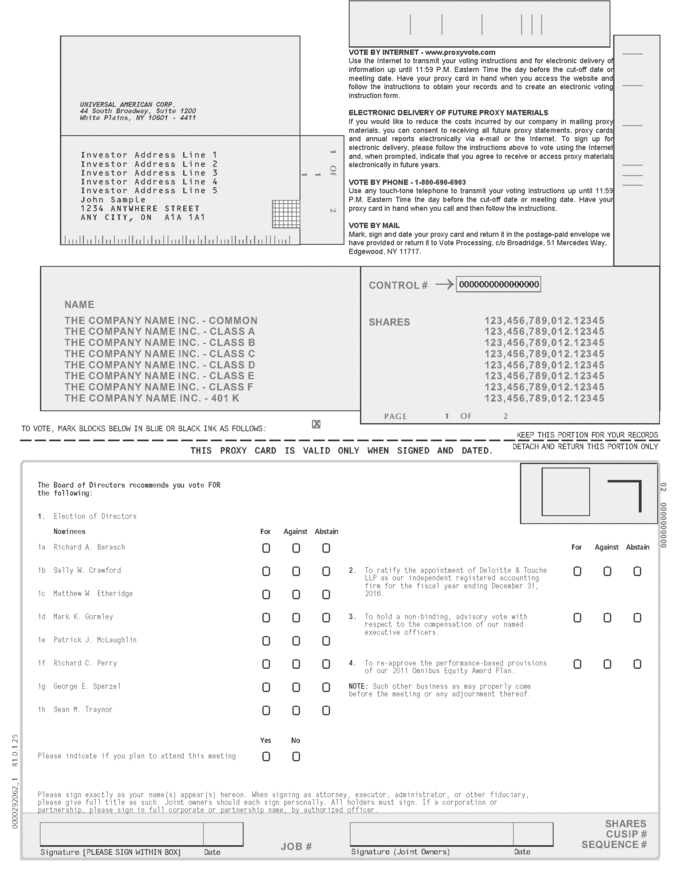
Important Notice Regarding the Availability of Proxy Materials for the Annual Meeting: The Notice & Proxy Statement, Form 10-K is/are available at www.proxyvote.com Proxy - Universal American Corp. Proxy Solicited by Board of Directors for Annual Meeting May 25, 2016 Adam C. Thackery and Anthony L. Wolk, or each of them with the full power of substitution in each of them, are hereby appointed proxies with authorization to represent and vote the shares of the undersigned, with all the powers which the undersigned would possess if personally present, at the Annual Meeting of Shareholders of Universal American Corp. to be held at 9:00 a.m. Eastern Time on May 25, 2016 at the offices of Universal American Corp., 44 South Broadway, Suite 1200, White Plains, NY 10601, or at any postponements or adjournments thereof. If no such directions are indicated, the Proxies will have authority to vote FOR Proposal 1 (Election of Directors), and FOR proposals 2, 3 and 4. In their discretion, the Proxies are also authorized to vote upon such other business as may properly come before the meeting or any adjournments or postponements thereof. Continued and to be signed on reverse side 0000292062_2 R1.0.1.25