Exhibit 11.1
YATRA ONLINE, INC.
SPECIAL TRADING PROCEDURES
APPLICABLE TO INSIDERS
To comply with federal and state securities laws governing insider trading, Yatra Online, Inc. and its subsidiaries (collectively, the “Company”) has adopted these Special Trading Procedures Applicable To Insiders (“Trading Procedures”) as an addendum to the Company’s Statement of Company Policy on Insider Trading and Disclosure (the “Insider Trading Policy”). This policy shall be in addition to and not in derogation to the policy, if any, adopted by the respective subsidiaries pursuant to laws/regulations applicable to them. These Trading Procedures are in addition to and supplement the Company’s Insider Trading Policy, which is distributed to all directors, officers, employees and consultants of the Company.
| A. | SCOPE |
These Trading Procedures regulate securities trades by all directors and executive officers of the Company, all employees having the designation of senior manager or its equivalent, all employees in the finance, accounts and legal departments, and any other employees of the Company designated by the Company’s board of directors (the “Board of Directors”). Each of these individuals have, in the ordinary course of the performance of their duties, access to material nonpublic information regarding the Company (collectively, these persons are referred to as “Insiders”). These Trading Procedures also apply to the following persons (collectively, these persons and entities are referred to as “Affiliated Persons”):
| ● | the Insider’s “Family Members” (“Family Members” are (a) their spouse or domestic partner, children, stepchildren, grandchildren, parents, stepparents, grandparents, siblings and in-laws who reside in the same household as them, (b) their children or the their spouse’s children who do not reside in the same household as them but are financially dependent on them, (c) any of their other family members who do not reside in their household but whose transactions are directed by the Insider, and (d) any other individual over whose account they have control and to whose financial support they materially contribute. (Materially contributing to financial support would include, for example, paying an individual’s rent but not just a phone bill | |
| ● | all trusts, family partnerships and other types of entities formed for the benefit of the Insider or the Insider’s family members over which the Insider has the ability to influence or direct investment decisions concerning securities; | |
| ● | all persons who execute trades on behalf of the Insider; and |
| 1 |
| ● | all investment funds, trusts, retirement plans, partnerships, corporations and other types of entities over which the Insider has the ability to influence or direct investment decisions concerning securities; provided, however, that these Trading Procedures shall not apply to any such entity that engages in the investment of securities in the ordinary course of its business (e.g., an investment fund or partnership) if such entity has established its own insider trading controls and procedures in compliance with applicable securities laws and it (or an affiliated entity) has represented to the Company that its affiliated entities: (a) engage in the investment of securities in the ordinary course of their respective businesses; (b) have established insider trading controls and procedures in compliance with securities laws; and (c) are aware the securities laws prohibit any person or entity who has material nonpublic information concerning the Company from purchasing or selling securities of the Company or from communicating such information to any other person under circumstances in which it is reasonably foreseeable that such person is likely to purchase or sell securities. |
Insiders are responsible for ensuring compliance with these Trading Procedures and the Insider Trading Policy by all of their Affiliated Persons. Unless the context otherwise requires, references to “Insiders” in these Trading Procedures refer collectively to Insiders and their Affiliated Persons.
These Trading Procedures apply to any and all transactions in the Company’s securities, including its ordinary shares, options to purchase ordinary shares, any other type of securities that the Company may issue (such as preferred shares, convertible debentures, warrants, exchange-traded options or other derivative securities), and any derivative securities that provide the economic equivalent of ownership of any of the Company’s securities or an opportunity, direct or indirect, to profit from any change in the value of the Company’s securities.
The special trading restrictions set forth in these Trading Procedures continue to apply to Insiders following the termination of any such Insider’s service to or employment with the Company until any material, nonpublic information possessed by such Insider has become public or is no longer material.
| B. | SPECIAL TRADING RESTRICTIONS APPLICABLE TO INSIDERS |
Please see the Insider Trading Policy for a description of prohibited activities applicable to all directors, executive officers, employees and consultants of the Company, including Insiders.
In particular, no Insider may trade in any type of securities of the Company if such Insider is in possession of material nonpublic information about the Company, unless the trade has been effected in compliance with a pre-approved Rule 10b5-1 Plan. This prohibition applies even if such Insider receives pre-clearance and the transaction would occur during a trading window in accordance with these Trading Procedures.
Please see the Insider Trading Policy for a discussion of what constitutes “insider trading” as well as “material” and “nonpublic” information. Any Insiders who are unsure whether the information that they possess is material or nonpublic should consult the Designated Compliance Officer.
| 2 |
In addition to the restrictions on trading in Company securities set forth in the Insider Trading Policy, Insiders are subject to the following special trading restrictions:
| 1. | No Trading Except During Trading Windows. |
The announcement of the Company’s quarterly financial results almost always has the potential to have a material effect on the market for the Company’s securities. Although an Insider may not know the financial results prior to public announcement, if an Insider engages in a trade before the financial results are disclosed to the public, such trades may give an appearance of impropriety that could subject the Insider and the Company to a charge of insider trading. Therefore, subject to limited exceptions, described herein, the trading window shall be closed from the end of every quarter and shall re-open after market close on the second full trading day following the Company’s issuance of a press release (or other method of broad public dissemination) announcing its quarterly or annual earnings. Insiders may be allowed to trade outside of a trading window only (a) pursuant to a pre-approved Rule 10b5-1 Plan or (b) in accordance with the procedure for waivers described below.
For example, if we release earnings results before the market opens on a Tuesday, the first time an Insider can buy or sell Company securities is after the market opens on Thursday. However, if our earnings release occurs after trading begins on a Tuesday, the first time that an Insider can buy or sell Company securities is the opening of the market on Friday.
Of course, if an Insider has material nonpublic information about the Company during one of these trading windows, the Insider may not trade in the Company’s securities.
| 2. | Special Closed Trading Periods. |
The Chief Executive Officer, Chief Financial Officer or Compliance Officer may designate, from time to time, a “Special Closed Window” during what would be a permitted trading window. During a Special Closed Window, designated Insiders (which could be all Insiders or a subset of them) may not trade in the Company’s securities. The Chief Executive Officer, Chief Financial Officer or Compliance Officer may also impose a Special Closed Window on Insiders or a subset of them to prohibit trading in the securities of other companies, including specified peers or competitors of the Company. The imposition of a Special Closed Window will not be announced to the Company generally, should not be communicated to any other person, and may itself be considered under this Insider Trading Policy to be material nonpublic information about the Company.
| 3. | Prohibited Transactions. |
| ● | No Short Sales. You may not at any time sell any securities of the Company that are not owned by you at the time of the sale (a “short sale”). | |
| ● | No Purchases or Sales of Derivative Securities or Hedging Transactions. You may not buy or sell puts, calls, other derivative securities of the Company or any derivative securities that provide the economic equivalent of ownership of any of the Company’s securities or an opportunity, direct or indirect, to profit from any change in the value of our securities or engage in any other hedging transaction with respect to our securities. | |
| ● | No Company Securities Subject to Margin Calls. You may not use the Company’s securities as collateral in a margin account. |
| 3 |
| ● | No Pledges. You may not pledge Company securities as collateral for a loan (or modify an existing pledge) unless the pledge has been approved by the Audit Committee of the Board of Directors. Any request for approval of such a pledge by an Insider must be submitted to the Audit Committee in writing at least two (2) weeks prior to the proposed execution of documents evidencing the proposed pledge. Any such request submitted by an Insider will be considered by the Audit Committee on a case-by-case basis and, if permitted, shall be subject to all of the other restrictions on trading in the Company’s securities set forth in these Trading Procedures. |
| 4. | Gifts and Other Distributions in Kind. |
No Insider may donate or make any other transfer of Company securities without consideration when the Insider is not permitted to trade unless the donee agrees not to sell the shares until the Insider is permitted to sell. In addition to charitable donations or gifts to family members, friends, trusts or others, this prohibition applies to distributions to limited partners by limited partnerships that are subject to this Insider Trading Policy.
| C. | PRE-CLEARANCE PROCEDURES |
No Insider may trade in our securities, even during an open trading window, unless the trade has been approved by the Designated Compliance Officer in accordance with the procedures set forth below. Gifts of Company securities are considered a trade in securities for purposes of these Trading Procedures.
The Designated Compliance Officers will be:
| ● | for all Insiders at or above the level of Senior Vice President or any directors of the Company: CEO; | |
| ● | for all Insiders at or above the level of General Manager and below the level of Senior Vice President: CFO/ Principal Financial Officer and Principal Accounting Officer; and | |
| ● | for all Insiders below the level of General Manager: Secretary. |
In reviewing trading requests, the Designated Compliance Officer may consult with our other officers and/or outside legal counsel.
The Board of Directors of the Company shall have the authority to review and approve the trades of Chief Executive Officer.
| 1. | Procedures. |
No Insider may trade in our securities unless
| ● | The Insider has notified the Designated Compliance Officer of the amount and nature of the proposed trade(s) using the Share Transaction Request form attached to these Trading Procedures. In order to provide adequate time for the preparation of any required reports under Section 16 of the Securities Exchange Act of 1934, as amended (the “Exchange Act”) following the Company’s transition to domestic issuer status, a Share Transaction Request form should, if practicable, be received by the Designated Compliance Officer at least two (2) business days before the intended trade date; |
| 4 |
| ● | The Insider has certified to the Designated Compliance Officer in writing before the proposed trade(s) that: (a) the Insider does not possess material nonpublic information concerning the Company; | |
| ● | the Insider, where the Insider is an executive officer or director, has informed the Designated Compliance Officer, using the Stock Transaction Request form, whether, to the Insider’s best knowledge, (a) the Insider has (or is deemed to have) engaged in any opposite way transactions within the previous six months that were not exempt from Section 16(b) of the Exchange Act and (b) if the transaction involves a sale by an “affiliate” of the Company or of “restricted securities” (as such terms are defined under Rule 144 under the Securities Act of 1933, as amended (“Rule 144”)), whether the transaction meets all of the applicable conditions of Rule 144; and | |
| ● | The Designated Compliance Officer has approved the trade(s) and has certified their approval in writing (which may be by email). |
The Designated Compliance Officer does not assume responsibility for, and approval by the Designated Compliance Officer does not protect the Insider from, the consequences of prohibited insider trading.
| 2. | Additional Information. |
Insiders shall provide to the Designated Compliance Officer any documentation reasonably requested by him or her in furtherance of the foregoing procedures. Any failure to provide such requested information will be grounds for denial of approval by the Designated Compliance Officer.
| 3. | No Obligation to Approve Trades. |
The foregoing approval procedures do not in any way obligate the Designated Compliance Officer to approve any trade. The Designated Compliance Officer has sole discretion to reject any trading request. From time to time, an event may occur that is material to the Company and is known by only a limited number of directors and employees. The Designated Compliance Officer may decline an Insider’s request to preclear a proposed trade based on the existence of a material nonpublic development – even if the Insider is not aware of that material nonpublic development. If any Insider engages in a trade before a material nonpublic development is disclosed to the public or resolved, the Insider and the Company might be exposed to a charge of insider trading that could be costly and difficult to refute even if the Insider was unaware of the development. So long as the event remains material and nonpublic, the Designated Compliance Officer may decide not to approve any transactions in the Company’s securities. The Designated Compliance Officer will subsequently notify the Insider once the material nonpublic development is disclosed to the public or resolved. If an Insider requests preclearance of a trade during the pendency of such an event, the Designated Compliance Officer may reject the trading request without disclosing the reason.
| 5 |
| 4. | Completion of Trades. |
After receiving written clearance to engage in a trade signed by the Designated Compliance Officer, an Insider must complete the proposed trade within five (5) business days or make a new trading request. Even if an Insider has received clearance, the Insider may not engage in a trade if (i) such clearance has been rescinded by the Designated Compliance Officer, (ii) the Insider has otherwise received notice that the trading window has closed or (iii) the Insider has or acquires material nonpublic information.
| 5. | Post-Trade Reporting. |
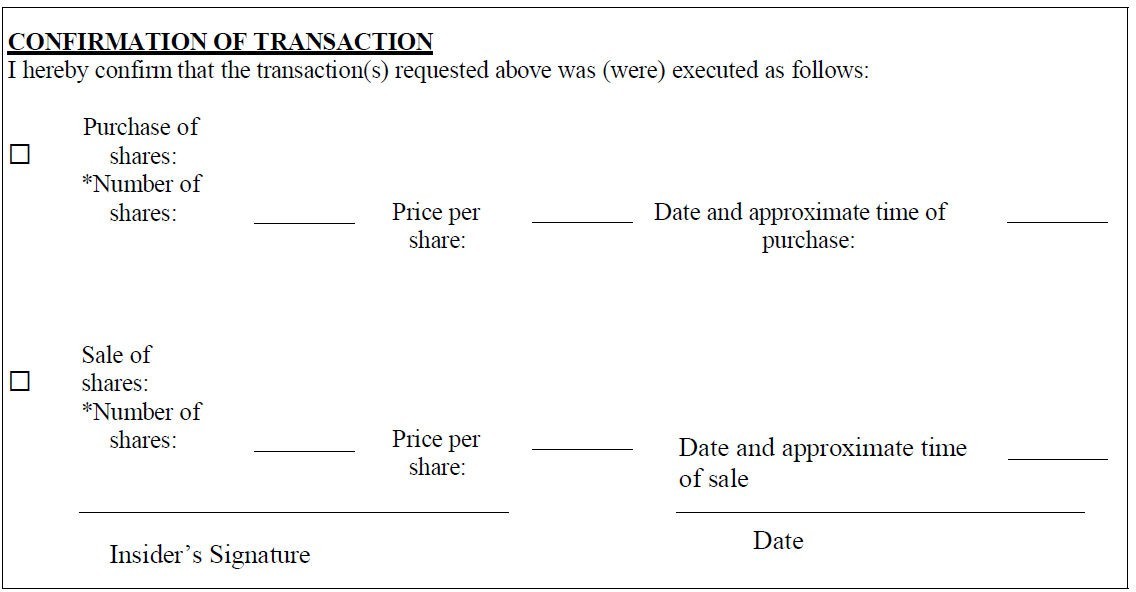
The details of any transactions in our securities (including transactions effected pursuant to a Rule 10b5-1 Plan) by an Insider (or an Affiliated Person) must be reported by the Insider or their brokerage firm to the Designated Compliance Officer by completing the “Confirmation of Transaction” section of the Share Transaction Request form attached to these Trading Procedures on the same day on which a trade order is placed or such a transaction otherwise is entered into. The report shall include the date of the transaction, quantity of shares, the price and the name of the broker-dealer that effected the transaction. This reporting requirement may be satisfied by providing (or having the Insider’s broker provide) a trade order confirmation to the Designated Compliance Officer if the Designated Compliance Officer receives such information by the required date. Compliance by directors and executive officers with this provision is imperative given the requirement of Section 16 of the Exchange Act that these persons generally report changes in ownership of Company securities within two (2) business days. The sanctions for noncompliance with this reporting deadline include mandatory disclosure in the Company’s proxy statement for the next annual meeting of shareholders, as well as possible civil or criminal sanctions for chronic or egregious violators.
| D. | EXEMPTIONS | |
| 1. | Pre-Approved Rule 10b5-1 Plan. |
Transactions made pursuant to an approved Rule 10b5-1 Plan (as defined below) will not be subject to our trading windows, retirement plan blackout periods or pre-clearance procedures, and Insiders are not required to complete a Share Transaction Request form for such transactions. Rule 10b5-1 of the Exchange Act provides an affirmative defense from insider trading liability under the federal securities laws for trading plans, arrangements or instructions that meet specified requirements. A trading plan, arrangement or instruction that meets the requirements of the SEC’s Rule 10b5-1 (a “Rule 10b5-1 Plan”) enables Insiders to trade in Company securities outside of our trading windows, even when in possession of material nonpublic information.
The Company has adopted a separate Rule 10b5-1 Trading Plan Policy (“Rule 10b5-1 Trading Plan Policy”) that sets forth the requirements for putting in place a Rule 10b5-1 Plan with respect to Company securities. If an Insider intends to trade pursuant to a Rule 10b5-1 Plan, such plan, arrangement or instruction must:
| ● | satisfy the requirements of Rule 10b5-1; |
| 6 |
| ● | be documented in writing; | |
| ● | be established during a trading window when such Insider does not possess material, nonpublic information; and | |
| ● | be pre-approved by the Designated Compliance Officer. |
The Rule 10b5-1 Trading Plan Policy sets forth the procedures Insiders must follow to obtain approval of a Rule 10b5-1 Plan. The Rule 10b5-1 Trading Plan Policy may be amended by the Board of Directors from time to time.
Prior to approving a Rule 10b5-1 Plan, the Designated Compliance Officer may require that the plan exclude or include certain provisions (e.g., cooling off period, minimum number of trades requirement, limited term) that ensure compliance with SEC regulations and practices the Designated Compliance Officer deems to be in the best interests of the Company
Any proposed deviation from the specifications of an approved Rule 10b5-1 Plan (including, without limitation, the amount, price or timing of a purchase or sale) must be reported immediately to the Designated Compliance Officer and be approved by, the Designated Compliance Officer. All transactions pursuant to a Rule 10b5-1 Plan must be timely reported in accordance with the procedures set forth above.
The Designated Compliance Officer may refuse to approve a Rule 10b5-1 Plan as he or she deems appropriate including, without limitation, if he or she determines that such plan does not satisfy the requirements of Rule 10b5-1 or the Trading Plan Requirements. The Designated Compliance Officer may consult with the Company’s legal counsel before approving a Rule 10b5-1 Plan. If the Designated Compliance Officer does not approve an Insider’s Rule 10b5-1 Plan, such Insider must adhere to the pre-clearance procedures and trading windows set forth above until such time as a Rule 10b5-1 Plan is approved.
Any modification or termination of a Rule 10b5-1 Plan previously approved by the Designated Compliance Officer requires a new approval by the Designated Compliance Officer. The Designated Compliance Officer may require as a condition to such approval that the modification or termination occur during a trading window and that the Insider be not aware of material nonpublic information.
| 2. | Employee Benefit Plans. |
Exercise of Share Options. The trading prohibitions and restrictions set forth in the Trading Procedures do not apply to the exercise for cash of an option to purchase securities of the Company. However, the exercise is subject to the current reporting requirements of Section 16 of the Exchange Act (if applicable) and, therefore, Insiders must comply with the post- trade reporting requirement described in Section C above for any such transaction. In addition, the securities acquired upon the exercise of an option to purchase Company securities are subject to all of the requirements of these Trading Procedures and the Insider Trading Policy. Moreover, these Trading Procedures apply to the use of outstanding Company securities to pay part or all of the exercise price of an option, any net option exercise, any exercise of a share appreciation right, share withholding and any sale of ordinary shares as part of a broker-assisted cashless exercise of an option, or any other market sale for the purpose of generating the cash needed to pay the exercise price of an option.
| 7 |
Tax Withholding on Restricted/performance Shares/Units. The trading prohibitions and restrictions set forth in these Trading Procedures do not apply to the withholding by the Company of shares upon vesting of restricted/performance shares or upon settlement of restricted/performance share units to satisfy tax withholding requirements if (a) withholding is required by the applicable plan or award agreement or (b) the election to exercise the tax withholding right was made by the Insider in compliance with these Trading Procedures.
Employee Share Purchase Plan. The trading prohibitions and restrictions set forth in these Trading Procedures do not apply to periodic wage withholding contributions by the Company or its employees that are used to purchase the Company’s securities pursuant to the employees’ advance instructions under the Company’s 2016 Employee Share Purchase Plan. However, an Insider may not: (a) elect to participate in the plan or alter their instructions regarding the level of withholding or purchase by the Insider of Company securities under the plan; or (b) make cash contributions to the plan (other than through periodic wage withholding) without complying with the Trading Procedures. Any sale of securities acquired under the plan is subject to the prohibitions and restrictions of these Trading Procedures.
| E. | WAIVERS |
A waiver of any provision of these Trading Procedures or the Insider Trading Policy may be authorized in writing by the Designated Compliance Officer or his or her designee or the Audit Committee of the Board of Directors, and any such waiver shall be reported to the Company’s Board of Directors.
| F. | ACKNOWLEDGMENT |
In addition to the Company’s Insider Trading Policy, these Trading Procedures will be delivered to all current Insiders and to all new Insiders at the start of their employment or relationship with the Company. Upon first receiving a copy of these Trading Procedures, each Insider must acknowledge that he or she has received a copy and agrees to comply with the terms of these Trading Procedures and the Insider Trading Policy. Such Insider shall return the acknowledgment attached hereto within ten (10) days of receipt to:
Yatra Online, Inc.
Gulf Adiba, Plot No. 272, 04th Floor,
Udyog Vihar, Phase-II,
Sector-20, Gurgaon-122008,
Haryana, India
| 8 |
This acknowledgment will constitute consent for the Company to impose sanctions for violation of the Insider Trading Policy or these Trading Procedures, and to issue any necessary stop-transfer orders to the Company’s transfer agent to ensure compliance.
Insiders will be required upon the Company’s request to re-acknowledge and agree to comply with these Trading Procedures and the Insider Trading Policy (including any amendments or modifications). For such purpose, an Insider will be deemed to have acknowledged and agreed to comply with these Trading Procedures and the Insider Trading Policy when copies of such items have been delivered to the Insider by regular or electronic mail (or other delivery option used by the Company) by the Designated Compliance Officer or his or her designee.
Failure to observe these Trading Procedures and the Insider Trading Policy could lead to significant adverse legal implications, and could have other serious consequences, including termination of employment. Questions regarding these Trading Procedures or the Insider Trading Policy are encouraged and may be directed to the Designated Compliance Officer.
Questions regarding this Insider Trading Policy are encouraged and may be directed to the Designated Compliance Officer.
RE-ADOPTED: 21st July, 2025
| 9 |
ACKNOWLEDGMENT
I hereby acknowledge that I have read, that I understand, and that I agree to comply with, the Statement of Company Policy on Insider Trading and Disclosure (the “Insider Trading Policy”) and the Special Trading Procedures for Insiders (the “Trading Procedures”) of Yatra Online, Inc. (the “Company”). I further acknowledge and agree that I am responsible for ensuring compliance with the Insider Trading Policy and the Trading Procedures by all of my “Affiliated Persons.” I also understand and agree that I will be subject to sanctions, including termination of employment, that may be imposed by the Company , for violation of the Insider Trading Policy or the Trading Procedures, and that the Company may give stop-transfer and other instructions to the Company’s transfer agent against the transfer of any Company securities in a transaction that the Company considers to be in contravention of the Insider Trading Policy or the Trading Procedures.
This acknowledgement constitutes consent for the Company to impose sanctions for violation of the Insider Trading Policy, including the Trading Procedures, and to issue any stop- transfer orders to the Company’s transfer agent that the Company, deems appropriate to ensure compliance.
| Date: | Signature: | |||
| Name: | ||||
| Title: |
Send signed Acknowledgement to:
Yatra Online Inc.
Gulf Adiba, Plot No. 272, 04th Floor, Udyog Vihar, Phase-II, Sector-20, Gurgaon-122008, Haryana, India
| 10 |
SHARE TRANSACTION REQUEST
Pursuant to Yatra Online, Inc. Special Trading Procedures for Insiders (the “Trading Procedures”), I hereby notify Yatra Online, Inc. (the “Company”) of my intent to trade the securities of the Company as indicated below:
REQUESTER INFORMATION
Insider’s Name: | |
| INTENT TO PURCHASE | |
| Number of shares: | |
| Intended trade date: | |
| Means of acquiring shares: | ☐ Acquisition through employee benefit plan (please specify): |
|
|
☐ Purchase through a broker on the open market |
| ☐ Other (please specify): | |
| INTENT TO SELL | |
| Number of shares: | |
| Intended trade date: | |
| Means of selling shares: | ☐ Sale through employee benefit plan (please specify): |
|
| |
| ☐ Sale through a broker on the open market | |
| ☐ Other (please specify): | |
| SECTION 16 | RULE 144 (Not applicable if transaction requested involves a purchase) |
| ☐ I am not subject to Section 16. | ☐ I am not an “affiliate” of the Company and the transaction requested above does not involve the sale of “restricted securities” (as those terms are defined in Rule 144 under the Securities Act of 1933, as amended). |
| ☐ To the best of my knowledge, I have not (and am not deemed to have) engaged in an opposite way transaction within the previous 6 months that was not exempt from Section 16(b) of the Exchange Act. | ☐ To the best of my knowledge, the transaction requested above will meet all of the applicable conditions of Rule 144. |
| ☐ None of the above. | ☐ The transaction requested will be made pursuant to an effective registration statement covering such transaction. |
| ☐ None of the above. | |
| 11 |
CERTIFICATION
I hereby certify that I am not (1) in possession of any material nonpublic information concerning the Company, as defined in the Company’s Insider Trading Policy and (2) purchasing any securities of the Company on margin in contravention of the Company’s Trading Procedures. I understand that, if I trade while possessing such information or in violation of such trading restrictions, I may be subject to severe civil and/or criminal penalties and may be subject to discipline by the Company including termination of my employment.
| Insider’s Signature | Date |
APPROVAL
| Signature of Compliance Officer (or designee) | Date |
*NOTE: Multiple lots must be listed on separate forms or broken out.
| 12 |
YATRA ONLINE, INC.
STATEMENT OF COMPANY POLICY ON INSIDER TRADING AND DISCLOSURE
This memorandum sets forth the policy of Yatra Online, Inc. and its subsidiaries (collectively, the “Company”) regarding trading in the Company’s securities as described below and the disclosure of information concerning the Company. This policy shall be in addition to and not in derogation to the policy, if any, adopted by the respective subsidiaries pursuant to laws/regulations applicable to them. This Statement of Company Policy on Insider Trading and Disclosure (the “Insider Trading Policy”) is intended to prevent the misuse of material nonpublic information, insider trading in securities, and the severe consequences associated with violations of insider trading laws. It is your obligation to review, understand and comply with this Insider Trading Policy. Our Board of Directors has approved this Insider Trading Policy, and we have appointed Darpan Batra, the Company’s Compliance Officer, to administer the policy. Please contact Darpan Batra, at Gulf Adiba, Plot No. 272, 04th Floor, Udyog Vihar, Phase-II, Sector-20, Gurgaon- 122008, Haryana, India, Tel: +91 124 4591700, Email: darpan.batra@yatra.com, if you have any questions regarding the policy.
OVERVIEW
| A. | Who Must Comply? |
This Insider Trading Policy applies to all of our employees, and members of our Board of Directors, including anyone employed by or acting as a director of any of the Company’s subsidiaries, as well as any other individuals whom the Compliance Officer may designate as Insiders (defined below) because they have access to material nonpublic information about the Company.
In addition, all of our directors, executive officers (as defined by Section 16 of the Securities Exchange Act of 1934, as amended (the “Exchange Act”)) and other designated employees must comply with the Special Trading Procedures Applicable To Insiders (the “Trading Procedures”); we will refer to these individuals in this policy as “Insiders.” The Trading Procedures provide rules for when Insiders can trade in our securities and explain the process for mandatory pre-clearance of proposed trades. You will be notified if you are considered to be an Insider who is required to comply with the Trading Procedures.
This Insider Trading Policy and, for Insiders, the Trading Procedures also apply to the following persons (“Affiliated Persons”):
| ● | your “Family Members” (“Family Members” are (a) your spouse or domestic partner, children, stepchildren, grandchildren, parents, stepparents, grandparents, siblings and in-laws who reside in the same household as you, (b) your children or your spouse’s children who do not reside in the same household as you but are financially dependent on you, (c) any of your other family members who do not reside in your household but whose transactions are directed by you, and (d) any other individual over whose account you have control and to whose financial support you materially contribute. (Materially contributing to financial support would include, for example, paying an individual’s rent but not just a phone bill. |
| 1 |
| ● | all trusts, family partnerships and other types of entities formed for your benefit or for the benefit of a member of your family and over which you have the ability to influence or direct investment decisions concerning securities; | |
| ● | all persons who execute trades on your behalf; and | |
| ● | all investment funds, trusts, retirement plans, partnerships, corporations and other types of entities over which you have the ability to influence or direct investment decisions concerning securities; provided, however, that the Trading Procedures do not apply to any such entity that engages in the investment of securities in the ordinary course of its business (e.g., an investment fund or partnership) if the entity has established its own insider trading controls and procedures in compliance with applicable securities laws and it (or an affiliated entity) has represented to the Company that its affiliated entities: (a) engage in the investment of securities in the ordinary course of their respective businesses; (b) have established insider trading controls and procedures in compliance with securities laws; and (c) are aware the securities laws prohibit any person or entity who has material nonpublic information concerning the Company from purchasing or selling securities of the Company or from communicating such information to any other person under circumstances in which it is reasonably foreseeable that such person is likely to purchase or sell securities. |
You are responsible for ensuring compliance with this Insider Trading Policy, including the Trading Procedures contained herein, by all of your Affiliated Persons.
| B. | What is Prohibited by this Insider Trading Policy? |
You and your Affiliated Persons are prohibited from engaging in insider trading and from trading in securities in violation of this Insider Trading Policy. “Insider trading” is (1) trading (buying or selling) the securities of a company whether for your account or for the account of another, while in the possession of material, nonpublic information (see definition below) about that company or (2) disclosing material nonpublic information about a company to others who may trade on the basis of that information. Insider trading can result in criminal prosecution, jail time, significant fines and public embarrassment for you and the Company.
Prohibition on Trading in Company Securities
When you are in possession of material, nonpublic information about the Company, whether positive or negative, you are prohibited from the following activities:
| ● | trading (whether for your account of for the account of another) in the Company’s securities, which includes ordinary shares, options to purchase ordinary shares, any other type of securities that the Company may issue (such as preferred shares, convertible debentures, warrants, exchange-traded options or other derivative securities), and any derivative securities that provide the economic equivalent of ownership of any of the Company’s securities or an opportunity, direct or indirect, to profit from any change in the value of the Company’s securities , except for trades made pursuant to plans approved by the Compliance Officer in accordance with this policy that are intended to comply with Rule 10b5-1 under the Exchange Act; |
| 2 |
| ● | having others trade for you in the Company’s securities; and giving trading advice of any kind about the Company except that you should, when appropriate, advise others not to trade if doing so might violate the law or this Insider Trading Policy. |
This Insider Trading Policy does not apply to (1 ) an exercise of an employee share option when payment of the exercise price is made in cash, or (2) the withholding by the Company of ordinary shares upon vesting of restricted/performance shares or upon settlement of restricted/ performance share units to satisfy applicable tax withholding requirements if (a) such withholding is required by the applicable plan or award agreement or (b) the election to exercise such tax withholding right was made by the Insider in compliance with the Trading Procedures.
The trading prohibitions in this Insider Trading Policy do apply, however, to the use of outstanding Company securities to pay part or all of the exercise price of an option, any sale of ordinary shares as part of a broker-assisted cashless exercise of an option, or any other market sale for the purpose of generating the cash needed to pay the exercise price of an option.
Prohibition on Tipping
Providing material nonpublic information about the Company to another person who may trade or advise others to trade on the basis of that information is known as “tipping” and is illegal. You are prohibited from providing material nonpublic information about the Company to a friend, relative, or anyone else who might buy or sell a security or other financial instrument on the basis of that information, whether or not you intend to or actually do realize a profit (or any other benefit) from such tipping. Additionally, you are prohibited from recommending to any person that such person engage in or refrain from engaging in any transaction involving the Company’s securities, or otherwise give trading advice concerning the Company’s securities, if you are in possession of material nonpublic information about the Company.
Prohibition on Trading in Securities of Other Companies
This policy’s prohibitions against insider trading and tipping also apply to trading in securities of other companies, including the Company’s customers, suppliers, partners and other enterprises with which we are working (such as when negotiating an acquisition, investment or other transaction that could be material to the other company). Whenever, during the course of your service to or employment by the Company, you become aware of material nonpublic information about another company, including any confidential information that is reasonably likely to affect the market price of that company’s securities (for example, discussions of licensing a product or acquiring that other company), neither you nor your Affiliated Persons may trade in any securities of that company, give trading advice about that company, tip or disclose that information, pass it on to others, or engage in any other action to take advantage of that information.
| 3 |
If your work regularly involves handling or discussing confidential information of one of our partners, suppliers or customers, you should consult with the Compliance Officer before trading in any of that company’s securities.
Duration of Trading Prohibitions
These trading prohibitions continue whenever and for as long as you know or are in possession of material, nonpublic information. Remember, anyone scrutinizing your transactions will be doing so after the fact, with the benefit of hindsight. As a practical matter, before engaging in any transaction, you should carefully consider even the appearance of improper insider trading and how enforcement authorities and others might view the transaction in hindsight.
This Insider Trading Policy applies to you and your Affiliated Persons so long as you are associated with the Company. If you leave the Company for any reason, this Insider Trading Policy, including, if applicable, the Trading Procedures, will continue to apply to you and your Affiliated Persons until the later of: (1) the second trading day following the public release of earnings for the fiscal quarter in which you leave the Company or (2) the second trading day after any material nonpublic information known to you has become public or is no longer material.
| C. | What is Material Nonpublic Information? |
This Insider Trading Policy prohibits you from trading in a company’s securities if you are in possession of information about the company that is both “material” and “nonpublic.” If you have a question whether certain information you are aware of is material or has been made public, you should consult with the Compliance Officer.
“Material” Information
Information about our Company or any other company is “material” if it could reasonably be expected to affect the investment decisions of a shareholder or potential investor, or if the disclosure of the information could reasonably be expected to significantly alter the total mix of information in the marketplace about us or any other company.
In simple terms, material information is any type of information that could reasonably be expected to affect the market price of our securities. Both positive and negative information may be material. While it is not possible to identify all information that would be deemed “material,” the following items are examples of the types of information that could be material.
| ● | projections of future earnings or losses, or other earnings guidance; | |
| ● | quarterly financial results that are known but have not been publicly disclosed; | |
| ● | potential restatements of the Company’s financial statements, changes in auditors or auditor notification that the Company may no longer rely on an auditor’s audit report; |
| 4 |
| ● | pending or proposed corporate mergers, acquisitions, tender offers, joint ventures or dispositions of significant assets; | |
| ● | changes in senior management or member of our Board of Directors; | |
| ● | significant actual or threatened litigation or governmental investigations or major developments in such matters; | |
| ● | cybersecurity risks and incidents, including the discovery of significant vulnerabilities or breaches; | |
| ● | significant developments regarding products, customers, suppliers, orders, contracts or financing sources (e.g., the acquisition or loss of a contract); | |
| ● | changes in dividend policy, declarations of share splits, or proposed securities offerings or other financings; | |
| ● | potential defaults under our credit agreements or indentures, or potential material liquidity issues; and | |
| ● | bankruptcies or receiverships. |
The above items will not always be material. For example, some new products or contracts may clearly be material while others may not be. No “bright-line” standard or list of items can adequately address the range of situations that may arise; information and events should be carefully considered in terms of their materiality to the Company.
“Nonpublic” Information
Material information is “nonpublic” if it has not been disseminated in a manner making it available to investors generally.
To demonstrate that information is public, one must be able to point to some fact that establishes that the information has become publicly available, such as the filing of a report with the SEC, the distribution of a press release publishing the information on our website or posting on social media if those are regular ways we communicate with investors, or by other means that are reasonably designed to provide broad public access. Before a person with material nonpublic information can trade, the market must have adequate time to absorb the information that has been disclosed. For the purposes of this Insider Trading Policy, information will be considered public after the close of trading on the second full trading day following the Company’s public release of the information.
For example, if the Company publicly discloses material nonpublic information of which you are aware before trading begins on a Tuesday, the first time you can buy or sell Company securities is the opening of the market on Thursday. However, if the Company publicly discloses this material information after trading begins on a Tuesday, the first time that you can buy or sell Company securities is the opening of the market on Friday.
| 5 |
| D. | Are there any Restrictions on the Use of Electronic Bulletin Boards, Internet Chat Rooms or Websites? |
While the Company encourages its shareholders and potential investors to obtain as much information as possible about the Company, the Company believes that information should come from its publicly-filed SEC reports, press releases and external website or from a designated Company spokesperson, rather than from speculation or unauthorized disclosures by the Company’s directors, officers, employees or consultants. For this reason, the Company has designated certain members of management to respond to inquiries regarding the Company’s business and prospects. This centralization of communication is designed to ensure that the information the Company discloses is accurate and considered in light of previous disclosures. Formal announcements are generally reviewed by management and legal counsel before they are made public. Any communications that do not go through this review process create an increased risk to the Company, as well as to the individual responsible for the communication, of civil and criminal liability.
In addition, on the Internet, and particularly through social media, electronic discussions about companies and their business prospects have become increasingly common. Inappropriate communications disseminated on the Internet may pose an inherently greater risk due to the size of the audience they can reach. These forums have the potential to move a share price significantly, and very rapidly – yet the information disseminated through the Internet and social media forums often is unreliable, and in some cases, may be deliberately false. The SEC has investigated and prosecuted a number of fraudulent schemes involving communications in these forums. You may encounter information about the Company on the Internet that you believe is harmful or inaccurate, or other information that you believe is true or beneficial for the Company. Although you may have a natural tendency to deny or confirm such information, any sort of response, even if it presents accurate information, could be considered improper disclosure and could result in legal liability to you and/or to the Company.
The Company is committed to preventing inadvertent disclosures of material, nonpublic information, preventing unwitting participation in Internet-based securities fraud, and avoiding the appearance of impropriety by persons associated with the Company. Accordingly, this Insider Trading Policy prohibits you from discussing material, nonpublic information about the Company with anyone, including other employees or consultants, except as required in the performance of your duties. You should not under any circumstances provide information or discuss matters involving the Company with the news media, any broker-dealer, analyst, investment banker, investment advisor, institutional investment manager, investment company or shareholder, even if you are contacted directly by such persons, without express prior authorization. This restriction applies whether or not you identify yourself as associated with the Company. You should refer all such contact or inquiries to Darpan Batra, the Company’s Compliance Officer, under this policy, at Gulf Adiba, Plot No. 272, 04th Floor, Udyog Vihar, Phase-II, Sector-20, Gurgaon-122008, Haryana, India, Tel: +91 124 4591700, Email: darpan.batra@yatra.com.
| 6 |
This Insider Trading Policy also prohibits you from making any comments or postings about the Company on any Internet bulletin boards, chat rooms or websites, or responding to comments or postings about the Company’s business made by others. This restriction applies whether or not you identify yourself as associated with the Company.
| E. | What are the Penalties for Insider Trading and Noncompliance with this Insider Trading Policy? |
Both the U.S. Securities and Exchange Commission (the “SEC”) and the national securities exchanges, through the Financial Industry Regulatory Authority (“FINRA”), investigate and are very effective at detecting insider trading. The U.S. government pursues insider trading violations vigorously, successfully prosecuting, for example, trading by employees in foreign accounts, trading by family members and friends of insiders, and trading involving only a small number of shares.
The penalties for violating rules against insider trading can be severe and include:
| ● | forfeiting any profit gained or loss avoided by the trading; | |
| ● | payment of the loss suffered by the persons who, contemporaneously with the purchase or sale of securities that are subject of a violation, have purchased or sold securities of the same class; | |
| ● | payment of criminal penalties of up to $5,000,000; | |
| ● | payment of civil penalties of up to three times the profit made or loss avoided; and | |
| ● | imprisonment for up to 20 years. |
The Company and/or the supervisors of the person engaged in insider trading may also be required to pay civil penalties or fines of $2 million or more, up to three times the profit made or loss avoided, as well as criminal penalties of up to $25,000,000, and could under some circumstances be subject to private lawsuits.
Violation of this Insider Trading Policy or any federal or state insider trading laws may subject you to disciplinary action by the Company including termination of your employment or other relationship with the Company. The Company reserves the right to determine, in its own discretion and on the basis of the information available to it, whether this Insider Trading Policy has been violated. The Company may determine that specific conduct violates this Insider Trading Policy, whether or not it also violates the law. It is not necessary for the Company to await the filing or conclusion of a civil or criminal action against the alleged violator before taking disciplinary action.
| F. | Does the Company have any Other Policies Regarding Confidential Information? |
The Company also has strict policies relating to safeguarding the confidentiality of its internal, proprietary information. These policies include procedures regarding identifying, marking and safeguarding confidential information and employee or consultant confidentiality agreements. You should comply with these policies at all times.
| 7 |
| G. | How Do You Report a Violation of this Insider Trading Policy? |
If you have a question about this Insider Trading Policy, including whether certain information you are aware of is material or has been made public, you should consult with the Compliance Officer. In addition, if you violate this Insider Trading Policy or any federal or state laws governing insider trading, or know of any such violation by any director or employee of the Company, you should report the violation immediately to Darpan Batra, the Company’s Compliance Officer, under this policy, at Gulf Adiba, Plot No. 272, 04th Floor, Udyog Vihar, Phase-II, Sector-20, Gurgaon-122008, Haryana, India, Tel: +91 124 4591700, Email: darpan.batra@yatra.com. However, if the conduct in question involves Compliance Officer or if you have reported such conduct to the Compliance Officer and do not believe that he has dealt with it properly, or you may raise the matter with Anuj Kumar Sethi, Principal Financial Officer and Principal Accounting Officer, at Gulf Adiba, Plot No. 272, 04th floor, Udyog Vihar, Phase- II, Sector-20, Gurgaon-122008, Haryana, India, Tel: +91 124 4591700, Email: anuj.sethi@yatra.com.
| H. | Is This Insider Trading Policy Subject to Modification? |
The Company may at any time change this Insider Trading Policy or adopt such other policies or procedures which it considers appropriate to carry out the purposes of its policies regarding insider trading and the disclosure of Company information. Notice of any such change will be delivered to you by regular or electronic mail (or other delivery option used by the Company) by the Company. You will be deemed to have received, be bound by and agree to revisions of this Insider Trading Policy when such revisions have been delivered to you.
| I. | Waivers |
A waiver of any provision of this Insider Trading Policy may be authorized in writing by the Compliance Officer. All waivers shall be reported to the Board of Directors.
| J. | Acknowledgement |
All the employees, and directors of the Company must acknowledge that they have received a copy and agree to comply with the terms of this Insider Trading Policy, and, if applicable, the Trading Procedures contained herein. The attached acknowledgment must be completed and submitted to the Company within ten days of receipt.
At the request of the Company, directors and employees will be required to re-acknowledge and agree to comply with the Insider Trading Policy (including any amendments or modifications). For that purpose, an individual will be deemed to have acknowledged and agreed to comply with the Insider Trading Policy, as amended from time to time, when copies of those items have been delivered by regular or electronic mail (or other delivery option used by the Company) to the Compliance Officer.
* * * * *
Your failure to observe this Insider Trading Policy could lead to significant legal problems, including fines and/or imprisonment, and could have other serious consequences, including the termination of your employment or service relationship with the Company.
Questions regarding this Insider Trading Policy are encouraged and may be directed to the Compliance Officer.
RE-ADOPTED: 21st July, 2025
| 8 |
EXHIBIT A
ACKNOWLEDGEMENT
I hereby acknowledge that I have read, that I understand, and that I agree to comply with the Statement of Company Policy on Insider Trading and Disclosure of Yatra Online, Inc. (the “Company”). I further acknowledge and agree that I am responsible for ensuring compliance with the Insider Trading Policy and the Trading Procedures by all of my “Affiliated Persons.” I also understand and agree that I will be subject to sanctions, including termination of employment, that may be imposed by the Company, in its sole discretion, for violation of the Insider Trading Policy, and that the Company may give stop-transfer and other instructions to the Company’s transfer agent or any brokerage firm managing the Company’s equity incentive plan(s) against the transfer of any Company securities that the Company considers to be in contravention of the Insider Trading Policy.
This acknowledgement constitutes consent for the Company to impose sanctions for violation of the Insider Trading Policy, and to issue any stop-transfer orders to the Company’s transfer agent that the Company, deems appropriate to ensure compliance.
| Date: | Signature: | |||
| Name: | ||||
| Title: |
Send signed Acknowledgement to:
Yatra Online, Inc.
Gulf Adiba, Plot No. 272, 04th Floor, Udyog Vihar, Phase-II, Sector-20, Gurgaon- 122008, Haryana, India
| 9 |
RULE 10b5-1 TRADING PLAN POLICY
This Rule 10b5-1 Trading Plan Policy should be read in conjunction with the Company’s Statement of Company Policy on Insider Trading and Disclosure (the “Insider Trading Policy”) and Special Trading Procedures Applicable to Insiders (“Trading Procedures”). Specifically, the Trading Procedures provides that transactions made pursuant to an approved Rule 10b5-1 Plan will not be subject to the trading windows, retirement plan blackout periods or pre-clearance procedures set forth in the Insider Trading Policy. Terms used in this Rule 10b5-1 Trading Plan Policy and not otherwise defined have the meanings set forth in the Insider Trading Policy and Trading Procedures.
Rule 10b5-1(c) under the Exchange Act provides an affirmative defense against allegations of insider trading. This affirmative defense is often referred to as a “safe harbor” from such allegations. The Rule 10b5-1(c) safe harbor is available to the Company’s employees, officers, and directors who make trades pursuant to a trading “plan” that meets the requirements of the rule. A plan that meets the requirements of the Rule 10b5-1(c) safe harbor is referred to herein as a “Trading Plan.” Trading Plans may be used for purchases, sales, gifts or other transfers of securities.
The Company allows Insiders to enter into Trading Plans, but only if those plans are pre-approved in writing by our Compliance Officer or their designee(s) (each, the “Designated Compliance Officer”)/Board, as the case may be. The Designated Compliance Officer/Board is assigned the job of approving any Trading Plan as to its form. Most brokerage firms will provide a form Trading Plan that is used for all clients.
All Trading Plans (and any amendment to, modification of, or termination of a Trading Plan) must comply with Rule 10b5-1 and must meet the following minimum conditions:
| 1. | Trading Plan Requirements. |
| a. | Plan and Approval. Each Trading Plan proposed to be entered into by an Insider must be approved in writing by the Designated Compliance Officer/Board, as the case may be, prior to its effectiveness. The Trading Plan must be in writing and signed by the Insider. The Trading Plan must include a written representation by the Insider that they are not aware of any material nonpublic information concerning the Company and that they are adopting the Trading Plan in good faith and not as part of a plan or scheme to evade the prohibitions of Section 10(b) and Rule 10b-5 of the Exchange Act. We will keep a copy of each Trading Plan in our files. | |
| b. | Timing and Term of Plan. Each Trading Plan used by an Insider must be adopted (a) when the trading window for the Insider is open under our Insider Trading Policy; and (b) when the Insider does not otherwise possess material nonpublic information about the Company. Except with the prior written approval of the Designated Compliance Officer/Board, as the case may be, each Trading Plan entered into by any Insider of the Company must be structured to remain in place for at least one year; provided however, a Trading Plan may be less than one year in duration if the plan solely covers either (a) share options expiring within one year or (b) selling of a portion of the shares upon vesting of restricted share units in order to primarily cover estimated applicable tax liability. Except with the prior written approval of the Designated Compliance Officer/Board, as the case may be, each Trading Plan entered into by any Insider must be structured to remain in place no longer than two years after the effective date of such plan. |
| c. | Timing of Plan Amendment and Modification; Termination of Plans. Trading Plans may be amended, modified or terminated only (a) when the trading window for the Insider is open under our Insider Trading Compliance Policy; (b) when the Insider does not possess material nonpublic information about the Company; and (c) with the written approval of the Designated Compliance Officer/Board, as the case may be. | |
| d. | Delayed Effectiveness of Adoption or Amendment/Modification. Each Trading Plan used by an Insider must include a “cooling off’ period prior to the first trade. | |
| For executive officers (those officers of the Company who are required by Section 16 of the Exchange Act to file reports on their transactions in the Company’s securities) and members of the Company’s board of directors, the Trading Plan must provide that the first transaction executed pursuant to the Trading Plan may not occur until the later (expiry) of (i) the 90th day after adoption or amendment of the plan or (ii) two business days following the disclosure of the Company’s financial results in a Form 6-K or Form 20-F for the fiscal quarter or period in which the plan was adopted, amended or modified. With respect to the period described in clause (ii), the required cooling off period shall not exceed 120 days. | ||
| For Insiders who are not executive officers or directors, the Trading Plan must provide that the first transaction executed pursuant to the Trading Plan may not occur until thirty (30) days following the adoption, amendment or modification of the Trading Plan, as applicable. | ||
| e. | Relationships with Plan Broker/Administrator; No Subsequent Influence. Each Trading Plan used by an Insider must provide that the Insider may not communicate any material nonpublic information about the Company to the broker or other third party administering the plan, or attempt to influence how the broker or such party executes (or exercises its discretion in executing) orders or other transactions under the Trading Plan in any way. | |
| f. | Plan Specifications; Discretion Regarding Transactions Under the Plan. The Trading Plan must authorize the broker or other third party administering the plan to effect the transactions called for by the plan without any control or influence by you. The Trading Plan must specify the material parameters for the transactions to be effected under the plan. For example, for a plan that will provide for the purchase or sale of shares, the plan must specify the amount of shares to be purchased or sold during specified time periods and the price at which such shares is to be purchased or sold, or the plan may specify or set an objective formula (e.g., share price thresholds) for determining the price and amount of shares to be purchased or sold during specified time periods. The Designated Compliance Officer may require that the specified time periods contained in your Trading Plan during which sales could occur shall not coincide with the specified time periods in similar Trading Plans adopted by other insiders (e.g., to avoid a particular part of a quarter when earnings will be released), or make other arrangements (such as sale volume limitations) to avoid a large number of sales occurring simultaneously or to comply with any required company policy regarding share ownership. | |
| g. | Only One Plan in Effect at Any Time. Unless otherwise approved by the Designated Compliance Officer /Board, as the case may be, in situations where having multiple plans in place at one time is permissible under the provisions of Rule 10b5-1, an Insider may have only one Trading Plan in effect at any time. However, an Insider may adopt a new Trading Plan to replace an existing Trading Plan before the scheduled termination date of such existing Trading Plan so long as the new Trading Plan does not become effective prior to the completion of expiration of transactions under the existing Trading Plan, in all cases consistent with Rule 10b5-1, and the new Trading Plan must comply with the cooling off period and other requirements of this Policy. In addition, an Insider may have in place an additional Trading Plan in connection with sell-to-cover transactions as necessary to satisfy tax withholding obligations incident to the vesting of a compensatory award from the Company such as restricted shares, restricted share units or share appreciation rights and where the Insider does not control the timing of such sales. |
| h. | Limitations on Single Trade Plans. During any 12-month period, an Insider may only enter into one Trading Plan that is designed to effect the purchase or sale or other transfer of the total amount of the Company’s securities covered by the Trading Plan in a single transaction; provided, however, an Insider may have in place an additional non-concurrent single-trade Trading Plan during this same 12-month period in connection with sell-to-cover transactions as necessary to satisfy tax withholding obligations incident to the vesting of a compensatory award from the Company such as restricted shares, restricted share units or share appreciation rights and where the Insider does not control the timing of such sales. | |
| i. | Suspensions. Each Trading Plan used by an Insider must provide for suspension of transactions under such plan if legal, regulatory or contractual restrictions are imposed on the Insider, or other events occur, that would prohibit transactions under such plan. | |
| j. | Compliance with Rule 144. Each Trading Plan used by an Insider must provide for specific procedures to comply with Rule 144 under the Securities Act of 1933, as amended, including the filing of Form 144. | |
| k. | Broker Obligation to Provide Notice of Trades. For executive officers and members of the board of directors of the Company, each Trading Plan must provide that the broker will provide notice of any transactions under the Trading Plan to the Insider and the Company no later than the close of business on the day of the transaction. | |
| l. | Insider Obligation to Make Exchange Act Filings. Each Trading Plan must contain an explicit acknowledgement by such Insider that all filings required by the Exchange Act, as a result of or in connection with transactions under such plan, are the sole obligation of such Insider and not the Company. |
RE-ADOPTED : 21st July, 2025