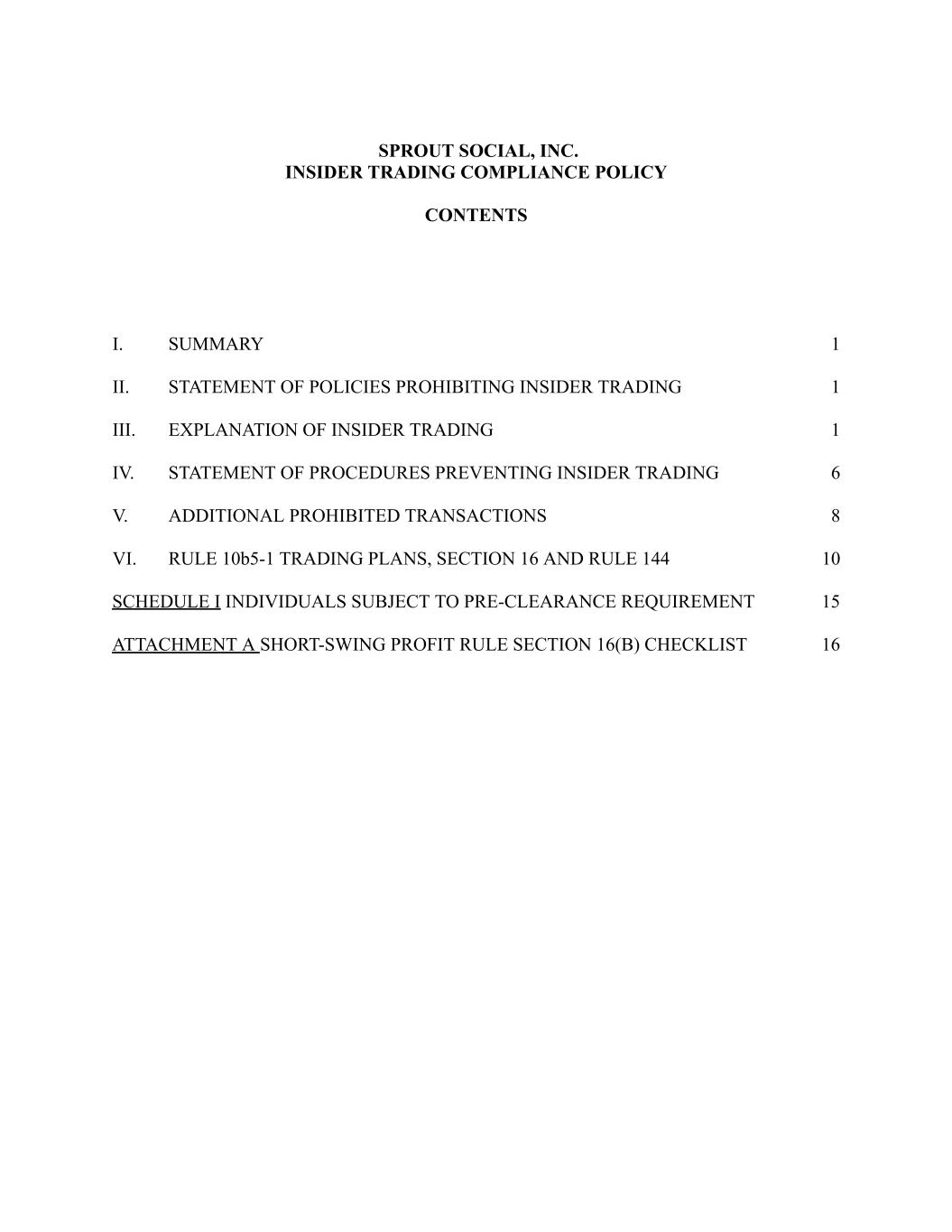
SPROUT SOCIAL, INC. INSIDER TRADING COMPLIANCE POLICY CONTENTS I. SUMMARY 1 II. STATEMENT OF POLICIES PROHIBITING INSIDER TRADING 1 III. EXPLANATION OF INSIDER TRADING 1 IV. STATEMENT OF PROCEDURES PREVENTING INSIDER TRADING 6 V. ADDITIONAL PROHIBITED TRANSACTIONS 8 VI. RULE 10b5-1 TRADING PLANS, SECTION 16 AND RULE 144 10 SCHEDULE I INDIVIDUALS SUBJECT TO PRE-CLEARANCE REQUIREMENT 15 ATTACHMENT A SHORT-SWING PROFIT RULE SECTION 16(B) CHECKLIST 16
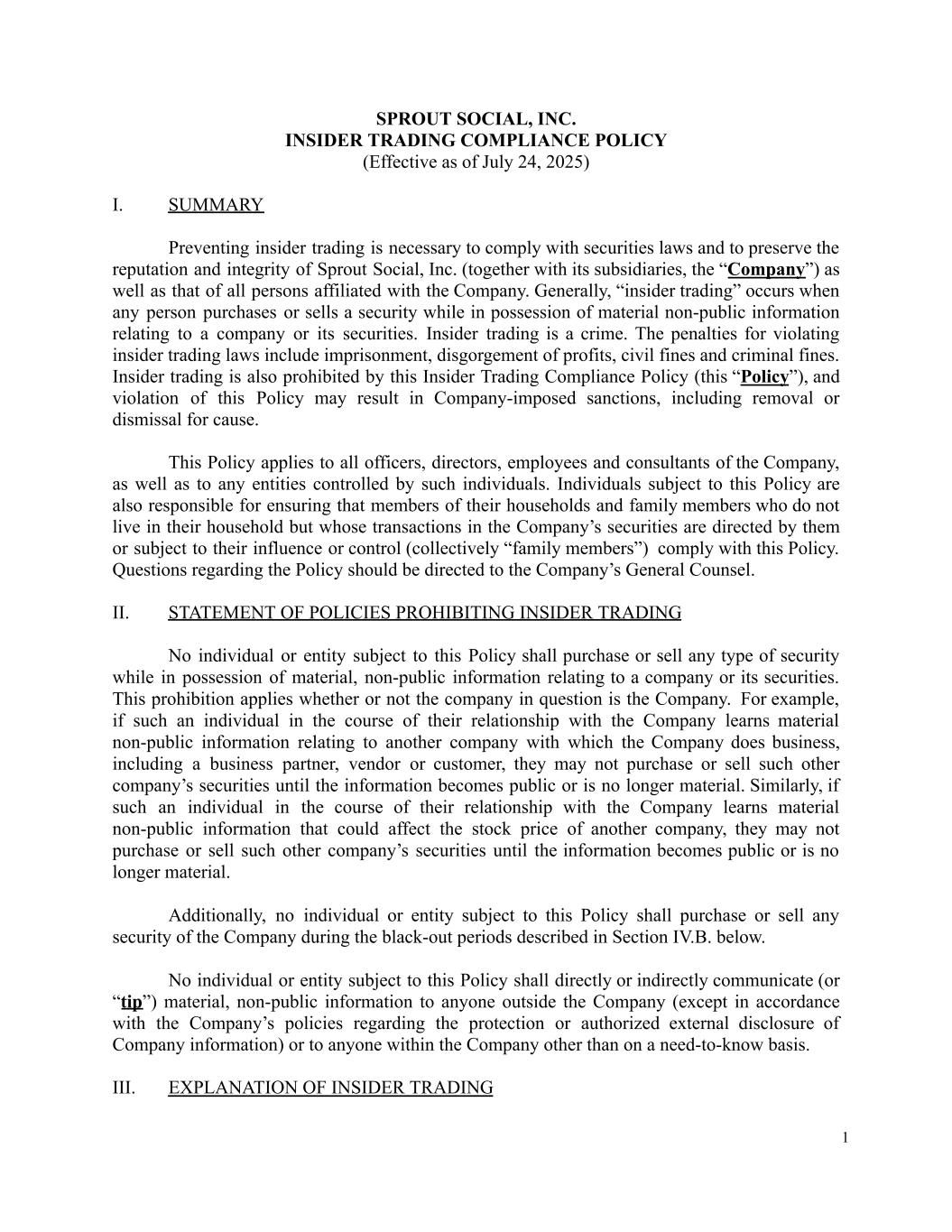
SPROUT SOCIAL, INC. INSIDER TRADING COMPLIANCE POLICY (Effective as of July 24, 2025) I. SUMMARY Preventing insider trading is necessary to comply with securities laws and to preserve the reputation and integrity of Sprout Social, Inc. (together with its subsidiaries, the “Company”) as well as that of all persons affiliated with the Company. Generally, “insider trading” occurs when any person purchases or sells a security while in possession of material non-public information relating to a company or its securities. Insider trading is a crime. The penalties for violating insider trading laws include imprisonment, disgorgement of profits, civil fines and criminal fines. Insider trading is also prohibited by this Insider Trading Compliance Policy (this “Policy”), and violation of this Policy may result in Company-imposed sanctions, including removal or dismissal for cause. This Policy applies to all officers, directors, employees and consultants of the Company, as well as to any entities controlled by such individuals. Individuals subject to this Policy are also responsible for ensuring that members of their households and family members who do not live in their household but whose transactions in the Company’s securities are directed by them or subject to their influence or control (collectively “family members”) comply with this Policy. Questions regarding the Policy should be directed to the Company’s General Counsel. II. STATEMENT OF POLICIES PROHIBITING INSIDER TRADING No individual or entity subject to this Policy shall purchase or sell any type of security while in possession of material, non-public information relating to a company or its securities. This prohibition applies whether or not the company in question is the Company. For example, if such an individual in the course of their relationship with the Company learns material non-public information relating to another company with which the Company does business, including a business partner, vendor or customer, they may not purchase or sell such other company’s securities until the information becomes public or is no longer material. Similarly, if such an individual in the course of their relationship with the Company learns material non-public information that could affect the stock price of another company, they may not purchase or sell such other company’s securities until the information becomes public or is no longer material. Additionally, no individual or entity subject to this Policy shall purchase or sell any security of the Company during the black-out periods described in Section IV.B. below. No individual or entity subject to this Policy shall directly or indirectly communicate (or “tip”) material, non-public information to anyone outside the Company (except in accordance with the Company’s policies regarding the protection or authorized external disclosure of Company information) or to anyone within the Company other than on a need-to-know basis. III. EXPLANATION OF INSIDER TRADING 1
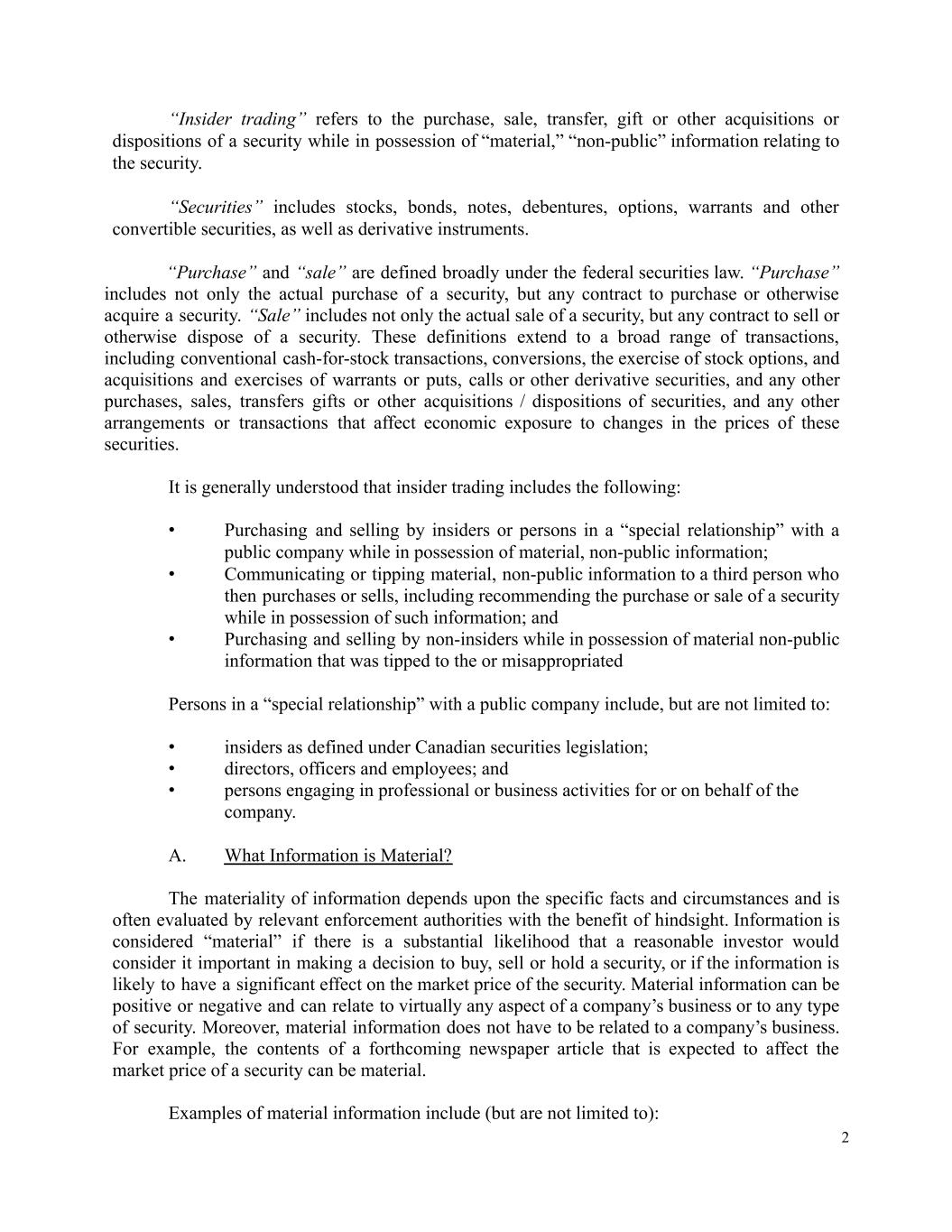
“Insider trading” refers to the purchase, sale, transfer, gift or other acquisitions or dispositions of a security while in possession of “material,” “non-public” information relating to the security. “Securities” includes stocks, bonds, notes, debentures, options, warrants and other convertible securities, as well as derivative instruments. “Purchase” and “sale” are defined broadly under the federal securities law. “Purchase” includes not only the actual purchase of a security, but any contract to purchase or otherwise acquire a security. “Sale” includes not only the actual sale of a security, but any contract to sell or otherwise dispose of a security. These definitions extend to a broad range of transactions, including conventional cash-for-stock transactions, conversions, the exercise of stock options, and acquisitions and exercises of warrants or puts, calls or other derivative securities, and any other purchases, sales, transfers gifts or other acquisitions / dispositions of securities, and any other arrangements or transactions that affect economic exposure to changes in the prices of these securities. It is generally understood that insider trading includes the following: • Purchasing and selling by insiders or persons in a “special relationship” with a public company while in possession of material, non-public information; • Communicating or tipping material, non-public information to a third person who then purchases or sells, including recommending the purchase or sale of a security while in possession of such information; and • Purchasing and selling by non-insiders while in possession of material non-public information that was tipped to the or misappropriated Persons in a “special relationship” with a public company include, but are not limited to: • insiders as defined under Canadian securities legislation; • directors, officers and employees; and • persons engaging in professional or business activities for or on behalf of the company. A. What Information is Material? The materiality of information depends upon the specific facts and circumstances and is often evaluated by relevant enforcement authorities with the benefit of hindsight. Information is considered “material” if there is a substantial likelihood that a reasonable investor would consider it important in making a decision to buy, sell or hold a security, or if the information is likely to have a significant effect on the market price of the security. Material information can be positive or negative and can relate to virtually any aspect of a company’s business or to any type of security. Moreover, material information does not have to be related to a company’s business. For example, the contents of a forthcoming newspaper article that is expected to affect the market price of a security can be material. Examples of material information include (but are not limited to): 2
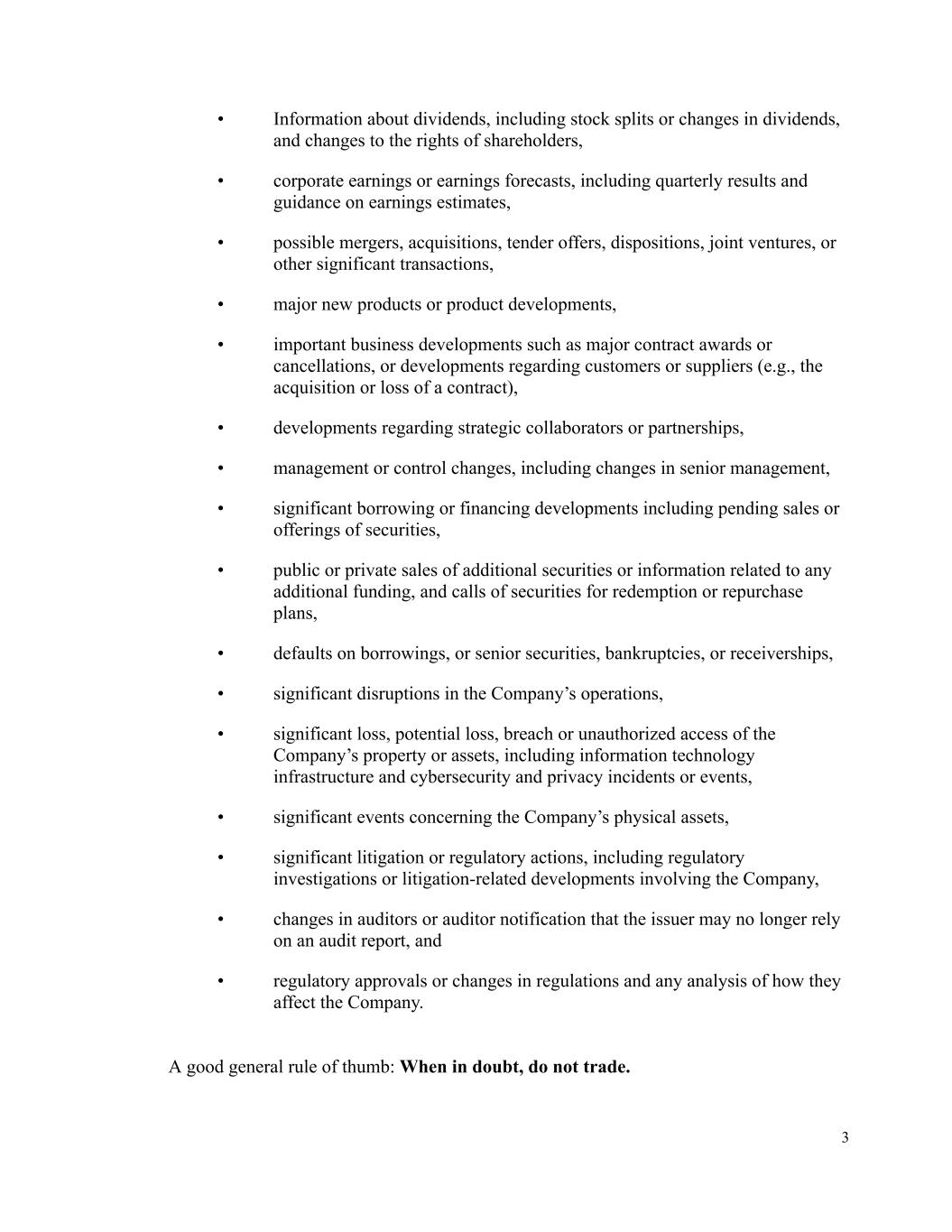
• Information about dividends, including stock splits or changes in dividends, and changes to the rights of shareholders, • corporate earnings or earnings forecasts, including quarterly results and guidance on earnings estimates, • possible mergers, acquisitions, tender offers, dispositions, joint ventures, or other significant transactions, • major new products or product developments, • important business developments such as major contract awards or cancellations, or developments regarding customers or suppliers (e.g., the acquisition or loss of a contract), • developments regarding strategic collaborators or partnerships, • management or control changes, including changes in senior management, • significant borrowing or financing developments including pending sales or offerings of securities, • public or private sales of additional securities or information related to any additional funding, and calls of securities for redemption or repurchase plans, • defaults on borrowings, or senior securities, bankruptcies, or receiverships, • significant disruptions in the Company’s operations, • significant loss, potential loss, breach or unauthorized access of the Company’s property or assets, including information technology infrastructure and cybersecurity and privacy incidents or events, • significant events concerning the Company’s physical assets, • significant litigation or regulatory actions, including regulatory investigations or litigation-related developments involving the Company, • changes in auditors or auditor notification that the issuer may no longer rely on an audit report, and • regulatory approvals or changes in regulations and any analysis of how they affect the Company. A good general rule of thumb: When in doubt, do not trade. 3
B. When is Information Considered Public? Information is “non-public” if it is not available to the general public. In order for information to be considered public, it must be widely disseminated in a manner making it generally available to investors through a widely available: (i) media outlet, such as Dow Jones, Business Wire, Reuters, The Wall Street Journal, Associated Press, or United Press International, (ii) radio or television broadcast, (iii) newspaper or magazine publication, or (iv) news web site. Information can also be made public by the Company through a Regulation FD-compliant conference call, press release, website posting or filing with the Securities and Exchange Commission (“SEC”). The circulation of rumors, even if accurate and reported in the media, does not constitute effective public dissemination. In addition, even after a public announcement, a reasonable period of time must lapse in order for the market to react to the information. Generally, one should allow two full trading days following publication as a reasonable waiting period before such information is deemed to be public. C. Trading by Persons Who Are Not Insiders An insider is liable for communicating or tipping material, non-public information to a third party (“tippee”), who purchases or sells on the basis of such information. A tippee also inherits an insider’s duties and is liable for purchasing or selling on the basis of material, non-public information illegally tipped to them. Similarly, just as an insider is liable for the insider trading of their tippee, so is a tippee who tips material non-public information to another person who purchases or sells on the basis of such information. In other words, a tippee’s liability for insider trading is no different from that of an insider. In addition to receiving overt tips, a non-insider can be liable for insider trading when they misappropriate and take advantage of material, non-public information obtained in breach of a fiduciary duty owed to the source of the information. D. Penalties for Engaging in Insider Trading Penalties for insider trading can extend significantly beyond any profits made or losses avoided, both for individuals engaging in such unlawful conduct and their employers. The SEC and Department of Justice have made the civil and criminal prosecution of insider trading violations a top priority. Enforcement remedies available to the government or private plaintiffs under the federal securities laws include: • SEC administrative sanctions; • Securities industry self-regulatory organization sanctions; • Civil injunctions; • Damage awards to private plaintiffs; • Disgorgement of all profits; • Civil fines for the violator of up to three times the amount of profit gained or loss avoided; 4
• Civil fines for the employer or other controlling person of a violator (i.e., where the violator is an employee or other controlled person) of up to three times the amount of profit gained or loss avoided by the violator; • Criminal fines for individual violators of up to $5,000,000 ($25,000,000 for an entity); and • Jail sentences of up to 20 years. Violation of this Policy could also result in serious sanctions by the Company, including dismissal. Insider trading violations are not limited to violations of the federal securities laws. Other federal and state civil or criminal laws, such as the laws prohibiting mail and wire fraud and the Racketeer Influenced and Corrupt Organizations Act (RICO), also may be violated in connection with insider trading. E. Size of Transaction and Reason for Transaction Do Not Matter The size of the transaction or the amount of profit received does not have to be significant to result in prosecution. The SEC has the ability to monitor even the smallest trades, and the SEC performs routine market surveillance. Brokers or dealers are required by law to inform the SEC of any possible violations by people who may have material, non-public information. The SEC aggressively investigates even small insider trading violations. F. Examples of Insider Trading Examples of insider trading cases include actions brought against corporate officers, directors, employees or consultants who purchased or sold in a company’s securities after learning of significant confidential corporate developments; friends, business associates, family members and other tippees of such insiders who traded in the securities after receiving such information; and government employees who learned of such information in the course of their employment. The following are illustrations of insider trading violations. These illustrations are hypothetical and, consequently, not intended to reflect on the actual activities or business of the Company or any other entity: Trading by Insider An officer of X Corporation learns that earnings to be reported by X Corporation will increase dramatically. Prior to the public announcement of such earnings, the officer purchases X Corporation’s stock. The officer, an insider, is liable for all profits as well as penalties of up to three times the amount of all profits. The officer also is subject to, among other things, criminal prosecution, including up to $5,000,000 in additional fines and 20 years in jail. Depending upon the circumstances, X Corporation and the individual to whom the officer reports also could be liable as controlling persons. Trading by Tippee An officer of X Corporation tells a friend that X Corporation is about to publicly 5
announce that it has concluded an agreement for a major acquisition. This tip causes the friend to purchase X Corporation’s stock in advance of the announcement. The officer is jointly liable with their friend for all of the friend’s profits, and each is liable for all civil penalties of up to three times the amount of the friend’s profits. The officer and their friend are also subject to criminal prosecution and other remedies and sanctions, as described above. IV. STATEMENT OF PROCEDURES PREVENTING INSIDER TRADING The following procedures have been established, and are maintained and enforced, by the Company to prevent insider trading. Every officer, director, employee and consultant is required to follow these procedures. A. Pre-Clearance of All Transactions by All Officers, Directors and Certain Employees To provide assistance in preventing inadvertent violations of applicable securities laws and to avoid the appearance of impropriety in connection with the purchase and sale of the Company’s securities, all transactions in the Company’s securities (including without limitation, purchases and sales of Company stock, the exercise of stock options, the sale of Company stock issued upon exercise of stock options and gifts of Company stock) by officers, directors and certain key employees listed on Schedule I (as amended from time to time) (each, a “Pre-Clearance Person”), as well as their family members and entities controlled by them, must be pre-cleared by the Company’s General Counsel. Pre-clearance does not relieve anyone of their responsibility to comply with federal securities laws or this Policy. A request for pre-clearance must be submitted to the General Counsel by creating a ticket through the Legal Service Desk at least two trading days in advance of the proposed transaction and should include the identity of the Pre-Clearance Person, the type of proposed transaction (for example, an open market purchase, a privately negotiated sale, an option exercise, etc.), the proposed date of the transaction and the type and number of securities to be involved. In addition, the Pre-Clearance Person must execute a certification (in the form approved by the General Counsel) that they are not aware of any material nonpublic information about the Company or its securities. The General Counsel shall have sole discretion to decide whether to clear any request for a proposed transaction (the Chief Executive Officer or the Chief Financial Officer shall have sole discretion to decide whether to clear any request for a proposed transaction by the General Counsel or persons or entities subject to this policy as a result of their relationship with the General Counsel). A pre-cleared transaction must be effected within three trading days of receipt of the pre-clearance unless a specific exception has been granted by the General Counsel (or the Chief Executive Officer or the Chief Financial Officer in the event of transactions by the General Counsel). A pre-cleared transaction (or any portion of a pre-cleared transaction) that has not been effected during the three trading day period must be pre-cleared again prior to execution. Notwithstanding receipt of pre-clearance, if the Pre-Clearance Person becomes aware of material non-public information or becomes subject to a black-out period before the pre-cleared transaction is effected, the transaction may not be completed. 6
None of the Company, the General Counsel or the Company’s other employees will have any liability for any delay in reviewing, or refusal of, a request for pre-clearance submitted pursuant to this Section IV.A. Notwithstanding any pre-clearance of a transaction pursuant to this Section IV.A, none of the Company, the General Counsel or the Company’s other employees assumes any liability for the legality or consequences of such transaction to the person engaging in such transaction. B. Black-Out Periods No officer, director, employee shall purchase, sell or gift any security of the Company during the period beginning upon completion of the trading day (if applicable) on the 15th calendar day of the month on which any fiscal quarter of the Company ends11 and ending upon completion of the second full trading day after the public release of earnings data for such fiscal quarter or during any other trading suspension period declared by the Company, except for: • purchases of the Company’s securities from the Company or sales of the Company’s securities to the Company; • exercises of stock options or other equity awards the surrender of shares to the Company in payment of the exercise price or in satisfaction of any tax withholding obligations in a manner permitted by the applicable equity award agreement, or vesting of equity-based awards that do not involve a market sale of the Company’s securities (the “cashless exercise” of a Company stock option through a broker does involve a market sale of the Company’s securities, and therefore would not qualify under this exception); • purchases or sales of the Company’s securities made pursuant to any binding contract, specific instruction or written plan entered into while the purchaser or seller, as applicable, was unaware of any material, non-public information and which contract, instruction or plan (i) meets all requirements of the affirmative defense provided by Rule 10b5-1 (“Rule 10b5-1”) promulgated under the 1934 Act; and • the acquisition or disposition of the Company’s securities pursuant to a domestic relations order, as defined in the Internal Revenue Code of 1986, as amended, or Title I of the Employee Retirement Income Security Act of 1974, as amended, or the rules thereunder. Exceptions to the black-out period policy may be approved only by the Company’s General Counsel or, in the case of exceptions for the General Counsel, the Chief Executive Officer or the Chief Financial Officer, or, in the case of exceptions for directors, the Board of Directors or Audit Committee of the Board of Directors. From time to time, the Company, through the Board of Directors or the Company’s Chief Executive Officer, Chief Financial Officer or General Counsel, may recommend that officers, 1 If the 15th calendar day of the month on which any fiscal quarter of the Company ends is not a trading day, the black- out period will begin upon completion of the trading day most immediately preceding the 15th calendar day of such month. For example, if June 15 falls on a Sunday, the black-out period will commence at the completion of the trading day on Friday, June 13. 7
directors, employees, consultants or others suspend transactions in the Company’s securities because of developments that have not yet been publicly disclosed. Affected persons will be notified and shall not purchase or sell any Company security while the trading suspension is in effect, and should not disclose to others the existence of the trading suspension. C. Post-Termination Transactions With the exception of the pre-clearance requirement, this Policy continues to apply to transactions in the Company’s securities even after termination of service to the Company. If an individual is in possession of material, non-public information when their service terminates, that individual may not purchase or sell the Company’s securities until that information has become public or is no longer material. V. ADDITIONAL PROHIBITED TRANSACTIONS The Company has determined that there is a heightened legal risk and/or the appearance of improper or inappropriate conduct if the persons subject to this Policy engage in certain types of transactions. Therefore, officers, directors, employees and consultants shall comply with the following policies with respect to certain transactions in the Company securities: A. Short Sales Short sales of the Company’s securities may evidence an expectation on the part of the seller that the securities will decline in value, and therefore may signal to the market that the seller lacks confidence in the Company or its short-term prospects. In addition, short sales may reduce the seller’s incentive to improve the Company’s performance. For these reasons, short sales of the Company’s securities are prohibited by this Policy. In addition, as noted below, Section 16(c) of the 1934 Act also prohibits Section 16 reporting persons from making short sales of the Company’s equity securities, i.e., sales of shares that the person does not own at the time of sale, or sales of shares against which the insider does not deliver the shares within 20 days after the sale. B. Puts, Calls, Options & Derivative Securities Transactions in puts, calls, options and other derivative securities involving Company equity securities are, in effect, a bet on the short-term movement of the Company’s stock and therefore may create the appearance that an officer, director, employee or consultant is trading based on inside information. Transactions in options also may focus an officer’s, director’s, employee’s or consultant’s attention on the Company’s short-term performance at the expense of its long-term objectives. Accordingly, transactions in puts, calls or other derivative securities involving the Company’s equity securities, on an exchange or in any other organized market, are prohibited by this Policy. C. Hedging Transactions Certain forms of hedging or monetization transactions, such as zero-cost collars and 8
forward sale contracts, allow an officer, director, employee or consultant to lock in much of the value of their stock holdings, often in exchange for all or part of the potential for upside appreciation in the stock. These transactions allow the officer, director, employee or consultant to continue to own the covered securities, but without the full risks and rewards of ownership. When that occurs, the officer, director, employee or consultant may no longer have the same objectives as the Company’s other stockholders. Therefore, such transactions involving the Company’s equity securities are prohibited by this Policy. D. Purchases of the Company’s Securities on Margin; Pledging the Company’s Securities to Secure Margin or Other Loans Purchasing on margin means borrowing from a brokerage firm, bank or other entity in order to purchase the Company’s securities (other than in connection with a cashless exercise of stock options under the Company’s equity plans). Margin purchases of the Company’s securities are prohibited by this Policy. Pledging the Company’s securities as collateral to secure loans is also prohibited. This prohibition means, among other things, that you cannot hold the Company’s securities in a “margin account” (which would allow you to borrow against your holdings to buy securities). An exception to this prohibition on pledging may be granted where such individual wishes to pledge the Company’s securities as collateral for a loan (not including margin debt) and clearly demonstrates the financial capacity to repay the loan without resort to the pledged securities. If an individual wishes to pledge Company securities as collateral for a loan, they must submit a request for approval to the General Counsel and the Chief Financial Officer at least two (2) weeks prior to the proposed execution of documents evidencing the proposed pledge. The General Counsel and Chief Financial Officer may consider, among other factors, the individual’s position at the Company, the length of time the individual has held the securities and the manner by which they were acquired (e.g., purchased in the open market versus granted as equity compensation), the magnitude of the pledged securities compared to the Company’s outstanding securities as well as the individual’s assets, and the overall level of pledging activity by the Company’s officers, directors and employees. None of the Company, General Counsel or Chief Financial Officer or the Company’s other employees will have any liability for any delay in reviewing, or refusal of, a request for pre- clearance submitted to this Section V.D. of the Policy. Notwithstanding any pre-clearance of a transaction pursuant to this Section V.D. of the Policy, none of the Company, General Counsel or Chief Financial Officer or the Company’s other employees assume any liability for the legality or consequences of such transaction to the person engaging in such pledging transaction. E. Director and Executive Officer Cashless Exercises The Company will not arrange with brokers to administer cashless exercises on behalf of directors and executive officers of the Company. Directors and executive officers of the Company may use the cashless exercise feature of their equity awards only if (i) the director or officer retains a broker independently of the Company, (ii) the Company’s involvement is limited to confirming that it will deliver the stock promptly upon payment of the exercise price and (iii) the director or officer uses a “T+1” cashless exercise arrangement, in which the Company agrees to deliver stock against the payment of the purchase price on the same day the sale of the stock 9
underlying the equity award settles. Under a T+1 cashless exercise, a broker, the issuer, and the issuer’s transfer agent work together to make all transactions settle simultaneously. This approach is to avoid any inference that the Company has “extended credit” in the form of a personal loan to the director or executive officer. Questions about cashless exercises should be directed to the Company’s Chief People Officer or General Counsel. F. Partnership Distributions Nothing in this Policy is intended to limit the ability of a venture capital partnership or other similar entity with which a director is affiliated to distribute Company securities to its partners, members or other similar persons. It is the responsibility of each affected director and the affiliated entity, in consultation with their own counsel (as appropriate), to determine the timing of any distributions, based on all relevant facts and circumstances and applicable securities laws. VI. RULE 10b5-1 TRADING PLANS, SECTION 16 AND RULE 144 A. Rule 10b5-1 Trading Plans 1. Overview Rule 10b5-1 under the 1934 Act presents an opportunity for insiders to establish Trading Plans (defined below) allowing them to (i) sell (or purchase) Company stock without the restrictions of trading windows and black-out periods, even when there is undisclosed material information and (ii) protect themselves from insider trading liability. As discussed in further detail below, a “Trading Plan” is a binding contract, written plan or specific instruction to trade in the Company’s stock that (i) was entered into in good faith and not as part of a plan or scheme to evade the prohibitions of Rule 10b-5 of the 1934 Act and while the relevant person was unaware of material, non-public information and (ii) meets all of the other requirements of the affirmative defense provided by Rule 10b5-1. Transactions effected under Trading Plans will be exempt from the trading restrictions set forth in this Policy; however the initiation of, any modification to, and termination of, any such Trading Plan will be deemed to be a transaction in the Company’s securities, and such initiation, modification or termination is subject to all limitations and prohibitions relating to transactions in the Company’s securities. Each such Trading Plan, and any modification thereof, must be submitted to and pre-approved by the Company’s General Counsel (or in the case of a Trading Plan to be entered into by the General Counsel, the Company’s Chief Financial Officer), or such other person as the Board of Directors may designate from time to time (the “Authorizing Officer”), who may impose such conditions on the implementation and operation of the Trading Plan as the Authorizing Officer deems necessary or advisable. The actual transactions effected pursuant to a pre-approved Trading Plan will not be subject to further pre-clearance for transactions in the Company’s stock once the Trading Plan or other arrangement has been pre-approved. However, compliance of the Trading Plan with the terms of Rule 10b5-1 and the execution of transactions pursuant to the Trading Plan are the sole responsibility of the person initiating the Trading Plan, not the Company or the Authorizing Officer. Trading Plans do not exempt individuals from complying with Section 16 reporting 10
obligations or from short-swing profit rules or liability. Rule 10b5-1 only provides an “affirmative defense” in the event there is an insider trading lawsuit. It does not prevent someone from bringing a lawsuit. A person may enter into a Trading Plan only when they are not in possession of material, non-public information, and only during a trading window period outside of the trading black-out period. At the time of the adoption of a Trading Plan, the person adopting such plan must personally certify in writing in the plan documents that (1) they are not aware of material, non-public information about the Company or its securities; and (2) they are adopting the plan in good faith and not as part of a plan or scheme to evade the prohibitions of Section 10(b) of the 1934 Act. Although transactions effected under a Trading Plan will not require further pre-clearance at the time of the trade, any transaction (including the quantity and price) made pursuant to a Trading Plan of a Section 16 reporting person must be reported to the Company promptly on the day of each trade to permit the Company’s filing coordinator to assist in the preparation and filing of a required Form 4. The Company reserves the right from time to time to suspend, discontinue or otherwise prohibit any transaction in the Company’s securities, even pursuant to a previously approved Trading Plan, if the Authorizing Officer or the Board of Directors, in its discretion, determines that such suspension, discontinuation or other prohibition is in the best interests of the Company. Any Trading Plan submitted for approval hereunder should explicitly acknowledge the Company’s right to prohibit transactions in the Company’s securities. Failure to discontinue purchases and sales as directed shall constitute a violation of the terms of this Section VI and result in a loss of the exemption set forth herein. Officers, directors and employees may adopt Trading Plans with brokers that outline a pre- set plan for trading of the Company’s stock, including the exercise of options. Trades pursuant to a Trading Plan generally may occur at any time. However, applicable law requires a cooling-off period between the establishment or modification of a Trading Plan and commencement or resumption of any transactions under such Trading Plan: ● A cooling-off period of 30 days for persons other than issuers or directors and officers before any trading can commence under a new Trading Plan or resume following any modification of a Trading Plan; ● A cooling-off period for directors and officers until the later of: 1. 90 days following the adoption or modification of the Trading Plan ; or 2. Two business days following the disclosure of the Company’s financial results in a Form 10-Q or Form 10-K for the fiscal quarter in which the Trading Plan was adopted or modified (but not to exceed 120 days following Trading Plan adoption or modification) before any trading can commence or resume under the Trading Plan. ● Individuals may not adopt more than one Trading Plan at a time except under the limited circumstances permitted by Rule 10b5-1. In addition, an individual will be prohibited from adopting more than one single-trade Trading Plan during any consecutive 12-month period, with the exception of Qualified 11
Sell-to-Cover Transactions. 2. Termination of and Amendments to Trading Plans Termination of Trading Plans should occur only in unusual circumstances. Effectiveness of any termination or amendment of a Trading Plan will be subject to the prior review and approval of the Authorizing Officer. Participants are discouraged from terminating a Trading Plan during a quarterly black-our period or at a time when the Trading Plan participant possesses material, non-public information. Once a Trading Plan has been terminated, the participant should wait at least 30 days before trading outside of a Trading Plan and the adoption of a new Trading Plan will be subject to the cooling-off periods described above in Section VI. A. 1. You should note that termination of a Trading Plan can result in the loss of an affirmative defense for past or future transactions under a Trading Plan. You should consult with your own legal counsel before deciding to terminate a Trading Plan. In any event, you should not assume that compliance with mandated cooling-off periods will protect you from possible adverse legal consequences of a Trading Plan termination. To the maximum extent possible, Trading Plans should not be amended. However, a person acting in good faith and not as part of a plan or scheme to evade the prohibitions of Rule 10b-5 of the 1934 Act may amend a Trading Plan so long as such amendment is made outside of a black-out period and at a time when such person does not possess material, non-public information. At the time of an amendment or modification of a Trading Plan, the person effecting such amendment or modification must personally certify in writing in plan documents that (1) they are not aware of material, non-public information about the Company or its securities; and (2) they are modifying the plan in good faith and not as part of a plan or scheme to evade the prohibitions of Section 10(b) of the 1394 Act. Any amendment to or modification of a Trading Plan must be submitted to and pre-approved by the Authorizing Officer. Any amendment to or modification of a Trading Plan that changes the amount, price or timing of the purchase or sale of the underlying securities will trigger a new cooling-off period as described above. Under certain circumstances, a Trading Plan must be terminated. This may include circumstances such as the announcement of a merger or the occurrence of an event that would cause the transaction either to violate the law or to have an adverse effect on the Company. The Authorizing Officer or administrator of the Company’s stock plans is authorized to notify the broker in such circumstances, thereby insulating the insider in the event of termination. 3. Discretionary Plans Although non-discretionary Trading Plans are preferred, discretionary Trading Plans, where the discretion or control over trading is transferred to a broker, are permitted if pre-approved by the Authorizing Officer. 4. Reporting The Company will be required to report the adoption, material amendment or termination of any Trading Plan with respect to securities of the Company by its directors or officers that occurred during the prior fiscal period. The disclosure will occur quarterly and 12
annually on 1934 Act periodic reports on Forms 10-Q, 10-K and in any proxy or information statements. If required, a Form 144 will be filled out and filed by the Trading Plan participant or the brokerage firm that administers the Trading Plan in accordance with the existing rules regarding Form 144 filings. A footnote at the bottom of the Form 144 should indicate that trades “are in accordance with a Trading Plan that complies with Rule 10b5-1 and expires .” For Section 16 reporting persons, Form 4s should be filed before the end of the second business day following the date that the transaction was executed. A similar footnote should be placed at the bottom of the Form 4 as outlined above. In addition, in any Form 4 filing reporting a transaction effected pursuant to a Trading Plan, the Section 16 reporting person should check the appropriate box to indicate that the transaction is made pursuant to a Trading Plan and provide the date of adoption of the Trading Plan. 5. Options Exercises of options for cash may be executed at any time. “Cashless exercise” option exercises are subject to trading windows. However, the Company will permit same day sales under Trading Plans. If a broker is required to execute a cashless exercise in accordance with a Trading Plan, then the Company must have exercise forms attached to the Trading Plan that are signed, undated and with the number of shares to be exercised left blank. Once a broker determines that the time is right to exercise the option and dispose of the shares in accordance with the Trading Plan, the broker will notify the Company in writing and the administrator of the Company’s stock plans will fill in the number of shares and the date of exercise on the previously signed exercise form. The insider should not be involved with this part of the exercise. 6. Trades Outside of a Trading Plan During an open trading window, and subject to the other terms of this Policy, trades differing from Trading Plan instructions that are already in place are allowed as long as the Trading Plan continues to be followed and such transactions do not impact the availability of the Rule 10b5-1 affirmative defense (in other words, such transaction does not have the effect of changing the amount, price or timing of any purchase or sale under the Trading Plan or constitute a corresponding or hedging transaction or position with respect to any purchase or sale under the Trading Plan).. Trading the Company’s securities outside of a participant’s Trading Plan could, in certain circumstances, jeopardize the validity of the Trading Plan and should be limited to the extent possible. 7. Public Announcements In addition to the reporting requirements outlined in Section VI. A. 4. above, the Company may make a public announcement that Trading Plans are being implemented in accordance with Rule 10b5-1. It will consider in each case whether a public announcement of a particular Trading Plan should be made. It may also make public announcements or respond to inquiries from the media as transactions are made under a Trading Plan. 8. Prohibited Transactions 13
The transactions prohibited under Section V of this Policy, including among others short sales and hedging transactions, may not be carried out through a Trading Plan or other arrangement or trading instruction involving potential sales or purchases of the Company’s securities. 9. Limitation on Liability None of the Company, the Authorizing Officer or the Company’s other employees will have any liability for any delay in reviewing, or refusal of, a Trading Plan submitted pursuant to this Section VI.A. Notwithstanding any review of a Trading Plan pursuant to this Section VI.A, none of the Company, the Authorizing Officer or the Company’s other employees assumes any liability for the legality or consequences relating to such Trading Plan to the person adopting such Trading Plan. 14
SCHEDULE I INDIVIDUALS SUBJECT TO PRE-CLEARANCE REQUIREMENT All Directors and Executive Officers of the Company All members of the Executive Leadership Team All Section 16 Officers All members of the Finance and Legal Departments Other personnel specified by the General Counsel, such as those with access to significant financial data. 15
ATTACHMENT A SHORT-SWING PROFIT RULE SECTION 16(B) CHECKLIST Note: ANY combination of PURCHASE AND SALE or SALE AND PURCHASE within six months of each other by an officer, director or 10% stockholder (or any family member living in the same household or certain affiliated entities) results in a violation of Section 16(b), and the “profit” must be recovered by Sprout Social, Inc. (the “Company”). It makes no difference how long the shares being sold have been held or, for officers and directors, that you were an insider for only one of the two matching transactions. The highest priced sale will be matched with the lowest priced purchase within the six-month period. Sales If a sale is to be made by an officer, director or 10% stockholder (or any family member living in the same household or certain affiliated entities): 1. Have there been any purchases by the insider (or family members living in the same household or certain affiliated entities) within the past six months? 2. Have there been any option grants or exercises not exempt under Rule 16b-3 within the past six months? 3. Are any purchases (or non-exempt option exercises) anticipated or required within the next six months? 4. Has a Form 4 been prepared? Note: If a sale is to be made by an affiliate of the Company, has a Form 144 been prepared and has the broker been reminded to sell pursuant to Rule 144? Purchases And Option Exercises If a purchase or option exercise for Company stock is to be made: 1. Have there been any sales by the insider (or family members living in the same household or certain affiliated entities) within the past six months? 2. Are any sales anticipated or required within the next six months (such as tax- related or year-end transactions)? 3. Has a Form 4 been prepared? Before proceeding with a purchase or sale, consider whether you are aware of material inside information which could affect the price of the Company stock. All transactions in the Company’s securities by officers and directors must be pre-cleared by contacting the Company’s General Counsel. 16