TECHNICAL REPORT SUMMARY FRAC SAND RESOURCES AND RESERVES BLAIR MINE Jackson and Trempealeau Counties, Wisconsin Prepared For SMART SAND, INC. Yardley, Pennsylvania By John T. Boyd Company Mining and Geological Consultants Pittsburgh, Pennsylvania, USA Report No. 3555.028 FEBRUARY 2026
John T. Boyd Company Mining and Geological Consultants February 23, 2026 File: 3555.028 Smart Sand, Inc. 1000 Floral Vale Blvd., Ste 225 Yardley, PA 19067 Attention: Mr. Christopher Green Vice President of Accounting and Principal Accounting Officer Subject: Technical Report Summary Frac Sand Resources and Reserves Blair Mine Jackson and Trempealeau Counties, Wisconsin Ladies and Gentlemen: The John T. Boyd Company (BOYD) was retained by Smart Sand, Inc. (Smart Sand) to independently prepare estimates of mineral resources and mineral reserves— hereafter referred to as frac sand resources and frac sand reserves, respectively—for the Blair Mine (or “Blair”) as of December 31, 2025. This Technical Report Summary (TRS) has been prepared to support Smart Sand’s disclosure of the subject frac sand resources and frac sand reserves in accordance with Subpart 1300 and Item 601(b)(96) of Regulation S-K (collectively, “S-K 1300”) as adopted by the U.S. Securities and Exchange Commission’s (SEC) on October 31, 2018. Respectfully submitted, JOHN T. BOYD COMPANY By: Ronald L. Lewis Managing Director and COO Q:\ENG_WP\3555.028 SS - Blair FY25\WP\Report\Cover Letter.docx Chairman James W. Boyd President John T. Boyd II CEO Carlos F. Barrera Managing Director and COO Ronald L. Lewis Vice Presidents Robert J. Farmer Jisheng (Jason) Han John L. Weiss Michael F. Wick William P. Wolf Managing Director - Australia Jacques G. Steenekamp Managing Director - China Rongjie (Jeff) Li Managing Director – South America Carlos F. Barrera Pittsburgh 4000 Town Center Boulevard, Suite 300 Canonsburg, PA 15317 (724) 873-4400 (724) 873-4401 Fax jtboydp@jtboyd.com Denver (303) 293-8988 jtboydd@jtboyd.com Brisbane 61 7 3232-5000 jtboydau@jtboyd.com Beijing 86 10 6500-5854 jtboydcn@jtboyd.com Bogota +57-3115382113 jtboydcol@jtboyd.com www.jtboyd.com
JOHN T. BOYD COMPANY TABLE OF CONTENTS Page LETTER OF TRANSMITTAL TABLE OF CONTENTS GLOSSARY AND ABBREVIATIONS 1.0 EXECUTIVE SUMMARY ............................................................................. 1-1 1.1 Introduction ....................................................................................... 1-1 1.2 Property Description and Location ................................................... 1-2 1.3 Geology ............................................................................................. 1-2 1.4 Exploration ........................................................................................ 1-4 1.5 Frac Sand Reserves ......................................................................... 1-5 1.6 Operations ......................................................................................... 1-6 1.6.1 Mining .................................................................................... 1-6 1.6.2 Processing ............................................................................ 1-7 1.6.3 Infrastructure ......................................................................... 1-7 1.7 Financial Analysis ............................................................................. 1-7 1.7.1 Market Analysis ..................................................................... 1-7 1.7.2 Capital and Operating Costs ................................................. 1-8 1.7.3 Economic Analysis ................................................................. 1-9 1.8 Regulations and Liabilities ................................................................ 1-9 1.9 Conclusions ..................................................................................... 1-10 2.0 INTRODUCTION .......................................................................................... 2-1 2.1 Registrant .......................................................................................... 2-1 2.2 Purpose and Terms of Reference .................................................... 2-1 2.3 Expert Qualifications ......................................................................... 2-2 2.4 Principal Sources of Information ....................................................... 2-3 2.4.1 Personal Inspections ............................................................ 2-4 2.4.2 Reliance on Information Provided by the Registrant ............ 2-4 2.4.3 Verification of Information ..................................................... 2-4 2.4.4 Other Relevant Data and Information ................................... 2-5 2.5 Report Version .................................................................................. 2-5 2.6 Units of Measure ............................................................................... 2-5
TABLE OF CONTENTS - Continued Page JOHN T. BOYD COMPANY 3.0 PROPERTY OVERVIEW ............................................................................. 3-1 3.1 Description and Location .................................................................. 3-1 3.2 History ............................................................................................... 3-1 3.3 Property Control ................................................................................ 3-2 3.4 Adjacent Properties ........................................................................... 3-2 3.5 Regulation and Liabilities .................................................................. 3-2 3.6 Accessibility, Local Resources, and Infrastructure .......................... 3-3 3.7 Physiography .................................................................................... 3-3 3.8 Climate .............................................................................................. 3-4 4.0 GEOLOGY .................................................................................................... 4-1 4.1 Regional Geology ............................................................................. 4-1 4.2 Property Geology .............................................................................. 4-2 4.2.1 General Stratigraphy ............................................................. 4-2 4.2.2 Structural Geology ................................................................ 4-3 4.3 Frac Sand Geology ........................................................................... 4-3 5.0 EXPLORATION, SAMPLING, AND TESTING .......................................... 5-1 5.1 Background ....................................................................................... 5-1 5.2 Exploration Procedures .................................................................... 5-1 5.2.1 Drilling and Sampling ............................................................ 5-1 5.2.2 2012 Air Rotary Exploration Campaign ................................. 5-1 5.2.3 2014 Rotosonic Exploration Campagin ................................. 5-2 5.2.4 Frac Sand Testing .................................................................. 5-3 5.2.5 Other Exploration Methods .................................................... 5-4 5.3 Laboratory Testing Results ................................................................ 5-4 5.3.1 Grain Size Distribution ........................................................... 5-4 5.3.2 Grain Shape (Sphericity and Roundness) ............................ 5-5 5.3.3 Acid Solubility ........................................................................ 5-5 5.3.4 Turbidity ................................................................................ 5-5 5.3.5 Crush Resistance .................................................................. 5-5 5.3.6 Quality Summary ................................................................... 5-5 5.4 Data Verification ................................................................................ 5-6
TABLE OF CONTENTS - Continued Page JOHN T. BOYD COMPANY 6.0 FRAC SAND RESOURCES AND RESERVES ....................................... 6-1 6.1 Applicable Standards and Definitions ............................................... 6-1 6.2 Frac Sand Resources ....................................................................... 6-2 6.2.1 Methodology .......................................................................... 6-2 6.2.2 Classification ......................................................................... 6-4 6.2.3 Estimation Criteria ................................................................. 6-5 6.2.4 Frac Sand Resource Estimate .............................................. 6-6 6.2.5 Validation .............................................................................. 6-6 6.3 Frac Sand Reserves ......................................................................... 6-6 6.3.1 Methodology .......................................................................... 6-6 6.3.2 Classification ......................................................................... 6-7 6.3.3 Frac Sand Reserve Estimate ................................................ 6-9 6.3.4 Significant Risks and Uncertainties .................................... 6-10 6.3.5 Reconciliation with Previous Estimates .............................. 6-10 7.0 MINING OPERATIONS .............................................................................. 7-1 7.1 Mining Method .................................................................................. 7-1 7.2 Mine Schedule, Equipment, and Staffing ......................................... 7-2 7.3 Engineering and Planning ................................................................. 7-3 7.4 Mining Sequence and Production .................................................... 7-3 7.5 Mining Risks ...................................................................................... 7-4 8.0 PROCESSING OPERATIONS ................................................................... 8-1 8.1 Processing Method ........................................................................... 8-1 8.1.1 Wet Plant ............................................................................. 8-1 8.1.2 Decant/Dry Plant .................................................................. 8-2 8.1.3 Storage and Loadout ............................................................ 8-2 8.2 Production ......................................................................................... 8-3 8.3 Processing Risks .............................................................................. 8-3 9.0 MINE INFRASTRUCTURE .......................................................................... 9-1 9.1 Overview ........................................................................................... 9-1 9.2 Transportation ................................................................................... 9-1 9.3 Utilities ............................................................................................... 9-1 9.4 Tailings Disposal ............................................................................... 9-2 9.5 Other Structures and Facilities ........................................................ 9-2 10.0 MARKET ANALYSIS ................................................................................ 10-1 10.1 Market Background ......................................................................... 10-1 10.2 Historical Sales ............................................................................... 10-3 10.3 Market Outlook ................................................................................ 10-5 10.4 Market Entry Strategies .................................................................. 10-6 10.5 Future Sales .................................................................................... 10-6
TABLE OF CONTENTS - Continued Page JOHN T. BOYD COMPANY 11.0 CAPITAL AND OPERATING COSTS ..................................................... 11-1 11.1 Basis of Capital and Operating Cost Estimates ............................. 11-1 11.2 Capital Expenditures ....................................................................... 11-1 11.2.1 Historical Capital Expenditures .......................................... 11-1 11.2.2 Projected Capital Expenditures ........................................... 11-2 11.3 Operating Costs .............................................................................. 11-2 11.3.1 Historical Operating Costs ................................................... 11-2 11.3.2 Projected Operating Costs .................................................. 11-3 12.0 ECONOMIC ANALYSIS ........................................................................... 12-1 12.1 Approach ......................................................................................... 12-1 12.2 Assumptions and Limitations .......................................................... 12-2 12.3 Financial Model Results ................................................................... 12-3 12.4 Sensitivity Analysis ......................................................................... 12-5 13.0 PERMITTING AND COMPLIANCE ......................................................... 13-1 13.1 Permitting Requirements and Status .............................................. 13-1 13.2 Environmental Studies .................................................................... 13-2 13.3 Waste Disposal and Water Management ....................................... 13-2 13.4 Compliance ..................................................................................... 13-2 13.5 Plans, Negotiations, or Agreements ............................................... 13-2 13.6 Post-Mining Land Use and Reclamation ........................................ 13-3 13.7 Local Procurement and Hiring ........................................................ 13-3 14.0 INTERPRETATION AND CONCLUSIONS ............................................. 14-1 14.1 Findings ........................................................................................... 14-1 14.2 Significant Risks and Uncertainties ................................................ 14-1 14.3 Recommendations .......................................................................... 14-2
TABLE OF CONTENTS - Continued Page JOHN T. BOYD COMPANY List of Tables 1.1 Blair Mine Exploration Drilling Summary ...................................................... 1-4 1.2 Blair Mine Frac Sand Reserves as of December 31, 2025 .......................... 1-5 1.3 Summary of Select API/ISO Test Results and Associated Recommended Specifications ....................................................................... 1-6 5.1 Blair Mine Exploration Drilling Summary ....................................................... 5-1 5.2 Product Size Distribution (%) By Elevation .................................................. 5-4 5.3 Summary of Select API/ISO Test Results and Associated Recommended Specifications ....................................................................... 5-6 6.1 Blair Property Drill Hole Spacing Parameters .............................................. 6-4 6.2 Blair Mine Frac Sand Reserves as of December 31, 2025 .......................... 6-9 10.1 Historical Sales Data .................................................................................. 10-3 10.2 Frac Sand Sales Forecast .......................................................................... 10-7 11.1 Historical Capital Expenditures ................................................................... 11-1 11.2 Forecasted Capital Expenditures ............................................................... 11-2 11.3 Historical Operating Costs .......................................................................... 11-3 11.4 Forecasted Operating Costs ....................................................................... 11-4 12.1 Financial Results ......................................................................................... 12-3 12.2 Annual Production and Cash Flow Forecast ............................................... 12-4 12.3 DCF-NPV Analysis ...................................................................................... 12-5 12.4 After-Tax NPV12 Sensitivity Analysis ($ millions) ........................................ 12-5 13.1 Blair Mine Permit Summary ......................................................................... 13-1
TABLE OF CONTENTS - Continued Page JOHN T. BOYD COMPANY List of Figures 1.1 General Location Map .................................................................................. 1-3 4.1 Generalized Stratigraphic Chart, Jackson and Trempealeau Counties, Wisconsin ....................................................................................................... 4-2 4.2 Cross Section A-A’ ......................................................................................... 4-4 6.1 Relationship Between Frac Sand Resources and Frac Sand Reserves ..... 6-2 6.2 Proven and Probable Reserves ..................................................................... 6-8 6.3 Reconciliation with Previous Frac Sand Reserve Estimate ........................ 6-11 7.1 Mined Area at Blair Mine ............................................................................... 7-2 8.1 Blair West Processing Plant .......................................................................... 8-2 8.2 Rail Loadout and Silos ................................................................................... 8-3 10.1 Frac Sand Sales by Mesh Size ................................................................... 10-4 10.2 Frac Sand Sales by Basin/Play ................................................................... 10-4 q:\eng_wp\3555.028 ss - blair fy25\wp\report\toc.doc
1 JOHN T. BOYD COMPANY GLOSSARY OF ABBREVIATIONS AND DEFINITIONS 000 : Thousand(s) $ : US dollar(s) AMSL : Above mean sea-level API : American Petroleum Institute API/ISO : API RP 19C/ISO 13503-2, Measurement of Properties of Proppants Used in Hydraulic Fracturing and Gravel-packing Operations BOYD : John T. Boyd Company CN : Canadian National Railway Constant Dollar : A monetary measure that is not influenced by inflation and used to compare time periods. Sometimes referred to as “real dollars”. DCF : Discounted Cash Flow DDA : Depreciation, depletion, and amortization expenses Discount Rate : A rate of return used to discount future cash flows based on the return investors expect to receive from their investment. EBIT : Earnings before interest and taxes EBIAT : Earnings before interest after taxes EBITDA : Earnings before interest, taxes, depreciation, and amortization E&P : Exploration and production EUR : Estimated ultimate recovery – the forecast cumulative quantity of hydrocarbons that can be economically produced from a well, reservoir, or field over its productive lifetime. Frac Sand : Frac sand is a naturally occurring, high silica content quartz sand, with grains that are generally well rounded and exhibit high compressive strength characteristics relative to other silica sand. It is utilized as a prop or “proppant” in unconventional shale frac well completions. Frac Sand Resource : A Frac Sand Resource is a concentration or occurrence of sand material of economic interest in or on the Earth’s crust in such form, grade or quality, and quantity that there are reasonable prospects for economic extraction. A Frac Sand Resource is a reasonable estimate of mineralization, taking into account relevant factors such as quality specifications, likely mining dimensions, location or continuity, that, with the assumed and justifiable
2 GLOSSARY OF ABBREVIATIONS AND DEFINITIONS - Continued JOHN T. BOYD COMPANY technical and economic conditions, is likely to, in whole or in part, become economically extractable. It is not merely an inventory of all mineralization drilled or sampled. Frac Sand Reserve : A Frac Sand Reserve is an estimate of tonnage and grade or quality of Frac Sand Resource that, in the opinion of the qualified person, can be the basis of an economically viable project. More specifically, it is the economically mineable part of a Frac Sand Resource, which includes diluting materials and allowances for losses that may occur when the material is mined or extracted. ft : Feet – a unit of linear measurement equal to 12 inches or 0.3048 meters. Indicated Frac Sand Resource : An Indicated Frac Sand Resource is that part of a Frac Sand Resource for which quantity, grade or quality, densities, shape, and physical characteristics are estimated with sufficient confidence to allow the application of Modifying Factors in sufficient detail to support mine planning and evaluation of the economic viability of the deposit. Geological evidence is derived from adequately detailed and reliable exploration, sampling and testing, and is sufficient to assume geological and grade or quality continuity between points of observation. An Indicated Frac Sand Resource has a lower level of confidence than that applying to a Measured Frac Sand Resource and may only be converted to a Probable Frac Sand Reserve. Inferred Frac Sand Resource : That part of a Frac Sand Resource for which quantity and quality are estimated based on limited geological evidence and sampling. The level of geological uncertainty associated with an Inferred Frac Sand Resource is too high to apply relevant technical and economic factors likely to influence the prospects of economic extraction in a manner useful for evaluation of economic viability. Because an Inferred Frac Sand Resource has the lowest level of geological confidence of all Frac Sand Resources, which prevents the application of the modifying factors in a manner useful for evaluation of economic viability, an Inferred Frac Sand Resource may not be considered when assessing the economic viability of a mining project, and may not be converted to a Frac Sand Reserve. IRR : Internal rate-of-return ISO : International Organization for Standardization lb : Pound LOM : Life-of-Mine Measured Frac : A Measured Frac Sand Resource is that part of a Frac Sand
3 GLOSSARY OF ABBREVIATIONS AND DEFINITIONS - Continued JOHN T. BOYD COMPANY Sand Resource Resource for which quantity, grade or quality, densities, shape, and physical characteristics are estimated with confidence sufficient to allow the application of Modifying Factors to support detailed mine planning and final evaluation of the economic viability of the deposit. Geological evidence is derived from detailed and reliable exploration, sampling, and testing and is sufficient to confirm geological and grade or quality continuity between points of observation. A Measured Frac Sand Resource has a higher level of confidence than that applying to either an Indicated Frac Sand Resource or an Inferred Frac Sand Resource. It may be converted to a Proven Frac Sand Reserve or to a Probable Frac Sand Reserve. Mesh : A measurement of particle size often used in determining the size distribution of granular material. In the U.S., standard mesh (or sieve) size is defined as the number of openings in one square inch of a screen. For example, a 36-mesh screen will have 36 openings while a 150-mesh screen will have 150 openings. Since the size of the screen (one square inch) is constant, the higher the mesh number the smaller the screen opening and the smaller the particle that will pass through. The following table provides mesh dimensions which are commonly referenced in frac sand specifications: Mine-gate : The location at which finished product leaves the mine or processing facility, with all mining and processing complete, but prior to transportation or delivery beyond the mine site. With regards to pricing, “mine-gate price” refers to the sales price of finished product at the point of shipment from the mine or processing facility, excluding transportation, storage, handling, and other downstream logistics costs incurred beyond the mine site. Mineral Reserve : See “Frac Sand Reserve” Mesh inches mm microns 20 0.0331 0.850 850 30 0.0232 0.600 600 35 0.0197 0.500 500 40 0.0165 0.425 425 50 0.0117 0.300 300 70 0.0083 0.212 212 100 0.0059 0.180 180 140 0.0041 0.105 105 200 0.0029 0.075 75 Opening Size
4 GLOSSARY OF ABBREVIATIONS AND DEFINITIONS - Continued JOHN T. BOYD COMPANY Mineral Resource : See “Frac Sand Resource” Modifying Factors : The factors that a qualified person must apply to Indicated and Measured Frac Sand Resources and then evaluate to establish the economic viability of Frac Sand Reserves. A qualified person must apply and evaluate modifying factors to convert Measured and Indicated Frac Sand Resources to Proven and Probable Frac Sand Reserves. These factors include, but are not restricted to: mining; processing; metallurgical; infrastructure; economic; marketing; legal; environmental compliance; plans, negotiations, or agreements with local individuals or groups; and governmental factors. The number, type and specific characteristics of the modifying factors applied will necessarily be a function of and depend upon the mineral, mine, property, or project. MSHA : Mine Safety and Health Administration. A division of the U.S. Department of Labor. NTU : Nephelometric turbidity units NPV : Net Present Value NWS : Northern White Sands Probable Frac Sand Reserve : A Probable Frac Sand Reserve is the economically mineable part of an Indicated and, in some circumstances, a Measured Frac Sand Resource. The confidence in the Modifying Factors applying to a Probable Frac Sand Reserve is lower than that applying to a Proven Frac Sand Reserve. Proppant Sand : See “Frac Sand” Proven Frac Sand Reserve : A Proven Frac Sand Reserve is the economically mineable part of a Measured Frac Sand Resource. A Proven Frac Sand Reserve implies a high degree of confidence in the Modifying Factors. psi : Pounds per square inch QP : Qualified Person ROM : Run-of-Mine. The as-mined including in-seam clay partings mined with the sand, and out-of-seam dilution. SEC : U.S. Securities and Exchange Commission S-K 1300 : Subpart 1300 and Item 601(b)(96) of the U.S. Securities and Exchange Commission’s Regulation S-K Smart Sand : Smart Sand, Inc.
5 GLOSSARY OF ABBREVIATIONS AND DEFINITIONS - Continued JOHN T. BOYD COMPANY Surficial : Relating to the earths surface or the geology that is on the surface. Ton : Short Ton. A unit of weight equal to 2,000 pounds tph : Tons per Hour TRS : Technical Report Summary USACE : U.S. Army Corps of Engineers WDATCP : Wisconsin Department of Agriculture, Trade & Consumer Protection WDNR : Wisconsin Department of Natural Resources Q:\ENG_WP\3555.028 SS - Blair FY25\WP\Report\Glossary.docx
1-1 JOHN T. BOYD COMPANY 1.0 EXECUTIVE SUMMARY 1.1 Introduction Smart Sand’s Blair Sand Mine is an active surface sand mining and processing operation that has been producing various finished frac sand products from the Wonewoc Sandstone Formation since the operation opened in 2016. BOYD was retained by Smart Sand to complete an update to our initial independent estimate (BOYD Report No. 3555.024) of frac sand resources and frac sand reserves for the Blair Mine. Smart Sand purchased the Blair Operation in March 2022 from Hi-Crush LLC, who was the original developer of the operation. The purpose of this TRS is threefold: (1) to summarize technical and scientific information for the subject property, (2) to provide the conclusions of our review of the information for the property, and (3) to provide statements of frac sand resources and frac sand reserves for the Blair Mine in accordance with the disclosure requirements set forth in the SEC’s S-K 1300. BOYD’s findings are based on our detailed examination of the supporting geologic, technical, and economic information obtained from: (1) data, reports, and other information provided by Smart Sand, (2) existing BOYD work files and reports, (3) discussions with Smart Sand personnel, (4) records on file with regulatory agencies, (5) data, reports, and other information from public sources, and (6) nonconfidential information in BOYD’s possession. Our investigation was performed to obtain reasonable assurance that Smart Sand’s frac sand resource and frac sand reserve statements are free from material misstatement. This report provides results of an independent estimate of the frac sand resources and frac sand reserves underlying their Blair, Wisconsin property. The basis for these estimates is an independently prepared volumetric geologic model estimating frac sand resources and frac sand reserves completed by BOYD. Updated site-specific and operational information was provided by Smart Sand to bring this estimate current as of the effective date of this report. Unless otherwise noted, the effective date of the information provided herein, including estimates of frac sand resources and frac sand reserves, is December 31, 2025.
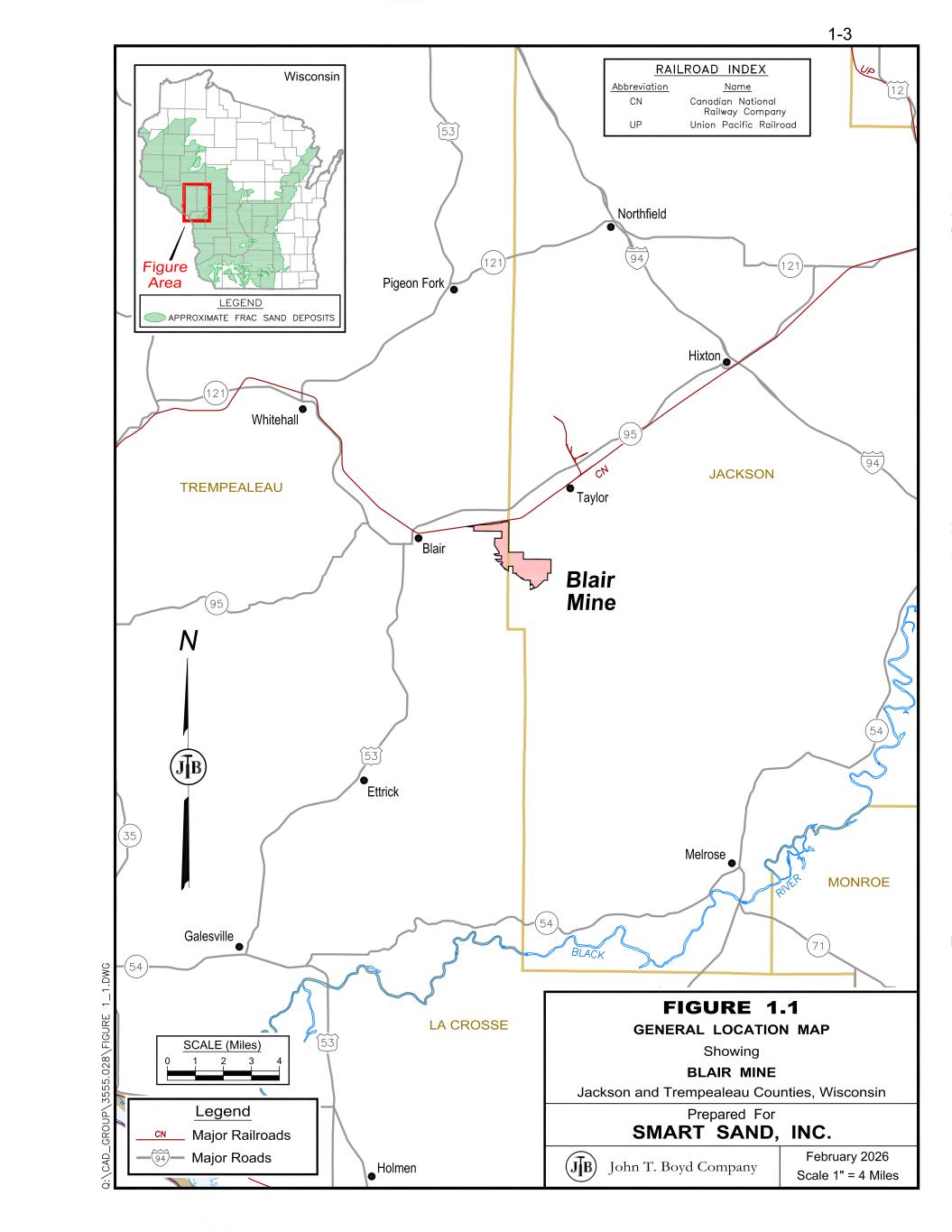
1-2 JOHN T. BOYD COMPANY 1.2 Property Description and Location Smart Sand’s Blair Mine straddles the Jackson and Trempealeau County lines in western Wisconsin. The Blair Mine has mined and produced frac sand from the Wonewoc Formation Sandstone since commencing operations in 2012. Smart Sand controls approximately 1,285 contiguous acres of property which is owned fee simple. The general location of the subject property is provided in Figure 1.1, following this page. 1.3 Geology Northern white sands (NWS) are generally located in the north-central portion of the United States (Minnesota, Wisconsin, and Illinois, with lesser amounts in Arkansas and Iowa). NWS is found in poorly cemented Cambrian and Ordovician sandstones and in unconsolidated alluvial deposits locally derived from these sandstones. The Saint Peter, Jordan, Wonewoc, and Mount Simon formations are the primary sources of NWS. The Blair Operation’s target silica bearing formation is the Wonewoc Sandstone, which is a massive formation in areal extent and thickness. The Wonewoc Formation spans from a northern extent of Minnesota south to Arkansas, and from an eastern extent of Wisconsin west into Nebraska and South Dakota. On a regional basis, the Wonewoc ranges in thickness from a few feet to over 200 ft portions of northern Wisconsin, with a general thickness ranging between 100 ft to 200 ft. The surface of the Blair Property is overlain by a combination of shale, clayey sands, and soils that range in thickness from 1 ft to 105 ft, with an average thickness of approximately 30 ft throughout the mineable portion of the property. Surface topography within the Blair Property ranges from less than 900 ft above mean sea-level (amsl) on the western edge of the property, where overburden material can be removed with conventional excavation and scraping methods, to 1,150 ft amsl in ridges near the eastern property boundary, where overburden material will most likely be more competent, requiring drilling and blasting prior to excavating.
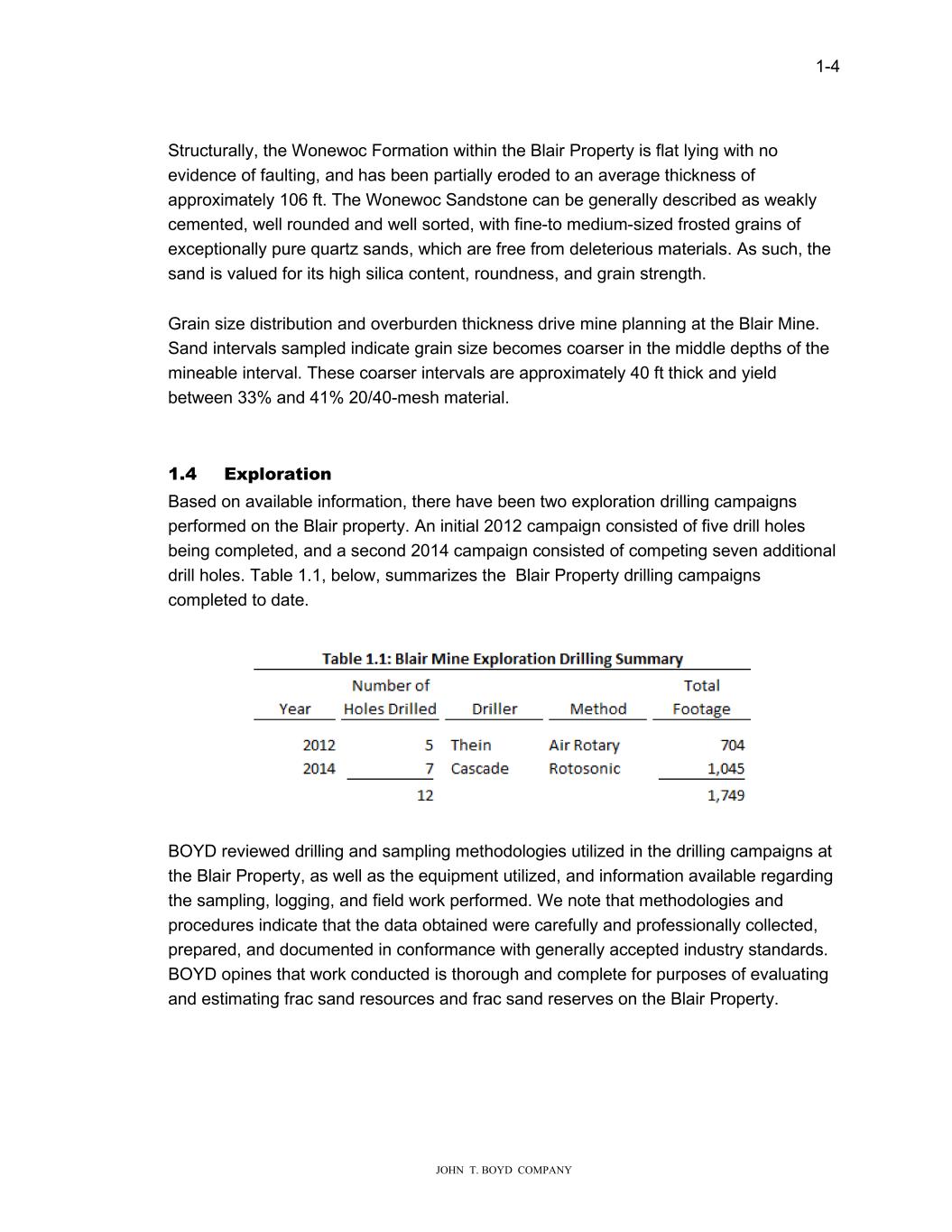
1-4 JOHN T. BOYD COMPANY Structurally, the Wonewoc Formation within the Blair Property is flat lying with no evidence of faulting, and has been partially eroded to an average thickness of approximately 106 ft. The Wonewoc Sandstone can be generally described as weakly cemented, well rounded and well sorted, with fine-to medium-sized frosted grains of exceptionally pure quartz sands, which are free from deleterious materials. As such, the sand is valued for its high silica content, roundness, and grain strength. Grain size distribution and overburden thickness drive mine planning at the Blair Mine. Sand intervals sampled indicate grain size becomes coarser in the middle depths of the mineable interval. These coarser intervals are approximately 40 ft thick and yield between 33% and 41% 20/40-mesh material. 1.4 Exploration Based on available information, there have been two exploration drilling campaigns performed on the Blair property. An initial 2012 campaign consisted of five drill holes being completed, and a second 2014 campaign consisted of competing seven additional drill holes. Table 1.1, below, summarizes the Blair Property drilling campaigns completed to date. BOYD reviewed drilling and sampling methodologies utilized in the drilling campaigns at the Blair Property, as well as the equipment utilized, and information available regarding the sampling, logging, and field work performed. We note that methodologies and procedures indicate that the data obtained were carefully and professionally collected, prepared, and documented in conformance with generally accepted industry standards. BOYD opines that work conducted is thorough and complete for purposes of evaluating and estimating frac sand resources and frac sand reserves on the Blair Property.
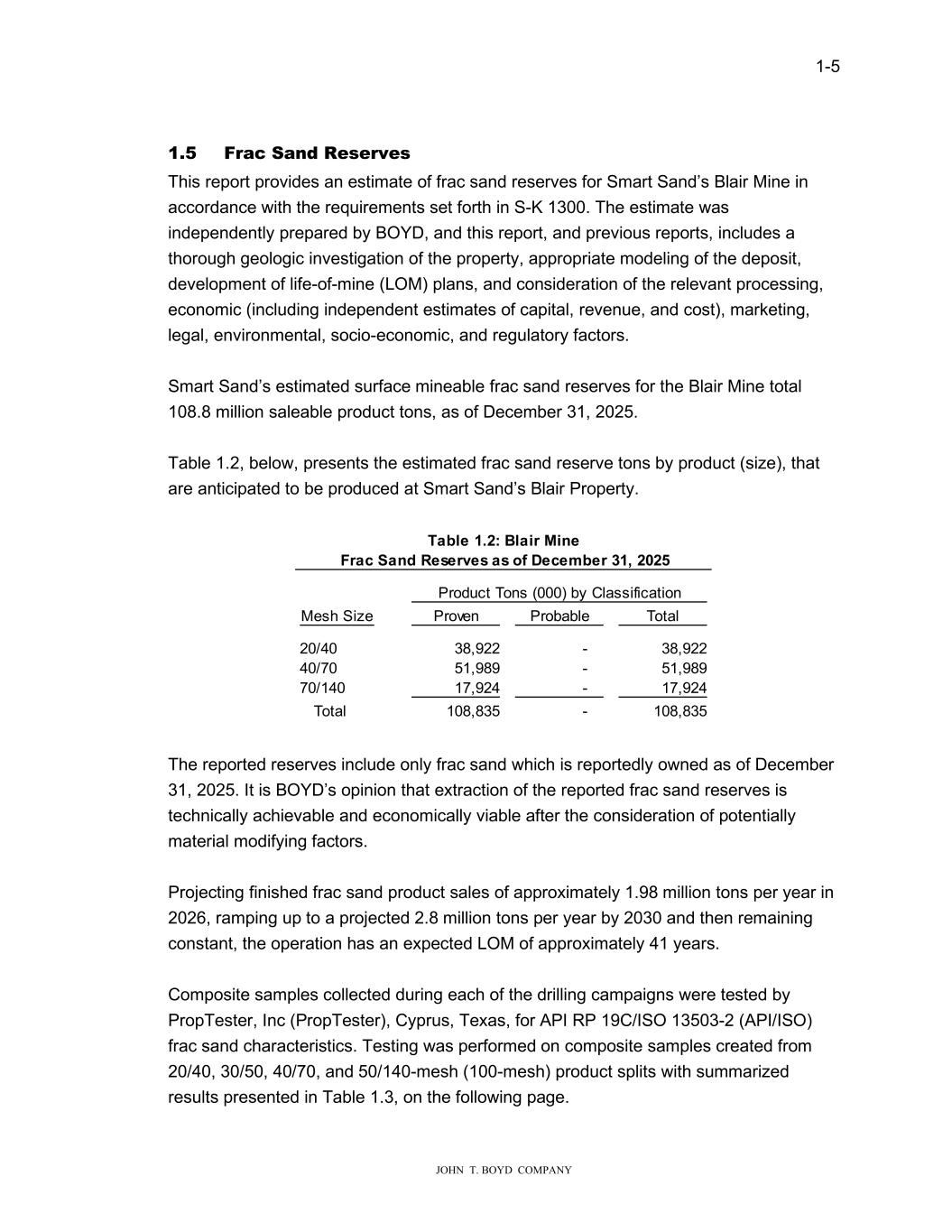
1-5 JOHN T. BOYD COMPANY 1.5 Frac Sand Reserves This report provides an estimate of frac sand reserves for Smart Sand’s Blair Mine in accordance with the requirements set forth in S-K 1300. The estimate was independently prepared by BOYD, and this report, and previous reports, includes a thorough geologic investigation of the property, appropriate modeling of the deposit, development of life-of-mine (LOM) plans, and consideration of the relevant processing, economic (including independent estimates of capital, revenue, and cost), marketing, legal, environmental, socio-economic, and regulatory factors. Smart Sand’s estimated surface mineable frac sand reserves for the Blair Mine total 108.8 million saleable product tons, as of December 31, 2025. Table 1.2, below, presents the estimated frac sand reserve tons by product (size), that are anticipated to be produced at Smart Sand’s Blair Property. The reported reserves include only frac sand which is reportedly owned as of December 31, 2025. It is BOYD’s opinion that extraction of the reported frac sand reserves is technically achievable and economically viable after the consideration of potentially material modifying factors. Projecting finished frac sand product sales of approximately 1.98 million tons per year in 2026, ramping up to a projected 2.8 million tons per year by 2030 and then remaining constant, the operation has an expected LOM of approximately 41 years. Composite samples collected during each of the drilling campaigns were tested by PropTester, Inc (PropTester), Cyprus, Texas, for API RP 19C/ISO 13503-2 (API/ISO) frac sand characteristics. Testing was performed on composite samples created from 20/40, 30/50, 40/70, and 50/140-mesh (100-mesh) product splits with summarized results presented in Table 1.3, on the following page. Mesh Size Proven Probable Total 20/40 38,922 - 38,922 40/70 51,989 - 51,989 70/140 17,924 - 17,924 Total 108,835 - 108,835 Table 1.2: Blair Mine Frac Sand Reserves as of December 31, 2025 Product Tons (000) by Classification
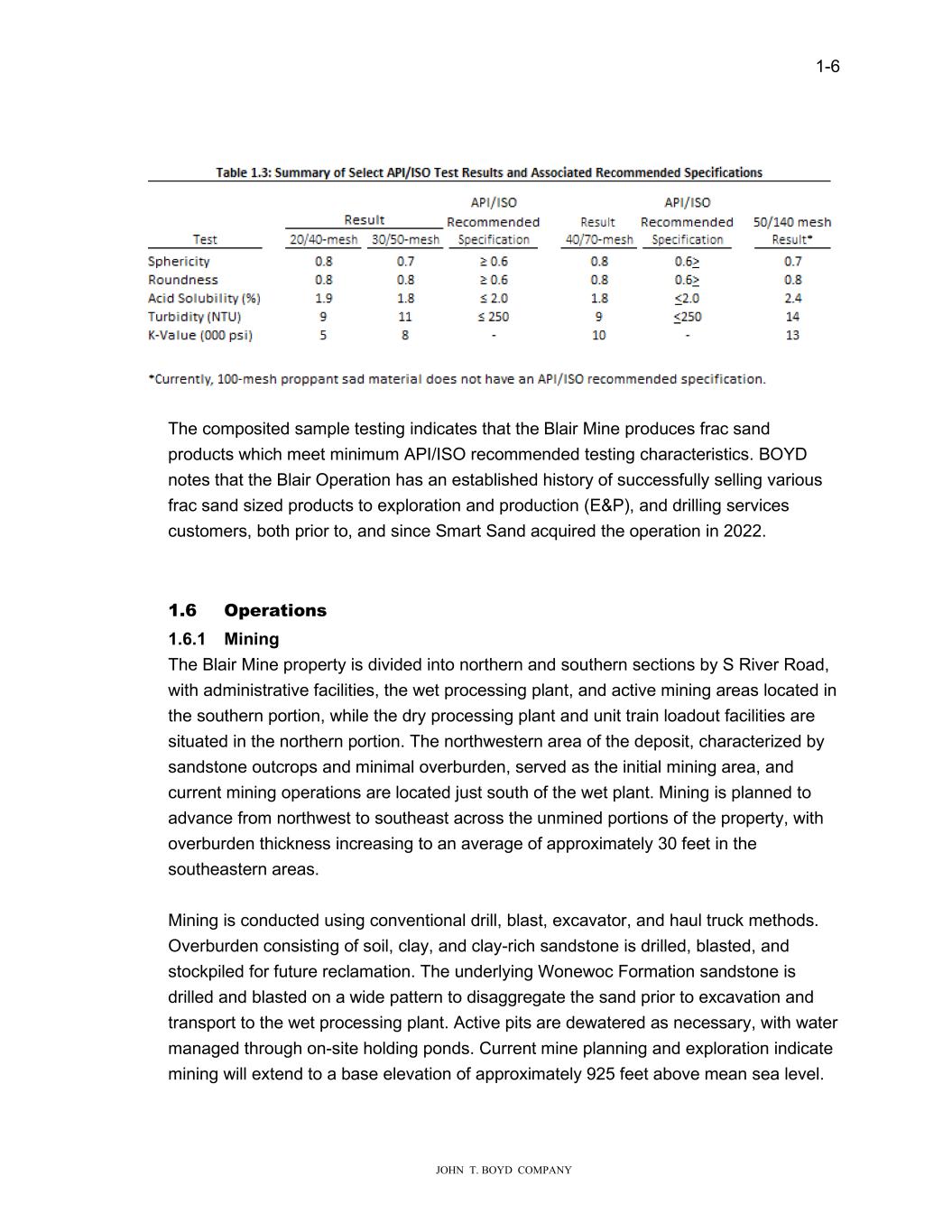
1-6 JOHN T. BOYD COMPANY The composited sample testing indicates that the Blair Mine produces frac sand products which meet minimum API/ISO recommended testing characteristics. BOYD notes that the Blair Operation has an established history of successfully selling various frac sand sized products to exploration and production (E&P), and drilling services customers, both prior to, and since Smart Sand acquired the operation in 2022. 1.6 Operations 1.6.1 Mining The Blair Mine property is divided into northern and southern sections by S River Road, with administrative facilities, the wet processing plant, and active mining areas located in the southern portion, while the dry processing plant and unit train loadout facilities are situated in the northern portion. The northwestern area of the deposit, characterized by sandstone outcrops and minimal overburden, served as the initial mining area, and current mining operations are located just south of the wet plant. Mining is planned to advance from northwest to southeast across the unmined portions of the property, with overburden thickness increasing to an average of approximately 30 feet in the southeastern areas. Mining is conducted using conventional drill, blast, excavator, and haul truck methods. Overburden consisting of soil, clay, and clay-rich sandstone is drilled, blasted, and stockpiled for future reclamation. The underlying Wonewoc Formation sandstone is drilled and blasted on a wide pattern to disaggregate the sand prior to excavation and transport to the wet processing plant. Active pits are dewatered as necessary, with water managed through on-site holding ponds. Current mine planning and exploration indicate mining will extend to a base elevation of approximately 925 feet above mean sea level.
1-7 1.6.2 Processing The Blair plant commenced wash plant operations in 2016. It shut down in 2020 due to the COVID-19 pandemic and was on care and maintenance until it was reopened in 2023. The ROM sand material is hauled to an in-pit feed hopper where it is crushed and conveyed to a wet process plant. Following removal of oversize and waste (<140-mesh) material, the sand is conveyed to the drying and screening plant. Finished product is stored in silos and is railed to multiple oil and gas well service customers via the Canadian National Railway (CN). The wet plant employs typical screen/hydrosizer/cyclone classification and dewatering technology and also has an ultrafine circuit and thickener. The wet plant operates 24 hours a day, 4-5 days a week between March and November. Winter weather shuts the mine and wet processing plant down. A substantial stockpile is created to allow the dry processing plant to continue to run 24 hours a day, 365 days a year. An overland conveyor transports the wet process feed to two 200 tons per hour (tph) natural gas fired dryer. Dry sand is then screened into predominantly 20/40, 30/50, 40/70, and 50/140 (“100 Mesh”) mesh size finished frac sand products. The finished products are stored in five 5,000-ton loadout silos before being railed to customers. 1.6.3 Infrastructure Electricity for the Blair Mine is serviced by Xcel Energy that is routed along the CN corridor, which runs north of the northern property line. The pipeline providing a natural gas supply for the drying equipment is also routed along this corridor and is supplied by We Energies. Plant process water is supplied by wells drilled on the property, as well as water collected in the pit and ponds. Additionally, the wash process water is recycled after fines are removed via settling with a flocculent in a thickener and series of constructed ponds. Potable water is provided by one of the wells on site and by water bottles and jugs delivered. On-site facilities include a scale house, office, shop, and a quality laboratory located in the dry process plant. While in production, the Blair Operation employs approximately 61 people and staffing varies based on production demand. 1.7 Financial Analysis 1.7.1 Market Analysis The North American frac sand market has structurally shifted from long-haul NWS to lower-cost in-basin sands, driven primarily by logistics efficiency and cost optimization following the 2014–2016 oil price downturn. Today, in-basin sand dominates bulk JOHN T. BOYD COMPANY
1-8 JOHN T. BOYD COMPANY volumes—particularly in the Permian Basin—while NWS retains a defensible niche in high-stress or performance-sensitive wells where superior conductivity and crush strength materially improve production outcomes. Smart Sand has demonstrated steady growth in sales volumes from 3.2 million tons in 2021 to 5.4 million tons in 2025, supported by a strong contract base (≈69% of volume) and concentration in key basins such as the Marcellus and Bakken (≈68% of shipments). However, average selling prices declined to $26.28/ton in 2025, reflecting broader market pricing pressures and competitive dynamics. Looking forward, demand for NWS is expected to remain stable but niche, supported by performance-critical applications, constrained supply, and steady premium pricing. While in-basin sands will continue to dominate overall volumes, NWS will remain strategically important for specialized completions. Long-term forecasts indicate stable pricing of approximately $24.96/ton and consistent production volumes, reinforcing the viability of continued frac sand operations at the Blair Mine. 1.7.2 Capital and Operating Costs The Blair Mine is a mature frac sand operation with well-established production, capital, and operating cost structures supported by historical performance and internal forecasts. Based on BOYD’s evaluation and experience with similar mining operations, the capital and operating cost estimates are considered reasonable and reliable, with an expected accuracy range of approximately ±20%. The operation is currently in steady-state production and does not require significant development or expansion capital to maintain planned output levels. Capital expenditures are primarily limited to sustaining capital required to maintain equipment, infrastructure, and operational efficiency. Historical capital spending was approximately $0.78 per ton sold in 2024, increasing to $1.56 per ton sold in 2025, while projected sustaining capital expenditures are forecast at approximately $1.06 per ton sold in 2026, declining to approximately $0.73 per ton sold in 2030 and thereafter. These modest capital requirements reflect the mine’s mature infrastructure and lack of dependence on major future capital investment. Operating costs are stable and predictable, reflecting consistent mining, processing, logistics, and site-level administrative expenses. Historical cash production costs were approximately $16.89 (including royalties) per ton sold in 2025, and projected life-of- mine operating costs are expected to remain consistent at an average of approximately $12.38 (excluding royalties) per ton sold. These projections are based on expected
1-9 JOHN T. BOYD COMPANY labor, consumables, power, maintenance, and equipment costs, and exclude corporate overhead and royalties. Overall, the Blair Mine’s low sustaining capital requirements, stable operating cost structure, and mature operational profile support continued reliable production and long-term economic viability. 1.7.3 Economic Analysis BOYD’s economic analysis confirms the Blair Mine’s frac sand reserves are economically viable and capable of generating substantial long-term positive cash flow under reasonable operating and market assumptions. Using a discounted cash flow (DCF) model with a 12% after-tax discount rate, the project generates an after-tax net present value (NPV₁₂) of approximately $78.3 million and total after-tax life-of-mine cash flow of approximately $401.7 million over a remaining reserve life of 41 years. Life-of-mine production is forecast at approximately 108.8 million tons of finished frac sand, generating total revenues of approximately $2.72 billion at an average mine-gate price of $24.96 per ton sold. Cash production costs average approximately $12.38 per ton sold, resulting in strong contribution margins and cumulative pre-tax cash flow exceeding $548.1 million. Capital requirements are modest, totaling approximately $80.8 million over the life of the mine, reflecting the operation’s mature, steady-state status. Sensitivity analysis demonstrates that project economics are most influenced by frac sand pricing and operating costs, while capital cost variations have relatively limited impact. Even under adverse conditions, the project remains economically robust across a wide range of assumptions. Based on these results, BOYD concludes that the Blair Mine represents a financially viable and sustainable long-term frac sand operation with significant remaining economic value. 1.8 Regulation and Liabilities The Blair Mine’s operations are predominantly regulated by Trempealeau and Jackson counties, Wisconsin, the Wisconsin Department of Natural Resources (WDNR) and several local municipalities regarding water use, air quality, general operations and eventual reclamation of the site. Safety and operational regulations are administered by the Mine Safety and Health Administration (MSHA).
1-10 JOHN T. BOYD COMPANY Based on our review of information provided by Smart Sand and available public information, it is BOYD’s opinion that the Blair Mine’s record of compliance with applicable mining, water quality, and environmental regulations is generally typical for that of the industry. BOYD is not aware of any regulatory violation or compliance issue which would materially impact the frac sand reserve estimate. 1.9 Conclusions It is BOYD’s overall conclusion that Smart Sand’s Blair Mine frac sand reserves, as reported herein: (1) were prepared in conformance with accepted industry standards and practices, and (2) are reasonably and appropriately supported by technical evaluations, which consider all relevant modifying factors. We do not believe there is other relevant data or information material to the Blair Property that would render this technical report summary misleading. Our conclusions represent only informed professional judgment. The ability of Smart Sand, or any mine operator, to recover all of the reported frac sand reserves is dependent on numerous factors that are beyond the control of, and cannot be anticipated by, BOYD. These factors include mining and geologic conditions, the capabilities of management and employees, the securing of required approvals and permits in a timely manner, future sand prices, etc. Unforeseen changes in regulations could also impact performance. Opinions presented in this report apply to the site conditions and features as they existed at the time of BOYD’s investigations and those reasonably foreseeable. Q:\ENG_WP\3555.028 SS - Blair FY25\WP\Report\CH-1 - Executive Summary.docx
2-1 JOHN T. BOYD COMPANY 2.0 INTRODUCTION 2.1 Registrant Smart Sand is a fully integrated frac and industrial sand supply and services company focused on the mining, processing, and distribution of Northern White frac sand, an essential material in hydraulic fracturing for oil and gas that boosts hydrocarbon recovery. The company delivers end-to-end logistics solutions, transporting sand efficiently from the mine to the wellsite, with innovative storage and delivery systems such as SmartDepot™ silos and SmartPath® transloaders. In addition to serving the oil and gas sector, Smart Sand also provides sand products for industrial manufacturers and a variety of other industrial applications. Smart Sand, incorporated in Delaware in July 2011 and headquartered in Yardley, Pennsylvania, is a publicly traded company listed on NASDAQ under the ticker SND. Additional information regarding Smart Sand can be found on their website at www.smartsand.com. 2.2 Purpose and Terms of Reference Smart Sand retained BOYD to independently prepare and present estimates of frac sand resources and frac sand reserves for the Blair Mine in accordance with the disclosure requirements set forth in S-K 1300. As such, the purpose of this TRS is threefold: (1) to summarize technical and scientific information for the subject mining property, (2) to provide the conclusions of our review of the information for the property, and (3) to provide statements of frac sand resources and frac sand reserves for the Blair Mine. BOYD’s opinions and conclusions are based on our detailed review of the supporting geologic, technical, and economic information provided by Smart Sand, which was used in formulating the estimates of frac sand resources and frac sand reserves disclosed herein. We independently estimated the frac sand resources and frac sand reserves from first principles using exploration information provided by Smart Sand or by third-party experts engaged by Smart Sand. We employed standard engineering and geoscience methods, or a combination of methods, that we considered to be appropriate and necessary to establish the conclusions set forth herein. As in all aspects of mining property evaluation, there are uncertainties inherent in the interpretation of engineering and geoscience data; therefore, our conclusions necessarily represent only informed professional judgment.
2-2 JOHN T. BOYD COMPANY The ability of Smart Sand, or any mine operator, to recover all the estimated frac sand reserves presented in this report is dependent on numerous factors that are beyond the control of, and cannot be anticipated by, BOYD. These factors include mining and geologic conditions, the capabilities of management and employees, the securing of required approvals and permits in a timely manner, future sand prices, etc. Unforeseen changes in regulations could also impact performance. Opinions presented in this report apply to the site conditions and features as they existed at the time of BOYD’s investigations and those reasonably foreseeable. This report is intended for use by Smart Sand, subject to the terms and conditions of its professional services agreement with BOYD. We also consent to Smart Sand filing this TRS with the SEC pursuant to S-K 1300. Except for the purposes legislated under U.S. securities law, any other uses of or reliance on this report by any third party is at that party’s sole risk. 2.3 Expert Qualifications BOYD is an independent consulting firm specializing in mining-related engineering and financial consulting services. Since 1943, BOYD has completed over 4,000 projects in the United States and more than 90 other countries. Our full-time staff comprises experts in: civil, environmental, geotechnical, and mining engineering; geology; mineral economics; and market analysis. Our extensive experience in frac sand resource and frac sand reserve estimation, and our knowledge of the subject properties, provide BOYD with an informed basis to opine on the frac sand resources and frac sand reserves available at the Blair Mine. An overview of BOYD can be found on our website at www.jtboyd.com. The individuals primarily responsible for the preparation of this report and the estimates of frac sand reserves presented herein are by virtue of their education, experience, and professional association considered qualified persons (QPs) as defined in S-K 1300. Neither BOYD nor its staff employed in the preparation of this report have any beneficial interest in Smart Sand, and are not insiders, associates, or affiliates of Smart Sand. The results of our assignment were not dependent upon any prior agreements concerning the conclusions to be reached, nor were there any undisclosed understandings concerning any future business dealings between Smart Sand and BOYD. This report was prepared in return for fees based on agreed-upon commercial rates, and the payment for our services was not contingent upon our opinions regarding the project or approval of our work by Smart Sand and its representatives.
2-3 JOHN T. BOYD COMPANY 2.4 Principal Sources of Information The information, estimates, opinions, and conclusions presented herein are informed by: (1) data, reports, and other information provided by Smart Sand, (2) discussions with Smart Sand personnel, (3) records on file with regulatory agencies, (4) data, reports, and other information from public sources, and (5) nonconfidential information in BOYD’s possession. The following information was provided by Smart Sand: • Exploration records (e.g., drill hole location maps, drilling logs, and lab testing summaries) • Mapping data, including: - Property control boundaries - Infrastructure locations - Easement and right-of-way boundaries - Topograhpic site surveys - Recent mining extents • Overview of processing operations and detailed flow diagrams • Preliminary business plans • Historical information, including: - Production reports and reconciliation statements - Financial statements - Product sales and pricing - Mine plans - Site plans - Operational data • Files related to mining and operating permits Work files prepared for, and information contained in, the following BOYD report was utilized to prepare the estimates of frac sand resources and frac sand reserves disclosed herein: John T. Boyd Company. Technical Report Summary: Frac Sand Resources and Reserves, Blair Mine, Jackson and Trempealeau Counties, Wisconsin, Report No. 3555.024 (February 2024). Any other information from sources external to BOYD and/or Smart Sand is referenced accordingly.
2-4 JOHN T. BOYD COMPANY The data and work papers used in the preparation of this report are on file in our offices. 2.4.1 Personal Inspections The most recent personal inspections of the Blair Mine operation were made by two of BOYD’s senior geology and mining staff—both qualified persons—on February 21, 2023. The site visit included: (1) observation of the active mining operations, (2) a tour of the mine site’s surface infrastructure, and (3) a detailed discussion of the mine plan. BOYD’s representatives were accompanied by Smart Sand management who openly and cooperatively answered questions regarding, but not limited to: site geology, mining conditions and operations, equipment usage, labor relations, operating and capital costs, current and proposed processing operations, and frac sand marketing. 2.4.2 Reliance on Information Provided by the Registrant In the preparation of this report, BOYD has relied, exclusively and without independent verification, upon information furnished by Smart Sand with respect to: • Property title and status • Encumbrances, easements, and rights-of-way • Permits, bonds, and reclamation liability • Sustainability initiatives • Surface tailings management • Mine closure requirements and plans • Monitoring/compliance requirements for protected areas/species • Community relations • Market overview and strategy • Product specifications • Marketing and sales contracts • Income tax rates • Inflation and discount rates Our opinions and conclusions regarding this information are provided in the relevant sections of this report. 2.4.3 Verification of Information BOYD exercised due care in reviewing the information provided by Smart Sand within the scope of our expertise and experience (which is in technical and financial mining issues) and concluded the data are reasonable and reliable considering the status of the subject properties and the purpose for which this report was prepared. We have no reason to believe that any material facts have been withheld or misstated, or that further analysis may reveal additional material information. However, the
2-5 JOHN T. BOYD COMPANY accuracy of the results and conclusions of this report are reliant on the accuracy of the information provided by Smart Sand. While we are not responsible for any material omissions in the information provided for use in this report, we accept responsibility for the disclosure of information contained herein which is within the scope of our expertise. 2.4.4 Other Relevant Data and Information BOYD is not aware of any additional information that would materially affect the frac sand resource and frac sand reserve estimates reported herein. 2.5 Report Version The effective (i.e., “as of”) date of this TRS is December 31, 2025. The estimates of frac sand resources and frac sand reserves and supporting information presented in this report are effective as of December 31, 2025. This is the second TRS for the Blair Mine filed by Smart Sand. This report supersedes the previously filed TRS and any predated estimates of frac sand resources or frac reserves for the Blair Mine. Users of this document should ensure that this is the most recent disclosure of frac sand resources and frac sand reserves for the Blair Mine as it is no longer valid if more recent estimates are available. 2.6 Units of Measure The U.S. customary measurement system has been used throughout this report. Tons are short tons of 2,000 pounds-mass. Volumes and tonnages have been rounded to reflect estimate precision; minor differences generated by rounding are not considered material to the disclosed estimates. Unless otherwise stated, currency is expressed in U.S. Dollars ($). Historic prices and costs are presented in nominal (i.e., unadjusted) dollars. Future dollar values are expressed on a constant (i.e., unescalated) basis as of the effective date of this report. q:\eng_wp\3555.028 ss - blair fy25\wp\report\ch-2 - introduction.docx
3-1 JOHN T. BOYD COMPANY 3.0 PROPERTY OVERVIEW 3.1 Description and Location Smart Sand’s Blair Mine is an active surface frac sand mining and processing operation that produces premium branded NWS products for use in the hydraulic fracturing process (known as “fracking”) to produce petroleum fluids, such as oil, natural gas, and natural gas liquids. Figure 6.2 (page 6-8), shows the general layout of the Blair property, including locations of mine offices and ancillary facilities, processing plants, loadout facilities, and current and former mining pits. The Blair Property is located in Trempealeau and Jackson Counties, Wisconsin, consisting of a contiguous block of property totaling approximately 1,285 acres with surface and mineral rights owned in fee by Smart Sand. The subject property is situated approximately three miles east of the City of Blair, and approximately 100 miles southeast of the Minneapolis-St. Paul metro area. Geographically, the Blair frac sand processing plant is located at approximately 41°17'56.59"N latitude and 91°10'11.96"W longitude. 3.2 History Hi-Crush began development of the Blair Operation in 2012 by completing initial exploratory drilling and sampling of the Wonewoc Sandstone underlying the subject property. Additional exploration in 2014 was completed, and the construction of the operation’s frac sand processing plants began in 2015. Production commenced at the Blair operation in 2016. Hi-Crush mined and processed frac sand at the Blair operation from 2016 through 2020, when the COVID-19 pandemic created economic uncertainties resulting in the facility being temporarily idled. Hi-Crush declared bankruptcy later that year and placed the Blair operation on indefinite care and maintenance status. In March 2022, Smart Sand acquired the Blair Operation for $6.5 million, rehabbing and placing the facility into active operational status in May 2023.
3-2 3.3 Property Control The Blair property comprises approximately 1,285 contiguous acres of surface and mineral rights reportedly owned in fee by Smart Sand. Smart Sand pays a royalty of approximately $1.70 per ton with certain minimum annual payments. To BOYD’s knowledge, there are no additional royalties, overriding or limited royalties, working interests, production payments, net profit interests, or other mineral interests in the Blair property. 3.4 Adjacent Properties Extensive frac sand mining and processing activity occurs throughout three general mining districts (regions) of Wisconsin: the Barron (northwestern Wisconsin), Blair (west- central Wisconsin), and Oakdale (south-central Wisconsin) districts. Smart Sand’s Blair Mine is located in the southern portion of the Blair mining district. Nearby frac sand mines include Source Energy’s Blair and Preston operations, and Mammoth Energy’s Taylor operation in the Blair mining district. A half-dozen additional frac sand mines are located in the Barron and Oakdale mining districts, including Smart Sand’s own Oakdale Mine approximately 45 miles to the southeast. There is no information included in the preparation of this report that has been sourced from adjacent operations. 3.5 Regulation and Liabilities The Blair Mine operates under several permits and must comply with various other federal, state, and municipal regulations that do not require a specific permit. Smart Sand reports that necessary permits are in place or applied for to support immediate operations. New permits or permit revisions may be necessary from time to time to facilitate future operations. Given sufficient time and planning, Smart Sand should be able to secure new permits, as required, to maintain its planned operations within the context of the current regulations. Smart Sand pays property taxes to the local governments in Trempealeau and Jackson Counties in order to maintain ownership of the Blair property. To the extent known to BOYD, there are no current violations, fines, liens, or other significant factors or risks that may affect access, title, or the right or ability to perform work on the Blair property. JOHN T. BOYD COMPANY
3-3 JOHN T. BOYD COMPANY 3.6 Accessibility, Local Resources, and Infrastructure Smart Sand’s Blair Mine is located near several small rural towns in western Wisconsin. The city of Blair has a population of 1,366, while the surrounding counties of Clark, Eau Claire, Jackson, La Crosse, Monroe, and Trempealeau have a population of approximately 360,000 according to 2021 U.S. Census Data. General access to the Blair Mine is via a well-developed network of primary and secondary roads serviced by state and local governments. These roads offer direct access to the mine and processing facilities and are open year-round. Primary vehicular access to the property is via U.S. Highway 95, with nearby access to Interstate 94. The Blair Mine has an on-site rail loadout facility with access to the CN rail network. Several regional airports are within an hour’s drive from the mine, and the nearest major international airport, the Minneapolis-St. Paul International Airport, is just over two hours away by road. Reliable sources of three phase electrical power, natural gas, water, and other miscellaneous materials are readily available. Electrical power is provided by regional utility companies. Water is supplied to the operation via various sources, such as on-site wells and ponds, and public water systems. 3.7 Physiography The Blair operation is located in the Western Upland physiographic region of Wisconsin, a geographical region that comprises much of the western half of the state. The Western Upland region is characterized by steep hills, wooded ridges, and rocky outcrops dissected by streams and rivers. This region comprises a portion of the greater driftless area, which marks the termination of advancing glaciers during the last glacial periods of the ice age (Wisconsin Period), which lasted until approximately 11,000 years ago. The surface of the Blair Property is overlain by topsoil and sandy clays and shales, which, based on a combination of drill hole data and flown topographic mapping, indicate that overburden ranges from being absent where the Wonewoc outcrops along the western extents of the property, to a thickness of up to 106 ft in isolated high-elevation hilltops. Over the entire mineable area of the property, overburden averages approximately 30 ft in thickness. Beneath the overburden material is the Wonewoc Sandstone Formation, one of the primary sources of NWS mined in the region.
3-4 JOHN T. BOYD COMPANY Land cover in the immediate region consists primarily of a mixture of hardwood and conifer forests in higher elevations, and intermittent grasslands and wetlands in lower elevations with agricultural land in between. 3.8 Climate Near the Blair operation, summers are relatively mild; winters are cold, dry, and enduring; skies are generally partly cloudy to clear. Average monthly high temperatures range from 9ºF to 83ºF, with the months of November through March exhibiting average lows at or below freezing (32ºF). Average annual rainfall is approximately 27 in, with approximately 81 days of rain annually. Average annual snowfall totals approximately 21 in, with an average of 9 days per year of notable snowfall. In general, the operating season for the Oakdale Mine is year-round, as Smart Sand stockpiles a surplus of WIP material to continue feeding the dry plant and loadout through the winter months. Adverse weather conditions seldom restrict or interfere with the mining, processing, and loading operations; however, extreme weather conditions may temporarily impact operations. Although rare, periodic flooding may be possible during extreme rainfall events. Q:\ENG_WP\3555.028 SS - Blair FY25\WP\Report\CH-3 - Property Description.docx
4-1 JOHN T. BOYD COMPANY 4.0 GEOLOGY 4.1 Regional Geology NWS are generally located in the north-central portion of the United States (Minnesota, Wisconsin, and Illinois, and to lesser extents in Arkansas and Iowa). NWS is found in poorly cemented Cambrian and Ordovician sandstones and in unconsolidated alluvial deposits locally derived from these sandstones. The Saint Peter, Jordan, Wonewoc, and Mount Simon formations are the primary sources of NWS. Smart Sand’s Blair Mine is located in the Western Coulees and Ridges ecoregion of western Wisconsin. This region is characterized by heavily eroded, yet unglaciated, early Paleozoic (Cambrian and Ordovician) Age bedrock. Extensive river channels with networks of floodplains, deltas, and terraces eroded much of the poorly cemented sandstone bedrock formations from the region, leaving scoured valley areas that were gradually infilled by further erosional processes from the surrounding ridges. The Cambrian Age Wonewoc Formation sandstone is the primary lithologic formation of economic interest on the Blair Property, and has been noted as spanning an area from Minnesota to Arkansas, and from Illinois into Nebraska and South Dakota. The Wonewoc Formation is composed of two members: the upper Ironton Member, and the lower Galesville Member, as the formation exhibits grain sizing that sometimes grades from medium to medium-coarse in the upper section, and medium to fine-grained in the lower section. Sand grains comprising the Wonewoc Formation were originally deposited in clear shallow waters near the shore of a Cambrian Sea. The high-energy wave action during particle transport and deposition helped form the generally well sorted and well rounded, fine to medium-grained, frosted sandstone deposit that the Wonewoc is known for. Regionally the Wonewoc exhibits a relatively uniform range of depositional thickness between 100 ft to 200 ft. The presence of the Wonewoc Formation in southwestern Wisconsin is often easily identifiable as it tends to be located underlying clusters of densely wooded, higher-elevation hilly regions of the state. These wooded areas are often on the peripheries of farm fields where sandy and rocky soils began to be encountered during cultivation of agricultural lands.
4-2 JOHN T. BOYD COMPANY 4.2 Property Geology 4.2.1 General Stratigraphy Cambrian sedimentary strata comprise the surface stratigraphic units underlying the soils in and around the Blair property. These units primarily include bedrock of, in order of deposition, the Mount Simon, Eau Claire, and Wonewoc Formations. A generalized stratigraphic chart of the surficial geologic units in Jackson and Trempealeau Counties, Wisconsin is presented in Figure 4.1, below. Figure 4.1: Generalized Stratigraphic Chart, Jackson and Trempealeau Counties, Wisconsin The following text discusses the strata encountered near the Blair property, in depositional. Mount Simon Formation The Mount Simon Formation consists of interbedded sandstones and shales. The lower portion of the formation contains more shale, while the upper portion contains more sand intervals. The Mount Simon can generally be described as a poorly consolidated, poorly sorted, fine-grained quartz sandstone deposited in shallow marine environments as Cambrian seas formed in the region. Sands derived from the Mount Simon Formation are typically white in color, but may occur as yellowish-gray or grayish-red sands as well. Eau Claire Formation The Eau Claire Formation overlies the Mount Simon and is comprised of a thinly bedded and shaley fine-grained, moderately-to-well sorted sandstone that may be argillaceous or glauconitic. The Eau Claire is noted as unconformably overlying the Mount Simon. Wonewoc Formation The Wonewoc Formation typically overlies the Eau Claire Formation, and generally consists of medium to coarse grained sandstone that is typically white in color, but may also appear as a pale yellow. The Blair operation mines and processes sand from the lower member (Galesville) of the Wonewoc Formation, which is a massively bedded silica-rich sandstone interval that is regionally very consistent in depositional nature, both in areal extent and thickness. The
4-3 JOHN T. BOYD COMPANY Galesville Member contains primarily fine-to-medium grained quartz sand grains that are well sorted and monocrystalline in structure. 4.2.2 Structural Geology Structure of the mineable deposit located on the Blair property appears to be flat lying with no evidence of faulting or other distinguishing geologic features. The Wonewoc Formation deposit found on the Blair property has been eroded to an average thickness of approximately 102 ft throughout the mineable portion of the property. A cross-section through the deposit is provided in Figure 4.2, on the following page. 4.3 Frac Sand Geology Frac sand is a naturally occurring, high silica content quartz sand, with grains that are generally well-rounded. The main difference between frac sand and other sands is that frac sand grains are relatively pure in composition, consisting almost entirely of quartz; other sands have numerous impurities that may be cemented to the quartz grains. The pure quartz composition of frac sand grains, along with being well-rounded and spherical in shape, gives these sands the characteristics (crush strength, high acid solubility, low turbidity) that are sought after by oil and gas producers for use in developing wells. The sands mined at Blair are NWS that are processed into various high quality frac sand products. Frac sands generally exhibit the following characteristics required by oil and gas producers for use in developing wells: • High-purity – frac sand grains are relatively pure (typically, >95% silicon dioxide) in composition and almost entirely free from contaminants. Typical sand deposits have numerous impurities fused to the silica grains, such as iron, carbonate, potassium, and other trace elements/minerals, which can make them more susceptible to mechanical and chemical alteration. Mineralogical purity of silica content is a characteristic of mature sand, which has been highly reworked and well sorted, so that the mechanically and chemically less-resistant minerals and fine particles have been dissolved or winnowed away. • Homogeneous grain size – hydraulic fracturing procedures require sand in a relatively narrow range of grain sizes which are dependent on the specific geological conditions of the well and the fracking procedures used. Larger sand grains generally provide better permeability, but smaller sand grains are typically stronger. When describing frac sand, the product is frequently referred to as simply the sieve cut,
4-5 JOHN T. BOYD COMPANY e.g., 20/40 mesh sand—meaning that 90 percent of the sand is fine enough to pass through a 20-mesh sieve and is coarse enough to be retained on a 40-mesh sieve. Common frac sand sizes include 20/40 mesh, 30/50 mesh, 40/70 mesh, “100 mesh”, “200 mesh”, and finer. The size ranges for “100 mesh” and “200 mesh” vary significantly between manufacturers. As of the date of this report, finer sands such as 40/70 mesh and “100 mesh” have become more widely utilized in shale gas well fracturing. • High sphericity and roundness – Sphericity and roundness describe the overall shape of the sand grains. Sphericity measures how close the grains approach the shape of a sphere while roundness measures the relative sharpness of corners and curvatures of the grains. Greater sphericity and roundness provide better grain strength and porosity/permeability between grains, allowing better flow of oil and gas from the fractures to the wellhead. A more spherical shape also enables the grains to be carried in the fracking fluid with minimal turbulence. • High crush resistance – Crush resistance of frac sand is dependent upon the hardness and shape of the sand grain. Generally, a high percentage of silica in the sand increases its crush resistance. Additionally, monocrystalline grains are stronger than composite grains. Crush resistance is expressed as a K-value that indicates the highest pressure (rounded to the nearest 1,000 psi) that generates less than 10 weight percent fines (i.e., crushed sand grains). For example, a K-value of 7 means that, at 7,000 psi pressure, no more than 10 weight percent fines were generated, but more than 10 weight percent fines were generated at the next highest pressure. The higher the K-value, the more crush-resistant the sand is. • Low acid solubility – Acid solubility is an indication of the amount of soluble cement or soluble mineral grains (i.e., non-silica contaminants) in the frac sand; low solubility requires a high silica content, as pure quartz tends to be insoluble under normal conditions. • Low turbidity – Turbidity is a measure of the clay, silt, or other fine grains and impurities in the sand. Low turbidity is a result of mineralogical maturity and grain-size sorting in the natural depositional environment. Generally, fine suspended matter in the mined sand is washed out during processing, so this property can be somewhat controlled for the final product. Frac sands are generally characterized by a high silica content, high roundness and sphericity, white color, and lack of deleterious material. Because of their monocrystalline structure, these sands have superior grain strength when compared to other silica sands. Q:\ENG_WP\3555.028 SS - Blair FY25\WP\Report\CH-4 - Geology.docx
5-1 JOHN T. BOYD COMPANY 5.0 EXPLORATION, SAMPLING, AND TESTING 5.1 Background The Blair operation was originally developed and operated by Hi-Crush, with initial exploratory drilling and sampling completed on the property in 2012. Additional exploration was conducted in 2014, and operations commenced in early 2016. 5.2 Exploration Procedures 5.2.1 Drilling and Sampling To date, two separate exploration drilling programs have been completed at the Blair operation, resulting in a total of 12 drill holes being drilled and sampled across the mine area. Each of the completed exploration and sampling campaigns was directed and planned by Hi-Crush. BOYD worked with Hi-Crush at the time to suggest sampling protocols in order to ensure that representative samples of the sand intervals were obtained through the total depths drilled. BOYD utilized the results of the completed geologic logs and laboratory testing results to develop a geologic model of the Blair deposit. Table 5.1, below, provides summary information on the drilling completed to date, with additional information on each exploration campaign discussed in Sections 5.2.2 and 5.2.3. 5.2.2 2012 Air Rotary Exploration Campaign The initial exploration and sampling campaign consisted of completing five widely spaced air rotary drill holes across the Blair property. Drilling was contracted to Thein Well Services, Incorporated (Thein), Monticello, Minnesota, to utilize an air rotary drilling rig to obtain subsurface samples on the subject property. Field work was completed by
5-2 JOHN T. BOYD COMPANY Summit Envirosolutions (Summit), St. Paul, Minnesota, who provided geologists to oversee geologic logging and sampling. Air rotary drilling utilizes a rotating impact hammer drilling bit to break up the strata being drilled through. High pressure air drives the impacting and rotating forces of the hammer bit to advance drill hole depths while also cooling the bit during drilling. Cuttings produced as the bit advances down hole are blown back up the drill hole to the surface, keeping the hole clear as the cutting head advances. Samples are obtained by placing a chip tray beneath the cyclone chute on the drilling rig, where the liberated materials accumulate. Samples were gathered for each 10 ft interval that the drill rig advanced to total depths ranging from 120 ft to 150 ft below ground surface. Samples obtained for each 10 ft run were coned and quartered in the field, and duplicate samples of each 10 ft run were obtained. Sample material was placed into a heavy-mil plastic bag labeled with drill hole name, top and bottom depth, and whether each sample was an “A Sample” or a “B Sample”, before being sealed. Sample bags were placed into buckets, and lids were secured when filled. Inventories of samples included in each bucket were taken as drilling progressed. The “A Sample” set was sent to FracTAL, LLC (FracTAL), St. Paul, Minnesota for sample preparation and particle size analyses, while the “B Sample” set was placed into storage by Hi-Crush for archival purposes. After completing particle size analyses, FracTAL was directed by Hi-Crush to create two sets of composite “product size” (20/40, 30/50, 40/70, 50/140-mesh) samples from two different drill holes on the property, and send them to Prop Tester, Cyprus, Texas to have API/ISO frac sand characteristic testing completed. These composite samples would represent the fully processed (washed and dried) material that would be produced at the Blair operation. 5.2.3 2014 Rotosonic Exploration Campaign The 2014 exploration and sampling campaign consisted of completing seven rotosonic drill holes on the Blair property, to serve as an infill drilling campaign and obtain additional detailed information on the deposit for mine planning and plant design. The 2014 drilling campaign was contracted to Cascade Environmental (Cascade), Little Falls, Minnesota, to utilize a rotosonic drilling rig to obtain subsurface sample materials, with field work again contracted to Summit. Rotosonic drilling utilizes a rotating and vibratory drilling head that advances a hollow drilling bit and core barrels down hole. This drilling method provides good recovery results with a nearly undisturbed and continuous drilling core in poorly consolidated
5-3 JOHN T. BOYD COMPANY strata. As the bit advances down hole, rotational forces and different vibration frequencies can be applied by the drill operator to advance through various lithology types, while maximizing core recoveries. The rotosonic drill rig advanced down hole 10 ft at a time. Samples were obtained by pulling the core barrels after each 10 ft run, and applying vibratory forces to the core barrel containing the recovered core. Vibrations would cause the core to slide out of the barrel and into a similar sized core bag. Drillers label the bottom depth of each core bag containing the extruded core and place the bag onto a core tray for inspection. Geologic logging, core photographs sampling may then take place while the drillers continue drilling the next drill run. Samples were obtained by taking a trowel and sampling approximately 1/4 of the diameter of the core, along the entire length of the recovered interval, in order to create a representative sample of the each 10 ft drilling run. Sampled material was placed into smaller heavy-mil sample bags, which were then labeled with drill hole name, top and bottom of the sample interval, and the sample ID before being sealed. Bagged samples were placed into buckets with lids secured and contents of the bucket noted. Duplicate samples were again taken in this campaign, with one sample set sent to FracTAL for preparation and particle size analyses, and the duplicate sample set placed into archival storage by Hi-Crush. FracTAL again prepared “product size” composite samples from material obtained from two different rotosonic drill holes, which were sent to PropTester for API/ISO analysis. 5.2.4 Frac Sand Testing Numerous samples obtained on the Blair property from each of the completed drilling campaigns were taken to FracTAL, where they were first prepared and analyzed for particle size distribution. The general procedure for particle size distribution analysis was as follows: 1. The sample was dried to remove moisture. 2. A 600- to 1,200-gram subsample was collected and weighed. 3. The subsample was placed in a blender for three minutes to break up the material as much as possible. 4. The blended subsample was then placed on a 200-mesh wash screen, and thoroughly washed to remove any fine materials (e.g., clays and silts). 5. The remaining larger than 200 mesh (+200 mesh) material is then dried and weighed to determine the mass of fines that were washed out (i.e., wash loss). 6. The cleaned subsample was then either placed into a sieve stack of different mesh sizes and agitated for a period of 20 minutes, or run through a high-speed
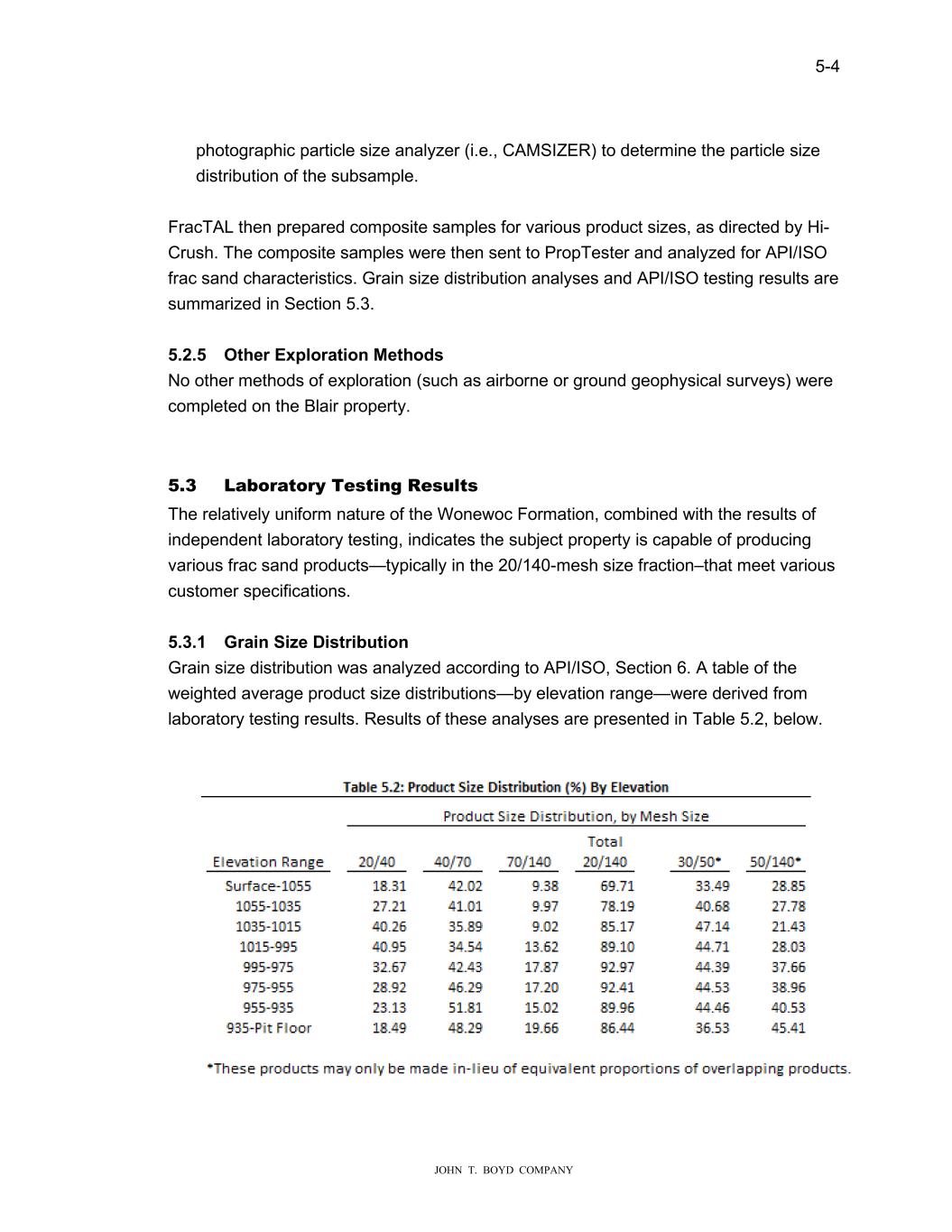
5-4 JOHN T. BOYD COMPANY photographic particle size analyzer (i.e., CAMSIZER) to determine the particle size distribution of the subsample. FracTAL then prepared composite samples for various product sizes, as directed by Hi- Crush. The composite samples were then sent to PropTester and analyzed for API/ISO frac sand characteristics. Grain size distribution analyses and API/ISO testing results are summarized in Section 5.3. 5.2.5 Other Exploration Methods No other methods of exploration (such as airborne or ground geophysical surveys) were completed on the Blair property. 5.3 Laboratory Testing Results The relatively uniform nature of the Wonewoc Formation, combined with the results of independent laboratory testing, indicates the subject property is capable of producing various frac sand products—typically in the 20/140-mesh size fraction–that meet various customer specifications. 5.3.1 Grain Size Distribution Grain size distribution was analyzed according to API/ISO, Section 6. A table of the weighted average product size distributions—by elevation range—were derived from laboratory testing results. Results of these analyses are presented in Table 5.2, below.
5-5 JOHN T. BOYD COMPANY The preceding table highlights the relative size consist, by elevation range, of the sands found within the Blair property. Approximately 90.6% of the sand particles, by weighted average over the total mineable area, are concentrated between the “passing 20-mesh” and “retained 140-mesh” size fraction. 5.3.2 Grain Shape (Sphericity and Roundness) Grain shape was analyzed according to API/ISO Section 7. Under this standard, recommended sphericity and roundness values for Fracs are 0.6 or greater. As part of the grain shape analysis, the presence of grain clusters (weakly cemented grain aggregates) and their approximate proportion in the sample were reported. Grain clusters were not observed. 5.3.3 Acid Solubility Acid solubility was analyzed according to API/ISO Section 8. Under this standard, five grams of sand is treated with 100 milliliters of 12:3 hydrochloric acid to hydrofluoric acid at 150oF for 30 minutes. The recommended maximum acid solubility for proppants in the 30/50-mesh size and coarser size range is 2.0%, and for proppants in the 40/70-mesh size and finer size range is 3.0%. 5.3.4 Turbidity Turbidity was analyzed according to API/ISO Section 9. Under this standard, the suggested maximum frac sand turbidity should be equal to or less than 250 nephelometric turbidity units (NTU). 5.3.5 Crush Resistance Crush resistance is a key test that determines the amount of pressure a sand grain can withstand under laboratory conditions for a two-minute duration. The sample was analyzed according to API/ISO Section 11. Under this standard, the highest stress level (psi) in which the proppant produces no more than 10% crushed fine material is rounded down to the nearest 1,000 psi and reported as the “K-value” of the material. 5.3.6 Quality Summary FracTAL performed API/ISO analyses on composite samples created in the 20/40, 30/50, 40/70, and 50/140-mesh product sizes. Test results are presented in Table 5.3, on the following page.
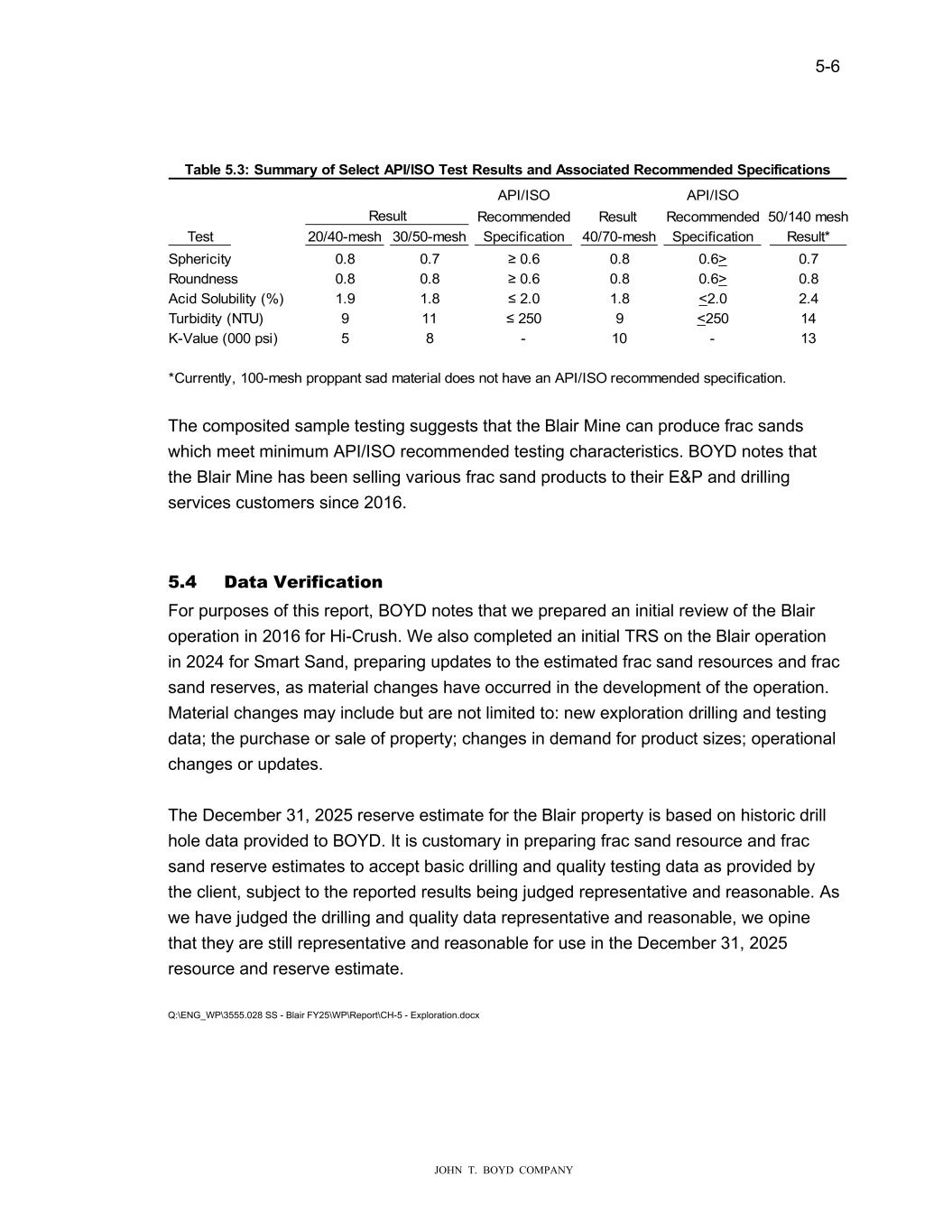
5-6 JOHN T. BOYD COMPANY Table 5.3: Summary of Select API/ISO Test Results and Associated Recommended Specifications API/ISO API/ISO Result Recommended Result Recommended 50/140 mesh Test 20/40-mesh 30/50-mesh Specification 40/70-mesh Specification Result* Sphericity 0.8 0.7 ≥ 0.6 0.8 0.6> 0.7 Roundness 0.8 0.8 ≥ 0.6 0.8 0.6> 0.8 Acid Solubility (%) 1.9 1.8 ≤ 2.0 1.8 <2.0 2.4 Turbidity (NTU) 9 11 ≤ 250 9 <250 14 K-Value (000 psi) 5 8 - 10 - 13 *Currently, 100-mesh proppant sad material does not have an API/ISO recommended specification. The composited sample testing suggests that the Blair Mine can produce frac sands which meet minimum API/ISO recommended testing characteristics. BOYD notes that the Blair Mine has been selling various frac sand products to their E&P and drilling services customers since 2016. 5.4 Data Verification For purposes of this report, BOYD notes that we prepared an initial review of the Blair operation in 2016 for Hi-Crush. We also completed an initial TRS on the Blair operation in 2024 for Smart Sand, preparing updates to the estimated frac sand resources and frac sand reserves, as material changes have occurred in the development of the operation. Material changes may include but are not limited to: new exploration drilling and testing data; the purchase or sale of property; changes in demand for product sizes; operational changes or updates. The December 31, 2025 reserve estimate for the Blair property is based on historic drill hole data provided to BOYD. It is customary in preparing frac sand resource and frac sand reserve estimates to accept basic drilling and quality testing data as provided by the client, subject to the reported results being judged representative and reasonable. As we have judged the drilling and quality data representative and reasonable, we opine that they are still representative and reasonable for use in the December 31, 2025 resource and reserve estimate. Q:\ENG_WP\3555.028 SS - Blair FY25\WP\Report\CH-5 - Exploration.docx
6-1 JOHN T. BOYD COMPANY 6.0 FRAC SAND RESOURCES AND RESERVES 6.1 Applicable Standards and Definitions Unless otherwise stated, frac sand resource and frac sand reserve estimates disclosed herein are completed in accordance with the standards and definitions provided by S-K 1300. It should be noted that BOYD considers the terms “mineral” and “frac sand” to be generally interchangeable within the relevant sections of S-K 1300. Estimates of any mineral resources and reserves are always subject to a degree of uncertainty. The level of confidence that can be applied to a particular estimate is a function of, among other things: the amount, quality, and completeness of exploration data; the geological complexity of the deposit; and economic, legal, social, and environmental factors associated with mining the resource/reserve. By assignment, BOYD used the definitions provided in S-K 1300 to describe the degree of uncertainty associated with the estimates reported herein. The definition of mineral (frac sand) resource provided by S-K 1300 is: Mineral resource is a concentration or occurrence of material of economic interest in or on the Earth's crust in such form, grade or quality, and quantity that there are reasonable prospects for economic extraction. A mineral resource is a reasonable estimate of mineralization, taking into account relevant factors such as cut-off grade, likely mining dimensions, location or continuity, that, with the assumed and justifiable technical and economic conditions, is likely to, in whole or in part, become economically extractable. It is not merely an inventory of all mineralization drilled or sampled. Estimates of proppant sand resources are subdivided to reflect different levels of geological confidence into measured (highest geologic assurance), indicated, and inferred (lowest geologic assurance). Please refer to the Glossary of Abbreviations and Definitions for the meanings ascribed to these terms. The definition of mineral (frac sand) reserve provided by S-K 1300 is: Mineral reserve is an estimate of tonnage and grade or quality of indicated and measured mineral resources that, in the opinion of the qualified person, can be the basis of an economically viable project. More specifically, it is the economically mineable part of a measured or indicated mineral resource, which
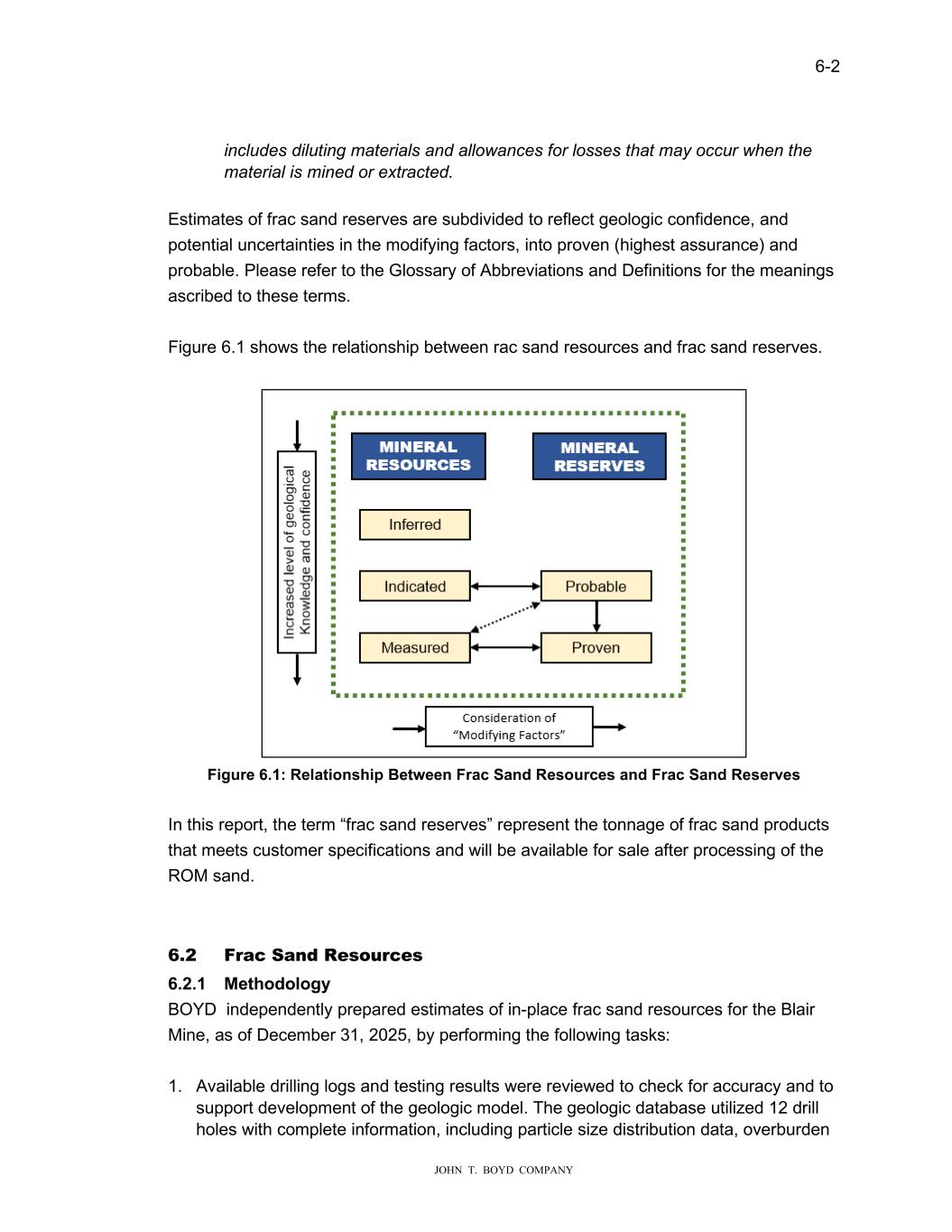
6-2 JOHN T. BOYD COMPANY includes diluting materials and allowances for losses that may occur when the material is mined or extracted. Estimates of frac sand reserves are subdivided to reflect geologic confidence, and potential uncertainties in the modifying factors, into proven (highest assurance) and probable. Please refer to the Glossary of Abbreviations and Definitions for the meanings ascribed to these terms. Figure 6.1 shows the relationship between rac sand resources and frac sand reserves. Figure 6.1: Relationship Between Frac Sand Resources and Frac Sand Reserves In this report, the term “frac sand reserves” represent the tonnage of frac sand products that meets customer specifications and will be available for sale after processing of the ROM sand. 6.2 Frac Sand Resources 6.2.1 Methodology BOYD independently prepared estimates of in-place frac sand resources for the Blair Mine, as of December 31, 2025, by performing the following tasks: 1. Available drilling logs and testing results were reviewed to check for accuracy and to support development of the geologic model. The geologic database utilized 12 drill holes with complete information, including particle size distribution data, overburden
6-3 JOHN T. BOYD COMPANY thickness, and sand thickness data. The data were imported into Carlson Software, a geologic modeling and mine planning software suite that is widely used and accepted by the mining industry. 2. A geologic model of the deposit was created in Carlson Software using industry-standard grid modeling methods well-suited for simple stratigraphic deposits. The geologic model delineates the top and bottom of overburden material, and the mineable sand horizon and distribution of the product size fractions throughout the deposit. The top and bottom of the mineable frac sand interval was established thusly: a. Aerial mapping as of August 29, 2025, in combination with provided drilling data, was used as the basis for estimating the remaining overburden and sand volumes and associated product distribution in the Carlson geologic modeling program. b. As there are varying amounts of overburden material across the property, ranging from 1 ft to 106 ft in thickness, the top of the mineable sand interval was defined as the base of the overburden material above the Wonewoc Sandstone Formation. c. The bottom of the mineable sand interval was based primarily on the approved mining reclamation plan, which sloped from approximately 940 ft amsl on the eastern portion of the property to 920 ft amsl on the western portion of the property. 3. After reviewing the continuity of the deposit, suitable resources classification criteria were developed and applied, which are further discussed in Section 6.2.2. 4. BOYD then reviewed the proposed mining regions identified by Smart Sand’s mine plan, and the approved reclamation permit. A viewshed area was incorporated, which involved leaving an earthen berm constructed mainly of overburden and topsoil around the property in order to maintain a shielded view of the future mine from local roadways. Certain areas on the property were excluded from being considered as mineable, such as those that had waste impoundments and stormwater ponds, processing facilities, as well as those areas underlying the property boundary viewshed. Estimation of the in-place resources assumes mining operations using standard surface excavation equipment, which is widely utilized for mining of similar deposit types. Estimates were subject to the following setbacks and slope requirements: a. Mining offsets are required to be observed inside of the entire property boundary for a surface mining operation and are specified in the approved mining permits. The Blair Operation straddles two counties, each requiring different property offsets be observed: • A 100 ft property setback is required in Trempealeau County. • A 200 ft property setback is required in Jackson County.
6-4 JOHN T. BOYD COMPANY b. A vertical final pit highwall was assumed in BOYD’s model, for the following reasons: • The mineable Wonewoc Sandstone Formation outcrops along nearly the entire western portion of the Blair property, while most of the eastern portion of the mine property will require a pit highwall remain in place. Smart Sand management specified mining to a final slope of 80 degrees in their mine plan in areas where a final highwall will be required to remain. • BOYD assigned additional in-pit mining losses for this estimate (90% mining recovery, discussed further in Section 6.3.1) to account for the slope differential, and remain conservative in our estimate of mineable resources. 5. In-place volumes for each of the proposed mining blocks were calculated from the geologic model within Carlson Software, and an in-place dry sandstone density of 118.5 pounds per cubic foot was used to convert the in-place sand volumes to tonnages. 6. BOYD then utilized provided production data to reconcile the estimate from the date of volumetric estimate to December 31, 2025. 6.2.2 Classification Geologic assuredness is established by the availability of both structural (thickness and elevation) and quality (size fraction) information for the deposit. Resource classification is generally based on the concentration or spacing of exploration data which can be used to demonstrate the geologic continuity of the deposit. When material variations in thickness, depth, and/or sand quality occur between drill holes, the allowable spacing distance between drill holes is reduced. The following drill hole spacing criteria were established by BOYD after reviewing the available exploration data and geologic model, and were used to classify the frac sand resources of the Blair Mine as shown in Table 6.1, below: Table 6.1: Blair Property Drill Hole Spacing Parameters Resource Classification Spacing Requirement (ft) (Nominal Maximum) Measured 2,000 Indicated 4,000 Inferred 8,000 BOYD has classified all of the estimated frac sand resources within the defined mineable areas of the Blair property as Measured based on drilling density and the low geologic complexity of the deposit. BOYD is of the opinion that there is a low degree of uncertainty associated with the resource classification.
6-5 JOHN T. BOYD COMPANY 6.2.3 Estimation Criteria Development of the frac sand resource estimates for the Blair Mine assumes mining and processing methods and equipment that have been utilized successfully at the operation for several years. The target mining horizon manifests as a continuous sand unit exhibiting relatively consistent depth, thickness, and quality. There is relatively little overburden, and the high-quality sand is easily distinguished from the overlying waste interval; as such, interpretation of the mineable horizon is relatively easy to distinguish. Mined sand is processed to remove out-size materials (i.e., sand which is either too coarse or silts/fines which cannot be sold) and produce saleable finish frac sand products. The amount of finished sand produced as a percentage of the raw sand mined is referred to as the processing yield (or plant yield), which is analogous to the “cut-off grade” of other mining operations. If the expected processing yield of the sand is too low, the cost of production will outweigh sales revenues and the deposit cannot be economically mined. The minimum processing yield—based on historical and forecasted economics (refer to Chapter 10 through 12)—for the Blair Mine is estimated to be 35%. It should be noted that the cut-off grade is well below the expected processing yield of the deposit. Other limiting criteria, such as minimum mining thickness or maximum stripping ratio (the ratio of waste to sand excavated) generally do not negatively impact the economics of the Blair Mine when considering the results of the geologic data and overall mine planning used to estimate the surface mineable frac sand resources. The limits of the frac sand resources are constrained to those portions of the interpreted sand deposit that: • Are reasonably defined by available drilling and sampling data. • Contain products that meet generally accepted specifications and can be sold at a profit (i.e., be economic). • Honor any legal mining constraints (e.g., property boundaries, environmental setbacks, utility and infrastructure setbacks, etc.). • Adhere to physical mining limitations. Frac sand resources for the Blair Mine are assessed for reasonable prospects for eventual economic extraction by reporting: (1) those resources which have been subsequently converted to frac sand reserves after the application of all material modifying factors, and/or (2) those resources which have similar characteristics (i.e.,
6-6 JOHN T. BOYD COMPANY mining conditions, and expected processing yields and qualities) to those converted to frac sand reserves. The criteria employed in developing the estimates of frac sand resources for the Blair Mine is supported by historical results and align with those employed at similar operations. As such, it is BOYD’s opinion that the stated criteria are reasonable and appropriate for the estimation of frac sand resources at the Blair Mine. 6.2.4 Frac Sand Resource Estimate There are no reportable frac sand resources excluding those converted to frac sand reserves for the Blair Mine. Quantities of frac sand controlled by Smart Sand within the defined boundaries of the Blair property which are not reported as frac sand reserves are not considered to have potential economic viability; as such, they are not reportable as frac sand resources. 6.2.5 Validation BOYD independently estimated in-place frac sand resources for the Blair Mine based on the provided drilling, sampling, and testing data obtained. Utilizing industry-standard grid modeling techniques we have estimated volumes of frac sand indicated by the available data. Based on our review of the information provided, we are of the opinion that the data provided are reasonable and appropriate. Furthermore, it is our opinion that the estimation methods employed are both appropriate and reasonable for the deposit type and proposed extraction methods. 6.3 Frac Sand Reserves 6.3.1 Methodology Estimates of frac sand reserves for the Blair Mine were derived contemporaneously with estimates of frac sand resources. To derive an estimate of saleable product tons (proven frac sand reserves), the following modifying factors were applied to the in-place measured frac sand resources underlying the respective mine plan areas: • A 90% mining recovery factor was applied, which assumes that 10% of the in-place frac sand resource will not be recovered for various reasons. Applying this recovery factor to the in-place resource results in the estimated ROM sand tonnage that will be delivered to the wet process plant. • An overall 75% processing recovery was applied, which accounts for losses in the wet and dry plants as a result of removing out-sized (i.e., larger than 20-mesh and smaller than 140-mesh) sand, as well as considering losses in the wet and dry
6-7 JOHN T. BOYD COMPANY processing plants due to minor inefficiencies. Processing recoveries were based on a combination of laboratory testing data and historic production data available from the Blair operation. The overall product yield (after accounting for mining and processing losses) for the Blair Operation is estimated at 67.5%. That is, for every 100 tons of in-place frac sand resources mined, approximately 67.5 tons will be able to be recovered and sold as product. 6.3.2 Classification Proven frac sand reserves are derived from Measured frac sand resources, in accordance with S-K 1300. BOYD is satisfied that the frac sand reserve classification reflects the outcome of technical and economic studies. Figure 6.2, on the following page, illustrates the reserve classification of the Blair Property frac sand deposit.
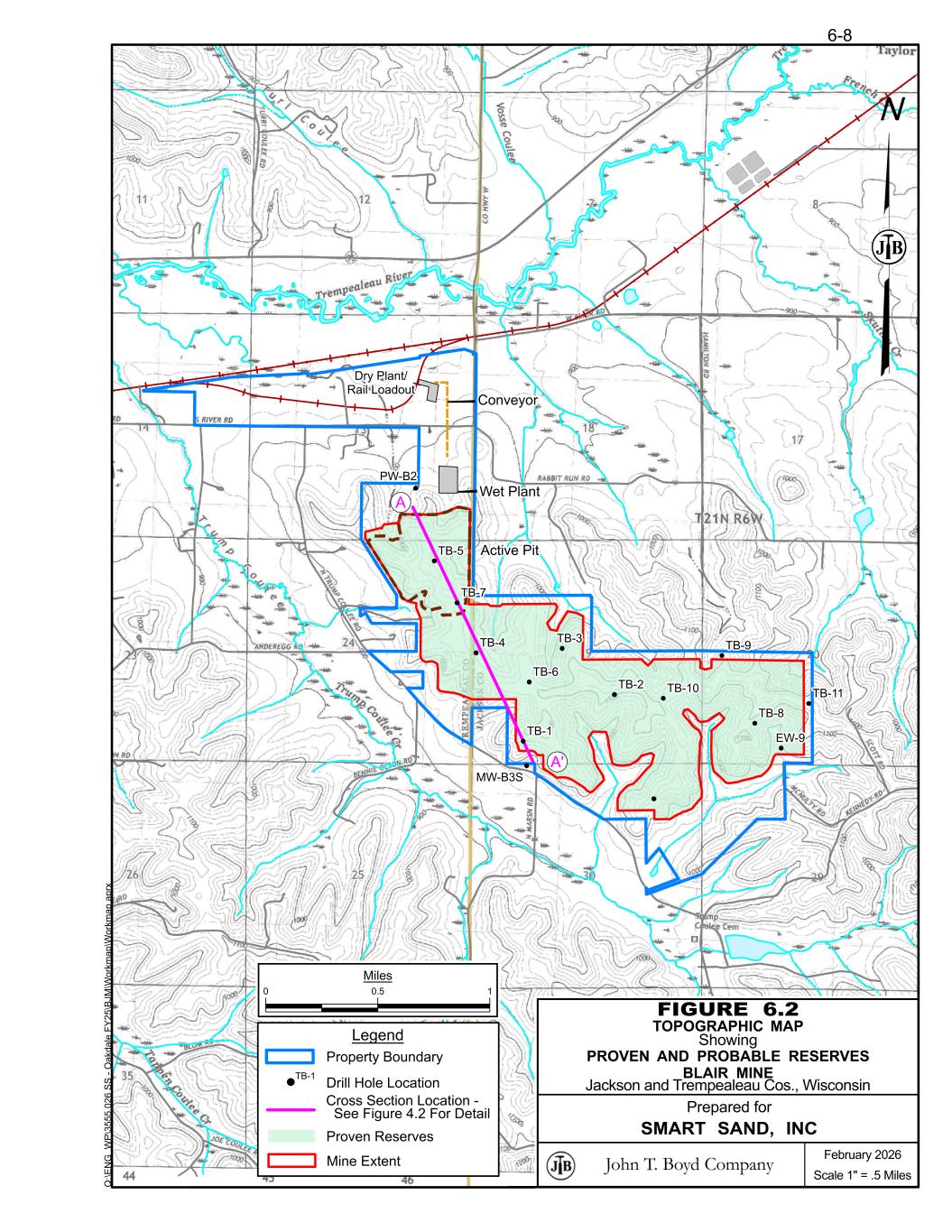
TB-1 TB-2 TB-3TB-4 TB-5 TB-6 TB-7 TB-8 TB-9 EW-9 TB-10 TB-11 PW-B2 MW-B3S 6-8 0 0.5 1 Miles Dry Plant/ Rail Loadout Wet Plant Conveyor February 2026 Scale 1" = .5 Miles John T. Boyd Company Prepared for SMART SAND, INC FIGURE 6.2 TOPOGRAPHIC MAP Showing PROVEN AND PROBABLE RESERVES BLAIR MINE Jackson and Trempealeau Cos., Wisconsin A A' Legend Property Boundary Proven Reserves Drill Hole Location TB-1 Mine Extent Cross Section Location - See Figure 4.2 For Detail Q :\E N G _W P \3 55 5. 02 6 S S - O ak da le F Y 25 \B JM \W or km ap \W or km ap .a pr x Active Pit
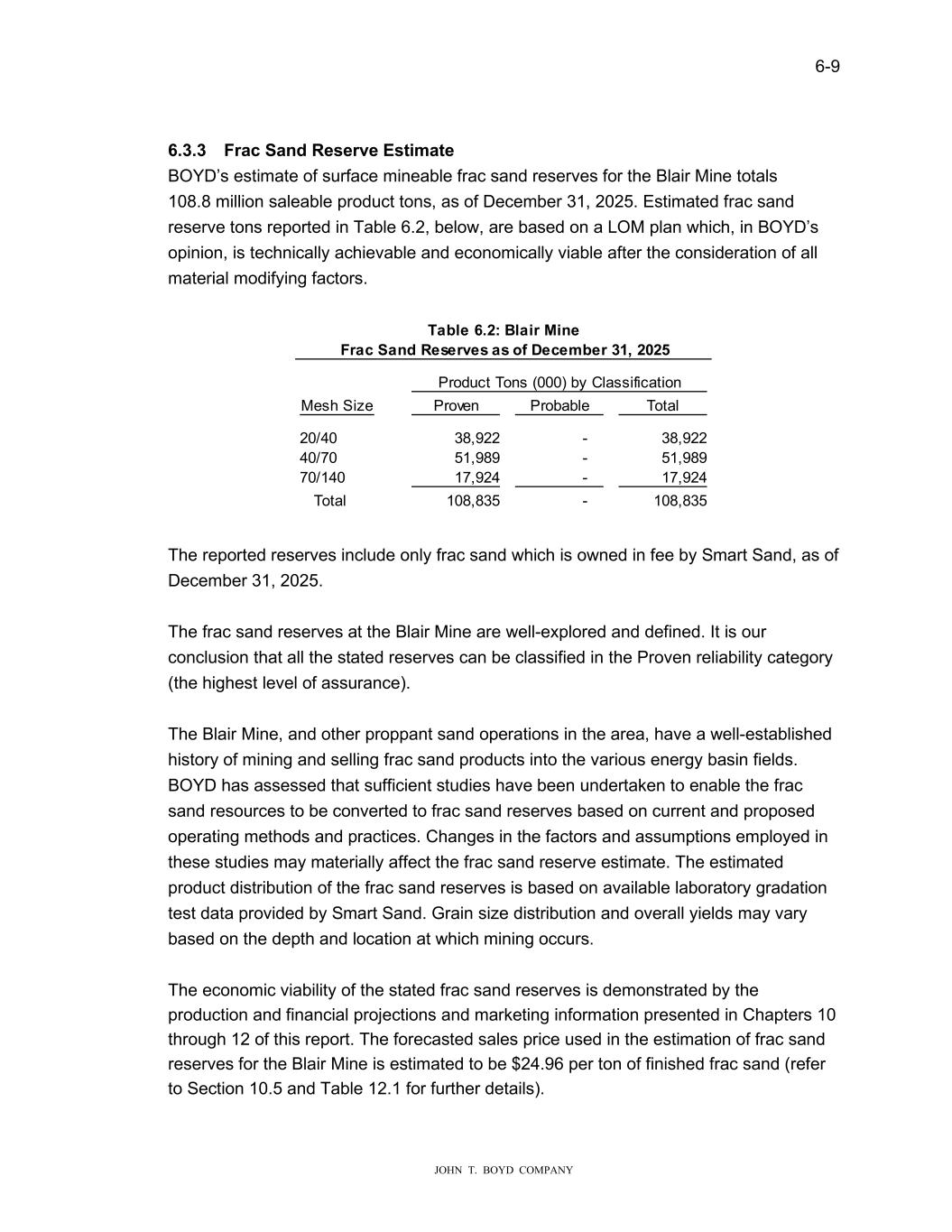
6-9 JOHN T. BOYD COMPANY 6.3.3 Frac Sand Reserve Estimate BOYD’s estimate of surface mineable frac sand reserves for the Blair Mine totals 108.8 million saleable product tons, as of December 31, 2025. Estimated frac sand reserve tons reported in Table 6.2, below, are based on a LOM plan which, in BOYD’s opinion, is technically achievable and economically viable after the consideration of all material modifying factors. The reported reserves include only frac sand which is owned in fee by Smart Sand, as of December 31, 2025. The frac sand reserves at the Blair Mine are well-explored and defined. It is our conclusion that all the stated reserves can be classified in the Proven reliability category (the highest level of assurance). The Blair Mine, and other proppant sand operations in the area, have a well-established history of mining and selling frac sand products into the various energy basin fields. BOYD has assessed that sufficient studies have been undertaken to enable the frac sand resources to be converted to frac sand reserves based on current and proposed operating methods and practices. Changes in the factors and assumptions employed in these studies may materially affect the frac sand reserve estimate. The estimated product distribution of the frac sand reserves is based on available laboratory gradation test data provided by Smart Sand. Grain size distribution and overall yields may vary based on the depth and location at which mining occurs. The economic viability of the stated frac sand reserves is demonstrated by the production and financial projections and marketing information presented in Chapters 10 through 12 of this report. The forecasted sales price used in the estimation of frac sand reserves for the Blair Mine is estimated to be $24.96 per ton of finished frac sand (refer to Section 10.5 and Table 12.1 for further details). Mesh Size Proven Probable Total 20/40 38,922 - 38,922 40/70 51,989 - 51,989 70/140 17,924 - 17,924 Total 108,835 - 108,835 Table 6.2: Blair Mine Frac Sand Reserves as of December 31, 2025 Product Tons (000) by Classification
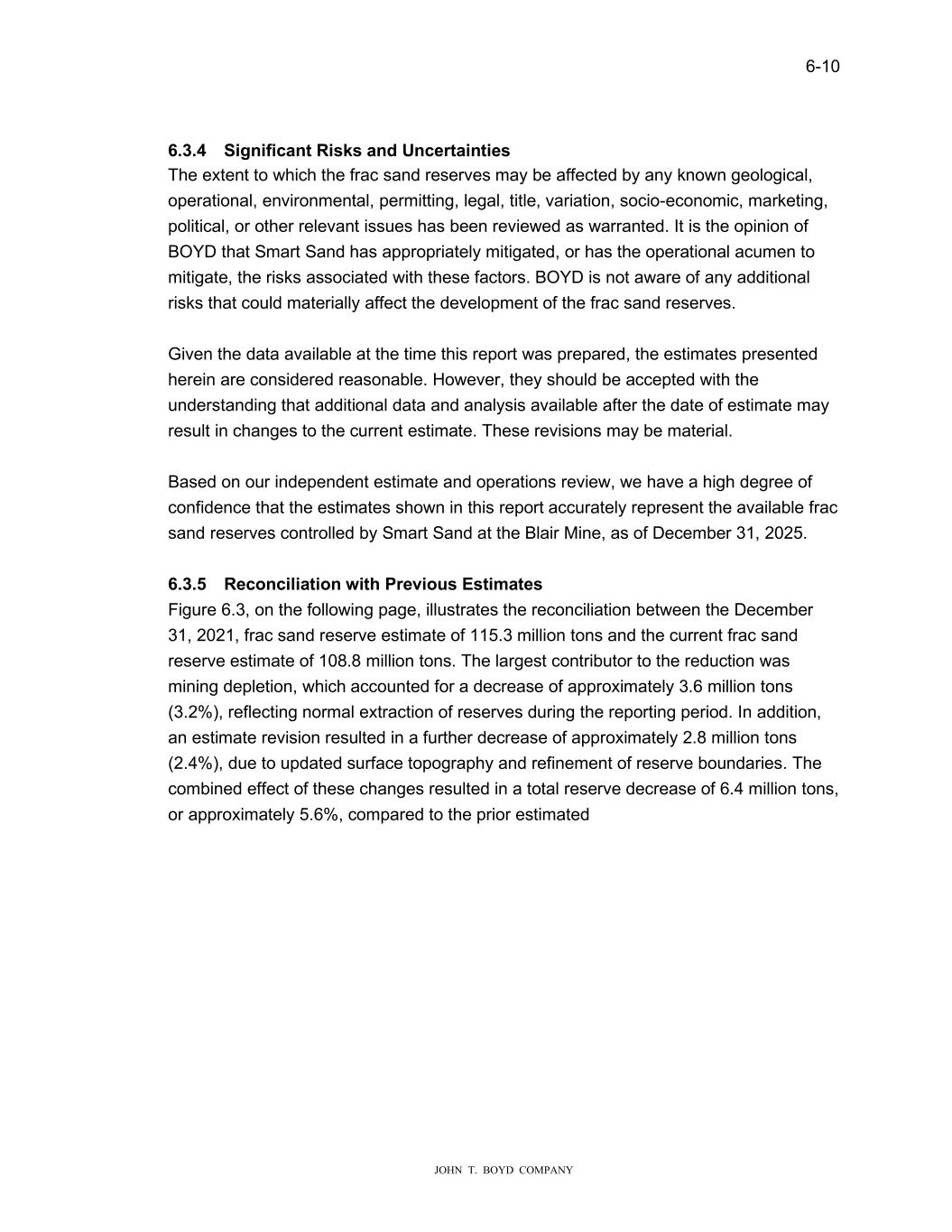
6-10 JOHN T. BOYD COMPANY 6.3.4 Significant Risks and Uncertainties The extent to which the frac sand reserves may be affected by any known geological, operational, environmental, permitting, legal, title, variation, socio-economic, marketing, political, or other relevant issues has been reviewed as warranted. It is the opinion of BOYD that Smart Sand has appropriately mitigated, or has the operational acumen to mitigate, the risks associated with these factors. BOYD is not aware of any additional risks that could materially affect the development of the frac sand reserves. Given the data available at the time this report was prepared, the estimates presented herein are considered reasonable. However, they should be accepted with the understanding that additional data and analysis available after the date of estimate may result in changes to the current estimate. These revisions may be material. Based on our independent estimate and operations review, we have a high degree of confidence that the estimates shown in this report accurately represent the available frac sand reserves controlled by Smart Sand at the Blair Mine, as of December 31, 2025. 6.3.5 Reconciliation with Previous Estimates Figure 6.3, on the following page, illustrates the reconciliation between the December 31, 2021, frac sand reserve estimate of 115.3 million tons and the current frac sand reserve estimate of 108.8 million tons. The largest contributor to the reduction was mining depletion, which accounted for a decrease of approximately 3.6 million tons (3.2%), reflecting normal extraction of reserves during the reporting period. In addition, an estimate revision resulted in a further decrease of approximately 2.8 million tons (2.4%), due to updated surface topography and refinement of reserve boundaries. The combined effect of these changes resulted in a total reserve decrease of 6.4 million tons, or approximately 5.6%, compared to the prior estimated
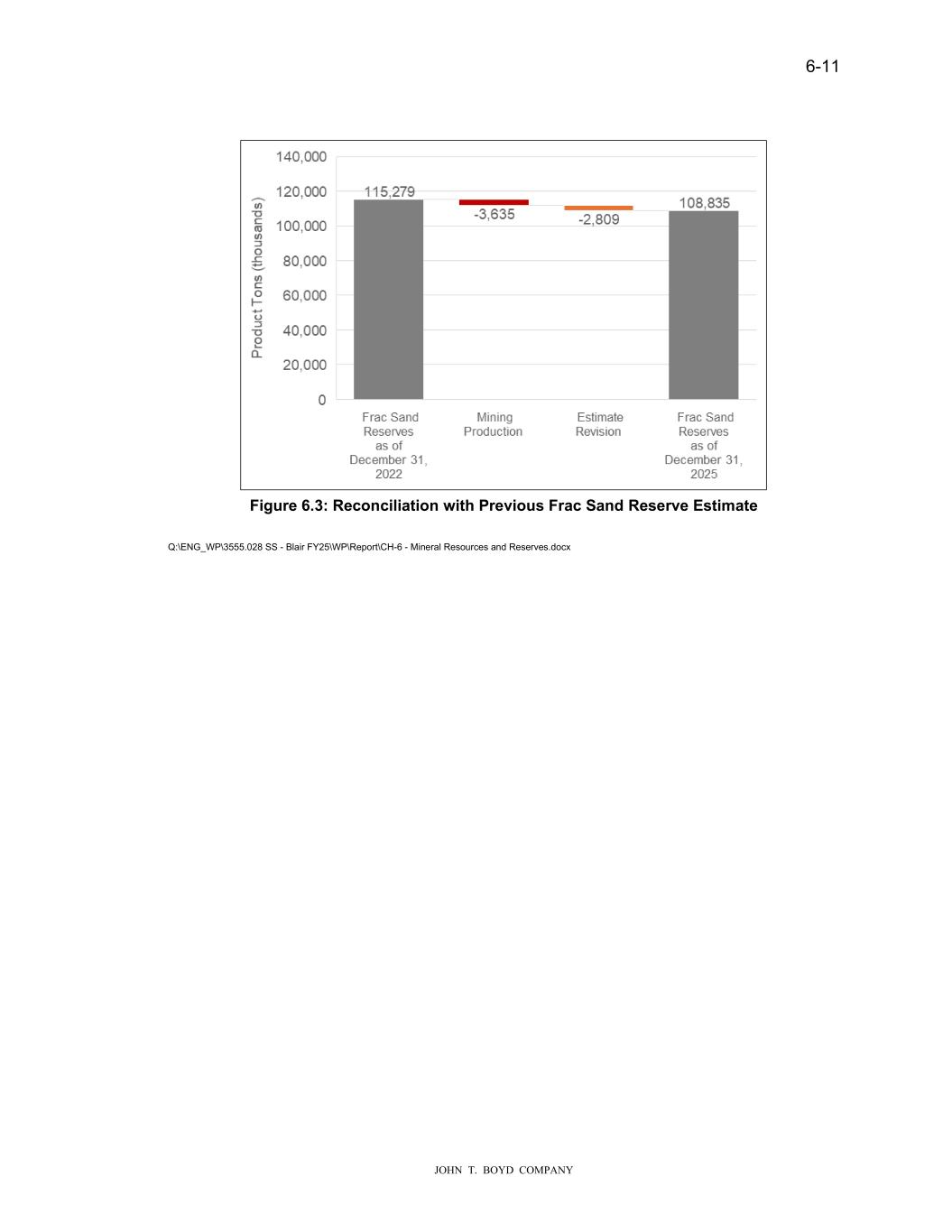
6-11 JOHN T. BOYD COMPANY Figure 6.3: Reconciliation with Previous Frac Sand Reserve Estimate Q:\ENG_WP\3555.028 SS - Blair FY25\WP\Report\CH-6 - Mineral Resources and Reserves.docx
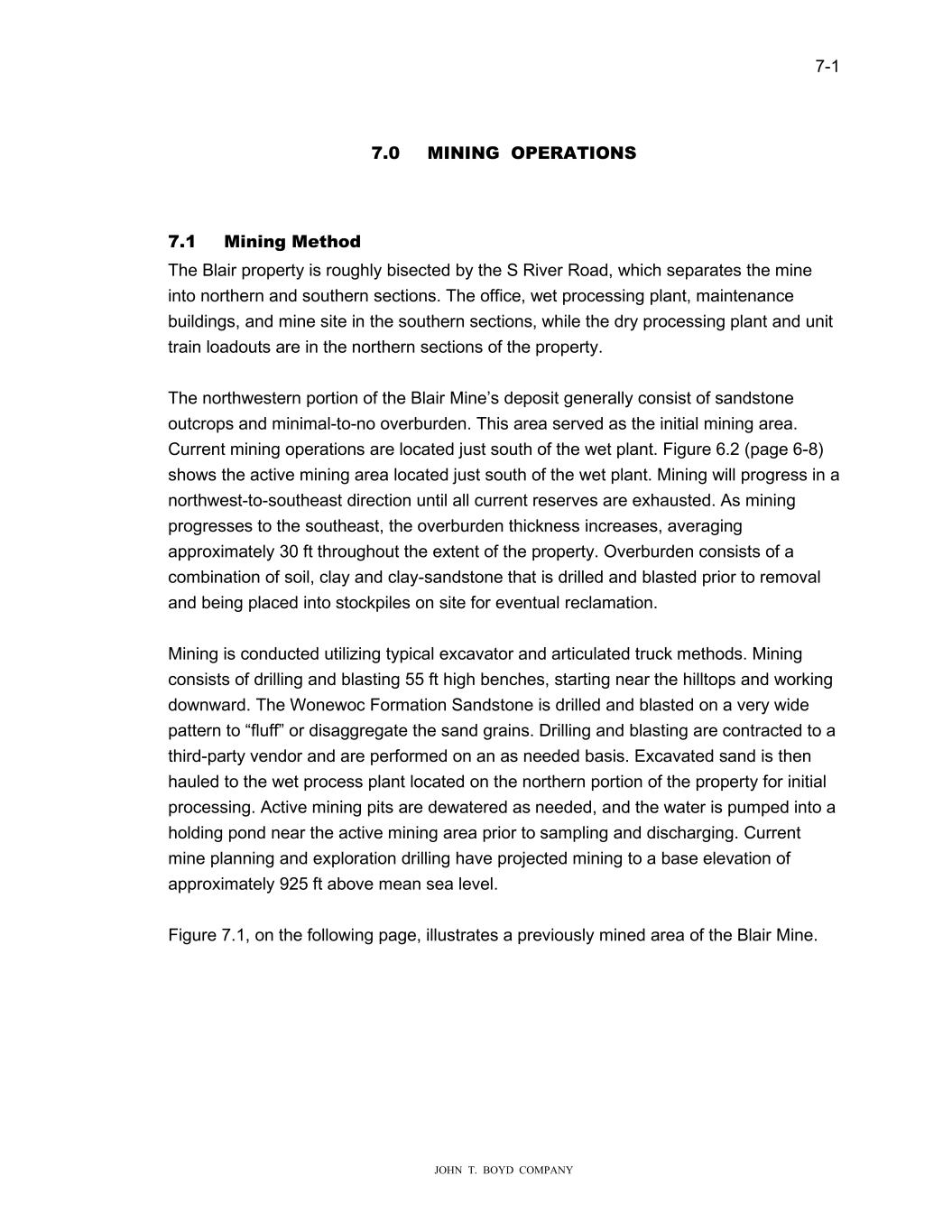
7-1 JOHN T. BOYD COMPANY 7.0 MINING OPERATIONS 7.1 Mining Method The Blair property is roughly bisected by the S River Road, which separates the mine into northern and southern sections. The office, wet processing plant, maintenance buildings, and mine site in the southern sections, while the dry processing plant and unit train loadouts are in the northern sections of the property. The northwestern portion of the Blair Mine’s deposit generally consist of sandstone outcrops and minimal-to-no overburden. This area served as the initial mining area. Current mining operations are located just south of the wet plant. Figure 6.2 (page 6-8) shows the active mining area located just south of the wet plant. Mining will progress in a northwest-to-southeast direction until all current reserves are exhausted. As mining progresses to the southeast, the overburden thickness increases, averaging approximately 30 ft throughout the extent of the property. Overburden consists of a combination of soil, clay and clay-sandstone that is drilled and blasted prior to removal and being placed into stockpiles on site for eventual reclamation. Mining is conducted utilizing typical excavator and articulated truck methods. Mining consists of drilling and blasting 55 ft high benches, starting near the hilltops and working downward. The Wonewoc Formation Sandstone is drilled and blasted on a very wide pattern to “fluff” or disaggregate the sand grains. Drilling and blasting are contracted to a third-party vendor and are performed on an as needed basis. Excavated sand is then hauled to the wet process plant located on the northern portion of the property for initial processing. Active mining pits are dewatered as needed, and the water is pumped into a holding pond near the active mining area prior to sampling and discharging. Current mine planning and exploration drilling have projected mining to a base elevation of approximately 925 ft above mean sea level. Figure 7.1, on the following page, illustrates a previously mined area of the Blair Mine.
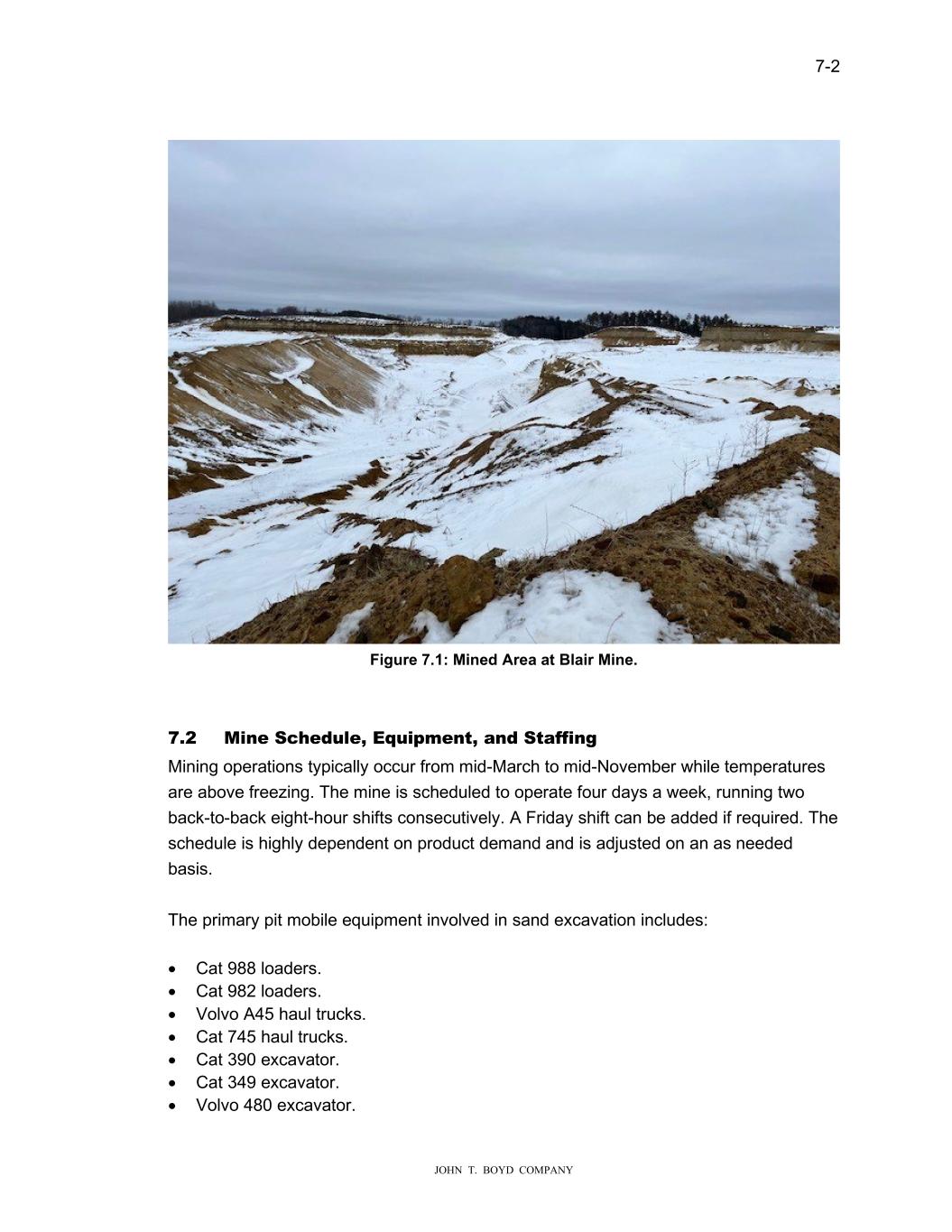
7-2 JOHN T. BOYD COMPANY Figure 7.1: Mined Area at Blair Mine. 7.2 Mine Schedule, Equipment, and Staffing Mining operations typically occur from mid-March to mid-November while temperatures are above freezing. The mine is scheduled to operate four days a week, running two back-to-back eight-hour shifts consecutively. A Friday shift can be added if required. The schedule is highly dependent on product demand and is adjusted on an as needed basis. The primary pit mobile equipment involved in sand excavation includes: • Cat 988 loaders. • Cat 982 loaders. • Volvo A45 haul trucks. • Cat 745 haul trucks. • Cat 390 excavator. • Cat 349 excavator. • Volvo 480 excavator.
7-3 JOHN T. BOYD COMPANY In addition, there are numerous support vehicles (maintenance trucks, skid steers, water truck, etc.) to complement the fleet. 7.3 Engineering and Planning The primary mine planning consideration is the safe, economical, and regular supply of raw high-quality sand feed to the processing plants. In commercial mining terms, the quantities of overburden removed, and sand excavated each year at the Blair Mine is considered modest. Mining plans are relatively simple and very flexible; able to be modified based on demand in a relatively short time frame. The sand deposit is relatively competent, and the mining depths are relatively shallow. As a result, slumping, or collapsing, has not been and is not expected to be a detriment to mining operations. Flooding of the mine’s pits may occur, but is considered manageable with existing pumping equipment. 7.4 Mine Sequence and Production Historical mine production has ranged from 1.5 to 2.3 million ROM tons over the last three years, reflecting adjustments in mining rates consistent with operational planning and reserve management. Forecast mine production is projected to range from approximately 2.8 million ROM tons in 2026 to approximately 4.1 million ROM tons by 2030, after which production is expected to remain relatively constant over the remaining life of the mine. This forecast production profile is consistent with the demonstrated capabilities of the existing mining fleet and processing infrastructure and reflects a sustainable, steady-state operating plan aligned with the long-term capacity of the operation. The key driver of the mining operations is the adequate supply of feed material to the Blair Mine’s processing plants. At the projected LOM production rates, the Blair operation has an expected mine life of approximately 41 years. Future mine production, and hence the longevity of the mine, is directly related to the energy market demand for frac sand. Actual yearly production volumes may, and are likely to, fluctuate significantly based on this demand. The areal extents of the remaining mining areas (as shown in Figure 6.2, on page 6-8) and the geologic characteristics of the sand deposit afford the Blair Mine a great deal of
7-4 JOHN T. BOYD COMPANY operational and planning flexibility. Generally, mining operations are expected to advance in blocks outwards from the processing plant areas to minimize haul distances and expand waste storage capacity. It is BOYD’s opinion that the forecasted production levels for the Blair Mine are reasonable, logical, and consistent with typical sand surface mining practices in the region. 7.5 Mining Risks Surface mines face two primary types of operational risks. The first category of risk includes those daily variations in physical mining conditions, mechanical failures, and operational activities that can temporarily disrupt production activities. Several examples are as follows: • Water accumulations/soft floor conditions. • Process water shortages. • Power curtailments. • Variations in grain size consistency. • Encountering excessive clay and other waste material. • Failures or breakdowns of operating equipment and supporting infrastructure. • Weather disruptions (power outages, dust storms, excessive heat etc.). The above conditions/circumstances can adversely affect production on any given day but are not regarded as “risk issues” relative to the long-term operation of a mining entity. Instead, these are considered “nuisance items” that, while undesirable, are encountered on a periodic basis at many mining operations. BOYD does not regard the issues listed above as being material to the Blair Mine operations or otherwise compromising its forecasted performance. The second type of risk is categorized as “event risk.” Items in this category are rare, but significant occurrences that are confined to an individual mine, and ultimately have a pronounced impact on production activities and corresponding financial outcomes. Examples of event risks are major fires or explosions, floods, or unforeseen geological anomalies that disrupt extensive areas of proposed or operating mine workings and require alterations of mining plans. Such an event can result in the cessation of production activities for an undefined but extended period (measured in months, and perhaps years) and/or result in the sterilization of proppant sand reserves. This type of risk is minimal in a relatively simple surface sand mining operation. Q:\ENG_WP\3555.028 SS - Blair FY25\WP\Report\CH-7- Mining Operations.docx
8-1 JOHN T. BOYD COMPANY 8.0 PROCESSING OPERATIONS 8.1 Processing Method Frac sand processing at the Blair Mine typically comprises the following three major components: • Wet Plant – ROM material from the pit is delivered to the wet plant where the oversize (e.g., gravel) and slime (e.g., fine sand and silt) material is removed. The wet plant does not crush the material, but predominantly scrubs (i.e., washes) and classifies (i.e., sizes) the raw feed material. • Dry Plant – The damp WIP material produced by the wet plant is dried and screened/sorted into finished products. • Storage and Loadout – Finished products are stored in silos and are discharged via gravity from the bottom of the silos onto a belt system that feeds the on-site rail loadout for transport on the CN rail line. The Blair Mine commenced operations in 2016. Processing facilities consist of a wet processing plant, a dry processing plant and a rail loadout facility. ROM sand material is hauled to the wet processing plant via articulated trucks and then conveyed to the dry processing plant on the northern property before being stored and loaded onto rail. The overall operation has an approximate annual finished product capacity of 2.9 million tons and is staffed by approximately 54 employees. The number of employees can fluctuate based on product demand. 8.1.1 Wet Plant Figure 8.1, on the following page, shows the wet plant where material between 20-mesh and 140-mesh is classified and conveyed to the dry process plant. Waste material (<140-mesh fines and oversize) are placed back into a plastic lined tailings pond east of the wet processing plant. The wet plant utilizes typical screen-hydrosizer-cyclone classification and dewatering technology and has an ultrafine circuit and thickener, and operates 4-5 days a week, 16 hours a day, typically between March and November. The wet plant and mine shut down during winter when consistent below-freezing temperatures makes utilizing the wet plant unfavorable. The nominal capacity of the wet plant is approximately 400 tph of ROM sand.
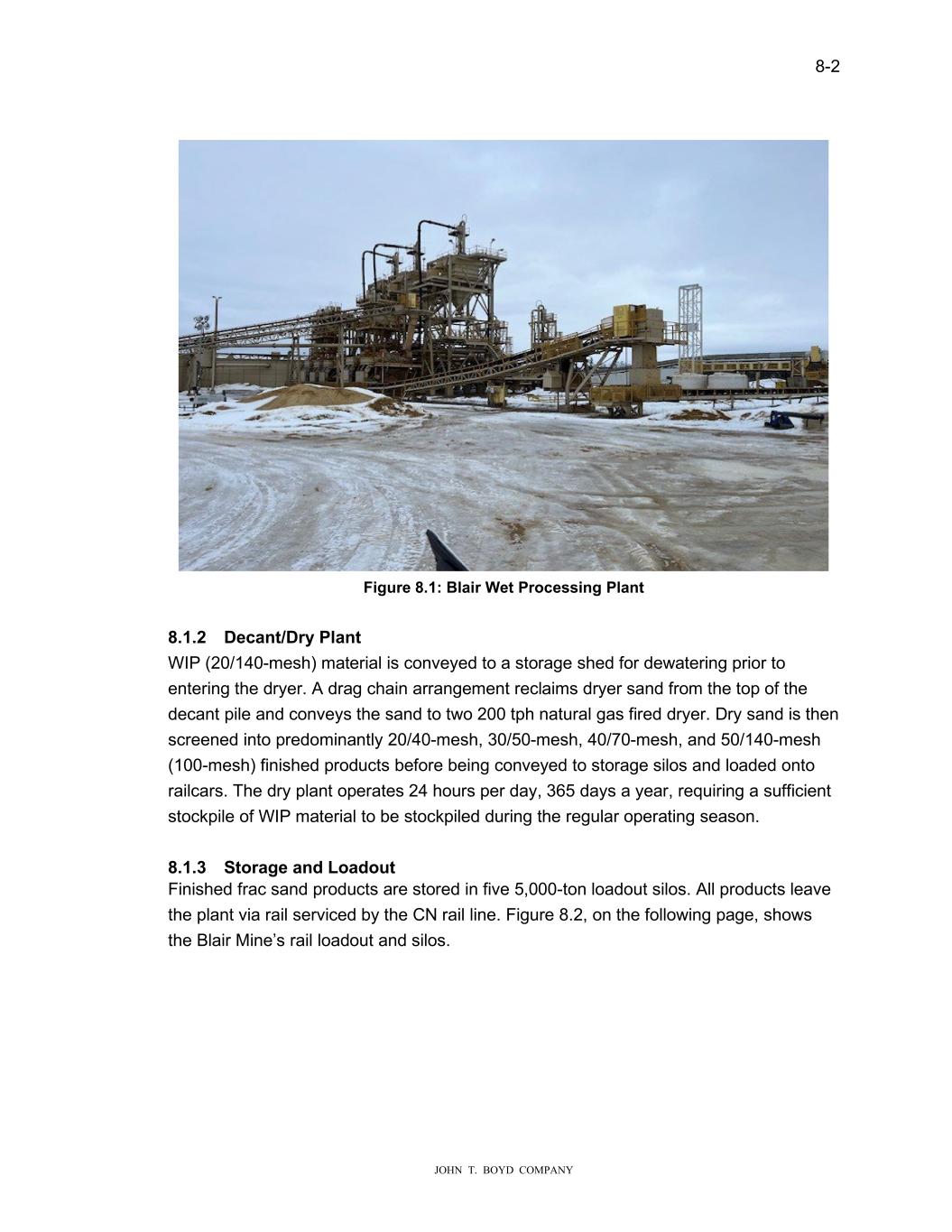
8-2 JOHN T. BOYD COMPANY Figure 8.1: Blair Wet Processing Plant 8.1.2 Decant/Dry Plant WIP (20/140-mesh) material is conveyed to a storage shed for dewatering prior to entering the dryer. A drag chain arrangement reclaims dryer sand from the top of the decant pile and conveys the sand to two 200 tph natural gas fired dryer. Dry sand is then screened into predominantly 20/40-mesh, 30/50-mesh, 40/70-mesh, and 50/140-mesh (100-mesh) finished products before being conveyed to storage silos and loaded onto railcars. The dry plant operates 24 hours per day, 365 days a year, requiring a sufficient stockpile of WIP material to be stockpiled during the regular operating season. 8.1.3 Storage and Loadout Finished frac sand products are stored in five 5,000-ton loadout silos. All products leave the plant via rail serviced by the CN rail line. Figure 8.2, on the following page, shows the Blair Mine’s rail loadout and silos.
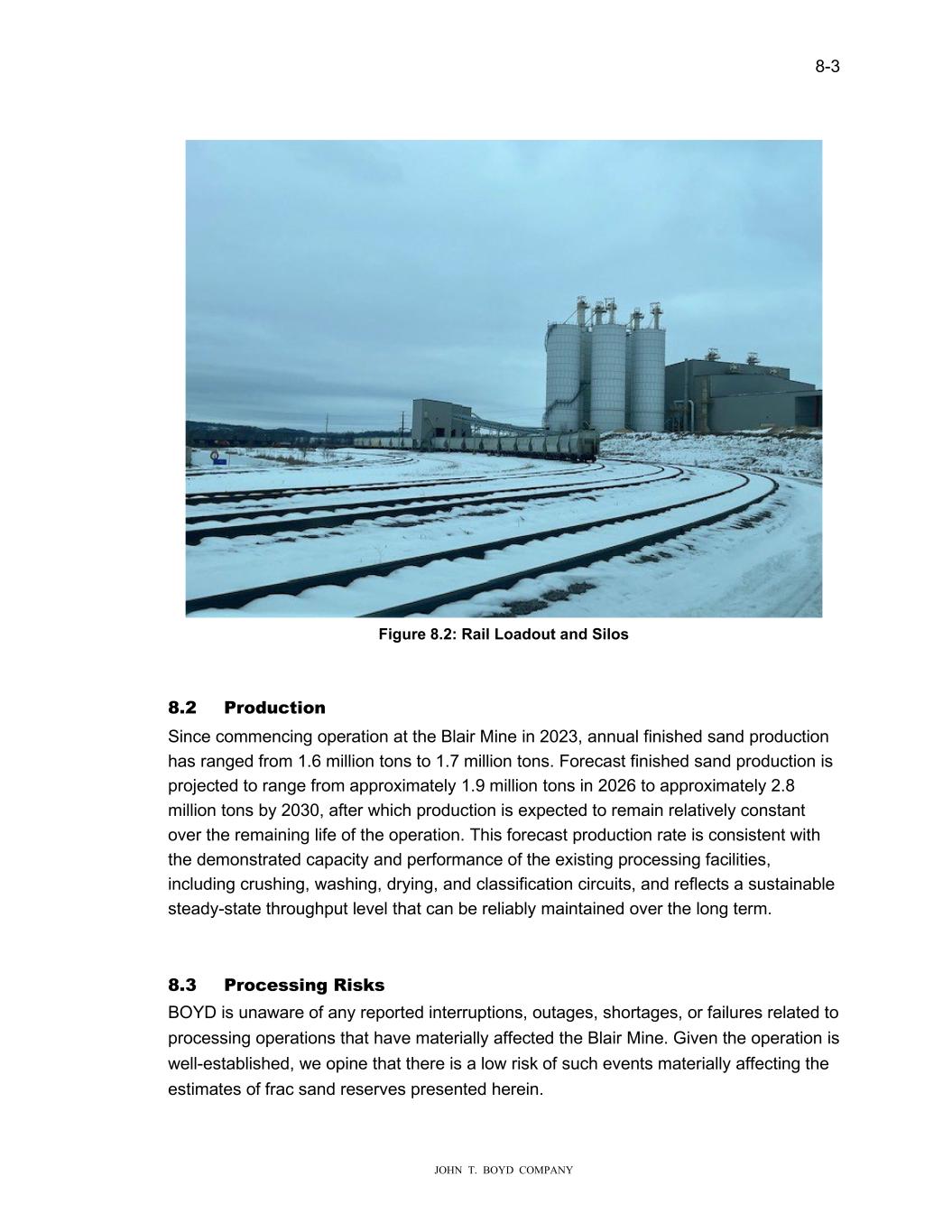
8-3 JOHN T. BOYD COMPANY Figure 8.2: Rail Loadout and Silos 8.2 Production Since commencing operation at the Blair Mine in 2023, annual finished sand production has ranged from 1.6 million tons to 1.7 million tons. Forecast finished sand production is projected to range from approximately 1.9 million tons in 2026 to approximately 2.8 million tons by 2030, after which production is expected to remain relatively constant over the remaining life of the operation. This forecast production rate is consistent with the demonstrated capacity and performance of the existing processing facilities, including crushing, washing, drying, and classification circuits, and reflects a sustainable steady-state throughput level that can be reliably maintained over the long term. 8.3 Processing Risks BOYD is unaware of any reported interruptions, outages, shortages, or failures related to processing operations that have materially affected the Blair Mine. Given the operation is well-established, we opine that there is a low risk of such events materially affecting the estimates of frac sand reserves presented herein.

8-4 JOHN T. BOYD COMPANY Based on our review, it is BOYD’s opinion that the processing methods and existing equipment at the plant are sufficient for the forecasted production of finished frac sand products. Q:\ENG_WP\3555.028 SS - Blair FY25\WP\Report\CH-8 - Processing Operations.docx
9-1 JOHN T. BOYD COMPANY 9.0 MINE INFRASTRUCTURE 9.1 Overview All of the basic infrastructure required for the ongoing operation of the Blair Mine is in place. Figure 6.2 (page 6-8) illustrates the general layout of the infrastructure at the subject operation. Surface facilities currently located on the Blair Property are well constructed and have the necessary capacity/capabilities to support Smart Sand’s near-term operating plans. Operational preference may lead to the upgrading of some existing facilities if the operation expands in the future. BOYD is unaware of any reported interruptions, outages, shortages, or failures to infrastructure requirements that have materially affected the Blair Mine’s operations. Given the operation is well-established, we opine that there is a low risk that such events would materially affect the estimates of frac sand reserves presented herein. 9.2 Transportation The Blair Mine is serviced by several roads maintained by the local municipality, county, and state governments. These roads are either paved or well-maintained graded roadways. Road access is available year-round. Blair has an on-site rail loadout and rail siding with a capacity of several hundred railcars. Finished frac sand products are transported via direct rail access to the CN rail line. 9.3 Utilities The Blair Mine is serviced by various utilities that are routed along the CN rail corridor, which along the northern property line. We Energies, (a subsidiary of WEC Energy group) provides natural gas supply for the drying equipment, and Xcel Energy provides three phase electrical power via a high voltage line that is supplied to the Blair Operation though above and below ground electrical lines.
9-2 JOHN T. BOYD COMPANY Plant process water is supplied by three wells drilled on the property in addition to the water collected in the pit and ponds. Wash process water is recycled after fines are removed via settling with a flocculent in a thickener before being placed into a constructed pond. Potable water is provided by one of the onsite wells which is purified for consumption. Additionally, bottled water and jugs are provided for staff. 9.4 Tailings Disposal The mining and processing of frac sand at the Blair Mine creates a substantial amount of tailings (i.e., waste material). These tailings are typically a mixture of clay, very fine sand, and other non-silica minerals. As the mine progresses, silt ponds are constructed in mined-out areas, where the solid materials settle to the bottom and water may be recovered for reuse. 9.5 Other Structures and Facilities On-site facilities include a scale house, office, shop, and a quality laboratory located in the dry process plant. Q:\ENG_WP\3555.028 SS - Blair FY25\WP\Report\CH-9 - Infrastructure.docx
10-1 JOHN T. BOYD COMPANY 10.0 MARKET ANALYSIS 10.1 Market Background The modern North American frac sand industry emerged alongside the shale oil and gas revolution of the mid-2000s, when horizontal drilling and multi-stage hydraulic fracturing dramatically increased demand for high-quality proppant. Early shale completions placed a premium on high crush strength and proppant conductivity, which positioned NWS— sourced primarily from high-purity quartz formations in Wisconsin and Minnesota—as the industry’s benchmark material. NWS deposits such as the Saint Peter, Jordan, Wonewoc, and Mount Simon sandstones exhibit excellent sphericity, roundness, and >99% quartz content, characteristics that deliver superior performance under high closure stresses. As a result, NWS dominated the market through the early 2010s and was shipped via unit trains to every major unconventional basin, despite significant transportation costs associated with 1,000 to 1,500-mile rail hauls. Following the 2014–2016 oil price collapse, operators shifted from quality-driven to cost-optimized completion designs, accelerating adoption of high-proppant-intensity fracturing and longer laterals. This sharply increased total proppant mass per well and magnified logistics as a cost driver—often more than half of delivered sand cost in the Permian was attributable to transportation rather than mine-gate pricing. In response, the industry began developing regional or in-basin sands that could be trucked short distances from the mine to the well pad. Texas brown sands and analogous formations in Oklahoma and the Haynesville provided sufficient crush strength for many reservoir stress environments, even though they lacked the conductivity profile of NWS. Between 2016 and 2019, more than 20 new in-basin mines were constructed in the Permian alone, creating substantial overcapacity and dramatically reducing dependence on Midwestern supply. Industry analysts describe this period as a structural market realignment, with Permian in-basin penetration rising toward 70 to 80% of total proppant demand by 2019. The result is a bifurcated market architecture that persists today. In-basin sand now serves as the volume backbone for most major oil-dominant basins, driven by logistics efficiency, last-mile delivery integration, and reduced total well cost. Mine-gate pricing and transportation networks have become strategic differentiators, with infrastructure innovations—such as West Texas overland conveyor systems—further reducing reliance on long-haul rail. Meanwhile, NWS functions as a performance-oriented niche product, selected for wells with elevated closure stresses, complex fracture geometries, or estimated ultimate recovery (EUR) sensitive economics where conductivity degradation
10-2 JOHN T. BOYD COMPANY from regional sands may be unacceptable. Recent technical assessments indicate that while in-basin sands meet operational requirements for most Permian completions, NWS retains measurable conductivity and permeability retention advantages that can translate to improved long-term recovery in certain reservoir conditions. The competitive relationship between NWS and in-basin producers is best described as selective substitution rather than universal displacement: • In-basin producers dominate on delivered cost, making them the default choice for most high-volume Permian and Haynesville completions. • NWS maintains a defensible niche in wells with elevated closure stress, complex fracture networks, or high EUR sensitivity, where conductivity degradation from lower-quality sands may materially impact long-term production. • Supply elasticity differs sharply – in-basin suppliers expand and contract capacity quickly, whereas NWS supply is slower to adjust, leading to different pricing cycles across segments. • Vertical integration is a growing differentiator, with in-basin suppliers capturing value through last-mile logistics and storage, while NWS suppliers increasingly rely on strategic partnerships with railroads, terminals, and pressure pumpers to stabilize demand. Basin‑level competitive dynamics in frac sand markets are driven mainly by differences in logistics, cost structures, and sand quality relative to specific shale plays: Appalachia (Marcellus/Utica) • NWS retains strong share due to geological requirements and proximity to Midwestern supply. • Limited local sand resources of comparable quality. Bakken • Combination of NWS and regional sands; long rail distances common. • Delivered cost is competitive versus trucking local alternatives across North Dakota. Duvernay • Oil window – regional sands increasingly adopted for cost efficiency. • Deep gas window – NWS remains preferred due to high stress. Eagle Ford • Mixed NWS and regional sands historically; increasing in-basin supply reducing NWS share.
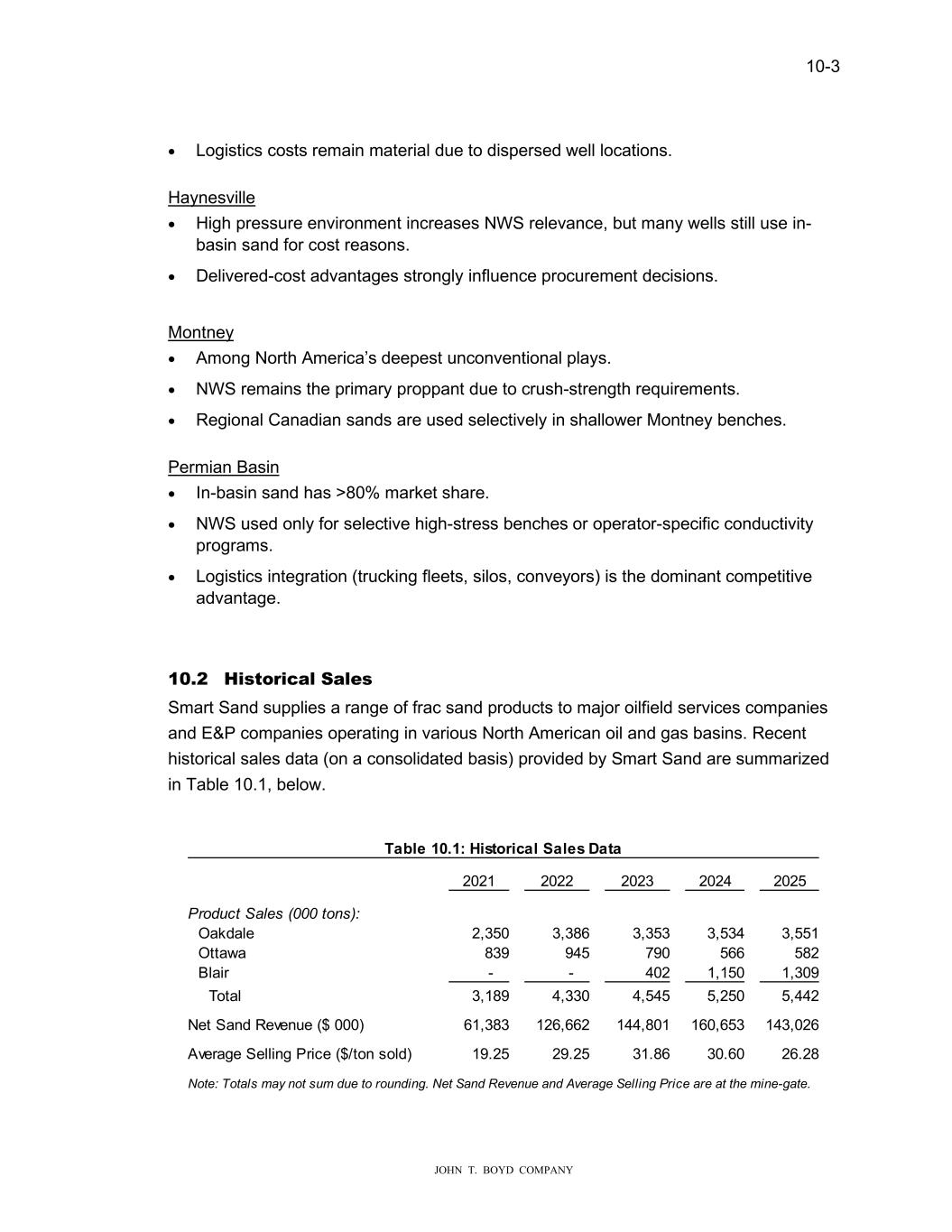
10-3 JOHN T. BOYD COMPANY • Logistics costs remain material due to dispersed well locations. Haynesville • High pressure environment increases NWS relevance, but many wells still use in- basin sand for cost reasons. • Delivered-cost advantages strongly influence procurement decisions. Montney • Among North America’s deepest unconventional plays. • NWS remains the primary proppant due to crush-strength requirements. • Regional Canadian sands are used selectively in shallower Montney benches. Permian Basin • In-basin sand has >80% market share. • NWS used only for selective high-stress benches or operator-specific conductivity programs. • Logistics integration (trucking fleets, silos, conveyors) is the dominant competitive advantage. 10.2 Historical Sales Smart Sand supplies a range of frac sand products to major oilfield services companies and E&P companies operating in various North American oil and gas basins. Recent historical sales data (on a consolidated basis) provided by Smart Sand are summarized in Table 10.1, below. 2021 2022 2023 2024 2025 Product Sales (000 tons): Oakdale 2,350 3,386 3,353 3,534 3,551 Ottawa 839 945 790 566 582 Blair - - 402 1,150 1,309 Total 3,189 4,330 4,545 5,250 5,442 Net Sand Revenue ($ 000) 61,383 126,662 144,801 160,653 143,026 Average Selling Price ($/ton sold) 19.25 29.25 31.86 30.60 26.28 Note: Totals may not sum due to rounding. Net Sand Revenue and Average Selling Price are at the mine-gate. Table 10.1: Historical Sales Data
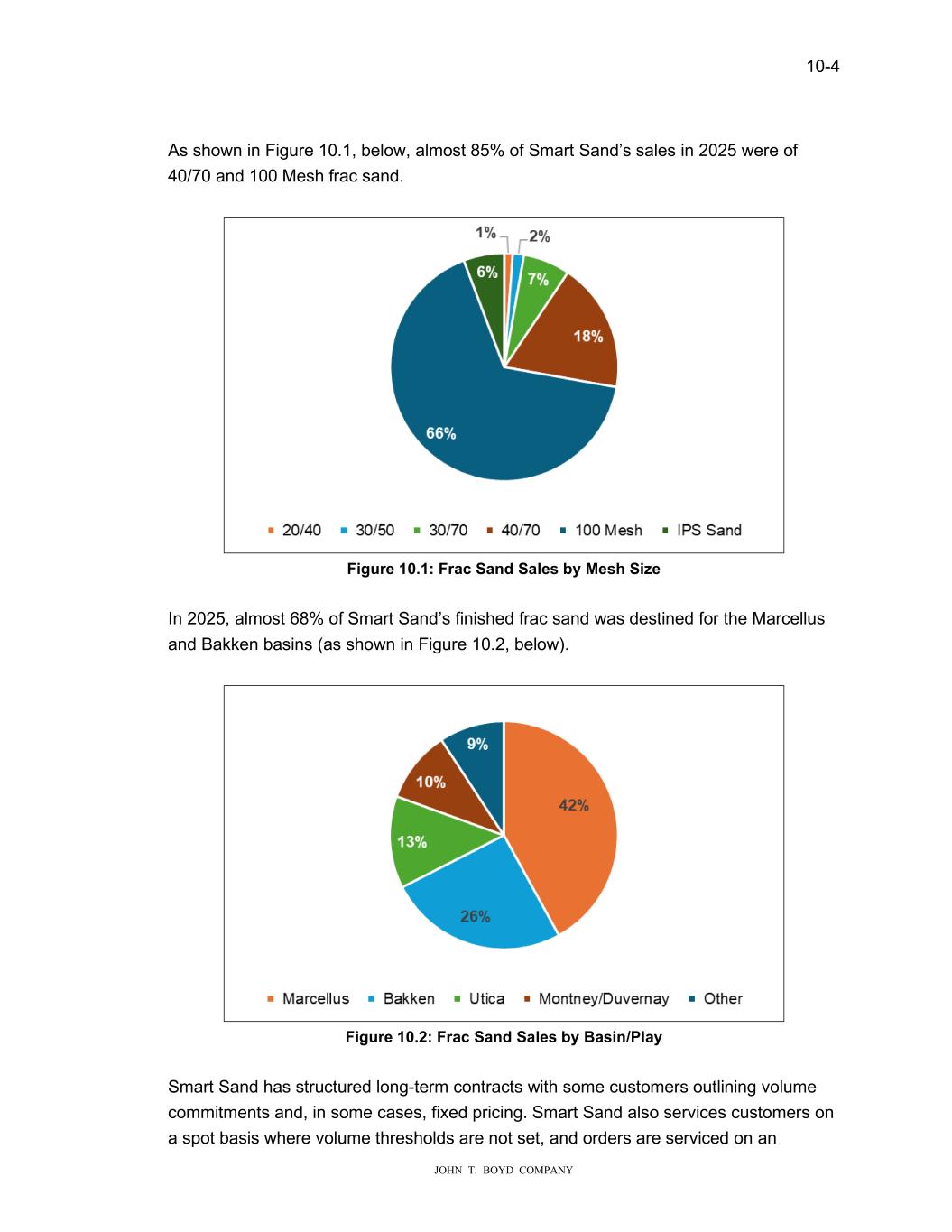
10-4 JOHN T. BOYD COMPANY As shown in Figure 10.1, below, almost 85% of Smart Sand’s sales in 2025 were of 40/70 and 100 Mesh frac sand. Figure 10.1: Frac Sand Sales by Mesh Size In 2025, almost 68% of Smart Sand’s finished frac sand was destined for the Marcellus and Bakken basins (as shown in Figure 10.2, below). Figure 10.2: Frac Sand Sales by Basin/Play Smart Sand has structured long-term contracts with some customers outlining volume commitments and, in some cases, fixed pricing. Smart Sand also services customers on a spot basis where volume thresholds are not set, and orders are serviced on an
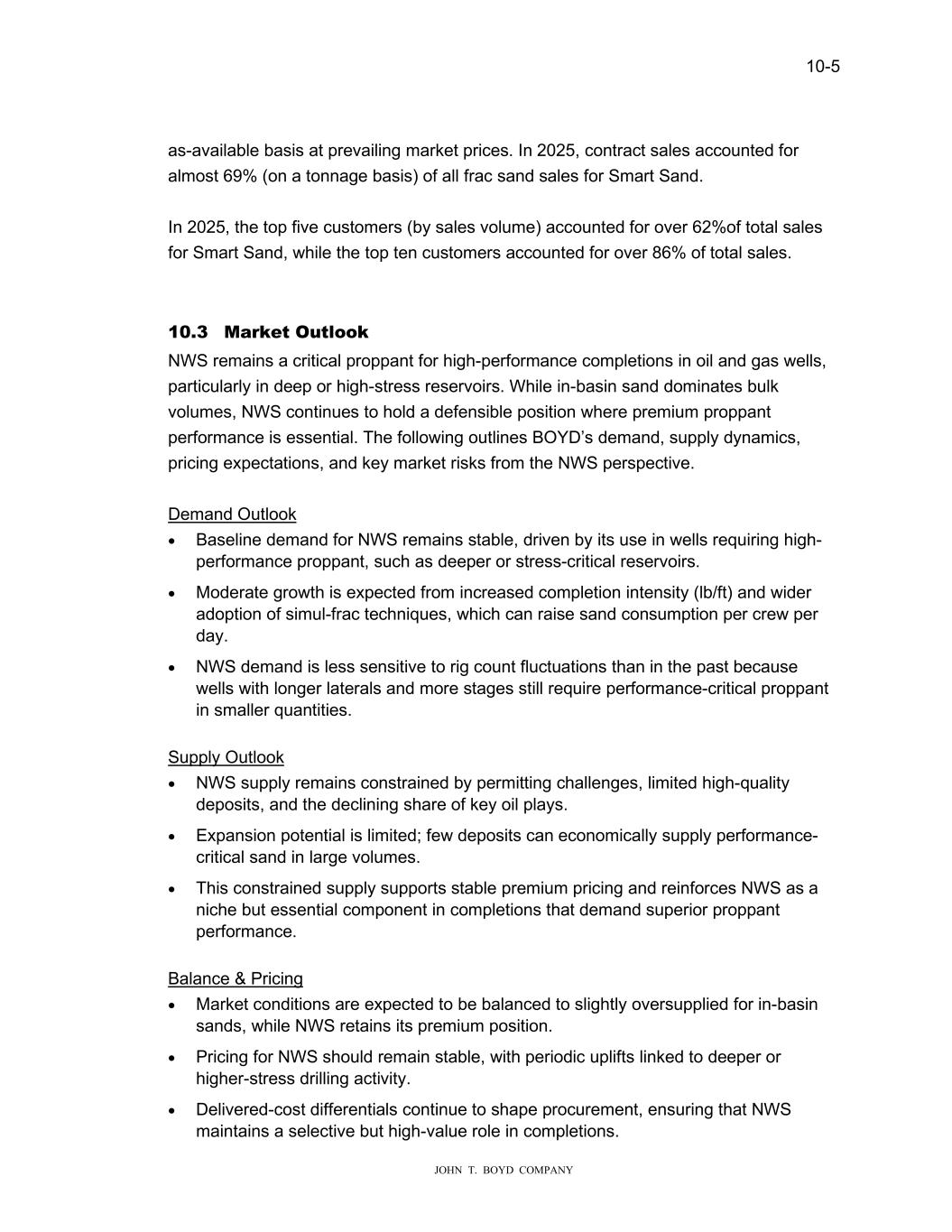
10-5 JOHN T. BOYD COMPANY as-available basis at prevailing market prices. In 2025, contract sales accounted for almost 69% (on a tonnage basis) of all frac sand sales for Smart Sand. In 2025, the top five customers (by sales volume) accounted for over 62%of total sales for Smart Sand, while the top ten customers accounted for over 86% of total sales. 10.3 Market Outlook NWS remains a critical proppant for high-performance completions in oil and gas wells, particularly in deep or high-stress reservoirs. While in-basin sand dominates bulk volumes, NWS continues to hold a defensible position where premium proppant performance is essential. The following outlines BOYD’s demand, supply dynamics, pricing expectations, and key market risks from the NWS perspective. Demand Outlook • Baseline demand for NWS remains stable, driven by its use in wells requiring high- performance proppant, such as deeper or stress-critical reservoirs. • Moderate growth is expected from increased completion intensity (lb/ft) and wider adoption of simul-frac techniques, which can raise sand consumption per crew per day. • NWS demand is less sensitive to rig count fluctuations than in the past because wells with longer laterals and more stages still require performance-critical proppant in smaller quantities. Supply Outlook • NWS supply remains constrained by permitting challenges, limited high-quality deposits, and the declining share of key oil plays. • Expansion potential is limited; few deposits can economically supply performance- critical sand in large volumes. • This constrained supply supports stable premium pricing and reinforces NWS as a niche but essential component in completions that demand superior proppant performance. Balance & Pricing • Market conditions are expected to be balanced to slightly oversupplied for in-basin sands, while NWS retains its premium position. • Pricing for NWS should remain stable, with periodic uplifts linked to deeper or higher-stress drilling activity. • Delivered-cost differentials continue to shape procurement, ensuring that NWS maintains a selective but high-value role in completions.
10-6 JOHN T. BOYD COMPANY Downside Market Risks • Reduced drilling or completion activity in high-spec wells could compress NWS demand. • Improved in-basin proppants that encroach on NWS performance could challenge market share. • Logistical constraints, regulatory hurdles, or environmental compliance issues could impact supply consistency or cost. Upside Market Opportunities • Increases in completion intensity or longer lateral lengths could boost per-well NWS consumption. • Renewed demand for high-performance proppants in deeper or more challenging reservoirs could tighten NWS availability. • Supply chain or regional logistical bottlenecks may elevate delivered pricing and improve margins for NWS producers. • Technology adoption in transportation and last-mile delivery could create competitive advantages for integrated NWS suppliers. NWS is unlikely to reclaim historical market share for bulk sand but will remain critical where premium performance is non-negotiable. 10.4 Market Entry Strategies As an existing producer with a lengthy commercial history and established customer base, it is BOYD’s opinion that market entry strategies are not required for continued sale of the Blair Mine’s frac sand products. 10.5 Future Sales BOYD’s projections of sales volumes and frac sand prices for the Blair Mine are informed by Smart Sand’s historical operating results, their budget forecasts, and our knowledge of frac sand markets. Forecasted prices are based on sales of various sizes (e.g., 30/50, 40/70, and 70/140-mesh) of finished frac sand. Our frac sand sales forecast for the Blair Mine is provided in Table 10.2, on the following page.
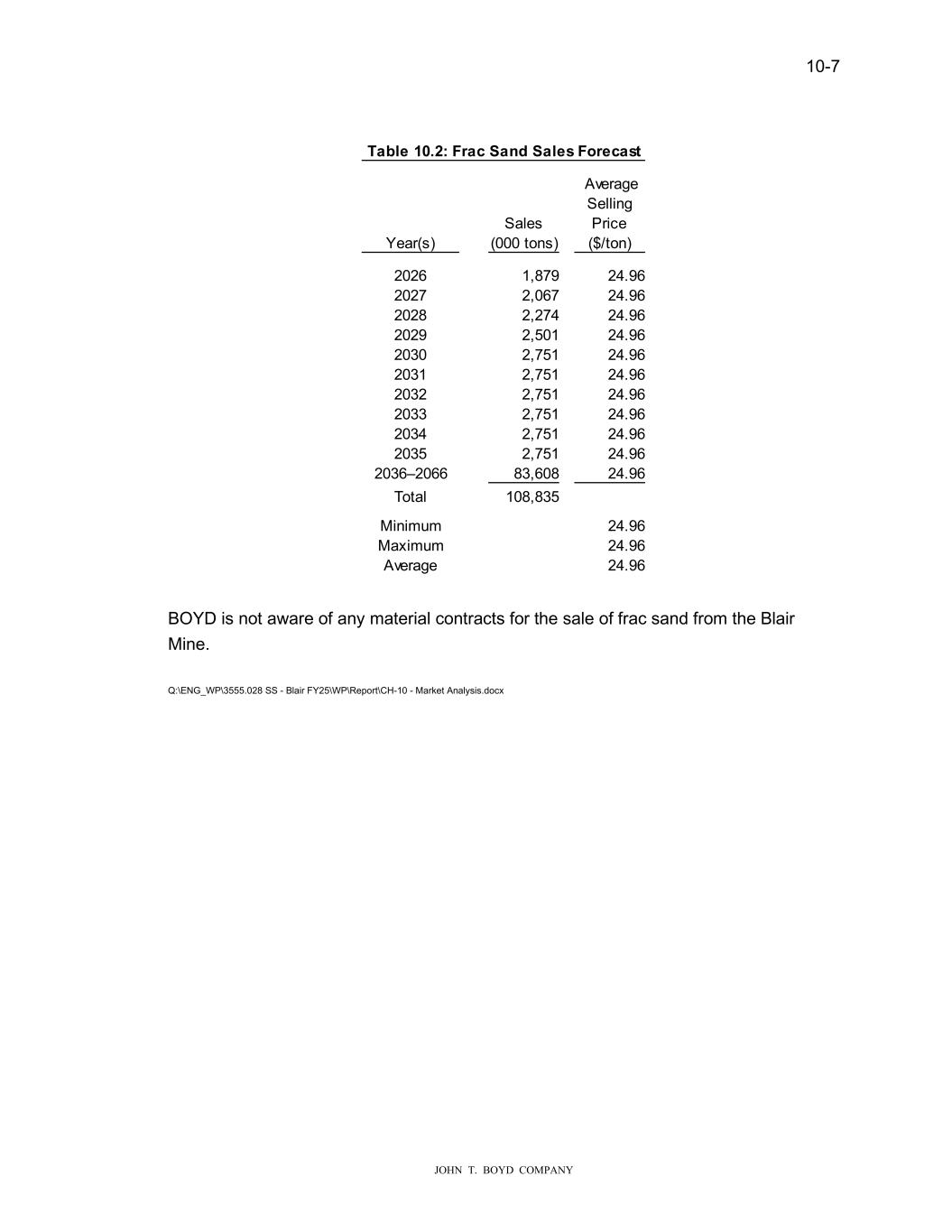
10-7 JOHN T. BOYD COMPANY BOYD is not aware of any material contracts for the sale of frac sand from the Blair Mine. Q:\ENG_WP\3555.028 SS - Blair FY25\WP\Report\CH-10 - Market Analysis.docx Sales Average Selling Price Year(s) (000 tons) ($/ton) 2026 1,879 24.96 2027 2,067 24.96 2028 2,274 24.96 2029 2,501 24.96 2030 2,751 24.96 2031 2,751 24.96 2032 2,751 24.96 2033 2,751 24.96 2034 2,751 24.96 2035 2,751 24.96 2036–2066 83,608 24.96 Total 108,835 Minimum 24.96 Maximum 24.96 Average 24.96 Table 10.2: Frac Sand Sales Forecast
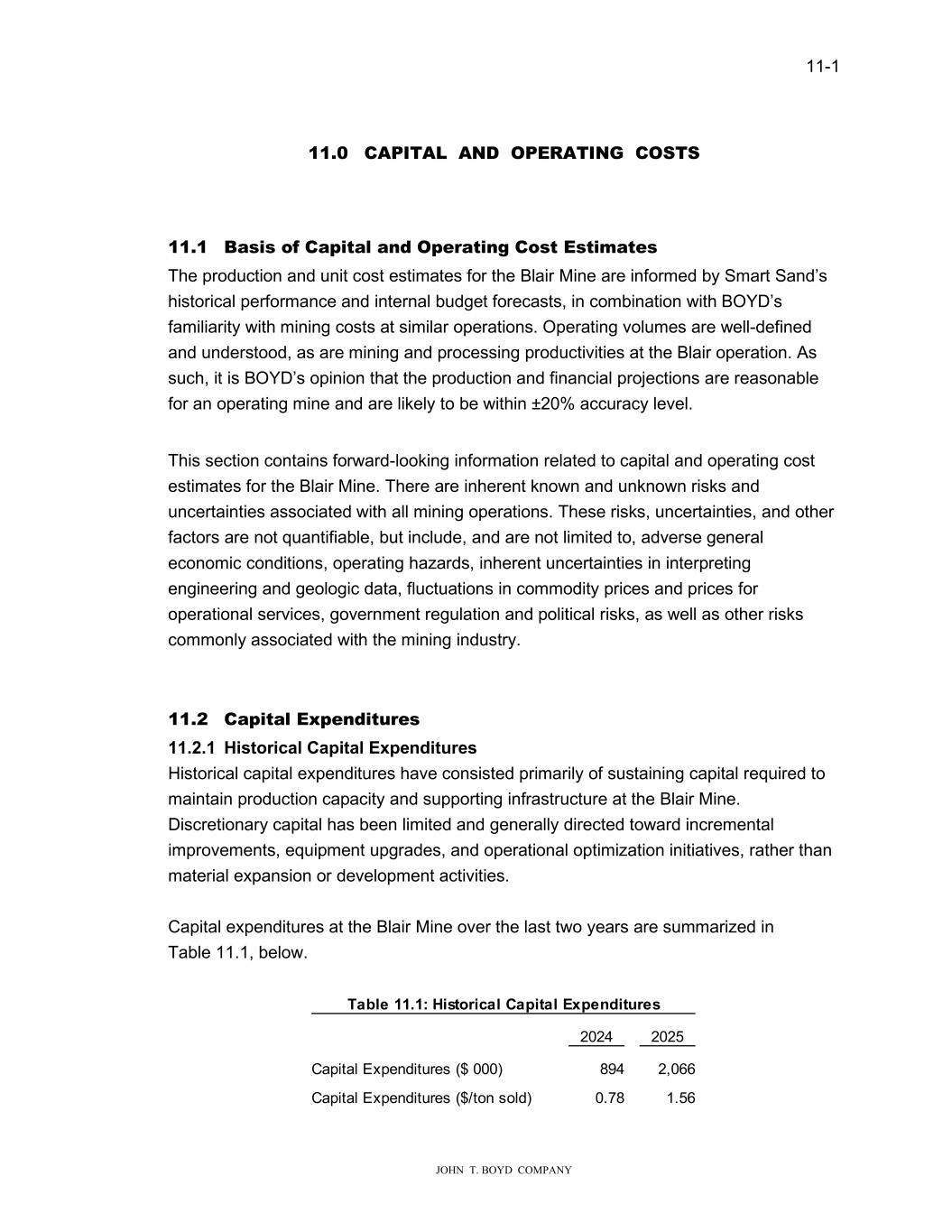
11-1 JOHN T. BOYD COMPANY 11.0 CAPITAL AND OPERATING COSTS 11.1 Basis of Capital and Operating Cost Estimates The production and unit cost estimates for the Blair Mine are informed by Smart Sand’s historical performance and internal budget forecasts, in combination with BOYD’s familiarity with mining costs at similar operations. Operating volumes are well-defined and understood, as are mining and processing productivities at the Blair operation. As such, it is BOYD’s opinion that the production and financial projections are reasonable for an operating mine and are likely to be within ±20% accuracy level. This section contains forward-looking information related to capital and operating cost estimates for the Blair Mine. There are inherent known and unknown risks and uncertainties associated with all mining operations. These risks, uncertainties, and other factors are not quantifiable, but include, and are not limited to, adverse general economic conditions, operating hazards, inherent uncertainties in interpreting engineering and geologic data, fluctuations in commodity prices and prices for operational services, government regulation and political risks, as well as other risks commonly associated with the mining industry. 11.2 Capital Expenditures 11.2.1 Historical Capital Expenditures Historical capital expenditures have consisted primarily of sustaining capital required to maintain production capacity and supporting infrastructure at the Blair Mine. Discretionary capital has been limited and generally directed toward incremental improvements, equipment upgrades, and operational optimization initiatives, rather than material expansion or development activities. Capital expenditures at the Blair Mine over the last two years are summarized in Table 11.1, below. 2024 2025 Capital Expenditures ($ 000) 894 2,066 Capital Expenditures ($/ton sold) 0.78 1.56 Table 11.1: Historical Capital Expenditures
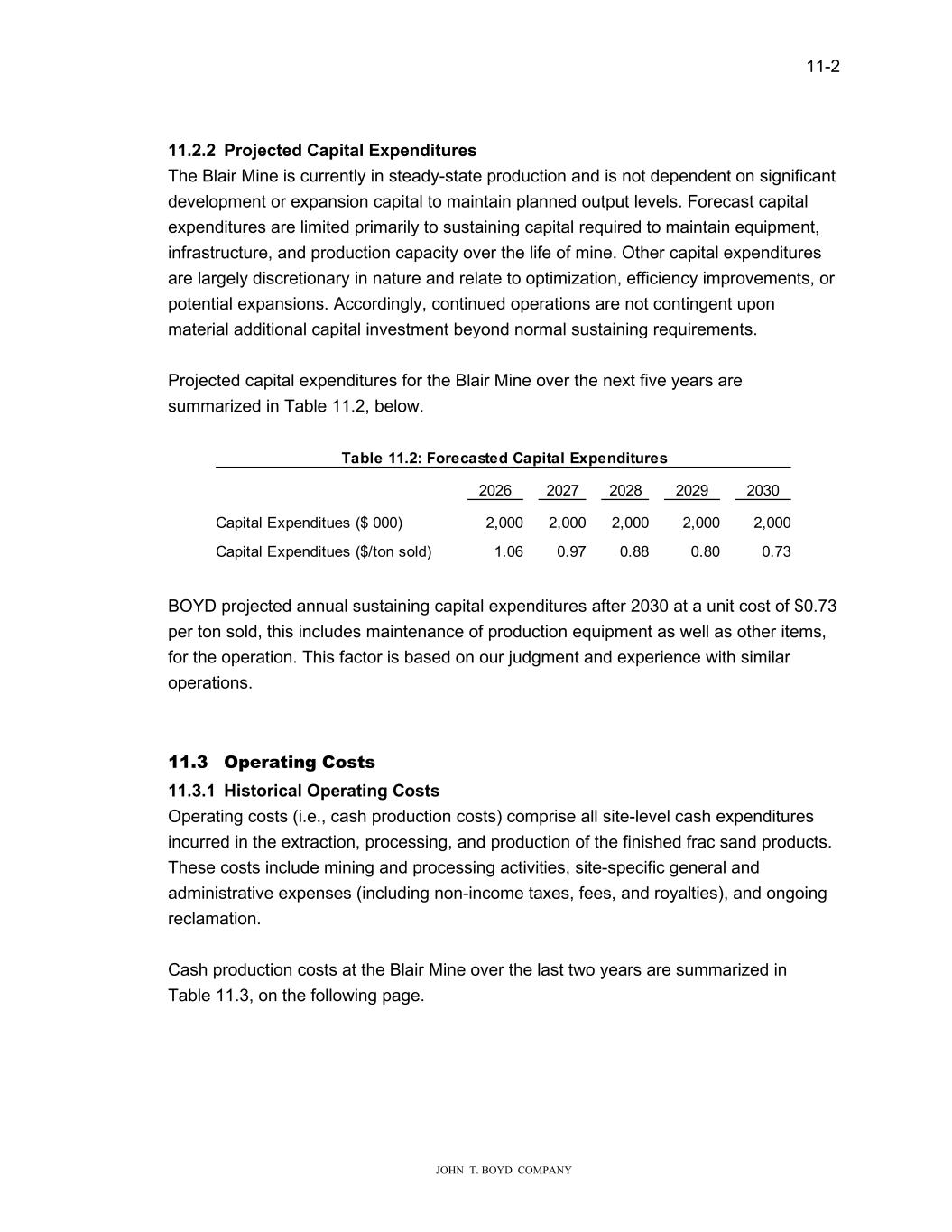
11-2 JOHN T. BOYD COMPANY 11.2.2 Projected Capital Expenditures The Blair Mine is currently in steady-state production and is not dependent on significant development or expansion capital to maintain planned output levels. Forecast capital expenditures are limited primarily to sustaining capital required to maintain equipment, infrastructure, and production capacity over the life of mine. Other capital expenditures are largely discretionary in nature and relate to optimization, efficiency improvements, or potential expansions. Accordingly, continued operations are not contingent upon material additional capital investment beyond normal sustaining requirements. Projected capital expenditures for the Blair Mine over the next five years are summarized in Table 11.2, below. BOYD projected annual sustaining capital expenditures after 2030 at a unit cost of $0.73 per ton sold, this includes maintenance of production equipment as well as other items, for the operation. This factor is based on our judgment and experience with similar operations. 11.3 Operating Costs 11.3.1 Historical Operating Costs Operating costs (i.e., cash production costs) comprise all site-level cash expenditures incurred in the extraction, processing, and production of the finished frac sand products. These costs include mining and processing activities, site-specific general and administrative expenses (including non-income taxes, fees, and royalties), and ongoing reclamation. Cash production costs at the Blair Mine over the last two years are summarized in Table 11.3, on the following page. 2026 2027 2028 2029 2030 Capital Expenditues ($ 000) 2,000 2,000 2,000 2,000 2,000 Capital Expenditues ($/ton sold) 1.06 0.97 0.88 0.80 0.73 Table 11.2: Forecasted Capital Expenditures
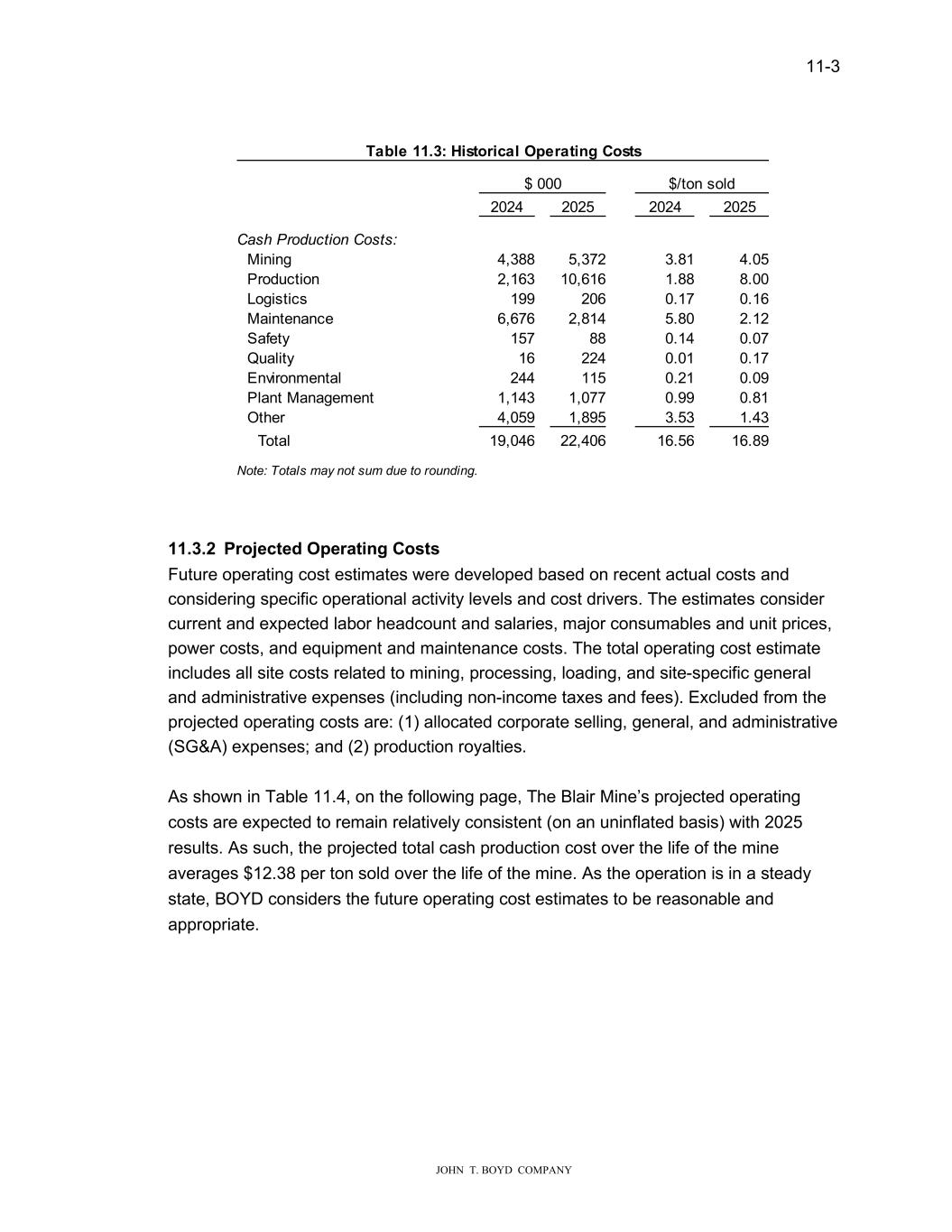
11-3 JOHN T. BOYD COMPANY 11.3.2 Projected Operating Costs Future operating cost estimates were developed based on recent actual costs and considering specific operational activity levels and cost drivers. The estimates consider current and expected labor headcount and salaries, major consumables and unit prices, power costs, and equipment and maintenance costs. The total operating cost estimate includes all site costs related to mining, processing, loading, and site-specific general and administrative expenses (including non-income taxes and fees). Excluded from the projected operating costs are: (1) allocated corporate selling, general, and administrative (SG&A) expenses; and (2) production royalties. As shown in Table 11.4, on the following page, The Blair Mine’s projected operating costs are expected to remain relatively consistent (on an uninflated basis) with 2025 results. As such, the projected total cash production cost over the life of the mine averages $12.38 per ton sold over the life of the mine. As the operation is in a steady state, BOYD considers the future operating cost estimates to be reasonable and appropriate. 2024 2025 2024 2025 Cash Production Costs: Mining 4,388 5,372 3.81 4.05 Production 2,163 10,616 1.88 8.00 Logistics 199 206 0.17 0.16 Maintenance 6,676 2,814 5.80 2.12 Safety 157 88 0.14 0.07 Quality 16 224 0.01 0.17 Environmental 244 115 0.21 0.09 Plant Management 1,143 1,077 0.99 0.81 Other 4,059 1,895 3.53 1.43 Total 19,046 22,406 16.56 16.89 Note: Totals may not sum due to rounding. Table 11.3: Historical Operating Costs $ 000 $/ton sold
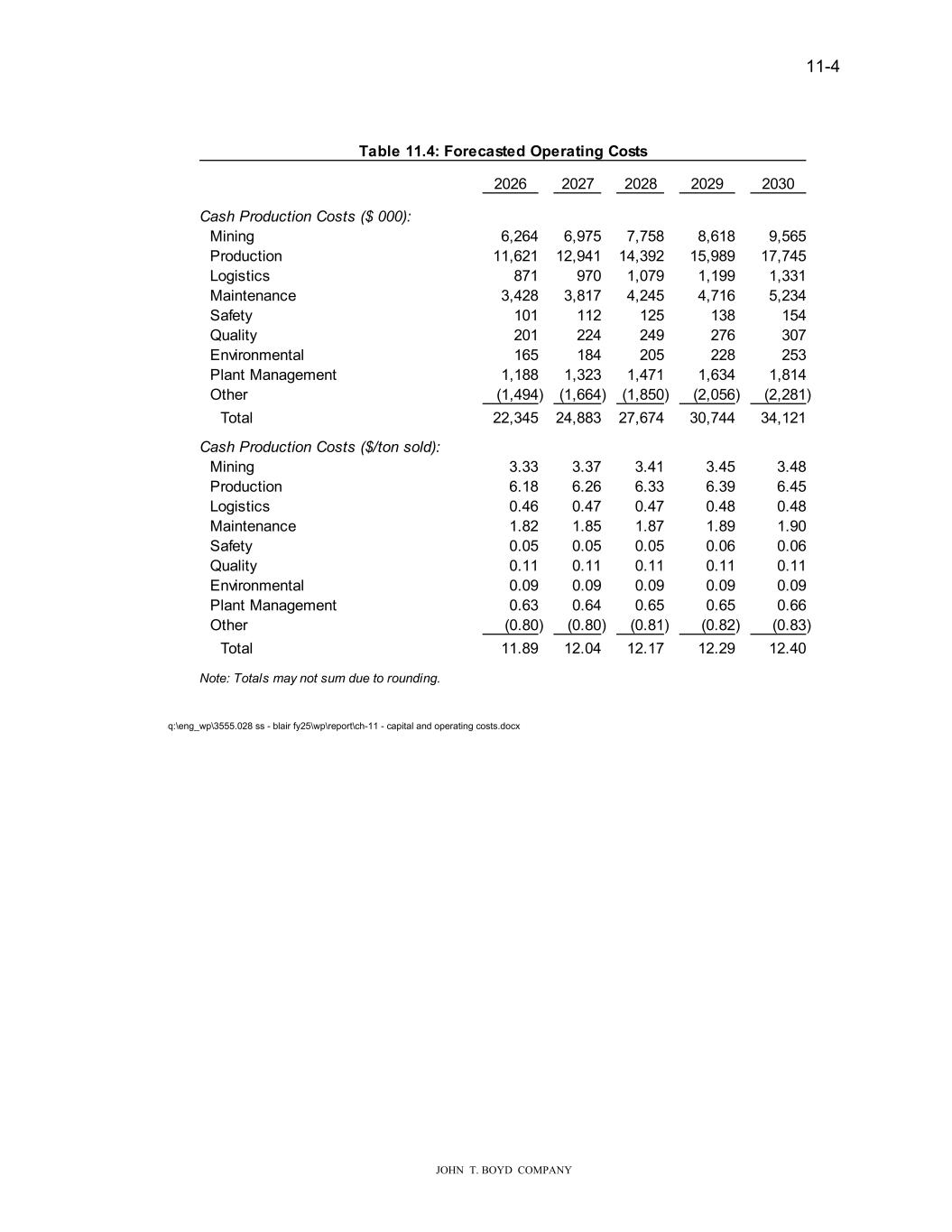
11-4 JOHN T. BOYD COMPANY q:\eng_wp\3555.028 ss - blair fy25\wp\report\ch-11 - capital and operating costs.docx 2026 2027 2028 2029 2030 Cash Production Costs ($ 000): Mining 6,264 6,975 7,758 8,618 9,565 Production 11,621 12,941 14,392 15,989 17,745 Logistics 871 970 1,079 1,199 1,331 Maintenance 3,428 3,817 4,245 4,716 5,234 Safety 101 112 125 138 154 Quality 201 224 249 276 307 Environmental 165 184 205 228 253 Plant Management 1,188 1,323 1,471 1,634 1,814 Other (1,494) (1,664) (1,850) (2,056) (2,281) Total 22,345 24,883 27,674 30,744 34,121 Cash Production Costs ($/ton sold): Mining 3.33 3.37 3.41 3.45 3.48 Production 6.18 6.26 6.33 6.39 6.45 Logistics 0.46 0.47 0.47 0.48 0.48 Maintenance 1.82 1.85 1.87 1.89 1.90 Safety 0.05 0.05 0.05 0.06 0.06 Quality 0.11 0.11 0.11 0.11 0.11 Environmental 0.09 0.09 0.09 0.09 0.09 Plant Management 0.63 0.64 0.65 0.65 0.66 Other (0.80) (0.80) (0.81) (0.82) (0.83) Total 11.89 12.04 12.17 12.29 12.40 Note: Totals may not sum due to rounding. Table 11.4: Forecasted Operating Costs
12-1 JOHN T. BOYD COMPANY 12.0 ECONOMIC ANALYSIS 12.1 Approach The economic analysis presented in this chapter was prepared by BOYD for the purpose of confirming the commercial viability of the Blair Mine’s reported frac sand reserves and not for the purpose of valuing the Blair operation, or its assets. The economic analysis contains forward-looking information related to the projected operating and financial performance of the Blair Mine. This projection involves inherent known and unknown risks and uncertainties, some of which may be outside of Smart Sand’s control. Smart Sand, as with all mining companies, actively evaluates, changes, and modifies business and operating plans in response to various factors that may affect operational and/or financial results. Actual results, production levels, operating expenses, sales realizations, and all other modifying factors could vary significantly from the assumptions and estimates provided in this analysis. Risk is subjective, as such, BOYD recommends that each reader should evaluate the project based on their own investment criteria. The financial model used for the purposes of the economic analysis forecasts future free cash flow from frac sand production and sales over the life cycle of the Blair Mine using the annual forecasts of production, sales revenues, and operating and capital costs discussed earlier in this report. A DCF analysis, in which future free cash flows are discounted to present value, is used to derive an NPV for the frac sand reserves. The use of DCF-NPV analysis is a standard method within the mining industry to assess the economic value of a project after allowing for the cost of capital invested. The financial evaluation of the Blair Mine has been undertaken on a simplified after-tax basis and does not reflect Smart Sand’s corporate tax structure. NPV is calculated using an after-tax discount rate of 12% (NPV12). Cash flows were assumed to occur in the middle of each year and are discounted to January 1, 2026. Cost estimates and other inputs to the cash flow model for the project have been prepared using constant 2025 money terms, i.e., without provision for inflation. The internal rate of return and project payback were not calculated, as there was no initial investment (sunk costs) considered in the financial model provided herein. A suite of sensitivities was calculated to evaluate the effect of the main drivers of economic performance, including variations in sales prices, operating costs, and capital costs.
12-2 JOHN T. BOYD COMPANY 12.2 Assumptions and Limitations Cash flow projections for the Blair Mine have been generated from the annual forecasts of production, sales revenues, and operating and capital costs discussed earlier in this report. A summary of the key assumptions and limitations is provided below: • Sales volumes of finished frac sand through 2030 are based on Smart Sand’s budget projections and are expected to remain constant thereafter. Forecasted sales volumes are at or below the capacity of the Blair processing facilities (approximately 2.9 million tons of finished frac sand per year). • ROM production requirements are based on an expected processing yield of 67.5% and will remain in line with expected sales volumes. Forecasted ROM production is at or below the capacity of the existing mining equipment and related infrastructure. • Forecasted revenues are based on projected sales of various sizes (e.g., 20/40, 30/50, 30/70, 40/70, and 70/140-mesh) of finished frac sand with a weighted average mine gate sales price of $24.96 per ton in 2026, and remain relatively constant over the life of the reserves. Additional transportation and delivery costs are assumed to be incurred by the customer or added as a pass-through to the mine gate price. Market specifications and forecasted sales prices for Smart Sand’s finished frac sand from the Blair Mine are provided in Chapter 10. • Projected operating costs are discussed in Chapter 11 and include all site costs related to mining, processing, loading, and general and administrative expenses (including non-income taxes and fees). Unit operating costs are expected to remain relatively constant over the life of the operation. • Projected capital expenditures are discussed in Chapter 11 and include sustaining/maintenance of operations costs. Unit capital expenditures are expected to remain relatively constant over the life of the operation. • No allowance for changes in or the recapture of working capital has been made in the financial analysis as the Blair Mine business unit is a going concern. Exclusion of working capital from the financial analysis does not have a material impact on the NPV calculation. • Depreciation and amortization expenses through 2030 are based on Smart Sand’s budget projections and are expected to remain constant thereafter. • Allocation of corporate SG&A expenses is based on the Blair Mine’s relative share of Smart Sand’s operating performance. • Anticipated royalty payments have been provided by Smart Sand. • Income taxes are based on: − Federal Business Income Tax rate of 21%. − Wisconsin State Income Tax rate of 7.9%. • Asset recovery/salvage values were not included in the valuation. • Post-mining reclamation costs were not included in the valuation.
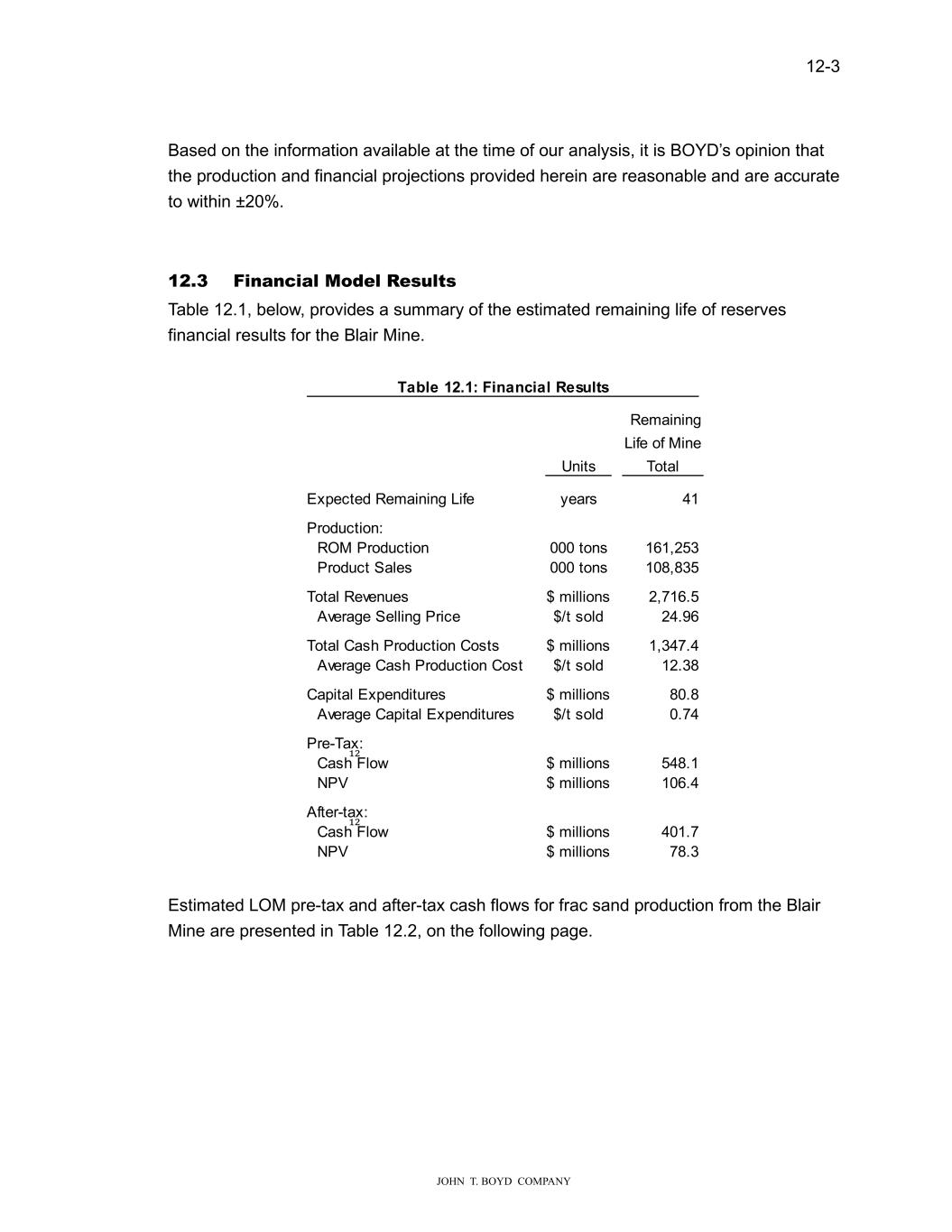
12-3 JOHN T. BOYD COMPANY Based on the information available at the time of our analysis, it is BOYD’s opinion that the production and financial projections provided herein are reasonable and are accurate to within ±20%. 12.3 Financial Model Results Table 12.1, below, provides a summary of the estimated remaining life of reserves financial results for the Blair Mine. Estimated LOM pre-tax and after-tax cash flows for frac sand production from the Blair Mine are presented in Table 12.2, on the following page. Units Remaining Life of Mine Total Expected Remaining Life years 41 Production: ROM Production 000 tons 161,253 Product Sales 000 tons 108,835 Total Revenues $ millions 2,716.5 Average Selling Price $/t sold 24.96 Total Cash Production Costs $ millions 1,347.4 Average Cash Production Cost $/t sold 12.38 Capital Expenditures $ millions 80.8 Average Capital Expenditures $/t sold 0.74 Pre-Tax: Cash Flow $ millions 548.1 NPV ₁₂ $ millions 106.4 After-tax: Cash Flow $ millions 401.7 NPV ₁₂ $ millions 78.3 Table 12.1: Financial Results
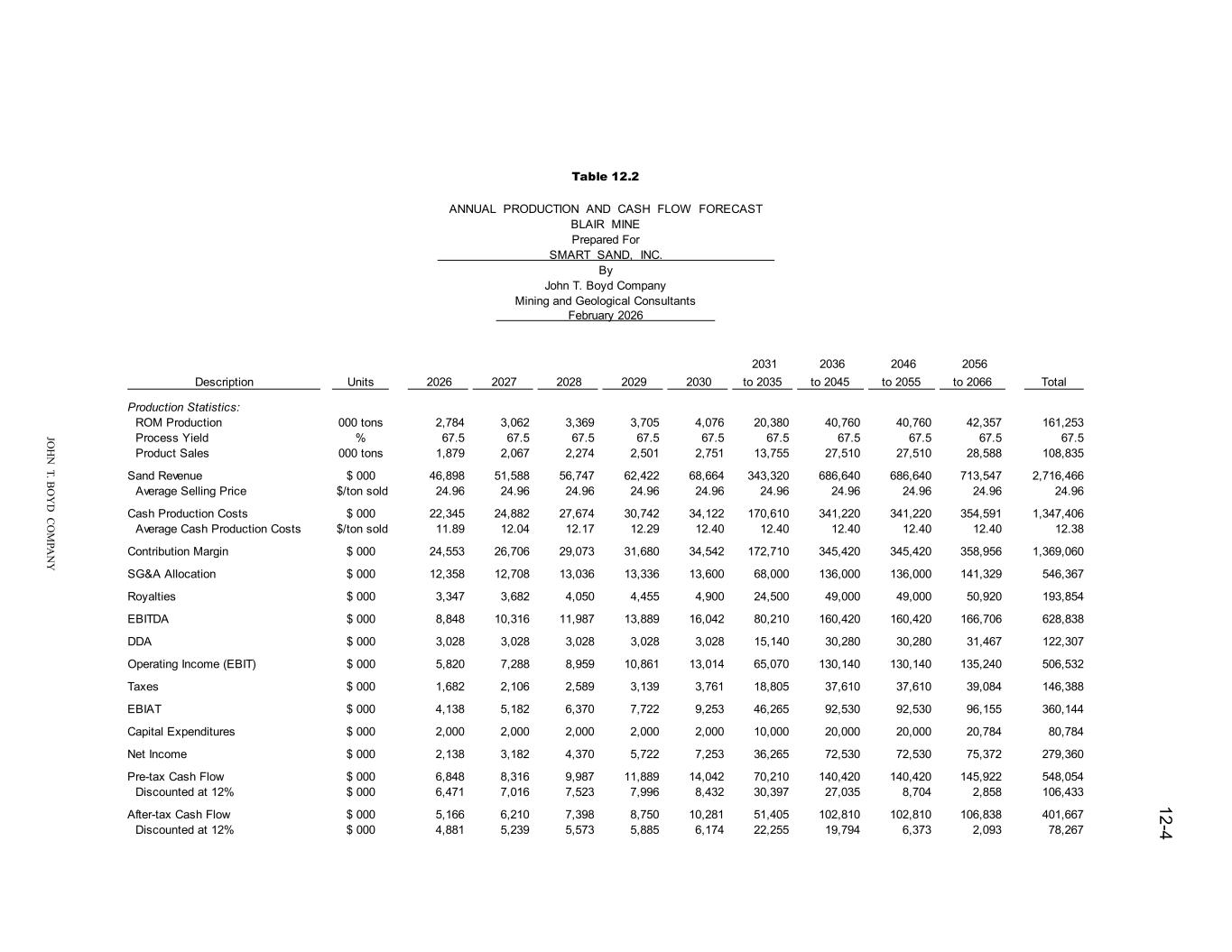
12-4 JO H N T. B O Y D C O M PA N Y Description Units 2026 2027 2028 2029 2030 Total Production Statistics: ROM Production 000 tons 2,784 3,062 3,369 3,705 4,076 20,380 40,760 40,760 42,357 161,253 Process Yield % 67.5 67.5 67.5 67.5 67.5 67.5 67.5 67.5 67.5 67.5 Product Sales 000 tons 1,879 2,067 2,274 2,501 2,751 13,755 27,510 27,510 28,588 108,835 Sand Revenue $ 000 46,898 51,588 56,747 62,422 68,664 343,320 686,640 686,640 713,547 2,716,466 Average Selling Price $/ton sold 24.96 24.96 24.96 24.96 24.96 24.96 24.96 24.96 24.96 24.96 Cash Production Costs $ 000 22,345 24,882 27,674 30,742 34,122 170,610 341,220 341,220 354,591 1,347,406 Average Cash Production Costs $/ton sold 11.89 12.04 12.17 12.29 12.40 12.40 12.40 12.40 12.40 12.38 Contribution Margin $ 000 24,553 26,706 29,073 31,680 34,542 172,710 345,420 345,420 358,956 1,369,060 SG&A Allocation $ 000 12,358 12,708 13,036 13,336 13,600 68,000 136,000 136,000 141,329 546,367 Royalties $ 000 3,347 3,682 4,050 4,455 4,900 24,500 49,000 49,000 50,920 193,854 EBITDA $ 000 8,848 10,316 11,987 13,889 16,042 80,210 160,420 160,420 166,706 628,838 DDA $ 000 3,028 3,028 3,028 3,028 3,028 15,140 30,280 30,280 31,467 122,307 Operating Income (EBIT) $ 000 5,820 7,288 8,959 10,861 13,014 65,070 130,140 130,140 135,240 506,532 Taxes $ 000 1,682 2,106 2,589 3,139 3,761 18,805 37,610 37,610 39,084 146,388 EBIAT $ 000 4,138 5,182 6,370 7,722 9,253 46,265 92,530 92,530 96,155 360,144 Capital Expenditures $ 000 2,000 2,000 2,000 2,000 2,000 10,000 20,000 20,000 20,784 80,784 Net Income $ 000 2,138 3,182 4,370 5,722 7,253 36,265 72,530 72,530 75,372 279,360 Pre-tax Cash Flow $ 000 6,848 8,316 9,987 11,889 14,042 70,210 140,420 140,420 145,922 548,054 Discounted at 12% $ 000 6,471 7,016 7,523 7,996 8,432 30,397 27,035 8,704 2,858 106,433 After-tax Cash Flow $ 000 5,166 6,210 7,398 8,750 10,281 51,405 102,810 102,810 106,838 401,667 Discounted at 12% $ 000 4,881 5,239 5,573 5,885 6,174 22,255 19,794 6,373 2,093 78,267 SMART SAND, INC. By 2031 to 2035 2036 to 2045 2046 to 2055 Table 12.2 ANNUAL PRODUCTION AND CASH FLOW FORECAST BLAIR MINE Prepared For John T. Boyd Company Mining and Geological Consultants February 2026 2056 to 2066
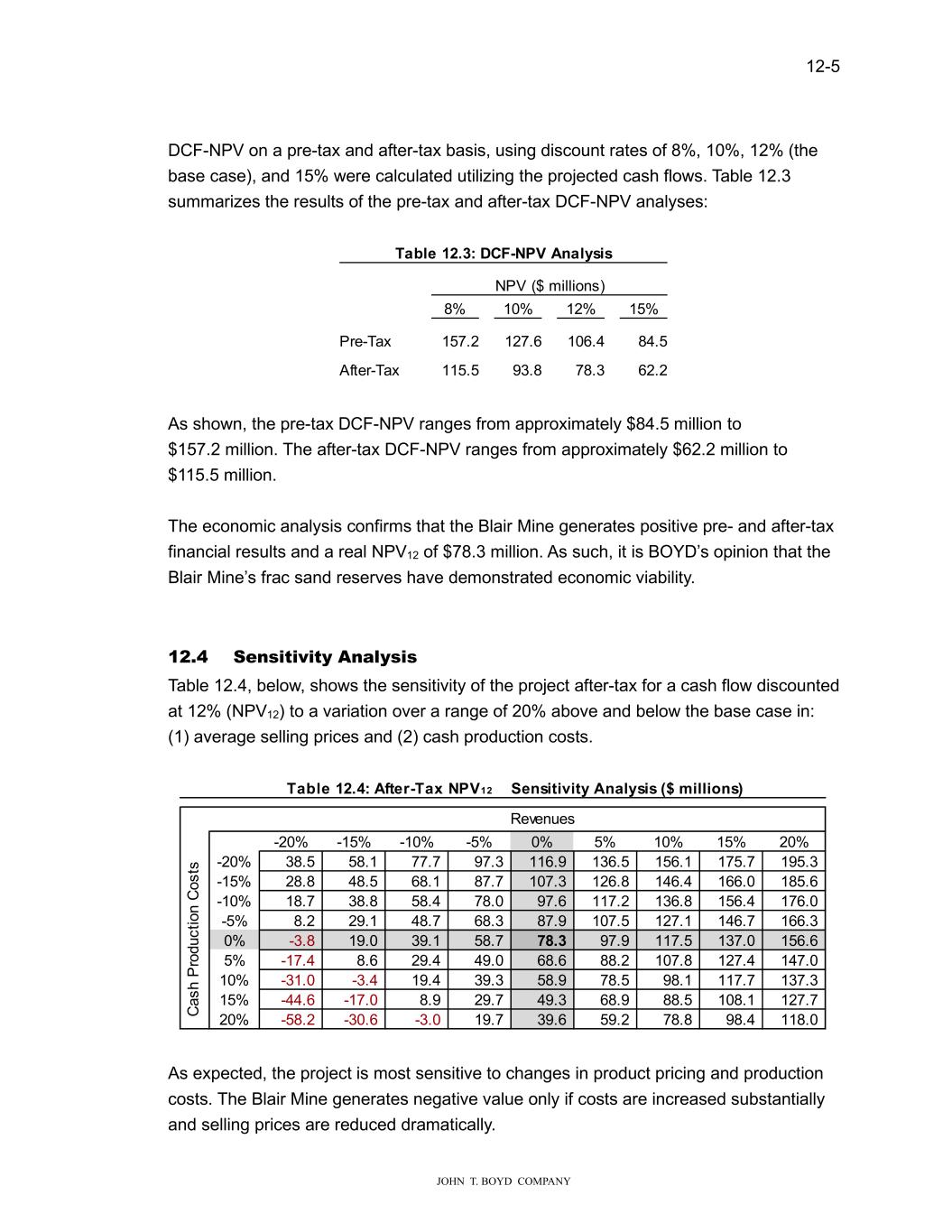
12-5 JOHN T. BOYD COMPANY DCF-NPV on a pre-tax and after-tax basis, using discount rates of 8%, 10%, 12% (the base case), and 15% were calculated utilizing the projected cash flows. Table 12.3 summarizes the results of the pre-tax and after-tax DCF-NPV analyses: As shown, the pre-tax DCF-NPV ranges from approximately $84.5 million to $157.2 million. The after-tax DCF-NPV ranges from approximately $62.2 million to $115.5 million. The economic analysis confirms that the Blair Mine generates positive pre- and after-tax financial results and a real NPV12 of $78.3 million. As such, it is BOYD’s opinion that the Blair Mine’s frac sand reserves have demonstrated economic viability. 12.4 Sensitivity Analysis Table 12.4, below, shows the sensitivity of the project after-tax for a cash flow discounted at 12% (NPV12) to a variation over a range of 20% above and below the base case in: (1) average selling prices and (2) cash production costs. As expected, the project is most sensitive to changes in product pricing and production costs. The Blair Mine generates negative value only if costs are increased substantially and selling prices are reduced dramatically. 8% 10% 12% 15% Pre-Tax 157.2 127.6 106.4 84.5 After-Tax 115.5 93.8 78.3 62.2 Table 12.3: DCF-NPV Analysis NPV ($ millions) -20% -15% -10% -5% 0% 5% 10% 15% 20% -20% 38.5 58.1 77.7 97.3 116.9 136.5 156.1 175.7 195.3 -15% 28.8 48.5 68.1 87.7 107.3 126.8 146.4 166.0 185.6 -10% 18.7 38.8 58.4 78.0 97.6 117.2 136.8 156.4 176.0 -5% 8.2 29.1 48.7 68.3 87.9 107.5 127.1 146.7 166.3 0% -3.8 19.0 39.1 58.7 78.3 97.9 117.5 137.0 156.6 5% -17.4 8.6 29.4 49.0 68.6 88.2 107.8 127.4 147.0 10% -31.0 -3.4 19.4 39.3 58.9 78.5 98.1 117.7 137.3 15% -44.6 -17.0 8.9 29.7 49.3 68.9 88.5 108.1 127.7 20% -58.2 -30.6 -3.0 19.7 39.6 59.2 78.8 98.4 118.0 C as h P ro du ct io n C os ts Table 12.4: After-Tax NPV12 Sensitivity Analysis ($ millions) Revenues
12-6 JOHN T. BOYD COMPANY The project is less sensitive to capital costs. There is little to no impact varying the capital costs from 70% to 130% of the base case. This analysis demonstrates the project value to be relatively robust, with positive NPVs reported across a wide range of assessed values. q:\eng_wp\3555.028 ss - blair fy25\wp\report\ch-12 - economic analysis.docx
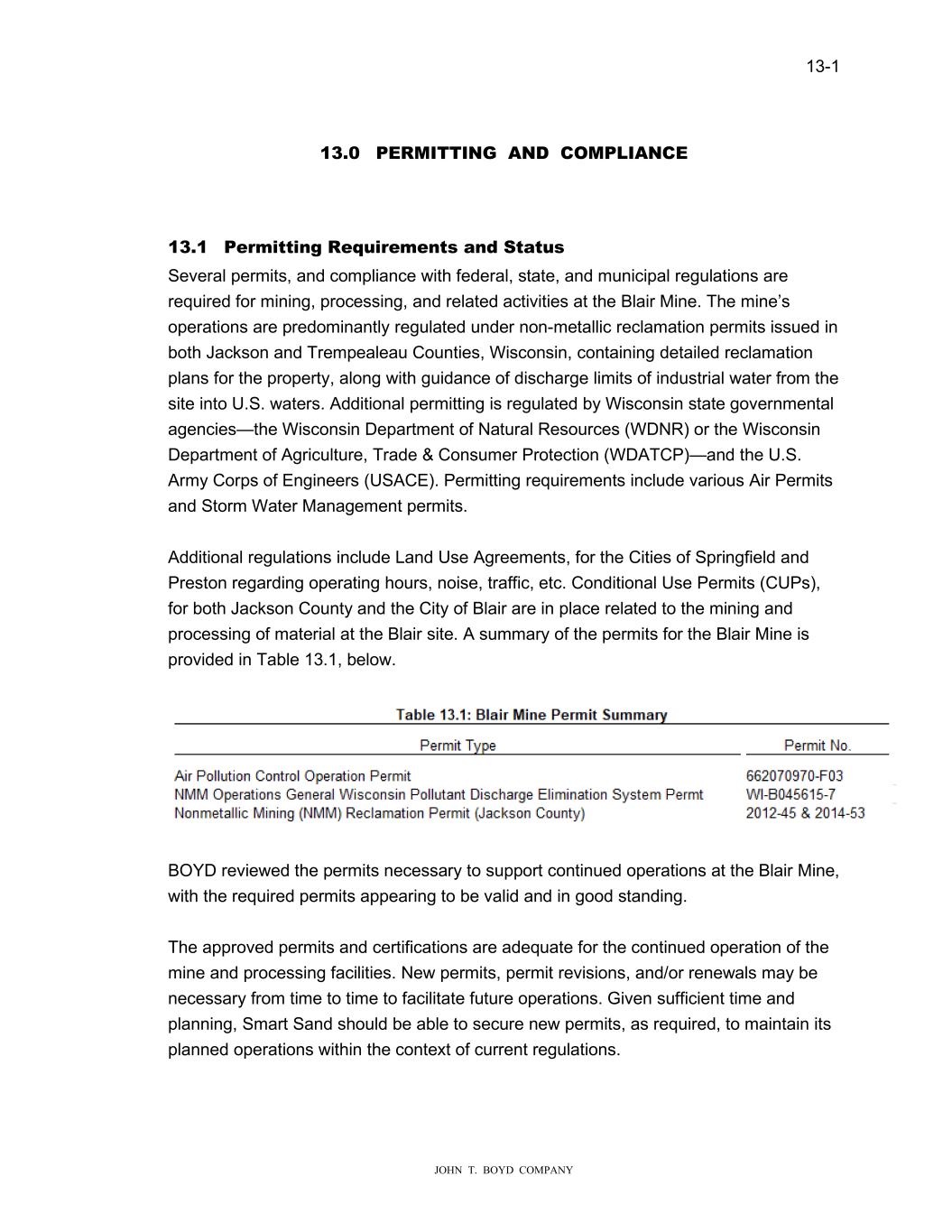
13-1 JOHN T. BOYD COMPANY 13.0 PERMITTING AND COMPLIANCE 13.1 Permitting Requirements and Status Several permits, and compliance with federal, state, and municipal regulations are required for mining, processing, and related activities at the Blair Mine. The mine’s operations are predominantly regulated under non-metallic reclamation permits issued in both Jackson and Trempealeau Counties, Wisconsin, containing detailed reclamation plans for the property, along with guidance of discharge limits of industrial water from the site into U.S. waters. Additional permitting is regulated by Wisconsin state governmental agencies—the Wisconsin Department of Natural Resources (WDNR) or the Wisconsin Department of Agriculture, Trade & Consumer Protection (WDATCP)—and the U.S. Army Corps of Engineers (USACE). Permitting requirements include various Air Permits and Storm Water Management permits. Additional regulations include Land Use Agreements, for the Cities of Springfield and Preston regarding operating hours, noise, traffic, etc. Conditional Use Permits (CUPs), for both Jackson County and the City of Blair are in place related to the mining and processing of material at the Blair site. A summary of the permits for the Blair Mine is provided in Table 13.1, below. BOYD reviewed the permits necessary to support continued operations at the Blair Mine, with the required permits appearing to be valid and in good standing. The approved permits and certifications are adequate for the continued operation of the mine and processing facilities. New permits, permit revisions, and/or renewals may be necessary from time to time to facilitate future operations. Given sufficient time and planning, Smart Sand should be able to secure new permits, as required, to maintain its planned operations within the context of current regulations.
13-2 JOHN T. BOYD COMPANY 13.2 Environmental Studies It is BOYD’s understanding that various studies related to wetland delineation and ambient air monitoring have been completed for the Blair Mine. As part of the state and federal permitting process, various environmental assessments have been conducted and reviewed by the relevant local, state, and federal agencies. As the necessary permits for mining and processing operations have been issued, it is BOYD’s understanding that all environmental assessments have been accepted by the relevant regulatory bodies, and no material issues were found. 13.3 Waste Disposal and Water Management The coarse refuse generated from the sand processing operations is stockpiled and used in the construction of impoundments or backfilled into dredge ponds or previously mined pits. The fine refuse generated from the sand processing operations is disposed of by pumping it into dredge or impoundment ponds. Waste disposal facilities are in place for current mining operations, with plans to expand the disposal facilities to meet life of reserve storage requirements. Please refer to Section 9.4 for a description of these facilities. Water control structures are in place and function as required by regulatory agencies. 13.4 Compliance Mine safety is regulated by the Mine Safety and Health Administration (MSHA), as are all mining operations. MSHA inspects the facilities, at a minimum, twice a year. Smart Sand’s safety record compares favorably with its regional peers. Based on our review of information provided by Smart Sand and available public information, it is BOYD’s opinion that the Blair Mine’s record of compliance with applicable mining, water quality, and environmental regulations is generally typical for that of the industry. BOYD is not aware of any regulatory violation or compliance issue which would materially impact the frac sand reserve estimate. 13.5 Plans, Negotiations, or Agreements New permits and certain permit amendments/revisions require public notification. The public is made aware of pending permits by advertisement in local newspapers. Additionally, a copy of the application is retained at the local county’s public library for
13-3 JOHN T. BOYD COMPANY review. A comment period follows the last advertisement date to allow the public to submit comments to the regulatory authority. BOYD is not aware of any community or stakeholder concerns, impacts, negotiations, or agreements that would materially impact the estimated frac sand reserves. 13.6 Post-Mining Land Use and Reclamation Under current regulations in Wisconsin, the WDNR governs surface mining reclamation, outlining requirements in Chapter NR 135 of the Wisconsin Administrative Code. WDNR requires reclamation permits and plans be approved prior to beginning mining operations and requires operators to provide financial guarantees ensuring their ability to complete approved reclamation plans. Local ordinances for non-metallic mining reclamation plans are also enforced by each county, or incorporated areas within a county, that ensure non-metallic mining operations are reclaimed to meet standardized reclamation requirements, ground stabilization, revegetation, surface water management, groundwater quality, development and restoration of natural habitats, and the removal of refuse. As a matter of good mining practice, Smart Sand acts to conduct progressive reclamation throughout the operation’s mining life to minimize risk and costs at closure. Mine site reclamation costs are included in the capital and operating costs discussed in Chapter 11 and included in the economic analysis presented in Chapter 12. 13.7 Local Procurement and Hiring BOYD is not aware of any commitments for local procurement or hiring. Smart Sand reports making efforts to source supplies and materials from regional vendors. The workforce is likewise located in the regional area. Smart Sand’s stated core values include making positive impacts in the communities in which it operates. In addition to the payment of income taxes and other local community taxes, such as property taxes and royalties, Smart Sand supports, financially and otherwise, local community endeavors. Q:\ENG_WP\3555.028 SS - Blair FY25\WP\Report\CH-13 - Permitting and Compliance.docx
14-1 JOHN T. BOYD COMPANY 14.0 INTERPRETATION AND CONCLUSIONS 14.1 Findings BOYD’s independent technical assessment was conducted in accordance with S-K 1300 and concludes: • Sufficient data have been obtained through the site exploration and sampling programs and mining operations to support the geological interpretations of the sand deposit underlying the Blair Property. The data are of sufficient quantity and reliability to reasonably support the sand resource and sand reserve estimates presented in this report. • BOYD is of the opinion that our data validation efforts: (1) adequately confirm the reasonableness of the geologic interpretations, resource estimation criteria, and economic assumptions; and (2) support the use of the data in frac sand resource/reserve estimation. • The 108.8 million product tons of proppant sand reserves (as of December 31, 2025) identified on the property are reasonably and appropriately supported by technical studies, which consider expected geologic conditions, planned mining and processing operations, forecasted product revenues, and operating and capital cost estimates. As such, BOYD is of the opinion that there are reasonable expectations that the stated frac sand reserves for the Blair Mine are technically, economically, and legally extractable as of December 31, 2025. • To our knowledge, there are no other relevant data or information considered material to the Blair Mine that would impact or change this technical report summary. 14.2 Significant Risks and Uncertainties The ability of Smart Sand, or any mining company, to achieve production and financial projections is dependent on numerous factors. These factors primarily include site- specific geological conditions, the capabilities of management and operational personnel, product sales prices and market conditions, environmental issues, securing permit renewals and bonds, and developing and operating mines in a safe and efficient manner. Unforeseen changes in legislation and new industry developments could substantially alter the performance of any mining company. It is our understanding that Smart Sand continuously assesses these factors and adjusts operating plans as a matter of course. As a mining operation with an established history of commercial success, there is a high degree of certainty for the Blair Mine under the current and foreseeable operating
14-2 JOHN T. BOYD COMPANY environment. However, it should be noted that frac sand is generally marketed exclusively to the energy sector which has historically faced more volatility than many other industries. Subject specific assessments of risk are presented in the relevant sections of this report. 14.3 Recommendations Based on the current status of the Blair Mine, BOYD has no recommendations for additional work relevant to the subject frac sand reserves at this time. Q:\ENG_WP\3555.028 SS - Blair FY25\WP\Report\CH-14 - Conclusions.docx