UNITED
STATES
SECURITIES
AND EXCHANGE COMMISSION
Washington,
D.C. 20549
FORM
20-F
(Mark
One)
OR
For
the fiscal year ended December
31 , 2025
OR
For
the transition period from to
OR
Date
of event requiring this shell company report
Commission
File Number 001-40490
(Exact
name of Registrant as specified in its charter)
Not
Applicable
(Translation
of Registrant’s name into English)
State
of Israel
(Jurisdiction
of incorporation or organization)
Telephone+972
77-331-0156
(Address
of principal executive offices)
Chief
Financial Officer
Telephone+972
77-331-0156
(Name,
Telephone, E-mail and/or Facsimile number and Address of Company Contact Person)
Securities
registered or to be registered, pursuant to Section 12(b) of the Act
|
Title
of each class |
|
Trading
Symbol(s) |
|
Name
of each exchange on which registered |
|
|
|
|
|
|
|
|
|
|
|
|
*Not
for trading; only in connection with the registration of American Depository Shares.
Securities
registered or to be registered pursuant to Section 12(g) of the Act: None
Securities
for which there is a reporting obligation pursuant to Section 15(d) of the Act: None
Indicate
the number of outstanding shares of each of the issuer’s classes of capital stock or common stock as of the close of the period
covered by the annual report. As of December 31, 2025, the registrant had outstanding 575,381,320
ordinary shares, no par value (equal to 7,192,276 ADSs).
Indicate
by check mark if the registrant is a well-known seasoned issuer, as defined in Rule 405 of the Securities Act.
Yes ☐
No ☒
If
this report is an annual or transition report, indicate by check mark if the registrant is not required to file reports pursuant to Section
13 or 15(d) of the Securities Exchange Act of 1934.
Yes ☐
No ☒
Note-Checking
the box above will not relieve any registrant required to file reports pursuant to Section 13 or 15(d) of the Securities Exchange Act
of 1934 from their obligations under those Sections.
Indicate
by check mark whether the registrant (1) has filed all reports required to be filed by Section 13 or 15(d) of the Securities Exchange
Act of 1934 during the preceding 12 months (or for such shorter period that the registrant was required to file such reports), and (2)
has been subject to such filing requirements for the past 90 days.
Indicate
by check mark whether the registrant has submitted electronically every Interactive Data File required to be submitted pursuant to Rule
405 of Regulation S-T (§ 232.405 of this chapter) during the preceding 12 months (or for such shorter period that the registrant
was required to submit such files).
Indicate
by check mark whether the registrant is a large accelerated filer, an accelerated filer, a non-accelerated filer, or an emerging growth
company. See definition of “large accelerated filer,” “accelerated filer,” and “emerging growth company”
in Rule 12b-2 of the Exchange Act.
|
☐
Large accelerated filer |
☐
Accelerated filer |
☒ |
|
If
an emerging growth company that prepares its financial statements in accordance with U.S. GAAP, indicate by check mark if the registrant
has elected not to use the extended transition period for complying with any new or revised financial accounting standards provided
pursuant to Section 13(a) of the Exchange Act. ☐
Indicate
by check mark whether the registrant has filed a report on and attestation to its management’s assessment of the effectiveness of
its internal control over financial reporting under Section 404(b) of the Sarbanes-Oxley Act (15 U.S.C. 7262(b)) by the registered public
accounting firm that prepared or issued its audit report.☐
If
securities are registered pursuant to Section 12(b) of the Act, indicate by check mark whether the financial statements of the registrant
included in the filing reflect the correction of an error to previously issued financial statements. ☐
Indicate
by check mark whether any of those error corrections are restatements that required a recovery analysis of incentive-based compensation
received by any of the registrant’s executive officers during the relevant recovery period pursuant to §240.10D-1(b). ☐
Indicate
by check mark which basis of accounting the registrant has used to prepare the financial statements included in this filing:
|
☒
|
☐
International Financial Reporting Standards as issued by the International Accounting Standards Board |
☐
Other |
If
“Other” has been checked in response to the previous question indicate by check mark which financial statement item the registrant
has elected to follow.
Item
17 ☐ Item 18 ☐
If
this is an annual report, indicate by check mark whether the registrant is a shell company (as defined in Rule 12b-2 of the Exchange Act).
Yes ☐
No ☒
If
securities are registered pursuant to Section 12(b) of the Act, indicate by check mark whether the financial statements of the registrant
included in the filing reflect the correction of an error to previously issued financial statements.
Yes ☐
No ☒
|
2 | ||
|
|
||
| 4 | ||
|
|
||
| 5 | ||
|
|
||
| 5 | ||
|
|
||
| 5 | ||
|
|
||
| 5 | ||
|
|
||
|
A. |
[Reserved.] |
5 |
|
|
|
|
|
B. |
Capitalization and Indebtedness |
5 |
|
|
|
|
|
C. |
Reasons for the Offer and Use of Proceeds |
5 |
|
|
|
|
|
D. |
Risk Factors |
5 |
|
|
|
|
| 27 | ||
|
|
||
|
A. |
History and Development of the Company |
27 |
|
|
|
|
|
B. |
Business Overview |
28 |
|
|
|
|
|
C. |
Organizational Structure |
|
|
|
|
|
|
D. |
Property, Plants and Equipment |
|
|
|
|
|
| 64 | ||
|
|
||
| 64 | ||
|
|
||
|
A. |
Operating Results |
65 |
|
|
|
|
|
B. |
Liquidity and Capital Resources |
69 |
|
|
|
|
|
C. |
Research and Development, Patents and Licenses, Etc. |
71 |
|
|
|
|
|
D. |
Trend Information |
71 |
|
|
|
|
|
E. |
Critical Accounting Estimates |
71 |
|
71 | ||
|
|
||
|
A. |
Directors and Senior Management |
71 |
|
|
|
|
|
B. |
Compensation |
73 |
|
|
|
|
|
C. |
Board Practices |
77 |
|
|
|
|
|
D. |
Employees |
86 |
|
|
|
|
|
E. |
Share Ownership |
86 |
|
|
|
|
|
F. |
Disclosure of a Registrant’s Action to Recover Erroneously Awarded Compensation
|
86 |
|
|
|
|
|
86 | ||
|
|
||
|
A. |
Major Shareholders |
86 |
|
|
|
|
|
B. |
Related Party Transactions |
88 |
|
|
|
|
|
C. |
Interests of Experts and Counsel |
88 |
|
|
|
|
|
88 | ||
|
|
||
|
A. |
Consolidated Statements and Other Financial Information |
88 |
|
|
|
|
|
B. |
Significant Changes |
89 |
|
|
|
|
|
89 | ||
|
|
||
|
A. |
Offer and Listing Details |
89 |
|
|
|
|
|
B. |
Plan of Distribution |
89 |
|
|
|
|
|
C. |
Markets |
89 |
|
|
|
|
|
D. |
Selling Shareholders |
89 |
|
|
|
|
|
E. |
Dilution |
89 |
|
|
|
|
|
F. |
Expenses of the Issue |
89 |
|
|
|
|
| 89 | ||
|
|
||
|
A. |
Share Capital |
89 |
|
|
|
|
|
B. |
Memorandum and Articles of Association |
89 |
|
|
|
|
|
C. |
Material Contracts |
90 |
|
|
|
|
|
D. |
Exchange Controls |
90 |
|
|
|
|
|
E. |
Taxation |
98 |
|
|
|
|
|
F. |
Dividends and Paying Agents |
98 |
|
|
|
|
|
G. |
Statement by Experts |
98 |
|
|
|
|
|
H. |
Documents on Display |
98 |
|
|
|
|
|
I. |
Subsidiary Information |
99 |
|
|
|
|
|
J. |
Annual Report to Security Holders |
99 |
|
99 | ||
|
|
||
| 99 | ||
|
|
||
| 105 | ||
|
|
||
|
105 | ||
|
|
||
|
105 | ||
|
|
||
| 105 | ||
|
|
||
|
106 | ||
|
|
||
| 106 | ||
|
|
||
|
106 | ||
|
|
||
| 107 | ||
|
|
||
| 107 | ||
|
|
||
|
107 | ||
|
|
||
|
107 | ||
|
|
||
| 107 | ||
|
|
||
|
108 | ||
|
|
||
| 108 | ||
|
|
||
|
109 | ||
|
|
||
| 109 | ||
|
|
||
|
110 | ||
|
|
||
|
110 | ||
|
|
||
|
110 | ||
|
|
||
|
110 | ||
|
|
||
| 112 | ||
|
|
||
|
F-1 | ||
INTRODUCTION
In this Annual Report on Form 20-F (the “Annual Report”),
unless context otherwise requires:
|
• |
references to “Chemomab Therapeutics Ltd.”, “Chemomab,” the
“Company,” “us,” “we” and “our” refer to Chemomab Therapeutics Ltd., an Israeli company
and its consolidated subsidiaries; however, with respect to the presentation of financial results for historical periods that preceded
the Merger (as defined below), these terms refer to the financial results of the Company’s wholly owned subsidiary, Chemomab Ltd.,
which was the accounting acquirer in the Merger; |
|
• |
references to “ordinary shares,” “our shares” and similar
expressions refer to the Company’s ordinary shares, no nominal (par) value; |
|
• |
references to “ADS” refer to the American Depositary Shares listed on
the Nasdaq Capital Market (“Nasdaq”) under the symbol “CMMB,” each representing eighty (80) ordinary shares;
|
|
• |
references to “dollars,” “U.S. dollars” and “$”
are to United States Dollars; |
|
• |
references to “NIS” are to New Israeli Shekels; |
|
• |
references to the “Companies Law” are to Israel’s Companies Law,
5759-1999, as amended; |
|
• |
references to the “SEC” are to the U.S. Securities and Exchange Commission;
and |
|
• |
references to the “Merger” refer to the merger involving Anchiano Therapeutics
Ltd., or Anchiano, and Chemomab Ltd., whereby a wholly owned subsidiary of Anchiano merged with and into Chemomab Ltd., with Chemomab
Ltd. surviving as a wholly owned subsidiary of Anchiano. Upon consummation of the Merger on March 16, 2021, Anchiano changed its name
to “Chemomab Therapeutics Ltd.” and the business conducted by Chemomab Ltd. became primarily the business conducted by the
Company. |
This Annual Report contains estimates, projections and other information
concerning our industry and our business, as well as data regarding market research, estimates and forecasts prepared by our management.
Information that is based on estimates, forecasts, projections, market research or similar methodologies is inherently subject to uncertainties,
and actual events or circumstances may differ materially from events and circumstances that are assumed in this information. The industry
in which we operate is subject to a high degree of uncertainty and risk due to a variety of factors, including those discussed under the
headings “Special Note Regarding Forward-Looking Statements” and Item 3.D. “Risk Factors” in this Annual Report.
CAUTIONARY
STATEMENT REGARDING FORWARD-LOOKING STATEMENTS AND A
SUMMARY OF RISK FACTORS
This Annual Report contains forward-looking statements within the meaning of the U.S.
Private Securities Litigation Reform Act of 1995. We intend such forward-looking statements to be covered by the safe harbor provisions
for forward-looking statements as contained in Section 27A of the Securities Act of 1933, as amended, and Section 21E of the Securities
Exchange Act of 1934, as amended (the “Exchange Act”). All statements contained in this Annual Report other than statements
of historical fact, including, without limitation, statements regarding our future operating results and financial position, including
our revenue and operating expenses profitability; our business strategies and plans; our expectations regarding the development of our
industry and the competitive environment in which we operate; our expectations regarding partnerships and collaborations; our objectives
for future operations; our ability to raise additional capital to fund our operations; and the sufficiency of our cash, cash equivalents
and short-term investments, are forward-looking statements. The words “may,” “might,” “will,” “could,”
“would,” “should,” “expect,” “plan,” “anticipate,” “intend,” “target,”
“seek,” “believe,” “estimate,” “predict,” “potential,” “continue,”
“contemplate,” “possible,” “forecasts,” “aims” or the negative of these terms and similar
expressions are intended to identify forward-looking statements, though not all forward-looking statements use these words or expressions.
These forward-looking statements are contained principally in the sections titled Item 3.D. “Key Information-Risk Factors,”
Item 4. “Information on the Company,” and Item 5. “Operating and Financial Review and Prospects.” These statements
are neither promises nor guarantees, but involve known and unknown risks, uncertainties and other important factors that may cause our
actual results, performance or achievements to be materially different from any future results, performance or achievements expressed
or implied by the forward-looking statements, including, but not limited to, the following:
|
•
|
we have incurred significant losses since inception and anticipate that we will continue
to incur increasing levels of operating losses over the next several years and for the foreseeable future. We are unable to predict the
extent of any future losses or when we will become profitable, if at all. Even if we become profitable, we may not be able to sustain
or increase our profitability on a quarterly or annual basis; |
|
|
|
|
• |
we have a limited operating history and funding, which may make it difficult to evaluate
our prospects and likelihood of success; |
|
|
|
|
• |
our business is highly dependent on the success of our lead product candidate, nebokitug,
and any other product candidates that we advance into clinical studies. All of our programs will require significant additional clinical
development; |
|
|
|
|
•
|
our central objective is to design and develop targeted treatments for inflammation
and fibrosis with an initial focus on the antagonism of CCL24 signaling, which is known to regulate fibrotic and inflammatory processes.
While we have conducted extensive preclinical studies and four successful clinical trials in patients, our approach in the area of fibrotic
diseases is novel and unproven and may not result in marketable products; |
|
|
|
|
• |
the successful completion of clinical studies is a prerequisite to submitting a marketing
application to the FDA and similar marketing applications to comparable foreign regulatory authorities, for each product candidate and,
consequently, the ultimate approval and commercial marketing of any product candidates. We may experience negative or inconclusive results,
which may result in us deciding, or regulators requiring us, to conduct additional clinical studies or trials or abandon some or all of
our product development programs, which could have a material adverse effect on our business; |
|
|
|
|
• |
we may encounter difficulties enrolling patients in our clinical studies, including
any public health emergencies and related clinical development activities could be delayed or otherwise adversely affected; |
|
|
|
|
• |
our ongoing and future clinical studies may reveal significant adverse events or immunogenicity-related
responses and may result in a safety profile that could delay or prevent regulatory approval or market acceptance of our product candidate;
|
|
|
|
|
• |
if we do not achieve our projected development and commercialization goals in the
timeframes we announce and expect, the commercialization of our product candidates may be delayed and our business will be harmed;
|
|
|
|
|
•
|
we have been granted Orphan Drug Designation for nebokitug in connection with three
indications and may seek Orphan Drug Designation for other indications or product candidates, and we may be unable to maintain the benefits
associated with Orphan Drug Designation, including the potential for market exclusivity, and may not receive Orphan Drug Designation for
other indications or for our other product candidates; |
2
|
•
|
we expect to experience significant growth in the number of our employees over time
and the scope of our operations, particularly in the areas of product candidate development, regulatory affairs and sales and marketing.
We will therefore need to expand our organization, and we may experience difficulties in managing this growth, which could disrupt our
operations; |
|
|
|
|
• |
if we are unable to protect our patents or other proprietary rights, or if we infringe
the patents or other proprietary rights of others, our competitiveness and business prospects may be materially damaged. In addition,
changes in patent laws or patent jurisprudence could diminish the value of patents in general, thereby impairing our ability to protect
our product candidates; |
|
|
|
|
• |
risks related to our operations in Israel could materially adversely impact our business,
financial condition and results of operations; |
|
|
|
|
•
|
our principal executive offices are located in Israel and US and certain of our product
candidates may be manufactured at third-party facilities located in Europe. In addition, our business strategy includes potentially expanding
internationally if any of our product candidates receives regulatory approval. A variety of risks associated with operating internationally
could materially adversely affect our business; |
|
|
|
|
• |
holders of ADSs are not treated as holders of our Ordinary Shares; |
|
• |
holders of ADSs may not have the same voting rights as the holders of our Ordinary
Shares and may not receive voting materials in time to be able to exercise their right to vote; |
|
|
|
|
• |
holders of ADSs may be subject to limitations on the transfer of their ADSs and the
withdrawal of the underlying Ordinary Shares; |
|
|
|
|
• |
we are entitled to amend the deposit agreement and to change the rights of ADS holders
under the terms of such agreement, or to terminate the deposit agreement, without the prior consent of the ADS holders; |
|
|
|
|
• |
ADSs holders may not be entitled to a jury trial with respect to claims arising under
the deposit agreement, which could result in less favorable outcomes to the plaintiff(s) in any such action; |
|
|
|
|
• |
obtaining and maintaining our patent protection depends on compliance with various
procedural, document submission, fee payment and other requirements imposed by governmental patent agencies, and our patent protection
could be reduced or eliminated for non-compliance with these requirements; |
|
|
|
|
• |
the regulatory approval processes of the FDA and comparable foreign authorities are
lengthy, time consuming and inherently unpredictable, and if we are ultimately unable to obtain regulatory approval for nebokitug or any
other product candidates, our business will be substantially harmed; |
|
|
|
|
• |
obtaining and maintaining regulatory approval of our product candidates in one jurisdiction
does not mean that we will be successful in obtaining regulatory approval of our product candidates in other jurisdictions; |
|
|
|
|
• |
even if we obtain regulatory approval for nebokitug or any product candidate, we will
still face extensive and ongoing regulatory requirements and obligations and any product candidates, if approved, may face future development
and regulatory difficulties; |
|
|
|
|
•
|
disruptions at the FDA and other government agencies caused by funding shortages or
global health concerns could hinder our ability to hire, retain or deploy key leadership and other personnel, or otherwise prevent new
or modified products from being developed, approved or commercialized in a timely manner or at all, which could negatively impact our
business; |
|
|
|
|
• |
if we do not achieve our projected development and commercialization goals in the
timeframes we announce and expect, the commercialization of our product candidates may be delayed and our business will be harmed;
|
|
|
|
|
• |
we face substantial competition, which may result in others discovering, developing
or commercializing products before or more successfully than us; |
|
|
|
|
• |
even if nebokitug or any other product candidate we develop receives marketing approval,
it may fail to achieve market acceptance by physicians, patients, third-party payors or others in the medical community necessary for
commercial success; |
|
|
|
|
• |
we rely completely on third-party suppliers to manufacture our clinical drug supplies
for our product candidates, and we intend to rely on third parties to produce preclinical, clinical, and commercial supplies of any future
product candidates; we may have delays in manufacturing due to limitations in supply of raw materials or due to any delay that will happened
in the third party supplier |
|
|
|
|
• |
if we are unable to establish sales, marketing and distribution capabilities either
on our own or in collaboration with third parties, we may not be successful in commercializing nebokitug, if approved; |
|
|
|
|
• |
a variety of risks associated with operating internationally could materially adversely
affect our business; |
3
|
• |
because a certain portion of our expenses are incurred in currencies other than the
U.S. Dollar, our results of operations may be harmed by currency fluctuations and inflation; |
|
• |
we received Israeli government grants for certain of research and development activities
as detailed below. The terms of those grants require us to satisfy specified conditions in order to transfer outside of Israel the manufacture
of products based on know-how funded by the Israel Innovation Authority or to transfer outside of Israel the know-how itself. If we fail
to comply with the requirements of Israeli law in this regard, we may be required to pay penalties, and it may impair our ability to sell
our technology outside of Israel; |
|
|
|
|
• |
we will need to raise additional capital to fund our operations, which may be unavailable
to us on acceptable terms or at all, or may cause dilution or place significant restrictions on our ability to operate our business;
|
|
|
|
|
• |
the trading price of the ADSs has been highly volatile, and is expected to continue
to be volatile; |
|
|
|
|
• |
we have not paid dividends in the past and do not expect to pay dividends in the future,
and, as a result, any return on investment may be limited to the value of the ADSs; and |
|
|
|
|
• |
if we fail to continue to meet all applicable Nasdaq requirements, Nasdaq may delist
the ADSs, which could have an adverse impact on the liquidity and market price of the ADSs. |
|
• |
If we are a passive foreign investment company, or PFIC, our U.S.
shareholders may be subject to adverse U.S. federal income tax consequences. |
You should not rely on forward-looking statements as predictions
of future events. We have based the forward-looking statements contained in this Annual Report primarily on our current expectations and
projections about future events and trends that we believe may affect our business, financial condition and operating results. The outcome
of the events described in these forward-looking statements is subject to risks, uncertainties and other factors described in the section
titled “Risk factors” and elsewhere in this Annual Report. Moreover, we operate in a very competitive and rapidly changing
environment. New risks and uncertainties emerge from time to time, and it is not possible for us to predict all risks and uncertainties
that could have an impact on the forward-looking statements contained in this Annual Report. The results, events and circumstances reflected
in the forward-looking statements may not be achieved or occur, and actual results, events or circumstances could differ materially from
those described in the forward-looking statements.
The forward-looking statements made in this Annual Report
relate only to events as of the date on which the statements are made. We undertake no obligation to update any forward-looking statements
made in this Annual Report to reflect events or circumstances after the date of this Annual Report or to reflect new information or the
occurrence of unanticipated events, except as required by law. We may not actually achieve the plans, intentions or expectations disclosed
in our forward-looking statements, and you should not place undue reliance on our forward-looking statements. Our forward-looking statements
do not reflect the potential impact of any future acquisitions, mergers, dispositions, joint ventures or investments.
PRESENTATION
OF FINANCIAL INFORMATION
Our consolidated financial statements have been prepared
in accordance with generally accepted accounting principles in the United States, or U.S. GAAP. We present our consolidated financial
statements in U.S. dollars.
Our fiscal year ends on December 31 of each year.
Certain monetary amounts, percentages and other figures
included elsewhere in this Annual Report have been subject to rounding adjustments. Accordingly, figures shown as totals in certain tables
or charts may not be the arithmetic aggregation of the figures that precede them, and figures expressed as percentages in the text may
not total 100% or, as applicable, when aggregated may not be the arithmetic aggregation of the percentages that precede them.
4
PART I
Item 1. Identity of Directors, Senior Management
and Advisers
|
|
Not applicable. |
Item 2. Offer Statistics and Expected Timetable
|
|
Not applicable. |
Item 3. Key Information
|
A. |
[Reserved.] |
|
B. |
Capitalization and Indebtedness
Not applicable. |
|
C. |
Reasons for the Offer and Use of Proceeds
Not applicable. |
|
|
|
|
D. |
Risk Factors |
You should carefully consider the risks and
uncertainties described below and the other information contained in this Annual Report before making an investment decision. Additional
risks and uncertainties not presently known to us or that we currently deem immaterial may also impair our business operations. Our business,
financial condition, results of operations, or strategic objectives could be materially and adversely affected by any of these risks and
uncertainties. The trading price and value of our ordinary shares could decline due to any of these risks and uncertainties, and you may
lose all or part of your investment. This Annual Report also contains forward- looking statements that involve risks and uncertainties.
Our actual results could differ materially from those anticipated in these forward-looking statements as a result of certain factors,
including the risks and uncertainties faced by us described below and elsewhere in this Annual Report.
Risks Relating to Our Business and Industry
Our limited operating history and funding may
make it difficult to evaluate our prospects and likelihood of success.
We are a clinical-stage biopharmaceutical company with a limited
operating history. We were incorporated in 2011, have no products approved for commercial sale and have not generated any revenue.
Our operations to date have been limited to organizing and staffing the company, business planning, raising capital, establishing our
intellectual property portfolio and conducting research and development of our product candidates, technology related to CCL24 and novel
therapies for the treatment of inflammation and fibrosis. Our approach to the discovery and development of product candidates is unproven,
and we do not know whether we will be able to develop any products of commercial value. In addition, our lead product candidate, nebokitug
(CM-101), is in relatively early clinical development for the treatment of primary sclerosing cholangitis (PSC) (as defined below) and
systemic sclerosis (SSc) (as defined below). The clinical programs will require substantial additional development and clinical research,
both in time and resources, before we are in a position to apply for or receive regulatory approvals and begin generating revenue in connection
with the sale of such product candidates. We have not yet demonstrated the ability to successfully complete a large-scale, pivotal clinical
trial, obtain marketing approval, manufacture a commercial scale product, or arrange for a third party to do so on our behalf, or conduct
sales and marketing activities necessary for successful product commercialization. Consequently, predictions about our future success
or viability may not be as accurate as they could be if we had a longer operating history or a history of successfully developing and
commercializing pharmaceutical products.
5
Our business is highly dependent on the success of
our lead product candidate, nebokitug, and any other product candidates that we advance into clinical studies. All of our programs will
require significant additional clinical development.
We currently have no products that are approved for commercial
sale and may never be able to develop marketable products. We are relatively early in our development efforts and have only one product
candidate, nebokitug, in clinical development. Because nebokitug is our lead product candidate, if nebokitug encounters safety or
efficacy problems, development delays, regulatory issues or other problems, our development plans and business would be significantly
harmed. We have completed a Phase 1a single ascending dose (SAD) safety study in healthy volunteers, a Phase 1b multiple ascending dose
(MAD) study of nebokitug in metabolic-associated fatty liver disease, or MAFLD patients, a Phase 2a safety, Pk and liver fibrosis biomarker
study in metabolic dysfunction-associated steatohepatitis, or MASH patients, an open-label exploratory study in severe lung injury in
hospitalized COVID-19 patients and a Phase 2 trial in PSC patients.
We expect that a substantial portion of our efforts and expenditures
over the next few years will be devoted to nebokitug, which will require additional clinical development, management of clinical and manufacturing
activities, regulatory approval in multiple jurisdictions, obtaining manufacturing supply, building of a commercial organization, substantial
investment and significant marketing efforts before we can generate any revenues from any commercial sales. We cannot be certain that
we will be able to successfully complete any of these activities. In addition, if one or more of our product candidates are approved,
we may need to ensure access to sufficient commercial manufacturing capacity and conduct significant marketing efforts in connection with
any commercial launch. These efforts will require substantial investment, and we may not have the financial resources to continue the
development of our product candidates.
We will need to raise substantial
additional funds through public or private equity or debt transactions and/or complete one or more strategic transactions or partnerships,
to complete development of nebokitug or any other product candidates. If we are unable to raise such financing or complete such a transaction,
we may not be able to fund the clinical trials of our product candidates and potentially commercialize those product candidates.
As a result of the expected development timeline to potentially
obtain FDA approval for nebokitug, the substantial additional costs associated with the development of our product candidates, including
the costs associated with clinical trials related thereto, and the substantial cost of commercializing nebokitug, we will need to raise
substantial additional funding through public or private equity or debt transactions or a strategic combination or partnership. If we
are delayed in obtaining funding or are unable to complete a strategic transaction, we may have to delay or discontinue development activities
on nebokitug and our other product candidates. Even if we are able to fund continued development of nebokitug or any of our other
product candidates is approved, we expect that we will need to raise substantial additional funding through public or private equity or
debt securities or complete a strategic transaction or partnership to successfully commercialize nebokitug or any other product candidate.
We believe our cash and cash equivalents and bank deposits as of
December 31, 2025, will be sufficient to fund our operations through the end of the first quarter of 2027. Sales of our ADSs dilute
the ownership interest of our shareholders and may cause the price per ADS to decrease. Changing circumstances may cause us to consume
capital significantly faster or slower than we currently anticipate. We have based these estimates on assumptions that may prove to be
wrong, and we could exhaust our available financial resources sooner than currently anticipated.
Our liquidity, and ability to raise additional capital or complete any strategic transaction,
depends on a number of factors, including, but not limited to, the following:
|
• |
the costs and timing for potential additional clinical trials in order to gain possible
regulatory approval for nebokitug and our other product candidates; |
|
|
|
|
• |
the market price of our ADSs and the availability and cost of additional equity capital
from existing and potential new investors; |
|
|
|
|
• |
our ability to retain the listing of our ADSs on the Nasdaq Capital Market;
|
|
|
|
|
• |
general economic and industry conditions affecting the availability and cost of capital,
including as a result of deteriorating market conditions due to investor concerns regarding inflation, the imposition of tariffs and other
measures affecting trade and the economy in the U.S. and continued hostilities between Israel and Hamas, and Russia and Ukraine along
with the potential for hostilities between the U.S. and Iran; |
|
|
|
|
• |
our ability to control costs associated with our operations; |
|
|
|
|
• |
the costs of filing, prosecuting, defending and enforcing any patent claims and other
intellectual property rights; and |
|
|
|
|
• |
the terms and conditions of our existing collaborative and licensing agreements.
|
6
The sale of additional equity or convertible debt securities would
likely result in substantial dilution to our shareholders. If we raise additional funds through the incurrence of indebtedness, the obligations
related to such indebtedness would be senior to rights of holders of our capital stock and could contain covenants that would restrict
our operations. We also cannot predict what consideration might be available, if any, to us or our shareholders, in connection with any
strategic transaction. Should strategic alternatives or additional capital not be available to us, or not be available on acceptable terms,
we may be unable to realize value from our assets and discharge our liabilities in the normal course of business which may, among other
alternatives, cause us to further delay, substantially reduce or discontinue operational activities to conserve our cash resources.
Our approach in the area of fibrotic
diseases is novel and unproven and may not result in marketable products.
Our central objective is to design and develop targeted treatments
for inflammation and fibrosis with an initial focus on the neutralization of CCL24 signaling, which is shown to regulate fibrotic and
inflammatory processes. While several studies are underway or completed, this mechanism has not yet been proven to successfully treat
inflammation and fibrosis in patients. Targeting CCL24 to treat inflammation and fibrosis is a novel approach in a rapidly developing
field, and there can be no assurance that we can avoid unforeseen problems or delays in the development of our product candidates, that
such problems or delays will not result in unanticipated costs, or that any such development problems can or will be solved. We have completed
successful clinical studies of our lead product candidate, nebokitug, in relatively early trials in healthy volunteers, MAFLD, MASH, PSC
and COVID-19 lung injury patients. Nonetheless, we may ultimately discover that our approach does not possess properties required for
therapeutic effectiveness. As a result, we may elect to abandon the program or never succeed in developing a marketable product, which
would have a significant effect on the success and profitability of our business.
Clinical development involves a lengthy, complex
and expensive process, with an uncertain outcome.
Before obtaining the requisite regulatory approvals from the
FDA or other comparable foreign regulatory authorities for the sale of any of our product candidates, we must support our application
with clinical studies that prove that such product candidate is safe and effective in humans. Clinical testing is expensive and can take
many years to complete, and its outcome is inherently uncertain. In particular, the general approach for FDA approval of a new drug requires
positive data from two well-controlled Phase 3 clinical studies of the relevant drug in the relevant patient population. Failure can occur
at any time during the clinical study process. We may experience delays in initiating and completing any clinical studies that we are
conducting or intend to conduct, including as a result of public health or other emergencies, and we do not know whether our planned clinical
studies will begin or progress on schedule, need to be redesigned, enroll patients on time or be completed on schedule, or at all.
7
Phase 3 clinical studies typically involve hundreds of patients,
have significant costs and take years to complete. A product candidate can fail at any stage of testing, even after observing promising
signals of activity in earlier preclinical studies or clinical trials. The results of preclinical studies and early clinical trials of
our product candidates may not be predictive of the results of later-stage clinical studies. In addition, initial or interim success in
clinical studies may not be indicative of results obtained when such studies are completed. There is typically an extremely high rate
of attrition from the failure of product candidates proceeding through clinical studies. Product candidates in later stages of clinical
studies may fail to show the desired safety and efficacy profile despite having progressed through preclinical studies and initial clinical
trials. A number of companies in the biopharmaceutical industry have suffered significant setbacks in advanced clinical studies due to
lack of efficacy or unacceptable safety issues, notwithstanding promising results in earlier studies. Most product candidates that commence
clinical studies are never approved as products and there can be no assurance that any of our future clinical studies will ultimately
be successful or support further clinical development of nebokitug. Product candidates that appear promising in the early phases of development
may fail to reach the market for several reasons, including:
|
• |
the FDA or comparable foreign regulatory authorities disagreeing as to the design
or implementation of our clinical studies; |
|
|
|
|
• |
obtaining regulatory authorizations to commence a trial or consensus with regulatory
authorities on the trial’s design; |
|
|
|
|
• |
reaching an agreement on acceptable terms with prospective clinical research organizations,
or CROs, and clinical trial sites, the terms of which can be subject to extensive negotiation and may vary significantly among different
CROs and trial sites; |
|
|
|
|
• |
obtaining IRB approval at each site, or Independent Ethics Committee, or IEC, approval
at sites outside the United States; |
|
|
|
|
• |
imposition of a clinical hold by regulatory authorities, including as a result of
unforeseen safety issues or side effects or failure of trial sites to adhere to regulatory requirements or follow trial protocols;
|
|
|
|
|
• |
clinical studies may show the product candidates to be less effective than expected
(e.g., a clinical study could fail to meet its primary endpoint(s)) or to have unacceptable side effects or toxicities; |
|
|
|
|
• |
failure to establish clinical endpoints that applicable regulatory authorities would
consider clinically meaningful; |
|
|
|
|
• |
the occurrence of serious adverse events in trials of the same class of agents conducted
by other companies; |
|
|
|
|
• |
adding a sufficient number of clinical study sites; |
|
|
|
|
• |
manufacturing sufficient quantities of product candidate with sufficient quality for
use in clinical studies; |
|
|
|
|
• |
having patients complete a trial or return for post-treatment follow-up; |
|
|
|
|
• |
recruiting suitable patients to participate in a trial in a timely manner and in sufficient
numbers; |
|
|
|
|
• |
a facility manufacturing our product candidates or any of their components being ordered
by the FDA or comparable foreign regulatory authorities to temporarily or permanently shut down due to violations of current good manufacturing
practice, or cGMP, regulations or other applicable requirements, or infections or cross-contaminations of product candidates in the manufacturing
process; |
|
|
|
|
• |
third-party clinical investigators losing the licenses or permits necessary to perform
our clinical studies, not performing our clinical studies on our anticipated schedule or consistent with the clinical study protocol,
GCP, or other regulatory requirements; |
|
|
|
|
• |
third-party contractors not performing data collection or analysis in a timely or
accurate manner; |
|
• |
manufacturing costs, formulation issues, pricing or reimbursement issues, or other
factors that make a product candidate uneconomical; or
|
|
• |
the proprietary rights of others and their competing products and technologies that
may prevent our product candidates from being commercialized. |
8
In addition, differences in trial design between early-stage
clinical studies and later-stage clinical studies may make it difficult to extrapolate the results of earlier clinical studies to later
clinical studies. Moreover, clinical data are often susceptible to varying interpretations and analyses, and many companies that have
believed their product candidates performed satisfactorily in clinical studies have nonetheless failed to obtain marketing approval of
their products.
In addition, the standards used by the FDA and comparable
foreign regulatory authorities when regulating us require judgment and can change, which makes it difficult to predict with certainty
how they will be applied. For more information, see “Risk Factors – Risks Related to Our
Regulatory Approvals.”
Successful completion of clinical studies is a prerequisite
to submitting a marketing application to the FDA and similar marketing applications to comparable foreign regulatory authorities, for
each product candidate and, consequently, the ultimate approval and commercial marketing of any product candidates. We may experience
negative or inconclusive results, which may result in us deciding, or us being required by regulators, to conduct additional clinical
studies or trials or abandon some or all of our product development programs, which could have a material adverse effect on our business.
We may incur additional costs or experience
delays in completing the development and commercialization of nebokitug or any other product candidates.
We may experience delays in initiating or completing clinical studies.
We also may experience numerous unforeseen events during, or as a result of, any future clinical studies that could delay or prevent our
ability to receive marketing approval or commercialize nebokitug or any other product candidates, including:
|
• |
regulators, IRBs, or IECs may not authorize us or our investigators to commence a
clinical study or conduct a clinical study at a prospective trial site; |
|
|
|
|
• |
the FDA or other comparable regulatory authorities may disagree with our clinical
study design, including with respect to dosing levels administered in our planned clinical studies, which may delay or prevent us from
initiating our clinical studies with our originally intended trial design; |
|
|
|
|
• |
we may experience delays in reaching, or fail to reach, agreement on acceptable terms with prospective
trial sites and prospective CROs, which can be subject to extensive negotiation and may vary significantly among different CROs and trial
sites; |
|
|
|
|
• |
the number of subjects required for clinical studies of any product candidates may
be larger than we anticipate or subjects may drop out of these clinical studies or fail to return for post-treatment follow-up at a higher
rate than we anticipate; |
|
|
|
|
• |
our third-party contractors may fail to comply with regulatory requirements or meet
our contractual obligations to us in a timely manner, or at all, or may deviate from the clinical study protocol or drop out of the trial,
which may require that we add new clinical study sites or investigators; |
|
|
|
|
• |
due to the impact of emerging public health threats, we may experience delays and
interruptions to clinical studies, we may experience delays or interruptions to our manufacturing supply chain, or we could suffer delays
in reaching, or we may fail to reach, agreement on acceptable terms with third-party service providers on whom we rely; |
|
|
|
|
• |
additional delays and interruptions to our clinical studies could extend the duration
of the trials and increase the overall costs to finish the trials as our fixed costs are not substantially reduced during delays;
|
|
|
|
|
• |
we may elect to, or regulators, IRBs, Data Safety Monitoring Boards or ethics committees may require that
we or our investigators suspend or terminate clinical research or trials for various reasons, including noncompliance with regulatory
requirements or a finding that the participants are being exposed to unacceptable health risks; |
|
• |
we may not have the financial resources available to begin and complete the planned trials, or the cost
of clinical studies of any product candidates may be greater than we anticipate; and |
|
|
|
|
• |
the supply or quality of our product candidates or other materials necessary to conduct
clinical studies of our product candidates may be insufficient or inadequate to initiate or complete a given clinical study. |
Our product development costs will increase if we experience additional
delays in clinical testing or in obtaining marketing approvals. We do not know whether any of our clinical studies will begin as planned,
will need to be restructured or will be completed on schedule, or at all. If we do not achieve our product development goals in the time
frames we announce and expects, the approval and commercialization of our product candidates may be delayed or prevented entirely. Significant
clinical study delays also could shorten any periods during which we may have the exclusive right to commercialize our product candidates
and may allow our competitors to bring products to market before we do, potentially impairing our ability to successfully commercialize
our product candidates and harming our business and results of operations. Any delays in our clinical development programs may harm our
business, financial condition and results of operations significantly.
Our ongoing and future clinical studies may
reveal significant adverse events or immunogenicity related responses and may result in a safety profile that could delay or prevent regulatory
approval or market acceptance of our product candidate.
We completed our Phase 1a and Phase 1b and Phase 2 clinical studies
of our product candidate, nebokitug, in healthy volunteers, MAFLD, MASH, PSC and COVID-19 lung injury patients, and, with the exception
of a number of reported minor adverse events (including mild headaches, changes in blood pressure and mild-moderate increases in liver
enzymes,) and one serious adverse event (a transient ischemic attack or seizure judged to be unrelated to administration of nebokitug),
nebokitug was observed to be generally well-tolerated across all doses in about 120 trial participants. Some potential therapeutics
developed in the biopharmaceutical industry that initially showed therapeutic promise in early-stage trials have later been found to cause
side effects that prevented their further development and ultimately commercialization. Even if side effects do not preclude the product
candidate from obtaining or maintaining marketing approval, undesirable side effects may inhibit market acceptance of the approved product
due to its tolerability versus other therapies.
9
Protein biopharmaceuticals, including monoclonal antibodies, or
mAbs, may be immunogenic and promote immune responses against themselves. In particular, anti-drug antibodies, or ADAs, may be produced
by patients following infusion of mAbs and may disturb the pharmacokinetics of mAbs, neutralize their therapeutic activities or induce
allergic or autoimmune symptoms. Clinical immunogenicity can range from mild, transient antibody responses with no apparent clinical manifestations
to loss of therapeutic efficacy and even life-threatening reactions. Several approved therapeutic antibodies have been found to induce
neutralizing antibodies, as illustrated by the approved anti-TNFa antibodies infliximab and adalimumab as well as the approved anti-IL-17
mAb ixekizumab. Our product candidate, nebokitug, is a humanized antibody that, similar to other humanized approved mAbs, was shown to
include several non-germline sequences that may serve as a source for immunogenicity in therapeutic antibodies. Clinical studies to date
have not identified any anti-drug antibodies, or ADAs. Additional larger clinical studies will be needed to address the risk of immunogenicity
and, if discovered, our business could be materially and adversely affected.
Additionally, if unacceptable side effects, including materialized
risks of immunogenicity, do arise in the development of our product candidates, we, the FDA or the IRBs at the institutions in which our
studies are conducted, or the Data Safety Monitoring Board, if constituted for our clinical studies, could recommend a suspension or termination
of our clinical studies, or the FDA or comparable foreign regulatory authorities could order us to cease further development of or deny
approval of a product candidate for any or all targeted indications. In addition, drug-related side effects could affect patient recruitment
or the ability of enrolled patients to complete a trial or result in potential product liability claims. In addition, these side effects
may not be appropriately recognized or managed by the treating medical staff. We expect to have to train medical personnel using our product
candidates to understand the side effect profiles for our clinical studies and upon any commercialization of any of our product candidates.
Inadequate training in recognizing or managing the potential side effects of our product candidates could result in patient injury or
death. Any of these occurrences may harm our business, financial condition and prospects significantly.
Additionally, if one or more of our product candidates receives
marketing approval, and we or others later identify undesirable side effects caused by such products, a number of potentially significant
negative consequences could result, including:
|
• |
regulatory authorities may withdraw approvals of such product; |
|
|
|
|
• |
regulatory authorities may require additional warnings on the label, such as a “black
box” warning or contraindication; |
|
|
|
|
• |
additional restrictions may be imposed on the marketing of the particular product
or the manufacturing processes for the product or any component thereof; |
|
|
|
|
• |
we may be required to implement a Risk Evaluation and Mitigation Strategy, or REMS,
or create a medication guide outlining the risks of such side effects for distribution to patients; |
|
|
|
|
• |
we could be sued and held liable for harm caused to patients; |
|
|
|
|
• |
the product may become less competitive; and |
|
|
|
|
• |
our reputation may suffer. |
Any of these events could prevent us from achieving or maintaining
market acceptance of a product candidate, if approved, and could significantly harm our business, results of operations and prospects.
Interim, topline and preliminary
data from our clinical trials that we announce or publish from time to time may change as more patient data becomes available or as additional
analyses are conducted and are subject to audit and verification procedures that could result in material changes in the final data.
From time to time, we may publicly disclose preliminary, interim
or topline data from our clinical trials. The preliminary data is based on a preliminary analysis of the available data, and the results
and related findings and conclusions are subject to change following a more comprehensive review of the data related to the particular
study or trial. For example, we may report responses in certain patients that are unconfirmed at the time and which do not ultimately
result in confirmed responses to treatment after follow-up evaluations. We also make assumptions, estimations, calculations and conclusions
as part of our analyses of data, and we may not have received or had the opportunity to fully and carefully evaluate all data. As a result,
the topline results that we report may differ from future results of the same studies, or different conclusions or considerations may
qualify such results, once additional data have been received and fully evaluated. Topline data also remain subject to audit and verification
procedures that may result in the final data being materially different from the preliminary data we previously published. As a result,
topline data should be viewed with caution until the final data are available. In addition, we may report interim analyses of only certain
endpoints rather than all endpoints. Interim data from clinical trials that we may complete are subject to the risk that one or more of
the clinical outcomes may materially change as patient enrollment continues and more patient data become available. Adverse changes between
interim data and final data could significantly harm our business and prospects. Further, additional disclosure of interim data by us
or by our competitors in the future could result in volatility in the price of our common stock.
10
In addition, the information we choose to publicly disclose regarding a particular clinical
trial is typically selected from a more extensive amount of available information. You or others may not agree with what we determine
is the material or otherwise appropriate information to include in our disclosure, and any information we determine not to disclose may
ultimately be deemed significant with respect to future decisions, conclusions, views, activities or otherwise regarding a particular
product candidate or our business. If the preliminary or topline data that we report differ from late, final or actual results, or if
others, including regulatory authorities, disagree with the conclusions reached, our ability to obtain approval for any product candidates
that we may develop in the future may be harmed, which could harm our business, financial condition, results of operations and prospects.
Changes in methods of product
candidate manufacturing or formulation may result in additional costs or delay.
As product candidates progress through preclinical studies and
clinical trials to regulatory approval and commercialization, it is common that various aspects of the development program, such as manufacturing
methods and formulation, are altered along the way in an effort to optimize yield and manufacturing batch size, minimize costs and achieve
consistent quality and results. Any material manufacturing changes made to any product candidate that we may develop could perform differently
and affect the results of planned clinical trials or other clinical trials conducted with the altered materials. This could delay completion
of clinical trials, require the conduct of bridging clinical trials or the repetition of one or more clinical trials, increase clinical
trial costs, delay approval of our product candidates and jeopardize our ability to commercialize any product candidates that we may develop
in the future, if approved, and generate revenue.
If we encounter difficulties enrolling
patients in our clinical studies, our clinical development activities could be delayed or otherwise adversely affected.
We may experience difficulties in patient enrollment in our clinical
studies for a variety of reasons. The timely completion of clinical studies in accordance with our protocols depends, among other things,
on our ability to enroll a sufficient number of patients who remain in the trial until its conclusion. The enrollment of patients depends
on many factors, including:
|
• |
the patient eligibility and exclusion criteria defined in the protocol; |
|
|
|
|
• |
the need to receive study drug via an IV infusion; |
|
|
|
|
• |
the size of the patient population required for analysis of the trial’s primary
endpoints and the process for identifying patients; |
|
|
|
|
• |
the willingness or availability of patients to participate in our trials; |
|
|
|
|
• |
the proximity of patients to trial sites; |
|
|
|
|
• |
the design of the trial; |
|
|
|
|
• |
our ability to recruit clinical study investigators with the appropriate competencies
and experience; |
|
|
|
|
• |
clinicians’ and patients’ perceptions as to the potential advantages and
risks of the product candidate being studied with respect to other available therapies, including any new products that may be approved
for the indications we are investigating; |
|
|
|
|
• |
the availability of competing commercially available therapies and other competing
product candidates’ clinical studies; |
|
|
|
|
• |
our ability to obtain and maintain patient informed consents; and |
|
|
|
|
• |
the risk that patients enrolled in clinical studies will drop out of the trials before
completion. |
Further, timely enrollment in clinical studies is reliant on clinical
study sites which may be adversely affected by global health matters, including, among other things, pandemics or armed conflicts.
The market opportunities for nebokitug, if
approved, may be smaller than we anticipate.
We expect to initially seek approval of nebokitug for the treatment
of PSC and SSc. Our projections of the number of PSC and SSc patients is based on our beliefs and estimates. These estimates have been
derived from a variety of sources, including scientific literature, patient foundations and publicly available databases, and may prove
to be incorrect. Further, new sources may reveal a change in the estimated number of patients, and the number of patients may turn out
to be lower than we expected. The potential addressable patient population for our current programs or future product candidates may be
limited. The ultimate market opportunity for our product candidates will depend on, among other things, the final labeling for such product
candidates as agreed with the FDA or comparable foreign regulatory authorities, acceptance by the medical community and patient access,
potential competition and drug pricing and reimbursement. Even if we obtain significant market share for any product candidate, if approved,
if the potential target populations are small, we may never achieve profitability without obtaining marketing approval for additional
indications.
11
Due to our limited resources and
access to capital, we must make decisions on the allocation of resources to certain programs and product candidates; these decisions may
prove to be wrong and may adversely affect our business.
We have limited financial and human resources and intend to initially
focus on research programs and product candidates for a limited set of indications. As a result, we may forgo or delay pursuit of opportunities
with other product candidates or for other indications that later prove to have greater commercial potential or a greater likelihood of
success.
There can be no assurance that we will ever be able to identify
additional therapeutic opportunities for our product candidates or to develop suitable potential product candidates through internal research
programs, which could materially adversely affect our future growth and prospects. We may focus our efforts and resources on potential
product candidates or other potential programs that ultimately prove to be unsuccessful.
If product liability lawsuits are brought against us,
we may incur substantial financial or other liabilities and may be required to limit commercialization of our product candidates.
We face an inherent risk of product liability as a result of testing
nebokitug, and will face an even greater risk if we commercialize any products. For example, we may be sued if any of our product candidates
cause or are perceived to cause injury or are found to be otherwise unsuitable during clinical studies, manufacturing, marketing or sale.
Any such product liability claims may include allegations of defects in manufacturing, defects in design, a failure to warn of dangers
inherent in the product, negligence, strict liability or a breach of warranties. Claims could also be asserted under state consumer protection
acts. If we cannot successfully defend itself against product liability claims, we may incur substantial liabilities or be required to
limit commercialization of our product candidates. Even successful defense would require significant financial and management resources.
Our inability to obtain sufficient product liability insurance at an acceptable cost to protect against potential product liability claims
could prevent or inhibit the commercialization of products we develop. We will need to obtain additional insurance for clinical studies
as we continue clinical development of nebokitug and as additional product candidates enter clinical studies. However, we may be
unable to obtain, or may obtain on unfavorable terms, clinical study insurance in amounts adequate to cover any liabilities from any of
our clinical studies. Our insurance policies may also have various exclusions, and we may be subject to a product liability claim for
which we have no coverage. We may have to pay any amount awarded by a court or negotiated in a settlement that exceeds our coverage limitations
or that are not covered by insurance, and we may not have, or be able to obtain, sufficient capital to pay such amounts. Even if our agreements
with any future corporate collaborators entitles us to indemnification against losses, such indemnification may not be available or adequate
should any claim arise.
We have been granted Orphan Drug Designation
for nebokitug in connection with three indications and may seek Orphan Drug Designation for other indications or product candidates,
and we may be unable to maintain the benefits associated with Orphan Drug Designation, including the potential for market exclusivity,
and may not receive Orphan Drug Designation for other indications or for our other product candidates.
Regulatory authorities in some jurisdictions, including the United
States and Europe, may designate drugs intended for relatively small patient populations as orphan drugs. Under the Orphan Drug Act, the
FDA may designate a drug as an orphan drug if it is a drug intended to treat a rare disease or condition, which is generally defined as
a patient population of fewer than 200,000 individuals in the United States, or a patient population greater than 200,000 in the United
States where there is no reasonable expectation that the cost of developing the drug will be recovered from sales in the United States.
In the United States, Orphan Drug Designation has entitled a party to financial incentives such as opportunities for grant funding toward
clinical study costs, tax advantages and user-fee waivers. In addition, if a product that has Orphan Drug Designation subsequently receives
the first FDA approval for the disease for which it has such designation, the product is entitled to orphan drug exclusivity, which means
that the FDA may not approve any other applications, including a full NDA to market the same product for the same indication for seven
years, except in limited circumstances, such as a showing of clinical superiority to the product with orphan drug exclusivity or where
the manufacturer is unable to assure sufficient product quantity. However, Orphan Drug Designation neither shortens the development time
or regulatory review time of a drug nor gives the drug any advantage in the regulatory review or approval process. In 2022, the Eleventh
Circuit’s decision in Catalyst Pharmaceuticals, Inc. v. FDA challenges FDA’s long-standing interpretation and provides that
the orphan drug exclusivity should be applied to block FDA approval of the same drug for the “same disease or condition” instead
of the approved indication during the exclusivity period. If the Catalyst decision is applied beyond the facts of that case, FDA may revoke
approvals or the grant of subsequent orphan exclusivity periods for the same drugs approved for different indications within the same
orphan-designated disease or condition. Catalyst has created some uncertainty with respect to the scope of the orphan drug exclusivity
and may increase legal challenges in the field. FDA may work with the Congress to amend the orphan drug provisions in the law to provide
more clarity to stakeholders. The extent of the impact of the Catalyst decision on the industry and on FDA’s regulation and policies
with respect to orphan exclusivity as well as the impact of any future legislation on orphan drug approval and exclusivity is unclear.
In Catalyst Pharms., Inc. v. Becerra, 14 F.4th 1299 (11th Cir.
2021), the court disagreed with the FDA’s longstanding position that the orphan drug exclusivity only applies to the approved use
or indication within an eligible disease. This decision created uncertainty in the application of the orphan drug exclusivity. On January
24, 2023, the FDA published a notice in the Federal Register to clarify that while the agency complies with the court’s order in
Catalyst, FDA intends to continue to apply its longstanding interpretation of the regulations to matters outside of the scope of the Catalyst
order – that is, the agency will continue tying the scope of orphan-drug exclusivity to the uses or indications for which a drug
is approved, which permits other sponsors to obtain approval of a drug for new uses or indications within the same orphan designated disease
or condition that have not yet been approved. It is unclear how future litigation, legislation, agency decisions, and administrative actions
will impact the scope of the orphan drug exclusivity.
12
The FDA and EMA granted Orphan Drug Designation to nebokitug in
its primary indications of PSC, SSc and idiopathic pulmonary fibrosis, or IPF. We may seek Orphan Drug Designations for nebokitug in other
indications or for other product candidates. There can be no assurance that we will be able to obtain such designations.
Even if we obtain Orphan Drug Designation for any product candidate
in specific indications, we may not be the first to obtain marketing approval of such product candidate for the orphan-designated indication
due to the uncertainties associated with developing pharmaceutical products. In addition, exclusive marketing rights in the United States
may be limited if we seek approval for an indication broader than the orphan-designated indication or may be lost if the FDA later determines
that the request for designation was materially defective or if the manufacturer is unable to assure sufficient quantities of the product
to meet the needs of patients with the rare disease or condition.
Further, even if we obtain orphan drug exclusivity in the United
States for a product, that exclusivity may not effectively protect the product from competition because different drugs with different
active moieties can be approved for the same condition. Even after an orphan product is approved, the FDA can subsequently approve the
same drug with the same active moiety for the same condition if the FDA concludes that the later drug is safer, more effective or makes
a major contribution to patient care.
We will need to expand our organization,
and we may experience difficulties in managing this growth, which could disrupt our operations.
As of December 31, 2025, we had 10 employees / consultants.
In the future, we expect to experience significant growth in the number of our employees and the scope of our operations, particularly
in the areas of product candidate development, regulatory affairs and sales and marketing. We may have difficulty identifying, hiring
and integrating new personnel. Future growth would impose significant additional responsibilities on our management, including the need
to identify, recruit, maintain, motivate and integrate additional employees, consultants and contractors. Also, our management may need
to divert a disproportionate amount of its attention away from our day-to-day activities and devote a substantial amount of time to managing
these growth activities. We may not be able to effectively manage the expansion of our operations, which may result in weaknesses in our
infrastructure, give rise to operational mistakes, loss of business opportunities, loss of employees and reduced productivity among remaining
employees. Our expected growth could require significant capital expenditures and may divert financial resources from other projects,
such as the development of product candidates. If our management is unable to effectively manage our growth, our expenses may increase
more than expected, our ability to generate and/or grow revenues could be reduced, and we may not be able to implement our business strategy.
Our future financial performance and our ability to commercialize our product candidates and compete effectively will depend, in part,
on our ability to effectively manage any future growth.
Many of the biopharmaceutical companies that we compete
against for qualified personnel and consultants have greater financial and other resources, different risk profiles and a longer history
in the industry than we do. If we are unable to continue to attract and retain high-quality personnel and consultants, the rate and success
at which we can discover and develop product candidates and operate our business will be limited.
Substantial doubt exists regarding our ability to continue as a
going concern due to our history of losses and expected future losses.
We have incurred significant operating losses since our inception
and anticipate we will incur continued losses for the foreseeable future.
We have funded our operations to date through proceeds from sales
of our equity and grants from the Israel Innovation Authority, or the IIA, which as of December 31, 2025, resulted in gross proceeds of
approximately $1.2 million. As of December 31, 2025, our cash, cash equivalents and deposits were approximately $10.4 million. We have
incurred net losses in each year since our inception, and we have an accumulated deficit of $111.6 million as of December 31, 2025.
We expect our existing cash, cash equivalents and bank deposits will allow us to fund our operating expenses and capital expenditure requirements
through the end of the first quarter of 2027. These indicators raise substantial doubt about our ability to continue as a going concern.
The Company will be required to raise additional funds to support its operations and continue as a going concern. While we believe that
the Company can raise additional funds, there can be no assurance that these efforts will be successful or sufficient.
Substantially all of our operating losses have resulted
from general and administrative costs associated with our operations, and costs associated with our research and development programs,
including for our preclinical and clinical product candidates. We expect to incur increasing levels of operating losses over the next
several years and for the foreseeable future. Our prior losses, combined with expected future losses, have had and will continue to have
an adverse effect on our shareholders’ deficit and working capital. In any particular quarter or quarters, our operating results
could be below the expectations of securities analysts or investors, which could cause the price of our ADSs to decline.
13
We expect our research and development expenses to significantly
increase in connection with our clinical studies of our product candidates. In addition, if we obtain marketing approval for our product
candidates, we will incur significant sales and marketing, legal, and outsourced-manufacturing expenses. As a public company, we expect
to continue to incur significant and increasing operating losses for the foreseeable future. Because of the numerous risks and uncertainties
associated with developing pharmaceutical products, we are also unable to predict the extent of any future losses or when we will become
profitable, if at all. Even if we do become profitable, we may not be able to sustain or increase our profitability on a quarterly or
annual basis.
We may be subject to cyber-attacks
or other disruptions to or breaches of our information technology, systems or networks that could irreparably damage our reputation and
our business, expose us to liability and materially and adversely affect our results of operations.
In conducting our business, we routinely collect, store
and otherwise process proprietary, confidential or sensitive data, including personal information and proprietary technology and information
about our business and patients, suppliers and business partners, including proprietary technology. The secure maintenance, transmission
and other processing of this data and information is critical to our operations and business strategy. Our employees occasionally work
remotely, based on a hybrid work model, which creates a heightened risk of cyber-attacks or other disruptions to or breaches of our information
technology, systems or networks.
We may be subject to cyber-attacks or other disruptions
to or breaches of our information technology, systems or networks caused by computer viruses, software bugs, server malfunctions, software
or hardware failure, illegal hacking, criminal fraud or impersonation, ransomware attacks, denial-of-service attacks, malware, social
engineering or phishing attacks, acts of vandalism or terrorism, unauthorized access, theft or employee malfeasance or error.
Cyber-attacks are increasing in number and sophistication,
are well-financed, in some cases supported by state actors, and are designed to not only attack, but also to evade detection. Since the
techniques used to obtain unauthorized access to information technology, systems, and networks, or to otherwise sabotage them, change
frequently, have become increasingly complex and sophisticated, including through the use of artificial intelligence, and are often not
recognized until launched against a target, we and third parties associated with us may be unable to anticipate these techniques or to
implement adequate preventative measures. Cyber-attacks can originate from a wide variety of sources, including organized crime, hackers,
activists, terrorists, nation-states, nation-state supported actors and others, any of which may see their effectiveness enhanced by the
use of artificial intelligence.
In addition, certain global geopolitical events can increase
our cybersecurity risk. For example, due to the ongoing Russia-Ukraine conflict, there have been publicized threats to increase cyber-attack
activity against the critical infrastructure of any nation or organization that retaliates against Russia for its invasion of Ukraine.
There have also been similar publicized threats in connection with the geopolitical tension with the Iranian regime and more specifically
in connection with the terror attacks by Hamas on Israel, since October 7, 2023. These threats include threats to harm Western countries’
infrastructure and assets. The costs to us to reduce the risk of or alleviate cybersecurity breaches and vulnerabilities could be significant.
Any type of security breach, attack or misuse of data,
whether actual or perceived, and whether experienced by us or an associated third party, could harm our reputation or deter existing or
prospective patients from enrolling or continuing in clinical trials, increase our operating expenses in order to contain and remediate
the incident, expose us to unbudgeted or uninsured liability, disrupt our operations, divert management focus away from other priorities,
increase our risk of regulatory scrutiny, result in litigation from patients, employees or other third parties, lead to the imposition
of penalties, reporting obligations and fines under state, federal and foreign laws or by payment networks or adversely affect our continued
payment network registration and financial institution sponsorship. Moreover, any such compromise of our information security could result
in the loss, misappropriation, corruption or unauthorized publication of our confidential business or proprietary information or personal
or sensitive information, or that of other parties with which we do business, an interruption or other failure of our information technology,
systems, networks or operations, the unauthorized transfer of cash or other of our assets, the unauthorized release of patient or employee
data or a violation of laws, regulations, industry standards or other legal or contractual obligations related to privacy, data protection
and information security. Computer programmers and hackers also may be able to develop and deploy viruses, worms and other malicious software
programs that attack our products, or that otherwise exploit any security vulnerabilities, and any such attack, if successful, could expose
us to liability to patient claims. In addition, our ability to monitor our third-party service providers’ data security is limited.
Some of our third-party service providers may store or have access to our data and may not have effective controls, processes, or practices
to protect our information from loss, unauthorized disclosure, unauthorized use or misappropriation or other cyber-attacks or other disruptions
to or breaches of information security. A vulnerability in our third-party service providers’ software or information technology,
systems or networks, a failure of our third-party service providers’ safeguards, policies or procedures, or a cyber-attack or other
disruption to or breach of information security affecting any of these third parties could irreparably damage our reputation and business.
The costs related to significant cyber-attacks or other disruptions to or breaches of our information technology, systems or networks
could be material and cause us to incur significant expenses. If the information technology, systems or networks of third parties associated
with us become subject to cyber-attacks or other disruptions or security breaches, we may have insufficient recourse against such third
parties and we may have to expend significant resources to mitigate the impact of such an event, and to develop and implement protections
to prevent future events of this nature from occurring. Any of the foregoing could irreparably damage our reputation and business, which
could have a material adverse effect on our results of operations.
We cannot ensure that any limitation of liability provisions
in our agreements with patients, service providers, business partners and other third parties with which we do business would be enforceable
or adequate or would otherwise protect us from any liabilities or damages with respect to any particular claim in connection with a cyber-attack
or other disruption to or breach of information security. Additionally, we cannot be certain that our insurance coverage will be adequate
for cybersecurity liabilities actually incurred, that insurance will continue to be available to us on economically reasonable terms,
or at all, or that our insurer will not deny coverage as to any future claim.
14
Risks Related to Our Intellectual Property Rights
If we are unable to protect our
patents or other proprietary rights, or if we infringe the patents or other proprietary rights of others, our competitiveness and business
prospects may be materially damaged.
Patent and other proprietary rights are essential to our
business. Our success depends to a significant degree on our ability to obtain and enforce patents and licenses to patent rights, both
in the United States and in other countries. We cannot guarantee that pending patent applications will result in issued patents, that
patents issued or licensed will not be challenged or circumvented by competitors, that the patents and other intellectual property rights
of us and our business partners will not be found to be invalid or that the intellectual property rights of others will not prevent us
from selling our products or from executing on our strategies.
The patent position of a biopharmaceutical company is often
uncertain and involves complex legal and factual questions. Significant litigation concerning patents and products is pervasive in our
industry. Patent claims include challenges to the coverage and validity of our patents on products or processes as well as allegations
that our products infringe patents held by competitors or other third parties. A loss in any of these types of cases could result in a
loss of patent protection or the ability to market products, which could lead to a significant loss of sales, or otherwise materially
affect future results of operations. We also rely on trademarks, copyrights, trade secrets and know-how to develop, maintain and strengthen
our competitive positions. Third parties may know, discover or independently develop equivalent proprietary information or techniques,
or they may gain access to our trade secrets or disclose such trade secrets to the public.
Although our employees, consultants, parties to collaboration
agreements and other business partners are generally subject to confidentiality or similar agreements to protect our confidential and
proprietary information, these agreements may be breached, and we may not have adequate remedies for any breach. In addition, our trade
secrets may otherwise become known or be independently discovered by competitors. To the extent that our employees, consultants, parties
to collaboration agreements and other business partners use intellectual property owned by others in their work for the company, disputes
may arise as to the rights in related or resulting know-how and inventions.
Furthermore, our intellectual property, other proprietary
technology and other sensitive company data is potentially vulnerable to loss, damage or misappropriation from system malfunction, computer
viruses, unauthorized access to data or misappropriation or misuse thereof by those with permitted access and other events. While we have
invested to protect our intellectual property and other data, and continue to work diligently in this area, there can be no assurance
that our precautionary measures will prevent breakdowns, breaches, cyber incidents or other events. Such events could have a material
adverse effect on our reputation, business, financial condition or results of operations. Misappropriation or other loss of our intellectual
property from any of the foregoing could have a material adverse effect on our competitive position and may cause us to incur substantial
litigation costs.
We may not identify relevant third-party
patents or may incorrectly interpret the relevance, scope or expiration of a third-party patent, which might adversely affect our ability
to develop, manufacture and market our product candidates.
From time to time, we may identify patents or applications in the
same general area as our products and product candidates. We may determine these third-party patents are irrelevant to our business based
on various factors, including our interpretation of the scope of the patent claims and our interpretation of when the patent expires.
If the patents are asserted against us, however, a court may disagree with our determinations. Further, while we may determine that the
scope of claims that will issue from a patent application does not present a risk, it is difficult to accurately predict the scope of
claims that will issue from a patent application, our determination may be incorrect, and the issuing patent may be asserted against us.
We cannot guarantee that we will be able to successfully settle or otherwise resolve such infringement claims. If we fail in any such
dispute, in addition to being forced to pay monetary damages, we may be temporarily or permanently prohibited from commercializing our
product candidates or be required to obtain a license under such patent, which may not be available on reasonable terms or at all. We
might, if possible, also be forced to redesign our product candidates so that it no longer infringes, misappropriates or otherwise violates
the third-party intellectual property rights. Any of these events, even if we were ultimately to prevail, could require us to divert substantial
financial and management resources that we would otherwise be able to devote to our business. Any of the foregoing could have a material
adverse effect on our business, financial condition, results of operations, and prospects.
Changes in patent laws or patent jurisprudence
could diminish the value of patents in general, thereby impairing our ability to protect our product candidates.
As is the case with other biopharmaceutical and pharmaceutical
companies, our success is heavily dependent on intellectual property, particularly patents. Obtaining and enforcing patents in the biopharmaceutical
and pharmaceutical industries involves both technological and legal complexity. Therefore, obtaining and enforcing biopharmaceutical and
pharmaceutical patents is costly, time-consuming and inherently uncertain. In addition, the Leahy-Smith America Invents Act, or the AIA,
which was passed in September 2011, resulted in significant changes to the United States patent system.
15
An important change introduced by the AIA is that, as of March
16, 2013, the United States transitioned from a “first-to-invent” to a “first-to-file” system for deciding which
party should be granted a patent when two or more patent applications are filed by different parties claiming the same invention. Under
a “first-to-file” system, assuming the other requirements for patentability are met, the first inventor to file a patent application
generally will be entitled to a patent on the invention regardless of whether another inventor had made the invention earlier. A third
party that files a patent application in the USPTO after that date but before we could therefore be awarded a patent covering an invention
of ours even if we made the invention before it was made by the third party. This will require us to be cognizant of the time from invention
to filing of a patent application and be diligent in filing patent applications, but circumstances could prevent us from promptly filing
patent applications on our inventions.
Among some of the other changes introduced by the AIA are changes
that limit where a patentee may file a patent infringement suit and providing opportunities for third parties to challenge any issued
patent with the USPTO. This applies to all of our United States patents, even those issued before March 16, 2013. Because of a lower evidentiary
standard in USPTO proceedings compared to the evidentiary standard in United States federal courts necessary to invalidate a patent claim,
a third party could potentially provide evidence in a USPTO proceeding sufficient for the USPTO to hold a claim invalid even though the
same evidence would be insufficient to invalidate the claim if first presented in a district court action.
Accordingly, a third party may attempt to use the USPTO procedures
to invalidate our patent claims that would not have been invalidated if first challenged by the third party as a defendant in a district
court action. It is not clear what, if any, impact the AIA will have on the operation of our business. However, the AIA and its implementation
could increase the uncertainties and costs surrounding the prosecution of our or our licensors’ patent applications and the enforcement
or defense of our or our licensors’ issued patents.
We may become involved in opposition, interference, derivation,
inter partes review, post-grant review, reexamination or other proceedings challenging our or our licensors’ patent rights, and
the outcome of any proceedings are highly uncertain. An adverse determination in any such proceeding could reduce the scope of, or invalidate,
our owned or in-licensed patent rights, in whole or in part, allow third parties to commercialize our technology or products and compete
directly with us, without payment to it, or result in our inability to manufacture or commercialize products without infringing third-party
patent rights.
Additionally, the United States Supreme Court has ruled on several
patent cases in recent years either narrowing the scope of patent protection available in certain circumstances or weakening the rights
of patent owners in certain situations. In addition to increasing uncertainty with regard to our ability to obtain patents in the future,
this combination of events has created uncertainty with respect to the validity, enforceability and value of patents, once obtained. Depending
on decisions by Congress, the federal courts and the USPTO, as well as similar bodies in other jurisdictions, the laws and regulations
governing patents could change in unpredictable ways that could weaken our ability to obtain new patents or to enforce our existing patents
and patents that we might obtain in the future. Similarly, the complexity and uncertainty of European patent laws have also increased
in recent years. In addition, the European patent system is relatively stringent in the type of amendments that are allowed during prosecution.
Complying with these laws and regulations could limit our ability to obtain new patents in the future that may be important for our business,
and these laws and regulations patents could continue to change in unpredictable ways that could have a material adverse effect on our
existing patent rights and our ability to protect and enforce our intellectual property in the future.
Obtaining and maintaining our patent protection
depends on compliance with various procedural, document submission, fee payment and other requirements imposed by governmental patent
agencies, and our patent protection could be reduced or eliminated for non-compliance with these requirements.
The USPTO and European and other patent agencies require compliance
with a number of procedural, documentary, fee payment and other similar provisions during the patent application process. In addition,
periodic maintenance, renewal and annuity fees on any issued patent are due to be paid to the USPTO and European and other patent agencies
over the lifetime of a patent. While an inadvertent failure to make payment of such fees or to comply with such provisions can in many
cases be cured by additional payment of a late fee or by other means in accordance with the applicable rules, there are situations in
which such noncompliance will result in the abandonment or lapse of the patent or patent application, and the partial or complete loss
of patent rights in the relevant jurisdiction. Non-compliance events that could result in abandonment or lapse of a patent or patent application
include failure to respond to official actions within prescribed time limits, non-payment of fees and failure to properly legalize and
submit formal documents within prescribed time limits. If we or our licensors fails to maintain the patents and patent applications covering
our product candidates or if we or our licensors otherwise allow our patents or patent applications to be abandoned or lapse, our competitors
might be able to enter the market, which would hurt our competitive position and could impair our ability to successfully commercialize
our product candidates in any indication for which they are approved, which could have a material adverse effect on our business, financial
condition, results of operations, and prospects.
Risks Related to Our Regulatory Approvals
The regulatory approval processes of the FDA
and comparable foreign authorities are lengthy, time consuming and inherently unpredictable, and if we are ultimately unable to obtain
regulatory approval for nebokitug or any other product candidates, our business will be substantially harmed.
The time required to obtain approval by the FDA and comparable
foreign authorities is unpredictable but typically takes many years following the commencement of clinical studies and depends upon numerous
factors, including the substantial discretion of the regulatory authorities. In addition, approval policies, regulations or the type and
amount of clinical data necessary to gain approval may change during the course of a product candidate’s clinical development and
may vary among jurisdictions, which may cause delays in the approval or the decision not to approve an application. Regulatory authorities
have substantial discretion in the approval process and may refuse to accept any application or may decide that our data is insufficient
for approval and require additional preclinical, clinical or other data. Even if we eventually complete clinical testing and receives
approval of any regulatory filing for our product candidates, the FDA and other comparable foreign regulatory authorities may approve
our product candidates for a more limited indication or a narrower patient population than we originally requested. We have not obtained
regulatory approval for any product candidate and it is possible that we will never obtain regulatory approval for nebokitug or any other
product candidate. We are not permitted to market any of our product candidates in the United States until we receive regulatory approval
of an NDA from the FDA.
16
Prior to obtaining approval to commercialize a product candidate
in the United States or abroad, we must demonstrate with substantial evidence from well-controlled clinical studies, and to the satisfaction
of the FDA or foreign regulatory agencies, that such product candidate is safe and effective for its intended use. Results from preclinical
studies and clinical trials can be interpreted in different ways. Even if we believe the preclinical or clinical data for our product
candidates are promising, such data may not be sufficient to support approval by the FDA and other regulatory authorities.
|
• |
the FDA or any foreign regulatory bodies can delay, limit or deny approval of our
product candidates or require us to conduct additional preclinical or clinical testing or abandon a program for many reasons, including:
|
|
|
|
|
• |
the FDA or comparable foreign regulatory authorities may disagree with the design
or implementation of our clinical studies; |
|
|
|
|
• |
we may be unable to demonstrate to the satisfaction of the FDA or comparable foreign
regulatory authorities that a product candidate is safe and effective for its proposed indication; |
|
|
|
|
• |
serious and unexpected drug-related side effects experienced by participants in our
clinical studies or by individuals using drugs similar to our product candidates, or other products containing the active ingredient in
our product candidates; |
|
|
|
|
• |
negative or ambiguous results from our clinical studies or results that may not meet
the level of statistical significance required by the FDA or comparable foreign regulatory authorities for approval; |
|
|
|
|
• |
the population studied in the clinical study may not be sufficiently broad or representative
to assure efficacy and safety in the full population for which we seek approval; |
|
|
|
|
• |
we may be unable to demonstrate that a product candidate’s clinical and other
benefits outweigh its safety risks;
|
|
• |
the FDA or comparable foreign regulatory authorities may disagree with our interpretation
of data from preclinical studies or clinical trials; |
|
|
|
|
• |
the data collected from clinical studies of our product candidates may not be acceptable
or sufficient to support the submission of an NDA or other submission or to obtain regulatory approval in the United States or elsewhere,
and we may be required to conduct additional clinical studies; |
|
|
|
|
• |
the FDA’s or the applicable foreign regulatory agency’s disagreement regarding
the formulation, labeling and/or the specifications of our product candidates; |
|
|
|
|
• |
the FDA or comparable foreign regulatory authorities may fail to approve or find deficiencies
with the manufacturing processes or facilities of third-party manufacturers with which our contracts for clinical and commercial supplies;
and |
|
|
|
|
• |
the approval policies or regulations of the FDA or comparable foreign regulatory authorities
may significantly change in a manner rendering our clinical data insufficient for approval. |
Moreover, preclinical and clinical data are often susceptible
to varying interpretations and analyses and many companies that believed their product candidates performed satisfactorily in preclinical
studies and clinical trials nonetheless failed to obtain FDA or comparable foreign regulatory authority approval. We cannot guarantee
that the FDA or foreign regulatory authorities will interpret trial results as we do, and more trials could be required before we are
able to submit applications seeking approval of our product candidates. To the extent that the results of the trials are not satisfactory
to the FDA or foreign regulatory authorities for support of a marketing application, we may be required to expend significant resources,
which may not be available to us, to conduct additional trials in support of potential approval of our product candidates. Furthermore,
the approval policies or regulations of the FDA or comparable foreign regulatory authorities may significantly change in a manner rendering
our clinical data insufficient for approval, which may lead to the FDA or comparable foreign regulatory authorities delaying, limiting
or denying approval of our product candidates.
Of the large number of drugs in development, only a small
percentage successfully complete the regulatory approval processes and are commercialized. This lengthy approval process, as well as the
unpredictability of future clinical trial results, may result in us failing to obtain regulatory approval to market nebokitug or any other
product candidate, which would significantly harm our business, results of operations and prospects.
17
In addition, the FDA or the applicable foreign regulatory
agency also may approve a product candidate for a more limited indication or patient population than we originally requested, and the
FDA or applicable foreign regulatory agency may approve a product candidate with a REMS or a label that does not include the labeling
claims necessary or desirable for the successful commercialization of that product candidate. Regulatory authorities may also grant approval
contingent on the performance of costly post-marketing clinical trials. Any of the foregoing scenarios could materially harm the commercial
prospects for our product candidates.
Obtaining and maintaining regulatory
approval of our product candidates in one jurisdiction does not mean that we will be successful in obtaining regulatory approval of our
product candidates in other jurisdictions.
In order to market any product outside of the United States,
we must establish and comply with the numerous and varying safety, efficacy, and other regulatory requirements of other countries. Obtaining
and maintaining regulatory approval of our product candidates in one jurisdiction does not guarantee that we will be able to obtain or
maintain regulatory approval in any other jurisdiction, but a failure or delay in obtaining regulatory approval in one jurisdiction may
have a negative effect on the regulatory approval process in others. Our product candidates may not receive marketing approval even if
they achieve their primary endpoints in future Phase 3 clinical studies or registrational trials. The FDA or comparable foreign regulatory
authorities may disagree with our trial designs and our interpretation of data from preclinical studies or clinical trials. In addition,
any of these regulatory authorities may change requirements for the approval of a product candidate even after reviewing and providing
comments or advice on a protocol for a pivotal Phase 3 or registrational clinical study. In addition, any of these regulatory authorities
may also approve a product candidate for fewer or more limited indications than our request or may grant approval contingent on the performance
of costly post-marketing clinical trials. The FDA or comparable foreign regulatory authorities may not approve the labeling claims that
we believe would be necessary or desirable for the successful commercialization of our product candidates, if approved.
Furthermore, even if the FDA or other comparable foreign
regulatory authority grants marketing approval of a product candidate, comparable regulatory authorities in foreign jurisdictions must
also approve the manufacturing, marketing, and promotion of the product candidate in those countries. Approval procedures vary among jurisdictions
and can involve requirements and administrative review periods different from those in the United States, including additional preclinical
studies or clinical trials as clinical studies conducted in one jurisdiction may not be accepted by regulatory authorities in other jurisdictions.
The marketing approval processes in other countries may implicate all of the risks detailed above regarding FDA approval in the United
States, as well as other risks. In many jurisdictions outside the United States, a product candidate must be approved for reimbursement
before it can be approved for sale in that jurisdiction. In some cases, the price that we intend to charge for our products is also subject
to approval.
Obtaining foreign regulatory approvals and compliance with
foreign regulatory requirements could result in significant delays, difficulties, and costs for us and could delay or prevent the introduction
of our products in certain countries. Failure to obtain marketing approval in other countries or any delay or other setback in obtaining
such approval would impair our ability to market our product candidates in such foreign markets. Any such impairment would reduce the
size of our potential market, which could have a material adverse impact on our business, results of operations, and prospects.
Even if we obtain regulatory approval
for nebokitug or any product candidate, we will still face extensive and ongoing regulatory requirements and obligations and any product
candidate, if approved, may face future development and regulatory difficulties.
Any product candidate for which we obtain marketing approval, along
with the manufacturing processes, post-approval clinical data, labeling, packaging, distribution, adverse event reporting, storage, recordkeeping,
export, import, advertising and promotional activities for such product, among other things, will be subject to extensive and ongoing
requirements of and review by the FDA and other regulatory authorities. These requirements include submissions of safety and other post-marketing
information and reports, establishment registration and drug listing requirements, continued compliance with cGMP requirements relating
to manufacturing, quality control, quality assurance and corresponding maintenance of records and documents, requirements regarding the
distribution of samples to physicians and recordkeeping and GCP requirements for any clinical studies that we conduct post-approval.
Even if marketing approval of a product candidate is granted, the
approval may be subject to limitations on the indicated uses for which the product candidate may be marketed or to the conditions of approval,
including a requirement to implement a REMS. If any of our product candidates receives marketing approval, the accompanying label may
limit the approved indicated use of the product candidate, which could limit sales of the product candidate. The FDA may also impose requirements
for costly post-marketing studies or clinical trials and surveillance to monitor the safety or efficacy of a product. Violations of the
Federal Food, Drug, and Cosmetic Act, or FDCA, relating to the promotion of prescription drugs may lead to FDA enforcement actions and
investigations alleging violations of federal and state healthcare fraud and abuse laws, as well as state consumer protection laws.
18
In addition, later discovery of previously unknown adverse events
or other problems with our products, manufacturers or manufacturing processes or failure to comply with regulatory requirements, may yield
various results, including:
|
• |
restrictions on manufacturing such products; |
|
|
|
|
• |
restrictions on the labeling or marketing of products; |
|
|
|
|
• |
restrictions on product manufacturing, distribution or use; |
|
|
|
|
• |
requirements to conduct post-marketing studies or clinical trials; |
|
|
|
|
• |
warning letters or untitled letters; |
|
|
|
|
• |
withdrawal of the products from the market; |
|
|
|
|
• |
refusal to approve pending applications or supplements to approved applications that we submit; |
|
|
|
|
• |
recall of products; |
|
|
|
|
• |
fines, restitution or disgorgement of profits or revenues; |
|
|
|
|
• |
suspension or withdrawal of marketing approvals; |
|
|
|
|
• |
refusal to permit the import or export of our products; |
|
|
|
|
• |
product seizure; or |
|
|
|
|
• |
injunctions or the imposition of civil or criminal penalties. |
Further, the FDA’s policies may change, and additional
government regulations may be enacted that could impose extensive and ongoing regulatory requirements and obligations on any product candidate
for which we obtain marketing approval. If we are slow or unable to adapt to changes in existing requirements or the adoption of
new requirements or policies, or if we are not able to maintain regulatory compliance, we may lose any marketing approval that we may
have obtained, which would adversely affect our business, prospects and ability to achieve or sustain profitability.
Disruptions at the FDA and other
government agencies caused by funding shortages or global health concerns or administration changes could hinder our ability to hire,
retain or deploy key leadership and other personnel, or otherwise prevent new or modified products from being developed, approved or commercialized
in a timely manner or at all, which could negatively impact our business.
The ability of the FDA to review and approve new products
can be affected by a variety of factors, including government budget and funding levels, ability to hire and retain key personnel and
accept the payment of user fees, and statutory, regulatory, and policy changes. Average review times at the agency have fluctuated in
recent years as a result. In addition, government funding of other government agencies that fund research and development activities is
subject to the political process, which is inherently fluid and unpredictable.
Disruptions at the FDA and other agencies may also slow the time
necessary for new drugs to be reviewed and/or approved by necessary government agencies, which would harm our business. Such disruptions
extend beyond government shutdowns. For example, over the last several years, including for 35 days beginning on December 22, 2018, the
United States government has shut down several times and certain regulatory agencies, such as the FDA, have had to furlough critical employees
and stop critical activities. In addition, the FDA is currently experiencing significant and ongoing shifts in personnel and regulatory
policy, which have created uncertainty in the drug review and approval process. If a prolonged government shutdown, or sustained period
of regulatory instability, additional reductions in force or changes in key personnel occur, it could significantly impact the ability
of the FDA to timely review and process our regulatory submissions, which could harm our business.
During the COVID-19 pandemic, the FDA imposed preventive measures,
including postponements of non-United States manufacturing and product inspections. If global health concerns re-occur, similar restrictions
could be implemented that might prevent the FDA or other regulatory authorities from conducting their regular inspections, reviews, or
other regulatory activities. This could significantly impact the ability of the FDA or other regulatory authorities to timely review and
process our regulatory submissions, which could have a material adverse effect on our business.
Current and future legislation may increase
the difficulty and cost for us to obtain marketing approval of and commercialize our drug candidates and affect the prices we may obtain.
The healthcare industry in the United States is subject to extensive
regulation by a number of governmental entities at the federal, state and local level. The healthcare regulatory landscape is also subject
to frequent change. In addition to the FDA’s restrictions on marketing of pharmaceutical products, the U.S. healthcare laws and
regulations that may apply to pharmaceutical companies include, without limitation: the federal fraud and abuse laws, including the federal
anti-kickback and false claims laws; federal health data privacy and security laws; and federal transparency laws related to payments
and/or other transfers of value made to physicians and other healthcare professionals and teaching hospitals. Many states have similar
laws and regulations that may differ from each other and federal law in significant ways, thus complicating compliance efforts. These
laws may impose administrative and compliance burdens on the sales, marketing and other activities of pharmaceutical manufacturers with
approved products for market in the United States.
19
Because of the breadth of these laws and the narrowness of available
statutory exceptions and regulatory safe harbors, it is possible that some of our business activities, could be subject to legal challenge
and enforcement actions. Violations of any of the federal and state laws described above or any other governmental regulations, may result
in significant civil, criminal, and administrative penalties, including, without limitation, damages, fines, imprisonment, exclusion from
participation in government healthcare programs, additional reporting obligations and oversight pursuant to a corporate integrity agreement
or other agreement to resolve allegations of non-compliance with these laws, and the curtailment or restructuring of operations.
Additionally, in the United States and some foreign jurisdictions
there have been, and continue to be, several legislative, executive and regulatory changes and proposed reforms of the healthcare system
in an effort to contain costs, improve quality, and expand access to care, particularly in light of the recent U.S. Presidential and Congressional
elections. These reform initiatives may, among other things, result in modifications to the aforementioned laws and/or the implementation
of new laws affecting the healthcare industry. The adoption of any future cost containment or other health reform initiative may result
in additional downward pressure on the price for any approved product.
Risks Related to Commercialization of Our Product Candidates
If we do not achieve our projected
development and commercialization goals in the timeframes we announce and expect, the commercialization of our product candidates may
be delayed and our business will be harmed.
For planning purposes, we sometimes estimate the timing of
the accomplishment of various scientific, clinical, regulatory and other product development objectives. These milestones may include
our expectations regarding the commencement or completion of scientific studies and clinical trials, the regulatory submissions or commercialization
objectives. From time to time, we may publicly announce the expected timing of some of these milestones, such as the completion of an
ongoing clinical study, the initiation of other clinical studies, receipt of regulatory approval or the commercial launch of a product.
The achievement of many of these milestones may be outside of our control. All of these milestones are based on a variety of assumptions
which may cause the timing of achievement of the milestones to vary considerably from our estimates, including:
|
• |
our available capital resources or capital constraints we experience; |
|
|
|
|
• |
the rate of progress, costs and results of our clinical studies and research and development
activities, including the extent of scheduling conflicts with participating clinicians and collaborators; |
|
|
|
|
• |
our ability to identify and enroll patients who meet clinical study eligibility criteria;
|
|
|
|
|
• |
our receipt of authorizations by the FDA and comparable foreign regulatory authorities,
and the timing thereof; |
|
|
|
|
• |
other actions, decisions or rules issued by regulators; |
|
|
|
|
• |
our ability to access sufficient, reliable and affordable supplies of materials used
in the manufacture of our product candidates; |
|
|
|
|
• |
our ability to manufacture and supply clinical study materials to our clinical sites
on a timely basis; |
|
|
|
|
• |
the efforts of our collaborators with respect to the commercialization of our products,
if any; and |
|
|
|
|
• |
the securing of, costs related to, and timing issues associated with, commercial product
manufacturing as well as sales and marketing activities. |
If we fail to achieve announced milestones in the timeframes
we expect, the commercialization of any of our product candidates may be delayed, and our business, results of operations, financial condition
and prospects may be adversely affected.
We face substantial competition,
which may result in others discovering, developing or commercializing products before or more successfully than us.
The development and commercialization of new drug products is highly
competitive. We may face competition with respect to any product candidates that we seek to develop or commercialize in the future from
major biopharmaceutical companies, specialty biopharmaceutical companies, and biotechnology companies worldwide. Potential competitors
also include academic institutions, government agencies, and other public and private research organizations that conduct research, seek
patent protection, and establish collaborative arrangements for research, development, manufacturing, and commercialization.
20
There are a number of large biopharmaceutical and biotechnology
companies that are currently pursuing the development of products for the treatment of inflammation and fibrosis. Companies that we are
aware of that are targeting the treatment of inflammation and fibrosis include large companies with significant financial resources as
well as a substantial number of small-mid size biotechnology companies. However, we do not know of any other companies currently in clinical
development with an anti CCL24 mAb. For additional information regarding our competition, see “Business Overview - Competition.”
Many of our current or potential competitors, either alone or with
their strategic partners, have significantly greater financial resources and expertise in research and development, manufacturing, preclinical
testing, conducting clinical studies, obtaining regulatory approvals, and marketing approved products than we do.
Even if nebokitug or any other product candidate
we develop receives marketing approval, it may fail to achieve market acceptance by physicians, patients, third-party payors or others
in the medical community necessary for commercial success.
If nebokitug or any other product candidate we develop receives
marketing approval, it may nonetheless fail to gain sufficient market acceptance by physicians, patients, third-party payors and others
in the medical community. If it does not achieve an adequate level of acceptance, we may not generate significant product revenues or
become profitable. The degree of market acceptance of our product candidates, if approved, will depend on a number of factors, including
but not limited to:
|
• |
the efficacy and potential advantages compared to alternative treatments; |
|
|
|
|
• |
effectiveness of sales and marketing efforts; |
|
|
|
|
• |
the cost of treatment with respect to alternative treatments, including any similar
generic treatments; |
|
|
|
|
• |
our ability to offer our products for sale at competitive prices; |
|
• |
the convenience and ease of administration compared to alternative treatments;
|
|
|
|
|
• |
the willingness of the target patient population to try new therapies and of physicians
to prescribe these therapies; |
|
|
|
|
• |
the strength of marketing and distribution support; |
|
|
|
|
• |
the timing of market introduction of competitive products; |
|
|
|
|
• |
the availability of third-party coverage and adequate reimbursement; |
|
|
|
|
• |
product labeling or product insert requirements of the FDA, EMA or other regulatory
authorities, including any limitations on warnings contained in a product’s approved labeling; |
|
|
|
|
• |
the prevalence and severity of any side effects; and |
|
|
|
|
• |
any restrictions on the use of our product together with other medications.
|
Because we expect sales of our product candidates, if approved,
to generate substantially all of our revenues for the foreseeable future, the failure of our product candidates to find market acceptance
would harm its business and could require us to seek additional financing.
We rely completely on third-party suppliers
to manufacture our clinical drug supplies for our product candidates, and we intend to rely on third parties to produce preclinical, clinical,
and commercial supplies of any future product candidates.
We do not currently have, nor do we plan to acquire, the
infrastructure or capability to internally manufacture our clinical drug supply of our product candidates, or any future product candidates,
for use in the conduct of our preclinical studies and clinical trials.
We lack the internal resources and the capabilities to
manufacture any product candidates on a clinical or commercial scale. The facilities used by our contract manufacturers to manufacture
the active pharmaceutical ingredient and final drug product must complete a pre-approval inspection by the FDA and other comparable foreign
regulatory agencies to assess compliance with applicable requirements, including cGMPs, after we submit our NDA or relevant foreign regulatory
market application to the applicable regulatory agency.
We are responsible for setting the product specifications and
approving master batch records, but do not oversee the manufacturing process itself, and are completely dependent on our contract manufacturers
to comply with cGMPs for manufacture of both active drug substances and finished drug products. If our contract manufacturers cannot successfully
manufacture material that conforms to our specifications and the strict regulatory requirements of the FDA or applicable foreign regulatory
agencies, they will not be able to pass a pre-approval inspection or secure and/or maintain regulatory approval for their manufacturing
facilities. In addition, we have no direct control over our contract manufacturers’ ability to maintain adequate quality control,
quality assurance, and qualified personnel. Furthermore, all of our contract manufacturers are engaged with other companies to supply
and/or manufacture materials or products for such companies, which exposes our manufacturers to regulatory risks for the production of
such materials and products. As a result, failure to satisfy the regulatory requirements for the production of those materials and products
may affect the regulatory clearance of our contract manufacturers’ facilities generally. If the FDA or an applicable foreign regulatory
agency determines now or in the future that these facilities for the manufacture of our product candidates are noncompliant, we may need
to find alternative manufacturing facilities, which would adversely impact our ability to develop, obtain regulatory approval for or market
our product candidates. Our reliance on contract manufacturers also exposes us to the possibility that they, or third parties with access
to their facilities, will have access to and may compromise our trade secrets or other proprietary information.
21
If we are unable to establish
sales, marketing and distribution capabilities either on our own or in collaboration with third parties, we may not be successful in commercializing
nebokitug, if approved.
We do not have any infrastructure for the sales, marketing or distribution
of nebokitug , and the cost of establishing and maintaining such an organization may exceed the cost-effectiveness of doing so. In order
to market and successfully commercialize nebokitug or any other product candidate we develop, if approved, we must build our sales, distribution,
marketing, managerial and other non-technical capabilities or make arrangements with third parties to perform these services. We expect
to build a focused sales, distribution and marketing infrastructure to market nebokitug, if approved. There are significant expenses and
risks involved with establishing our own sales, marketing and distribution capabilities, including our ability to hire, retain and appropriately
incentivize qualified individuals, generate sufficient sales leads, provide adequate training to sales and marketing personnel and effectively
manage a geographically dispersed sales and marketing team. Any failure or delay in the development of our internal sales, marketing and
distribution capabilities could delay any product launch, which would adversely impact the commercialization of that product. Additionally,
if the commercial launch of nebokitug for which we recruit a sales force and establishes marketing capabilities is delayed or does not
occur for any reason, we would have prematurely or unnecessarily incurred these commercialization expenses. This may be costly, and our
investment would be lost if we cannot retain or reposition our sales and marketing personnel.
Factors that may inhibit our efforts to commercialize our product
candidates on our own include:
|
• |
our inability to recruit, train and retain adequate numbers of effective sales and marketing personnel;
|
|
|
|
|
• |
the inability of sales personnel to obtain access to physicians or attain adequate numbers of physicians
to prescribe our products; and |
|
|
|
|
• |
unforeseen costs and expenses associated with creating an independent sales and marketing organization.
|
We do not anticipate having the resources in the foreseeable future
to allocate to the sales and marketing of our product candidates, if approved, in certain markets overseas. Therefore, our future success
will depend, in part, on our ability to enter into and maintain collaborative relationships for such capabilities, the collaborator’s
strategic interest in a product and such collaborator’s ability to successfully market and sell the product. We intend to pursue
collaborative arrangements regarding the sale and marketing of nebokitug, if approved, for certain markets overseas; however, we cannot
guarantee that we will be able to establish or maintain such collaborative arrangements, or if able to do so, that we will have effective
sales forces. To the extent that we depend on third parties for marketing and distribution, any revenues we receive will depend upon the
efforts of such third parties, and there can be no assurance that such efforts will be successful.
If we are unable to build our own sales force or negotiate a collaborative
relationship for the commercialization of nebokitug, we may be forced to delay the potential commercialization of nebokitug or reduce
the scope of our sales or marketing activities for nebokitug. If we need to increase our expenditures to fund commercialization activities
for nebokitug, we will need to obtain additional capital, which may not be available to us on acceptable terms, or at all. We may also
have to enter into collaborative arrangements for nebokitug at an earlier stage than otherwise would be ideal and we may be required to
relinquish rights to nebokitug or otherwise agree to terms unfavorable to us. Any of these occurrences may have an adverse effect
on our business, operating results and prospects.
If we are unable to establish adequate sales, marketing and distribution
capabilities, either on our own or in collaboration with third parties, we will not be successful in commercializing our product candidates
and may never become profitable. We will be competing with many companies that currently have extensive and well-funded marketing and
sales operations. Without an internal team or the support of a third party to perform marketing and sales functions, we may be unable
to compete successfully against these more established companies.
Even if we receive marketing approvals our
current or any future product candidates, we may not be able to successfully commercialize our product candidates due to unfavorable pricing
regulations or third-party coverage and reimbursement policies, which could make it difficult for us to sell our product candidates profitably.
There may be significant delays in obtaining such coverage and
reimbursement for newly approved products, and coverage may be more limited than the purposes for which the product is approved by the
FDA or comparable non-U.S. regulatory agencies. Moreover, eligibility for coverage and reimbursement does not imply that a product will
be paid for in all cases or at a rate that covers costs, including research, development, intellectual property, manufacture, sale and
distribution expenses. Interim reimbursement levels for new products, if applicable, may also not be sufficient to cover costs and may
not be made permanent. Obtaining coverage and reimbursement approval for a product from a government or other third-party payor is a time
consuming and costly process that could require us to provide supporting scientific, clinical and cost effectiveness data to the payor.
Reimbursement rates may vary according to the use of the product and the clinical setting in which it is used, may be based on reimbursement
levels already set for lower cost products and may be incorporated into existing payments for other services. Net prices for products
may be reduced by mandatory discounts or rebates required by government healthcare programs or private payors, by any future laws limiting
drug prices and by any future relaxation of laws that presently restrict imports of product from countries where they may be sold at lower
prices than in the United States.
22
There is significant uncertainty related to the insurance coverage
and reimbursement of newly approved products. Third-party payors in the United States often rely upon Medicare coverage policy and payment
limitations in setting reimbursement policies, but also have their own methods and approval process apart from Medicare coverage and reimbursement
determinations. Pricing and reimbursement outside of the United States vary widely and are constantly evolving, with requirements and
limitations becoming increasingly strict.
Our inability to promptly obtain coverage and adequate reimbursement
rates from both government-funded and private payors for any approved products that we develop could have a material adverse effect on
our operating results, our ability to raise capital needed to commercialize products and our overall financial condition.
A variety of risks associated
with operating internationally could materially adversely affect our business.
Our research and development facilities and certain of our executives
are located in Israel and certain of our product candidates may be manufactured at third-party facilities located in Europe. In addition,
our business strategy includes potentially expanding internationally if any of our product candidates receives regulatory approval. Doing
business internationally involves a number of risks, including but not limited to:
|
• |
multiple, conflicting and changing laws and regulations, such as privacy regulations,
tax laws, export and import restrictions, employment laws, regulatory requirements and other governmental approvals, permits and licenses;
|
|
• |
failure by us to obtain and maintain regulatory approvals for the use of our products
in various countries; |
|
|
|
|
• |
additional potentially relevant third-party patent rights; |
|
|
|
|
• |
complexities and difficulties in obtaining protection and enforcing our intellectual
property; |
|
|
|
|
• |
difficulties in staffing and managing foreign operations; |
|
|
|
|
• |
complexities associated with managing multiple payor reimbursement regimes, government
payors or patient self-pay systems; |
|
|
|
|
• |
limits in our ability to penetrate international markets; |
|
|
|
|
• |
financial risks, such as longer payment cycles, difficulty collecting accounts receivable,
the impact of local and regional financial crises on demand and payment for our products and exposure to foreign currency exchange rate
fluctuations; |
|
|
|
|
• |
natural disasters, political and economic instability, including wars, terrorism and
political unrest, outbreak of disease, boycotts, curtailment of trade and other business restrictions; |
|
|
|
|
• |
certain expenses including, among others, expenses for travel, translation and insurance;
and |
|
|
|
|
• |
regulatory and compliance risks that relate to maintaining accurate information and
control over sales and activities that may fall within the purview of the United States Foreign Corrupt Practices Act, its books and records
provisions, or its anti-bribery provisions. |
Any of these factors could significantly harm our international
expansion and operations and, consequently, our results of operations.
Risks Related to Our Incorporation and Location in Israel
Conditions in Israel and regional instability may adversely affect
our operations.
We are incorporated under Israeli law, and our principal research
and development facilities, as well as certain of our manufacturing facilities and suppliers, are located in Israel. Many of our employees,
including our Chief Executive Officer and Chief Financial Officer, and other senior members of our management team, operate from our headquarters
in Israel, and certain of our directors are residents of Israel. Accordingly, military, political, and economic conditions in Israel may
directly affect our business.
23
Israel has experienced, and may in the future experience, armed
conflicts, terrorist activity, civil unrest, and political instability, which could disrupt our operations and supply chain. Such conditions
may result in the call-up of our employees for military reserve duty for extended periods, reducing workforce availability. Armed conflict
or terrorist activity may cause physical damage to our facilities or to public infrastructure, utilities, and telecommunications networks
in Israel, and Israeli companies may face heightened cybersecurity threats during periods of regional tension. These disruptions could
lead to increased operating costs, challenges to business continuity, risks to employee safety, and difficulties in delivering products
and services in a timely manner. In addition, counterparties to our agreements may assert force majeure claims based on security conditions
in Israel, which could affect our ability to meet contractual obligations or enforce the obligations of others.
Regional instability and armed conflict may have broader adverse
effects on economic and financial conditions in Israel, including effects on credit markets, currency valuation, inflation, and labor
markets. Prolonged conflicts have in the past required significant mobilization of military reservists, including personnel employed in
the sector in which we operate, which may affect workforce availability across the industry. Such conditions may also result in credit
rating changes for Israel, which could adversely affect access to capital and general business conditions.
Our commercial insurance does not cover losses resulting from war
or terrorist attacks. While the Israeli government has in the past provided compensation for certain damages caused by such events, we
cannot assure you that such government compensation programs will continue, or if continued, will be sufficient to compensate us fully
for any losses incurred. As of the date of this report, the impact of regional security conditions on our results of operations and financial
condition has not been material; however, such impact could increase and may become material if conditions deteriorate. Any significant
losses or damages incurred by our Israeli operations as a result of armed conflict, terrorist activity, or related instability could have
a material adverse effect on our business, financial condition, and results of operations.
Because a certain portion of our
expenses are incurred in currencies other than the U.S. Dollar, our results of operations may be harmed by currency fluctuations and inflation.
Our reporting and functional currency is the United States Dollar,
but some portion of our clinical studies and operations expenses are in NIS. As a result, we are exposed to some currency fluctuation
risks. Fluctuation in the exchange rates of foreign currency has an influence on the cost of goods sold and our financing revenues and
expenses. We may, in the future, decide to enter into currency hedging transactions to decrease the risk of financial exposure from fluctuations
in the exchange rate of the currencies mentioned above with respect to the U.S. Dollar. These measures, however, may not adequately protect
us from adverse effects.
We received Israeli government
grants for certain of our research and development activities as detailed below. The terms of those grants require us to satisfy specified
conditions in order to transfer outside of Israel the manufacture of products based on know-how funded by the Israel Innovation Authority
or to transfer outside of Israel the know-how itself. If we fail to comply with the requirements of Israeli law in this regard, we may
be required to pay penalties, and it may impair our ability to sell our technology outside of Israel.
Some of our research and development efforts were financed through
grants that were received from the Israel Innovation Authority of the Israeli Ministry of Economy and Industry, or the IIA (formerly known
as the Office of the Chief Scientist). When know-how is developed using IIA grants, the Encouragement of Research, Development and Technological
Innovation in Industry Law 5744-1984, or the Innovation Law, and the regulations thereunder, restrict our ability to transfer outside
of Israel either the manufacture of products based on IIA-funded know-how or the know-how itself. Such restrictions continue to apply
even after financial obligations to the IIA are paid in full. The consideration available to our shareholders in a future transaction
involving the transfer outside of Israel of know-how developed with IIA funding (such as a merger or similar transaction) may be reduced
by any amounts that we are required to pay to the IIA.
Risks Related to our ADSs
We will need to raise additional capital to
fund our operations, which may be unavailable to us on acceptable terms or at all, or may cause dilution or place significant restrictions
on our ability to operate our business.
If our available cash resources are
insufficient to satisfy our liquidity requirements, we will be required to raise additional capital through issuances of equity or convertible
debt securities, or seek debt financing or other form of third-party funding.
If we are unable to obtain adequate
financing or financing on terms satisfactory to us when needed, our ability to continue to pursue our business objectives and to respond
to business opportunities, challenges, or unforeseen circumstances could be significantly limited, and could have a material adverse effect
on our business, financial condition, results of operations and prospects.
The various ways we could raise additional
capital carry potential risks. If we raise funds by issuing equity securities, dilution to our shareholders would result. If we raise
funds by issuing debt securities, those debt securities would have rights, preferences and privileges senior to those of holders of our
ADSs. The terms of debt securities issued or borrowings pursuant to a credit agreement could impose significant restrictions on our operations.
If we raise funds through collaborations or licensing arrangements, we might be required to relinquish significant rights to our product
candidates or grant licenses on terms that are not favorable to us.
24
The trading price of the ADSs has been highly
volatile and is expected to continue to be volatile.
The trading price of the ADSs has been highly volatile, particularly
over the last year. For example, on March 13, 2026, the closing price of the ADSs was $1.83 and on November 10, 2025, the closing price
of the ADSs was $2.7. This volatility may affect the price at which you are able to sell ADSs. Our ADS price is likely to continue to
be volatile and subject to significant price and volume fluctuations in response to market and economic factors that are beyond our control.
In addition, while the stock market in general has experienced high volatility, biotechnology companies in particular have experienced
extreme price and volume fluctuations that have often been unrelated or disproportionate to operating performance. Broad market and industry
factors may negatively affect the market price of the ADSs, regardless of our actual operating performance.
We have not paid dividends in the past and
do not expect to pay dividends in the future, and, as a result, any return on investment may be limited to the value of the ADSs.
We have never paid dividends and do not anticipate paying dividends
in the foreseeable future. The payment of dividends will depend on our earnings, capital requirements, financial condition, prospects
and other factors our board of directors may deem relevant. If we do not pay dividends, the ADSs may be less valuable because a return
on your investment will only occur if our ADS price appreciates and you sell your ADS thereafter. In addition, the Companies Law imposes
restrictions on our ability to declare and pay dividends.
As a foreign private issuer whose ADSs are
listed on the Nasdaq, we intend to follow certain home country corporate governance practices instead of certain Nasdaq requirements.
As a foreign private issuer whose ADSs are listed on the Nasdaq,
we are permitted to follow certain home country corporate governance practices instead of certain requirements of the rules of the Nasdaq.
For more information regarding our corporate governance practices and foreign private issuer status, see Item 16G. “Corporate
Governance.”
Accordingly, our shareholders and, indirectly, our ADS holders
may not be afforded the same protection as provided under the Nasdaq corporate governance rules. Following our home country governance
practices as opposed to the requirements that would otherwise apply to a U.S. company listed on the Nasdaq may provide less protection
than is accorded to investors of domestic issuers.
As a foreign private issuer, we are not subject
to U.S. proxy rules and are exempt from certain reports under the Exchange Act.
As of June 30, 2023, we became a foreign private issuer and are
not now subject to the requirements that are imposed upon U.S. domestic issuers by the SEC. As a foreign private issuer, we are exempt
from the rules and regulations under the Exchange Act related to the furnishing and content of proxy statements, and our officers and
directors are exempt from the short-swing profit recovery provisions contained in Section 16 of the Exchange Act, while our principal
shareholders are exempt from both the reporting and short-swing profit recovery provisions contained in Section 16 of the Exchange Act.
Furthermore, although under regulations promulgated under the Companies Law, as an Israeli public company listed on the Nasdaq, we are
required to disclose the compensation of our five most highly compensated officers on an individual basis, this disclosure is not as extensive
as that required of U.S. domestic reporting companies. In addition, we are not required under the Exchange Act to file annual, quarterly
and current reports and financial statements with the SEC, as frequently or as promptly as U.S. domestic reporting companies whose securities
are registered under the Exchange Act. These exemptions and leniencies reduce the frequency and scope of information and protections available
to you in comparison to those applicable to a U.S. domestic reporting companies.
If we cease to qualify as a foreign private
issuer, we would be required to comply fully with the reporting requirements of the Exchange Act applicable to U.S. domestic issuers,
and we would incur significant legal, accounting and other expenses that we do not incur as a foreign private issuer.
We would lose our foreign private issuer status if a majority of
our shares are owned by U.S. residents and a majority of our directors or executive officers are U.S. citizens or residents or we fail
to meet additional requirements necessary to avoid loss of foreign private issuer status. In addition, in June 2025, the SEC issued a
concept release soliciting public comment on potential changes to the definition of a foreign private issuer. This release is the first
review of the foreign private issuer framework since 2008, and the SEC is considering revisions that could significantly impact which
foreign companies qualify for the more-relaxed U.S. reporting requirements afforded to foreign private issuers. The concept release outlines
several potential approaches to revising the foreign private issuer definition, including updating existing eligibility criteria, adding
foreign trading volume requirements, and incorporating an assessment of foreign regulation. We cannot assure you that at June 30,
2026, the next determination date of our foreign private issuer status, we will qualify as a foreign private issuer.
If we cease to qualify as a foreign private issuer at this determination
date, we will be required to begin reporting as a domestic issuer on January 1, 2027. The regulatory and compliance costs to us under
U.S. securities laws as a U.S. domestic issuer may be significantly higher. If we are not a foreign private issuer, we will be required
to file periodic reports and registration statements on U.S. domestic issuer forms with the SEC, which are more detailed and extensive
than the forms available to a foreign private issuer. In addition, we would lose our ability to rely upon exemptions from certain
Nasdaq corporate governance requirements that are available to foreign private issuers.
25
Holders of ADSs are not treated as holders
of our ordinary shares.
Holders of ADSs are not treated as holders of our ordinary shares,
unless they withdraw the ordinary shares underlying their ADSs in accordance with the deposit agreement and applicable laws and regulations.
The depositary is the holder of the ordinary shares underlying the ADSs. Holders of ADSs therefore do not have any rights as holders of
our ordinary shares, other than the rights that they have pursuant to the deposit agreement.
You may not have the same voting rights as
the holders of our ordinary shares and may not receive voting materials in time to be able to exercise your right to vote.
Except as described in the deposit agreement, holders of the ADSs
will not be able to exercise voting rights attaching to the ordinary shares represented by the ADSs. If we request the depositary to solicit
your voting instructions (and we are not required to do so), the depositary will notify you of a shareholders’ meeting and send
or make voting materials available to you. Those materials will describe the matters to be voted on and explain how ADS holders may instruct
the depositary how to vote. We cannot guarantee that ADS holders will receive the voting materials in time to ensure that they can instruct
the depositary to vote the ordinary shares underlying their ADSs. For instructions to be valid, they must reach the depositary by a date
set by the depositary. The depositary will try, as far as practical, subject to the laws of Israel and the provisions of our articles
of association or similar documents, to vote or to have its agents vote the ordinary shares or other deposited securities as instructed
by ADS holders. If we do not request the depositary to solicit your voting instructions, you can still send voting instructions, and,
in that case, the depositary may try to vote as you instruct, but it is not required to do so.
Otherwise, ADS holders will not be able to exercise their right
to vote, unless they withdraw the ordinary shares underlying the ADSs they hold. However, ADS holders may not know about the meeting far
enough in advance to withdraw those ordinary shares. In any event, the depositary will not exercise any discretion in voting deposited
securities and it will only vote or attempt to vote as instructed. In addition, the depositary and its agents are not responsible for
failing to carry out voting instructions or for the manner of carrying out voting instructions. This means that you may not be able to
exercise your right to vote and there may be nothing you can do if your ordinary shares are not voted as you requested.
Holders of ADSs may be subject to limitations
on the transfer of their ADSs and the withdrawal of the underlying ordinary shares.
ADSs are transferable on the books of the depositary. However,
the depositary may refuse to deliver ADSs or register transfers of ADSs when the transfer books of the depositary or our transfer books
are closed or at any time if the depositary or we think it advisable to do so. These limitations on transfer may have a material adverse
effect on the value of the ADSs.
We are entitled to amend the deposit agreement
and to change the rights of ADS holders under the terms of such agreement, or to terminate the deposit agreement, without the prior consent
of the ADS holders.
We are entitled to amend the deposit agreement and to change the
rights of the ADS holders under the terms of such agreement without the prior consent of the ADS holders. We and the depositary may agree
to amend the deposit agreement in any way we decide is necessary or advantageous to us or to the depositary. Amendments may reflect, among
other things, operational changes in the ADS program, legal developments affecting ADSs or changes in the terms of our business relationship
with the depositary. If an amendment adds or increases fees or charges, except for taxes and other governmental charges or expenses of
the depositary for registration fees, facsimile costs, delivery charges or similar items, or prejudices a substantial right of ADS holders,
it will not become effective for outstanding ADSs until 30 days after the depositary notifies ADS holders of the amendment. At the time
an amendment becomes effective, you are considered, by continuing to hold the ADSs, to agree to the amendment and to be bound by the ADSs
and the deposit agreement as amended. If we make an amendment to the deposit agreement that is disadvantageous to ADS holders or terminate
the deposit agreement, the ADS holders may choose to sell their ADSs or surrender their ADSs and become direct holders of the underlying
ordinary shares, but they will have no right to any compensation whatsoever.
ADS holders may not be entitled to a jury trial
with respect to claims arising under the deposit agreement, which could result in less favorable outcomes to the plaintiff(s) in any such
action.
The deposit agreement governing the ADSs representing our ordinary
shares provides that, to the fullest extent permitted by law, holders and beneficial owners of ADSs irrevocably waive the right to a jury
trial of any claim they may have against us or the depositary arising out of or relating to the ADSs or the deposit agreement.
If this jury trial waiver provision is not permitted by applicable
law, an action could proceed under the terms of the deposit agreement with a jury trial. If we or the depositary opposed a jury trial
demand based on the waiver, the court would determine whether the waiver was enforceable based on the facts and circumstances of that
case in accordance with the applicable state and federal law. We believe that a contractual pre-dispute jury trial waiver provision is
generally enforceable, including under the laws of the State of New York, which governs the deposit agreement. In determining whether
to enforce a contractual pre-dispute jury trial waiver provision, courts will generally consider whether a party knowingly, intelligently
and voluntarily waived the right to a jury trial. We believe that this is the case with respect to the deposit agreement and the ADSs.
26
If any holders or beneficial owners of ADSs bring a claim against
us or the depositary in connection with matters arising under the deposit agreement or the ADSs, including claims under federal securities
laws, such holder or beneficial owner may not be entitled to a jury trial with respect to such claims, which may have the effect of limiting
and discouraging lawsuits against us or the depositary. If a lawsuit is brought against us or the depositary under the deposit agreement,
it may be heard only by a judge or justice of the applicable trial court, which would be conducted according to different civil procedures
and may result in different outcomes than a trial by jury would have had, including results that could be less favorable to the plaintiff(s)
in any such action, depending on, among other things, the nature of the claims, the judge or justice hearing such claims, and the venue
of the hearing.
No condition, stipulation or provision of the deposit agreement
or ADSs serves as a waiver by any holder or beneficial owner of ADSs or by us or the depositary of compliance with any substantive provision
of the U.S. federal securities laws and the rules and regulations promulgated thereunder.
If we are unable to satisfy the
requirements of Sections 404(a) and 404(b) of the Sarbanes-Oxley Act of 2002 or if our internal control over financial reporting
is not effective, investors may lose confidence in the accuracy and the completeness of our financial reports, and
the trading price of our ADSs may be negatively affected.
Pursuant to Section 404 of the Sarbanes-Oxley Act of 2002
(the “Sarbanes-Oxley Act”), we are required to furnish a report by management on the effectiveness of our internal control
over financial reporting.
If we identify material weaknesses in our internal control over
financial reporting, if we are unable to comply with the requirements of Section 404in a timely manner or to assert that our internal
control over financial reporting is effective, or if our independent registered public accounting firm is unable to express an opinion
or issues an adverse opinion in its attestation as to the effectiveness of our internal control over financial reporting required by Section
404, investors may lose confidence in the accuracy and completeness of our financial reports and the trading price of our ordinary shares
could be negatively affected. We could also become subject to investigations by Nasdaq, the SEC or other regulatory authorities, which
could require additional financial and management resources.
We were classified as a PFIC for our
2025 taxable year, and the determination of our status as a PFIC for our 2026 taxable year is made at the end of the 2026 taxable year,
accordingly, no assurances can be provided in this regard.
We would be classified as a passive foreign investment company,
or PFIC, for any taxable year if, after the application of certain look-through rules, either: (i) 75% or more of our gross income for
such year is “passive income” (as defined in the relevant provisions of the Internal Revenue Code of 1986, as amended, or
the Code), or (ii) 50% or more of the value of our assets (generally determined on the basis of a quarterly average) during such year
is attributable to assets that produce or are held for the production of passive income. Passive income generally includes, among other
things, rents, dividends, interest, royalties, gains from the disposition of passive assets, and gains from commodities and securities
transactions. For the purposes of this test, we will be treated as owning a proportionate share of the assets and earning a proportionate
share of the income of any other corporation of which we own, directly or indirectly, at least 25% (by value) of the stock. Based
on our analysis of our estimated income, estimated assets, activities and market capitalization, we believe that we were a PFIC for the
taxable year ended December 31, 2025. However, the determination of whether or not we are a PFIC is a fact-intensive determination made
on an annual basis and because the applicable law is subject to varying interpretations, we cannot provide any assurance regarding our
PFIC status in 2025 or in the current taxable year, and our U.S. counsel expresses no opinion with respect to our PFIC status for any
taxable year. If we are classified as a PFIC for any taxable year during which a U.S. shareholder holds our ordinary shares, U.S. investors
could be subject to adverse tax consequences regardless of whether we continue to qualify as a PFIC, including the treatment of gains
realized on the sale of our ordinary shares as ordinary income, rather than as capital gain, the loss of the preferential rate applicable
to dividends received on our ordinary shares by individuals who are U.S. holders, the addition of interest charges on certain taxes treated
as deferred taxes, and additional reporting requirements. A U.S. shareholder of a PFIC generally may mitigate these adverse U.S. federal
income tax consequences by making a “qualified electing fund” election, or QEF election, or, in some circumstances, a “mark
to market” election. A U.S. holder can only make a QEF election with respect to our ordinary shares if we agree to furnish such
U.S. holder with certain tax information.
Item 4. Information on the Company
|
A. |
History and Development of the Company |
We were incorporated on November 30, 2011, under the laws
of the State of Israel. In March 2021, in connection with the Merger, we changed our name from Anchiano Therapeutics Ltd. to Chemomab
Therapeutics Ltd. Our principal executive offices are located at 10 Habarzel Street, Building C, 10th Floor, Tel Aviv, Israel 6158101,
and our phone number is +972-77-331-0156. Our website is: www.chemomab.com.
We use our website as a means of disclosing material non-public information. Such disclosures
will be included on our website in the “Investor Relations” sections. Accordingly, investors should monitor such sections
of our website, in addition to following our press releases, SEC filings and public conference calls and webcasts. Information contained
on, or that can be accessed through, our website does not constitute a part of this Annual Report and is not incorporated by reference
herein. We have included our website address in this Annual Report solely for informational purposes. Our SEC filings are available to
you on the SEC’s website at http://www.sec.gov. This site contains reports and other information regarding issuers that file electronically
with the SEC. The information on that website is not part of this Annual Report and is not incorporated by reference herein.
27
Our agent for service of process in the United States is Chemomab
Therapeutics, Inc. which maintains its principal offices at One Kendall Square, Building 1400E, Suite 14-105, Cambridge, MA 02139. Its
telephone number is (857) 259-4622.
For a description of our principal capital expenditures and divestitures,
see Item 5. “Operating and Financial Review and Prospects-Liquidity and Capital Resources” and Note 2 to our audited consolidated
financial statements included elsewhere in this Annual Report.
|
B. |
Business Overview |
Overview
We are a clinical-stage biotechnology company focused on the discovery
and development of innovative therapeutics for fibrotic and inflammatory diseases with high unmet needs. Based on the unique and pivotal
role of the soluble protein CCL24 in promoting fibrosis and inflammation, we have developed nebokitug, a monoclonal antibody designed
to bind and block CCL24 activity. Nebokitug has demonstrated the potential to treat multiple severe and life-threatening fibrotic
and inflammatory diseases.
We have pioneered the therapeutic targeting of CCL24, a chemokine
also known as eotaxin-2, which promotes various types of cellular processes that regulate inflammatory and fibrotic activities through
the CCR3 receptor. CCL24 is expressed in various types of cells, including immune cells, endothelial cells and epithelial cells. We have
developed a novel CCL24 inhibiting product candidate with dual anti-fibrotic and anti-inflammatory activity that modulates the complex
interplay of these inflammatory and fibrotic mechanisms, which drive abnormal states of fibrosis and fibrotic diseases. This innovative
approach is currently being developed for difficult-to-treat rare diseases, also known as orphan indications or diseases, such as primary
sclerosing cholangitis (PSC) and systemic sclerosis (SSc), for which patients have no established disease-modifying or standard-of-care
treatment options. We estimate that there are approximately 70,000 patients suffering from PSC in the United States, European Union and
Japan, representing a more than $1 billion market opportunity, and approximately 170,000 patients suffering from SSc in those same markets,
representing a more than $1.5 billion market opportunity.
Nebokitug, our lead clinical product candidate, is a first-in-class
humanized monoclonal antibody that attenuates the basic function of CCL24 as a regulator of major inflammatory and fibrotic pathways.
We have demonstrated that nebokitug interferes with the underlying biology of inflammation and fibrosis through a novel and differentiated
mechanism of action. We have recently completed a Phase 2 clinical study in PSC, a rare obstructive and cholestatic liver disease. Positive
topline results from the double-blinded portion of this trial were reported in July, 2024 and results from the open label part were reported
in March 2025. The company had an End-of-Phase 2 meeting with the FDA in December, 2024. At this meeting, the FDA and Chemomab agreed
on the design for a single Phase 3 pivotal PSC trial that could result in full regulatory approval of nebokitug for patients with PSC.
The randomized, placebo-controlled Phase 2 study design included
two doses of nebokitug (10 or 20mg/kg) vs placebo, administered once every three weeks for 15 weeks, as well as an open label extension
in which all nebokitug eligible patients could receive nebokitug for an additional 33 weeks. In the Phase 2 study, nebokitug achieved
its primary endpoint of safety and tolerability and demonstrated anti-fibrotic, anti-inflammatory and anti-cholestatic effects across
a broad range of disease-related secondary efficacy endpoints, including statistically significant improvements in liver stiffness, a
key PSC disease marker, after just 15 weeks of treatment. Moreover, nebokitug showed a reduction in total bilirubin, an important marker
of cholestasis and liver health, as well as reductions in pruritus, a cholestatic indicator of great relevance to patients. Nebokitug
is the first investigational drug being developed for PSC to exhibit broad, clinically relevant effects on all three components of the
disease, establishing clinical proof-of-concept and providing further evidence of its multifactorial mechanism of action and disease-modifying
potential. The open label extension portion of the trial showed the nebokitug continued to demonstrate good tolerability and anti-fibrotic,
anti-inflammatory and anti-cholestatic activity up to 48 weeks of treatment.
Chemomab and the FDA aligned on a clinical events-driven Phase
3 trial design, The trial is planned to be a randomized placebo-controlled clinical event-driven study. Patients in the active treatment
arm will receive 20 mg/kg of nebokitug administered intravenously every three weeks. The primary endpoint is the time-to-first clinical
event. The endpoint is a composite encompassing multiple, equally-weighted adverse clinical events associated with PSC disease progression,
which may include acute cholangitis, biliary strictures requiring intervention, portal hypertension, hepatic decompensation, elevated
MELD score (a measure associated with the need for liver transplant), liver transplantation and death. It is estimated that in the absence
of intervention, participants would require on average about two years to achieve a clinically meaningful event. Clinical events will
be assessed in a blinded fashion by an independent clinical endpoint adjudication committee. Approximately 350 PSC patients will be enrolled
in the trial, and the study population will be enriched for patients with moderate to advanced disease. Chemomab expects to leverage the
strong relationships with global clinical investigators it developed during its successful Phase 2 SPRING study to facilitate enrollment
in the nebokitug pivotal trial.
The nebokitug SSc clinical program is Phase 2-ready and we have
an open IND in the United States for a Phase 2 clinical trial. However, Chemomab has suspended initiation of this study while we focus
our resources on the PSC Program. We believe that nebokitug could have disease-modifying potential in this poorly treated condition.
28
While our primary focus is on these two rare indications, early
in 2024 we reported results from a completed Phase 2a clinical study in patients with liver fibrosis due to metabolic dysfunction-associated
steatohepatitis (MASH). This trial provided safety and pharmacokinetic (“PK”) data and information useful for assessing
our current subcutaneous formulation of nebokitug. Additionally, the trial measured a number of biomarkers that may be relevant to the
activity of nebokitug in other fibro-inflammatory conditions. The results showed that the trial met its primary endpoint of safety and
tolerability, and that nebokitug demonstrated consistent data trends and positive activity across secondary endpoints that included a
range of liver fibrosis biomarkers and physiologic assessments.
Fibrosis is the abnormal and excessive accumulation of collagen
and extracellular matrix, the non-cellular component in all tissues and organs, which provides structural and biochemical support to surrounding
cells. When present in excessive amounts, collagen and extracellular matrix lead to scarring and thickening of connective tissues, affecting
tissue properties and potentially leading to organ dysfunction and failure. Fibrosis can occur in many different tissues, including lung,
liver, kidney, muscle, skin, and the gastrointestinal tract, resulting in a wide array of progressive fibrotic conditions. Fibrosis and
inflammation are intrinsically linked. While a healthy inflammatory response is necessary for efficient tissue repair; after disease or
injury, an excessive, uncontrolled inflammatory response can lead to tissue fibrosis that in turn can further stimulate inflammatory processes
in a fibro-inflammatory vicious cycle.
Recent Developments
In December, 2025 Chemomab reported that the results of its Phase
2 SPRING trial assessing nebokitug in patients with PSC were published in the current issue of the American
Journal of Gastroenterology.
In November, 2025, Chemomab reported that data from the Phase 2
SPRING trial assessing nebokitug for the treatment of PSC was featured in three poster presentations at the American Association
for the Study of Liver Disease (AASLD) The Liver Meeting® 2025. All three were designated by conference organizers as
“posters of distinction.” Data presented from the SPRING trial open label extension (OLE) showed the continued and consistent
positive effects of nebokitug on key inflammatory and fibrotic biomarkers when administered to patients with PSC for up to 48 weeks, confirming
its good safety profile and further reinforcing its disease-modifying potential. The other two posters presented new clinical data that
provided additional insights into the macrophage-related mechanism of action of nebokitug. These results further confirm that nebokitug
may halt or slow disease progression and improve clinical outcomes—the primary objectives of the proposed nebokitug Phase 3 study
in PSC.
In August, 2025, Chemomab reported that it would change the ratio
of its ADSs to its ordinary shares (the “ADS Ratio”), from the then current ADS Ratio of one ADS to 20 ordinary shares to
a new ADS Ratio of one ADS to 80 ordinary shares, effective on August 26, 2025. This ratio adjustment essentially served as a one-for-four
reverse ADS split for Chemomab ADS holders.
In June, 2025 Chemomab reported that two new patents covering the
use of nebokitug for the treatment of liver diseases including primary sclerosing cholangitis were issued in China and Russia, providing
coverage up to 2041. These new patents further expand the protections provided by nebokitug’s composition of matter and methods
and use patents issued in the U.S., Europe, Japan and additional key territories
In June 2025 Chemomab obtained confirmation from the FDA on two
development milestones for the nebokitug Phase 3 program. These included agreement with the FDA on the Chemistry, Manufacturing, and Controls
(CMC) strategy proposed by Chemomab and its contract manufacturing partner and agreement that additional animal toxicology testing
required by the FDA may be conducted in parallel with the nebokitug Phase 3 clinical trial and submitted as part of the planned Biologics
Licensing Application (BLA). This represents a favorable outcome for Chemomab and supports the timely advancement of the program.
In May and June, 2025, Chemomab reported that Phase 2 clinical
data on nebokitug for the treatment of PSC was presented at several major scientific conferences including DDW25--Digestive Disease Week
2025®; EASL 2025--the Annual Congress of the European
Association for the Study of the Liver; and BSG LIVE'25—the British Society of Gastroenterology’s annual meeting. The DDW25
presentation was an oral presentation in the Liver & Biliary Distinguished Abstract Plenary session and Professor Douglas Thorburn’s
talk on the nebokitug SPRING trial results was awarded the prize for the Best Oral Presentation in its respective category at BSG LIVE'25.
In April 2025 Chemomab announced that David M. Weiner, MD, had
rejoined Chemomab as Interim Chief Medical Officer, replacing Chief Medical Officer Matt Frankel, MD, who resigned to pursue other opportunities.
Dr. Weiner spearheaded key revisions to the Phase 2 SPRING trial protocol and brings extensive biotechnology and pharmaceutical industry
R&D, drug development and strategic experience to Chemomab. The company also announced that John Lawler, who oversaw the conduct of
Chemomab’s successful Phase 2 SPRING trial, was named Chief Development Officer.
29
Pipeline
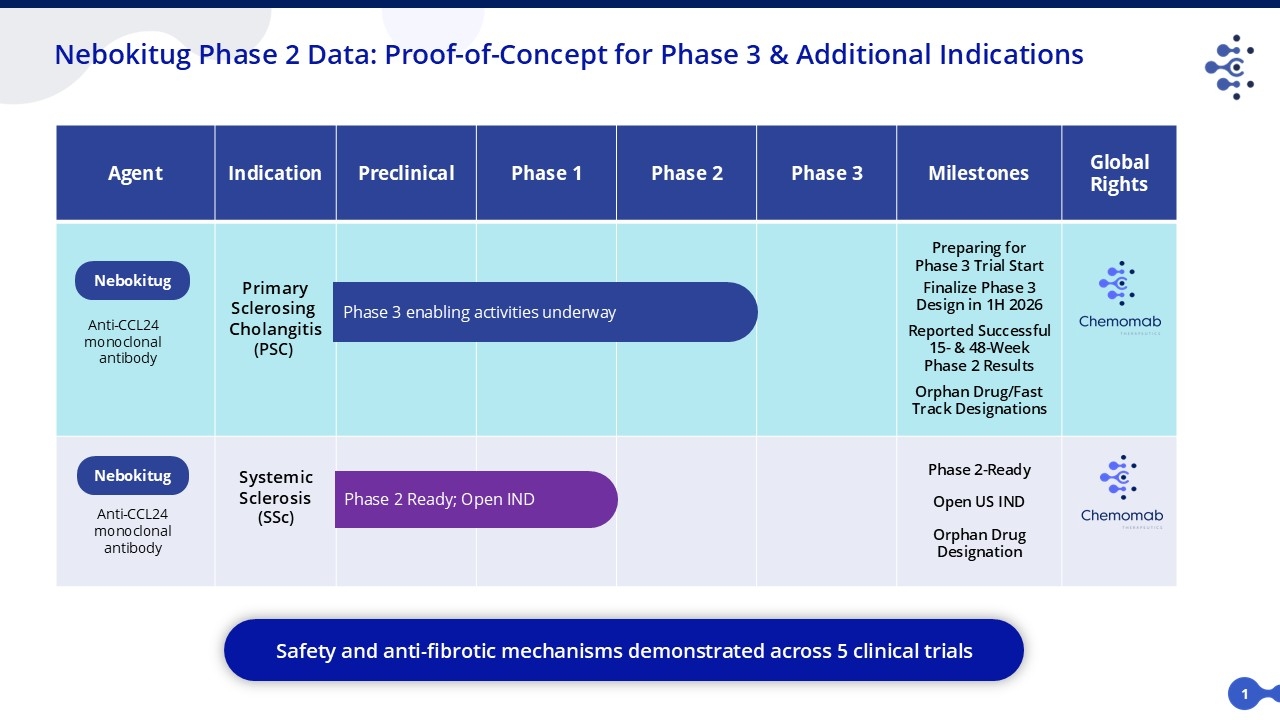
Our lead product candidate, nebokitug, is a first-in-class
humanized monoclonal antibody targeting CCL24 that is being assessed in two orphan indications: PSC and SSc. CCL24 has been extensively
studied in inflammation and fibrosis of the liver, skin and lung. While CCL24 is found in low levels in blood and tissue samples from
healthy volunteers, elevated levels of both CCL24 and its receptor CCR3 have been found in patients with PSC, SSc and MASH. CCL24 levels
have also been correlated to different stages of disease. Based on extensive preclinical, nonclinical and clinical studies, we witnessed
that neutralizing CCL24 resulted in anti-fibrotic and anti-inflammatory effects in patients. Nebokitug has been granted orphan drug designation
by both the FDA and the EMA in its primary indications of PSC and SSc. In addition, nebokitug was granted a Fast Track designation in
PSC from the FDA. These designations provide multiple benefits for these indications, including the potential for accelerated clinical
and regulatory pathways as well as exclusive marketing and development rights for a period of time.
PSC is a rare, chronic cholestatic liver disease characterized
by progressive inflammation, fibrosis, and destruction of the intrahepatic and extrahepatic bile ducts. The cause of the disease is not
known, although a high proportion of PSC patients also have inflammatory bowel disease. Fibrosis and inflammatory responses induce a progressive
spread of the fibrotic condition. Cholestasis is a symptom of liver injury and is characterized as the interruption of bile flow from
hepatocytes to the intestine, which leads to bile acid accumulation in the liver, resulting in oxidative stress, inflammation, apoptosis
and fibrosis. PSC affects approximately 30,000-45,000 patients in the United States. It leads to end-stage liver disease and cancer, which
causes about half of PSC deaths. About half of PSC patients eventually require liver transplantation, but PSC then re-occurs in about
20% of transplant recipients, Median transplant-free survival is estimated at 10-20 years. PSC patients also suffer from a number of debilitating
adverse effects, including pain, pruritus, fatigue and frequent hospitalizations.
No treatment aside from a liver transplant has been associated
with change of the course of the disease or significant long-term improvement in clinical outcomes. As a progressive, often lethal condition
with no FDA-approved therapies, PSC is characterized by major unmet medical need.
SSc is a rare connective tissue disease characterized by excessive
fibrosis and extracellular matrix accumulation in the skin, lung and other visceral organs. The disease initiates with an early inflammatory
phase involving the immune cell network, as well as endothelial cells. As the disease progresses, the inflammation increases and fibroblasts
and myofibroblasts generate tissue fibrosis, while endothelial cells promote vascular injury, which can lead to skin fibrosis, interstitial
lung disease, myocardial insufficiency, vascular obliteration, distal ulcerations and gangrene. SSc affects approximately 75,000-100,000
patients in the United States. SSc has the highest mortality rate among the systemic rheumatic diseases and has high unmet need, as current
treatments manage only disease manifestations and there is no disease modifying drug available.
We are primarily focused on the orphan indications PSC and SSc
but believe that nebokitug may have additional applications in other fibrotic-inflammatory disease areas such as idiopathic pulmonary
fibrosis, or IPF and MASH. Nebokitug has shown promising anti-fibrotic and anti-inflammatory effects in preclinical studies of liver fibrosis
and PSC, with significant reductions in fibrotic genes, liver enzymes, bile acid and cholangiocyte proliferation, all reflecting a potential
improvement in disease status. In preclinical studies of SSc, nebokitug reduced inflammatory and fibrotic injury resulting in reductions
in dermal thickness, collagen concentration in the skin and the lung, and immune cell infiltration in the lung.
30
We have completed two Phase1a single ascending dose studies with
intravenous, or IV, and subcutaneous, or SC, administrations of nebokitug in healthy volunteers. The drug was shown to be well-tolerated,
with a PK profile supporting dosing once every 2-4 weeks. We also completed a Phase 1b multiple administration ascending dose study in
16 MAFLD patients, expanding the safety, tolerability, and pharmacodynamics database with patients with early liver disease. Early evidence
of anti-fibrotic activity was also seen in this study.
In 2023 we reported topline and secondary results from our Phase
2a randomized, double-blind, placebo-controlled study in patients with liver fibrosis associated with MASH. The trial met its primary
endpoint of safety and tolerability, and nebokitug demonstrated promising activity in secondary endpoints that included pharmacokinetic
and target engagement profiles of the SC formulation, as well as a range of liver fibrosis biomarkers and physiologic assessments measured
at baseline and at week 20.
The trial enrolled 23 MASH patients with stage F1c, F2 and F3 disease
who were randomized to receive either nebokitug or placebo. Patients received eight doses of 5 mg/kg of study drug administered by SC
injection once every two weeks, for a treatment period of 16 weeks. Key findings of the nebokitug Phase 2a trial included the following.
|
• |
Nebokitug appeared to be well tolerated when administered subcutaneously. Most reported
adverse events observed were mild, with one unrelated serious adverse event reported. No significant injection site reactions were reported
and no anti-drug antibodies, or ADAs, were detected. Nebokitug administered subcutaneously demonstrated favorable pharmacokinetics
and target engagement profiles as expected, which were similar to what we have previously reported. A higher proportion of patients
in the nebokitug-treated group showed improvement than in the placebo group in a number of liver fibrosis-related biomarkers, including
ProC-3, ProC-4, ProC-18, TIMP-1, ELF and liver stiffness. |
Data from this trial provided important insights in support of
the nebokitug development program, including the favorable safety and tolerability of nebokitug in patients with serious liver disease,
confirmation of early signs of biomarker activity that are relevant for a number of fibro-inflammatory disorders, and additional tolerability
and pharmacokinetic data needed to assess next steps in the development of our current subcutaneous formulation.
Earlier, we also reported positive clinical data from an investigator-initiated
clinical study assessing nebokitug activity and safety in hospitalized patients with severe lung injury derived from COVID-19. The objective
of the study was to evaluate the drug’s safety and activity in hospitalized COVID-19 patients with severe pneumonia, including its
impact on biomarkers related to lung inflammation that are also relevant in systemic sclerosis. The open label, single arm trial enrolled
16 hospitalized adult COVID-19 patients with severe respiratory involvement. All patients were receiving standard of care therapy. All
were treated with a single 10mg/kg intravenous dose of nebokitug on the first day of the study and followed for 30 days. Administration
of nebokitug to this acutely ill patient population appeared to be well tolerated. Nebokitug exposures and target engagement profiles
were similar to what our researchers have seen in previous clinical studies of nebokitug. Importantly, rapid reductions in serum biomarkers
of lung inflammation, fibrogenesis and neutrophil activity were observed post-treatment with nebokitug. Overall, this study confirmed
and extended the safety and tolerability profile of nebokitug and demonstrated clinically relevant changes in biomarkers associated with
lung inflammation and fibrogenesis, further supporting nebokitug’s anti-inflammatory and anti-fibrotic effects.
The Phase 2 SPRING study enrolled 76 patients with PSC who were
treated with nebokitug or placebo for 15 weeks. The double-blinded trial design included 2 dose cohorts of nebokitug (10 or 20 mg/kg)
vs placebo who received treatment for 15 weeks, as well as an open-label (OLE) extension of 33 weeks to evaluate the safety, tolerability
and durability of effect over longer treatment durations. The open label part of the study included 50 patients who elected to continue,
out of 54 patients who were eligible to enter into the open label phase.
In July, 2024 we reported the results of the Phase 2 SPRING trial.
Nebokitug met the primary study endpoint, demonstrating that it is well tolerated and nebokitug-treated patients with moderate/advanced
disease showed improvements on a wide range of disease-related secondary endpoints, including liver stiffness, liver fibrosis biomarkers,
such as the Enhanced Liver Fibrosis (ELF) score and PRO-C3 levels; total bilirubin and liver function tests; pruritus (itch) and markers
of inflammation. Dose-dependent responses were observed for multiple disease-related biomarkers. A consistent pattern of greater improvement
on the secondary endpoints was observed in the study arm receiving the 20mg/kg dose of nebokitug. This dose has been selected for the
active treatment arm of the Phase 3 trial design.
In March 2025, we reported the results of the open label part of
the study. The OLE study confirmed that in PSC patients receiving 10 mg/kg or 20 mg/kg of nebokitug administered once every three weeks
for 48 weeks, the drug was safe and well-tolerated and resulted in positive effects, including continued improvements in key liver biomarkers
such as the ELF score, the fibrosis-related components of ELF and the fibrosis biomarker PRO-C3. Liver stiffness scores (transient elastography),
as measured by FibroScan® were substantially lower in the nebokitug-treated patients with moderate/advanced disease compared to matching
historical controls. Cholestasis-related markers stabilized over 48 weeks of treatment and total serum bile acids were reduced.
We may also explore nebokitug in other indications, where the dual activity of nebokitug
acting on both inflammation and fibrosis could provide new avenues for treating inflammatory and fibrotic conditions.
31
Chemomab was founded in 2011, based on a novel discovery originating
from the Sourasky Medical Center in Tel-Aviv, Israel, where Professor Jacob George first identified CCL24 as a key regulator of unstable
plaque formation in atherosclerotic patients. In our early years, we focused on research directed at clarifying the role and effectiveness
of CCL24 blockade. In 2015, we selected our proprietary lead product candidate, nebokitug, and started product development directed towards
human testing.
We have assembled an executive team with highly relevant experience in inflammation
and fibrosis, and biologics drug discovery and clinical development. Adi Mor, Ph.D., our Chief Executive Officer, Chief Scientific Officer
and Co-founder, has 16 years of experience in immunology and has led the nebokitug program from discovery stage through Phase 2 clinical
studies. David Weiner M.D., our Interim Chief Medical Officer, brings deep experience in clinical development. Dr. Weiner spearheaded
key revisions to the Phase 2 SPRING trial protocol and brings extensive biotechnology and pharmaceutical industry R&D, drug development
and strategic experience to Chemomab. Jack Lawler, our Chief Development Officer, is highly experienced in managing clinical trials across
a wide range of indications and geographies.
Company strategy
We aim to become a world-leading company for the treatment of diseases
involving inflammation and fibrosis, developing novel therapies across a wide range of indications. To achieve this, we are focused on
the following key strategies:
|
• |
Advance our lead product, nebokitug, for the
treatment of PSC and potentially SSc, through clinical development to approval |
The clinical development plan of lead product candidate nebokitug
was optimized to maximize the clinical information obtained, generating additional important data to support future advancement to registration
trials, and decreasing the overall risk of the nebokitug clinical development program in the lead indication of PSC and potentially SSc,
as well as potentially in additional indications where the scientific rationale is strong.
|
• |
Selectively evaluate partnership opportunities
|
We continuously explore partnership opportunities to advance nebokitug
development in PSC and SSc, and possibly additional indications, identifying companies with drugs (either approved or in development)
that could possibly be combined with nebokitug, extending the development of nebokitug to new indications beyond PSC and SSc, and seeking
additional significant commercial or drug development capabilities that may accelerate nebokitug’s time to market.
|
• |
Explore opportunities for nebokitug in additional
inflammatory/fibrotic indications |
We continue to evaluate the potential benefit of nebokitug outside
of our current lead indications of PSC and SSc, in order to maximize the product’s potential. nebokitug has shown anti-fibrotic
activity in animal models and human tissue studies of IPF and MASH. We will continue to assess ways to leverage the dual anti-inflammatory
and anti-fibrotic activity of nebokitug in new disease areas and to form additional collaborations with global medical researchers and
drug developers.
|
• |
Strengthen our intellectual property portfolio
|
We believe that we have developed a strong intellectual property portfolio and will
continue to seek, maintain, and defend our patent rights, whether developed internally or licensed to protect and enhance the proprietary
technology, inventions, and improvements that are commercially important to the development of our business proprietary position in the
field of inflammation and fibrosis.
Fibrosis and inflammation
Tissue damage activates a repair process that includes acute inflammation
followed by either successful complete repair or tissue replacement by fibrosis. However, persistent and repeated damage can result in
continuous activation of the repair process leading to chronic inflammation, progressive tissue fibrosis and sclerosis.
Fibrosis is an accumulation of non-functional tissue and can occur
in many different tissues, including lung, liver, kidney, muscle, skin and the gastrointestinal tract, resulting in a number of chronic
fibrotic conditions. Liver fibrosis is the process of excessive accumulation of extracellular matrix proteins, predominantly collagen,
which occurs as the result of liver injury. In cases of acute temporary damage, these changes are transient and liver fibrosis may resolve.
In chronic cases, however, the liver damage persists and chronic inflammation and accumulation of the extracellular matrix eventually
lead to cirrhosis. The various fibrotic manifestations in conditions like SSc are still not well understood. Disease progression is characterized
by an early inflammatory onset followed by tissue fibrosis, vascular injury and organ damage. Fibrosis, and specifically lung fibrosis,
is the main cause of disease progression and mortality in SSc, although manifestation of the disease in other organs can cause patients
considerable distress and adversely impact their health and their quality of life.
Fibrosis and inflammation are intrinsically linked; a healthy inflammatory
response is necessary for efficient wound healing; however, a prolonged response can contribute to the pathogenesis of fibrosis. The inflammatory
response during chronic liver injury is a dynamic process with intrahepatic accumulation of diverse immune cells. Recruitment and infiltration
of these cells to the liver and their localization is mainly determined by chemokines and cytokines that are produced by hepatocytes,
immune cells, biliary epithelial cells, and endothelial cells. Notably, activated liver fibroblasts, the hepatic stellate cells, or HSCs,
secrete various chemokines, thereby contributing to the ongoing immune response during fibrotic liver diseases. Similarly, for SSc, the
early inflammatory phase leading to fibrosis in multiple organs of the body includes activation of the immune cell network of lymphocytes,
eosinophils, and monocytes, as well as endothelial and endothelial progenitor cells. In the advanced SSc phase, fibroblasts and myofibroblasts
take the lead to generate tissue fibrosis.
32
Chemokine involvement in inflammation and fibrosis
Chemokines are a group of small signaling proteins thought to be
involved in the etiology, or causation, of multiple inflammatory diseases. They are not only implicated in immune cell recruitment during
inflammation, but also contribute to immune surveillance, direct cells to target organs in homeostasis, and exert pleiotropic, or diverse,
effects on non-immune cells, for instance, directly influencing the functionality of fibrogenic cells. Chemokines and their corresponding
chemokine receptors are key players in orchestrating the sequential influx of immune cells into damaged or diseased organs, driving inflammatory
responses to specific triggers.
In the liver, chemokines have a key role in the development of
inflammation and wound healing responses, which can lead to either resolution of liver injury or promote, if ongoing, maladaptive responses
with chronic inflammation, fibrosis, and development of clinically manifest liver disease. Although the pathophysiology underlying PSC
has not yet been fully clarified, animal models of PSC have contributed to dissecting the molecular basis of this disease and highlighting
the role of cytokines and chemokines as important pathogenetic mediators of liver inflammation and fibrosis. Recently published studies
demonstrated that in most of the processes suggested for the onset and development of PSC, chemokines and chemokine receptors play a key
role. Hematopoietic stem cells (HSCs) may be the main producers of cytokines and play an initial role in the progression of liver
fibrosis by attracting different types of immune cells, resulting in further production of cytokines and liver injury in a vicious disease
cycle. Extensive proliferation, trans-differentiation and activation of HSCs result in ongoing chronic tissue remodeling and severe fibrosis.
In addition, chemokines are also involved in promoting polarization of the recruited immune cells. Therefore, chemokines may participate
in PSC by promoting migration of inflammatory and fibrotic cells, by activating inflammatory and fibrotic cells locally, or by inducing
cytokines that promote collagen and matrix deposition.
Likewise, in SSc pathogenesis, chemokines foster migration and activation of inflammatory
and fibrotic cells, inducing the secretion of cytokines that promote collagen and matrix deposition in affected organs. Indeed, patients
with SSc exhibit increased systemic levels of proinflammatory chemokines and some of these have also been shown to correlate with limited
or diffuse cutaneous disease phenotype and/or to organ-specific pathology such as lung disease or skin vascular inflammation.
The role of CCL24
CCL24 is a chemokine that promotes various types of cellular processes
that regulate inflammatory and fibrotic activities through the CCR3 receptor. This chemokine is known to be expressed by activated T-cells,
monocytes, epithelial cells and endothelial cells, as well as by activated fibroblasts. CCL24 induces chemotaxis and activation of CCR3-expressing
cells, including immune cells and fibroblasts.
We have been the driving force in establishing the role of CCL24
in the pathogenesis of PSC and SSc, however, others have highlighted its contribution to other indications. For example, published work
has shown that both CCL24 and CCR3 are involved in lung and skin inflammation and fibrosis. CCR3 is robustly expressed on eosinophils
and recent data has suggested that eosinophilic inflammation may be involved in the pathogenesis and progression of SSc. For example,
in SSc patients, eosinophil counts, but not total leukocytes, were significantly higher than in patients with other connective autoimmune
diseases. Eosinophil counts correlated positively with both interstitial lung disease severity and the modified Rodnan skin thickness
score, or mRSS.
Notably, CCR3 was shown to be expressed on oral and dermal fibroblasts
where it modulates wound healing and tissue remodeling processes. A recent academic study also demonstrated overexpression of CCR3 on
monocyte populations isolated from SSc patients. CCL24 was shown to be involved in proinflammatory reactions, specifically contributing
to the type 2 immune reaction involving Th2 lymphocytes and M2 macrophages that were shown to be present in skin lesions of SSc patients.
Accordingly, CCL24 was found to play a dominant role in inducing profibrotic effects and to be overexpressed in fibrotic lungs and bronchoalveolar
lavage fluid from patients with idiopathic pulmonary fibrosis, a disease sharing similar lung dysfunction features with SSc. Furthermore,
CCL24 was shown to promote collagen production in human lung fibroblasts and to be constitutively expressed by dermal fibroblasts.
33
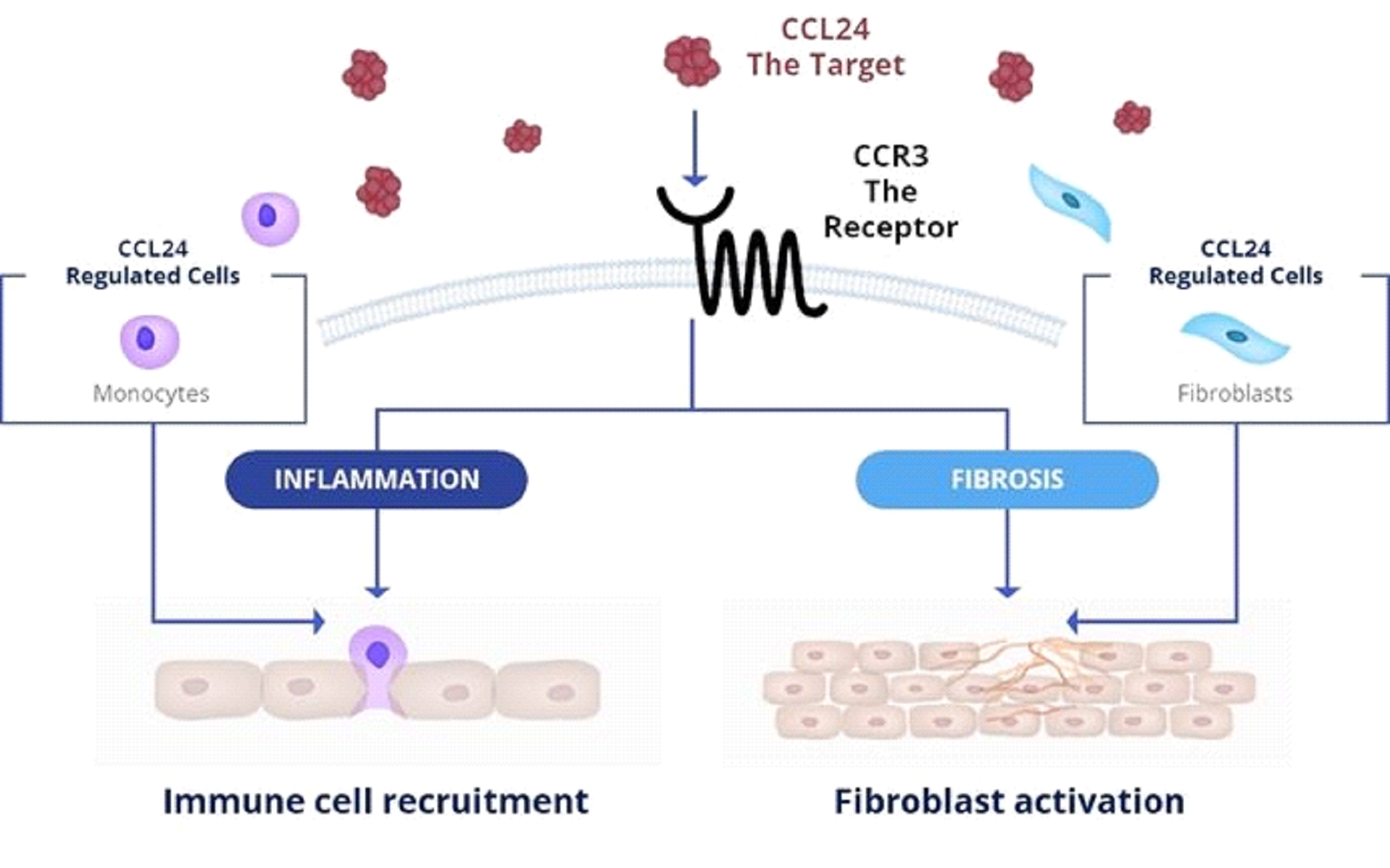
CCL24 is a critical mediator promoting inflammation and fibrosis
Challenges to drug development in fibrosis
and inflammation
Successful treatment of fibrotic disorders has in large part remained
elusive, primarily due to incomplete understanding of the complexity and multi-mechanism contributions to disease progression. This has
complicated preclinical investigations for new products and new targets, with animal models having limited resemblance to human disease.
Additionally, preclinical animal data is often of short treatment duration and does not capture the effects of treating chronic fibrotic
indications. This is particularly applicable to complex, orphan indications like PSC and SSc, where there is still no approved standard
of care or proven target mechanism.
Notwithstanding challenges in the field of fibrosis and inflammation,
there is significant and growing industry interest given the associated unmet medical need and the continuing opportunity to identify
better therapeutic targets. For example, in 2024 Gilead acquired Cymabay for its PPAR agonist in primary biliary cirrhosis. More
recently, Akero Therapeutics was acquired by Novo Nordisk in October 2025 for up to $5.2 billion. The deal centers on efruxifermin, an
FGF21 analog that demonstrated significant liver scarring reversal in Phase 2 trials. 89bio was acquired by Roche in September 2025 for
up to $3.5 billion. The acquisition was driven by pegozafermin, a Phase 3 FGF21 analog considered a "best-in-disease" contender for moderate-to-severe
MASH. Boston Pharmaceuticals’ MASH asset, efimosfermin alfa, was acquired by Glaxo SmithKline in May 2025 (completed July 2025)
for $1.2 billion upfront. This drug is a once-monthly FGF21 analog preparing for Phase 3 trials.
Targeting chemokines as a treatment for fibrotic
indications
We believe that our approach, selectively targeting fibrotic conditions
by attenuating both inflammation and fibrosis, may be an optimal approach for both effectiveness and reduction of toxicity. As central
regulators of initiation and progression of fibrotic disorders, chemokines are an ideal target to impact both inflammation and fibrosis.
Some chemokines are also disease-specific, allowing for potential selectivity.
Chemokine receptors, or CCRs, have been more extensively studied
as drug targets in fibrotic conditions compared to chemokine ligands, however, the therapeutic effects of CCR inhibitors have generally
fallen short in the clinic. Pharmaceutical companies have previously explored the CCL24 ligand receptor, CCR3, and its other ligands CCL7
and CCL11, with small or large molecule inhibitors. These programs were directed at inhibiting eosinophilic trafficking in respiratory
and allergic inflammation, however, despite promising preclinical data, most programs were discontinued largely due to poor safety profiles
and limited efficacy of the antagonist used. To our knowledge, only Alkahest has an active program that explores CCR3 inhibition, which
is under license from Boehringer Ingelheim and is being developed as a treatment for wet AMD. In contrast, we believe CCL24 presents a
more promising opportunity. Unlike other CCR3 ligands, CCL24 binds only to the CCR3 receptor and is also organ/disease-specific, which
together could provide enhanced selectivity and tolerability. For example, in PSC, CCL24 is elevated in the liver and cholangiocytes (bile
duct epithelia) and immune cells that play a key role in the progression of the disease. Likewise, elevation of CCL24 has been shown
in fibrotic lungs and bronchoalveolar lavage fluid from patients with idiopathic pulmonary fibrosis, a disease sharing similar lung dysfunction
features with SSc and which recently was correlated, by us, with disease severity and lung involvement in a cohort of SSc patients from
the United Kingdom. Furthermore, CCL24 is constitutively expressed by skin and dermal fibroblasts. The use of an antibody in targeting
this chemokine is a novel approach to targeting fibrosis.
34
Our expertise and approach to drug discovery
We are a clinical stage biotechnology company focused on the discovery
and development of novel drugs to address fibrotic indications with unmet medical needs. CCL24 is a key target promoting fibrosis as it
regulates the two main processes that drive fibrosis: fibroblast activation and immune cell migration and activation. Using our expertise
in monoclonal antibody, or mAb, development and deep knowledge of chemokine biology, we are developing nebokitug, a proprietary, first-in-class,
fully humanized mAb that through research and studies to date, has been shown to neutralize CCL24 and by so doing inhibits its disease-related
functions in both inflammation and fibrosis. This represents an innovative approach to anti-fibrotic drug discovery and is a key differentiator
for us. The ability of nebokitug to directly attenuate fibroblast activation and concurrently attenuate recruitment of immune cells is
novel and could address a wide range of hard-to-treat fibrotic diseases.
Our ongoing collaborations are complementary to both preclinical
and clinical aspects of research and development. We have created an extensive panel of in vitro, ex vivo and in vivo assays which we
have used to further the understanding of fibrotic processes together with the role of CCL24 in various diseases and the effects of its
neutralization by nebokitug. These assays have allowed us to sequentially explore target validation and proof of mechanism in disease
relevant human and animal samples that we believe help de-risk the translation of nebokitug into the clinic.
Target expression and engagement
We regularly collaborate with leading academic centers around the
world to investigate the role of CCL24 and nebokitug in various indications. For example, we work with The Royal Free Hospital, or RFH,
in London, and Birmingham University in Birmingham, United Kingdom to access liver biopsy and serum samples from patients with PSC. Using
immunohistochemistry and florescence microscopy to stain CCL24 and CCR3, it explores the expression patterns of these targets in disease
relevant human samples and compares them to healthy volunteers. Similarly, we have tested biopsies of SSc patients through a collaboration
with the University of Florence in Italy and serum samples of SSc patients through a collaboration with Leeds University in the UK.
Proof of mechanism
We explore fibroblast activation and immune cell recruitment in
response to nebokitug treatment through inhouse ex vivo and in vitro assays. We have executed multiple validated genetic and treatment-based
disease models in fibrotic and inflammatory indications in which we have investigated nebokitug’s effects. Additionally, as part
of a collaboration with Nordic Biosciences, Copenhagen, Denmark, we have gained access to proprietary tools and expertise to explore the
effects of nebokitug on key fibrogenesis and fibrolysis biomarkers. Nordic Biosciences is a world-leading extracellular matrix specialist
and continues to contribute additional analyses to our clinical samples.
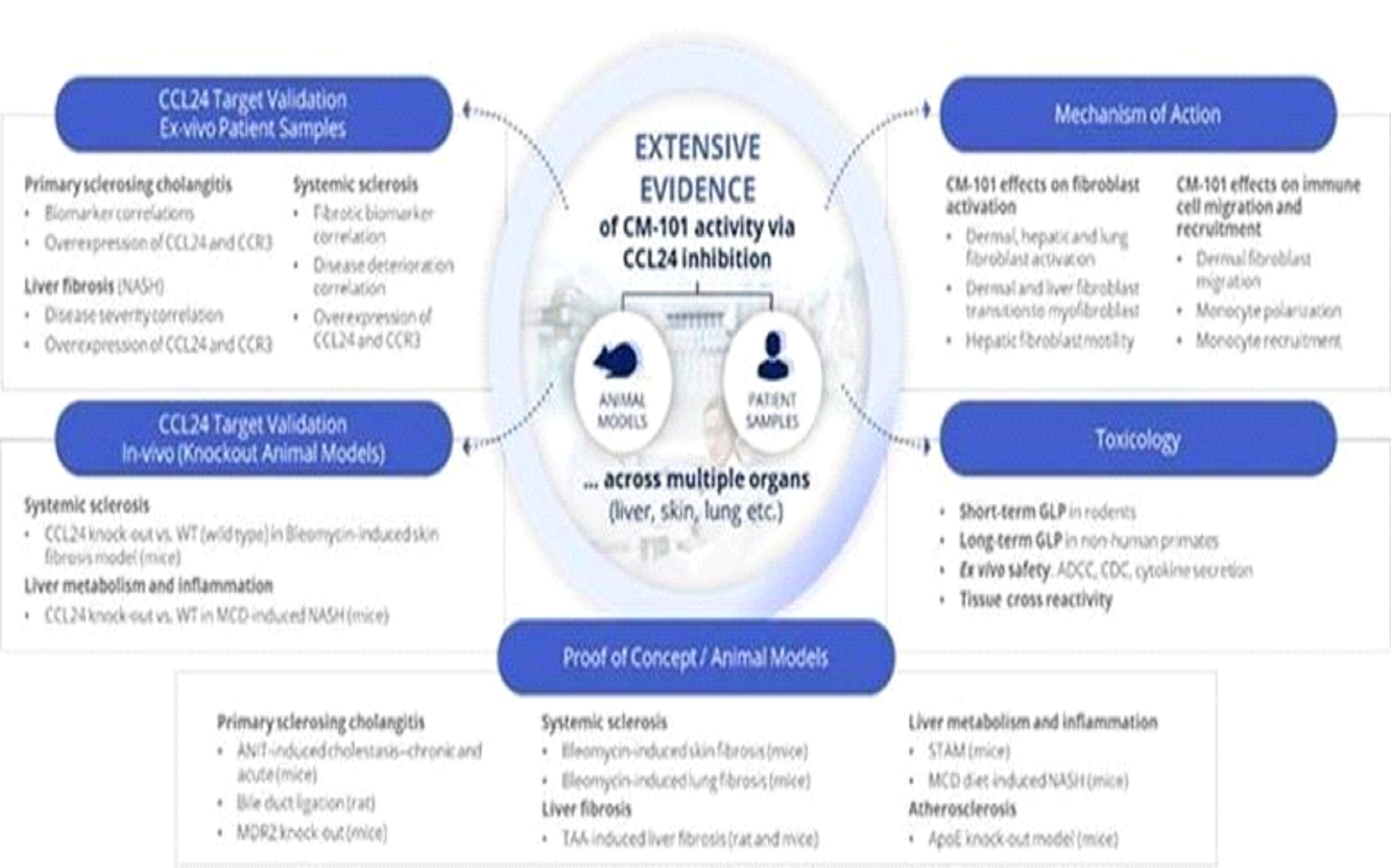
35
We have created a broad array of biological assays to explore CCL24 and nebokitug
We may explore next-generation biologic products, and, based on
our wide database of patient samples and extensive knowledge and experience in fibrosis, may identify targets that could complement CCL24
inhibition. Next-generation assets could therefore be dual targeting and would be screened through the panel of assays available to us
that evaluate target expression in fibrotic tissues as well as the anti-fibrotic activity of potential candidates. Similar to nebokitug,
this process would establish proof-of-biological-mechanism in both animal models and human tissue prior to commencing product development
and initiating clinical studies.
Our pipeline
Nebokitug in PSC and SSc
Our lead product, nebokitug, is a first-in-class humanized monoclonal
antibody targeting CCL24 that is being developed initially for the treatment of PSC and SSc, with potential future opportunities in other
fibrotic-inflammatory indications. We have completed two Phase 1a studies of nebokitug in healthy volunteers as well as a Phase 1b safety,
tolerability and proof-of-mechanism study in MAFLD patients and a Phase 2a liver fibrosis biomarker study in MASH patients with liver
fibrosis, which was reported in 2023. Topline results showed favorable safety and tolerability profiles for nebokitug in patients with
serious liver disease, confirmed early signs of biomarker activity that are also relevant for a number of fibro-inflammatory disorders,
and reinforced tolerability and pharmacokinetic data relevant to the development of our current subcutaneous formulation.
In the Phase 2 SPRING trial in PSC, nebokitug met the primary study
endpoint, demonstrating that it is well tolerated and nebokitug-treated patients with moderate/advanced disease showed improvements on
a wide range of disease-related secondary endpoints, including liver stiffness, liver fibrosis biomarkers, such as the Enhanced Liver
Fibrosis (ELF) score and PRO-C3 levels; total bilirubin and liver function tests; pruritus (itch) and markers of inflammation. Dose-dependent
responses were observed for multiple disease-related biomarkers. A consistent pattern of greater improvement on the secondary endpoints
was observed in the study arm receiving the 20mg/kg dose of nebokitug, In the Open Label Extension portion of this study nebokitug showed
continued safety and activity over 48 weeks, most notably in the 20mg/kg dose arm and in patients with moderate to advanced disease.
A global Phase 2 study in SSc that will assess the safety and activity
of nebokitug in this patient population has an open U.S. IND and is Phase 2-ready.
Primary Sclerosing Cholangitis
PSC is a progressive, rare, and chronic cholestatic liver disorder
that is characterized by thickening, inflammation, and fibrosis of the intra- and extra-hepatic bile ducts. This generally leads to cholestasis,
liver damage, cirrhosis, and eventually liver failure. The exact cause of PSC remains mostly unknown; however, immune system dysregulation,
genes, viruses, and bacteria may be involved. PSC is commonly associated with inflammatory bowel disease, or IBD. Approximately three
in every four individuals with PSC also have ulcerative colitis. Most individuals affected with PSC are adults with an average age of
40 years at diagnosis; however, it may also occur in children. Disease progression, symptoms, and severity may vary greatly between individuals.
Patients in the initial stages of PSC are generally asymptomatic or have only mild symptoms.
Abdominal discomfort, fatigue, and pruritus, or itching, are common
initial symptoms of PSC that can be severe and debilitating. The initial step in diagnosing PSC is to evaluate liver enzyme levels through
blood tests. Physicians will then confirm a diagnosis with cholangiography ultrasound and, in rare cases, a liver biopsy. As the disease
progresses, bile flow from the liver is obstructed and is subsequently absorbed into the bloodstream leading to the yellowing of the mucous
membranes, whites of the eyes, and skin. Furthermore, individuals may also experience abdominal pain, malaise, light-colored stools, nausea,
dark urine, weight loss, and/or hepatomegaly or splenomegaly. PSC patients have a 40-fold increased risk of liver cancer and a 400-fold
increased risk of cholangiocarcinoma, and the disease may lead to other conditions including osteoporosis, bacterial cholangitis, portal
hypertension, bleeding, as well as vitamin deficiencies.
There are currently no specific medical therapies that can alter
or cure the course of the disease; instead, available treatments are directed towards slowing the progression of PSC and treating symptoms.
In certain individuals, endoscopic surgery may be performed to enlarge the narrowed bile ducts and to remove blockages. Complications
due to vitamin deficiencies can be prevented with the help of vitamin supplements, while infections and inflammation can be controlled
by using antibiotics. Cholestyramine and UCDA can be effective in managing itching and can be used with or without antihistamines. Patients
with advanced symptoms such as end-stage liver disease, recurrent bacterial cholangitis and intractable pruritus, will often undergo liver
transplantation, however, in 20-25% of cases, PSC will recur even after liver transplantation. The median survival is 10-12 years without
intervention.
Systemic Sclerosis
SSc is an autoimmune inflammatory condition that results in widespread
fibrosis and vascular abnormalities affecting the skin, lungs, gastrointestinal tract, heart and kidneys. Other key features of SSc include
thickening and hardening of the skin, autoantibody production and abnormal nail fold capillaries. The underlying mechanisms that cause
SSc are complex and for the most part unknown but most likely involve a combination of factors including the immune system, genetics,
and environmental triggers. Various pathways are involved in the pathogenesis of SSc including cytokines that injure blood vessels, growth
factors that stimulate collagen, integrin signaling, morphogen pathways, and co-stimulatory pathways. SSc is generally diagnosed between
the age of 30 and 50 years and is more prevalent in women.
36
Given that SSc can affect many different parts of the body there
are a multitude of different symptoms of the disease. The most widely observed symptoms include fatigue, arthralgia, and myalgia. However,
the earliest sign is often the Raynaud phenomenon in which the body’s normal response to cold or emotional stress is exaggerated,
resulting in abnormal spasms in arterioles. Cutaneous features include sclerosis of the skin, particularly the face and hands. Gastrointestinal
symptoms of the upper tract include acid reflux and of the lower tract include bloating, nausea and incontinence. Cardiopulmonary presentations
include interstitial lung disease, pulmonary arterial hypertension and cardiac scleroderma. Renal and ocular symptoms can also present
and 20% of SSc patients have an overlapping diagnosis with other connective tissue diseases and can develop arthritis, lupus or myositis.
SSc is subdivided into two main types related to the distribution of skin involvement: diffuse cutaneous (two-thirds of cases) and limited
cutaneous. Diffuse SSc, or dcSSc, is rapidly progressive with more significant organ involvement.
There is no cure for SSc. Established treatments can help with
symptoms and may modify the disease outcome only if given early in the disease course. Prescribed medications, used off-label, primarily
focus on suppressing inflammation with NSAIDs and dilating abnormal or constricted blood vessels with losartan, sildenafil, iloprost and
SSRIs, or selective serotonin reuptake inhibitors, as well as treatments to manage individual organ involvement. The only three drugs
that are approved for the treatment of SSc symptoms are bosentan by Actelion Pharmaceuticals, approved in Europe for the prevention of
digital ulcer development, nintedanib by Boehringer Ingelheim, and tocilizumab by Roche, approved in the United States, Europe and Japan
for the treatment of SSc associated interstitial lung disease. The clinical course of SSc is determined by the extent of vascular and
fibrosis complications and has the highest mortality rate among the systemic rheumatic diseases. Forty percent of patients die within
10 years of disease onset, with pulmonary involvement being the leading cause of death.
Nebokitug may have disease-modifying
potential
The dual anti-fibrotic and anti-inflammatory activity of nebokitug
enables the targeting of a wide range of pathogenic mechanisms and may afford patients a new treatment that may have a more impactful
effect on disease progression.
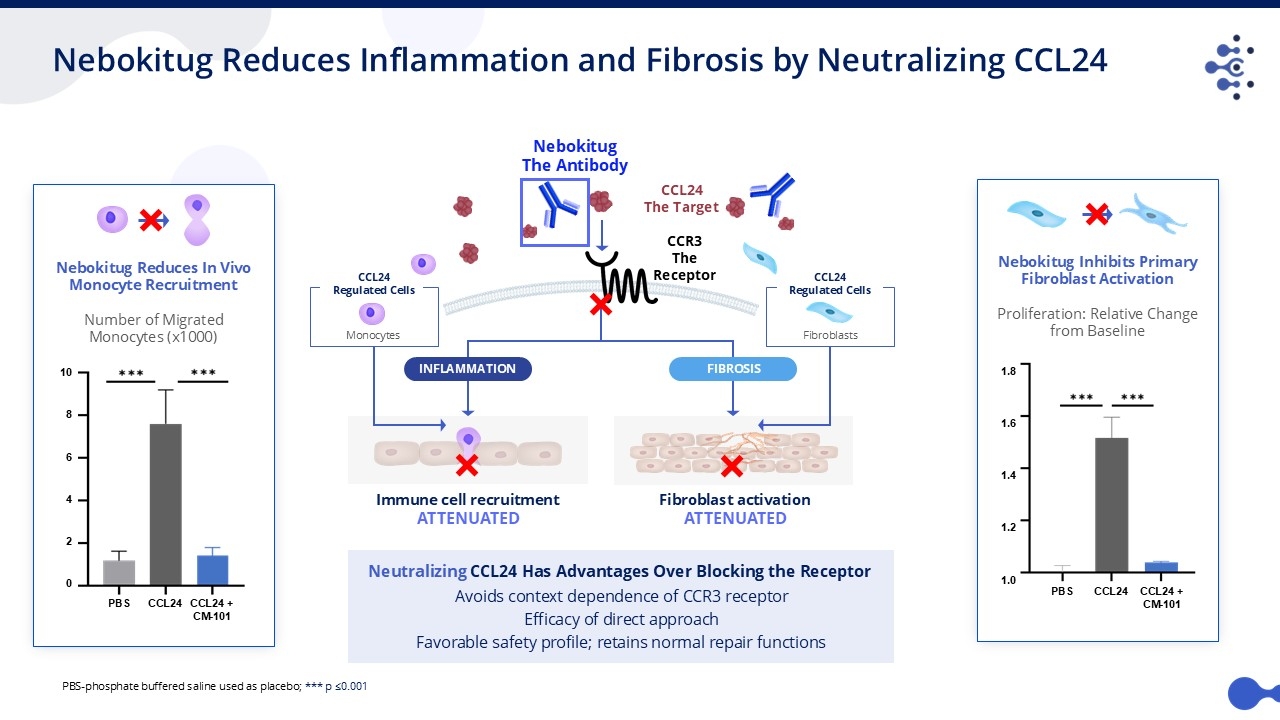
Targeting CCL24 offers a dual activity approach
In order to understand CCL24’s role in disease pathophysiology,
we have collected data on CCL24 levels from patients with multiple fibrotic-inflammatory indications, including those with PSC, SSc and
MASH. PSC patients’ liver biopsies and SSc skin samples were stained for CCL24 and its receptor, CCR3. Blood samples taken from
PSC and SSc patients were used to further evaluate the role of the CCL24-CCR3 axis exploring levels of circulating CCL24 and CCR3. To
explore the influence of CCL24 on disease status, CCL24 serum levels were correlated with fibrotic biomarkers and disease severity markers.
CCL24 levels in liver biopsies from PSC patients
PSC pathology generally initiates with bile duct damage leading
to cholestasis, bile duct inflammation and fibrosis and finally to substantial liver damage. We assessed the accumulation and cellular
localization of CCL24 in livers of PSC patients focusing on CCL24 levels in the periductal damaged zone that is most relevant to disease
pathology. CCL24 was mainly found in inflammatory cells in the liver of PSC patients. Due to the robust liver inflammatory insult in PSC,
reflected by massive accumulation of resident and recruited immune cells in the periductal space, CCL24 positive staining was extensive.
Specific and robust CCL24 staining was also shown in cholangiocytes, the epithelial cells of the bile ducts. Activated myofibroblasts
that surround the bile ducts, whether they originate from hepatic stellate cells or portal fibroblasts, are the main drivers of the excess
extracellular matrix accumulation in this area, comprising the unique “onion ring” shape seen in PSC liver sections. The collective
expression pattern shows high CCL24 levels in areas that are most affected in PSC and highlights its central role in PSC related liver
pathology.
37
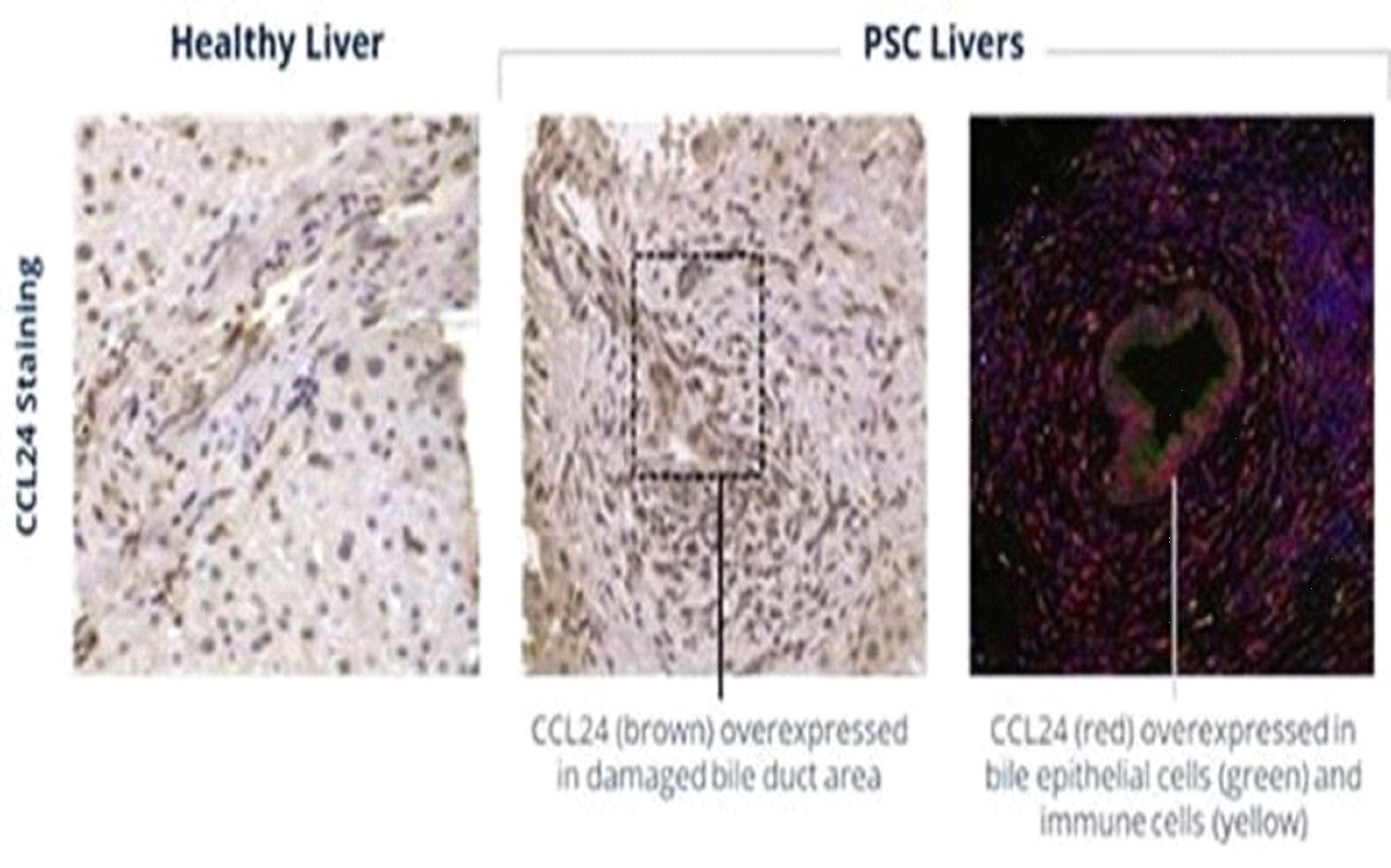
Elevated CCL24 staining in liver biopsies from
PSC patients
CCR24 levels association with PSC related pathways
To further elucidate the involvement of CCL24 in PSC and its association
with disease-related pathways, sera from healthy controls (n=30) and from patients with PSC (n=45) were analyzed using the Olink proximity
extension assay (PEA) of 3072 proteins. Serum proteomics data were analyzed according to three comparisons: (1) healthy controls vs. patients
with PSC, (2) fibrosis severity in patients, defined by ELF score (9.8 cutoff), and (3) serum levels of CCL24 in patients.
Differentially expressed proteins (DEPs) from each of the three
comparisons were interpreted using Ingenuity Pathway Analysis (IPA), to identify dysregulated canonical biological pathways, upstream
regulators, and toxicity-functions. The enriched canonical pathways, upstream regulators and toxicity-functions overlapped between the
three comparisons (disease, fibrosis and CCL24), suggesting that there are biological mechanisms related to PSC and its progression also
related to CCL24 expression levels. Overlapping canonical pathways included HSC activation pathway, immune cell trafficking pathways (granulocyte
and agranulocyte adhesion and diapedesis) and inflammation pathways (Th1 and Th2 activation, Th1 activation and pathogen induced cytokine
storm). In patients with PSC, those that had high levels of CCL24 also showed significantly higher average expression of these pathways.
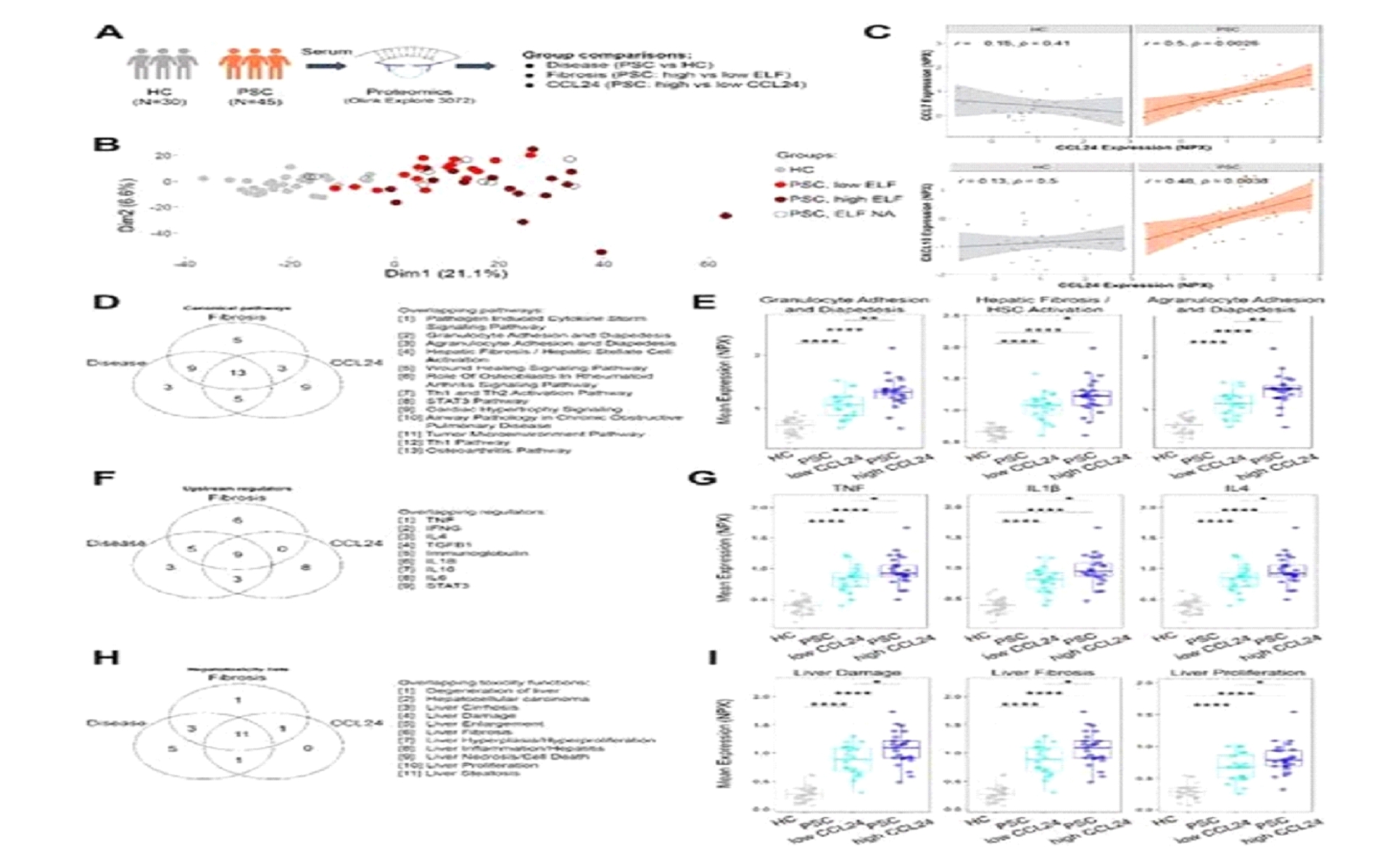
38
PSC-related mechanisms are upregulated in patients with high CCL24
levels. (A) Analysis over-view: sera from patients with PSC and HC were analyzed by the Olink Explore 3072 proteomic platform, and differentially
expressed proteins (DEPs) were compared by disease, fibrosis or CCL24. (B) Score plots of principal component analysis of proteome profiles
in HC and Patients with PSC with low or high ELF scores. (C) Correlation of CCL24 to representative proteins associated with inflammation/chemotaxis
(CCL7 or CXCL10), in HC (n = 30) or patients with PSC with ALP > 1.5 ULN (n = 34). (D-I) Ingenuity Pathway Analysis of canonical pathways,
upstream regulators and liver-related toxicity functions. Venn diagrams show top 30 significant canonical pathways (D), top 20 significant
upstream regulators (F), and significant liver-related toxicities (H). The average ex-pression of protein lists of specific canonical
pathways (E), upstream regulators (G) and liver-related toxicities (I) is presented for HC and patients with low and high CCL24 serum
levels. Boxes rep-resent interquartile ranges with medians (n = 20-30). *, p < 0.05; **, p < 0.01; ****, P < 0.0001.
CCR3 levels in circulating PBMCs in PSC patients
Chronic liver inflammation is driven in most hepatic injuries by
several different immune cell populations originating from either resident hepatic immune cells or recruited cells from the circulation
to the damaged site. In collaboration with the Kaplan Medical Center, Israel, we explored systemic changes of CCR3, given that this could
impact cell recruitment to the PSC damaged liver. Peripheral blood mononuclear cells (PBMCs) from ten PSC patients and healthy controls
were stained for expression of CCR3 and demonstrated that levels were significantly higher in PSC patient samples compared to healthy
donors.
CCL24 and CCR3 levels in skin biopsies from
SSc patients
We analyzed skin samples from diffuse SSc patients and healthy
volunteers and the SSc samples showed elevations in CCL24 and CCR3. Specifically, higher accumulation of CCL24 on immune cells skin infiltration
was shown in the SSc samples and CCR3 was evident in skin fibroblasts, immune cells and endothelial cells. These elevations led to a CCL24-mediated
robust activation of CCR3 expressing cells, which enhances the recruitment of immune cells and fibroblasts to the diseased organ.
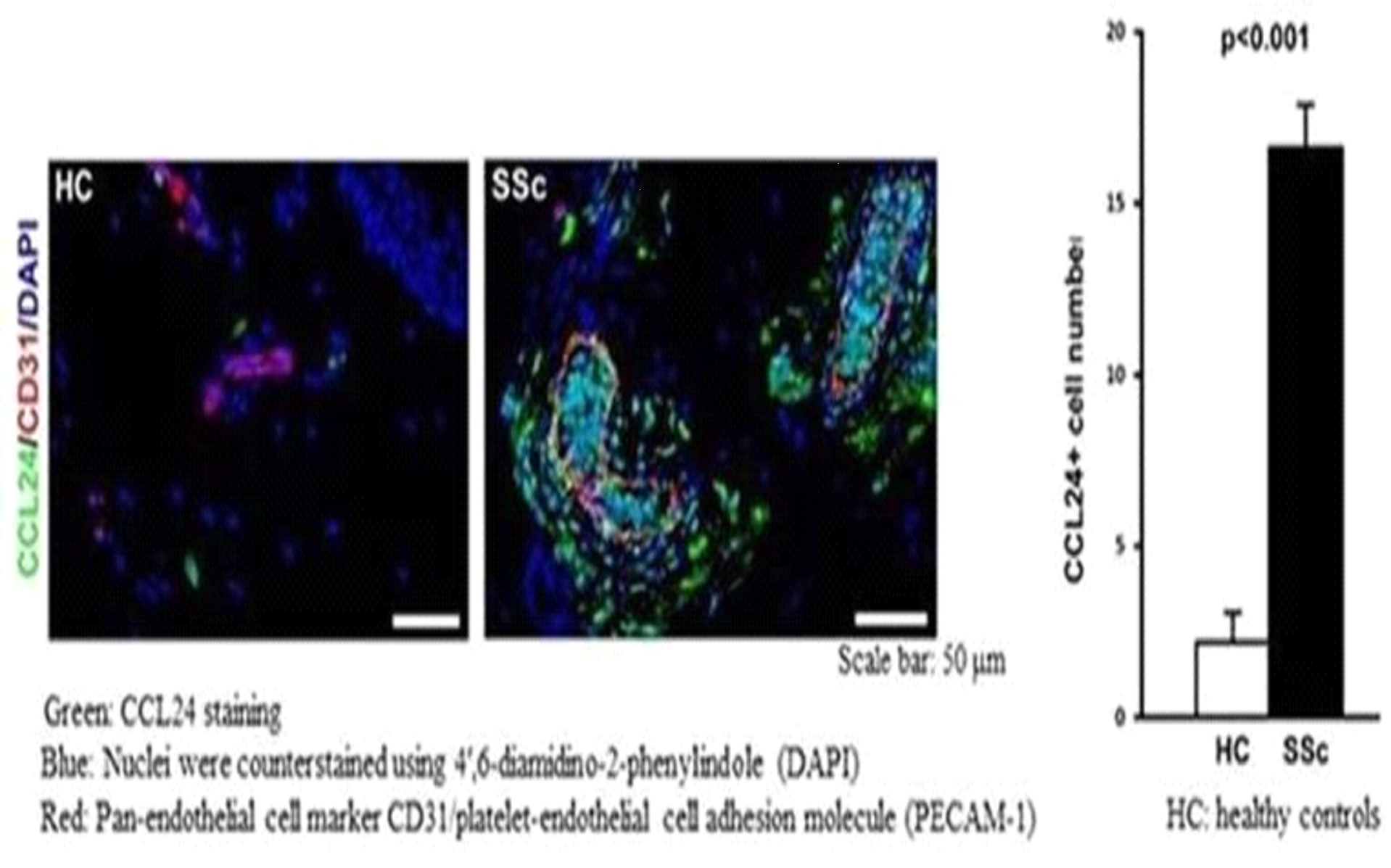
SSc patients showed elevated levels of CCL24
in skin tissue
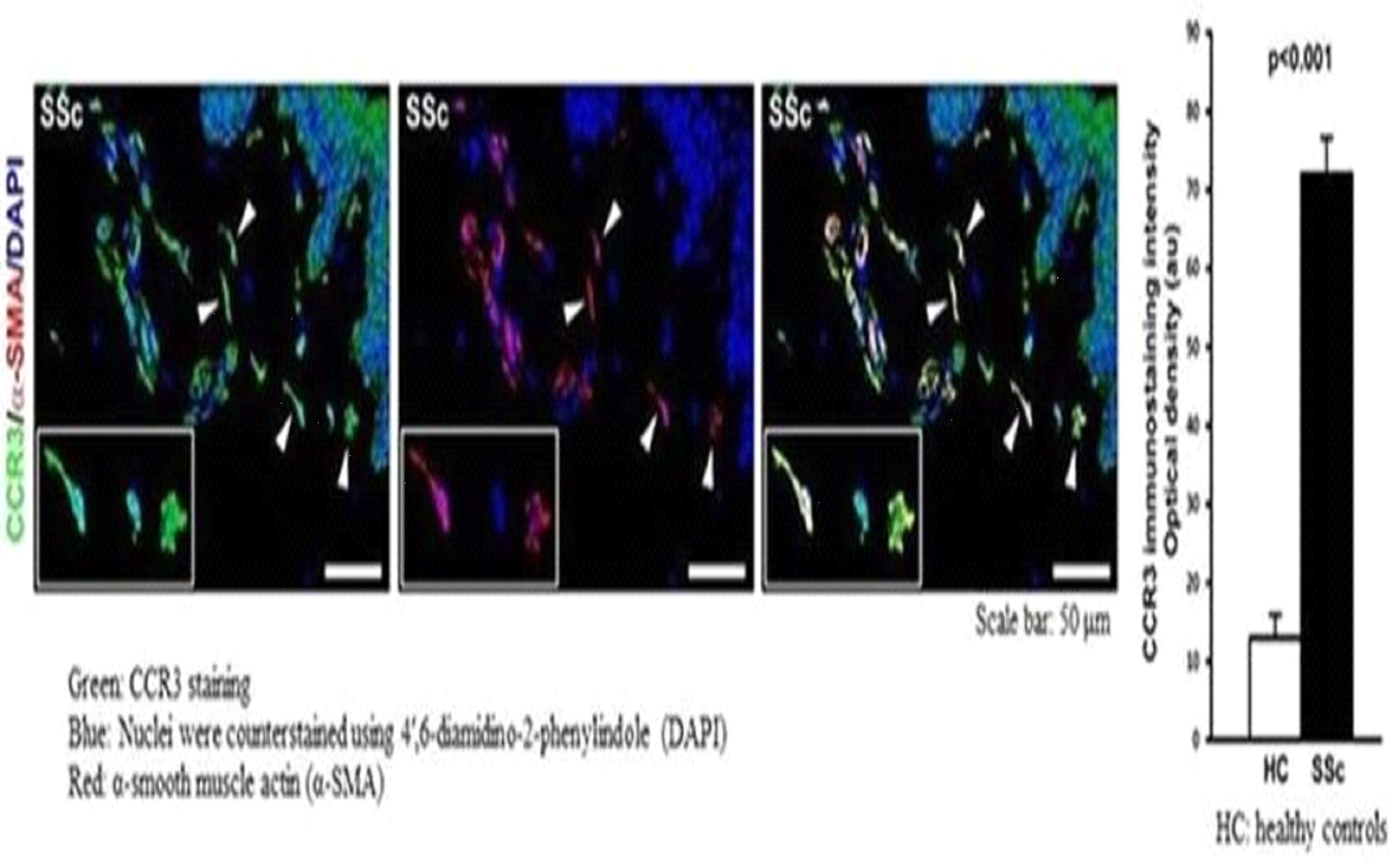
39
SSc patients showed elevated levels of CCR3
in skin tissue
CCL24 levels in serum samples from SSc
patients and correlation with fibrotic biomarkers
Our researchers analyzed SSc serum samples that showed that CCL24
levels were significantly increased in SSc patients compared with healthy individuals. Notably, in diffuse SSc patients, CCL24 levels
were fourfold higher than in healthy control patients. Additionally, the levels of CCL24 were correlated with a biomarker of SSc
severity, anti-topoisomerase, an autoantibody seen in diffuse SSc patients.
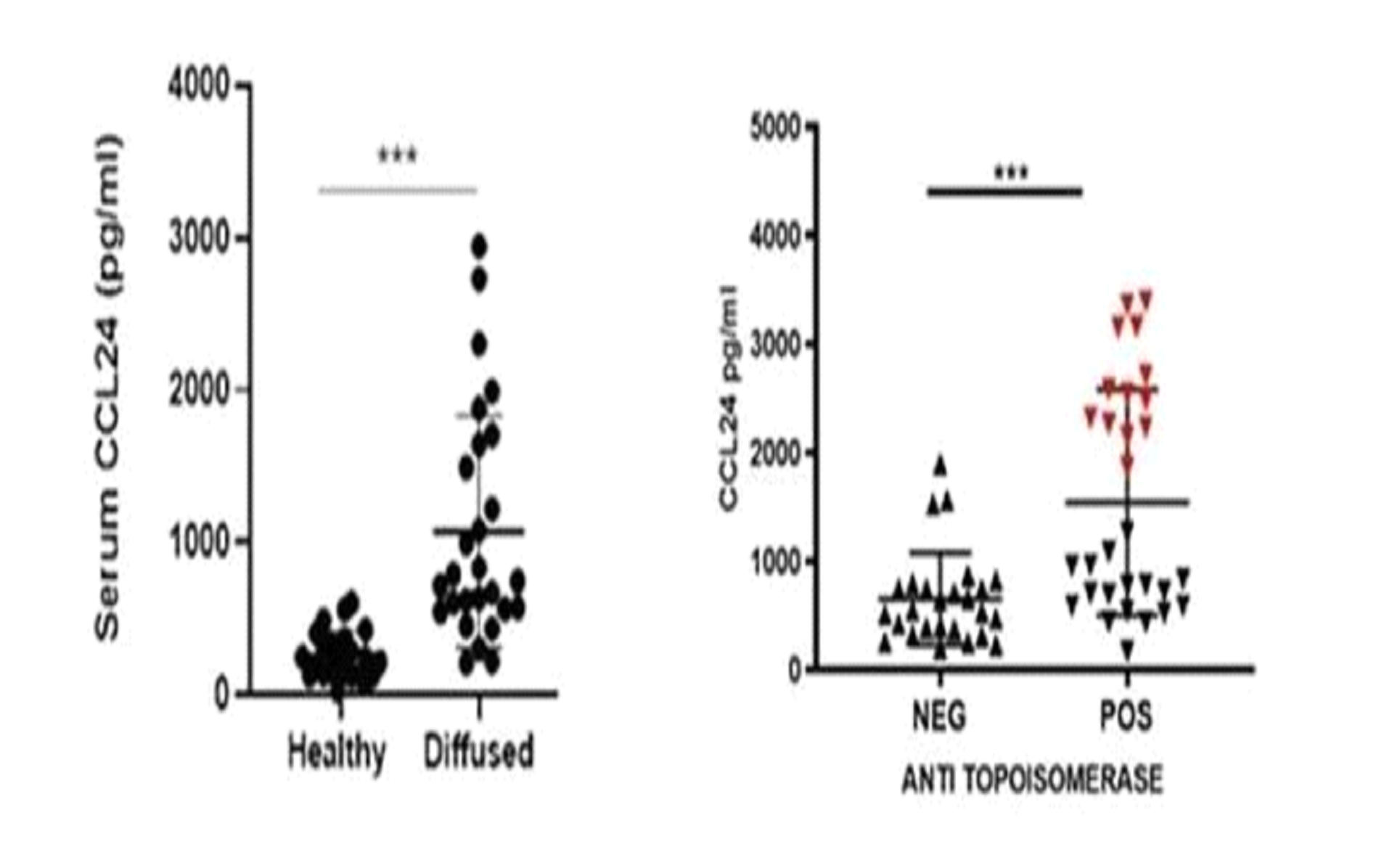
CCL24 levels in serum samples from SSc patients and association
with disease manifestations and mortality
The relationship between serum CCL24 levels and disease characteristics
in a comprehensive real-life cohort of patients with SSc (n=213) was further studied. The study highlights the association between
higher CCL24 levels with critical clinical variables linked to the most severe forms of SSc. Specifically, these variables include male
gender, anti-Scl70 positivity, severity of skin fibrosis, presence of ILD, presence of digital ulcers and lung microvascular impairment
as measured by DLco. In a longitudinal setting, high serum CCL24 was predictive of lung deterioration. Accordingly, a higher baseline
CCL24 level was associated with SSc-related mortality.
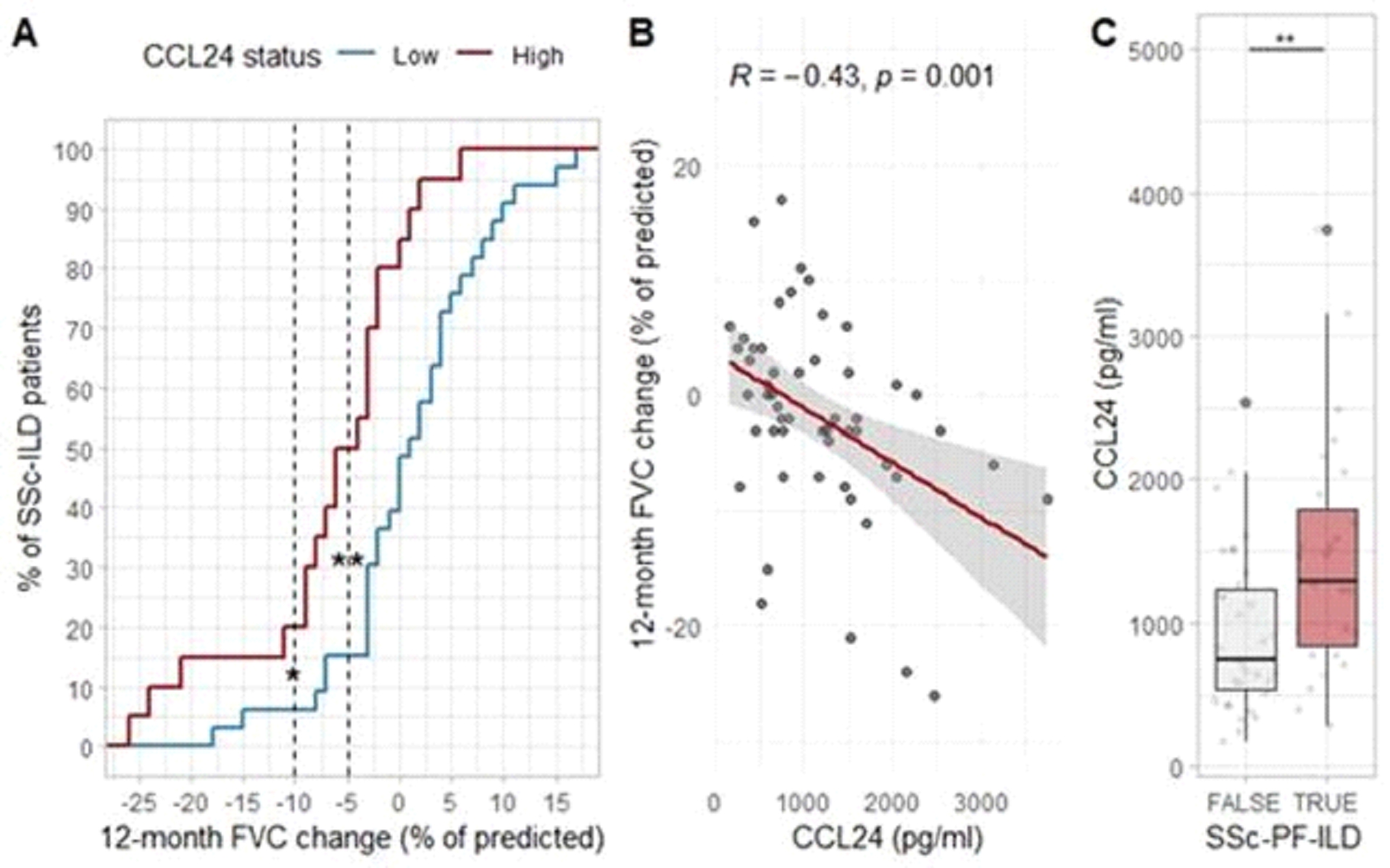
Comparison of baseline serum CCL24 levels based on the occurrence
of rapid ILD progression (A) and the relationship between baseline serum CCL24 levels and the relative change in FVC over the following
12 months (B).
40
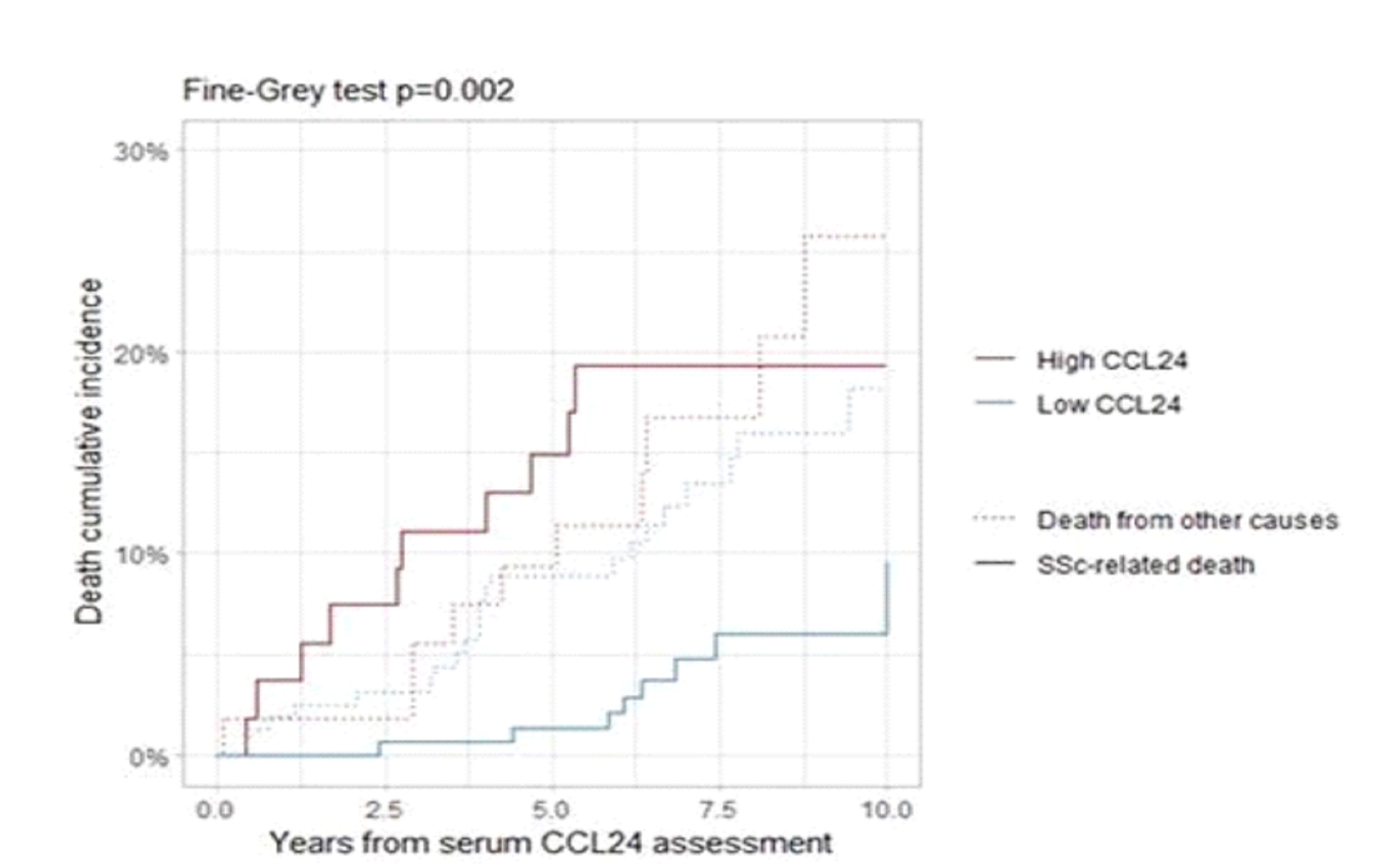
Cumulative incidence curves comparing SSc-related and other-cause
mortality in SSc patients with High and Low baseline CCL24 Status
Preclinical Efficacy of nebokitug in models
of PSC
Preclinical experiments in models of PSC
|
• |
Human hepatic stellate cells demonstrated reduced transition to myofibroblasts following
incubation of nebokitug with CCL24. |
|
|
|
|
• |
Human hepatic stellate cells showed reduced motility towards CCL24 following treatment
with nebokitug. |
|
|
|
|
• |
Nebokitug demonstrated in vivo activity on liver fibrosis and cholangiocyte proliferation
induced by bile duct ligation in the Sprague Dawley rat model. |
|
|
|
|
• |
Nebokitug (D8-a murine surrogate of nebokitug) inhibits the progression of liver fibrosis
and bile duct damage in a chronic cholangitis cholestasis model using the hepatobiliary toxin ANIT. |
|
|
|
|
• |
Nebokitug (D8) reduces bile duct epithelial cell (cholangiocyte) proliferation, collagen
deposition, macrophage infiltration, liver enzymes, bile acid and circulating inflammatory monocytes in an experimental cholangitis model
in MDR2 knockout mice. |
|
|
|
|
• |
Nebokitug reduces liver enzymes, fibrosis, collagen, and fibrotic gene expression
in a TAA-induced liver fibrosis model in rats. |
|
|
|
|
• |
Nebokitug (D8) prevented fibrosis and inflammation in a TAA-induced liver fibrosis
model in mice. |
Results from the multi-drug resistant 2, or MDR2, knock out mouse
model that reflects sclerosing cholangitis and the thioacetamide (TAA) rat model reflecting liver fibrosis are described below.
Nebokitug demonstrates anti-cholestatic,
anti-inflammatory, and anti-fibrotic activity in MDR2 knock out mouse model in vivo
Mice with targeted disruption of the MDR2 transporter gene develop
chronic and progressive hepatic sclerosing cholangitis that closely resembles PSC and therefore this model has been extensively used to
study the pathogenesis and progression of PSC. Using MDR2 knockout mice (six weeks of age), we tested the ability of nebokitug (D8) to
attenuate PSC related symptoms. Mice (n=15/group) received either vehicle control, or nebokitug 10 mg/kg SC twice weekly during weeks
6-12 following established disease and were sacrificed at the end of week 12. In this study mice were tested for changes in alkaline phosphatase,
or ALP, bile acid levels, collagen deposition (histology, Sirius red), macrophage presence in the liver and cholangiocyte proliferation.
We observed a significant decrease in all three core pathologies that play a role in PSC: inflammation, fibrosis and cholangiocyte proliferation
after nebokitug (D8) treatment compared to non-active treatment. Reduction in the serum markers that represent the cholestatic state,
ALP and bile acid, was also observed.
41
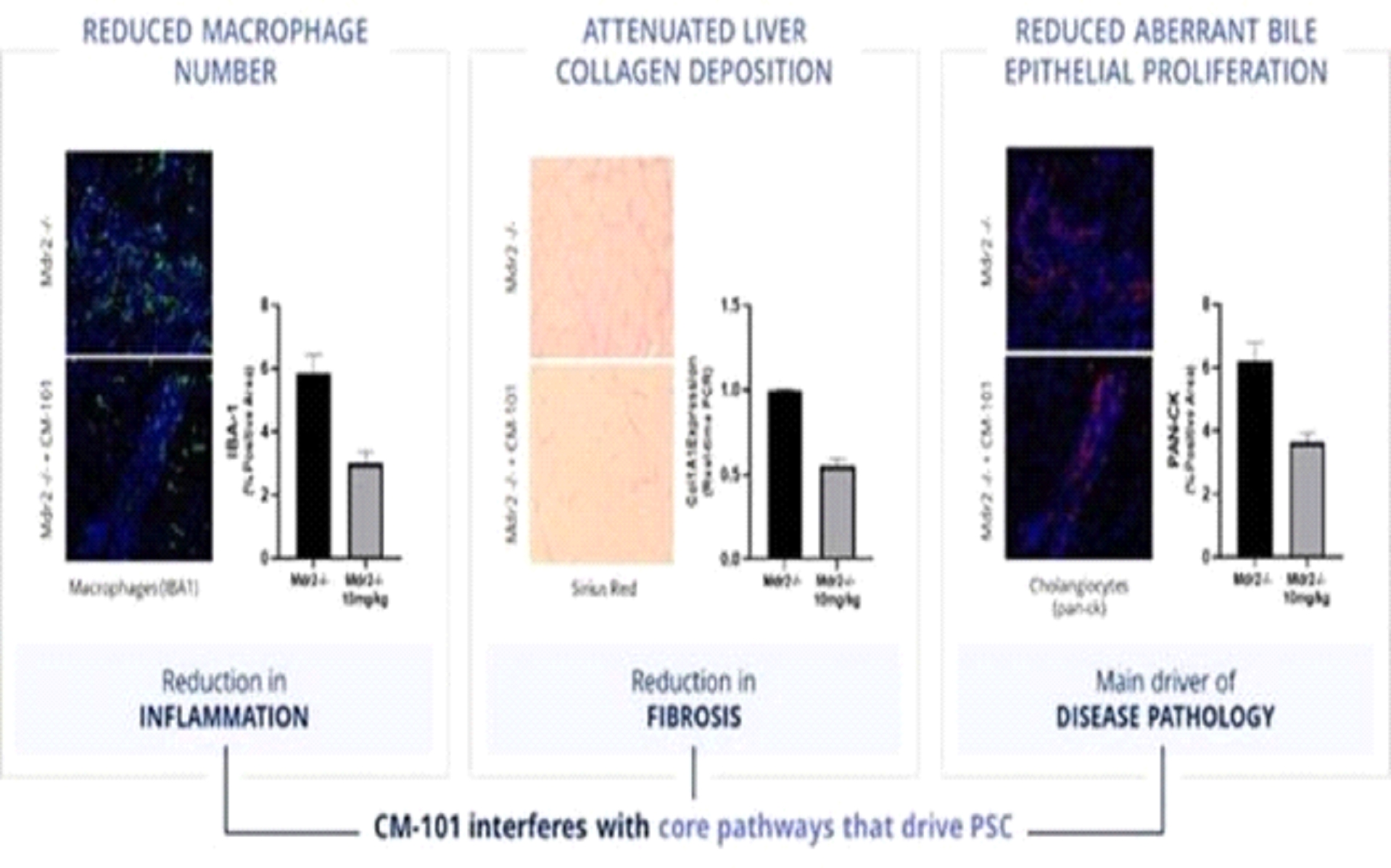
Nebokitug reduces liver fibrosis, inflammation
and bile duct epithelial proliferation in MDR2 knockout model
Nebokitug demonstrates in vivo activity in
a thioacetamide induced liver fibrosis model in rats using a therapeutic model
To assess the potential efficacy of nebokitug on liver fibrosis,
we used the TAA-induced liver fibrosis model. Liver fibrosis was induced by intraperitoneal administration of TAA at a dose of 250 mg/kg
twice weekly for eight weeks. Rats (n=10/group) received either vehicle control or nebokitug 2.5 mg/kg IV twice weekly during weeks four
to eight following established fibrosis and were sacrificed at week eight. After eight weeks of TAA treatment, all vehicle-treated animals
had developed liver fibrosis, as confirmed by Sirius-red-stained liver histology.
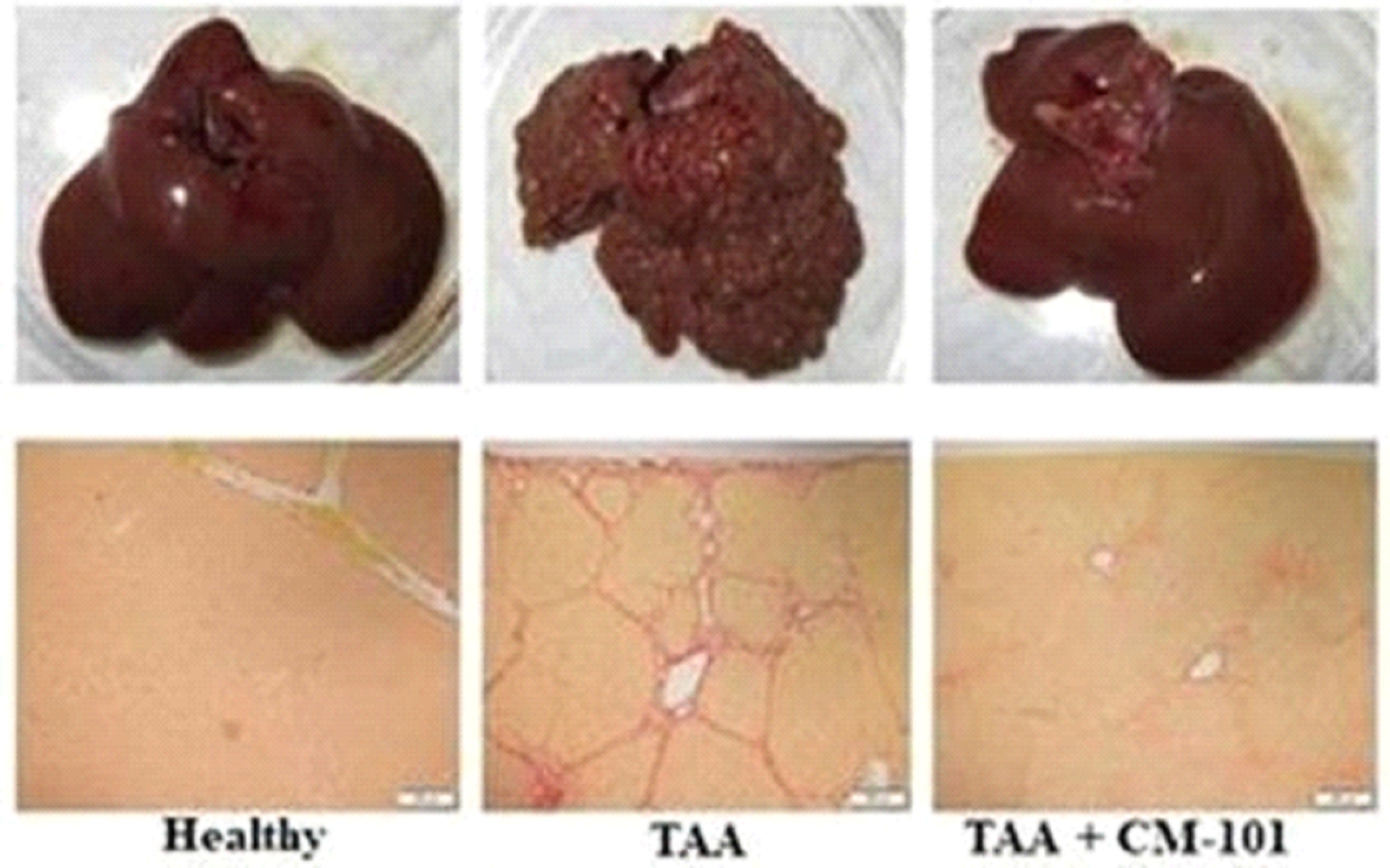
nebokitug reduces fibrosis in rat livers
Plasma ALP, ALT, and AST levels decreased in the nebokitug study
arm. Liver collagen content and fibrotic areas were significantly reduced in the nebokitug-treated group compared to non-active treatment.
nebokitug was also shown to reduce fibrotic markers in the TAA treated rats.
Efficacy of nebokitug in models of SSc
42
Preclinical experiments in models of SSc
|
• |
Nebokitug reduces SSc serum-induced dermal fibroblast activation and transition to
myofibroblasts and interferes with endothelial cell activation. |
|
|
|
|
• |
Nebokitug treatment attenuated skin fibrotic remodeling in the bleomycin (BLM)-induced
dermal fibrosis mouse model. |
|
|
|
|
• |
Nebokitug attenuated lung fibrosis and inflammation in the bleomycin (BLM)-induced
pulmonary fibrosis mouse model. |
Results from the bleomycin (BLM)-induced dermal and lung fibrosis
mouse models are discussed below in more detail.
Nebokitug treatment attenuates skin fibrotic
remodeling in the bleomycin (BLM)-induced dermal fibrosis mouse model
The activity of nebokitug (D8) in SSc was tested in the dermal bleomycin model. Treatment
started after the onset of fibrotic signs, eight days following the first BLM injection. Histological assessment of skin lesions stained
with H&E and Masson’s trichrome revealed significant elevation of dermal thickness and collagen deposition following 21 days
of BLM administration. This elevation was significantly reduced when mice were treated with 2.5 mg/kg nebokitug with significant reductions
in both skin thickness and collagen deposition compared with the mouse group treated with BLM alone.
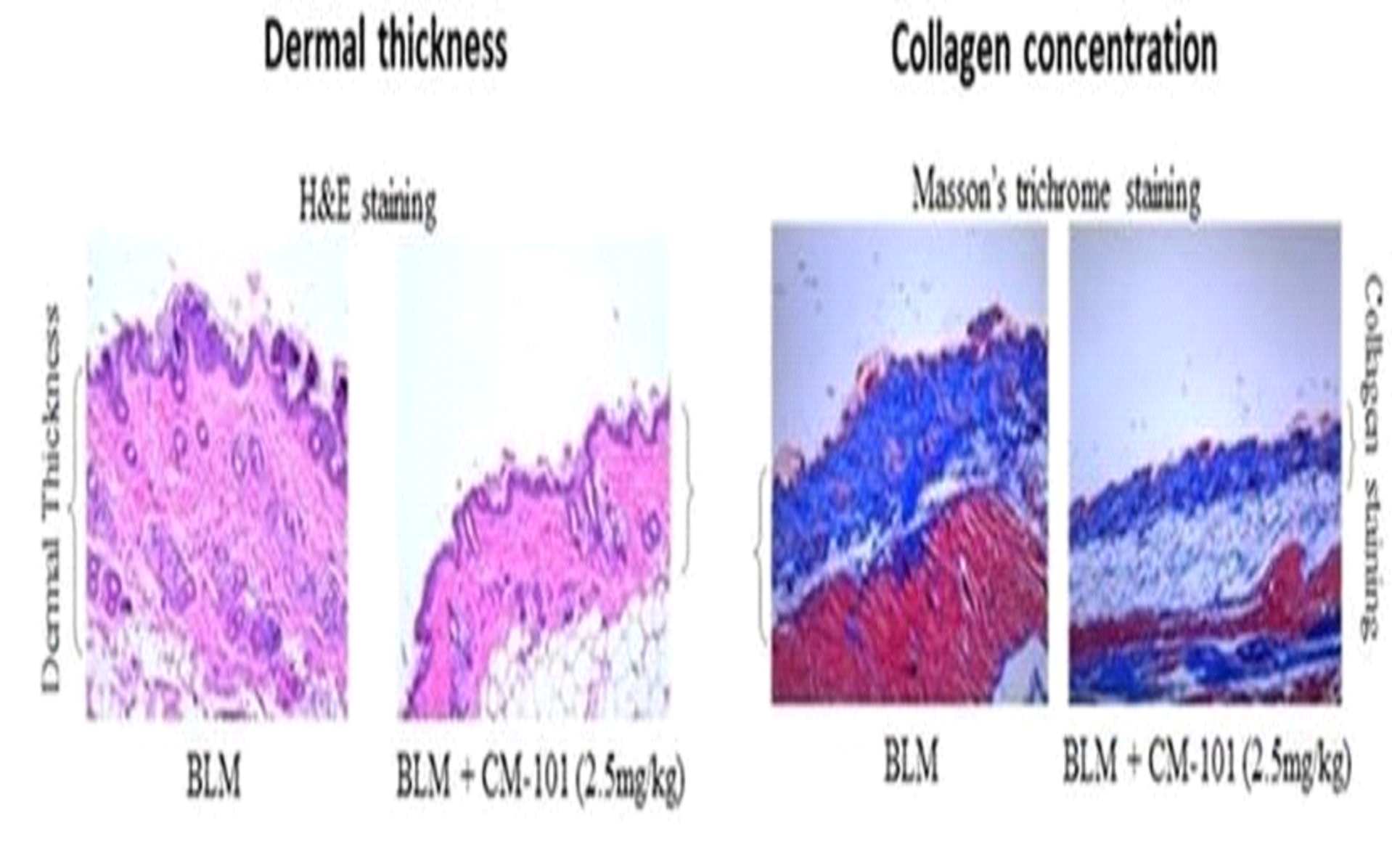
Nebokitug treatment attenuates skin fibrotic
remodeling in the bleomycin-induced dermal fibrosis mouse model
Another feature that characterizes the BLM model and is representative
of human SSc is the development of bronchoalveolar inflammation. To evaluate the effect of nebokitug on lung inflammation, we collected
bronchoalveolar lavage, or, BAL, fluid, and assessed the number of white blood cells, or WBC, and mononuclear cells. Treatment with BLM
for 21 days significantly increased WBC and mononuclear cells in BAL fluid and the number of WBC and mononuclear cells was decreased significantly
following nebokitug treatment compared with the group that was administered only BLM. This data supports the anti-inflammatory effect
of nebokitug in SSc.
Nebokitug inhibits lung fibrosis in the BLM-induced
pulmonary fibrosis mouse model
We also tested nebokitug in the experimental lung SSc model where
mice were given a single intratracheal administration of BLM followed by either nebokitug, non-active treatments (PBS or control immunoglobulin
G (IgG)) or the approved anti-fibrosis drugs, pirfenidone and nintedanib. nebokitug had a significant anti-fibrotic and anti-inflammatory
effect in the experimental BLM-induced lung fibrosis model as compared with non-active treatment-treated animals. BLM animals treated
with non-active treatments showed massive immune cell infiltration, extensive fibrosis and severe tissue injury. nebokitug-treated mice
exhibited significantly reduced levels of lung fibrosis similar to levels in healthy animals and showed superior effects compared to the
approved fibrosis drugs pirfenidone and nintedanib.
43
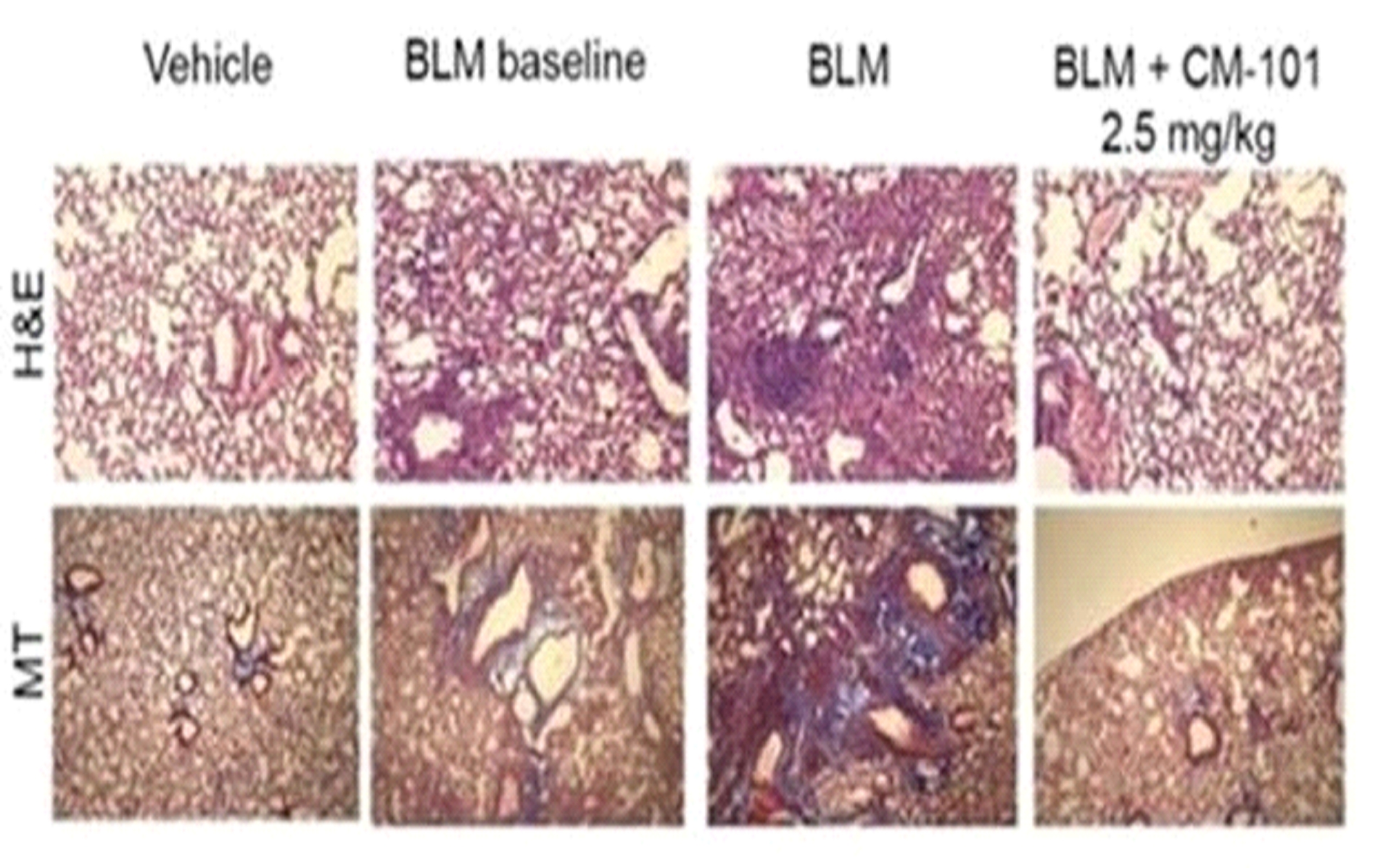
Nebokitug attenuates lung fibrosis and collagen
deposition in the bleomycin (BLM)-induced pulmonary fibrosis mouse model
Preclinical safety and toxicology of nebokitug
Preclinical safety evaluation of nebokitug included tissue cross
reactivity, assessment of the effect of nebokitug on pro-inflammatory cytokine secretion ex-vivo, and in vivo GLP toxicology studies in
mice and non-human primates. No safety concerns were observed in these preclinical assessments.
Immunogenicity may be triggered following administration of humanized
monoclonal antibodies, an effect that is frequently seen with approved mAbs. To date, no meaningful ADA effects were identified in three
completed clinical studies, which supports a preliminary conclusion that nebokitug may have low immunogenic potential.
As summarized below, there were no safety concerns related to nebokitug in any of the
other preclinical safety experiments.
Summary of key preclinical safety experiments
|
Preclinical findings |
|
Observation |
|
Ex vivo |
|
|
|
Antibody dependent cell-cytotoxic (ADCC) and complement dependent cell-cytotoxic (CDC)
activity was tested in PBMCs from healthy volunteers.
|
|
Nebokitug did not have Fc-related effector functions such as ADCC and CDC.
|
|
Cytokine release was assessed in human whole blood from healthy volunteers.
|
|
Nebokitug did not induce pro-inflammatory cytokine secretion.
|
|
Tissue cross reactivity was evaluated from healthy human tissues. |
|
Nebokitug does not bind non-specifically to healthy tissues, and therefore is expected
to only bind to its target, circulating CCL24. |
|
In vivo |
|
|
|
GLP repeated dose 4-week toxicity study of nebokitug (IV) in mice.
|
|
1. No obvious treatment related adverse reactions.
2. No gross or microscopic pathological findings.
3. No cases of treatment related mortality were observed.
4. No significant elevation was seen in IL1β, IL2, IL4, IL5, IL10, GM-CSF, IFN and TNFα.
|
44
|
GLP repeated dose (up to 50 mg/kg) 6-month toxicity study of nebokitug (SC) in Cynomolgus
Monkey.
|
|
1. No obvious treatment related adverse reactions.
2. No clinical signs or injection site reactions.
3. No cases of treatment related mortality were observed.
4. Blood and urine tests were found to be within normal ranges for monkeys.
5. No treatment-related organ weight changes and no treatment-related necropsy findings.
6. No treatment-related histopathology findings.
7. Three samples from treated animals were confirmed ADA positive but there was no obvious correlation
between positive ADA results and nebokitug serum concentrations or systemic exposure. |
Preclinical proof of mechanism studies for
nebokitug
We conducted a series of in vitro and in vivo studies to demonstrate
the proposed mechanism of action and provide proof-of-concept for administering nebokitug in the clinic for target indications.
Affinity, selectivity, and binding kinetics
We evaluated the kinetic binding parameters of nebokitug to human
CCL24, as well as the specificity of nebokitug binding to other chemokines using commercial binding assays. nebokitug demonstrated a strong
and stable, high affinity binding to CCL24.
Nebokitug reduced CCL24 dependent CCR3 activation
In an in vitro assay, nebokitug
was shown to robustly attenuate the ability of CCL24 to induce activation of the CCR3 receptor following pre-incubation of CCL24 with
nebokitug.
Clinical Development of nebokitug
Completed clinical studies
The nebokitug Phase 1 program included two Phase 1a single administration,
or SAD, studies, using IV and SC administration with doses ranging from 0.75-10 mg/kg, in healthy volunteers and a Phase 1b multiple administration
(MAD) study (5 administrations) in MAFLD patients with normal liver function, testing 2.5 mg/kg IV and 5 mg/kg SC. In the Phase 1 studies
42 subjects have received at least one nebokitug dose, the majority by IV infusion (12/42 subjects received SC).
Safety
The first Phase 1a study, which was a single-center, randomized
double-blind, placebo-controlled, single-dose, dose-escalation study, included four escalating dose groups of eight subjects each. In
each dose group subjects were randomized in a 3:1 ratio to receive a single IV infusion of either nebokitug (n=6) or placebo (n=2). A
total of 24 subjects were enrolled into the study and randomized to the treatment groups (0.75 mg/ kg, 2.5 mg/kg, 5.0 mg/kg, 10 mg/kg)
and eight subjects received a placebo. All 32 subjects completed the study as planned. Single, IV doses of nebokitug were well tolerated
up to the highest dose level (10 mg/ kg) in healthy subjects. No severe or serious adverse events, or AEs, occurred during the study and
all nebokitug related AEs were mild, with one moderate AE reported in the placebo group (myalgia).
The second Phase 1a study was also a single-center, randomized
double-blind, placebo-controlled, single-dose study, but evaluated only one dose group. Subjects were randomized in a 3:1 ratio to receive
a single SC injection of either nebokitug 5 mg/kg (n=6) or matching placebo (n=2). A total of eight subjects were enrolled into the study
and randomized; all eight subjects completed the study as planned. Single SC administration of 5 mg/kg of nebokitug was well tolerated
with no severe or serious AEs occurring during the study. A total of 6 AEs were reported in two subjects treated with nebokitug; only
one AE was classified as related to nebokitug (change in diastolic blood pressure) and that AE was classified as mild in intensity.
In both Phase 1a studies, all AEs reported were resolved; no subjects
discontinued the study prematurely due to AEs, and no concomitant medications were required for treatment of any drug-related AEs. No
clinically significant changes in laboratory tests (hematology, chemistry or urinalysis), vital signs, ECG, physical examination or infusion
site examination were observed. In the first Phase 1a study with nebokitug delivered by IV administration, the effect on cytokine secretion
was tested pre-treatment and one hour, eight hours and 24 hours post drug administration. Serum levels of a panel of cytokines including
IL-6, IFNγ, GM-CSF, TNF-α, IL-2, IL-4, IL-8 and IL-10 showed no significant change at all tested nebokitug doses and timepoints.
These findings suggest that single nebokitug administration does not cause immune activation nor cytokine secretion. Additionally, none
of the subjects in either of the Phase 1a studies tested positive for anti-drug antibodies (ADA).
45
The multiple administration randomized, placebo-controlled, Phase
1b study in MAFLD patients with normal liver function tests evaluated two dose levels. The first dose level of 2.5 mg/kg nebokitug was
administered as an IV infusion and the second dose level of 5 mg/kg was administered as an SC injection. Both dose levels involved five
drug administrations over 12 weeks (Q3W), providing 15 weeks of treatment coverage. At both dose levels, subjects were randomized in a
3:1 ratio to receive either nebokitug (n=6 per cohort) (2.5 mg/kg IV or 5 mg/kg SC) or matching placebo (n=2 per cohort). Five repeated
IV and SC nebokitug administrations were well tolerated and there were no deaths, or severe or serious drug related AEs reported throughout
the study. Only mild to moderate AEs were reported in the nebokitug treatment groups of which only two AEs were classified as possibly
related to nebokitug. No injection site reactions or clinically significant trends in laboratory tests (hematology, chemistry, or urinalysis),
vital signs, ECG or physical examination were observed. One patient experienced a non-drug-related SAE. This patient was a 61-year-old
female that was subsequently diagnosed with a non-treatment related meningioma. The tumor was treated surgically, and the patient was
discontinued from the study.
Pharmacokinetics with single-dose administration
PK analysis was conducted for the Phase 1 studies and the quantification
of nebokitug in plasma samples was performed using a validated ELISA-based assay by Eurofins (UK). Following IV infusion in healthy volunteers,
nebokitug exhibited a biphasic serum concentration vs. time curve (rapid distribution phase and slow elimination phase) which is typical
for monoclonal antibodies. Target-mediated drug disposition (TMDD), or presence of ADAs, was not evident in the analyzed concentration
vs. time curves of nebokitug, which exhibited linear terminal slope without apparent TMDD kinetics or other concentration-dependent changes
of the elimination kinetics. Comparison of the PK data of 5 mg/kg nebokitug using IV administration against SC administration indicates
consistent distribution and elimination behavior of nebokitug.
At either IV or SC administration, the values of the PK parameters
obtained in the non-compartmental and compartmental analysis of nebokitug concentration vs. time data appear to be typical for monoclonal
antibodies that undergo FcRn-mediated recycling. The terminal half-life of nebokitug was long for both SC and IV formulations, which supports
administration of nebokitug at a frequency of once every 2-4 weeks.
Pharmacokinetics with multiple-dose administration
PK analysis of the data from the Phase 1b study was conducted to
evaluate nebokitug following multiple IV infusion of 2.5 mg/kg or 5 mg/kg SC injections of nebokitug in MAFLD patients. Following repeated
IV infusions (2.5 mg/kg Q3W) and SC injection (5 mg/kg Q3W), nebokitug exhibited a long terminal half-life, similar to the terminal half-life
seen in the single dose studies. nebokitug accumulated over time, resulting in significant systemic exposure over time and potentially
reaching a steady state.
Overall, nebokitug reached steady state conditions more slowly
following SC injection, as compared to IV infusion. The inter-patient variability in nebokitug serum concentrations was higher for SC
dosing injection, as compared to IV. The trough nebokitug serum concentrations after repeated 5 mg/kg SC injections were proportionally
higher than those after 2.5 mg/kg IV infusions, considering the difference in administration modes. Comparison of the PK data of nebokitug
in the Phase 1b to the Phase 1a studies indicates a consistency in PK behavior of nebokitug.
Pharmacodynamics and target engagement of nebokitug
Serum was taken from patients in all three Phase 1 studies at different
times and the levels of both CCL24 and nebokitug were measured. Total CCL24 levels represent nebokitug’s engagement to its target.
Total CCL24 levels were increased following administration of the drug, which indicates that nebokitug is effective in target engagement,
as the higher levels of CCL24 correlated significantly with greater doses of nebokitug, and such levels decreased gradually from the peak
of nebokitug administration. These findings demonstrate that nebokitug effectively binds to CCL24 in the circulation, which reflects a
strong drug-target interaction.
In the Phase 1b study, nebokitug treatment of 2.5mg/kg IV attained
the highest levels of total CCL24 by the third administration, maintaining these levels until the end of treatment. Nebokitug 5mg/kg administered
by SC injection reached the highest levels of CCL24 by the fourth treatment and maintained these levels until the end of treatment. The
matching placebo did not have any effect on CCL24 levels.
As exemplified in the in-vitro studies, binding of CCL24 by nebokitug
attenuates the binding of CCL24 to its cognate CCR3 receptor, thereby reducing its downstream activation. Altogether, CCL24 levels following
treatment with nebokitug provide strong evidence for target engagement and pharmacodynamic response of nebokitug in healthy volunteers
and patients.
Phase 1b exploratory endpoints
Fibrotic biomarkers were analyzed as part of the Phase 1b study
in MAFLD patients with normal liver function. Circulating fibrotic biomarkers were tested in serum pre- and post-treatment. The analysis
included data from patients that presented with more active disease, reflected by baseline elastography (FibroScan) score >4 kPa. Tissue
inhibitor of metalloproteinases-1 (TIMP-1) and tissue inhibitor of metalloproteinases-2 (TIMP-2), considered well established fibrotic
biomarkers, were evaluated, and showed that nebokitug treatment led to reductions of both markers by week 15. The growth factor PDGF-AA,
known as a pro-fibrotic secreted factor, was also reduced in nebokitug treated patients. Conversely, in the placebo group TIMP-1, TIMP-2
and PDGF-AA all increased.
46
Evaluation of the fibrogenesis and fibrolysis/inflammatory biomarkers,
Pro-C3, Pro-C4 and C3M measured in serum, conducted by Nordic Bioscience, Copenhagen, Denmark, were also used as sensitive indicators
of the liver’s fibrotic state. In accordance with reduced liver stiffness, Pro-C3, Pro-C4 and C3M were all reduced in the nebokitug
treated groups. No reductions were identified in the placebo control group.
Changes in liver stiffness, a measurement of liver fibrosis, were
also evaluated using FibroScan measurements taken at screening and end of treatment (EoT) following 15 weeks of treatment coverage. 80%
of nebokitug treated patients had significant decreases in FibroScan measurements, unlike placebo patients where there was no significant
change from baseline.
Results of investigator-initiated clinical study of nebokitug in patients with COVID-19-derived
lung damage
On November 9, 2022, encouraging clinical data from an investigator-initiated
clinical study assessing nebokitug activity and safety in hospitalized patients with severe lung injury derived from COVID-19 infection
was presented at the 2022 Union Conference, an international conference on lung health. A key rationale for the study is that some of
the mechanisms underlying lung inflammation resulting from COVID-19 infection are similar to those seen in systemic sclerosis and other
chronic diseases involving lung inflammation and fibrosis.
The objective was to evaluate the safety and activity of nebokitug
in hospitalized COVID-19 patients with severe pneumonia, including its impact on biomarkers related to lung inflammation that are also
relevant in SSc. The open label, single arm trial enrolled 16 hospitalized adult COVID-19
patients with severe respiratory involvement. All patients were receiving standard of care therapy. All were treated with a single 10mg/kg
intravenous dose of nebokitug on the first day of the study and followed for 30 days.
Administration of nebokitug to this acutely ill patient population
appeared well tolerated. nebokitug exposures and target engagement profiles were similar to what our researchers have seen in previous
clinical studies of nebokitug.
Importantly, rapid reductions in serum biomarkers of lung inflammation,
fibrogenesis and neutrophil activity were observed post-treatment with nebokitug. Overall,
this study confirmed and extended the safety and tolerability profile of nebokitug and demonstrated clinically relevant changes in biomarkers
associated with lung inflammation and fibrogenesis, further supporting nebokitug’s anti-inflammatory and anti-fibrotic effects.
Moreover, we believe that these results add to the data suggesting
that nebokitug has the potential to attenuate lung inflammation and fibrosis, further strengthening the rationale for treating SSc patients
with this drug. These new clinical data also contribute to a growing body of evidence demonstrating nebokitug’s anti-fibrotic and
anti-inflammatory effects in varied organs including the lung, liver and skin.
Primary endpoints for the study were safety and tolerability. Secondary
endpoints included the evaluation of the pharmacokinetic and target engagement profile of the SC formulation as well as changes in relevant
biomarkers that may provide further mechanistic understanding of nebokitug effects on liver fibrosis. This trial was primarily designed
to assess a subcutaneous formulation of nebokitug and to evaluate the drug’s impact on liver fibrosis biomarkers relevant to both
MASH and fibro-inflammatory conditions that represent the focus for Chemomab, such as PSC and SSc.
The randomized, placebo-controlled trial enrolled 23 MASH patients
with stage F1c, F2 and F3 disease who were randomized to receive either nebokitug or placebo. Patients received eight doses of 5 mg/kg
of study drug administered by subcutaneous injection once every two weeks, for a treatment period of 16 weeks. Key findings of the nebokitug
Phase 2a trial included the following.
|
• |
Nebokitug appeared to be well tolerated when administered subcutaneously. Most reported
adverse events observed were mild, with one unrelated serious adverse event reported. No significant injection site reactions were reported
and no anti-drug antibodies were detected. |
|
|
|
|
• |
Nebokitug administered subcutaneously demonstrated favorable pharmacokinetics and
target engagement profiles as expected and were similar to what we have previously reported. |
|
|
|
|
• |
Nebokitug-treated patients showed greater improvements than the placebo group in a
number of liver fibrosis-related biomarkers, including ProC-3, ProC-4, ProC-18, TIMP-1 and ELF. |
|
|
|
|
• |
A majority of nebokitug-treated patients showed improvements in more than one liver
fibrosis-related biomarker—almost 60% of nebokitug patients responded in at least three biomarkers at week 20, compared to no patients
in the placebo group. |
|
|
|
|
• |
A higher proportion of patients in the nebokitug-treated group showed improvement
in a physiologic measure of liver stiffness as compared to placebo (reduction of at least one grade of fibrosis score as assessed by the
non-invasive elastography method known as FibroScan®). |
|
|
|
|
• |
Nebokitug-treated patients with higher CCL24 levels at baseline showed greater reductions
in fibrosis-related biomarkers than patients with lower levels. Multiple fibrosis-related biomarkers showed more pronounced reductions
in nebokitug-treated patients who had higher CCL24 levels at baseline than in patients with lower CCL24 levels at baseline, adding to
the growing body of evidence validating the role of CCL24 in the pathophysiology of fibrotic liver disease. |
|
|
|
|
• |
After completion of the study, the unblinded data showed that patients in the nebokitug-treated
group had higher baseline levels of fibrosis compared to placebo patients. The impact of this difference on the results, if any, is unknown.
|
47
Secondary analysis results of Phase 2a study in patients with
liver fibrosis derived from MASH
In June 2023, at the 2023 EASL Congress, Chemomab
researchers reported topline results from secondary analyses of the Phase 2a liver fibrosis trial assessing nebokitug, in patients with
MASH. The results were included in a late-breaking poster presentation.
Overall, the data showed improvements across an additional set
of inflammatory and fibrotic biomarkers that are consistent with the positive clinical results Chemomab released in January of 2023. Additionally,
in MASH patients at greater risk of disease progression, nebokitug treatment resulted in a greater biomarker response than in MASH patients
with lower risk disease or in placebo-treated patients.
The new analyses assessed additional biomarkers and also used
the FibroScan-AST (FAST) score to categorize study patients based on progressive disease risk, thereby enabling the evaluation of nebokitug
activity in the main target population of patients with more active disease. FAST is a validated score composed of non-invasive FibroScan® and
AST measurements that is used to identify patients with a high risk of MASH progression. The results showed that:
|
• |
FAST scores were improved in a higher proportion of nebokitug-treated patients than
in placebo patients. |
|
|
|
|
• |
Nebokitug-treated patients with higher FAST scores demonstrated greater improvements
in key fibro-inflammatory biomarkers, such as Pro-C3, than patients with lower FAST scores or placebo patients. |
|
|
|
|
• |
Nebokitug-treated patients with higher FAST scores showed improvements in several fibro-inflammatory
biomarkers generally comparable to those achieved in several recent successful MASH clinical trials. |
Additionally, in these secondary analyses, nebokitug-treated patients
showed improvements in an additional set of biomarkers associated with active fibrosis and inflammation:
|
• |
FIB-4, an index for determining MASH status that includes age, platelet count, AST
and ALT levels, was improved in nebokitug-treated patients vs. placebo patients. |
|
|
|
|
• |
AST/ALT ratio, a liver enzyme ratio, was improved in nebokitug-treated patients vs.
placebo patients. |
|
|
|
|
• |
Neutrophil-to-Lymphocyte Ratio (NLR), an indicator of inflammation, was improved in
nebokitug-treated patients vs. placebo patients, and NLR was further improved in groups with higher FAST scores. |
|
|
|
|
• |
PRO-C3, which captures active fibrogenesis and correlates with fibrotic disease severity,
was improved in nebokitug-treated patients vs. placebo patients and was further improved in groups with higher FAST scores. As an overall
indicator of fibrogenesis and fibrotic disease, PRO-C3 is also considered a potential "bridge" to PSC and other anti-fibrotic indications.
|
We believe the that the data analyses from this trial provide important
insights in support of the nebokitug development program, including the favorable safety and tolerability of nebokitug in patients with
serious liver disease, confirmation of early signs of biomarker activity that are relevant for a number of fibro-inflammatory disorders,
and support of the tolerability and pharmacokinetic data needed to assess next steps in the development of our current subcutaneous formulation.
SPRING Trial: Phase 2 Clinical study in PSC
The Phase 2 SPRING trial in PSC was a randomized, double-blind,
placebo-controlled, study designed to evaluate the safety and efficacy of nebokitug in adult subjects with PSC. Participants needed to
have a serum alkaline phosphatase, or ALP, level of at least 1.5 times the upper limit of normal (x 1.5 ULN). Subjects with concomitant
inflammatory bowel disease (IBD) were eligible for recruitment if their disease was stable and there was an absence of high-grade dysplasia
in colonic biopsies within 18 months of randomization. Subjects were randomized to receive 10 mg/kg or 20mg/kg of nebokitug IV, or placebo,
in a 2:1 ratio. Patients received a dose of investigational product once every three weeks for a total of five administrations resulting
in a total coverage of 15 weeks during the double-blind portion of the study. The study design also includes a 33-week long open-label
extension period during which all participants received either 10 mg/kg or 20 mg/kg of nebokitug via IV administration every three weeks.
The primary endpoint for the study was safety and tolerability.
Secondary endpoints included evaluations of changes from baseline in the fibrotic marker enhanced liver function, or ELF, score at week
15 as well as evaluation of change in liver stiffness using elastography. ELF score is a biochemical test panel made up of serum markers
that are indicators of the extracellular matrix. Additional secondary endpoints included evaluations of changes from baseline in liver
enzymes and additional fibrotic markers, including ALP, AST, ALT, total bilirubin, Pro-C3, as well as PK, PD and ADA parameters. Measurements
of cholestasis related activity like pruritus were also evaluated.
48
Nebokitug SPRING Trial – Overview of Key Results
Nebokitug met the primary study endpoint, demonstrating it is well
tolerated over the 15-week treatment period. Nebokitug -treated patients with moderate/advanced disease showed improvements on a wide
range of disease-related secondary endpoints, including assessments of changes from baseline relative to placebo at Week 15 in liver stiffness;
in liver fibrosis biomarkers, including the Enhanced Liver Fibrosis (ELF) score and PRO-C3 levels; in total bilirubin and liver function
tests; in pruritus (itch) and in markers of inflammation.
Dose-dependent responses were observed for multiple disease-related
biomarkers. A consistent pattern of greater improvement on the secondary endpoints was seen in the study arm receiving 20 mg/kg of nebokitug
and in the prespecified subgroup of PSC patients with moderate/advanced disease. Since PSC is a slowly progressive disease, longer duration
of treatment with nebokitug may also result in greater improvement in patient populations with lower disease burden, with the goal of
slowing or preventing disease progression.
Primary Endpoint
Nebokitug demonstrated it was well-tolerated over the 15-week treatment
period. It also exhibited favorable and dose-dependent pharmacokinetic profiles. Adverse events, which most commonly included fatigue,
headache, and pruritus, were generally mild/moderate and distributed similarly between the placebo and nebokitug -treated dosing arms.
Key Secondary Endpoints
Liver Stiffness Measures Improved in Nebokitug
-Treated PSC Patients
Notably, both doses of nebokitug improved liver stiffness relative
to placebo at Week 15, with a statistically significant improvement achieved in patients with moderate/advanced disease This is the first
time that an investigational drug for the treatment of PSC has demonstrated significant improvements in liver stiffness in a relatively
short study.
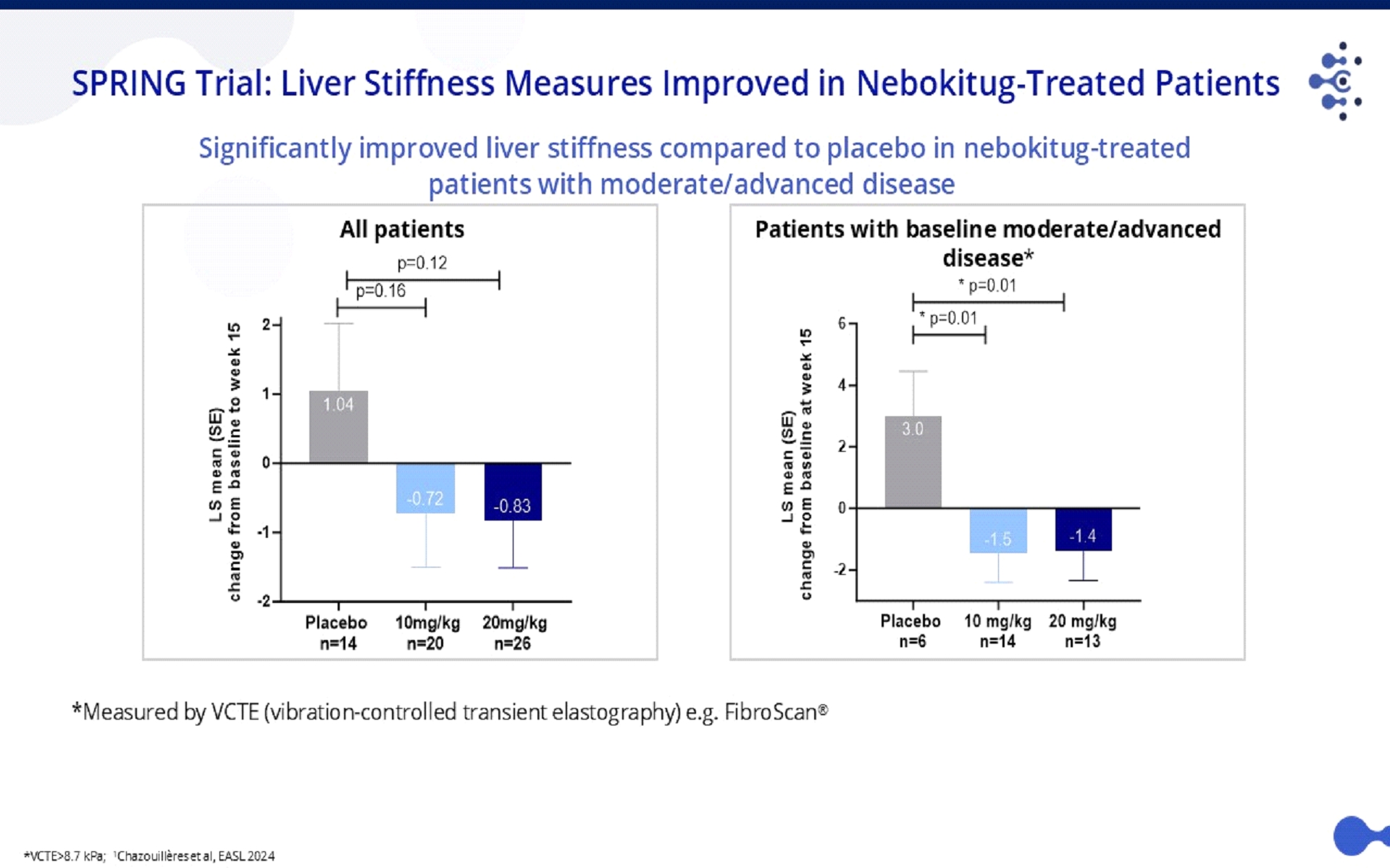
ELF Score Improved in Nebokitug -Treated PSC Patients
Patients treated with the 20 mg/kg dose of nebokitug with moderate/advanced
disease had reduced ELF scores relative to placebo at all time points in the trial. In addition, in all patients treated with the 20 mg/kg
dose of nebokitug, ELF changes from baseline remained consistently below 0.19, a recognized threshold for predicting long-term PSC-related
clinical events.
49
PRO-C3 Improved in Nebokitug
-Treated in PSC Patients
Reductions in PRO-C3 levels at Week 15 relative to placebo were
observed in patients receiving both the 10 mg/kg and 20 mg/kg doses of nebokitug. PRO-C3, a serum biomarker of type III
collagen synthesis, has been shown to be elevated in patients with PSC and has been identified as an independent predictor of transplant-free
survival in PSC.
Total Bilirubin Improved in Nebokitug
-Treated PSC Patients
Bilirubin is a key biomarker that is an indicator of bile duct
health. Nebokitug -treated patients showed a dose-dependent improvement in total bilirubin relative to placebo at Week 15 that further
supports the anti-cholestatic activity of nebokitug
5-D Itch Scale Total Pruritus Scores Improved in Nebokitug
-Treated PSC Patients
Pruritus total scores on the 5-D Itch Scale relative to placebo
improved in nebokitug -treated patients, who demonstrated decreased pruritus scores compared to placebo starting as soon as six weeks
after their first dose. Nebokitug -treated patients experienced decreased pruritus scores across all timepoints compared to
placebo and the decrease reached statistical significance in patients receiving the 10 mg/kg dose at Week 15.
Liver Function Tests Improved in Nebokitug -Treated PSC Patients
All liver function tests improved in nebokitug -treated patients
relative to placebo at Week 15. Levels of alkaline phosphatase (ALP), alanine aminotransferase (ALT) aspartate aminotransferase (AST)
and gamma-glutamyl transferase (GGT) decreased in nebokitug -treated patients receiving the 20 mg/kg dose.
Anti-inflammatory Activity Demonstrated in Nebokitug -Treated PSC
Patients
Levels of the inflammatory cytokines IL-6 and TGFβ1, which
are known to play an important role in inflammation and fibrosis, were reduced in nebokitug -treated patients relative to placebo
at Week 15. The reduction reached statistical significance in moderate/advanced disease patients receiving the 20 mg/kg dose.
SPRING Trial Open Label Extension (OLE)
More than 90% of SPRING trial patients eligible to participate
in the OLE (50 out of 54 eligibles) chose to continue. OLE participants who had been in the treatment arms of the 15-week double-blinded
portion of the SPRING trial received another 33 weeks of treatment with nebokitug, for at total of up to 48 weeks of treatment, and former
placebo patients crossed over to receive 33-weeks of treatment with nebokitug.
The OLE study confirmed that in PSC patients receiving 10 mg/kg
or 20 mg/kg of nebokitug administered once every three weeks for 48 weeks, the drug was safe and well-tolerated and resulted in positive
effects, including continued improvements in key liver biomarkers such as the ELF score, the fibrosis-related components of ELF and the
fibrosis biomarker PRO-C3. Liver stiffness scores (transient elastography), as measured by FibroScan®
were substantially lower in the nebokitug-treated patients with moderate/advanced disease compared to matching historical controls. Cholestasis-related
markers stabilized over 48 weeks of treatment and total serum bile acids were reduced. OLE patients with moderate/advanced disease treated
with nebokitug for 48 weeks showed a significantly lower number of clinical events (4.8%) compared to matching historical controls (25.8%).
Results from the patients receiving placebo in the double-blinded period who rolled over to receive 33 weeks of treatment with nebokitug
during the OLE were consistent with the results in patients treated with nebokitug in the double-blinded study, including stabilization
of ELF scores and improvements in liver stiffness compared to baseline.
50
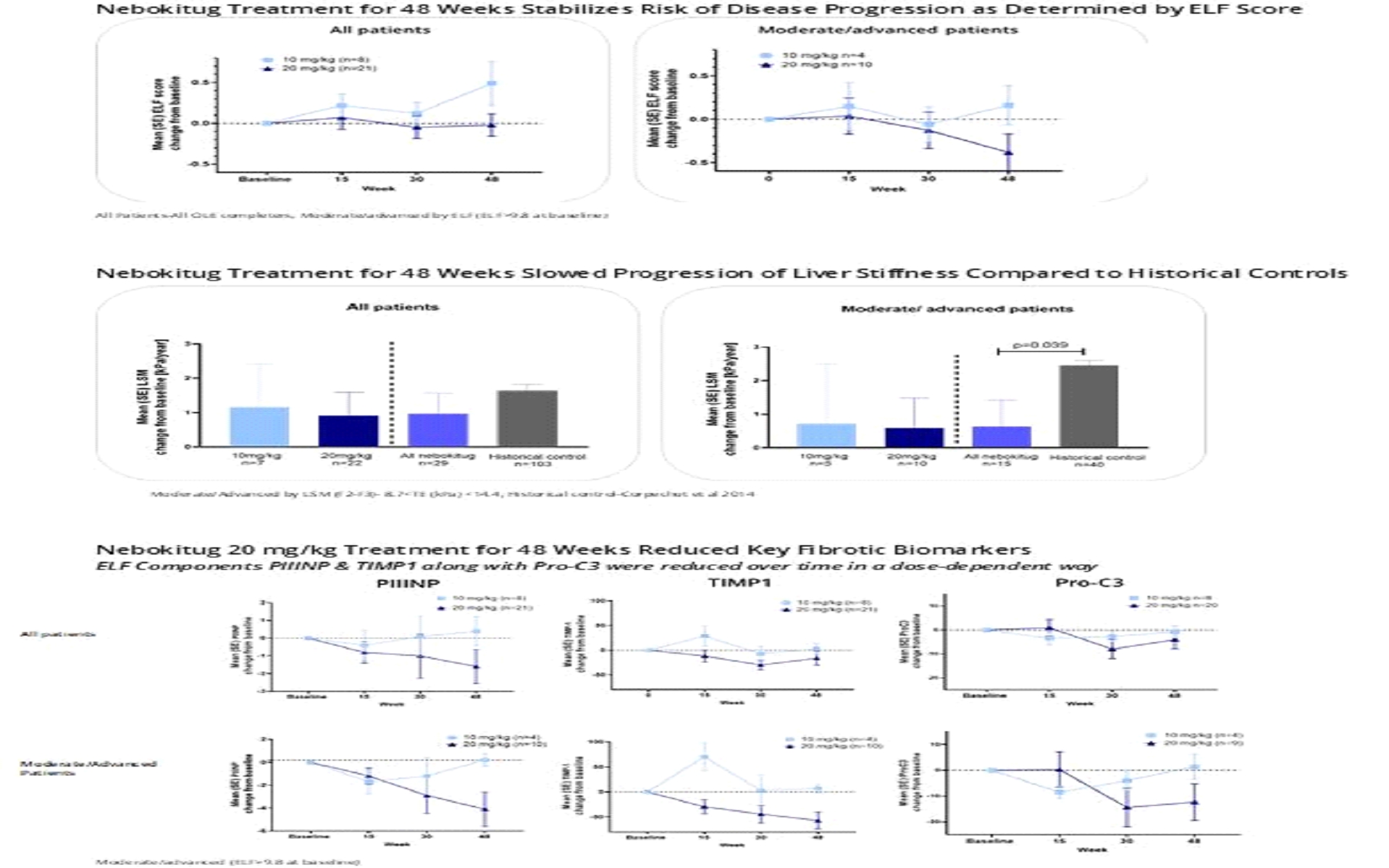
The company views the broad and consistent stabilization and improvement
in disease-related biomarkers for up to 48 weeks of nebokitug treatment in the OLE results, including reductions in the risk of disease
progression as shown by the ELF score, as directly translatable and potentially derisking to the planned nebokitug PSC Phase 3 study.
Additionally, the new data showed a lower rate of clinical events in patients treated with nebokitug for up to 48 weeks compared
to historical controls, further increasing confidence in the Phase 3 trial design, where the primary endpoint is reduction in time to
first clinical event. The findings represent an important milestone in Chemomab’s continued clinical progress and reinforce the
rationale for the planned Phase 3 trial that provides a pathway to potential full regulatory approval for nebokitug in PSC.
Phase 2 in SSc
Chemomab has a Phase 2 ready study in SSc that may enable proof-of-concept
and further elucidation of different nebokitug mechanisms of action in treating SSc skin, lung and vascular damage. The U.S. FDA cleared
our IND application to commence the Phase 2 SSc trial
51
Competition
The development and commercialization of new drug products is highly
competitive across major pharmaceutical companies, specialty pharmaceutical companies and biotechnology companies worldwide. We face competition
with respect to our current product and expect to face competition with respect to any product candidates that we may develop or commercialize
in the future. Specifically, there are a number of companies developing treatments for fibrotic/inflammatory diseases, including multiple
major pharmaceutical and biotechnology companies with substantially greater resources than us. We are a small biotech company with limited
resources compared to the major pharmaceutical companies, however, we believe that the unique nebokitug platform together with our knowledge
and experience in inflammatory-fibrotic research provides us with competitive advantages.
Therapeutic options for PSC and SSc are limited and despite significant
biopharmaceutical industry investment, the FDA has not approved any disease modifying therapies for the treatment of PSC or SSc. Liver
transplant is currently the only treatment shown to improve clinical outcomes for PSC patients while SSc patients are being treated with
drugs that were approved for different manifestations of the disease like interstitial lung disease (nintedanib, Boehringer Ingelheim
and tocilizumab, Hoffmann-La Roche).
We are assessing nebokitug, a first-in-class monoclonal antibody
that interferes directly with both inflammation and fibrosis, into clinical development for the treatment of PSC and SSc. There are a
number of large biopharmaceutical and biotechnology companies that are currently pursuing the development of products for the treatment
of fibrotic indications like PSC and SSc. However, we know of no other companies currently in clinical development with a monoclonal antibody
that targets CCL24.
Although the approach is novel with respect to targeting both inflammation
and fibrosis, we will need to compete with products further advanced in the pipeline towards market approval. Investigational products,
include:
|
• |
PSC |
There are currently no FDA-approved therapies for the treatment
of PSC. Companies currently developing product candidates in Phase 3 clinical studies include Dr. Falk Pharma, targeting cholestasis and
liver metabolism (Dr. Falk; norUrso), rather than anti-fibrotic and anti-inflammatory manifestations of PSC. Recently Ipsen Pharmaceuticals
announced that they are preparing to initiate a Phase 3 clinical trial in PSC with their PPAR dual agonist Elafibranor, which primarily
acts on bile acid metabolism and is not expected to be disease-modifying. Other companies with clinical candidates in earlier
stages of development include Mirum Pharmaceutical. As shown in the table below, most competitors are targeting the metabolic or symptomatic
aspects of PSC. We believe that only the Chemomab compound nebokitug has disease modifying potential, and we believe that our unique dual
anti-fibrotic and anti-inflammatory activity gives nebokitug a potential advantage.
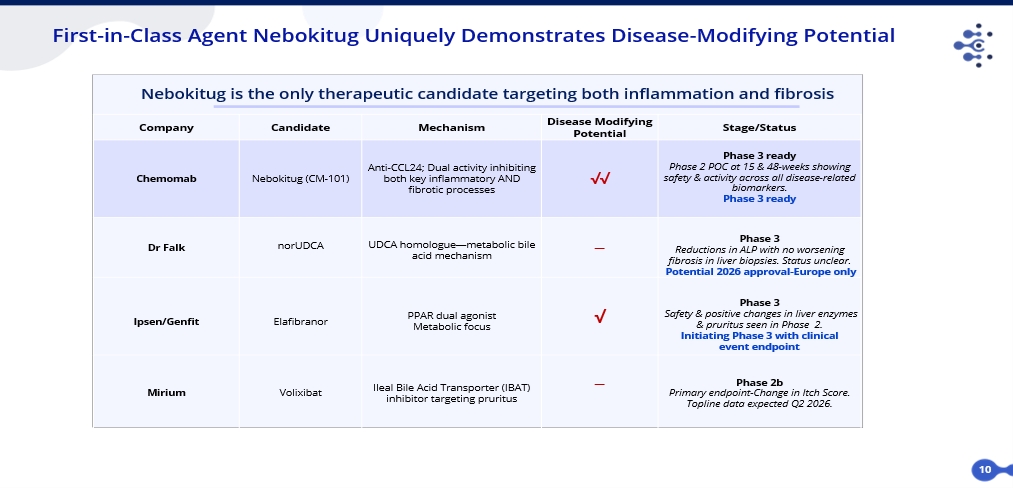
|
• |
SSc |
There are currently two FDA approved products for the treatment
of clinical manifestations of SSc--nintedanib, marketed by Boehringer Ingelheim GmbH and tocilizumab, marketed by Hoffmann-La Roche for
the treatment of interstitial lung disease. Companies currently developing product candidates in SSc in early clinical stage include Amgen,
Merck, GSK, Boehringer Ingelheim , AstraZeneca, and others. Additionally a number of pharmaceutical and biotechnology companies are in
the early stages of assessing new approaches that might be applicable to the treatment of SSc, such as CAR-T cell therapies.
52
The availability of reimbursement from government and other third-party
payors will affect the pricing and competitiveness of nebokitug and any future products. More advanced competitors also may obtain regulatory
approval for their products more rapidly than us, which could result in competitors establishing a strong market position.
Intellectual Property
Overview
We strive to protect and enhance the proprietary technology, inventions,
and improvements that are commercially important to the development of our business, including seeking, maintaining, and defending patent
rights, whether developed internally or licensed from third parties. We also rely on trade secrets relating to our proprietary technology
platform and know-how, continuing technological innovation and in-licensing opportunities to develop, strengthen, and maintain our proprietary
position in the field of inflammation and fibrosis that may present areas of opportunity for the development of our business. We may also
rely on regulatory protection afforded through data exclusivity, market exclusivity, and patent term extensions, where available.
Our commercial success may depend in part on our ability to: obtain
and maintain patent and other proprietary protection for commercially important technology, inventions and know-how related to our business;
defend and enforce our patents; preserve the confidentiality of our trade secrets; and operate without infringing the valid enforceable
patents and proprietary rights of third parties. Our ability to prevent third parties from making, using, selling, offering to sell, or
importing our products may depend on the extent to which we have rights under valid and enforceable licenses, patents, or trade secrets
that cover these activities. In certain cases, enforcement of these rights may depend on third party licensors. With respect to both licensed
and company-owned intellectual property rights, we cannot be sure that patents will be granted with respect to any of our pending patent
applications or with respect to any patent applications that may be filed by us in the future, nor can we be sure that any of our existing
patents or any patents that may be granted to us in the future will be commercially useful in protecting our commercial products and methods
of manufacturing the same.
As of the date of this Annual Report on Form 20-F, we owned or
licensed six pending or issued US patents and patent applications as well as patents and patent applications in other jurisdictions. The
first patent family has been issued in each of the United States, Europe (validated in France, Germany and the United Kingdom) and Israel
to the Tel Aviv Souraski Medical Center, whose rights have been licensed to Chemomab on an exclusive basis. A composition of matter patent
was issued in United States and certain corresponding foreign jurisdictions. To date, two additional patent families were filed concerning
the use of anti CCL24 antibodies in specific indications, dosing regimens, and routes of administration. We will seek United States and
foreign patent protection for a variety of additional technologies, including: research compounds and methods, candidate compounds and
antibodies for modulating the activity of CCL24, methods for treating diseases of interest, and methods for treating our products. We
will seek additional protection, in part, through confidentiality and proprietary information agreements.
Company Owned Intellectual Property
We own multiple families of patent applications that pertain to
anti-CCL24 monoclonal antibody compositions capable of blocking CCL24 activity and methods for treating or preventing diseases associated
with inflammation and fibrosis. Certain applications in these families relate to our nebokitug antibody, backup variants, various unit
dosages, dosing regimens, and other routes of administration. Patents that are or will be issued from these submissions will expire between
the years 2035 to 2041, subject to possible patent term adjustments and/or extensions.
In addition to the above, we have established expertise and development
capabilities focused in the areas of preclinical research and development, manufacturing and manufacturing process development, quality
control, quality assurance, regulatory affairs, and clinical study design and implementation. We believe that our focus and expertise
will help us develop products based on our proprietary intellectual property.
Licensed IP
As mentioned above, we have obtained an exclusive license from
the Tel Aviv Souraski Medical Center for one patent, which is expected to expire in 2029. This patent was issued in each of the United
States, Europe and Israel, and pertains to anti CCL24 inhibitors (specifically, anti CCL24 antibodies) and methods of using such inhibitors
for treating inflammatory, autoimmune and cardiovascular diseases.
Trade Secret Protection
We may rely, in some circumstances, on trade secrets to protect
our technology. We seek to protect our proprietary technology and processes, in part, by entering into confidentiality agreements with
our employees, consultants, scientific advisors, and contractors. We also seek to preserve the integrity and confidentiality of our data
and trade secrets by maintaining physical security of our premises and physical and electronic security of our information technology
systems.
53
Material Agreements
Tel-Aviv Souraski Medical Center (TASMC) License Agreement
In December 2011, we entered into a license agreement, or the TASMC
Agreement, with the Medical Research, Infrastructure, Health Services Fund of the Tel Aviv Souraski Medical Center., or TASMC, for the
research, development and commercialization of the CCL24 platform and CCR3 blockade platform (nebokitug), which license includes patent
rights covering the foregoing platforms and related know how and products. Under the terms of the TASMC Agreement, we are responsible
for the research, development, manufacturing and commercialization of nebokitug. This license was granted on an exclusive basis and we
were also granted rights to sublicense the instant license to third parties pursuant to certain terms described therein.
In accordance with the TASMC Agreement, we paid TASMC a non-refundable
and non-creditable payment in four milestone installments, related to TASMC’s past patent maintenance and prosecution costs.
Certain additional terms of the TASMC Agreement include:
|
• |
We will be required to pay TASMC non-refundable and non-creditable milestone payments
of up to (i) $300,000 upon the submission of an NDA, BLA or equivalent for each of the licensed products to the FDA and to equivalent
European and Asian foreign regulatory agencies, and (ii) $600,000 upon the grant by the FDA or equivalent European and/or Asian regulatory
agencies of their marketing approval for each licensed product; |
|
|
|
|
• |
In the event of an “exit,” as such term is defined therein, we must pay
TASMC an exit fee of 1% of the transaction consideration (which shall be capped at $3 million); |
|
|
|
|
• |
In the event we sublicense a licensed product, we must pay TASMC a sublicense fee
of 10% of all attributed income, in addition to a low-single digit percentage tiered royalty payment of our earned royalties. |
Unless terminated earlier, the TASMC Agreement will expire upon the later of the expiration
of the last-to-expire valid patent claim and any extension granted prior thereto. The termination of the TASMC Agreement will not preclude
TASMC from receiving sublicense payments or royalties. In addition to the foregoing, the TASMC Agreement includes customary termination
provisions.
CMC Collaboration Agreement
In June 2015, we entered into a collaboration agreement, or the
CMC Agreement, with CMC ICOS Biologics, Inc. (acquired by AGC Biologics in 2018), or CMC, which, under the terms thereof, granted the
us certain licenses to use proprietary rights, materials and know-how of CMC for purposes of research and development of nebokitug as
well as commercialization thereof. Pursuant to the terms of the CMC Agreement, we received (i) a worldwide, non-exclusive, non-transferable,
non-sublicensable license for research purposes, or the Research License, and (ii) an option, or the Option License, to a worldwide, non-exclusive,
non-transferable, sublicensable license for commercialization purposes, subject to a fee schedule in addition to that described below.
In accordance with the terms of the CMC Agreement, we agreed to
pay in exchange for the foregoing license payments to CMC upon the achievement of certain pre-determined clinical and regulatory events,
an amount stipulated in the CMC Agreement, aggregating a six-digit number. Additionally, for any product that is commercialized pursuant
to the CMC Agreement, we are required to pay CMC a royalty payment based on annual aggregate worldwide net sales thresholds for such products.
In the event CMC exclusively manufactures our products, CMC agrees to waive the foregoing royalty.
Unless terminated earlier pursuant to the customary termination
provisions set forth in the CMC Agreement, the Research License will expire upon the conclusion of the term as defined therein, and the
Option License will expire upon the later of (a) the tenth anniversary following our obtainment of regulatory approval, or (b) the last
to expire of the patent rights and country-by-country basis.
Manufacturing
Our product candidate, nebokitug, is a monoclonal antibody amenable
to standard formulation technologies. We have developed the biological process and manufactured kilogram quantities through processes
similar to the manufacturing processes that will be required to provide drug product for the Phase 2 clinical studies. The manufacturing
process of the drug substance used for such product candidates is robust, well established and requires the use of readily available starting
materials. The biological route is amenable to large-scale production and does not require unconventional equipment or handling during
the manufacturing process. We have obtained an adequate supply chain of the drug substance for nebokitug from our contract manufacturing
organization, or CMO, to satisfy both our clinical and preclinical requirements for this year. We rely on a sole supplier for the manufacture
of nebokitug. Our manufacturer has the capabilities to support late stage clinical studies as well as product launch and marketing.
We do not own or operate facilities for clinical drug manufacturing, storage, distribution
or quality testing. Currently, all of our clinical manufacturing is outsourced to third-party manufacturers. As our development programs
expand and we build new process efficiencies, we expect to continually evaluate this strategy with the objective of satisfying demand
for our clinical studies and, if approved, the manufacture, sale and distribution of commercial products.
54
Commercialization
We intend to develop and, if approved by the FDA, to commercialize
our product candidates alone or in collaboration with others. We may work in combination with one or more large pharmaceutical partners
for certain indications, where specialist capabilities are needed. We intend to enter into distribution or licensing arrangements for
global or regional commercialization rights. We will, however, continuously review our partnering strategy in the light of new clinical
data and market understanding.
Regulatory Matters
The Food and Drug Administration, or FDA, and comparable regulatory
authorities in state and local jurisdictions and in other countries impose substantial and burdensome requirements upon companies involved
in the clinical development, manufacture, marketing and distribution of drugs, such as those that we are developing. These agencies and
other federal, state and local entities regulate, among other things, the research and development, testing, manufacture, quality control,
safety, effectiveness, labelling, storage, record keeping, approval, advertising and promotion, distribution, post-approval monitoring
and reporting, sampling and export and import of our product candidates.
United States government regulation of drug
products
Drugs in the United States are subject to rigorous regulation under
the Food, Drug, and Cosmetic Act, or FDCA, and its implementing regulations. The FDA also regulates biological products under the FDCA
and the Public Health Service Act, or PHSA. The process of obtaining regulatory approvals and the subsequent compliance with applicable
federal, state, local and foreign statutes and regulations requires the expenditure of substantial time and financial resources. Failure
to comply with the applicable United States requirements at any time during the product development process, approval process or after
approval, may subject an applicant to a variety of administrative or judicial sanctions, such as the FDA’s refusal to approve a
pending New Drug Application, or NDA, withdrawal of an approval, imposition of a clinical hold, issuance of warning letters, product recalls,
product seizures, total or partial suspension of production or distribution, injunctions, fines, refusals of government contracts, restitution,
disgorgement or civil or criminal penalties.
The process required by the FDA before a drug or biologic may be
marketed in the United States generally involves the following:
|
• |
completion of preclinical laboratory tests, animal studies and formulation studies
in compliance with the FDA’s Good Laboratory Practice, or GLP, regulations; |
|
|
|
|
• |
submission to the FDA of an Investigational New Drug application, or IND, which must
become effective before human clinical studies may begin; |
|
|
|
|
• |
approval by an Institutional Review Board, or IRB, at each clinical site before each
study may be initiated; |
|
|
|
|
• |
performance of adequate and well-controlled human clinical studies in accordance with
Good Clinical Practice, or GCP requirements to establish the safety and efficacy of the proposed drug product for each indication;
|
|
|
|
|
• |
completion of all manufacturing requirements to ensure robust manufacturing process,
and product quality and safety as per Good Manufacturing Practice, or cGMP guidelines; |
|
|
|
|
• |
completion of non-clinical reproductive studies, as applicable, prior to late stage
clinical studies and NDA or Biologics License Application, or BLA, submission; |
|
|
|
|
• |
development of an appropriate pediatric plan for clinical testing or exclusion, pre-
or post-approval, as applicable; |
|
|
|
|
• |
submission to the FDA of an NDA or BLA; |
|
|
|
|
• |
satisfactory completion of an FDA advisory committee review, if applicable;
|
|
|
|
|
•
|
satisfactory completion of an FDA inspection of the manufacturing facility or facilities
at which the product is produced to assess compliance with cGMP requirements and to assure that the facilities, methods and controls are
adequate to preserve the drug’s identity, strength, quality and purity; |
|
|
|
|
• |
satisfactory completion of FDA audits of clinical study sites to assure compliance
with GCPs and the integrity of the clinical data; |
|
|
|
|
• |
payment of user fees and securing FDA approval of the NDA; |
|
|
|
|
• |
FDA review and approval of an NDA or BLA; and |
|
|
|
|
• |
compliance with any post-approval requirements, including the potential requirement
to implement a Risk Evaluation and Mitigation Strategies, or REMS, and the potential requirement to conduct post-approval studies.
|
55
Preclinical studies
Preclinical studies include laboratory evaluation of product chemistry,
toxicity and formulation, as well as animal studies to assess potential safety and efficacy. An IND sponsor must submit the results of
the preclinical tests, together with manufacturing information, analytical data and any available clinical data or literature, among other
things, to the FDA as part of an IND. Some preclinical testing may continue even after the IND is submitted. An IND automatically becomes
effective 30 days after receipt by the FDA, unless before that time the FDA raises concerns or questions related to one or more proposed
clinical studies and places the clinical study on a clinical hold. In such a case, the IND sponsor and the FDA must resolve any outstanding
concerns before the clinical study can begin. As a result, submission of an IND may not result in the FDA allowing clinical studies to
initiate.
Clinical studies
Clinical studies involve the administration of the investigational
new drug to human subjects under the supervision of qualified investigators in accordance with GCP requirements, which include the requirement
that all research subjects provide their informed consent in writing for their participation in any clinical study. Clinical studies are
conducted under protocols detailing, among other things, the objectives of the study, the parameters to be used in monitoring safety,
and the effectiveness criteria to be evaluated. A protocol for each clinical study and any subsequent protocol amendments must be submitted
to the FDA as part of the IND. In addition, an IRB at each institution participating in the clinical study must review and approve the
plan for any clinical study before it initiates at that institution. Information about certain clinical studies must be submitted within
specific timeframes to the National Institutes of Health, or NIH, for public dissemination on their www.clinicaltrials.gov website.
Human clinical studies are typically conducted in three sequential
phases, which may overlap or be combined. A fourth, or post-approval, phase may include additional clinical studies. These phases generally
include the following:
|
•
|
Phase 1: The drug or biologic is initially
introduced into healthy human subjects or patients with the target disease or condition and tested for safety, dosage tolerance, absorption,
metabolism, distribution, excretion and, if possible, to gain an early indication of its effectiveness. For some products for severe or
life-threatening diseases, especially if the product may be too toxic to administer to healthy humans, the initial clinical trials may
be conducted in individuals having a specific disease for which use the tested product is indicated. |
|
|
|
|
•
|
Phase 2: The drug or biologic is administered
is administered to a limited patient population to identify possible adverse effects and safety risks, to preliminarily evaluate the efficacy
of the product for specific targeted diseases and to determine dosage tolerance and optimal dosage. |
|
|
|
|
•
|
Phase 3: The drug or biologic is administered
to an expanded patient population, generally at geographically dispersed clinical study sites, in well-controlled clinical studies to
generate enough data to statistically evaluate the efficacy and safety of the product for approval, to establish the overall risk-benefit
profile of the product, and to provide adequate information for the labeling of the product. |
|
|
|
|
•
|
Phase 4: Phase 4 clinical trials are studies
required of, or agreed to by, a sponsor that are conducted after the FDA has approved a product for marketing. These studies are used
to gain additional experience from the treatment of patients in the intended therapeutic indication and to document a clinical benefit
in the case of drugs approved under accelerated approval regulations. If the FDA approves a product while a company has ongoing clinical
trials that were not necessary for approval, a company may be able to use the data from these clinical trials to meet all or part of any
Phase 4 clinical trial requirement. Failure to promptly conduct Phase 4 clinical trials where necessary could result in withdrawal of
approval for products approved under accelerated approval regulations. |
Progress reports detailing the results of the clinical studies
must be submitted at least annually to the FDA and more frequently if serious adverse events occur. Phase 1, Phase 2 and Phase 3 studies
may not be completed successfully within any specified period, or at all. Furthermore, the FDA or the sponsor may suspend or terminate
a clinical study at any time on various grounds, including a finding that the research subjects are being exposed to an unacceptable health
risk. Similarly, an IRB can suspend or terminate approval of a clinical study at its institution if the clinical study is not being conducted
in accordance with the IRB’s requirements or if the drug has been associated with unexpected serious harm to patients.
Marketing approval
Assuming successful completion of the required clinical testing,
the results of the preclinical and clinical studies, together with detailed information relating to the product’s chemistry, manufacture,
controls and proposed labeling, among other things, are submitted to the FDA as part of an NDA or BLA requesting approval to market the
product for one or more indications. In most cases, the submission of an NDA or BLA is subject to a substantial application user fee.
Under the Prescription Drug User Fee Act, or PDUFA, guidelines that are currently in effect, the FDA has a goal of ten months from the
date of “filing” of a standard NDA, for a new molecular entity to review and act on the submission. This review typically
takes twelve months from the date the NDA or BLA is submitted to FDA because the FDA has approximately two months to make a “filing”
decision.
56
In addition, under the Pediatric Research Equity Act of 2003, or
PREA, as amended and reauthorized, certain NDAs/BLAs or supplements thereof must contain data that are adequate to assess the safety and
effectiveness of the drug for the claimed indications in all relevant pediatric subpopulations, and to support dosing and administration
for each pediatric subpopulation for which the product is safe and effective. The FDA may, on its own initiative or at the request of
the applicant, grant deferrals for submission of some or all pediatric data until after approval of the product for use in adults, or
full or partial waivers from the pediatric data requirements. An Agreed Initial Pediatric Study Plan requesting a waiver from the requirement
to conduct clinical studies may be submitted to the FDA.
The FDA also may require submission of a REMS plan to ensure that
the benefits of the drug outweigh its risks. The REMS plan could include medication guides, physician communication plans, assessment
plans, and/or elements to assure safe use, such as restricted distribution methods, patient registries, or other risk minimization tools.
The FDA conducts a preliminary review of all NDAs/BLAs within the
first 60 days after submission, before accepting them for filing, to determine whether they are sufficiently complete to permit substantive
review. The FDA may request additional information rather than accept an NDA/BLA for filing. In this event, the application must be resubmitted
with the additional information. The resubmitted application is also subject to review before the FDA accepts it for filing. Once the
submission is accepted for filing, the FDA begins an in-depth substantive review. The FDA reviews an NDA/BLA to determine, among other
things, whether the drug is safe and effective and whether the facility in which it is manufactured, processed, packaged or held meets
standards designed to assure the product’s continued safety, quality and purity.
The FDA may refer an application for a novel drug to an advisory
committee. An advisory committee is a panel of independent experts, including clinicians and other scientific experts, which reviews,
evaluates and provides a recommendation as to whether the application should be approved and under what conditions. The FDA is not bound
by the recommendations of an advisory committee, but it considers such recommendations carefully when making decisions.
Before approving an NDA, the FDA typically will inspect the facility
or facilities where the product is manufactured. The FDA will not approve an application unless it determines that the manufacturing processes
and facilities are in compliance with cGMP requirements and adequate to assure consistent production of the product within required specifications.
Additionally, before approving an NDA, the FDA may inspect one or more clinical study sites to assure compliance with GCP requirements.
After evaluating the NDA/BLA and all related information, including
the advisory committee recommendation, if any, and inspection reports regarding the manufacturing facilities and clinical study sites,
the FDA may issue an approval letter, or, in some cases, a complete response letter. A complete response letter generally contains a statement
of specific conditions that must be met in order to secure final approval of the NDA/BLA and may require additional clinical or preclinical
testing in order for the FDA to reconsider the application. Even with submission of this additional information, the FDA ultimately may
decide that the application does not satisfy the regulatory criteria for approval. If and when those conditions have been met to the FDA’s
satisfaction, the FDA will typically issue an approval letter. An approval letter authorizes commercial marketing of the drug with specific
prescribing information for specific indications.
Even if the FDA approves a product, it may limit the approved indications for use of
the product, require that contraindications, warnings or precautions be included in the product labeling, require that post-approval studies,
including Phase 4 clinical studies, be conducted to further assess a drug’s safety after approval, require testing and surveillance
programs to monitor the product after commercialization, or impose other conditions, including distribution and use restrictions or other
risk management mechanisms under a REMS, which can materially affect the potential market and profitability of the product. The FDA may
prevent or limit further marketing of a product based on the results of post-marketing studies or surveillance programs. After approval,
some types of changes to the approved product, such as adding new indications, manufacturing changes, and additional labeling claims,
are subject to further testing requirements and FDA review and approval.
FDA Expedited Development and Review Programs
The FDA has various programs, including fast track designation,
priority review, accelerated approval, and breakthrough therapy designation, which are intended
to expedite or simplify the process for the development and FDA review of drugs that are intended for the treatment of serious or life-threatening
diseases or conditions and demonstrate the potential to address unmet medical needs. The purpose of these programs is to provide important
new drugs to patients earlier than under standard FDA review procedures.
The FDA has a fast track designation program that is intended to
expedite or facilitate the process for reviewing new drug products that meet certain criteria. Specifically, new drugs are eligible for
fast track designation if they are intended to treat a serious or life-threatening disease or condition and demonstrate the potential
to address unmet medical needs for the disease or condition. With regard to a fast track product, the FDA may consider for review sections
of the NDA/BLA on a rolling basis before the complete application is submitted, if the sponsor provides a schedule for the submission
of the sections of the NDA/BLA, the FDA agrees to accept sections of the NDA/BLA and determines that the schedule is acceptable, and the
sponsor pays any required user fees upon submission of the first section of the NDA/BLA. In November 2023, the Company announced that
the FDA had awarded Fast Track status to nebokitug for the treatment of PSC in adult patients.
57
Any product submitted to the FDA for approval, including a product
with a fast track designation, may also be eligible for other types of FDA programs intended to expedite development and review, such
as priority review and accelerated approval. A product is eligible for priority review if it has the potential to provide safe and effective
therapy where no satisfactory alternative therapy exists or a significant improvement in the treatment, diagnosis, or prevention of a
disease compared to marketed products. The FDA will attempt to direct additional resources to the evaluation of an application for a new
drug designated for priority review in an effort to facilitate the review.
In addition, a product may be eligible for accelerated approval.
Drug products intended to treat serious or life-threatening diseases or conditions may be eligible for accelerated approval upon a determination
that the product has an effect on a surrogate endpoint that is reasonably likely to predict clinical benefit, or on a clinical endpoint
that can be measured earlier than irreversible morbidity or mortality, that is reasonably likely to predict an effect on irreversible
morbidity or mortality or other clinical benefit, taking into account the severity, rarity, or prevalence of the condition and the availability
or lack of alternative treatments. As a condition of approval, the FDA may require a sponsor of a drug receiving accelerated approval
to perform post-marketing studies to verify and describe the predicted effect on irreversible morbidity or mortality, or other clinical
endpoint and to submit promotional materials for preapproval and pre-use review, which could adversely impact the timing of the commercial
launch of the product. In addition, the drug may be subject to accelerated withdrawal procedures.
The Food and Drug Administration Safety and Innovation Act established
a category of drugs referred to as “breakthrough therapies” that may be eligible to receive breakthrough therapy designation.
A sponsor may seek FDA designation of a product candidate as a “breakthrough therapy” if the product is intended, alone or
in combination with one or more other products, to treat a serious or life-threatening disease or condition and preliminary clinical evidence
indicates that the product may demonstrate substantial improvement over existing therapies on one or more clinically significant endpoints,
such as substantial treatment effects observed early in clinical development. The designation includes all of the fast track program features,
as well as more intensive FDA interaction and guidance. The breakthrough therapy designation is a distinct status from both accelerated
approval and priority review, which can also be granted to the same drug if relevant criteria are met. If a product is designated as breakthrough
therapy, the FDA will work to expedite the development and review of such drug.
Fast track designation, priority review, accelerated approval,
and breakthrough therapy designation do not change the standards for approval but may expedite the development or approval process. Even
if a product qualifies for one or more of these programs, the FDA may later decide that the product no longer meets the conditions for
qualification or decide that the time period for FDA review or approval will not be shortened.
Orphan drug designation and exclusivity
Under the Orphan Drug Act, the FDA may designate a drug product
as an “orphan drug” if it is intended to treat a rare disease or condition (generally meaning that it affects fewer than 200,000
individuals in the United States, or more in cases in which there is no reasonable expectation that the cost of developing and making
a drug product available in the United States for treatment of the disease or condition will be recovered from sales of the product).
A company must request orphan product designation before submitting an NDA. If the request is granted, the FDA will disclose the identity
of the therapeutic agent and its potential use. Orphan product designation does not convey any advantage in or shorten the duration of
the regulatory review and approval process. As of the current date, we have obtained orphan drug designation for three indications, PSC,
SSc and IPF.
If a product with orphan status receives the first FDA approval
for the disease or condition for which it has such designation or for a select indication or use within the rare disease or condition
for which it was designated, the product generally will be receiving orphan product exclusivity. Orphan product exclusivity means that
the FDA may not approve any other applications for the same product for the same indication for seven years, except in certain limited
circumstances. If a drug or drug product designated as an orphan product ultimately receives marketing approval for an indication broader
than what was designated in its orphan product application, it may not be entitled to exclusivity. Orphan exclusivity will not bar approval
of another product under certain circumstances, including if a subsequent product with the same active ingredient for the same indication
is shown to be clinically superior to the approved product on the basis of greater efficacy or safety, or providing a major contribution
to patient care, or if the company with orphan drug exclusivity is not able to meet market demand. Further, the FDA may approve more than
one product for the same orphan indication or disease as long as the products contain different active ingredients. Moreover, competitors
may receive approval of different products for the indication for which the orphan product has exclusivity or obtain approval for the
same product but for a different indication for which the orphan product has exclusivity.
In Catalyst Pharms., Inc. v. Becerra,
14 F.4th 1299 (11th Cir. 2021), the court disagreed with the FDA’s longstanding position that the orphan drug exclusivity only applies
to the approved use or indication within an eligible disease. This decision created uncertainty in the application of the orphan drug
exclusivity. On January 24, 2023, the FDA published a notice in the Federal Register to clarify that while the agency complies with the
court’s order in Catalyst, FDA intends to continue to apply its longstanding interpretation
of the regulations to matters outside of the scope of the Catalyst order – that is, the
agency will continue tying the scope of orphan-drug exclusivity to the uses or indications for which a drug is approved, which permits
other sponsors to obtain approval of a drug for new uses or indications within the same orphan designated disease or condition that have
not yet been approved. It is unclear how future litigation, legislation, agency decisions, and administrative actions will impact the
scope of the orphan drug exclusivity.
58
United States marketing exclusivity
Market exclusivity provisions under the FDCA also can delay the
submission or the approval of certain applications. The FDCA provides a five-year period of non-patent marketing exclusivity within the
United States to the first applicant to gain approval of an NDA for a new chemical entity. A drug is a new chemical entity if the FDA
has not previously approved any other new drug containing the same active moiety, which is the molecule or ion responsible for the action
of the drug substance. During the exclusivity period, the FDA may not accept for review an Abbreviated New Drug Application, or ANDA,
or a 505(b)(2) NDA submitted by another company for another version of such drug where the applicant does not own or have a legal right
of reference to all the data required for approval. However, an application may be submitted after four years if it contains a certification
of patent invalidity or non-infringement. The FDCA also provides three years of marketing exclusivity for an NDA, 505(b)(2) NDA or supplement
to an existing NDA if new clinical investigations, other than bioavailability studies, that were conducted or sponsored by the applicant
are deemed by the FDA to be essential to the approval of the application, for example, new indications, dosages or strengths of an existing
drug. This three-year exclusivity covers only the conditions of use associated with the new clinical investigations and does not prohibit
the FDA from approving ANDAs for the original non-modified version of the drug. Five-year and three-year exclusivity will not delay the
submission or approval of a full NDA. However, an applicant submitting a full NDA would be required to conduct or obtain a right of reference
to all of the preclinical studies and adequate and well-controlled clinical studies necessary to demonstrate safety and effectiveness.
Abbreviated Licensure Pathway of Biological Products as Biosimilars
or Interchangeable Biosimilars
The Patient Protection and Affordable Care Act (Affordable Care
Act or ACA), signed into law in 2010, includes the Biologics Price Competition and Innovation Act of 2009 (BPCIA), which created an abbreviated
approval pathway for biological products shown to be highly similar to an FDA-licensed reference biological product. The BPCIA attempts
to minimize duplicative testing, and thereby lower development costs and increase patient access to affordable treatments.
Biosimilarity means that the biological product is highly similar
to the reference product notwithstanding minor differences in clinically inactive components, and that there are no clinically meaningful
differences between the biological product and the reference product in terms of the safety, purity and potency of the product. In addition,
the law provides for a designation of “interchangeability” between the reference and biosimilar products, whereby the biosimilar
may be substituted for the reference product without the intervention of the healthcare provider who prescribed the reference product.
A biosimilar product sponsor may not submit an application for
four years from the date of first licensure of the reference product. A reference product may also be entitled to exclusivity under other
statutory provisions. For example, a reference product designated for a rare disease or condition (an orphan drug) may be entitled to
seven years of exclusivity, in which case no product that is biosimilar to the reference product may be approved until either the end
of the twelve-year period provided under the biosimilarity statute or the end of the seven-year orphan drug exclusivity period, whichever
occurs later. In certain circumstances, a regulatory exclusivity period can extend beyond the life of a patent, and thus block biosimilarity
applications from being approved on or after the patent expiration date.
Pediatric exclusivity is another type of regulatory market exclusivity
in the United States. Pediatric exclusivity, if granted, adds six months to existing regulatory exclusivity periods. This six-month exclusivity
may be granted based on the voluntary completion of a pediatric study in accordance with an FDA-issued “Written Request” for
such a study.
Post-approval requirements
Drugs and biologics manufactured or distributed pursuant to FDA
approvals are subject to pervasive and continuing regulation by the FDA, including, among other things, requirements relating to recordkeeping,
periodic reporting, product sampling and distribution, advertising and promotion and reporting of adverse experiences with the product.
After approval, most changes to the approved product, such as adding new indications or other labeling claims are subject to prior FDA
review and approval. There are continuing, annual user fee requirements for any marketed products and the establishments where such products
are manufactured, as well as new application fees for supplemental applications with clinical data.
The FDA may impose a number of post-approval requirements as a
condition of approval of an NDA. For example, the FDA may require post-marketing testing, including Phase 4 clinical studies, and surveillance
to further assess and monitor the product’s safety and effectiveness after commercialization.
In addition, drug and biologic manufacturers and other entities
involved in the manufacture and distribution of approved drugs and biologics are required to register their establishments with the FDA
and state agencies, and are subject to periodic unannounced inspections by the FDA and these state agencies for compliance with cGMP requirements.
Changes to the manufacturing process are strictly regulated and often require prior FDA approval before being implemented. FDA regulations
also require investigation and correction of any deviations from cGMP requirements and impose reporting and documentation requirements
upon the sponsor and any third-party manufacturers that the sponsor may decide to use. Accordingly, manufacturers must continue to expend
time, money, and effort in the area of production and quality control to maintain cGMP compliance.
59
Once an approval of a drug or biologic is granted, the FDA may
withdraw the approval if compliance with regulatory requirements and standards is not maintained or if problems occur after the product
reaches the market. Later discovery of previously unknown problems with a product, including adverse events of unanticipated severity
or frequency, or with manufacturing processes, or failure to comply with regulatory requirements, may result in mandatory revisions to
the approved labeling to add new safety information; imposition of post-market studies or clinical studies to assess new safety risks;
or imposition of distribution or other restrictions under a REMS program. Other potential consequences include, among other things:
|
• |
Restrictions on the marketing or manufacturing of the product, complete withdrawal
of the product from the market or product recalls; |
|
• |
Fines, warning letters or holds on post-approval clinical studies; |
|
• |
Refusal of the FDA to approve pending NDAs or BLAs or supplements to approved NDAs
or BLAs, or suspension or revocation of product approvals; |
|
• |
Product seizure or detention, or refusal to permit the import or export of products;
and |
|
• |
Injunctions or the imposition of civil or criminal penalties. |
The FDA strictly regulates marketing, labeling, advertising and
promotion of products that are placed on the market. Drugs and biologics may be promoted by a manufacturer and any third parties acting
on behalf of a manufacturer only for the approved indications and in a manner consistent with the approved label for the product. The
FDA and other agencies actively enforce the laws and regulations prohibiting the promotion of off-label uses, and a company that is found
to have improperly promoted off-label uses may be subject to significant liability.
Other U.S. healthcare laws
Healthcare providers, physicians, and third party payors play a
primary role in the recommendation and prescription of drug products for which we obtain marketing approval. Arrangements with third party
payors, healthcare providers and physicians, in connection with the clinical research, sales, marketing and promotion of products, once
approved, and related activities, may expose a pharmaceutical manufacturer to broadly applicable fraud and abuse and other healthcare
laws and regulations. In the United States, these laws include, without limitation, state and federal anti-kickback, physician self-referral
prohibitions, false claims, physician transparency, and patient data privacy and security laws and regulations, including but not limited
to those described below:
|
• |
The federal Anti-Kickback Statute, or AKS, which makes it illegal for any person,
including a prescription drug manufacturer (or a party acting on its behalf) to knowingly and willfully solicit, receive, offer or pay
any remuneration (including any kickback, bribe, or rebate), directly or indirectly, overtly or covertly, in cash or in kind, that is
intended to induce or reward, referrals including the purchase recommendation, order or prescription of a particular drug for which payment
may be made under a federal healthcare program, such as the Medicare and Medicaid programs. A person or entity does not need to have actual
knowledge of the statute or specific intent to violate it in order to have committed a violation. In addition, the government may assert
that a claim including items or services resulting from a violation of the federal Anti-Kickback Statute constitutes a false or fraudulent
claim for purposes of the federal False Claims Act, or FCA; |
|
• |
The federal civil and criminal false claims laws, including the FCA, which can be
enforced through “qui tam” or “whistleblower” actions, and civil monetary penalty laws, which impose criminal
and civil penalties against individuals or entities for, among other things, knowingly presenting, or causing to be presented, claims
for payment or approval from Medicare, Medicaid, or other federal health care programs that are false or fraudulent; knowingly making
or causing a false statement material to a false or fraudulent claim or an obligation to pay or transmit money or property to the federal
government; or knowingly concealing or knowingly and improperly avoiding or decreasing such an obligation. Similar to the AKS, a person
or entity does not need to have actual knowledge of these statutes or specific intent to violate them in order to have committed a violation;
|
|
|
|
|
• |
The federal Health Insurance Portability and Accountability Act of 1996, or HIPAA,
which created additional federal criminal statutes that prohibit knowingly and willfully executing, or attempting to execute, a scheme
to defraud any healthcare benefit program or obtain, by means of false or fraudulent pretenses, representations, or promises, any of the
money or property owned by, or under the custody or control of, any healthcare benefit program, regardless of the payor (e.g., public
or private) and knowingly and willfully falsifying, concealing or covering up by any trick or device a material fact or making any materially
false statements in connection with the delivery of, or payment for, healthcare benefits, items or services relating to healthcare matters;
|
60
|
• |
HIPAA, as amended by the Health Information Technology for Economic and Clinical Health
Act of 2009, or HITECH, and their respective implementing regulations, which impose requirements on certain covered healthcare providers,
health plans, and healthcare clearinghouses as well as their respective business associates and their subcontractors that perform services
for them that involve the creation, use, receipt, maintenance or disclosure of individually identifiable health information, relating
to the privacy, security and transmission of individually identifiable health information; |
|
|
|
|
• |
The federal Physician Payments Sunshine Act, created under Patient Protection and
Affordable Care Act, as amended by the Health Care and Education Reconciliation Act of 2010, or collectively, the ACA, and its implementing
regulations, which require manufacturers of drugs, devices, biologics and medical supplies for which payment is available under Medicare,
Medicaid or the Children’s Health Insurance Program to report annually to the Centers for Medicare and Medicaid Services, or CMS,
under the Open Payments Program, information related to payments or other transfers of value made to physicians (defined to include doctors,
dentists, optometrists, podiatrists and chiropractors), certain non-physician healthcare professionals (such as physician assistants and
nurse practitioners, among others), and teaching hospitals, as well as ownership and investment interests held by physicians and
their immediate family members; and |
|
|
|
|
• |
Analogous state and foreign laws and regulations, such as state and foreign anti-kickback,
physician self-referral prohibitions, false claims, consumer protection and unfair competition laws which may apply to pharmaceutical
business practices, including but not limited to, research, distribution, sales and marketing arrangements as well as submitting claims
involving healthcare items or services reimbursed by any third-party payor, including commercial insurers; state laws that require pharmaceutical
companies to comply with the pharmaceutical industry’s voluntary compliance guidelines and the relevant compliance guidance promulgated
by the federal government that otherwise restricts payments that may be made to healthcare providers and other potential referral sources;
state laws that require drug manufacturers to file reports with states regarding pricing and marketing information, such as the tracking
and reporting of gifts, compensations and other remuneration and items of value provided to healthcare professionals and entities; state
and local laws requiring the registration of pharmaceutical sales representatives; and state and foreign laws governing the privacy and
security of health information in certain circumstances, many of which differ from each other in significant ways and may not have the
same effect, thus complicating compliance efforts. |
Because of the breadth of these laws and the narrowness of the
statutory exceptions and regulatory safe harbors available, it is possible that some of a pharmaceutical manufacturer’s business
activities could be subject to challenge under one or more of such laws. Efforts to ensure that business arrangements comply with applicable
healthcare laws involve substantial costs. It is possible that governmental and enforcement authorities will conclude that a pharmaceutical
manufacturer’s business practices do not comply with current or future statutes, regulations or case law interpreting applicable
fraud and abuse or other healthcare laws and regulations. If any such actions are instituted against a pharmaceutical manufacturer, and
it is not successful in defending itself or asserting its rights, those actions could have a significant impact on its business, including
the imposition of significant civil, criminal and administrative penalties, damages, disgorgement, imprisonment, monetary fines, possible
exclusion from participation in Medicare, Medicaid and other federal healthcare programs, reporting obligations and oversight if we become
subject to integrity and oversight agreements to resolve allegations of non-compliance, contractual damages, reputational harm, diminished
profits and future earnings, and curtailment of operations, any of which could adversely affect a pharmaceutical manufacturer’s
ability to operate its business and the results of operations. In addition, commercialization of any drug product outside the United States
will also likely be subject to foreign equivalents of the healthcare laws mentioned above, among other foreign laws.
Prescription drug advertising is subject to federal, state and
foreign regulations. In the United States, the FDA regulates prescription drug promotion, including direct-to-consumer advertising. Prescription
drug promotional materials must be submitted to the FDA in conjunction with their first use. Any distribution of prescription drug products
and pharmaceutical samples must comply with the United States Prescription Drug Marketing Act, or PDMA, a part of the FDCA. In addition,
Title II of the Federal Drug Quality and Security Act of 2013, known as the Drug Supply Chain Security Act, or DSCSA, has imposed new
“track and trace” requirements on the distribution of prescription drug products by manufacturers, distributors, and other
entities in the drug supply chain. The DSCSA requires product identifiers (i.e., serialization) on prescription drug products in order
to eventually establish an electronic interoperable prescription product system to identify and trace certain prescription drugs distributed
in the United States and preempts existing state drug pedigree laws and regulations on this topic. The DSCSA also establishes new requirements
for the licensing of wholesale distributors and third-party logistic providers. The FDA is in the process of finalizing regulations addressing
national standards for the licensure of wholesale distributors and third-party logistics providers.
In the United States, numerous federal and state laws and regulations,
including state data breach notification laws, state health information privacy laws, and federal and state consumer protection laws,
govern the collection, use, disclosure, and protection of health-related and other personal information. For example, in June 2018,
the State of California enacted the California Consumer Privacy Act of 2018, or the CCPA, which came into effect on January 1, 2020
and provides new data privacy rights for consumers and new operational requirements for companies, which may increase our compliance costs
and potential liability. The CCPA gives California residents expanded rights to access and delete their personal information, opt out
of certain personal information sharing, and receive detailed information about how their personal information is used. The CCPA provides
for civil penalties for violations, as well as a private right of action for data breaches that is expected to increase data breach litigation.
While there is currently an exception for protected health information that is subject to HIPAA and clinical study regulations, as currently
written, the CCPA may impact certain of our business activities. The CCPA could mark the beginning of a trend toward more stringent state
privacy legislation in the United States, which could increase our potential liability and adversely affect our business.
In the event we decide to conduct clinical studies or continue
to enroll subjects in our future clinical studies, we may be subject to additional privacy restrictions. The collection, use, storage,
disclosure, transfer, or other processing of personal data regarding individuals in the European Economic Area, or EEA, including personal
health data, is subject to the EU General Data Protection Regulation, or GDPR, which became effective on May 25, 2018. The GDPR is
wide-ranging in scope and imposes numerous requirements on companies that process personal data, including requirements relating to processing
health and other sensitive data, obtaining consent of the individuals to whom the personal data relates, providing information to individuals
regarding data processing activities, implementing safeguards to protect the security and confidentiality of personal data, providing
notification of data breaches, and taking certain measures when engaging third-party processors. The GDPR also imposes strict rules on
the transfer of personal data to countries outside the EEA, including the United States, and permits data protection authorities to impose
large penalties for violations of the GDPR, including potential fines of up to €20 million or 4% of annual global revenues,
whichever is greater. The GDPR also confers a private right of action on data subjects and consumer associations to lodge complaints with
supervisory authorities, seek judicial remedies, and obtain compensation for damages resulting from violations of the GDPR. In addition,
the GDPR includes restrictions on cross-border data transfers. The GDPR may increase our responsibility and liability with respect to
personal data that we process where such processing is subject to the GDPR, and we may be required to put in place additional mechanisms
to ensure compliance with the GDPR, including as implemented by individual countries. Compliance with the GDPR will be a rigorous and
time-intensive process that may increase our cost of doing business or require us to change our business practices, and despite those
efforts, there is a risk that we may be subject to fines and penalties, litigation, and reputational harm in connection with our European
activities. Further, the United Kingdom’s decision to leave the EU, often referred to as Brexit, has created uncertainty with regard
to data protection regulation in the United Kingdom and transfers of personal data to the UK and from the UK to both the EEA and countries
outside the UK/EEA. For the time being, transfers of personal data from the EU to the UK are covered by an adequacy decision of the EU
Commission, and the UK has recently implemented its own regime for safeguarding transfers from the UK to countries outside the UK/EEA
which sit alongside the new EU safeguards which were brought in during 2021. However, both the adequacy decision and the UK regime
remain vulnerable to withdrawal or legal challenge. Further both the new UK and EU personal data transfer regimes remain relatively
untested and therefore impose risk that a transfer of personal data and/or its subsequent processing would be held unlawful and give rise
to liabilities from administrative fines and/or damages claims from data subjects.
61
Current and future healthcare reform legislation
In both the United States and certain foreign jurisdictions, there
have been a number of legislative and regulatory changes to the health care system. In particular, in 2010 the ACA was enacted, which,
among other things, increased the minimum Medicaid rebates owed by most manufacturers under the Medicaid Drug Rebate Program, extended
the Medicaid Drug Rebate Program to utilization of prescriptions of individuals enrolled in Medicaid managed care organizations, subjected
manufacturers to new annual fees and taxes for certain branded prescription drugs, and provided incentives to programs that increase the
federal government’s comparative effectiveness research.
In addition, other legislative changes have been proposed and adopted
in the United States since the ACA was enacted. In August 2011, the Budget Control Act of 2011, among other things, created measures
for spending reductions by Congress. A Joint Select Committee on Deficit Reduction, tasked with recommending a targeted deficit reduction
of at least $1.2 trillion for the years 2013 through 2021, was unable to reach required goals, thereby triggering the legislation’s
automatic reduction to several government programs. This includes aggregate reductions of Medicare payments to providers of 2% per fiscal
year, which went into effect in 2013, and, due to subsequent legislative amendments, will remain in effect through 2032. The American
Taxpayer Relief Act of 2012 further reduced Medicare payments to several providers, including hospitals and cancer treatment centers,
and increased the statute of limitations period for the government to recover overpayments to providers from three to five years.
The Bipartisan Budget Act of 2018, also amended the ACA, effective January 1, 2019, by increasing the point-of-sale discount that
is owed by pharmaceutical manufacturers who participate in Medicare Part D and closing the coverage gap in most Medicare drug plans,
commonly referred to as the “donut hole”.
Additionally, there has been heightened governmental scrutiny in
the United States of pharmaceutical pricing practices in light of the rising cost of prescription drugs and biologics. In August 2022,
Congress passed the Inflation Reduction Act of 2022, which includes prescription drug provisions that have significant implications for
the pharmaceutical industry and Medicare beneficiaries, including allowing the federal government to negotiate a maximum fair price for
certain high-priced single source Medicare drugs that have been on the market for at least 7 years and biologics that have been on the
market for at least 11 years, and, imposing penalties and excise tax for manufacturers that fail to comply with the drug price negotiation
requirements; requiring inflation rebates for all Medicare Part B and Part D drugs, with limited exceptions, if their drug prices increase
faster than inflation; and redesigning Medicare Part D to reduce out-of-pocket prescription drug costs for beneficiaries, among other
changes. The impact of these legislative, executive, and administrative actions and any future healthcare measures and agency rules implemented
by the second Trump administration on us and the pharmaceutical industry as a whole is unclear. The implementation of cost containment
measures or other healthcare reforms may prevent us from being able to generate revenue, attain profitability, or commercialize any of
the product candidates for which we receive approval. At the state level, legislatures have increasingly passed legislation and implemented
regulations designed to control pharmaceutical product pricing, including price or patient reimbursement constraints, discounts, restrictions
on certain product access and marketing cost disclosure and transparency measures and, in some cases, designed to encourage importation
from other countries and bulk purchasing.
Legislative and regulatory proposals, executive orders, and enactment
of laws, at the foreign, federal and state levels, directed at containing or lowering the cost of healthcare, will continue into the future.
Rest of World Regulation
For other countries outside of the European Union and the United
States, such as countries in Eastern Europe, Latin America or Asia, the requirements governing product development, the conduct of clinical
studies, manufacturing, distribution, marketing approval, product licensing, pricing and reimbursement vary from country to country. Additionally,
clinical studies must be conducted in accordance with GCP requirements and the applicable regulatory requirements and the ethical principles
that have their origin in the Declaration of Helsinki.
If we fail to comply with applicable foreign regulatory requirements,
we may be subject to, among other things, fines, suspension or withdrawal of regulatory approvals, product recalls, seizure of products,
operating restrictions and criminal prosecution.
Additionally, to the extent that any of our product candidates,
once approved, are sold in a foreign country, we may be subject to applicable post-marketing requirements, including safety surveillance,
anti-fraud and abuse laws and implementation of corporate compliance programs and reporting of payments or other transfers of value to
healthcare professionals.
62
Coverage and reimbursement
Successful commercialization of new drug products depends in part
on the extent to which reimbursement for those drug products will be available from government health administration authorities, private
health insurers, and other organizations. Government authorities and third-party payors, such as private health insurers and health maintenance
organizations, decide which drug products they will pay for and establish reimbursement levels. The availability and extent of reimbursement
by governmental and private payors is essential for most patients to be able to afford a drug product. Sales of drug products depend substantially,
both domestically and abroad, on the extent to which the costs of drugs products are paid for by health maintenance, managed care, pharmacy
benefit and similar healthcare management organizations, or reimbursed by government health administration authorities, private health
coverage insurers and other third-party payors.
A primary trend in the United States healthcare industry and elsewhere
is cost containment. Government authorities and third-party payors have attempted to control costs by limiting coverage and the amount
of reimbursement for particular drug products. In many countries, the prices of drug products are subject to varying price control mechanisms
as part of national health systems. In general, the prices of drug products under such systems are substantially lower than in the United
States. Other countries allow companies to fix their own prices for drug products but monitor and control company profits. Accordingly,
in markets outside the United States, the reimbursement for drug products may be reduced compared with the United States.
In the United States, the principal decisions about reimbursement
for new drug products are typically made by CMS, an agency within the U.S. Department of Health and Human Services. CMS decides whether
and to what extent a new drug product will be covered and reimbursed under Medicare, and private payors tend to follow CMS to a substantial
degree. However, no uniform policy of coverage and reimbursement for drug products exists among third-party payors and coverage and reimbursement
levels for drug products can differ significantly from payor to payor.
The Medicare Prescription Drug, Improvement, and Modernization
Act of 2003, or the MMA, established the Medicare Part D program to provide a voluntary prescription drug benefit to Medicare beneficiaries.
Under Part D, Medicare beneficiaries may enroll in prescription drug plans offered by private entities that provide coverage of outpatient
prescription drugs. While all Medicare drug plans must give at least a standard level of coverage set by Medicare, Part D prescription
drug plan sponsors are not required to pay for all covered Part D drugs, and each Part D prescription drug plan can develop
its own drug formulary that identifies which drugs it will cover and at what tier or level. However, Part D prescription drug formularies
must include drugs within each therapeutic category and class of covered Part D drugs, though not necessarily all the drugs in each
category or class. Any formulary used by a Part D prescription drug plan must be developed and reviewed by a pharmacy and therapeutic
committee. Government payment for some of the costs of prescription drugs may increase demand for drugs for which we obtain marketing
approval. Any negotiated prices for any of our products covered by a Part D prescription drug plan will likely be lower than the
prices it might otherwise obtain. Moreover, while the MMA applies only to drug benefits for Medicare beneficiaries, private payors often
follow Medicare coverage policy and payment limitations in setting their own payment rates. Any reduction in payment that results from
the MMA may result in a similar reduction in payments from non-governmental payors.
For a drug product to receive federal reimbursement under the Medicaid
or Medicare Part B programs or to be sold directly to United States government agencies, the manufacturer must extend discounts to
entities eligible to participate in the 340B drug pricing program. The required 340B discount on a given product is calculated based on
the average manufacturer price, or AMP, and Medicaid rebate amounts reported by the manufacturer. As of 2010, the ACA expanded the types
of entities eligible to receive discounted 340B pricing, although under the current state of the law these newly eligible entities (with
the exception of children’s hospitals) will not be eligible to receive discounted 340B pricing on orphan drugs. As 340B drug pricing
is determined based on AMP and Medicaid rebate data, the revisions to the Medicaid rebate formula and AMP definition described above could
cause the required 340B discount to increase. If third-party payors do not consider our drugs to be cost-effective compared to other available
therapies, they may not cover our drugs after approval as a benefit under their plans or, if they do, the level of payment may not be
sufficient to allow us to sell our drugs on a profitable basis.
These laws, and state and federal healthcare reform measures that
may be adopted in the future, may result in additional reductions in Medicare and other healthcare funding and otherwise affect the prices
we may obtain for any product candidates for which we may obtain regulatory approval or the frequency with which any such product candidate
is prescribed or used.
Outside of the United States, the pricing of pharmaceutical products
and medical devices is subject to governmental control in many countries. For example, in the European Union, pricing and reimbursement
schemes vary widely from country to country. Some countries provide that products may be marketed only after a reimbursement price has
been agreed. Some countries may require the completion of additional studies that compare the cost effectiveness of a particular therapy
to currently available therapies or so-called health technology assessments, in order to obtain reimbursement or pricing approval. Other
countries may allow companies to fix their own prices for products, but monitor and control product volumes and issue guidance to physicians
to limit prescriptions. Efforts to control prices and utilization of pharmaceutical products and medical devices will likely continue
as countries attempt to manage healthcare expenditures.
63
Employees and Human Capital Resources
As of December 31, 2025, we had 12 employees / consultants, including
6 with Ph.D. or M.D. degrees and including 7 who are engaged in research and development activities. We are dependent on our management
and scientific personnel, and it is crucial that we continue to attract and retain valuable employees. To facilitate attraction and retention,
we strive to make ourselves an inclusive and safe workplace, with opportunities for our employees to grow and develop in their careers,
supported by strong compensation and benefits programs. None of our employees are represented by labor unions or covered by collective
bargaining agreements.
Corporate Information and History
We were incorporated on November 30, 2011, under the laws of the
State of Israel. In March 2021, in connection with the Merger, we changed our name from Anchiano Therapeutics Ltd. to Chemomab Therapeutics
Ltd. Our principal executive offices are located at 10 Habarzel Street, Building C, 10th Floor Tel Aviv, Israel 6158101, and our phone
number is +972-77-331-0156. Our website is: www.chemomab.com. The information contained
on, or that can be accessed through, our website is not incorporated by reference into this Annual Report.
Available Information
Our investor relations website is
https://investors.chemomab.com/. We promptly make available on our investor relations website, free of charge, the reports that
we file or furnish with the SEC, corporate governance information (including our Code of Business Conduct and Ethics) and all press releases.
The SEC maintains a website at www.sec.gov that contains reports, proxy and information statements and other information regarding Chemomab
and other issuers that file electronically with the SEC.
Item 4A. Unresolved Staff
Comments
None.
Item 5. Operating and Financial Review and Prospects
You should read the following discussion
together with the consolidated financial statements and related notes included elsewhere in this Annual Report. The statements contained
in this discussion regarding industry outlook, our expectations regarding our future performance, planned investments in our expansion
into additional geographies, research and development, sales and marketing and general and administrative functions as well as other non-historical
statements contained in this discussion are forward-looking statements. These forward-looking statements are subject to numerous risks
and uncertainties, including, but not limited to, the risks and uncertainties described in Item 3.D. entitled “Risk factors”
and “Special note regarding forward-looking statements” included elsewhere in this Annual Report. Our actual results may differ
materially from those contained in or implied by any forward-looking statements.
Overview
We are a clinical-stage biotechnology company focused on the
discovery and development of innovative therapeutics for fibrotic and inflammatory diseases with high unmet needs. Based on the unique
and pivotal role of the soluble protein CCL24 in promoting fibrosis and inflammation, we have developed nebokitug, a monoclonal antibody
designed to bind and block CCL24 activity. nebokitug has demonstrated the potential to treat multiple severe and life-threatening fibrotic
and inflammatory diseases.
We have pioneered the therapeutic targeting of CCL24, a chemokine
also known as eotaxin-2, which promotes various types of cellular processes that regulate inflammatory and fibrotic activities through
the CCR3 receptor. CCL24 is expressed in various types of cells, including immune cells, endothelial cells and epithelial cells. We have
developed a novel CCL24 inhibiting product candidate with dual anti-fibrotic and anti-inflammatory activity that modulates the complex
interplay of these inflammatory and fibrotic mechanisms, which drive abnormal states of fibrosis and fibrotic diseases. This innovative
approach is currently being developed for difficult-to-treat rare diseases, also known as orphan indications or diseases, such as primary
sclerosing cholangitis (PSC) and systemic sclerosis (SSc) for which patients have no established disease-modifying or standard-of-care
treatment options. We estimate that there are approximately 70 thousand patients suffering from PSC in the United States., European Union
and Japan, representing a more than $1 billion market opportunity, and approximately 170,000 patients suffering from SSc in those same
markets, representing a more than $1.5 billion market opportunity.
Nebokitug, our lead clinical product candidate, is a first-in-class
humanized monoclonal antibody that attenuates the basic function of CCL24 as a regulator of major inflammatory and fibrotic pathways.
We have demonstrated that nebokitug interferes with the underlying biology of inflammation and fibrosis through a novel and differentiated
mechanism of action. We recently concluded a Phase 2 clinical study of nebokitug in PSC, a rare obstructive and cholestatic
liver disease, with sites in the United States, Europe and Israel. Positive topline results from the double-blinded and open label portions
of this trial were reported in July, 2024 and March 2025, respectively.
64
The randomized, placebo-controlled study design included two
doses of nebokitug (10 or 20mg/kg) vs placebo, administered once every three weeks for 15 weeks, as well as an open label extension in
which all eligible patients could receive nebokitug for an additional 33 weeks. In the Phase 2 study, nebokitug achieved its primary endpoint
of safety and tolerability and demonstrated anti-fibrotic, anti-inflammatory and anti-cholestatic effects across a broad range of disease-related
secondary efficacy endpoints, including statistically significant improvements in liver stiffness, a key PSC disease marker, after just
15 weeks of treatment. Moreover, nebokitug is among the first investigational drugs to show a reduction in total bilirubin, an important
marker of cholestasis and liver health, as well as reductions in pruritus, a cholestatic indicator of great relevance to patients. Nebokitug
is the first investigational drug being developed for PSC to exhibit broad, clinically relevant effects on all three components of the
disease, establishing clinical proof-of-concept and providing further evidence of its multifactorial mechanism of action and disease-modifying
potential. Data from the open label extension portion of the trial showed continued safety and anti-fibrotic, anti-inflammatory and
anti-cholestatic activity of nebokitug over 48 weeks of treatment . The company had an End of Phase 2 meeting with the FDA in December,
2024 to discuss the Phase 2 SPRING trial results and the path forward to Phase 3 and potential regulatory approval for PSC. Chemomab and
the FDA aligned on the design of a single, clinical-events-driven Phase 3 trial. If successful in finalizing a strategic partnership
or a major financing, Chemomab could initiate this pivotal trial in PSC around year-end 2026.
The nebokitug SSc clinical program is Phase 2-ready and we have
an open IND in the United States for a Phase 2 clinical trial. However, Chemomab had suspended initiation of this study while we focused
our resources on the nebokitug PSC program. We believe that nebokitug could have disease-modifying potential in this poorly treated
condition. While our primary focus is on these two rare indications, we previously reported results from a completed Phase 2a clinical
study in patients with liver fibrosis due to metabolic dysfunction-associated steatohepatitis (MASH). This trial provided safety
and pharmacokinetic (“PK”) data and information useful for assessing our current subcutaneous formulation of nebokitug. Additionally,
the trial measured a number of biomarkers that may be relevant to the activity of nebokitug in other fibro-inflammatory conditions. The
results showed that the trial met its primary endpoint of safety and tolerability, and that nebokitug demonstrated consistent data trends
and positive activity across secondary endpoints that included a range of liver fibrosis biomarkers and physiologic assessments.
Fibrosis is the abnormal and excessive accumulation of collagen
and extracellular matrix, the non-cellular component in all tissues and organs, which provides structural and biochemical support to surrounding
cells. When present in excessive amounts, collagen and extracellular matrix lead to scarring and thickening of connective tissues, affecting
tissue properties and potentially leading to organ dysfunction and failure. Fibrosis can occur in many different tissues, including lung,
liver, kidney, muscle, skin, and the gastrointestinal tract, resulting in a wide array of progressive fibrotic conditions. Fibrosis and
inflammation are intrinsically linked. While a healthy inflammatory response is necessary for efficient tissue repair; after disease or
injury, an excessive, uncontrolled inflammatory response can lead to tissue fibrosis that in turn can further stimulate inflammatory processes
in a fibro-inflammatory vicious cycle.
A. Components of Operating Results
Revenues
To date, we have not generated any revenue from product sales and
do not expect to generate any revenue from product sales in the near future. If development efforts for our product candidates are successful
and result in our receipt of necessary regulatory approvals, or if our development efforts otherwise lead to any commercialized products
or additional license agreements with third parties, then we may generate revenue in the future from product sales.
Research and Development Expenses, net
Research and development expenses consist primarily of costs incurred
in connection with the development of our product candidates. These expenses include:
|
• |
expenses incurred under agreements with clinical research organizations and contract
manufacturing organizations, as well as investigative sites and consultants that conduct our clinical trials, preclinical studies and
other scientific development services; |
|
• |
manufacturing scale-up expenses and the cost of acquiring and manufacturing preclinical
and clinical trial materials; |
|
• |
employee-related expenses, including salaries, related benefits, travel and share-based
compensation expenses for employees engaged in research and development functions, as well as external costs, such as fees paid to outside
consultants engaged in such activities; |
|
|
license maintenance fees and milestone fees incurred in connection with various license
agreements; |
|
• |
costs related to compliance with regulatory requirements; and |
|
• |
depreciation and other expenses. |
65
We recognize external development costs based on an evaluation
of the progress to completion of specific tasks using information provided to us by our service providers.
We do not allocate employee costs or facility expenses, including
depreciation or other indirect costs, to specific programs because these resources are deployed across multiple programs and, as such,
the related costs are not separately classified. We use internal resources primarily to oversee our research, as well as for managing
our preclinical development, process development, manufacturing and clinical development activities. Our employees work across multiple
programs; therefore, we do not track the related expenses by program.
Research and development activities are fundamental to our business.
Product candidates in later stages of clinical development generally have higher development costs than those in earlier stages of clinical
development, primarily due to the increased size and duration of later-stage clinical trials. As a result, we expect that our research
and development expenses will increase substantially over the next several years as we continue to advance the development of our product
candidates. We also expect to incur additional expenses related to milestone and royalty payments payable to third parties with whom we
have entered into license agreements.
General and Administrative Expenses
General and administrative expenses consist primarily of salaries
and related benefits, share-based compensation expenses for personnel in executive and administrative functions, insurance and professional
fees for legal, consulting, accounting and audit services.
We anticipate that our general and administrative expenses will
increase in the future due to increased headcount and professional fees to support our continued research activities and development of
our product candidates. We also anticipate that we will continue to incur accounting, audit, legal, regulatory, compliance, director and
officer insurance costs, as well as investor and public relations expenses associated with being a public company. Additionally, once
we believe that regulatory approval of a product candidate appears likely, we will begin to incur a material increase in payroll and related
expenses as a result of preparation for commercial operations, particularly in respect of sales and marketing.
Financing Expenses, Net
Financing expenses, net consist primarily of income or expenses
related to revaluation of foreign currencies and interest income on our bank deposits.
Results of Operations
The following table summarizes our results of operations for the
years ended December 31, 2025, 2024 and 2023:
|
|
Year ended December 31, |
|||||||||||
|
|
2025 |
2024 |
2023 |
|||||||||
|
|
(in thousands) |
|||||||||||
|
Operating Expenses: |
||||||||||||
|
Research and development |
$ |
5,833 |
$ |
11,327 |
$ |
18,381 |
||||||
|
General and administrative |
3,734 |
3,412 |
7,078 |
|||||||||
|
Total operating expenses |
9,567 |
14,739 |
25,459 |
|||||||||
|
|
||||||||||||
|
Financing income, net |
(572 |
) |
(794 |
) |
(1,238 |
) | ||||||
|
Loss before taxes |
8,995 |
13,945 |
24,221 |
|||||||||
|
Taxes benefit |
- |
- |
- |
|||||||||
|
|
||||||||||||
|
Net loss |
$ |
8,995 |
$ |
13,945 |
$ |
24,221 |
||||||
Our results of operations have varied in the past and can be expected
to vary in the future due to numerous factors. We believe that period-to-period comparisons of our operating results are not necessarily
meaningful and should not be relied upon as indications of future performance.
Year ended December 31, 2025, Compared to the
Year Ended December 31, 2024
Research and development expenses
Research and development expenses decreased by approximately $5.5
million, or 49%, to approximately $5.8 million for the year ended December 31, 2025, compared to approximately $11.3 million for the year
ended December 31, 2024. The decrease was primarily attributable to the completion of the clinical trial in 2024, which led to reduced
clinical trial, manufacturing, and other program-related costs in 2025.
66
General and administrative expenses
General and administrative expenses increased by approximately
$0.3 million, or 9%, to approximately $3.7 million for the year ended December 31, 2025, compared to approximately $3.4 million for
the year ended December 31, 2024. The increase was primarily attributable to higher share-based compensation expenses related to options,
as well as increased business development consulting expenses.
Financing income, net
Financing income, net, decreased by approximately $0.2 million ,
or 28%, to net income of $0.6 million for the year ended December 31, 2025, compared to a net income of $0.8 million for
the year ended December 31, 2024. The decrease was primarily attributable to lower interest income as a result of reduced cash balances
held in deposits and lower interest rates during 2025.
Year ended December 31, 2024, Compared to the
Year Ended December 31, 2023
Research and development expenses
Research and development expenses decreased by approximately $7.1
million, or 38%, to approximately $11.3 million for the year ended December 31, 2024, compared to approximately $18.4 million for the
year ended December 31, 2023. The decrease resulted due to production for clinical trial done in 2023 and decrease in clinical related
expenses due to completion of phase 2 clinical study in Q3 2024.
General and administrative expenses
General and administrative expenses decreased by approximately
$3.7 million, or 52%, to approximately $3.4 million for the year ended December 31, 2024, compared to approximately $7.1 million for the
year ended December 31, 2023. The decrease was primarily due to a decrease in headcount, professional fees, insurance expenses
and share-based compensation.
Financing income, net
Financing income, net, decreased by approximately $444 thousand,
or 36%, to net income of $794 thousand for the year ended December 31, 2024, compared to a net income of $1,238 thousand for the year
ended December 31, 2023. The decrease was primarily due to a reduction in the amount of deposits and cash and cash equivalents between
the periods. Financing income, net for the year ended December 31, 2024, was primarily related to interest income on deposits offset by
foreign currency exchange rate differences.
Cash Flows
The following table summarizes our cash flows for the years ended
December 31, 2025, 2024 and 2023:
|
|
Year ended December 31, |
Increase/(decrease) |
||||||||||||||||||
|
|
2025 |
2024 |
2023 |
% |
||||||||||||||||
|
|
(in thousands) |
|||||||||||||||||||
|
Net cash used in operating activities |
$ |
(11,130 |
) |
$ |
(15,386 |
) |
$ |
(23,611 |
) |
$ |
4,256 |
(28 |
)% | |||||||
|
Net cash provided by investing activities |
5,390 |
2,297 |
15,879 |
3,093 |
135 |
% | ||||||||||||||
|
Net cash provided by financing activities |
7,157 |
9,868 |
3,504 |
(2,711 |
) |
(27 |
)% | |||||||||||||
|
Net Increase (decrease) in cash, cash equivalents and restricted
cash |
$ |
1,417 |
$ |
(3,221 |
) |
$ |
(4,228 |
) |
$ |
4,638 |
(144 |
)% | ||||||||
Year ended December 31, 2025, Compared to the
Year Ended December 31, 2024
Operating activities
Net cash used in operating activities for the year ended December 31, 2025 was approximately
$11.1 million, compared to approximately $15.4 million for the year ended December 31, 2024.
Net cash used in operating activities for the year ended December
31, 2025 consisted primarily of a net loss of approximately $9.0 million, adjusted for non-cash charges of approximately $0.7 million,
which mainly included share-based compensation expenses of $0.6 million and depreciation of $0.1 million, as well as a capital loss of
$7 thousand. These items were further affected by net cash used by changes in operating assets and liabilities of approximately $2.9 million,
primarily driven by an increase in other receivables and prepaid expenses and a decrease in accrued expenses and employee-related liabilities.
67
Net cash used in operating activities for the year ended December
31, 2024 consisted primarily of a net loss of approximately $13.9 million, adjusted for non-cash charges of approximately $0.7 million,
and net cash used by changes in operating assets and liabilities of approximately $2.1 million, mainly due to decreases in accrued expenses.
The decrease in net cash used in operating activities in 2025 compared
to 2024 was primarily attributable to the lower net loss in 2025.
Investing activities
Net cash provided by investing activities for the year ended December
31, 2025, was approximately $5.4 million, due to decrease in short term deposits.
Net cash provided in investing activities for the year ended December
31, 2024, was $2.3 million, due to decrease in short term deposits.
Financing activities
Net cash provided by financing activities for the year ended December
31, 2025, was approximately $7.2 million due to proceeds from issuance of shares net of issuance costs.
Net cash provided by financing activities for the year ended December
31, 2024, was $9.9 million due to proceeds from issuance of shares net of issuance costs.
Year ended December 31, 2024, Compared to the
Year Ended December 31, 2023
Operating activities
Net cash used in operating activities for the year ended December
31, 2024, was approximately $15 million and included net loss of $13.9 million, and by net cash used by changes in operating assets and
liabilities of approximately $2.1 million offset by non-cash charges of $0.7 million, which mainly included share-based compensation expenses.
Net cash used in operating activities for the year ended December
31, 2023, was approximately $23.6 million and included net loss of $24.2 million, partially offset by net cash used by changes in operating
assets and liabilities of approximately $0.9 million and non-cash charges of $1.6 million, which mainly included share-based compensation
expenses.
Investing activities
Net cash provided by investing activities for the year ended December
31, 2024, was approximately $2.3 million, due to decrease in short term deposits.
Net cash provided in investing activities for the year ended December
31, 2023, was $15.9 million, due to decrease in short term deposits.
Financing activities
Net cash provided by financing activities for the year ended December
31, 2024, was approximately $9.9 million due to proceeds from issuance of shares net of issuance costs.
Net cash provided by financing activities for the year ended December
31, 2023, was $3.5 million, consisting of $2.9 million of proceeds from issuance of shares net of issuance costs , $0.6 million of proceeds
from the sale of treasury shares.
Funding Requirements
We expect our expenses to increase substantially as we advance
the clinical trials of our product candidate. In addition, we expect to continue to incur additional costs associated with operating as
a public company.
We believe that our existing cash, cash equivalents and bank deposits
will enable us to fund our operating expenses and capital expenditure requirements through the end of the first quarter of 2027. These
conditions raise substantial doubt about our ability to continue as a going concern. We will be required to raise additional funds to
support our operations and continue as a going concern. While we believe that we can raise additional funds, there can be no assurance
that these efforts will be successful or sufficient. We have based these estimates on assumptions that may prove to be wrong, and we could
expend our capital resources sooner than we expect. If we receive regulatory approval for any of our product candidates, we expect to
incur significant commercialization expenses related to product manufacturing, sales, marketing and distribution.
68
Until such time, if ever, that we generate product revenue sufficient
to achieve profitability, we expect to finance our cash needs through the sales of our securities and through other outside funding sources.
Debt financing and preferred equity financing, if available, may involve agreements that include covenants limiting or restricting our
ability to take specific actions, such as incurring additional debt, making capital expenditures or declaring dividends. If we raise additional
funds through government and other third-party funding, collaboration agreements, strategic alliances, licensing arrangements or marketing
and distribution arrangements, then we may have to relinquish valuable rights to our technologies, future revenue streams, research programs
or product candidates or grant licenses on terms that may not be favorable to us. If we are unable to raise additional funds through equity
or debt financings when needed, then we may be required to delay, limit, reduce or terminate our product development or future commercialization
efforts or grant rights to develop and market products or product candidates that we would otherwise prefer to develop and market.
B. Liquidity and Capital Resources
In connection with the Merger, on March 15, 2021, we entered into
Securities Purchase Agreements with certain investors, pursuant to which we agreed to sell approximately $45.5 million of the ADSs in
a private placement transaction (the Private Placement). The Private Placement closed on March 22, 2021, at which time we sold 654,818
ADSs together with warrants to purchase up to 65,482 ADSs at an exercise price of $69.4 per ADS. The warrants expire five years from the
date of issuance, and, if exercised in full, will provide proceeds of approximately $4.5 million.
On April 30, 2021, we entered into the Sales Agreement with Cantor
Fitzgerald & Co. (Cantor). Pursuant to the Sales Agreement, we may offer and sell, from time to time, ADSs having an aggregate offering
price of up to $75 million through Cantor (the “Cantor ATM Facility”). Sales of ADSs, if any, under the Sales Agreement will
be issued and sold pursuant to our Registration Statement on Form S-3 which was declared effective on May 17, 2021, and will be made in
sales deemed to be an “at the market offering” as defined in Rule 415(a)(4) promulgated under the Securities Act. Pursuant
to the Sales Agreement, Cantor has agreed to act as sales agent on a best efforts basis and use commercially reasonable efforts to sell
on our behalf all of the ADSs we requested to be sold in accordance with the Sales Agreement, consistent with Cantor’s normal trading
and sales practices, on mutually agreed terms.
On April 25, 2022, we filed a prospectus supplement with the SEC
for the issuance and sale of up to $18,125,000 of ADSs in connection with the reactivation of the Cantor ATM Facility and pursuant to
General Instruction I.B.6 of Form S-3, which, subject to certain exceptions, limits the amount of securities we are able to offer and
sell under such registration statement during any twelve month period to one-third of our unaffiliated public float.
In October 2023, we entered into an At the Market Offering Agreement
(the “Roth ATM Agreement”) with Roth Capital Partners, LLC, (“Roth”). Pursuant to the Roth ATM Agreement, we may
offer and sell, from time to time, our ADSs having an aggregate offering price of up to $2,863,664 through Roth or the Roth ATM Agreement
(the “Roth ATM Facility”). Accordingly, in October 2023, we filed a prospectus supplement with the SEC for the issuance and
sale of up to $2,863,664 of our ADSs in connection with the reactivation of the Roth ATM Facility.
On November 15, 2024, we filed a prospectus supplement with the
SEC for the issuance and sale of up to $8,626,564 of ADSs in connection with the Roth ATM .Facility and pursuant to General Instruction
I.B.6 of Form S-3, which, subject to certain exceptions, limits the amount of securities we are able to offer and sell under such registration
statement during any twelve month period to one-third of our unaffiliated public float.
On July 25, 2024, we entered into a Securities Purchase Agreement with the Purchasers
as identified therein, pursuant to which we sold to the Purchasers: (i) 1,037,217 ADSs, at a purchase price of $ 4.94 per ADS;
and (ii), in lieu of ADSs, Pre-Funded Warrants to purchase up to 987,075 ADSs at a purchase
price of $ 4.9396 per warrant (the July 2024 Private Placement). The Pre-Funded Warrants will have an exercise price of $0.0004 per
ADS, be immediately exercisable and remain exercisable until exercised in full. The July 2024 Private Placement closed on July 30, 2024,
and we received gross proceeds from the July 2024 Private Placement of approximately $10.0 million before deducting any offering expenses.
On August 23, 2024, we filed a Registration Statement on Form F-3 with the SEC for the issuance and sale of the 2,024,292 ADSs sold to
the Purchasers in the July 2024 Private Placement.
During the year ended December 31, 2022, we sold 32,626
ADSs at an average price of USD 8.44 per ADS, through the Cantor ATM Facility, resulting in gross proceeds of $275,000.
During the year ended December 31, 2023, we sold 145,506 ADSs which
were held in treasury for consideration of approximately $580 thousand.
During the year ended December 31, 2023, we sold 450,000 ADSs at
an average price of USD 3.84 per ADS, through the Roth ATM Facility, resulting in gross proceeds of USD1.73 million and 193,225 ADSs at
an average price of USD 7.32 per ADS, through the Cantor ATM Facility, resulting in gross proceeds of approximately USD1.4 million
69
During the year ended December 31, 2024, we sold 125,752 ADSs at
an average price of USD 6.60 per ADS, through the Roth ATM Facility, resulting in gross proceeds of approximately $0.8 million.
During the year ended December 31, 2025, we sold 285,745 ADSs at
an average price of approximately $4.32 per ADS through the Roth ATM Facility, resulting in net proceeds of approximately $1.2 million.
The Roth ATM Agreement was terminated by the Company in 2025.
As shown in the accompanying consolidated financial statements,
we have incurred losses and cash flow deficits from operations since inception, resulting in an accumulated deficit as of December 31,
2025, of approximately $111.6 million. We have financed operations to date primarily through public and private placements of equity securities.
We anticipate that we will continue to incur net losses for the foreseeable future. As of December 31, 2025, we had cash, cash equivalents
and short-term bank deposits of $10.4 million. We believe that our existing cash, cash equivalents and bank deposits will be sufficient
to fund our projected cash needs through the end of the first quarter of 2027. To meet future capital needs we would need to raise additional
capital through equity or debt financing or other strategic transactions. However, any such financing may not be available to us on favorable
terms or at all. Our failure to obtain sufficient funds on commercially acceptable terms when needed would have a material adverse effect
on our business, results of operations and financial condition.
On July 25, 2025, we entered into the Sales Agreement with LifeSci
Capital, LLC (LifeSci). Pursuant to the Sales Agreement, we may offer and sell, from time to time, ADSs having an aggregate offering price
of up to $7,258,687 through LifeSci (the “LifeSci ATM Facility”). Sales of ADSs, if any, under the Sales Agreement will be
issued and sold pursuant to a shelf registration statement on Form F-3 (File No. 333-275002), as amended, and the prospectus contained
therein, and will be made in sales deemed to be an “at the market offering” as defined in Rule 415(a)(4) promulgated under
the Securities Act. Pursuant to the Sales Agreement, LifeSci will use its commercially reasonable efforts to sell the ADSs from time to
time, based upon its instructions, including any price, time or size limits or other parameters or conditions that we may impose.
From August 1, 2025 through December 31, 2025, we sold 1,979,986
ADSs under the LifeSci ATM Facility at an average price of approximately $3.06 per ADS, resulting in net proceeds of approximately $5.8
million.
Current Outlook
We estimate that our current liquidity resources will allow us
to execute our business plans through the end of the first quarter of 2027.
Developing drugs, conducting preclinical and clinical trials, obtaining
commercial manufacturing capabilities and commercializing products is expensive, and we will need to raise substantial additional funds
to achieve our strategic objectives. We will require significant additional financing in the future to fund our operations, including
if and when we progress into clinical trials of our product candidates, obtain regulatory approval for one or more of our product candidates,
obtain commercial manufacturing capabilities and commercialize one or more of our product candidates. Our future capital requirements
will depend on many factors, including, but not limited to:
|
• |
the progress and costs of our preclinical and clinical trials and other research and
development activities; |
|
• |
the scope, prioritization and number of our preclinical and clinical trials and other
research and development programs; |
|
• |
the amount of revenues and contributions we receive under future licensing, collaboration,
development and commercialization arrangements with respect to our product candidates; |
|
• |
the costs of development and expansion of our operational infrastructure; |
|
• |
the costs and timing of obtaining regulatory approval for one or more of our product
candidates; |
|
• |
our ability, or that of our collaborators, to achieve development milestones, marketing
approval and other events or developments under potential future licensing agreements; |
|
• |
the costs of filing, prosecuting, enforcing and defending patent claims and other
intellectual property rights; |
|
• |
the costs and timing of securing manufacturing arrangements for clinical or commercial
production; |
|
• |
the costs of contracting with third parties to provide sales and marketing capabilities
for us or establishing such capabilities ourselves; |
|
• |
the costs of acquiring or undertaking development and commercialization efforts for
any future products, product candidates or technology; |
|
• |
the magnitude of our general and administrative expenses; and |
|
• |
any additional costs that we may incur under future in- and out-licensing arrangements
relating to one or more of our product candidates. |
70
Until we can generate significant recurring revenues, we expect
to satisfy our future cash needs through capital raising or by out-licensing and/or co-developing applications of one or more of our product
candidates. We cannot be certain that additional funding will be available to us on acceptable terms, if at all. If funds are not available,
we may be required to delay, reduce the scope of or eliminate research or development plans for, or commercialization efforts with respect
to, one or more of our product candidates and make the necessary change to our operations to reduce the level of our expenditures in line
with available resources.
We are a development-stage company and it is not possible for us
to predict with any degree of accuracy the outcome of our research and development efforts. As such, it is not possible for us to predict
with any degree of accuracy any significant trends, uncertainties, demands, commitments or events that are reasonably likely to have a
material effect on our net loss, liquidity or capital resources, or that would cause financial information to not necessarily be indicative
of future operating results or financial condition. However, to the extent possible, certain trends, uncertainties, demands, commitments
and events are described in this item.
|
C. |
Research and Development, Patents and Licenses
|
For information concerning our research and development policies
and a description of the amount spent during each of the last three fiscal years on company-sponsored research and development activities,
see “Item 5. Operating and Financial Review and Prospects—Results of Operations.”
|
D. |
Trend Information |
Other than as disclosed elsewhere in this Annual Report, we are
not aware of any trends, uncertainties, demands, commitments or events for the period from January 1, 2025 to December 31, 2025 that are
reasonably likely to have a material adverse effect on our revenue, profitability, liquidity or capital resources, or that caused the
disclosed financial information to be not necessarily indicative of future operating results or financial condition.
|
E. |
Critical Accounting Estimates |
Our financial statements are prepared in accordance with generally
accepted accounting principles in the United States (GAAP). The preparation of our financial statements and related disclosures in accordance
with GAAP requires us to make estimates and judgments that affect the reported amounts of assets, liabilities, revenue, costs and expenses,
and the disclosure of contingent assets and liabilities in our financial statements. We base our estimates on historical experience, known
trends and events and various other factors that we believe are reasonable under the circumstances, the results of which form the basis
for making judgments about the carrying values of assets and liabilities that are not readily apparent from other sources. We evaluate
our estimates and assumptions on an ongoing basis. Our actual results may differ from these estimates under different assumptions or conditions.
Our significant accounting policies are described in more detail
in Note 2 to our consolidated financial statements
Item 6. Directors, Senior
Management and Employees
|
A. |
Directors and Senior Management |
The following table sets forth the name and position of
each of our executive officers and directors as of March 20, 2026:
|
Name |
|
Age |
|
Position |
|
Executive Officers: |
|
|
|
|
|
Adi Mor |
|
44 |
|
Director, Chief Executive Officer and Chief Scientific Officer |
|
Sigal Fattal |
|
55 |
|
Chief Financial Officer |
|
John Lawler |
|
59 |
|
Chief Development Officer |
|
Non-Employee Directors: |
|
|
|
|
|
Nissim Darvish†(2)(3) |
|
60 |
|
Chairman of the Board |
|
Alan Moses†(1) |
|
77 |
|
Director |
|
Claude Nicaise†(1) |
|
72 |
|
Director |
|
Neil Cohen†(2)(3) |
|
61 |
|
Director |
|
Jill Quigley†(1) |
|
50 |
|
Director |
† Independent Director
|
(1) |
Member of Audit Committee |
|
|
|
|
(2) |
Member of Compensation Committee |
|
|
|
|
(3) |
Member of Corporate Governance and Nominating Committee |
71
Executive Officers
Dr. Adi Mor is the co-founder
of Chemomab Ltd., the wholly-owned subsidiary of the Company, and served as Chemomab Ltd.’s Chief Executive Officer, Chief Scientific
Officer and a member of Chemomab Ltd.’s board of directors from its formation in 2011 until the Chemomab Ltd.–- Anchiano Therapeutics
Ltd. merger that was consummated on March 16, 2021 (the “Merger”). Dr. Mor previously served as Chief Executive Officer of
the Company through October 25, 2021. Dr. Mor has in-depth knowledge in immunology focusing on rare diseases and broad experience in designing,
developing and patenting a novel class of monoclonal antibodies to treat inflammatory and fibrotic diseases. Dr. Mor received her Ph.D.
in immunology from Tel Aviv University in the Department of Neurobiochemistry in Israel and is the lead author of numerous scientific
journal publications regarding immunology and inflammatory disorders.
Sigal Fattal previously
served as Chemomab Ltd.’s interim Chief Financial Officer from October 2020 until the Merger and continued in that capacity for
the Company following the Merger until November 8, 2021, following which she became the Company’s VP of Finance. Prior to joining
Chemomab Ltd., from March 2017 to December 2019, Ms. Fattal served as Chief Financial Officer at BiomX (NYSE American: PHGE), a clinical
stage microbiome product discovery company. Prior to joining BiomX, Ms. Fattal served as Chief Financial Officer at Evogene (Nasdaq and
TASE: EVGN), a computational biology company, from 2013 to 2016. Prior to that time, Ms. Fattal served in multiple financial and operational
executive roles in various companies. Ms. Fattal also currently serves as co-founder of Simbiz, which was founded in September 2020 and
which offers one-stop-shop corporate services to startup companies. Ms. Fattal is a certified CPA (Isr.), and holds a BA in Accounting
and Economics, and an MBA, both from Tel Aviv University.
John Lawler has served
as our Chief Development Officer since April 2025, previously he served as our Senior Vice President of Global Medical Operations. Prior
to joining Chemomab, Mr. Lawler served on the senior leadership team at Goldfinch Bio as Vice President, Clinical Operations and Data
Management. Earlier, Mr. Lawler held a series of drug development positions of increasing responsibility at biopharmaceutical firms including
Cephalon (acquired by Teva), Trevena, Viropharma (acquired by Shire), Botanix and Egalet. He participated in the successful development
of numerous pharmaceutical products, including Cinqair®, Provigil® and Nuvigil®, among others. Earlier in his career, Mr.
Lawler worked in emergency and transplant medicine. He earned a Bachelor of Science degree summa cum laude from Rosemont College
Directors
Nissim Darvish, M.D.,
Ph.D. has served on our Board since March 16, 2021 and as chairman of the Board since June 2023. Dr. Darvish is a General Partner at Eliraz
Ventures, a venture capital fund. Dr. Darvish currently serves as a director of several private companies. Prior to his current position,
Dr. Darvish served as a Venture Partner at OrbiMed Israel and as a member of the boards of directors of 9 Meters Biopharma Inc. and Medigus
Ltd. Previously, Dr. Darvish was employed at Pitango Venture Capital, where he was a General Partner managing life sciences investments.
He was also the founder and CEO of Impulse Dynamics, where he oversaw a $250 million realization event. Dr. Darvish obtained his M.D.
and Ph.D. in Biophysics and Physiology from the Technion in Israel, and subsequently conducted his post-doctoral research at NIH. He has
published over 100 patents and authored over 20 publications.
Alan Moses, MD, FACP has
served on our Board since March 16, 2021. Dr. Moses is board certified by the ABIM with subspecialty certification in Endocrinology and
Metabolism and is a Fellow of the American College of Physicians. Dr. Moses served as a Director for BiomX/APT Inc from Oct 2020
through February 2026. He also serves as Chair of the Board of Trustees of The diaTribe Foundation, a nonprofit located in San Francisco
and as a member of the Board of Trustees of the Joslin Diabetes Center. Prior to that time, from 2008 to 2018, Dr. Moses served as the
Global Chief Medical Officer of Novo Nordisk A/S (CPH: NOVO-B), a company he joined in 2004. Dr. Moses served as a Professor of Medicine
at Harvard Medical School from 2002 to 2006, and in collaboration with MIT, he co-founded and co-directed the Clinical Investigator Training
Program, which focused on training physician-scientists in translational research. Dr. Moses previously served as the Senior Vice President
and Chief Medical Officer of the Joslin Diabetes Center from 1998 to 2004. Dr. Moses holds a BS from Duke University, North Carolina and
an MD from Washington University School of Medicine, Missouri. He received additional postgraduate training at the National Institutes
of Health and completed his endocrinology Fellowship at Tufts-New England Medical Center.
72
Claude Nicaise, MD has
served on our Board since March 16, 2021. Dr. Nicaise is a physician with extensive U.S. and international experience in clinical drug
development, strategic management, worldwide regulatory strategy, pharmaceuticals, biotechnology, including clinical cancer research,
infectious diseases and neuroscience. Dr. Nicaise is the owner and founder of Clinical Regulatory Services, which provides consulting
services to the life science and biotechnology industry in support of all aspects of clinical and regulatory development. Dr Nicaise serves
on the board of Cassava Biosciences (NASDAQ: SAVA) since December 2023 and is currently the chairman of the board since September 2024.
Since 2015, Dr. Nicaise has served on the board of directors and as the Chairman of the Compensation Committee of Sarepta Therapeutics,
Inc. (NASDAQ: SRPT). Dr Nicaise also serve on the board of Gain Therapeutics (NASDAQ: GANX) and Mynoryx Therapeutics (private) since
2017. Prior to that time, from 2008 to 2014, Dr. Nicaise served as the Senior Vice President of Alexion Pharmaceuticals Inc. (NASDAQ:
ALXN), and between 1984 and 2008, he held numerous senior management roles at Bristol Myers Squibb (NYSE: BMY). Dr. Nicaise holds an MD
and a degree in Internal Medicine, Clinical Oncology, from Brussels University, Belgium.
Neil Cohen has served as a member of
our Board since April 2020 and served as our interim Chief Executive Officer from October 2020 until the consummation of the Merger. Mr.
Cohen has served as the Chairman and Chief Executive Officer of Castel Partners Ltd. since January 2012. In 1994, he co-founded Israel
Seed Partners, a leading venture capital firm, and managed the firm until 2019. Mr. Cohen has invested in and served on the boards of
directors of many private technology companies, including a large number which were acquired or completed successful initial public offerings,
including Compugen (Nasdaq: CGEN), Shopping.com (Nasdaq: SHOP, acquired by EBAY), Broadlight (acquired by Broadcom, Nasdaq: AVGO) and
Cyota (acquired by RSA). He is a venture partner at SKY, an Israeli middle-market private equity firm, Hetz Ventures Management Ltd.,
an early-stage Israeli venture capital fund, and Shavit Capital. Mr. Cohen was previously the Business Editor of The Jerusalem Post and
began his career in the private equity group at N M Rothschild & Sons Limited in London. Mr. Cohen received a B.A. and M.A. in Oriental
Studies, with first class honors, from Oxford University.
Jill M. Quigley has served as a member of our
Board since June 2022. Since December 2020, Ms. Quigley has served as a member of the board of directors of Terns Pharmaceuticals, Inc.
(Nasdaq: TERN), including her role as chairperson of its audit committee. Ms. Quigley is currently serving as an Executive in Residence
with JP Morgan Life Sciences Private Capital. From August 2024 through June 2025, she served as Chief Executive Officer of Genuiti Therapeutics.
From November 2018 until December 2021, Ms. Quigley served as Chief Operating Officer of Passage BIO, Inc. (Nasdaq: PASG). Previously,
she served as the Interim Chief Executive Officer and General Counsel of Nutrinia, Inc., from January 2016 to November 2018. From July
2012 to January 2016, Ms. Quigley served in various roles at Shire plc, most recently as Senior Legal Counsel. Ms. Quigley received her
undergraduate degree in Communications, Legal Institutions, Economics & Governance (CLEG) from American University and J.D. from Rutgers
School of Law.
|
B. |
Compensation |
Directors.
Under the Companies Law, the compensation of our directors requires the approval of our compensation committee, the subsequent approval
of the board of directors and, unless exempted under regulations promulgated under the Companies Law, the approval of the shareholders
at a general meeting. If the compensation of our directors is inconsistent with our stated compensation policy, then, those provisions
that must be included in the compensation policy according to the Companies Law must have been considered by the compensation committee
and board of directors, and shareholder approval by a simple majority will also be required, provided that:
|
• |
at least a majority of the shares held by all shareholders who are not controlling
shareholders and do not have a personal interest in such matter, present and voting at such meeting, are voted in favor of the compensation
package, excluding abstentions; or |
|
|
|
|
• |
the total number of shares of non-controlling shareholders and shareholders who do
not have a personal interest in such matter voting against the compensation package does not exceed two percent (2%) of the aggregate
voting rights in the Company. |
Executive Officers
other than the Chief Executive Officer. The Companies Law requires the approval of the compensation of a public company’s
executive officers (other than the chief executive officer) in the following order: (1) the compensation committee, (2) the company’s
board of directors, and (3) if such compensation arrangement is inconsistent with the company’s stated compensation policy, the
company’s shareholders (by a special majority vote as discussed above with respect to the approval of director compensation). However,
if the shareholders of the company do not approve a compensation arrangement with such executive officer that is inconsistent with the
company’s stated compensation policy, the compensation committee and board of directors may override the shareholders’ decision
if each of the compensation committee and the board of directors provide detailed reasons for their decision.
An amendment to an existing arrangement with an office holder (who
is not a director) requires only the approval of the compensation committee, if the compensation committee determines that the amendment
is not material in comparison to the existing arrangement. However, under the Companies Law, an amendment to an existing arrangement with
an office holder (who is not a director) who is subordinate to the chief executive officer will not require the approval of the compensation
committee, if (1) the amendment is approved by the chief executive officer, (2) the company’s compensation policy provides that
a non-material amendment to the terms of service of an office holder (other than the chief executive officer) may be approved by the chief
executive officer and (3) the engagement terms are consistent with the company’s compensation policy.
73
Chief Executive Officer.
Under the Companies Law, the compensation of a public company’s chief executive officer is required to be approved by: (1) the company’s
compensation committee; (2) the company’s board of directors, and (3) the company’s shareholders (by a special majority vote
as discussed above with respect to the approval of director compensation). However, if the shareholders of the company do not approve
the compensation arrangement with the chief executive officer, the compensation committee and board of directors may override the shareholders’
decision if each of the compensation committee and the board of directors provide detailed reasons for their decision. The approval of
each of the compensation committee and the board of directors should be in accordance with the company’s stated compensation policy;
however, in special circumstances, they may approve compensation terms of a chief executive officer that are inconsistent with such policy
provided that they have considered those provisions that must be included in the compensation policy according to the Companies Law and
that shareholder approval is obtained (by a special majority vote as discussed above with respect to the approval of director compensation).
In addition, the compensation committee may waive the shareholder approval requirement with regards to the approval of the engagement
terms of a candidate for the chief executive officer position, if they determine that the compensation arrangement is consistent with
the company’s compensation policy and that the chief executive officer candidate did not have a prior business relationship with
the company or a controlling shareholder of the company and that subjecting the approval of the engagement to a shareholder vote would
impede the company’s ability to employ the chief executive officer candidate.
Compensation of Directors and Executive Officers
The aggregate compensation paid by us and our subsidiaries
to our directors and executive officers, including share-based compensation expenses recorded in our financial statements, for the year
ended December 31, 2025, was approximately $2.4 million (including $0.4 million in share-based compensation). This amount includes
deferred or contingent compensation accrued for such year (and excludes deferred or contingent amounts accrued for during the year ended
December 31, 2024 and paid during the year ended December 31, 2025). This amount includes amounts set aside or accrued to provide
pension, severance, retirement or similar benefits or expenses, but does not include business travel, relocation, professional and business
association dues and expenses reimbursed to our directors and executive officers.
During the year ended December 31, 2025, our directors
and officers were granted options to purchase an aggregate of 1,761,680 ordinary shares (equal to 22,021 ADSs), at a weighted average
exercise price of $0.07 per share (equal to approximately $5.72 per ADS). In addition, 4,100,000 restricted ordinary shares (equal to
51,250 restricted ADSs) were granted to Executive Officers of the Company.
The following is a summary of the salary expenses, bonus
and social benefit costs of our five executive officers in 2025, or the “Covered Executives”. All amounts reported reflect
the cost to us as recognized in our financial statements for the year ended December 31, 2025.
|
• |
Adi Mor, Chief Executive Officer, Chief Scientific Officer and Director. Compensation
expenses recorded in 2025 were $0.8 million in salary expenses and stock based compensation. |
|
|
|
|
• |
Sigal Fattal, Chief Financial Officer. Compensation expenses recorded in 2025 were $0.6 million in salary
expenses and stock based compensation. |
|
• |
Jack Lawler, Chief Development Officer. Compensation expenses recorded in 2025 were $0.5 million in salary
expenses and $62 thousand in social benefits. |
The salary expenses summarized above include the gross
salary paid to the Covered Executives, severance and bonus. The benefit costs include the social benefits paid by us on behalf of
the Covered Executives, contributions made by us to an insurance policy, pension fund or 401(K) fund.
We also recorded equity-based compensation expenses in
our financial statements for the year ended December 31, 2025, of $0.4 million.
All equity-based compensation grants to our Covered Executives
were made in accordance with the parameters of our compensation policy and were approved by our compensation committee and board of directors.
Assumptions and key variables used in the calculation of such amounts are described in Note 8 to our audited consolidated financial statements
included in Item 18 of this Annual Report.
Additionally, we annually pay to each of our non-employee directors
a cash retainer of $40,000 (or $65,000 for the Chairperson) with an additional annual payment for service on board committees as follows:
$15,500 for the chairperson of the audit committee and $7,625 for the other committee members. $11,000 for the chairperson of the compensation
committee and $5,500 for the other committee members. $9,000 for the chairperson of the corporate governance and nominating committee
or any other board committee and $4,500 for the other committee members.
In addition, upon election, non-employee directors (other than
the Chairperson), will be granted equity awards equal to 0.1% of our share capital on a fully diluted basis, under our incentive plan,
which will vest on a monthly basis over a period of three years. In addition, each non-employee director will be granted equity awards
under our incentive plan (provided the director is still in office) equal to 0.06% of our share capital on a fully diluted basis, which
will vest on the first anniversary of the date on which such options were granted, subject to such director’s continued service
through such date.
74
The non-employee Chairperson, on election, will be granted an
equity award equal to 0.2% of our share capital on a fully diluted basis, under our incentive plan, which will vest on a monthly basis
over a period of three years. In addition, the non-employee Chairperson will be granted equity awards under our incentive plan (provided
the Chairperson is still in office) equal to 0.1% of our share capital on a fully diluted basis, which will vest on the first anniversary
of the date on which such options were granted, subject to such Chairperson continued service through such date.
Equity Incentive Plans
We maintain (i) the 2011 Share Option Plan (the “2011 Plan”),
(ii) the 2017 Plan and (iii) the 2015 Plan, which was assumed by our company from the Subsidiary upon the effectiveness of the Merger.
At that time, outstanding options under the 2015 Plan became exercisable for such number of ADSs of our company (formerly known as Anchiano
Therapeutics Ltd.) as was determined based on the exchange ratio in the Merger Agreement, with a reciprocal adjustment to exercise price.
As of December 31, 2025, a total of 355,538 ADSs were reserved for issuance under the 2015 Plan, of which 48,692 ADSs had been issued
pursuant to previous exercises options, and 166,523 ADSs were issuable under outstanding options and restricted shares ("RSAs"). Of such
outstanding options and RSAs, options to purchase 116,668 ADSs had vested and were exercisable as of that date, with a weighted average
exercise price of $19.03 per ADS.
As of December 31, 2025, a total of 288,267 ADSs were reserved
for issuance under the 2017 Plan, of which 227,136 ADSs were issuable under outstanding options. Of such outstanding options, options
to purchase 164,497 ADSs had vested and were exercisable as of that date, with a weighted average exercise price of $9.92 per ADS. No
ADSs had been issued pursuant to previous exercises options.
2011 Plan
On December 19, 2011, our board of directors adopted the 2011 Plan
to allocate options to purchase our ordinary shares to our directors, officers, employees and consultants, and those of our affiliated
companies (as such term is defined under the 2011 Plan), or the Grantees. The 2011 Plan is administered by our board of directors or a
committee that was designated by our board of directors for such purpose (the “Administrator”).
Under the 2011 Plan, we may grant options to purchase ordinary
shares (“Options”), under four tracks: (i) Approved 102 capital gains Options through a trustee, which was approved by the
Israeli Tax Authority in accordance with Section 102(a) of the Israeli Income Tax Ordinance (“ITO”), and granted under the
tax track set forth in Section 102(b)(2) of the ITO, or the Approved 102 Capital Gains Options. The holding period under this tax track
is 24 months from the date of allocation of Options to the trustee or such period as may be determined in any amendment of Section 102
of the ITO, or any applicable tax ruling or guidelines; (ii) Approved 102 Earned Income Options through a trustee, granted under the tax
track set forth is Section 102(b)(1) of the ITO, or the Approved 102 Earned Income Options. The holding period under this tax track is
12 months from the date of allocation of Options to the trustee or such period as may be determined in any amendment of Section 102 of
the ITO; (iii) Unapproved 102 Options (the Options will not be allocated through a trustee and will not be subject to a holding period),
or the Unapproved 102 Options; and (iv) 3(i) Options (the Options will not be subject to a holding period). These Options shall be subject
to taxation pursuant to Section 3(i) of the ITO, or Section 3(i).
Options pursuant to the first three tax tracks (under Section 102
of the ITO) can be granted to our employees and directors and the grant of Options under Section 3(i) can be granted to our consultants
and controlling shareholders (a controlling shareholder is defined under the Section 102 of the ITO is a person who holds, directly or
indirectly, alone or together with a “relative,” (i) the right to at least 10% of the company’s issued capital or 10%
of the voting power; (ii) the right to hold at least 10% of the company’s issued capital or 10% of the voting power, or the right
to purchase such rights; (iii) the right to receive at least 10% of the company’s profits; or (iv) the right to appoint a company’s
director). Grantees who are not Israeli residents may be granted options that are subject to the applicable tax laws in their respective
jurisdictions.
We determine, in our sole discretion, under which of the first
three tax tracks above the Options are granted and we notify the Grantee in a grant letter, as to the elected tax track. As mentioned
above, consultants and controlling shareholders can only be granted Section 3(i) Options.
The number of ordinary shares authorized to be issued under the
2011 Plan will be proportionately adjusted for any increase or decrease in the number of ordinary shares issued as a result of a distribution
of bonus shares, change in our capitalization (split, combination, reclassification of the shares or other capital change), or issuance
of rights to purchase ordinary shares or payment of a dividend. We will not allocate fractions of ordinary shares and the number of ordinary
shares shall be rounded up to the closest number of ordinary shares.
Unless otherwise determined by the Administrator, the exercise
price of an Option granted under the 2011 Plan will be the average of the market price of our ordinary shares during the 22 business days
prior to the date on which our board of directors authorized the grant of Options; provided, however, that such exercise price cannot
be lower than the market price at the close of the trading day at which it was granted by our board of directors. The exercise price will
be specified in the grant letter every Grantee received from us in which the Grantee notifies of the decision to grant him/her Options
under the 2011 Plan.
75
Unless otherwise determined by the Administrator, the Options granted
under the 2011 Plan will become vested and may be exercised in 16 equal portions of 6.25% of the total number of Options, at the end of
each quarter following the day the Options were granted. Unless otherwise determined by our board of directors, the Options may be exercised
for ten years following the date of grant, unless terminated earlier, and as long as the Grantee is employed by us (or by an affiliated
company), or provides service to us (or an affiliated company).
The Administrator may, in its absolute discretion, accelerate the
time at which Options granted under the 2011 Plan or any portion of which will vest.
Unless otherwise determined by the Administrator, in the event
that the Grantee’s employment was terminated, not for Cause (as defined in the 2011 Plan), the Grantee may exercise that portion
of the Options that had vested as of the date of such termination until the end of the specified term in the grant letter or the 2011
Plan. The portion of the Options that had not vested at such date, will be forfeited and can be re-granted according to the terms of the
2011 Plan.
2015 Plan
In November 2015, the Subsidiary’s board of directors adopted,
and its shareholders subsequently approved, the 2015 Plan. The 2015 Plan provides for the grant of options, restricted shares, restricted
share units and other share-based awards to the Subsidiary’s (following the Merger, the Company’s) and its subsidiaries’
and affiliates’ directors, employees, officers, consultants, advisors, and any other person whose services are considered valuable
to us or our affiliates. Any such grants are intended to incentivize the foregoing persons to continue as service providers, to increase
their efforts on our behalf or on behalf of our subsidiaries or affiliates, and to promote the success of our business.
The 2015 Plan is administered by our board of directors or by a
committee designated by the board of directors, which determines, subject to Israeli law, the grantees of awards and the terms of the
grant, including, exercise prices, vesting schedules, acceleration of vesting and the other matters necessary in the administration of
the 2015 Plan. The 2015 Plan enables us to issue awards under various tax regimes, including, without limitation, pursuant to Section
102 of the Israeli Income Tax Ordinance, or the Ordinance, and under Section 3(i) of the Ordinance and Section 422 of the United States
Internal Revenue Code of 1986, as amended, or the Code.
The 2015 Plan provides that options granted to our employees, directors
and officers who are not controlling shareholders and who are considered Israeli residents are intended to qualify for special tax treatment
under the “capital gain track” provisions of Section 102(b) of the Ordinance. Our Israeli non-employee service providers and
controlling shareholders may only be granted options under Section 3(i) of the Ordinance, which does not provide for similar tax benefits.
Options granted under the 2015 Plan to U.S. residents may qualify
as “incentive stock options” within the meaning of Section 422 of the Code, or may be non-qualified. The exercise price for
“incentive stock options” must not be less than the fair market value on the date on which an option is granted, or 110% of
the fair market value if the option holder holds more than 10% of our share capital.
Options and other awards granted under the 2015 Plan generally
vest over four years commencing on the date of grant, such that 25% vests on the first anniversary of the date of grant and an additional
6.25% vests at the end of each subsequent calendar quarter over the course of the next three years, provided that the participant remains
continuously employed or engaged by us.
Options, other than certain incentive share options, that are not
exercised within ten years from the grant date expire, unless otherwise determined by our board of directors or our designated committee,
as applicable. Share options that qualify as “incentive stock options” and are granted to a person holding more than 10% of
our voting power will expire within five years from the date of the grant. In the event of the death of a grantee while employed by or
performing service for us or our subsidiary or within three months after the date of the employee’s termination, or the termination
of a grantee’s employment or services for reasons of disability, the grantee, or in the case of death, his or her legal successor,
may exercise options or other awards that have vested prior to termination within a period of one year from the date of disability or
death. If we terminate a grantee’s employment or service for cause, all of the grantee’s vested and unvested options or other
awards will expire on the date of termination. If a grantee’s employment or service is terminated for any other reason, the grantee
may generally exercise his or her vested options or other award within three months of the date of termination. Any expired or unvested
options return to the pool and become available for reissuance. From time to time, we may consider issuing options with slightly different
terms or accelerating, extending or otherwise modifying options in accordance with applicable law and regulation and the terms of the
2015 Plan.
In the event of a merger or consolidation, or a sale of all, or
substantially all, of our shares or assets or other transaction having a similar effect on us, then without the consent of the option
holder, our board of directors or our designated committee, as applicable, may, but is not required, to (i) cause any outstanding award
to be assumed or an equivalent award to be substituted by such successor corporation, or (ii) in case the successor corporation does not
assume or substitute the award (a) provide the grantee with the option to exercise the award as to all or part of the shares or (b) cancel
the options and pay in cash an amount determined by the board of directors or the committee as fair in the circumstances. Notwithstanding
the foregoing, our board of directors or our designated committee may upon such event amend, modify or terminate the terms of any award,
including conferring the right to purchase any other security or asset that the board of directors or the committee shall deem, in good
faith, appropriate.
The 2015 plan was assumed by our company from the Subsidiary upon the effectiveness
of the Merger.
76
2017 Plan
On February 22, 2017, our board of directors adopted the 2017 Plan
to allocate a variety of share-based awards to our directors, officers, employees, consultants, advisors and service providers, and those
of our affiliates (companies that control us, are controlled by us or are under common control with us) (the “Participants”).
The 2017 Plan is currently administered by our board of directors and may be administered by a committee designated by our board of directors
for such purpose.
Under the 2017 Plan, we may grant options to purchase ordinary
shares or ADSs, restricted shares or ADSs, restricted share units and other awards based on our ordinary shares, all of which are referred
to as Awards. We may grant Awards under the same four tracks as described above with respect to the 2011 Plan, subject to the same conditions
as apply for the 2011 Plan. In addition, we may grant incentive stock options and nonqualified stock options to Participants who are residents
of the United States, and we may grant awards to Participants who are residents of other countries that comply with the laws of those
jurisdictions.
The number of ordinary shares authorized to be issued under the
2017 Plan will be proportionately adjusted for any increase or decrease in the number of ordinary shares issued as a result of a distribution
of bonus shares, change in our capitalization (split, combination, reclassification of the shares or other capital change), issuance of
rights to purchase ordinary shares or payment of a dividend. We will not allocate fractions of ordinary shares and the number of ordinary
shares shall be rounded down to the closest number of ordinary shares.
|
C. |
Board Practices |
Corporate Governance Practices
As an Israeli company, we are subject to various corporate governance
requirements under the Companies Law. However, pursuant to regulations promulgated under the Companies Law, companies with securities
traded on certain U.S. stock exchanges, including Nasdaq, may, subject to certain conditions, “opt out” from the Companies
Law requirements to appoint external directors and related Companies Law rules concerning the composition of the audit committee and compensation
committee of the board of directors (other than the gender diversification rule under the Companies Law, which requires the appointment
of a director from the other gender if at the time a director is appointed all members of the board of directors are of the same gender).
In accordance with these regulations, we elected to “opt out” from those requirements of the Companies Law. Under these regulations,
the exemptions from such Companies Law requirements will continue to be available to us so long as: (i) we do not have a “controlling
shareholder” (as such term is defined under the Companies Law), (ii) our ADSs are traded on a U.S. stock exchange, Nasdaq, and (iii)
we comply with the director independence requirements and the audit committee and compensation committee composition requirements under
U.S. laws (including applicable rules of Nasdaq) applicable to U.S. domestic issuers.
We are a “foreign private issuer” (as such term is
defined in Rule 3b-4 under the Exchange Act). As a foreign private issuer, we are permitted to comply with Israeli corporate governance
practices instead of the corporate governance rules of Nasdaq, provided that we disclose which requirements we are not following and the
equivalent Israeli requirement. We rely on this “foreign private issuer exemption” with respect to the following:
|
(i) |
Quorum for Shareholder Meetings. Whereas under
the corporate governance rules of Nasdaq, a quorum requires the presence, in person or by proxy, of holders of at least 33 1/3% of the
total issued and outstanding voting power of our shares at each general meeting of shareholders, pursuant to the Articles, and as permitted
under the Companies Law, the quorum required for a general meeting of shareholders will consist of at least two shareholders present in
person or by proxy in accordance with the Companies Law who hold or represent at least 33 1/3% of the total outstanding voting power of
our shares, except if (i) any such general meeting of shareholders was initiated by and convened pursuant to a resolution adopted by the
board of directors and (ii) at the time of such general meeting, we qualify as a “foreign private issuer,” then in such case,
the requisite quorum will consist of two or more shareholders present in person or by proxy who hold or represent at least 25% of the
total outstanding voting power of our shares (and if the meeting is adjourned for a lack of quorum, the quorum for such adjourned meeting
will be, subject to certain exceptions, any number of shareholders). |
|
(ii) |
Shareholder approval. We do not intend to
follow Nasdaq Stock Market rules which require shareholder approval in order to enter into any transaction, other than a public offering,
involving the sale, issuance or potential issuance by the Company of ordinary shares (or securities convertible into or exercisable for
ordinary shares) equal to 20% or more of the outstanding share capital of the Company or 20% or more of the voting power outstanding before
the issuance for less than the greater of book or market value of the ordinary shares. We will follow Israeli law with respect to any
requirement to obtain shareholder approval in connection with any private placements of equity securities. |
|
(iii) |
Adoption or Amendment of Equity-Based Compensation
Plans. We have elected to follow Israeli corporate governance practice instead of the Nasdaq Listing Rule 5635(c), which requires
listed issuers to obtain shareholder approval for the establishment or material amendment of certain equity-based compensation plans and
arrangements. Under Israeli law and practice, in general, the approval of the board of directors is required for the establishment or
amendment of equity-based compensation plans and arrangements. |
77
Board of Directors
Under the Israeli Companies Law, 5759-1999 (the “Companies
Law”), our board of directors is responsible for setting our general policies and supervising the performance of management. Our
board of directors may exercise all powers and may take all actions that are not specifically granted by the Companies Law or our articles
of association to our shareholders or to management. Our executive officers are responsible for our day-to-day management and have individual
responsibilities established by our board of directors.
Under the Companies Law, the chief executive officer of
a public company, or a relative of the chief executive officer, may not serve as the chairperson of the board of directors of such public
company, and the chairperson of the board of directors of a public company, or a relative of the chairperson, may not be vested with authorities
of the chief executive officer of such public company without obtaining shareholder approval pursuant to special majority requirements
set forth in the Companies Law.
Our board of directors is currently composed of six (6)
members. Our board of directors consists of three classes of directors (as illustrated below), each serving staggered three-year terms.
Upon expiration of the term of a class of directors, directors in that class will be elected for a three-year term at the Annual General
Meeting of shareholders in the year in which that term expires. Each director’s term continues until the election and qualification
of his or her successor, or his or her earlier death, resignation or removal. Any increase or decrease in the number of directors will
be distributed among the three classes so that, as nearly as possible, each class will consist of one-third of the directors.
The division of our board of directors into three classes with staggered three-year terms may delay or prevent a change of management
or a change of control of our company.
|
•
|
Class I consists of Nissim Darvish and Jill Quigley, each with a term expiring at the 2028 annual meeting
of shareholders. |
|
•
|
Class II consists of Neil Cohen and Claude Nicaise, each with a term expiring at the 2026 annual meeting
of shareholders. |
|
• |
Class III consists of Adi Mor and Alan Moses, each with a term expiring at the 2027
annual meeting of shareholders. |
Our directors are appointed by a simple majority vote of holders
of our ordinary shares, participating and voting at an annual general meeting of our shareholders, provided that (i) in the event of a
contested election, the method of calculation of the votes and the manner in which the resolutions will be presented to our shareholders
at the general meeting will be determined by our board of directors in its discretion, and (ii) in the event that our board of directors
does not or is unable to make a determination on such matter, then the directors will be elected by a plurality of the voting power represented
at the general meeting in person or by proxy and voting on the election of directors.
Each director will hold office until the annual general meeting
of our shareholders for the year in which such director’s term expires, unless the tenure of such director expires earlier pursuant
to the Companies Law or unless such director is removed from office as described below.
Under our Articles of Association, the approval of the holders
of at least 65% of the total voting power of our shareholders is generally required to remove any of our directors from office or any
amendment to this provision shall require the approval of at least 65% of the total voting power of our shareholders to remove any of
our directors from office. In addition, vacancies on our board of directors may only be filled by a vote of a simple majority of the directors
then in office. A director so appointed will hold office until the next annual general meeting of our shareholders for the election of
the class of directors in respect of which the vacancy was created, or in the case of a vacancy due to the number of directors being less
than the minimum number of directors stated in our Articles of Association, the new director filling the vacancy will serve until the
next annual general meeting of our shareholders for the election of the class of directors to which such director was assigned by our
board of directors.
78
Chairperson of the Board
Our Articles of Association provide that the Chairperson of our
board of directors is appointed by the members of our board of directors from among them. Under the Companies Law, the chief executive
officer of a public company, or a relative of the chief executive officer, may not serve as the chairperson of the board of directors
of such public company, and the chairperson of the board of directors of a public company, or a relative of the chairperson, may not be
vested with authorities of the chief executive officer of such public company without shareholder approval consisting of a majority vote
of the shares present and voting at a shareholders meeting, and in addition, either:
|
• |
at least a majority of the shares of non-controlling shareholders and shareholders
that do not have a personal interest in the approval voted at the meeting are voted in favor (disregarding abstentions); or |
|
|
|
|
• |
the total number of shares of non-controlling shareholders and shareholders who do
not have a personal interest in such appointment that re voted against such appointment does not exceed two percent (2%) of the aggregate
voting rights in the company. |
The shareholders’ approval can be effective for a period
of up to five years following an initial public offering, and subsequently, for additional periods of up to three years.
In addition, a person who is subordinated, directly or indirectly,
to the chief executive officer may not serve as the chairperson of the board of directors; the chairperson of the board of directors may
not be vested with authorities that are granted to persons who are subordinated to the chief executive officer; and the chairperson of
the board of directors may not serve in any other position in the company or in a controlled subsidiary, but may serve as a director or
chairperson of a controlled subsidiary.
External Directors
Under the Companies Law, companies incorporated under the laws
of the State of Israel that are “public companies,” including companies with shares listed on Nasdaq, are required to appoint
at least two external directors. Pursuant to regulations promulgated under the Companies Law, companies with shares traded on certain
U.S. stock exchanges, including Nasdaq, which do not have a “controlling shareholder,” may, subject to certain conditions,
“opt out” from the Companies Law requirements to appoint external directors and related Companies Law rules concerning the
composition of the audit committee and compensation committee of the board of directors. In accordance with these regulations, we have
elected to “opt out” from the Companies Law requirement to appoint external directors and related Companies Law rules concerning
the composition of the audit committee and compensation committee of our board of directors.
Committees of our Board of Directors
Audit Committee
Under the Companies Law, the Exchange Act and Nasdaq rules, we
are required to establish an audit committee, and we have a separately-designated standing audit committee established in accordance with
section 3(a)(58)(A) of the Exchange Act.
The responsibilities of an audit committee under the Companies
Law include identifying and addressing flaws in the business management of the company, reviewing and approving related party transactions,
establishing whistleblower procedures, overseeing the company’s internal audit system and the performance of its internal auditor,
and assessing the scope of the work and recommending the fees of the company’s independent accounting firm. In addition, the audit
committee is required to determine whether certain related party actions and transactions are “material” or “extraordinary”
for the purpose of the requisite approval procedures under the Companies Law and to establish procedures for considering proposed transactions
with a controlling shareholder.
In accordance with U.S. law and Nasdaq requirements, our audit
committee is also responsible for the appointment, compensation and oversight of the work of our independent auditors and for assisting
our board of directors in monitoring our financial statements, the effectiveness of our internal controls and our compliance with legal
and regulatory requirements.
79
Under the Companies Law and related regulations, the audit committee
must consist of at least three directors who meet certain independence criteria. Under the Nasdaq rules, we are required to maintain an
audit committee consisting of at least three independent directors, all of whom are financially literate and one of whom has accounting
or related financial management expertise. Each of the members of the audit committee is required to be “independent” as such
term is defined in Rule 10A-3(b)(1) under the Exchange Act.
The members of the audit committee are Jill Quigley, Alan Moses
and Claude Nicaise. Claude Nicaise is the chairperson of the audit committee and is a financial expert under the rules of the SEC. Our
board of directors has concluded that each member of the audit committee is independent under the rules and regulations of Nasdaq and
the SEC.
Compensation Committee
Under both the Companies Law and Nasdaq rules, we are required
to establish a compensation committee.
The responsibilities of a compensation committee under the Companies
Law include recommending to the board of directors, for ultimate shareholder approval by a special majority, a policy governing the compensation
of directors and officers based on specified criteria, reviewing modifications to and implementing such compensation policy from time
to time, and approving the actual compensation terms of directors and officers prior to approval by the board of directors.
In accordance with U.S. law and Nasdaq requirements, our compensation
committee is also responsible for the appointment, compensation and oversight of the work of any compensation consultant, independent
legal counsel and other advisors retained by the compensation committee.
The Companies Law and related regulations require the appointment
of a compensation committee that complies with the requirements of Nasdaq. Under Nasdaq rules, we are required to maintain a compensation
committee consisting of at least two independent directors; each of the members of the compensation committee is required to be independent
under Nasdaq rules relating to compensation committee members, which are different from the general test for independence of board and
committee members. The members of the compensation committee are Nissim Darvish and Neil Cohen. Nissim Darvish is the chairperson of the
compensation committee. Our board of directors has determined that each member of the compensation committee is independent within the
meaning of the independent director guidelines of Nasdaq and under Rule 10C-1 under the Exchange Act.
Compensation Policy under the Companies Law
In general, under the Companies Law, a public company must have
a compensation policy approved by the board of directors after receiving and considering the recommendations of the compensation committee.
In addition, our compensation policy must be approved at least once every three years, first, by our board of directors, upon the recommendation
of our compensation committee, and second, by a simple majority of the ordinary shares present, in person or by proxy, and voting (excluding
abstentions) at a general meeting of shareholders, provided that either:
|
• |
such majority includes at least a majority of the shares held by shareholders who
are not controlling shareholders and shareholders who do not have a personal interest in such compensation policy; or |
|
|
|
|
• |
the total number of shares of non-controlling shareholders and shareholders who do
not have a personal interest in the compensation policy and who vote against the policy does not exceed two percent (2%) of the aggregate
voting rights in the Company. |
Under special circumstances, the board of directors may approve
the compensation policy despite the objection of the shareholders on the condition that the compensation committee and then the board
of directors decide, on the basis of detailed grounds and after discussing again the compensation policy, that approval of the compensation
policy, despite the objection of shareholders, is for the benefit of the company.
If a company that initially offers its securities to the public,
like us, adopts a compensation policy in advance of its initial public offering, and describes it in its prospectus for such offering,
then such compensation policy shall be deemed a validly adopted policy in accordance with the Companies Law requirements described above.
Furthermore, if the compensation policy is established in accordance with the aforementioned relief, then it will remain in effect for
a term of five years from the date such company becomes a public company.
The compensation policy must be based on certain considerations,
include certain provisions and reference certain matters as set forth in the Companies Law. The compensation policy must serve as the
basis for decisions concerning the financial terms of employment or engagement of office holders, including exculpation, insurance, indemnification
or any monetary payment or obligation of payment in respect of employment or engagement. The compensation policy must be determined and
later reevaluated according to certain factors, including: the advancement of the company’s objectives, business plan and long-term
strategy; the creation of appropriate incentives for office holders, while considering, among other things, the company’s risk management
policy; the size and the nature of the company’s operations; and with respect to variable compensation, the contribution of the
office holder towards the achievement of the company’s long-term goals and the maximization of its profits, all with a long-term
objective and according to the position of the office holder. The compensation policy must furthermore consider the following additional
factors:
80
|
• |
the education, skills, experience, expertise and accomplishments of the relevant office
holder; |
|
|
|
|
• |
the office holder’s position and responsibilities; |
|
|
|
|
• |
prior compensation agreements with the office holder; |
|
|
|
|
•
|
the ratio between the cost of the terms of employment of an office holder and the
cost of the employment of other employees of the company, including employees employed through contractors who provide services to the
company, in particular the ratio between such cost to the average and median salary of such employees of the company, as well as the impact
of disparities between them on the work relationships in the company; |
|
|
|
|
• |
if the terms of employment include variable components - the possibility of reducing
variable components at the discretion of the board of directors and the possibility of setting a limit on the value of non-cash variable
equity-based components; and |
|
|
|
|
•
|
if the terms of employment include severance compensation - the term of employment
or office of the office holder, the terms of the office holder’s compensation during such period, the company’s performance
during such period, the office holder’s individual contribution to the achievement of the company goals and the maximization of
its profits and the circumstances under which he or she is leaving the company. |
The compensation policy must also include, among other things:
|
• |
with regards to variable components: |
|
|
|
|
•
|
with the exception of office holders who report to the chief executive officer, a
means of determining the variable components on the basis of long-term performance and measurable criteria; provided that the company
may determine that an immaterial part of the variable components of the compensation package of an office holder shall be awarded based
on non-measurable criteria, or if such amount is not higher than three months’ salary per annum, taking into account such office
holder’s contribution to the company; |
|
|
|
|
• |
the ratio between variable and fixed components, as well as the limit of the values
of variable components at the time of their payment, or in the case of equity-based compensation, at the time of grant; |
|
|
|
|
•
|
a condition under which the office holder will return to the company, according to
conditions to be set forth in the compensation policy, any amounts paid as part of the office holder’s terms of employment, if such
amounts were paid based on information later to be discovered to be wrong, and such information was restated in the company’s financial
statements; |
|
|
|
|
• |
the minimum holding or vesting period of variable equity-based components to be set
in the terms of office or employment, as applicable, while taking into consideration long-term incentives; and |
|
|
|
|
• |
a limit to retirement grants. |
Our compensation policy is designed to promote retention and motivation
of directors and executive officers, incentivize superior individual excellence, align the interests of our directors and executive officers
with our long-term performance and provide a risk management tool. To that end, a portion of our executive officer compensation package
is targeted to reflect our short and long-term goals, as well as the executive officer’s individual performance. On the other hand,
our compensation policy includes measures designed to reduce the executive officer’s incentives to take excessive risks that may
harm us in the long-term, such as limits on the value of cash bonuses and equity-based compensation, limitations on the ratio between
the variable and the total compensation of an executive officer and minimum vesting periods and performance based vesting for equity-based
compensation.
Our compensation policy also addresses our executive officers’
individual characteristics (such as their respective position, education, scope of responsibilities and contribution to the attainment
of our goals) as the basis for compensation variation among our executive officers and considers the internal ratios between compensation
of our executive officers and directors and other employees. Pursuant to our compensation policy, the compensation that may be granted
to an executive officer may include: base salary, annual bonuses and other cash bonuses (such as a signing bonus and special bonuses with
respect to any special achievements, such as outstanding personal achievement, outstanding personal effort or outstanding company performance),
equity-based compensation, benefits and retirement and termination of service arrangements. All cash bonuses are limited to a maximum
amount linked to the executive officer’s base salary.
An annual cash bonus may be awarded to executive officers upon
the attainment of pre-set periodic objectives and individual targets. The annual cash bonus that may be granted to our executive officers
other than our Chief Executive Officer will be based on performance objectives and a discretionary evaluation of the executive officer’s
overall performance by our Chief Executive Officer and subject to minimum thresholds. The annual cash bonus that may be granted to executive
officers other than our Chief Executive Officer may alternatively be based entirely on a discretionary evaluation. Furthermore, our Chief
Executive Officer will be entitled to approve performance objectives for executive officers who report to her.
81
The measurable performance objectives of our Chief Executive Officer
will be determined annually by our compensation committee and board of directors. A non-material portion of the Chief Executive Officer’s
annual cash bonus, as provided in our compensation policy, may be based on a discretionary evaluation of the Chief Executive Officer’s
overall performance by the compensation committee and the board of directors.
The equity-based compensation under our compensation policy for
our executive officers (including members of our board of directors) is designed in a manner consistent with the underlying objectives
in determining the base salary and the annual cash bonus, with its main objectives being to enhance the alignment between the executive
officers’ interests with our long-term interests and those of our shareholders and to strengthen the retention and the motivation
of executive officers in the long term. Our compensation policy provides for executive officer compensation in the form of share options
or other equity-based awards, such as restricted shares and restricted share units, in accordance with our equity incentive plan then
in place. The equity-based compensation shall be granted from time to time and be individually determined and awarded according to the
performance, educational background, prior business experience, qualifications, role and the personal responsibilities of the executive
officer.
In addition, our compensation policy contains compensation recovery
provisions which allow us under certain conditions to recover bonuses paid in excess, enable our Chief Executive Officer to approve an
immaterial change in the terms of employment of an executive officer who reports directly to her (provided that the changes of the terms
of employment are in accordance with our compensation policy) and allow us to exculpate, indemnify and insure our executive officers and
directors to the maximum extent permitted by Israeli law subject to certain limitations set forth therein.
Our compensation policy also provides for compensation to the members
of our board of directors either (i) in accordance with the amounts provided in the Companies Regulations (Rules Regarding the Compensation
and Expenses of an External Director) of 2000, as amended by the Companies Regulations (Relief for Public Companies Traded in Stock Exchange
Outside of Israel) of 2000, as such regulations may be amended from time to time, or (ii) in accordance with the amounts determined in
our compensation policy.
Our compensation policy was approved by our board of directors
and shareholders and became effective in 2021.
Corporate Governance and Nominating Committee
We have established a Corporate Governance and Nominating Committee,
responsible for making recommendations to the board of directors regarding candidates for directorships and the size and composition of
the board. In addition, the committee is responsible for overseeing our corporate governance guidelines and reporting and making recommendations
to the board concerning corporate governance matters. Under the Companies Law, nominations for director may also, under certain circumstances,
be made by shareholders in accordance with the conditions prescribed by applicable law and our articles of association. The members of
the Corporate Governance and Nominating Committee are Neil Cohen and Nissim Darvish. Neil Cohen is the chairperson of the Corporate Governance
and Nominating Committee. Our board of directors has determined that each member of the Corporate Governance and Nominating Committee
is independent within the meaning of the independent director guidelines of Nasdaq.
Internal Auditor
Under the Companies Law, the board of directors is required to
appoint an internal auditor recommended by the audit committee. The role of the internal auditor is to examine, among other things, whether
the company’s actions comply with applicable law and proper business procedures. The internal auditor may not be an interested party,
a director or an officer of the company, or a relative of any of the foregoing, nor may the internal auditor be our independent accountant
or a representative thereof. Yisrael Gewirtz of Grant Thornton Israel currently serves as our internal auditor.
Approval of Related Party Transactions under Israeli Law
Fiduciary duties of directors and Executive
Officers
An office holder’s fiduciary duties consist of a duty of
care and a duty of loyalty. The duty of care requires an office holder to act with the level of care with which a reasonable office holder
in the same position would have acted under the same circumstances. The duty of care includes, among other things, a duty to use reasonable
means, in light of the circumstances, to obtain:
|
• |
information on the business advisability of a given action brought for his, her or
its approval or performed by virtue of his, her or its position; and |
|
|
|
|
• |
all other important information pertaining to such action. |
The duty of loyalty requires that an office holder act in good
faith and in the best interests of the company, and includes, among other things, the duty to:
82
|
• |
refrain from any act involving a conflict of interest between the performance of his,
her or its duties in the company and his, her or its other duties or personal affairs; |
|
|
|
|
• |
refrain from any activity that is competitive with the business of the company;
|
|
|
|
|
• |
refrain from exploiting any business opportunity of the company for the purpose of
gaining a personal advantage for himself, herself or itself or others; and |
|
|
|
|
• |
disclose to the company any information or documents relating to the company’s
affairs which the office holder received as a result of his, her or its position as an office holder. |
Under the Companies Law, a company may approve an act specified
above which would otherwise constitute a breach of the office holder’s duty of loyalty, provided that the office holder acted in
good faith, neither the act nor its approval harms the company, and the office holder discloses his, her or its personal interest a sufficient
time before the approval of such act. Any such approval is subject to the terms of the Companies Law setting forth, among other things,
the appropriate bodies of the company required to provide such approval and the methods of obtaining such approval.
Disclosure of Personal Interests of an Office
Holder and Approval of Certain Transactions
The Companies Law requires that an office holder promptly disclose
to the board of directors any personal interest that such office holder may have and all related material information known to such office
holder concerning any existing or proposed transaction with the company. A personal interest includes an interest of any person in an
act or transaction of a company, including a personal interest of one’s relative or of a corporate body in which such person or
a relative of such person is a 5% or greater shareholder, director or general manager or in which such person has the right to appoint
at least one director or the general manager, but excluding a personal interest stemming solely from one’s ownership of shares in
the company. A personal interest includes the personal interest of a person for whom the office holder holds a voting proxy or the personal
interest of the office holder with respect to the officer holder’s vote on behalf of a person for whom he or she holds a proxy even
if such shareholder has no personal interest in the matter.
If it is determined that an office holder has a personal interest
in a non-extraordinary transaction, meaning any transaction that is in the ordinary course of business, on market terms or that is not
likely to have a material impact on the company’s profitability, assets or liabilities, approval by the board of directors is required
for the transaction unless the company’s articles of association provide for a different method of approval. Any such transaction
that is adverse to the company’s interests may not be approved by the board of directors.
Approval first by the company’s audit committee and subsequently
by the board of directors is required for an extraordinary transaction (meaning any transaction that is not in the ordinary course of
business, not on market terms or that is likely to have a material impact on the company’s profitability, assets or liabilities)
in which an office holder has a personal interest.
A director and any other office holder who has a personal interest
in a transaction which is considered at a meeting of the board of directors or the audit committee may generally (unless it is with respect
to a transaction which is not an extraordinary transaction) not be present at such a meeting or vote on that matter unless a majority
of the directors or members of the audit committee, as applicable, have a personal interest in the matter. If a majority of the members
of the audit committee or the board of directors have a personal interest in the matter, then all of the directors may participate in
deliberations of the audit committee or board of directors, as applicable, with respect to such transaction and vote on the approval thereof
and, in such case, shareholder approval is also required.
Certain disclosure and approval requirements apply under Israeli law to certain transactions
with controlling shareholders, certain transactions in which a controlling shareholder has a personal interest and certain arrangements
regarding the terms of service or employment of a controlling shareholder. For these purposes, a controlling shareholder is any shareholder
that has the ability to direct the company’s actions, including any shareholder holding 25% or more of the voting rights if no other
shareholder owns more than 50% of the voting rights in the company. Two or more shareholders with a personal interest in the approval
of the same transaction are deemed to be one shareholder.
For a description of the approvals required under Israeli law for
compensation arrangements of officers and directors, see “-Compensation of Directors and Executive Officers.”
83
Shareholder Duties
Pursuant to the Companies Law, a shareholder has a duty to act
in good faith and in a customary manner toward the company and other shareholders and to refrain from abusing his or her power with respect
to the company, including, among other things, in voting at a general meeting and at shareholder class meetings with respect to the following
matters:
|
• |
an amendment to the company’s articles of association; |
|
|
|
|
• |
an increase of the company’s authorized share capital; |
|
|
|
|
• |
a merger; or |
|
|
|
|
• |
interested party transactions that require shareholder approval. |
In addition, a shareholder has a general duty to refrain from discriminating
against other shareholders.
Certain shareholders also have a duty of fairness toward the company.
These shareholders include any controlling shareholder, any shareholder who knows that it has the power to determine the outcome of a
shareholder vote and any shareholder who has the power to appoint or to prevent the appointment of an office holder of the company or
exercise any other rights available to it under the company’s articles of association with respect to the company. The Companies
Law does not define the substance of this duty of fairness, except to state that the remedies generally available upon a breach of contract
will also apply in the event of a breach of the duty of fairness.
Exculpation, Insurance and Indemnification
of Office Holders
Under the Companies Law, a company may not exculpate an office
holder from liability for a breach of the duty of loyalty. An Israeli company may exculpate an office holder in advance from liability
to the company, in whole or in part, for damages caused to the company as a result of a breach of duty of care but only if a provision
authorizing such exculpation is included in its articles of association. Our Articles of Association include such a provision. An Israeli
company may not exculpate a director from liability arising out of a prohibited dividend or distribution to shareholders.
An Israeli company may indemnify an office holder in respect of
the following liabilities and expenses incurred for acts performed as an office holder, either in advance of an event or following an
event, provided a provision authorizing such indemnification is contained in its articles of association:
|
•
|
a financial liability imposed on him or her in favor of another person pursuant to
a judgment, including a settlement or arbitrator’s award approved by a court. However, if an undertaking to indemnify an office
holder with respect to such liability is provided in advance, then such an undertaking must be limited to events which, in the opinion
of the board of directors, can be foreseen based on the company’s activities when the undertaking to indemnify is given, and to
an amount or according to criteria determined by the board of directors as reasonable under the circumstances, and such undertaking shall
detail the above mentioned events and amount or criteria; |
|
|
|
|
•
|
reasonable litigation expenses, including legal fees, incurred by the office holder
(1) as a result of an investigation or proceeding instituted against him or her by an authority authorized to conduct such investigation
or proceeding, provided that (i) no indictment was filed against such office holder as a result
of such investigation or proceeding; and (ii) no financial liability, such as a criminal penalty, was imposed upon him or her as a substitute
for the criminal proceeding as a result of such investigation or proceeding or, if such financial liability was imposed, it was imposed
with respect to an offense that does not require proof of criminal intent; and (2) in connection with a monetary sanction; |
|
•
|
reasonable litigation expenses, including legal fees, incurred by the office holder
or imposed by a court in proceedings instituted against him or her by the company, on its behalf or by a third-party or in connection
with criminal proceedings in which the office holder was acquitted or as a result of a conviction for an offense that does not require
proof of criminal intent; and |
|
|
|
|
•
|
expenses, including reasonable litigation expenses and legal fees, incurred by an
office holder in relation to an administrative proceeding instituted against such office holder, or certain compensation payments made
to an injured party imposed on an office holder by an administrative proceeding, pursuant to certain provisions of the Israeli Securities
Law. |
84
An Israeli company may insure an office holder against the following
liabilities incurred for acts performed as an office holder if and to the extent provided in the company’s articles of association:
|
• |
a breach of the duty of loyalty to the company, to the extent that the office holder
acted in good faith and had a reasonable basis to believe that the act would not prejudice the company; |
|
|
|
|
• |
a breach of the duty of care to the company or to a third-party, including a breach
arising out of the negligent conduct of the office holder; |
|
|
|
|
• |
a financial liability imposed on the office holder in favor of a third-party;
|
|
|
|
|
• |
a financial liability imposed on the office holder in favor of a third-party harmed
by a breach in an administrative proceeding; and |
|
|
|
|
• |
expenses, including reasonable litigation expenses and legal fees, incurred by the
office holder as a result of an administrative proceeding instituted against him or her, pursuant to certain provisions of the Israeli
Securities Law. |
An Israeli company may not indemnify or insure an office holder
against any of the following:
|
• |
a breach of the duty of loyalty, except to the extent that the office holder acted
in good faith and had a reasonable basis to believe that the act would not prejudice the company; |
|
|
|
|
• |
a breach of the duty of care committed intentionally or recklessly, excluding a breach
arising out of the negligent conduct of the office holder; |
|
|
|
|
• |
an act or omission committed with intent to derive illegal personal benefit; or
|
|
|
|
|
• |
a fine, monetary sanction or forfeit levied against the office holder. |
85
Under the Companies Law, exculpation, indemnification and insurance
of office holders must be approved by the compensation committee and the board of directors (and, with respect to directors and the chief
executive officer, by the shareholders). However, under regulations promulgated under the Companies Law, the insurance of office holders
does not require shareholder approval and may be approved by only the compensation committee if the engagement terms are determined in
accordance with the company’s compensation policy, which was approved by the shareholders by the same special majority required
to approve a compensation policy, provided that the insurance policy is on market terms and the insurance policy is not likely to materially
impact the company’s profitability, assets or obligations.
Our Articles of Association allow us to exculpate, indemnify and
insure our office holders for any liability imposed on them as a consequence of an act (including any omission) which was performed by
virtue of being an office holder. Our office holders are currently covered by a directors and officers’ liability insurance policy.
We have entered into indemnification agreements with each of our
directors and executive officers exculpating them in advance, to the fullest extent permitted by law, from liability to us for damages
caused to us as a result of a breach of duty of care, and undertaking to indemnify them to the fullest extent permitted by law. This indemnification
is limited to events determined as foreseeable by the board of directors based on our activities, and to an amount or according to criteria
determined by the board of directors as reasonable under the circumstances.
In the opinion of the SEC, indemnification of directors and office
holders for liabilities arising under the Securities Act, however, is against public policy and therefore unenforceable.
|
D. |
Employees |
As of December 31, 2025, we had 12 employees/consultants, including 6 with Ph.D.
or M.D. degrees and including 6 who are engaged in research and development activities. We are dependent on our management and scientific
personnel, and it is crucial that we continue to attract and retain valuable employees. To facilitate attraction and retention, we strive
to make ourselves an inclusive and safe workplace, with opportunities for our employees to grow and develop in their careers, supported
by strong compensation and benefits programs. None of our employees are represented by labor unions or covered by collective bargaining
agreements.
|
E. |
Share Ownership |
For information regarding the share ownership of directors and
officers, see Item 7.A. “Major Shareholders and Related Party Transactions-Major Shareholders.” For information as to our
equity incentive plans, see Item 6.B. “Director, Senior Management and Employees-Compensation- Equity incentive plans.”
|
F. |
Disclosure of a Registrant’s Action to Recover Erroneously
Awarded Compensation
Not applicable. |
Item 7. Major Shareholders
and Related Party Transactions
|
A. |
Major Shareholders |
The beneficial ownership of ordinary shares is determined in accordance
with the SEC rules and generally includes any ordinary shares over which a person exercises sole or shared voting or investment power.
For purposes of the table below, we deem shares subject to options or warrants that are currently exercisable or exercisable within 60
days of December 31, 2025, to be outstanding and to be beneficially owned by the person holding the options or warrants for the purposes
of computing the percentage ownership of that person but we do not treat them as outstanding for the purpose of computing the percentage
ownership of any other person. The percentage of shares beneficially owned is based on 575,381,320 ordinary shares (equal to 7,192,267
ADSs) outstanding as of December 31, 2025.
All of our shareholders, including the shareholders listed below,
have the same voting rights attached to their ordinary shares.
A description of any material relationship that our principal shareholders have had
with us or any of our affiliates within the past three years is included under “Certain relationships and related party transactions.”
86
|
NAME OF BENEFICIAL OWNER |
Total
Beneficial
Ownership (ADSs) |
Percentage of
ADSs Beneficially
Owned |
||||||
|
Erik Otto (1) |
385,000 |
5.4 |
% | |||||
|
Directors and Executive Officers |
||||||||
|
Adi Mor (2) |
254,043 |
3.5 |
% | |||||
|
Sigal Fattal (3) |
45,426 |
* |
||||||
|
John Lawler (4) |
30,461
|
* |
||||||
|
Neil Cohen (5) |
44,387 |
* |
||||||
|
Nissim Darvish (6) |
18,013 |
* |
||||||
|
Alan Moses (7) |
8,910 |
* |
||||||
|
Claude Nicaise (8) |
8,910 |
* |
||||||
|
Jill Quigley (9) |
7,657 |
* |
||||||
|
All current executive officers and directors as a group (8 persons) |
417,807 |
5.6 |
% | |||||
* Less than one percent (1%)
|
(1) |
Such amount as reported by Erik Otto in a Schedule 13G/A filed on February 10, 2026.
The address of Erik Otto is 144 West Oakview Place, San Antonio, TX 78209. | |
|
(2) |
Consists of (i) 87,197 ADSs owned directly by Dr. Mor, (ii) 50,059 ADSs owned by Dr.
George, (Dr. Mor’s spouse), (iii) 108,356 options issued to Dr. Mor, issuable upon the exercise of options within 60 days of the
date hereof, and (iv) 8,431 options to purchase 8,431 ADSs issued to Dr. George, (Dr. Mor’s spouse) issuable upon the exercise thereof
within 60 days of the date hereof. | |
|
|
| |
|
(3) |
Includes 14,484 ADSs, and 30,942 ADSs issuable upon the exercise of options within
60 days of the date hereof. | |
|
|
| |
|
(4) |
Includes 3,671 ADSs, and 26,790 ADSs issuable upon the exercise of options within
60 days of the date hereof. | |
|
|
| |
|
(5) |
Includes 35,305 ADSs, and 9,082 ADSs issuable upon the exercise of options within
60 days of the date hereof. | |
|
|
| |
|
(6) |
Includes 300 ADSs, and 17,713 ADSs issuable upon the exercise of options within 60
days of the date hereof. | |
|
|
| |
|
(7) |
Represents 8,910 ADSs issuable upon the exercise of options within 60 days of the
date hereof. | |
|
|
| |
|
(8) |
Represents 8,910 ADSs issuable upon the exercise of options within 60 days of the
date hereof. | |
|
(9) |
Represents 7,657 ADSs issuable upon the exercise of options within 60 days of
the date hereof. | |
Significant Changes in Ownership
Each of OrbiMed Israel BioFund GP Limited Partnership (according
to a Schedule 13D/A filed with the SEC on June 23, 2025), Sphera Funds Management Ltd. (according to a Schedule 13G/A filed with the SEC
on April 10, 2025), and Rivendell Investments 2017-9 LLC (according to a Schedule 13G/A filed with the SEC on February 17, 2026), ceased
holding 5% or more of our share capital on a beneficial ownership basis. To our knowledge, except for the foregoing and other than as
disclosed in the table above, our other filings with the SEC and this Annual Report, there has been no significant change in the percentage
ownership held by any major shareholder during the past three years.
Voting Rights
Neither our major shareholders nor our directors and executive
officers will have different or special voting rights with respect to their ordinary shares.
87
Registered Holders
As of the date of this Annual Report, there are seven shareholders
of record of our ordinary shares, of whom five are in the United States. The number of record holders is not representative of the number
of beneficial holders of our ordinary shares, as most of the shares we have issued, including those represented by ADSs are currently
recorded in the name of our ADS registrar, The Bank of New York Mellon.
Change in Control Arrangements
We are not aware of any arrangement that may at a subsequent date,
result in a change of control of the Company.
|
B. |
Related Party Transactions |
Other Transactions
Agreements with Directors and Officers
Employment and Consulting Agreements.
We have entered into written employment agreements with each of our executive officers. See Item 6. “Management-Employment and Consulting
Agreements with Executive Officers.”
Awards. Since our inception,
we have granted options to purchase our ordinary shares to our executive officers and certain of our directors. Such option agreements
may contain acceleration provisions upon certain merger, acquisition or change of control transactions and other circumstances. We describe
our option plans under “Equity Incentive Plans.”
Exculpation, Indemnification and
Insurance. Our Articles of Association permit us to exculpate, indemnify and insure certain of our office holders to the fullest
extent permitted by the Companies Law. We have entered into agreements with certain office holders, exculpating them from a breach of
their duty of care to us to the fullest extent permitted by law and undertaking to indemnify them to the fullest extent permitted by law,
subject to certain exceptions, including with respect to liabilities resulting from the IPO to the extent that such liabilities are not
covered by insurance. See Item 6. “Directors, Senior Management and Employees-Exculpation, Insurance and Indemnification of Directors
and Officers.”
The Repurchase Agreement.
As previously reported in our Registration Statement on Form S-4 (File No. 333-252070), filed with SEC on January 13, 2021 and declared
effective by the SEC on February 10, 2021, Chemomab Ltd. filed an application with the Israel Tax Authority for a tax ruling (the “Tax
Ruling”) in connection with the Merger, pursuant to which certain of Chemomab Ltd.’s shareholders were entitled to defer an
immediate Israeli tax liability resulting from the exchange of shares that otherwise would have been deemed a sale. The deferral of the
aforementioned tax liability is set to lapse on March 16, 2023, which is the two-year anniversary of the closing date of the Merger. Dr.
Adi Mor, co-founder of Chemomab Ltd. and both our Chief Scientific Officer and a Class III director, and Professor Kobi George, co-founder
of Chemomab Ltd. (together with Dr. Adi Mor, the “Co-Founders”), will be required to pay a substantial tax liability to the
Israeli Tax Authority upon the expiration date of the deferral period. In order to pay this tax liability, the Co-Founders had to sell
part of their holdings in the Company. In light of the foregoing, we elected to enter into a share purchase agreement (the “Repurchase
Arrangement”) with the Co-Founders whereby we agreed, subject to the requisite court approval required under Section 303(a) of the
Companies Law, which we received on November 14, 2022, to repurchase up to 145,506 of our ADSs owned by the Co-Founders, for consideration
not to exceed an aggregate amount of $2,500,000, depending on the market price of the ADSs at the time of any repurchase. Accordingly,
on November 16, 2022, we repurchased the entire amount of 145,506 ADSs from the Co-Founders at a price of $8.34 and for total consideration
of approximately $1,218,000.
Related Party Transaction Policy
Our board of directors has adopted a written related party transaction
policy that sets forth the policies and procedures for the review and approval or ratification of related person transactions. This policy
covers interested party transactions under the Companies Law, interested party transactions as defined in Part I, Item 7.B of Form 20-F
and transactions between the Company and an interested party, which are material to the Company or the interested party, and any such
transactions between the Company and an interested party that are unusual in their nature or conditions, involving goods, services, or
tangible or intangible assets.
|
C. |
Interests of Experts and Counsel
Not applicable. |
Item 8. Financial Information
|
A. |
Consolidated Statements and Other Financial Information |
Consolidated Financial Statements
See Item 18. “Financial Statements.”
88
Legal and Arbitration Proceedings
From time to time, we may be involved in various claims and legal
proceedings arising from the normal course of our business activities and operations. Other than as noted below, we are not presently
a party to any litigation the outcome of which, we believe, if determined adversely to us, would individually or taken together have a
material adverse effect on our business, operating results, cash flows or financial condition. Defending such proceedings is costly and
can impose a significant burden on management and employees. The outcomes of any such claims or proceedings, regardless of the merits,
is inherently uncertain and can have an adverse impact on us because of defense and settlement costs, diversion of management resources
and other factors.
Dividend Policy
We do not anticipate paying any dividends in the foreseeable future.
We currently intend to retain future earnings, if any, to finance operations and expand our business. Our board of directors has sole
discretion whether to pay dividends. If our board of directors decides to pay dividends, the form, frequency and amount will depend upon
our future operations and earnings, capital requirements and surplus, general financial condition, contractual restrictions, restrictions
under our Credit Facility and other factors that our directors may deem relevant. The Companies Law imposes restrictions on our ability
to declare and pay dividends.
Payment of dividends may be subject to Israeli withholding taxes.
See Item 10.E. “Taxation-Israeli Tax Considerations” for additional information.
|
B. |
Significant Changes
None. |
Item 9. The Offer and Listing
|
A. |
Offer and Listing Details
Our ADSs are listed on Nasdaq under the symbol “CMMB”. |
|
B. |
Plan of Distribution
Not applicable. |
|
C. |
Markets
Our ADSs are listed on Nasdaq under the symbol “CMMB”. |
|
D. |
Selling Shareholders
Not applicable. |
|
E. |
Dilution
Not applicable. |
|
F. |
Expenses of the Issue
Not applicable. |
Item 10. Additional Information
|
A. |
Share Capital
Not applicable. |
|
B. |
Memorandum and Articles of Association |
A copy of our Articles of Association is attached as Exhibit 1.1
to this Annual Report. Other than as set forth below, the information called for by this Item is set forth in Exhibit 2.1 to this Annual
Report and is incorporated by reference into this Annual Report.
89
|
C. |
Material Contracts |
Except as disclosed below or otherwise disclosed in this Annual
Report (including the Exhibits), we are not currently, nor have we been for the two years immediately preceding the date of this Annual
Report, party to any material contract, other than contracts entered into in the ordinary course of business.
|
•
|
Form of Deposit Agreement between Chemomab Therapeutics Ltd. (f/k/a Anchiano Therapeutics
Ltd.), the Bank of New York Mellon as Depositary, and owners and holders from time to time of ADSs issued by the Company, dated February
14, 2019 (incorporated by reference to Exhibit 4.1 to the Registrants registration statement on Form S-1 filed with the SEC on January
13, 2023).
|
|
•
|
Form of Indemnification Agreement (incorporated by reference to Exhibit 10.7 of the
Company’s Amendment No. 1 to its Registration Statement on Form S-4 filed with the Securities and Exchange Commission on February
10, 2021). See Item 6, "Directors, Senior Management and Employees" for more information about this document.
|
|
•
|
Compensation Policy for Officers and Directors (incorporated by reference to Exhibit
10.2 of the Company’s Annual Report on Form 10-K for the fiscal year ended December 31, 2021, filed with the SEC on March 30, 2022).
See Item 6, "Directors, Senior Management and Employees" for more information about this document.
|
|
•
|
2011 Incentive Plan for Employees, Officers and Consultants (previously filed as Exhibit
10.6 of our Registration Statement on Form F-1 (File No. 333-229155) as filed with the SEC on January 7, 2019 and incorporated by reference
herein). See Item 6, "Directors, Senior Management and Employees" for more information about this document.
|
|
•
|
2017 Equity-Based Incentive Plan (previously filed as Exhibit 10.8 of our Registration
Statement on Form F-1 (File No. 333-229155) as filed with the SEC on January 7, 2019 and incorporated by reference herein). See Item 6,
"Directors, Senior Management and Employees" for more information about this document.
|
|
•
|
Chemomab Ltd. 2015 Share Incentive Plan (incorporated by reference to Exhibit 10.4
to the Registrant’s registration statement on Form S-4 (SEC file number 333- 252070), filed with the SEC on January 13, 2021) See
Item 6, "Directors, Senior Management and Employees" for more information about this document.
|
|
• |
Tel-Aviv Souraski Medical Center (TASMC) License Agreement between Chemomab Ltd. and
the Medical Research, Infrastructure, Health Services Fund of the Tel Aviv Souraski Medical Center., dated December 1, 2011, as amended
on May 9, 2013 (incorporated by reference to Exhibit 10.8 of the Company’s Amendment No. 1 to its Registration Statement on Form
S-4 filed with the Securities and Exchange Commission on February 10, 2021).
|
|
• |
CMC Collaboration Agreement between Chemomab Ltd. and CMC ICOS Biologics, Inc., dated
June 7, 2015 (incorporated by reference to Exhibit 10.9 of the Company’s Amendment No. 1 to its Registration Statement on Form S-4
filed with the Securities and Exchange Commission on February 10, 2021).
|
|
• |
Securities Purchase Agreement by and between Chemomab Ltd. and the Purchasers listed
therein, dated July 25, 2024 (as filed with the SEC on July 25, 2024 as Exhibit 99.1 to our Report of Foreign Private Issuer on Form 6-K
and incorporated by reference herein).
|
|
• |
Sales Agreement by and between Chemomab Ltd. and LifeSci Capital, LLC, dated July
25, 2025 (as filed with the SEC on July 25, 2025 as Exhibit 99.1 to our Report of Foreign Private Issuer on Form 6-K and incorporated
by reference herein). |
D. Exchange Controls
There are currently no Israeli currency control restrictions on
remittances of dividends on our ordinary shares, proceeds from the sale of the ordinary shares or interest or other payments to non-residents
of Israel, except for shareholders who are subjects of countries that are, have been, or will be, in a state of war with Israel.
E. Taxation
Israeli Tax Considerations
General corporate tax structure in Israel
Israeli companies are generally subject to corporate tax. The standard
corporate tax rate in 2025 was 23%. However, the effective tax rate payable by a company that derives income from a “Preferred Enterprise”,
a “Special Preferred Enterprise”, a “Preferred Technological Enterprise”, or a “Special Preferred Technological
Enterprise” (as discussed below) may be considerably less. Capital gains derived by an Israeli company are generally subject to
the prevailing corporate tax rate.
Law for the Encouragement of Capital Investments, 5719-1959
The Law for the Encouragement of Capital Investments, 5719-1959,
generally referred to as the Investment Law, provides certain incentives for capital investments in production facilities (or other eligible
assets).
90
The Investment Law was significantly amended effective as of April
1, 2005 (the “2005 Amendment”), as of January 1, 2011 (the “2011 Amendment”) and as of January 1, 2017 (the “2017
Amendment”). Pursuant to the 2005 Amendment, tax benefits granted in accordance with the provisions of the Investment Law prior
to its revision by the 2005 Amendment remain in force but any benefits granted subsequently are subject to the provisions of the amended
Investment Law. Similarly, the 2011 Amendment introduced new benefits to replace those granted in accordance with the provisions of the
Investment Law in effect prior to the 2011 Amendment. However, companies entitled to benefits under the Investment Law as in effect prior
to January 1, 2011, were entitled to choose to continue to enjoy such benefits, provided that certain conditions are met, or elect instead,
irrevocably, to forego such benefits and have the benefits of the 2011 Amendment apply. The 2017 Amendment introduced new benefits for
Preferred Technological Enterprises, alongside the existing tax benefits.
Tax benefits under the 2011 Amendment
The 2011 Amendment introduced new benefits for income generated
by a “Preferred Company” through its “Preferred Enterprise” (as such terms are defined in the Investment Law)
as of January 1, 2011. The definition of a Preferred Company includes a company incorporated in Israel that is not fully owned by a governmental
entity, and that has, among other things, Preferred Enterprise status and is controlled and managed from Israel.
Pursuant to the 2011 Amendment, a Preferred Company was entitled
to a reduced corporate tax rate of 15% with respect to its income derived from its Preferred Enterprise in 2011 and 2012, unless the Preferred
Enterprise is located in a certain development zone, in which case the rate was 10%. Under the 2011 Amendment, together with amendments
to the Investment Law from 2014 and 2017, such corporate tax rate was reduced from 15% and 10%, respectively, to 12.5% and 7%, respectively,
in 2013, 16% and 9% respectively, in 2014, 2015 and 2016, and 16% and 7.5%, respectively, in 2017 and thereafter. Income derived by a
Preferred Company from a “Special Preferred Enterprise” (as such term is defined in the Investment Law) would be entitled,
during a benefits period of 10 years, to further reduced tax rates of 8%, or 5% if the Special Preferred Enterprise is located in a certain
development zone. Since January 1, 2017, the definition for “Special Preferred Enterprise” includes less stringent conditions.
Dividends distributed from preferred income which is attributed
to a “Preferred Enterprise” or to a “Special Preferred Enterprise” should generally be subject to withholding
tax at source at the following rates: (i) Israeli resident corporations - 0%, (although, if such dividends are subsequently distributed
to individuals or a non-Israeli company the below rates detailed in sub sections (ii) and (iii) shall apply), (ii) Israeli resident individuals
- 20% and (iii) non-Israeli residents (individuals and corporations)- subject to the receipt in advance of a valid certificate from the
Israel Tax Authority (“ITA”) allowing for a reduced tax rate, 20% or such lower rate as may be provided under the provisions
of any applicable double tax treaty.
The 2011 Amendment also provided transitional provisions to address
companies already enjoying existing tax benefits under the Investment Law. These transitional provisions provide, among other things,
that unless an irrevocable request is made to apply the provisions of the Investment Law as amended in 2011 with respect to income to
be derived as of January 1, 2011, a “Benefited Enterprise” (as such term is defined under the Investment Law) can elect to
continue to benefit from the benefits provided to it before the 2011 Amendment came into effect, provided that certain conditions are
met.
We currently do not intend to implement the 2011 Amendment.
Tax benefits under the 2017 Amendment
The 2017 Amendment was enacted as part of the Economic Efficiency
Law that was published on December 29, 2016, and is effective as of January 1, 2017. The 2017 Amendment provided new tax benefits for
two types of “Preferred Technological Enterprises,” as described below, and is in addition to the other existing tax beneficial
programs under the Investment Law.
The 2017 Amendment provides that a technology company satisfying
certain conditions should qualify as a Preferred Technological Enterprise (“PTE”) and thereby enjoy a reduced corporate tax
rate of 12% on income that qualifies as “Preferred Technological Income,” as defined in the Investment Law. The tax rate is
further reduced to 7.5% for a PTE located in development zone “A”. In addition, a PTE will enjoy a reduced corporate tax rate
of 12% on capital gain derived from the sale of certain “Benefited Intangible Assets” (as defined in the Investment Law) to
a related foreign company if the Benefited Intangible Assets were acquired from a foreign company on or after January 1, 2017 for at least
NIS 200 million, and the sale received prior approval from the National Authority for Technological Innovation (previously known as the
Israeli Office of the Chief Scientist), to which we refer as IIA.
The 2017 Amendment further provides that a technology company satisfying
certain conditions (group turnover of at least NIS 10 billion) should qualify as a “Special Preferred Technological Enterprise”
and will thereby enjoy a reduced corporate tax rate of 6% on “Preferred Technological Income” regardless of the company’s
geographic location within Israel. In addition, a Special Preferred Technological Enterprise should enjoy a reduced corporate tax rate
of 6% on capital gain derived from the sale of certain “Benefited Intangible Assets” to a related foreign company if the Benefited
Intangible Assets were either developed by the Special Preferred Technological Enterprise or acquired from a foreign company on or after
January 1, 2017, and the sale received prior approval from IIA. A Special Preferred Technological Enterprise that acquires Benefited Intangible
Assets from a foreign company for more than NIS 500 million should be eligible for these benefits for at least ten years, subject to certain
approvals as specified in the Investment Law.
91
Dividends distributed to Israeli shareholders by a PTE or a Special
Preferred Technological Enterprise, paid out of Preferred Technological Income, should generally subject to withholding tax at source
at the rate of 20% (in the case of non-Israeli shareholders subject to the receipt in advance of a valid certificate from the ITA allowing
for a reduced tax rate, 20%, or such a lower rate as may be provided in an applicable tax treaty). However, if such dividends are paid
to an Israeli company, no tax is generally required to be withheld (although, if such dividends are subsequently distributed to individuals
or a non-Israeli company, the aforesaid should apply). If such dividends are distributed to a foreign company that holds solely or together
with other foreign companies 90% or more in the Israeli company and other conditions are met, the withholding tax rate should be 4% (or
such lower rate as may be provided in an applicable tax treaty, in either case, subject to the receipt in advance of a valid certificate
from the ITA allowing for such reduced tax rate).
Currently we have not exhausted the benefits we believe we may
qualify for as a PTE and continue to examine the degree to which we may qualify as a PTE, the amount of Preferred Technological Income
that we may have and other benefits that we may receive from the 2017 Amendment in the future.
Tax benefits and grants for research and development
Israeli tax law allows, under certain conditions, a tax deduction
for expenditures, including capital expenditures, in scientific research in the fields of industry, agriculture, transportation or energy,
for the year in which they are incurred. Expenditures are deemed related to scientific research and development projects, if:
|
• |
The expenditures are approved by the relevant Israeli government ministry, determined
by the field of research; |
|
|
|
|
• |
The research and development must be for the promotion of the company; and |
|
|
|
|
• |
The research and development is carried out by or on behalf of the company seeking
such tax deduction. |
The amount of such deductible expenses is reduced by the sum of any funds received through
government grants for the finance of such scientific research and development projects. No deduction under these research and development
deduction rules is allowed if such deduction is related to an expense invested in an asset depreciable under the general depreciation
rules of the Ordinance. Expenditures that are unqualified under the conditions above are deductible in equal amounts over three years.
From time to time we may apply to the Israel Innovation Authority
for approval to allow a tax deduction for all or most of research and development expenses during the year incurred. There can be no assurance
that such application will be accepted.
Taxation of our shareholders
Capital gains taxes applicable
to non-Israeli resident shareholders. Capital gain tax is imposed on the disposition of capital assets by an Israeli resident for
tax purposes, and on the disposition of such assets by a non-Israeli resident for tax purposes if those assets are (i) located in Israel;
(ii) are shares or a right to a share in an Israeli resident corporation, or (iii) represent, directly or indirectly, rights to assets
the majority of which are located in Israel, unless a specific exemption is available or unless a tax treaty between Israel and the shareholder’s
country of residence provides otherwise. The Ordinance distinguishes between “Real Capital Gain” and the “Inflationary
Surplus.” Real Capital Gain is the excess of the total capital gain over Inflationary Surplus.
Inflationary Surplus is a portion of the total capital gain which
is equivalent to the increase in the relevant asset’s cost base that is attributable to the increase in the Israeli consumer price
index or, in certain circumstances, a foreign currency exchange rate, between the date of purchase and the date of disposition. Inflationary
Surplus attributed to the period after December 31, 1993, is not currently subject to tax in Israel.
Real Capital Gain accrued by individuals from the sale of our shares
should generally be taxed at the rate of 25%. However, if the individual shareholder is a “substantial shareholder” (as defined
below) at the time of sale or at any time during the preceding 12-month period, such capital gain should be taxed at the rate of 30%.
Furthermore, where an individual claimed real interest expenses and linkage differentials on securities, the capital gain on the sale
of the securities should be taxed at a rate of 30%. Real Capital Gain derived by corporations should generally be subject to the corporate
tax rate (23% in 2025).
Individual and corporate shareholders dealing in securities in
Israel are taxed at the tax rates applicable to business income (a corporate tax rate for a corporation and a marginal tax rate of up
to 47% for an individual in 2025, excluding surtax as discussed below) unless contrary provisions in a relevant tax treaty apply.
A non-Israeli resident who derives capital gains from the sale
of shares in an Israeli resident company that were purchased upon or after the company was listed for trading on a stock exchange outside
of Israel, should be exempt from Israeli capital gains tax so long as the capital gain derived from the sale of shares was not attributed
to a permanent establishment that the non-Israeli resident maintains in Israel. However, non-Israeli entities (including corporations)
should not be entitled to the foregoing exemption if Israeli residents: (i) have a controlling interest of more than 25% in such non-Israeli
entity or (ii) are the beneficiaries of, or are entitled to, 25% or more of the revenues or profits of such non-Israeli corporation, whether
directly or indirectly. In addition, such exemption is not applicable to a person whose gains from selling or otherwise disposing of the
shares are deemed to be business income.
92
Additionally, a sale of securities by a non-Israeli resident may
be exempt from Israeli capital gains tax under the provisions of an applicable tax treaty, subject to the eligibility of such person to
the treaty benefits. For example, under the Convention Between the Government of the United States of America and the Government of the
State of Israel with respect to Taxes on Income, as amended (the “U.S. Israel Tax Treaty”), the sale, exchange or other disposition
of shares by a shareholder who is a United States resident (for purposes of the U.S. Israel Tax Treaty) holding the shares as a capital
asset and is entitled to claim the benefits afforded to such a resident by the U.S. Israel Tax Treaty (a “Treaty U.S. Resident”)
is generally exempt from Israeli capital gains tax unless: (i) the capital gain arising from such sale, exchange or disposition is attributed
to real estate located in Israel; (ii) the capital gain arising from such sale, exchange or disposition is attributed to royalties; (iii)
the capital gain arising from the such sale, exchange or disposition is attributed to a permanent establishment in Israel, under certain
terms; (iv) such Treaty U.S. Resident holds, directly or indirectly, shares representing 10% or more of the voting capital during any
part of the 12 month period preceding the disposition, subject to certain conditions; or (v) such Treaty U.S. Resident, being an individual,
was present in Israel for 183 days or more during the relevant taxable year. In such case, the sale, exchange or disposition of our shares
would be subject to Israeli tax, to the extent applicable; however, under the U.S. Israel Tax Treaty, a Treaty U.S. resident would be
permitted to claim a credit for such taxes against the U.S. federal income tax imposed with respect to such sale, exchange or disposition,
subject to the limitations under U.S. law applicable to foreign tax credits. The U.S. Israel Tax Treaty does not relate to tax credits
against U.S. state or local taxes.
Shareholders may be required to demonstrate that they are exempt
from tax on their capital gains in order to avoid withholding at source at the time of sale, by presenting a valid withholding exemption
certificate issued by the ITA prior to the applicable payment. In addition, in transactions involving a sale of all of the shares of an
Israeli resident company, in the form of a merger or otherwise, the ITA may require from shareholders who are not liable for Israeli tax
to sign declarations in forms specified by this authority or obtain a specific exemption from the ITA to confirm their status as a non-Israeli
resident for tax purposes, and, in the absence of such declarations or exemptions, may require the purchaser of the shares to withhold
taxes.
Taxation of non-Israeli shareholders
on receipt of dividends. Non-Israeli residents (either individuals or corporations) are generally subject to Israeli income tax
on the receipt of dividends paid on our ordinary shares at the rate of 25%, which tax will be withheld at source, unless relief is provided
in a treaty between Israel and the shareholder’s country of residence (subject to the receipt in advance of a valid certificate
from the ITA allowing for a reduced tax rate). With respect to a person who is a “substantial shareholder” at the time of
receiving the dividend or on any time during the preceding twelve months, the applicable tax rate is 30%. A “substantial shareholder”
is generally a person who alone or together with such person’s relative or another person who collaborates with such person on a
permanent basis, holds, directly or indirectly, 10% or more of any of the “means of control” of the corporation. “Means
of control” generally include the right to vote, receive profits, nominate a director or an executive officer, receive assets upon
liquidation, or order someone who holds any of the aforesaid rights how to act, regardless of the source of such right. Such dividends
are generally subject to Israeli withholding tax at a rate of 25% so long as the shares are registered with a nominee company (whether
the recipient is a substantial shareholder or not), or 20% if the dividend is distributed from income attributed to a Preferred Enterprise
or PTE, subject to the receipt in advance of a valid certificate from the ITA allowing for a reduced tax rate, 20% or such lower rate
as may be provided in an applicable tax treaty. For example, under the U.S. Israel Tax Treaty, and subject to the eligibility to the benefits
under this treaty, the maximum rate of tax withheld at source in Israel on dividends paid to a holder of our ordinary shares who is a
Treaty U.S. Resident is 25%. However, generally, the maximum rate of withholding tax on dividends, not generated by a Preferred Enterprise,
that are paid to a United States corporation holding 10% or more of the outstanding voting capital throughout the tax year in which the
dividend is distributed as well as during the previous tax year, is 12.5%, provided that not more than 25% of the gross income for such
preceding year consists of certain types of dividends and interest. Notwithstanding the foregoing, dividends distributed from income attributed
to a Preferred Enterprise are not entitled to such reduction under the tax treaty but are subject to a withholding tax rate of 15% for
a shareholder that is a U.S. corporation, provided that the conditions related to 10% or more holding and to our gross income for the
previous year (as set forth in the previous sentence) are met. If the dividend is attributable partly to income derived from a Preferred
Enterprise, and partly to other sources of income, the withholding rate will be a blended rate reflecting the relative portions of the
two types of income. We cannot assure you that we will designate the profits that we may distribute in a way that will reduce shareholders’
tax liability. The aforementioned rates under the U.S. Israel Tax Treaty would not apply if the dividend income is derived through a permanent
establishment of the Treaty U.S. Resident in Israel. U.S. residents who are subject to Israeli withholding tax on a dividend may be entitled
to a credit or deduction for United States federal income tax purposes in the amount of the taxes withheld, subject to detailed rules
contained in U.S. tax legislation.
A non-Israeli resident who receives dividends from which full tax
was withheld is generally exempt from the obligation to file tax returns in Israel with respect to such income, provided that (i) such
income was not generated from business conducted in Israel by the taxpayer, (ii) the taxpayer has no other taxable sources of income in
Israel with respect to which a tax return is required to be filed, and (iii) the taxpayer is not obligated to pay surtax (as further explained
below).
Surtax. Subject to the
provisions of an applicable tax treaty, individuals who are subject to tax in Israel (whether any such individual is an Israeli resident
or non-Israeli resident) are also subject to an additional tax at a rate of 3% on annual taxable income (including, but not limited to,
dividends, interest and capital gain) exceeding NIS 721,560 for 2025, which amount is generally linked to the annual change in the Israeli
consumer price index (with the exception that based on Israeli new legislation such amount, and certain other statutory amounts will not
be linked to the Israeli consumer price index for the years 2025-2027). According to new legislation, in effect as of January 1, 2025,
an additional 2% surtax is imposed on Capital-Sourced Income (defined as income from any source other than employment income, business
income or income from “personal effort”), to the extent that the Individual’s Capital Sourced Income exceeds the specified
threshold of NIS 721,560 (and regardless of the employment/business income amount of such individual). This new surtax applies, among
other things, to income from capital gains, dividends, interest, rental income, or the sale of real property.
Estate and Gift Tax. Israeli law presently does
not impose estate or gift taxes.
93
Material U.S. Federal Income Tax Considerations for U.S. Holders
The following is a description of certain material United States
federal income tax considerations of the ownership and disposition of our ordinary shares. This description addresses only the United
States federal income tax consequences to U.S. Holders (as defined below) that hold our ordinary shares as capital assets within the meaning
of Section 1221 of the Internal Revenue Code of 1986, as amended (the “Code”), and that have the U.S. dollar as their functional
currency. This discussion is based upon the Code, applicable U.S. Treasury regulations, administrative pronouncements and judicial decisions,
in each case as in effect on the date hereof, all of which are subject to change (possibly with retroactive effect). No ruling will be
requested from the Internal Revenue Service (the “IRS”) regarding the tax consequences of the ownership or disposition of
the ordinary shares, and there can be no assurance that the IRS will agree with the discussion set out below. This summary does not address
any U.S. tax consequences other than U.S. federal income tax consequences (e.g., the estate and gift tax or the Medicare tax on net investment
income) and does not address any state, local or non-U.S. tax consequences.
This description does not address tax considerations applicable
to holders that may be subject to special tax rules, including, without limitation:
|
• |
banks, financial institutions or insurance companies; |
|
|
|
|
• |
real estate investment trusts or regulated investment companies; |
|
|
|
|
• |
dealers or brokers; |
|
|
|
|
• |
traders that elect to mark to market; |
|
|
|
|
• |
tax-exempt entities or organizations; |
|
|
|
|
• |
“individual retirement accounts” and other tax-deferred accounts;
|
|
|
|
|
• |
certain former citizens or long-term residents of the United States; |
|
|
|
|
• |
persons that are resident or ordinarily resident in or have a permanent establishment
in a jurisdiction outside the United States; |
|
|
|
|
• |
persons that acquired our ordinary shares pursuant to the exercise of any employee
share option or otherwise as compensation for the performance of services; |
|
|
|
|
• |
persons holding our ordinary shares as part of a “hedging,” “integrated”
or “conversion” transaction or as a position in a “straddle” for United States federal income tax purposes;
|
|
|
|
|
• |
persons subject to special tax accounting as a result of any item of gross income
with respect to the ordinary shares being taken into account in an applicable financial statement; |
|
|
|
|
• |
partnerships or other pass-through entities and persons holding the ordinary shares
through partnerships or other pass-through entities; or |
|
|
|
|
• |
holders that own directly, indirectly or through attribution 10% or more of the total
voting power or value of all of our outstanding shares. |
For purposes of this description, a “U.S. Holder” is
a beneficial owner of our ordinary shares that, for United States federal income tax purposes, is:
|
• |
an individual who is a citizen or resident of the United States; |
|
|
|
|
• |
a corporation (or other entity treated as a corporation for United States federal
income tax purposes) created or organized in or under the laws of the United States or any state thereof, including the District of Columbia;
|
|
|
|
|
• |
an estate the income of which is subject to United States federal income taxation
regardless of its source; or |
|
|
|
|
• |
a trust if such trust has validly elected to be treated as a United States person
for United States federal income tax purposes or if (1) a court within the United States is able to exercise primary supervision over
its administration and (2) one or more United States persons have the authority to control all of the substantial decisions of such trust.
|
94
If an entity or arrangement treated as a partnership for United
States federal income tax purposes holds our ordinary shares, the tax treatment of a partner in such partnership will generally depend
on the status of the partner and the activities of the partnership. Such a partner or partnership should consult its tax advisor as to
the particular United States federal income tax consequences of owning and disposing of our ordinary shares in its particular circumstance.
You should consult your tax advisor with respect
to the United States federal, state, local and non-U.S. consequences of owning and disposing of our ordinary shares.
Distributions
Subject to the discussion under “-Passive Foreign Investment
Company Considerations” below, the gross amount of any distribution made to you with respect to our ordinary shares, before reduction
for any Israeli taxes withheld therefrom, generally will be includible in your income as dividend income on the date on which the dividends
are actually or constructively received, to the extent such distribution is paid out of our current or accumulated earnings and profits
as determined under United States federal income tax principles. To the extent that the amount of any distribution by us exceeds our current
and accumulated earnings and profits as determined under United States federal income tax principles, it will be treated first as a tax-free
return of your adjusted tax basis in our ordinary shares and thereafter as capital gain. However, we do not expect to maintain calculations
of our earnings and profits under United States federal income tax principles and, therefore, you should expect that the entire amount
of any distribution generally will be taxable as dividend income to you. Non-corporate U.S. Holders may qualify for the lower rates of
taxation with respect to dividends on ordinary shares applicable to long-term capital gains (i.e., gains from the sale of capital assets
held for more than one year), provided that we are not a PFIC (as discussed below under “-Passive
Foreign Investment Company Considerations”) with respect to you in our taxable year in which the dividend was paid or in the prior
taxable year and certain other conditions are met, including certain holding period requirements and the absence of certain risk reduction
transactions. However, such dividends will not be eligible for the dividends received deduction generally allowed to corporate U.S. Holders.
You should consult your tax advisor regarding the availability of the lower rate for dividends paid with respect to our shares.
The amount of any distribution paid in foreign currency will be
equal to the U.S. dollar value of such currency, translated at the spot rate of exchange on the date such distribution is received, regardless
of whether the payment is in fact converted into U.S. dollars at that time.
Dividends paid to you with respect to our ordinary shares generally
will be treated as foreign source income, which may be relevant in calculating your foreign tax credit limitation. Subject to certain
conditions and limitations, Israeli tax withheld on dividends may be credited against your United States federal income tax liability
or, at your election, be deducted from your U.S. federal taxable income. Dividends that we distribute generally should constitute “passive
category income” for purposes of the foreign tax credit. However, if we are a “United States-owned foreign corporation,”
solely for foreign tax credit purposes, a portion of the dividends allocable to our U.S. source earnings and profits may be recharacterized
as U.S. source. A “United States-owned foreign corporation” is any foreign corporation in which United States persons own,
directly or indirectly, 50% or more (by vote or by value) of the stock. In general, United States-owned foreign corporations with less
than 10% of earnings and profits attributable to sources within the United States are excepted from these rules. In the event we are treated
as a “United States-owned foreign corporation,” if 10% or more of our earnings and profits are attributable to sources within
the United States, a portion of the dividends paid on our ordinary shares allocable to our U.S. source earnings and profits will be treated
as U.S. source, and, as such, a U.S. Holder may not offset any foreign tax withheld as a credit against U.S. federal income tax imposed
on that portion of dividends. A foreign tax credit for foreign taxes imposed on distributions may be denied if you do not satisfy certain
minimum holding period requirements. The rules relating to the determination of the foreign tax credit are complex, and you should consult
your tax advisor regarding the availability of a U.S. foreign tax credit in your particular circumstances and the possibility of claiming
a deduction (in lieu of the U.S. foreign tax credit) for any foreign taxes paid or withheld.
Sale, Exchange or Other Disposition of Ordinary
Shares
Subject to the discussion under “-Passive Foreign Investment
Company Considerations” below, you generally will recognize gain or loss on the sale, exchange or other disposition of our ordinary
shares equal to the difference between the amount realized on such sale, exchange or other disposition and your adjusted tax basis in
our ordinary shares, and such gain or loss will be capital gain or loss. If you are a non-corporate U.S. Holder, capital gain from the
sale, exchange or other disposition of ordinary shares is generally eligible for a preferential rate of taxation applicable to capital
gains, if your holding period for such ordinary shares exceeds one year (i.e., such gain is long-term capital gain). The deductibility
of capital losses for United States federal income tax purposes is subject to limitations under the Code. Any such gain or loss that a
U.S. Holder recognizes generally will be treated as U.S. source income or loss for foreign tax credit limitation purposes.
If the consideration received upon the sale or other disposition
of our ordinary shares is paid in foreign currency, the amount realized will be the U.S. dollar value of the payment received, translated
at the spot rate of exchange on the date of the sale or other disposition. If the ordinary shares are treated as traded on an established
securities market and you are either a cash basis taxpayer or an accrual basis taxpayer who has made a special election (which must be
applied consistently from year to year and cannot be changed without the consent of the IRS), the U.S. dollar value of the amount realized
in foreign currency will be determined by translating the amount received at the spot rate of exchange on the settlement date of the sale.
If our ordinary shares are not treated as traded on an established securities market, or you are an accrual basis taxpayer that does not
elect to determine the amount realized using the spot rate of exchange on the settlement date, you will recognize foreign currency gain
or loss to the extent of any difference between the U.S. dollar amount realized on the date of sale or disposition (as determined above)
and the U.S. dollar value of the currency received translated at the spot rate of exchange on the settlement date, and such gain or loss
generally will constitute U.S. source ordinary income or loss.
95
The adjusted tax basis in an ordinary share generally will be equal
to the cost of such ordinary share. If you used foreign currency to purchase the ordinary shares, the cost of the ordinary shares will
be the U.S. dollar value of the foreign currency purchase price on the date of purchase, translated at the spot rate of exchange on that
date. If our ordinary shares are treated as traded on an established securities market and you are either a cash basis taxpayer or an
accrual basis taxpayer who has made the special election described above, the U.S. dollar value of the cost of such ordinary shares will
be determined by translating the amount paid at the spot rate of exchange on the settlement date of the purchase.
Passive Foreign Investment Company Considerations
If a non-U.S. company is classified as a PFIC in any taxable year,
a U.S. Holder of such PFIC’s shares will be subject to special rules generally intended to reduce or eliminate any benefits from
the deferral of U.S. federal income tax that such U.S. Holder could derive from investing in a non-U.S. company that does not distribute
all of its earnings on a current basis.
In general, a non-U.S. corporation will be classified as a PFIC
for any taxable year if at least (i) 75% of its gross income is classified as “passive income” or (ii) 50% of its gross assets
(determined on the basis of a quarterly average) produce or are held for the production of passive income (the “asset test”).
Passive income for this purpose generally includes dividends, interest, royalties, rents, gains from commodities and securities transactions
and the excess of gains over losses from the disposition of assets which produce passive income. For these purposes, cash and other assets
readily convertible into cash are considered passive assets, and the company’s goodwill and other unbooked intangibles are generally
taken into account. In making this determination, the non-U.S. corporation is treated as earning its proportionate share of any income
and owning its proportionate share of any assets of any corporation in which it directly or indirectly holds 25% or more (by value) of
the stock.
Based on the composition of our income, and the composition and value of our assets, in 2025, we believe
that we were a PFIC for the taxable year ended December 31, 2025. However, the determination of whether or not we are a PFIC is a fact-intensive
determination made on an annual basis and because the applicable law is subject to varying interpretations we cannot provide any assurance
regarding our PFIC status and our U.S. counsel expresses no opinion with respect to our PFIC status for any taxable year. In particular,
our status as a PFIC in current or any future tax year is uncertain because, among other things, (i) we currently may own a substantial
amount of passive assets, including cash, and (ii) the valuation of our assets that generate non-passive income for PFIC purposes, including
our intangible assets, is uncertain and may be determined in substantial part by our market capitalization, which may vary substantially
over time. The composition of our income and assets may also be affected by how, and how quickly, we use our liquid assets. Furthermore,
there can be no assurance that the IRS will agree with our conclusion or that the IRS would not successfully challenge our position. No
ruling from the IRS concerning our status as a PFIC has been obtained or is currently planned to be requested. Accordingly, we cannot
provide any assurances regarding our PFIC status for the current or future taxable years.
Under the PFIC rules, if we were considered a PFIC at any time
that you hold our ordinary shares, we would continue to be treated as a PFIC with respect to your investment in all succeeding years during
which you own our ordinary shares (regardless of whether we continue to meet the tests described above) unless (i) we have ceased to be
a PFIC and (ii) you have made a “deemed sale” election under the PFIC rules. If such election is made, you will be deemed
to have sold your ordinary shares at their fair market value on the last day of the last taxable year in which we were a PFIC, and any
gain from the deemed sale would be subject to the rules described in the following paragraph. After the deemed sale election, so long
as we do not become a PFIC in a subsequent taxable year, the ordinary shares with respect to which such election was made will not be
treated as shares in a PFIC. You should consult your tax advisor as to the possibility and consequences of making a deemed sale election
if we are (or were to become) and then cease to be a PFIC, and such election becomes available.
If we are considered a PFIC at any time that you hold ordinary
shares, unless you make one of the elections described below, any gain recognized by you on a sale or other disposition of the ordinary
shares, as well as the amount of any “excess distribution” (defined below) received by you, would be allocated ratably over
your holding period for the ordinary shares. The amounts allocated to the taxable year of the sale or other disposition (or the taxable
year of receipt, in the case of an excess distribution) and to any year before we became a PFIC would be taxed as ordinary income. The
amount allocated to each other taxable year would be subject to tax at the highest rate in effect for individuals or corporations, as
appropriate, for that taxable year, and an interest charge would be imposed. For purposes of these rules, an excess distribution is the
amount by which any distribution received by you on your ordinary shares in a taxable year exceeds 125% of the average of the annual distributions
on the ordinary shares during the preceding three taxable years or your holding period, whichever is shorter. Distributions below the
125% threshold are treated as dividends taxable in the year of receipt and are not subject to the highest tax rates or the interest charge
described above.
If we are treated as a PFIC with respect to you for any taxable
year, you will be deemed to own shares in any entities in which we directly or indirectly own equity that are also PFICs, and you may
be subject to the tax consequences described above with respect to the shares of such lower-tier PFIC you would be deemed to own.
96
Mark-to-market elections
If we are a PFIC for any taxable year during which you hold ordinary
shares, then in lieu of being subject to the tax and interest charge rules discussed above, you may make an election to include gain on
the ordinary shares as ordinary income under a mark-to-market method, provided that such ordinary shares are “marketable.”
The ordinary shares will be marketable if they are “regularly traded” on a qualified exchange or other market, as defined
in applicable U.S. Treasury regulations, such as the Nasdaq Global Select Market. For these purposes, the ordinary shares will be considered
regularly traded during any calendar year during which they are traded, other than in de minimis quantities,
on at least 15 days during each calendar quarter. Any trades that have as their principal purpose meeting this requirement will be disregarded.
However, because a mark-to-market election cannot be made for any lower-tier PFICs that we may own, you will generally continue to be
subject to the PFIC rules discussed above with respect to your indirect interest in any investments we hold that are treated as an equity
interest in a PFIC for United States federal income tax purposes. As a result, it is possible that any mark-to-market election will be
of limited benefit. If you make an effective mark-to-market election, in each year that we are a PFIC, you will include in ordinary income
the excess of the fair market value of your ordinary shares at the end of the year over your adjusted tax basis in the ordinary shares.
You will be entitled to deduct as an ordinary loss in each such year the excess of your adjusted tax basis in the ordinary shares over
their fair market value at the end of the year, but only to the extent of the net amount previously included in income as a result of
the mark-to-market election. If you make an effective mark-to-market election, in each year that we are a PFIC, any gain that you recognize
upon the sale or other disposition of your ordinary shares will be treated as ordinary income and any loss will be treated as ordinary
loss, but only to the extent of the net amount of previously included income as a result of the mark-to-market election.
Your adjusted tax basis in the ordinary shares will be increased
by the amount of any income inclusion and decreased by the amount of any deductions under the mark-to-market rules discussed above. If
you make an effective mark-to-market election, it will be effective for the taxable year for which the election is made and all subsequent
taxable years unless the ordinary shares are no longer regularly traded on a qualified exchange or the IRS consents to the revocation
of the election. You should consult your tax advisor about the availability of the mark-to-market election, and whether making the election
would be advisable in your particular circumstances.
Qualified electing fund elections
In certain circumstances, a U.S. equity holder in a PFIC may avoid
the adverse tax and interest-charge regime described above by making a “qualified electing fund” or QEF election to include
in income its share of the corporation’s income on a current basis. If a U.S. Holder has made a qualified electing fund, or QEF
election covering all taxable years during which the holder holds ordinary shares and in which we are a PFIC, distributions and gains
will not be taxed as described above. Instead, a U.S. Holder that makes a QEF election is required for each taxable year to include in
income (i) the holder’s pro rata share of ordinary earnings as ordinary income or (ii) the holder’s pro rata share of the
net capital gain as capital gain, regardless of whether such earnings or gain have in fact been distributed, for each taxable year that
the entity is classified as a PFIC. Income inclusions may exceed the amount of any distributions, which may be zero for any taxable year.
If a U.S. Holder makes a QEF election with respect to us, any distributions paid by us out of our earnings and profits that were previously
included in the U.S. Holder’s income under the QEF election would not be taxable to the holder. A U.S. Holder will increase its
tax basis in its ordinary shares by an amount equal to any income included under the QEF election and will decrease its tax basis by any
amount distributed on the ordinary shares that is not included in the holder’s income. If a U.S. Holder has made a QEF election
with respect to its ordinary shares, any gain or loss recognized by the U.S. Holder on a sale or other disposition of such ordinary shares
will constitute capital gain or loss. In addition, if a U.S. Holder makes a timely QEF election, our ordinary shares will not be considered
shares in a PFIC in years in which we are not a PFIC, even if the U.S. Holder had held ordinary shares in prior years in which we were
a PFIC.
U.S. Holders should consult their tax advisors regarding making
QEF elections in their particular circumstances. If a U.S. Holder does not make and maintain a QEF election for the U.S. Holder’s
entire holding period for our ordinary shares by making the election for the first year in which the U.S. Holder owns our ordinary shares
(and for which we are a PFIC), the U.S. Holder will be subject to the adverse PFIC rules discussed above unless the U.S. Holder can properly
make a “purging election” with respect to our ordinary shares in connection with the U.S. Holder’s QEF election. A purging
election may require the U.S. Holder to recognize taxable gain on the U.S. Holder’s ordinary shares.
In order to comply with the requirements of a QEF election, a U.S.
Holder must receive certain information from us. The QEF election is made on a shareholder-by-shareholder basis and can be revoked only
with the consent of the IRS. A shareholder makes a QEF election by attaching a completed IRS Form 8621, including the information provided
in the PFIC annual information statement, to a timely filed U.S. federal income tax return and by filing a copy of the form with the IRS.
Tax reporting
If you own ordinary shares during any year in which we are a PFIC
and you recognize gain on a disposition of such ordinary shares or receive distributions with respect to such ordinary shares, you generally
will be required to file an IRS Form 8621 with respect to us, generally with your federal income tax return for that year. If we are a
PFIC for a given taxable year, then you should consult your tax advisor concerning your annual filing requirements.
You should consult your tax advisor regarding
whether we are a PFIC as well as the potential U.S. federal income tax consequences of holding and disposing of our ordinary shares if
we are or become classified as a PFIC, including the possibility of making a mark-to-market or QEF election in your particular circumstances.
97
Backup Withholding Tax and Information Reporting
Requirements
Dividend payments on and proceeds paid from the sale or other taxable
disposition of the ordinary shares may be subject to information reporting to the IRS. In addition, a U.S. Holder may be subject to backup
withholding on cash payments received in connection with dividend payments and proceeds from the sale or other taxable disposition of
ordinary shares made within the United States or through certain U.S. related financial intermediaries.
Backup withholding will not apply, however, to a U.S. Holder who
furnishes a correct taxpayer identification number, provides other required certification and otherwise complies with the applicable requirements
of the backup withholding rules or who is otherwise exempt from backup withholding (and, when required, demonstrates such exemption).
Backup withholding is not an additional tax. Rather, any amount withheld under the backup withholding rules will be creditable or refundable
against the U.S. Holder’s U.S. federal income tax liability, provided the required information is timely furnished to the IRS.
Foreign Asset Reporting
Certain U.S. Holders are required to report their holdings of certain
foreign financial assets, including equity of foreign entities, if the aggregate value of all of these assets exceeds certain threshold
amounts by filing an IRS Form 8938 with their federal income tax return. Our ordinary shares are expected to constitute foreign financial
assets subject to these requirements unless the ordinary shares are held in an account at certain financial institutions. U.S. Holders
are urged to consult their tax advisors regarding their information reporting obligations, if any, with respect to their ownership and
disposition of our ordinary shares and the significant penalties for non-compliance.
The above description is not intended to constitute
a complete analysis of all tax consequences relating to the ownership and disposition of our ordinary shares. You should consult your
tax advisor concerning the tax consequences of your particular situation.
|
F. |
Dividends and Paying Agents
Not applicable. |
|
G. |
Statement by Experts
Not applicable. |
|
H. |
Documents on Display |
We are subject to the informational requirements of the Exchange
Act. Accordingly, we are required to file reports and other information with the SEC, including annual reports on Form 20-F and reports
on Form 6-K. The SEC maintains an internet website that contains reports and other information about issuers, like us, that file electronically
with the SEC. The address of that website is www.sec.gov.
We maintain a corporate website at http://www.chemomab.com.
Information contained on, or that can be accessed through our website does not constitute a part of this Annual Report on Form 20-F. We
also make available on our website’s investor relations page at http://investors.chemomab.com,
free of charge, our Annual Report and the text of our reports on Form 6-K and 8-K, including any amendments to these reports, as well
as certain other SEC filings, as soon as reasonably practicable after they are electronically filed with or furnished to the SEC. The
information contained on our website is not incorporated by reference in this Annual Report.
As a foreign private issuer, we are exempt under the Exchange Act
from, among other things, the rules prescribing the furnishing and content of proxy statements, and our officers, directors and principal
shareholders are exempt from the reporting and short-swing profit recovery provisions contained in Section 16 of the Exchange Act. In
addition, we are not required under the Exchange Act to file periodic reports and financial statements with the SEC as frequently or as
promptly as U.S. companies whose securities are registered under the Exchange Act. However, we will file with the SEC, within four months
after the end of each subsequent fiscal year, or such applicable time as required by the SEC, an annual report on Form 20-F containing
financial statements audited by an independent registered public accounting firm. We also intend to furnish certain other material information
to the SEC under cover of Form 6-K.
We will send our transfer agent a copy of all notices of shareholders’
meetings and other reports, communications and information that are made generally available to shareholders. The transfer agent has agreed
to mail to all shareholders a notice containing the information (or a summary of the information) contained in any notice of a meeting
of our shareholders received by the transfer agent and will make available to all shareholders such notices and all such other reports
and communications received by the transfer agent.
98
|
I. |
Subsidiary Information
Not applicable. |
|
J. |
Annual Report to Security Holders
Not applicable. |
Item 11. Quantitative and
Qualitative Disclosures about Market Risk
We are exposed to market risk from changes in exchange rates, interest
rates and inflation. All of these market risks arise in the ordinary course of business, as we do not engage in speculative trading activities.
The following analysis provides additional information regarding these risks.
Interest rate risk
Our investments are subject to market risk due to changes in interest
rates, which may affect our interest income and fair market value of our investments. To minimize this risk, we maintain our portfolio
in a variety of high-grade securities, including U.S. treasury bonds and government agencies. The primary objectives of our investment
activities are to support liquidity, preserve principal and to maximize income without significantly increasing risk.
As of December 31, 2025, we had $10.4 million of cash and cash
equivalent, bank deposits and marketable securities. Interest-earning instruments carry a degree of interest rate risk. However, our historical
interest income has not fluctuated significantly. A hypothetical 10% change in interest rates would not have had a material impact on
our financial results for the years ended December 31, 2024 and 2025. We do not enter into investments for trading or speculative purposes
and have not used any derivative financial instruments to manage our interest rate risk exposure.
Foreign Currency Exchange Risk
Our functional currency is the U.S. Dollar. We are exposed to foreign
exchange rate risk. We are located in Israel, where part of our general and administrative expenses costs is incurred in New Israeli Shekels.
During each of the years ended December 31, 2025, and 2024, we recognized foreign currency transaction gain of $125 thousand and $9 thousand,
respectively, respectively. These foreign currency transaction gains were recorded in financial expenses. We believe that a 10% change
in the exchange rate between the U.S. Dollar and New Israeli Shekel would not have a material impact on our financial position or results
of operations.
As we continue to grow our business, our results of operations
and cash flows will be subject to fluctuations due to changes in foreign currency exchange rates, which could adversely impact our results
of operations. To date, we have not entered into any foreign currency hedging contracts to mitigate our exposure to foreign currency exchange
risk.
Item 12. Description of Securities
Other than Equity Securities
|
A. |
Debt Securities
Not applicable. |
|
B. |
Warrants and Rights
Not applicable. |
|
C. |
Other Securities
Not applicable. |
|
D. |
American Depositary Shares |
The Bank of New York Mellon, as depositary, registers and delivers
our ADSs. Each ADS will represent ordinary shares (or a right to receive eighty (80) ordinary shares). Each ADS will also represent any
other securities, cash or other property which may be held by the depositary. The depositary’s office at which our ADSs will be
administered and its principal executive office are located at 240 Greenwich Street, New York, New York 10286.
You may hold ADSs either (A) directly (i) by having an
ADR, which is a certificate evidencing a specific number of ADSs, registered in your name or (ii) by having uncertificated ADSs registered
in your name or (B) indirectly by holding a security entitlement in ADSs through your broker or other financial institution that
is a direct or indirect participant in DTC. If you hold ADSs directly, you are a registered ADS holder, also referred to as an ADS holder.
This description assumes you are an ADS holder. If you hold our ADSs indirectly, you must rely on the procedures of your broker or other
financial institution to assert the rights of ADS holders described in this section. You should consult with your broker or financial
institution to find out what those procedures are.
99
Registered holders of uncertificated ADSs will receive statements
from the depositary confirming their holdings.
As an ADS holder, we will not treat you as one of our shareholders
and you will not have shareholder rights. Israeli law governs shareholder rights. The depositary will be the holder of the ordinary shares
underlying your ADSs. As a registered holder of ADSs, you will have ADS holder rights. A deposit agreement among us, the depositary, ADS
holders and all other persons indirectly or beneficially holding ADSs sets out ADS holder rights as well as the rights and obligations
of the depositary. New York law governs the deposit agreement and our ADSs.
The following is a summary of the material provisions of the deposit
agreement. For more complete information, you should read the entire deposit agreement and the form of ADR. For directions on how to obtain
copies of those documents see “Where You Can Find More Information.”
Dividends and Other Distributions
How will you receive dividends and other distributions on the
shares?
The depositary has agreed to pay or distribute to ADS holders the
cash dividends or other distributions it or the custodian receives on ordinary shares or other deposited securities, upon payment or deduction
of its fees and expenses. You will receive these distributions in proportion to the number of ordinary shares your ADSs represent.
Cash. The
depositary will convert any cash dividend or other cash distribution we pay on the ordinary shares into U.S. dollars, if it can do so
on a reasonable basis and can transfer the U.S. dollars to the United States. If that is not possible or if any government approval is
needed and cannot be obtained, the deposit agreement allows the depositary to distribute the foreign currency only to those ADS holders
to whom it is possible to do so. It will hold the foreign currency it cannot convert for the account of our ADS holders who have not been
paid. It will not invest the foreign currency and it will not be liable for any interest.
Before making a distribution, any withholding taxes or other governmental
charges that must be paid will be deducted. See “Taxation and Government Programs.” It will distribute only whole U.S. dollars
and cents and will round fractional cents to the nearest whole cent. If the exchange rates fluctuate during a time when the depositary
cannot convert the foreign currency, you may lose some or all of the value of the distribution.
Shares. The
depositary may distribute additional ADSs representing any ordinary shares we distribute as a dividend or free distribution. The depositary
will only distribute whole ADSs. It will sell ordinary shares which would require it to deliver a fraction of an ADS (or ADSs representing
those ordinary shares) and distribute the net proceeds in the same way as it does with cash. If the depositary does not distribute additional
ADSs, the outstanding ADSs will also represent the new shares. The depositary may sell a portion of the distributed ordinary shares (or
ADSs representing those ordinary shares) sufficient to pay its fees and expenses in connection with that distribution.
Rights to purchase additional shares. If
we offer holders of our securities any rights to subscribe for additional ordinary shares or any other rights, the depositary may (i) exercise
those rights on behalf of ADS holders, (ii) distribute those rights to ADS holders or (iii) sell those rights and distribute
the net proceeds to ADS holders, in each case after deduction or upon payment of its fees and expenses. To the extent the depositary does
not do any of those things, it will allow the rights to lapse. In that case, you will receive no
value for them. The depositary will exercise or distribute rights only if we ask it to and provide satisfactory assurances
to the depositary that it is legal to do so. If the depositary will exercise rights, it will purchase the securities to which the rights
relate and distribute those securities or, in the case of ordinary shares, new ADSs representing the new ordinary shares, to subscribing
ADS holders, but only if ADS holders have paid the exercise price to the depositary. U.S. securities laws may restrict the ability of
the depositary to distribute rights or ADSs or other securities issued on exercise of rights to all or certain ADS holders, and the securities
distributed may be subject to restrictions on transfer.
Other Distributions. The
depositary will send to ADS holders anything else we distribute on deposited securities by any means it thinks is legal, fair and practical.
If it cannot make the distribution in that way, the depositary will have a choice. It may decide to sell what we distributed and distribute
the net proceeds, in the same way as it does with cash. Or, it may decide to hold what we distributed, in which case ADSs will also represent
the newly distributed property. However, the depositary is not required to distribute any securities (other than ADSs) to ADS holders
unless it receives satisfactory evidence from us that it is legal to make that distribution. The depositary may sell a portion of the
distributed securities or property sufficient to pay its fees and expenses in connection with that distribution. U.S. securities laws
may restrict the ability of the depositary to distribute securities to all or certain ADS holders, and the securities distributed may
be subject to restrictions on transfer.
The depositary is not responsible if it decides that it is unlawful
or impractical to make a distribution available to any ADS holders. We have no obligation to register ADSs, ordinary shares, rights or
other securities under the Securities Act. We also have no obligation to take any other action to permit the distribution of ADSs, shares,
rights or anything else to ADS holders. This means that you may not receive the distributions we make on our ordinary shares or any value
for them if it is illegal or impractical for us to make them available to you.
100
Deposit, Withdrawal and Cancellation
How are ADSs issued?
The depositary will deliver ADSs if you or your broker deposits
ordinary shares or evidence of rights to receive ordinary shares with the custodian. Upon payment of its fees and expenses and of any
taxes or charges, such as stamp taxes or stock transfer taxes or fees, the depositary will register the appropriate number of ADSs in
the names you request and will deliver our ADSs to or upon the order of the person or persons that made the deposit.
How can ADS holders withdraw the deposited securities?
You may surrender your ADSs for the purpose of withdrawal at the
depositary’s office. Upon payment of its fees and expenses and of any taxes or charges, such as stamp taxes or stock transfer taxes
or fees, the depositary will deliver the ordinary shares and any other deposited securities underlying our ADSs to the ADS holder or a
person the ADS holder designates at the office of the custodian. Or, at your request, risk and expense, the depositary will deliver the
deposited securities at its office, if feasible. However, the depositary is not required to accept surrender of ADSs to the extent it
would require delivery of a fraction of a deposited share or other securities. The depositary may charge you a fee and its expenses for
instructing the custodian regarding delivery of deposited securities.
How do ADS holders interchange between certificated ADSs and uncertificated
ADSs?
You may surrender your ADR to the depositary for the purpose of
exchanging your ADR for uncertificated ADSs. The depositary will cancel that ADR and will send to the ADS holder a statement confirming
that the ADS holder is the registered holder of uncertificated ADSs. Alternatively, upon receipt by the depositary of a proper instruction
from a registered holder of uncertificated ADSs requesting the exchange of uncertificated ADSs for certificated ADSs, the depositary will
execute and deliver to the ADS holder an ADR evidencing those ADSs.
Voting Rights
How do you vote?
ADS holders may instruct the depositary how to vote the number
of deposited ordinary shares their ADSs represent. If we request the depositary to solicit your voting instructions (and we are not required
to do so), the depositary will notify you of a shareholders’ meeting and send or make voting materials available to you. Those materials
will describe the matters to be voted on and explain how ADS holders may instruct the depositary how to vote. For instructions to be valid,
they must reach the depositary by a date set by the depositary. The depositary will try, as far as practical, subject to the laws of Israel
and the provisions of our articles of association or similar documents, to vote or to have its agents vote the ordinary shares or other
deposited securities as instructed by ADS holders. If we do not request the depositary to solicit your voting instructions, you can still
send voting instructions, and, in that case, the depositary may try to vote as you instruct, but it is not required to do so.
Except by instructing the depositary
as described above, you won’t be able to exercise voting rights unless you surrender your ADSs and withdraw the ordinary shares.
However, you may not know about the meeting enough in advance to withdraw the ordinary shares. In any event, the depositary
will not exercise any discretion in voting deposited securities and it will only vote or attempt to vote as instructed.
We cannot assure you that you will receive the voting materials
in time to ensure that you can instruct the depositary to vote your shares. In addition, the depositary and its agents are not responsible
for failing to carry out voting instructions or for the manner of carrying out voting instructions. This means that you may not be able
to exercise your right to vote and there may be nothing you can do if your ordinary shares are not voted as you requested.
In order to give you a reasonable opportunity to instruct the Depositary
as to the exercise of voting rights relating to Deposited Securities, if we request the Depositary to act, we agree to give the Depositary
notice of any such meeting and details concerning the matters to be voted upon at least 45 days in advance of the meeting date.
Fees and Expenses
|
Persons depositing or withdrawing ordinary shares or
ADS holders must pay |
|
For |
|
$5.00 (or less) per 100 ADSs (or portion of 100 ADSs) |
|
Issuance of ADSs, including issuances resulting from a distribution of ordinary shares or rights or other
property Cancellation of ADSs for the purpose of withdrawal, including if the deposit agreement terminates |
|
|
|
|
|
$.05 (or less) per ADS |
|
Any cash distribution to ADS holders |
|
|
|
|
|
A fee equivalent to the fee that would be payable if securities distributed to you had been ordinary shares
and the ordinary shares had been deposited for issuance of ADSs |
|
Distribution of securities distributed to holders of deposited securities (including rights) that are distributed
by the depositary to ADS holders |
|
|
|
|
|
$.05 (or less) per ADS per calendar year |
|
Depositary services |
101
|
Persons depositing or withdrawing ordinary shares or
ADS holders must pay |
|
For |
|
Registration or transfer fees |
|
Transfer and registration of ordinary shares on our share register to or from the name of the depositary
or its agent when you deposit or withdraw ordinary shares |
|
|
|
|
|
Expenses of the depositary |
|
Cable, telex and facsimile transmissions (when expressly provided in the deposit agreement)
Converting foreign currency to U.S. dollars |
|
|
|
|
|
Taxes and other governmental charges the depositary or the custodian have to pay on any ADSs or ordinary
shares underlying ADSs, such as stock transfer taxes, stamp duty or withholding taxes |
|
As necessary |
|
|
|
|
|
Any charges incurred by the depositary or its agents for servicing the deposited securities |
|
As necessary |
The depositary collects its fees for delivery and surrender of
ADSs directly from investors depositing ordinary shares or surrendering ADSs for the purpose of withdrawal or from intermediaries acting
for them. The depositary collects fees for making distributions to investors by deducting those fees from the amounts distributed or by
selling a portion of distributable property to pay the fees. The depositary may collect its annual fee for depositary services by deduction
from cash distributions or by directly billing investors or by charging the book-entry system accounts of participants acting for them.
The depositary may collect any of its fees by deduction from any cash distribution payable (or by selling a portion of securities or other
property distributable) to ADS holders that are obligated to pay those fees. The depositary may generally refuse to provide fee-attracting
services until its fees for those services are paid.
From time to time, the depositary may make payments to us to reimburse
us for costs and expenses generally arising out of establishment and maintenance of our ADS program, waive fees and expenses for services
provided to us by the depositary or share revenue from the fees collected from ADS holders. In performing its duties under the deposit
agreement, the depositary may use brokers, dealers, foreign currency or other service providers that are owned by or affiliated with the
depositary and that may earn or share fees, spreads or commissions.
The depositary may convert foreign currency itself or through any
of its affiliates and, in those cases, acts as principal for its own account and not as an agent, fiduciary or broker on behalf of any
other person and earns revenue, including, without limitation, fees and spreads that it will retain for its own account. The revenue is
based on, among other things, the difference between the exchange rate assigned to the currency conversion made under the deposit agreement
and the rate that the depositary or its affiliate receives when buying or selling foreign currency for its own account. The depositary
makes no representation that the exchange rate used or obtained in any currency conversion under the deposit agreement will be the most
favorable rate that could be obtained at the time or that the method by which that rate will be determined will be most favorable to ADS
holders, subject to its obligations under the deposit agreement. The methodology used to determine exchange rates used in currency conversions
is available upon request.
Payment of Taxes
You will be responsible for any taxes or other governmental charges
payable on your ADSs or on the deposited securities represented by any of your ADSs. The depositary may refuse to register any transfer
of your ADSs or allow you to withdraw the deposited securities represented by your ADSs until such taxes or other charges are paid. It
may apply payments owed to you or sell deposited securities represented by your ADSs to pay any taxes owed and you will remain liable
for any deficiency. If the depositary sells deposited securities, it will, if appropriate, reduce the number of ADSs to reflect the sale
and pay to ADS holders any proceeds, or send to ADS holders any property, remaining after it has paid the taxes.
Tender and Exchange Offers; Redemption, Replacement or Cancellation
of Deposited Securities
The depositary will not tender deposited securities in any voluntary
tender or exchange offer unless instructed to do by an ADS holder surrendering ADSs and subject to any conditions or procedures the depositary
may establish.
102
If deposited securities are redeemed for cash in a transaction
that is mandatory for the depositary as a holder of deposited securities, the depositary will call for surrender of a corresponding number
of ADSs and distribute the net redemption money to the holders of called ADSs upon surrender of those ADSs.
If there is any change in the deposited securities such as a subdivision,
combination or other reclassification, or any merger, consolidation, recapitalization or reorganization affecting the issuer of deposited
securities in which the depositary receives new securities in exchange for or in lieu of the old deposited securities, the depositary
will hold those replacement securities as deposited securities under the deposit agreement. However, if the depositary decides it would
not be lawful and practical to hold the replacement securities because those securities could not be distributed to ADS holders or for
any other reason, the depositary may instead sell the replacement securities and distribute the net proceeds upon surrender of our ADSs.
If there is a replacement of the deposited securities and the depositary
will continue to hold the replacement securities, the depositary may distribute new ADSs representing the new deposited securities or
ask you to surrender your outstanding ADRs in exchange for new ADRs identifying the new deposited securities.
If there are no deposited securities underlying ADSs, including
if the deposited securities are cancelled, or if the deposited securities underlying ADSs have become apparently worthless, the depositary
may call for surrender or of those ADSs or cancel those ADSs upon notice to the ADS holders.
Amendment and Termination
How may the deposit agreement be amended?
We may agree with the depositary to amend the deposit agreement
and the ADRs without your consent for any reason. If an amendment adds or increases fees or charges, except for taxes and other governmental
charges or expenses of the depositary for registration fees, facsimile costs, delivery charges or similar items, or prejudices a substantial
right of ADS holders, it will not become effective for outstanding ADSs until 30 days after the depositary notifies ADS holders of
the amendment. At the time an amendment becomes effective, you are considered, by continuing to hold your ADSs, to agree to the amendment
and to be bound by the ADRs and the deposit agreement as amended.
How may the deposit agreement be terminated?
The depositary will initiate termination of the deposit agreement
if we instruct it to do so. The depositary may initiate termination of the deposit agreement if:
|
• |
90 days have passed since the depositary told us it wants to resign but a successor
depositary has not been appointed and accepted its appointment; |
|
• |
we delist our ADSs from an exchange on which they were listed and do not list our
ADSs on another exchange within a reasonable time; |
|
• |
we appear to be insolvent or enter insolvency proceedings; |
|
• |
all or substantially all the value of the deposited securities has been distributed
either in cash or in the form of securities; |
|
• |
there are no deposited securities underlying our ADSs or the underlying deposited
securities have become apparently worthless; or |
|
• |
there has been a replacement of deposited securities. |
If the deposit agreement is terminated, the depositary will notify
ADS holders at least 90 days before the termination date. At any time after the termination date, the depositary may sell the deposited
securities. After that, the depositary will hold the money it received on the sale, as well as any other cash it is holding under the
deposit agreement, unsegregated and without liability for interest, for the pro rata benefit of the ADS holders that have not surrendered
their ADSs. Normally, the depositary will sell as soon as practicable after the termination date.
After the termination date and before the depositary sells, ADS
holders can still surrender their ADSs and receive delivery of deposited securities, except that the depositary may refuse to accept a
surrender for the purpose of withdrawing deposited securities or reverse previously accepted surrenders of that kind if it would interfere
with the selling process. The depositary may refuse to accept a surrender for the purpose of withdrawing sale proceeds until all the deposited
securities have been sold. The depositary will continue to collect distributions on deposited securities, but, after the termination date,
the depositary is not required to register any transfer of ADSs or distribute any dividends or other distributions on deposited securities
to the ADSs holder (until they surrender their ADSs) or give any notices or perform any other duties under the deposit agreement except
as described in this paragraph.
103
Limitations on Obligations and Liability
Limits on our obligations and the obligations of the depositary;
Limits on liability to holders of ADSs
The deposit agreement expressly limits our obligations and the
obligations of the depositary. It also limits our liability and the liability of the depositary. We and the depositary:
|
• |
are only obligated to take the actions specifically set forth in the deposit agreement
without negligence or bad faith and the depositary will not be a fiduciary or have any fiduciary duty to holders of ADSs; |
|
• |
are not liable if we are or it is prevented or delayed by law or circumstances beyond
our or its control from performing our or its obligations under the deposit agreement; |
|
• |
are not liable if we exercise or it exercises discretion permitted under the deposit
agreement; |
|
• |
are not liable for the inability of any holder of ADSs to benefit from any distribution
on deposited securities that is not made available to holders of ADSs under the terms of the deposit agreement, or for any special, consequential
or punitive damages for any breach of the terms of the deposit agreement; |
|
• |
have no obligation to become involved in a lawsuit or other proceeding related to
our ADSs or the deposit agreement on your behalf or on behalf of any other person; |
|
• |
are not liable for the acts or omissions of any securities depository, clearing agency
or settlement system; |
|
• |
may rely upon any documents we believe or it believes in good faith to be genuine
and to have been signed or presented by the proper person; and |
|
• |
the depositary has no duty to make any determinations or provide any information as
to our status, or any liability for any tax consequences that may be incurred by ADS holders as a result of owning or holding ADSs or
liable for the inability or failure of an ADS holder to obtain the benefit of a foreign tax credit reduced rate of withholdings or refund
of amounts withheld in respect of tax or any other tax benefit. |
In the deposit agreement, we and the depositary agree to indemnify
each other under certain circumstances.
Requirements for Depositary Actions
Before the depositary will deliver or register a transfer of ADSs,
make a distribution on ADSs, or permit withdrawal of shares, the depositary may require:
|
• |
payment of stock transfer or other taxes or other governmental charges and transfer
or registration fees charged by third parties for the transfer of any ordinary shares or other deposited securities; |
|
• |
satisfactory proof of the identity and genuineness of any signature or other information
it deems necessary; and |
|
• |
compliance with regulations it may establish, from time to time, consistent with the
deposit agreement, including presentation of transfer documents. |
The depositary may refuse to deliver ADSs or register transfers
of ADSs when the transfer books of the depositary or our transfer books are closed or at any time if the depositary or we think it advisable
to do so.
Your Right to Receive the Ordinary Shares Underlying your ADSs
ADS holders have the right to cancel their ADSs and withdraw the
underlying ordinary shares at any time except:
|
• |
when temporary delays arise because: (i) the depositary has closed its transfer
books or we have closed our transfer books; (ii) the transfer of ordinary shares is blocked to permit voting at a shareholders’
meeting; or (iii) we are paying a dividend on our shares; |
|
• |
when you owe money to pay fees, taxes and similar charges; or |
|
• |
when it is necessary to prohibit withdrawals in order to comply with any laws or governmental
regulations that apply to ADSs or to the withdrawal of ordinary shares or other deposited securities. |
This right of withdrawal may not be limited by any other provision of the deposit
agreement.
104
Direct Registration System
In the deposit agreement, all parties to the deposit agreement
acknowledge that the Direct Registration System, or DRS, and Profile Modification System, or Profile, will apply to our ADSs. DRS is a
system administered by DTC that facilitates interchange between registered holding of uncertificated ADSs and holding of security entitlements
in ADSs through DTC and a DTC participant. Profile is a feature of DRS that allows a DTC participant, claiming to act on behalf of a registered
holder of uncertificated ADSs, to direct the depositary to register a transfer of those ADSs to DTC or its nominee and to deliver those
ADSs to the DTC account of that DTC participant without receipt by the depositary of prior authorization from the ADS holder to register
that transfer.
In connection with and in accordance with the arrangements and
procedures relating to DRS/Profile, the parties to the deposit agreement understand that the depositary will not determine whether the
DTC participant that is claiming to be acting on behalf of an ADS holder in requesting registration of transfer and delivery as described
in the paragraph above has the actual authority to act on behalf of the ADS holder (notwithstanding any requirements under the Uniform
Commercial Code). In the deposit agreement, the parties agree that the depositary’s reliance on and compliance with instructions
received by the depositary through the DRS/Profile system and in accordance with the deposit agreement will not constitute negligence
or bad faith on the part of the depositary.
Shareholder Communications; Inspection of Register of Holders of
ADSs
The depositary will make available for your inspection at its office
all communications that it receives from us as a holder of deposited securities that we make generally available to holders of deposited
securities. The depositary will send you copies of those communications or otherwise make those communications available to you if we
ask it to. You have a right to inspect the register of holders of ADSs, but not for the purpose of contacting those holders about a matter
unrelated to our business or our ADSs.
Jury Trial Waiver
The deposit agreement provides that, to the extent permitted by
law, ADS holders waive the right to a jury trial of any claim they may have against us or the depositary arising out of or relating to
our shares, our ADSs or the deposit agreement, including any claim under the U.S. federal securities laws. If we or the depositary opposed
a jury trial demand based on the waiver, the court would determine whether the waiver was enforceable in the facts and circumstances of
that case in accordance with applicable case law.
PART II
Item 13. Defaults, Dividend
Arrearages and Delinquencies
None.
Item 14. Material Modifications
to the Rights of Security Holders and Use of Proceeds
None.
Item 15. Controls and Procedures
Disclosure Controls and Procedures
We have evaluated, with the participation of our chief executive
officer and chief financial officer, the effectiveness of our disclosure controls and procedures (as that term is defined in Rule 13a-15(e)
and 15d-15(e) under the Exchange Act) as of December 31, 2025. There are inherent limitations to the effectiveness of any system of disclosure
controls and procedures, including the possibility of human error and the circumvention or overriding of the controls and procedures.
Accordingly, even effective disclosure controls and procedures can only provide reasonable assurance of achieving their control objectives.
Based upon our evaluation, our chief executive officer and chief financial officer concluded that our disclosure controls and procedures
were effective as of December 31, 2025.
Management’s Annual Report on Internal
Control over Financial Reporting
Our management is responsible for establishing and maintaining
adequate internal control over our financial reporting. Internal control over financial reporting is defined in Rules 13a-15(f) and
15d-15(f) promulgated under the Exchange Act as a process designed by, or under the supervision of, our principal executive and principal
financial officers and effected by our board of directors, management and other personnel to provide reasonable assurance regarding the
reliability of financial reporting and the preparation of financial statements for external purposes in accordance with GAAP and includes
those policies and procedures that:
|
• |
pertain to the maintenance of records that in reasonable detail accurately and fairly
reflect the transactions and dispositions of our assets; |
|
• |
provide reasonable assurance that transactions are recorded as necessary to permit preparation of financial
statements in accordance with GAAP, and that our receipts and expenditures are being made only in accordance with authorizations of our
management; and |
|
• |
provide reasonable assurance regarding prevention or timely detection of unauthorized acquisition, use
or disposition of our assets that could have a material effect on the financial statements. |
105
Because of its inherent limitations, internal control over financial
reporting may not prevent or detect misstatements. Projections of any evaluation of effectiveness to future periods are subject to the
risks that controls may become inadequate because of changes in conditions or that the degree of compliance with the policies or procedures
may deteriorate.
Our management, including our Chief Executive Officer and Chief
Financial Officer, assessed the effectiveness of our internal control over financial reporting at December 31, 2025. In making this
assessment, management used the criteria set forth by the Committee of Sponsoring Organizations of the Treadway Commission (COSO) in Internal
Control—Integrated Framework (2013). Based on that assessment under those criteria, management determined that, as of December 31,
2025, our internal control over financial reporting was effective.
Attestation Report of the Registered Public
Accounting Firm
Our independent registered public accounting firm, Somekh Chaikin,
a member firm of KPMG International, has audited the consolidated financial statements included in this annual report on Form 20-F, This
Annual Report on Form 20-F does not include an attestation report of our registered public accounting firm regarding internal control
over financial reporting. Management’s report was not subject to attestation by the Company’s registered public accounting
firm pursuant to the exemption provided to issuers that are not “large accelerated filers” or “accelerated filers”
under the Dodd-Frank Wall Street Reform and Consumer Protection Act.
Changes in Internal Control over Financial
Reporting
There were no changes in our internal control over financial reporting
(as such term is defined in Rules 13a-15(f) and 15d-15(f) under the Exchange Act) that occurred during the period covered by this
annual report that have materially affected, or that are reasonably likely to materially affect, our internal control over financial reporting.
Item 16. [Reserved]
Item 16A. Audit Committee
Financial Expert
The members of the audit committee are Jill Quigley, Alan Moses
and Claude Nicaise. Claude Nicaise is the chairperson of the audit committee and is a financial expert under the rules of the SEC. Our
board of directors has concluded that the composition of the audit committee meets the requirements for independence under the rules and
regulations of Nasdaq and the SEC.
Item 16B. Code of Ethics
We have adopted a Code of Business Conduct and Ethics that includes
provisions ranging from restrictions on gifts to conflicts of interest. All of our employees and directors are bound by this Code of Business
Conduct and Ethics. Violations of our Code of Business Conduct and Ethics may be reported to the audit committee. The Code of Business
Conduct and Ethics includes provisions applicable to all of our employees, including senior financial officers and members of our board
of directors and is posted on our website. We intend to post amendments to or waivers from any such Code of Business Conduct and Ethics.
We granted no waivers under our Code of Ethics and Conduct in 2025.
106
Item 16C. Principal Accountant
Fees and Services
Somekh Chaikin, a member firm of KPMG International, located in
Tel Aviv, Israel, PCAOB ID 1057, has served as our independent registered public accounting firm for the years 2025, 2024 and 2023. The
following table sets forth fees billed to us by our independent registered public accounting firm during the fiscal years ended December
31, 2025, 2024 and 2023 for (i) services rendered for the audit of our annual financial statements and the review of our quarterly financial
statements; (ii) services by our independent registered public accounting firm that are reasonably related to the performance of the audit
or review of our financial statements and that are not reported as audit fees; (iii) services rendered during the period in connection
with tax compliance, tax advice and tax planning; and (iv) all other fees for services rendered.
|
|
Year ended December 31, |
|||||||||||
|
|
2025 |
2024 |
2023 |
|||||||||
|
|
(in thousands) |
|||||||||||
|
Audit Fees |
$ |
226 |
$ |
180 |
$ |
233 |
||||||
|
|
||||||||||||
|
Audit-Related Fees |
- |
- |
- |
|||||||||
|
|
||||||||||||
|
Tax Fees |
7 |
5 |
4 |
|||||||||
|
|
||||||||||||
|
All Other Fees |
- |
- |
- |
|||||||||
|
|
||||||||||||
|
Total |
$ |
233 |
$ |
185 |
$ |
237 |
||||||
Audit Fees
Audit fees for the years ended December 31, 2025, 2024 and 2023
consisted of fees for professional services provided in connection with the audit of our annual consolidated financial statements and
audit services that are normally provided by an independent registered public accounting firm in connection with statutory and regulatory
filings or engagements for those years.
Tax Fees
Tax fees for the years ended December 31, 2025, 2024 and 2023,
refer to professional services rendered by our auditors, which include ongoing tax advisory, tax compliance and tax consulting associated
with transfer pricing.
Pre-Approval Policies and Procedures
Our audit committee has the sole authority to approve the scope
of the audit and any audit-related services, as well as all audit fees and terms. The audit committee must pre-approve any audit and non-audit
services provided by our independent registered public accounting firm. The audit committee will not approve the engagement of the independent
registered public accounting firm to perform any services that the independent registered public accounting firm would be prohibited from
providing under applicable laws, rules and regulations, including those of self-regulating organizations. The audit committee will approve
permitted non-audit services by our independent registered public accounting firm only if it determines that using a different firm to
perform such services will be less efficient or cost-effective. The audit committee reviews and pre-approves the statutory audit fees
that can be provided by the independent registered public accounting firm on an annual basis.
Item 16D. Exemptions from
the Listing Standards for Audit Committees
Not applicable.
Item 16E. Purchases of Equity
Securities by the Issuer and Affiliated Purchasers
None.
Item 16F. Change in Registrant’s
Certifying Accountant
None.
Item 16G. Corporate Governance
As an Israeli company, we are subject to various corporate governance
requirements under the Companies Law, relating to matters such as external directors, the audit committee, the compensation committee
and an internal auditor.
107
We are a “foreign private issuer”, as such term is
defined in Rule 405 under the Securities Act. As a foreign private issuer we will be permitted to comply with Israeli corporate governance
practices instead of the certain listing rules of Nasdaq, provided that we disclose which requirements we are not following and the equivalent
Israeli requirements.
We rely on this “foreign private issuer exemption”
with respect to the following:
(i) Quorum
for Shareholder Meetings. Whereas under the corporate governance rules of Nasdaq, a quorum requires the presence, in person or by proxy,
of holders of at least 33 1/3% of the total issued and outstanding voting power of our shares at each general meeting of shareholders,
pursuant to the Articles, and as permitted under the Companies Law, the quorum required for a general meeting of shareholders will consist
of at least two shareholders present in person or by proxy in accordance with the Companies Law who hold or represent at least 33 1/3%
of the total outstanding voting power of our shares, except if (i) any such general meeting of shareholders was initiated by and convened
pursuant to a resolution adopted by the board of directors and (ii) at the time of such general meeting, we qualify as a “foreign
private issuer,” then in such case, the requisite quorum will consist of two or more shareholders present in person or by proxy
who hold or represent at least 25% of the total outstanding voting power of our shares (and if the meeting is adjourned for a lack of
quorum, the quorum for such adjourned meeting will be, subject to certain exceptions, any number of shareholders).
(ii) Shareholder
approval. We do not intend to follow Nasdaq Stock Market rules which require shareholder approval in order to enter into any transaction,
other than a public offering, involving the sale, issuance or potential issuance by the Company of ordinary shares (or securities convertible
into or exercisable for ordinary shares) equal to 20% or more of the outstanding share capital of the Company or 20% or more of the voting
power outstanding before the issuance for less than the greater of book or market value of the ordinary shares. We will follow Israeli
law with respect to any requirement to obtain shareholder approval in connection with any private placements of equity securities.
(iii) Adoption or Amendment
of Equity-Based Compensation Plans. We have elected to follow Israeli corporate governance practice instead of the Nasdaq Listing Rule
5635(c), which requires listed issuers to obtain shareholder approval for the establishment or material amendment of certain equity-based
compensation plans and arrangements. Under Israeli law and practice, in general, the approval of the board of directors is required for
the establishment or amendment of equity-based compensation plans and arrangements.
We otherwise comply with and intend to continue to comply with
the rules generally applicable to U.S. domestic companies listed on the Nasdaq Capital Market. We may in the future, however, decide to
use other foreign private issuer exemptions with respect to some or all of the Listing Rules of the Nasdaq Stock Market. Following our
home country governance practices may provide less protection than is accorded to investors under the Listing Rules of the Nasdaq Stock
Market applicable to domestic issuers.
Item 16H. Mine Safety Disclosure
Not applicable.
Item 16I. Disclosure Regarding
Foreign Jurisdictions that Prevent Inspections
Not applicable.
108
Item 16J. Insider Trading Policies
Item
16K. Cybersecurity Risk Management, Strategy and Board Oversight
Risk
management and strategy
The
underlying processes and controls of our cyber risk management program incorporate various practices and standards for cybersecurity and
information technology. We
conduct an annual assessment performed by a third-party
service provider of our cyber risk management program. The annual risk assessment identifies, quantifies, and categorizes
material cyber risks to our Company. In addition, we, in conjunction with the third-party cyber risk assessment vendor, develop a
risk mitigation plan designed to address such risks, and where necessary, remediate potential vulnerabilities identified through the annual
assessment process.
In
addition, we maintain various policies to help identify, address, and mitigate risks from cybersecurity threats, including, for example
in areas such as information security, access on/offboarding, and access and account management. We monitor threat intelligence as well
as other information obtained from governmental, public, or private sources, including external consultants engaged by us. We also partner
with IT and cybersecurity providers, such as cybersecurity consultants. We leverage these third-party providers and solutions to support
our cybersecurity risk management strategy and processes, which include, for example, maintenance of an IT assets inventory, periodic
vulnerability scanning, identity access management controls, endpoint protection, endpoint detection and response, remote monitoring management
on certain devices, encryption of certain data, critical data backups, infrastructure maintenance, incident detection and response, cybersecurity
strategy, and cyber risk advisory, assessment and remediation.
Our
assessment and management of material risks from cybersecurity threats are integrated into the Company’s overall risk management
processes. For example, (1) cybersecurity risk is addressed as a component of the Company’s enterprise risk management program and
identified in the Company’s risk register; (2) the security department/security management works with management to prioritize our
risk management processes and mitigate cybersecurity threats that are more likely to lead to a material impact to our business; or (3)
our senior management evaluates material risks from cybersecurity threats against our overall business objectives and reports to the audit
committee of the board of directors, which evaluates our overall enterprise risk.
We
have implemented third-party risk management processes to manage material risks from cybersecurity threats associated with reliance on
vendors, critical service providers, and other third parties we engage, such as software-as-a-service providers, data hosting companies,
and contract research organizations. These processes include, for example, conducting risk assessment for certain vendors, reviewing vendor
security assessments and questionnaires, and conducting annual reviews of vendor audits and reports. Depending on the nature of the
services provided, the sensitivity of the Information Systems and Data at issue, and the identity of the provider, our third-party risk
management process may involve different levels of assessment designed to help identify cybersecurity risks associated with a provider.
Governance
The
audit committee of the board of directors oversees our cybersecurity risk exposures and the steps taken by management to monitor and mitigate
cybersecurity risks. The cybersecurity stakeholders, including member(s) of management assigned with cybersecurity oversight responsibility
and/or third-party consultants providing cyber risk services brief the audit committee of the board of directors on cyber vulnerabilities
identified through the risk management process, the effectiveness of our cyber risk management program, and the emerging threat landscape
and new cyber risks on at least an annual basis. In addition, cybersecurity risks are reviewed by our board of directors at least annually,
as part of our corporate risk oversight processes.
109
PART
III
Item
17. Financial Statements
We have elected
to provide financial statements pursuant to Item 18.
Item
18. Financial Statements
The audited consolidated
financial statements as required under Item 18 are attached hereto starting on page F-1 of this Annual Report. The audit report of Somekh
Chaikin, a member firm of KPMG International, an independent registered public accounting firm, is included herein preceding the audited
consolidated financial statements.
Item
19. Exhibits
|
Exhibit No. |
Description |
|
|
|
|
|
|
|
|
|
|
|
|
|
|
|
|
|
|
|
4.3+ |
|
|
|
|
|
|
|
|
|
|
|
|
|
110
|
|
|
|
|
|
|
|
|
|
|
|
|
|
|
|
| |
|
|
|
|
|
|
|
|
|
|
|
|
|
|
|
|
|
|
|
|
|
|
|
|
|
|
|
|
101.INS |
Inline XBRL Instance Document |
|
|
|
|
101.SCH |
Inline XBRL Taxonomy Extension
Schema Document |
|
|
|
|
101.CAL |
Inline XBRL Taxonomy Extension
Calculation Linkbase Document |
|
|
|
|
101.DEF |
Inline XBRL Taxonomy Extension
Definition Linkbase Document |
|
|
|
|
101.LAB |
Inline XBRL Taxonomy Extension
Label Linkbase Document |
|
|
|
|
101.PRE |
Inline XBRL Taxonomy Extension
Presentation Linkbase Document |
|
|
|
|
104 |
Cover Page Interactive Data File
(formatted as Inline XBRL and contained in Exhibit 101) |
+ Indicates management contract
or compensatory plan.
† The certifications furnished
in Exhibits 13.1 and 13.2 hereto are deemed to accompany this Annual Report on Form 20-F and will not be deemed “filed”
for purposes of Section 18 or the Securities Exchange Act of 1934, as amended, except to the extent that the registrant specifically
incorporates it by reference.
++ Portions of this Exhibit (indicated
with [***]) have been omitted as the Registrant has determined that (i) the omitted information is not material and (ii) the
omitted information would likely cause competitive harm to the Registrant if publicly disclosed.
111
SIGNATURES
The registrant
hereby certifies that it meets all of the requirements for filing on Form 20‑F and that it has duly caused and authorized the undersigned
to sign this annual report on its behalf.
|
|
CHEMOMAB THERAPEUTICS LTD. |
| |
|
|
|
|
|
|
Date: March 23, 2026 |
By: |
/s/ Adi Mor |
|
|
|
Name: |
Adi Mor |
|
|
|
Title: |
Chief Executive Officer |
|
112
Chemomab
Therapeutics Ltd.
and
its subsidiaries
Consolidated
Financial Statements
As
of December 31, 2025
Chemomab
Therapeutics Ltd. and its subsidiaries
Consolidated
Financial Statements as of December 31, 2025
Contents
|
Page
| |
| F-2 | |
|
(Firm Name: Somekh Chaikin / PCAOB
ID No. |
|
| F-3 | |
| F-4 | |
| F-5 | |
| F-6 | |
| F-7 - F-29 |
KPMG Millennium Tower
17 Ha’arba’a
Street, PO Box 609
Tel Aviv 61006, Israel
+972 3 684 8000
Report
of Independent Registered Public Accounting Firm
To
the Shareholders and Board of Directors,
Chemomab
Therapeutics Ltd.:
Opinion
on the Consolidated Financial Statements
We
have audited the accompanying consolidated balance sheets of Chemomab Therapeutics Ltd. (the Company) as of December 31, 2025 and 2024,
the related consolidated statements of operations, changes in equity, and cash flows for each of the years in the three-year period ended
December 31, 2025, and the related notes (collectively, the consolidated financial statements). In our opinion, the consolidated financial
statements present fairly, in all material respects, the financial position of the Company as of December 31, 2025 and 2024, and the results
of its operations and its cash flows for each of the years in the three-year period ended December 31, 2025, in conformity with U.S. generally
accepted accounting principles.
Going
Concern
The
accompanying consolidated financial statements have been prepared assuming that the Company will continue as a going concern. As discussed
in Note 1C to the consolidated financial statements, the Company has incurred accumulated losses and negative cash flows from operations
that raise substantial doubt about its ability to continue as a going concern. Management’s plans in regard to these matters are
also described in Note 1C. The consolidated financial statements do not include any adjustments that might result from the outcome of
this uncertainty.
Basis
for Opinion
These
consolidated financial statements are the responsibility of the Company’s management. Our responsibility is to express an opinion
on these consolidated financial statements based on our audits. We are a public accounting firm registered with the Public Company Accounting
Oversight Board (United States) (PCAOB) and are required to be independent with respect to the Company in accordance with the U.S. federal
securities laws and the applicable rules and regulations of the Securities and Exchange Commission and the PCAOB.
We
conducted our audits in accordance with the standards of the PCAOB. Those standards require that we plan and perform the audit to obtain
reasonable assurance about whether the consolidated financial statements are free of material misstatement, whether due to error or fraud.
The Company is not required to have, nor were we engaged to perform, an audit of its internal control over financial reporting. As part
of our audits, we are required to obtain an understanding of internal control over financial reporting but not for the purpose of expressing
an opinion on the effectiveness of the Company’s internal control over financial reporting. Accordingly, we express no such opinion.
Our
audits included performing procedures to assess the risks of material misstatement of the consolidated financial statements, whether due
to error or fraud, and performing procedures that respond to those risks. Such procedures included examining, on a test basis, evidence
regarding the amounts and disclosures in the consolidated financial statements. Our audits also included evaluating the accounting principles
used and significant estimates made by management, as well as evaluating the overall presentation of the consolidated financial statements.
We believe that our audits provide a reasonable basis for our opinion.
Critical
Audit Matters
Critical
audit matters are matters arising from the current period audit of the consolidated financial statements that were communicated or required
to be communicated to the audit committee and that: (1) relate to accounts or disclosures that are material to the consolidated financial
statements and (2) involved our especially challenging, subjective, or complex judgments. We determined that there are no critical audit
matters.
Member
Firm of KPMG International
We
have served as the Company’s auditor since 2015.
March
23, 2026
©
2023 KPMG Somekh Chaikin, an Israeli partnership and a member firm of the KPMG global organization of independent member firms affiliated
with KPMG International Limited, a private English company limited by guarantee. All rights reserved.
F
- 2
Chemomab
Therapeutics Ltd. and its subsidiaries
Consolidated
Balance Sheets as of
In USD thousands (except
share and per share amounts)
|
December
31, |
December
31, |
|||||||||||
| Note | 2025 | 2024 | ||||||||||
|
Assets
|
||||||||||||
|
Current
assets |
||||||||||||
|
Cash and cash equivalents
|
3
|
|
|
|||||||||
|
Short-term bank deposit
|
|
|
||||||||||
|
Restricted cash
|
|
|
||||||||||
|
Other receivables and
prepaid expenses |
4
|
|
|
|||||||||
|
Total
current assets |
|
|
||||||||||
|
Non-current
assets |
||||||||||||
|
Long-term prepaid expenses
|
|
|
||||||||||
|
Property and equipment,
net |
5
|
|
|
|||||||||
|
Operating lease right-of-use
assets |
6
|
|
|
|||||||||
|
Total
non-current assets |
|
|
||||||||||
|
Total
assets |
|
|
||||||||||
|
Current
liabilities |
||||||||||||
|
Trade payables
|
|
|
||||||||||
|
Accrued expenses
[2] |
|
|
||||||||||
|
Employee and related
expenses [1] |
|
|
||||||||||
|
Operating lease liabilities
|
6
|
|
|
|||||||||
|
Total
current liabilities |
|
|
||||||||||
|
Non-current
liabilities |
||||||||||||
|
Non-current operating
lease liabilities |
6
|
|
|
|||||||||
|
Total
non-current liabilities |
|
|
||||||||||
|
Commitments
and contingent liabilities |
7 |
|||||||||||
|
Total
liabilities |
|
|
||||||||||
|
Shareholders'
equity |
8
|
|||||||||||
|
Ordinary Shares |
||||||||||||
|
Issued and outstanding:
|
|
|
||||||||||
|
Additional paid-in capital
|
|
|
||||||||||
|
Accumulated deficit
|
(
|
)
|
(
|
)
| ||||||||
|
Total
shareholders’ equity |
|
|
||||||||||
|
Total
liabilities and shareholders’ equity |
|
|
||||||||||
(*) 1 American Depositary
Share (ADS) represents 80 Ordinary Shares.
[1]
Includes balances due to related parties of $458
thousand and $531
thousand as of December 31, 2025 and 2024, respectively. See Note 12.
[2] Includes balances
due to related parties of $74
thousand and $75
thousand as of December 31, 2025 and 2024, respectively. See Note 12.
|
____________________________ Chief
Executive Officer and Director |
__________________
Chief Financial Officer
|
Date
of approval of the financial statements: March 23, 2026
The
accompanying notes are an integral part of the consolidated financial statements.
F
- 3
Chemomab
Therapeutics Ltd. and its subsidiaries
Consolidated
Statements of Operations for the years ended
In USD thousands (except
share and per share amounts)
|
December
31, |
December
31, |
December
31, |
|||||||||||||
|
Note
|
2025
|
2024
|
2023
|
||||||||||||
|
Operating
expenses |
|||||||||||||||
|
Research and development
[1] |
9
|
|
|
|
|||||||||||
|
General and administrative
[2] |
10
|
|
|
|
|||||||||||
|
Total
operating expenses |
|
|
|
||||||||||||
|
Financing income, net
|
(
|
)
|
(
|
)
|
(
|
)
| |||||||||
|
Loss
before income taxes |
|
|
|
||||||||||||
|
Income Tax expenses
|
11
|
|
|
|
|||||||||||
|
Net
loss for the year |
|
|
|
||||||||||||
|
Basic and diluted loss
per Ordinary Share |
13
|
|
|
|
|||||||||||
|
Weighted average number
of Ordinary Shares outstanding, basic, and diluted (*) |
13
|
|
|
|
|||||||||||
[1] Includes
expenses related to related parties of $1,014
thousand, $1,228
thousand and $1,324
thousand for the years ended December 31, 2025, 2024 and 2023, respectively. See Note 12.
[2] Includes
expenses related to related parties of $1,312
thousand, $1,237
thousand and $3,069
thousand for the years ended December 31, 2025, 2024 and 2023, respectively. See Note 12.
(*) 1 American
Depositary Share (ADS) represents 80 Ordinary Shares.
The accompanying
notes are an integral part of the consolidated financial statements.
F
- 4
Chemomab
Therapeutics Ltd. and its subsidiaries
Consolidated
Statements of Changes in Equity
In USD thousands (except
share amounts)
|
Ordinary
Shares
(**) |
Treasury
Shares
|
Additional
Paid
In
Capital
|
Accumulated
Deficit
|
Total Shareholders’
Equity |
||||||||||||||||||||||||
|
Number
|
USD
|
Number
|
USD
|
USD
|
USD
|
USD
|
||||||||||||||||||||||
|
Balance
as of January 1, 2023 |
|
|
(
|
)
|
(
|
)
|
|
(
|
)
|
|
||||||||||||||||||
|
Share-based compensation
|
-
|
|
- |
|
|
|
|
|||||||||||||||||||||
|
Issuance of shares, net
of issuance costs |
|
|
|
|
|
|
|
|||||||||||||||||||||
|
Sale of treasury shares
at cost |
-
|
|
|
|
|
(
|
)
|
|
||||||||||||||||||||
|
Net loss for the year
|
-
|
-
|
|
|
|
(
|
)
|
(
|
)
| |||||||||||||||||||
|
Balance
as of December 31, 2023 |
|
|
|
|
|
(
|
)
|
|
||||||||||||||||||||
|
Balance
as of January 1, 2024 |
|
|
|
|
|
(
|
)
|
|
||||||||||||||||||||
|
Share-based compensation
|
-
|
|
- |
|
|
|
|
|||||||||||||||||||||
|
Issuance of shares and
pre-funded warrants, net of issuance costs |
|
|
|
|
|
|
|
|||||||||||||||||||||
|
Net loss for the year
|
-
|
|
- |
|
|
(
|
)
|
(
|
)
| |||||||||||||||||||
|
Balance
as of December 31, 2024 |
|
|
|
|
|
(
|
)
|
|
||||||||||||||||||||
|
Share-based compensation
|
-
|
|
- |
|
|
|
|
|||||||||||||||||||||
|
Exercise of Prefunded
warrants |
|
|
|
|
(
|
)
|
|
(
|
)
| |||||||||||||||||||
|
Exercise of Options
|
|
|
|
|
|
|
|
|||||||||||||||||||||
|
Issuance of shares, net
of issuance costs |
|
|
|
|
|
|
|
|||||||||||||||||||||
|
Net loss for the year
|
-
|
|
- |
|
|
(
|
)
|
(
|
)
| |||||||||||||||||||
|
Balance
as of December 31, 2025 |
|
|
|
|
|
(
|
)
|
|
||||||||||||||||||||
(*)
Less than 1 thousand
(**)
1 American Depositary Share (ADS) represents 80 Ordinary Shares.
The accompanying notes
are an integral part of the consolidated financial statements.
F -
5
Chemomab
Therapeutics Ltd. and its subsidiaries
Consolidated
Statements of Cash flows for the year ended
In USD thousands
|
December
31, |
December
31, |
December
31, |
||||||||||
|
2025
|
2024
|
2023
|
||||||||||
|
Cash
flows used in operating activities |
||||||||||||
|
Net loss for the year
|
(
|
)
|
(
|
)
|
(
|
)
| ||||||
|
Adjustments
for operating activities: |
||||||||||||
|
Depreciation
|
|
|
|
|||||||||
|
Capital Loss
|
|
|
|
|||||||||
|
Share-based compensation
[3] |
|
|
|
|||||||||
|
Change in other receivables
and prepaid expenses |
(
|
)
|
(
|
)
|
|
|||||||
|
Change in trade payables
|
(
|
) |
|
(
|
)
| |||||||
|
Change in accrued expenses
[2] |
(
|
)
|
(
|
)
|
|
|||||||
|
Change in employees and
related expenses [1] |
(
|
)
|
|
(
|
)
| |||||||
|
Change in operating leases
|
(
|
)
|
|
|
||||||||
|
Net
cash used in operating activities |
(
|
)
|
(
|
)
|
(
|
)
| ||||||
|
Cash
flows from investing activities |
||||||||||||
|
Decrease in short-term
deposits |
|
|
|
|||||||||
|
Proceeds from sale of
property and equipment |
|
|
|
|||||||||
|
Purchase of property
and equipment |
(
|
)
|
|
(
|
)
| |||||||
|
Net
cash provided by investing activities |
|
|
|
|||||||||
|
Cash
flows from financing activities |
||||||||||||
|
Exercise of options
|
|
|
|
|||||||||
|
Sale of treasury share
|
|
|
|
|||||||||
|
Issuance of shares net
of issuance costs |
|
|
|
|||||||||
|
Net
cash provided by financing activities |
|
|
|
|||||||||
|
Change
in cash, cash equivalents and restricted cash |
|
(
|
)
|
(
|
)
| |||||||
|
Cash,
cash equivalents and restricted cash at beginning of the year |
|
|
|
|||||||||
|
Cash,
cash equivalents and restricted cash at end of the year |
|
|
|
|||||||||
Supplementary
cash flows information:
|
A.
Cash paid and received during the year for:
|
||||||||||||
|
Income
taxes received |
|
|
||||||||||
|
Interest
received |
|
|
|
|||||||||
B. Significant
non- cash transaction:
|
Right-of-use asset recognized with corresponding lease liability |
|
|
|
|||||||||
|
Receivables on account of shares issued, net |
||||||||||||
|
Issuance costs not paid in cash |
(*)
Less than 1 thousand
[1]
Includes changes in balances due to related parties of ($73 )
thousand and $41 thousand
for the years ended December 31, 2025 and 2024, respectively. See Note 12.
[2] Includes changes
in balances due to related parties of ($1 )
thousand and $1
thousand for the years ended December 31, 2025 and 2024, respectively. See Note 12.
[3]
Includes expenses related to related parties of $389
thousand, $427
thousand and $1,304
thousand for the years ended December 31, 2025, 2024 and 2023, respectively. See Note 12.
The accompanying notes
are an integral part of the consolidated financial statements.
F
- 6
Chemomab Therapeutics Ltd. and its subsidiaries
Notes
to the Financial Statements as at December 31, 2025
Note
1 - General
| A. |
Chemomab Therapeutics
Ltd. (hereinafter - "the Company") is an Israeli-based company incorporated under the laws of the State of Israel in September 2011. The
Company’s registered office is located in Tel Aviv, Israel. |
| i. |
The Company is a clinical-stage
biotech company discovering and developing innovative therapeutics for conditions with high-unmet medical need that involve inflammation
and fibrosis. |
| ii. |
The
wholly owned subsidiaries of the Company are: Chemomab Ltd. ("Chemomab"), Chemomab Therapeutics Inc. and Chemomab Therapeutics (Israel)
Ltd. |
| B. |
The Company relies on
one supplier for the production of the CM-101 used in its product development. If this supplier fails to deliver or experiences production
delays, the Company will be required to seek an alternative solution. Switching suppliers may cause manufacturing delays and higher costs,
potentially delaying the product's development and impacting the Company’s operational results and financial position.
|
|
|
C.
|
Going
concern |
The
accompanying consolidated financial statements have been prepared on a going concern basis, which contemplates the realization of assets
and the settlement of liabilities in the normal course of business. However, the Company has incurred accumulated losses from operations
as of December 31, 2025 of approximately $112
million and negative cash flows from operating activities in 2025 of $11.1
million with currently no products approved for sale.
As
of December 31, 2025, the Company had cash, cash equivalents, and short-term deposits of $10.4
million. The Company’s current cash resources are sufficient to meet its planned expenditures through the end of the first quarter
of 2027. These conditions raise substantial doubt about its ability to continue as a going concern. The Company will be required to raise
additional funds to support its operations and continue as a going concern. While management believes that the Company can raise additional
funds, there can be no assurance that these efforts will be successful or sufficient.
The
financial statements do not include any adjustments that might result from the outcome of this raise.
Note
2 – Summary of Significant Accounting Policies
|
A.
|
Basis
of Preparation |
The
financial statements have been prepared in accordance with generally accepted accounting principles in the United States of America (“U.S.
GAAP”).
|
B.
|
Use
of estimates |
The
preparation of financial statements in conformity with U.S. GAAP requires management to make estimates, judgments and assumptions that
affect the amounts reported in the financial statements and accompanying notes. Actual results could differ from those estimates.
F - 7
Chemomab
Therapeutics Ltd. and its subsidiaries
Notes to the Financial Statements as at December 31, 2025
Note
2 – Summary of Significant Accounting Policies (cont’d)
|
C.
|
Foreign
currency |
The
currency of the primary economic environment in which the operations of the Company are conducted is the U.S. dollar (“dollar”
or “$”), thus; the dollar is the functional currency of the Company.
The
transactions and balances of the Company denominated in U.S. dollars are presented at their original amounts as the U.S. dollar is the
currency of the primary economic environment in which the Company has operated and expects to continue to operate in the foreseeable future.
Monetary
assets and liabilities denominated in a non-U.S. dollar currency are translated using the current exchange rate and nonmonetary assets
and liabilities and capital accounts denominated in a non-U.S. dollar currency are translated using historical exchange rates.
Statements
of operations accounts denominated in a non-U.S. dollar currency are translated using the exchange rates in effect on the transaction
dates, except for depreciation, which is translated using historical exchange rate.
|
D.
|
Cash
and cash equivalents |
Cash
equivalents are short-term liquid bank deposits that are readily convertible to cash with original maturities of three months or less
at the date acquired.
|
E.
|
Short-term
bank deposits |
Bank
deposits with original maturities exceeding three months but less than one year are classified as part of short-term investments. These
deposits are recorded at cost, which approximates their market value, including accrued interest. Interest earned on these deposits is
recognized as financial income. As of December 31, 2025, the range of interest rates paid on these deposits was between 4.15 %
and 4.26 %
(2024: between 4.24 %
and 5.75 %).
|
F.
|
Restricted
cash |
Restricted
cash is primarily invested in highly liquid deposits. These deposits were used to secure office lease payments.
|
G.
|
Property
and equipment |
Property
and equipment are stated at cost less accumulated depreciation. Maintenance and repair expenses are charged to operation as incurred.
Depreciation is calculated based on the straight-line method and the estimated useful lives of the assets and commences once the
assets are ready for their intended use.
Annual
rates at depreciation are as follows:
|
%
|
||||
|
Computers
|
|
|||
|
Laboratory equipment
|
|
|||
|
Furniture and equipment
|
|
|||
|
Leasehold improvement
- |
||||
F - 8
Chemomab
Therapeutics Ltd. and its subsidiaries
Notes to the Financial Statements as at December 31, 2025
Note
2 - Summary of Significant Accounting Policies (cont’d)
|
H.
|
Impairment
of long-lived assets |
The
Company’s property and equipment are reviewed for impairment in accordance with ASC 360, “Property and Equipment”, whenever
events or changes in circumstances indicate that the carrying amount of an asset may not be recoverable. Recoverability of assets to be
held and used is measured by a comparison of the carrying amount of an asset to the future undiscounted cash flows expected to be generated
by the assets. If such assets are considered to be impaired, the impairment to be recognized is measured by the amount by which the carrying
amount of the assets exceeds the fair value of the assets. Assets to be disposed of are reported at the lower of the carrying amount or
fair value less selling costs. During the periods ended December 31, 2025, 2024 and 2023, no impairment losses have been recorded.
|
I.
|
Research
and Development |
Research
and development costs are charged to operations as incurred. Most of the research and development expenses are for subcontractors and
salaries.
|
J.
|
Income
taxes |
The
Company accounts for income taxes under the asset and liability method, which requires the recognition of deferred tax assets and liabilities
for the expected future tax consequences of events that have been included in the financial statements. Under this method, deferred tax
assets and liabilities are determined on the basis of the differences between the financial statements carrying amounts and the tax basis
of assets and liabilities using enacted tax rates in effect for the year in which the differences are expected to reverse. The effect
of a change in tax rates on deferred tax assets and liabilities is recognized in income in the period that includes the enactment date.
The
Company recognizes deferred tax assets to the extent that the Company believes these assets are more likely than not to be realized. In
making such a determination, management considers all available positive and negative evidence, including future reversals of existing
taxable temporary differences, projected future taxable income, tax-planning strategies, and carryback availability.
If
management determines that the Company would be able to realize its deferred tax assets in the future in excess of their recorded amount,
management would make an adjustment to the deferred tax asset valuation allowance, which would reduce the income tax expense.
The
Company recognizes the effect of income tax positions only if those positions are more likely than not of being sustained. Recognized
income tax positions are measured at the largest amount that is greater than 50 percent likely of being realized.
F - 9
Chemomab
Therapeutics Ltd. and its subsidiaries
Notes to the Financial Statements as at December 31, 2025
Note
2 - Summary of Significant Accounting Policies (cont’d)
|
K.
|
Fair
value of financial instruments |
ASC
820, Fair Value Measurements and Disclosures, relating to fair value measurements, defines fair value and established a framework for
measuring fair value. The ASC 820 fair value hierarchy distinguishes between market participant assumptions developed based on market
data obtained from sources independent of the reporting entity and the reporting entity’s own assumptions about market participant
assumptions developed based on the best information available in the circumstances. ASC 820 defines fair value as the price that would
be received to sell an asset or paid to transfer a liability in an orderly transaction between market participants at the measurement
date, essentially an exit price.
In
addition, the fair value of assets and liabilities should include consideration of non-performance risk, which for the liabilities described
below includes the Company’s own credit risk.
As
a basis for considering such assumptions, ASC 820 establishes a three-tier value hierarchy, which prioritizes the inputs used in the valuation
methodologies in measuring fair value:
Level 1:
Quoted prices (unadjusted) in active markets that are accessible at the measurement date for assets or liabilities. The fair value hierarchy
gives the highest priority to Level 1 inputs.
Level
2: Observable prices that are based on inputs not quoted on active markets, but corroborated by market data or active market data of similar
or identical assets or liabilities.
Level
3: Unobservable inputs are used when little or no market data is available. The fair value hierarchy gives the lowest priority to Level
3 inputs.
The
carrying amounts of cash and cash equivalents, short-term deposits, trade payables, other receivables, and prepaid expenses approximate
their fair value due to the short-term maturity of such instruments. None of the Company’s non-financial assets or liabilities are
recorded at fair value on a non-recurring basis. No transfers between levels occurred during the periods presented.
|
L.
|
Share-based
compensation |
The
Company accounts for share-based compensation as an expense in the financial statements based on ASC 718. All awards are equity classified
and therefore such costs are measured at the grant date fair value of the award and graded vesting attribution approach to recognize compensation
cost over the vesting period. The Company recognizes compensation cost for an award with only service conditions that has a graded vesting
schedule on a straight-line basis over the requisite service period for the entire award, provided that the cumulative amount of compensation
cost recognized at any date at least equals the portion of the grant-date value of such award that is vested at that date.
The
fair value for the Company’s stock options granted to employees, consultants and directors was estimated using Black-Scholes option-pricing
model at the grant date, using the inputs detailed in Note 8(C).
The
Company has historically not paid dividends and has no foreseeable plans to pay dividends.
|
M.
|
Government-sponsored
research and development |
Chemomab
records grants received from the office of the Israel Innovation Authority (the “IIA”) as a liability, if it is probable that
the Chemomab will have to repay the grants received. If it is not probable that the grants will be repaid, Chemomab records the grants
as a reduction to research and development expenses.
F - 10
Chemomab
Therapeutics Ltd. and its subsidiaries
Notes to the Financial Statements as at December 31, 2025
Note
2 - Summary of Significant Accounting Policies (cont’d)
|
N.
|
Severance
pay |
Pursuant
to Section 14 of the Severance Compensation Law, 1963 ("Section 14"), all employees of the Company are entitled only to monthly deposits,
at a rate of 8.33 %
of their monthly salary, made on their behalf with insurance companies. Upon release of the policy to the employee, no additional liability
exists between the parties regarding the matter of severance pay and no additional payments shall be made by the Company to the employee.
This plan has been accounted for as a defined contribution plan. Severance costs amounted to approximately $42
thousand, $50
thousand, and $86
thousands for the year ended December 31, 2025, 2024 and 2023, respectively.
|
O.
|
Concentrations
of credit risk: |
Financial
instruments that potentially subject the Company to concentrations of credit risk consist principally of cash and cash equivalents.
Cash
and cash equivalents and short- term deposits are invested in banks. Management believes that the financial institutions that hold the
Company’s investments are financially sound and, accordingly, minimal credit risk exists with respect to these investments.
The
Company has no off-balance-sheet concentration of credit risk such as foreign exchange contracts, option contracts or other foreign hedging
arrangements.
|
P.
|
Leases
|
Under
Topic 842, the Company determines if an arrangement is a lease at inception. Right-of-use (ROU) assets and lease liabilities are recognized
at the commencement date based on the present value of the remaining lease payments over the lease term. For this purpose, the Company
considers only payments that are fixed and determinable at the commencement date. As most of the Company’s leases do not provide
an implicit rate, the Company uses its incremental borrowing rate based on the information available at the commencement date in determining
the present value of lease payments. The Company’s incremental borrowing rate is a hypothetical rate based on its understanding
of what its credit rating would be at the commencement date. The incremental borrowing rate used was 9% in 2024 and 2023. The Company’s
lease terms may include options to extend or terminate the lease when it is reasonably certain that the Company will exercise such options.
When
determining the probability of exercising such options, the Company considers contract-based, asset-based, entity-based, and market-based
factors. For lease agreements, the Company has elected the practical expedient to account for the lease and non-lease maintenance components
as a single lease component. Therefore, for those leases, the lease payments used to measure the lease liability include all the fixed
considerations in the contract. The Company's lease agreements generally do not contain any residual value guarantees or restrictive covenants.
For
operating leases, the ROU asset is subsequently measured throughout the lease term at the carrying amount of the lease liability, plus
initial direct costs, plus (minus) any prepaid (accrued) lease payments, less the unamortized balance of lease incentives received. Lease
expense for lease payments is recognized on a straight-line basis over the lease term.
ROU
assets for operating leases are periodically reduced by impairment losses. The Company uses the long-lived assets impairment guidance
in ASC Subtopic 360-10, Property, Plant, and Equipment to determine whether an ROU asset is impaired, and if so, the amount of the impairment
loss to recognize.
F - 11
Chemomab
Therapeutics Ltd. and its subsidiaries
Notes to the Financial Statements as at December 31, 2025
Note
2 - Summary of Significant Accounting Policies (cont’d)
|
Q.
|
Segments
|
The
Company has one reportable segment, focused on the research and development of therapeutics for conditions with high unmet medical needs
involving inflammation and fibrosis. The Company’s chief operating decision maker ("CODM") is its chief executive officer of the
company. The segment is managed on a consolidated basis, and the CODM uses total operating expenses and consolidated net loss to assess
performance, forecast future financial results, and allocate resources.
In
evaluating the Company's financial performance and making strategic decisions, the CODM regularly reviews operating expenses by function.
Furthermore, the CODM is provided only with the consolidated expenses, as presented in the income statement disclosures (see Notes 9 and
10 with respect to salaries, professional services, consultants and subcontractors). This includes a review of budget versus actual
expenses and direct program spending, which encompasses clinical costs, consultant fees, manufacturing expenses, and other direct external
costs.
|
R.
|
Principles
of consolidation |
The
consolidated financial statements include the accounts of the Company and its Subsidiaries. Intercompany balances and transactions have
been eliminated in consolidation.
|
S.
|
Loss
per ordinary share |
Basic
Loss per ordinary share are calculated using only weighted average ordinary shares outstanding. Diluted loss per share, if relevant, gives
an effect to dilutive potential ordinary shares outstanding during the year. Such dilutive shares consist of incremental shares,
using the treasury stock method, from the assumed exercise of share options.
|
T.
|
Reclassifications
The
Company has reclassified certain amounts relating to its prior period results to conform to its current period presentation. These reclassifications
have not changed the results of operations of prior periods. |
|
U.
|
Newly
issued and recently adopted accounting pronouncements
In
December 2023, the FASB issued Accounting Standards Update No. 2023-09, Income Taxes (Topic 740) Improvements to Income Tax Disclosure.
The standard requires disaggregated information about the effective tax rate reconciliation and taxes paid, including additional information
on taxes paid that meet a quantitative threshold. The guidance is effective for annual reporting periods beginning after December 15,
2024, with early adoption permitted. The Company has adopted the guidance for the reporting period ending December 31, 2025 on a prospective
basis and the guidance did not have a material impact on the Company's consolidated financial statements. Refer to Note 11 for additional
information. |
|
V.
|
Recently
issued accounting standards not yet adopted |
In
November 2024, the FASB issued ASU 2024-03 Income Statement—Reporting Comprehensive Income- Expense Disaggregation Disclosures
(Subtopic 220-40): Disaggregation of Income Statement Expenses, which requires disclosure about the types of costs and expenses included
in certain expense captions presented on the income statement. ASU 2024-03 is effective for fiscal years beginning after December 15,
2026, and interim periods beginning after December 15, 2027, with early adoption permitted, and may be applied either prospectively or
retrospectively. The Company is currently assessing the effect of this ASU.
F - 12
Chemomab
Therapeutics Ltd. and its subsidiaries
Notes to the Financial Statements as at December 31, 2025
Note
2 - Summary of Significant Accounting Policies (cont’d)
In
December 2025, the FASB issued ASU 2025-10 Accounting for Government Grants Received by Business Entities, to establish guidance on the
recognition, measurement, presentation and disclosure requirements for government grants received by business entities, including guidance
for grants related to an asset and grants related to income. ASU 2025-10 is effective for fiscal years beginning after December 15, 2028,
and interim reporting periods within those annual reporting periods. Early adoption is permitted, and may be applied using a modified
prospective, modified retrospective, or under a retrospective approach. The Company is currently evaluating the timing of adoption and
impact of this amendment on its Consolidated Financial Statements and related disclosures.
In
December 2025, the FASB issued ASU 2025-11, Interim Reporting, Narrow-Scope Improvements. The ASU was updated to improve the navigability
of the required interim disclosures within ASC No. 270 and to clarify when the guidance applies. This ASU is not intended to change the
fundamental nature of interim reporting or expand or reduce current interim disclosure requirements. ASU 2025-11 is effective for fiscal
years beginning after December 15, 2027, including interim periods within those fiscal years, with early adoption permitted. Upon adoption,
the guidance can be applied prospectively or retrospectively. The Company is currently evaluating the effect of adopting the ASU on its
condensed consolidated financial statement disclosures.
Note
3 - Cash and Cash Equivalents
|
December 31,
|
December 31,
|
|||||||
|
2025
|
2024 | |||||||
|
USD
thousands |
USD
thousands |
|||||||
|
In USD
|
|
|
||||||
|
In NIS
|
|
|
||||||
|
In other currencies
|
|
|
||||||
|
|
|
|||||||
Note
4 - Other Receivables and Prepaid Expenses
|
December 31,
|
December 31,
|
|||||||
|
2025
|
2024
|
|||||||
|
USD
thousands |
USD
thousands |
|||||||
|
Government institutions
|
|
|
||||||
|
Prepaid expenses
|
|
|
||||||
|
Receivable from sale
of ADSs |
|
|
||||||
|
|
|
|||||||
F - 13
Chemomab
Therapeutics Ltd. and its subsidiaries
Notes to the Financial Statements as at December 31, 2025
Note
5 - Property and Equipment, Net
|
December 31,
|
December 31,
|
|||||||
|
2025
|
2024
|
|||||||
|
USD
thousands |
USD
thousands |
|||||||
|
Cost:
|
||||||||
|
Computers
|
|
|
||||||
|
Furniture
and equipment |
|
|
||||||
|
Laboratory
equipment |
|
|
||||||
|
Website
development |
|
|
||||||
|
Leasehold
improvements |
|
|
||||||
|
|
|
|||||||
|
Less
- accumulated depreciation |
(
|
)
|
(
|
)
| ||||
|
|
|
|||||||
Depreciation
expense recognized by the Company amounted to $70 ,
$53
and $67
for the years ended December 31, 2025, 2024 and 2023, respectively.
Note
6 - Leases
On
May 10, 2020, the Company entered into a lease agreement for office and laboratory space in Atidim Park, Tel Aviv. In October 2021, the
lease was amended and the Company relocated to a larger space in the same location for a three-year
term through October 2024. In September 2024, the lease was extended through October 2027. The annual lease and management fees were approximately
$112
thousand. In 2023, a bank guarantee of approximately $76
thousand was issued to the lessor.
The
lease was accounted for as an operating lease in accordance with ASC 842. Right-of-use (“ROU”) assets are presented as “Operating
lease right-of-use assets,” and the related liabilities are presented as current and non-current operating lease liabilities in
the Consolidated Balance Sheets.
Based
on the present value of the lease payments, the Company recognized operating ROU assets and corresponding lease liabilities of approximately
$392
thousand in December 2023. As of December 31, 2024 and 2023, the operating ROU asset balances were approximately $289
thousand and $392
thousand, respectively, and the related lease liabilities were approximately $324
thousand and $392
thousand, respectively. The Company used an incremental borrowing rate of 9
On
September 30, 2024, the Company signed an addendum granting the company an early termination option exercisable upon 120
days’ notice, effective January 1, 2025. In April 2025, the Company exercised this option, and the lease was terminated in
August 2025.
Upon
exercise of the early termination option and termination of the lease in August 2025, the Company derecognized the related operating ROU
asset and operating lease liability. Any difference between the carrying amounts of the ROU asset and the lease liability at the termination
date was recognized in profit or loss.
In
September 2025, the Company entered into a new lease agreement for office space in Tel Aviv. As the lease term is less than 12
months, the Company elected to apply the short-term lease recognition exemption under ASC 842. Accordingly, the lease is not recognized
as a right-of-use asset and lease liability in the Consolidated Balance Sheets, and lease payments are recognized as lease expense on
a straight-line basis over the lease term.
F - 14
Chemomab
Therapeutics Ltd. and its subsidiaries
Notes to the Financial Statements as at December 31, 2025
Note
7 - Commitments and Contingent Liabilities
|
A.
|
Exclusive
License Agreement (hereinafter- “the License Agreement”) |
In
December 2011, Chemomab entered into a License Agreement with the Medical Research, Infrastructure, Health Services Fund of the Tel-Aviv
Souraski Medical Center (“Fund"), pursuant to which it was granted with an exclusive license to certain inventions (as defined in
the License Agreement) including patents, knowhow and products and the right to sublicense to third parties the rights granted, pursuant
to and subject to certain terms and limitation fully set in the License Agreement.
Chemomab
has agreed to pay the Fund a non-refundable and non-creditable sublicense fees as a percentage of all Attributed Income (as such term
defined in the License Agreement) and shall further pay the Fund royalties from sales made by sublicensee.
Royalties
in percentage of Net sales or Service Income (as defined in the License Agreement), subject to certain additional terms set forth therein.
In
addition, with respect to each Licensed Product (as defined therein), Chemomab has agreed to pay the Fund the following non-refundable,
non-creditable amounts:
| (a) |
|
| (b) |
|
| (c) |
|
As
of December 31, 2025, no payments were made to the Fund.
In
addition to the payments described above, upon
the occurrence of either (i) closing of a public offering of the ordinary shares of Chemomab; or (ii) a Change of Control Transaction,
Chemomab shall pay the Fund a cash payment equal to one percent (1%) of the proceeds raised by Chemomab in its initial public offering,
or 1% of the consideration received by Chemomab or its shareholders at the closing of a Change of Control Transaction (after deduction
of amounts paid as liquidation preference to the shareholders of Chemomab on account of their investment in Chemomab, if any), but in
any event not more than $3,000 thousand.
As
of December 31, 2025 none of the above occurred and as such, no commitment exists.
F - 15
Chemomab
Therapeutics Ltd. and its subsidiaries
Notes to the Financial Statements as at December 31, 2025
Note
7 - Commitments and Contingent Liabilities (cont’d)
|
B.
|
Chemomab
partially financed its research and development expenditures under programs sponsored by the Israel Innovation Authority (“IIA”)
for the support of certain research and development activities conducted in Israel. |
In
return for the IIA’s participation, Chemomab is committed to pay royalties at rate of 3 %
of sales of the developed product (linked to U.S. dollar), up to 100 %
of the amount of grants received (100% plus interest at LIBOR). In addition, the IIA may impose certain conditions to transfer technology
or development out of Israel.
Chemomab
did not receive any grants from the IIA in the years ended December 31, 2025, 2024 and 2023.
Since
Chemomab’s incorporation through December 31, 2025, Chemomab received $1,227
thousands from the IIA, which was recognized as a reduction of research and development expenses.
The
Company is currently evaluating the impact of ASU 2025-10, Accounting for Government Grants Received by Business Entities (see Note 2U),
on the accounting treatment and related disclosures of grants received from the Israel Innovation Authority.
|
C.
|
In
June 2015, Chemomab entered into a license agreement with subcontractor (“the Subcontractor”), under which the Subcontractor
granted to Chemomab certain licenses to use proprietary rights of the subcontractor, materials and know how in the techniques and use
of the same, for purposes of research and development of Chemomab 's product CM-101, as well as commercialization thereof. Further to
the agreement, the Subcontractor also provides manufacturing services of intermediate and active pharmaceutical ingredients. According
to the related manufacturing agreement, the manufacturing of the product is carried out by the Subcontractor in accordance with Chemomab's
specifications and timeline. From time to time, Chemomab and the Subcontractor have been signing additional agreements for additional
manufacturing and final process lock of the product for clinical use. Under the agreement, |
Chemomab
is also obligated to pay the Subcontractor royalties determined as a percentage of net sales of each licensee product.
During
2025, 2024 and 2023, Chemomab recorded expenses related to the above agreements in the amounts of $1,018
thousand, $418
thousands and $4,832
thousand, respectively. The expenses were recorded under research and development expenses.
In
addition, during the years ended December 31, 2025 and 2024, the Company paid approximately $2,432
thousand and $968
thousand respectively, in connection with the above agreements. These amounts were recorded as advances to the Subcontractor in respect
of services not yet rendered as of the respective balance sheet dates and are presented as prepaid expenses and other current assets in
the Consolidated Balance Sheets.
|
D.
|
As
of December 31, 2024 , the bank imposed a restriction on a bank deposit in the amount of $ |
F - 16
Chemomab
Therapeutics Ltd. and its subsidiaries
Notes to the Financial Statements as at December 31, 2025
Note
7 - Commitments and Contingent Liabilities (cont’d)
|
E.
|
In
2022, the Israeli Tax Authority ("ITA") notified the Company that it had initiated a routine VAT audit covering the tax years 2017 through
2022. The ITA raised several claims, primarily regarding the recoverability of VAT related to the Merger Agreement expenses and the classification
of the Company as a holding company. The Company accrued a provision for expenses of $ |
Note
8 - Share Capital
|
A.
|
Right
attached to shares |
ADS
Ratio Change
Effective
August 2025, the Company changed the ratio of its American Depositary Shares (“ADSs”) to its Ordinary Shares from one
ADS representing 20 Ordinary Shares to one ADS representing 80 Ordinary Shares (the “ADS Ratio Change”) .
The
ADS Ratio Change did not affect the number of the Company’s issued and outstanding Ordinary Shares or the its shareholders’
equity. The change only affected the number of Ordinary Shares represented by each ADS.
All
ADS amounts and per-ADS amounts presented in these consolidated financial statements have been retroactively adjusted to reflect the ADS
Ratio Change as if it had occurred at the beginning of the earliest period presented.
Ordinary
shares
All
of the issued and outstanding ordinary shares of the Company are duly authorized, validly issued, fully paid and non-assessable. The ordinary
shares are not redeemable, and each ordinary share is entitled to one vote. The holders of the ordinary shares have the right to vote
and participate in shareholders' meetings, the right to receive profits, and the right to participate in the accumulated earnings when
the Company is dissolved.
| 1. | Voting |
The
holders of ordinary shares are entitled to vote on all matters submitted to shareholders for a vote.
| 2. | Dividends |
The
holders of the ordinary shares are entitled to receive dividends, when and as declared by the Board of Directors, and out of funds legally
available.
Since
its inception, the Company has not declared any dividends.
F - 17
Chemomab
Therapeutics Ltd. and its subsidiaries
Notes to the Financial Statements as at December 31, 2025
Note
8 - Share Capital (cont’d)
|
B.
|
Financing
rounds and capital raise |
|
|
1.
|
On
March 15, 2021, the Company entered into Securities Purchase Agreements pursuant to which the Company sold |
|
2.
|
On
April 30, 2021, the Company entered into an At the Market Offering Agreement (the "ATM Agreement") with Cantor Fitzgerald & Co., ("Cantor").
According to the ATM Agreement, the Company may offer and sell, from time to time, its ADSs having an aggregate offering price of up to
$ |
|
3.
|
On
April 25, 2022, the Company filed a prospectus supplement with the SEC for the issuance and sale of up to $ |
|
4.
|
On
September 19, 2022, the Company entered into a share purchase agreement (the “Repurchase Arrangement”) with Dr. Adi
Mor, co-founder of Chemomab Ltd., then Chief Scientific Officer and a director of the Company and Professor Kobi George, co-founder of
Chemomab Ltd. (together with Dr. Adi Mor, the “Co-Founders”), whereby the Company agreed, subject to the requisite court approval
required under Section 303(a) of the Israeli Companies Law, 5759-1999 (the “Companies Law”), which the Company received on
November 14, 2022, to repurchase up to |
|
On
November 17, 2023, the Company sold the Treasury Shares for an aggregate consideration of approximately $ |
|
5.
|
In
October 2023, the Company filed a prospectus supplement with the SEC for the issuance and sale of up to $ |
F - 18
Chemomab
Therapeutics Ltd. and its subsidiaries
Notes to the Financial Statements as at December 31, 2025
Note
8 - Share Capital (cont’d)
In
October 2023, the Company entered into an At the Market Offering Agreement (the "Roth ATM Agreement") with Roth Capital Partners, LLC,
(“Roth”). According to the Roth ATM Agreement, the Company may offer and sell, from time to time, its ADSs having an aggregate
offering price of up to $2,863,664
through Roth or the Roth ATM Agreement. The Company filed on November 3, 2023 a prospectus supplement as part of a registration statement
on Form F-3 (File No. 333-275002). In November 2024, the Company filed a prospectus supplement that amended and supplemented the prospectus
supplement, dated November 3, 2023. Under the November 2024 prospectus supplement, the Company may offer and sell, from time to time,
its ADSs having an aggregate offering price of up to $8,626,564
through Roth.
From
October 30, 2023, through December 31, 2025, the Company issued 847,912
ADSs at an average price of approximately $4.70
per ADS under the Roth ATM Agreement, resulting in net proceeds of $3,691
thousand. Of these amounts, approximately $1,343
thousand were raised during the year ended December 31, 2025. The Roth ATM Agreement was terminated by the Company in 2025.
|
6.
|
On
July 25, 2024, the Company entered into Securities Purchase Agreements with existing and new investors of the Company (the "Purchasers"),
pursuant to which the Company agreed to sell $ |
|
7.
|
In
July 2025, the Company entered into a Sales Agreement with LifeSci Capital, LLC, pursuant to which it may offer and sell, from time to
time, American Depositary Shares (“ADSs”), each representing |
From
August 1, 2025, through December 31, 2025, the Company issued 1,979,986
ADSs at an average price of approximately $3.06
per ADS under the LifeSci ATM Agreement, resulting in net proceeds of $5,814
thousand. Of such net proceeds, an amount of approximately $44
thousand was received subsequent to December 31, 2025 and was recorded as account receivable in 2025.
F - 19
Chemomab
Therapeutics Ltd. and its subsidiaries
Notes to the Financial Statements as at December 31, 2025
Note
8 - Share Capital (cont’d)
|
C.
|
Share-based
compensation |
|
(1) |
Share-based compensation plan: |
The
Company maintains (i) the 2011 Share Option Plan (the “2011 Plan”), (ii) the 2017 Equity-Based Incentive Plan (the “2017
Plan”) and (iii) the Chemomab 2015 Share Incentive Plan (the “2015 Plan”).
As
of December 31, 2025, a total of 28,443,060
of our Ordinary Shares (equal to 355,538
ADSs) were reserved for issuance under the 2015 Plan, of which 3,895,360
Ordinary Shares (equal to 48,692
ADSs) were issued pursuant to previous options exercise, and 13,321,840
Ordinary Shares (equal to 166,523
ADSs) were issuable under outstanding options and restricted shares ("RSAs"). Of such outstanding options and RSAs, options to purchase
9,335,040
Ordinary Shares (equal to 116,688
ADSs) had vested and became exercisable as of that date, with a weighted average exercise price of $0.24
per Ordinary Share (or $19.03
per ADS). During the year ended December 31, 2025, options to purchase 125,040
Ordinary Shares (equal to 1,563
ADSs) were canceled.
During
2025 and 2024, the Company issued 5,870,980
and 6,443,900
restricted Ordinary Shares (equal to 73,387
and 80,549
restricted ADSs), respectively, under the 2015 Plan. Of the restricted Ordinary Shares issued in 2025, 1,433,120
(equal to 17,914
ADSs) were converted into Ordinary Shares and 810,400
(equal to 10,130
ADSs) were canceled during the year ended December 31, 2025.
As
of December 31, 2025, a total of 23,061,380
of our Ordinary Shares (equal to 288,267
of our ADSs) were reserved for issuance under the 2017 Plan, of which 18,170,880
Ordinary Shares (equal to 227,136
ADSs) were issuable under outstanding options. Of such outstanding options, options to purchase 13,159,760
Ordinary Shares (equal to 164,497
ADSs) had vested and became exercisable as of that date, with a weighted average exercise price of $0.12
per Ordinary Share (or $9.92
per ADS). During the year ended December 31, 2025, options to purchase 4,744,480
Ordinary Shares (equal to 59,306
ADSs) were canceled.
| (2) |
The
expenses that were recognized in the consolidated statements of operations for services received from employees and service providers
are as follows: |
|
Year ended
|
Year ended
|
Year ended
|
||||||||||
|
|
December 31,
|
December 31,
|
December 31,
|
|||||||||
|
|
2025
|
2024
|
2023 | |||||||||
|
USD
thousands |
USD
thousands |
USD
thousands |
||||||||||
|
Research
and development |
|
|
|
|||||||||
|
General and
administrative |
|
|
|
|||||||||
|
Total share-based
compensation expenses |
|
|
|
|||||||||
F - 20
Chemomab
Therapeutics Ltd. and its subsidiaries
Notes to the Financial Statements as at December 31, 2025
Note
8 - Share Capital (cont’d)
| C. |
Share-based
compensation (cont’d)
|
|
(3)
|
The number and weighted average exercise price of options are as follows:
|
|
Weighted
average
exercise
price |
Number
of
options |
Weighted
average
remaining
contractual life (in years) |
Weighted
average
exercise
price |
Number
of
options |
Weighted
average
remaining
contractual life (in years) |
|||||||||||||||||||
|
2024
|
2024
|
2024
|
2023
|
2023
|
2023
|
|||||||||||||||||||
|
Outstanding
at January 1 |
|
|
|
|
|
|
||||||||||||||||||
|
Exercised
|
|
|
-
|
|
|
-
|
||||||||||||||||||
|
Forfeited
|
|
(
|
)
|
-
|
|
(
|
)
|
-
|
||||||||||||||||
|
Granted
|
|
|
|
|
|
|
||||||||||||||||||
|
Outstanding
at December 31 |
|
|
|
|
|
|
||||||||||||||||||
|
Weighted
average
exercise
price |
Number
of
options |
Weighted
average
remaining
contractual life (in years) |
Weighted
average
exercise
price |
Number
of
options |
Weighted
average
remaining
contractual life (in years) |
|||||||||||||||||||
|
2025
|
2025
|
2025
|
2024
|
2024
|
2024
|
|||||||||||||||||||
|
Outstanding
at January 1 |
|
|
|
|
|
|
||||||||||||||||||
|
Exercised
|
|
(
|
)
|
-
|
|
|
-
|
|||||||||||||||||
|
Forfeited
|
|
(
|
)
|
-
|
|
(
|
)
|
-
|
||||||||||||||||
|
Granted
|
|
|
|
|
|
|
||||||||||||||||||
|
Outstanding
at December 31 |
|
|
|
|
|
|
||||||||||||||||||
|
(3)
|
The
number of RSAs is as follows: |
|
Number
of RSAs |
||||
|
RSA
|
2025
|
|||
|
Unvested
at beginning of the year |
|
|||
|
Granted
|
|
|||
|
Vested
|
(
|
)
| ||
|
Forfeited
|
(
|
)
| ||
|
Outstanding
at December 31, 2025 |
|
|||
F - 21
Chemomab
Therapeutics Ltd. and its subsidiaries
Notes to the Financial Statements as at December 31, 2025
Note
8 - Share Capital (cont’d)
| C. |
Share-based
compensation (cont’d) |
|
4)
|
Fair
value measurement: |
The
fair value of the options is measured at the grant date using the Black-Scholes Option pricing model and the assumptions used to calculate
the fair value of the options are as follows:
|
2025
grants of Options |
||||
|
Weighted
average share price (in U.S. dollar)(a)
|
|
|||
|
Exercise
price (in U.S. dollar) |
|
|||
|
Expected
life of options (in years)(b)
|
|
|||
|
Expected
volatility(c) |
|
%
| ||
|
Risk-free
interest rate(d) |
|
%
| ||
|
Dividend
yield |
|
%
| ||
| (a) |
The weighted average share price is
based on the Company's Ordinary Share closing price on the stock exchange as at the grant date |
| (b) |
Expected life for the periods presented
was determined according to the simplified method since, at the date of grant, the Company did not have enough history to make an estimate.
This method effectively assumes that exercise occurs over the period from vesting until expiration, and therefore the expected term is
the midpoint between the service period and the contractual term of the award. The simplified method is applicable to service conditions.
|
| (c) |
Expected volatility is based on historical
volatility over the most recent period commensurate with the expected term of the option. As the Company has a short trading history for
its ordinary shares, when the Company's trading period is shorter than the expected term, the expected volatility is derived from the
average historical share volatilities of several unrelated public companies within the Company’s industry that the Company considers
to be comparable to its own business over a period equivalent to the option’s expected term. |
| (d) |
The risk-free rate for the expected
term of the options is based on the Black-Scholes option-pricing model on the yields of U.S. Treasury securities with maturities appropriate
for the expected term of employee share option awards. |
F - 22
Chemomab
Therapeutics Ltd. and its subsidiaries
Notes to the Financial Statements as at December 31, 2025
Note
9 - Research and Development
|
Year
ended |
Year
ended |
Year
ended |
||||||||||
|
December 31,
|
December 31,
|
December 31,
|
||||||||||
|
2025
|
2024
|
2023
|
||||||||||
|
USD
thousands |
USD
thousands |
USD
thousands |
||||||||||
|
Consultants and subcontractors
|
|
|
|
|||||||||
|
Salaries and related
expenses |
|
|
|
|||||||||
|
Lease and maintenance
|
|
|
|
|||||||||
|
Share-based compensation
|
|
|
|
|||||||||
|
Other expenses
|
|
|
|
|||||||||
|
|
|
| ||||||||||
Note
10 - General and Administrative
|
Year
ended |
Year
ended |
Year
ended |
||||||||||
|
December 31,
|
December 31,
|
December 31,
|
||||||||||
|
2025
|
2024
|
2023
|
||||||||||
|
USD
thousands |
USD
thousands |
USD
thousands |
||||||||||
|
Salaries, fees and related
expenses |
|
|
|
|||||||||
|
Professional services
|
|
|
|
|||||||||
|
Share-based compensation
|
|
|
|
|||||||||
|
Fees to directors
|
|
|
|
|||||||||
|
Directors' and officers'
insurance |
|
|
|
|||||||||
|
Lease and maintenance
|
|
|
|
|||||||||
|
Other expenses
|
|
|
|
|||||||||
|
|
|
|
||||||||||
Note 11 - Income Taxes
|
A.
|
Tax
rates |
Ordinary
taxable income in Israel is subject to a corporate tax rate of 23 %.
Capital
gain is subject to capital gain tax according to the corporate tax rate in the year the assets are sold.
The
Company’s US subsidiary, Chemomab Therapeutics Inc. ("Chemomab Inc.) is taxed separately under the U.S. tax laws.
Chemomab
Inc. is subject to a federal flat income tax rate of 21 %
and state income taxes as applicable.
F - 23
Chemomab
Therapeutics Ltd. and its subsidiaries
Notes to the Financial Statements as at December 31, 2025
Note
11 - Income Taxes (cont’d)
|
B.
|
Tax
assessments |
As
of December 31, 2025, the Company’s tax assessments are considered final up to and including the following years: the tax assessment
of Chemomab Ltd. for the year ended December 31, 2020, and the tax assessments of Chemomab Therapeutics Ltd. and Chemomab Therapeutics
Israel Ltd. for the year ended December 31, 2019.
|
C.
|
Losses
for tax purposes carried forward in future years |
As
of December 31, 2025 and 2024, the Company and its subsidiaries had net operating loss carryforwards of approximately $192
million and $176
million, respectively, which may be carried forward indefinitely to offset future taxable income, subject to applicable tax regulations
in the relevant jurisdictions.
|
D.
|
Deferred
taxes |
|
In
respect of: |
|
December 31,
|
December 31,
|
|||||||
|
2025
|
2024
| |||||||
|
USD
thousands |
USD
thousands |
|||||||
|
Net
operating loss carryforward |
|
*
|
||||||
|
Capital
losses |
|
|
||||||
|
Share-based
compensation expense |
|
|
||||||
|
Capitalized
research and development costs |
|
|
||||||
|
Other
|
|
|
||||||
|
Deferred
tax assets |
|
|
||||||
|
Less
- valuation allowance |
(
|
)
|
(
|
)
| ||||
|
Net
deferred tax assets, net of valuantion allowance |
|
|
||||||
*This excludes capital
losses of approximately $14,223
thousands for which the Company has recorded a full valuation allowance.
F - 24
Chemomab
Therapeutics Ltd. and its subsidiaries
Notes to the Financial Statements as at December 31, 2025
Note
11 - Income Taxes (cont’d)
In
assessing the realizability of deferred tax assets, management considers whether it is more likely than not that some portion or all of
the deferred tax assets will not be realized. The ultimate realization
of deferred tax assets is dependent upon the generation of future taxable income during the periods in which those temporary differences
become deductible. A valuation allowance is provided when it is more likely than not that deferred tax assets will not be realized.
The
Company has established a valuation allowance to offset deferred tax assets as of December 31, 2025 and 2024 due to the uncertainty of
realizing future tax benefits from its net operating loss carryforwards and other deferred tax assets.
The
Company realized a benefit of deferred tax assets in 2025 in the amount of $544
thousand which was offset by a valuation allowance.
|
E.
|
Roll
forward of valuation allowance |
|
USD
thousands |
||||
|
Balance
at December 31, 2022 |
$
|
|
||
|
Currency
translation Income |
(
|
)
| ||
|
Increase
in valuation allowance |
|
|||
|
Balance
at December 31, 2023 |
$
|
|
||
|
Currency
translation Income |
(
|
)
| ||
|
Increase
in valuation allowance |
|
|||
|
Balance
at December 31, 2024 |
|
|||
|
Increase
in valuation allowance for capital losses |
|
|||
|
Increase
in valuation allowance |
|
|||
|
Decrease
in valuation allowance |
(
|
)
| ||
|
Net
increase during the year |
|
|||
|
Balance
at December 31, 2025 |
|
|||
F - 25
Chemomab
Therapeutics Ltd. and its subsidiaries
Notes to the Financial Statements as at December 31, 2025
Note 11 - Income Taxes (cont’d)
|
F.
|
Reconciliation
of theoretical income tax expense to actual income tax expense |
A
reconciliation of the Company’s theoretical income tax expense at the Israeli statutory income tax rate, the income tax rate in
our country of tax domicile, to actual income tax expense is as follows:
|
2025
Amount |
%
|
|||||||
|
Israeli
statutory income tax rate |
(
|
)
|
|
%
| ||||
|
Nontaxable
income or nondeductible expenses: |
||||||||
|
Share-based
compensation |
|
(
|
)%
| |||||
|
Other
|
|
(
|
)%
| |||||
|
Change
in valuation allowance |
|
(
|
)%
| |||||
|
Other
|
(
|
)
|
|
%
| ||||
|
Foreign
tax effects |
(
|
)
|
|
%
| ||||
|
Actual
income tax expenses |
|
|
%
| |||||
|
December 31,
|
December 31,
|
|||||||
|
2024
|
2023
|
|||||||
|
USD
thousands |
USD
thousands |
|||||||
|
Loss
before income taxes |
(
|
)
|
(
|
)
| ||||
|
Statutory
tax rate |
|
%
|
|
%
| ||||
|
Theoretical
tax benefit |
(
|
)
|
(
|
)
| ||||
|
Change
in temporary differences for which deferred taxes were not recognized |
|
(
|
)
| |||||
|
Tax
rate differential |
|
|
||||||
|
Non-deductible
expenses |
|
|
||||||
|
Losses
and other items for which a valuation allowance was provided or benefit from loss carryforwards |
|
|
||||||
|
Actual
income tax expense (Benefit) |
|
|
||||||
F - 26
Chemomab
Therapeutics Ltd. and its subsidiaries
Notes to the Financial Statements as at December 31, 2025
Note 11 - Income Taxes (cont’d)
|
G.
|
Income
(Loss) Before Income Taxes by Jurisdiction |
In
respect of:
|
2025
|
2024
|
2023
|
||||||||||
|
USD
thousands |
USD
thousands |
USD
thousands |
||||||||||
|
Israel
|
(
|
)
|
(
|
)
|
(
|
)
| ||||||
|
Foreign |
|
(
|
)
|
(
|
)
| |||||||
|
Total
|
(
|
) |
(
|
)
|
(
|
)
| ||||||
|
H.
|
Accounting
for uncertainty in income taxes |
As
of December 31, 2025, the Company did not have any unrecognized tax benefits and does not expect that the amount of unrecognized tax benefits
will change significantly within the next 12 months. The Company’s accounting policy is to accrue interest and penalties related
to income taxes as a component of income tax expense.
Note
12 - Related Parties Balances and Transactions
|
A.
|
Balances
with Related Parties: |
The
following Related Party payables are included in the consolidated Balance Sheets:
|
December 31,
|
December 31,
|
|||||||
|
2025
|
2024
|
|||||||
|
USD
thousands |
USD thousands | |||||||
|
Employees and related
expenses |
|
|
||||||
|
Accrued expenses
|
|
|
||||||
|
|
|
|||||||
F - 27
Chemomab
Therapeutics Ltd. and its subsidiaries
Notes to the Financial Statements as at December 31, 2025
Note
12 - Related Parties Balances and Transactions (cont’d)
|
B.
|
Transactions
with Related Parties: |
The
following transactions with related parties are included in the consolidated Statements of Operations:
|
Year
ended |
Year
ended |
Year
ended |
||||||||||
|
December 31,
|
December 31,
|
December 31,
|
||||||||||
|
2025
|
2024
|
2023
|
||||||||||
|
USD
thousands |
USD
thousands |
USD
thousands |
||||||||||
|
Salaries and related
expenses |
|
|
|
|||||||||
|
Share-based compensation
|
|
|
|
|||||||||
|
Professional Services
|
|
|
|
|||||||||
|
Research and development
|
|
|
|
|||||||||
|
|
|
|
||||||||||
Note
13 - Net Loss Per Share Attributable to Ordinary Shareholders
Basic
net loss per share is computed by dividing the net loss available to common stockholders by the weighted-average number of ordinary shares
outstanding. Diluted net loss per share is computed similarly to basic net loss per share except that the denominator is increased to
include the number of additional ordinary shares that would have been outstanding if the potential ordinary shares had been issued and
if the additional ordinary shares were dilutive. Diluted net loss per share is the same as basic net loss per share of ordinary share,
as the effect of potentially dilutive securities is antidilutive.
The
following table sets forth the computation of basic and diluted net loss per share attributable to ordinary shareholders for the periods
presented:
|
Year
ended |
Year
ended |
Year
ended |
||||||||||
|
December 31,
|
December 31,
|
December 31,
|
||||||||||
|
2025
|
2024
|
2023
|
||||||||||
|
In
USD thousands, except share and per share data |
||||||||||||
|
Numerator:
|
||||||||||||
|
Net
loss |
|
|
|
|||||||||
|
Denominator:
|
||||||||||||
|
Weighted-average number
of ordinary shares used in
computing net loss per
share attributable to
ordinary shareholders,
basic and diluted |
|
|
|
|||||||||
|
Net loss per share attributable
to ordinary shareholders, basic |
||||||||||||
|
and
diluted |
|
|
|
|||||||||
F - 28
Chemomab
Therapeutics Ltd. and its subsidiaries
Notes to the Financial Statements as at December 31, 2025
Note
13 - Net Loss Per Share Attributable to Ordinary Shareholders (cont’d)
The
potential number of ordinary shares that were excluded from the computation of diluted net loss per share attributable to ordinary shareholders
for the periods presented since including them would have been anti-dilutive are as follows:
|
Year
ended |
Year
ended |
Year
ended |
||||||||||
|
December 31,
|
December 31,
|
December 31,
|
||||||||||
|
2025
|
2024
|
2023
|
||||||||||
|
Number
of shares |
||||||||||||
|
Outstanding
options to purchase ordinary shares and RSAs |
|
|
|
|||||||||
Note
14 – Subsequent event
On
February 28, 2026, the United States and Israel launched a joint attack on Iran. Iran launched ballistic missiles and drones against targets
in Israel and against U.S. military bases and other targets in several countries in the Persian Gulf. On March 1, Hezbollah in Lebanon
joined the attacks against Israel. As a result, the Israeli government imposed restrictions on opening of non-essential places of
business, and announced recruitment of military reserves. As of the date of these consolidated financial statements, the potential impact of
these developments is difficult to predict, as such are the economic implications of the conflict on the Company’s operational and
financial performance. The Company considered the impact of the war and determined that there were no material adverse impacts on the
consolidated financial statements, including related significant estimates made by management, for the period ended December 31, 2025.
F
- 29