Management Information Circular Pembina Pipeline Corporation 26 20 Notice of Annual Meeting of Shareholders to be held on May 8, 2026
Management Information Circular Pembina Pipeline Corporation 26 20 Notice of Annual Meeting of Shareholders to be held on May 8, 2026
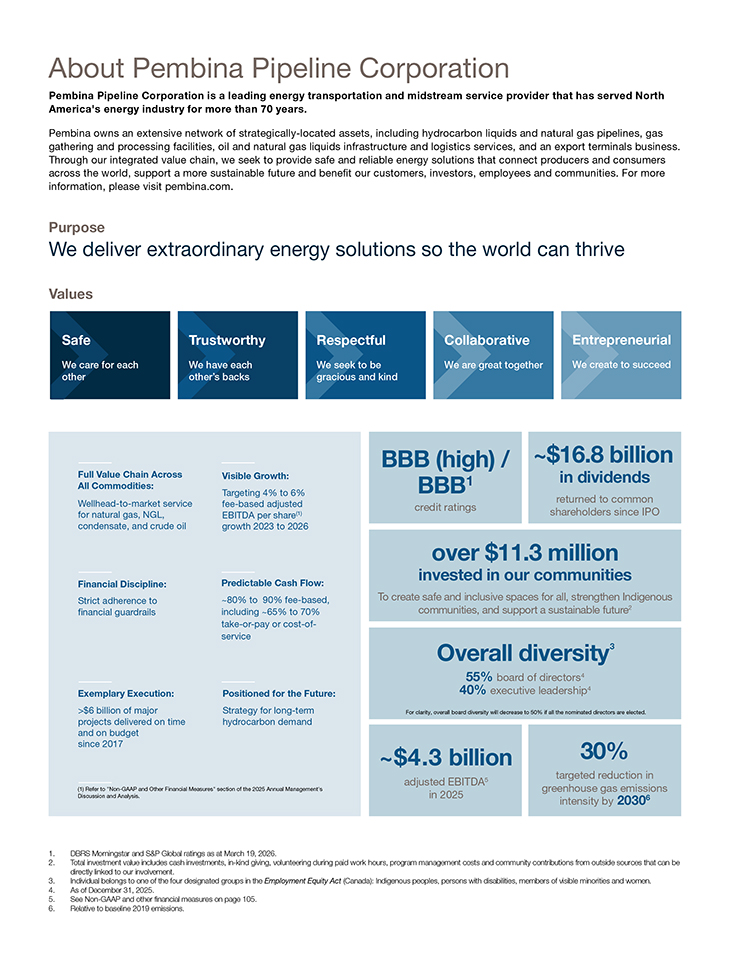
Overall diversity3 55% board of directors4 40% executive leadership4 BBB (high) / BBB1 credit ratings ~$4.3 billion adjusted EBITDA5 in 2025 30% targeted reduction in greenhouse gas emissions intensity by 20306 ~$16.8 billion in dividends returned to common shareholders since IPO over $11.3 million invested in our communities To create safe and inclusive spaces for all, strengthen Indigenous communities, and support a sustainable future2 About Pembina Pipeline Corporation Values Purpose We deliver extraordinary energy solutions so the world can thrive Safe We care for each other Trustworthy We have each other’s backs Respectful We seek to be gracious and kind Collaborative We are great together Entrepreneurial We create to succeed Pembina Pipeline Corporation is a leading energy transportation and midstream service provider that has served North America’s energy industry for more than 70 years. Pembina owns an extensive network of strategically-located assets, including hydrocarbon liquids and natural gas pipelines, gas gathering and processing facilities, oil and natural gas liquids infrastructure and logistics services, and an export terminals business. Through our integrated value chain, we seek to provide safe and reliable energy solutions that connect producers and consumers across the world, support a more sustainable future and benefit our customers, investors, employees and communities. For more information, please visit pembina.com. Full Value Chain Across All Commodities: Wellhead-to-market service for natural gas, NGL, condensate, and crude oil Visible Growth: Targeting 4% to 6% fee-based adjusted EBITDA per share(1) growth 2023 to 2026 Financial Discipline: Strict adherence to financial guardrails Predictable Cash Flow: ~80% to 90% fee-based, including ~65% to 70% take-or-pay or cost-of-service Exemplary Execution: >$6 billion of major projects delivered on time and on budget since 2017 Positioned for the Future: Strategy for long-term hydrocarbon dema nd (1) Refer to “Non-GAAP and Other Financial Measures” section of the 2025 Annual Management’s Discussion and Analysis. For clarity, overall board diversity will decrease to 50% if all the nominated directors are elected. 1. DBRS Morningstar and S&P Global ratings as at March 19, 2026. 2. Total investment value includes cash investments, in-kind giving, volunteering during paid work hours, program management costs and community contributions from outside sources that can be directly linked to our involvement. 3. Individual belongs to one of the four designated groups in the Employment Equity Act (Canada): Indigenous peoples, persons with disabilities, members of visible minorities and women. 4. As of December 31, 2025. 5. See Non-GAAP and other financial measures on page 105. 6. Relative to baseline 2019 emissions.
| Message from the Chair |

|
|
I am pleased to invite you to our 2026 annual meeting of shareholders, to be held on Friday, May 8, 2026, at 2:00 p.m. (Mountain Daylight Time). We are holding a virtual-only meeting by live audio webcast this year. See the information starting on page 7 of this 2026 Management Information Circular for details on how you can attend the meeting virtually and vote your shares.
On behalf of the board of directors, I want to express our deep appreciation for the trust you place in us as stewards of your investment. It is a privilege to represent you. We remain firmly committed to upholding the highest standards of governance, accountability, and integrity in our oversight of Pembina Pipeline Corporation.
Your board approaches its responsibilities with diligence and independence, ensuring that Pembina’s strategy, risk management practices, and capital allocation decisions continue to support the long-term interests of shareholders. Over the past year, the board worked closely with management to monitor performance, evaluate emerging opportunities, and navigate a dynamic environment. This ongoing collaboration, grounded in disciplined oversight and open dialogue, remains a defining strength of Pembina’s governance model.
We continue to take great pride in the accomplishments of the organization. Pembina's commitment to safety, reliability, customer service, financial excellence, and simply 'doing what we said we would do' continues to underpin our reputation. | |
2025 Results and Accomplishments
In 2025, Pembina delivered solid financial results, continued to demonstrate its strong track record of safe, on-time and on-budget project execution, and advanced new projects to support future growth. In addition, the Company’s competitive offering and overall resilience were strengthened through targeted productivity, as well as organizational and cost efficiencies. Our continued commercial success highlights the value our customers continue to place on Pembina’s competitive tolls, integrated value chain, strong project execution, superior connectivity and optionality, and access to global markets.
Pembina’s accomplishments in 2025 reflect the strength of our integrated business model and disciplined approach to capital allocation.
Strong Financial and Operational Results
| • | Adjusted EBITDA of $4.3 billion1, within the Company’s original 2025 guidance range. |
| • | Record Pipelines and Facilities volumes of 3.7 million barrels of oil equivalent per day. |
| • | Strong safety and environmental performance with Pembina exceeding its internal 2025 targets. |
| • | Strong balance sheet with debt metrics within the Company’s targeted range. |
| • | $1.2 billion invested in projects and sustaining capital. |
| • | Dividend increased approximately 3%. |
Continued Execution of Pembina’s Strategy
Pembina delivered another year of strong execution, ensuring long-term stability and advancing value creation initiatives.
| • | The Company secured significant contract renewals across its pipeline systems, including major recontracting on the Peace and Alliance Pipeline systems, and fully contracting the Nipisi Pipeline. These commitments reinforce asset utilization and reliable cash flow. |
| • | Pembina strengthened its export position by sanctioning the Prince Rupert Terminal Optimization project and securing additional West Coast LPG capacity, ensuring competitive access to premium global markets. |
| • | Major growth projects, including the RFS IV Fractionation Expansion Project, Wapiti Gas Plant Expansion, and the K3 Cogeneration Facility, are progressing on time and on, or under, budget, underscoring Pembina’s industry-leading project execution. |
| 1 | See Non-GAAP and other financial measures on page 105. |
| Pembina Pipeline Corporation • 2026 Management Information Circular | 1 |
| • | Responding to growing customer demand, Pembina is advancing a multi-year plan for incremental liquids transportation infrastructure, including sanctioning the Fox-to-Namao Peace Pipeline expansion to support continued basin growth. |
| • | In partnership with the Haisla Nation, Pembina continued execution of the Cedar LNG Project, achieving major construction milestones. Pembina also fully contracted its Cedar LNG capacity to third parties, while enhancing its expected financial contribution from the project. |
| • | Pembina and its partner progressed the proposed Greenlight Electricity Centre, a strategic opportunity to meet the electricity demands of data centres in Alberta, while diversifying Pembina’s customer base, and driving additional natural gas and liquids throughput across its network. |
The Year Ahead
Throughout 2026, the board will continue to review and assess our strategy against an ever-evolving landscape and the prevailing economic environment, adapting and changing as deemed necessary. We will of course also continue to oversee management’s execution of our strategy to provide safe, reliable, and cost-effective energy infrastructure that connect producers to high value global markets.
Pembina’s integrated value chain and access to premium markets remain key competitive advantages, positioning the Company to capture incremental volumes and pursue disciplined growth aligned with our risk and return expectations. The board will continue to ensure that capital allocation decisions are within strategy and support enduring per share growth and a sustainable dividend.
As the energy landscape continues to evolve, your board is focused on ensuring that Pembina remains disciplined, agile, and forward-looking. We are committed to preserving the company’s strong foundation while enabling it to responsibly pursue new avenues for economic growth.
Director Retirement
Anne-Marie Ainsworth will be retiring from the board at the 2026 annual meeting. Anne-Marie joined the board in the fall of 2014, bringing not only her background in engineering and the operation of major energy facilities, but also her passion for all things related to safety, health, the environment, and operational excellence. All these areas became significantly more important to Pembina over the years as our operations expanded into areas beyond pipelines, and Anne-Marie’s insight, wisdom, and guidance have been critical in our performance in these areas. Anne-Marie also brought a particular affinity to support the advancement of women at Pembina, and I know many of our employees have benefited from her experience.
Anne-Marie’s counsel will be missed at the boardroom table. On behalf of the board and the Company, I want to thank Anne-Marie for all she has done for Pembina over the last 12 years and wish her all the best in the future.
Stewarding Your Investment
The board is confident in Pembina’s strategic direction and in management’s ability to deliver responsible, long-term value for shareholders. As we continue our work, our objective is clear: to steward your investment with care, uphold the high standards you expect of us, and guide Pembina toward a future of sustained strength and opportunity.
Thank you for your ongoing support and confidence.
The board welcomes your feedback, particularly with respect to the virtual-only format of our annual meeting. I invite you to share your views by emailing me at boardchair@pembina.com.
Sincerely,
Henry W. Sykes
Chair of the Board
| Pembina Pipeline Corporation • 2026 Management Information Circular | 2 |
| Notice of our 2026 Annual Meeting of Shareholders |
|
|
You are invited to our 2026 annual meeting of shareholders (the meeting):
When May 8, 2026
2:00 p.m. (Mountain Daylight Time)
Where Virtual-only meeting
live audio webcast online at https://meetings.lumiconnect.com/400-053-918-100 |
||
|
Where to get a copy of the circular
We use the notice and access procedures to deliver shareholder meeting materials (including this notice and the circular) to registered and beneficial holders of our common shares. Notice and access is a set of rules developed by the Canadian Securities Administrators that allows eligible companies to post meeting materials online, reducing paper and mailing costs and reducing the related environmental impacts.
You can view the circular at: www.sedarplus.ca, www.sec.gov or www.pembina.com/ investors/notice-and-access
If you would like us to mail you a paper copy of the circular instead, please contact us:
● by phone: 1-855-880-7404 ● by email: investor-relations@pembina.com
You may request a paper copy of the circular free of charge within one year of filing the circular on SEDAR+. In order to receive a paper copy before the date of the meeting, we need your request at least five days before the proxy deposit date listed on the enclosed form of proxy or voting instruction form.
If you have questions about notice and access, call us toll-free at 1-855-880-7404.
How to vote
Registered and beneficial shareholders are encouraged to vote in advance of the meeting by completing the form of proxy or voting instruction form provided to them. Detailed instructions on how to complete and return proxies and voting instruction forms are provided in the circular starting on page 7.
Shareholders may also vote their shares by telephone or through the internet using the procedures described in the form of proxy or voting instruction form.
For your vote to count, your form of proxy or voting instruction form must be received by no later than 2:00 p.m. on May 6, 2026 or, if the meeting is adjourned, at least 48 hours (excluding weekends or statutory holidays) before the time the meeting is reconvened.
| ||
|
We will cover five items of business at the meeting — see Business of the meeting in our 2026 management information circular (the circular):
1. Receive our 2025 Audited Consolidated Financial Statements and the auditors’ report thereon. 2. Vote on electing our directors. 3. Vote on appointing our auditors. 4. Vote on our approach to executive compensation. 5. Vote on any other business that properly comes before the meeting.
Your vote is important
The circular includes important information about the meeting and the voting process. Please read it carefully before you vote.
We mailed you a copy of our 2025 Audited Consolidated Financial Statements and the auditors’ report thereon if you asked us to (in accordance with applicable corporate and securities laws). You can also find a copy of our financial statements on our website (www.pembina.com), on SEDAR+ (www.sedarplus.ca) and on EDGAR (www.sec.gov).
The meeting will be a virtual-only meeting held by live audio webcast. Every shareholder and duly appointed proxyholder, regardless of geographic location and ownership, will have an equal opportunity to participate at the meeting and vote on the matters to be considered at the meeting. You will find detailed instructions about how to participate in the meeting in the circular starting on page 7. There are different voting processes if you are a registered shareholder or a beneficial shareholder. Most of our shareholders are beneficial shareholders, meaning that they hold their shares through a bank, broker or other such institution. Closely follow the applicable instructions in this notice, the circular and in your voting information form or form of proxy.
By order of the board,
(signed) “Jason Metcalf ”
Jason Metcalf Vice President, General Counsel and Corporate Secretary Pembina Pipeline Corporation Calgary, Alberta March 19, 2026 |
| Pembina Pipeline Corporation • 2026 Management Information Circular | 3 |
|
|
2026 Management Information Circular |
About this Management Information Circular
You have received this document because you owned Pembina shares on March 19, 2026 (the record date) and are entitled to vote at our 2026 annual meeting of shareholders, which will be held at 2:00 p.m. (Mountain Daylight Time) on May 8, 2026, or at a reconvened meeting if the meeting is postponed or adjourned.
| The meeting will be held in a virtual-only format, by live audio webcast as a cost-efficient and environmentally friendly way to engage with shareholders. Every registered shareholder and duly appointed proxyholder, regardless of geographic location and ownership, will have an equal opportunity to participate at the meeting and vote on the matters to be considered at the meeting. The meeting cannot be attended in person. The full webcast will be available on the investors page of our website as soon as practicable after the event, including any questions we receive from shareholders and our answers.
This circular is dated and all information is provided herein as of March 19, 2026. In addition, all dollar amounts are in Canadian dollars, unless we note otherwise.
You will find financial information about Pembina in our 2025 Audited Consolidated Financial Statements and Management’s Discussion and Analysis (MD&A). You may contact us if you would like to receive a paper copy of these documents. You can also find these documents and other important information about Pembina on our website (www.pembina.com), on SEDAR+ (www.sedarplus.ca) and on EDGAR (www.sec.gov).
This circular contains forward-looking statements that are based on our current expectations, estimates, projections and assumptions in light of our experience and perception of historic trends. This information is provided to assist readers in understanding the company’s future and expectations and may not be appropriate for other purposes. Please see Forward-looking information on page 103 for more information.
In this circular, we also use certain financial measures and ratios that are not specified, defined or determined in accordance with generally accepted accounting principles (GAAP). Please see Non-GAAP and other financial measures on page 105 for more information about these measures and why they are used. |
In this document
• meeting means the annual meeting of shareholders to be held as a virtual-only meeting at 2:00 p.m. (Mountain Daylight Time) on May 8, 2026 • you, your, and shareholders mean holders of Pembina common shares • we, us, our, Pembina and the company mean Pembina Pipeline Corporation and our consolidated subsidiaries • common shares, shares and Pembina shares mean common shares in the capital of Pembina • circular means this 2026 Management Information Circular • board means Pembina’s board of directors • senior officers means collectively, Pembina’s President and Chief Executive Officer, Chief Financial Officer, Chief Operating Officer, Chief Marketing and Strategy Officer and Chief Legal, People and Corporate Affairs Officer • executive officers means collectively, Pembina’s senior officers and senior vice presidents
Our principal corporate and registered office:
Pembina Pipeline Corporation 4000, 585 – 8th Avenue S.W. Calgary, Alberta T2P 1G1 T. 403-231-7500 F. 403-237-0254
|
| Pembina Pipeline Corporation • 2026 Management Information Circular | 5 |
|
|
||
|
|
| |
|
This section tells you about our 2026 annual meeting of shareholders, what you will be voting on, and how to vote.
Please vote right away — you need to cast your vote by no later than 2:00 p.m. (Mountain Daylight Time) on May 6, 2026. |
Where to find it |
||||||
| 7 |
|
|||||
| 12 |
|
|||||
| 17 |
|
|||||
About the Shareholder Meeting – Voting Information
|
|
| Who can vote?
You can vote at the meeting if you held our common shares at the close of business on the record date of March 19, 2026, even if you sold your common shares after this date. Each common share is entitled to one vote.
| ||
| You are not allowed to vote at the meeting if you acquired your shares after the record date, unless you ask us to include your name in the list of voting shareholders at least two days before the meeting and provide adequate evidence that you own the shares.
Common shares
We are authorized to issue an unlimited number of common shares. As at March 19, 2026, we had 581,304,559 common shares issued and outstanding. Our common shares are listed and trade on the Toronto Stock Exchange (TSX) (TSX: PPL) and the New York Stock Exchange (NYSE) (NYSE: PBA).
To the best of the knowledge of our directors and executive officers, no person beneficially owns, or controls or directs, directly or indirectly, more than 10% of our common shares.
Proxy solicitation
Management is soliciting your proxy for the meeting. Management may use the service of external proxy solicitors and you may be contacted by Pembina employees or Morrow Sodali (Canada) Ltd. (Sodali & Co), our strategic shareholder advisor and proxy solicitation agent, by mail, by telephone or by personal interview. This year, Sodali & Co is providing governance and strategic shareholder advisory services to the company and may also provide proxy solicitation services in connection with the meeting. We have paid Sodali & Co approximately $55,000 for proxy |
About voting results We will post the voting results on our website (www.pembina.com), SEDAR+ (www.sedarplus.ca) and EDGAR (www.sec.gov) as soon as possible following the meeting.
| |
|
Where to go with questions If you have any questions about the meeting or need help voting your shares, please contact our Investor Relations department at:
1-855-880-7404 investor-relations@pembina.com
Or our proxy solicitation agent, Sodali & Co at:
1-833-830-3480 (toll-free in North America) 1-289-695-3075 (outside North America) assistance@investor.sodali.com
| ||
solicitation services. We may also pay Sodali & Co customary fees for contacting shareholders in connection with voting at the meeting in addition to reimbursing Sodali & Co for any out-of-pocket expenses incurred in connection therewith. Pembina pays all costs related to producing and mailing this circular and other meeting materials, and for soliciting your proxy.
Non-objecting beneficial shareholders may be contacted by Sodali & Co if we decide to use the Broadridge QuickVote™ service, which allows non-objecting beneficial shareholders to give their voting instructions for the meeting to Sodali & Co over the telephone. Sodali & Co then relays such voting instructions to Broadridge Financial Solutions Inc. (Broadridge).
| Pembina Pipeline Corporation • 2026 Management Information Circular | 7 |
About the Shareholder Meeting – Voting Information
About the virtual meeting
We are holding a virtual-only meeting this year by live audio webcast as a cost-efficient and environmentally friendly way to engage with shareholders. Virtual meetings allow our shareholders and guests to save on commuting costs and time and contribute to environmental sustainability. We also believe that virtual meetings foster greater inclusivity by enabling every registered shareholder and duly appointed proxyholder, regardless of geographic location and ownership, to have an equal opportunity to participate at the meeting and vote on the matters to be considered at the meeting. The meeting cannot be attended in person. The full webcast will be available on the investors page of our website after the event, including any questions we receive from shareholders and our answers to those questions.
We value the discussions we have with our shareholders. We ask shareholders for feedback at all engagement opportunities and management regularly engages with our shareholders and provides the board with feedback from those discussions. See page 40 for more information on Pembina’s overall shareholder engagement strategy.
Attending as a guest
All shareholders can attend the meeting as a guest by logging in online at https://meetings.lumiconnect.com/400-053-918-100 selecting “I am a guest” and completing the required form. If you attend the meeting as a guest, you will not be permitted to vote during the meeting. Guests have an opportunity to ask questions during the live question and answer session held following the formal meeting.
Asking questions at the virtual meeting
Questions may be submitted at any time during the webcast through the chat thread on the live webcast; however, during the formal part of the meeting, only questions from registered shareholders and duly appointed proxyholders that relate to the business of the meeting will be addressed.
Pembina will host a live question and answer session after the formal part of the meeting, where we will answer other questions submitted during the meeting. Registered shareholders and duly appointed proxyholders (including beneficial shareholders that have duly appointed themselves as proxyholders) and guests can submit questions during the live question and answer session.
To make sure we can answer as many questions as possible, please keep your questions brief and concise, and limit each question to a single topic. If there are questions from several shareholders or proxyholders on the same topic or that are otherwise related, we may group, summarize and answer them together. While all shareholder questions are welcome, we do not intend to address questions that are not related to the business of the meeting or Pembina’s business or operations, are repetitive or have been asked by another shareholder, are personal in nature or in furtherance of a shareholder’s personal or business interest, are related to material non-public information, are considered derogatory or otherwise offensive, or are out of order or are otherwise not appropriate.
To ensure the meeting is conducted in a way that is fair to all shareholders, the chair of the meeting may exercise discretion in responding to questions, including the order that questions are answered in, the grouping or editing of questions, the amount of time devoted to any question and the appropriateness of a question in accordance with the rules of conduct in effect at the meeting.
Technical difficulties
If you participate in the meeting, it is important that you stay connected to the internet at all times during the meeting in order to vote. It is your responsibility to ensure connectivity for the duration of the meeting. You should allow ample time to log into the meeting.
All meeting participants must use the latest versions of Chrome, Safari, Microsoft Edge, or Firefox. Please do not use Internet Explorer. We recommend that you log in at least 30-60 minutes before the meeting starts as this will allow you to check compatibility and complete the related procedures required to log in to the meeting.
Caution: Internal network security protocols including firewalls and virtual private network (VPN) connections may block your access to the meeting. If you are experiencing any difficulty connecting to or viewing the meeting, ensure your VPN setting is disabled or use a computer or other device on a network that is not restricted by any particular security settings.
| Pembina Pipeline Corporation • 2026 Management Information Circular | 8 |
About the Shareholder Meeting – Voting Information
If you have any questions about the meeting portal or require assistance accessing the meeting website, please (i) refer to the support information on the meeting login page, (ii) email Lumi directly at support-ca@lumiglobal.com, or (iii) refer to Lumi’s support page at https://support.lumiglobal.com/knowledge/virtual.
How to vote
You can vote your shares by proxy (by appointing someone — a proxyholder — to represent you), or by attending the meeting and voting. The rules for voting depend on whether you are a registered shareholder or a beneficial shareholder, as further described below.
Beneficial shareholders
You are a beneficial shareholder if your shares are registered in the name of a nominee, such as a bank, trust company, securities broker, trustee or other intermediary. The majority of our shares are held by beneficial shareholders. Beneficial shareholders have the option to vote their shares during the meeting or by proxy before the meeting, as set forth below.
Option 1: Vote during the virtual meeting
Before the meeting:
| 1. | Appoint yourself as the duly appointed proxyholder by printing your own name in the blank space provided in the proxy or voting instruction form. Then return the form in the envelope provided (or by following the instruction on the form). Do not complete the rest of the form or mark your voting instructions on the form, because your vote will be taken at the meeting. |
| 2. | Register online with our transfer agent, Computershare Trust Company of Canada (Computershare) by going to www.computershare.com/pembina before 2:00 p.m. (Mountain Daylight Time) on May 6, 2026, and inputting your name and contact information. |
Computershare will email you a username before the meeting. You will need your username to log in to the meeting and vote. Without a username, you will not be able to vote at the meeting but will be able to participate as a guest.
On the day of the meeting:
| 1. | Log in online at https://meetings.lumiconnect.com/400-053-918-100. We recommend visiting the site before the meeting starts to make sure it works on your computer or device. You must stay connected to the internet for the entire meeting. |
| 2. | Select “I have a Control Number/Username” and enter the username Computershare provided by email. |
| 3. | Enter the password (case sensitive): pembina2026 |
| 4. | Complete the ballot online during the meeting. |
Beneficial shareholders who have not appointed themselves as proxyholder will not be able to vote online during the meeting but will be able to participate as a guest.
Option 2: Vote by proxy before the meeting
If you are a beneficial shareholder and wish to vote by proxy before the meeting, you must send your voting instructions to your nominee who will vote for you. You will receive a request for voting instructions for the number of shares held for your benefit. Follow the instructions on the proxy form or voting instruction form and send your voting instructions to your nominee. You likely have an earlier deadline for returning your voting instruction form to your nominee, so be sure to complete and return the form early, to allow enough time for your nominee to receive your voting instructions and then send them to Pembina before the proxy cut-off time.
We use Broadridge to send proxy-related materials to non-objecting beneficial shareholders. We intend to pay for intermediaries to deliver proxy-related materials to objecting beneficial shareholders.
Beneficial shareholders located in the United States
If you are a beneficial shareholder located in the United States and wish to vote at the meeting or, if permitted, to appoint a third-party as your proxyholder, in addition to the steps described above, you must obtain a valid legal proxy from your nominee. Follow the instructions from your nominee included with the legal proxy form or contact your nominee to request a legal proxy form if you have not received one. After obtaining a valid legal proxy from your nominee, you must then submit such legal proxy to Computershare. Requests for registration from beneficial shareholders located in the United States that wish to vote at the meeting or, if permitted, to appoint third parties as their proxyholders must be sent by email or by courier
| Pembina Pipeline Corporation • 2026 Management Information Circular | 9 |
About the Shareholder Meeting – Voting Information
to: uslegalproxy@computershare.com (if by email); or Computershare Trust Company of Canada, Attention: Proxy Department, 14th Floor, 320 Bay Street, Toronto, ON, M5H 4A6, Canada (if by courier), and in both cases, must be labeled “Legal Proxy” and received before 2:00 p.m. (Mountain Daylight Time) on May 6, 2026. You will receive a confirmation of your registration by email once Computershare receives your registration materials.
Registered shareholders
You are a registered shareholder if your shares are registered directly in your name. Registered shareholders have the option to vote their shares during the meeting or by proxy before the meeting, as set forth below.
Option 1: Vote during the virtual meeting
On the day of the meeting:
| 1. | Log in online at https://meetings.lumiconnect.com/400-053-918-100. We recommend visiting the site before the meeting starts to make sure it works on your computer or device. You must stay connected to the internet for the entire meeting. |
| 2. | Select “I have a Control Number/Username” and enter your 15-digit control number (this is your username and you will find it on the bottom left corner of the first page of the enclosed proxy form). |
| 3. | Enter the password (case sensitive): pembina2026 |
| 4. | Complete the ballot online during the meeting. |
Option 2: Vote by proxy before the meeting
Registered shareholders can vote by proxy in one of the following three ways:
| • | Online: Go to www.investorvote.com. You will need to enter your 15-digit control number (located on the bottom left corner of the first page of the enclosed proxy form) to identify yourself as a shareholder on the voting website; |
| • | By phone: Call 1-866-732-VOTE (8683) toll-free and follow the instructions. You will need to enter your 15-digit control number (located on the bottom left corner of the first page of the enclosed proxy form) to identify yourself as a shareholder on the telephone voting system; or |
| • | By mail: Complete the enclosed proxy form, sign and date it and return it in the enclosed envelope. |
Computershare must receive your completed proxy form at least 48 hours before the meeting (not including Saturdays, Sundays or holidays). The chair of the meeting can waive or extend the time limit for receiving proxy forms without notice, at their discretion.
About your proxyholder
The officers named on the proxy form and voting instruction form (the management nominees) have agreed to serve as your proxyholder and will vote your shares according to your instructions. If you do not specify your voting instructions, they will vote your shares for each item of business at the meeting. If there are changes to the items of business or other matters that are properly brought before the meeting, your proxyholder can use their discretion and vote as they see fit. As of the date of this circular, we do not anticipate any changes to the items of business or other matters to be brought before the meeting.
Choosing someone else to be your proxyholder
You have the right to appoint someone other than the management nominees to be your proxyholder and act on your behalf at the meeting. The person you appoint does not need to be a shareholder. Make sure this person knows they have been appointed to attend the meeting and vote on your behalf. Your proxyholder must vote (or withhold from voting) your shares according to your instructions. If you appoint someone else to be your proxyholder and do not give them specific voting instructions, your proxyholder has the discretion to vote as they see fit.
To appoint someone other than the officers named in the proxy form and voting instruction form as your proxyholder:
| 1. | Appoint your proxyholder as a duly appointed proxyholder by printing their name in the blank space provided on your proxy form or voting instruction form. Then return the form in the envelope provided (or by following the instructions on the form). |
| Pembina Pipeline Corporation • 2026 Management Information Circular | 10 |
About the Shareholder Meeting – Voting Information
| 2. | Register your proxyholder online with Computershare by going to www.computershare.com/pembina before 2:00 p.m. (Mountain Daylight Time) on May 6, 2026, and inputting your proxyholder’s name and contact information. |
Computershare will email your proxyholder a username, which they will need to log in to the meeting and vote. Without a username, your proxyholder will not be able to vote at the meeting but will be able to participate as a guest.
On the day of the meeting, your proxyholder will:
| 1. | Log in online at https://meetings.lumiconnect.com/400-053-918-100. We recommend your proxyholder visits the site before the meeting starts to make sure it works on the computer or device they are using. Your proxyholder must stay connected to the internet for the entire meeting. |
| 2. | Select “I have a Control Number/Username” and enter the username Computershare provided by email. |
| 3. | Enter the password (case sensitive): pembina2026 |
| 4. | Complete the ballot online during the meeting. |
Changing your vote
If you are a registered shareholder, you can revoke a proxy form you previously submitted by:
| • | voting again at the meeting; |
| • | voting again by internet, telephone or fax before 4:30 p.m. (Mountain Daylight Time) on the last business day before the meeting; |
| • | delivering a revocation notice in writing executed by the registered shareholder or by an authorized officer or attorney (duly authorized in writing) to: (i) our head office before 4:30 p.m. (Mountain Daylight Time) on the last business day before the meeting; or (ii) the chair of the meeting prior to the start time of the meeting; or |
| • | in any other manner permitted by law. |
If you are a beneficial shareholder, you can revoke voting instructions you previously submitted by contacting your nominee.
| Shareholder proposals
|
| If you want to present a shareholder proposal at our 2027 annual meeting of shareholders, you must submit it by February 8, 2027, to be considered for inclusion in next year’s management information circular. |
|
Send your shareholder proposals to: |
| Corporate Secretary |
| Pembina Pipeline Corporation 4000, 585 – 8th Avenue S.W. |
| Calgary, Alberta T2P 1G1 |
| Pembina Pipeline Corporation • 2026 Management Information Circular | 11 |
About the Shareholder Meeting – Business of the Meeting

|
Business of the Meeting | |
The meeting will cover the following items of business:
1. Receive our 2025 Audited Consolidated Financial Statements
You have received our 2025 Audited Consolidated Financial Statements and the auditors’ report thereon, which are included in our 2025 Annual Report, if you requested a copy. You can also access a copy of our 2025 Annual Report on our website (www.pembina.com), on SEDAR+ (www.sedarplus.ca) and on EDGAR (www.sec.gov), or you can request a copy from our Investor Relations department at 1-855-880-7404 or investor-relations@pembina.com.
| 2. Elect our directors
Our articles provide that the board must have between five and 13 directors. In accordance with our by-laws, the board has fixed the number of directors to be elected at the meeting at 10.
The following 10 persons are nominated for election to the board at the meeting:
|
Our policy on majority voting
According to our majority voting policy, each director must receive a majority of the votes cast for their election, or they must resign immediately following the meeting.
The governance, nominating and corporate social responsibility committee will consider the resignation and recommend to the board the action to be taken. The director who resigned does not participate in these discussions.
The board will consider the committee’s recommendation and, within 90 days of the meeting, will accept the resignation unless there are exceptional circumstances. The resignation will be effective when it is accepted by the board. The board will announce its decision in a news release.
If the board accepts the resignation, it can appoint a new director, call a meeting of shareholders to vote for other candidates or leave the position vacant until the next annual meeting of shareholders.
Our majority voting policy does not apply if a director election is contested.
| |||||
• Henry W. Sykes (chair) |
• Maureen E. Howe |
|||||
• J. Scott Burrows |
• David M.B. LeGresley |
|||||
• Cynthia Carroll |
• Andy J. Mah |
|||||
• Alister Cowan |
• Leslie A. O’Donoghue |
|||||
• Ana Dutra |
• Bruce D. Rubin |
|||||
|
All of the nominated directors currently serve on our board. Turn to the profiles starting on page 17 for detailed information about each nominated director.
The directors elected at the meeting will serve until the next annual meeting of shareholders, or until their successors are elected or appointed.
The proxy form allows you to vote for the election of each nominated director, vote for some of them and withhold your vote for others, or withhold your vote for each of them. |
||||||
|
The board recommends you vote for the election of each nominated director.
|
||||||
|
Unless instructed otherwise, the management nominees named in the proxy form and voting instruction form will vote for the election of each nominated director |
||||||
3. Appoint our auditors
You will vote on appointing our external auditors. The audit committee and the board propose that KPMG LLP (KPMG), Chartered Professional Accountants, be appointed as auditors of Pembina to serve until the next annual meeting of shareholders. The audit committee will recommend KPMG’s compensation to the board for its review and approval.
|
The board recommends you vote for appointing KPMG as our auditors until the close of the next annual meeting of shareholders.
|
Unless instructed otherwise, the management nominees named in the proxy form and voting instruction form will vote for the appointment of KPMG as our auditors.
| Pembina Pipeline Corporation • 2026 Management Information Circular | 12 |
About the Shareholder Meeting – Business of the Meeting
Through the processes described in the Auditor independence section, the audit committee has confirmed KPMG is independent with respect to Pembina within the meaning of the relevant rules and related interpretations prescribed by the relevant professional bodies in Canada and applicable legal requirements. KPMG has also confirmed that they are independent with respect to Pembina under all relevant U.S. professional and regulatory standards.
Representatives of KPMG will attend the meeting and will be available to respond to any questions.
Shareholder engagement
Pembina remains committed to engaging with stakeholders on the topic of auditor independence and tenure. Following extensive shareholder engagement in 2023 and 2024, in 2025, members of Pembina’s management and members of our Investor Relations team participated in approximately 250 unique meetings with shareholders, including 14 investor conferences and road shows across Canada, the U.S. and Europe. At certain of these meetings, among other topics, auditor independence and tenure, including consideration thereof by the audit committee, were discussed. At our 2025 annual meeting of shareholders, the vote in favour of the appointment of KPMG remained consistent with the vote in 2024, receiving 89.36% of the common shares voted at the meeting.
See page 40 for more information on Pembina’s overall shareholder engagement strategy.
Auditor fees
The following table shows the fees paid to KPMG for the fiscal years ended December 31, 2024 and 2025.
| Fee category
|
2024 ($) |
2025 ($) |
||||||
| Audit fees |
||||||||
| Fees for auditing our annual financial statements, reviewing our quarterly financial statements, and services related to statutory and regulatory filings or engagements, review of information contained in various prospectuses and other securities offering documents, and assistance to underwriters. | 3,861,043 | 5,326,532 | ||||||
| Audit-related fees |
||||||||
| Fees for assurance and related services, including French translations in connection with statutory and regulatory filings and securities offering documents, reasonably related to the performance of the audit or review of Pembina’s financial statements and not reported under Audit fees above, including audit fees for certain pension plans. | 160,107 | 145,175 | ||||||
| Tax fees |
||||||||
| Fees for non-audit tax services provided by KPMG’s tax division, include fees for tax consultation, tax advice/planning and tax compliance. Fees in both years included tax consultation and compliance fees for preparing and filing tax returns for certain subsidiaries. | 20,800 | 75,274 | ||||||
| All other fees |
||||||||
| Fees for other products and services provided by the auditors not described above, which included fees related to assurance over greenhouse gas (GHG) emissions and environment, social and governance (ESG) sustainability reporting. | 247,844 | 170,907 | ||||||
| Total fees | 4,289,794 | 5,717,888 | ||||||
The audit committee annually reviews and approves the terms and scope of the external auditors’ engagement. The audit committee maintains a pre-approval policy with respect to permitted non-audit services whereby pre-approval of the audit committee is required for all non-audit services in order to mitigate the risk of non-audit services impacting the auditor’s independence. The audit committee is permitted to delegate to the chair of the audit committee pre-approval authority for services not previously approved by the audit committee. All such services approved by the chair of the audit committee are subsequently reviewed by the audit committee. The audit committee charter provides that fees for audit and audit-related services must be greater than 50% of the total fees paid to the auditor in a fiscal year.
| Pembina Pipeline Corporation • 2026 Management Information Circular | 13 |
About the Shareholder Meeting – Business of the Meeting
Auditor independence
Pembina recognizes that auditor independence is the foundation of audit quality and public confidence in our financial information. As such,
| Pembina’s auditor selection process is designed to maintain auditor independence while balancing the need for continuity of knowledge in order to ensure a high-quality audit provided by a firm with the depth and breadth of experience to effectively and efficiently audit a company with complex business operations.
Globally, various jurisdictions employ different regulatory controls to ensure external auditor independence. In Europe, regulations focus heavily on audit firm rotation. In Canada and the United States, greater focus is placed on other controls. Pembina adheres to the external auditor independence rules of both the U.S. Securities and Exchange Commission (SEC) and International Ethics Standards Board for Accountants (IESBA).
The audit committee, along with management, continuously assesses the external auditor and, on an annual basis, conducts a formal review of the external auditor and recommends to the board whether to propose the reappointment of KPMG or to consider other audit firms. The audit committee also conducts a more comprehensive review of the external auditor every five years.
|
Controls to ensure independence
• continuous and annual review of independence • periodic comprehensive review of external auditor • low quantum of non-audit fees with KPMG and audit committee charter limits on non-audit fees • KPMG internal controls and safeguards that meet or exceed SEC and IESBA requirements • adherence to mandatory audit partner rotation requirements and cooling-off periods • in camera meetings excluding management at each quarterly audit committee meeting • PCAOB and CPAB audits | |||||
| Below are details regarding factors the audit committee considers when assessing KPMG’s independence. |
Audit committee expertise and independence reviews
All members of the audit committee are independent and financially literate within the meaning prescribed by U.S. and Canadian securities laws and two of the members of the committee are designated financial experts under NYSE rules.
The audit committee completes an annual review of the external auditor, which consists of an assessment of independence, quality of the audit team, and quality of communications and interactions with the external auditor. As part of its annual assessment on independence, the audit committee also receives and reviews the auditor’s reports regarding independence.
The audit committee also considers any factors that may impair the independence of the auditor at each audit committee meeting. The audit committee believes that transparent and open communication is essential to maintaining auditor independence and maintains an open and direct line of communication between the auditors and the chair of the audit committee and the audit committee itself.
Pembina’s annual information form (AIF) includes more information about the audit committee, including the committee charter, beginning on page 111 of the AIF. The 2025 AIF is available on our website (www.pembina.com), on SEDAR+ (www.sedarplus.ca) and on EDGAR (www.sec.gov).
Comprehensive review of auditor
The audit committee and management conduct a comprehensive review of the external auditor at least every five years to further enhance the governance processes relating to auditor independence and audit quality. A comprehensive review was completed in 2025 (for the five-year period from 2020 to 2024) using the approach recommended by the Enhancing Audit Quality initiative by CPA Canada and the Canadian Public Accountability Board (CPAB) as well as guidance from the Centre of Audit Quality to safeguard against institutional familiarity threats.
The comprehensive review provides the audit committee with data on three key factors of audit quality for the committee to consider and assess:
| • | independence, objectivity and professional skepticism, |
| • | quality of the engagement team, and |
| • | quality of communications and interactions with the external auditor. |
The results of this review supported the continuation of KPMG’s audit engagement. Pembina is committed to conducting this review at least every five years.
| Pembina Pipeline Corporation • 2026 Management Information Circular | 14 |
About the Shareholder Meeting – Business of the Meeting
Auditor fees and objectivity considerations
The audit committee understands that the magnitude of fees paid to an auditor could negatively impact auditor independence if a financial interest will inappropriately influence an auditor’s judgment or behaviour. In reaching the conclusion to recommend the re-appointment of KPMG as our auditors, the audit committee considered the magnitude of the fees that Pembina pays to KPMG. For 2025, KPMG has confirmed to the audit committee that the fees payable to KPMG were not material to KPMG.
There is also a risk that independence could be compromised if an auditor is deterred from acting objectively because of actual or perceived influence or pressures. The audit committee considers safeguards that KPMG has implemented to manage this risk as an important element of its assessment of audit quality. KPMG has multiple layers of internal controls and safeguards designed to ensure audit staff are independent of Pembina that meet or exceed the International Code of Ethics for Professional Accountants established by the IESBA and SEC requirements, including:
| • | the assignment of an engagement quality control review partner to the audit engagement by a risk management partner, |
| • | the involvement of experienced national office professionals outside of the engagement team when dealing with complex or judgmental matters, |
| • | the structure of the respective firms, and |
| • | compensation policies in place. |
Given the audit committee’s understanding of the relative magnitude of fees paid to KPMG, as well as the audit committee’s evaluation of safeguards that have been implemented by KPMG, the audit committee has determined that these risks with respect to auditor independence have been appropriately managed.
Partner rotations and partner qualifications
As part of the annual review of auditor independence, the audit committee assesses KPMG’s ongoing compliance with mandatory rotation requirements. Under mandatory rotation requirements, the lead audit partner and quality review partner may serve a maximum of five years, followed by a five-year period without any involvement in the Pembina audit engagement. For other audit partners of KPMG involved in the Pembina audit, the mandatory rotation occurs after a maximum of seven years of service followed by a two-year period without any involvement in the Pembina audit engagement. This rotation helps ensure auditor independence is maintained by changing the key personnel working on Pembina’s audit after a set period of time. Our lead audit partner last rotated for the 2023 audit. Pembina has never had the same lead audit partner for more than a single rotation.
In addition to the partner rotations described above, all lead partners and quality review partners must satisfy the following minimum requirements:
| • | Chartered Professional Accountant, in good standing, |
| • | industry-specific experience, |
| • | completion of relevant professional development and accreditation training, |
| • | knowledge of, and experience with, the applicable financial reporting framework and auditing standards, and |
| • | knowledge of, and experience with, applicable Canadian securities laws and SEC rules and regulations. |
The audit committee is satisfied with KPMG’s ongoing compliance with the regulatory mandated rotation requirements (five and seven years, as applicable in the circumstances) as well as the transition plans that have been followed to on-board qualified engagement partners who are new to providing audit services to Pembina.
PCAOB and CPAB Audits
Two independent regulatory bodies, the CPAB in Canada and the Public Company Accounting Oversight Board (PCAOB) in the United States carry out stringent audit quality assessments of audit firms. The PCAOB publishes the results of its inspection for each audit firm on their website. By PCAOB regulations, the auditor is required to report any breach of independence rules to the audit committee, including their evaluation of the breach. There have been no independence issues identified for the last five years.
| Pembina Pipeline Corporation • 2026 Management Information Circular | 15 |
About the Shareholder Meeting – Business of the Meeting
| 4. Vote on our approach to executive compensation
You will vote on our approach to executive compensation disclosed in this circular.
A key principle underlying executive compensation at Pembina is ‘pay for performance’. We believe that linking executive compensation to strategy and corporate performance |
Say on pay votes
In 2025, our executive compensation approach was supported by 96.74% of shareholder votes for our say on pay resolution.
| |
helps us attract and retain excellent people and motivates them to focus on our success. You will find a detailed discussion of our executive compensation program beginning on page 59 of this circular.
The board gives shareholders the opportunity every year to vote for or against our approach to executive compensation (to have a say on pay). This is an advisory vote, so the results of the “say on pay” resolution will not be binding on the board. The board will, however, consider the outcome of the vote as part of its ongoing review of executive compensation. If a significant number of shareholders oppose the “say on pay” resolution, the board will consult with shareholders to understand their concerns, and then review our approach to executive compensation with their concerns in mind.
In 2025, our approach to executive compensation was supported by 343,606,218 votes in favour of our say on pay resolution (96.74% of the common shares voted at the meeting), with 11,594,140 votes against (3.26% of the common shares voted at the meeting).
At the meeting, you will be asked to consider and, if deemed advisable, approve the following non-binding resolution:
RESOLVED, on an advisory basis and not to diminish the role and responsibilities of the board of directors of Pembina Pipeline Corporation (Pembina), that the common shareholders of Pembina (shareholders) accept the approach to executive compensation disclosed in Pembina’s 2026 Management Information Circular delivered in advance of the 2026 annual meeting of shareholders.
This resolution conforms to the language of the resolution recommended by the Canadian Coalition for Good Governance.
|
The board recommends you vote for our approach to executive compensation.
|
Unless instructed otherwise, the management nominees named in the proxy form and voting instruction form will vote for our approach to executive compensation as described in this circular.
5. Other business
You will vote on any other items of business that may be properly brought before the meeting. As of the date of this circular, we are not aware of any other matters to be brought before the meeting.
| Pembina Pipeline Corporation • 2026 Management Information Circular | 16 |
About the Shareholder Meeting – About the Nominated Directors
|
|
About the Nominated Directors |
To ensure strong stewardship, the board needs to operate independently, have a prudent mix of relevant skills and experience, including industry knowledge and experience, a mix of tenures, sufficiently diverse backgrounds and opinions to support balanced discussion and debate, and must be a manageable size to facilitate productive discussion and decision-making. We believe this year’s group of 10 nominated directors meets all of these requirements.
The profiles on the following pages tell you about each nominated director’s background and experience, independence, meeting attendance, share ownership, other public company directorships and voting results from our 2025 annual meeting of shareholders (as applicable). All information is provided as of March 19, 2026, unless indicated otherwise.
All of the nominated directors are independent except Mr. Burrows, who is our President and Chief Executive Officer (CEO). The board has reviewed the independence and qualifications of the non-executive directors and has recommended their nomination.
A strong and diverse slate of nominated directors
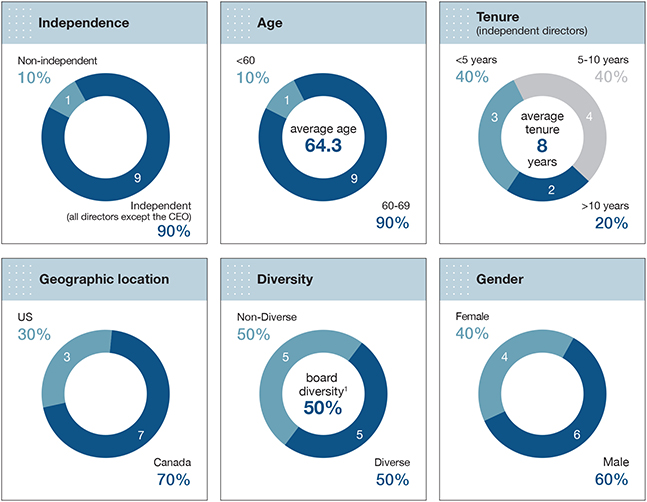
| 1 | An individual is considered diverse if the individual belongs to one of the four designated groups in the Employment Equity Act (Canada): Indigenous peoples, persons with disabilities, members of visible minorities and women. |
| Pembina Pipeline Corporation • 2026 Management Information Circular | 17 |
About the Shareholder Meeting – About the Nominated Directors

|
||
| Henry W. Sykes (67)
| ||
| Independent | 2025 voting results: 347,919,660 (97.95%) for, 7,280,704 (2.05%) withheld | ||

Chair
Director since
October 2017
Calgary, Alberta
Canada
Areas of Expertise
| • | capital allocation |
| • | safety, health and environmental |
| • | social and corporate governance |
| • | human resources and compensation |
| • | legal and regulatory |
| • | government relations |
Mr. Sykes was the President and director of MGM Energy Corp. (MGM), a Canadian public energy company focused on the acquisition and development of hydrocarbon resources in Canada’s Northwest Territories and Arctic regions, from January 2007 to June 2014. Before he joined MGM, he was the President of ConocoPhillips Canada from 2001 to 2006 and the Executive Vice-President, Business Development of Gulf Canada Resources Ltd. before that.
Mr. Sykes began his career as a lawyer and specialized in mergers and acquisitions, securities and corporate law. He is a director of Werklund Centre Foundation (Werklund) and the Arctic Institute of North America (Arctic Institute). He previously chaired the Arctic Institute and the Arts Common Foundation (now Werklund) and is also a director of several private companies involved in the oil and gas industry.
He has a Bachelor of Arts in economics from McGill University, a law degree from the University of Toronto and a Master of Laws degree from the London School of Economics. Mr. Sykes has been honoured with a King’s Counsel designation in Alberta for his contributions to the legal profession and is a member of the Institute of Corporate Directors.
| 2025 Board and committee membership and attendance | ||||||||||
| Board of directors | 7 of 7 meetings | 100% | ||||||||
| Other public company boards and committee memberships1 | ||||||||
| None | ||||||||
| Securities held as of March 19, 2026 | ||||||||
| Common shares | Deferred share units |
Total value2 |
Meets share ownership requirement | |||||
| 18,390 | 41,495 | $3,672,747 | Yes | |||||
| 1 | Mr. Sykes was a director of Parallel Energy Trust (a TSX listed company) from March 2011 to February 2016. On November 9, 2015, Parallel Energy Trust filed an application in the Court of Queen’s Bench of Alberta for creditor protection under the Companies’ Creditors Arrangement Act (Canada), and on November 9, 2015 filed voluntary petitions for relief under Chapter 11 of the United States Bankruptcy Code. In the Chapter 11 proceedings, the U.S. Bankruptcy Court approved the sale of the assets of Parallel Energy Trust and the sale closed on January 28, 2016. On March 3, 2016, the Canadian entities of Parallel Energy Trust filed for bankruptcy under the Bankruptcy and Insolvency Act (Canada) and a notice to creditors was sent by the trustee on March 4, 2016. |
| 2 | Based on $61.33, the closing price of our common shares on the TSX on March 19, 2026. Deferred share units (DSUs) for directors include units issued under our DSU plan and units accrued as dividend equivalents (see Director compensation on page 56 for more information). |
| Pembina Pipeline Corporation • 2026 Management Information Circular | 18 |
About the Shareholder Meeting – About the Nominated Directors
|
|
||
| J. Scott Burrows (46)
| ||
| Non-independent | 2025 voting results: 353,751,053 (99.59%) for, 1,449,311 (0.41%) withheld | ||

Director since
February 2022
Calgary, Alberta
Canada
Areas of Expertise
| • | financial/accounting management |
| • | capital allocation |
| • | human resources and compensation |
| • | enterprise risk management |
Mr. Burrows has been the President and CEO of the company since February 2022. Prior to his current role, Mr. Burrows served as Pembina’s Interim President and CEO from November 2021 to February 2022 and prior to that, he was Pembina’s Chief Financial Officer from 2015 to November 2021. Prior to his role as Chief Financial Officer, Mr. Burrows served as Pembina’s Vice President, Capital Markets and as Vice President, Corporate Development and Investor Relations.
Before joining Pembina in November 2010, Mr. Burrows spent seven years in energy-focused investment banking where he provided advice related to mergers and acquisitions, dispositions, joint ventures and equity and debt financings. He has considerable experience in the energy industry, including petroleum, natural gas and other product pipelines and related infrastructure facilities.
Mr. Burrows has a Bachelor of Commerce from the University of British Columbia, is a CFA® Charterholder and is a member of the Institute of Corporate Directors.
| 2025 Board and committee membership and attendance | ||||||||
| Board of directors | 7 of 7 meetings | 100% | ||||||
| Other public company boards and committee memberships | ||||||||
| National Bank of Canada | TSX | Audit | |||||||
| Securities held as of March 19, 2026 | ||||||||
| Common shares | Restricted and units |
Total value1 |
Meets share ownership requirement2 | |||||
| 62,416 | 430,404 | $30,224,651 | Yes | |||||
| 1 | Based on $61.33, the closing price of our common shares on the TSX on March 19, 2026. As CEO, Mr. Burrows is not entitled to DSUs issued under our DSU plan. Restricted and performance share units include units issued under our share unit plan and units accrued as dividend equivalents (see Executive compensation on page 59 for more information) and their value is based on $61.33, the closing price of our common shares on the TSX on March 19, 2026. Total value does not include the value of the subscription receipts held by Mr. Burrows. |
| 2 | Not including the value of PSUs. |
| Pembina Pipeline Corporation • 2026 Management Information Circular | 19 |
About the Shareholder Meeting – About the Nominated Directors
|
|
||
| Cynthia Carroll (69)
| ||
| Independent | 2025 voting results: 347,143,476 (97.73%) for, 8,056,888 (2.27%) withheld | ||

Director since
May 2020
Naples, Florida
U.S.
Areas of Expertise
| • | operational excellence |
| • | capital allocation |
| • | safety, health and environmental |
| • | social and corporate governance |
| • | human resources and compensation |
| • | global business activity |
| • | government relations |
Ms. Carroll most recently served as the CEO of Anglo American plc from 2007 to 2013. Ms. Carroll began her career as an exploration geologist at Amoco Production Company in Denver, Colorado before joining Alcan Aluminum Corporation (Alcan). Ms. Carroll held various executive roles at Alcan, including President of Bauxite, Alumina and Specialty Chemicals and CEO of the Primary Metal Group, Alcan’s core business.
She previously chaired the boards of Anglo American Platinum Ltd., De Beers Société Anonyme, Vedanta Resources Holdings Ltd., and the World Economic Forum, Mining and Metals Industry group. She has also served on the boards of BP, the International Council on Mining and Metals, the International Aluminum Institute, The American Aluminum Association, Sara Lee Corporation, Century Aluminum Company and Hitachi Ltd.
Ms. Carroll holds a bachelor’s degree in Geology from Skidmore College, a Master of Science degree in Geology from the University of Kansas, and a Master of Business Administration from Harvard University. She was awarded an Honorary Doctorate of Science from the University of Exeter, Honorary Doctorate of Laws from Skidmore College and an Honorary Doctorate of Economics from the University of Limerick. She is a fellow of the Royal Academy of Engineers and a Fellow of the Institute of Materials, Minerals and Mining. Ms. Carroll is also a member of the Institute of Corporate Directors.
| 2025 Board and committee membership and attendance | ||||||||
| Board of directors | 7 of 7 meetings | 100% | ||||||
| Human resources and compensation committee | 6 of 6 meetings | 100% | ||||||
| Safety, environment and operational excellence committee (chair) | 5 of 5 meetings | 100% | ||||||
| Other public company boards and committee memberships | ||||||||
| Baker Hughes Company | NASDAQ | Audit; human capital and compensation (chair) | |||||||
| Glencore plc | LSE and JSE | Ethics, compliance and culture (chair); remuneration; nomination; health and safety, environment and communities | |||||||
| Securities held as of March 19, 2026 | ||||||||
| Common shares | Deferred share units |
Total value1 | Meets share ownership requirement | |||||
| - | 28,208 | $1,729,997 | Yes | |||||
| 1 | DSUs for directors include units issued under our DSU plan and units accrued as dividend equivalents (see Director compensation on page 56 for more information) and their value is based on $61.33, the closing price of our common shares on the TSX on March 19, 2026. |
| Pembina Pipeline Corporation • 2026 Management Information Circular | 20 |
About the Shareholder Meeting – About the Nominated Directors
|
|
||
| Alister Cowan (61)
| ||
| Independent | 2025 voting results: 354,553,317 (99.82%) for, 647,046 (0.18%) withheld | ||

Director since
December 2024
Calgary, Alberta
Canada
Areas of Expertise
| • | operational excellence |
| • | financial/accounting management |
| • | capital allocation |
| • | social and corporate governance |
| • | global business activity |
| • | enterprise risk management |
Mr. Cowan has over 30 years of experience in the energy industry and has significant financial executive level experience at various public companies. In 2023, he was the Executive Advisor of Suncor Energy Inc. (Suncor), a globally competitive integrated energy company. Mr. Cowan was previously the Chief Financial Officer of Suncor from 2014 to 2023 where he oversaw financial operations, accounting, investor relations, treasury, tax, internal audit and enterprise risk management. Prior to joining Suncor, Mr. Cowan was the Chief Financial Officer of Husky Energy Inc. from 2008 to 2014. Before that, he was the Executive Vice President and Chief Financial Officer and Chief Compliance Officer of British Columbia Hydro and Power Authority from 2004 to 2008.
Mr. Cowan has gained expansive experience in energy, mining, industrial and chemical processing, retail and regulated utilities industries throughout his career, also having key roles in strategy development, capital allocation, mergers and acquisitions, capital markets financing and environmental, social and governance.
Mr. Cowan has a Bachelor of Arts in Accounting and Finance from Heriot-Watt University. He is a member of the Institute of Chartered Accountants of Scotland and also a member of the Institute of Corporate Directors.
| 2025 Board and committee membership and attendance | ||||||||
| Board of directors | 7 of 7 meetings | 100% | ||||||
| Audit committee | 4 of 4 meetings | 100% | ||||||
| Human resources and compensation committee | 4 of 4 meetings1 | 100% | ||||||
| Other public company boards and committee memberships | ||||||||
| The Chemours Company | NYSE | Independent lead director of the board; Audit, risk and finance (chair) | |||||||
| Smiths Group plc | LSE | Audit and risk; remuneration and people (chair); separation oversight; nomination and governance | |||||||
| Securities held as of March 19, 2026 | ||||||||
| Common shares | Deferred share units |
Total value 2 | Meets share ownership requirement | |||||
| 11,671 | 5,522 | $1,054,447 | Yes | |||||
| 1 | Mr. Cowan was appointed to the human resources and compensation committee on May 6, 2025 and attended all human resources and compensation committee meetings after his appointment. |
| 2 | DSUs for directors include units issued under our DSU plan and units accrued as dividend equivalents (see Director compensation on page 56 for more information) and their value is based on $61.33, the closing price of our common shares on the TSX on March 19, 2026. |
| Pembina Pipeline Corporation • 2026 Management Information Circular | 21 |
About the Shareholder Meeting – About the Nominated Directors
|
|
||
| Ana Dutra (61)
| ||
| Independent | 2025 voting results: 352,858,060 (99.34%) for, 2,342,303 (0.66%) withheld | ||

Director since
May 2022
Indian River Shores, Florida
U.S.
Areas of Expertise
| • | social and corporate governance |
| • | sustainability/ESG |
| • | human resources and compensation |
| • | global business activity |
| • | enterprise risk management |
| • | technology/systems/data management |
Ms. Dutra is the CEO of Mandala Global Advisors LLC, a global board and management advisory company for accelerating business growth through innovation, globalization and turn around strategies, which she founded in 2013. She was previously the CEO of The Executives’ Club of Chicago, a world-class senior executives organization focused on the development, innovation and networking of current and future business and community leaders, from 2014 until her retirement in 2018. From 2007 to 2013, she was a Proxy Officer and CEO of Korn Ferry Consulting.
Ms. Dutra has a Bachelor in Economics from the Universidade Federal do Rio de Janeiro, a Juris Doctor from the Universidade do Estado do Rio de Janeiro and a Master in Economics from Pontificia Universidade Catolica do Rio de Janeiro. In addition, Ms. Dutra also holds a Master of Business Administration from Kellogg School of Management at Northwestern University, where she continues to serve as a lecturer in the areas of strategy and innovation, leadership development and globalization.
Ms. Dutra has extensive experience in ESG and climate, digital technology, enterprise resource planning systems, has a CERT Certification in cybersecurity oversight by Carnegie Mellon University and the National Association of Corporate Directors, a Diligent Institute ESG Leadership Certification, and has a Qualified Risk Director designation by the Directors and Chief Risk Officers Organization Institute. Ms. Dutra is also a member of the Institute of Corporate Directors.
| 2025 Board and committee membership and attendance | ||||||||
| Board of directors | 7 of 7 meetings | 100% | ||||||
| Audit committee | 1 of 1 meetings1 | 100% | ||||||
| Governance, nominating and corporate social responsibility committee |
4 of 4 meetings | 100% | ||||||
| Human resources and compensation committee | 4 of 4 meetings2 | 100% | ||||||
| Other public company boards and committee memberships3 | ||||||||
| CarParts.com, Inc. | NASDAQ | Nominating and corporate governance; compensation (chair) | |||||||
| Aldabra 4 Liquidity Opportunity Vehicle, Inc. | NASDAQ |
Audit; compensation (chair) | |||||||
| Securities held as of March 19, 2026 | ||||||||
| Common shares | Deferred share units |
Total value4 |
Meets share ownership requirement | |||||
| - | 17,231 | $1,056,777 | On track5 | |||||
| 1 | Ms. Dutra stepped down from the audit committee on May 6, 2025 and attended all audit committee meetings prior to such date. |
| 2 | Ms. Dutra was appointed to the human resources and compensation committee on May 6, 2025 and attended all human resources and compensation committee meetings after her appointment. |
| 3 | Ms. Dutra is a director of Amyris, Inc. (Amyris), which was de-listed from the NASDAQ in August 2023. Amyris and certain of its American subsidiaries commenced voluntary Chapter 11 proceedings in the U.S. Bankruptcy Court for the District of Delaware in August 2023 in connection with an operational and financial restructuring. Amyris completed its Chapter 11 proceedings and its plan of reorganization became effective May 7, 2024. |
| 4 | DSUs for directors include units issued under our DSU plan and units accrued as dividend equivalents (see Director compensation on page 56 for more information) and their value is based on $61.33, the closing price of our common shares on the TSX on March 19, 2026. |
| 5 | Ms. Dutra has five years from the date of her appointment on May 6, 2022 to meet the share ownership requirement. See Director compensation — Building equity ownership on page 57 for more information. |
| Pembina Pipeline Corporation • 2026 Management Information Circular | 22 |
About the Shareholder Meeting – About the Nominated Directors
|
|
||
| Maureen E. Howe (68)
| ||
| Independent | 2025 voting results: 348,774,032 (98.19%) for, 6,426,331 (1.81%) withheld | ||

Director since
October 2017
Vancouver, British Columbia
Canada
Areas of Expertise
| • | financial/accounting management |
| • | capital allocation |
| • | engineering/technology/ research/academia |
| • | social and corporate governance |
Ms. Howe was a Research Analyst and Managing Director at RBC Capital Markets in equity research from 1996 until 2008. She specialized in the area of energy infrastructure, which included power generation, transmission and distribution, oil and gas transmission and distribution, gas processing, and alternative energy. Prior to joining RBC Capital Markets, Ms. Howe held various positions in the area of capital markets, including investment banking, portfolio management, and corporate finance.
Ms. Howe has a Bachelor of Commerce (Honours) from the University of Manitoba and a Ph.D. in Finance from the University of British Columbia. She is a member of the Institute of Corporate Directors.
| 2025 Board and committee membership and attendance | ||||||||
| Board of directors | 7 of 7 meetings | 100% | ||||||
| Audit committee (chair) | 4 of 4 meetings | 100% | ||||||
| Governance, nominating and corporate social responsibility committee |
4 of 4 meetings | 100% | ||||||
| Other public company boards and committee memberships | ||||||||
| Methanex Corporation | TSX, NASDAQ | Corporate governance (chair); audit, finance and risk | |||||||
| Freehold Royalties Ltd. | TSX | Audit, finance and risk (chair); reserves | |||||||
| Securities held as of March 19, 2026 | ||||||||
| Common shares | Deferred share units |
Total value1 |
Meets share ownership requirement | |||||
| 27,000 | 16,118 | $2,644,427 | Yes | |||||
| 1 | Based on $61.33, the closing price of our common shares on the TSX on March 19, 2026. DSUs for directors include units issued under our DSU plan and units accrued as dividend equivalents (see Director compensation on page 56 for more information). |
| Pembina Pipeline Corporation • 2026 Management Information Circular | 23 |
About the Shareholder Meeting – About the Nominated Directors
|
|
||
| David M.B. LeGresley (67)
| ||
| Independent | 2025 voting results: 336,170,044 (94.64%) for, 19,030,319 (5.36%) withheld | ||

Director since
August 2010
Toronto, Ontario
Canada
Areas of Expertise
| • | financial/accounting management |
| • | engineering/technology/ research/academia |
| • | human resources and compensation |
| • | social and corporate governance |
Mr. LeGresley is an experienced Canadian corporate director having served on a number of public and private boards, both large and small cap since 2008, including serving as the chair of the board of directors of EQB Inc. from 2014 to 2023. Mr. LeGresley was the Vice Chairman of National Bank Financial from 2006 to 2008 and the Executive Vice President, Corporate and Investment Banking from 1999 to 2006. Before that, he held investment banking positions at Salomon Brothers Canada and CIBC Wood Gundy.
He has a Bachelor of Applied Science in Engineering from the University of Toronto and a Master of Business Administration from Harvard Business School. Mr. LeGresley is a graduate of the Institute of Corporate Directors Education Program and holds the designation ICD.D.
| 2025 Board and committee membership and attendance | ||||||||
| Board of directors |
7 of 7 meetings | 100% | ||||||
| Governance, nominating and corporate social responsibility committee (chair) |
4 of 4 meetings | 100% | ||||||
| Human resources and compensation committee |
6 of 6 meetings | 100% | ||||||
| Other public company boards and committee memberships | ||||||||
| None | ||||||||
| Securities held as of March 19, 2026 | ||||||||
| Common shares | Deferred share units |
Total value1 |
Meets share ownership requirement | |||||
| 48,864 | 61,605 | $6,775,064 | Yes | |||||
| 1 | Based on $61.33, the closing price of our common shares on the TSX on March 19, 2026. DSUs for directors include units issued under our DSU plan and units accrued as dividend equivalents (see Director compensation on page 56 for more information). |
| Pembina Pipeline Corporation • 2026 Management Information Circular | 24 |
About the Shareholder Meeting – About the Nominated Directors
|
|
||
| Andy J. Mah (67)
| ||
| Independent | 2025 voting results: 350,033,353 (98.55%) for, 5,167,010 (1.45%) withheld | ||

Director since
February 2023
Calgary, Alberta
Canada
Areas of Expertise
| • | operational excellence |
| • | capital allocation |
| • | engineering/technology/ research/academia |
| • | safety, health and environmental |
| • | human resources and compensation |
| • | government relations |
Mr. Mah has over 40 years of experience in the oil and gas industry and has significant executive level experience that includes all facets of the Canadian upstream oil and gas industry, including U.S. and international assignments. Mr. Mah was the CEO of Advantage Energy Ltd. (Advantage), a Canadian oil and gas exploration and production company, from January 2009 to December 2021. Prior to Advantage, Mr. Mah held c - suite and leadership positions at Ketch Resources Trust, Unocal Corporation, Northrock Resources Ltd., and BP Canada.
Mr. Mah has a Bachelor of Science in Chemistry and a Bachelor of Science in Chemical Engineering from the University of Saskatchewan. Mr. Mah is a member of the Association of Professional Engineers and Geoscientists of Alberta (APEGA) and is also a member of the Institute of Corporate Directors.
| 2025 Board and committee membership and attendance | ||||||||
| Board of directors | 7 of 7 meetings | 100% | ||||||
| Audit committee | 4 of 4 meetings | 100% | ||||||
| Human resources and compensation committee (chair) | 6 of 6 meetings | 100% | ||||||
| Other public company boards and committee memberships | ||||||||
| Bonterra Energy Corporation | TSX | Chair of the board; reserves; human resources and compensation | |||||||
| Securities held as of March 19, 2026 | ||||||||
| Common shares | Deferred share units |
Total value1 |
Meets share ownership requirement | |||||
| 21,285 | 9,300 | $1,875,778 | Yes | |||||
| 1 | Based on $61.33, the closing price of our common shares on the TSX on March 19, 2026. DSUs for directors include units issued under our DSU plan and units accrued as dividend equivalents (see Director compensation on page 56 for more information). |
| Pembina Pipeline Corporation • 2026 Management Information Circular | 25 |
About the Shareholder Meeting – About the Nominated Directors
|
|
||||
| Leslie A. O’Donoghue (63)
| ||||
| Independent | 2025 voting results: 339,517,640 (95.58%) for, 15,682,723 (4.42%) withheld | ||||

Director since
December 2008
Calgary, Alberta
Canada
Areas of Expertise
| • | operational excellence |
| • | capital allocation |
| • | safety, health and environmental |
| • | social and corporate governance |
| • | enterprise risk management |
| • | legal and regulatory |
Ms. O’Donoghue spent over 20 years at Nutrien Ltd., an agricultural chemical manufacturing company, and its predecessor Agrium Inc. in various executive leadership roles. Her most recent position was Executive Vice President, Advisor to the CEO in 2019. Prior to that, she was the Executive Vice President and Chief Strategy and Corporate Development Officer from 2018 to 2019. While at Agrium Inc., Ms. O’Donoghue held a number of roles including, Executive Vice President, Corporate Development & Strategy & Chief Risk Officer from 2012 to 2018, Executive Vice President, Operations from 2011 to 2012 and Chief Legal Officer and Senior Vice President, Development from 2009 to 2011.
Before joining Agrium Inc. in 1999, Ms. O’Donoghue was a partner in the national law firm of Blake, Cassels & Graydon LLP.
She has a Bachelor of Economics from the University of Calgary and Bachelor of Laws from Queen’s University. Ms. O’Donoghue has been honoured with a King’s Counsel designation in Alberta for her contributions to the legal profession and is a member of the Institute of Corporate Directors.
| 2025 Board and committee membership and attendance | ||||||||
| Board of directors | 7 of 7 meetings | 100% | ||||||
| Audit committee | 4 of 4 meetings | 100% | ||||||
| Safety, environment and operational excellence committee | 5 of 5 meetings | 100% | ||||||
| Other public company boards and committee memberships | ||||||||
| Methanex Corporation | TSX, NASDAQ | Audit, finance and risk; human resources (chair) | |||||||
| Securities held as of March 19, 2026 | ||||||||
| Common shares | Deferred share units |
Total value1 |
Meets share ownership requirement | |||||
| 35,588 | 78,256 | $6,982,053 | Yes | |||||
| 1 | Based on $61.33, the closing price of our common shares on the TSX on March 19, 2026. DSUs for directors include units issued under our DSU plan and units accrued as dividend equivalents (see Director compensation on page 56 for more information). |
| Pembina Pipeline Corporation • 2026 Management Information Circular | 26 |
About the Shareholder Meeting – About the Nominated Directors
|
|
||||
| Bruce D. Rubin (69)
| ||||
| Independent | 2025 voting results: 349,185,693 (98.31%) for, 6,014,670 (1.69%) withheld | ||||

Director since
May 2017
Swarthmore, Pennsylvania
U.S.
Areas of Expertise
| • | operational excellence |
| • | engineering/technology/ research/academia |
| • | safety, health and environmental |
| • | global business activity |
| • | government relations |
Mr. Rubin has over 45 years of experience, including various executive and advisory positions and board memberships in the private equity space in the energy, refining and petrochemical sectors.
He was CEO of Sunoco Chemicals Inc. and a Senior Vice President of Sunoco Inc. from 2008 to 2010, following various other executive positions held earlier in his 32-year career with that company. He oversaw the successful transition of Sunoco Chemicals to Braskem America and supported the successful acquisition by Braskem America of the polypropylene business of The Dow Chemical Company. Mr. Rubin was the first CEO of Braskem America and served with Braskem America in an executive capacity from 2010 until 2013. He was also an Executive Advisor for Court Square Capital Partners from 2013 to 2015, an Operating Advisor for The Carlyle Group from 2015 to 2017, and an advisor for Braskem America from 2014 to 2017.
Mr. Rubin has a Master of Business Administration in Finance and Management from Widener University and a Bachelor of Science in Chemical Engineering from the University of Pennsylvania. He is a member of the Institute of Corporate Directors.
| 2025 Board and committee membership and attendance | ||||||||
| Board of directors | 7 of 7 meetings | 100% | ||||||
| Audit committee | 3 of 3 meetings1 | 100% | ||||||
| Human resources and compensation committee | 2 of 2 meetings2 | 100% | ||||||
| Safety, environment and operational excellence committee | 5 of 5 meetings | 100% | ||||||
| Other public company boards and committee memberships | ||||||||
| None | ||||||||
| Securities held as of March 19, 2026 | ||||||||
| Common shares | Deferred share units |
Total value3 |
Meets share ownership requirement | |||||
| 20,000 | 36,166 | $3,443,569 | Yes | |||||
| 1 | Mr. Rubin was appointed to the audit committee on May 6, 2025 and attended all audit committee meetings after his appointment. |
| 2 | Mr. Rubin stepped down from the human resources and compensation committee on May 6, 2025 and attended all human resources and compensation committee meetings prior to such date. |
| 3 | Based on US$44.65, the closing price of our common shares on the NYSE on March 19, 2026 and the Reuters noon U.S. Canadian dollar foreign exchange rate of 1.37235 as at March 19, 2026. DSUs for directors include units issued under our DSU plan and units accrued as dividend equivalents (see Director compensation on page 56 for more information) and their value is based on $61.33, the closing price of our common shares on the TSX on March 19, 2026. |
| Pembina Pipeline Corporation • 2026 Management Information Circular | 27 |
|
|
||||||||
|
|
Corporate Governance
|
|||||||
|
This section of our circular describes our governance practices, the board’s responsibilities, and what we expect of the directors who serve on the board. |
||||||||
Where to find it |
||||||||
| 29 |
|
|||||||
| 41 |
|
|||||||
| 49 |
|
|||||||
| 56 |
|
|||||||
| Pembina Pipeline Corporation • 2026 Management Information Circular | 28 |
Corporate Governance – Our Governance Practices

|
| |||
Good governance is important for all our stakeholders — our customers, our investors, our employees and the communities where we operate. Strong stewardship by the board, and high standards of governance and ethics throughout our business, are essential for achieving our purpose and strategy and operating our business effectively.
Our governance practices meet or exceed legal and stock exchange requirements that apply to us. We also regularly benchmark ourselves against our peers to ensure we are following best practices. We continue to focus on ensuring our practices are aligned with our TSX 60 peer group.
Corporate governance guidelines
Our board and management operate under corporate governance guidelines that set out our commitment to principles of good governance.
| Board independence | ✓ | an independent board chair | ||||
| ✓ |
audit committee, human resources and compensation committee and governance, nominating and corporate social responsibility committee members must be independent | |||||
| ✓ |
majority of the board must be independent | |||||
| ✓ |
in-camera sessions held without management and non-independent directors at each regularly scheduled meeting | |||||
| Board diversity | ✓ | commitment to maintaining a reasonable diversity of background, skills, education, experience and personal characteristics among the directors | ||||
| ✓ |
commitment to diversity of tenure through reasonable board turnover and renewal | |||||
| ✓ |
commitment to our board diversity policy, which includes specific targets for women and overall diversity, including Indigenous peoples, persons with disabilities and members of other racial, ethnic and/or visible minorities | |||||
| Board effectiveness | ✓ | formal process for nominating directors and succession planning | ||||
| ✓ |
ongoing director orientation and director education program | |||||
| ✓ |
clearly established and distinct roles of board members, board chair and committee chairs | |||||
| ✓ |
commitment to maintaining dialogue between management and directors | |||||
| ✓ |
ability of the board and board committees to seek independent advice as appropriate | |||||
| ✓ |
formal board assessment and peer review process, including engaging a third-party independent advisor at least every three years | |||||
| Integrity and ethical conduct |
✓ | commitment for directors to possess the highest professional ethics, integrity and values and be committed to representing long-term interests of the company | ||||
| ✓ |
monitoring of overboarding, board interlocks, and other potential conflicts of interest | |||||
| ✓ | commitment to ensuring the integrity of internal controls and public disclosure
| |||||
| ✓ |
established equity ownership requirements for directors | |||||
| ✓ |
formal policy on majority voting | |||||
| Organizational effectiveness |
✓ |
requirement of the board to oversee corporate strategy and manage organizational risks | ||||
| Pembina Pipeline Corporation • 2026 Management Information Circular | 29 |
Corporate Governance – Our Governance Practices
The board’s mandate
|
The board oversees our business, provides guidance to management, monitors management’s activities and sets corporate policy. The board is also responsible for developing our approach to corporate governance, including policies, standards and practices that ensure we operate ethically and meet or exceed the laws and regulations that apply to us.
The board’s charter sets out specific matters that must be approved by the full board. All significant strategy-related operational, governance, financial and risk management decisions that could affect our shareholders are reviewed by the board.
The board’s charter includes:
● ensuring an ethical culture;
● strategic planning oversight;
● risk management oversight;
● executive succession planning and diversity;
● financial management and reporting; and
● director and senior officer compensation. |
Board charter
You can find a copy of the board’s charter in Schedule “A” to this circular or on our website (www.pembina.com).
The board’s oversight of sustainability and ESG crosses many of the responsibilities in its charter, including ensuring an ethical culture, overseeing strategy and risk, increasing diversity, approving reporting and overseeing compensation design. You can read about the board’s efforts throughout this section.
The board’s approach to governing sustainability and ESG is discussed on page 34. Pembina’s sustainability report and performance data are available on our website at:
www.pembina.com/sustainability/
|
The board, in conjunction with the governance, nominating and corporate social responsibility committee, also oversees Pembina’s overall ESG strategy.
The board fulfils its duties directly and by delegating certain responsibilities to its four standing committees (see page 49 for information about the committees).
| Ensuring an ethical culture
|
||||
| One of our most valuable assets is our reputation as a leading energy transportation and midstream service provider, with consistent financial performance and long-term financial stability. Fostering and ensuring a culture that promotes integrity and ethical conduct is key to maintaining our reputation.
Our commitment to respecting human rights applies to all of our directors, officers and employees and also extends to all of our consultants, contractors and subcontractors working at our sites and includes, among other things:
● eliminating unlawful discrimination and harassment in the workplace;
● recognizing the legal rights of all individuals and communities, including women, Indigenous peoples, persons with disabilities, members of other racial, ethnic and/or visible minorities, and the economically disadvantaged;
● respecting the importance of the environment in the communities where we operate;
● respecting employee rights related to freedom of association and collective bargaining;
● recognizing the right to water as a fundamental human right; and
● addressing risks of modern slavery, forced labour and child labour (as applicable, recognizing that the risk of these human rights violations is very low due to the primary geography of Pembina’s operations).
|
Ethics policies Pembina maintains the following policies and standards: ● Code of ethics ● Whistleblower policy ● Anti-bribery policy ● Sanctions policy ● Community relations policy ● Indigenous and Tribal relations policy ● Supplier code of conduct | |||
Our commitment to respecting human rights is informed by the principles of the Universal Bill of Human Rights, the United Nations Universal Declaration of Human Rights, the United Nations Guiding Principles on Business and Human Rights, the International Labor Organization’s Declaration of Fundamental Principles and Rights at Work and the Organization for Economic Cooperation and Development Guidelines for Multinational Enterprises.
All directors review and acknowledge our code of ethics policy annually (the code). All officers and employees must acknowledge every year that they have read and understand the code, anti-bribery policy, whistleblower policy and other policies, will review all updates, and will comply with them at all times. You can find these and other policies on our website (www.pembina.com).
| Pembina Pipeline Corporation • 2026 Management Information Circular | 30 |
Corporate Governance – Our Governance Practices
Code of ethics policy
The code establishes a high standard of integrity and ethical behaviour to support Pembina’s reputation and its relationships with its internal and external stakeholders. All directors, executives, employees, consultants and contractors of Pembina (personnel) are governed by the code, which sets out principles for ethical conduct in the following areas:
● conflicts of interest;
● business relationships and fair dealing;
● honesty, integrity and compliance with the law;
● human rights;
● government relations;
● health, safety and environmental matters;
● personnel relations;
● integrity of financial information; |
● disclosure and insider trading;
● stakeholder and public relations;
● privacy and confidentiality;
● protecting our assets and records;
● gifts, entertainment, benefits and business expenses;
● workplace environment and relationships; and
● reporting responsibilities and procedures. |
Compliance with the code is mandatory and everyone has a responsibility to report violations of the code. Violations of the code can result in disciplinary action, up to and including dismissal for cause.
The board is responsible for establishing procedures for monitoring compliance with the code and does so through a combination of periodic reports from management, our annual certification process, as well as through our whistleblower policy (see below). No waivers of the code for directors or executives can be made unless it is approved by the board and properly disclosed, as required by applicable laws and regulations. Waivers in respect of employees, consultants, contractors or agents may be given by the President and the CEO and reported to the board at the next meeting. The board has not waived any aspect of the code since it was implemented in 2005, and no material change reports related to the conduct of any director or officer have been filed (which would generally be required for conduct that would constitute a material departure from the code).
Whistleblower policy
Our whistleblower policy is designed to help us uphold our reputation and maintain public confidence by encouraging personnel and other stakeholders to act responsibly, raise concerns and report any potential instance of unethical practices without fear of discrimination, retaliation or harassment. The policy includes examples of activities that should be reported, and the process whistleblowers should follow to file a confidential report, including a Whistleblower Hotline that allows people to report anonymously by telephone or the internet, or through our external legal counsel addressed as confidential for direct delivery to the board chair, at any time. Any reports received through the Whistleblower Hotline or by the board chair regarding financial statement disclosures, accounting, internal accounting controls or auditing matters will be forwarded to the chair of the audit committee. Complaints under the whistleblower policy are treated confidentially and promptly and thoroughly investigated.
Anti-bribery policy
Our anti-bribery policy formalizes and records Pembina’s procedures to ensure the company and its directors, officers and employees conduct business in an honest and ethical manner when dealing with government officials and all other parties and comply with anti-corruption laws. The anti-bribery policy reflects the standards Pembina expects its contractors, consultants, agents and other third-party representatives to adhere to when acting on Pembina’s behalf.
Sanctions policy
Our sanctions policy reinforces Pembina’s commitment to carry out its business activities in compliance with applicable sanctions laws, rules and regulations. The key objectives of the sanctions policy are to provide guidance and requirements for Pembina and its personnel to comply with all applicable legal obligations related to sanctions laws, rules and regulations to protect Pembina’s reputation and ensure continued access to the goods, services and technology required to conduct its business, and to demonstrate Pembina’s commitment to compliance with sanctions laws, rules and regulations to third parties, including joint venture partners, governmental authorities and local stakeholders.
Community relations policy
Our community relations policy focuses on the company’s commitment to being recognized as a leader in its relationships with communities, where Pembina is welcomed as a safe and responsible partner whose positive social impact creates significant value for all of its stakeholders. Under this policy, Pembina’s personnel are expected to recognize and respond to the needs of the community, while addressing broader social issues by: understanding what communities value and what is
| Pembina Pipeline Corporation • 2026 Management Information Circular | 31 |
Corporate Governance – Our Governance Practices
| important to them; making measurable commitments and delivering on them; minimizing potential impacts of Pembina’s projects and operations by conducting early, meaningful and ongoing engagement; and identifying partnership opportunities in support of community and economic development for mutual benefit.
Indigenous and Tribal relations policy
As part of Pembina’s approach to Indigenous relations, Pembina seeks to enter into lasting and mutually-beneficial relationships with Indigenous and Tribal peoples affected by its operations. By striving for positive and mutually-beneficial relationships with Indigenous and Tribal communities, |
2025 highlights
Key areas of focus this year were on strategy execution, ensuring ongoing alignment of projects, opportunities and initiatives with our refined strategy and confirming that our strategy will meet our performance aspirations in light of the latest information related to the pace of decarbonization and globalization.
|
Pembina personnel will help build continued success for Pembina’s existing and expanding systems and other businesses. See page 36 for a discussion of Pembina’s Indigenous engagement.
Supplier code of conduct
Pembina prides itself on working with suppliers who place safety as a top priority, uphold the highest standards of ethics and integrity, and are economically, environmentally, and socially responsible. The purpose of the supplier code of conduct is to help ensure Pembina works with suppliers who share our commitment to the following principles, which help shape Pembina’s business philosophy on a day-to-day basis: creating a safe workplace; environmental stewardship; equity, diversity and inclusion (EDI); protection of human rights; no forced labour or child labour; ethics, integrity and compliance; anti-corruption and anti-bribery; privacy, confidentiality, and information security; compliance with applicable laws and policies; and representing the Pembina brand and reporting breaches of the supplier code of conduct through our Whistleblower Hotline.
Conflicts of interests and related party transactions
The directors and officers of Pembina may be directors or officers of entities that we are in competition with or are customers or suppliers of Pembina or certain entities in which Pembina holds an equity investment. This may give rise to a conflict of interest in the administration of their duties for Pembina. Directors and officers of Pembina are required to disclose the existence of potential conflicts of interest in accordance with the code and other corporate governance policies and in accordance with the Business Corporations Act (Alberta).
The audit committee has oversight of related party transactions. Under our corporate governance guidelines, a director who has a material interest in a transaction or agreement involving Pembina must disclose their interest to Pembina’s Corporate Secretary and may not participate in any discussions or votes on the matter. All directors and executive officers of Pembina also complete an annual questionnaire disclosing any related party transactions. The oversight process is managed by Pembina’s financial services team in cooperation with the governance team, who maintain a list of all affiliations and run a process quarterly to ensure that related party transactions are reported and disclosed as required. See Note 26 in our 2025 Audited Consolidated Financial Statements for further discussion on related party transactions.
Related party in this context means: (a) individuals who are considered key management personnel, including certain key officers and the directors of Pembina, and close members of the individual’s family; (b) any entities that the above individual’s control, jointly control, have significant influence over, or serve as key management personnel or directors; (c) joint ventures held by Pembina; and (d) pension plans that benefit employees. A related party transaction is a transfer of resources, services or obligations between a reporting entity and a related party, regardless of whether a price is charged.
Strategic planning oversight
The board oversees the development and execution of our long-term strategic plan and shorter-term objectives and initiatives. Pembina is committed to growing shareholder value through strategic project development and acquisitions that support the long-term success of both our company and our customers.
The board holds dedicated strategy sessions every year. At these sessions, the board meets with management to review Pembina’s current activities, long-range financial forecast and future growth opportunities, including input from third-party advisors from time to time about industry or other trends and developments that may benefit us or pose a risk. The board approves our strategic plan and monitors performance against it throughout the year, based on quarterly updates and reports from management.
| Pembina Pipeline Corporation • 2026 Management Information Circular | 32 |
Corporate Governance – Our Governance Practices
Risk management oversight
| The board is responsible for overseeing risk management at Pembina. The board ensures it understands the principal risks of our business and assesses the balance between risk and potential return for Pembina and our shareholders to ensure our viability over the long-term.
As part of its responsibility, the board makes sure we have:
● an enterprise risk management (ERM) process aligned with strategy, designed to identify and assess potential risks that may affect our business, operations or results, and to manage risk factors within our risk appetite;
● a risk management infrastructure to respond to identified risks, and critical risk |
Risk management policies
Pembina maintains the following policies: ● Enterprise risk management policy ● Market risk policy ● Counterparty risk management policy ● Acceptable use of information assets policy ● Information management policy ● Security policy
| |||||
| management policies and procedures, including risk response, controls, monitoring, mitigation and reporting to the board; and | ||||||
| ● | specific management processes for addressing corporate, regulatory, securities and other compliance requirements. |
To facilitate our risk review, we have an enterprise risk committee (ERC) made up of certain senior officers. The ERC meets at least quarterly to review the performance, appropriateness and the current business environment surrounding our risk management activities. As part of the risk review process, the ERC identifies Pembina’s top risks and divides them into three categories:
| ● | New action required: risks where mitigation will require a new approach or strategy; |
| ● | Mitigated with ongoing diligence: risks where there is mitigation strategy in place, but such mitigation strategy may require some further adaptation or adjustments; and |
| ● | Watch list: risks that may escalate to enterprise risks. |
For these top risks, the ERC identifies potential impacts, mitigation strategies currently in place, emerging risks, and proposed additional mitigation approaches. In addition, the CEO or a senior officer is assigned to every risk categorized as “new action required” or “mitigated with ongoing diligence”.
Management reports periodically to the board about the risks that have been identified and, at least once per year, presents to the board a summary of the ERC’s review of risk identification, management and reporting, and any deficiencies identified. Throughout 2025, the board and management continued to develop and improve the conversation around Pembina’s risk appetite framework and are involved in an ongoing dialogue relating to the appropriate commercial risks the company will assume and mitigate to effectively execute its strategy. The governance, nominating and corporate social responsibility committee reviews the risk oversight functions of the board and board committees to confirm that identified risk oversight is appropriately allocated. The audit committee also reviews Pembina’s corporate insurance program and coverage to ensure that appropriate insurance is in place for other insurable risks.
The ERM process also guides our materiality and disclosure decisions in relation to risks, based on the overriding principle that risks must be disclosed if they would most likely influence an investor’s decision to purchase securities of the company, and weighing both the probability of an outcome as well as the potential financial impact to the company. You can find a complete listing and explanation of our risk factors under the heading Risk Factors in our AIF, which can be found on our website (www.pembina.com), on SEDAR+ (www.sedarplus.ca) and on EDGAR (www.sec.gov).
Cybersecurity risk oversight
Pembina’s cybersecurity strategy is a core responsibility of the board. Additionally, the safety, environment and operational excellence committee, on behalf of the board, oversees the development and implementation of the Operational Excellence Management System (OEMS) programs, which includes the monitoring and mitigation of cybersecurity risks.
To help ensure that all directors are versed in the rapidly evolving issue of cybersecurity, management updates the board on cybersecurity issues at each quarterly board meeting, which includes updates relating to the company’s security scorecard, device compliance, prevented cyber attack attempts, cyber incidents, cyber threat intelligence, phishing exercises and awareness and assurance activities. Management also provides quarterly updates to the safety, environment and operational excellence committee on operational updates relating to cybersecurity.
In 2025, management formally briefed the board on cybersecurity matters at each regularly scheduled meeting and the safety, environment and operational excellence committee received regular reports on cybersecurity matters.
| Pembina Pipeline Corporation • 2026 Management Information Circular | 33 |
Corporate Governance – Our Governance Practices
We have a robust program for identifying and mitigating cybersecurity risks, enhancing the skills of our people, our processes and technology. This program consists of policies, standards, procedures and guidelines that are continuously adapting to the ever-evolving cybersecurity and data privacy threats and laws. Our cyber risk identification process detects potential risks through, among other tactics, third-party risk assessment, maturity analysis and penetration testing and assigns corrective action and oversight to the appropriate leaders. Pembina’s cybersecurity program aligns to the National Institute of Standards and Technologies Cyber Security Framework, a world-renowned framework for managing cybersecurity.
Three components form the core of our approach to cybersecurity:
| Governance | Ongoing guidance to measure success and adherence to cyber best practices; routine training and testing of the workforce on cyber risks and appropriate behaviours. | |
| Risk and Compliance | Focus on evolving regulatory requirements, management of Pembina’s third-party and supply chain risks; vulnerability and risk assessments performed on a regular basis utilizing both internal resources and external service providers; and assurance that appropriate architecture, processes and controls are in place within Pembina’s operational technology and information system assets. | |
| Security Operations | Continuous “around-the-clock” monitoring to identify potential vulnerabilities, irregular or threat activities as well as global trends and incidents; maintaining infrastructure security through network architecture that separates our business and operational assets; automatic response capabilities on technical platforms for protection on known threats and ongoing cyber-attacks; and ongoing maintenance of cyber technology platforms and incident response activation capabilities. | |
We have cyber insurance and have not experienced an information security breach in the last four years.
Artificial intelligence risk oversight
As artificial intelligence (AI) is rapidly evolving, the board has a greater role for effective oversight in Pembina’s strategy and governance related to the risks and opportunities of AI. In support of the board’s understanding of the accelerating use of AI, training and related materials were made available to directors and the board attended an education session in November 2025 on conditions and approaches for adopting AI and generative AI at Pembina. Additionally, the audit committee is responsible for overseeing the security of the company’s information assets, including the use of AI technology platforms, which is governed by the company’s acceptable use of information assets policy to develop, implement, and maintain appropriate safeguards to protect Pembina and its directors, officers, employees and other stakeholders.
Sustainability and ESG
Sustainability and ESG considerations play an important role in the execution of Pembina’s long-term strategy and continue to be embedded across our operations. Our approach reflects a commitment to strong governance, prudent risk management, and disciplined capital allocation, helping to ensure the resilience and long-term value of our business. By advancing our ESG priorities, we continue to strengthen our ability to deliver safe, reliable, and responsible energy while creating lasting benefits for our investors, customers, employees and the communities in which we operate.
Pembina has taken a deliberate and robust approach to identifying our sustainability-related focus areas, using a third-party materiality assessment that included broad engagement with capital markets participants and other stakeholders. Through this process, Pembina has identified six sustainability focus areas: governance, energy transition and climate, employee well-being and culture, health and safety, responsible asset management and Indigenous and community engagement.
Pembina is committed to providing accurate, substantiated and transparent sustainability and ESG disclosures. Our climate-related and other ESG disclosures are developed using guidance from leading sustainability reporting standards, including the Sustainability Accounting Standards Board and recommendations of the Task Force on Climate-related Financial Disclosures, which now form part of the International Sustainability Standards Board’s standards, IFRS S1 General Requirements for Disclosure of Sustainability-related Financial Information and IFRS S2 Climate-related Disclosures, and the Canadian Sustainability Standards Board’s (CSSB) standards, Canadian Sustainability Disclosure Standard 1 and 2. We continue to monitor the ESG regulatory landscape for developments that could impact Pembina, including climate-related disclosure proposals and regulations from the SEC, U.S. state-specific legislation, voluntary guidance from the CSSB and disclosure requirements from the Canadian Securities Administrators.
The following is a summary of ESG highlights across some of our sustainability focused areas. A more detailed discussion of our sustainability approach and performance is available in our 2024 Sustainability Report (released in 2025), which is available on our website at www.pembina.com.
| Pembina Pipeline Corporation • 2026 Management Information Circular | 34 |
Corporate Governance – Our Governance Practices
Governance
Board oversight
The board oversees Pembina’s overall sustainability strategy, including the integration of ESG considerations into our long-term business planning, organizational structure and corporate policies and practices. At its annual corporate strategy sessions and quarterly meetings, the board regularly engages on ESG issues, including climate, through presentations by management and third-party experts.
The board has delegated the following ESG related responsibilities to its four standing committees.
| Committee | ESG-related responsibilities | |
| Governance, Nominating and Corporate Social Responsibility Committee |
● Oversees Pembina’s corporate governance practices.
● Oversees Pembina’s ESG strategy, including climate and other material topics, and makes recommendations to the board on the integration of ESG considerations into long-term business planning, organizational structure and corporate policies and practices.
● Monitors, reviews and provides oversight of performance and reporting on ESG matters, including progress against Pembina’s emissions reduction targets.
● Reviews ESG matters on a quarterly basis and provides oversight of Pembina’s program to identify and monitor the impacts of proposed legislation and other emerging issues, trends and public opinion impacts in ESG areas and recommends appropriate responses to the board.
● Oversees risks related to corporate governance, disclosure, corporate social responsibility (including ESG matters) and assists the board in establishing appropriate risk oversight functions at the board and committee levels. | |
| Safety, Environment and Operational Excellence Committee |
● Oversees the development, implementation and monitoring of risks, policies and procedures related to process safety and occupational health and safety, environment, operational excellence, asset integrity management, corporate security and cybersecurity. | |
| Human Resources and Compensation Committee |
● Oversees Pembina’s approach to director compensation, employee wellness, employee compensation, executive performance and compensation, executive succession planning and programs and initiatives that relate to corporate EDI.
● Focuses on sustainability and climate by including ESG metrics in incentive plan design and compensation decisions for executives.
● Monitors and oversees progress against Pembina’s EDI strategy and diversity targets. | |
| Audit Committee |
● Oversees the integrity of Pembina’s financial statements, the reporting process, the effectiveness of internal controls over financial reporting, and the internal audit function. | |
Management’s role
Pembina’s senior officers are responsible for components of our ESG strategy, including employee and contractor safety, environment and process safety, assessing and managing climate-related risks and opportunities, overseeing the development of strategic opportunities, enhancing organizational culture and diversity of our employee base and reporting to the board and/or one of its committees on ESG-related matters (including climate-related matters) on a quarterly-basis.
| Senior Officer | ESG-related responsibilities | |
| President and CEO |
● Responsible for providing oversight and coordination of sustainability-related matters, including climate risks and opportunities, and for ensuring timely and effective reporting to the board and our stakeholders. | |
| Chief Financial Officer |
● Responsible for overall financial stewardship, including assessing climate-related risks and opportunities, financial reporting as well as providing timely, accurate and transparent information to our stakeholders. | |
| Chief Legal, People and Corporate Affairs Officer |
● Responsible for overseeing Pembina’s ESG strategy, including oversight and monitoring of sustainability issues, risks, trends, and Pembina’s performance.
● Provides recommendations to the executive team and board on sustainability matters.
● Monitors and reports progress on Pembina’s emissions reduction targets.
● Updates the ERC regarding ESG strategy and risks.
● Responsible for advancing Pembina’s ESG strategy by enhancing organizational culture and equity, diversity and sense of belonging of our employee base. | |
| Chief Operating Officer |
● Responsible for safe and reliable operations, business development and commercial services, operationalizing our ESG objectives (including asset decarbonization), strategic supply chain management and supporting our various OEMS strategies and programs. | |
| Pembina Pipeline Corporation • 2026 Management Information Circular | 35 |
Corporate Governance – Our Governance Practices
| Senior Officer | ESG-related responsibilities | |
| Chief Marketing and Strategy Officer |
● Responsible for overseeing Pembina’s strategy development and execution, including the evaluation of enterprise risks and sustainability-related factors, energy management, carbon markets, as well as managing the enterprise transformation portfolio that contributes to Pembina’s ESG performance.
● Responsible for initiatives associated with extending Pembina’s value chain and exploration of new opportunities centered around a lower carbon economy, including new ventures. | |
Oversight of ESG by management is supported by our corporate governance policies, frameworks, and processes. Pembina’s capital project governance framework guides capital project decisions and supports project identification, evaluation and selection in alignment with our corporate strategy and key stakeholder interests. The framework ensures that capital investments are subject to a risk-based and standardized set of project planning and management review requirements emphasizing health and safety, environmental protection, Indigenous and community engagement, regulatory compliance and consideration of GHG emissions performance. Major capital projects that qualify under this framework require senior officer review and endorsement at regularly scheduled investment committee meetings before approval is granted to proceed to the next stage of development.
ESG performance represents 30% of our annual corporate short-term incentive plan (STIP) compensation for all eligible employees, covering safety, environmental performance, and GHG emissions. Achieving these metrics alongside other operational, financial and strategic goals impacts annual incentive compensation for all employees, including our leadership team. Linking compensation to our corporate performance on ESG factors, including our GHG emissions intensity reduction target, reinforces long-term value creation and aligns with our stakeholders’ interests. Refer to page 76 for ESG-specific performance categories and key measures for 2025.
Energy transition and climate
We demonstrate environmental leadership by safely and responsibly operating our assets today while investing in the energy systems of the future. Our approach includes operational efficiency and modernization, greater use of renewable and lower emission energy sources and advancing lower-carbon investments all while delivering secure, reliable and affordable energy.
As part of our approach, we continue to progress towards our GHG emissions intensity reduction target to reduce GHG emissions intensity by 30% by 2030, relative to 2019 baseline emissions. In support of this target, in 2025 Pembina implemented, sanctioned or screened a number of decarbonization actions including equipment and process optimizations and upgrades, engine upgrades, leak repairs and waste heat recovery upgrades. Additionally, Pembina realized scope 2 emissions reductions from grid greening and carbon offset retirements linked to existing renewable power purchase agreements.
In support of advancing lower-carbon investment projects, Pembina continues to develop the Alberta Carbon Grid (ACG) project in collaboration with TC Energy Corporation. The ACG project is a carbon transportation and sequestration solution being designed to serve multiple customers and industries, with the potential capability of transporting and storing up to 10 million tonnes of CO2 annually when fully developed. Additionally, Pembina and the Haisla Nation continued to achieve important milestones on the Cedar LNG Project – a floating LNG facility in Kitimat, British Columbia, within the traditional territory of the Haisla Nation.
Indigenous engagement
Pembina’s Indigenous and Tribal relations policy governs how we approach our engagement with Indigenous and Tribal communities, recognizing and respecting the spirit and intent of the United Nations Declaration on the Rights of Indigenous Peoples as a framework for reconciliation within the context of the Constitution of Canada, existing laws and jurisprudence on Indigenous and treaty rights.
Our Indigenous Engagement Strategy outlines Pembina’s Path to Reconciliation, in alignment with the Truth and Reconciliation Commission of Canada Calls to Action, and is focused on four directions:
| ● | Cultural appreciation: providing Indigenous cultural awareness training and educational opportunities for Pembina senior leadership and employees, while recognizing there are many distinct Indigenous communities and Tribes with unique languages, cultures, traditions, rights, priorities and protocols. |
| ● | Lifecycle alignment: building, maintaining and formalizing long-term relationships with Indigenous and Tribal communities near our projects and operations, and embedding Indigenous inclusion and engagement in governance, internal policies, standards and processes for decision-making. |
| Pembina Pipeline Corporation • 2026 Management Information Circular | 36 |
Corporate Governance – Our Governance Practices
| ● | Economic reconciliation: supporting equitable access to jobs, training and education opportunities, and working with Indigenous communities to gain long-term sustainable benefits from economic development projects. This also ensures procurement opportunities are available to Indigenous contractors within Pembina’s asset areas. |
| ● | Community development: creating long-term community relationships and collaboratively identifying sustainable partnerships based on community needs and opportunities in alignment with Pembina’s community investment pillars. |
Employee well-being and culture
Cultivating a positive employee experience and promoting a diverse and inclusive environment where our employees feel engaged, recognized and empowered is foundational to being an employer of choice.
Pembina has established EDI targets for our board and executive team, which aim to increase the representation of women and other underrepresented groups while aligning to our merit-based approach focusing on qualified, high-performing individuals. See page 38 for a discussion of our executive targets and our progress as at December 31, 2025 and page 42 for a discussion of our board targets and our progress as at the date of this circular.
For a discussion of our EDI initiatives, see page 38.
Health and safety
Safety is a core value at Pembina and is fundamental to how we operate. We are committed to ensuring every employee and contractor returns home safely each day and to protecting the environment and our assets from harm. Our Safety Program is governed by our Health, Safety and Environment Policy and embedded within our OEMS, which provides a consistent, enterprise-wide approach to risk management and operational excellence.
Our leadership team actively reinforces expectations, accountability, and a shared responsibility for safety, including with our contractors, who are a critical extension of our team. We hold our contractors to the same standards of performance and empowerment as our employees, including the authority to speak up and pause work when necessary. Open dialogue with our contractors was a focus throughout 2025 and strengthened alignment on expectations and helped identify opportunities to improve consistency, training and support.
In 2025, Pembina advanced several initiatives to reinforce a proactive safety mindset and culture, with the goal of driving consistent performance across our operations. This included, among others, the introduction of Safety Excellence for Supervisors and Managers (SEFSAM), a three-day leadership development program designed to equip leaders with essential leadership skills centered on safety principles. Other initiatives included hosting our third annual contractor Safety Summit to review business and safety overviews with contract partners; Daily Safety Syncs for field teams to create a consistent, safety-focused start to the workday; publication of a monthly internal Safety Newsletter to empower leaders to model and inspire a proactive approach to safety; and implementation of an annual mandatory ‘Commit to Safety’ statement for all employees and contractors to reaffirm individual accountability for safe work practices. These initiatives are underpinned by our commitment to psychological safety, creating an environment where everyone feels secure to voice concerns and contribute to our collective well-being and safety. Pembina will continue to advance this work as we evolve our programs and ensure our employees and contractors are equipped to uphold our high standards.
Executive succession planning and diversity
Executive succession planning
The board has developed a position description for the CEO, outlining the scope and responsibilities of the role.
The board is responsible for evaluating and appointing the CEO and the other senior officers. It also reviews succession plans for the CEO and the other senior officers, taking into consideration recommendations by the human resources and compensation committee. The CEO also meets with the human resources and compensation committee at least once per year to discuss succession planning for the CEO and other senior officer positions. Emergency successors for business continuity are identified for each executive position and are reviewed every year.
Our succession planning and recruitment programs ensure that we identify and develop a qualified and diverse candidate pool. As part of our succession program, all executive team members have completed an extensive assessment process designed to identify performance strengths and development opportunities in alignment with our executive capabilities. The outcome of these assessments has informed individual development plans which are reviewed regularly by both senior officers and the human resources and compensation committee.
| Pembina Pipeline Corporation • 2026 Management Information Circular | 37 |
Corporate Governance – Our Governance Practices
| Equity, diversity and inclusion
The board oversees the company’s approach to EDI.
EDI Strategy
Our approach to EDI is embedded in how we attract, retain and develop our employees and we continue to work towards building an inclusive workplace that aligns with our core values. Pembina continues to offer core EDI-based programming such as EDI Foundations learning |
Pembina’s EDI stand
Pembina continues to progress EDI and to demonstrate its commitment to the company’s EDI stand: “We are committed to diversity, equal opportunity and ensuring our employees can thrive in an inclusive environment.”
| |
| sessions, Inclusion Networks and Acknowledgment Months. These programs continue to |
||
| provide meaningful opportunities for employees to connect, learn and share their experiences, and ultimately, contribute to building a culture of inclusion and belonging at Pembina. | ||
| Pembina is committed to creating an inclusive environment for all by identifying and removing existing barriers and preventing new barriers for people with disabilities as they relate to employment, receipt of goods and services, the physical environment, and information and communications. In 2025, Pembina introduced the Accessibility Standard to create a barrier-free environment for all stakeholders and expanded the Accommodation Standard to include a robust accommodation request process for employees and job candidates. | ||
| Pembina is committed to reviewing its policies, standards, processes and procedures to ensure equity, compliance with legal requirements, foster a diverse and welcoming culture, and strengthen its reputation and ability to attract and retain talent.
EDI Targets
Pembina’s executive and board EDI targets aim to increase the representation of women and other underrepresented groups while aligning to its merit-based approach focusing on qualified, high-performing individuals. In 2025, Pembina continued to exceed its targets for women in executive leadership, overall executive diversity and board diversity.
The graph on the right outlines Pembina’s results against EDI targets as at December 31, 2025.
Financial management and reporting
The board is responsible for:
● approving our financial statements and the accompanying MD&A and earnings press releases;
● reviewing and overseeing compliance with the audit, accounting and financial reporting requirements that apply to our business;
● approving our annual operating and capital budgets and financing plans and strategies; and
● approving decisions to participate in the capital markets and all significant changes to our accounting policies and practices.
The board also ensures that we have a robust system for tracking internal controls over financial reporting, compliance with the U.S. Sarbanes-Oxley Act of 2002 (Sarbanes-Oxley Act), internal audit, fraud and auditing matters and responding to related complaints, including anonymous complaints we may receive from employees or others. You can read about the audit committee’s role in compliance and internal audit on page 50 and our whistleblower policy on page 31. |
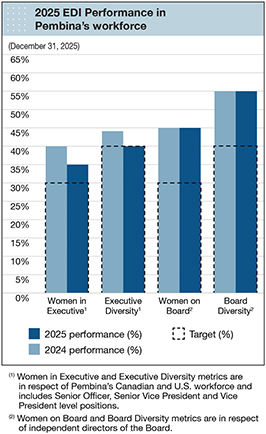
|
Compensation
Director compensation
The board is responsible for:
| ● | approving director compensation; |
| ● | ensuring that director compensation is aligned with shareholder interests and adequately reflects the time commitment, scope of responsibilities and risks involved in being a director and market trends in director compensation; |
| Pembina Pipeline Corporation • 2026 Management Information Circular | 38 |
Corporate Governance – Our Governance Practices
| ● | working with the human resources and compensation committee to review from time to time the competitiveness of the compensation of our board members, board chair, committee chairs and committee members; and |
| ● | working with independent external advisors that review director compensation and provide objective advice. |
| Executive compensation |
Director and Executive compensation
The human resources and compensation committee reviews and recommends compensation for directors, the CEO and other senior officers. You will find a full list of that committee’s activities in 2025 starting on page 53.
| |||
| All decisions about compensation of the CEO and the other senior officers must be approved by the board.
The board works with the human resources and compensation committee and independent external advisors retained by the committee, to determine compensation for our CEO and other senior officers including variable compensation. |
|
You can read more about our approach to compensation governance, the role and responsibilities of the human resources and compensation committee and how we compensate our senior officers starting on page 59.
| Pembina Pipeline Corporation • 2026 Management Information Circular | 39 |
Corporate Governance – Our Governance Practices
Shareholder engagement and communicating with the board
| The board engages with shareholders through accurate and consistent public reporting, as well as open dialogue about our strategy, performance and business activities. We provide ongoing information to our shareholders in our annual reports, management information circulars, AIFs, quarterly reports, news releases, sustainability reports, website, corporate presentations, earnings calls and at industry conferences and other meetings. Management hosts earnings calls every quarter that are open to all, with a live webcast and question and answer period. Our annual shareholders meetings are webcast live (this year’s meeting is virtual-only), and all shareholders and duly appointed proxyholders have an equal opportunity to participate and ask questions during the meeting. Guests have an opportunity to ask questions during the live question and answer sessions held following our annual meetings of shareholders.
Our shareholder engagement program is formally set every year, and follows a consistent pattern of investor conferences, management road shows, industry-specific conferences, one-on-one meetings and site tours.
We also ask investors for feedback at all engagement opportunities, as well as by email and by telephone, and our Investor Relations department has formal and informal interactions with shareholders about specific questions. Occasionally, members of the board, including the chair, will participate in these activities with management. Management regularly provides the board with feedback from our shareholders, both about our company and about more general themes related to our industry. |
2025 highlights Pembina engaged in approximately 250 unique meetings with shareholders, including participation in 14 investor conferences and road shows across Canada, the U.S. and Europe.
| |||
|
Disclosure policy
Pembina is committed to providing material information to shareholders and the public in a timely, accurate and balanced fashion. We have a disclosure policy that applies to all directors, executives, employees and any other person authorized to speak on our behalf, that sets out our procedures for timely dissemination of material information to the public. We also have a disclosure committee made up of our senior officers who are responsible for reviewing and approving all material disclosure before it is released publicly. We regularly review our disclosure policy and update it as appropriate.
|
Contacting the board
Our directors are available to meet directly with shareholders, as appropriate. Interested parties can contact our board at the address below. Certain board members also attend our annual shareholders meetings and are available to respond to questions and receive feedback from investors.
Chair of the board of directors
c/o Corporate Secretary
Pembina Pipeline Corporation
4000, 585 – 8th Avenue S.W.
Calgary, Alberta T2P 1G1
boardchair@pembina.com
Shareholders can also contact our Investor Relations department any time, by email (investor-relations@pembina.com), phone (1-855-880-7404) or letter at the address below.
Investor Relations Department
Pembina Pipeline Corporation
4000, 585 – 8th Avenue S.W.
Calgary, Alberta T2P 1G1
| Pembina Pipeline Corporation • 2026 Management Information Circular | 40 |
Corporate Governance –About the Board of Directors

|
| |
We expect our directors to demonstrate the highest personal and professional ethics, integrity and values, and to represent the long-term interests of our stakeholders.
Independence
| The board assesses the independence of directors annually and on appointment using independence criteria that meet or exceed the following standards: |
|
Independent board 9 of the 10 nominated directors are independent. Mr. Burrows is not independent because he is Pembina’s President and CEO. | ||
|
● National Policy 58-201 — Corporate Governance Guidelines; | ||||
|
● National Instrument 52-110 — Audit Committees; | ||||
|
● SEC rules and regulations; | ||||
|
● Sarbanes-Oxley Act; and |
||||
|
● TSX and NYSE rules. |
Such independence criteria is described in detail in our director independence guidelines, which you can find on our website (www.pembina.com).
Our director independence guidelines and corporate governance guidelines require all directors who sit on the audit committee, human resources and compensation committee, and governance, nominating and corporate social responsibility committee, to be independent directors.
In-camera sessions
The board meets in-camera without non-independent directors and management present at each regularly scheduled board meeting and as necessary at non-regularly scheduled meetings to facilitate regular, open and candid discussion among the independent directors.
In 2025, our independent directors met separately in-camera at all board and committee meetings.
About the board chair
The board chair is appointed by the directors for a term of one year. Our corporate governance guidelines require that the board chair be independent. Our board chair, Henry W. Sykes, is independent and has been chair since January 2023.
The board has written position descriptions for the board chair and the committee chairs, outlining the scope and responsibilities of those roles. Committee chairs lead their committee and report to the board. The board chair reports to the board and our shareholders and works with the CEO to make sure we fulfill our responsibilities to shareholders, employees, partners, governments, communities and the public. The roles of board chair and CEO have been separate since we went public in 1997.
The board chair is expected to provide leadership to the board and foster effective, responsible decision-making, including overseeing board direction and administration, and board and individual director effectiveness.
The board, in consultation with the governance, nominating and corporate social responsibility committee, appoints the chair of each board committee.
| Pembina Pipeline Corporation • 2026 Management Information Circular | 41 |
Corporate Governance – About the Board of Directors
Nomination of new directors
The board reviews its composition annually, considering diversity, specific skills, tenure and the experience required on the board. The board looks at director nomination dynamically, recognizing that the skills the board needs will change over time as the company and the industry evolve. The goal is to ensure that the board remains effective, experienced and well-balanced.
The board considers new director candidates based on merit with regard to the benefits of diversity on the board, and with a view to the specific targets set out in the board diversity section below. The board also considers diversity of age, geography, skills, knowledge and experience in its selection process.
The governance, nominating and corporate social responsibility committee looks to several sources to identify new candidates, including outside search firms, and recommends new director candidates to the board for approval. The board proposes the final list of nominated directors to shareholders at each annual meeting of shareholders.
The governance, nominating and corporate social responsibility committee and the board look for director candidates who are inquisitive and objective, and have practical wisdom and mature judgment. Potential candidates are identified based on competencies, skills, education, communication and interpersonal skills, and relevant business, government and civic experience. The governance, nominating and corporate social responsibility committee and the board also consider the board’s skills matrix to make sure board composition and diversity remain balanced. To make sure the process is impartial, the board takes into consideration any potential conflicts of interest and relationships between candidates and existing directors. The board also considers whether the candidates can devote enough time to their duties as a director and reviews and consults with the board chair and the CEO to gather their input before proposing the nominated directors to shareholders.
Potential candidates are interviewed extensively by members of the governance, nominating and corporate social responsibility committee, and other members of the board.
Board diversity
| The board recognizes the importance of director diversity and has a written diversity policy that serves as a framework for promoting diversity of all kinds. In 2020, the board amended its board diversity policy to adopt diversity targets. The board will consider new director candidates based on merit with regard to the benefits of diversity on the board, and with a view to the following diversity targets:
● female and male genders to each represent at least 30% of the independent directors on the board; and |
||||||
| Representation | ||||||
|
The board exceeds its diversity targets under the board diversity policy: | ||||||
|
44% of the independent director nominees are women | ||||||
|
● at least 40% of independent directors represented by Indigenous peoples, persons with disabilities, members of other racial, ethnic and/or visible minorities and women.
The board currently exceeds the foregoing diversity targets, along with its targets for women in executive leadership and overall executive diversity. See page 38 for a discussion of our EDI targets. |
56% of the independent director nominees are represented by Indigenous peoples, persons with disabilities, members of other racial, ethnic and/or visible minorities and women | |||||
Four of the director nominees are women and two nominees self identify as a member of a visible minority. We have also improved the board’s geographic, educational, experience, and age diversity over time.
In line with the objectives of the board diversity policy, the governance, nominating and corporate social responsibility committee aims to achieve diversity on the board when identifying, selecting and recommending nominees for election, while balancing the professional qualifications required of our directors. In its annual assessment of board composition and mix of skills, the governance, nominating and corporate social responsibility committee also looks at how effective our board diversity policy is at building board diversity, considering the skills required on the board at that time.
The governance, nominating and corporate social responsibility committee and the board are specifically committed to identifying candidates who will advance the board’s diversity targets and considers all aspects of diversity when assessing matters related to board composition and renewal. The board selects candidates based on the overall mix of skills and attributes, with a commitment to diversity.
| Pembina Pipeline Corporation • 2026 Management Information Circular | 42 |
Corporate Governance – About the Board of Directors
| Age and tenure | ||
|
We do not have a formal policy imposing term limits on directors. Our priority is to assemble a board that has the right mix of skills and experience to provide strong stewardship. While the board recognizes that a longer serving director can make a growing contribution to the board over time, it balances experience with some turnover to generate fresh ideas and perspectives on various issues and our business in general. Directors are ordinarily required to retire from our board and not stand for re-election once they have turned 72. The board may, however, deviate from this practice if it determines it is in the best interests of the company. |
66.3 | |
| average age of our independent director nominees | ||
|
8.0 years | ||
| average tenure of our independent director nominees
|
Location
Pembina operates in Canada and the U.S., so it is important to have directors with experience in these markets. Seven of our director nominees are located in Canada, and three are located in the U.S. Aside from geographical location, we have several directors with relevant experience in both markets as well as internationally.
Skills and experience
The board regularly evaluates the competencies and skills of the directors against the competencies and skills identified as necessary for proper oversight, effective decision-making and fulfilling its mandate.
It is our goal to ensure the board has a prudent mix of relevant skills and experience, sufficiently diverse opinions to support balanced discussion and debate, and a manageable number of directors to facilitate productive discussion and decision-making. The board uses a skills matrix to identify and evaluate the experience and knowledge of the directors, and to identify potential areas to focus on when recruiting new director candidates. The governance, nominating and corporate social responsibility committee maintains the matrix and reviews it regularly.
The table on the next page shows the mix of experience and knowledge of our nominated directors. We include each director’s self-assessment of their previous experience and functional expertise, which they rank at one of three levels based on criteria specific to each category. For clarity, the Sustainability/ESG area of functional expertise in the table includes climate expertise.
In addition to the skills and experience noted in the table on the next page, each of the directors also has other relevant board experience. Also see the profiles of the nominated directors starting on page 17 for details regarding each nominee’s experience and education.
| Pembina Pipeline Corporation • 2026 Management Information Circular | 43 |
Corporate Governance – About the Board of Directors
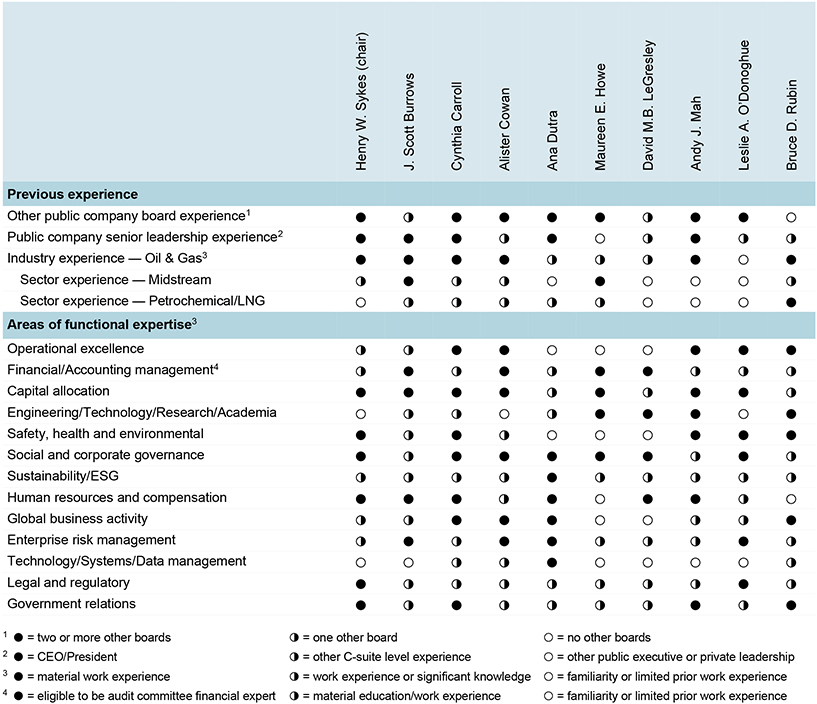
Attendance and active participation
| We have a very committed group of directors and are proud to report that our directors attended all board and committee meetings for which they were called for in 2025. Directors are expected to attend all board meetings and all of their respective committee meetings unless there is an unavoidable conflict or other extenuating circumstance. Attendance is monitored by the governance, nominating and corporate social responsibility committee and is managed by the board chair. | ||
|
100% meeting attendance in 2025
|
We expect all board and committee meetings to be conducted in a way that promotes open communication, meaningful participation and timely resolution of issues. Currently, none of our independent directors serve on more than two committees, which allows them to fully participate and meet their obligations to the board. Independent directors have a standing invitation to attend all committee meetings whether or not they are a member.
The table on the next page includes details of director meeting attendance in 2025.
| Pembina Pipeline Corporation • 2026 Management Information Circular | 44 |
Corporate Governance – About the Board of Directors
| 2025 Committee meetings1 | ||||||||||||||||||||||||||||
| 2025 Board meetings1 |
Audit | Governance, nominating and corporate social responsibility |
Human resources and compensation |
Safety, environment and operational excellence |
Total 2025 committee meetings |
|||||||||||||||||||||||
| H. Sykes2 | 7 of 7 | 100% | ||||||||||||||||||||||||||
| A. Ainsworth3 | 7 of 7 | 100% | 4 of 4 | 5 of 5 | 9 of 9 | 100% | ||||||||||||||||||||||
| J.S. Burrows4 | 7 of 7 | 100% | ||||||||||||||||||||||||||
| C. Carroll5 | 7 of 7 | 100% | 6 of 6 | 5 of 5 | 11 of 11 | 100% | ||||||||||||||||||||||
| A. Cowan6 | 7 of 7 | 100% | 4 of 4 | 4 of 4 | 8 of 8 | 100% | ||||||||||||||||||||||
| A. Dutra7 | 7 of 7 | 100% | 1 of 1 | 4 of 4 | 4 of 4 | 9 of 9 | 100% | |||||||||||||||||||||
| M. Howe8 | 7 of 7 | 100% | 4 of 4 | 4 of 4 | 8 of 8 | 100% | ||||||||||||||||||||||
| D. LeGresley9 | 7 of 7 | 100% | 4 of 4 | 6 of 6 | 10 of 10 | 100% | ||||||||||||||||||||||
| G. Kerr10 | 3 of 3 | 100% | 1 of 1 | 1 of 1 | 2 of 2 | 100% | ||||||||||||||||||||||
| A. Mah11 | 7 of 7 | 100% | 4 of 4 | 6 of 6 | 10 of 10 | 100% | ||||||||||||||||||||||
| L. O’Donoghue | 7 of 7 | 100% | 4 of 4 | 5 of 5 | 9 of 9 | 100% | ||||||||||||||||||||||
| B. Rubin12 | 7 of 7 | 100% | 3 of 3 | 2 of 2 | 5 of 5 | 10 of 10 | 100% | |||||||||||||||||||||
| Total | 100% | 100% | 100% | 100% | 100% | 100% | ||||||||||||||||||||||
| 1 | Attendance reflects all meetings of the board and/or relevant committee(s) which each individual was called for while a director in 2025. |
| 2 | Mr. Sykes has been chair of the board since January 1, 2023 and is not a member of any committee; however, he attends most committee meetings to fulfil his duty in providing leadership to the board in matters relating to the effectiveness of each committee’s responsibilities. |
| 3 | Ms. Ainsworth will not stand for re-election and will retire from the board following the meeting. |
| 4 | As Pembina’s CEO, Mr. Burrows is not a member of any committees of the board. |
| 5 | Chair of the safety, environment and operational excellence committee since May 7, 2021. |
| 6 | Mr. Cowan was appointed to the human resources and compensation committee on May 6, 2025 and attended all meetings after his appointment. |
| 7 | Ms. Dutra stepped down from the audit committee and was appointed to the human resources and compensation committee on May 6, 2025. Ms. Dutra attended all applicable meetings for each of the committees prior to and after her appointment. |
| 8 | Chair of the audit committee since May 7, 2021. |
| 9 | Chair of the governance, nominating and corporate social responsibility committee since January 1, 2023. |
| 10 | Mr. Kerr stepped down from the audit committee and the governance, nominating and corporate social responsibility committee on May 6, 2025 and retired from the board on May 9, 2025. |
| 11 | Chair of the human resources and compensation committee since November 2, 2023. |
| 12 | Mr. Rubin stepped down from the human resources and compensation committee and was appointed to the audit committee on May 6, 2025. Mr. Rubin attended all applicable meetings for each of the committees prior to and after his appointment. |
Orientation and continuing education
The governance, nominating and corporate social responsibility committee is responsible for overseeing the director orientation process and for director education and development.
Orientation
Our orientation manual for new directors includes the following items:
| ● | corporate governance guidelines; |
| ● | director independence guidelines; |
| ● | board diversity policy; |
| ● | majority voting policy; |
| ● | board and committee charters; |
| ● | position descriptions for the board chair, committee chairs and the CEO; |
| ● | committee composition; |
| ● | key corporate policies; |
| ● | organizational charts and constating documents; |
| ● | recent disclosure and investor materials; |
| ● | strategic plan; and |
| ● | other relevant corporate and board information. |
New directors attend orientation sessions and one-on-one meetings with key executives to familiarize themselves with our values, business, significant risks and mitigation measures, our expectations, our corporate goals and objectives and current
| Pembina Pipeline Corporation • 2026 Management Information Circular | 45 |
Corporate Governance – About the Board of Directors
business issues and opportunities. New directors may also be invited by other directors, executives and business unit leaders to tour specific sites.
Continuing education
Directors have ongoing opportunities to increase their knowledge and understanding of our business. All of our directors are members of the Institute of Corporate Directors and the company pays the cost of this membership. The board also encourages individual directors to attend continuing education sessions and contributes to the cost of attending these courses.
We also periodically provide educational sessions about our business, our industry and emerging trends and issues. These educational sessions are usually held during scheduled board and committee meetings, and include:
| ● | annual briefings, which typically include reviews of the competitive environment, our five-year or 10-year financial outlook, our performance relative to our peers, significant risks and mitigation measures and other developments that could materially affect our business. Annual briefings may include presentations by third-party consultants, such as financial advisors, pension experts and outside legal counsel as needed; |
| ● | regular briefings on ESG, climate and cybersecurity developments and updates; |
| ● | regular briefings on corporate governance developments and emerging best practices; and |
| ● | presentations from time to time by external consultants about general industry trends, other issues or other topics of interest. |
Open communication between the board and management contributes to our long-term success. Annually, directors connect with our officers in an informal social setting to build relationships, establish trust and open the lines of communication. Pembina’s Corporate Secretary annually compiles a list of all continuing education taken by the directors. The table below shows the education sessions our directors attended in 2025 that were facilitated by Pembina. Individual directors may also attend other independent education sessions or sessions sponsored by other companies where they serve as a director.
| Date | Description | Presented by | Attendees | |||||
| February |
IFRS 18 – Presentation and Disclosure in Financial Statements | Pembina management and external advisor | Anne-Marie N. Ainsworth J. Scott Burrows Alister Cowan Ana Dutra |
Maureen Howe Andy Mah Leslie O’Donoghue Henry Sykes | ||||
| May |
Site Visits and Tours RFS4, Redwater Complex |
Pembina personnel | All directors | |||||
| May |
Tariff Implications Review | Pembina management | Anne-Marie N. Ainsworth J. Scott Burrows Alister Cowan Maureen Howe Gordon Kerr |
David LeGresley Andy Mah Leslie O’Donoghue Bruce Rubin Henry Sykes | ||||
| May |
Capital Markets, Midstream and Energy Update | External advisor | All directors | |||||
| August |
Financial Systems Landscape at Pembina | Pembina management | J. Scott Burrows Alister Cowan Ana Dutra Maureen Howe |
Andy Mah Leslie O’Donoghue Bruce Rubin Henry Sykes | ||||
| August |
General Industry Updates and Trends | External advisor | All directors | |||||
| November |
Fraud Risk | External advisor | Anne-Marie N. Ainsworth Alister Cowan Ana Dutra Maureen Howe |
Andy Mah Leslie O’Donoghue Bruce Rubin Henry Sykes | ||||
| November |
Artificial Intelligence at Pembina | Pembina management | All directors | |||||
| Pembina Pipeline Corporation • 2026 Management Information Circular | 46 |
Corporate Governance – About the Board of Directors
| Date | Description | Presented by | Attendees | |||||
| November |
Overview of Pembina’s director and officer insurance program, the director and officer insurance market and trends | Pembina management and external advisor | Anne-Marie N. Ainsworth J. Scott Burrows Ana Dutra |
Maureen Howe David LeGresley Henry Sykes | ||||
| December |
Canadian and U.S. Upstream and Infrastructure Updates | External advisor | All directors | |||||
| Serving on other boards | ||
| We recognize the significant commitment involved in serving on a board of directors and the value and experience gained from serving on other boards.
| ||
|
Our corporate governance guidelines limit the number of public company boards our directors can serve on. Any directors who hold executive positions with public companies can serve on one public company board in addition to Pembina’s board. All other directors can serve on up to three public company boards in addition to Pembina’s board. Directors who are members of the audit committee can only serve as a member of an audit committee of two other companies.
The board can allow a director to serve on additional boards if it determines that this would not impair the director’s independence or ability to effectively serve on the board and will disclose it in the circular and AIF. Directors who want to serve on the board, or as an |
Board independence The governance, nominating and corporate social responsibility committee has reviewed the outside boards our director nominees currently serve on and has determined that they do not affect the board’s independence or its ability to operate effectively.
| |
executive, of another publicly traded company must notify the chair of our governance, nominating and corporate social responsibility committee before accepting the nomination or appointment. The chair of the governance, nominating and corporate social responsibility committee, together with the board chair, will determine whether accepting the nomination or appointment would compromise the director’s availability or capacity to act as a director of Pembina, or result in an actual or perceived conflict of interest. None of our nominated directors serve on more than two other public company boards.
The board regularly reviews the other directorships of its directors in accordance with our corporate governance guidelines, including board and committee interlocks — when two or more directors serve together on another company board or board committee. When there is an interlock, the board, together with the governance, nominating and corporate social responsibility committee, will review and decide whether a director should continue to serve on our board. In all cases, a director must not serve on the boards of directors of more than two other companies on which a fellow director also serves. As set forth in the table below, there is currently one public company board and committee interlock. The board has determined that the ability of these directors to act independently is not affected by serving together on these boards. There are currently no private company interlocks.
| Company | Stock Exchange Listing | Director Nominees | Committees | |||
| Methanex Corporation | TSX; NASDAQ | Maureen E. Howe | Audit, finance and risk | |||
| Leslie A. O’Donoghue | Audit, finance and risk | |||||
Board and committee evaluation
Regular board assessments are important to confirm that the board, the board chair, the committees, the chairs of each committee and individual directors are all performing effectively, based on the expectations set out in the board and committee charters and position descriptions, and to encourage continuous improvement.
Annual process
We complete an assessment of the board once per year as formally required in our corporate governance guidelines. The board chair, in conjunction with the governance, nominating and corporate social responsibility committee, leads the annual assessment, with input from all directors. Each director completes a formal questionnaire every year, which is currently divided into five categories: board responsibility and effectiveness, board operations, board composition and renewal, committee of the board and open-ended questions. Each director also evaluates the effectiveness and performance of the
| Pembina Pipeline Corporation • 2026 Management Information Circular | 47 |
Corporate Governance – About the Board of Directors
board chair and their fellow directors. The board chair also conducts one-on-one interviews with each director on an annual basis. After the results of the questionnaires and meetings are compiled, the governance, nominating and corporate social responsibility committee and the board discuss the results, in-camera, if appropriate.
In-depth review
Our corporate governance guidelines require the board to engage a third-party advisor to assist in the evaluation and assessment of the board, its committees, the board chair and the committee chairs at least once every three years. An external advisor was engaged in 2023 to help facilitate the board and individual director effectiveness evaluation and peer reviews. The governance, nominating and corporate social responsibility committee considers this evaluation as part of its discussions on board, committee and director effectiveness. An in-depth review by a third-party advisor will occur in 2026.
| Pembina Pipeline Corporation • 2026 Management Information Circular | 48 |
Corporate Governance – Board Committees
|
|
Board Committees | |
The board has four standing committees to help carry out its duties and meet the statutory and policy requirements that apply to our business:
| ● | audit committee; |
| ● | governance, nominating and corporate social responsibility committee; |
| ● | human resources and compensation committee; and |
| ● | safety, environment and operational excellence committee. |
Each committee is governed by a written charter that is approved by the board and reviewed and assessed every year by the committees themselves, the governance, nominating and corporate social responsibility committee and the board. All of the directors that serve on the board committees must be independent, except for our safety, environment and operational excellence committee, which must be comprised of a majority of independent directors.
Each committee updates the board regularly on its activities by providing a report to the board after each committee meeting and submits any recommendations that require board approval for discussion and review. Each committee is responsible for sharing information of mutual interest with other committees.
The board reviews the composition of its committees each year and adjusts committee membership periodically. The board can by resolution remove members of each committee when needed and fill vacancies if a committee has less than the minimum number of members required by its charter. The board chair is not a member of any standing committee but attends most committee meetings to fulfil his duty in providing leadership to the board in matters relating to the effectiveness of each of the committee’s responsibilities.
The board may also, from time to time, establish ad hoc committees to address specific issues that emerge or assume tasks not covered by the standing committees and for a specific period of time.
You can find the committee charters for our standing committees online at our website (www.pembina.com) and read about the nominated directors starting on page 17 of this circular.
| Audit1,2 | Governance, Nominating and Corporate Social Responsibility1 |
Human Resources and Compensation1 |
Safety, Environment and Operational Excellence | |||||
| Anne-Marie N. Ainsworth3 | Member | Member | ||||||
| Cynthia Carroll | Member | Chair | ||||||
| Alister Cowan4 | Member | Member | ||||||
| Ana Dutra | Member | Member | ||||||
| Maureen E. Howe4 | Chair | Member | ||||||
| David M.B. LeGresley | Chair | Member | ||||||
| Andy J. Mah | Member | Chair | ||||||
| Leslie A. O’Donoghue | Member | Member | ||||||
| Bruce D. Rubin | Member | Member | ||||||
| Henry W. Sykes5 |
| 1 | All members and chairs must be independent pursuant to regulatory standards and institutional shareholder standards. |
| 2 | All members must be financially literate under regulatory standards. |
| 3 | Ms. Ainsworth will not stand for re-election and will retire from the board following the meeting. |
| 4 | Audit committee financial expert under US regulatory standards. |
| 5 | Mr. Sykes has been chair of the board since January 1, 2023 and is not a member of any committee; however, he attends most committee meetings to fulfil his duty in providing leadership to the board in matters relating to the effectiveness of each committee’s responsibilities. |
| Pembina Pipeline Corporation • 2026 Management Information Circular | 49 |
Corporate Governance – Board Committees
Audit committee
The audit committee is responsible for overseeing:
| ● | the integrity of Pembina’s financial statements, the reporting process and internal controls over financial reporting; |
| ● | the relationship, reports, qualifications, independence and performance of the external auditor; |
| ● | the internal audit function; |
| ● | financial risk identification, assessment and management program; |
| ● | compliance with legal and regulatory requirements related to financial reporting and controls; |
| ● | management information technology related to financial reporting and financial controls; and |
| ● | maintenance of open lines of communication between management, the external auditors, the internal auditors and the board. |
The committee meets quarterly with management, the internal auditors, and the external auditors together, as well as separately, with the internal auditors and the external auditors without management present. The audit committee met four times in 2025. All meetings included in camera sessions without management present.
You can find more information about the audit committee under the heading Audit Committee Information in our AIF on our website (www.pembina.com), on SEDAR+ (www.sedarplus.ca) and on EDGAR (www.sec.gov).
| Members |
Maureen E. Howe (chair) | Andy J. Mah | ||
| Alister Cowan | Leslie A. O’Donoghue | |||
| Bruce Rubin | ||||
| Alister Cowan and Maureen E. Howe are financial experts, and all of the members are financially literate under U.S. and Canadian securities laws. For further details regarding the audit committee members’ education and experience, see their respective profiles in the About the Nominated Directors section of this circular, beginning on page 17.
| ||||
| Independence |
100% | |||
| Each of the five directors are independent within the meaning of National Instrument 52-110 — Audit Committees, Rule 10A-3 under the U.S. Securities Act of 1934, as amended, and the corporate governance standards of the TSX and the NYSE.
| ||||
| 2025 membership changes
|
● Bruce Rubin was appointed to the committee on May 6, 2025
● Ana Dutra stepped down from the committee on May 6, 2025
● Gordon Kerr stepped down from the committee on May 6, 2025
| |||
| Qualifications |
Committee members must: | |||
● be an accountant or have financial experience or accreditation, or both | ||||
● be able to read and understand a set of financial statements that are comparable in scope and complexity to our financial statements
| ||||
| Key responsibilities |
Financial statements, reporting process and internal controls over financial reporting | |||
● reviewing annual and quarterly consolidated financial statements, MD&A, the earnings press releases and other financial disclosure, and recommending them to the board for approval | ||||
● reviewing significant financial reporting issues, changes in accounting policies, key estimates and judgments, internal control updates, unresolved issues between management and the external auditor, and whistleblower complaints | ||||
● reviewing our internal controls over financial reporting under the Sarbanes-Oxley Act compliance | ||||
| External auditor | ||||
● overseeing the relationship, reports, qualifications, independence and performance of the external auditors and audit services by other registered public accounting firms Pembina has engaged | ||||
● overseeing and recommending the audit plan and related fees | ||||
| Internal audit | ||||
● overseeing the internal audit function, including the review of the internal audit function, approval of the internal audit plan, review of internal audit performance, ensure there are no unjustified restrictions and review/concur in the appointment/dismissal of the Head of Internal Audit, and meet separately with the Head of Internal Audit to discuss certain matters | ||||
| Financial risk management | ||||
● discussing governance guidelines and policies for risk assessment and management of areas outlined in the audit committee charter | ||||
● developing or overseeing the development of these guidelines and policies
| ||||
| Pembina Pipeline Corporation • 2026 Management Information Circular | 50 |
Corporate Governance – Board Committees
|
2025 Highlights |
Committee charter and education | |
● reviewed the audit committee charter | ||
● attended professional development sessions on topics relating to disclosure in financial statements, financial systems landscapes, tariff overviews and fraud risk
| ||
| Financial reporting and tax | ||
● reviewed significant financial reporting considerations including, but not limited to, contingencies, estimates and judgments applied and significant provisions for consolidated financial statements | ||
● reviewed annual, quarterly and consolidated financial statements, MD&A, earnings press releases and other financial disclosures
| ||
| External auditor oversight | ||
● recommended the 2025 external auditor audit engagements, audit plans and fees to the board | ||
● reviewed and approved non-audit services to be provided by the external auditor | ||
● reviewed the quarterly audit findings reports provided by the external auditors
| ||
| Internal audit functional oversight | ||
● reviewed and approved changes to the internal audit charter and annual internal audit plan | ||
● reviewed highlights and key findings of internal audit reports issued | ||
● monitored internal controls over financial reporting program progress and review of outcome
| ||
| Compliance, financial risk and other oversight | ||
● reviewed the company’s hedging strategy | ||
● reviewed and approved the whistleblower policy | ||
● reviewed corporate insurance program and coverage | ||
● monitored funding exposure and oversight of the pension plans
| ||
| Pembina Pipeline Corporation • 2026 Management Information Circular | 51 |
Corporate Governance – Board Committees
Governance, nominating and corporate social responsibility committee
The governance, nominating and corporate social responsibility committee is primarily responsible for helping the board develop, implement and monitor Pembina’s corporate governance practices.
The committee is expected to work with management and others throughout the company to make sure we have a healthy governance culture. This includes reporting and making recommendations to the board and management about corporate governance issues, best practices, compliance and the effectiveness of our governance processes and systems. The committee met four times in 2025. All meetings included in camera sessions without management present.
| Members |
David M.B. LeGresley (chair) |
Ana Dutra | ||
| Anne-Marie N. Ainsworth1 |
Maureen E. Howe | |||
| Independence
|
100%
|
|||
| 2025 membership changes
|
● Gordon Kerr stepped down from the committee on May 6, 2025
| |||
| Qualifications |
● governance committee of other public companies | |||
● legal, compliance or regulatory background | ||||
● CEO or senior executive experience | ||||
| Key responsibilities |
Board governance | |||
● reviewing and recommending board size and composition | ||||
● overseeing director orientation, education and training | ||||
● monitoring potential conflicts of interest and other board appointments | ||||
● overseeing eligibility and selection criteria, including independence, financial literacy and diversity | ||||
● recommending director candidates for election to the board and appointment to board chair | ||||
● conducting and reviewing annual board, director and committee assessments | ||||
| Compliance and disclosure | ||||
● overseeing corporate social responsibility/ESG | ||||
● monitoring best governance practices and our compliance with governance related laws and regulations | ||||
● approving our disclosure policy and overseeing our policies, procedures and the disclosure committee | ||||
● assisting the board in establishing appropriate risk oversight functions at the board and committee levels | ||||
| 2025 Highlights |
Director succession | |||
● reviewed and recommended changes to committee membership for 2025 | ||||
● reviewed outside board appointments | ||||
| Corporate governance best practices | ||||
● reviewed and approved amendments to corporate policies | ||||
● reviewed and recommended changes to board and committee charters and corporate governance guidelines | ||||
● reviewed and recommended changes to the director independence guidelines | ||||
● reviewed and recommended changes to share ownership guidelines | ||||
● reviewed the activities of the company’s disclosure committee | ||||
● reviewed proxy advisor reports on 2025 management information circular | ||||
● reviewed the director onboarding process and continuing education program for the directors | ||||
● monitored recent developments, emerging trends and best practices in ESG, corporate governance and disclosure practices, including shareholder engagement trends, cybersecurity, AI, improving shareholder voting participation and activist shareholder developments and trends | ||||
● reviewed director and officer insurance coverage | ||||
| Evaluation of the board, board committees, chairs and individual directors | ||||
● assessed and determined director independence and reviewed director relationships, commitments and interlocks | ||||
● reviewed and recommended directors to be designated as financially literate, financial experts and/or audit committee experts under applicable laws | ||||
● completed and assessed the board’s effectiveness and performance as well as the performance and effectiveness of individual directors and the board committees | ||||
| Public disclosure | ||||
● reviewed the information related to corporate governance in this circular | ||||
● reviewed and recommended the report in connection with Fighting Against Forced Labour and Child Labour in Supply Chains Act | ||||
1 Ms. Ainsworth will not stand for re-election and will retire from the board following the meeting.
| Pembina Pipeline Corporation • 2026 Management Information Circular | 52 |
Corporate Governance – Board Committees
Human resources and compensation committee
The human resources and compensation committee assists the board by providing oversight and direction on our people strategy, policies and programs, including EDI, staff attraction, engagement and retention, health and wellness, and compensation.
The committee reviews and recommends to the board approval of our compensation philosophy, oversees the development and administration of our compensation programs, and oversees executive succession planning. The committee is also responsible for overseeing the risk associated with our compensation, succession and resource planning programs and ensuring that appropriate risk mitigation actions are in place.
The committee reviews and recommends director compensation for approval by the board, recommends approval by the board of compensation for the CEO and senior officers, and oversees compensation of the other executives.
You can read about how we compensate our directors starting on page 56 and our named executives starting on page 59. You can find more information about compensation governance starting on page 64.
The human resources and compensation committee met six times in 2025. All meetings included in camera sessions without management present.
| Members |
Andy J. Mah (chair) | David M.B. LeGresley | ||
| Cynthia Carroll | Ana Dutra | |||
| Alister Cowan
|
||||
| Independence
|
100%
|
|||
| 2025 membership changes
|
● Bruce Rubin stepped down from the committee on May 6, 2025 | |||
● Alister Cowan was appointed to the committee on May 6, 2025 | ||||
● Ana Dutra was appointed to the committee on May 6, 2025 | ||||
| Qualifications |
● executive or CEO experience | |||
● human resources or compensation experience | ||||
● compensation committees of other public companies | ||||
● industry or sector experience | ||||
● financial or legal expertise | ||||
| Key responsibilities |
Compensation philosophy and approach | |||
● reviewing and recommending compensation philosophy | ||||
● reviewing and recommending senior officer compensation program and incentive plans | ||||
● reviewing and recommending director compensation | ||||
| Program oversight | ||||
● overseeing the People Strategy | ||||
● overseeing the EDI program | ||||
● overseeing the defined benefit, defined contribution and supplementary pension plans | ||||
● overseeing the employee health and wellness program | ||||
● reviewing compensation design, corporate objectives and executive performance targets | ||||
● reviewing employment agreements, severance and change of control arrangements for the CEO and other senior officers | ||||
● assisting the board in establishing and overseeing executive succession plans | ||||
| Annual performance and compensation | ||||
● recommending individual elements of total compensation for the CEO and other senior officers | ||||
● reviewing and recommending the annual report on executive compensation and public disclosure | ||||
● reviewing and recommending performance goals for the short- and long-term incentive plans | ||||
| Compensation risk oversight | ||||
● ensuring executive compensation is aligned with our short- and long-term goals | ||||
● monitoring legal and stock exchange compliance | ||||
| Pembina Pipeline Corporation • 2026 Management Information Circular | 53 |
Corporate Governance – Board Committees
| 2025 Highlights |
Program oversight | |
● reviewed and recommended for approval: | ||
| - Pembina’s short- and long-term incentive plans | ||
| - the compensation and performance peer groups | ||
| - changes to organizational design | ||
| - changes to share ownership guidelines | ||
| Succession planning | ||
● reviewed the executive succession plan and the executive development plan process | ||
| Annual performance and compensation | ||
● recommended for approval: | ||
| - 2025 performance goals for the STIP | ||
| - 2025 CEO objectives | ||
| - 2025 performance share unit (PSU) awards and PSU performance measures | ||
| - Phased out stock options and rebalanced long-term incentive mix | ||
● reviewed and recommended for approval 2024 corporate performance to determine 2024 short-term incentive payouts (paid in 2025) | ||
● reviewed and recommended for approval the 2022 PSU multiplier for long-term incentive payouts (paid in 2025) | ||
● reviewed and recommended for approval the budget for salary increases | ||
| Committee Charter and Education | ||
● reviewed changes to the committee charter | ||
● received an overview of: | ||
| - North American compensation trends and executive compensation market analysis | ||
| - the company’s pension and benefits program | ||
| - the company’s People Strategy and Culture, Inclusion and Leadership Strategy including the EDI program | ||
| - human resources updates | ||
| Public disclosure | ||
● reviewed and recommended for approval the information related to compensation in the 2025 management information circular | ||
| Pembina Pipeline Corporation • 2026 Management Information Circular | 54 |
Corporate Governance – Board Committees
Safety, environment and operational excellence committee
The safety, environment and operational excellence committee is primarily responsible for helping the board oversee the development, implementation and monitoring of our OEMS programs, including process safety and occupational safety, environment, asset integrity management, corporate security and cybersecurity. The committee also oversees our operational excellence and continuous improvement efforts and results.
The safety, environment and operational excellence committee met five times in 2025. All meetings included in camera sessions without management present.
| Members |
Cynthia Carroll (chair) | Leslie A. O’Donoghue | ||
| Anne-Marie N. Ainsworth1 | Bruce D. Rubin | |||
| Independence |
100% | |||
| 2025 membership changes |
None | |||
| Qualifications |
● engineering or operations background | |||
● legal, compliance or regulatory background | ||||
● CEO or senior executive experience
| ||||
| Key responsibilities |
Program and strategy development | |||
● overseeing the development, implementation and operational audits of our OEMS program, management policies, programs, systems and practices | ||||
● reviewing our safety and environmental strategy | ||||
| Risk management | ||||
● reviewing OEMS program risks and mitigation plans | ||||
● monitoring current, pending or threatened regulatory action by or against us | ||||
| Regulatory compliance and public disclosure | ||||
● reviewing and monitoring our incident reporting policies and practices, and reports about significant incidents, emerging issues, inspections, audits and actions taken to correct deficiencies | ||||
| 2025 Highlights |
Safety and environment measures | |||
● reviewed and approved the 2025 safety and environment performance measures to be used across all divisions, incorporating both leading and lagging indicators | ||||
● reviewed 2024 performance against targets and recommended for approval the safety and environment performance multiplier for the 2024 STIP award to the human resources and compensation committee | ||||
| OEMS programs | ||||
● reviewed strategy and approach to revising Pembina’s Operations Management System program to the new OEMS program | ||||
● reviewed the results of management’s incident review panel related to all significant events | ||||
● reviewed technology initiatives being applied at Pembina to improve safety | ||||
● monitored emerging and material issues in safety, security and environment, including process safety, and security program requirements | ||||
● reviewed plans and progress towards improving contractor safety performance | ||||
● reviewed and monitored corporate and cybersecurity programs in 2025 | ||||
● reviewed management’s 2025 work plans for asset integrity inspection and repairs | ||||
| Operational excellence | ||||
● reviewed corporate efficiency and effectiveness plans and results | ||||
● reviewed quarterly updates on the company’s 2025 safety action plan | ||||
| Committee charter and education | ||||
● reviewed the committee’s charter | ||||
● received updates on SEFSAM training content, leadership completion rates and sustainment plan | ||||
| 1 | Ms. Ainsworth will not stand for re-election and will retire from the board following the meeting. |
| Pembina Pipeline Corporation • 2026 Management Information Circular | 55 |
Corporate Governance – Director Compensation
|
|
Director Compensation | |
We pay non-executive directors an annual retainer (in cash and equity) and additional amounts for committee memberships and chairing committees. This compensation package:
| • | acknowledges the expertise, time, due diligence and counsel that each director contributes to the board; |
| • | aligns the near- and long-term interests of directors with those of our shareholders; and |
| • | is competitive with the market. |
Mr. Burrows is compensated in the role of CEO and does not receive director compensation.
Director compensation package
The table below shows our director fee schedule for 2025 and 2026. There are no changes to the compensation package for 2026.
| 2025 ($) |
2026 ($) |
|||||||||||
| Board chair |
Annual retainer | 495,000 | 495,000 | |||||||||
| Board member |
Annual retainer | 260,000 | 260,000 | |||||||||
| Committees |
Audit committee chair retainer | 28,500 | 28,500 | |||||||||
| Human resources and compensation committee chair retainer | 22,500 | 22,500 | ||||||||||
| Other committee chair retainer | 17,500 | 17,500 | ||||||||||
| Audit committee member retainer | 15,000 | 15,000 | ||||||||||
| Other committee member retainer | 12,500 | 12,500 | ||||||||||
To help ensure they can meet their share ownership requirements (as described under the heading Building equity ownership below) within five years of joining the board, directors are required to take at least 50% of their total compensation as equity until they have met their share ownership requirements. Directors may elect to take up to 100% of their total compensation as equity. The rest of the compensation is paid in cash, quarterly in arrears.
The equity portion of director compensation is paid in DSUs under our DSU plan. A DSU is a notional share that has the same value as one common share. The value of DSUs changes with our share price and therefore have the same upside potential and downside risk as our common shares. DSUs do not have voting rights but they accrue dividends as additional DSUs, at the same rate as dividends paid on our common shares. The board does not have the discretion to grant additional DSUs other than in lieu of cash fees on a value for value basis. DSUs vest when they are credited to the director’s account but are paid out only after the director retires from the board (and must be redeemed within one year of retirement). The amount the director receives on redemption is calculated by multiplying the number of DSUs they hold (including credited dividend equivalents) by the weighted average trading price of common shares on the TSX for the last five trading days before the termination date.
Compensation in line with our peers
To ensure we can attract and retain talented directors, we compensate our directors in a way that is fair and competitive, targeting compensation at the median offered by our director compensation peer group.
The human resources and compensation committee engages outside consultants periodically to compare our director compensation practices and levels with companies with which we compete for talent. The director compensation peer group is the same peer group used for the named executive compensation peer group for 2025 (see page 68 for a list of the peer companies and a discussion of the selection process).
| Pembina Pipeline Corporation • 2026 Management Information Circular | 56 |
Corporate Governance – Director Compensation
Building equity ownership
Pembina has director share ownership requirements because we believe directors should be aligned with the interests of shareholders and show their commitment to Pembina by owning equity.
Non-executive directors must own three times their annual board retainer in Pembina equity. Common shares and DSUs (including the DSUs they accrue as dividend equivalents) can be used to meet the share ownership requirement.
New directors must meet the share ownership requirement within five years from the date of their appointment. The table below shows the equity holdings of non-executive directors as of March 19, 2026. As of that date, all current directors were in compliance with, or on track to meet, their respective share ownership requirement.
As at March 19, 2026, non-executive directors as a group beneficially owned, directed or controlled 210,722 common shares and 346,592 DSUs with a combined value as of March 19, 2026 of $34,177,452.
| Number of common shares |
Value of common shares1 ($) |
Value of DSUs2 ($) |
Estimated holdings |
Share ownership requirement ($) |
Meets share ownership requirement |
|||||||||||||||||||
| Henry W. Sykes (2025 Chair) |
18,390 | 1,127,859 | 2,544,888 | 3,672,747 | 1,485,000 | Yes | ||||||||||||||||||
| Anne-Marie N. Ainsworth3 |
27,924 | 1,711,055 | 3,231,539 | 4,942,594 | 1,070,433 | Yes | ||||||||||||||||||
| Cynthia Carroll3 |
- | - | 1,729,997 | 1,729,997 | 1,070,433 | Yes | ||||||||||||||||||
| Alister Cowan |
11,671 | 715,782 | 338,664 | 1,054,447 | 780,000 | Yes | ||||||||||||||||||
| Ana Dutra3 |
- | - | 1,056,777 | 1,056,777 | 1,070,433 | On track | 4 | |||||||||||||||||
| Maureen E. Howe |
27,000 | 1,655,910 | 988,517 | 2,644,427 | 780,000 | Yes | ||||||||||||||||||
| David M.B. LeGresley |
48,864 | 2,996,829 | 3,778,235 | 6,775,064 | 780,000 | Yes | ||||||||||||||||||
| Andy J. Mah |
21,285 | 1,305,409 | 570,369 | 1,875,778 | 780,000 | Yes | ||||||||||||||||||
| Leslie A. O’Donoghue |
35,588 | 2,182,612 | 4,799,440 | 6,982,053 | 780,000 | Yes | ||||||||||||||||||
| Bruce D. Rubin3 |
20,000 | 1,225,509 | 2,218,061 | 3,443,569 | 1,070,433 | Yes | ||||||||||||||||||
| 1 | Calculated using $61.33 per share (the closing price of our common shares on the TSX on March 19, 2026). |
| 2 | DSU value is estimated at $61.33 per share (the closing price of our common shares on the TSX on March 19, 2026). Includes DSUs that accrue as dividend equivalents. |
| 3 | Ms. Ainsworth, Ms. Carroll, Ms. Dutra and Mr. Rubin are U.S. residents and their fees are paid in U.S. dollars. To be consistent with the guidelines, Ms. Ainsworth’s, Ms. Carroll’s, Ms. Dutra’s and Mr. Rubin’s equity ownership requirements are also in U.S. dollars and converted to Canadian dollars using the Reuters noon U.S. Canadian dollar foreign exchange rate of $1.37235 on March 19, 2026. The value of their common shares is calculated using US$44.65 per share (the closing price of our common shares on the NYSE on March 19, 2026) and converted to Canadian dollars using the Reuters noon U.S. Canadian dollar foreign exchange rate of $1.37235 on March 19, 2026. |
| 4 | Ms. Dutra has five years from the date of her appointment to the board on May 6, 2022 to meet the share ownership requirement. |
| Pembina Pipeline Corporation • 2026 Management Information Circular | 57 |
Corporate Governance – Director Compensation
Director summary compensation table
The table below shows the value of all compensation paid to non-executive directors in 2025. Mr. Burrows did not receive director compensation because he was compensated in his role as CEO.
| 2025 fees1 ($) | Allocation of 2025 fees2 ($) | |||||||||||||||||||||||
| Annual retainer |
Committee chair/ member retainer |
All other compensation3 ($) |
Total compensation ($) |
Cash | DSUs4 | |||||||||||||||||||
| Henry W. Sykes (chair) |
495,000 | - | - | 495,000 | 247,487 | 247,513 | ||||||||||||||||||
| Anne-Marie N. Ainsworth5 |
356,577 | 34,286 | 15,146 | 406,009 | 195,443 | 195,421 | ||||||||||||||||||
| Cynthia Carroll5 |
356,577 | 41,144 | 2,743 | 400,463 | 198,871 | 198,849 | ||||||||||||||||||
| Alister Cowan |
260,000 | 23,219 | 2,000 | 285,219 | 139,463 | 143,756 | ||||||||||||||||||
| Ana Dutra5 |
356,577 | 35,460 | 15,146 | 407,183 | 196,617 | 195,421 | ||||||||||||||||||
| Maureen E. Howe |
260,000 | 41,000 | 4,000 | 305,000 | 301,000 | $- | ||||||||||||||||||
| Gordon J. Kerr6 |
91,890 | 9,719 | 2,603 | 104,213 | 101,610 | $- | ||||||||||||||||||
| David M.B. LeGresley |
260,000 | 30,000 | 8,240 | 298,240 | 174,021 | 115,979 | ||||||||||||||||||
| Andy J. Mah |
260,000 | 37,500 | - | 297,500 | 148,770 | 148,730 | ||||||||||||||||||
| Leslie A. O’Donoghue |
260,000 | 27,500 | 3,338 | 290,838 | 143,744 | 143,756 | ||||||||||||||||||
| Bruce D. Rubin5 |
356,577 | 36,541 | 4,431 | 397,549 | 393,118 | $- | ||||||||||||||||||
| Total |
3,313,198 | 316,369 | 57,647 | 3,687,214 | 2,240,144 | 1,389,425 | ||||||||||||||||||
| 1 | Retainers awarded, earned, paid or payable for 2025. |
| 2 | Represents the amount of 2025 fees earned, excluding “all other compensation”, that are paid in cash or DSUs. DSUs are granted in whole units. As a result, the amounts under the column Allocation of 2025 fees can be slightly different from the total of 2025 fees due to rounding. |
| 3 | All other compensation represents travel related fees. |
| 4 | Represents the amount of 2025 fees that directors elected to receive as DSUs based on the grant price of DSUs of $52.91 (being the volume weighted average trading price of our common shares on the TSX from January 2, 2025 to January 8, 2025). |
| 5 | Ms. Ainsworth, Ms. Carroll, Ms. Dutra and Mr. Rubin are U.S. residents and their fees are paid in U.S. dollars. Their fees have been converted to Canadian dollars using the Reuters noon U.S. Canadian dollar foreign exchange rate of $1.37145 on December 31, 2025. |
| 6 | Mr. Kerr retired from the board on May 9, 2025. |
Deferred share unit awards
The table below shows all DSUs held by non-executive directors as at December 31, 2025. We do not grant options to directors. We estimated the value of DSUs awarded at $52.29 per share (the closing price of our common shares on the TSX on December 31, 2025).
| Number of DSUs held | Total value of share- based awards on December 31, 2025 ($) |
|||||||||||||||
| Awarded | Accrued as dividend units |
Total | ||||||||||||||
| Henry W. Sykes (chair) |
29,239 | 7,461 | 36,700 | 1,919,043 | ||||||||||||
| Anne-Marie N. Ainsworth |
35,761 | 13,094 | 48,855 | 2,554,628 | ||||||||||||
| Cynthia Carroll |
20,469 | 3,835 | 24,304 | 1,270,856 | ||||||||||||
| Alister Cowan |
2,599 | 138 | 2,737 | 143,118 | ||||||||||||
| Ana Dutra |
12,008 | 1,386 | 13,394 | 700,372 | ||||||||||||
| Maureen E. Howe |
10,583 | 5,535 | 16,118 | 842,810 | ||||||||||||
| David M.B. LeGresley |
38,980 | 19,816 | 58,796 | 3,074,443 | ||||||||||||
| Andy J. Mah |
5,926 | 493 | 6,419 | 335,650 | ||||||||||||
| Leslie A. O’Donoghue |
53,892 | 21,579 | 75,471 | 3,946,379 | ||||||||||||
| Bruce D. Rubin |
19,851 | 8,576 | 28,427 | 1,486,448 | ||||||||||||
| Pembina Pipeline Corporation • 2026 Management Information Circular | 58 |
|
| ||||
|
|
|
Executive Compensation
| ||
| This section of our circular describes how we pay our named executive
Where to find it |
||||||||
|
60 |
Letter from the Chair of the Human Resources and Compensation Committee |
|||||||
|
64 |
|
|||||||
|
64 |
Compensation Governance and Strategy
How we oversee compensation and manage risk, including how we work with
our |
|||||||
|
73 |
What we pay the named executives at Pembina and why, a discussion of
this |
|||||||
|
81 |
Profiles of our named executive officers and their accomplishments in 2025. |
|||||||
|
88 |
Compensation and Share Performance
Share price performance, and an analysis of how executive
compensation |
|||||||
|
91 |
|
|||||||
Executive Compensation – Letter from the Committee Chair
|
|
Letter from the Chair of the Human Resources and Compensation Committee
|
|
|
On behalf of the human resources and compensation committee and the board, we welcome the opportunity to discuss Pembina’s 2025 corporate performance and executive compensation. In the compensation discussion and analysis that follows, we provide detailed information on our 2025 executive compensation for our named executive officers, which is based on achieving annual and multi-year targets to advance our longer-term corporate strategy.
An overview of 2025
In 2025, our performance and results directly impacted the compensation approved for the named executives. Strong performance during the year resulted in above-target achievements on our board-approved STIP performance targets. The significant contributions from our team calculated to a STIP multiplier of 150%. Notable highlights include adjusted earnings before interest, taxes, depreciation and amortization (adjusted EBITDA)1 of $4.3 billion, record adjusted cash flow from operating activities and record Pipelines and Facilities throughput volumes with an excellent safety and environmental performance record. The team secured significant contract renewals on the Peace, Alliance, and Nipisi Pipelines, invested $1.2 billion on major projects and sustaining capital and progressed key projects which extend our capacity and efficiencies, including the RFS IV Fractionation Expansion Project, Wapiti Gas Plant Expansion, and K3 Cogeneration Facility. We also continued to diversify our Pembina store by fully contracting our Cedar LNG capacity to third parties and advancing a major power supply opportunity to the proposed Greenlight Electricity Centre which catalyzes our existing infrastructure in the Fort Saskatchewan industrial heartland. Additionally, significant enhancements were made to our internal succession planning framework, career development and employee internal mobility (details regarding our short-term incentive plan can be found on page 74). | |
Pembina’s 2023 PSU awards were based solely on relative total shareholder return (TSR) and vested at a performance multiplier of 0.2x due to our tenth-place ranking within Pembina’s 2023 relative performance peer group. While this outcome demonstrates our program’s strict adherence to relative performance standards, it did not fully capture our solid absolute three-year TSR of 34.6% and strong adjusted EBITDA growth over the same period. To ensure our compensation program provides a more balanced reflection of our overall corporate performance, we introduced a second performance metric, adjusted EBITDA (excluding Marketing) per share growth, for 2024 and subsequent PSU grants. This change strengthens our pay-for-performance alignment and ensures that our leadership team remains appropriately incentivized to achieve strategic objectives and drive long-term value for shareholders on both an absolute and relative basis (further details about our PSU awards are available on page 76).
Compensation program design
We review Pembina’s executive and director compensation philosophy and practices every year with assistance from an independent external consultant. Pembina’s executive compensation program is designed to:
| ● | Link pay and performance by rewarding executives for the achievement of short- and long-term goals |
| ● | Provide a competitive compensation package to attract, engage and retain executives |
| ● | Build equity ownership |
| ● | Align the interests of executives with shareholders interests |
You can read more about our compensation strategy starting on page 67.
| 1 | See Non-GAAP and other financial measures on page 105. |
| Pembina Pipeline Corporation • 2026 Management Information Circular | 60 |
Executive Compensation – Letter from the Committee Chair
2025 executive compensation decision
Pembina’s executive compensation is well aligned with our peer group. As such, changes to senior officers’ incentive targets and base salary increases maintained market competitive positioning. In 2024, we introduced a second performance metric of adjusted EBITDA (excluding Marketing) per share growth in our PSU plan which provides a clear line of sight between the achievement of our short- and long-term goals, and reward opportunities, significantly enhancing the alignment of compensation with corporate strategy. As part of our ongoing efforts to enhance pay-for-performance alignment, starting in 2025 stock options were no longer granted as part of the named executives’ annual total target direct compensation and there was a corresponding increase in the weighting on restricted share unit (RSU) grants from 30% to 40% of our long-term incentive mix. These adjustments ensure a market competitive opportunity while increasing the retention value of awards.
CEO compensation: lookback
The committee assesses how effectively our executive compensation program aligns compensation with corporate strategy and performance by comparing what the CEO was awarded in each of the past three years with what those amounts are worth over time. The table below shows the target compensation for Mr. Burrows from 2023 to 2025 and the realized and realizable value of awards granted as of December 31, 2025.
A significant portion of the compensation our CEO earns is the direct result of our share price performance on the value of long-term incentives and is paid out over the respective performance periods. The table also compares the value to the CEO for each $100 of compensation awarded to the value earned by our shareholders over the same period. These values are indexed at $100 to provide a more meaningful comparison. While the 2025 CEO compensation reflected strong corporate performance and resulting STIP payout, the realizable compensation remains fully aligned with the shareholder value. This alignment is demonstrated by the PSU performance factor of 0.2x for the 2023 PSU grants, which significantly reduced the fully realized 2023 compensation to reflect relative TSR performance.
|
CEO total direct compensation
|
Value of $100
| |||||||||||
| Year |
Compensation awarded |
Realized and realizable value as at December 31, 2025 |
Period |
CEO |
Shareholders | |||||||
| 2023 | $10,312,500 | $8,533,571 | Jan 1, 2023 to Dec 31, 2025 |
$83 | $135 | |||||||
| 2024 | $10,642,500 | $12,878,697 | Jan 1, 2024 to Dec 31, 2025 |
$121 | $130 | |||||||
| 2025 | $11,096,250 | $12,071,467 | Jan 1, 2025 to Dec 31, 2025 |
$109 | $103 | |||||||
Compensation awarded includes:
| • | target base salary for the year, target short-term incentive award (1.0x) and grant value of the long-term incentive awards for the calendar year, calculated on the date of grant. |
Realized/realizable value includes:
| • | base salary, short-term incentive award paid for the year, realized long-term incentive awards (the payout of vested PSUs and RSUs granted in 2023, and vested RSUs granted in 2024 and 2025, including PSUs and RSUs accrued as dividend equivalents to the payment date, and the value of stock options exercised, if any, during the period for the respective grant years); and |
| • | the value at December 31, 2025 of unrealized long-term incentive awards granted in 2023, 2024 and 2025 (RSUs and PSUs outstanding, RSUs and PSUs accrued as dividend equivalents to the end of the year, and in-the-money stock options for the respective grant years), including vested and unvested securities. We have estimated the realizable value of the unvested PSU grants assuming PSUs vest at target. |
Shareholders includes:
| • | the value of TSR is the change in the 20-day volume weighted average trading price at the beginning and end of the period, plus the value of dividends accrued as dividend equivalents during the period. |
| Pembina Pipeline Corporation • 2026 Management Information Circular | 61 |
Executive Compensation – Letter from the Committee Chair
The board welcomes your feedback
This section of our circular is designed to help you understand the committee’s approach to human resources and compensation at Pembina. Last year, shareholders approved our approach to executive compensation with approximately 96.74% of votes cast in favour of our say on pay resolution. We invite you to read through this year’s compensation decisions and hope you will agree that they are well-considered and appropriate. As always, we welcome your feedback on our decisions, and your vote at Pembina’s 2026 annual meeting of shareholders.
(signed) “Andy J. Mah”
Andy J. Mah
Chair, human resources and compensation committee
| Pembina Pipeline Corporation • 2026 Management Information Circular | 62 |
Executive Compensation – Letter from the Committee Chair
| Overview of our executive compensation practices
|
||||
| Here’s where you can find the key elements of our compensation program: | ||||
| Page | ||||
| ✓ |
Oversight by qualified, independent directors | 64 | ||
| ✓ |
Compensation aligned with risk management | 64 | ||
| ✓ |
Equity ownership and retention requirements | 65 | ||
| ✓ |
Advice from independent compensation experts | 66 | ||
| ✓ |
Compensation linked to performance and strategy | 67 | ||
| ✓ |
Compensation in line with peers | 68 | ||
| ✓ |
A significant portion of compensation is deferred and at risk, encouraging a long-term view of shareholder value | 72 | ||
| ✓ |
Incentive plan funding based on performance against targets linked to strategy and performance compared to our peers | 75, 76 | ||
| ✓ |
Cap on annual short-term incentive awards | 75 | ||
| ✓ |
A disciplined process for making annual compensation decisions | 70 | ||
| ✓ |
An extensive risk-assessment before compensation is finalized, including stress testing | 64 | ||
| ✓ |
Clawback policy | 65 | ||
| ✓ |
Anti-hedging policy | 65 | ||
| Pembina Pipeline Corporation • 2026 Management Information Circular | 63 |
Executive Compensation – Compensation Governance and Strategy
|
|
Compensation Discussion and Analysis |

|
Compensation Governance and Strategy |
Compensation oversight
The board has ultimate responsibility for compensation at Pembina.
The human resources and compensation committee assists the board in establishing and overseeing director and executive compensation, pension and benefit plan design, CEO performance goals and assessment and succession planning. See page 53 for information about the committee, its responsibilities and activities in 2025.
Five independent directors sit on the human resources and compensation committee, and the average committee member tenure is 4.7 years.
| The table below shows key areas of experience relevant to the committee’s mandate, and the specific expertise of the current members of the committee. The committee has the experience, skills and qualities necessary to ensure the committee’s mandate is carried out effectively. You can read about each of the committee’s members starting on page 17.
Managing compensation risk
The board is responsible for understanding the principal risks of our business and assessing the balance between risk and potential return to ensure we promote shareholder value over the long-term. We use a broad-based, systematic approach to identifying, assessing, reporting and managing the significant risks we face in our business and operations.
Within this context, the human resources and compensation committee reviews and recommends to the board our compensation program and practices to:
• align executive compensation with our short- and long-term goals;
• reflect financial, operating, ESG and share performance, dividend payments and individual accomplishments; and
• ensure that compensation aligns with the interest of our shareholders and encourages ethical behaviour. |
Human resources and compensation committee |
Committee member since | ||||
|
Andy J. Mah (chair)
|
February 2023 | |||||
|
David M.B. LeGresley
|
May 2017 | |||||
|
Cynthia Carroll
|
May 2020 | |||||
|
Alister Cowan
|
May 2025 | |||||
|
Ana Dutra
|
May 2025 | |||||
| Key areas of expertise relevant to the committee’s mandate |
Number
of | |||||
|
Senior leadership experience |
5 of 5 | |||||
| Financial/Accounting management | 5 of 5 | |||||
| Social and corporate governance | 5 of 5 | |||||
| Human resources and compensation | 5 of 5 | |||||
| Enterprise risk management | 5 of 5 | |||||
| Legal and regulatory | 5 of 5 | |||||
| This includes, among other things:
• understanding the impact of operating and share price performance over a five-year period to assess the effect of different performance scenarios on future incentive payouts; • using balanced measures, including quantitative and qualitative goals, to determine short-term incentive compensation; • incorporating time and performance vesting features in long-term incentives; • using target ranges for the annual and long-term incentive plans to ensure that grants are effectively linked to actual performance and not unduly influenced by one-time events; • capping the amount executives can receive under the STIP and share unit plan; and • having a balanced mix of short- and long-term compensation components to eliminate reliance on a single or a limited number of factors to determine potential awards and diversify potential reward scenarios. | ||||||
| Pembina Pipeline Corporation • 2026 Management Information Circular | 64 |
Executive Compensation – Compensation Governance and Strategy
The human resources and compensation committee has also adopted appropriate compensation governance measures to prevent risks that could have a material adverse effect on the company, which include:
| • | building a strong governance culture and ensuring effective oversight; |
| • | implementing share ownership guidelines and retention periods; |
| • | prohibiting executives and directors from hedging equity awards and building in safeguards against insider trading; |
| • | applying a consistent compensation structure for the CEO, executives and employees; |
| • | implementing a clawback policy that aligns with legislative and regulatory requirements; |
| • | requiring the full board to review and approve compensation recommendations for the CEO and the senior officers; and |
| • | engaging an independent compensation consultant to complete a compensation risk assessment, looking at pay mix, incentive plan funding, leverage and caps, performance measures, pay for performance, quantum of incentives, plan governance and risk mitigation. |
The human resources and compensation committee also ensures our compensation plans and employee benefit programs are administered according to applicable laws and regulations and stock exchange policies, as well as our compensation objectives. The board has not identified any material risks in our compensation program or practices that might reasonably be expected to have a material adverse impact on the company.
Clawback policy
We recognize the importance of clawback provisions in promoting ethical conduct and strong compensation governance practices and introduced a clawback policy in 2015. In 2023, we revised our clawback policy in accordance with newly adopted rules of the SEC and corresponding listing standards of the NYSE.
Our clawback policy applies to all current and former “Executive Officers” (as such term is defined under the NYSE listing standards), and provides that if Pembina is required to prepare an accounting restatement due to material noncompliance with applicable financial reporting requirements, the board must recover any compensation that is granted, earned or vested based wholly or in part upon the attainment of a financial reporting measure that is received by current and former Executive Officers during the three completed fiscal years immediately preceding the date on which the company concludes, or reasonably should have concluded, a restatement is required. The amount Pembina must recover is the amount exceeding the amount the Executive Officer would have received during the applicable period had the incentive-based compensation been determined based on the restated financial statements, on a pre-tax basis. Recovery under our clawback policy is on a “no fault” basis (i.e., an Executive Officer is still subject to clawback even if such person had no responsibility for the errors which required the restatement).
Furthermore, in connection with an accounting restatement, our clawback policy gives the board additional discretion to recover incentive or equity-based compensation in circumstances beyond those strictly required by the applicable rules described above, including if the board finds that the Executive Officer has committed fraud, breached his or her fiduciary duties or engaged in willful or reckless misconduct.
A copy of our clawback policy has been filed as an exhibit to our 2025 annual report that has been filed with the SEC on EDGAR (www.sec.gov).
Building equity ownership and retention
The human resources and compensation committee believes executive officers and directors should show their commitment to Pembina by owning equity in the company and therefore we have share ownership requirements for our directors and executive officers. See page 57 to read about our share ownership requirements for directors and page 67 for our share ownership requirements for the named executives.
Anti-hedging
To keep officers and directors motivated to continue to build shareholder value, our insider trading and reporting policy prohibits them from speculating in Pembina securities to reduce the price risk associated with any Pembina shares or other securities they hold (including buying securities on margin, short selling, selling call options or buying put options).
| Pembina Pipeline Corporation • 2026 Management Information Circular | 65 |
Executive Compensation – Compensation Governance and Strategy
Continuous improvement
The human resources and compensation committee reviewed a number of executive compensation-related regulatory developments and emerging best practices in 2025, as part of its commitment to compensation best practices, and is once again providing shareholders with a say on pay advisory vote (see page 40 for information about our shareholder engagement and page 16 for more information on the say on pay advisory vote).
The human resources and compensation committee retained Willis Towers Watson (WTW) in February 2024 as its independent compensation consultant to review executive compensation and benefit programs and provide objective advice. WTW reports directly and exclusively to the committee, but may, at the committee’s direction, work cooperatively with management to review or prepare material for the committee to review.
The human resources and compensation committee takes WTW’s information and recommendations into consideration, but the committee’s decisions are its own responsibility.
WTW’s mandate in 2025 included a comprehensive review of director and executive compensation, including:
| • | preparing information about market trends and issues; |
| • | preparing information for our executive compensation and performance peer group; |
| • | preparing benchmark market data for director and executive officer compensation; |
| • | assessing the competitiveness of our compensation; |
| • | reviewing the design of our short- and long-term incentive plans; |
| • | preparing an update of the annual compensation risk assessment; and |
| • | attending each human resources and compensation committee meeting including an in-camera portion at each meeting post-appointment. |
The company’s independent compensation consultants were paid the following fees for 2024 and 2025:
| ($ thousands) | Mercer 20242 ($) |
WTW ($) |
WTW ($) |
|||||||||
| Executive compensation-related fees |
||||||||||||
| Fees for services related to determining compensation for our directors and executive officers |
10 | 234 | 220 | |||||||||
| All other fees |
||||||||||||
| Fees for pension administration, actuarial valuation of our defined benefit pension plan and general advice related to compensation and benefits, annual compensation surveys for Canada and the U.S. and miscellaneous consulting services related to employee compensation and human resources matters1 |
742 | 171 | 89 | |||||||||
| Total |
752 | 405 | 309 | |||||||||
| 1 | The committee does not pre-approve these services. The 2024 fees exclude reimbursable expenses by Mercer for the investment management services provided by third-party sub-advisors. |
| 2 | Mercer’s 2024 executive compensation-related fees were related to the services they provided in 2023. |
| 3 | WTW was paid fees for services provided in 2024 and 2025. |
The human resources and compensation committee reviewed WTW against the following six factors and confirmed its independence for 2025:
| • | the other services WTW provides to Pembina; |
| • | WTW’s bills to Pembina as a percentage of WTW’s total revenues; |
| • | WTW’s policies and procedures to prevent conflicts of interest; |
| • | whether the WTW advisor has any business or personal relationships with a member of the human resources and compensation committee; |
| • | whether the WTW advisor, or their immediate family, own any Pembina shares; and |
| • | whether WTW or its advisor has any business or personal relationships with a Pembina executive. |
Management may retain other compensation advisors from time to time, if necessary.
| Pembina Pipeline Corporation • 2026 Management Information Circular | 66 |
Executive Compensation – Compensation Governance and Strategy
Our compensation strategy
Our executive compensation links corporate strategy, performance and compensation while building equity ownership. This approach motivates our executives, rewards our shareholders and keeps the focus on our long-term success.
We align pay with Pembina’s strategy and performance by:
| • | fostering a pay-for-performance philosophy whereby the majority of executive compensation is variable and linked to performance; |
| • | using performance measures that are directly tied to our corporate strategy; |
| • | linking the payout of our performance-based long-term incentive to our performance relative to our performance peer group; and |
| • | paying compensation out over time, to take into account the multi-year development horizons of our major energy infrastructure projects. |
See page 71 for information about the performance measures we use in our incentive plans and how these are linked to our short- and long-term goals.
We also review the program every year through third-party consultants to ensure it continues to support shareholder interests, continues to be effective, remains competitive relative to our peers, is fair and reasonable, motivates our current team and attracts new talent when needed.
Building equity ownership
As with directors, we have share ownership requirements for the CEO, Chief Financial Officer and other executive officers to ensure their interests are aligned with the interests of shareholders and to demonstrate their commitment to the company. The CEO share ownership requirement is 5x annual base salary and in 2025, the share ownership requirements for the Chief Financial Officer and other senior officers increased from 2x to 3x annual base salary to strengthen alignment with the long-term interests of shareholders. The share ownership requirements for senior vice presidents are 2x annual base salary. At least 50% of the share ownership requirement must be satisfied in common shares. The CEO, Chief Financial Officer and other executive officers are encouraged to use after-tax proceeds of RSUs to purchase common shares until such time they have met their respective share ownership requirement.
The CEO, Chief Financial Officer and other executive officers are required to continue to meet their share ownership requirement for one year after leaving the company, except if their departure occurs as a result of a change of control, constructive dismissal or the death of such executive.
The following table shows the equity ownership requirements and the holdings of the named executives as of March 19, 2026. Each named executive either met or was on track to meet their share ownership requirement as of that date.
| Required ownership as a multiple of base salary |
Number of common shares |
Value of common shares1 ($) |
Value of RSUs2 ($) |
Estimated total value of equity holdings ($) |
Share ownership requirement ($) |
Meets share ownership requirement3 | ||||||||
| Scott Burrows President and CEO |
5x | 62,416 | 3,827,973 | 7,685,324 | 11,513,297 | 6,725,000 | Yes | |||||||
| Cameron Goldade Chief Financial Officer |
3x | 36,726 | 2,252,406 | 1,852,779 | 4,105,185 | 1,950,000 | Yes | |||||||
| Jaret Sprott Chief Operating Officer |
3x | 55,978 | 3,433,131 | 2,801,309 | 6,234,440 | 2,205,000 | Yes | |||||||
| Stuart Taylor4 Former Senior Vice President and Corporate Development Officer |
3x | 26,026 | 1,596,175 | 739,701 | 2,335,876 | 1,905,000 | Yes | |||||||
| Janet
Loduca5 Former Senior Vice President, External Affairs and Chief Legal and Sustainability Officer |
3x | 15,170 | 930,376 | 693,090 | 1,623,466 | 1,800,000 | On track |
| Pembina Pipeline Corporation • 2026 Management Information Circular | 67 |
Executive Compensation – Compensation Governance and Strategy
| 1 | Calculated using $61.33 per common share (the closing price of our common shares on the TSX on March 19, 2026). |
| 2 | Estimated using $61.33 per common share (the closing price of our common shares on the TSX on March 19, 2026). You can find details about our RSU plan on page 76. The number includes all RSUs outstanding as of March 19, 2026. |
| 3 | All of Pembina’s senior officers, other than the CEO, will be required to meet the expanded share ownership requirement of 3x their respective base salary by February 27, 2030. |
| 4 | Mr. Taylor retired from his role as Senior Vice President and Corporate Development Officer effective December 31, 2025 and remains as an advisor to Pembina to support the ongoing development of Pembina’s LNG business. Mr. Taylor is required to continue to meet his share ownership requirement for one year after the date of his retirement. |
| 5 | Ms. Loduca retired from her role as Senior Vice President, External Affairs and Chief Legal and Sustainability Officer effective December 31, 2025. Ms. Loduca is required to meet, or remain on track to meet, her share ownership requirement for one year after the date of her retirement. |
Compensation in line with our peers
To ensure executive compensation is fair and competitive, we benchmark compensation and performance against two peer groups.
| • | Compensation peer group — a group of companies with which we compete for talent, including some outside the energy infrastructure industry; used to set base salary, total cash compensation and total direct compensation. |
| • | Performance peer group — a group of companies with which we compete for investor capital; used to assess our relative corporate performance when paying out PSUs under our medium-term incentive plan and therefore is limited to energy infrastructure companies with similar operations. |
When choosing peer companies, we look for companies that are similar to us in size, scale and industry, while also considering corporate strategy, business objectives and participation in similar markets. In particular, we consider:
| • | Industry — we focus primarily on energy infrastructure/general infrastructure companies, as this ensures our performance and pay are competitive against leading companies we compete with directly. |
| • | Size/complexity — a multi-dimensional factor that includes financial measures such as revenue, market capitalization, total assets, enterprise value and EBITDA, as well as non-financial measures such as scope and complexity of operations, location of operations and business objectives. |
Target total direct compensation for our executives (salary plus incentives) is generally set at the 50th percentile of the compensation peer group, but the board can use its judgment to set targets between the 25th and 75th percentiles depending on the skill, competency and experience of each executive.
2025 peer groups
Compensation peer group
The 2025 compensation peer group used to set 2025 target compensation has 18 companies: six U.S. companies and 12 Canadian companies. In 2025, we reviewed the 2026 compensation peer group and added South Bow Corporation to ensure continued alignment of industry, size and complexity. There are no changes to the 2026 performance peer group.
| Pembina Pipeline Corporation • 2026 Management Information Circular | 68 |
Executive Compensation – Compensation Governance and Strategy
Performance peer group
The table below shows the 2025 and 2026 compensation and performance peer groups.
| Compensation peer group (used to set target |
Performance peer group (used to determine our relative TSR see pages 79 and 80) | |||||||
|
Energy Infrastructure/Infrastructure |
2025 | 2026 | 2025 | 2026 | ||||
| AltaGas Ltd. |
✓ | ✓ | ✓ | ✓ | ||||
| Emera Inc. |
✓ | ✓ | ||||||
| Enbridge Inc. |
✓ | ✓ | ✓ | ✓ | ||||
| Enterprise Products Partners L.P. |
✓ | ✓ | ✓ | ✓ | ||||
| Fortis Inc. |
✓ | ✓ | ||||||
| Gibson Energy Inc. |
✓ | ✓ | ✓ | ✓ | ||||
| Keyera Corp. |
✓ | ✓ | ✓ | ✓ | ||||
| Kinder Morgan Inc. |
✓ | ✓ | ✓ | ✓ | ||||
| ONEOK, Inc. |
✓ | ✓ | ✓ | ✓ | ||||
| Plains All American Pipeline, L.P. |
✓ | ✓ | ✓ | ✓ | ||||
| South Bow Corporation |
✓ | ✓ | ✓ | |||||
| TC Energy Corporation |
✓ | ✓ | ✓ | ✓ | ||||
| Targa Resources Corp. |
✓ | ✓ | ✓ | ✓ | ||||
| The Williams Companies Inc. |
✓ | ✓ | ||||||
| Oil & Gas — exploration and production | ||||||||
| Canadian Natural Resources Limited |
✓ | ✓ | ||||||
| Cenovus Energy Inc. |
✓ | ✓ | ||||||
| Imperial Oil Ltd. |
✓ | ✓ | ||||||
| Ovintiv Inc. |
✓ | ✓ | ||||||
| Suncor Energy Inc. |
✓ | ✓ | ||||||
| Diversified mining | ||||||||
| Teck Resources Limited |
✓ | ✓ | ||||||
| Total | 18 | 19 | 12 | 12 | ||||
| Pembina Pipeline Corporation • 2026 Management Information Circular | 69 |
Executive Compensation – Compensation Governance and Strategy
Compensation process
|
1 Recommend compensation plan design and competitiveness
|
> |
2 Establish performance goals |
> |
3 Recommend target total compensation |
> |
4 Assess corporate performance |
> |
5 Recommend and finalize incentive awards |
|
1. Recommend compensation plan design and competitiveness |
The human resources and compensation committee:
● carries out an annual benchmarking review of total compensation, with the help of its independent consultant; ● establishes and recommends to the board for approval a compensation peer group to use as a reference point for assessing compensation competitiveness; and ● establishes a performance peer group used as part of the performance vesting conditions for the PSUs under the long-term incentive plan.
Management reviews our compensation and benefits programs and makes recommendations to the human resources and compensation committee for review and approval. The committee recommends to the board any changes to the compensation program.
| |
|
2. Establish performance goals |
Management recommends to the human resources and compensation committee for review and recommendation to the board for approval:
● quantitative and qualitative corporate and individual performance goals for the STIP; and ● quantitative performance goals for the PSUs under the long-term incentive plan.
Performance goals include the core commercial, financial, safety, ESG and operational objectives in our strategic plan, which is prepared by the executives and approved by the board. This includes the CEO’s performance goals.
The committee reviews and, in conjunction with management, modifies as required, and recommends the performance goals to the board for approval.
| |
| 3. Recommend target total compensation |
The CEO makes recommendations to the human resources and compensation committee for target total compensation and compensation mix for each other senior officer. The committee, with input from its independent consultant:
● reviews the CEO’s compensation recommendations for other senior officers; ● determines target total compensation and compensation mix for the CEO; ● recommends to the board target total compensation and compensation mix for the year for the CEO and other executives; and ● determines if any plan changes are required.
| |
|
4. Assess corporate performance |
At the end of each year, management prepares an analysis of corporate performance against the approved performance goals. The human resources and compensation committee:
● reviews management’s analysis; ● consults with external advisors; ● reviews our performance against the performance peer group; ● considers the results in the context of market and economic conditions, extraordinary internal and market-related occurrences and other extenuating circumstances; and ● approves and recommends to the board the performance multipliers for the STIP and the PSU plan based on results.
| |
|
5. Recommend and finalize |
The CEO recommends short-term incentive awards for each other senior officer to the human resources and compensation committee, based on corporate and individual performance.
The human resources and compensation committee, with input from its independent consultant:
● reviews the CEO’s recommendations for the short-term incentive award for the other senior officers; and ● determines the CEO’s short-term incentive award and presents its recommendation to the board for approval. | |
|
While the short- and long-term incentive plans include specific calculations to determine compensation eligibility, the committee believes that the rigid application of fixed formulas can result in unduly high or low rewards. The human resources and compensation committee and the board can therefore use their judgment to respond to unexpected developments in the energy sector, unusual macro-economic disruptions, and market-related events to make compensation decisions it believes are appropriate, using the compensation peer group as a guideline. |
| Pembina Pipeline Corporation • 2026 Management Information Circular | 70 |
Executive Compensation – Compensation Governance and Strategy
Compensation elements
Our executive compensation program includes fixed and variable compensation, as well as a competitive package of benefits.
| Component | Objective | Form | Performance period | |||||
| Fixed compensation |
Base salary | Compensate executives for performing day-to-day responsibilities | ● cash |
ongoing | ||||
| Variable compensation |
Short-term incentive | Motivate executives to meet annual corporate and individual goals, including non-financial operational and ESG objectives | ● annual cash bonus |
one-year term | ||||
| Long-term incentive | Attract and retain high performing executives
Align interests of executives and shareholders
Motivate executives to achieve pre-established performance objectives of relative TSR and EBITDA growth |
● RSUs
● PSUs |
three-year term
vest 1/3 each year
three-year term
(vest at the end of the term subject to performance conditions) | |||||
| Other compensation |
Benefits | Provide market competitive benefits | ● flexible benefit program providing coverage options for group life, accidental death and dismemberment, disability and extended health and dental insurance
● savings plan (Pembina matches employee contributions to a maximum of 5% of annual salary)
● non-taxable health spending account or taxable wellness spending account |
ongoing | ||||
| Pension (see page 93) |
Provide market competitive benefits | ● defined benefit plan
● supplementary retirement plan |
ongoing | |||||
| Perquisites | Provide market competitive benefits | ● limited executive perquisites to offset expenses connected to the cost of business meetings and relationship management, including a car allowance, parking and business club memberships
● value does not represent a significant element of executive compensation |
ongoing | |||||
| Pembina Pipeline Corporation • 2026 Management Information Circular | 71 |
Executive Compensation – Compensation Governance and Strategy
Compensation mix
The human resources and compensation committee determines the mix of components every year based on its review of competitive data, consistent with our overall compensation philosophy and its own judgment.
The graphs below show the 2025 target total direct compensation mix for our CEO and an average for our other named executives, as determined by the human resources and compensation committee in January 2025. The short- and long-term incentives are at risk because their value is based on specific performance criteria and payout is not guaranteed.
For 2025, 88% of the CEO’s target total direct compensation and 79% of the average target total direct compensation for the other named executives was at risk, directly aligning corporate and individual performance with the interests of shareholders. To better align with shareholder value creation and strengthen the link between incentive awards and the achievement of strategic objectives, stock options were removed from Pembina’s compensation mix in 2025.
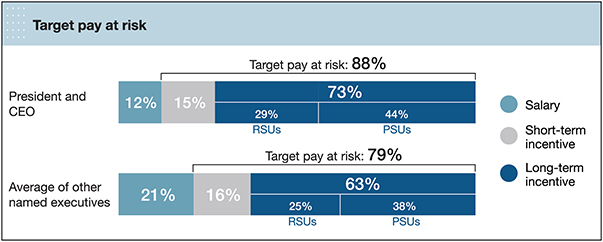
| Pembina Pipeline Corporation • 2026 Management Information Circular | 72 |
Executive Compensation – 2025 Executive Compensation
|
|
2025 Executive Compensation |
The board reviewed Pembina’s 2025 performance and the recommendations by the human resources and compensation committee, and approved the following decisions on executive pay.
This year’s incentive awards were based on our performance against targets that were set at the beginning of 2025. We did not adjust these targets during the year or make any adjustments to calculated results. You can read more about our compensation strategy starting on page 64.
Total direct compensation
The table below shows total direct compensation paid or granted to the named executives for 2025, compared to 2024. Total direct compensation includes earned base salary, short-term incentive awards, and the grant value of long-term incentive awards. See below for a discussion of each component.
For additional information about each named executive and their accomplishments this year, see page 81.
Value of direct compensation received1
| 2024 ($) |
2025 ($) |
Change | 2025 amount at risk |
|||||||||||||
| Scott Burrows |
11,557,933 | 11,910,533 | 3% | 89% | ||||||||||||
| President and CEO |
||||||||||||||||
| Cameron Goldade |
3,094,568 | 3,222,240 | 4% | 81% | ||||||||||||
| Chief Financial Officer |
||||||||||||||||
| Jaret Sprott |
4,446,452 | 4,588,924 | 3% | 84% | ||||||||||||
| Chief Operating Officer |
||||||||||||||||
| Stuart Taylor |
2,910,292 | 2,922,092 | 0% | 78% | ||||||||||||
| Former Senior Vice President and Corporate Development Officer |
||||||||||||||||
| Janet Loduca |
2,664,868 | 2,791,200 | 5% | 79% | ||||||||||||
| Former Senior Vice President, External Affairs and Chief Legal and Sustainability Officer |
||||||||||||||||
| 1 | See Summary compensation table on page 91 for information about how we calculate the value of RSUs, PSUs and options. |
The graphics below show the mix of compensation actually paid or granted for 2025 to the CEO and to the other named executives, as reported in the summary compensation table.
|
|
|
| Pembina Pipeline Corporation • 2026 Management Information Circular | 73 |
Executive Compensation – 2025 Executive Compensation
Base salary
Base salaries are reviewed annually and set based on market conditions, individual performance, level of responsibility, retention and internal equity considerations. The table below shows each named executive’s annual base salary as at December 31, 2025. Salary increases from 2024 to 2025 are primarily attributed to maintaining salaries within a competitive range of the median of the compensation peer group.
| 2024 ($) |
2025 ($) |
Change | ||||||||||
| Scott Burrows |
1,290,000 | 1,345,000 | 4.3% | |||||||||
| Cameron Goldade |
600,000 | 625,000 | 4.2% | |||||||||
| Jaret Sprott |
700,000 | 725,000 | 3.6% | |||||||||
| Stuart Taylor |
620,000 | 635,000 | 2.4% | |||||||||
| Janet Loduca |
570,000 | 600,000 | 5.3% | |||||||||
Short-term incentive
Short-term incentive awards are granted based on our performance against annual corporate and individual objectives tied to our corporate strategy. Short-term incentive awards are established at a level that ensures a market competitive opportunity and vary depending on role responsibility.
The target award is calculated as a percentage of each named executive’s base salary. The table below shows the potential range of short-term incentive awards as of the end of 2025.
|
Potential short-term incentive award as a percentage of salary |
||||||||||||
| minimum | target | cap | ||||||||||
| CEO | 0 | 125 | 250 | |||||||||
| Average of other named executives | 0 | 77.5 | 155 | |||||||||
We calculate each award by multiplying the named executive’s short-term incentive target by their salary and performance multiplier (which is different for each named executive and can range from 0 to 2).
Each performance multiplier is calculated based on performance against goals that are set at the beginning of each year, using the weightings shown in the formula below.
| ● | corporate performance includes annual financial, commercial and operational goals from our strategic plan. Pembina incorporates ESG metrics into our STIP, including metrics related to safety, climate change, and stakeholder experience. You will find a discussion of this year’s targets and results on page 75; and |
| ● | individual goals are also tied to our strategy but are not publicly disclosed for competitive reasons. You can read about each named executive’s individual performance starting on page 81. |
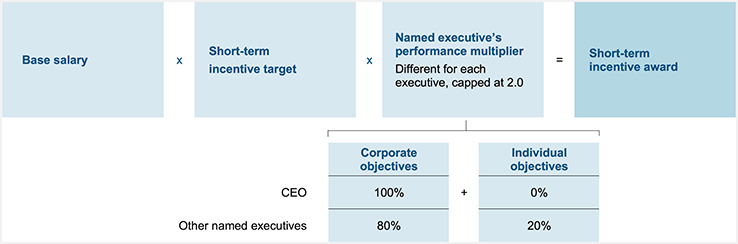
| Pembina Pipeline Corporation • 2026 Management Information Circular | 74 |
Executive Compensation – 2025 Executive Compensation
The human resources and compensation committee may use its judgment to adjust the performance multiplier up or down based on factors that are not captured in the formal measures. For example, a decision to complete a certain acquisition or business deal may have longer-term strategic benefits that are not captured in the short-term performance measures.
2025 short-term incentive award
The table below shows how we calculated each named executive’s short-term incentive award for 2025.
Performance objectives were set at the beginning of 2025 and were not adjusted during the year.
Short-term incentive awards, which were paid out in March 2026, were approved by the board, as recommended by the human resources and compensation committee.
| Actual salary earned in 2025 (as reported in summary ($) |
Short-term incentive target |
Named executive’s performance multiplier |
Short-term award ($)1 |
|||||||||||||||||||||||||
| Scott Burrows |
1,335,833 | x | 125 | % | x | 1.500 | = | 2,504,700 | ||||||||||||||||||||
| Cameron Goldade |
620,840 | x | 75 | % | x | 1.560 | = | 726,400 | ||||||||||||||||||||
| Jaret Sprott |
720,824 | x | 85 | % | x | 1.580 | = | 968,100 | ||||||||||||||||||||
| Stuart Taylor |
632,492 | x | 75 | % | x | 1.480 | = | 702,100 | ||||||||||||||||||||
| Janet Loduca |
595,000 | x | 75 | % | x | 1.560 | = | 696,200 | ||||||||||||||||||||
| 1 | Totals may differ from calculated amount due to rounding. |
How we calculated the 2025 corporate performance multiplier
The multipliers for each category, and the corporate performance multiplier, continue to range from zero for performance below threshold, to a maximum of two.
Changes to the 2025 performance measures and weightings were minimal, and financial performance continued to have the highest weighting.
|
Strengthen franchise 50% |
Differentiated stakeholder experience 20% |
Environmental leadership 10% |
Resilient portfolio 20% |
2025 corporate performance multiplier | ||||||||||||
|
|
||||||||||||||||
|
|
||||||||||||||||
| 1.24 x 50% |
1.88 x 20% |
1.74 x 10% |
1.66 x 20% |
|||||||||||||
| + | + | + | = | 1.501 | ||||||||||||
| 0.62 |
0.38 |
0.17 |
0.33 |
|||||||||||||
|
|
||||||||||||||||
| 1 | The sum of the categories does not equal exact amount of corporate performance multiplier due to rounding. |
The 2025 corporate performance multiplier was calculated at 150% based on the formula above. The table below provides details of the performance in each category. The total score in each category reflects the aggregate scores achieved across all divisions.
|
Performance category and measures |
Key measures | 2025 Highlights | Total score | |||
| Strengthen franchise — 50% | 1.24 | |||||
| Adjusted EBITDA per share |
Adjusted EBITDA per share target against budget (35%) | Adjusted EBITDA of $4.3 billion, within the Company’s original 2025 guidance range, resulting in adjusted EBITDA per share aligned with budget
|
||||
| Asset Availability |
Improve asset availability to enhance safety performance, minimize customer impacts and improve adjusted EBITDA
|
Both facility and pipeline asset availability exceeded 2025 targets, resulting in record Pipelines and Facilities throughput volumes | ||||
| Pembina Pipeline Corporation • 2026 Management Information Circular | 75 |
Executive Compensation – 2025 Executive Compensation
| Performance category and measures |
Key measures | 2025 Highlights | Total score | |||
| Project Delivery | Execute 2025 capital projects materially on time and on budget |
Continued execution of the Cedar LNG Project, achieving major construction milestones. Major growth projects, including the RFS IV Propane-Plus Fractionator at the Redwater Complex, the Wapiti Natural Gas Processing Expansion, and the K3 Cogeneration Facility, are progressing on time and on, or under, budget, resulting in above target performance |
||||
| Cost per Capital In-Service |
Achieve budgeted cost per capital in-service | Achieved the maximum performance target through disciplined cost management and a sustained focus on margin optimization | ||||
| Differentiated stakeholder experience — 20% | 1.88 | |||||
| Safety and environment |
Meet or exceed midstream peer company safety and environmental benchmarks and internal targets | Achieved strong safety and environmental results against benchmarks and internal targets resulting in above target performance | ||||
| Employee experience |
Promote internal mobility and deliver SEFSAM to all leaders | Internal mobility rate and SEFSAM completion rate both achieved the maximum performance targets | ||||
| Environmental leadership — 10% | 1.74 | |||||
| GHG Reduction and Decarbonization Initiatives |
Sanction, execute, and screen decarbonization projects | Exceeded annual target for GHG emission reductions | ||||
| Resilient portfolio — 20% | 1.66 | |||||
| Contract (renewals and new customers) |
Achieve revenue targets for existing customer contract renewals | Secured significant contract renewals across our pipeline and processing systems, including major recontracting on the Peace and Alliance Pipelines, RFS, securing additional West Coast LPG capacity, and fully contracting the Nipisi Pipeline | ||||
| New projects |
Secure $725 million in new growth projects | Pembina strengthened its export position by sanctioning the Prince Rupert Terminal Optimization project. In addition, Pembina is advancing a multi-year plan for incremental liquids transportation infrastructure, including sanctioning the Fox-to-Namao Expansion to support continued basin growth. The Company is also diversifying its customer base by progressing the proposed Greenlight Electricity Centre | ||||
Long-term incentives
Our business involves major commercial ventures and strategies that are typically developed over three-to-five years. Long-term incentives are a key part of how we attract high performing executives in a highly competitive sector and motivate them to stay. They are designed to promote a proprietary interest in Pembina and encourage sustainable contributions that are more likely to maximize long-term shareholder value. They focus management on operating and financial performance, long-term shareholder value and our long-term goals.
Long-term incentives are granted based on each executive’s target total direct compensation as a percentage of base salary and are set using competitive market data about our performance peer group.
In a continued effort to ensure that our compensation programs are competitive, and provide incentives aligned to our strategic objectives, we have eliminated stock options as a long-term incentive mechanism. Effective 2025, stock options are no longer granted as part of the named executives’ annual target direct compensation and our long-term incentive mix now consists of 60% PSUs and 40% RSUs.
| Pembina Pipeline Corporation • 2026 Management Information Circular | 76 |
Executive Compensation – 2025 Executive Compensation
The table below summarizes our current long-term incentive plans. You will find more information about the long-term incentive plans starting on page 99.
| Long Term Incentives | ||||
| Share unit plan | Stock option plan1 | |||
| Link to strategy |
Align compensation with shareholder outcomes and incentivize longer-term growth goals
Reward participants for growth in EBITDA per share, as well as growth in absolute and relative TSR
Retention tool |
Align compensation with shareholder outcomes and longer-term growth goals
Reward participants for growth in the long-term based on trading price of our common shares
Retention tool | ||
| Eligibility |
Executives Eligible Employees |
Executives1 | ||
| Award |
RSUs PSUs RSUs and PSUs do not have voting rights and cannot be assigned or transferred |
Options to buy common shares (up to the limits listed on page 100) Options cannot be assigned or transferred | ||
| Frequency |
Granted every year | Starting in 2025, stock options are no longer granted as part of annual compensation for any employees | ||
| Term |
Three years | Seven years | ||
| Dividends |
RSUs and PSUs earn dividend equivalents at the time dividends are paid in the form of dividend units | None | ||
| Vesting |
RSUs RSUs granted to executives and employees vest: • 1/3 vest on December 31 of the year granted; • 1/3 vest on December 31 of the second year from the year granted; and • 1/3 vest on December 31 of the third year from the year granted PSUs • Vest if performance vesting conditions have been met at the end of three years. See page 78 for details about the 2025 performance vesting conditions |
Options vest 1/3 per year over three years, starting on the first anniversary of the day they are issued | ||
| Payout |
Paid out in cash as soon as possible after vesting Each unit that vests (including dividend units) is worth the fair market value of one common share at the time of vesting, calculated using the weighted average trading price of our common shares on the TSX for the 20 trading days before the vesting date |
Each option that vests can be used to buy one Pembina common share. The exercise price will be at least the volume-weighted average trading price of our common shares on the TSX in the five days immediately before the options are issued | ||
| 1 | Stock options are no longer granted as part of the named executives’ annual target direct compensation. |
| Pembina Pipeline Corporation • 2026 Management Information Circular | 77 |
Executive Compensation – 2025 Executive Compensation
2025 long-term incentive awards
The table below shows the long-term incentives granted to our named executives in 2025. The awards are granted based on the annual salary and performance targets established at the time of grant. These incentives were all granted at target.
The table below includes the number of RSUs and PSUs granted, along with their expected value at payout, assuming the performance targets for the PSUs have been met. A heavier weighting is placed on performance-based incentives linking executive compensation to medium- and long-term performance.
| Allocation1 | ||||||||||||||||||||||||||||
| Base salary |
Long-term incentive target |
Long-term incentive grant |
RSUs (40%) |
PSUs (60%) |
||||||||||||||||||||||||
| Scott Burrows |
1,345,000 | x | 600% | = | $8,070,000 | $3,228,000 | $4,842,000 | |||||||||||||||||||||
| 59,722 | 89,584 | |||||||||||||||||||||||||||
| Cameron Goldade |
625,000 | x | 300% | = | $1,875,000 | $750,000 | $1,125,000 | |||||||||||||||||||||
| 13,876 | 20,814 | |||||||||||||||||||||||||||
| Jaret Sprott |
725,000 | x | 400% | = | $2,900,000 | $1,160,000 | $1,740,000 | |||||||||||||||||||||
| 21,462 | 32,192 | |||||||||||||||||||||||||||
| Stuart Taylor |
635,000 | x | 250% | = | $1,587,500 | $635,000 | $952,500 | |||||||||||||||||||||
| 11,748 | 17,622 | |||||||||||||||||||||||||||
| Janet Loduca |
600,000 | x | 250% | = | $1,500,000 | $600,000 | $900,000 | |||||||||||||||||||||
| 11,101 | 16,651 | |||||||||||||||||||||||||||
| 1 | We calculated the number of RSUs and PSUs granted by dividing the dollar amount granted by $54.05 per share (the weighted average trading price of our common shares on the TSX for the 20 trading days ending December 31, 2024). Value of long-term incentives may vary slightly due to rounding as share units are granted in whole units. |
Performance vesting conditions for PSUs granted in 2025
Performance period: January 1, 2025 – December 31, 2027
The 2025 PSUs will vest in 2027 based on two equally weighted metrics to ensure alignment with Pembina’s strategic priorities:
| ● | Relative TSR — three-year TSR compared to our performance peer group. TSR is tied to our strategic objectives and is a strong measure of our relative financial performance. |
| ● | Adjusted EBITDA (excluding Marketing) per share growth — based on the compound annual growth rate implied by the three-year average adjusted EBITDA (excluding Marketing) per share from 2025-2027. Target growth rates are not disclosed as they are considered proprietary. |
The board compares actual performance to the TSR of the performance peer group and internal metrics defined by the board, and uses a linear analysis to determine the performance multiplier, with the top rank equal to a 2x multiplier and the bottom rank equal to 0x multiplier. On rare occasions the board may modify the formula driven multiplier if in its judgment the resulting multiplier is not consistent with corporate performance, however the multiplier cannot exceed two times.
| Pembina Pipeline Corporation • 2026 Management Information Circular | 78 |
Executive Compensation – 2025 Executive Compensation
The formula below shows how we calculate the actual number of PSUs that will vest in 2027.
| Performance multiplier (0 to 2) |
x | Number of PSUs granted |
= | Final number of PSUs that vest | ||||
|
|
Weighting: 50% |
+ |
Weighting: 50%
Three-year trailing average adjusted EBITDA (excluding Marketing Business Unit) per Pembina common share vs. compounded annual growth rate from the three-year average adjusted EBITDA (excluding Marketing) per share from 2022-2024. Targets set at the time of the award.
We calculate the three-year trailing average adjusted EBITDA (excluding Marketing) per common share as the simple average of adjusted EBITDA (excluding Marketing) per common share for each of the three fiscal years included in the performance period.
|
|||||
|
TSR compared to performance peer group1 for the performance period. |
||||||||
|
Performance peer group: |
||||||||
• AltaGas Ltd. |
||||||||
• Enbridge Inc. |
||||||||
• Enterprise Products Partners L.P. |
||||||||
• Gibson Energy Inc. |
||||||||
• Keyera Corp. |
||||||||
• Kinder Morgan Inc. |
||||||||
• ONEOK, Inc. |
||||||||
• Plains All American Pipeline, L.P. |
||||||||
• South Bow Corporation |
||||||||
• Targa Resources Corp |
||||||||
• TC Energy Corporation |
||||||||
• The Williams Companies Inc. |
||||||||
|
1 See page 68 for a detailed discussion of the performance peer group.
|
||||||||
Long-term incentives vested in 2025 and paid out in 2026
Long-term incentive grants vested in 2025 include:
| • | the final 1/3 of the RSUs granted in 2023; |
| • | the second 1/3 of the RSUs granted in 2024; |
| • | the first 1/3 of the RSUs granted in 2025; |
| • | the PSUs granted in 2023 (these vested using a performance multiplier of 0.20x — see next page); and |
| • | the dividends that granted RSUs and PSUs earned to December 31, 2025. |
Granted RSUs and PSUs that vested in 2025 and dividend equivalents (in the form of dividend units) were paid out to the named executives in 2026.
| Number of units vested in 2025 | ||||||||||||||||||||||||
| RSUs | PSUs | Total paid out in 20261 |
||||||||||||||||||||||
| 2023 | 2024 | 2025 | 2023 | |||||||||||||||||||||
| Scott Burrows |
Units | 19,139 | 19,039 | 20,967 | 19,138 | $4,123,948 | ||||||||||||||||||
| Cameron Goldade |
Units | 3,508 | 4,428 | 4,871 | 3,509 | $859,527 | ||||||||||||||||||
| Jaret Sprott |
Units | 5,805 | 6,887 | 7,535 | 5,805 | $1,371,366 | ||||||||||||||||||
| Stuart Taylor |
Units | 3,860 | 3,813 | 4,124 | 3,860 | $824,811 | ||||||||||||||||||
| Janet Loduca |
Units | 3,508 | 3,505 | 3,897 | 3,509 | $ 759,593 | ||||||||||||||||||
| 1 | Value of units and dividend units that vested December 31, 2025, calculated using $52.68 per share (the volume weighted average trading price of our common shares on the TSX for the 20 trading days ending December 31, 2025). Dividend units earned at $2.655 for 2023, $2.7375 for 2024, and $2.82 for 2025. PSU multiplier is 0.20x (see next page). |
| Pembina Pipeline Corporation • 2026 Management Information Circular | 79 |
Executive Compensation – 2025 Executive Compensation
How we calculated the performance multiplier for the 2023 PSU award
PSUs granted: January 1, 2023
Performance period: January 1, 2023 – December 31, 2025
Performance was measured against the performance peer group and targets that were set at the beginning of 2023. We did not adjust these targets during the year or make any adjustments to the calculated results.
|
TSR vs the 2023 performance peer group for the performance period | ||||||||
| Multipliers can range from 0.0 to 2.0 based on Pembina’s TSR ranking within our 2023 performance peer group:
|
||||||||
● first |
2.00x | |||||||
● second |
1.80x | |||||||
● third |
1.60x | |||||||
● fourth |
1.40x | |||||||
● fifth |
1.20x | |||||||
● sixth |
1.00x | |||||||
● seventh |
0.80x | |||||||
● eighth |
0.60x | |||||||
● ninth |
0.40x | |||||||
● tenth |
0.20x | |||||||
● eleventh |
0.00x | |||||||
|
Pembina TSR for the performance period 34.6%
| ||||||||
| Ranking within 2023 PSU performance peer group Tenth | ||||||||
| Performance multiplier 0.20x | ||||||||
| 2023 performance peer group |
| |||
| AltaGas Ltd. | ||||
| Enbridge Inc. | ||||
| Enterprise Products Partners L.P. | ||||
| Keyera Corp. | ||||
| Kinder Morgan Inc. | ||||
| ONEOK, Inc. | ||||
| Plains All American Pipeline L.P. | ||||
| TC Energy Corporation | ||||
| Targa Resources Corp. | ||||
| The Williams Companies Inc. | ||||
| 2023 performance peer group median TSR | 77.81% | |||
| Pembina Pipeline Corporation • 2026 Management Information Circular | 80 |
Executive Compensation – Our Named Executive Officers
|
|

|
Scott Burrows
President and Chief Executive Officer
Mr. Burrows has been the President and CEO of Pembina since February 2022.
Prior to his current role, Mr. Burrows was named interim President and CEO in November 2021. Previously he served as Pembina’s Chief Financial Officer for approximately seven years, overseeing Pembina’s financial operations, investor relations, treasury, tax, risk management, corporate planning, corporate development, and capital market financings. |
Prior to his role as Chief Financial Officer, Mr. Burrows served as Vice President, Capital Markets, and as Vice President, Corporate Development and Investor Relations. In these roles, Mr. Burrows was responsible for guiding Pembina through its corporate-level financial analysis of business opportunities in addition to strategic development and planning, acquisitions, and divestitures. He also supported the company’s participation in the capital markets by evaluating various financing alternatives and oversaw Pembina’s investor relations and related marketing initiatives.
Before joining Pembina in 2010, Mr. Burrows spent seven years in energy-focused investment banking where he provided advice related to mergers and acquisitions, dispositions, joint ventures and equity and debt financings. He has considerable experience in the energy industry, including petroleum, natural gas, other product pipelines and related infrastructure facilities.
Mr. Burrows has a Bachelor of Commerce from the University of British Columbia, is a CFA® Charterholder and sits on the Board of Rundle College Society and National Bank of Canada.
2025 Results
Mr. Burrows achieved the following results in 2025:
| ● | Reported full-year earnings of $1,694 million and full-year adjusted EBITDA1 of $4,289 million. |
| ● | Led the 2035 vision and long-term strategy work. |
| ● | Invested and grew the core businesses while also capitalizing on opportunities to leverage assets and expertise into new service offerings. Highlights included: |
| ○ | Continued to strengthen and deepen the partnership with the Haisla Nation on the Cedar LNG Project in Kitimat, British Columbia, advancing a shared vision to deliver low-carbon, cost-competitive Canadian LNG to global markets. |
| ○ | Successfully contracted Pembina’s 1.5 million tonnes per annum of Cedar LNG capacity with Petronas, an LNG industry leader, and Ovintiv Inc. (Ovintiv), one of the largest and most innovative liquids-rich natural gas producers in Canada’s Montney play. |
| ○ | Signed a long-term tolling agreement with AltaGas Ltd. (AltaGas) for 30,000 bpd of liquified petroleum gas export capacity at AltaGas’ current Ridley Island Propane Export Terminal and future Ridley Island Energy Export Facility, securing export capacity of 20,000 bpd starting in April 2026, and an additional 10,000 bpd starting in April 2027. |
| ○ | Executed the unanimous negotiated settlement of the Alliance Pipeline Canadian rate case with 33 shippers, resulting in extension of approximately 1.27 bcf/d or 96% of capacity committed for 10 years. |
| ○ | Executed on more than $3,000 million of contracted revenue through new contracts and extensions with our customers on existing assets, including re-contracting the Peace, Cochin and Alliance Pipelines, and contracts to support the fractionation complex and various PGI assets. |
| ○ | Expanded Pembina’s power and energy transition platform by securing an agreement for a 50% ownership interest in the Greenlight Electricity Centre Limited Partnership to develop a power generation facility with capacity of up to approximately 1,800 megawatts (MW) to serve data centre customers and advance Alberta’s innovation economy. Advanced commercialization by securing a 907 MW AESO allocation (subsequently assigned to a potential customer) and grid connection, progressing customer and land sale agreements, reserving major turbine equipment, and establishing a clear path to a final investment decision. |
1 See Non-GAAP and other financial measures on page 105.
| Pembina Pipeline Corporation • 2026 Management Information Circular | 81 |
Executive Compensation – Our Named Executive Officers
| ● | Led the implementation of a new organizational structure to strengthen consistency and operational excellence, enhance customer focus, and drive financial discipline. |
| ● | Advanced employee engagement and long-term talent and succession planning. |
| ● | Played an active role in designing and leading management and board strategy sessions. |
| ● | Strengthened community impact through partnerships with strategically aligned organizations such as Women Building Futures, Breakfast Club of Canada, and Project Forest, supporting safe, inclusive, and sustainable communities. Pembina’s total community investment reached $11.3 million and included more than 5,500 hours of employee volunteering and meaningful employee giving initiatives. |
| ● | Continued to enhance and deepen oPembina’s relationship with key customers, investors and other stakeholders. |
| Pembina Pipeline Corporation • 2026 Management Information Circular | 82 |
Executive Compensation – Our Named Executive Officers

|
Cameron Goldade
Chief Financial Officer
Mr. Goldade has been the Chief Financial Officer (previously, Senior Vice President and Chief Financial Officer) of Pembina since August 2022.
Mr. Goldade oversees Pembina’s accounting, treasury, tax, investor relations, corporate development and planning, insurance, market risk, project governance, and internal audit functions.
Prior to his current role as Senior Vice President and Chief Financial Officer, Mr. Goldade was named interim Chief Financial Officer in November 2021. Previously, he served as Pembina’s Vice President, Capital Markets and prior to that served as Pembina’s Senior Manager of Capital Markets. |
Before joining Pembina in 2015, Mr. Goldade spent 11 years in energy-focused investment banking where he provided advice and counsel related to mergers and acquisitions, dispositions, joint ventures and equity and debt financings. He has considerable experience in most aspects of the energy industry, including petroleum, natural gas and other product pipelines and related infrastructure facilities.
Mr. Goldade has a Bachelor of Commerce (Distinction) from the University of Calgary and a Master of Business Administration from the University of Toronto.
2025 Results
Mr. Goldade achieved the following results in 2025:
| ● | Reported full-year earnings of $1,694 million and full-year adjusted EBITDA1 of $4,289 million. |
| ● | Led Pembina’s finance strategy, which included closing a $600 million term loan, issuing $425 million of subordinated notes to replace redeemed preferred shares, repaying Alliance Pipeline asset level debt, and closing an increase to PGI’s credit facility. |
| ● | Oversaw compliance with Pembina’s financial guardrails throughout 2025 by actively managing counterparty risk, maintaining the company’s ‘BBB’ and ‘BBB (high)’ credit rating with S&P Global Ratings and DBRS Limited, respectively, while upholding a strong balance sheet. Ensured alignment with Pembina’s targets for fee-based contributions to adjusted EBITDA and fee-based distributable cash flow (payout ratio). |
| ● | Oversaw the company’s capital allocation, including evaluating capital project investments and directing the allocation of Pembina’s free cash flow. |
| ● | Supported the unanimous negotiated settlement with 33 shippers on the Canadian portion of the Alliance Pipeline, which was approved by the Canada Energy Regulator, as well as filing the rate case for the United States portion of the pipeline with the Federal Energy Regulatory Commission. |
| ● | Led the development of a risk appetite framework, intended to create a structured model for assessing and quantifying and aligning on the risk inherent in Pembina’s business at a portfolio level. The risk appetite framework is expected to enhance and optimize strategic decision making, as well as day-to-day decisions within the organization. |
| ● | In conjunction with the broader organizational structure changes, led the centralization of Pembina’s finance functions under central leadership and vision of future operating model for finance. |
| ● | Established and led the Financial Efficiency & Transformation Team, a cross-functional group focused on driving financial excellence across Pembina by identifying different ways of working in support of a stronger, more competitive cost structure. |
| ● | Co-led the implementation of a new energy trading and risk management system in support of Pembina’s marketing activities. |
| ● | Provided strategic oversight of tax execution in business transactions and steered the tax function through a complex and evolving global tax landscape. |
| ● | Led Pembina’s investor relations strategy. |
| ● | Oversaw the successful renewal of Pembina’s insurance program. |
| ● | Advanced employee engagement and long-term talent and succession planning. |
| ● | Represented Pembina on the board of directors of PGI, Cedar LNG and Chinook Pathways. |
1 See Non-GAAP and other financial measures on page 105.
| Pembina Pipeline Corporation • 2026 Management Information Circular | 83 |
Executive Compensation – Our Named Executive Officers

|
Jaret Sprott
Chief Operating Officer
Mr. Sprott has been the Chief Operating Officer (previously, Senior Vice President and Chief Operating Officer) of Pembina since February 2022.
Prior to his current role, Mr. Sprott served as Senior Vice President and Chief Operating Officer, Facilities, with accountability for the safe, reliable, and responsible management of Pembina’s gas processing, fractionation, rail, storage, and import/export assets. His responsibilities included oversight of day-to-day commercial and field operations, as well as the delivery of major capital projects. When Mr. Sprott was appointed to his current role, his accountabilities were expanded to include oversight of the Pipelines Division, encompassing its commercial |
activities, operational performance, and capital project delivery, which provides customers with pipeline transportation, terminalling, storage, and rail services in key market hubs in Canada and the United States for crude oil, condensate, natural gas liquids, and natural gas.
Previously, Mr. Sprott was Vice President, Gas Services at Pembina. Through his leadership, Mr. Sprott has contributed to a significant portion of the company’s growth.
Before joining Pembina in 2015, Mr. Sprott worked in a senior management position for a major energy producer, where he was responsible for the growth of the company’s core Montney liquids play in Alberta. He also brings a resource background in all key Western Canadian Sedimentary Basin geological plays, strategic planning, engineering, operations, and facility construction.
Mr. Sprott has a Bachelor of Applied Science in Petroleum Systems Engineering from the University of Regina and is a member of APEGA.
2025 Results
Mr. Sprott achieved the following results in 2025:
| ● | Achieved financial performance at target for the Pipeline and Facilities Divisions, generating earnings before tax of $2,499 million and $3,994 million of adjusted EBITDA1 in 2025, representing an increase of $114 million or 3% from 2024 adjusted EBITDA of $3,880 million. |
| ● | Facilitated the engineering & construction, $880 million of growth capital spend in 2025 (net to Pembina), including the advancement of RFS IV, Wapiti Gas Plant Expansion, and the K3 Cogeneration Facility. Brought $285 million of strategic growth capital into service (net to Pembina), largely ahead of schedule and 6% under budget and executed $144 million in sustaining capital projects (net to Pembina) 20% under budget. |
| ● | Executed on more than $3,000 million of contracted revenue through new contracts and extensions with our customers on existing assets, including re-contracting the Peace, Cochin and Alliance Pipelines, and contracts to support the fractionation complex and various PGI assets. |
| ● | Jointly facilitated the commercial, engineering, and sanctioning of approximately $600 million (net to Pembina) in new accretive growth projects, including acquisitions through Pembina’s joint venture PGI. |
| ● | Executed the unanimous negotiated settlement of the Alliance Pipeline Canadian rate case with 33 shippers, resulting in extension of approximately 1.27 bcf/d or 96% of capacity committed for 10 years. |
| ● | Exceeded operating performance target for Pembina’s Pipeline and Facilities Division, maintaining high asset reliability and availability, and delivering operating cost efficiencies of 3% under budget, driving financial results and strong customer satisfaction. |
| ● | Delivered safety results above target, highlighted by a 57% increase in positive safety recognitions, a 9% increase in leadership field engagements, stable serious injury and fatality frequency (0% change), and a 50% reduction in Tier 1 process safety events |
| ● | Advanced Pembina’s operational maturity with the implementation of our OEMS. |
| ● | Co-chaired Pembina’s Women’s Inclusion Network. |
| ● | Represented Pembina on the board of directors of PGI. |
1 See Non-GAAP and other financial measures on page 105.
| Pembina Pipeline Corporation • 2026 Management Information Circular | 84 |
Executive Compensation – Our Named Executive Officers

|
Stuart (Stu) Taylor
Former Senior Vice President and Corporate Development Officer
Mr. Taylor was the Senior Vice President of New Ventures and Corporate Development Officer of Pembina from March 2023 to October 2025, and Senior Vice President of Cedar LNG from October to December 2025. Mr. Taylor retired from his role as Senior Vice President of Cedar LNG effective December 31, 2025. Mr. Taylor retired from the foregoing offices and remains as an advisor to Pembina to support the ongoing development of Pembina’s LNG business.
Given Pembina’s increasing focus on investments in global markets,Mr. Taylor was responsible for leading its New Venture activities. His mandate included leading strategic new growth opportunities for the organization and the successful development of the Cedar LNG Project through 2025. |
Prior to his most recent role, Mr. Taylor served as Senior Vice President, Marketing & New Ventures and Corporate Development Officer, where he was responsible for Pembina’s efforts in value-added commodity marketing activities, including the buying and selling of hydrocarbon products, commodity arbitrage and optimizing storage opportunities. Prior to these appointments, he was Senior Vice President, NGL and Natural Gas Facilities and Vice President, Gas Services, where he oversaw the planning and construction of gas plants and multiple enhanced-recovery projects to increase Pembina’s gas liquids throughput.
Before joining Pembina in 2009, Mr. Taylor developed his geologic, strategic planning and business development skills in various capacities while at Westcoast Energy Inc., NOVA Corporation, TransCanada PipeLines Ltd., VISTA Midstream Solutions Ltd. (VISTA) and Talisman Energy Inc. (Talisman). While at VISTA, he served as Vice President, Supply, and was responsible for managing the commercial contracts for the Cutbank Complex, which VISTA then sold to Talisman in 2003. At Talisman, he held several managerial roles where he was responsible for the Cutbank Complex and its sour gas pipelines and midstream operations.
Mr. Taylor has a Bachelor of Science in Geology with a minor in Geophysics from the University of Calgary and is a member of APEGA.
2025 Results
Mr. Taylor achieved the following results in 2025:
| ● | Advanced new commercial opportunities beyond Pembina’s existing footprint in 2025, including export terminals, specifically Cedar LNG, petrochemicals and energy transition initiatives, to further diversify markets, expand egress options, and advance decarbonization across the value chain. |
| ● | Achieved significant progress and project milestones on the Cedar LNG Project: |
| ○ | Continued to strengthen and deepen the partnership with the Haisla Nation on the Cedar LNG Project in Kitimat, British Columbia, advancing a shared vision to deliver low-carbon, cost-competitive Canadian LNG to global markets. |
| ○ | Successfully contracted Pembina’s 1.5 million tonnes per annum of Cedar LNG capacity with Petronas, an LNG industry leader, and Ovintiv, one of the largest and most innovative liquids-rich natural gas producers in Canada’s Montney play. |
| ● | Expanded Pembina’s power and energy transition platform by securing an agreement for a 50% ownership interest in the Greenlight Electricity Centre Limited Partnership to develop a power generation facility with capacity of up to approximately 1,800 MW to serve data centre customers and advance Alberta’s innovation economy. Advanced commercialization by securing a 907 MW AESO allocation and grid connection, progressing customer and land sale agreements, reserving major turbine equipment, and establishing a clear path to a final investment decision. |
| ● | Served as Pembina’s representative on the boards of directors for Cedar LNG and the Alberta Carbon Grid. |
| Pembina Pipeline Corporation • 2026 Management Information Circular | 85 |
Executive Compensation – Our Named Executive Officers

|
Janet Loduca
Former Senior Vice President, External Affairs and Chief Legal and Sustainability Officer
Ms. Loduca was the Senior Vice President, External Affairs and Chief Legal and Sustainability Officer of Pembina from April 2021 to December 2025. Ms. Loduca retired effective December 31, 2025.
Ms. Loduca oversaw Pembina’s legal, land, environment and regulatory, Indigenous engagement, government relations, communications, community investment and safety functions. She was also responsible for Pembina’s long-term sustainability strategy. She has over 30 years of legal, environmental, regulatory, sustainability, business, and executive leadership experience. Prior to her most recent role, Ms. Loduca served as Pembina’s Vice President, Legal and Sustainability and General Counsel. |
Prior to joining Pembina in 2020, Ms. Loduca held the position of Senior Vice President and General Counsel for Pacific Gas & Electric Company and PG&E Corporation (PG&E). Previously, Ms. Loduca held a number of other senior roles with PG&E including Vice President Investor Relations, Vice President Safety, Health and Environment, Vice President Corporate Relations, and Chief of Staff to the President of PG&E. Ms. Loduca was also instrumental in leading PG&E through its 2020 restructuring, and in navigating PG&E through the San Bruno pipeline incident.
Ms. Loduca has a Bachelor of Arts from the University of Washington and a Juris Doctor from the University of San Francisco.
2025 Results
Ms. Loduca achieved the following results in 2025:
| ● | Continued to strengthen and deepen the partnership with the Haisla Nation on the Cedar LNG Project in Kitimat, British Columbia, advancing a shared vision to deliver low-carbon, cost-competitive Canadian LNG to global markets. |
| ● | Successfully contracted Pembina’s 1.5 million tonnes per annum of Cedar LNG capacity with Petronas, an LNG industry leader, and Ovintiv, one of the largest and most innovative liquids-rich natural gas producers in Canada’s Montney play. |
| ● | Oversaw the legal, environmental, regulatory and Indigenous support for conventional pipeline expansions through the positive final investment decision of a $200 million Peace Pipeline System expansion to increase propane-plus market delivery capacity into the Namao, Alberta hub and progressing the Birch-to-Taylor and Taylor-to-Gordondale expansions in support of growing NGL volumes in northeast British Columbia. |
| ● | Supported the advancement of Pembina’s power and energy transition platform by securing an agreement for a 50% ownership interest in the Greenlight Electricity Centre Limited Partnership to develop a power generation facility with capacity of up to approximately 1,800 MWs to serve data centre customers and advance Alberta’s innovation economy. Advanced commercialization by securing a 907 MW AESO allocation (subsequently assigned to a potential customer) and grid connection, progressing customer and land sale agreements, reserving major turbine equipment, and establishing a clear path to a final investment decision. |
| ● | Oversaw the legal support for the new long-term tolling agreement with AltaGas for 30,000 bpd of liquified petroleum gases export capacity at AltaGas’ current Ridely Island Propane Export Terminal and future Ridley Island Energy Export Facility. |
| ● | Supported the unanimous negotiated settlement with 33 shippers on the Canadian portion of the Alliance Pipeline, which was approved by the Canada Energy Regulator, as well as filing the rate case for the United States portion of the pipeline with the Federal Energy Regulatory Commission. |
| ● | Supported the Cochin Pipeline market-based rate application at the Federal Energy Regulatory Commission. |
| ● | Provided legal support for renewed and incremental customer contracts, totaling over 200,000 bpd of conventional pipeline transportation capacity. |
| ● | Oversaw the legal, environmental and regulatory support for the sale of the Western Pipeline. |
| ● | Contributed to a strong safety culture, including a nearly 57% increase in positive safety recognitions, a 50% reduction in Tier 1 process safety events, launch of the refreshed OEMS, enterprise-wide rollout of the Safety Excellence for Supervisors and Management training, and Pembina’s third annual Contractor Safety Summit. |
| ● | Advanced Pembina’s GHG emissions intensity reduction target by screening, sanctioning and executing on economic GHG reduction projects. |
| Pembina Pipeline Corporation • 2026 Management Information Circular | 86 |
Executive Compensation – Our Named Executive Officers
| ● | Enhanced employee and community engagement through Calgary and field-based townhalls, Pembina’s fourth annual RISE (‘Recognize Individuals who Show Excellence’) awards, and acting as the co-executive sponsor of the Women’s Inclusion Network. |
| ● | Executed Pembina’s Community Investment Strategy including strategically aligned partnerships with non-profit organizations such as Women Building Futures, Breakfast Club of Canada and Project Forest, investing $11.3 million in the communities in which Pembina operates, with employees contributing over 5,500 volunteer hours. |
| ● | Represented Pembina on the board of directors of Cedar LNG and Chinook Pathways. |
| Pembina Pipeline Corporation • 2026 Management Information Circular | 87 |
Executive Compensation – Compensation and Share Performance
|
|
The graph below shows the change in a $100 investment in Pembina common shares over the past five years (assuming all dividends are reinvested), compared to the same investment in the S&P/TSX Composite Index for the same period (assuming all dividends are reinvested). The graph also shows the total direct compensation awarded to our named executives each year and our adjusted cash flow from operating activities per share. Total direct compensation includes earned base salary, short-term incentive awards, and the grant value of long-term incentive awards. These are all indexed to $100 to provide a meaningful comparison.
Adjusted cash flow from operating activities per common share has increased from $4.80 per share in 2021 to $4.91 per share in 20251. This 2% increase is due to accretive organic growth and acquisitions over the period. In addition, the overall increase in total direct compensation awarded to our named executives from 2021 ($20.9 million) to 2025 ($25.4 million) can be attributed to the alignment of the peer comparison for the role of the CEO, alignment of compensation closer to the median of the expanded compensation peer group approved for 2024 and 2025 and higher incentive awards due to strong corporate performance in 2025. See pages 70 and 71 for further details.
Pembina’s cumulative total return for the five-year period ending December 31, 2025 was 132% compared to the index return of 111%. Please note that the returns in the chart cannot be directly compared to TSR shown on page 80 which is calculated over the PSU three-year performance period.
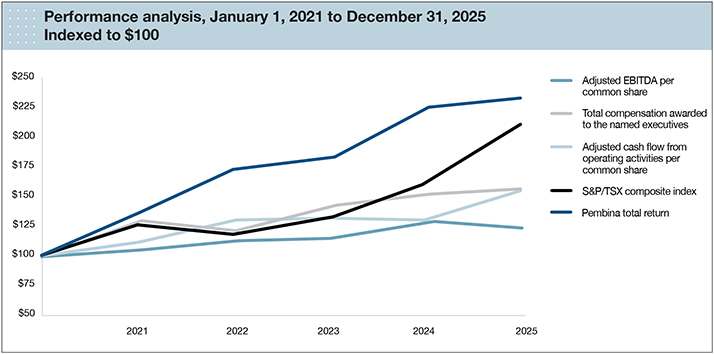
1 See Non-GAAP and other financial measures on page 105.
| Pembina Pipeline Corporation • 2026 Management Information Circular | 88 |
Executive Compensation – Compensation and Share Performance
| At December 31 | ||||||||||||||||||||||||
| Jan 1, 2021 | 20212 | 2022 | 2023 | 2024 | 2025 | |||||||||||||||||||
| Pembina total return ($) | 100 | 136 | 172 | 182 | 223 | 232 | ||||||||||||||||||
| S&P/TSX composite index ($) | 100 | 125 | 118 | 132 | 160 | 211 | ||||||||||||||||||
| Earnings per common share ($) | 100 | 233 | 598 | 349 | 349 | 310 | ||||||||||||||||||
| Adjusted EBITDA per common share1 ($) | 100 | 105 | 114 | 116 | 129 | 124 | ||||||||||||||||||
| Cash flow from operating activities per common share ($) | 100 | 118 | 129 | 117 | 137 | 139 | ||||||||||||||||||
| Adjusted cash flow from operating activities per common share1 ($) | 100 | 115 | 116 | 116 | 137 | 118 | ||||||||||||||||||
| Total direct compensation awarded to the named executives ($) | 100 | 128 | 120 | 142 | 152 | 156 | ||||||||||||||||||
| 1 | See Non-GAAP and other financial measures on page 105. |
| 2 | Total direct compensation awarded to the named executives for 2021 does not include additional compensation related to the leadership transition that occurred in 2021. Total direct compensation awarded to the named executives in 2021 includes: |
| • | total direct compensation paid to Michael Dilger, our previous President and CEO, from January 1, 2021 to November 19, 2021 (his last day with the company), less the lump sum payment to Mr. Dilger under his separation agreement; |
| • | total direct compensation paid to Scott Burrows from January 1, 2021 to December 31, 2021, less the RSU grant he was awarded on November 19, 2021 in recognition of the new and greater responsibilities and market benchmarks associated with his role as Interim President and CEO; |
| • | total direct compensation paid to Cameron Goldade from November 19, 2021 (the date Mr. Goldade was appointed to his interim role) to December 31, 2021, less the RSU grant he was awarded on November 19, 2021 in recognition of the new and greater responsibilities and market benchmarks associated with his role as Interim Chief Financial Officer; and |
| • | the total direct compensation paid to each of Stuart Taylor, Jaret Sprott and Harry Andersen from January 1, 2021 to December 31, 2021. |
Pay for performance
The graph below compares our adjusted EBITDA per common share for the past five years to the total direct compensation awarded to the named executives, on an aggregate and per common share basis, as well as on a per common share basis as a percentage of adjusted EBITDA per common share. The graph shows a generally positive increase in adjusted EBITDA per common share from 2021 to 2025 and total direct compensation paid to the named executives, per common share as a percentage of adjusted EBITDA per share, remained relatively flat during the same time period from 2021 (0.64%) to 2025 (0.59%). While actual compensation levels increased over the five-year period to align salaries closer to the median of the compensation peer group and to reward stronger corporate performance from 2021 to 2025, the overall compensation growth remained proportional to our adjusted EBITDA performance — see pages 70 and 71 for further details.
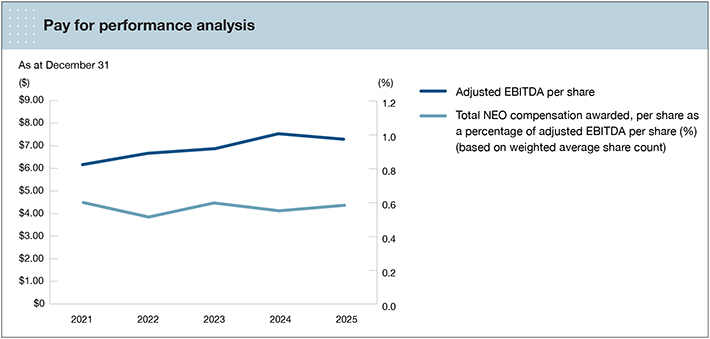
| Pembina Pipeline Corporation • 2026 Management Information Circular | 89 |
Executive Compensation – Compensation and Share Performance
| At December 31 | 20212 | 2022 | 2023 | 2024 | 2025 | |||||||||||||||
| Earnings per common share ($) |
2.00 | 5.14 | 3.00 | 3.00 | 2.67 | |||||||||||||||
| Adjusted EBITDA per common share1 ($) |
6.24 | 6.78 | 6.95 | 7.69 | 7.38 | |||||||||||||||
| Total direct compensation awarded to the named executives, per common share, as a percentage of adjusted EBITDA per common share (%)1 (based on weighted average share count) |
0.64% | 0.52% | 0.60% | 0.56% | 0.59% | |||||||||||||||
| Total direct compensation awarded to the named executives ($ millions) |
20.9 | 19.5 | 23.1 | 24.7 | 25.4 | |||||||||||||||
| Total direct compensation awarded to the named executives, per common share ($) |
0.038 | 0.035 | 0.042 | 0.043 | 0.044 | |||||||||||||||
| 1 | See Non-GAAP and other financial measures on page 105. |
| 2 | Total direct compensation awarded to the named executives in 2021 does not include additional compensation related to the leadership transition that occurred in 2021 and includes: |
| • | total direct compensation paid to Michael Dilger from January 1, 2021 to November 19, 2021 (his last day with the company), less the lump sum payment to Mr. Dilger under his separation agreement; |
| • | total direct compensation paid to Scott Burrows from January 1, 2021 to December 31, 2021, less the RSU grant he was awarded on November 19, 2021 in recognition of the new and greater responsibilities and market benchmarks associated with his role as Interim President and CEO; |
| • | total direct compensation paid to Cameron Goldade from November 19, 2021 (the date Mr. Goldade was appointed to his interim role) to December 31, 2021, less the RSU grant he was awarded on November 19, 2021 in recognition of the new and greater responsibilities and market benchmarks associated with his role as Interim Chief Financial Officer; and |
| • | the total direct compensation paid to each of Stuart Taylor, Jaret Sprott and Harry Andersen from January 1, 2021 to December 31, 2021. |
| Pembina Pipeline Corporation • 2026 Management Information Circular | 90 |
Executive Compensation – 2025 Executive Compensation Details
|
|
||
|
2025 Executive Compensation Details | ||
Summary compensation table
The table below shows the value of all compensation paid to the named executives from 2023 to 2025.
| Salary1 ($) |
Share-based ($) |
Option-based ($) |
Non-equity incentive plan compensation Annual ($) |
Pension ($) |
All
other ($) |
Total ($) |
||||||||||||||||||||||||||
| Scott Burrows President and CEO |
2025 | 1,335,833 | 8,070,000 | - | 2,504,700 | 227,921 | 86,243 | 12,224,697 | ||||||||||||||||||||||||
| 2024 | 1,283,333 | 6,966,000 | 774,000 | 2,534,600 | 192,059 | 90,612 | 11,840,604 | |||||||||||||||||||||||||
| 2023 | 1,250,000 | 6,000,000 | 1,500,000 | 2,567,200 | 120,139 | 89,290 | 11,526,629 | |||||||||||||||||||||||||
| Cameron Goldade Chief Financial Officer |
2025 | 620,840 | 1,875,000 | - | 726,400 | 113,464 | 50,214 | 3,385,918 | ||||||||||||||||||||||||
| 2024 | 591,668 | 1,620,000 | 180,000 | 702,900 | 127,904 | 48,209 | 3,270,681 | |||||||||||||||||||||||||
| 2023 | 545,834 | 1,100,000 | 275,000 | 665,600 | 104,656 | 46,721 | 2,737,811 | |||||||||||||||||||||||||
| Jaret Sprott Chief Operating Officer |
2025 | 720,824 | 2,900,000 | - | 968,100 | 127,718 | 55,234 | 4,771,876 | ||||||||||||||||||||||||
| 2024 | 691,652 | 2,520,000 | 280,000 | 954,800 | 171,163 | 53,488 | 4,671,103 | |||||||||||||||||||||||||
| 2023 | 633,333 | 1,820,000 | 455,000 | 900,800 | 184,139 | 50,057 | 4,043,329 | |||||||||||||||||||||||||
| Stuart Taylor Former Senior Vice President and Corporate Development Officer |
2025 | 632,492 | 1,587,500 | - | 702,100 | 56,573 | 74,180 | 3,052,845 | ||||||||||||||||||||||||
| 2024 | 617,492 | 1,395,000 | 155,000 | 742,800 | 54,408 | 48,504 | 3,013,204 | |||||||||||||||||||||||||
| 2023 | 601,666 | 1,210,020 | 302,500 | 697,500 | 52,695 | 47,968 | 2,912,349 | |||||||||||||||||||||||||
| Janet Loduca Former Senior Vice President, External Affairs and Chief Legal and Sustainability Officer |
2025 | 595,000 | 1,500,000 | - | 696,200 | 108,104 | 65,471 | 2,964,775 | ||||||||||||||||||||||||
| 2024 | 566,668 | 1,282,500 | 142,500 | 673,200 | 100,414 | 46,959 | 2,812,241 | |||||||||||||||||||||||||
| 2023 | 541,667 | 1,100,000 | 275,000 | 628,000 | 95,181 | 46,512 | 2,686,360 | |||||||||||||||||||||||||
| Total |
2025 | 3,904,989 | 15,932,500 | 0 | 5,597,500 | 633,780 | 331,343 | 26,400,112 | ||||||||||||||||||||||||
| 1 | Total base salary earned as of December 31 each year. |
| 2 | Share-based awards |
| • | The amount for 2025 represents the fair value of RSUs and PSUs granted to the named executives for 2025. We calculated the number of RSUs and PSUs granted by dividing the dollar amount granted by $54.05 per share (the weighted average trading price of our common shares on the TSX for the 20 trading days ending December 31, 2024). Value of the awards may vary slightly due to rounding as share units are granted in whole units. |
| • | The RSUs granted in 2025 are scheduled to vest 1/3 per year, on December 31 of 2025, 2026 and 2027. The amount the named executives will receive in cash depends on the trading value of our common shares at the time of vesting. |
| • | The PSUs granted in 2025 are scheduled to vest on December 31, 2027 as long as the performance vesting criteria have been met. |
| • | The number of PSUs that vest, and the payout the named executives receive, will depend on our performance against the performance vesting criteria and can range from 0 to 200% and the trading value of our common shares at the time of vesting. If the performance criteria are not met and the board decides that no PSUs will vest, the payout could be $0. |
| • | Payouts of RSUs and PSUs are increased by the amount they earn in dividend equivalents (in the form of dividend units). See page 77 for information about RSUs and PSUs. |
| 3 | Starting in 2025 stock options were no longer granted as part of the named executives’ annual total target direct compensation. Historically we calculated the number of options granted based on the Black-Scholes option pricing model. This approach is consistent with the majority of companies in our peer group and is sensitive to the assumptions used. |
| 4 | Short-term incentive awards earned for the year but paid in the following year. |
| 5 | Includes all compensation related to our pension plans. The amount includes service costs and other compensatory items in the defined benefit plan, including plan changes and earnings that are different from the estimated earnings. See page 93 for information about our pension plans. |
| 6 | Includes the actual costs incurred by Pembina related to a car allowance, the Pembina group savings plan match, which provides up to 5% of annual salary on a matching basis, and parking. Mr. Taylor and Mrs. Loduca retired from their respective roles effective December 31, 2025 and neither received incremental compensation related to their retirement. |
| Pembina Pipeline Corporation • 2026 Management Information Circular | 91 |
Executive Compensation – 2025 Executive Compensation Details
Equity incentives
Outstanding share-based and option-based awards
The table below shows all PSUs, RSUs and stock options granted to the named executive officers that were outstanding at December 31, 2025.
| Option-based awards | Share-based awards | |||||||||||||||||||||||||||
| Number of shares underlying unexercised options |
Option exercise price ($) |
Option expiration date |
Value of money |
Number of shares or units of shares that have not vested2,3 |
Market or payout value of share-based awards that have not vested2,3 |
Market or payout value of vested |
||||||||||||||||||||||
| Scott Burrows4 |
|
|||||||||||||||||||||||||||
| 100,000 | 37.31 | Mar 22, 2028 | 1,498,000 | Total RSUs: 60,972 | Total RSUs: $3,188,244 | |||||||||||||||||||||||
| 42,894 | 45.45 | Mar 7, 2029 | 293,395 | |||||||||||||||||||||||||
| 45,005 | 45.71 | Mar 6, 2030 | 296,133 | |||||||||||||||||||||||||
| 61,234 | 50.46 | May 20, 2031 | 112,058 | Total PSUs: 208,584 | Total PSUs: $10,906,879 | |||||||||||||||||||||||
| Total: |
249,133 | 2,199,586 | $14,095,123 | |||||||||||||||||||||||||
| Cameron Goldade4 |
|
|||||||||||||||||||||||||||
| 70,000 | 37.31 | Mar 22, 2028 | 1,048,600 | Total RSUs: 14,170 | Total RSUs: $740,973 | |||||||||||||||||||||||
| 4,673 | 45.45 | Mar 7, 2029 | 31,963 | |||||||||||||||||||||||||
| 3,027 | 43.45 | Oct 5, 2029 | 26,759 | |||||||||||||||||||||||||
| 16,501 | 45.71 | Mar 6, 2030 | 108,577 | |||||||||||||||||||||||||
| 14,241 | 50.46 | May 20, 2031 | 26,061 | Total PSUs: 48,488 | Total PSUs: $2,535,414 | |||||||||||||||||||||||
| Total: |
108,442 | 1,241,960 | $3,276,387 | |||||||||||||||||||||||||
| Jaret Sprott4 |
|
|||||||||||||||||||||||||||
| 26,336 | 6 | 48.43 | Mar 4, 2026 | 101,657 | Total RSUs: 21,957 | Total RSUs: $1,148,110 | ||||||||||||||||||||||
| 13,168 | 48.75 | Aug 13, 2026 | 46,615 | |||||||||||||||||||||||||
| 13,168 | 46.86 | Nov 11, 2026 | 71,502 | |||||||||||||||||||||||||
| 200,000 | 37.31 | Mar 22, 2028 | 2,996,000 | |||||||||||||||||||||||||
| 31,215 | 45.45 | Mar 7, 2029 | 213,511 | |||||||||||||||||||||||||
| 40,954 | 45.71 | Mar 6, 2030 | 269,477 | |||||||||||||||||||||||||
| 22,152 | 50.46 | May 20, 2031 | 40,538 | Total PSUs: 75,229 | Total PSUs: $3,933,713 | |||||||||||||||||||||||
| Total: |
346,993 | 3,739,300 | $5,081,823 | |||||||||||||||||||||||||
| Stuart Taylor4,5 |
|
|||||||||||||||||||||||||||
| 100,000 | 37.31 | Mar 22, 2028 | 1,498,000 | Total RSUs: 12,061 | Total RSUs: $630,666 | |||||||||||||||||||||||
| 9,076 | 45.71 | Dec 31, 2028 | 59,720 | |||||||||||||||||||||||||
| 12,263 | 50.46 | Dec 31, 2028 | 22,441 | Total PSUs: 41,436 | Total PSUs: $2,166,673 | |||||||||||||||||||||||
| Total: |
121,339 | 1,580,161 | $2,797,339 | |||||||||||||||||||||||||
| Janet Loduca4,5 |
|
|||||||||||||||||||||||||||
| 70,000 | 37.31 | Mar 22, 2028 | 1,048,600 | Total RSUs: 11,301 | Total RSUs: $590,909 | |||||||||||||||||||||||
| 28,377 | 45.45 | Dec 31, 2028 | 194,099 | |||||||||||||||||||||||||
| 24,752 | 45.71 | Dec 31, 2028 | 162,868 | |||||||||||||||||||||||||
| 11,274 | 50.46 | Dec 31, 2028 | 20,631 | Total PSUs: 38,568 | Total PSUs: $2,016,722 | |||||||||||||||||||||||
| Total: |
134,403 | 1,426,198 | $2,607,631 | |||||||||||||||||||||||||
| 1 | The value of an option is estimated at $52.29 per share (the closing price of our common shares on the TSX on December 31, 2025) less the exercise price of the option. |
| 2 | Includes: |
| • | 1/3 of the RSUs granted in 2024 that vest and pay out on December 31, 2026; and |
| • | 2/3 of the RSUs granted in 2025 that vest and pay out: 1/3 on December 31, 2026 and 1/3 on December 31, 2027. |
| • | Dividend units accrued at $2.7375 for 2024 and $2.82 for 2025. |
| Estimated at $52.29 per share (the closing price of our common shares on the TSX on December 31, 2025). |
| 3 | Includes: |
| • | PSUs granted in 2024 that vest on December 31, 2026 (if performance vesting criteria have been met); and |
| • | PSUs granted in 2025 that vest on December 31, 2027 (if performance vesting criteria have been met). |
| • | Dividend units accrued at $2.7375 for 2024 and $2.82 for 2025. |
| Estimated at $52.29 per share (the closing price of our common shares on the TSX on December 31, 2025). Assumes that 100% of the PSUs are paid out at a performance multiplier of 1.0. See page 80 for information about the performance multiplier. |
| Pembina Pipeline Corporation • 2026 Management Information Circular | 92 |
Executive Compensation – 2025 Executive Compensation Details
| 4 | A one-time retention grant of options was issued to each of the named executives on March 23, 2021 in response to an increase in responsibilities and market conditions in 2021. The options expire on March 22, 2028. Unlike most of our option awards which vest 1/3 each year over three years, this retention grant vests 100% on the fourth anniversary of the grant. |
| 5 | The expiration of stock options is determined by the earlier of the specified expiry date of each grant or the date that is three years from the date of retirement. |
| 6 | Outstanding options were exercised in 2026 prior to the expiry date. |
Value vested or earned during the year on short-and long-term incentives
The table below shows the value of options, RSUs and PSUs granted to our named executive officers that vested in 2025, as well as the short-term incentive awards (non-equity incentive) earned for 2025.
|
Option-based awards — value vested during the year1,2 ($) |
Share-based awards — value vested during the year3 ($) |
Non-equity incentive plan ($) |
||||||||||
| Scott Burrows |
5,150,969 | 4,123,948 | 2,504,700 | |||||||||
| Cameron Goldade |
1,156,910 | 859,527 | 726,400 | |||||||||
| Jaret Sprott |
3,170,513 | 1,371,366 | 968,100 | |||||||||
| Stuart Taylor |
1,640,899 | 824,811 | 702,100 | |||||||||
| Janet Loduca |
1,174,462 | 759,593 | 696,200 | |||||||||
| 1 | Value that would have been realized if options had been exercised on December 31, 2025, calculated as the difference between the closing price of our common shares on the TSX on December 31, 2025 ($52.29) and the exercise price of the options, multiplied by the number of options. |
| 2 | A one-time retention grant of options was issued to each of the named executives on March 23, 2021 in response to an increase in responsibilities and market conditions in 2021. Unlike most of our option awards which vest 1/3 each year over three years, this retention grant vested 100% on the fourth anniversary of the grant in March 2025. |
| 3 | Share-based awards include payouts of RSUs and PSUs that vested in 2025, along with the dividend units they earned to December 31, 2025 (see page 78). Dividends accrued each year as follows: 2023 $2.655; 2024: $2.7375; and 2025: $2.82. |
| 4 | Annual incentive awards for 2025, which were paid in 2026. |
Stock options exercised in 2025
The table below shows the stock options exercised by the named executives in 2025. The gain is the difference between the exercise price of the option and the share price at the time of exercise multiplied by the number of options exercised.
| Number of options exercised | Gain on the options exercised ($) |
|||||||||
| Scott Burrows | 267,510 | 4,533,045 | ||||||||
| Cameron Goldade | - | - | ||||||||
| Jaret Sprott | 19,091 | 180,683 | ||||||||
| Stuart Taylor | 99,762 | 1,100,265 | ||||||||
| Janet Loduca | 6,340 | 96,395 | ||||||||
Pension plan benefits
Pension plan
All full-time employees are enrolled in the Pembina Pension Plan (the pension plan), which is registered under the Income Tax Act (Canada) and the Employment Pension Plans Act (Alberta). The Income Tax Act (Canada) limits the amounts that can be contributed and paid out under the pension plan. We also offer a supplementary retirement plan available only to eligible employees. You can find more information about these plans in Note 20 to our 2025 Audited Consolidated Financial Statements, which can be found on our website (www.pembina.com), on SEDAR+ (www.sedarplus.ca) and on EDGAR (www.sec.gov).
The pension plan includes a defined contribution plan and a defined benefit plan. Eligibility and contribution levels are based on a point system calculated on January 1 of each calendar year by adding the participant’s age and the number of years of permanent service with Pembina. Prior to January 1, 2021, those with fewer than 50 points were in the defined contribution plan and those with 50 points or more were in the defined benefit plan.
Effective January 1, 2021, Pembina revised the eligibility requirements for the defined benefit plan. Employees whose age plus years of service was 40 points at January 1, 2021 were given a one-time opportunity to remain in the defined contribution plan or move to the defined benefit plan when they reach 50 points. All other employees will remain in the
| Pembina Pipeline Corporation • 2026 Management Information Circular | 93 |
Executive Compensation – 2025 Executive Compensation Details
defined contribution plan. Newly appointed executives will be given the choice of participating in either the defined benefit or defined contribution plan.
Early retirement starts at age 55 and normal retirement at age 65.
Defined contribution plan
Employees are not allowed to contribute to the defined contribution plan, and employees choose how they want to invest the money.
We contribute to the defined contribution plan for employees not otherwise eligible for the defined benefit plan as follows:
| • | 5% of the employee’s base earnings semi-monthly for employees with less than 40 points; and |
| • | 10% of the employee’s base earnings semi-monthly for employees greater than 40 points. |
Defined benefit plan
Employees are not allowed to contribute to the defined benefit plan. The basic benefit is 1.4% of the employee’s highest three-year average base salary in the final 120 months of employment multiplied by the employee’s defined benefit pensionable service. If the employee retires early, the pension benefit is reduced by 0.25% for each month before the employee turns 62.
Liabilities under the defined benefit plan are secured by financial assets that are segregated from our general assets and held in trust.
Supplementary retirement plan
Eligible employees can also earn supplementary benefits under our supplementary retirement plan. This plan is designed to provide benefits to employees beyond the limitations imposed by the Income Tax Act (Canada).
Liabilities under the supplementary plan are unsecured.
| Pembina Pipeline Corporation • 2026 Management Information Circular | 94 |
Executive Compensation – 2025 Executive Compensation Details
Annual pension benefits payable
The table below shows the total estimated annual benefits payable to each named executive under the defined benefit and supplementary retirement plans, and the present value of our accrued obligation.
| Years of credited service |
Annual benefits payable4 ($) |
Present value of defined benefit obligation as at January 1, 2025 ($) |
Compensatory change5 ($) |
Non- compensatory change6 ($) |
Present value of defined benefit obligation as at December 31, ($) |
|||||||||||||||||||||||
| at year end | at age 65 | |||||||||||||||||||||||||||
| Scott Burrows1 | 11 | 198,617 | 562,608 | 2,287,517 | 227,921 | (40,376 | ) | 2,475,062 | ||||||||||||||||||||
| Cameron Goldade1 | 8.5 | 69,748 | 233,953 | 800,563 | 113,464 | (12,245 | ) | 901,782 | ||||||||||||||||||||
| Jaret Sprott | 11 | 105,018 | 278,358 | 1,262,530 | 127,718 | (16,003 | ) | 1,374,245 | ||||||||||||||||||||
| Stuart Taylor2 | 16.5 | 142,577 | 142,577 | 1,979,981 | 56,573 | (65,184 | ) | 1,971,370 | ||||||||||||||||||||
| Janet Loduca3 | 5.2 | 36,326 | 36,326 | 476,549 | 108,104 | (14,246 | ) | 570,407 | ||||||||||||||||||||
| 1 | Mr. Burrows became eligible for the defined benefit pension plan on January 1, 2015. He is also entitled to benefits under the defined contribution plan in the amount of $131,266. Mr. Goldade became eligible for the defined benefit pension plan on July 1, 2017 and is also entitled to benefits under the defined contribution plan in the amount of $69,688. |
| 2 | Mr. Taylor retired with an unreduced pension on December 31, 2025. The annual benefits payable and accrued obligation at year end reflect his pension in the normal form as he has not made an election as of the date of this circular. His projected annual benefits payable upon retirement at year end and at age 65 reflect his actual pension benefit under the normal form. |
| 3 | Ms. Loduca retired with a reduced pension on December 31, 2025. The annual benefits payable and accrued obligation at year end reflect her pension in the normal form as she has not made an election as of the date of this circular. Her projected annual benefits payable upon retirement at year end and at age 65 reflect her actual pension benefit under the normal form. |
| 4 | Annual benefits payable represents the estimated annual pension, excluding any applicable early retirement reductions that would be received by the named executive based on years of credited service and actual executive earnings as at December 31, 2025. |
| 5 | The compensatory change is the increase or decrease in the pension obligation for 2025, which includes the annual service cost, differences between actual and estimated compensation and the impact of plan changes, if any. Compensatory changes may fluctuate year-to-year as changes in compensation impact the pension obligation for all years of credited service. |
| 6 | The non-compensatory change is the increase or decrease in our accrued obligation for reasons not related to the compensatory change. It includes interest on accrued obligations at December 31, 2025 and changes to mortality rate tables and discount rates. |
| Pembina Pipeline Corporation • 2026 Management Information Circular | 95 |
Executive Compensation – 2025 Executive Compensation Details
Termination and change of control
The table below shows the payments we will make to the named executives when employment is terminated for any reason or if there is a change of control of Pembina, as specified in their employment agreements, plan text and grant certificates.
| Cash payment | Share unit plan | Stock option plan5 | ||||
|
Retirement |
● none |
● grants made during the retirement year are prorated to the retirement date
● unvested RSUs and PSUs vest as though the executive is still employed with the company |
● grants made during the retirement year are prorated to the retirement date
● unvested options continue to vest, and vested options can be exercised within three years from the last day of active employment or until the option expires (whichever is earlier) | |||
| Disability |
● none |
● unvested RSUs and PSUs vest as though the executive is still employed with the company |
● same as retirement | |||
| Resignation1 |
● none |
● unvested RSUs and PSUs are forfeited and cancelled |
● unvested options expire immediately
● vested options can be exercised within 90 days of notice of termination or last day of active employment (whichever is later) | |||
| Death |
● none |
● unvested RSUs and PSUs become fully vested and are paid out as soon as possible thereafter, including all dividend units |
● all unvested options vest immediately and all options may be exercised by the legal representative(s) of the estate during the first 365 days following death but prior to the expiry date of the options | |||
| Constructive dismissal |
● severance payment (see page 97) |
● same as retirement |
● same as retirement | |||
| Termination without cause |
● severance payment (see page 97) |
● same as retirement |
● same as retirement | |||
| Termination with cause |
● none |
● same as resignation |
● options expire immediately | |||
| Change of control2 |
● none |
● If a change of control occurs and a constructive dismissal occurs within ninety (90) days, unvested RSUs and PSUs become fully vested and are paid out on the effective date of the change of control (or as soon as possible after), including all dividend units
● the board determines the applicable performance multiplier for the PSUs before the effective date of the change of control, or the performance multiplier will be at target level |
● option holders are granted the number of securities of the successor issuer they would have received if their options to buy shares had been exercised immediately before the transaction, except in certain circumstances3,4 | |||
| 1 | In the event the CEO voluntarily resigns after January 1, 2026 all share and option awards continue to vest and are paid out the same as they would otherwise be paid out on retirement. |
| 2 | If any named executives are offered continued employment on comparable terms following a change of control, RSUs and PSUs granted will not vest or be paid out and will continue to vest according to their terms, in respect of the successor issuer. |
| 3 | The exceptions are: (a) the transaction does not provide for substitution or replacement of Pembina’s common shares; (b) the board (acting reasonably) determines that substituting or replacing Pembina’s shares is not practical to implement or would result in adverse tax consequences for option holders; and (c) the replacement securities are not (or will not be) listed and posted on a recognized stock exchange. In these cases, outstanding options will fully vest and can be exercised at any time before the transaction is completed, conditionally upon consummation of the transaction, unless the board determines otherwise. Unexercised options will be forfeited and cancelled without compensation subject to the board’s discretion. |
| 4 | If any named executive officer is not offered continued employment on comparable terms following a change of control, all of such named executive officer’s unvested options will fully vest on the effective date of the change of control. |
| 5 | Stock options are no longer granted as part of the named executives’ annual target direct compensation. |
| Pembina Pipeline Corporation • 2026 Management Information Circular | 96 |
Executive Compensation – 2025 Executive Compensation Details
Severance Payment
We grant severance payments to the named executives for:
| ● | termination without cause; |
| ● | constructive dismissal; and |
| ● | failure to provide a comparable position and duties and same or comparable compensation and benefits after a change of control (within 90 days of the effective date of the transaction). |
These events are defined in the employment agreements. Under these circumstances, executives are entitled to receive a severance payment equal to the notice period specified in the executive’s contract (two years for all named executives) multiplied by the sum of the executive’s:
| ● | salary for the current year; |
| ● | another 20% of current salary (in lieu of employment benefits and certain other payments); and |
| ● | the simple average of annual short-term incentive awards for the past three years. |
An executive entitled to severance payment can choose to receive the full amount in a lump sum within 30 days of their termination date, or in two equal payments over two years. Payments will not be reduced by any amounts the executive earns after leaving.
The employment agreements include standard confidentiality provisions, and non-competition and non-solicitation provisions for varying time periods. As a condition of payment of the severance payment, an executive is required to deliver a release in favour of the company from any further obligation or liability and agreeing to maintain their share ownership requirements for one year from the termination date.
| How we define change of control
The definition of change of control is different for the executive employment agreements, the share unit plan and the stock option plan.
Executive employment agreements
One of the following:
● acquisition of 50% or more of our issued and outstanding voting securities; ● sale of more than 50% of our net assets; ● an acquisition requiring shareholder approval; ● dissolution, liquidation or winding-up of the company; ● change in the composition of our board following a contested election of directors or a meeting of our shareholders with an item of business related to director election or another transaction, when the directors before the event no longer constitute a majority of directors after the event; or ● another comparable event, as determined by the board.
Share unit plan
One of the following:
● acquisition of 50% or more of our issued and outstanding voting securities; ● sale of more than 50% of our net assets; ● an acquisition requiring shareholder approval; ● dissolution, liquidation or winding-up of the company; ● the majority of directors step down from the board; or ● another comparable event, as determined by the board.
Note that change of control payments under the share unit plan are subject to a “double trigger”, which means payments are made only if the chief executive officer, chief financial officer and other executive officers are not offered continued employment on comparable terms following a change of control.
Stock option plan
One of the following:
● completion of a merger, amalgamation or an arrangement; ● sale of all or substantially all our assets and undertakings; ● the company becoming subject to a takeover bid; or ● another comparable transaction.
|
| Pembina Pipeline Corporation • 2026 Management Information Circular | 97 |
Executive Compensation – 2025 Executive Compensation Details
Estimated payments
The following table shows the estimated incremental payments that would have been paid to each of the named executives if they had been terminated on December 31, 2025 (with and without a change of control).
|
Salary1 ($) |
Short-term incentive award2 ($) |
Benefits and perquisites ($) |
Share unit plan payments4 ($) |
Option plan payments6 ($) |
Totals7 ($) |
|||||||||||||||||||||||||||||||
| Termination without cause/ constructive dismissal3 |
Change of control and termination5 |
Termination without cause/ constructive dismissal |
Change of control and termination |
Termination without cause/ constructive dismissal |
Change of control and termination |
|||||||||||||||||||||||||||||||
| S. Burrows | 2,690,000 | 5,071,000 | 538,000 | 14,095,123 | 14,095,123 | 2,199,586 | 2,199,586 | 24,593,709 | 24,593,709 | |||||||||||||||||||||||||||
| C. Goldade | 1,250,000 | 1,396,600 | 250,000 | 3,276,387 | 3,276,387 | 1,241,960 | 1,241,960 | 7,414,947 | 7,414,947 | |||||||||||||||||||||||||||
| J. Sprott | 1,450,000 | 1,882,467 | 290,000 | 5,081,823 | 5,081,823 | 3,739,300 | 3,739,300 | 12,443,590 | 12,443,590 | |||||||||||||||||||||||||||
| S. Taylor | 1,270,000 | 1,428,267 | 254,000 | 2,797,339 | 2,797,339 | 1,580,161 | 1,580,161 | 7,329,767 | 7,329,767 | |||||||||||||||||||||||||||
| J. Loduca | 1,200,000 | 1,331,600 | 240,000 | 2,607,631 | 2,607,631 | 1,426,198 | 1,426,198 | 6,805,429 | 6,805,429 | |||||||||||||||||||||||||||
| 1 | 2025 base salary multiplied by the notice period (see page 97). |
| 2 | Notice period multiplied by the average of the short-term incentive awards earned for 2023, 2024 and 2025. |
| 3 | On a termination without cause or constructive dismissal, RSUs and PSUs continue to vest as though the individual were still employed with Pembina, so these amounts are not immediately payable. |
| 4 | Estimated at $52.29 per share (the closing price of our common shares on the TSX on December 31, 2025). Includes RSUs and PSUs accrued as dividend equivalents and PSU performance at target. |
| 5 | Amounts under the share unit plan are payable following a change of control only if any of the named executives are not offered continued employment on comparable terms. See page 96 for more information. |
| 6 | The value of options is estimated at $52.29 per share (the closing price of our common shares on the TSX on December 31, 2025) less the stock option grant price multiplied by the number of outstanding options. See page 92 for details. |
| 7 | Totals include salary, short-term incentive awards, benefits and perquisites, share unit plan payments and option plan payments. |
| Pembina Pipeline Corporation • 2026 Management Information Circular | 98 |
Executive Compensation – 2025 Executive Compensation Details
Information about the long-term incentive plans
Securities authorized for issuance under equity compensation plans
Authorized for issuance from treasury under our long-term incentive plans at the end of 2025:
| • | Dilution of outstanding options as a percentage of common shares outstanding as at December 31, 2025: 0.45% |
| • | 2025 grants as a percentage of common shares outstanding: 0% (2024: 0.03%; 2023: 0.1%) |
| Number of securities
(a) |
Weighted average exercise
(b) |
Number of securities
(c) |
||||||||||
|
Equity compensation plans approved by securityholders |
2,634,338 | $41.99 | 6,976,152 | |||||||||
| Total |
2,634,338 | $41.99 | 6,976,152 | |||||||||
Stock option plan
The stock option plan was introduced in 2011 and amended in 2017, 2020, 2022 and 2023. In February 2020, the board approved an amendment to the plan to allow for immediate vesting of options in the event of death for all eligible employees. In August 2022, the board approved an amendment to the plan to allow for options to be exercised on a net settlement basis to reduce share dilution, and in August 2023, the board approved an amendment to provide clarity on the treatment of stock options upon termination. None of these amendments required shareholder approval.
Since 2021, we have reduced the number of stock options granted on an annual basis, first by limiting stock option grants to senior and executive officers only. In 2025, stock option grants ceased and are no longer granted as part of annual compensation for any employees. Stock options may be granted for specific one-time grants when and if required.
| Plan administration |
The stock option plan is administered by our board.
Pembina grants awards based on rules and decisions made by the board, including when options are granted, when they vest and when they expire. | |
| Eligibility |
All employees. | |
| Award |
Options to buy common shares.
Options cannot be assigned or transferred. | |
| Shares reserved and available |
38,000,000 common shares have been reserved for issue under the plan (6.5% of 581,068,405 issued and outstanding common shares as at December 31, 2025). We have issued 20,818,902 common shares for option exercises under the plan since its inception in 2011 and a further 7,570,608 options were surrendered in connection with net settlement exercises of common shares. Therefore, there are 9,610,490 common shares remaining for future issuance (1.65% of issued and outstanding common shares as at December 31, 2025). Out of the 9,610,490 common shares remaining for future issuance under the plan, 2,634,338 have been reserved for issuance upon the exercise of options. Accordingly, as at December 31, 2025, 6,976,152 options were available for issuance under the plan.
Shares reserved for options that are cancelled or expire are immediately re-reserved for the plan and available to issue in the future. Shares reserved for issuance and withheld from issuance under the net settlement option exercise method are not available to issue in the future and are removed from the reserve. | |
| Shares issuable and outstanding
Also see Note 21 to our 2025 Audited Consolidated Financial Statements |
As at December 31, 2025 there were 2,634,338 common shares issuable on the exercise of outstanding options granted under the stock option plan: ● exercise prices: from $26.83 to $50.46; ● average weighted exercise price: $41.99; ● expiration dates: from March 2026 to May 2031; and ● 0.45% of common shares outstanding. | |
| Granting and issuing stock options |
Starting in 2025, stock option grants ceased and are no longer granted as part of annual compensation for any employees. Stock options may be granted for specific one-time grants when and if required. | |
| Pembina Pipeline Corporation • 2026 Management Information Circular | 99 |
Executive Compensation – 2025 Executive Compensation Details
| Vesting, expiry and payout |
Vesting and expiry are determined by the board, but the expiry date cannot be more than seven years after the date the options were granted.
Historically, the board has granted options with a seven-year term that vest 1/3 each year over three years, beginning one year after the grant date.
Expiry can be extended by 10 business days if the options expire during or within 10 days of the end of a trading blackout.
Each option that vests can be used to buy one common share. | |
| Financial assistance |
The plan does not provide financial assistance to help participants exercise their options. | |
| Net settlement/cashless exercise |
A participant may exercise options on a net settlement basis and receive a number of common shares with a market value equal to the in-the-money value of such options at the time of exercise, rather than tendering the exercise price in cash and receiving a number of shares equal to the number of options exercised. The number of underlying common shares reserved for issue under the options exercised on a net settlement basis, and not the actual number of shares issued, will be deducted from the plan. | |
| Termination and change of control |
In the case of all terminations, except termination for cause (subject to the terms of the option grant, the certificate evidencing the options, or an employment agreement):
● unvested options expire immediately; and
● vested options can be exercised within 90 days of notice of termination or the last day of active employment (whichever is later).
In the case of a termination for cause:
● unvested options expire immediately; and
● vested options are forfeited.
On a change of control:
● option holders are granted the number of securities of the new issuer they would have received if their options to buy shares had been exercised immediately before the transaction, except when: ● the transaction does not provide for substitution or replacement of Pembina’s common shares; ● the board (acting reasonably) determines that a substitution or replacement of Pembina’s shares is not practicable or that it would result in adverse tax consequences for option holders; or ● the replacement securities are not (or will not be) listed and posted on a recognized stock exchange.
In these cases, outstanding options will fully vest and can be exercised at any time before the transaction is completed but, unless the board determines otherwise, conditional upon consummation of the transaction. Unexercised options will be forfeited and cancelled without compensation subject to the board’s discretion.
A change of control with respect to stock option plans is defined as one of the following:
● completion of a merger, amalgamation or an arrangement;
● sale of all or substantially all our assets and undertakings;
● the company becoming subject to a takeover bid; or
● another comparable transaction.
| |
| Limits |
Any one individual: 5% of the (non-diluted) issued and outstanding common shares (or 581,068,405 common shares as at December 31, 2025) at the grant date, less the aggregate number of common shares reserved for that individual under any other equity-based compensation arrangement.
All insiders (as a group): 10% of the (non-diluted) issued and outstanding common shares at the grant date, less the total number of common shares reserved for insiders under any other equity-based compensation arrangement.
Single-year limit
Individual insiders: same as individual limit, but excluding common shares issued to the insider under the stock option plan or any other equity-based compensation arrangement in the preceding one-year period.
All insiders (as a group): same as insider group limit, but excluding common shares issued to insiders as a group under the stock option plan or any other equity-based compensation arrangement in the preceding one-year period. | |
| Pembina Pipeline Corporation • 2026 Management Information Circular | 100 |
Executive Compensation – 2025 Executive Compensation Details
| Changing the plan |
The board can make changes to the plan without shareholder approval, but option holders must consent to any changes to outstanding awards that could affect them negatively.
The following changes require approval of a majority of shareholders:
● increasing the number (or percentage) of shares that can be issued through the plan;
● making a change that will reduce the exercise price of an outstanding option (including by cancelling and reissuing the option);
● extending the expiry date of an option (except to avoid a trading blackout period);
● adding new types of eligible participants;
● changing the plan to let participants transfer or assign options (other than to a family member, an entity controlled by the participant or their family member, a charity or for estate planning and settlement purposes), unless the changes are due to a change of control or to prevent dilution; and
● making changes to types of changes that can be made to the plan with and without shareholder approval.
Plan changes may also need to be approved by the applicable stock exchanges.
| |
| Anti-dilution provisions |
The plan includes standard provisions to prevent dilution if there is a change in our capital structure. | |
| Closing the plan |
The board can suspend or terminate the plan at any time. | |
Share unit plan
The share unit plan was introduced in 2010.
|
Plan administration |
The share unit plan is administered by our board.
Pembina grants awards based on rules and decisions made by the board, including:
● whether awards should be granted;
● when awards will be granted;
● who will receive awards;
● grant dates, performance and vesting periods;
● the fair market value of common shares;
● how the number of RSUs and PSUs granted will be determined;
● time, performance and other vesting conditions (including multipliers);
● setting, changing and rescinding plan and grant agreements, regulations and terms;
● interpreting the plan and any related grant agreements; and
● all other decisions needed to administer the plan.
The board can delegate its administrative duties to a committee, its members or our executive, or to agents or third-party administrators, if allowed by law and the board’s charter and subject to the plan’s rules and other restrictions. | |
| Changing the plan |
The board can make changes to the plan without shareholder approval but grant holders must consent to any changes that could affect them negatively.
At any time, the board may decide to:
● accelerate vesting related to all or a percentage of the RSUs or PSUs attached to an award;
● waive any term or condition attached to an award; or
● decide that a term or condition attached to an award has been satisfied before a change of control event occurred.
The board may also decide that payment and settlement will happen immediately or be effective immediately before (and conditional upon) the effective date of a change of control.
The board can also make changes to prevent dilution or enlargement of rights granted under the share unit plan as the result of a change of control event that affects our common shares.
Plan changes may also need to be approved by the applicable regulators. | |
| Closing the plan |
The board can suspend or terminate the plan at any time. | |
| Change of control |
See Termination and change of control on page 96. | |
| Pembina Pipeline Corporation • 2026 Management Information Circular | 101 |
|
|
General Information | |||
| This section includes other important information about Pembina and our directors and executive officers.
You can find more information about Pembina on our website (www.pembina.com), on SEDAR+ (www.sedarplus.ca) and on EDGAR (www.sec.gov).
| ||||
General Information
Interest in the business of the meeting, material transactions and indebtedness
To the best of our knowledge, no person who has been a director or executive of Pembina at any time since January 1, 2025, none of the nominated directors, and none of their respective associates or affiliates:
| ● | has a material interest, direct or indirect, by way of beneficial ownership of securities or otherwise, in any matter to be acted on at the meeting (other than the election of directors or the appointment of auditors); |
| ● | had or has a material interest, direct or indirect, in any transaction or in any proposed transaction since January 1, 2025 that has materially affected or will materially affect Pembina or any of our subsidiaries; or |
| ● | is currently indebted to Pembina or any of our subsidiaries or has been at any time since January 1, 2025. |
Advisories
Forward-looking information
This document contains certain forward-looking statements and forward-looking information (collectively, “forward-looking statements”), including forward-looking statements within the meaning of the “safe harbor” provisions of applicable securities legislation, that are based on Pembina’s current expectations, estimates, projections and assumptions in light of its experience and its perception of historical trends. In some cases, forward-looking statements can be identified by terminology such as “continue”, “anticipate”, “schedule”, “will”, “expects”, “estimate”, “potential”, “planned”, “future”, “outlook”, “strategy”, “project”, “trend”, “commit”, “maintain”, “focus”, “ongoing”, “believe” and similar expressions suggesting future events or future performance.
In particular, this document contains forward-looking statements pertaining to, without limitation, the following: Pembina’s corporate strategy; statements and expectations related to Pembina’s commitment to, and the effectiveness and impact of, its ESG initiatives, goals and targets, including GHG emissions reductions targets and EDI targets; expectations relating to the development and anticipated benefits of Pembina’s new projects and developments, including the RFS IV Fractionation Expansion Project, the Wapiti Gas Plant Expansion, the K3 Cogeneration Facility, the Taylor-to-Gordondale Expansion, the Fox Creek-to-Namao Expansion, the Birch-to-Taylor Expansion, the Prince Rupert Terminal Optimization, the Greenlight Electricity Centre and the Cedar LNG Project, including the expected timing thereof; competitive conditions and Pembina’s ability to position itself competitively in the industry; and statements regarding the goals and outcomes of our compensation for directors and named executives, as well as future actions taken in respect thereof.
The forward-looking statements are based on certain assumptions that Pembina has made in respect thereof as at the date of this circular regarding, among other things: oil and gas industry exploration and development activity levels and the geographic region of such activity; the success of Pembina’s operations; prevailing commodity prices, interest rates, carbon prices, tax rates, exchange rates and inflation rates; the ability of Pembina to maintain current credit ratings; the availability of capital to fund future capital requirements relating to existing assets and projects; future operating costs; that all required regulatory and environmental approvals can be obtained on acceptable terms in a timely manner; prevailing regulatory, tax and environmental laws and regulations; and certain other assumptions in respect of Pembina’s forward-looking statements detailed in Pembina’s MD&A and AIF for the year ended December 31, 2025 and from time to time in Pembina’s public disclosure documents available at www.sedarplus.ca, www.sec.gov and through Pembina’s website at www.pembina.com.
Although Pembina believes the expectations and material factors and assumptions reflected in these forward-looking statements are reasonable as of the date hereof, there can be no assurance that these expectations, factors and assumptions will prove to be correct. These forward-looking statements are not guarantees of future performance and are subject to a number of known and unknown risks and uncertainties including, but not limited to: the regulatory environment and decisions, including the outcome of regulatory hearings, and Indigenous and landowner consultation requirements; the strength and operations of the oil and natural gas production industry and related commodity prices; non-performance or default by counterparties to agreements which Pembina or one or more of its affiliates has entered into in respect of its business; actions by governmental or regulatory authorities; fluctuations in operating results; adverse general economic and market conditions in Canada, North America and worldwide; the ability to access various sources of debt and equity capital; changes in credit ratings; and certain other risks and uncertainties detailed in Pembina’s MD&A and AIF for the year ended December 31, 2025 and from time to time in Pembina’s public disclosure documents available at www.sedarplus.ca, www.sec.gov and through Pembina’s website at www.pembina.com.
| Pembina Pipeline Corporation • 2026 Management Information Circular | 103 |
General Information
This list of risk factors should not be construed as exhaustive. Readers are cautioned that events or circumstances could cause results to differ materially from those predicted, forecasted or projected. The forward-looking statements contained in this document speak only as of the date of this document. Pembina does not undertake any obligation to publicly update or revise any forward-looking statements or information contained herein, except as required by applicable laws. The forward-looking statements contained in this document are expressly qualified by this cautionary statement.
| Pembina Pipeline Corporation • 2026 Management Information Circular | 104 |
General Information
Non-GAAP and other financial measures
Throughout this circular, Pembina has disclosed certain financial measures and ratios that are not specified, defined or determined in accordance with GAAP and which are not disclosed in Pembina’s financial statements. Non-GAAP financial measures either exclude an amount that is included in, or include an amount that is excluded from, the composition of the most directly comparable financial measure specified, defined and determined in accordance with GAAP. These non-GAAP financial measures and non-GAAP ratios, together with financial measures and ratios specified, defined and determined in accordance with GAAP, are used by management to evaluate the performance and cash flows of Pembina and its businesses and to provide additional useful information respecting Pembina’s financial performance to investors and analysts.
In this circular, Pembina has disclosed the following non-GAAP financial measures and non-GAAP ratios: adjusted EBITDA, adjusted EBITDA per common share, adjusted cash flow from operating activities per common share and total direct compensation awarded to the named executives per common share as a percentage of adjusted EBITDA per common share. These non-GAAP financial measures and non-GAAP ratios do not have any standardized meaning under IFRS and may not be comparable to similar financial measures disclosed by other issuers. These measures and ratios should not, therefore, be considered in isolation or as a substitute for, or superior to, measures and ratios of Pembina’s financial performance or cash flows specified, defined or determined in accordance with GAAP, including revenue, earnings (loss) before income tax and earnings per share and cash flow from operating activities.
Except as otherwise described herein, these non-GAAP financial measures and non-GAAP ratios are calculated on a consistent basis from period to period. Specific reconciling items may only be relevant in certain periods.
Total direct compensation awarded to the named executives per common share as a percentage of adjusted EBITDA per common share
Total direct compensation awarded to the named executives per common share as a percentage of adjusted EBITDA per common share is a non-GAAP ratio and is calculated by dividing total direct compensation awarded to the named executives per common share by adjusted EBITDA per common share.
Management utilizes total direct compensation awarded to the named executives per common share by adjusted EBITDA per common share as it believes the measure provides useful information to investors for comparing compensation paid by the company to its named executives relative to company performance.
Additional information
Additional information relating to adjusted EBITDA, adjusted EBITDA per common share and adjusted cash flow from operating activities per common share, including disclosure of the composition of such non-GAAP financial measures and non-GAAP ratios, an explanation of how such non-GAAP financial measures and non-GAAP ratios provide useful information to investors and the additional purposes, if any, for which management uses such non-GAAP financial measures and non-GAAP ratios, an explanation of the reason for any change in the label or composition of such non-GAAP financial measures and non-GAAP ratios from what was previously disclosed and a quantitative reconciliation of each non-GAAP financial measure to the most directly comparable financial measure that is specified, defined and determined in accordance with GAAP, is contained in the “Non-GAAP & Other Financial Measures” section of the MD&A, which section is incorporated by reference in this circular. The MD&A is available on SEDAR+ (www.sedarplus.ca), EDGAR (www.sec.gov) and Pembina’s website (www.pembina.com).
| Pembina Pipeline Corporation • 2026 Management Information Circular | 105 |
|
|
||
|
|
Schedule “A” Board Charter
| |
|
|
Schedule A
| I. | GENERAL |
The Board of Directors (the “Board”) has the responsibility to supervise the management of the business and affairs of Pembina Pipeline Corporation (“Pembina” or the “Corporation”) and to act in the best interests of the Corporation, including holders of the Corporation’s shares (the “Shareholders”). A fundamental objective of the Board is to enhance and preserve the amount of cash to be distributed to the Corporation’s Shareholders, to enhance and preserve the long-term value and success of the Corporation, to confirm that the Corporation meets its obligations on an ongoing basis and to confirm that Pembina operates in a safe and reliable manner. In performing its functions, the Board will, when required by law, consider the legitimate interests of its other stakeholders (such as employees, customers and communities).
The Board has responsibility for managing its own affairs and the stewardship of the Corporation, including constituting committees of the Board and determining director compensation. The Board oversees the systems of corporate governance and financial reporting and controls to satisfy itself that the Corporation reports adequate and fair financial information to Shareholders and engages in ethical and legal conduct.
The Board carries out its responsibilities with a view to the purpose of the Corporation. Its role is to support Pembina’s commitment to achieving its strategy, including its four strategic priorities:
| 1. | To be resilient, we will sustain, decarbonize, and enhance our businesses. This priority is focused on strengthening and growing our existing franchise and demonstrating environmental leadership. |
| 2. | To thrive, we will invest in energy transition to improve the basins in which we operate. We will prioritize lighter commodities as we continue to invest in new infrastructure and expand our portfolio to include new businesses associated with lower-carbon commodities. |
| 3. | To meet global demand, we will transform and export our products. We will continue our focus on supporting the transformation of Western Canadian Sedimentary Basin commodities into higher margin products and enabling more coastal egress. |
| 4. | To set ourselves apart, we will create a differentiated experience for our stakeholders. We remain committed to delivering excellence for our four key stakeholder groups meaning that: |
| ● | Employees say we are the ‘employer of choice’ and value our safe, respectful, collaborative, and inclusive work culture. |
| ● | Communities welcome us and recognize the net positive impact of our social and environmental commitment. |
| ● | Customers choose us first for reliable and value-added services. |
| ● | Investors receive sustainable industry-leading total returns. |
This Charter operates in conjunction with the Corporation’s Corporate Governance Guidelines, the respective charters of each committee of the Board, the position descriptions for the chair of the Board (the “Board Chair”), the chair of each committee of the Board (each a “Committee Chair”) and the Chief Executive Officer (“CEO”).
| II. | MEMBERSHIP |
The Board is to consist of a minimum of five (5) and a maximum of thirteen (13) directors. A majority of the Board must be directors who are independent pursuant to the Corporation’s Director Independence Guidelines and applicable law.
The Board shall propose the list of nominees for individual election as directors of the Corporation to be put before the annual meeting of Shareholders of the Corporation to be effected by an ordinary resolution passed by a majority of the votes cast by Shareholders.
| III. | BOARD CHAIR |
The independent members of the Board will appoint the Board Chair annually, who must be independent, as determined pursuant to the Corporation’s Director Independence Guidelines and applicable law.
The Board has approved and will periodically review and approve any changes to the position description for the Board Chair.
| Pembina Pipeline Corporation • 2026 Management Information Circular | A-2 |
Schedule A
| IV. | COMMITTEES OF THE BOARD |
The Board will carry out its mandate directly and through the following committees of the Board (and such other committees as it appoints from time to time):
| (a) | Audit Committee; |
| (b) | Human Resources and Compensation Committee; |
| (c) | Safety, Environment and Operational Excellence Committee; and |
| (d) | Governance, Nominating and Corporate Social Responsibility Committee. |
Each committee will function according to a written charter and will annually review and assess the adequacy of their committee charter and make any recommendations for amendments to the Governance, Nominating and Corporate Social Responsibility Committee. The Governance, Nominating and Corporate Social Responsibility Committee will review and recommend any changes it deems necessary to the Board for approval.
| V. | MATTERS REQUIRING BOARD APPROVAL |
Certain responsibilities of the Board are sufficiently important to warrant the attention of the full Board and, accordingly, are not delegated or are only delegated in a qualified or partial manner, including, other than as required by law:
| (a) | submitting to Shareholders any matter requiring their approval; |
| (b) | filling vacancies among the directors or appointing additional directors; |
| (c) | approving borrowing; |
| (d) | authorizing Pembina to issue debt or equity securities, declare dividends, or purchase the Corporation’s own shares; |
| (e) | approving prospectuses, if any; |
| (f) | approving continuous disclosure documents which are “core” documents, including annual and interim financial statements, the related management’s discussion and analysis (“MD&A”) and earnings press release, annual information form, and management information circulars; |
| (g) | adopting, amending or repealing by-laws; |
| (h) | establishing a process to adequately provide for management succession and, from time to time, reviewing succession plans; |
| (i) | maintaining an understanding of the boundaries between the respective responsibilities of the Board and management and establishing limits on the authority delegated to management; |
| (j) | directing management to implement systems that are designed to ensure that Pembina operates within applicable laws and regulations, and to the highest ethical and moral standards; |
| (k) | satisfying itself as to the business and professional integrity of the CEO and other senior executives, as well as the CEO’s leadership in the creation of a culture of integrity throughout the Corporation; and |
| (l) | with the assistance of reports and/or recommendations of the Human Resources and Compensation Committee: |
| (i) | appointing and approving the remuneration of the CEO and the other senior executive officers, and providing them with advice and counsel in the execution of their duties; |
| (ii) | monitoring and evaluating the performance of the CEO and other senior executive officers; |
| (iii) | approving employment agreements, severance arrangements and change in control agreements and provisions relating to the CEO and other senior executives; and |
| (iv) | approving the adoption of equity compensation plans, incentive plans including performance metrics and targets. |
| Pembina Pipeline Corporation • 2026 Management Information Circular | A-3 |
Schedule A
| VI. | STRATEGIC PLANNING |
The Board has the responsibility to confirm there are long-term operational and financial goals and a strategic planning process in place for the Corporation and to participate with management in developing and approving a strategy to achieve these goals. The Board will:
| (a) | adopt a strategic planning process and review and approve annually a corporate strategic plan which takes into account, among other things, the opportunities and risks of the business on a long-term and short-term basis; and |
| (b) | monitor the Corporation’s performance against its strategic plan. |
| VII. | RISK MANAGEMENT |
| A. | General Oversight |
The Board has the responsibility to understand the principal risks of the business in which Pembina is engaged and verify that Pembina achieves a proper balance between risks incurred and the potential return to the Corporation and its Shareholders. The Board must also confirm that there are systems in place which effectively monitor and manage those risks with a view to the long-term viability of Pembina.
The Board will:
| (a) | confirm that a management system is in place to identify the principal risks to Pembina and its business and that appropriate procedures are in place to monitor and mitigate those risks; |
| (b) | confirm that management processes are in place to address and comply with applicable regulatory, corporate, securities and other compliance matters; and |
| (c) | confirm that processes are in place to comply with the declaration of trust governing the Corporation’s by-laws, Code of Conduct, and all other significant policies and procedures. |
| B. | Enterprise Risk Management |
The Board is directly responsible for overseeing the risk identification, assessment and management program of the Corporation by discussing guidelines and policies to govern the process by which risk identification, assessment and management is undertaken. At least annually, in conjunction with senior management, internal legal counsel and, as necessary, external legal counsel and the Corporation’s internal and external auditors, the Board will review the following:
| (a) | the Corporation’s method of reviewing significant risks inherent in the Corporation’s business, assets, facilities, and strategic directions, including the Corporation’s risk management and evaluation process; |
| (b) | guidelines and policies with respect to risk assessment and risk management, including the Corporation’s major financial risk exposures and the steps management has taken to monitor and control such exposures; |
| (c) | the Annual Corporate Enterprise Management Risk Assessment and updates; |
| (d) | the major financial risk exposures and steps management has taken to monitor and manage such exposures; |
| (e) | the loss prevention policies, risk management programs, disaster response and recovery programs, and standards and accountabilities of the Corporation in the context of competitive and operational considerations; and |
| (f) | other risk management matters from time to time as the Board may consider appropriate. |
| VIII. | FINANCIAL REPORTING AND MANAGEMENT |
The Board will, with the assistance of reports and/or recommendations of the Audit Committee:
| (a) | approve annual and interim financial statements, the related MD&A and earnings press release and review and oversee compliance with applicable audit, accounting and financial reporting requirements; |
| (b) | approve annual operating and capital budgets; |
| Pembina Pipeline Corporation • 2026 Management Information Circular | A-4 |
Schedule A
| (c) | approve and recommend to the Shareholders the appointment of the external auditors and their compensation; and |
| (d) | confirm that the Audit Committee has established a system for the receipt, retention and treatment of complaints including those regarding accounting, internal accounting controls or auditing matters, as well as the confidential, anonymous submission of concerns, including those regarding questionable accounting or auditing matters. |
| IX. | DIRECTOR COMPENSATION |
The Board, based upon recommendations of the Human Resources and Compensation Committee, will periodically review and approve the adequacy and form of directors’ compensation, including compensation of the Board Chair, committee members and committee chairs, to confirm that it is competitive with companies that are similarly situated and realistically reflects the responsibilities and risks involved in being a director. Management directors will not receive additional compensation for Board service.
| X. | BOARD AND COMMITTEE EVALUATION |
The Board, in conjunction with the Governance, Nominating and Corporate Social Responsibility Committee, is responsible for establishing the evaluation criteria for assessing the performance and effectiveness of individual directors, the Board Chair, the committee chairs, the committees and the Board as a whole and for implementing the process for such evaluations. On an annual basis: (i) the Board Chair facilitates the assessments of the individual directors, the committee chairs, the committees and the Board as a whole; and (ii) the chair of the Governance, Nominating and Corporate Social Responsibility Committee facilitates the assessment of the Board Chair. The Board Chair and the chair of the Governance, Nominating and Corporate Social Responsibility Committee report their findings to the Board.
| XI. | SELECTION OF NEW DIRECTOR CANDIDATES |
The Board is responsible for approving a list of nominees for independent election at the annual meeting of Shareholders who have been nominated by the Governance, Nominating and Corporate Social Responsibility Committee. Prior to approving or recommending to the Shareholders that the Shareholders elect a new nominee to the Board, the Board will consider the competencies and skills necessary for the Board, as a whole, the competencies and skills of each existing director, and the competencies and skills the new nominee will bring to the Board. The Board will also consider the appropriate size of the Board, with a view to facilitating effective decision-making, and the importance of having diversity on the Board (giving consideration to the Board Diversity Policy) while ensuring the education, experience and necessary skills and competencies required as a whole, and will take this into account in considering new nominees.
| XII. | DIRECTOR QUALIFICATION STANDARDS |
The Corporation’s objective is to select individuals with education, experience and skills necessary to assist management in the operation of the business, giving consideration to the Board Diversity Policy.
The role of selecting an individual to become a director belongs to the Governance, Nominating and Corporate Social Responsibility Committee, subject to recommendation to the Board for approval.
| XIII. | ORIENTATION AND ONGOING EDUCATION |
The Board shall confirm an orientation process is in place for new directors and committee members and educational opportunities are available for the ongoing development and education of existing directors as presented by the Governance, Nominating and Corporate Social Responsibility Committee.
| Pembina Pipeline Corporation • 2026 Management Information Circular | A-5 |
Schedule A
| XIV. | CORPORATE GOVERNANCE |
The Board as a whole is responsible for developing the Corporation’s approach to corporate governance and has adopted Corporate Governance Guidelines that set out the responsibilities of the Board, the structure of the Board, the responsibilities of directors, and Board operations.
The Board:
| (a) | will establish an appropriate system of corporate governance including practices to permit the Board to function independently of management; |
| (b) | is responsible to establish committees and initially approve their respective charters and the limits of authority delegated to each committee; |
| (c) | has established written Rules of Reference for directors, that describe and communicate performance expectations of a director and provide a benchmark for developing an approach to individual director assessment and evaluation; |
| (d) | requires directors to obtain approval prior to serving on the board of directors or executive of other publicly traded or for-profit companies; |
| (e) | annually reviews whether any two (2) or more directors serve together on the board of another publicly-traded entity and whether the composition of the Board needs to be changed to eliminate these interlocks; |
| (f) | annually approves the nomination of directors for the next annual general meeting of Shareholders and periodically to fill any vacancies occurring in the Board or committees, as recommended by the Governance, Nominating and Corporate Social Responsibility Committee, giving consideration to the competencies and skills each new nominee will bring to the boardroom relative to the competencies and skills of existing directors and of the Board as a whole; |
| (g) | annually determines, with the Governance, Nominating and Corporate Social Responsibility Committee the independence of directors, financial expertise and financial literacy, as well as the qualifications of the Audit Committee and the Human Resources and Compensation Committee, pursuant to the Director Independent Guidelines and applicable law; |
| (h) | approves the independent director and executive officer Share Ownership Guidelines; |
| (i) | arranges for independent directors to hold regular in-camera sessions, at which non-independent directors and members of management are not in attendance; and |
| (j) | has established a minimum attendance expectation for directors in respect of Board and committee meetings, keeping in mind the principle that the Board believes that all directors should attend all meetings of the Board and each committee on which they sit. |
| XV. | CODE OF BUSINESS CONDUCT AND ETHICS |
The Board has adopted a Code of Ethics Policy that governs the behaviour of the Corporation’s directors, officers and employees. The Board:
| (a) | has established procedures for monitoring compliance with such code; and |
| (b) | must approve any amendments and waivers of such code and ensure disclosure of any amendments and waivers, as required by applicable law or regulation. |
| XVI. | ENVIRONMENTAL, SOCIAL AND GOVERNANCE |
The Board in conjunction with the Governance, Nominating and Corporate Social Responsibility Committee will oversee Pembina’s overall sustainability and environmental, social and governance (ESG) strategy, including review of the Corporation’s sustainability reports and may delegate ESG related responsibilities to any committee of the Board as it determines to be appropriate.
| Pembina Pipeline Corporation • 2026 Management Information Circular | A-6 |
Schedule A
| XVII. | STAKEHOLDER COMMUNICATION |
The Board will confirm that management has established a system for effective corporate communications including disclosure controls and processes for consistent, transparent, regular and timely public disclosure and will establish procedures for receiving feedback from stakeholders and establish a process for communications to the Board.
The Board adopted a Disclosure Policy relating to, among other matters, the confidentiality of the Corporation’s business information and the timely reporting of developments that have a significant and material impact on the value of the Corporation.
| XVIII. | BOARD MEETINGS |
| A. | Number of Board Meetings |
The Board will meet quarterly, or more frequently as needed for the directors to diligently discharge their responsibilities.
| B. | Conduct of Meetings |
Board and committee meetings shall be conducted in a manner which facilitates open communication, meaningful participation and timely resolution of issues.
| C. | Notice of Meeting |
Notice of each meeting will be given to each member. The notice will:
| (a) | be in writing (which may be communicated by email); |
| (b) | be accompanied by an agenda that states the nature of the business to be transacted at the meeting in reasonable detail; |
| (c) | be given at least 48 hours preceding the time stipulated for the meeting, unless notice is waived by the Board members; and |
| (d) | if documentation is to be considered at the meeting, it should be provided seven (7) days in advance of the meeting if practicable, and in any event with reasonably sufficient time to review documentation. Under some circumstances, due to the confidential nature of matters to be discussed at the meeting, it may not be prudent or appropriate to distribute materials in advance. |
| D. | Agenda for Board Meetings |
The Board Chair and the CEO shall propose an agenda for each Board meeting. Each Board member is free to suggest the inclusion of items on the agenda. The chair of each committee of the Board in consultation with committee members and appropriate members of management shall develop agendas for committee meetings.
| E. | Quorum and Voting |
A quorum for a meeting of the Board is a majority of the members present or such greater number of directors as the Board may from time to time determine. A director may attend a meeting in person or by means of electronic, telephone or other communications facilities that permit all persons participating to hear each other.
The powers of the Board may be exercised at a meeting at which a quorum is present or by resolution in writing signed by all the directors entitled to vote on that resolution at a meeting of the Board. At all meetings of the Board, every question shall be decided by a majority of the votes cast on the question.
If the Board Chair is not present at a meeting of the Board a Chair will be selected from among the independent members present. The Chair will not have a second or deciding vote in the event of an equality of votes.
| F. | Non-Directors at Board Meetings |
The Board believes there is value in having certain members of management attend each Board meeting to provide information and opinion to assist the directors in their deliberations. Attendance by senior management will be determined by the CEO with the concurrence of the Board Chair. Management attendees will be excused for any agenda items that are reserved for discussion among directors only.
| Pembina Pipeline Corporation • 2026 Management Information Circular | A-7 |
Schedule A
The Board may also invite others to attend any part of any meeting of the Board as it deems appropriate. This includes, but is not limited to, members of management, any employee, the Corporation’s legal counsel, external auditors and consultants.
| G. | In-Camera Sessions |
In conjunction with each regularly scheduled Board meeting, and as the Board deems necessary at non-regularly scheduled meetings, the independent directors will hold an in-camera session, at which non-independent directors and members of management are not in attendance.
| H. | Minutes of Meetings |
Minutes will be kept of all meetings of the Board. The minutes will include copies of all resolutions passed at each meeting, will be maintained with the Corporation’s records and will be available for review by the Board, the external auditor and as required pursuant to applicable law.
| XIX. | ADDITIONAL RESPONSIBILITIES |
| A. | Review of Charter |
The Board shall review and reassess the adequacy of this Charter at least annually or otherwise, as it deems appropriate.
| B. | Review of Policies |
The Board shall review proposed changes to Board policies relating to the matters set out in this Charter, annually or as it otherwise deems appropriate.
| Pembina Pipeline Corporation • 2026 Management Information Circular | A-8 |
| HEAD OFFICE | ||
| 4000, 585-8th Avenue S.W. | ||
| Calgary, Alberta T2P 1G1 | ||
| Phone: 403-231-7500 | ||
| Toll Free: 1-888-428-3222 Fax: (403) 237-0254 |
||
| EXECUTIVE OFFICERS | ||
| J. Scott Burrows | Cameron Goldade | |
| President and Chief Executive Officer | Chief Financial Officer Chief Financial Officer | |
| Chris Scherman | Sarah Schwann | |
| Chief Marketing and Strategy Officer | Chief Legal, People and Corporate Affairs Officer | |
| Jaret Sprott | C. Ian Balfour | |
| Chief Operating Officer | Senior Vice President, Project Delivery and Technical Excellence | |
| Carmen Lee-Essington | Christopher Rousch | |
| Senior Vice President, Operations | Senior Vice President, Commercial and Customer Service | |
| CONTACTS | ||
| Communicating with Board | Investor Relations | |
| Chair of the board of directors c/o Corporate Secretary Pembina Pipeline Corporation 4000, 585 – 8th Avenue S.W. Calgary, Alberta T2P 1G1 boardchair@pembina.com |
Pembina Pipeline Corporation 4000, 585 – 8th Avenue S.W. Calgary, Alberta T2P 1G1 Phone: (403) 231-3156 Toll Free: 1-855-880-7404 investor-relations@pembina.com | |
| Transfer Agent and Registrars | Auditors | |
| Computershare Trust Company of Canada | KPMG LLP | |
| Suite 800, 324-8th Avenue S.W. | 205-5th Avenue S.W. | |
| Calgary, Alberta T2P 2Z2 | Calgary, Alberta T2P 4B9 | |
| Computershare Investor Services | ||
| 150 Royall St., Suite 101, Canton, MA 02021 | ||
| STOCK SYMBOLS | ||
| Common Shares | ||
| TSX: PPL NYSE: PBA | ||
| Preferred Shares | ||
| TSX: | PPL.PR.A, PPL.PR.C, PPL.PR.E, PPL.PR.G, PPL.PR.I, PPL.PR.O, PPL.PR.Q, PPL.PR.S, PPL.PF.A, and PPL.PF.E |
| WHISTLEBLOWER HOTLINE | ||
| pembina.ethicspoint.com | ||
| Toll Free: 1-855-375-6799 | ||