Exhibit 10.22 CONSULTING AGREEMENT THIS CONSULTING AGREEMENT (the “Agreement”) is made and entered by and between Progyny, Inc. (the “Company”) and Michael Sturmer (the “Consultant”) and shall be effective as of January 1, 2026 (the “Effective Date”). The Company and the Consultant are collectively referred to as the “Parties”, and individually, a “Party”. WHEREAS, reference is made to that certain Confidential Separation Agreement and Release by and between the Company and Consultant dated December 17, 2025 (the “Separation Agreement”), which reflects the agreement between the Parties regarding the termination of Consultant’s employment with the Company; WHEREAS, the Parties desire to enter into this Agreement setting forth the terms and conditions of Consultant’s consulting relationship with the Company, in which the Consultant will provide specified consulting services, in the capacity of an independent contractor, commencing on the Effective Date; WHEREAS, Consultant’s entry into, and provision of services under, this Agreement is a condition to receiving certain benefits set forth in the Separation Agreement; and WHEREAS, Consultant will have access to, and will assist in creating or developing, certain valuable and competitively sensitive Confidential Information (as defined in the Non- Disclosure Agreement), including trade secrets and other confidential and proprietary information, belonging to the Company. NOW, THEREFORE, in consideration of Consultant’s engagement with the Company, and the fees and other good and valuable consideration, the receipt and sufficiency of which are hereby acknowledged, accepted and agreed to, the Parties, intending to be legally bound, agree to the terms set forth below: 1. Consulting Period. (a) The initial term of the Parties’ consulting relationship under this Agreement will commence on January 1, 2026 and end on December 31, 2026, and the term of the consulting relationship shall automatically renew for subsequent one-year terms, unless either party provides at least 60 days’ notice of non-renewal prior to the end of the then-current term. Beginning June 30, 2026, either party may terminate this Agreement upon 60 days’ prior written notice. (b) Notwithstanding the foregoing, during the term of the consulting relationship, the Company may at any time terminate this Agreement immediately for “Cause.” For purposes of this Agreement, “Cause” shall be deemed to exist at any time after the occurrence of one of more of the following: (i) Consultant’s commission of, conviction for, or guilty plea to, a felony or crime involving moral turpitude; (ii) a willful refusal by Consultant to comply with the lawful, material and reasonable instructions of the Company (or its subsidiaries), or to otherwise materially perform Consultant’s duties as lawfully and
2 reasonably determined by the Company (or its subsidiaries), in each case that is not cured by Consultant (if such refusal is of a type that is capable of being cured) within 15 days of written notice being given to Consultant of such refusal; (iii) any willful act or acts of dishonesty undertaken by Consultant and intended to result in Consultant’s (or any other person’s) material gain or personal enrichment at the expense of the Company, its subsidiaries or any of its or their customers, partners, affiliates, or employees; (iv) any willful act of gross misconduct by Consultant which is injurious to the Company or its subsidiaries; (v) any material breach by Consultant of Consultant’s obligations under any agreement between Consultant and the Company or its subsidiaries, including, without limitation, this Agreement, that is not cured by Consultant (if such breach is of a type that is capable of being cured) within 15 days of written notice being given to Consultant of such breach; or (vi) or any material non-fulfillment of Consultant’s primary role duties, as set forth in Section 2 of this Agreement, including failure to work approximately 20 hours per week. (c) If this Agreement is terminated for any reason, Consultant will be entitled to receive only those Monthly Fees for Services rendered, if any, prior to the effective date of termination, pursuant to the terms and conditions set forth in Section 3 below, and no further amounts will be payable by the Company. 2. Consulting Services. During the term of this Agreement, the Company hereby engages Consultant, and Consultant hereby accepts, the Company’s engagement to provide the following services to the Company in the capacity of an independent contractor (the “Services”): (i) Consultant shall assist the Company with identification and development of new strategic partnerships; (ii) Consultant shall advise the Company on the execution of its growth strategy, including, but not limited to, M&A, expansion of the Company’s client base, and new product development; (iii) Consultant shall provide continued support to the Company on strategic initiatives; and (iv) Consultant shall perform such other services as may be mutually agreed upon by Consultant and the Company from time to time. Consultant is expected to work approximately twenty (20) hours weekly in connection with the provision of the Services. The Consultant shall have the discretion to determine the time of performance of the Services, provided that the Consultant agrees: (i) to maintain contact with the designated employees of the Company, and to make himself reasonably available to the Company to discuss the Services as may be requested by the Company from time to time; and (ii) to provide the Services in a timely manner in accordance with any deadlines set by the Company. 3. Compensation. (a) Monthly Fee. During the term of this Agreement, in consideration of the Services provided to the Company under this Agreement, the Company shall pay Consultant a monthly consulting fee, pro-rated for any partial months (the “Monthly Fee”), in the amount of $20,833.33 per month. (b) Stock Option Exercise Period. In the event Consultant performs the Services on a continuous basis between January 1, 2026 through December 31, 2026, then, as set forth in, and in accordance with, Section 3(a)(xii) of the Separation Agreement, for each two months of Services provided by Consultant pursuant to this Agreement between January
3 1, 2026 and December 31, 2026, each of Consultant’s Company nonqualified stock option grants that was outstanding, vested, and exercisable within the one-year period following the Separation Date (as defined in the Separation Agreement) shall remain exercisable for one additional month beyond June 30, 2027 (but in no event shall any of Consultant’s nonqualified stock option grants be exercisable after December 31, 2027). Notwithstanding the foregoing, in the event your Consulting Agreement terminates on or prior to June 30, 2026, you will not be entitled to any additional exercise period described in this subsection (b). (c) Expenses. The Company will reimburse Consultant for reasonable, customary, and necessary pre-approved travel and other business expenses incurred by Consultant in the performance of the Services hereunder (“Expenses”), conditioned upon Consultant’s provision to the Company of written documentation (including receipts) substantiating the expenses incurred and further conditioned upon any travel or other policies of the Company as may be in effect. (d) Invoices. During the term of this Agreement, Consultant shall invoice the Company monthly in arrears for any Monthly Fees and Expenses owed hereunder. Monthly Fees and any Expenses shall be payable in a lump sum within thirty (30) days following the Company’s receipt of Consultant’s invoice for the applicable month. 4. Status as Independent Contractor. (a) In performing the Services hereunder, Consultant: (i) shall act solely in the capacity of an independent contractor, and not as an employee of the Company (or its parents, subsidiaries, divisions and affiliates); (ii) shall not be nor in any way hold himself out as an employee of the Company (or its parents, subsidiaries, divisions and affiliates); (iii) shall not have authority to act for the Company (or its parents, subsidiaries, divisions and affiliates) except as directed and authorized by the Company and within the scope of the Services set forth herein; and (iv) shall not have authority to commit, bind or otherwise obligate the Company with respect to any matter, except as directed and authorized in writing by the Company. (b) Because Consultant is an independent contractor, the Company will not deduct or withhold from the fees payable to the Consultant hereunder any federal, state or local income taxes or Federal Insurance Contributions Act (“FICA”) taxes or any other employment tax, nor will it pay on behalf of the Consultant any FICA taxes or Federal Unemployment Tax Act taxes or any other employment tax. It will be the sole responsibility of the Consultant to pay all applicable federal, state and local income taxes and any Self Employment Contribution Act taxes and any other employment tax that are owed with respect to the fees payable to the Consultant hereunder, and Consultant shall indemnify the Company against all such taxes or contributions, including attorneys’ fees, penalties and interest. (c) Consultant understands and agrees that as an independent contractor, he shall not be entitled to, and shall make no claim to, rights or fringe benefits offered to employees of the Company or any of its parents, subsidiaries, divisions and/or affiliates, including, but not limited to, any retirement, savings, health, medical, welfare, life insurance,
4 disability, vacation, stock purchase, stock option or other benefit plans or programs maintained for employees by or on behalf the Company or its parents, subsidiaries, divisions and/or affiliates. (d) The Consultant understands that the Consultant undertakes any Services at his own risk and that in the event he gets injured in connection with the Services, he will not be eligible for workers’ compensation coverage. For the avoidance of doubt, in the event that the performance of the Services hereunder requires travel, the Consultant solely shall be responsible for injuries, emergencies, and/or death to the Consultant that may occur while traveling. The Consultant shall be responsible for any theft, loss or damage to any materials, equipment or property delivered to the Consultant or otherwise entrusted to the Consultant’s possession by or on behalf of the Company in connection with the Services to be provided hereunder. 5. Restrictive Covenants; Assignment of Inventions. In consideration of the fees to be paid to Consultant and the access that Consultant will be provided to the Company’s Confidential Information (as defined in the Non-Disclosure Agreement), Consultant agrees to enter into, on the first day of the term of this Agreement, a non-disclosure and restrictive covenant agreement (the “Non-Disclosure Agreement”) in a form to be provided by the Company. 6. Services to Others. (a) During the term of this Agreement, Consultant shall be entitled to perform services for such additional entities or persons as Consultant shall see fit; provided, however, that: (i) such other services do not interfere in any way with Consultant’s obligations as set forth herein; and (ii) Consultant shall not, without the written consent of a duly authorized representative of the Company, directly or indirectly, as an officer, director, employee, consultant, owner, partner, or in any other capacity, solicit, perform, or provide, or attempt to perform or provide Conflicting Services during the term of this Agreement. For purposes of this Agreement, “Conflicting Services” means any service on behalf of a product, offering, service, process, or the research and development thereof, that is competitive with any product, offering, service, or process, or the research and development thereof, of the Company, directly or indirectly. (b) The Company’s employees, materials, equipment, resources, Confidential Information (as defined in the Non-Disclosure Agreement) and intellectual property shall not be used in connection with any of Consultant’s services to other entities or persons. Consultant shall not, directly or indirectly, disclose any Confidential Information to any person or entity in connection with any services performed for other persons or entities and shall not use such Confidential Information other than in the course of providing the Services to Company. (c) In connection with any services to other persons or entities, Consultant shall at all times comply with Consultant’s duties and obligations to the Company under this Agreement, including, without limitation, the obligations set forth in Section 5 above.
5 (d) Consultant represents and warrants to the Company that Consultant is not, and Consultant agrees that, during the term of this Agreement, Consultant shall not be, subject to any agreement, instrument, order or decree of any kind, or any other restrictive agreement of any character that would prevent Consultant from entering into this Agreement or which would be breached upon Consultant’s performance of the Services hereunder. 7. Insider Trading Policy. Consultant acknowledges and agrees that, at all times during the term of this Agreement, Consultant shall be subject to the Company’s Statement of Policy Concerning Trading in Company Securities, a copy of which is attached hereto as Exhibit A. 8. Return of Property. Consultant agrees that following the termination of the term of this Agreement: (i) Consultant shall deliver to the Company (and will not keep in Consultant’s possession or deliver to anyone else) documents and materials that relate in any way to the Services, including, but not limited to, devices, Confidential Information (as defined in the Non-Disclosure Agreement), records, data, notes, reports, proposals, lists, correspondence, specifications, drawings, blueprints, sketches, equipment, other documents or property, or reproductions of any of the aforementioned items developed by Consultant during the term of this Agreement or otherwise belonging to the Company; and/or (ii) if Consultant has used any non-Company computer, electronic device, server, storage drive, “cloud” account, or e-mail system to receive, store, review, prepare or transmit any Confidential Information, Consultant shall permanently delete and expunge such information, unless such deletion or expungement is prohibited by law. 9. Injunctive Relief; Tolling. Consultant expressly acknowledges and agrees that monetary damages shall not be a sufficient remedy for any breach or threatened breach by Consultant of Sections 5, 6, and/or 9 of this Agreement, and, in addition to any other remedies, the Company shall be entitled to seek specific performance and/or injunctive or other equitable relief without any requirement to post a bond or other security. As a remedy for any such breach or threatened breach, Consultant will reimburse the Company for all court costs and legal fees, including attorneys’ fees, incurred in enforcing Sections 5, 6, and/or 9 of this Agreement or obtaining any associated relief in connection with a breach or threatened breach of Sections 5, 6, and/or 9 herein. Consultant further acknowledges and agrees that the applicable period of each such restrictive covenant shall be tolled during any period of time in which Consultant is in breach or violation of the terms thereof, in order that the Company shall have all of the agreed-upon temporal protection thereunder. 10. Severability. It is the desire and intent of the Parties that the provisions of this Agreement shall be enforced to the fullest extent permissible under applicable law. If any one or more of the provisions contained in this Agreement is held to be excessively broad as to duration, scope, activity or subject, then the Parties agree that a court or arbitrator is expressly authorized to modify any such provision in lieu of severing the provision, whether by rewriting the offending provision, deleting any or all of the offending provision, adding additional language or by making such other modifications as it deems warranted to carry out the intent and agreement of the Parties as embodied herein to the maximum extent permitted by law. In the event that any one or more of the provisions of this Agreement shall be held to be invalid,
6 illegal or unenforceable and incapable of modification, the validity, legality and enforceability of the remainder of this Agreement shall not in any way be affected or impaired thereby. 11. Indemnification. (a) The Consultant shall indemnify and hold harmless the Company and its subsidiaries and affiliates, and their respective parents, subsidiaries, divisions and affiliates and each of their respective stockholders, directors, officers, employees and investors (collectively, the “Company Indemnified Parties”) from and against any and all losses, liabilities, claims, damages, costs and expenses (including attorneys’ fees), fines and penalties (“Losses”) suffered by the Company Indemnified Parties, directly or indirectly, arising from or relating to: (i) any breach by the Consultant of this Agreement; (ii) intentional or grossly negligent misconduct in the Consultant’s performance of the Services hereunder; and/or (iii) violation of any law, rule or regulation in connection with the Consultant’s performance of the Services. (b) Consultant represents and warrants that the Consultant: (i) shall perform the Services in a timely, good, professional and workmanlike manner and in accordance with high professional standards; (ii) shall perform the Services in compliance with all applicable laws, rules and regulations; and (iii) has the full legal right to enter into this Agreement. 12. Cooperation. Consultant and the Company agree that certain matters in which Consultant will be involved during Consultant’s engagement hereunder may necessitate Consultant’s assistance and cooperation with the Company in the future, both during and after the term of this Agreement. Accordingly, to the extent reasonably requested by the Company, Consultant agrees to assist the Company and cooperate fully in connection with matters arising out of Consultant’s engagement with the Company hereunder, both during and after the term of this Agreement. Such assistance and cooperation shall include, but not be limited to, requests for information and being available to speak with officers or employees of the Company and/or its counsel at reasonable times and locations, executing accurate and truthful documents and taking such other actions as may reasonably be requested by the Company and/or its counsel: (i) about the business of the Company or Consultant’s involvement and participation therein; (ii) in connection with the defense or prosecution of any claims or actions now in existence or which may be brought in the future against or on behalf of the Company which relate to events or occurrences that transpired during Consultant’s engagement with the Company hereunder or about which Consultant might have knowledge; and (iii) in connection with any investigation or review by any federal, state or local regulatory, quasi-regulatory or self-governing authority as any such investigation or review relates to events or occurrences that transpired during Consultant’s engagement with the Company or about which Consultant might have knowledge. The Company further agrees: (i) to reimburse Consultant for any reasonable, out-of-pocket travel, hotel and meal expenses (for the avoidance of doubt, such reimbursement does not include lost wages or earnings) incurred in connection with Consultant’s performance of obligations pursuant to this Section for which Consultant has obtained prior, written approval from the Company; and (ii) in the event Consultant’s obligations pursuant to this Section require a material time commitment outside the Services
7 contemplated under Section 2 above, the Company shall pay Consultant reasonable additional compensation to be negotiated in good faith and mutually agreed upon in advance. 13. Governing Law; Venue. This Agreement shall be governed by and construed and enforced in accordance with the laws of the State of New York, without giving effect to the conflict of law provisions thereof. Consultant and the Company agree to submit to the exclusive jurisdiction and forum of the state and/or federal courts located in the State of New York for any claim, dispute, action, or lawsuit in any way arising out of, relating to, or connected with this Agreement, and/or Consultant’s engagement by the Company or the cessation thereof. Consultant and the Company consent to such court(s) in New York as a convenient forum for any such claim, dispute, action, or lawsuit, and hereby waive any objection to the venue, forum, or jurisdiction for any such claim, dispute, action, or lawsuit proceeding in such court(s). Consultant and the Company agree that Consultant is subject to the jurisdiction of the courts located in the State of New York and may be served with legal process within the State of New York or in any other manner provided by law. CONSULTANT AND THE COMPANY EACH HEREBY WAIVE, AS AGAINST THE OTHER, TRIAL BY JURY IN ANY JUDICIAL PROCEEDING TO WHICH BOTH ARE PARTIES INVOLVING, DIRECTLY OR INDIRECTLY, ANY MATTER IN ANY WAY ARISING OUT OF, RELATED TO, OR CONNECTED WITH THIS AGREEMENT AND/OR CONSULTANT’S ENGAGEMENT BY THE COMPANY OR THE CESSATION THEREOF. 14. Successors; Binding Agreement. This Agreement may not be assigned by any Party without the prior written consent of the other Party, except that no consent is necessary for the Company to assign this Agreement to a member of the Company’s affiliated group or any corporation or other entity succeeding to all or substantially all of the assets or business of the Company, whether by merger, consolidation, stock purchase, exchange, asset purchase or otherwise, and, in each case of a permitted assignment by the Company, the “Company” under this Agreement shall be deemed to include such assignee or successor. Consultant may not subcontract or otherwise delegate or assign this Agreement or any of his respective obligations hereunder without the prior written consent of a duly authorized representative of the Company. This Agreement shall be binding upon and inure to the benefit of the heirs, successors and permitted assigns of the Parties. 15. Entire Agreement. This Agreement constitutes the entire agreement between the Parties pertaining specifically to the financial and other business-related terms concerning the consulting relationship between the Consultant and the Company, and fully supersedes any and all agreements, promises, covenants, arrangements, communications, representations or warranties, whether oral or written, by any officer, employee or representative of any Party hereto respecting this subject matter; provided, however, for the avoidance of doubt, nothing in this Agreement shall impair the Company’s or the Consultant’s obligations under any confidentiality, non-disparagement, non-competition, non-solicitation, intellectual property and other similar restrictions to which Consultant may be subject under a separate agreement between Consultant, on the one hand, and the Company and/or any other member of the Company’s affiliated group, on the other hand, which shall continue in full force and effect.
8 In addition, no amendment or modification to this Agreement shall be valid unless set forth in writing and signed by a duly authorized representative of each of the Parties. 16. No Waiver. Any waiver by the Company of a breach of any provision of this Agreement shall not operate or be construed as a waiver of any subsequent breach. 17. Survival. The provisions of Sections 4-12 of this Agreement shall survive the termination of the Consultant’s consulting relationship with the Company or any termination of this Agreement for any reason. 18. Headings. The headings used in this Agreement are intended for convenience or reference only and shall not in any manner amplify, limit, modify or otherwise be used in the construction or interpretation of any provision of this Agreement. 19. Third-Party Beneficiaries. Nothing in this Agreement, express or implied, is intended or shall be construed to create any third-party beneficiaries other than the members of the Company’s affiliated group. 20. Counterparts. This Agreement may be executed simultaneously in two or more counterparts, each of which shall be deemed an original, but all of which together shall constitute one and the same instrument. [remainder of page left intentionally blank; signature page to follow]
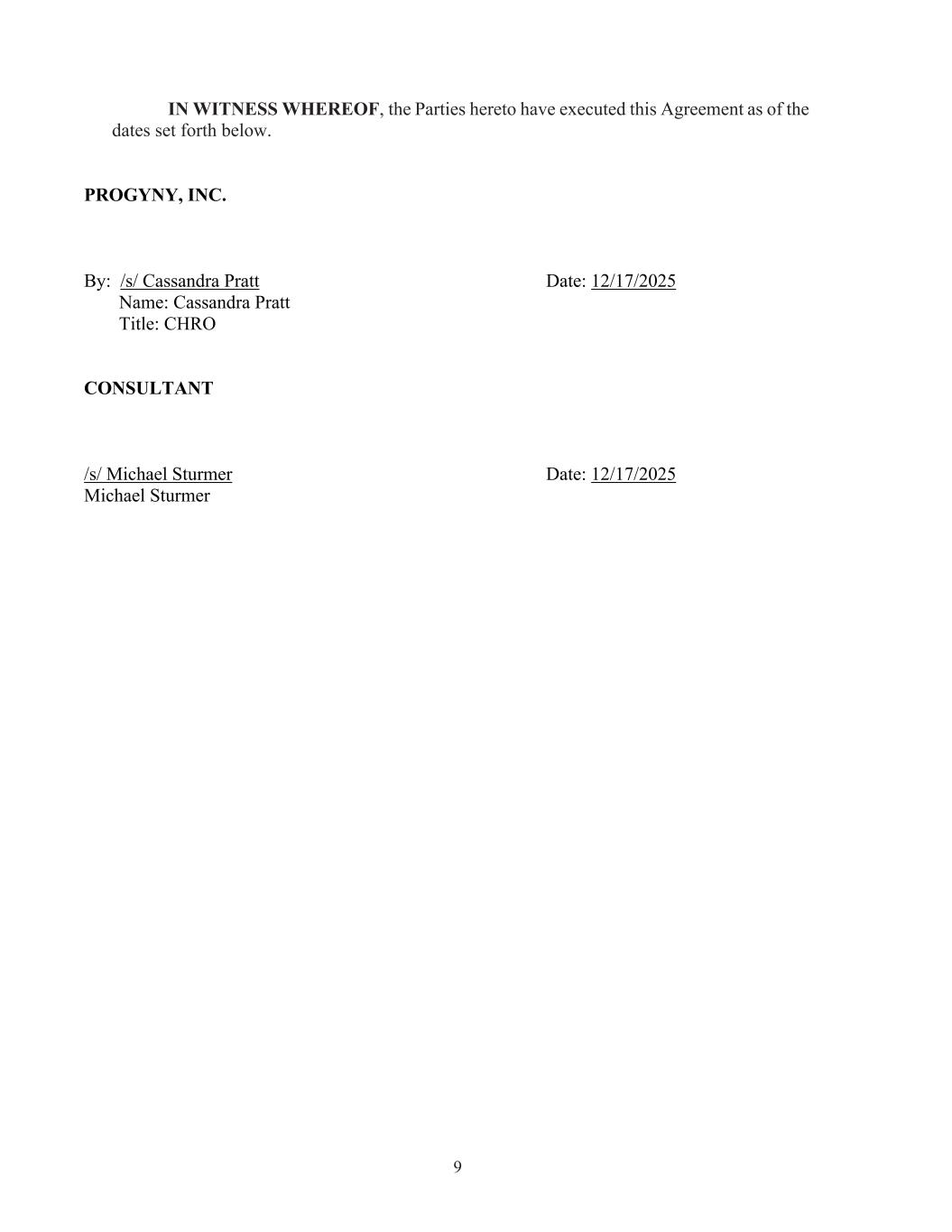
9 IN WITNESS WHEREOF, the Parties hereto have executed this Agreement as of the dates set forth below. PROGYNY, INC. By: /s/ Cassandra Pratt Date: 12/17/2025 Name: Cassandra Pratt Title: CHRO CONSULTANT /s/ Michael Sturmer Date: 12/17/2025 Michael Sturmer

10 Exhibit A Statement of Policy Concerning Trading in Company Securities [attached]
PROGYNY, INC. Statement of Policy Concerning Trading in Company Securities I. Summary of Policy Concerning Trading in Company Securities A. Restrictions on Trading in Company Securities It is the general policy of Progyny, Inc. and its subsidiaries (collectively, the “Company”) that it will, without exception, comply with all applicable laws and regulations in conducting its business; and that, when carrying out Company business, directors, officers, and employees must avoid any activity that violates applicable laws or regulations. To that end, when trading in Company securities, each director, officer, and employee of the Company and each other person listed below is expected to abide by this Statement of Policy Concerning Trading in Company Securities (such policy, the “Trading Policy”). In order to avoid even an appearance of impropriety, the Company’s directors, officers and certain other employees are subject to pre-approval requirements described below and other limitations on their ability to enter into transactions involving the Company’s securities. Although these limitations do not apply to transactions pursuant to written plans for trading securities that comply with Rule 10b5-1 under the Securities Exchange Act of 1934, as amended (the “Exchange Act”), the adoption, amendment, suspension or termination of any such written trading plan is subject to pre-approval requirements and other limitations detailed in Rule 10b5-1, including, but not limited to, applicable cooling-off periods and limitations on overlapping plans, as well as any requirements and guidelines adopted by the Company from time to time described in the Company’s Rule 10b5-1 Trading Plan Guidelines. B. Who is Subject to this Trading Policy Except where stated otherwise, this Trading Policy applies to the following individuals and entities, without regard to where they are located in the U.S. or internationally. We refer to these individuals and entities collectively as “Insiders”: • directors, officers, and employees of the Company and its subsidiaries; • contractors, consultants, and certain other persons who may have access to material non-public information of the Company; • spouses, domestic partners, parents, minor children, siblings, mothers and fathers-in-law, sons and daughters-in-law and brothers and sisters-in-law of such directors, officers or employees (collectively, “Family Members”); • persons who share a household with any director, officer or employee of the Company (regardless of whether or not such person is a Family Member); • anyone to whom directors, officers or employees provide significant financial support; and • unless otherwise determined by the Company, any entity or account over which the persons listed above, have or share the power, directly or indirectly, to make investment decisions (whether or not such persons have a financial interest in the entity or account) and those entities or accounts established or maintained by such persons with their consent or knowledge and in which such persons have a direct or indirect financial interest. Because of their access to confidential information on a regular basis, this Trading Policy subjects directors, officers and certain employees (the “Window Group”) to additional restrictions on trading in Company securities as discussed in Section II.C. below. In addition, directors, officers and certain employees with knowledge of material non-public information may be subject to ad hoc restrictions on trading from time to time. Updated as of: February 2025
2 Furthermore, the Company itself must comply with U.S. securities laws applicable to its own securities trading activities and will not effect transactions in respect of its securities, or adopt any securities repurchase plans, when it is in possession of material non-public information concerning the Company, other than in compliance with applicable law, subject to the policies and procedures adopted by the Company and attached as Exhibit A hereto, and the prior approval of the General Counsel. II. Prohibition on Trading in Securities While in Possession of Material Non-Public Information A. General Rule and What is Material U.S. federal securities laws prohibit Company’s Insiders from using information about the Company in the purchase and sale of securities, such as the Company’s shares of common stock, bonds, notes, debentures, limited partnership units or other equity or debt securities. For example, if an employee of a company learns material information through the course of their employment, they are prohibited from buying or selling securities (including the Company’s securities and the securities of other companies that could be impacted by such information) until such information has been adequately disclosed to the public. This is because such employee knows information that could cause the price of the security to change and has a duty to the company not to use the information for their personal gain. Trading on the basis of material non-public information is fraudulent and illegal. Civil and criminal penalties for this kind of activity are severe. Information is material if there is a substantial likelihood that a reasonable investor would consider it important in making an investment decision. Material information can be favorable or unfavorable. Courts and regulators often second-guess materiality determinations with the benefit of hindsight. If you have any uncertainty about whether non- public information is material, you should consult with the General Counsel and otherwise treat it as if it were material. Some examples of information that could be considered material include: • significant changes in the Company’s prospects or key performance indicators; • actual, anticipated or targeted revenue, earnings, dividends and other financial information; • operational developments that could affect the Company’s financial performance or forecasts, such as changes in the Company’s relationship (contractual or otherwise) with a key client or vendor; • financial, sales and other significant internal business forecasts or a change in previously released estimates; • pending or proposed mergers, business acquisitions, tender offers, joint ventures, restructurings, dispositions or the expansion or curtailment of operations; • significant cybersecurity or data protection events, including, but not limited to, any breach of information systems that compromises the functioning of the Company’s information or other systems or results in the exposure or loss of customer information; • proposed equity or debt offerings or significant borrowing; • changes in debt ratings or analyst upgrades or downgrades of the Company or one of its securities; • significant changes in accounting treatment, write-offs or effective tax rate or financial restatements; • pending or threatened significant litigation or governmental investigation or the resolution of such matters; • liquidity problems or impending bankruptcy;
3 • auditor notification that the Company may no longer rely on an audit report; • changes to the membership of board of directors or executive leadership; and • stock splits, repurchase plans or other corporate actions. In this Trading Policy, we use the term “non-public information” to refer to information that has not been publicly disclosed in a manner making it available to investors generally on a broad-based non-exclusionary basis (for example, the filing of a Form 8-K or issuance of a press release) and/or the investing public has not had time to fully absorb the information. If it is not clear whether material information has been sufficiently publicized, it should be treated as if it is non-public information. Furthermore, it is illegal for any Insider in possession of material non-public information to provide other people with such information or to recommend that they buy or sell the securities (this is called “tipping”). In that case, the tipper and the tippee may both be held liable. Information obtained in the course of employment or service as a director, contractor or consultant does not belong to individual Insiders who may handle it or otherwise become knowledgeable about it. The information is an asset of the Company. Any person who uses such information for personal benefit or discloses it to others outside the Company without authorization violates their confidentiality obligations to the Company and may be in breach of their fiduciary, loyalty or other duties to the Company. More particularly, trading on the basis of non-public information of the Company harms the Company and its investors. The Securities and Exchange Commission (the “SEC”), the Financial Industry Regulatory Authority (“FINRA”), prosecutors and plaintiffs’ lawyers devote considerable resources to identifying insider trading. A breach of the insider trading laws could expose an Insider or anyone who trades on information provided by an Insider to criminal fines and imprisonment, in addition to civil penalties and injunctive actions. Even if allegations of insider trading do not lead to a conviction, defending against such allegations is expensive. In addition, the mere perception that an Insider traded with the knowledge of material non-public information could harm the reputation of the Company and that Insider. Accordingly, this Trading Policy is in some cases more restrictive than what applicable insider trading laws might otherwise require. B. Guidelines The following guidelines should be followed to ensure compliance with applicable anti-fraud laws and with this Trading Policy and other applicable Company policies: 1. Nondisclosure. Material non-public information must not be disclosed to anyone, except to persons within the Company whose positions require them to know it or with prior approval of the General Counsel. No Insider should discuss material non-public information in public places or in common areas on Company property. 2. Trading in Company Securities. No Insider may place a purchase or sale order, or recommend that another person place a purchase or sale order, in the Company’s securities when such Insider has knowledge of material information concerning the Company that has not been disclosed to the public. This includes orders for purchases and sales of stock, convertible securities and other securities (e.g., bonds) and increasing or decreasing investment in Company securities through a retirement account. Except as provided in Section II.C.3. below, the exercise of employee stock options for cash and participating in the Company’s employee stock purchase plan are not subject to this Trading Policy. However, the purchase of stock upon the exercise of options and the sale of stock that was acquired upon exercise of a stock option will be treated like any other stock and may not be sold by an Insider who is in possession of material non-public information, including in a “cashless” exercise because this involves a market sale. Any Insider who possesses material non-public information should wait until after one full trading day after the information has been publicly released before trading, except as otherwise set forth in this Trading Policy or as otherwise directed by the General Counsel. There is no exception to this Trading Policy, even for hardship to the Insider or based on the use of proceeds (such as making a mortgage payment or for an emergency expenditure).
4 3. Trading in Another Company’s Securities. No Insider should place a purchase or sale order (including investment through a retirement account), or recommend that another person place a purchase or sale order, in the securities of another company, if the Insider learns in the course of their employment or service as a director, contractor or consultant material non-public information that is likely to affect the value of those securities. For example, it would be a violation of the securities laws if a Company employee learned through their role at the Company that the Company intended to amend or terminate a material client or vendor contract and then placed an order to buy or sell stock in that client or vendor company because of the likely increase or decrease in the value of its securities. 4. Avoid Speculation. Investing in the Company’s common stock or other securities provides an opportunity to share in the future growth of the Company. But investment in the Company and sharing in the growth of the Company does not mean short range speculation based on fluctuations in the market. Such activities put the personal gain of an Insider in conflict with the best interests of the Company and its stockholders. Although this Trading Policy does not mean that Insiders may never sell shares, the Company encourages Insiders to avoid frequent trading in Company stock. Speculating in Company stock is not part of the Company’s culture. C. Additional Restrictions on the Window Group 1. Window Group Defined. The Window Group consists of (i) directors and executive officers of the Company and their executive assistants and Family Members, (ii) certain employees who may have regular or specific access to material non-public information of the Company as a result of their positions with the Company and (iii) such other persons and entities as may be designated from time to time and informed of such status by the Company’s General Counsel. 2. Trading Window. Trading by the Window Group is permitted only after the completion of one full trading day following an earnings release with respect to the preceding fiscal period until the thirtieth calendar day prior to an earnings release for the then-current fiscal quarter, except for the fourth quarter of a fiscal year, in which case trading will be permitted until the last calendar day of the quarter (the “Window”). From time to time, the General Counsel may determine that no trades may occur even during the Window when clearance is requested. This may occur as a result of a material development that has not yet been publicly disclosed. No reasons may be provided, and the closing of the Window may itself constitute material non-public information that should not be communicated. 3. Pre-Clearance. All transactions by Window Group members, including the exercise of any options, are subject to prior review and clearance by the General Counsel. Notwithstanding pre-clearance, every person is individually responsible for their compliance with this Trading Policy and with applicable insider trading laws. The restrictions set forth in Sections II. B. and II.C. do not apply to transactions pursuant to written plans for trading securities that comply with Rule 10b5-1 under the Exchange Act (“10b5-1 Plans”). However, Window Group members may not enter into, amend or terminate a 10b5-1 Plan relating to Company securities without the prior approval of the General Counsel, which will only be given during a Window period and only if the Window Group member does not have knowledge of material non-public information. D. Hedging and Derivatives Insiders are prohibited from engaging in any derivative transactions (including transactions involving options, puts, calls, prepaid variable forward contracts, equity swaps, collars or other derivatives) that are designed to hedge or speculate on any change in the market value of the Company’s equity securities. As discussed below, Insiders are also prohibited from shorting the Company’s securities. Trading in options or other derivatives is generally highly speculative and very risky. Individuals who buy options are betting that the stock price will move rapidly. For that reason, when a person trades in options in their employer’s stock, it may arouse suspicion by the SEC that such person was trading on the basis of material non-public information,
5 particularly where the trading occurs before a company announcement or major event. It is difficult for a director, officer or employee to prove that they did not know about the announcement or event. If the SEC or FINRA were to notice active options trading by one or more directors, officers or employees of the Company prior to an announcement or event, they would likely investigate. Such an investigation could be embarrassing to the Company (as well as expensive) and could result in severe penalties and expense for the persons involved. For all of these reasons, the Company prohibits Insiders from engaging in derivative transactions as described above involving the Company’s stock. E. Pledging of Securities, Margin Accounts Pledged securities may be sold by the pledgee without the pledgor’s consent under certain conditions. For example, securities held in a margin account may be sold by a broker without the customer’s consent if the customer fails to meet a margin call. Because such a sale may occur at a time when an Insider has material non-public information or is otherwise not permitted to trade in Company securities, the Company prohibits Insiders from pledging Company securities under any circumstance, including by purchasing Company securities on margin or holding Company securities in a margin account. F. Applicability of U.S. Securities Laws to International Transactions All Insiders of the Company, which includes its domestic and international subsidiaries, are subject to this Trading Policy. In addition, U.S. securities laws may be applicable to trades in the Company’s securities executed outside the United States or by an employee is located outside the United States. Transactions involving securities of subsidiaries or affiliates should be carefully reviewed by outside legal counsel for compliance not only with applicable local law but also for possible application of U.S. securities laws. G. Gifts of Securities Unless otherwise approved by the General Counsel in limited circumstances, gifts of Company securities should only be made (i) when an Insider is not in possession of material non-public information and (ii) during a Window. Gifts of Company securities are otherwise subject to this Trading Policy, including the guidelines and restrictions set forth under sections II.B. and II.C. H. Affiliated Fund Sales and Distributions Sales and distributions of Company securities by a venture capital partnership, private equity fund or other similar entity with which a Company director is affiliated to its partners, members or other similar persons are generally subject to this Trading Policy, unless the entity provides evidence satisfactory to the General Counsel that such entity has adequate policies and procedures in place to ensure that individuals making investment decisions on its behalf would not violate insider trading laws. It is the responsibility of each affected director and the affiliated entity, in consultation with their own counsel, to determine the process and timing for any such sales or distributions based on all relevant facts and circumstances and applicable securities laws. I. Applicability Following Termination of Employment, Service or Affiliation The prohibition on trading in the Company’s securities or in the securities of another Company while in possession of material non-public information continues even after an Insider’s employment, service or affiliation with the Company terminates. Insiders whose employment, service or affiliation with the Company terminates will continue to be subject to the additional restrictions of this Trading Policy until the later of (i) completion of one full trading day following the first earnings release after an Insider’s last day of employment, service or affiliation or (ii) ninety days after an Insider’s last day of employment, service or affiliation.
Exhibit A Company Trading Policies and Procedures These policies and procedures govern repurchases of the Company’s equity securities (“Repurchases”) approved from time to time by the Board of Directors (the “Board”) of the Company to help ensure that such Repurchases are not made, or a share repurchase plan is not adopted, when the Company is in possession of material non-public information concerning the Company (“MNPI”). Capitalized terms used but not defined herein have the respective meanings given to them in the Company’s Trading Policy. 1. Policy. It is the Company’s policy that no Repurchases may take place outside a Window or when the Company is otherwise in possession of MNPI, other than Repurchases made pursuant to a Rule 10b5-1 Plan or otherwise in compliance with applicable law. 2. Trading Activity. Any Repurchases (other than Repurchases made pursuant to a Rule 10b5-1 Plan), or the adoption of a Rule 10b5-1 Plan to effect Repurchases, shall be subject to the following procedures: (a) The adoption of a Rule 10b5-1 Plan shall be subject to prior written approval by the General Counsel. The General Counsel shall take such steps as they deem reasonably necessary to ascertain that the Company is not in possession of MNPI at the time of plan adoption, including, but not limited to, consulting with other members of senior management (each, an “Authorized Officer”) and/or outside legal counsel. (b) With respect to Repurchases that have been approved by the Board, if at any time during the period such Repurchases are scheduled to take place, the General Counsel or any Authorized Officer become aware of any MNPI, they shall notify the relevant employee(s) at the Company responsible for effecting Repurchases as soon as practicable to suspend such Repurchases. (c) Once the General Counsel and such Authorized Officer are satisfied that, to their knowledge, the Company is no longer in possession of MNPI, they shall notify the relevant employee(s) that the Company may resume its Repurchases. 3. Recordkeeping. The General Counsel shall maintain a record of the communications referred to in these policies and procedures in compliance with the Company’s recordkeeping policies. 4. Training. Company directors, officers and employees who are involved in the Company’s securities trading activities shall be provided training on the Trading Policy and these policies and procedures consistent with the Company’s employee training policies. 5. Modification or Waiver. These policies and procedures may be modified, and specific requirements therein may be waived, subject to approval by the General Counsel if they deem such modifications or waivers are appropriate based on particular facts and circumstances and in compliance with applicable law. 6. Amendments. These policies and procedures may be reviewed periodically as determined by the General Counsel. Any material amendments to these policies and procedures shall require the approval of the General Counsel. A-1
Supplement to Trading Policy Other Limitations on Securities Transactions A. Public Resales – Rule 144 The Securities Act of 1933, as amended (the “Securities Act”) requires every person who offers or sells a security to register such transaction with the SEC unless an exemption from registration is available. Rule 144 under the Securities Act is the exemption typically relied on for (i) public resales by any person of “restricted securities” (i.e., unregistered securities acquired in a private offering or sale) and (ii) public resales by directors, officers and other control persons of a company (known as “affiliates”) of any of the Company’s securities, whether restricted or unrestricted. The exemption in Rule 144 may only be relied on if certain conditions are met. These conditions vary based on whether the Company has been subject to the SEC’s reporting requirements for 90 days (and is therefore a “reporting company” for purposes of the rule) and whether the person seeking to sell the securities is an affiliate or not. Application of the rule is complex and directors, officers and employees of the Company should not make a sale of Company securities in reliance on Rule 144 without obtaining the approval of the General Counsel, who may require the director, officer or employee to obtain an outside legal opinion satisfactory to the General Counsel concluding that the proposed sale qualifies for the Rule 144 exemption. 1. Holding Period. Restricted securities issued by a reporting company (i.e., a company that has been subject to the SEC’s reporting requirements for at least 90 days) must be held, and fully paid, for a period of six months prior to their sale. Restricted securities issued by a non-reporting company are subject to a one-year holding period. The holding period requirement does not apply to securities held by affiliates that were acquired either in the open market or in a public offering of securities registered under the Securities Act. Generally, if the seller acquired the securities from someone other than the Company or an affiliate of the Company, the holding period of the person from whom the seller acquired such securities can be “tacked” to the seller’s holding period in determining if the holding period has been satisfied. 2. Current Public Information. Current information about the Company must be publicly available before the sale can be made. The Company’s periodic reports filed with the SEC ordinarily satisfy this requirement. If the seller is not an affiliate of the Company (and has not been an affiliate for at least three months) and one year has passed since the securities were acquired from the Company or an affiliate of the Company (whichever is later), the seller can sell the securities without regard to the current public information requirement. Rule 144 also imposes the following additional conditions on sales by persons who are “affiliates.” A person or entity is considered an “affiliate,” and therefore subject to these additional conditions, if it is currently an affiliate or has been an affiliate within the previous three months: 1. Volume Limitations. The amount of debt securities that can be sold by an affiliate and by certain persons associated with the affiliate during any three-month period cannot exceed 10% of a tranche (or class when the securities are non-participatory preferred stock), together with all sales of securities of the same tranche sold for the account of the affiliate. The amount of equity securities that can be sold by an affiliate during any three-month period cannot exceed the greater of (i) one percent of the outstanding shares of the class of equity securities or (ii) the average weekly reported trading volume for shares of the class during the four calendar weeks preceding the time the order to sell is received by the broker or executed directly with a market maker. 2. Manner of Sale. Equity securities held by affiliates must be sold in unsolicited brokers’ transactions directly to a market-maker or in riskless principal transactions. 3. Notice of Sale. An affiliate seller must file a notice of the proposed sale with the SEC at the time the order to sell is placed with the broker, unless the amount to be sold neither exceeds 5,000 shares nor involves sale proceeds greater than $50,000. See “Filing Requirements” below.
Bona fide gifts are not deemed to involve sales of shares for purposes of Rule 144, so they can be made without limitation on the amount of the gift, subject to the terms of the Company’s Trading Policy and in compliance with applicable law. Donees who receive restricted securities from an affiliate generally will be subject to the same restrictions under Rule 144 that would have applied to the donor, depending on the circumstances. B. Private Resales Directors and officers also may sell securities in a private transaction without registration pursuant to Section 4(a)(7) of the Securities Act, which allows resales of shares of reporting companies to accredited investors, provided that the sale is not solicited by any form of general solicitation or advertising. There are a number of additional requirements, including that the seller and persons participating in the sale on a remunerated basis are not “bad actors” under Rule 506(d)(1) of Regulation D or otherwise subject to certain statutory disqualifications; the Company is engaged in a business and not in bankruptcy; and the securities offered have been outstanding for at least 90 days and are not part of an unsold underwriter’s allotment. Private resales must be reviewed in advance by the Company’s General Counsel and may require the participation of outside legal counsel. C. Restrictions on Purchases of Company Securities In order to prevent market manipulation, the SEC adopted Regulation M under the Securities Exchange Act of 1934, as amended (the “Exchange Act”). Regulation M generally restricts the Company or any of its affiliates from buying Company stock, including as part of a share repurchase program, in the open market during certain periods while a distribution, such as a public offering, is taking place. You should consult with the Company’s General Counsel if you desire to make purchases of Company stock during any period in which the Company is conducting an offering. Similar considerations may apply during periods when the Company is conducting or has announced a tender offer. D. Disgorgement of Profits on Short-Swing Transactions – Section 16(b) Section 16 of the Exchange Act applies to directors and executive officers of the Company and to any person owning more than ten percent (10%) of any registered class of the Company’s equity securities. Section 16 is intended to deter such persons (collectively referred to below as “Section 16 insiders”) from misusing confidential information about their companies for personal trading gain. Section 16(a) requires Section 16 insiders to publicly disclose any changes in their beneficial ownership of the Company’s equity securities (see “Filing Requirements” below). Section 16(b) requires Section 16 insiders to disgorge to the Company any “profit” resulting from “short-swing” transactions, as discussed more fully below. Section 16(c) effectively prohibits Section 16 insiders from engaging in short sales (see “Prohibition of Short Sales” below). Under Section 16(b), any profit realized by an insider on a “short-swing” transaction (i.e., a purchase and sale, or sale and purchase, of the Company’s equity securities within a period of less than six months) must be disgorged to the Company upon demand by the Company or a stockholder acting on its behalf. By law, the Company cannot waive or release any claim it may have under Section 16(b) or enter into an enforceable agreement to provide indemnification for amounts recovered under such section. Liability under Section 16(b) is imposed in a mechanical fashion without regard to whether the Section 16 insider intended to violate the section. Good faith, therefore, is generally not a defense. All that is necessary for a successful claim is to show that the insider realized “profits” on a short-swing transaction; however, profit, for this purpose, is calculated as the difference between the sale price and the purchase price in the matching transactions and may be unrelated to the actual gain on the shares sold. When computing recoverable profits on multiple purchases and sales within a six-month period, the courts maximize the recovery by matching the lowest purchase price with the highest sale price, the next lowest purchase price with the next highest sale price, and so on. The use of this method makes it possible for an insider to sustain a net loss on a series of transactions while having recoverable profits. The terms “purchase” and “sale” are interpreted under Section 16(b) to cover a broad range of transactions, including acquisitions and dispositions in tender offers, certain corporate reorganizations and transactions in convertible or derivative securities (such as stock options and stock appreciation rights). Moreover, purchases and sales by an insider
may be matched with transactions by any person (such as certain family members or a family trust) whose securities are deemed to be beneficially owned by the insider. The Section 16 rules are complicated and present ample opportunity for inadvertent error. To avoid unnecessary costs and potential embarrassment for Section 16 insiders and the Company, directors and executive officers are strongly urged to consult with the Company’s General Counsel prior to engaging in any transaction or other transfer of Company equity securities regarding the potential applicability of Section 16(b). E. Prohibition of Short Sales Under Section 16(c), Section 16 insiders are prohibited from effecting “short sales” of the Company’s equity securities. A “short sale” is one involving securities, which the seller does not own at the time of sale, or, if owned, are not delivered within 20 days after the sale or deposited in the mail or other usual channels of transportation within five days after the sale. Apart from Section 16(c), the Company prohibits directors, officers and employees from short selling the Company’s stock. This type of activity is inherently speculative in nature and is contrary to the best interests of the Company and its stockholders. F. Filing Requirements 1. Form 3, 4 and 5. Under Section 16(a) of the Exchange Act, Section 16 insiders must file with the SEC public reports disclosing their holdings of, and transactions involving, the Company’s equity securities. An initial report on Form 3 must be filed by every Section 16 insider within 10 days after election or appointment disclosing all equity securities of the Company beneficially owned by the reporting person on the date they became an insider. Even if no securities were owned on that date, the insider must file a Form 3. Any subsequent change in the nature or amount of beneficial ownership by the insider must be reported on Form 4 and filed by the end of the second business day following the date of the transaction. The Form 4 filing requirement and filing deadline also applies to any donation or gift of company equity securities by the insider, regardless of the recipient. Certain exempt transactions may be reported on Form 5 within 45 days after the end of the fiscal year. The fact that an insider’s transactions during the month resulted in no net change, or the fact that no securities were owned after the transactions were completed, does not provide a basis for failing to report. All changes in the amount or the form (i.e., direct or indirect) of beneficial ownership (not just purchases and sales) must be reported. Thus, transactions such as gifts ordinarily are reportable. Moreover, a director or officer who has ceased to be a director or officer must report any transactions after termination which occurred within six months of a transaction that occurred while the person was an insider. Form 4 also must reflect the insider’s holdings immediately after the reported transaction, so it is important to maintain an accurate account of the insider’s holdings over time. The reports under Section 16(a) are intended to cover all securities beneficially owned either directly by the insider or indirectly through others. An insider is considered the direct owner of all Company equity securities held in their own name or held jointly with others. An insider is considered the indirect owner of any securities from which they obtain benefits substantially equivalent to those of ownership. Thus, equity securities of the Company beneficially owned through partnerships, corporations, trusts, estates and by family members generally are subject to reporting. Absent countervailing facts, an insider is presumed to be the beneficial owner of securities held their spouse and other family members sharing the same household. But an insider is free to disclaim beneficial ownership of these or any other securities being reported if the insider believes there is a reasonable basis for doing so. It is important that reports under Section 16(a) be prepared properly and filed on a timely basis. The reports must be received at the SEC by the filing deadline. There is no provision for an extension of the filing deadlines, and the SEC can take enforcement action against Section 16 insiders who do not comply fully with the filing requirements. In addition, the Company is required to disclose in its annual proxy statement the names of Section 16 insiders who failed to file Section 16(a) reports properly during the fiscal year, along with the particulars of such instances of noncompliance. Accordingly, all directors and officers must notify the Company’s General Counsel, prior to any transactions or changes in their or their family members’

beneficial ownership involving Company stock and are strongly encouraged to avail themselves of the assistance available from the Company’s legal department in satisfying the reporting requirements. 2. Form 144. As described above under the discussion of Rule 144, an affiliate seller relying on Rule 144 must file a notice of proposed sale with the SEC at the time the order to sell is placed with the broker unless the amount to be sold during any three-month period neither exceeds 5,000 shares nor involves sale proceeds greater than $50,000.