
.2 Investor Update Snap’s Path to Net Income Profitability April 2026
2 Note Regarding User Metrics and Other Data We define a Daily Active User, or DAU, as a registered and logged-in Snapchat user who visits Snapchat through our applications or websites at least once during a defined 24-hour period. We calculate average DAUs for a particular quarter by adding the number of DAUs on each day of that quarter and dividing that sum by the number of days in that quarter. DAUs are broken out by geography because markets have different characteristics. We define a Monthly Active User, or MAU, as a registered and logged-in Snapchat user who visits Snapchat through our applications or websites at least once during the 30-day period ending on the calendar month-end. We calculate average MAUs for a particular quarter by calculating the average of the MAUs as of each calendar month-end in that quarter. We define average revenue per user, or ARPU, as quarterly revenue divided by the average DAUs. For purposes of calculating ARPU, revenue by user geography is apportioned to each region based on our determination of the geographic location in which advertising impressions are delivered, as this approximates revenue based on user activity. This allocation differs from our components of revenue disclosure in the notes to our consolidated financial statements, where revenue is based on the billing address of the advertising customer. For information concerning these metrics as measured by us, see “Management’s Discussion and Analysis of Financial Condition and Results of Operations” in our most recent periodic report filed with the U.S. Securities and Exchange Commission, or the SEC, which is available on the SEC’s website at www.sec.gov. Additional information will be made available in our filings that we make from time to time with the SEC. Unless otherwise stated, statistical information regarding our users and their activities is determined by calculating the daily average of the selected activity for the most recently completed quarter included in this presentation. While these metrics are determined based on what we believe to be reasonable estimates of our user base for the applicable period of measurement, there are inherent challenges in measuring how our products are used across large populations globally. For example, there may be individuals who attempt to create accounts for malicious purposes, including at scale, even though we forbid that in our Terms of Service and Community Guidelines. We implement measures in our user registration process and through other technical measures to prevent, detect, and suppress that behavior, although we have not determined the number of such accounts. Changes in our products, infrastructure, mobile operating systems, or metric tracking system, or the introduction of new products, may impact our ability to accurately determine active users or other metrics and we may not determine such inaccuracies promptly. We also believe that we don’t capture all data regarding each of our active users. Technical issues may result in data not being recorded from every user’s application. For example, because some Snapchat features can be used without internet connectivity, we may not count a DAU because we don’t receive timely notice that a user has opened the Snapchat application. This undercounting may increase as we grow in Rest of World markets where users may have poor connectivity. We do not adjust our reported metrics to reflect this underreporting. We believe that we have adequate controls to collect user metrics, however, there is no uniform industry standard. We continually seek to identify these technical issues and improve both our accuracy and precision, including ensuring that our investors and others can understand the factors impacting our business, but these technical issues and new issues may continue in the future, including if there continues to be no uniform industry standard. Some of our demographic data may be incomplete or inaccurate. For example, because users self-report their dates of birth, our age-demographic data may differ from our users’ actual ages. And because users who signed up for Snapchat before June 2013 were not asked to supply their date of birth, we may exclude those users from our age demographics or estimate their ages based on a sample of the self-reported ages that we do have. If our active users provide us with incorrect or incomplete information regarding their age or other attributes, then our estimates may prove inaccurate and fail to meet investor expectations. See https://businesshelp.snapchat.com/ for details. In the past we have relied on third-party analytics providers to calculate our metrics, but today we rely primarily on our analytics platform that we developed and operate. We count a DAU or MAU only when a user visits Snapchat through our applications or websites and only once per user per period (daily for DAU and the 30-day period ending at calendar month-end for MAU). We believe this methodology more accurately measures our user engagement. We have multiple pipelines of user data that we use to determine whether a user has visited Snapchat through our applications and websites during a particular day. This provides redundancy in the event one pipeline of data were to become unavailable for technical reasons, and also gives us redundant data to help measure how users interact with our applications and websites. If we fail to maintain an effective analytics platform, our metrics calculations may be inaccurate. We regularly review, have adjusted in the past, and are likely in the future to adjust our processes for calculating our internal metrics to improve their accuracy. As a result of such adjustments, our DAUs, MAUs, ARPU, or other metrics may not be directly comparable to those in prior periods. Our measures of DAUs and MAUs may differ from estimates published by third parties or from similarly titled metrics of our competitors due to differences in methodology or data used. Note Regarding Forward Looking Statements and Use of Non-GAAP Financials This presentation contains forward-looking statements within the meaning of Section 27A of the Securities Act of 1933, as amended, or the Securities Act, and Section 21E of the Securities Exchange Act of 1934, as amended, or the Exchange Act, about us and our industry that involve substantial risks and uncertainties. All statements other than statements of historical facts contained in this presentation, including statements regarding guidance, our future results of operations or financial condition, our plans to improve operational efficiencies, timing and charges associated with our headcount reduction and restructuring initiatives, our ability to achieve the cost savings we estimate will result from our headcount reduction and restructuring plans, our use of AI, future stock repurchase programs or stock dividends, our business strategy and plans, user growth and engagement, product initiatives, objectives of management for future operations, and advertiser and partner offerings, are forward-looking statements. In some cases, you can identify forward-looking statements because they contain words such as “anticipate,” “believe,” “contemplate,” “continue,” “could,” “estimate,” “expect,” “going to,” “intend,” “may,” “plan,” “potential,” “predict,” “project,” “should,” “target,” “will,” or “would” or the negative of these words or other similar terms or expressions. We caution you that the foregoing may not include all of the forward-looking statements made in this presentation. You should not rely on forward-looking statements as predictions of future events. We have based the forward-looking statements contained in this presentation primarily on our current expectations and projections about future events and trends, including our financial outlook, macroeconomic uncertainty,and geo-political events and conflicts, that we believe may continue to affect our business, financial condition, results of operations, and prospects. These forward-looking statements are subject to risks and uncertainties related to: our financial performance; our ability to attain and sustain profitability; our ability to generate and sustain positive cash flow; our ability to attract and retain users, partners, and advertisers; competition and new market entrants; managing our growth and future expenses; compliance with new laws, regulations, and executive actions; our ability to maintain, protect, and enhance our intellectual property; our ability to succeed in existing and new market segments; our ability to attract and retain qualified team members and key personnel; our ability to repay or refinance outstanding debt, or to access additional financing; future acquisitions, divestitures, or investments; and the potential adverse impact of climate change, natural disasters, health epidemics, macroeconomic conditions, and war or other armed conflict, as well as risks, uncertainties, and other factors described in “Risk Factors” and elsewhere in our most recent periodic report filed with the SEC, which is available on the SEC’s website at www.sec.gov. Additional information will be made available in our filings that we make from time to time with the SEC. Moreover, we operate in a very competitive and rapidly changing environment. New risks and uncertainties emerge from time to time, and it is not possible for us to predict all risks and uncertainties that could have an impact on the forward-looking statements contained in this presentation. The results, events, and circumstances reflected in the forward-looking statements may not be achieved or occur, and actual results, events, or circumstances could differ materially from those described in the forward-looking statements. In addition, statements that “we believe” and similar statements reflect our beliefs and opinions on the relevant subject. These statements are based on information available to us as of the date of this presentation. And while we believe that information provides a reasonable basis for these statements, that information may be limited or incomplete. Our statements should not be read to indicate that we have conducted an exhaustive inquiry into, or review of, all relevant information. These statements are inherently uncertain, and investors are cautioned not to unduly rely on these statements. The forward-looking statements made in this presentation relate only to events as of the date on which the statements are made. We undertake no obligation to update any forward-looking statements made in this presentation to reflect events or circumstances after the date of this presentation or to reflect new information or the occurrence of unanticipated events, including future developments related to geo-political events and conflicts and macroeconomic conditions, except as required by law. We may not actually achieve the plans, intentions, or expectations disclosed in our forward-looking statements, and you should not place undue reliance on our forward-looking statements. Our forward-looking statements do not reflect the potential impact of any future acquisitions, dispositions, joint ventures, restructurings, legal settlements, or investments. Investors and others should note that we may announce material business and financial information to our investors using our websites (including investor.snap.com), filings with the SEC, webcasts, press releases, investor letters, and conference calls. We use these mediums, including Snapchat and our websites, to communicate with our members and the public about our company, our products, and other issues. It is possible that the information that we make available may be deemed to be material information. We therefore encourage investors and others interested in our company to review the information that we make available on our websites. This presentation includes certain non-GAAP financial measures. These non-GAAP financial measures, which may be different than similarly titled measures used by other companies, are presented to enhance investors’ overall understanding of our financial performance and should not be considered a substitute for, or superior to, the financial information prepared and presented in accordance with GAAP.
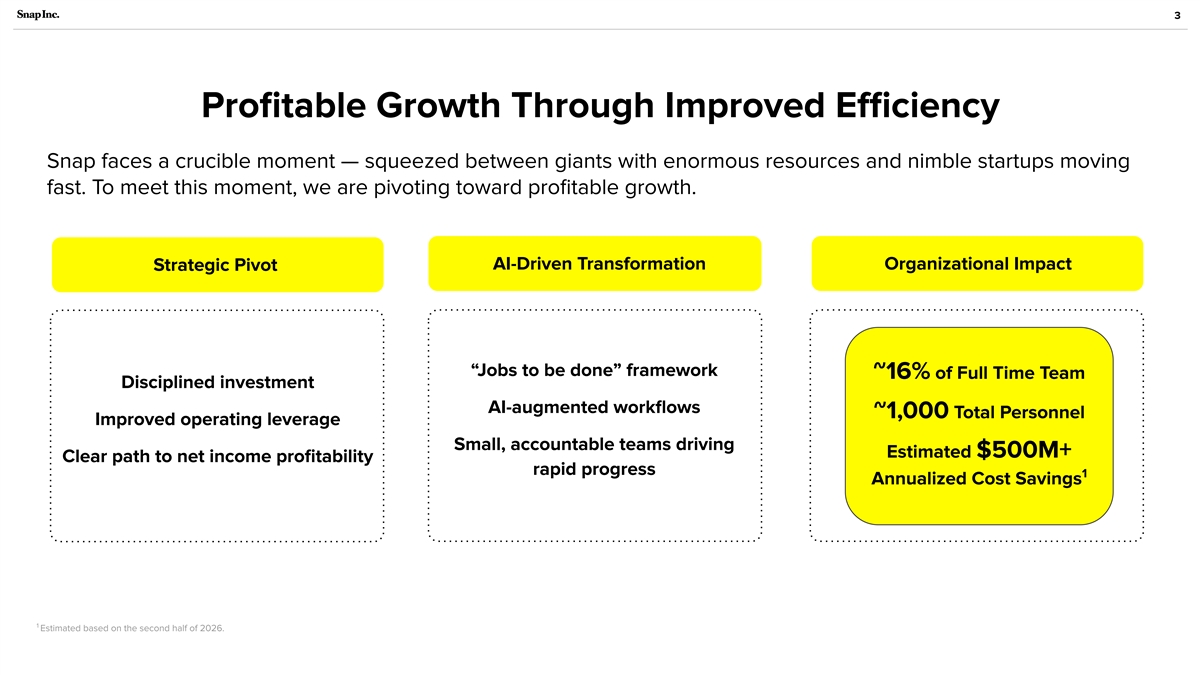
3 Profitable Growth Through Improved Efficiency Snap faces a crucible moment — squeezed between giants with enormous resources and nimble startups moving fast. To meet this moment, we are pivoting toward profitable growth. AI-Driven Transformation Organizational Impact Strategic Pivot “Jobs to be done” framework ~16% of Full Time Team Disciplined investment AI-augmented workflows ~1,000 Total Personnel Improved operating leverage Small, accountable teams driving Estimated $500M+ Clear path to net income profitability rapid progress 1 Annualized Cost Savings 1 Estimated based on the second half of 2026.
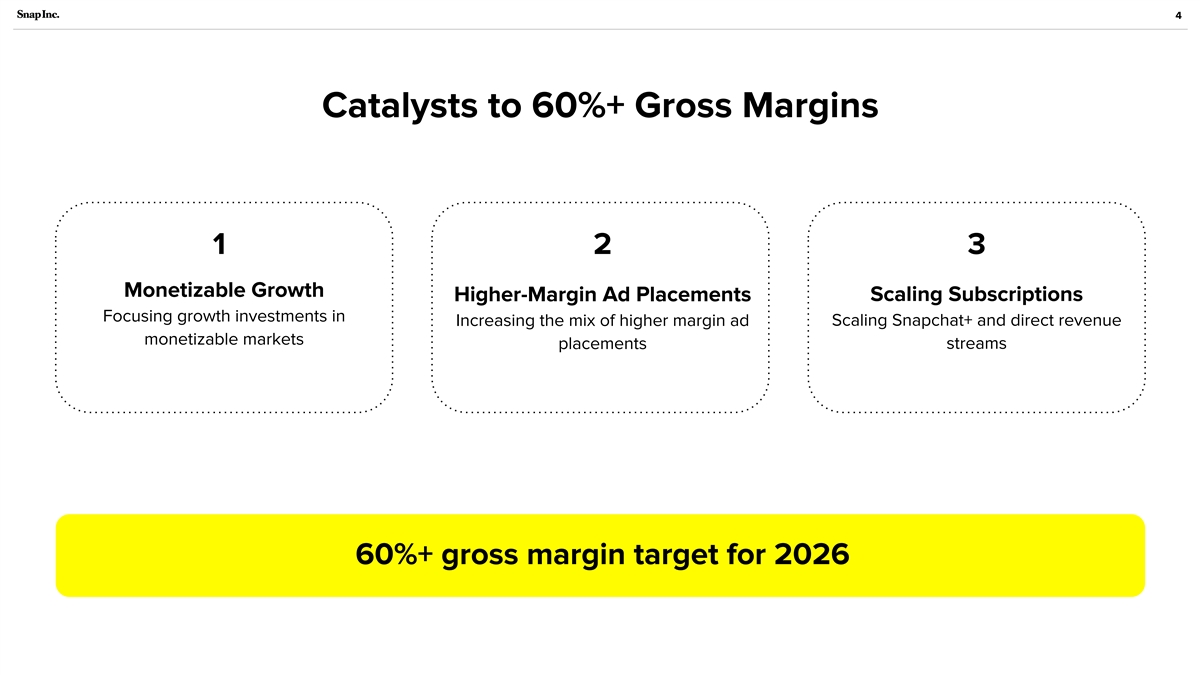
4 Catalysts to 60%+ Gross Margins 1 2 3 Monetizable Growth Scaling Subscriptions Higher-Margin Ad Placements Focusing growth investments in Increasing the mix of higher margin ad Scaling Snapchat+ and direct revenue monetizable markets placements streams 60%+ gross margin target for 2026
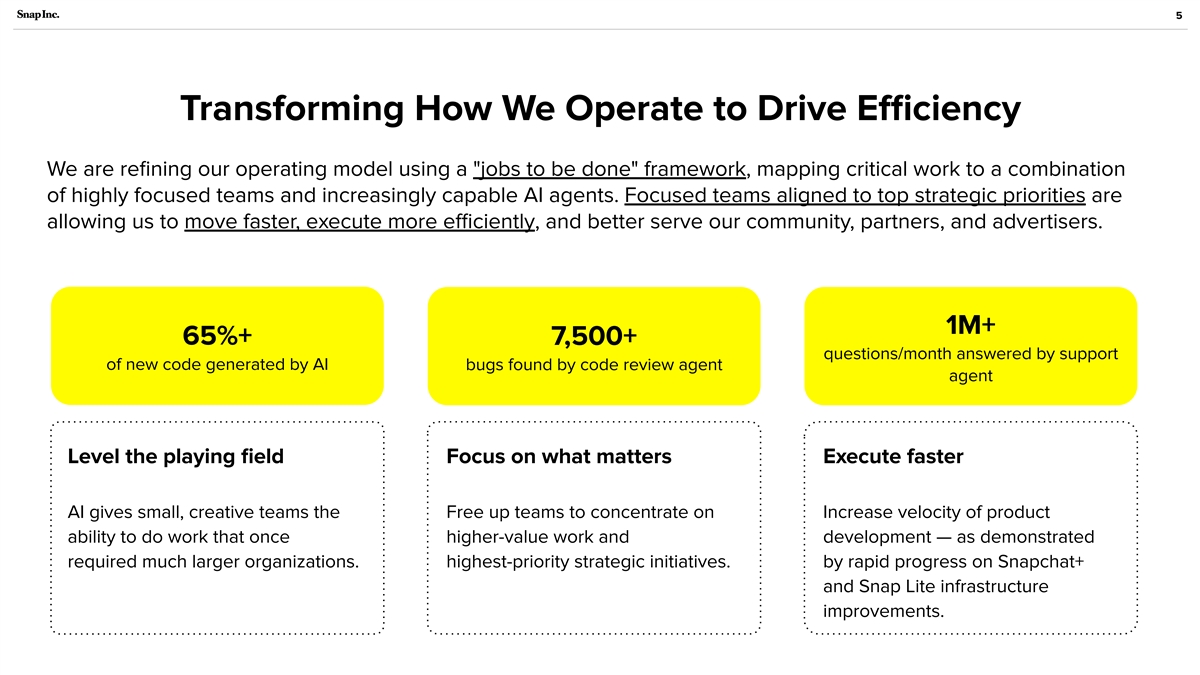
5 Transforming How We Operate to Drive Efficiency We are refining our operating model using a jobs to be done framework, mapping critical work to a combination of highly focused teams and increasingly capable AI agents. Focused teams aligned to top strategic priorities are allowing us to move faster, execute more efficiently, and better serve our community, partners, and advertisers. 1M+ 65%+ 7,500+ questions/month answered by support of new code generated by AI bugs found by code review agent agent Level the playing field Focus on what matters Execute faster AI gives small, creative teams the Free up teams to concentrate on Increase velocity of product ability to do work that once higher-value work and development — as demonstrated required much larger organizations. highest-priority strategic initiatives. by rapid progress on Snapchat+ and Snap Lite infrastructure improvements.
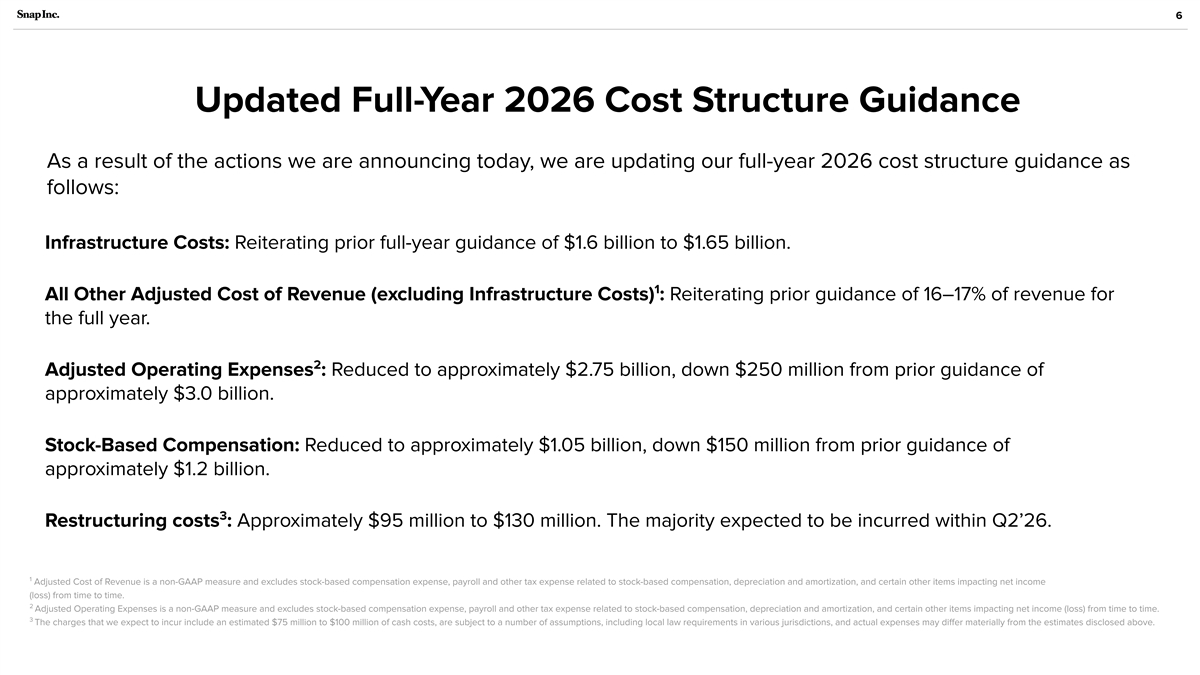
6 Updated Full-Year 2026 Cost Structure Guidance As a result of the actions we are announcing today, we are updating our full-year 2026 cost structure guidance as follows: Infrastructure Costs: Reiterating prior full-year guidance of $1.6 billion to $1.65 billion. 1 All Other Adjusted Cost of Revenue (excluding Infrastructure Costs) : Reiterating prior guidance of 16–17% of revenue for the full year. 2 Adjusted Operating Expenses : Reduced to approximately $2.75 billion, down $250 million from prior guidance of approximately $3.0 billion. Stock-Based Compensation: Reduced to approximately $1.05 billion, down $150 million from prior guidance of approximately $1.2 billion. 3 Restructuring costs : Approximately $95 million to $130 million. The majority expected to be incurred within Q2’26. 1 Adjusted Cost of Revenue is a non-GAAP measure and excludes stock-based compensation expense, payroll and other tax expense related to stock-based compensation, depreciation and amortization, and certain other items impacting net income (loss) from time to time. 2 Adjusted Operating Expenses is a non-GAAP measure and excludes stock-based compensation expense, payroll and other tax expense related to stock-based compensation, depreciation and amortization, and certain other items impacting net income (loss) from time to time. 3 The charges that we expect to incur include an estimated $75 million to $100 million of cash costs, are subject to a number of assumptions, including local law requirements in various jurisdictions, and actual expenses may differ materially from the estimates disclosed above.
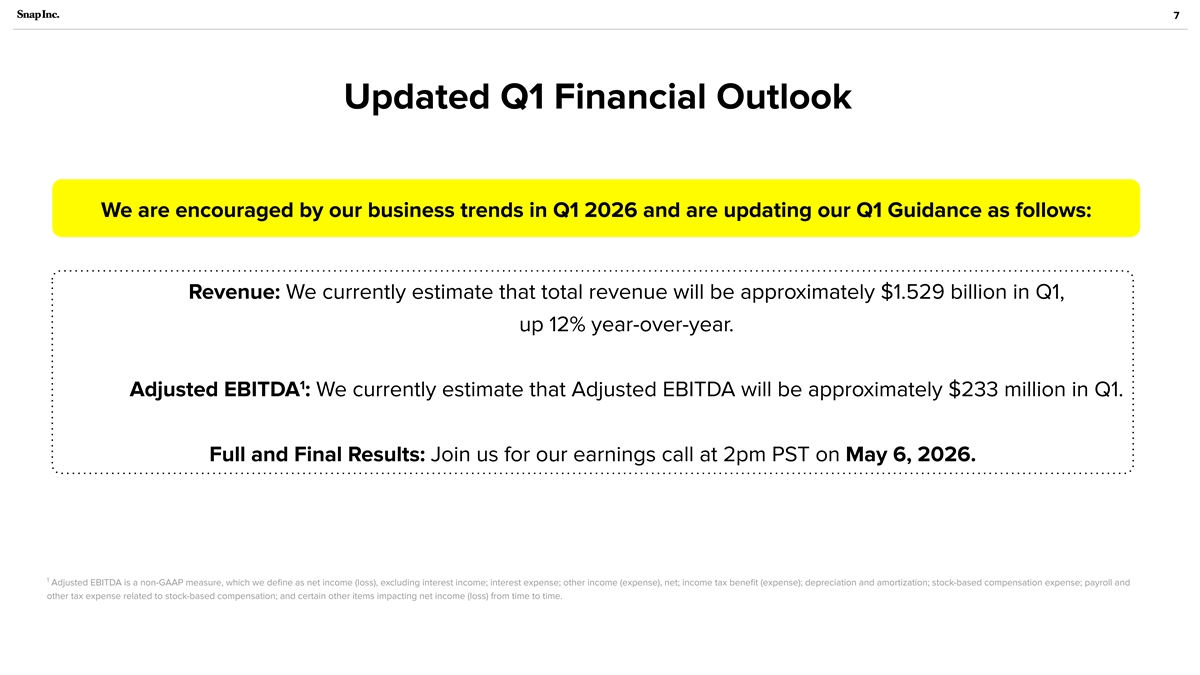
7 Updated Q1 Financial Outlook We are encouraged by our business trends in Q1 2026 and are updating our Q1 Guidance as follows: Revenue: We currently estimate that total revenue will be approximately $1.529 billion in Q1, up 12% year-over-year. 1 Adjusted EBITDA : We currently estimate that Adjusted EBITDA will be approximately $233 million in Q1. Full and Final Results: Join us for our earnings call at 2pm PST on May 6, 2026. 1 Adjusted EBITDA is a non-GAAP measure, which we define as net income (loss), excluding interest income; interest expense; other income (expense), net; income tax benefit (expense); depreciation and amortization; stock-based compensation expense; payroll and other tax expense related to stock-based compensation; and certain other items impacting net income (loss) from time to time.
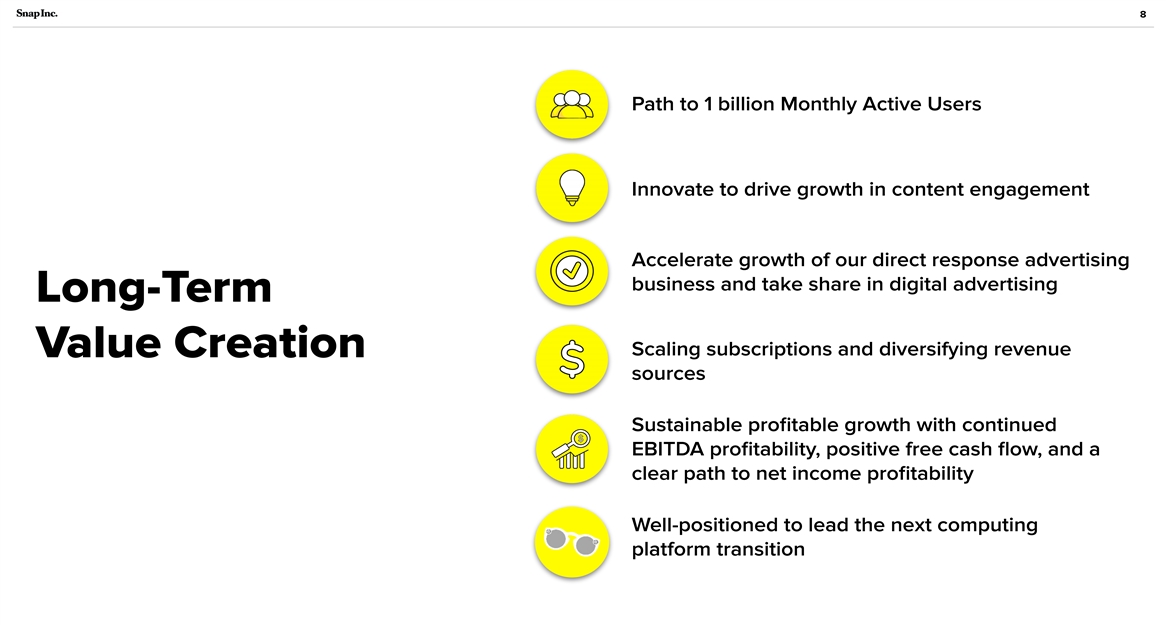
8 Path to 1 billion Monthly Active Users Innovate to drive growth in content engagement Accelerate growth of our direct response advertising business and take share in digital advertising Long-Term Scaling subscriptions and diversifying revenue Value Creation sources Sustainable profitable growth with continued EBITDA profitability, positive free cash flow, and a clear path to net income profitability Well-positioned to lead the next computing platform transition
9 Non-GAAP Measures To supplement our consolidated financial statements, which are prepared and presented in accordance with GAAP, we use certain non-GAAP financial measures, as described below, to understand and evaluate our core operating performance. These non-GAAP financial measures, which may be different than similarly titled measures used by other companies, are presented to enhance investors’ overall understanding of our financial performance and should not be considered a substitute for, or superior to, the financial information prepared and presented in accordance with GAAP. We use the non-GAAP financial measure of Adjusted EBITDA, which is defined as net income (loss), excluding interest income; interest expense; other income (expense), net; income tax benefit (expense); depreciation and amortization; stock-based compensation expense; payroll and other tax expense related to stock-based compensation; and certain other items impacting net income (loss) from time to time. We believe that Adjusted EBITDA helps identify underlying trends in our business that could otherwise be masked by the effect of the expenses that we exclude in Adjusted EBITDA. We use other non-GAAP financial measures such as Adjusted Cost of Revenue and Adjusted Operating Expenses (which is composed of Adjusted Research and Development Expenses, Adjusted Sales and Marketing Expenses, and Adjusted General and Administrate Expenses). These measures are defined as their respective GAAP expense line items, excluding interest income; interest expense; other income (expense), net; income tax benefit (expense); depreciation and amortization; stock-based compensation expense; payroll and other tax expense related to stock-based compensation; and certain other items impacting net income (loss) from time to time. We believe that these non-GAAP financial measures provide useful information about our financial performance, enhance the overall understanding of our past performance and future prospects, and allow for greater transparency with respect to key metrics used by our management for financial and operational decision-making. We are presenting these non-GAAP measures to assist investors in seeing our financial performance through the eyes of management, and because we believe that these measures provide an additional tool for investors to use in comparing our core financial performance over multiple periods with other companies in our industry. We have not reconciled our first quarter and full year 2026 estimates for non-GAAP financial measures to GAAP due to the uncertainty and potential variability of expenses that may be incurred in the future. Accordingly, a reconciliation is not available without unreasonable effort and we are unable to address the probable significance of the unavailable information.