SECURITIES AND EXCHANGE COMMISSION
Washington, D.C. 20549
FORM 6-K
Report of Foreign Private Issuer
Pursuant to Rule 13a-16 or 15d-16 of the
Securities Exchange Act of 1934
For the month of May, 2026
Commission File Number 1565025
AMBEV S.A.
(Exact name of registrant as specified in its charter)
AMBEV S.A.
(Translation of Registrant's name into English)
Rua Dr. Renato Paes de Barros, 1017 - 3rd
Floor
04530-000 São Paulo, SP
Federative Republic of Brazil
(Address of principal executive office)
Indicate by check mark whether the registrant files or will file annual reports under cover Form 20-F or Form 40-F.
Form 20-F ___X___ Form 40-F _______
Indicate by check mark whether the registrant by furnishing the information contained in this Form is also thereby furnishing the information to the Commission pursuant to Rule 12g3-2(b) under the Securities Exchange Act of 1934.
Yes _______ No ___X____
Table of Content
| 1 |
1.1 – Issuer’s history
Ambev S.A. (“Company” or “Ambev”) was incorporated on July 8, 2005. However, its history began decades ago, as Ambev is the successor of Brahma and Antarctica, two of the oldest brewers in Brazil. Antarctica was founded in 1885 and Brahma in 1888, as Villiger & Cia. The Brahma trademark was registered on September 6, 1888, and, in 1904, Villiger & Cia. changed its name to Companhia Cervejaria Brahma.
On December 7, 2012, Companhia de Bebidas das Américas – Ambev announced its intention to propose to its shareholders a corporate restructuring aimed at migrating its ownership structure then in force, with two classes of shares (ordinary and preferred), to one with a single type of common shares, aiming to simplify the corporate structure and improve the governance of Companhia de Bebidas das Américas – Ambev, increasing share liquidity and the flexibility of the management of its capital structure.
On March 1, 2013, the Company had its name changed to Ambev S.A. and its corporate purpose was changed, which became, among others: (i) the production and trading of beer, soft drinks and other drinks, as well as food in general; (ii) the production and trading of beverage raw materials; (iii) the production, certification and trading of seeds and grains; (iv) agricultural cultivation and promotion activities; (v) the import and export of products; and (vi) the operation of bars, restaurants and snack bars.
The proposal submitted to shareholders of Companhia de Bebidas das Américas – Ambev, by means of a Material Fact published on May 10, 2013, foresaw that the restructuring would be accomplished through the merger, by the Company, of all of the shares issued by Companhia de Bebidas das Américas – Ambev which were not owned by the surviving company, under the terms of Law No. 6,404/1976 (“Merger of Shares”) in which all of the shares issued and outstanding of Companhia de Bebidas das Américas – Ambev, including shares in the form of American Depositary Receipts (“ADRs”), except shares and ADRs of Companhia de Bebidas das Américas – Ambev held by the Company, should be exchanged for common shares and ADRs issued by the Company. By virtue of the Merger of Shares, each share issued by Companhia de Bebidas das Américas – Ambev, whether common or preferred, or ADR representative of a share, common or preferred, of Companhia de Bebidas das Américas – Ambev, would make its holder entitled to receive five common shares issued by the Company or five ADRs of the Company, as appropriate.
On May 10, 2013, the Board of Directors and the Fiscal Council of Companhia de Bebidas das Américas – Ambev held meetings, and there was a meeting of the Company’s Board of Directors, in which these bodies approved the Merger of Shares proposal, pursuant to the terms of the Merger of Shares Protocol and Justification issued by Companhia de Bebidas das Américas – Ambev by Ambev S.A.
As a preliminary step to the Merger of Shares, on June 17, 2013, the contribution to the capital stock of the Company of all of the shares issued by Companhia de Bebidas das Américas – Ambev owned by Anheuser-Busch InBev S.A./NV (“ABI”), held through InterBrew International GMHB (formerly called InterBrew International B.V.) and AmBrew S.à.r.l (formerly AmBrew S.A.) was made. As a result, the Company became the holder of 1,301,670,110 common shares and 637,049,453 preferred shares issued by Companhia de Bebidas das Américas – Ambev, thus becoming its controlling shareholder. The contribution had no effect for the purposes of the proposed replacement ratio in the Merger of Shares or for the dilution of Companhia de Bebidas das Américas – Ambev shareholders.
| 2 |
On July 30, 2013, the extraordinary general meetings of Companhia de Bebidas das Américas – Ambev and of the Company were held, which approved, among other issues, the Protocol and Justification of the Merger of Shares issued by Companhia de Bebidas das Américas – Ambev by Ambev S.A., the valuation report of the shares and the Merger of Shares, as well as the increase in the Company’s capital subscribed by the management of Companhia de Bebidas das Américas – Ambev and fully paid through the transfer of all shares of Companhia de Bebidas das Américas – Ambev, excluding those held by the Company.
As a result of the Merger of Shares, Companhia de Bebidas das Américas – Ambev became a wholly-owned subsidiary of the Company and the former shareholders of Companhia de Bebidas das Américas – Ambev became holders of the same proportion of shares in the Company that they had previously held in Companhia de Bebidas das Américas – Ambev.
On October 30, 2013, CVM granted the Company’s registration as a category “A” securities issuer, pursuant to CVM Resolution 80, of March 29, 2022. The Company’s shares and ADRs were admitted for trading, respectively, on the Bolsa de Valores, Mercadorias e Futuros – BM&FBOVESPA S.A., currently known as B3 S.A. – Brasil, Bolsa, Balcão (“B3”) Exchange and on the New York Stock Exchange (“NYSE”), on November 11, 2013.
Through the Material Fact published on December 3, 2013, the proposed mergers into the Company, of Companhia de Bebidas das Américas – Ambev, and of Ambev Brasil Bebidas S.A. was disclosed. The mergers aimed at simplifying the group’s corporate structure and at reducing operating costs, so that the Company would continue to engage in the production and trade of beer, concentrates, soft drinks, and other beverages, directly, and no longer only through its wholly owned subsidiaries, as applicable.
On January 2, 2014, the extraordinary general meetings of the Company, of Companhia de Bebidas das Américas – Ambev and of Ambev Brasil Bebidas S.A. were held, through which the above-mentioned mergers were approved. As a result of the mergers, the Company received, for their respective book values, all of the assets, rights, and obligations of Companhia de Bebidas das Américas – Ambev, and of Ambev Brasil Bebidas S.A., which were extinguished, had their shares canceled, and were then succeeded by the Company, under the law.
The merger of Companhia de Bebidas das Américas – Ambev was completed without an increase or decrease in the Company’s equity or capital, since Companhia de Bebidas das Américas – Ambev was a wholly-owned subsidiary of the Company. The merger of Ambev Brasil Bebidas S.A., in turn, resulted in an increase in the Company’s capital in an amount equivalent to the portion of the equity of Ambev Brasil Bebidas S.A. corresponding to the investment of the minority shareholders of Ambev Brazil, i.e., R$156,566.05, with the Company’s capital going on to be R$57,000,946,244.65, considering the capital increases approved and homologated by the Board of Directors at meetings held on October 17, 2013 and December 19, 2013, pursuant to Article 8 of the Company’s Bylaws and Article 168 of Law No. 6,404/1976, due to the exercise of share purchase options by the beneficiaries of the Company’s Stock Option Plan.
The Company and E. León Jimenes, S.A. (“ELJ”), as the shareholders of Tenedora CND, S.A. (“Tenedora”), a holding company headquartered in the Dominican Republic, the owner of almost the entire share capital of Cervecería Nacional Dominicana, S.A., on July 2, 2020, signed the second amendment to the Tenedora’s Shareholders’ Agreement (the “Shareholders’ Agreement”), extending their partnership in the country and postponing the term for the exercise of the put and call options set forth in said Shareholders’ Agreement. In December 2023, ELJ was the owner of 15% of the Tenedora’s shares and its put option was divided into two tranches: (i) Tranche A, corresponding to 12.11% of the shares; and (ii) Tranche B, corresponding to 2.89% of the shares, exercisable starting in 2026 (or before that date in the event of a change of control of Tenedora or sale of all or substantially all of its assets). The Company, on the other hand, has a call option over the Tranche B shares, exercising starting in 2029.
| 3 |
On January 31, 2024, ELJ exercised the option to sell the entirety of Tranche A to the Company, in accordance with the provisions of the Shareholders' Agreement. Ambev settled the put option of Tranche A through: (i) cash disbursement of approximately R$ 1,704 million, which was paid by the Company to ELJ; and (ii) compensation of the ELJ’s debt held by CND in the amount of R$ 335 million. As a result of this transaction, the Company increased its interest in Tenedora from 85% to 97.11%, with the remaining interest of 2.89% held by ELJ and subject to the Tranche B put option described above.
On December 26, 2024, the Company's subsidiary, Cervecería Nacional Dominicana S.A. (“CND”), and Koscab Holdings Limited (“Koscab”) entered into a Share Purchase Agreement pursuant to which CND agreed to transfer all of its shares held in the holding company SLU Beverages LTD. (“SLU”) to Koscab. SLU is a majority shareholder of Banks Holdings Limited, Saint Vincent Brewery Limited, Antigua Brewery Limited and Dominica Brewery & Beverages Limited, which are part of the Central America and Caribbean Region (“CAC”) reportable segment.
The transfer of the entire interest shall be in consideration for the payment of the minimum amount estimated at US$ 186 million, corresponding to R$1,023 million, deferred by up to five tranches by 2028. The completion of the first two tranches occurred on July 31, 2025 and, as a result, CND transferred to Koscab 61.83% of the interest it held in SLU, for the price of US$ 115 million, corresponding to R$ 633 million. With such completion, the Company recognized the loss of control over SLU, ceasing its consolidation in the audited consolidated financial statements for the period ended September 30, 2025.
| 4 |
1.2 – Description of the main activities developed by the issuer and its subsidiaries
Overview
Ambev is the successor of Brahma and Antarctica, two of the oldest brewers in Brazil. Antarctica was founded in 1885. Brahma was founded in 1888 as Villiger & Cia. The Brahma trademark was registered on September 6, 1888, and, in 1904, Villiger & Cia. changed its name to Companhia Cervejaria Brahma. However, the legal entity that has become Ambev S.A., the current NYSE and B3 listed company, was incorporated, on July 8, 2005, as a non-reporting Brazilian corporation under the Brazilian Corporation Law and is the successor of Companhia de Bebidas das Américas – Ambev (“Old Ambev”). Until the stock swap merger of Old Ambev by Ambev S.A., approved in July 2013, Ambev S.A. did not conduct any operating activities and had served as a vehicle for ABI to hold a 0.5% interest in Old Ambev’s capital stock.
In the mid-1990s, Brahma started its international expansion into Latin America, and since then we have been buying assets in different parts of the continent including South America, Central America and the Caribbean.
In the late 1990s, Brahma obtained the exclusive rights to produce, sell and distribute Pepsi products throughout Brazil, and since then we have been distributing these products throughout that country. In addition, certain of our subsidiaries have franchise agreements for Pepsi products in Argentina, Bolivia, Uruguay, Panama and the Dominican Republic.
In the early 2000s, we acquired a 40.5% interest in Quinsa and the joint control of that entity, which we shared temporarily with Beverages Associates Corp. (“BAC”), the former sole controlling shareholder of Quinsa. This transaction provided us with a leading presence in the beer markets of Argentina, Bolivia, Paraguay and Uruguay, and also set forth the terms for the future acquisition of Quinsa’s full control from BAC. In April 2006, we increased our equity interest in Quinsa to 91% of its total share capital, after which we started to fully consolidate Quinsa upon the closing of that transaction in August 2006.
In August 2004, we and a Belgian brewer named Interbrew S.A./N.V. (as ABI was then named) (“Interbrew”) completed a business combination that involved the merger of an indirect holding company of Labatt Brewing Company Limited (“Labatt”) one of the leading brewers in Canada, into us. At the same time, our controlling shareholders completed the contribution of all shares of an indirect holding company which owned a controlling stake in us to Interbrew in exchange for newly issued shares of Interbrew. After this transaction, Interbrew changed its company name to InBev S.A./N.V. (“Inbev”) and, since 2008, to ABI and became our majority shareholder.
Ambev is the largest brewer in Latin America in terms of sales volume and one of the world’s largest brewers, according to the Company estimates. Ambev currently produces, distributes and sells beer, soft drinks, other alcoholic beverages and non-alcoholic and non-carbonated products directly in 11 countries in the Americas.
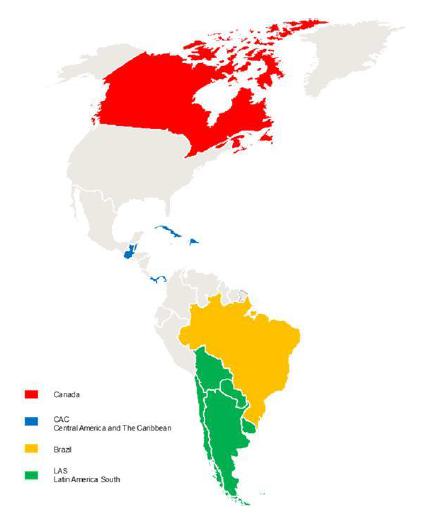
The Company conducts its operations through four business segments, as described below:
• Brazil: beer sales division (“Beer Brazil”) and non-alcoholic beverage sales division (“NAB Brazil”);
• Central America and the Caribbean (“CAC”): Dominican Republic, Cuba, Guatemala and Panama;
| 5 |
• Latin America South (“LAS”): Argentina, Bolivia, Paraguay, Uruguay and Chile; and
• Canada: operations of Labatt in Canada.
The following map illustrates the main locations where the Company’s business units operate:
| Main Financial and Operational Indicators | Fiscal year ended on December 31, | |
| (in millions of reais, except percentages) | 2025 | 2024 |
| Financial Information | ||
| Net Revenue | 88,242.5 | 89,452.7 |
| Net income | 15,988.4 | 14,847.0 |
| Normalized EBITDA | 29,506.4 | 29,028.9 |
| Normalized Operating Income | 22,674.3 | 21,902.5 |
| Shareholders’ equity | 88,774.8 | 99,580.5 |
| Loans and Financing – Current | 1,167.3 | 1,276.4 |
| Loans and Financing – Non-Current | 2,219.6 | 2,176.3 |
Our Strategies
We aim to create value for our stockholders and communities where we operate. The main components of our business strategy are:
· our people and culture;
· our strategic pillars;
· quality of our products;
· sustainability guidelines and trends;
· permanent cost efficiency;
· financial discipline; and
| 6 |
· customer convenience.
People and Culture
We dream big to create a future with more reasons to cheers. We continuously seek new ways to be present in life’s moments, drive our industry, and make a meaningful impact on the world. That is why our people are the foundation of our Company. Our focus is on developing outstanding, engaged teams that create sustainable value, reinforcing mindset and behaviors supporting a high-performance culture. We carefully manage our hiring and training process to develop skills, allocate people to appropriate roles and strengthen our talent pipeline over the long term. Our teams have the skills and expertise necessary to achieve our long-term objectives, supported by continuous development and leadership practices that promote mastery and accountability. We live our culture every day to continue evolving as an organization and retain top talent. We also operate through an organizational design that prioritizes simplicity and clear responsibilities, strengthened by systems that enable effective performance management. In addition, our compensation programs, which combine variable compensation and equity-based compensation, are designed to align incentives with long-term value creation and high performance.
Strategic Pillars
We focus our efforts on the following strategic pillars to lead and grow the category, digitize and monetize our ecosystem, as well as optimize our business:
Lead and Grow the Category: The beer category is big, profitable, and growing, and we believe we are well positioned to lead and grow the category due to our unparalleled footprint, industry-leading portfolio of brands and operational capability.
Digitize and Monetize Our Ecosystem: We aim to unlock value with our existing assets and expand our addressable market through the digitization and monetization of our ecosystem. We aim to enhance the value of our core business through the BEES platform, digital direct-to-consumers solutions and other new business opportunities.
Optimize Our Business: Our objective is to optimize our business and maximize our long-term value creation by focusing on three areas: disciplined resource allocation, robust risk management and an efficient capital structure. We aim to invest in our operations and in the growth of our business while dynamically balancing our leverage, returning cash to shareholders, and pursuing selective mergers and acquisitions.
Quality of our Products
We brew a wide variety of beers, including ales, lagers, clear and full-bodied beers, amongst others, offering consumers a unique portfolio of high-quality beers designed to satisfy different needs and tastes across different occasions. We also produce several non-alcoholic products, such as soft drinks and energy drinks. The quality of our products is at the front of our priorities. We have strict processes, with more than 1,300 controls and more than 370 tests across our production lines, as we aim to provide our consumers with products matching the highest possible standards. Our research and development (“R&D”) team is also constantly working to enhance our production process and the quality of our products.
Sustainability
Sustainability has been a core part of the Company's strategy since its organization, guided by a long-term approach with multiple stakeholders, seeking to create value with a positive and transformative socio-environmental impact. Over the years, we have set ambitious sustainability commitments, and worked with discipline to achieve them. In Brazil, the Company met all its sustainability commitments established for 2025 cycle. Throughout this period, we focused on four sustainability goals, the progress of which is reported below:
| 7 |
(i) sustainable agriculture: In 2025, the Company achieved its sustainable agriculture commitment to 100% its direct farmers trained, connected and financially empowered, through local programs and partnerships around the world;
(ii) water management: the Company achieved its commitment to water management, with 100% of the sites located in areas of high water stress showing significant improvement in water availability and quality. The Company's water efficiency indicator measures the hectoliters of water needed to produce a packaged hectoliter of final product. In 2025, the Company achieved a global water use efficiency index of 2.38 hl/hl, representing an improvement of 19.1% since 2017. At high water stress sites, the Company achieved an efficiency index of 2.05 hl/hl, reinforcing the progress in relation to the scope of the water management commitment for 2025;
(iii) circular packaging: in 2025, the Company reached 70.5% of its packaging in returnable formats or made predominantly from recycled content. Brazil achieved 100% of this indicator. On a consolidated basis, we did not achieve 100% due to challenges related to the availability of viable recycled content – strongly dependent on local recycling chains – and the dynamic market conditions, especially in the glass and PET packaging industries; and
(iv) climate action: the Company reduced greenhouse gas (GHG) emissions across Scopes 1, 2 and 3, per hectoliter of production, by 25.8%, achieving the commitment to reduce emissions intensity of 25%. The Company also continued to make improvements in the energy transition, achieving 97.5% of electricity arising from renewable sources across all operations –the difference in relation to the commitment to the 100% target is due to structural and regulatory challenges in one of the countries where we operate.
With regard to Scope 3 emissions, which currently represent the Company’s largest share of emissions, the Company has been working collaboratively with its key suppliers to decarbonize the value chain, mainly through the “Eclipse Program”, which aims to engage suppliers and partners in increasing carbon data transparency, as well as training and strengthening the capabilities of our teams, in order to promote consistent reductions in greenhouse gas (GHG) emissions.
The Company’s main sustainability aspects were established in accordance with a materiality matrix, which includes the topics presented in item 1.9 (e) of this Reference Form.
Productive Inclusion
BORA is the Ambev’s productive inclusion program, which is structured around three pillars: (i) knowledge, (ii) financial support, and (iii) connections. Through BORA, we provide, free of charge, business expansion and improvement tools for micro and small entrepreneurs, as well as knowledge trails focused on entrepreneurship and inclusion in the job market for communities.
Furthermore, focused on productive inclusion, we offer financial solutions with scoring programs and personalized microcredit options, in addition to scholarships. We invest significantly in connecting with partners for networking and referring vacancies and professionals through a virtual platform, contributing to the generation of jobs and income. Additional information is detailed in the Company’s Annual and Sustainability Report, available on the Company’s Investor Relations website (https://ri.ambev.com.br).
| 8 |
Responsible Consumption
We want every experience with our products to be positive. It is our responsibility to promote the proper consumption of our products aiming the consumer safety. We believe that moderation is an important component for moments of celebration to be memorable, without losing balance.
Therefore, we invest in initiatives that include launching awareness and behavior change campaigns at major events and in the media, developing innovative technologies, and expanding our portfolio to offer high-quality, zero-alcohol beer alternatives. Moderation is consistently promoted and integrated into our projects. For more details and information, see item 1.9 of this Reference Form and the Company’s Annual and Sustainability Report available on the Company’s Investor Relations website (https://ri.ambev.com.br).
Permanent Expenses and Cost Efficiency
Cost and expense control is among our employees’ priorities. Each department must observe its respective annual budget for fixed and variable costs and expenses, in line with the guidelines and goals established by the Company. To avoid unnecessary expenses and waste, and promote greater efficiency in resource allocation, we have designed a management control system inspired by the concept of “zero-based budgeting” which requires each manager to build, from scratch, an annual budget for their respective department, justifying their key cost and expense needs.
Financial Discipline
Our focus is not only on volumes and operating performance, but also on the disciplined management of our working capital and our cash flow generation. Our objective is to maximize the return to our shareholders through a combination of payments of dividends and interest on shareholders’ equity, while at the same time keeping our investment plans and holding an adequate level of liquidity to accommodate the seasonality of our business and cope with often volatile and uncertain financial market conditions.
Customer Convenience - Zé Delivery, TaDa and BEES
In order to increase convenience to our consumers, we seek to develop solutions to deliver on demand cold beverages, at reasonable prices, directly to consumers. We believe that our solutions solved several pain points identified in the consumers’ buying journey: (i) late hours availability, (ii) fast service that is time saving for consumers, (iii) reasonable prices, and (iv) cold products ready to be consumed.
In Brazil, our direct-to-consumer platform, Zé Delivery, continuing to expand its reach and increasing engagement in 2025, being now present in more than 800 cities across all 27 Brazilian states and reaching almost 70% of the country’s entire population. Zé Delivery delivered more than 66 million orders in 2025, and had more than 27 million annually active users on December 31, 2025. The levels of satisfaction remained strong, supported by a broader range (including premium offerings) and accessibility initiatives, such as returnable packaging, while the platform also served as a relevant source of consumer insights.
| 9 |
In LAS, TaDa, in Argentina, result of the incorporation of the App Bar by the direct deliver to consumer platforms named Siempre en Casa and Craft Society, had a challenging 2025 due to the country's economic situation. The platform is present in 38 cities, with approximately 350 thousand orders, having recorded a 38% decrease in order volume made by 41% of monthly active users in relation to the previous year, as the macroeconomic conditions continue to pressure the consumption in the country.
In CAC, TaDa, in Dominican Republic, continued to expand in 2025, with the number of orders increasing by 5.1% in 2025 compared to 2024 and monthly active users decreasing by 13% in 2025 compared to 2024.
Our B2B marketplace and route-to-market platform, BEES, centralizes different solutions on a single platform 24/7 (24 hours a day, 7 days a week), creating a constant and personalized point of contact with our customers and improving our level of service by: (i) providing product suggestions based on customer profile and product relevance, (ii) providing improvements in order tracking and real-time support through the app, (iii) allowing our business representatives to focus on helping customers improve their sales performance (sell out), and (iv) increasing total interaction time with our customers, directly collaborating with our innovation strategy and greater portfolio complexity. In the BEES marketplace, our customers can also purchase non-Ambev products from different categories, enjoying the convenience provided by our platform.
In Brazil, we continued to implement BEES and, currently, more than 94% of our active customers are purchasing through the platform. As part of our digital strategy plan, almost 90% of our customers currently purchase exclusively through BEES. In the BEES marketplace, we currently offer over 600 stock keeping units (“SKUs”) in different categories, such as food products, non-alcoholic beverages, and spirits. The number of customers purchasing on the marketplace corresponded to nearly 86% of BEES customers in the year ended December 31, 2025.
In LAS, our digital transformation journey is also evolving with the implementation of BEES. In Argentina, more than 86% of B2B customers are purchasing through BEES and more than 80% of the country’s net revenue comes from the platform. The number of customers purchasing on the marketplace corresponded to more than 32% of BEES customers in the year ended December 31, 2025. In Paraguay, 83% of direct and indirect B2B sales are made through BEES, with fully digital buyers representing 82% of the total number of customers in the year ended December 31, 2025. In Bolivia, 78% of direct and indirect B2B sales are made through BEES, with fully digital buyers representing 94% of the total number of customers in the year ended December 31, 2025.
In CAC, Dominican Republic continues to lead the expansion of the BEES platform, actively sharing know-how and best practices with other operations. The country has already reached the status of full digital operation, with 100% of B2B customers already making purchases through the platform, and 100% of the country’s net revenue already coming from BEES in 2025. We are also exploring the BEES marketplace in the country, offering 18 different categories and approximately 320 SKUs to our customers from December 31, 2025. In Panama, we also continued implementing BEES, which reached 100% of the country’s net revenue, in the year ended December 31, 2025, coming from the platform.
In Canada, BEES continues to evolve its scale and offerings. BEES is active in the Provinces of Alberta, British Columbia, Newfoundland and Labrador, Saskatchewan and Quebec. In 2025, orders through BEES accounted for approximately 22% of the business's net revenue in Canada, with Quebec accounting for the majority of the orders placed using BEES. Approximately 8,100 customers made purchases through BEES in Canada in 2025. The BEES' marketplace also continued to evolve in Canada in 2025, offering 75 SKUs unique from 10 third-party partners.
| 10 |
Our Weaknesses, Obstacles and Threats
The weaknesses, obstacles and threats to us, our business and financial condition are related to the realization of one or more adverse scenarios contemplated in our risk factors, occurring together. For more information, see the items “4.1 Risk Factors” and “4.3 Market Risks” of this Reference Form.
| 11 |
1.3 - Information related to the operating segments
(a) Goods and services sold
The Company’s activities are carried out through four operating segments, as disclosed in its financial statements: Brazil, Central America and the Caribbean (CAC), Latin America South (LAS) and Canada. In the last fiscal year, the Company’s revenues were the result mainly of operations involving the production and marketing of beer, soft drinks and other non-carbonated drinks, malt and byproducts.
(b) Income from the segment and its share in the Company’s net income
The table below features a few highlights of the financial information per business segment for the years ended as of December 31, 2025 and 2024:
|
Net revenue from sales (in million of reais, except %) | |||||
| Fiscal year ended December 31, 2025 |
% Contrib. |
Fiscal year ended December 31, 2024 |
% Contrib. |
% Variation | |
| Brazil | 49,030.8 | 55.6% | 48,605.3 | 54.3% | 0.9% |
| Beer Brazil(1) | 40,230.6 | 45.6% | 40,220.2 | 45.0% | 0.0% |
| NAB Brazil(2) | 8,800.1 | 10.0% | 8,385.2 | 9.4% | 4.9% |
| CAC(3) | 10,963.9 | 12.4% | 11,023.7 | 12.3% | -0.5% |
| Latin America South | 17,988.3 | 20.4% | 19,829.7 | 22.2% | -9.3% |
| Canada | 10,259.5 | 11.6% | 9,993.9 | 11.2% | 2.7% |
| Total | 88,242.5 | 100.0% | 89,452.7 | 100.0% | -1.4% |
(1) Company’s beer and “beyond beer” operation in Brazil.
(2) Non-alcoholic beverages.
(3) Beer and soft drinks operation in Central America and the Caribbean.
(c) Profit or loss resulting from the sector and its share in the Company’s net income
|
Net income (in million of reais, except %) | |||||
| Fiscal year ended December 31, 2025 |
% Contrib. |
Fiscal year ended December 31, 2024 |
% Contrib. |
% Variation | |
| Brazil | 10,024.9 | 62.7% | 9,075.6 | 61.1% | 10.5% |
| Beer Brazil(1) | 7,853.9 | 49.1% | 6,990.8 | 47.1% | 12.3% |
| NAB Brazil(2) | 2,171.0 | 13.6% | 2,084.9 | 14.0% | 4.1% |
| CAC(3) | 3,042.0 | 19.0% | 2,471.4 | 16.6% | 23.1% |
| Latin America South | 1,394.7 | 8.7% | 2,110.8 | 14.2% | -33.9% |
| Canada | 1,526.8 | 9.5% | 1,189.1 | 8.0% | 28.4% |
| Ambev Consolidated | 15,988.4 | 100.0% | 14,847.0 | 100.0% | 7.7% |
(1) Company’s beer and “beyond beer” operation in Brazil.
(2) Non-alcoholic beverages.
(3) Beer and soft drinks operation in Central America and the Caribbean.
| 12 |
1.4 - Production/Marketing/Markets
(a) Characteristics of the Production Process
Beer
The basic manufacturing process for most beers is linear, involving, however, significant knowledge in quality and cost control. The most important stages are mash and fermentation, followed by aging, filtering, and packaging. Although malted barley (malt) is the main ingredient, other grains, such as non-malted barley, maize, rice or wheat are sometimes added to produce different beer flavors. The proportion and choice of other raw materials vary according to regional taste preferences and to the type of beer.
The first step in the mashing process is the production of the mash, blending the malt with hot water and gradually heating it to about 75° C in mixing tanks to dissolve the starch and transform it into a mixture called “mash,” comprising maltose and other sugars. The grains used are filtered and the liquid, now called “wort,” is boiled. At this point, hops are added, giving the beer its special bitter taste and flavor and helping to preserve it. The wort is boiled for one to two hours to sterilize and concentrate it and to extract the flavor from the hops. The product is then cooled using a heat exchanger. The hopped wort is saturated with air and oxygen, essential for the creation of yeast at the next stage.
Yeast is a microorganism that consumes the sugars contained in the mash, generating alcohol and CO2. This fermentation process takes 5 to 11 days to be completed, after which the wort is finally transformed into beer. Different types of beer are produced using different yeast filtering processes and wort compositions. In some varieties of yeast, the cells reach the top at the end of the fermentation process. Alcoholic beverages and wheat beers are made this way. Pilsen beers are produced using yeast cells that settle to the bottom.
During the maturation process, the liquid is cleared by the precipitation of yeast and other particles. Additional filtering clears beer further. Maturation varies according to the type of beer and may take up to three weeks to be completed. After this period, the beer is ready for bottling in kegs, cans, or bottles.
Soft drinks
Soft drinks are made by mixing water, flavored concentrate, and sugar or sweetener. Water is processed to eliminate the mineral salts and filtered to remove impurities. Purified water is combined with processed sugar or, in the case of diet soft drinks with concentrated sweeteners. Carbon dioxide gas is injected into the mixture to produce carbonation. Immediately after carbonation, the mixture is bottled. In addition to these inputs, distributing the product to consumers requires packaging such as PET or glass bottles, aluminum cans, labels, and plastic or metal caps. The technology used in the soft drink manufacturing process is common to the market, with no need to own unique equipment or technologies to carry it out.
Non-Alcoholic and Non-Carbonated Beverages
The non-alcoholic and non-carbonated beverage production process begins with the dissolution of the sugar at the amounts described in the preparation formulation, and of simple syrup in fresh, dechlorinated water in stainless steel tanks, with homogenization.In the case of alcoholic beverages, alcohol is also included in this mixture. The syrup is heated and transferred, via piping, to the plate filter and then cooled by a plate exchanger. Bottling begins with the dissolution, in the product preparation tank, of the citric acid and mineral salts previously dissolved in dechlorinated water. Flavoring is then added at the amount provided for in the formulation. All of these steps take place under homogenization. To ensure the product’s microbiological preservation, it is subjected to flash pasteurization and packaged aseptically to, then, be labeled and boxed. The Company currently uses specific indicators to measure productivity and efficiency, such as extract loss; carbon dioxide balance; water consumption; infusorial earth consumption, and heat energy consumption. The technology used in the non-alcoholic and non-carbonated beverage manufacturing process is common to the market, with no need for unique equipment or technologies to carry it out.
| 13 |
Installed capacity
For illustrative purposes, we report that, in 2025, the Company’s total beer and non-alcoholic beverages production capacity was 233 million hectoliters per year. In 2025, the Company’s beer and non-alcoholic beverages production totaled 171 million hectoliters.
Maintenance
The Company’s equipment maintenance process is carried out at least annually, always in a reverse cycle to production peaks.
Risks inherent to the process
The risks inherent to the production process and distribution that may lead to activity shutdowns, such as fire, explosions, labor strikes, among others, exist, but the impacts of such occurrences are minimized in the Company’s operations. For example, if there is an unexpected shutdown of a plant, we can transfer production to another plant with no loss to supply in most cases. However, in the period of the greatest use of the capacity due to business seasonality, the Company may experience some losses due to the loss of part of the sales volume, but this will have no significant impact on its results. In addition, all of the Company’s plants and distribution centers hire insurance for the event of accidents.
Productivity indicators
There are several productivity, efficiency and quality indicators in the beverage industry, such as water consumption, energy, extract use, among others. The Company establishes internal goals that approach the results of such indicators. In the last 7 years, we have achieved a reduction of more than 19% in water consumption per hectoliter produced, reaching 2.38 hl/hl in 2025. This advance was possible through initiatives such as standardization of processes, recovery and reuse of water, implementation of reuse stations with high technology and export of treated wastewater to other users of the basin. The average efficiency of treatment and removal of impurities in wastewater treatment exceeds 99%. In 2025, the Company saved about 40.285 thousand m³ of water per month on our operations, only with reused water, which is used in industrial processes. In addition, 178.496 thousand m³ of treated wastewater per month in this process were used by communities in some regions where we operate, saving water that would otherwise be taken from the river-basins.
(b) Characteristics of the distribution process
i. Brazil
| 14 |
Beer distribution is an important feature in this market since the retail channel is fragmented into approximately one million points of sale. On December 31, 2025, the Company’s distribution was structured in two separate ways, depending on the sales channel profile and its geographical location, namely: (i) network of exclusive third-party distributors, involving 207 operations; and (ii) the owned direct distribution system, involving more than 89 distribution centers across most Brazilian regions and using outsourced logistics without their own fleet of trucks. The direct distribution centers, as well as the factories, are owned by the Company or its subsidiaries and have their own teams of salespeople to access various sales channels such as bars, supermarkets, bakeries, restaurants, convenience stores, and grocery stores. The exclusively outsourced distributor networks have no corporate relationships with the Company and have their own sales teams to access the sales channels in different regions through its direct distribution. The sale can also be made directly from the factory to a few larger customers.
In addition, in order to make the shopping experience more practical and convenient for our retail customers and end consumers, we have launched innovative digital platforms to quickly deliver our products at affordable prices (Zé Delivery and BEES), offering these customers a personalized experience. Such platforms, which are the result of continued investments in technology and innovation, have driven our business not only in sales performance, but mainly in the value they create for our ecosystem, especially for our costumers and consumers.
The soft drink and non-alcoholic and non-carbonated beverage segment products are sold through the same distribution system used for beer, as described above.
ii. Central America and the Caribbean
The distribution system on the Central America and the Caribbean market comprises direct distribution and third-party distributor operations. The owned direct distribution centers, as well as the plants, are owned by the Company or its subsidiaries and have their own teams of salespeople to access various sales channels such as bars, supermarkets, bakeries, restaurants, convenience stores, and grocery stores. The exclusively outsourced distributor networks have no corporate relationships with the Company and have their own sales teams to access the same sales channels that are accessed by the Company’s own direct distribution. Direct distribution is done through outsourced logistics, with the exception of the Dominican Republic, which has its own truck fleet.
According to our estimates, we currently lead the beer market in Panama. In Panama, the distribution systems cover direct and third-party distribution operations. The own direct distribution centers, as well as plants, belong to the Company or to its subsidiaries and count on an own sales team to access several sales channels. The third-party distribution networks do not have a corporate relationship with the Company and have their own sales team. In addition, our sales may be performed directly by the Company for some larger clients. Our Panamanian business also produces and commercializes soft drinks, under franchise, being Pepsi, Canada Dry and Squirt the main brands distributed.
In the Central America operations, including El Salvador, Honduras and Nicaragua, beer is sold predominantly in returnable bottles at small retail stores. The Company markets the Brahva, Brahva Gold, Extra, Budweiser, Bud Light, Stella Artois, Corona, Modelo Especial, Beck’s, Leffe and Hoegaarden brands, which are distributed through the distribution system belonging to The Central America Bottling Corporation, (“CBC”), together with the CBC soft drink portfolio. CBC has its own fleet of trucks.
The Company and CBC, the PepsiCo bottler anchor in Central America, agreed to establish a joint venture in which the Company and CBC are holders of half of the capital of Ambev Central America, whose goal is collaboration in manufacturing, importing, distributing, marketing, and selling of beverages, especially beer, in Central American countries.
| 15 |
Operations through Outsourced Distributors
We also sell Budweiser, Bud Light, Michelob Ultra, Stella Artois, Corona, Modelo Especial, Presidente, Beck’s, Leffe and Hoegaarden, through outsourced distributors in Costa Rica, Venezuela, Aruba, Bahamas, Bermuda, Cayman Islands, Curacao, Guianas, French Guiana, Grenada, Guadeloupe, Jamaica, Martinique, Saint Martin, St. Kitts, St. Lucia, Suriname, Trinidad and Tobago, Turks and Caicos Islands and U.S. Virgin Islands.
iii. Latin America South
The Company distributes its products in all countries where it operates in Latin America South (Argentina, Bolivia, Chile, Paraguay and Uruguay) through direct distribution and also outsourced distributors. Provided that, in 2025, 100% of our beer volume in Chile were distributed through an exclusive outsourced distributor. The owned direct distribution centers, as well as the plants, are owned by the Company or its subsidiaries and have their own teams of salespeople to access various sales channels such as bars, supermarkets, bakeries, restaurants, convenience stores, and grocery stores. The exclusive outsourced distributor networks have no corporate relationships with the Company and have their own sales teams to access the points of sale, which are determined for each distributor and direct distribution, according to their geographical location. In addition, the sale can be made directly from the factory to a few larger customers.
iv. Canada
The Company’s distribution system in Canada is structured in different ways across the country, varying according to the specific characteristics of each region.
Distribution in Ontario
In Ontario, the province with the largest beer consumption in Canada, we are, together with a group of other brewers, owners of a retail, recycling and distribution joint venture Brewers Retail Inc., organized in 1927 and operating as The Beer Store (“TBS”). In 2024, the government of the Province of Ontario, TBS, Labatt, MolsonCoors and Sleeman entered into an Early Implementation Agreement (“EIA”), which specifies the TBS’ roles as a retailer and primary distributor and designated recycler of beer following expansion of the retail market for the sale of liquor in Ontario in 2024, and the termination of the Master Framework Agreement, or MFA, on December 31, 2025.
Following the implementation of the EIA in 2024, the channels through which eligible beers of all packaging sizes, wines and RTDs can be sold in Ontario include: (i) TBS, (ii) the Liquor Control Board of Ontario (“LCBO”), a chain of liquor stores owned by the government of the Province of Ontario, (iii) all eligible markets, (iv) eligible convenience stores; and (v) bars and restaurants. The LCBO maintains the unique ability to sell spirits both to consumers and bars and restaurants.
The EIA further stipulates the characteristics of the Ontario expanded liquor market and related distribution and recycling systems, including: (i) TBS will continue to have the right to maintain retail operations until at least January 1, 2033, (ii) TBS will continue to be the primary distributor of malt-based beer and RTDs to the existing channels and new grocery and convenience stores until January 1, 2031, (iii) TBS will have the ability to distribute non-alcoholic beverages, in addition to all types of alcoholic beverages (liquor), to retailers until January 1, 2031, (iv) TBS will continue to provide recycling services, and (v) maintains preexisting regulations in Ontario that prohibit commercial spending, applying them to scaled retail channels.
| 16 |
The nature of Labatts’ and TBS’ activities requires compliance with laws and regulations and supervision by the Alcohol and Gaming Commission of Ontario, or AGCO, and the LCBO. The Liquor Licensing and Control Act and its regulations are administered by the AGCO, which is an Ontario provincial regulatory agency reporting to the Ministry of the Attorney General and affiliated with the Ministry of Finance. The Province of Ontario and its agents, the AGCO and LCBO, oversee all aspects of the beverage alcohol sector.
Distribution in Quebec
Quebec is the Canadian province with the second highest consumption of beer. In this province, there are no exclusive rights for beer sales and sales channels for consumption, both within and outside of consumption establishments are mostly composed of private stores. SAQ, a liquor store controlled by the government, sells a few select beer brands that are not available in the private retail system.
The Company (and its competitors) sells its products in Quebec through a direct sales and distribution system.
Distribution in the Western Provinces and Territories
MolsonCoors and Labatt hold stakes in Brewers Distributor Limited, which operates a distribution network primarily for beer in the four western provinces of British Columbia, Alberta, Manitoba, and Saskatchewan and three territories (Yukon, the Northwest Territories and Nunavut). In Alberta, part of volume is also sold through a third-party wholesaler. In these Western Canadian markets there are both private retail stores (such as Alberta, British Columbia, and Saskatchewan) and government-controlled stores (such as British Columbia and Manitoba).
Distribution in the Atlantic Provinces
We distribute and sell our products in the Atlantic Provinces (including New Brunswick, Newfoundland, Nova Scotia, and Prince Edward Island) through (1) government-controlled distribution and retail networks in the provinces of Nova Scotia, New Brunswick, and Prince Edward Island; and (2) private distributors in Newfoundland.
(c) Characteristics of the markets of operation, in particular:
(i) Share in each of the markets
(ii) Conditions of competition in the markets
i. Brazil
| 17 |
The beer market in Brazil
In Brazil, the two main packaging presentations are (i) standardized, returnable glass bottles, widely available in 300-milliliter and 600-milliliter formats, sold in bars for on-premises consumption, as well as in supermarkets for off-premises consumption, and (ii) 350-milliliter one-way aluminum cans, which are predominantly sold in supermarkets for off-premises consumption.
According to our estimates, in 2025, we were the market leader in Brazil in terms of beer sale volumes, mainly through our three main families of brands: Skol, Brahma and Antarctica. Our closest competitor is The Heineken Company.
In the non-alcoholic beer segment, we operate mainly through Brahma 0.0%, launched in 2013, Budweiser Zero, launched in 2021, and Corona Cero, launched in 2022, and Skol Zero Zero, launched in 2026.
The Brazilian Beyond Beer market
Some of our products go beyond the typical beer consumption occasions, such as Beats, Brutal Fruit Spritzer and Flying Fish (a flavored beer launched in 2025). Such products were developed for new consumption occasions and consumer profiles, expanding our presence in other segments. Such innovations strengthen our Beyond Beer portfolio, a category we continue to evaluate in different regions and markets in Brazil.
The non-alcoholic beverages (NAB) market in Brazil
The NAB market in Brazil covers various segments, including soft drinks, bottled water, sports and energy drinks, coconut water, powdered and natural juices and iced tea. The soft drink segment is the most significant for our business, representing approximately 94% of the volume of our NAB unit, in 2025, and 49% of the affordable market. The most relevant formats for the category are the non-returnable 1 and 2-liter PET bottles, which are mainly sold in supermarkets, for domestic consumption and the non-returnable 350-ml aluminum can is also an important package for our business, being sold mainly on off-trade channel (for example, supermarkets) and on-trade channel (for example, bars and restaurants).
Our main competitor in this market is The Coca-Cola Company. In addition to The Coca Cola Company, we face competition from regional bottlers that produce what are usually referred to as “B Brands.” B Brands compete mainly in price, usually being sold at a lower price than our products.
According to our estimates, the leading soda flavors in Brazil are: (1) cola (with 58% of the market in 2025), (2) Guaraná (with 19%), (3) orange (with 8%) and (4) lime (with 7%). In the “cola” segment, Pepsi-Cola is the second best-selling brand, which is sold under our exclusive production and bottling agreements with PepsiCo., while, in the “non-cola” segment, we lead the market with Guaraná Antarctica. The sugar-free soda market is growing within the soda market and our main brands in this segment are: H2OH!, Pepsi Black (both sold under license from PepsiCo) and Guaraná Antarctica Zero. Our NAB portfolio also includes brands such as Gatorade, on the sports drinks market, and Lipton IceTea, on the iced tea market, also sold under license from PepsiCo, and, in the segment of energetic drinks, Fusion, a proprietary brand, and Red Bull, which is sold according to an exclusive distribution agreement.
ii. Central America and the Caribbean
| 18 |
The market in Central America
In Guatemala, the main packages are the 12-oz (approximately 340-ml) cans and 16-oz (approximately 453-ml) cans. Our main competitor in Guatemala is Cerveceria Centro Americana, the market leader. Cerveceria Centro Americana is a private company owned by local investors. According to our estimates, the total annual sales volume of the beer market in Guatemalan was of 6.5 million hectoliters in 2025.
We sell our beer brands, which are distributed through the distribution network of CBC, jointly with the CBC’s soft drink portfolio.
According to our estimates, we are currently the leader in the beer market in Panama. The main packaging is the 285-ml bottles, 355-ml cans and 355-ml bottles, and our main beer brands in Panama are: Balboa ICE, Balboa, Atlas Golden Light, Atlas and Corona.
Our main competitor in Panama’s beer market is Cervecería Baru Panamá. According to our estimates, the total annual sales volume of the beer market in Panama was of 3.1 million hectoliters in 2025. Our operation in Panama also produces and trades soft drinks, under franchise, being Pepsi, Canada Dry and Squirt the main distributed brands. In Panama, the annual sales volume of the soft drink market was 1.5 million hectoliters in 2025.
The beer market in the Caribbean
In Cuba, our primary packaging is the 355-ml can. We also sell Bucanero, Cristal, Mayabe and Cacique, local Cuban brands. According to our estimates, the total annual sales volume on the Cuban beer market was approximately 3.6 million hectoliters in 2025. Our main competitor in Cuba is the imported beer (more than 100 global brands).
In the Dominican Republic, the annual sales volume on the beer market was 5.1 million hectoliters in 2025, according to our estimates. The main packaging on the Dominican beer market is the returnable 650-ml and 355-ml glass bottles, predominantly sold in small retail stores. We currently lead the beer market in the Dominican Republic, after our acquisition of CND, with a portfolio of leading brands, such as Presidente, Presidente Light, Brahma Light, Bohemia, The One, Corona, Modelo Especial, Stella Artois and Budweiser. Our distribution system in the Dominican Republic comprises primarily direct distribution operations.
The soft drink market in the Caribbean
According to our estimates, the total annual sales volume on the Dominican soft drink market was approximately 4.7 million hectoliters in 2025. The main packaging on the Dominican soft drink market is the 400 ml bottle, which is predominantly sold in small retail stores. Indústrias San Miguel, which adopts a low-price strategy, has the leadership of the Dominican Republic Soft Drink Market, followed by The Coca-Cola Company, represented by Bepensa. According to our estimates, Ambev currently is the third competitor in that market in terms of sales volume.
Our main soft drink brands in the Dominican Republic are Red Rock, Pepsi and Seven UP, all marketed under an exclusive bottling agreement with PepsiCo. Our distribution system in the Dominican Republic comprises both direct distribution operations and third-party distributors.
| 19 |
iii. Latin America South
Argentina
Argentina is one of our most important regions, second only to Brazil in terms of volume.
On December 31, 2025, we were present in more than 300 thousand points of sale throughout Argentina, both directly and through our exclusive third-party distributors.
The beer market in Argentina
According to our estimates, the total annual sales volume on the Argentine beer market was approximately 15.4 million hectoliters in 2025. With a population of approximately 47 million people, Argentina is the largest and most important market for beer in Latin America South.
In Argentina, 30% of our beer volume was distributed directly by us, in 2025, and 70% by exclusive third-party distributors. Our main package in Argentina is the returnable 1-liter glass bottle, which accounted for approximately 49% of our sales in 2025.
According to our estimates, consumption in bars and restaurants accounted for 7% of beer volumes in Argentina, in 2025, and the consumption outside establishments, including sales in supermarkets, represented 93% of the beer volume. The main consumer channels in volume in Argentina are kiosks and small stores.
Our main beer brands in Argentina are Brahma, Quilmes Clásica and Budweiser. According to Scentia, we are the leading beer producer in Argentina and our main competitor in Argentina is Compañía Cervecerías Unidas S.A.
The soft drink market in Argentina
According to our estimates, in 2025, the annual sales volume on the Argentine soft drink market was approximately 37.3 million hectoliters. In Argentina, 46% of our soft drink volume was distributed directly by us and 54% was distributed by exclusive third-party distributors, in 2025. Non-returnable bottles accounted for 63% of our soft drink sales in Argentina, in 2025.
We are the exclusive Pepsi bottlers in Argentina, and our most important soft drink brands in that country are Pepsi and Seven-Up. According to Scentia, we were the second player in the Argentine soft drink market, in 2025, only behind The Coca Cola Company.
The beer market in Bolivia
According to our estimates, the total annual sales volume on the Bolivian beer market was approximately 4.62 million hectoliters in 2025. The Bolivian market is strongly influenced by macroeconomic trends and governmental, regulatory, and tax policies.
In Bolivia, in 2025, 58% of our beer volume was distributed directly by us and the remaining 42% was distributed through non-exclusive third-party distributors. Our most important packaging in Bolivia is the returnable 620-ml glass bottle, which became our most important packaging in sales in 2025.
| 20 |
Our most important beer brands in Bolivia are Paceña, Taquiña and Huari and Golden by Skol. According to estimates, we are the beer production leader in Bolivia.
The soft drink market in Bolivia
In March 2009, we acquired 100% of Bebidas y Aguas Gaseosas Occidente S.R.L., from SAB (through Quinsa), becoming the exclusive PepsiCo bottler in Bolivia.
According to our estimates, in 2025, the annual sales volume on the Bolivian soft drink market was approximately 12.2 million hectoliters. From our total volume of soft drinks in Bolivia in 2025, 84% were distributed directly by us and 16% were distributed by third-party distributors, while all our soft drink sales in that country, in 2025, were made in non-returnable bottles. The main soft drink brands commercialized by the Company are Pepsi, Pepsi Black, Seven Up and Guaraná Antartica. According to our estimates, in 2025 we held an 11% market share.
The market in Chile
According to our estimates, the total annual sales volume on the Chilean beer market was approximately 10.5 million hectoliters in 2025. Beer consumption in Chile decreased by the 4th consecutive year. Our most important beer brands in Chile are Corona, Budweiser, Becker, Stella Artois and Cusqueña.
We are the second beer producer in Chile, according to our estimates, and our main competitor and the leader in the country is Compañia Cervecerías Unidas S.A.
The market in Paraguay
According to our estimates, the total annual sales volume on the Paraguayan beer market was 5.1 million hectoliters in 2025, excluding smuggling.
The beer market in Paraguay has traditionally distinguished itself from the Southern Cone countries in some respects, because (1) beer does not face significant competition from wine as an alternative alcoholic beverage; (2) the domestic beer market has been facing strong competition from imported brands, which account for a far higher market share in Paraguay than in neighboring countries; and (3) our products’ seasonality is lower due to warmer weather throughout the year.
In Paraguay, 75.4% of our beer volume was distributed directly by us and 24.6% by third-party distributors in 2025. Our main package in Paraguay is the 940-ml returnable glass bottle, which accounted for approximately 38.8% of our sales in 2025.
Our most important beer brands in Paraguay are Brahma, Ouro Fino, Skol, Bud 66, Michelob Ultra, Corona and Pilsen, with a leading market position in the country in 2025, according to our estimates. The main packaging formats include: 940-ml-returnable glass bottle, with 46% share per package in the industry, and 269 ml, with 30% share per package in the industry, spreading across the country.
| 21 |
The beer market in Uruguay
According to our estimates, the total annual sales volume on the Uruguayan beer market was approximately 1 million hectoliters in 2025.
On June 1st, 2023, in Uruguay, we implemented the “Route to Market Project”, resulting in 100% of our beer volume being distributed through third-party distributors. Previously, from January to May 2023, 21% of our beer volume was distributed directly by us and 80% was distributed by third-party distributors. Our main package in Uruguay is the returnable 1-liter glass bottle, which accounted for 48% of our sales in 2025.
Our most important beer brands in Uruguay are Pilsen and Patricia, with a leading market position in 2025, according to our estimates.
The soft drink market in Uruguay
According to our estimates, in 2025, the total annual sales volume on the Uruguayan soft drink market was 3 million hectoliters.
In Uruguay, 100% of our soft drink volume was distributed by third-party distributors in 2025. Non-returnable bottles accounted for 1% of our soft drink sales in that country, in 2025. Our most important brand in Uruguay is Pepsi, and our main competitor is The Coca-Cola Company.
iv. Canada
Beer market in Canada
According to our estimates, in 2025 the annual sales volume of the Canadian beer market was 18.4 million hectoliters, a decrease of 2.4% compared to 2024.
Our business segment in Canada is represented by Labatt’s operations, which include the sales of domestic beer brands, and of ABI, a portfolio of ready-to-drink (“RTD”) mixed beverage and cider brands.
According to our estimates, Labatt is the leader in the Canadian beer market. The main packaging presentations in this country are the 355-ml and 473-ml aluminum cans, sold predominantly in retail stores owned by the private and public sector as well as private establishments for on-site consumption. Our main competitor in Canada is MolsonCoors, but we also compete with smaller brewers, such as Sleeman Brewers Ltd. and Moosehead Brewers Ltd.
Our main beer brands in Canada are Budweiser, Bud Light, Busch, Corona, Michelob Ultra and Stella Artois (brewed and sold under licenses from subsidiaries of ABI), along with Labatt Blue, Kokanee, Lucky Lager, Alexander Keith’s, and several other beer brands. Our distribution system in Canada is structured in different ways across the country, as previously detailed.
Other Canadian Markets
Labatt’s Canada RTD portfolio includes NÜTRL, Mike’s, Cutwater, Okanagan, Palm Bay, American Vintage, Beach Day Every Day and SVNS Hard 7-UP brands.
| 22 |
Other factors that influence the behavior of the Company's operating markets
Tax benefits
The Company has state and federal tax incentives included in certain industrial development programs in the form of subsidies, financing, deferral of tax payments or partial reductions in the amount due. These programs aim to promote the increase of job generation, regional decentralization, in addition to complementing and diversifying the industrial matrix. Grace periods, fruition and reductions vary according to the program and are provided for in the tax legislation in force.
Level of competition
The Company’s operating market is not characterized by the presence of a monopoly, with several market participants. The beverage market is marked by the presence of several brands and products, with high cross-elasticity and low consumer loyalty to specific brands, which results in a high degree of rivalry between companies and competition, mainly through prices, but also a level of differentiation in terms of innovation, advertising and quality of the products and services provided.
Dependence on technology
Our business model is dependent on information technology systems to process, transmit and store large amounts of electronic data. A significant portion of the communication between our people, customers and suppliers depends on information technology. We depend on information technology to be able to operate efficiently and interface with customers, as well as to maintain internal management and controls.
Use of concessions and franchises
The Company has no concessions that are currently relevant to the development of its activities. The Company is a franchiser of the following franchises in the bar and beverage trade segment: Quiosque Chopp Brahma, Chopp Brahma Express and Choperia N° 1.
(d) Possible seasonality
For illustrative purposes, we report that beverage sales in the Company’s markets are seasonal. Overall, sales are higher during the summer and major holidays. Therefore, in the Southern Hemisphere (Brazil and Latin America South), the overall sales volume is higher in the fourth quarter due to early summer and year-end festivities. In Canada, the sales volume is higher in the second and third quarters due to the summer season in the region. The table below demonstrates this, showing the Company’s sales volume per quarter and business unit:
| 2025 Quarterly Volumes | |||||
(percentage of annual volumes) |
|||||
| 1st Quarter | 2nd Quarter | 3rd Quarter | 4th Quarter | 2025 | |
| Brazil | 26.1% | 22.8% | 23.8% | 27.3% | 100.0% |
| Beer Brazil(1) | 25.9% | 22.4% | 24.1% | 27.6% | 100.0% |
| NAB Brazil(2) | 26.6% | 23.7% | 23.1% | 26.6% | 100.0% |
| CAC(3) | 22.9% | 24.3% | 25.7% | 27.1% | 100.0% |
| Latin America South | 27.4% | 19.3% | 23.6% | 29.7% | 100.0% |
| Canada | 19.4% | 28.4% | 27.8% | 24.4% | 100.0% |
| Total | 25.8% | 22.5% | 24.1% | 27.6% | 100.0% |
| (1) | Company’s beer and future beverages operation in Brazil |
| (2) | Non-alcoholic beverages |
| (3) | Beer and soft drink operation in Central America and the Caribbean. |
| 23 |
(e) Main inputs and raw materials, informing:
(i) Description of the relationship with suppliers, including whether they are subject to government control or regulation, with an indication of the agencies and the respective applicable legislation
(ii) Possible dependence on a few suppliers
(iii) Possible volatility in prices
Beer
The main raw materials used in the Company’s manufacturing process are malt, non-malted cereals, hops, and water.
Malt and Barley
Malt is widely available and our malt needs are met by domestic and international suppliers, as well as our own six malting facilities. In the case of our beer operations in South America (Brazil and LAS), approximately 70% of our malt needs are supplied by our own malting facilities located in southern Brazil, Argentina and Uruguay, in 2025.
To meet the rest of the malt demand, our main supplier is Cooperativa Agroindustrial Agrária, located in the State of Paraná, Brazil. Malt market prices are volatile and depend on the quality and level of production of the global barley crop, as well as on the intensity of demand.
The barley used in our malting facilities is purchased directly from farmers in South America. Barley prices depend on the local winter harvest markets, the wheat prices on the major world markets and the barley quality during the harvest.
To avoid the impact of short-term volatility in barley and malt prices on our production costs, we have entered into futures contracts or financial instruments.
Hop
There are two types of hops used in beer production: the varieties that give beer its bitter taste, usually imported from the United States, and the hops responsible for the distinctive aroma of beer, usually imported from Europe and part of our local production in Argentina. A few international suppliers concentrate hops industry, such as the Barth-Haas Group and Hopsteiner.
| 24 |
Non-malted Cereals
Non-malted Cereals are purchased from national suppliers, the most relevant being Ingredion, Cargill Agrícola and Arrozeira Pelotas. These cereals are cultivated in different regions of Brazil and are generally widely available.
To avoid the impact of short-term volatility in corn price on our production costs, we have entered into financial instruments.
Water
Water represents a small portion of our raw material costs. We supply our need for water from various sources such as lakes and reservoirs, deep wells located near our brewers, rivers adjoining our factories and utility companies. We monitor the quality, taste, and composition of the water we use, treating it to remove impurities, and we observe our strict quality standards and regulations. Due to technological advances, we have continuously reduced our water consumption per hectoliter produced.
Non-alcoholic beverages
The main raw materials used in our manufacturing process are concentrate (including guaraná extract), sugar, sweetener, fruit juices, water, and carbon dioxide gas. Most of these materials are obtained from local suppliers.
Guaraná Berries
We have 1,070 hectares of land that supplies us with 20 tons of guaraná seeds (roasted beans) per year, or about 6% of our needs, and the remainder is purchased directly from independent farmers in the Amazon region. Our property’s focus is to provide guaraná seeds to local farmers and promote sustainable guaraná in the Amazon region. About 10 thousand seeds are donated each year.
Concentrates
The Company has a concentrate facility in northern Brazil, which produces the concentrates required for it to meet the need to produce its own Guaraná Antarctica brand, among others. Concentrates for Pepsi soft drink products are purchased from PepsiCo.
Sugar
Sugar is widely available and is purchased by our regional procurement entity. We use sugar in soft drinks mainly in Brazil, Argentina, Bolivia, Uruguay and the Caribbean. The Company has derivative instruments to avoid the impact of short-term volatility in sugar prices on our production costs.
Juices
Orange, lemon, grape, apple and other juices used in our soft drinks are purchased in Brazil. We use lemon and grapefruit juice in soft drinks in Argentina and Uruguay. Our main suppliers are Louis Dreyfus Commodities, Cutrale, Citrus Juice, Litoral Citrus and San Miguel.
| 25 |
Packaging
Packaging costs include the cost of the glass and PET bottles, aluminum cans, plastic film (vacuum packaged and stretched), paper labels, plastic closures, metal caps and cardboard, as well as other materials. To mitigate the impact of short-term volatility in aluminum prices and prices of other packaging materials on our production costs, we have entered into derivative instruments. We also have set a fixed price for the period, according to the prevailing macroeconomic conditions for some materials.
In April 2008, we started operating a glass bottle production plant in Rio de Janeiro, which we expanded in November 2015. Such unit has an annual production capacity of approximately 260 thousand tons of glass and, in 2025, such facility met approximately 35% of our glass needs in Brazil.
In 2025, we also opened our first glass plant in Paraná, built to operate with 100% renewable electric power and advanced high-efficiency furnaces. The plant integrates recycled glass with the ability to achieve up to 80% on certain lines, reducing emissions and raw material consumption. This development reinforces Ambev’s circular economy strategy and supports sustainable packaging initiatives. With this new site, the Company consolidates its innovation efforts while mitigating its environmental impact.
We have supply agreements for most packaging materials. The choice of packaging materials varies by cost and availability in different regions as well as consumer preferences and the image of each brand.
Our aluminum cans are mainly supplied on a regional basis by global companies, while our glass packages are supplied by several suppliers, both regionally and globally. Also, in September 2020, we opened our can factory in the state of Minas Gerais, which has the capacity to produce 2.5 billion cans a year. Our can factory met approximately 15% of our can needs, in 2025, in Brazil.
We acquired our beer and soft drink labeling mostly from our local suppliers; in Brazil, most of our beer label needs are met by a print shop belonging to FAHZ, which is operated by us under a lease agreement. Plastic closures are purchased mainly regionally, and the PET pre-forms are purchased mainly regionally, both from local and global suppliers. The metal caps in Brazil come mainly from our vertical operation in Manaus, Arosuco Aromas e Sucos Ltda. (“Arosuco”). Such manufacturers also supply some of our other operations in Latin America.
| 26 |
1.5 – Main customers
(a) Total amount of revenues from the client
Not applicable, since the Company did not have any customers who account for more than 10% of its total net revenue in the fiscal year ended on December 31, 2025.
(b) Operating segments affected by revenues from the customer
Not applicable, since the Company did not have
any customers who account for more than 10% of its total net revenue in the fiscal year ended on December 31, 2025.
| 27 |
1.6 - Relevant effects of state regulation
(a) Need for government authorizations to perform the activities and history of relationship with the government administration to obtain such authorizations
The Company's operation depends on obtaining and maintaining certain governmental licenses, authorizations, registrations and permits, especially in the environmental and health spheres, as detailed below.
The Company has skilled and qualified professionals at its disposal, with knowledge of the demands and requirements of regulators, which has enabled it a strong track record in obtaining and/or renewals of the licenses and authorizations required for its activities.
In addition, all the Company operations are subject to regulation and local government supervision, including (i) labor laws; (ii) social security laws; (iii) public health, health surveillance, product regulation; (iv) consumer protection laws; (v) environmental laws; (vi) securities laws; (vii) competition defense laws; and (viii) foreign exchange laws; (ix) international sanctions and embargoes; (x) data protection laws, among others. In addition, there are regulations to (a) ensure health and safety conditions in beverage production, bottling, and distribution, and (b) impose restrictions on beer and soft drink consumption advertising.
Environmental Laws
The environmental laws in the countries where the Company operates include the compliance of the Company’s operating procedures with environmental laws and regulations, especially regarding environmental licensing, emission of gaseous, release of wastewater, environmental licenses, use of water resources, management disposal and environmentally appropriate final destination of solid waste and one-way packaging.
Health Regulation
In Brazil, within the health regulatory level, the activities performed by the Company’s premises, especially the manufacture, transportation and sale of beverages, are subject to the control, inspection and regulation of Brazilian government authorities.
At the federal level, the main government authorities responsible for controlling, inspecting and regulating beverage-related issues are the Ministry of Agriculture, Livestock and Supply (“MAPA”) and the National Health Surveillance Agency (“ANVISA”).
In general, Brazilian legislation on beverages is divided into two segments: (i) rules referring to wine and grape and wine by-products, as provided for in Law No. 7,678/1988; and (ii) rules referring to other beverages, as provided for in Law No. 8,918/1994, both regulated by Decree No. 12,709/2025. In addition, the additives and technology aids authorized in each beverage are defined in specific ANVISA legislation, and supplementary rules published by MAPA must be observed.
Additionally, Law No. 6,839/1980 provides that the performance of certain activities also requires the registration of the Company’s premises in the relevant Professional Council (e.g., Professional Council of Chemistry and Professional Council of Engineering and Agronomy), together with the presence of a legally qualified professional.
| 28 |
At the state, district and/or municipal level, the local health surveillance departments (“Local VISA”) are responsible for supervising health actions, working together with the federal health control, in a decentralized manner.
Therefore, companies that intend to carry out activities with products subject to health control and inspection (i.e., activities related to beverages) must also adhere to the Local VISA regulations where the premises are located.
The performance of such activities contrary to the applicable health regulations may subject the offender to the following penalties, under the terms of Law No. 6,437/1977: (i) warning; (ii) partial or total interdiction of the premises; (iii) cancellation of regulatory licenses; (iv) seizure, disable, interdiction, suspension of sales, suspension of manufacture and/or cancellation of product’s registration; and/or (v) a fine of up to R$1,500,000.00, provided that the amount determined by the government authority will depend on the seriousness of the infraction and may be doubled in case of recidivism.
(b) Main aspects related to compliance with legal and regulatory obligations connected to environmental and social issues by the issuer
General environmental issues
As mentioned above, the environmental laws in the countries where the Company operates include the compliance of the Company’s operating procedures with environmental laws and regulations, especially regarding environmental licensing, emission of gases, release of wastewater, use of water resources, management, disposal and environmentally appropriate final destination of solid waste and reverse logistics.
The Company has established a target policy that monitors the continuous evolution of its eco-efficiency, the Environmental Management System, in order to have control measures for environmental aspects inherent to the activities and ensure business sustainability. Such a system has been in use for more than 20 years and is present at all plants.
The Company also manages resources use (such as raw materials, packaging, power and water) in the production process in order to ensure the conscious use of natural resources, reduce the organic load for disposal and improve productivity.
The monitoring of validity and compliance with technical conditions of licenses and permits is performed through the management system within the periodic routine at the Company’s manufacturing units and distribution centers, in accordance with standardized procedures for obtaining and renewing said documents, according to the legal requirements.
Environmental Licensing
Environmental Licensing Law No. 6,938/81, which provides for the National Environmental Policy (“PNMA”) establishes, as one of its instruments, environmental licensing, so that the design, construction, installation, expansion and operation of establishments and activities using natural resources and/or which are deemed to be effective or potentially polluting and otherwise capable of causing environmental degradation, depend on prior licensing by the competent environmental authority, without prejudice to other legally enforceable licenses and authorizations, which will establish the conditions, restrictions and inspection measures for the enterprise. Operation of activities without the appropriate environmental license, or in non-compliance with its technical conditions, regardless of whether the activity is causing actual damage to the environment, may constitute an administrative violation and environmental crime, in addition to give rise to an obligation to repair any environmental damage under in a civil liability..
| 29 |
In addition, other penalties may be applied at the administrative level, such as activity suspension, deactivation and demolition. Such penalties may apply if the conditions established in the environmental license are not complied with. However, the application of a fine in the maximum allowed amount or the application of more severe penalties should only occur in cases of severe environmental damage, since the calculation of any penalty must consider the severity of the facts, the prior conduct of the infringing party and its economic situation.
Solid Waste Management and Reverse Logistics
Law No. 12,305/2010, which established the National Solid Waste Policy (“PNRS”), contains important instruments to allow facing the main environmental, social and economic problems arising from the improper handling of solid waste. Said law provides for, among others, the (i) prevention and reduction of waste generation, with a set of instruments to promote increased recycling and reuse of solid waste, environmentally appropriate destination of waste and environmentally appropriate final disposal of residues; (ii) establishment of the Policy’s instruments; and (iii) imposition of the obligation to prepare Solid Waste Management Plans (“PGRS”) for waste generators.
As provided in the PNRS, waste management shall observe the following order of priority: non-generation, reduction, reuse, recycling, solid waste treatment and environmentally appropriate final destination of residues.
Solid waste, due to its nature, may generate several impacts, such as impacts on the atmosphere, soil, groundwater and ecosystem, throughout its life cycle, on the undertaking site or final disposal site and its premises.
Considering that the Company is subject to Federal Law No. 12,305/2010, as well as state and municipal laws that regulate the issue of waste in its operating locations, whenever required by law, the Company adopts, implements and operates the management of its waste in compliance with the PGRS of its units, with the purpose of enabling the separation of recyclable and reusable materials, as well as properly disposing of hazardous and non-reusable or non-recyclable waste.
The PGRS is an integral part of the environmental licensing process, under the terms of article 24 of the PNRS, which indicates and describes, among others, a diagnosis of the solid waste generated or managed, containing the origin, volume and characterization of the waste, including the environmental liabilities related to them, as well as the definition of the operational procedures related to the stages of the solid waste management under the responsibility of the generator, and the goals and procedures related to minimizing the generation of solid waste.
Moreover, the Company constantly seeks to reduce the generation of solid waste in its production process and to promote recovery, reuse, recycling and search for new sustainable alternatives. In 2025, we kept reusing and sustainably disposing more than 97% of the byproducts generated by the beverage production process.
Retention of third parties to execute any of the phases of solid waste management, such as environmentally appropriate final disposal, does not exempt the principal from liability for any environmental damage caused by the contractor. The Company may be held jointly and severally liable with these third parties for the award of the damages caused to the environment or, in the event of impossibility of an award, for the compensation and/or indemnification of these damages, as well as is exposed to possible liability in the administrative and criminal levels, depending on its involvement in the disputed acts. The failure by suppliers and service providers to comply with the environmental rules may also expose the Company to reputational risks.
| 30 |
For this reason, and with the purpose of maintaining sustainable processes, the Company adopts preventive measures by carrying out an environmental and reputational assessment of all partners that purchase or provide services related to solid waste directly to the Company. Therefore, it is essential that joint management of risks is inherent to all those involved in the activity development, in order to minimize the risks that may arise due to possible joint and several liability.
Additionally, through shared liability, established by the PNRS, the tasks and costs involved in the different stages of solid waste generation and disposal are spread throughout the chain, to the extent of the liability of each of the parties involved. Thus, manufacturers, importers, distributors and traders of products, whose packaging is made of plastic, glass, paper, cardboard, steel or aluminum, are responsible, according to the terms of the PNRS, for structuring reverse logistics systems that provide for the return of products after use by the consumer.
According to the PNRS, reverse logistics consists of “an instrument of economic and social development characterized by a set of actions, procedures and means aimed at enabling the collection and return of solid waste to the business sector, for reuse, in its cycle or in other production cycles, or other environmentally appropriate final destination”.
The Law determines that it is incumbent upon the manufacturers, importers, distributors and traders to take all necessary measures to ensure the implementation and operationalization of the reverse logistics system under their responsibility, and may, among other measures: I - implement procedures for the purchase of used products or packaging; II - provide reusable and recyclable waste delivery stations; III - act in partnership with cooperatives or other forms of association of collectors of reusable and recyclable materials.
Use of Water Resources
The Company uses water resources from three sources: surface water, underground water and third-party water. In Brazil, Federal Law No. 9,433/1997, which established the National Water Resources Policy (“PNRH”), provides that the use of water resources is subject to prior granting of right of use by the Government, whether for the capture of a body of water (even from a water well and/or for public consumption) or for the release of wastewater into a body of water, for the purpose of dilution, transport or final disposal.
The Company observes the volumes granted by the Government and the release characteristics as defined by the relevant agencies, considering the limitations to not cause significant adverse impacts on water resources. The release of wastewater is defined according to the legislation of each State and country in which the Company operates, observing the regulations established by the relevant environmental agency. The Company continuously monitors its use of water resources, in addition to monitoring the water quality of the bodies of water where its treated wastewater is released.
It should be noted that all grants will be conditioned to the use priorities established in the Water Resources Plans and shall observe the category in which the body of water is classified. In this regard, the water, an increasingly scarce and material resource, should be used rationally and efficiently, considering the collective interest.
| 31 |
Climate changes
The Company independently monitors and audits the inventory of greenhouse gas emissions, which includes direct (scopes 1 and 2) and indirect (scope 3) emissions. In 2025, the Company maintained its participation in the Brazilian GHG Protocol Program, recognizing the execution and external assurance of its Greenhouse Gas inventory. For more information, see item 1.9 “h” of this Reference Form.
Our analysis evaluates different climate risk scenarios to identify related actions, metrics and goals across multiple time horizons. We assess potential risks and opportunities to our business and reputation that include transitional risks, regulatory changes, new technologies, evolution of consumer sentiment and market conditions, as well as acute and chronic physical risks. Therefore, we carried out an analysis of our entire production chain to assess the possible impacts of climate changes, as well as to identify areas with high production potential, we verified the potential regulatory impact in the countries where we operate, among others. We use a multifaceted approach for our analysis, getting involved with the academy, NGOs, government institutions and industry alliances to understand weather patterns and assess future risks and opportunities.
Social issues
Although the specific regulation on human rights and companies in Brazil is not binding, there is a growing trend towards the proliferation of new normative instruments to provide for obligations to be fulfilled by the companies with regard to the incorporation of respect for human rights throughout the business strategy.
The Resolution of the National Human Rights Council No. 5/2020 offers subsidies for the position to be taken by the companies regarding the treatment of human rights, indicating that the companies are responsible for human rights violations caused directly or indirectly by their activities, which extends throughout their production chains.
The Company has a Human Rights Policy (available at https://api.mziq.com/mzfilemanager/v2/d/c8182463-4b7e-408c-9d0f-42797662435e/bf8f929e-c40e-cce3-f88e-8f19fa71c7d8?origin=2), in addition to adhering to the Global Responsible Sourcing Policy of Anheuser-Busch InBev, its controlling shareholder (available at https://api.mziq.com/mzfilemanager/v2/d/c8182463-4b7e-408c-9d0f-42797662435e/52a52e37-c0d3-4662-d94f-e067c80ea3d5?origin=2), through which it establishes a commitment to comply with local legislation, respect human rights, labor standards, health and safety issues, environmental management and business integrity in its internal environment and throughout its global supply chain.
Furthermore, the Company has a Code of Conduct (https://api.mziq.com/mzfilemanager/v2/d/c8182463-4b7e-408c-9d0f-42797662435e/ab5b5662-f8a5-2b7c-c2b3-24cc810b784d?origin=2) which formalizes the commitment to responsible, ethical, transparent and mutually respectful act among its professionals.
Other regulations on social and environmental issues
Finally, the Company may suffer indirect impacts arising from the regulation of other sectors, such as the recent regulations promoted by the Brazilian Insurance Agency (SUSEP) and by the Central Bank of Brazil (BCB), which determine that insurers, reinsurers, social security entities and financial institutions shall establish mechanisms, criteria and policies that address the management of socio-environmental risks related to their activities and products, also reaching the contractual relationships of these institutions and, consequently, the Company.
| 32 |
(c) Dependence on relevant patents, trademarks, licenses, concessions, franchises, royalty agreements relevant for the development of activities
As set forth below, we have numerous trademark registrations, domain names, industrial designs and patents that protect our brands and products, and have filed, and expect to continue to file industrial property assets applications before the relevant intellectual property authorities in the variety of markets in which we conduct our business, always seeking to protect newly developed brands and products. In addition, it is noteworthy that we put in place all necessary measures to protect our portfolio of property assets, including, but not limited to, trademarks, patents and domain names.
Trademarks
In Brazil, trademarks are visually noticeable distinctive signals that identify and distinguish products and/or services, not encompassing, therefore, sound, gustatory and/or olfactory signals. Law No. 9,279/1996 (“Industrial Property Law”) provides that ownership of a particular brand can only be acquired through registration granted by the National Institute of Industrial Property (“INPI”), the federal authority responsible for registering trademarks and patents, and other industrial property rights in Brazil.
After the approval of the trademark registration by the INPI, the applicant of the trademark becomes the owner thereof, and the applicant is assured the right of exclusive use, throughout the national territory, for a specific period of ten (10) years, renewable for successive equal periods, upon payment of additional fees to the INPI. During the registration process, the person who applied for the registration of a specific trademark has only an expectation of a property right for the identification of its products or services and the right to ensure the material integrity and/or reputation of the required signal.
The Company owns several registrations and trademark applications, filed with the INPI, in the market segment classes in which it operates, which are relevant to the performance of its activities.
Additionally, the Company has the right to use and market third-party trademarks, through licensing agreements or equivalent instruments, in the ordinary course of its business.
Within its operations, the Company uses and markets, among others, the following trademarks, owned by it or licensed by third parties: Ambev, Adriática, Antarctica, Antarctica SubZero, Beats Caipi, Beats Green Mix, Beats Ginger, Beats GT, Beats Mint, Beats Red, Mix, Beats Senses, Beats Tropical, Brutal Fruit, Beck’s, Bohemia, Bohemia Puro Malte, Beck’s, Bohemia, Brahma 0.0%, Brahma, Brahma Duplo Malte, Brahma Malzbier, Brutal Fruit, Budweiser, Budweiser Zero, Caracu, Chopp Brahma, Colorado, Corona, Corona Cero, Coronita Extra, Flying Fish, Goose Island, Hoegaarden, Leffe, Magnifica, Michelob Ultra, Mike’s Hard Lemonade, Original, Patagonia, Polar, Quilmes, Serramalte, Skol, Skol Puro Malte, Spaten, Stella Artois, Stella Artois Pure Gold, Vinho do Zé, Wälls, AMA, Antarctica Soda Limonada, Antarctica Soda Limonada Zero, Baré, Fusion, Gatorade, Gatorade Zero, Guaraná Antárctica, Guaraná Antarctica Zero, Guaraná Antárctica Zero com Fibras, H2OH!, Lipton, Pepsi, Pepsi Black, Pepsi Twist, Red Bull, Sukita, Sukita Zero, Tônica Antárctica, Tônica Antarctica Zero, Tônica Antarctica Intense and Zé Delivery.
| 33 |
Patents
The Company has no patents that currently are relevant to the development of its activities.
Domain Name
A domain name is an identification of autonomy, authority or control within the Internet. Domain names follow Domain Name System (“DNS”) rules and procedures, in such a way that any name registered in DNS is a domain name. In Brazil, the person responsible for registering domain names, as well as administering and publishing the DNS for the “.br” domain and distributing website addresses and maintenance services is Registro.br.
The Company owns numerous domain names registered in Brazil, associated with the brands and products relevant to its activities.
Licenses and Royalties Contracts
Pepsi
The Company has had a long-term agreement with PepsiCo under which the Company holds the exclusive right to bottle, sell, and distribute certain brands in PepsiCo’s soft drink portfolio in Brazil, including Pepsi Black, Gatorade, H2OH! and Lipton IceTea. According to new terms approved by CADE in December 2018 and in force since January 1, 2019, the referred agreement will remain in effect until December 31, 2027. In addition, the Company is also, through its subsidiaries, PepsiCo’s bottler in Argentina, Uruguay, Canada, Bolivia, Panama and Dominican Republic. In 2025, the sales volumes of PepsiCo products represented approximately 39% of total sales of the NAB segment in Brazil, around 42% of total NAB sales in the Dominican Republic, 99% of the volume of the NAB segment in Argentina, 93% of the total sales volume of the NAB segment in Bolivia, 98% of total sales volume of the NAB segment in Uruguay, and 23% of total sales volume in the NAB segment in Panama.
Red Bull
The Company has a long-term distribution agreement with Red Bull do Brasil Ltda. (“Red Bull”), whereby it has the exclusive right to sell and distribute certain brands of Red Bull’s portfolio at specific limited points of sale in the on-trade channel in Brazil. The Company has also entered into agreements with Red Bull to distribute its portfolio in some limited channels in Argentina and Dominican Republic.
License Agreements with ABI
The Company and Anheuser-Busch InBev S.A./N.V (“ABI”) adopt general guidelines for defining royalties’ percentages and transfer price applicable to the production, import, distribution, and sale of (a) finished products of ABI and/or its respective subsidiaries by the Company and/or its respective subsidiaries; and (b) finished products of the Company and/or its respective subsidiaries by ABI and/or its respective subsidiaries. With regard to royalties, the applicable percentages are fixed according to each brand positioning in the territories in which they are operated and the duration of the relevant licensing agreement. In 2025, new agreements were entered into, especially on intercompany royalty payment methods, tax rate ramp-ups, and the new structure of licensing agreements. All applicable metrics, prices and methodologies were established under market conditions, based on a study carried out by an external consulting firm, duly approved by the Governance Committee and the Company’s Board of Directors.
| 34 |
In January 2024, Law No. 14,596, dated June 14, 2023, came into effect, introducing changes to the corporate income tax legislation by implementing new transfer pricing rules aligned with OECD standards, which the Company understands it is in compliance with. Additional regulations regarding certain specific sections of said law (such as financial transactions, intangibles, royalties, etc.) may still be issued by the Brazilian Federal Revenue Service, and any potential impacts will be assessed in due course.
Budweiser, Bud Light, Busch and Busch-Light
Labatt entered into long-term licensing agreements with ABI, through which Labatt was granted the exclusive right and license to manufacture, package, sell, distribute, and market a few of ABI’s brands, including the Budweiser, Bud Light, Busch and Bush Light brands in Canada, and the right to use ABI trademarks for these purposes. The agreements remain in force until January 2098 and are renewable by either party for a second term of 100 years. In 2025, Budweiser, Bud Light, Busch and Busch Light represented, in aggregate, approximately 49% of Labatt’s total beer sales volumes. According to our estimates, the Budweiser brand is currently the largest-selling brand, while Bud Light is the third largest selling brand, in Canada in terms of volume.
The Company has a license agreement with ABI, through which it has exclusive production, distribution, and marketing rights for Budweiser in Brazil and in Argentina. The Company also has sales and distribution agreements for these brand products in Paraguay, Guatemala, Dominican Republic, Panama, Puerto Rico, Costa Rica, Nicaragua, and some other countries in the CAC, in addition to Uruguay, Chile and Bolivia.
Stella Artois, Beck’s and Brahma
The Company and ABI have also been parties to a cross-licensing agreement, whereby the Company is authorized to manufacture, bottle up, market, and distribute beer under the Stella Artois and Beck’s brands in Latin America and Canada, on an exclusive basis, and ABI is allowed to produce, bottle up, market, and distribute beer under the Brahma brands in Europe, Asia, Africa, and the United States, also exclusively. Ambev agreed not to produce, directly or indirectly, bottle, distribute, sell or resell any other European premium beer brand in Latin America, and ABI agreed to have the same restrictions related to any other Latin American premium beer in Europe, Asia, Africa and the United States. As a result, in June 2005, we launched Stella Artois in Brazil, and, since March 2005, ABI has been distributing the brand Brahma in the United States and in various countries, such as United Kingdom, Spain, Switzerland, Finland and Greece.
Corona and Modelo
The Company has a supply agreement with Grupo Modelo, S. de R.L. de C.V. (“Cervecería Modelo” - formerly known as Grupo Modelo S.A.B. de C.V.), an ABI subsidiary, to produce, import, and resell Corona products (Corona Extra, Corona Light, Coronita, Corona Cero, Modelo Especial, Pacifico and Negra Modelo) in Brazil, Argentina, Chile and other countries in Latin America, as well as to import and produce nationally some of such products, including Modelo Special in Canada.
| 35 |
We also have a licensing agreement with Cervecería Modelo to produce, distribute and sell Modelo Especial and Corona Extra in Guatemala, and to produce, distribute and sell Modelo Especial in Dominican Republic.
Spaten
We also have a licensing agreement with Spaten-Franziskaner-Bräu GmbH, a subsidiary of ABI, to produce, promote, advertise and sell Spaten in Brazil and in Canada. We also have certain agreements to sell and distribute Spaten products in Uruguay.
Michelob Ultra and Goose Island
We also have some other agreements that allow us to sell and distribute Michelob Ultra, and Goose Island in Brazil, Argentina, Chile, Uruguay, Paraguay, Guatemala, Dominican Republic, Panama, Costa Rica, and some other countries in the CAC, as well as in Canada.
Cutwater and Nutrl
We also have licensing agreements that allow us to produce, promote, advertise and sell Cutwater in Canada, and that allow ABI to produce, promote, advertise and sell Nutrl in the United States.
(d) Financial contributions, indicating the respective amounts, made directly or through third parties:
(i) In favor of holders or candidates for political offices
The Company, its managers and controlling shareholder did not make any financial contributions in favor of holders or candidates for political offices for the benefit of the Company.
(ii) In favor of political parties
The Company, its managers and controlling shareholder did not make any financial contributions in favor of political parties for the benefit of the Company.
(iii) To fund the exercise of activity of influence in public policy decisions, particularly in the content of enactments
The Company, its managers and controlling shareholder did not make any financial contributions aiming such purpose.
| 36 |
1.7 - Relevant revenues in the issuer’s home country and abroad
(a) Revenue from clients allocated to the issuer’s country of origin and its share in the issuer’s total net revenue
Net revenues from clients attributed to the country where the Company’s headquarters are located totaled R$ 49,030.8 million for the fiscal year ended December 31, 2025, representing 55.6% of its consolidated total net revenue.
(b) Revenue from clients allocated to each foreign country and its share in the issuer’s total net revenue
For the fiscal year ended December 31, 2025, net revenue from the countries that integrate Latin America South (except Brazil) totaled R$ 17,988.3 million, representing 20.4% of the Company’s total net revenue. Net revenues from Canada totaled R$ 10,259.5 million, representing 11.6% of the Company’s total net revenue. The net revenue from the countries that make up the CAC (Central American and Caribbean) totaled R$ 10,963.9 million, representing 12.4% of the Company’s total net revenue.
| 37 |
1.8 - Effects of Foreign Regulation
Below is the information on the material impacts arising from the foreign regulation on the Company’s business.
Government restrictions on beer consumption on the markets where the Company operates vary from one country to another and, in some cases, from a local region to another. The most relevant restrictions are:
| · | The laws of each country or province determine a minimum age for alcohol consumption, established by the government (the age for beer consumption varies between 18 and 21 years), or in some countries, laws impose time limits during which liquor sales are allowed. |
| · | A few local and federal governments require that retail stores secure special licenses to sell alcohol; this is the case in some regions of Argentina, Bolivia, Chile, Panama and Canada. |
| · | Some local and federal governments (including Bolivia, Argentina, Uruguay and Canada) prohibit the sale of alcoholic beverages within a certain distance of schools, hospitals and other areas, as well as impose certain restrictions regarding the time of sale and consumption of such products in public places and private clubs. |
| · | In some Canadian provinces, selling beer outside bars and restaurants is only allowed in government-owned points of sale or licensed stores. In Ontario, Canada’s most populous province, the sale of beer outside bars and restaurants is limited to four channels, according to regulation of The Alcohol and Gaming Commission of Ontario: Liquor Control Board of Ontario, a government-owned company, The Beer Store, a company jointly controlled by Labatt and several other brewers, and of eligible grocery and convenience stores. |
| · | Some local governments in Canada set a minimum price for beer sales (referred to as Social Reference Price or SRP). There is a SRP for each package presentation and the SRP may vary from one province to another. |
Many governments also impose restrictions on beer advertising, which may affect, among other things, (i) the media channels used, (ii) the content of advertising campaigns, and (iii) the time and places where beer can be advertised.
| 38 |
1.9 - Environmental, Social and Corporate Governance (ESG) Information
(a) If the issuer discloses ESG information in an annual report or other specific document for this purpose
The Company publishes its “Annual and Sustainability Report”, in which it discloses the integration of its strategy, aligned to environmental, social and governance aspects, on its World Wide Web website.
(b) The methodology or standard followed in the preparation of this report or document
The Company’s “Annual and Sustainability Report” follows the updated and internationally recognized guidelines of SASB - Sustainability Accounting Standards Board.
(c) If this report or document is audited or reviewed by an independent entity, identifying such entity, if applicable
The “Annual and Sustainability Report” for the year 2025 was audited by an independent entity, which is PricewaterhouseCoopers Auditores Independentes Ltda., regarding the compliance with the SASB standards, indicated in item (b) above.
(d) The page on the World Wide Web where the report or document can be found
The socio-environmental information disclosed by the Company can be found on: https://api.mziq.com/mzfilemanager/v2/d/c8182463-4b7e-408c-9d0f-42797662435e/d84a4750-03d4-3cef-9cd9-efb8f6c9486b?origin=2.
(e) If the report or document prepared considers the disclosure of a materiality matrix and key ESG performance indicators, and the material indicators for the issuer
The ‘Annual and Sustainability Report’ for the year 2025 disclosed the materiality matrix of the Company and its parent company, ABI, which conducted a double materiality assessment in accordance with the requirements of the ESRS - European Sustainability Reporting Standards. The development of the materiality matrix took into account the analysis of global, sectoral, and thematic documents on various sustainability aspects and their respective management; an opinion survey involving key stakeholders (employees, third parties, suppliers, shareholders, ecosystem participants, representatives from the third sector, journalists, influencers, and customers); as well as in-depth interviews with senior leadership. Ambev adopts the same material topics identified by ABI.
Based on the evaluation of all collected information, 11 material topics were defined, which have a significant impact on the Company’s operations and its stakeholders. These topics were validated by the Company’s Sustainability Committee and shared with the Governance Committee, which advises the Board of Directors. The following topics are considered material: (i) Water; (ii) Product Quality; (iii) Our People; (iv) Circular Economy; (v) Business Conduct; (vi) Agriculture and Natural Ecosystems; (vii) Responsible Sourcing; (viii) Climate; (ix) Responsible Consumption and Moderation; (x) Human Rights and Fair Labor Practices; and (xi) Local Economic Development. All these topics are classified under both impact and financial materiality for the Company.
| 39 |
Furthermore, since 2024, in line with national and international regulatory developments and new corporate reporting disclosure requirements, the Company has been working to standardize its internal processes and incorporate financial perspectives into its materiality assessment.
(f) If the report or document considers the Sustainable Development Goals (SDGs) established by the United Nations and what are the material SDGs for the issuer’s business
The information regarding sustainability aspects covered in the annual reports takes into account the UN Sustainable Development Goals (“SDGs”). The Company's sustainability strategy is focused on the following pillars: water security, decarbonization, sustainable agriculture, productive inclusion, and responsible consumption. These are connected to several SDGs, especially: SDG 2 (Zero Hunger and Sustainable Agriculture), SDG 3 (Good Health and Well-Being), SDG 4 (Quality Education), SDG 5 (Gender Equality), SDG 6 (Clean Water and Sanitation), SDG 7 (Affordable and Clean Energy), SDG 8 (Decent Work and Economic Growth), SDG 9 (Industry, Innovation and Infrastructure), SDG 12 (Responsible Consumption and Production), SDG 13 (Climate Action), and SDG 17 (Partnerships for the Goals).
(g) If the report or document considers the recommendations of the Task Force on Climate-related Financial Disclosures (TCFD) or financial disclosure recommendations from other well-known entities that are related to climate issues
The “Annual and Sustainability Report” for the year 2025 considers the TCFD's recommendations in the disclosure of risks and opportunities related to climate change, aiming at greater transparency in the Company's actions.
(h) If the issuer carries out inventories of greenhouse gas emissions, indicating, if applicable, the scope of inventoried emissions and the page on the World Wide Web where additional information can be found
The Company monitors greenhouse gases and adopts an inventory that includes direct (scopes 1 and 2) and indirect (scope 3) emissions, encompassing all its production units, including all brewers and soft drink plants, verticalized plants (glass, stopper, labeling, extract and syrup), malting plants and distribution Centers in all countries where it operates and its value chain.
To support decision-making related to climate issues, the Company prepares an inventory of greenhouse gas emissions in accordance with the principles and guidelines provided by the GHG Protocol Corporate Accounting and Reporting Standard. The assessment methodology considers industry-specific standards – Beverage Industry Sector Guidance for Greenhouse Gas Reporting (BIER, 2013). Other guidelines used to measure emissions are the rules of the environmental footprint category of the product for beer from the European Commission (2016), the product lifecycle accounting and reporting standard of the GHG Protocol (2011) and PAS 2050:2011 (BSI, 2011) for the assessment of GHG emissions from the lifecycle of goods and services.
In 2025, the Company’s Annual and Sustainability Report was assured, covering the GHG emissions indicators disclosed in the report. The Company’s inventory is available in the Public Registry of Emissions on the Brazilian GHG Protocol Program website https://registropublicodeemissoes.fgv.br/. Information related to the GHG emission inventory can also be found in the Company’s Annual and Sustainability Report available at https://ri.ambev.com.br/.
(i) Explanation of the issuer on the following conduct, if applicable:
(i) Failure to disclose ESG information
| 40 |
Not applicable, as the Company discloses information on environmental, social and governance aspects.
(ii) Failure to adopt a materiality matrix
Not applicable, as the Company adopts and discloses its materiality matrix.
(iii) Failure to adopt ESG key performance indicators
Not applicable, as the Company adopts key performance indicators focusing on environmental, social and governance issues.
(iv) Failure to audit or review disclosed ESG information
Not applicable, as the Company discloses audited information on environmental, social and governance issues.
(v) Failure to consider the SDGs or failure to adopt recommendations related to climate issues, issued by the TCFD or other well-known entities, in the disclosed ESG information
Not applicable, as the socio-environmental information addressed in the annual reports considers the UN SDGs and the recommendations for climate disclosures issued by the Task Force on Climate-Related Financial Disclosures (TCFD).
(vi) Failure to carry out inventories of greenhouse gas emissions
Not applicable, as the Company carries out a GHG emission inventory, encompassing scopes 1, 2 and 3.
| 41 |
1.10 - Mix-controlled company information
Not applicable, considering that the Company is not a mixed-controlled company.
| 42 |
1.11 - Acquisition or disposal of relevant asset
Not applicable, as there was no acquisition or disposition of assets that does not fall within the normal operation of the Company and that has not been mentioned in item 1.12 of this Reference Form in the last fiscal year.
| 43 |
1.12 – Corporate operations/Capital increase or reduction
There was no merger, spin-off, consolidation, material stock merger or capital decrease operations involving the Company in the last fiscal year.
The Company’s capital increase operations in the last fiscal year are indicated below. More detailed information on such capital increases can be found in the following documents, available on the Company’s Investor Relations page at ri.ambev.com.br:
| (i) | Capital increase by private subscription, of 3,824,052 common shares, in the total amount of R$ 48,106,574.16, occurred on April 25, 2024, pursuant to the minutes of the meeting of the Company’s Board of Directors held on April 25, 2024; |
| (ii) | Capital increase by private subscription, of 3,981,420 common shares, in the total amount of R$ 49,051,094.40, occurred on March 28, 2025, pursuant to the minutes of the meeting of the Company’s Board of Directors held March 28, 2025; and |
| (iii) | Capital increase by private subscription, of 2,026,133 common shares, in the total amount of R$ 33,127,274.55, occurred on March 30, 2026, pursuant to the minutes of the meeting of the Company’s Board of Directors held on the date hereof. |
| 44 |
1.13 - Shareholders’ Agreement
The Company has a Shareholders’ Agreement filed at its principal place of business, in force since July 2, 2019 (“2019 Shareholders’ Agreement”). The full 2019 Shareholders’ Agreement can be found on the Company’s investor relations page at ri.ambev.com.br.
| 45 |
1.14 - Significant changes in the conduct of business
Not applicable, as there were no significant changes in the way the Company’s business is conducted in the last fiscal year.
| 46 |
1.15 - Relevant agreements entered into by the issuer and its subsidiaries
No material agreement was entered into by the Company or its subsidiaries that was not directly related to its/their operating activities in the last fiscal year.
| 47 |
1.16 - Other relevant information
Sustainability Governance
The Company has a Human Rights Policy, which expresses its commitment to respect human rights in its global operations and in the value chain and are in line with the principles of the United Nations Global Compact.
The Company also adopts the ABI’s Global Responsible Sourcing Policy, which outlines the approach and commitment to respect human rights, labor rules, health and safety issues, environmental management and business integrity throughout the global supply chain.
Finally, the Company also has a Code of Conduct, applicable to all its employees, which shall serve as the basis for all decisions taken by the Company. In this regard, the Code of Conduct sets forth principles that should be rigorously complied with by its employees, such as commitment to a high standard of environmental performance, occupational health and safety, as well as business practices that do not violate human rights and that align with international standards of responsible business conduct.
In 2021, the Company established its Sustainability Committee, a non-statutory decision-making body to advise the Statutory Executive Board of Officers and not associated to the Board of Directors, with the authority to address material sustainability and governance topics to the Company. The Company also has, in its governance structure, a Governance Committee that advises the Board of Directors on topics such as climate governance. For more information on the Company's governance structure and committee attributions, see item 7 of this Reference Form.
As further described in item 8.1 of this Reference Form, the Company's entire Statutory Board of Officers has variable compensation directly impacted by indicators related to sustainability, focusing on the following pillars: (a) environment (including climate change, renewable energy, water consumption reduction, and regenerative agriculture); (b) reputation (responsible consumption); and (c) governance, social aspects (including the generation of income and employment opportunities, social-economic inclusion, consumer satisfaction, service level, and employee engagement).
For more information on diversity, equity and inclusion, within the management board and employees, see items 7. (d) and 10.1 (a) of this Reference Form.
In addition to the foregoing, there is no other material information regarding this item 1.
| 48 |
Introduction
The financial information included in this section, except if otherwise expressly set forth, refer to our consolidated accounting statements related to fiscal year that ended December 31, 2025 and December 31, 2024. Our consolidated audited accounting statements were prepared in accordance with the International Financial Reporting Standards (“IFRSs”), issued by the International Accounting Standards Board (“IASB”), including the interpretations issued by the IFRS® Interpretations Committee, in force, and in accordance with the accounting practices adopted in Brazil, that comprehend the accounting practices set forth in Law No. 6404/76 and the pronouncements, guidance and interpretations issued by the Accounting Pronouncement Committee (Comitê de Pronunciamentos Contábeis – CPC) and approved by the Brazilian Securities Exchange Commission - CVM.
The terms “Vertical Analysis” and “Variation” or “Horizontal Analysis” in the columns of certain tables below mean, respectively, (i) the percentage or line item in relation to the net income for the periods applicable to the results of our operations, or in relation to the total assets on the dates applicable to the statement of our balance sheet, and (ii) the comparison of ratios or line items in our combined accounting statements over a period of time.
The information under this item 2 must be read and analyzed together with our consolidated accounting statements as of December 31, 2025, available at our website (ri.ambev.com.br) and at the CVM’s website (www.gov.br/cvm).
| 49 |
2.1 The Management should comment on:
(a) General equity and financial conditions
The Officers understand that the Company presents sufficient equity and financial conditions to implement its business plan and perform its obligations of short and medium term.
As of December 31, 2025, the Company had, in its current assets, a total of R$ 43,875.6 million compared to R$ 54,155.8 million as of December 31, 2024, representing a decrease of R$ 10,280.2 million or 19.0%. This decrease is mainly due to a lower position of cash, cash equivalents and financial investments, which showed a decrease of 31.9% or R$ 9,517.7 million compared to December 2024. Of the total amount of R$ 43,875.6 million in its current assets as of December 31, 2025, R$ 20,319.9 million were in cash, cash equivalents and financial investments of the Company.
The current liabilities, as of December 31, 2025, amounted to R$ 45,599.3 million compared to R$ 49,388.7 million as of December 31, 2024, representing a decrease of R$ 3,789.4 million or 7.7%. This decrease is mainly due to a decrease in the dividends and interest on net equity payable account, which decreased 41.9% or R$ 3,559.5 million compared to December 31, 2024.
The current liquidity ratio, as of December 31, 2025, used to assess the Company’s capacity of payment of the short-term obligations, was 0.96x compared to 1.10x as of December 31, 2024. The positions of cash, cash equivalents and current financial investments net of bank overdraft and cash, cash equivalents and current financial investments net of debt1, as of December 31, 2025, were R$ 20,319.9 million and R$ 16,933.0 million, respectively. The indebtedness indicator of net debt/EBITDA2, as of December 31, 2025, was -0.57 compared to -0.91 as of December 31, 2024. The Officers understand that the Company presents sufficient equity and financial conditions to implement its business plan and perform its obligations of short and medium term.
| (in million of Reais, except %) | As of December 31, | Variation | ||
| 2025 | 2024 | R$ | % | |
| Total Current Assets | 43,875.6 | 54,155.8 | -10,280.2 | -19.0% |
| Total Current Liabilities | 45,599.3 | 49,388.7 | -3,789.4 | -7.7% |
| Net Working Capital Ratio (CA-CL) | -1,723.7 | 4,767.1 | -6,490.8 | -136.2% |
| Net Cash of Bank Overdrafts3 | 20,319.9 | 29,837.7 | -9,517.8 | -31.9% |
| Net debt/(cash)2 | 16,933.0 | 26,384.9 | -9,451.9 | -35.8% |
| As of December 31, | ||
| 2025 | 2024 | |
| Current Liquidity Ratio | 0.96 | 1.10 |
| Indebtedness Indicator (Net Debt / EBITDA) | (0.57) | (0.91) |
(b) Capital structure
Company’s Officers believe that its capital structure is adequate to meet the needs of its operations and to continue executing its growth plan.
1 The Cash Net of Bank Overdrafts position is represented by the balances of cash, cash equivalents and current financial investments being deducted the balance of bank overdraft. The net debt/(cash) position is represented by the cash net of bank overdrafts position added by balances of current financial investments and being deducted the balances of loans and financings. Both the cash net of bank overdrafts position and the net debt/(cash) position are performance indicators used by the Company, and they are not measured according to the Accounting Practices Adopted in Brazil or according to IFRS.
2 The Company calculates the net debt as the balances of loans and financings being deducted the balances of current financial investments and cash net of bank overdrafts. The net debt/EBITDA is a performance indicator used by the Company, and it is not a measure according to the Accounting Practices Adopted in Brazil or according to IFRS.
| 50 |
| Capital Structure | 2025 | 2024 | Variation | |||
| R$ million | % | R$ million | % | R$ million | % | |
| Third-Party Financing(1) | 56,312.4 | 39 | 62,927.4 | 39 | (6,615.0) | -10.5% |
| Equity(2) | 88,774.8 | 61 | 99,580.5 | 61 | (10,805.7) | -10.9% |
(1) The Company’s third-party financing is represented by the totality of the current and non-current liabilities.
(2) The Company’s equity is represented by the total consolidated owner’s equity.
(c) Payment capacity in relation to financial commitments undertaken
| (in million of Reais) | As of December 31, | Variation | ||
| 2025 | 2024 | R$ | % | |
| Total debt | 3,386.9 | 3,452.7 | (65.8) | -1.9% |
| Short-term debt | 1,167.3 | 1,276.4 | (109.1) | -8.5% |
| Total current assets | 43,875.6 | 54,155.8 | (10,280.2) | -19.0% |
| Cash, cash equivalents and current financial investments | 20,319.9 | 29,837.7 | (9,517.8) | -31.9% |
| Current liquidity ratio | 0.96 | 1.10 | (0.14) | -12.5% |
| Net debt/(cash) | 16,933.0 | 26,384.9 | (9,451.9) | -35.8% |
Considering the Company’s debt profile, as described in item 2.1(f) below, as of December 31, 2025, the Company had a total debt of R$ 3,386.9 million compared to R$ 3,452.7 million in December 31, 2024, a reduction of R$ 65.8 million or 1.9%, mainly due to a reduction of R$ 109.1 million in the local currency short-term debt, which was partially offset by an increase in the foreign currency debt. Of this total amount of indebtedness, R$ 1,167.3 million were related to the short-term debt.
Pursuant to the cash flow and the liquidity position of the Company, as of December 31, 2025, evidenced by total current assets (i.e., R$ 43,875.6 million), cash, cash equivalents and current financial investments (i.e., R$ 20,319.9 million), current liquidity ratio (i.e., 0.96x) and net debt/(cash) (i.e., R$ 16,933.0 million), as indicated in 2.1 (a) above, the Officers believe that the Company has sufficient liquidity and capital resources to cover the investments, costs, expenses, debts and other amounts payable over the next few years, although they cannot guarantee that this situation will remain unchanged.
Specifically regarding the current liquidity ratio, which was less than 1.0x as of December 31, 2025, we clarify that this variation resulted primarily from the reduction in current assets, particularly the cash and cash equivalents position, in an amount greater than the reduction in current liabilities during the period. Such decrease in cash did not reflect an operational deterioration or a material mismatch in the Company’s liquidity profile, but rather the execution of its capital allocation strategy throughout 2025. During the year, the Company returned a significant amount of capital to shareholders through the payment of dividends and interest on equity, as well as through the implementation of a share repurchase program, which consumed a substantial portion of cash in the period. Accordingly, the ratio below 1.0x should be analyzed in light of this extraordinary capital allocation activity, and not as a standalone indication of insufficient liquidity to meet the Company’s obligations.
(d) Sources of financing for working capital and investments in non-current assets used
The Company’s working capital cycle has substantially evolved every year. In the fiscal year ended December 31, 2025, in the opinion of the Company’s Officers, there was no need to raise new loans to finance working capital.
| 51 |
With regard to investments in non-current assets, the Company’s cash position as of December 31, 2025, and the expected cash flow generation are sufficient to cover these investments. In any case, the Company’s Officers understand that it has wide access to funding sources should there be an occasional need for supplemental cash funding for such investments.
(e) Sources of financing for working capital and for investments in non-current assets that it intends to use to cover liquidity shortfalls
The Company has access to credit facilities extended by leading Brazilian and foreign banks and has already raised funds in domestic and international capital markets. The Company’s current investment grade rating issued by key international rating agencies facilitates its access to additional financing arrangements that could be used to compensate any potential liquidity shortcomings. On December 31, 2025, the Company had a Baa2 risk credit by Moody`s and BBB+ by S&P, with no review as of the date of this Reference Form.
(f) Levels of indebtedness and characteristics of debts, even describing:
(i) Relevant financing and loan agreements
Please, find below additional information related to fiscal year that ended December 31, 2025: The Company's debt was structured in a manner to avoid significant concentration of maturities in each year and is tied to different interest rates. The most significant rates are: (i) Fixed Rate in Local Currency Leasing agreements in Brazil; (ii) Interbank Deposit Certificate (“CDI”) for loans in Brazil; (iii) Reference Interest Rate (“TR”) for the CRI 2030 operation; and (iv) fixed rate for international loans.
As of December 31, 2025 and December 31, 2024, the Company was in compliance with its contractual obligations for its loans and financings and with any applicable borrowing limits.
Debt Profile – December 31, 2025
|
Debt Instruments (in million Reais, except %) |
2026 | 2027 | 2028 | 2029 | 2030 | After | Total |
| International Debt | |||||||
| Other Latin-American currencies – fixed rate | 150.9 | 153.2 | 73.1 | 51.5 | 199.9 | - | 628.5 |
| Average Pay Rate | 11.73% | 11.73% | 11.73% | 11.73% | 11.73% | - | - |
| US dollar – fixed rate | 3.26 | 6.49 | - | - | - | - | 9.75 |
| Average Pay Rate | 2.39% | 2.39% | - | - | - | - | - |
| Canadian dollar – fixed rate | 127.7 | 80.1 | 52.8 | 42.3 | 11.9 | - | 314.8 |
| Average Pay Rate | 5.43% | 5.43% | 5.43% | 5.43% | 5.43% | - | - |
| Debt in Reais - ICMS fixed rate | |||||||
| Par Value | 135.5 | 104.8 | 54.5 | 5.6 | - | 11.2 | 311.6 |
| Average Pay Rate | 2.87% | 2.87% | 2.87% | 2.87% | - | 2.87% | - |
| Debt in Reais - ICMS floating rate | |||||||
| Par Value | - | - | - | - | - | - | - |
| Average Pay Rate | - | - | - | - | - | - | - |
| Debt in Reais - fixed rate | |||||||
| Par Value | 734.0 | 510.1 | 399.7 | 132.8 | 78.6 | 170.2 | 2,025.4 |
| Average Pay Rate | 11.73% | 11.73% | 11.73% | 11.73% | 11.73% | 11.73% | - |
| Debt in Reais - floating rate | |||||||
| Par Value | 16.1 | 17.6 | 19.2 | 21.0 | 23.0 | - | 96.9 |
| Average Pay Rate | 9.56% | 9.56% | 9.56% | 9.56% | 9.56% | - | - |
| Total indebtedness | 1,167.3 | 872.2 | 599.3 | 253.2 | 313.5 | 181.4 | 3,386.9 |
| 52 |
Change in Indebtedness Balances in 2025 and 2024
| Debt Instruments | December 31, 2025 | December 31, 2024 | ||||
| (in million Reais, except %) | 2026 | After(1) | Total | 2025 | After(2) | Total |
| International Debt | ||||||
| Other Latin-American currencies – fixed rate | 150.9 | 477.7 | 628.6 | 190.7 | 319.5 | 510.2 |
| US dollar – fixed rate | 3.26 | 6.49 | 9.75 | 3.8 | 0 | 3.8 |
| Canadian dollar – fixed rate | 127.7 | 187.1 | 314.8 | 149.6 | 289.7 | 439.4 |
| Debt in Reais - ICMS fixed rate | ||||||
| Par Value | 135.5 | 176.1 | 311.6 | 107.2 | 122.4 | 229.6 |
| Debt in Reais - ICMS floating rate | ||||||
| Par Value | - | - | - | 38 | 104.7 | 142.7 |
| Debt in Reais - fixed rate | ||||||
| Par Value | 734.0 | 1291,4 | 2,025.4 | 772.5 | 1,243.0 | 2,015.5 |
| Debt in Reais - floating rate | ||||||
| Par Value | 16.1 | 80.8 | 96.9 | 14.7 | 96,9 | 111,6 |
| Total indebtedness | 1,167.3 | 2,219.6 | 3.386,9 | 1,276.4 | 2,176.3 | 3,452.7 |
(1) Considers the aggregate of the balances for the period from 2027.
(2) Considers the aggregate of the balances for the period from 2026.
(ii) Other long-term relations with financial institutions
The Company has other long-term relations with financial institutions, such as payroll agreements, derivative operations, and guarantee agreements, which are not individually considered relevant.
(iii) Subordination degree among the debts
In years ended December 31, 2025 and December 31, 2024, the Company's loans had equal rights to payment without subordination clauses. Except for the credit lines due to FINAME contracted by the Company with BNDES, in which collateral is provided on assets acquired with the credit granted which serve as collateral. Other loans and financing contracted by the Company provide only personal guarantees as collateral or did not have any guarantees.
(iv) Any restrictions imposed to the issuer, especially concerning the limit of indebtedness, and contracting of new debts, the distribution of dividends, the sale of assets, the issue of new securities and the sale of the corporate control, as well as if those restrictions are being complied with by the issuer
Most of the Company's financial contracts currently in force contain financial covenants including:
(i) financial covenants, including restrictions on new borrowing.
(ii) going-concern.
(iii) maintenance, in use or in good condition for the business, of the Company's assets.
(iv) restrictions on acquisitions, mergers, sale or disposal of its assets.
(v) prohibition related to new real guarantees for loans contracted, except if (a) expressly authorized under the agreement or (b) new loans contracted from financial institutions linked to the Brazilian government - including the BNDES or foreign governments, multilateral financial institutions (e.g., World Bank) or located in jurisdictions in which the Company operates.
The Company did not sign any relevant loan or financing agreement with cross default clause (cross-default or cross acceleration).
| 53 |
As of December 31, 2025 and December 31, 2024, the Company was in compliance with its material (financial or not) contractual obligations for its loans and financings.
(g) Borrowing limits contracted and percentages utilized
As of December 31, 2025, the Company had loans with BNDES, FINEP, leasing agreements and loans with private banks in the amount of R$ 3,386.9 million compared to R$ 3,452.7 million in 2024. Of this total, 100% were used on the date of this Reference Form.
(h) Significant changes to items of the income and cash flow statements
INCOME STATEMENT
Comparative analysis of Operational Results as of December 31, 2025 and December 31, 2024
The consolidated results of the Company are presented as follows:
Highlights of Consolidated Financial Information
(in million Reais, except for amounts related to volume and percentages)
| Fiscal Year ended December 31, 2025 |
Vertical Analysis (%) |
Fiscal Year ended December 31, 2024 |
Vertical Analysis (%) |
Horizontal Analysis (%) | |
| Net revenue | 88,242.5 | 100.0% | 89,452.7 | 100.0% | -1.4% |
| Cost of sales | -42,864.1 | -48.6% | -43,615.1 | -48.8% | -1.7% |
| Gross profit | 45,378.3 | 51.4% | 45,837.6 | 51.2% | -1.0% |
| Distribution expenses | -10,928.9 | -12.4% | -11,557.2 | -12.9% | -5.4% |
| Commercial expenses | -8,348.1 | -9.5% | -8,634.2 | -9.7% | -3.3% |
| Administrative expenses | -5,862.9 | -6.6% | -6,201.1 | -6.9% | -5.5% |
| Other operational income (expense) | 2,435.9 | 2.8% | 2,457.3 | 2.7% | -0.9% |
| Exceptional items | 643.3 | 0.73% | -100.8 | -0.1% | -738.2% |
| Restructuring | -215.0 | -0.2% | -99.3 | -0.1% | 116.5% |
| Effect of application of IAS 29 (hyperinflation) | -3.7 | 0.0% | -1.5 | 0.0% | 146.7% |
| Result from the sale of a subsidiary | 862.0 | 1.0% | - | 0.0% | 0.0% |
| Income from operations | 23,317.6 | 26.4% | 21,801.7 | 24.4% | 7.0% |
| Finance expenses | -4,410.7 | -5.0% | -4,028.3 | -4.5% | 9.5% |
| Finance income | 2,216.6 | 2.5% | 2,423.7 | 2.7% | -8.5% |
| Other net finance results | -1,807.7 | -2.0% | -713.6 | -0.8% | 153.3% |
| Net finance result | -4,001.7 | -4.5% | -2,318.2 | -2.6% | 72.6% |
| Share of result of joint ventures | 105.8 | 0.1% | 3.9 | 0.0% | 2,612.8% |
| Income before income tax | 19,421.7 | 22.0% | 19,487.3 | 21.8% | -0.3% |
| Income tax expense | -3,433.2 | -3.9% | -4,640.4 | -5.2% | -26.0% |
| Net income | 15,988.4 | 18.1% | 14,847.0 | 16.6% | 7.7% |
| Attributed to: | |||||
| Controlling interests | 15,503.4 | 17.6% | 14,437.2 | 16.1% | 7.4% |
| Non-controlling interests | 485.0 | 0.5% | 409.7 | 0.5% | 18.4% |
* Any discrepancies in the sums of the amounts are due to rounding.
| 54 |
Highlights of the Financial Information per Business Segment
The table below contains some of the financial information per business segment regarding years ended December 31, 2025 and 2024:
| 2025 | 2024 | |||||||||
| Brazil | CAC(1) | LAS(2) | Canada | Total | Brazil | CAC(1) | LAS(2) | Canada | Total | |
| Net revenue | 49,030.8 | 10,963.9 | 17,988.3 | 10,259.5 | 88,242.5 | 48,605.3 | 11,023.7 | 19,829.7 | 9,993.9 | 89,452.6 |
| Cost of sales | (24,254.9) | (5,022.2) | (9,263.8) | (4,323.3) | (42,864.1) | (23,809.3) | (5,076.2) | (10,460.4) | (4,269.2) | (43,615.1) |
| Gross profits | 24,775.9 | 5,941.7 | 8,724.5 | 5,936.3 | 45,378.3 | 24,796.0 | 5,947.5 | 9,369.3 | 5,724.7 | 45,837.5 |
| Administrative, sales and marketing expenses | (14,661.7) | (2,070.2) | (4,772.9) | (3,635.1) | (25,139.9) | (15,160.4) | (2,209.9) | (5,416.0) | (3,606.2) | (26,392.5) |
| Other operational income (expenses) | 2,370.8 | (22.2) | 94.4 | (7.1) | 2,435.9 | 2,415.8 | (13.5) | 45.8 | 9.2 | 2,457.3 |
| Exceptional items | (36.1) | 824.7 | (120.2) | (25.2) | 643.3 | (16.2) | (9.8) | (51.6) | (23.2) | (100.8) |
| Profit from operations | 12,448.9 | 4,674.0 | 3,925.9 | 2,268.9 | 23,317.6 | 12,035.2 | 3,714.3 | 3,947.6 | 2,104.5 | 21,801.6 |
(1) It includes the Company’s direct operations in Central America and the Caribbean (“CAC”): Dominican Republic, Cuba, Guatemala and Panama.
(2) It includes the Company’s operations in South Latin America (“LAS”): Argentina, Bolivia, Chile, Paraguay and Uruguay.
Net revenue
For more information about the sales net revenue, see item 2.2(b).
Cost of sales
The total cost of products sold decreased 1.7% in year ended December 31, 2025, reaching R$ 42,864.1 million, compared to R$ 43,615.1 million in the same period in 2024. As a percentage of the Company’s net revenue, the total cost of products sold decreased to 48.6%, in 2025, in relation to 48.8%, in 2024.
Other net financial results
The amount related to other net financial results increased 153.3% for the year ended December 31, 2025, to negative R$1,807.7 million, compared to negative R$713.617 million in the same period of 2024. This variation resulted primarily from greater foreign exchange impacts during the period, higher costs related to the purchase of U.S. dollars in Bolivia, and higher costs of carrying hedge positions, particularly in Brazil.
Profit sharing of jointly controlled ventures
The profit sharing of jointly controlled ventures increased 2,612.8% for the year ended December 31, 2025, to R$105.8 million, compared to R$3.9 million in the same period of 2024. This variation is explained primarily by the improvement in the results achieved by the jointly controlled ventures throughout 2025, at a level significantly higher than that observed in the prior fiscal year.
Cost of products sold per hectoliter
| 55 |
|
Year ended December 31 (in million Reais, except %) | |||
| 2025 | 2024 | % Variation | |
| Brazil | 197.2 | 185.5 | 6.3% |
| Brazil Beer(1) | 216.8 | 205.9 | 5.3% |
| NAB(2) | 145.0 | 130.5 | 11.1% |
| CAC | 417.3 | 409.1 | 2.0% |
| LAS | 288.0 | 322.4 | -10.7% |
| Canada | 501.4 | 488.2 | 2.7% |
| Company Consolidated | 243.8 | 239.7 | 1.7% |
(1) It includes beer and “beyond beer” operations of the Company in Brazil.
(2) It includes non-alcoholic beverages operations of the Company in Brazil.
| · | Operations in Brazil |
The total cost of products sold of the Company’s Brazilian operations increased 1.9% in year ended December 31, 2025, reaching R$ 24,254.9 million in relation to R$ 23,809.3 million in the same period in 2024. The cost of the products sold in the Company’s Brazilian operations, per hectoliter, increased 6.3% in 2025, reaching R$ 197.2/hl in relation to R$ 185.5/hl in 2024.
| · | Beer Operations in Brazil |
The cost of products sold in the beer operation in Brazil increased 0.5%, totaling R$ 19,380.5 million in year ended December 31, 2025. The cost of products sold, per hectoliter, increased 5.3%, to R$ 216.8/hl, mainly explained by exchange rate impacts and higher commodity prices, especially packaging inputs such as aluminum, as well as an unfavorable brand mix and higher unit costs due to lower volumes. These effects were partially offset by cost management efficiency initiatives and our hedging strategy and timing.
| · | Non-Alcoholic Beverages Operations in Brazil (“NAB”) |
The cost of products sold in the NAB operation in Brazil increased 7.7%, totaling R$ 4,874.4 million for the year ending December 31, 2025. The cost of products sold per hectoliter increased 11.1% in 2025, to R$ 145.0/hl, mainly explained by exchange rate impacts and higher costs of packaging and inputs, including PET, in addition to higher costs associated with the mix of single serve packages and lower dilution of fixed costs due to lower volumes. These effects were partially offset by productivity and efficiency initiatives.
| · | Operation in Central America and the Caribbean (“CAC”) |
The cost of products sold in CAC operation decreased 1.1% in year ended December 31, 2025, totaling R$ 5,022.2 million compared to R$ 5,076.2 million in the same period in 2024. The cost of products sold per hectoliter increased 2.0% in 2025, to R$ 417.3/hl in relation to R$ 409.1/hl in 2024, mainly explained by inflationary pressures on input costs across the region, partially offset by operational efficiencies that helped mitigate these cost pressures.
| · | Latin America South Operations (“LAS”) |
The cost of products sold in LAS operation decreased 11.4% in year ended December 31, 2025, to R$ 9,263.8 million in relation to R$ 10,460.4 million in the same period in 2024. The cost of products sold, per hectoliter, decreased 10.7% in 2025, to R$ 288.0/hl in relation to R$ 322.4/hl in 2024. The reported change mainly reflected
| 56 |
currency translation effects, in addition to lower volumes for the period, partially offset by inflationary cost pressures in local currencies.
| · | Operations in Canada |
The cost of products sold in our operation in Canada increased 1.3% in year ended December 31, 2025, to R$ 4,323.3 million compared to R$ 4,269.2 million in the same period in 2024. The cost of products sold, per hectoliter, increased 2.7% in 2025, to R$ 501.4/hl in relation to R$ 488.2/hl in 2024. The change in COGS per hectoliter mainly reflected commodity pressures and exchange rate effects, as well as cost inflation, partially offset by productivity and operational efficiency initiatives.
Gross Profit
The gross profit decreased 1.0% in year ended December 31, 2025, reaching R$ 45,378.3 million compared to R$ 45,837.6 million in the same period in 2024. The table below shows the contribution of each business unit to the consolidated gross profit of the Company.
| Gross Profit | ||||||
| 2025 | 2024 | |||||
| Amount | % Contrib. | Margin | Amount | % Contrib. | Margin | |
| Brazil | 24,775.9 | 54.6% | 50.5% | 24,796.0 | 54.1% | 51.0% |
| Brazil Beer | 20,850.2 | 45.9% | 51.8% | 20,937.8 | 45.7% | 52.1% |
| NAB | 3,925.7 | 8.7% | 44.6% | 3,858.2 | 8.4% | 46.0% |
| CAC | 5,941.7 | 13.1% | 54.2% | 5,947.5 | 13.0% | 54.0% |
| LAS | 8,724.5 | 19.2% | 48.5% | 9,369.3 | 20.4% | 47.2% |
| Canada | 5,936.3 | 13.1% | 57.9% | 5,724.7 | 12.5% | 57.3% |
| Company Consolidated | 45,378.3 | 100.0% | 51.4% | 45,837.6 | 100.0% | 51.2% |
Sales and Marketing, Distribution and Administrative Expenses
The sales and marketing, distribution and administrative expenses of the Company amounted to R$ 25,139.9 million in year ended December 31, 2025, compared to R$ 26,392.4 million in the same period in 2024, representing a decrease of 4.7% year on year. The analysis of the sales and marketing, distribution and administrative expenses for each of the business units is as follows.
| · | Operations in Brazil |
The sales and marketing, distribution and administrative expenses of the Company’s operations in Brazil amounted to R$ 14,661.7 million in year ended December 31, 2025, compared to R$ 15,160.4 million in the same period in 2024, representing a decrease of 3.3% year on year.
| · | Beer Operations in Brazil |
The sales and marketing, distribution and administrative expenses of the beer operations in Brazil amounted to R$ 12,427.4 million in year ended December 31, 2025, compared to R$ 12,849.6 million in the same period in 2024, representing a decrease of 3.3% year on year, primarily due to lower distribution expenses (mainly explained by lower volumes and higher weight of third-party distributors) and lower administrative expenses (mainly due to lower variable compensation provisions), partially offset by continued commercial investments.
| · | NAB Operations in Brazil |
| 57 |
The sales and marketing, distribution and administrative expenses of the NAB operations in Brazil amounted to R$ 2,234.4 million in year ended December 31, 2025, compared to R$ 2,310.8 million in the same period in 2024, representing a decrease of 3.3% year on year, primarily due to lower distribution expenses (driven by lower volumes) and lower administrative expenses (mainly due to lower variable compensation provisions).
| · | Operations in CAC |
The sales and marketing, distribution and administrative expenses of the Company’s operations in CAC amounted to R$ 2,070.2 million in year ended December 31, 2025, compared to R$ 2,209.9 million in the same period in 2024, representing a decrease of 6.3% year on year. This decrease mainly reflected lower distribution expenses (reflecting lower volumes) and lower administrative expenses due to lower variable compensation provisions.
| · | Operations in LAS |
The sales and marketing, distribution and administrative expenses of the Company’s operations in LAS amounted to R$ 4,772.9 million in year ended December 31, 2025, compared to R$ 5,416.0 million in the same period in 2024, representing a decrease of 11.9% year on year, mainly reflecting the impact of Argentina's macroeconomic dynamics on our reported numbers (exchange rate effects), partially offset by continued investments in sales and marketing.
| · | Operations in Canada |
The sales and marketing, distribution and administrative expenses of the Company’s operations in Canada amounted to R$ 3,635.1 million in year ended December 31, 2025, compared to R$ 3,606.2 million in the same period in 2024, representing an increase of 0.8% year on year, driven by higher investments in sales and marketing, partially offset by efficiencies in the distribution network and administrative savings.
Other Operational Income/(Expenses)
Other operating income decreased by 0.9% in year ended December 31, 2025, from R$ 2,457.3 million in the same period in 2024 to R$ 2,435.9 million. This result is mainly explained by lower sales volumes.
Exceptional items
The exceptional items, for year ended December 31, 2025, went from an expense of R$ 100.8 million in the same period in 2024 to a revenue of R$ 643.3 million. The exceptional items for 2025 are mainly composed of restructuring expenses related to organizational improvements, resizing initiatives and digitalization efforts in the Company, as well as the results of the sale of a subsidiary in CAC, while, in 2024, our exceptional expenses were mainly due to restructuring expenses related mainly to organizational alignments due to operational improvements, resizing and digitization efforts. In this sense, this variation is explained especially by the sale of a subsidiary in CAC.
Operating Income
| 58 |
As a result of the above, the operating income increased by 7.0% in year ended December 31, 2025, amounting R$ 23,317.6 million in relation to R$ 21,801.7 million in the same period in 2024.
Net Financial Result
The net financial result of the Company increased by 72.6% in year ended December 31, 2025, reaching R$ 4,001.7 million from R$ 2,318.2 million in the same period in 2024. This result is mainly explained by (i) higher losses on non-derivative instruments, mainly related to exchange rate variation and foreign currency acquisition expenses in Bolivia, (ii) higher losses on derivative instruments mainly due to a higher cost of maintaining foreign exchange hedge positions in Brazil and (iii) lower financial income, mainly due to the reduction of the basic interest rate in Argentina and the exchange rate devaluation of the Argentine peso.
The total debt of the Company, including current (interest-bearing loans) and non-current debt, decreased to R$ 65.8 million in year ended December 31, 2025, while our amount of cash, cash equivalents and current financial investments, net of bank overdraft, decreased to R$ 9,517.7 million in the period.
Income tax and social contribution
The consolidated income tax and social contribution expenses of the Company totaled R$ 3,433.2 million in year ended December 31, 2025, compared to R$ 4,640.4 million in 2024. The effective income tax and social contribution rate in 2025 was 17.7%, compared to an effective tax rate of 23.8% in 2024. This reduction in the effective tax rate in 2025 was mainly due to non-recurring effects in the period, including the tax impact related to the sale of a subsidiary in the CAC region, the partial reversal of tax liabilities associated with the 2017 Brazilian tax amnesty program (PERT 2017) and the recognition of certain income tax incentives/credits.
Net Income for the Year
As a result of the above, the net income for the year obtained by the Company in year ended December 31, 2025 was R$ 15,988.4 million, representing an increase of 7.7%, if compared to R$ 14,847.0 million earned in the same period in 2024.
CASH FLOW
Cash Flow for Year Ended December 31, 2025
compared with Year Ended December 31, 2024
(in millions of reais, excluding amounts related to volume and percentages)
| 2025 | 2024 | Variation | |
| Cash flow | % | ||
| Cash flow from operating activities | 24,450.3 | 26,099.0 | -6.3% |
| Cash flow from investing activities | (4,950.2) | (5,463.5) | -9.4% |
| Cash flow from financing activities | (26,771.5) | (10,352.0) | 158.6% |
| Total | (7,271.4) | 10,283.6 | -170.7% |
Operating Activities
The cash flow from the Company’s operating activities decreased by 6.3%, reaching R$ 24,450.3 million in year ended December 31, 2025, compared to R$ 26,099.0 million in the same period in 2024, mainly as a result of losses in working capital. Cash flow generated in our operating activities before changes in working capital and provisions increased by 2.7% in 2025 as compared to 2024, bringing additional R$ 779.1 million, and the less efficient net working capital management brought a reduction of R$ 1,451.1 million compared with last year, mostly driven by lower accounts payable and higher accounts receivable.
| 59 |
Investing Activities
The cash flow from the Company’s investing activities decreased by 9.4%, reaching R$ 4,950.2 million in year ended December 31, 2025, compared to R$ 5,463.5 million in the same period in 2024, mainly explained by lower net acquisition of debt securities (less R$ 459.9 million when compared to 2024). In 2025, our investments in CAPEX (acquisition of fixed assets and intangible assets) totaled R$4,590.5 million, compared to R$4,749.1 million in 2024.
Financing Activities
The cash flow from the Company’s financing activities were increased by 158.6%, to R$ 26,771.5 million in year ended December 31, 2025, compared to R$ 10,352.0 million in the same period in 2024, mainly driven by higher dividend payments to subsidiaries and affiliates (more R$16,407.1 million when compared to 2024).
| 60 |
2.2 – The Management should comment on:
(a) Results of the issuer’s operations, in particular:
(i) Description of any material income components
In fiscal year ended December 31, 2025, the revenues of the Company and its subsidiaries primarily consisted of the sale of beers, RTDs (ready-to-drink beverages) and non-alcoholic beverages through the operations described in Item 2.1 above. To a lesser extent, the Company also generates revenues from the sale of malt and by-products deriving from its operations, as well as the sale of non-Ambev products on the BEES Marketplace in some regions.
The demand for its products is primarily related to consumer disposable income, price and weather conditions in the countries where the Company and its subsidiaries operate.
(ii) Factors that materially affect operating income
Focused on improving the operational and financial performance of our business, we have evolved every year, delivering continuous and consistent improvements in our results through the execution of our strategy of (i) leading and expanding the category; (ii) digitalizing and monetizing our ecosystem; and (iii) optimizing our business.
The year 2025 illustrates this dynamic well: (i) the beer industry in Brazil had a smoother performance, mainly impacted by situational factors (weather and pressures on available income), and we continued to lead the category, strengthening our portfolio and advancing in the fastest growing segments, such as premium, balanced choices and non-alcoholic beers, in addition to continuing to elevate our core and core plus segments through investments in brands and innovation; (ii) our digital platforms continued to expand and deepen the use of data and insights in trade execution; and (iii) we maintained cost and expense discipline, with productivity gains and efficient allocation of resources, partially mitigating foreign exchange and commodity headwinds. As a result, we delivered organic growth in consolidated adjusted EBITDA of 5.6%, with expansion of gross margins and adjusted EBITDA, 80bp and 50bp, respectively.
In Brazil, premium and super premium brands delivered growth of around 10% high (16.7% to 19.9%) for the year, led by Stella Artois, Original and Corona, and we ended 2025 with leadership in the premium segment. In addition, the portfolio of balanced choices grew by 60% and non-alcoholic beers grew by around 30%, reinforcing our momentum in the fastest growing pockets of the category. We understand that the headwinds of 2025 were predominantly cyclical and associated with consumption occasions, and not a structural change in the fundamentals of the category.
We continued to expand the use of our B2B (Business-to-Business) platform, BEES, in our core operations and improve convenience for our consumers through Zé Delivery, our DTC (Direct to Consumer) platform in Brazil. In 2025, we interacted with more than 1.3 million purchasers on BEES, in Brazil, and maintained high penetration, with more than 90% of customers and volumes transacting through the platform. On BEES Marketplace, GMV more than doubled in 2025, with improved profitability and increased reach, with approximately 80% of customers in Brazil purchasing on the Marketplace for the year.
| 61 |
Ahead of DTC, Zé Delivery continued to play a strategic role in deepening our direct relationship with consumers and expanding the reach of the category. In 2025, GMV grew by 13%, with 27 million annual active users (an increase of 11% vs. 2024), and the platform remained present in more than 800 cities, with a high level of service. Zé Delivery has also established itself as a relevant engine of insights and engagement, having received more than 6 million survey responses for the year, in addition to maintaining a strong connection with younger consumers (Generation Z over 18 years old and millennials representing about 80% of purchasers).
In the non-alcoholic beverage business, our volume decreased 3.1% for the year, reflecting the contraction of soft drinks under the same cyclical factors that impacted beer. Even so, the industry grew a low-single digit in 2025 according to our estimates, and we preserved the resilience of revenue per hectolitre, with emphasis on the advance of sugar-free, which grew around 255, with performances of Pepsi Black and Guaraná Antarctica Zero.
In our international operations, we continue to face challenges, although we have improved, in relation to 2024, in most of the business units. In LAS, volume decreased 0.9% for the year, with Argentina registering a decrease in volume in a still challenging consumption environment; market share declined slightly due to price relativity dynamics, while brand health indicators improved, supported by Corona and Quilmes.
In Central America and the Caribbean, the Dominican Republic showed an improvement in the consumption environment throughout the year. Beer gained share within alcoholic beverages, our market share remained stable, and the health of the brands evolved, sustaining EBITDA growth and margin expansion in the region.
Finally, in Canada, we delivered EBITDA growth of 4.7% with margin expansion of 110 bps, despite a 1.3% volume decrease, outperforming a smoother beer industry and gaining share in beer and RTDs, led by Michelob Ultra and Busch.
(b) Relevant income variations ascribed to the introduction of new products and services, and changes in volumes, prices, foreign exchange rates and inflation.
Net Revenue – Year ended December 31, 2025 compared to 2024
Net revenue decreased 1.4% for year ended December 31, 2025, to R$ 88,242.5 million in relation to R$ 89,452.7 million in the same period in 2024, as a consequence of a decrease of 3.3% in sales volume, partially offset by an increase of 7.5% in net revenue per hectoliter, with increases in five of our six business units, according to the tables below.
| December 31, 2025 | December 31, 2024 | % Variation | |||
| (in millions of reais, excluding amounts related to volume and percentages) | |||||
| Brazil | 49,030.8 | 55.6% | 48,605.3 | 54.3% | 0.9% |
| Beer Brazil | 40,230.6 | 45.6% | 40,220.2 | 45.0% | 0.0% |
| NAB | 8,800.1 | 10.0% | 8,385.2 | 9.4% | 4.9% |
| CAC | 10,963.9 | 12.4% | 11,023.7 | 12.3% | -0.5% |
| LAS | 17,988.3 | 20.4% | 19,829.7 | 22.2% | -9.3% |
| Canada | 10,259.5 | 11.6% | 9,993.9 | 11.2% | 2.7% |
| Company Consolidated | 88,242.5 | 100.0% | 89,452.7 | 100.0% | -1.4% |
| 62 |
| Sales Volume | |||||
| Year ended December 31 | |||||
| 2025 | 2024 | % Variation | |||
| In thousands of hectoliters, except for percentages | |||||
| Brazil | 123,008.9 | 70.0% | 128,320.2 | 70.5% | -4.1% |
| Beer Brazil | 89,394.5 | 50.8% | 93,634.6 | 51.5% | -4.5% |
| NAB | 33,614.4 | 19.1% | 34,685.6 | 19.1% | -3.1% |
| CAC | 12,035.8 | 6.8% | 12,408.6 | 6.8% | -3.0% |
| LAS | 32,162.3 | 18.3% | 32,447.6 | 17.8% | -0.9% |
| Canada | 8,622.2 | 4.9% | 8,744.1 | 4.8% | -1.4% |
| Company Consolidated | 175,829.2 | 100.0% | 181,920.5 | 100.0% | -3.3% |
| Net Revenue per Hectoliter | |||
| Year ended December 31 | |||
| 2025 | 2024 | Horizontal Analysis | |
| (in Reais, except for percentages) | |||
| Brazil | 398.6 | 378.8 | 5.2% |
| Beer Brazil | 450.0 | 429.5 | 4.8% |
| NAB | 261.8 | 241.7 | 8.3% |
| CAC | 910.9 | 888.4 | 2.5% |
| LAS | 559.3 | 611.1 | -8.5% |
| Canada | 1,189.9 | 1,142.9 | 4.1% |
| Company Consolidated | 501.9 | 491.7 | 2.1% |
| · | Operations in Brazil |
The total net revenue generated from the Company’s operations in Brazil increased 0.9% in year ended December 31, 2025, amounting R$ 49,030.8 million compared to R$ 48,605.3 million in the same period in 2024. This variation is mainly due to volume reduction of 4.1% offset by an increase in net revenue per hectoliter of 5.2%.
| · | Beer Operations in Brazil |
The net revenue generated from the Company’s beer operations in Brazil remained stable (0.0%) in year ended December 31, 2025, accumulating R$ 40,230.6 million compared to R$ 40,220.2 million in the same period in 2024. This variation is mainly due to a 4.8% increase in net revenue per hectoliter in 2025, reflecting the implementation of revenue management initiatives combined with improved brand mix, offset by a decrease of 4.5% in sales volume. We continued to consistently execute our commercial strategy in 2025, which led to strong sales growth for our premium and super premium brands led by Corona, Spaten and Original.
| · | NAB Operations in Brazil |
The net revenue generated from the Company’s NAB operations in Brazil increased 4.9% in year ended December 31, 2025, reaching R$ 8,800.1 million compared to R$ 8,385.2 million in the same period in 2024. This variation is a consequence of a 3.1% decrease in sales volume, coupled with a 8.3% increase in net revenue per hectoliter in 2025. The performance reflects revenue management initiatives and a more favorable mix, with the continued expansion of the sugar-free beverage portfolio, including Guarana Antarctica Zero and Pepsi Black.
| · | Operations in CAC |
The net revenue generated from the Company’s CAC operations decreased 0.5% in year ended December 31, 2025, accumulating R$ 10,963.9 million compared to R$ 11,023.7 million in the same period in 2024. This variation is a consequence of the growth in net revenue per hectoliter of 2.5% combined with a 3.0% reduction in sales volume. The change in net revenue in our CAC operations in 2025 was impacted by lower volumes, partially offset by revenue management initiatives and improved product mix.
| · | Operations in LAS |
| 63 |
The net revenue generated from the Company’s LAS operations decreased 9.3% in year ended December 31, 2025, amounting R$ 17,988.3 million compared to R$ 19,829.7 million in the same period in 2024. This variation is a consequence of a 0.9% decrease in sales volume, impacted by the consumer environment in Argentina, and also by a 8.5% reduction in net revenue per hectoliter in 2025, mainly due to exchange rate impacts resulting from the currency devaluation of the Argentine peso.
| · | Operations in Canada |
The net revenue generated from the Company’s operations in Canada increased 2.7% in year ended December 31, 2025, reaching R$ 10,259.5 million compared to R$ 9,993.9 million in the same period in 2024. This variation is a consequence of an 4.1% increase in net revenue per hectoliter, supported by strategic revenue management initiatives, partially offset by a 1.4% decrease in volume sold, due to a weaker beer industry.
(c) Relevant impacts of inflation, price variations of main inputs and products, foreign exchange and interest rates on the issuer’s operating and financial income.
In 2025, our cost of product sold was impaired by the prices of some commodities, mainly aluminum that was hedged in US dollars at values higher than those of the previous year, impacting the cost of products sold of our operations both in the Brazil and abroad, and by unfavorable foreign exchange rate in Brazil considering the hedges made during 2024 for the 2025 year with a higher average US$/R$ rate than the previous year. In our international operations, in general, the cost conversion into Real has resulted in a negative impact, due to the depreciation of Real against the local currencies in each operation. In LAS, the inflationary pressures have reduced compared to the 2024 scenario.
| 64 |
2.3 – The Management should comment on:
(a) Changes in accounting practices that have resulted in significant effects on the information provided for in items 2.1 and 2.2
No changes in the Company’s accounting practices, which have resulted in significant effects on the information provided for in items 2.1 and 2.2 in the last fiscal year, were recorded.
(b) Modified opinions and emphases present in the auditor’s report
The independent auditors’ report on the Company’s financial statements for the last fiscal year was issued without modified opinions and emphasis.
| 65 |
2.4 – The Management should comment on the relevant effects that the events below have caused or are expected to cause on the issuer’s financial statements and on its results:
(a) Introduction or divestment of operating segment
There was no introduction or divestment of any operating segment of the Company that is characterized as a divestment or introduction of a cash-generating unit in fiscal year ended December 31, 2025.
(b) Organization, acquisition or disposal of equity interest
Sale of a Subsidiary - SLU Beverages LTD
The Company's subsidiary, CND, and Koscab entered into a Share Purchase Agreement ("Agreement") on December 26, 2024, whereby CND agreed to transfer all its shares in the holding company SLU to Koscab. SLU is a majority shareholder of Banks Holdings Limited, Saint Vincent Brewery Limited, Antigua Brewery Limited and Dominica Brewery & Beverages Limited, which are part of the CAC reportable segment.
The transfer of full interest will take place in consideration for the payment of the minimum amount estimated at US$186 million, corresponding to R$1,023 million, deferred in up to five tranches until 2028. The conclusion of the first two tranches took place on July 31, 2025, and, therefore, CND transferred to Koscab 61.83% of the interest it held in SLU, for the price of US$115 million, corresponding to R$633 million. With this conclusion, the Group recognized the loss of control over SLU, ceasing its consolidation in the financial statements for the period ended September 30, 2025. The remaining portion of the investment was maintained under the line item of assets held for sale, in accordance with IFRS 5/CPC 31 - Non-Current Assets Held for Sale and Discontinued Operation.
As of December 31, 2025, the gain related to the transaction totaled R$862 million, which was recorded under the line of exceptional items. The calculated gain includes the full reclassification of the accumulated amount of exchange rate variations related to the SLU, previously recognized in other comprehensive income in shareholders' equity, for the result of the year, in line with IAS 21/CPC 02 - Effects of Changes in Exchange Rates and Translation of Financial Statements.
(c) Exceptional events or transactions
There was no exceptional event or operation with a relevant effect on the individual and consolidated financial statements other than those described below in fiscal year ended December 31, 2025.
Share buyback program
i) October 2025
The Board of Directors, in a meeting held on October 29, 2025, approved a new share buyback program of shares issued by the Company itself up to the limit of 208,000,000 common shares, with the primary purpose of cancelling such shares, and any remaining shares may be held in treasury, sold and/or delivered under the Company's share-based compensation plans. The Program will end by April 29, 2027, as detailed in the Notice to the Market disclosed on that date.
| 66 |
As of December 31, 2025, the Company had not yet acquired common shares.
| 67 |
2.5 - If the issuer has disclosed, during the last fiscal year, or wishes to disclose non-accounting measurements on this form, such as EBITDA (earnings before interest, taxes, depreciation and amortization) or EBIT (earnings before interest and income tax), the issuer must:
(a) Inform the value of non-accounting measurements
The Company uses performance indicators such as adjusted income of the consolidated operation before financial results and income taxes (Adjusted Operating Income) and adjusted income of the consolidated operation before financial results, income taxes and depreciation and amortization expenses (Adjusted EBITDA) and Adjusted Net income.
| (in millions of reais) | 12/31/2025 | 12/31/2024 |
| Operating Income | 23,317.6 | 21,801.7 |
| Adjusted Operating Income | 22,674.3 | 21,902.5 |
| Adjusted Operating Income Margin | 25.7% | 24.5% |
| Net Income | 15,988.4 | 14,847.0 |
| Adjusted Net Income | 15,115.1 | 14,874.5 |
| EBITDA | 30,255.5 | 28,932.0 |
| Adjusted EBITDA | 29,506.4 | 29,028.9 |
| Adjusted EBITDA margin | 33.4% | 32.5% |
Operating Income, adjusted Operating Income and adjusted Operating Income Margin
Operating Income is calculated by excluding from the net income for the year the following effects: (i) non-controlling interest, (ii) income tax expenses, (iii) profit sharing of affiliates and subsidiaries, and (iv) net financial results.
The adjusted Operating Income is an accounting measurement that corresponds to Operating Income minus exceptional items and participation in joint ventures results. The exceptional items may be mainly composed of: (a) restructuring activities; (b) amnesties and similar tax transactions; (c) acquisition of subsidiaries; and (d) impairment and gains or losses on the disposal of assets and investments(“Exceptional Items”).
The adjusted Operating Income Margin, in turn, is calculated by dividing the adjusted Operating Income by the net revenue.
Operating Income and adjusted Operating Income are not measures of income in accordance with the accounting practices adopted in Brazil and do not represent cash flows for the periods presented, and, therefore, are not alternative measures to results or cash flows. Operating Income and adjusted Operating Income represent performance measures for management purposes and for comparison with similar companies and correspond to EBITDA and Adjusted EBITDA (see below), including depreciation, amortization and depletion. The Company cannot guarantee that other companies, including closely-held companies, will adopt the same meaning for such measurements.
Net Income and Adjusted Net Income
Adjusted Net Income is a non-accounting measure that corresponds to Net Income deducted from exceptional items above EBITDA and exceptional items after EBITDA. Exceptional items above EBITDA may be primarily comprised of: (a) restructuring activities; (b) amnesties and similar tax transactions; (c) acquisition and sale of subsidiaries; and (d) loss on the recovery amount and gains or losses on the sale of assets and investments. ("Exceptional Items"). On the other hand, the exceptional items after EBITDA correspond to the exceptional items that impact the net financial result and income tax and social contribution.
| 68 |
EBITDA, adjusted EBITDA and adjusted EBITDA Margin
EBITDA is a non-accounting measurement calculated by excluding from the net income for the year the following effects: (i) non-controlling interest, (ii) income tax expenses, (iii) profit sharing of affiliates and subsidiaries, (iv) net financial results, and (v) depreciation and amortization expenses. That is, it is the Operating Income, excluding the effects of depreciation and amortization expenses.
Adjusted EBITDA, on the other hand, corresponds to EBITDA minus exceptional items and participation in the results of joint ventures.
Adjusted EBITDA Margin, in turn, is calculated by dividing the adjusted EBITDA by the net revenue.
EBITDA, adjusted EBITDA and adjusted EBITDA Margin are not measures of income in accordance with the accounting practices adopted in Brazil and do not represent cash flows for the periods presented, and, therefore, are not alternative measures to results or cash flows. The Company uses Adjusted EBITDA as a performance measure for management purposes and for comparison with similar companies.
Although EBITDA may have a standard meaning, according to article 3, item I, of CVM Resolution No. 156, of June 23, 2022, the Company cannot guarantee that other companies, including closely-held companies, will adopt this standard meaning and/or that they will adopt the Company’s standard. Accordingly, the Adjusted EBITDA disclosed by the Company may not be comparable to the EBITDA disclosed by other companies.
We classified EBITDA as adjusted, considering that accounting standards do not cover certain exclusions promoted by the Company, for a better understanding and reflection of the Company’s operating cash generation, considering its operation market. The Company understands that adjusted EBITDA offers a better perception of the operating results and a clearer view of the Company for investors and third parties.
(b) Make reconciliations between the amounts disclosed and the amounts in the audited financial statements
Reconciliation of Operating Income, adjusted Operating Income and adjusted Operating Income Margin
| (Description of the Account in millions of Reais) | Year ended |
| 12/31/2025 | |
| Net income – Ambev | 15,503.4 |
| Non-controlling interest | 485.0 |
| Income tax and social contribution expenses | 3,433.2 |
| Income before taxes | 19,421.7 |
| Profit sharing of joint ventures | (105.8) |
| Net financial results | 4,001.7 |
| Operating Income | 23,317.6 |
| Exceptional items | 643.3 |
| Adjusted Operating Income | 22,674.3 |
| Net revenue | 88,242.5 |
| Adjusted Operating Income Margin | 25.7% |
| 69 |
Conciliation of Net Income and Adjusted Net Income
| (Description of the Account in millions of Reais) |
Year ended 12/31/2025 |
| Net income – Ambev | 15,503.4 |
| Non-controlling interest | 485.0 |
| Net income | 15,988.4 |
| Exceptional items above EBITDA | (643.3) |
| Exceptional items after EBITDA | (230.1) |
| Adjusted net income | 15,115.1 |
| Net revenue | 88,242.5 |
| Adjusted Net Income Margin | 17.1% |
EBITDA Reconciliation, adjusted EBITDA and adjusted EBITDA Margin
| (Description of the Account in millions of Reais) | Year ended: |
| 12/31/2025 | |
| Net income – Ambev | 15,503.4 |
| Non-controlling interest | 485.0 |
| Income tax and social contribution expenses | 3,433.2 |
| Income before taxes | 19,421.7 |
| Participation in the results of joint ventures | (105.8) |
| Net financial results | 4,001.7 |
| Exceptional items | 643.3 |
| Depreciation, Amortization – total(1) | 6,832.1 |
| Adjusted EBITDA | 29,506.4 |
| Exceptional items without investments write-off | 643.3 |
| Participation in the results of joint ventures | 105.8 |
| EBITDA | 30,255.5 |
| Net revenue | 88,242.5 |
| Adjusted EBITDA Margin | 34.3% |
(1) considering investments write-off
Exceptional Items
| Exceptional items | Year ended: |
| Description of the Account (in millions of reais) | 12/31/2025 |
| Restructuring(1) | (215.0) |
| Effect of applying IAS 29/CPC 42 (hyperinflation) | (3.7) |
| Profit from the sale of a subsidiary | 862.0 |
| TOTAL | 643.3 |
(1) Restructuring expenses relate primarily to centralization and sizing projects in Brazil, LAS, CAC and Canada.
(c) Explain the reason why it is understood that such measurement is more appropriate for the correct understanding of the financial condition and results of the Company’s operations
The Company’s Management uses performance indicators, such as adjusted income of the consolidated operation before financial results and income taxes (Operating Income) and adjusted income of the consolidated operation before financial results, income taxes and depreciation and amortization expenses (adjusted EBITDA), as segment performance metrics to make decisions about fund allocation and performance analysis of the consolidated operation.
| 70 |
The Company understands that Adjusted Net Income is an appropriate accounting measure for the correct understanding of the results of its operations, since, in its calculation, exceptional items above EBITDA and exceptional items after EBITDA are deducted.
Adjusted EBITDA, Adjusted Operating Income and Adjusted Net Income are not measures in accordance with the Brazilian Accounting Principles, US GAAP or IFRS and do not represent cash flows for the periods presented, nor should they be considered as substitutes for loss or net income as an indicator of our operating performance or as a substitute for cash flow as an indicator of liquidity. Adjusted EBITDA and adjusted Operating Income have limitations that may impair their use as a measure of profitability, as they do not consider certain costs arising from our business that could significantly affect our profits, such as financial expenses, taxes, depreciation, capital expenditures and other related charges.
It should also be noted that adjusted EBITDA is used as a performance measure by the Management, which is why the Company understands that its inclusion in this Item 2 is important. The Company’s Management believes that adjusted EBITDA is a practical measure to assess its operating performance and allow comparison with other companies in the same segment, even though other companies may calculate it differently.
The Company understands that EBITDA is a supplementary indicator in the evaluation of its operating performance. In addition, the Company believes that EBITDA gives investors a better understanding of its ability to perform its obligations and its ability to obtain new financing for its investments and working capital.
Finally, it is emphasized that the adjusted measures
are additional measures used by the Management and should not replace measures calculated in accordance with IFRS as an indicator of the
Company’s performance.
| 71 |
2.6 - Identify and comment on any events subsequent to the last financial statements for the closing of the fiscal year that change them substantially
Resolution on the date of payment for the first installment of Interest on Capital
In a meeting held on February 11, 2026, the Board of Directors approved the payment of the 1st installment of interest on capital ("IOC"), the distribution of which was approved at the Board of Directors meeting held on December 9, 2025. The payment will be made on April 6, 2026, in the gross amount of R$0.075 per share, corresponding to the net amount of R$0.063 per share of the Company, after deduction of income tax in accordance with the applicable legislation, and the base dates considered at the time of the distribution resolution remaining unchanged.
Disallowance of Tax Credits Paid Abroad
In February 18, 2026, the Company received new tax assessments related to the 2018 calendar year, involving the disallowance of income tax credits paid abroad by its subsidiaries, totaling approximately R$ 1.0 billion. The Company understands that such charges are illegal and will present the respective defenses before the administrative level of first instance within the legal period. Such charges are similar to the disallowances already disputed by the Company. Based on the guidance of its external legal advisors, the Company expects that the outcome of these new cases will be consistent with that of the periods already assessed.
| 72 |
2.7 – The Management should comment on the allocation of social results, indicating:
| 2025 | |
| (a) Rules on retained earnings | According to the Brazilian Corporations Law, any accrued losses and the provision for income tax will be deducted from the income for the year, before any participation. Thus, the Company’s Bylaws and its Profit Allocation Policy provide that from the ascertained balance will be successively calculated: (i) the statutory participation of the Company’s employees up to the maximum limit of 10%, to be distributed according to parameters to be established by the Board of Directors; and (ii) the statutory participation of managers, up to the maximum legal limit. Immediately thereafter, on this amount, a contribution may also be calculated, up to a limit of 10%, to meet the charges of the assistance foundation for employees and managers of the Company and its controlled companies, with due regard for the rules established by the Board of Directors in this regard. Five percent (5%) of net income for the year, obtained after the aforementioned deductions, will be allocated to establish a legal reserve, which may not exceed 20% of the paid-in share capital or the limit provided for in § 1 of art. 193 of Law No. 6,404/76. In addition, the Company’s Bylaws and its Profit Allocation Policy establish that an amount not exceeding 60% of the adjusted annual net income is allocated to the investment reserve, with the purpose of financing the expansion of the activities of the Company and controlled companies, including through the subscription of capital increases or the creation of new ventures, which may not exceed 80% of the paid-up share capital (once this limit is reached, the General Meeting will decide on the balance, proceeding with its distribution to the shareholders or an increase in share capital). |
| a.i. Amounts of Profit Retention | R$ 7,083,046,439.48 |
| a.ii. Percentual with respect to all declared profits (1) | 39% |
| (b) Rules regarding dividends distribution | The Company's Bylaws and its Profit Allocation Policy establish that at least 40% of the net income adjusted in accordance with Article 202 of Law No. 6,404/76 must be distributed annually to shareholders as mandatory dividends. |
| (c) Frequency of the distributions of dividends | The Company distributes dividends quarterly or on other frequency, on dates and amounts to be approved by the Board of Directors. In addition, at any time, the Board of Directors may decide on the distribution of interim dividends and/or interest on net equity, to the account of retained earnings or existing earnings reserves in the last annual or biannual balance sheet. |
| (d) Possible restrictions on the distribution of dividends imposed by legislation or by special regulations applicable to the Company, by agreements, judicial, administrative or arbitration decisions | Except for the provisions of the Brazilian Corporations Law, there are no restrictions on the distribution of dividends by the Company. |
| (e) If the issuer has a formally approved profit allocation policy, informing the body responsible for approval, date of approval and, if the issuer discloses the policy, locations on the World Wide Web where the document can be accessed. | The Company has a Profit Allocation Policy that was approved by the Board of Directors on September 19, 2018, and can be found at the following electronic address: ri.ambev.com.br, in section “Corporate Governance”, “Policies, Codes and Regulations”, “Profit Allocation Policy”. |
(1) Percentages are based on the adjusted net income, including values relating to (i) the reversion of effects of the revaluation of fixed assets in the amount of R$ 11,823,167.53; (ii) the effect of application of IAS 29/CPC 42 (hyperinflation) in the amount of R$ 2,377,265,000.00; (iii) the prescribed dividends in the amount of R$ 82,351,675.75; and (iv) the effect relating to the sale of a subsidiary, in the amount of R$ 11,487,026.25.
| 73 |
2.8 – The Management should describe the material items not reflected in the issuer’s financial statements, indicating:
(a) The assets and liabilities directly or indirectly held by the issuer and not reflected in its balance sheet (off-balance sheet items), such as:
(i) Written-off receivables portfolios on which the entity has not substantially retained or transferred the risks and benefits of ownership of the transferred asset, indicating related liabilities
(ii) Agreements for future purchase and sale of products or services
(iii) Unfinished construction agreements
(iv) Agreements for future financing receipts
Not applicable, since there is no material item not reflected in Company’s accounting statements for fiscal year ended December 31, 2025.
(b) Other items not reflected in the financial statements
Not applicable, since there is no material item not reflected in Company’s accounting statements for fiscal year ended December 31, 2025.
| 74 |
2.9. In relation to each of the items not reflected in the financial statements indicated in item 2.8, the management should comment on:
(a) How do those items change or may change the revenues, expenses, operating income, financial expenses and other items in the financial statements of the issuer
As mentioned in item 2.8 above, there are no items that were not reflected in the accounting statements for fiscal year ended December 31, 2025.
(b) Nature and purpose of the transaction
As mentioned in item 2.8 above, there are no items that have not been reflected in the accounting statements for fiscal year ended December 31, 2025.
(c) Nature and amount of the obligations assumed and rights generated to the benefit of the Company as a result of the transaction
As mentioned in item 2.8 above, there are no items that have not been reflected in the accounting statements for fiscal year ended December 31, 2025.
| 75 |
2.10 – The Management should indicate and comment on the main elements of the issuer’s business plan, specifically exploring the following topics:
(a) Investments, including:
(i) quantitative and qualitative description of existing and anticipated investments
In 2025, the investment in consolidated property, plant and equipment and intangible assets amounted to R$ 4,590 million, consisting in R$ 3,045 million for our business segment in Brazil, R$604 million for our business segment in CAC, R$651 million related to investments in our operations in LAS and R$290 million related to investments in Canada.
These investments included, mainly, the expansion of the productive capacity, quality control, automation, modernization and replacement of the packaging lines, storage for direct distribution, coolers, and investment for the replacement of bottles and crates, market assets of former players as well as continued investment in information technology.
In 2026, we plan to invest with the purpose of increasing value generation through greater return on our invested capital, keep focusing on supporting the operations for continuous improvement of our level of service.
(ii) sources of financing for investments
The Company has resources from its operating cash flow generation and credit facilities extended by financial institutions in Brazil and other countries as sources of financing for its investments.
(iii) relevant divestments in progress and anticipated
There are no significant divestments foreseen on the date of this Reference Form.
(b) Provided that it has already been disclosed, indicate the acquisition of plants, equipment, patents and other assets that should significantly affect the production capacity of the issuer
There has been no disclosure of acquisition of plants, equipment, patents or other assets, other than those already described in item 2.10 (a) above that may significantly affect the production capacity of the Company.
(c) New products and services, indicating:
(i) description of the research in progress already disclosed,
(ii) total amounts spent by the issuer on research for the development of new products or services,
(iii) projects under development already disclosed, and
(iv) total amounts spent by the issuer on the development of new products or services.
Innovation became one of the main pillars of our business and of our commercial strategy frontline; despite of a detailed review of our discretionary expenses in order to assure our liquidity, research and development are and continue to be seen as fundamental to enable continuous innovation to our consumers.
| 76 |
We maintain an innovation, research, and development center, in the city of Rio de Janeiro, State of Rio de Janeiro, at Universidade Federal do Rio de Janeiro (UFRJ). This center (ZITEC – Centro de Tecnologia e Inovação) started its operations in the last months of 2017. One of the main characteristics of the development center is the prototypes lab, which enables the creation of complete prototypes, assisting in the creation process of new products. Another goal of the development center is to perform perception and behavioral consumer’s studies so to capture future trends. ZITEC enabled Ambev to reduce its innovation launch period from eight to four months.
In 2021, we continued to expand our diversity with the launch, in Brazil, of Michelob Ultra and Spaten, a pure malt beer, Munich Helles style. In 2022, one of our main innovations were Budweiser Zero, recognized as the best non-alcohol beer in the Brazilian market by O Estado de São Paulo newspaper, and Caipi Beats, new member of the Beats family, with a “caipirinha” flavor (a very popular Brazilian drink) made with cachaça. Regarding packaging innovation, we developed an exclusive technology named KEG 5L, which was awarded as “The Best Packaging Technology” in 2022 by ABRE (Brazilian Packaging Association), reinforcing our sustainability commitment.
In 2024, we launched a new version within our Beats line, the Beats Tropical, which has demonstrated strong results since its launch and continued as a popular choice during the 2024 Carnival holiday in Brazil. In the non-alcoholic category, we reformulated Guaraná Antártica Zero and launched the first non-alcoholic beer with added vitamin D in the world, Corona Sunbrew. We also introduced, in 2024, Stella Pure Gold, our low-calorie gluten-free beer, which performed strongly. Our investment in innovation, research and development contributed to our brands winning 140 medals in various beer competitions around the world, including gold medals for Brahma Duplo Malt at the World Beer Awards and Antarctica Original at the Brussels Beer Challenge competition.
In 2025, we launched Baré Zero, Beats Green Mix, Beats Tomorrowland, Flying Fish, Guaraná Antarctica Zero with Fiber, and Sukita Zero, as well as fully revamped versions of some existing products (for example, Brahma 0.0%). We also increased the diversity of SKUs for our existing beverages and expanded the production of our premium beverages.
The investment made in the development center in the last three years was of approximately R$ 130 million, including R$ 44.8 million in 2023, R$ 43.4 million in 2024 and R$ 40.5 million in 2025.
In 2025, in addition to new products and packaging, we continued to provide convenience and innovation to our clients and consumers through BEES, Zé Delivery and Ta Da, which are one of our main digital platforms. In Brazil, more than 94% of our active clients purchased through BEES. As part of our total digital strategy plan, almost 90% of our clients are currently purchasing exclusively through BEES. At BEES Marketplace we currently offer more than 6,000 SKUs in different categories such as food products, nonalcoholic beverages and hard liquor. The number of clients purchasing in the marketplace was equal to almost 86% of BEES’ clients as of year ended December 31, 2025. In Brazil, our direct-to-consumer delivery platform, Zé Delivery, continued to expand its reach and deepen engagement in 2025, being present in over 800 cities and in all 27 Brazilian states, reaching almost 70% of the country’s population. Zé Delivery placed more than 66 million orders in 2025 and had more than 27 million annually active users on December 31, 2025. Engagement and satisfaction remained strong, supported by a broader assortment (including premium offerings) and accessibility initiatives such as returnable packaging, in addition to the platform acting as a relevant source of consumer insights to support innovation. At LAS, our digital journey continues to evolve with BEES. In Argentina, more than 86% of the B2B buyers are purchasing through BEES and more than 80% of the net revenue of the country comes from the platform. The number of clients purchasing in the marketplace corresponded to more than 32% of the BEES clients as of year ended December 31, 2025. In Paraguay, 83% of the direct and indirect B2B sales are made through BEES, with total digital buyers representing 82% of the total number of clients as of year ended December 31, 2025. In Bolivia, 78% of the direct and indirect B2B sales are made through BEES, with total digital buyers representing 94% of the total number of clients in year ended December 31, 2025. At LAS, TaDa in Argentina, result of the merger of App Bar with and into others Direct-to-Consumer platforms called Siempre en Casa and Craft Society, had a challenging 2025 due to the country's economic situation. The Platform is present in 38 cities, and registered 350 thousand orders, and showed a 38% decrease in the number of orders and a 41% decrease in monthly active users in 2025 compared to 2024.
| 77 |
At CAC, the Dominican Republic continues leading the BEES platform expansion, actively sharing know-how and best practices with other operations. The country reached a full digital operation status, with 100% of the B2B purchasers shopping through the platform and more than 100% of the net revenue of the country coming from BEES in 2025. We are also exploring the BEES Marketplace in the country, with 18 different categories and more than 320 SKUs available for the clients as of year ended December 31, 2025. In Panama, we also continue to implement BEES, with 100% of the country’s net revenue in 2025 deriving from the platform.
At CAC, TaDa in Dominican Republic continued to expand in 2025, with the number of orders increasing 5.1% in 2025 compared to 2024 and monthly active users decreasing 13% in 2025 compared to 2024.
In Canada, BEES continues to expand its scale and offerings. BEES is live in the provinces of Alberta, British Columbia, Newfoundland and Labrador, Saskatchewan and Quebec. In 2025, orders through BEES accounted for approximately 22% of net revenue for the Canadian business, with Quebec accounting for the majority of orders placed using BEES. Approximately 8,100 customers purchased through BEES in Canada, in 2025. The BEES marketplace also continued to evolve in Canada in 2025, offering 75 unique SKUs from ten third-party partners.
(d) Opportunities included in the issuer’s business plan related to ESG issues
Since the creation of Ambev, sustainability has been part of our business strategy.
As business opportunities related to sustainability issues we have:
| · | investments in renewable energies as a way of mitigating greenhouse gas emissions, while providing a more diversified portfolio of energy sources and greater guarantee of availability of supply to meet the Company’s operations; |
| · | commitments with partners in our supply chain, accelerating their decarbonization (Eclipse), to reduce our Scope 3 emissions, sharing best practices, climate governance and data, training and advisory, supporting the reduction of 25.8% of the intensity of out GEE emissions in Scopes 1, 2 and 3 in relation to 2017 baseline; |
| · | implementation of CCU (Carbon Capture and Utilization) technologies, to capture CO2 from burning boilers in brewers, resulting in avoided acquisition of carbon dioxide, with consequent use within the production itself for gasification of products and occasional external sale; |
| 78 |
| · | encouragement of returnable bottles in the portfolio, which have a lower carbon footprint due to greater packaging circularity, in addition to increasing customer loyalty and reducing the amount spent on the product purchased. The solution is offered at several points of sale, as well as offered by our sales platforms such as Zé Delivery, which also collect containers that will be reused in production; |
| · | support for the development and financial security of our partners, strengthening the production chain and avoiding supply disruptions, delays or non-payment at points of sale, and expansion of the supply and sales ecosystem through entrepreneurship platforms such as Bora; |
| · | improvement of the Company’s governance and transparency system, compared to companies in the same industry; and |
| · | the creation of BORA, a productive inclusion platform created in 2022 with the ambition of impacting more than 5 million people in 10 years. In addition to other proprietary projects, BORA was launched in 2025 as a HUB, an initiative comprised of several Companies, Social Organizations and Government Entities working together on more than 30 projects, acting in synergy to generate economic growth for these people. |
| 79 |
2.11 – Comment on other factors that significantly influenced operating performance and that have not been identified or commented on in the other items of this section
There are no other factors that significantly influenced operating performance and that have not been identified or commented on in the other items of this section.
| 80 |
3.1 – Released projections and assumptions
(a) Subject of the projection
In the material fact, dated February 11, 2026, the Company informed that Cash COGS (cost of goods sold) per hectoliter, excluding depreciation and amortization, for its beer business in Brazil is expected to increase between 4.5% and 7.5% in 2026 (excluding the sale of non-Ambev products in the marketplace, and assuming the current commodity prices and exchange rates), primarily driven by commodity-related costs, especially aluminum, as well as portfolio mix.
(b) Projected period and the projection validity term
The projected period for the Cash COGS (cost of goods sold) per hectoliter, excluding depreciation and amortization (excluding the sale of non-Ambev products in the marketplace) for the beer business in Brazil is the year 2026, and is valid until December 31, 2026.
(c) Assumptions of the projection, with an indication of which may be influenced by the issuer’s management and which are beyond its control
The projection with respect to the Cash COGS (cost of goods sold) per hectoliter, excluding depreciation and amortization, for the beer business in Brazil (excluding the sale of non-Ambev products in the marketplace) considers the Brazilian and global macroeconomic scenario at the time of release on February 11, 2026, and also takes as premises the Company’s ability to maintain its efficiency in cost control and to be aware in advance of the impact of exchange rate and part of the commodities variations exposed on the Cash COGS for the current sales planning for the year, as a result of our hedge policy. However, the Company is unable to hedge all commodities to which it is exposed. The Company’s management may influence internal factors, such as efficiency and business management. External factors, such as the deterioration of the macroeconomic scenario and international commodity prices, are beyond the control of the Company, which may affect the projection in question. The projections are based on reasonable beliefs and assumptions of the Company's management, as well as on information to which the Company currently has access. Therefore, we clarify that the projections are hypothetical data that do not constitute a promise of performance, being subject to risks and uncertainties associated with the economic, regulatory and competitive conditions of the countries in which the Company operates, as well as the assertiveness of its strategic and operational decisions.
(d) Values of the indicators that are the subject of the projection
As indicated in the material fact and in the results disclosure, the Company estimates that Cash COGS (cost of goods sold) per hectoliter, excluding depreciation and amortization, for its beer business in Brazil, is expected to increase between 4.5% and 7.5% in the year 2026 (excluding the sale of non-Ambev products in the marketplace, and assuming current commodity costs and foreign exchange rates). The Cash COGS (cost of goods sold) per hectoliter, excluding depreciation and amortization (excluding the sale of non-Ambev products in the marketplace), for the beer business in Brazil was R$ 184.4 in 2025, showing a variation in relation to the previous year (R$ 173.8 in 2024) of +6.1%.
| 81 |
3.2 – Monitoring of projections
(a) State which are being replaced by new projections included in the form and which are being repeated in the form
Not applicable, since the Company made the first disclosure of the projection regarding Cash COGS (cost of goods sold) per hectoliter, excluding depreciation and amortization (excluding the sale of non-Ambev products in the marketplace), for the Brazilian beer business for the year to be ended December 31, 2026 in this Reference Form, so that there are no changes.
The Company has been disclosing projections for the growth of Cash COGS (cost of goods sold) per hectoliter, excluding depreciation and amortization (excluding the sale of non-Ambev products in the marketplace), for the beer business in Brazil in the last three years, which amounts are reported in item (b) below.
(b) For projections related to past periods, compare data projected with actual performance of indicators, clearly showing the reasons for differences in projections
2025
The Cash COGS (cost of goods sold) per hectoliter, excluding depreciation and amortization, for the beer business in Brazil was projected by the Company for the year 2025, as released on February 26, 2025, when a growth of between 5.5% and 8.5% was estimated (excluding the sale of non-Ambev products in the marketplace and assuming the commodity prices and exchange rates on such date). On December 31, 2025, the Company confirmed that Cash COGS increased by 6.1%, in line with the projection contained in such disclosure.
2024
The Cash COGS (cost of goods sold) per hectoliter, excluding depreciation and amortization, for the beer business in Brazil was projected by the Company for the year 2024, as released on February 29, 2024, when a decrease of between 0.5% and 3.0% was estimated (excluding the sale of non-Ambev products in the marketplace and assuming the commodity prices on such date). On December 31, 2024, the Company confirmed that Cash COGS (as qualified above) decreased by 2.5%, in line with the projection contained in such disclosure.
2023
The growth of Cash COGS (cost of goods sold) per hectoliter, excluding depreciation and amortization, for the beer business in Brazil was projected by the Company for the year 2023, as disclosed on March 2, 2023 and subsequently updated on August 3, 2023, when growth between 2.5% and 5.5% was estimated (excluding the sale of non-Ambev products in the marketplace and assuming the commodity prices on that date). On December 31, 2023, the Company confirmed that Cash COGS (as qualified above) grew by 3.2%, in line with the projection contained in the disclosure of August 3, 2023.
(c) In relation to projections for currently ongoing periods, state whether they remain valid on the date of submitting the form and, if applicable, explain why they were dropped or replaced
The projection for 2026 remains valid on the date of delivery of this Reference Form.
| 82 |
The investment in securities issued by the Company involves significant risks. The Company’s current and potential investors must carefully consider all information contained in this Reference Form, including the risks described in this section, the financial statements, and their accompanying notes, before deciding to maintain or increase their investment in the Company’s securities. The Company’s business, financial condition and operational results could be significantly affected by the risks listed below. The market price of shares may fall due to the occurrence of any of the risks listed below; thus, investors may lose a portion or all the investment made in the Company’s shares. Risks that are currently unknown to us, or that we usually consider as irrelevant, may also have a material adverse effect on the Company’s business, financial condition, operational results and the trading price of its shares.
For purposes of this section “4., Risk Factors”, except when otherwise stated in this Reference Form, and where the context so requires, mentioning the fact that a risk, uncertainty or problem may cause or have “adverse” or “negative” effects on us, or similar expressions, means that such risk, uncertainty or problem may have significant adverse effects on the business, financial condition, operational results, cash flow, liquidity and/or future business of the Company and/or its subsidiaries, as well as on the price of the securities issued by the Company. Similar expressions included in this section “4. Risk Factors”, must be understood within this context. Notwithstanding the subdivision of this section “4. Risk Factors”, certain risk factors included in one item may also be applicable to other items.
4.1- Description of the Risk Factors
(a) Issuer
The Company faces operational risks that can result in the partial or temporary shutdown of the Company’s operations, which may adversely affect its financial condition and results of operations.
The Company faces operational risks that may result in partial or temporary suspension of the Company’s operations and in loss of production. Such outages may be caused by factors associated with equipment failure, information system disruptions or failures (including due to cyber-attacks), accidents, fires, strikes, weather, exposure to natural disasters, regional water crisis, electricity power outages and chemical product spills, accidents involving water reservoirs, the ability of suppliers to meet demand of raw and packaging materials, among other operational and environmental hazards. The occurrence of these events may, among other impacts, result in serious damage to the Company’s property, assets and reputation, a decrease in production or an increase in production costs, any of which may adversely affect its financial condition and results of operations.
During the normal course of the Company’s business, it depends on the continuous availability of logistics and transportation networks, including roads, railways, warehouses and ports, among others. Such operations may be disrupted by factors beyond the Company’s control, such as social movements, natural disasters, electricity shortages and labor strikes. Any interruption in the supply of inputs for the operation of the Company’s industrial units or in the delivery of the Company’s products to clients could have a material adverse impact on its results of operations.
Moreover, the transportation and infrastructure system in Brazil and other countries in which the Company operates is under development and needs improvements so that it can work efficiently and serve better the Company’s business. Any significant interruptions or reductions in the use of transport infrastructure or in its operations in the cities where the Company’s distribution centers are located, may delay or impair the Company’s ability to distribute goods and cause its sales to drop, which may negatively impact its financial and operating results.
| 83 |
The Company’s results of operations are affected by fluctuations in exchange rates, and devaluation of the real or other currencies with which the Company operates relative to other currencies, including the U.S. dollar, which may adversely affect its financial performance.
Most of the Company’s sales are in reais; however, a portion of its debt is denominated in foreign currencies, including U.S. dollars. In addition, a significant portion of costs of production, in particular those associated with packaging materials such as aluminum cans and PET bottles, as well as essential ingredients such as sugar, hops and malt, is denominated in or indexed to the U.S. dollar. Accordingly, the recent volatility of the US dollar/real exchange rate has had a notable impact on the Company’s cost structure in recent years. Therefore, any devaluation of the real or other currencies with which the Company operates, when compared to those foreign currencies, may increase the Company’s financial expenses and operating costs, and could affect the Company’s ability to meet its foreign currency obligations. The Company cannot guarantee that such hedging will be possible, accurate or available at reasonable costs at all times in the future.
In addition, the Company has historically reported its consolidated results in reais. In 2025, the Company derived 44.4% of its net revenues from operating companies that have functional currencies that are not reais (that is, in most cases, the local currency of the respective operating company). Consequently, any change in exchange rates between the Company’s operating companies’ functional currencies and the real will affect its consolidated income statement and balance sheet. Decreases in the value of the Company’s operating companies’ functional currencies against the real will tend to reduce those operating companies’ contributions in terms of its financial condition and results of operations.
The Company also incurs currency transaction risks whenever one of its operating companies enters into transactions using currencies other than their respective functional currencies, including purchase or sale transactions and the issuance or incurrence of debt. Although the Company’s has hedging policies in place to manage commodity prices and foreign currency risks, there can be no assurance that such policies will be able to successfully hedge against the effects of such foreign exchange exposure, particularly over the long term.
The Brazilian currency has devalued regularly, including during the last two decades. Throughout this period, the Brazilian government has implemented various economic plans and utilized several exchange rate policies, including sudden devaluations and periodic mini devaluations, during which the frequency of adjustments has ranged from daily to monthly, floating exchange rate systems, exchange controls and dual exchange rate markets, which were also due to market fluctuations. There also have been significant fluctuations in the exchange rates between Brazilian currency and the U.S. dollar and other currencies.
As of December 31, 2025, the Brazilian real/U.S. dollar selling exchange rate was R$ 5.50 per U.S. dollar, reflecting an 11.1% appreciation against the U.S. dollar as compared to the exchange rate as of December 31, 2024. As of February 18, 2026, the exchange rate was R$ 5.23 per US$ 1.00, reflecting a 4.9% appreciation against the U.S. dollar as compared to the exchange rate as of December 31, 2025.
Devaluation of the real relative to the U.S. dollar may create additional inflationary pressures in Brazil by generally increasing the price of imported products and requiring recessionary governmental policies to curb aggregate demand. On the other hand, appreciation of the real against the U.S. dollar may lead to a deterioration of the current account and the balance of payments, as well as dampen export-driven growth. The potential impact of the floating exchange rate and measures implemented by the Brazilian government aimed at stabilizing the real is uncertain. In addition, a substantial increase in inflation may weaken investor confidence in Brazil, impacting the Company’s ability to finance its operations through the international capital markets.
| 84 |
Other exchange rate devaluations or political decisions related to exchange rates may have an impact on the Company’s business as well. For instance, during the first quarter of 2021, Cuba carried out the unification of currencies and the process of elimination of the Cuban Convertible Peso which resulted in a limited amount of hard currency available to transfer abroad and to acquire raw materials locally, mainly impacting Bucanero’s beer volume sold due to increasing costs of production and price of Cuban products. Moreover, the Bolivian government’s historical practice of maintaining a fixed exchange rate has created imbalances in supply and demand for foreign currency. As a result, since 2023, Bolivia has been experiencing a shortage of U.S. dollars, impacting its international transactions.
Information technology failures, including failures to implement upgrades and new technologies effectively or those that affect the privacy and security of sensitive customer and business information, could disrupt the Company’s operations.
The Company relies on information technology systems to process, transmit and store large amounts of electronic data, including personal data and information. A significant portion of the communication between its personnel, customers and suppliers depend on information technology. The Company’s information systems may be vulnerable to a variety of interruptions due to events beyond its control, including, but not limited to, natural disasters, terrorist attacks, telecommunications failures, computer viruses, hackers’ attacks or other security issues.
The Company depends on information technology to enable it to operate efficiently and interface with customers, as well as to maintain in-house management and control. A critical aspect of this reliance is the collection and secure storage of non-public information from the Company employees, partners and customers, including personal and payment data.
For example, the Company relies on digital platforms and information technology systems to support its key business and operational processes, including the BEES platform, Zé Delivery, in addition to other systems that support the distribution centers and logistics network. The Company also collects and stores non-public personal information provided by customers when purchasing products and services. Any replacement or upgrades to its system and related processes to implement it may cause occasional system disruptions or delays in running its business operations, including efficiently fulfilling orders and providing services to its customers, subjecting us to inherent costs and risks. The Company cannot guarantee that its choices of technologies will be correct, or that its initiatives will succeed and bring sufficient growth in revenue to offset the costs.
The Company may experience occasional system interruptions and delays that make its websites, in-house controls and services unavailable or slow to run its business operations, including responding and preventing it from efficiently accepting or fulfilling orders, or providing services to its customers.
Also, the concentration of processes in shared services centers means that any disruption in technology could impact a large portion of its business within the operating regions the Company serves. Any implementation of new technology or transition of processes in shared services centers (or related thereto), as well as other transformational projects, could lead to business disruptions. If the Company does not allocate, and effectively manage, the resources necessary to build and sustain the proper technology infrastructure, it could be subject to transaction errors, processing inefficiencies, loss of customers or failure to attract new customers, lost revenues resulting from the disruption or shutdown of computer systems, unexpected failure of devices and software in use by its IT platforms, operations or supply chain disruptions, alteration, corruption or loss of financial or other data on which the Company relies for financial reporting and other purposes, which could cause errors or delays in its financial reporting and loss of or damage to intellectual property through a security breach. The Company’s system could also be penetrated by outside parties with the purpose of extracting information, corrupting information, or disrupting business processes.
| 85 |
Third-party security breaches, burglaries, cyberattacks, errors by the Company’s employees or employees of third-party vendors, of contractors, misappropriation of data by employees, vendors or unaffiliated third parties, or other irregularities may result in persons obtaining unauthorized access to company data or otherwise disrupting the Company’s business. The sophistication of cybersecurity threat actors continues to evolve and grow, including the risk associated with the use of emerging technologies, such as artificial intelligence, for nefarious purposes. Unauthorized or accidental access to, or destruction, loss, alteration, disclosure, misuse, falsification or unavailability of information could result in violations of data privacy laws and regulations, damage to the Company’s reputation or its competitive advantage, loss of opportunities to acquire or divest of businesses or brands, and loss of ability to commercialize products developed through research and development efforts and, therefore, could have a negative impact on its net operating revenues. More generally, these and other similar disruptions can have a material adverse effect on its business, results of operations, cash flows or financial condition.
The Company is routinely subject to cyber-threats, and its investments in new technology-monitoring and cyberattack prevention systems are subject to failures since no commercial or government entity can be entirely free of vulnerability to attack or compromise, given how rapidly and unpredictably techniques evolve to obtain unauthorized access or disable or degrade service.
The Company is subject to risks associated with noncompliance with digital data protection laws and regulations in the countries in which it operates and can be adversely affected by penalties or other sanctions.
The Company's operations, especially through digital platforms operated under the direct-to-consumer, marketplace and route-to-market models, expose the Company to a complex and evolving regulatory environment. Such activities involve the use of digital interfaces and interactions with consumers, merchants, and third-party partners, requiring compliance with a wide range of legal and regulatory obligations related to data protection and privacy, cybersecurity, consumer protection, digital advertising, platform accountability, and other digital rights. Any non-compliance with applicable requirements, or its evolving interpretation and application, may subject the Company to regulatory investigations, administrative penalties, civil liability, operational restrictions, increased compliance costs and reputational damage, and may adversely affect the Company's business, financial condition and operating results.
In the ordinary course of business, the Company processes large volumes of personal data related to employees, dealers, customers, and consumers. As a result, the Company is subject to wide evolving set of laws and regulations for protection of personal data in several jurisdictions. In Brazil, this include Law No. 13,709/2018, Lei Geral de Proteção de Dados Pessoais (Brazilian General Data Protection Law) (“LGPD”) which was enacted in 2018 and came into effect as of September 2020. Inspired by the General Data Protection Regulation of the European Union, the LGPD sets forth a comprehensive set of rules that reshaped how companies, organizations and public authorities collect, use, process and store personal data in the course of their activities.
| 86 |
Among other provisions, the LGPD establishes: (a) detailed rules governing the collection, use, processing and storage of personal data; (b) principles applicable to the processing of personal data; (c) a broad set of rights for data subjects; (d) specific requirements for security measures that must be implemented by data controllers and processors for the protection of such data; (e) notice obligations applicable in cases of security incidents involving personal data that may result in a material risk or harm to data subjects; (f) security and governance measures to ensure the protection of personal data; and (g) restrictions and requirements applicable to the international transfer of personal data.
In addition to Brazil, the Company is also subject to the data protection laws of other Latin American jurisdictions in which it operates or may operate in the future, including data protection regimes in Chile and Argentina, as well as the comprehensive data protection law recently passed in Paraguay. Such laws share common principles with the LGPD, such as limitation of purpose, data minimization, transparency, security obligations, and accountability, while introducing jurisdiction-specific requirements, enforcement mechanisms and sanctioning powers.
Regulators have increasingly issued ancillary regulations and guidance, which can extend compliance obligations and exposure to enforcement. For example, Brazil’s National Data Protection Agency (“ANPD”), which oversees the application and enforcement of the LGPD, has issued several resolutions further regulating key aspects of data protection, including international data transfers, the role and responsibilities of the Chief Data Protection Officer, and procedures for reporting security incidents. Similar regulatory developments and supervisory actions may occur in other jurisdictions where the Company operates.
If the Company fails to comply with the LGPD, ANPD regulations or the other personal data protection laws applicable in other jurisdictions, the Company may be subject to administrative sanctions – individually or cumulatively, civil liability, including individual or class actions for damages, as well as the imposition of sanctions under related laws, such as the Consumer Protection Code and Marco Civil da Internet (Brazilian Internet Act).
In particular, the adoption of remote and hybrid work arrangements for certain positions may increase the Company's exposure to cybersecurity and information security risks. Employees use the Company-provided devices, which are subject to internal security policies, and the home or personal networks on which they depend may not offer the same level of protection as the Company’s controlled corporate environment. This may increase the risk of unauthorized access, data leakage or other security incidents, possibly affecting the Company’s ability to protect confidential information and ensure the continuity of business operations.
Facilities, data repositories, and systems can be vulnerable to security breaches, cyberattacks, acts of vandalism, computer viruses, lost or misplaced data, system failures, programming failures, or human errors. Malicious persons may attempt to gain unauthorized access to the Company’s database to misappropriate information for potentially fraudulent or other illegal purposes. The Company’s security controls may not be sufficient to prevent, detect or mitigate all such incidents, and any successful breach may result in a negative impact on the Company’s reputation, financial condition and market value. In addition, if the Company is unable to prove that its systems and processes are properly designed to prevent, detect and respond to cybersecurity incidents, or if the response to an incident is deemed inappropriate or inopportune, it may be subject to material penalties, enforcement actions, civil liability and loss of existing or future business relationships, as well as possible claims by customers, dealers or employees whose personal data may have been compromised.
| 87 |
The Company is subject to risks related to pending legal and administrative proceedings, and unfavorable decisions of such proceedings may adversely affect the results of operations, cash flows and financial condition of the Company.
The Company is now, and in the future may be, part of legal proceedings and claims (including labor, environmental and climate, tax claims and those related to the alcohol industry), and significant indemnities may be claimed against the Company. In view of the uncertainty inherent to litigation proceedings, it is possible that the Company may incur liabilities as a result of the lawsuits and claims filed against the Company, including those that the Company does not currently believe represent a reasonably possible chance of loss. Any changes in the risk assessments or possibilities of success of the Company's proceedings may adversely harm the Company's liquidity, financial condition and business. The Company's management may also be subject to sanctions arising from proceedings against its members involved in the Company's own operations or their involvement in other business. For more information on the Company's judicial and administrative contingencies, see items 4.4 to 4.7 of this Reference Form.
In Brazil, the Company’s tax contingency has grown in recent years, and it is expected to continue to grow in the coming years, mainly (1) because its principal amount is adjusted monthly according to the SELIC rate, the average interest rate in overnight transactions backed by Brazilian federal government bonds, or other equivalent interest rate, and (2) due to the highly litigious environment in Brazil in relation to tax disputes. In addition, the highly complex tax legislation in Brazil reduces certainty of taxpayer interpretation. Such environment affects the economic industry in general. The Attorney General’s Office of the National Treasury (“PGFN”) reported that, in 2025, R$5.42 trillion in tax credits were being challenged. According to the 2025 “Justiça em Números” report disclosed by the Brazilian National Council of Justice, tax enforcement represented 29% of all legal proceedings pending resolution in the judicial sphere and 57% of all enforcement in progress in 2025, which proves the highly litigious environment in tax matters in Brazil.
As the administrative phase of the Company’s tax proceedings ends and legal proceedings begin, the Company may be required to provide a guarantee for the amounts under discussion, through performance bond, bank guarantees, bank deposits or other types of assets or rights subject to attachment by law.
On September 20, 2023, Law No. 14,689 (“Law No. 14,689/2023”) was enacted in Brazil, providing for the exclusion of fines imposed in administrative-tax proceedings decided in favor of the Brazilian Federal Government, after a tiebreaker vote in the federal administrative level. Law No. 14,689/2023 also exempts taxpayers, which challenge federal administrative decisions under tie of votes, the obligation to provide performance bonds or similar guarantees, provided that certain requirements are met.
Additionally, on February 8, 2023, the Federal Supreme Court (“STF”) tried two paradigm cases (Special Appeals No. 949,297 and 955,227) and determined that any STF collegiate decision that recognizes the constitutionality or unconstitutionality of taxes charged on an ongoing basis shall cease the effects of res judicata of previous judgment that is contrary to the STF’s position, even if that previous judgment has passed into res judicata in the past. Such decision of the STF created a legal insecurity for Brazilian companies, which relied on final court decisions to conduct their tax proceedings, and which now face such binding STF decision that allows for the reversal of previous decisions passed into res judicata, which could substantially affect their business and results. In April 2024, the STF denied the motions for clarification filed in connection with those two paradigm cases, under which there was requested that the effects of such decisions be applicable only as from February 2023, not affecting the previous transactions/decisions. Similarly, in August 2025, the STF denied a second round of motions for clarification filed in relation to those two main cases, and the STF’s decision on the matter in October 2025 was passed into res judicata. Although such decision has not a material effect on any tax credits already recognized by the Company and its subsidiaries, it may affect future tax credits if the STF changes its binding view on the res judicata in force for the Company. Following such developments, Supplementary Law No. 225, recently published on January 8, 2026, introduced relevant changes to the Brazilian tax compliance structure. Among its provisions, the law authorizes tax authorities to classify companies as “persistent debtor”, if certain circumstances are met, such as accrued tax liabilities exceeding legal limits, and unreasonable recurring non-compliance in specific periods. Once classified, companies may face severe consequences, including suspension of taxpayer registration (“CNPJ”), prohibition from participating in government tenders or contracts, loss of access to tax incentives, and restrictions on judicial recovery proceedings. Such measures may substantially affect the ability to operate, access public markets and maintain the financial stability, exposing the Company to significant operational and reputational risks. Currently, the Company is not classified as a persistent debtor; therefore, the risks described above are not applicable to date.
| 88 |
In addition, companies in the spirits and soft drinks industry are, from time to time, exposed to class actions or other litigation relating to alcohol advertising, alcohol abuse issues, or health consequences of excessive consumption of beer, other spirits, and soft drinks. As an example, a certain beer and other alcoholic beverage producers in Brazil were involved in class actions and other claims for indemnification.
Additionally, there has been an increase in lawsuits against large companies involving sustainability issues, including claims related to climate justice, net-zero goals and targets, greenwashing, climate-washing (use of unreasonable or misleading claims or selective disclosure about climate or climate performance), supply chain business relationships, and diversity and sustainability disclosure practices. As a result, the Company may also be subject to class actions or other lawsuits, including administrative proceedings, regarding the Company’s sustainability practices, as such issues have increasingly attracted the attention of investors and civil society on a global scale.
If any such litigation results in fines, damage or reputational damage to the Company or its brands, this could have a material adverse effect on the Company’s business, operating results, cash flows and financial condition.
The Company depends on the reputation of its products and brands, and any damage to their reputation may have an adverse effect on the Company's results.
The success of the Company also depends on its ability to maintain and enhance the image and reputation of its brands, including the brands that are produced, sold and distributed under licensing agreements, whether preserving the reputation of existing products in the Company's portfolio or building a favorable reputation for new products. Any deterioration in the image of the Company's brands, whether due to actual or perceived concerns about the quality of the products, may materially and adversely affect the Company's business, financial condition and competitive position. A material event or series of events that may jeopardize the reputation of one or more of the Company’s brands may reduce their value and related revenues, and the restoration of the image and reputation of its products may be costly or even impossible.
The Company regularly invests in marketing campaigns, sponsorships, promotional initiatives and proprietary events to support its brands and strengthen consumer engagement. Such activities involve significant costs and execution risks, and there is no guarantee that they will achieve their intended purposes or generate the expected business or reputational benefits. Any failure, dispute, inappropriate conduct, security incident or negative public perception associated with such activities may harm the image of the Company's brands, attract negative media coverage or regulatory scrutiny and adversely affect the Company's business.
| 89 |
In addition, the Company’s marketing activities are subject to restrictions on advertising, media and messaging style. Additional restrictions, or the introduction of similar rules into new markets, may limit the Company’s ability to build brand value and negatively impact such brand value and related revenues.
If any of the Company’s products are defective or found to contain contaminants, the Company may be subject to product recalls, individual or class actions and/or other liabilities.
In the event that any failure to comply with the regulatory and safety standards required (such as contamination or a defect) does occur regarding any of the Company’s products in the future may lead to business interruptions, product recalls or liability, each of which could have an adverse effect on the Company’s business, reputation, prospects, financial condition, and results of operations.
In addition, in 2025, Brazil faced a beverage poisoning crisis (the “methanol poisoning crisis”), which resulted in several cases of methanol poisoning and fatalities due to illegally adulterated alcoholic beverages. Such incident led to the submission of several bills before the Brazilian Congress aimed at strengthening regulations on the traceability of alcoholic beverages. Most of such bills are still in the initial stage of the legislative procedures; therefore, regulatory changes are expected in the short time. However, in the medium to long term, if such proposals move forward, new laws and regulations may be enacted, imposing additional compliance obligations that could affect the business.
Additionally, although the Company maintains insurance policies against certain product liability (but not product recall) risks, it may not be able to enforce its rights in respect of these policies, and, in the event that a contamination or defect occurs, any amounts that the Company recovers may not be sufficient to offset any damage it may suffer, which could adversely impact its business, results of operations and financial condition.
If the Company is unable to obtain and maintain the required licenses in the countries in which it operates, it may be subject to fines, penalties or other regulatory sanctions, which may adversely affect its business and cause it to incur additional costs.
The Company's operations depend on obtaining and maintaining the required licenses and regulatory approvals issued by the proper authorities in the countries where it operates. The Company may not guarantee that such licenses or regulatory approvals will be granted, renewed or extended, which may be revoked or be subject to restrictive or costly conditions. The lack of such authorizations may lead to the suspension of activities in specific plants or distribution centers, adversely affecting the Company's results.
In connection with the granting or renewal of licenses and regulatory approvals, authorities may require operational or facility changes, which may result in additional costs. The Company may also be subject to the supervision of other public authorities in addition to those currently deemed as competent, which will require additional licenses, permits or authorizations. Finally, legislative and regulatory changes may require the Company to make changes to the plants in order to meet the new requirements imposed by the proper authorities.
| 90 |
If the Company fails to obtain, maintain or renew in a timely manner the required licenses and permits for its activities, the Company may incur additional costs for the payment of any charges or even compromise its regular operation.
Any of such factors that may affect the non-obtainment or non-renewal of licenses and permits may incur additional costs and obligate the Company to reverse resources to comply with legal requirements, or compromise the regular operation of its activities. In addition, the conduct of activities without the proper licenses or in disagreement with the licenses and their technical requirements may have negative consequences, such as: (i) assessment notices; (ii) imposition of successive fines; (iii) prohibition from opening and operation sites, even temporarily; (iv) interdiction or closure of sites, even temporarily; (v) exposure to additional risk or loss of insurance coverage, in the event of a security accident or similar event; (vi) compromise of a facility while a license is pending; and (vii) exposure of the Company, as well as its representatives, to other civil, administrative and criminal sanctions. The Company may be harmed if any of its establishments closes, even temporarily.
The Company may not be able to protect its intellectual property rights, which may adversely affect its results and operations.
The Company’s success depends significantly on its ability to protect its current and future brands and products, as well as defend its intellectual property rights, including trademarks, patents, domain names, industrial design, trade secrets, software and know-how. The Company has been granted several trademark and patent applications covering trademarks and products, and has filed and expects to continue to file patent and trademark applications before the competent intellectual property authorities in a number of markets in which its business is conducted, always seeking to protect the most recently developed trademarks and products. The Company may not guarantee that such trademark and patent applications will be issued in connection with any of its applications. Therefore, events, such as a final denial of applications for the Company's trademarks by the authorities, unauthorized use or other misappropriation of the Company's trademarks may decrease their value and reputation, so that the Company may suffer an adverse impact on its operating results.
In addition, if the teams responsible for the operation of plants do not follow the correct instructions regarding confidentiality protocols to protect the Company's trade secrets, it may lose the exclusivity of its product formulas. The Company is also subject to the risk of, by omission, failing to renew a trademark, domain names, industrial design or patent in a timely manner, or that its competitors may challenge, invalidate or circumvent any existing or future trademarks and patents issued in its favor or requested or licensed by the Company. In the event of legal challenges to any trademarks, the court decision may impair their use and prohibit their continued exploitation.
The Company may not guarantee that the measures taken will be sufficient or that third parties will not infringe its reserved property rights or misuse them. If the Company is unable to protect its reserved property rights from infringement or misuse, such fact may have a material negative effect on the Company’s business, operating results, cash flows or financial condition and, in particular, on its ability to develop its business. In addition, any dispute or action related to intellectual property assets may be costly and time-consuming due to the uncertainty of discussions regarding the matter.
The Company’s insurance coverage may be insufficient to repair certain losses that the Company may suffer in the future.
| 91 |
The cost of some of the Company’s insurance policies may increase in the future. Furthermore, some kinds of losses, such as those arising from wars, acts of terrorism or natural disasters, are generally excluded from coverage because they are not insured or economically feasible to insure. Insurers have become increasingly reluctant to offer coverage for such events. If the Company incurs a material uninsured loss or a loss that exceeds the limits insured by the Company, its business, financial condition and operating results may be impaired.
The Company’s failure to obtain or renew surety bonds and letters of credit necessary in certain lawsuits on appropriate terms or at all may adversely affect its liquidity, financial condition, and business.
Certain agreements to which the Company is a party and certain legal proceeding in which the Company is involved require it to obtain and maintain surety bonds, letters of credit or similar financial instruments (e.g., bank products known as fiança bancária and/or seguro-garantia) to secure the performance or payment of certain obligations and potential losses, respectively. The Company may be required to pay higher fees, post additional collateral or otherwise be subject to unfavorable terms and conditions when negotiating these products with financial institutions or insurers. In addition, if those negotiations fail, the Company may be required to use a substantial portion of its cash to secure such agreements and legal proceedings, which may materially and adversely affect its liquidity, financial condition, and results of operations.
The relative volatility and illiquidity of securities of Brazilian companies may affect investor’s ability to sell the Company securities at the price and time you desire.
Investing in securities of companies in emerging markets, such as Brazil, involves greater risk than investing in securities of companies from more developed countries, provided that those investments are generally considered speculative in nature.
Brazilian investments, such as investments in Company’s securities, are subject to economic and political risks, involving, among other factors:
| · | changes in the Brazilian regulatory, tax, economic and political scenarios that may affect the ability of investors to receive payment, in whole or in part, in respect of their investments; and |
| · | restrictions on foreign investment and on repatriation of capital invested. |
The Brazilian securities markets are substantially smaller, less liquid and more concentrated and volatile than major U.S. and European securities markets. They are also not as highly regulated or supervised as those other markets. The relative illiquidity and smaller market capitalization of Brazilian securities markets may substantially limit investors’ ability to sell theirs securities at the price and time you desire.
The Company’s shareholders may not receive any dividends or interest on capital.
According to the Company’s Bylaws, the Company generally should pay its shareholders a mandatory minimum dividend of 40% of its annual adjusted net income, calculated according to Brazilian Law No. 6,404/1976, as amended (“Brazilian Corporations Law”), in accordance with the mechanisms described in its Bylaws and as presented in its consolidated financial statements prepared under the International Financial Reporting Standards (IFRS). The main sources for these dividends are cash flows from its operations and dividends from its operating subsidiaries. Therefore, net income may not be available to be paid out to its shareholders as dividends in certain years.
| 92 |
Moreover, the Company might not pay dividends to its shareholders in any particular fiscal year upon the determination of the Board of Directors that any distribution would be inadvisable in view of its financial condition. While the law does not establish the circumstances rendering the payment of dividends inadvisable, it is generally agreed that a company need not pay dividends if such payment threatens its existence as a going concern or harms its normal course of operations, including the deterioration of its financial condition resulting from external factors.
Any dividends not distributed would be allocated to a special reserve account for future payment to shareholders unless it is used to offset subsequent losses or as otherwise provided for in the Company’s Bylaws or in the Brazilian Corporations Law. It is possible, therefore, that the Company’s shareholders will not receive dividends in certain fiscal years.
In addition, Law No. 15,270/2025, recently approved by the Brazilian National Congress and in force as of January 1, 2026, establishes that payments, credits or deliveries of profits and dividends by the same legal entity to the same natural person residing in Brazil, in an amount greater than R$50,000.00, in the same month, will be subject to withholding income tax at the rate of 10% on the total amount, with multiple aggregated payments for this purpose. In addition, profits or dividends paid, credited, delivered, employed or sent abroad are subject to withholding income tax at the rate of 10% on the total amount, regardless of the amount. As a result, shareholders who own the Company's shares, as applicable, may have their dividends subject to taxation, which may reduce the net value of payments received and affect the return on their investments.
Future stock issues may reduce the interest of current shareholders and could materially affect the future market price of the shares issued by the Company.
The Company may need to raise additional capital in the future, also by means of the issue of shares or debt securities convertible into shares. Any additional capital obtained from the issue of shares may reduce the proportional interest held by the investors in the Company’s capital and reduce the earnings per share and the net equity value per share; thus, any issue made by the Company or its major shareholders may have adverse effects on the future market price of the Company’s shares.
Contractual and legal restrictions to which the Company and its subsidiaries are potentially or allegedly subject may be triggered upon the consummation of certain transactions involving the Company’s indirect controlling shareholder, ABI, resulting in adverse impacts on the Company’s operations.
The Company its subsidiaries are parties to certain joint ventures, distribution and other agreements, guarantees and instruments that may contain restrictive provisions that its contractual counterparties may try to interpret as being triggered upon the consummation of certain transactions by ABI. Some of those agreements may be material and, to the extent they may contain any such restrictive provisions, the Company’s counterparties may seek to enforce them, in order to curtail material contractual rights and benefits that we have thereunder, under the argument that ABI’s consummation of certain transactions has triggered the referred restrictive provisions. Similarly, certain transactions consummated by ABI may subject us to further antitrust restrictions in the countries in which we already operate. Any such restrictions may limit the amount and volume of business we conduct in each of those countries.
| 93 |
(b) The Company’s shareholders, in particular, the controlling shareholders
The Company’s current controlling shareholder may determine the direction of its most significant corporate initiatives.
The Company’s controlling shareholder, ABI, together with Fundação Antonio e Helena Zerrenner Instituição Nacional de Beneficência (“FAHZ”), held approximately 72.6% of its total and voting capital stock, as of December 31, 2025.
ABI indirectly held shares issued by us representing 62.3% of the Company’s total and voting capital stock (excluding treasury shares), as of December 31, 2025. Thus, ABI has control over the Company, even though (i) ABI is subject to its shareholders’ agreement (“Shareholders’ Agreement”) entered into by and between Interbrew International GMHB, AmBrew S.à.r.l. and the minority shareholder, FAHZ, dated April 16, 2013 and effective as of July 2, 2019; and (ii) ABI is controlled by Stichting Anheuser-Busch InBev (“Stichting”), a foundation organized under the laws of the Netherlands, which represents an important part of interests of the founding Belgian families of Interbrew, represented by EPS S.A, and the interests of the Brazilian families which were previously the Company’s controlling shareholders (“Interbrew Family Founders”) (represented by BRC S.à.R.L.). For further information on the Company’s shareholders’ agreement, please see item 1.13 of this Reference Form.
The Company’s controlling shareholder can elect the majority of the members of the Company’s Board of Directors and Fiscal Council, and generally determine the outcome of most other actions requiring shareholder approval, including dividend distributions, the consummation of corporate restructurings, issuances of new shares, sales of materials assets and Bylaw amendments.
Additionally, the Company’s controlling shareholder may have interests that differ from those of the Company and may vote in a way that is adverse to the interests of the Company’s other shareholders. In addition, any reputational issues associated with the (direct or indirect) shareholders may adversely affect the trading price of the shares issued by the Company.
Under the Brazilian Corporations Law, the protections afforded to minority shareholders may differ from, or be less comprehensive than, the corresponding protections and fiduciary duties of directors applicable in the U.S. or other jurisdictions.
(c) Subsidiaries and affiliates
The ability of the Company’s foreign subsidiaries to distribute cash upstream may be subject to various conditions and limitations.
The Company’s foreign subsidiaries’ ability to receive cash from foreign subsidiaries through dividends, advances between related parties, management fees or other payments is, to a large extent, dependent on the availability of cash flows at the level of such foreign subsidiaries and may be restricted by applicable laws and accounting principles. For example, cash balances held by the Company's subsidiary organized in Cuba may not be transferred to the Company due to currency control regulations, while those held by the Bolivian subsidiary are subject to restrictions mainly due to the unavailability of foreign currency, although in both cases they remain available for use in local operations. In particular, 44.4% (R$39.2 billion) of the Company’s total net revenues of R$ 88.2 billion in the year ended December 31, 2025, came from its foreign subsidiaries. Some of the Company’s subsidiaries are subject to laws restricting their ability to pay dividends or the value of dividends they may pay.
| 94 |
If the Company is not able to obtain sufficient cash flow from its foreign subsidiaries, the Company may face liquidity restrictions that may impair its ability to allocate capital efficiently, including with respect to payment of interest on equity, dividends and execution of share repurchase programs, negatively affecting the Company’s business, results of operations and financial condition.
(d) Its managers
The Company may not be able to recruit or retain key personnel.
The Company's ability to develop, support and market its products depends on the hiring and maintenance of qualified employees with specialized knowledge. Failure to recruit or retain key personnel, or the unexpected loss of senior employees, including those of merged companies, may compromise the execution of the Company’s strategic plans. The Company faces several challenges inherent in the management of a large workforce in diverse regions and social contexts. Key employees may leave for reasons outside the Company’s control, and the impact of such departures depends on factors such as the Company’s ability to recruit equally qualified persons at a comparable cost, and maintain a safe and non-discriminatory work environment. There is no guarantee that the Company will successfully attract or retain key employees, which may impair its operations and substantially and adversely affect its business, financial situation and competitive position.
(e) Its suppliers
The Company relies on external suppliers, including certain major suppliers, for its production and distribution, and the termination or modification of the arrangements with such third parties, or non-compliance with the Company’s sustainability guidelines or any laws and regulations by them could, in certain events, negatively affect its business.
The Company relies on external suppliers for a range of raw materials necessary for its beer and non-beer products, and for packaging material, including aluminum cans, glass, kegs and PET bottles. The Company seeks to limit its exposure to market fluctuations in the supply of these raw materials by entering into medium- and long-term fixed-price arrangements. The Company has a limited number of suppliers of aluminum cans, glass and PET bottles. Consolidation of the aluminum can industry, glass and PET bottle industry in certain markets in which the Company operates has reduced local supply alternatives and increased the risk of disruption of these supplies. The termination or material change to arrangements with certain key suppliers, disagreements with those suppliers as to payment or other terms, or the failure of a key supplier to meet the Company’s contractual obligations or otherwise deliver materials consistent with current usage would or may require it to make purchases from alternative suppliers, in each case at potentially higher prices than those agreed with this supplier. Additionally, the Company may be subject to potential reputational damage if one of its suppliers violates applicable laws or regulations. These factors could have a material adverse effect on Company’s business, results of operations, cash flow and/or financial condition.
The Company has also entered into contracts with third parties to provide transportation and logistics services. The early termination of these contracts or the Company’s inability to renew them or negotiate new contracts with other service providers with similar conditions could adversely affect its operating and financial condition. In addition, the majority of its suppliers of transportation operate under concessions granted by the Brazilian government and the loss or non-renewal of such concessions may also adversely affect Company’s results of operations and financial condition.
| 95 |
Moreover, if any of the Company’s suppliers and/or service providers fails to comply with laws or regulations, or applicable corporate policies and/or specific contractual clauses determined by the Company, such as binding sustainability and sustainability topics, including social, environmental, climate, integrity, and labor laws, the Company may be subject to fines, administrative and legal proceedings, or other measures with an adverse impact on its business, results of operations and reputation. For further information, please see item 4.4 et seq. of this Reference Form.
Additionally, the Company has licenses to bottle and/or distribute brands held by companies over which it does not have control. If the Company is unable to maintain such arrangements on favorable terms, this could have a material adverse effect on its business, results of operations, cash flows and financial condition.
(f) Its clients
Demand for the Company’s products may be adversely affected by changes in consumer preferences and tastes.
The Company depends on its ability to foresee and respond to the evolving consumer preferences and tastes. Consumer demand can change in unpredictable ways due to a variety of factors, including changes in demographics, health concerns (including obesity), perception of product attributes and ingredients, changes in travel, vacation or leisure activity patterns, consumption occasions, weather, consumer concerns regarding environmental impact caused by the products and their manufacturing procedures, negative publicity or reputational damages, including as a result of regulatory actions or processes involving the Company and its peers, and adverse economic conditions that reduce discretionary spending. Consumers may also migrate to competitor offerings or reduce overall consumption in the Company’s categories. If the Company does not anticipate or respond effectively to such changes, its business, operating results, cash flows and financial condition may be impaired.
(g) Sectors of the economy in which the issuer operates
Volatility in commodities prices may adversely affect the Company’s financial performance.
A significant portion of the Company’s cost of production is directly associated with commodities such as aluminum, sugar, corn, wheat and PET bottles, the prices of which fluctuated significantly in 2025. An increase in commodities prices directly affects the Company’s operating costs. Although the Company’s current policy is to mitigate its exposure risks regarding changes in commodity prices, the Company cannot be sure that such hedging mechanisms will be always possible or available at reasonable costs in the future.
| 96 |
The table below shows the price volatility, in 2025, of the main commodities acquired by the Company:
| Commodities | Highest Price | Lowest Price | Average in 2025 | Fluctuation |
| Aluminum (US$/ton) | 2,968.0 | 2.285.0 | 2,633.2 | 17.0% |
| Sugar (US$ cents/pounds) | 21.5 | 14.1 | 16.9 | - 23.9% |
| Corn (US$ bushel) | 5.0 | 3.7 | 4.4 | - 4.2% |
| Wheat (US$ bushel) | 6.0 | 5.0 | 5.3 | - 7.1% |
| PET (US$/ton) | 889.3 | 702.7 | 830.2 | 1.5% |
Sources: Aluminum LME, Sugar ICE, Corn CBOT, Wheat CBOT e PET IHS (old CMAI).
Furthermore, on January 20, 2025, Donald Trump took office for a second non-consecutive term as the 47th President of the United States. Since returning to office, President Trump’s government has reinforced economic policies in favor of the United States, including the expansion of tariffs on a number of goods from key business partners such as China, the European Union, Canada and Brazil. Regarding Brazil, for example, the United States government announced the imposition of a 50% tariff on certain Brazilian imports, including industrial goods, commodities and agricultural products, which became effective, subject to certain exceptions, on August 6, 2025, mentioning concerns related to alleged restrictions on freedom of expression and alleged political persecution of former President Jair Bolsonaro. President Trump also publicly threatened the adoption of new trade measures against Brazil and other BRICS countries, due to their association with Russia and their efforts to reduce the dependence on the US dollar in international trade. Such measures have contributed to rising geopolitical tensions, increased market volatility and increasing uncertainty about the future of international trade and capital flows. With respect to Canada, in February 2025 President Trump imposed of tariffs of 25% on imports from Canada, and in August 2025 signed an executive order raising tariffs on Canadian products to 35% for all goods not covered by the U.S.-Mexico-Canada trade agreement. On February 20, 2026, the United States Supreme Court ruled that several tariffs implemented by the Trump government were unconstitutional. In response to such decision, President Trump announced the immediate implementation of a 15% general tariff, based on Section 122 of the Tariff Act. Such tariffs are expected to expire after 150 days, unless extended by the Congress.
Negative publicity focusing on the Company or on the way the Company conducts its operations may harm its business.
Media coverage and publicity generally can exert significant influence on consumer behavior and actions. If the social acceptability of beer or soft drinks were to decline significantly, sales of the Company’s products could materially decrease. In recent years, there has been increased public and political attention directed at the alcoholic beverage and soft drink industries. This attention is a result of public concern over problems related to (i) alcoholism, including drunk driving; (ii) underage drinking; and (iii) health consequences resulting from the misuse of alcohol and soft drinks (for example, alcoholism and obesity). Factors such as negative publicity regarding the consumption of alcohol or soft drinks, or changes in consumer perceptions in relation to alcohol or soft drinks in general could adversely affect the sale and consumption of the Company’s products and harm its business, results of operations, cash flows or financial condition to the extent consumers and customers change their consumption patterns.
Key brand names are used by the Company, its subsidiaries, associates, and joint ventures, and licensed to third-party brewers. To the extent that the Company or one of its subsidiaries, associates, joint ventures, or licensees are subject to negative publicity, and the negative publicity causes consumers and customers to change their purchasing patterns, it could have a material adverse effect on the Company’s business, results of operations, cash flows or financial condition. The Company is subject to the risk of exposure to negative publicity, misinformation or fake information, including through social media and other channels, in relation to its businesses, adverse environmental impacts, taxes, labor rights, corporate transparency, local work conditions, among others. Negative publicity or fake news that materially damages the Company’s reputation or of one or more of its brands could have an adverse effect on the Company or on the value of that brand and subsequent revenues from that brand, which could adversely impact its business, results of operations, cash flows and financial condition.
| 97 |
Competition may generate a reduction in margins, increase costs and decrease the profitability of the Company.
The Company competes both with other brewers and other beverage companies. Globally, brewers, as well as other competitors in the beverage industry, compete primarily on brand image, price, quality, distribution networks and consumer service. The consolidation has significantly increased the capital base and geographic scope of competitors in some of the markets in which the Company operates.
Furthermore, the beverage market is expanding and becoming more fragmented, complex and sophisticated due to consumer preferences and tastes, and changes in their preferences and tastes. Competition may divert consumers and customers from the Company’s products. Competition in the several markets in which the Company operates may cause the Company to reduce prices, increase capital expenditure, marketing and other expenses, without being able, in contrast, to increase prices to recover higher costs, thus leading to reduction of margins and loss of market share by the Company. Any of the facts mentioned above may produce a material adverse effect on the Company's business, financial situation and operating results. Furthermore, innovation faces inherent risks, and the new products the Company may introduce may not succeed with consumers and clients, while competitors may be able to respond more quickly than the Company to new trends.
Consumer purchasing decisions are affected by factors, including brand recognition, product quality and performance, price, and subjective preferences. Some of the Company’s competitors may have marketing investments substantially greater than the Company’s. If the Company's promotion, advertising and marketing strategies are unsuccessful, and if the Company is unable to offer new products to meet market demands, its market share and results may be impaired. If it is not possible to launch new products in a timely manner, or if the Company's end consumers believe that its competitors’ products are more attractive, the Company's sales, profitability and operating results may be impaired.
Additionally, the absence of equal competitive conditions, tax policies, unfair or unlawful practices, tax evasion and corruption may distort the competitive environment, generating material harmful effects on the Company's profitability and ability to operate.
If the Company does not successfully comply with the applicable anti-corruption laws, export control regulations and trade restrictions, it could be subjected to fines, penalties or other regulatory sanctions, as well as adverse press coverage, which could have an impact on its reputation, operations and sales.
The Company is subject to the risk that its management, employees or other representatives may take actions that violate the applicable anti-corruption laws and regulations, such as the Brazilian Federal Law No. 12,846/2013 (“Brazilian Anti-Corruption Law”) and the U.S. Foreign Corrupt Practices Act (“FCPA”).
The Brazilian Anti-Corruption Law imposes strict liability on companies for certain acts against the national or foreign public administration, including acts involving public officials. Under the Brazilian Anti-Corruption Law, companies may be held liable for such acts and face administrative and judicial sanctions, including severe fines and disgorgement of profits, among other sanctions. When imposing sanctions under the Brazilian Anti-Corruption Law, Brazilian authorities may consider whether a company has implemented an effective anticorruption compliance program.
| 98 |
Notwithstanding the Brazilian Anti-Corruption Law and related enforcement efforts, Brazil, as well as other countries in which the Company operates, still has a perceived elevated risk of public corruption. To a certain degree, that may leave the Company exposed to potential violations of the Brazilian Anti-Corruption Law, FCPA or other applicable anti-corruption laws and regulations.
As a global brewery, the Company also conducts the business and sells products in countries that may be subject to export control regulations, embargoes, economic sanctions, and other forms of trade restrictions imposed by the United States, the United Nations, and other participants in the international community.
The Company’s integrity program (anti-corruption compliance) may not be successful in detecting, preventing and remediating violations of applicable anti-corruption laws, and the Company remains exposed to the risk that improper conduct could occur, thereby exposing us to potential liability and the costs associated with investigating and remediating such potential misconduct. The Company existing internal controls and compliance procedures may not be sufficient to prevent or detect all inappropriate conduct, fraud, or violations of applicable law by its management, employees or other representatives (agents or other business partners).
If the Company is not in compliance with anti-corruption and other similar laws, such as the Brazilian Anti-Corruption Law and FCPA, it may be subject to administrative, civil, and criminal penalties, and other remedial measures, which could harm its brand and reputation, and have a material adverse impact on its business, financial condition, results of operations and prospects. Adverse press coverage also may result from having the Company’s name or brands associated with any misconduct and could damage its reputation, brands, and sales. Therefore, if the Company becomes involved in any investigations, notices, or other proceedings under the FCPA, the Brazilian Anti-Corruption Law or other applicable anti-corruption laws, in Brazil or in other countries where it operates, the Company’s business could be adversely affected.
(h) Regulation of the sectors in which the issuer operates
Increases in taxes levied on beverage products in the countries in which the Company operates and unfair competition arising from tax evasion may adversely affect its results and profitability.
Increases in levels of taxation in the countries in which the Company operates could adversely affect its profitability. Increases in taxes on beverage products usually result in higher beverage prices for consumers. Higher beverage prices generally result in lower levels of consumption and, therefore, lower net sales. Lower net sales result in lower margins because some of the Company’s costs are fixed and thus do not vary significantly based on the level of production. The Company cannot guarantee that the countries’ governments will not increase current tax levels and that this will not have an impact on its business.
Since 2018, the Brazilian federal government has implemented a series of changes to the Tax on Industrialized Products (“IPI”), applicable to transactions with a concentrate unit, which resulted in reductions in the IPI rates and, consequently, in the amount of the presumed IPI credits associated with the acquisitions of concentrate units acquired from companies located in the Manaus Free Zone. Such changes occurred through the issue of successive decrees that established different rates over time, including temporary rates. Since 2022, the IPI rate applicable to transactions with concentrate units has been set at 8% (Decree No. 11,182/2022).
In 2024, the states of Maranhão, Rio Grande do Norte, Piauí and Alagoas increased their tax rate on the ICMS Value Added applicable to soft drinks (increases of up to 4%), to be effective as from the beginning of 2025. In 2025, the State of Alagoas increased its ICMS Valued Added rate for soft drinks (increases of up to 1.5%), to be effective as from the beginning of 2026.
| 99 |
In addition, certain tax laws may be subject to controversial interpretations by tax authorities, and the Company may be adversely affected, including being required to pay the full amount of taxes due, plus charges and penalties.
On December 20, 2023, the Brazilian Congress approved a comprehensive consumption tax reform through the enactment of Constitutional Amendment No. 132/2023, which substantially reformulates the consumption tax system in Brazil. One of the main purposes of this tax reform is to simplify the consumption tax framework by replacing the current indirect taxes (namely, IPI, ICMS, ISS, PIS and COFINS) with a value-added tax (“Value-Added Tax” or “Dual-VAT”), composed of a Contribution on Goods and Services (“CBS”) and a Sub-National Goods and Services Tax (“IBS”). In addition, it adds a new Excise Tax (“IS”) applicable to goods and services considered harmful to health or the environment, such as alcoholic beverages and sugary drinks. The CBS will replace the PIS and COFINS, whereas the IBS will replace the ICMS and ISS. In short, the Dual-VAT was created as a comprehensive, complete and non-cumulative tax, to be charged in the destination, and with a limited number of tax rates and exceptions.
As from 2026, tax reform will enter a testing phase. After such year of testing, a phase-out transition period will begin. In 2027, PIS and COFINS will be replaced definitively by CBS. In the same year, IPI will be reduced to zero, except for certain products industrialized in the Manaus Free Trade Zone, and IS will come into effect. From 2029 to 2032, the IBS will be increased progressively year by year, while the ICMS and ISS, together with tax incentives, will be gradually reduced. In 2033, the IBS will be fully implemented, and the ICMS and ISS will be abolished.
Additional regulations governing IBS, CBS and IS were enacted on January 16, 2025 through Supplementary Law No. 214; however, such tax rates have not yet been defined. In addition, on January 14, 2026, Supplementary Law No. 227/2026 was enacted, as a result of Bill No. 108/2024, and establishes the IBS Management Committee – CG-IBS, as well as the administrative procedures applicable to IBS, defines the rules for distribution of IBS revenues among the federative entities, and also regulates ITCMD, while amending several provisions of Supplementary Law No. 214/2025. The Brazilian President vetoed some provisions of Bill No. 108/2024 by enacting Supplementary Law No. 227/2026 – such as the reduction of IBS and CBS rates for dairy beverages (such as chocolate milk and yogurt) and natural liquid foods made of vegetables, cereals, fruits, legumes, oilseeds and tubers granting of authority to the Board of Directors of Suframa to handling verification incidents by tax authorities related to the basic production process in the Free Trade Zone of Manaus; and definition of the concept of simulation for tax purposes – which vetoes will be subject to review by the National Congress.
In December 2023, Provisional Measure No. 1,185/2023 was converted into Law No. 14,789/2023, which became effective on January 1, 2024. The law provided relevant changes in the federal taxation, such as:
• Federal taxation of tax incentives: Except for the tax incentives specific for the development of the North and Northeast regions (“SUDAM” and “SUDENE” benefits), all other federal, state and municipal tax incentives will be subject to Corporate Income Tax (“IRPJ”) and PIS and COFINS taxation. A Corporate Income Tax restricted tax credit may be granted to partially offset the federal taxation impacts, provided certain conditions are met and authorization by the tax authorities is issued. In light of this topic, in 2024, the Company filed the appropriate legal measures. For further information, see item 4.7 of this Reference Form; and
| 100 |
• Deductibility of IOC: Law No. 14,789/2023 also brought specific limitations for the deductibility of IOC payout mainly by means of limiting Net Equity’s accounts that could be considered for the calculation of a fully deductible IOC. Thus, as of January 1, 2024, IOC basis of the Company was adjusted downwards by the value that was recorded in “carrying value adjustment account” in connection with the stock swap merger carried out in 2013, which allowed the Company to move to a “one share, one vote” system.
Additionally, in 2024, the Brazilian Federal Government published rules on the implementation of Organization for Economic Cooperation and Development (“OECD”)’s Inclusive Framework on Base Erosion and Profit Shifting (BEPS), specifically the so called “Pillar Two”. The Pillar Two is focused on implementing a global minimum tax designed to ensure that large multinationals pay a minimum effective tax rate of 15% in every jurisdiction in which they operate. The Pillar Two was addressed in Brazil through Provisional Measure (“MP”) No. 1,262 and Normative Ruling No. 2,224, which implements the Qualified Minimum Domestic Tax (“QDMTT”). On December 27, 2024, MP No. 1,262 was discarded, and a bill of the same content was approved and converted into Law No. 15,079, which became effective on January 1st, 2025.
On May 22, 2025, the Brazilian Federal Government issued Decree No. 12,466/2025, substantially increasing the tax rates of the Tax on Financial Transactions (“IOF”) established by Decree No. 6,306/2007, which is the main regulatory framework for the IOF. Shortly thereafter, Decree No. 12,467/2025 introduced supplementary provisions to broaden the scope of such changes. Under such measures, the standard IOF rate for most foreign exchange transactions involving remittances abroad increased from 0.38% to 3.5%, short-term foreign loans – previously exempt – became subject to a 3.5% rate, and the IOF limit for domestic long-term credit transactions increased from 1.88% to 3.95%.
Subsequently, on June 11, 2025, Decree No. 12,499/2025 was enacted, consolidating and largely reproducing the foregoing measures with small adjustments. On June 27, 2025, the Brazilian Congress approved Legislative Decree No. 176/2025, which fully and immediately suspended the effects of the IOF decrees mentioned above, restoring the original rates under Decree No. 6,306/2007. In response, the Federal Government challenged Legislative Decree No. 176 before the STF. Initially, on June 30, the STF suspended the effects of all related decrees. However, in a new preliminary decision issued on July 17, the Court reestablished the effects of Decree No. 12,499/2025, except for the provisions applicable to supplier risk transactions, which were considered to violate the principle of tax legality. Such court decision remains subject to review and may be reformed or upheld. The implementation of Decree No. 1,499/2025 or any subsequent changes thereto may, directly or indirectly, cause an adverse financial or operational impact on the Company.
On March 18, 2025, the Executive Branch of the Brazilian federal government submitted Bill No. 1,087/2025, proposing substantial changes to individual income taxations, including expansion of the tax exemption range, progressive rates for average income ranges, and minimum tax for high-income individuals, as well as tax on dividends. This bill was approved by the National Congress and converted into Law No. 15,270 on November 26, 2025. The new rules under Law No. 15,270/2025 became effective as from January 1, 2026. Specifically with regard to dividends, the Law establishes that, as of January 2026, payments, credits or deliveries of profits and dividends by the same legal entity to the same natural person residing in Brazil, in an amount greater than R$50,000, in the same month, will be subject to withholding income tax at a rate of 10% on the total amount, with multiple payments aggregated for such purpose. In addition, profits or dividends paid, credited, delivered, employed or sent abroad shall be subject to withholding income tax at the rate of 10% on the total amount, regardless of the amount.
| 101 |
Finally, on December 26, 2025, the Brazilian government enacted Supplementary Law No. 224/2025, which provides for a 10% reduction in certain federal tax incentives and increases income taxation applicable to betting houses and fintechs, without substantial impacts on the Company. In addition, according to that Supplementary Law, the withholding income tax applicable to Interest on Capital was increased by 2.5 percentage points, from 15% to 17.5%, for amounts reported as of January 2026.
Economic and political uncertainty and volatility in Brazil, and the perception of these conditions in the international financial markets, may adversely affect the Company’s business and the market price of its shares and ADRs.
The Company’s most significant market is Brazil, which has periodically experienced rates of inflation higher than expected. Inflation, along with governmental measures to fight inflation and public speculation about possible future measures, has had significant negative effects on the Brazilian economy. The annual rate of inflation, as measured by the Índice Nacional de Preços ao Consumidor Amplo (National Comprehensive Consumer Price Index) (“IPCA”), was 4.63% in 2023, 4.83% in 2024 and 4.26% in 2025. Brazil may continue experiencing high levels of inflation in the future and such inflationary pressures may lead to the Brazilian government intervening in the economy and introducing policies that could adversely affect the Brazilian economy, the securities market and the Company’s business. In the past, the Brazilian government’s interventions included the maintenance of a restrictive monetary policy with high interest rates that restricted credit availability and reduced economic growth, causing volatility in interest rates.
Inflation pressures in Brazil present notable challenges to Company’s operations, affecting both its cost and expense structure and the dynamics of consumer demand.
The Central Bank’s Monetary Policy Committee (Comitê de Política Monetária do Banco Central do Brasil) (COPOM) frequently adjusts the interest rate in situations of economic uncertainty to achieve goals established in the Brazilian federal government’s economic policy. On December 31, 2023, the SELIC rate was 11.75% p.a. In 2024, COPOM reduced the SELIC rate to 10.50% p.a., and subsequently increased to 12.25% p.a. by the end of the year. In 2025, COPOM resumed adjustment raising the SELIC rate from 13.25% p.a., in January to 15.00% p.a. in June, keeping it at 15.00% later. Until the date hereof, the SELIC rate is 14.75%. The Company cannot guarantee that inflation will not affect its business in the future.
Consumption of beer, other alcoholic beverages and soft drinks in many of the jurisdictions in which the Company operates, including Brazil, is closely linked to general economic conditions, such that levels of consumption tend to rise during periods of rising per capita income and to fall during periods of declining per capita income. Consumption of beer and other alcoholic beverages also varies in accordance with changes in disposable income. Any decrease in disposable income resulting from an increase in inflation, income taxes, cost of living, unemployment levels, political or economic instability or other factors would likely adversely affect the demand for beer, other alcoholic beverages, soft drinks and other non-alcoholic beverages, as well as the Company’s results of operations. Moreover, the instability and uncertainty in the Brazilian economic and political scenario may continue to adversely affect the demand for the Company’s products, which, in turn, may negatively impact the Company’s operations and financial results.
In addition, Brazil’s political environment has historically influenced, and continues to influence, the performance of the country’s economy. Political crises have affected and continue to affect the confidence of investors and the general public, which have historically resulted in economic deceleration and heightened volatility in the securities issued by Brazilian companies. In the last years, Brazil has undergone substantial political and institutional developments following the 2022 presidential election. In January 2023, large-scale demonstrations took place in Brasilia, which escalated to violent acts, including invasion and vandalism of major government buildings, such as the National Congress, the Federal Supreme Court, and the Presidential Palace. Such events triggered criminal investigations and lawsuits against those involved, highlighting a scenario of political and institutional tension that can lead to more uncertainty.
| 102 |
Further, the former president Jair Messias Bolsonaro was the subject of several inquiries related to potential misconduct committed during his term of office following allegations made by the former Minister of Justice, as well as a Parliamentary Committee Inquiry (Comissão Parlamentar de Inquérito, or “CPI”) focused on the president’s handling of the COVID-19 pandemic, including the potential misuse of government funds and other matters. Furthermore, the federal police formally indicted Bolsonaro in November 2024 of attempting a coup plot to remain in office after his defeat in the 2022 election. In February 2025, Brazil’s Prosecutor-General’s Office filed charges against Bolsonaro at the STF, and, in March 2025, the latter accepted the indictment against the former president, making him a defendant under the charge of leading an attempted coup plot.
In September 2025, the STF found former President Bolsonaro guilty of five criminal charges, including participation in armed criminal organization, attempted violent abolition of the democratic state of law, attempted coup, qualified damage and deterioration of protected property, and sentenced him at 27 years and three months in prison. On November 22, 2025, Bolsonaro was arrested by the federal police after attempting to remove his electronic ankle monitor. Such and other political and institutional developments may contribute to uncertainty and volatility in Brazil, which may adversely affect the macroeconomic conditions (including consumer confidence, credit availability, inflation and exchange rates) and increase the volatility of the market price of securities issued by Brazilian companies, including the Company.
Additionally, Brazil will hold presidential elections in 2026, an event that has historically been associated with greater political and economic uncertainty. Election periods in Brazil often lead to greater volatility in the financial markets, changes in the economic policy and regulatory priorities, which can adversely affect the macroeconomic conditions and investor confidence. Any resulting instability may adversely affect consumer spending, credit availability and general business activity in the country, which may, in turn, affect the Company’s operations, financial condition and results of operations.
Ultimately, the Company cannot predict the scope, nature and impact of any policy changes or reforms (or reversals thereof) that the newly elected President’s administration may implement, especially the scope, feasibility, and effectiveness of the long-awaited tax reforms, which could result in greater political and economic instability and negatively affect the regulatory framework in which the Company operates, which, in turn, could negatively affect the Company’s business, financial condition and results of operations. Likewise, the Company cannot predict how the new President’s administration may affect the country’s overall stability, growth prospects and economic and political health.
Furthermore, any efforts by the Brazilian government to preserve economic stability, as well as any public speculation regarding possible future initiatives, could contribute significantly to economic uncertainty in Brazil and to greater volatility in Brazilian capital markets and securities issued abroad by Brazilian issuers. It is also difficult to evaluate the impact that the turmoil in the credit markets will have on the Brazilian economy and, consequently, on the Company’s future operations and financial results.
| 103 |
A failure by the Brazilian government to implement reforms may result in diminished confidence in the Brazilian government’s budgetary condition and fiscal stance, which could result in downgrades of Brazil’s sovereign foreign credit rating by credit rating agencies and an increase in the risk premium, negatively impacting Brazil’s economy and leading to further depreciation of the real and an increase in inflation and interest rates, adversely affecting the Company’s businesses, financial condition and results of operations.
The Company is subject to antitrust laws in Brazil and other countries.
As any company operating in Brazil, the Company is subject to the Brazilian antitrust legislation, which sets forth the conduct that should be considered a violation to the economic order and the penalties applied. The Company holds a substantial share of the beer market in Brazil and thus we are subject to scrutiny and enforcement by Brazilian antitrust authorities (mainly the Administrative Council for Economic Defense (“CADE”). The Company is subject and may become involved in litigation, investigations and other legal or administrative proceedings relating to antitrust claims initiated by CADE or arising from allegations of violations of laws or regulations, either from competitors, clients and third parties. Therefore, the Company cannot guarantee that Brazilian antitrust regulation and decisions will not affect its business in the future.
The Company also has substantial share of the beer market in other countries, such as Argentina, Bolivia, Canada, Uruguay, Paraguay, Panama and the Dominican Republic, in which the Company’s operations are subject to scrutiny by local antitrust authorities. The Company cannot guarantee that local antitrust regulations will not affect its business in such other countries in the future.
The Company is subject to regulations in the countries in which it operates, and the Company may have its activities impacted by foreign legislation regarding social, environmental and climate issues.
The Company’s activities are regulated by federal, state and municipal laws and regulations governing many aspects of its operations, including brewing, marketing and advertising, consumer promotions and rebates, workplace safety, transportation, environmental aspects, distributor relationships, retail execution, sales and data privacy, among others. In addition, as a public company in Brazil an in the USA, the Company is also subject to the Brazilian and U.S. securities laws and the oversight of the Brazilian Securities Commission (Comissão de Valores Mobiliários - CVM) and the U.S. Securities and Exchange Commission (“SEC”), in connection with the Company’s securities. The Company may be subject to claims that it has not complied with existing laws and regulations, which could result in fines and other penalties. The Company may be subject to demands involving claims that it has not complied with existing laws and regulations, which could result in fines, penalties, and additional obligations, such as disclosure of additional information, change of current practices, products recall, among others.
In Brazil, the MAPA and its local departments are responsible for regulating, supervising and promoting agricultural and livestock activities. Products under MAPA jurisdiction have a registration certificate number, which must be included on the product labels.
Moreover, some products and beverages (for example, energy drinks) may be subject to prior registrations or post-production regulations issued by the Brazilian National Health Surveillance Agency (“ANVISA”). ANVISA is the central regulator responsible for standardizing, controlling and monitoring products and services that pose a public health risk, including food and beverages, working to ensure the public health safety, quality, identity and compliance of the products. In plants that produce products within its jurisdiction, such as liquid compounds and dietary supplements, monitoring also focuses on good manufacturing practices, composition, standardization, and classification. In addition, ANVISA issues regulations and authorizes the use of new ingredients. All beverages under its jurisdiction must have a registration or notice of the beginning of manufacture and/or marketing according to the category and health risk.
| 104 |
The Company may be subject to laws and regulations aimed at reducing the availability of beer and soft drinks in some of the markets it operates to address alcohol abuse, underage drinking, health concerns and other social issues. For example, certain Brazilian states and small municipalities in which the Company operates have enacted legislation restricting the hours of operations of certain points of sale, prohibiting the sale of soft drinks in schools and imposing restrictions on advertisement of alcoholic beverages. In addition, the Brazilian Congress is also evaluating proposed regulation imposing hygienic seals on beverage cans, as well as regulation on the consumption, sales and marketing of alcoholic beverages, including beer, which, if enacted, may impose restrictions on the advertisement of alcoholic beverage products on television during specified times of the day and the hours of operation of certain points of sale, among other things. The beverage poisoning crisis occurred in Brazil in 2025 also triggered the introduction of bills aimed at strengthening regulations on the traceability of alcoholic beverages. Furthermore, there are legal proceedings pending before Brazilian courts that may lead to restrictions on advertisement of alcoholic beverages. These restrictions may have an adverse impact on the Company’s results of operations.
The Company may be unable to timely comply with recently enacted laws and regulations in the countries it operates or to comply with laws and regulations in countries we recently started to operate. There is a global trend of increasing regulatory restrictions with respect to allegation on alcohol products effects over the health and welfare, the sale of alcoholic beverages and soft drinks. Compliance with such restrictions can be costly and, consequently, affect earnings in the countries in the Company operates.
Additionally, the trend towards the multiplication of regulations aimed at regulating sustainability issues in the international jurisdictions where the Company is headquartered and/or it conducts its businesses can result in complex regulatory obligations, with compliance actions to be implemented throughout the value chain, including operations located in other countries where the Company operates, which may lead to high compliance costs and, in the event of non-compliance, reputational, financial and operational damage, as well as limitations on accessing external consumer markets.
Some of the Company products may be subject to tax stamps and production control measures, which may adversely affect its results and profitability
Fiscal stamps, whether physical, digital or printed, are commonly used by local governments as a policy to mitigate the commercialization of illicit alcohol, focusing on combating tax evasion. Article 36 of Provisional Measure 2,158-35/2001 mandates the installation of a production control system for beer and soft drinks. This legal provision was subsequently supplemented by Article 35 of Law No. 13,097/2015. The last system implemented by the RFB together with the Mint was the Beverage Production Control System (“Sicobe”), which was deactivated in 2016, through Declaratory Acts 75/16 and 94/2016.
In December 2024, the Federal Court of Accounts (“TCU”) published a ruling determining that the RFB to resume the production control system in accordance with the legislation still in force. In February 2025, the RFB enacted Ordinance No. 2,251/2025 revoking all regulatory acts provided for the installation and operation of a production evaluation system for beers and soft drinks. Subsequently, in March 2025, TCU published Ruling No. 607/2025 reinforcing that the RFB should resume the installation of a production evaluation system. In light of the resulting legal uncertainty, on April 3, 2025 the Federal Government filed Writ of Mandamus No. 40,235/DF before the STF requesting an injunction and arguing, among other issues, that the RFB has authority to suspend the implementation of the production evaluation system, and that the TCU exceeded its jurisdiction. On April 4, 2025, the STF granted such injunction suspending the effects of the TCU’s ruling on the matter. As a result, on April 8, 2025 the RFB enacted Ordinance No. 2,262/2025 revoking the effects of Ordinance No. 2,260/2025, which, in practice, resulted in reinforcing that no action will be taken for installation and implementation of a production evaluation system for beers and soft drinks. It is expected that, throughout 2026, the STF will issue a decision on the merits of Warrant No. 40,235/DF to definitively resolve this issue.
| 105 |
Depending on the decision of the Brazilian Supreme Court, measures will be adopted to reactivate Sicobe or another production control system that may replace it, which could lead to controversies regarding who will bear its implementation and maintenance costs. If Sicobe or another similar production control system is reactivated, we will be subject to additional tax obligations, whose compliance with may adversely affect Company’s business.
The Brazilian government has exercised, and continues to exert, significant influence on the Brazilian economy; the Brazilian economic and political environment has a direct impact on the Company's business, and may adversely affect its results and the market price of its shares and ADRs.
The Brazilian economy has been characterized by significant involvement by the Brazilian government, and Brazilian authorities have already adopted and continue to adopt measures that can influence the economic activity, inflation, and financial markets. Such measures included, without limitation, changes in monetary and credit policies (including adjustments to the interest rate policy of the Central Bank of Brazil), changes in tax and fiscal policies, currency and capital flow measures, and trade-related measures.
Government measures and political uncertainty relating to the economy may generate material effects on Brazilian companies and other entities, including the Company, and on the market conditions and prices of Brazilian securities. The financial condition and results of operations of the Company may suffer negative effects due to the following factors and the response of the Brazilian government to the following factors:
• devaluations and other variations in exchange rates;
• inflation;
• interest rates and monetary policies;
• tax policy and changes in tax laws;
• liquidity of the national capital and credit markets;
• growth or slowdown of the Brazilian economy;
• levels of unemployment and labor regulation;
• social instability;
• energy shortages;
• water rationing;
• import and export controls;
• foreign exchange controls, including restriction on foreign currency remittance;
• natural and other disasters, including large-scale epidemics and/or pandemics, including government and other responses, and trade restrictions related thereto; and
• other national political, diplomatic, social and economic factors, or which may have an effect on Brazil.
| 106 |
Uncertainty about whether the Brazilian federal government will implement policy or regulation changes that affect such or other factors in the future may affect the economic performance and contribute to economic uncertainty in Brazil, including increased volatility and reduced liquidity in Brazilian capital markets and in securities issued by Brazilian issuers. In the past, deteriorating fiscal conditions and macroeconomic volatility contributed to downgrades in the Brazilian sovereign credit rating, including the loss of its investment grade rating by major rating agencies in 2015-2016, which reduced capital inflows and increased financing costs for Brazilian issuers.
The Company may not foresee the measures that the Brazilian federal government will take in response to macroeconomic pressures or otherwise. Periods of economic and political uncertainty, along with external shocks such as the COVID-19 pandemic and subsequent inflation and interest rate volatility, could negatively impact investor and consumer confidence, and contribute to volatility in Brazilian financial markets, which could also negatively impact us. In addition, tighter global financial conditions and greater uncertainty in global trade policy may increase volatility in emerging market financial conditions, including Brazil.
(i) Foreign countries where the issuer operates
The Company’s Latin America South operations are subject to substantial risks relating to the businesses and operations conducted in Argentina and other South American countries.
The Company owns 100% of the total share capital of Latin America South Investment, S.L. (“LASI”), a holding company with operating subsidiaries in Argentina and other South American countries, LASI’s financial condition and results of operations may be adversely affected by the political instability, fluctuations in the economy and governmental actions concerning the economy of Argentina and the other countries in which its subsidiaries operate and, consequently, affect the Company’s consolidated results.
The results of Company’s Argentinian operations have been significantly impacted in recent years by political instability, fluctuations in the Argentine economy (such as the devaluation of the Argentine peso relative to the U.S. dollar), governmental actions concerning the economy of Argentina (such as Argentina’s selective default on its restructured debt in July 2014 and the interest payment default on its debt in 2020), inflation and deteriorating macroeconomic conditions in the country. Continued deterioration of the Argentine economy, the new foreign exchange, price controls, export repatriation or expropriation regimes could adversely affect Company’s liquidity and ability to access funds from Argentina, the Company’s financial condition, and operating results.
The recent devaluations of the Argentine peso relative to the real, and further devaluations of the Argentine peso in the future, if any, may decrease Company’s net assets in Argentina, with a balancing entry in Company’s equity. For further information, please see risk factor “The Company’s results of operations are affected by fluctuations in exchange rates and devaluation of the real or other currencies with which we operate relative to other currencies, including the U.S. dollar, which may adversely affect its financial performance” above.
In November 2023, Argentina elected Javier Milei as its new president, with views to fix an economy battered by soaring inflation, a looming recession and rising poverty, officially assuming office on December 10, 2023. Argentina’s political and economic environment remains subject to changes under President Milei’s government, which has implemented an active agenda of fiscal adjustment and market liberalization, including deep cuts in public spending, deregulation initiatives and efforts to reform the monetary and currency frameworks. Although Milei’s coalition has strengthened his support in the Congress following his strong performance in the 2025 midterm elections, the scope, rhythm and social impact of such reforms continue to generate political polarization, institutional uncertainty and risks of social unrest, all of which could affect Argentina’s macroeconomic stability and the ability of companies with exposure to Argentina to operate normally. There is no guarantee that Milei will be successful in improving the macroeconomic scenario in relevant ways, or at all, and, likewise, it is not possible to predict the scope and effectiveness of any reforms he may implement, which are considered radical. If the economic or political situation in Argentina further deteriorates, Company’s Latin America South operations may be subject to restrictions under new Argentinean foreign exchange, export repatriation or expropriation regimes that could adversely affect the Company’s liquidity and operations, as well as its ability to access funds from Argentina.
| 107 |
In 2025, Argentina’s inflation reached 31.0% declining 86.8pp when compared to the 2024 inflation of 117.8%, which led the Argentine Central Bank to decrease its reference interest rate (BADLAR) by 81.5pp, ending the year at 25.9%. In 2025, the currency went from 1,031 ARS/USD to 1,452 ARS/USD (a 40.8% devaluation), a weakening when compared to the21.6% devaluation in 2024.
In light of Argentina’s ailing economy and market’s concerns, including as a result of increases in corporate income tax, the Company’s liquidity and operations, as well as its ability to access funds from Argentina could be adversely affected to the extent the economic or political situation in Argentina deteriorates, or if foreign exchange restrictions are further implemented in the country. It is also difficult to assess the impact that the changes to the Argentine political scenario will have in the Argentine economy and, as a result, on the Company’s future operations and financial results.
In addition, Bolivia is experiencing a period of high political and economic uncertainty, following the August 2025 general elections, where centrist candidate Rodrigo Paz won the presidency after years of prevalence of the Movimento ao Socialismo (“MAS”) party. Luis Arce’s former government left a macroeconomic scenario of persistent fiscal pressures, decrease of international reserves, foreign currency shortages and recurring fuel supply disruptions, which continue to weigh on investor views. By the end of 2023, net foreign reserves fell to $1.9 billion, the lowest level in 18 years. In 2024, the Bolivian Central Bank's net foreign reserves remained stable compared to 2023. In 2025, the Central Bank of Bolivia’s net reserves increased to $3.7 billion compared to 2024. Although the new government signaled a more favorable approach to the market, its ability to implement reforms is limited by a fragmented legislation and a potential for social unrest, increasing the risks of policy reversals, regulatory volatility, and changes that could negatively affect foreign investments, cross-border financing, and operations of companies with exposure to Bolivia.
Furthermore, in December 2021, Gabriel Boric was elected Chile’s new president, defeating José Antonio Kast, in an election marked by political polarization. Boric’s government plan included promises such as increasing taxes on the highest income bracket, as well as on large companies, reforming the current pension system and creating a universal fund to finance public and private health. Mr. Boric was sworn in as president in March 2022. In November 2025, Chile held presidential and parliamentary elections that resulted in political change, with José Antonio Kast elected president, after a second round in December, and a fragmented Congress. Such divided political landscape may limit the new government’s ability to move forward with reforms, and increase uncertainty about future public policies and the regulatory and economic environment in Chile.
In 2023, the Chilean economy showed signs of recovery following a negative macroeconomic scenario in recent years. During 2024, the government enacted a number of major tax and regulatory reforms. In August 2024, Law No. 21,683 amended Chile’s fiscal liability framework, and incorporated a medium-term gross public debt indicator (prudential level) of 45% of GDP. A tax compliance law was also enacted in September 2024, which aims to increase revenue to finance future increases in retirement pensions and other social welfare spending. In 2024, Chilean GDP increased by 2% as compared to 2023, reflecting higher exports (mainly copper, lithium and cellulose), stronger private consumption and lower unemployment rates. As from 2025, Chile’s economic perspective remains exposed to external risks, including commodity price volatility and global financial conditions, while internal tax restrictions and a polarized political environment can limit new reforms and increase uncertainty about economic growth and regulatory framework.
| 108 |
It is difficult to assess the impact that the changes to the Bolivian and Chilean political scenario, as well as other Latin American countries, will have on their respective economies, and, as a result, the effect on Company’s operations and financial results.
Political developments in Latin America, including government deadlock, political instability and civil strife could have an impact on Company’s Latin America South operations and have a material adverse effect on our business, financial condition, and results of operations.
Continuing high rates of inflation in Argentina may have an adverse effect on the economy and on Company’s business, as well as on its financial condition and results of operations.
Following the categorization of Argentina in the Company’s results for the third quarter of 2018 as a country with a three-year cumulative inflation rate greater than 100%, the country is considered as a hyperinflationary economy in accordance with IFRS rules (IAS 29), requiring us to restate the results of its operations for the fiscal year ended December 31, 2018, in hyperinflationary economies for the change in the general purchasing power of the local currency, using official indices before converting the local amounts at the closing rate of the period.
Historically, high rates of inflation have undermined the Argentine economy and the Argentine government’s ability to foster conditions for stable growth. High rates of inflation may also undermine Argentina’s competitiveness in international markets and adversely affect economic activity and employment, as well as Company’s business, financial condition, and results of operations.
Argentina continues to face inflationary pressures, including higher fuel, energy, and food prices, among other factors. According to INDEC, the country’s National Consumer Price Index (CPI) increased by 31.5% in 2025, 117.8% in 2024 and 211.4% in 2023. On January 7, 2026, the Central Bank of Argentina (“BCRA”) published the Survey of Market Expectations (Relevamiento de Expectativas de Mercado) (“REM”), based on answers collected between December 23 and 30, 2025. REM showed market expectations for an inflation rate of 20.1% in 2026 and 12.7% in 2027. While these projections indicate a continued slowdown in inflation, uncertainties remain regarding the effectiveness and sustainability of the government’s policies. Key factors influencing Argentina’s inflationary environment include:
• Tariff Adjustments: The government’s increases in electricity, gas and fuel prices in 2024 have exerted cost inflationary pressure, particularly on businesses and consumers. While these adjustments are part of broader fiscal reforms, they contributed to short-term price increases in essential goods and services.
• Exchange Rate Policy: The slowdown in the crawling peg policy has helped reduce inflation by stabilizing import prices through the real appreciation of the Argentine peso (ARS). However, prolonged appreciation could reduce export competitiveness and, in the long term, have an impact on economic activity, which may influence inflation dynamics.
| 109 |
• Fiscal Policy: Argentina has achieved a 1.4% fiscal surplus in 2025, The fiscal adjustment was primarily driven by reductions in primary expenses, including actual and comprehensive cuts in several spending items, rather than revenue growth. This consolidation may restrict the fiscal room available to adopt economic incentive measures in the short term, which may contribute to disinflationary dynamics by reducing pressures on the aggregated demand.
The main impact of this hyperinflationary environment in Argentina on Company’s results of operations is the corresponding impact such inflation effects have on Company’s cost of sales and operating expenses, particularly in terms of increasing costs of raw materials, labor and other operating expenses. In this way, such inflationary pressures have a direct impact on Company’s gross profit margins and overall profitability. In addition, inflation impacts pricing dynamics due to its impact on consumer behavior and purchasing power. As prices rise, consumers may cut back on discretionary spending, including purchases of beverages. The Company may face challenges in passing on increased costs to consumers if they are already feeling the strain of inflation on their budgets. This can lead to deterioration in profit margins as the Company may be unable to fully offset cost increases with higher prices.
There is uncertainty regarding the effectiveness of the policies implemented by the Argentine government to reduce and control inflation and the potential impact of those policies. An increase in inflation may adversely affect the Argentine economy, which, in turn, may have a negative impact on the Company’s financial condition and results of operation.
There can be no assurances that inflation rates will not continue to escalate in the future or that the measures adopted or that may be adopted by the Argentine government to control inflation will be effective or successful. High rates of inflation remain a challenge for Argentina. Significant increases in the rates of inflation could have a material adverse effect on Argentina’s economy and, in turn, could increase Company’s costs of operation, in particular labor costs, and may negatively affect the Company’s business, financial condition and results of operations.
Deterioration in economic and market conditions in Brazil and other emerging countries, as well as in developed economies, may adversely affect the price of the Company’s securities.
Political, economic and market conditions in Brazil and other emerging countries, especially those in Latin America, influence the market for securities issued by Brazilian companies as well as investors’ perception of economic conditions in Brazil. Economic crises in emerging markets, such as in Southeast Asia, Russia, and Argentina, historically caused volatility in the Brazilian stock market and other emerging countries. In addition, global financial crisis originating in developed economies, including the subprime debt crisis in the United States and the sovereign debt crisis in Europe, have had an impact on many economies and capital markets around the world, including Brazil, which affected and may adversely affect investors’ interest in the securities of Brazilian issuers, such as Ambev. Furthermore, changes in international trade policies, including the adoption of regulatory measures, tariffs, trade restrictions or sanctions by large economies, can adversely affect the global economic conditions, international trade flows and financial markets. In addition, geopolitical developments such as armed conflicts, political instability, or rising of international tensions can increase uncertainty, disrupt supply chains, and contribute to commodity price volatility, including energy and agricultural commodities.
Such developments may negatively affect investor confidence, cross-border capital flows and market liquidity, and may have a material adverse effect on global and regional economic conditions and, consequently, on the business, results of operations, financial condition, liquidity and market price of the Company's common shares and ADSs.
| 110 |
The Company operates a joint venture in Cuba, in which the Government of Cuba is Company’s indirect joint venture partner. Cuba is still targeted by comprehensive economic and trade sanctions of the United States. The Company’s operations in Cuba may adversely affect its reputation and the liquidity and value of its securities.
The Company, through its Canadian subsidiary, Cerbuco , owns 50% of Bucanero, a Cuban company in the business of producing and selling beer. The remaining 50% of Bucanero’s share capital is indirectly owned by the Government of Cuba through Corporación Alimentaria, S.A. The Company has the right to appoint the general manager of Bucanero. In 2021, Cerbuco initiated arbitration proceedings regarding potential breach of certain obligations relating to the joint venture. For more information regarding the arbitration proceedings, please see item 4.7 of this Reference Form.
Bucanero’s main beer brands are Bucanero, Cristal and Mayabe. In 2025, Bucanero sold 1.24 million hectoliters of beer, representing about 0.56% of the Company’s total volume of 175.8 million hectoliters for the year. Although Bucanero’s production is primarily sold in Cuba, a small portion of its production is exported to and sold by certain distributors in other countries outside Cuba (but not the United States).
Based on U.S. foreign policy, the U.S. Treasury Department’s Office of Foreign Assets Control and the U.S. Commerce Department jointly administer and enforce broad and comprehensive economic and trade sanctions against Cuba. The Company’s overall business reputation may suffer, or the Company may face additional regulatory scrutiny as a result of its activities in Cuba based on the fact that Cuba remains a target of U.S. economic and trade sanctions.
In addition, there have in the past been initiatives by federal and state lawmakers in the United States, and certain U.S. institutional investors, including pension funds, to adopt laws, regulations or policies requiring the divestment from – or reporting of interests in companies that do business with countries designated as state sponsors of terrorism. On January 11, 2021, the United States government designated Cuba as a state sponsor of terrorism, a list from which Cuba had previously been removed in 2015. On January 14, 2025, then President Biden issued a Certification of Rescission of Cuba’s Designation as a State Sponsor of Terrorism, but the Certification was rescinded by President Trump on January 20, 2025, reinstating Cuba’s State Sponsor of Terrorism Designation. On June 30, 2025, President Trump issued a National Security Presidential Memorandum to strengthen the U.S. policy regarding Cuba, including confirming support for the U.S. embargo on Cuba, and subsequently issued a new Cuba Restrictions List on July 14, 2025. If U.S. investors decide to liquidate or otherwise divest their investments in companies that have operations of any magnitude in Cuba, the market in and value of its securities could be adversely impacted. On May 1st, 2026, the President of the United States issued a new Executive Order extending the scope of the sanctions regime applicable to Cuba and creating a basis to nominate, at the discretion of the Treasury Secretary of the State, foreign individuals and entities as having a link or relationship, as described in such Executive Order, with the Cuba Government, as well as providing the possibility of applying sanctions to foreign financial institutions that make easier certain transactions with sanctioned parties.
Also, Title III of the Cuban Liberty and Democratic Solidarity (LIBERTAD) Act of 1996 (known as the “Helms-Burton Act”) authorizes private lawsuits for damages against anyone who traffics in property confiscated without compensation by the Government of Cuba from persons who at the time were, or have since become, nationals of the United States.
| 111 |
The Helms-Burton Act also includes a section that authorizes the U.S. Department of State to prohibit entry into the United States of non-U.S. persons who traffic in confiscated property, and corporate officers and principals of such persons, and their families. Although Title III of the Helms-Burton Act had previously been suspended by discretionary presidential action following its inception in 1996, on May 2, 2019, the former Trump Administration activated Title III of the Helms-Burton Act, thereby allowing nationals of the United States that hold claims under the Helms-Burton Act to file suit in U.S. federal court against all persons trafficking in property confiscated by the Cuban government. On January 14, 2025, then-President Biden notified Congress of the suspension, for six months beyond January 29, 2025, of the right to bring an action under Title III of the Helms-Burton Act. On January 29, 2025, Secretary of State Rubio delivered a letter to Congress withdrawing the Biden Administration’s letter regarding the suspension of Title III. As a result of the activation of Title III of the Helms-Burton Act, the Company may be subject to potential U.S. litigation exposure, including claims accrued during the prior suspension of Title III of the Helms-Burton Act. It remains uncertain for us how the activation of Title III of the Helms-Burton Act may impact Company’s U.S. litigation exposure due to such notices of claims. ABI has received potential notices of claims based on the Helms-Burton Act.
In this regard, political and economic tensions, sanctions regimes and trade restrictions can adversely affect the operating environment in Cuba. Such conditions can lead to a shortage of raw materials and other inputs, supply chain and logistics disruptions, temporary production outages, reduced consumer demand, and increased the operating costs. Such circumstances may also result in disputes and give rise to litigation, arbitration or other legal proceedings, which could adversely affect the Company’s business, results of operations and financial condition.
Outbreaks of infectious diseases, or the risk of an outbreak (e.g., pandemics, epidemics, including a potential new wave or variant of COVID-19), and the government responses and other responses thereto are highly uncertain and unpredictable, and could result in other substantial adverse effects on the Company’s business and affect its ability to continue to conduct it.
Outbreaks or potential disease outbreaks may have an adverse effect on Company’s operations. Historically, some epidemics and regional or global outbreaks, such as the one caused by the Zika virus, the Ebola virus, the H5N5 virus (popularly known as avian influenza), the foot and mouth disease, the H1N1 virus (influenza A, popularly known as swine flu), the Middle East Respiratory Syndrome (MERS), the Severe Acute Respiratory Syndrome (SARS) and the Dengue virus affected certain sectors of the economy in countries where these diseases were spread.
During 2020 and 2021, as the COVID-19 pandemic progressed in the countries in which the Company operates, including Brazil, Argentina, Canada and several other countries in Central and South America, states and municipalities have adopted guidelines that varied in terms of scope and intensity to control the spread of COVID-19, such as the restriction on circulation of people and social distancing, which resulted in the closing of and operating restrictions on stores, restaurants, hotels, shopping centers, crowded areas, parks and other public spaces. In 2022, most such restrictions were raised throughout the first half of the year as a result of improvements in the control of the pandemic. While these restrictions were in effect, they have changed consumer behavior and the dynamics of on-trade (e.g., bars and restaurants) and off-trade (e.g., supermarkets) channels, which adversely impacted the Company’s profitability. This changed dynamics had a severe effect on emerging market countries, such as Bolivia and Panama, where the on-trade channel is the predominant consumption occasion for consumers.
| 112 |
The dissemination of COVID-19 made the Company change its business practices (including additional hygienic practices for workplaces and employees, in addition to canceling in-person meetings, events and conferences) during the pandemic. The Company may take additional actions, as required by government authorities, or as determined by management, considering the best interests of the Company’s employees, customers and business partners. The Company cannot guarantee that these measures will be sufficient to mitigate the risks posed by the pandemic or that they will meet the demands of government authorities.
The extent to which the outbreak of infectious disease pandemics will affect the Company’s business, financial condition, results of operations or cash flows will depend on future developments, which are highly uncertain and unpredictable. These developments include, among others, the duration and geographic distribution of the outbreak, its severity, actions to contain the virus or minimize its impact, and how quickly and to what extent normal economic and operational conditions can be resumed.
In addition, the Company cannot guarantee that other regional and/or global outbreaks will not occur. If they do, the Company cannot guarantee that it will be able to take the necessary measures to prevent an adverse impact on its businesses of equal or greater dimension than the impact caused by the COVID-19 pandemic, in case of new regional and/or global outbreaks, or new large-scale waves of COVID-19.
Any outbreak of a disease that affects human behavior or that requires public policies to restrict the circulation of people and/or social contact may change consumer behavior, having an adverse impact on the Company’s business, as well as on the economies in the countries in which the Company operates. Disease outbreaks may also make it impossible for the Company’s employees and customers to go to the Company’s facilities (including for preventative reasons or avoiding large-scale contamination), which would adversely affect the development of the Company’s business.
The impact of infectious disease outbreaks, or the risk of an outbreak (e.g., pandemics, epidemics, including a potential new wave or variant of COVID-19), can also precipitate or exacerbate the other risks described in this Reference Form.
(j) Social issues
The Company’s commitment to social responsibility may result in additional costs, and we are subject to laws, regulations, and other obligations to promote human rights, social justice and labor standards that may expose the Company to additional contingencies.
The Company’s purpose is to conduct the business in a manner that observes corporate social responsibility standards, which may vary based on the specific characteristics of Company’s various business operations and the geographic locations in which the Company operates. The Company is also subject to laws, regulations and other obligations that require the Company to comply with diversity and social impact rules, and, consequently, we are exposed to certain risks related to non-compliance.
Exposure to social risks varies according to the specific characteristics of each company, its sector of activity and its geographic location, so that each company must consider such peculiarities to define the social risks considered material, according to its strategy and model of business. In general, social risks arise from the potential and effective adverse impacts on the Company’s business related to the human rights of all stakeholders involved in its operation, including its own employees, consumers, suppliers, investors and the local community where a company operates, these being connected directly or indirectly to its activities.
| 113 |
If the measures the Company adopts are not sufficient to prevent, manage and mitigate the social risks applicable tits business, the Company will consequently be exposed to legal, regulatory, operational, and reputational risks, which can materialize in different ways.
The Company also seek to guarantee dignified working conditions for its employees, ensuring their health, safety, well-being, and their right to associate and participate in unions, in compliance with local laws and regulations, respecting human rights. A workplace identified as dangerous, hostile, or discriminatory may result in legal contingencies and inhibit the Company’s ability to attract and retain talent, negotiate with associations and unions, prevent incidents of health and safety at work, and drive innovation.
There is no guarantee that the Company will be able to properly manage the social risks mentioned above, meeting all national and international parameters and guidelines, which, consequently, may harm its operating results and reputation.
(k) Environmental issues
Natural disasters could disrupt the Company’s operations.
The economy of countries in which the Company has operations, as well as its business activities and operating results, may be adversely affected by natural events (including floods, such as those that affected the State of Rio Grande do Sul in early 2024, and extratropical tornadoes and cyclones in the Brazilian state of Paraná in 2025), social, technical (technological or human errors) or physical risks, such as epidemics and large-scale pandemics, the occurrence of natural disasters, terrorist events, military conflicts, including the ongoing conflict between Russia and Ukraine and the Middle East, which may disrupt the operations of the Company's suppliers, affect the price or availability of certain raw materials or commodities necessary for the Company's products, and adversely affect its operations, as well as other actions that may result in significant widespread disruptions trade and the ability of companies, including the Company, to normally operate. The events exemplified above and others may affect the Company's business in general or be specific to certain strategic locations where the Company's plants, distribution centers or logistics centers may be located. Such disruptions may result in reduced economic activity and affect business perception, both in the Brazilian market and internationally.
The Company’s operations are subject to broad environmental legislation, the non-compliance of which may pose significant financial, operational, reputational and regulatory risks related to environmental issues for the Company.
The Company’s operations are subject to a wide variety of federal, state, and municipal environmental laws and regulations related to the licenses or authorizations necessary for the development of its business, including the installation and operation of the Company’s projects and activities, the use of water resources, solid waste management, removal of vegetation, impact on protected areas, use of forestry products or raw materials, among other aspects possibly related to the Company’s activities.
| 114 |
The Company activities require the constant obtaining and renewal of environmental licenses and authorizations, which depend on the installation and operation of activities and undertakings considered by the competent environmental agency, under the environmental legislation in force, as actually or potentially polluting the environment. Technical difficulties, non-compliance with the applicable environmental legislation and the non-compliance with the technical conditions established in the environmental licenses and authorizations may have harmful effects on the Company’s business, since they may subject us to the imposition of various administrative sanctions (such as simple or successive fines, interruption or suspension of activities, embargo or closure of undertakings, revocation of licenses and authorizations), as well as payment of costs for the recovery of degraded areas and environmental regularization (including environmental compensation and costs related to embargos), and possible liability in the civil, administrative and criminal spheres, as applicable. There is no guarantee that the Company, even upon adopting the proper practices and procedure will not incur environmental liability or that the applicable environmental laws and regulations will not change or become more stringent in the future. In this sense, non-compliance with the applicable legislation and the technical conditions established in the licenses and authorizations may adversely affect the Company’s operations, reputation, operating results, and financial condition.
To the extent the scrutiny of environmental authorities, society, and investors regarding the Company’s environmental practices and compliance with environmental legislation in the governmental spheres, as well as in the countries in which the Company operates, continues to intensify, its costs to comply with the environmental regulations, improve environmental practices and repair possible environmental damage can increase substantially in the future. Furthermore, processes related to environmental compliance can become more complex.
In this context, for the purpose of complying with the current environmental legislation and addressing other environmental issues relevant to us, the following are considered material issues, from a regulatory, operational, financial and reputational point of view: (i) the use of water resources; (ii) climate change and regulation of carbon markets and greenhouse gas emissions in countries where the Company operates, including Law No. 15,042/2024; (iii) solid waste management, reverse logistics and circular packaging; (iv) sustainable agriculture; and (v) responsible consumption.
(l) Climate issues, including physical and transition risks
Climate change, or legal, regulatory or market measures to address climate changes, may negatively affect the Company’s business or operations.
There is a growing concern about adverse impacts caused by emissions of carbon dioxide and other greenhouse gases into the atmosphere, such as rising global temperatures, changing weather patterns and the increased frequency and severity of extreme weather events and natural disasters. If climate changes have a negative effect on agricultural productivity in the locations where the Company operates, the Company may be subject to reduced availability or the offer at less favorable prices for certain agricultural products that are necessary for the Company’s production process, such as barley, hops, sugar, and corn. In addition, public expectations for reducing greenhouse gas emissions may result in increased costs of energy, transportation, and raw materials, and may require the Company to make additional investments in facilities and equipment due to increased regulatory and/or social pressures. As a result, the effects of climate changes could have material adverse long-term impacts on the Company’s business and results of operations. The Company’s operations are subject to physical risks, with impacts on the production capacity and delivery of services and products, resulting from the effects of climate change. Wildfires can cause malting barley crop failures. Non-seasonal rains, including possible floods, such as those that affected the State of Rio Grande do Sul in early 2024, can cause malting barley harvest failures, affecting barley quality. Changes in weather conditions can result in reduced malting barley yields, possibly and directly affecting inputs for production and may consequently increase production costs and indirectly increasing costs in the markets. With the increased global demand intensifying water scarcity and contributing to the worsening of its quality, the Company may be affected by increased production costs and operational capacity restrictions.
| 115 |
The Company’s operations are also subject to transition risks such as: (i) regulatory changes and increases, for example, of the water use and prices, which may increase its costs or cause interruptions in supply, affect the availability and license to operate in certain localities and countries, as well as the growing demand for aluminum for packaging, along with supply challenges, which can result in higher acquisition costs; (ii) carbon pricing mechanisms (both taxes and emissions trading systems) that affect both direct operations and emissions from packaging materials throughout the supply chain, may result in higher operating costs for the Company. For example, the aluminum and glass production processes are high energy and greenhouse gas emissions intensive. Depending on the country where materials are obtained, the exposure to the carbon cost can be substantial; (iii) current and emerging energy and fuel regulations and taxes may increase direct operating costs, given that the Company is exposed to such fuel and energy taxes; and (iv) fluctuations in demand for inputs prone to low availability, such as aluminum, may affect production capacity and increase the cost of purchasing packaging for the Company’s products.
The sustainability goals we established in 2017 were planned to generate an impact throughout the Company’s value chain using goals focused on smart agriculture, efficient use of water resources, recycling of packaging, reduction of carbon emissions and use of renewable electrical energy. The Company reported progress toward these goals in 2025. Over the period, the Company faced – and may continue to face – operational, climate, regulatory and market challenges that affected the rhythm and manner of implementation of certain initiatives. Such factors may have influenced the timing or extent of certain results compared to previous plans and disclosures.
In addition to the Company’s 2025 climate goals, the Company has also announced its ambition to achieve net zero emissions across its entire value chain by 2040, which will require continued investment, and there is no guarantee that the Company will achieve these goals or that its initiatives will achieve the intended results. If the Company fails to meet these goals for any reason, there is a risk of reputational damage, as well as possible scrutiny – including by court disputes - from the Company’s stakeholders.
Scarcity or poor quality of water may negatively affect the Company’s production costs and capacity.
The Company faces risks related to water shortages. The availability of fresh water is a limited resource in many parts of the world, increasing the challenges relating to climate changes in rainfall patterns and frequency of extreme weather conditions, like the floods that affected the State of Rio Grande do Sul in early 2024, overexploitation, increased pollution, and poor water management. As the demand for water continues to increase worldwide, and as water becomes scarcer and the quality of water deteriorates, the Company may be affected by increased production costs, capacity limitations or significant changes in water quality, which could adversely affect its business and results of operations.
| 116 |
Water shortages can result in business interruptions and/or reduced production and increased treatment costs. The availability of water is critical for Company’s operations, as it is an essential input for the production of beer. Reduced water availability can also cause changes in legislation regulating water use. In addition, water quality affected by scarcity can increase water treatment costs and impair the ability to operate around the clock.
Droughts can cause malting barley harvests to fail, especially in South America, where most barley is rain-fed. The so-called meteorological short-term droughts caused by insufficient precipitation can significantly affect barley crops yields.
New sustainability regulations may be enacted, which may result in increased costs for the Company to comply with them.
New sustainability regulations continue to be enacted and proposed in the countries where the Company operates. These regulations issued by government authorities and regulatory agencies can be wide-ranging in scope and cover various issues within the sustainability framework, including, among other areas, reporting, disclosure, and due diligence processes.
For example, the enactment of Law No. 15,042/2024 establishes a regulated carbon market in Brazil - the Brazilian Greenhouse Gas Emissions Trading System (SBCE). Under this system, companies, including the Company, will be subject to a cap on greenhouse gas (GHG) emissions, with specific limits to be defined in future regulations. Although the law takes immediate effect, the SBCE itself will be implemented gradually. Except for waste and wastewater disposal facilities, when they have proven to adopt systems and technologies to neutralize their emissions, and primary agricultural production, any individual or legal entity will be subject to the SBCE, if they are responsible for facilities or sources emitting more than 10,000 tCO2e per year. These regulated agents will be required to submit a Monitoring Plan to the SBCE management body and a GHG Emissions and Removals Report in accordance with the approved plan. Additionally, if emissions exceed 25,000 tCO2e per year, regulated agents must provide a report demonstrating the periodic reconciliation of their obligations, which consists of verifying compliance with environmental obligations defined in the National Allocation Plan, through ownership of assets equivalent to their net emissions. Penalties for non-compliance with SBCE regulations include, among others, (i) warnings, (ii) fines, and (iii) suspension of registration, licenses or authorizations.
It is expected that all obligations related to SBCE will become enforceable within a period of four to five years from the publication of the law, i.e., December 2024. The law establishes the implementation of SBCE in five phases: (i) the first phase for the regulation of the law, within a period of 12 months, extendable for an equal period; (ii) the second phase for the operationalization, by the regulated agents, of the instruments for reporting emissions for a period of one year; (iii) the third phase in which the regulated agents will only be subject to the obligation of submitting a monitoring plan and presenting reports on GHG emissions and removals to the SBCE management body for two years; (iv) the fourth phase during the validity of the first National Allocation Plan (duration not yet defined) with the non-onerous distribution of Brazilian Emission Quotas (CBE) and the implementation of the SBCE asset market; and (v) the fifth phase in which there will be full implementation of the SBCE and all obligations will become enforceable.
In addition, CVM Resolution No. 193, dated October 20, 2023 (“CVM Resolution No. 193”) establishes the obligation to adopt the International Sustainability Standards Board (“ISSB”) standards for the preparation and disclosure of sustainability-related financial information by publicly-held companies. For 2025, the preparation and disclosure of the sustainability report is voluntary and subject to limited assurance by an independent auditor registered with the CVM. However, from the report to be released in 2027 (prepared with respect to the year ending 2026), the preparation and disclosure of the sustainability report will be mandatory and subject to reasonable assurance – involving a more rigorous process - by an independent auditor registered with the CVM.
| 117 |
The enactment of Law No. 15,042/2024 and CVM Resolution No. 193, as well as other future new regulations, may require the Company to adapt its current business, activities, and practices to comply with such new legislation and other requirements, which could result in higher operating costs and negatively affect the Company’s results of operations.
Seasonal consumption cycles and adverse weather conditions may result in fluctuations in demand for the Company’s products.
Demand for the Company’s products is affected by seasonal consumption patterns, timing and intensity of important consumption occasions, including holidays and periods of increased out-of-home socialization and activities. Adverse or unusual weather conditions in the markets where the Company operates may further amplify such volatility. For example, unusually cold, rainy or other unfavorable weather conditions may reduce consumption occasions, especially in channels and occasions with greater sensitivity to the climate, which may reduce volumes and negatively affect the Company's products and channel mix.
Stakeholders, including consumers, costumers, investors, employees, regulators and civil society, increasingly expect companies to demonstrate responsible practices, including with regard to environmental sustainability, packaging and recycling, water management, climate and energy efficiency, and responsible sourcing. At the same time, consumer preferences continue to evolve, including toward products perceived as “better for you,” such as sugar-free, low-calorie and non-alcoholic alternatives, and brands aligned with sustainability values.
If the Company is unable to meet such expectations and preferences, or if its actions are perceived as insufficient, inconsistent or non-credible, the Company may face a decrease in demand for its products, loss of market share, deterioration of brand value, increased customer requirements and reputational damage, any of which may reduce revenues and profitability. Responding to such trends may also require significant investments in innovation, packaging reformulation, manufacturing processes, data systems and traceability, supplier engagement and compliance capabilities, and consequently the business benefits or intended returns from such investments may not be achieved.
(m) Other issues not included in the previous items
Not applicable.
| 118 |
4.2 – Indication of the five (5) main risk factors
The Company understands that the main risk factors are:
| · | The Company faces operational risks that may result in partial or temporary suspension of its operations, which may adversely affect its financial condition and results of operations. |
| · | The Company’s results of operations are affected by fluctuations in exchange rates and the depreciation of the real or other currencies with which the Company operates against other currencies, including the U.S. dollar, which may adversely affect its financial performance. |
| · | Failures in information technology, including failures in the effective implementation of patches and new technologies or those that affect the privacy and security of sensitive business and customer information, could harm the Company’s operations. |
| · | The Company is subject to risks associated with non-compliance with digital data protection laws and regulations in the countries in which the Company operates, and the Company may be adversely affected by penalties or other sanctions. |
| · | The Company is subject to risks related to pending legal and administrative proceedings, and unfavorable decisions of such proceedings may adversely affect the results of operations, cash flow and financial situation of the Company. |
| 119 |
4.3 – Description of the main market risks
The Company describes below the risks that it is aware of and believes that currently may adversely affect it. Additional risks, which are currently not known to the Company or which the Company considers to be irrelevant, may also adversely affect the Company.
Foreign Exchange Risk
The Company incurs foreign exchange risk on loans, investments, purchases, dividends and interest income/expenses whenever they are denominated in a currency other than the functional currency of the Company or the subsidiary concerned.
For example, as of December 31, 2024, the Brazilian real/U.S. dollar selling exchange rate was R$ 6.19 per U.S. dollar, reflecting a 27.9% depreciation against the U.S. dollar as compared to the exchange rate as of December 31, 2023. As of December 31, 2025, the Brazilian real/U.S. dollar selling exchange rate was R$ 5.50 per U.S. dollar, reflecting a 11.1% valorization against the U.S. dollar as compared to the exchange rate as of December 31, 2024.
The Company’s exposure to foreign currency creates market risks associated with variations in foreign exchange rates, primarily with regard to the U.S. dollar. By way of example, the Company’s foreign currency-denominated liabilities, as of December 31, 2025, included a debt of R$ 953.0 million.
As of December 31, 2025, the Company’s derivative transactions consisted of forward foreign exchange contracts, exchange rate swaps, options, and futures contracts. The table below provides information about the most important foreign exchange rate-sensitive instruments as of December 31, 2025. The terms contracted for these instruments have been categorized according to the expected maturity dates.
| Foreign Exchange Derivatives Maturity Schedule as of December 31, 2025 | ||||||||
| Derivative Instruments (1) | 2026 | 2027 | 2028 | 2029 | 2030 | After | Total | Fair Value |
| (in millions of Reais, except for percentages) | ||||||||
| BM&F Dollar Futures: | ||||||||
| Notional Amount | 1,125.3 | 0.0 | 0.0 | 0.0 | 0.0 | 0.0 | 1,125.3 | -1.7 |
| Average Unit Price |
6.59 |
0.00 |
0.00 |
0.00 |
0.00 |
0.00 |
6.59 |
|
| US$ x R$ OPTION: | - | - | - | - | - | - | - | |
| Notional Amount | 879.0 | 426.0 | 0.0 | 0.0 | 0.0 | 0.0 | 1,305.0 | -82.6 |
| Average Unit Price |
6.49 |
6.69 |
0.0 |
0.0 |
0.0 |
0.0 |
6.550 |
|
| NDF US$ x R$: | - | - | - | - | - | - | - | |
| Notional Amount |
7,746.1 |
0.0 |
0.0 |
0.0 |
0.0 |
0.0 |
7,746.1 |
-353.2 |
| Average Unit Price |
6.47 |
0.00 |
0.00 |
0.00 |
0.00 |
0.00 |
6.47 |
|
| NDF CAD x US$: | - | - | - | - | - | - | - | |
| Notional Amount | 1,723.1 | 0.0 | 0.0 | 0.0 | 0.0 | 0.0 | 1,723.1 | -12.4 |
| Average Unit Price |
5.53 |
0.0 |
0.0 |
0.0 |
0.0 |
0.0 |
5.53 |
|
| NDF ARS x US$: | - | - | - | - | - | |||
| Notional Amount |
0.0 |
0.0 |
0.0 |
0.0 |
0.0 |
0.0 |
0.0 |
0.0 |
| Average Unit Price |
0.00 |
0.00 |
0.00 |
0.00 |
0.00 |
0.00 |
0.00 |
|
| NDF CLP x US$: | ||||||||
| Notional Amount | 869.7 | 148.9 | 0.0 | 0.0 | 0.0 | 0.0 | 1,018.6 | -43.5 |
| Average Unit Price |
5.75 |
5.58 |
0.00 |
0.0 |
0.0 |
0.0 |
5.72 |
|
| NDF UYU x US$: | - | - | - | - | - | |||
| 120 |
| Notional Amount |
227.9 |
34.6 |
0.0 |
0.0 |
0.0 |
0.0 |
262.5 |
-14.4 |
| Average Unit Price |
6.11 |
5.78 |
0.00 |
0.00 |
0.00 |
0.00 |
6.06 |
|
| NDF BOB x US$: | ||||||||
| Notional Amount | 0.0 | 0.0 | 0.0 | 0.0 | 0.0 | 0.0 | ||
| Average Unit Price | 0.00 |
0.00 |
0.00 |
0.00 |
0.00 |
0.0 |
0.0 | |
| NDF PYG x US$: | - | - | - | - | - | |||
| Notional Amount |
962.1 |
104.7 |
0.0 |
0.0 |
0.0 |
0.0 |
1,066.9 |
-151.5 |
| Average Unit Price |
6.76 |
6.03 |
0.00 |
0.00 |
0.00 |
0.00 |
6.69 |
|
| NDF MXN x US$: |
|
- |
- |
- |
- |
- |
||
| Notional Amount |
0.0 |
0.0 | 0.0 | 0.0 | 0.0 | 0.0 |
0.0 |
0.0 |
| Average Unit Price |
0.00 |
0.00 | 0.00 | 0.00 | 0.00 | 0.00 |
0.00 |
|
(1) Negative notional amounts represent an excess of liabilities over assets at a given moment
Commodity Risk
This risk involves the possibility of fluctuations in the prices of the products sold by the Company or by its subsidiaries, or in the price of raw materials and other inputs used in the production process. Since it operates in a commodities market, the sales revenues and costs of sales of the Company and its subsidiaries can be affected by changes in the international prices of the products they sell and the raw materials they purchase.
The Company uses a large volume of agricultural goods to manufacture its products, including barley and hops for beer, sugar, guaraná and other fruits and sweeteners for soft drinks. The Company purchases a significant part of its barley and all of its hops outside of Brazil, and purchases the remaining barley, sugar, guaraná and other fruits and sweeteners on the domestic market. The Company also purchases significant amounts of aluminum cans.
It is not possible to predict the future availability of these commodities or the prices that will have to be paid for them. The commodity markets have experienced and will continue experiencing price fluctuations. The Company believes that the future price and supply of agricultural products will be determined, among other factors, by the level of crop production, weather conditions, export demand, and government regulations and legislation affecting agriculture; it also believes that aluminum and sugar prices will be strongly influenced by prices on international markets.
The Company pays for all the hops it procures on international markets outside of South America in US Dollars. Moreover, despite procuring aluminum cans and sugar in Brazil, the prices it pays are directly influenced by the fluctuation of international commodity prices.
As of December 31, 2025, the Company’s operations in commodity derivatives consisted of contracts for sugar, wheat, aluminum, corn and resin derivatives. The table below provides information on the most important instruments sensitive to commodity risks as of December 31, 2025. The terms contracted for these instruments have been categorized based on the maturity dates foreseen and are measured at market prices.
| 121 |
| Commodity Derivatives Maturity Schedule as of December 31, 2025 | ||||||||
| Derivative instruments (1) | 2026 | 2027 | 2028 | 2029 | 2030 | After | Total | Fair Value |
| (in millions of R$, except for percentages) | ||||||||
| Sugar Derivatives: | ||||||||
| Notional Amount | 301.8 | 71.6 | 0.0 | 0.0 | 0.0 | 0.0 | 373.3 | -60.9 |
| Average Price (R$/ton) | 2,262.96 | 1,903.39 | 0.0 | 0.0 | 0.0 | 0.0 | 2,194.04 | |
| Wheat Derivatives: | ||||||||
| Notional Amount | 238.1 | 0.0 | 0.0 | 0.0 | 0.0 | 0.0 | 238.1 | -11.6 |
| Average Price (R$/ton) | 1,077.58 | 0.0 | 0.0 | 0.0 | 0.0 | 0.0 | 1,077.58 | |
| Aluminum Derivatives: | ||||||||
| Notional Amount | 3,725.5 | 0.0 | 0.0 | 0.0 | 0.0 | 0.0 | 3,725.5 | 537.6 |
| Average Price (R$/ton) | 14,110.27 | 0.0 | 0.0 | 0.0 | 0.0 | 0.0 | 14,110.27 | |
| Corn Derivatives: | ||||||||
| Notional Amount | 407.5 | 2.8 | 0.0 | 0.0 | 0.0 | 0.0 | 410.3 | -10.2 |
| Average Price (R$/ton) | 1,211.82 | 1.034.61 | 0.0 | 0.0 | 0.0 | 0.0 | 1,210.63 | |
| Resin Derivatives: | ||||||||
| Notional Amount | 328.1 | 0.0 | 0.0 | 0.0 | 0.0 | 0.0 | 328.1 | 6.6 |
| Average Price (R$/ton) | 4,837.22 | 0.0 | 0.0 | 0.0 | 0.0 | 0.0 | 4,837.22 | |
(1) Negative notional amounts represent an excess of liabilities over assets at a given moment.
A significant portion of the Company’s production costs include commodities such as aluminum, sugar, hops and barley, the prices of which fluctuated significantly in 2025. The increase in these commodities’ prices affects Company’s operating costs directly. Although our current policy is to mitigate Company’s exposure to risks associated with commodity prices, the Company cannot guarantee that such hedging will be possible at all times in the future.
| Commodities | Highest Price | Lowest Price | Average 2025 | Fluctuation |
| Aluminum (US$/ ton) | 2,968.0 | 2,285.0 | 2,633.2 | 17.0% |
| Sugar (US$ cents/pounds) | 21.5 | 14.1 | 16.9 | - 23.9% |
| Corn (US$ bushel) | 5.0 | 3.7 | 4.4 | - 4.2% |
| Wheat (US$ bushel) | 6.0 | 5.0 | 5.3 | - 7.1% |
| PET (US$/ ton) | 889.3 | 702.7 | 830.2 | 1.5% |
Sources: Aluminum LME, Sugar ICE, Corn CBOT, Wheat CBOT and PET HIS (former CMAI).
Interest Rate Risk
The interest rate risk is the risk that the fair value of future cash flows from a financial instrument will fluctuate due to changes in market interest rates. The Company is exposed to interest rate volatility regarding existing debt issues at pre-fixed rates, existing debt issues at variable post-fixed rates, forward currency swaps and futures agreements, cash and cash equivalents and short-term financial investments.
Part of the floating rate debt incurs interest at the TJLP (Long-Term Interest Rate). During the period shown below, the TJLP was:
| 2025 | 2024 | 2023 | |
| 4th Quarter | 9.07 | 7.43 | 6.55 |
| 3rd Quarter | 8.96 | 6.91 | 7.00 |
| 2nd Quarter | 8.65 | 6.67 | 7.28 |
| 1st Quarter | 7.97 | 6.53 | 7.37 |
Sensitivity analysis
The Company has identified the main risk factors that could lead to losses in its transactions with derivative financial instruments and, therefore, it has developed a sensitivity analysis based on three scenarios that may affect its future results and/or cash flow, as described below:
1 – Probable Scenario: management’s expectation of deterioration in the principal risk factor of each transaction. To estimate the possible effect on the results from derivative transactions, the Company calculates Value at Risk –parametric VaR. VaR is a statistical measurement arrived at by estimating standard deviations and correlations between the returns from the different risk factors. The outcome of this model is the expected stop-loss for an asset during a given time frame and reliability interval. According to this methodology, we have used as calculation parameters the potential exposure of each financial instrument, a reliability interval of 95% and a horizon of 21 days commencing December 31, 2025, which are shown in the module.
| 122 |
2 – Adverse Scenario: a 25% deterioration in the principal risk factor of each transaction, in relation to the level ascertained as of December 31, 2025.
3 - Remote Scenario: a 50% deterioration in the principal risk factor of each transaction, in relation to the level ascertained as of December 31, 2025.
Sensitivity analysis of exchange rate variations and commodity price variations:
| Transaction | Risk | Fair Value | Probable Scenario | Adverse Scenario | Remote Scenario |
| Commodities hedge | Commodity pricing appreciation | 512.0 | 556.5 | 1,832.2 | 3,152.3 |
| Input purchase | (512.0) | (556.7) | (1,843.6) | (3,175.3) | |
| Foreign exchange hedge | Foreign currency appreciation | (652.2) | (515.5) | 2,857.1 | 6,366.4 |
| Input purchase | 652.2 | 514.0 | (3,310.6) | (7,273.3) | |
| Effect on costs | - | (1.7) | (464.9) | (929.9) | |
| Foreign exchange hedge | Foreign currency appreciation | (11.3) | (10.9) | 18.2 | 47.7 |
| Capex purchase | 11.3 | 10.9 | (30.9) | (73.1) | |
| Effect on the import of fixed assets | - | - | (12.7) | (25.4) | |
| Foreign exchange hedge | Foreign currency appreciation | (7.7) | (7.3) | 15.4 | 38.5 |
| Expenses | 7.7 | 7.3 | (30.6) | (68.8) | |
| Effect on expenses | - | - | (15.2) | (30.3) | |
| - | (1.7) | (492.8) | (985.6) |
| 123 |
4.4 - Relevant non-confidential proceedings
The Company and its controlled subsidiaries are parties to judicial and administrative proceedings, of labor, tax, and civil nature, as described below, arising from the normal course of its operations, with a probable, possible and remote chance of loss. The provisions of the Company and its controlled subsidiaries are registered in accordance with the applicable accounting rules, based on the individual analysis of each proceeding by its internal and external attorneys, with provisions for proceedings assessed by its legal advisors being set up for proceedings with a probable chance of loss.
For purposes of this item 4.4, the Company considers in its materiality analysis the capacity that the information would have to influence investment decisions, based on quantitative criteria combined with qualitative criteria. The quantitative criterion covers proceedings that may have a significant impact on the Company’s equity or business. The qualitative criterion considers available evidence and precedents based on the analysis of case law, legislation and, mainly, the facts that encompass the specific claim, of proceedings that deal with sensitive matters, especially those that represent potential risks to the image of the Company and its subsidiaries.
Labor claims
As of March 31, 2026, the Company and its controlled subsidiaries were parties to approximately 16,738 labor claims filed by former employees and outsourced employees. The claims primarily involve matters concerning overtime, dismissals, severance payments, health hazard and risk premiums, supplementary retirement benefits, social security contributions, charges, among other issues, all of them of legal or administrative nature.
As of March 31, 2026, the Company’s management estimated the losses in labor claims considered to have a probable chance of loss to be approximately R$ 204.6 million, for which provisions of the same amount were registered. As of December 31, 2025, the Company was party to labor claims with a total chance of possible loss estimated at R$ 44.7 million.
Below is the labor suit individually considered relevant to the business of the Company and of its subsidiaries:
| 124 |
Labor contingences
| 1 – Administrative Proceeding No. 14152.071101/2021-79 (ref. to the main Labor Assessment No. 22.101.461-6) | |
| a. Court | MTP/SP - Ministry of Labor and Social Security. |
| b. Level | Appellate Court (Judicially Suspended, on the date of this Reference Form). |
| c. Date filed | May 13, 2021. |
| d. Parties to the proceeding |
Plaintiff: MTP/SP. Defendant: Ambev S.A. |
| e. Amounts, assets or rights involved | R$ 36,153.00. |
| f. Main facts | Labor assessment No. 22.101.461-6 in which the Company was notified, in May 2021, by the Brazilian labor authorities as a result of the working conditions of twenty-three (23) employees of Transportadora Sider Limeira EIRELI (“Sider”), a transportation company hired by the Company, on a recurring one-time basis, which was also notified, as well as a third-party competitor of Ambev, for which Sider had also provided transportation services. Said labor assessment gave rise to another ten (10) labor assessments drawn up against the Company and the other companies involved (Sider and the third-party competitor), regarding related secondary deficiencies, such as deviation of working hours, inadequacy of sanitary and meal facilities and the condition of availability of drinking water, which are not materially relevant. In this proceeding, the Company was held jointly and severally liable for alleged human rights violations committed by Sider in relation to the working conditions of 23 foreign employees, pursuant to the Brazilian labor law, including violations of article 444 of Decree-Law No. 5,452 and of article 2-C of Law No. 7,998. After holding a hearing with the Federal Government’s Public Defender’s Office, Sider entered into an agreement with these foreign employees, paying them (i) severance pay and (ii) compensation for pain and suffering. In June and July 2021, the Company presented an administrative defense against all labor assessments. In January 2023, an order was issued determining the reopening of the period for presenting a defense. In February 2023, the administrative defense was resubmitted. In March 2023, the procedure was distributed to the Labor Auditor for analysis and decision proposal. In May 2023, the Ministry of Labor notified Ambev about the validity of the main labor assessment and other nine (9) of the ten (10) related secondary labor assessments. Ambev has administratively appealed against the decisions of validity. In February 2024, the labor assessments were confirmed by the administrative authority in a final decision at the extrajudicial level. Considering the exhaustion of the means of appeal at the administrative level, in order to continue to challenge any involvement with the alleged facts underlying these labor assessments, a remedy was filed to declare the administrative acts null and void, and including a request for an injunction to suspend the inclusion of Ambev in the Register provided for in the Brazilian Interministerial Ordinance MTPS/MMIRDH No. 4/2016 (“Register of Employers”), which was granted by the Labor Court, with the collection of administrative fines in the amount of approximately R$ 50,000 (plus interest and adjustment for inflation) and the inclusion of Ambev in the aforementioned Register suspended on the date of this Reference Form. On April 22, 2025, a judgment was issued fully upholding the action to rule out the survival of the labor assessments contained in the complaint, confirming the prohibition on Ambev's inclusion in the Register of Employers, as well as the registration of fines as overdue tax liabilities. Such decision was upheld by the court of the 2nd level in February 2026, and remains subject to possible filing of appeals with the Superior Courts. |
| g. Summary of decisions upon the merits rendered |
In the main Labor Assessment, No. 22.101.461-6, the decision was based on safety, hygiene, and health standards for workers, and on the labor protection provisions provided for in art. 444 of the Labor Laws Consolidation, c/c art. 2-C, of Law No. 7,998, of January 11, 1990, establishing a fine in the amount of R$ 408.24. In the other case records, the basis for the decision was also due to the safety, hygiene and health conditions of the service provider(s)’ workers, when the work is carried out on its/their premises or in a place previously agreed in the contract, as provided for in art. 5-A, § 3, of Law No. 6,019, of January 3, 1974, with the wording provided for by Law No. 13,429/2017. The amount of other administrative fines was fixed at R$ 35,744.7. The judgment of the annulment action upheld the action, ruling out the survival of the labor assessments, mainly because the judge considered it to be a commercial/civil/transport relationship and not an outsourcing relationship. Thus, it ruled out all the grounds of the labor assessment that assigned to the Company the responsibility for the facts found in relation to the SIDER’s drivers. Such decision was upheld by the court of the 2nd level in February 2026, and remains subject to possible filing of appeals with the Superior Courts. |
| h. Stage of the proceeding | Judgment granting the annulment action was upheld in the 2nd level. Pending period of appeal to the Superior Courts. |
| i. Chances of loss | Possible (with the effects of the decision suspended, given that the proceeding is judicially suspended, on the date of this Reference Form). |
| j. Criteria for materiality | Due to the matter involved, which can generate reputational risks and financial risks indirectly. |
| k. Impact in case of loss | (i) Fines in the approximate amount of R$ 36,153.00; and (ii) inclusion in the register of employers that submitted workers to conditions analogous to slavery (“Register of Employers”). The Register of Employers is published from time to time on the Ministry of Labor’s official website and any companies listed therein remain part of this register for two years. In addition to adversely affecting the Company’s reputation, the consequences of this listing may include (i) restriction of access to government-owned bank credit facilities; and (ii) negative impact on risk assessments made by private banks and other parties. |
Tax claims
As of March 31, 2026, the Company and its controlled subsidiaries were parties to approximately 4,631 judicial and administrative tax proceedings. The chances of loss in these proceedings are classified as remote, possible or probable.
The proceedings mainly involve matters relating to Corporate Income Tax – “IRPJ”, Social Contribution on Net Profit – “CSLL”, State Goods and Services Tax – “ICMS”, Tax on Manufactured Products – “IPI”, Social Integration Programs – “PIS”, Social Security Financing Contribution – “COFINS” and social contributions on payroll. The ongoing tax proceedings also include claims filed by the Company against the tax authority alleging illegality and/or unconstitutionality of certain taxes. Assets resulting from such proceedings that may, in the future, arise in favor of the Company as a result of favorable final rulings will only be recognized by the Company when it is certain that it will receive the amounts previously paid and deposited.
As of March 31, 2026, the Company’s management estimated the losses in some tax claims, which do not involve IRPJ and CSLL matters, as being probable at approximately R$ 897.7 million, for which provisions of the same amount were registered, of which R$ 100.7 million are related to social security matters, as described below.
| 125 |
In relation to social security matters, the Company is party to claims relating to social contributions on payroll. The Company’s management estimates the possible losses relating to such claims to be approximately R$ 391.4 million, as of March 31, 2026. The Company has provisions of approximately R$ 100.7 million for proceedings in which we consider the chances of loss as probable. The amount relating to social security contingencies is considered within the total amount of tax contingencies of the Company.
In addition, if unfavorable final decisions are rendered at the administrative level in relation to the tax proceedings to which the Company is a party, the latter may challenge said decisions in court and may have to present insurance bonds, letters of guarantee or similar guarantees. As of March 31, 2026, the Company's management estimates the possible losses related to these proceedings to be approximately R$ 104.8billion, of which 57% are pending in the administrative level of dispute and approximately 43% are in the judicial level of dispute, all estimated with a possible chance of loss.
Below are the tax proceedings individually material for the business of the Company and its controlled subsidiaries:
| 1 - Proceeding No. 5014538-16.2017.4.03.6100 (re. to Administrative Proceeding No. 16327.000530/2005-28) | |
| a. Court | Federal Courts of São Paulo. |
| b. Level | Judicial – Lower Court. |
| c. Date filed | September 11, 2017. |
| d. Parties to the proceeding |
Plaintiff: Ambev S.A. Defendant: Federal Government (National Treasury) |
| e. Amounts, assets or rights involved | R$ 1.6 billion updated until March 31, 2026. |
| f. Main facts | Annulment action filed with an injunction granted in favor of the Company to suspend the tax credit enforceability, relating to administrative proceeding No. 16327.000530/2005-28, regarding the collection of IRPJ and CSLL taxes on earnings obtained abroad through the Company’s controlled subsidiaries and affiliates. An expert examination is currently pending for subsequent decision by the lower court. |
| g. Summary of decisions upon the merits rendered | There are no decisions upon the merits rendered. |
| h. Stage of the proceeding | Initial phase. |
| i. Chances of loss | Possible. |
| j. Reason why the proceeding is considered material | Due to the materiality arising from the amount involved, the Company considers said proceeding material. |
| k. Impact analysis in case of loss | Sentenced to pay the amount involved. |
| 2 - Proceeding No. 16561.720065/2018-97 | |
| a. Court | Federal Administrative Council of Tax Appeals (CARF). |
| b. Level | Administrative – Appellate Court. |
| c. Date filed | September 3, 2018. |
| d. Parties to the proceeding |
Plaintiff: Brazilian Federal Revenue Service Defendant: Ambev S.A. |
| e. Amounts, assets or rights involved | R$ 1.4 billion updated until March 31, 2026. |
| f. Main facts | Administrative proceeding filed to charge IRPJ and CSLL on earnings obtained abroad through the Company’s controlled subsidiaries and affiliates. After decision by the Federal Judgment Office (“DRJ”) that considered the assessment valid, the Company appealed to CARF. In December 2019, CARF partially granted such appeal to annul DRJ’s appellate decision, determining the grant of a new decision. In October 2020, DRJ considered the assessment valid again, so that the Company appealed to CARF, which is awaiting decision. |
| g. Summary of decisions upon the merits rendered |
As mentioned above, in October 2020, a judgment for the defendant was rendered in relation to the objection filed by the Company.
|
| h. Stage of the proceeding | Appeal. |
| i. Chances of loss | Possible. |
| j. Reason why the proceeding is considered material | Due to the materiality arising from the amount involved, the Company considers said proceeding material. |
| k. Impact analysis in case of loss | Sentenced to pay the amount involved. |
| 126 |
| 3 - Proceeding No. 5002102-88.2018.4.03.6100 (re. to Administrative Proceeding No. 16561.720087/2011-81) | |
| a. Court | Federal Courts of São Paulo. |
| b. Level | Judicial – Lower Court. |
| c. Date filed | January 26, 2018. |
| d. Parties to the proceeding |
Plaintiff: Ambev S.A. Defendant: Federal Government (National Treasury). |
| e. Amounts, assets or rights involved | R$ 5.9 billion updated until March 31, 2026. |
| f. Main facts | Disallowance of goodwill amortization expenses in the years 2005 to 2010 arising from the merger of InBev Holding Brasil S.A. As the CARF decision was partially denied, the Company filed an injunction to discuss the matter in which it was defeated, with a favorable injunction granted on its behalf to suspend the tax credit enforceability. Currently, pending entry of the decision. |
| g. Summary of decisions upon the merits rendered |
There are no decisions upon the merits rendered.
|
| h. Stage of the proceeding | Initial phase. |
| i. Chances of loss | Possible. |
| j. Reason why the proceeding is considered material | Due to the materiality arising from the amount involved, the Company considers said proceeding material. |
| k. Impact analysis in case of loss | Sentenced to pay the amount involved. Should the Company be ordered to pay the relevant amount, Anheuser-Busch InBev SA/NV will reimburse an amount proportional (70%) to the benefit it obtained from said premium amortization, as well as the respective costs. |
| 4 - Proceeding No. 5001959-31.2020.4.03.6100 (re. to Administrative Proceeding No. 16561.720063/2016-36) | |
| a. Court | Federal Courts of São Paulo. |
| b. Level | Judicial – Lower Court. |
| c. Date filed | February 7, 2020. |
| d. Parties to the proceeding |
Plaintiff: Ambev S.A. Defendant: Federal Government (National Treasury) |
| e. Amounts, assets or rights involved | R$ 1.9 billion updated until March 31, 2026. |
| f. Main facts | Disallowance of goodwill amortization expenses in the years of 2011 to 2013 arising from the merger of InBev Holding Brasil S.A. Considering CARF’s decision was partially unfavorable, the Company filed this judicial measure to discuss the matter in which it was defeated, with an injunction request favorably rendered to the Company to suspend tax credit enforceability. An expert examination is currently pending for subsequent decision. |
| g. Summary of decisions upon the merits rendered |
There are no decisions upon the merits rendered.
|
| h. Stage of the proceeding | Initial phase. |
| i. Chances of loss | Possible. |
| j. Reason why the proceeding is considered material | Due to the materiality arising from the amount involved, the Company considers said proceeding material. |
| k. Impact analysis in case of loss | Sentenced to pay the amount involved. Should the Company be ordered to pay this amount, Anheuser-Busch InBev SA/NV will reimburse a proportional amount (70%) to the benefit it obtained from said premium amortization, as well as the respective costs. |
| 5 - Proceeding No. 5001141-74.2023.4.03.6100 (linked to Administrative Proceeding No. 16561.720109/2013-74) | |
| a. Court | Federal Courts of São Paulo |
| b. Level | Judicial Phase – Appellate Court. |
| c. Date filed | January 17, 2023. |
| d. Parties to the proceeding |
Plaintiff: Federal Government (National Treasury) Defendant: Ambev S.A. |
| e. Amounts, assets or rights involved | R$ 1.3 billion updated until March 31, 2026. |
| f. Main facts | Disallowance of goodwill amortization expenses arising from the merger of BAH - Beverage Associate Holding. After an unfavorable decision by DRJ, the Company filed a Voluntary Appeal, which was considered partially favorable to the Company. The Company and the National Treasury filed Special Appeals for analysis of the case records by CARF’s Superior Chamber. In July 2022, the CARF’s Superior Chamber (“CSRF”) did not admit the mandatory review filed by the National Treasury and denied the Voluntary Appeal filed by Ambev. In 2023, the Company filed a remedy to discuss unfavorable matters at the administrative level, with a request for an injunction granted in its favor to suspend the enforceability of the tax credit. In July 2023, a judgment was rendered in favor of the Company, against which the National Treasury filed an appeal that is pending trial by the appellate court. |
| g. Summary of decisions upon the merits rendered |
As mentioned above, a judgment was rendered in favor of the Company by the lower court.
|
| h. Stage of the proceeding | Appeal. |
| i. Chances of loss | Possible. |
| j. Reason why the proceeding is considered material | Due to the materiality arising from the amount involved, the Company considers said proceeding material. |
| k. Impact analysis in case of loss | Sentenced to pay the amount involved. |
| 127 |
| 6 - Proceeding No. 16561-720.130/2017-01 | |
| a. Court | Federal Administrative Council of Tax Appeals (CARF). |
| b. Level | Digital file |
| c. Date filed | November 20, 2017. |
| d. Parties to the proceeding |
Plaintiff: Brazilian Federal Revenue Service Defendant: Ambev S.A. |
| e. Amounts, assets or rights involved | N/A |
| f. Main facts | Tax assessment to charge IRPJ and CSLL in view of the disallowance of credits relating to the taxes paid abroad by companies of the group, which evidence is being challenged by the Tax Authority. After the DRJ considered the assessment valid, the Company filed a Voluntary Appeal before CARF. CARF partially granted such appeal to annul DRJ’s decision, determining the rendering of a new decision. After the Company was notified of the decision by CARF in respect of the Voluntary Appeal, it filed a motion for clarification (embargos de declaração), which were held valid, but without modificatory effects to recognize the contradiction mentioned. After the decision on the motion for clarification, the case records were escalated to the DRJ for a new trial by the DRJ. In March 2023, the Company was notified of the DRJ’s unfavorable decision that denied the Company’s challenge. In July 2024, CARF issued a decision in favor of the Company. In March 2026, the Company was formally notified that such favorable decision became final, cancelling the assessment in full. The proceeding was filed. |
| g. Summary of decisions upon the merits rendered | In March 2026, the CARF decision in favor of the Company became final, cancelling the assessment in full. |
| h. Stage of the proceeding | Digital file. |
| i. Chances of loss | Possible. |
| j. Reason why the proceeding is considered material | Due to the materiality arising from the amount involved, the Company considers such proceeding as relevant. |
| k. Impact analysis in case of loss | There is no longer a risk involved, in view of the cancellation in full of the assessment. |
| 7 - Proceeding No. 16692.720871/2017-99 | |
| a. Court | The Federal Revenue Office for Trials (DRJ). |
| b. Level | Administrative – Lower Court. |
| c. Date filed | June 19, 2017. |
| d. Parties to the proceeding |
Plaintiff: Brazilian Federal Revenue Service Defendant: Ambev S.A. |
| e. Amounts, assets or rights involved | R$ 2.4 billion updated until March 31, 2026. |
| f. Main facts | Credit compensation disallowance for the taxes paid abroad by companies of the group, which evidence is being challenged by the Tax Authority. The Company filed a Statement of Discontentment and was notified of the favorable decision by the DRJ. However, the Brazilian Federal Revenue Office issued a new decision, reestablishing the amounts under discussion, and the Company presented a new defense before the DRJ. After a decision by DRJ that partially considered the assessment valid, the Company filed a Voluntary Appeal, which was partially granted. The Company filed a Special Appeal, which, on April 4, 2023, was partially granted by CSRF, determining the return of the case records to the DRJ for evidentiary analysis. |
| g. Summary of decisions upon the merits rendered |
As mentioned above, the CSRF decision was partially favorable to the Company, determining the return of the case records to the DRJ for evidentiary analysis.
|
| h. Stage of the proceeding | Initial. |
| i. Chances of loss | Possible. |
| j. Reason why the proceeding is considered material | Due to the materiality arising from the amount involved, the Company considers said proceeding material. |
| k. Impact analysis in case of loss | Sentenced to pay the amount involved. |
| 8 - Proceeding No. 165161.720063/2020-12 | |
| a. Court | Federal Administrative Council of Tax Appeals (CARF). |
| b. Level | Administrative – Appellate Court. |
| c. Date filed | November 13, 2020. |
| d. Parties to the proceeding |
Plaintiff: Brazilian Federal Revenue Service Defendant: Ambev S.A. |
| e. Amounts, assets or rights involved | R$ 1.5 billion updated until March 31, 2026. |
|
f. Main facts
|
Administrative proceeding filed for charging a fine for alleged failure to collect monthly estimates of IRPJ and CSLL in relation to the 2016 calendar year, as a result of the offsetting of tax paid by subsidiaries abroad (penalty applied due to the discussion in the scope of proceeding No. 16692.720871 /2017-99 mentioned in item 7 above). After the decision of DRJ, which granted the assessment, the Company filed an appeal with CARF, which is pending trial. |
| g. Summary of decisions upon the merits rendered |
As mentioned above, there is a decision rendered by the DRJ partially granting the tax assessment.
|
| h. Stage of the proceeding | Appeal. |
| i. Chances of loss | Possible. |
| j. Reason why the proceeding is considered material | Due to the materiality arising from the amount involved, the Company considers said proceeding material. |
| k. Impact analysis in case of loss | Sentenced to pay the amount involved. |
| 128 |
| 9 - Proceeding No. 16561.720095/2019-84 | |
| a. Court | Federal Administrative Council of Tax Appeals (CARF). |
| b. Level | Administrative – Appellate Court. |
| c. Date filed | November 21, 2019. |
| d. Parties to the proceeding |
Plaintiff: Brazilian Federal Revenue Service Defendant: Ambev S.A. |
| e. Amounts, assets or rights involved | R$ 5.8 billion updated until March 31, 2026. |
| f. Main facts | Tax assessment related to the deduction of Interest on Capital (“IOC”) for 2014. The inquiries refer primarily to the accounting and corporate effects of the corporate restructuring carried out by the Company in 2013 and its impact on increasing the calculation of the limit of the deductibility of IOC. The Company presented an administrative defense, which was partially granted by the DRJ. In view of this decision, a Voluntary Appeal and a Mandatory Review were filed. On May 14, 2024, CARF, by unanimous vote, determined the conversion of the trial into an investigation to analyze the evidence. |
| g. Summary of decisions upon the merits rendered |
As mentioned above, there is a decision rendered by the DRJ partially granting the tax assessment.
|
| h. Stage of the proceeding | Appeal. |
| i. Chances of loss | Possible. |
| j. Reason why the proceeding is considered material | Due to the materiality arising from the amount involved, the Company considers said proceeding material. |
| k. Impact analysis in case of loss | Sentenced to pay the amount involved. |
| 10 - Proceeding No. 16561.720094/2020-73 | |
| a. Court | Federal Administrative Council of Tax Appeals (CARF). |
| b. Level | Administrative – Appellate Court. |
| c. Date filed | December 18, 2020. |
| d. Parties to the proceeding |
Plaintiff: Brazilian Federal Revenue Service Defendant: Ambev S.A. |
| e. Amounts, assets or rights involved | R$ 6.4 billion updated until March 31, 2026. |
| f. Main facts | Tax assessment related to the deduction of IOC in 2015 and 2016. The inquiries refer primarily to the accounting and corporate effects of the corporate restructuring carried out by the Company in 2013 and its impact on increasing the calculation of the limit of the deductibility of IOC, similar to the case mentioned in item 09 above. The Company presented an administrative defense, which was partially granted by the DRJ. In view of this decision, a Voluntary Appeal and a Mandatory Review were filed. On May 14, 2024, CARF rendered a decision partially unfavorable to the Company in the following terms: (i) by unanimous vote, it denied the appeal filed by the Company on the merits but, by majority vote, suspended the qualification of the fine on its own initiative; by casting vote, maintained the collection of the isolated fine for alleged failure to collect monthly estimates and maintained the disallowance of alleged IOC expenses from previous periods; (ii) also, by unanimous vote, the CARF denied the mandatory review filed by the Tax Authorities, confirming the calculation errors committed by such Tax Authorities when the tax assessment was issued, which had already been recognized by the DRJ. Finally, the appeal filed by the joint and several parties - Ambrew, IIBV and FAHZ - was granted by unanimous vote, suspending accountability. In December 2024, the Company was notified of the aforementioned decision, making the success of the favorable portion definitive, and filed an appropriate appeal before CARF regarding the unfavorable portion. In October 2025, the Company was notified of the CARF’s unfavorable decision in relation to the appeal and, with respect to the main merits, filed an appeal to the Superior Chamber of Tax Appeals (“CSRF”). With respect to the portion of the discussion regarding the calendar year 2015 which became final in the administrative level, the Company filed an appeal before judicial court (as described in item 24 below). |
| g. Summary of decisions upon the merits rendered |
As mentioned above, there are decisions rendered by the DRJ and by CARF partially grating the tax assessment.
|
| h. Stage of the proceeding | Appeal. |
| i. Chances of loss | Possible. |
| j. Reason why the proceeding is considered material | Due to the materiality arising from the amount involved, the Company considers said proceeding material. |
| k. Impact analysis in case of loss | Sentenced to pay the amount involved. |
| 129 |
| 11- Proceeding No. 17459.720031/2022-19 | |
| a. Court | Federal Administrative Council of Tax Appeals (CARF). |
| b. Level | Administrative – Appellate Court. |
| c. Date filed | December 12, 2022. |
| d. Parties to the proceeding |
Plaintiff: Brazilian Federal Revenue Service Defendant: Ambev S.A. |
| e. Amounts, assets or rights involved | R$ 3.1 billion updated until March 31, 2026. |
| f. Main facts | Tax assessment regarding the deduction of IOC in 2017. The inquiries refer primarily to the accounting and corporate effects of the corporate restructuring carried out by the Company in 2013 and its impacts on increasing the calculation of the limit of the deductibility of IOC, similar to the cases mentioned in items 09 and 10 above. The Company presented an administrative defense, which was partially granted by the DRJ. In view of this decision, a Voluntary Appeal and a Mandatory Review were filed. In August 2024, CARF, by unanimous vote, determined the conversion of the trial into diligence for the analysis of evidence. |
| g. Summary of decisions upon the merits rendered |
As mentioned above, there is a decision rendered by the DRJ partially granting the tax assessment.
|
| h. Stage of the proceeding | Appeal. |
| i. Chances of loss | Possible. |
| j. Reason why the proceeding is considered material | Due to the materiality arising from the amount involved, the Company considers said proceeding material. |
| k. Impact analysis in case of loss | Sentenced to pay the amount involved. |
| 12 - Proceeding No. 1120970-55.2025.4.01.3400 (re. to PA No. 10980.731868/2019-31 | |
| a. Court | Federal Administrative Council of Tax Appeals (CARF). |
| b. Level | Administrative – Appellate Court. |
| c. Date filed | January 3, 2020. |
| d. Parties to the proceeding |
Plaintiff: Brazilian Federal Revenue Service Defendant: Arosuco Aromas e Sucos Ltda. and Ambev S.A. |
| e. Amounts, assets or rights involved | R$ 0.1 billion updated until March 31, 2026. |
| f. Main facts | Tax assessment regarding the disallowance of the Income Tax reduction benefit set forth in Provisional Measure No. 2199-14/2001, based on the Margin Profit, for 2015 to 2018. The Company filed an administrative challenge, which was considered invalid by DRJ. After the said decision, a Voluntary Appeal was filed with CARF. In the trial of the Voluntary Appeal in February 2024, CARF decided unanimously and partially in favor of Arosuco. The National Treasury filed Motions for Clarification to CARF’s decision, which, in August 2025, were partially granted, and became final. Due to the portion of the decision favorable to Arosuco, the possible contingence was reduced to an approximate amount of R$ 2,8 billion, and the remaining amount regarding the unfavorable decision to Arasuco remains under discussion in the judicial level. |
| g. Summary of decisions upon the merits rendered |
As mentioned above, decision partially favorable to Arosuco rendered by CARF in February 2024, which became final in August 2025.
|
| h. Stage of the proceeding | Appeal. |
| i. Chances of loss | Possible. |
| j. Reason why the proceeding is considered material | Due to the materiality arising from the amount involved, the Company considers said proceeding relevant. |
| k. Impact analysis in case of loss | Sentenced to pay the amount involved. |
| 130 |
| 13 - Proceeding No. 5091835-45.2018.8.13.0024 (re. to Administrative Proceeding No. 01.000499049-47) | |
| a. Court | State Courts of Minas Gerais. |
| b. Level | Judicial – Appellate Court. |
| c. Date filed | July 9, 2018. |
| d. Parties to the proceeding |
Plaintiff: State of Minas Gerais. Defendant: Ambev S.A. |
| e. Amounts, assets or rights involved | R$ 1.6 billion updated until March 31, 2026. |
| f. Main facts | Tax Foreclosure filed to charge the amounts discussed in a tax assessment issued by the Treasury Office of the State of Minas Gerais to collect alleged ICMS-ST differences and legal consequences (revalidation fine “RF”, isolated fine “IF” and interest), as it understands that, for cases in which the sales’ price of the products reaches amounts close to or above the parameters established and published by the State, the calculation basis must be based on the price of the operation plus an added value margin and not on the value declared by State. The Company filed a defense before the trial court, via opposition to the motion to tax foreclosure, having already carried out technical expertise to prove that the prices charged by the Company would not have reached the amount necessary for the ICMS calculation rule by added value margin to be applied. On 07/18/2022, a sentence was rendered partially granting the motion to tax foreclosure, notably to (i) recognize the partial preemption of the debts collected by EMG; and (ii) declare the non-subsistence of the tax assessments in relation to the amounts arising from operations that did not reach the tax triggers, under the terms of the methodology (2) presented by the expert report. In view of the aforementioned sentence, integrated by a sentence of motion for clarification, both parties filed appeals, which were judged by the TJMG on 02/27/2024. At the time, the Panel, by majority, (i) on the merits, denied the EMG’s appeal, maintaining the recognition of the partial non-subsistence of the tax assessments, notably in light of the partial preemption and the methodology (2) of the trigger; (ii) partially granted the Ambev’s appeal, notably to reduce the MR by 20% of the principal and the MI by 100% of the principal; and (iii) determined the fixing of the fees by equitable appraisal. In view of that appellate decision, both parties filed motions for clarification, which were rejected. The parties filing exceptional appeals had the Special Appeal halted by virtue of Topic RG 1,255, as well as the Extraordinary Appeal, which was suspended due to Topic RG 487. |
| g. Summary of decisions upon the merits rendered |
On 07/18/2022, a sentence was rendered partially granting it, only to annul the assessment of credits referring to goods that did not reach the level of 86% of the weighted average price to the final consumer (“PMPF”) for domestic operations, and 75/80% for interstate operations, and, consequently, the fines imposed on them, as well as those affected by the preemption. On 02/27/2024, an Appellate Decision was rendered with the following content: the Panel, by majority, (i) on the merits, denied the EMG’s appeal, maintaining the recognition of the partial non-subsistence of the tax assessments, notably in light of the partial preemption and the methodology (2) of the trigger; (ii) partially granted the Ambev’s appeal, notably to reduce the MR by 20% of the principal and the MI by 100% of the principal; and (iii) determined the fixing of the fees by equitable appraisal.
|
| h. Stage of the proceeding | Appeal. |
| i. Chances of loss | Possible. |
| j. Reason why the proceeding is considered material | Due to the materiality arising from the amount involved, the Company considers said proceeding material. |
| k. Impact analysis in case of loss | Sentenced to pay the amount involved. |
| 14 - Proceeding No. 5001904-31.2018.8.13.0024 (re. to Administrative Proceeding No. 01.000441092-35) | |
| a. Court | State Courts of Minas Gerais. |
| b. Level | Judicial – Lower Court. |
| c. Date filed | January 11, 2018. |
| d. Parties to the proceeding |
Plaintiff: State of Minas Gerais Defendant: Ambev S.A. |
| e. Amounts, assets or rights involved | R$ 1.1 billion updated until March 31, 2026. |
| f. Main facts | Tax Foreclosure filed to charge the amounts discussed in a tax assessment issued by the Treasury Office of the State of Minas Gerais to collect alleged ICMS differences, due under the tax replacement regime, as it understands that, for cases in which the sales’ price of the products reaches amounts close to or above the parameters established and published by the State, the calculation basis must be based on the price of the operation plus an added value margin and not on the value declared by State. The Company filed a defense before the lower court, and a technical expert was already carried out to prove that the prices charged by the Company would not have reached the amount required for application of the ICMS calculation rule by the value added margin. On January 28, 2026, a decision was rendered partially granting the Company’s motions for tax enforcement, notably to (i) recognize that the debts charged by EMG were partially time-barred; (ii) declare the non-subsistence of the assessments in relation to the amounts arising from transactions that did not reach the tax triggers, in accordance with the methodology (2) presented by the expert report; and (iii) recognize the illegality of the individual fine that exceeds 100% of the tax amount. In view of the judgment mentioned above, motions for clarification were filed by both parties and are currently pending decision. |
| g. Summary of decisions upon the merits rendered | On January 28, 2026, a judgement was issued to partially recognized the validity of EEF, in order to (i) recognize that the credit was partially time-barred; (ii) determine the annulment of credits for goods that did not reach the trigger, under the terms of the expert report, and (iii) recognize the illegality of the individual fine that exceeds 100% of the tax amount. |
| h. Stage of the proceeding | Initial phase. |
| i. Chances of loss | Possible. |
| j. Reason why the proceeding is considered material | Due to the materiality arising from the amount involved, the Company considers said proceeding material. |
| k. Impact analysis in case of loss | Sentenced to pay the amount involved. |
| 131 |
| 15 - Proceeding No. 0034857-30.2024.8.19.0001 (re. to Administrative Proceeding No. E040440002882017 – AIIM 035272194) | |
| a. Court | State Courts of Rio de Janeiro. |
| b. Level | Judicial – Lower Court. |
| c. Date filed | March 7, 2024. |
| d. Parties to the proceeding |
Plaintiff: State of Rio de Janeiro Defendant: Ambev S.A. |
| e. Amounts, assets or rights involved | R$ 1.7 billion updated until March 31, 2026. |
| f. Main facts | Tax Foreclosure filed to charge the amounts discussed in a tax assessment issued by the Treasury Office of the State of Rio de Janeiro to collect alleged ICMS-ST differences and legal consequences (fine and interest), as it understands that, for cases in which the sales’ price of the products reaches 90% of the PMPF published by the State, the calculation basis must be based on the price of the operation plus an added value margin and not on the value declared by State. After the Company was served regarding the Tax Foreclosure, the respective Motion for Tax Foreclosure was filed, which are pending the beginning of the technical expertise. |
| g. Summary of decisions upon the merits rendered |
There are no decisions upon the merits rendered.
|
| h. Stage of the proceeding | Initial phase. |
| i. Chances of loss | Possible. |
| j. Reason why the proceeding is considered material | Due to the materiality arising from the amount involved, the Company considers said proceeding material. |
| k. Impact analysis in case of loss | Sentenced to pay the amount involved. |
| 16 - Proceeding No. 17459.720045/2023-13 | |
| a. Court | Federal Administrative Council of Tax Appeals (CARF) |
| b. Level | Administrative – Appellate Court. |
| c. Date filed | October 20, 2023. |
| d. Parties to the proceeding |
Plaintiff: Brazilian Federal Revenue Service Defendant: Ambev S.A. |
| e. Amounts, assets or rights involved | R$ 15.1 billion updated until March 31, 2026. |
| f. Main facts | Tax assessment regarding the deduction of IOC for 2018 to 2021. The inquiries refer primarily to the accounting and corporate effects of the corporate restructuring carried out by the Company in 2013 and its impact on increasing the calculation of the limit of the deductibility of IOC, similar to the cases mentioned in items 9 to 11 above. The Company presented an administrative defense and, in May 2024, it was notified of a partially valid decision rendered by the DRJ. In view of the unfavorable portion of the decision, the Company filed a Voluntary Appeal with CARF, which is pending trial. In February 2025, CARF determined the conversion of the trial into a diligence for analysis of evidence. |
| g. Summary of decisions upon the merits rendered |
As mentioned above, in May 2024, the Company was notified of a partially favorable decision rendered by the DRJ, against which a Voluntary Appeal was filed before CARF.
|
| h. Stage of the proceeding | Appeal. |
| i. Chances of loss | Possible. |
| j. Reason why the proceeding is considered material | Due to the materiality arising from the amount involved, the Company considers said proceeding material. |
| k. Impact analysis in case of loss | Sentenced to pay the amount involved. |
| 17 - Proceedings No. 5040369-27.2023.4.04.7200, No. 5007849-20.2025.4.03.6182, No. 5007850-05.2025.4.03.6182, No. 5007852-72.2025.4.03.6182, No. 5015560-11.2025.4.04.7100, No. 5007847-50.2025.4.03.6182 | |
| a. Court | Federal Courts of Santa Catarina |
| b. Level | Judicial Phase – Lower Court. |
| c. Date filed | November 3, 2023. |
| d. Parties to the proceeding |
Plaintiff: Brazilian Federal Revenue Service Defendant: Ambev S.A. |
| e. Amounts, assets or rights involved | R$ 3.2 billion updated until March 31, 2026. |
| f. Main facts | Credit compensation disallowance for the taxes paid abroad by companies of the group in the calendar years 2015 and 2016, which evidence is being challenged by the Tax Authority. After an unfavorable decision by the DRJ, the Company filed a Voluntary Appeal with CARF, which was not granted. In view of this decision, the Company filed a Special Appeal, which, on 04/04/2023, the CSRF denied continuation without analysis of the merits. With the outcome of the case at the administrative level, the Company filed the present Annulment Action, which is pending trial by the lower court. |
| g. Summary of decisions upon the merits rendered |
There are no decisions upon the merits.
|
| h. Stage of the proceeding | Initial. |
| i. Chances of loss | Possible. |
| j. Reason why the proceeding is considered material | Due to the materiality arising from the amount involved, the Company considers said proceeding material. |
| k. Impact analysis in case of loss | Sentenced to pay the amount involved. |
| 132 |
| 19 - Proceeding No. 17459.720033/2024-70 | |
| a. Court | Administrative Council of Tax Appeals (CARF) |
| b. Level | Administrative – Appellate Court. |
| c. Date filed | November 6, 2024. |
| d. Parties to the proceeding |
Plaintiff: Brazilian Federal Revenue Service Defendant: Ambev S.A. |
| e. Amounts, assets or rights involved | R$ 1.3 billion updated until March 31, 2026. |
| f. Main facts | Assessment of the collection of IRPJ and CSLL on profits earned abroad through the Company's subsidiaries and affiliates, as well as a fine for alleged inaccuracies and omissions in the presentation of the Tax Accounting Bookkeeping, involving the calendar year 2019. The Company filed a challenge and, on May 19, 2025, the partially favorable decision of the DRJ was notified, having filed the proper voluntary appeal with CARF. On February 26, 2026, CARF converted the trial into a diligence for analysis of the evidence produced by the Company. Currently, the diligence is pending completion for judgment of the voluntary appeal by CARF. |
| g. Summary of decisions upon the merits rendered | As mentioned above, in May 2025, a decision was rendered partially in favor of the Company, against which an appeal was filed to CARF. |
| h. Stage of the proceeding | Appeal. |
| i. Chances of loss | Possible. |
| j. Reason why the proceeding is considered material | Due to the materiality arising from the amount involved, the Company considers said proceeding material. |
| k. Impact analysis in case of loss | Sentenced to pay the amount involved. |
| 20 - Proceeding No. 16327.978897/2024-11 | |
| a. Court | Administrative Council of Tax Appeals (CARF) |
| b. Level | Administrative – Appellate Court. |
| c. Date filed | January 7, 2025. |
| d. Parties to the proceeding |
Plaintiff: Brazilian Federal Revenue Service Defendant: Ambev S.A. |
| e. Amounts, assets or rights involved | R$ 1.6 billion updated until March 31, 2026. |
| f. Main facts | Disallowance of offsetting credits related to tax paid abroad by the companies of the group, the proof of which is questioned by the Tax Authorities, in relation to the calendar year of 2019. The Company filed a statement of disagreement, which was judged unfavorable by the DRJ on September 2, 2025. The Company filed an appeal to CARF, which is currently pending trial. |
| g. Summary of decisions upon the merits rendered | As mentioned above, in September 2025, a decision was rendered partially against the Company, against which an appeal was filed to CARF. |
| h. Stage of the proceeding | Appeal. |
| i. Chances of loss | Possible. |
| j. Reason why the proceeding is considered material | Due to the materiality arising from the amount involved, the Company considers said proceeding material. |
| k. Impact analysis in case of loss | Sentenced to pay the amount involved. |
| 21 - Proceeding No. 16561.720068/2018-21 | |
| a. Court | Federal Administrative Council of Tax Appeals (CARF) |
| b. Level | Administrative – Appellate Court. |
| c. Date filed | September 26, 2018 |
| d. Parties to the proceeding |
Plaintiff: Brazilian Federal Revenue Service Defendant: Ambev S.A. |
| e. Amounts, assets or rights involved | R$ 1 billion updated until March 31, 2026. |
| f. Main facts |
Administrative proceeding filed for the collection of IRPJ and CSLL debts for the taxable year of 2013, and of an isolated fine for alleged underpayment of the estimate of December 2013, due to the disallowance of tax credit paid abroad. On March 30, 2019, the Company was notified of the DRJ's unfavorable decision, having filed the relevant voluntary appeal before CARF. In 2023 and 2024, CARF converted the trials into diligence for the analysis of the evidence presented by the Company. Currently, pending completion of the diligence for the trial of the voluntary appeal.
|
| g. Summary of decisions upon the merits rendered | DRJ’s decision unfavorable on the merits, in 2019, pending analysis of the appeal by CARF. |
| h. Stage of the proceeding | Appeal. |
| i. Chances of loss | Possible. |
| j. Reason why the proceeding is considered material | Due to the materiality arising from the amount involved, the Company considers said proceeding material. |
| k. Impact analysis in case of loss | Sentenced to pay the amount involved. |
| 133 |
| 22 - Proceeding No. 17459.720016/2022-71 | |
| a. Court | Superior Chamber of Tax Appeals (CSRF) |
| b. Level | Administrative – Highest Court. |
| c. Date filed | September 26, 2018 |
| d. Parties to the proceeding |
Plaintiff: Brazilian Federal Revenue Service Defendant: Ambev S.A. |
| e. Amounts, assets or rights involved | R$ 1,1 billion updated until March 31, 2026. |
| f. Main facts |
Administrative proceeding filed for the collection, in relation to the calendar year of 2017, of IRPJ and CSLL debts due to the disallowance of goodwill amortization expenses arising from the acquisition and merger of CND Holdings into Ambev, and an isolated fine for alleged failure to collect monthly estimates. The Company received a partially favorable decision in the first level administrative court, which was the subject of appeals by the Company and the tax authorities before CARF. In August 2024, CARF issued a decision in favor of the Company, canceling the assessment in its entirety, which has been the subject of special appeal by the tax authorities. The Company filed counterarguments and awaits judgment by the Superior Chamber of Tax Appeals (CSRF).
|
| g. Summary of decisions upon the merits rendered | Favorable decision by CARF in 2024, not yet final. |
| h. Stage of the proceeding | Appeal. |
| i. Chances of loss | Possible. |
| j. Reason why the proceeding is considered material | Due to the materiality arising from the amount involved, the Company considers said proceeding material. |
| k. Impact analysis in case of loss | Sentenced to pay the amount involved. |
| 23 – Proceeding No. 912549006253 | |
| a. Court | Administrative Court of Tax Appeals – Lower Court |
| b. Level | Administrative – Lower Court. |
| c. Date filed | November 14, 2025 |
| d. Parties to the proceeding |
Plaintiff: Secretary of Treasury of the State of Maranhão Defendant: Ambev S.A. |
| e. Amounts, assets or rights involved | R$1.1 billion updated as of March 31, 2026. |
| f. Main facts | Administrative proceedings filed for collection of alleged underpayment of ICMS-ST, which would result from the alleged non-compliance with Article No. 4-A, sole paragraph, of Exhibit 4.2 to the RICMS/MA, since, according to the Tax Authorities calculations, the transactions carried out by the Company in the assessed period would not have exceeded the percentage of 130% of the tax limit. In February 2026, the Company received a decision by the first level administrative court for the nullity of the Assessment Notice issued due to the absence of analytical surveys by the inspection authorities to individualize the invoices that would prove to be subject to the basis of the assessment, therefore resulting in an incurable material defect. The decision is subject to an Official Appeal to be judged by TARF – Appellate Court. |
| g. Summary of the decision upon the merits rendered | Favorable decision in the first level administrative court to decree the nullity of the tax assessment. |
| h. Stage of the proceeding | Appeal. |
| i. Chances of loss | Possible. |
| j. Reason why the proceeding is considered material | Due to the materiality resulting from the amount involved, the Company considers such proceeding as relevant. |
| k. Impact analysis in case of loss | Sentenced to pay the amount involved. |
| 24 – Proceeding No. 5032579-50.2025.4.03.6100, No. 5000707-28.2026.4.03.6182 and No. 5007061-69.2026.4.03.6182 (re. to PA No. 16561.720094/2020-73) | |
| a. Court | The Federal Court of São Paulo |
| b. Level | Judicial Phase – Appellate Court. |
| c. Date filed | October 30, 2025 |
| d. Parties to the proceeding |
Plaintiff: Ambev S.A. Defendant: The Federal Union (the National Treasury) |
| e. Amounts, assets or rights involved | R$ 0.9 billion as of March 31, 2026. |
| 134 |
| f. Main facts | A warrant filed against an administrative decision that upheld the collection of IRPJ and CSLL, by a Minerva vote, in relation to the expenses disallowance of IOC for the calendar year 2015 (as described in Item 10 above, related to PA No. 16561.72009/2020-73). In December 2025, a judgment was rendered extinguishing this warrant without analysis of merits. Against the decision above mentioned, an appeal was filed by the Company, which is pending trial. The debt was registered as outstanding debit, and the Company filed the respective motions for execution, which are pending trial. |
| g. Summary of the decision upon the merits rendered | No decision on the merits was rendered. |
| h. Stage of the proceeding | Appeal. |
| i. Chances of loss | Possible. |
| j. Reason why the proceeding is considered material | Due to the materiality resulting from the amount involved, the Company considers such proceeding as relevant. |
| k. Impact analysis in case of loss | Sentenced to pay the amount involved. |
| 25 – Proceeding No. 17459.720017/2025-68 | |
| a. Court | The Federal Judgement Office (DRJ) |
| b. Level | Administrative – Lower Court. |
| c. Date filed | December 11, 2025. |
| d. Parties to the proceeding |
Plaintiff: Brazilian Federal Revenue Service Defendant: Ambev S.A. |
| e. Amounts, assets or rights involved | R$ 2,2 billion updated as of March 31, 2026. |
| f. Main facts | Assessment for collection of IRPJ and CSLL on profits earned abroad by subsidiaries and affiliates of the Company, as well as a fine for alleged misstatements, inaccuracies and omissions in the presentation of the Tax Bookkeeping involving the calendar year of 2020. The Company filed a challenge, which pending trial by the DRJ. |
| g. Summary of the decision upon the merits rendered | No decision on the merits was rendered. |
| h. Stage of the proceeding | Initial phase. |
| i. Chances of loss | Possible. |
| j. Reason why the proceeding is considered material | Due to the materiality resulting from the amount involved, the Company considers such proceeding as relevant. |
| k. Impact analysis in case of loss | Sentenced to pay the amount involved. |
| 26 - Proceedings No. 16327.905031/2026-53 / 16327.905030/2026-17 | |
| a. Court | The Federal Judgement Office (DRJ). |
| b. Level | Administrative – Lower Court. |
| c. Date filed | February 18, 2026 |
| d. Parties to the proceeding |
Plaintiff: Brazilian Federal Revenue Service Defendant: Ambev S.A. |
| e. Amounts, assets or rights involved | R$1 billion updated as of March 31, 2026. |
| f. Main facts | Disallowance for compensation of credits related to tax paid abroad by companies of the group, the proof of which is challenged by the Tax Authority, in relation to the calendar year of 2018. The Company presented a statement of disagreement, which is pending trial by the DRJ. |
| g. Summary of the decision upon the merits rendered | No decision on the merits was rendered. |
| h. Stage of the proceeding | Initial phase. |
| i. Chances of loss | Possible. |
| j. Reason why the proceeding is considered material | Due to the materiality resulting from the amount involved, the Company considers such proceeding as relevant. |
| 135 |
| k. Impact analysis in case of loss | Sentenced to pay the amount involved. |
| 27 - Proceedings No. 10880-920.419/2026-12 / 10880-920.420/2026-47 | |
| a. Court | The Federal Judgment Office (DRJ). |
| b. Level | Administrative – Lower Court. |
| c. Date filed | April 07, 2026 |
| d. Parties to the proceeding |
Plaintiff: Brazilian Federal Revenue Service Defendant: Ambev S.A. |
| e. Amounts, assets or rights involved | R$ 3.3 billion updated as of April 07, 2026. |
| f. Main facts | Disallowance for compensation of credits related to tax paid abroad by companies of the group, the proof of which is challenged by the Tax Authority, in relation to the calendar year of 2020. The Company presented a statement of disagreement, which is pending trial by the DRJ. |
| g. Summary of the decision upon the merits rendered | No decision on the merits was rendered. |
| h. Stage of the proceeding | Initial phase. |
| i. Chances of loss | Possible. |
| j. Reason why the proceeding is considered material | Due to the materiality resulting from the amount involved, the Company considers such proceeding as relevant. |
| k. Impact analysis in case of loss | Sentenced to pay the amount involved. |
Civil claims
As of March 31, 2026, the Company and its subsidiaries appeared as parties in approximately 2,576 civil, criminal, and environmental proceedings, which primarily involve matters concerning the Company’s products and relations with its distributors and resellers, all of them of legal or administrative nature.
On the same date, the management of the Company estimated the losses in proceedings classified as probable chance in approximately R$ 272,194,344.26, for which provisions of the same amount were registered. As of March 31, 2026, the Company was a party to civil actions with a chance of loss estimated at R$ 1,415,468,911.95.
| 136 |
| 1 - Proceeding No. 0007791-44.2008.4.03.6103 | |
| a. Court | 4th Lower Civil Court of the Judicial Subsection of the city of São Paulo, State of São Paulo. |
| b. Level | Judicial – Lower Court. |
| c. Date filed | October 28, 2008. |
| d. Parties to the proceeding |
Plaintiff: Federal Prosecutor’s Office Defendants: Ambev S.A., FEMSA – Fomento Econômico Mexicano S.A. and Primo Schincariol Indústria de Cervejas e Refrigerantes S.A. |
| e. Amounts, assets or rights involved | R$ 5.5 billion as of March 31, 2026. The historical amount attributed to the case is R$2.7 billion, provided that the historical amount attributed to Ambev corresponds to R$ 2.1 billion. |
| f. Main facts | Lawsuit for damages filed against three beer manufacturing companies due to “increase in damage caused by investments in beer-type alcoholic beverage advertisements”, requesting an order to invest the same amount earmarked for alcoholic beverage advertisements in programs for preventing and treating the “damage caused by alcohol consumption”. The amount claimed by the Federal Prosecutor’s Office in the public action, bearing in mind only the portion applicable to the company, is approximately R$2.1 billion. However, with the NGO - “Instituto Barão de Mauá” – in December 2008 joining the proceeding as co-plaintiff and claiming the same amount of indemnification since it would be legitimized for acting in the defense of consumers, the total amount of the lawsuit is now R$5.5 billion. In January 2015, the requests for production of evidence filed with the lower court were rejected. In July 2016, the lower court denied the lawsuit. In October 2016, the Federal Prosecutor’s Office filed an appeal against which the defendants filed counterarguments (contrarrazões). On August 28, 2019, an appeal to annul the decision rendered was granted, determining the return of the case to the lower court for presentation of evidence. The parties filed a motion for clarification (embargos de declaração) against the appellate decision, which was dismissed. The case was sent to the lower court and the lower court judge denied the Federal Prosecution Office’s requests for performing expert and oral evidence. In September 2021, the proceeding was sent for analysis by the lower court judge for entry of a new decision. In May 2025, Ambev filed its summary of arguments and requested the extinction of the case with the need to file new evidence, which is pending decision. |
| g. Summary of decisions upon the merits rendered | The decision, rendered in April 2016, held the claim for damages made by the MPF as entirely invalid, as it understood that the case should follow, by analogy, the result of the trial of the Direct Action of Unconstitutionality by Omission No. 22/DF, in which it was decided that there was no configured omission by the National Congress in the regulation of advertising of beverages with alcohol by volume of less than 18º GL. After appeals were filed by the MPF and the assistant co-parties, they were granted the annulment of the decision rendered on the grounds of defect of ratio decidendi, due to the lack of approach to the arguments of the parties and the generic invocation of precedent unaccompanied by the specific verification of similarity between the leading case and the matter adjudged. |
| h. Stage of the proceeding | As the appeals filed were granted, with the annulment of the decision previously rendered, the case records returned to the Lower Court and now pending entry of a new decision. |
| i. Chances of loss | Remote. |
| j. Reason why the proceeding is considered material | Due to its materiality, the Company considers said proceeding material. |
| k. Impact analysis in case of loss | Sentenced to pay the amount involved, with allocation of the amount for indemnity, according to the requests made, and investment in advertising with programs for preventing and treating problems arising from the consumption of alcohol. |
Other
Other than the proceedings described above, there are no other types of lawsuits in which the Company and its controlled subsidiaries appear as plaintiffs or defendants that are individually relevant to their business.
| 137 |
4.5 – Total amount provisioned for the relevant non-confidential proceedings
Not applicable, given that there are no claims mentioned in item 4.4 above involving the Company and/or its controlled subsidiaries with a probable chance of loss.
| 138 |
4.6 – Relevant confidential proceedings
As of the date of this Reference Form, there are no confidential proceedings considered relevant in which the Company or its controlled subsidiaries are a party to.
| 139 |
4.7 - Other relevant contingencies
Civil Claims
Without prejudice to the individually material cases presented in tables of item 4.4 above, we present below the non-confidential and jointly material legal proceedings, based on facts and similar legal causes, to which the Company and its subsidiaries are parties.
F. Laeisz
In 2018, F. Laeisz filed a lawsuit against us for collection of dividends relating to 74,211,825 ordinary shares issued by Ambev and held in our treasury since April 10, 2012. F. Laeisz alleges that: (1) it is the rightful owner of the shares; and (2) the ownership of registered shares shall be based on the registration under the shareholder’s name on the company’s Share Registry Book. On the other hand, there is doubt as to who is actually the owner of the aforementioned common shares as the Federal Government claims to be the owner of such common shares by means of a decree enacted during the World War II (Decree-Law No. 4,166/1942).
In October 2019, a decision was rendered granting F. Laeisz’s claims, ordering Ambev to pay F. Laeisz the amount equivalent to the dividends of 74,211,825 ordinary shares duly held in our treasury. On September 30, 2022, such decision was overturned by the Federal Court of Appeals for the 1st Circuit, which considered that the F. Laeisz’s ordinary shares had been duly transferred and incorporated by the Federal Government based on the decree enacted during World War II. On April 23, 2026, the STJ, by means of an individual decision, granted the special appeal filed by F. Laeisz, ordering the remanding of the case records to the Federal Court of Appeals for the 1st Circuit, so that the motions for clarification in appeal filed by F. Laeisz be heard by the extended panel. Such individual decision of the STJ has not yet become final and appeal can be filed by the Federal Government.
In parallel, we have negotiated and executed a settlement agreement with the Plaintiff, aiming at reducing the total amount under dispute. We agreed with the adjustment for inflation of the amounts and the Plaintiff has agreed not to include the application of interests to adjust the dividends in the event there is a favorable final decision by the Federal Court of Appeals confirming the plaintiff as the rightful owner of the shares. We believe, based on management assessments, that our chances of loss are possible. Nonetheless, irrespective of whom is considered the rightful owner of the shares in question, we have duly accounted for all dividends relating to the relevant shares since April 10, 2012.
The case is currently pending trial by the Superior Court of Justice of the appeal filed by F. Laeisz.
The amount involved is R$ 260 million on December 31, 2025.
Tax proceedings
Without prejudice to individual relevant proceedings presented in tables of item 4.4 above, below are the description of the judicial and administrative proceedings, based on similar facts and legal matters, non-confidential and collective material, to which the Company and its controlled subsidiaries are parties to. As indicated below, some amounts in this item include amounts that have already been reported in item 4.4, under the scope of individual relevant proceedings.
| 140 |
Deductibility of IOC Expenses
During the 2013 fiscal year, as approved in a General Meeting, the Company implemented a corporate restructuring aimed at simplifying its structure and unifying its share classes, among other objectives. One of the steps of this restructuring involved the exchange of shares and subsequent merger of the shares of its subsidiary Companhia de Bebidas das Américas into Ambev S.A.
As one of the consequences of this operation, Ambev S.A. recognized in its accounting records the corresponding accounting entry for the difference between the value of its shares issued for this exchange and the book value of the subsidiary's shares in shareholder’s equity, in accordance with IFRS 10/CPC 36 and ICPC09, under the item “adjustments to equity”. As a result of this corporate operation, since 2019, Ambev has been receiving tax assessments from the RFB related to the Interest on Capital (“IOC”) deduction for calendar years 2014 to 2021. The assessments refer primarily to the accounting and corporate effects of the corporate restructuring carried out by the Company in 2013 and its impact on increasing the calculation of the IOC deductibility cap.
In all cases, the Company obtained partially favorable decisions at the first level administrative court and, in view of these decisions, filed voluntary appeals for analysis of cases by the Federal Administrative Council of Tax Appeals (“CARF”). In the tax assessments related to calendar years 2014 and 2017 to 2021, the voluntary appeals filed by the Company are pending trial by CARF and the favorable portion of the decisions rendered by the first level administrative court shall be subject to mandatory review by such court. With respect to the tax assessments involving calendar years 2015 and 2016, in May 2024, the Company obtained an unfavorable decision on the merits under discussion, but favorable as it relates to the fines charged by the Tax Authorities, to the extent that the application of the qualified fine was ruled out in such case.
In December 2024, the Company was notified of this decision, in which the favorable outcome portion became definitive, and filed the appropriate appeal before CARF. In October 2025, the Company was notified of the unfavorable CARF decision regarding the appeal and, with respect to the main merits of the discussion, and filed the proper appeals to the Superior Chamber of Tax Appeals (“CSRF”), pending admissibility. For a portion of the discussion regarding the calendar year 2015, which became final in the administrative level, the Company filed a judicial appeal. In December 2025, the Company received an unfavorable decision in the lower court, which did not review the merits of that portion of the discussion with the understanding it is dependent on the analysis of the main merits, which is pending decision in the administrative level. The Company will continue to discuss the matter in court.
The updated assessed value of this uncertain tax treatment with a possible probability of loss, according to ICPC 22/IFRIC 23, already assessed, is approximately R$ 30.8 billion as of December 31, 2025 (R$ 28.1 billion as of December 31, 2024. Due to the assessment of the likelihood of loss, no provision was made for the period.
This uncertain tax treatment, according to ICPC 22/IFRIC 23, continued to be applied by the Company and affected subsequent calendar years to those assessed (2022 and 2023), during which the Company also distributed IOC and deducted them from the taxable base of its Income Tax. Therefore, if the deductibility of IOC is also questioned in the future, on the same basis and with the same grounds as the tax assessments mentioned, the Company estimates that the outcome of these potential new discussions would be consistent with the period already assessed. In December 2023, Provisional Measure 1,185, of August 2023, was converted into law (“Law No. 14,789/2023”), which changed the basis for calculating IOC as of January 1, 2024, making this uncertain tax treatment limited to the IOC calculated in accordance with legislation in force before the aforementioned Law effective date.
| 141 |
Disallowance of tax credits paid abroad
Since 2014, the Company has been receiving tax assessments, relating to calendar years from 2007 onwards, which disallow the use of foreign tax credits relating to income tax paid abroad by its controlled companies. The Company is challenging these assessments at both the administrative and judicial courts. In November 2019, a final favorable decision was issued by the Administrative Council of Tax Appeals “CARF” canceling the assessment regarding one of the cases, covering the calendar year 2010.
For cases involving calendar years 2015 and 2016, the Company received unfavorable decisions in the administrative level, in three out of four cases. The Company filed a lawsuit to discuss the matter and awaits a decision by the firs instance judicial court. In July 2024, CARF rendered a favorable decision to the Company in one case related to the 2012 calendar year, which became final in March 2026, resulting in the cancellation of the entire tax assessment. In 2024, the CARF also rendered an unfavorable decision related to evidentiary formalities in a separate case discussing the same matter for the 2012 calendar year, and the Company has filed an appeal with the judicial court.
In January 2025, the Company received new tax assessments related to the 2019 calendar year for which it filed the administrative defenses. In September 2025, the Company received unfavorable decisions and appealed to CARF. In February 2026, the Company received new tax assessments challenging the offset of foreign tax credits for the 2018 calendar year and filed a defense with the first-level administrative court, which are pending judgment.
With respect to the cases involving the remaining calendar years, the Company is awaiting decisions at both the administrative and judicial levels
In connection with the disallowance of tax paid abroad, the Brazilian Federal Tax Authorities filed additional tax assessments to charge isolated fines due to the lack of monthly prepayments of corporate income tax as a result of allegedly undue deductions of taxes paid abroad. The Company has received tax assessments charging such fines for calendar years 2015 to 2020.
Regarding the tax assessments related to calendar years 2015, 2017, 2018, and 2019, Ambev received: (i) an unfavorable decision in the case related to calendar year 2015, which became final in August 2025, and the Company has filed an appeal in the judicial courts; (ii) a favorable decision regarding the 2017 case, which has been appealed to the CSRF by the tax authorities; and (iii) unfavorable decisions issued by the CARF for the cases related to 2018 and 2019, which are awaiting formal notice for the analysis of the appropriate appeals, with the 2018 calendar year having been decided by a casting vote. The tax assessments related to calendar years 2016 and 2020 are awaiting judgment by the CARF and the DRJ, respectively.
The updated amount of this uncertain tax treatment with a possible probability of loss, according to ICPC 22/IFRIC 23, already assessed, is approximately R$18.9 billion as of March 31, 2026 (R$19.1 billion as of December 31, 2025), and, due to its classification of loss, no provision was made for the period.
This uncertain tax treatment, according to ICPC 22/IFRIC 23, regarding tax credits relating to income tax paid abroad, continued to be applied by the Company and impacted subsequent calendar years to those assessed (2018, 2020-2025). If new questions arise in the future, on the same basis and with the same grounds as the tax assessments mentioned, the Company estimates that the outcome of these potential new discussions would be consistent with the periods already assessed.
| 142 |
In April 2026, the Company received new tax assessments related to calendar years 2020 and 2023, involving the disallowance of foreign income tax credits claimed by its subsidiaries, in the approximate amount of R$4.3 billion, and submitted defenses in the administrative sphere. Such assessments are similar to those already challenged, and the Company estimates, supported by the opinion of its external advisors, that the outcome of these new discussions will be consistent with that of the previously assessed periods.
Inbev Holding Goodwill
In December 2011, we received a first tax assessment issued by the RFB mainly related to the disallowance of goodwill amortization expenses, for the calendar years from 2005 to 2010, resulting from Inbev Holding Brazil S.A.’s merger. At the administrative level, partially favorable decisions were rendered. In light of these decisions, the Company filed remedies to discuss the unfavorable matter at the administrative level, which are pending trial by the lower court.
In June 2016, we received a second tax assessment issued by the RFB related to the disallowance of the amortization of the remaining portion of said goodwill, for the calendar years 2011 to 2013. In April 2023, we obtained a definitive partially favorable decision at the administrative level. For the unfavorable portion of the discussion, we filed a remedy, which is pending trial by the lower court.
The updated assessed amount related to the said uncertain tax treatment with a possible probability of loss, according to ICPC 22/ IFRIC 23, is approximately R$ 7.7 billion as of December 31, 2025 (R$ 6.8 billion as of December 31, 2024), and, due to its classification of loss, no provision has been made for the period. In relation to present discussion, all periods impacted by the said uncertain tax treatment have already been subject to tax assessments by the RFB. In the event we are required to pay this amount, Anheuser-Busch InBev N.V. will reimburse us the amount proportional (70%) to the benefit arising from the amortization of said goodwill, as well as the related costs, pursuant to the Reimbursement Agreement entered into, as of December 21, 2011, by and between Companhia de Bebidas das Américas – Ambev and Anheuser-Busch InBev N.V.
Profits earned abroad
Since 2005, the Company and some of its subsidiaries have been subject to tax assessments filed by the RFB relating to the taxation of profits earned by subsidiaries domiciled abroad based on several grounds. Since the Company considers such charges unfounded, the Company is challenging them at the administrative and judicial courts.
In 2022 and 2023, CARF rendered favorable and partially favorable decisions to the Company for the calendar years 2012 and 2014. The decisions rendered cancelled part of the tax assessments, recognizing as partially correct the calculations made by the Company in relation to the taxable profit in Brazil of companies domiciled abroad, as well as the impossibility of the Tax Authorities disregarding the amortization of goodwill realized by a subsidiary abroad. Part of these decisions became final, resulting in a definitive favorable outcome of approximately of R$1 billion as of September 30, 2024, which was reduced from the possible contingency.
| 143 |
In August 2024, Ambev received a partially favorable decision from the first level administrative court with respect to a tax assessment related to the 2018 calendar year, and both the Company and the Brazilian tax authorities filed appeals before CARF. In November 2024, Ambev received a new tax assessment relating to calendar year 2019 and filed a defense, having obtained a partially favorable decision in the first-instance administrative court. The Company filed an appeal against the unfavorable portion of the decision, which is pending trial by CARF. In December 2025, the Company received a new tax assessment related to the calendar year 2020, and shall file a defense before the lower court of the administrative level.
In the judicial proceedings, the Company has received favorable decisions, which are subject to review by the appellate court. The updated amount of this uncertain tax treatment with a possible risk of loss, according to ICPC 22/ IFRIC 23, already assessed, is approximately R$8.0 billion as of December 31, 2025 (R$5.7 billion as of December 31, 2024). This uncertain tax treatment, according to ICPC 22/ IFRIC 23, continued to be applied by the Company and impacted subsequent calendar years to those assessed (2021-2025). If new inquiries arise in the future, on the same basis and with the same grounds as the tax assessments mentioned, the Company estimates that the outcome of these eventual new discussions would be consistent with the periods already assessed.
Operating Profit
In January 2020, Arosuco, a subsidiary of the Company, received a tax assessment from the RFB regarding the disallowance of the Income Tax reduction benefit provided for in the Provisional Measure No. 2199-14/2001, based on the Operating Profit, for calendar years 2015 to 2018. In October 2020, Arosuco was notified of the unfavorable decision rendered by the first level administrative court and filed a Voluntary Appeal. In the trial of the Voluntary Appeal, in February 2024, CARF ruled unanimously and partially in favor of Arosuco. This decision was confirmed by CARF itself in August 2025, following a decision on the appeal filed by the tax authorities. The unfavorable remaining part, estimated at approximately R$ 0.1 billion, is related to a question regarding the difference in the benefit calculation methodology itself, as well as the calculation methodology for IOC distribution. By virtue of the part in favor of Arosuco, there was a reduction in the possible contingency due to the final write-off of R$ 2.8 billion in the period.
The updated amount of this uncertain tax treatment, according to ICPC 22/ IFRIC 23, already assessed, is approximately R$ 192 million as of December 31, 2025 (R$ 2.9 billion as of December 31, 2024). Due to the assessment of the chances of loss, no provision was made for the period. This uncertain tax treatment, according to ICPC 22/IFRIC 23, impacted subsequent calendar years to those assessed (2020-2025), in which Arosuco also benefited from the Income Tax reduction provided for in Provisional Measure No. 2199-14/2001. If new inquiries on the same matter arise in the future, on the same basis and with the same grounds as the tax assessments mentioned, Arosuco estimates that the outcome of these eventual new discussions would be consistent with the periods already assessed.
BAH Goodwill
In October 2013, we received a tax assessment related to the goodwill amortization, for the calendar years from 2007 to 2012, resulting from the merger of Beverage Associates Holding Limited (“BAH”) into Ambev. In April and August 2018, we received two new tax assessments charging the remaining value of the disallowance of goodwill amortization, for the calendar years of 2013 and 2014. At the administrative level, decisions partially favorable to the Company were rendered, regarding the qualified fine and preemption for one of the periods under discussion.
| 144 |
In view of these decisions, the Company filed remedies to discuss the unfavorable matter at the administrative level, obtaining fully valid decisions from the lower court. The National Treasury filed appeals, which are pending trial by the appellate court. The updated assessed amount related to the said uncertain tax treatment with a possible probability of loss, according to ICPC 22/ IFRIC 23, is approximately R$ 1.6 billion as of December 31, 2025 (R$ 1.5 billion as of December 31, 2024). Due to its classification of loss, no provision has been made for the period. In relation to the present discussion, all periods impacted by the said uncertain tax treatment have already been subject to tax assessments by the RFB.
CND Holdings Goodwill
In November 2017, we received a tax assessment related to the goodwill amortization, for the calendar years from 2012 to 2016, resulting from the merger of CND Holdings into Ambev. At the administrative level, a partially favorable decision was rendered by CARF, which was the subject of appeals filed by the Company and the National Treasury and which are pending trial by the CSRF, the last administrative instance. In February 2024, the Company presented a request to withdraw the appeal filed, which was accepted, prevailing the result of the partially favorable judgment rendered by CARF, which represented a reduction in the possible contingency. The Company filed a lawsuit to challenge the unfavorable portion, which is pending trial in the first level judicial court. In October 2022, we received a new tax assessment charging the remaining value of the disallowance of goodwill amortization, for the calendar year 2017.
The Company received a decision of partial validity in the first level administrative court, which was the subject of appeals filed by the Company and the National Treasury before CARF. In August 2024, CARF rendered a decision in favor of the Company, canceling the tax assessment in its entirety. The decision is not yet final. In December 2025, the Company was notified of the decision, against which the Company filed motions for clarification in relation to issues, having the Tax Authorities filed a special appeal before CSRF, which is pending trial. The updated assessed amount related to the said uncertain tax treatment with a possible probability of loss, according to ICPC 22/IFRIC 23, is approximately R$ 1.0 billion as of December 31, 2025 (R$ 1.0 billion as of December 31, 2024). Due to its classification of loss, no provision has been made for the period. In relation to the present discussion, all periods impacted by the said uncertain tax treatment have already been subject to tax assessments by the RFB.
Presumed Profit
In April 2016, Arosuco (one of our subsidiaries) received a tax assessment regarding the use of presumed profit, method for the calculation of IRPJ and CSLL instead of the real profit method. In September 2017, Arosuco received an unfavorable first level administrative decision and filed a voluntary appeal. In January 2019, the CARF rendered a favorable final decision, canceling the tax assessment. In March 2019, a new tax assessment regarding the same matter was received by Arosuco and it presented a defense. In October 2019, Arosuco received an unfavorable first level administrative decision and filed a Voluntary Appeal with CARF. In February 2024, CARF rendered a decision in favor of the Company, canceling the tax assessment in its entirety. In September 2025, CSRF issued an unfavorable decision to Arasuco, ordering the remanding of the case records to CARF for new trial.
| 145 |
Arosuco estimates that the updated assessed amount of the said uncertain tax treatment with a possible probability of loss, according to ICPC 22/IFRIC 23, is approximately R$ 601.3 million as of December 31, 2025 (R$ 557.7 million as of December 31, 2024). Due to its classification of loss, no provision has been made for the period. In relation to the present discussion, all periods impacted by the said uncertain tax treatment have already been subject to tax assessments by the RFB.
MAG Goodwill
In December 2022, CRBS S.A. (“CRBS”) (a subsidiary of Ambev) received a tax assessment related to the goodwill amortized in the calendar years 2017 to 2020 resulting from the acquisition and merger of RTD Barbados into CRBS. In the administrative level, CRBS received a partially favorable decision by the first level administrative court, which was appealed by both the Company and the tax authorities. In October 2025, CARF issued a partially favorable decision to CRBS in relation to the fine qualification, upholding the charge of the remaining portion by a Minerva vote. Such decision is not final, and CRBS is waiting for formal notice to assess potential impacts and take the required additional measures. The updated assessed amount related to the said tax treatment with a possible probability of loss, according to ICPC 22/IFRIC 23, is approximately R$ 330 million as of December 31, 2025 (R$ 301 million as of December 31, 2024). Due to its classification of loss, there was no provision for the period. The said uncertain tax treatment, according to ICPC 22/IFRIC 23, continued to be applied by CRBS and impacted subsequent calendar years to those assessed (2021 and 2022). If new inquiries arise in the future, on the same basis and arguments as the aforementioned tax assessment, the Company estimates that the outcome of such potential further assessments would be consistent to the already assessed periods.
PIS/COFINS on bonus
Since 2015, the Company has received tax assessment from the RFB for the collection of amounts purportedly owed in relation to PIS and COFINS on bonus granted to its clients. As the Company considers such collections unlawful, the Company challenged such tax assessments at both the judicial and administrative levels.
In March 2023, CARF rendered decisions favorable to the Company in the last two proceedings, which were pending at the administrative level, recognizing as correct the tax treatment given by the Company to the bonuses granted. In July 2024, the Company was notified of such decisions which, as they were not challenged by the PGFN, represented definitive success in the approximate amount of R$1.2 billion. In the judicial level, the Company is awaiting trial of an appeal by the Regional Federal Appellate Court, after receiving an unfavorable decision from the first level judicial court. The Company estimates the amount involved in such cases, as of December 31, 2025, to be approximately R$ 554 million (R$ 558 million as of December 31, 2024), classified as a possible loss.
ICMS – Tax War
Over the years, the Company and its subsidiaries received tax assessments issued by the States of São Paulo, Rio de Janeiro, Minas Gerais, among others, relating to the legality of the appropriation of ICMS credits in transactions contemplated by fiscal incentives granted by other States. The Company is challenging such tax assessments at both the administrative and judicial levels. The Company estimates the updated amount involved in such cases, as of December 31, 2025, to be approximately R$ 537 million (R$ 500 million as of December 31, 2024), still classified as a possible loss.
| 146 |
ICMS - ST Trigger
Over the years, the Company and its subsidiaries have been receiving tax assessments to collect alleged differences in ICMS taxes that certain states deem to be owed under the tax substitution regime, in situations where the sales price of the products reaches amounts close to or in excess of the parameters established in the tax agenda published by the States, cases in which the understanding of the state tax authorities is that the taxable base shall be the price of the transaction plus an added-value margin, and not on the table price. As such collection is considered unlawful, the companies are challenging such tax assessments at both the administrative and judicial levels.
In February 2025, the Federal Supreme Court completed the trial of Topic 816, establishing a limit of 20% for late payment fines. This decision is applicable to part of the cases under discussion and represents a reclassification of possible loss to remote loss in the amount of 0.8 billion reais.
In July 2025, Law No. 25,378/2025 was published by the State of Minas Gerais, which began to limit the application of individual fines to the maximum percentage of 50% on the amount of the tax to be levied on the transaction. Such legislation is applicable to a part of the cases under discussion and represented a reclassification from possible to remote loss in the amount of approximately R$1 billion. In addition, in November 2025, the Company received new tax assessments from the State of Maranhão, in the amount of approximately R$ 1.4 billion.
The Company estimates that the total updated amount of possible risk involved in the proceedings regarding this matter, as of December 31, 2025, to be approximately R$ 12 billion (R$ 12 billion as of December 31, 2024).
ICMS - PRODEPE
In 2015, Ambev received Tax Assessments issued by the State of Pernambuco Treasury Office charging ICMS differences due to an alleged non-compliance with the State Tax Incentive Program - “PRODEPE” (Pernambuco Development Program) as a result of the rectification of its ancillary obligations. In 2017, we received a favorable final decision nullifying of one of the tax assessments due to formal mistakes. However, in September 2018, Ambev received a new tax assessment with respect to the same matter. In this new case, in June 2020, we received the lower court decision, which was partially favorable to us in the sense of recognizing the miscalculation of the tax incentive by the tax auditor. In 2023, after the trial of the Company's Voluntary Appeal, the favorable portion of the decision became final. For the unfavorable portion, in March 2024, the Company filed a specific lawsuit in the judicial level, which is pending trial. In addition, there are other tax assessments related to PRODEPE and some of them are already being discussed at the judicial level.
We estimate the updated amount of possible risk involved in these tax assessments, as of December 31, 2025, to be approximately R$ 924 million (R$ 916 million as of December 31, 2024).
Manaus Free Trade Zone – IPI and PIS/COFINS
The products manufactured in the Manaus Free Trade Zone (“ZFM”) and shipped to other regions of Brazil are exempt and/or subject to the zero rate of IPI, PIS and COFINS. Regarding the IPI, Ambev subsidiaries record estimated IPI credits on the acquisition of exempt inputs produced at ZFM and, since 2009, has received tax assessments and decision orders not approving offsets made based on such credits due to allowances made by the Federal Revenue Office.
| 147 |
In April 2019, the STF concluded the trial of Extraordinary Appeal No. 592,891/SP, with binding effects, recognizing taxpayers’ rights to register IPI excise tax presumed credits on acquisitions of raw materials and exempted inputs originated from the Manaus Free Trade Zone. As a result of such decision, we reclassified part of the amounts relating to the IPI cases to remote loss, maintaining as possible loss only the amounts relating to other additional discussions not submitted to the analysis of the STF such as those related to the tariff code applicable to concentrate units. Such proceedings are still under discussion in the administrative and judicial levels.
Arosuco (a subsidiary of Ambev) was assessed by the Federal Revenue Office as a result of PIS/COFINS amounts allegedly due on shipments made by Arosuco to the other Company’s subsidiaries.
The companies are discussing the matters both at the administrative and judicial levels. We estimate that the updated amount classified as a possible loss involved in these cases, as of December 31, 2025, is approximately R$ 7.3 billion (R$ 6.8 billion as of December 31, 2024). Based on the probability of loss, Ambev has not recorded any provision for this matter.
IPI Suspension
During 2014 and 2015, Ambev received tax assessments issued by the RFB for collection of IPI tax allegedly due on the remittance of finished goods among its units. We are discussing the matter at both at administrative and judicial levels.
At the judicial level, the first decision obtained in a proceeding on this matter was rendered in July 2022 and its result was unfavorable to the Company’s interests, which is why an appeal was filed before the Regional Federal Appellate Court granted to annul the judgment previously rendered. Currently, the proceeding is pending trial on the motion for clarification filed by PGFN.
In January 2024, the Company was notified of a decision rendered by the Superior Chamber of Tax Appeals (CSRF) that partially ruled in favor of one of the administrative proceedings, which led to a reduction of 98% in the assessed amount, corresponding to approximately R$916 million. In relation to the remaining portion of the debt, the Company filed a lawsuit seeking its full cancellation. The proceeding was judged unfavorably in the first and second level judicial court and the Company filed appeals before the Superior Courts, which are pending trial.
Ambev estimates the updated amount, classified as possible loss, involved in the cases, as of December 31, 2025, to be approximately R$ 1.3 billion (R$ 1.1 billion as of December 31, 2024).
ICMS – AM
In 2016, Ambev received tax assessments issued by the State of Amazonas Treasury Office for the collection of alleged ICMS differences due to questions about the tax base applied in transactions of sale by Ambev to the subsidiaries. After lower court decisions unfavorable, Ambev appealed administratively, but the appeals were rejected in 2024. Given that, Ambev filed the appropriate legal measures to challenge the collection. Ambev estimates the updated amount, classified as possible loss, involved in the cases, as of December 31, 2025, to be approximately R$ 705 million (R$ 643 million as of December 31, 2024).
| 148 |
ICMS – ZFM
In 2018 and 2021, Ambev received tax assessments issued by the state of Rio Grande do Sul and state of São Paulo Treasury Offices for the collection of alleged ICMS differences arising from the disallowance of credit resulting from transactions carried out with suppliers located in the Manaus Free Trade Zone. Regarding the tax assessment issued by the State of Rio Grande do Sul, the outcome was unfavorable at the administrative level, and that the Company has filed a request for court order to challenge the debt, which is pending judgement before the lower court.
Regarding the tax assessments issued by the state of São Paulo, all of them had unfavorable decisions from the lower court, and two of the proceedings are already in the last level administrative court, in view of the special appeal filed by the Company. The remaining cases are pending trial by the Tax and Fees Court (“TIT”). We are discussing the matter at the state administrative courts. We estimate the updated amount, classified as possible loss, involved in the proceedings, as of December 31, 2025, to be approximately R$ 961 million (R$ 883 million as of December 31, 2024).
ICMS – FAIN
Over the past few years, Ambev has received tax assessments issued by the State of Paraíba Treasury Office for the collection of ICMS related to the Paraíba Industrial Development Support Fund–(“FAIN”)). The tax assessments arise from dispute over the transfer of the tax incentive from the succeeding company, Companhia de Bebidas das Américas, to its successor, Ambev S.A., as well as methodological issues regarding the calculation of the benefit. We are questioning these tax assessments at the state administrative and judicial courts. We estimate the updated amount, classified as possible loss, involved in the proceedings, as of December 31, 2025, to be approximately R$ 762 million (R$ 707 million as of December 31, 2024).
ICMS – MIP
Our subsidiaries and us have been receiving tax assessments from State Tax Authorities over the years, disallowing ICMS credits and demanding payment of the differential tax rate (DIFAL) on the acquisition of intermediate production materials. In the understanding of the Tax Authorities, such materials would not be physically related to the productive activity of the assessed unit and, therefore, should be considered as goods and consumption, which do not entitle us to tax credits. As companies consider these allegations to be illegitimate, they are challenging these tax assessments before administrative and judicial courts. Over the years, the Group made provisions for proceedings related to this matter, with an updated amount of approximately R$80 million as of December 31, 2025 (R$108 million in December 2024). We estimate that the total updated amount of possible risk involved in the proceedings related to this matter, as of December 31, 2025, is approximately R$680 million (R$ 595 million as of December 31, 2024).
PIS/COFINS – Other Credits
In 2022, Ambev received a tax assessment and decision orders related to the appropriation of PIS/COFINS’ credits. The tax authorities primarily argue that (i) certain credits appropriated by the Company are unrelated to the manufacturing process and (ii) Ambev has not adequately demonstrated its entitlement to use such credits. In relation to the tax assessment, after a partially favorable trial in the first level administrative court, Ambev filed a voluntary appeal before CARF, whose trial was converted into a diligence in September 2024. In March 2026, CARF issued a decision partially favorable to the Company at the trial of the Voluntary Appeal. Although relevant matters were granted, the main themes were decided unfavorably by a Minerva vote. This decision is not final, and the Company is waiting the notice to evaluate the potential impacts and appropriate measures. In relation to the decision orders, they are still pending trial from the first level administrative court. Ambev estimates that the updated amount classified as a possible loss involved in these proceedings is approximately R$ 628.5 million, as of March 31, 2026 (R$ 615.1 million as of December 31, 2025).
| 149 |
Regulatory Fine - Accounting Tax Bookkeeping
Since 2021, Ambev has been receiving tax assessments to collect fines for submitting the Tax Accounting Bookkeeping (“ECF”) with allegedly inaccurate, incorrect or omitted information. The Company has three assessments on the matter, involving the calendar years 2018, 2019 and 2020. With respect to the calendar year 2018, after a partially favorable decision in the first level administrative court, Ambev filed an appeal before CARF, which is pending trial. In November 2024, Ambev received a tax assessment for the 2019 calendar and filed a defense, which, in May 2025, was found groundless in the first level administrative court. The Company filed an appeal against the decision, which is pending judgment by CARF. In December 2025, the Company received a new assessment involving the collection of such fine for the calendar year 2020, and presented a defense to the administrative lower court in the due time.
The Company estimates that the updated amount classified as a possible loss involved in these proceedings of approximately R$ 994 million, as of December 31, 2025 (R$ 699.6 million as of December 31, 2024).
Main active contingencies
Investment Grant
With the advent of Law 14,789/2023, government grants related to sales taxes began to be taxed for IRPJ/CSLL and PIS/COFINS purposes, from the fiscal year beginning in 2024. In this regard, lawsuits were filed challenging the legal aspects of the aforementioned legislation. During the years 2024 and 2025, some companies in the group obtained favorable court decisions related to tax benefits called presumed ICMS credits that exempt them, as of the subsequent calculation periods, from the payment of IRPJ/CSLL representing, up to March 31, 2026, accumulated used amounts of R$ 207 million and R$ 626 million, respectively.
Labor claims
Conduct Adjustment Agreement (TAC) No. 43/2022
On April 4, 2022, a Conduct Adjustment Agreement was entered into by and between the Company and the Labor Prosecution Office of the 15th Circuit, whereby the Company undertook certain mandatory injunctions to inspect logistics operators and pay compensation for collective pain and suffering in the amount of BRL 500,000.00, arising from the Civil Investigation No. 001854.2021.15.000/9, filed to investigate alleged violations of Decree-Law No. 5,452 (Consolidated Labor Laws – “CLT”) and sparse labor legislation, including possible violations of article 444 of the CLT and art. 2-C of Law No. 7,998, committed by Sider, the transportation company then hired by the Company.
| 150 |
With respect to the mandatory injunctions, the Company has undertaken to adjust, within a period of six (6) months, certain mechanisms to (i) inspect, directly or through a hired company, the fulfillment of labor obligations by the companies hired by it for transportation service of its goods towards their employed drivers, when the work is carried out on its premises or place previously agreed in the contract, for a period of three (3) years; and (ii) inspect self-employed drivers, by indirect means, such as, for example, by sending primers, guidance materials, among others, also for a period of three (3) years.
The amount of compensation for collective pain and suffering has already been paid and the Company has already implemented the applicable measures to comply with the other determinations provided for in the TAC. In October 2022, the Public Prosecutor’s Office determined that the labor authority carry out an on-site inspection of the Committed Party, with the purpose of verifying compliance with the obligations assumed in the Consent Decree (TAC), within 60 days. In May 2025, the Public Labor Ministry issued a decision in favor of Ambev, acknowledging the company's compliance with the TAC. In June 2025, the case was closed.
Labor Claims
After agreement with the Ministry of Labor, 19 foreign employees, as well as additional former employees of Transportadora Sider, filed individual labor lawsuits against Sider, Ambev and the competitor, claiming, among other things, moral damages for the same alleged labor violations. The plaintiffs in these lawsuits have alleged secondary liability in respect of Ambev.
Arbitration by Cerbuco Brewing
Cerbuco Brewing Inc. (“Cerbuco”), a Canadian subsidiary of Ambev, owns a 50% equity ownership in Cerveceria Bucanero S.A. (“Bucanero”), a joint venture in Cuba. In 2021, Cerbuco initiated an arbitration proceeding at the International Chamber of Commerce (“ICC”), relating to the potential breach of some obligations relating to the joint venture. On October 24, 2024, the ICC rendered an arbitral award partially in favor of Cerbuco. The decision is final and the second phase of the arbitration quantifying the compensation is pending. In May 2025, Cerbuco was notified of a lawsuit brought by Coralsa (its joint venture partner) in Paris, seeking annulment of the arbitration award. This new case is in course, for which no decision was issued.
Proposed Class Action in Quebec
Labatt and other third-party defendants were named as defendants in a class action brought before the Superior Court of Quebec, Canada, seeking unquantified compensatory damages. The plaintiff alleges that the defendants failed to warn of certain specific health risks of consuming alcoholic beverages produced by defendants. Another class of plaintiffs further alleges that their illnesses were caused by the consumption of defendants’ products. The proceeding with of the class action has not yet been granted by such Court.
In addition to the foregoing, there is no other material information regarding this item 4.
| 151 |
5. Risk management and internal control policy
5.1. – Description of risk management and market risks
(a) Whether the issuer has a formalized risk management policy and, if so, inform the body that approved it and the date of the approval and, if not, the reasons why the issuer has not adopted such a policy
Policy on Risk Management
Aiming at establishing guidelines for the management of the risks to which it is subject, the Company adopts a Policy on Risk Management Originally approved by the Board of Directors on February 2, 2005 and updated by the same body on September 19, 2018 and May 15, 2019.
The Policy on Risk Management defines the financial and non-financial risks of which the Company seeks protection, establishing guidelines for definition of acceptable limits for the exposure of the Company to each one of them. The policy also determines the Company’s risk management system, indicating the adopted protective instruments and the organizational structure dedicated to risk assessment and management, as well as the performance of appropriate internal controls.
The Policy on Risk Management may be found on the following electronic address: ri.ambev.com.br, in field “Corporate Governance”, “Policies, Codes and Internal Regulations”, “Policy on Risk Management”.
In addition to the Policy on Risk Management, the Company adopts other forms of managing the risks indicated in section 4.1 of this Reference Form, among which we highlight the main ones below.
Insurance
The Company has in place a risk management program with the purpose of delimiting the risks, going to the market to take out coverage compatible with its size and operations. Coverage was taken out for amounts considered by the Company to be sufficient to meet any claims arising, bearing in mind the nature of its business, the risks involved in its operations and the advice from its insurance consultants.
Provisions
The Company constitutes provisions in certain situations, as explained in its financial statements. Generally speaking, provisions are recognized when: (i) the Company has a current (legal or not formalized) obligation arising from past events; (ii) future disbursement is likely to be required to liquidate a current obligation; and (iii) the amount can be estimated with reasonable certainty. The provisions, except for the provisions of disputes and litigations, are measured by discounting the expected future cash flows, at a rate before taxes, which reflects the current market evaluations on the value of money along time, and, when appropriate, the specific risks of the obligation. Provisions for disputes and litigation are recognized when it is likely that the Company will be required to make future payments arising from past events. These payments include, but are not limited to various claims, proceedings and lawsuits filed both by third parties and by the Company, involving competition laws, breaches of distribution and licensing agreements, environmental issues, labor claims, assessments by the tax authorities and other litigation issues.
| 152 |
(b) The objectives and strategies of the risk management policy, as the case may be, including:
(i) Risks against which hedging is sought
Through its Policy on Risk Management and the other risk management measures adopted, as described in the previous section, the Company seeks to protect against corporate risks (i) strategic risks (e.g. risks inherent to the business environment in which the Company is engaged and which are related to its business plans, strategic decisions and to the markets in which it performs); (ii) operational risks (e.g. risks related to the possibility of losses due to operational inefficiencies arising out of failures in processes, internal controls, technological environment and people); (iii) financial risks (e.g. risks that may affect the financial operations of the Company); (iv) legal and regulatory risks (e.g. risks associated with the regulatory environment and with the legal system to which the Company is subject); and (v) image risks (e.g. risks of occurrence of events often associated with substantiation of other risks, which may cause damage to the reputation and affect the Company’s credibility). In this sense, such policies and internal measures cover the most diverse risks identified in item 4.1 of this Reference Form that may generate a negative impact on the objectives set by the Company's management, such as (a) damage to the Company's reputation or equity; (b) risks of liability for products and other losses that may be suffered by the Company; (c) failures in information technology; (d) unfavorable decisions in judicial and administrative proceedings; (e) risks associated with transactions between related parties; (f) risks in relationship with suppliers and customers; and (g) compliance with antitrust and anti-corruption legislation.
Specifically, regarding the risks of a financial nature, the Policy covers these major points: (i) capital structure, financing and liquidity; (ii) business-related transactional risks; (iii) balance sheet conversion and translation risks; and (iv) counterparty credit risks. Such risks, described in detail in item 4.3 of this Reference Form, arise in the normal course of the Company’s business, being analyzed both individually and on an interconnected basis, and strategies are defined to manage the economic impact in line with the Risk Management Policy.
(ii) Hedging instruments used for protection
Corporate risk management is a process conducted jointly by the Board of Directors (which may count on the advice of the Operations and Finance Committee, depending on the nature of the risk) and the Company’s Board of Executive Officers, which establishes the strategies for identifying and monitoring, throughout the Company, potential material events capable of affecting it. The management of corporate risks must be carried out in such a way as to keep them at levels compatible with the Company’s appetite risk, providing a reasonable guarantee of the achievement of its goals, observing the following:
(a) Process and Coverage. The Risk Management Policy covers all Company’s business units and the process of defining the applicable risks follows the Company’s strategic and business planning cycle (1-year plan - P1A, 3-year plan - P3A and 10-year plan - P10A).
(b) Risk Analysis. The Company must manage its risks comprehensively. Consequently, after identifying specific risk factors, the Company must understand the relationship between such risk factors and deepen into their causes in order to outline monitoring plans.
(c) Risk Tolerance. The Company must be aware of the material risks to which it is exposed, as well as define appropriate strategies for the management of each of these risks. The management strategy should consider the guidelines of the Board of Directors regarding the definition of the level of tolerance to the different risks presented, with due regard for the Company’s short- and long-term goals.
| 153 |
(d) Risk Exposure Assessment. Considering that value at risk tools can be used, the individual risk analysis must be complemented by stress scenarios and/or simulations to define the impact in relation to relevant metrics.
(e) Monitoring and Mitigation. The Board of Executive Officers and the Board of Directors must monitor the risks identified and the action plans outlined for mitigation and/or follow-up, with periodic reports to the Fiscal Council.
It is worth mentioning that the risk management arising from financial transactions is carried out by applying the Policy on Risk Management and the strategies defined by the Company’s Financial Department, and the financial transactions must be carried out in accordance with the best possible alternatives, financially and economically, for the Company.
The derivative financial instruments used by the Company for property protection are futures contracts traded on stock exchanges, deliverable forwards, non-deliverable forwards, swaps and call options.
The Company’s use of derivatives strictly follows the provisions set forth under our Policy on Risk Management, which provides guidelines for managing financial risks inherent to the capital markets in which the Company carries its operations out, as follows:
(i) The capital structure, funding, and liquidity may expose the Company to the risk of financial instability, since external factors, such as changes in market variables (interest rates and exchange rates), shortage of liquidity (refinancing risk), and unexpected cash needs may have significant impact on the Company’s strategic investments, as well as on the meeting of obligations to third parties. Thus, the Company actively manages its capital structure, always seeking to ensure levels of flexibility and financial leverage through the control of the debt profile and covenants, contingency plans for unexpected cash needs, and the analysis of solvency under different cash flow scenarios.
(ii) The Company’s margin is directly exposed to market risk factors, such as commodity prices and exchange rates. These risks impact, mainly, the cost of goods sold. The Company believes that it is impossible to completely eliminate this exposure. However, the Company’s hedging program allows it to maintain price stability during the protected period and, therefore, delay the effect of these possible cost shocks. Thus, it is important to note that, in the long term, the Company must respond to these shocks through cost management, the use of substitute raw materials and, possibly, by increasing its products’ prices.
(iii) Transactional exposures coming from balance conversions are not hedged. The Company constantly evaluates the diversification of its cash flows in different currencies, seeking to identify any type of undesirable concentration.
(iv) In order to minimize the credit risk with its counterparties in significant derivative transactions, the Company adopts bilateral “trigger” provisions. According to these provisions, whenever the fair value of a transaction exceeds a percentage of its notional value (usually 10% to 15%), the debtor must settle the difference with this limit in favor of the creditor.
(iii) Organizational risk management structure
| 154 |
The Board of Directors shall determine the general guidance of the Company’s businesses, approving the guidelines on which its performance is based, including those regarding the definition of the level of tolerance to different risks to which the Company is subject, observing its short- and long-term purposes.
The Board of Directors shall evaluate, on a periodical basis, the exposure of the Company to the main material risks, as well as the efficacy of its internal controls and risk management systems, making sure that the limits defined by it are obeyed. Regarding the risks of a financial nature, the Board of Directors also counts on the advisement of the Operations and Finance Committee both for defining the Company’s guidelines for tolerance to risks and for examination of its exposure to such risks, as well as for monitoring of the financial risk management structure.
The Board of Directors delegates to the Chief Executive Officer the necessary oversight of the corporate risk management. Thus, the Chief Executive Officer must make sure that he/she is aware of the most significant material risks and that the necessary actions shall be taken in order to ensure effective risk management.
The corporate risk management mapping for all areas is upon the Chief Financial and Investor Relations Officer. On an annual basis, the mapping of identified risks with the respective existing controls for mitigating such risks shall be presented to the Chief Executive Officer.
The internal control directorate is responsible for evaluating, on an annual basis, each existing material risk and the controls designed and implemented in the Company’s internal controls matrix, as well as for identifying the need for inclusion of compensatory controls, if any risk is not being addressed in the respective internal control’s matrix. The conclusions are presented to the Chief Executive Officer, the Chief Financial and Investor Relations Officer, the Board of Directors and the Fiscal Council of the Company, so they can evaluate the operational efficiency of the internal controls of the Company.
(c) Adaptation of the operational structure and internal controls in order to verify the effectiveness of the policy adopted
The Company believes that its Policy on Risk Management and other control measures adopted are appropriate for ensuring the effectiveness of its risk management practices. Within the scope of Financial Team, the Company’s Internal Controls Director, assisted by an Internal Controls Specialist Manager, reviews the work papers made by the areas responsible for the controls, according to the steps described in item 5.2 “c” of this Reference Form.
| 155 |
5.2 – Description of internal controls
(a) The main internal control practices and the level of efficiency of such controls indicating occasional imperfections, and the measures adopted to correct them
The Company’s management is responsible for establishing and keeping an effective internal control over disclosure of financial information and for assessing its effectiveness.
Internal control over disclosure of financial information is defined as a process intended to provide reasonable assurance regarding the reliability of the financial information and the elaboration of the financial statements, according to the generally accepted accounting principles, and includes policies and procedures that (1) refer to the maintenance of records that reflect the operations and sales of assets of the Company in a reasonably detailed, precise and correct manner; (2) provide reasonable assurance that the operations are recorded as required to enable the elaboration of the financial statements according to the generally accepted accounting principles and that the receipts and expenditures of the Company are being made only as authorized by the Company’s management and Board of Directors, and (3) provide reasonable assurance in relation to prevention or timely detection of unauthorized acquisition, use or sale of assets of the Company that could have an adverse effect on the audited consolidated financial statements.
Although there are inherent limitations to the effectiveness of any disclosure procedure and control systems, including probability of human error and elimination or failure to observe controls and procedures, the Company’s disclosure controls and procedures are intended to provide reasonable assurance of attainment of its purposes.
Any weaknesses identified in control implementation during the year are corrected through the application of action plans in order to ensure their proper implementation during the year.
Based on the criteria set forth under the “Internal Control Integrated Framework” issued by the Committee of Sponsoring Organizations of the Treadway Commission (“COSO 2013”), and, according to this methodology, the Company’s Chief Executive Officer and Chief Financial and Investor Relations Officer concluded that, during the year 2025, the design and operation of controls and procedures for disclosure of the Company’s information are effective to ensure the information disclosed in the Company’s reports.
During the year 2025, the Company did not make any change to its internal control over disclosure of financial information that has materially affected or may reasonably and substantially affect its internal control over disclosure of financial information.
Plan of Remediation for the Previously Existing Material Deficiencies
Not applicable, as no material deficiencies were identified in fiscal year 2025 or in the comparative period as of December 2024.
(b) The organizational structures involved
The Company’s Internal Controls Directorate, organizationally allocated within the financial directorate’s structure, is responsible for monitoring, managing, and ensuring the compliance of the Company’s internal controls
| 156 |
Control design and test operational efficiency assessments are presented regularly to the Chief Executive Officer, the Chief Financial and Investor Relations Officer, the Board of Directors, and the Fiscal Council of the Company.
(c) If and how the efficiency of the internal controls is supervised by the issuer’s management, indicating the position of the people responsible for said monitoring
The internal control efficiency evaluation process is divided into 4 stages:
(i) Planning: The purpose of this step is the definition of the risk matrix for each account and of the work scope and implementation schedule. The Company’s Internal Controls Director, assisted by an Internal Controls Specialist Manager and an internal control expert, is responsible for this process step.
(ii) Analysis of the control design defined by management: The purpose of this step is to verify that the control activities are properly designed addresses the risks identified by the Company in its matrix of internal controls. The Company’s Internal Controls Director, assisted by an Internal Controls Specialist Manager and an internal control expert review the working papers prepared by the areas responsible for controls.
(iii) Control operational efficacy test: The purpose of this step is to verify the operating effectiveness of the internal controls at the Company. The Company’s Internal Controls Director, assisted by an Internal Controls Specialist Manager and an internal control expert, performs the operational effectiveness testing and reviews the working papers prepared by the areas responsible for controls.
(iv) Ascertainment of controls results: the purpose of this step is to ascertain the results of the Company’s internal controls tests, in order to ensure the efficiency of the controls and that all the risks mapped out are addressed by the Company, and, also, that any deviations are duly monitored.
After the completion of each of the steps described above, the results are presented to the Chief Executive Officer, the Chief Financial and Investor Relations Officer, the Board of Directors and the Fiscal Council, including, if applicable, the action plan for any remediation of deficiencies that may be pointed out during any of these steps.
In addition, any exception noted in the activities that may impact the financial statements are reported promptly for the needed corrective actions to be taken, in line with best practices recommended by the Internal Control Integrated Framework, issued by the COSO 2013.
(d) Shortcomings and recommendations on internal controls set forth in the detailed report, prepared and sent to the Company by the independent auditor, pursuant to the regulations issued by CVM that address the registration and exercise of the independent audit activity
The Company’s board has the policy of reporting, at least, significant deficiencies and related recommendations made by the independent auditor regarding the scope of the internal controls, as per section 10.2.5 of Official Notice/Annual-2026-CVM/SEP.
| 157 |
Material deficiencies identified
Not applicable, as no material deficiencies were identified in the auditor’s report sent to management for the year 2025.
(e) Directors’ comments about the shortcomings identified in the detailed report prepared by the independent auditor and about the corrective measures adopted
Not applicable, as no material deficiency was identified in the auditor’s report send to management for the year 2025.
| 158 |
5.3 – Integrity program
(a) If the issuer has rules, policies, procedures or practices aimed at the prevention, identification and remediation of deviations, fraud, irregularities and wrongdoings against the public administration, identifying, if so:
The Company has rules, policies, procedures and practices aimed at the prevention, identification and remediation of fraud and wrongdoings against the public administration, which were prepared after assessment of the risks to which the Company is subject. The rules, policies and procedures comprising our Compliance Program are frequently updated as a result of change of law or applicable regulation, or due to internal analysis of the risks to which the Company is subject.
Our Compliance Program brings together a set of internal mechanisms and procedures used in the prevention, detection and remediation related to misconduct and non-compliance with the applicable legislation and current internal policies, such as fraud and corruption, harassment, discrimination, among others. To this end, the policies and procedures consolidate and reinforce the Company’s general rules and guidelines, such as, for example, the Company’s Code of Business Conduct (“Code of Conduct”), in addition to actions conducted by several functional areas of the Company’s organizational structure, in line with their respective attributions, to guide the conduct of leaders, employees, partners and third parties, evidencing the Company’s commitment to the dissemination of ethical culture and good management practices, and the constant promotion of a transparent and sustainable corporate environment.
The Code of Conduct establishes the guidelines for the behavior that all directors, officers and employees (“Employees”) of the Company and its subsidiaries must abide by in Brazil or abroad, as well as lays down the principles that the Company expects that the individuals and entities that act on our behalf uphold. Worthy of notes are:
| (i) | incorporation of the principles of the Company disclosed to the Employees and compliance with all applicable laws, regulations and policies, including the Code of Conduct, and with the high standards business ethics; |
| (ii) | relations with customers, suppliers, competitors, employees and government bodies and representatives must be based on compliance with all applicable laws and regulations; |
| (iii) | business practices that do not infringe human rights and are aligned with several international responsible business conduct standards; |
| (iv) | respect to diversity, authenticity and the individual, being all forms of discrimination forbidden, whether by race, religion, gender, sexual orientation, age, political opinion, nationality, social status, origin and others; |
| (v) | promotion of smart consumption; |
| (vi) | performance respecting the applicable antitrust legislation and requirement of approval of commercial practices and policies by the Company’s Compliance Area; |
| 159 |
| (vii) | obligation to report any conflicts of interest with the Company; |
| (viii) | no tolerance towards any and all acts of corruption, being compliance with all local and international laws that forbid corruption in all the locations where the Company operates mandatorily, as well as compliance with the Company’s rules, policies and internal procedures. The Company has in place an Anti-Corruption Policy that establishes the forbidden conducts according to the (local and foreign) anti-corruption legislation applicable to the Company, as well as regulates subjects such as (i) gifts, donations, entertainment and hospitality for public agencies and servants, (ii) political contributions, (iii) contracting with public agencies, (iv) compliance due diligence procedures for service providers and suppliers (intermediaries), and (v) reporting channels, among others; |
| (ix) | hiring of and payment to service providers that may have occasional contact with government employees, on behalf of the Company, must abide by the rules defined by the Company’s Compliance Area; |
| (x) | prohibition on accepting presents, corporate gifts, favors, loans, services or special treatment of any kind from individuals or organizations that do or attempt to do business with the Company, regardless of value; |
| (xi) | upholding the proper professional standards in documentation involving accounting and financial matters, so that the Company’s financial statements, its books and records precisely, clearly and completely reflect, in proper details, all businesses and operations of the Company; |
| (xii) | no tolerance for any and all acts related to money laundering, terrorist financing, being mandatory to comply with all local and international laws that address the topic, as well as the Global Compliance Policy in International Trade and Anti-Money Laundering, which complements the general provisions set forth in the Code of Business Conduct and regulates the applicability of (i) the anti-money laundering and terrorist financing laws, and (ii) the international trade laws and regulations in the Company’s operations; |
| (xiii) | preservation of the confidentiality of the Company’s information and prohibition on disclosing or providing passwords to other people; |
| (xiv) | the Company’s guidelines on digital ethics, acting with transparency and responsibility, established by clear policies that regulate (i) compliance with local privacy and data protection laws; (ii) compliance with internal digital ethics procedures; (iii) the collection and use of data observing the principle of purpose and transparency; and (iv) the implementation of applicable Information Security procedures; |
| (xv) | guidelines about social networks and instant messaging applications, in order to preserve the Company’s image; |
| (xvi) | use of the Company’s entire assets solely for legitimate corporate purposes; and |
| (xvii) | Guidelines about communication with the market and with the press. |
The Company’s Board of Executive Officers, within the Ethics Committee, is responsible for managing the Code of Conduct, receiving advice from Company’s Compliance Department, which is in charge of (i) evaluating how the entire procedures contained in the Code of Conduct are applied, so as to ensure their efficacy and effectiveness, (ii) ensuring that all the Employees and third parties that do business with the Company are aware of the Code Conduct, and (iii) assessing and supervising the cases of infringements of the Code of Conduct, defining the necessary measures.
| 160 |
All the subjects addressed by the Code of Conduct, including anti-corruption practices, are disseminated to the entire Company through internal communications and videos. Moreover, all leadership employees (specialists, managers and officers) and members of the Board of Directors participate in online and/or face-to-face trainings on the Code of Conduct and anti-corruption practices annually. The mandatory annual training also includes a statement by such employees acknowledging to be aware of and fully accept and comply with the Code of Conduct. Every year some areas are selected, based on the scope of the job and risks related thereto, for live and target training, given by the Compliance Department, addressing other rules of the Compliance Program and Anti-Corruption of the Company.
The full Code of Conduct may be found in the Company’s investor relations webpage at ri.ambev.com.br, in “Corporate Governance”, “Policies, Codes and Regulations”, “Code of Conduct”.
(i) The main mechanisms and procedures for integrity adopted and their adequacy to the profile and risks identified by the issuer, informing how often the risks are reassessed and the policies, procedures and practices are adjusted
The main mechanisms and procedures for integrity adopted by the Company are:
| (a) | disclosure of the rules, policies and procedures comprising our Compliance Program through periodic training of managers and employees of the Company, as well as campaigns of communication developed and coordinated by Compliance; |
| (b) | providing a specific channel for employees on the Company's intranet to send inquiries and questions about the Code of Conduct and other aspects of the Compliance Program (Compliance Channel of Compliance), being such questions answered by a specialized team; |
| (c) | provision of an Ombudsman channel for employees, suppliers, clients and consumers to report violations to the Code of Conduct and other policies of the Company (for more details, see item 5.4(b) below); |
| (d) | previous analysis by Compliance of suppliers and service providers that will or may contact the Public Administration on behalf of the Company, such as lawyers, consultants and documentary agents; |
| (e) | analysis and previous validation by Legal and Compliance Departments of any contracts with governmental entities or public agencies; |
| (f) | prohibition of any donation of goods to public official or public agency employees without prior authorization by the Compliance Department; |
| (g) | inclusion of an anti-corruption clause in all agreements and execution, by all suppliers and service providers, of an agreement of general terms, by means of which they agree not to perform any act that may violate the Brazilian and international anti-corruption legislation (in particular, the FCPA); and |
| (h) | due diligence and prior compliance in corporate transactions aimed at the detention of risks of fraud and corruption involving the target company and its partners (for more details, see item (c) below). |
| 161 |
(ii) The organizational structures involved to monitor the operation and efficiency of the mechanisms and internal procedures for integrity, stating their duties, in case their creation was formally approved, the departments of the issuer to which they report, and the mechanisms to ensure the independence of its managers, if any
Under the Code of Conduct approved by the Board of Directors of the Company, the management of the Compliance Program of the Company is incumbent to the Ethics Committee, which is a not statutory deliberative body formed by (i) the Chief Executive Officer, (ii) Chief Financial and Investor Relations Officer, (iii) People and Management Vice President o, (iv) Legal and Compliance Vice President Officer, (v) Corporate Affairs Vice President Officer, and (vi) Chief Compliance Officer, as the secretary of the Committee.
The Ethics Committee shall meet at least four times during the year to resolve matters related to the Code of Conduct and Compliance, being able to meet at any time for resolution of emergency matters. The Ethics Committee shall also resolve on and to take to the knowledge of the Board of Directors the most important matters discussed related thereto.
The Company also has an exclusively dedicated Compliance Department, in charge of the implementation and management of the Compliance Program. The Compliance Officer of the Company reports directly to the Legal and Compliance Vice President Officer.
Finally, the Legal and Compliance Vice President Officer of the Company periodically reports to the Board of Directors and the Fiscal Council the status and operation of the Compliance Program, as well as any material matters related to integrity, subject to the authorities of each body.
(iii) In case the issuer has a formally approved code of ethics or conduct, indicating:
• Whether it applies to all officers, members of the fiscal council, directors and employees, and whether it also covers third parties, such as suppliers, service providers, intermediary agents and associates
The Company's Code of Conduct applies to all directors, officers and employees of the Company, and to its subsidiaries in Brazil and abroad, as well as to our suppliers, service providers and other partners, who must act consistently with the Company Code of Conduct.
• The sanctions applicable in the event of violation of the code or other rules related to the matter, identifying the document where these sanctions are set forth
Under the Code of Business Conduct, any employee who violates such code or any another policy of the Company shall be subject to disciplinary measures, which may include warning, suspension and even termination.
In addition, failure to comply with the Company’s Code of Conduct, policies and procedures, as well as with federal, state, local laws and any applicable foreign laws, may result in termination of the employment contract or removal from office on the Board of Executive Officers or Board of Directors, after fulfillment of the necessary corporate acts, without prejudice to the possibility of communication to public authorities.
| 162 |
• Body that approved the code, date of approval and, if the issuer publishes the code of conduct, sites on the World Wide Web where the document can be consulted
The Company’s Code of Conduct was approved in its latest version, on December 21, 2020, by the Board of Directors and updated on May 17 and 18, 2023 and December 11, 2024. The full Code of Conduct may be found in the Company’s investor relations webpage at ri.ambev.com.br, in “Corporate Governance”, “Policies, Codes and Internal Regulations”, “Code of Conduct”.
(b) In case the issuer has a report channel, indicating, if so:
(i) Whether the report channel is internal or is in charge of third parties
(ii) Whether the channel is open to receive complaints from third parties or if it only receives complaints from employees
(iii) Whether there are mechanisms for anonymity and protection for whistleblowers in good faith
(iv) Issuer’s body responsible for investigating the complaints
The Company makes the Ombudsman channel available 24 hours per day, seven days per week, by means of which it is possible to report acts of corruption, fraud, bribe or illicit aiding, violation of internal controls and systems, events of theft or robbery, or any other violation to the Code of Business Conduct, the other Company’s policies, the anti-corruption laws and other applicable legislation. The channel is also open for receiving reports made by third parties. Employees, clients, suppliers or consumers can make reports to: (i) website http://www.ouvidoriaambev.com.br; or (ii) phone 0800 725 0011.
All reports, which can be made on an anonymous basis (the complainant shall only be identified if they want to do so), are received by a system operated by a third-party company, which shall forward them in full to the Compliance Department, thus ensuring the required confidentiality and anonymity.
In addition to the anonymity ensured by the Ombudsman as provided for in its Code of Business Conduct, the Company forbids and does not tolerate any retaliation or threat against any person who reports a possible violation to the law, regulation or policy of the Company. In the same manner, any employee who discourages or hinders another person from reporting or asking for aid or assistance needed to report the problem will be subject to disciplinary measures. Retaliation is an act of violation and also must be reported to the Ombudsman Channel of the Company.
The Compliance Department is responsible for managing the Ombudsman Channel, as well as conducting and monitoring the progress of each case. Given the capillarity of the business units of the Company, some reports are verified under the supervision of the Compliance Department, (i) by the regional People and Management teams, when they are related to the work environment; and (ii) by a third-party Risk Manager, when they are related to fraud in sales and theft/robberies.
After the verification, the justified reports are submitted for resolution by the Ethics Committee (serious cases) or, by delegation, of the Compliance Department itself and specialists of the Legal and Human Resource and Management Department. The proper department shall resolve on the application of appropriate sanctions and correction of the flow of activities, if required.
| 163 |
(c) Number of cases confirmed in the last three fiscal years of deviations, fraud, irregularities and wrongdoings against the public administration, and the corrective measures adopted
Not applicable, as no cases of deviations, fraud, irregularities and wrongdoings against the public administration have been confirmed in the last three (3) fiscal years.
(d) In case the issuer has no rules, policies, procedures or practices aimed at the prevention, identification and remediation of deviations, fraud, irregularities and wrongdoings against the public administration, identify the reasons why the issuer has failed to adopt controls for such purpose
Not applicable, since the Company adopts measures for such purpose, as provided for in the item above mentioned.
| 164 |
5.4 – Significant changes
Not applicable, since no material changes occurred in the main risks to which the Company is exposed, or in the Policy on Risk Management adopted by it. Any expectations concerning the reduction or increase in the Company’s exposure to the main risks to which it is exposed are already indicated in the risks described in this Reference Form.
| 165 |
5.5 – Other relevant information
There is no other material information regarding this item 5.
| 166 |
6.1 / 6.2 – Shareholding position
| Shareholder | |||||
| Shareholder CPF/CNPJ | Nationality-State | Party to shareholders’ agreement | Controlling shareholder | Last change | |
| Shareholder resident abroad | Name of legal representative or agent | Type of person | CPF/CNPJ | ||
| Detail of shares | |||||
| Number of common shares (Units) | Common shares % | Number of preferred shares (Units) | Preferred shares % | Total number of shares (Units) | Total shares % |
| AMBREW S.À.R.L | |||||
| 06.250.266/0001-79 | Luxembourg | Yes | No | 12/13/2022 | |
| No | EDUARDO CARVALHO DE PAOLI | Individual | 284.388.148-08 | ||
| 1,287,685,365 | 8.169% | 0 | 0.000% | 1,287,685,365 | 8.169% |
| FUNDAÇÃO ZERRENNER | |||||
| 60.480.480/0001-67 | Brazil | Yes | No | 12/31/2018 | |
| No | |||||
| 1,609,987,301 | 10.213% | 0 | 0.000% | 1,609,987,301 | 10.213% |
| INTERBREW INTERNATIONAL BV | |||||
| 06.614.548/0001-08 | The Netherlands | Yes | Yes | 04/03/2023 | |
| No | EDUARDO CARVALHO DE PAOLI | Individual | 284.388.148-08 | ||
| 8,441,665,818 | 53.551% | 0 | 0.000% | 8,441,665,818 | 53.551% |
| TREASURY SHARES | |||||
| 190,970,849 | 1.211% | 0 | 0.000% | 190,970,849 | 1.211% |
| OTHERS | |||||
| 4,233,355,556 | 26.855% | 0 | 0.000% | 4,233,355,556 | 26.855% |
| TOTAL | |||||
| 15,763,664,889 | 100.000% | 0 | 0.000% | 15,763,664,889 | 100.000% |
| 167 |
| CONTROLLING SHAREHOLDER / INVESTOR | |||||||
| SHAREHOLDER | |||||||
| Shareholder CPF/CNPJ | Nationality-State | Party to shareholders’ agreement | Controlling shareholder | Last change | |||
| Shareholder resident abroad | Name of legal representative or agent | Type of person | CPF/CNPJ | ||||
| Detail of shares | |||||||
| Number of common shares (Units) | Common shares % | Number of preferred shares (Units) | Preferred shares % | Total number of shares (Units) | Total shares % | ||
| CONTROLLING SHAREHOLDER / INVESTOR | Shareholder CPF/CNPJ | Composition of the capital stock | |||||
| AMBREW S.À.R.L | 06.250.266/0001-79 | ||||||
| Anheuser-Busch InBev SA/NV | |||||||
| - | Belgium | No | No | 12/16/2020 | |||
| No | |||||||
| 26,793,424 | 100.000% | 0 | 0.000% | 26,793,424 | 100.000% | ||
| TREASURY SHARES | |||||||
| 0 | 0.000% | 0 | 0.000% | 0 | 0.000% | ||
| OTHERS | |||||||
| 0 | 0.000% | 0 | 0.000% | 0 | 0.000% | ||
| TOTAL | |||||||
| 26,793,424 | 100.000% | 0 | 0.000% | 26,793,424 | 100.000% | ||
| 168 |
| CONTROLLING SHAREHOLDER / INVESTOR | |||||||
| SHAREHOLDER | |||||||
| Shareholder CPF/CNPJ | Nationality-State | Party to shareholders’ agreement | Controlling shareholder | Last change | |||
| Shareholder resident abroad | Name of legal representative or agent | Type of person | CPF/CNPJ | ||||
| Detail of shares | |||||||
| Number of common shares (Units) | Common shares % | Number of preferred shares (Units) | Preferred shares % | Total number of shares (Units) | Total shares % | ||
| CONTROLLING SHAREHOLDER / INVESTOR | Shareholder CPF/CNPJ | Composition of the capital stock | |||||
| INTERBREW INTERNATIONAL BV | 06.614.548/0001-08 | ||||||
| ABI Inve. Holding Ltd - UK19 | |||||||
| - | Great Britain (United Kingdom, UK) | No | No | 11/20/2018 | |||
| No | |||||||
| 10,254,210 | 100.000% | 0 | 0.000% | 10,254,210 | 100.000% | ||
| TREASURY SHARES | |||||||
| 0 | 0.000% | 0 | 0.000% | 0 | 0.000% | ||
| OTHERS | |||||||
| 0 | 0.000% | 0 | 0.000% | 0 | 0.000% | ||
| TOTAL | |||||||
| 10,254,210 | 100.000% | 0 | 0.000% | 10,254,210 | 100.000% | ||
| 169 |
| CONTROLLING SHAREHOLDER / INVESTOR | |||||||
| SHAREHOLDER | |||||||
| Shareholder CPF/CNPJ | Nationality-State | Party to shareholders’ agreement | Controlling shareholder | Last change | |||
| Shareholder resident abroad | Name of legal representative or agent | Type of person | CPF/CNPJ | ||||
| Detail of shares | |||||||
| Number of common shares (Units) | Common shares % | Number of preferred shares (Units) | Preferred shares % | Total number of shares (Units) | Total shares % | ||
| CONTROLLING SHAREHOLDER / INVESTOR | Shareholder CPF/CNPJ | Composition of the capital stock | |||||
| ABI Inve. Holding Ltd - UK19 | |||||||
| ABI UK Holding 2 UK TopCo 2 | |||||||
| - | Great Britain (United Kingdom, UK) | No | No | 11/02/2021 | |||
| No | |||||||
| 4 | 100.000% | 0 | 0.000% | 4 | 100.000% | ||
| TREASURY SHARES | |||||||
| 0 | 0.000% | 0 | 0.000% | 0 | 0.000% | ||
| OTHERS | |||||||
| 0 | 0.000% | 0 | 0.000% | 0 | 0.000% | ||
| TOTAL | |||||||
| 4 | 100.000% | 0 | 0.000% | 4 | 100.000% | ||
| 170 |
| CONTROLLING SHAREHOLDER / INVESTOR | |||||||||
| SHAREHOLDER | |||||||||
| Shareholder CPF/CNPJ | Nationality-State | Party to shareholders’ agreement | Controlling shareholder | Last change | |||||
| Shareholder resident abroad | Name of legal representative or agent | Type of person | CPF/CNPJ | ||||||
| Detail of shares | |||||||||
| Number of common shares (Units) | Common shares % | Number of preferred shares (Units) | Preferred shares % | Total number of shares (Units) | Total shares % | ||||
| CONTROLLING SHAREHOLDER / INVESTOR | Shareholder CPF/CNPJ | Composition of the capital stock | |||||||
| Anheuser-Busch InBev SA/NV | |||||||||
| BRC S.à r.l. | |||||||||
| - | Luxembourg | No | No | 05/13/2026 | |||||
| No | |||||||||
| 26,376,389 | 1.306% | 0 | 0.000% | 26,376,389 | 1.306% | ||||
| Olia 2 AG | |||||||||
| - | Liechtenstein | No | No | 11/05/2018 | |||||
| No | |||||||||
| 259,000 | 0.013% | 0 | 0.000% | 259,000 | 0.013% | ||||
| Stichting Anheuser-Busch InBev | |||||||||
| - | The Netherlands | No | No | 12/20/2010 | |||||
| No | |||||||||
| 663,074,832 | 32.838% | 0 | 0.000% | 663,074,832 | 32.838% | ||||
| EPS S.A. | |||||||||
| - | Luxembourg | No | No | 05/13/2026 | |||||
| No | |||||||||
| 67,333,330 | 3.335% | 0 | 0.000% | 67,333,330 | 3.335% | ||||
| TREASURY SHARES | |||||||||
| 46.410.737 | 2.298% | 0 | 0.000% | 46.410.737 | 2.298% | ||||
| OTHERS | |||||||||
| 1,215,787,685 | 60.210% | 0 | 0.000% | 1,215,787,685 | 60.210% | ||||
| TOTAL | |||||||||
| 2,019,241,973 | 100.000% | 0 | 0.000% | 2,019,241,973 | 100.000% | ||||
| 171 |
| CONTROLLING SHAREHOLDER / INVESTOR | |||||||
| SHAREHOLDER | |||||||
| Shareholder CPF/CNPJ | Nationality-State | Party to shareholders’ agreement | Controlling shareholder | Last change | |||
| Shareholder resident abroad | Name of legal representative or agent | Type of person | CPF/CNPJ | ||||
| Detail of shares | |||||||
| Number of common shares (Units) | Common shares % | Number of preferred shares (Units) | Preferred shares % | Total number of shares (Units) | Total shares % | ||
| CONTROLLING SHAREHOLDER / INVESTOR | Shareholder CPF/CNPJ | Composition of the capital stock | |||||
| ABI UK Holding 2 UK TopCo 2 | |||||||
| ABI UK Hold 1 UK TopCo 1 | |||||||
| - | Great Britain (United Kingdom, UK) | No | No | 05/12/2020 | |||
| No | |||||||
| 90,886,959,826 | 100.000% | 0 | 0.000% | 90,886,959,826 | 100.000% | ||
| TREASURY SHARES | |||||||
| 0 | 0.000% | 0 | 0.000% | 0 | 0.000% | ||
| OTHERS | |||||||
| 0 | 0.000% | 0 | 0.000% | 0 | 0.000% | ||
| TOTAL | |||||||
| 90,886,959,826 | 100.000% | 0 | 0.000% | 90,886,959,826 | 100.000% | ||
| 172 |
| CONTROLLING SHAREHOLDER / INVESTOR | |||||||
| SHAREHOLDER | |||||||
| Shareholder CPF/CNPJ | Nationality-State | Party to shareholders’ agreement | Controlling shareholder | Last change | |||
| Shareholder resident abroad | Name of legal representative or agent | Type of person | CPF/CNPJ | ||||
| Detail of shares | |||||||
| Number of common shares (Units) | Common shares % | Number of preferred shares (Units) | Preferred shares % | Total number of shares (Units) | Total shares % | ||
| CONTROLLING SHAREHOLDER / INVESTOR | Shareholder CPF/CNPJ | Composition of the capital stock | |||||
| Olia 2 AG | |||||||
| Olia 2 Trust | |||||||
| - | United States | No | No | 12/31/2023 | |||
| No | |||||||
| 100 | 100.000% | 0 | 0.000% | 100 | 100.000% | ||
| TREASURY SHARES | |||||||
| 0 | 0.000% | 0 | 0.000% | 0 | 0.000% | ||
| OTHERS | |||||||
| 0 | 0.000% | 0 | 0.000% | 0 | 0.000% | ||
| TOTAL | |||||||
| 100 | 100.000% | 0 | 0.000% | 100 | 100.000% | ||
| 173 |
| CONTROLLING SHAREHOLDER / INVESTOR | |||||||
| SHAREHOLDER | |||||||
| Shareholder CPF/CNPJ | Nationality-State | Party to shareholders’ agreement | Controlling shareholder | Last change | |||
| Shareholder resident abroad | Name of legal representative or agent | Type of person | CPF/CNPJ | ||||
| Detail of shares | |||||||
| Number of common shares (Units) | Common shares % | Number of preferred shares (Units) | Preferred shares % | Total number of shares (Units) | Total shares % | ||
| CONTROLLING SHAREHOLDER / INVESTOR | Shareholder CPF/CNPJ | Composition of the capital stock | |||||
| Stichting Anheuser-Busch InBev | |||||||
| BRC S.à r.l. | |||||||
| - | Luxembourg | No | No | 12/20/2010 | |||
| No | |||||||
| 331,537,416 | 50.000% | 0 | 0.000% | 331,537,416 | 50.000% | ||
| EPS S.A. | |||||||
| - | Luxembourg | No | No | 05/13/2026 | |||
| No | |||||||
| 331,537,416 | 50.000% | 0 | 0.000% | 331,537,416 | 50.000% | ||
| TREASURY SHARES | |||||||
| 0 | 0.000% | 0 | 0.000% | 0 | 0.000% | ||
| OTHERS | |||||||
| 0 | 0.000% | 0 | 0.000% | 0 | 0.000% | ||
| TOTAL | |||||||
| 663,074,832 | 100.000% | 0 | 0.000% | 663,074,832 | 100.000% | ||
| 174 |
| CONTROLLING SHAREHOLDER / INVESTOR | |||||||
| SHAREHOLDER | |||||||
| Shareholder CPF/CNPJ | Nationality-State | Party to shareholders’ agreement | Controlling shareholder | Last change | |||
| Shareholder resident abroad | Name of legal representative or agent | Type of person | CPF/CNPJ | ||||
| Detail of shares | |||||||
| Number of common shares (Units) | Common shares % | Number of preferred shares (Units) | Preferred shares % | Total number of shares (Units) | Total shares % | ||
| CONTROLLING SHAREHOLDER / INVESTOR | Shareholder CPF/CNPJ | Composition of the capital stock | |||||
| ABI UK Hold 1 UK TopCo 1 | |||||||
| AB InBev Nederland Holding BV | |||||||
| - | The Netherlands | No | No | 11/20/2018 | |||
| No | |||||||
| 91,196,315,346 | 59.140% | 0 | 0.000% | 91,196,315,346 | 59.140% | ||
| ABI UK Finance | |||||||
| - | Great Britain (United Kingdom, UK) | No | No | 05/03/2018 | |||
| No | |||||||
| 14,253,174,293 | 9.243% | 0 | 0.000% | 14,253,174,293 | 9.243% | ||
| Anheuser-Busch InBev SA/NV | |||||||
| - | Belgium | No | No | 03/25/2020 | |||
| No | |||||||
| 42,822,648,747 | 27.770% | 0 | 0.000% | 42,822,648,747 | 27.770% | ||
| InBev Belgium BV | |||||||
| - | Belgium | No | No | 03/25/2020 | |||
| No | |||||||
| 5,930,822,218 | 3.846% | 0 | 0.000% | 5,930,822,218 | 3.846% | ||
| TREASURY SHARES | |||||||
| 0 | 0.000% | 0 | 0.000% | 0 | 0.000% | ||
| OTHERS | |||||||
| 0 | 0.000% | 0 | 0.000% | 0 | 0.000% | ||
| TOTAL | |||||||
| 154,202,960,604 | 100.000% | 0 | 0.000% | 154,202,960,604 | 100.000% | ||
| 175 |
| CONTROLLING SHAREHOLDER / INVESTOR | |||||||
| SHAREHOLDER | |||||||
| Shareholder CPF/CNPJ | Nationality-State | Party to shareholders’ agreement | Controlling shareholder | Last change | |||
| Shareholder resident abroad | Name of legal representative or agent | Type of person | CPF/CNPJ | ||||
| Detail of shares | |||||||
| Number of common shares (Units) | Common shares % | Number of preferred shares (Units) | Preferred shares % | Total number of shares (Units) | Total shares % | ||
| CONTROLLING SHAREHOLDER / INVESTOR | Shareholder CPF/CNPJ | Composition of the capital stock | |||||
| BRC S.à r.l. | |||||||
| BR Global Investments SCS | |||||||
| - | Luxembourg | No | No | 01/03/2019 | |||
| No | |||||||
| 0 | 0.000% | 3,043,417,797 | 100.000% | 3,043,417,797 | 15.472% | ||
| Santa Erika Ltd | |||||||
| - | Bahamas | No | No | 09/30/2021 | |||
| No | |||||||
| 786,397,949 | 4.730% | 0 | 0.000% | 786,397,949 | 3.998% | ||
| Santa Heloísa Ltd | |||||||
| - | Bahamas | No | No | 09/30/2021 | |||
| No | |||||||
| 283,148,363 | 1.703% | 0 | 0.000% | 283,148,363 | 1.439% | ||
| S-BR Global Investments Limited | |||||||
| - | Bahamas | No | No | 06/20/2017 | |||
| No | |||||||
| 15,557,832,203 | 93.568% | 0 | 0.000% | 15,557,832,203 | 79.091% | ||
| TREASURY SHARES | |||||||
| 0 | 0.000% | 0 | 0.000% | 0 | 0.000% | ||
| OTHERS | |||||||
| 0 | 0.000% | 0 | 0.000% | 0 | 0.000% | ||
| TOTAL | |||||||
| 16,627,378,515 | 100% | 3,043,417,797 | 100% | 19,670,796,312 | 100.000% | ||
| 176 |
| CONTROLLING SHAREHOLDER / INVESTOR | |||||||
| SHAREHOLDER | |||||||
| Shareholder CPF/CNPJ | Nationality-State | Party to shareholders’ agreement | Controlling shareholder | Last change | |||
| Shareholder resident abroad | Name of legal representative or agent | Type of person | CPF/CNPJ | ||||
| Detail of shares | |||||||
| Number of common shares (Units) | Common shares % | Number of preferred shares (Units) | Preferred shares % | Total number of shares (Units) | Total shares % | ||
| CONTROLLING SHAREHOLDER / INVESTOR | Shareholder CPF/CNPJ | Composition of the capital stock | |||||
| AB InBev Nederland Holding BV | |||||||
| Anheuser-Busch InBev SA/NV | |||||||
| - | Belgium | No | No | 07/29/2014 | |||
| No | |||||||
| 23,828,202,209 | 67.624% | 0 | 0.000% | 23,828,202,209 | 67.624% | ||
| InBev Belgium BV | |||||||
| - | Belgium | No | No | 03/21/2014 | |||
| No | |||||||
| 11,408,224,462 | 32.376% | 0 | 0.000% | 11,408,224,462 | 32.376% | ||
| TREASURY SHARES | |||||||
| 0 | 0.000% | 0 | 0.000% | 0 | 0.000% | ||
| OTHERS | |||||||
| 0 | 0.000% | 0 | 0.000% | 0 | 0.000% | ||
| TOTAL | |||||||
| 35,236,426,671 | 100.000% | 0 | 0.000% | 35,236,426,671 | 100.000% | ||
| 177 |
| CONTROLLING SHAREHOLDER / INVESTOR | |||||||
| SHAREHOLDER | |||||||
| Shareholder CPF/CNPJ | Nationality-State | Party to shareholders’ agreement | Controlling shareholder | Last change | |||
| Shareholder resident abroad | Name of legal representative or agent | Type of person | CPF/CNPJ | ||||
| Detail of shares | |||||||
| Number of common shares (Units) | Common shares % | Number of preferred shares (Units) | Preferred shares % | Total number of shares (Units) | Total shares % | ||
| CONTROLLING SHAREHOLDER / INVESTOR | Shareholder CPF/CNPJ | Composition of the capital stock | |||||
| ABI UK Finance | |||||||
| ABEL- Anheuser-Busch Europe Limited | |||||||
| - | Great Britain (United Kingdom, UK) | No | No | 12/31/2016 | |||
| No | |||||||
| 14,152,195,252 | 100.000% | 0 | 0.000% | 14,152,195,252 | 100.000% | ||
| TREASURY SHARES | |||||||
| 0 | 0.000% | 0 | 0.000% | 0 | 0.000% | ||
| OTHERS | |||||||
| 0 | 0.000% | 0 | 0.000% | 0 | 0.000% | ||
| TOTAL | |||||||
| 14,152,195,252 | 100.000% | 0 | 0.000% | 14,152,195,252 | 100.000% | ||
| 178 |
| CONTROLLING SHAREHOLDER / INVESTOR | |||||||
| SHAREHOLDER | |||||||
| Shareholder CPF/CNPJ | Nationality-State | Party to shareholders’ agreement | Controlling shareholder | Last change | |||
| Shareholder resident abroad | Name of legal representative or agent | Type of person | CPF/CNPJ | ||||
| Detail of shares | |||||||
| Number of common shares (Units) | Common shares % | Number of preferred shares (Units) | Preferred shares % | Total number of shares (Units) | Total shares % | ||
| CONTROLLING SHAREHOLDER / INVESTOR | Shareholder CPF/CNPJ | Composition of the capital stock | |||||
| BR Global Investments SCS | |||||||
| BR Global Investments GP | |||||||
| - | Luxembourg | No | No | 12/21/2018 | |||
| No | |||||||
| 400 | 100.000% | 0 | 0.000% | 400 | 100.000% | ||
| TREASURY SHARES | |||||||
| 0 | 0.000% | 0 | 0.000% | 0 | 0.000% | ||
| OTHERS | |||||||
| 0 | 0.000% | 0 | 0.000% | 0 | 0.000% | ||
| TOTAL | |||||||
| 400 | 100.000% | 0 | 0.000% | 400 | 100.000% | ||
| 179 |
| CONTROLLING SHAREHOLDER / INVESTOR | |||||||
| SHAREHOLDER | |||||||
| Shareholder CPF/CNPJ | Nationality-State | Party to shareholders’ agreement | Controlling shareholder | Last change | |||
| Shareholder resident abroad | Name of legal representative or agent | Type of person | CPF/CNPJ | ||||
| Detail of shares | |||||||
| Number of common shares (Units) | Common shares % | Number of preferred shares (Units) | Preferred shares % | Total number of shares (Units) | Total shares % | ||
| CONTROLLING SHAREHOLDER / INVESTOR | Shareholder CPF/CNPJ | Composition of the capital stock | |||||
| S-BR Global Investments Limited | |||||||
| Santa Erika Ltd. | |||||||
| - | Bahamas | No | No | 06/20/2017 | |||
| No | |||||||
| 1,640,810 | 50.000% | 637,730 | 76.341% | 2,278,540 | 55.345% | ||
| Santa Heloisa Ltd. | |||||||
| - | Bahamas | No | No | 06/20/2017 | |||
| No | |||||||
| 820,405 | 25.000% | 0 | 0.000% | 820,405 | 19.927% | ||
| Santa Paciência Ltd. | |||||||
| - | Bahamas | No | No | 06/20/2017 | |||
| No | |||||||
| 820,405 | 25.000% | 197,643 | 23.659% | 1,018,048 | 24.728% | ||
| TREASURY SHARES | |||||||
| 0 | 0.000% | 0 | 0.000% | 0 | 0.000% | ||
| OTHERS | |||||||
| 0 | 0.000% | 0 | 0.000% | 0 | 0.000% | ||
| TOTAL | |||||||
| 3,281,620 | 100% | 835,373 | 100% | 4,116,993 | 100.000% | ||
| 180 |
| CONTROLLING SHAREHOLDER / INVESTOR | |||||||
| SHAREHOLDER | |||||||
| Shareholder CPF/CNPJ | Nationality-State | Party to shareholders’ agreement | Controlling shareholder | Last change | |||
| Shareholder resident abroad | Name of legal representative or agent | Type of person | CPF/CNPJ | ||||
| Detail of shares | |||||||
| Number of common shares (Units) | Common shares % | Number of preferred shares (Units) | Preferred shares % | Total number of shares (Units) | Total shares % | ||
| CONTROLLING SHAREHOLDER / INVESTOR | Shareholder CPF/CNPJ | Composition of the capital stock | |||||
| ABEL- Anheuser-Busch Europe Limited | |||||||
| AMBREW S.À.R.L | |||||||
| 06.250.266/0001-79 | Luxembourg | No | No | 09/21/2015 | |||
| No | |||||||
| 9,001,046,241 | 100.000% | 0 | 0.000% | 9,001,046,241 | 100.000% | ||
| TREASURY SHARES | |||||||
| 0 | 0.000% | 0 | 0.000% | 0 | 0.000% | ||
| OTHERS | |||||||
| 0 | 0.000% | 0 | 0.000% | 0 | 0.000% | ||
| TOTAL | |||||||
| 9,001,046,241 | 100.000% | 0 | 0.000% | 9,001,046,241 | 100.000% | ||
| 181 |
| CONTROLLING SHAREHOLDER / INVESTOR | |||||||
| SHAREHOLDER | |||||||
| Shareholder CPF/CNPJ | Nationality-State | Party to shareholders’ agreement | Controlling shareholder | Last change | |||
| Shareholder resident abroad | Name of legal representative or agent | Type of person | CPF/CNPJ | ||||
| Detail of shares | |||||||
| Number of common shares (Units) | Common shares % | Number of preferred shares (Units) | Preferred shares % | Total number of shares (Units) | Total shares % | ||
| CONTROLLING SHAREHOLDER / INVESTOR | Shareholder CPF/CNPJ | Composition of the capital stock | |||||
| BR Global Investments GP | |||||||
| Santa Erika Ltd. | |||||||
| - | Bahamas | No | No | 12/21/2018 | |||
| No | |||||||
| 4,000 | 33.333% | 0 | 0.000% | 4,000 | 33.333% | ||
| Santa Heloisa Ltd. | |||||||
| - | Bahamas | No | No | 12/21/2018 | |||
| No | |||||||
| 4,000 | 33.333% | 0 | 0.000% | 4,000 | 33.333% | ||
| Santa Paciência Ltd. | |||||||
| - | Bahamas | No | No | 12/21/2018 | |||
| No | |||||||
| 4,000 | 33.333% | 0 | 0.000% | 4,000 | 33.333% | ||
| TREASURY SHARES | |||||||
| 0 | 0.000% | 0 | 0.000% | 0 | 0.000% | ||
| OTHERS | |||||||
| 0 | 0.000% | 0 | 0.000% | 0 | 0.000% | ||
| TOTAL | |||||||
| 12,000 | 100.000% | 0 | 0.000% | 12,000 | 100.000% | ||
| 182 |
| CONTROLLING SHAREHOLDER / INVESTOR | |||||||
| SHAREHOLDER | |||||||
| Shareholder CPF/CNPJ | Nationality-State | Party to shareholders’ agreement | Controlling shareholder | Last change | |||
| Shareholder resident abroad | Name of legal representative or agent | Type of person | CPF/CNPJ | ||||
| Detail of shares | |||||||
| Number of common shares (Units) | Common shares % | Number of preferred shares (Units) | Preferred shares % | Total number of shares (Units) | Total shares % | ||
| CONTROLLING SHAREHOLDER / INVESTOR | Shareholder CPF/CNPJ | Composition of the capital stock | |||||
| InBev Belgium BV | |||||||
| Anheuser-Busch InBev SA/NV | |||||||
| - | Belgium | No | No | 12/18/2012 | |||
| No | |||||||
| 12,217,499 | 100.000% | 0 | 0.000% | 12,217,499 | 100.000% | ||
| TREASURY SHARES | |||||||
| 0 | 0.000% | 0 | 0.000% | 0 | 0.000% | ||
| OTHERS | |||||||
| 0 | 0.000% | 0 | 0.000% | 0 | 0.000% | ||
| TOTAL | |||||||
| 12,217,499 | 100.000% | 0 | 0.000% | 12,217,499 | 100.000% | ||
| 183 |
| CONTROLLING SHAREHOLDER / INVESTOR | |||||||
| SHAREHOLDER | |||||||
| Shareholder CPF/CNPJ | Nationality-State | Party to shareholders’ agreement | Controlling shareholder | Last change | |||
| Shareholder resident abroad | Name of legal representative or agent | Type of person | CPF/CNPJ | ||||
| Detail of shares | |||||||
| Number of common shares (Units) | Common shares % | Number of preferred shares (Units) | Preferred shares % | Total number of shares (Units) | Total shares % | ||
| CONTROLLING SHAREHOLDER / INVESTOR | Shareholder CPF/CNPJ | Composition of the capital stock | |||||
| Santa Erika Ltd. | |||||||
| Inpar Investment Fund | |||||||
| - | The Netherlands | No | No | 06/20/2017 | |||
| No | |||||||
| 99,992 | 100.000% | 0 | 0.000% | 99,992 | 100.000% | ||
| TREASURY SHARES | |||||||
| 0 | 0.000% | 0 | 0.000% | 0 | 0.000% | ||
| OTHERS | |||||||
| 0 | 0.000% | 0 | 0.000% | 0 | 0.000% | ||
| TOTAL | |||||||
| 99,992 | 100.000% | 0 | 0.000% | 99,992 | 100.000% | ||
| 184 |
| CONTROLLING SHAREHOLDER / INVESTOR | |||||||
| SHAREHOLDER | |||||||
| Shareholder CPF/CNPJ | Nationality-State | Party to shareholders’ agreement | Controlling shareholder | Last change | |||
| Shareholder resident abroad | Name of legal representative or agent | Type of person | CPF/CNPJ | ||||
| Detail of shares | |||||||
| Number of common shares (Units) | Common shares % | Number of preferred shares (Units) | Preferred shares % | Total number of shares (Units) | Total shares % | ||
| CONTROLLING SHAREHOLDER / INVESTOR | Shareholder CPF/CNPJ | Composition of the capital stock | |||||
| Santa Heloisa Ltd. | |||||||
| CCCHHS Holdings Ltd. | |||||||
| - | Bahamas | No | No | 10/25/2017 | |||
| No | |||||||
| 49,996 | 100.000% | 0 | 0.000% | 49,996 | 100.000% | ||
| TREASURY SHARES | |||||||
| 0 | 0.000% | 0 | 0.000% | 0 | 0.000% | ||
| OTHERS | |||||||
| 0 | 0.000% | 0 | 0.000% | 0 | 0.000% | ||
| TOTAL | |||||||
| 49,996 | 100.000% | 0 | 0.000% | 49,996 | 100.000% | ||
| 185 |
| CONTROLLING SHAREHOLDER / INVESTOR | |||||||
| SHAREHOLDER | |||||||
| Shareholder CPF/CNPJ | Nationality-State | Party to shareholders’ agreement | Controlling shareholder | Last change | |||
| Shareholder resident abroad | Name of legal representative or agent | Type of person | CPF/CNPJ | ||||
| Detail of shares | |||||||
| Number of common shares (Units) | Common shares % | Number of preferred shares (Units) | Preferred shares % | Total number of shares (Units) | Total shares % | ||
| CONTROLLING SHAREHOLDER / INVESTOR | Shareholder CPF/CNPJ | Composition of the capital stock | |||||
| Santa Paciência Ltd. | |||||||
| MCHTCO Limited | |||||||
| 00.000.000/0000-00 | Bahamas | No | No | 12/15/2023 | |||
| No | |||||||
| 600 | 100.000% | 0 | 0.000% | 600 | 100.000% | ||
| TREASURY SHARES | |||||||
| 0 | 0.000% | 0 | 0.000% | 0 | 0.000% | ||
| OTHERS | |||||||
| 0 | 0.000% | 0 | 0.000% | 0 | 0.000% | ||
| TOTAL | |||||||
| 600 | 100.000% | 0 | 0.000% | 600 | 100.000% | ||
| 186 |
| CONTROLLING SHAREHOLDER / INVESTOR | |||||||
| SHAREHOLDER | |||||||
| Shareholder CPF/CNPJ | Nationality-State | Party to shareholders’ agreement | Controlling shareholder | Last change | |||
| Shareholder resident abroad | Name of legal representative or agent | Type of person | CPF/CNPJ | ||||
| Detail of shares | |||||||
| Number of common shares (Units) | Common shares % | Number of preferred shares (Units) | Preferred shares % | Total number of shares (Units) | Total shares % | ||
| CONTROLLING SHAREHOLDER / INVESTOR | Shareholder CPF/CNPJ | Composition of the capital stock | |||||
| CCCHHS Holdings Ltd. | |||||||
| FS Holdings Limited | |||||||
| - | Bahamas | No | No | 10/25/2017 | |||
| No | |||||||
| 100 | 100.000% | 0 | 0.000% | 100 | 100.000% | ||
| TREASURY SHARES | |||||||
| 0 | 0.000% | 0 | 0.000% | 0 | 0.000% | ||
| OTHERS | |||||||
| 0 | 0.000% | 0 | 0.000% | 0 | 0.000% | ||
| TOTAL | |||||||
| 100 | 100.000% | 0 | 0.000% | 100 | 100.000% | ||
| 187 |
| CONTROLLING SHAREHOLDER / INVESTOR | |||||||
| SHAREHOLDER | |||||||
| Shareholder CPF/CNPJ | Nationality-State | Party to shareholders’ agreement | Controlling shareholder | Last change | |||
| Shareholder resident abroad | Name of legal representative or agent | Type of person | CPF/CNPJ | ||||
| Detail of shares | |||||||
| Number of common shares (Units) | Common shares % | Number of preferred shares (Units) | Preferred shares % | Total number of shares (Units) | Total shares % | ||
| CONTROLLING SHAREHOLDER / INVESTOR | Shareholder CPF/CNPJ | Composition of the capital stock | |||||
| MCHTCO Limited | |||||||
| MAX VAN HOEGAERDEN HERRMANN TELLES | |||||||
| 328.02.,348-06 | Brazil | No | No | 12/13/2023 | |||
| No | |||||||
| 38,981,463 | 100.000% | 0 | 0.000% | 38,981,463 | 100.000% | ||
| TREASURY SHARES | |||||||
| 0 | 0.000% | 0 | 0.000% | 0 | 0.000% | ||
| OTHERS | |||||||
| 0 | 0.000% | 0 | 0.000% | 0 | 0.000% | ||
| TOTAL | |||||||
| 38,981,463 | 100.000% | 0 | 0.000% | 38,981,463 | 100.000% | ||
| 188 |
| CONTROLLING SHAREHOLDER / INVESTOR | |||||||
| SHAREHOLDER | |||||||
| Shareholder CPF/CNPJ | Nationality-State | Party to shareholders’ agreement | Controlling shareholder | Last change | |||
| Shareholder resident abroad | Name of legal representative or agent | Type of person | CPF/CNPJ | ||||
| Detail of shares | |||||||
| Number of common shares (Units) | Common shares % | Number of preferred shares (Units) | Preferred shares % | Total number of shares (Units) | Total shares % | ||
| CONTROLLING SHAREHOLDER / INVESTOR | Shareholder CPF/CNPJ | Composition of the capital stock | |||||
| FS Holdings Limited | |||||||
| CARLOS ALBERTO DA VEIGA SICUPIRA | |||||||
| 041.895.317-15 | Brazil | No | No | 04/26/2024 | |||
| No | |||||||
| 73,260,984 | 100.000% | 0 | 0.000% | 73,260,984 | 100.000% | ||
| TREASURY SHARES | |||||||
| 0 | 0.000% | 0 | 0.000% | 0 | 0.000% | ||
| OTHERS | |||||||
| 0 | 0.000% | 0 | 0.000% | 0 | 0.000% | ||
| TOTAL | |||||||
| 73,260,984 | 100.000% | 0 | 0.000% | 73,260,984 | 100.000% | ||
| 189 |
| CONTROLLING SHAREHOLDER / INVESTOR | |||||||
| SHAREHOLDER | |||||||
| Shareholder CPF/CNPJ | Nationality-State | Party to shareholders’ agreement | Controlling shareholder | Last change | |||
| Shareholder resident abroad | Name of legal representative or agent | Type of person | CPF/CNPJ | ||||
| Detail of shares | |||||||
| Number of common shares (Units) | Common shares % | Number of preferred shares (Units) | Preferred shares % | Total number of shares (Units) | Total shares % | ||
| CONTROLLING SHAREHOLDER / INVESTOR | Shareholder CPF/CNPJ | Composition of the capital stock | |||||
| Inpar Investment Fund | |||||||
| Inpar VOF | |||||||
| - | The Netherlands | No | No | 05/25/2025 | |||
| No | |||||||
| 187,199,400 | 99.990% | 0 | 0.000% | 187,199,400 | 99.990% | ||
| TREASURY SHARES | |||||||
| 0 | 0.000% | 0 | 0.000% | 0 | 0.000% | ||
| OTHERS | |||||||
| 0 | 0.000% | 0 | 0.000% | 0 | 0.000% | ||
| TOTAL | |||||||
| 187,199,400 | 100.000% | 0 | 0.000% | 187,199,400 | 100.000% | ||
| 190 |
| CONTROLLING SHAREHOLDER / INVESTOR | |||||||
| SHAREHOLDER | |||||||
| Shareholder CPF/CNPJ | Nationality-State | Party to shareholders’ agreement | Controlling shareholder | Last change | |||
| Shareholder resident abroad | Name of legal representative or agent | Type of person | CPF/CNPJ | ||||
| Detail of shares | |||||||
| Number of common shares (Units) | Common shares % | Number of preferred shares (Units) | Preferred shares % | Total number of shares (Units) | Total shares % | ||
| CONTROLLING SHAREHOLDER / INVESTOR | Shareholder CPF/CNPJ | Composition of the capital stock | |||||
| Inpar VOF | |||||||
| JORGE PAULO LEMANN | |||||||
| 005.392.877-68 | Switzerland | No | No | 06/20/2017 | |||
| No | |||||||
| 996 | 99.600% | 0 | 0.000% | 996 | 99.600% | ||
| TREASURY SHARES | |||||||
| 0 | 0.000% | 0 | 0.000% | 0 | 0.000% | ||
| OTHERS | |||||||
| 4 | 0.400% | 0 | 0.000% | 4 | 0.400% | ||
| TOTAL | |||||||
| 1,000 | 100.000% | 0 | 0.000% | 1,000 | 100.000% | ||
| 191 |
6.3 – Capital allocation
| Date of last meeting / Date of last amendment | April 30, 2026 |
| Number of individual shareholders (units) | 221,655 |
| Number of corporate shareholders (units) | 1,887 |
| Number of institutional investors (units) | 496 |
Outstanding Shares
| Number | % in relation to the total share capital | |
| Common shares | 4,197,431,637 | 26.6272% |
| Preference shares | 0 | 0.000% |
| Total | 4,197,431,637 | 26.6272% |
| 192 |
6.4 – Interests in companies
| Name | CNPJ | Issuer’s Interest (%) |
| AMBEV LUXEMBURG S.A.R.L. | 00.000.000/0000-00 | 100% |
| AROSUCO AROMAS E SUCOS LTDA. | 03.134.910/0001-55 | 100% |
| CERVECERIA Y MALTERIA QUILMES SAICA Y G | 00.000.000/0000-00 | 99.83% |
| CERVECERIA NACIONAL S DE R.L | 00.000.000/0000-00 | 100% |
| CERVECERÍA BOLIVIANA NACIONAL S.A. | 00.000.000/0000-00 | 85.34% |
| CERVECERÍA CHILE S.A. | 00.000.000/0000-00 | 100% |
| CERVECERÍA NACIONAL DOMINICANA S.A. | 00.000.000/0000-00 | 97.11% |
| CERVECERÍA PARAGUAYA S.A. | 00.000.000/0000-00 | 87.36% |
| CERVECERÍA Y MALTERIA PAYSANDU S.A. | 00.000.000/0000-00 | 100% |
| CRBS S.A. | 56.228.356/0001-31 | 0.01% |
| JALUA SPAIN S.L. | 00.000.000/0000-00 | 100% |
| LABATT BREWING COMPANY LTD. | 00.000.000/0000-00 | 100% |
| MALTERÍA PAMPA S.A. | 00.000.000/0000-00 | 100% |
| MALTERÍA URUGUAY S.A | 00.000.000/0000-00 | 100% |
| MONTHIERS S.A. | 00.000.000/0000-00 | 100% |
| ARLC LIMITED | 00.000.000/0000-00 | 100% |
| CERBUCO BREWING | 00.000.000/0000-00 | 100% |
| CERVECERIA BUCANERO S.A. | 00.000.000/0000-00 | 50% |
| LINTHAL S.A. | 00.000.000/0000-00 | 100% |
| 193 |
6.5 – Organizational chart of shareholders and economic group
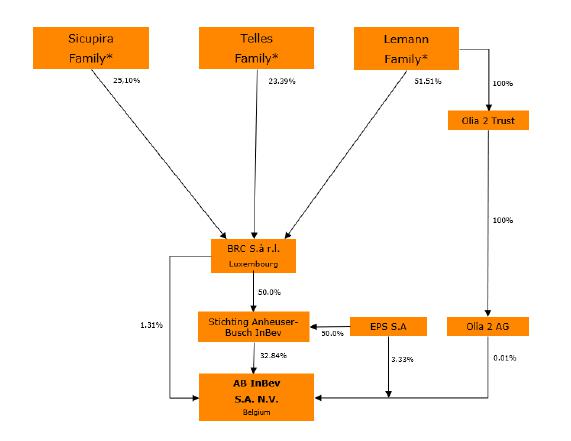
* The ownership structure of Anheuser-Busch InBev SA/NV (“ABI”) is indicated in items 6.1 and 6.2 of this Reference Form in detail, based on the latest corporate information received from the controlling shareholders. The control of BRC S.a.r.l. is exercised jointly by Jorge Paulo Lemann, Carlos Alberto da Veiga Sicupira and Max Van Hoegaerden Herrmann Telles.
| 194 |
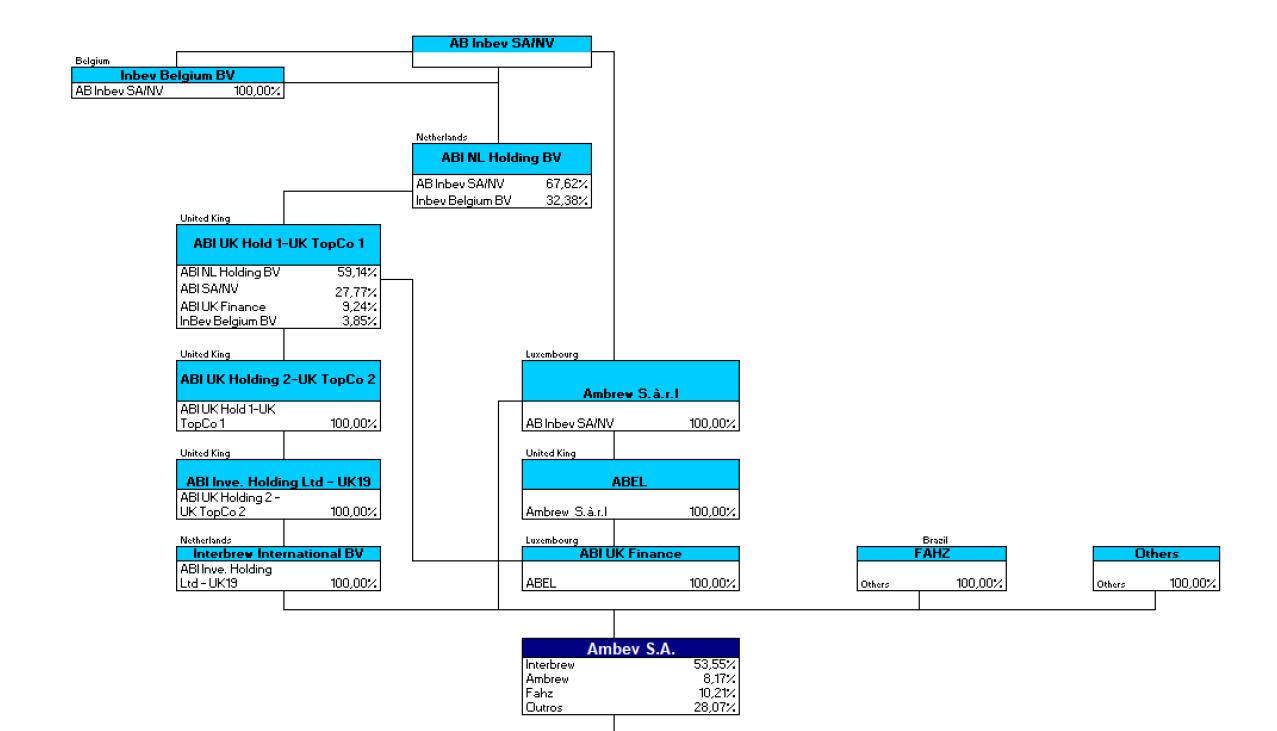
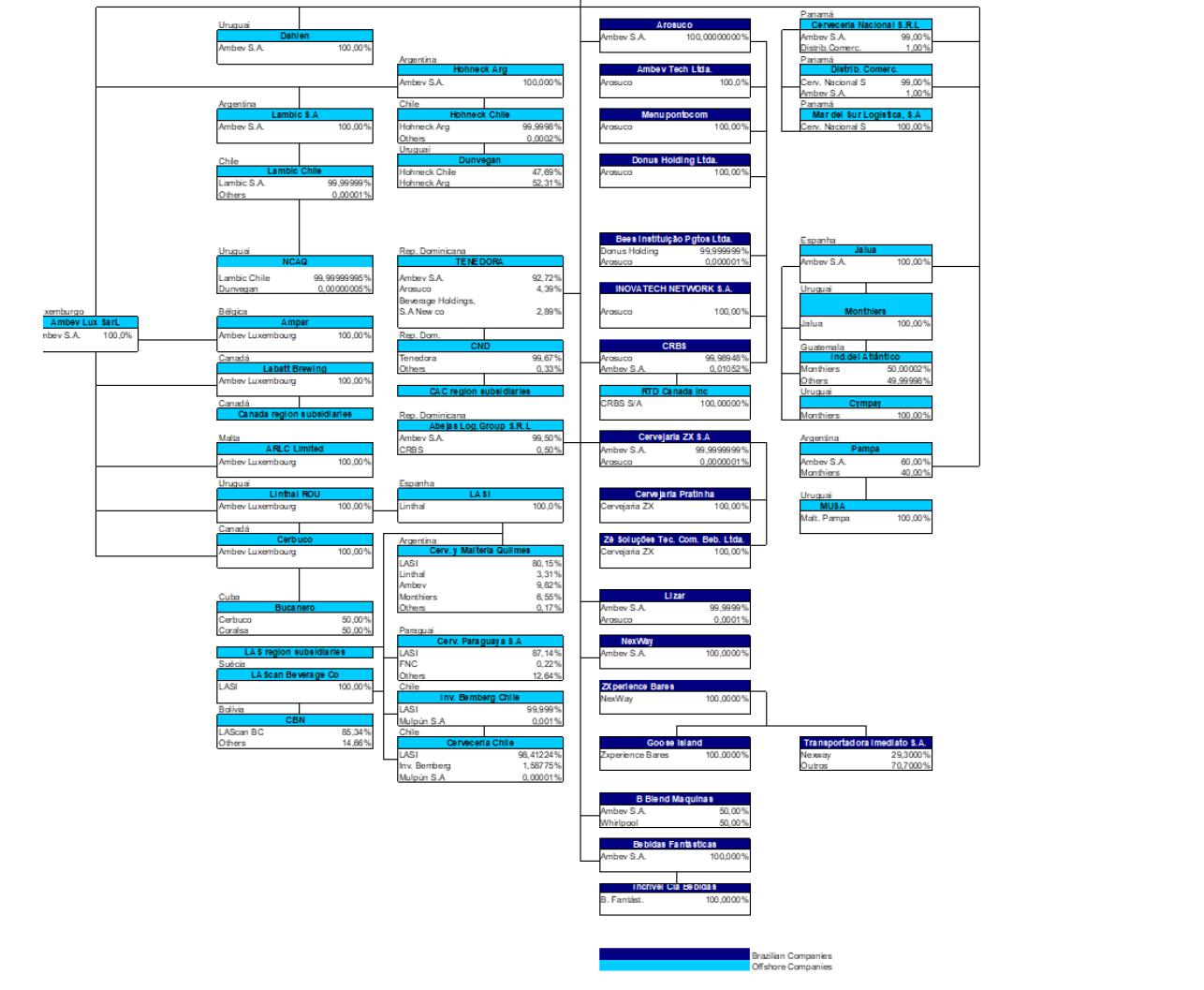
| 195 |
6.6 – Other relevant information
Additional information for items 6.1, 6.2 and 6.5
The ownership structure of ABI is indicated in items 6.1 and 6.2 of this Reference Form in detail, based on the latest corporate information received from the controlling shareholders. The control of BRC S.a.r.l. is exercised jointly by Jorge Paulo Lemann, Carlos Alberto da Veiga Sicupira and Max Van Hoegaerden Herrmann Telles.
Considering that the Olia 2 Trust vehicle indicated in items 6.1 and 6.2 is an unincorporated entity (trust), the number presented as “zero” for the shareholding structure was simply included so that the disclosure of the item is accepted by the system (which requires the indication of the number of shares for each shareholder in the chain). Therefore, the shareholding structure indicated should be read exclusively based on the disclosed percentage, held solely by Jorge Paulo Lemann.
In addition to the foregoing, there is no other relevant information regarding this item 6.
| 196 |
7. General meeting and management
7.1 – Main characteristics of the management bodies and the fiscal council
The Company is managed by (i) a Board of Directors, (ii) a Statutory Board of Officers, (iii) a Fiscal Council, and (iv) advisory committees to the Board of Directors.
Board of Directors: The Board of Directors consists of at least five (5) and not more than eleven (11) effective members (plus two (2) to eleven (11) alternates, who may not be specifically attached to a full member, elected by the Shareholders’ Meeting, and removed by it at any time, with a term of office of three (3) years, reelection being permitted). The majority of the members of the Board of Directors must consists of external members, under art. 15, paragraph 3 of the Company’s By-laws, and at least: (i) two members; or (ii) twenty percent (20%) of the total number of members of the Company’s Board of Directors, whichever is greater, must be independent members under art. 15, paragraph 5, of the By-laws. The Chairman or Co-Chairmen of the Board of Directors, as the case may be, will be elected by the majority of the votes of its members, immediately after such members take office.
In 2025, all members of the Board of Directors attended all meetings carried out throughout the year.
Statutory Board of Officers: The Statutory Board of Officers is formed by a minimum of two (2) and a maximum of fifteen (15) members, whether shareholders or not, being (i) a Chief Executive Officer; (ii) a Commercial Vice-President Officer; (iii) a Logistics Vice-President Officer, (iv) Supply Vice President Officer, (v) a Chief Financial and Investor Relations Officer, (vi) a Legal and Compliance Vice President Officer, (vii) Corporate Affairs Vice President Officer and (viii) the other Officers without specific designation, all elected by the Board of Directors and removable by it at any time, with a term of office of three (3) years, reelection being permitted.
Fiscal Council: The Fiscal Council consists permanently of a minimum of three (3) and a maximum of five (5) members (and the same number of deputies), all elected by the General Meeting and removable by it at any time, with term of office until the first Annual Shareholders’ Meeting that shall be held after the election of its members, the reelection being permitted.
For more information on descriptions, powers and attributions of the Board of Directors, Statutory Board of Officers, and Fiscal Council, please see the Bylaws and the respective internal regulations, as the case may be, available for consultation on the Company’s investor relations website (ri.ambev.com.br) or in person at the principal place of business of the Company.
For more information on advisory committees to the Board of Directors, please see item 7.2.
(a) Main characteristics of the policies for nominating and filling positions, if any, and, in case the issuer discloses them, the sites where the document can be consulted in the world wide web
Currently, the Company does not have a formally approved and established policy for the nomination and appointment of members to its management bodies and Fiscal Council. Nevertheless, in its selection processes, the Company seeks an appropriate combination of skills and experience, taking into consideration various criteria such as complementary backgrounds and education, industry knowledge, area of expertise, reputation, and visibility. Despite this practice, as of the date of this Reference Form, the Company does not adopt ESG Measure 2 of B3’s Issuers’ Regulation.
| 197 |
(b) If there are performance evaluation mechanisms, indicating, if so:
(i) The periodicity of the evaluations and its comprehensiveness;
(ii) The methodology adopted and main criteria used in the evaluation; and
(iii) If external consultancy or advisory services were contracted.
In accordance with the Internal Regulations of the Board of Directors and the minimum annual agenda of such body, the Board of Directors and its advisory committees – People Committee, Governance Committee and Operations and Finance Committee – are evaluated once a year through an evaluation process defined by the Board of Directors, which includes both the performance of the collegiate bodies themselves and their individual members, including their co-chairmen or chairman, as the case may be. Accordingly, and pursuant to its Internal Regulations, the Fiscal Council undergoes a self-evaluation process annually. The members of each body (i.e., Board of Directors, advisory committees to the Board of Directors and Fiscal Council) perform their respective self-evaluations, the results of which are disclosed in an aggregate and anonymous manner and discussed among the members of the Board of Directors themselves. The Board of Directors, in addition to self-evaluation, also evaluates the performance of its advisory committees. There is no participation of external experts in the evaluation process of the Board of Directors, the Fiscal Council, or the advisory committees to the Board of Directors.
Such evaluations are based on several criteria, including appropriate qualification, diversity of experiences and education, knowledge of the Company’s industry and area, effective leadership of the co-chairmen or chairman (as the case may be), assiduity, and preparation for the discussion of the issues, active and constructive contribution in the decision-making process, integrity and commitment to the exercise of functions. At the end of the evaluation process, the Board of Directors, as the case may be, identifies the main points to be addressed for improving the performance of the bodies and, as the case may be, defines the actions and measures to be implemented to do so. In addition, during the year following the evaluation, the Board of Directors monitors the evolution of such actions and measures, in order to ensure that the identified improvement points are actually resolved.
As well as on the Board of Directors, the Fiscal Council’s evaluation is based on its competencies and duties and responsibilities of each member as set forth in its Internal Regulations, in Law No. 6,404/1976, in the Company’s By-laws and in Sarbanes-Oxley Act. After the evaluation process, the Fiscal Council shall identify the main points to be addressed to improve its performance and, as the case may be, define the actions and measures to be implemented.
Additionally, the Statutory Board’s Officers of the Company have annual financial and non-financial performance targets, which may also be related to environmental, social and governance aspects in line with their respective areas of activity, established by the Board of Directors. The attainment of such targets composes one of the variables to verify the right of the Officer to the variable remuneration in that year. The process of evaluating the achievement of these goals occurs usually in the first quarter of each year. There is no third-party participation in this process.
| 198 |
The officers' competencies are evaluated annually by their peers and subordinates and by self-evaluation (360º evaluation), and there also shall be no contracting of third parties for this evaluation. Such annual evaluation process is usually carried out in the second semester of each year and it is divided into the following stages: (i) appointment of evaluators; (ii) validation by the manager; (iii) evaluation 360º; and (iv) submission of the final report and feedback meeting held by the manager. Relating to the manager, the Chief Executive Officer is evaluated by the co-chairmen or chairman (as the case may be) of the Board of Directors, and the others Statutory Officers by the Chief Executive Officer. The evaluations are discussed by the People Committee and the Board of Directors, which resolve on the next steps of each of the executives in the Company (stay, promotion, dismissal etc.).
Such annual evaluation is based on leadership skills related to the Company’s logic principal pillars. Thus, in addition to the achievement of outcome goals associated with the Company’s performance, the Officers are also evaluated based on their compliance with the Company’s culture and, as a consequence, to its principles.
(c) Rules for identifying and managing conflicts of interest
The Bylaws and the Board of Directors' Internal Regulations provide that the directors, in the exercise of their powers, cannot vote or intervene in matters in which they have or represent a conflicting interest with the Company. In addition, considering that the directors are responsible for electing the members of the Statutory Board of Officers, the Company adopts as a good practice the non-accumulation, by the same person, of a position in the Statutory Board of Officers with the position of member of the Company’s Board of Directors, aiming to guarantee greater independence and autonomy among the main governance bodies. Moreover, according to the terms of the Company’s Bylaws, the positions of co-chairmen or chairman (as the case may be) of the Board of Directors and Chief Executive Officer of the Company cannot be held by the same person.
Furthermore, the Company observes the rules for identifying and managing potential conflicts of interest provided for in the applicable standards, including, without limitation, Law No. 6,404, of December 15, 1976, as amended.
In addition, the Company adopts specific mechanisms to identify conflicts of interest involving members of its management, pursuant to the Transactions with Related Parties Policy (“Related Parties Policy”), available on the Company’s official disclosure channels, including the website (ri.ambev.com.br) and the CVM’s website (https://sistemas.cvm.gov.br/).
Under the terms of the Related Parties Policy: (i) the Company’s management considers as one of the principles that guide such policy the guideline that the controlling shareholders and the members of the Company’s management cannot vote or intervene in matters in which they have a conflict of interest with the Company, (ii) the Governance Committee is responsible, among other attributions, for analyzing, monitoring and expressing its opinion on matters that have been submitted to its analysis and that involve situations of potential conflict of interest between the Company (or its subsidiaries), on the one hand, and Related Parties, on the other hand, and (iii) (iii.a) the making of loans, on the one hand, by the Company (or its subsidiaries) and, on the other hand, the Company’s controlling shareholders and its managers (members of the Board of Directors and the Statutory Board of Officers), and (iii.b) forms of compensation of advisors, consultants or agents that generate conflict of interest with the Company, its subsidiaries, its administrators or shareholders are forbidden.
| 199 |
Finally, the rules adopted by the Company in relation to the identification and management of conflicts of interest are also based on the Company’s Code of Business Conduct, available on the Company’s official disclosure channels, including the website (ri.ambev.com.br) and the CVM’s website (https://sistemas.cvm.gov.br/). Pursuant to this code, the Company’s employees are instructed to immediately communicate them to the Compliance Area and refrain from participating in any decision related to potential situations of conflict of interest if they find any actual or potential situation of conflict of interest.
(e) If any, specific goals that the issuer has regarding the diversity of gender, color or race, or other attributes among the members of its management bodies and fiscal council
Currently, the Company does not have specific goals regarding the diversity of gender, color or race, or other attributes, for members of the management bodies (i.e., Board of Directors and Statutory Board of Officers) and the Fiscal Council, despite already having goals and initiatives of this nature for the staff, as described in item 10.5 of this Reference Form.
On the date of this Reference Form, the Company’s Statutory Board of Officers is composed of a woman, Carla Smith de Vasconcellos Crippa Prado, Corporate Affairs Vice President Officer. The Board of Directors has three female directors holding permanent positions - Lia Machado de Matos, Fernanda Gemael Hoefel and Luciana Pires Dias, and the Fiscal Council, one female member, Elidie Palma Bifano.
This action partially complies with ESG Measure 1 of the B3 Issuers Regulation, considering item I of Article 3, as it includes a woman in a leadership position. With respect to item II, although, as of this date, there is no member of an underrepresented group on the Board of Directors or the Statutory Executive Board, the Company follows the evolution of market practices and continuously assesses aspects related to diversity in its governance, in line with its institutional principles and values.
(f) Role of management bodies in assessing, managing and supervising climate-related risks and opportunities
As reported in item 1.2 of this Reference Form, the Company announced its ambition to achieve net zero across the entire value chain by 2040. To meet these commitments, the Company identified several opportunities covering its entire value chain, as described in its net zero roadmap publicly available here - https://www.ambev.com.br/sites/g/files/wnfebl5836/files/2023-01/Ambev%20Net%20Zero%20ingles.pdf
Due to the potential economic, social and environmental risks that climate changes may generate and directly affect companies’ operations, decision-making related to these issues requires the involvement of the highest levels of management. At the Company, the supervision of climate issues - including climate risks and opportunities, investment opportunities and risk factors - is carried out by the Statutory Board of Officers, which verifies the topics that need analysis and informs and updates the members of the Board of Directors.
The Procurement Area has been, since 2000, paving the way for climate action by establishing environmental goals and planning actions directed at the entire value chain. In addition, the climate action front is considered in the Company’s annual strategic planning, which is reviewed quarterly to semi-annually, with goals for reducing greenhouse gas emissions in direct emissions and in the value chain, and, indirectly, through goals in circular packaging, water stewardship, agriculture, and entrepreneurship.
| 200 |
The Company’s Sustainability Committee, consisting of members of the Statutory Board of Officers and of the Non-Statutory Board of Officers, discusses sustainability issues, including issues associated with climate change, such as indicators of impacts of climate risks and opportunities and the definition of goals for monitoring these risks. Risk management, as a whole, is carried out by the Internal Audit department, which reports directly to the Board of Directors. The Statutory Board of Officers and the Procurement department, together with the Company’s strategic departments, assess climate risks and opportunities, investment opportunities and risk factors.
The discussion on integrating climate issues into the Company’s annual strategic planning, which is reviewed quarterly to semi-annually, goes through several internal forums, such as the Sustainability Committee and the Governance Committee, which are reported to the Board of Directors. In addition, our teams actively participate in forums and cooperation works with entities of the industry and academic, research and national and international multisector entities, and NGOs to develop broader agendas in relation to these issues.
| 201 |
7.1D – Description of the main characteristics of the management bodies and the fiscal council
Number of members by self-reporting gender
| Female | Male | Non-binary | Others | Prefer not to answer | |
| Board of Officers | 1 | 6 | 0 | 0 | 0 |
|
Board of Directors - Effective Members |
3 | 6 | 0 | 0 | 0 |
|
Board of Directors - Alternate Members |
0 | 2 | 0 | 0 | 0 |
|
Fiscal Council - Effective Members |
1 | 2 | 0 | 0 | 0 |
|
Fiscal Council - Alternate Members |
0 | 3 | 0 | 0 | 0 |
| TOTAL | 5 | 19 | 0 | 0 | 0 |
Number of members by self-reporting color or race
| Yellow | White | Black | Brown | Indigenous | Others | Prefer not to answer | |
| Board of Officers | 0 | 7 | 0 | 0 | 0 | 0 |
0 |
|
Board of Directors - Effective Members |
0 | 9 | 0 | 0 | 0 | 0 | 0 |
|
Board of Directors - Effective Members |
0 | 2 | 0 | 0 | 0 | 0 | 0 |
|
Fiscal Council - Effective Members |
0 | 3 | 0 | 0 | 0 | 0 | 0 |
|
Fiscal Council - Alternate Members |
0 | 3 | 0 | 0 | 0 | 0 | 0 |
| TOTAL | 0 | 24 | 0 | 0 | 0 | 0 | 0 |
Number of members – People with Disabilities
| People with Disabilities | People without Disabilities | Prefer not to answer | |
| Board of Officers | 0 | 7 | 0 |
|
Board of Directors - Effective Members |
0 | 9 | 0 |
|
Board of Directors - Alternate Members |
0 | 2 | 0 |
|
Fiscal Council - Effective Members |
0 | 3 | 0 |
|
Fiscal Council - Alternate Members |
0 | 3 | 0 |
| TOTAL | 0 | 24 | 0 |
| 202 |
7.2 – Information related to the Board of Directors
(a) Permanent bodies and committees that report to the board of directors
The Bylaws enable the Board of Directors to set up advisory committees, consisting of a majority of members of the Board of Directors, the specific compositions and assignments of which are defined by the Board of Directors, to analyze and discuss matters defined as within their competence, and to formulate proposals and recommendations for resolution by the Board of Directors.
On the date of this Reference Form, the Company’s Board of Directors has three (3) advisory committees, formed by a minimum of three (3) and a maximum of six (6) members, consisting of a majority of members of the Board of Directors, namely: (i) Operations and Finance Committee, (ii) Governance Committee; and (iii) People Committee. Said committees consist exclusively of members who do not participate in the Company’s Statutory Board of Officers, the main attributions of which are described below.
In 2025, all the meetings of the advisory committees to the Board of Directors held throughout the year were attended by all its members.
Operations and Finance Committee
The Operations and Finance Committee is the main link between the policies and decisions taken by the Ambev’s Board of Directors and managers. The Finance and Operations Committee’s responsibilities include:
(i) monitor the Company’s long-term planning.
(ii) monitor the evolution of the Company’s actuarial liabilities and investments in pension plans.
(iii) monitor investor relations strategies and the performance of the Company’s rating, as issued by risk rating agencies.
(iv) give opinions on the annual investment planning.
(v) analyze and issue an opinion on the proposals of the Statutory Executive Board of Officers about opportunities for corporate reorganizations, mergers, acquisitions, spin-offs, consolidations or disposals of shareholdings involving the Company.
(vi) monitor the evolution of the Company’s capital structure and cash flow and give opinions on the compensation strategy of the Company’s shareholders.
(vii) verify compliance with the Company’s Financial Risk Management Policy.
(viii) other matters that the Board of Directors deems material and in the interest of the Company and may define as attributions of the Operations and Finance Committee.
Governance Committee
| 203 |
The Governance Committee is responsible for advising the Board of Directors on the following matters:
(i) transactions with related parties.
(ii) any conflict-of-interest situations in general that may arise between the Company and the related parties.
(iii) compliance, by the Company, with the legal, regulatory and statutory provisions referring to transactions with related parties and antitrust matters.
(iv) monitor the Company’s initiatives, as well as analyze and give opinions on matters related to cybersecurity and privacy and data protection.
(v) give opinions on the Company’s strategies related to sustainability issues.
(vi) other matters that the Board of Directors may deem material and in the interest of the Company and may define as attributions of the Governance Committee.
People Committee
The People Committee is responsible for advising the Board of Directors on the following matters:
(i) give opinions on matters that require a decision by the Board of Directors regarding the definition and review of the compensation policy for members of the Statutory Executive Board of Officers and high-performance employees, as well as individual compensation incentive packages.
(ii) define the goals and compensation of the Company’s management, within the limit approved by the Shareholders’ Meeting.
(iii) monitor the assessment of the members of the Executive Board of Officers, key executives and talents, in addition to the respective succession plans.
(iv) approve the policies and/or minimum rules to be observed in the process of nominating members of the Company’s management.
(v) select and nominate, for approval by the Board of Directors, candidates for the positions of members of the Statutory Executive Board of Officers and/or any other positions that may be required by the Board of Directors.
(vi) assist the Board of Directors in monitoring and discussing issues related to diversity and inclusion (D&I).
(vii) approve the transfer of senior management employees.
(viii) coordinate the management of the Company’s incentive and compensation plans, and approve their respective programs, concessions, exceptions, and other obligations involving the Company’s employees in general, including approval of exceptions to the non-compete and non-solicitation obligations assumed by former employees in general within the scope of the respective programs, provided that the decisions related to statutory officers and presidents of business units remain under the responsibility of the Board of Directors, as permitted by the applicable rules.
| 204 |
(ix) other matters that the Board of Directors may deem material and in the interest of the Company.
For additional information on the powers and duties of the advisory committees to the Board of Directors, see the respective internal regulations, available for physical consultation at the Company’s headquarters.
(b) How the board of directors assesses the work of the independent audit, indicating whether the issuer has a policy for contracting extra-audit services with the independent auditor, and, in case the issuer discloses the policy, the sites where the document may be consulted in the world wide web
The Board of Directors is responsible for nominating and replacing the Company’s independent auditors. The auditors’ work and the annual work plan are annually assessed by the Fiscal Council, considering that the Company’s Fiscal Council performs functions of audit committee for the 2002 Sarbanes-Oxley Act purposes to the extent permitted by the Brazilian legislation, such assessment being subsequently reported to the Board of Directors, at least annually, by the chairman of the Fiscal Council. Under the terms of the Fiscal Council’s Internal Regulations, such body shall verify with the Company’s independent auditors the qualification and independence of the auditors and shall present to the Board of Directors recommendations on the maintenance or replacement of the contracted company.
The Company has a Policy on Hiring Services Related or Not Related to Auditing approved by the Board of Directors in the meeting held on August 30, 2013 and updated in the meeting held on September 19, 2018, which aims to regulate the process of contracting, by the Company and/or its subsidiaries, services provided by the external auditors, whether such services are related or not to the audit. According to such policy, the contracting of any services provided by the external auditors shall be preceded by Fiscal Council’s favorable opinion and may further depend on the approval of the Board of Directors and the nature of the services in question. The Chief Financial and Investor Relations Officer shall monitor the compliance with the policy. The Policy on Hiring Services Related or Not Related to Auditing is available in the Company’s official disclosure channels, including its investor relations website, (ri.ambev.com.br), in the field “Corporate Governance”, “Policies, Codes and Internal Regulations”, “Auditor Hiring Policy”, and the CVM’S website (https://sistemas.cvm.gov.br/). The managers shall further endeavor, together with the independent auditors, so that communication relating to the last financial year is made available in a timely manner, pursuant to the rules applicable thereto.
Finally, the Company observes the rotation in its independent auditors at the maximum of five years, under the terms of CVM Resolution No. 23, of February 25, 2021, with a minimum interval of three years for a new contract with the same independent auditor.
(c) If any, indicate the established channels for critical issues related to ESG and compliance topics and practices to come to the attention of the board of directors
The Company has a Sustainability Committee, as indicated in item 1.16 of this Reference Form, which is a non-statutory decision-making body consisting of members of the Company’s Statutory Board of Officers (the Chief Financial and Investor Relations Officer, the Corporate Affairs Vice President Officer, Supply Vice President Officer and the Legal and Compliance Vice President Officer), of the Non-Statutory Board of Officers (People and Management Vice Presidents Officer of and Procurement Vice-President Officer), in addition to the managers of the Corporate Relations, Procurement and Sustainability, and Compliance and Legal departments. This group meets quarterly for resolution and supervision of topics related to the European Corporate Sustainability Reporting Directive (CSRD) and the International Financial Reporting Standards (IFRS), as well as risks and gaps related to human rights. Its main attributions are to ensure the disclosure of accurate information to the market, resolve on risks related to sustainability and human rights, analyze opportunities for sustainability ratings and ESG classifications, monitor action plans and supervise internal controls for external sustainability data.
| 205 |
Despite not being statutory, the Sustainability Committee is a body that aims to complement and add discussions regarding the definition and monitoring of the execution of the Company’s sustainability strategy. Thus, indirectly through dialogue with the Statutory Board of Officers, the Sustainability Committee contributes to bringing critical issues related to sustainability topics and practices to the attention of the Board of Directors, formulating proposals and recommendations for resolution by the bodies in charge of decision-making processes.
The Company also has an Ethics Committee, as indicated in item 5.3 (a), which is responsible for managing the Company’s compliance program and the Code of Conduct and other internal policies, ensuring its efficiency and effectiveness. It is a non-statutory decision-making body consisting of members of the Company’s Statutory Board of Officers (the Chief Executive Officer, the Chief Financial and Investor Relations Officer, the Legal and Compliance Vice President Officer and the Corporate Affairs Vice President Officer) and Non-Statutory Board of Officers (the People and Management Vice President Officer), in addition to the Chief Compliance Officer, serving as a secretary and managing the proceedings.
Thus, indirectly through dialogue with the Statutory Board of Officers, the Ethics Committee contributes to ensuring that critical issues related to compliance topics and practices are brought to the attention of the Board of Directors, formulating proposals and recommendations for resolution by the bodies in charge of the decision-making processes.
With respect to channels established for reporting critical issues related to ESG topics and practices and compliance matters, the Company’s employees and third parties may submit complaints and/or suggestions to the Ombudsman Channel, anonymously, whenever they become aware of any violation of laws, applicable regulations, the Company’s Code of Conduct, or other corporate policies, as well as when there are indications of non-compliance with the Company’s ethical standards, which may include reporting issues related to sustainability matters. The Compliance area is responsible for managing the Ombudsman Channel, as well as conducting and monitoring the progress of each case. Following investigation, substantiated complaints may be submitted for deliberation by the Ethics Committee, in accordance with the materiality criteria established by the Company, or, by delegation, handled by the Compliance area itself and specialists from the Legal and People & Management (Human Resources) departments. The Compliance area provides periodic reports on critical issues related to the Ombudsman Channel to the Board of Directors.
| 206 |
7.3 – For each of the managers and board members inform, in a table format, the following:
| Name | Date of birth | Management body | Date of election | Term of office | First term starting date |
| CPF | Profession | Elective office held | Date of investiture | Elected by the controlling shareholder | |
| Michel Dimitrios Doukeris | 04/09/1973 | Board of Directors | 04/30/2026 | Until 2029 AGM | 07/01/2021 |
| 810.940.279-87 | Chemical engineering | Chairman of the Board of Directors | 05/04/2026 | Yes | |
| Victorio Carlos De Marchi | 11/13/1938 | Board of Directors | 04/30/2026 | Until 2029 AGM | 07/01/1999 |
| 008.600.938-91 | Lawyer | Director | 05/04/2026 | Yes | |
| Milton Seligman | 08/19/1951 | Board of Directors | 04/30/2026 | Until 2029 AGM | 01/11/2018 |
| 093.165.740-72 | Engineer | Director | 05/04/2026 | Yes | |
| Fabio Colletti Barbosa | 10/03/1954 | Board of Directors | 04/30/2026 | Until 2029 AGM | 03/18/2021 |
| 771.733.258-20 | Manager | Director | 05/04/2026 | Yes | |
| Fernando Mommensohn Tennenbaum | 01/07/1977 | Board of Directors | 04/30/2026 | Until 2029 AGM | 04/01/2023 |
| 245.809.418-02 | Production Engineer | Director | 05/04/2026 | Yes | |
| Lia Machado de Matos | 07/21/1977 | Board of Directors | 04/30/2026 | Until 2029 AGM | 03/18/2021 |
| 071.991.147-88 | Physicist | Director | 05/04/2026 | Yes | |
| Ricardo Manuel Frangatos Pires Moreira | 03/11/1971 | Board of Directors | 04/30/2026 | Until 2029 AGM | 01/01/2025 |
| Passport No. CA802266 | Engineer | Director | 05/04/2026 | Yes | |
| Fernanda Gemael Hoefel | 10/14/1973 | Board of Directors | 04/30/2026 | Until 2029 AGM | 07/01/2025 |
| 857.022.429-04 | Oceanologist | Independent Director | 05/04/2026 | Yes | |
| Luciana Pires Dias | 01/13/1976 | Board of Directors | 04/30/2026 | Until 2029 AGM | 04/28/2023 |
| 251.151.348-02 | Lawyer | Independent Director | 05/04/2026 | Yes | |
| Ricardo Tadeu Almeida Cabral de Soares | 07/23/1976 | Board of Directors | 04/30/2026 | Until 2029 AGM | 04/28/2023 |
| 430.148.771-90 | Lawyer | Director (Alternate) | 05/04/2026 | Yes | |
| David Henrique Galatro de Almeida | 09/22/1976 | Board of Directors | 04/30/2026 | Until 2029 AGM | 04/28/2023 |
| 217.625.768-56 | Economist | Director (Alternate) | 05/04/2026 | Yes | |
| Carlos Eduardo Klutzenschell Lisboa | 07/09/1969 | Board of Officers | 08/27/2024 | 12/31/2027 | 01/01/2025 |
| 694.514.864-53 | Manager | Chief Executive / Superintendent Officer | 01/01/2025 | ||
| Guilherme Fleury de Figueiredo Ferraz Parolari | 04/17/1975 | Board of Officers | 12/17/2024 | 12/31/2027 | 04/01/2025 |
| 181.437.038-27 | Manager | Chief Financial and Investor Relations Officer | 04/01/2025 | 12/31/2027 | |
| Guilherme Malik Parente | 07/07/1984 | Board of Officers | 06/04/2025 | 12/31/2027 | 09/01/2025 |
| 098.971.807-70 | Lawyer | Legal and Compliance Vice President Officer | 09/01/2025 | ||
| João Coelho Rua Derbli de Carvalho | 10/14/1982 | Board of Officers | 05/04/2026 | 12/31/2027 | 05/04/2026 |
| 099.035.737-66 | Manager | Commercial Vice President Officer | 05/04/2026 | ||
| Carla Smith de Vasconcellos Crippa Prado | 01/01/1982 | Board of Officers | 12/11/2024 | 12/31/2027 | 06/01/2022 |
| 297.485.688-81 | Lawyer | Corporate Affairs Vice President Officer | 01/01/2025 | ||
|
Fernando Maffessoni 928.806.140-15 |
08/07/1977 Manager |
Board of Officers Logistics Vice President Officer |
05/15/2026 | 12/31/2027 | 05/15/2026 |
| Paulo André Zagman | 01/15/1977 | Board of Officers | 12/11/2024 | 08/01/2026 | 01/01/2019 |
| 072.343.527-83 | Civil Engineer | Logistics Vice President Officer | 01/01/2025 |
| 207 |
| Valdecir Duarte | 05/02/1980 | Board of Officers | 11/12/2024 | 12/31/2027 | 01/01/2022 |
| 030.748.919-12 | Engineer | Supply Vice President Officer | 01/01/2025 | ||
| Elidie Palma Bifano | 05/16/1947 | Fiscal Council | 04/30/2026 | Until 2027 AGM | 04/29/2019 |
| 395.907.558-87 | Lawyer | F.C (Permanent) Elected by the Controlling Shareholder | 05/04/2026 | Yes | |
| Eduardo Rogatto Luque | 07/06/1969 | Fiscal Council | 04/30/2026 | Until 2027 AGM | 04/24/2020 |
| 142.773.658-84 | Accountant | F.C (Alternate) Elected by the Controlling Shareholder | 05/04/2026 | Yes | |
| José Ronaldo Vilela Rezende | 06/07/1962 | Fiscal Council | 04/30/2026 | Until 2027 AGM | 04/29/2016 |
| 501.889.846-15 | Accountant | F.C (Permanent) Elected by the Controlling Shareholder | 05/04/2026 | Yes | |
| Luiz Alfredo Vieira Sales | 03/17/1966 | Fiscal Council | 04/30/2026 | Until 2027 AGM | 05/04/2026 |
| 238.175.422-91 | Technology Specialist | F.C (Alternate) Elected by the Controlling Shareholder | 05/04/2026 | Yes | |
| Fabio de Oliveira Moser | 12/26/1967 | Fiscal Council | 04/30/2026 | Until 2027 AGM | 05/03/2023 |
| 777.109.677-87 | Manager | F.C (Permanent) Elected by the Minority Common Shareholders | 05/04/2026 | No | |
| Nilson Martiniano Moreira | 07/26/1968 | Fiscal Council | 04/30/2026 | Until 2027 AGM | 05/03/2023 |
| 583.491.386-53 | Economist | F.C (Alternate) Elected by the Minority Common Shareholders | 05/04/2026 | No |
| 208 |
| Professional experience / Independence Criteria / Declaration of any convictions (type of conviction and description of the conviction) |
|
|
Michel Dimitrios Doukeris – 810.940.279-87 Holds the positions of Chairman of the Company's Board of Directors and Chief Executive Officer of AB InBev. Mr. Doukeris joined AB InBev in 1996 and held several business operations roles in Latin America before moving to Asia, where he led AB InBev’s operations in China and the Asia Pacific region for seven years. In 2016, he moved to the United States to hold the position of Global Sales Officer and, prior to his appointment as Chief Executive Officer, led Anheuser Busch and the Company’s business in North America. In 2024, Mr. Doukeris was awarded by the Belgian Brewers, and in 2025 received an award from the Order of Leopoldo, in recognition of his leadership in promoting and strengthening the Belgian culture. Mr. Doukeris holds a bachelor’s degree in Chemical Engineering from Universidade Federal de Santa Catarina, in Brazil, and a master’s degree in Marketing from the Getulio Vargas Foundation, also in Brazil, having completed graduate programs in Marketing and Marketing Strategy from the Kellogg School of Management and The Wharton School in the United States. Mr. Michel Dimitrios Doukeris declared, for all legal purposes, that, in the last 5 years, he was not been subject to the effects of any criminal conviction, any conviction or application of a penalty in administrative proceedings before the CVM, the Central Bank of Brazil, the Superintendence of Private Insurances and any conviction that became final and non-appealable, in the judicial or administrative levels, which had the effect of suspension or non-qualification to practice any professional or business activity. He is not a politically exposed person, under the terms of current regulations.
Victorio Carlos De Marchi – 008.600.938-91 Holds the position of member of the Company's Board of Directors and serves as President of the Company's Operations and Finance Committee, Governance Committee and People Committee. Mr. De Marchi joined Companhia Antarctica Paulista in 1961, having served in various positions during his tenure, including as CEO in the period between 1998 and April 2000. He is currently the President of the Antônio e Helena Zerrenner Foundation – FAHZ and a member of the Advisory Board of Itausa S.A. In 2023, Mr. De Marchi was awarded the honorary degree of Chairman Emeritus of the Board in recognition of his invaluable contribution and respected role as former co-chairman of our Board of Directors (noting that such title grants no specific power on the beneficiary). Mr. De Marchi was a member of Conselho do Instituto de Estudos para o Desenvolvimento Industrial (Board of the Studies for Industrial Development Institute, a member of the Board of Directors of Itausa S.A., and member of the Deliberative Council of Instituto Brasileiro de Ética Concorrencial (the Brazilian Institute of Competition Ethics) (“ETCO”). He holds degrees in Economics from Faculdade de Economia, Finanças e Administração de São Paulo and in Law from Faculdade de Direito de São Bernardo do Campo. Mr. Victorio Carlos De Marchi declared, for all legal purposes, that, in the last 5 years, he was not been subject to the effects of any criminal conviction, any conviction or application of a penalty in administrative proceedings before the CVM, the Central Bank of Brazil, the Superintendence of Private Insurances and any conviction that became final and non-appealable, in the judicial or administrative levels, which had the effect of suspension or non-qualification to practice any professional or business activity. He is not a politically exposed person, under the terms of current regulations.
Milton Seligman – 093.165.740-71 Holds the position of member of the Board of Directors of the Company. He previously served as Chief Corporate Affairs Officer for the Company, from 2001 to 2013. He also served as a member of the Board of Directors of Tenedora CND S.A., from 2013 to 2016, and BRMalls Participações S.A., from 2022 to 2023, before its merger. Mr. Seligman held several senior positions in the Brazilian public sector, including during the governments of José Sarney and Fernando Henrique Cardoso, when he served, among other positions, as Executive Secretary and Minister of Justice, and Executive Secretary of the Ministry of Development, Industry and International Trade. He is currently a managing partner of Milton Seligman e Associados Consultoria e Participações Ltda. He also served as a consulting member of the Lemann Foundation – a philanthropic organization, a member of the Board of Directors of FAHZ, and a partner of INSPER Centro de Gestão e Políticas Públicas. He previously served as Chairman of the Board of Directors of the Sonho Grande Institute, a Brazilian nonprofit organization, until December 2025, and as Global Partner of the Brazil Institute at the Woodrow Wilson International Center for Academics, in Washington D.C. He holds a degree in electrical engineering from Universidade Federal de Santa Maria (the Federal University of Santa Maria). Mr. Milton declared, for all legal purposes, that, in the last 5 years, he was not been subject to the effects of any criminal conviction, any conviction or application of a penalty in administrative proceedings before the CVM, the Central Bank of Brazil, the Superintendence of Private Insurances and any conviction that became final and non-appealable, in the judicial or administrative levels, which had the effect of suspension or non-qualification to practice any professional or business activity. He is not a politically exposed person, under the terms of current regulations.
|
|
Fabio Colleti Barbosa – 771.733.258-20 Holds the position of member of the Board of Directors and the People Committee of the Company. Mr. Barbosa is currently the Chairman of Natura Cosméticos and a member of the Board of Directors of Votorantim S.A., Cia Brasileira de Metalurgia e Mineração (CBMM), the United Nations Foundation and Centro de Liderança Pública in Brazil (CLP). Mr. Barbosa was CEO of Banco ABN Amro Real, Banco Santander (Brazil) S.A., Abril Media and Febraban. He graduated in Business Management from the Getúlio Vargas Foundation and holds an MBA from the Institute for Management Development (Switzerland). Mr. Fabio Colletti Barbosa declared, for all legal purposes, that, in the last 5 years, he was not been subject to the effects of any criminal conviction, any conviction or application of a penalty in administrative proceedings before the CVM, the Central Bank of Brazil, the Superintendence of Private Insurances and any conviction that became final and non-appealable, in the judicial or administrative levels, which had the effect of suspension or non-qualification to practice any professional or business activity. He is not a politically exposed person, under the terms of current regulations.
|
|
Fernando Mommensohn Tennenbaum – 245.809.418-02 Holds the position of member of the Board of Directors and Operations and Finance Committee of the Company. Mr. Tennenbaum serves as ABI’s Chief Financial Officer since 2020. He joined the Company in 2004 and held various financial functions, including Treasury, Investor Relations and Mergers and Acquisitions. Most recently, he served as Chief Financial and Investor Relations Officer for Ambev. Mr. Tennenbaum has dual citizenship, Brazilian and German, and has a degree in Production Engineering from Escola Politécnica da Universidade de São Paulo (the Polytechnic School of the University of São Paulo). Mr. Fernando Mommensohn Tennenbaum declared, for all legal purposes, that, in the last 5 years, he was not been subject to the effects of any criminal conviction, any conviction or application of a penalty in administrative proceedings before the CVM, the Central Bank of Brazil, the Superintendence of Private Insurances and any conviction that became final and non-appealable, in the judicial or administrative levels, which had the effect of suspension or non-qualification to practice any professional or business activity. He is not a politically exposed person, under the terms of current regulations.
|
| 209 |
|
Lia Machado de Matos – 071.991.147-88 Holds the position of member of the Board of Directors of the Company. She is also currently a consultant to Stone Co, having served between 2016 and 2025 as Chief Strategy and Marketing Officer. Previously, between 2012 and 2016, Ms. Matos was Officer of Family Office at Varbra. Previously, from 2006 to 2012, she held various positions with McKinsey Consulting Company, including Associate Partner. Mrs. Matos holds a degree in Physics from Universidade Federal do Rio de Janeiro (the Federal University of Rio de Janeiro) and a PhD in Physics from the Massachusetts Institute of Technology. Mrs. Lia Machado de Matos declared, for all legal purposes, that, in the last 5 years, she was not been subject to the effects of any criminal conviction, any conviction or application of a penalty in administrative proceedings before the CVM, the Central Bank of Brazil, the Superintendence of Private Insurances and any conviction that became final and non-appealable, in the judicial or administrative levels, which had the effect of suspension or non-qualification to practice any professional or business activity. She is not a politically exposed person, under the terms of current regulations.
Fernanda Gemael Hoefel – 857.022.429-04 Holds the position of independent member of the Board of Directors of the Company. Mrs. Hoefel has held several senior positions in recent years, including: partner of McKinsey & Company Brazil, where she led the Growth Marketing and Sales practices in Latin America, and the Consumer Insights practice in Brazil; associate and Engagement Manager at McKinsey, with a focus on growth and business performance in the consumer goods and retail industries; Marketing Planning manager at Natura, being responsible for innovation strategies and product portfolio management; and consultant at McKinsey early in her career, working with multi-industries clients. Mrs. Hoefel holds a degree in Oceanology from Fundação Universidade do Rio Grande (the University of Rio Grande Foundation), a Master’s degree in science in Ocean Engineering from COPPE/UFRJ, and a PhD degree in Oceanography from the Massachusetts Institute of Technology and Woods Hole Oceanographic Institution. Mrs. Fernanda Gemael Hoefel declared, for all legal purposes, that, in the last 5 years, she was not been subject to the effects of any criminal conviction, any conviction or application of a penalty in administrative proceedings before the CVM, the Central Bank of Brazil, the Superintendence of Private Insurances and any conviction that became final and non-appealable, in the judicial or administrative levels, which had the effect of suspension or non-qualification to practice any professional or business activity. She is not a politically exposed person, under the terms of current regulations.
|
|
Luciana Pires Dias – 251.151.348-02 Holds the position of independent member of the Board of Directors, People Committee and Governance Committee of the Company. Mrs. Dias is a professor at Faculdade de Direito da Fundação Getúlio Vargas and partner of L|Dias Advogados, and she is also a member of the audit committee of Itaú Unibanco Holding S.A. She was market development superintendent for the Brazilian Securities and Exchange Commission – CVM, and was the representative of the CVM on the Corporate Governance Committee of the OECD (Organization for Economic Cooperation and Development) and the Latin American Corporate Governance Roundtable organized by the OECD. Mrs. Luciana Pires Dias holds a PhD and master’s degree in commercial law from Faculdade de Direito da Universidade de São Paulo (USP) (School of Law of the University of São Paulo), and also holds a master’s degree in law sciences (J.S.M.) from the Stanford University and a bachelor’s degree in law from USP. Mrs. Luciana Pires Dias declared, for all legal purposes, that, in the last 5 years, she was not been subject to the effects of any criminal conviction, any conviction or application of a penalty in administrative proceedings before the CVM, the Central Bank of Brazil, the Superintendence of Private Insurances and any conviction that became final and non-appealable, in the judicial or administrative levels, which had the effect of suspension or non-qualification to practice any professional or business activity. She is not a politically exposed person, under the terms of current regulations.
Ricardo Manuel Frangatos Pires de Moreira – Passport No. CA802266 Holds the position of member of the Board of Directors and People Committee of the Company. He is currently the Chie Supply Officer for ABI. Mr. Moreira joined the Company in 1995 and held various positions in the areas of Sales and Finance, before becoming Chief Regional Sales Officer in 2001. He later held the positions of Executive Vice President of Logistics and Procurement for Latin America, President of Business Unit for Hispanic Latin America (HILA) and Soft Drinks Vice President for Latin America. In 2013, Mr. Moreira moved to Mexico to lead the areas of Sales, Marketing and Distribution at AB InBev, as well as to lead the business integration of the Model Group. Most recently, Mr. Moreira served as CEO of the Africa Zone until 2023, and previously as President of the COPEC Latin America Zone until 2018. Mr. Moreira is a Portuguese citizen and holds a degree in Mechanical Engineering from Universidade Federal do Rio de Janeiro (the Federal University of Rio de Janeiro), in Brazil, in addition to having an Executive Master of Business Administration from Ambev. She completed the Advanced Marketing Program at the Kellogg School of Management and the Global Senior Management Program at the University of Chicago Booth School of Business. Mr. Ricardo Manuel Frangatos Pires declared, for all legal purposes, that, in the last 5 years, he was not been subject to the effects of any criminal conviction, any conviction or application of a penalty in administrative proceedings before the CVM, the Central Bank of Brazil, the Superintendence of Private Insurances and any conviction that became final and non-appealable, in the judicial or administrative levels, which had the effect of suspension or non-qualification to practice any professional or business activity. He is not a politically exposed person, under the terms of current regulations.
|
|
Ricardo Tadeu Almeida Cabral de Soares– 430.148.771-90 Holds the position of alternate member of the Company's Board of Directors and, since April 2022, holds the position of Chief Growth Officer of Anheuser-Busch InBev SA/NV. In the last 5 years, he served as (i) Chief B2B Officer assisting in the dissemination of BEES for the period 2020 to 2022, (ii) Chief Sales Officer for the period 2019 to 2020, and (iii) was President of the Africa Zone for the period 2016 to 2018. Previously, he served as President of the Mexico Zone from 2013 to 2018, and President of BU Brazil from 2008 to 2012. Mr. Ricardo Tadeu declared, for all legal purposes, that, in the last 5 years, he was not been subject to the effects of any criminal conviction, any conviction or application of a penalty in administrative proceedings before the CVM, the Central Bank of Brazil, the Superintendence of Private Insurances and any conviction that became final and non-appealable, in the judicial or administrative levels, which had the effect of suspension or non-qualification to practice any professional or business activity. He is not a politically exposed person, under the terms of current regulations.
|
|
David Henrique Galatro de Almeida – 217.625.768-56 Holds the position of alternate member of the Company's Board of Directors and, since April 2022, holds the position of Chief Strategy and Technology Officer of Anheuser-Busch InBev SA/NV. For the past 5 years, he has served as (i) Chief Strategy and Transformation Officer, (ii) Chief Integration Officer and ad interim Chief Sales Officer, and (iii) Vice President of Sales and Vice President of Finance for the North America Zone. Mr. David Henrique Galatro de Almeida declared, for all legal purposes, that, in the last 5 years, he was not been subject to the effects of any criminal conviction, any conviction or application of a penalty in administrative proceedings before the CVM, the Central Bank of Brazil, the Superintendence of Private Insurances and any conviction that became final and non-appealable, in the judicial or administrative levels, which had the effect of suspension or non-qualification to practice any professional or business activity. He is not a politically exposed person, under the terms of current regulations.
|
|
Carlos Eduardo Klutzenschell Lisboa - 694.514.864-53 Holds the position of Chief Executive Officer of the Company. He joined the Company in 1993 and has since held various positions in the Company. He served as Vice President of Marketing of Ambev between 2005 and 2011, President of BU Austral in the South Latin America Zone of Ambev between 2011 and 2012, and President of Labatt, the Company’s subsidiary in Canada, between 2013 and 2014. Mr. Klutzenschell Lisboa held the positions of World Vice President of Global Brand of ABI between 2014 and 2016, President of the South Latin America Zone of Ambev between 2016 and 2018, President of the Central America Zone of ABI between 2019 and 2024, and member of the Company’s Board of Directors between 2018 and 2024. Mr. Carlos Eduardo Klutzenschell Lisboa declared, for all legal purposes, that, in the last 5 years, he was not been subject to the effects of any criminal conviction, any conviction or application of a penalty in administrative proceedings before the CVM, the Central Bank of Brazil, the Superintendence of Private Insurances and any conviction that became final and non-appealable, in the judicial or administrative levels, which had the effect of suspension or non-qualification to practice any professional or business activity. He declared that he is not considered a politically exposed person, pursuant to CVM Resolution No. 50/21.
|
| 210 |
|
Guilherme Fleury de Figueiredo Ferraz Parolari - 181.437.038-27 Holds the position of Chief Financial and Investor Relations Officer for the Company. He joined the Company after holding several senior positions at Ambev and ABI, including: Global Vice President of Finance for M&A at ABI from 2020 to 2025; Global Vice President of Finance for Non-Alcoholic Beverages at ABI from 2019 to 2020; Chief Financial Officer for Non-Alcoholic Beverages at Ambev from 2018 to 2019; and Chief Financial Officer of M&A at Ambev from 2016 to 2018. Before joining Ambev, Mr. Fleury worked at Banco BTG Pactual, Credit Suisse and Kraft Foods Brasil. Mr. Fleury holds a degree in business management from the Getúlio Vargas Foundation. Mr. Guilherme Fleury de Figueiredo Ferraz Parolari declared, for all legal purposes, that, in the last 5 years, he was not been subject to the effects of any criminal conviction, any conviction or application of a penalty in administrative proceedings before the CVM, the Central Bank of Brazil, the Superintendence of Private Insurances and any conviction that became final and non-appealable, in the judicial or administrative levels, which had the effect of suspension or non-qualification to practice any professional or business activity. He declared that he is not considered a politically exposed person, pursuant to CVM Resolution No. 50/21.
|
|
Guilherme Malik Parente - 098.971.807-70 Holds the position of Legal and Compliance Vice President Officer of the Company. In recent years, he held various positions in the Company’s legal department, including Corporate, M&A and Compliance General Counsel, and General Counsel for Civil Affairs, Labor and Contracts. He previously worked in law firms, in Brazil and New York, as well as in the Brazilian Securities and Exchange Commission (CVM). Mr. Parente has a degree in Law from Pontifícia Universidade Católica do Rio de Janeiro, has graduated in Tax Law from the Getúlio Vargas Foundation, a master’s degree in Corporate Governance from the Stanford School of Law, and an MBA from the INSPER Executive Program. Mr. Guilherme Malik Parente declared, for all legal purposes, that, in the last 5 years, he was not been subject to the effects of any criminal conviction, any conviction or application of a penalty in administrative proceedings before the CVM, the Central Bank of Brazil, the Superintendence of Private Insurances and any conviction that became final and non-appealable, in the judicial or administrative levels, which had the effect of suspension or non-qualification to practice any professional or business activity. He declared that he is not considered a politically exposed person, pursuant to CVM Resolution No. 50/21.
|
|
João Coelho Rua Derbli de Carvalho - 099.035.737-66 Holds the position of Commercial Vice President Officer for the Company. Since 2006, when he joined the Company, he held several positions, including Chief Regional Sales Officer in Rio de Janeiro and Espírito Santo, Chief Commercial Marketing Officer and Chief Regional Marketing Officer. Mr. Rua holds Portuguese and Brazilian citizenships, and has a degree in business management from Universidade Federal do Rio de Janeiro (the Federal University of Rio de Janeiro) and holds a Corporate MBA from Ambev. Mr. João Coelho Rua Derbli de Carvalho declared, for all legal purposes, that, in the last 5 years, he was not been subject to the effects of any criminal conviction, any conviction or application of a penalty in administrative proceedings before the CVM, the Central Bank of Brazil, the Superintendence of Private Insurances and any conviction that became final and non-appealable, in the judicial or administrative levels, which had the effect of suspension or non-qualification to practice any professional or business activity. He declared that he is not considered a politically exposed person, pursuant to CVM Resolution No. 50/21.
|
|
Carla Smith de Vasconcellos Crippa Prado - 297.485.688-81 Holds the position of Corporate Affairs Vice President Officer of the Company. In the last five years, she held various positions at the Company, including Vice President of Corporate Affairs at BU Brasil, Communications and Social Responsibility Officer, Social Responsibility Manager and Legal Manager. Mrs. Prado has a bachelor’s degree in law from Pontifícia Universidade Católica de São Paulo, a master’s degree in law from Pontifícia Universidade Católica de São Paulo, and a corporate MBA from Insper. Mrs. Carla Smith de Vasconcellos Crippa Prado declared, for all legal purposes, that, in the last 5 years, she was not been subject to the effects of any criminal conviction, any conviction or application of a penalty in administrative proceedings before the CVM, the Central Bank of Brazil, the Superintendence of Private Insurances and any conviction that became final and non-appealable, in the judicial or administrative levels, which had the effect of suspension or non-qualification to practice any professional or business activity. She declared that she is not considered a politically exposed person, pursuant to CVM Resolution No. 50/21.
|
|
Paulo André Zagman - 072.343.527-83 Holds the position of Logistic Vice President Officer of the Company, which position he will vacate on August 1st, 2026. He joined the Company in 2002 as an Intern in Global Management (GMT) and progressed in multiple technical positions in Supply Chain, before being appointed Vice President of Logistics. Throughout his career at Ambev, he also served as Vice President of People. Mr. Zagman holds a civil engineering degree from Pontifícia Universidade Católica do Rio de Janeiro and has completed executive education programs in Supply Chain and Logistics at the Massachusetts Institute of Technology and Stanford Graduate School of Business. Mr. Paulo André Zagman declared, for all legal purposes, that, in the last 5 years, he was not been subject to the effects of any criminal conviction, any conviction or application of a penalty in administrative proceedings before the CVM, the Central Bank of Brazil, the Superintendence of Private Insurances and any conviction that became final and non-appealable, in the judicial or administrative levels, which had the effect of suspension or non-qualification to practice any professional or business activity. He declared that he is not considered a politically exposed person, pursuant to CVM Resolution No. 50/21.
|
| 211 |
|
Fernando Maffessoni - 928.806.140-15 Fernando Maffessoni will hold the position as Logistic Vice President Officer from August 1st, 2026. In the last years, he has held leadership roles at AB InBev, including Vice President of Logistics for the Middle Americas (MAZ) Zone, in addition to serving as Vice President of Logistics for Europe. Previously, he served for 21 years at Ambev (1999–2019), holding positions as Vice President of Technology and Shared Services, Chief Logistics Officer, Plant Manager and Regional Logistics Manager. He holds a degree in Business Management from Pontifícia Universidade Católica do Rio Grande and an MBA from the Business School São Paulo. Mr. Fernando Maffessoni declared, for all legal purposes, that, in the last 5 years, he was not been subject to the effects of any criminal conviction, any conviction or application of a penalty in administrative proceedings before the CVM, the Central Bank of Brazil, the Superintendence of Private Insurances and any conviction that became final and non-appealable, in the judicial or administrative levels, which had the effect of suspension or non-qualification to practice any professional or business activity. He declared that he is not considered a politically exposed person, pursuant to CVM Resolution No. 50/21.
Valdecir Duarte - 030.748.919-12 Holds the position of Supply Vice President Officer. Since he joined the Company, in 1998, he has held various positions, including Chief of the Company’s Engineering Center (CENG), Regional Director and Manager of Plant and Supply Chain. Mr. Duarte has a degree in engineering and is graduate in Global Business from the Columbia Business School, in Business Management from INSPER, and an Executive Program for Growth Companies from Stanford University. Mr. Valdecir Duarte declared, for all legal purposes, that, in the last 5 years, he was not been subject to the effects of any criminal conviction, any conviction or application of a penalty in administrative proceedings before the CVM, the Central Bank of Brazil, the Superintendence of Private Insurances and any conviction that became final and non-appealable, in the judicial or administrative levels, which had the effect of suspension or non-qualification to practice any professional or business activity. He declared that he is not considered a politically exposed person, pursuant to CVM Resolution No. 50/21.
|
|
Eduardo Rogatto Luque - 142.773.658-84 Holds the position of alternate member of the Company’s Audit Committee. In the past 5 years, he hold the following positions at the following companies/institutions: (i) member of the Irko Group Board since 2017; (ii) member of the Focus Energia’s Audit Committee; (iii) president of the Fiscal Councils of Qualicorp, Natura, Helbor and the Antonio e Helena Zerrenner Foundation (FAHZ); (iv) member of the Itaúsa’s Audit Committee; (v) member of the Board of Directors and president of the Audit Committee of Cantu Store; (vi) member of the Audit Committees of Porto Seguro, Natura, Embraer and the SBF Centauro Group; (vii) vice president of Associação Brasileira dos Provedores de Serviços Administrativos (the Brazilian Association of Administrative Service Providers) (ABRAPSA); (viii) member of the Institute of Independent Auditors of Brazil (IBRACON), the American Institute of Certified Public Accountants (AICPA), the Corporate Risk Committee of the Brazilian Institute of Corporate Governance (IBGC), and the federal and regional accounting councils (CRC and CFC); (ix) accountant certified as CPA in the U.S. by the State of California; (x) partner in PricewaterhouseCoopers, from 2004 to 2016, a company where he remained for 27 years; with 3-year student exchange in the U.S.). Mr. Eduardo Rogatto Luque declared, for all legal purposes, that, in the last 5 years, he was not been subject to the effects of any criminal conviction, any conviction or application of a penalty in administrative proceedings before the CVM, the Central Bank of Brazil, the Superintendence of Private Insurances and any conviction that became final and non-appealable, in the judicial or administrative levels, which had the effect of suspension or non-qualification to practice any professional or business activity. He is not a politically exposed person, under the terms of current regulations.
|
|
Elidie Palma Bifano - 395.907.558-87 Holds the position of member of the Company’s Fiscal Council. In the past 5 years, she hold the following positions at the following companies/institutions: (i) partner of the law firm Mariz de Oliveira e Siqueira Campos; (ii) professor of the Professional Master’s Course of Escola de Direito de São Paulo da Fundação Getúlio Vargas (the São Paulo School of Law of the Getúlio Vargas Foundation - FGV, in the subject Business Structuring; and (iii) professor of the IBDT, IBET, CEU, COGEAE/PUC strictu sensu graduate courses. In addition, she was a member of the Audit Committee of Banco Santander (Brazil) S.A. from 2012 to 2018, and a partner auditor of tax consulting area at PricewaterhouseCoopers, from 1974 to 2012. Mrs. Elidie Palma Bifano declared, for all legal purposes, that, in the last 5 years, she was not been subject to the effects of any criminal conviction, any conviction or application of a penalty in administrative proceedings before the CVM, the Central Bank of Brazil, the Superintendence of Private Insurances and any conviction that became final and non-appealable, in the judicial or administrative levels, which had the effect of suspension or non-qualification to practice any professional or business activity. She is not a politically exposed person, under the terms of current regulations.
|
|
Luiz Alfredo Vieira Sales - 238.175.422-91 Holds the position of alternate member of the Company’s Audit Committee. An Executive with over 35 years of experience in Technology. For the past eight years, he has served as a Partner at Ernst & Young (EY), focusing on technology strategy and governance, cyber risks, ERP environments, information integrity and technological impacts on controls and business processes. He previously, for 21 years, served as Chief Executive Officer and Technology Consulting Specialist at PricewaterhouseCoopers (PwC), and began his IT career in the financial industry. He has an MBA in Information Technology from Universidade de São Paulo (the University of São Paulo) (USP) and a bachelor’s degree in Mathematics from Universidade Federal de Rondônia (the Federal University of Rondônia) (UNIR). He completed an executive training in Fiscal Committee from IBGC and in Board of Directors from the Dom Cabral Foundation (FDC). He complements his education with specialization in Agribusiness from Insper, and a Project Management Professional (PMP) certification from the Project Management Institute (PMI). He is member of the IBGC Dialoga’s discussion group on Information Technology. Mr. Luiz Alfredo Vieira Sales declared, for all legal purposes, that, in the last 5 years, he was not been subject to the effects of any criminal conviction, any conviction or application of a penalty in administrative proceedings before the CVM, the Central Bank of Brazil, the Superintendence of Private Insurances and any conviction that became final and non-appealable, in the judicial or administrative levels, which had the effect of suspension or non-qualification to practice any professional or business activity. He is not a politically exposed person, under the terms of current regulations.
|
| 212 |
|
Fabio de Oliveira Moser - 777.109.677-87 Holds the position of member of the Company’s Fiscal Council. For the past 5 years, he holds the following positions in the following companies/institutions: (i) managing partner at Moser Consultoria; (ii) member of the Advisory Council of Open Insurance Brasil; (iii) member of the Audit Committee of Pagseguro Internet Instituição de Pagamento S.A. Over the years, he has also held positions as (i) officer and senior adviser at RK Partners (2015 and 2018); (ii) CEO of Fator Administração de Recurso (FAR) between 2013 and 2015; (iii) head of Investment Banking at Banco Factor between 2011 and 2013; (iv) member of the Board of Directors of Oi S.A., Telemar Participações, Central Elétricas de Santa Catarina (CELESC), iG – Internet Group and Brasil Telecom Participações; (v) coordinator of (a) the Institutional Investors Committee (IBGC) between 2010 and 2012, and (b) the Technical Investment Commission of ABRAPP between 2008 and 2010; and (vi) Chief Investments Officer of Caixa de Previdência dos Funcionários do Banco do Brasil - Previ between 2008 to 2010. He has a certification in Fiscal Advisory (CCF) issued by IBGC. Mr. Fabio de Oliveira Moser was elected by minority shareholders. Mr. Fabio de Oliveira Moser declared, for all legal purposes, that, in the last 5 years, he was not been subject to the effects of any criminal conviction, any conviction or application of a penalty in administrative proceedings before the CVM, the Central Bank of Brazil, the Superintendence of Private Insurances and any conviction that became final and non-appealable, in the judicial or administrative levels, which had the effect of suspension or non-qualification to practice any professional or business activity. He is not a politically exposed person, under the terms of current regulations.
|
|
José Ronaldo Vilela Rezende - 501.889.846-15 Holds the position of member of the Company’s Fiscal Council, and currently is the President of such body. In the past 5 years, he hold the following positions, in the periods informed, at the following companies/institutions: Coordinator of the Audit Committees of ALVOAR Lácteos S/A and INTELBRAS S/A, member of the audit committees of Banco Carrefour and Bank of America. In addition, he was a partner of PricewaterhouseCoopers Brasil, from 1997 to 2016, where he worked for 29 years. He holds a bachelor’s degree in accounting sciences, a graduate degree in financial management, and a master’s degree (Stricto Sensu) in agroenergy from FGV/Embrapa/Esalq. He has Certifications of Board of Directors, Fiscal Advisor and member of audit committee from the Brazilian Institute of Governance - IBGC. Mr. José Ronaldo Vilela Rezende declared, for all legal purposes, that, in the last 5 years, he was not been subject to the effects of any criminal conviction, any conviction or application of a penalty in administrative proceedings before the CVM, the Central Bank of Brazil, the Superintendence of Private Insurances and any conviction that became final and non-appealable, in the judicial or administrative levels, which had the effect of suspension or non-qualification to practice any professional or business activity. He is not a politically exposed person, under the terms of current regulations.
|
|
Nilson Martiniano Moreira - 583.491.386-53 Holds the position of alternate member of the Company’s Fiscal Council and, since February 2026, holds the position of full member of the BNDES Risk Committee. In the past 5 years, he hold the following positions at the following companies/institutions: (i) Chief Risk, Compliance and Legal Officer at Cateno Gestão de Contas e Pagamentos in 2021; (ii) full member of the Audit Committee at Banco BV between 2020 and 2021; (iii) full member of the Audit Committee at BrasilSeg between 2019 and 2020; and (iv) full member of the Audit Committee at BrasilCap between 2018 and 2020. Mr. Nilson Martiniano Moreira was elected by minority shareholders. Mr. Nilson Martiniano Moreira declared, for all legal purposes, that, in the last 5 years, he was not been subject to the effects of any criminal conviction, any conviction or application of a penalty in administrative proceedings before the CVM, the Central Bank of Brazil, the Superintendence of Private Insurances and any conviction that became final and non-appealable, in the judicial or administrative levels, which had the effect of suspension or non-qualification to practice any professional or business activity. He is not a politically exposed person, under the terms of current regulations.
|
| 213 |
7.4 Provide the information mentioned in item 7.3 in relation to the members of the statutory committees, the audit, risk, finance and compensation committees, even they are not statutory committees
| Name | Date of birth | Management body | Date of election | Term of office | First term starting date | |
| CPF | Profession | Elective office held | Date of investiture | |||
| Victorio Carlos De Marchi | 11/13/1938 | Other - Operations and Finance Committee | 05/04/2026 | Until the Meeting of the Board of Directors (RCA) subsequent to the Annual General Meeting (AGM) of 2029 | 07/31/2013 | |
| 008.600.938-91 | Lawyer | President | 05/04/2026 | |||
| Fernando Mommensohn Tennenbaum | 01/07/1977 | Other - Operations and Finance Committee | 05/04/2026 | Until the Meeting of the Board of Directors (RCA) subsequent to the Annual General Meeting (AGM) of 2029 | 08/24/2020 | |
| 245.809.418-02 | Production Engineer | Member of the Committee | 05/04/2026 | |||
| Victorio Carlos De Marchi | 11/13/1938 | Other – People Committee | 05/04/2026 | Until the Meeting of the Board of Directors (RCA) subsequent to the Annual General Meeting (AGM) of 2029 | 10/14/2022 | |
| 008.600.938-91 | Lawyer | President | 05/04/2026 | |||
| Ricardo Manuel Frangatos Pires de Moreira | 03/11/1971 | Other – People Committee | 05/04/2026 | Until the Meeting of the Board of Directors (RCA) subsequent to the Annual General Meeting (AGM) of 2029 | 01/01/2026 | |
| Passport No. CA802266 | Engineer | Member of the Committee | 05/04/2026 | |||
| Luciana Pires Dias | 01/13/1976 | Other – People Committee | 05/04/2026 | Until the Meeting of the Board of Directors (RCA) subsequent to the Annual General Meeting (AGM) of 2029 | 06/04/2025 | |
| 251.151.348-02 | Lawyer | Independent Member of the Committee | 05/04/2026 | |||
| Luciana Pires Dias | 01/13/1976 | Other – Committee of Governance | 05/04/2026 | Until the Meeting of the Board of Directors (RCA) subsequent to the Annual General Meeting (AGM) of 2029 | 05/04/2026 |
| 214 |
| 251.151.348-02 | Lawyer | Independent Member of the Committee | 05/04/2026 | |||
| Victorio Carlos De Marchi | 11/13/1938 | Other – Committee of Governance | 05/04/2026 | Until the Meeting of the Board of Directors (RCA) subsequent to the Annual General Meeting (AGM) of 2029 | 07/31/2013 | |
| 008.600.938-91 | Lawyer | President | 05/04/2026 | |||
| Fabio Colletti Barbosa | 10/03/1954 | Other – Committee of Governance | 05/04/2026 | Until the Meeting of the Board of Directors (RCA) subsequent to the Annual General Meeting (AGM) of 2029 | 03/18/2021 | |
| 771.733.258-20 | Manager | Member of the Committee | 05/04/2026 | |||
| Everardo de Almeida Maciel | 02/13/1947 | Other – Committee of Governance | 05/04/2026 | Until the Meeting of the Board of Directors (RCA) subsequent to the Annual General Meeting (AGM) of 2029 | 05/11/2016 | |
| 018.711.614-87 | Tax Consultant | Member of the Committee | 05/04/2026 | |||
| Carlos Emmanuel Joppert Ragazzo | 03/20/1977 | Other – Committee of Governance | 05/04/2026 | Until the Meeting of the Board of Directors (RCA) subsequent to the Annual General Meeting (AGM) of 2029 | 12/19/2019 | |
| 011.787.237-71 | Lawyer | Independent Member of the Committee | 05/04/2026 | |||
|
Letícia Rudge Barbosa Kina
255.726.488-17 |
06/12/1976
Lawyer |
Other - Operations and Finance Committee
Member of the Committee |
05/04/2026
05/04/2026 |
Until the Meeting of the Board of Directors (RCA) subsequent to the Annual General Meeting (AGM) of 2029 |
09/01/2025
|
| Professional experience / Independence Criteria / Declaration of any convictions (type of conviction and description of the conviction) |
|
Victorio Carlos De Marchi – 008.600.938-91 See summary of professional background and declaration in item 7.3 of this Reference Form. |
|
Fernando Mommensohn Tennenbaum – 245.809.418-02 See summary of professional background and declaration in item 7.3 of this Reference Form. |
|
Ricardo Manuel Frangatos Pires de Moreira - CA802266 See summary of professional background and declaration in item 7.3 of this Reference Form. |
|
Luciana Pires Dias – 251.151.348-02 See summary of professional background and declaration in item 7.3 of this Reference Form. |
| 215 |
|
Letícia Rudge Barbosa Kina - 255.726.488-17 Holds the position of member of the Company's Operations and Finance Committee, having served as Legal and Compliance Vice President Officer until September 2025. In the last years, she also held the position of Chief Legal, Tax and Corporate Officer of the Company and the General Counsel of the Company. She is a teacher of executive formation at Insper, a member of the Board of Directors of SINDICERV - Sindicato Nacional da Indústria de Cerveja since 2018, and a board member of WILL-Women in Leadership in Latin America since 2019. In addition, she was an Officer at GETAP – Grupo de Estudos Tributários Aplicados (Applied Tax Studies Group) from 2016 to 2019. Mrs. Kina holds a Law degree from Pontifícia Universidade Católica de Campinas, an Economics degree from Universidade Estadual de Campinas, and a Corporate MBA from Ambev, a tax law specialization from Universidade de São Paulo and a corporate reputation course from the University of Stanford. Mrs. Leticia Rudge Barbosa Kina declared, for all legal purposes, that, in the last 5 years, she was not been subject to the effects of any criminal conviction, any conviction or application of a penalty in administrative proceedings before the CVM, the Central Bank of Brazil, the Superintendence of Private Insurances and any conviction that became final and non-appealable, in the judicial or administrative levels, which had the effect of suspension or non-qualification to practice any professional or business activity. She declared that she is not considered a politically exposed person, pursuant to CVM Resolution No. 50/21.
|
|
Everardo de Almeida Maciel – 018.711.614-87 Holds the position of member of the Governance Committee of the Company since 2016. For the last 5 years, he has served as a tax consultant, and since 2003 has been the president partner of Logos Consultoria Fiscal Ltda., a tax consultancy. He is currently (i) a member of the International Academy of Law and Economics; (ii) member of the National Academy of Economics; (iii) member of the Superior Law Council of FECOMERCIO-SP; (iv) member of the High Studies Council on Finance and Taxation of and the Political and Social Council, both of the São Paulo Trade Association; (v) member of the Board of Directors of the Zerrenner Foundation, which main activity is the provision of free health care and formation; (vi) member of the Fiscal Council of the Fernando Henrique Cardoso Institute; (vii) member of the Advisory Board of Departamento de Pesquisas Judiciárias do Conselho Nacional de Justiça (CNJ); (viii) member of the Innovare Award Judging Committee; and (ix) president of the Advisory Board of Instituto de Ética Concorrencial (ETCO). In addition, he teaches graduate courses at Instituto Brasiliense de Direito Público (IDP), in Brasília. He has held several public positions, the most recent being: Secretary of the Federal Revenue Office of Brazil (1995-2002), Secretary of Treasury and Planning of the Federal District (1991-1994), Executive Secretary of the Ministries of Finance (2002), Interior (1987) and Education (1985), and Minister of the Civil Staff of the Presidency of the Republic (1986). Mr. Everardo de Almeida Maciel declared, for all legal purposes, that, in the last 5 years, he was not been subject to the effects of any criminal conviction, any conviction or application of a penalty in administrative proceedings before the CVM, the Central Bank of Brazil, the Superintendence of Private Insurances and any conviction that became final and non-appealable, in the judicial or administrative levels, which had the effect of suspension or non-qualification to practice any professional or business activity. He declared that he is not considered a politically exposed person, pursuant to CVM Resolution No. 50/21.
|
|
Carlos Emmanuel Joppert Ragazzo - 011.787.237-71 Holds the position of external and independent member of the Governance Committee of the Company since 2019. For the past 5 years, he has served as an attorney specialized in antitrust and regulation, having been a partner at the law firm Ragazzo Advogados since 2016. He was the first General Superintendent of the Administrative Council for Competition Defense - CADE (from 2012 to 2014) and also served as a Board Member of that same body from 2008 to 2012. Previously, he held the position of General Coordinator of the Department of Economic Monitoring - SEAE of the Ministry of Finance, for almost 6 years. He is currently an associate professor of ungraduated and graduate school stricto sensu at Escola de Direito da Fundação Getúlio Vargas do Rio de Janeiro – FGV DIREITO RIO. Mr. Carlos Emmanuel Joppert Ragazzo declared, for all legal purposes, that, in the last 5 years, he was not been subject to the effects of any criminal conviction, any conviction or application of a penalty in administrative proceedings before the CVM, the Central Bank of Brazil, the Superintendence of Private Insurances and any conviction that became final and non-appealable, in the judicial or administrative levels, which had the effect of suspension or non-qualification to practice any professional or business activity. He declared that he is not considered a politically exposed person, pursuant to CVM Resolution No. 50/21.
|
| 216 |
7.5 – Family Relationships
(a) Company's Managers:
Not applicable, as there are no marital, stable union or kinship relationships up to the second degree between the persons nominated to serve as members of the Fiscal Council and the Company’s management.
(b) Company's Managers and Company’s direct or indirect subsidiaries’ managers:
Not applicable, as there are no marital, stable union or kinship relationships up to the second degree between the persons nominated to serve as members of the Fiscal Council and the Company’s management or the management of its direct or indirect subsidiaries.
(c) Company's Managers or of its direct or indirect subsidiaries and Company’s direct or indirect controlling shareholders:
Not applicable, as there are no marital, stable union or kinship relationships up to the second degree between the persons nominated to serve as members of the Fiscal Council and the Company’s management and its direct or indirect controlling shareholders..
(d) Company's Managers and Company’s direct and indirect parent companies’ managers:
Not applicable, as there are no marital, stable union or kinship relationships up to the second degree between the persons nominated to serve as members of the Fiscal Council and the Company’s management or the management of its direct and indirect parent companies.
| 217 |
7.6 – Inform about the subordination, service provision or control relationships maintained, in the last 3 social years, between managers of the issuer and (a.) a company controlled, directly or indirectly, by the issuer, except for those in which the issuer holds, directly or indirectly, an interest equal to or greater than ninety-nine percent (99%) of the share capital; (b.) a direct or indirect controlling shareholder of the issuer; and (c.) if material, a supplier, customer, debtor or creditor of the issuer, its subsidiary or controlling or controlled companies of any such persons
(a) company controlled, directly or indirectly, by the Company, except for those in which the Company holds, directly or indirectly, an interest equal to or greater than ninety-nine percent (99%) of the share capital:
Not applicable, since there are no subordination, service provision or control relationships maintained among those appointed to the positions of member of the Company’s Board of Directors and a company controlled, directly or indirectly, by the Company, except for those in which the Company holds, directly or indirectly, an interest equal to or greater than ninety-nine percent (99%) of the share capital in the last three fiscal years.
(b) direct or indirect controlling shareholder of the Company:
| Identification | CPF/CNPJ | Type of Manager’s relationship with the related party | Type of related party |
| Position/Role | Passport | Nationality | |
| Fiscal Year ended 12/31/2024 | |||
| Manager of the Issuer | |||
|
MICHEL DIMITRIOS DOUKERIS Chairman of the Board of Directors |
810.940.279-87 N/A |
Subordination Brazilian - Brazil |
Indirect Controlling Shareholder |
| Related Party | |||
|
ANHEUSER-BUSCH INBEV SA/NV Chief Executive Officer |
N/A |
Foreign - Belgian |
|
| Note | |||
| Manager of the Issuer | |||
|
FERNANDO MOMMENSOHN TENNENBAUM Member of the Board of Directors |
245.809.418-02 N/A |
Subordination Brazilian - Brazil |
Indirect Controlling Shareholder |
| Related Party | |||
|
ANHEUSER-BUSCH INBEV SA/NV Chief Financial Officer |
N/A |
Foreign - Belgium |
|
| Note | |||
| Manager of the Issuer | |||
|
RICARDO MANUEL FRANGATOS PIRES MOREIRA Member of the Board of Directors |
CA802266 |
Subordination Foreign - Portugal |
Indirect Controlling Shareholder |
| Related Party | |||
|
ANHEUSER-BUSCH INBEV SA/NV Chief Supply Officer |
06.966.259/0001-78 N/A |
Foreign - Belgium |
|
| Note | |||
| Manager of the Issuer | |||
|
RICARDO TADEU ALMEIDA CABRAL DE SOARES Alternate member of the Board of Directors |
043.014.877-19 N/A |
Subordination Brazilian - Brazil |
Indirect Controlling Shareholder |
| Related Party | |||
|
ANHEUSER-BUSCH INBEV SA/NV Chief Growth Officer |
N/A |
Foreign - Belgium |
|
| Note | |||
| Manager of the Issuer | |||
|
DAVID HENRIQUE GALATRO DE ALMEIDA Alternate Member of the Board of Directors |
217.625.768-56 N/A |
Subordination Brazilian - Brazil |
Indirect Controlling Shareholder |
| Related Party | |||
|
ANHEUSER-BUSCH INBEV SA/NV Chief Strategy and Technology Officer |
N/A |
Foreign - Belgium |
|
| Note | |||
| 218 |
7.7 – Management agreements/insurances
The Company’s Bylaws have a provision in Article 46, transcribed below, regulating the defense procedures of the managers and employees serving terms for matters arising from the exercise of their functions.
“Article 46 - The Company will ensure that the members of the board of directors, the executive board of officers and the fiscal council or the members of any corporate bodies with technical functions destined to advise the managers are defended in judicial and administrative proceedings brought by third parties, during or after their respective terms of office, for acts performed in the exercise of their functions, including through a permanent insurance agreement, in order to protect them from liability for acts arising from the exercise of their position or function, with the payment of court expenses, attorneys’ fees, indemnities and any other amounts resulting from said proceedings.
§1 - The guarantee provided for in the head provision of this article extends to employees who regularly act serving the terms of office granted by the Company or companies controlled by it.
§2 - If any of the persons mentioned in the head provision or in § 1 are convicted, by final and non-appealable court decision, due to negligence or intent, they must reimburse the Company for all costs and expenses with legal assistance, under the terms of the law.”
Said article was approved at the Company’s shareholders’ meeting held on March 1, 2013. In addition, the Bylaws of the former Companhia de Bebidas das Américas, merged with and into the Company, already contained a similar provision, as approved at the shareholders’ meeting held on April 28, 2010, with shareholders present representing 94.5520% of the voting share capital.
On the date of this Reference Form, the Company has an insurance policy with Zurich Minas Brasil Seguros S.A. applicable to its managers and managers of companies controlled by it, with a premium amount of approximately US$ 58 thousand and a maximum guaranteed limit of US$ 15 million, having coverage under usual market conditions.
Thereby, the Company will ensure that the managers, members of the Fiscal Council or certain employees are defended in judicial and administrative proceedings brought by third parties, during or after their respective terms of office, for acts performed in the exercise of their functions, with the payment of attorneys’ fees, expenses, indemnities and any other amounts related to said proceedings, except in cases of negligence or intent of said persons. The policy does not include coverage of any fines or other civil and administrative penalties imposed on such persons, which are imposed by state or self-managed bodies that regulate and inspect the activities of the Company and its subsidiaries.
Additionally, ABI has an insurance policy with a pool of insurers that provides for the payment or reimbursement of expenses incurred by its managers and by the managers of companies controlled by it, directly or indirectly, resulting from repairing damage caused to third parties or to the Company, with a maximum guaranteed limit calculated through comparisons with other companies with a similar risk profile, having coverage under usual market conditions.
| 219 |
7.8 – Other relevant information
Meetings of the Company that have been held in the last three years and in the current fiscal year:
| Type | Held on | Quorum to Open the Meeting (3) |
| Special and Annual General Meeting | 04/30/2026 | In AGM, Shareholders representing 92.68% of the Company’s voting share capital. In SGM, Shareholders representing 94.44% of the Company’s voting share capital. |
| Special and Annual General Meeting | 04/29/2025 | In AGM, Shareholders representing 92.21% of the Company’s voting share capital. In SGM, Shareholders representing 92.55% of the Company’s voting share capital. |
| Special and Annual General Meeting | 04/30/2024 | In AGM, Shareholders representing 89.65% of the Company’s voting share capital. In SGM, Shareholders representing 89.82% of the Company’s voting share capital. |
| Special and Annual General Meeting | 04/28/2023 | In AGM, Shareholders representing 92.05% of the Company’s voting share capital. In SGM, Shareholders representing 92.32% of the Company’s voting share capital. |
| Special and Annual General Meeting | 04/29/2022 | In AGM, Shareholders representing 91.18% of the Company’s voting share capital. In SGM, Shareholders representing 91.25% of the Company’s voting share capital. |
(3) In the last three years, no meeting was installed on second call.
Additional clarification on corporate governance practices
Best Corporate Governance Practices According to the IBGC
The Code of Best Corporate Governance Practices, published by the Brazilian Institute of Corporate Governance – IBGC, according to edition of 2023, aims to make the Brazilian organizational and institutional environment more solid, fair, accountable and transparent, establishing recommendations for the creation of better corporate governance systems in organizations, aiming to optimize the organization’s value, facilitating its access to resources and contributing to its good performance and longevity.
The Company is committed to the best corporate governance practices, having adhered to practices recommended by the IBGC such as: prohibiting the use of insider information and the existence of a policy for disclosing relevant information; electing directors with experience in operational, financial and other matters, in addition to experience in participating in other boards of directors; maintaining a reporting channel for the presentation of complaints or resolution of ethical dilemmas; and statutory provision for the installation of a Fiscal Council.
Election and removal of members of the Company's Management
At a meeting of the Board of Directors held on May 15, 2026, Mr. Fernando Maffessoni was elected to the position of Logistics Vice President Officer, in place of Mr. Paulo André Zagman, and his investiture will take place on August 1st, 2026, in line with the Plan of Succession. Accordingly, on August 1st, 2026, item 7.3 of this Reference Form will be updated to provide the investiture of Mr. Fernando. The Company's Board of Directors will be consolidated at a meeting of the Board of Directors to be held by August 31, 2026, at which time the election of the new Logistics Vice President Officer, Mr. Fernando Maffessoni, and the removal of the current, Mr. Paulo André Zagman, will become effective and registered in the proper book.
| 220 |
In addition to the foregoing, there is no other material information regarding this item 7.
| 221 |
8. Compensation of the managers
8.1 – Describe the compensation policy or practice for the board of directors, board of officers, fiscal council, statutory committees and audit, risk, financial and compensation committees, addressing the following aspects
(a) Purposes of the compensation policy or practice, informing if the compensation practice was formally approved, the body responsible for its approval, approval date and, if the issuer discloses the policy, websites in which the document may be found
The compensation practice for the members of the Board of Directors and of its advisory committees, the statutory and non-statutory board of officers and the Fiscal Council is aimed at aligning Company’s purposes, shareholders’ interests, management’s productivity and efficiency, as well as maintaining the competitiveness of Company’s compensation package before the market, seeking to attract and retain the right people necessary to conduct the business. In this sense, the Company adopts a compensation system applicable to the management, to the fiscal council and to the advisory committees of the Board of Directors, which encourages the development of a culture of high performance, keeping key personnel of the Company over the long term, while ensuring that the best professionals are hired and retained for the management of the Company, and the interests of the management are aligned with those of shareholders.
The Company has a "Policy on Remuneration and Concession of Options and Restricted Shares to the Executive Board", whose provisions were consolidated and approved at a meeting of the Board of Directors held on September 19, 2018, as updated on December 9, 2025 (“Board of Officers' Compensation Policy”). Such policy establishes guidelines for determining compensation only for members of the Company’s Board of Officers, as well as the possibility of granting the Company’s stock options and restricted shares to such members, aiming at the development of the Company's executives in line with the generation of long-term value, with a focus on results and based on meritocracy. The full text of the Board of Officers' Compensation Policy may be found on the CVM website and at the following electronic address: https://ri.ambev.com.br, by clicking initially on the section “Corporate Governance”, then in “Policies, and Codes and Regulations”, select “Compensation Policy for the Board of Officers” and, finally, click on the link to access the document.
There is no policy formally approved for the compensation of the non-statutory board of officers, the Board of Directors and its advisory committees, nor the Fiscal Council.
(b) Practices and procedures adopted by the Board of Directors to define the individual compensation of the Board of Directors and Board of Officers, appointing:
(i) The bodies and committees of the issuer that participate in the decision-making process, identifying the form in which they participate
| 222 |
In addition to the CEO and the People and Management area of the Company, as described in subitem (ii) of this item 8.1 below, generally the People Committee and the Board of Directors participate in the decision-making process for the definition of the individual compensation of the Board of Directors and the Board of Officers of the Company.
The People Committee is composed of, at least, three (3) and, at most, six (6) members, provided that the body shall be composed, for the most part, of members of the Board of Directors, and exclusively composed of members who are not part of the Company's Board of Officers. Said Committee is responsible for providing an opinion on the management’s proposal to be assessed by the Board of Directors concerning the definition of the compensation policy for the high-performance members of the Statutory Board of Officers and employees of the Company, including their individual compensation packages, in order to the ensure that the beneficiaries have the proper compensation and incentives to reach an exceptional and sustainable performance. In addition, the People Committee is responsible for decisions regarding the management of the Stock Option Plan (“Option Plan”) and the Share-Based Compensation Plan (“Stock Plan” and, together with the Option Plan, the “Plans”) that apply both to managers and employees in general, including the approval of grants and concessions directed to such employees and managers.
The recommendations of the People Committee to the Board of Directors regarding the compensation of the members of the Company's management are based on studies carried out by external consultants every 3 years, as well as take into account annual updates by the IPCA.
Without prejudice to the evaluation by the People Committee and the Board of Directors indicated above, the Board of Officers’ fees are also analyzed annually by the Company's People & Management department, which may make recommendations for adjustment, if it deems necessary, based on market salary surveys and the Hay evaluation methodology (as described in item 8.1(b)(ii) below). Any recommendations must be approved by the Chief Executive Officer before being presented to the People Committee for evaluation and subsequently submitted to the Board of Directors for consideration.
On the other hand, the Board of Directors is responsible for deciding on the recommendations of the People Committee and determining the individual compensation of the members of the Management of the Company, subject to the annual global limit set by the Shareholders’ General Meeting, as well as determining the general criteria for compensation, granting options / granting shares within the scope of the Plans, and benefits (indirect benefits, bonuses, among others) of the managers of the Company, besides discussing and approving annual goals of the members of the statutory board of officers, which take place in the first quarter of each year, as well as validating them at the end of each fiscal year. For more information about the Plans, please refer to item 8.4 of the Reference Form.
It should be noted that the members of the Board of Directors and of the People Committee abstain from voting on the definition of their individual compensation, in order to not participate in the decision-making process, avoiding any possible conflict of interests. Similarly, no Officer participates in the decision-making process or resolves their own compensations.
The compensation of the external members of the advisory committees of the Board of Directors (i.e., members of the committees who are not part of the Board of Directors) is established through market research. Members of the advisory committees who are also members of the Board of Directors do not receive compensation for their participation in the committees.
| 223 |
(ii) Criteria and methodology used to establish the individual compensation, appointing if studies were used to verify the market practices and, if yes, the comparison criteria and scope of said studies
The fixed and variable individual compensation of the members of the Board of Directors and the members of advisory committees of the Board of Directors who receive compensation, under the terms of this item 8, is defined taking into account (1) market studies intended to guarantee the alignment of Company’s practices with the best available references and maintain the competitiveness of its compensation strategy;(2) update based on the variation of the IPCA (national broad consumer price index); and (3) with regard to variable compensation, in the form of long-term incentives, according to the performance of the respective member of the Board of Directors. The abovementioned market research is carried out based on a sample composed by large publicly held companies (i.e., companies that have net revenue exceeding R$10 billion reais per year) aiming to identify the practice of such companies in all different compensation components, considering the business model, risks and complexity of activities to be performed by the managers.
All directors receive the same compensation, provided that (1) the directors who also hold positions as members of the management of Anheuser-Busch InBev S.A./N.V. ("Controlling Shareholder" or "ABI") are not compensated for the performance of the role of member of the Company's board, being paid exclusively by the Controlling Shareholder due to their position in such Controlling Shareholder; and (2) a director compensated by the Company has different compensation due to his unique experience in the sector in which the Company operates, his greatest attributions and longer time of dedication.
For setting the individual, fixed and variable compensation of the Statutory Board of Officers, the Company uses (1) the Hay evaluation methodology (or Hay Method) to define the positions and salary range of the Executive Officers, which use as a reference the average of the group of companies classified as "first moving consumer goods", regardless of the size of the revenue and whether they are publicly-held companies; and (2) the evaluation of the Executive Officer's performance.
In addition, the Company's annual expenses with variable compensation may be impacted as a result of foreign currency conversion, if any executive eligible for variable compensation transferred from ABI in a position on the board of officers or board of directors, as mentioned in item 8.4(a)(iii) ("compensation cost").
(iii) How often and how does the Board of Directors assesses the adequacy of the compensation policy of the issuer
Annually, the People Committee evaluates the attraction and retention practice of the Company’s talents, including analyzing if there is a need to adapt the compensation practices adopted. By reporting the results of such evaluation to the Board of Directors, if deems it necessary, the People Committee may propose adjustments to these practices. The Board of Directors annually analyzes the results of the evaluation made by the People Committee to decide on possible adjustments to adapt the compensation practice adopted by the Company.
In addition, the goals of statutory executive officers, whose achievement is decisive in the determination of the amount to be paid by the Company as variable compensation and the amount of stock options, or stock to be granted to such executive, are reviewed and validated by the Board of Directors annually, by the first quarter of the current year.
| 224 |
(c) Structure of the compensation, appointing:
(i) description of the compensation elements
Pursuant to art. 152, of Law No. 6,404/1976, and article 15, §1, of Company’s Bylaws, the global amount of the Company’s managers’ compensation is fixed annually by the Shareholders’ General Meeting, the compensation being distributed among the bodies by the Board of Directors, as advised by the People Committee, in line with what is described in subitem (b) above.
Below are described the elements that constitute the compensation of the Company's managers, the Board of Officers, the Fiscal Council and the advisory committees of the Board of Directors:
Board of Directors
The fixed compensation of the members of the Board of Directors is given in the form of compensation for management services rendered, which is in line with market average, as described in subitem 8.1 (b)(ii) above; and may include direct and indirect benefits, such as medical and dental care, granted through Zerrenner Foundation (i.e., they do not consist in Company’s expenses and are not considered for the purposes of direct and indirect benefits of the latter). In the fiscal years ended December 31, 2022 and December 31, 2023, one member of the Board of Directors was also entitled to a variable compensation, in the form of bonuses, considering the sustainable growth of the Company and its long-term businesses, designed to stimulate and reward significant accomplishments. In the fiscal year ended after December 31, 2023, no member of the Board of Directors was entitled to variable compensation in the form of bonuses. The members of the Board of Directors are not entitled to additional compensation for participation in committees.
The members of the Board of Directors are also entitled to variable compensation, in the form of a long-term incentive to be delivered in the form of shares, within the scope of the Company's Stock Plan (as described below).
Additionally, certain members of the Board of Directors participate in a private pension fund offered by the Company, to which the Company also makes partial contributions, as described in item 8.14 of the Reference Form. The members of the Board of Directors are not entitled to post-employment benefits.
Board of Officers
The Board of Officers have their compensation divided into fixed and variable components, i.e.: (1) the base salary (the fixed component) in line with market average, as the criteria described in subitem 8.1(b)(ii) above, plus the benefits indicated below, (2) variable compensation paid in the form of bonuses (provided that, as described below, the executive officers have the option to receive part of this bonus in Restricted Shares of the Company under the Option Plan) and Share Value Rights (only for certain executives identified as having high potential for the long term) and (3) the long-term incentives consisting of share-based compensation within the scope of the Stock Plan.
| 225 |
The members of the Board of Officers are not entitled to additional compensation for participation in committees.
Within the context of share-based compensation, the members of the Board of Officers are offered the option to receive part of the value of their bonuses in shares granted under the Plans, as described in item 8.4(a). The goal of this portion of the compensation, together with the variable compensation described above, is to stimulate the alignment of interests for generating long-term value for the Company.
The officers are also entitled to the benefits equivalent to those provided for in the benefits policy of the Company, pursuant to item 10.3(b) of this Reference Form. Such benefits include medical, dental, educational and social assistance to executive officers and their dependents, free of costs or at a reduced cost, afforded by the Zerrenner Foundation, as well as representation funds, which consist of cost allowance paid by the Company to employees, due to transfers between companies and cities, as well as education allowance.
Additionally, certain members of the Board of Officers participate in a private pension fund offered by the Company, to which the Company also makes partial contributions, as described in item 8.14 of the Reference Form. The members of the Board of Officers are not entitled to other post-employment benefits, but not through termination of office.
Fiscal Council
The members of the Fiscal Council receive fixed compensation based on studies carried out by external consultants every 3 years and that corresponds, at least, to the legal minimum resolved by the Annual Shareholders’ Meetings. The compensation paid to each member should not be lower than 10% of the compensation assigned to an Officer, considering the average amount received by the Officers, excluding any benefits, representation allowances and bonuses. The compensation of the alternate members is equivalent to 50% of the compensation of the effective members. Additionally, the members of the Fiscal Council shall be mandatorily reimbursed for transportation and lodging expenses, which may be necessary to perform their duties. The members of the Fiscal Council are not entitled to receive direct or indirect benefits, post-employment benefits or benefits motivated by the termination of office, compensation for participation in committees, variable compensation or share-based compensation. The fixed compensation attributed to Fiscal Council members is annually updated based on IPCA variation.
Advisory Committees of the Board of Directors
No member of the Governance Committee, the People Committee and Operations and Finance Committee who are part of the Board of Directors of the Company receives any specific compensation for their activities in those Committees. The members of committees who are not part of the Company's Board of Directors receive exclusively fixed annual fees in line with the market average, based on studies carried out by external consultants every 3 years and updated annually based on the variation of the IPCA, and are not entitled to receive any benefits (direct or indirect benefits, post-employment benefits or benefits motivated by the termination of office), variable compensation or share-based compensation. Additionally, all members of the Committees shall be mandatorily reimbursed for transportation and lodging expenses, which may be necessary to perform their duties.
| 226 |
● Its purposes and alignment with issuer’s short, medium and long-term interests
The compensation form for the Company’s Management bodies described above seeks to encourage the Company’s managers to pursue the best profitability of the projects developed by it, in order to align the interests of the managers with those of the Company.
For the short term, the fixed compensation of the Company’s Management is a compensation based on market research, as described in subitems 8.1(b)(ii) and 8.1(c)(i) above. However, as the cycle of the segment in which the Company operates is medium and long-term, the alignment of compensation with the Company's interests occurs through the granting of a significant portion of the compensation associated with such medium and long-term periods. In other words, a significant part of the Board of Officer's compensation is composed of variable compensation and share-based compensation, including options.
The Company's compensation practice associated with the medium-term results is the payment of bonuses, which constitute the compensation of the Board of Officers. In this case, the income of the Company and of its statutory executive officers during the year will affect the amount to be assigned as variable pay. Also, as mentioned above and in item 8.4(a), within the scope of the Plans, the statutory executive officers may choose to receive part of their bonus in Voluntary Shares, consequently receiving from the Company Restricted Shares and Discounted Shares (as defined below).
The Plans require a commitment of funds over the long-term, by virtue of the connection between options’ vesting periods and/or the restriction on the sale of corresponding shares, conditioning the exercise and acquisition to the continued employment with the Company for more than three years.
Share Value Rights (as defined in item 8.4 below), granted to certain elected high potential executives by the Company, align the long-term and very long-term interests by means of the possibility of receiving, after the vesting periods of five or ten years, the amount corresponding to the price of the shares issued by the Company, to encourage the retaining of talent as well as the creation of value for the Company and the shareholders by encouraging appreciation of the shares in the long term.
As such, it is understood that the compensation practice of the Company is totally aligned with the monitoring of its performance, which, therefore, reaffirms the sharing of the risk and the potential profits between the management and the Company.
● Its proportion in total compensation for the past three fiscal years
The table below shows the expected proportion of each element in the total compensation structure for the past three fiscal years:
| 2025 | Board of Directors | Statutory Board of Officers | Non-Statutory Board of Officers | Fiscal Council | Committees |
| Wage or directors' fees | 51.18% | 14.11% | 18,36% | 100% | 100% |
| Fees | 51.18% | 12.64% | 13.92% | 100% | 100% |
| Direct and indirect benefits | 0.00% | 1.47% | 4.44% | - | - |
| Participation in committees | - | - | - | - | - |
| Variable Compensation | 0.00% | 11.83% | 15.37% | - | - |
| Bonuses | 0.00% | 11.83% | 15.37% | - | - |
| Post-Employment | - | - | - | - | - |
| Termination of Office | - | - | - | - | - |
| Share-based compensation, including stock options | 48.82% | 74.06% | 66.27% | - | - |
| 227 |
| 2024 | Board of Directors | Statutory Board of Officers | Non-Statutory Board of Officers | Fiscal Council | Committees |
| Wage or directors' fees | 42.66% | 15.64% | 26.99% | 100% | 100% |
| Fees | 42.66% | 14.24% | 20.46% | 100% | 100% |
| Direct and indirect benefits | 0.00% | 1.41% | 6.53% | - | - |
| Participation in committees | - | - | - | - | - |
| Variable Compensation | 0.00% | 19.73% | 22.59% | - | - |
| Profit Sharing | 0.00% | 19.73% | 22.59% | - | - |
| Post-Employment | - | - | - | - | - |
| Termination of Office | - | - | - | - | - |
| Share-based compensation, including stock options | 57.34% | 64.63% | 50.42% | - | - |
| 2023 | Board of Directors | Statutory Board of Officers | Non-Statutory Board of Officers | Fiscal Council | Committees |
| Wage or directors' fees | 43.08% | 19.26% | 25.94% | 100% | 100% |
| Fees | 43.08% | 17.46% | 18.91% | 100% | 100% |
| Direct and indirect benefits | 0.00% | 1.80% | 7.04% | - | - |
| Participation in committees | - | - | - | - | - |
| Variable Compensation | 6.15% | 18.26% | 17.75% | - | - |
| Profit Sharing | 6.15% | 18.26% | 17.75% | - | - |
| Post-Employment | - | - | - | - | - |
| Termination of Office | - | - | - | - | - |
| Share-based compensation, including stock options | 50.77% | 62.48% | 56.31% | - | - |
With respect to the Board of Officers (as for the Board of Directors in the fiscal year 2023), the proportion of the elements of compensation described above tends to repeat, to a greater or lesser degree, in years when the Company meets the eligible targets for distribution of variable compensation.
Variable compensation is determined according to the performance verified in relation to pre-established targets. Consequently, in case the minimum targets established are not fulfilled, no variable compensation will be due.
As mentioned earlier, the compensation of the members of the Fiscal Council is 100% fixed on annual fees and they are reimbursed for their travels and lodging expenses required for the performance of their duties.
| 228 |
Also, as already mentioned, the members of the Board of Directors advisory Committees that are not part of the Company’s Board of Directors and are, therefore, compensated exclusively for their work on their respective Company’s committees, have 100% of their compensation composed of annual fixed fees.
● Its methodology for calculation and restatement
The overall compensation of the management, as approved by the Annual Shareholders’ Meeting, is reviewed every three years based on market studies carried out as described in sub-item 8.1(b)(ii) above and pursuant to the terms of subitem (c)(ii) below, in addition to being periodically assessed by the Company’s People & Management area, so as to secure that the amount paid is sufficient to meet the specific differentiation objectives in relation to the market. For more information on the organizational structures involved and responsibilities of the other bodies in setting the compensation of managers, see sub-items above of this item 8.1.
Fixed Compensation
Fixed individual compensation is established taking into account (1) the responsibilities and complexity of the position; (2) qualification and experience of the professional; and (3) competitiveness and market practices. The fixed compensation may be adjusted annually based on market competitiveness, acquired experience and the evolution of responsibilities, according to the indexes adopted and negotiated according to the respective modalities and contracts.
Annual variable compensation (bonuses)
The annual variable compensation, in the form of bonuses, is calculated as a multiple of the fixed compensation, considering the percentage of achievement of individual goals of each participant and the percentage of achievement of the Company's collective goals. As mentioned above, currently, only the Board of Officers is entitled to variable compensation in the form of bonuses.
Collective goals are the Company’s goals defined annually by senior management, in the first quarter of the current year. The result related to the fulfillment of the previous year's goals is presented to the Board of Directors in the first month of the following year, when the indicators for calculating the payment of the bonuses, which occur in March of the following year, are verified, observing the recommendation of the People Committee.
The Company's collective goals represent purposes common to all participants, including the Statutory Executive Officers, mainly taking into account financial and operational purposes related to the Company's growth, efficiency and results. For more information on the main performance indicators considered for the Company's collective goals, see sub-item below.
The individual goals reflect the strategic purposes of each Statutory Executive Director's area of activity, as applicable, and contribute to the achievement of the collective goals. The purpose of the compensation is to encourage executives to prioritize relevant deliveries that are aligned with the Company's business plan.
| 229 |
As further described in item 8.4 below, after 2019 the Statutory Executive Officers, who are beneficiaries of the Option Plan, have the option to allocate part of the cash bonus to which they are entitled in shares of the Company ("Voluntary Shares"), pursuant to the Company's Stock Plan, provided that (1) for each voluntary share acquired, such beneficiaries receive one and a half shares, up to a certain limit ("Corresponding Shares" or "Restricted Shares"); and (2) the beneficiaries receive an additional amount of shares corresponding to an applied discount of up to 20% ("Discounted Shares"), which are delivered in the form of Restricted Shares. Receipt of Voluntary Shares and Restricted Shares is subject to a grace period of three to five years. For more information on Voluntary Shares and Discounted Shares, see item 8.4 below.
Share-based compensation, including options
Share-based compensation is granted to the Company's Statutory Executive Officers who achieve annual goals, and considering other results delivered for the year, meritocracy criteria and the executive's level of seniority and expertise, through the delivery of (1) the Company's shares (or ADRs, in the case of non-residents in Brazil), free of charge, after the grace period, and provided that the executive maintains the employment and/or statutory relationship with the Company until the end of such period; and/or (2) the Company’s shares (or ADRs, in the case of non-residents in Brazil), delivered after the end of the grace period, if the criteria of a performance test in comparison with other companies in the consumer goods sector are met according to rules to be defined in the respective program. For more information on the Company's Share-Based Compensation plans, see items 8.4 and 8.12 below.
The Company welcomed, as it succeeded Companhia de Bebidas das Américas – Ambev by merger, a long-term incentive plan, granted to certain executives identified as high potential by the Company, including Statutory Executive Officers, which consists of variable compensation in the form of Share Value Rights. The Company has not granted Share Value Rights since 2015, nor does it plan to grant Share Value Rights in the current fiscal year. For more information on variable compensation in the form of Share Value Rights, see item 8.4 below.
● Key performance indicators taken into account therein, including, where applicable, indicators linked to ESG issues
Variable Compensation
The key performance indicators for purposes of defining the variable compensation of the Board of Officers based on the achievement of goals either for the Company or its management, in form of bonuses, are EBITDA, cash flow and volume, in addition to other specific indicators for the various departments of the Company according to their respective functions and competencies.
Additionally, as already shown in item 1.9.(e) of this Company’s Reference Form and in accordance with Article 6 of Exhibit B of the B3’s Issuers Regulation, the key sustainability performance indicators represent an important step towards the integration of the subject in the business strategy of the Company. In this regard, the variable compensation of the Statutory Executive Officers is directly impacted by indicators relating to sustainability, focusing in the following pillars: (a) environment (including climate change, renewable energy, reduction of water consumption and expansion of regenerative agriculture), (b) reputation (responsible consumption), and (c) governance (including generation of income and employment opportunities, level of service and consumer satisfaction, and engagement of Company’s employees).
| 230 |
The variable compensation (bonuses) to which the members of the Statutory Board of Officers are entitled is defined according to the following basis: (i) below a certain level of target achievement, no variable compensation shall be due, but, on the other hand, outstanding accomplishments of targets must be compensated with bonuses comparable to or even higher than top levels in the market; and (ii) bonuses will only be granted if both the targets of the Company and those targets of the manager are achieved. It is worth noting that such criteria were also applicable in relation to the Board of Directors, to the extent that certain members were entitled to variable remuneration in the form of bonuses in the fiscal year 2023.
(ii) Reasons behind the compensation elements
Compensation of the management is defined to encourage its members to meet short, medium and long-term results of the Company. On this regard, the Company secures a fixed compensation based on market research, as described in subitems (b)(ii) and (c)(i), however, encouraging the achievement of expressive results to obtain a variable compensation above market average. Therefore, Company’s targets must be challenging but achievable.
With share-based compensation being one of the components of the compensation of the members of the Board of Directors and the Board of Officers encourages the alignment of interests of the shareholders and the management over the long-term, upon the free or onerous receipt, as the case may be, of the Company’s stock options or shares by its managers, with restrictions on sale or delivery, contingent upon continued tenure with the Company for a certain period of time. Also, within the context of the Stock Plan, additional shares may be granted to the beneficiary depending on the reinvestment level of the variable compensation that is chosen.
Finally, as mentioned above, the Company has adopted, for certain members of the Statutory Board of Officers deemed strategic and with high performance potential, the granting of Share Value Rights (as defined in item 8.4 below), enabling such participants to receive cash bonus based on the value of the shares of the Company. The granting of Share Appreciation Rights, however, is contingent upon the continued tenure of executives with the Company for a long or very long term, with vesting periods of five to ten years, therefore encouraging the retaining of strategic talents and generating value for shareholders in the long term. The Company has not granted Share Value Rights since 2015.
In relation to the Fiscal Council and members of the Advisory Committees who are not members of the Board of Directors, the intention is to secure compensation compatible with the limits defined in applicable legislation, ensuring that their members are duly rewarded to perform their duties.
(iii) The existence of members who do not receive compensation and the reason for that
Without prejudice to the provisions in item 8.1(d) below, the members of the Advisory Committees who are part of the Board of Directors are not entitled to additional compensation for their activities as a member of the Committees.
| 231 |
(d) Existence of compensation borne by subsidiaries, controlled companies or direct or indirect controlling shareholders
The alternate members and three sitting members of the Board of Directors do not receive compensation from the Company, provided that such members receive compensations by the Controlling Shareholder of the Company, for the exercise of their duties as managers of the Controlling Shareholder.
Except for this compensation, the other members of the Board of Directors, the Fiscal Council, the Board of Officers and the Advisory Committees of the Company do not receive any compensation supported by subsidiaries, controlled companies or direct or indirect controlling shareholders of the Company.
(e) Existence of any compensation or benefit connected to the occurrence of a certain corporate event, such as the sale of corporate control of the issuer
Not applicable once there is no compensation or benefit connected to the occurrence of any corporate event. The options/shares programs under the Plans do not have any provision regarding early vesting, acceleration of exercise or delivery of options / shares, as applicable, if any corporate event – including a transfer of control of the Company – occurs.
| 232 |
8.2 – Regarding the compensation recognized in income for the past three fiscal years and that expected for the current fiscal year of the board of directors, board of officers and fiscal council
| Total compensation expected for the current Fiscal Year as of 12/31/2026 - Annual Amounts (BRL) | ||||
| Board of Directors | Statutory Board of Officers1 | Fiscal Council | Total | |
| No. of Members | 11.33 | 8.92 | 6.00 | 26.25 |
| No. of members receiving compensation | 6.33 | 8.92 | 6.00 | 21.25 |
| Annual Fixed Compensation | ||||
| Salary/fees | 9,302,412.00 | 16,284,278.00 | 2,471,314.00 | 28,058,004.00 |
| Direct and indirect benefits | - | 286,337.00 | - | 286.337,00 |
| Participation in Committees | - | - | - | - |
| Others | - | - | - | - |
| Description of other fixed compensation | - | - | - | - |
| Variable Compensation | ||||
| Bonus | - | 23,692,217.00 | - | 23,692,217.00 |
| Profit sharing | - | - | - | - |
| Participation in meetings | - | - | - | - |
| Commissions | - | - | - | - |
| Others | - | - | - | - |
| Description of other variable compensation | - | - | - | - |
| Post-Employment | - | 1,583,767.00 | - | 1,583,767.00 |
| Termination of office | - | - | - | - |
| Share-based compensation, including stock options | 8,200,133.00 | 102,827,587.00 | - | 111,027,720.00 |
1 The number reflects the composition of the statutory officers to be reviewed by the Ordinary and Extraordinary General Meeting to be held on April 30, 2026.
| 233 |
| Observation | The number of members of each body corresponds to the average annual number of members of each body determined on a monthly basis to two decimal places. The total number of members also considers the alternates members. | The number of members of each body corresponds to the average annual number of members of each body determined on a monthly basis to two decimal places. | The number of members of each body corresponds to the average annual number of members of each body determined on a monthly basis to two decimal places. The total number of members also considers the alternates members. | |
| Total compensation | 17,502,545.00 | 144,674,186.00 | 2,471,314.00 | 164,648,045.00 |
| Total compensation expected for the current Fiscal Year as of 12/31/2025 - Annual Amounts | ||||
| Board of Directors | Statutory Board of Officers | Fiscal Council | Total | |
| No. of Members | 12.92 | 13.00 | 6.00 | 31.92 |
| No. of members receiving compensation | 6.92 | 13.00 | 6.00 | 25.92 |
| Annual Fixed Compensation | - | |||
| Salary/fees | 8,711,190.66 | 21,294,123.58 | 2,315,512.42 | 32,320,826.66 |
| Direct and indirect benefits | - | 384,000.00 | - | 384,000.00 |
| Participation in Committees | - | - | - | - |
| Others | - | - | - | - |
| Description of other fixed compensation | - | - | - | - |
| Variable Compensation | ||||
| Bonus | - | 19,919,714.27 | - | 19,919,714 |
| Profit sharing | - | - | - | - |
| Participation in meetings | - | - | - | - |
| Commissions | - | - | - | - |
| Others | - | - | - | - |
| Description of other variable compensation | - | - | - | - |
| Post-Employment | - | 2,092,127.35 | - | 2,092,127 |
| 234 |
| Termination of office | - | - | - | - |
| Share-based compensation, including stock options | 8,310,502.16 | 124,744,284.52 | - | 133,054,786.68 |
| Observation | The number of members of each body corresponds to the average annual number of members of each body determined on a monthly basis to two decimal places. The total number of members also considers the alternates members. | The number of members of each body corresponds to the average annual number of members of each body determined on a monthly basis to two decimal places. | The number of members of each body corresponds to the average annual number of members of each body determined on a monthly basis to two decimal places. The total number of members also considers the alternates members. | |
| Total compensation | 17,021,692.822 | 168,434,249.722 | 2,315,512.42 | 187,771,454.95 |
| Total compensation expected for the current Fiscal Year as of 12/31/2024 - Annual Amounts | ||||
| Board of Directors | Statutory Board of Officers | Fiscal Council | Total | |
| No. of Members | 13.00 | 13.00 | 6.00 | 32.00 |
| No. of members receiving compensation | 7.00 | 13.00 | 6.00 | 26.00 |
| Annual Fixed Compensation | ||||
| Salary/fees | 8,368,506.56 | 19,471,559.81 | 2,210,858.64 | 30,050,925.01 |
| Direct and indirect benefits | - | 384,000.00 | - | 384,000.00 |
| Participation in Committees | - | - | - | - |
| Others | - | - | - | - |
| Description of other fixed compensation | - | - | - | - |
| Variable Compensation | ||||
| Bonus | - | - | - | - |
| Profit sharing | - | 26,980,565.90 | - | 26,980,565.90 |
| Participation in meetings | - | - | - | - |
2 For informational purposes, the amount effectively paid as global compensation attributed to the Company’s managers for fiscal year 2025, considering the composition of the statutory officers to be reviewed by the Ordinary and Extraordinary General Meeting to be held on April 30, 2026, would have been R$133,537,529.45; and the cap approved by the Ordinary and Extraordinary General Meeting held on April 29, 2025 would have been R$189,643,882.00.
| 235 |
| Commissions | - | - | - | - |
| Others | - | - | - | - |
| Description of other variable compensation | - | - | - | - |
| Post-Employment | - | 1,537,973.35 | - | 1,537,973.35 |
| Termination of office | - | - | - | - |
| Share-based compensation, including stock options | 11,250,026.29 | 88,400,833.96 | - | 99,650,860.25 |
| Observation | The number of members of each body corresponds to the average annual number of members of each body determined on a monthly basis to two decimal places. The total number of members also considers the alternates members. | The number of members of each body corresponds to the average annual number of members of each body determined on a monthly basis to two decimal places. | The number of members of each body corresponds to the average annual number of members of each body determined on a monthly basis to two decimal places. The total number of members also considers the alternates members. | |
| Total compensation | 19,618,532.85 | 136,774,933.02 | 2,210,858.64 | 158,604,324.51 |
| Total compensation for the Fiscal Year as of 12/31/2023 - Annual Amounts | ||||
| Board of Directors | Statutory Board of Officers | Fiscal Council | Total | |
| No. of Members | 12.67 | 13.50 | 6.00 | 32.17 |
| No. of members receiving compensation | 7.33 | 13.50 | 6.00 | 26.83 |
| Annual Fixed Compensation | ||||
| Salary/fees | 8,083,563.00 | 19,943,955.00 | 2,128,919.00 | 30,156,437.00 |
| Direct and indirect benefits | - | 633,581.00 | - | 633,581.00 |
| Participation in Committees | - | - | - | - |
| Others | - | - | - | - |
| Description of other fixed compensation | - | - | - | - |
| Variable Compensation | ||||
| Bonus | - | - | - | - |
| Profit sharing | 1,153,776.58 | 20,852,137.51 | - | 22,005,914.09 |
| Participation in meetings | - | - | - | - |
| Commissions | - | - | - | - |
| Others | - | - | - | - |
| Description of other variable compensation | - | - | - | - |
| Post-Employment | - | 1,423,077.00 | - | 1,423,077.00 |
| Termination of office | - | - | - | - |
| 236 |
| Share-based compensation, including stock options | 9,526,887.00 | 71,355,824.00 | - | 80,882,711.00 |
| Observation | The number of members of each body corresponds to the average annual number of members of each body determined on a monthly basis to two decimal places. The total number of members also considers the alternates members. | The number of members of each body corresponds to the average annual number of members of each body determined on a monthly basis to two decimal places. | The number of members of each body corresponds to the average annual number of members of each body determined on a monthly basis to two decimal places. The total number of members also considers the alternates members. | |
| Total compensation | 18,764,226.58 | 114,208,574.51 | 2,128,919.00 | 135,101,720.09 |
| 237 |
8.3 – Regarding the variable compensation for the past three fiscal years and that expected for the current fiscal year of the Board of Directors, Board of Officers and Fiscal Council:
Fiscal Year: 12/31/2026
| Body | Board of Directors | Statutory Board of Officers3 | Fiscal Council | Total |
| No. of members | 11.33 | 8.92 | 6.00 | 26.25 |
| No. of members receiving compensation | 0.00 | 8.92 | 0.00 | 8.92 |
| REGARDING THE BONUS | ||||
| Minimum amount according to compensation plan | - | 2,226,595.00 | - | 2,226,595.00 |
| Maximum amount according to compensation plan | - | 23,692,217.00 | - | 23,692,217.00 |
| Amount provided for in compensation plan in case the targets are met | - | 17,260,422.00 | - | 17,260,422.00 |
| REGARDING THE PROFIT SHARING | ||||
| Minimum amount according to compensation plan | - | - | - | - |
| Maximum amount according to compensation plan | - | - | - | - |
| Amount provided for in compensation plan in case the targets are met | - | - | - | - |
Fiscal Year: 12/31/2025
| Body | Board of Directors | Statutory Board of Officers | Fiscal Council | Total |
| No. of members | 12.92 | 13.00 | 6.00 | 31.92 |
| No. of members receiving compensation | 0.00 | 13.00 | 0.00 | 13.00 |
| REGARDING THE BONUS | ||||
| Minimum amount according to compensation plan | - | - | - | - |
| Maximum amount according to compensation plan | - | - | - | - |
| Amount provided for in compensation plan in case the targets are met | - | - | - | - |
| REGARDING THE PROFIT SHARING | ||||
| Minimum amount according to compensation plan | - | 3,312,668.61 | - | 3,312,668.61 |
| Maximum amount according to compensation plan | - | 33,507,192.72 | - | 33,507,192.72 |
| Amount provided for in compensation plan in case the targets are met | - | 25,679,601.64 | - | 25,679,601.64 |
| Amount effectively recognized in the income statement for the fiscal year | 19,445,941.15 | - | 19,445,941.15 | |
Fiscal Year: 12/31/2024
| Body | Board of Directors | Statutory Board of Officers | Fiscal Council | Total |
| No. of members | 13.00 | 13.00 | 6.00 | 32.00 |
| No. of members receiving compensation | 0.00 | 13.00 | 0.00 | 13.00 |
| REGARDING THE BONUS | ||||
| Minimum amount according to compensation plan | - | - | - | - |
| Maximum amount according to compensation plan | - | - | - | - |
| Amount provided for in compensation plan in case the targets are met | - | - | - | - |
| REGARDING THE PROFIT SHARING | ||||
| Minimum amount according to compensation plan | - | 5,571,099.00 | - | 5,571,099.00 |
3 The number reflects the composition of the statutory officers to be reviewed by the Ordinary and Extraordinary General Meeting to be held on April 30, 2026.
| 238 |
| Maximum amount according to compensation plan | - | 31,179,036.00 | - | 31,179,036.00 |
| Amount provided for in compensation plan in case the targets are met | - | 23,867,914.00 | - | 23,867,914.00 |
| Amount effectively recognized in the income statement for the fiscal year | - | 26,980,565.90 | - | 26,980,565.90 |
Fiscal Year: 12/31/2023
| Body | Board of Directors | Statutory Board of Officers | Fiscal Council | Total |
| No. of members | 12.67 | 13.50 | 6.00 | 32.17 |
| No. of members receiving compensation | 1.00 | 13.00 | 0.00 | 14.00 |
| REGARDING THE BONUS | ||||
| Minimum amount according to compensation plan | - | - | - | - |
| Maximum amount according to compensation plan | - | - | - | - |
| Amount provided for in compensation plan in case the targets are met | - | - | - | - |
| REGARDING THE PROFIT SHARING | ||||
| Minimum amount according to compensation plan | 348,840.00 | 6,620,706.00 | - | 6,969,546.00 |
| Maximum amount according to compensation plan | 1,751,040.00 | 34,230,348.00 | - | 35,981,388.00 |
| Amount provided for in compensation plan in case the targets are met | 1,409,040.00 | 26,742,460.00 | - | 28,151,500.00 |
| Amount effectively recognized in the income statement for the fiscal year | 1,153,776.58 | 20,852,137.51 | - | 22,005,914.09 |
| 239 |
8.4 – Regarding the share-based compensation plan for the board of directors and the board of officers, in force in the past fiscal year and expected for the current fiscal year, describe
(a) General terms and conditions
(i) Overview of the Company's Share-Based Compensation Plans
The Company has the following share-based compensation plans in place:
| · | Option Plan, whereby: |
| o | until 2019, the beneficiaries of the Option Plan received the option to purchase shares of the Company at a certain exercise price, recognized in accordance with the accounting treatment determined by IFRS 2/CPC 10 – Share-Based Payment; and |
| o | after 2019, the beneficiaries of the Option Plan have the option to allocate part of the cash bonus to which they are entitled in shares of the Company ("Voluntary Shares"), subject to the additional rights to which they are entitled under the terms of the Stock Plan, as detailed below. |
| · | Stock Plan, whereby: |
| o | the beneficiaries receive shares of the Company, including in the form of ADRs, in the case of non-residents in Brazil, which will be delivered after the end of the grace period, if the criteria of a performance test in comparison with other companies in the consumer goods sector are met in accordance with rules to be defined in the respective program ("Performance Shares"); |
| o | the beneficiaries who choose, through the Option Plan, to receive part of the bonus in Voluntary Shares, receive (1) for each Voluntary Share acquired, one and a half shares, up to a certain limit ("Corresponding Shares"); and (2) an additional amount of shares corresponding to an applied discount of up to 20% ("Discounted Shares"), both of which are delivered in the form of Restricted Shares (as defined below). The receipt of the Restricted Shares is subject to a grace period of three to five years; and |
| o | the beneficiaries receive shares of the Company, including in the form of ADRs, which will be delivered after the end of a grace period of three to five years ("Restricted Shares"). |
| · | Share Value Rights, whereby: |
| o | the beneficiaries will receive two separate lots of Share Value Rights (lot A and lot B), in which each Share Value Right will correspond to a share or ADR, as the case may be, subject, respectively, to vesting periods (grace periods) of five and ten years. After the corresponding vesting period, the beneficiary who remains in the Company, or in a group company, will receive, in funds immediately available, the amount equivalent, in Brazilian Reais, to the closing price of the shares or ADRs issued by the Company at B3 or the NYSE, respectively, in the trading session immediately prior to the end of such vesting periods. |
| 240 |
Such share-based compensation plans are further detailed below.
(ii) Option Plan
The Company welcomed the Stock Option Plan as it succeeded Companhia de Bebidas das Américas – Ambev as a result of the merger operation. The Option Plan provides for the general conditions applicable to the granting of options, the criteria to determine its exercise price, its general terms and conditions, and the restrictions on the transfer of shares acquired by its exercise.
The Option Plan is managed by the Board of Directors which grants options establishing the specific terms and conditions applicable to each grant through stock option programs, such as the identification of the beneficiaries, the options’ exercise price, any restrictions to the acquired shares, the vesting periods and the option exercise periods and rules applicable to the termination of the beneficiary’s employment contract, and it may also establish targets related to the performance of the Company. The Board of Directors may further define specific rules applicable to beneficiaries of the Company who have been transferred to other countries, including to the Company’s controlling companies its subsidiaries.
Until 2019, under the Option Plan, senior employees and management of the Company or its direct or indirect subsidiaries (beneficiaries) were eligible to receive stock options of the Company or ADRs based in shares issued by the Company, in the event the beneficiaries do not live in Brazil.
As of 2020, Ambev ceased to grant its employees and senior management stock options recognized according to the accounting treatment determined by IFRS 2/CPC 10 – Share-Based Payment. Nevertheless, there are stock options granted in previous periods that are already exercisable, but not yet expired and remain valid within the scope of the programs issued according to the Option Plan and are, therefore, subject to the accounting treatment provided for in the aforementioned standard. On the date hereof, approximately 387 people, including managers and employees, hold stock options for shares of the Company considering all the programs of the Option Plan together, among these, four members of the Board of Directors and six members of the Board of Officers.
As of 2020, within the scope of the Option Plan, some members of the Company’s Management and of its subsidiaries who receive cash bonus have the option - depending on their positions - of choosing to allocate part or all of the amounts received, in such capacity, upon purchase of the Company’s shares.
These shares are called “Voluntary Shares” and are granted within the scope of the Stock Plan, as described below.
(iii) Stock Plan
The Company implemented a Stock Plan, under which certain employees and members of the management of the Company or its subsidiaries, direct or indirect, are eligible to receive shares of the Company including in the form of ADRs, in the event of persons living outside Brazil. The shares that are subject to the Stock Plan are designated “Restricted Shares” or “Performance Shares”, as described above. In addition, Executive Officers and members of the Board of Directors may also receive Restricted Shares, subject to a grace period of three to five years, in the form of a long-term incentive.
| 241 |
As a rule, Voluntary Shares are entitled to dividends from the date of grant and are subject to a lock-up period of three to five years and are granted at market price.
The Board of Directors has broad powers of organization and management of the Stock Plan, in accordance with its general terms and conditions, and must establish the terms and conditions applicable to each Restricted Shares or Performance Shares program (Share-Based Payment Program - “Stock Programs”), which, for its turn, sets the terms and conditions specific to the participants of that program, including the conditions and procedures for transferring the Restricted Shares or Performance Shares and rules applicable in case of termination of the employment contract. In 2022, the Board of Directors delegated to the People Committee the responsibility for monitoring and approving matters related to the Stock Plan with regard to employees in general, provided that approvals involving members of the management and/or presidents of Company’s business units remain under Board of Directors’ sole responsibility.
The delivery of the Restricted Shares and Performance Shares is exempt from financial consideration.
Additionally, on some occasions, ABI employees and managers are transferred to the Company. In such cases, the cost (“Compensation Cost”) related to options to acquire shares and restricted shares of ABI is recognized in the income statement as a contra entry to equity, proportionally to the period after the transfer to the Company. At the time of delivery of the equity instruments, said amount is reimbursed to ABI.
Conversely, when employees and Managers who hold options to acquire shares and Restricted Shares of the Company are transferred to ABI, the Compensation Cost is recognized by the Controlling Company proportionally to the period after the transfer, so that the Company is also reimbursed at the time of delivery of its equity instruments to ABI employees and managers.
(iv) Share Value Rights (Phantom Stocks)
The Company also welcomed, for having succeeded Companhia de Bebidas das Américas – Ambev through a merger, the long-term incentive granted to some executives identified as high potential by the Company (and such incentive is denominated “Share Value Rights”). Such incentive is beyond the scope of the Option Plan and the Stock Plan since it does not involve settlement by the granting of shares or share acquisition option. Within the scope of the Share Value Rights program, each beneficiary will receive two separate lots of Share Value Rights – (lot A and lot B) in which each Share Value Right will correspond to a share or ADR, as the case may be, subject, respectively, to vesting periods (grace periods) of five and ten years. Once such five or ten-year term has elapsed since the granting of the Share Value Rights, as applicable, the beneficiary who remains at the Company or in any entity of its group will receive in funds immediately available the amount, in Brazilian Reais, corresponding to the closing price of shares or ADRs issued by the Company at B3 or New York Stock Exchange (“NYSE”), respectively, at the trading session immediately before the end of such vesting periods. The Share Value Rights granted do not concern the delivery, subscription or acquisition of shares or ADRs, and, therefore, will not ascribe to the beneficiary the condition of shareholder of the Company or to any right or prerogative as a result of such condition.
| 242 |
The Company has not granted Share Value Rights since 2015, nor does it plan to grant Share Value Rights in the current fiscal year.
The benefits assigned through the granting of Share Value Rights are considered part of the variable compensation.
(b) Date of approval and responsible body
The Option Plan was approved at the Company’s Extraordinary General Meeting held on July 30, 2013, as part of the succession, through the merger of Companhia de Bebidas das Américas – Ambev with and into the Company.
The Company also welcomed, as it succeeded Companhia de Bebidas das Américas – Ambev through a merger, the long-term incentive of Share Value Rights, approved by the Board of Directors of Companhia de Bebidas das Américas – Ambev on August 26, 2011.
The Stock Plan was approved at the Company’s Extraordinary General Meeting held on April 29, 2016, and amended by the Extraordinary General Meeting held on April 24, 2020.
(c) Maximum number of shares covered
The Stock Plan sets that the global amount of shares to be granted to employees and managers of the Company is up to 3.0% of shares representing the Company’s capital stock as determined on April 24, 2020.
(d) Maximum number of options to be granted
The Option Plan does not provide the maximum number of options potentially covered by the plan, being the responsibility of the Board of Directors to establish the maximum number of options per program, upon the approval of each program.
(e) Conditions to acquire shares
(i) Option Plan
In the Company’s stock option grant programs in force named Programs 2016.1, 2016.2, 2016.3, 2017.1, 2017.2, 2017.4, 2018.1, 2018.2, 2018.4, 2019.1, 2019.2, 2019.4, 2019.5, 2020.1, 2021.1, 2022.1, 2023.1, 2024.1, 2025.1 and 2026.1, all within the Scope of the Option Plan, two types of grant were awarded.
In one type of grant, the beneficiary may exercise the options on the grant date, and the exercise price of the options must be paid on demand on the grant date (or within five business days). In this type of grant, a substantial part of the shares acquired, after the exercise, will be subject to a lock-up period of three to five years (depending on the program) as of the exercise date.
In the other type of grant, a beneficiary may only exercise his/her options after a vesting period of five years, and the exercise price shall be paid in cash on the expiration date of said grace period. In this type of grant, there is no lock-up of the shares after the exercise of the option, since, in order to enable the exercise of the option, the grace period must have elapsed.
| 243 |
In none of the stock option programs is the exercise of stock options conditioned to the achievement of the Company's performance goals. However, even though the exercise of the options is not directly associated with the achievement of the Company's performance goals, considering that (i) the stock options constitute a choice by the beneficiary to allocate part of his/her compensation to the Company's shares; and (ii) the options are subject to a grace period or the shares received through the exercise of the options are subject to a lock-up period, thus being an incentive for the beneficiaries to remain in the Company, it is possible that the beneficiaries see the stock option programs as an indirect incentive to meet the Company's performance goals.
(ii) Stock Plan
In the Company’s stock grant programs in force named Programs 2019.1, 2019.3, 2019.6, 2020.1, 2020.3A, 2020.3B, 2020.5, 2020.8, 2021.2, 2021.7, 2021.9, 2021.12, 2022.1, 2022.2, 2022.3, 2022.4, 2022.8, 2022.9, 2022.10, 2023.1, 2023.2, 2023.3, 2023.4, 2023.8, 2023.9, 2023.10, 2023.11, 2024.1, , 2024.2, 2024.3, 2024.4, 2024.5, 2024.6, 2024.7, 2024.8, 2024.9, 2025.1, 2025.2, 2025.3, 2025.4, 2025.5, 2025.6, 2025.7, 2025.8, 2025.9 and 2026.1, within the scope of the Stock Plan, three types of grant were awarded.
In one type of grant, the granting of shares was made free of charges to the beneficiaries. Such shares will only be transferred to the participants after the vesting period of three or five years, as the case may be, and provided that the participant maintains the employment/statutory bond with the Company until the end of said term. In this type of grant, there is no binding of the beneficiaries to the achievement of the Company's performance goals.
Another type of grant was associated with the beneficiaries' option to receive part of their bonuses in Voluntary Shares, with the delivery of Restricted Shares, as described above. The Restricted Shares will only be transferred to participants who have chosen to receive part of their bonuses thereby after the expiration of the three- or five-year grace period, as the case may be. In this type of grant, the number of Restricted Shares that each beneficiary was entitled to depended on the previous achievement of performance goals, necessary to define the value of the bonus of said beneficiary.
The other type of grant, called "Performance Share Programs", has the same characteristics, except for the fact that beneficiaries are linked to the achievement of the Company’s performance goals: the Performance Share Programs establish that, in addition to the conditions described above, the Performance Shares will only be delivered to participants after the end of the vesting period if a performance test in comparison to other companies in the consumer goods sector criteria are met according to rules to be defined in the respective program.
Therefore, depending on the type of grant, this share grant program is an incentive both for the permanence of the beneficiaries in the Company and for the performance of the beneficiary in his/her position.
(iii) Share Value Rights
| 244 |
The Share Value Rights incentive does not involve the acquisition of shares per se. The payment by the Company to the beneficiary, in cash, of the amounts referenced in the market quotation of the Company's shares or ADRs is subject to the beneficiary's permanence in the Company for a period of five years for lot A and ten years for lot B, and is not conditional on the achievement of the Company's performance goals.
(f) Criteria to set the acquisition or exercise price
(i) Option Plan
With respect to the Options Plan, there is no payment of an acquisition price for the options by the beneficiaries, which are granted by the Company free of charge. The price of the exercise of the options granted within the scope of the Company’s stock option programs then in force named Programs 2016.1, 2016.2, 2016.3, 2017.1, 2017.2, 2017.4, 2018.1, 2018.2, 2018.4, 2019.1, 2019.2, 2019.4, 2019.5, 2020.1, 2021.1, 2022.1, 2023.1, 2024.1 2025.1 and 2026.1, all in the scope of the Option Plan, corresponds to the closing price of the Company’s stocks traded at B3 on the trading session immediately before the grant date.
(ii) Stock Plan
Within the scope of the Company’s stock grant programs then in force named Programs 2019.1, 2019.3, 2019.6, 2020.1, 2020.3A, 2020.3B, 2020.5, 2020.8, 2021.2, 2021.7, 2021.9, 2021.12, 2022.1, 2022.2, 2022.3, 2022.4, 2022.8, 2022.9, 2022.10, 2023.1, 2023.2, 2023.3, 2023.4, 2023.8, 2023.9, 2023.10, 2023.11, 2024.1, 2024.2, 2024.3, 2024.4, 2024.5, 2024.6, 2024.7, 2024.8, 2024.9, 2025.1, 2025.2, 2025.3, 2025.4, 2025.5, 2025.6, 2025.7, 2025.8, 2025.9 and 2026.1, according to the Stock Plan, the granting of shares shall be made free of charge to the participants, and the reference price of each Restricted Share will correspond to the quotation price of the Company’s shares traded at B3 on the trading session immediately before the grant date, under the terms of the Stock Plan and of the relevant program.
(iii) Share Value Rights
The Stock Value Rights incentive does not involve the acquisition of shares per se, but rather the payment of a sum of money by the Company to the beneficiary. This amount is determined at the end of the vesting period (grace period) of each lot, based on the closing price of the Company's shares or ADRs at B3 or NYSE, respectively, in the trading session immediately prior to the payment date. The value of each Share Value Right shall correspond to the value of a share or ADR, as the case may be.
(g) Criteria to set the term for acquisition or exercise
(i) Option Plan
Within the scope of the Option Plan, according to the Company’s stock option grant programs then in force named Programs 2016.1, 2016.2, 2016.3, 2017.1, 2017.2, 2017.4, 2018.1, 2018.4, 2019.1 and 2019.5, the lots may only be exercised (i) in full upon the execution of the option grant agreement by the beneficiary; or (ii) in the period of five years after the verification of the vesting period of the relevant options. With respect to the programs 2018.2, 2019.2, 2019.4, 2020.1, 2021.1, 2022.1, 2023.1, 2024.1, 2025.1 and 2026.1, the participants were granted with single lots of exercisable options, in total or in part, within 45 days counted from the granting date, provided that shares acquired through the exercise of the stock option are subject to a minimum lock-up period of three to five years, as the case may be. The criteria used in the establishment of said terms considers the short, medium and long-term goals of this incentive form.
| 245 |
(ii) Stock Plan
Within the scope of the Stock Plan, in accordance with the Company's share grant programs in force called Programs 2019.1, 2019.3, 2019.6, 2020.1, 2020.3A, 2020.3B, 2020.5, 2020.8, 2021.2, 2021.7, 2021.9, 2021.12, 2022.1, 2022.2, 2022.3, 2022.4, 2022.8, 2022.9, 2022.10, 2023.1, 2023.2, 2023.3, 2023.4, 2023.8, 2023.9, 2023.10, 2023.11, 2024.1, 2024.2, 2024.3, 2024.4, 2024.5, 2024.6, 2024.7, 2024.8, 2024.9, 2025.1, 2025.2, 2025.3, 2025.4, 2025.5, 2025.6, 2025.7, 2025.8, 2025.9 and 2026.1, the Restricted Shares or Performance Shares are delivered by the Company to the beneficiary after the expiration of the grace period (vesting period) for a period of three or five years, as the case may be.
(iii) Share Value Rights
With regard to the Share Value Rights, lot A provides for a term of five years to receive the relevant amounts, while in the case of lot B, a period of ten years is established for receiving the corresponding amounts. The main purpose of grace periods is to retain executives deemed of high potential and strategic for the business and activities of the Company, encouraging their continued employment with the Company in view of the possibility of receiving, in the long term, potentially attractive amounts linked to the value of shares issued by the Company.
(h) Form of settlement
(i) Option Plan
In the case of the Option Plan, the Company may use treasury stocks to deliver shares within the scope of the exercise of the options, and may, when applicable, use ADRs backed by shares issued by the Company in the case of non-residents in Brazil. The Company may also issue new shares through an increase in capital stock, at a resolution of the Board of Directors, provided that within the limits of authorized capital. The rule is that the exercise price must be paid in full within a period of five business days after the date of said exercise, depending on the program.
(ii) Stock Plan
Within the scope of the Stock Plan, the Restricted Shares and Performance Shares shall be delivered by the Company to the respective participant, free of charge, within 30 days counted as from the expiry of the respective vesting period, provided that the terms and conditions established in the respective programs are observed. For purposes of the Stock Plan, the Company shall use existing shares held in treasury.
(iii) Share Value Rights
The Share Value Rights do not involve the delivery of shares or the payment of amounts by the beneficiary to the Company, and are therefore settled upon payment by the Company to the beneficiary, in local currency, of the amount corresponding to the benefit earned, immediately after the end of the corresponding grace period.
| 246 |
(i) Restrictions to the transfer of shares
(i) Option Plan
In the Company’s stock option programs then in force named Programs 2016.1, 2016.2, 2016.3, 2017.1, 2017.2, 2017.4, 2018.1, 2018.2, 2018.4, 2019.1, 2019.2, 2019.4, 2019.5, 2020.1, 2021.1, 2022.1, 2023.1, 2024.1, 2025.1 and 2026.1, under terms of the Option Plan, the shares delivered to the beneficiaries after the exercise of the options may (i) be free and clear and may be transferred at any time, respected the preemptive right of the Company; or (ii) be subject to a lock-up of, at least, three or five years counted as from the date of granting the options.
(ii) Stock Plan
Within the scope of the Stock Plan, according to the Company’s stock programs then in force named Programs 2019.1, 2019.3, 2019.6, 2020.1, 2020.3A, 2020.3B, 2020.5, 2020.8, 2021.2, 2021.7, 2021.9, 2021.12, 2022.1, 2022.2, 2022.3, 2022.4, 2022.8, 2022.9, 2022.10, 2023.1, 2023.2, 2023.3, 2023.4, 2023.8, 2023.9, 2023.10, 2023.11, 2024.1, 2024.2, 2024.3, 2024.4, 2024.5, 2024.6, 2024.7, 2024.8, 2024.9, 2025.1, 2025.2, 2025.3, 2025.4, 2025.5, 2025.6, 2025.7, 2025.8, 2025.9 and 2026.1, provided that the shares were/will be delivered only after the expiry of the vesting period of three or five years, the delivered shares will be free and clear, and may be transferred at any time.
(iii) Share Value Rights
The Share Value Rights incentive by the Company does not involve the delivery of shares. Thus, there is nothing to say about restrictions on the transfer of shares, and it is worth noting only that the receipt of the corresponding amounts is subject to the grace periods described in sub-item "g" above.
(j) Criteria and event that, once verified, will result in the suspension, amendment or termination of the Plan
The Plans may be amended or terminated by the Board of Directors, pursuant to the terms under said Plans. Regardless of the authority of the Board of Directors, no decision may change the rights and obligations of the Company or beneficiaries or participants in force. In addition, in case of dissolution, transformation, merger, consolidation, spin-off or reorganization of the Company, the existing options and restricted shares will be subject to the rules established by the Board of Directors on this matter.
(k) Effects of withdrawal of a manager from the bodies of the issuer on the rights provided under share-based compensation plan
Pursuant to the Plans, the Board of Directors or a committee, as the case may be, shall establish, in each Program, the rules applicable to the cases of severance of Company’s beneficiaries and participants due to the termination of the employment agreement, end of term of office, dismissal or resignation from executive office, as well as to the cases of retirement, permanent disability or death of participants.
| 247 |
We described below the main rules applicable to these cases, in relation to the programs in force.
(i) Option Plan
- Programs 2016.2, 2016.3, 2017.1, 2017.4, 2018.1, 2018.4, 2019.1 and 2019.5:
For these programs, in the event of termination of the beneficiary’s employment contract, the following rules shall apply, as per each described event, namely: (1) in the event of termination for cause or similar reason, renouncement or resignation or leave without pay for a period exceeding 24 months, any options not qualified to be exercised will lapse and any options already qualified to be exercised may be so within 90 days as of the severance date, after which they will be canceled; (2) in the event of dismissal without cause or severance resulting from outsourced services, sale of affiliate company or business unit of the Company, any options not qualified to be exercised will lapse and any options already qualified to be exercised may be so within 180 days as of the severance date, after which they will be canceled; (3) in the event of severance after a beneficiary has cumulatively achieved 70 years (i.e. sum of his/her age and the duration of his/her service with the Company at severance date), any options qualified to be exercised may be so, while in relation to any options not qualified to be exercised, in case severance has occurred within 24 months after the option grant, the beneficiary may only exercise his/her options on a pro rata basis if he/she has participated, upon destination of his/her variable net compensation, of other Option Programs that he/she has participated as beneficiary, conditioned to the execution of a non-compete agreement and, in case severance has occurred after 24 months, the beneficiary may exercise his/her options on a pro rata basis also conditioned to the execution of the above-mentioned non-compete agreement; (iv) in the event of severance after a beneficiary has cumulatively achieved 80 years (i.e. sum of his/her age and the duration of his/her service with the Company at severance date), any options qualified to be exercised may be so within their respective terms, provided that he/she executes the above-mentioned non-compete agreement if this is so resolved by the Board of Directors of the Company; and (v) in case of death or permanent disability, any options already qualified to be exercised may be so within their respective terms, and any options not yet qualified to be exercised may nevertheless be so immediately, provided, however, that the Board of Directors of the Company may, in case of permanent disability, condition such exercise to the execution of a non-compete agreement.
- Programs 2016.1, and 2017.2: For these programs, in the event the employment agreement or term of office of the beneficiary terminates during the vesting period, for any reason, except for the cases set forth below, the beneficiary will lose the right to receive said shares. In the event of termination of the employment contract or term of office after 24 months as of grant date, for any reason other than (1) for cause, renouncement or resignation, or (2) the events provided below: (i) the beneficiary shall be entitled to receive, always on a pro rata basis to the number of calendar months completed during which he/she has remained performing his/her functions to the Company, its subsidiaries, controlling companies and affiliates as of the date the options were granted, the shares assigned to him/her until the termination of his/her functions to the Company, its subsidiaries, controlling companies and affiliates, provided that the Board of Directors may resolve that such receipt is contingent upon the execution and performance by the beneficiary of a non-compete agreement with the Company according to the terms and conditions established by the Board of Directors; and (ii) the restrictions to the transfer of shares provided for in the program shall remain in force. In the event of severance after a beneficiary has cumulatively achieved seventy (70) years (i.e. sum of his/her age and the duration of his/her service with the Company at severance date), any options qualified to be exercised may be so, while in relation to any options not qualified to be exercised: (i) in case severance has occurred within 24 months after the option grant, the beneficiary will lose his/her right to receive the shares, except if the beneficiary shall have allocated 100% of his bonus to full exercise of options in the last five years (or in such shorter period in which he/she has become eligible to participate in the Company’s Programs), in which case the beneficiary shall be entitled to receive, always on a pro rata basis to the number of calendar months completed during which he/she has remained in his/her office at the Company, its subsidiaries, controlling companies and affiliates, as of the grant date, the shares assigned to him/her until the date of termination of his/her employment with the Company, its subsidiaries, controlling companies and affiliates, provided that the Board of Directors may determine that receipt thereof shall be contingent upon the execution and performance, by the beneficiary, of a non-compete agreement with the Company; and (ii) if the severance occurred after 24 months after the granting of options, the beneficiary shall be entitled to receive, at all times proportional to the number of complete calendar months which he/she remained in the performance of his/her duties to the Company, or to its controlled or controlling companies and affiliates, since the stock granting date, the shares that were attributed to him/her until the termination of their duties to the Company or to its controlling or controlled companies and affiliates, it being certain that the Board of Directors may establish that the receipt is conditioned to the execution of and compliance with the non-compete agreement with the Company by the beneficiary.
| 248 |
In the event of severance after a beneficiary has cumulatively achieved 80 years (i.e., sum of his/her age and the duration of his/her service with the Company at severance date), he/she shall be entitled to receive the shares after complying with the vesting period established in the program. In this case, restrictions on the transfer of shares under the program shall remain force.
In case of death or permanent disability of the beneficiary – in the latter case, contingent upon the execution and performance, by the beneficiary, of a non-compete agreement with the Company according to the terms and conditions established by the Board of Directors – he/she or his/her heirs or successors, as applicable, shall be entitled to immediately receive the shares resulting from the options granted, as well as the shares already assigned in the period, all of them free and clear.
- Programs 2018.2, 2019.2, 2019.4, 2020.1, 2021.1, 2022.1, 2023.1, 2024.1, 2025.1 and 2026.1: For such programs, in the event the employment agreement or term of office of the beneficiary terminates (1) after the exercise date, for any reason, the beneficiary will remain entitled to the shares acquired under the program, as well as those acquired due to bonus, split, subscription or other acquisition form related to said shares, or (2) prior to the exercise date, the beneficiary will lose right to the exercise of the options.
(ii) Stock Plan
- Programs 2019.1, 2019.3, 2019.6, 2020.1, 2020.3A, 2020.3B, 2020.5, 2020.8, 2021.2, 2021.7, 2021.9, 2021.12, 2022.1, 2022.2, 2022.3, 2022.4, 2022.8, 2022.9, 2022.10, 2023.1, 2023.2, 2023.3, 2023.4, 2023.8, 2023.9, 2023.10, 2023.11, 2024.1, 2024.2, 2024.3, 2024.4, 2024.5, 2024.6, 2024.7, 2024.8, 2024.9, 2025.1, 2025.2, 2025.3, 2025.4, 2025.5, 2025.6, 2025.7, 2025.8, 2025.9 and 2026.1
As a general rule, the aforementioned programs establish that, in the event the employment agreement or term of office of the participant terminates during the vesting period, for any reason, the participant will lose the right to receive the respective Restricted Shares or Performance Shares (as applicable) that are not free for delivery to the participant, except in the cases (or in some of the cases) set forth in items (1) to (5) below (“Exceptions”).
| 249 |
It should be noted that the transfer restrictions on the shares, provided for in the programs, will remain in force if any Exceptions are applied, except in the case set forth in item “d.1” below.
(1) Severance Without Cause
(a) Resignation or Termination of Term of Office without Cause – Board of Directors
| · | Rule applicable to the programs intended to the Company’s Board of Directors, subject to the Conditions for Exceptions (defined below). |
| · | Pursuant to a decision approved by the unpaid members of the Company’s Board of Directors at a meeting held on April 25, 2023, in case of non-reelection or termination without cause of the term of office of a member of the Company’s Board of Directors (who is a participant in one or more of the programs mentioned above) during the vesting period, such participant will receive the Restricted Shares that are not free for delivery at the time of the severance. |
(b) Involuntary Dismissal Without Cause – Board of Officers
| · | Rule provided for in the Programs 2019.1, 2019.3, 2020.1, 2021.2, 2022.1, 2022.2, 2022.3, 2022.8, 2022.9, 2022.10, 2023.1, 2023.2, 2023.3, 2023.8, 2023.9, 2023.10, 2023.11, 2024.1, 2024.2, 2024.3, 2024.8, 2024.9, 2025.1, 2025.2, 2025.3, 2025.4, 2025.5, 2025.6, 2025.7, 2025.8, 2025.9 and 2026.1. |
| · | If the severance occurs due to involuntary dismissal without cause after 24 months after the grant date, and provided that the Conditions for Exceptions are observed, the participant will receive the Restricted Shares or Performance Shares, as applicable, on a pro-rata basis (description below). |
| · | Specifically in the Program 2019.6, in case of severance due to involuntary dismissal without cause, with respect to the Restricted Shares that are not free for delivery, the participant will receive the shares on a pro-rata basis in the following events, provided that the Conditions for Exceptions are observed: |
| o | if (a) the severance occurs before 24 months after granting, and (b) the participant has participated, through the allocation of part or all of its net variable compensation (i.e., annual gratification or bonus, net of income tax and other levied charges) of all the Company’s stock option programs approved by the Company’s Board of Directors in which its name has been included in the list of beneficiaries in the 5 years immediately prior to its severance (or if the participant has become eligible to participate in such programs for less than 5 years, as many years as the years the participant has become eligible), or |
| o | if the severance occurs after 24 months after the date of grant of the shares. |
(2) Severance after 70 years combined (i.e., sum of age plus length of service at the Company on the severance date)
| 250 |
Rule provided for in all programs, except in the Programs 2019.6, 2020.5, 2022.10, 2023.4, 2023.10 and 2023.11.
With respect to the Restricted Shares or Performance Shares, as applicable, that are not yet free for delivery, in case of severance after 70 years combined, the participant will receive the shares on a pro-rata basis in the following events, provided that the Conditions for Exceptions are observed:
(a) if the severance occurs before 24 months after granting and the participant has participated, through the allocation of part or all of its net variable compensation (i.e., annual gratification or bonus, net of income tax and other levied charges) of all the Company’s stock option programs approved by the Company’s Board of Directors in which its name has been included in the list of beneficiaries in the 5 years immediately prior to its severance (or if the participant has become eligible to participate in such programs for less than 5 years, as many years as the years the participant has become eligible); or
(b) if the severance occurs after 24 months after the grant date.
(3) Severance after reaching 80 years combined (i.e., sum of age plus length of service at the Company on the severance date)
Rule provided for in all programs, except in the Programs 2019.6, 2020.5, 2022.10, 2023.4, 2023.10 and 2023.11.
Provided that the Conditions for Exceptions are observed, in case of severance after 80 years combined, the participant will receive the Restricted Shares or the Performance Shares, as applicable, that are not yet free for delivery.
(4) Death and Permanent Disability
Rule provided for in all programs.
(a) In case of death of the participant, his/ her heir / successor will immediately receive the Restricted Shares or Performance Shares, as applicable, that are not yet free for delivery pursuant to the programs, and all shares will be free and clear for sale at any time.
(b) Provided that the Conditions for Exceptions are observed, the participant severed in case of permanent disability will receive the Restricted Shares or the Performance Shares, as applicable.
Conditions - Exceptions
The Exceptions will only apply if the following conditions are met (“Conditions for Exceptions”):
| a) | if the termination of the participant’s employment agreement or term of office at the Company was without cause (provided that, specifically for the Exception set forth in item “a.2” above, the participant will only be entitled to pro-rata in case of involuntary severance and without cause); |
| 251 |
| b) | specifically in the cases established in item “a.1”, only the participants members of the Board of Directors as from April 25, 2023 onwards will be eligible; |
| c) | if the participant signs and complies with the non-compete agreement entered with the Company, under the terms established by the Board of Directors (except in the event set forth in item “d.1” above); and |
| d) | specifically in relation to the programs involving Performance Shares, if the performance criteria established in the respective programs are met. |
- Pro-Rata Calculation
Once the Conditions for Exceptions are met and the terms set forth in each program are observed, the Restricted Shares or Performance Shares, as applicable, to be delivered to the participants on a pro-rata basis, will be equivalent to the result of the Restricted Shares / Performance Shares held by the participant on the severance date, multiplied by the number of complete calendar months of employment or term of office, for the period between the grant date and the respective termination of the relationship with the Company (which will always be less than 36 or 60 months), divided by 36 or 60, depending on the program.
(iii) Share Value Rights
Regarding lot A:
In the event of (1) dismissal for cause or similar reason; (2) unpaid leave of more than 24 months; (3) resignation or dismissal; (4) dismissal without cause; (5) termination due to outsourcing or sale of a subsidiary, affiliate or business unit of the Company; and (6) termination after reaching 70 cumulative years of age (i.e., sum of age plus length of service with the Company on the date of termination), the Share Value Rights will be canceled and extinguished by operation of law.
In the event of (1) termination after reaching 80 cumulative years of age (i.e., sum of age plus length of service with the Company on the date of termination); and (2) permanent disability, the Share Value Rights granted during the period from the date of granting of the Share Value Rights until the date of termination will remain valid and their liquidation will observe the grace periods established in the respective agreement, provided that the receipt of the corresponding bonus will be subject to the signature and compliance by the beneficiary with a non-compete agreement with the Company.
In the event of the beneficiary's death, the liquidation of the Share Value Rights shall be carried out on a pro rata basis in accordance with a formula calculated based on the number of full calendar months of duration of the employment agreement between the Company and the beneficiary or, as the case may be, of the beneficiary's term of office as manager of the Company, counted from the date of grant.
Regarding lot B:
In the event of (1) dismissal for cause or similar reason; (2) unpaid leave of more than 24 months; and (3) resignation or dismissal, the Share Value Rights will be canceled and extinguished by operation of law.
| 252 |
In the event of (1) dismissal without cause; (2) termination due to outsourcing or sale of a subsidiary, affiliate or business unit of the Company; and (3) termination after reaching 70 cumulative years (i.e., sum of age plus length of service with the Company on the date of termination), the following rules shall be observed: (a) termination prior to the end of the 5-year term – the Share Value Rights will be canceled and extinguished by operation of law, and (b) termination between five and ten years from the anniversary of the grant – the liquidation of the Share Value Rights will take place on a pro rata basis according to a formula calculated based on the number of full calendar months of the duration of the employment agreement between the Company and the beneficiary or, as the case may be, of the beneficiary's term of office as manager of the Company, counted from the date of grant.
In the event of (1) termination after reaching 80 cumulative years of age (i.e., sum of age plus length of service with the Company on the date of termination); and (2) permanent disability, the Share Value Rights granted during the period from the date of grant until the date of termination will remain valid and their liquidation will observe the grace periods established in the agreement, and the receipt of the corresponding bonus will be subject to the signature and compliance by the beneficiary with a non-compete agreement with the Company.
In the event of the beneficiary's death, the liquidation of the Share Value Rights shall be carried out on a pro rata basis in accordance with a formula calculated based on the number of full calendar months of duration of the employment agreement between the Company and the beneficiary or, as the case may be, of the beneficiary's term of office as manager of the Company, counted from the date of grant.
| 253 |
8.5 – Regarding the share-based compensation in the form of stock options recognized in income for the past three fiscal years and that expected for the current fiscal year of the board of directors and the board of officers
Fiscal Year: 12/31/2026 (forecast)
| Board of Directors | Statutory Board of Officers4 | Total | |
| No. of Members | 11.33 | 8.92 | 20.25 |
| No. of members receiving compensation | 4.00 | 8.92 | 12.92 |
WEIGHTED AVERAGE EXERCISE PRICE OF EACH OF THE FOLLOWING GROUPS OF OPTIONS: |
|||
| (a) Options outstanding at the beginning of fiscal year | 17.95 | 18.40 | 18.17 |
| (b) Options lost and expired during the fiscal year | - | - | - |
| (c) Options exercised during the fiscal year | - | - | - |
| Potential dilution in case of exercise of all outstanding options | 0.014% | 0.020% | 0.00% |
Fiscal Year: 12/31/2025
| Board of Directors | Statutory Board of Officers | Total | |
| No. of Members | 12.92 | 13.00 | 25.92 |
| No. of members receiving compensation | 4.00 | 10.00 | 14.00 |
WEIGHTED AVERAGE EXERCISE PRICE OF EACH OF THE FOLLOWING GROUPS OF OPTIONS: |
|||
| (a) Options outstanding at the beginning of fiscal year | 18.05 | 19.84 | 18.94 |
| (b) Options lost and expired during the fiscal year | - | - | - |
| (c) Options exercised during the fiscal year | - | - | - |
| Potential dilution in case of exercise of all outstanding options | 0.017% | 0.029% | 0.00% |
Fiscal Year: 12/31/2024
| Board of Directors | Statutory Board of Officers | Total | |
| No. of Members | 13.00 | 13.00 | 26.00 |
| No. of members receiving compensation | 4.00 | 8.00 | 12.00 |
WEIGHTED AVERAGE EXERCISE PRICE OF EACH OF THE FOLLOWING GROUPS OF OPTIONS: |
|||
| (a) Options outstanding at the beginning of fiscal year | 18.34 | 18.10 | 18.22 |
| (b) Options lost and expired during the fiscal year | 16.85 | 16.85 | 16.85 |
| (c) Options exercised during the fiscal year | - | - | - |
| Potential dilution in case of exercise of all outstanding options | 0.021% | 0.034% | 0.00% |
4 The number reflects the composition of the statutory officers to be reviewed by the Ordinary and Extraordinary General Meeting to be held on April 30, 2026.
| 254 |
Fiscal Year: 12/31/2023
| Board of Directors | Statutory Board of Officers | Total | |
| No. of Members | 12.67 | 13.50 | 26.17 |
| No. of members receiving compensation | 5.00 | 8.00 | 13.00 |
WEIGHTED AVERAGE EXERCISE PRICE OF EACH OF THE FOLLOWING GROUPS OF OPTIONS: |
|||
| (a) Options outstanding at the beginning of fiscal year | 18.06 | 17.96 | 18.01 |
| (b) Options lost and expired during the fiscal year | 17.56 | 17.18 | 17.37 |
| (c) Options exercised during the fiscal year | - | - | - |
| Potential dilution in case of exercise of all outstanding options | 0.026% | 0.039% | 0.00% |
| 255 |
8.6 - Regarding each grant of stock options carried out in the past three fiscal years and expected for the current fiscal year of the board of directors and the board of officers
The Company did not offer new grants of stock options that have been recognized in the results of the last 3 fiscal years pursuant to CPC 10 – Share-Based Payment and does not foresee grants under these terms for the current fiscal year.
| 256 |
8.7 - Regarding the outstanding options of the Board of Directors and the Board of Officers at the end of the past fiscal year
| 12/31/2025 Part I/II |
Statutory Board of Officers | Board of Directors | Statutory Board of Officers | Statutory Board of Officers | Board of Directors | Statutory Board of Officers |
| Total number of members | 13.00 | 12.92 | 13.00 | 13.00 | 12.92 | 13.00 |
| No. of members receiving compensation | 1 | 2 | 9 | 3 | 2 | 9 |
| Grant Date | 03/30/2016 | 12/01/2016 | 12/01/2016 | 12/22/2016 | 12/01/2017 | 12/01/2017 |
| Options not qualified for exercise | ||||||
| Number of Options | - | - | - | - | - | - |
| Date on which they may be exercised | 03/30/2021 | 12/01/2021 | 12/01/2021 | 12/22/2021 | 12/01/2022 | 12/01/2022 |
| Maximum term for exercise | - | - | - | - | - | - |
| Lock-up Period | - | - | - | - | - | - |
| Weighted average exercise price | - | - | - | - | - | - |
| Fair value of options on the last day of the fiscal year | - | - | - | - | - | - |
| Options qualified for exercise | ||||||
| Number of Options | 105,700 | 468,212 | 737,535 | 584,452 | 418,848 | 953,740 |
| Maximum term for exercise | 03/30/2026 | 12/01/2026 | 12/01/2026 | 12/22/2026 | 12/01/2027 | 12/01/2027 |
| Lock-up Period | N/A | N/A | N/A | N/A | N/A | N/A |
| Weighted average exercise price | 18.25 | 17.15 | 17.15 | 16.34 | 20.56 | 20.56 |
| Fair value of options on the last day of the fiscal year | 0.00 | 0.57 | 0.57 | 0.81 | 0.61 | 0.61 |
| Fair value of the total of options on the last day of the fiscal year | 0 | 268,104 | 422,321 | 475,300 | 257,087 | 585,402 |
| 12/31/2025 Part II/II |
Board of Directors | Board of Directors | Statutory Board of Officers | Board of Directors | Statutory Board of Officers |
| Total number of members | 13.00 | 12.92 | 13.00 | 12.92 | 13.00 |
| No. of members receiving compensation | 1 | 4 | 8 | 4 | 7 |
| Grant Date | 02/22/2018 | 12/03/2018 | 12/03/2018 | 12/02/2019 | 12/02/2019 |
| Options not qualified for exercise | |||||
| Number of Options | - | - | - | - | - |
| Date on which they may be exercised | 02/22/2023 | 12/03/2023 | 12/03/2023 | 12/02/2024 | 12/02/2024 |
| Maximum term for exercise | - | - | - | - | - |
| Lock-up Period | - | - | - | - | - |
| Weighted average exercise price | - | - | - | - | - |
| Fair value of options on the last day of the fiscal year | - | - | - | - | - |
| Options qualified for exercise | |||||
| Number of Options | 229,367 | 799,033 | 907,286 | 1,032,919 | 1,148,682 |
| Maximum term for exercise | 02/22/2028 | 12/03/2028 | 12/03/2028 | 12/02/2029 | 12/02/2029 |
| Lock-up Period | N/A | N/A | N/A | N/A | N/A |
| Weighted average exercise price | 22.4 | 16.92 | 16.92 | 18.05 | 18.05 |
| Fair value of options on the last day of the fiscal year | 0.50 | 1.84 | 1.84 | 1.98 | 1.98 |
| Fair value of the total of options on the last day of the fiscal year | 114,701 | 1,472,555 | 1,672,057 | 2,047,289 | 2,276,737 |
(1) Whenever necessary, the number of options granted and fair value were adjusted to reflect all stock splits that took place within the relevant period.
(2) According to the accounting method of predecessor cost adopted by the Company, data related to periods before 2014 relates to Companhia de Bebidas das Américas – Ambev historical information.
| 257 |
8.8 - Regarding the options exercised relating to the share-based compensation of the board of directors and the board of officers, in the past three fiscal years
Exercised options related to the share-based compensation - Fiscal Year ended 12/31/2025
| Board of Directors | Statutory Board of Officers | |
| Total number of members | 12.92 | 13.00 |
| Number of members receiving compensation | 0.00 | 0.00 |
| Number of shares (A) | - | - |
| Weighted average exercise price (B) | R$ 0.00 | R$ 0.00 |
| Weighted average market price of the shares relating to the options exercised (C) | R$ 0.00 | R$ 0.00 |
| Multiplying the total number of options exercised by the difference between the weighted average exercise price and the weighted average market price of the shares relating to the options exercised [A x (C-B)] | R$ 0.00 | R$ 0.00 |
Exercised options related to the share-based compensation - Fiscal Year ended 12/31/2024
| Board of Directors | Statutory Board of Officers | |
| Total number of members | 13.00 | 13.00 |
| Number of members receiving compensation | 0.00 | 0.00 |
| Number of shares (A) | - | - |
| Weighted average exercise price (B) | R$ 0.00 | R$ 0.00 |
| Weighted average market price of the shares relating to the options exercised (C) | R$ 0.00 | R$ 0.00 |
| Multiplying the total number of options exercised by the difference between the weighted average exercise price and the weighted average market price of the shares relating to the options exercised [A x (C-B)] | R$ 0 | R$ 0 |
Exercised options related to the share-based compensation - Fiscal Year ended 12/31/2023
| Board of Directors | Statutory Board of Officers | |
| Total number of members | 12.67 | 13.50 |
| Number of members receiving compensation | 0.00 | 0.00 |
| Number of shares (A) | - | - |
| Weighted average exercise price (B) | R$ 0.00 | R$ 0.00 |
| Weighted average market price of the shares relating to the options exercised (C) | R$ 0.00 | R$ 0.00 |
| Multiplying the total number of options exercised by the difference between the weighted average exercise price and the weighted average market price of the shares relating to the options exercised [A x (C-B)] | R$ 0.00 | R$ 0.00 |
| 258 |
8.9 - Regarding the share-based compensation, in the form of shares to be delivered directly to the beneficiaries, recognized in income of the past three fiscal years and that expected for the current fiscal year, of the board of directors and the board of officers
(i) The amounts described below are originated from the accounting effects provided for in CPC 10 – Share-Based Payment
Share-based compensation, in the form of shares to be delivered directly to the beneficiaries –
Forecast for the current fiscal year (2026)
| Board of Directors | Statutory Board of Officers | |
| Total number of members | 11.33 | 8.92 |
| Number of members receiving compensation | 6.33 | 8.92 |
| Potential dilution in case of granting of all shares to the beneficiaries | 0.0145% | 0.0901% |
The dilution estimate presented above considers the shareholding position of the Company on 12/31/2025 as a basis.
Share-based compensation, in the form of shares to be delivered directly to the beneficiaries –
Fiscal year ended 12/31/2025
| Board of Directors | Statutory Board of Officers | |
| Total number of members | 12.92 | 13.00 |
| Number of members receiving compensation | 6.92 | 13.00 |
| Potential dilution in case of granting of all shares to the beneficiaries | 0.0145% | 0.0930% |
Share-based compensation, in the form of shares to be delivered directly to the beneficiaries –
Fiscal year ended 12/31/2024
| Board of Directors | Statutory Board of Officers | |
| Total number of members | 13.00 | 13.00 |
| Number of members receiving compensation | 7.00 | 13.00 |
| Potential dilution in case of granting of all shares to the beneficiaries | 0.0180% | 0.1384% |
Share-based compensation, in the form of shares to be delivered directly to the beneficiaries –
Fiscal year ended 12/31/2023
| Board of Directors | Statutory Board of Officers | |
| Total number of members | 12.67 | 13.50 |
| Number of members receiving compensation | 7.00 | 13.00 |
| Potential dilution in case of granting of all shares to the beneficiaries | 0.0170% | 0.1182% |
| 259 |
8.10 - Regarding each grant of shares carried out in the past three fiscal years and expected for the current fiscal year of the board of directors and the board of officers
(i) The amounts described below are originated from the accounting effects provided for in CPC 10 – Share-Based Payment
Grants of shares expected for the current fiscal year (2026)
| Board of Directors | Statutory Board of Officers | |
| Total number of members | 11.33 | 8.92 |
| Number of members receiving compensation | 5.00 | 8.92 |
| Estimated grant date | 12/15/2026 |
03/01/2026 12/15/2026 |
| Estimated number of shares granted (A) | 243,519 | 4,890,556 |
| Estimated maximum period for delivery of shares |
03/01/2029 12/15/2031 |
03/01/2029 12/15/2029 |
| Estimated restriction period for the transfer of shares |
03/01/2029 12/15/2031 |
03/01/2029 12/15/2029 |
| Fair value of shares on the grant date (B) | 13.86 | 13.86 |
| Multiplying the number of shares granted by the fair value of the shares on the grant date (A x B) | 3,375,172 | 67,783,111 |
The information above is based on the best estimate of the Company’s Management considering the fiscal year ended in 2025. In addition, the shares fair value considers the market value of the Company’s shares in 12/31/2025.
Grants of shares for the fiscal year ended 12/31/2025
| Board of Directors | Statutory Board of Officers | |
| Total number of members | 12.92 | 13.00 |
| Number of members receiving compensation | 6.92 | 13.00 |
| Grant date |
03/01/2025 12/15/2025 |
02/28/2025 12/01/2025 12/12/2025 |
| Number of shares granted (A) | 221,382 | 4,961,501 |
| Maximum period for delivery of shares |
03/01/2028 12/01/2030 |
02/28/2028 12/01/2028 12/12/2028 |
| Restriction period for the transfer of shares |
02/28/2028 12/01/2030 |
02/28/2028 12/01/2028 12/12/2028 |
| Fair value of shares on the grant date (B) | 13.86 | 13.53 |
| Multiplying the number of shares granted by the fair value of the shares on the grant date (A x B) | 3,068,355 | 66,963,603 |
| 260 |
Grants of shares for the fiscal year ended 12/31/2024
| Board of Directors | Statutory Board of Officers | |
| Total number of members | 13.00 | 13.00 |
| Number of members receiving compensation | 7.00 | 13.00 |
| Grant date |
03/01/2024 12/02/2024 |
03/01/2024 12/02/2024 |
| Number of shares granted (A) | 355,832 | 5,407,449 |
| Maximum period for delivery of shares |
03/01/2027 12/02/2027 12/02/2029 |
03/01/2027 12/02/2027 12/02/2029 |
| Restriction period for the transfer of shares |
03/01/2027 12/02/2027 12/02/2029 |
03/01/2027 12/02/2027 12/02/2029 |
| Fair value of shares on the grant date (B) | 12.68 | 13.11 |
| Multiplying the number of shares granted by the fair value of the shares on the grant date (A x B) | 4,512,521 | 70,596,330 |
Grants of shares for the fiscal year ended 12/31/2023
| Board of Directors | Statutory Board of Officers | |
| Total number of members | 12.67 | 13.50 |
| Number of members receiving compensation | 7.00 | 13.00 |
| Grant date |
03/06/2023 12/01/2023 |
03/06/2023 12/01/2023 12/18/2023 |
| Number of shares granted (A) | 565,259 | 6,323,228 |
| Maximum period for delivery of shares |
03/06/2026 12/01/2026 12/01/2028 |
03/06/2026 12/01/2026 12/18/2026 12/01/2028 12/18/2028 |
| Restriction period for the transfer of shares |
03/06/2026 12/01/2026 12/01/2028
|
03/06/2026 12/01/2026 12/18/2026 12/01/2028 12/18/2028 |
| Fair value of shares on the grant date (B) | 13.34 | 14.35 |
| Multiplying the number of shares granted by the fair value of the shares on the grant date (A x B) | 7,540,543 | 90,737,404 |
| 261 |
8.11 - Regarding the shares delivered relating to the share-based compensation of the Board of Directors and the Board of Officers, in the past three fiscal years
Fiscal Year: 12/31/2025
| Board of Directors | Statutory Board of Officers | |
| Total number of members | 12.92 | 13.00 |
| Number of members receiving compensation | 2.00 | 13.00 |
| Number of shares (A) | 591,132 | 3,822,460 |
| Weighted average acquisition price (B)* | 15.56 | 15.63 |
| Weighted average market price of the shares acquired (C) | 13.03 | 13.61 |
| Multiplying the total number of shares acquired by the difference between the weighted average acquisition price and the weighted average market price of the shares acquired [A x (C-B)] | (1,491,706) | (7,729,750) |
* The weighted average acquisition price was calculated based on the grant value divided by the number of Restricted Shares delivered by the Company under the Share Plan
Fiscal Year: 12/31/2024
| Board of Directors | Statutory Board of Officers | |
| Total number of members | 13.00 | 13.00 |
| Number of members receiving compensation | 2.00 | 13.00 |
| Number of shares (A) | 151,392 | 1,766,896 |
| Weighted average acquisition price (B)* | 18.64 | 17.50 |
| Weighted average market price of the shares acquired (C) | 12.72 | 13.17 |
| Multiplying the total number of shares acquired by the difference between the weighted average acquisition price and the weighted average market price of the shares acquired [A x (C-B)] | (897,510) | (7,639,222) |
* The weighted average acquisition price was calculated based on the grant value divided by the number of Restricted Shares delivered by the Company under the Share Plan
Fiscal Year: 12/31/2023
| Board of Directors | Statutory Board of Officers | |
| Total number of members | 12.67 | 13.50 |
| Number of members receiving compensation | 2.00 | 11.00 |
| Number of shares (A) | 699,536 | 2,420,667 |
| Weighted average acquisition price (B)* | 18.16 | 16.74 |
| Weighted average market price of the shares acquired (C) | 14.21 | 14.08 |
| Multiplying the total number of shares acquired by the difference between the weighted average acquisition price and the weighted average market price of the shares acquired [A x (C-B)] | (2,759,993) | (6,430,538) |
* The weighted average acquisition price was calculated based on the grant value divided by the number of Restricted Shares delivered by the Company under the Share Plan
| 262 |
8.12 - Summary description of the information necessary for understanding the data disclosed in items 8.5 to 8.11, such as the explanation of the method of pricing the value of shares and options, appointing
(a) Pricing Model
Option Plan
The fair value of the options granted under the Option Plan is determined based on Hull Binomial Pricing Model. The model is based on the assumption that the price of a share in the future periods may follow two possible ways: one upward and another downward. Then, a binomial tree is built in relation to the share price. The upward and downward factors are determined based on volatility of the share and the time frame between the steps of the tree. The trajectories for share price are determined until maturity. In parallel, a tree is also constructed to represent the option value per period. The option value is determined backwards, starting from the expiration of the vesting period. In the final period, the holder of the option shall decide whether to exercise the option or not.
Stock Plan
For grants of deferred shares and grants under the Stock Plan, the fair value corresponds to the closing price of shares or ADR traded at B3 or NYSE, as the case may be, on the day immediately before its grant date, and a discount may be applied under certain conditions as provided in each program. For the programs under the Stock Plan, the shares will be granted free of charge after the three or five-year grace period and provided that the participant maintains the employment and/or statutory relationship with the Company until the end of such term, observing the other terms of the Stock Plan and of each program. For specific information about such programs, see item 8.4.
Share Value Rights
In the case of Share Value Rights, the number of Share Value Rights will be transformed, on the date of the end of the grace period of each lot, into an amount equivalent to the closing price of the shares or ADRs issued by the Company at B3 or NYSE, respectively, in the trading session immediately prior to said period, provided that each Share Value Rights will correspond to a share or ADR, as the case may be. There is no exercise price for the Share Value Rights, which represent only an obligation of the Company to pay to the beneficiary, on the date of the end of the grace periods, the amount equivalent to the market quotation of the Company's shares traded at B3 or ADRs traded on the NYSE, with no disbursement by the beneficiary.
(b) Data and assumptions used in the pricing model, including the weighted average price of shares, the exercise price, the expected volatility, the duration of the option, expected dividends and risk-free interest rate
Calculation date
According to Technical Pronouncement CPC 10 – Share-Based Payment, options granted until 2019 must be assessed on the date of their respective grant.
Weighted average price of shares
| 263 |
The price of the shares of the Company taken as basis to calculate the value of the respective options is the exercise price corresponding to the average closing prices of shares traded at B3 over a 30-day window before grant date, or, in specific cases (e.g., to employees of subsidiaries of the Company headquartered abroad), the average closing price of ADRs traded at NYSE in the period (“Market Value”).
Exercise Price
- Programs from 2010 to 2019
The exercise price of each option granted under the Option Plan corresponds to the closing price, in Brazilian Reais, of the Company’s shares traded on B3 in the trading session immediately prior to the grant date.
Expected volatility
The options’ expected volatility is based on historical volatility calculated since March 29, 2004. Based on the Hull Binomial Model, it is assumed that all employees would exercise their options immediately if the price of the shares of the Company would reach 2.5 times the exercise price. The Company does not use the sliding window method, in which volatility estimate is fixed length “m” (i.e., for each daily update information from the previous day is aggregated and the information of m+1 days ago is disregarded). To calculate the expected volatility, the Company used the daily stock returns of the Company. For every daily update of the calculation, information concerning that day is added to the base and no information is disregarded. Therefore, the base has mobile extension beginning on March 29, 2004 until the date of calculation.
- Programs from 2010 to 2019
Under the Option Plan, the options have a grace period of five years from the date of grant, and the beneficiary may exercise them within five years after the grace period ends, upon payment of the exercise price until five business days from the exercise date, for the delivery of the shares to be carried out, therefore, having a term of up to ten years.
Expected dividends (dividends distribution rate)
The dividends distribution rate represents the ratio between the dividend per share paid out over a certain period and the price of share in the market. The Company’s dividend distribution rate of 5% was calculated based on its history of dividends distribution and payment of interest on own capital.
Risk-free interest rate
The risk-free interest rates were obtained based on the closing price of the futures contract DI1 (Future of Average Rate of One-Day Interbank Deposits) disclosed by B3 on the respective grant dates for similar maturity.
For illustrative purposes, the data explained in this item “b” was the following for the options granted in the fiscal years of 2019, which was last fiscal year in which the Company granted stock options of shares considering the CPC-10 – Share-Based Payment and aligned with the methodology described in this item:
OPTION PRICING MODEL
| 264 |
| Assumptions | 2019 |
| Pricing Model | Hull Binomial |
| Fair value of options granted | 4.50 |
| Share price | 17.66 |
| Exercise price | 17.66 |
| Expected volatility | 23.8% |
| Vesting (years) | 5 |
| Expected dividends | 5,0% |
| Risk-free interest rate | 7.8% |
Information based on the weighted average of the programs granted, exception made to the estimate on dividends and risk-free interest rate. The percentages include the stock options and ADRs granted during the fiscal year, whereas ADRs are denominated in US Dollars.
(c) Method used and assumptions made to incorporate the expected effects of early exercise of options
Based on the Hull Binomial Model used by the Company, the immediate exercise of all options granted is assumed if the price of the shares issued by the Company reaches 2.5 times the exercise price. The premise for the period in which the option will be exercised after the expiration of the grace period is related to the behavior of the beneficiaries of the options, which differs from individual to individual. Despite the measurement of past behavior of the beneficiaries to estimate future behavior, in general, prove to be more appropriate, the Option Plan underwent significant changes, especially in relation to the protection of dividends, capable to influence the decision on the exercise of the option. Accordingly, the Company chose to use as a premise the average result of two studies cited by Hull himself, and carried out by Huddart Lang and Carpenter, the conclusion of which established that the exercise of options in a compensation program would occur when the price of the stock issued by the Company reached 2.8 and 2.2 times the exercise price, respectively.
(d) How the expected volatility is determined
As of the 2010 option programs, the expected volatility is measured since March 2004. As explained in item “c” above, the Hull Binomial Model, adopted by the Company, assumes that all employees would exercise their options immediately if the price of the shares issued by the Company reached 2.5 times the exercise price.
(e) Has any other characteristic of the option been incorporated to the determination of its fair value
Other characteristics were not incorporated in the measurement of the fair value of the options.
| 265 |
8.13 - Inform the number of shares, quotas and other securities convertible into shares or quotas, issued, in Brazil or abroad, by the issuer, its direct or indirect controlling shareholders, controlled companies or companies under common control, which are held by members of the board of directors, board of officers or fiscal council, grouped by body
| Instruments issued by Ambev – 12/31/2025 | ||||
| Body | No. Shares and ADRs | No. of Restricted Shares | No. Options | Total |
| Board of Directors | 30,868,943 | 2,789,687 | 2,719,012 | 36,377,633 |
| Statutory Board of Officers | 5,947,736 | 14,572,526 | 4,666,762 | 25,187,024 |
| Fiscal Council | - | - | - | - |
| Total | 36,819,179 | 17,362,203 | 7,385,774 | 61,567,156 |
| Instruments Issued by ABI – 12/31/2025 | ||||
| Body | No. Shares and ADRs | No. of Restricted Shares | No. Options | Total |
| Board of Directors | 482,875 | 4,424,968 | 9,363,146 | 14,270,989 |
| Statutory Board of Officers | 239,602 | 758,399 | 1,806,034 | 2,804,035 |
| Fiscal Council | - | - | - | - |
| Total | 722,477 | 5,183,367 | 11,169,180 | 17,075,024 |
| 266 |
8.14 - Regarding the pension plans in force granted to the members of the board of directors and board of officers, provide the following information
| Retirement Benefits | Board of Directors | Statutory Board of Officers |
| No. of members | 12.92 | 13.00 |
| No. of members receiving compensation | 4.00 | 9.00 |
| Name of the plan | Defined Contribution | Defined Contribution |
| Number of managers that are eligible to retire | 2 | 2 |
| Conditions to early retirement | 53 years of age and 11 years of plan | 53 years of age and 11 years of plan |
| Updated number of contributions accrued until the end of the last fiscal year, after deducting the amounts corresponding to contributions made directly by the managers | R$ 29,577,571 | R$ 18,348,083 |
| Total amount of contributions made during the last fiscal year, after deducting the amounts corresponding to contributions made directly by the managers | R$ 1,851,563 | R$ 1,991,013 |
| Is there a possibility of early redemption and what are the conditions? | Yes, in the event of termination of employment contract with the Company and provided that participant is neither eligible to a retirement benefit under the Plan, nor elects the pro rata deferred benefit, the portability or self-sponsorship. The amount redeemed shall correspond to the contributions made by the participant him/herself. | Yes, in the event of termination of employment contract with the Company and provided that participant is neither eligible to a retirement benefit under the Plan, nor elects the pro rata deferred benefit, the portability or self-sponsorship. The amount redeemed shall correspond to the contributions made by the participant him/herself. |
Data relating to the members who held the respective positions on December 31, 2025.
| 267 |
8.15 - Indicate in the tables below, regarding the board of directors, the board of officers and the fiscal council, for the past three fiscal years, the following
Annual amounts
| Statutory Board of Officers | Board of Directors | Fiscal Council | |||||||
| 12/31/2025 | 12/31/2024 | 12/31/2023 | 12/31/2025 | 12/31/2024 | 12/31/2023 | 12/31/2025 | 31/12/2024 | 31/12/2023 | |
| No. of members | 13.00 | 13.00 | 13.50 | 12.92 | 13.00 | 12.67 | 6.00 | 6.00 | 6.00 |
| No. of members receiving compensation | 13.00 | 13.00 | 13.50 | 6.92 | 7.00 | 7.33 | 6.00 | 6.00 | 6.00 |
| Amount of the highest individual compensation(Reais) | 55,369,113 | 42,274,451 | 30,929,473 | 10,457,788 | 13,111,146 | 12,998,750 | 515,530 | 491,302 | 473,093 |
| Amount of the lowest individual compensation (Reais) | 6,370,712 | 5,724,674 | 4,491,204 | 1,000,514 | 883,208 | 864,098 | 257,765 | 245,651 | 236,547 |
| Average amount of the individual compensation (Reais) – total compensation of the body divided by the number of members receiving compensation | 12,956,481 | 10,521,149 | 8,459,894 | 2,460,968 | 2,802,648 | 2,558,758 | 385,919 | 368,476 | 354,820 |
Notes:
| Statutory Board of Officers | |
| 12/31/2025 |
- The average compensation of the Board of Officers presented in this item is calculated considering the number of members of the Board of Officers (13.00 members) that receive compensation from the Company for their services. - Includes share-based compensation of the Company and of the Controlling Shareholder. - The member that received the highest individual compensation worked for 12 months. |
| 12/31/2024 |
- The average compensation of the Board of Officers presented in this item is calculated considering the number of members of the Board of Officers (13.00 members) that receive compensation from the Company for their services. - Includes share-based compensation of the Company and of the Controlling Shareholder. - The member that received the highest individual compensation worked for 12 months. |
| 12/31/2023 |
- The average compensation of the Board of Officers presented in this item is calculated considering the number of members of the Board of Officers (13.50 members) that receive compensation from the Company for their services. - Includes share-based compensation of the Company and of the Controlling Shareholder. - The member that received the highest individual compensation worked for 12 months. |
| Board of Directors | |
| 12/31/2025 |
- The average compensation of the Board of Directors presented in this item is calculated considering the number of members of the Board of Directors (6.92 members) that receive compensation from the Company for their services. - Includes share-based compensation of the Company and of the Controlling Shareholder. - The member that received the highest individual compensation worked for 12 months. |
| 12/31/2024 |
- The average compensation of the Board of Directors presented in this item is calculated considering the number of members of the Board of Directors (7.00 members) that receive compensation from the Company for their services. - Includes share-based compensation of the Company and of the Controlling Shareholder. - The member that received the highest individual compensation worked for 12 months. |
| 12/31/2023 |
- The average compensation of the Board of Directors presented in this item is calculated considering the number of members of the Board of Directors (7.33 members) that receive compensation from the Company for their services. - Includes share-based compensation of the Company and of the Controlling Shareholder. - The member that received the highest individual compensation worked for 12 months. |
| Fiscal Council | |
| 12/31/2025 |
- It was considered the 3 full members and the 3 alternate members of the Fiscal Council. - The member that received the highest individual compensation worked for 12 months. |
| 12/31/2024 |
- It was considered the 3 full members and the 3 alternate members of the Fiscal Council. - The member that received the highest individual compensation worked for 12 months. |
| 12/31/2023 |
- It was considered the 3 full members and the 3 alternate members of the Fiscal Council. - The member that received the highest individual compensation worked for 12 months. |
| 268 |
8.16 - Describe contractual arrangements, insurance policies or other instruments that structure compensation or indemnification mechanisms for the management in the event of dismissal from their job or retirement, indicating the financial consequences for the issuer
There are no contractual arrangements, directors’ and officers’ liability insurance policies (“D&O”), or other instruments that structure compensation mechanisms or indemnification for the specific administrators for the hypothesis of removal from office or retirement.
As stated on item 7.7 of the Reference Form, the Company has D&O, contracted with the Insurer Zurich Minas Brasil Seguros S/A, for the period from November 19, 2025 to November 18, 2026, with premium value of approximately US$ 54,000.00, for the coverage of losses and damages to third parties, for acts related to the exercise of functions and attributions of the administrators, during and after their respective mandates, up to the amount of US$ 15 million.
For more information on the insurance policies for payment or reimbursement of expenses borne by the Company's managers, see item 7.7 of the Reference Form.
| 269 |
8.17 - Regarding the past three fiscal years and the forecast for the current fiscal year, indicate the percentage of the total compensation of each body recognized in the issuer’s income referring to members of the board of directors, board of officers or fiscal council who are parties related to the direct or indirect controlling shareholders, as defined by the accounting rules dealing with this matter
| Forecast for December 31, 2026 | ||||
| Body | No. of Members who are related parties | Related Party’s Compensation | Total Compensation of the Body | % |
| Board of Directors | 5.00 | - | 17,502,545 | 0% |
| Fiscal Council | - | - | 2,471,314 | 0% |
| Statutory Board of Officers | - | - | 144,674,186 | 0% |
| Total | 5.00 | - | 164,648,045 | 0% |
| Forecast for December 31, 2025 | ||||
| Body | No. of Members who are related parties | Related Party’s Compensation | Total Compensation of the Body | % |
| Board of Directors | 6.00 | - | 17,021,693 | 0% |
| Fiscal Council | - | - | 2,315,512 | 0% |
| Statutory Board of Officers | - | - | 168,434,250 | 0% |
| Total | 6.00 | - | 187,771,455 | 0% |
| December 31, 2024 | ||||
| Body | No. of Members who are related parties | Related Party’s Compensation | Total Compensation of the Body | % |
| Board of Directors | 6.00 | - | 19,618,533 | 0% |
| Fiscal Council | - | - | 2,210,859 | 0% |
| Statutory Board of Officers | - | - | 136,774,933 | 0% |
| Total | 6.00 | - | 158,604,325 | 0% |
|
December 31, 2023 |
||||
| Body | No. of Members who are related parties | Related Party’s Compensation | Total Compensation of the Body | % |
| Board of Directors | 6.00 | - | 18,764,227 | 0% |
| Fiscal Council | - | - | 2,128,919 | 0% |
| Statutory Board of Officers | - | - | 114,208,575 | 0% |
| Total | 6.00 | - | 135,101,720 | 0% |
| 270 |
8.18 - Regarding the past three fiscal years and the forecast for the current fiscal year, indicate the amounts recognized in the issuer’s income as compensation for members of the board of directors, board of officers or fiscal council, grouped by body, for any reason other than their position in the company, such as, for example, commissions and consulting or advisory services provided
There are no amounts recognized in the Company’s results for the last three fiscal years, nor forecast for the current fiscal year, as compensation for members of the Board of Directors, Board of Officers or the Fiscal Council other than the positions they hold, since they do not receive compensation from the Company for any other reason (e.g., consulting, advisory etc.), except as a result of the exercise of their own positions.
| 271 |
8.19 - Regarding the past three fiscal years and the forecast for the current fiscal year, indicate the amounts recognized in the income of direct or indirect controlling shareholders, companies under common control and companies controlled by the issuer as compensation of members of the issuer’s board of directors, board of officers or fiscal council, grouped by body, specifying the title to which such amounts were attributed to such individuals
The alternate members and three effective members of the Board of Directors of the Company, which are also Controlling Shareholder’s managers, are directly compensated by the Controlling Shareholder specifically for the performance of their attributions as managers of the Controlling Shareholder, as below:
Forecast for the current fiscal year (2026)*
|
Board of Directors (i) |
Statutory Board of Officers | Fiscal Council | Total(ii) | |
| Direct and indirect controlling shareholders | 477,506,854 | 10,770,967 | - | 488,277,821 |
| Companies controlled by the issuer | - | - | - | - |
| Companies under common control | - | - | - | - |
* The information above is based on the best estimate considering the data of the fiscal year ended in 12/31/2025.
Fiscal Year ended December 31, 2025
|
Board of Directors (i) |
Statutory Board of Officers | Fiscal Council | Total(ii) | |
| Direct and indirect controlling shareholders | 574,018,917 | 33,920,069 | - | 607,938,986 |
| Companies controlled by the issuer | - | - | - | - |
| Companies under common control | - | - | - | - |
Fiscal Year ended December 31, 2024
|
Board of Directors (i) |
Statutory Board of Officers | Fiscal Council | Total(ii) | |
| Direct and indirect controlling shareholders | 554,727,944 | 68,412,216 | - | 623,140,161 |
| Companies controlled by the issuer | - | - | - | - |
| Companies under common control | - | - | - | - |
Fiscal Year ended December 31, 2023
|
Board of Directors (i) |
Statutory Board of Officers | Fiscal Council | Total(ii) | |
| Direct and indirect controlling shareholders | 449,713,650 | 59,728,766 | - | 509,442,416 |
| Companies controlled by the issuer | - | - | - | - |
| Companies under common control | - | - | - | - |
(i) Original amounts in dollar, by converted into Brazilian Reais by the annual average rate of each fiscal year.
(ii) The amounts consider the accounting effects provided for in CPC 10 - Share-based Payment.
| 272 |
8.20 – Provide other information that the issuer deems relevant
Clawback Policy
On October 19, 2023, the Company adopted a clawback policy that applies to incentive-based compensation received by certain executives. Under this policy, “incentive-based compensation” is defined broadly to include any compensation that is granted, received or vested based wholly or in part upon the attainment of a financial reporting measure (e.g., variable compensation related to the performance, such as bonus, and to the incentives granted within the scope of the Stock Plan). The policy provides that in the event the Company is required to prepare an accounting restatement of the financial statements due to the material noncompliance with any financial reporting requirements under the applicable securities laws, it will recover, from the respective Executive Officers (on a pre-tax basis), any incentive-based compensation received by such executives on or after October 2, 2023, and during the three fiscal years preceding the date the restatement was required, that exceeds the amount of incentive-based compensation that otherwise would have been received had such compensation been determined according to the applicable accounting restatement, subject to limited exceptions. The recovery of such compensation will apply regardless of whether any misconduct occurred and without regard to whether an executive officer engaged in misconduct or otherwise caused or contributed to the requirement for such restatement.
The Clawback Policy can be accessed at the CVM website and at the Investor Relations website of the Company (https://ri.ambev.com.br).
In addition to the foregoing, there is no other relevant information regarding this item 8.
| 273 |
9.1 / 9.2 – Indemnification and compensation
| Auditor’s CVM Code | 011274 | |
| Corporate name | Auditor Type | Taxpayer ID (CPF/CNPJ) |
| GRANT THORNTON AUDITORES INDEPENDENTES LTDA | Legal | 10.830.108/0001-65 |
| Service retention date | Start date of the services provision | |
| 01/29/2024 | 01/01/2024 | |
| Description of the services provided | ||
| The retained services comprise independent audit or accounting review of the Company's individual and consolidated financial statements for the fiscal year ending on December 31, 2025, prepared in accordance with the accounting practices adopted in Brazil (BR GAAP) and the International Financial Reporting Standards (IFRS®), and the Company's individual and consolidated interim financial information for the periods of March 31, June 30 and September 30, 2025. | ||
| Inform the total amount of compensation of the independent auditors in the last fiscal year, segregating per services | ||
| The total compensation paid to Grant Thornton Auditores Independentes Ltda. for services rendered to the Company in the last fiscal year amounted to R$ 4,594,710.00, related to the audit of the Company’s individual and consolidated financial statements for 2025, including quarterly reviews and the audit of certain subsidiaries of the Company. | ||
| Justification for the replacement | ||
| Not applicable. | ||
| Any reasons submitted by the auditor in the event of disagreement with issuer’s justification | ||
| Not applicable. | ||
| 274 |
9.3 – Independence and auditors’ conflicts of interests
Ambev has a Policy on Hiring Services Related or Not Related to Auditing, approved by the Board of Directors, which aims to regulate the process of hiring, by the Company and/or its subsidiaries, services provided by external auditors, whether such services are related or not to the audit, as described in item 7.2 (b) of this Reference Form. According to the terms of said Policy, the Company and its subsidiaries are forbidden to hire external auditors, as well as external auditors of affiliates, to provide services other than auditing that may compromise the independence of the external auditors, in order to avoid the existence of a conflict of interest, loss of independence or objectivity of its/their independent auditors.
The Policy also provides for services that are considered “pre-approved” by the Board of Directors and for the purposes of the Sarbanes-Oxley Act, SEC rules and other applicable U.S. rules, and the hiring of any services provided by external auditors shall be preceded by the Fiscal Council’s favorable opinion and may further depend on the approval of the Board of Directors and the nature of the services in question.
The Policy on Hiring Services Related or Not Related to Auditing can be found in the following electronic address: ri.ambev.com.br, in the fields “Corporate Governance”, “Policies, Codes and Internal Regulations” and “Auditor Hiring Policy”.
For any renewal of contract/scope related to the services provided by the independent auditors, an internal analysis is made to assess the nature of the work and possible impacts that may affect the audit work, including observing the Contracting Policy for Related and Non-Related Services to the Company’s Audit. Likewise, the auditors themselves are required to assess matters of independence, conflict of interest and objectivity, among other factors that can make the acceptance of the work to be rendered unfeasible, in accordance with the applicable rules.
| 275 |
9.4 – Other relevant information
PricewaterhouseCoopers Auditores Independentes Ltda. (“PwC”) acts as the independent auditor of the Company regarding the consolidated financial statements prepared in accordance with the International Financial Reporting Standards (IFRS), issued by the International Accounting Standards Board (IASB), for the purpose of filing Form 20-F with the U.S. Securities and Exchange Commission – SEC, as well as for independent auditing services for certain subsidiaries of Ambev S.A. (all privately held). For the fiscal year ended December 31, 2025, PwC’s audit fees amounted to R$ 21,051,049.18.
| 276 |
10.1 – Human resources description
(a) Number of employees, by total and by groups, based on the activities conducted, geographic location and diversity indicators, which, within each hierarchical level of the issuer, cover: (i) self-identified gender; (ii) self-identified color or race; (iii) age group; and (iv) other diversity indicators that issuer deemed relevant.
12/31/2025 (last fiscal year)
Number of employees by self-reporting gender
| Female | Male | Non-binary | Others | Prefer not to answer | |
| Leadership | 2480 | 3529 | 0 | 0 | 0 |
| Non-Leadership | 3141 | 14858 | 0 | 0 | 4 |
| Total | 5621 | 18387 | 0 | 0 | 4 |
Number of employees by self-identified color or race
| Yellow | White | Black | Brown | Indigenous | Others | Prefer not to answer | |
| Leadership | 91 | 4338 | 489 | 1041 | 9 | 0 | 41 |
| Non-Leadership | 187 | 8320 | 2449 | 6969 | 66 | 0 | 12 |
| TOTAL | 278 | 12658 | 2938 | 8010 | 75 | 0 | 53 |
Number of employees by position and age group
| Under 30-yo | From 30 to 50-yo | Over 50-yo | |
| Leadership | 1645 | 4062 | 302 |
| Non-Leadership | 4867 | 11185 | 1951 |
| TOTAL | 6512 | 15247 | 2253 |
Number of employees - People with Disabilities
| People with Disabilities | People without Disabilities | Prefer not to answer | |
| Leadership | 92 | 5896 | 21 |
| Non-Leadership | 852 | 17148 | 3 |
| Total | 944 | 23044 | 24 |
Number of employees by position and geographic location
| North | Northeast | Midwest | Southeast | South | Abroad | |
| Leadership | 98 | 636 | 241 | 4012 | 1022 | 0 |
| Non-Leadership | 656 | 3639 | 1016 | 10083 | 2609 | 0 |
| TOTAL | 754 | 4275 | 1257 | 14095 | 3631 | 0 |
Number of employees by geographic location and self-identified gender
| 277 |
| Female | Male | Non-binary | Others | Prefer not to answer | |
| North | 170 | 584 | 0 | 0 | 0 |
| Northeast | 817 | 3458 | 0 | 0 | 0 |
| Midwest | 274 | 982 | 0 | 0 | 1 |
| Southeast | 3535 | 10557 | 0 | 0 | 3 |
| South | 825 | 2806 | 0 | 0 | 0 |
| Abroad | 0 | 0 | 0 | 0 | 0 |
| TOTAL | 5621 | 18387 | 0 | 0 | 4 |
Number of employees by geographic location and self-identified color or race
| Yellow | White | Black | Brown | Indigenous | Others | Prefer not to answer | |
| North | 17 | 180 | 59 | 488 | 10 | 0 | 0 |
| Northeast | 43 | 1396 | 663 | 2151 | 22 | 0 | 0 |
| Midwest | 25 | 450 | 168 | 606 | 6 | 0 | 2 |
| Southeast | 166 | 7951 | 1768 | 4135 | 27 | 0 | 48 |
| South | 27 | 2681 | 280 | 630 | 10 | 0 | 3 |
| Abroad | 0 | 0 | 0 | 0 | 0 | 0 | 0 |
| TOTAL | 278 | 12658 | 2938 | 8010 | 75 | 0 | 53 |
Number of employees by geographic location and age group
| Under 30-yo | From 30 to 50-yo | Over 50-yo | |
| North | 205 | 451 | 98 |
| Northeast | 1084 | 2755 | 436 |
| Midwest | 362 | 758 | 137 |
| Southeast | 3880 | 8890 | 1325 |
| South | 981 | 2393 | 257 |
| Abroad | 0 | 0 | 0 |
| TOTAL | 6512 | 15247 | 2253 |
| 278 |
(b) Number of outsourced employees (total and by groups, based on the activity performed and the geographic location):
On December 31, 2025, the Company had the following number of outsourced employees by group of activities performed in the Company and by geographic location:
| Activity | 12/31/2025 (last fiscal year) | |||||
| Geographic Location: Midwest | Geographic Location: Northeast |
Geographic Location: North |
Geographic Location: Southeast |
Geographic Location: South |
Total | |
| Administrative | 139 | 624 | 108 | 2,273 | 346 | 3,490 |
| Sales and Distribution | 847 | 3,688 | 662 | 10,888 | 3,050 | 19,135 |
| Production (1) | 815 | 3,120 | 398 | 8,570 | 1,637 | 14,540 |
| Total | 1,801 | 7,432 | 1,168 | 21,731 | 5,033 | 37,165 |
(1) Outsourced employees do not operate equipment.
(c) Turnover
The Company’s average turnover rates (voluntary and involuntary terminations) for the year 2025 was 17.67%.
| 279 |
10.2 – Relevant changes
Not applicable, since there have been no relevant changes in relation to the numbers disclosed in item 10.1 of this Reference Form.
| 280 |
10.3 – Employee compensation policies and practices
(a) Salary and Variable Compensation Policy
The main purpose of the Company's compensation policy is to establish a compensation system that helps develop a high-performance culture. In this respect, the policy is to provide employees with fixed compensation in line with the market plus variable compensation based on their individual performance and the Company's performance, while ensuring alignment with shareholders' interests by encouraging employees to have an “owner’s” attitude.
Variable payments based on employees' performance are calculated annually reflecting the extent to which targets set by the Company, department, or business unit, as well as individual targets set by the Board of Directors, have been achieved.
The distribution of such payments is subject to a three-level system under which the Company must initially reach efficiency targets set by the Board of Directors, in accordance with the profit participation plan. Next each business unit must achieve its own targets. Finally, employees must achieve their individual targets.
For employees involved in operations, the Company has a collective award depending on production sites and distribution centers showing outstanding performance. Variable compensation payments for distribution centers and production sites are based on classifications of different production sites and distribution centers which, depending on their relative score jointly considered with the Company’s results, determines the variable compensation amount.
(b) Benefits Policy
In addition to salary, Company employees receive additional benefits. Some of these benefits are mandatory as required by Brazilian law, some are governed by collective agreements and others are awarded voluntarily by the Company.
The benefit package for the Company's employees in Brazil is provided directly by the Company such as the entertainment allowance (verbas de representação), which consist of cost assistance paid by the Company to employees, due to transfers between companies and cities and education assistance, and indirectly by Fundação Zerrenner, which provides medical, dental, educational and social assistance to active and retired company employees and their beneficiaries and covered dependents, free of charge or at reduced cost. The Company may voluntarily contribute up to 10% of its consolidated net income as determined by Law No. 6404/1976 and its Bylaws, to assist Fundação Zerrenner.
The Company provides health plans and benefits in accordance with local regulations for employees located at its operation sites outside Brazil.
(c) Characteristics of share-based compensation plan for non-management employees, identifying:
On July 30, 2013, the Company approved at its Special General Meeting its Option Plan, pursuant to which the high-level employees and managers of the Company or of companies directly or indirectly controlled by it are eligible to receive stock options or ADRs issued by the Company.
Moreover, on April 29, 2016, the Company approved at its Annual and Special General Meeting its share-based compensation plan (“Stock Plan”), which was updated by the Special General Meeting of April 24, 2020, according to which certain employees and members of the Company’s or its direct or indirect subsidiaries’ management are eligible to receive shares from the Company, including in the form of ADRs.
| 281 |
For more information on the Company’s Option Plan and Stock Plan, see item 8.4 hereof.
(i) Groups of beneficiaries:
Senior employees and managers of the Company and its directly or indirectly held subsidiaries.
(ii) Conditions for exercise:
Option Plan
1) vesting period from five to ten years as of option granting date; 2) payment of exercise price within five business days of vesting; and, in some cases, 3) permanence in the Company for a period from two to ten years (depending on the program).
Stock Compensation Plan
1) vesting period from three, five to ten years as of option granting date; and 2) permanence in the Company for a period from two to ten years (depending on the program).
(iii) Exercise price:
Option Plan
Program 2015.2 = R$18.64
Program 2015.3 = R$18.00
Program 2016.2 = R$17.15
Program 2016.3 = R$16.34
Program 2017.1 = R$16.89
Program 2017.1 = R$16.89
Program 2017.2 = R$17.21
Program 2017.4 = R$20.56
Program 2018.1 = R$22.40
Program 2018.3 = R$22.34
Program 2018.4 = R$16.92
Program 2019.1 = R$18.15
Program 2019.5 = R$18.05
Stock Plan
Under the Stock Plan, the grants were made without cash consideration.
(iv) Exercise term:
| 282 |
Option Plan
Program 2015.2 = from December 1, 2020 to December 01, 2025
Program 2015.3 = from December 22, 2020 to December 22, 2025
Program 2016.2 = from December 1, 2021 to December 1, 2026
Program 2016.3 = from December 22, 2021 to December 22, 2026
Program 2017.1 = from December 15, 2019 to December 15, 2026
Program 2017.1 = from February 10, 2022 to February 10, 2027
Program 2017.2 = from March 30, 2017 to March 30, 2022
Program 2017.4 = from December 1, 2022 to December 1, 2027
Program 2018.1 = from February 22, 2023 to February 22, 2028
Program 2018.3 = from March 29, 2023 to March 29, 2028
Program 2018.4 = from December 3, 2023 to December 3, 2028
Program 2019.1 = from February 21, 2024 to February 21, 2029
Program 2019.5 = from December 2, 2024 to December 2, 2029
Stock Plan
The delivery of the Restricted Shares shall occur after the expiration of the respective vesting periods, which will occur on the following dates:
Program 2016.4 = December 22, 2021 (half) and December 22, 2026 (half)
Program 2020.1 = March 2, 2025
Program 2020.2 = March 2, 2025
Program 2020.3 = December 2, 2023 (half) and December 2, 2025 (half)
Program 2020.3.B = December 2, 2025
Program 2020.5 = December 15, 2025
Program 2020.6 = December 15, 2025
Program 2020.7 = December 15, 2025
Program 2020.8 = December 15, 2023 (half) and December 15, 2025 (half)
Program 2021.1 = March 2, 2026
Program 2021.2 = March 2, 2024 (half) and March 2, 2026 (half)
Program 2021.3 = March 2, 2026
Program 2021.4 = March 2, 2024 (half) and March 2, 2026 (half)
Program 2021.7 = December 2, 2024 (half) and December 2, 2026 (half)
Program 2021.9 = December 2, 2026
Program 2021.10 = March 2, 2027
Program 2021.11 = December 14, 2026
Program 2021.12 = December 14, 2024 (half) and December 14, 2026 (half)
Program 2022.1 = March 2, 2025 (half) and March 2, 2027 (half)
Program 2022.2 = December 2, 2025
Program 2022.3 = December 2, 2025 (PSU)
Program 2022.4 = December 2, 2027
Program 2022.5 = December 2, 2025
Program 2022.6 = December 2, 2025
Program 2022.7 = December 2, 2025
| 283 |
Program 2022.8 = December 15, 2025
Program 2022.9 = December 15, 2025 (PSU)
Program 2022.10 = December 15, 2025
Program 2023.1 = March 6, 2026
Program 2023.2 = December 1, 2026
Program 2023.3 = December 1, 2026 (PSU)
Program 2023.4 = December 1, 2028
Program 2023.5 = December 1, 2026
Program 2023.6 = December 1, 2026
Program 2023.7 = December 1, 2026
Program 2023.8 = December 18, 2026
Program 2023.9 = December 18, 2026 (PSU)
Program 2023.10 = December 18, 2028
Program 2023.11 = December 18, 2028 (PSU)
Program 2024.1 = March 1, 2027
Program 2024.2 = December 2, 2027
Program 2024.3 = December 2, 2027 (PSU)
Program 2024.4 = December 2, 2027
Program 2024.5 = December 2, 2027
Program 2024.6 = December 2, 2027
Program 2024.7 = December 2, 2027
Program 2025.1 = February 28, 2028
Program 2025.2 = December 1, 2028
Program 2025.3 = December 1, 2028
Program 2025.4 = December 1, 2028
Program 2025.5 = December 1, 2028
Program 2025.6 = December 1, 2028
Program 2025.7 = December 1, 2028
Program 2025.8 = December 12, 2028
Program 2025.9 = December 12, 2028
(v) Quantity of shares committed by the plan:
Option Plan
Program 2014.2 = 13,198,976 options
Program 2014.3 = 3,616,478 options
Program 2015.2 = 8,065,142 options
Program 2015.3 = 4,200,798 options
Program 2016.2 = 11,756,260 options
Program 2016.3 = 2,922,258 options
Program 2017.1 = 222,005 options
Program 2017.1 = 454,902 options
Program 2017.2 = 2,494,980 options
Program 2017.4 = 11,961,319 options
Program 2018.1 = 550,481 options
Program 2018.3 = 2,147,234 options
| 284 |
Program 2018.4 = 12,418,879 options
Program 2019.1 = 1,076,676 options
Program 2019.5 = 22,712,798 options
Stock Plan
Program 2016.4 = 1,936,566 Restricted Shares
Program 2019.1 = 1,703,356 Restricted Shares
Program 2019.2 = 1,795,840 Restricted Shares
Program 2019.3 = 3,330,248 Restricted Shares
Program 2019.6 = 1,245,563 Restricted Shares
Program 2019.7 = 3,193,161 Restricted Shares
Program 2020.1 = 282,781 Restricted Shares
Program 2020.2 = 928,200 Restricted Shares
Program 2020.3 = 9,156,788 Restricted Shares
Program 2020.3.B = 398,114 Restricted Shares
Program 2020.4 = 912,373 Restricted Shares
Program 2020.5 = 2,775,439 Restricted Shares
Program 2020.6 = 3,885,607 Restricted Shares
Program 2020.7 = 1,110,168 Restricted Shares
Program 2020.8 = 163,261 Restricted Shares
Program 2021.1 = 156,993 Restricted Shares
Program 2021.2 = 394,137 Restricted Shares
Program 2021.3 = 1,136,016 Restricted Shares
Program 2021.4 = 100,850 Restricted Shares
Program 2021.5 = 5,438 Restricted Shares
Program 2021.7 = 11,592,630 Restricted Shares
Program 2021.8 = 2,165,703 Restricted Shares
Program 2021.9 = 369,980 Restricted Shares
Program 2021.10 = 1,176,646 Restricted Shares
Program 2021.11 = 1,547,348 Restricted Shares
Program 2021.12 = 422,008 Restricted Shares
Program 2022.1 = 18,304,346 Restricted Shares
Program 2022.2 = 17,213,212 Restricted Shares
Program 2022.3 = 971,252 Restricted Shares (PSU)
Program 2022.4 = 576,205 Restricted Shares
Program 2022.5 = 1,956,270 Restricted Shares
Program 2022.6 = 1,291,125 Restricted Shares
Program 2022.7 = 561,824 Restricted Shares
Program 2022.8 = 746,549 Restricted Shares
Program 2022.9 = 245,459 Restricted Shares (PSU)
Program 2022.10 = 867,898 Restricted Shares
Program 2023.1 = 6,812,727 Restricted Shares
Program 2023.2 = 15,164,002 Restricted Shares
Program 2023.3 = 706,291 Restricted Shares (PSU)
Program 2023.4 = 224,133 Restricted Shares
| 285 |
Program 2023.5 = 1,069,653 Restricted Shares
Program 2023.6 = 492,894 Restricted Shares
Program 2023.7 = 294,989 Restricted Shares
Program 2023.8 = 1,343,482 Restricted Shares
Program 2023.9 = 397,531 Restricted Shares (PSU)
Program 2023.10 = 796,541 Restricted Shares
Program 2023.11 = 398,269 Restricted Shares (PSU)
Program 2024.1 = March 1, 2024 = 6,787,258 Restricted Shares
Program 2024.2 = December 2, 2024= 15,850,139 Restricted Shares
Program 2024.3 = December 2, 2024= 1,152,671 Restricted Shares (PSU)
Program 2024.4 = December 2, 2024 = 241,031 Restricted Shares
Program 2024.5 = December 2, 2024 = 739,554 Restricted Shares
Program 2024.6 = December 2, 2024 = 448,079 Restricted Shares
Program 2024.7 = December 2, 2024 = 383,820 Restricted Shares
Program 2025.1 = February 28,2025 = 7,161,438 Restricted Shares
Program 2025.2 = December 1, 2025 = 13,316,620 Restricted Shares
Program 2025.3 = December 1, 2025 = 619,697 Restricted Shares (PSU)
Program 2025.4 = December 1, 2025= 221,382 Restricted Shares
Program 2025.5 = December 1, 2025 = 439,035 Restricted Shares
Program 2025.6 = December 1, 2025 = 198,410 Restricted Shares
Program 2025.7 = December 1, 2025 = 234,487 Restricted Shares
Program 2025.8 = December 12, 2025= 982,356 Restricted Shares
Program 2025.9 = December 12, 2025 = 282,208 Restricted Shares (PSU)
(d) Employees compensation policies and practices
| Highest Individual Compensation | Median Individual Compensation | Ratio between Compensations |
| 55,369,113 | 80,970 | 684 |
| Clarification | ||
| The median does not consider apprentices and interns; there is no exclusion of employees who have not received compensation in the 12 months of the fiscal year, for which the most recent annualized salary was taken into account; only employees in Brazil (including HBSIS) were taken into account. | ||
| 286 |
10.4 – Relations between issuer and unions
All the Company's employees in Brazil are represented by labor unions but less than 1% are active members. The number of union members in the administrative and distribution sectors is not significant. Salary negotiations are conducted annually between the workers' unions and the Company. Collective bargaining agreements are negotiated separately for each unit or distribution center for one or two-year durations, and the Company normally signs new agreements on the date of the expiration of existing ones or before that.
The Company negotiates with unions in accordance with local legislation for employees located at its operations in countries other than Brazil.
On the date of this Reference Form, the Company maintains relation with 62 unions representing our employees.
In the last three fiscal years, the Company has not registered any stoppage or strike in its establishments in relation to its own employees.
| 287 |
10.5 – Other relevant information
As a way to better understand our context and ensure an increasingly inclusive work environment, we conduct an annual voluntary internal census on diversity, inclusion, and respect. The census includes diversity indicators such as ethnicity, sexual orientation, gender, and physical disability, which helps identify potential gaps and develop action plans to address them. The census in the Company is launched in the first half of the year, and the questionnaire remains open until December 31 of the same year. The progress of representation indicators is monitored by the People and Management area and discussed in the Sustainability Committee. In 2025, the census was closed with a cumulative response rate of 86.23% of employees.
In recent years, we have intensified our efforts to promote racial equity both within and outside of Ambev. To achieve this, we attract and develop more talent with ethnic-racial diversity, promote training on inclusion and other relevant topics, and engage with our ecosystem. We have also become partners of MOVER – the Business Movement for Racial Equity. Formed by approximately 50 companies, MOVER aims to reach over 10,000 Black leaders through inclusive recruitment and development practices and generate 3 million opportunities for training, employment connections, and entrepreneurship for Black individuals.
This approach aligns with our culture, which seeks leaders capable of attracting and developing excellent people, regardless of their background. Our commitment is to form high-performance teams, ensuring that everyone has opportunities for growth.
We also rely on the support of the Ethics & Compliance team, which plays a central role in implementing the Respect Policy (Anti-Harassment and Anti-Discrimination Policy) and addresses any potential violations of the Policy. We have a zero-tolerance policy for any acts of prejudice or discrimination.
Regarding gender equity, we operate on various fronts, including increasing the representation of women in leadership, which is currently over 40%, in addition to continuously monitoring career development and preventing potential unconscious biases. LGBTQIAP+ inclusion is also part of our initiatives. We are members of the Forum of Companies and LGBTQIAP+ Rights and do not tolerate any acts of prejudice or discrimination.
Additional information to paragraph 10.3(d)
We determined the highest individual compensation and the median individual compensation of employees considering, in the compensation structure, all the items described in item 8.2(d) of this Reference Form. Notwithstanding, the Company emphasizes that this ratio may not adequately reflect the Company's ratio, as it does not include (i) the compensation paid in the other countries in which the Company operates (e.g., Canada, Argentina and Chile), (ii) other direct and indirect benefits made available to the employees, such as health plans, food vouchers etc., and (iii) the differences in compensation structures between the various roles in the Company, which may involve stock-based compensation, recognition of expenses arising from mid- and long-term compensation etc.
In addition to the foregoing, there is no other material information regarding this item 10.
| 288 |
11. Transactions with related parties
11.1 – Rules, policies and practices
The Company has a Policy on Transactions with Related Parties in compliance with the recommendations of the Brazilian Code of Corporate Governance and its provisions were consolidated and approved by the Company’s Board of Directors as of October 14, 2021. The Policy on Transactions with Related Parties establishes the rules and procedures to be complied with by the Company and its subsidiaries, and all their relevant employees, managers and controlling shareholder(s) or persons with significant influence, in transactions involving related parties and situations involving conflict of interests, in order to ensure that the Company’s decisions are taken in the best interest of the Company and its shareholders, further ensuring transparency to the shareholders, investors and to the market in general and equal treatment with third parties, pursuant to the best corporate governance practices.
The definition of “related party”, for the purposes of the Policy on Transactions with Related Parties , is in conformity with the terms of the Technical Pronouncement CPC No. 05 (R1), of the Brazilian Accounting Pronouncements Committee, approved by the Brazilian Securities and Exchange Commission through the CVM Resolution No. 94/22, of May 20, 2022, provided that “related party transaction” means the transfer of funds, services, or obligations between related parties, regardless of price being charged in consideration thereof.
The Policy on Transactions with Related Parties provides for, among other rules, that (i) transactions between related parties must be (a) entered into on an arm’s length basis and in accordance with the provisions of the Policy on Transactions with Related Parties, the Company’s Bylaws and applicable law, (b) perfected in writing, specifying its main characteristics and conditions, and (c) disclosed, if required by applicable rules, through the financial statements, in this Reference Form, the disclosure of a material fact or notice to the market (when the transaction is characterized as such) and by other means set forth by the applicable law: (ii) the Company (or its subsidiaries), on the one hand, and the Company’s controlling shareholders and its managers (members of the Board of Directors and Executive Board) on the other, are prohibited to make loans; and (iii) forms of compensation of advisors, consultants or intermediaries that generate conflicts of interests with the Company, its subsidiaries, its administrators or shareholders are prohibited.
Pursuant to the Policy on Transactions with Related Parties, and according to the provisions of the Company’s By-laws and applicable legislation, transactions with related parties that require prior approval from the Board of Directors shall be previously submitted to the analysis of the Company’s Governance Committee. It should be noted that, pursuant to Article 21, item (m), of the Company’s By-laws, the Board of Directors shall approve any business or agreements between the Company and/or any of its controlled subsidiaries (except wholly owned subsidiaries), managers and/or shareholders (including direct or indirect partners of Company’s shareholders).
In turn, the Company’s Governance Committee shall, pursuant to its internal regulations, (i) analyze, follow-up and express its opinion on transactions with related parties submitted to its analysis, recommending or not its approval to the Board of Directors; (ii) analyze, follow-up and express its opinion on issues involving situations of potential conflict of interest between the Company (or its subsidiaries), on the one side, and its administrators and controllers, on the other side; and (iii) recommend, as deemed necessary therefore, the adoption of policies applicable to transactions between related parties. Company management shall, whenever possible, submit for due appreciation by the committee market alternatives to the transaction in question, considering the risk factors involved. In the exercise of its duties, the committee may also request the hiring of legal, accounting and financial advisors and request independent evaluation reports, prepared without the participation of any party involved in the transaction with a related party (whether it is a bank, lawyer, specialized consulting company, etc.), as it deems necessary to base the transaction under consideration. In such cases, such committee, which has two external members (i.e., who do not make part of the Company’s Board of Directors), shall review and express its opinion on the operation in question.
| 289 |
In accordance with the provisions of Article 156 of Law No. 6,404/1976, Article 19, third paragraph of the Company’s By-laws, and of the Governance Committee’s internal regulations, the members of such committee and/or Company’s Board of Directors are prohibited from having access to information, voting or intervening in any operation in which they have conflicting interests with those of the Company.
Law No. 6,404/1976 also prohibits directors and officers from: (i) performing any act free of charge with the use of the Company’s assets, to the detriment of the Company; (ii) receiving, as a result of their position, any type of direct or indirect personal advantage from third parties, without authorization contained in the respective Bylaws or granted through a shareholders’ meeting; and (iii) intervening in any social operation in which they have an interest that conflicts with that of the Company, or in the resolutions that the other directors take in this regard.
In addition, the transactions with related parties that do not require prior approval by the Board of Directors, under the terms of the Company’s By-laws and applicable legislation, shall be approved in accordance with the Company’s internal rules in force at the time of its performance (DAG – Delegation of Authority Guide).
Finally, any transaction with a related party, the amount of which corresponds to more than fifty percent (50%) of the total amount of the Company’s assets, shall be submitted for approval by the Company’s shareholders at a General Meeting, as included in the Company’s last balance sheet approved at a General Shareholders’ Meeting, pursuant to art. 122, item X, of Law No. 6,404/1976.
The Company’s Policy on Transactions with Related Parties can be found at the following site: ri.ambev.com.br, under “Corporate Governance”, “Policies, Codes and Regulations”, “Policy on Transactions with Related Parties”.
| 290 |
11.2 – Transactions with related parties
| Related Party | Transaction Date | Amount involved (Reais) | Existing Balance | Interest Amount (Reais) | Duration | Interest Rate Charged |
| 3551_NGN: NIGERIA | 12/31/2025 | 1,766,000.00 | 1,766,000.00 | 1,766,000.00 | Indefinite | N/A |
| Relationship with issuer | Affiliate | |||||
| Subject Matter of the Agreement | Accounts receivable – Products / Acquisitions and Other: Sales of products | |||||
| Warranty and insurance | - | |||||
| Termination or extinction | - | |||||
| Nature and reason for transaction | Sale of Products | |||||
| Contractual position of issuer | Creditor | |||||
| Specify | ||||||
| Related Party | Transaction Date | Amount Involved (Reais) | Existing Balance | Interest Amount (Reais) | Duration | Interest Rate Charged |
| AMBREW S.A.R.L | 12/31/2025 | 294,455,000.00 | 294,455,000.00 | 294,455,000.00 | Indefinite | N/A |
| Relationship with issuer | Affiliate | |||||
| Subject matter of the agreement | Accounts payable - Provision of service / reimbursement of expenses and others | |||||
| Warranty and insurance | - | |||||
| Termination or extinction | - | |||||
| Nature and reason for transaction | Dividend payable | |||||
| Contractual position of issuer | Debtor | |||||
| Specify | ||||||
| 291 |
| Related Party | Transaction Date | Amount Involved (Reais) | Existing Balance | Interest Amount (Reais) | Duration | Interest Rate Charged |
| Anheuser-Busch Inbev Africa (Pty) Ltd. | 12/31/2025 | 1,670,913.03 | 1,670,913.03 | 1,670,913.03 | Indefinite | N/A |
| Relationship with issuer | Affiliate | |||||
| Subject matter of the agreement | Accounts receivable - Provision of service / reimbursement of expenses and others | |||||
| Warranty and insurance | - | |||||
| Termination or extinction | - | |||||
| Nature and reason for transaction | Provision of services | |||||
| Contractual position of issuer | Creditor | |||||
| Specify | ||||||
| 292 |
| Related Party | Transaction Date | Amount Involved (Reais) | Existing Balance | Interest Amount (Reais) | Duration | Interest Rate Charged |
| Anheuser-Busch Inbev Africa (Pty) Ltd. | 12/31/2025 | 627,455.51 | 627,455.51 | 627,455.51 | Indefinite | N/A |
| Relationship with issuer | Affiliate | |||||
| Subject matter of the agreement | Accounts receivable - Provision of service / reimbursement of expenses and others | |||||
| Warranty and insurance | - | |||||
| Termination or extinction | - | |||||
| Nature and reason for transaction | People Project | |||||
| Contractual position of issuer | Creditor | |||||
| Specify | ||||||
| Related Party | Transaction Date | Amount Involved (Reais) | Existing Balance | Interest Amount (Reais) | Duration | Interest Rate Charged |
| Anheuser-Busch Inbev Africa (Pty) Ltd. | 12/31/2025 | 1,746,573.20 | 1,746,573.20 | 1,746,573.20 | Indefinite | N/A |
| Relationship with issuer | Affiliate | |||||
| Subject matter of the agreement | Accounts receivable - Provision of service / reimbursement of expenses and others | |||||
| Warranty and insurance | - | |||||
| Termination or extinction | - | |||||
| Nature and reason for transaction | Reimbursement of Expenses - Expatriates | |||||
| Contractual position of issuer | Creditor | |||||
| Specify | ||||||
| 293 |
| Related Party | Transaction Date | Amount Involved (Reais) | Existing Balance | Interest Amount (Reais) | Duration | Interest Rate Charged |
| Anheuser-Busch Inbev Africa (Pty) Ltd. | 12/31/2025 | 7,000.00 | 7,000.00 | 7,000.00 | Indefinite | N/A |
| Relationship with issuer | Affiliate | |||||
| Subject matter of the agreement | Accounts receivable - Provision of service / reimbursement of expenses and others | |||||
| Warranty and insurance | - | |||||
| Termination or extinction | - | |||||
| Nature and reason for transaction | Reimbursement of Expenses - Travel | |||||
| Contractual position of issuer | Creditor | |||||
| Specify | ||||||
| Related Party | Transaction Date | Amount Involved (Reais) | Existing Balance | Interest Amount (Reais) | Duration | Interest Rate Charged |
| Anheuser-Busch Inbev Africa (Pty) Ltd. | 12/31/2025 | 218,179.22 | 218,179.22 | 218,179.22 | Indefinite | N/A |
| Relationship with issuer | Affiliate | |||||
| Subject matter of the agreement | Accounts receivable - Provision of service / reimbursement of expenses and others | |||||
| Warranty and insurance | - | |||||
| Termination or extinction | - | |||||
| Nature and reason for transaction | Administrative Services | |||||
| Contractual position of issuer | Creditor | |||||
| Specify | ||||||
| 294 |
| Related Party | Transaction Date | Amount Involved (Reais) | Existing Balance | Interest Amount (Reais) | Duration | Interest Rate Charged |
| Anheuser-Busch Inbev Africa (Pty) Ltd. | 12/31/2025 | 7,217,749.64 | 7,217,749.64 | 7,217,749.64 | Indefinite | N/A |
| Relationship with issuer | Affiliate | |||||
| Subject matter of the agreement | Accounts receivable - Product / Acquisitions and Others: Sale of products | |||||
| Warranty and insurance | - | |||||
| Termination or extinction | - | |||||
| Nature and reason for transaction | Sale of Products | |||||
| Contractual position of issuer | Creditor | |||||
| Specify | ||||||
| 295 |
| Related Party | Transaction Date | Amount Involved (Reais) | Existing Balance | Interest Amount (Reais) | Duration | Interest Rate Charged |
| ANHEUSER-BUSCH INBEV DEUTSCHLAND | 12/31/2025 | -790,609.20 | -790,609.20 | -790,609.20 | Indefinite | N/A |
| Relationship with issuer | Affiliate | |||||
| Subject matter of the agreement | Accounts payable - Provision of service / reimbursement of expenses and others | |||||
| Warranty and insurance | - | |||||
| Termination or extinction | - | |||||
| Nature and reason for transaction | Provision of services | |||||
| Contractual position of issuer | Debtor | |||||
| Specify | ||||||
| Related Party | Transaction Date | Amount Involved (Reais) | Existing Balance | Interest Amount (Reais) | Duration | Interest Rate Charged |
| ANHEUSER-BUSCH INBEV DEUTSCHLAND | 12/31/2025 | 14,119.48 | 14,119.48 | 14,119.48 | Indefinite | N/A |
| Relationship with issuer | Affiliate | |||||
| Subject matter of the agreement | Accounts payable - Provision of service / reimbursement of expenses and others | |||||
| Warranty and insurance | - | |||||
| Termination or extinction | - | |||||
| Nature and reason for transaction | Administrative Services | |||||
| Contractual position of issuer | Debtor | |||||
| Specify | ||||||
| 296 |
| Related Party | Transaction Date | Amount Involved (Reais) | Existing Balance | Interest Amount (Reais) | Duration | Interest Rate Charged |
| ANHEUSER-BUSCH INBEV DEUTSCHLAND | 12/31/2025 | 9,445,703.01 | 9,445,703.01 |
9,445,703.01 |
Indefinite | N/A |
| Relationship with issuer | Affiliate | |||||
| Subject matter of the agreement | Accounts payable - Product / Acquisitions and Others: Purchase of Products | |||||
| Warranty and insurance | - | |||||
| Termination or extinction | - | |||||
| Nature and reason for transaction | Purchase of Products | |||||
| Contractual position of issuer | Debtor | |||||
| Specify | ||||||
| Related Party | Transaction Date | Amount Involved (Reais) | Existing Balance | Interest Amount (Reais) | Duration | Interest Rate Charged |
| ANHEUSER-BUSCH INBEV DEUTSCHLAND | 12/31/2025 | 6,157,049.58 | 6,157,049.58 | 6,157,049.58 | Indefinite | N/A |
| Relationship with issuer | Affiliate | |||||
| Subject matter of the agreement | Accounts payable - Products / Acquisitions and Others: Royalties | |||||
| Warranty and insurance | - | |||||
| Termination or extinction | - | |||||
| Nature and reason for transaction | Royalties | |||||
| Contractual position of issuer | Debtor | |||||
| Specify | ||||||
| 297 |
| Related Party | Transaction Date | Amount Involved (Reais) | Existing Balance | Interest Amount (Reais) | Duration | Interest Rate Charged |
| ANHEUSER-BUSCH INBEV DEUTSCHLAND | 12/31/2025 | 35,000.00 | 35,000.00 | 35,000.00 | Indefinite | N/A |
| Relationship with issuer | Affiliate | |||||
| Subject matter of the agreement | Accounts receivable - Product / Acquisitions and Others: Sale of products | |||||
| Warranty and insurance | - | |||||
| Termination or extinction | - | |||||
| Nature and reason for transaction | Packaging Warehouse | |||||
| Contractual position of issuer | Creditor | |||||
| Specify | ||||||
| 298 |
| Related Party | Transaction Date | Amount Involved (Reais) | Existing Balance | Interest Amount (Reais) | Duration | Interest Rate Charged |
| ANHEUSER-BUSCH INBEV DEUTSCHLAND | 12/31/2025 | 648,043.44 | 648,043.44 | 648,043.44 | Indefinite | N/A |
| Relationship with issuer | Affiliate | |||||
| Subject matter of the agreement | Accounts payable - Products / Acquisitions and Others | |||||
| Warranty and insurance | - | |||||
| Termination or extinction | - | |||||
| Nature and reason for transaction | Purchase - Others | |||||
| Contractual position of issuer | Debtor | |||||
| Specify | ||||||
| Related Party | Transaction Date | Amount Involved (Reais) | Existing Balance | Interest Amount (Reais) | Duration | Interest Rate Charged |
| Anheuser-Busch InBev N.V. | 12/31/2025 | 262,283.60 | 262,283.60 | 262,283.60 | Indefinite | N/A |
| Relationship with issuer | Controlling Shareholder | |||||
| Subject matter of the agreement | Accounts payable - Provision of service / reimbursement of expenses and others | |||||
| Warranty and insurance | - | |||||
| Termination or extinction | - | |||||
| Nature and reason for transaction | Software License | |||||
| Contractual position of issuer | Debtor | |||||
| Specify | ||||||
| 299 |
| Related Party | Transaction Date | Amount Involved (Reais) | Existing Balance | Interest Amount (Reais) | Duration | Interest Rate Charged |
| Anheuser-Busch InBev N.V. | 12/31/2025 | -2,837,642.81 | -2,837,642.81 | -2,837,642.81 | Indefinite | N/A |
| Relationship with issuer | Controlling Shareholder | |||||
| Subject matter of the agreement | Accounts payable - Provision of service / reimbursement of expenses and others | |||||
| Warranty and insurance | - | |||||
| Termination or extinction | - | |||||
| Nature and reason for transaction | Credit Note | |||||
| Contractual position of issuer | Debtor | |||||
| Specify | ||||||
| Related Party | Transaction Date | Amount Involved (Reais) | Existing Balance | Interest Amount (Reais) | Duration | Interest Rate Charged |
| Anheuser-Busch InBev N.V. | 12/31/2025 | 18,703,258.70 | 18,703,258.70 | 18,703,258.70 | Indefinite | N/A |
| Relationship with issuer | Controlling Shareholder | |||||
| Subject matter of the agreement | Accounts payable - Provision of service / reimbursement of expenses and others | |||||
| Warranty and insurance | - | |||||
| Termination or extinction | - | |||||
| Nature and reason for transaction | Provision of services | |||||
| Contractual position of issuer | Debtor | |||||
| Specify | ||||||
| 300 |
| Related Party | Transaction Date | Amount Involved (Reais) | Existing Balance | Interest Amount (Reais) | Duration | Interest Rate Charged |
| Anheuser-Busch InBev N.V. | 12/31/2025 | 72,000.00 | 72,000.00 | 72,000.00 | Indefinite | N/A |
| Relationship with issuer | Controlling Shareholder | |||||
| Subject matter of the agreement | Accounts payable - Provision of service / reimbursement of expenses and others | |||||
| Warranty and insurance | - | |||||
| Termination or extinction | - | |||||
| Nature and reason for transaction | Reimbursement of Expenses - Travel | |||||
| Contractual position of issuer | Debtor | |||||
| Specify | ||||||
| Related Party | Transaction Date | Amount Involved (Reais) | Existing Balance | Interest Amount (Reais) | Duration | Interest Rate Charged |
| Anheuser-Busch InBev N.V. | 12/31/2025 | 1,100,000.00 | 1,100,000.00 | 1,100,000.00 | Indefinite | N/A |
| Relationship with issuer | Controlling Shareholder | |||||
| Subject matter of the agreement | Accounts payable - Provision of service / reimbursement of expenses and others | |||||
| Warranty and insurance | - | |||||
| Termination or extinction | - | |||||
| Nature and reason for transaction | Administrative Services | |||||
| Contractual position of issuer | Debtor | |||||
| Specify | ||||||
| 301 |
| Related Party | Transaction Date | Amount Involved (Reais) | Existing Balance | Interest Amount (Reais) | Duration | Interest Rate Charged |
| Anheuser-Busch InBev N.V. | 12/31/2025 | 30,815,000.00 | 30,815,000.00 | 30,815,000.00 | Indefinite | N/A |
| Relationship with issuer | Controlling Shareholder | |||||
| Subject matter of the agreement | Accounts payable - Provision of service / reimbursement of expenses and others | |||||
| Warranty and insurance | - | |||||
| Termination or extinction | - | |||||
| Nature and reason for transaction | Administrative Services | |||||
| Contractual position of issuer | Debtor | |||||
| Specify | ||||||
| 302 |
| Related Party | Transaction Date | Amount Involved (Reais) | Existing Balance | Interest Amount (Reais) | Duration | Interest Rate Charged |
| Anheuser-Busch InBev N.V. | 12/31/2025 | 220,730.54 | 220,730.54 | 220,730.54 | Indefinite | N/A |
| Relationship with issuer | Controlling Shareholder | |||||
| Subject matter of the agreement | Accounts payable - Provision of service / reimbursement of expenses and others | |||||
| Warranty and insurance | - | |||||
| Termination or extinction | - | |||||
| Nature and reason for transaction | FIFA Fee | |||||
| Contractual position of issuer | Debtor | |||||
| Specify | ||||||
| Related Party | Transaction Date | Amount Involved (Reais) | Existing Balance | Interest Amount (Reais) | Duration | Interest Rate Charged |
| Anheuser-Busch InBev N.V. | 12/31/2025 | 4,952,000.00 | 4,952,000.00 | 4,952,000.00 | Indefinite | N/A |
| Relationship with issuer | Controlling Shareholder | |||||
| Subject matter of the agreement | Accounts payable - Provision of service / reimbursement of expenses and others | |||||
| Warranty and insurance | - | |||||
| Termination or extinction | - | |||||
| Nature and reason for transaction | SBP Payable | |||||
| Contractual position of issuer | Debtor | |||||
| Specify | ||||||
| 303 |
| Related Party | Transaction Date | Amount Involved (Reais) | Existing Balance | Interest Amount (Reais) | Duration | Interest Rate Charged |
| Anheuser-Busch InBev N.V. | 12/31/2025 | 5,059,181.52 | 5,059,181.52 | 5,059,181.52 | Indefinite | N/A |
| Relationship with issuer | Controlling Shareholder | |||||
| Subject matter of the agreement | Accounts payable - Product / Acquisitions and Others: Purchase of Products | |||||
| Warranty and insurance | - | |||||
| Termination or extinction | - | |||||
| Nature and reason for transaction | Purchase of Products | |||||
| Contractual position of issuer | Debtor | |||||
| Specify | ||||||
| Related Party | Transaction Date | Amount Involved (Reais) | Existing Balance | Interest Amount (Reais) | Duration | Interest Rate Charged |
| Anheuser-Busch InBev N.V. | 12/31/2025 | 516,000.00 | 516,000.00 | 516,000.00 | Indefinite | N/A |
| Relationship with issuer | Controlling Shareholder | |||||
| Subject matter of the agreement | Accounts payable - Product / Acquisitions and Others: Purchase of Products | |||||
| Warranty and insurance | - | |||||
| Termination or extinction | - | |||||
| Nature and reason for transaction | Purchase of Products | |||||
| Contractual position of issuer | Debtor | |||||
| Specify | ||||||
| 304 |
| Related Party | Transaction Date | Amount Involved (Reais) | Existing Balance | Interest Amount (Reais) | Duration | Interest Rate Charged |
| Anheuser-Busch InBev N.V. | 12/31/2025 | 117,096,106.75 | 117,096,106.75 | 117,096,106.75 | Indefinite | N/A |
| Relationship with issuer | Controlling Shareholder | |||||
| Subject matter of the agreement | Accounts payable - Products / Acquisitions and Others: Royalties | |||||
| Warranty and insurance | - | |||||
| Termination or extinction | - | |||||
| Nature and reason for transaction | Royalties | |||||
| Contractual position of issuer | Debtor | |||||
| Specify | ||||||
| Related Party | Transaction Date | Amount Involved (Reais) | Existing Balance | Interest Amount (Reais) | Duration | Interest Rate Charged |
| Anheuser-Busch InBev N.V. | 12/31/2025 | 2,283,178.50 | 2,283,178.50 | 2,283,178.50 | Indefinite | N/A |
| Relationship with issuer | Controlling Shareholder | |||||
| Subject matter of the agreement | Accounts receivable - Provision of service / reimbursement of expenses and others | |||||
| Warranty and insurance | - | |||||
| Termination or extinction | - | |||||
| Nature and reason for transaction | Software License | |||||
| Contractual position of issuer | Creditor | |||||
| Specify | ||||||
| 305 |
| Related Party | Transaction Date | Amount Involved (Reais) | Existing Balance | Interest Amount (Reais) | Duration | Interest Rate Charged |
| Anheuser-Busch InBev N.V. | 12/31/2025 | -69,768.01 | -69,768.01 | -69,768.01 | Indefinite | N/A |
| Relationship with issuer | Controlling Shareholder | |||||
| Subject matter of the agreement | Accounts receivable - Provision of service / reimbursement of expenses and others | |||||
| Warranty and insurance | - | |||||
| Termination or extinction | - | |||||
| Nature and reason for transaction | Credit Note | |||||
| Contractual position of issuer | Creditor | |||||
| Specify | ||||||
| 306 |
| Related Party | Transaction Date | Amount Involved (Reais) | Existing Balance | Interest Amount (Reais) | Duration | Interest Rate Charged |
| Anheuser-Busch InBev N.V. | 12/31/2025 | 95,730,205.34 | 95,730,205.34 | 95,730,205.34 | Indefinite | N/A |
| Relationship with issuer | Controlling Shareholder | |||||
| Subject matter of the agreement | Accounts receivable - Provision of service / reimbursement of expenses and others | |||||
| Warranty and insurance | - | |||||
| Termination or extinction | - | |||||
| Nature and reason for transaction | Provision of services | |||||
| Contractual position of issuer | Creditor | |||||
| Specify | ||||||
| Related Party | Transaction Date | Amount Involved (Reais) | Existing Balance | Interest Amount (Reais) | Duration | Interest Rate Charged |
| Anheuser-Busch InBev N.V. | 12/31/2025 | 207,282.16 | 207,282.16 | 207,282.16 | Indefinite | N/A |
| Relationship with issuer | Controlling Shareholder | |||||
| Subject matter of the agreement | Accounts receivable - Provision of service / reimbursement of expenses and others | |||||
| Warranty and insurance | - | |||||
| Termination or extinction | - | |||||
| Nature and reason for transaction | Reimbursement of Expenses - Expatriates | |||||
| Contractual position of issuer | Creditor | |||||
| Specify | ||||||
| 307 |
| Related Party | Transaction Date | Amount Involved (Reais) | Existing Balance | Interest Amount (Reais) | Duration | Interest Rate Charged |
| Anheuser-Busch InBev N.V. | 12/31/2025 | 499,914.14 | 499,914.14 | 499,914.14 | Indefinite | N/A |
| Relationship with issuer | Controlling Shareholder | |||||
| Subject matter of the agreement | Accounts receivable - Provision of service / reimbursement of expenses and others | |||||
| Warranty and insurance | - | |||||
| Termination or extinction | - | |||||
| Nature and reason for transaction | Reimbursement of Expenses - Travel | |||||
| Contractual position of issuer | Creditor | |||||
| Specify | ||||||
| Related Party | Transaction Date | Amount Involved (Reais) | Existing Balance | Interest Amount (Reais) | Duration | Interest Rate Charged |
| Anheuser-Busch InBev N.V. | 12/31/2025 | 1,314,670.53 | 1,314,670.53 | 1,314,670.53 | Indefinite | N/A |
| Relationship with issuer | Controlling Shareholder | |||||
| Subject matter of the agreement | Accounts receivable - Provision of service / reimbursement of expenses and others | |||||
| Warranty and insurance | - | |||||
| Termination or extinction | - | |||||
| Nature and reason for transaction | Administrative Services | |||||
| Contractual position of issuer | Creditor | |||||
| Specify | ||||||
| 308 |
| Related Party | Transaction Date | Amount Involved (Reais) | Existing Balance | Interest Amount (Reais) | Duration | Interest Rate Charged |
| Anheuser-Busch InBev N.V. | 12/31/2025 | 120,174,000.00 | 120,174,000.00 | 120,174,000.00 | Indefinite | N/A |
| Relationship with issuer | Controlling Shareholder | |||||
| Subject matter of the agreement | Accounts receivable - Provision of service / reimbursement of expenses and others | |||||
| Warranty and insurance | - | |||||
| Termination or extinction | - | |||||
| Nature and reason for transaction | SBP Receivable | |||||
| Contractual position of issuer | Creditor | |||||
| Specify | ||||||
| Related Party | Transaction Date | Amount Involved (Reais) | Existing Balance | Interest Amount (Reais) | Duration | Interest Rate Charged |
| Anheuser-Busch InBev N.V. | 12/31/2025 | 92,480.84 | 92,480.84 | 92,480.84 | Indefinite | N/A |
| Relationship with issuer | Controlling Shareholder | |||||
| Subject matter of the agreement | Accounts receivable - Products / Acquisitions and Others: Royalties | |||||
| Warranty and insurance | - | |||||
| Termination or extinction | - | |||||
| Nature and reason for transaction | Royalties | |||||
| Contractual position of issuer | Creditor | |||||
| Specify | ||||||
| 309 |
| Related Party | Transaction Date | Amount Involved (Reais) | Existing Balance | Interest Amount (Reais) | Duration | Interest Rate Charged |
| Anheuser-Busch InBev N.V. | 12/31/2025 | 460,740.69 | 460,740.69 | 460,740.69 | Indefinite | N/A |
| Relationship with issuer | Controlling Shareholder | |||||
| Subject matter of the agreement | Accounts receivable - Product / Acquisitions and Others: Sale of products | |||||
| Warranty and insurance | - | |||||
| Termination or extinction | - | |||||
| Nature and reason for transaction | Advertisement | |||||
| Contractual position of issuer | Creditor | |||||
| Specify | ||||||
| Related Party | Transaction Date | Amount Involved (Reais) | Existing Balance | Interest Amount (Reais) | Duration | Interest Rate Charged |
| Anheuser-Busch InBev N.V. | 12/31/2025 | 1,838,000.00 | 1,838,000.00 | 1,838,000.00 | Indefinite | N/A |
| Relationship with issuer | Controlling Shareholder | |||||
| Subject matter of the agreement | Accounts receivable - Product / Acquisitions and Others: Sale of products | |||||
| Warranty and insurance | - | |||||
| Termination or extinction | - | |||||
| Nature and reason for transaction | Sale of Products | |||||
| Contractual position of issuer | Creditor | |||||
| Specify | ||||||
| 310 |
| Related Party | Transaction Date | Amount Involved (Reais) | Existing Balance | Interest Amount (Reais) | Duration | Interest Rate Charged |
| Anheuser-Busch InBev Procurement | 12/31/2025 | 1,930,187,000.00 | 1,930,187,000.00 | 1,930,187,000.00 | Indefinite | N/A |
| Relationship with issuer | Affiliate | |||||
| Subject matter of the agreement | Accounts payable - Provision of service / reimbursement of expenses and others | |||||
| Warranty and insurance | - | |||||
| Termination or extinction | - | |||||
| Nature and reason for transaction | Dividend payable | |||||
| Contractual position of issuer | Debtor | |||||
| Specify | ||||||
| Related Party | Transaction Date | Amount Involved (Reais) | Existing Balance | Interest Amount (Reais) | Duration | Interest Rate Charged |
| Anheuser-Busch InBev Procurement | 12/31/2025 | 4,034,000.00 | 4,034,000.00 | 4,034,000.00 | Indefinite | N/A |
| Relationship with issuer | Affiliate | |||||
| Subject matter of the agreement | Accounts payable - Provision of service / reimbursement of expenses and others | |||||
| Warranty and insurance | - | |||||
| Termination or extinction | - | |||||
| Nature and reason for transaction | Administrative Services | |||||
| Contractual position of issuer | Debtor | |||||
| Specify | ||||||
| 311 |
| Related Party | Transaction Date | Amount Involved (Reais) | Existing Balance | Interest Amount (Reais) | Duration | Interest Rate Charged |
| Anheuser-Busch InBev Procurement | 12/31/2025 | 245,277,000.00 | 245,277,000.00 | 245,277,000.00 | Indefinite | N/A |
| Relationship with issuer | Affiliate | |||||
| Subject matter of the agreement | Accounts payable - Provision of service / reimbursement of expenses and others: Loans and interest | |||||
| Warranty and insurance | - | |||||
| Termination or extinction | - | |||||
| Nature and reason for transaction | Loans Payable | |||||
| Contractual position of issuer | Debtor | |||||
| Specify | ||||||
| Related Party | Transaction Date | Amount Involved (Reais) | Existing Balance | Interest Amount (Reais) | Duration | Interest Rate Charged |
| Anheuser-Busch InBev Procurement | 12/31/2025 | 11,031,038.12 | 11,031,038.12 | 11,031,038.12 | Indefinite | N/A |
| Relationship with issuer | Affiliate | |||||
| Subject matter of the agreement | Accounts payable - Product / Acquisitions and Others: Purchase of Products | |||||
| Warranty and insurance | - | |||||
| Termination or extinction | - | |||||
| Nature and reason for transaction | Advertisement | |||||
| Contractual position of issuer | Debtor | |||||
| Specify | ||||||
| 312 |
| Related Party | Transaction Date | Amount Involved (Reais) | Existing Balance | Interest Amount (Reais) | Duration | Interest Rate Charged |
| Anheuser-Busch InBev Procurement | 12/31/2025 | 1,936,961.88 | 1,936,961.88 | 1,936,961.88 | Indefinite | N/A |
| Relationship with issuer | Affiliate | |||||
| Subject matter of the agreement | Accounts payable - Products / Acquisitions and Others: Royalties | |||||
| Warranty and insurance | - | |||||
| Termination or extinction | - | |||||
| Nature and reason for transaction | Royalties | |||||
| Contractual position of issuer | Debtor | |||||
| Specify | ||||||
| 313 |
| Related Party | Transaction Date | Amount Involved (Reais) | Existing Balance | Interest Amount (Reais) | Duration | Interest Rate Charged |
| Anheuser-Busch InBev Procurement | 12/31/2025 | 5,682,000.00 | 5,682,000.00 | 5,682,000.00 | Indefinite | N/A |
| Relationship with issuer | Affiliate | |||||
| Subject matter of the agreement | Accounts receivable - Provision of service / reimbursement of expenses and others | |||||
| Warranty and insurance | - | |||||
| Termination or extinction | - | |||||
| Nature and reason for transaction | Administrative Services | |||||
| Contractual position of issuer | Creditor | |||||
| Specify | ||||||
| Related Party | Transaction Date | Amount Involved (Reais) | Existing Balance | Interest Amount (Reais) | Duration | Interest Rate Charged |
| Anheuser-Busch InBev Procurement | 12/31/2025 | 10,766,000.00 | 10,766,000.00 | 10,766,000.00 | Indefinite | N/A |
| Relationship with issuer | Affiliate | |||||
| Subject matter of the agreement | Accounts receivable - Product / Acquisitions and Others: Sale of products | |||||
| Warranty and insurance | - | |||||
| Termination or extinction | - | |||||
| Nature and reason for transaction | Advertisement | |||||
| Contractual position of issuer | Creditor | |||||
| Specify | ||||||
| 314 |
| Related Party | Transaction Date | Amount Involved (Reais) | Existing Balance | Interest Amount (Reais) | Duration | Interest Rate Charged |
| Anheuser-Busch Inbev Services LLC | 12/31/2025 | 16,440.00 | 16,440.00 | 16,440.00 | Indefinite | N/A |
| Relationship with issuer | Affiliate | |||||
| Subject matter of the agreement | Accounts payable - Provision of service / reimbursement of expenses and others | |||||
| Warranty and insurance | - | |||||
| Termination or extinction | - | |||||
| Nature and reason for transaction | Dividend payable | |||||
| Contractual position of issuer | Debtor | |||||
| Specify | ||||||
| Related Party | Transaction Date | Amount Involved (Reais) | Existing Balance | Interest Amount (Reais) | Duration | Interest Rate Charged |
| Anheuser-Busch Inbev Services LLC | 12/31/2025 | 18,950.00 | 18,950.00 | 18,950.00 | Indefinite | N/A |
| Relationship with issuer | Affiliate | |||||
| Subject matter of the agreement | Accounts payable - Provision of service / reimbursement of expenses and others | |||||
| Warranty and insurance | - | |||||
| Termination or extinction | - | |||||
| Nature and reason for transaction | Credit Note | |||||
| Contractual position of issuer | Debtor | |||||
| Specify | ||||||
| 315 |
| Related Party | Transaction Date | Amount Involved (Reais) | Existing Balance | Interest Amount (Reais) | Duration | Interest Rate Charged |
| Anheuser-Busch Inbev Services LLC | 12/31/2025 | 2,473,060.00 | 2,473,060.00 | 2,473,060.00 | Indefinite | N/A |
| Relationship with issuer | Affiliate | |||||
| Subject matter of the agreement | Accounts payable - Provision of service / reimbursement of expenses and others | |||||
| Warranty and insurance | - | |||||
| Termination or extinction | - | |||||
| Nature and reason for transaction | Provision of services | |||||
| Contractual position of issuer | Debtor | |||||
| Specify | ||||||
| Related Party | Transaction Date | Amount Involved (Reais) | Existing Balance | Interest Amount (Reais) | Duration | Interest Rate Charged |
| Anheuser-Busch Inbev Services LLC | 12/31/2025 | 434,000.00 | 434,000.00 | 434,000.00 | Indefinite | N/A |
| Relationship with issuer | Affiliate | |||||
| Subject matter of the agreement | Accounts payable - Provision of service / reimbursement of expenses and others | |||||
| Warranty and insurance | - | |||||
| Termination or extinction | - | |||||
| Nature and reason for transaction | Administrative Services | |||||
| Contractual position of issuer | Debtor | |||||
| Specify | ||||||
| 316 |
| Related Party | Transaction Date | Amount Involved (Reais) | Existing Balance | Interest Amount (Reais) | Duration | Interest Rate Charged |
| Anheuser-Busch Inbev Services LLC | 12/31/2025 | 879,000.00 | 879,000.00 | 879,000.00 | Indefinite | N/A |
| Relationship with issuer | Affiliate | |||||
| Subject matter of the agreement | Accounts payable - Product / Acquisitions and Others: Purchase of Products | |||||
| Warranty and insurance | - | |||||
| Termination or extinction | - | |||||
| Nature and reason for transaction | Purchase of Products | |||||
| Contractual position of issuer | Debtor | |||||
| Specify | ||||||
| Related Party | Transaction Date | Amount Involved (Reais) | Existing Balance | Interest Amount (Reais) | Duration | Interest Rate Charged |
| Anheuser-Busch Inbev Services LLC | 12/31/2025 | 4,451,247.99 | 4,451,247.99 |
4,451,247.99 |
Indefinite | N/A |
| Relationship with issuer | Affiliate | |||||
| Subject matter of the agreement | Accounts receivable - Provision of service / reimbursement of expenses and others | |||||
| Warranty and insurance | - | |||||
| Termination or extinction | - | |||||
| Nature and reason for transaction | Provision of services | |||||
| Contractual position of issuer | Creditor | |||||
| Specify | ||||||
| 317 |
| Related Party | Transaction Date | Amount Involved (Reais) | Existing Balance | Interest Amount (Reais) | Duration | Interest Rate Charged |
| Anheuser-Busch Inbev Services LLC | 12/31/2025 | 5,881,665.89 | 5,881,665.89 | 5,881,665.89 | Indefinite | N/A |
| Relationship with issuer | Affiliate | |||||
| Subject matter of the agreement | Accounts receivable - Provision of service / reimbursement of expenses and others | |||||
| Warranty and insurance | - | |||||
| Termination or extinction | - | |||||
| Nature and reason for transaction | Reimbursement of Expenses - Expatriates | |||||
| Contractual position of issuer | Creditor | |||||
| Specify | ||||||
| Related Party | Transaction Date | Amount Involved (Reais) | Existing Balance | Interest Amount (Reais) | Duration | Interest Rate Charged |
| Anheuser-Busch Inbev Services LLC | 12/31/2025 | 238,301.59 | 238,301.59 | 238,301.59 | Indefinite | N/A |
| Relationship with issuer | Affiliate | |||||
| Subject matter of the agreement | Accounts receivable - Provision of service / reimbursement of expenses and others | |||||
| Warranty and insurance | - | |||||
| Termination or extinction | - | |||||
| Nature and reason for transaction | Reimbursement of Expenses - Travel | |||||
| Contractual position of issuer | Creditor | |||||
| Specify | ||||||
| 318 |
| Related Party | Transaction Date | Amount Involved (Reais) | Existing Balance | Interest Amount (Reais) | Duration | Interest Rate Charged |
| Anheuser-Busch Inbev Services LLC | 12/31/2025 | 98,000.00 | 98,000.00 | 98,000.00 | Indefinite | N/A |
| Relationship with issuer | Affiliate | |||||
| Subject matter of the agreement | Accounts receivable - Provision of service / reimbursement of expenses and others | |||||
| Warranty and insurance | - | |||||
| Termination or extinction | - | |||||
| Nature and reason for transaction | Administrative Services | |||||
| Contractual position of issuer | Creditor | |||||
| Specify | ||||||
| 319 |
| Related Party | Transaction Date | Amount Involved (Reais) | Existing Balance | Interest Amount (Reais) | Duration | Interest Rate Charged |
| Anheuser-Busch Inbev Services LLC | 12/31/2025 | 124,982.00 | 124,982.00 | 124,982.00 | Indefinite | N/A |
| Relationship with issuer | Affiliate | |||||
| Subject matter of the agreement | Accounts receivable - Product / Acquisitions and Others: Sale of products | |||||
| Warranty and insurance | - | |||||
| Termination or extinction | - | |||||
| Nature and reason for transaction | Advertisement | |||||
| Contractual position of issuer | Creditor | |||||
| Specify | ||||||
| Related Party | Transaction Date | Amount Involved (Reais) | Existing Balance | Interest Amount (Reais) | Duration | Interest Rate Charged |
| Anheuser-Busch Inbev Services LLC | 12/31/2025 | 116,802.54 | 116,802.54 | 116,802.54 | Indefinite | N/A |
| Relationship with issuer | Affiliate | |||||
| Subject matter of the agreement | Accounts receivable - Product / Acquisitions and Others: Sale of products | |||||
| Warranty and insurance | - | |||||
| Termination or extinction | - | |||||
| Nature and reason for transaction | Sale of Products | |||||
| Contractual position of issuer | Creditor | |||||
| Specify | ||||||
| 320 |
| Related Party | Transaction Date | Amount Involved (Reais) | Existing Balance | Interest Amount (Reais) | Duration | Interest Rate Charged |
| Anheuser-Busch Inbev USA LLC | 12/31/2025 | 9,325,664.61 |
9,325,664.61 |
9,325,664.61 |
Indefinite | N/A |
| Relationship with issuer | Affiliate | |||||
| Subject matter of the agreement | Accounts payable - Provision of service / reimbursement of expenses and others | |||||
| Warranty and insurance | - | |||||
| Termination or extinction | - | |||||
| Nature and reason for transaction | Credit Note | |||||
| Contractual position of issuer | Debtor | |||||
| Specify | ||||||
| Related Party | Transaction Date | Amount Involved (Reais) | Existing Balance | Interest Amount (Reais) | Duration | Interest Rate Charged |
| Anheuser-Busch Inbev USA LLC | 12/31/2025 | 4,398,713.97 | 4,398,713.97 | 4,398,713.97 | Indefinite | N/A |
| Relationship with issuer | Affiliate | |||||
| Subject matter of the agreement | Accounts payable - Provision of service / reimbursement of expenses and others | |||||
| Warranty and insurance | - | |||||
| Termination or extinction | - | |||||
| Nature and reason for transaction | Provision of services | |||||
| Contractual position of issuer | Debtor | |||||
| Specify | ||||||
| 321 |
| Related Party | Transaction Date | Amount Involved (Reais) | Existing Balance | Interest Amount (Reais) | Duration | Interest Rate Charged |
| Anheuser-Busch Inbev USA LLC | 12/31/2025 | 1,266,975.38 |
1,266,975.38 |
1,266,975.38 |
Indefinite | N/A |
| Relationship with issuer | Affiliate | |||||
| Subject matter of the agreement | Accounts payable - Provision of service / reimbursement of expenses and others | |||||
| Warranty and insurance | - | |||||
| Termination or extinction | - | |||||
| Nature and reason for transaction | Provision of services | |||||
| Contractual position of issuer | Debtor | |||||
| Specify | ||||||
| 322 |
| Related Party | Transaction Date | Amount Involved (Reais) | Existing Balance | Interest Amount (Reais) | Duration | Interest Rate Charged |
| Anheuser-Busch Inbev USA LLC | 12/31/2025 | - 614,954.90 | - 614,954.90 | - 614,954.90 | Indefinite | N/A |
| Relationship with issuer | Affiliate | |||||
| Subject matter of the agreement | Accounts payable - Provision of service / reimbursement of expenses and others | |||||
| Warranty and insurance | - | |||||
| Termination or extinction | - | |||||
| Nature and reason for transaction | Reimbursement of Expenses - Expatriates | |||||
| Contractual position of issuer | Debtor | |||||
| Specify | ||||||
| Related Party | Transaction Date | Amount Involved (Reais) | Existing Balance | Interest Amount (Reais) | Duration | Interest Rate Charged |
| Anheuser-Busch Inbev USA LLC | 12/31/2025 | 105,462.86 | 105,462.86 | 105,462.86 | Indefinite | N/A |
| Relationship with issuer | Affiliate | |||||
| Subject matter of the agreement | Accounts payable - Provision of service / reimbursement of expenses and others | |||||
| Warranty and insurance | - | |||||
| Termination or extinction | - | |||||
| Nature and reason for transaction | Reimbursement of Expenses - Travel | |||||
| Contractual position of issuer | Debtor | |||||
| Specify | ||||||
| 323 |
| Related Party | Transaction Date | Amount Involved (Reais) | Existing Balance | Interest Amount (Reais) | Duration | Interest Rate Charged |
| Anheuser-Busch Inbev USA LLC | 12/31/2025 | - 48,020.48 | - 48,020.48 | - 48,020.48 | Indefinite | N/A |
| Relationship with issuer | Affiliate | |||||
| Subject matter of the agreement | Accounts payable - Provision of service / reimbursement of expenses and others | |||||
| Warranty and insurance | - | |||||
| Termination or extinction | - | |||||
| Nature and reason for transaction | Reimbursement of Expenses - Travel | |||||
| Contractual position of issuer | Debtor | |||||
| Specify | ||||||
| Related Party | Transaction Date | Amount Involved (Reais) | Existing Balance | Interest Amount (Reais) | Duration | Interest Rate Charged |
| Anheuser-Busch Inbev USA LLC | 12/31/2025 | 13,030,479.42 |
13,030,479.42 |
13,030,479.42 |
Indefinite | N/A |
| Relationship with issuer | Affiliate | |||||
| Subject matter of the agreement | Accounts payable - Provision of service / reimbursement of expenses and others | |||||
| Warranty and insurance | - | |||||
| Termination or extinction | - | |||||
| Nature and reason for transaction | Administrative Services | |||||
| Contractual position of issuer | Debtor | |||||
| Specify | ||||||
| 324 |
| Related Party | Transaction Date | Amount Involved (Reais) | Existing Balance | Interest Amount (Reais) | Duration | Interest Rate Charged |
| Anheuser-Busch Inbev USA LLC | 12/31/2025 | -286,187.79 | -286,187.79 | -286,187.79 | Indefinite | N/A |
| Relationship with issuer | Affiliate | |||||
| Subject matter of the agreement | Accounts payable - Product / Acquisitions and Others: Purchase of Products | |||||
| Warranty and insurance | - | |||||
| Termination or extinction | - | |||||
| Nature and reason for transaction | Advertisement | |||||
| Contractual position of issuer | Debtor | |||||
| Specify | ||||||
| 325 |
| Related Party | Transaction Date | Amount Involved (Reais) | Existing Balance | Interest Amount (Reais) | Duration | Interest Rate Charged |
| Anheuser-Busch Inbev USA LLC | 12/31/2025 | 81,029,492.37 | 81,029,492.37 | 81,029,492.37 | Indefinite | N/A |
| Relationship with issuer | Affiliate | |||||
| Subject matter of the agreement | Accounts payable - Product / Acquisitions and Others: Purchase of Products | |||||
| Warranty and insurance | - | |||||
| Termination or extinction | - | |||||
| Nature and reason for transaction | Purchase of Products | |||||
| Contractual position of issuer | Debtor | |||||
| Specify | ||||||
| Related Party | Transaction Date | Amount Involved (Reais) | Existing Balance | Interest Amount (Reais) | Duration | Interest Rate Charged |
| Anheuser-Busch Inbev USA LLC | 12/31/2025 | - 928,000.00 | - 928,000.00 | - 928,000.00 | Indefinite | N/A |
| Relationship with issuer | Affiliate | |||||
| Subject matter of the agreement | Accounts payable - Product / Acquisitions and Others: Purchase of Products | |||||
| Warranty and insurance | - | |||||
| Termination or extinction | - | |||||
| Nature and reason for transaction | Purchase of Products | |||||
| Contractual position of issuer | Debtor | |||||
| Specify | ||||||
| 326 |
| Related Party | Transaction Date | Amount Involved (Reais) | Existing Balance | Interest Amount (Reais) | Duration | Interest Rate Charged |
| Anheuser-Busch Inbev USA LLC | 12/31/2025 | 179,696,699.74 | 179,696,699.74 | 179,696,699.74 | Indefinite | N/A |
| Relationship with issuer | Affiliate | |||||
| Subject matter of the agreement | Accounts payable - Products / Acquisitions and Others: Royalties | |||||
| Warranty and insurance | - | |||||
| Termination or extinction | - | |||||
| Nature and reason for transaction | Royalties | |||||
| Contractual position of issuer | Debtor | |||||
| Specify | ||||||
| 327 |
| Related Party | Transaction Date | Amount Involved (Reais) | Existing Balance | Interest Amount (Reais) | Duration | Interest Rate Charged |
| Anheuser-Busch Packaging Group Inc. | 12/31/2025 | 652,000.00 | 652,000.00 | 652,000.00 | Indefinite | N/A |
| Relationship with issuer | Affiliate | |||||
| Subject matter of the agreement | Accounts payable - Provision of service / reimbursement of expenses and others | |||||
| Warranty and insurance | - | |||||
| Termination or extinction | - | |||||
| Nature and reason for transaction | Administrative Services | |||||
| Contractual position of issuer | Debtor | |||||
| Specify | ||||||
| Related Party | Transaction Date | Amount Involved (Reais) | Existing Balance | Interest Amount (Reais) | Duration | Interest Rate Charged |
| Anheuser-Busch Packaging Group Inc. | 12/31/2025 | 80,569,000.00 | 80,569,000.00 | 80,569,000.00 | Indefinite | N/A |
| Relationship with issuer | Affiliate | |||||
| Subject matter of the agreement | Accounts payable - Product / Acquisitions and Others: Purchase of Products | |||||
| Warranty and insurance | - | |||||
| Termination or extinction | - | |||||
| Nature and reason for transaction | Purchase of Products | |||||
| Contractual position of issuer | Debtor | |||||
| Specify | ||||||
| 328 |
| Related Party | Transaction Date | Amount Involved (Reais) | Existing Balance | Interest Amount (Reais) | Duration | Interest Rate Charged |
| Anheuser-Busch Packaging Group Inc. | 12/31/2025 | 2,497,000.00 | 2,497,000.00 | 2,497,000.00 | Indefinite | N/A |
| Relationship with issuer | Affiliate | |||||
| Subject matter of the agreement | Accounts payable - Product / Acquisitions and Others: Purchase of Products | |||||
| Warranty and insurance | - | |||||
| Termination or extinction | - | |||||
| Nature and reason for transaction | Packaging Warehouse | |||||
| Contractual position of issuer | Debtor | |||||
| Specify | ||||||
| Related Party | Transaction Date | Amount Involved (Reais) | Existing Balance | Interest Amount (Reais) | Duration | Interest Rate Charged |
| Bavaria S.A. | 12/31/2025 | 847,000.00 | 847,000.00 | 847,000.00 | Indefinite | N/A |
| Relationship with issuer | Affiliate | |||||
| Subject matter of the agreement | Accounts payable - Provision of service / reimbursement of expenses and others | |||||
| Warranty and insurance | - | |||||
| Termination or extinction | - | |||||
| Nature and reason for transaction | Provision of services | |||||
| Contractual position of issuer | Debtor | |||||
| Specify | ||||||
| 329 |
| Related Party | Transaction Date | Amount Involved (Reais) | Existing Balance | Interest Amount (Reais) | Duration | Interest Rate Charged |
| Bavaria S.A. | 12/31/2025 | 163,000.00 | 163,000.00 | 163,000.00 | Indefinite | N/A |
| Relationship with issuer | Affiliate | |||||
| Subject matter of the agreement | Accounts payable - Provision of service / reimbursement of expenses and others | |||||
| Warranty and insurance | - | |||||
| Termination or extinction | - | |||||
| Nature and reason for transaction | Administrative Services | |||||
| Contractual position of issuer | Debtor | |||||
| Specify | ||||||
| Related Party | Transaction Date | Amount Involved (Reais) | Existing Balance | Interest Amount (Reais) | Duration | Interest Rate Charged |
| Bavaria S.A. | 12/31/2025 | 812,875.61 | 812,875.61 | 812,875.61 | Indefinite | N/A |
| Relationship with issuer | Affiliate | |||||
| Subject matter of the agreement | Accounts payable - Product / Acquisitions and Others: Purchase of Products | |||||
| Warranty and insurance | - | |||||
| Termination or extinction | - | |||||
| Nature and reason for transaction | Purchase of Products | |||||
| Contractual position of issuer | Debtor | |||||
| Specify | ||||||
| 330 |
| Related Party | Transaction Date | Amount Involved (Reais) | Existing Balance | Interest Amount (Reais) | Duration | Interest Rate Charged |
| Bavaria S.A. | 12/31/2025 | 14,963,591.90 | 14,963,591.90 | 14,963,591.90 | Indefinite | N/A |
| Relationship with issuer | Affiliate | |||||
| Subject matter of the agreement | Accounts payable - Product / Acquisitions and Others: Purchase of Products | |||||
| Warranty and insurance | - | |||||
| Termination or extinction | - | |||||
| Nature and reason for transaction | Packaging Warehouse | |||||
| Contractual position of issuer | Debtor | |||||
| Specify | ||||||
| 331 |
| Related Party | Transaction Date | Amount Involved (Reais) | Existing Balance | Interest Amount (Reais) | Duration | Interest Rate Charged |
| Bavaria S.A. | 12/31/2025 | 699,000.00 | 699,000.00 | 699,000.00 | Indefinite | N/A |
| Relationship with issuer | Affiliate | |||||
| Subject matter of the agreement | Accounts receivable - Provision of service / reimbursement of expenses and others | |||||
| Warranty and insurance | - | |||||
| Termination or extinction | - | |||||
| Nature and reason for transaction | Reimbursement of Expenses - Expatriates | |||||
| Contractual position of issuer | Creditor | |||||
| Specify | ||||||
| Related Party | Transaction Date | Amount Involved (Reais) | Existing Balance | Interest Amount (Reais) | Duration | Interest Rate Charged |
| Bavaria S.A. | 12/31/2025 | 55,000.00 | 55,000.00 | 55,000.00 | Indefinite | N/A |
| Relationship with issuer | Affiliate | |||||
| Subject matter of the agreement | Accounts receivable - Product / Acquisitions and Others: Sale of products | |||||
| Warranty and insurance | - | |||||
| Termination or extinction | - | |||||
| Nature and reason for transaction | Packaging Warehouse | |||||
| Contractual position of issuer | Creditor | |||||
| Specify | ||||||
| 332 |
| Related Party | Transaction Date | Amount Involved (Reais) | Existing Balance | Interest Amount (Reais) | Duration | Interest Rate Charged |
| Bavaria S.A. | 12/31/2025 | 5,179,532.50 | 5,179,532.50 | 5,179,532.50 | Indefinite | N/A |
| Relationship with issuer | Affiliate | |||||
| Subject matter of the agreement | Accounts payable - Products / Acquisitions and Others | |||||
| Warranty and insurance | - | |||||
| Termination or extinction | - | |||||
| Nature and reason for transaction | Purchase - Others | |||||
| Contractual position of issuer | Debtor | |||||
| Specify | ||||||
| Related Party | Transaction Date | Amount Involved (Reais) | Existing Balance | Interest Amount (Reais) | Duration | Interest Rate Charged |
| BRANDBREW S.A. | 12/31/2025 | 8,000.00 | 8,000.00 | 8,000.00 | Indefinite | N/A |
| Relationship with issuer | Affiliate | |||||
| Subject matter of the agreement | Accounts receivable - Provision of service / reimbursement of expenses and others | |||||
| Warranty and insurance | - | |||||
| Termination or extinction | - | |||||
| Nature and reason for transaction | Reimbursement of Expenses - Expatriates | |||||
| Contractual position of issuer | Creditor | |||||
| Specify | ||||||
| 333 |
| Related Party | Transaction Date | Amount Involved (Reais) | Existing Balance | Interest Amount (Reais) | Duration | Interest Rate Charged |
| Cervecería Modelo de Mexico S. de R.L. de C.V. | 12/31/2025 | - 4,038,000.00 | - 4,038,000.00 | - 4,038,000.00 | Indefinite | N/A |
| Relationship with issuer | Affiliate | |||||
| Subject matter of the agreement | Accounts payable - Provision of service / reimbursement of expenses and others | |||||
| Warranty and insurance | - | |||||
| Termination or extinction | - | |||||
| Nature and reason for transaction | Credit Note | |||||
| Contractual position of issuer | Debtor | |||||
| Specify | ||||||
| 334 |
| Related Party | Transaction Date | Amount Involved (Reais) | Existing Balance | Interest Amount (Reais) | Duration | Interest Rate Charged |
| Cervecería Modelo de Mexico S. de R.L. de C.V. | 12/31/2025 | 6,521,665.14 | 6,521,665.14 | 6,521,665.14 | Indefinite | N/A |
| Relationship with issuer | Affiliate | |||||
| Subject matter of the agreement | Accounts payable - Provision of service / reimbursement of expenses and others | |||||
| Warranty and insurance | - | |||||
| Termination or extinction | - | |||||
| Nature and reason for transaction | Administrative Services | |||||
| Contractual position of issuer | Debtor | |||||
| Specify | ||||||
| Related Party | Transaction Date | Amount Involved (Reais) | Existing Balance | Interest Amount (Reais) | Duration | Interest Rate Charged |
| Cervecería Modelo de Mexico S. de R.L. de C.V. | 12/31/2025 | 239,485,409.87 | 239,485,409.87 | 239,485,409.87 | Indefinite | N/A |
| Relationship with issuer | Affiliate | |||||
| Subject matter of the agreement | Accounts payable - Product / Acquisitions and Others: Purchase of Products | |||||
| Warranty and insurance | - | |||||
| Termination or extinction | - | |||||
| Nature and reason for transaction | Purchase of Products | |||||
| Contractual position of issuer | Debtor | |||||
| Specify | ||||||
| 335 |
| Related Party | Transaction Date | Amount Involved (Reais) | Existing Balance | Interest Amount (Reais) | Duration | Interest Rate Charged |
| Cervecería Modelo de Mexico S. de R.L. de C.V. | 12/31/2025 | 3,659,000.00 | 3,659,000.00 | 3,659,000.00 | Indefinite | N/A |
| Relationship with issuer | Affiliate | |||||
| Subject matter of the agreement | Accounts payable - Product / Acquisitions and Others: Purchase of Products | |||||
| Warranty and insurance | - | |||||
| Termination or extinction | - | |||||
| Nature and reason for transaction | Purchase of Products | |||||
| Contractual position of issuer | Debtor | |||||
| Specify | ||||||
| Related Party | Transaction Date | Amount Involved (Reais) | Existing Balance | Interest Amount (Reais) | Duration | Interest Rate Charged |
| Cervecería Modelo de Mexico S. de R.L. de C.V. | 12/31/2025 | 268,054,924.99 | 268,054,924.99 | 268,054,924.99 | Indefinite | N/A |
| Relationship with issuer | Affiliate | |||||
| Subject matter of the agreement | Accounts payable - Products / Acquisitions and Others: Royalties | |||||
| Warranty and insurance | - | |||||
| Termination or extinction | - | |||||
| Nature and reason for transaction | Royalties | |||||
| Contractual position of issuer | Debtor | |||||
| Specify | ||||||
| 336 |
| Related Party | Transaction Date | Amount Involved (Reais) | Existing Balance | Interest Amount (Reais) | Duration | Interest Rate Charged |
| Cervecería Modelo de Mexico S. de R.L. de C.V. | 12/31/2025 | 1,164,068.29 | 1,164,068.29 | 1,164,068.29 | Indefinite | N/A |
| Relationship with issuer | Affiliate | |||||
| Subject matter of the agreement | Accounts receivable - Provision of service / reimbursement of expenses and others | |||||
| Warranty and insurance | - | |||||
| Termination or extinction | - | |||||
| Nature and reason for transaction | Provision of services | |||||
| Contractual position of issuer | Creditor | |||||
| Specify | ||||||
| 337 |
| Related Party | Transaction Date | Amount Involved (Reais) | Existing Balance | Interest Amount (Reais) | Duration | Interest Rate Charged |
| Cervecería Modelo de Mexico S. de R.L. de C.V. | 12/31/2025 | 3,629,525.54 | 3,629,525.54 | 3,629,525.54 | Indefinite | N/A |
| Relationship with issuer | Affiliate | |||||
| Subject matter of the agreement | Accounts receivable - Provision of service / reimbursement of expenses and others | |||||
| Warranty and insurance | - | |||||
| Termination or extinction | - | |||||
| Nature and reason for transaction | Reimbursement of Expenses - Expatriates | |||||
| Contractual position of issuer | Creditor | |||||
| Specify | ||||||
| Related Party | Transaction Date | Amount Involved (Reais) | Existing Balance | Interest Amount (Reais) | Duration | Interest Rate Charged |
| Cervecería Modelo de Mexico S. de R.L. de C.V. | 12/31/2025 | 607,603.29 | 607,603.29 | 607,603.29 | Indefinite | N/A |
| Relationship with issuer | Affiliate | |||||
| Subject matter of the agreement | Accounts receivable - Provision of service / reimbursement of expenses and others | |||||
| Warranty and insurance | - | |||||
| Termination or extinction | - | |||||
| Nature and reason for transaction | Reimbursement of Expenses - Travel | |||||
| Contractual position of issuer | Creditor | |||||
| Specify | ||||||
| 338 |
| Related Party | Transaction Date | Amount Involved (Reais) | Existing Balance | Interest Amount (Reais) | Duration | Interest Rate Charged |
| Cervecería Modelo de Mexico S. de R.L. de C.V. | 12/31/2025 | 3,128,000.00 | 3,128,000.00 | 3,128,000.00 | Indefinite | N/A |
| Relationship with issuer | Affiliate | |||||
| Subject matter of the agreement | Accounts receivable - Provision of service / reimbursement of expenses and others | |||||
| Warranty and insurance | - | |||||
| Termination or extinction | - | |||||
| Nature and reason for transaction | Administrative Services | |||||
| Contractual position of issuer | Creditor | |||||
| Specify | ||||||
| 339 |
| Related Party | Transaction Date | Amount Involved (Reais) | Existing Balance | Interest Amount (Reais) | Duration | Interest Rate Charged |
| Cervecería Modelo de Mexico S. de R.L. de C.V. | 12/31/2025 | 1,431,000.00 | 1,431,000.00 | 1,431,000.00 | Indefinite | N/A |
| Relationship with issuer | Affiliate | |||||
| Subject matter of the agreement | Accounts receivable - Product / Acquisitions and Others: Sale of products | |||||
| Warranty and insurance | - | |||||
| Termination or extinction | - | |||||
| Nature and reason for transaction | Sale of Products | |||||
| Contractual position of issuer | Creditor | |||||
| Specify | ||||||
| Related Party | Transaction Date | Amount Involved (Reais) | Existing Balance | Interest Amount (Reais) | Duration | Interest Rate Charged |
| CERVECERÍA NACIONAL CN S.A | 12/31/2025 | 58,000.00 | 58,000.00 | 58,000.00 | Indefinite | N/A |
| Relationship with issuer | Affiliate | |||||
| Subject matter of the agreement | Accounts payable - Provision of service / reimbursement of expenses and others | |||||
| Warranty and insurance | - | |||||
| Termination or extinction | - | |||||
| Nature and reason for transaction | Administrative Services | |||||
| Contractual position of issuer | Debtor | |||||
| Specify | ||||||
| 340 |
| Related Party | Transaction Date | Amount Involved (Reais) | Existing Balance | Interest Amount (Reais) | Duration | Interest Rate Charged |
| CERVECERÍA NACIONAL CN S.A | 12/31/2025 | 128,000.00 | 128,000.00 | 128,000.00 | Indefinite | N/A |
| Relationship with issuer | Affiliate | |||||
| Subject matter of the agreement | Accounts receivable - Provision of service / reimbursement of expenses and others | |||||
| Warranty and insurance | - | |||||
| Termination or extinction | - | |||||
| Nature and reason for transaction | Reimbursement of Expenses - Expatriates | |||||
| Contractual position of issuer | Creditor | |||||
| Specify | ||||||
| 341 |
| Related Party | Transaction Date | Amount Involved (Reais) | Existing Balance | Interest Amount (Reais) | Duration | Interest Rate Charged |
| CERVECERÍA NACIONAL CN S.A | 12/31/2025 | - 349,000.00 | - 349,000.00 | - 349,000.00 | Indefinite | N/A |
| Relationship with issuer | Affiliate | |||||
| Subject matter of the agreement | Accounts receivable - Product / Acquisitions and Others: Sale of products | |||||
| Warranty and insurance | - | |||||
| Termination or extinction | - | |||||
| Nature and reason for transaction | Sale of Products | |||||
| Contractual position of issuer | Creditor | |||||
| Specify | ||||||
| Related Party | Transaction Date | Amount Involved (Reais) | Existing Balance | Interest Amount (Reais) | Duration | Interest Rate Charged |
| Cerveceria Nacional S de RL | 12/31/2025 | 1,172,000.00 | 1,172,000.00 | 1,172,000.00 | Indefinite | N/A |
| Relationship with issuer | Affiliate | |||||
| Subject matter of the agreement | Accounts receivable - Provision of service / reimbursement of expenses and others | |||||
| Warranty and insurance | - | |||||
| Termination or extinction | - | |||||
| Nature and reason for transaction | Dividends Receivable | |||||
| Contractual position of issuer | Creditor | |||||
| Specify | ||||||
| 342 |
| Related Party | Transaction Date | Amount Involved (Reais) | Existing Balance | Interest Amount (Reais) | Duration | Interest Rate Charged |
| Cerveceria Nacional S de RL | 12/31/2025 | 197,721,12 | 197,721,12 | 197,721,12 | Indefinite | N/A |
| Relationship with issuer | Affiliate | |||||
| Subject matter of the agreement | Accounts receivable - Provision of service / reimbursement of expenses and others | |||||
| Warranty and insurance | - | |||||
| Termination or extinction | - | |||||
| Nature and reason for transaction | Administrative Services | |||||
| Contractual position of issuer | Creditor | |||||
| Specify | ||||||
| 343 |
| Related Party | Transaction Date | Amount Involved (Reais) | Existing Balance | Interest Amount (Reais) | Duration | Interest Rate Charged |
| Cerveceria Nacional S de RL | 12/31/2025 | 1,757,466.74 | 1,757,466.74 | 1,757,466.74 | Indefinite | N/A |
| Relationship with issuer | Affiliate | |||||
| Subject matter of the agreement | Accounts receivable - Provision of service / reimbursement of expenses and others: Loans and interest | |||||
| Warranty and insurance | - | |||||
| Termination or extinction | - | |||||
| Nature and reason for transaction | Loans Receivable | |||||
| Contractual position of issuer | Creditor | |||||
| Specify | ||||||
| Related Party | Transaction Date | Amount Involved (Reais) | Existing Balance | Interest Amount (Reais) | Duration | Interest Rate Charged |
| Cerveceria Nacional S de RL | 12/31/2025 | 5,618,464.52 | 5,618,464.52 | 5,618,464.52 | Indefinite | N/A |
| Relationship with issuer | Affiliate | |||||
| Subject matter of the agreement | Accounts receivable - Product / Acquisitions and Others: Sale of products | |||||
| Warranty and insurance | - | |||||
| Termination or extinction | - | |||||
| Nature and reason for transaction | Sale of Products | |||||
| Contractual position of issuer | Creditor | |||||
| Specify | ||||||
| 344 |
| Related Party | Transaction Date | Amount Involved (Reais) | Existing Balance | Interest Amount (Reais) | Duration | Interest Rate Charged |
| CHINA SUB-CONSO | 12/31/2025 | 60,000.00 | 60,000.00 | 60,000.00 | Indefinite | N/A |
| Relationship with issuer | Affiliate | |||||
| Subject matter of the agreement | Accounts receivable - Provision of service / reimbursement of expenses and others | |||||
| Warranty and insurance | - | |||||
| Termination or extinction | - | |||||
| Nature and reason for transaction | Provision of services | |||||
| Contractual position of issuer | Creditor | |||||
| Specify | ||||||
| 345 |
| Related Party | Transaction Date | Amount Involved (Reais) | Existing Balance | Interest Amount (Reais) | Duration | Interest Rate Charged |
| Compañía Cervecera Hondureña, S. A. de C.V. (CompCeHSA) | 12/31/2025 | - 55,000.00 | - 55,000.00 | - 55,000.00 | Indefinite | N/A |
| Relationship with issuer | Affiliate | |||||
| Subject matter of the agreement | Accounts payable - Product / Acquisitions and Others: Purchase of Products | |||||
| Warranty and insurance | - | |||||
| Termination or extinction | - | |||||
| Nature and reason for transaction | Purchase of Products | |||||
| Contractual position of issuer | Debtor | |||||
| Specify | ||||||
| Related Party | Transaction Date | Amount Involved (Reais) | Existing Balance | Interest Amount (Reais) | Duration | Interest Rate Charged |
| Compañía Cervecera Hondureña, S. A. de C.V. (CompCeHSA) | 12/31/2025 | 2,812,000.00 | 2,812,000.00 | 2,812,000.00 | Indefinite | N/A |
| Relationship with issuer | Affiliate | |||||
| Subject matter of the agreement | Accounts receivable - Product / Acquisitions and Others: Sale of products | |||||
| Warranty and insurance | - | |||||
| Termination or extinction | - | |||||
| Nature and reason for transaction | Sale of Products | |||||
| Contractual position of issuer | Creditor | |||||
| Specify | ||||||
| 346 |
| Related Party | Transaction Date | Amount Involved (Reais) | Existing Balance | Interest Amount (Reais) | Duration | Interest Rate Charged |
| GCC Services India Private Ltd. | 12/31/2025 | 644,000.00 | 644,000.00 | 644,000.00 | Indefinite | N/A |
| Relationship with issuer | Affiliate | |||||
| Subject matter of the agreement | Accounts payable - Provision of service / reimbursement of expenses and others | |||||
| Warranty and insurance | - | |||||
| Termination or extinction | - | |||||
| Nature and reason for transaction | Provision of services | |||||
| Contractual position of issuer | Debtor | |||||
| Specify | ||||||
| Related Party | Transaction Date | Amount Involved (Reais) | Existing Balance | Interest Amount (Reais) | Duration | Interest Rate Charged |
| GCC Services India Private Ltd. | 12/31/2025 | - 213,000.00 | - 213,000.00 | - 213,000.00 | Indefinite | N/A |
| Relationship with issuer | Affiliate | |||||
| Subject matter of the agreement | Accounts payable - Provision of service / reimbursement of expenses and others | |||||
| Warranty and insurance | - | |||||
| Termination or extinction | - | |||||
| Nature and reason for transaction | Administrative Services | |||||
| Contractual position of issuer | Debtor | |||||
| Specify | ||||||
| 347 |
| Related Party | Transaction Date | Amount Involved (Reais) | Existing Balance | Interest Amount (Reais) | Duration | Interest Rate Charged |
| Inbev Belgium N.V. | 12/31/2025 | 13,985,000.00 | 13,985,000.00 | 13,985,000.00 | Indefinite | N/A |
| Relationship with issuer | Affiliate | |||||
| Subject matter of the agreement | Accounts payable - Product / Acquisitions and Others: Purchase of Products | |||||
| Warranty and insurance | - | |||||
| Termination or extinction | - | |||||
| Nature and reason for transaction | Purchase of Products | |||||
| Contractual position of issuer | Debtor | |||||
| Specify | ||||||
| 348 |
| Related Party | Transaction Date | Amount Involved (Reais) | Existing Balance | Interest Amount (Reais) | Duration | Interest Rate Charged |
| Inbev Belgium N.V. | 12/31/2025 | 1,030,483.40 | 1,030,483.40 | 1,030,483.40 | Indefinite | N/A |
| Relationship with issuer | Affiliate | |||||
| Subject matter of the agreement | Accounts receivable - Provision of service / reimbursement of expenses and others | |||||
| Warranty and insurance | - | |||||
| Termination or extinction | - | |||||
| Nature and reason for transaction | Provision of services | |||||
| Contractual position of issuer | Creditor | |||||
| Specify | ||||||
| Related Party | Transaction Date | Amount Involved (Reais) | Existing Balance | Interest Amount (Reais) | Duration | Interest Rate Charged |
| Inbev Belgium N.V. | 12/31/2025 | 1,520,040.60 | 1,520,040.60 | 1,520,040.60 | Indefinite | N/A |
| Relationship with issuer | Affiliate | |||||
| Subject matter of the agreement | Accounts receivable - Provision of service / reimbursement of expenses and others | |||||
| Warranty and insurance | - | |||||
| Termination or extinction | - | |||||
| Nature and reason for transaction | Reimbursement of Expenses - Expatriates | |||||
| Contractual position of issuer | Creditor | |||||
| Specify | ||||||
| 349 |
| Related Party | Transaction Date | Amount Involved (Reais) | Existing Balance | Interest Amount (Reais) | Duration | Interest Rate Charged |
| Inbev Belgium N.V. | 12/31/2025 | 457,712.83 | 457,712.83 | 457,712.83 | Indefinite | N/A |
| Relationship with issuer | Affiliate | |||||
| Subject matter of the agreement | Accounts receivable - Provision of service / reimbursement of expenses and others | |||||
| Warranty and insurance | - | |||||
| Termination or extinction | - | |||||
| Nature and reason for transaction | Reimbursement of Expenses - Travel | |||||
| Contractual position of issuer | Creditor | |||||
| Specify | ||||||
| Related Party | Transaction Date | Amount Involved (Reais) | Existing Balance | Interest Amount (Reais) | Duration | Interest Rate Charged |
| Inbev Belgium N.V. | 12/31/2025 | 23,872,000.00 | 23,872,000.00 | 23,872,000.00 | Indefinite | N/A |
| Relationship with issuer | Affiliate | |||||
| Subject matter of the agreement | Accounts receivable - Product / Acquisitions and Others: Sale of products | |||||
| Warranty and insurance | - | |||||
| Termination or extinction | - | |||||
| Nature and reason for transaction | Packaging Warehouse | |||||
| Contractual position of issuer | Creditor | |||||
| Specify | ||||||
| 350 |
| Related Party | Transaction Date | Amount Involved (Reais) | Existing Balance | Interest Amount (Reais) | Duration | Interest Rate Charged |
| Inbev Belgium N.V. | 12/31/2025 | - 445,000.00 | - 445,000.00 | - 445,000.00 | Indefinite | N/A |
| Relationship with issuer | Affiliate | |||||
| Subject matter of the agreement | Accounts payable - Products / Acquisitions and Others | |||||
| Warranty and insurance | - | |||||
| Termination or extinction | - | |||||
| Nature and reason for transaction | Purchase - Others | |||||
| Contractual position of issuer | Debtor | |||||
| Specify | ||||||
| 351 |
| Related Party | Transaction Date | Amount Involved (Reais) | Existing Balance | Interest Amount (Reais) | Duration | Interest Rate Charged |
| Industrias La Constancia, LTDA. | 12/31/2025 | 18,282,000.00 | 18,282,000.00 | 18,282,000.00 | Indefinite | N/A |
| Relationship with issuer | Affiliate | |||||
| Subject matter of the agreement | Accounts payable - Product / Acquisitions and Others: Purchase of Products | |||||
| Warranty and insurance | - | |||||
| Termination or extinction | - | |||||
| Nature and reason for transaction | Purchase of Products | |||||
| Contractual position of issuer | Debtor | |||||
| Specify | ||||||
| Related Party | Transaction Date | Amount Involved (Reais) | Existing Balance | Interest Amount (Reais) | Duration | Interest Rate Charged |
| Industrias La Constancia, LTDA. | 12/31/2025 | 217,000.00 | 217,000.00 | 217,000.00 | Indefinite | N/A |
| Relationship with issuer | Affiliate | |||||
| Subject matter of the agreement | Accounts receivable - Provision of service / reimbursement of expenses and others | |||||
| Warranty and insurance | - | |||||
| Termination or extinction | - | |||||
| Nature and reason for transaction | Provision of services | |||||
| Contractual position of issuer | Creditor | |||||
| Specify | ||||||
| 352 |
| Related Party | Transaction Date | Amount Involved (Reais) | Existing Balance | Interest Amount (Reais) | Duration | Interest Rate Charged |
| Industrias La Constancia, LTDA. | 12/31/2025 | 1,319,000.00 | 1,319,000.00 | 1,319,000.00 | Indefinite | N/A |
| Relationship with issuer | Affiliate | |||||
| Subject matter of the agreement | Accounts receivable - Provision of service / reimbursement of expenses and others | |||||
| Warranty and insurance | - | |||||
| Termination or extinction | - | |||||
| Nature and reason for transaction | Administrative Services | |||||
| Contractual position of issuer | Creditor | |||||
| Specify | ||||||
| 353 |
| Related Party | Transaction Date | Amount Involved (Reais) | Existing Balance | Interest Amount (Reais) | Duration | Interest Rate Charged |
| Industrias La Constancia, LTDA. | 12/31/2025 | 47,000.00 | 47,000.00 | 47,000.00 | Indefinite | N/A |
| Relationship with issuer | Affiliate | |||||
| Subject matter of the agreement | Accounts receivable - Product / Acquisitions and Others: Sale of products | |||||
| Warranty and insurance | - | |||||
| Termination or extinction | - | |||||
| Nature and reason for transaction | Sale of Products | |||||
| Contractual position of issuer | Creditor | |||||
| Specify | ||||||
| Related Party | Transaction Date | Amount Involved (Reais) | Existing Balance | Interest Amount (Reais) | Duration | Interest Rate Charged |
| Nimbuspath Ltd | 12/31/2025 | 556,734.54 | 556,734.54 | 556,734.54 | Indefinite | N/A |
| Relationship with issuer | Affiliate | |||||
| Subject matter of the agreement | Accounts receivable - Provision of service / reimbursement of expenses and others | |||||
| Warranty and insurance | - | |||||
| Termination or extinction | - | |||||
| Nature and reason for transaction | Provision of services | |||||
| Contractual position of issuer | Creditor | |||||
| Specify | ||||||
| 354 |
| Related Party | Transaction Date | Amount Involved (Reais) | Existing Balance | Interest Amount (Reais) | Duration | Interest Rate Charged |
| Nimbuspath Ltd | 12/31/2025 | 419,499.94 | 419,499.94 | 419,499.94 | Indefinite | N/A |
| Relationship with issuer | Affiliate | |||||
| Subject matter of the agreement | Accounts receivable - Provision of service / reimbursement of expenses and others | |||||
| Warranty and insurance | - | |||||
| Termination or extinction | - | |||||
| Nature and reason for transaction | Reimbursement of Expenses - Expatriates | |||||
| Contractual position of issuer | Creditor | |||||
| Specify | ||||||
| Related Party | Transaction Date | Amount Involved (Reais) | Existing Balance | Interest Amount (Reais) | Duration | Interest Rate Charged |
| Nimbuspath Ltd | 12/31/2025 | 68,620.26 | 68,620.26 | 68,620.26 | Indefinite | N/A |
| Relationship with issuer | Affiliate | |||||
| Subject matter of the agreement | Accounts receivable - Provision of service / reimbursement of expenses and others | |||||
| Warranty and insurance | - | |||||
| Termination or extinction | - | |||||
| Nature and reason for transaction | Reimbursement of Expenses - Travel | |||||
| Contractual position of issuer | Creditor | |||||
| Specify | ||||||
| 355 |
| Related Party | Transaction Date | Amount Involved (Reais) | Existing Balance | Interest Amount (Reais) | Duration | Interest Rate Charged |
| Nimbuspath Ltd | 12/31/2025 | 32,174.32 | 32,174.32 | 32,174.32 | Indefinite | N/A |
| Relationship with issuer | Affiliate | |||||
| Subject matter of the agreement | Accounts receivable - Provision of service / reimbursement of expenses and others | |||||
| Warranty and insurance | - | |||||
| Termination or extinction | - | |||||
| Nature and reason for transaction | Administrative Services | |||||
| Contractual position of issuer | Creditor | |||||
| Specify | ||||||
| Related Party | Transaction Date | Amount Involved (Reais) | Existing Balance | Interest Amount (Reais) | Duration | Interest Rate Charged |
| Nimbuspath Ltd | 12/31/2025 | 38,726.32 | 38,726.32 | 38,726.32 | Indefinite | N/A |
| Relationship with issuer | Affiliate | |||||
| Subject matter of the agreement | Accounts receivable - Product / Acquisitions and Others: Sale of products | |||||
| Warranty and insurance | - | |||||
| Termination or extinction | - | |||||
| Nature and reason for transaction | Advertisement | |||||
| Contractual position of issuer | Creditor | |||||
| Specify | ||||||
| 356 |
| Related Party | Transaction Date | Amount Involved (Reais) | Existing Balance | Interest Amount (Reais) | Duration | Interest Rate Charged |
| Nimbuspath Ltd | 12/31/2025 | 35,578.95 | 35,578.95 | 35,578.95 | Indefinite | N/A |
| Relationship with issuer | Affiliate | |||||
| Subject matter of the agreement | Accounts receivable - Product / Acquisitions and Others: Sale of products | |||||
| Warranty and insurance | - | |||||
| Termination or extinction | - | |||||
| Nature and reason for transaction | Sale of Products | |||||
| Contractual position of issuer | Creditor | |||||
| Specify | ||||||
| 357 |
| Related Party | Transaction Date | Amount Involved (Reais) | Existing Balance | Interest Amount (Reais) | Duration | Interest Rate Charged |
| Rosslyn Brewery | 12/31/2025 | 503,000.00 | 503,000.00 | 503,000.00 | Indefinite | N/A |
| Relationship with issuer | Affiliate | |||||
| Subject matter of the agreement | Accounts receivable - Provision of service / reimbursement of expenses and others | |||||
| Warranty and insurance | - | |||||
| Termination or extinction | - | |||||
| Nature and reason for transaction | Provision of services | |||||
| Contractual position of issuer | Creditor | |||||
| Specify | ||||||
| Related Party | Transaction Date | Amount Involved (Reais) | Existing Balance | Interest Amount (Reais) | Duration | Interest Rate Charged |
| Unión de Cervecerias Peruanas Backus Y Johnston S.A.A. | 12/31/2025 | 61,000.00 | 61,000.00 | 61,000.00 | Indefinite | N/A |
| Relationship with issuer | Affiliate | |||||
| Subject matter of the agreement | Accounts payable - Provision of service / reimbursement of expenses and others | |||||
| Warranty and insurance | - | |||||
| Termination or extinction | - | |||||
| Nature and reason for transaction | Administrative Services | |||||
| Contractual position of issuer | Debtor | |||||
| Specify | ||||||
| 358 |
| Related Party | Transaction Date | Amount Involved (Reais) | Existing Balance | Interest Amount (Reais) | Duration | Interest Rate Charged |
| Unión de Cervecerias Peruanas Backus Y Johnston S.A.A. | 12/31/2025 | - 77,000.00 | - 77,000.00 | - 77,000.00 | Indefinite | N/A |
| Relationship with issuer | Affiliate | |||||
| Subject matter of the agreement | Accounts payable - Product / Acquisitions and Others: Purchase of Products | |||||
| Warranty and insurance | - | |||||
| Termination or extinction | - | |||||
| Nature and reason for transaction | Purchase of Products | |||||
| Contractual position of issuer | Debtor | |||||
| Specify | ||||||
| 359 |
| Related Party | Transaction Date | Amount Involved (Reais) | Existing Balance | Interest Amount (Reais) | Duration | Interest Rate Charged |
| Unión de Cervecerias Peruanas Backus Y Johnston S.A.A. | 12/31/2025 | 220,000.00 | 220,000.00 | 220,000.00 | Indefinite | N/A |
| Relationship with issuer | Affiliate | |||||
| Subject matter of the agreement | Accounts receivable - Provision of service / reimbursement of expenses and others | |||||
| Warranty and insurance | - | |||||
| Termination or extinction | - | |||||
| Nature and reason for transaction | Provision of services | |||||
| Contractual position of issuer | Creditor | |||||
| Specify | ||||||
| Related Party | Transaction Date | Amount Involved (Reais) | Existing Balance | Interest Amount (Reais) | Duration | Interest Rate Charged |
| Unión de Cervecerias Peruanas Backus Y Johnston S.A.A. | 12/31/2025 | 398,000.00 | 398,000.00 | 398,000.00 | Indefinite | N/A |
| Relationship with issuer | Affiliate | |||||
| Subject matter of the agreement | Accounts receivable - Provision of service / reimbursement of expenses and others | |||||
| Warranty and insurance | - | |||||
| Termination or extinction | - | |||||
| Nature and reason for transaction | Reimbursement of Expenses - Expatriates | |||||
| Contractual position of issuer | Creditor | |||||
| Specify | ||||||
| 360 |
| Related Party | Transaction Date | Amount Involved (Reais) | Existing Balance | Interest Amount (Reais) | Duration | Interest Rate Charged |
| Unión de Cervecerias Peruanas Backus Y Johnston S.A.A. | 12/31/2025 | 25,000.00 | 25,000.00 | 25,000.00 | Indefinite | N/A |
| Relationship with issuer | Affiliate | |||||
| Subject matter of the agreement | Accounts receivable - Provision of service / reimbursement of expenses and others | |||||
| Warranty and insurance | - | |||||
| Termination or extinction | - | |||||
| Nature and reason for transaction | Administrative Services | |||||
| Contractual position of issuer | Creditor | |||||
| Specify | ||||||
| Related Party | Transaction Date | Amount Involved (Reais) | Existing Balance | Interest Amount (Reais) | Duration | Interest Rate Charged |
| BEES GLOBAL | 12/31/2025 | 338,000.00 | 338,000.00 | 338,000.00 | Indefinite | N/A |
| Relationship with issuer | Affiliate | |||||
| Subject matter of the agreement | Accounts payable - Provision of service / reimbursement of expenses and others | |||||
| Warranty and insurance | - | |||||
| Termination or extinction | - | |||||
| Nature and reason for transaction | Administrative Services | |||||
| Contractual position of issuer | Debtor | |||||
| Specify | ||||||
| 361 |
| Related Party | Transaction Date | Amount Involved (Reais) | Existing Balance | Interest Amount (Reais) | Duration | Interest Rate Charged |
| BEES GLOBAL | 12/31/2025 | 2,370,000.00 | 2,370,000.00 | 2,370,000.00 | Indefinite | N/A |
| Relationship with issuer | Affiliate | |||||
| Subject matter of the agreement | Accounts payable - Provision of service / reimbursement of expenses and others | |||||
| Warranty and insurance | - | |||||
| Termination or extinction | - | |||||
| Nature and reason for transaction | Provision of services | |||||
| Contractual position of issuer | Debtor | |||||
| Specify | ||||||
| 362 |
| Related Party | Transaction Date | Amount Involved (Reais) | Existing Balance | Interest Amount (Reais) | Duration | Interest Rate Charged |
| BEES GLOBAL | 12/31/2025 | 53,606,000.00 | 53,606,000.00 | 53,606,000.00 | Indefinite | N/A |
| Relationship with issuer | Affiliate | |||||
| Subject matter of the agreement | Accounts receivable - Provision of service / reimbursement of expenses and others | |||||
| Warranty and insurance | - | |||||
| Termination or extinction | - | |||||
| Nature and reason for transaction | Provision of services | |||||
| Contractual position of issuer | Creditor | |||||
| Specify | ||||||
| Related Party | Transaction Date | Amount Involved (Reais) | Existing Balance | Interest Amount (Reais) | Duration | Interest Rate Charged |
| BEES GLOBAL | 12/31/2025 | 81,000.00 | 81,000.00 | 81,000.00 | Indefinite | N/A |
| Relationship with issuer | Affiliate | |||||
| Subject matter of the agreement | Accounts receivable - Provision of service / reimbursement of expenses and others | |||||
| Warranty and insurance | - | |||||
| Termination or extinction | - | |||||
| Nature and reason for transaction | Administrative Services | |||||
| Contractual position of issuer | Creditor | |||||
| Specify | ||||||
| 363 |
| Related Party | Transaction Date | Amount Involved (Reais) | Existing Balance | Interest Amount (Reais) | Duration | Interest Rate Charged |
| Outros | 12/31/2025 | 3,384,000.00 | 3,384,000.00 | 3,384,000.00 | Indefinite | N/A |
| Relationship with issuer | Affiliate | |||||
| Subject matter of the agreement | Accounts receivable - Product / Acquisitions and Others: Sale of products | |||||
| Warranty and insurance | - | |||||
| Termination or extinction | - | |||||
| Nature and reason for transaction | Sale of Products | |||||
| Contractual position of issuer | Creditor | |||||
| Specify | ||||||
| 364 |
11.2 Items “n” and “o”
(n) Actions taken to address conflicts of interest
To prevent conflicts of interest, the Company complies with the practices required by applicable law and its governance documents, including the identification of potential conflicts and abstention of interested persons from the negotiation, analysis, approval and/or resolution of transactions. According to the nature of the transactions described in item 11.2 above, the following measures apply:
Purchase of Products Transactions, Royalties, Packaging Warehouse, Sale of Products, Purchase of Others:
Such transactions are duly approved by the competent body and entered into under usual market conditions, as applicable, in accordance with the rules set forth in the Company’s Policy on Transactions with Related Parties, the Company’s Bylaws and applicable legislation. Management members who had a conflicting interest, even if in potential, did not participate in the resolution of such transaction, and their impediment was recorded in the minutes of the relevant meeting, as applicable.
Reimbursement of Expenses Transactions - Expatriates, People Project, Reimbursement of Expenses - Travel, Administrative Services, Software License, Provision of Services, FIFA Fee, Credit Note, Advertisement, Dividends Payable, Dividends Receivable, Loans Receivable, Loans Payable, SBP Receivable, SBP Payable:
Such transactions comply with the Company’s internal rules and policies and applicable legislation, including with respect to conflict of interest rules. Management members who had a conflicting interest, even if in potential, did not participate in the resolution of such transaction, and their impediment was recorded in the minutes of such meeting, as applicable.
(o) Evidence of the strictly arm’s length nature of the agreed conditions or the appropriate compensatory payment
In line with the best governance practices and the Policy on Transactions with Related Parties adopted by the Company, transactions with related parties are carried out in accordance with the prevailing market conditions at the time, as mentioned in item 11.1 above. In this context, the commutative nature of the transactions described in item 11.2 above is evidenced, according to the nature of the transactions, under the terms below:
Purchase of Products Transactions, Royalties, Packaging Warehouse, Sale of Products, Purchase of Others:
As mentioned in item 11.1 above, the Company carried out such transactions in accordance with prevailing market conditions at the time, such as other market quotes and reports prepared by an independent third party, as applicable, in accordance with its Policy on Transactions with Related Parties. The main terms of such transactions are also duly addressed when submitted for approval to the competent bodies.
Reimbursement of Expenses Transactions - Expatriates, People Project, Reimbursement of Expenses - Travel, Administrative Services, Software License, Provision of Services, FIFA Fee, Credit Note, Advertisement, Dividends Payable, Dividends Receivable, Loans Receivable, Loans Payable, SBP Receivable, SBP Payable:
As mentioned in item 11.1 above, the Company carries out transactions of such nature in accordance with prevailing market conditions at the time, such as similar agreements previously entered into with third parties, in compliance with its Policy on Transactions with Related Parties. The main terms of such transactions are duly addressed when submitted for approval by management, as applicable.
| 365 |
11.3 - Other relevant information
Medical care, dental care and other benefits
Fundação Zerrenner is one of Ambev’s shareholders, with 10.2% of its total capital stock. Fundação Zerrenner is also a legally independent entity whose main objective is to provide Ambev's active and certain inactive employees in Brazil with medical and dental assistance, technical and higher education and facilities for assistance and assistance to the elderly, through direct initiatives or financial assistance agreements with other entities. On December 31, 2025 and December 31, 2024, actuarial liabilities related to the benefits provided directly by the Zerrenner Foundation were fully covered by the assets of the Zerrenner Foundation held for that purpose, which exceeds in a significant amount the value of the actuarial liabilities at such dates.
The Company recognizes the assets (prepaid expenses) of this plan in the extension of the amount of the economic benefit available to the Company, from reimbursements or reductions of future contributions.
As of December 31, 2025, the expenses incurred and recorded by the Zerrenner Foundation with third parties to provide the aforementioned benefits to the Company's employees, in Brazil, amounted to R$ 380,052,568.90 (R$ 346,946,404.80 as of December 31, 2024), of which R$ 337,647,869.67 and R$ 42,404,699.27 related to active and inactive employees, respectively (R$ 312,481,152.92 and R$ 34,465,251.88, as of December 31, 2024, respectively).
Licensing with AB Inbev
The Company has licensing agreements with ABI and some of its subsidiaries, such as Grupo Modelo and Spaten-Franziskaner-Bräu GmbH, to produce, bottle, import, promote, sell and/or distribute its main products in the territories in which the Group operates. Likewise, the Company also grants licenses to ABI and some of its subsidiaries to distribute its main products, such as Brahma, in their territories. In this regard, as of December 31, 2025, the Company recorded R$62.7 thousand (R$ 46.3 thousand as of December 31, 2024) and R$1,317.6 thousand (R$ 1,103.4 thousand as of December 31, 2024) as revenue and COGS, related to licensing, respectively, in its consolidated results.
In addition to the foregoing, there is no other material information regarding this item 11.
| 366 |
12. Capital stock and securities
12.1 – Information on capital stock
| Capital Type | Paid-in Capital | ||
| Date of authorization or approval | Payment term | Capital amount | |
| 03/30/2026 | Fully Paid-In | 58,308,213,544.96 | |
| Number of common shares | Number of preferred shares | Total number of shares | |
| 15,763,664.889 | 0 | 15,763,664.889 | |
| Capital Type |
Authorized Capital
| ||
| Date of authorization or approval | Payment term | Capital amount | |
| 03/01/2013 | N/A | N/A | |
| Number of common shares | Number of preferred shares | Total number of shares | |
| 3,236,335,111,000 | 0 | 3,236,335,111,000 | |
| Capital Type |
Issued Capital
| ||
| Date of authorization or approval | Payment term | Capital amount | |
| 03/30/2026 | Fully Paid-In | 58,308,213,544.96 | |
| Number of common shares | Number of preferred shares | Total number of shares | |
| 15,763,664.889 | 0 | 15,763,664.889 | |
| Capital Type | Subscribed Capital | ||
| Date of authorization or approval | Payment term | Capital amount | |
| 03/30/2026 | Fully Paid-in | 58,308,213,544.96 | |
| Number of common shares | Number of preferred shares | Total number of shares | |
| 15,763,664.889 | 0 | 15,763,664.889 | |
| 367 |
12.2 – Foreign issuers - Rights and rules
Not applicable, as the Company is not a foreign issuer.
| 368 |
12.3 – Other securities issued in Brazil
Justification for not providing the information:
By the date of this Reference Form, the Company did not have securities issued other than its shares that have not expired or been redeemed.
| 369 |
12.4 – Number of security holders
Justification for not providing the information:
By the date of this Reference Form, the Company did not have securities issued other than its shares that have not expired or been redeemed.
| 370 |
12.5 – Trading markets in Brazil
Common shares issued by the Company
The common shares issued by the Company are traded at B3, under the code ABEV3, since November 11, 2013.
| 371 |
12.6 – Trading in foreign markets
| Security | Security Identification | Country | Market |
| ADRs | American Depositary Receipts Level 2 Program | United States | Secondary |
| Entity that manages the market where the securities are traded | |||
| New York Stock Exchange - NYSE | |||
| Date admitted for trading |
Commencement date of listing on the segment
|
Percentage | |
| 11/11/2013 | 11/11/2013 | 50.5% | |
| Trading Segment | Description of the Trading Segment | ||
| Yes | American Depositary Receipts - ADR Level 2 Program | ||
| Proportion of Deposit Certificates Abroad | Description of the Proportion of Deposit Certificates Abroad | ||
| Yes |
1 ADR represents 1 common share issued by the Company.
| ||
| Depositary Bank | Description of the Depositary Bank | ||
| Yes | The Bank of New York Mellon | ||
| Custodian | Description of the Custodian | ||
| Yes | Banco Bradesco S.A. | ||
| 372 |
12.7 – Securities issued abroad
Justification for not providing the information:
By the date of this Reference Form, the Company did not have securities issued abroad.
| 373 |
12.8 – Allocation of public offering proceeds
(a) How the proceeds from the offering were used
Not applicable.
(b) If there were any material differences between the actual use of the proceeds and the proposed use of the proceeds reported in the applicable offering circulars
Not applicable.
(c) In the event a difference has occurred, the reasons for it
Not applicable.
| 374 |
12.9 – Other relevant information
There is no other relevant information regarding this item 12.
| 375 |
13. Person responsible for the form
13.1 – Identification of the Persons Responsible for the FRE Content
| Name of the person responsible for the content of the form | Position of the person responsible |
| Carlos Eduardo Klutzenschell Lisboa | Chief Executive Officer |
| Guilherme Fleury de Figueiredo Ferraz Parolari | Chief Investor Relations Officer |
| 376 |
STATEMENT
Individual Statement of the Chief Executive Officer
Carlos Eduardo Klutzenschell Lisboa, Brazilian, manager, bearer of identity card (RG) No. 54.929.337-1, issued by SSP-SP (Public Security Office of the State of São Paulo), and enrolled with the Individual Taxpayer's Register of the Ministry of Finance (“CPF/MF”) under No. 694.514.864-53, with business address in the city of São Paulo, State of São Paulo, at Rua Dr. Renato Paes de Barros, 1,017, 4th floor, Itaim Bibi, São Paulo, SP, Brazil, Postal Code 04530-001, as CEO of AMBEV S.A., a public held corporation, enrolled with the National Register of Legal Entities of the Ministry of Finance (“CNPJ/MF”) under No. 07.526.557/0001-00, with principal place of business and venue in the city of São Paulo, State of São Paulo, at Rua Dr. Renato Paes de Barros, 1,017, 4th floor, Itaim Bibi, São Paulo, SP, Brazil, Postal Code 04530-001 (“Company”), for the purposes of item 13 of the Company’s Reference Form, hereby declares, on the date hereof, that: (i) he reviewed the Reference Form; (ii) all information contained in the Reference Form complies with the provisions of CVM Resolution No. 80/22, as amended, especially sections 15 and 20; and (iii) the information contained therein truthfully, accurately and completely portrays the issuer’s activities and the risks inherent to its activities.
São Paulo, May 28, 2026.
________________________________
CARLOS EDUARDO KLUTZENSCHELL LISBOA
Chief Executive Officer
| 377 |
STATEMENT
Individual Statement of the Chief Investor Relations Officer
Guilherme Fleury de Figueiredo Ferraz Parolari, Brazilian, manager, bearer of identity card (RG) No. 21.862.807-9 (Public Security Office of the State of São Paulo), and enrolled with the CPF under No. 181.437.038-27, with business address in the city of São Paulo, State of São Paulo, at Rua Dr. Renato Paes de Barros, 1,017, 4th floor, Itaim Bibi, São Paulo, SP, Brazil, Postal Code 04530-001, as Chief Financial and Investor Relations Officer of AMBEV S.A., a public held corporation, enrolled with the National Register of Legal Entities of the Ministry of Finance (“CNPJ/MF”) under No. 07.526.557/0001-00, with principal place of business and venue in the city of São Paulo, State of São Paulo, at Rua Dr. Renato Paes de Barros, 1,017, 4th floor, Itaim Bibi, São Paulo, SP, Brazil, Postal Code 04530-001 (“Company”), for the purposes of item 13 of the Company’s Reference Form, hereby declares, on the date hereof, that: (i) he reviewed the Reference Form; (ii) all information contained in the Reference Form complies with the provisions of CVM Resolution No. 80/22, as amended, especially sections 15 to 20; and (iii) the information contained therein truthfully, accurately and completely portrays the issuer’s activities and the risks inherent to its activities.
São Paulo, May 28, 2026.
________________________________
GUILHERME FLEURY DE FIGUEIREDO FERRAZ PAROLARI
Chief Financial and Investor Relations Officer
| 378 |
13.1 – Identification of the Persons Responsible for the FRE Content, in case of changes after the Annual Delivery
Document not completed.
| 379 |
SIGNATURE
Pursuant to the requirements of the Securities Exchange Act of 1934, the registrant has duly caused this report to be signed on its behalf by the undersigned, thereunto duly authorized.
Date: May 28, 2026
| AMBEV S.A. | ||
| By: | /s/ Guilherme Fleury de Figueiredo Ferraz Parolari | |
|
Guilherme Fleury de Figueiredo Ferraz Parolari Chief Financial and Investor Relations Officer | ||