Santander CONSUMER USA | 2018 PROXY STATEMENT for Annual Meeting of Stockholders
UNITED STATES
SECURITIES AND EXCHANGE COMMISSION
Washington, D.C. 20549
SCHEDULE 14A
(RULE 14a-101)
INFORMATION REQUIRED IN PROXY STATEMENT
SCHEDULE 14A INFORMATION
PROXY STATEMENT PURSUANT TO SECTION 14(a) OF THE
SECURITIES EXCHANGE ACT OF 1934
Filed by the Registrant ☒ Filed by a party other than the Registrant ☐
Check the appropriate box:
| ☐ | Preliminary Proxy Statement | |
| ☐ | Confidential, for Use of the Commission Only (as permitted by Rule 14a-6(e)(2)) | |
| ☒ | Definitive Proxy Statement | |
| ☐ | Definitive Additional Materials | |
| ☐ | Soliciting Material under Section 240.14a-12 | |
Santander Consumer USA Holdings Inc.
(Name of Registrant as Specified In Its Charter)
(Name of Person(s) Filing Proxy Statement, if other than the Registrant)
Payment of Filing Fee (Check the appropriate box):
| ☒ | No fee required. | |||
| ☐ | Fee computed on table below per Exchange Act Rules 14a-6(i)(1) and 0-11. | |||
| (1) | Title of each class of securities to which transaction applies:
| |||
| (2) | Aggregate number of securities to which transaction applies:
| |||
| (3) | Per unit price or other underlying value of transaction computed pursuant to Exchange Act Rule 0-11 (set forth the amount on which the filing fee is calculated and state how it was determined):
| |||
| (4) | Proposed maximum aggregate value of transaction:
| |||
| (5) | Total fee paid:
| |||
| ☐ | Fee paid previously with preliminary materials. | |||
| ☐ | Check box if any part of the fee is offset as provided by Exchange Act Rule 0-11(a)(2) and identify the filing for which the offsetting fee was paid previously. Identify the previous filing by registration statement number, or the Form or Schedule and the date of its filing. | |||
| (1) | Amount Previously Paid:
| |||
| (2) | Form, Schedule or Registration Statement No.:
| |||
| (3) | Filing Party:
| |||
| (4) | Date Filed:
| |||
Santander CONSUMER USA | 2018 PROXY STATEMENT for Annual Meeting of Stockholders

|
1601 Elm St. Suite 800 Dallas, Texas 75201 | 214.634.1110
|
April 24, 2020
Dear Stockholder:
You are invited to attend our Annual Stockholder Meeting on Wednesday, June 10, 2020. The meeting will begin promptly at 11:00 a.m., local time, at 1601 Elm Street, Suite 800, Dallas, Texas 75201. The Notice of Annual Meeting and Proxy Statement on the following pages contain information about the official business of the Annual Meeting. Whether or not you expect to attend, please vote your shares now. Every stockholder vote is important, and we want to ensure your shares are represented at our Annual Meeting. In the event that we are unable to hold the Annual Meeting in person due to the coronavirus pandemic, we will announce alternative arrangements in our filings with the Securities and Exchange Commission.
2019 marked another successful year for the Company. We reached nearly $1 billion in net income, more than $31 billion in originations with strong returns, and the lowest full-year net charge-off ratio in the last four years. Management remains focused on generating assets with strong risk-adjusted returns and managing operating expenses, while also working toward a more efficient capital base. We are pleased with the progress we have made on the regulatory front and believe we have made significant strides toward our goal of operating at large bank standards of regulatory compliance. Also this past year we achieved an important amendment to our agreement with Fiat Chrysler.
In 2019 we also took important steps to further our commitment to advancing environmentally and socially responsible initiatives. These initiatives include providing nearly $2.1 million in charitable giving in the communities where Santander Consumer operates, promoting financial literacy among our customers and employees through online education, and supporting over 24,000 employee volunteer hours. We made significant progress in our sustainability efforts in 2019 recycling 326,355 pounds of paper and eliminating single-use plastic in all of our facilities. We are also working to make Santander Consumer a more diverse and equitable workplace. The Company formed four employee networking groups in 2019 and now supports seven networking groups across a broad range of experiences, ensuring that we benefit from diverse perspectives in our business and throughout our culture.
A comment about the COVID-19 pandemic is in order. At a time when our country is experiencing an unprecedented public health and economic crisis, we are nonetheless fortunate that Santander Consumer has a strong capital and business foundation upon which to rely. The Santander Consumer team has taken important steps to support our customers and colleagues. We are offering loan modifications and other very important accommodations to help those of our customers who are experiencing financial hardship. We have also taken steps to support our employees. These include establishing a remote work infrastructure across all our business lines to help keep them safe, offering additional paid time off, and providing incentive pay to assist our team members during this very difficult time.
We thank our employees for their hard work and dedication as well as you, our stockholders, for your support. At Santander Consumer, we are committed to serving our customers, dealers, employees and OEM partner, while continuing to create value for our stockholders. In spite of this epochal pandemic, we intend to strengthen our company and build for the future.
| Sincerely, | ||||||

|
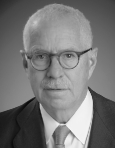
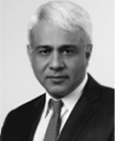
William Rainer Chairman of the Board |
|
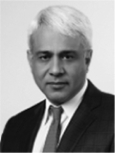
Mahesh Aditya President and CEO | |||
|
|
1601 Elm St. Suite 800 Dallas, Texas 75201 | 214.634.1110
|
NOTICE OF ANNUAL MEETING OF STOCKHOLDERS TO BE HELD JUNE 10, 2020
NOTICE IS HEREBY GIVEN that the Annual Meeting of Stockholders will be held at 1601 Elm Street, Suite 800, Dallas, Texas 75201, at 11:00 A.M. local time on June 10, 2020 for the following purposes:
| 1. | To elect 10 directors named in the Proxy Statement to the Board of Directors; |
| 2. | To ratify the appointment of PricewaterhouseCoopers LLP as our independent registered public accounting firm for the current fiscal year end; and |
| 3. | To vote on a stockholder proposal, if properly presented at the Annual Meeting, requesting that the Board of Directors prepare a report related to the monitoring and management of certain risks related to vehicle lending. |
Stockholders will also transact any other business as may properly come before the Annual Meeting in accordance with the terms of our Third Amended and Restated Bylaws.
The Board of Directors has fixed the close of business on April 13, 2020 as the record date for the determination of stockholders entitled to notice of, and to vote at, the Annual Meeting.
In the event it is not possible or advisable to hold our Annual Meeting as currently planned due to public health concerns, we will announce any additional or alternative arrangements, which may include a change in venue or holding the meeting solely by means of remote communication. Please monitor our website at http://www.proxypush.com/SC and our filings with the Securities and Exchange Commission for updated information. If you are planning to attend our meeting, please check our website the week of the meeting.
By Order of the Board of Directors,

Christopher Pfirrman
Chief Legal Officer, General Counsel, and Corporate Secretary
April 24, 2020
Important Notice Regarding the Availability of Proxy Materials for the Stockholder Meeting to Be Held On June 10, 2020.
The Proxy Statement and 2019 Annual Report are available at http://investors.santanderconsumerusa.com.
TABLE OF CONTENTS
| 1 | ||||
| 6 | ||||
| 6 | ||||
| 12 | ||||
| 13 | ||||
| 14 | ||||
| 17 | ||||
| 18 | ||||
| 19 | ||||
| 21 | ||||
| Proposal 2: Ratification of Appointment of Independent Registered Public Accounting Firm |
21 | |||
| 22 | ||||
| 22 | ||||
| 24 | ||||
| 24 | ||||
| 43 | ||||
| 49 | ||||
| 50 | ||||
| 51 | ||||
| 54 | ||||
| 54 | ||||
| 58 | ||||
| 59 | ||||
| 60 | ||||
|
SC 2020 Proxy Statement |
i |
PROXY SUMMARY
THIS SUMMARY HIGHLIGHTS INFORMATION CONTAINED ELSEWHERE IN THIS PROXY STATEMENT. IT DOES NOT CONTAIN ALL OF THE INFORMATION THAT YOU SHOULD CONSIDER. PLEASE READ THE ENTIRE PROXY STATEMENT CAREFULLY BEFORE VOTING.
Important Terms
| » | “2021 Annual Meeting” – the Company’s 2021 Annual Stockholder Meeting |
| » | “Annual Meeting” – the Company’s 2020 Annual Stockholder Meeting |
| » | “Banco Santander”, “Santander” and “SAN” – Banco Santander, S.A. |
| » | “Board” – the Board of Directors of SC |
| » | “BSI” – Banco Santander International, an affiliate of SC |
| » | “BSPR” – Banco Santander Puerto Rico, an affiliate of SC |
| » | “Bylaws” – the Third Amended and Restated Bylaws of SC |
| » | “CCAR” – the United States Federal Reserve Board’s Comprehensive Capital Analysis and Review |
| » | “CD&A” – the Compensation Discussion and Analysis section of this Proxy Statement |
| » | “CEO” – Chief Executive Officer |
| » | “CFO – Chief Financial Officer |
| » | “Common Stock” – shares of SC common stock, par value $0.01 per share |
| » | “Company,” “us,” “we,” “our,” and “SC” – Santander Consumer USA Holdings Inc. and, where appropriate, Santander Consumer USA Holdings Inc. and its subsidiaries |
| » | “Compensation Committee” – SC’s Compensation and Talent Management Committee |
| » | “Exchange Act” – the Securities Exchange Act of 1934, as amended |
| » | “GAAP” – United States generally accepted accounting principles, the accounting standard adopted by the SEC |
| » | “Independent Directors” – our independent directors as defined by the NYSE Listed Company Rules (as determined by the Board), including Dr. Akbari, Mr. Ferriss, Ms. Holiday, Mr. McCarthy, Mr. Muir, and Mr. Rainer |
| » | “NEOs” – our “named executive officers,” as determined under Rule 402 of Regulation S-K, and as designated in this Proxy Statement |
| » | “NYSE” – the New York Stock Exchange |
| » | “Omnibus Plan” – SC’s Omnibus Incentive Plan |
| » | “PwC” – PricewaterhouseCoopers LLP |
| » | “RSU” – restricted stock unit |
| » | “SBNA” – Santander Bank, N.A., a subsidiary of SHUSA and an affiliate of SC |
| » | “SEC” – the United States Securities and Exchange Commission |
| » | “Securities Act” – the Securities Act of 1933, as amended |
| » | “SHUSA” – Santander Holdings USA, Inc., SC’s majority stockholder and a subsidiary of Banco Santander |
| » | “SRIP” – Special Regulatory Incentive Program |
| » | “SIS” – Santander Investment Securities, an affiliate of SC and formerly known as Santander Central Hispano Investment Services, Inc. |
Your Vote
Your vote is very important. The Board is requesting you to allow your Common Stock to be represented at our Annual Meeting by proxies named on the proxy card.
This Proxy Statement is being sent to you in connection with this request and has been prepared for the Board by our management. This Proxy Statement is being sent to our stockholders on or about April 24, 2020.
|
SC 2020 Proxy Statement |
1 |
PROXY SUMMARY
How to Vote
You may vote your shares prior to the Annual Meeting via the Internet, by telephone, or by mail.
|
INTERNET
|
TELEPHONE
|
| ||
|
|
|
| ||
| Go to www.proxypush.com/sc | Dial toll-free 855-782-8499 | Mark, sign, and date your | ||
| You will need the control number included in your Proxy Card/Voting Instruction Form.
|
You will need the control number included in your Proxy Card/Voting Instruction Form. |
Proxy Card/Voting Instruction Form and return it in the postage-paid envelope provided. | ||
Summary of Voting Proposals and Voting Recommendations
|
PROPOSALS
|
BOARD RECOMMENDATION
| |
|
PROPOSAL 1. Election of Directors (Page 6)
We are asking stockholders to vote on each director nominee to the Board named in this Proxy Statement. The Board and the Executive Committee believe that each director nominee has the qualifications, experience, and skills necessary to represent stockholders through service on the Board. |
FOR ALL | |
|
PROPOSAL 2. Ratification of Appointment of Independent Registered Public Accounting Firm (Page 21)
The Audit Committee has appointed PwC to serve as the Company’s independent registered public accounting firm for the fiscal year ending December 31, 2020. The Audit Committee and the Board believe that the continued retention of PwC to serve as our independent auditor is in the best interests of the Company and its stockholders. As a matter of good corporate governance, stockholders are being asked to ratify the Audit Committee’s appointment of PwC. |
FOR | |
|
PROPOSAL 3. Stockholder Proposal (if properly introduced at the Annual Meeting) (Page 51) |
AGAINST |
|
2 |
SC 2020 Proxy Statement |
PROXY SUMMARY
Nominees for Election as Directors
The Board recommends a vote FOR the election of each of the following nominees for director:
|
NAME
|
AGE
|
DIRECTOR SINCE
|
INDEPENDENT
|
COMMITTEE MEMBERSHIP
| ||||
|
William Rainer
|
73 | 2015 | ● | Board Chair, EC (Chair) | ||||
|
Stephen A. Ferriss
|
74 | 2013 | ● | Board Vice Chair, AC, CC, EC, RC (Chair) | ||||
|
Mahesh Aditya
|
57 | 2017 | EC | |||||
|
Homaira Akbari
|
59 | 2020 | ● | RC, RCOC | ||||
|
Juan Carlos
|
49 | 2019 | --- | |||||
|
Victor Hill
|
56 | 2015 | RC, RCOC | |||||
|
Edith E. Holiday
|
68 | 2016 | ● | CC (Chair), RCOC | ||||
|
Javier Maldonado
|
57 | 2015 | CC, EC, RCOC | |||||
|
Robert J. McCarthy
|
66 | 2015 | ● | AC, CC, RCOC (Chair) | ||||
|
William F. Muir
|
65 | 2016 | ● | AC (Chair), RC, RCOC |
| » | AC: Audit Committee |
| » | CC: Compensation and Talent Management Committee |
| » | EC: Executive Committee |
| » | RC: Risk Committee |
| » | RCOC: Regulatory and Compliance Oversight Committee |
Corporate Governance Highlights
|
Majority independent Board
|
|
Annual evaluation of CEO by the Board
|
|
Annual Board and Committee self-evaluations and annual individual director evaluations
|
|
Annual election of all directors
|
|
Strong independent Chairman of the Board
|
|
Orientation program for new directors and continuing education for all directors
|
|
Robust stock ownership guidelines for independent directors
|
|
Strong risk oversight by full Board and Board Committees
|
|
Regular executive sessions of non-management directors
|
|
SC 2020 Proxy Statement |
3 |
PROXY SUMMARY
Business Highlights
|
$31.3 billion of originations across loans and leases, up 9% and an all-time high
|
|
$994 million of net income, an all-time high (excluding the impact of 2017 corporate tax reform)
|
|
7.8% retail installment loan net charge-off ratio, a four-year low
|
|
Net finance and other interest income of $4.7 billion, up 4%
|
|
Return on average assets (“ROA”) of 2.2%
|
|
Expense ratio of 2.1%
|
|
Reached mutually beneficial agreement with Fiat Chrysler and achieved an average annual CCAP penetration rate of 34%
|
|
Completed acquisition of $1.0 billion auto loan portfolio from Gateway One Lending
|
|
Leading auto loan and lease ABS issuer with $11.9 billion in ABS and launched first-ever nonprime revolving ABS platform “SREV”
|
|
Continued to grow and diversify our funding sources, including originating $7 billion in auto loans through our partnership with SBNA
|
|
Returned more than $600 million of capital to our stockholders through increased dividends and open market share repurchases.
|
|
Several key leadership appointments: Mahesh Aditya (President and Chief Executive Officer), Fahmi Karam (Chief Financial Officer) and Shawn Allgood (Head of Chrysler Capital and Auto Relationships)
|
Environmental and Social Highlights
|
Our ultimate parent, Banco Santander, is the world’s most sustainable bank according to the 2019 Dow Jones Sustainability Index and has developed guiding principles of governance and supervision in matters of responsible banking, sustainability and culture for us and its other subsidiaries.
|
|
We are guided by the sustainability approach of Banco Santander and are staunchly committed to the environment and combating climate change. In furtherance of this commitment, in 2019, SC eliminated all single-use plastic in all of its facilities and recycled over 326 thousand pounds of paper.
|
|
In 2019, we have provided nearly $2.1 million in charitable giving in the communities where SC has a presence. We also have promoted financial literacy among our customers and employees through online education and community volunteer programs.
|
|
We are also committed to diversity and inclusion and are taking active steps to make SC a more diverse and equitable workplace. SC promotes six employee networking groups to ensure that we consider diverse perspectives across our business and throughout our culture.
|
|
4 |
SC 2020 Proxy Statement |
PROXY SUMMARY
Executive Compensation Program—Overview
Our executive compensation program is designed to reinforce the link between the long-term interests of our executive officers and our stockholders. A significant portion of our executive officers’ incentive compensation is deferred and payable in SC shares, and therefore directly aligned with the Company’s performance, including total stockholder return.
|
ELEMENT
|
KEY CHARACTERISTICS
|
PURPOSE
|
||||||
| Base Salary |
Fixed cash compensation component, reviewed at least annually, that reflects the executive’s position, responsibilities, qualifications, tenure, and contributions to the Company
|
|
Offers security for executives and allows the Company to maintain a stable management team |
| ||||
| Annual Bonuses | Comprised of both short-term and long- term incentives; a significant portion of annual bonuses are deferred; half payable in cash and half payable in SC equity awards; includes a special, multi-year regulatory incentive program intended to focus executives on regulatory and compliance transformation initiatives
|
Motivates and rewards executives for achievement of Company and individual performance goals, appropriately balances compensation risk, and aligns management and stockholder interests
|
||||||
| Retirement Benefits; Welfare Benefits; Perquisites |
Indirect compensation consisting of a retirement plan, health and welfare plans, and standard perquisites |
Provides executives with security during employment and into retirement and promotes employee health, which assists in the retention of our executives
|
Key Features of Our Compensation Program
|
Ties annual incentive compensation to the achievement of meaningful Santander, SHUSA, Company and individual performance goals
|
|
Subjects a significant portion of annual incentive compensation to deferral
|
|
Pays a significant portion of annual incentive compensation in SC stock
|
|
Subjects Omnibus Plan awards to “double-trigger” change in control vesting
|
|
Subjects incentive compensation to a robust malus and clawback policy
|
|
Conditions a significant portion of compensation on the acceptance of confidentiality, non-solicit, and other restrictive covenants
|
|
Supported by a prominent independent compensation consultant
|
|
Imposes annual limits on non-employee director compensation
|
|
Maintains independent non-employee director stock ownership guidelines
|
|
Conducts a robust annual compensation risk assessment
|
|
Does not reprice underwater stock options
|
|
Does not grant discounted stock options
|
|
Does not allow hedging or pledging of SC stock by executive officers or directors
|
|
SC 2020 Proxy Statement |
5 |
CORPORATE GOVERNANCE - PROPOSAL 1: ELECTION OF GOVERNANCE
Proposal 1: Election of Directors
|
WHAT YOU ARE VOTING ON:
At the Annual Meeting, 10 directors are to be elected to hold office until the 2021 Annual Meeting and until their successors are elected and qualified, or until the directors either resign or are removed from office.
|
Introduction
As of the date of the Annual Meeting, the Board will consist of 10 members. The current members are Mahesh Aditya, Homaira Akbari, Juan Carlos Alvarez de Soto, Stephen A. Ferriss, Victor Hill, Edith E. Holiday, Javier Maldonado, Robert J. McCarthy, William F. Muir, and William Rainer. Mr. Aditya and Mr. Alvarez de Soto are also members of the board of directors of Santander Consumer USA Inc., an Illinois corporation and wholly-owned subsidiary of SC (“SC Illinois”).
SHUSA has the right to nominate eight members of the Board. Please see “Corporate Governance—Nomination of Directors” for more information. SHUSA has nominated Mr. Aditya, Dr. Akbari, Mr. Alvarez de Soto, Mr. Ferriss, Ms. Holiday, Mr. Hill, Mr. Maldonado and Mr. Rainer for election to the Board. The Board has nominated Mr. McCarthy and Mr. Muir for election to the Board. The Board has determined that Dr. Akbari, Mr. Ferriss, Ms. Holiday, Mr. McCarthy, Mr. Muir, and Mr. Rainer are Independent Directors.
Each of the directors elected at the Annual Meeting will be elected for a one-year term, which expires at the next annual meeting, and will serve until the director’s successor has been elected and qualified, or until the director’s earlier resignation or removal.
Information Concerning the Nominees
Biographical information for each nominee for election to the Board appears below. The information is based entirely upon information provided by the respective nominees.
| THE BOARD RECOMMENDS A VOTE FOR EACH OF THE NOMINEES. |
|
6 |
SC 2020 Proxy Statement |
CORPORATE GOVERNANCE - PROPOSAL 1: ELECTION OF GOVERNANCE
|
MAHESH ADITYA |
DIRECTOR SINCE: 2017 AGE: 57 | |
|
President and CEO
COMMITTEES
» Executive
|
EXPERIENCE
Mr. Aditya has been our President and CEO since December 2019. Previously, he served as the Chief Risk Officer of SHUSA from May 2018 to December 2019 and as Chief Risk Officer of SBNA from April 2018 to December 2019. He also served as the Chief Operating Officer of SHUSA from May 2017 to May 2018. Prior to joining SHUSA, he served as the Chief Risk Officer and was a member of the Operating Committee of Visa Inc. from June 2014 to February 2017. Prior to that role, from April 2011 until June 2014, Mr. Aditya was employed by JPMorgan Chase, first as the Chief Risk Officer of Retail Banking and then later the Chief Risk Officer of Mortgage Banking. Previously, he was employed as the Head of Risk for Mortgage and Business Banking at Capital One Bank from 2009 to 2011. He served as a member of the board of Early Warning Systems. Mr. Aditya holds a degree in electrical engineering from Bangalore University and a master’s degree in business administration from the Faculty of Management Studies, Delhi University. Mr. Aditya has extensive experience in risk management and finance, and we believe he is qualified to serve on the Board. | |
|
|
||
|
HOMAIRA AKBARI |
DIRECTOR SINCE: 2020 AGE: 59 | |
|
COMMITTEES
» Regulatory and Compliance Oversight
» Risk
|
EXPERIENCE
Dr. Akbari has served as the President and Chief Executive Officer of Acknowledge Partners, LLC, a global advisory firm providing high-impact consultative strategies and advice to Fortune 1000 companies and private equity firms in the sectors of The Internet of Things (“IoT”), Cyber Security, Artificial Intelligence and analytics since 2012. From 2007 to 2012, Dr. Akbari was the President and Chief Executive Officer of SkyBitz, Inc., a leading provider of IoT asset tracking and security solutions specializing in real-time decision-making tools for companies with unpowered assets such as truck trailing equipment, intermodal containers and rail cars. Prior to her service with SkyBitz, Dr. Akbari held executive positions at Microsoft Corporation, Thales Group, TruePosition, Inc., a subsidiary of Liberty Media Corporation, and Cambridge Strategic Management Group. Dr. Akbari also serves on the Board of Directors of Banco Santander and of Landstar System, Inc., a transportation logistics company listed on NASDAQ. Previously, Dr. Akbari served on the board of directors of several public companies including Gemalto N.V., Veolia S.A. and Covisint Corporation, a company formerly listed on the NASDAQ. Dr. Akbari holds a Ph.D. in particle physics from Tufts University and an MBA from Carnegie Mellon Tepper School of Business. She served as the Chair of the Johns Hopkins University Physics and Astronomy Advisory Council and is currently a member of Business Board of Advisors for Tepper School of Business. Dr. Akbari has extensive business experience with an emphasis on cybersecurity and the use of technology in business, and we believe that she is qualified to serve on our Board.
| |
|
SC 2020 Proxy Statement |
7 |
CORPORATE GOVERNANCE - PROPOSAL 1: ELECTION OF GOVERNANCE
| JUAN CARLOS ALVAREZ DE SOTO |
DIRECTOR SINCE: 2019 AGE: 49 | |
|
|
EXPERIENCE
Mr. Alvarez de Soto has been the CFO of SHUSA since September 2019. He joined us and served as our CFO from October 2017 until September 2019. Prior to joining us, Mr. Alvarez de Soto served as Corporate Treasurer for SHUSA from 2009 to 2017, overseeing SHUSA’s liquidity risk management, asset liability management, and treasury functions. Prior to joining SHUSA, from 2005 to 2008, he was Senior Vice President and Head of Treasury and Investments for Banco Santander’s International Private Banking at BSI and Banco Santander Suisse. In this role he managed a team of investment professionals, overseeing the assets of Banco Santander’s international high-net-worth clients. From 2000 to 2004, Mr. Alvarez de Soto held the position of Directeur Adjoint for Santander Central Hispano Suisse, Geneva and was Head of Treasury, Trading and Asset-Allocation. Mr. Alvarez de Soto holds a master’s degree in finance from George Washington University and a bachelor’s degree in management from Tulane University, and is a Chartered Financial Analyst. Mr. Alvarez de Soto has extensive experience in finance and global markets, and we believe he is qualified to serve on our Board.
| |
|
|
||
|
STEPHEN A. FERRISS |
DIRECTOR SINCE: 2013 AGE: 74 | |
|
Vice-Chairman of the Board
COMMITTEES
» Audit
» Compensation
» Executive
» Risk (Chair)
|
EXPERIENCE
Mr. Ferriss has served as a director of SHUSA since 2012. He also is the chairman of the boards of directors Santander BanCorp and BSPR and a director of BSI. Mr. Ferriss was also a director of SBNA from 2012 to 2015. Previously, he served as President and CEO of SIS (formerly known as Santander Central Hispano Investment Services, Inc.) from 1999 to 2002, and held various roles at Bankers Trust, including Managing Director and Partner of the Bankers Trust Global Investment Bank in London and New York. Prior to Bankers Trust, Mr. Ferriss spent 19 years at Bank of America. Mr. Ferriss graduated from Columbia College and received a master’s degree in Latin American international economics from Columbia University School of International and Public Affairs. Mr. Ferriss has extensive experience in management and international finance, and we believe he is qualified to serve on the Board. | |
|
8 |
SC 2020 Proxy Statement |
CORPORATE GOVERNANCE - PROPOSAL 1: ELECTION OF GOVERNANCE
|
VICTOR HILL |
DIRECTOR SINCE: 2015 AGE: 56 | |
|
COMMITTEES
» Regulatory and Compliance Oversight
» Risk
|
EXPERIENCE
Mr. Hill has worked within the UK motor finance industry for over 35 years, 18 of them at board level. He began his career within Lombard Motor Finance in 1982 and moved to First National Motor Finance in 1998, joining the board of directors in 2000. Mr. Hill was responsible for the launch of Santander Consumer Finance (UK) plc (“SCUK”), an affiliate of SC, in 2005, and continues to lead that business today as CEO. He led the acquisition of the UK motor finance portfolio from GE Money in 2009 and currently serves as a director of two joint venture subsidiaries, Hyundai Capital UK and PSA Finance. Mr. Hill has held a number of directorships, registered at Companies House in London, but his current responsibilities include directorships of five companies including SCUK, Hyundai Capital UK Ltd, PSA Finance UK Ltd, PSA Finance plc, and SC. He qualified as a Chartered Director in 2007 and achieved Fellowship of the Institute of Directors, in London, during 2012. He also qualified as a Mediator for Civil and Commercial Disputes in 2008. Mr. Hill has extensive management experience within the auto finance industry, and we believe that he is qualified to serve on the Board. | |
|
|
||
| EDITH E. HOLIDAY |
DIRECTOR SINCE: 2016 AGE: 68 | |
|
COMMITTEES
» Compensation (Chair)
» Regulatory and
|
EXPERIENCE
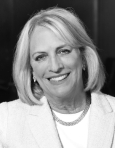
Ms. Holiday is a member of the boards of directors of Hess Corporation (NYSE:HES), White Mountains Insurance Group Ltd. (NYSE:WTM), and Canadian National Railway (NYSE:CNI), and is a member of the boards of directors or trustees of various investment companies in the Franklin Templeton Group of Funds, serving as Lead Director of the Franklin and Templeton Funds. She also joined the board of directors of SHUSA in December 2019. Ms. Holiday also served on the boards of directors of RTI International Metals, Inc. from 1999 to 2015, and of the H.J. Heinz Company from 1994 to 2013. Ms. Holiday was also the President, Secretary, and Treasurer of Comcast TW Holdings, Inc. from 2006 to 2007. From 1990 to 1993, Ms. Holiday was Assistant to the President of the United States and Secretary of the U.S. Cabinet. From 1989 to 1990, she served as General Counsel of the U.S. Treasury Department, and from 1988 to 1989 she served as Counselor to the Secretary and Assistant Secretary for Public Affairs and Public Liaison of the U.S. Treasury Department. Prior to that, Ms. Holiday held various other positions in government and in private practice. Ms. Holiday holds a bachelor of science and a law degree from the University of Florida. Ms. Holiday has extensive experience in legal and regulatory matters and in public service, and we believe that she is qualified to serve on the Board.
| |
|
SC 2020 Proxy Statement |
9 |
CORPORATE GOVERNANCE - PROPOSAL 1: ELECTION OF GOVERNANCE
|
JAVIER MALDONADO |
DIRECTOR SINCE: 2015 AGE: 57 | |
|
COMMITTEES
» Compensation
» Executive
» Regulatory and
|
EXPERIENCE
Mr. Maldonado has served as Senior Executive Vice President, Global Head of Cost Control of Banco Santander since October 2015. He has held numerous management positions at Banco Santander and its affiliates, including Senior Executive Vice President, Head of the New General Directorate for Coordination and Control of Regulatory Projects of Banco Santander; Executive Committee Director, Head of Internal Control and Corporate Development, for Santander (UK) plc from May 2012 to September 2014; Vice President in Charge of Closed Funds and Complaints for Banco Santander Brazil from October 2011 to April 2012; and General Manager for Banco Santander in the Middle East from January 2011 to September 2011. Previously, Mr. Maldonado was an attorney with Baker & McKenzie and Corporate and International Law Department Head at J.Y. Hernández-Canut Law Firm. Mr. Maldonado has served as a director of SHUSA since April 2015 and has served as vice-chairman of the board of directors of SHUSA since October 2015. He also currently serves as a director of SBNA, BSPR, BSI, Santander BanCorp and SIS. He holds law degrees from Northwestern University and UNED University. Mr. Maldonado has extensive knowledge and experience in international finance and legal and regulatory affairs, and we believe he is qualified to serve on the Board. | |
|
|
||
| ROBERT J. McCARTHY |
DIRECTOR SINCE: 2015 AGE: 66 | |
|
COMMITTEES
» Audit
» Compensation
» Regulatory and
|
EXPERIENCE
In 2014, Mr. McCarthy retired from Marriott International, Inc., where he served as Chief Operations Officer since 2012. Mr. McCarthy joined Marriott in 1975, where he served in various leadership positions, including Senior Vice President, Northeast Region from 1995 to 2000; Executive Vice President, Operations from 2000 to 2002; President, North America from 2003 to 2009; Group President from 2009 to 2011; and Chief Operations Officer from March 2012 until February 2014. Mr. McCarthy has served as Chairman of Hotel Development Partners since March 2014. He currently is a member of the Board of Trustees at Villanova University and a member of the board of directors of RLJ Lodging Trust (NYSE:RLJ). Previously, Mr. McCarthy served as a director of the ServiceSource Foundation, as a member of the board of directors of the Autism Learning Center, as a member of the Dean’s Advisory Board at Cornell University School of Hotel Administration, as a member of the Dean’s Advisory Board at Villanova University School of Business, and as a member of the board of managers at Avendra, LLC. He holds a bachelor’s degree in business administration from Villanova University and is a graduate of the Advanced Management Program at the Wharton School of Business at the University of Pennsylvania. Mr. McCarthy has extensive managerial and finance experience, and we believe he is qualified to serve on the Board. | |
|
10 |
SC 2020 Proxy Statement |
CORPORATE GOVERNANCE - PROPOSAL 1: ELECTION OF GOVERNANCE
| WILLIAM F. MUIR |
DIRECTOR SINCE: 2016 AGE: 65 | |
|
COMMITTEES
» Audit (Chair)
» Risk
» RCOC
|
EXPERIENCE
In 2014, Mr. Muir retired from Ally Financial Inc. (formerly known as General Motors Acceptance Corporation (“GMAC”)), where he served as President and head of its Global Automotive Services business starting in 2004. In that role, he led Ally’s automotive finance, insurance, vehicle remarketing, and servicing operations. Prior to that time, he served as Executive Vice President and Chief Financial Officer of GMAC from 1998 to 2004. From 1996 to 1998, Mr. Muir served as Executive-in-Charge of Operations and then Executive Director of Planning at Delphi Automotive Systems, a former subsidiary of General Motors (“GM”). Prior to serving at Delphi Automotive Systems, he served in various executive capacities upon joining GMAC in 1992 and also served in a number of capacities with GM since joining GM in 1983. Mr. Muir also served as Chairman of the Ally Insurance Group from 1999 to 2014 and a member of the Ally Bank board of directors from 2004 to 2016. Mr. Muir received a bachelor’s degree in industrial engineering and operations research from Cornell University in 1977. He earned a master’s degree in business administration from Harvard University in 1983. Mr. Muir has extensive experience in management, finance, and the auto finance industry, and we believe that he is qualified to serve on the Board. | |
|
|
||
|
WILLIAM RAINER |
DIRECTOR SINCE: 2015 AGE: 73 | |
|
Chairman of the Board
COMMITTEE
» Executive (Chair)
|
EXPERIENCE
Mr. Rainer has extensive experience and has held numerous leadership roles in the financial services industry. From 2001 to 2004, Mr. Rainer served as the Chairman and CEO of OneChicago, LLC, a regulated futures exchange. He also served as the Chairman of the Commodity Futures Trading Commission from 1999 to 2001, as Chairman of the United States Enrichment Corporation from 1994 to 1998, and as Founder of Greenwich Capital Markets, Inc. from 1981 to 1988. Previously, Mr. Rainer held various leadership positions at Kidder, Peabody & Co., Inc. From July 2015 to March 2016, he served as a director of BSI, and from December 2015 to March 2016, he served as chairman of the board of SIS. Mr. Rainer served as director of IQ Funds, a family of closed-end mutual funds, from 2004 until 2010. From 1996 to 2000 and from 2004 to 2008, Mr. Rainer served as a trustee for Southern Methodist University. He has served as a member of the Dean’s Council of the Harvard Divinity School since 2004 and as its Chair from 2005 through June 2013. Mr. Rainer received his bachelor’s degree in economics and master’s degree in business administration from Southern Methodist University. Mr. Rainer has extensive knowledge and experience in finance, regulatory affairs, and leadership of financial services firms, and we believe he is qualified to serve on the Board.
| |
|
SC 2020 Proxy Statement |
11 |
CORPORATE GOVERNANCE - DIRECTOR INDEPENDENCE
Because we are a controlled company, we are exempt from the requirement in the NYSE Listed Company Rules that a majority of our directors must be independent. In addition, we are exempt from the requirements (i) that our Executive Committee (which under its charter has the responsibilities of a Nominating and Governance Committee) be composed solely of directors who meet the independence standards under the NYSE Listed Company Rules and (ii) that our Compensation Committee be composed solely of directors who meet additional, heightened independence standards under the NYSE Listed Company Rules and the rules of the SEC. The Company is subject to the requirement that all members of our Audit Committee satisfy independence requirements set forth under the NYSE Listed Company Rules and meet the additional criteria for independence of audit committee members set forth in Rule 10A-3(b)(1) under the Exchange Act.
Under the NYSE Listed Company Rules, to be considered independent, a director must not have a disqualifying relationship, as defined in the NYSE Listed Company Rules, and the Board must affirmatively determine that the director otherwise has no direct or indirect material relationship with the Company. In making independence determinations, the Board complies with all NYSE and SEC criteria and considers all relevant facts and circumstances. The Board has determined that Dr. Akbari, Mr. Ferriss, Ms. Holiday, Mr. McCarthy, Mr. Muir, and Mr. Rainer are Independent Directors.
In assessing the independence of the Independent Directors, the Board considered, without limitation, the following transactions, relationships, and arrangements:
| DIRECTOR |
ORGANIZATION |
RELATIONSHIP |
SC TRANSACTION/ RELATIONSHIP
| |||
| Mr. Ferriss | SHUSA |
Director |
Majority Stockholder
| |||
| SBNA |
Former Director |
Affiliate
| ||||
|
SIS |
Former CEO |
Affiliate | ||||
| Santander BanCorp |
Chairman of the Board |
Affiliate
| ||||
| BSPR |
Chairman of the Board |
Affiliate
| ||||
| BSI |
Director |
Affiliate
| ||||
| Dr. Akbari
|
Banco Santander |
Director |
Sole Stockholder of our Majority Stockholder
| |||
| Ms. Holiday
|
SHUSA |
Director |
Majority Stockholder
| |||
| Mr. Rainer | BSI |
Former Director |
Affiliate
| |||
| SIS |
Former Chairman |
Affiliate
|
The Board has also determined that each member of our Audit Committee is financially literate and that the chair of our Audit Committee (Mr. Muir) is an “audit committee financial expert” as defined by the SEC.
|
12 |
SC 2020 Proxy Statement |
CORPORATE GOVERNANCE - BOARD LEADERSHIP STRUCTURE AND RISK OVERSIGHT
Board Leadership Structure and Risk Oversight
The Board is responsible for the oversight of management on behalf of our stockholders. The Board and its committees meet periodically throughout the year to: (i) review strategy, business and financial performance, risk and control matters, and compensation and management development; and (ii) provide guidance to and oversight of, and otherwise assess and advise, the CEO and other senior executives. The Board’s leadership structure, described below, is designed to ensure that authority and responsibility are effectively allocated between the Board and management.
The Board does not have any formal policy as to whether the same person should serve as both the CEO and Chairman of the Board, as the Board believes that it should have the flexibility to make the determination of the appropriate leadership for us at any given point in time. Currently, Mr. Rainer serves as the independent Chairman of the Board. We believe that having an independent Chairman can create an environment that leads to objective evaluation and oversight of management’s performance, increases management accountability, and improves the ability of the Board to monitor whether management’s actions are in the best interests of all stockholders. As a result, at this time, we believe that Mr. Rainer serving as our independent Chairman enhances the effectiveness of the Board as a whole. The Board will continue to review the Board’s leadership periodically and may modify this structure from time to time if it is in the best interests of our Company and our stockholders.
The Chairman of the Board leads the Board, sets the tone for its culture, and ensures its effectiveness in overseeing the Company and its management. The Chairman presides at all meetings of the Board, as well as executive sessions of Independent Directors, and, in consultation with the CEO, other directors, and management, establishes the agenda for each Board meeting. The Chairman also has the power to call special meetings of the Board. Mr. Ferriss serves as the Board’s Vice-Chairman, who acts as Chairman of the Board if Mr. Rainer is absent.
The Company has established a risk governance structure that assigns responsibility for risk management among front-line business personnel, an independent risk management function, and internal audit. According to this model, business owners maintain responsibility for identifying and mitigating the risks generated through their business activities. The Chief Risk Officer, who reports to the CEO and is independent of any business line, is responsible for developing and maintaining a risk framework that ensures risks are appropriately identified and mitigated, and for reporting on the overall level of risk in the Company. The Chief Risk Officer is also accountable to the Risk Committee and to SHUSA’s Chief Risk Officer. The Chief Risk Officer is charged with the implementation and execution of the enterprise risk management (“ERM”) program under the oversight of the Board and its committees.
Risk management is overseen by the Board through four standing committees: the Risk Committee, the Audit Committee, the Compensation Committee, and the Regulatory and Compliance Oversight Committee, each of which is chaired by an Independent Director. Committee chairs are responsible for calling meetings of their committees, presiding at meetings of their committees, approving agendas and materials for their committee meetings, serving as a liaison between committee members and the Board and between committee members and senior management (including the CEO, the CFO and the Chief Risk Officer), and working directly with the senior management responsible for committee matters. Each Board committee provides regular reports to the Board regarding matters reviewed by the Board committee.
In addition to receiving and discussing reports of risks under the purview of a particular committee, the Board monitors our risk culture and reviews specific and aggregate risks the Company faces. Further, at least annually, the Board approves, at the recommendation of the Risk Committee, a Risk Appetite Statement (a “RAS”), which defines the levels and types of risks the Company is willing to assume to achieve its business plans while controlling risk exposures within our risk capacity. In addition, the RAS establishes principles for risk-taking in the aggregate and for each risk type, and is supported by a comprehensive system of risk limits, escalation triggers, and control programs.
The Risk Committee is charged with responsibility for establishing governance over the ERM process and provides oversight of risk policies and risk management performance. The Risk Committee monitors our aggregate risk position and reviews reports from management on the comprehensive portfolio of risk categories and the potential impact these risks can have on our risk profile. A comprehensive risk report is submitted regularly by the Chief Risk Officer to the Risk Committee and to the Board, providing management’s view of our risk position. Further, the Risk Committee reviews and recommends for the Board’s approval the RAS and the ERM Policy. The Risk Committee also provides oversight of our impact on SHUSA’s compliance with its capital adequacy assessment process, including its capital plan submissions and resolution planning. In addition, the Risk Committee oversees the Company’s information and cyber risk management program. The Risk Committee also reviews and concurs in the appointment, replacement, performance, and compensation of the Chief Risk Officer.
|
SC 2020 Proxy Statement |
13 |
CORPORATE GOVERNANCE - BOARD COMMITTEES
The Audit Committee is charged with oversight relating to the integrity of our financial statements and financial reporting process, the integrity of our systems of internal accounting and financial controls, and internal and external auditing, including the qualifications and independence of our independent registered public accounting firm. Please see “Audit—Proposal 2: Ratification of Appointment of Independent Registered Public Accounting Firm” for discussion of PwC, our proposed independent registered public accounting firm for 2019. The Audit Committee oversees the performance of our internal audit function; reviews and concurs in the appointment, replacement, performance, and compensation of our Chief Audit Executive; and approves our internal audit function’s annual audit plan, charter, policies, and budget. The Audit Committee also receives regular updates on the audit plan’s status and results including significant reports issued by our internal audit function and the status of management’s corrective actions.
The Compensation Committee works to ensure that the compensation programs covering our executives, business units, and risk- taking employees appropriately balance risk with incentives such that business performance is achieved without taking imprudent or inefficient risks. At least annually, the Compensation Committee conducts an assessment of the compensation policies and practices for our employees, including our executive officers. The assessment includes whether such compensation policies and practices created risks that were reasonably likely to have a material adverse effect on the Company.
The Regulatory and Compliance Oversight Committee is charged with the oversight of risk relating to the effectiveness of our compliance management system. The Regulatory and Compliance Oversight Committee also oversees our progress in remediating risks identified in risk assessment findings, internal audit findings, and outstanding corrective actions identified by regulators in examination reports, enforcement actions, and other communications.
In addition to the Board and the Risk Committee, the CEO and Chief Risk Officer delegate risk responsibility to management committees. These committees include the Asset Liability Committee, Enterprise Risk Management (“ERM”) Committee, the Executive Risk Committee and the Pricing Committee. The Chief Risk Officer is a member of each of these committees and chairs the ERM Committee.
The Board has five standing committees: the Audit Committee, the Compensation and Talent Management Committee, the Executive Committee, the Regulatory and Compliance Oversight Committee, and the Risk Committee. The charters for each committee may be found on SC’s website at http://investors.santanderconsumerusa.com.
| NAME |
AUDIT |
COMPENSATION AND TALENT MANAGEMENT |
EXECUTIVE |
REGULATORY AND COMPLIANCE OVERSIGHT |
RISK | ||||||||||||||||||||
|
Edith E. Holiday
|
Chair |
●
|
|||||||||||||||||||||||
|
Homaira Akbari
|
●
|
●
| |||||||||||||||||||||||
|
Javier Maldonado
|
● | ● | ●
|
||||||||||||||||||||||
|
Juan Carlos Alvarez de Soto
|
|||||||||||||||||||||||||
|
Mahesh Aditya
|
●
|
||||||||||||||||||||||||
|
Robert J. McCarthy
|
●
|
● |
Chair
|
||||||||||||||||||||||
|
Stephen A. Ferriss
|
● | ● | ●
|
Chair | |||||||||||||||||||||
|
Victor Hill
|
● | ● | |||||||||||||||||||||||
|
William F. Muir
|
Chair |
● |
● | ||||||||||||||||||||||
|
William Rainer
|
Chair |
||||||||||||||||||||||||
|
14 |
SC 2020 Proxy Statement |
CORPORATE GOVERNANCE - BOARD COMMITTEES
The following summarizes the membership of each Board committee, as well as the primary roles and responsibilities of each committee and the number of times each committee met in 2019.
|
AUDIT COMMITTEE
|
NUMBER OF MEETINGS IN 2019: 9 | |||||
|
MEMBERS |
AMONG OTHER THINGS, OUR AUDIT COMMITTEE:
| |||||
| » Mr. Muir (Chair)
» Mr. Ferriss
» Mr. McCarthy |
»
|
Reviews financial reporting policies, procedures, and internal controls.
| ||||
| »
|
Responsibility for the appointment, compensation, and oversight of our independent registered public accounting firm.
| |||||
| »
|
Pre-approves audit, audit-related, and non-audit services to be performed by our independent registered public accounting firm.
| |||||
| »
|
Reviews and approves or ratifies all related-party transactions.
| |||||
| »
|
Oversees our internal audit function, including approval of the annual internal audit plan and the review of the performance of our Chief Audit Executive.
| |||||
| »
|
Oversees our compliance with legal and regulatory requirements as well as ethical standards adopted by the Company.
| |||||
| »
|
Reviews certain risk management policies and procedures; certain policies, processes, and procedures regarding compliance matters; and our Supplemental Statement of Ethics and Code of Ethics for the CEO and Senior Financial Officers.
| |||||
|
The Board has determined that each of the Audit Committee members is “independent” as defined by Section 10A(m)(3) of the Exchange Act, Rule 10A-3 under the Exchange Act, and the NYSE Listed Company Rules. The Board has also determined that each of the members is “financially literate” as required by Section 303A.07 of the NYSE Listed Company Rules and our chair (Mr. Muir) is an “audit committee financial expert” as defined in the SEC’s rules.
| ||||||
|
COMPENSATION AND TALENT MANAGEMENT COMMITTEE |
NUMBER OF MEETINGS IN 2019: 8
| |||||
|
MEMBERS |
AMONG OTHER THINGS, OUR COMPENSATION AND TALENT MANAGEMENT COMMITTEE:
| |||||
| » Ms. Holiday (Chair)
» Mr. Ferriss
» Mr. Maldonado
» Mr. McCarthy |
»
|
Reviews and approves the compensation of the CEO and each other executive officer.
| ||||
| »
|
Reviews and makes recommendations to the Board regarding the compensation of the Independent Directors.
| |||||
| »
|
Approves and evaluates all compensation plans, policies, and practices of the Company as they affect our CEO and other executive officers.
| |||||
| »
|
Sets performance measures and goals and verifies the attainment of performance goals under performance-based incentive compensation arrangements applicable to our executive officers.
| |||||
| »
|
Monitors and assesses whether the overall design and performance of our compensation plans, policies, and programs do not encourage employees, including our NEOs, to take excessive risk.
| |||||
| »
|
Oversees the management development, succession planning, and retention practices for our executive officers.
| |||||
|
The Board has determined that Mr. Ferriss, Ms. Holiday, and Mr. McCarthy are “independent” as defined by the NYSE Listed Company Rules and qualify as “non-employee” directors within the meaning of Rule 16b-3 under the Securities Exchange Act of 1934, as amended (“Rule 16b-3”). Mr. Ferriss, Ms. Holiday, and Mr. McCarthy constitute a subcommittee of the Compensation and Talent Management Committee when considering issues governed by Rule 16b-3.
| ||||||
|
SC 2020 Proxy Statement |
15 |
CORPORATE GOVERNANCE - BOARD COMMITTEES
|
EXECUTIVE COMMITTEE
|
NUMBER OF MEETINGS IN 2019: 4 | |||||
|
MEMBERS
|
AMONG OTHER THINGS, OUR EXECUTIVE COMMITTEE:
| |||||
| » Mr. Rainer (Chair)
» Mr. Aditya
» Mr. Ferriss
» Mr. Maldonado |
» | Acts on the Board’s behalf between Board meetings on all matters that may be lawfully delegated. | ||||
|
» |
Considers and recommends candidates for election to the Board. | |||||
|
» |
Leads the annual performance evaluations of the Board and Board committees. | |||||
|
» |
Reviews and advises the Board on our corporate governance.
| |||||
|
The Board has determined that Mr. Rainer and Mr. Ferriss are “independent” as defined by the NYSE Listed Company Rules.
| ||||||
|
REGULATORY AND COMPLIANCE OVERSIGHT COMMITTEE
|
NUMBER OF MEETINGS IN 2019: 6 | |||||
|
MEMBERS
» Mr. McCarthy (Chair)
» Dr. Akbari
» Mr. Hill
» Ms. Holiday
» Mr. Maldonado
» Mr. Muir |
AMONG OTHER THINGS, OUR REGULATORY AND COMPLIANCE OVERSIGHT COMMITTEE:
| |||||
| » | Provides oversight of the Company’s significant banking and consumer regulatory compliance issues.
| |||||
| » | Oversees the Company’s Compliance Program, including the Chief Compliance Officer.
| |||||
| » | Oversees our progress in responding to internal audit findings, risk assessment findings, and outstanding corrective actions identified by regulators in examination reports, enforcement actions, and other communications.
| |||||
| » | Reviews our regulatory correspondence and reports received from or submitted to regulators to ensure effective communication between the Company and its respective regulators.
| |||||
|
The Board has determined that Mr. McCarthy, Dr. Akbari, Ms. Holiday, and Mr. Muir are “independent” as defined by the NYSE Listed Company Rules.
| ||||||
|
RISK COMMITTEE
|
NUMBER OF MEETINGS IN 2019: 17 | |||||
|
MEMBERS
|
AMONG OTHER THINGS, OUR RISK COMMITTEE:
| |||||
| » Mr. Ferriss (Chair)
» Dr. Akbari
» Mr. Hill
» Mr. Muir |
» | Assesses and manages, without limitation, our enterprise risk, credit risk, market risk, operational risk, liquidity risk, and other risk matters. | ||||
|
» |
Provides oversight of our risk governance structure in order to evaluate and control our risks, including the approval of our Risk Appetite Statement. | |||||
|
» |
Oversees our risk management function including appointment and evaluation of the Chief Risk Officer and annual review of the Chief Risk Officer’s proposed priorities, budget and staffing plans. | |||||
|
» |
Oversees and manages our activities related to capital planning and analysis.
| |||||
|
The Board has determined that Mr. Ferriss, Dr. Akbari, and Mr. Muir are “independent” as defined by the NYSE Listed Company Rules.
| ||||||
|
16 |
SC 2020 Proxy Statement |
CORPORATE GOVERNANCE - DIRECTOR COMPENSATION
Only Independent Directors are compensated for their service on the Board. The compensation program for Independent Directors was approved by our non-independent, disinterested directors, who do not receive any compensation for their Board service. The program provided the following compensation for Independent Directors:
| » | An annual cash retainer of $100,000 (paid quarterly in arrears); plus |
| » | An annual grant of RSUs with a grant date fair market value equal to $50,000, vesting on the earlier of the 1st anniversary of the grant date or the 1st annual stockholder meeting following the grant date (with the grant date occurring at or around the start of the applicable term of service); plus |
| » | $70,000 in cash annually for serving as the chair of any committee of the Board (paid quarterly in arrears); plus |
| » | $20,000 in cash annually for serving as a non-chair member of any committee of the Board (paid quarterly in arrears); plus |
| » | $450,000 in cash annually if the director also serves as the Chairman of the Board (paid quarterly in arrears). |
The Compensation Committee annually reviews the form and amount of director compensation and recommends changes to the non-independent, disinterested Board members (who do not receive any director compensation from us), as appropriate. There were no changes to the Independent Director Compensation program in 2019.
Independent Director Stock Ownership Guidelines
In order to align the economic interests of our Independent Directors with those of our stockholders, the Board has determined that our Independent Directors should hold a meaningful equity stake in SC. To that end, our Independent Non-Employee Director Stock Ownership Guidelines require each of our Independent Directors to acquire and retain shares or share equivalents of our Common Stock with a target value not less than five times the annual equity retainer of $50,000.
There is no required time period within which an Independent Director must attain the applicable stock ownership target. However, until the stock ownership target is achieved, an Independent Director is required to retain 100% of all shares of our Common Stock received under SC’s Independent Director compensation program, other than shares received with a value equal to the amount of taxes due on income realized in connection with the vesting or exercise of awards.
As of the date hereof, all directors are in compliance with the Independent Non-Employee Director Stock Ownership Guidelines.
Director Compensation Table for 2019
The following table provides information regarding compensation for each Independent Director in 2019. Under our director compensation program, only Independent Directors are compensated for their service on the Board.
| NAME(1) |
FEES EARNED OR PAID IN CASH ($)
|
STOCK AWARDS(2) ($) |
TOTAL ($) | ||||||||||||
|
Stephen A. Ferriss
|
230,000
|
50,000
|
280,000
| ||||||||||||
|
Edith E. Holiday
|
190,000
|
50,000
|
240,000
| ||||||||||||
|
Robert J. McCarthy
|
210,000
|
50,000
|
260,000
| ||||||||||||
|
William F. Muir
|
210,000
|
50,000
|
260,000
| ||||||||||||
|
William Rainer
|
620,000
|
50,000
|
670,000
| ||||||||||||
| (1) | Dr. Akbari was appointed to the Board effective January 1, 2020, and therefore, did not receive compensation for 2019. |
| (2) | To align our Independent Directors’ compensation with stockholder interests, each Independent Director is granted RSUs upon election or re-election. In 2019, all director RSUs were granted on June 11, 2019. Each award will vest upon the earlier of (i) the first anniversary of the grant date and (ii) the first annual stockholder meeting following the grant date. This column represents the aggregate grant date fair value computed in accordance with FASB ASC Topic 718, based on the closing price of our Common Stock on the applicable grant date, but excluding the effect of potential forfeitures. Except for Mr. Ferriss, who holds 5,207 vested options, the stock awards reflected above comprise all outstanding equity awards held by our Independent Directors at the end of 2019. |
|
SC 2020 Proxy Statement |
17 |
CORPORATE GOVERNANCE - NOMINATION OF DIRECTORS
The Shareholders Agreement, by and among SC, SHUSA, and certain other holders of our Common Stock, which we refer to as the “Shareholders Agreement,” provides SHUSA with special rights to nominate directors to the Board. Please see “Additional Governance Information—Related Party Transactions—Shareholders Agreement” for further information. Pursuant to the Shareholders Agreement, SHUSA is entitled to nominate eight members of the Board. The Shareholders Agreement provides further that SHUSA may remove any director nominated by SHUSA with or without cause. In addition, SHUSA has the right to designate a replacement to fill a vacancy on the Board created by the departure of a director that was nominated by SHUSA, and we are required to take all action within our power to cause such vacancy to be filled by such designated replacement (including by promptly appointing such designee to the Board).
With respect to directors not nominated by SHUSA, the Board is responsible for selecting nominees for election to the Board by our stockholders. Generally, the Board begins identifying nominees by first evaluating the current members of the Board willing to continue in service. Current members of the Board with skills and experience that are relevant to our business and who are willing to continue in service are considered for re-nomination. If any member of the Board does not wish to continue in service or if the Board decides not to re-nominate a member for re-election, the Board then identifies the desired skills and experience of a new nominee in light of the criteria described below. Generally, the Board identifies candidates for director nominees in consultation with sitting members of the Board and with management, through the use of search firms or other advisors, through recommendations submitted by other directors or stockholders, and through such other methods as the Board deems appropriate. In identifying and evaluating a potential director nominee, the Board considers, among other things, the following factors:
| » | Our needs with respect to the particular talents and experience of our directors; |
| » | The nominee’s knowledge, skills, and experience, including experience in finance, administration, or public service, in light of prevailing business conditions and the knowledge, skills, and experience already possessed by other members of the Board; |
| » | Whether the nominee is independent, as that term is defined under the NYSE Listed Company Rules; |
| » | The familiarity of the nominee with our industry; |
| » | The nominee’s experience in legal and regulatory affairs; |
| » | The nominee’s experience with accounting rules and practices; and |
| » | The desire to balance the benefit of continuity with the periodic injection of the fresh perspective provided by new Board members. |
In its identification and evaluation process, the Board collects information about candidates through interviews, detailed questionnaires, and other means that the Board deems helpful in such process.
The Board’s goal is to assemble a Board that brings together a variety of perspectives and skills derived from high quality business and professional experience. In doing so, the Board will also consider candidates with appropriate non-business backgrounds.
The Board is also committed to diversified Board membership. The Board will not discriminate, including on the basis of race, national origin, gender, sexual orientation, religion, or disability, in selecting nominees. Diversity and inclusion are values embedded into our culture and are fundamental to our business. In keeping with those values, when assessing a candidate, the Board considers the different viewpoints and experiences that a candidate could bring to the Board and how those viewpoints and experiences could enhance the Board’s effectiveness in the execution of its responsibilities. The Board is also committed to seeking highly qualified women and individuals from minority groups to include in the pool from which new candidates are selected. Further, the Board is committed to interview at least one woman for every new Board position until we have at least four women on the Board. In addition, the Board assesses the diversity of the Board and committees as a part of its annual self-evaluation process.
Other than the foregoing, there are no stated minimum criteria for director nominees. The Board may also consider such other factors as it may deem in our best interests and the best interests of our stockholders. We also believe it may be appropriate for key members of our management to participate as members of the Board.
Subject to the rights of our majority stockholder, stockholders may nominate candidates for election to the Board. In order to nominate a candidate for election to the Board, stockholders must follow the procedures set forth in our Bylaws, including timely receipt by the Secretary of the Company of notice of the nomination and certain required disclosures with respect both to the nominating stockholder and the recommended director nominee. For a complete description of the requirements and procedures for stockholder nominations, please refer to our Bylaws.
Directors may be elected by a plurality of votes cast at any meeting called for the election of directors at which a quorum is present. The presence of a majority of the holders of our Common Stock, whether in person or by proxy, constitutes a quorum. The Board did not receive any recommendations from stockholders (other than SHUSA) requesting that the Board consider a candidate for inclusion among the nominees in this Proxy Statement. However, our policy is that we will consider any such recommendation as long as the stockholder making the recommendation provides to us the information concerning the recommended individual that is required under our Bylaws.
|
18 |
SC 2020 Proxy Statement |
EXECUTIVE OFFICERS
The names, ages, and current positions of our executive officers as of the date of this Proxy Statement are listed in the table below. Each executive officer, including the CEO, is elected by the Board. Each executive officer holds office until his or her successor is elected and qualified, or until he or she is removed from, or resigns from, that office. There are no family relationships among the executive officers nor is there any agreement or understanding between any officer and any other person pursuant to whom the officer was elected.
|
NAME
|
AGE | POSITION | ||||
|
Mahesh Aditya
|
57
|
President and Chief Executive Officer
| ||||
|
Fahmi Karam
|
41
|
Chief Financial Officer
| ||||
|
Shawn Allgood
|
55
|
Head of Chrysler Capital and Auto Relationships
| ||||
|
Joshua Baer
|
45
|
Chief Risk Officer
| ||||
|
Sandra Broderick
|
61
|
Head of Operations
| ||||
|
Gene Cohler
|
64
|
Head of Decision Sciences and Model Development
| ||||
|
Reza Leaali
|
61
|
Chief Technology Officer
| ||||
|
Christopher Pfirrman
|
60
|
Chief Legal Officer, General Counsel, and Corporate Secretary
| ||||
|
Mikenzie Sari
|
43
|
Chief Human Resources Officer
|
Mahesh Aditya
President and Chief Executive Officer
Mr. Aditya is discussed above under “Corporate Governance—Proposal 1: Election of Directors—Information Concerning the Nominees.”
Fahmi Karam
Chief Financial Officer
Fahmi Karam has served as our Chief Financial Officer since September 2019. He previously served as our Head of Pricing and Analytics since May 2018 and as our Executive Vice President, Strategy and Corporate Development since September 2015, overseeing financial planning and analysis, asset acquisition and sales and other strategic initiatives. Prior to joining SC, Mr. Karam was at JP Morgan Investment Bank for 12 years, where he most recently served as an Executive Director. Prior to JP Morgan, Mr. Karam served as a Senior Associate at Deloitte Audit Assurance Services for two years. Mr. Karam received a Bachelor’s and Masters of Accounting from Baylor University and is a Certified Public Accountant.
Shawn Allgood
Head of Chrysler Capital and Auto Relationships
Mr. Allgood has been the Head of Chrysler Capital and Auto Relationships since July 2019. In this role, he is responsible for Chrysler Capital, sales and marketing activities, and dealer and customer relationships. Previously, Mr. Allgood served as the Executive Vice President of Chrysler Capital since April 2017. Prior to joining the Company, Mr. Allgood held senior management positions at Ally Financial Inc., f/k/a General Motors Acceptance Corporation, for 29 years, where his last role was Executive Director of Collections. Mr. Allgood received a Bachelor of Arts from Valdosta State University and a Master of Business Administration from Kennesaw State University.
Joshua Baer
Chief Risk Officer
Mr. Baer has served as our Chief Risk Officer since March 2018, joining us from SHUSA, where he served as Head of Operations and Risk Strategy since May 2017. Prior to SHUSA, Mr. Baer worked at Capital One for 13 years, most recently as the Head of Consumer Credit Risk Analytics since 2010. Mr. Baer holds a bachelor’s degree in finance from James Madison University and a master’s degree in business administration from the Haas School of Business at the University of California, Berkeley.
|
SC 2020 Proxy Statement |
19 |
EXECUTIVE OFFICERS
Sandra Broderick
Head of Operations
Ms. Broderick has served as our Executive Vice President, Head of Operations since October 2017 and, since October 2019, has also served as the U.S. Head of Operations for SHUSA. Ms. Broderick joined us from U.S. Bank, where she served as Executive Vice President, Operations Executive since March 2017. Prior to that, Ms. Broderick served as Managing Director, Operations Executive at JP Morgan Chase from March 2002 to March 2017, where she served as Head of Operations for their Automotive Finance and Student Lending businesses. Ms. Broderick was also a Senior Operations Director at GE Capital from December 1995 to September 1998 and a Senior Vice President of Operations Executive at Bank One from September 1998 to March 2002. Ms. Broderick attended State University of New York at Buffalo.
Gene Cohler
Head of Decision Sciences and Model Development
Mr. Cohler has served as our Executive Vice President and Head of Decision Sciences and Model Development since March 2020. Prior to joining us, he served as a Managing Director at Bank of America from May 2015 to November 2017, where he was Head of Consumer Risk Analytics and Modeling. Prior to Bank of America, Mr. Cohler was employed by JP Morgan for 28 years, where he most recently served as a Managing Director and Head of Consumer Risk Modeling. In these roles, he has worked in a variety of analytical areas including CCAR, CECL, capital and counterparty as well as structured products and derivatives trading models. Mr. Cohler holds a Ph.D. in theoretical physics from Yale University.
Reza Leaali
Chief Technology Officer
Mr. Leaali has served as our Chief Technology Officer since February 2018. He previously served as Chief Technology Officer for Wells Fargo from 2002 to 2018 and Vice President and Acting Chief Technology Officer for PurchasePro from 2001 to 2002. Prior to that, Mr. Leaali held the position of Chief Architect and Head of Core Technologies at Ingram Micro from 1995 to 2001. Mr. Leaali holds a bachelor’s degree in computer science from North London University.
Christopher Pfirrman
Chief Legal Officer, General Counsel, and Corporate Secretary
Mr. Pfirrman has served as our Chief Legal Officer, General Counsel, and Corporate Secretary since September 2015. He was previously employed by SHUSA, and most recently, served as Senior Executive Vice President and General Counsel of SHUSA and of SBNA from January 2012 to September 2015. He served as SBNA’s Senior Vice President and Deputy General Counsel from January 2000 to January 2012, and he was an attorney in the law firm of Edwards & Angell, LLP (now Locke Lord LLP) from 1996 to 2000. He received a bachelor’s degree from Fairfield University in Connecticut and a law degree from the College of William and Mary in Virginia. He is a member of the Massachusetts and Connecticut bars.
Mikenzie Sari
Chief Human Resources Officer
Mikenzie Sari has served as our Chief Human Resources Officer since September 2018. She previously served as Managing Director, Human Resources for Wholesale Banking at Santander Bank, N.A., and Chief Human Resources Officer of Santander Investment Securities from February 2016 to September 2018. She served as Managing Director, Human Resources of Wholesale Banking at Mitsubishi UFJ Financial Group from April 2013 to January 2016. Ms. Sari received a bachelor’s degree in mechanical engineering from Northwestern University and a master’s degree in business administration from Kellogg School of Management.
|
20 |
SC 2020 Proxy Statement |
AUDIT - PROPOSAL 2: RATIFICATION OF APPOINTMENT OF INDEPENDENT REGISTERED PUBLIC ACCOUNTING FIRM
Proposal 2: Ratification of Appointment of Independent Registered
Public Accounting Firm
|
WHAT YOU ARE VOTING ON:
We are asking our stockholders to ratify the appointment of PwC as our independent registered public accounting firm for 2020.
|
Our Audit Committee is responsible for the appointment, compensation, retention, and oversight of the independent registered public accounting firm retained to perform the audit of our financial statements and our internal control over financial reporting. The Audit Committee has appointed the accounting firm of PwC to serve as the Company’s independent registered public accounting firm for the fiscal year ending December 31, 2020.
Stockholder Ratification of Appointment of Independent Registered Public Accounting Firm
A proposal to ratify the appointment of PwC to serve as our independent registered public accounting firm for the fiscal year ending December 31, 2020 will be presented at the 2020 Annual Meeting. PwC audited our consolidated financial statements for 2017–2019. Representatives of PwC are expected to be present at the meeting. They will have the opportunity to make a statement if they desire to do so and will be available to respond to appropriate questions from stockholders.
Stockholder ratification of the selection of PwC as our independent registered public accounting firm is not mandated by our Bylaws or otherwise required. However, the Board is submitting the selection of PwC to our stockholders for ratification as a matter of good corporate governance. If our stockholders fail to ratify the selection, the Audit Committee will reconsider whether or not to retain that firm. Even if the selection is ratified, the Audit Committee at its discretion may direct the appointment of a different independent registered public accounting firm at any time during the year if it determines that such a change would be in our best interests and our stockholders’ best interests.
The affirmative vote of the holders of a majority of the shares of Common Stock entitled to vote on this matter at the 2020 Annual Meeting, whether in person or represented by proxy, will approve the proposal to ratify PwC as our independent registered accounting firm for the fiscal year ending December 31, 2020.
| THE BOARD UNANIMOUSLY RECOMMENDS A VOTE FOR THE RATIFICATION OF OUR APPOINTMENT OF PWC AS OUR INDEPENDENT REGISTERED PUBLIC ACCOUNTING FIRM FOR THE CURRENT FISCAL YEAR. |
|
SC 2020 Proxy Statement |
21 |
AUDIT - REPORT OF THE AUDIT COMMITTEE
AUDIT FEES AND RELATED MATTERS
Audit and Non-Audit Fees
The following tables present fees for professional audit services rendered by PwC for the audits of our annual financial statements and the effectiveness of internal controls for the years ended December 31, 2019 and 2018, and fees for other services rendered by PwC during 2019 and 2018.
|
2019 ($)
|
2018 ($)
|
|||||||
|
Audit Fees(1)
|
7,425,000 |
7,450,000 |
||||||
|
Audit-Related Fees(2)
|
1,625,000 |
975,000 |
||||||
|
Tax Fees(3)
|
150,000 |
332,167
|
||||||
|
All Other Fees(4)
|
7,000 |
6,827 |
| (1) | Represents fees billed, or expected to be billed, for the audit of our financial statements included in our Annual Report on Form 10-K, review of financial statements included in our Quarterly Reports on Form 10-Q, and the audit of our internal control over financial reporting. |
| (2) | Represents fees billed, or expected to be billed, for assurance-related services. Such services during 2019 and 2018 principally included attestation reports required under services agreements, consent to use the auditor’s report in connection with various documents filed with the SEC, comfort letters issued to underwriters for securities offerings, and certain other agreed-upon procedures. |
| (3) | Represents fees billed, or expected to be billed, for tax compliance, tax advice, and tax planning. |
| (4) | Represents fees billed, or expected to be billed, for financial reporting subscription services. |
Audit Committee Pre-Approval of Audit and Non-Audit Services of Independent Auditor
The Audit Committee has implemented procedures to ensure that all audit and permitted non-audit services provided to us are pre- approved by the Audit Committee. Specifically, the Audit Committee pre-approves the use of an independent accountant for specific audit and non-audit services, within approved monetary limits. If a proposed service has not been pre-approved, then it must be specifically pre-approved by the Audit Committee before it may be provided by our independent accountant. Any pre-approved services exceeding the pre-approved monetary limits require specific approval by the Audit Committee. The Audit Committee may delegate pre- approval authority to one or more of its members when expedition of services is necessary.
All of the audit-related, tax, and other services provided by PwC to us in 2019 were approved by the Audit Committee by means of specific pre-approvals or under procedures established by the Audit Committee. The Audit Committee has determined that all non-audit services provided by PwC in 2019 were compatible with maintaining its independence in the conduct of its auditing functions.
This report reviews the actions taken by our Audit Committee with regard to the Company’s financial reporting process during 2019 and particularly with regard to the Company’s audited consolidated financial statements as of December 31, 2019 and 2018 and for the three years ended December 31, 2019.
The Audit Committee is comprised of three non-management Board members. The Board has determined that each member of our Audit Committee has no material relationship with the Company under the Board’s director independence standards and that each is independent under the NYSE’s listing standards and the SEC’s standards relating to the independence of audit committees. The Board has also determined that each member is financially literate and that our chair (Mr. Muir) is an “audit committee financial expert” as defined by the SEC.
The Audit Committee operates under a written charter adopted by the Board that is published on the investor relations section of our website at http://investors.santanderconsumerusa.com. The Audit Committee annually reviews its written charter and practices, and has determined that its charter and practices are consistent with the listing standards of the NYSE and the provisions of the Sarbanes- Oxley Act of 2002.
The purpose of the Audit Committee is to assist Board oversight of (i) our independent registered public accounting firm’s qualifications and independence, (ii) the performance of the internal audit function and that of the independent registered public
|
22 |
SC 2020 Proxy Statement |
AUDIT - REPORT OF THE AUDIT COMMITTEE
accounting firm, (iii) management’s responsibilities to ensure that there is in place an effective system of controls reasonably designed to safeguard the assets and income of the Company, (iv) the integrity of our financial statements, and (v) compliance with our ethical standards, policies, plans, and procedures, and with laws and regulations.
The Audit Committee discussed with PwC the matters required to be discussed by the applicable requirements of the Public Company Accounting Oversight Board (“PCAOB”) and the SEC, including PwC’s overall audit scope and audit approach as set forth in the terms of their engagement letter, PwC’s overall audit strategy for significant audit risks identified by them, and the nature and extent of the specialized skills necessary to perform the planned audit. In addition, the Audit Committee monitors the audit, audit-related, and tax services provided by PwC. Details of the fees paid to PwC can be found in this Proxy Statement under “Audit—Audit Fees and Related Matters.”
PwC provided the Audit Committee the written disclosures and the letter required by PCAOB’s Ethics and Independence Rule 3526 (Communications with Audit Committees Concerning Independence), and the Audit Committee discussed and confirmed with PwC their independence. The Audit Committee has considered whether PwC’s provision of any non-audit services to us is compatible with maintaining auditor independence. The Audit Committee has concluded that the provision of any non-audit services by PwC was compatible with PwC’s independence in the conduct of its auditing functions.
Management is responsible for our internal control over financial reporting, the financial reporting process, and our consolidated financial statements. The independent auditor is responsible for performing an independent audit of our consolidated financial statements and of the effectiveness of internal control over financial reporting in accordance with auditing standards promulgated by the PCAOB. Our Internal Audit Department, under the Chief Audit Executive, is responsible to the Audit Committee for preparing an annual audit plan and conducting internal audits intended to evaluate our internal control structure and compliance with applicable regulatory requirements. The members of the Audit Committee are not professionally engaged in the practice of accounting or auditing. As noted above, the Audit Committee’s responsibility is to monitor and oversee these processes.
The Audit Committee regularly meets and holds discussions with our management and internal auditors and with the independent auditor, including sessions with the internal auditors and with the independent auditor without members of management present. Management represented to the Audit Committee that our consolidated financial statements were prepared in accordance with GAAP. The Audit Committee reviewed and discussed our consolidated financial statements with management and PwC.
The Audit Committee also discussed with PwC the quality of our accounting principles, the reasonableness of critical accounting estimates and judgments, and the disclosures in our consolidated financial statements, including disclosures relating to significant accounting policies. Based on the Audit Committee’s discussions with our management, internal auditors, and PwC, as well as a review of the representations given to the Audit Committee and PwC’s reports, the Audit Committee recommended to the Board, and the Board approved, inclusion of the audited consolidated financial statements in our Annual Report on Form 10-K for the year ended December 31, 2019, as filed with the SEC on February 27, 2020.
Submitted by the Audit Committee of the Board:
William F. Muir, Chair
Stephen A. Ferriss
Robert J. McCarthy
This report shall not be deemed to be incorporated by reference by any general statement incorporating by reference this Proxy Statement into any filing under the Securities Act or Exchange Act, and shall not otherwise be deemed filed under these Acts.
|
SC 2020 Proxy Statement |
23 |
COMPENSATION - COMPENSATION DISCUSSION AND ANALYSIS
Compensation Discussion and Analysis
Executive Summary
Introduction. This CD&A describes the material elements of compensation awarded to, earned by, or paid to each of our NEOs, and focuses on the information contained in the following tables and related footnotes for the year 2019, unless otherwise noted.
| NAMED EXECUTIVE OFFICER | TITLE | |
|
Mahesh Aditya
|
President and Chief Executive Officer
| |
|
Fahmi Karam
|
Chief Financial Officer
| |
|
Sandra Broderick
|
Head of Operations
| |
|
Christopher Pfirrman
|
Chief Legal Officer, General Counsel and Corporate Secretary
| |
|
Joshua Baer
|
Chief Risk Officer
| |
|
Scott Powell
|
Former President and Chief Executive Officer
| |
|
Juan Carlos Alvarez de Soto
|
Former Chief Financial Officer
| |
|
Richard Morrin
|
Former President, Chrysler Capital and Auto Relationships
| |
This CD&A explains the overall objectives of our executive compensation program, how each element of our executive compensation program is designed to satisfy these objectives, and the policies underlying our 2019 compensation program.
The Compensation Committee designs our executive compensation program to be consistent with best practices, support our businesses in achieving their key goals and imperatives, and drive stockholder value. The Compensation Committee believes that our compensation programs, which are intended to comply with all applicable laws, regulations and directives from our regulators, are governed by a set of sound principles and are designed to mitigate excessive risk-taking.
2019 Changes in Leadership. During 2019, we had several key changes in our leadership team.
| • | Mr. Powell, who had been serving as our President and CEO, resigned from the Company in December 2019. Mr. Aditya was named President and CEO on that date, succeeding Mr. Powell. Mr. Aditya previously served as Chief Risk Officer of our parent, SHUSA, since May 2018. |
| • | Mr. Alvarez de Soto was appointed CFO of SHUSA effective September 2019. Mr. Karam was named as our Chief Financial Officer on that date replacing Mr. Alvarez de Soto. Mr. Karam previously served as our Head of Pricing and Analytics. |
| • | Ms. Broderick has continued in her role as our Head of Operations throughout 2019, and in October 2019 was also appointed as Senior Executive Vice President, Head of Operations for SHUSA. |
We believe these leadership transitions have proceeded smoothly. These changes highlight the deep bench of management talent that we and SHUSA have developed and our thoughtful approach to succession planning.
Mr. Aditya received base salary from us for his service in December, but given that he spent most of the year in his SHUSA role, his 2019 annual bonus award was based solely on his service to SHUSA and paid solely by SHUSA. He did not receive an annual bonus award from us for 2019. Because Mr. Alvarez de Soto and Ms. Broderick performed services for both us and SHUSA during 2019, their 2019 annual bonus was paid in part by us and in part by SHUSA. This Proxy Statement reports on the compensation decisions and awards made by the Compensation Committee for these NEOs’ service to SC during 2019, and does not reflect compensation paid by SHUSA for service to SHUSA.
|
24 |
SC 2020 Proxy Statement |
COMPENSATION - COMPENSATION DISCUSSION AND ANALYSIS
2019 Business Performance Highlights. We achieved strong financial performance for 2019, including all-time highs in net income and originations of loans and leases. The following summarizes key highlights from the year:
|
$31.3 billion of originations across loans and leases, up 9% and an all-time high
|
|
$994 million of net income, an all-time high (excluding the impact of 2017 corporate tax reform)
|
|
7.8% retail installment loan net charge-off ratio, a four-year low
|
|
Net finance and other interest income of $4.7 billion, up 4%
|
|
Return on average assets (“ROA”) of 2.2%
|
|
Expense ratio of 2.1%
|
|
Reached mutually beneficial agreement with Fiat Chrysler and achieved an average annual CCAP penetration rate of 34%
|
|
Completed acquisition of $1.0 billion auto loan portfolio from Gateway One Lending
|
|
Leading auto loan and lease ABS issuer with $11.9 billion in ABS and launched first-ever nonprime revolving ABS platform “SREV”
|
|
Continued to grow and diversify our funding sources, including originating $7 billion in auto loans through our partnership with SBNA
|
|
Returned more than $600 million of capital to our shareholders through increased dividends and open market share repurchases.
|
|
Several key leadership appointments: Mahesh Aditya (President and CEO), Fahmi Karam (CFO) and Shawn Allgood (Head of Chrysler Capital and Auto Relationships)
|
In line with the Compensation Committee’s goal of balancing risk/reward management with income and profitability, the above results were accomplished while also taking a measured approach to originations in a competitive market and improving the credit quality of our balance sheet.
2019 Compensation Highlights. The Compensation Committee’s compensation decisions for 2019 reflect the direct relationship between the pay opportunities for our NEOs and performance for our stockholders. Our NEOs receive bonuses from either the Santander US Executive Incentive Pool (the “SAN US Bonus Pool”) or the SC Executive Bonus Pool (the “SC Bonus Pool”). Both bonus pools take into account to varying degrees the performance of SC, SHUSA, and Santander as a whole. Based on our strong financial performance in an increasingly competitive market, consistent economic stability, robust customer relations, and steady regulatory compliance, and taking into account similar strong performance by SHUSA and Santander as a whole, the SAN US Bonus Pool and the SC Bonus Pool were each funded at approximately 110% of target.
Key Executive Compensation Philosophy and Objectives. The fundamental principles that the Compensation Committee follows in designing and implementing compensation programs for our NEOs are to:
| » | Attract, motivate, and retain highly skilled executives with the business experience and acumen necessary for achieving our long-term business objectives; |
| » | Link pay to performance and, to an appropriate extent, align the interests of management with those of our stockholders; |
| » | Appropriately balance risk and financial results; and |
| » | Support our core values, strategic mission, and vision. |
The Compensation Committee aims to provide a total compensation package (i.e., base salary and target annual bonus) that is comparable to that of other financial institutions with which we compete for business and for talent, taking into account publicly available information provided by Pay Governance, our independent compensation consultant. In 2019, the Compensation Committee took into account SC’s performance and each NEO’s individual performance, level of responsibility, and track record within the organization in setting the NEO’s compensation.
Allocation of Compensation Between SC and SHUSA for Mr. Powell. Prior to his resignation, Mr. Powell served as our CEO and also served as the CEO of our parent, SHUSA. Our Compensation Committee and SHUSA’s Compensation and Talent Management Committee (the “SHUSA Compensation Committee”) jointly determined to allocate Mr. Powell’s 2019 total compensation at 36% to SHUSA and 64% to SC. We jointly decided on these allocations to reflect the percentage of time that Mr. Powell spent working for and with respect to each organization based on time allocation tracking. Due to his resignation, however, he did not receive a 2019
|
SC 2020 Proxy Statement |
25 |
COMPENSATION - COMPENSATION DISCUSSION AND ANALYSIS
annual bonus award from either us or SHUSA. He also did not receive any severance or other payments in connection with his resignation, and all of his outstanding, unvested deferred cash and equity awards were forfeited in accordance with their terms.
2019 Compensation Actions
How we compensated our NEOs
|
MAHESH ADITYA
|
TITLE: President and Chief Executive Officer | |
|
As discussed in “Compensation Discussion and Analysis—Executive Summary—2019 Changes in Leadership,” Mr. Aditya became our President and CEO in December 2019. His annual rate of salary for that role was set at $1,550,000, although he only received salary payments for December from us. Given that Mr. Aditya spent most of the year in his SHUSA role, his 2019 annual bonus award was based solely on his service to SHUSA and paid solely by SHUSA. He did not receive an annual bonus award from us for 2019.
| ||
|
FAHMI KARAM
|
TITLE: Chief Financial Officer
| |
|
In accordance with the terms of his July 2019 offer letter related to his new role as our CFO, Mr. Karam is paid base salary at the annual rate of $750,000 beginning in September 2019. Before that date his base salary was earned at the annual rate of $650,000. His July 2019 offer letter also states that his target annual bonus for 2019 is $650,000. For 2019, Mr. Karam received an annual bonus award of $700,000 (107.69% of Mr. Karam’s target bonus), which was provided in a mix of current and deferred cash and RSU awards.
In setting Mr. Karam’s compensation for 2019, the Compensation Committee, among other items, considered:
» Improved the financial leverage position of the company and delivered Capital Contribution targets;
» Optimized and expanded current origination partners with Chrysler, NMAC, Carmax and national dealer groups;
» Successful execution of the FCA amendment; and
» Finalization and implementation of pricing models.
| ||
|
SANDRA BRODERICK
|
TITLE: Head of Operations | |
|
In accordance with the terms of her October 2019 offer letter, Ms. Broderick is paid base salary at the annual rate of $1,000,000 beginning as of October 2019. Before that date her annual rate of base salary was $850,000. Her offer letter also increased her target annual bonus from $1,000,000 to $1,150,000 effective in October 2019, for a blended total target bonus for 2019 of $1,037,500. The Compensation Committee and the SHUSA Compensation Committee jointly determined to allocate Ms. Broderick’s 2019 total compensation, taking into account her time allocated to SC and SHUSA during the 4th quarter. As a result, she received an annual bonus award from us for 2019 of $1,146,000 (about 116% of Ms. Broderick’s target bonus prorated for the time allocated to SHUSA during the 4th quarter), which was provided in a mix of current and deferred cash and RSU awards. In addition, per the terms of her original offer letter, Ms. Broderick received the final $150,000 installment of a cash sign-on bonus.
In setting Ms. Broderick’s annual bonus award for 2019, the Compensation Committee, among other items, considered:
» Creation of a digital roadmap including initiatives that drive cost savings through customer self-service;
» Rolled out Dealer Management program strengthening dealer oversight;
» Significant momentum and traction on addressing regulatory matters; and
» Improvement of both dealer and consumer satisfaction scores.
| ||
|
26 |
SC 2020 Proxy Statement |
COMPENSATION - COMPENSATION DISCUSSION AND ANALYSIS
|
CHRISTOPHER PFIRRMAN
|
TITLE: Chief Legal Officer, General Counsel, and Corporate Secretary | |
|
For 2019, the Company provided Mr. Pfirrman with a base salary of $659,018. Ms. Pfirrman was also compensated with an annual bonus award of $650,000 (113.04% of Mr. Pfirrman’s target bonus), provided in a mix of current and deferred cash and RSU awards.
In setting Ms. Pfirrman’s annual bonus award for 2019, the Compensation Committee, among other items, considered:
» Improved state and federal regulatory change management;
» Pursued resolution of significant litigation and derivative matters;
» Revived and operationalized SC Foundation and the Corporate Giving Area; and
» Optimization and transformation of the Chrysler agreement.
| ||
|
JOSHUA BAER
|
TITLE: Chief Risk Officer | |
|
For 2019, Mr. Baer received a base salary at the annual rate of $700,000, increased to $750,000 effective August 2019, as well as an annual bonus award of $350,000 (140% of Mr. Baer’s target bonus), which was provided in a mix of current and deferred cash and RSU awards. In addition, per the terms of his February 2018 offer letter, Mr. Baer received the first $45,000 installment of a cash sign-on bonus, with a final $20,000 installment payable in February 2020.
In setting Mr. Baer’s compensation for 2019, the Compensation Committee, among other items, considered:
» Completed and socialized a downturn playbook and early warnings monitoring;
» Rebuild of risk organization;
» Commitment regarding regulatory matters; and
» Enhancement and improvement of analytical output and models.
| ||
|
SCOTT POWELL
|
TITLE: Former President and Chief Executive Officer | |
|
As discussed in “Compensation Discussion and Analysis—Executive Summary—Allocation of Compensation Between SC and SHUSA for Mr. Powell,” Mr. Powell’s 2019 compensation was allocated 36% to SHUSA and 64% to us. Mr. Powell received a base salary at the annual rate of $3,000,000 for his work as CEO of both SHUSA and SC during 2019. The Summary Compensation Table shows the portion of that base salary allocated to us and paid in 2019 through his resignation date. Because he resigned, he did not receive an annual bonus award from us or SHUSA for 2019. He also did not receive any severance or other payments in connection with his resignation, and all of his outstanding, unvested deferred cash and equity awards were forfeited.
| ||
|
JUAN CARLOS ALVAREZ DE SOTO
|
TITLE: Former Chief Financial Officer | |
|
For 2019, Mr. Alvarez de Soto received a base salary at the annual rate of $1,000,000 through the date he transitioned to his SHUSA role in September 2019. He also received an annual bonus award of $633,988 (147% of Mr. Alvarez de Soto’s target bonus prorated for the portion of the year allocated to SHUSA), which was provided in a mix of current and deferred cash and RSU awards. As discussed in “Compensation Discussion and Analysis—Executive Summary—2019 Changes in Leadership,” Mr. Alvarez de Soto was also eligible for an annual bonus award from SHUSA for his service to SHUSA during the year after his role change in September 2019.
In setting Mr. Alvarez de Soto’s compensation for 2019, the Compensation Committee, among other items, considered:
» Ability to meet capital generation targets;
» Delivered budget through disciplined financial management and support of SC’s business initiatives;
» Improvements in managerial reporting and forecasting process; and
» Leadership through a challenging environment and complicated situations.
| ||
|
SC 2020 Proxy Statement |
27 |
COMPENSATION - COMPENSATION DISCUSSION AND ANALYSIS
|
RICHARD MORRIN
|
TITLE: Former President, Chrysler Capital and Auto Relationships | |
|
Mr. Morrin left the Company in September 2019. For 2019, Mr. Morrin received base salary at the annual rate of $850,000 through his departure date. Mr. Morrin was not eligible for a 2019 annual bonus award. He also did not receive any severance or other payments in connection with his resignation, and all of his outstanding, unvested deferred cash and equity awards were forfeited.
| ||
|
28 |
SC 2020 Proxy Statement |
COMPENSATION - COMPENSATION DISCUSSION AND ANALYSIS
PROCESS FOR DETERMINING EXECUTIVE COMPENSATION
Compensation Committee
The Compensation Committee retains the final authority regarding and ultimately sets the compensation for our executive officers, including our NEOs, and has oversight of, among other things, adoption, modification, and termination of the terms of our executive incentive plans, and approval of amounts paid to our NEOs under those plans. The Compensation Committee operates under a written charter adopted by the Board that is published on the investor relations section of our website at http://investors.santanderconsumerusa.com. Pursuant to its charter, the Compensation Committee may delegate responsibilities to subcommittees consisting of one or more of its members, who must report on their activities to the Compensation Committee.
Banco Santander’s Board Remuneration Committee (the “Santander Remuneration Committee”) and Board of Directors as well as the SHUSA Compensation Committee also review, validate and approve the compensation provided to certain members of our team.
The Compensation Committee conducts an in-depth assessment of each NEO’s performance against his or her individual goals, as well as against SC’s performance, and then applies its judgment to make compensation decisions. The Compensation Committee utilizes a formula to approve a bonus pool for executive officers and certain other senior members of management (please see “Principal Components of Executive Compensation—Annual Bonuses—Bonus Pools” in this CD&A for further information), but does not otherwise rely on a formula or matrix to make individual compensation decisions. The Compensation Committee believes this process provides accountability for performance against SC and individual goals and enables the Compensation Committee to assess effectively the quality of the performance and leadership demonstrated by each NEO. Importantly, the Compensation Committee believes that the process also differentiates among each NEO’s performance and motivates each NEO’s short-term and long-term results as well as promotes innovation and business transformation within SC.
To advise the Compensation Committee in fulfilling its duties and responsibilities, the Compensation Committee has retained Pay Governance LLC (“Pay Governance”) for the last several years to act as its independent consultant and advise on executive compensation. Pay Governance reports directly to the Compensation Committee and performs no other work for SC. As part of its engagement of Pay Governance, each year the Compensation Committee analyzes Pay Governance’s independence from management and whether hiring Pay Governance would raise a conflict of interest. The Compensation Committee performed this analysis by taking into consideration the following factors set forth in Section 303A.05 of the NYSE Listed Company Manual:
| » | Any other services provided to us by Pay Governance; |
| » | The amount of fees Pay Governance received from us as a percentage of Pay Governance’s total revenue; |
| » | Policies and procedures Pay Governance utilizes to prevent conflicts of interest; |
| » | Any business or personal relationship of the individual compensation advisor of Pay Governance with any member of the Compensation Committee or an executive officer of ours; |
| » | Any business or personal relationship of Pay Governance with an executive officer of ours; |
| » | Any SC stock owned by Pay Governance or the Compensation Committee’s individual advisor at Pay Governance; and |
| » | Any business or personal relationship of Pay Governance with an executive officer of ours. |
The Compensation Committee determined, based on its analysis of the above factors, that Pay Governance is independent from management and that the work of Pay Governance and the individual compensation advisors employed by Pay Governance as compensation consultants to the Compensation Committee have not presented any conflict of interest.
Compensation Peer Group
Pay Governance assisted the Compensation Committee in 2019 by providing market and industry information regarding executive compensation as a market-check for Compensation Committee decisions. To facilitate this review, Pay Governance recommended that the Compensation Committee establish a customized peer group that considers the scale and nature of our business. Based on that review, the Compensation Committee approved a peer group comprised of comparable auto-lending businesses in the U.S. with a similar asset size to SC. These businesses are captive subsidiaries of automotive companies or auto lending units of diversified lenders. Each of the peer businesses participate in pay surveys prepared by McLagan Partners. Pay Governance reviews McLagan survey data for corresponding job functions similar to our NEOs, and for our CEO and CFO positions, also provides broader public company compensation data based on publicly available proxy statement information.
|
SC 2020 Proxy Statement |
29 |
COMPENSATION - COMPENSATION DISCUSSION AND ANALYSIS
The peer group used by the Compensation Committee for 2019 pay decisions for the NEOs was as follows:
|
AUTO LENDING SUBSIDIARIES (“CAPTIVES”)
|
AUTO LENDING UNITS OF DIVERSIFIED LENDERS
| |
|
American Honda Motors
|
Ally Financial
| |
|
BMW Financial Services
|
BBVA Compass
| |
|
Daimler Financial Services
|
Bank of America
| |
|
Ford Motor Company
|
Capital One
| |
|
GM Financial
|
Citigroup
| |
|
Hyundai Capital America
|
JP Morgan Chase
| |
|
Nissan North America
|
Synchrony Financial
| |
|
Toyota Financial
|
US Bancorp
| |
|
Volkswagen Credit
|
Wells Fargo
|
While the Compensation Committee considered all relevant information, including the data provided by Pay Governance for the peer group, it did not target specific benchmarks or levels of market pay when setting NEO compensation for 2019.
Consideration of Say-on-Pay Vote
The Compensation Committee values input from our stockholders on our executive compensation program and our principles and objectives when determining executive compensation. One way the Compensation Committee receives that input is through the results of an advisory stockholder vote on executive compensation (the “Say-on-Pay vote”). We hold a Say-on-Pay vote every three years, most recently in 2018, based on the preference expressed by our stockholders at our 2015 Annual Meeting. In the 2018 Say-on-Pay vote, a significant majority of our stockholders (over 98% of votes cast) approved, on an advisory basis, the compensation for our NEOs. The Compensation Committee did not take any specific actions with respect to 2019 compensation decisions for our NEOs as a result of the 2018 Say-on-Pay vote. Our next Say-on-Pay vote is expected to be held at our 2021 Annual Meeting, at which time we expect to also hold an advisory vote on the frequency of future Say-on-Pay votes.
|
30 |
SC 2020 Proxy Statement |
COMPENSATION - COMPENSATION DISCUSSION AND ANALYSIS
PRINCIPAL COMPONENTS OF EXECUTIVE COMPENSATION
Overview of Components
The Compensation Committee uses the following elements of compensation to attract and retain NEOs and maintain a stable team of effective leaders, to balance the compensation of our NEOs with the short-term and long-term objectives of SC, and to align the interests of our NEOs with the interests of all of our stockholders. For 2019, the compensation that we paid to our NEOs consisted primarily of base salary and short- and long-term incentive opportunities, as described more fully below. In addition, our NEOs were eligible for participation in company-wide retirement, health and welfare benefits plans, and provided with certain health and welfare benefits and perquisites not available to our employees generally, as described more fully below. The principal elements of compensation available to our NEOs in 2019 were as follows:
|
ELEMENT
|
DESCRIPTION AND PURPOSE
| |||
| Base Salary |
»
|
Fixed cash compensation component that reflects the NEO’s position and responsibilities.
| ||
|
»
|
Offers stability for NEOs. | |||
| Annual Bonus |
»
|
Annual bonus program designed to motivate and reward the achievement of SC, SHUSA, Santander and/or individual performance goals.
| ||
|
»
|
The annual bonus is comprised of both short-term and long-term incentives. A portion of the bonus is deferred in cash and equity as part of a balanced design intended to appropriately balance compensation risk. Payment of the deferred cash and equity is specifically conditioned upon the absence of several negative risk and/or legal events as set forth in the Santander US Policy on Malus and Clawback Requirements, including, but not limited to, any of the following: (i) material failures with respect to risk management by us and any of our affiliates; (ii) any material, negative restatement of our financial statements as a result of activities carried out on or after January 1, 2019; (iii) material breach of any of our internal rules or regulations; or (iv) a material, negative change in our capitalization or risk profile.
| |||
|
» |
In 2020, the Compensation Committee awarded bonuses to our NEOs for their performance in 2019 based upon a bonus pool methodology adopted by the Compensation Committee. For bonuses awarded to Ms. Broderick, Mr. Pfirrman, and Mr. Alvarez de Soto, a portion of the deferred cash and RSUs are also subject to future Banco Santander and SC performance goals to further encourage long-term, sustainable performance.
| |||
| Long-Term Incentive Compensation |
» |
In November 2016, we made final grants of performance-based RSUs (PSUs) under the SAN Performance Award program to certain NEOs. Vesting of those awards ended in 2019.
| ||
|
» |
Sometimes used with new hires in order to replace lost compensation opportunities with prior employers.
| |||
|
»
|
Aligns long-term NEO and stockholder interests and encourages retention.
| |||
| SRIP Awards |
» |
The Compensation Committee, in conjunction with SHUSA, adopted the SRIP to incentivize and reward our NEOs for meeting key regulatory commitments, as part of our long-term business strategy. No SRIP awards were made for performance year 2019. Instead, the final award opportunity was extended through December 31, 2020.
| ||
| » |
Aligns long-term NEO and stockholder interests, encourages retention, and incentivizes achievement of regulatory goals.
| |||
|
Retirement Benefits; Health and Welfare Benefits; Perquisites |
» |
Provide NEOs with stability during employment and into retirement and are competitive with overall market practices.
| ||
|
Employment Agreements and Severance Policy
|
»
|
Severance benefits provided to NEOs upon certain terminations of employment.
| ||
|
»
|
Facilitates retention of NEOs by providing income stability in the event of job loss.
| |||
|
SC 2020 Proxy Statement |
31 |
COMPENSATION - COMPENSATION DISCUSSION AND ANALYSIS
Base Salary
Base salary reflects each NEO’s level of responsibility, leadership, and tenure, as well as the Compensation Committee’s evaluation of each NEO’s contribution to the performance and profitability of SC. In establishing each NEO’s annual base salary, the Compensation Committee considered market salary data, our budget, achievement of performance objectives, and our CEO’s assessment of the other NEOs’ performance.
The following table provides detail regarding each NEO’s annual base salary rate for 2019:
|
NEO
|
ANNUAL BASE SALARY RATE ($)*
| ||||
|
Mahesh Aditya
|
1,550,000
| ||||
|
Fahmi Karam
|
750,000
| ||||
|
Sandra Broderick
|
1,000,000
| ||||
|
Christopher Pfirrman
|
659,018
| ||||
|
Joshua Baer
|
750,000
| ||||
|
Scott Powell
|
3,000,000
| ||||
|
Juan Carlos Alvarez de Soto
|
1,000,000
| ||||
|
Richard Morrin
|
850,000
| ||||
| * | This table provides the annual base salary rate for each NEO as of December 31, 2019 (or the last day employed by SC, if earlier). The base salary actually paid to each NEO in 2019 is reflected in the Summary Compensation Table below. The following summarizes changes to base salary rates during 2019 for the NEOs: |
| » | Mr. Aditya’s 2019 base salary for his role as our President and Chief Executive Officer became effective upon his appointment to that role in December 2019. |
| » | Mr. Karam’s base salary annual rate was increased effective September 2019 in connection with his appointment as our Chief Financial Officer. Before that date, he received base salary at the annual rate of $650,000. |
| » | Ms. Broderick’s 2019 base salary annual rate became effective October 2019 in connection with her appointment as SHUSA’s Head of Operations. Her base salary annual rate before that date was $850,000. As described above in “Compensation Discussion and Analysis—2019 Compensation Actions—How we compensated our NEOs,” the Compensation Committee and the SHUSA Compensation Committee jointly determined to allocate Ms. Broderick’s 2019 total compensation taking into account her time allocation to SC and SHUSA during the 4th quarter. The amount of base salary included in the Summary Compensation Table for Ms. Broderick reflects this allocation. |
| » | Mr. Baer’s base salary annual rate was increased effective August 2019. Before that date he received base salary at the annual rate of $700,000. |
| » | As described above in “Compensation Discussion and Analysis—Executive Summary—Allocation of Compensation Between SC and SHUSA for Mr. Powell.” the Compensation Committee and the SHUSA Compensation Committee jointly determined to allocate Mr. Powell’s 2019 base salary at 36% to SHUSA and 64% to us. |
| » | The base salary annual rate for Mr. Alvarez de Soto is the rate that applied during 2019 through September 2019 when he transferred to become SHUSA’s Chief Financial Officer. |
Annual Bonuses
Introduction. For 2019, the annual compensation of our NEOs included bonuses payable in cash and equity under SC’s 2019 Executive Incentive Plan (the “Bonus Plan”).
The Bonus Plan is intended to provide an incentive for superior work and to motivate covered key executives toward even greater achievement and business results, to tie their goals and interests to the long-term interests of our stockholders, and to enable us to attract and retain highly-qualified executives. Under the Bonus Plan, our executive officers, including our NEOs and certain senior members of management, are eligible to receive bonus payments for a specified period (for example, our fiscal year), which may be performance-based or discretionary.
|
32 |
SC 2020 Proxy Statement |
COMPENSATION - COMPENSATION DISCUSSION AND ANALYSIS
Individual Bonus Targets. The Compensation Committee assigned to each NEO a target bonus award opportunity under the Bonus Plan for 2019 based on the NEO’s role and responsibilities, rate of base salary, and competitive practices at our compensation peer groups. As noted above, (i) Mr. Aditya was not eligible for an annual bonus from SC for 2019 given his December 2019 start date with SC, and (ii) Mr. Powell and Mr. Morrin were not considered for an annual bonus for 2019 given their departures from the Company during the year. The following table provides detail regarding each of the other NEO’s target bonus under the Bonus Plan for 2019:
|
NEO
|
TARGET BONUS ($)
| ||||
|
Fahmi Karam
|
650,000
| ||||
|
Sandra Broderick*
|
1,037,500
| ||||
|
Christopher Pfirrman
|
575,000
| ||||
|
Joshua Baer
|
250,000
| ||||
|
Juan Carlos Alvarez de Soto**
|
575,000
| ||||
| * | Ms. Broderick’s 2019 SC bonus target represents nine months at the rate of $1,000,000 and three months at the rate of $1,150,000, as adjusted in connection with her appointment as SHUSA’s Head of Operations, before taking into account her time allocation to SC and SHUSA during the 4th quarter. |
| ** | This amount represents the annual bonus opportunity for Mr. Alvarez de Soto for 2019 in his role as our Chief Financial Officer. This amount was prorated for 2019 to $431,250 to reflect the nine months he served in that role before his appointment as SHUSA’s Chief Financial Officer. |
Bonus Pools. Bonus awards to the NEOs who are designated as senior executives by Santander are funded under the SAN US Bonus Pool, and bonus awards to our other NEOs are funded under the SC Bonus Pool. The funding of each bonus pool takes into account a scorecard of performance factors to varying degrees across SC, SHUSA, and Santander as a whole. For 2019, Ms. Broderick, Mr. Pfirrman, and Mr. Alvarez de Soto were designated to have their bonuses funded out of the SAN US Bonus Pool. Mr. Karam and Mr. Baer were designated to have their bonuses funded out of the SC Bonus Pool. In addition to having bonuses funded from a different pool, NEOs subject to the SAN US Bonus Pool may have a longer vesting period and the addition of performance conditions as part of the deferred portion of their bonus awards, as described below.
SAN US Bonus Pool. The SAN US Bonus Pool was used by SC as a methodology for setting the overall funding of Bonus Plan awards with respect to 2019 for Ms. Broderick, Mr. Pfirrman, and Mr. Alvarez de Soto. The SAN US Bonus Pool is also utilized by SHUSA as its methodology for setting the overall funding for annual bonus awards for its executive officers and certain other members of senior management.
The SAN US Bonus Pool funding is determined through a scorecard, which is primarily driven by a quantitative (mathematically informed) score, and is then adjusted by qualitative and discretionary measures. Santander developed the scorecard metrics to measure performance on an aggregate basis over the full year. For 2019, 70% of the SAN US Bonus Pool was determined by Santander’s consolidated results in the United States (“Santander US”) and 30% of the pool was determined by Santander’s global results. Because the SAN US Bonus Pool is primarily based upon the consolidated performance results of Santander in the United States, it therefore takes into account SC’s contribution to Santander’s performance.
|
SC 2020 Proxy Statement |
33 |
COMPENSATION - COMPENSATION DISCUSSION AND ANALYSIS
The Santander Remuneration Committee and the SHUSA Compensation Committee approved the following metrics for the SAN US Bonus Pool for 2019:
| SAN US BONUS POOL METRIC
|
WEIGHTING OF SAN US
| ||||
|
Customers
|
20%
| ||||
|
Net Promoter Score / Customer Satisfaction
|
10%
| ||||
|
Number of Loyal Customers
|
10%
| ||||
|
Risk
|
10%
| ||||
|
Cost of Credit Ratio(1)
|
5%
| ||||
|
Non-Performing Loans Ratio(1)
|
5%
| ||||
|
Capital
|
20%
| ||||
|
Contribution to Banco Santander Group Capital
|
20%
| ||||
|
Profitability
|
50%
| ||||
|
Net Profit(1)
|
20%
| ||||
|
ROTE(1)
|
30%
| ||||
|
Qualitative Adjustment
|
+/- 25%
| ||||
| (1) | Santander US generally assesses its performance based on financial measures calculated under GAAP. However, due to our relationship with Banco Santander, for purposes of the 2019 SAN US Bonus Pool, financial measures were calculated under International Financial Reporting Standards (“IFRS”). Differences between IFRS and GAAP in the accounting treatment of certain transactions can result in differences between financial measures calculated under IFRS and those calculated under GAAP. We believe using financial measures calculated under IFRS rather than GAAP did not significantly impact the Compensation Committee’s ability to assess our NEOs’ performance for purposes of determining 2019 SAN US Bonus Pool awards. |
”Cost of Credit Ratio” is defined as the ratio of the sum of total provision to average customer loan balances (excluding allowances for loan and lease losses on the public balance sheet). “Non-Performing Loans Ratio” is defined as the balance of non-performing loans divided by total loan balances (without allowances for loan and lease losses) plus guarantees. “Net Profit” is defined as net profit after tax and prior to minority interests. “ROTE” (or “return on tangible equity”) is defined as net profit divided by the percentage of tangible equity times the 13-month average risk-weighted assets. Under certain banking regulators’ risk-based capital guidelines, assets and credit equivalent amounts of derivatives and off-balance sheet exposures are assigned to broad risk categories. The aggregate dollar amount in each risk category is multiplied by the associated risk weight of the category. The resulting weighted values are added together with the measure for market risk, resulting in our total risk-weighted assets.
For 2019, Santander US performed above target on its Net Profit and ROTE goals. For purposes of the SAN US Bonus Pool, the Compensation Committee considered:
| » | A Net Profit for 2019 for SHUSA of $1.037 billion, which was slightly above SHUSA’s 2019 goal Net Profit of $1.030 billion, and |
| » | A ROTE for 2019 for SHUSA of 6.85%, which was slightly below SHUSA’s 2019 goal ROTE of 6.95%. |
For the Customers metrics, Santander US performed above target for both categories, Net Promoter Score / Customer Satisfaction and Number of Loyal Customers. For the Risk metric, SHUSA performed above target in both categories, Cost of Credit Ratio and Non-Performing Loans Ratio. On the Capital metric, Santander US performed below target for SHUSA’s contribution to Banco Santander Group Capital.
|
34 |
SC 2020 Proxy Statement |
COMPENSATION - COMPENSATION DISCUSSION AND ANALYSIS
The final calculated score of the SAN US Bonus Pool before the exercise of any discretionary adjustment was 101.2%. The SAN US Bonus Pool provides that this final calculated score may be adjusted by the Santander Remuneration Committee, in consultation with Santander’s control functions, by up to 25% based on certain qualitative factors. For 2019, the Santander Remuneration Committee considered five qualitative factors relating to risk, capital sustainability and execution of capital plan, financial results and costs, and certain financial benchmarks and determined that an adjustment of 8.2% was appropriate. Additionally, the SAN US Bonus Pool provides that the Santander Remuneration Committee may, in its discretion, make general risk and control adjustments or other exceptional adjustments to the SAN US Bonus Pool funding level. The Santander Remuneration Committee did not exercise its discretion to make any further adjustments to the SAN US Bonus Pool for 2019.
| SAN US BONUS POOL METRIC
|
RESULTS
|
TARGET
|
FINAL SAN
| ||||||||||||
|
Customers
|
20%
|
22.0%
| |||||||||||||
|
Net Promoter Score / Customer Satisfaction
|
Above target
|
10%
|
11.0%
| ||||||||||||
|
Number of Loyal Customers
|
Above target
|
10%
|
11.0%
| ||||||||||||
|
Risk
|
10%
|
12.3%
| |||||||||||||
|
Cost of Credit Ratio
|
Above target
|
5%
|
5.6%
| ||||||||||||
|
Non-Performing Loans Ratio
|
Above target
|
5%
|
6.7%
| ||||||||||||
|
Capital
|
20%
|
17.2%
| |||||||||||||
|
Contribution to Banco Santander Group Capital
|
Below target
|
20%
|
17.2%
| ||||||||||||
|
Profitability
|
50%
|
49.7%
| |||||||||||||
|
Net Profit
|
Slightly above target
|
20%
|
20.1%
| ||||||||||||
|
ROTE
|
Slightly below target
|
30%
|
29.6%
| ||||||||||||
|
Qualitative Adjustment
|
Applied
|
+/- 25%
|
+8.2%
| ||||||||||||
|
TOTAL BEFORE SANTANDER WEIGHTING
|
109.4%
| ||||||||||||||
|
TOTAL AFTER SANTANDER WEIGHTING
|
110.45%
| ||||||||||||||
This Santander US achievement of 109.4% was weighted 70% and added to Santander’s overall achievement of its goals for 2019 at 113% of target, weighted 30%, for an overall SAN US Bonus Pool funding at 110.45% of target.
|
SC 2020 Proxy Statement |
35 |
COMPENSATION - COMPENSATION DISCUSSION AND ANALYSIS
SC Bonus Pool. The Compensation Committee approved the SC Bonus Pool as a methodology for setting the overall funding of Bonus Plan awards with respect to 2019 for our certain of our executive officers that were not covered by the SAN US Bonus Pool, including Mr. Karam and Mr. Baer. The target amount of the SC Bonus Pool is the sum of the individual target bonus amounts. The SC Bonus Pool methodology incorporates a balanced, “scorecard” approach that considers our financial performance against budgeted financial goals, as well as performance related to customer satisfaction, regulatory compliance, employees, and culture. The Compensation Committee approved the following metrics for the SC Bonus Pool for 2019:
| SC BONUS POOL METRIC
|
WEIGHTING OF SC
| ||||
|
Customers & Employees
|
20%
| ||||
|
Consumer Customer Satisfaction
|
5%
| ||||
|
Chrysler Capital (CCAP) Dealer Loyalty
|
5%
| ||||
|
Core Dealer Satisfaction
|
5%
| ||||
|
Employee Engagement
|
5%
| ||||
|
Regulatory & Risk
|
25%
| ||||
|
Cost of Credit Ratio(1)
|
10%
| ||||
|
Completed Action Plans for Regulatory Commitments and Written Agreements
|
10%
| ||||
|
Non-Performing Loans Ratio(1)
|
5%
| ||||
|
Profitability
|
55%
| ||||
|
Net Profit(1)
|
25%
| ||||
|
ROTE(1)
|
30%
| ||||
|
SHUSA Scorecard Modifier
|
Formulaic
| ||||
|
Discretionary Adjustment
|
+/- 25%
| ||||
| (1) | We generally assess our performance based on financial measures calculated under GAAP. However, due to our relationship with Banco Santander, for purposes of the 2019 SC Bonus Pool, financial measures were calculated under International Financial Reporting Standards (“IFRS”). Differences between IFRS and GAAP in the accounting treatment of certain transactions can result in differences between financial measures calculated under IFRS and those calculated under GAAP. We believe using financial measures calculated under IFRS rather than GAAP did not significantly impact the Compensation Committee’s ability to assess our NEOs’ performance for purposes of determining 2019 SC Bonus Pool awards. |
”Cost of Credit Ratio” is defined as the ratio of the sum of total provision to the average customer loan balances (excluding allowances for loan and lease losses on the public balance sheet). “Non-Performing Loans Ratio” is defined as the balance of non-performing loans divided by total loan balances (without allowances for loan and lease losses) plus guarantees. “Net Profit” is defined as net profit after tax and prior to minority interests. “ROTE” (or “return on tangible equity”) is defined as net profit divided by the percentage of tangible equity times the 13-month average risk-weighted assets. Under certain banking regulators’ risk-based capital guidelines, assets and credit equivalent amounts of derivatives and off-balance sheet exposures are assigned to broad risk categories. The aggregate dollar amount in each risk category is multiplied by the associated risk weight of the category. The resulting weighted values are added together with the measure for market risk, resulting in our total risk-weighted assets.
For 2019, we performed above target on our Net Profit and ROTE goals. For purposes of the Bonus Plan, the Compensation Committee considered:
| » | A Net Profit for 2019 of $892 million, which was above our 2019 goal Net Profit of $851 million, and |
| » | A ROTE for 2019 of 13.09%, which was above our 2019 goal ROTE of 12.55%. |
For the Regulatory & Risk metric, we performed above target in two of the three categories, Cost of Credit Ratio and Non-Performing Loans Ratio. On the Customers & Employees metric, we performed above target on two of the four categories, Consumer Customer Satisfaction and Employee Engagement.
The final calculated score of the SC Bonus Pool before the exercise of any discretionary adjustment was 103.3%. The SC Bonus Pool
provides that this final calculated score be calculated by adding our bonus plan score, multiplied by 80%, and the final score under SAN US Bonus Pool, multiplied by 20%. After reviewing the SAN US Bonus Pool score, the Compensation Committee determined that an adjustment of +0.1% was appropriate under this formulaic modifier.
|
36 |
SC 2020 Proxy Statement |
COMPENSATION - COMPENSATION DISCUSSION AND ANALYSIS
While some of the metrics for the SC Bonus Pool were below target, net income and ROTE were strong in an increasingly competitive market and our NEOs made significant strides in achieving their individual goals, instilling a culture of compliance and balancing risk/reward management with income and profitability. As noted above, the Compensation Committee may use its discretion to adjust the final SC Bonus Pool funding up or down by 25 percentage points in either direction. Taking into account SC’s strong financial performance, the Compensation Committee in its discretion determined that the SC Bonus Pool should be increased by 6.66% and funded at 110% of target for 2019, summarized as follows:
| SC BONUS POOL METRIC
|
RESULTS
|
TARGET
|
FINAL SC BONUS
| ||||||||||||
|
Customers & Employees
|
20%
|
20.3%
| |||||||||||||
|
Consumer Customer Satisfaction
|
Slightly above target
|
5%
|
5.3%
| ||||||||||||
|
CCAP Dealer Loyalty
|
Slightly below target
|
5%
|
4.8%
| ||||||||||||
|
Core Dealer Satisfaction
|
Below target
|
5%
|
4.4%
| ||||||||||||
|
Employee Engagement
|
Above target
|
5%
|
5.8%
| ||||||||||||
|
Regulatory & Risk
|
25%
|
25.5%
| |||||||||||||
|
Cost of Credit Ratio
|
Above target
|
10%
|
10.9%
| ||||||||||||
|
Completed Action Plans for Regulatory Commitments and Written Agreements
|
Below target
|
10%
|
7.9%
| ||||||||||||
|
Non-Performing Loans Ratio
|
Above target
|
5%
|
6.7%
| ||||||||||||
|
Profitability
|
50%
|
57.5%
| |||||||||||||
|
Net Profit
|
Above target
|
25%
|
26.2%
| ||||||||||||
|
ROTE
|
Above target
|
30%
|
31.3%
| ||||||||||||
|
SAN US Bonus Pool Scorecard Modifier
|
Applied
|
+/- 20%
|
+0.1%
| ||||||||||||
|
Discretionary Adjustment
|
Exercised
|
+/- 25%
|
+6.6%
| ||||||||||||
|
TOTAL
|
110%
| ||||||||||||||
Individual Performance Assessments and Award Determinations. As described above, our performance resulted in an approved funding of 110.45 and 110% of the targets for the SAN US Bonus Pool and the SC Bonus Pool, respectively. The applicable bonus pool percentages are multiplied by the target bonus amount of each executive officer, including each NEO, to establish an initial starting point for each executive’s annual bonus amount.
Each executive’s award under the Bonus Plan is subject to a discretionary adjustment, either positive or negative, based on the evaluation of the executive’s performance by the Compensation Committee. The Compensation Committee believes that this individual performance review and these discretionary adjustments serve stockholder interests by providing the Compensation Committee with a means to differentiate compensation outcomes among our NEOs based on the quality of the performance and leadership demonstrated by each NEO.
The Compensation Committee conducted a detailed evaluation and assessment of each NEO’s 2019 performance against pre-established performance measures that were tied to financial performance and strategic initiatives, including risk and compliance measures. Please see “2019 Compensation Actions” in this CD&A for the additional information on the individual performance goals and assessments.
|
SC 2020 Proxy Statement |
37 |
COMPENSATION - COMPENSATION DISCUSSION AND ANALYSIS
For 2019, following the review of our performance and each NEO’s individual performance, the Compensation Committee approved awards under the Bonus Plan for each NEO (other than Messrs. Aditya, Powell, and Morrin as follows):
| NEO
|
2019 BONUS PLAN AWARD ($)
|
TARGET BONUS AWARDED (%)
| ||||||||
|
Fahmi Karam
|
700,000
|
107.69
| ||||||||
|
Sandra Broderick*
|
1,146,000
|
115.66
| ||||||||
|
Christopher Pfirrman
|
650,000
|
113.04
| ||||||||
|
Joshua Baer
|
350,000
|
140.00
| ||||||||
|
Juan Carlos Alvarez de Soto**
|
633,988
|
147.00
| ||||||||
| * | The amount for Ms. Broderick represents the portion of her 2019 bonus awarded by SC based on the allocation by the Compensation Committee and the SHUSA Compensation Committee taking into account her time allocation to SC and SHUSA during the 4th quarter. |
| ** | Mr. Alvarez de Soto’s 2019 bonus amount is based on his service with SC as our Chief Financial Officer through September 2019 and does not include any portion of his 2019 annual bonus awarded by SHUSA for his service with SHUSA after that date. |
For 2019, awards under the Bonus Plan were payable in cash and RSUs as discussed below. These amounts will appear in the Summary Compensation Table of our proxy statements over several years as follows:
| » | The immediately payable cash amounts of the Bonus Plan awards are reflected for 2019 in the “Bonus” column of the 2019 Summary Compensation Table. |
| » | The deferred cash amounts of the Bonus Plan awards are subject to additional vesting requirements discussed below and will be reflected in the “All Other Compensation” column of the summary compensation tables for subsequent years to the extent vested and paid. |
| » | The RSU portion of the Bonus Plan awards was granted under the Omnibus Plan in March 2020 and will be reflected in the “Stock Awards” column of the summary compensation table for 2020. |
Form of Awards: Mix of Current and Deferred Cash and Equity. As we are a controlled company, owned indirectly by Banco Santander, certain of our executive officers, including our NEOs, and other identified staff are subject to Directive 2013/36/EU (“CRD IV”) promulgated by the European Parliament and Council of the European Union. Under Banco Santander’s Management Board Compensation Policy and Identified Staff Plan, certain identified staff, including all of our NEOs and other executive officers, are required to defer receipt of a portion of their variable compensation (including all bonuses paid under the Bonus Plan) in order to comply with CRD IV. Ultimately, these policies are intended to ensure that annual bonus awards encourage sustainable, long-term performance consistent with our risk appetite and risk management policies, and are aligned with long-term stockholder interests.
Accordingly, each NEO’s aggregate award under the Bonus Plan for 2019 was payable 50% in cash (a portion of which was paid immediately and a portion of which was deferred) and 50% in the form of stock-settled RSUs. As discussed in “Compensation Discussion and Analysis—Executive Summary—2019 Changes in Leadership,” because Mr. Alvarez de Soto and Ms. Broderick performed services for both us and SHUSA during 2019, their 2019 annual bonus was paid in part by us and in part by SHUSA, with the equity portion attributed to service with SHUSA delivered by SHUSA in Santander ADRs (a portion of which was vested and settled immediately and a portion of which was subject to vesting). After the shares subject to the equity awards are vested and settled, they will remain subject to transfer and sale restrictions for one year.
The following table reflects the portions of each NEO’s bonus award for 2019 that were payable by SC in the form of current and deferred cash and equity:
| NEO
|
CASH PORTION OF 2019 BONUS AWARD
|
EQUITY PORTION OF 2019 BONUS AWARD
| ||||||||
|
Fahmi Karam
|
350,000
|
350,000
| ||||||||
|
Sandra Broderick**
|
573,000
|
573,000
| ||||||||
|
Christopher Pfirrman
|
325,000
|
325,000
| ||||||||
|
Joshua Baer
|
175,000
|
175,000
| ||||||||
|
Juan Carlos Alvarez de Soto***
|
316,994
|
316,994
| ||||||||
| * | The portion of the total award deferred is based on Banco Santander policies as implemented by SC. Under those policies, each of the NEOs listed above had 40% of their respective Bonus Plan awards deferred. |
| ** | The amount for Ms. Broderick represents the portion of her 2019 bonus awarded by SC based on the allocation by the Compensation Committee and the SHUSA Compensation Committee taking into account her time allocation to SC and SHUSA during the 4th quarter. |
| *** | Mr. Alvarez de Soto’s 2019 bonus amount is based on his service with SC as our Chief Financial Officer through September 2019 and does not include any portion of his 2019 annual bonus awarded by SHUSA for his service with SHUSA after that date. |
|
38 |
SC 2020 Proxy Statement |
COMPENSATION - COMPENSATION DISCUSSION AND ANALYSIS
The deferred portion (whether cash or equity) becomes earned and vested annually over a vesting period of three years. Generally, an executive must remain continuously employed with us through each vesting date.
Additional corporate performance goals apply for Ms. Broderick, Mr. Pfirrman and Mr. Alvarez de Soto to earn the installment in year three. These performance goals further encourage sustainable, long-term performance. The remaining NEOs awards for 2019 are not subject to additional performance goals. The performance metrics are weighted 50% towards Banco Santander performance and 50% towards SC performance and follow a balanced, “scorecard” approach:
| » | The SAN goals relate equally to (1) growth in SAN earnings per share (EPS) over 2018–2021; (2) SAN’s total shareholder return (“TSR”) over 2019–2021 relative to a peer group of nine financial institutions; and (3) attainment by SAN of certain capital ratio goals for the year ended December 31, 2021. |
| » | The SC goals relate equally to (1) SC attaining a specified level of EPS for the year ended December 31, 2021; (2) SC attaining certain capital ratio goals for the year ended December 31, 2021; (3) SC attaining a specified level of return on assets for the year ended December 31, 2021; and (4) SC attaining a specified level of expense ratio for the year ended December 31, 2021. |
Performance below target goals for any component will result in reduced, below-target payouts, and performance below certain threshold goals will result in no payout for the component. No amount greater than the target award can be earned.
The payment of the deferred portion of the 2019 awards under the Bonus Plan is conditioned on avoidance of certain events or conduct as set forth in the Santander US Policy on Malus and Clawback Requirements, including: (1) our deficient financial performance; (2) material breach of any of our material internal rules or regulations; (3) material negative restatement of our financial statements (other than any restatement undertaken as a result of a change in accounting standards); (4) material negative change in our capitalization or risk profile prior to the applicable settlement date; and (5) certain other detrimental conduct. These conditions are intended to further reinforce a business culture that promotes conduct based on the highest ethical standards consistent with our risk management policies.
Our NEOs had the following amounts of their variable compensation for 2019 deferred under the design described above:
| NEO
|
TOTAL ($)
|
CASH DEFERRED ($)
|
EQUITY DEFERRED ($)
| ||||||||||||
|
Fahmi Karam
|
280,000
|
140,000
|
140,000
| ||||||||||||
|
Sandra Broderick*
|
458,400
|
229,200
|
229,200
| ||||||||||||
|
Christopher Pfirrman
|
260,000
|
130,000
|
130,000
| ||||||||||||
|
Joshua Baer
|
140,000
|
70,000
|
70,000
| ||||||||||||
|
Juan Carlos Alvarez de Soto**
|
253,596
|
126,798
|
126,798
| ||||||||||||
| * | The amount for Ms. Broderick represents the deferred portion of her 2019 bonus awarded by SC based on the allocation by the Compensation Committee and the SHUSA Compensation Committee taking into account her time allocation to SC and SHUSA during the 4th quarter. |
| ** | Mr. Alvarez de Soto’s 2019 bonus amount is based on his service with SC as our Chief Financial Officer through September 2019 and does not include any portion of his 2019 annual bonus awarded by SHUSA for his service with SHUSA after that date. |
Long-Term Incentive Compensation
Introduction. In addition to deferred RSUs granted as a portion of the Bonus Plan award, which are a form of long-term equity incentive, the Compensation Committee may, in its discretion, grant additional long-term incentive awards under our Omnibus Plan. These awards may be in the form of restricted stock, RSUs, stock options, or other forms of award permitted under the Omnibus Plan. No such awards were made to the NEOs in 2019.
SRIP
Introduction. We, in conjunction with SHUSA, instituted a Special Regulatory Incentive Program, or SRIP, during 2016, to provide a multi-year targeted award (for performance years 2017 through 2019) to strengthen the alignment between executive pay and the annual achievement of critical regulatory priorities. We establish the SRIP performance measures for each period to ensure that payouts align to critical regulatory milestones, which may differ for each period. SRIP eligibility is directed to select leadership roles responsible for achieving these goals and to provide meaningful compensation over time in order to incentivize performance, reinforce accountability and assist with retention. SRIP awards are essentially additional discretionary bonuses for which our high-performing senior executives are eligible, contingent upon accomplishing enterprise-wide performance goals.
|
SC 2020 Proxy Statement |
39 |
COMPENSATION - COMPENSATION DISCUSSION AND ANALYSIS
Target Opportunities. Under the SRIP, we set total target opportunities for each NEO over the life of the multi-year program, a percentage of which would be at risk during separate performance cycles. For the 2019 performance year, the SRIP targets for the NEOs (other than Mr. Alvarez de Soto, Mr. Powell and Mr. Morrin) were as follows:
|
NEO
|
TARGET AWARD ($)
| ||||
|
Mahesh Aditya
|
400,000
| ||||
|
Fahmi Karam
|
400,000
| ||||
|
Sandra Broderick
|
400,000
| ||||
|
Christopher Pfirrman
|
223,700
| ||||
|
Joshua Baer
|
380,000
| ||||
Performance Cycles and 2019 SRIP. While a multi-year award, the SRIP is evaluated in cycles and awards are evaluated and settled on an annual basis, with 2019 scheduled as the final annual tranche. No SRIP payments were made for the 2019 performance year. In November 2019, the SHUSA Compensation Committee recommended to Santander to extend completion of the third and final set of objectives under the SRIP through December 31, 2020, which Santander approved. This final tranche may be awarded if the third tranche of objectives are met before the end of 2020. Any payments made under the SRIP to our NEOs are subject to the same deferral and performance requirements as those applicable to payments made under the Bonus Plan as described above.
Other Compensation
In addition to the benefits that all of our employees are eligible to receive, our NEOs are eligible to receive certain other benefits and perquisites. For 2019, the additional benefits and perquisites included company-paid annual premiums for executive disability benefits and certain housing and travel allowances for relocating NEOs. These benefits and perquisites are generally consistent with those paid to our similarly situated executives.
Retirement Benefits
Each of our NEOs is eligible to participate in our qualified defined contribution retirement plan (the “401(k) Plan”) under the same terms as our other eligible employees, including with respect to the SC matching contribution under the 401(k) Plan. We provide this benefit in order to foster the development of our NEOs’ long-term careers with SC. We do not provide defined benefit pension benefits, or nonqualified or excess retirement benefits to any of our NEOs.
Employment Agreements and Severance Policy
We have entered into employment agreements and offer letters with certain of our NEOs, establishing key elements of compensation in addition to our generally applicable plans and programs, which include certain restrictive covenants, such as those prohibiting post-employment competition or solicitation. In February 2020, we entered into an offer letter agreement with Mr. Aditya regarding his role as our President and Chief Executive Officer, setting his base salary at $1,550,000 and target annual bonus opportunity at $2,350,000, subject to the deferral and vesting requirements normally applicable to an individual in our Chief Executive Officer role.
We also have implemented SHUSA’s Enterprise Severance Policy, which provides post-termination benefits for eligible employees, including our active NEOs, who do not otherwise have any contractual right to severance benefits. We believe that these agreements provide stability to SC and further the objectives of our compensation programs, including our objective of attracting and retaining the highest quality executives to manage and lead us. Please see “Compensation—Potential Payments upon Termination or Change in Control” in this Proxy Statement for additional information regarding our NEO employment agreements, offer letters and severance policies.
|
40 |
SC 2020 Proxy Statement |
COMPENSATION - COMPENSATION DISCUSSION AND ANALYSIS
CLAWBACK POLICY
We maintain a robust Policy on Malus and Clawback Requirements (the “Clawback Policy”). The Clawback Policy contains a framework under which we will implement into our incentive compensation arrangements (1) provisions that can cause unvested compensation to be reduced or forfeited during the applicable vesting period (often referred to as “malus” provisions) and (2) provisions that can cause previously earned and paid compensation to be repaid (often referred to as “clawback” provisions). Malus and clawback provisions serve several purposes, such as ensuring that our incentive compensation awards are based on sustainable, appropriate, and compliant performance; that such performance is achieved consistently within applicable risk frameworks; and that our employees are discouraged from manipulating performance or financial metrics or engaging in other behaviors that could adversely impact us.
Employees covered by the Clawback Policy include, at a minimum: (1) employees or employee groups identified as “covered employees” under the Guidance on Sound Incentive Compensation Policies adopted by U.S. banking agencies, (2) employees determined to be “identified staff” under CRD IV, and (3) any other employees who receive incentive compensation awards that the Compensation Committee determines should be subject to malus or clawback requirements.
Incentive compensation covered by the Clawback Policy will include, at a minimum: (1) “incentive compensation arrangements” within the meaning of the Guidance on Sound Incentive Compensation Policies, (2) “variable remuneration” within the meaning of CRD IV, and (3) any other incentive compensation arrangements that the Compensation Committee determines should be covered by malus or clawback requirements.
The Clawback Policy requires our applicable incentive compensation agreements to reflect all design features of any malus and clawback requirements, including triggering events, covered employees, and time periods during which compensation may be subject to malus and clawback provisions. All of our malus and clawback requirements are intended to be enforceable to the maximum extent permitted by applicable law.
Under the Clawback Policy, malus provisions include, at a minimum, the following triggering events: (1) “detrimental conduct” (as described below), (2) breach of post-employment covenants, and (3) the malus triggering events required by Banco Santander’s remuneration policies as in effect from time to time, which currently include the following categories of events:
| » | Significant risk management failures at or by us, or by a business unit or control or support function of ours; |
| » | Material restatement of our financial statements, except when appropriate due to a change in accounting standards; |
| » | Violation by the beneficiary of internal regulations, policies, or codes of conduct; |
| » | Significant changes in the financial capital or risk profile of Banco Santander; |
| » | Significant increases in requirements to our economic or regulatory capital base when not foreseen at the time of generation of exposures; |
| » | Regulatory sanctions or criminal convictions for acts that could be attributable to us or to the personnel responsible for the acts; |
| » | Any misconduct, whether individual or collective, in particular with respect to marketing of unsuitable products; and |
| » | Poor financial performance of Banco Santander. |
The malus triggering events under the Clawback Policy are not limited to the foregoing and will be customized and adjusted as appropriate.
Under the Clawback Policy, clawback provisions include, at a minimum, the following triggering events: (1) “detrimental conduct” (as described below), (2) breach of post-employment covenants, and (3) breach of applicable anti-hedging policies. The clawback triggering events under the Clawback Policy are not limited to the foregoing and will be customized and adjusted as appropriate.
“Detrimental conduct” under the Clawback Policy refers to categories of employee conduct specified in incentive compensation agreements that may trigger a right to apply malus or clawback provisions against the employee. The following lists categories of conduct that are considered detrimental conduct under the Clawback Policy:
| » | An employee’s conduct that would permit us to terminate the employee for “cause”; |
| » | An employee’s commission of a criminal act that victimizes us or a customer, employee, or counterparty of ours or subjects us to public ridicule or embarrassment; |
| » | Improper or intentional conduct by an employee causing reputational harm to us or our customers; |
| » | An employee’s breach of a fiduciary duty owed to us or a customer or former customer of ours; |
| » | An employee’s intentional violation of, or grossly negligent disregard for, our policies, rules, or procedures, including in connection with the supervision or oversight of other employees; or |
| » | An employee taking or maintaining trading positions, or executing his or her duties or responsibilities in a manner that results in a need to restate financial results in a subsequent reporting period or that results in a significant financial loss to us. |
|
SC 2020 Proxy Statement |
41 |
COMPENSATION - COMPENSATION DISCUSSION AND ANALYSIS
The Clawback Policy is administered by our Chief Human Resources Officer, with the advice of our executive-level management human resources committee, subject to oversight and governance by our Compensation Committee.
HEDGING POLICY
The Santander U.S. Personal Securities Transactions Enterprise Policy prohibits all SC employees, including the NEOs, and members of the SC Board of Directors from purchasing financial instruments, or otherwise engaging in transactions, that hedge or offset, or are designed to hedge or offset, any decrease in the market value of SC stock or other Santander securities. This policy applies with respect to all SC stock or other Santander securities held by a covered individual, whether received through equity compensation awards, acquired in the open market, or otherwise.
TAX CONSIDERATIONS
U.S. Internal Revenue Code Section 162(m) limits the deductibility of compensation in excess of $1 million paid to certain “covered employees” in any calendar year. The Tax Cuts and Jobs Act, which was passed at the end of 2017, may limit the deductibility of compensation paid to certain “covered employees.” Our Compensation Committee will—consistent with its past practice—continue to retain flexibility to design compensation programs that are in the best long-term interests of the Company and our stockholders, with deductibility of compensation being one of a variety of considerations taken into account.
COMPENSATION RISK ASSESSMENT
At least annually, the Compensation Committee conducts an assessment of the compensation policies and practices for our employees, including our executive officers, and whether such policies and practices create risks that are reasonably likely to have a material adverse effect on us. Our management compensation team and an executive-level management human resources committee assist the Compensation Committee with such risk assessment and help ensure our compensation programs align with our goals and compensation philosophies and, along with other factors, operate to mitigate against the risk that such programs would encourage excessive risk-taking.
We believe our compensation programs strike the appropriate balance between short-term and long-term components. We consider the potential risks in our business when designing and administering our compensation programs, and we believe our balanced approach to performance measurement and compensation decisions works to mitigate the risk that individuals will be encouraged to undertake excessive or inappropriate risk. Our compensation program is also subject to internal controls, and we rely on principles of sound governance and good business judgment in administering our compensation programs.
Based on its assessment, the Compensation Committee has determined, in its reasonable business judgment, that our compensation policies and practices as generally applicable to our executive officers and employees do not create risks that are reasonably likely to have a material adverse effect on us and instead promote behaviors that support long-term sustainability and stockholder value creation.
COMPENSATION COMMITTEE REPORT
The Compensation Committee has reviewed this CD&A as required by Item 402(b) of Regulation S-K and discussed it with SC’s management. Based on such review and discussions with management, the Compensation Committee has recommended to the Board that this CD&A be included in this Proxy Statement.
Submitted by the Compensation Committee:
Edith E. Holiday, Chair
Stephen A. Ferriss
Javier Maldonado
Robert J. McCarthy
|
42 |
SC 2020 Proxy Statement |
COMPENSATION - EXECUTIVE COMPENSATION TABLES
Summary Compensation Table
The following table sets forth the compensation for 2019 for each individual who served as our Chief Executive Officer or Chief Financial Officer during 2019, and our three other most highly compensated executive officers who were serving as executive officers on December 31, 2019. We also provide information on one former executive officer whose compensation is required to be reported under SEC rules. These officers are referred to throughout this Proxy Statement as our “NEOs.” Compensation information for 2018 and 2017 is presented for individuals who were also our NEOs in those years.
| NAME AND PRINCIPAL POSITION |
YEAR | SALARY ($)(2) |
BONUS ($)(3) |
STOCK ($)(4) |
ALL OTHER ($)(5)
|
TOTAL ($) | ||||||||||||||||||||||||
|
Mahesh Aditya(1) President and Chief Executive Officer
|
|
2019
|
|
|
119,230
|
|
|
—
|
|
|
—
|
|
|
—
|
|
|
119,230
|
| ||||||||||||
| Fahmi Karam Chief Financial Officer
|
|
2019
|
|
|
678,846
|
|
|
210,000
|
|
|
449,991
|
|
|
62,773
|
|
|
1,401,610
|
| ||||||||||||
| Sandra Broderick(1) Head of Operations |
2019 | 842,500 | 493,800 | 674,997 | 249,230 | 2,260,527 | ||||||||||||||||||||||||
|
|
2018
|
|
|
850,000
|
|
|
555,000
|
|
|
435,611
|
|
|
141,955
|
|
|
1,982,566
|
| |||||||||||||
|
Christopher Pfirrman Chief Legal Officer, General Counsel, and Corporate Secretary |
2019 | 659,018 | 195,000 | 363,941 | 149,025 | 1,366,984 | ||||||||||||||||||||||||
| 2018 | 659,018 | 218,375 | 329,896 | 192,250 | 1,399,539 | |||||||||||||||||||||||||
|
|
2017
|
|
659,018 | 197,944 | 259,995 | 227,837 | 1,344,794 | |||||||||||||||||||||||
| Joshua Baer Chief Risk Officer
|
2019 | 717,308 | 150,000 | 305,986 | 16,800 | 1,190,094 | ||||||||||||||||||||||||
| Scott Powell(1) Former President and Chief Executive Officer |
2019 | 1,760,114 | — | 1,559,248 | 150,399 | 3,469,761 | ||||||||||||||||||||||||
| 2018 | 1,875,000 | 623,700 | 723,724 | 37,640 | 3,260,064 | |||||||||||||||||||||||||
|
|
2017
|
|
455,400 | 164,798 | — | — | 620,198 | |||||||||||||||||||||||
| Juan Carlos Alvarez de Soto(1) Former Chief Financial Officer |
2019 | 711,538 | 190,196 | 406,561 | 45,089 | 1,353,384 | ||||||||||||||||||||||||
| 2018 | 1,000,000 | 234,941 | 128,202 | 28,590 | 1,400,733 | |||||||||||||||||||||||||
|
|
2017
|
|
250,000 | 76,936 | — | 11,136 | 338,072 | |||||||||||||||||||||||
| Richard Morrin Former President, Chrysler Capital and Auto Relationships |
2019 | 588,462 | — | 674,997 | 188,049 | 1,451,508 | ||||||||||||||||||||||||
| 2018 | 850,000 | 405,000 | 517,049 | 127,586 | 1,899,635 | |||||||||||||||||||||||||
|
|
2017
|
|
770,911 | 310,238 | 357,499 | 69,932 | 1,508,580 | |||||||||||||||||||||||
| (1) | For information on the aggregate compensation that SC and SHUSA paid Mr. Aditya, Mr. Powell, and Mr. Alvarez de Soto for their services to our respective companies, please see SHUSA’s Annual Report on Form 10-K for the fiscal year ended December 31, 2019. For Ms. Broderick for 2019, includes the base salary allocated to service to SC and does not include the portion of her salary paid by SC but allocated to her service to SHUSA. |
| (2) | The amounts in this column reflect base salary earned during the year. |
| (3) | The amounts in this column include the non-deferred cash portion of the annual bonus earned under the Bonus Plan. Please see “Compensation Discussion and Analysis—Principal Components of Executive Compensation—Annual Bonuses” for additional information. In addition, for Ms. Broderick, this column includes the final $150,000 installment of her sign-on bonus granted pursuant to her September 2017 offer letter and for Mr. Baer includes a $45,000 cash sign-on bonus pursuant to his February 2018 offer letter. |
| (4) | The amounts in this column represent the aggregate grant date fair value of the awards detailed under “2019 Grants of Plan-Based Awards” in this Proxy Statement, which consisted of RSU awards granted in early 2019 as the equity portion of annual bonuses granted for performance in 2018. SEC rules require the Summary Compensation Table to include in each year’s amount the aggregate grant date fair value of stock awards granted during the year. Typically, we grant RSU awards early in the year as part of the annual bonus award for prior year performance. As a result, the amounts for RSU awards generally appear in the Summary Compensation Table for the year after the performance year upon which they were based and, therefore, the Summary Compensation Table does not fully reflect the Compensation Committee’s view of its pay-for-performance executive compensation program for a particular performance year. For example, amounts shown as 2019 compensation in the “Stock Awards” column reflect RSU awards granted in March 2019 for 2018 performance. Please see “Compensation Discussion and Analysis—Principal Components of Executive Compensation” for a discussion about how the Compensation Committee viewed its 2019 compensation decisions for our NEOs. |
The grant date fair value of the stock awards included in the Summary Compensation Table represents the aggregate grant date fair value computed in accordance with FASB ASC Topic 718, based on the closing price of our Common Stock on the applicable grant date, but excluding the effect of potential forfeitures. Additional details on accounting for equity-based compensation can be found in Note 1 (“Description of Business, Basis of Presentation, and Significant Accounting Policies and Practices—Stock-Based Compensation”) and Note 16 (“Employee Benefit Plans”) of our consolidated financial statements filed with the SEC on Form 10-K for the fiscal year ended December 31, 2019.
Mr. Powell and Mr. Morrin forfeited all unvested RSUs in connection with their departure from the Company during 2019.
| (5) | The amounts in this column for the most recent year are detailed below under the “All Other Compensation Table.” The amounts in this column include long-term cash awards granted in prior years as the deferred cash portion of annual bonus awards under the Bonus Plan that became earned and vested in the applicable year. |
|
SC 2020 Proxy Statement |
43 |
COMPENSATION - EXECUTIVE COMPENSATION TABLES
All Other Compensation Table
| NAME |
SC ($) |
LIFE & ($)(a) |
HOUSING & ($)(b) |
TAX PAYMENTS ($)(c) |
DEFERRED ($)(d)
|
TOTAL ($) | ||||||||||||||||||||||||
|
Mahesh Aditya
|
— | — | — | — | — | — | ||||||||||||||||||||||||
|
Fahmi Karam
|
16,000 | 3,437 | — | 1,106 | 42,230 | 62,773 | ||||||||||||||||||||||||
|
Sandra Broderick
|
16,500 | 9,593 | 57,564 | 106,360 | 59,213 | 249,230 | ||||||||||||||||||||||||
|
Christopher Pfirrman
|
16,800 | 9,971 | — | 3,209 | 119,045 | 149,025 | ||||||||||||||||||||||||
|
Joshua Baer
|
16,800 | — | — | — | — | 16,800 | ||||||||||||||||||||||||
|
Scott Powell
|
— | — | 62,938 | 53,860 | 33,600 | 150,399 | ||||||||||||||||||||||||
|
Juan Carlos Alvarez de Soto
|
16,500 | 8,443 | — | 2,717 | 17,429 | 45,089 | ||||||||||||||||||||||||
|
Richard Morrin
|
16,500 | 7,916 | — | 2,548 | 161,085 | 188,049 | ||||||||||||||||||||||||
| (a) | Amount represents the annual premiums paid by SC for NEO executive life and disability benefits for the applicable NEOs. |
| (b) | For Ms. Broderick, represents housing and personal travel benefits pursuant her offer letter. For Mr. Powell, represents housing benefits pursuant to his employment agreement. |
| (c) | Reflects payments to cover the taxes on the executive life and disability benefits for NEOs that received that benefit. In addition, for Ms. Broderick, includes payments to cover the taxes incurred on the housing and personal travel benefits described in this table and a tax gross-up provided on the sign-on cash bonus installment that was paid to Ms. Broderick per the terms of her offer letter. For Mr. Powell, includes payments to cover taxes incurred on certain housing costs paid by the Company. |
| (d) | Reflects the amount of long-term cash awards granted in prior years as the deferred cash portion of annual bonus awards under the Bonus Plan that became earned and vested in 2019. Please see “Compensation Discussion and Analysis—Principal Components of Executive Compensation—Annual Bonuses” for additional information. Mr. Powell and Mr. Morrin forfeited all remaining unvested long-term cash awards in connection with their departure from the Company during 2019. |
2019 Grants of Plan-Based Awards
The following table provides information regarding plan awards granted to our NEOs in 2019. Please see the “Outstanding Equity Awards at Fiscal Year-End” table below for additional information regarding the vesting parameters that are applicable to these awards.
| NAME |
GRANT DATE |
ALL OTHER STOCK AWARDS: NUMBER OF (#)(1) |
GRANT DATE FAIR VALUE OF STOCK ($)(2) | ||||||||||||
|
Mahesh Aditya
|
|
—
|
|
|
—
|
|
|
—
|
| ||||||
|
Fahmi Karam
|
|
3/1/19
|
|
|
21,655
|
|
|
449,991
|
| ||||||
|
Sandra Broderick
|
3/1/19 | 32,483 | 674,997 | ||||||||||||
|
Christopher Pfirrman
|
3/1/19 | 17,514 | 363,941 | ||||||||||||
|
Joshua Baer
|
3/1/19 | 14,725 | 305,986 | ||||||||||||
|
Scott Powell
|
3/1/19 | 75,036 | 1,559,248 | ||||||||||||
|
Juan Carlos Alvarez de Soto
|
3/1/19 | 19,565 | 406,561 | ||||||||||||
|
Richard Morrin
|
3/1/19 | 32,483 | 674,997 | ||||||||||||
| (1) | All of the plan-based awards that we granted to our NEOs in 2019 were RSUs granted under the Bonus Plan on March 1, 2019 related to performance during 2018. For the NEOs other than Mr. Powell, 60% of the RSUs vested and were settled immediately and the remainder will vest and be settled in three equal installments on the first three anniversaries of the grant date, and for Mr. Alvarez de Soto contingent on achievement of certain performance goals for the final vesting installment. For the RSUs granted under the Bonus Plan to Mr. Powell, 40% of the RSUs vested and were settled immediately and the remainder were scheduled to vest and be settled in five equal installments on the first five anniversaries of the grant date, with vesting for the last three installments contingent on achievement of certain performance goals. Mr. Powell and Mr. Morrin forfeited these RSUs as a result of their departure from the Company during 2019. |
| (2) | This column shows the aggregate grant date fair value of RSUs granted to our NEOs in 2019, which is calculated based on the closing price of our Common Stock on the NYSE on the grant date ($20.78 on March 1, 2019). Generally, the aggregate grant date fair value is the amount that SC expects to expense in its financial statements over the award’s vesting schedule. |
|
44 |
SC 2020 Proxy Statement |
COMPENSATION - EXECUTIVE COMPENSATION TABLES
Outstanding Equity Awards at Fiscal Year-End
The following table provides information regarding all outstanding equity awards held by our NEOs as of December 31, 2019. Vesting of option and stock awards reflected in the table is generally subject to continuous service with SC, except that awards may vest (or continue to vest) upon termination by us without “cause,” termination by the officer for “good reason,” or termination due to the officer’s “disability” or death (in each case as defined in the applicable award agreement). The termination vesting provisions generally are covered in the footnotes below. Vesting of awards may also be impacted by a change in control of SC, as more fully described in “Compensation—Potential Payments upon Termination or Change in Control—Equity Compensation Plans” in this Proxy Statement.
|
OPTION AWARDS
|
STOCK AWARDS
| |||||||||||||||||||||||||||||||||||||||
| NAME | NUMBER
OF (#) EXERCISABLE |
NUMBER
OF (#) UNEXERCISABLE |
OPTION ($) |
OPTION DATE |
NUMBER THAT (#) |
MARKET ($)(a) |
EQUITY INCENTIVE PLAN AWARDS: NUMBER OF UNEARNED SHARES, UNITS, OR OTHER RIGHTS THAT HAVE NOT VESTED (#) |
EQUITY SHARES, HAVE NOT ($)(a)
| ||||||||||||||||||||||||||||||||
|
Mahesh Aditya(b)
|
— | — | — | — | — | — | — | — | ||||||||||||||||||||||||||||||||
|
Fahmi Karam(c)
|
|
15,680 |
|
|
3,920 |
|
|
21.74 |
|
|
9/22/2025 |
|
|
12,482 |
|
|
291,704 |
|
|
— |
|
|
— |
| ||||||||||||||||
|
Sandra Broderick(d)
|
— | — | — | — | 20,199 | 472,051 | — | — | ||||||||||||||||||||||||||||||||
|
Christopher Pfirrman(e)
|
— | — | — | — | 7,399 | 172,914 | 7,384 | 172,564 | ||||||||||||||||||||||||||||||||
|
Joshua Baer(f)
|
— | — | — | — | 5,890 | 137,649 | — | — | ||||||||||||||||||||||||||||||||
|
Scott Powell(g)
|
— | — | — | — | — | — | — | — | ||||||||||||||||||||||||||||||||
|
Juan Carlos Alvarez de Soto(h)
|
— | — | — | — | 7,339 | 171,512 | 2,608 | 60,949 | ||||||||||||||||||||||||||||||||
|
Richard Morrin(g)
|
— | — | — | — | — | — | — | — | ||||||||||||||||||||||||||||||||
Notes Relating to Stock Awards (all granted under the Omnibus Plan)
| (a) | The market value of the stock awards or units is based on the closing price per share of our Common Stock on the NYSE on December 31, 2019, which was $23.37. |
| (b) | Mr. Aditya had no outstanding equity awards granted by the Company as of December 31, 2019. |
| (c) | Mr. Karam’s unexercisable options will vest and become exercisable on September 22, 2020. The RSUs granted to Mr. Karam on March 1, 2017, 2018 and 2019 were in settlement of the deferred stock portion of his 2016, 2017 and 2018 annual bonus, respectively. Mr. Karam’s outstanding 1,338 RSUs granted on March 1, 2017 vest on March 1, 2020. His outstanding 2,482 RSUs granted on March 1, 2018 will vest in equal installments on March 1, 2020 and 2021. His outstanding 8,662 RSUs granted on March 1, 2019 vest in equal installments on March 1, 2020, 2021 and 2022. All RSUs continue to vest under their original schedule in the event of termination by us without cause, termination by the NEO for good reason, or termination due to disability or death. |
| (d) | Reflects RSUs granted to Ms. Broderick on March 1, 2018 and 2019 in settlement of the deferred stock portion of her 2017 and 2018 annual bonus, respectively. Ms. Broderick’s outstanding 7,206 RSUs granted on March 1, 2018 vest in equal installments on March 1, 2020 and 2021. Her outstanding 12,993 RSUs granted on March 1, 2019 vest in equal installments on March 1, 2020, 2021 and 2022. All RSUs continue to vest under their original schedule in the event of termination by us without cause, termination by the NEO for good reason, or termination due to disability or death. |
| (e) | Reflects RSUs granted to Mr. Pfirrman on March 1, 2017, 2018 and 2019 in settlement of the deferred stock portion of his 2016, 2017 and 2018 annual bonus, respectively. Mr. Pfirrman’s outstanding 2,319 RSUs granted on March 1, 2017 will vest on March 1, 2020, and were contingent on achievement of certain performance goals that were previously met. His outstanding 5,458 RSUs granted on March 1, 2018 vest in equal installments on March 1, 2020 and 2021, with the final installment vesting contingent on achievement of certain performance goals. His outstanding 7,006 RSUs granted on March 1, 2019 vest in equal installments on March 1, 2020, 2021 and 2022, with the final installment vesting contingent on achievement of certain performance goals. All RSUs continue to vest under their original schedule in the event of termination by us without cause, termination by the NEO for good reason, or termination due to disability or death. |
| (f) | Reflects RSUs granted to Mr. Baer on March 1, 2019 in settlement of the deferred stock portion of his 2018 annual bonus. The outstanding 5,890 RSUs will vest in equal installments on March 1, 2020, 2021 and 2022. All RSUs continue to vest under their original schedule in the event of termination by us without cause, termination by the NEO for good reason, or termination due to disability or death. |
| (g) | Mr. Powell and Mr. Morrin forfeited all equity awards as a result of their departure from the Company during 2019. |
| (h) | Reflects RSUs granted to Mr. Alvarez de Soto on March 1, 2018 and 2019 in settlement of the deferred stock portion of his 2017 and 2018 annual bonus, respectively. Mr. Alvarez de Soto’s outstanding 2,121 RSUs granted on March 1, 2018 will vest on March 1, 2020 and 2021. His outstanding 7,826 RSUs granted on March 1, 2019 will vest in equal installments on March 1, 2020, 2021, and 2022, with the final installment contingent on achievement of certain performance goals. All RSUs continue to vest under their original schedule in the event of termination by us without cause, termination by the NEO for good reason, or termination due to disability or death. |
|
SC 2020 Proxy Statement |
45 |
COMPENSATION - EXECUTIVE COMPENSATION TABLES
2019 Option Exercises and Stock Vested
The following table provides information regarding the exercise of stock options by our NEOs and shares acquired by our NEOs upon the vesting of stock awards in 2019.
|
NAME |
OPTION AWARDS
|
STOCK AWARDS
|
TOTAL VALUE
| ||||||||||||||||||||||
|
NUMBER OF SHARES
|
VALUE REALIZED
|
NUMBER OF SHARES
|
VALUE REALIZED
| ||||||||||||||||||||||
|
Mahesh Aditya
|
|
—
|
|
|
—
|
|
|
—
|
|
|
—
|
|
|
—
|
| ||||||||||
|
Fahmi Karam
|
— | — | 15,571 | 323,565 | — | ||||||||||||||||||||
|
|
—
|
|
|
—
|
|
|
3,181
|
|
|
64,638
|
|
|
—
|
| |||||||||||
|
Totals ($)
|
|
— |
|
|
— |
|
|
— |
|
|
388,203 |
|
|
388,203 |
| ||||||||||
|
Sandra Broderick |
|
— |
|
|
— |
|
|
23,093 |
|
|
479,873 |
|
|
479,873 |
| ||||||||||
| Christopher Pfirrman |
— | — | 15,555 | 323,233 | — | ||||||||||||||||||||
| — | — | 2,047 | 43,560 | — | |||||||||||||||||||||
|
|
—
|
|
|
—
|
|
|
2,596
|
|
|
57,398
|
|
|
—
|
| |||||||||||
|
Totals ($)
|
|
— |
|
|
— |
|
|
— |
|
|
424,191 |
|
|
424,191 |
| ||||||||||
| Joshua Baer
|
— | — | 8,835 | 183,591 | 183,591 | ||||||||||||||||||||
| Scott Powell
|
— | — | 34,503 | 716,972 | 716,972 | ||||||||||||||||||||
| Juan Carlos Alvarez de Soto
|
— | — | 12,799 | 265,963 | 265,963 | ||||||||||||||||||||
|
Richard Morrin |
72,549 | 1,319,202 | — | — | — | ||||||||||||||||||||
| 13,433 | 244,261 | — | — | — | |||||||||||||||||||||
| — | — | 26,955 | 560,125 | — | |||||||||||||||||||||
| — | — | 18,038 | 381,143 | — | |||||||||||||||||||||
| — | — | 2,840 | 62,792 | — | |||||||||||||||||||||
|
|
—
|
|
|
—
|
|
|
3,396
|
|
|
72,267
|
|
|
—
|
| |||||||||||
|
Totals ($)
|
|
— |
|
|
1,563,463 |
|
|
— |
|
|
1,076,327 |
|
|
2,639,790 |
| ||||||||||
| (1) | Amounts reflect the aggregate difference between the market price of our Common Stock at the exercise date and the exercise price of the options. |
| (2) | Amounts reflect the market value of our Common Stock on the day on which the stock awards vested. |
POTENTIAL PAYMENTS UPON TERMINATION
OR CHANGE IN CONTROL
Equity Compensation Plans
We originally adopted our current equity compensation plan, the Omnibus Plan, on December 28, 2013, and we restated the Omnibus Plan effective June 16, 2016, with the approval of our stockholders.
In the event of a change in control (as defined in the restated plan) of SC, (1) awards granted to non-employee directors will fully vest, and (2) for awards granted to all other service providers, vesting will depend on whether the awards are assumed, converted, or replaced by the resulting entity:
| » | For awards that are not assumed, converted, or replaced, (i) time-vesting awards will fully vest upon the change in control; and (ii) performance-vesting awards will vest based on the greater of achievement of all performance goals at the “target” level or the actual level of achievement of performance goals as of the change in control, and will be prorated based on the portion of the performance period that had been completed through the date of the change in control. |
|
46 |
SC 2020 Proxy Statement |
COMPENSATION - EXECUTIVE COMPENSATION TABLES
| » | For awards that are assumed, converted, or replaced, no automatic vesting will occur upon the change in control. Instead, the awards, as adjusted in connection with the transaction, will continue to vest in accordance with their terms. In addition, time-vesting awards will fully vest if the award recipient has a termination of employment within two years after the change in control by the company other than for cause or by the recipient for good reason (each as defined in the applicable award agreement). For performance-vesting awards, the amount vesting upon involuntary termination within two years of a change in control will be based on the greater of (i) achievement of all performance goals at the “target” level or (ii) the actual level of achievement of performance goals as of the change in control. |
All awards under the Omnibus Plan are also subject to any change in control and employment termination provisions contained in applicable award agreements and employment agreements. Please see the footnotes to the “Compensation—Executive Compensation Tables—Outstanding Equity Awards at Fiscal Year-End” table of this Proxy Statement for information regarding vesting of outstanding equity awards upon termination of employment.
Employment Agreements
Mr. Aditya, Mr. Baer, Ms. Broderick, Mr. Karam and Mr. Pfirrman all received offer letters in connection with their employment, which provide basic terms such as base salary and bonus eligibility, at-will employment status terminable at will by either party, and restrictive covenants. Their agreements do not provide for severance benefits in the context of termination or a change in control, and so are not discussed in this section.
A change in control does not affect the timing or amount of severance payments to any of our currently employed NEOs under their employment agreements.
We were party to employment agreements with Mr. Powell and Mr. Morrin. The agreements provided the applicable executive with payments and benefits in the event of a termination of employment under various circumstances. Mr. Alvarez de Soto also received an offer letter in connection with his employment, which provided basic terms such as base salary and bonus eligibility, at-will employment status terminable at will by either party, and restrictive covenants. None of these executives became entitled to any severance payments or benefits under their employment agreements or offer letter in connection with their departures during 2019.
Severance Policy
In the event of a qualifying termination, each active NEO is eligible for severance benefits pursuant to the Santander Holdings USA, Inc. Enterprise Severance Policy (the “Severance Policy”). The Severance Policy provides severance benefits to employees whose positions are involuntarily terminated (“eligible employees”). Pursuant to the Severance Policy, an eligible employee would be entitled to a lump sum cash severance payment equal to three weeks of base salary for each year of service with the Santander group, subject to a minimum severance payment of thirteen weeks of base salary and a maximum severance payment of fifty-two weeks of base salary. In addition, eligible employees who elect to continue their medical, dental and/or vision benefits under COBRA will be eligible for fully subsidized premiums for the first ninety days following their termination of employment.
|
SC 2020 Proxy Statement |
47 |
COMPENSATION - EXECUTIVE COMPENSATION TABLES
Table Illustrating Potential Payments upon Termination or Change in Control
The following table provides information regarding the payments and benefits to which our NEOs would be entitled in the event of termination of such individual’s employment with SC under specified circumstances and in the event of a change in control of SC. Except as otherwise noted, the amounts shown (1) are estimates only and (2) assume that the applicable termination of employment was effective, or that the change in control occurred, as of December 31, 2019.
| NAME | CASH ($)(1) | EQUITY ($)(2) |
PERQUISITES/
|
TOTAL ($) |
||||||||||||
|
Mahesh Aditya
|
||||||||||||||||
| Termination due to death
|
|
—
|
|
|
—
|
|
|
—
|
|
|
—
|
| ||||
| Termination due to disability
|
|
—
|
|
|
—
|
|
|
—
|
|
|
—
|
| ||||
| Termination by SC without cause
|
|
387,500
|
|
|
—
|
|
|
4,181(4)
|
|
|
391,681
|
| ||||
| Termination by NEO for good reason
|
|
—
|
|
|
—
|
|
|
—
|
|
|
—
|
| ||||
| Change in control (no termination)
|
|
—
|
|
|
—
|
|
|
—
|
|
|
—
|
| ||||
|
Fahmi Karam
|
||||||||||||||||
| Termination due to death
|
|
240,000
|
|
|
298,093
|
|
|
1,350,000(3)
|
|
|
1,888,093
|
| ||||
| Termination due to disability
|
|
240,000
|
|
|
298,093
|
|
|
—
|
|
|
538,093
|
| ||||
| Termination by SC without cause
|
|
427,500
|
|
|
298,093
|
|
|
6,602(4)
|
|
|
732,195
|
| ||||
| Termination by NEO for good reason
|
|
240,000
|
|
|
298,093
|
|
|
—
|
|
|
538,093
|
| ||||
| Change in control (no termination)
|
|
—
|
|
|
—
|
|
|
—
|
|
|
—
|
| ||||
|
Sandra Broderick
|
||||||||||||||||
| Termination due to death
|
|
386,167
|
|
|
472,050
|
|
|
1,000,000(3)
|
|
|
1,858,217
|
| ||||
| Termination due to disability
|
|
386,167
|
|
|
472,050
|
|
|
—
|
|
|
858,217
|
| ||||
| Termination by SC without cause
|
|
636,167
|
|
|
472,050
|
|
|
2,901(4)
|
|
|
1,111,118
|
| ||||
| Termination by NEO for good reason
|
|
386,167
|
|
|
472,050
|
|
|
—
|
|
|
858,217
|
| ||||
| Change in control (no termination)
|
|
—
|
|
|
—
|
|
|
—
|
|
|
—
|
| ||||
|
Christopher Pfirrman
|
||||||||||||||||
| Termination due to death
|
|
268,225
|
|
|
345,478
|
|
|
1,000,000(3)
|
|
|
1,613,703
|
| ||||
| Termination due to disability
|
|
268,225
|
|
|
345,478
|
|
|
—
|
|
|
613,703
|
| ||||
| Termination by SC without cause
|
|
927,243
|
|
|
345,478
|
|
|
6,656(4)
|
|
|
1,279,377
|
| ||||
| Termination by NEO for good reason
|
|
268,225
|
|
|
345,478
|
|
|
—
|
|
|
613,703
|
| ||||
| Change in control (no termination)
|
|
—
|
|
|
—
|
|
|
—
|
|
|
—
|
| ||||
|
Joshua Baer
|
||||||||||||||||
| Termination due to death
|
|
122,400
|
|
|
137,649
|
|
|
1,350,000(3)
|
|
|
1,610,049
|
| ||||
| Termination due to disability
|
|
122,400
|
|
|
137,649
|
|
|
—
|
|
|
260,049
|
| ||||
| Termination by SC without cause
|
|
309,900
|
|
|
137,649
|
|
|
6,656(4)
|
|
|
454,205
|
| ||||
| Termination by NEO for good reason
|
|
122,400
|
|
|
137,649
|
|
|
—
|
|
|
260,049
|
| ||||
| Change in control (no termination)
|
|
—
|
|
|
—
|
|
|
—
|
|
|
—
|
| ||||
| (1) | As of December 31, 2019, we had no employment agreements in place for any of the listed NEOs providing for severance benefits; however, these NEOs would be entitled to cash severance payments and benefits pursuant to the Severance Policy in the event of a qualifying termination by SC without cause. For Mr. Karam, Ms. Broderick, Mr. Pfirrman and Mr. Baer, also represents the value of accelerated vesting of long-term cash awards in the event of a qualifying termination, and for such awards, the amounts reflected assume that all applicable performance targets for any performance-vesting awards are achieved. |
| (2) | Represents the value of accelerated vesting of option awards and stock awards. Please see the footnotes to the “Outstanding Equity Awards at Fiscal Year-End” table of this Proxy Statement for information regarding vesting upon employment termination and see “Compensation—Potential Payments upon Termination or Change in Control—Equity Compensation Plans” above for information regarding vesting upon change in control. Amounts reflected assume that all applicable performance targets for any performance-vesting awards are achieved. |
| (3) | Represents payment of life insurance proceeds under the Company’s standard policy equal to two (2x) the NEO’s base salary, capped at $1,000,000. For Mr. Karam and Mr. Baer, also represents payment of $350,000 for supplement life insurance benefits elected under the Company’s standard policy. |
| (4) | This amount reflects ninety days of COBRA premiums. |
|
48 |
SC 2020 Proxy Statement |
COMPENSATION - EXECUTIVE COMPENSATION TABLES
EQUITY COMPENSATION PLAN INFORMATION
We currently administer one equity plan: our Omnibus Plan. The following table provides information as of December 31, 2019 regarding shares of our Common Stock that may be issued under these equity plans.
| PLAN CATEGORY |
NUMBER OF SECURITIES (a) |
WEIGHTED-AVERAGE (b) |
NUMBER OF SECURITIES REMAINING (#) (c)
|
|||||||||
|
Equity compensation plans approved by security holders
|
|
772,036
|
|
|
13.09
|
|
|
2,177,826
|
| |||
| Equity compensation plans not approved by security holders
|
|
—
|
|
|
—
|
|
|
—
|
| |||
| Total | 772,036 | 13.09 | 2,177,826 | |||||||||
| (1) | Weighted-average exercise price is based solely on outstanding options. |
|
SC 2020 Proxy Statement |
49 |
COMPENSATION - PAY RATIO DISCLOSURE
As required by SEC rules, we are providing the following information about the relationship of the annual total compensation of our median compensated employee and the annual total compensation of our CEO. In accordance with SEC rules, because we had two individuals serve as our CEO during 2019, the annual total compensation of our CEO is determined as the aggregate of the annual total compensation of Mahesh Aditya and Scott Powell, the two individuals who served as our CEO during 2019.
For 2019, the annual total compensation of our median compensated employee (other than our CEO) was $54,633; and the aggregate annual total compensation of Mr. Aditya and Mr. Powell in their roles as our CEO, as reported in the Summary Compensation Table included above, was $3,588,991. As a result, the ratio of our CEO’s annual total compensation to the annual total compensation of our median employee was approximately 65.7 to 1.
The SEC’s rules for identifying the median employee and calculating the pay ratio based on that employee’s annual total compensation allow companies to adopt a variety of methodologies, to apply certain exclusions, and to make reasonable estimates and assumptions that reflect their employee populations and compensation practices. As a result, the pay ratio reported by other companies may not be comparable to the pay ratio reported above, as other companies have different employee populations and compensation practices and may utilize different methodologies, exclusions, estimates, and assumptions in calculating their pay ratios. The pay ratio reported above is a reasonable estimate calculated in a manner consistent with SEC rules based on the methodology described below.
We have determined that there have been no changes in our employee population or employee compensation arrangements that we reasonably believe would result in a significant change in our pay ratio disclosure. Thus, as permitted by SEC rules, we are using the same median compensated employee that we identified for purposes of the pay ratio disclosure for 2017. We took the following steps to identify the median of the annual total compensation of all our employees, as well as to determine the annual total compensation of our median employee and our CEO.
| 1. | To identify the “median employee” from our employee population (determined as of October 1, 2017), we used the amount of “gross wages” for the identified employees as reflected in our payroll records for the nine-month period beginning January 1, 2017. For gross wages, we generally used the total amount of compensation the employees were paid before any taxes, deductions, insurance premiums, and other payroll withholding. We did not use any statistical sampling techniques. |
| 2. | For the annual total compensation of our median employee, we identified and calculated the elements of that employee’s compensation for 2019 in accordance with the requirements of Item 402(c)(2)(x), resulting in annual total compensation of $54,633. |
| 3. | For the annual total compensation of our CEO, we used the aggregate of the amounts reported in the “Total” column of our 2019 Summary Compensation Table included above for Mr. Aditya and Mr. Powell. |
|
50 |
SC 2020 Proxy Statement |
STOCKHOLDER PROPOSAL
Proposal 3: Stockholder Proposal
|
WHAT YOU ARE VOTING ON:
At the Annual Meeting, stockholders may be asked to vote on a stockholder proposal, which the Board recommends a vote “AGAINST.”
|
The following stockholder proposal has been submitted to the Company for action at the Annual Meeting by the AFL-CIO Reserve Fund, 815 16th St., NW, Washington, DC 20006. We have been notified the proponent has continuously owned no fewer than 500 shares of our Common Stock since December 18, 2019. In accordance with the proxy regulations, the following text set forth below in italics is the complete text of the proposal, which is reproduced as submitted to us other than minor formatting changes. All statements contained in the stockholder proposal and supporting statement are the sole responsibility of the proponent. If properly presented at the Annual Meeting, the Board unanimously recommends a vote “AGAINST” the proposal, which the Board believes is unnecessary and not in the best interests of the Company or our stockholders.
RESOLVED: Shareholders of Santander Consumer USA Holdings Inc. (the “Company”) request that the Board of Directors prepare a report on the risk of racial discrimination in vehicle lending and any steps that the Company has taken to prevent racial discrimination against borrowers. The report shall be prepared at reasonable cost omitting proprietary information and shall be made available on the Company’s website no later than the 2021 annual meeting of shareholders.
Supporting Statement
The Equal Credit Opportunity Act (the “ECOA’’) was enacted in 1974 to prohibit racial discrimination in all forms of lending, including vehicle lending. However, the longstanding problem of racial discrimination in vehicle lending remains a significant policy issue.
According to the Center for Responsible Lending, auto dealership interest rate markups on vehicle loans have resulted in racial disparities for African American and Latino borrowers compared to similarly situated white borrowers. A dealer interest rate markup is the practice of adding additional interest to a vehicle loan that is not related to a borrower’s creditworthiness. Borrowers of color are more likely to be charged dealer interest rate markups. (Delvin Davis and Chris Kukla, “Road to Nowhere: Car Dealer Interest Rate Markups Lead to Higher Interest Rates, Not Discounts,” November 2015; Delvin Davis, “Non-Negotiable: Negotiation Doesn’t Help African Americans and Latinos on Dealer-Financed Car Loans,” January 2014)
The issue of racial discrimination in vehicle lending is significantly related to our Company’s business because our Company is an indirect vehicle lender through auto dealerships. Indirect vehicle lending by our Company and other financing companies has been subject to scrutiny by the Consumer Financial Protection Bureau (“CFPB”) and the Department of Justice (“DOJ”). According to the Company’s Form 10-K for the fiscal year ended December 31, 2018:
“The CFPB has conducted in the past, and continues to conduct, supervisory audits of large providers of vehicle financing, including us, with respect to possible ECOA “disparate impact” credit discrimination in indirect vehicle finance and other related matters. The CFPB and the DOJ have continued to enter into consent orders, memoranda of understanding and settlements with multiple lenders pertaining to allegations of disparate impact regarding vehicle dealer markups, requiring consumer financing companies, including us, to revise their pricing and compensation systems to substantially reduce dealer discretion and other financial incentives to mark up interest rates and to pay restitution to borrowers as well as fines and penalties.”
In 2019, Institutional Shareholder Services recommended a vote for this proposal at our Company’s 2019 annual meeting of stockholders, noting that:
“Santander could, however, provide additional context about the requirements of its Enterprise Fair Lending Policy and its implementation. Additionally, the company could disclose how it manages risk for both its direct and indirect lending businesses as well as provide an overview of its efforts relating to preventing discrimination in vehicle lending at auto dealerships.”
For these reasons, we urge you to vote FOR the proposal.
|
SC 2020 Proxy Statement |
51 |
STOCKHOLDER PROPOSAL
Board Response to the Stockholder Proposal
The Board unanimously recommends a vote “AGAINST” the proposal.
This stockholder previously submitted substantially the same proposal in connection with our 2019 Annual Meeting. At that time, the Board opposed the proposal, and it was defeated by our stockholders by a vote of:
| » | For: 11.19%; |
| » | Against: 87.56%; |
| » | Abstain: 0.03%; and |
| » | Broker Non-Votes: 1.22%. |
The Board has carefully considered the proposal again and unanimously recommends a vote “AGAINST” the proposal for the reasons set forth below.
In keeping with the Company’s long-standing commitment to fair lending and treating all consumers, customers, and vendors with the utmost respect and fairness, the Board and the Company’s management share the proponent’s concern about, and are opposed to, discrimination on any prohibited basis, including on the basis of race, in connection with vehicle lending. However, in light of the significant disclosure that the Company already provides, the Board continues to believe that the preparation of the report requested by the proposal is both unnecessary and not in the best interests of the Company or our stockholders.
The Company already publicly discloses detailed information about how the Company manages significant risks associated with the Company’s business, including risks associated with our compliance management system. As disclosed in this Proxy Statement, as part of our risk management process, we regularly review and seek to further enhance our compliance and risk management policies and procedures.
The Company is a specialized consumer finance company focused on vehicle finance and third-party servicing, and we engage in both direct and indirect lending activities. As a participant in the U.S. consumer lending industry, the Company is subject to regulation under various U.S. federal laws, including the Equal Credit Opportunity Act (the “ECOA”), and is subject to supervision and regulation by U.S. financial services and other regulatory agencies, including the Consumer Financial Protection Bureau (the “CFPB”). Under the ECOA, we are prohibited from discriminating in any aspect of credit transactions on prohibited bases, including race.
As described in this Proxy Statement, the Company maintains robust risk management policies and procedures, including enterprise- wide compliance risk management policies and procedures, developed and maintained by our Chief Risk Officer and our Chief Compliance Officer, in coordination with our majority stockholder, Santander Holdings USA, Inc. (“SHUSA”), itself a highly regulated entity. Under our risk governance structure, the Company’s risk management program is overseen by the Board and its standing committees. The Board’s Regulatory and Compliance Oversight Committee oversees risk relating to the effectiveness of our compliance management system, including our compliance with the ECOA and other applicable laws and regulations, and oversees our progress in remediating risks identified in our risk assessment findings or by regulators, such as the CFPB. The Regulatory and Compliance Oversight Committee regularly updates the full Board with its findings. Moreover, SHUSA provides further resources to bolster our risk and compliance oversight. Our Chief Compliance Officer has a functional reporting line to SHUSA’s Chief Compliance Officer. Our Chief Compliance Officer also serves on SHUSA’s Compliance Committee, a management committee that receives regular reports from all of the chief compliance officers of SHUSA’s subsidiaries and oversees adherence to compliance risk frameworks, policies, and standards of SHUSA and its subsidiaries (including the Company). In addition, the Risk Committee of SHUSA’s Board of Directors reviews risk topics, enterprise-wide risk issues, and the operations of significant business lines and products of SHUSA’s subsidiaries.
These enterprise-wide compliance risk management policies are intended to facilitate compliance with the ECOA, and the Company is committed to compliance with the ECOA and to fair lending in both our direct and indirect lending activities. Our Enterprise Fair Lending Policy (the “Fair Lending Policy”) provides a framework for Company compliance with the ECOA and sets forth policies specifically designed to prevent discrimination on the basis of race and all other protected bases in all our consumer lending activities. Under the Fair Lending Policy, the Company makes credit and lending products and services available to all qualified applicants without discrimination on any prohibited basis, encourages all customers to complete and submit applications for credit, without any regard to any prohibited basis, and offers assistance to and treats customers in a fair and consistent manner in all aspects of lending and servicing. Additionally, the Fair Lending Policy requires the Company to assess a customer’s ability to repay a loan in accordance with its terms, based on one or more reasonable, non-discriminatory methods appropriate to the type of loan, price credit products and services consistent with factors that take into consideration the risk and cost of making loans, competition and marketplace strategy, and safety and soundness. The Fair Lending Policy also requires the Company to promptly respond to any consumer complaints alleging fair lending concerns.
Importantly, our Fair Lending Policy is not limited to our direct lending business—all of our business lines are required to comply with our Fair Lending Policy. In order to implement our Fair Lending Policy across all of our businesses, including our indirect lending activities, we have developed and implemented business-specific processes and controls to monitor and ensure compliance with the
|
52 |
SC 2020 Proxy Statement |
STOCKHOLDER PROPOSAL
ECOA and all other applicable laws and regulations. These processes include quarterly fair lending statistical reviews of dealer markup on all transactions to identify and mitigate risk of potential direct and indirect discrimination by individual automotive dealerships. In accordance with our Fair Lending Policy, we educate automotive dealers who originate loans to ensure compliance with our Fair Lending Policy. This education is intended to prevent overt discrimination, disparate treatment, and disparate impact on any prohibited basis, including on the basis of race, at individual automotive dealerships.
Compliance with our Fair Lending Policy is overseen by our Chief Compliance Officer, who monitors fair lending compliance across the Company through dedicated fair lending specialists. Our compliance department conducts periodic training of business personnel ranging from associates to the Board to help our workforce and leaders understand their and the Company’s duties and responsibilities under our Fair Lending Policy and under the ECOA. Because the majority of our vehicle lending activity relates to vehicle loans originated through individual automotive dealers, we have limited control and insight over dealer compliance with the ECOA. Nevertheless, as part of our commitment to fair lending and to preventing discrimination in lending, we have taken additional steps to monitor the activities of the individual automotive dealers with whom we engage to assess their compliance with the ECOA. The Company takes appropriate action with respect to dealers found not to be complying with the Company’s fair lending or other policies, up to and including termination of the dealer relationship.
Consistent with regulatory expectations, we have renewed our commitment to ongoing improvement of our already robust ECOA compliance programs and practices, particularly with respect to our indirect origination and securitization of vehicle loans. Going forward we will continue our companywide efforts to enhance our risk management and regulatory compliance framework in furtherance of our policy of treating all consumers with respect and fairness.
In light of what we already disclose regarding the Company’s risk management program and the policies and procedures we have in place to ensure compliance with the ECOA and to prevent racial and other forms of prohibited discrimination in vehicle lending, the Board believes that preparation of a separate report is unnecessary and duplicative of existing disclosures. Accordingly, the Board believes that this proposal is not in the best interests of the Company or our stockholders.
The Board recommends a vote “AGAINST” this proposal for the reasons discussed above.
| THE BOARD UNANIMOUSLY RECOMMENDS A VOTE AGAINST PROPOSAL 3. |
|
SC 2020 Proxy Statement |
53 |
ADDITIONAL GOVERNANCE INFORMATION - RELATED PARTY TRANSACTIONS
ADDITIONAL GOVERNANCE INFORMATION
Transactions by us with related parties are subject to a formal written policy, as well as regulatory requirements and restrictions. Under our written policy, our directors and director nominees, executive officers, and holders of more than 5% of our Common Stock, including their immediate family members, will not be permitted to enter into a related party transaction with us, as described below, without the consent of our Audit Committee. Any request for us to enter into a transaction in which the amount involved exceeds $120,000 and any such party has a direct or indirect material interest, subject to certain exceptions, is considered a “related party transaction” and will be required to be presented to our Audit Committee for review, consideration, and approval. Management will be required to report to our Audit Committee any such related party transaction and such related party transaction will be reviewed and approved or disapproved by the disinterested members of our Audit Committee.
The following is a summary of material provisions of various transactions we have engaged in with our executive officers, directors (including nominees), 5% or greater stockholders and any of their immediate family members or entities affiliated with them during 2019. We believe the terms and conditions set forth in such agreements are reasonable and customary for transactions of this type.
Shareholders Agreement
In connection with our initial public offering in January 2014, we entered into the Shareholders Agreement with SHUSA, DDFS, LLC (“DDFS”), Sponsor Auto Finance Holdings Series LP (“Sponsor Auto”) and Thomas Dundon. The Shareholders Agreement, as amended, provides SHUSA with, among other things, certain rights related to director nominations, approvals over certain actions taken by us, and registration rights. DDFS, Sponsor Auto, and Mr. Dundon no longer have rights under the Shareholders Agreement.
Board Composition
The Shareholders Agreement provides that SHUSA has the right to nominate a number of directors equal to the product (rounded up to the nearest whole number of directors) of (i) a fraction, the numerator of which is the number of shares of our Common Stock then-held by SHUSA and the denominator of which is the total number of our then-outstanding shares of Common Stock and (ii) the number of directors constituting our entire Board if there were no vacancies.
The Shareholders Agreement provides that we will take all action within our power to cause the individuals nominated under the provisions of the Shareholders Agreement to be included in the slate of nominees recommended by the Board to our stockholders for election as directors at each Annual Meeting of our stockholders and to cause the election of each such nominee, including soliciting proxies in favor of the election of such nominees. In addition, SHUSA has the right to designate a replacement to fill a vacancy on the Board created by the departure of a director who was nominated by SHUSA, and we are required to take all action within our power to cause such vacancy to be filled by such designated replacement (including by promptly appointing such designee to the Board).
Approval Rights
The Shareholders Agreement also provides that the following actions by us will require the approval of a majority of the directors nominated by SHUSA for so long as SHUSA’s share ownership is greater than 20% of our outstanding shares of Common Stock:
| » | Except as required by changes in law or GAAP, any change to our material accounting policies; |
| » | Except as required by changes in law or changes which are consistent with changes to the tax policies or positions of affiliates of Banco Santander in the United States, any change to our material tax policies or positions; and |
| » | Any change in our principal line of business or of certain of our material subsidiaries. |
Other Arrangements
Guarantees
Banco Santander has provided guarantees of the covenants, agreements, and our obligations under the governing documents of our warehouse facilities and privately issued amortizing notes. These guarantees are limited to our obligations as servicer. Beginning in fiscal year 2015, we have agreed to pay Banco Santander and SHUSA a fee of 12.5 basis points on such facilities and notes in exchange for providing such guarantees. For fiscal years 2019 and 2018, we incurred 0.4 million and 5.0 million, respectively, in fees under this arrangement.
Borrowing Arrangements
Banco Santander has extended various credit facilities (the “Santander Credit Facilities”) to us.
The Company has a committed facility in an initial amount of $1,500 million established with SHUSA on March 4, 2016. On November 1, 2016, this facility was amended to increase the committed amount to $3,000 million. In 2019, the largest outstanding
|
54 |
SC 2020 Proxy Statement |
ADDITIONAL GOVERNANCE INFORMATION - RELATED PARTY TRANSACTIONS
principal balance on this facility was zero, and as of December 31, 2019, the balance of the line was zero. In 2019, we paid $36.5 million in interest and fees on this line of credit. The effective interest rate on this facility in 2019 was 4.96%. The current maturity of this facility is March 1, 2019 which was renewed with a new maturity of March 1, 2022.
SC Illinois as borrower executed a $650 million term promissory note with SHUSA as lender on March 31, 2017. In 2019, the largest outstanding principal balance on the note was $650 million, and as of December 31, 2019, the outstanding principal balance on the note was $650 million. In 2019, we paid $27.7 million in interest and fees on this note. The effective interest rate on this facility in 2019 was 4.20%. The note has a maturity date of March 31, 2022.
SC Illinois as borrower executed a $500 million term promissory note with SHUSA as lender on May 11, 2017. In 2019, the largest outstanding principal balance on the note was $500 million, and as of December 31, 2019, the outstanding principal balance on the note was $500 million. In 2019, we paid $17.7 million in interest and fees on this note. The effective interest rate on this facility in 2019 was 3.49%. The note has a maturity date of May 11, 2020.
SC Illinois as borrower executed a $650 million term promissory note with SHUSA as lender on August 4, 2017. In 2019, the largest outstanding principal balance on the note was $650 million, and as of December 31, 2019, the outstanding principal balance on the note was $650 million. In 2019, we paid $22.7 million in interest and fees on this note. The effective interest rate on this facility in 2019 was 3.44%. The note has a maturity date of August 3, 2021.
SC Illinois as borrower executed a $400 million term promissory note with SHUSA as lender on October 10, 2017. In 2019, the largest outstanding principal balance on the note was $400 million, and as of December 31, 2019, the outstanding principal balance on the note was $400 million. In 2019, we paid $12.6 million in interest and fees on this note. The effective interest rate on this facility in 2019 was 3.10%. The note has a maturity date of October 10, 2020.
SC Illinois as borrower executed a $250 million term promissory note with SHUSA as lender on December 19, 2017. In 2019, the largest outstanding principal balance on the note was $250 million, and as of December 31, 2019, the outstanding principal balance on the note was $250 million. In 2019, we paid $9.4 million in interest and fees on this note. The effective interest rate on this facility in 2019 was 3.70%. The note has a maturity date of December 20, 2021.
SC Illinois as borrower executed a $250 million term promissory note with SHUSA as lender on December 19, 2017. In 2019, the largest outstanding principal balance on the note was $250 million, and as of December 31, 2019, the outstanding principal balance on the note was $250 million. In 2019, we paid $10 million in interest and fees on this note. The effective interest rate on this facility in 2019 was 3.95%. The note has a maturity date of December 19, 2022.
The Company has a committed facility in an amount of $500 million with SHUSA as lender on July 27, 2018. In 2019, the largest outstanding principal balance on the loan was $435 million, and as of December 31, 2019, the outstanding principal balance on the loan was zero. In 2019, we paid $435 million in principal and $6.7 million in interest and fees on this note. The effective interest rate on this facility in 2019 was 3.86%. The loan has a maturity date July 27, 2021.
SC Illinois as borrower executed a $250 million term promissory note with SHUSA as lender on December 14, 2018. In 2019, the largest outstanding principal balance on the note was $250 million, and as of December 31, 2019, the outstanding principal balance on the note was $250 million. In 2019, we paid $12.7 million in interest and fees on this note. The effective interest rate on this facility in 2019 was 5.00%. The note has a maturity date of December 14, 2022.
SC Illinois as borrower executed a $250 million term promissory note with SHUSA as lender on December 14, 2018. In 2019, the largest outstanding principal balance on the note was $250 million, and as of December 31, 2019, the outstanding principal balance on the note was $250 million. In 2019, we paid $13.3 million in interest and fees on this note. The effective interest rate on this facility in 2019 was 5.25%. The note has a maturity date of December 14, 2023.
SC Illinois as borrower executed a $300 million term promissory note with SHUSA as lender on March 5, 2019. In 2019, the largest outstanding principal balance on the note was $300 million, and as of December 31, 2019, the outstanding principal balance on the note was $300 million. In 2019, we paid $12.1 million in interest and fees on this note. The effective interest rate on this facility in 2019 was 3.95%. The note has a maturity date of March 5, 2021.
SC Illinois as borrower executed a $500 million term promissory note with SHUSA as lender on June 14, 2019. In 2019, the largest outstanding principal balance on the note was $500 million, and as of December 31, 2019, the outstanding principal balance on the note was $500 million. In 2019, we paid $9.2 million in interest and fees on this note. The effective interest rate on this facility in 2019 was 3.30%. The note has a maturity date of June 14, 2022
SC Illinois as borrower executed a $500 million term promissory note with SHUSA as lender on July 8, 2019. In 2019, the largest outstanding principal balance on the note was $500 million, and as of December 31, 2019, the outstanding principal balance on the note was $500 million. In 2019, we paid $9.6 million in interest and fees on this note. The effective interest rate on this facility in 2019 was 3.90%. The note has a maturity date of July 8, 2024.
|
SC 2020 Proxy Statement |
55 |
ADDITIONAL GOVERNANCE INFORMATION - RELATED PARTY TRANSACTIONS
SC Illinois as borrower executed a $750 million term promissory note with SHUSA as lender on September 23, 2019. In 2019, the largest outstanding principal balance on the note was $750 million, and as of December 31, 2019, the outstanding principal balance on the note was $750 million. In 2019, we paid $6.9 million in interest and fees on this note. The effective interest rate on this facility in 2019 was 3.27%. The note has a maturity date of September 22, 2023.
SC Illinois as borrower executed a $400 million term promissory note with SHUSA as lender on November 6, 2019. In 2019, the largest outstanding principal balance on the note was $400 million, and as of December 31, 2019, the outstanding principal balance on the note was $400 million. In 2019, we paid $1.9 million in interest and fees on this note. The effective interest rate on this facility in 2019 was 3.00%. The note has a maturity date of November 4, 2022.
Derivatives
The Company has derivative financial instruments with Santander and affiliates with outstanding notional amounts of $1,874 million as of December 31, 2019. The Company had a collateral overage on derivative liabilities on Santander and affiliates of $2.2 million as of December 31, 2019.
Servicing Arrangements
The Company is under contract with SBNA to service its retail and recreational vehicle loan portfolio, which had a balance of $278 million as of December 31, 2019. For 2019, SBNA paid $1.8 million to us with respect to this agreement.
The Company is required to permit SBNA a first right to review and assess Chrysler Capital dealer lending opportunities, and SBNA is required to pay the Company origination fee and annual renewal fee for each loan originated under the agreement. For 2019, SBNA paid us $5.7 million in origination and renewal fees related to these loans. These agreements also transferred the servicing of all Chrysler Capital receivables from dealers, including receivables held by SBNA and by the Company, from the Company to SBNA. For 2019, we paid servicing fees of $295,000 to SBNA under this contract.
Under the agreement with SBNA, the Company may originate retail consumer loans in connection with sales of vehicles that are collateral held against Floorplan Loans by SBNA. Upon origination, the Company remits payment to SBNA, who settles the transaction with the dealer. The Company owed SBNA $5.4 million related to such originations as of December 31, 2019.
The Company received a $9 million referral fee in connection with sourcing and servicing arrangement and is amortizing the fee into income over the ten-year term of the agreement through July 1, 2022, the termination date of the agreement. As of December 31, 2019, the unamortized fee balance was $3.2 million. The Company recognized $900,000 of income related to the referral fee for the year ended December 31, 2019.
Until 2015, we were party to a flow agreement with SBNA whereby we serviced all Chrysler consumer vehicle leases originated under the agreement and certain leases sold to SBNA. Additionally, we received an origination fee on all leases originated under the flow agreement. As of December 31, 2019, this portfolio of serviced leases had a balance of $177,000. For 2019, SBNA paid us $9,000 in servicing fees related to these leases.
Beginning in 2018, the Company agreed to provide SBNA with origination support services in connection with the processing, underwriting and purchase of retail loans, primarily from Chrysler dealers. In addition, the Company has agreed to perform the servicing for any loans originated on SBNA’s behalf. For the year ended December 31, 2019, the Company facilitated the purchase of $7.0 billion of retail installment contacts. The Company recognized referral fee and servicing fee income of $58 million for the year ended December 31, 2019.
In March 2017, we entered into a Master Securities Purchase Agreement with Banco Santander, under which we have the option to sell a contractually determined amount of eligible prime loans to Banco Santander, through the SPAIN securitization platform, for a term ending in December 2018. We provide servicing on all loans originated under this arrangement. In 2019, there was no sale of loans to Banco Santander under this agreement. For 2019, servicing fee income earned totaled $29.8 million.
Employment Arrangements
Mr. Powell served as our CEO and also served as the CEO of our parent, SHUSA. Mr. Powell remained on SHUSA’s payroll, and we incurred a compensation expense for our proportional share of his compensation. During 2019, our share of his compensation was based on an allocation of Mr. Powell’s time between the Company and SHUSA of 64% and 36%, respectively. For more information about the allocation of Mr. Powell’s compensation between the Company and SHUSA and Mr. Powell’s compensation generally, please see “Compensation-Compensation Discussion and Analysis-Allocation of Compensation Between SC and SHUSA for Mr. Powell” and Compensation-Summary Compensation Table”.
In addition, starting in 2018, certain employees of the Company and SHUSA, provide services to each other. For the year ended December 31, 2019, the Company owed SHUSA approximately $16.1 million and SHUSA owed the Company approximately $5.2 million for such services.
|
56 |
SC 2020 Proxy Statement |
ADDITIONAL GOVERNANCE INFORMATION - RELATED PARTY TRANSACTIONS
Other Agreements
Our wholly-owned subsidiary through SC Illinois, Santander Consumer International Puerto Rico, LLC (“SCI”), has opened deposit accounts with BSPR. As of December 31, 2019, SCI had cash of $8.1 million on deposit with BSPR. The deposit accounts were entered into in the ordinary course of business and on substantially the same terms as BSPR’s other account holders.
The Company has certain deposit and checking accounts with SBNA, an affiliated entity. As of December 31, 2019, the Company had a balance of $33.7 million in these accounts.
SIS serves as co-manager on certain of our securitizations. Amounts paid to SIS as co-manager for the year ended December 31, 2019 totaled $3.7 million. The payments to SIS as co-manager of our securitizations were made in the ordinary course of business and on substantially the same terms as other co-managers of our securitizations.
Effective April 1, 2017, we contracted Aquanima, a Banco Santander affiliate, to provide procurement services. Expenses incurred totaled $2 million for the year ended December 31, 2019.
We partner with SHUSA to place Cyber Liability Insurance in which participating national entities share $150 million aggregate limits. We repay SHUSA for our equitably allocated portion of insurance premiums and fees. Expenses incurred totaled $432,000 for the year ended December 31, 2019. In addition, the Company partners with SHUSA for various other insurance products. Expenses incurred totaled $754,000 for the year ended December 31, 2019.
We are party to a tax sharing agreement requiring the unitary state tax liability among affiliates included in unitary state tax returns be allocated using the hypothetical separate company tax calculation method. Pursuant to this tax sharing agreement in 2018, we received payments of $3.6 million from affiliates.
Two of the funds that invested in Sponsor Auto also were the equity investors in two entities for which we were the primary beneficiary. In 2013, the funds abandoned their interests in the entities, resulting in our having full ownership of the entities. At the time these entities were formed, we entered into indemnification agreements with each of the funds whereby we reimbursed the funds, on a grossed-up basis, for all taxes they incurred related to their investments in the entities. Payments under these indemnification agreements have totaled $28.1 million, all of which was paid in 2012. In 2019, we did not recover any of the reimbursed amounts through tax refunds to the funds. At December 31, 2019, we had a receivable of $4.2 million, representing the remaining amount of the indemnification payments that we expect to recover as the funds receive additional tax refunds.
Beginning in 2016, we agreed to pay SBNA a market-rate based fee expense for payments made SBNA retail branch locations for accounts services by us and the costs associated with modifying the Advanced Teller platform to the payments. We incurred $230,000 expense for these services during the year ended December 31, 2019.
In 2019, we earned $176,000 in revenue from SBNA for subleasing approximately 13,000 square feet of corporate office space.
Santander Global Tech (formerly known as Produban Servicios Informaticos Generales S.L.), an affiliate of ours, is under contract with the Company to provide professional services, telecommunications, and internal and/or internal applications. Expenses incurred for the year ended December 31, 2019 totaled $334,000.
|
SC 2020 Proxy Statement |
57 |
ADDITIONAL GOVERNANCE INFORMATION - STOCK OWNERSHIP INFORMATION
The following table provides information regarding the beneficial ownership of our Common Stock as of March 20, 2020 (unless otherwise noted) by: (i) each person known to beneficially own more than 5% of our Common Stock; (ii) each of our directors and director nominees; (iii) each of our NEOs; and (iv) all current directors and executive officers as a group.
For purposes of this table, “beneficial ownership” (as defined in Rule 13d-3 of the Exchange Act) takes into account shares as to which the person has or shares voting or investment power as well as shares that may be acquired within 60 days (such as by exercising vested stock options, or the vesting of RSUs) and is different from beneficial ownership for purposes of Section 16 of the Exchange Act. As a result, the numbers below may differ from the numbers reported in forms filed pursuant to Section 16.
To our knowledge and unless otherwise indicated, each stockholder listed below has sole voting and investment power over the shares listed as beneficially owned by such stockholder. Percentage of ownership is based upon 321,963,648 shares of Common Stock outstanding as of March 20, 2020. Numbers of shares held by beneficial owners of more than 5% of our Common Stock are as of the date of the applicable SEC filings made by those owners (unless otherwise noted), however, percentages have been recalculated as of March 20, 2020.
|
NAME OF BENEFICIAL OWNER
|
SHARES OWNED | |||||
|
NUMBER
|
PERCENTAGE
| |||||
|
Beneficial owners of 5% or more of our Common Stock:
|
||||||
|
Santander Holdings USA, Inc.(1)
|
|
245,593,555
|
|
76.28%
| ||
|
Directors and NEOs:
|
||||||
|
Mahesh Aditya
|
|
—
|
|
*
| ||
|
Fahmi Karam(2)
|
|
54,408
|
|
*
| ||
|
Sandra Broderick
|
|
45,624
|
|
*
| ||
|
Christopher Pfirrman
|
|
42,465
|
|
*
| ||
|
Joshua Baer
|
|
11,187
|
|
*
| ||
|
Scott Powell(3)
|
|
34,922
|
|
*
| ||
|
Juan Carlos Alvarez de Soto
|
|
21,539
|
|
*
| ||
|
Richard Morrin(4)
|
|
34,467
|
|
*
| ||
|
William Rainer
|
|
13,438
|
|
*
| ||
|
Stephen A. Ferriss(5)
|
|
19,858
|
|
*
| ||
|
Homaira Akbari
|
|
—
|
|
*
| ||
|
Victor Hill
|
|
—
|
|
*
| ||
|
Edith E. Holiday
|
|
10,158
|
|
*
| ||
|
Javier Maldonado
|
|
—
|
|
*
| ||
|
Robert J. McCarthy
|
|
13,438
|
|
*
| ||
|
William F. Muir
|
|
10,158
|
|
*
| ||
|
All executive officers and directors as a group (17 persons)(6)
|
|
311,391
|
|
*
| ||
| * | Less than 1% of the outstanding beneficial ownership |
| (1) | Represents shares owned by SHUSA, 75 State Street, Boston, Massachusetts 02109, a wholly owned subsidiary of Banco Santander. |
| (2) | Includes 15,680 shares of Common Stock that Mr. Karam has the right to acquire within 60 days upon the exercise of stock options. |
| (3) | Includes shares of Common Stock beneficially owned by Mr. Powell as of December 2, 2019, the date of his resignation from the Company. |
| (4) | Includes shares of Common Stock beneficially owned by Mr. Morrin as of July 19, 2019, the date of his resignation from the Company. |
| (5) | Includes 5,207 shares of Common Stock that Mr. Ferriss has the right to acquire within 60 days upon the exercise of stock options. |
| (6) | Only includes the shares of Common Stock beneficially owned by those directors and executive officers serving as of March 20, 2020. |
|
58 |
SC 2020 Proxy Statement |
ADDITIONAL GOVERNANCE INFORMATION - OTHER GOVERNANCE INFORMATION
Code of Conduct and Ethics
We have adopted the SHUSA Code of Ethics for the CEO and Senior Financial Officers and a related SC Addendum that applies to our CEO and our senior financial officers (the “Code of Ethics”). The Code of Ethics is publicly available on our website at http://investors.santanderconsumerusa.com. We intend to disclose any amendments to or waivers of a provision of the Code of Ethics required to be disclosed by applicable SEC rules by posting such information on our website available at http://investors.santanderconsumerusa.com and/or in our public filings with the SEC.
Corporate Governance Guidelines
In performing its role, the Board is guided by our Corporate Governance Guidelines, which establish a framework for the governance of the Board and the management of our Company. The guidelines were adopted by the Board and reflect regulatory requirements and broadly recognized governance best practices, including the NYSE corporate governance listing standards. They are reviewed regularly and updated as appropriate. The full text can be found on our website at http://investors.santanderconsumerusa.com.
Director Attendance
During 2019, the Board held 15 meetings. Each incumbent director attended at least 75% of the aggregate number of meetings of the Board and committees of the Board on which he or she served, except for Mr. Maldonado, who attended 48% of the meetings of the Board and committees of the Board on which he served. The Independent Directors met regularly in executive sessions, with our independent Chairman of the Board chairing the sessions of Independent Directors. We encourage all directors to attend our Annual Meeting. Mr. Aditya, Mr. Ferriss, Mr. Hill, Ms. Holiday, Mr. Maldonado, Mr. McCarthy, Mr. Muir, Mr. Powell and Mr. Rainer attended our 2019 annual meeting.
Communication with Directors
Stockholders or other interested parties desiring to communicate with the Board, with our non-management directors, with our Chairman of the Board or the chair of any of the Board committees or with any individual director may do so in writing addressed to Santander Consumer USA Holdings Inc., Attn: (Name of Board Member(s)), c/o Office of the Secretary, 1601 Elm Street, Suite 800, Dallas, Texas 75201, or by e-mail c/o the Office of the Secretary at corporate.secretary@santanderconsumerusa.com.
|
SC 2020 Proxy Statement |
59 |
QUESTIONS AND ANSWERS
Proxy Materials and Voting Information
1. How does the Board recommend that I vote on matters to be considered at the Annual Meeting?
The Board recommends that you vote as follows:
|
AGENDA
|
DESCRIPTION
|
BOARD RECOMMENDATION
| ||
|
1
|
Election of Directors
|
FOR ALL
| ||
|
2
|
Ratification of Appointment of Independent Registered Public Accounting Firm
|
FOR
| ||
|
3
|
Stockholder Proposal
|
AGAINST
| ||
2. Who is entitled to vote?
Only holders of record of our Common Stock at the close of business on April 13, 2020, which the Board has set as the record date, are entitled to notice of, and to vote at, the Annual Meeting. As of the record date, we had 321,118,420 shares of Common Stock outstanding and entitled to vote at the Annual Meeting, and our shares of Common Stock were held by approximately nine stockholders of record. Each holder of record of Common Stock on the record date will be entitled to one vote for each share held on all matters to be voted upon at the Annual Meeting. There are no cumulative voting rights in the election of directors.
3. What constitutes a quorum at the Annual Meeting?
The presence, in person or by proxy, of a majority of the votes entitled to be cast on a matter to be voted on at the Annual Meeting constitutes a quorum for action on that matter. The shares of Common Stock represented by properly executed proxy cards, or properly authenticated voting instructions recorded electronically through the Internet or by telephone, will be counted for purposes of determining the presence of a quorum at the Annual Meeting. Abstentions and broker non-votes will be counted toward fulfillment of quorum requirements. A broker non-vote occurs when a nominee holding shares for a beneficial owner does not vote on a particular proposal because the nominee does not have discretionary voting power with respect to that proposal and has not received instructions from the beneficial owner.
4. How do I vote without attending the Annual Meeting?
Whether you hold shares directly as a stockholder of record or through a broker, trustee, or other nominee, you may direct how your shares are voted without attending the Annual Meeting. You may give voting instructions by the Internet, by telephone or by mail. Instructions are on the proxy card or instruction card. The proxy holders will vote all properly executed proxies that are delivered in response to this solicitation, and not later revoked, in accordance with the instructions given by you.
If you are a stockholder of record on the record date, then your proxy must be received no later than 5:00 P.M. Eastern Time on June 9, 2020 to be counted. If you are the beneficial owner of your shares held through a broker, trustee or other nominee, please follow the instructions of your broker, trustee or other nominee in determining the deadline for submitting your proxy.
5. How can I revoke my proxy?
A stockholder of record who has given a proxy may revoke it at any time prior to its exercise at the Annual Meeting by either (i) giving written notice of revocation to our Corporate Secretary, (ii) properly submitting a duly executed proxy bearing a later date, or (iii) appearing in person at the Annual Meeting and voting in person.
If you are the beneficial owner of shares held through a broker, trustee, or other nominee, you must follow the specific instructions provided to you by your broker, trustee, or other nominee to change or revoke any instructions you have already provided to your broker, trustee, or other nominee.
6. What is the difference between a “stockholder of record” and a “beneficial” stockholder of shares held in street name?
If your shares are owned directly in your name in an account with our transfer agent, Computershare, you are considered the “stockholder of record” of those shares in your account.
If your shares are held in an account with a broker, bank, or other nominee as custodian on your behalf, you are considered a “beneficial” stockholder of those shares, which are held in “street name.” The broker, bank, or other nominee is considered the
|
60 |
SC 2020 Proxy Statement |
QUESTIONS AND ANSWERS
stockholder of record for those shares. As the beneficial owner, you have the right to instruct the broker, bank, or other nominee on how to vote the shares in your account. Your broker, bank, or other nominee will provide you with specific voting instructions.
7. How will you treat my voting instructions?
If you provide specific voting instructions, your shares will be voted as instructed.
If you hold shares as the stockholder of record and sign and return a proxy card or vote by Internet or telephone without giving specific voting instructions, then your shares will be voted in accordance with the recommendations of the Board. The Board recommends (1) a vote for the election of all director nominees, (2) a vote for the ratification of the appointment of PwC as our independent registered public accounting firm, and (3) a vote against the stockholder proposal. In the event that any director nominee is unavailable for election, such shares may be voted for the election of such substitute nominee or nominees, if any, as the Board may select.
The persons identified as having the authority to vote the proxies granted by the proxy card will also have discretionary authority to vote, to the extent permitted by applicable law, on such other business as may properly come before the Annual Meeting and any postponement or adjournment. The Board is not aware of any other matters that are likely to be brought before the Annual Meeting. If any other matter is properly presented for action at the Annual Meeting, including a proposal to adjourn or postpone the Annual Meeting to permit us to solicit additional proxies in favor of any proposal, the persons named in the proxy card will vote on such matter in their own discretion.
As a beneficial stockholder, you must provide voting instructions to your broker, bank, or other nominee by the deadline provided in the proxy materials you receive from your broker, bank, or other nominee to ensure your shares are voted the way you would like. If you do not provide voting instructions to your broker, bank, or other nominee, whether your shares can be voted on your behalf depends on the type of item being considered for vote. Under NYSE rules, brokers are permitted to exercise discretionary voting authority only on “routine” matters. Therefore, your broker may vote on Proposal 2 (Ratification of the Appointment of PwC as the Company’s Independent Registered Public Accounting Firm for 2020) even if you do not provide voting instructions, because it is considered a routine matter. Your broker is not permitted to vote on the other Agenda Proposals if you do not provide voting instructions, because those items involve matters that are considered non-routine.
8. What is a broker non-vote?
If your broker does not receive instructions from you on how to vote your shares and does not have discretion to vote on a proposal because it is a non-routine matter, the broker may return the proxy without voting on that proposal. This is known as a “broker non- vote.” A broker non-vote with respect to a proposal is treated as not entitled to vote at the meeting with regard to that proposal, and therefore does not have any effect on the outcome of the vote on that proposal.
9. What are the voting requirements to elect directors and to approve each of the proposals?
At the Annual Meeting, stockholders will consider and act upon (1) the election of 10 directors; (2) the ratification of the appointment of our independent registered public accounting firm; (3) the stockholder proposal; and (4) such other business as may properly come before the Annual Meeting.
Our Bylaws provide that directors are elected by a plurality of the votes cast. This means that the director nominee with the most votes for a particular seat on the Board is elected for that seat. Only votes actually cast will be counted for purposes of determining whether a director nominee received the most votes for a particular seat on the Board. Abstentions and the withholding of authority by a stockholder (including broker non-votes) as to the election of directors (Proposal 1) are not treated as votes “cast” and thus have no effect on the results of the election.
Under our Bylaws, the ratification of the appointment of our independent registered public accounting firm (Proposal 2) and the stockholder proposal (Proposal 3) must be approved by the affirmative vote of a majority of the votes present in person or represented by proxy at the meeting and entitled to vote on the matter. A broker non-vote with respect to a proposal is treated as not entitled to vote at the meeting with regard to that proposal, and therefore does not have any effect on the outcome of the vote on that proposal. An abstention on Proposal 2 or Proposal 3 will be treated as a vote against the relevant proposal.
As of March 20, 2020, our directors and executive officers beneficially owned 311,391 shares of Common Stock eligible to be voted at the Annual Meeting, constituting approximately 0.10% of the outstanding Common Stock. In addition, SHUSA, our controlling stockholder and a subsidiary of Banco Santander, owns 245,593,555 shares of Common Stock, constituting approximately 76.27% of the outstanding Common Stock eligible to be voted. We believe that our directors, our executive officers, and SHUSA will vote all of their shares of Common Stock in favor of the election of each of the director nominees, in favor of Proposals, 2 and against Proposal 3, and therefore, the outcome of these matters is reasonably assured.
10. What is “householding” and how does it affect me?
If you and other persons in your household own shares of our Common Stock as the beneficial owner, your broker or bank may have given notice that your household will receive only one copy of our annual report and proxy statement. This practice is known as
|
SC 2020 Proxy Statement |
61 |
QUESTIONS AND ANSWERS
“householding.” Unless you responded to that notice that you did not wish to participate in householding, you would be deemed to have consented to participating, and only one copy of our annual report and Proxy Statement would be sent to your address (however, each stockholder would continue to receive a separate proxy card). This procedure reduces our printing costs and postage fees.
Any stockholder who wishes to receive his or her own set of our annual reports and proxy statements, or who shares an address with another stockholder of the Company and together would like to receive only one set of annual disclosure documents, should contact us at 1601 Elm St., Suite 800, Dallas, Texas 75201 Attention: Corporate Secretary, being sure to supply the names of all stockholders at the same address, the name of the bank or brokerage firm, and the account number(s). You can also reach us at (214) 634-1110. The revocation of consent to householding should be effective 30 days after the notice is received.
Annual Meeting Information
11. Are there any other matters to be voted upon at the Annual Meeting?
We do not know of any matters to be voted on by stockholders at the Annual Meeting other than those included in this Proxy Statement. Your executed proxy gives the proxy holders authority to vote your shares in accordance with their best judgment with respect to any other matter that may properly come before our stockholders at the Annual Meeting in accordance with Rule 14a-4(c) of the SEC’s proxy rules, and the proxy holders intend to exercise their judgment accordingly in such circumstances.
12. How can I vote in person at the Annual Meeting?
Shares held in your name as the stockholder of record on the record date may be voted in person at the Annual Meeting. Shares for which you are the beneficial owner but not the stockholder of record may be voted in person at the Annual Meeting only if you obtain a legal proxy from the broker, trustee, or other nominee that holds your shares giving you the right to vote the shares. Even if you plan to attend the Annual Meeting, we recommend that you vote by proxy as described below so that your vote will be counted if you later decide not to attend the Annual Meeting.
The vote you cast in person will supersede any previous votes that you may have submitted, whether by Internet, telephone, or mail.
13. How can I attend the Annual Meeting?
To attend the Annual Meeting, you must be a holder of our Common Stock as of the record date of April 13, 2020, and request an admission ticket in advance by following the instructions below.
If your shares are owned directly in your name in an account with Computershare, our stock transfer agent, you must provide your name and address as shown on your account or voting materials with your admission ticket request. If you hold your shares in an account with a broker, bank, or other nominee, you must include proof of your stock ownership, such as a copy of the portion of your Notice or proxy card that shows your name and address or a letter from your broker, bank, or other nominee confirming your stock ownership as of April 13, 2020. The e-mail notification received with electronic delivery of proxy materials is not sufficient proof of stock ownership.
Please send your Annual Meeting admission ticket request and proof of stock ownership as described above to the Office of the Secretary by one of the following methods:
| Email: | corporate.secretary@santanderconsumerusa.com | |||
| Mail: | Santander Consumer USA Holdings Inc. | |||
| Office of the Corporate Secretary | ||||
| 1601 Elm Street, Suite 800 | ||||
| Dallas, Texas 75201 |
Ticket requests must be received no later than June 3, 2020. Please include your mailing address as well as your e-mail address or telephone number in your email or mail communication in case we need to contact you regarding your ticket request. You will receive your admission ticket by mail. On the day of the meeting, each stockholder must have an admission ticket to enter the meeting. Along with the admission ticket, each stockholder will be required to present a form of government-issued photo identification, such as a driver’s license or passport. The admission ticket is not transferable.
Large bags, backpacks and packages, suitcases, briefcases, personal communication devices (e.g., cell phones, smartphones, and tablets), cameras, recording equipment, and other electronic devices will not be permitted in the meeting, and attendees will be subject to a security inspection.
We are actively monitoring the public health concerns relating to the coronavirus (COVID-19) pandemic and the advisories or mandates that federal, state, and local governments, and related agencies, may issue. In the event it is not possible or advisable to hold our Annual Meeting as currently planned, we will announce any additional or alternative arrangements for the meeting, which may include a change in venue or holding the meeting solely by means of remote communication.
|
62 |
SC 2020 Proxy Statement |
QUESTIONS AND ANSWERS
Please monitor our website at http://www.proxypush.com/SC and our filings with the SEC for updated information. If you are planning to attend our Annual Meeting, please check our website the week of the meeting. As always, we encourage you to vote your shares prior to the Annual Meeting.
Stockholder Proposals and Company Information
14. How can I submit a stockholder proposal for the 2021 Annual Meeting?
Stockholder proposals submitted pursuant to SEC Rule 14a-8 for inclusion in our 2021 proxy statement and action at our 2021 Annual Meeting must be received by us at our executive offices at 1601 Elm St., Suite 800, Dallas, Texas 75201, Attention: Office of the Secretary, no later than the close of business 120 calendar days before the one-year anniversary of the date of this Proxy Statement’s release to stockholders in connection with the 2020 Annual Meeting. As a result, any notice given by a stockholder pursuant to SEC Rule 14a-8 must be received no later than December 25, 2020. If, however, the 2021 Annual Meeting takes place more than 30 days before or after June 10, 2021, then the deadline for stockholder proposals submitted pursuant to SEC Rule 14a-8 for inclusion in our 2021 proxy statement and acted upon at our 2021 Annual Meeting shall be a date that we determine to be a reasonable time before we begin to print and send our Proxy Materials. In this event, we will disclose this deadline in a public filing with the SEC.
Stockholder proposals submitted for consideration at the 2021 Annual Meeting but not submitted pursuant to SEC Rule 14a-8, including stockholder nominations for candidates for election as directors, generally must be delivered to the Secretary at our executive offices not later than 90 days or earlier than 120 days before the first anniversary of the date of the Annual Meeting. As a result, any notice given by a stockholder pursuant to the provisions of our Bylaws (other than notice pursuant to SEC Rule 14a-8) must be received no earlier than February 10, 2021 and no later than March 12, 2021. However, if the date of the 2021 Annual Meeting occurs more than 30 days before or more than 60 days after June 10, 2021, notice by the stockholder of a proposal must be delivered no earlier than the close of business on the 120th day prior to the date of such Annual Meeting and no later than the close of business on the 90th day prior to the date of such Annual Meeting or, if the first public announcement of the date of the Annual Meeting is less than 100 days prior to the date of such Annual Meeting, the 10th day following the day on which we first make a public announcement of the date of the Annual Meeting. Stockholder proposals or nominations must include the specified information concerning the stockholder and the proposal or nominee as described in our Bylaws. The chairman of the Annual Meeting may refuse to acknowledge or introduce any stockholder proposal or nomination if notice thereof is not received within the applicable deadlines or does not comply with our Bylaws. If a stockholder fails to meet these deadlines or fails to satisfy the requirements of our Bylaws, the persons named as proxies will be allowed to use their discretionary voting authority to vote on any such proposal or nomination as they determine appropriate if and when the matter is raised at the Annual Meeting.
15. Who pays for this proxy solicitation?
Proxies will be solicited from our stockholders by mail and through the Internet. We will pay all expenses in connection with the solicitation, including postage, printing, and handling, and the expenses incurred by brokers, custodians, nominees, and fiduciaries in forwarding proxy material to beneficial owners. We may engage a proxy solicitation firm to solicit proxies in connection with the Annual Meeting, and we estimate that the fee payable for such services would be less than $10,000. It is possible that our directors, officers, and other employees may make further solicitations personally, electronically, or by telephone, facsimile, or mail. Our directors, officers, and other employees will receive no additional compensation for any such further solicitations.
16. How can I obtain a copy of the Annual Report on Form 10-K?
Upon written request, we will provide to you by mail a free copy of our Annual Report on Form 10-K (including financial statements and financial statement schedules) for the fiscal year ended December 31, 2019. Please direct your request to 1601 Elm St., Suite 800, Dallas, Texas 75201 Attention: Corporate Secretary. The Annual Report on Form 10-K may also be accessed on our website at http://investors.santanderconsumerusa.com.
| By Order of the Board, | ||||
|
|
||||
| Christopher Pfirrman | ||||
|
Chief Legal Officer, General Counsel, and Corporate Secretary |
|
SC 2020 Proxy Statement |
63 |
CHRYSLER CAPITAL RoadLoans.com 1601 Elm St. Suite 800 Dallas, Texas 75201| 214.634.1110
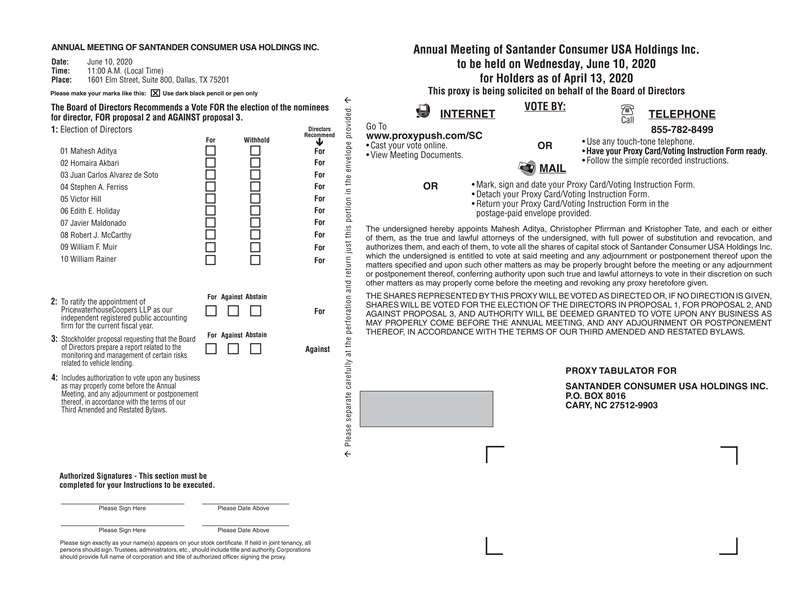
ANNUAL MEETING OF SANTANDER CONSUMER USA HOLDINGS INC. Annual Meeting of Santander Consumer USA Holdings Inc. Date: June 10, 2020 to be held on Wednesday, June 10, 2020 Time: 11:00 A.M. (Local Time) for Holders as of April 13, 2020 Place: 1601 Elm Street, Suite 800, Dallas, TX 75201 This proxy is being solicited on behalf of the Board of Directors Please make your marks like this: Use dark black pencil or pen only VOTE BY: The Board of Directors Recommends a Vote FOR the election of the nominees INTERNET TELEPHONE for director, FOR proposal 2 and AGAINST proposal 3. Call Go To Directors 1: Election of Directors 855-782-8499 Recommend www.proxypush.com/SC For Withhold • Use any touch-tone telephone. • Cast your vote online. OR 01 Mahesh Aditya For • Have your Proxy Card/V oting Instruction Form ready. • View Meeting Documents. • Follow the simple recorded instructions. For 02 Homaira Akbari MAIL 03 Juan Carlos Alvarez de Soto For • Mark, sign and date your Proxy Card/V oting Instruction Form. For 04 Stephen A. Ferriss OR • Detach your Proxy Card/V oting Instruction Form. For 05 Victor Hill • Return your Proxy Card/V oting Instruction Form in the For 06 Edith E. Holiday postage-paid envelope provided. For 07 Javier Maldonado The undersigned hereby appoints Mahesh Aditya, Christopher Pfirrman and Kristopher Tate, and each or either 08 Robert J. McCarthy For of them, as the true and lawful attorneys of the undersigned, with full power of substitution and revocation, and 09 William F. Muir For authorizes them, and each of them, to vote all the shares of capital stock of Santander Consumer USA Holdings Inc. which the undersigned is entitled to vote at said meeting and any adjournment or postponement thereof upon the 10 William Rainer For matters specified and upon such other matters as may be properly brought before the meeting or any adjournment or postponement thereof, conferring authority upon such true and lawful attorneys to vote in their discretion on such other matters as may properly come before the meeting and revoking any proxy heretofore given. ForAgainst Abstain THE SHARES REPRESENTED BY THIS PROXY WILL BE VOTED AS DIRECTED OR, IF NO DIRECTION IS GIVEN, 2: T o ratify the appointment of SHARES WILL BE VOTED FOR THE ELECTION OF THE DIRECTORS IN PROPOSAL 1, FOR PROPOSAL 2, AND PricewaterhouseCoopers LLP as our For AGAINST PROPOSAL 3, AND AUTHORITY WILL BE DEEMED GRANTED TO VOTE UPON ANY BUSINESS AS independent registered public accounting MAY PROPERLY COME BEFORE THE ANNUAL MEETING, AND ANY ADJOURNMENT OR POSTPONEMENT firm for the current fiscal year. THEREOF, IN ACCORDANCE WITH THE TERMS OF OUR THIRD AMENDED AND RESTATED BYLAWS. Abstain ForAgainst 3: Stockholder proposal requesting that the Board of Directors prepare a report related to the Against monitoring and management of certain risks related to vehicle lending. PROXY TABULATOR FOR 4: Includes authorization to vote upon any business as may properly come before the Annual SANTANDER CONSUMER USA HOLDINGS INC. Meeting, and any adjournment or postponement P.O. BOX 8016 thereof, in accordance with the terms of our CARY, NC 27512-9903 Third Amended and Restated Bylaws. Authorized Signatures - This section must be completed for your Instructions to be executed. Please Sign Here Please Date Above Please Sign Here Please Date Above Please sign exactly as your name(s) appears on your stock certificate. If held in joint tenancy, all persons should sign. Trustees, administrators, etc., should include title and authority. Corporations should provide full name of corporation and title of authorized officer signing the proxy. Please separate carefully at the perforation and return just this portion in the envelope provided.ANNUAL MEETING OF SANTANDER CONSUMER USA HOLDINGS INC. Annual Meeting of Santander Consumer USA Holdings Inc. Date: June 10, 2020 to be held on Wednesday, June 10, 2020 Time: 11:00 A.M. (Local Time) for Holders as of April 13, 2020 Place: 1601 Elm Street, Suite 800, Dallas, TX 75201 This proxy is being solicited on behalf of the Board of Directors Please make your marks like this: Use dark black pencil or pen only VOTE BY: The Board of Directors Recommends a Vote FOR the election of the nominees INTERNET TELEPHONE for director, FOR proposal 2 and AGAINST proposal 3. Call Go To Directors 1: Election of Directors 855-782-8499 Recommend www.proxypush.com/SC For Withhold • Use any touch-tone telephone. • Cast your vote online. OR 01 Mahesh Aditya For • Have your Proxy Card/V oting Instruction Form ready. • View Meeting Documents. • Follow the simple recorded instructions. For 02 Homaira Akbari MAIL 03 Juan Carlos Alvarez de Soto For • Mark, sign and date your Proxy Card/V oting Instruction Form. For 04 Stephen A. Ferriss OR • Detach your Proxy Card/V oting Instruction Form. For 05 Victor Hill • Return your Proxy Card/V oting Instruction Form in the For 06 Edith E. Holiday postage-paid envelope provided. For 07 Javier Maldonado The undersigned hereby appoints Mahesh Aditya, Christopher Pfirrman and Kristopher Tate, and each or either 08 Robert J. McCarthy For of them, as the true and lawful attorneys of the undersigned, with full power of substitution and revocation, and 09 William F. Muir For authorizes them, and each of them, to vote all the shares of capital stock of Santander Consumer USA Holdings Inc. which the undersigned is entitled to vote at said meeting and any adjournment or postponement thereof upon the 10 William Rainer For matters specified and upon such other matters as may be properly brought before the meeting or any adjournment or postponement thereof, conferring authority upon such true and lawful attorneys to vote in their discretion on such other matters as may properly come before the meeting and revoking any proxy heretofore given. ForAgainst Abstain THE SHARES REPRESENTED BY THIS PROXY WILL BE VOTED AS DIRECTED OR, IF NO DIRECTION IS GIVEN, 2: T o ratify the appointment of SHARES WILL BE VOTED FOR THE ELECTION OF THE DIRECTORS IN PROPOSAL 1, FOR PROPOSAL 2, AND PricewaterhouseCoopers LLP as our For AGAINST PROPOSAL 3, AND AUTHORITY WILL BE DEEMED GRANTED TO VOTE UPON ANY BUSINESS AS independent registered public accounting MAY PROPERLY COME BEFORE THE ANNUAL MEETING, AND ANY ADJOURNMENT OR POSTPONEMENT firm for the current fiscal year. THEREOF, IN ACCORDANCE WITH THE TERMS OF OUR THIRD AMENDED AND RESTATED BYLAWS. Abstain ForAgainst 3: Stockholder proposal requesting that the Board of Directors prepare a report related to the Against monitoring and management of certain risks related to vehicle lending. PROXY TABULATOR FOR 4: Includes authorization to vote upon any business as may properly come before the Annual SANTANDER CONSUMER USA HOLDINGS INC. Meeting, and any adjournment or postponement P.O. BOX 8016 thereof, in accordance with the terms of our CARY, NC 27512-9903 Third Amended and Restated Bylaws. Authorized Signatures - This section must be completed for your Instructions to be executed. Please Sign Here Please Date Above Please Sign Here Please Date Above Please sign exactly as your name(s) appears on your stock certificate. If held in joint tenancy, all persons should sign. Trustees, administrators, etc., should include title and authority. Corporations should provide full name of corporation and title of authorized officer signing the proxy. Please separate carefully at the perforation and return just this portion in the envelope provided.
Please separate carefully at the perforation and return just this portion in the envelope provided. Proxy — Santander Consumer USA Holdings Inc. Annual Meeting of Stockholders June 10, 2020 11:00 A.M. (Local Time) This Proxy is Solicited on Behalf of the Board of Directors The undersigned appoints Mahesh Aditya, Christopher Pfirrman and Kristopher Tate (the “Named Proxies”) and each of them as proxies for the undersigned, with full power of substitution, to vote the shares of common stock of Santander Consumer USA Holdings Inc., a Delaware corporation (the “Company”), the undersigned is entitled to vote at the Annual Meeting of Stockholders of the Company to be held at the offices of Santander Consumer USA Holdings Inc., at 1601 Elm Street, Suite 800, Dallas, Texas 75201, on June 10, 2020 at 11:00 A.M. (Local Time) and all adjournments or postponements thereof. The Board of Directors of the Company recommends a vote “FOR” all nominees for director, “FOR” proposal 2, and “AGAINST” proposal 3. This proxy, when properly executed, will be voted in the manner directed herein. If no direction is made, this proxy will be voted “FOR” all nominees for director, “FOR” proposal 2, and “AGAINST” proposal 3. In their discretion, the Named Proxies are authorized to vote upon such other matters that may properly come before the Annual Meeting and any adjournment or postponement thereof. You are encouraged to specify your choice by marking the appropriate box (SEE REVERSE SIDE) but you need not mark any box if you wish to vote in accordance with the Board of Directors’ recommendation. The Named Proxies cannot vote your shares unless you sign and return this card.Please separate carefully at the perforation and return just this portion in the envelope provided. Proxy — Santander Consumer USA Holdings Inc. Annual Meeting of Stockholders June 10, 2020 11:00 A.M. (Local Time) This Proxy is Solicited on Behalf of the Board of Directors The undersigned appoints Mahesh Aditya, Christopher Pfirrman and Kristopher Tate (the “Named Proxies”) and each of them as proxies for the undersigned, with full power of substitution, to vote the shares of common stock of Santander Consumer USA Holdings Inc., a Delaware corporation (the “Company”), the undersigned is entitled to vote at the Annual Meeting of Stockholders of the Company to be held at the offices of Santander Consumer USA Holdings Inc., at 1601 Elm Street, Suite 800, Dallas, Texas 75201, on June 10, 2020 at 11:00 A.M. (Local Time) and all adjournments or postponements thereof. The Board of Directors of the Company recommends a vote “FOR” all nominees for director, “FOR” proposal 2, and “AGAINST” proposal 3. This proxy, when properly executed, will be voted in the manner directed herein. If no direction is made, this proxy will be voted “FOR” all nominees for director, “FOR” proposal 2, and “AGAINST” proposal 3. In their discretion, the Named Proxies are authorized to vote upon such other matters that may properly come before the Annual Meeting and any adjournment or postponement thereof. You are encouraged to specify your choice by marking the appropriate box (SEE REVERSE SIDE) but you need not mark any box if you wish to vote in accordance with the Board of Directors’ recommendation. The Named Proxies cannot vote your shares unless you sign and return this card.