QUARTERLY REPORT PURSUANT TO SECTION 13 OR 15(d) OF THE SECURITIES EXCHANGE ACT OF 1934
For the quarterly period ended March 31, 2026
or
☐
TRANSITION REPORT PURSUANT TO SECTION 13 OR 15(d) OF THE SECURITIES EXCHANGE ACT OF 1934
For the transition period from to
Commission File Number: 001-36228
Navient Corporation
(Exact name of registrant as specified in its charter)
Delaware
46-4054283
(State or other jurisdiction of
incorporation or organization)
(I.R.S. Employer
Identification No.)
13865 Sunrise Valley Drive, Herndon, Virginia20171
(302) 283-8000
(Address of principal executive offices)
(Telephone Number)
(302) 283-8000
(Registrant’s telephone number, including area code)
(Former name, former address and former fiscal year, if changed since last report)
Indicate by check mark whether the registrant: (1) has filed all reports required to be filed by Section 13 or 15(d) of the Securities Exchange Act of 1934 during the preceding 12 months (or for such shorter period that the registrant was required to file such reports), and (2) has been subject to such filing requirements for the past 90 days. Yes☑ No ☐
Indicate by check mark whether the registrant has submitted electronically every Interactive Data File required to be submitted pursuant to Rule 405 of Regulation S-T (§ 232.405 of this chapter)during the preceding 12 months (or for such shorter period that the registrant was required to submit such files). Yes☑ No ☐
Indicate by check mark whether the registrant is a large accelerated filer, an accelerated filer, a non-accelerated filer, smaller reporting company, or an emerging growth company. See the definitions of “large accelerated filer,” “accelerated filer,” “smaller reporting company,” and “emerging growth company” in Rule 12b-2 of the Exchange Act. (Check one):
Large accelerated filer
☒
Accelerated filer
☐
Non-accelerated filer
☐
Smaller reporting company
☐
Emerging growth company
☐
If an emerging growth company, indicate by check mark if the registrant has elected not to use the extended transition period for complying with any new or revised financial accounting standards provided pursuant to Section 13(a) of the Exchange Act. ☐
Indicate by check mark whether the registrant is a shell company (as defined in Rule 12b-2 of the Exchange Act). Yes ☐ No ☑
Securities registered pursuant to Section 12(b) of the Act.
Title of each class
Trading
Symbol(s)
Name of each exchange on which registered
Common stock, par value $.01 per share
NAVI
The NASDAQ Global Select Market
6% Senior Notes due December 15, 2043
JSM
The NASDAQ Global Select Market
Preferred Stock Purchase Rights
None
The NASDAQ Global Select Market
As of March 31, 2026, there were 93,979,984 shares of common stock outstanding.
TABLE OF CONTENTS
Organization of Our Form 10-Q
The order and presentation of content in our Quarterly Report on Form 10-Q (Form 10-Q) differs from the traditional Securities and Exchange Commission (SEC) Form 10-Q format. Our format is designed to improve readability and to better present how we organize and manage our business. See Appendix A, "Form 10-Q Cross-Reference Index" for a cross-reference index to the traditional SEC Form 10-Q format.
This Form 10-Q contains “forward-looking” statements and other information that is based on management’s current expectations as of the date of this report. Statements that are not historical facts, including statements about our beliefs, opinions, or expectations and statements that assume or are dependent upon future events, are forward-looking statements and often contain words such as “expect,” “assume,” “anticipate,” “intend,” “plan,” “believe,” “seek,” “see,” “will,” “would,” “may,” “could,” “should,” “goals,” or “target.” Such statements are based on management's expectations as of the date of this filing and involve many risks and uncertainties that could cause our actual results to differ materially from those expressed or implied in our forward-looking statements. Such risks and uncertainties are discussed more fully under the section titled “Risk Factors” and include, but are not limited to, the following:
•
general economic conditions, including the potential impact of artificial intelligence, inflation and interest rates on Navient and its clients and customers and on the creditworthiness of third parties;
•
increased defaults on education loans held by us;
•
unanticipated repayment trends on education loans including prepayments or deferrals resulting from new interpretations or the timing of the execution and implementation of current laws, rules or regulations or future laws, executive orders or other policy initiatives that operate to encourage or require consolidation, abolish existing or create additional income-based repayment or debt forgiveness programs or establish other policies and programs which may increase or decrease the prepayment rates on education loans and accelerate or slow down the repayment of the bonds in our securitization trusts;
•
a reduction in our credit ratings;
•
changes to applicable laws, rules, regulations and government policies, as well as changing regulatory and governmental oversight;
•
changes in the general interest rate environment, including the availability of any relevant money-market index rate or the relationship between the relevant money-market index rate and the rate at which our assets are priced;
•
the interest rate characteristics of our assets do not always match those of our funding arrangements;
•
adverse market conditions or an inability to effectively manage our liquidity risk or access liquidity could negatively impact us;
•
the cost and availability of funding in the capital markets;
•
our ability to earn Floor Income and our ability to enter into hedges relative to that Floor Income are dependent on the future interest rate environment and therefore are variable;
•
our use of derivatives exposes us to credit and market risk;
•
our ability to continually and effectively align our cost structure with our business operations;
•
a failure or breach of our operating systems, infrastructure or information technology systems;
•
failure by any third party providing us material services or products or a breach or violation of law by one of these third parties;
•
acquisitions, new products, strategic initiatives and investments or divestitures that we pursue;
•
shareholder activism; and
•
reputational risk and social factors.
Given these risks and uncertainties, readers are cautioned not to place undue reliance on such forward-looking statements. Readers are urged to carefully review and consider the various disclosures made in this Form 10-K and in other documents we file from time to time with the SEC that disclose risks and uncertainties that may affect our business.
The preparation of our consolidated financial statements also requires management to make certain estimates and assumptions including estimates and assumptions about future events. These estimates or assumptions may prove to be incorrect and actual results could differ materially. All forward-looking statements contained in this report are qualified by these cautionary statements and are made only as of the date of this report. We do not undertake any obligation to update or revise these forward-looking statements except as required by law.
Through this discussion and analysis, we intend to provide the reader with some narrative context for how our management views our consolidated financial statements, additional context within which to assess our operating results, and information on the quality and variability of our earnings, liquidity and cash flows.
1
USE OF NON-GAAP FINANCIAL MEASURES
We prepare financial statements and present financial results in accordance with GAAP. However, we also evaluate our business segments and present our financial results on a basis that differs from GAAP. We refer to this different basis of presentation as Core Earnings, which is a non-GAAP financial measure. We provide this Core Earnings basis of presentation on a consolidated basis and for each business segment because this is what we review internally when making management decisions regarding our performance and how we allocate resources. We also include this information in our presentations with credit rating agencies, lenders and investors. Because our Core Earnings basis of presentation is our measure of profit or loss for our segments, we are required by GAAP to provide Core Earnings disclosures in the notes to our consolidated financial statements for our business segments.
In addition to Core Earnings, we present the following other non-GAAP financial measures: Tangible Equity, Adjusted Tangible Equity Ratio, and Allowance for Loan Losses Excluding Expected Future Recoveries on Previously Fully Charged-off Loans. Definitions for the non-GAAP financial measures and reconciliations are provided below, except that reconciliations of forward-looking non-GAAP financial measures are not provided because the Company is unable to provide such reconciliations without unreasonable effort due to the uncertainty and inherent difficulty of predicting the occurrence and financial impact of certain items, including, but not limited to, the impact of any mark-to-market gains/losses resulting from our use of derivative instruments to hedge our economic risks. See “Management’s Discussion and Analysis of Financial Condition and Results of Operations — Non-GAAP Financial Measures” for a further discussion and a complete reconciliation between GAAP net income and Core Earnings.
2
Business
Overview and Fundamentals of Our Business
Navient (Nasdaq: NAVI) creates long-term value for customers and investors with responsible lending, flexible refinancing, trusted servicing oversight, and decades of education finance and portfolio management expertise. Through our Earnest brand's business, we help customers confidently achieve financial success through digital financial services. Our employees thrive in a culture of belonging, where they are supported and proud to deliver meaningful outcomes. Learn more on Navient.com.
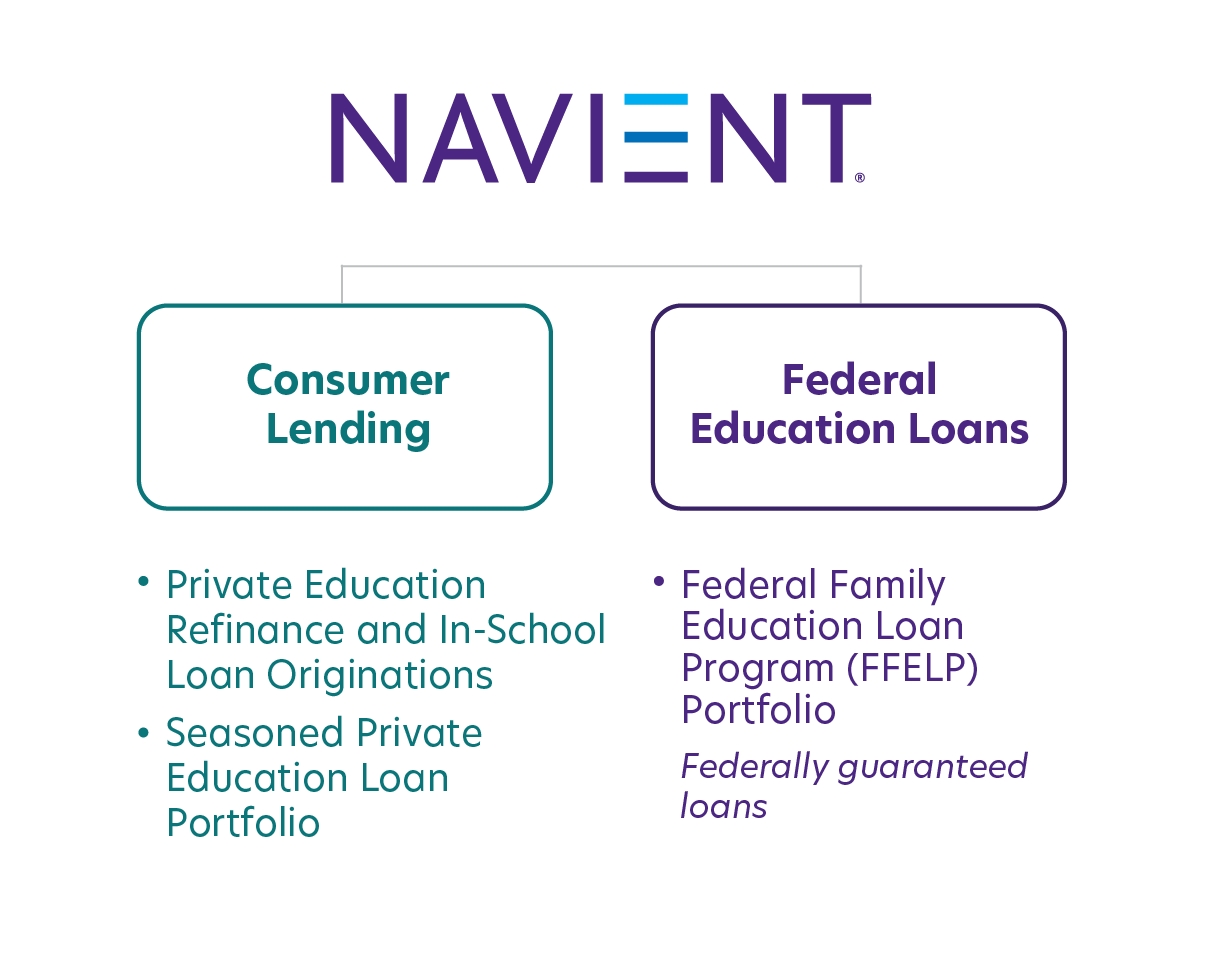
Navient’s business consists of:
•
Consumer Lending
We own and manage a portfolio of $15.6 billion of Private Education Loans. Through our Earnest brand we help students and families succeed with education lending and digital financial services, originating Earnest branded in-school student loans and refinancing products. In the first quarter of 2026, we originated $818 million of Private Education Loans.
•
Federal Education Loans
We own and manage a portfolio of $27.2 billion of federally guaranteed Federal Family Education Loan Program (FFELP) Loans. We support the success of our customers and ensure a compliant, efficient customer experience.
Navient previously provided both healthcare and government business processing services. Our healthcare services business was sold in September 2024 and our government services business was sold in February 2025, marking the end of Navient providing business processing solutions. See "Recent Business Developments" for more detail.
Maximizing Cash Flows from Loan Portfolios and Maintaining a Strong Balance Sheet
The cash flows from our education loan portfolios continue to demonstrate the strength of our balance sheet, our efficient financings, credit risk management and underwriting of high-quality private education loans with attractive economics.
By optimizing capital adequacy and allocating capital to highly accretive opportunities, including organic growth, we remain well positioned to pay dividends and repurchase stock, while maintaining appropriate leverage that supports our credit ratings and ensures ongoing access to capital markets.
In October 2025, the Board authorized a new $100 million share repurchase program. At March 31, 2026, $77 million remained in available share repurchase authorization.
3
To inform our capital allocation decisions, we use the Adjusted Tangible Equity Ratio(1) in addition to other metrics. Our GAAP equity-to-asset ratio was 4.9% and our Adjusted Tangible Equity Ratio(1) was 8.9% as of March 31, 2026.
(Dollars and shares in millions)
Q1-26
Q1-25
Shares repurchased
2.3
2.6
Reduction in shares outstanding
2
%
2
%
Total repurchases in dollars
$
23
$
35
Dividends paid
$
15
$
16
Total Capital Returned(2)
$
38
$
51
GAAP equity-to-asset ratio
4.9
%
5.1
%
Adjusted Tangible Equity Ratio(1)
8.9
%
9.9
%
Commitment to Corporate Social Responsibility and Compliance
We maintain a robust, multi-layered compliance management system and thoroughly understand and comply with applicable federal, state, and local laws. We follow the industry-leading “Three Lines Model” compliance framework. This framework and other compliance protocols ensure we adhere to key industry laws and regulations; state laws; and state and city licensing requirements.
We are committed to contributing to the social and economic wellbeing of our communities; fostering the success of our customers; supporting a culture of integrity and belonging in our workforce to ensure employees feel valued, supported, and connected; and embracing sustainable business practices. Navient has earned recognition from a variety of leading organizations for our continued commitment to social responsibility. Our employees are engaged in our communities through volunteering and philanthropic programs.
Navient is committed to a sustainable future. We leverage technologies that minimize energy and promote use of “paperless” digital customer communications.
(1)
Item is a non-GAAP financial measure. For a description and reconciliation, see “Management’s Discussion and Analysis of Financial Condition and Results of Operations — Non-GAAP Financial Measures.”
(2)
Capital Returned is defined as share repurchases and dividends paid.
4
Recent Business Developments
On January 30, 2024, as a result of an in-depth review of our business, Navient announced strategic actions to simplify our company, reduce our expense base, and enhance our flexibility. We have made substantial progress on these actions:
•
We adopted a variable, outsourced servicing model when MOHELA began servicing our loan portfolio in July 2024.
•
We completed the divestiture of our Business Processing segment business with the sale of our healthcare services business in September 2024 and the sale of our government services business in February 2025.
•
We provided transition services related to the outsourcing of loan servicing and divestiture of the Business Processing segment. The transition services related to the outsourcing of loan servicing and the sale of our healthcare services business ended in May 2025 and as of October 2025 we have no further obligations to provide transition services for our government services business.
•
In conjunction with the decision to outsource student loan servicing, divesting the Business Processing segment increased the opportunities for shared cost reduction. Along with the above actions, we are reshaping our shared services functions and corporate footprint to align with the needs of a more focused, flexible and streamlined company. The $56 million of restructuring and other reorganization charges recognized in 2024, 2025 and the first quarter of 2026 (the vast majority of which relates to severance in connection with job abolishments) reflects the progress made to date in connection with this effort. As of March 31, 2026, we have reduced our headcount by over 85% since the beginning of 2024.
•
In 2025, we achieved and exceeded our $400 million expense reduction objective (which includes expenses related to the divested Business Processing segment) set out in 2024. This expense reduction increases our future life of loan net cash flows, providing increased financial flexibility.
•
We are executing on enhancing the value of our growth business related to in-school and refinance Private Education Loan originations, investing in capabilities to grow high-quality originations that generate targeted returns. In 2025, total originations increased 77% to $2.5 billion compared to $1.4 billion in 2024. In first quarter of 2026, total originations increased 61% to $818 million compared to $508 million a year ago.
We continue to consider various strategic actions to optimize shareholder value, such as divestitures, acquisitions, restructurings and similar transactions. We have no current plans for such actions and there can be no assurance when, if at all, such actions could occur.
How We Organize Our Business
Today we operate our business in two primary segments: Consumer Lending and Federal Education Loans. As of February 2025, we divested our Business Processing segment.
5
Consumer Lending Segment
Navient owns and manages Private Education Loans and is the master servicer for these portfolios. Through our Earnest brand, we originate in-school Private Education Loans, including undergraduate and graduate products, we refinance education loans for high-quality borrowers and we intend to expand into adjacent lending products over time. "Refinance" Private Education Loans are loans where a borrower has refinanced their education loans, and "In-school" Private Education Loans are loans originally made to borrowers while they are attending school. We generate revenue primarily through net interest income on our Private Education Loan portfolio.
Through our Earnest brand, we build long-term relationships with high-lifetime-value customers and support them across key stages of their financial journey. We believe our differentiated product design, data‑driven digital marketing, and best‑in‑class origination capabilities deliver flexible, transparent lending solutions. We believe Navient’s decades of experience in education lending, capital markets, and servicing, combined with Earnest’s technology and customer‑centric platform, position us with a unique competitive advantage. We see meaningful growth opportunities across Private Education Loans and adjacent lending markets, with a focus on generating attractive, long-term, risk-adjusted returns.
The passage of the One Big Beautiful Bill Act (the "Big Beautiful Bill") on July 3, 2025 marks a significant shift in federal student lending programs, notably eliminating the GradPLUS loan program effective July 1, 2026. This development is anticipated to drive increased demand for private in-school graduate loans, presenting a unique loan origination growth opportunity for Navient. With our disciplined approach to growing in-school volume with a focus on graduate borrowers, we believe we are well-positioned to capture our share of this expanded market.
Federal Education Loans Segment
Navient owns and manages FFELP Loans and is the master servicer on this portfolio. We generate revenue primarily through net interest income on our FFELP Loans.
Business Processing Segment
In September 2024, Navient completed the sale of Xtend, which comprised the Company's healthcare services business in its Business Processing segment. In February 2025, Navient completed the sale of its government services businesses, which constituted the remainder of the Business Processing segment. Prior to the sale of its healthcare and government services businesses, Navient provided business processing solutions such as omnichannel contact center services, workflow processing, and revenue cycle optimization.
Other Segment
This segment consists of our corporate liquidity portfolio, gains and losses incurred on the repurchase of debt, unallocated shared services which include certain corporate and IT costs as well as regulatory expenses, and restructuring/other reorganization expenses. Additionally, the segment contains the revenue and expenses in connection with the transition services we performed related to the outsourcing of loan servicing and divestiture of our Business Processing segment discussed under "Recent Business Developments."
6
Management’s Discussion and Analysis of Financial Condition and Results of Operations
Selected Historical Financial Information and Ratios
Three Months Ended March 31,
(In millions, except per share data)
2026
2025
GAAP Basis
Net income (loss)
$
17
$
(2
)
Diluted earnings (loss) per common share
$
.17
$
(.02
)
Weighted average shares used to compute diluted earnings per share
96
102
Return on assets
.15
%
(.02
)%
Core Earnings Basis(1)
Net income(1)
$
19
$
26
Diluted earnings per common share(1)
$
.20
$
.25
Weighted average shares used to compute diluted earnings per share
96
103
Net interest margin, Consumer Lending segment
2.48
%
2.76
%
Net interest margin, Federal Education Loans segment
.65
%
.61
%
Return on assets
.17
%
.22
%
Education Loan Portfolios
Ending Private Education Loans, net
$
15,649
$
15,690
Ending FFELP Loans, net
27,237
$
30,244
Ending total education loans, net
$
42,886
$
45,934
Average Private Education Loans
$
15,958
$
16,159
Average FFELP Loans
27,898
$
30,914
Average total education loans
$
43,856
$
47,073
(1)
Item is a non-GAAP financial measure. For a description and reconciliation, see “Non-GAAP Financial Measures – Core Earnings”
7
The Quarter in Review
We prepare financial statements and present financial results in accordance with GAAP. However, we also evaluate our business segments and present financial results on a basis that differs from GAAP. We refer to this different basis of presentation as Core Earnings. We provide this Core Earnings basis of presentation on a consolidated basis and for each business segment because this is what we review internally when making management decisions regarding our performance and how we allocate resources. We also include this information in our presentations with credit rating agencies, lenders and investors. Because our Core Earnings basis of presentation corresponds to our segment financial presentations, we are required by GAAP to provide certain Core Earnings disclosures in the notes to our consolidated financial statements for our business segments. See “Non-GAAP Financial Measures — Core Earnings” for a further discussion and a complete reconciliation between GAAP net income and Core Earnings.
First-quarter 2026 net income was $17 million ($0.17 diluted earnings per share), compared with net loss of $2 million ($0.02 diluted loss per share) for the year-ago quarter. See “Results of Operations — GAAP Comparison of First-Quarter 2026 Results with First-Quarter 2025” for a discussion of the primary contributors to the change in GAAP earnings between periods.
First-quarter 2026 Core Earnings net income was $19 million ($0.20 diluted Core Earnings per share), compared with $26 million ($0.25 diluted Core Earnings per share) for the year-ago quarter. See “Segment Results” for a discussion of the primary contributors to the change in Core Earnings between periods.
Financial highlights of first-quarter 2026 include:
Consumer Lending segment:
•
Net income of $35 million.
•
Net interest margin of 2.48%.
•
Originated $818 million of Private Education Loans, a 61% increase from a year ago.
Federal Education Loans segment:
•
Net income of $22 million.
•
Net interest margin of 0.65%.
•
FFELP Loan prepayments of $208 million compared to $256 million in first-quarter 2025.
Capital, funding and liquidity:
•
GAAP equity-to-asset ratio of 4.9% and adjusted tangible equity ratio(1) of 8.9%.
•
Repurchased $23 million of common shares.
•
Paid $15 million in common stock dividends.
•
Issued $683 million of asset-backed securities.
Operating Expenses:
•
Incurred operating expenses of $89 million.
(1)
Item is a non-GAAP financial measure. For a description and reconciliation, see “Non-GAAP Financial Measures.”
8
Results of Operations
GAAP Income Statements (Unaudited)
Three Months Ended March 31,
Increase (Decrease)
(In millions, except per share data)
2026
2025
$
%
Interest income
Private Education Loans
$
277
$
289
$
(12
)
(4
)%
FFELP Loans
401
493
(92
)
(19
)
Cash and investments
17
20
(3
)
(15
)
Total interest income
695
802
(107
)
(13
)
Total interest expense
564
672
(108
)
(16
)
Net interest income
131
130
1
1
Less: provisions for loan losses
27
30
(3
)
(10
)
Net interest income after provisions for loan losses
104
100
4
4
Other income (loss):
Servicing revenue
11
13
(2
)
(15
)
Asset recovery and business processing revenue
—
23
(23
)
(100
)
Other income
5
15
(10
)
(67
)
Gains (losses) on derivative and hedging activities, net
5
(25
)
30
120
Total other income
21
26
(5
)
(19
)
Expenses:
Operating expenses
89
127
(38
)
(30
)
Goodwill and acquired intangible assets impairment and amortization expense
4
1
3
300
Restructuring/other reorganization expenses
—
3
(3
)
(100
)
Total expenses
93
131
(38
)
(29
)
Income (loss) before income tax expense (benefit)
32
(5
)
37
740
Income tax expense (benefit)
15
(3
)
18
600
Net income (loss)
$
17
$
(2
)
$
19
950
%
Basic earnings (loss) per common share
$
.18
$
(.02
)
$
.20
1000
%
Diluted earnings (loss) per common share
$
.17
$
(.02
)
$
.19
950
%
Dividends per common share
$
.16
$
.16
$
—
—
9
GAAP Comparison of First-Quarter 2026 Results with First-Quarter 2025
For the three months ended March 31, 2026, net income was $17 million, or $0.17 diluted earnings per common share, compared with net loss of $2 million, or $0.02 diluted loss per common share, for the year-ago period.
The primary contributors to the change in net income are as follows:
•Net interest income increased by $1 million primarily due to an increase in mark-to-market gains on fair value hedges recorded in interest expense. This was partially offset by the paydown of the FFELP portfolio, the Private Education Loan portfolio's changing product mix with Refinance Loans increasing as a percentage of the portfolio, and the impact of decreasing interest rates on the different index resets for the Private Education Loans and related funding.
•Provisions for loan losses decreased $3 million from $30 million to $27 million.
○ The provision for Private Education Loan losses decreased $4 million from $22 million to $18 million.
○ The provision for FFELP Loan losses increased $1 million from $8 million to $9 million.
The provision for Private Education Loan losses of $18 million in the current period included $11 million associated with loan originations. The provision of $22 million in the year-ago quarter included $7 million associated with loan originations and $15 million related to a general reserve build (primarily as a result of an increase in delinquency balances).
The provision for FFELP Loan losses of $9 million in the current period was primarily the result of increased charge-offs due to prior disaster forbearance volume, as well as the continued extension of the portfolio. The provision of $8 million in the year-ago quarter was primarily the result of an increase in delinquency balances.
•Asset recovery and business processing revenue decreased $23 million as a result of the sale of our government services business in February 2025. With the sale of our government services business, Navient no longer provides business processing segment services.
•Other income decreased $10 million primarily related to the transition services we had provided related to our various strategic initiatives. The transition services related to the outsourcing of loan servicing and the sale of our healthcare services business ended in May 2025. The transition services related to the sale of our government services business ended in October 2025.
•Net gains on derivative and hedging activities increased $30 million due primarily to interest rate fluctuations. Valuations of derivative instruments fluctuate based upon many factors including changes in interest rates and other market factors. As a result, net gains and losses on derivative and hedging activities may vary significantly in future periods.
•Operating expenses decreased $38 million, $23 million of which was due to a decline in business processing expenses as a result of the sale of our government services business in February 2025 ($20 million of the reduction is in the Business Processing segment and $3 million of the reduction is in the Other segment). In addition, there was an $11 million decline in expenses in connection with providing transition services related to our various strategic initiatives. As of October 2025 we had no further obligations to provide these transition services. There was a $7 million increase in marketing and other expenses associated with the growth of our consumer lending businesses. The remaining $11 million decrease primarily relates to cost saving initiatives implemented, which have reduced our operating costs mostly in connection with our shared service functions and corporate footprint.
•Restructuring and other reorganization expenses decreased $3 million primarily due to a decrease in severance-related costs incurred in connection with the various strategic initiatives that have been and continue to be implemented to simplify the company, continue to reduce our expense base and enhance our flexibility.
• The effective income tax rates for the current and year-ago periods were 48% and 54%, respectively. The effective income tax rates were elevated in both periods primarily due to changes in the valuation allowances attributed to disallowed interest expense and operating loss carryovers.
We repurchased 2.3 million and 2.6 million shares of our common stock during the first quarters of 2026 and 2025, respectively. As a result of repurchases, our average outstanding diluted shares decreased by 6 million common shares (or 6%) from the year-ago period.
10
Segment Results
Consumer Lending Segment
The following table presents Core Earnings results for our Consumer Lending segment.
Three Months Ended March 31,
% Increase (Decrease)
(Dollars in millions)
2026
2025
2026 vs. 2025
Interest income:
Private Education Loans
$
277
$
289
(4
)%
Cash and investments
4
5
(20
)
Interest income
281
294
(4
)
Interest expense
181
181
—
Net interest income
100
113
(12
)
Less: provision for loan losses
18
22
(18
)
Net interest income after provision for loan losses
82
91
(10
)
Total other income
3
3
—
Direct operating expenses
39
35
11
Income before income tax expense
46
59
(22
)
Income tax expense
11
13
(15
)
Net income
$
35
$
46
(24
)%
Comparison of First-Quarter 2026 Results with First-Quarter 2025
•
Originated $818 million of Private Education Loans, a 61% increase compared to $508 million.
o
Refinance Loan originations were $778 million compared to $470 million.
o
In-school loan originations were $40 million compared to $38 million.
•
Net income was $35 million compared to $46 million.
•
Net interest income decreased $13 million, primarily due to the changing product mix of the loan portfolio (Refinance Loans increased as a percentage of the portfolio), as well as the impact of decreasing interest rates on the different index resets for the segment assets and debt.
•
Provision for loan losses decreased $4 million. The provision of $18 million in the current quarter included $11 million associated with loan originations. The provision for loan losses of $22 million in the year-ago quarter included $7 million associated with loan originations and $15 million related a general reserve build (primarily as a result of an increase in delinquency balances).
o
Net charge-offs remained unchanged at $72 million.
o
Private Education Loan delinquencies greater than 90 days: $386 million, down $9 million from $395 million.
o
Private Education Loan forbearances: $235 million, down $48 million from $283 million.
•
Operating expenses increased $4 million primarily reflecting marketing and other expenses associated with the growth of our consumer lending businesses.
Average balance of Private Education Refinance Loans
$
9,017
$
8,464
Ending balance of Private Education Refinance Loans
$
9,029
$
8,413
Private Education Refinance Loan originations
$
778
$
470
Net Interest Margin
The following table details the net interest margin.
Three Months Ended March 31,
2026
2025
Private Education Loan yield
7.04
%
7.26
%
Private Education Loan cost of funds
(4.44
)
(4.39
)
Private Education Loan spread
2.60
2.87
Other interest-earning asset spread impact
(.12
)
(.11
)
Net interest margin(1)
2.48
%
2.76
%
(1)
The average balances of the interest-earning assets for the respective periods are:
Three Months Ended March 31,
(Dollars in millions)
2026
2025
Private Education Loans
$
15,958
$
16,159
Other interest-earning assets
532
489
Total Private Education Loan interest-earning assets
$
16,490
$
16,648
The 28 basis point decrease in the net interest margin in first-quarter 2026 is primarily the result of the continued shift of the Refinance Loan portfolio becoming a higher percentage of the overall Private Education Loan portfolio. The Refinance Loan portfolio earns a lower net interest margin compared to the non-refinance loan portfolio which reduces the overall net interest margin. Also contributing to the decrease was the impact of decreasing interest rates on the different index resets for the segment assets and liabilities.
As of March 31, 2026, our Private Education Loan portfolio totaled $15.6 billion, comprised of $9.0 billion of refinance loans and $6.6 billion of non-refinance loans. The weighted-average life of these portfolios as of March 31, 2026 was 5 years and 4 years, respectively, assuming a Constant Prepayment Rate (CPR) of 10% and 8%, respectively. As of March 31, 2025, the CPR assumption was 10% for both refinance and non-refinance loans.
Provision for Loan Losses
The provision for Private Education Loan losses decreased $4 million. The provision for loan losses of $18 million in first quarter 2026 included $11 million associated with loan originations. The provision for loan losses of $22 million in the year-ago period included $7 million associated with loan originations and $15 million related to a general reserve build (primarily as a result of an increase in delinquency balances).
12
Operating Expenses
Operating expenses for our consumer lending segment include costs to originate, acquire, service and collect on our consumer loan portfolio. Operating expenses increased $4 million primarily reflecting marketing and other expenses associated with the growth of our consumer lending businesses.
Federal Education Loans Segment
The following table presents Core Earnings results for our Federal Education Loans segment.
Three Months Ended March 31,
% Increase (Decrease)
(Dollars in millions)
2026
2025
2026 vs. 2025
Interest income:
FFELP Loans
$
401
$
493
(19
)%
Cash and investments
8
10
(20
)
Total interest income
409
503
(19
)
Total interest expense
363
454
(20
)
Net interest income
46
49
(6
)
Less: provision for loan losses
9
8
13
Net interest income after provision for loan losses
37
41
(10
)
Total other income
8
10
(20
)
Direct operating expenses
16
19
(16
)
Income before income tax expense
29
32
(9
)
Income tax expense
7
8
(13
)
Net income
$
22
$
24
(8
)%
Comparison of First-Quarter 2026 Results with First-Quarter 2025
•
Net income was $22 million compared to $24 million.
•
Net interest income decreased $3 million primarily due to the paydown of the loan portfolio. Prepayments were $208 million in first-quarter 2026 compared to $256 million in first-quarter 2025.
•
Provision for loan losses increased $1 million. The provision for loan losses of $9 million in the current period was primarily the result of increased charge-offs due to prior disaster forbearance volume, as well as the continued extension of the portfolio. The $8 million of provision for loan losses in the year-ago quarter was primarily the result of an increase in delinquency balances.
o
Net charge-offs were $17 million compared to $6 million.
o
Delinquencies greater than 90 days were $1.9 billion compared to $2.5 billion.
o
Forbearances were $3.4 billion compared to $4.2 billion.
•
Expenses were $3 million lower primarily as a result of the outsourcing of the loan servicing of our portfolio to a third party on July 1, 2024. This created a variable cost structure resulting in a reduction in expenses as the portfolio paid down.
13
Key performance metrics are as follows:
Three Months Ended March 31,
(Dollars in millions)
2026
2025
Segment net interest margin
.65
%
.61
%
FFELP Loans:
FFELP Loan spread
.72
%
.67
%
Provision for loan losses
$
9
$
8
Net charge-offs
$
17
$
6
Net charge-off rate
.29
%
.10
%
Greater than 30-days delinquency rate
15.2
%
20.5
%
Greater than 90-days delinquency rate
8.5
%
10.2
%
Forbearance rate
13.0
%
14.4
%
Average FFELP Loans
$
27,898
$
30,914
Ending FFELP Loans, net
$
27,237
$
30,244
Net Interest Margin
The following table details the net interest margin.
Three Months Ended March 31,
2026
2025
FFELP Loan yield
5.59
%
6.21
%
Floor Income
.24
.25
FFELP Loan net yield
5.83
6.46
FFELP Loan cost of funds
(5.11
)
(5.79
)
FFELP Loan spread
.72
.67
Other interest-earning asset spread impact
(.07
)
(.06
)
Net interest margin(1)
.65
%
.61
%
(1)
The average balances of the interest-earning assets for the respective periods are:
Three Months Ended March 31,
(Dollars in millions)
2026
2025
FFELP Loans
$
27,898
$
30,914
Other interest-earning assets
921
889
Total FFELP Loan interest-earning assets
$
28,819
$
31,803
As of March 31, 2026, our FFELP Loan portfolio totaled $27.2 billion. The weighted-average life of this portfolio as of March 31, 2026 was 8 years assuming a CPR of 3% through 2028 and 5% thereafter. As of March 31, 2025, the CPR assumption was 5%.
14
Floor Income
The following table analyzes, on a Core Earnings basis, the ability of the FFELP Loans in our portfolio to earn Floor Income after March 31, 2026 and 2025, based on interest rates as of those dates.
(Dollars in billions)
March 31, 2026
March 31, 2025
Education loans eligible to earn Floor Income
$
27.1
$
30.1
Less: post-March 31, 2006 disbursed loans required to rebate Floor Income
(13.1
)
(14.5
)
Less: economically hedged Floor Income
(.6
)
(.8
)
Education loans eligible to earn Floor Income after rebates and economically hedged
$
13.4
$
14.8
Education loans earning Floor Income
$
5.2
$
5.0
The following table presents a projection of the average balance of FFELP Consolidation Loans for which Fixed Rate Floor Income has been economically hedged with derivatives for the period April 1, 2026 to December 31, 2028.
(Dollars in billions)
April 1, 2026 to December 31, 2026
2027
2028
Average balance of FFELP Consolidation Loans whose Floor Income is economically hedged
$
.6
$
.3
$
.2
Provision for Loan Losses
Provision for loan losses increased $1 million. The $9 million in the current period was the result of increased charge-offs due to prior disaster forbearance volume, as well as the continued extension of the portfolio. The $8 million of provision for loan losses in the year-ago quarter was primarily the result of an increase in delinquency balances.
Operating Expenses
Operating expenses for the Federal Education Loans segment primarily include costs incurred to perform servicing on our FFELP Loan portfolio and federal education loans held by other institutions. Expenses were $3 million lower primarily as a result of the outsourcing of the loan servicing of our portfolio to a third party on July 1, 2024. This created a variable cost structure resulting in a reduction in expenses as the portfolio paid down.
15
Business Processing Segment
The following table presents Core Earnings results for our Business Processing segment.
Three Months Ended March 31,
% Increase (Decrease)
(Dollars in millions)
2026
2025
2026 vs. 2025
Business processing revenue
$
—
$
23
(100
)%
Direct operating expenses
—
20
(100
)
Income before income tax expense
—
3
(100
)
Income tax expense
—
1
(100
)
Net income
$
—
$
2
(100
)%
Comparison of First-Quarter 2026 Results with First-Quarter 2025
With the sale of our government services business in February 2025, Navient no longer provides business processing segment services. Navient provided certain transition services in connection with the sale of our business processing businesses. As of October 2025, we had no further obligations to provide these transition services.
Key performance metrics are as follows:
Three Months Ended March 31,
(Dollars in millions)
2026
2025
Revenue from government services
$
—
$
23
Revenue from healthcare services
—
—
Total fee revenue
$
—
$
23
Other Segment
The following table presents Core Earnings results for our Other segment.
Three Months Ended March 31,
% Increase (Decrease)
(Dollars in millions)
2026
2025
2026 vs. 2025
Net interest loss after provision for loan losses
$
(20
)
$
(18
)
11
%
Other revenue
5
15
(67
)
Expenses:
Unallocated shared services operating expenses:
Unallocated information technology costs
10
21
(52
)
Unallocated corporate costs
24
32
(25
)
Total unallocated shared services operating expenses
34
53
(36
)
Restructuring/other reorganization expenses
—
3
(100
)
Total expenses
34
56
(39
)
Loss before income tax benefit
(49
)
(59
)
(17
)
Income tax benefit
(11
)
(13
)
(15
)
Net loss
$
(38
)
$
(46
)
(17
)%
Net Interest Loss after Provision for Loan Losses
Net interest loss after provision for loan losses is due to the negative carrying cost of our corporate liquidity portfolio. The amount of the net interest loss is primarily a result of the size of the liquidity portfolio as well as the cost of funds of the debt funding the corporate liquidity portfolio.
Other Revenue
All revenue and expense in connection with the transition services we performed related to the outsourcing of loan servicing and divestiture of our Business Processing segment are included in the Other segment. Other revenue decreased $10 million primarily related to the transition services we had provided related to our various strategic initiatives. The transition services related to the outsourcing of loan servicing and the sale of our healthcare services business ended in May 2025. The transition services related to the sale of our government services business ended in October 2025.
16
Unallocated Shared Services Operating Expenses
Unallocated shared services operating expenses are costs primarily related to information technology costs related to infrastructure and operations, stock-based compensation expense, accounting, finance, legal, compliance and risk management, regulatory-related expenses, human resources, certain executive management, the Board of Directors, and transition services discussed above under "Other Revenue." Regulatory-related expenses include actual settlement amounts as well as third-party professional fees we incur in connection with such regulatory matters and are presented net of any insurance reimbursements for covered costs related to such matters. Operating expenses decreased $19 million from first-quarter 2025, primarily as a result of cost reduction efforts in connection with the various strategic initiatives that have been and continue to be implemented to simplify the Company, reduce our expense base and enhance our flexibility. Regulatory-related expenses were $2 million and $1 million in first quarters 2026 and 2025, respectively.
See “Note 10 – Commitments, Contingencies and Guarantees” for a discussion of legal and regulatory matters where it is reasonably possible that a loss contingency exists. The Company is unable to anticipate the timing of a resolution or the impact that certain matters may have on the Company’s consolidated financial position, liquidity, results of operation or cash flows. As a result, it is not possible at this time to estimate a range of potential exposure, if any, for amounts that may be payable in connection with certain matters and reserves have not been established. It is possible that an adverse ruling or rulings may have a material adverse impact on the Company.
Restructuring/Other Reorganization Expenses
These expenses decreased $3 million primarily due to a decrease in severance-related costs incurred in connection with the various strategic initiatives that have been and continue to be implemented to simplify the Company, reduce our expense base and enhance our flexibility.
17
Financial Condition
This section provides information regarding the balances, activity and credit performance metrics of our education loan portfolio.
Summary of Our Education Loan Portfolio
Ending Education Loan Balances, net
March 31, 2026
(Dollars in millions)
Private Education Loans
FFELP Loans
Total Portfolio
Total education loan portfolio:
In-school(1)
$
125
$
7
$
132
Grace, repayment and other(2)
15,838
27,395
43,233
Total
15,963
27,402
43,365
Allowance for loan losses
(314
)
(165
)
(479
)
Total education loan portfolio
$
15,649
$
27,237
$
42,886
% of total
36
%
64
%
100
%
December 31, 2025
(Dollars in millions)
Private Education Loans
FFELP Loans
Total Portfolio
Total education loan portfolio:
In-school(1)
$
108
$
7
$
115
Grace, repayment and other(2)
15,707
28,307
44,014
Total
15,815
28,314
44,129
Allowance for loan losses
(364
)
(173
)
(537
)
Total education loan portfolio
$
15,451
$
28,141
$
43,592
% of total
35
%
65
%
100
%
March 31, 2025
(Dollars in millions)
Private Education Loans
FFELP Loans
Total Portfolio
Total education loan portfolio:
In-school(1)
$
114
$
9
$
123
Grace, repayment and other(2)
15,973
30,417
46,390
Total
16,087
30,426
46,513
Allowance for loan losses
(397
)
(182
)
(579
)
Total education loan portfolio
$
15,690
$
30,244
$
45,934
% of total
34
%
66
%
100
%
(1)
Loans for customers still attending school and are not yet required to make payments on the loan.
(2)
Includes loans in deferment or forbearance.
18
Education Loan Activity
Three Months Ended March 31, 2026
(Dollars in millions)
Private Education Loans
FFELP Loans
Total Portfolio
Beginning balance
$
15,451
$
28,141
$
43,592
Acquisitions (originations and purchases)(1)
947
—
947
Capitalized interest and premium/discount amortization
48
198
246
Refinancings and consolidations to third parties
(103
)
(205
)
(308
)
Repayments and other
(694
)
(897
)
(1,591
)
Ending balance
$
15,649
$
27,237
$
42,886
Three Months Ended March 31, 2025
(Dollars in millions)
Private Education Loans
FFELP Loans
Total Portfolio
Beginning balance
$
15,716
$
30,852
$
46,568
Acquisitions (originations and purchases)(1)
630
—
630
Capitalized interest and premium/discount amortization
49
260
309
Refinancings and consolidations to third parties
(54
)
(202
)
(256
)
Repayments and other
(651
)
(666
)
(1,317
)
Ending balance
$
15,690
$
30,244
$
45,934
(1)
Includes the origination of $120 million and $73 million of Private Education Refinance Loans in the first-quarters of 2026 and 2025, respectively, that refinanced FFELP and Private Education Loans that were on our balance sheet
19
Private Education Loan Portfolio Performance
March 31, 2026
December 31, 2025
March 31, 2025
(Dollars in millions)
Balance
%
Balance
%
Balance
%
Loans in-school/grace/deferment(1)
$
393
$
395
$
384
Loans in forbearance(2)
235
236
283
Loans in repayment and percentage of each status:
Loans current
14,489
94.5
%
14,230
93.7
%
14,440
93.6
%
Loans delinquent 31-60 days(3)
294
1.9
326
2.1
373
2.4
Loans delinquent 61-90 days(3)
166
1.1
194
1.3
212
1.4
Loans delinquent greater than 90 days(3)
386
2.5
434
2.9
395
2.6
Total Private Education Loans in repayment
15,335
100
%
15,184
100
%
15,420
100
%
Total Private Education Loans
15,963
15,815
16,087
Private Education Loan allowance for losses
(314
)
(364
)
(397
)
Private Education Loans, net
$
15,649
$
15,451
$
15,690
Percentage of Private Education Loans in repayment
96.1
%
96.0
%
95.9
%
Delinquencies as a percentage of Private Education Loans in repayment
5.5
%
6.3
%
6.4
%
Loans in forbearance as a percentage of loans in repayment and forbearance
1.5
%
1.5
%
1.8
%
Percentage of Private Education Loans with a cosigner(4)
31
%
32
%
32
%
(1)
Loans for customers who are attending school or are in other permitted educational activities and are not yet required to make payments on their loans, e.g., loans for customers who have requested and qualify for other permitted program deferments such as various military eligible deferments.
(2)
Loans for customers who have requested extension of grace period generally during employment transition or who have temporarily ceased making full payments due to hardship or other factors such as disaster relief consistent with established loan program servicing policies and procedures.
(3)
The period of delinquency is based on the number of days scheduled payments are contractually past due.
(4)
Excluding Private Education Refinance Loans, the cosigner rate was 67%, 67% and 66% for first-quarter 2026, fourth-quarter 2025 and first-quarter 2025, respectively.
FFELP Loan Portfolio Performance
March 31, 2026
December 31, 2025
March 31, 2025
(Dollars in millions)
Balance
%
Balance
%
Balance
%
Loans in-school/grace/deferment(1)
$
1,219
$
1,210
$
1,304
Loans in forbearance(2)
3,397
3,532
4,192
Loans in repayment and percentage of each status:
Loans current
19,326
84.8
%
19,441
82.4
%
19,825
79.5
%
Loans delinquent 31-60 days(3)
903
4.0
1,075
4.6
1,395
5.6
Loans delinquent 61-90 days(3)
624
2.7
706
3.0
1,180
4.7
Loans delinquent greater than 90 days(3)
1,933
8.5
2,350
10.0
2,530
10.2
Total FFELP Loans in repayment
22,786
100
%
23,572
100
%
24,930
100
%
Total FFELP Loans
27,402
28,314
30,426
FFELP Loan allowance for losses
(165
)
(173
)
(182
)
FFELP Loans, net
$
27,237
$
28,141
$
30,244
Percentage of FFELP Loans in repayment
83.2
%
83.3
%
81.9
%
Delinquencies as a percentage of FFELP Loans in repayment
15.2
%
17.5
%
20.5
%
FFELP Loans in forbearance as a percentage of loans in repayment and forbearance
13.0
%
13.0
%
14.4
%
(1)
Loans for customers who may still be attending school or engaging in other permitted educational activities and are not yet required to make payments on their loans, e.g., residency periods for medical students or a grace period for bar exam preparation, as well as loans for customers who have requested and qualify for other permitted program deferments such as military, unemployment, or economic hardships.
(2)
Loans for customers who have used their allowable deferment time or do not qualify for deferment, who need additional time to obtain employment or who have temporarily ceased making payments due to hardship or other factors such as disaster relief.
(3)
The period of delinquency is based on the number of days scheduled payments are contractually past due.
20
Allowance for Loan Losses
Three Months Ended March 31,
2026
2025
(Dollars in millions)
Private Education Loans
FFELP Loans
Total
Private Education Loans
FFELP Loans
Total
Allowance at beginning of period
$
364
$
173
$
537
$
441
$
180
$
621
Total provision
18
9
27
22
8
30
Charge-offs:
Gross charge-offs
(83
)
(17
)
(100
)
(83
)
(6
)
(89
)
Expected future recoveries on current period gross charge-offs
11
—
11
11
—
11
Net charge-offs(1)
(72
)
(17
)
(89
)
(72
)
(6
)
(78
)
Decrease in expected future recoveries on previously fully charged-off loans(2)
4
—
4
6
—
6
Allowance at end of period (GAAP)
314
165
479
397
182
579
Plus: expected future recoveries on previously fully charged-off loans(2)
166
—
166
174
—
174
Allowance at end of period excluding expected future recoveries on previously fully charged-off loans (Non-GAAP Financial Measure)(3)
$
480
$
165
$
645
$
571
$
182
$
753
Net charge-offs as a percentage of average loans in repayment (annualized)
1.91
%
.29
%
1.89
%
.10
%
Allowance coverage of charge-offs (annualized)(3)
1.7
2.4
(Non-GAAP)
2.0
7.3
(Non-GAAP)
Allowance as a percentage of the ending total loan balance(3)
3.0
%
.6
%
(Non-GAAP)
3.6
%
.6
%
(Non-GAAP)
Allowance as a percentage of the ending loans in repayment(3)
3.1
%
.7
%
(Non-GAAP)
3.7
%
.7
%
(Non-GAAP)
Ending total loans
$
15,963
$
27,402
$
16,087
$
30,426
Average loans in repayment
$
15,326
$
23,226
$
15,472
$
25,459
Ending loans in repayment
$
15,335
$
22,786
$
15,420
$
24,930
(1)
Charge-offs are reported net of expected recoveries. For Private Education Loans, we charge off the estimated loss of a defaulted loan balance by charging off the entire defaulted loan balance and estimating recoveries on a pool basis. These estimated recoveries are referred to as "expected future recoveries on previously fully charged-off loans." For FFELP Loans, the recovery is received at the time of charge-off.
(2)
At the end of each month, for Private Education Loans that are 212 days past due, we charge off the estimated loss of a defaulted loan balance by charging off the entire loan balance and estimating recoveries on a pool basis. These estimated recoveries are referred to as “expected future recoveries on previously fully charged-off loans.” If actual periodic recoveries are less than expected, the difference is immediately reflected as a reduction to expected future recoveries on previously fully charged-off loans. If actual periodic recoveries are greater than expected, they will be reflected as a recovery through the allowance for Private Education Loan losses once the cumulative recovery amount exceeds the cumulative amount originally expected to be recovered. The following table summarizes the activity in the expected future recoveries on previously fully charged-off loans
Three Months Ended March 31,
(Dollars in millions)
2026
2025
Beginning of period expected future recoveries on previously fully charged-off loans
$
170
$
179
Expected future recoveries of current period defaults
11
11
Recoveries (cash collected)
(11
)
(11
)
Charge-offs (as a result of lower recovery expectations)
(4
)
(6
)
End of period expected future recoveries on previously fully charged-off loans
$
166
$
174
Change in balance during period
$
(4
)
$
(6
)
(3)
The allowance used for these metrics excludes the expected future recoveries on previously fully charged-off loans to better reflect the current expected credit losses remaining in the portfolio.
21
Liquidity and Capital Resources
Funding and Liquidity Risk Management
The following “Liquidity and Capital Resources” discussion concentrates primarily on our Consumer Lending and Federal Education Loans segments. Our Business Processing segment required minimal liquidity and funding.
We define liquidity as cash and high-quality liquid assets that we can use to meet our cash requirements. Our two primary liquidity needs are: (1) servicing our debt and (2) our ongoing ability to meet our cash needs for running the operations of our businesses (including derivative collateral requirements) throughout market cycles, including during periods of financial stress. Secondary liquidity needs, which can be adjusted as needed, include the origination of Private Education Loans, acquisitions of Private Education Loan portfolios, acquisitions of companies, the payment of common stock dividends and the repurchase of our common stock. To achieve these objectives, we analyze and monitor our liquidity needs and maintain excess liquidity and access to diverse funding sources including the issuance of unsecured debt and the issuance of secured debt primarily through asset-backed securitizations and/or other financing facilities.
We define our liquidity risk as the potential inability to meet our obligations when they become due without incurring unacceptable losses or inability to invest in future asset growth and business operations at reasonable market rates. Our primary liquidity risk relates to our ability to service our debt, meet our other business obligations and to continue to grow our business. The ability to access the capital markets is impacted by general market and economic conditions, our credit ratings, as well as the overall availability of funding sources in the marketplace. In addition, credit ratings may be important to customers or counterparties when we compete in certain markets and when we seek to engage in certain transactions.
Credit ratings and outlooks are opinions subject to ongoing review by the rating agencies and may change, from time to time, based on our financial performance, industry and market dynamics and other factors. Other factors that influence our credit ratings include the rating agencies’ assessment of the general operating environment, our relative positions in the markets in which we compete, reputation, liquidity position, the level and volatility of earnings, corporate governance and risk management policies, capital position and capital management practices. A negative change in our credit rating could have a negative effect on our liquidity because it might raise the cost and availability of funding and potentially require additional cash collateral or restrict cash currently held as collateral on existing borrowings or derivative collateral arrangements. It is our objective to improve our credit ratings so that we can continue to efficiently access the capital markets even in difficult economic and market conditions. We have unsecured debt totaling $5.3 billion at March 31, 2026. Three credit rating agencies currently rate our long-term unsecured debt at below investment grade.
We expect to fund our ongoing liquidity needs, including the repayment of $1.2 billion of senior unsecured notes that mature in the short term (i.e., over the next 12 months) and the remaining $4.1 billion of senior unsecured notes that mature in the long term (from 2027 to 2043 with 76% maturing by 2032), through a number of sources. These sources include our cash on hand, unencumbered Private Education Refinance Loan and FFELP Loan portfolios (see “Sources of Primary Liquidity” below), the predictable operating cash flows provided by operating activities, the repayment of principal on unencumbered education loan assets, and the distribution of overcollateralization from our securitization trusts. We may also, depending on market conditions and availability, draw down on our secured Private Education Loan and FFELP Loan asset-backed commercial paper (ABCP) facilities, issue term asset-backed securities (ABS), enter into additional Private Education Loan and FFELP Loan ABS repurchase facilities, or issue additional unsecured debt.
We originate Private Education Loans (a portion of which is obtained through a forward purchase agreement). We also have purchased and may purchase, in future periods, Private Education Loan portfolios from third parties. Those originations and purchases are part of our ongoing liquidity needs. We purchased 2.3 million shares of common stock for $23 million in the first quarter of 2026 and have $77 million of unused share repurchase authority as of March 31, 2026.
22
Sources of Primary Liquidity
(Dollars in millions)
March 31, 2026
December 31, 2025
March 31, 2025
Ending Balances:
Unrestricted cash
$
621
$
637
$
642
Unencumbered Private Education Refinance Loans
442
529
488
Unencumbered FFELP Loans
44
83
61
Total
$
1,107
$
1,249
$
1,191
Three Months Ended
(Dollars in millions)
March 31, 2026
December 31, 2025
March 31, 2025
Average Balances:
Unrestricted cash
$
553
$
589
$
572
Unencumbered Private Education Refinance Loans
689
684
403
Unencumbered FFELP Loans
55
71
173
Total
$
1,297
$
1,344
$
1,148
Sources of Additional Liquidity
Liquidity may also be available under our secured credit facilities. Maximum borrowing capacity under the Private Education Loan and FFELP Loan ABCP facilities will vary and be subject to each agreement’s borrowing conditions, including, among others, facility size, current usage and availability of qualifying collateral from unencumbered loans. The following tables detail the additional borrowing capacity of these facilities with maturity dates ranging from June 2026 to April 2029.
(Dollars in millions)
March 31, 2026
December 31, 2025
March 31, 2025
Ending Balances:
Private Education Loan ABCP facilities
$
1,461
$
1,689
$
1,626
FFELP Loan ABCP facilities
143
193
223
Total
$
1,604
$
1,882
$
1,849
Three Months Ended
(Dollars in millions)
March 31, 2026
December 31, 2025
March 31, 2025
Average Balances:
Private Education Loan ABCP facilities
$
1,661
$
2,051
$
1,447
FFELP Loan ABCP facilities
163
184
349
Total
$
1,824
$
2,235
$
1,796
At March 31, 2026, we had a total of $2.8 billion of unencumbered tangible assets inclusive of those listed in the table above as sources of primary liquidity. Total unencumbered education loans comprised $1.2 billion of our unencumbered tangible assets of which $1.2 billion and $44 million related to Private Education Loans and FFELP Loans, respectively. In addition, as of March 31, 2026, we had $4.8 billion of encumbered net assets (i.e., overcollateralization) in our various financing facilities (consolidated variable interest entities). We enter into repurchase facilities at times to borrow against the encumbered net assets of these financing vehicles. As of March 31, 2026, $0.5 billion of repurchase facility borrowings were outstanding.
23
The following table reconciles encumbered and unencumbered assets and their net impact on total Tangible Equity.
(Dollars in billions)
March 31, 2026
December 31, 2025
Net assets of consolidated variable interest entities (encumbered assets) — Private Education Loans
$
2.2
$
2.1
Net assets of consolidated variable interest entities (encumbered assets) — FFELP Loans
2.6
2.6
Tangible unencumbered assets(1)
2.8
2.9
Senior unsecured debt
(5.3
)
(5.3
)
Mark-to-market on unsecured hedged debt(2)
—
—
Other liabilities, net
(.4
)
(.3
)
Total Tangible Equity (3)
$
1.9
$
2.0
(1)
Excludes goodwill and acquired intangible assets.
(2)
At March 31, 2026 and December 31, 2025, there were $(60) million and $(50) million, respectively, of net gains (losses) on derivatives hedging this debt in unencumbered assets, which partially offset these gains (losses).
(3)
Item is a non-GAAP financial measure. For a description and reconciliation, see “Non-GAAP Financial Measures.”
Borrowings
Ending Balances
March 31, 2026
December 31, 2025
(Dollars in millions)
Short Term
Long Term
Total
Short Term
Long Term
Total
Unsecured borrowings:
Senior unsecured debt
$
1,225
$
4,084
$
5,309
$
525
$
4,782
$
5,307
Total unsecured borrowings
1,225
4,084
5,309
525
4,782
5,307
Secured borrowings:
Private Education Loan securitizations
432
10,303
10,735
469
10,250
10,719
FFELP Loan securitizations
105
24,525
24,630
109
25,302
25,411
Private Education Loan ABCP facilities
2,145
—
2,145
1,942
—
1,942
FFELP Loan ABCP facilities
1,811
347
2,158
1,869
299
2,168
Other
166
39
205
160
39
199
Total secured borrowings
4,659
35,214
39,873
4,549
35,890
40,439
Core Earnings basis borrowings(1)
5,884
39,298
45,182
5,074
40,672
45,746
Adjustment for GAAP accounting treatment
(14
)
(58
)
(72
)
(1
)
(39
)
(40
)
GAAP basis borrowings
$
5,870
$
39,240
$
45,110
$
5,073
$
40,633
$
45,706
Average Balances
Three Months Ended March 31,
2026
2025
(Dollars in millions)
Average Balance
Average Rate
Average Balance
Average Rate
Unsecured borrowings:
Senior unsecured debt
$
5,308
7.93
%
$
5,324
8.51
%
Total unsecured borrowings
5,308
7.93
5,324
8.51
Secured borrowings:
Private Education Loan securitizations
10,656
3.89
10,738
3.63
FFELP Loan securitizations
25,016
4.97
28,013
5.64
Private Education Loan ABCP facilities
1,960
5.66
2,304
6.32
FFELP Loan ABCP facilities
2,171
5.13
1,723
5.88
Other
197
4.04
93
.14
Total secured borrowings
40,000
4.72
42,871
5.17
Core Earnings basis borrowings(1)
45,308
5.09
48,195
5.54
Adjustment for GAAP accounting treatment
—
(.05
)
—
.12
GAAP basis borrowings
$
45,308
5.04
%
$
48,195
5.66
%
(1)
Item is a non-GAAP financial measure. For a description and reconciliation, see “Non-GAAP Financial Measures.” The differences in derivative accounting give rise to the difference above.
24
Critical Accounting Policies and Estimates
Management’s Discussion and Analysis of Financial Condition and Results of Operations addresses our consolidated financial statements, which have been prepared in accordance with generally accepted accounting principles in the United States of America (GAAP). A discussion of our critical accounting policies, which includes the allowance for loan losses, goodwill impairment assessment, and premium and discount amortization, can be found in our 2025 Form 10-K.
Non-GAAP Financial Measures
In addition to financial results reported on a GAAP basis, Navient also provides certain performance measures which are non-GAAP financial measures. We present the following non-GAAP financial measures: (1) Core Earnings, (2) Tangible Equity (as well as the Adjusted Tangible Equity Ratio), and (3) Allowance for Loan Losses Excluding Expected Future Recoveries on Previously Fully Charged-off Loans. Definitions for the non-GAAP financial measures and reconciliations are provided below, except that reconciliations of forward-looking non-GAAP financial measures are not provided because the Company is unable to provide such reconciliations without unreasonable effort due to the uncertainty and inherent difficulty of predicting the occurrence and financial impact of certain items, including, but not limited to, the impact of any mark-to-market gains/losses resulting from our use of derivative instruments to hedge our economic risks.
1. Core Earnings
We prepare financial statements and present financial results in accordance with GAAP. However, we also evaluate our business segments and present financial results on a basis that differs from GAAP. We refer to this different basis of presentation as Core Earnings. We provide this Core Earnings basis of presentation on a consolidated basis and for each business segment because this is what we review internally when making management decisions regarding our performance and how we allocate resources. We also refer to this information in our presentations with credit rating agencies, lenders and investors. Because our Core Earnings basis of presentation corresponds to our segment financial presentations, we are required by GAAP to provide certain Core Earnings disclosures in the notes to our consolidated financial statements for our business segments.
Core Earnings are not a substitute for reported results under GAAP. We use Core Earnings to manage our business segments because Core Earnings reflect adjustments to GAAP financial results for two items, discussed below, that can create significant volatility mostly due to timing factors generally beyond the control of management. Accordingly, we believe that Core Earnings provide management with a useful basis from which to better evaluate results from ongoing operations against the business plan or against results from prior periods. Consequently, we disclose this information because we believe it provides investors with additional information regarding the operational and performance indicators that are most closely assessed by management. When compared to GAAP results, the two items we remove to result in our Core Earnings presentations are:
(1)
Mark-to-market gains/losses resulting from our use of derivative instruments to hedge our economic risks that do not qualify for hedge accounting treatment or do qualify for hedge accounting treatment but result in ineffectiveness; and
(2)
The accounting for goodwill and acquired intangible assets.
While GAAP provides a uniform, comprehensive basis of accounting, for the reasons described above, our Core Earnings basis of presentation does not. Core Earnings are subject to certain general and specific limitations that investors should carefully consider. For example, there is no comprehensive, authoritative guidance for management reporting. Our Core Earnings are not defined terms within GAAP and may not be comparable to similarly titled measures reported by other companies. Accordingly, our Core Earnings presentation does not represent a comprehensive basis of accounting. Investors, therefore, may not be able to compare our performance with that of other financial services companies based upon Core Earnings. Core Earnings results are only meant to supplement GAAP results by providing additional information regarding the operational and performance indicators that are most closely used by management, our Board of Directors, credit rating agencies, lenders and investors to assess performance.
25
The following tables show our consolidated GAAP results, Core Earnings results (including for each reportable segment) along with the adjustments made to the income/expense items to reconcile the consolidated GAAP results to the Core Earnings results as required by GAAP and reported in “Note 11 — Segment Reporting.”
Three Months Ended March 31, 2026
Adjustments
Reportable Segments
(Dollars in millions)
Total GAAP
Reclassi- fications
Additions/ (Subtractions)
Total Adjustments (1)
Total Core Earnings
Consumer Lending
Federal Education Loans
Business Processing
Other
Interest income:
Education loans
$
678
$
277
$
401
$
—
$
—
Cash and investments
17
4
8
—
5
Total interest income
695
281
409
—
5
Total interest expense
564
181
363
—
25
Net interest income (loss)
131
$
2
$
(7
)
$
(5
)
$
126
100
46
—
(20
)
Less: provisions for loan losses
27
27
18
9
—
—
Net interest income (loss) after provisions for loan losses
104
82
37
—
(20
)
Other income (loss):
Servicing revenue
11
3
8
—
—
Asset recovery and business processing revenue
—
—
—
—
—
Other revenue
10
—
—
—
5
Total other income
21
(2
)
(3
)
(5
)
16
3
—
8
—
5
Expenses:
Direct operating expenses
55
39
16
—
—
Unallocated shared services expenses
34
—
—
—
34
Operating expenses
89
—
—
—
89
39
16
—
34
Goodwill and acquired intangible asset impairment and amortization
4
—
(4
)
(4
)
—
—
—
—
—
Restructuring/other reorganization expenses
—
—
—
—
—
—
—
—
—
Total expenses
93
—
(4
)
(4
)
89
39
16
—
34
Income (loss) before income tax expense (benefit)
32
—
(6
)
(6
)
26
46
29
—
(49
)
Income tax expense (benefit)(2)
15
—
(8
)
(8
)
7
11
7
—
(11
)
Net income (loss)
$
17
$
—
$
2
$
2
$
19
$
35
$
22
$
—
$
(38
)
(1)
Core Earnings adjustments to GAAP:
Three Months Ended March 31, 2026
(Dollars in millions)
Net Impact of Derivative Accounting
Net Impact of Goodwill and Acquired Intangibles
Total
Net interest income (loss) after provisions for loan losses
$
(5
)
$
—
$
(5
)
Total other income (loss)
(5
)
—
(5
)
Goodwill and acquired intangible asset impairment and amortization
—
(4
)
(4
)
Total Core Earnings adjustments to GAAP
$
(10
)
$
4
(6
)
Income tax expense (benefit)
(8
)
Net income (loss)
$
2
(2)
Income taxes are based on a percentage of net income before tax for the individual reportable segment.
26
Three Months Ended March 31, 2025
Adjustments
Reportable Segments
(Dollars in millions)
Total GAAP
Reclassi- fications
Additions/ (Subtractions)
Total Adjustments (1)
Total Core Earnings
Consumer Lending
Federal Education Loans
Business Processing
Other
Interest income:
Education loans
$
782
$
289
$
493
$
—
$
—
Cash and investments
20
5
10
—
5
Total interest income
802
294
503
—
5
Total interest expense
672
181
454
—
23
Net interest income (loss)
130
$
6
$
8
$
14
$
144
113
49
—
(18
)
Less: provisions for loan losses
30
30
22
8
—
—
Net interest income (loss) after provisions for loan losses
100
91
41
—
(18
)
Other income (loss):
Servicing revenue
13
3
10
—
—
Asset recovery and business processing revenue
23
—
—
23
—
Other revenue (loss)
(10
)
—
—
—
15
Total other income
26
(6
)
31
25
51
3
10
23
15
Expenses:
Direct operating expenses
74
35
19
20
—
Unallocated shared services expenses
53
—
—
—
53
Operating expenses
127
—
—
—
127
35
19
20
53
Goodwill and acquired intangible asset impairment and amortization
1
—
(1
)
(1
)
—
—
—
—
—
Restructuring/other reorganization expenses
3
—
—
—
3
—
—
—
3
Total expenses
131
—
(1
)
(1
)
130
35
19
20
56
Income (loss) before income tax expense (benefit)
(5
)
—
40
40
35
59
32
3
(59
)
Income tax expense (benefit)(2)
(3
)
—
12
12
9
13
8
1
(13
)
Net income (loss)
$
(2
)
$
—
$
28
$
28
$
26
$
46
$
24
$
2
$
(46
)
(1)
Core Earnings adjustments to GAAP:
Three Months Ended March 31, 2025
(Dollars in millions)
Net Impact of Derivative Accounting
Net Impact of Goodwill and Acquired Intangibles
Total
Net interest income (loss) after provisions for loan losses
$
14
$
—
$
14
Total other income (loss)
25
—
25
Goodwill and acquired intangible asset impairment and amortization
—
(1
)
(1
)
Total Core Earnings adjustments to GAAP
$
39
$
1
40
Income tax expense (benefit)
12
Net income (loss)
$
28
(2)
Income taxes are based on a percentage of net income before tax for the individual reportable segment.
27
The following discussion summarizes the differences between Core Earnings and GAAP net income and details each specific adjustment required to reconcile our Core Earnings segment presentation to our GAAP earnings.
Three Months Ended March 31,
(Dollars in millions)
2026
2025
GAAP net income (loss)
$
17
$
(2
)
Core Earnings adjustments to GAAP:
Net impact of derivative accounting
(10
)
39
Net impact of goodwill and acquired intangible assets
4
1
Net income tax effect
8
(12
)
Total Core Earnings adjustments to GAAP
2
28
Core Earnings net income
$
19
$
26
(1) Derivative Accounting: Core Earnings exclude periodic gains and losses that are caused by the mark-to-market valuations on derivatives that do not qualify for hedge accounting treatment under GAAP, as well as the periodic mark-to-market gains and losses that are a result of ineffectiveness recognized related to effective hedges under GAAP. Under GAAP, for our derivatives that are held to maturity, the mark-to-market gain or loss over the life of the contract will equal $0. In our Core Earnings presentation, we recognize the economic effect of these hedges, which generally results in any net settlement cash paid or received being recognized ratably as an interest expense or revenue over the hedged item’s life.
The accounting for derivatives requires that changes in the fair value of derivative instruments be recognized currently in earnings, with no fair value adjustment of the hedged item, unless specific hedge accounting criteria are met. The gains and losses recorded in “Gains (losses) on derivative and hedging activities, net” and interest expense (for qualifying fair value hedges) are primarily caused by interest rate and foreign currency exchange rate volatility and changing credit spreads during the period as well as the volume and term of derivatives not receiving hedge accounting treatment. We believe that our derivatives are effective economic hedges, and as such, are a critical element of our interest rate and foreign currency risk management strategy. However, some of our derivatives do not qualify for hedge accounting treatment and the stand-alone derivative is adjusted to fair value in the income statement with no consideration for the corresponding change in fair value of the hedged item.
28
The table below quantifies the adjustments for derivative accounting between GAAP and Core Earnings net income.
Three Months Ended March 31,
(Dollars in millions)
2026
2025
Core Earnings derivative adjustments:
(Gains) losses on derivative and hedging activities, net, included in other income
$
(5
)
$
25
Plus: (Gains) losses on fair value hedging activity included in interest expense
(8
)
6
Total (gains) losses in GAAP net income
(13
)
31
Plus: Reclassification of settlement income (expense) on derivative and hedging activities, net(1)
2
6
Mark-to-market (gains) losses on derivative and hedging activities, net(2)
(11
)
37
Other derivative accounting adjustments(3)
1
2
Total net impact of derivative accounting
$
(10
)
$
39
(1)
Derivative accounting requires net settlement income/expense on derivatives that do not qualify as hedges to be recorded in a separate income statement line item below net interest income. Under our Core Earnings presentation, these settlements are reclassified to the income statement line item of the economically hedged item. For our Core Earnings net interest income, this would primarily include reclassifying the net settlement amounts related to certain of our interest rate swaps to debt interest expense. The table below summarizes these net settlements on derivative and hedging activities and the associated reclassification on a Core Earnings basis.
Three Months Ended March 31,
(Dollars in millions)
2026
2025
Reclassification of settlements on derivative and hedging activities:
Net settlement income (expense) on interest rate swaps reclassified to net interest income
$
2
$
6
Total reclassifications of settlement income (expense) on derivative and hedging activities
$
2
$
6
(2)
“Mark-to-market (gains) losses on derivative and hedging activities, net” is comprised of the following:
Three Months Ended March 31,
(Dollars in millions)
2026
2025
Fair value hedges
$
(2
)
$
3
Foreign currency hedges
(6
)
3
Other (a)
(3
)
31
Total mark-to-market (gains) losses on derivative and hedging activities, net
$
(11
)
$
37
(a)
Primarily derivatives that are used to economically hedge the origination of fixed rate Private Education Loans that don't qualify for hedge accounting. We believe that these derivatives are effective economic hedges, and as such, are a critical element of our interest rate risk management strategy.
(3)
Other derivative accounting adjustments consist of adjustments related to certain terminated derivatives that did not receive hedge accounting treatment under GAAP but were economic hedges under Core Earnings and, as a result, such gains or losses are amortized into Core Earnings over the life of the hedged item.
29
Cumulative Impact of Derivative Accounting under GAAP compared to Core Earnings
As of March 31, 2026, derivative accounting has decreased GAAP equity by approximately $28 million as a result of cumulative net mark-to-market losses (after tax) recognized under GAAP, but not in Core Earnings. The following table rolls forward the cumulative impact to GAAP equity due to these after-tax mark-to-market net gains and losses related to derivative accounting.
Three Months Ended March 31,
(Dollars in millions)
2026
2025
Beginning impact of derivative accounting on GAAP equity
$
(39
)
$
8
Net impact of net mark-to-market gains (losses) under derivative accounting(1)
11
(30
)
Ending impact of derivative accounting on GAAP equity
$
(28
)
$
(22
)
(1)
Net impact of net mark-to-market gains (losses) under derivative accounting is composed of the following:
Three Months Ended March 31,
(Dollars in millions)
2026
2025
Total pre-tax net impact of derivative accounting recognized in net income(2)
$
10
$
(39
)
Tax and other impacts of derivative accounting adjustments
(2
)
10
Change in mark-to-market gains (losses) on derivatives, net of tax recognized in other comprehensive income
3
(1
)
Net impact of net mark-to-market gains (losses) under derivative accounting
$
11
$
(30
)
(2)
See “Core Earnings derivative adjustments” table above.
Hedging Embedded Floor Income
We use pay-fixed swaps and fixed rate debt to economically hedge embedded Floor Income in our FFELP Loans. Historically, we have used these instruments on a periodic basis and depending upon market conditions and pricing, we may enter into additional hedges in the future. Under GAAP, the pay-fixed swaps are accounted for as cash flow hedges. The table below shows the amount of hedged Floor Income that will be recognized in Core Earnings in future periods based on these hedge strategies.
(Dollars in millions)
March 31, 2026
March 31, 2025
Total hedged Floor Income, net of tax(1)(2)
$
23
$
40
(1)
$31 million and $52 million on a pre-tax basis as of March 31, 2026 and March 31, 2025, respectively.
(2)
Of the $23 million as of March 31, 2026, approximately $10 million, $7 million and $6 million will be recognized as part of Core Earnings net income in the remainder of 2026, 2027 and 2028, respectively.
(2)Goodwill and Acquired Intangible Assets: Our Core Earnings exclude goodwill and intangible asset impairment and the amortization of acquired intangible assets. The following table summarizes the goodwill and acquired intangible asset adjustments.
Three Months Ended March 31,
(Dollars in millions)
2026
2025
Core Earnings goodwill and acquired intangible asset adjustments
$
4
$
1
30
2. Tangible Equity and Adjusted Tangible Equity Ratio
Adjusted Tangible Equity Ratio measures the ratio of Navient’s Tangible Equity to its tangible assets. We adjust this ratio to exclude the assets and equity associated with our FFELP Loan portfolio because FFELP Loans are no longer originated and the FFELP Loan portfolio bears a 3% maximum loss exposure under the terms of the federal guaranty. Management believes that excluding this portfolio from the ratio enhances its usefulness to investors. Management uses this ratio, in addition to other metrics, for analysis and decision making related to capital allocation decisions. The Adjusted Tangible Equity Ratio is calculated as:
(Dollars in millions)
March 31, 2026
March 31, 2025
Navient Corporation's stockholders' equity
$
2,379
$
2,589
Less: Goodwill and acquired intangible assets
430
437
Tangible Equity
1,949
2,152
Less: Equity held for FFELP Loans
136
151
Adjusted Tangible Equity
$
1,813
$
2,001
Divided by:
Total assets
$
48,004
$
50,950
Less:
Goodwill and acquired intangible assets
430
437
FFELP Loans
27,237
30,244
Adjusted tangible assets
$
20,337
$
20,269
Adjusted Tangible Equity Ratio
8.9
%
9.9
%
31
3. Allowance for Loan Losses Excluding Expected Future Recoveries on Previously Fully Charged-off
Loans
The allowance for loan losses on the Private Education Loan portfolio used for the three credit metrics below excludes the expected future recoveries on previously fully charged-off loans to better reflect the current expected credit losses remaining in connection with the loans on balance sheet that have not charged off. As of March 31, 2026, the $480 million Private Education Loan allowance for loan losses excluding expected future recoveries on previously fully charged-off loans represents the current expected credit losses that remain in connection with the $15,963 million Private Education Loan portfolio. The $166 million of expected future recoveries on previously fully charged-off loans, which is collected over an average 15-year period, mechanically is a reduction to the overall allowance for loan losses. However, it is not related to the $15,963 million Private Education Loan portfolio on our balance sheet and, as a result, management excludes this impact to the allowance to better evaluate and assess our overall credit loss coverage on the Private Education Loan portfolio. We believe this provides a more meaningful and holistic view of the available credit loss coverage on our non-charged-off Private Education Loan portfolio. We believe this information is useful to our investors, lenders and rating agencies.
Allowance for Loan Losses Metrics – Private Education Loans
Three Months Ended March 31,
(Dollars in millions)
2026
2025
Allowance at end of period (GAAP)
$
314
$
397
Plus: expected future recoveries on previously fully charged-off loans
166
174
Allowance at end of period excluding expected future recoveries on previously fully charged-off loans (Non-GAAP Financial Measure)
$
480
$
571
Ending total loans
$
15,963
$
16,087
Ending loans in repayment
$
15,335
$
15,420
Net charge-offs
$
72
$
72
Allowance coverage of charge-offs (annualized):
GAAP
1.1
1.4
Adjustment(1)
.6
.6
Non-GAAP Financial Measure(1)
1.7
2.0
Allowance as a percentage of the ending total loan balance:
GAAP
2.0
%
2.5
%
Adjustment(1)
1.0
1.1
Non-GAAP Financial Measure(1)
3.0
%
3.6
%
Allowance as a percentage of the ending loans in repayment:
GAAP
2.0
%
2.6
%
Adjustment(1)
1.1
1.1
Non-GAAP Financial Measure(1)
3.1
%
3.7
%
(1)
The allowance used for these credit metrics excludes the expected future recoveries on previously fully charged-off loans. See discussion above.
Legal Proceedings
For a discussion of legal matters as of March 31, 2026, please refer to “Note 10 – Commitments, Contingencies and Guarantees”to our consolidated financial statements included in this report, which is incorporated into this item by reference.
Risk Factors
The risk factors disclosed in our 2025 Form 10-K should be considered together with information included in this Form 10-Q. We believe there have been no material changes to the risk factors previously disclosed in our 2025 Form 10-K.
32
Quantitative and Qualitative Disclosures about Market Risk
Interest Rate Sensitivity Analysis
Our interest rate risk management seeks to limit the impact of movements in interest rates on our results of operations and financial position. The following tables summarize the potential effect on earnings over the next 12 months and the potential effect on fair values of balance sheet assets and liabilities at March 31, 2026 and 2025, based upon a sensitivity analysis performed by management assuming a hypothetical increase and decrease in market interest rates of 100 basis points. The earnings sensitivities assume an immediate increase and decrease in market interest rates of 100 basis points and are applied only to financial assets and liabilities, including hedging instruments, that existed at the balance sheet date and do not take into account any new assets, liabilities or hedging instruments that may arise over the next 12 months.
As of March 31, 2026
As of March 31, 2025
Impact on Annual Earnings If:
Impact on Annual Earnings If:
Interest Rates
Interest Rates
(Dollars in millions, except per share amounts)
Increase 100 Basis Points
Decrease 100 Basis Points
Increase 100 Basis Points
Decrease 100 Basis Points
Effect on Earnings:
Change in pre-tax net income before mark-to -market gains (losses) on derivative and hedging activities
$
(9
)
$
20
$
(9
)
$
19
Mark-to-market gains (losses) on derivative and hedging activities
28
(30
)
71
(75
)
Increase (decrease) in income before taxes
$
19
$
(10
)
$
62
$
(56
)
Increase (decrease) in net income after taxes
$
15
$
(8
)
$
48
$
(43
)
Increase (decrease) in diluted earnings per common share
$
.16
$
(.08
)
$
.47
$
(.42
)
33
At March 31, 2026
Interest Rates:
Change from Increase of 100 Basis Points
Change from Decrease of 100 Basis Points
(Dollars in millions)
Fair Value
$
%
$
%
Effect on Fair Values:
Assets
Education Loans
$
42,165
$
(76
)
—
%
$
119
—
%
Other earning assets
2,279
—
—
—
—
Other assets
2,839
36
1
73
3
Total assets gain/(loss)
$
47,283
$
(40
)
—
%
$
192
—
%
Liabilities
Interest-bearing liabilities
$
44,139
$
(208
)
—
%
$
220
—
%
Other liabilities
515
82
16
26
5
Total liabilities (gain)/loss
$
44,654
$
(126
)
—
%
$
246
1
%
At December 31, 2025
Interest Rates:
Change from Increase of 100 Basis Points
Change from Decrease of 100 Basis Points
(Dollars in millions)
Fair Value
$
%
$
%
Effect on Fair Values:
Assets
Education Loans
$
43,147
$
(71
)
—
%
$
98
—
%
Other earning assets
2,270
—
—
—
—
Other assets
2,819
23
1
86
3
Total assets gain/(loss)
$
48,236
$
(48
)
—
%
$
184
—
%
Liabilities
Interest-bearing liabilities
$
45,204
$
(223
)
—
%
$
238
1
%
Other liabilities
576
79
14
28
5
Total liabilities (gain)/loss
$
45,780
$
(144
)
—
%
$
266
1
%
A primary objective in our funding is to minimize our sensitivity to changing interest rates by generally funding our floating rate education loan portfolio with floating rate debt and our fixed rate education loan portfolio with fixed rate debt although we can have a mismatch at times. In addition, we can have a mismatch in the index (including the frequency of reset) of floating rate debt versus floating rate assets. In addition, due to the ability of some FFELP Loans to earn Floor Income, we can have a fixed versus floating mismatch in funding if the education loan earns at the fixed borrower rate and the funding remains floating. We use pay-fixed swaps and fixed rate debt to economically hedge embedded Floor Income in our FFELP Loans. Historically, we have used these instruments on a periodic basis and depending upon market conditions and pricing, we may enter into additional hedges in the future. The result of these hedging transactions is to fix the relative spread between the education loan asset rate and the funding instrument rate.
In the preceding tables, under the scenario where interest rates increase or decrease by 100 basis points, the change in pre-tax net income before the mark-to-market gains (losses) on derivative and hedging activities is primarily due to the impact of (i) a portion of our unhedged FFELP Loans being in a fixed-rate mode due to Floor Income, while being funded with variable rate debt; (ii) certain FFELP fixed rate loans becoming variable interest rate loans when variable interest rates rise above a certain level (Special Allowance Payment or “SAP”). When these loans are funded with fixed rate debt (as we do for a portion of the portfolio to economically hedge Floor Income) we earn additional interest income when earning the higher variable rate that is in effect; and (iii) a portion of our variable rate assets being funded with fixed rate liabilities. Item (i) will generally cause income to decrease when interest rates increase and income to increase when interest rates decrease. Item (ii) and (iii) have the opposite effect. The change due to the interest rate scenario where interest rates increase by 100 basis points in the current period is primarily a result of item (i) having a more significant impact than item (ii) and (iii) as a result of interest rates being lower compared to the prior period. The change due to the interest scenario where interest rates decrease by 100 basis points in the current period is primarily a result of item (i) having a more significant impact than item (ii) and (iii) as a result of interest rates being lower compared to the prior period.
34
In the preceding tables, under the scenario where interest rates increase or decrease by 100 basis points, the change in mark-to-market gains (losses) on derivative and hedging activities in both periods is primarily due to (i) the notional amount and remaining term of our derivative portfolio and related hedged debt and (ii) the interest rate environment. In both periods, the mark-to-market gains (losses) are primarily related to derivatives that don’t qualify for hedge accounting that are used to economically hedge the origination of fixed rate Private Education Loans. As a result of not qualifying for hedge accounting, there is not an offsetting mark-to-market adjustment of the hedged item in this analysis. The decline in impact from the prior year is primarily due to a decline in the notional of derivatives that don't qualify for hedge accounting.
In addition to interest rate risk addressed in the preceding tables, we are also exposed to risks related to foreign currency exchange rates. Foreign currency exchange risk is primarily the result of foreign currency denominated debt issued by us. When we issue foreign denominated corporate unsecured and securitization debt, our policy is to use cross-currency interest rate swaps to swap all foreign currency denominated debt payments (fixed and floating) to USD SOFR using a fixed exchange rate. In the tables above, there would be an immaterial impact on earnings if exchange rates were to decrease or increase, due to the terms of the hedging instrument and hedged items matching. The balance sheet interest-bearing liabilities would be affected by a change in exchange rates; however, the change would be materially offset by the cross-currency interest rate swaps in other assets or other liabilities. In certain economic environments, volatility in the spread between spot and forward foreign exchange rates has resulted in mark-to-market impacts to current period earnings which have not been factored into the above analysis. The earnings impact is noncash, and at maturity of the instruments the cumulative mark-to-market impact will be zero. Navient has not issued foreign currency denominated debt since 2008.
Asset and Liability Funding Gap
The table below presents our assets and liabilities (funding) arranged by underlying indices as of March 31, 2026. Management analyzes interest rate risk and in doing so includes all derivatives that are economically hedging our debt whether they qualify as effective hedges or not (Core Earnings basis). Accordingly, we present the asset and liability funding gap on a Core Earnings basis. The difference between the asset and the funding is the funding gap for the specified index. This represents our exposure to interest rate risk in the form of basis risk and repricing risk, which is the risk that the different indices may reset at different frequencies or may not move in the same direction or at the same magnitude.
Index (Dollars in billions)
Frequency of Variable Resets
Assets
Funding
Funding Gap
3 month Treasury bill
weekly
$
1.4
$
—
$
1.4
3 month Treasury bill
annual
.1
—
.1
Prime
annual
.1
—
.1
Prime
quarterly
.7
—
.7
Prime
monthly
2.5
—
2.5
3 month Term SOFR
quarterly
.1
.9
(.8
)
3 month Term SOFR
monthly
—
.4
(.4
)
1 month Term SOFR
monthly
1.6
.5
1.1
Overnight SOFR(1)
daily
25.6
26.0
(.4
)
Non Discrete reset
monthly
—
4.6
(4.6
)
Non Discrete reset
daily/weekly
2.2
—
2.2
Fixed Rate (2)
13.7
15.6
(1.9
)
Total
$
48.0
$
48.0
$
—
(1)
The assets are indexed to 30-day average overnight SOFR. A portion of the funding uses the daily average of overnight SOFR from a period preceding the accrual period of the asset ("lookback debt"). Funding includes $12.3 billion of 30-day average SOFR lookback debt and $12.0 billion of 90-day average SOFR lookback debt.
(2)
Assets include receivables and other assets (including goodwill and acquired intangibles). Funding includes other liabilities and stockholders' equity.
35
We use interest rate swaps and other derivatives to achieve our risk management objectives. Our asset liability management strategy is to match assets with debt (in combination with derivatives) that have the same underlying index and reset frequency or, when economical, have interest rate characteristics that we believe are highly correlated. Interest earned on our FFELP Loans is primarily indexed to 30-day average overnight SOFR, which is reset daily, and our cost of funds is primarily indexed to overnight SOFR but resetting at different times than the asset. A source of variability in FFELP net interest income could also be Floor Income we earn on certain FFELP Loans. Pursuant to the terms of the FFELP, certain FFELP Loans can earn interest at the stated fixed rate of interest as underlying debt interest rate expense remains variable. We refer to this additional spread income as “Floor Income.” Floor Income can be volatile since it is dependent on interest rate levels. At times, we hedge this volatility to lock in the value of the Floor Income over the term of the contract. Interest earned on our Private Education Refinance Loans and in-school loans originated after 2020 is generally fixed rate with the related cost of funds generally fixed rate as well. Interest earned on the remaining Private Education Loans is generally indexed to either one-month Prime or term SOFR rates and our cost of funds is primarily indexed to one-month or three-month term SOFR. The use of funding with index types and reset frequencies that are different from our assets exposes us to interest rate risk in the form of basis and repricing risk. This could result in our cost of funds not moving in the same direction or with the same magnitude as the yield on our assets. While we believe this risk is low, as all of these indices are short-term with rate movements that are highly correlated over a long period of time, market disruptions (which have occurred in prior years) can lead to a temporary divergence between indices resulting in a negative impact to our earnings.
Unregistered Sales of Equity Securities and Use of Proceeds
Issuer Purchases of Equity Securities
The following table provides information relating to our purchases of shares of our common stock in the three months ended March 31, 2026.
(In millions, except per share data)
Total Number of Shares Purchased(1)
Average Price Paid per Share
Total Number of Shares Purchased as Part of Publicly Announced Plans or Programs(1)(2)
Approximate Dollar Value of Shares That May Yet Be Purchased Under Publicly Announced Plans or Programs(1)
Period:
January 1 — January 31, 2026
.4
$
11.42
.4
$
95
February 1 — February 28, 2026
1.7
9.74
1.7
$
79
March 1 — March 31, 2026
.2
8.30
.2
$
77
Total first-quarter 2026
2.3
$
9.91
2.3
(1)
In October 2025, our Board of Directors approved a new $100 million share repurchase program. The share repurchase program does not have an expiration date.
(2)
On December 17, 2025, the Company entered into a "Rule 10b5-1 trading arrangement" intended to satisfy the affirmative defense conditions of Rule 10b5-1, pursuant to which the Company purchased the applicable shares during fourth-quarter 2025 from December 18, 2025 to December 31, 2025. This plan terminated by its terms on January 31, 2026. On March 13, 2026, the Company entered into a "Rule 10b5-1 trading arrangement" intended to satisfy the affirmative defense conditions of Rule 10b5-1, pursuant to which the Company purchased the applicable shares during first-quarter 2026 from March 18, 2026 to March 31, 2026. This plan terminates by its terms on April 29, 2026.
36
Other Information
Director and Officer Trading Arrangements
During the quarter ended March 31, 2026, none of the Company’s directors or officers who are subject to the filing requirements of Section 16 of the Securities and Exchange Act of 1934, as amended (the Exchange Act), adopted or terminated a Rule 10b5-1 trading arrangement or a non-Rule 10b5-1 trading arrangement (as defined in Item 408(c) of Regulation S-K).
Controls and Procedures
Disclosure Controls and Procedures
Our management, with the participation of our Principal Executive and Principal Financial Officers, evaluated the effectiveness of our disclosure controls and procedures (as defined in Rules 13a-15(e) and 15d-15(e) under the Exchange Act) as of March 31, 2026. Based on this evaluation, our Principal Executive and Principal Financial Officers concluded that, as of March 31, 2026, our disclosure controls and procedures were effective to ensure that information required to be disclosed by us in the reports that we file or submit under the Exchange Act is (a) recorded, processed, summarized and reported within the time periods specified in the SEC’s rules and forms and (b) accumulated and communicated to our management, including our Principal Executive and Principal Financial Officers as appropriate, to allow timely decisions regarding required disclosure.
Changes in Internal Control over Financial Reporting
No change in our internal control over financial reporting (as defined in Rules 13a-15(f) and 15d-15(f) under the Exchange Act) occurred during the fiscal quarter ended March 31, 2026 that has materially affected, or is reasonably likely to materially affect, our internal control over financial reporting.
Inline XBRL Instance Document–the instance document does not appear in the Interactive Data File as its XBRL tags are embedded within the Inline XBRL document.
101.SCH*
Inline XBRL Taxonomy Extension Schema With Embedded Linkbase Documents.
104
Cover Page Interactive Data File (formatted as Inline XBRL and contained in Exhibit 101).
* Filed herewith
** Furnished herewith
38
Financial Statements
NAVIENT CORPORATION
CONSOLIDATED BALANCE SHEETS
(In millions, except per share amounts)
(Unaudited)
March 31, 2026
December 31, 2025
Assets
Private Education Loans (net of allowance for losses of $314 and $364, respectively)
$
15,649
$
15,451
FFELP Loans (net of allowance for losses of $165 and $173, respectively)
27,237
28,141
Investments
148
166
Cash and cash equivalents
621
637
Restricted cash and cash equivalents
1,510
1,467
Goodwill and acquired intangible assets, net
430
434
Other assets
2,409
2,385
Total assets
$
48,004
$
48,681
Liabilities
Short-term borrowings
$
5,870
$
5,073
Long-term borrowings
39,240
40,633
Other liabilities
515
576
Total liabilities
45,625
46,282
Commitments and contingencies
Equity
Series A Junior Participating Preferred Stock, par value $0.20 per share; 2 million shares authorized at December 31, 2021; no shares issued or outstanding
—
—
Common stock, par value $0.01 per share, 1.125 billion shares authorized: 468 million and 467 million shares issued, respectively
4
4
Additional paid-in capital
3,407
3,403
Accumulated other comprehensive income (net of tax expense of $2 and $1, respectively)
5
2
Retained earnings
4,552
4,552
Total stockholders’ equity before treasury stock
7,968
7,961
Less: Common stock held in treasury at cost: 374 million and 371 million shares, respectively
(5,589
)
(5,562
)
Total equity
2,379
2,399
Total liabilities and equity
$
48,004
$
48,681
Supplemental information — assets and liabilities of consolidated variable interest entities:
March 31, 2026
December 31, 2025
Private Education Loans
$
14,437
$
14,133
FFELP Loans
27,194
28,057
Restricted cash
1,508
1,466
Other assets, net
1,316
1,300
Short-term borrowings
4,493
4,389
Long-term borrowings
35,139
35,835
Net assets of consolidated variable interest entities
$
4,823
$
4,732
See accompanying notes to consolidated financial statements.
39
NAVIENT CORPORATION
CONSOLIDATED STATEMENTS OF INCOME
(In millions, except per share amounts)
(Unaudited)
Three Months Ended March 31,
2026
2025
Interest income:
Private Education Loans
$
277
$
289
FFELP Loans
401
493
Cash and investments
17
20
Total interest income
695
802
Total interest expense
564
672
Net interest income
131
130
Less: provisions for loan losses
27
30
Net interest income after provisions for loan losses
104
100
Other income (loss):
Servicing revenue
11
13
Asset recovery and business processing revenue
—
23
Other income
5
15
Gains (losses) on derivative and hedging activities, net
5
(25
)
Total other income
21
26
Expenses:
Salaries and benefits
32
49
Other operating expenses
57
78
Total operating expenses
89
127
Goodwill and acquired intangible asset impairment and amortization expense
4
1
Restructuring/other reorganization expenses
—
3
Total expenses
93
131
Income (loss) before income tax expense (benefit)
32
(5
)
Income tax expense (benefit)
15
(3
)
Net income (loss)
$
17
$
(2
)
Basic earnings (loss) per common share
$
.18
$
(.02
)
Average common shares outstanding
95
102
Diluted earnings (loss) per common share
$
.17
$
(.02
)
Average common and common equivalent shares outstanding
96
102
Dividends per common share
$
.16
$
.16
See accompanying notes to consolidated financial statements.
40
NAVIENT CORPORATION
CONSOLIDATED STATEMENTS OF COMPREHENSIVE INCOME
(In millions)
(Unaudited)
Three Months Ended March 31,
2026
2025
Net income (loss)
$
17
$
(2
)
Net changes in cash flow hedges, net of tax(1)
3
(1
)
Total comprehensive income (loss)
$
20
$
(3
)
(1)
See “Note 5 – Derivative Financial Instruments.”
See accompanying notes to consolidated financial statements.
41
NAVIENT CORPORATION
CONSOLIDATED STATEMENTS OF CHANGES IN STOCKHOLDERS’ EQUITY
(In millions, except share and per share amounts)
(Unaudited)
Accumulated
Common Stock Shares
Additional
Other
Common
Paid-In
Comprehensive
Retained
Treasury
Total
Issued
Treasury
Outstanding
Stock
Capital
Income (Loss)
Earnings
Stock
Equity
Balance at December 31, 2024
465,308,901
(362,283,344
)
103,025,557
$
4
$
3,380
$
3
$
4,697
$
(5,443
)
$
2,641
Comprehensive income (loss):
Net income (loss)
—
—
—
—
—
—
(2
)
—
(2
)
Other comprehensive income (loss), net of tax
—
—
—
—
—
(1
)
—
—
(1
)
Total comprehensive income (loss)
—
—
—
—
—
—
—
—
(3
)
Cash dividends:
Common stock ($.16 per share)
—
—
—
—
—
—
(16
)
—
(16
)
Dividend equivalent units related to employee stock-based compensation plans
—
—
—
—
—
—
(2
)
—
(2
)
Issuance of common shares
1,272,533
—
1,272,533
—
2
—
—
—
2
Stock-based compensation expense
—
—
—
—
8
—
—
—
8
Common stock repurchased
—
(2,552,500
)
(2,552,500
)
—
—
—
—
(35
)
(35
)
Shares repurchased related to employee stock-based compensation plans
—
(411,112
)
(411,112
)
—
—
—
—
(6
)
(6
)
Balance at March 31, 2025
466,581,434
(365,246,956
)
101,334,478
$
4
$
3,390
$
2
$
4,677
$
(5,484
)
$
2,589
Balance at December 31, 2025
466,792,895
(371,281,553
)
95,511,342
$
4
$
3,403
$
2
$
4,552
$
(5,562
)
$
2,399
Comprehensive income (loss):
Net income (loss)
—
—
—
—
—
—
17
—
17
Other comprehensive income (loss), net of tax
—
—
—
—
—
3
—
—
3
Total comprehensive income (loss)
—
—
—
—
—
—
—
—
20
Cash dividends:
—
Common stock ($.16 per share)
—
—
—
—
—
—
(15
)
—
(15
)
Dividend equivalent units related to employee stock-based compensation plans
—
—
—
—
—
—
(2
)
—
(2
)
Issuance of common shares
1,211,212
—
1,211,212
—
1
—
—
—
1
Stock-based compensation expense
—
—
—
—
3
—
—
—
3
Common stock repurchased
—
(2,347,925
)
(2,347,925
)
—
—
—
—
(23
)
(23
)
Shares repurchased related to employee stock-based compensation plans
—
(394,645
)
(394,645
)
—
—
—
—
(4
)
(4
)
Balance at March 31, 2026
468,004,107
(374,024,123
)
93,979,984
$
4
$
3,407
$
5
$
4,552
$
(5,589
)
$
2,379
See accompanying notes to consolidated financial statements.
42
NAVIENT CORPORATION
CONSOLIDATED STATEMENTS OF CASH FLOWS
(In millions)
(Unaudited)
Three Months Ended March 31,
2026
2025
Cash flows from operating activities
Net income (loss)
$
17
$
(2
)
Adjustments to reconcile net income (loss) to net cash provided by operating activities:
Goodwill and acquired intangible asset impairment and amortization expense
4
1
Stock-based compensation expense
3
8
Mark-to-market (gains) losses on derivative and hedging activities, net
(14
)
52
Provisions for loan losses
27
30
Decrease in accrued interest receivable
38
52
(Decrease) in accrued interest payable
(42
)
(55
)
(Increase) decrease in other assets
(51
)
28
(Decrease) in other liabilities
(29
)
(43
)
Total adjustments
(64
)
73
Net cash (used in) provided by operating activities
(47
)
71
Cash flows from investing activities
Education loans originated and acquired
(947
)
(630
)
Proceeds from payments on education loans
1,622
1,239
Other investing activities, net
16
27
Disposal of subsidiaries, net of cash and restricted cash disposed of
—
25
Net cash provided by investing activities
691
661
Cash flows from financing activities
Borrowings collateralized by loans in trust - issued
680
547
Borrowings collateralized by loans in trust - repaid
(1,456
)
(1,217
)
Asset-backed commercial paper conduits, net
192
(4
)
Long-term unsecured notes repaid
—
(50
)
Other financing activities, net
5
(5
)
Common stock repurchased
(23
)
(35
)
Common dividends paid
(15
)
(16
)
Net cash used in financing activities
(617
)
(780
)
Net increase (decrease) in cash, cash equivalents, restricted cash and restricted cash equivalents
27
(48
)
Cash, cash equivalents, restricted cash and restricted cash equivalents at beginning of period
2,104
2,103
Cash, cash equivalents, restricted cash and restricted cash equivalents at end of period
$
2,131
$
2,055
Supplemental disclosure of cash flow information:
Cash disbursements made (refunds received) for:
Interest paid
$
591
$
703
Income taxes paid
$
1
$
1
Income taxes refunds received
$
(1
)
$
—
Reconciliation of the Consolidated Statements of Cash Flows to the Consolidated Balance Sheets:
Cash and cash equivalents
$
621
$
642
Restricted cash and restricted cash equivalents
1,510
1,413
Total cash, cash equivalents, restricted cash and restricted cash equivalents at end of period
$
2,131
$
2,055
See accompanying notes to consolidated financial statements.
43
NAVIENT CORPORATION
NOTES TO CONSOLIDATED FINANCIAL STATEMENTS
(Information at March 31, 2026 and for the three months ended
March 31, 2026 and 2025 is unaudited)
1.Significant Accounting Policies
Basis of Presentation
The accompanying unaudited, consolidated financial statements of Navient have been prepared in accordance with generally accepted accounting principles in the United States of America (GAAP) for interim financial information. Accordingly, they do not include all of the information and footnotes required by GAAP for complete consolidated financial statements. The consolidated financial statements include the accounts of Navient and its majority-owned and controlled subsidiaries and those Variable Interest Entities (VIEs) for which we are the primary beneficiary, after eliminating the effects of intercompany accounts and transactions. In the opinion of management, all adjustments considered necessary for a fair statement of the results for the interim periods have been included. The preparation of financial statements in conformity with GAAP requires management to make estimates and assumptions that affect the amounts reported in the consolidated financial statements and accompanying notes. Actual results could differ from those estimates. Operating results for the three months ended March 31, 2026 are not necessarily indicative of the results for the year ending December 31, 2026 or for any other period. These unaudited financial statements should be read in conjunction with the audited financial statements and related notes included in our 2025 Form 10-K. Definitions for certain capitalized terms used but not otherwise defined in this Form 10-Q can be found in our 2025 Form 10-K.
44
NAVIENT CORPORATION
NOTES TO CONSOLIDATED FINANCIAL STATEMENTS
(Information at March 31, 2026 and for the three months ended
March 31, 2026 and 2025 is unaudited)
2. Allowance for Loan Losses
Allowance for Loan Losses Roll Forward
Three Months Ended March 31,
2026
2025
(Dollars in millions)
Private Education Loans
FFELP Loans
Total
Private Education Loans
FFELP Loans
Total
Allowance at beginning of period
$
364
$
173
$
537
$
441
$
180
$
621
Total provision
18
9
27
22
8
30
Charge-offs:
Gross charge-offs
(83
)
(17
)
(100
)
(83
)
(6
)
(89
)
Expected future recoveries on current period gross charge-offs
11
—
11
11
—
11
Net charge-offs(1)
(72
)
(17
)
(89
)
(72
)
(6
)
(78
)
Decrease in expected future recoveries on previously fully charged-off loans(2)
4
—
4
6
—
6
Allowance at end of period
$
314
$
165
$
479
$
397
$
182
$
579
Net charge-offs as a percentage of average loans in repayment
1.91
%
.29
%
1.89
%
.10
%
Ending total loans
$
15,963
$
27,402
$
16,087
$
30,426
Average loans in repayment
$
15,326
$
23,226
$
15,472
$
25,459
Ending loans in repayment
$
15,335
$
22,786
$
15,420
$
24,930
(1)
Charge-offs are reported net of expected recoveries. For Private Education Loans, we charge off the estimated loss of a defaulted loan balance by charging off the entire defaulted loan balance and estimating recoveries on a pool basis. These estimated recoveries are referred to as "expected future recoveries on previously fully charged-off loans." For FFELP Loans, the recovery is received at the time of charge-off.
(2)
At the end of each month, for Private Education Loans that are 212 days past due, we charge off the estimated loss of a defaulted loan balance by charging off the entire loan balance and estimating recoveries on a pool basis. These estimated recoveries are referred to as “expected future recoveries on previously fully charged-off loans.” If actual periodic recoveries are less than expected, the difference is immediately reflected as a reduction to expected future recoveries on previously fully charged-off loans. If actual periodic recoveries are greater than expected, they will be reflected as a recovery through the allowance for Private Education Loan losses once the cumulative recovery amount exceeds the cumulative amount originally expected to be recovered. The following table summarizes the activity in the expected future recoveries on previously fully charged-off loans.
Three Months Ended March 31,
(Dollars in millions)
2026
2025
Beginning of period expected future recoveries on previously fully charged-off loans
$
170
$
179
Expected future recoveries of current period defaults
11
11
Recoveries (cash collected)
(11
)
(11
)
Charge-offs (as a result of lower recovery expectations)
(4
)
(6
)
End of period expected future recoveries on previously fully charged-off loans
$
166
$
174
Change in balance during period
$
(4
)
$
(6
)
45
NAVIENT CORPORATION
NOTES TO CONSOLIDATED FINANCIAL STATEMENTS
(Information at March 31, 2026 and for the three months ended
March 31, 2026 and 2025 is unaudited)
2. Allowance for Loan Losses (Continued)
Private Education Loans
The key credit quality indicators are credit scores (FICO scores), loan status, loan seasoning, certain loan modifications, the existence of a cosigner and school type. The FICO score is the higher of the borrower or co-borrower score and is updated at least every six months while school type is assessed at origination. The other Private Education Loan key quality indicators are updated quarterly.
Private Education Loan Credit Quality Indicators by Origination Year
March 31, 2026
(Dollars in millions)
2026
2025
2024
2023
2022
Prior
Total
% of Total
Credit Quality Indicators
FICO Scores:
640 and above
$
811
$
2,102
$
936
$
503
$
989
$
8,675
$
14,016
88
%
Below 640
4
32
57
52
105
1,697
1,947
12
Total
$
815
$
2,134
$
993
$
555
$
1,094
$
10,372
$
15,963
100
%
Loan Status:
In-school/grace/ deferment/forbearance
$
14
$
102
$
83
$
44
$
47
$
338
$
628
4
%
Current/90 days or less delinquent
801
2,026
903
502
1,030
9,687
14,949
94
Greater than 90 days delinquent
—
6
7
9
17
347
386
2
Total
$
815
$
2,134
$
993
$
555
$
1,094
$
10,372
$
15,963
100
%
Seasoning(1):
1-12 payments
$
803
$
1,910
$
47
$
23
$
14
$
27
$
2,824
18
%
13-24 payments
—
144
828
42
25
47
1,086
7
25-36 payments
—
—
51
435
74
107
667
4
37-48 payments
—
—
—
23
760
273
1,056
7
More than 48 payments
—
—
—
—
194
9,743
9,937
62
Loans in-school/ grace/deferment
12
80
67
32
27
175
393
2
Total
$
815
$
2,134
$
993
$
555
$
1,094
$
10,372
$
15,963
100
%
Certain Loan Modifications(2):
Modified
$
—
$
4
$
33
$
46
$
121
$
4,916
$
5,120
32
%
Non-Modified
815
2,130
960
509
973
5,456
10,843
68
Total
$
815
$
2,134
$
993
$
555
$
1,094
$
10,372
$
15,963
100
%
Cosigners:
With cosigner(3)
$
111
$
486
$
300
$
185
$
114
$
3,784
$
4,980
31
%
Without cosigner
704
1,648
693
370
980
6,588
10,983
69
Total
$
815
$
2,134
$
993
$
555
$
1,094
$
10,372
$
15,963
100
%
School Type:
Not-for-profit
$
766
$
2,023
$
938
$
524
$
1,036
$
9,214
$
14,501
91
%
For-profit
49
111
55
31
58
1,158
1,462
9
Total
$
815
$
2,134
$
993
$
555
$
1,094
$
10,372
$
15,963
100
%
Allowance for loan losses
(314
)
Total loans, net
$
15,649
Charge-Offs
$
—
$
(1
)
$
(2
)
$
(2
)
$
(3
)
$
(64
)
$
(72
)
(1)
Number of months in active repayment for which a scheduled payment was received.
(2)
Loan Modifications represents the historical definition of a troubled debt restructuring (TDR) prior to the implementation of ASU No. 2022-02 on January 1, 2023. Any loan that meets the historical definition of a TDR retains that classification for the life of the loan (including loans that meet that definition subsequent to January 1, 2023). This includes loans given rate modifications, term extensions or forbearance greater than 3 months in the prior 24-month period. This classification is not intended to reconcile in any way to the modification disclosures required under ASU No. 2022-02.
(3)
Excluding Private Education Refinance Loans, the cosigner rate was 67% for total loans at March 31, 2026.
46
NAVIENT CORPORATION
NOTES TO CONSOLIDATED FINANCIAL STATEMENTS
(Information at March 31, 2026 and for the three months ended
March 31, 2026 and 2025 is unaudited)
2. Allowance for Loan Losses (Continued)
Private Education Loan Credit Quality Indicators by Origination Year
March 31, 2025
(Dollars in millions)
2025
2024
2023
2022
2021
Prior
Total
% of Total
Credit Quality Indicators
FICO Scores:
640 and above
$
506
$
1,230
$
692
$
1,249
$
3,148
$
7,435
$
14,260
89
%
Below 640
8
23
33
83
150
1,530
1,827
11
Total
$
514
$
1,253
$
725
$
1,332
$
3,298
$
8,965
$
16,087
100
%
Loan Status:
In-school/grace/ deferment/forbearance
$
16
$
92
$
58
$
53
$
75
$
373
$
667
4
%
Current/90 days or less delinquent
498
1,157
661
1,266
3,200
8,243
15,025
93
Greater than 90 days delinquent
—
4
6
13
23
349
395
3
Total
$
514
$
1,253
$
725
$
1,332
$
3,298
$
8,965
$
16,087
100
%
Seasoning(1):
1-12 payments
$
502
$
1,101
$
38
$
26
$
15
$
32
$
1,714
11
%
13-24 payments
—
73
605
66
42
46
832
5
25-36 payments
—
—
34
966
159
93
1,252
8
37-48 payments
—
—
—
241
2,886
187
3,314
21
More than 48 payments
—
—
—
—
155
8,436
8,591
53
Loans in-school/ grace/deferment
12
79
48
33
41
171
384
2
Total
$
514
$
1,253
$
725
$
1,332
$
3,298
$
8,965
$
16,087
100
%
Certain Loan Modifications(2):
Modified
$
—
$
2
$
21
$
91
$
196
$
5,199
$
5,509
34
%
Non-Modified
514
1,251
704
1,241
3,102
3,766
10,578
66
Total
$
514
$
1,253
$
725
$
1,332
$
3,298
$
8,965
$
16,087
100
%
Cosigners:
With cosigner(3)
$
88
$
350
$
236
$
145
$
75
$
4,327
$
5,221
32
%
Without cosigner
426
903
489
1,187
3,223
4,638
10,866
68
Total
$
514
$
1,253
$
725
$
1,332
$
3,298
$
8,965
$
16,087
100
%
School Type:
Not-for-profit
$
503
$
1,183
$
685
$
1,261
$
3,104
$
7,779
$
14,515
90
%
For-profit
11
70
40
71
194
1,186
1,572
10
Total
$
514
$
1,253
$
725
$
1,332
$
3,298
$
8,965
$
16,087
100
%
Allowance for loan losses
(397
)
Total loans, net
$
15,690
Charge-Offs
$
—
$
(1
)
$
(1
)
$
(3
)
$
(5
)
$
(62
)
$
(72
)
(1)
Number of months in active repayment for which a scheduled payment was received.
(2)
Loan Modifications represents the historical definition of a troubled debt restructuring (TDR) prior to the implementation of ASU No. 2022-02 on January 1, 2023. Any loan that meets the historical definition of a TDR retains that classification for the life of the loan (including loans that meet that definition subsequent to January 1, 2023). This includes loans given rate modifications, term extensions or forbearance greater than 3 months in the prior 24-month period. This classification is not intended to reconcile in any way to the modification disclosures required under ASU No. 2022-02.
(3)
Excluding Private Education Refinance Loans, the cosigner rate was 66% for total loans at March 31, 2025.
47
NAVIENT CORPORATION
NOTES TO CONSOLIDATED FINANCIAL STATEMENTS
(Information at March 31, 2026 and for the three months ended
March 31, 2026 and 2025 is unaudited)
2. Allowance for Loan Losses (Continued)
Private Education Loan Delinquencies
March 31, 2026
December 31, 2025
March 31, 2025
(Dollars in millions)
Balance
%
Balance
%
Balance
%
Loans in-school/grace/deferment(1)
$
393
$
395
$
384
Loans in forbearance(2)
235
236
283
Loans in repayment and percentage of each status:
Loans current
14,489
94.5
%
14,230
93.7
%
14,440
93.6
%
Loans delinquent 31-60 days(3)
294
1.9
326
2.1
373
2.4
Loans delinquent 61-90 days(3)
166
1.1
194
1.3
212
1.4
Loans delinquent greater than 90 days(3)
386
2.5
434
2.9
395
2.6
Total loans in repayment
15,335
100
%
15,184
100
%
15,420
100
%
Total loans
15,963
15,815
16,087
Allowance for losses
(314
)
(364
)
(397
)
Loans, net
$
15,649
$
15,451
$
15,690
Percentage of loans in repayment
96.1
%
96.0
%
95.9
%
Delinquencies as a percentage of loans in repayment
5.5
%
6.3
%
6.4
%
Loans in forbearance as a percentage of loans in repayment and forbearance
1.5
%
1.5
%
1.8
%
(1)
Loans for customers who are attending school or are in other permitted educational activities and are not yet required to make payments on their loans, e.g., loans for customers who have requested and qualify for other permitted program deferments such as various military eligible deferments.
(2)
Loans for customers who have requested an extension of the grace period generally during employment transition or who have temporarily ceased making full payments due to hardship or other factors such as disaster relief consistent with established loan program servicing policies and procedures.
(3)
The period of delinquency is based on the number of days scheduled payments are contractually past due.
48
NAVIENT CORPORATION
NOTES TO CONSOLIDATED FINANCIAL STATEMENTS
(Information at March 31, 2026 and for the three months ended
March 31, 2026 and 2025 is unaudited)
2. Allowance for Loan Losses (Continued)
FFELP Loans
FFELP Loans are substantially insured and guaranteed as to their principal and accrued interest in the event of default. The key credit quality indicators are loan status and loan type.
FFELP Loan Delinquencies
March 31, 2026
December 31, 2025
March 31, 2025
(Dollars in millions)
Balance
%
Balance
%
Balance
%
Loans in-school/grace/deferment(1)
$
1,219
$
1,210
$
1,304
Loans in forbearance(2)
3,397
3,532
4,192
Loans in repayment and percentage of each status:
Loans current
19,326
84.8
%
19,441
82.4
%
19,825
79.5
%
Loans delinquent 31-60 days(3)
903
4.0
1,075
4.6
1,395
5.6
Loans delinquent 61-90 days(3)
624
2.7
706
3.0
1,180
4.7
Loans delinquent greater than 90 days(3)
1,933
8.5
2,350
10.0
2,530
10.2
Total FFELP Loans in repayment
22,786
100
%
23,572
100
%
24,930
100
%
Total FFELP Loans
27,402
28,314
30,426
FFELP Loan allowance for losses
(165
)
(173
)
(182
)
FFELP Loans, net
$
27,237
$
28,141
$
30,244
Percentage of FFELP Loans in repayment
83.2
%
83.3
%
81.9
%
Delinquencies as a percentage of FFELP Loans in repayment
15.2
%
17.5
%
20.5
%
FFELP Loans in forbearance as a percentage of loans in repayment and forbearance
13.0
%
13.0
%
14.4
%
(1)
Loans for customers who may still be attending school or engaging in other permitted educational activities and are not yet required to make payments on their loans, e.g., residency periods for medical students or a grace period for bar exam preparation, as well as loans for customers who have requested and qualify for other permitted program deferments such as military, unemployment, or economic hardships.
(2)
Loans for customers who have used their allowable deferment time or do not qualify for deferment, who need additional time to obtain employment or who have temporarily ceased making full payments due to hardship or other factors such as disaster relief consistent with established loan program servicing policies and procedures.
(3)
The period of delinquency is based on the number of days scheduled payments are contractually past due.
Loan type:
(Dollars in millions)
March 31, 2026
March 31, 2025
Change
Stafford Loans
$
9,006
$
9,853
$
(847
)
Consolidation Loans
15,621
17,500
(1,879
)
Rehab Loans
2,775
3,073
(298
)
Total loans, gross
$
27,402
$
30,426
$
(3,024
)
Loan Modifications to Borrowers Experiencing Financial Difficulty
We adjust the terms of Private Education Loans for certain borrowers when we believe such changes will help our customers better manage their student loan obligations, achieve better outcomes and increase the collectability of the loans. These changes generally take the form of a temporary interest rate reduction, a temporary forbearance of payments, a temporary interest-only payment, and a temporary interest rate reduction with a permanent extension of the loan term. The effect of modifications of loans made to borrowers who are experiencing financial difficulty is already included in the allowance for credit losses because of the measurement methodologies used to estimate the allowance. The model design predicts borrowers that will have financial difficulty in the future and require loan modification and increased life of loan default risk.
Under our current forbearance practices, temporary hardship forbearance of payments generally cannot exceed 12 months over the life of the loan. However, exceptions can be made in cases where borrowers have shown the ability to make a substantial number of monthly principal and interest payments and in those cases borrowers can be granted up to 24 months of hardship forbearance over the life of the loan. We offer other administrative forbearances (e.g., death and disability, bankruptcy, military service, and disaster forbearance) that are either required by law (such as the Servicemembers Civil Relief Act) or are considered separate from our active loss mitigation programs and therefore are not considered to be loan modifications requiring disclosure under ASU No. 2022-02.
49
NAVIENT CORPORATION
NOTES TO CONSOLIDATED FINANCIAL STATEMENTS
(Information at March 31, 2026 and for the three months ended
March 31, 2026 and 2025 is unaudited)
2. Allowance for Loan Losses (Continued)
FFELP Loans are at least 97 percent guaranteed as to their principal and accrued interest by the federal government in the event of default and, therefore, we do not deem FFELP Loans as nonperforming from a credit risk perspective at any point in their life cycle prior to claim payment and continue to accrue interest on those loans through the date of claim. Further, FFELP loan modification events are either legal entitlements subject to regulatory-driven eligibility criteria or addressed in the promissory note terms, so we do not consider these events as a component of our loan modification programs.
The following tables show the amortized cost basis as of March 31, 2026 and 2025 of the loans to borrowers experiencing financial difficulty that were modified during the respective period.
Three Months Ended March 31, 2026
Loan Modifications Made to Borrowers Experiencing Financial Difficulty
(Dollars in millions)
Interest Rate Reductions(1)
More Than an Insignificant Payment Delay (2)
Combination Rate Reduction and Term Extension
Loan Type
Amortized Cost
% of Loan Type
Amortized Cost
% of Loan Type
Amortized Cost
% of Loan Type
Private Education Loans
$
609
3.8
%
$
293
1.8
%
$
39
.2
%
Three Months Ended March 31, 2025
Loan Modifications Made to Borrowers Experiencing Financial Difficulty
(Dollars in millions)
Interest Rate Reductions(1)
More Than an Insignificant Payment Delay (2)
Combination Rate Reduction and Term Extension
Loan Type
Amortized Cost
% of Loan Type
Amortized Cost
% of Loan Type
Amortized Cost
% of Loan Type
Private Education Loans
$
605
3.8
%
$
309
1.9
%
$
42
.3
%
(1)
As of March 31, 2026 and 2025, there was $1.0 billion and $1.0 billion, respectively, of loans in the interest rate reduction program.
(2)
More Than an Insignificant Payment Delay includes loans granted more than 3 months of short-term interest only payments or hardship forbearance.
50
NAVIENT CORPORATION
NOTES TO CONSOLIDATED FINANCIAL STATEMENTS
(Information at March 31, 2026 and for the three months ended
March 31, 2026 and 2025 is unaudited)
2. Allowance for Loan Losses (Continued)
For those loans modified in the three months ended March 31, 2026 and 2025, the following tables show the impact of such modification.
Three Months Ended March 31, 2026
Loan Type
Interest Rate Reductions
More Than an Insignificant Payment Delay
Combination Rate Reduction and Term Extension
Private Education Loans
Reduced the weighted average contractual rate from 11.6% to 5.2%
Added an average 5 months to the remaining life of the loans
Added an average 6 years to the remaining life of the loans and reduced the weighted average contractual rate from 11.2% to 5.1%.
Three Months Ended March 31, 2025
Loan Type
Interest Rate Reductions
More Than an Insignificant Payment Delay
Combination Rate Reduction and Term Extension
Private Education Loans
Reduced the weighted average contractual rate from 12.4% to 5.4%
Added an average 5 months to the remaining life of the loans
Added an average 6 years to the remaining life of the loans and reduced the weighted average contractual rate from 11.9% to 5.5%.
The following table provides the amount of loan modifications for which a charge-off or payment default occurred in the respective period and within 12 months of the loan receiving a loan modification. We define payment default as 60 days or more past due for purposes of this disclosure. We closely monitor performance of the loans to borrowers experiencing financial difficulty that are modified to understand the effectiveness of the modification efforts.
Three Months Ended March 31,
(Dollars in millions)
2026
2025
Modified loans (amortized cost) (1)
$
120
$
120
Payment default (par)
$
123
$
122
Charge-offs (par)
$
25
$
10
(1)
For the three months ended March 31, 2026 and 2025, the modified loans include $82 million and $82 million, respectively, of Interest Rate Reduction, $5 million and $5 million, respectively, of Combination Rate Reduction and Term Extension, and $33 million and $33 million, respectively, of More Than Insignificant Payment Delay.
The following table provides the performance and related loan status of Private Education Loans that have been modified within the 12 months prior to March 31, 2026 and the 12 months prior to December 31, 2025, respectively.
Payment Status (Amortized Cost)
(Dollars in millions)
Twelve Months Ended
Loan Status
March 31, 2026
December 31, 2025
Loans in school/deferment
$
23
$
24
Loans in forbearance
80
73
Loans current
2,099
2,056
Loans delinquent 31 - 60 days
179
191
Loans delinquent 61 - 90 days
108
125
Loans delinquent greater than 90 days
181
211
Total modified loans
$
2,670
$
2,680
51
NAVIENT CORPORATION
NOTES TO CONSOLIDATED FINANCIAL STATEMENTS
(Information at March 31, 2026 and for the three months ended
March 31, 2026 and 2025 is unaudited)
3.Goodwill
The following table summarizes our goodwill for our reporting units and reportable segments.
(Dollars in millions)
March 31, 2026
December 31, 2025
Consumer Lending reportable segment:
Private Education Legacy In-School Loans
$
106
$
106
Private Education Refinance Loans
77
77
Private Education Recent In-School Loans
13
13
Total
196
196
Federal Education Loans reportable segment:
FFELP Loans
227
227
Federal Education Loan Servicing
5
5
Total
232
232
Total goodwill
$
428
$
428
The Company performs its annual goodwill impairment test as of October 1. As of October 1, 2025, a quantitative test was performed, and the fair value of each reporting unit with goodwill exceeded its carrying value. In January 2026, Navient’s stock price experienced a decline and sustained volatility after Navient reduced its 2026 EPS guidance. The Company determined the decline in stock price constituted a triggering event requiring an interim goodwill impairment assessment.
Accordingly, management performed a qualitative impairment assessment as of March 31, 2026. The assessment included an analysis of the amount of cushion that existed (difference between the fair value and carry value of the reporting unit) when the quantitative test was last completed in the fourth quarter of 2025, and a review of macroeconomic conditions, including stock price volatilities within our industry and the broader market, the regulatory and legislative environment and the performance of each reporting unit relative to the key assumptions used in the previous October 1, 2025 quantitative test. We also considered our market capitalization in relation to book equity. We concluded it was more likely than not on March 31, 2026, that the fair value of each reporting unit with goodwill continued to exceed their respective carrying values and therefore goodwill was not impaired. Therefore, a quantitative impairment test was not required. The Company will continue to monitor its reporting units for any future triggering events.
52
NAVIENT CORPORATION
NOTES TO CONSOLIDATED FINANCIAL STATEMENTS
(Information at March 31, 2026 and for the three months ended
March 31, 2026 and 2025 is unaudited)
4. Borrowings
The following table summarizes our borrowings.
March 31, 2026
December 31, 2025
(Dollars in millions)
Short Term
Long Term
Total
Short Term
Long Term
Total
Unsecured borrowings:
Senior unsecured debt
$
1,225
$
4,084
$
5,309
$
525
$
4,782
$
5,307
Total unsecured borrowings
1,225
4,084
5,309
525
4,782
5,307
Secured borrowings:
Private Education Loan securitizations(1)
432
10,303
10,735
469
10,250
10,719
FFELP Loan securitizations(2)(3)
105
24,525
24,630
109
25,302
25,411
Private Education Loan ABCP facilities(4)
2,145
—
2,145
1,942
—
1,942
FFELP Loan ABCP facilities(4)
1,811
347
2,158
1,869
299
2,168
Other(5)
166
39
205
160
39
199
Total secured borrowings
4,659
35,214
39,873
4,549
35,890
40,439
Total before hedge accounting adjustments
5,884
39,298
45,182
5,074
40,672
45,746
Hedge accounting adjustments
(14
)
(58
)
(72
)
(1
)
(39
)
(40
)
Total
$
5,870
$
39,240
$
45,110
$
5,073
$
40,633
$
45,706
(1)
Includes $432 million and $469 million of short-term debt related to the Private Education Loan ABS repurchase facilities (Private Education Loan Repurchase Facilities) as of March 31, 2026 and December 31, 2025, respectively.
(2)
Includes $105 million and $109 million of short-term debt and $0 and $0 of long-term debt related to the FFELP Loan ABS repurchase facilities (FFELP Loan Repurchase Facilities) as of March 31, 2026 and December 31, 2025, respectively.
(3)
Includes defaulted FFELP secured debt tranches with a remaining principal amount of $1.1 billion as of March 31, 2026 as a result of not maturing by their respective contractual maturity dates. Notices were delivered to the trustee, rating agencies and bondholders alerting them to these maturity date defaults. At this time, it is expected the bonds will be paid in full between 2027 and 2037. There is no impact to the principal amount owed or the coupon at which the bonds accrue, and there is no revised contractual maturity date.
(4)
ABCP facilities include $728 million and $532 million of gross issuances in the three months ended March 31, 2026 and 2025, respectively, and $536 million and $536 million of gross paydowns in the three months ended March 31, 2026 and 2025, respectively. .
(5)
“Other” primarily includes the obligation to return cash collateral held related to derivative exposure.
53
NAVIENT CORPORATION
NOTES TO CONSOLIDATED FINANCIAL STATEMENTS
(Information at March 31, 2026 and for the three months ended
March 31, 2026 and 2025 is unaudited)
4. Borrowings (Continued)
Variable Interest Entities
We consolidated the following financing VIEs as of March 31, 2026 and December 31, 2025, as we are the primary beneficiary. As a result, these VIEs are accounted for as secured borrowings.
March 31, 2026
Debt Outstanding
Carrying Amount of Assets Securing Debt Outstanding
(Dollars in millions)
Short Term
Long Term
Total
Loans
Cash
Other Assets
Total
Secured Borrowings — VIEs:
Private Education Loan securitizations
$
432
$
10,303
$
10,735
$
12,067
$
399
$
125
$
12,591
FFELP Loan securitizations
105
24,525
24,630
25,089
955
1,117
27,161
Private Education Loan ABCP facilities
2,145
—
2,145
2,370
75
48
2,493
FFELP Loan ABCP facilities
1,811
347
2,158
2,105
79
115
2,299
Total before hedge accounting adjustments
4,493
35,175
39,668
41,631
1,508
1,405
44,544
Hedge accounting adjustments
—
(36
)
(36
)
—
—
(89
)
(89
)
Total
$
4,493
$
35,139
$
39,632
$
41,631
$
1,508
$
1,316
$
44,455
December 31, 2025
Debt Outstanding
Carrying Amount of Assets Securing Debt Outstanding
(Dollars in millions)
Short Term
Long Term
Total
Loans
Cash
Other Assets
Total
Secured Borrowings — VIEs:
Private Education Loan securitizations
$
469
$
10,250
$
10,719
$
11,960
$
364
$
127
$
12,451
FFELP Loan securitizations
109
25,302
25,411
25,942
950
1,096
27,988
Private Education Loan ABCP facilities
1,942
—
1,942
2,173
68
44
2,285
FFELP Loan ABCP facilities
1,869
299
2,168
2,115
84
108
2,307
Total before hedge accounting adjustments
4,389
35,851
40,240
42,190
1,466
1,375
45,031
Hedge accounting adjustments
—
(16
)
(16
)
—
—
(75
)
(75
)
Total
$
4,389
$
35,835
$
40,224
$
42,190
$
1,466
$
1,300
$
44,956
54
NAVIENT CORPORATION
NOTES TO CONSOLIDATED FINANCIAL STATEMENTS
(Information at March 31, 2026 and for the three months ended
March 31, 2026 and 2025 is unaudited)
5. Derivative Financial Instruments
Summary of Derivative Financial Statement Impact
The following tables summarize the fair values and notional amounts of all derivative instruments and their impact on net income and other comprehensive income.
Impact of Derivatives on Balance Sheet
Cash Flow
Fair Value(3)
Trading
Total
(Dollars in millions)
Hedged Risk Exposure
Mar 31, 2026
Dec 31, 2025
Mar 31, 2026
Dec 31, 2025
Mar 31, 2026
Dec 31, 2025
Mar 31, 2026
Dec 31, 2025
Fair Values(1)
Derivative Assets:
Interest rate swaps
Interest rate
$
—
$
—
$
34
$
39
$
—
$
—
$
34
$
39
Cross-currency interest rate swaps
Foreign currency and interest rate
—
—
2
3
—
—
2
3
Total derivative assets(2)
—
—
36
42
—
—
36
42
Derivative Liabilities:
Interest rate swaps
Interest rate
—
—
—
—
—
—
—
—
Cross-currency interest rate swaps
Foreign currency and interest rate
—
—
(91
)
(79
)
—
—
(91
)
(79
)
Total derivative liabilities(2)
—
—
(91
)
(79
)
—
—
(91
)
(79
)
Net total derivatives
$
—
$
—
$
(55
)
$
(37
)
$
—
$
—
$
(55
)
$
(37
)
(1)
Fair values reported are exclusive of collateral held and pledged and accrued interest. Assets and liabilities are presented without consideration of master netting agreements. Derivatives are carried on the balance sheet based on net position by counterparty under master netting agreements and classified in other assets or other liabilities depending on whether in a net positive or negative position.
(2)
The following table shows derivative positions net of collateral:
Other Assets
Other Liabilities
(Dollars in millions)
March 31, 2026
December 31, 2025
March 31, 2026
December 31, 2025
Derivative values (as carried on balance sheet)
$
36
$
42
$
(91
)
$
(79
)
Cash collateral (held) pledged
(27
)
(44
)
52
40
Net position
$
9
$
(2
)
$
(39
)
$
(39
)
(3)
The following table shows the carrying value of liabilities in fair value hedges and the related fair value hedging adjustments to these liabilities:
As of March 31, 2026
As of December 31, 2025
(Dollars in millions)
Carrying Value
Hedge Basis Adjustments
Carrying Value
Hedge Basis Adjustments
Short-term borrowings
$
1,183
$
(15
)
$
499
$
(1
)
Long-term borrowings
$
3,918
$
(60
)
$
4,675
$
(42
)
55
NAVIENT CORPORATION
NOTES TO CONSOLIDATED FINANCIAL STATEMENTS
(Information at March 31, 2026 and for the three months ended
March 31, 2026 and 2025 is unaudited)
5. Derivative Financial Instruments (Continued)
The above fair values include adjustments when necessary for counterparty credit risk.
Cash Flow
Fair Value
Trading
Total
(Dollars in billions)
Mar 31, 2026
Dec 31, 2025
Mar 31, 2026
Dec 31, 2025
Mar 31, 2026
Dec 31, 2025
Mar 31, 2026
Dec 31, 2025
Notional Values:
Interest rate swaps
$
1.4
$
1.3
$
4.1
$
4.1
$
.8
$
.7
$
6.3
$
6.1
Cross-currency interest rate swaps
—
—
1.2
1.2
—
—
1.2
1.2
Total derivatives
$
1.4
$
1.3
$
5.3
$
5.3
$
.8
$
.7
$
7.5
$
7.3
Mark-to-MarketImpact of Derivatives on Statements of Income
Total Gains (Losses)
Three Months Ended March 31,
(Dollars in millions)
2026
2025
Fair Value Hedges:
Interest Rate Swaps
Gains (losses) recognized in net income on derivatives
$
(10
)
$
58
Gains (losses) recognized in net income on hedged items
12
(61
)
Net fair value hedge ineffectiveness gains (losses)
2
(3
)
Cross-currency interest rate swaps
Gains (losses) recognized in net income on derivatives
(14
)
54
Gains (losses) recognized in net income on hedged items
20
(57
)
Net fair value hedge ineffectiveness gains (losses)
6
(3
)
Total fair value hedges(1)(2)
8
(6
)
Cash Flow Hedges:
Total cash flow hedges(2)
—
—
Trading:
Interest rate swaps
5
(25
)
Total trading derivatives(3)
5
(25
)
Mark-to-market gains (losses) recognized
$
13
$
(31
)
(1)
Recorded in interest expense in the consolidated statements of income.
(2)
The accrued interest income (expense) on fair value hedges and cash flow hedges is recorded in interest expense and is excluded from this table.
(3)
Recorded in “gains (losses) on derivative and hedging activities, net” in the consolidated statements of income.
56
NAVIENT CORPORATION
NOTES TO CONSOLIDATED FINANCIAL STATEMENTS
(Information at March 31, 2026 and for the three months ended
March 31, 2026 and 2025 is unaudited)
5. Derivative Financial Instruments (Continued)
Impact of Derivatives on Other Comprehensive Income (Equity)
Three Months Ended March 31,
(Dollars in millions)
2026
2025
Total gains (losses) on cash flow hedges
$
3
$
(1
)
Reclassification adjustments for derivative (gains) losses included in net income (interest expense)(1)
—
—
Net changes in cash flow hedges, net of tax
$
3
$
(1
)
(1)
Includes net settlement income/expense.
Collateral
The following table details collateral held and pledged related to derivative exposure between us and our derivative counterparties:
(Dollars in millions)
March 31, 2026
December 31, 2025
Collateral held:
Cash (obligation to return cash collateral is recorded in short-term borrowings)
$
27
$
44
Securities at fair value — corporate derivatives (not recorded in financial statements)(1)
—
—
Securities at fair value — on-balance sheet securitization derivatives (not recorded in financial statements)(2)
—
—
Total collateral held
$
27
$
44
Derivative asset at fair value including accrued interest
$
36
$
51
Collateral pledged to others:
Cash (right to receive return of cash collateral is recorded in investments)
$
52
$
40
Total collateral pledged
$
52
$
40
Derivative liability at fair value including accrued interest and premium receivable
$
95
$
84
(1)
The Company has the ability to sell or re-pledge securities it holds as collateral.
(2)
The trusts do not have the ability to sell or re-pledge securities they hold as collateral.
Our corporate derivatives contain credit contingent features. At our current unsecured credit rating, we have fully collateralized our corporate liability position (including accrued interest and net of premiums receivable) of $0 with our counterparties. Downgrades in our unsecured credit rating would not result in any additional collateral requirements. Trust related derivatives do not contain credit contingent features related to our or the trusts' credit ratings. At March 31, 2026 and December 31, 2025, we have a net positive exposure (derivative gain positions to us less collateral which has been posted by counterparties to us) related to Navient Corporation derivatives of $8 million and $4 million, respectively. The trusts are not required to post collateral to the counterparties. At March 31, 2026 and December 31, 2025, the net positive exposure on swaps in securitization trusts was $1 million and $3 million, respectively.
6. Other Assets
The following table provides the detail of our other assets.
(Dollars in millions)
March 31, 2026
December 31, 2025
Accrued interest receivable
$
1,620
$
1,658
Benefit and insurance-related investments
460
458
Income tax asset, net
134
150
Derivatives at fair value
36
42
Fixed assets
21
23
Accounts receivable
11
12
Other
127
42
Total
$
2,409
$
2,385
57
NAVIENT CORPORATION
NOTES TO CONSOLIDATED FINANCIAL STATEMENTS
(Information at March 31, 2026 and for the three months ended
March 31, 2026 and 2025 is unaudited)
7. Stockholders’ Equity
The following table summarizes our common share repurchases, issuances and dividends paid.
Three Months Ended March 31,
(Dollars and shares in millions, except per share amounts)
2026
2025
Common stock repurchased(1)
2.3
2.6
Common stock repurchased (in dollars)(1)
$
23
$
35
Average purchase price per share(1)
$
9.91
$
13.71
Remaining common stock repurchase authority(1)
$
77
$
76
Shares repurchased related to employee stock-based compensation plans(2)
.4
.4
Average purchase price per share(2)
$
9.78
$
13.75
Common shares issued(3)
1.2
1.3
Dividends paid
$
15
$
16
Dividends per share
$
.16
$
.16
(1)
Common shares purchased under our share repurchase program. Our Board of Directors authorized a $100 million share repurchase program in October 2025.
(2)
Comprises shares withheld from the vesting of restricted stock for employees’ tax withholding obligations.
(3)
Common shares issued under our various compensation and benefit plans.
The closing price of our common stock on March 31, 2026 was $8.18.
8. Earnings (Loss) per Common Share
Basic earnings (loss) per common share (EPS) are calculated using the weighted average number of shares of common stock outstanding during each period. A reconciliation of the numerators and denominators of the basic and diluted EPS calculations on a GAAP basis follows.
Three Months Ended March 31,
(In millions, except per share data)
2026
2025
Numerator:
Net income (loss)
$
17
$
(2
)
Denominator:
Weighted average shares used to compute basic EPS
95
102
Effect of dilutive securities:
Dilutive effect of restricted stock, restricted stock units, performance stock units, and Employee Stock Purchase Plan (ESPP)(1)
1
—
Dilutive potential common shares(2)
1
—
Weighted average shares used to compute diluted EPS
96
102
Basic earnings (loss) per common share
$
.18
$
(.02
)
Diluted earnings (loss) per common share
$
.17
$
(.02
)
(1)
Includes the potential dilutive effect of additional common shares that are issuable upon the vesting of restricted stock, restricted stock units and performance stock units and the outstanding commitment to issue shares under the ESPP, determined by the treasury stock method.
(2)
For the three months ended March 31, 2026 and 2025, approximately 0 million and 2 million shares, respectively, were outstanding but not included in the computation of diluted earnings per share because they were anti-dilutive.
58
NAVIENT CORPORATION
NOTES TO CONSOLIDATED FINANCIAL STATEMENTS
(Information at March 31, 2026 and for the three months ended
March 31, 2026 and 2025 is unaudited)
9. Fair Value Measurements
We use estimates of fair value in applying various accounting standards in our financial statements. We categorize our fair value estimates based on a hierarchical framework associated with three levels of price transparency utilized in measuring financial instruments at fair value. The fair value of the items discussed below are separately disclosed in this footnote.
During the three months ended March 31, 2026, there were no significant transfers of financial instruments between levels, or changes in our methodology used to value our financial instruments.
The following table summarizes the valuation of our financial instruments that are marked-to-market on a recurring basis. During the first quarters of 2026 and 2025, there were no significant transfers of financial instruments between levels.
Fair Value Measurements on a Recurring Basis
March 31, 2026
December 31, 2025
(Dollars in millions)
Level 1
Level 2
Level 3
Total
Level 1
Level 2
Level 3
Total
Assets
Derivative instruments:(1)
Interest rate swaps
$
—
$
34
$
—
$
34
$
—
$
39
$
—
$
39
Cross-currency interest rate swaps
—
—
2
2
—
—
3
3
Total derivative assets(2)
—
34
2
36
—
39
3
42
Total
$
—
$
34
$
2
$
36
$
—
$
39
$
3
$
42
Liabilities(3)
Derivative instruments(1)
Interest rate swaps
$
—
$
—
$
—
$
—
$
—
$
—
$
—
$
—
Cross-currency interest rate swaps
—
—
(91
)
(91
)
—
—
(79
)
(79
)
Total derivative liabilities(2)
—
—
(91
)
(91
)
—
—
(79
)
(79
)
Total
$
—
$
—
$
(91
)
$
(91
)
$
—
$
—
$
(79
)
$
(79
)
(1)
Fair value of derivative instruments excludes accrued interest and the value of collateral.
(2)
Borrowings which are the hedged item in a fair value hedge relationship and which are adjusted for changes in value due to benchmark interest rates only are not carried at full fair value and not reflected in this table.
59
NAVIENT CORPORATION
NOTES TO CONSOLIDATED FINANCIAL STATEMENTS
(Information at March 31, 2026 and for the three months ended
March 31, 2026 and 2025 is unaudited)
9. Fair Value Measurements (Continued)
The following tables summarize the change in balance sheet carrying value associated with level 3 financial instruments carried at fair value on a recurring basis.
Three Months Ended March 31,
2026
2025
Derivative instruments
Derivative instruments
(Dollars in millions)
Interest Rate Swaps
Cross Currency Interest Rate Swaps
Other
Total Derivative Instruments
Interest Rate Swaps
Cross Currency Interest Rate Swaps
Other
Total Derivative Instruments
Balance, beginning of period
$
—
$
(76
)
$
—
$
(76
)
$
—
$
(244
)
$
—
$
(244
)
Total gains/(losses):
Included in earnings(1)
—
(20
)
—
(20
)
—
45
—
45
Included in other comprehensive income
—
—
—
—
—
—
—
—
Settlements
—
7
—
7
—
9
—
9
Transfers in and/or out of level 3
—
—
—
—
—
—
—
—
Balance, end of period
$
—
$
(89
)
$
—
$
(89
)
$
—
$
(190
)
$
—
$
(190
)
Change in mark-to- market gains/ (losses) relating to instruments still held at the reporting date(2)
$
—
$
(13
)
$
—
$
(13
)
$
—
$
54
$
—
$
54
(1)
“Included in earnings” is comprised of the following amounts recorded in the specified line item in the consolidated statements of income:
Three Months Ended March 31,
(Dollars in millions)
2026
2025
Gains (losses) on derivative and hedging activities, net
$
—
$
—
Interest expense
(20
)
45
Total
$
(20
)
$
45
(2)
Recorded in “gains (losses) on derivative and hedging activities, net” in the consolidated statements of income for interest rate swaps. Recorded in interest expense for cross-currency interest rate swaps in fair value hedges.
60
NAVIENT CORPORATION
NOTES TO CONSOLIDATED FINANCIAL STATEMENTS
(Information at March 31, 2026 and for the three months ended
March 31, 2026 and 2025 is unaudited)
9. Fair Value Measurements (Continued)
The following table presents the significant inputs that are unobservable or from inactive markets used in the recurring valuations of the level 3 financial instruments detailed above.
(Dollars in millions)
Fair Value at March 31, 2026
Valuation Technique
Input
Range and Weighted Average
Derivatives
Cross-currency interest rate swaps
$
(89
)
Discounted cash flow
Constant Prepayment Rate
5%
Total
(89
)
The following table summarizes the fair values of our financial assets and liabilities, including derivative financial instruments.
March 31, 2026
December 31, 2025
(Dollars in millions)
Fair Value
Carrying Value
Difference
Fair Value
Carrying Value
Difference
Earning assets
Private Education Loans
$
15,091
$
15,649
$
(558
)
$
15,051
$
15,451
$
(400
)
FFELP Loans
27,074
27,237
(163
)
28,096
28,141
(45
)
Cash and investments
2,279
2,279
—
2,270
2,270
—
Total earning assets
44,444
45,165
(721
)
45,417
45,862
(445
)
Interest-bearing liabilities
Short-term borrowings
5,876
5,870
(6
)
5,084
5,073
(11
)
Long-term borrowings
38,263
39,240
977
40,120
40,633
513
Total interest-bearing liabilities
44,139
45,110
971
45,204
45,706
502
Derivative financial instruments
Interest rate swaps
34
34
—
39
39
—
Cross-currency interest rate swaps
(89
)
(89
)
—
(76
)
(76
)
—
Excess of net asset fair value over carrying value
$
250
$
57
10. Commitments, Contingencies and Guarantees
Legal Proceedings
We and our subsidiaries and affiliates are subject to various claims, lawsuits and other actions that arise in the normal course of business. We believe that these claims, lawsuits and other actions will not, individually or in the aggregate, have a material adverse effect on our business, financial condition or results of operations, except as otherwise disclosed. Most of these matters are claims including individual and class action lawsuits relating to loan servicing or business processing and which allege violations of state or federal laws in connection with servicing or collection activities on education loans and other debts.
In the ordinary course of our business, the Company and our subsidiaries and affiliates receive information and document requests and investigative demands from various entities including State Attorneys General, U.S. Attorneys, legislative committees, individual members of Congress and administrative agencies. These requests may be informational, regulatory or enforcement in nature and may relate to our business practices, the industries in which we operate, or companies with whom we conduct business. Generally, our practice has been and continues to be to cooperate with these bodies and to be responsive to any such requests.
The number of these inquiries and the volume of related information demands have normalized at elevated levels and therefore the Company must continue to expend time and resources to timely respond to these requests which may, depending on their outcome, result in payments of restitution, fines and penalties.
Contingencies
In the ordinary course of business, we and our subsidiaries are defendants in or parties to pending and threatened legal actions and proceedings including actions brought on behalf of various classes of claimants. These actions and proceedings may be based on alleged violations of consumer protection, securities, employment and other laws. In certain of these actions and proceedings, claims for substantial monetary damage are asserted against us and our subsidiaries. We and our subsidiaries are also subject to potential unasserted claims by third parties.
61
NAVIENT CORPORATION
NOTES TO CONSOLIDATED FINANCIAL STATEMENTS
(Information at March 31, 2026 and for the three months ended
March 31, 2026 and 2025 is unaudited)
10.Commitments, Contingencies and Guarantees (Continued)
In the ordinary course of business, we and our subsidiaries are subject to regulatory examinations, information gathering requests, inquiries and investigations. In connection with formal and informal inquiries in these cases, we and our subsidiaries receive requests, subpoenas and orders for documents, testimony and information in connection with various aspects of our regulated activities.
In view of the inherent difficulty of predicting the outcome of litigation and regulatory matters, we may not be able to predict what the eventual outcome of the pending matters will be, what the timing or the ultimate resolution of these matters will be, or what the eventual loss, fines or penalties, if any, related to each pending matter may be.
The Company accrues a liability for litigation, regulatory matters, and unasserted contract claims when those matters present loss contingencies that are both probable and reasonably estimable. When loss contingencies are not both probable and reasonably estimable, we do not accrue a liability. Based on current knowledge, management does not believe that loss contingencies, if any, arising from pending investigations, litigation or regulatory matters will have a material adverse effect on our consolidated financial position, liquidity, results of operations or cash flows, except as otherwise disclosed.
The Company evaluates its outstanding legal and regulatory matters each reporting period and makes adjustments to the accrued liabilities for such matters, upward or downward, as appropriate, based on the relevant facts and circumstances. The Company's accrued liabilities and estimated range of possible losses pertaining to certain matters can involve significant judgment given factors such as: the varying stages of the proceedings; the existence of numerous yet to be resolved issues; the breadth of the claims (often spanning multiple years and wide ranges of business activities); unspecified damages, civil money penalties or fines and/or the novelty of the legal issues presented; and the attendant uncertainty of the various potential outcomes of such proceedings, including where the Company has made assumptions concerning future rulings by the court or other adjudicator, or about the behavior or incentives of adverse parties or regulatory authorities. Various aspects of the legal proceedings underlying these estimates will change from time to time. Actual losses therefore may vary significantly from any estimates.
Regulatory Matters
The Company has been named as defendant in a number of putative class action and other cases alleging violations of various state and federal consumer protection laws including the Telephone Consumer Protection Act (TCPA), the Consumer Financial Protection Act of 2010 (CFPA), the Fair Credit Reporting Act (FCRA), the Fair Debt Collection Practices Act (FDCPA), in adversarial proceedings under the U.S. Bankruptcy Code, and various state consumer protection laws. At this point in time, the Company is unable to anticipate the timing of a resolution or the impact that these legal proceedings may have on the Company’s consolidated financial position, liquidity, results of operations or cash flows. As a result, it is not possible at this time to estimate a range of potential exposure, if any, for amounts that
may be payable in connection with these matters and loss contingency accruals have not been established. It is possible that an adverse ruling or rulings may have a material adverse impact on the Company.
In addition, Navient and its subsidiaries are subject to examination or regulation by various federal regulatory, state licensing or other regulatory agencies as part of its ordinary course of business including the SEC, CFPB, FFIEC and ED. Items or matters similar to or different from those described above may arise during the course of those examinations. We also routinely receive inquiries or requests from various regulatory entities or bodies or government agencies concerning our business or our assets. Generally, the Company endeavors to cooperate with each such inquiry or request.
62
NAVIENT CORPORATION
NOTES TO CONSOLIDATED FINANCIAL STATEMENTS
(Information at March 31, 2026 and for the three months ended
March 31, 2026 and 2025 is unaudited)
11. Segment Reporting
We monitor and assess our ongoing operations and results based on the following three reportable operating segments: Consumer Lending, Federal Education Loans, and Other. As of February 2025, we had divested our Business Processing segment.
These segments meet the quantitative thresholds for reportable operating segments. Accordingly, the results of operations of these reportable operating segments are presented separately. The underlying operating segments are used by the Company’s chief operating decision maker, our chief executive officer, to manage the business, review operating performance and allocate resources, and qualify to be aggregated as part of the primary reportable operating segments. As discussed further below, we measure the profitability of our operating segments based on Core Earnings net income. Accordingly, information regarding our reportable operating segments' net income is provided on a Core Earnings basis.
Consumer Lending Segment
Navient owns and manages Private Education Loans and is the master servicer for these portfolios. Through our Earnest brand, we originate in-school Private Education Loans, including undergraduate and graduate products, we refinance education loans for high-quality borrowers and we intend to expand into adjacent lending products over time. "Refinance" Private Education Loans are loans where a borrower has refinanced their education loans, and "In-school" Private Education Loans are loans originally made to borrowers while they are attending school. We generate revenue primarily through net interest income on our Private Education Loan portfolio.
The following table includes asset information for our Consumer Lending segment.
(Dollars in millions)
March 31, 2026
December 31, 2025
Private Education Loans, net
$
15,649
$
15,451
Cash and investments(1)
520
529
Other
562
565
Total assets
$
16,731
$
16,545
(1)
Includes restricted cash and investments.
Federal Education Loans Segment
Navient owns and manages FFELP Loans and is the master servicer on this portfolio. We generate revenue primarily through net interest income on our FFELP Loans.
The following table includes asset information for our Federal Education Loans segment.
(Dollars in millions)
March 31, 2026
December 31, 2025
FFELP Loans, net
$
27,237
$
28,141
Cash and investments(1)
1,035
1,034
Other
1,702
1,681
Total assets
$
29,974
$
30,856
(1)
Includes restricted cash and investments.
63
NAVIENT CORPORATION
NOTES TO CONSOLIDATED FINANCIAL STATEMENTS
(Information at March 31, 2026 and for the three months ended
March 31, 2026 and 2025 is unaudited)
11. Segment Reporting (Continued)
Business Processing Segment
In September 2024, Navient completed the sale of Xtend, which comprised the Company's healthcare services business in its Business Processing segment. In February 2025, Navient completed the sale of its government services businesses, which constituted the remainder of the Business Processing segment. Prior to the sale of its healthcare and government services businesses, Navient provided business processing solutions such as omnichannel contact center services, workflow processing, and revenue cycle optimization.
At March 31, 2026 and December 31, 2025, the Business Processing segment had total assets of $0 and $0, respectively.
Other Segment
This segment consists of our corporate liquidity portfolio, gains and losses incurred on the repurchase of debt, unallocated shared services which include certain corporate and IT costs as well as regulatory expenses, and restructuring/other reorganization expenses. Additionally, the segment contains the revenue and expenses in connection with the transition services we performed related to the outsourcing of loan servicing and divestiture of our Business Processing segment.
Unallocated shared services expenses are comprised of costs primarily related to information technology costs related to infrastructure and operations, stock-based compensation expense, accounting, finance, legal, compliance and risk management, regulatory-related expenses, human resources, certain executive management and the Board of Directors. Regulatory-related expenses include actual settlement amounts as well as third-party professional fees we incur in connection with such regulatory matters and are presented net of any insurance reimbursements for covered costs related to such matters.
At March 31, 2026 and December 31, 2025, the Other segment had total assets of $1.3billion and $1.3 billion, respectively.
64
NAVIENT CORPORATION
NOTES TO CONSOLIDATED FINANCIAL STATEMENTS
(Information at March 31, 2026 and for the three months ended
March 31, 2026 and 2025 is unaudited)
11. Segment Reporting (Continued)
Measure of Profitability
We prepare financial statements and present financial results in accordance with GAAP. However, we also evaluate our business segments and present financial results on a basis that differs from GAAP. We refer to this different basis of presentation as Core Earnings. We provide this Core Earnings basis of presentation on a consolidated basis and for each business segment because this is what we review internally when making management decisions regarding our performance and how we allocate resources. We also refer to this information in our presentations with credit rating agencies, lenders and investors. Because our Core Earnings basis of presentation corresponds to our segment financial presentations, we are required by GAAP to provide Core Earnings disclosure in the notes to our consolidated financial statements for our business segments.
Core Earnings are not a substitute for reported results under GAAP. We use Core Earnings to manage our business segments because Core Earnings reflect adjustments to GAAP financial results for two items, discussed below, that can create significant volatility mostly due to timing factors generally beyond the control of management. Accordingly, we believe that Core Earnings provide management with a useful basis from which to better evaluate results from ongoing operations against the business plan or against results from prior periods. Consequently, we disclose this information because we believe it provides investors with additional information regarding the operational and performance indicators that are most closely assessed by management. When compared to GAAP results, the two items we remove to result in our Core Earnings presentations are:
1.
Mark-to-market gains/losses resulting from our use of derivative instruments to hedge our economic risks that do not qualify for hedge accounting treatment or do qualify for hedge accounting treatment but result in ineffectiveness; and
2.
The accounting for goodwill and acquired intangible assets.
While GAAP provides a uniform, comprehensive basis of accounting, for the reasons described above, our Core Earnings basis of presentation does not. Core Earnings are subject to certain general and specific limitations that investors should carefully consider. For example, there is no comprehensive, authoritative guidance for management reporting. Our Core Earnings are not defined terms within GAAP and may not be comparable to similarly titled measures reported by other companies. Accordingly, our Core Earnings presentation does not represent a comprehensive basis of accounting. Investors, therefore, may not be able to compare our performance with that of other financial services companies based upon Core Earnings. Core Earnings results are only meant to supplement GAAP results by providing additional information regarding the operational and performance indicators that are most closely used by management, our Board of Directors, credit rating agencies, lenders and investors to assess performance.
65
NAVIENT CORPORATION
NOTES TO CONSOLIDATED FINANCIAL STATEMENTS
(Information at March 31, 2026 and for the three months ended
March 31, 2026 and 2025 is unaudited)
11. Segment Reporting (Continued)
Segment Results and Reconciliations to GAAP
Three Months Ended March 31, 2026
Adjustments
Reportable Segments
(Dollars in millions)
Total GAAP
Reclassi- fications
Additions/ (Subtractions)
Total Adjustments (1)
Total Core Earnings
Consumer Lending
Federal Education Loans
Business Processing
Other
Interest income:
Education loans
$
678
$
277
$
401
$
—
$
—
Cash and investments
17
4
8
—
5
Total interest income
695
281
409
—
5
Total interest expense
564
181
363
—
25
Net interest income (loss)
131
$
2
$
(7
)
$
(5
)
$
126
100
46
—
(20
)
Less: provisions for loan losses
27
27
18
9
—
—
Net interest income (loss) after provisions for loan losses
104
82
37
—
(20
)
Other income (loss):
Servicing revenue
11
3
8
—
—
Asset recovery and business processing revenue
—
—
—
—
—
Other revenue (loss)
10
—
—
—
5
Total other income
21
(2
)
(3
)
(5
)
16
3
8
—
5
Expenses:
Direct operating expenses
55
39
16
—
—
Unallocated shared services expenses
34
—
—
—
34
Operating expenses(2)
89
—
—
—
89
39
16
—
34
Goodwill and acquired intangible asset impairment and amortization
4
—
(4
)
(4
)
—
—
—
—
—
Restructuring/other reorganization expenses
—
—
—
—
—
—
—
—
—
Total expenses
93
—
(4
)
(4
)
89
39
16
—
34
Income (loss) before income tax expense (benefit)
32
—
(6
)
(6
)
26
46
29
—
(49
)
Income tax expense (benefit)(3)
15
—
(8
)
(8
)
7
11
7
—
(11
)
Net income (loss)
$
17
$
—
$
2
$
2
$
19
$
35
$
22
$
—
$
(38
)
(1)
Core Earnings adjustments to GAAP:
Three Months Ended March 31, 2026
(Dollars in millions)
Net Impact of Derivative Accounting
Net Impact of Goodwill and Acquired Intangibles
Total
Net interest income (loss) after provisions for loan losses
$
(5
)
$
—
$
(5
)
Total other income (loss)
(5
)
—
(5
)
Goodwill and acquired intangible asset impairment and amortization
—
(4
)
(4
)
Total Core Earnings adjustments to GAAP
$
(10
)
$
4
(6
)
Income tax expense (benefit)
(8
)
Net income (loss)
$
2
(2)
Reportable segment significant operating expenses are comprised of:
Three Months Ended March 31, 2026
(Dollars in millions)
Consumer Lending
Federal Education Loans
Business Processing
Other
Total
Servicing expenses
$
14
$
15
$
—
$
—
$
29
Information technology expenses
10
—
—
10
20
Corporate expenses
—
—
—
21
21
Other/remaining expenses
15
1
—
3
19
Operating expenses
$
39
$
16
$
—
$
34
$
89
(3)
Income taxes are based on a percentage of net income before tax for the individual reportable segment
66
NAVIENT CORPORATION
NOTES TO CONSOLIDATED FINANCIAL STATEMENTS
(Information at March 31, 2026 and for the three months ended
March 31, 2026 and 2025 is unaudited)
11. Segment Reporting (Continued)
Three Months Ended March 31, 2025
Adjustments
Reportable Segments
(Dollars in millions)
Total GAAP
Reclassi- fications
Additions/ (Subtractions)
Total Adjustments (1)
Total Core Earnings
Consumer Lending
Federal Education Loans
Business Processing
Other
Interest income:
Education loans
$
782
$
289
$
493
$
—
$
—
Cash and investments
20
5
10
—
5
Total interest income
802
294
503
—
5
Total interest expense
672
181
454
—
23
Net interest income (loss)
130
$
6
$
8
$
14
$
144
113
49
—
(18
)
Less: provisions for loan losses
30
30
22
8
—
—
Net interest income (loss) after provisions for loan losses
100
91
41
—
(18
)
Other income (loss):
Servicing revenue
13
3
10
—
—
Asset recovery and business processing revenue
23
—
—
23
—
Other revenue
(10
)
—
—
—
15
Total other income
26
(6
)
31
25
51
3
10
23
15
Expenses:
Direct operating expenses
74
35
19
20
—
Unallocated shared services expenses
53
—
—
—
53
Operating expenses(2)
127
—
—
—
127
35
19
20
53
Goodwill and acquired intangible asset impairment and amortization
1
—
(1
)
(1
)
—
—
—
—
—
Restructuring/other reorganization expenses
3
—
—
—
3
—
—
—
3
Total expenses
131
—
(1
)
(1
)
130
35
19
20
56
Income (loss) before income tax expense (benefit)
(5
)
—
40
40
35
59
32
3
(59
)
Income tax expense (benefit)(3)
(3
)
—
12
12
9
13
8
1
(13
)
Net income (loss)
$
(2
)
$
—
$
28
$
28
$
26
$
46
$
24
$
2
$
(46
)
(1)
Core Earnings adjustments to GAAP:
Three Months Ended March 31, 2025
(Dollars in millions)
Net Impact of Derivative Accounting
Net Impact of Goodwill and Acquired Intangibles
Total
Net interest income (loss) after provisions for loan losses
$
14
$
—
$
14
Total other income (loss)
25
—
25
Goodwill and acquired intangible asset impairment and amortization
—
(1
)
(1
)
Total Core Earnings adjustments to GAAP
$
39
$
1
40
Income tax expense (benefit)
12
Net income (loss)
$
28
(2)
Reportable segment significant operating expenses are comprised of:
Three Months Ended March 31, 2025
(Dollars in millions)
Consumer Lending
Federal Education Loans
Business Processing
Other
Total
Servicing expenses
$
15
$
18
$
—
$
3
$
36
Information technology expenses
9
—
1
21
31
Corporate expenses
—
1
—
24
25
Other/remaining expenses
11
—
19
5
35
Operating expenses
$
35
$
19
$
20
$
53
$
127
(3)
Income taxes are based on a percentage of net income before tax for the individual reportable segment
67
NAVIENT CORPORATION
NOTES TO CONSOLIDATED FINANCIAL STATEMENTS
(Information at March 31, 2026 and for the three months ended
March 31, 2026 and 2025 is unaudited)
11. Segment Reporting (Continued)
Summary of Core Earnings Adjustments to GAAP
Three Months Ended March 31,
(Dollars in millions)
2026
2025
GAAP net income (loss)
$
17
$
(2
)
Core Earnings adjustments to GAAP:
Net impact of derivative accounting(1)
(10
)
39
Net impact of goodwill and acquired intangible assets(2)
4
1
Net tax effect(3)
8
(12
)
Total Core Earnings adjustments to GAAP
2
28
Core Earnings net income (loss)
$
19
$
26
(1)
Derivative accounting: Core Earnings exclude periodic gains and losses that are caused by the mark-to-market valuations on derivatives that do not qualify for hedge accounting treatment under GAAP as well as the periodic mark-to-market gains and losses that are a result of ineffectiveness recognized related to effective hedges under GAAP. Under GAAP, for our derivatives that are held to maturity, the mark-to-market gain or loss over the life of the contract will equal $0. In our Core Earnings presentation, we recognize the economic effect of these hedges, which generally results in any net settlement cash paid or received being recognized ratably as an interest expense or revenue over the hedged item’s life.
(2)
Goodwill and acquired intangible assets: Our Core Earnings exclude goodwill and intangible asset impairment and amortization of acquired intangible assets.
(3)
Net tax effect: Such tax effect is based upon our Core Earnings effective tax rate for the year.
68
SIGNATURES
Pursuant to the requirements of the Securities Exchange Act of 1934, as amended, the Registrant has duly caused this report to be signed on its behalf by the undersigned hereunto duly authorized.