Please wait
Remuneration Report
This Remuneration Report provides an overview of our remuneration policy and practices, and its application to executive compensation in 2025. This report has been approved by the Remuneration Committee of the Board of Directors.
Letter from the Chairperson of the Remuneration Committee
Dear Shareholders,
On behalf of the Remuneration Committee of the Board of Directors, I am pleased to present Stellantis’ 2025 Remuneration Report. The year 2025 marked a decisive change of transition for our Company. With the departure of our CEO at the end of 2024, our Chairman, John Elkann led the Company through the first half of 2025, followed by the appointment of Antonio Filosa as our new CEO mid-year.
As always, we remain committed to transparency and clarity regarding the compensation of our directors and executives. The Board recognizes that remuneration is a complex and sensitive topic for shareholders and stakeholders. Our pay for performance philosophy continues to guide us, ensuring that executive compensation is thoughtfully aligned with long-term value creation for our shareholders and the sustained success of Stellantis.
Over the past few years, we have engaged with our shareholders in meaningful dialogue to better understand any shareholder concerns with the approach and design of our executive compensation programs. The Committee recognizes that with a 66.92 percent approval rate for our 2024 Remuneration Report, a 72.76 percent approval rate for our Remuneration Policy, and an 81.07 percent approval rate for our Equity Incentive Plan for executives, there are diverse viewpoints and opportunities to improve alignment with investors’ expectations. Feedback has been welcomed, management and the Board understand the issues that matter most to shareholders, and what we’ve learned will contribute to how practices evolve.
We appreciate your consideration in reviewing this year’s Remuneration Report and look forward to continued engagement. We hope that our shareholders vote in favor of this year’s Remuneration Report which will be submitted for an advisory vote at our AGM on April 14, 2026.
Fiona Clare Cicconi
Chair, Remuneration Committee
Key Business Highlights
Stellantis – Culture, Strategy and Vision
Culture
Five years ago, a new force in the automotive industry was born. A true constellation of iconic brands, with impressive global scale, deep local roots, and powerful histories. A constellation energized by exciting products that inspire passion and desire around the world.
Like any constellation, it is made up of shining stars. Thousands of them, spread across the planet, but united by one shared aspiration: a deep commitment to putting our customers at the center of everything we do.
At Stellantis, we have the talent, the resilience, and the determination to face our challenges head-on. We are passionate about working together and we are hands-on. We simplified the organization and removed obstacles to empower our teams in the regions to get us all closer to our customers. These efforts are now leading us to gradual, but visible improvements. We are a Global company with strong regional roots.
Strategy and Vision
With the appointment of our new CEO in July and the subsequent establishment of our new leadership team, we are focusing on growth and increased market share. The new leadership team has outlined 3 initial priorities:
•Back to Growth: Implementing a tailored product plan by region, listening to dealers and customers, reducing the impact of tariffs.
• Rebuild Industrial Execution: Improving quality and rebuilding customer satisfaction and trust.
•Enhanced Profitability & Focus on Customers: The way we build value for our customers and shareholders through dealer and supplier relationships, customer service and technical assistance, and delivering products our customers want.
Despite a year of change and uncertainty, our focus and resilience have created real momentum for Stellantis. We are now moving to decisively correct our course where this is necessary, while also building on the achievements of the past five years. We are making excellent progress in building a new strategic plan that will serve as our compass for an even stronger future.
Our Company’s Performance
In 2025 we faced tough challenges and results were far from our potential. We are determinedly working on improvements and are confident in our ability to address those issues. Below is a brief summary of the Company’s performance in 2025:
•5,484 thousand vehicles shipped (refer to Financial Overview - Shipment Information included elsewhere in this report for additional information);
•Net revenues of €153.5 billion;
•Net loss of €22.3 billion;
•Adjusted Operating Income/(Loss) (“AOI”) of €(0.8) billion (refer to Non-GAAP Financial Measures included elsewhere in this report for additional information);
•Cash flows used in operating activities of €4.7 billion; and
•Industrial free cash flow of €(4.5) billion (refer to Non-GAAP Financial Measures included elsewhere in this report for additional information).
Our Approach to Executive Remuneration
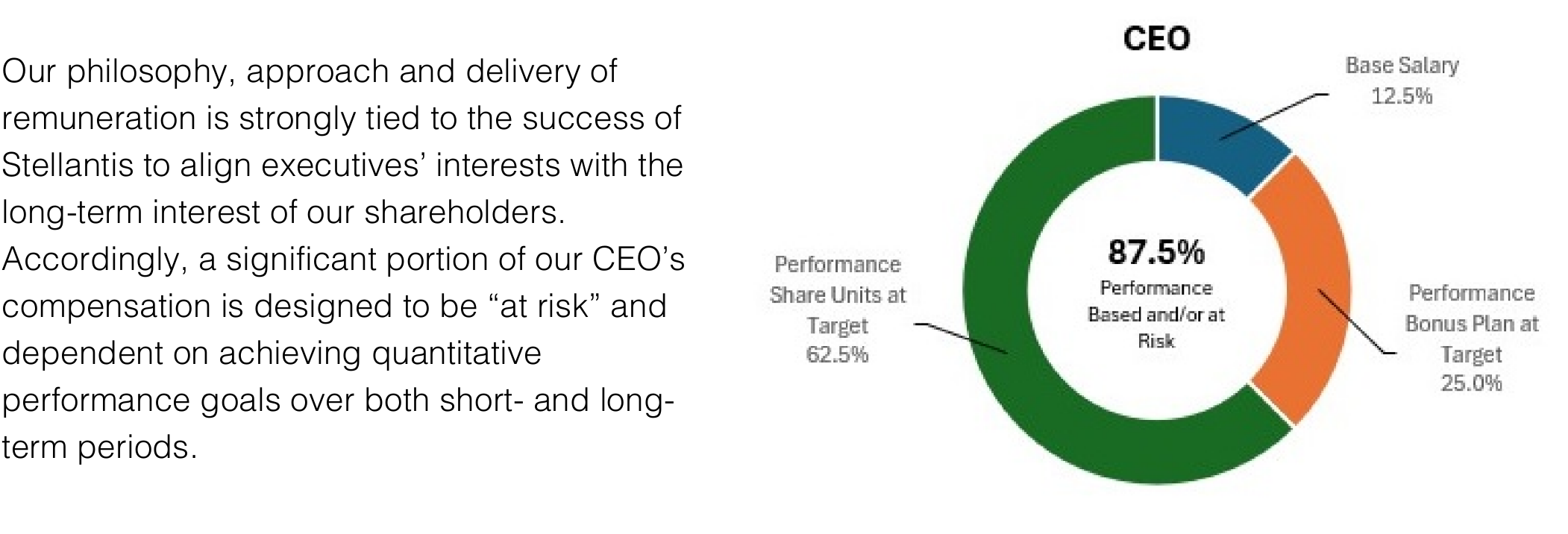
Clear alignment between executive rewards and shareholder interests is central to our Remuneration Policy. Our pay-for-performance philosophy has strong links between rewards and results for both our short-term and long-term incentive plans.
The Remuneration Committee has a clearly defined process for setting stretch targets for our incentive compensation plans and a framework for decision-making around executive remuneration. A third-party, independent consulting advisor provides recommendations and information on best market practices for remuneration structure and design. The Committee had extensive discussions, supported by its external advisor, to review the composition and key drivers of remuneration.
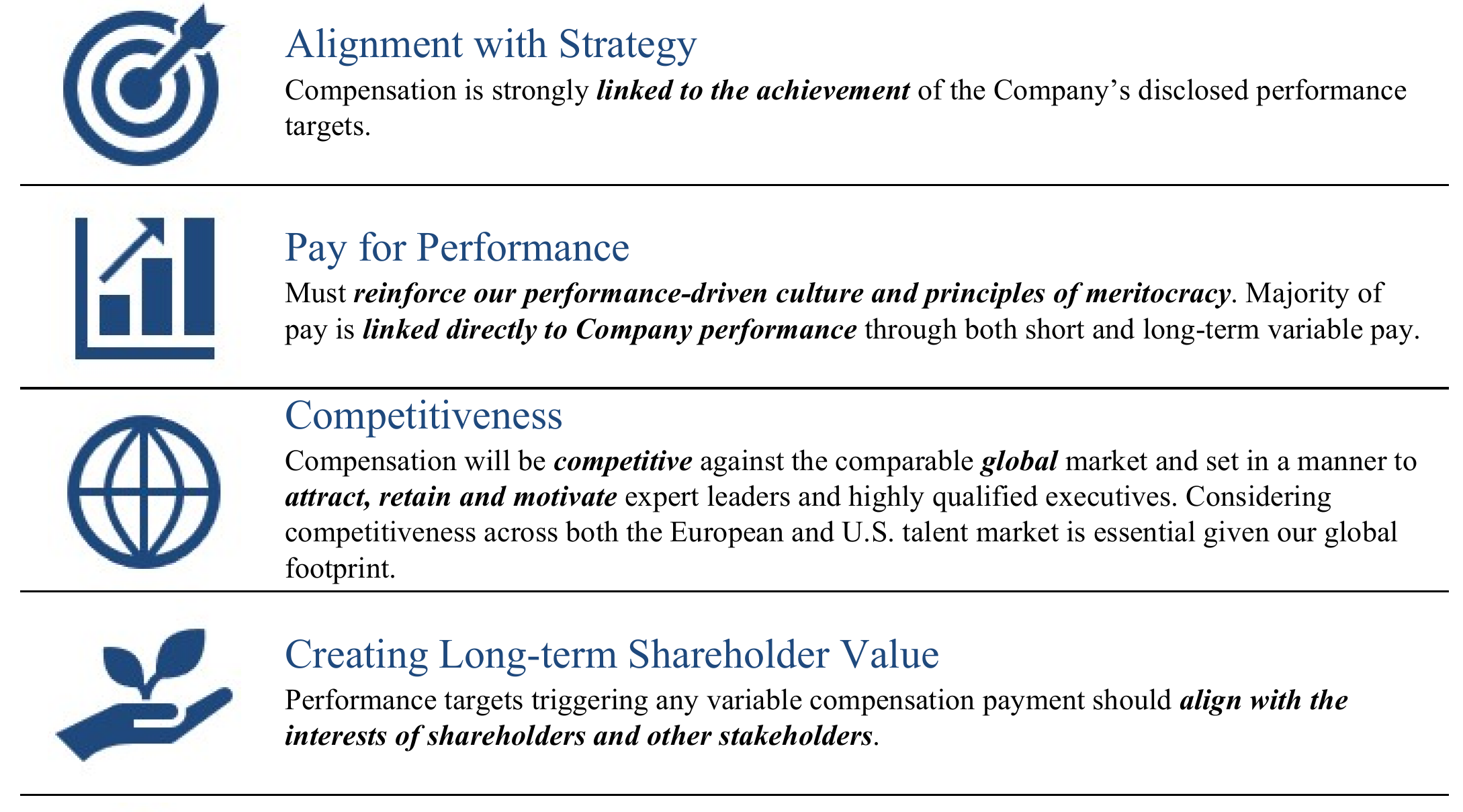
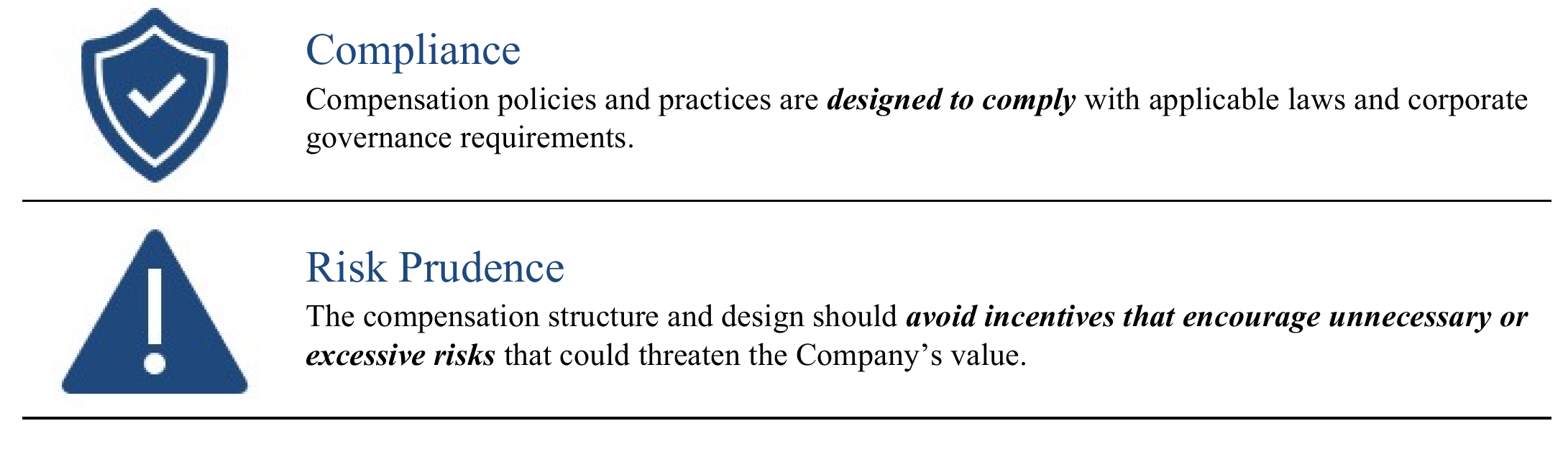
The Remuneration Committee determines executive remuneration on the basis of a set of principles (as shown in the table below) that demonstrate clear alignment with shareholder and other stakeholder interests with the responsibility to ensure that executive remuneration is closely aligned with financial and strategic performance.
Total Rewards Philosophy & Core Principles
Oversight and 2025 Remuneration Decisions
The Remuneration Committee oversees our executive compensation program and plans to align them with our strategy, goals and shareholder interests. In making 2025 compensation decisions, the Committee considered several factors, including:
| | | | | | | | | | | | | | |
| (1) | (2) | (3) | (4) | (5) |
| Compensation programs at peer companies (both US and European) | Stellantis’ past performance and for purposes of incentive planning, the upcoming Company annual and long-term business plans | Annual and long-term financial plans as part of our growth strategy and long-term outlook | Incentive plan payouts from our historical compensation programs | Methods of aligning executive compensation with shareholder returns |
The Remuneration Committee meets throughout the year and takes into account these factors for making any actions for the remuneration yearly cycle. Performance metrics, targets and performance/payout ranges for our incentive plans are established early in the respective performance years. For the 2025 remuneration cycle, the following considerations and actions were taken:
•Continue the practice to reassess our annual bonus plan performance financial targets and performance/ payout ranges to help ensure a challenging, yet achievable plan that aligns with Company and shareholder interests;
•Align performance targets and performance/payout ranges with 2025 performance equity grants and Stellantis’ total rewards philosophy, long-term strategy and operating goals; and
•Although the Company’s business strategy and business plans had changed later in 2025 to address the industry shift from electrification of vehicles, the Remuneration Committee did not revise or adjust the performance financial targets and performance/payout ranges of the 2025 annual incentive program and 2025-2027 long-term incentive plan that were established from the prior 2025 business plan.
Our Executive Remuneration Framework
Our Compensation Peer Group
The Remuneration Committee reviews each year the compensation peer group for compensation comparisons and makes any updates as needed to align with the established criteria and Company strategy. Additional companies may be considered for benchmarking particular executive/director compensation when necessary.
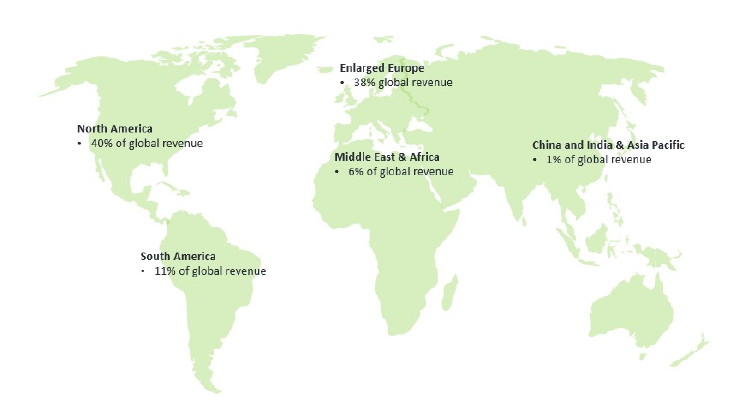
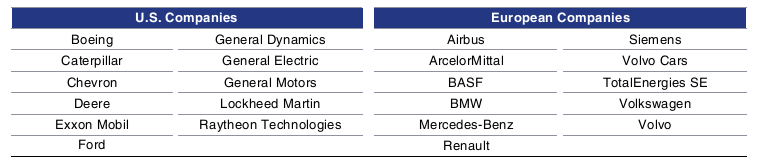
The Committee strives to identify a peer group that best reflects all aspects of Stellantis’ business and considers our global footprint, revenue, market capitalization and/or enterprise value. It is important to note that to attract and retain our top executive talent, we need to consider a blend of both U.S. and European companies - as a significant portion of our business, revenue and profitability is driven by both regions. Given its global footprint, Stellantis must be considered a global company.
The allocation of revenues do not sum to 100 percent as the operating segments are not reflected
In addition to including U.S. and European automobile manufacturers, our peer group includes U.S. and European companies with a global presence that have significant manufacturing and/or engineering operations. We do not limit our peer group to our industry alone because we believe compensation practices at other large global multinational companies affect our ability to attract and retain diverse talent.
For 2025, the Remuneration Committee approved the removal of Continental and Honeywell from the Company’s peer group. The result of Continental’s spin-off of its automotive segment (Aumovio) and planned spin-off its rubber/plastics segments (ContiTech) and Honeywell’s separation of its aerospace and automation segments places them below our threshold in terms of company size. With this change, we continue the blended balance between European-based and US-based companies.
We review each element of compensation compared to the market and generally target our total direct compensation (base salary, annual bonus and long-term incentives, or for Non-Executive Directors - retainers, meeting fees, committee service) for Directors, on average, to be at or near market median.
In addition, we consider Stellantis’ relative size and scope against those of our peers in assessing and setting our pay levels and program designs for our Directors. An individual compensation element or an individual’s total direct compensation may be positioned above or below the market median because of his or her specific responsibilities, experience, and performance.
Pay for Performance
A key characteristic of Stellantis’ Remuneration Policy is pay for performance. All elements of our compensation structure – base salary, incentive compensation and benefits – are benchmarked with our Peer Group and are designed to align in driving shareholder value.
Our incentive programs are based on our pay-for-performance principles and include all employees of the Company globally. Incentives based on performance come in the form of an annual bonus plan or a profit-sharing plan, and long term incentive plan (covering eligible executives) – all plans are based on achievement of strategic business annual and applicable long term goals. Our pay-for-performance approach in compensation covers all employees of the Company – where substantially all employees share in the success for the year.
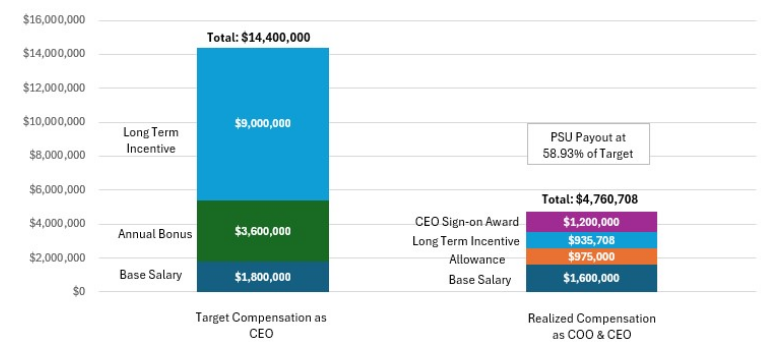
The realized 2025 compensation (in USD) reflects all pay received as CEO and Chief Operating Officer of North America and does not contain the value of any fringe benefits.
Analysis of Risk in the Compensation Architecture
The Remuneration Committee, in reliance on analysis provided by an outside and independent consulting advisor engaged by the Company, annually evaluates the risk profile of our executive compensation and benefits programs. In its 2025 annual evaluation, the Committee reviewed our executive compensation structure to determine whether our remuneration policies, programs and practices encourage our executives or employees to take unnecessary or excessive risks that would be materially adverse to the Company. As a result of that review, along with the outside and independent consulting advisor’s risk assessment analysis and results, the Committee concluded that the 2025 executive compensation plans were designed in a manner to:
•achieve a balance of short- and long-term performance aligned with key stakeholder interests;
•discourage executives from taking unnecessary or excessive risks that would threaten the reputation and sustainability of Stellantis; and
•encourage appropriate assumption of risk to the extent necessary for competitive advantage purposes.
Best Practices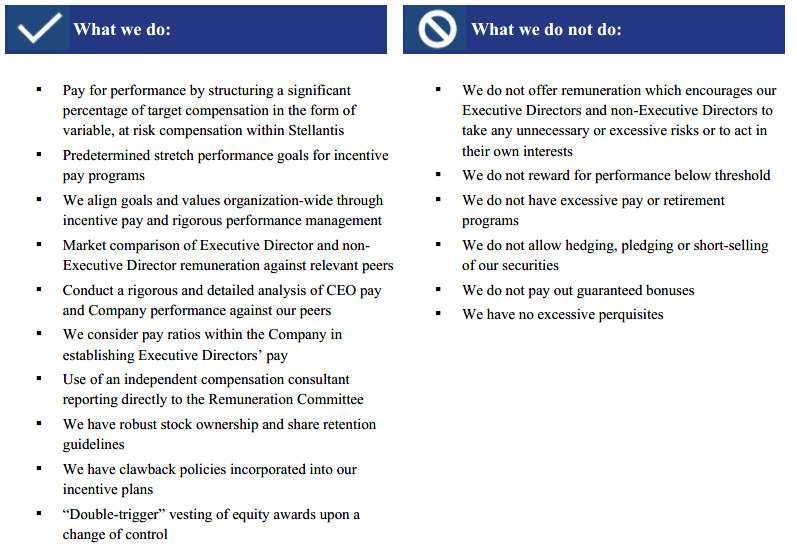
Executive Summary - Executive Director Remuneration
The table below summarizes the remuneration of the CEO as shown in Table 1 of the report. Taking into consideration Company performance and the principles of pay for performance in our remuneration approach, the CEO and Chairman received no annual performance bonus in 2025.
New CEO Remuneration
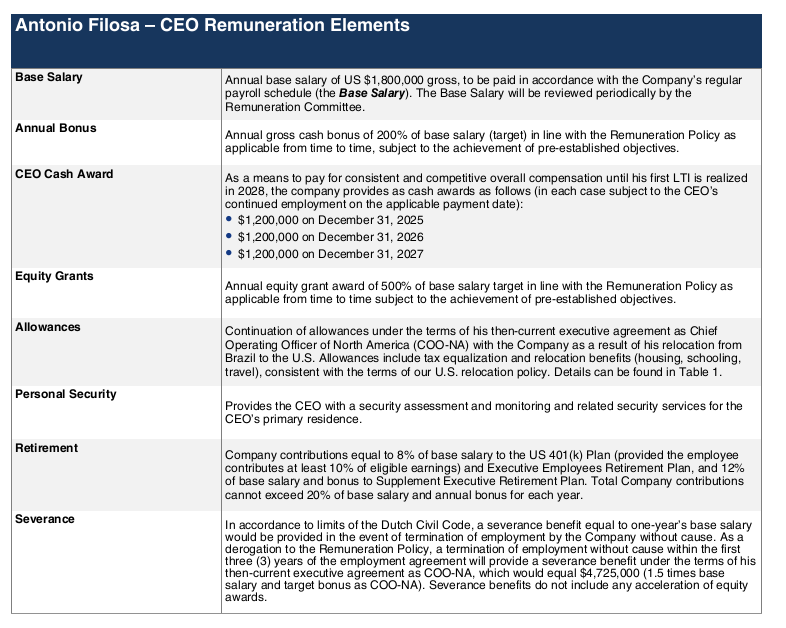
Effective July 18, 2025, by resolution of the extra-ordinary meeting of shareholders of Stellantis N.V., Mr. Antonio Filosa was appointed as executive director of Stellantis N.V. As part of the proposal, the compensation details for the CEO were provided for review. Shareholders approved the assignment as executive director by 99.2 percent.
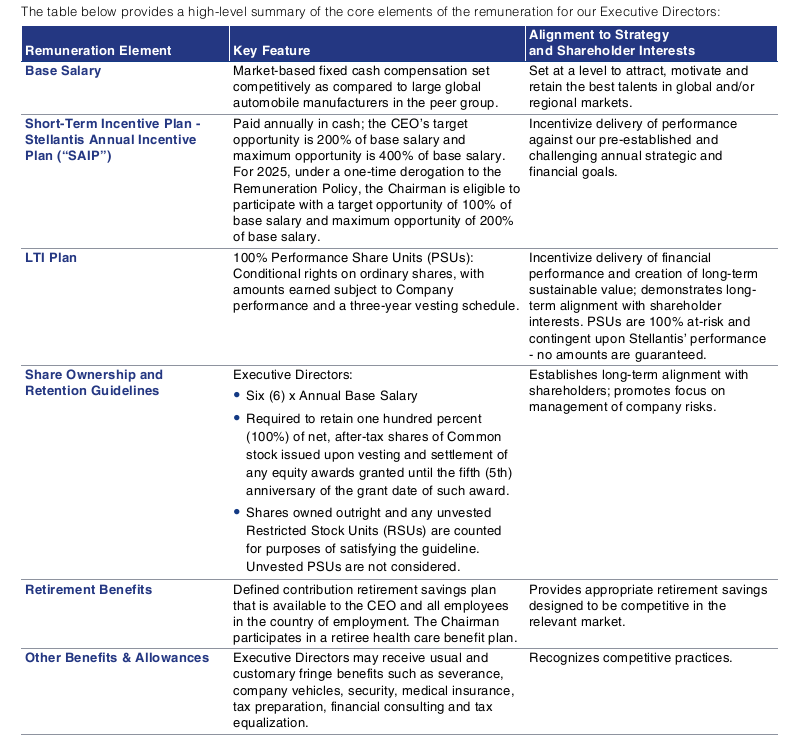
Using the remuneration framework and best practices, the Remuneration Committee decided to provide the following compensation elements to the CEO in 2025:
Chairman Remuneration
In 2025, following the departure of the former Chief Executive Officer in December 2024, Mr. Elkann assumed an enhanced leadership role to support the Company during a period of transition. He chaired an interim executive committee composed of senior members of management to ensure continuity in day-to-day operations and oversaw the process to identify and appoint a new Chief Executive Officer. During this period, he also contributed to the development of the Company’s strategy and initiatives aimed at improving operational performance. The Chair refused any additional compensation for that period.
In recognition of the additional duties undertaken during the transition period and by way of a one-time derogation from the Remuneration Policy, the Chairman was included in the Company’s annual incentive plan for 2025, which did not generate any payout for 2025, so this inclusion had no economic impact on the Company. For 2026 and subsequent years, the Chairman requested, and the Remuneration Committee approved, that the Chairman will not participate in the Company’s annual incentive plan. The Board wants to thank the Chair for his decisive commitment during this period.
Following the appointment of the new CEO, the scope of the Chairman’s duties and responsibilities expanded, with a particular focus on the oversight of the Company’s key strategic priorities, partnerships and engagement with global stakeholders. The Chairman will continue to provide advice to senior leadership on matters relating to strategy, brand, talent and culture, including employee and stakeholder engagement.
2025 Remuneration
Director’s Total Remuneration in 2025
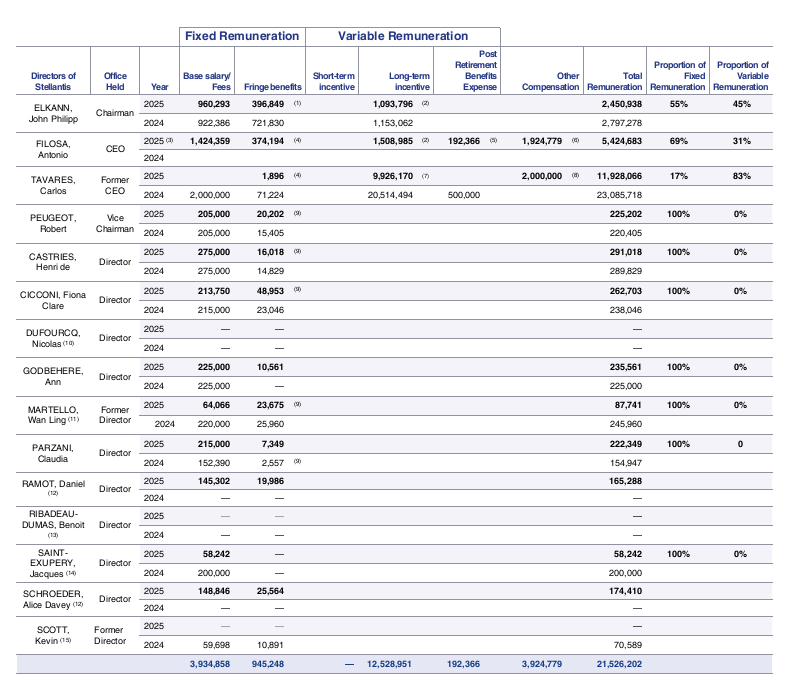
The following table summarizes the remuneration of the members of the Board of Directors for the year ended December 31, 2025. The table below provides cash received (any base salary and any performance bonus) received in 2025 and 2024. The post-retirement benefits expense reflects retirement plan contributions for deferred retirement income, and the fringe benefits show the value of Company payments for services or benefits provided to the Directors and are considered competitive in the market. The long-term incentive (“LTI”) reflects the accounting expense recognized during each period – not the actual LTI awards received during the year upon vesting. Under IFRS, an award with market-based vesting conditions, which is the case for the LTI with TSR targets, is fair valued at grant date. The grant date fair value of the award is then recognized as expense over the vesting period irrespective of whether the market-based vesting condition will be satisfied or not.
(1)Fringe benefits include the use of company-provided transportation, tax-equalization services and insurance premiums. For Mr. Elkann, the fringe benefits of €396,849 include €351,883 for company-provided transportation, €36,204 in tax equalization benefits for the use of company-provided transportation, and €8,762 of insurance premiums
(2)The stated amounts represent the Company's 2025 expense relating to the grants issued to the Chairman and the CEO under the Stellantis N.V Equity Incentive Plan
(3)The stated amounts reflect total remuneration earned during the year, including periods prior to and following appointment as Chief Executive Officer
(4)For Mr. Filosa, the fringe benefits of €374,194 includes €1,401 for company provided transportation, €10,035 for company-provided vehicles, €12,583 of insurance premiums and
€116,399 in tax equalization, €21,422 for the company match and share discount from the Company’s employee stock purchase plan, €212,354 for allowances - housing/schooling/return trip. For Mr. Tavares, the fringe benefit reflects insurance premiums.
(5)The stated amount includes company contributions to the Company 401(k) Plan €23,009 ($26,000), Executive Employee’s Retirement Plan €68,063 ($76,911) and Supplemental Executive Retirement Plan €101,294 ($114,462)
(6)The stated amount includes a cash award in the amount €1,061,947 ($1,200,000) and the tax equalization/relocation annual allowance in the amount of €862,832 ($975,000) pursuant to the CEO’s then-current executive agreement as COO-NA.
(7)The stated amount represents €10,000,000 relating to achievement of one milestone of the CEO Transformation Incentive 2021-2025 Award (a description which is provided in the prior year’s Remuneration Report) and -€73,830 reflecting the cancellation of 32,255 PSUs from the 2022 LTI Plan due to performance below target
(8)Reflects the severance received by the former CEO, pursuant to his employment and exit agreements
(9)The stated amounts include the use of transport
(10)In accordance, with internal regulations of Bpifrance S.A., the Company at which Mr. Dufourcq serves as Chief Executive Officer and Executive Director, Mr. Dufourcq does not receive any remuneration for the performance of his duties as a Director of Stellantis
(11)Ms. Wan Ling Martello was a Director from January 1, 2025 to April 14, 2025
(12)Mr. Ramot and Ms. Alice Davey Schroeder were appointed a Director of Stellantis on April 15, 2025
(13)Mr. Ribadeau-Dumas was appointed Director of Stellantis effective April 13, 2023. In accordance with Mr. Ribadeau-Dumas's agreement with Exor N.V., non-executive directors, having a seat on behalf of Exor N.V. are not paid their respective director compensation and that such compensation is paid directly to Exor N.V. An amount of €210,000 was paid to Exor N.V. in accordance with the agreement
(14)Mr. Jacques Saint-Exupery was a Director from January 1, 2025 to April 14,2025
(15)Mr. Scott was a Director of Stellantis from January 1, 2024 to April 15, 2024
Base Salary
We provide competitive base salaries to compensate our Executive Directors for their primary roles and responsibilities, and to provide a stable level of annual compensation. Actual salary levels are based on the Executive Director’s role, level of responsibility, experience, individual performance, future potential and market value.
2025 Stellantis Annual Incentive Plan (“SAIP”)
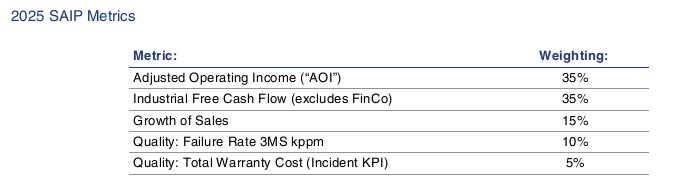
The SAIP provides approximately 53,000 employees, including our CEO and Chairman, with a cash incentive for the achievement of specific annual targets for a set of financial and non-financial performance measures. The SAIP target and maximum opportunity for our Executive Directors is shown below:
All performance-related goals were approved by the Remuneration Committee before the end of the first quarter of 2025. Goals include both financial and strategic metrics important for Company to achieve during 2025. Financial goals are based on the annual budget developed in-line with the long-term strategic plan. The 2025 SAIP also included a payout trigger whereby if the triggering metric is not achieved during the performance year, no annual incentive is payable - regardless of whether the other financial or non-financial metrics performed above the respective thresholds.
2025 Payout Trigger
For any SAIP award to be paid to the Executive Directors, the Company must have positive Free Cash Flow for 2025. If this trigger is not achieved, no SAIP is paid, regardless of achievement of any of the other metrics.
Performance below the threshold will result in a zero payout for that particular metric.
Adjusted Operating Income
Adjusted operating income: Adjusted operating income/(loss) excludes from Net profit/(loss) from continuing operations adjustments comprising restructuring and other termination costs, impairments, asset write-offs, disposals of investments and unusual operating income/(expense) that are considered rare
or discrete events and are infrequent in nature, as inclusion of such items is not considered to be indicative of the Company's ongoing operating performance, and also excludes Net financial expenses/(income) and Tax expense/(benefit).
Unusual operating income/(expense) are impacts from strategic decisions as well as events considered rare or discrete and infrequent in nature, as inclusion of such items is not considered to be indicative of the Company's ongoing operating performance. Unusual operating income/(expense) includes, but may not be limited to:
•Impacts from strategic decisions to rationalize Stellantis’ core operations;
•Facility-related costs stemming from Stellantis’ plans to match production capacity and cost structure to market demand; and
•Convergence and integration costs directly related to significant acquisitions or mergers.
Industrial Free Cash Flows
Industrial free cash flows: is our key cash flow metric and is calculated as Cash flows from operating activities less:
(i)cash flow from operating activities from discontinued operations;
(ii)cash flow from operating activities related to financial services, net of eliminations;
(iii)investments in property, plant and equipment and intangible assets for industrial activities; and
(iv)contributions of equity to joint ventures and minor acquisitions of consolidated subsidiaries and equity method and other investments;
and adjusted for: (i) net intercompany payments between continuing operations and discontinued operations; (ii) proceeds from disposal of assets and (iii) contributions to defined benefit pension plans, net of tax.
The timing of Industrial free cash flows may be affected by the timing of monetization of receivables, factoring and the payment of accounts payables, as well as changes in other components of working capital, which can vary from period to period due to, among other things, cash management initiatives and other factors, some of which may be outside of the Company’s control.
Refer to “Financial Overview - Non-GAAP Financial Measures” included elsewhere in this report for additional information.
Growth of Sales
Our goal is to deliver vehicles customers want, with the quality, capability and personality that define our brands. Measured in units sold.
Quality
The Company and the Remuneration Committee conduct an annual review of our incentive plan metrics, which include ESG performance measures. For 2025, employee safety remains a top priority, with the most effective oversight and implementation occurring at the regional and country levels. Additionally, Quality is recognized as both a social responsibility to our customers and a governance concern tied to compliance and internal controls. Since 2021, quality has been one of the Group’s core objectives, with its significance and weighting in our metrics increasing each year.
In addition, Quality is an extremely important metric for the Company as it establishes the trust between the Company and our customers. Failure in product quality will impact future revenues and cannot be compromised. Our Quality metric in the SAIP is broken down into three measurements - product quality rates, service quality customer satisfaction, and total warranty cost and is based on continuous improvements to be “best-in-class” within the industry.
•Failure Rate corresponds to number of incidents after 3 months in service (repaired under warranty in the network). Based on feedback from customers on models marketed by Company globally and regarding the number of cars produced during the same period; and
•Total Warranty Cost corresponds to the number of Warranty Incidents.
2025 Annual Bonus Performance Target Setting
The Remuneration Committee selects targets using the year’s annual budget which considers opportunities and headwinds facing the Company and industry. As the Company underwent a restructuring in 2025 and faced challenges in the industry and renewed focus and direction towards electrification of vehicles, the Remuneration Committee remained committed to maintaining the incentive metrics with the previously established performance targets and ranges set forth below.
2025 SAIP Performance Results
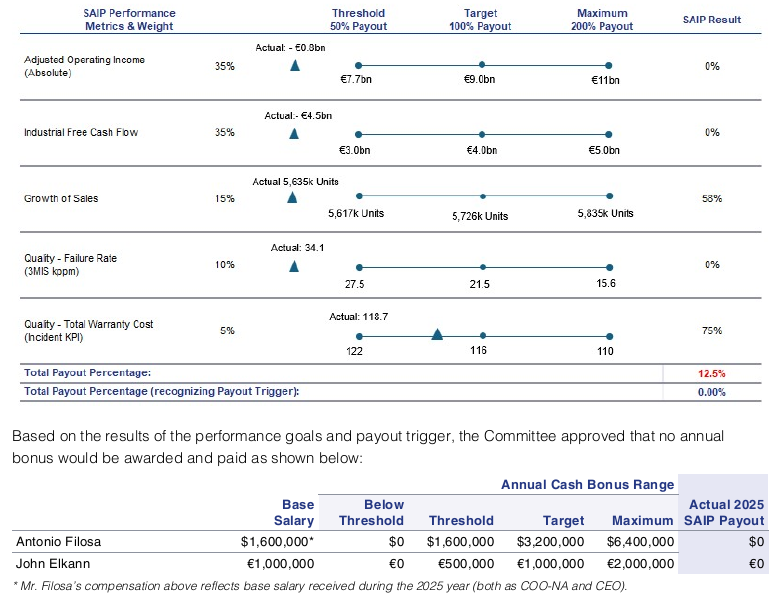
In 2025, the Company did not achieve the payout trigger of positive free cash flow. As a result, the CEO and Chairman did not receive any 2025 SAIP award. Notwithstanding the payout trigger, the table below provides the results of the 2025 SAIP performance metrics:
Long Term Incentive Plan (LTIP)
Our equity-based incentive awards are tied to Company performance and the future value of our common stock. These awards are intended to focus executive behavior on our longer-term interests because today’s business decisions affect the Company over several years.
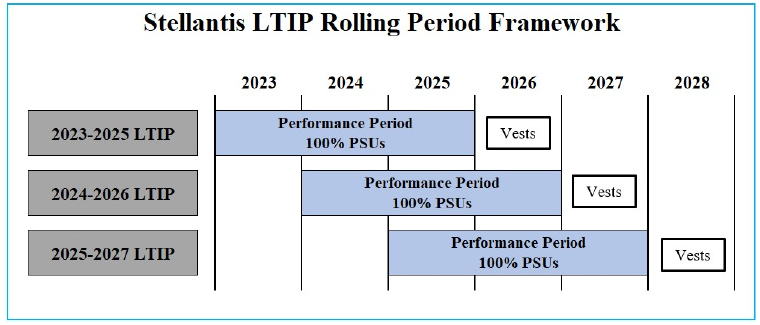
The Remuneration Policy sets out the operation of the LTI Plan. The design incorporates annual rolling grants directly linked to a three-year performance and vesting period. The process for setting targets for the LTI Plan starts with our Company strategy, which is generally formulated every three years, and our three-year financial plan, which is updated annually. Each equity award cliff vests after three years.
Stellantis LTIP Rolling Period Framework
The LTI Plan covers approximately 2,400 employees, including our Executive Directors. The LTI Plan target opportunity for our Executive Directors is determined as a percentage of base pay as shown below:
Long-Term Incentive Plans: Performance Share Units
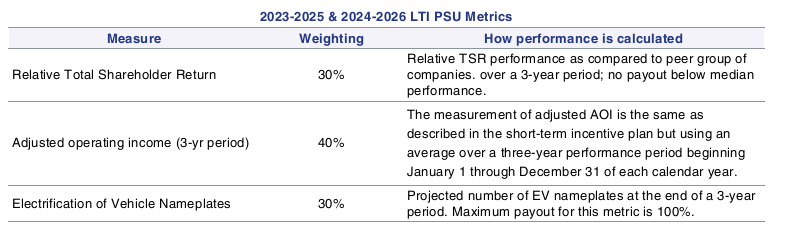
The actual payout of PSUs depends on meeting strategic, long-term Company performance goals. The 2023-2025 and 2024-2026 LTI Plan performance metrics for PSUs are the same and are listed below.
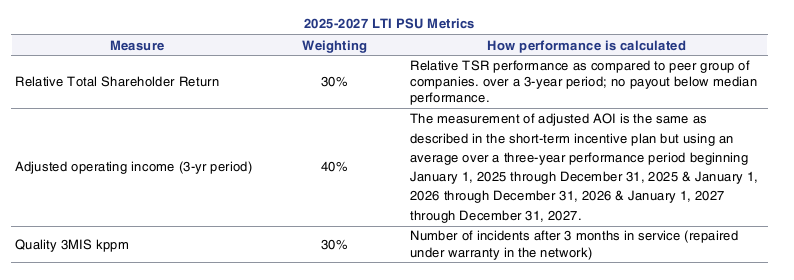
The 2025-2027 LTI plan included a quality performance metric, an extremely important metric for the Company as it establishes the trust between the Company and our customers.
Relative Total Shareholder Return (2023-2025, 2024-2026, 2025-2027 LTI Plans)
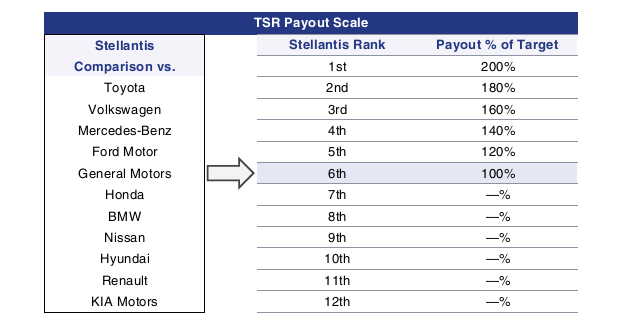
The relative TSR Metric constitutes a market performance condition relative to eleven of the larger OEMs (“TSR Peer Group”) and a payout scale subject to certain thresholds depending on the stock price appreciation plus dividends and any other shareholder distribution over each cumulative performance period of the Company in comparison with the companies forming part of the TSR Peer Group.
The TSR Peer Group consists of Volkswagen AG, Toyota Motor Corporation, Mercedes-Benz, General Motors Company, Ford Motor Company, Honda Motor Co. Ltd., BMW Group, Nissan Motor Corporation, The Hyundai Motor Company, Renault SA, and Kia Motors Corporation.
The tables below shows the payout scales for the three rolling period LTI plans.
Payout scales based on relative TSR performance during the respective 3-year performance period.
ESG Metric: Electrification of Vehicle Nameplates (2023-2025 & 2024-2026 LTI Plans)
The target for the electrification of vehicle nameplates is based on the availability of battery electric vehicles, plug-in hybrid electric vehicles, and hybrid electric vehicles in the U.S. and European markets. A payout of 50 percent will occur when threshold performance is achieved, up to a maximum of 100 percent payout at target achievement.
Adjusted operating income (2023-2025, 2024-2026, 2025-2027 LTI Plans)
The measurement of adjusted AOI is the same as described in the short-term incentive plan but using an average over a three-year performance period beginning January 1, 2025 through December 31, 2025 & January 1, 2026 through December 31, 2026 & January 1, 2027 through December 31, 2027.
2023-2025 LTI Plan Results
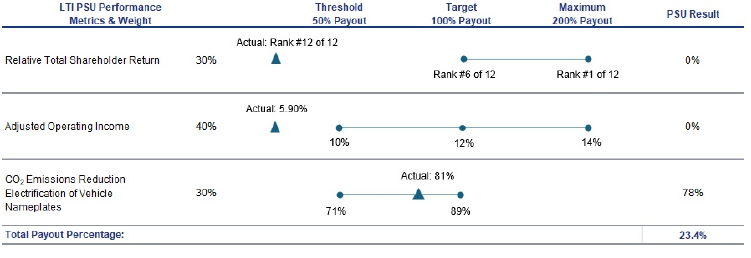
The performance period of the 2023 PSU grant ended on December 31, 2025. The plan’s structure and design are shown below along with the performance metric results. The LTI plan’s goals were established in early 2023 covering a three-year performance period.
The 2023-2025 PSU results are shown in the chart below. It indicates overall achievement of 23.4 percent of target performance for the 2023-2025 performance period. The Committee certified the 2023-2025 LTI PSU final awards to the CEO and Chairman at 23.4 percent of the target level that was achieved.
2023-2025 LTI PSU Performance Results
The table below summarizes the number of PSUs awarded from the 2023-2025 LTI plan to our Executive Directors based on the plan’s performance of 23.4 percent of target. The shares will be distributed in May 2026. Note that the value of this award has been reflected in Table 1 of this Remuneration Report.
*The multiplier for the PSU is calculated on each award and is not a straight calculation of the total shares granted.
Because the 2024 and 2025 PSU grants have a three-year performance period, performance objectives and performance results will not be disclosed until the end of the respective performance periods. We are not disclosing the 2024 & 2025 LTI PSU objectives in this Report because such information would provide competitors with insight into our business plan that could substantially harm Stellantis’ business interests. At the time the Remuneration Committee approved these targets, the Committee believed the targets to be ambitious and achievable while incentivizing executives to exceed expectations.
Former CEO Compensation
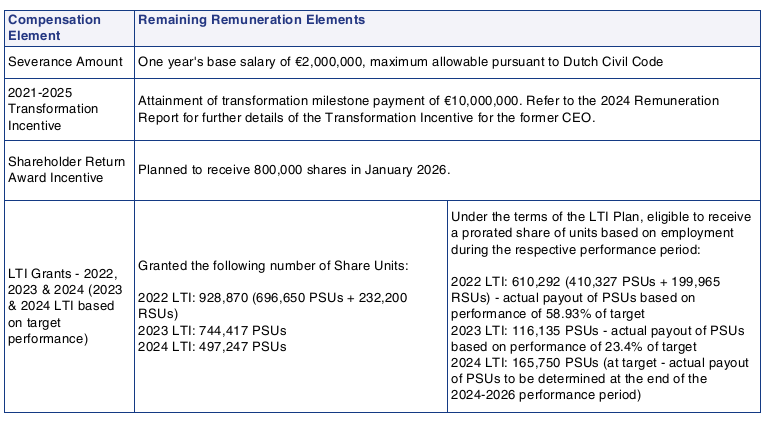
In December 2024, the Company and former CEO, Carlos Tavares, entered a Separation and Release Agreement (“Settlement Agreement”) regarding his departure from the Company. As a result of the agreement, the former CEO received a severance payment of one year base salary (maximum allowable pursuant to the Dutch Civil Code), a payout of an evaluated milestone from the 2021-2025 Transformation Incentive and share units from the Shareholder Return Incentive. Further information about these one-time awards can be found in last year’s Remuneration Report.
Pursuant to the provisions of the EIP and equity award agreements, Mr. Tavares is eligible to receive a prorated share of the 2022, 2023 and 2024 LTI awards based on his employment period during the respective three-year performance periods. Payout of those awards will be based on actual performance.
The table below provides a summary of the former CEO’s remuneration for 2025:
Other Benefits
Retirement Plan: The CEO participates in three Company-sponsored defined contribution plans - the Salaried Employees’ Savings Plan (“SESP”), Executive Employees’ Retirement Plan (“EERP”) and a Supplemental Executive Retirement Plan (“SERP”).
The SESP is a funded, tax-qualified 401(k) plan that covers U.S. salaried employees, including the CEO.
The Company contributes 3 percent of an employee’s eligible earnings (base salary rate). The 3 percent Company contributions and their earnings become fully vested after three years of employment. If the employee contributes at least 10 percent of eligible earnings, the Company provides a matching contribution of 5 percent of eligible earnings. Matching contributions are 100 percent vested when made to the employee’s account. All contributions to the SESP cannot exceed the maximum contribution limits imposed by Section 401(a)(17) and 415(c)(1)(A) of the Internal Revenue Code (“IRC”), as amended.
The EERP is an unfunded, non-tax qualified retirement plan that covers eligible executives, including the CEO. The plan provides eligible executives with Company contributions substantially equal to those they would have received in the SESP but were not able to because of the IRC limitations.
The SERP is an unfunded, non-tax qualified retirement plan that provides the CEO retirement benefits in addition to those provided by SESP and EERP contributions. The Company contributes 12 percent of the CEO’s quarterly eligible earnings (base salary rate plus bonus paid from the Stellantis Annual Incentive Plan) to a notional account. Any gains or losses credited or debited quarterly in the SERP account are based on the CEO’s investment gains or losses from his EERP.
In accordance with IRC Section 409A, benefits accrued under the EERP and SERP may not be paid until at least six months following separation of employment.
The total annual Company contribution to the CEO’s three retirement account plans is at least 20 percent of eligible earnings, provided the CEO contributes at least 10 percent of eligible earnings (base salary) to the SESP. The CEO is 100 percent vested in all Company contributions. The Chairman does not participate in a retirement plan sponsored by the Company.
Health Care: The CEO participates in the same health care plan as other local based salaried employees. The Company provides health care coverage for the Chairman who is eligible for a retiree healthcare plan as provided to other executives in Italy which provides for a reimbursement of a portion of health care costs incurred in retirement. Both Executive Directors participate in a comprehensive annual physical exam.
Severance Benefits: Pursuant to a service agreement between the CEO and the Company and in accordance to limits of Dutch Civil Code, a severance benefit equal to one-year’s base salary would be provided in the event of termination of employment by the Company without cause. Severance benefits do not include any acceleration of equity awards. A derogation of the Remuneration Policy has been made in terms of severance to the CEO - refer to the Section “Derogations and deviations from Remuneration Policy” of this Report.
Company Vehicle: Our CEO is eligible to participate in the Company’s U.S. vehicle benefit program.
Personal Use of Company Aircraft: The use of the Company’s aircraft for personal use ensures the security of our CEO and Chairman. The Company pays the costs associated with both business and personal use of the aircraft.
Detail and compensatory value of the above and other benefits and/or perquisites provided or paid in 2025 are included in Table 1 of this Remuneration Report.
Tax Equalization: The Company will provide the Executive tax return preparation services for any filing of tax returns in the Netherlands and the country in which the Executive is a tax resident (the Residence Country), so long as this Agreement is in effect and until four (4) years after the Agreement is terminated other than for Cause.
Personal Security: The CEO may receive security services that include home security systems and monitoring. Such services are assessed by a third-party security consultant and our Company security team and is routinely evaluated by the Remuneration Committee and the Board.
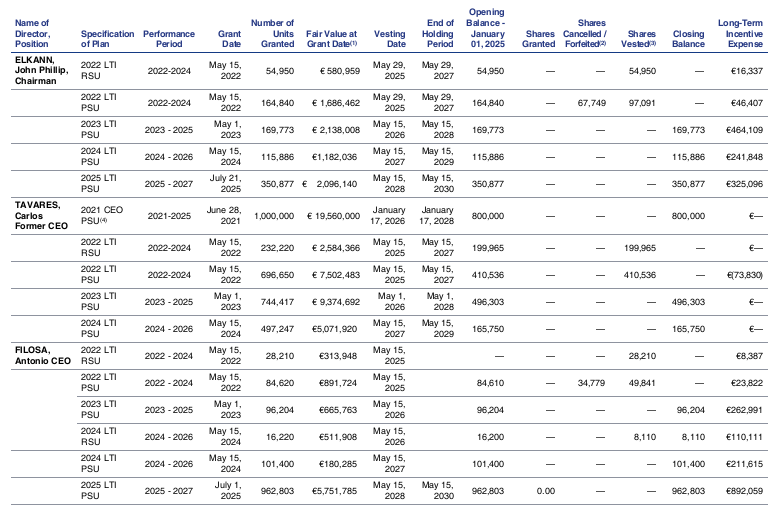
Share Plans Grant to Directors
The following table provides an overview of the share plans held by Executive Directors for the year ended December 31, 2025:
(1)Fair Value at Grant Date is calculated as described in the Share Based Compensation note within the Consolidated Financial Statements included elsewhere in this report
(2)Reflects adjustments to the share grant based on performance and in the case of the Former CEO, the Settlement Agreement
(3)The fair market value of the shares that vested during 2025 for the Chairman was €1,399,702 and the fair market value of the shares that vested during 2025 for the CEO was €836,711
(4)CEO Transformation Incentive 2021 - 2025 Award provided under the terms of the Remuneration Policy and approved by the Board
Non-Executive Board of Directors Compensation
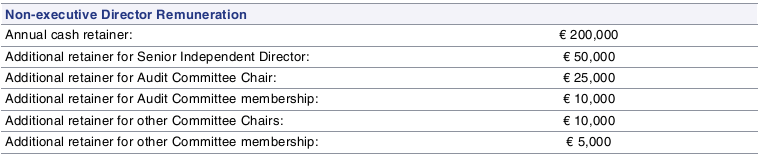
Remuneration of Non-executive Directors is set forth in the Remuneration Policy. Non-executive Directors receive cash retainers; they do not receive Board meeting fees. Non-executive Directors are not eligible for variable compensation and do not participate in any incentive plans based on Company performance. Non-executive Directors are eligible to receive one vehicle rotated annually and discounts on purchases and leases of vehicles (same discounts as for eligible employees). Vehicle benefits are subject to taxes for imputed income.
Current annual remuneration for the non-executive directors is shown in the table below:
Other Remuneration Matters
Compliance with Remuneration Policy
The remuneration paid to Executive and Non-executive Directors for 2021 was done in line with the Remuneration Policy approved by Shareholders at the April 15, 2021 Annual General Meeting. We refer to the paragraphs on the Elements of Executive Director Remuneration, Base Salary, 2025 Stellantis Annual Incentive Plan, Long-Term Incentive Plan, more detailed information on how the remuneration in the Remuneration Report contribute to the long-term performance of the Company.
Derogations and Deviations from Remuneration Policy
John Elkann, our Chairman, was eligible for the 2025 Stellantis Annual Incentive Plan (SAIP), as a derogation to the Remuneration Policy and based on an external review and benchmarking of the competitiveness of his total remuneration, as further provided in the Chairman Remuneration section of this Report. Based on actual performance results for the 2025 year, there was no payout for the 2025 SAIP. For 2026 and subsequent years, at the Chairman’s request, and with the approval of the Remuneration Committee, the Chairman will not participate in the Company’s annual incentive plan.
For our CEO Antonio Filosa, a derogation of the Remuneration Policy was made to allow payment of a severance benefit under the terms of his then-current employment agreement as Chief Operating Officer
of North America (COO-NA) in the event such termination without cause occurs within the first three years of his current CEO agreement. Given the challenges facing the Company and industry when Mr. Filosa accepted the CEO position, the CEO and Remuneration Committee agreed to strike the right balance between performance during the term of the five-year CEO agreement terms and a fair and competitive severance package (as provided during his then-current COO-NA employment agreement) so that the CEO can be fully dedicated and strategically focused in achieving both short-term results and creating value during the longer term. After the first three years of the CEO contract term, any severance amount will be based on his annual base salary, subject to the maximum allowance under the Dutch Civil Code.
Terms of Engagement - Service Agreement
The CEO was employed by the Company on the basis of a Service Agreement (dated July 18, 2025) for a five-year period ending on July 18, 2030, subject to any earlier termination by either party.
Restrictive Covenants
Pursuant to the services agreement between the CEO and the Company, the CEO was subject to a non-competition restriction for a period of one year following termination of employment. A customary provision regarding confidentiality is also included in the services agreement.
Stock Ownership and Retention Guidelines
Our Board recognizes the critical role that executive stock ownership and retention has in aligning the interests of management with those of shareholders. In 2021, the Board approved stock ownership and retention guidelines for Executive Directors and Non-executive Directors. Shares owned outright and any unvested RSUs are counted for purposes of meeting the guideline (unvested PSUs are not considered).
The Chairman and CEO are subject to stock ownership guidelines which require owning shares with an aggregate value of not less than six (6) times base salary. Non-executive Directors are required to own shares with an aggregate value of not less than one year of the annual cash retainer. All are required to meet their required level of ownership within five years.
The Chairman and CEO are required to retain one hundred percent of net, after-tax shares of common stock issued upon vesting and settlement of any equity awards granted until the fifth (5th) anniversary of the grant date of such award. Mr. Elkann has met the Stock ownership and Retention guidelines and Mr. Filosa has until December 31, 2030 to satisfy such requirements.
Clawback Policy
The Company is dedicated to maintaining and enhancing a culture focused on integrity and accountability. Pursuant to the terms of the Equity Incentive Plan (“EIP”) and the Remuneration Policy, the Company may recover, or clawback, incentive compensation, including the ability to retroactively adjust if any cash or equity incentive award is predicated upon achieving financial results and the financial results were subject to an accounting restatement. In addition, the Board had approved a
clawback policy in 2023 that complies with Dodd-Frank Wall Street Reform and Consumer Protection Act of 2010 and is provided, as required, in our 2023 Annual Report.
In the financial year 2025, no situation occurred where variable remuneration has been, or had to be, reclaimed.
Insider Trading Policy / Security Hedging Provisions
The Company maintains an insider trading policy applicable to all directors, employees, members of the households and immediate family members (including spouse and children) of persons listed and other unrelated persons, if they are supported by the persons listed. The insider trading policy provides that the aforementioned individuals may not buy, sell or engage in other transactions in the Company’s stock while in possession of material non-public information; buy or sell securities of other companies while in possession of material non-public information about those companies they become aware of as a result of business dealings between the Company and those companies; disclose material non-public information to any unauthorized persons outside of the Company; or engage in hedging transactions through the use of certain derivatives, such as put and call options involving the Company’s securities. The insider trading policy also restricts trading by specified individuals to defined window periods which follow the Company’s earnings and revenue releases.
To ensure alignment with shareholders' interest and to further strengthen our compensation risk management policies and practice, the Company’s insider trading policy prohibits all individuals to whom the policy applies from engaging in a short sale of the Company's or its subsidiaries' securities and derivatives (such as options, puts, calls, or warrants).
Internal Pay Ratios and Comparative Information
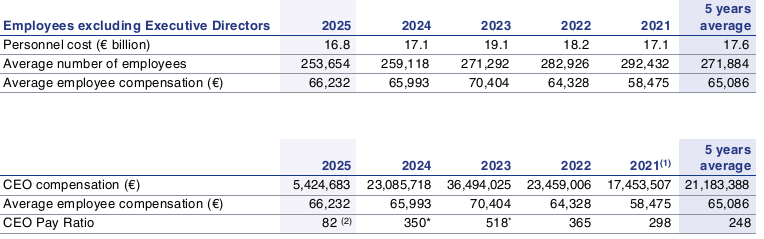
The Remuneration Committee considers internal pay ratios within the Company when setting the Executive Directors’ compensation. In line with the guidance provided under the Dutch Corporate Governance Code and the Dutch Civil Code, the CEO pay ratio and five-year average employee compensation are to be disclosed in the annual Remuneration Report.
To meet the five-year trend of average employee compensation requirement, total personnel costs reported in the annual report less any Executive Director compensation divided by the average headcount reported in the annual report less any Executive Directors who are included in the total average headcount was utilized and is illustrated in the tables below.
(1)CEO Compensation used to calculate the 2021 CEO pay ratio excludes Other Compensation reported in table 1
(2)The stated amounts reflect total remuneration earned during the year, including periods prior to and following appointment as Chief Executive Officer.
*The CEO pay ratio reported in 2024 and 2023 includes remuneration received from the Transformation Incentive 2021 - 2025. Excluding the amount relating to the CEO Transformation Incentive 2021 - 2025 would result in a CEO pay ratio of 315 for 2023 and 124 for 2024.
In accordance with the guidance provided under the Dutch Corporate Governance Code, further pay ratios including scenario analysis reflecting incentive plan performance were conducted between the CEO and senior management. Considering base salary and incentive opportunities (both short-term and long-term incentives), the CEO pay ratio ranged from 2.4 to 4.8.
Comparative Table over Remuneration and Company Performance
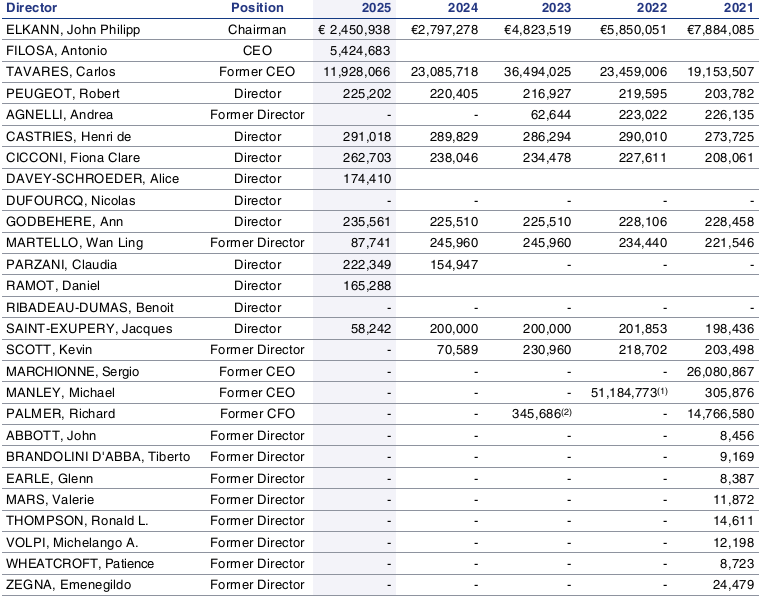
In line with guidance provided under the Dutch Corporate Governance Code and the Dutch Civil Code, the performance of the Company, the remuneration of each Director and the average employee compensation other than directors from 2021 to 2025 financial years is disclosed in the following table.
(1)This amount represents the amount paid as described in the Pre-merger Legacy Matters - Remuneration of Former Executive Directors FCA N.V. section of the 2022 Remuneration Report
(2)This amount represents the amount paid as described in the Pre-merger Legacy Matters - Remuneration of Former Executive Directors of FCA N.V. section of the 2023 Remuneration Report