

Exhibit 1.2
Organization
Regulations
of
UBS Group AG
Valid as of 5 January 2026
The present text is a translation of the original German Organization Regulations („Organisationsreglement“) which constitute the
definitive text and are binding in law.
2
Contents
Abbreviations and definitions
3
Preamble by the Chairman
5
Introduction
1 Basis and purpose
6
2 Organization of the Group
6
Board of Directors
3 Membership
8
4 Constitution
8
5 Responsibilities and authorities
8
6 Meetings
9
7 Resolutions
10
8 Information rights
11
9 Self-assessment
11
10 Chairman
11
11 Vice Chairmen and Senior Independent Director
12
12 Group Company Secretary
12
13 Board Committees
13
Group Executive Board
14 Delegation
14
15 Group Executive Board
14
16 Group Chief Executive Officer
15
17 Group Chief Financial Officer
16
18 Group Chief Risk Officer
17
19 Group General Counsel
17
20 Group Chief Compliance and Operational Risk Control Officer
17
21 Head Group Human Resources and Corporate Services
17
22 Group Chief Operating Officer
18
23 Regional Presidents
18
24 Divisional Presidents
18
Group Internal Audit
25 Scope, responsibilities, authorities and reporting
19
26 Head Group IA
19
Special provisions
27 Authority to sign
21
28 Form of signature
21
29 Conduct of Board and GEB members
21
30 Entry into force, amendments
22
Annexes
A Organizational chart of UBS Group AG
23
B Charter of the Committees of the Board
25
C Key Approval Authorities (internal document)
3
Abbreviations and definitions
Whenever the context may require, any pronoun shall include the corresponding masculine, feminine and neuter forms.
AC
Audit Committee
Affiliated person
Person who directly or indirectly through one or more intermediaries controls or is controlled by or is
under common control of UBS Group AG
AGM
Annual General Meeting of the shareholders
ALM Authorities
Asset and Liability Management Authorities – internal document setting out the high-level delegated
authorities within the Group for asset and liability management
AoA
Articles of Association of UBS Group AG
BD(s)
Business division(s), organizational units of the business: (i) Global Wealth Management,
(ii) Personal & Corporate Banking, (iii) Asset Management, (iv) the Investment Bank and (v) Non-Core
and Legacy
Board/BoD
Board of Directors of UBS Group AG; non-executive Board members who do not perform
management functions within UBS Group AG
Business Regulations
Regulations issued by the BDs or GF
CCRC
Corporate Culture and Responsibility Committee
Chairman
Chairman of the Board
Chairpersons
Board members who chair the Committees
CO
Swiss Code of Obligations
Committees
Committees of the Board as set out in section 2.1
Committees’ charter
Charter of the Committees of the Board setting out the objectives, composition, authorities and
responsibilities of the permanent Committees
CompCo
Compensation Committee
Corporate Bodies
The Board and bodies of the Group exercising delegated Board functions, such as the Committees, the
GEB, committees established by the GEB, Group IA or other bodies mentioned herein
Divisional
President / DP
Divisional Presidents are the heads of the respective BDs, as set out in section 24 and in the respective
Business Regulations
EGM
Extraordinary General Meeting of the shareholders
Financial statements
Quarterly and annual financial statements including, among others, the disclosure under
“Management’s Discussion and Analysis” and the 6K Report to the Securities and Exchange
Commission and any formal announcements relating to the Group’s performance
FINMA
Swiss Financial Market Supervisory Authority
GCORC
Group Compliance and Operational Risk Control
GEB
Group Executive Board
GF(s)
Group Function(s), comprising the functions: (i) Group CEO Functions, (ii) Group Compliance and
Operational Risk Control, (iii) Group Finance, (iv) Group Human Resources and Corporate Services, (v)
Group Operating Office, (vi) Group Legal, and (vii) Group Risk Control
GNC
Governance and Nominating Committee
Group ALCO
Group Asset and Liability Committee
Group CCORCO
Group Chief Compliance and Operational Risk Control Officer
Group CEO
Group Chief Executive Officer
Group CFO
Group Chief Financial Officer
Group Company
Secretary
Company Secretary of the Board
Group COO
Group Chief Operating Officer
Group CRO
Group Chief Risk Officer
Group Functional
Head / GFH
Group CCORCO, Group CFO, Group COO, Group CRO, Group GC, Head GHRCS and Group CEO (as
related to the responsibilities for the Group CEO Functions as outlined in section 16.4)
Group GC
Group General Counsel
4
Group IA
Group Internal Audit
Head GHRCS
Head Group Human Resources and Corporate Services
HR
Human Resources
ICAAP
Internal Capital Adequacy Assessment Process
MD
Managing Director
ORs
Organization Regulations of UBS Group AG including annexes
Other UBS Entities
UBS Entities which are neither Significant Group Entities nor Significant Regional Entities
RC
Risk Committee
Regional
President / RP
Regional Presidents as set out in section 23 and in the RP terms of reference
Region(s)
Region(s), comprising the geographical regions: (i) Americas, (ii) Asia Pacific (APAC), (iii) Europe, the
Middle East and Africa (EMEA) and (iv) Switzerland
Risk Authorities
Internal document setting out the high-level delegated authorities within the Group for risk
management and control
Shareholders
Shareholders of UBS Group AG
SID
The Senior Independent Director of the Board as set out in section 11
Significant Branches
Branches of UBS Entities subject to enhanced standards of corporate governance as designated by the
Group CEO
Significant Group
Entities / SGEs
Significant subsidiaries of the Group subject to enhanced standards of corporate governance as
designated by the GNC
Significant Regional
Entities / SREs
Subsidiaries of the Group subject to enhanced standards of corporate governance as designated by
the Group CEO
SOX
Sarbanes–Oxley Act
Stakeholders
Persons, groups or organizations that have a direct or indirect stake in the Group and may, as a result,
affect or be affected by the Group’s actions, objectives and policies
UBS/Group
UBS Group AG and its subsidiaries; the UBS group of companies
UBS Entities
All subsidiaries (excluding Special Purpose Entities) which are either wholly or majority, directly or
indirectly owned or otherwise controlled by UBS Group AG and which are intended to be held
indefinitely
UBS Group AG
UBS Group AG, the listed parent company of the Group
Vice Chairman
The Vice Chairman of the Board as set out in section 11
5
Preamble by the Chairman
UBS draws on its more than 160
-year heritage to serve private, institutional and corporate clients worldwide, as well as retail clients
in Switzerland and create long-term sustainable value for investors. Our shareholders, employees, clients and other interest groups
hold high expectations of how we conduct our business. Good governance policies and processes are more important than ever
and, together with the strong values we have defined, are at the heart of UBS’s culture. UBS and its employees apply the highest
standards of business ethics and personal integrity to all of our business dealings and interactions.
The Organization Regulations
constitute the Group’s primary corporate governance guidelines establishing a corporate governance
structure for UBS Group AG and its subsidiaries. These Organization Regulations have been approved by the Board of UBS Group
AG, they comply with all relevant corporate governance requirements but are not intended in any way to be a substitute for
mandatory provisions of law, rules or regulations applicable to the Group.
In the interest of transparency, the Organization Regulations are published on our website.
Colm Kelleher
6
Introduction
1
Basis and purpose
1.1
Basis
These ORs are enacted by the Board of UBS Group AG pursuant to article 716b of the CO
and articles 25 and 27 of the AoA.
1.2
Purpose
The purpose of these ORs is:
(i)
to implement and supplement requirements contained in applicable laws, stock
exchange regulations, supervisory regulations and the AoA having regard to
pertinent codes of best practice. In addition, these ORs constitute the corporate
governance guidelines required by the New York Stock Exchange;
(ii)
to define the functions, responsibilities and authorities of UBS Group AG’s and the
Group’s Corporate Bodies and their members; and
(iii)
to establish a coherent and efficient corporate governance structure by constituting
the Group’s primary governance and consolidated supervision guidelines to be
applied to all direct and indirect subsidiaries of UBS Group AG and which supersede
any other regulations and shall prevail in case of a conflict with such documents,
subject to local law.
Mandatory provisions of applicable laws, rules and regulations or rules contained in the
AoA take precedence over the ORs.
2
Organization of the Group
2.1
Organization in general
The Group and its business are organized as follows:
(i)
The Board, under the leadership of the Chairman, has the ultimate responsibility for
the direction, supervision and control of the Group, and performs the other duties
described herein or as prescribed by mandatory provisions of law. The Board is
responsible for deciding all matters and taking business decisions where such
decisions exceed the authority delegated by the Board to the Committees, the GEB
or the Group CEO.
(ii)
As provided by mandatory law, rules and regulations, the AoA or these ORs, the
executive management of the Group is delegated to the GEB under the leadership
of the Group CEO. The GEB is the highest executive body of the Group.
(iii)
The following permanent Committees assist the Board in the performance of its
responsibilities:
(a)
the Audit Committee;
(b)
the Compensation Committee;
(c)
the Corporate Culture and Responsibility Committee;
(d)
the Governance and Nominating Committee; and
(e)
the Risk Committee.
2.2
Group steering
UBS Group AG
, as the listed parent company of the Group, controls directly or indirectly all
subsidiaries and leads the Group by setting a harmonized strategic direction. To facilitate
consolidated and integrated oversight, it further sets principles and organizational
structures to enable efficient and coordinated management of the Group and control of its
subsidiaries. To this end and in compliance with FINMA principles of consolidated
supervision, in supplement to these ORs, the Board issues a Group Management Regulation
to further regulate the tasks, roles and responsibilities of the Board and the GEB for
oversight and management of the Group and its subsidiaries.
Notwithstanding these endeavors, the legal independence of all subsidiaries, including
formal decision-making by the Corporate Bodies of the respective entities as required under
applicable constitutional documents, and the provisions of applicable local laws, rules and
regulations relating to them, must be observed to the extent legally required.
2.3
Corporate culture
Under the leadership of the Chairman and the Group CEO, the Board and the GEB issue a
Code of Conduct and Ethics to foster a coherent and effective corporate and compliance
culture for the Group.
7
2.4
Organization of
the Group’s business
The banking business and support operations are performed by UBS Group AG’s direct or
indirect subsidiaries within the scope of applicable licenses. The business of the Group is
organized into:
(i)
business divisions;
(ii)
Group Functions; and
(iii)
other structures as the Group CEO and the GEB consider appropriate for the effective
management and supervision of the business.
This organization must be detailed in the Business Regulations.
2.5
Transparency,
collaboration and
reporting within
the Group
Subject to and in accordance with applicable local laws, rules and regulations, Corporate
Bodies are bound to ensure transparency and collaboration within the Group and may have
additional responsibilities and reporting lines within the Group or within other legal entities
of the Group. Any resulting conflicts of interest shall be governed by the provisions of the
Organization Regulations (or similar constitutional documents) of the companies
concerned.
8
Board of Directors
3
Membership
3.1
Election proposal
In consultation with the Chairman, the GNC recommends candidates for election to the
Board. The Board proposes such candidates for election by the shareholders.
3.2
Independence of
Board members
The Board’s proposal for election ensures that three-quarters of the Board members will be
independent. For this purpose, independence is determined in accordance with the FINMA
circular 2017/1 “Corporate governance – banks” and taking into account the New York
Stock Exchange rules.
Furthermore, there must be a sufficient number of Board members who meet the
independence criteria for the Committee members set out in the annex “Charter of the
Committees of the Board.” The Chairman does not need to be independent.
3.3
Notification duty
Each Board member must notify the Chairman and the GNC immediately if circumstances
change in a manner that may affect their independence.
3.4
Expectations of the
Board members
The Board, as a group, must have the necessary qualifications, skills and diversity to perform
all Board duties. In particular, the Board must together possess financial literacy, experience
in banking and risk management, as well as international experience, including experience of
international financial matters, and knowledge of the duties of directors.
Candidates for election to the Board shall be considered in light of their personal experience
and abilities, including any specialist knowledge or skills required to fulfill specific Board
functions as outlined herein, as well as their ability to contribute to building a
complementary and effective Board.
4
Constitution
4.1
Number of members
The Board consists of six to twelve Board members as per article 19 of the AoA.
4.2
Term of office
The term of office for each Board member is one year pursuant to article 20 of the AoA.
Subject to election by shareholders, Board members are normally expected to serve for a
minimum of three years. No Board member may serve for more than 10 consecutive terms
of office, in exceptional circumstances the Board can extend this limit.
4.3
Constitutional meeting
The Board constitutes itself at its first meeting following the AGM. In this meeting
(i)
the Vice Chairmen;
(ii)
the SID;
(iii)
the Chairpersons of the Committees; and
(iv)
the Committee members, with the exception of the Compensation Committee
members,
are appointed by the Board.
The Board may remove these Board members from their special functions at any time.
5
Responsibilities and authorities
5.1
In general
In addition to mandatory provisions of law, rules, regulations and the AoA, the Board has
the responsibilities and authorities set out in these ORs.
5.2
Supervision
The Board is responsible for the overall direction, supervision and control of the Group and
its management, as well as for supervising compliance with applicable laws, rules and
regulations. The Board exercises oversight over UBS Group AG and its subsidiaries and is
responsible for ensuring the establishment of a clear Group governance framework to
ensure effective steering and supervision of the Group taking into account the material
risks, opportunities and impacts to which the Group and its subsidiaries are exposed and
may affect its performance, value creation and reputation.
9
5.3
Ultimate responsibility
The Board has ultimate responsibility for the success of the Group and for delivering
sustainable shareholder value within a framework of prudent and effective controls. It
decides on the Group’s strategy and the necessary financial and human resources upon
recommendation of the Group CEO and sets the Group’s values and standards to ensure
that its obligations to shareholders and other stakeholders are met.
5.4
Strategy and financial
success
The Board’s ultimate responsibility for strategy and financial success includes in particular:
(i)
deciding the strategy of the Group upon recommendation of the Group CEO, taking
into account the proposals and alternatives presented, including material risks,
opportunities and impacts;
(ii)
approving the principles of the risk management and control framework of the
Group, including the Risk Appetite Framework and overall risk appetite statement of
the Group and BDs;
(iii)
deciding whether the Group should enter substantial new business areas or exit an
existing business area, in cases where the entry or exit is not covered by the current
approved strategic framework; and
(iv)
approving major acquisitions, mergers, disposals or capital expenditure, including
decisions on major changes to the company and Group structure, major changes in
Significant Group Entities, and other projects of strategic importance for the Group.
5.5
Finance
With respect to the ultimate responsibility for the financial situation, the Board has in
particular the following duties:
(i)
approving the applicable accounting standards and financial control frameworks, as
well as significant changes to them;
(ii)
annually reviewing and approving the three-year strategic plan and one-year
operating plan of the Group, including the financial objectives and a capital allocation
framework, as well as the capital and liquidity planning;
(iii)
annually reviewing and approving the Group ICAAP assessment;
(iv)
reviewing and approving the annual financial statements of UBS Group AG; and
(v)
reviewing and approving the consolidated annual and quarterly financial statements,
as well as the consolidated annual report including the compensation and
sustainability reports of the Group prior to its submission to the AGM.
5.6
Organization
The Board is responsible for establishing an appropriate business organization, including in
particular:
(i)
approving and regularly reviewing the governance principles and the management
structures as set out herein;
(ii)
appointing and removing GEB members, the Group Company Secretary and the
Head Group IA and reviewing their performance;
(iii)
overseeing the effectiveness of the business organization and management
information system implemented by the GEB;
(iv)
supervising the internal control system;
(v)
approving the charter for Group IA and monitoring Group IA; and
(vi)
approving the compensation and benefits principles of the Group.
5.7
Meetings of shareholders
The Board has a duty to convene AGMs and EGMs, prepare the agenda for such meetings
and implement resolutions adopted by the shareholders.
5.8
Loss of equity
In case of financial difficulties or insufficient equity, the Board must undertake all steps
required under applicable law.
5.9
Delegation
In addition to the organization se
t out in these ORs and within the limits of applicable law,
regulations and the AoA, the Board may delegate part of its responsibilities and authorities
to:
(i)
the Committees;
(ii)
individual Board members;
(iii)
the GEB; and
(iv)
individual GEB members.
5.10
Advice from third parties
The Board and the Committees may, in performing their duties, take advice from third
parties.
6
Meetings
6.1
Number of meetings
The Board meets as often as business requires, and at least six times a year.
6.2
Convening meetings
Board meetings are convened by the Chairman. Upon written request
, including reasons,
of any Board member or the Group CEO addressed to the Chairman, he shall convene a
Board meeting in accordance with sections 6.3 and 6.4.
6.3
Invitation
The Chairman or, if absent, one of the Vice Chairmen invites the Board members to the
Board meetings in writing (including by e-mail or other electronic means).
10
6.4
Agenda and notice period
The invitation contains the agenda and must be sent to Board members and other
attendees as a rule at least five business days prior to the date of the Board meeting
together with all necessary supporting material. In exceptional cases, supporting material
may be sent later to allow the Board to receive the latest available information. This applies
in particular to updates on financial data.
In time
-critical cases (as determined at the Chairman’s discretion), a Board meeting may be
held and the supporting material may be sent at shorter notice.
6.5
Chair
Board meetings are chaired by the Chairman or, if absent, by one of the Vice Chairmen or,
in their absence, by the SID or, in their absence, by another Board member selected by the
Board members present.
6.6
Attendees
The Board may hold Board meetings as determined by the Chairman:
(i)
with or without the participation of the Group CEO and all or some of the other GEB
members; and
(ii)
with the participation of other persons, who are invited to attend.
6.7
Meetings of independent
Board members
At least twice a year, the SID holds a meeting of the independent Board members without
the participation of the Chairman.
6.8
Meeting format
Board meetings may be held in person
6.9
Minutes of Board
meetings
The minutes (including the annexes as presented to the Board) contain all Board resolutions
made and reflect in a general manner the considerations that led to the decisions made.
Dissenting opinions of and votes cast by Board members must also be reflected in the
minutes.
6.10
Form of minutes,
inspection rights
The minutes must be signed by the Board member chairing the meeting (in accordance
with section 6.5) and the keeper of the minutes and must be made available for review
prior to the next Board meeting at which these shall be approved. Board members are
entitled to examine the minutes of any Board meeting at any time.
7
Resolutions
7.1
Quorum of attendance
The presence of either the Chairman, one of the Vice Chairmen or the SID
, as well as the
majority of the Board members, is required to pass valid Board resolutions. If this quorum
is not present, the Chairman can seek a circular resolution of the Board (see section 7.4).
No such quorum is required for decisions confirming, implementing and amending
resolutions relating to changes to capital and changes in currency of the share capital (article
23(2) of the AoA).
7.2
Quorum of resolutions,
decisive vote
Board resolutions are passed by a majority of the votes of Board members present; in case
of a tie, the vote of the Board member chairing the meeting is decisive (article 23(1) of the
AoA).
7.3
Resolutions on items
not on agenda
If time
-critical matters arise after a Board meeting has already been convened, such matters
may be discussed at the Board meeting and Board resolutions made if a majority of all Board
members present agree. If feasible, a revised agenda will be sent to all Board members prior
to the meeting. Absent Board members are informed of the resolution made after the Board
meeting.
7.4
Circular resolutions
Board resolutions may be passed in writing (including by e
-mail or other electronic means)
if the matter is time-critical, or no material discussions are required as the matter is routine
or has been pre-discussed at a previous Board meeting. A proposal for a circular resolution
must be communicated to all Board members and is only deemed to have passed if:
(i)
more than two-thirds of all Board members cast a vote or give written notice that
they abstain; and
(ii)
a majority of all Board members participating in this circular resolution approve the
proposed resolution; and
(iii)
no Board member requests a Board meeting in relation to the subject matter of the
proposed Board resolution within the deadline set for response to the proposal.
7.5
Effect of circular
resolutions
A circular resolution is as binding as a Board resolution adopted at a Board meeting and
must be recorded under a separate heading in the Board minutes prepared pursuant to
sections 6.9 and 6.10 for the next Board meeting.
11
8
Information rights
8.1
Right of information
Board members have the right to access all information concerning the business and the
affairs of the Group as may be necessary or helpful for them to fulfill their duties as Board
members.
8.2
Request for information
during Board meetings
At Board meetings, any Board member is entitled to request information on any matter
relating to the Group regardless of the agenda, and the Board or GEB members present
must provide such information to the best of their knowledge.
8.3
Request for information
outside of Board meetings
Should a Board member require information or wish to review documents outside a Board
meeting, such request must be routed through the Group Company Secretary and
addressed to the Chairman.
8.4
Request for information
outside of Committee
meetings
Should a Chairperson require information or wish to review documents outside a
Committee meeting, they can, within the range of responsibilities of their Committee,
address their request to a member of the GEB directly, to Group IA or to external auditors.
The Chairman and the Group CEO must be informed as appropriate.
9
Self-assessment
9.1
Board self
-assessment
At least annually, on the basis of an assessment conducted by the GNC (which includes an
appraisal by an external expert at least every three years), the Board reviews its own
performance, as well as the performance of each of the Committees. Such a review seeks
to determine whether the Board and the Committees function effectively and efficiently.
9.2
Performance evaluation
The GNC also arranges a performance evaluation for the Chairman. In light of the annual
performance evaluation, the Board must consider whether any changes should be made to
the membership of the Board or Committees.
10
Chairman
10.1
Election
The Board proposes the Chairman who in turn is elected by shareholders at the general
meeting.
10.2
In general
The Chairman promotes the highest standards of corporate governance for the Group as
well as the highest standards of integrity and probity within the Group.
10.3
Management of the Board
and the Board meetings
The Chairman leads the Board, in this regard he has in particular the following respon
-
sibilities:
(i)
to call Board meetings and set their agenda;
(ii)
to coordinate the tasks within the Board and together with the Chairpersons the
work of all Committees;
(iii)
to ensure that Board members receive accurate, timely, clear and necessary material
and information to enable the Board and its Committees to make sound decisions,
monitor the management of the Group effectively and promote the success of the
Group;
(iv)
to manage the Board, its meetings and resources to ensure its effectiveness by
balancing the time allocated to its strategic and supervisory functions, as well as
ensuring sufficient time is allowed for discussion of complex or contentious matters
and arranging, if necessary, informal meetings among Board members;
(v)
to encourage active engagement by all Board members in all matters concerning the
Board;
(vi)
to ensure that Board resolutions are accurate in form and content and that they are
implemented properly;
(vii)
to build, together with the GNC, an effective and highly complementary Board with
an appropriate balance of skills and experience, and to initiate changes in and
planning Board succession and appointments;
(viii)
to ensure the operation of a clear Committee structure;
(ix)
to provide guidance to other Board members about what is expected of them and
take into full account their issues and concerns; and
(x)
to consider and address, together with the GNC, the development needs of individual
Board members and the Board as a whole to ensure the necessary depth and breadth
of knowledge and experience and to enhance the effectiveness and efficiency of the
Board as a team through the establishment of an induction program for new Board
members and a satisfactory ongoing training and education program for existing
Board members, and organize, together with the GEB members, an annual seminar
on the Group’s strategy.
12
10.4
Shareholders’ meetings
The Chairman ensures that the Board convenes the AGMs and EGMs and that it prepares,
and decides on, proposals to be made to the shareholders. In accordance with article 13 of
the AoA, the Chairman presides over the AGMs and EGMs and ensures that the Board
implements resolutions adopted at the AGMs and EGMs insofar as permitted by law.
10.5
External communication
The Chairman, together with the Group CEO, undertakes responsibility for UBS’s
reputation, is further closely involved in and responsible for ensuring effective
communication with shareholders and stakeholders, including government officials,
regulators and public organizations. The Chairman maintains close contact with the
Group’s principal regulators.
The Chairman is the primary representative of the Board and, together with the Group CEO,
of the Group with the media. Other Board members may only discuss Group matters with
the media with the approval of the Chairman. The SID ensures communication with those
shareholders who wish to conduct discussions with an independent Board member.
10.6
Relationship with Board
and GEB
The Chairman establishes and maintains close and constructive working relationships with
and promotes open communication between the Board and the Group CEO and the other
GEB members, providing advice and support to them while respecting that executive
management responsibility is delegated to the GEB. Where appropriate, the Chairman
ensures effective challenge of the Group CEO and the GEB by the Board and the
Committees and fosters ongoing and effective monitoring of performance.
10.7
Further responsibilities
and authorities
Further details of the responsibilities and authorities delegated to the Chairman are set out
in the annexes to these ORs.
11
Vice Chairmen and Senior Independent Director
11.1
Appointment
The Board appoints one or more Vice Chairmen and a SID. Both offices may be held by the
same person. If the Board appoints more than one Vice Chairman, one of them must be
independent. The Vice Chairmen support the Chairman with the responsibilities and
authorities outlined herein.
11.2
Responsibilities and
authorities of each Vice
Chairman
Each of the Vice Chairmen is required to:
(i)
lead the Board in the absence of the Chairman;
(ii)
provide support and advice to the Chairman; and
(iii)
undertake such specific additional duties or functions as the Board may entrust to
him from time to time.
11.3
Responsibilities and
authorities of the SID
The SID is required to:
(i)
create an appropriate information flow and communication system among the
independent Board members;
(ii)
collect and relay any issues or concerns of independent Board members to the
Chairman;
(iii)
handle communication on behalf of the independent Board members and facilitate
communication, where appropriate, between shareholders and independent Board
members; and
(iv)
be available to act as a point of contact for shareholders and stakeholders who wish
to conduct discussions with an independent Board member, including with concerns
that have not been resolved or are not raised through the normal channels.
Further responsibilities and authorities of the SID follow from sections 6.7, 10.5 and 15.9.
12
Group Company Secretary
12.1
Appointment and
function
At
who acts as secretary to the Board and its Committees.
12.2
Responsibilities and
authorities
The Group Company Secretary prepares the agenda for each Board meeting, keeps the
Board minutes and the Committees’ minutes, and assists the Board and its members in
coordinating and fulfilling their duties. In accordance with section 8.3, the Group Company
Secretary coordinates requests for information from the members of the Board outside of
Board meetings and informs the Group CEO of such requests as appropriate.
12.3
Staff and reporting
The Group Company Secretary manages the staff supporting the Board and its Committees
and reports to the Chairman.
12.4
Official documents
The Group Company Secretary is responsible for keeping UBS Group AG’s official company
documents and records including their certification.
13
13
Board Committees
13.1
Permanent and other
Committees
The Board establishes the AC, the Compensation Committee, the CCRC, the GNC and the
RC as permanent Committees. The Board may set up other Committees, including ad hoc
Committees, if deemed appropriate or necessary.
13.2
Appointment and
election
From among its members, the Board appoints the Committee members and the respective
Chairpersons. The Compensation Committee members are proposed by the Board and in
turn elected by shareholders at the general meeting.
13.3
Responsibilities and
authorities
Based on article 27 of the AoA, the Board delegates certain responsibilities and authorities
to the Committees pursuant to the annexes to these ORs. Where preparatory and
implementation responsibilities in relation to article 25 of the AoA are delegated to the
Committees, the overall responsibility for such delegated competences remains with the
Board.
14
Group Executive Board
14
Delegation
14.1
Delegation of
management
The Board delegates the executive management of the Group as set out in section 2.1(ii).
14.2
Further delegation
by the GEB
The Group CEO and the GEB may further delegate certain responsibilities and authorities
within the Group and may empower further delegation of such responsibilities and
authorities. Such delegations must be in writing, and clear rules on responsibilities, authorities
and accountabilities must be established. Specific responsibilities and authorities delegated by
the GEB to a committee of the GEB will be set forth in a resolution adopted or a charter
approved by the GEB.
14.3
Time
-critical matters
The GEB will establish arrangements to ensure that decisions are made in a time
-critical
business matter, should the responsible GEB member be unable to act.
15
Group Executive Board
15.1
Composition and
appointment
Under the leadership of the Group CEO, the GEB is comprised of the members detailed in
sections 16 to 24 of these ORs and such further GEB members as appointed by the Board
upon proposal of the Group CEO.
15.2
Responsibilities
and authorities
Under the leadership of the Group CEO, the GEB has executive management responsibility
for the steering of the Group and its business. It develops the strategies for the Group, the
BDs and GF, and implements the Board-approved strategies. The GEB develops, implements
and maintains an appropriate and adequate business organization designed to ensure
compliance with applicable laws and regulations and an appropriate management
information system.
15.3
GEB as risk council
The GEB acts as the risk council of the Group. It has overall responsibility for establishing
and implementing risk management and control in the Group. It manages the risk profile
of the Group as a whole as determined by the Board and the RC and manages the Group’s
reputation. The GEB determines its requirements for risk reporting, including improvements
and changes to the reports, and receives periodic updates on risk data limitations.
Notwithstanding any approval authorities outlined in the ORs including annexes, all high
inherent reputational risk cases for the Group must be raised to the GEB for review and
decision.
15.4
Preparation of Board
decisions
Where proposals for decisions must be made to the Board, the GEB prepares such proposals
and supports the Board in its decision-making process.
15.5
Group ALCO as a
committee of the GEB
The GEB is responsible for managing the Group’s assets and liabilities in line with the Group
strategy, risk appetite, regulatory commitments and interests of shareholders and other
stakeholders. For this purpose, the GEB has established the Group ALCO pursuant to
section 14.2. Further details, specific responsibilities and authorities delegated by the GEB
to the Group ALCO are set forth in its terms of reference.
15.6
Further duties
The GEB is furthermore responsible for all management matters not reserved under the
AoA or the ORs to any other person or Corporate Body.
15.7
Meetings, agenda and
notice period
The GEB meets at least once every month or as appropriate. The agenda must be sent to
the GEB members at least five calendar days prior to the date of the GEB meeting together
with all necessary supporting material. In time-critical cases, a GEB meeting (called by the
Group CEO as required or at the request of one GEB member addressed to the Group CEO)
may be held and the supporting material may be sent on shorter notice. GEB meetings are
chaired by the Group CEO or, if absent, by the nominated deputy CEO. GEB meetings may
be held in person or by audio or video conference.
15.8
Quorum of attendance
The presence
, either in person or by audio or video conference, of a majority of the GEB
members is required to pass valid GEB resolutions.
15
15.9
Quorum of resolutions
The resolutions of the GEB are passed by the majority of the votes of the GEB members
present. The Group CEO has the power to overrule any GEB resolution. If the Group CEO
exercises this power, the Group CEO must inform the Chairman and the SID as well as
the GEB immediately.
15.10
Minutes of GEB meetings
Minutes are taken of all GEB meetings. They contain all resolutions made by the GEB. The
minutes are sent to all GEB members and to the Chairman. Board members may inspect
the GEB minutes in accordance with section 8. Section 6.10 applies mutatis mutandis to
the GEB minutes.
15.11
Circular resolutions
With respect to circular resolutions of the GEB, sections 7.4 and 7.5 apply mutatis mutandis.
15.12
Matters requiring
immediate attention
With regard to matters which require immediate attention, and if it is not feasible to
convene an audio or video conference or to proceed by circular resolution within the time
available, the Group CEO may, together with two other GEB members, make decisions,
which have the effect of GEB resolutions. GEB members who could not be reached in time
must be informed together with the Chairman as soon as possible. Section 7.5 applies
mutatis mutandis to such resolutions.
15.13
Assessment
At least annually, the Group CEO assesses the performance of the GEB. Such a review seeks
to determine whether the GEB functions effectively and efficiently. In light of the annual
assessment, the Group CEO must consider whether any changes should be made to the
composition of the GEB.
15.14
Further duties of GEB
members
Within the framework of the organization set out below
the Group CEO develops and maintains an appropriate internal allocation of responsibilities
to individual GEB members. Details of the responsibilities and key authorities further
delegated to the GEB members are set out in the annexes to these ORs and the relevant
Business Regulations or role profiles. GEB members execute their responsibilities with due
care and diligence and supervise the organization of their functional areas and the
execution of delegated responsibilities for which they retain overall accountability.
16
Group Chief Executive Officer
16.1
Appointment
The Group CEO is appointed by the Board upon proposal of the Chairman and the GNC.
16.2
Function, substitution
The Group CEO is the highest executive officer of the Group and has responsibility and
accountability for the management and performance of the Group. The Group CEO
nominates a deputy CEO from within the GEB, who is confirmed by the Board. The deputy
CEO shall temporarily exercise all responsibilities and authorities if the Group CEO should
be incapacitated or unavailable to exercise the function as Group CEO.
16.3
Main responsibilities and
authorities
The Group CEO sets the business and corporate agenda, ensures sound and timely decision
-
making and controls the implementation of decisions made. The Group CEO is in particular
responsible for the following:
(i)
ensuring the GEB fulfills its tasks and assumes its responsibilities;
(ii)
ensuring alignment of the individual GEB members to the business and corporate
agenda;
(iii)
planning succession at GEB level;
(iv)
supporting and advising senior management, as well as fostering an integrated
entrepreneurial leadership spirit across the Group;
(v)
assuming a leading role in preparation of strategy, risk, compensation and
governance principles for the Board’s consideration; and
(vi)
together with the Chairman, undertaking responsibility for UBS’s reputation and
ensuring effective communications with shareholders and stakeholders (see also
section 10.5).
16.4
Further responsibilities
and duties
In addition to the responsibilities outlined in section 16.3, the Group CEO has responsibility
for management and control of the Group CEO Functions.
16.5
Right to overrule
decisions
The Group CEO has an all
-encompassing right to information about and examination of all
matters handled in the business. The Group CEO has the power to overrule any decisions
made by any management body, including any resolution by the GEB (see section 15.9).
16
16.6
Reporting to the Boa
rd
The Group CEO ensures that the Chairman and the Board are kept informed in a timely
and appropriate manner on all matters falling within the scope of their responsibilities, as
well as important business developments, issues or decisions taken by the GEB in particular
with regard to matters which may have a material financial, operational or reputational
impact on the Group.
Further, the Group CEO (either personally or through any other GEB member) regularly
informs the Board on:
(i)
key performance indicators and other relevant financial data of the Group;
(ii)
existing and emerging risks, issues and mitigating measures;
(iii)
updates on developments in important markets and on peers; and
(iv)
information on all issues which may affect the supervisory or control function of the
Board.
16.7
Reporting by GEB
members
Each member of the GEB detailed in sections 17 to 2
4 below reports directly to the Group
CEO and shall inform the Group CEO or GEB as appropriate of material matters and key
developments within the scope of their responsibilities. The Group Functional Heads have
an obligation to advise the Chairman and relevant Committees on significant issues arising
in the field of their responsibilities.
17
Group Chief Financial Officer
17.1
Responsibilities and
authorities
The Group CFO has in particular the following responsibilities:
(i)
managing the Group’s financial accounting, controlling, forecasting, planning and
reporting processes;
(ii)
ensuring transparency in and assessing the financial performance of the Group and
the BDs;
(iii)
developing the Group’s inorganic strategy in collaboration with the GEB and
supporting GEB members in mergers and acquisitions, as well as equity investment
topics, by monitoring the progress of key inorganic growth initiatives;
(iv)
managing and controlling the Group’s tax affairs, treasury and capital management,
including funding and liquidity risk, and regulatory capital ratios;
(v)
ensuring asset and liability management by balancing consumption of the Group’s
financial resources;
(vi)
consulting with the AC to make proposals to the Board regarding the standards for
accounting to be adopted by UBS Group AG and the Group and defining the
standards for financial reporting and disclosure;
(vii)
managing relations with analysts and investors in coordination with the Group CEO;
(viii)
managing the external audit process and assisting the AC in its role to ensure the
effectiveness of the external audit function;
(ix)
developing the Group’s governmental policy and regulatory approach;
(x)
coordinating external governmental and regulatory relations and overseeing
important regulatory matters;
(xi)
developing global and local recovery and resolution plans and defining adequate
resolvability improvement measures; and
(xii)
managing the function Group Finance.
17
18
Group Chief Risk Officer
18.1
Responsibilities and
authorities
The Group CRO has in particular the following responsibilities:
(i)
developing the Group’s risk management and control framework (including risk
principles, risk appetite and risk limits) for the credit, market, country, liquidity,
funding, model, and sustainability and climate risk categories;
(ii)
basis of and in accordance with the framework approved by the Board, including:
(a)
risk measurement, aggregation, portfolio controls and risk reporting; and
(b)
taking decisions on transactions, positions, exposures, portfolio limits and allowances
in accordance with the risk control authorities delegated to the Group CRO;
(iii)
monitoring, assessing and challenging the Group’s risk-taking activities for the risk
categories under Group CRO responsibility; and
(iv)
managing the function Group Risk Control.
19
Group General Counsel
19.1
Responsibilities and
authorities
The Group GC has in particular the following responsibilities:
(i)
managing the Group’s legal affairs and ensuring effective and timely assessment of
legal matters impacting the Group or its businesses;
(ii)
providing the legal advice required by the Group;
(iii)
management and reporting of all litigation and other significant contentious matters,
including all legal proceedings, that involve UBS; and
(iv)
managing the function Group Legal.
20
Group Chief Compliance and
Operational Risk Control Officer
20.1
Responsibilities and
authorities
The Group CC
ORCO has in particular the following responsibilities:
(i)
developing the Group’s risk management and control framework (including
taxonomies and risk appetite) for non-financial risks, comprising compliance,
financial crime and operational risk clusters;
(ii)
implementing the independent control frameworks for non-financial risks to protect
the Group against non-compliance with applicable laws, rules and regulations;
(iii)
managing the firm’s new business governance process;
(iv)
monitoring, assessing and challenging the management of non-financial risks arising
from the Group’s business activities as well as aggregating and reporting non-
financial risks including major changes in non-financial risk assessments;
(v)
governing the Group’s internal and external investigations portfolio, performing
important investigations, ensuring timely reporting of serious compliance breaches
and supporting the selection of appropriate measures;
(vi)
maintaining compliance frameworks for the Group including the whistleblowing and
financial crime risk prevention frameworks; and
(vii)
managing the function Group Compliance and Operational Risk Control.
21
Head
Group Human Resources and Corporate Services
21.1
Responsibilities and
authorities
The
Head GHRCS has in particular the following responsibilities:
(i)
defining and executing an HR strategy aligned to UBS’s objectives, positioning the
Group as employer of choice and providing HR services to employees as well as
strategic advice to line managers and GEB members supporting them to attract,
engage, develop and retain talent;
(ii)
supplying real estate infrastructure and general administrative services to the Group;
(iii)
directing and controlling all supply and demand management activities, supporting
the Group with its third-party risk and sourcing strategies and managing the Group’s
near-/offshore, outsourcing and supplier-related processes;
(iv)
promoting, enhancing and protecting a client-centric and employee-focused UBS
brand, and delivering impactful internal and external multi-channel communications
and brand strategies that support business ambitions;
(v)
providing security services to the Group; and
(vi)
managing the function Group Human Resources and Corporate Services.
18
22
Group Chief Operating Officer
22.1
Responsibilities and
authorities
The Group COO has in particular the following responsibilities:
(i)
developing and coordinating the Group-wide operational integration and alignment
of BDs in support of the implementation of the Group’s strategy;
(ii)
ensuring a coherent approach to the front-to-back control environment across BDs and
aligned end-to-end capabilities within GFs to deliver efficient support for the Group’s
operating model;
(iii)
driving Group-wide innovative technology solutions and digitalization, delivering
technology services, tools and infrastructure, including cyber protection and
technology security, in line with the needs of the BDs and GF;
(iv)
overseeing the prioritization of the technology enabled change initiatives;
(v)
directing and governing all technology development and engineering management
activities
(vi)
delivering centralized, cost efficient operations services to the BDs and GFs that
support core processes, maintaining and overseeing the Group’s crisis management
operations, providing Group-wide data governance;
(vii)
coordinating coherent and consistent execution and completion of the Credit Suisse
integration plans including wind-down, in accordance with the Group’s strategy;
monitoring progress and active management of execution risks, synergies, and
deliverables, as appropriate;
(viii)
developing and coordinating the implementation of the Group‘s sustainability and
impact strategy, monitoring its implementation by the BDs and GFs as well as
developing Group-wide sustainability and impact objectives in agreement with the
other GEB members; and
(ix)
managing the function Group Operating Office.
23
Regional Presidents
23.1
Responsibilities and
authorities
The Regional Presidents have in particular the following responsibilities:
(i)
cross-divisional collaboration;
(ii)
representing the Group to the broader public in their Region;
(iii)
providing input to and facilitating the implementation of the Group’s strategy; and
(iv)
assuming responsibility for certain entity governance processes as outlined in Annex C.
23.2
Reporting obligation
The Regional Presidents shall inform the relevant GEB member of any activities and issues
that may give rise to actual or potential material regulatory or reputational concerns and of
other relevant matters within the scope of their responsibilities.
24
Divisional Presidents
24.1
Responsibilities and
authorities
The Divisional Presidents have in particular the following responsibilities:
(i)
proposing BD strategies in line with the Group strategy taking into account input
from the Regional Presidents;
(ii)
the operation and management of their BD;
(iii)
controlling and administering the dedicated financial resources, risk appetite, people
and infrastructure of the BD;
(iv)
collaborating with the Regional Presidents to support them in the exercise of their
competences with regard to certain key entity governance processes; and
(v)
the success, risks, results and value of their BD.
They are further accountable for the front-to-back control environment of the respective
BD and are supported by the Group Functional Heads, who are accountable for confirming
end-to-end completeness and effectiveness of the respective Group Function.
19
Group Internal Audit
25
Scope, responsibilities, authorities and reporting
25.1
Scope
Group IA is the internal audit function for the Group.
25.2
Responsibilities
Group IA independently, objectively and systematically assesses the:
(i)
soundness of the Group’s risk and control culture;
(ii)
reliability and integrity of financial and operational information, including whether
activities are properly, accurately and completely recorded, and the quality of
underlying data and models; and
(iii)
design, operating effectiveness and sustainability of:
(a)
processes to define strategy and risk appetite, as well as the overall adherence to
the approved strategy;
(b)
governance processes;
(c)
risk management, including whether risks are appropriately identified and
managed;
(d)
internal controls, specifically whether they are commensurate with the approved
risk appetite;
(e)
remediation activities; and
(f)
processes to comply with legal and regulatory requirements, internal policies, and
the Group’s constitutional documents and contracts.
Group IA also conducts special audits at the request of the AC or other Board members,
Committees or the Group CEO in consultation with the AC.
25.3
Charter
Details of the role, responsibilities and authorities of Group IA are set out in the charter for
Group IA. The charter is approved by the Board on the recommendation of the Chairman
and the AC.
25.4
Access rights
Group IA possesses unrestricted auditing rights within the Group; it has access at all times
to all accounts, books, records, systems, property and personnel to fulfill its auditing
responsibilities. The Head Group IA has open, direct and unrestricted access to the
Chairman, the RC and the AC, as well as to the Group CEO.
25.5
Independence
Group IA is independent in determining its activities, in particular when
establishing the
annual audit plan, defining audit scope and executing audit engagements. Group IA reports
are not subject to any instructions or restrictions, and its authority to audit is unrestricted.
At least annually, the Head Group IA confirms Group IA’s organizational independence to
the AC and reports any potential impairments to independence.
26
Head Group IA
26.1
Reporting
The Head Group IA
reports directly to the Chairman. In addition, the Head Group IA has a
functional reporting line to the AC in line with the responsibilities of the AC as set forth in
the AC charter. The Head Group IA must inform the AC of the results of the annual internal
audit plan and the status of annual internal audit objectives and must be in regular contact
with the AC.
26.2
Appointment
The Head Group IA is appointed by the Board based on the proposal of the Chairman and
the AC.
20
26.3
Responsibilities
The Head Group IA is responsible for:
(i)
maintaining and developing a professional audit team with sufficient knowledge,
skills and experience to meet the requirements of these ORs, the audit charter, future
challenges and emerging risks;
(ii)
developing an annual audit plan based on an annual risk assessment. To do this
effectively, the Head Group IA must understand UBS’s governance, risk management
and control processes;
(iii)
continuously considering the firm’s risk profile and audit universe;
(iv)
reviewing and assessing the audit plan at least quarterly as well as implementing the
approved annual audit plan (including any changes and special projects) and covering
the audit universe in a risk-based audit cycle, in accordance with the budget and
resource plan approved by the AC;
(v)
delivering assurance over the effective and sustainable remediation of issues, taking
a risk-based approach;
(vi)
issuing quarterly governance and annual activity reports which provide an overview
of significant audit results and other key developments;
(vii)
developing and implementing a strategy for Group IA that aligns with the
expectations of the Board;
(viii)
proposing a budget that enables the implementation of the audit plan and strategy
for approval by the AC;
(ix)
maintaining methodologies and associated technology that support delivery of the
audit plan, conformance with professional standards, and effective communication
with stakeholders;
(x)
developing objectives to evaluate Group IA’s performance and ensuring that Group
IA continuously seeks to improve its performance;
(xi)
coordinating the scope of Group IA’s work with external auditors to provide optimal
audit coverage;
(xii)
maintaining effective relationships with UBS’s regulators; and
(xiii)
leveraging Group IA’s audit results with the activities of other control functions within
UBS, while maintaining independence.
21
Special provisions
27
Authority to sign
27.1
In general
Signing in the name of UBS Group AG requires two authorized signatures to be binding.
The Board shall designate those persons authorized to sign on behalf of UBS Group AG.
27.2
Signing authority rules
The Board issues signing authority rules, specifying details and principles, including the
scope of signature authorities and possible extensions, exceptions to the joint signature
authority principle, and the possibility for signatories of UBS Entities to sign on behalf
of UBS Group AG. In addition, UBS Entities establish their own rules, according to
mandatory provisions of local law, rules and regulations.
28
Form of signature
28.1
Signature form
All authorized signatories sign by adding their signature to the name of the legal entity on
whose behalf they act.
29
Conduct of Board and GEB members
29.1
Duty of care and loyalty
Each member of the Board and the GEB is under a duty to carry out their responsibilities with
due care and to safeguard and further the interests of UBS and of all of its shareholders.
29.2
Conflicts of interest
The Board and GEB members must arrange their personal and business affairs, including
their affairs with regard to a related person or company, so as to avoid, as far as possible,
an actual, perceived or potential conflict with the interests of the Group.
29.3
Disclosure of conflict of
interest
Each Board
and GEB member must disclose any actual, perceived or potential conflict of interest
generally arising or relating to any matter to be discussed at a meeting, as soon as the Board or
GEB member becomes aware of its existence. Board members and the Group CEO must disclose
to the Chairman, the Chairman must disclose to the Vice Chairman and GEB members must
disclose to the Group CEO in full, any such conflict of interest.
29.4
Procedural measures
A Board or GEB member with a conflict of interest may participate in the discussion involving
the interest at stake but shall abstain from voting on the relevant matter. If the Chairman (in
case of Board members and the Group CEO), the Vice Chairman (in case of the Chairman) or
the Group CEO (in case of other GEB members), concludes that the conflict situation requires
stricter measures, they may additionally exclude the conflicted member from any discussions
on the relevant matter or exclude the conflicted member from any discussions and
information (incl. supporting material and meeting minutes) on the relevant matter. The
existence of the conflict and the measures taken must be recorded in the meeting minutes.
In the event of doubt, the Chairman or the Group CEO shall request the respective Corporate
Body to determine whether a conflict of interest exists and to determine the appropriate
measures to address the conflict situation.
Further, section. 2.5 applies where GEB members have additional reporting lines within
legal entities of the Group.
29.5
Duty of confidentiality
Except for information already in the public domain, each Board and GEB member shall
handle all information relating to the Group learned during the performance of their duties
with the utmost discretion at all times. Such information may only be disclosed to third
parties with prior written clearance from the Chairman or the Group CEO. This obligation
and duty continues even after the term of office of the Board or GEB member has expired
for as long as the relevant information remains confidential.
29.6
Benefits of Board and GEB
members
If a Board or a GEB member becomes aware of the fact that they may receive a financial or
non-financial benefit other than any salary, remuneration or other benefit from UBS, as a
result of employment within the Group, that person must:
(i)
promptly inform the Board, in the case of a Board member or the Group CEO; and
(ii)
promptly inform the Group CEO, in the case of a GEB member other than the Group
CEO.
22
30
Entry into force, amendments
30.1
Entry into force
These ORs replace the former regulations of
17 April 2025 governing the internal
organization of UBS Group AG and come into effect on 5 January 2026, based on a Board
resolution of UBS Group AG dated 5 January 2026.
30.2
Amendments
These ORs may be amended by the Board only with the approval of FINMA.
23
Annex A –
Organizational
chart of UBS Group AG
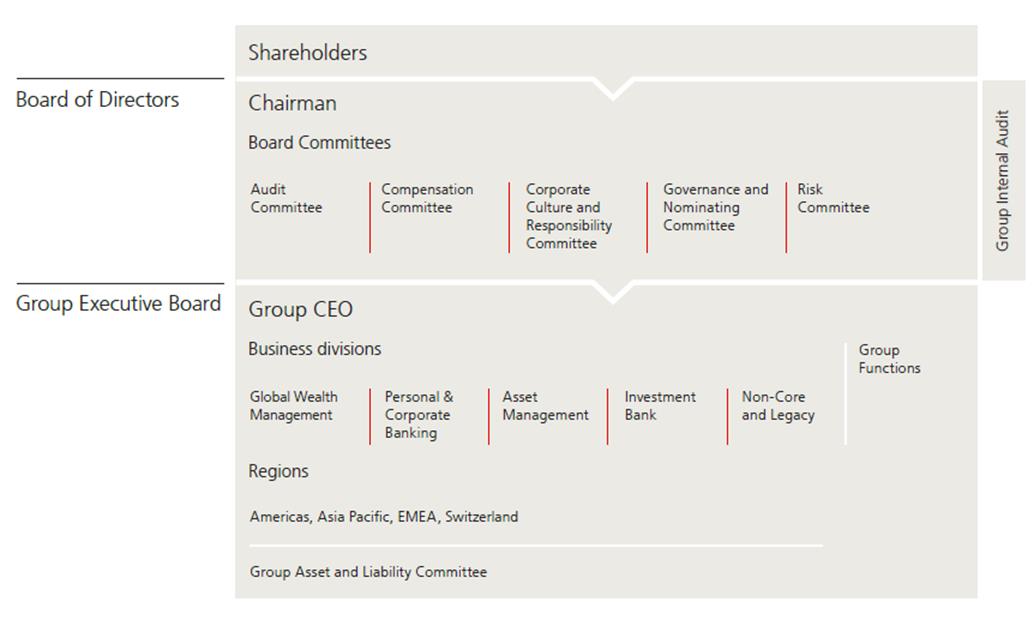
24
Organizational chart of UBS Group AG
25
Annex B –
Charter of the
Committees of the Board
26
Contents
Introduction
1 Basis and purpose
27
Membership and constitution
2 Number of Committee members, their independence and knowledge
28
3 Constitution
28
Responsibilities and authorities
4 Delegation of responsibilities and authorities
29
5 Audit Committee
29
6 Compensation Committee
30
7 Corporate Culture and
Responsibility Committee
31
8 Governance and Nominating Committee
32
9 Risk Committee
33
10 Further responsibilities and authorities
34
11 Delegation to a member or subcommittee
34
12 Information rights
34
13 Meeting with third parties
34
Meetings and resolutions of the Committees
14 Meetings
35
15 Information rights
35
Reporting
16 Regular reporting
36
17 Special reporting
36
Special provisions
18 Confidentiality
37
19 Self-assessment and adequacy review
37
27
Introduction
1
Basis and purpose
1.1
Basis
This Committees’ charter is enacted by the Board pursuant to articles 716
–
716b CO, articles
25 and 27 of the AoA and sections 5.9 and 13.3 of the ORs.
1.2
Purpose
The purpose of this Committees’ charter is to set out the objectives, composition and
responsibilities of the permanent Board Committees, being:
(i)
the Audit Committee;
(ii)
the Compensation Committee;
(iii)
the Corporate Culture and Responsibility Committee;
(iv)
the Governance and Nominating Committee; and
(v)
the Risk Committee.
28
Membership and constitution
2
Number of Committee members, their independence and knowledge
2.1
Minimum number of
Committee members
Each Committee must have at least three Committee members.
2.2
Independence
Each Committee must consist of members of the Board who:
(i)
with respect to the Compensation Committee, GNC and CCRC, are independent, in
a majority, as defined by section 3.2 of the ORs;
(ii)
with respect to the AC, fulfill the independence criteria set out in sections 2.3 and
2.4 of this Committees’ charter; and
(iii)
with respect to the RC, are independent, in a majority, as defined by section 3.2 of
the ORs and fulfill the independence criteria set out in section 2.4 of this Committees’
charter.
At least one member of the RC must also be a member of the Compensation Committee.
2.3
Special independence
rules for AC members
In addition to the independence criteria set out in section 3.2 of the ORs, each AC member
must meet the requirements set forth in rule 10A-3 of the Securities Exchange Act of 1934
and taking into account the New York Stock Exchange rules.
2.4
Special rules for AC and
RC members
Each AC and RC member must:
(i)
not be an affiliated person of UBS; for the avoidance of doubt, serving as a member
of the Board of a subsidiary of UBS Group AG or an affiliated company of the Group
and receiving remuneration for such activity does not, of itself, make an AC or an RC
member an affiliated person; and
(ii)
not receive any consulting, advisory or other compensatory fees from UBS or any of
its affiliated persons other than in their capacity as a Board member or a Committee
member.
Each AC member must not serve on the audit committee of more than two other public
companies, unless the Board has made a determination that such AC member or
prospective AC member has the availability to properly fulfill their duties with UBS.
2.5
Special rules for GNC
members
At least one of the Vice Chairmen and/or the SID is a member of the GNC.
2.6
Knowledge
Committee members must have the necessary knowledge and experience to fulfill their
functions.
2.7
Membership and presence
of the Chairman
Generally, the Chairman or one of the Vice Chairmen chairs the GNC. The Chairman may,
in consultation with the relevant Chairperson, attend the meetings of other Committees as
a non-voting guest.
3
Constitution
3.1
Appointment and removal
by the Board
The Chairperson and the Committee members, with the exception of the Compensation
Committee members, are appointed pursuant to section 4.3 of the ORs, and the Board may
remove any Committee member or any Chairperson at any time. Should a vacancy arise on
any Committee, even if the minimum number of Committee members pursuant to section
2.1 of this Committees’ charter is still met, the Board may appoint the missing member
from among its members for the remaining term of office.
29
Responsibilities and authorities
4
Delegation of responsibilities and authorities
4.1
In general
Pursuant to section 13.3 of the ORs, the Committees have the responsibilities and
authorities set out in the annexes to the ORs.
5
Audit Committee
5.1
In general
The function of the AC is to support the Board in fulfilling its oversight duty relating to
financial reporting and internal controls over financial reporting, the effectiveness of the
external and internal audit functions, and the effectiveness of whistleblowing procedures.
Management is responsible for the preparation, presentation and integrity of the financial
statements, while the external auditors are responsible for auditing financial statements.
The AC’s responsibility is one of oversight and review.
5.2
Responsibilities and
authorities
The AC’s responsibilities and authorities for UBS Group AG and the Group are to:
(i)
Financial reporting:
(a)
monitor the integrity of the financial statements and any announcements related to
financial performance, and review significant financial reporting judgements
contained in them, before recommending their approval to the Board;
(b)
review and propose to the Board for approval the Group’s annual report; advise the
Board on whether the Group’s annual report and financial statements, taken as a
whole, are fair, balanced and understandable, and provide the information necessary
for shareholders to assess the company’s position and performance, business model
and strategy;
(c)
review the organization and completeness of the financial reporting process,
including the Group’s internal control system and procedures as they relate to the
integrity of the financial statements, taking into account the reports provided by the
GEB, the external auditors, Group IA, regulators or other information as determined
by the Committee to be appropriate;
(d)
review management’s SOX 404 report in relation to internal controls over financial
reporting;
(e)
review significant accounting policies and practices and compliance with accounting
standards; and
(f)
review arrangements for compliance with the Group’s legal, regulatory and other
requirements (including tax matters) as they relate to the integrity of the financial
statements or financial report;
(ii)
Sustainability related reporting:
(a)
review the control framework underpinning all sustainability metrics;
(b)
review compliance with the sustainability reporting requirements as well as
sustainability related disclosures and the respective assurance audit process, in a joint
session with the CCRC; and
(c)
review and propose to the Board for approval the annual Group sustainability report
and the sustainability statement in the UBS AG annual report, in a joint session with
the CCRC;
(iii)
External audit:
(a)
oversee the Group’s relationship with and assess the qualifications, expertise,
effectiveness, independence and performance of the external auditors and their lead
audit partner; support the Board in reaching a decision in relation to the
appointment, reappointment or dismissal of the external auditors and the rotation
of the lead audit partner;
(b)
approve the engagement letter of the external auditors, including the scope of the
audit and the fees and terms for the planned audit work;
(c)
oversee all audit and permitted non-audit services provided by the external auditors
and establish such policies as the Committee deems appropriate;
(d)
annually review the external auditors’ summary of adjusted and unadjusted
differences; and
(e)
review the regulatory audit plan and the results of regulatory audits;
(iv)
Group IA:
(a)
monitor and assess the effectiveness, independence and performance of the Head
Group IA and Group IA;
(b)
approve Group IA’s annual audit plan and objectives including subsequent
30
significant changes to the plan;
(c)
approve Group IA’s performance objectives, budget and resource plan and monitor
Group IA’s delivery of its annual audit objectives; and
(d)
request special audits to be conducted either by Group IA or by mandating third
parties and review and approve such requests from other Board members,
Committees or the Group CEO;
(v)
Whistleblowing and investigations:
(a)
review the effectiveness of the firm’s whistleblowing policies and procedures and
ensure that appropriate whistleblowing mechanisms are in place;
(b)
review on a quarterly basis the levels of new and pending whistleblowing cases and
reports on complaints made regarding accounting, auditing or other matters;
(c)
review on a quarterly basis reports on internal investigations; and
(d)
conduct or direct any investigation, including the retention of external advisors and
consultants (at UBS’s expense), as it considers necessary to discharge its
responsibilities; and
(vi)
Human Resources:
(a)
annually provide input on the performance of the Group CFO, Group GC, Group
CRO and Group CCORCO to the Group CEO; and
(b)
review and make recommendations to the Board regarding decisions relating to the
hiring and dismissal of the Group CFO.
6
Compensation Committee
6.1
In general
The function of the Compensation Committee is to support the Board in its duties to set
guidelines on compensation and benefits, to oversee implementation thereof, to approve
certain compensation and to scrutinize executive performance.
6.2
Responsibilities and
authorities
The Compensation Committee’s responsibilities and authorities are to:
(i)
Group compensation strategy and principles:
(a)
periodically review the Group compensation strategy and principles and propose any
material changes to the Board for approval; and
(b)
evaluate the effectiveness of pay for performance results across the Group;
(ii)
GEB performance assessment framework and individual objectives:
(a)
propose, upon proposal of the Chairman, financial performance targets and non-
financial objectives for the Group CEO for approval by the Board; and
(b)
approve, upon proposal of the Group CEO, the performance assessment framework
(including financial performance targets) for the other GEB members and inform the
Board;
(iii)
GEB performance assessments:
(a)
propose, upon proposal of the Chairman, the Group CEO’s performance assessment
for approval by the Board; and
(b)
propose, upon proposal of the Group CEO, the performance assessments of the
other GEB members for approval by the Board;
(iv)
Compensation framework and plans:
(a)
approve key features of the compensation framework for GEB members;
(b)
be informed of key features of the compensation framework for employees other
than GEB members;
(c)
approve key terms of any new or amended compensation plans or other
compensation arrangements with a material financial, reputational or strategic
impact or significant use of UBS Group AG shares;
(d)
be informed of key terms of any new or amended pension and benefit plans with a
material financial, reputational or strategic impact;
(e)
approve the share ownership policy for GEB members;
(f)
propose the remuneration/fee framework for Board members for approval by the
Board; and
(g)
approve, upon proposal of the Chairman and Group CEO, the remuneration/fee
frameworks for external supervisory board members of Significant Group Entities
and be informed of remuneration/fee frameworks for external supervisory board
members of Significant Regional Entities;
(v)
Compensation governance:
(a)
approve key terms for material individual variations to standard mandate,
employment or termination agreements for non-independent Board members and,
upon proposal of the Chairman, for the Group CEO and, upon proposal of the
Group CEO, for other GEB members;
(b)
approve the engagement of and fees for any external advisors/consultants retained
by the Compensation Committee; considering factors relevant to the advisors’
independence from management and any requirements under New York Stock
Exchange listing standards prior to selecting, or receiving advice from any such
advisor/consultant;
(c)
propose to the Board for approval the annual compensation report and approve
other material public disclosures on UBS compensation matters;
(d)
approve the peer group framework used for Board and GEB members’ pay
comparison purposes;
31
(e)
meet with the RC annually to ensure that the compensation framework supports
appropriate risk awareness and management, as well as appropriate risk-taking; and
(f)
be informed of major regulatory developments, shareholder initiatives and best
practices in executive compensation;
(vi)
Other compensation competencies:
(a)
approve the total compensation for the Chairman and the non-independent Board
members;
(b)
propose, upon proposal of the Chairman, the total compensation for the Group CEO
for approval by the Board;
(c)
propose, upon proposal of the Group CEO, the individual total compensation for
the other GEB members for approval by the Board;
(d)
approve, upon proposal of the Chairman, the total compensation for the Head
Group IA, the Group Company Secretary and, upon proposal of the Group CEO, the
total compensation for former GEB members for the first financial year after leaving
the GEB;
(e)
propose, to the Board, for approval by the general meeting of the shareholders and
subject to the relevant periods as outlined in the AoA:
a.
the maximum aggregate amount of compensation for the Board;
b.
the maximum aggregate amount of fixed compensation for the GEB; and
c.
the aggregate amount of variable compensation for the GEB;
(f)
For employees within the Group:
a.
approve the total individual compensation for the 50 highest-paid employees
whose compensation is based on discretionary elements (excluding GEB
members) at year-end compensation review;
b.
be informed on aggregated level of employees with annual total compensation
of USD 3 million or more, and approve all employees (excluding GEB members)
whose compensation is based on discretionary elements with an annual total
compensation of USD 5 million or more at year-end compensation review;
c.
be informed of or approve retention awards, severance payments, replacement
awards and sign-on payments above internally defined thresholds, including
commitments to compensate new hires; and
d.
approve the total individual compensation of certain employees based on
additional regulatory requirements;
these approval authorities can be delegated to the Chairperson of the Compensation
Committee;
(g)
be informed of business performance progress and other variables that impact the
funding of the performance award pool; and
(h)
propose, upon proposal of the Group CEO, the final annual Group performance
award pool to the Board for approval and approve, upon proposal of the Group
CEO, the performance award pools for the BDs and GF.
7
Corporate Culture and Responsibility Committee
7.1
In general
The CCRC supports the Board in its duties to safeguard and advance the Group’s reputation
for responsible and sustainable conduct. Its function is forward-looking in that it monitors and
reviews societal trends and transformational developments and assesses their potential
relevance for the Group. In undertaking this assessment, it reviews stakeholder concerns and
expectations pertaining to the societal performance of UBS and to the development of its
corporate culture. The CCRC’s function also encompasses the monitoring of the current state
and implementation of the programs and initiatives within the Group pertaining to corporate
culture and corporate responsibility including sustainability.
7.2
Responsibilities and
authorities
The CCRC’s responsibilities and authorities are to:
(i)
General:
(a)
monitor and advise the Board on current and emerging societal trends and
developments of potential relevance for the Group;
(b)
review and assess the current state and implementation of the corporate culture and
corporate responsibility programs and initiatives within the Group; and
(c)
monitor the consistent application of the behaviors of accountability with integrity,
collaboration and innovation within UBS;
(ii)
Frameworks and regulations:
(a)
monitor and advise the Board on evolving external corporate culture and corporate
responsibility regulations, standards and practices;
(b)
conduct the annual review process for the Code of Conduct and Ethics of UBS and
make proposals for amendments to the Board; and
(c)
reaffirm UBS’s frameworks pertaining to the programs and initiatives outlined below
on an annual basis;
(iii)
Strategy:
(a)
monitor the effectiveness of actions taken by UBS relating to the corporate culture
and corporate responsibility regulations and policies, as well as the objectives of UBS;
(b)
support the GEB, if required, in the adjustment of processes pertaining to corporate
culture and corporate responsibility;
(c)
approve Group Sustainability and Impact’s overall strategy and annual objectives;
32
(d)
reaffirm the Group’s memberships in organizations, as well as commitments, with
a sustainability, impact or culture topic focus, on an annual basis; and
(e)
support a strong and responsible corporate culture firmly founded in a spirit of long-
term thinking;
(iv)
Programs and initiatives:
oversee UBS’s corporate culture and corporate responsibility programs and initiatives,
including:
(a)
Sustainability and Impact;
(b)
Three keys to success;
(c)
sustainable finance (including sustainable and impact investing);
(d)
client and corporate philanthropy;
(e)
sustainability and climate risk management, in a joint session with the RC;
(f)
climate strategy (including transition plan);
(g)
human rights (including modern slavery prevention);
(h)
in-house environmental management;
(i)
responsible supply chain management;
(j)
workforce inclusion;
(k)
client satisfaction;
(l)
talent management;
(m)
working environment; and
(n)
other evolving initiatives;
(v)
Reporting, communications and engagements:
(a)
advise the Board on the reporting of the Group’s corporate culture and corporate
responsibility strategy and activities;
(b)
review and propose to the Board for approval the annual Group sustainability report
and the sustainability statement in the UBS AG annual report, in a joint session with
the AC;
(c)
review compliance with the sustainability reporting requirements as well as
sustainability-related disclosures and the sustainability disclosure assurance audit
process, in a joint session with the AC; and
(d)
monitor and review communications on corporate culture and corporate
responsibility with stakeholders (including relevant organizations and sustainability
rating bodies) and their effectiveness with regard to the reputation of the Group.
8
Governance and Nominating Committee
8.1
In general
The function of the GNC is to support the Board in fulfilling its duty to establish best practices
in corporate governance across the Group, including conducting a Board assessment,
establishing and maintaining a process for appointing new Board and GEB members, as well
as for the annual performance assessment of the Board.
8.2
Responsibilities and
authorities
The GNC’s responsibilities and authorities are to:
(i)
Corporate governance:
(a)
address all significant corporate governance issues affecting the Group;
(b)
develop, maintain and review these ORs and make proposals to the Board for
approval;
(c)
make recommendations to the Board concerning further corporate governance
matters and practices;
(d)
review and advise the Board on the corporate governance section of the Group’s
annual report;
(e)
coordinate as required the work of the other Committees regarding corporate
governance in their specific areas of expertise;
(f)
plan and manage proposals for changes in Board membership, taking into account
factors including:
a.
the size and composition of the Board, as well as its Committees; and
b.
the skill mix, industry experience, diversity considerations and responsibilities of
Board members;
(g)
annually review the Board members’ independence and present its assessment to
the Board for approval;
(h)
approve mandates of Board and GEB members pursuant to articles 31 and 36 of the
AoA and applicable internal policies; and
(i)
approve the appointment of supervisory board members for Significant Group
Entities upon proposal by the Group CEO and ensure the Chairperson of the
respective Board Committee of UBS Group AG is consulted on the appointment of
Chairpersons to equivalent committees for Significant Group Entities;
(ii)
annually review the Committees’ charter, taking into account best practices;
(iii)
Identification and nomination of new Board members:
(a)
develop, maintain and review principles and criteria regarding the recruitment and
nomination of new Board members and Committee members, approve their existing
mandates, assess their independence pursuant to section 3.2 of the ORs and provide
specific proposals to the Board for approval;
(b)
review and propose new candidates for membership of the Board to be
recommended for election by the shareholders at an AGM or EGM in accordance
33
with selection criteria approved by the Board; and
(c)
manage a succession plan for Board and Committee membership;
(iv)
Board education:
(a)
ensure the establishment of a satisfactory induction program for new Board
members and a satisfactory ongoing training and education program for existing
Board members and Committee members; and
(b)
maintain a list of trainings attended by individual Board members (maintained by the
Group Company Secretary on behalf of the GNC);
(v)
Performance evaluation:
(a)
set the criteria for and oversee the annual assessment of the performance and
effectiveness of the Chairman, the Board as a whole and each Committee;
(b)
conduct an annual assessment of the performance and effectiveness of the
Chairman and of the Board as a whole (which includes an appraisal by an external
expert at least every three years), report to the Board the conclusions and
recommendations and assess on a timely basis whether or not Board members are
to be proposed for re-election by the AGM;
(c)
ensure that each Committee carries out and oversees a self-assessment of its
performance and reports the conclusions and any recommendations for change to
the Board; and
(d)
ensure that each Committee is subject to an external assessment every three years;
and
(vi)
Human resources:
supervise and approve, together with the Chairman, the succession planning for all
GEB members and propose their appointment for approval by the Board (for this
purpose, the GNC receives information from the Compensation Committee on its
performance evaluation of the GEB members).
8.3
Responsibilities and
authorities of the
Vice Chairman and/or SID
In accordance with section 2.5 of this Committees’ charter, at least one of the Vice Chairmen
and/or the SID is a member of the GNC. The respective GNC member is required:
(i)
together with the GNC, to lead the Board in the ongoing monitoring and annual
evaluation of the Chairman; and
(ii)
in conjunction with the Chairman and the GNC, to ensure good corporate
governance, balanced leadership and control within the Group, the Board and the
Committees.
9
Risk Committee
9.1
In general
The function of the RC is to oversee and support the Board in fulfilling its duty to set and
supervise an appropriate risk management and control framework in the areas of:
(i)
financial and non-financial risks; and
(ii)
balance sheet, treasury and capital management, including funding, liquidity and
equity attribution.
The RC considers the potential effects of the aforementioned risks on the Group’s repu
tation.
9.2
Responsibilities and
authorities
The RC’s responsibilities and authorities are to:
(i)
Risk management and control:
(a)
review and propose to the Board for approval the principles of the risk management
and control framework (including the Risk Appetite Framework and overall risk
appetite statement of the Group and BDs, delegation of risk authorities and material
risk limits) relative to UBS’s operations, assess management’s respective proposals
and recommend any required changes to the Board;
(b)
review and approve the risk appetite methodology (including objectives and binding
scenarios) relative to the Group’s activities and risk profiles, including allocation of
responsibilities within the risk management and control framework;
(c)
review and approve the sustainability and climate risk control framework, in a joint
session with the CCRC;
(d)
review and advise the Board on the risk, capital, liquidity and funding, and balance
sheet section of the Group’s annual report;
(e)
periodically assess the appropriateness of major policies and procedures adopted by
the GEB relating to the risk management and control of significant risks;
(f)
review and make recommendations to the Board based on proposals from the GEB
in relation to material risk limits and periodically review allocations and authority
levels relating to those limits. Material risk limits include those relating to portfolios,
concentrations, products, sectors or other categories relevant to the strategy, risk
profile and risk capacity of UBS Group AG and the Group as approved by the Board;
(g)
review and approve the principal characteristics of the Group’s risk measurement
framework (including changes thereto) used to identify, model, measure, monitor
and report risks;
(h)
monitor and oversee the risk profile of UBS Group AG and the Group within the
context of the Board-determined risk profile, risk capacity and limit structure;
(i)
systematically review high-risk areas of the Group and assess the effectiveness of the
steps taken by the GEB to manage or mitigate such risks;
34
(j)
review and assess the asset and liability management framework, including
allocation of responsibilities, limits, capital allocation to BDs and GF, liquidity and
funding;
(k)
review regulatory framework reforms affecting areas within the scope of the RC’s
mandate and recommend any required changes to the Board;
(l)
consider the Group’s strategy to deal with anticipated or existing high-level risks and
assist the Board by reviewing and assessing management’s proposals in relation to
strategy;
(m)
review management’s proposals and as appropriate propose to the Board for
approval, a global recovery plan and global resolution strategy;
(n)
review management’s assessments of UBS’s non-financial risk exposures and related
risk-oriented activity plans;
(o)
periodically review material communications (including formal assessments)
between UBS and its principal regulators;
(p)
review projects and remediation activities (as determined by the RC) undertaken by
the management to address critical changes to the risk management/control
environment; and
(q)
periodically meet with the Compensation Committee to ensure that the com-
pensation framework appropriately reflects risk awareness and management, and
ensures appropriate risk-taking;
(ii)
Risk reporting:
(a)
determine risk reporting requirements that allow for an effective oversight by the RC
and communicate changes to report owners if reporting requirements are not met
or change;
(b)
review risk reports, including reports from management that assess the likelihood of
risks materializing, the monitoring of emerging trends via forecasts or stress tests,
the adequacy and appropriateness of the internal controls to manage those risks and
that contain agreed measures to reduce risks or deal with specific risk situations
including stress situations; and
(c)
receive periodic updates on limitations that prevent full risk data aggregation in the
risk reports; and
(iii)
Human Resources:
(a)
annually provide input on the performance of the Group CRO, Group CFO, Group
GC and the Group CCORCO to the Group CEO; and
(b)
review and make recommendations to the Board regarding decisions relating to the
hiring and dismissal of the Group CRO and the Group CCORCO.
10
Further responsibilities and authorities
10.1
Further responsibilities
and authorities
The Board may entrust further powers and duties to the Committees by Board resolution.
11
Delegation to a member or subcommittee
11.1
Further delegation by the
Committees
Each Committee may delegate some of its tasks to one of its members or to a subcommittee
comprised of two or more of its members. Such delegations shall be recorded in the
Committee’s minutes and the Chairman must be informed.
12
Information rights
12.1
Committees
In accordance with the procedure set out in section 8.4 of the OR
s, each Committee may
request any relevant information or special reports from any GEB member or Group IA on
matters relating to its respective responsibilities set out in this Committees’ charter.
12.2
Committee members
For the information rights of each Board member, see section 8 of the ORs.
13
Meeting with third parties
13.1
Meeting with third parties
The Committees may, in performing their duties, take advice from and meet as a body with
third parties. In consultation with the Group CEO, they may meet with regulators. The
Chairperson shall inform the Chairman accordingly.
35
Meetings and resolutions of the Committees
14
Meetings
14.1
Number of meetings
Each Committee meets as often as its business requires, but at least:
(i)
four times a year for the AC, the RC and the Compensation Committee; and
(ii)
twice a year for the CCRC and the GNC.
The AC and RC hold at least four joint meetings a year.
The Compensation Committee and RC periodically hold joint meetings.
14.2
Request, invitation,
agenda, notice period,
chair, and format
Committee meetings, including joint meetings, are called and held in compliance with the
rules set out in the ORs (sections 6.2 to 6.5 and 6.8 of the ORs to be applied mutatis
mutandis).
14.3
Presence of third parties
at Committee meetings
Each Chairperson may, on their own motion or upon request of any Committee member
or the Chairman, invite GEB members, as well as other persons, to attend Committee
meetings as guests. The Group CEO will be informed accordingly.
14.4
Special rules for the AC
The AC holds Committee meetings:
(i)
normally with the participation of the Head Group IA, representatives of the external
auditors, the Group CEO, the Group CFO, and the Group Controller and Chief
Accounting Officer; and
(ii)
periodically, only with the participation of the Head Group IA, the external auditors,
or with members of management, or a combination of any of the aforementioned.
14.5
Special rules for the CCRC
The CCRC
normally holds Committee meetings with the participation of the Group CEO,
the Group COO, and the Chief Sustainability Officer.
14.6
Special rules for the
Compensation Committee
The Compensation Committee
normally holds Committee meetings with the participation
of the Group CEO, the Head GHRCS, the Global Head of Reward and external advisors.
14.7
Special rules for the RC
Generally, the Group CEO, the Group CFO, the Group CRO, the Group GC, the Group
CCORCO, the Head Group IA and representatives of the external auditors participate (to
the extent necessary) in each meeting of the RC. The invitation of other persons is at the
discretion of the RC.
14.8
Resolutions
Resolutions are passed by a majority of the votes of Committee members present; in case
of a tie, the decision is passed on to the Board and decided in accordance with section 7.2
of the ORs. Sections 7.1 and 7.3 to 7.5 of the ORs apply mutatis mutandis.
14.9
Minutes
The minutes of Committee meetings, including joint meetings, must fulfill the conditions
set out in sections 6.9, 6.10 and 7.5 of the ORs and be distributed to the Chairman.
15
Information rights
15.1
Information rights
Section 8 of the ORs appl
ies mutatis mutandis to the information rights of the Committees
and the Committee members.
36
Reporting
16
Regular reporting
16.1
In general
Each Chairperson ensures that the Chairman and the Board are kept informed in a timely
and appropriate manner. Each Chairperson (either personally or through another
Committee member) regularly reports to the Board at the Board meetings on the current
activities of their Committee and on important Committee issues, including all matters
falling within the duties and responsibilities of the Board, namely:
(i)
proposals for resolutions to be considered, or other action to be taken by the Board;
(ii)
resolutions and decisions made by the Committee and the material considerations
that led to such resolutions and decisions; and
(iii)
activities and important findings of the Committee.
16.2
Submitting of proposals
and recommendations
Each Chairperson submits, in writing, the proposals and resolutions mentioned in sections
16.1(i) and (ii) of this Annex to the ORs to the Board unless such proposals are contained
in the Committee minutes; the remaining reporting is generally done orally.
16.3
Annual reporting of the
Committees
Each Committee annually submits a report to the Board, detailing the activities of the
Committee during the previous twelve months.
17
Special reporting
17.1
AC
Following the completion of the audit and the annual financial statements, the AC
Chairperson submits annually to the Chairman, for the attention of the Board:
(i)
the AC’s assessment of the qualification, independence and performance of the
external auditors;
(ii)
the AC’s assessment of the design of the Group’s internal control system for financial
reporting and the coordination and interaction between Group IA and the external
auditors; and
(iii)
a recommendation regarding the audited financial statements in the Group’s annual
report.
37
Special provisions
18
Confidentiality
18.1
Special rule
The deliberations of the Compensation Committee and GNC are handled with the utmost
discretion and are to be communicated outside of these Committees only to the extent
permitted by the Chairpersons of these Committees. The Chairman is exempted with regard
to the confidentiality of deliberations.
19
Self-assessment and adequacy review
19.1
Self
-assessment and
adequacy review
Each Committee reviews the adequacy of its charter at regular intervals, but at least
annually, and recommends to the GNC any changes considered to be necessary
or appropriate. For the self-assessment, section 9 of the ORs is to be applied mutatis
mutandis.

UBS Group AG
P.O. Box
CH-8098 Zurich
ubs.com